MMeeaassuurreemmeenntt ooff 
MMaaccrrooeeccoonnoommiicc VVaarriiaabblleess 
CChhaapptteerr 22 
Professor Steve Cunningham 
Intermediate Macroeconomics 
ECON 219
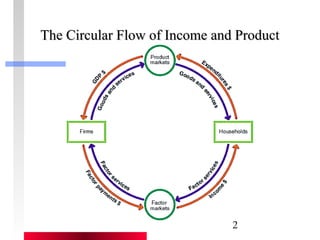
The CCiirrccuullaarr FFllooww ooff IInnccoommee aanndd PPrroodduucctt 
2
3 
SSttoocckkss aanndd FFlloowwss 
A flow is a quantity per unit of time. 
– How much per period? 
– Example: pay rate 
A stock is a quantity that exists at 
one point in time. 
– Example: your bank balance
4 
WWeeaalltthh aanndd SSaavviinngg 
Wealth is the value of all the things 
that people own. Savings is one 
form of wealth. It is a stock. 
Saving is the amount of income that 
is left over after consumption. It 
adds to wealth. It is a flow. 
Dissaving is the process of making 
expenditures out of savings. It 
reduces wealth.
GGrroossss DDoommeessttiicc PPrroodduucctt ((GGDDPP)) 
 GDP is the total value of all the goods and 
services produced in a country per time 
period (usually one year). It is a flow variable. 
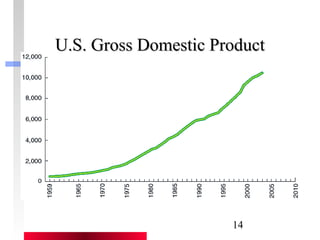
 In 2002, U.S. GDP was $10.4 trillion (per year). 
 In contrast, Gross National Product (GNP) is 
the total value of all the goods and services 
produced by the citizens of a country 
(wherever they might be) per time period. 
5
6 
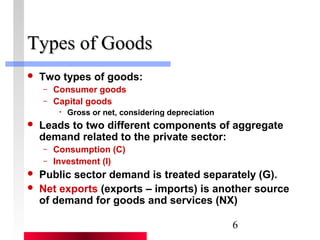
TTyyppeess ooff GGooooddss 
 Two types of goods: 
– Consumer goods 
– Capital goods 
• Gross or net, considering depreciation 
 Leads to two different components of aggregate 
demand related to the private sector: 
– Consumption (C) 
– Investment (I) 
 Public sector demand is treated separately (G). 
 Net exports (exports – imports) is another source 
of demand for goods and services (NX)
7 
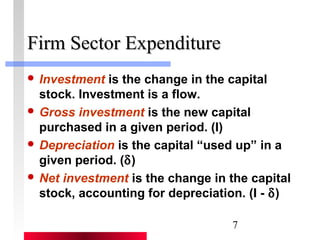
FFiirrmm SSeeccttoorr EExxppeennddiittuurree 
 Investment is the change in the capital 
stock. Investment is a flow. 
 Gross investment is the new capital 
purchased in a given period. (I) 
 Depreciation is the capital “used up” in a 
given period. (d) 
 Net investment is the change in the capital 
stock, accounting for depreciation. (I - d)
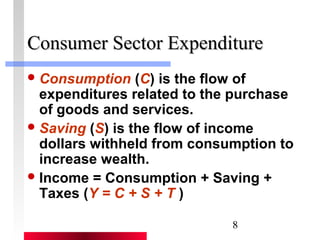
CCoonnssuummeerr SSeeccttoorr EExxppeennddiittuurree 
Consumption (C) is the flow of 
expenditures related to the purchase 
of goods and services. 
Saving (S) is the flow of income 
dollars withheld from consumption to 
increase wealth. 
Income = Consumption + Saving + 
Taxes (Y = C + S + T ) 
8
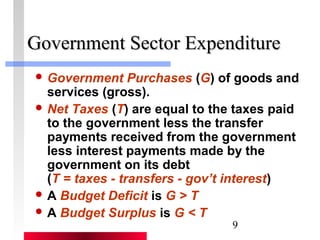
GGoovveerrnnmmeenntt SSeeccttoorr EExxppeennddiittuurree 
Government Purchases (G) of goods and 
services (gross). 
Net Taxes (T) are equal to the taxes paid 
to the government less the transfer 
payments received from the government 
less interest payments made by the 
government on its debt 
(T = taxes - transfers - gov’t interest) 
A Budget Deficit is G > T 
A Budget Surplus is G < T 
9
10 
IInntteerrnnaattiioonnaall SSeeccttoorr 
 Imports (IM or M) are goods and services 
purchased by domestic consumers that 
are produced elsewhere. 
 Exports (EX or X) are goods and services 
purchased by foreign consumers that are 
produced domestically (EX). 
 Net Exports (NX) = EX - IM
11 
AAddddiinngg IItt AAllll UUpp 
Y = C + I + G + NX 
The Expenditure Approach: 
computes GDP this way. 
Aggregate production (GDP) equals 
aggregate expenditure equals 
aggregate income. 
Aggregate Supply = Aggregate 
Demand
GGDDPP:: EExxppeennddiittuurree AApppprrooaacchh 
Y = C + I + G + NX 
Focuses on final expenditure 
Does not include: 
– Intermediate goods and services 
– Used goods 
– Financial Assets 
12
13 
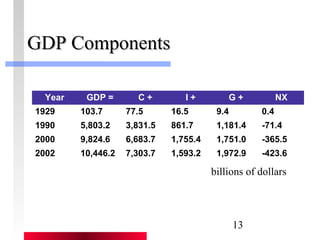
GGDDPP CCoommppoonneennttss 
Year GDP = C + I + G + NX 
1929 103.7 77.5 16.5 9.4 0.4 
1990 5,803.2 3,831.5 861.7 1,181.4 -71.4 
2000 9,824.6 6,683.7 1,755.4 1,751.0 -365.5 
2002 10,446.2 7,303.7 1,593.2 1,972.9 -423.6 
billions of dollars
UU..SS.. GGrroossss DDoommeessttiicc PPrroodduucctt 
14
15 
NNeett DDoommeessttiicc PPrroodduucctt 
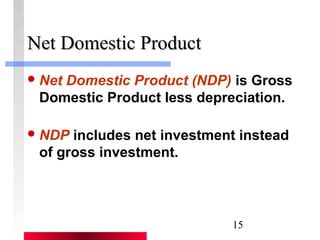
Net Domestic Product (NDP) is Gross 
Domestic Product less depreciation. 
NDP includes net investment instead 
of gross investment.
16 
NNaattiioonnaall IInnccoommee 
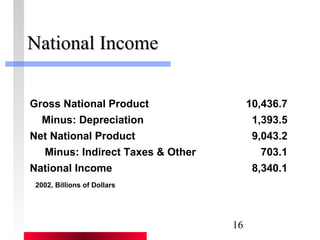
Gross National Product 10,436.7 
Minus: Depreciation 1,393.5 
Net National Product 9,043.2 
Minus: Indirect Taxes & Other 703.1 
National Income 8,340.1 
2002, Billions of Dollars
17 
GGDDPP:: IInnccoommee AApppprrooaacchh 
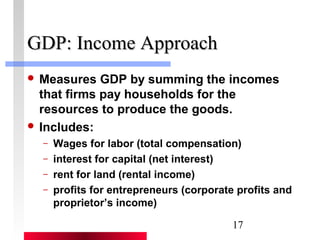
 Measures GDP by summing the incomes 
that firms pay households for the 
resources to produce the goods. 
 Includes: 
– Wages for labor (total compensation) 
– interest for capital (net interest) 
– rent for land (rental income) 
– profits for entrepreneurs (corporate profits and 
proprietor’s income)
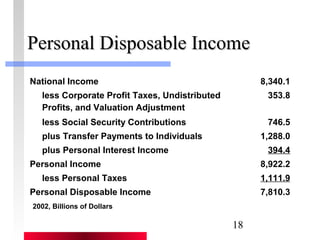
PPeerrssoonnaall DDiissppoossaabbllee IInnccoommee 
National Income 8,340.1 
less Corporate Profit Taxes, Undistributed 
Profits, and Valuation Adjustment 
18 
353.8 
less Social Security Contributions 746.5 
plus Transfer Payments to Individuals 1,288.0 
plus Personal Interest Income 394.4 
Personal Income 8,922.2 
less Personal Taxes 1,111.9 
Personal Disposable Income 7,810.3 
2002, Billions of Dollars
19 
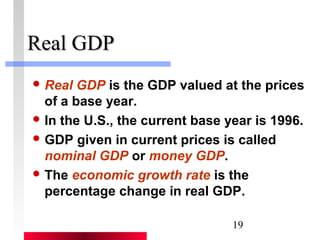
RReeaall GGDDPP 
Real GDP is the GDP valued at the prices 
of a base year. 
In the U.S., the current base year is 1996. 
GDP given in current prices is called 
nominal GDP or money GDP. 
The economic growth rate is the 
percentage change in real GDP.
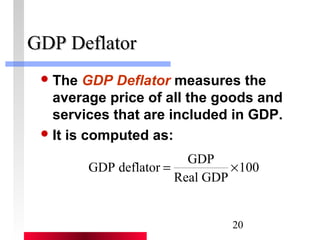
GDP deflator = GDP ´ 
20 
GGDDPP DDeeffllaattoorr 
The GDP Deflator measures the 
average price of all the goods and 
services that are included in GDP. 
It is computed as: 
100 
Real GDP
21 
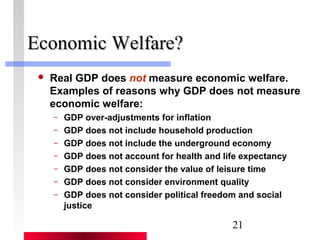
EEccoonnoommiicc WWeellffaarree?? 
 Real GDP does not measure economic welfare. 
Examples of reasons why GDP does not measure 
economic welfare: 
– GDP over-adjustments for inflation 
– GDP does not include household production 
– GDP does not include the underground economy 
– GDP does not account for health and life expectancy 
– GDP does not consider the value of leisure time 
– GDP does not consider environment quality 
– GDP does not consider political freedom and social 
justice
22 
CCPPII aanndd PPPPII 
 The Consumer Price Index (CPI) measures 
the average level of prices of the goods 
and services that the typical urban family 
buys. The Bureau of Labor Statistics (BLS) 
calculates the CPI monthly. 
 The Producer Price Index (PPI) measures 
the wholesale prices of approximately 
3000 items.
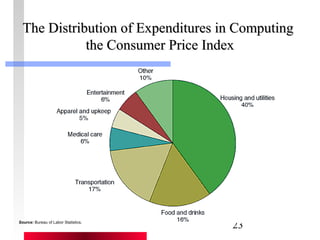
TThhee DDiissttrriibbuuttiioonn ooff EExxppeennddiittuurreess iinn CCoommppuuttiinngg 
tthhee CCoonnssuummeerr PPrriiccee IInnddeexx 
Source: Bureau of Labor Statistics. 23
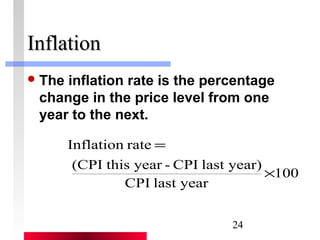
Inflation rate 
(CPI this year - CPI last year) 
24 
IInnffllaattiioonn 
The inflation rate is the percentage 
change in the price level from one 
year to the next. 
100 
CPI last year 
´ 
=
25 
SSoouurrcceess ooff BBiiaass iinn CCPPII 
 New goods bias 
– The new, hot product costs more than the older product 
it replaced. (Computer vs. typewriter ) 
 Quality change bias 
– The newer products have more features and reliability. 
 Commodity substitution bias 
– When the price rises, the consumer chooses to 
substitute a lower priced substitute. 
 Outlet substitution bias 
– When the price rises, the consumer changes shopping 
habits and goes to an outlet store or buys foreign goods.
26 
GGDDPP DDeeffllaattoorr BBiiaass 
In principle, the GDP deflator cannot 
be biased. 
– It reflects prices of the goods actually 
chosen by consumers, not a fixed 
shopping list. 
– Substitutions of various kinds are 
naturally accounted for.
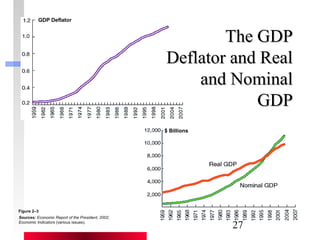
Figure 2–3 
Sources: Economic Report of the President, 2002; 
Economic Indicators (various issues). 
27 TThhee GGDDPP 
DDeeffllaattoorr aanndd RReeaall 
aanndd NNoommiinnaall 
GGDDPP 
$ Billions 
GDP Deflator
28 
((UUnn))EEmmppllooyyeedd?? 
 To be employed, a person must have either 
a full-time job or a part-time job. 
 To be unemployed, a person must be 
available for work, and must be: 
– Without work but have made specific efforts to 
find a job within the previous four (4) weeks, or 
– Waiting to be called back from a job from which 
he or she has been laid off, or 
– Waiting to start a new job within 30 days.
29 
DDiissccoouurraaggeedd WWoorrkkeerrss 
Discouraged workers are people who 
are available and willing and able to 
work but have not made specific 
efforts to find a job within the 
previous four weeks. 
Unemployment measures tend to 
exclude these people and thus 
understate unemployment.
30 
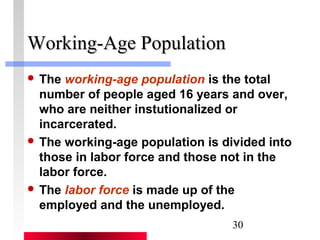
WWoorrkkiinngg--AAggee PPooppuullaattiioonn 
 The working-age population is the total 
number of people aged 16 years and over, 
who are neither instutionalized or 
incarcerated. 
 The working-age population is divided into 
those in labor force and those not in the 
labor force. 
 The labor force is made up of the 
employed and the unemployed.
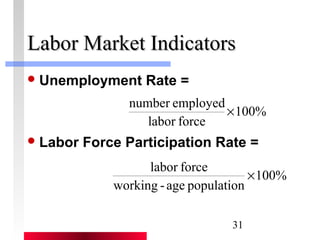
LLaabboorr MMaarrkkeett IInnddiiccaattoorrss 
100% 
number employed ´ 
labor force ´ 
31 
Unemployment Rate = 
labor force 
Labor Force Participation Rate = 
100% 
working - age population
32 
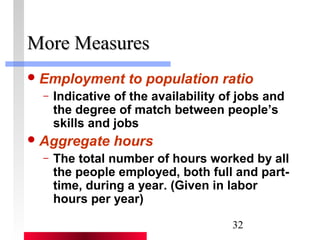
MMoorree MMeeaassuurreess 
Employment to population ratio 
– Indicative of the availability of jobs and 
the degree of match between people’s 
skills and jobs 
Aggregate hours 
– The total number of hours worked by all 
the people employed, both full and part-time, 
during a year. (Given in labor 
hours per year)
33 
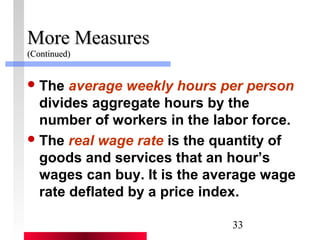
MMoorree MMeeaassuurreess 
((CCoonnttiinnuueedd)) 
The average weekly hours per person 
divides aggregate hours by the 
number of workers in the labor force. 
The real wage rate is the quantity of 
goods and services that an hour’s 
wages can buy. It is the average wage 
rate deflated by a price index.
34 
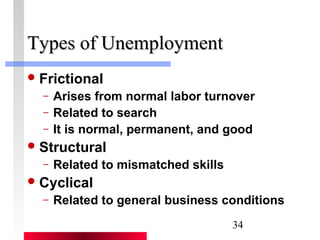
TTyyppeess ooff UUnneemmppllooyymmeenntt 
Frictional 
– Arises from normal labor turnover 
– Related to search 
– It is normal, permanent, and good 
Structural 
– Related to mismatched skills 
Cyclical 
– Related to general business conditions
35 
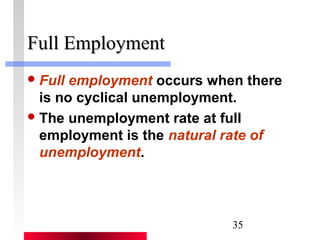
FFuullll EEmmppllooyymmeenntt 
Full employment occurs when there 
is no cyclical unemployment. 
The unemployment rate at full 
employment is the natural rate of 
unemployment.

Froyen02

  • 1.
    MMeeaassuurreemmeenntt ooff MMaaccrrooeeccoonnoommiiccVVaarriiaabblleess CChhaapptteerr 22 Professor Steve Cunningham Intermediate Macroeconomics ECON 219
  • 2.
    The CCiirrccuullaarr FFlloowwooff IInnccoommee aanndd PPrroodduucctt 2
  • 3.
    3 SSttoocckkss aannddFFlloowwss A flow is a quantity per unit of time. – How much per period? – Example: pay rate A stock is a quantity that exists at one point in time. – Example: your bank balance
  • 4.
    4 WWeeaalltthh aannddSSaavviinngg Wealth is the value of all the things that people own. Savings is one form of wealth. It is a stock. Saving is the amount of income that is left over after consumption. It adds to wealth. It is a flow. Dissaving is the process of making expenditures out of savings. It reduces wealth.
  • 5.
    GGrroossss DDoommeessttiicc PPrroodduucctt((GGDDPP))  GDP is the total value of all the goods and services produced in a country per time period (usually one year). It is a flow variable.  In 2002, U.S. GDP was $10.4 trillion (per year).  In contrast, Gross National Product (GNP) is the total value of all the goods and services produced by the citizens of a country (wherever they might be) per time period. 5
  • 6.
    6 TTyyppeess ooffGGooooddss  Two types of goods: – Consumer goods – Capital goods • Gross or net, considering depreciation  Leads to two different components of aggregate demand related to the private sector: – Consumption (C) – Investment (I)  Public sector demand is treated separately (G).  Net exports (exports – imports) is another source of demand for goods and services (NX)
  • 7.
    7 FFiirrmm SSeeccttoorrEExxppeennddiittuurree  Investment is the change in the capital stock. Investment is a flow.  Gross investment is the new capital purchased in a given period. (I)  Depreciation is the capital “used up” in a given period. (d)  Net investment is the change in the capital stock, accounting for depreciation. (I - d)
  • 8.
    CCoonnssuummeerr SSeeccttoorr EExxppeennddiittuurree Consumption (C) is the flow of expenditures related to the purchase of goods and services. Saving (S) is the flow of income dollars withheld from consumption to increase wealth. Income = Consumption + Saving + Taxes (Y = C + S + T ) 8
  • 9.
    GGoovveerrnnmmeenntt SSeeccttoorr EExxppeennddiittuurree Government Purchases (G) of goods and services (gross). Net Taxes (T) are equal to the taxes paid to the government less the transfer payments received from the government less interest payments made by the government on its debt (T = taxes - transfers - gov’t interest) A Budget Deficit is G > T A Budget Surplus is G < T 9
  • 10.
    10 IInntteerrnnaattiioonnaall SSeeccttoorr  Imports (IM or M) are goods and services purchased by domestic consumers that are produced elsewhere.  Exports (EX or X) are goods and services purchased by foreign consumers that are produced domestically (EX).  Net Exports (NX) = EX - IM
  • 11.
    11 AAddddiinngg IIttAAllll UUpp Y = C + I + G + NX The Expenditure Approach: computes GDP this way. Aggregate production (GDP) equals aggregate expenditure equals aggregate income. Aggregate Supply = Aggregate Demand
  • 12.
    GGDDPP:: EExxppeennddiittuurree AApppprrooaacchh Y = C + I + G + NX Focuses on final expenditure Does not include: – Intermediate goods and services – Used goods – Financial Assets 12
  • 13.
    13 GGDDPP CCoommppoonneennttss Year GDP = C + I + G + NX 1929 103.7 77.5 16.5 9.4 0.4 1990 5,803.2 3,831.5 861.7 1,181.4 -71.4 2000 9,824.6 6,683.7 1,755.4 1,751.0 -365.5 2002 10,446.2 7,303.7 1,593.2 1,972.9 -423.6 billions of dollars
  • 14.
  • 15.
    15 NNeett DDoommeessttiiccPPrroodduucctt Net Domestic Product (NDP) is Gross Domestic Product less depreciation. NDP includes net investment instead of gross investment.
  • 16.
    16 NNaattiioonnaall IInnccoommee Gross National Product 10,436.7 Minus: Depreciation 1,393.5 Net National Product 9,043.2 Minus: Indirect Taxes & Other 703.1 National Income 8,340.1 2002, Billions of Dollars
  • 17.
    17 GGDDPP:: IInnccoommeeAApppprrooaacchh  Measures GDP by summing the incomes that firms pay households for the resources to produce the goods.  Includes: – Wages for labor (total compensation) – interest for capital (net interest) – rent for land (rental income) – profits for entrepreneurs (corporate profits and proprietor’s income)
  • 18.
    PPeerrssoonnaall DDiissppoossaabbllee IInnccoommee National Income 8,340.1 less Corporate Profit Taxes, Undistributed Profits, and Valuation Adjustment 18 353.8 less Social Security Contributions 746.5 plus Transfer Payments to Individuals 1,288.0 plus Personal Interest Income 394.4 Personal Income 8,922.2 less Personal Taxes 1,111.9 Personal Disposable Income 7,810.3 2002, Billions of Dollars
  • 19.
    19 RReeaall GGDDPP Real GDP is the GDP valued at the prices of a base year. In the U.S., the current base year is 1996. GDP given in current prices is called nominal GDP or money GDP. The economic growth rate is the percentage change in real GDP.
  • 20.
    GDP deflator =GDP ´ 20 GGDDPP DDeeffllaattoorr The GDP Deflator measures the average price of all the goods and services that are included in GDP. It is computed as: 100 Real GDP
  • 21.
    21 EEccoonnoommiicc WWeellffaarree??  Real GDP does not measure economic welfare. Examples of reasons why GDP does not measure economic welfare: – GDP over-adjustments for inflation – GDP does not include household production – GDP does not include the underground economy – GDP does not account for health and life expectancy – GDP does not consider the value of leisure time – GDP does not consider environment quality – GDP does not consider political freedom and social justice
  • 22.
    22 CCPPII aannddPPPPII  The Consumer Price Index (CPI) measures the average level of prices of the goods and services that the typical urban family buys. The Bureau of Labor Statistics (BLS) calculates the CPI monthly.  The Producer Price Index (PPI) measures the wholesale prices of approximately 3000 items.
  • 23.
    TThhee DDiissttrriibbuuttiioonn ooffEExxppeennddiittuurreess iinn CCoommppuuttiinngg tthhee CCoonnssuummeerr PPrriiccee IInnddeexx Source: Bureau of Labor Statistics. 23
  • 24.
    Inflation rate (CPIthis year - CPI last year) 24 IInnffllaattiioonn The inflation rate is the percentage change in the price level from one year to the next. 100 CPI last year ´ =
  • 25.
    25 SSoouurrcceess ooffBBiiaass iinn CCPPII  New goods bias – The new, hot product costs more than the older product it replaced. (Computer vs. typewriter )  Quality change bias – The newer products have more features and reliability.  Commodity substitution bias – When the price rises, the consumer chooses to substitute a lower priced substitute.  Outlet substitution bias – When the price rises, the consumer changes shopping habits and goes to an outlet store or buys foreign goods.
  • 26.
    26 GGDDPP DDeeffllaattoorrBBiiaass In principle, the GDP deflator cannot be biased. – It reflects prices of the goods actually chosen by consumers, not a fixed shopping list. – Substitutions of various kinds are naturally accounted for.
  • 27.
    Figure 2–3 Sources:Economic Report of the President, 2002; Economic Indicators (various issues). 27 TThhee GGDDPP DDeeffllaattoorr aanndd RReeaall aanndd NNoommiinnaall GGDDPP $ Billions GDP Deflator
  • 28.
    28 ((UUnn))EEmmppllooyyeedd?? To be employed, a person must have either a full-time job or a part-time job.  To be unemployed, a person must be available for work, and must be: – Without work but have made specific efforts to find a job within the previous four (4) weeks, or – Waiting to be called back from a job from which he or she has been laid off, or – Waiting to start a new job within 30 days.
  • 29.
    29 DDiissccoouurraaggeedd WWoorrkkeerrss Discouraged workers are people who are available and willing and able to work but have not made specific efforts to find a job within the previous four weeks. Unemployment measures tend to exclude these people and thus understate unemployment.
  • 30.
    30 WWoorrkkiinngg--AAggee PPooppuullaattiioonn  The working-age population is the total number of people aged 16 years and over, who are neither instutionalized or incarcerated.  The working-age population is divided into those in labor force and those not in the labor force.  The labor force is made up of the employed and the unemployed.
  • 31.
    LLaabboorr MMaarrkkeett IInnddiiccaattoorrss 100% number employed ´ labor force ´ 31 Unemployment Rate = labor force Labor Force Participation Rate = 100% working - age population
  • 32.
    32 MMoorree MMeeaassuurreess Employment to population ratio – Indicative of the availability of jobs and the degree of match between people’s skills and jobs Aggregate hours – The total number of hours worked by all the people employed, both full and part-time, during a year. (Given in labor hours per year)
  • 33.
    33 MMoorree MMeeaassuurreess ((CCoonnttiinnuueedd)) The average weekly hours per person divides aggregate hours by the number of workers in the labor force. The real wage rate is the quantity of goods and services that an hour’s wages can buy. It is the average wage rate deflated by a price index.
  • 34.
    34 TTyyppeess ooffUUnneemmppllooyymmeenntt Frictional – Arises from normal labor turnover – Related to search – It is normal, permanent, and good Structural – Related to mismatched skills Cyclical – Related to general business conditions
  • 35.
    35 FFuullll EEmmppllooyymmeenntt Full employment occurs when there is no cyclical unemployment. The unemployment rate at full employment is the natural rate of unemployment.