Frontend Developer Interview
Prep Course
Comprehensive Preparation for
Frontend Developer Interviews
Author: Manjunath Kalburgi
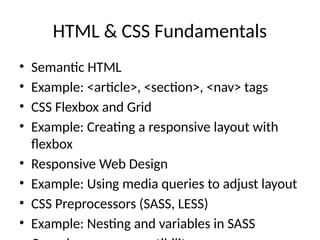
HTML & CSS Fundamentals
• Semantic HTML
• Example: <article>, <section>, <nav> tags
• CSS Flexbox and Grid
• Example: Creating a responsive layout with
flexbox
• Responsive Web Design
• Example: Using media queries to adjust layout
• CSS Preprocessors (SASS, LESS)
• Example: Nesting and variables in SASS
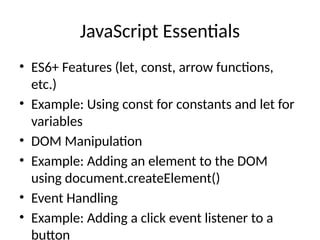
JavaScript Essentials
• ES6+ Features (let, const, arrow functions,
etc.)
• Example: Using const for constants and let for
variables
• DOM Manipulation
• Example: Adding an element to the DOM
using document.createElement()
• Event Handling
• Example: Adding a click event listener to a
button
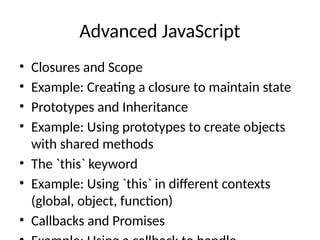
Advanced JavaScript
• Closures and Scope
• Example: Creating a closure to maintain state
• Prototypes and Inheritance
• Example: Using prototypes to create objects
with shared methods
• The `this` keyword
• Example: Using `this` in different contexts
(global, object, function)
• Callbacks and Promises
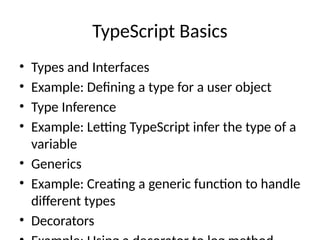
TypeScript Basics
• Types and Interfaces
• Example: Defining a type for a user object
• Type Inference
• Example: Letting TypeScript infer the type of a
variable
• Generics
• Example: Creating a generic function to handle
different types
• Decorators
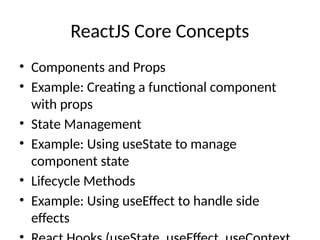
ReactJS Core Concepts
• Components and Props
• Example: Creating a functional component
with props
• State Management
• Example: Using useState to manage
component state
• Lifecycle Methods
• Example: Using useEffect to handle side
effects
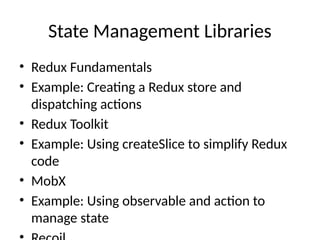
State Management Libraries
• Redux Fundamentals
• Example: Creating a Redux store and
dispatching actions
• Redux Toolkit
• Example: Using createSlice to simplify Redux
code
• MobX
• Example: Using observable and action to
manage state
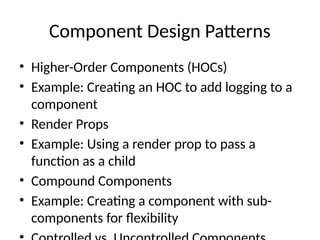
Component Design Patterns
• Higher-Order Components (HOCs)
• Example: Creating an HOC to add logging to a
component
• Render Props
• Example: Using a render prop to pass a
function as a child
• Compound Components
• Example: Creating a component with sub-
components for flexibility
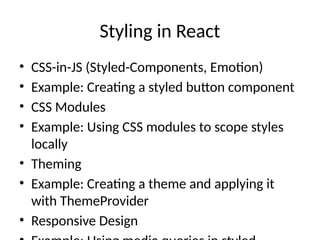
Styling in React
• CSS-in-JS (Styled-Components, Emotion)
• Example: Creating a styled button component
• CSS Modules
• Example: Using CSS modules to scope styles
locally
• Theming
• Example: Creating a theme and applying it
with ThemeProvider
• Responsive Design
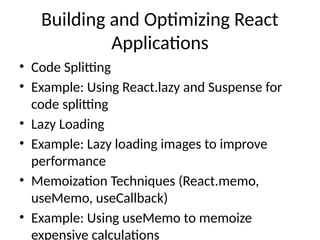
Building and Optimizing React
Applications
• Code Splitting
• Example: Using React.lazy and Suspense for
code splitting
• Lazy Loading
• Example: Lazy loading images to improve
performance
• Memoization Techniques (React.memo,
useMemo, useCallback)
• Example: Using useMemo to memoize
expensive calculations
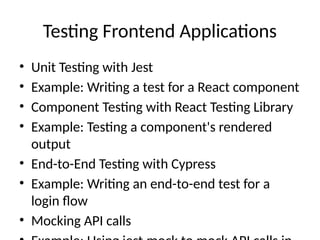
Testing Frontend Applications
• Unit Testing with Jest
• Example: Writing a test for a React component
• Component Testing with React Testing Library
• Example: Testing a component's rendered
output
• End-to-End Testing with Cypress
• Example: Writing an end-to-end test for a
login flow
• Mocking API calls
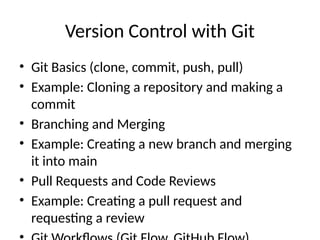
Version Control with Git
• Git Basics (clone, commit, push, pull)
• Example: Cloning a repository and making a
commit
• Branching and Merging
• Example: Creating a new branch and merging
it into main
• Pull Requests and Code Reviews
• Example: Creating a pull request and
requesting a review
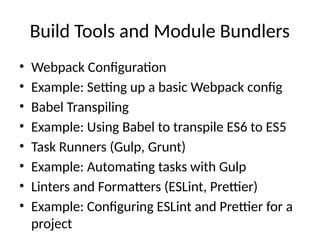
Build Tools and Module Bundlers
• Webpack Configuration
• Example: Setting up a basic Webpack config
• Babel Transpiling
• Example: Using Babel to transpile ES6 to ES5
• Task Runners (Gulp, Grunt)
• Example: Automating tasks with Gulp
• Linters and Formatters (ESLint, Prettier)
• Example: Configuring ESLint and Prettier for a
project
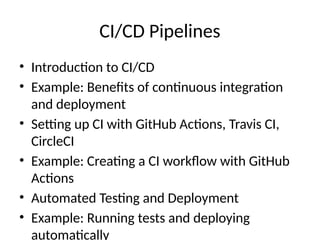
CI/CD Pipelines
• Introduction to CI/CD
• Example: Benefits of continuous integration
and deployment
• Setting up CI with GitHub Actions, Travis CI,
CircleCI
• Example: Creating a CI workflow with GitHub
Actions
• Automated Testing and Deployment
• Example: Running tests and deploying
automatically
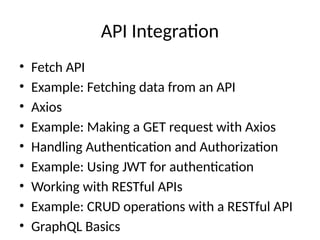
API Integration
• Fetch API
• Example: Fetching data from an API
• Axios
• Example: Making a GET request with Axios
• Handling Authentication and Authorization
• Example: Using JWT for authentication
• Working with RESTful APIs
• Example: CRUD operations with a RESTful API
• GraphQL Basics
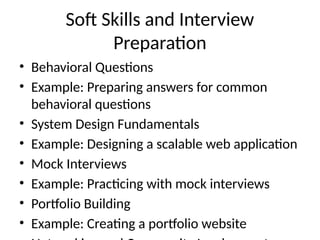
Soft Skills and Interview
Preparation
• Behavioral Questions
• Example: Preparing answers for common
behavioral questions
• System Design Fundamentals
• Example: Designing a scalable web application
• Mock Interviews
• Example: Practicing with mock interviews
• Portfolio Building
• Example: Creating a portfolio website

frontend developer interview course with example

  • 1.
    Frontend Developer Interview PrepCourse Comprehensive Preparation for Frontend Developer Interviews Author: Manjunath Kalburgi
  • 2.
    HTML & CSSFundamentals • Semantic HTML • Example: <article>, <section>, <nav> tags • CSS Flexbox and Grid • Example: Creating a responsive layout with flexbox • Responsive Web Design • Example: Using media queries to adjust layout • CSS Preprocessors (SASS, LESS) • Example: Nesting and variables in SASS
  • 3.
    JavaScript Essentials • ES6+Features (let, const, arrow functions, etc.) • Example: Using const for constants and let for variables • DOM Manipulation • Example: Adding an element to the DOM using document.createElement() • Event Handling • Example: Adding a click event listener to a button
  • 4.
    Advanced JavaScript • Closuresand Scope • Example: Creating a closure to maintain state • Prototypes and Inheritance • Example: Using prototypes to create objects with shared methods • The `this` keyword • Example: Using `this` in different contexts (global, object, function) • Callbacks and Promises
  • 5.
    TypeScript Basics • Typesand Interfaces • Example: Defining a type for a user object • Type Inference • Example: Letting TypeScript infer the type of a variable • Generics • Example: Creating a generic function to handle different types • Decorators
  • 6.
    ReactJS Core Concepts •Components and Props • Example: Creating a functional component with props • State Management • Example: Using useState to manage component state • Lifecycle Methods • Example: Using useEffect to handle side effects
  • 7.
    State Management Libraries •Redux Fundamentals • Example: Creating a Redux store and dispatching actions • Redux Toolkit • Example: Using createSlice to simplify Redux code • MobX • Example: Using observable and action to manage state
  • 8.
    Component Design Patterns •Higher-Order Components (HOCs) • Example: Creating an HOC to add logging to a component • Render Props • Example: Using a render prop to pass a function as a child • Compound Components • Example: Creating a component with sub- components for flexibility
  • 9.
    Styling in React •CSS-in-JS (Styled-Components, Emotion) • Example: Creating a styled button component • CSS Modules • Example: Using CSS modules to scope styles locally • Theming • Example: Creating a theme and applying it with ThemeProvider • Responsive Design
  • 10.
    Building and OptimizingReact Applications • Code Splitting • Example: Using React.lazy and Suspense for code splitting • Lazy Loading • Example: Lazy loading images to improve performance • Memoization Techniques (React.memo, useMemo, useCallback) • Example: Using useMemo to memoize expensive calculations
  • 11.
    Testing Frontend Applications •Unit Testing with Jest • Example: Writing a test for a React component • Component Testing with React Testing Library • Example: Testing a component's rendered output • End-to-End Testing with Cypress • Example: Writing an end-to-end test for a login flow • Mocking API calls
  • 12.
    Version Control withGit • Git Basics (clone, commit, push, pull) • Example: Cloning a repository and making a commit • Branching and Merging • Example: Creating a new branch and merging it into main • Pull Requests and Code Reviews • Example: Creating a pull request and requesting a review
  • 13.
    Build Tools andModule Bundlers • Webpack Configuration • Example: Setting up a basic Webpack config • Babel Transpiling • Example: Using Babel to transpile ES6 to ES5 • Task Runners (Gulp, Grunt) • Example: Automating tasks with Gulp • Linters and Formatters (ESLint, Prettier) • Example: Configuring ESLint and Prettier for a project
  • 14.
    CI/CD Pipelines • Introductionto CI/CD • Example: Benefits of continuous integration and deployment • Setting up CI with GitHub Actions, Travis CI, CircleCI • Example: Creating a CI workflow with GitHub Actions • Automated Testing and Deployment • Example: Running tests and deploying automatically
  • 15.
    API Integration • FetchAPI • Example: Fetching data from an API • Axios • Example: Making a GET request with Axios • Handling Authentication and Authorization • Example: Using JWT for authentication • Working with RESTful APIs • Example: CRUD operations with a RESTful API • GraphQL Basics
  • 16.
    Soft Skills andInterview Preparation • Behavioral Questions • Example: Preparing answers for common behavioral questions • System Design Fundamentals • Example: Designing a scalable web application • Mock Interviews • Example: Practicing with mock interviews • Portfolio Building • Example: Creating a portfolio website