Front-End APIs
Powering Fast-Paced Product Iterations
Speakers
​Jeff Weiner
​Chief Executive Officer
​Aditya Modi
​Staff Software Engineer
​Karthik Ramgopal
​Sr Staff Software Engineer
Overview
History and evolution of frontend APIs at LinkedIn
Our API structure today
Learnings and results
Sneak peek at the future
2 Years Ago
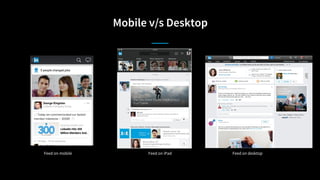
Mobile v/s Desktop
Feed on mobile Feed on desktopFeed on iPad
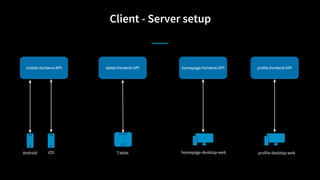
Client - Server setup
mobile-frontend-API tablet-frontend-API homepage-frontend-API profile-frontend-API
Android iOS Tablet homepage-desktop-web profile-desktop-web
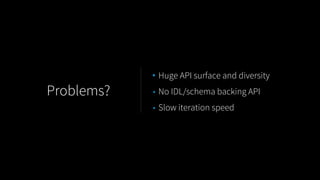
• Huge API surface and diversity
• No IDL/schema backing API
• Slow iteration speed
Problems?
Today
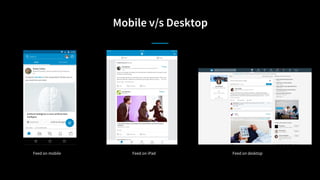
Mobile v/s Desktop
Feed on mobile Feed on desktopFeed on iPad
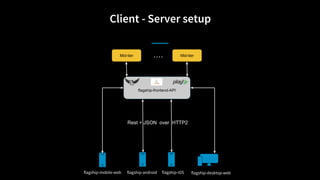
Client - Server setup
flagship-frontend-API
flagship-android flagship-iOS flagship-desktop-webflagship-mobile-web
Rest + JSON over HTTP2
Mid-tier . . . . Mid-tier
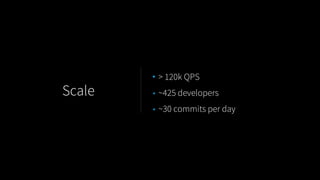
• > 120k QPS
• ~425 developers
• ~30 commits per day
Scale
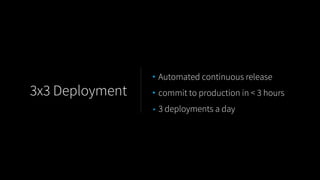
• Automated continuous release
• commit to production in < 3 hours
• 3 deployments a day
3x3 Deployment
Modeling
• Backed by Strongly Typed Schemas
• Backward-compatible evolution
• No endpoint versioning
Principles
{
"type": "record",
"name": "TestRecord",
"namespace": "com.linkedin.test",
"doc": "Test",
"fields": [
{
"name": "id",
"type": "String",
"doc": "ID"
},
{
"name": "name",
"type": "String",
"doc": "Name",
“optional”: true
},
]
}
@interface TestRecord : NSObject
@property(nonnull, copy) NSString *id;
@property(nullable, copy) NSString *name;
@end
class TestRecord {
@NonNull public final String id;
@Nullable public final String name;
}
export default DS.Model.extend({
id: DS.attr(‘string’),
name: DS.attr(‘string’)
});
Schema definition
iOS
Android
Web
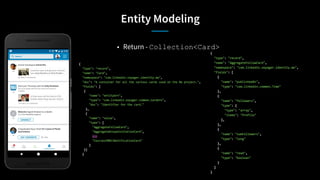
Entity Modeling
• Return - Collection<Card>
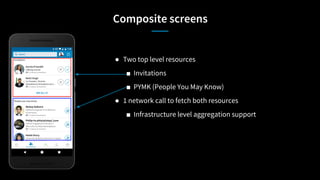
Composite screens
● Two top level resources
■ Invitations
■ PYMK (People You May Know)
● 1 network call to fetch both resources
■ Infrastructure level aggregation support
• Easy to model
• Decouple API from UI
• Client side consistency
Advantages
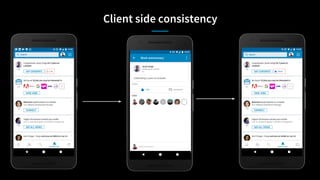
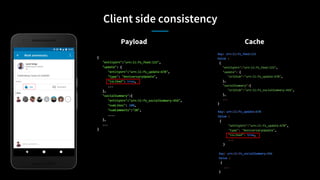
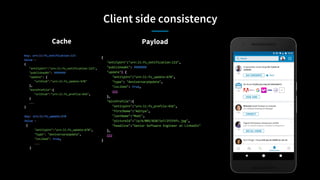
Client side consistency
• Why ?
○ Good UX
○ Optimistic writes
Client side consistency
Can you do this auto-magically?
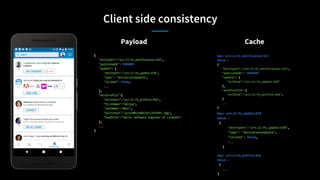
Client side consistency
Payload Cache
Client side consistency
Payload Cache
Client side consistency
Cache Payload
Everything is awesome, right?
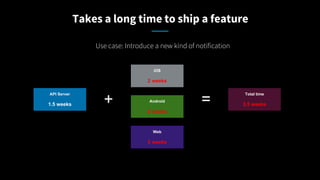
Takes a long time to ship a feature
API Server
1.5 weeks
iOS
2 weeks
Android
2 weeks
Web
2 weeks
Total time
3.5 weeks=+
Use case: Introduce a new kind of notification
• Create new models for every feature
• Write code on each client platform
• Wait for native app release/adoption
Why so long?
Challenge
Cut this down to 1 day!
• Quickly build and release notifications
• Increase user engagement
• Sweet and sticky, just like honey!
Project Honeycomb
• New notifications WITHOUT app updates
• Client side consistency
• Stellar runtime performance
Beyond iteration speed...
• Model based on how the UI view looks
• Similar views grouped into 1 template
• More UI specific logic on API server
View Template API
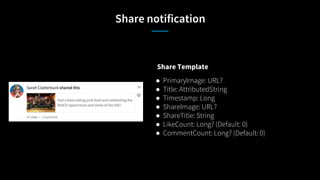
Share notification
Share Template
● PrimaryImage: URL?
● Title: AttributedString
● Timestamp: Long
● ShareImage: URL?
● ShareTitle: String
● LikeCount: Long? (Default: 0)
● CommentCount: Long? (Default: 0)
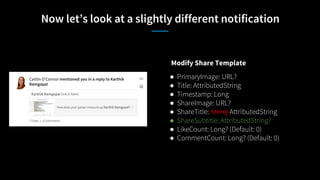
Now let’s look at a slightly different notification
Modify Share Template
● PrimaryImage: URL?
● Title: AttributedString
● Timestamp: Long
● ShareImage: URL?
● ShareTitle: String AttributedString
● ShareSubtitle: AttributedString?
● LikeCount: Long? (Default: 0)
● CommentCount: Long? (Default: 0)
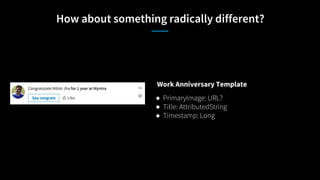
How about something radically different?
Work Anniversary Template
● PrimaryImage: URL?
● Title: AttributedString
● Timestamp: Long
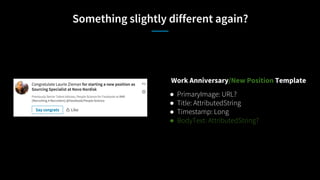
Something slightly different again?
Work Anniversary/New Position Template
● PrimaryImage: URL?
● Title: AttributedString
● Timestamp: Long
● BodyText: AttributedString?
How do we return a heterogeneous list?
• Use Rest.li paginated collections. Differentiate between items using a Union.
• JSON payload structure:
{
“elements” : [
{“Share”: {“Title”: “Sarah Clatterbuck shared a…”, ...}},
{“Anniversary”: {“Title”: “Congratulate Nitish Jha…”, ...}},
....
],
“paging”: { “start” : 0, “count”: 10, “paginationToken”: “xydsad”}
}
Minor payload optimization
• Embed the type into the payload to reduce nesting.
• JSON payload structure:
{
“elements” : [
{“Type”: “Share”, “Title”: “Sarah Clatterbuck shared a…”, ...},
{“Type”: “Anniversary”, “Title”: “Congratulate Nitish Jha…”, ...},
....
],
“paging”: { “start” : 0, “count”: 10, “paginationToken”: “xydsad”}
}
• Code-generated response parser
• Bind model to native views
• Write once* per layout, reuse.
Client side rendering
Backward compatibility
{
“elements” : [
{“Stat”: {“Title”: “Your Profile...”, ...}},
{“JYMBII”: {“Title”: “5 Jobs you”, ...}},
{“Share”: {“Title”: “Swati Mathur...”, ...}},
....
],
“paging”: { “start” : 0, “count”: 10,
“paginationToken”: “xydsad”}
}
Drop unknown notification types.
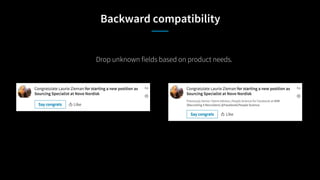
Backward compatibility
Drop unknown fields based on product needs.
• New notification types without client
changes
• Renders faster on the client
Benefits
But… Client side Consistency is lost!
How do we solve this?
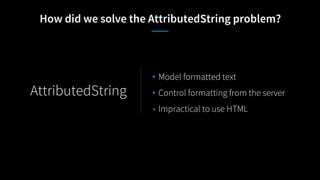
How did we solve the AttributedString problem?
• Model formatted text
• Control formatting from the server
• Impractical to use HTML
AttributedString
AttributedString schema
AttributedString
● Text: String
● Attributes: List[Attribute] BOLD, ITALIC, UNDERLINE etc.
Attribute
● Type: AttributeType
● StartIndex: Int
● Length: Int
● Metadata: Any?
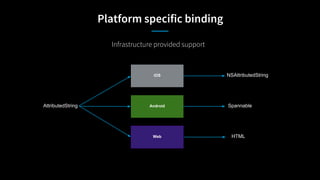
Platform specific binding
Infrastructure provided support
iOS
Android
Web
NSAttributedString
Spannable
HTML
AttributedString
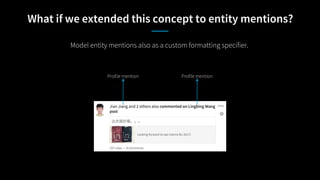
What if we extended this concept to entity mentions?
Model entity mentions also as a custom formatting specifier.
Profile mention Profile mention
Introducing TextViewModel
TextViewModel
● Text: String
● Attributes: List[TextViewAttribute]
TextViewAttribute
● Type: TextViewAttributeType
● StartIndex: Int
● Length: Int
● Metadata: Any?
● Profile: Profile?
● Job: Job?
● Company: Company?
● Course: Course?
Flattened canonical entities as optional fields
Similar to AttributedString
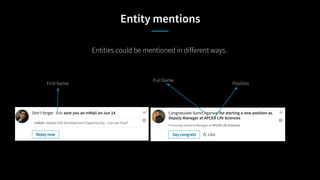
Entity mentions
Entities could be mentioned in different ways.
First Name
Full Name
Position
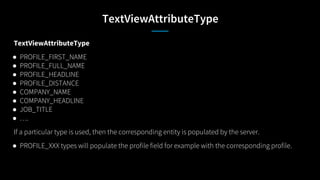
TextViewAttributeType
● PROFILE_FIRST_NAME
● PROFILE_FULL_NAME
● PROFILE_HEADLINE
● PROFILE_DISTANCE
● COMPANY_NAME
● COMPANY_HEADLINE
● JOB_TITLE
● ….
If a particular type is used, then the corresponding entity is populated by the server.
● PROFILE_XXX types will populate the profile field for example with the corresponding profile.
Backward compatibility++
Old clients cannot handle new mention types. Always send Raw text though redundant.
{
“title” : {
“Text”: “Sarah Clatterbuck shared this”,
“Attributes”: [
{“Type”: “PROFILE_FULL_NAME”,
“StartIndex”: 0….}
]
}
}
• Singular and Plurals
• Possessive forms
• i10n and i18n
Watch Out
How about images?
Use the same concept as TextViewModel. Introduce ImageViewModel.
ImageViewModel
● Attributes: List[ImageViewAttribute]
ImageViewAttribute
● ImageViewAttributeType
● URL: URL?
● ResourceName: String?
● Profile: Profile?
● Job: Job?
● Company: Company?
● Course: Course?
Flattened canonical entities as optional fields
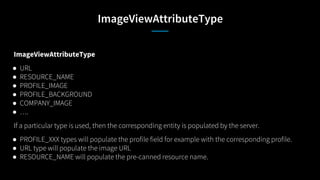
ImageViewAttributeType
● URL
● RESOURCE_NAME
● PROFILE_IMAGE
● PROFILE_BACKGROUND
● COMPANY_IMAGE
● ….
If a particular type is used, then the corresponding entity is populated by the server.
● PROFILE_XXX types will populate the profile field for example with the corresponding profile.
● URL type will populate the image URL
● RESOURCE_NAME will populate the pre-canned resource name.
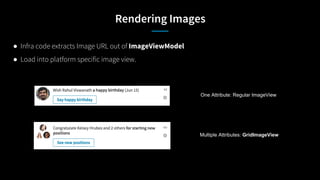
Rendering Images
● Infra code extracts Image URL out of ImageViewModel
● Load into platform specific image view.
One Attribute: Regular ImageView
Multiple Attributes: GridImageView
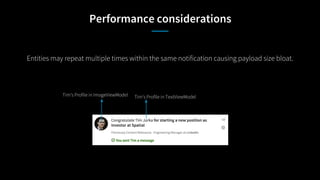
Performance considerations
Entities may repeat multiple times within the same notification causing payload size bloat.
Tim’s Profile in ImageViewModel Tim’s Profile in TextViewModel
Solution: Response Normalization
All canonical entities have a unique ID. Use a JSON API like response format.
{
“data” : {
“Profile”: “profile:123”, ...
},
“included”: [
{
“id” : “profile:123”, “firstName” : “Tim”, “LastName” : “Jurka”, ... }
},
....
]
}
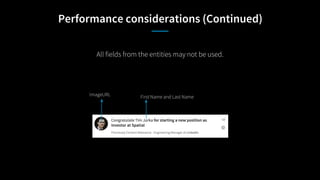
Performance considerations (Continued)
All fields from the entities may not be used.
ImageURL First Name and Last Name
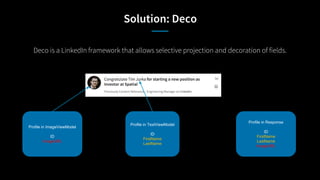
Solution: Deco
Deco is a LinkedIn framework that allows selective projection and decoration of fields.
Profile in TextViewModel
ID
FirstName
LastName
Profile in ImageViewModel
ID
ImageURL
Profile in Response
ID
FirstName
LastName
ImageURL
Results
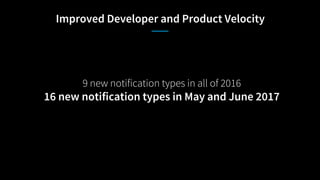
Improved Developer and Product Velocity
9 new notification types in all of 2016
16 new notification types in May and June 2017
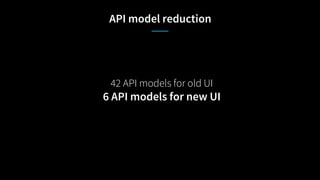
API model reduction
42 API models for old UI
6 API models for new UI
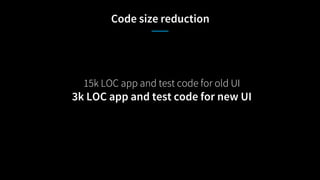
Code size reduction
15k LOC app and test code for old UI
3k LOC app and test code for new UI
Future Direction
● Extend to other pages in Flagship
● Extend to other LinkedIn apps like JobSeeker, Recruiter etc.
Out of scope for this talk
● Intricate details of client side consistency management
● Generic Modeling of actions
● Challenges in migrating from the old notifications API to the new one
Find us after the talk, and we’re happy to chat about this and more.
Q & A
​amodi@linkedin.com
​https://www.linkedin.com/in/modiaditya/
​
​Aditya Modi
​kramgopal@linkedin.com
​https://www.linkedin.com/in/karthikrg/
​
​
​Karthik Ramgopal

Frontend APIs powering fast paced product iterations

  • 1.
  • 2.
    Speakers ​Jeff Weiner ​Chief ExecutiveOfficer ​Aditya Modi ​Staff Software Engineer ​Karthik Ramgopal ​Sr Staff Software Engineer
  • 3.
    Overview History and evolutionof frontend APIs at LinkedIn Our API structure today Learnings and results Sneak peek at the future
  • 4.
  • 5.
    Mobile v/s Desktop Feedon mobile Feed on desktopFeed on iPad
  • 6.
    Client - Serversetup mobile-frontend-API tablet-frontend-API homepage-frontend-API profile-frontend-API Android iOS Tablet homepage-desktop-web profile-desktop-web
  • 7.
    • Huge APIsurface and diversity • No IDL/schema backing API • Slow iteration speed Problems?
  • 8.
  • 9.
    Mobile v/s Desktop Feedon mobile Feed on desktopFeed on iPad
  • 10.
    Client - Serversetup flagship-frontend-API flagship-android flagship-iOS flagship-desktop-webflagship-mobile-web Rest + JSON over HTTP2 Mid-tier . . . . Mid-tier
  • 11.
    • > 120kQPS • ~425 developers • ~30 commits per day Scale
  • 12.
    • Automated continuousrelease • commit to production in < 3 hours • 3 deployments a day 3x3 Deployment
  • 13.
  • 14.
    • Backed byStrongly Typed Schemas • Backward-compatible evolution • No endpoint versioning Principles
  • 15.
    { "type": "record", "name": "TestRecord", "namespace":"com.linkedin.test", "doc": "Test", "fields": [ { "name": "id", "type": "String", "doc": "ID" }, { "name": "name", "type": "String", "doc": "Name", “optional”: true }, ] } @interface TestRecord : NSObject @property(nonnull, copy) NSString *id; @property(nullable, copy) NSString *name; @end class TestRecord { @NonNull public final String id; @Nullable public final String name; } export default DS.Model.extend({ id: DS.attr(‘string’), name: DS.attr(‘string’) }); Schema definition iOS Android Web
  • 16.
    Entity Modeling • Return- Collection<Card>
  • 17.
    Composite screens ● Twotop level resources ■ Invitations ■ PYMK (People You May Know) ● 1 network call to fetch both resources ■ Infrastructure level aggregation support
  • 18.
    • Easy tomodel • Decouple API from UI • Client side consistency Advantages
  • 19.
  • 20.
    Client side consistency •Why ? ○ Good UX ○ Optimistic writes
  • 21.
    Client side consistency Canyou do this auto-magically?
  • 22.
  • 23.
  • 24.
  • 25.
  • 26.
    Takes a longtime to ship a feature API Server 1.5 weeks iOS 2 weeks Android 2 weeks Web 2 weeks Total time 3.5 weeks=+ Use case: Introduce a new kind of notification
  • 27.
    • Create newmodels for every feature • Write code on each client platform • Wait for native app release/adoption Why so long?
  • 28.
  • 29.
    • Quickly buildand release notifications • Increase user engagement • Sweet and sticky, just like honey! Project Honeycomb
  • 30.
    • New notificationsWITHOUT app updates • Client side consistency • Stellar runtime performance Beyond iteration speed...
  • 31.
    • Model basedon how the UI view looks • Similar views grouped into 1 template • More UI specific logic on API server View Template API
  • 32.
    Share notification Share Template ●PrimaryImage: URL? ● Title: AttributedString ● Timestamp: Long ● ShareImage: URL? ● ShareTitle: String ● LikeCount: Long? (Default: 0) ● CommentCount: Long? (Default: 0)
  • 33.
    Now let’s lookat a slightly different notification Modify Share Template ● PrimaryImage: URL? ● Title: AttributedString ● Timestamp: Long ● ShareImage: URL? ● ShareTitle: String AttributedString ● ShareSubtitle: AttributedString? ● LikeCount: Long? (Default: 0) ● CommentCount: Long? (Default: 0)
  • 34.
    How about somethingradically different? Work Anniversary Template ● PrimaryImage: URL? ● Title: AttributedString ● Timestamp: Long
  • 35.
    Something slightly differentagain? Work Anniversary/New Position Template ● PrimaryImage: URL? ● Title: AttributedString ● Timestamp: Long ● BodyText: AttributedString?
  • 36.
    How do wereturn a heterogeneous list? • Use Rest.li paginated collections. Differentiate between items using a Union. • JSON payload structure: { “elements” : [ {“Share”: {“Title”: “Sarah Clatterbuck shared a…”, ...}}, {“Anniversary”: {“Title”: “Congratulate Nitish Jha…”, ...}}, .... ], “paging”: { “start” : 0, “count”: 10, “paginationToken”: “xydsad”} }
  • 37.
    Minor payload optimization •Embed the type into the payload to reduce nesting. • JSON payload structure: { “elements” : [ {“Type”: “Share”, “Title”: “Sarah Clatterbuck shared a…”, ...}, {“Type”: “Anniversary”, “Title”: “Congratulate Nitish Jha…”, ...}, .... ], “paging”: { “start” : 0, “count”: 10, “paginationToken”: “xydsad”} }
  • 38.
    • Code-generated responseparser • Bind model to native views • Write once* per layout, reuse. Client side rendering
  • 39.
    Backward compatibility { “elements” :[ {“Stat”: {“Title”: “Your Profile...”, ...}}, {“JYMBII”: {“Title”: “5 Jobs you”, ...}}, {“Share”: {“Title”: “Swati Mathur...”, ...}}, .... ], “paging”: { “start” : 0, “count”: 10, “paginationToken”: “xydsad”} } Drop unknown notification types.
  • 40.
    Backward compatibility Drop unknownfields based on product needs.
  • 41.
    • New notificationtypes without client changes • Renders faster on the client Benefits
  • 42.
    But… Client sideConsistency is lost!
  • 43.
    How do wesolve this?
  • 44.
    How did wesolve the AttributedString problem? • Model formatted text • Control formatting from the server • Impractical to use HTML AttributedString
  • 45.
    AttributedString schema AttributedString ● Text:String ● Attributes: List[Attribute] BOLD, ITALIC, UNDERLINE etc. Attribute ● Type: AttributeType ● StartIndex: Int ● Length: Int ● Metadata: Any?
  • 46.
    Platform specific binding Infrastructureprovided support iOS Android Web NSAttributedString Spannable HTML AttributedString
  • 47.
    What if weextended this concept to entity mentions? Model entity mentions also as a custom formatting specifier. Profile mention Profile mention
  • 48.
    Introducing TextViewModel TextViewModel ● Text:String ● Attributes: List[TextViewAttribute] TextViewAttribute ● Type: TextViewAttributeType ● StartIndex: Int ● Length: Int ● Metadata: Any? ● Profile: Profile? ● Job: Job? ● Company: Company? ● Course: Course? Flattened canonical entities as optional fields Similar to AttributedString
  • 49.
    Entity mentions Entities couldbe mentioned in different ways. First Name Full Name Position
  • 50.
    TextViewAttributeType TextViewAttributeType ● PROFILE_FIRST_NAME ● PROFILE_FULL_NAME ●PROFILE_HEADLINE ● PROFILE_DISTANCE ● COMPANY_NAME ● COMPANY_HEADLINE ● JOB_TITLE ● …. If a particular type is used, then the corresponding entity is populated by the server. ● PROFILE_XXX types will populate the profile field for example with the corresponding profile.
  • 51.
    Backward compatibility++ Old clientscannot handle new mention types. Always send Raw text though redundant. { “title” : { “Text”: “Sarah Clatterbuck shared this”, “Attributes”: [ {“Type”: “PROFILE_FULL_NAME”, “StartIndex”: 0….} ] } }
  • 52.
    • Singular andPlurals • Possessive forms • i10n and i18n Watch Out
  • 53.
    How about images? Usethe same concept as TextViewModel. Introduce ImageViewModel. ImageViewModel ● Attributes: List[ImageViewAttribute] ImageViewAttribute ● ImageViewAttributeType ● URL: URL? ● ResourceName: String? ● Profile: Profile? ● Job: Job? ● Company: Company? ● Course: Course? Flattened canonical entities as optional fields
  • 54.
    ImageViewAttributeType ImageViewAttributeType ● URL ● RESOURCE_NAME ●PROFILE_IMAGE ● PROFILE_BACKGROUND ● COMPANY_IMAGE ● …. If a particular type is used, then the corresponding entity is populated by the server. ● PROFILE_XXX types will populate the profile field for example with the corresponding profile. ● URL type will populate the image URL ● RESOURCE_NAME will populate the pre-canned resource name.
  • 55.
    Rendering Images ● Infracode extracts Image URL out of ImageViewModel ● Load into platform specific image view. One Attribute: Regular ImageView Multiple Attributes: GridImageView
  • 56.
    Performance considerations Entities mayrepeat multiple times within the same notification causing payload size bloat. Tim’s Profile in ImageViewModel Tim’s Profile in TextViewModel
  • 57.
    Solution: Response Normalization Allcanonical entities have a unique ID. Use a JSON API like response format. { “data” : { “Profile”: “profile:123”, ... }, “included”: [ { “id” : “profile:123”, “firstName” : “Tim”, “LastName” : “Jurka”, ... } }, .... ] }
  • 58.
    Performance considerations (Continued) Allfields from the entities may not be used. ImageURL First Name and Last Name
  • 59.
    Solution: Deco Deco isa LinkedIn framework that allows selective projection and decoration of fields. Profile in TextViewModel ID FirstName LastName Profile in ImageViewModel ID ImageURL Profile in Response ID FirstName LastName ImageURL
  • 60.
  • 61.
    Improved Developer andProduct Velocity 9 new notification types in all of 2016 16 new notification types in May and June 2017
  • 62.
    API model reduction 42API models for old UI 6 API models for new UI
  • 63.
    Code size reduction 15kLOC app and test code for old UI 3k LOC app and test code for new UI
  • 64.
    Future Direction ● Extendto other pages in Flagship ● Extend to other LinkedIn apps like JobSeeker, Recruiter etc.
  • 65.
    Out of scopefor this talk ● Intricate details of client side consistency management ● Generic Modeling of actions ● Challenges in migrating from the old notifications API to the new one Find us after the talk, and we’re happy to chat about this and more.
  • 66.
    Q & A ​amodi@linkedin.com ​https://www.linkedin.com/in/modiaditya/ ​ ​AdityaModi ​kramgopal@linkedin.com ​https://www.linkedin.com/in/karthikrg/ ​ ​ ​Karthik Ramgopal