FRONT OFFICE
OBJECTIVES:
• • Value the importance of understanding in studying front
office operations.
• • Identify the categories, guest cycle, and information to
know in front office operation
• • Describe the each categories, guest cycle, and information
in front office operations
THE LODGING INDUSTRY
• The front office is the part of a company that encounters clients,
such as the marketing, sales, and service departments. The term
has more specific meanings in hotels, investment banking, and
sports. It is the one of the many departments of the hotel
business, which directly interacts with the customers when they
first arrive at the hotel. The staff of this department is very visible
to the guests. Front office staff handles the transactions between
the hotel and its guests. The staff receives the guests, handles
their requests, and strikes the first impression about the hotel into
their minds.
There are two categories of Front Office Operations
1. Front-House Operations- These operations are visible to the
guests of the hotel. The guests can interact and see these operations,
hence, the name Front-House operations. Few of these operations
include:
• Interacting with the guests to handle request for an
accommodation.
• Checking accommodation availability and assigning it to the guest.
• Collecting detail information while guest registration.
• Creating a guest’s account with the FO accounting system
• Issuing accommodation keys to the guest.
• Settling guest payment at the time of checkout
2. Back-House Operations- Front Office staff conducts these
operations in the absence of the guests or when the guest’s
involvement is not required. Sometimes called as “heart” of the
operations. These operations involve activities such as:
• Determining the type of guest (fresh/repeat) by checking the
database.
• Ensuring preferences of the guest to give a personal touch to
the service.
• Maintaining guest’s account with the accounting system.
• Preparing the guest’s bill.
• Collecting the balance amount of guest bills.
• Generating reports.
Guest Cycle in Hotel
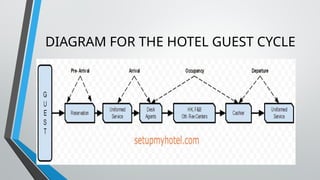
• Pre-arrival- It is the stage when the
customer is planning to avail an
accommodation in the hotel. In this first
stage, the customer or the prospective guest
enquires about the availability of the desired
type of accommodation and its amenities via
telephonic call or an e-mail.
•• Arrival- The front office reception staff
receives the guest in the reception. The
porters bring in the guest luggage. For the
guest with confirmed reservation, the front
office clerk hands over a Guest Registration
Card (GRC) to the guest and requests the
guest to fill in personal information
regarding the stay in the hotel.
•• Occupancy- During occupancy, a front
office accounting system is responsible for
tracking guest charges against his/her
purchases from the hotel restaurants, room
service, bar, or any outgoing telephone calls
made via the hotel’s communication
systems. The front office staff is responsible
to the security, manage and issue the right
keys of the accommodations to the right
guests
• Departure- During guest departure, the
front office accounting system ensures
payment for goods and services provided. If a
guest’s bill is not completely paid, the balance
is transferred from guest to non-guest
records.
DIAGRAM FOR THE HOTEL GUEST CYCLE
Room type
•Single: A room assigned to one person.
•Double: A room assigned to two people.
•Triple: A room assigned to three people.
•Quad: A room assigned to four people.
•Queen: A room with a queen-sized bed.
•King: A room with a king-sized bed. May be occupied
by one or more people.
•Twin: A room with two beds. May be occupied by one
or more people.
•Double-double: A room with two double (or perhaps
queen) beds. May be occupied by one or more people.
•Studio: A room with a studio bed – a couch that can be
converted into a bed. May also have an additional bed.
Types of Suites
•Master Suite: A parlour or living room
connected to one or more bedrooms.
•Mini-Suite or Junior Suite: A single room
with a bed and sitting area. Sometimes the
sleeping area is in a bedroom separate from
the parlour or living room.
Other types of rooms can include:
•Connecting rooms: Rooms with individual
entrance doors from the outside and a
connecting door between. Guests can move
between rooms without going through the
hallway.
•Adjoining rooms: Rooms with a common
wall, but no connecting door.
•Adjacent rooms: Rooms close to each other,
perhaps across the hall.
•Room rates- the rate charged
daily for a hotel room Charge per
unit.
Type of room rates:
•Rack rate- often referred as ‘standard rate’, ‘full
rack sate. The most expensive rate for a room.it is
rate usually applied to walk-ins who want
accommodation on the day they call in.
•Corporate rate- this is a discounted rate offered
that are willing to guarantee a minimum number
of rooms throughout the year. Naturally, if they
guarantee more than 50 rooms per year, a better
rate may be offered just for that company- this
type of booking is often called ‘volume corporate
rate’.
•Half-day rate- a room rate is calculated based
duration of guest stay. It is basically developed for
those travelers who book room for half day or
less.
•Group rate- are room rates offered to large groups
of people visiting the hotel for a common reason.
•Package rate- room rates that include goods and
services in addition to rental of a room ,are
manner that reflects the positive features of the
product
•Government rate- a discount or special rate
which is negotiated w/ government
organization.
•Airline contact rate- hotel offer discounts late to
the airlines crews to generate high volume of
business.
•Publicity and Promotional Rates- For publicity
purposes, influential persons like Company
Directors, Top Executives, and Celebrities etc
may be given discounts for the sake of publicity.
•Hotel facilities- Hotel facilities are services, buildings ,
equipment and everything else that is created to serve
a particular function to make your stay in the hotel
perfect and corresponding to your needs.
Ex. Jacuzzi, Hairdresser / Barber, Golf - Mini Golf,
Laundry, Dry Cleaning, Tennis Court, Spa, etc.
•Hotel policies- Hotel rules / House rules are
management policy or agreements between the guest
and the hotel. Usually, these policies are mentioned
on the guest registration card which is signed by the
guest at the time of check-in.
•Front office department operation hour
Front office department operates 24 hours a day
There are three main shift in front office
department
Morning – day shift: 7:00am to 3:00pm
Day- evening shift: 3:00pm to 11:00 pm
Night shift: 11:00pm to 7:00pm

FRONT OFFICE-lesson 5mensuration and calculation.pptx

  • 1.
  • 2.
    OBJECTIVES: • • Valuethe importance of understanding in studying front office operations. • • Identify the categories, guest cycle, and information to know in front office operation • • Describe the each categories, guest cycle, and information in front office operations
  • 3.
    THE LODGING INDUSTRY •The front office is the part of a company that encounters clients, such as the marketing, sales, and service departments. The term has more specific meanings in hotels, investment banking, and sports. It is the one of the many departments of the hotel business, which directly interacts with the customers when they first arrive at the hotel. The staff of this department is very visible to the guests. Front office staff handles the transactions between the hotel and its guests. The staff receives the guests, handles their requests, and strikes the first impression about the hotel into their minds.
  • 4.
    There are twocategories of Front Office Operations 1. Front-House Operations- These operations are visible to the guests of the hotel. The guests can interact and see these operations, hence, the name Front-House operations. Few of these operations include: • Interacting with the guests to handle request for an accommodation. • Checking accommodation availability and assigning it to the guest. • Collecting detail information while guest registration. • Creating a guest’s account with the FO accounting system • Issuing accommodation keys to the guest. • Settling guest payment at the time of checkout
  • 5.
    2. Back-House Operations-Front Office staff conducts these operations in the absence of the guests or when the guest’s involvement is not required. Sometimes called as “heart” of the operations. These operations involve activities such as: • Determining the type of guest (fresh/repeat) by checking the database. • Ensuring preferences of the guest to give a personal touch to the service. • Maintaining guest’s account with the accounting system. • Preparing the guest’s bill. • Collecting the balance amount of guest bills. • Generating reports.
  • 6.
    Guest Cycle inHotel • Pre-arrival- It is the stage when the customer is planning to avail an accommodation in the hotel. In this first stage, the customer or the prospective guest enquires about the availability of the desired type of accommodation and its amenities via telephonic call or an e-mail.
  • 7.
    •• Arrival- Thefront office reception staff receives the guest in the reception. The porters bring in the guest luggage. For the guest with confirmed reservation, the front office clerk hands over a Guest Registration Card (GRC) to the guest and requests the guest to fill in personal information regarding the stay in the hotel.
  • 8.
    •• Occupancy- Duringoccupancy, a front office accounting system is responsible for tracking guest charges against his/her purchases from the hotel restaurants, room service, bar, or any outgoing telephone calls made via the hotel’s communication systems. The front office staff is responsible to the security, manage and issue the right keys of the accommodations to the right guests
  • 9.
    • Departure- Duringguest departure, the front office accounting system ensures payment for goods and services provided. If a guest’s bill is not completely paid, the balance is transferred from guest to non-guest records.
  • 10.
    DIAGRAM FOR THEHOTEL GUEST CYCLE
  • 11.
    Room type •Single: Aroom assigned to one person. •Double: A room assigned to two people. •Triple: A room assigned to three people. •Quad: A room assigned to four people. •Queen: A room with a queen-sized bed.
  • 12.
    •King: A roomwith a king-sized bed. May be occupied by one or more people. •Twin: A room with two beds. May be occupied by one or more people. •Double-double: A room with two double (or perhaps queen) beds. May be occupied by one or more people. •Studio: A room with a studio bed – a couch that can be converted into a bed. May also have an additional bed.
  • 13.
    Types of Suites •MasterSuite: A parlour or living room connected to one or more bedrooms. •Mini-Suite or Junior Suite: A single room with a bed and sitting area. Sometimes the sleeping area is in a bedroom separate from the parlour or living room.
  • 14.
    Other types ofrooms can include: •Connecting rooms: Rooms with individual entrance doors from the outside and a connecting door between. Guests can move between rooms without going through the hallway. •Adjoining rooms: Rooms with a common wall, but no connecting door. •Adjacent rooms: Rooms close to each other, perhaps across the hall.
  • 15.
    •Room rates- therate charged daily for a hotel room Charge per unit.
  • 16.
    Type of roomrates: •Rack rate- often referred as ‘standard rate’, ‘full rack sate. The most expensive rate for a room.it is rate usually applied to walk-ins who want accommodation on the day they call in. •Corporate rate- this is a discounted rate offered that are willing to guarantee a minimum number of rooms throughout the year. Naturally, if they guarantee more than 50 rooms per year, a better rate may be offered just for that company- this type of booking is often called ‘volume corporate rate’.
  • 17.
    •Half-day rate- aroom rate is calculated based duration of guest stay. It is basically developed for those travelers who book room for half day or less. •Group rate- are room rates offered to large groups of people visiting the hotel for a common reason. •Package rate- room rates that include goods and services in addition to rental of a room ,are manner that reflects the positive features of the product
  • 18.
    •Government rate- adiscount or special rate which is negotiated w/ government organization. •Airline contact rate- hotel offer discounts late to the airlines crews to generate high volume of business. •Publicity and Promotional Rates- For publicity purposes, influential persons like Company Directors, Top Executives, and Celebrities etc may be given discounts for the sake of publicity.
  • 19.
    •Hotel facilities- Hotelfacilities are services, buildings , equipment and everything else that is created to serve a particular function to make your stay in the hotel perfect and corresponding to your needs. Ex. Jacuzzi, Hairdresser / Barber, Golf - Mini Golf, Laundry, Dry Cleaning, Tennis Court, Spa, etc. •Hotel policies- Hotel rules / House rules are management policy or agreements between the guest and the hotel. Usually, these policies are mentioned on the guest registration card which is signed by the guest at the time of check-in.
  • 20.
    •Front office departmentoperation hour Front office department operates 24 hours a day There are three main shift in front office department Morning – day shift: 7:00am to 3:00pm Day- evening shift: 3:00pm to 11:00 pm Night shift: 11:00pm to 7:00pm