WHITEPAPER
FROM ADDING VALUE
TO ADDING REVENUE -
A CHANGED LANDSCAPE OF
OUTSOURCING
According to The Financial Times, the $180 billion IT outsourcing industry in India is
expected to witness a 2-7% decrease in revenue as a result of the COVID-19 pandemic. A
signi cant portion of this revenue comes from the western economies of the US (62%), the
UK(17%),andtheEU(11%).
Another consequence of the pandemic is the growing reluctance of these economies in
depending on the Indian IT rms for their outsourcing needs. For instance, Virgin Media
announced in March 2020 that it would hire 500 new call-centre staff from the UK to deal
with the impact of the coronavirus even in offshore locations like India and the Philippines.
OtherBritishtelecomcompaniesareexpectedtofollowVirginMedia'slead.
Even before the pandemic, Eastern European providers from Belarus, Latvia, Poland, and
Ukraine were gaining popularity. Such near-shore alternatives were already presenting stiff
competitiontooutsourcinggiantslikeIndiaandChina.
In a post-pandemic world, this shift in preferring near-shore outsourcing options would
continue. Thriving in such a landscape would require Indian IT rms to show value,
differentiatetheirserviceofferings,andguaranteerevenuegenerationfortheircustomers.
Outcome-based Contracting
Introduction
NoindustryhasbeenleftuntouchedbythedevastatingimpactoftheCOVID-19pandemic.Asaresult,costreductionisatoppriorityformost
global businesses across sectors as cash ow shrinks. Customers of top outsourcing rms are demanding discounts, seeking to renegotiate
contractsandservicestandards,andpushingforshorter, exiblecontractswithlowerupfrontinvestments.
According to Business Standard, the top Indian IT/ITeS rms draw up to 50% of their revenues from xed-price contracts. While HCL
Technologies andWipro draw over 60%, Infosys gets over 50% of its total revenue from such projects. As we move towards a post-pandemic
world,thistrendofcustomersaskingforamoretransparent,demand,orvalue-basedcontractpricingwouldcontinuetogrow.
Indian IT rms must adapt their business models to an open, outcome-based contracting approach that alleviates customers' concerns.
Demonstratingavestedinterestinthecustomer'ssuccesswouldbemoreappealingasitmitigatesrisksandpromisesvalueformoney.
The approach serves as a win-win for both parties. For the IT vendors, it means that they get paid more than their agreed billing amount,
should they exceed their SLAs (Service Level Agreements). For their customers, the model ensures that their investments generate business
value—ifthevendorsfailtomeettheirSLAs,there'sapenalty.
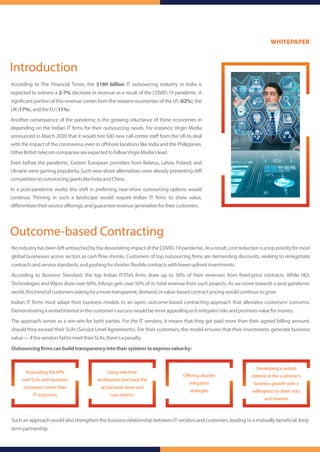
Outsourcing rmscanbuildtransparencyintotheirsystemstoexpressvalueby:
Such an approach would also strengthen the business relationship between IT vendors and customers, leading to a mutually bene cial, long-
termpartnership.
Associating the KPIs
and SLAs with business
outcomes, rather than
IT outcomes
Using real-time
dashboards that track the
actual work done and
core metrics
Offering disaster
mitigation
strategies
Developing a vested
interest in the customer's
business growth with a
willingness to share risks
and rewards
WHITEPAPER
Tackling Competition In Outsourcing And
Boosting Revenue
Rethink Your Operating Model
As mentioned earlier, competition in IT outsourcing is cutthroat and growing as more emerging markets toss their hats into the ring.
Maintaininganedgeinsuchacompetitivelandscapewouldrequireservicedifferentiationintermsofservicequality,costs,offerings,and
businessmodels.TopIT rmslikeTCSandInfosyshavealreadystarteddiversifyingtheirofferingsbyinvestingininnovation,research,and
developmenthubsfornext-gentechnologiessuchasblockchain,arti cialintelligence,advancedanalytics,andmachinelearning.
As distributed work increasingly becomes mainstream, the demand for cloud technologies, automation, virtual collaboration tools, and
digital transformation initiatives will continue to rise. Additionally, as the number of digital touchpoints grows, the risk of data breaches
andcyberattacksincreasesexponentially.Hence,thedemandforcybersecurityanddataprivacysolutionswillalsocontinuetorise.That's
why even with growing pressure to reduce pricing and renegotiate contracts, Indian IT rms can continue to ourish by offering niche
serviceswithintheseemergingdomains.
DifferentiatedofferingstappingintoemergingITneedsofthemarketcanalsointroduceadditionalrevenuestreamsandweaveresilience
topandemic-sizeddisruptionsintoIndianIT/ITeS rms'businessmodels.
Indian IT rms are subject to a number of factors thatintroduce inefficiencies into the core operations- which translates into higher input
costs and lower output. For example, a Mckinsey study points to the reducing cost bene ts of massive-sized service centers/hubs. What
bugssmallersizedenterprisescanalsobecalledinefficienciesofscale-albeitontheotherendofthespectrum.
By leveraging a fragmented work ecosystem and loosely de ned operating procedures, SMEs fail to extract the same value as their larger
counterparts. In such situations offering niche services must be coupled with work ows that bring maximal efficiency into the process,
anddetachtheunintelligenttasksfromthecostofhumanintelligence.
InjectingefficiencyintotheexistingoperatingmodelwillseeMSMEsadoptingdigitalcollaborationsolutionswhichcomewithlowentry
barriersandpay-as-you-gomodelsofnotonlydeliveringvalue,butalsodeliveringrevenuetothecustomer’sbusiness.
WHITEPAPER
The pandemic has forced most global businesses to reimagine how they operate to ensure their survival, and the IT outsourcing industry
isnoexception.Tostayrelevant,managementshouldtakeathree-stepapproachtore-evaluatingtheirproductsandserviceofferings:
1. Understand the speci cs of outcome-based contracting customer’s line of business, and explore ways to measure and deliver pin-
pointedresults
2. Re-assessing the operating model and look for attenuators - consequently, rethink your operating model to bring better cost-
competitivenessandcustomercentricitytoyourservicedelivery
3.Prioritizehiringoftalentthatiscommittedtolearning,encourageconstantupskillinganddiversifyofferingstoemergingmarkets.
As the IT landscape of the global digital economy evolves over time, access to remote talent has introduced new outsourcing options to
the major markets. IT businesses in India must pause and re ect on the value that their service offerings deliver in today’s context, and
reworkalonganewroadmapofnotonlydeliveringvalue,butalsodeliveringrevenuetothecustomer’sbusiness.
Tata Teleservices Ltd. | Registered Office Address: Tower 1, Jeevan Bharati, 124, 10th Floor, Connaught Circus, New Delhi - 110 001 | Corporate Identity
Number: U74899DL1995PLC066685 | Tata Teleservices (Maharashtra) Ltd. Registered Office Address: D-26, TTC Industrial Area, MIDC Sanpada
P. O. Turbhe, Navi Mumbai - 400 703. Corporate Identity Number: L64200MH1995PLC086354 Tel No: 1800 266 1515 | email id: 1515@tatatel.co.in
What Must Outsourcing Firms Re-evaluate
To Future-proof Their Businesses?
WHITEPAPER

from-adding-value-to-adding-revenue-a-changed-landscape-of-outsourcing.pdf

  • 1.
    WHITEPAPER FROM ADDING VALUE TOADDING REVENUE - A CHANGED LANDSCAPE OF OUTSOURCING
  • 2.
    According to TheFinancial Times, the $180 billion IT outsourcing industry in India is expected to witness a 2-7% decrease in revenue as a result of the COVID-19 pandemic. A signi cant portion of this revenue comes from the western economies of the US (62%), the UK(17%),andtheEU(11%). Another consequence of the pandemic is the growing reluctance of these economies in depending on the Indian IT rms for their outsourcing needs. For instance, Virgin Media announced in March 2020 that it would hire 500 new call-centre staff from the UK to deal with the impact of the coronavirus even in offshore locations like India and the Philippines. OtherBritishtelecomcompaniesareexpectedtofollowVirginMedia'slead. Even before the pandemic, Eastern European providers from Belarus, Latvia, Poland, and Ukraine were gaining popularity. Such near-shore alternatives were already presenting stiff competitiontooutsourcinggiantslikeIndiaandChina. In a post-pandemic world, this shift in preferring near-shore outsourcing options would continue. Thriving in such a landscape would require Indian IT rms to show value, differentiatetheirserviceofferings,andguaranteerevenuegenerationfortheircustomers. Outcome-based Contracting Introduction NoindustryhasbeenleftuntouchedbythedevastatingimpactoftheCOVID-19pandemic.Asaresult,costreductionisatoppriorityformost global businesses across sectors as cash ow shrinks. Customers of top outsourcing rms are demanding discounts, seeking to renegotiate contractsandservicestandards,andpushingforshorter, exiblecontractswithlowerupfrontinvestments. According to Business Standard, the top Indian IT/ITeS rms draw up to 50% of their revenues from xed-price contracts. While HCL Technologies andWipro draw over 60%, Infosys gets over 50% of its total revenue from such projects. As we move towards a post-pandemic world,thistrendofcustomersaskingforamoretransparent,demand,orvalue-basedcontractpricingwouldcontinuetogrow. Indian IT rms must adapt their business models to an open, outcome-based contracting approach that alleviates customers' concerns. Demonstratingavestedinterestinthecustomer'ssuccesswouldbemoreappealingasitmitigatesrisksandpromisesvalueformoney. The approach serves as a win-win for both parties. For the IT vendors, it means that they get paid more than their agreed billing amount, should they exceed their SLAs (Service Level Agreements). For their customers, the model ensures that their investments generate business value—ifthevendorsfailtomeettheirSLAs,there'sapenalty. Outsourcing rmscanbuildtransparencyintotheirsystemstoexpressvalueby: Such an approach would also strengthen the business relationship between IT vendors and customers, leading to a mutually bene cial, long- termpartnership. Associating the KPIs and SLAs with business outcomes, rather than IT outcomes Using real-time dashboards that track the actual work done and core metrics Offering disaster mitigation strategies Developing a vested interest in the customer's business growth with a willingness to share risks and rewards WHITEPAPER
  • 3.
    Tackling Competition InOutsourcing And Boosting Revenue Rethink Your Operating Model As mentioned earlier, competition in IT outsourcing is cutthroat and growing as more emerging markets toss their hats into the ring. Maintaininganedgeinsuchacompetitivelandscapewouldrequireservicedifferentiationintermsofservicequality,costs,offerings,and businessmodels.TopIT rmslikeTCSandInfosyshavealreadystarteddiversifyingtheirofferingsbyinvestingininnovation,research,and developmenthubsfornext-gentechnologiessuchasblockchain,arti cialintelligence,advancedanalytics,andmachinelearning. As distributed work increasingly becomes mainstream, the demand for cloud technologies, automation, virtual collaboration tools, and digital transformation initiatives will continue to rise. Additionally, as the number of digital touchpoints grows, the risk of data breaches andcyberattacksincreasesexponentially.Hence,thedemandforcybersecurityanddataprivacysolutionswillalsocontinuetorise.That's why even with growing pressure to reduce pricing and renegotiate contracts, Indian IT rms can continue to ourish by offering niche serviceswithintheseemergingdomains. DifferentiatedofferingstappingintoemergingITneedsofthemarketcanalsointroduceadditionalrevenuestreamsandweaveresilience topandemic-sizeddisruptionsintoIndianIT/ITeS rms'businessmodels. Indian IT rms are subject to a number of factors thatintroduce inefficiencies into the core operations- which translates into higher input costs and lower output. For example, a Mckinsey study points to the reducing cost bene ts of massive-sized service centers/hubs. What bugssmallersizedenterprisescanalsobecalledinefficienciesofscale-albeitontheotherendofthespectrum. By leveraging a fragmented work ecosystem and loosely de ned operating procedures, SMEs fail to extract the same value as their larger counterparts. In such situations offering niche services must be coupled with work ows that bring maximal efficiency into the process, anddetachtheunintelligenttasksfromthecostofhumanintelligence. InjectingefficiencyintotheexistingoperatingmodelwillseeMSMEsadoptingdigitalcollaborationsolutionswhichcomewithlowentry barriersandpay-as-you-gomodelsofnotonlydeliveringvalue,butalsodeliveringrevenuetothecustomer’sbusiness. WHITEPAPER
  • 4.
    The pandemic hasforced most global businesses to reimagine how they operate to ensure their survival, and the IT outsourcing industry isnoexception.Tostayrelevant,managementshouldtakeathree-stepapproachtore-evaluatingtheirproductsandserviceofferings: 1. Understand the speci cs of outcome-based contracting customer’s line of business, and explore ways to measure and deliver pin- pointedresults 2. Re-assessing the operating model and look for attenuators - consequently, rethink your operating model to bring better cost- competitivenessandcustomercentricitytoyourservicedelivery 3.Prioritizehiringoftalentthatiscommittedtolearning,encourageconstantupskillinganddiversifyofferingstoemergingmarkets. As the IT landscape of the global digital economy evolves over time, access to remote talent has introduced new outsourcing options to the major markets. IT businesses in India must pause and re ect on the value that their service offerings deliver in today’s context, and reworkalonganewroadmapofnotonlydeliveringvalue,butalsodeliveringrevenuetothecustomer’sbusiness. Tata Teleservices Ltd. | Registered Office Address: Tower 1, Jeevan Bharati, 124, 10th Floor, Connaught Circus, New Delhi - 110 001 | Corporate Identity Number: U74899DL1995PLC066685 | Tata Teleservices (Maharashtra) Ltd. Registered Office Address: D-26, TTC Industrial Area, MIDC Sanpada P. O. Turbhe, Navi Mumbai - 400 703. Corporate Identity Number: L64200MH1995PLC086354 Tel No: 1800 266 1515 | email id: 1515@tatatel.co.in What Must Outsourcing Firms Re-evaluate To Future-proof Their Businesses? WHITEPAPER