S 
University of Hyderabad Contemporary Approaches to 
Literature 
School of humanities Dr. Sowmya Dechamma 
Centre for Comparative Literature
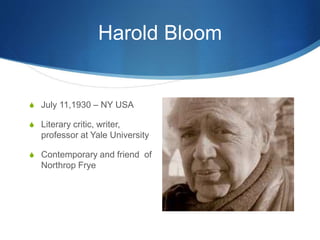
Harold Bloom 
S July 11,1930 – NY USA 
S Literary critic, writer, 
professor at Yale University 
S Contemporary and friend of 
Northrop Frye
Main terms: 
• Intra-poetic relationships. 
• Poetic history as poetic influence. 
• Poetic misinterpretation/misprision ( reason, 
result). 
• Imaginative space 
• Ephebe
Introduction 
A Meditation upon Priority and 
Synopsis 
Two corrective aims of the theory 
S To de-idealize our accepted accounts of how one poet 
helps to form another. 
S To try to provide a poetics that will foster a more 
adequate practical criticism
• Poetic history is held to be indistinguishable from poetic influence. 
• “ My concern is only with strong poets, major figures with persistence to 
wrestle with their strong precursors, even to death. Weaker talents idealize; 
figures of capable imaginations appropriate for themselves” 
• Wilde , as an example, failed as a poet as he lacked strength to overcome 
his anxiety of influence. 
• Poetic influence scarcely exists except in furiously active pedants. 
• Stevens was a highly individual poet, as much an American original as 
Whiteman or Dickenson.
Freud & Nietzsche 
• Both are the prime influences upon the theory of influence 
presented in bloom’s book. 
• According to bloom, they both underestimated poets and 
poetry. 
• They too over-idealized imagination. 
Wordsworth 
• Wordsworth nature poems are shadowed by the anxiety of 
influence due to the greatness of the precursor-poem Lycidas 
by Milton, who had to struggle with a major precursor in 
Spenser. 
Shakespeare 
• Excluded from the argument of this book for several reasons: 
- He belongs to the giant age before the flood, before the 
anxiety of influence became central to poetic consciousness. 
- Another has to do with the contrast between dramatic and lyric 
form. 
- The main cause is that Shakespeare’s precursor was
SIX REVISIONARY RATIOS 
These ratios are performed by a poet as means to “clear imaginative space for himself” . As 
the modern ( post enlightenment) writer seeks to achieve literary greatness, he becomes 
anxious over influence and, consequently, reacts to his literary precursor. 
1. Clinamen or Poetic Misprison: a swerve , a turning away from a precursor poet in attempt 
to correct what he did wrong 
2. Tessera or Completion and Antithesis: a completion of the precursor's work. It occurs 
when a poet retains a precursor poet’s terms but means them in a different way as the 
precursor has failed to go far enough. 
3. Kenosis or Repetition and Discontinuity: the repetition into which a poet is thrown must 
be at once affirmed and undone. It is a breaking device similar to the defense 
mechanisms our psyche employ against repetition compulsions. 
4. Daemonization or the Counter-Sublime: a yielding up of the poet's humanity to his 
precursor. Inspiration purely comes from imagination. The poet incorporates some 
elements of the earlier work and taking away some of its uniqueness . 
5. Askesis or Purgation and Solipsism: a narrowing of the soul that produces the illusion 
that the center will hold more securely as a result. The poet adds a part of his own 
imagination to a poem to make it different from the rest. so, the parent-poem stands apart 
from the new one. 
6. Apophrades or The Return of the Dead: a struggle with the dead that makes it look as if 
the living latecomer influenced his precursor.
THANK YOU

From the Anxiety of Influence, Harold Bloom

  • 1.
    S University ofHyderabad Contemporary Approaches to Literature School of humanities Dr. Sowmya Dechamma Centre for Comparative Literature
  • 2.
    Harold Bloom SJuly 11,1930 – NY USA S Literary critic, writer, professor at Yale University S Contemporary and friend of Northrop Frye
  • 3.
    Main terms: •Intra-poetic relationships. • Poetic history as poetic influence. • Poetic misinterpretation/misprision ( reason, result). • Imaginative space • Ephebe
  • 4.
    Introduction A Meditationupon Priority and Synopsis Two corrective aims of the theory S To de-idealize our accepted accounts of how one poet helps to form another. S To try to provide a poetics that will foster a more adequate practical criticism
  • 5.
    • Poetic historyis held to be indistinguishable from poetic influence. • “ My concern is only with strong poets, major figures with persistence to wrestle with their strong precursors, even to death. Weaker talents idealize; figures of capable imaginations appropriate for themselves” • Wilde , as an example, failed as a poet as he lacked strength to overcome his anxiety of influence. • Poetic influence scarcely exists except in furiously active pedants. • Stevens was a highly individual poet, as much an American original as Whiteman or Dickenson.
  • 6.
    Freud & Nietzsche • Both are the prime influences upon the theory of influence presented in bloom’s book. • According to bloom, they both underestimated poets and poetry. • They too over-idealized imagination. Wordsworth • Wordsworth nature poems are shadowed by the anxiety of influence due to the greatness of the precursor-poem Lycidas by Milton, who had to struggle with a major precursor in Spenser. Shakespeare • Excluded from the argument of this book for several reasons: - He belongs to the giant age before the flood, before the anxiety of influence became central to poetic consciousness. - Another has to do with the contrast between dramatic and lyric form. - The main cause is that Shakespeare’s precursor was
  • 7.
    SIX REVISIONARY RATIOS These ratios are performed by a poet as means to “clear imaginative space for himself” . As the modern ( post enlightenment) writer seeks to achieve literary greatness, he becomes anxious over influence and, consequently, reacts to his literary precursor. 1. Clinamen or Poetic Misprison: a swerve , a turning away from a precursor poet in attempt to correct what he did wrong 2. Tessera or Completion and Antithesis: a completion of the precursor's work. It occurs when a poet retains a precursor poet’s terms but means them in a different way as the precursor has failed to go far enough. 3. Kenosis or Repetition and Discontinuity: the repetition into which a poet is thrown must be at once affirmed and undone. It is a breaking device similar to the defense mechanisms our psyche employ against repetition compulsions. 4. Daemonization or the Counter-Sublime: a yielding up of the poet's humanity to his precursor. Inspiration purely comes from imagination. The poet incorporates some elements of the earlier work and taking away some of its uniqueness . 5. Askesis or Purgation and Solipsism: a narrowing of the soul that produces the illusion that the center will hold more securely as a result. The poet adds a part of his own imagination to a poem to make it different from the rest. so, the parent-poem stands apart from the new one. 6. Apophrades or The Return of the Dead: a struggle with the dead that makes it look as if the living latecomer influenced his precursor.
  • 8.