3
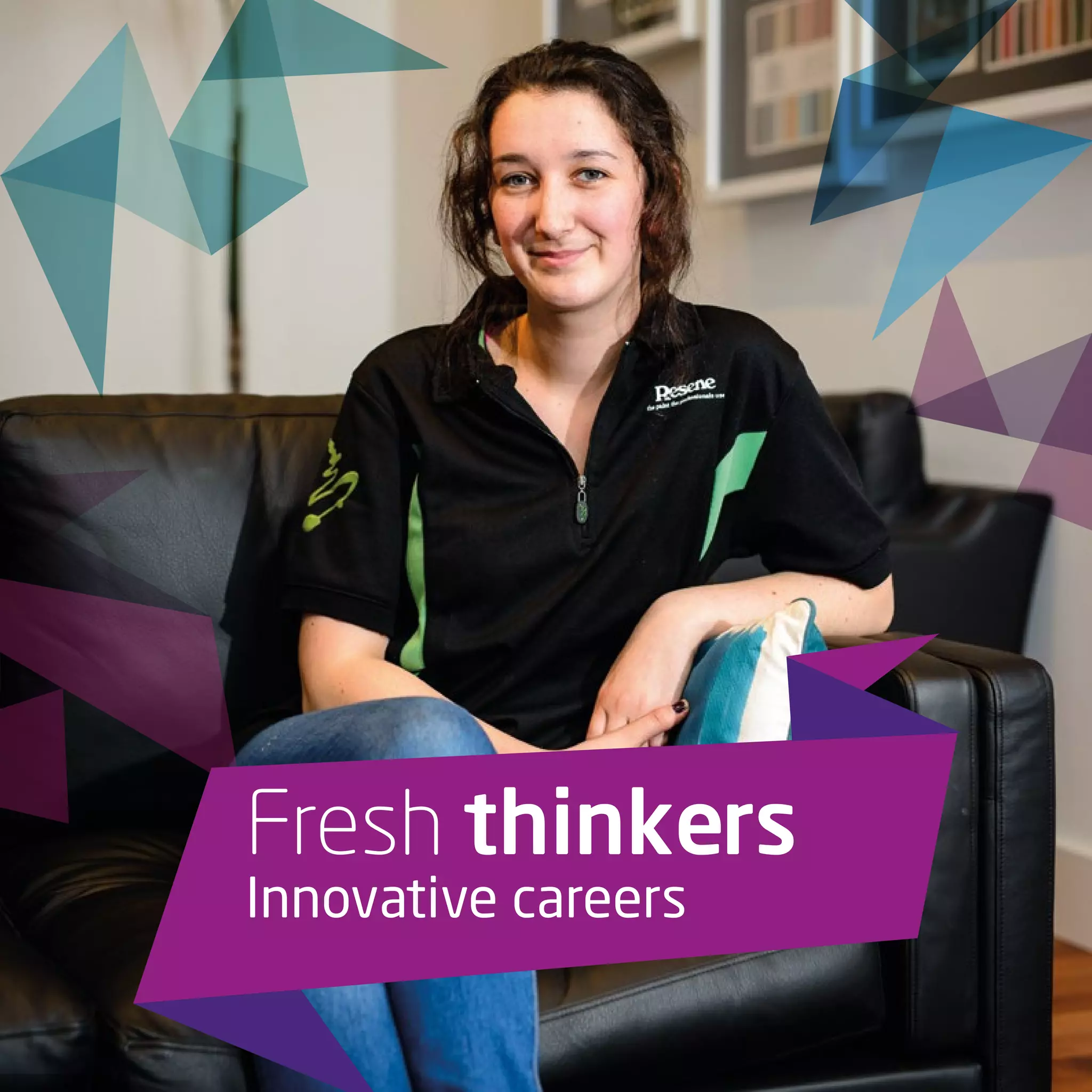
Fresh thinkers
Innovative careers
1
Lower Hutt has more than 3900 full-
time employees working in more than
825 businesses in the high-tech sector.
Jobs in these fields are about working
with good ideas, being adaptable to
change and facing a new challenge
every day.
Here, young people working in science
and technology in Lower Hutt talk
about their work, what motivates them
and the varied ways they got to where
they are today. If there’s one thing
they all have in common it’s that there’s
never a straight path to anywhere.
Study science and technology and you’ll
soon see there’s a world of options on
your doorstep.
Introduction
Deciding on your career when you’re a teenager can
seem like an impossible task. “Study what you love
and you’ll have a job you’ll always love” is the advice of
many of the young scientists in this book.
Contents
Map2
Fresh thinkers - Innovative careers 3
Bailey Angus5
Sonja Penafiel Bermudez7
Dr Joel Burton9
George Francis11
Emma Henderson13
Chloe Howard15
Dr Peter Kelly17
Dr Annette Koo19
Rayfield Lam21
Patrick Moloney23
Dr Leonardo Negrón-Ruíz25
Vithuran Niruban27
Courtenay O’Sullivan29
Thomas Phillips31
Monica Preece33
Delia Strong35
Bede van Schaijik37
3
Fresh thinkers - Innovative careers
Of course, at the time I was disappointed.
But now I have a job I love where I’m
constantly in the community working with
people and helping them. It’s a completely
different life to my original plan.
Although I was keen on politics as a
student at Wellington Boys’ High School,
I never thought I’d end up as the Mayor
of Lower Hutt. As an adult, I got involved
in community work, stood for Council and
then was encouraged to stand for Mayor.
It can be hard at high school wondering
how life will turn out. So my best advice is
‘don’t stress’. There are so many options for
young people these days, so take the time
to find what suits you best. You need to be
passionate about your work and most of all
you need to really enjoy your career.
As well as being a great inspiration for
careers in science and technology, this
book is a celebration of Lower Hutt’s
science and technology sector.
We have some of New Zealand’s best and
brightest working in the region and there’s
no reason you can’t join these innovators in
a fulfilling and challenging career.
Ray Wallace
Mayor
When I was at high school I loved maths, geography
and science and had a passion for planes so I thought
I’d be a pilot. It was during the first pilot training test
that I learnt I was colourblind and had to give up my
dream.
AROTEC DIAGNOSTICS
(207 Gracefield Road)
CALLAGHAN INNOVATION
(69 Gracefield Road)
RESENE
(32 Vogel Street)
OPUS RESEARCH
(33 The Esplanade)
AVIAT NETWORKS
(20 Peterkin Street)
FRASER FIRE AND RESCUE
(18 Peterkin Street)
BEE HEALTHY DENTAL CLINIC
(100 Walters Street)
HUTT VALLEY DHB
(High Street)
TAITA COLLEGE
(188 Eastern Hutt Road)
GNS SCIENCE
(1 Fairway Drive)
GNS SCIENCE
(30 Gracefield Road)
UPPER HUTT
WALLACEVILLE
TRENTHAM
MPI
(66 Ward Street)
GlycoSyn
Nuevo Technology
W
ESTERN
HUTT RD
HIGH
ST
TAITA
DR
CUBAST
HARCOURT WERRY DR
THE ESPLANADE
W
AIW
HETU
RD
SEAVIEWRD
UDY ST
MARINE DR
RANDWICKRD
HUTT
RD
WATERLOO RD
DAYSH
ST
WAINUIRD
WOBURN
RD
WAINUIOMATA RD
WAIONE ST
QUEENS
DR
EASTERN
HUTT
RD
CONNOLLY
ST
VICTORIA
ST
BLO
CK
RD
BELLRD
SEAVIEW
RD
WAINUIOMATA
NAENAE
BELMONT
TAITA
KELSON
STOKES VALLEY
NORMANDALE
PETONE
MAUNGARAKI
AVALON
WAIWHETU
KOROKORO
FAIRFIELD
BOULCOTT
WOBURN
GRACEFIELD
WATERLOO
SEAVIEW
LOWRY BAY
HUTT CENTRAL
EPUNI
MOERA
TIROHANGA
ALICETOWN
YORK BAY
HAYWARDS
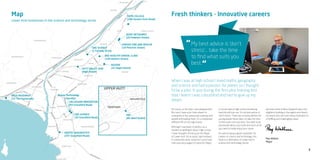
Map
Lower Hutt businesses in the science and technology sector
My best advice is ‘don’t
stress’... take the time
to find what suits you
best.
“
“
5
Lots of people my age freak out
because they don’t have a career path
sorted; I still don’t know exactly what
area I want to work in and that’s okay.
“
“
Chemistry is an international language
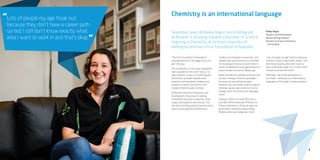
Seventeen year old Bailey Angus has a holiday job
at Resene, is studying towards a Bachelor of Science
majoring in Chemistry at Victoria University of
Wellington and has a First Foundation Scholarship.
“The First Foundation Scholarship is
amazing and one of the biggest you can
get,” she says.
The scholarship is a four-year programme
that’s awarded at the end of Year 12 to
high-achievers. It pays $12,000 towards
tuition fees, provides valuable work
experience during varsity holidays and
provides a mentor who works in the
student’s field of study or similar.
At Resene she works in Research and
Development, focussing on creating
completely new paints using new, often
unique raw materials and mixtures. She
also tests existing products (paints) with a
view to improving their performance.
“Unlike a lot of people at university I will
already have work experience in the field
I’m studying and I know so much more in
my job compared to a year ago because of
what I’ve learnt at school,” Bailey says.
Bailey intended on starting university with
the aim of being a forensic pathologist
because she loves blood and gore.
However, she was better suited to logical
thinking, calculus and chemistry than to
biology, which she found more language-
based.
“Having a mentor is a help. Mine was a
journalist before working at Ministry for
Primary Industries so Tania can give me
great advice and knows about being
flexible when you change your mind.
“Lots of people my age freak out because
they don’t have a career path sorted; I still
don’t know exactly what area I want to
work in and that’s okay. At 17 I don’t need
to have my whole life sorted.
“Although, I am studying Spanish so I
can travel... chemistry is an international
language so I’ll be able to work anywhere.”
Bailey Angus
Research and Development
Resene (during holidays)
Bachelor of Science (chemistry)
– still studying
7
Keep your options open
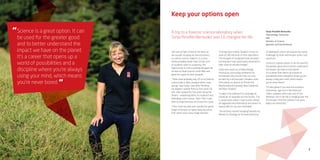
A trip to a forensic science laboratory when
Sonja Penafiel Bermudez was 16 changed her life.
She was at high school at the time; an
all-rounder studying art and economics
as well as science subjects. In a class
where probably fewer than 10 per cent
of students went to university, the
opportunity to visit a working lab gave her
an idea of what science could offer and
gave her a goal to work towards.
“There were probably only 20 or so forensic
science jobs in New Zealand when I was
young,” says Sonja, “and after finishing
my degree I waited three to four years for
one, then worked for five years living the
dream — examining items for evidence and
attending crime scenes. Next I felt it was
time to head overseas and travel for a year.
“Then I met my wife and I wanted to spend
longer in Europe so I gave away my job at
ESR, which was a very tough decision.
“Coming back to New Zealand I chose to
work at GNS because of their reputation.
The thought of studying fossils sounded
exciting and I was particularly attracted to
their work on climate change.”
Sonja now works as a Paleontology
Technician, processing sediments for
microfossils (tiny fossils that can only
be seen by a microscope). Samples come
from places as diverse as Antarctica,
Newfoundland (Canada), New Caledonia
and New Zealand.
“I subject the sediment to a barrage of
chemicals to separate out the fossils. This
is varied work where I have to plan ahead,
be organised and methodical and where I’m
responsible for my own timetable.
“I’ve recently started studying towards my
Masters in Geology at Victoria University
of Wellington, which will expand my career,
challenge my brain and answer some curly
questions.
Science is a great option. It can be used for
the greater good and to better understand
the impact we have on the planet.
It’s a career that opens up a world of
possibilities and a discipline where you’re
always using your mind, which means
you’re never bored.
“It’s also great if you love the outdoors.
Sometimes I get out in the field and
collect samples, which are a lot of fun.
Whether I am in the lab or hanging over the
microscope I find the variety in my work
keeps me interested. ”
Sonja Penafiel Bermudez
Paleontology Technician
GNS
Bachelor of Science
(genetics and biochemistry)
Science is a great option. It can
be used for the greater good
and to better understand the
impact we have on the planet.
It’s a career that opens up a
world of possibilities and a
discipline where you’re always
using your mind, which means
you’re never bored.
“
“
9
Be curious, be inquisitive and persevere
Someone comes to our team
with a question or problem and
we design a solution.
“
“
“One of the things I love about my job is
the variety,” he says.
As a behavioural scientist he studies
human action and seeks to make
generalisations about human behaviour.
“Essentially, someone comes to our team
with a question or problem and we design
a solution,” says Joel.
Joel has worked on the future housing and
transport needs of the Greater Wellington
region and has tested technology to see if
there’s a better way to detect when drivers
are covertly using their mobile phones.
His PhD study in psychoacoustics was
funded by the United Kingdom’s Ministry of
Defence and researched how audio alarms
could improve pilot reaction times. Or, as
Joel puts it, “how noise improves reaction
times when your plane is about to fly into
a cliff face.”
Joel didn’t take a straight path to where
he’s at now. From school he moved to
England with his family, taking a three year
break from study and working in customer
service as an accounts clerk, mainly
settling disputes about bills that people
didn’t want to pay.
“I’ve always had a science bent but really
enjoyed English too. Writing clearly and
concisely is important to my work, so it’s
been a winning combination.
“I’m pretty persuasive too. My customer
service skills mean I know how to engage
people and I really enjoy that. When you’re
designing how people will react to a
situation, or you need to gather data, that’s
a great skill set.”
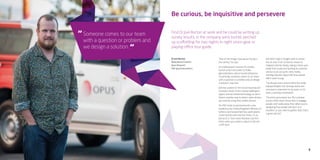
Find Dr Joel Burton at work and he could be writing up
survey results, in the company wind tunnel, perched
up scaffolding for two nights in night vision gear or
playing office tour guide.
Dr Joel Burton
Behavioural Scientist
Opus Research
PhD (psychoacoustics)
11
Fired up for design
George Francis went straight from high school to
Massey University to study engineering technology.
However, after two and a half years he became
disillusioned and was keen for real-world experience.
He left his study for a job as a fitter on the
factory floor at Fraser Fire and Rescue,
a position he had for six months before
moving into the company’s office.
Now George has the best of both worlds
— he recently finished his degree through
WelTec in Petone and already has great
work experience in his field. While he was
a student he developed a prototype for
fire engine water cannons, which allows
firefighters to remain in their cabs and use
a joystick to drive a water cannon.
The unit is now in production and will
increase the safety for fire fighters in
extreme situations like Australian bush
fires.
George has always enjoyed being creative
and making new things — woodwork and
metalwork were his favourite subjects at
high school.
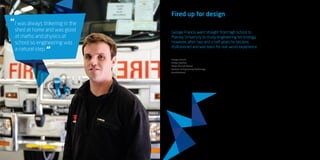
“I was always tinkering in the shed at home
and was good at maths and physics at
school so engineering was a natural step.
“My work now involves vehicle design for
fire engines, working on truck layouts and
product design. We export to Australia and
the Pacific Islands as well as design and
build for New Zealand. No two fire trucks
are ever the same.
“The essence of my job is creating design
solutions to problems; it’s a job that’s never
the same day to day and that continues to
interest and challenge me.”
George Francis
Design engineer
Fraser Fire and Rescue
Bachelor of Engineering Technology
(mechatronics)
I was always tinkering in the
shed at home and was good
at maths and physics at
school so engineering was
a natural step.
“
“
13
I’d really encourage people to try
and do work experience; it gives
you a taster of the field you want
to work in and shows employers
that you’re committed to your
chosen career.
“
“
Variety equals job satisfaction
Hutt Hospital runs a distinctive model of clinical care
that pharmacist Emma Henderson says gives her a lot
of job satisfaction.
At Hutt Hospital, clinical pharmacists
like Emma are part of a team linked with
a variety of doctors. Although working
together varies from ward to ward, when
it does happen the team can offer tailored
advice to patients and from a pharmacy
point of view it means giving expert advice
on the spot.
Emma knew at high school that she
wanted a career in health science and did
work experience during her holidays at a
family friend’s pharmacy.
It was when she’d finished her degree and
was completing her year-long internship at
Wellington Hospital that she realised she
enjoyed the clinical aspects of a hospital
job. “In a hospital, especially at Hutt
Hospital where we’re working in teams,
there’s a lot of diversity to the work,”
she says.
“I do ward rounds, help patients manage
multiple medications and work closely
with junior doctors to improve prescribing
to patients. It’s more of a big-picture
scenario as you’re able to follow a patient
through their hospital journey. You see
input from multiple specialties including
medical professionals, physiotherapists
and occupational therapists, which helps
you tailor the medication treatment to the
individual patient.”
“I like that every day is different and you
never know what you’ll get called about,
which means I’m constantly putting
everything I learnt at university into
practice. In fact, I’d say in my one year of
work I’ve learnt just as much, if not more,
than I did in four years at university.
“Studying at Otago University was a great
way to get into health sciences because
the first year was open entry study and
from there we could apply for medicine,
pharmacy, dentistry or physiotherapy.
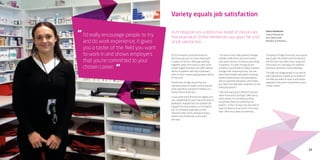
“I’d really encourage people to try and do
work experience; it gives you a taster of
the field you want to work in and shows
employers that you’re committed to your
chosen career.”
Emma Henderson
Clinical Pharmacist
Hutt Valley DHB
Bachelor of Pharmacy
15
...I was working full-time at
Burger King and I didn’t have a
lot of options. I took the WINZ
Limited Service Volunteer
(boot camp) course and that
turned my life around.
“
“
A major turnaround
Six years after leaving school at 16, with NCEA
Level One, Chloe Howard has a job that challenges
and rewards her daily.
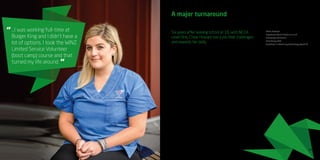
“When I was 18 I was working full-time
at Burger King and I didn’t have a lot of
options. I took the WINZ Limited Service
Volunteer (boot camp) course and that
turned my life around. Now I have a job
that provides opportunities that as an
18-year-old didn’t seem possible.
“Last year I travelled overseas and visited
16 countries. When I was younger I never
thought that opportunities like that were
open to me but now I’m moving to the UK,
having fallen in love with the country”.
Chloe’s work as a sterile and endoscope
technician is precise and highly technical.
Alongside her colleagues, she reprocesses
the instruments and endoscopes used in
Hutt Hospital’s busy surgical theatres.
That means decontaminating them
carefully, conducting instrument counts,
checking for small parts that could have
been left in theatre (like tiny screws) and
then sterilising them according to the
hospital’s approved protocols.
“We also make sure the equipment is well
maintained, says Chloe. “Some pieces
— such as endoscopes — can be worth
$50,000 so it’s important that they’re
handled carefully and with respect.”
As a criterion of her work, Chloe had to be
willing to study with the Open Polytechnic,
which she did while working full-time
with her employer contributing towards
costs. This ensured she has a competent
knowledge of microbiology and infection
control and understands the science
behind how decontamination works.
A year after starting work Chloe become
one of two of New Zealand’s first qualified
Endoscope Technicians; both are employed
by Hutt Valley District Health Board.
And in 2014 she was an ‘outstanding new
graduate’ finalist in the 3DHB Allied Health
Awards. That same year her team won
‘team of the year’.
“Upon reflection and with the hindsight of
maturity, I definitely should have stayed in
school. I just didn’t understand at the time
that being at school would help me long-
term and had no idea about responsibilities
and work ethic. That’s completely changed
now.”
Chloe Howard
Registered Sterile Technician and
Endoscope Technician
Hutt Valley DHB
Certificate in Sterilising Technology (Level 3)
17
Science at university is far broader
than high school, so it’s a great
chance to explore other fields and
work out what suits you best.
“
“
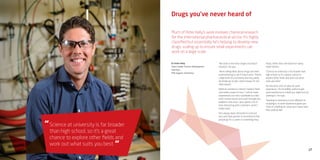
Drugs you’ve never heard of
Much of Peter Kelly’s work involves chemical research
for the international pharmaceutical sector. It’s highly
classified but essentially he’s helping to develop new
drugs, scaling up to ensure small experiments can
work on a large scale.
“We work in the early stages of product
research,” he says.
“We’re taking ideas about drugs and then
experimenting to see if they’ll work. There’s
a high level of uncertainty and very rarely
do things go to plan, which means I’m not
often bored.”
While he started as a bench chemist, Peter
now leads a team of nine. “I still do some
experiments but now coordinate our lab’s
work, resolve issues and work through any
problems that arise. I also spend a lot of
time interacting with customers, which I
really enjoy.”
He’s always been attracted to sciences
and uses that passion to recommend that
people go for a career in something they
enjoy, rather than one based on salary
expectations.
“Science at university is far broader than
high school, so it’s a great chance to
explore other fields and work out what
suits you best.”
He also puts a lot of value on work
experience. “It’s incredibly useful to get
work experience in a field you might end up
working in,” he says.
“Working in chemistry is a lot different to
studying it, so work experience gives you
more of a feeling for what your career (and
life) could be like.”
Dr Peter Kelly
Team Leader Process Development
GlycoSyn
PhD (organic chemistry)
19
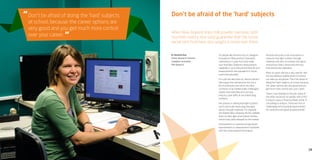
Don’t be afraid of doing the ‘hard’ subjects
at school, because the career options are
very good and you get much more control
over your career.
“
“
When New Zealand ships milk powder overseas, both
countries need a rock-solid guarantee that the tonne
we’ve sent from here also weighs a tonne over there.
It’s people like Annette Koo at Callaghan
Innovation’s Measurement Standards
Laboratory in Lower Hutt who make
sure that New Zealand’s measurement
capability is up to the job and that all such
measurements are equivalent to those
used internationally.
It’s a job she describes as, ‘almost perfect’.
She enjoys the role because she has a
lot of autonomy over what she does,
continues to be intellectually challenged,
travels internationally and can help
industry solve difficult and interesting
problems.
Her passion is seeing how light scatters
and in particular measuring how light
passes through materials. For example,
she helped dairy company Anchor validate
tests on their light-proof plastic bottles
before they were released on the market.
Improvements in manufacturing require
improvements in measurement standards
and new measurement techniques.
Annette has built a new instrument to
measure how light scatters through
materials and aims to increase the rigour
around how that is measured and how
instruments are calibrated.
After six years she has a very specific skill
set, but believes qualifications in science
can take you anywhere. “Don’t be afraid of
doing the ‘hard’ subjects at school, because
the career options are very good and you
get much more control over your career.
“When I was looking for this job, many of
the other vacancies for people with a PhD
in physics were in financial fields, either in
consulting or analysis. There are a lot of
challenging and surprising opportunities
for someone with great analytical skills.”
Dr Annette Koo
Senior Research Scientist
Callaghan Innovation
PhD (physics)
Don’t be afraid of the ‘hard’ subjects
21
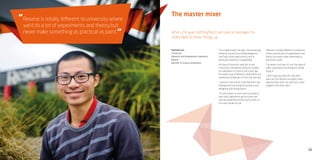
The master mixer
When 24-year-old Rayfield Lam was a teenager he
really liked to blow things up.
“I’m a big kid really,” he says, “and producing
chemical reactions and doing dangerous
stuff was what made science, and in
particular chemistry, so appealing.”
His love of chemistry took him to the
University of Auckland, where he studied
for a Bachelor of Science and a year ago
he landed a job at Resene’s head office and
warehouse in Naenae, his first full-time job.
“I work as a technician in the Research and
Development lab doing formulations and
designing and mixing paints.
“It’s very hands-on and I was surprised by
how many ingredients go into paint. We
use raw materials and mix from scratch so
it’s a very hands-on job.
“Resene is totally different to university
where we’d do a lot of experiments and
theory but never make something as
practical as paint.
“I’ve learnt a lot here. It’s not the type of
work I expected to be doing but I really
enjoy it.
“I don’t have any specific long-term
plans yet but Resene has good career
opportunities and I can see how I could
progress into other roles.”
Rayfield Lam
Technician
Research and Development Laboratory
Resene
Bachelor of Science (chemistry)
Resene is totally different to university where
we’d do a lot of experiments and theory but
never make something as practical as paint.
“
“
23
It matters to me that I can
make a real difference here.
“
“
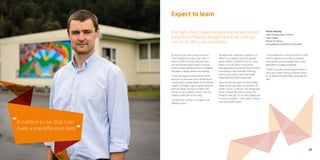
As a high school student, being a teacher was the last
thing Patrick Moloney thought he’d do for a job, but
now it’s his life’s work and passion.
Expect to learn
As head of the science department at
Taita College he has two clear roles, to
lead his staff of six (four teachers and
two technicians) and to teach students,
which involves planning lessons, engaging
teenagers, taking classes and marking.
“I love teaching at a lower-decile school
because my work has such a great impact.
I think that at a higher decile school there’s
usually a stronger support system and the
kids can always fall back on family. But
for lots of my students school is the only
reliable, stable part of their day.
“It matters to me that I can make a real
difference here”.
“Straight after university, I worked in an
office for a company owned by people
worth millions. That didn’t suit me. I was
bored out of my mind. I much prefer
helping people who benefit from my skills.
I love being in the classroom teaching
and it’s such a kick to see a kid finally
understanding what I’m teaching.
“Over the last five years at Taita College
we’ve turned pass rates around from 20-
30 per cent to 70-80 per cent, all because
we’ve changed the school culture. Our
students now say, ‘I’m at Taita College and
I’m here to achieve’ — they expect to learn
now and to gain credits.
“I was always into science myself at school,
kind of a geeky science kid, so passing
that passion and knowledge onto a new
generation is hugely rewarding.
“I think if you pick something you enjoy to
do as your career then you’ll always enjoy
it… as long as the good days outweigh the
bad.”
Patrick Moloney
Head of Department, Science
Taita College
Master of Science
Post-graduate Certificate in Education
25
If you don’t know what you want
to do, always draw on what gets
you excited. Over time you’ll see
the opportunities in that.
“
“
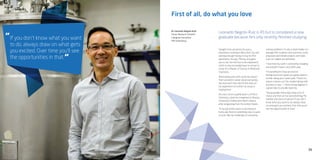
First of all, do what you love
Leonardo Negrón-Ruíz is 45 but is considered a new
graduate because he’s only recently finished studying.
Straight from university he was a
pharmacist, working in New York City and
earning enough money to buy his first
apartment. He says, “Money only gets
you so far, the rest has to be enjoyment,”
which is why he headed back to school to
study for a Master of Science in Medicinal
Chemistry.
Alternating work with study has meant
that Leonardo’s career advanced quickly
because each new role let him draw on
his experience to further his study or
employment.
His most recent qualification is a PhD in
Chemistry, which he completed at Massey
University’s Palmerston North campus
after emigrating from the United States.
“In my job there’s never a dull moment.
Every day there is something new to work
on and I like the challenge of constantly
solving problems. I’m also a team leader so I
manage PhD students and scientists, write
proposals and initiate projects and make
sure our targets are delivered.
“I love that my work is constantly changing
and wouldn’t have it any other way.
“It’s beneficial to have an eclectic
background and it gives you great options
further along your career path. There’s no
reason science can’t be studied along with
business or law — I think mixing degrees is
a great idea to provide diversity.
“Young people these days have a lot of
choice and that can be overwhelming. My
number one piece of advice? If you don’t
know what you want to do, always draw
on what gets you excited. Over time you’ll
see the opportunities in that.”
Dr Leonardo Negrón-Ruíz
Senior Research Scientist
Callaghan Innovation
PhD (chemistry)
27
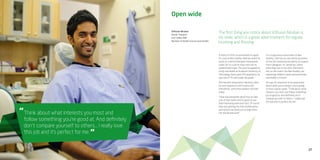
Open wide
The first thing you notice about Vithuran Niruban is
his smile, which is a great advertisement for regular
brushing and flossing.
A friend of Vith’s recommended he apply
for a job at Bee Healthy, Naenae where he
works as a dental therapist treating kids
under 18. It’s a job he loves and one he
worked hard to get. The year he applied to
study oral health at Auckland University of
Technology there were 650 applicants; he
was one of 35 who made the grade.
Vith became interested in dentistry after
his own experience with braces and
orthodontic work (that explains the killer
smile).
“I love educating kids about how to take
care of their teeth and it’s great to see
them improving with each visit. Of course
they love getting the free toothbrushes
and stickers we hand out to bribe them
into the dental chair!”
It’s a supportive environment at Bee
Healthy. Vith has his own dental assistant,
on the job mentoring and plenty of support
from colleagues. It’s varied too, where
some days he’s in the clinic and others
he’s on the road in the Bee Healthy van
examining children’s teeth and promoting
oral health in schools.
He says it’s important to be passionate
about what you’re doing if you’re going
to have a great career. “Think about what
interests you most and follow something
you’re good at. And definitely don’t
compare yourself to others… I really love
this job and it’s perfect for me.”
Vithuran Niruban
Dental Therapist
Hutt Valley DHB
Bachelor of Health Science (oral health)
Think about what interests you most and
follow something you’re good at. And definitely
don’t compare yourself to others… I really love
this job and it’s perfect for me.
“
“
29
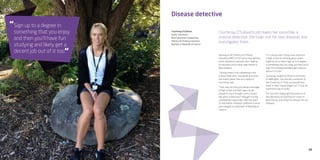
Disease detective
Courtenay O’Sullivan’s job makes her sound like a
science detective. She looks out for new diseases and
investigates them.
Courtenay O’Sullivan
Senior Technician
Next Generation Sequencing
Ministry for Primary Industries
Bachelor of Biomedical Science
Working at the Ministry for Primary
Industries (MPI), it’s her job to help identify
exotic diseases in animals; she’s looking
for illnesses we’ve never seen before in
New Zealand.
“I always knew I’d do something in the
science field since I was good at science
and maths rather than arts subjects,”
Courtenay says.
“I was way too busy just being a teenager
at high school and didn’t give my job
prospects much thought until a careers
day when a friend and I thought nursing
sounded like a good idea. I did two years
of that before I realised I preferred science
and changed to a Bachelor of Biomedical
Science.
“If I could go back I’d pay more attention
in high school to thinking about what I
might do for a career. Sign up to a degree
in something that you enjoy and then you’ll
have fun studying and likely get a decent
job out of it too.”
Courtenay studied at Victoria University
of Wellington. She also did a semester at
the University of Texas and would have
loved to have stayed longer but, “it was an
expensive way to study.”
For now she’s happy getting hands on in
the laboratory and putting her study to
good use by searching for unknown (to us)
diseases.
Sign up to a degree in
something that you enjoy
and then you’ll have fun
studying and likely get a
decent job out of it too.
“
“
31
The best thing about
this job is that I have
creative freedom
“
“
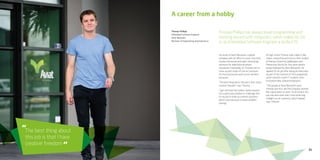
A career from a hobby
Thomas Phillips has always loved programming and
mucking around with computers, which makes his job
as an Embedded Software Engineer a perfect fit.
He works at Aviat Networks, a global
company with an office in Lower Hutt that
creates microwave and radio networking
solutions for telecommunications
companies. Essentially, it’s Thomas’ job to
come up with state-of-the-art solutions
for how businesses work across wireless
networks.
“The best thing about this job is that I have
creative freedom,” says Thomas.
“I get told that the market needs research
into a particular problem or challenge and
it’s my job to think up creative solutions,
which I love because it means problem
solving.”
At high school Thomas took subjects like
maths, computing and science then studied
at Massey University (Wellington and
Palmerston North) for four years before
being employed by Aviat Networks. He
applied for his job after doing an internship
as part of the Summer of Tech programme,
which matches smart IT students with
innovative New Zealand employers.
“The people at Aviat Networks were
friendly and nice, and the company seemed
like a good place to work. To be honest, the
pay was also more than I was expecting
straight out of university, which helped,”
says Thomas.
Thomas Phillips
Embedded Software Engineer
Aviat Networks
Bachelor of Engineering (mechatronics)
33
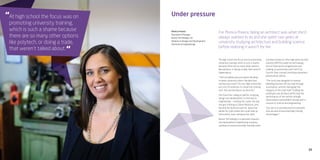
Under pressure
For Monica Preece, being an architect was what she’d
always wanted to do and she spent two years at
university studying architecture and building science
before realising it wasn’t for her.
“At high school the focus was on promoting
university training, which is such a shame
because there are so many other options,
like polytech, or doing a trade, that weren’t
talked about.
“I felt incredible pressure about deciding
to leave university when I decided that
architecture wasn’t for me. High school had
put a lot of emphasis on university training
and I felt worried about my decision.”
She found her calling at WelTec studying
design and development in mechanical
engineering — starting her career the day
she got chatting to Steve Robinson, who
became her business partner, about her
desire for a job where she could soak up
information, learn and grow her skills.
Nuevo Technology is a specialist research
and development engineering company
working on environmentally-friendly water
solutions based on ultra-high pressure /low
volume (UHP/LV) water jet technology.
One of their recent programmes was
trialling, in partnership with Hutt City
Council, their concept prototype pavement
preservation vehicle.
“The truck was designed to remove
bleeding bitumen off the road through
automation, without damaging the
integrity of the road itself. Trialling the
prototype was all about perfecting the
performance of the vehicle through
observations and problem solving with a
mixture of science and engineering.
“Our aim is to provide practical solutions
that are also environmentally-friendly
technologies.”
Monica Preece
Operations Manager
Nuevo Technology Ltd
Diploma in Design and Development
(mechanical engineering)
At high school the focus was on
promoting university training,
which is such a shame because
there are so many other options
like polytech, or doing a trade,
that weren’t talked about.
“
“
35
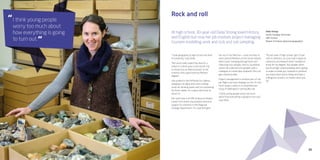
Rock and roll
At high school, 30-year-old Delia Strong loved History
and English but now her job involves project managing
tsunami modelling work and rock and soil sampling.
Delia Strong
Senior Geology Technician
GNS Science
Master of Science (physical geography)
“I took geography at high school and then
at university,” says Delia.
“But what really sealed the deal for a
career in science was a one-month trip
to Antarctica, as field assistant to the
scientist who supervised my Masters
degree.”
She worked in the McMurdo Dry Valleys,
sleeping in an igloo and a tent, boiling
snow for drinking water and not showering
for three weeks. It’s a place she’d love to
return to.
Her work now is at GNS Science at Avalon,
Lower Hutt where she provides technical
support to scientists in the Regional
Geology Department. It’s a job that gets
her out in the field too — most recently to
rivers around Reefton on the South Island’s
West Coast, tramping through bush and
collecting rock samples. And to Southland
where she collected soil samples with a
colleague to create New Zealand’s first soil
geo-chemical atlas.
Project management is another part of the
job. Right now she’s helping run the ‘It’s Our
Fault’ project, which is a comprehensive
study of Wellington’s earthquake risk.
“I think young people worry too much
about how everything is going to turn out,”
says Delia.
“My last year of high school I got 23 per
cent in statistics, so I just took it again at
university and relearnt what I needed to
know for my degree. Your grades when
you’re at high school probably aren’t going
to make or break you. Instead it’s whether
you enjoy what you’re doing and have a
willingness to learn, no matter what you
do.”
I think young people
worry too much about
how everything is going
to turn out.
“
“
37
I was lucky to come to
AROTEC because we’re
trained on the job, which
is great for building on the
good technical background
I gained at university.
“
“
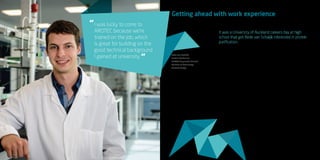
Getting ahead with work experience
It was a University of Auckland careers day at high
school that got Bede van Schaijik interested in protein
purification.
“I did all sorts of subjects at school and
was initially thinking of heading into law
or medicine but wasn’t particularly set on
either. At the careers day I got keen on a
Bachelor of Technology because the final
year includes a six-month internship, and
getting work experience while studying
was really important to me.”
Bede says that while he was at university
he made sure he studied widely so he had
a broad set of skills that could direct his
career. He also started applying for jobs
while he still had six months of study left
to go.
“Juggling job applications with exams and
study was hard, but it meant that now I’ve
got a steady job immediately after finishing
university,” he says.
The work Bede does at AROTEC
Diagnostics Limited uses precise and
demanding specifications to extract and
purify protein antigens that are used
to identify auto-immune diseases in
humans. It’s a varied role that gives him a
balance between technical lab work and
administrative work.
“I was lucky to come to AROTEC because
we’re trained on the job, which is great for
building on the good technical background
I gained at university,” he says.
“Right now I’m three months into my first
full-time job so I’m keen to get experience
and see where my work will take me.”
Bede van Schaijik
Protein Biochemist
AROTEC Diagnostics Limited
Bachelor of Technology
(biotechnology)
Fresh thinkers innovative careers

Fresh thinkers innovative careers

  • 1.
  • 2.
    1 Lower Hutt hasmore than 3900 full- time employees working in more than 825 businesses in the high-tech sector. Jobs in these fields are about working with good ideas, being adaptable to change and facing a new challenge every day. Here, young people working in science and technology in Lower Hutt talk about their work, what motivates them and the varied ways they got to where they are today. If there’s one thing they all have in common it’s that there’s never a straight path to anywhere. Study science and technology and you’ll soon see there’s a world of options on your doorstep. Introduction Deciding on your career when you’re a teenager can seem like an impossible task. “Study what you love and you’ll have a job you’ll always love” is the advice of many of the young scientists in this book. Contents Map2 Fresh thinkers - Innovative careers 3 Bailey Angus5 Sonja Penafiel Bermudez7 Dr Joel Burton9 George Francis11 Emma Henderson13 Chloe Howard15 Dr Peter Kelly17 Dr Annette Koo19 Rayfield Lam21 Patrick Moloney23 Dr Leonardo Negrón-Ruíz25 Vithuran Niruban27 Courtenay O’Sullivan29 Thomas Phillips31 Monica Preece33 Delia Strong35 Bede van Schaijik37
  • 3.
    3 Fresh thinkers -Innovative careers Of course, at the time I was disappointed. But now I have a job I love where I’m constantly in the community working with people and helping them. It’s a completely different life to my original plan. Although I was keen on politics as a student at Wellington Boys’ High School, I never thought I’d end up as the Mayor of Lower Hutt. As an adult, I got involved in community work, stood for Council and then was encouraged to stand for Mayor. It can be hard at high school wondering how life will turn out. So my best advice is ‘don’t stress’. There are so many options for young people these days, so take the time to find what suits you best. You need to be passionate about your work and most of all you need to really enjoy your career. As well as being a great inspiration for careers in science and technology, this book is a celebration of Lower Hutt’s science and technology sector. We have some of New Zealand’s best and brightest working in the region and there’s no reason you can’t join these innovators in a fulfilling and challenging career. Ray Wallace Mayor When I was at high school I loved maths, geography and science and had a passion for planes so I thought I’d be a pilot. It was during the first pilot training test that I learnt I was colourblind and had to give up my dream. AROTEC DIAGNOSTICS (207 Gracefield Road) CALLAGHAN INNOVATION (69 Gracefield Road) RESENE (32 Vogel Street) OPUS RESEARCH (33 The Esplanade) AVIAT NETWORKS (20 Peterkin Street) FRASER FIRE AND RESCUE (18 Peterkin Street) BEE HEALTHY DENTAL CLINIC (100 Walters Street) HUTT VALLEY DHB (High Street) TAITA COLLEGE (188 Eastern Hutt Road) GNS SCIENCE (1 Fairway Drive) GNS SCIENCE (30 Gracefield Road) UPPER HUTT WALLACEVILLE TRENTHAM MPI (66 Ward Street) GlycoSyn Nuevo Technology W ESTERN HUTT RD HIGH ST TAITA DR CUBAST HARCOURT WERRY DR THE ESPLANADE W AIW HETU RD SEAVIEWRD UDY ST MARINE DR RANDWICKRD HUTT RD WATERLOO RD DAYSH ST WAINUIRD WOBURN RD WAINUIOMATA RD WAIONE ST QUEENS DR EASTERN HUTT RD CONNOLLY ST VICTORIA ST BLO CK RD BELLRD SEAVIEW RD WAINUIOMATA NAENAE BELMONT TAITA KELSON STOKES VALLEY NORMANDALE PETONE MAUNGARAKI AVALON WAIWHETU KOROKORO FAIRFIELD BOULCOTT WOBURN GRACEFIELD WATERLOO SEAVIEW LOWRY BAY HUTT CENTRAL EPUNI MOERA TIROHANGA ALICETOWN YORK BAY HAYWARDS Map Lower Hutt businesses in the science and technology sector My best advice is ‘don’t stress’... take the time to find what suits you best. “ “
  • 4.
    5 Lots of peoplemy age freak out because they don’t have a career path sorted; I still don’t know exactly what area I want to work in and that’s okay. “ “ Chemistry is an international language Seventeen year old Bailey Angus has a holiday job at Resene, is studying towards a Bachelor of Science majoring in Chemistry at Victoria University of Wellington and has a First Foundation Scholarship. “The First Foundation Scholarship is amazing and one of the biggest you can get,” she says. The scholarship is a four-year programme that’s awarded at the end of Year 12 to high-achievers. It pays $12,000 towards tuition fees, provides valuable work experience during varsity holidays and provides a mentor who works in the student’s field of study or similar. At Resene she works in Research and Development, focussing on creating completely new paints using new, often unique raw materials and mixtures. She also tests existing products (paints) with a view to improving their performance. “Unlike a lot of people at university I will already have work experience in the field I’m studying and I know so much more in my job compared to a year ago because of what I’ve learnt at school,” Bailey says. Bailey intended on starting university with the aim of being a forensic pathologist because she loves blood and gore. However, she was better suited to logical thinking, calculus and chemistry than to biology, which she found more language- based. “Having a mentor is a help. Mine was a journalist before working at Ministry for Primary Industries so Tania can give me great advice and knows about being flexible when you change your mind. “Lots of people my age freak out because they don’t have a career path sorted; I still don’t know exactly what area I want to work in and that’s okay. At 17 I don’t need to have my whole life sorted. “Although, I am studying Spanish so I can travel... chemistry is an international language so I’ll be able to work anywhere.” Bailey Angus Research and Development Resene (during holidays) Bachelor of Science (chemistry) – still studying
  • 5.
    7 Keep your optionsopen A trip to a forensic science laboratory when Sonja Penafiel Bermudez was 16 changed her life. She was at high school at the time; an all-rounder studying art and economics as well as science subjects. In a class where probably fewer than 10 per cent of students went to university, the opportunity to visit a working lab gave her an idea of what science could offer and gave her a goal to work towards. “There were probably only 20 or so forensic science jobs in New Zealand when I was young,” says Sonja, “and after finishing my degree I waited three to four years for one, then worked for five years living the dream — examining items for evidence and attending crime scenes. Next I felt it was time to head overseas and travel for a year. “Then I met my wife and I wanted to spend longer in Europe so I gave away my job at ESR, which was a very tough decision. “Coming back to New Zealand I chose to work at GNS because of their reputation. The thought of studying fossils sounded exciting and I was particularly attracted to their work on climate change.” Sonja now works as a Paleontology Technician, processing sediments for microfossils (tiny fossils that can only be seen by a microscope). Samples come from places as diverse as Antarctica, Newfoundland (Canada), New Caledonia and New Zealand. “I subject the sediment to a barrage of chemicals to separate out the fossils. This is varied work where I have to plan ahead, be organised and methodical and where I’m responsible for my own timetable. “I’ve recently started studying towards my Masters in Geology at Victoria University of Wellington, which will expand my career, challenge my brain and answer some curly questions. Science is a great option. It can be used for the greater good and to better understand the impact we have on the planet. It’s a career that opens up a world of possibilities and a discipline where you’re always using your mind, which means you’re never bored. “It’s also great if you love the outdoors. Sometimes I get out in the field and collect samples, which are a lot of fun. Whether I am in the lab or hanging over the microscope I find the variety in my work keeps me interested. ” Sonja Penafiel Bermudez Paleontology Technician GNS Bachelor of Science (genetics and biochemistry) Science is a great option. It can be used for the greater good and to better understand the impact we have on the planet. It’s a career that opens up a world of possibilities and a discipline where you’re always using your mind, which means you’re never bored. “ “
  • 6.
    9 Be curious, beinquisitive and persevere Someone comes to our team with a question or problem and we design a solution. “ “ “One of the things I love about my job is the variety,” he says. As a behavioural scientist he studies human action and seeks to make generalisations about human behaviour. “Essentially, someone comes to our team with a question or problem and we design a solution,” says Joel. Joel has worked on the future housing and transport needs of the Greater Wellington region and has tested technology to see if there’s a better way to detect when drivers are covertly using their mobile phones. His PhD study in psychoacoustics was funded by the United Kingdom’s Ministry of Defence and researched how audio alarms could improve pilot reaction times. Or, as Joel puts it, “how noise improves reaction times when your plane is about to fly into a cliff face.” Joel didn’t take a straight path to where he’s at now. From school he moved to England with his family, taking a three year break from study and working in customer service as an accounts clerk, mainly settling disputes about bills that people didn’t want to pay. “I’ve always had a science bent but really enjoyed English too. Writing clearly and concisely is important to my work, so it’s been a winning combination. “I’m pretty persuasive too. My customer service skills mean I know how to engage people and I really enjoy that. When you’re designing how people will react to a situation, or you need to gather data, that’s a great skill set.” Find Dr Joel Burton at work and he could be writing up survey results, in the company wind tunnel, perched up scaffolding for two nights in night vision gear or playing office tour guide. Dr Joel Burton Behavioural Scientist Opus Research PhD (psychoacoustics)
  • 7.
    11 Fired up fordesign George Francis went straight from high school to Massey University to study engineering technology. However, after two and a half years he became disillusioned and was keen for real-world experience. He left his study for a job as a fitter on the factory floor at Fraser Fire and Rescue, a position he had for six months before moving into the company’s office. Now George has the best of both worlds — he recently finished his degree through WelTec in Petone and already has great work experience in his field. While he was a student he developed a prototype for fire engine water cannons, which allows firefighters to remain in their cabs and use a joystick to drive a water cannon. The unit is now in production and will increase the safety for fire fighters in extreme situations like Australian bush fires. George has always enjoyed being creative and making new things — woodwork and metalwork were his favourite subjects at high school. “I was always tinkering in the shed at home and was good at maths and physics at school so engineering was a natural step. “My work now involves vehicle design for fire engines, working on truck layouts and product design. We export to Australia and the Pacific Islands as well as design and build for New Zealand. No two fire trucks are ever the same. “The essence of my job is creating design solutions to problems; it’s a job that’s never the same day to day and that continues to interest and challenge me.” George Francis Design engineer Fraser Fire and Rescue Bachelor of Engineering Technology (mechatronics) I was always tinkering in the shed at home and was good at maths and physics at school so engineering was a natural step. “ “
  • 8.
    13 I’d really encouragepeople to try and do work experience; it gives you a taster of the field you want to work in and shows employers that you’re committed to your chosen career. “ “ Variety equals job satisfaction Hutt Hospital runs a distinctive model of clinical care that pharmacist Emma Henderson says gives her a lot of job satisfaction. At Hutt Hospital, clinical pharmacists like Emma are part of a team linked with a variety of doctors. Although working together varies from ward to ward, when it does happen the team can offer tailored advice to patients and from a pharmacy point of view it means giving expert advice on the spot. Emma knew at high school that she wanted a career in health science and did work experience during her holidays at a family friend’s pharmacy. It was when she’d finished her degree and was completing her year-long internship at Wellington Hospital that she realised she enjoyed the clinical aspects of a hospital job. “In a hospital, especially at Hutt Hospital where we’re working in teams, there’s a lot of diversity to the work,” she says. “I do ward rounds, help patients manage multiple medications and work closely with junior doctors to improve prescribing to patients. It’s more of a big-picture scenario as you’re able to follow a patient through their hospital journey. You see input from multiple specialties including medical professionals, physiotherapists and occupational therapists, which helps you tailor the medication treatment to the individual patient.” “I like that every day is different and you never know what you’ll get called about, which means I’m constantly putting everything I learnt at university into practice. In fact, I’d say in my one year of work I’ve learnt just as much, if not more, than I did in four years at university. “Studying at Otago University was a great way to get into health sciences because the first year was open entry study and from there we could apply for medicine, pharmacy, dentistry or physiotherapy. “I’d really encourage people to try and do work experience; it gives you a taster of the field you want to work in and shows employers that you’re committed to your chosen career.” Emma Henderson Clinical Pharmacist Hutt Valley DHB Bachelor of Pharmacy
  • 9.
    15 ...I was workingfull-time at Burger King and I didn’t have a lot of options. I took the WINZ Limited Service Volunteer (boot camp) course and that turned my life around. “ “ A major turnaround Six years after leaving school at 16, with NCEA Level One, Chloe Howard has a job that challenges and rewards her daily. “When I was 18 I was working full-time at Burger King and I didn’t have a lot of options. I took the WINZ Limited Service Volunteer (boot camp) course and that turned my life around. Now I have a job that provides opportunities that as an 18-year-old didn’t seem possible. “Last year I travelled overseas and visited 16 countries. When I was younger I never thought that opportunities like that were open to me but now I’m moving to the UK, having fallen in love with the country”. Chloe’s work as a sterile and endoscope technician is precise and highly technical. Alongside her colleagues, she reprocesses the instruments and endoscopes used in Hutt Hospital’s busy surgical theatres. That means decontaminating them carefully, conducting instrument counts, checking for small parts that could have been left in theatre (like tiny screws) and then sterilising them according to the hospital’s approved protocols. “We also make sure the equipment is well maintained, says Chloe. “Some pieces — such as endoscopes — can be worth $50,000 so it’s important that they’re handled carefully and with respect.” As a criterion of her work, Chloe had to be willing to study with the Open Polytechnic, which she did while working full-time with her employer contributing towards costs. This ensured she has a competent knowledge of microbiology and infection control and understands the science behind how decontamination works. A year after starting work Chloe become one of two of New Zealand’s first qualified Endoscope Technicians; both are employed by Hutt Valley District Health Board. And in 2014 she was an ‘outstanding new graduate’ finalist in the 3DHB Allied Health Awards. That same year her team won ‘team of the year’. “Upon reflection and with the hindsight of maturity, I definitely should have stayed in school. I just didn’t understand at the time that being at school would help me long- term and had no idea about responsibilities and work ethic. That’s completely changed now.” Chloe Howard Registered Sterile Technician and Endoscope Technician Hutt Valley DHB Certificate in Sterilising Technology (Level 3)
  • 10.
    17 Science at universityis far broader than high school, so it’s a great chance to explore other fields and work out what suits you best. “ “ Drugs you’ve never heard of Much of Peter Kelly’s work involves chemical research for the international pharmaceutical sector. It’s highly classified but essentially he’s helping to develop new drugs, scaling up to ensure small experiments can work on a large scale. “We work in the early stages of product research,” he says. “We’re taking ideas about drugs and then experimenting to see if they’ll work. There’s a high level of uncertainty and very rarely do things go to plan, which means I’m not often bored.” While he started as a bench chemist, Peter now leads a team of nine. “I still do some experiments but now coordinate our lab’s work, resolve issues and work through any problems that arise. I also spend a lot of time interacting with customers, which I really enjoy.” He’s always been attracted to sciences and uses that passion to recommend that people go for a career in something they enjoy, rather than one based on salary expectations. “Science at university is far broader than high school, so it’s a great chance to explore other fields and work out what suits you best.” He also puts a lot of value on work experience. “It’s incredibly useful to get work experience in a field you might end up working in,” he says. “Working in chemistry is a lot different to studying it, so work experience gives you more of a feeling for what your career (and life) could be like.” Dr Peter Kelly Team Leader Process Development GlycoSyn PhD (organic chemistry)
  • 11.
    19 Don’t be afraidof doing the ‘hard’ subjects at school, because the career options are very good and you get much more control over your career. “ “ When New Zealand ships milk powder overseas, both countries need a rock-solid guarantee that the tonne we’ve sent from here also weighs a tonne over there. It’s people like Annette Koo at Callaghan Innovation’s Measurement Standards Laboratory in Lower Hutt who make sure that New Zealand’s measurement capability is up to the job and that all such measurements are equivalent to those used internationally. It’s a job she describes as, ‘almost perfect’. She enjoys the role because she has a lot of autonomy over what she does, continues to be intellectually challenged, travels internationally and can help industry solve difficult and interesting problems. Her passion is seeing how light scatters and in particular measuring how light passes through materials. For example, she helped dairy company Anchor validate tests on their light-proof plastic bottles before they were released on the market. Improvements in manufacturing require improvements in measurement standards and new measurement techniques. Annette has built a new instrument to measure how light scatters through materials and aims to increase the rigour around how that is measured and how instruments are calibrated. After six years she has a very specific skill set, but believes qualifications in science can take you anywhere. “Don’t be afraid of doing the ‘hard’ subjects at school, because the career options are very good and you get much more control over your career. “When I was looking for this job, many of the other vacancies for people with a PhD in physics were in financial fields, either in consulting or analysis. There are a lot of challenging and surprising opportunities for someone with great analytical skills.” Dr Annette Koo Senior Research Scientist Callaghan Innovation PhD (physics) Don’t be afraid of the ‘hard’ subjects
  • 12.
    21 The master mixer When24-year-old Rayfield Lam was a teenager he really liked to blow things up. “I’m a big kid really,” he says, “and producing chemical reactions and doing dangerous stuff was what made science, and in particular chemistry, so appealing.” His love of chemistry took him to the University of Auckland, where he studied for a Bachelor of Science and a year ago he landed a job at Resene’s head office and warehouse in Naenae, his first full-time job. “I work as a technician in the Research and Development lab doing formulations and designing and mixing paints. “It’s very hands-on and I was surprised by how many ingredients go into paint. We use raw materials and mix from scratch so it’s a very hands-on job. “Resene is totally different to university where we’d do a lot of experiments and theory but never make something as practical as paint. “I’ve learnt a lot here. It’s not the type of work I expected to be doing but I really enjoy it. “I don’t have any specific long-term plans yet but Resene has good career opportunities and I can see how I could progress into other roles.” Rayfield Lam Technician Research and Development Laboratory Resene Bachelor of Science (chemistry) Resene is totally different to university where we’d do a lot of experiments and theory but never make something as practical as paint. “ “
  • 13.
    23 It matters tome that I can make a real difference here. “ “ As a high school student, being a teacher was the last thing Patrick Moloney thought he’d do for a job, but now it’s his life’s work and passion. Expect to learn As head of the science department at Taita College he has two clear roles, to lead his staff of six (four teachers and two technicians) and to teach students, which involves planning lessons, engaging teenagers, taking classes and marking. “I love teaching at a lower-decile school because my work has such a great impact. I think that at a higher decile school there’s usually a stronger support system and the kids can always fall back on family. But for lots of my students school is the only reliable, stable part of their day. “It matters to me that I can make a real difference here”. “Straight after university, I worked in an office for a company owned by people worth millions. That didn’t suit me. I was bored out of my mind. I much prefer helping people who benefit from my skills. I love being in the classroom teaching and it’s such a kick to see a kid finally understanding what I’m teaching. “Over the last five years at Taita College we’ve turned pass rates around from 20- 30 per cent to 70-80 per cent, all because we’ve changed the school culture. Our students now say, ‘I’m at Taita College and I’m here to achieve’ — they expect to learn now and to gain credits. “I was always into science myself at school, kind of a geeky science kid, so passing that passion and knowledge onto a new generation is hugely rewarding. “I think if you pick something you enjoy to do as your career then you’ll always enjoy it… as long as the good days outweigh the bad.” Patrick Moloney Head of Department, Science Taita College Master of Science Post-graduate Certificate in Education
  • 14.
    25 If you don’tknow what you want to do, always draw on what gets you excited. Over time you’ll see the opportunities in that. “ “ First of all, do what you love Leonardo Negrón-Ruíz is 45 but is considered a new graduate because he’s only recently finished studying. Straight from university he was a pharmacist, working in New York City and earning enough money to buy his first apartment. He says, “Money only gets you so far, the rest has to be enjoyment,” which is why he headed back to school to study for a Master of Science in Medicinal Chemistry. Alternating work with study has meant that Leonardo’s career advanced quickly because each new role let him draw on his experience to further his study or employment. His most recent qualification is a PhD in Chemistry, which he completed at Massey University’s Palmerston North campus after emigrating from the United States. “In my job there’s never a dull moment. Every day there is something new to work on and I like the challenge of constantly solving problems. I’m also a team leader so I manage PhD students and scientists, write proposals and initiate projects and make sure our targets are delivered. “I love that my work is constantly changing and wouldn’t have it any other way. “It’s beneficial to have an eclectic background and it gives you great options further along your career path. There’s no reason science can’t be studied along with business or law — I think mixing degrees is a great idea to provide diversity. “Young people these days have a lot of choice and that can be overwhelming. My number one piece of advice? If you don’t know what you want to do, always draw on what gets you excited. Over time you’ll see the opportunities in that.” Dr Leonardo Negrón-Ruíz Senior Research Scientist Callaghan Innovation PhD (chemistry)
  • 15.
    27 Open wide The firstthing you notice about Vithuran Niruban is his smile, which is a great advertisement for regular brushing and flossing. A friend of Vith’s recommended he apply for a job at Bee Healthy, Naenae where he works as a dental therapist treating kids under 18. It’s a job he loves and one he worked hard to get. The year he applied to study oral health at Auckland University of Technology there were 650 applicants; he was one of 35 who made the grade. Vith became interested in dentistry after his own experience with braces and orthodontic work (that explains the killer smile). “I love educating kids about how to take care of their teeth and it’s great to see them improving with each visit. Of course they love getting the free toothbrushes and stickers we hand out to bribe them into the dental chair!” It’s a supportive environment at Bee Healthy. Vith has his own dental assistant, on the job mentoring and plenty of support from colleagues. It’s varied too, where some days he’s in the clinic and others he’s on the road in the Bee Healthy van examining children’s teeth and promoting oral health in schools. He says it’s important to be passionate about what you’re doing if you’re going to have a great career. “Think about what interests you most and follow something you’re good at. And definitely don’t compare yourself to others… I really love this job and it’s perfect for me.” Vithuran Niruban Dental Therapist Hutt Valley DHB Bachelor of Health Science (oral health) Think about what interests you most and follow something you’re good at. And definitely don’t compare yourself to others… I really love this job and it’s perfect for me. “ “
  • 16.
    29 Disease detective Courtenay O’Sullivan’sjob makes her sound like a science detective. She looks out for new diseases and investigates them. Courtenay O’Sullivan Senior Technician Next Generation Sequencing Ministry for Primary Industries Bachelor of Biomedical Science Working at the Ministry for Primary Industries (MPI), it’s her job to help identify exotic diseases in animals; she’s looking for illnesses we’ve never seen before in New Zealand. “I always knew I’d do something in the science field since I was good at science and maths rather than arts subjects,” Courtenay says. “I was way too busy just being a teenager at high school and didn’t give my job prospects much thought until a careers day when a friend and I thought nursing sounded like a good idea. I did two years of that before I realised I preferred science and changed to a Bachelor of Biomedical Science. “If I could go back I’d pay more attention in high school to thinking about what I might do for a career. Sign up to a degree in something that you enjoy and then you’ll have fun studying and likely get a decent job out of it too.” Courtenay studied at Victoria University of Wellington. She also did a semester at the University of Texas and would have loved to have stayed longer but, “it was an expensive way to study.” For now she’s happy getting hands on in the laboratory and putting her study to good use by searching for unknown (to us) diseases. Sign up to a degree in something that you enjoy and then you’ll have fun studying and likely get a decent job out of it too. “ “
  • 17.
    31 The best thingabout this job is that I have creative freedom “ “ A career from a hobby Thomas Phillips has always loved programming and mucking around with computers, which makes his job as an Embedded Software Engineer a perfect fit. He works at Aviat Networks, a global company with an office in Lower Hutt that creates microwave and radio networking solutions for telecommunications companies. Essentially, it’s Thomas’ job to come up with state-of-the-art solutions for how businesses work across wireless networks. “The best thing about this job is that I have creative freedom,” says Thomas. “I get told that the market needs research into a particular problem or challenge and it’s my job to think up creative solutions, which I love because it means problem solving.” At high school Thomas took subjects like maths, computing and science then studied at Massey University (Wellington and Palmerston North) for four years before being employed by Aviat Networks. He applied for his job after doing an internship as part of the Summer of Tech programme, which matches smart IT students with innovative New Zealand employers. “The people at Aviat Networks were friendly and nice, and the company seemed like a good place to work. To be honest, the pay was also more than I was expecting straight out of university, which helped,” says Thomas. Thomas Phillips Embedded Software Engineer Aviat Networks Bachelor of Engineering (mechatronics)
  • 18.
    33 Under pressure For MonicaPreece, being an architect was what she’d always wanted to do and she spent two years at university studying architecture and building science before realising it wasn’t for her. “At high school the focus was on promoting university training, which is such a shame because there are so many other options, like polytech, or doing a trade, that weren’t talked about. “I felt incredible pressure about deciding to leave university when I decided that architecture wasn’t for me. High school had put a lot of emphasis on university training and I felt worried about my decision.” She found her calling at WelTec studying design and development in mechanical engineering — starting her career the day she got chatting to Steve Robinson, who became her business partner, about her desire for a job where she could soak up information, learn and grow her skills. Nuevo Technology is a specialist research and development engineering company working on environmentally-friendly water solutions based on ultra-high pressure /low volume (UHP/LV) water jet technology. One of their recent programmes was trialling, in partnership with Hutt City Council, their concept prototype pavement preservation vehicle. “The truck was designed to remove bleeding bitumen off the road through automation, without damaging the integrity of the road itself. Trialling the prototype was all about perfecting the performance of the vehicle through observations and problem solving with a mixture of science and engineering. “Our aim is to provide practical solutions that are also environmentally-friendly technologies.” Monica Preece Operations Manager Nuevo Technology Ltd Diploma in Design and Development (mechanical engineering) At high school the focus was on promoting university training, which is such a shame because there are so many other options like polytech, or doing a trade, that weren’t talked about. “ “
  • 19.
    35 Rock and roll Athigh school, 30-year-old Delia Strong loved History and English but now her job involves project managing tsunami modelling work and rock and soil sampling. Delia Strong Senior Geology Technician GNS Science Master of Science (physical geography) “I took geography at high school and then at university,” says Delia. “But what really sealed the deal for a career in science was a one-month trip to Antarctica, as field assistant to the scientist who supervised my Masters degree.” She worked in the McMurdo Dry Valleys, sleeping in an igloo and a tent, boiling snow for drinking water and not showering for three weeks. It’s a place she’d love to return to. Her work now is at GNS Science at Avalon, Lower Hutt where she provides technical support to scientists in the Regional Geology Department. It’s a job that gets her out in the field too — most recently to rivers around Reefton on the South Island’s West Coast, tramping through bush and collecting rock samples. And to Southland where she collected soil samples with a colleague to create New Zealand’s first soil geo-chemical atlas. Project management is another part of the job. Right now she’s helping run the ‘It’s Our Fault’ project, which is a comprehensive study of Wellington’s earthquake risk. “I think young people worry too much about how everything is going to turn out,” says Delia. “My last year of high school I got 23 per cent in statistics, so I just took it again at university and relearnt what I needed to know for my degree. Your grades when you’re at high school probably aren’t going to make or break you. Instead it’s whether you enjoy what you’re doing and have a willingness to learn, no matter what you do.” I think young people worry too much about how everything is going to turn out. “ “
  • 20.
    37 I was luckyto come to AROTEC because we’re trained on the job, which is great for building on the good technical background I gained at university. “ “ Getting ahead with work experience It was a University of Auckland careers day at high school that got Bede van Schaijik interested in protein purification. “I did all sorts of subjects at school and was initially thinking of heading into law or medicine but wasn’t particularly set on either. At the careers day I got keen on a Bachelor of Technology because the final year includes a six-month internship, and getting work experience while studying was really important to me.” Bede says that while he was at university he made sure he studied widely so he had a broad set of skills that could direct his career. He also started applying for jobs while he still had six months of study left to go. “Juggling job applications with exams and study was hard, but it meant that now I’ve got a steady job immediately after finishing university,” he says. The work Bede does at AROTEC Diagnostics Limited uses precise and demanding specifications to extract and purify protein antigens that are used to identify auto-immune diseases in humans. It’s a varied role that gives him a balance between technical lab work and administrative work. “I was lucky to come to AROTEC because we’re trained on the job, which is great for building on the good technical background I gained at university,” he says. “Right now I’m three months into my first full-time job so I’m keen to get experience and see where my work will take me.” Bede van Schaijik Protein Biochemist AROTEC Diagnostics Limited Bachelor of Technology (biotechnology)