Université Paris VII — Denis Diderot
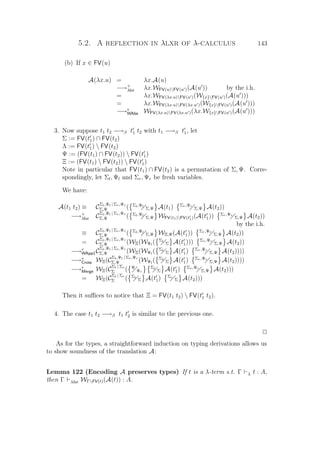
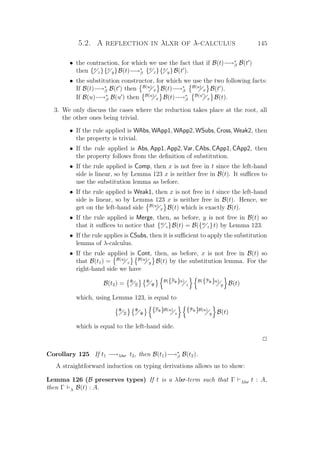
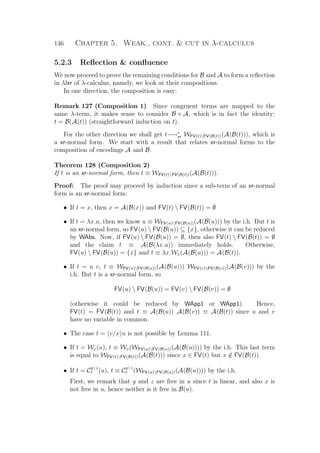
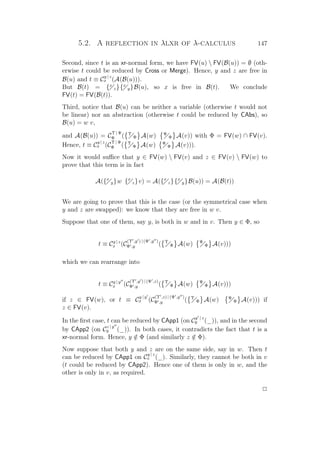
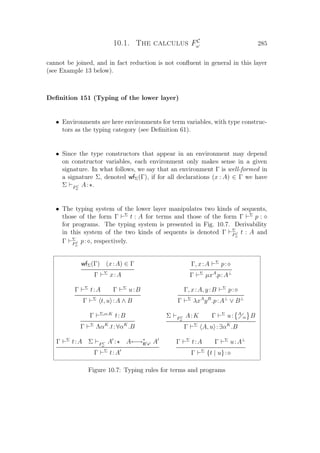
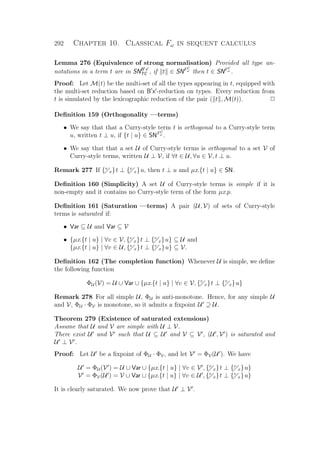
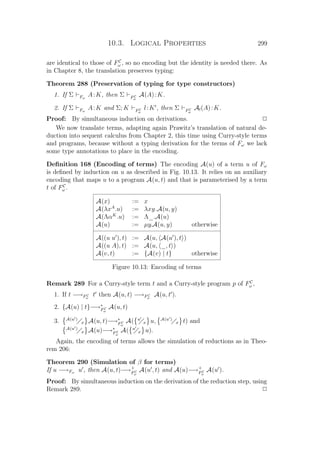
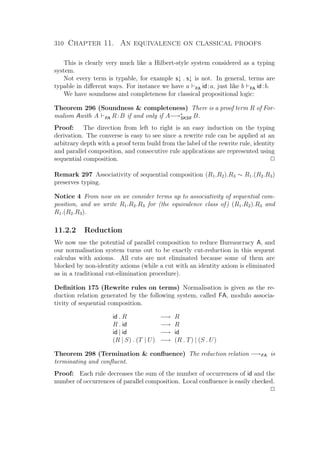
University of St Andrews
Normalisation & Équivalence
en Théorie de la Démonstration
& Théorie des Types
Stéphane Lengrand
Thèse de Doctorat
Spécialité Informatique
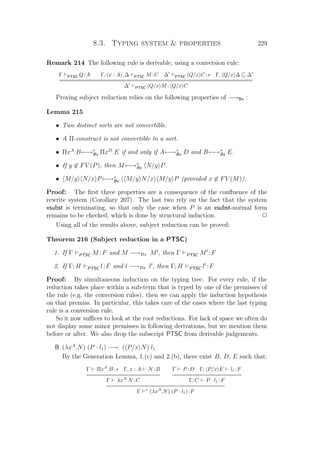
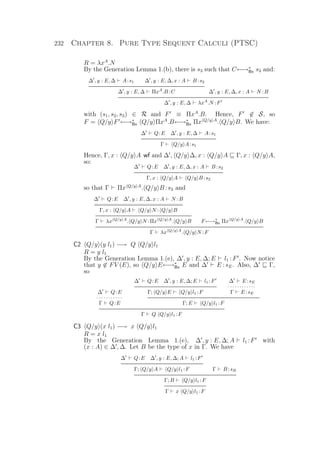
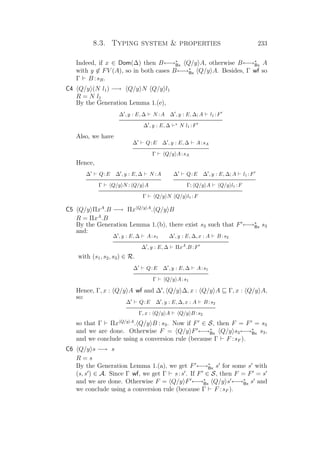
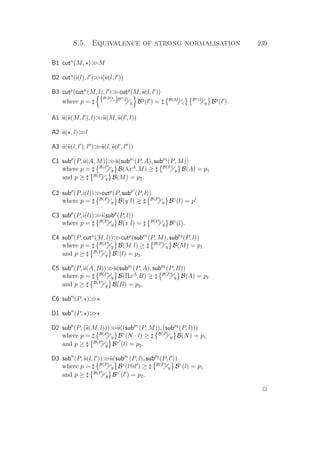
Dirigée par :
Pr. Delia Kesner, Paris VII
Dr Roy Dyckhoff, St Andrews
Soutenue publiquement le 8 Décembre 2006 devant le jury composé de :
Dr Pierre-Louis Curien, Président
Dr James McKinna, Examinateur interne de St Andrews
Pr. Gilles Dowek, Rapporteur pour Paris VII
Pr. Luke Ong, Rapporteur pour St Andrews
Pr. Henk Barendregt Examinateur
Pr. Dale Miller Examinateur
& des directeurs de thèse
Résumé
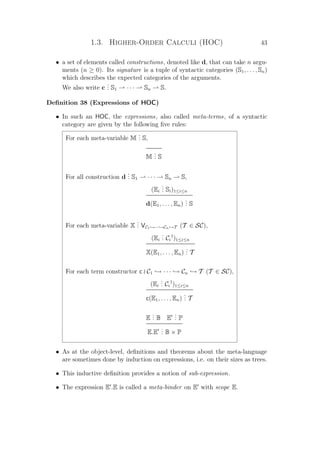
Au coeur des liens entre Théorie de la Démonstration et Théorie des Types, la
correspondance de Curry-Howard fournit des termes de preuves aux aspects cal-
culatoires et équipés de théories équationnelles, i.e. des notions de normalisation
et d’équivalence. Cette thèse contribue à étendre son cadre à des formalismes
(comme le calcul des séquents) appropriés à des considérations d’ordre logique
comme la recherche de preuve, à des systèmes expressifs dépassant la logique
propositionnelle comme des théories des types, et aux raisonnements classiques
plutôt qu’intuitionistes.
La première partie est intitulée Termes de Preuve pour la Logique In-
tuitioniste Implicationnelle, avec des contributions en déduction naturelle et
calcul des séquents, normalisation et élimination des coupures, sémantiques en
appel par nom et par valeur. En particulier elle introduit des calculs de termes
de preuve pour le calcul des séquents depth-bounded G4 et la déduction naturelle
multiplicative. Cette dernière donne lieu à un calcul de substitutions explicites
avec affaiblissements et contractions, qui raffine la β-réduction.
La deuxième partie, intitulée Théorie des Types en Calcul des Séquents,
développe une théorie des Pure Type Sequent Calculi, équivalents aux Systèmes
de Types Purs mais mieux adaptés à la recherche de preuve.
La troisième partie, intitulée Vers la Logique Classique, étudie des ap-
proches à la Théorie des Types classique. Elle développe un calcul des séquents
pour une version classique du Système Fω. Une approche à la question de
l’équivalence de preuves classiques consiste à calculer les représentants canon-
iques de preuves équivalentes dans le cadre du Calcul des Structures.
Synopsis
Au coeur des liens entre Théorie de la Démonstration et Théorie des Types se
trouve sans aucun doute la correspondance de Curry-Howard [How80]. Quels
avantages la Logique tire de ces liens n’est pas la question qui fait l’objet de la
présente thèse, dans laquelle on considère comme acquis le fait qu’il soit intel-
lectuelement désirable d’avoir en Logique:
• des objets mathématiques qui formalisent la notion de démonstration,
• des notions de calcul et de normalisation de ces objets,
• des théories équationnelles sur ces objets, c’est-à-dire des notions
d’équivalence, en relation avec les notions de calcul.
La correspondance de Curry-Howard fournit de tels concepts à la Logique en
connectant démonstrations et programmes d’une part, et proposition et types
d’autre part. Alors que son cadre originel était la déduction naturelle intuition-
iste [Gen35] (ou des systèmes à la Hilbert), les questions abordées par la présente
thèse se positionnent dans un cadre plus large, mais en mettant toujours l’accent
sur les notions d’équivalence et de normalisation. Plus précisément, elle contribue
à étendre le cadre des concepts fournis par la correspondance de Curry-Howard:
• à des formalismes en théorie de la démonstration (tels que le calcul des
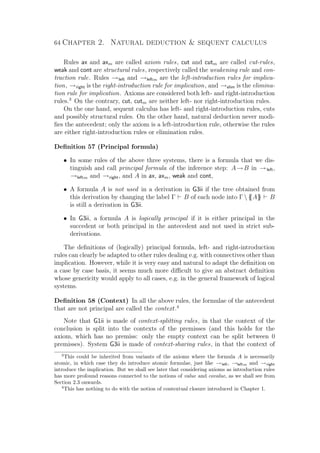
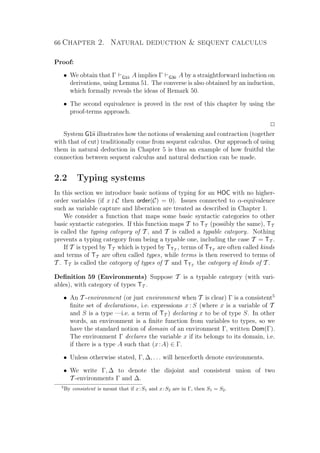
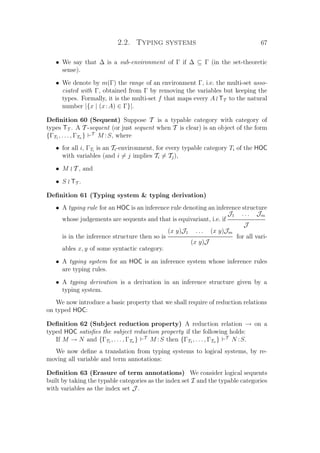
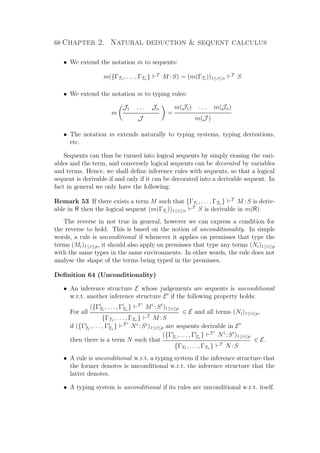
séquents [Gen35]) qui sont appropriés à des considérations d’ordre logique
comme la recherche de démonstration (aussi appelée recherche de preuve),
• à des systèmes expressifs dépassant la logique propositionnelle tels que des
théories des types,
• aux raisonnements classiques plutôt qu’intuitionistes.
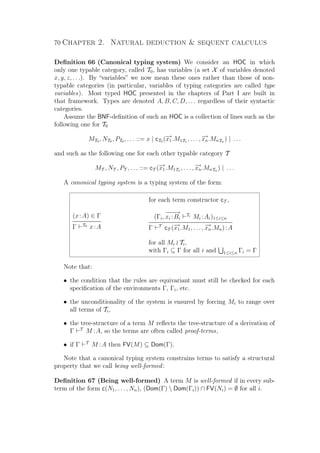
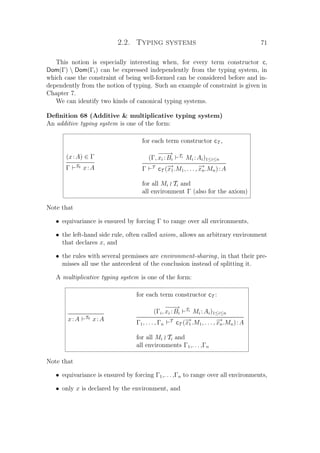
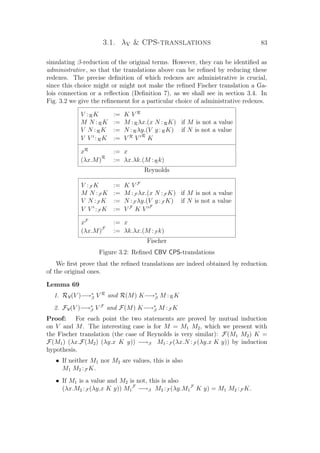
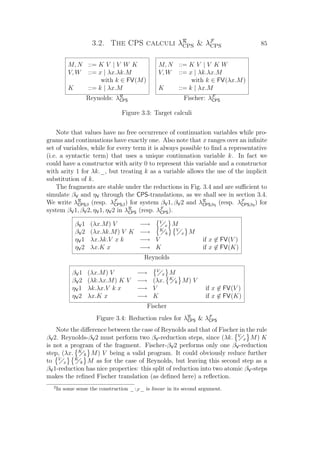
Les trois parties de cette thèse reflètent ces directions.
La première partie est intitulée Termes de Preuve pour la Logique Intu-
itioniste Implicationnelle; elle reste dans le cadre de la logique propositionnelle
intuitioniste (avec l’implication comme seul connecteur logique) mais elle étudie
les notions de la correspondance de Curry-Howard non seulement en déduction
naturelle mais aussi en calcul des séquents. Elle présente ainsi les termes (aussi
v
vi
appelés termes de preuve) avec lesquels sont représentés les démonstrations des
formalismes sus-mentionnés, ainsi que les avantages de l’utilisation, en déduction
naturelle, de règles issues du calcul des séquents, et enfin les notions de calcul
dans ce dernier formalisme et leurs liens avec les sémantiques d’appel par nom et
d’appel par valeur [Plo75].
La seconde partie est intitulée Théorie des Types en Calcul des Séquents;
elle reste dans le cadre de la logique intuitioniste et construit une théorie qui est
au calcul des séquents ce que les Systèmes de Types Purs [Bar92] sont à la déduc-
tion naturelle. Au delà des propriétés fondamentales de cette théorie sont aussi
étudiées des questions telles que la recherche de preuve et l’inférence de type.
La troisième partie est intitulée Vers la logique classique et est motivée
par l’objectif de construire en logique classique des théories similaires à celles
dévelopées dans la seconde partie en logique intuitioniste. En particulier, cette
partie dévelope un calcul des séquent correspondant au Système Fω [Gir72] mais
dont la couche des démonstrations est classique. Au delà d’une telle théorie des
types, la notion d’équivalence des démonstrations classiques devient cruciale et
la partie est conclue par une approche à ce problème.
La présente thèse aborde donc un grand nombre de questions, pour lesquelles
un cadre et une terminologie unifiés, les couvrant toutes, sont à la fois importants
et non-triviaux:
Chapitre 1
Ce chapitre présente les concepts et la terminologie utilisés dans le reste de la
thèse. Il présente tout d’abord les notions et notations concernant relations et
fonctions, comme les notions de (relation de) réduction, forte et faible simula-
tion, correspondance équationnelle, réflection, confluence, dérivation dans une
structure d’inférence. . .
Puis une partie importante est consacrée à la forte et la faible simulation ainsi
qu’aux techniques fondamentales pour prouver ces propriétés. Une considération
omniprésente dans cette partie est l’approche intuitioniste des résultats établis,
qui évite les raisonnements classiques commençant par “Supposons qu’il existe une
séquence de réduction infinie” et aboutissant à une contradiction. Par exemple la
technique de simulation est établie de manière intuitioniste, ainsi que les résultats
de forte normalisation des réductions lexicographiques et des réductions de multi-
ensembles.
Une autre partie importante de ce chapitre est consacrée aux calculs d’ordre
supérieur (HOC). En effet, les outils de la correspondance de Curry-Howard, dans
son cadre originel ou dans ceux abordés dans cette thèse, sont fondés sur des syn-
taxes de termes dont les constructeurs impliquent des liaisons de variables et
dont les relations de réduction sont définies par systèmes de réécriture [Ter03]
(que nous présentons avec les notions associées de redex, clôture contextuelle,
variable libre et muette, substitution,. . . ). De tels outils nécessitent un prudent
vii
traitement de l’α-equivalence (le fait que le choix d’une variable muette n’est
pas d’importance), en utilisant habituellement des conditions qui évitent la cap-
ture et la libération de variables. Dans la présente thèse nous écrirons rarement
ces conditions, précisément parce qu’elles peuvent être retrouvée mécaniquement
d’après le contexte où elle sont nécéssitées. Ce chapitre décrit comment.
Partie I
Chapitre 2
Ce chapitre présente la déduction naturelle, le calcul des séquents [Gen35] avec
(ou sans) sans règle de coupure, le λ-calcul [Chu41] avec sa notion de réduction ap-
pelée β-reduction, ainsi que la correspondance de Curry-Howard [How80]. Pour
cela, ce chapitre prolonge le chapitre 1 avec les concepts de sequent, système
logique, système de typage, terme de preuve, et la propriété de subject reduc-
tion, utilisés non seulement dans la partie I mais aussi dans le chapitre 10. Ce
chapitre est conclu par un calcul d’ordre supérieur pour représenter les démonstra-
tions du calcul des séquents intuitioniste G3ii, utilisé par exemple dans [DP99b].
Est remarqué le fait que le constructeur typé par une coupure est de la forme
d’une substitution explicite [ACCL91, BR95]. Les encodages de Gentzen et
Prawitz [Gen35, Pra65] entre la déduction naturelle et le calcul des séquents
sont exprimés ici comme des traductions de termes de preuves qui préservent le
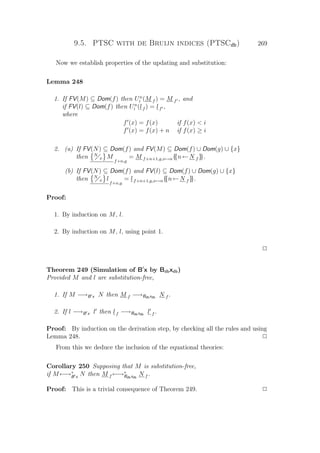
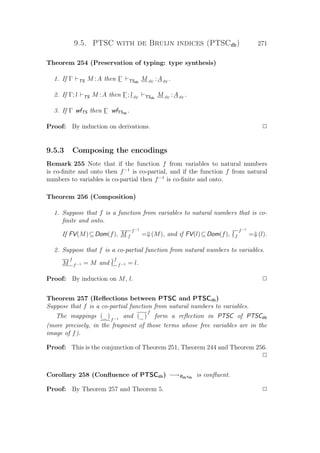
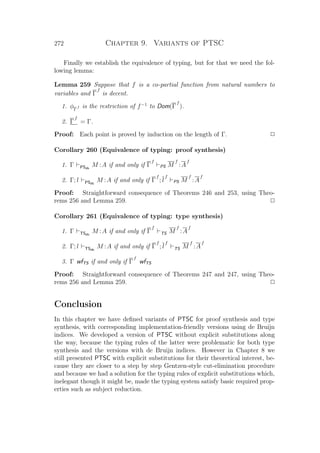
typage.
Chapitre 3
Ce chapitre étudie le λ-calculus en appel par valeur (CBV) et part du calcul
λV [Plo75], qui restreint la β-reduction aux cas βV où l’argument d’une fonction est
déjà évalué comme valeur. On présente ensuite la sémantique CBV grâce à deux
variantes de traduction en Continuation Passing Style (CPS) dans des fragments
du λ-calcul : celle de Reynolds [Rey72, Rey98] et celle de Fischer [Fis72, Fis93].
On présente le calcul λC de Moggi qui étend λV [Mog88] d’une manière telle
que les traductions CPS deviennent des correspondances équationnelles [SF93,
SW97] : l’équivalence entre termes de λC générée par leurs réductions correspond
à l’équivalence entre leurs encodages générée par la β-reduction. Dans [SW97],
ceci est renforcé par le fait qu’un raffinement de la traduction de Reynolds forme
même une réflection. On prouve ici que c’est aussi le cas pour la traduction de
Fischer (si une modification mineure et naturelle de λC est faite), and l’on déduit
de cette réflection la confluence de λC (modifié). La modification et la réflection
aide aussi à établir un lien avec le calcul des séquents LJQ présenté au chapitre 6.
viii
Chapitre 4
Dans ce chapitre sont présentées deux techniques (qui peuvent être combinées)
pour prouver des propriétés de forte normalisation, en particulier des propriétés
de calculs proches du λ-calcul telles que la préservation de la forte normalisation
(PSN) [BBLRD96]. Ces deux techniques sont des raffinements de la technique de
simulation du chapitre 1.
Le point de départ de la première technique, appelée safeness and minimality
technique, est le fait que, pour prouver la forte normalisation, seules les réductions
de rédexes dont les sous-termes sont fortement normalisables ont besoin d’être
considérées (minimality). Ensuite, la notion de safeness fournit un critère utile
(selon que le rédex à réduire est fortement normalisable ou non) pour séparer les
réductions minimales en deux relations de réduction, dont la forte normalisation
peut être alors prouvée par composition lexicographique. L’exemple du calcul de
substitution explicites λx [BR95] illustre la technique, par des preuves courtes de
PSN, et de forte normalisation des termes simplement typés ou typés avec des
types intersection [CD78, LLD+
04].
La seconde technique fournit des outils pour prouver la forte normalisation
d’un calcul lié au λ-calcul, par simulation dans le λI-calcul de [Klo80] (fondé
sur les travaux antérieurs de [Chu41, Ned73]), si une simulation directe dans le
λ-calcul échoue. On démontre ainsi la propriété PSN pour λI. Cette seconde
technique est illustrée dans le chapitre 5.
Chapitre 5
Dans ce chapitre on présente un calcul d’ordre supérieur appelé λlxr dont la ver-
sion typée correspond, par la correspondance de Curry-Howard, à une version
multiplicative de la déduction naturelle intuitioniste. Celle-ci utilise des affaib-
lissements, des contractions and des coupures, habituels en calcul des séquents
(par exemple dans la version original de [Gen35]). Les constructeurs typés par les
règles sus-mentionnées peuvent être vus comme des constructeurs de ressources
gérant l’effacement et la duplication de substitutions explicites.
On décrit le comportement opérationnel de λlxr et ses propriétés fondamen-
tales, pour lesquels une notion d’équivalence sur les termes joue un rôle essentiel,
en particulier dans les réductions du calcul. Cette équivalence rapproche λlxr des
réseaux de preuve pour (le fragment intuitioniste de) la logique linéaire [Gir87]
(en fait [KL05, KL07] révèle une correspondance), mais elle est aussi nécessaire
pour que λlxr simule la β-réduction. Dans ce chapitre est établie une réflection du
λ-calculus dans λlxr, qui inclut la forte simulation de la β-reduction et entraîne la
confluence de λlxr. En utilisant la seconde technique dévelopée au chapitre 4, on
prouve aussi PSN et la forte normalisation des termes typés. λlxr est un calcul de
substitutions explicites qui a une notion de full composition et la propriété PSN.
ix
Chapitre 6
Dans ce chapitre est étudiée la notion de calcul dans le calcul des séquents in-
tuitioniste propositionnel —ici G3ii, fondée sur l’élimination des coupures. On
passe en revue trois types de systèmes d’élimination des coupures, tous forte-
ment normalisables sur les termes de preuve (typés), et l’on identifie une struc-
ture commune d’où sont définies les notions de réduction en appel par nom (CBN)
et en appel par valeur (CBV). On rappelle la t-restriction et la q-restriction dans
le calcul des séquents [DJS95, Her95] qui, dans le cas intuitioniste, mènent aux
fragments LJT et LJQ. Ceux-ci sont respectivement stables par réductions CBN
et CBV. On formalise par une réflection le lien entre LJT (et son calcul λ de
termes de preuve) et la déduction naturelle (et le λ-calcul). On prouve aussi PSN
pour λ, illustrant à nouveau la méthode de safeness and minimality dévelopée
au Chapitre 4. Le fragment LJQ est quant à lui connecté à la version du calcul
CBV λC [Mog88] présentée au chapitre 3.
Chapitre 7
Dans ce chapitre est appliquée la méthodologie des chapitre 2 et 6 (pour G3ii) au
calcul des séquents intuitioniste depth-bounded G4ii de [Hud89, Hud92, Dyc92].
On montre dans un premier temps comment l’on passe de LJQ à G4ii. Un cal-
cul de termes de preuve est ensuite présenté, utilisant des constructeurs corre-
spondant aux règles d’inférence admissibles dans le système (comme la règle de
coupure). Alors que les démonstrations traditionnelle d’admissibilité par induc-
tion suggèrent des transformations de démonstration faiblement normalisables,
on renforce ces approches en introduisant divers systèmes de réduction de terme
de preuve qui sont fortement normalisables. Les diverses variantes correspondent
à différentes optimisations, dont certaines sont orthogonales comme les sous-
systèmes CBN et CBV similaires à ceux de G3ii. Nous remarquons toutefois que
le sous-système CBV est plus naturel que celui CBN, ce qui est lié au fait que G4ii
est fondé sur LJQ.
Partie II
Chapitre 8
Fondés sur la déduction naturelle, les Systèmes de types purs (PTS) [Bar92] peu-
vent exprimer de nombreuses théories des types. Pour exprimer la recherche
de preuve dans de telles théories, on présente dans ce chapitre les Pure Type
Sequent Calculi (PTSC) en enrichissant LJT et le λ-calculus [Her95], presentés
au chapitre 6, car ils sont particulièrement adaptés à la recherche de preuve et
fortement liés à la déduction naturelle et au λ-calcul.
x
Les PTSC sont équippés d’une procédure de normalisation, adaptant celle de
λ et donc définie par des règles de réécriture locales en utilisant des substitutions
explicites. La propriété de subject reduction est démontrée et la réflection dans
λ du λ-calcul est adaptée en une réflection dans les PTSC des PTS. De plus,
le fait que la réflection préserve le typage montre qu’un PTSC est logiquement
équivalent au PTS correspondant. On démontre aussi que le premier est fortement
normalisable si et seulement si le deuxième l’est aussi.
Chapitre 9
Dans se chapitre sont étudiées des variantes des PTSC, essentiellement dévelop-
pées pour la recherche de preuve et l’inférence de type.
On montre comment les règles de conversion peuvent être incorporées aux
autres règles pour que les tactiques basiques de recherche de preuve soient sim-
plement l’application de bas en haut des règles d’inférence. Des variables d’ordre
supérieur (qui peuvent être vues comme des méta-variables) sont alors ajoutées
au formalisme ainsi que des contraintes d’unification, afin d’ajourner la réso-
lution de sous-buts dans la recherche de preuve et d’exprimer des algorithmes
d’énumération d’habitants de types similaire à ceux de [Dow93, Mun01].
On montre aussi comment les règles de conversion peuvent être incorporées
aux autres règles pour que l’inférence de type soit l’application de bas en haut des
règles d’inférence, d’un manière similaire au Constructive engine de la déduction
naturelle [Hue89, vBJMP94]. Pour cette section il est nécessaire d’introduire une
version des PTSC aux substitutions implicites, car l’inférence de type échoue avec
nos règles de typage pour les substitutions explicites.
Cette version avec substitutions implicites peut être aussi plus facilement
transformée en une version avec indices de de Bruijn, ce qui est fait dans la
dernière partie du chapitre, dans le style de [KR02].
Partie III
Chapitre 10
Dans ce chapitre on présente un système appelé FC
ω , une version du
Système Fω [Gir72] dans laquelle la couche des constructeurs de types est es-
sentiellement la même mais la prouvabilité des types est classique. Le calcul des
termes de preuve qui rend compte du raisonnement classique est une variante du
λ-calcul symétrique de [BB96].
On prouve que l’ensemble du calcul est fortement normalisable. Pour la couche
des constructeurs de types, on utilise la méthode de réductibilité de Tait et Girard,
combinée à des techniques d’orthogonalité. Pour la couche (classique) des termes
de preuve, on utilise la méthode de [BB96] fondée sur une notion symétrique de
candidats de réductibilité. Le système FC
ω , avec ses deux couches de différente
nature, est ainsi une opportunité de comparer les deux techniques et poser la
conjecture que la deuxième technique ne peut pas être subsumée par la première.
Nous concluons avec une preuve de cohérence de FC
ω , et un encodage du tra-
ditionel Système Fω dans FC
ω , même lorsque le premier utilise des axiomes sup-
plémentaires de la logique classique.
Chapitre 11
Tenter d’introduire des raisonnements classiques plus loin dans les théories des
types dévelopées en seconde partie (par exemple avec des types dépendants) se
heurte au problème de la définition d’une notion appropriée d’équivalence de dé-
monstrations classiques. Dans ce chapitre une approche originale est suggérée,
dans le cadre de la logique propositionnelle classique, et fondée sur le Calcul des
Structures [Gug, Gug02]. Les démonstrations sont des séquences de réécriture
sur les formules, et nous utilisons la notion de réduction parallèle [Tak89] pour
identifier différentes séquentialisations d’étapes de réécritures qui réduisent des
rédexes qui ne se chevauchent pas. Le cas des rédexes parallèles et celui des
rédexes imbriqués donnent lieu à deux notions d’équivalence sur les séquences de
réécriture (dans un système de réécriture linéaire qui formalise la logique clas-
sique). A partir de ces notions sont présentés deux formalismes qui autorisent
les réductions parallèles et ainsi fournissent un représentant canonique à deux
démonstrations équivalentes. Ce représentant peut être obtenu d’une démonstra-
tion quelconque par une relation de réduction particulière, qui est confluente and
qui termine (la confluence dans le cas des rédexes imbriqués n’est que conjec-
turée). Ces formalismes se révèlent être des calculs des séquents avec axiomes, et
leurs termes de preuves utilisent des combinateurs comme pour les systèmes à la
Hilbert. La procédure de normalisation qui produit les représentants canoniques
se trouve être une procédure de réduction des coupures.
Dépendences entre chapitres
Pour faciliter la lecture de cette thèse et permettre certains chapitres d’être lus
indépendemment, le graphe de dépendence des chapitres est présenté dans la
Fig. 0, ainsi que les références bibliographiques dans lesquelles leur contenus, ou
certaines parties de leurs contenus, sont parus.
Les flèches pleines représentent une réelle dépendence (mais parfois seulement
parce qu’un chapitre utilise des définitions données dans un chapitre antérieur
mais familières au lecteur) ; les flèches en pointillés ne représentent qu’un lien
plus faible sans faire d’un chapitre le préalable d’un autre.
Définitions
générales
Logique
intuitioniste
Logique
classique
Chapitre 1
[Len05]
ÐÐ


Chapitre 2
xx
•–—™dfghjlm
o
ÔÔ
|| ~~|||||||||||||||||||
ÐÐ
××

Chapitre 3
44
‡ „ €
u
q
Chapitre 5
[KL05, KL07]
Chapitre 6
[DL06]
1
1
1
DDe d ™ — – • ” “ ‘  ‰
Chapitre 8
[LDM06]
ÑÑÔ
Ô
Ô
Ô
Ô
Ô
Ô
Ô
Ô
Ô
Ô
Chapitre 4
[Len05]
yy1
1
1
VVq
q
q
q
q
Chapitre 7
[DKL06]
Chapitre 9
Chapitre 10
[LM06]
xxq
q
q
q
q
Chapitre 11
[BL05]
Logique propositionnelle Théorie des types
Déduction
naturelle
Calcul des séquents
Fig. 0: Graphe de dépendence
Normalisation  Equivalence
in Proof Theory  Type Theory
Stéphane Lengrand
Dissertation submitted towards the degree of
Doctor of Philosophy
Université Paris VII — Denis Diderot
University of St Andrews
Advisers:
Pr. Delia Kesner, Paris VII
Dr Roy Dyckhoff, St Andrews
Thesis publicly defended on Friday 8th December 2006 before
Dr Pierre-Louis Curien, Chairman
Dr James McKinna, Internal examiner of St Andrews
Pr. Gilles Dowek, Referee for Paris VII
Pr. Luke Ong, Referee for St Andrews
Pr. Henk Barendregt Examiner
Pr. Dale Miller Examiner
 the advisers
Abstract
At the heart of the connections between Proof Theory and Type Theory, the
Curry-Howard correspondence provides proof-terms with computational features
and equational theories, i.e. notions of normalisation and equivalence. This dis-
sertation contributes to extend its framework in the directions of proof-theoretic
formalisms (such as sequent calculus) that are appealing for logical purposes like
proof-search, powerful systems beyond propositional logic such as type theories,
and classical (rather than intuitionistic) reasoning.
Part I is entitled Proof-terms for Intuitionistic Implicational Logic. Its
contributions use rewriting techniques on proof-terms for natural deduction (λ-
calculus) and sequent calculus, and investigate normalisation and cut-elimination,
with call-by-name and call-by-value semantics. In particular, it introduces proof-
term calculi for multiplicative natural deduction and for the depth-bounded se-
quent calculus G4. The former gives rise to the calculus λlxr with explicit substi-
tutions, weakenings and contractions that refines the λ-calculus and β-reduction,
and preserves strong normalisation with a full notion of composition of substitu-
tions. The latter gives a new insight to cut-elimination in G4.
Part II, entitled Type Theory in Sequent Calculus develops a theory of
Pure Type Sequent Calculi (PTSC), which are sequent calculi that are equivalent
(with respect to provability and normalisation) to Pure Type Systems but better
suited for proof-search, in connection with proof-assistant tactics and proof-term
enumeration algorithms.
Part III, entitled Towards Classical Logic, presents some approaches to
classical type theory. In particular it develops a sequent calculus for a classical
version of System Fω. Beyond such a type theory, the notion of equivalence
of classical proofs becomes crucial and, with such a notion based on parallel
rewriting in the Calculus of Structures, we compute canonical representatives of
equivalent proofs.
Acknowledgements
It goes without saying that my greatest debt of gratitude is owed to my advisers
Delia Kesner and Roy Dyckhoff for all the time and energy that they have invested
in my thesis. Not only was I lucky to grow up in a biparental academic family,
but both of them provided the support and patience that a Ph.D. student could
hope for from a single adviser; the joint supervision was thus all the more fruitful,
eventually leading to [KL05, KL07, DL06, DKL06] and this dissertation.
Whilst they had a central role in making this cotutelle rewarding, it would not
have been possible without the initial efforts of Jacques Chevalier and the French
Embassy in London, whose plans met my Auld Alliance project at the right time.
With them I wish to thank Frank Riddell in St Andrews and other people from
each university whom I have not met, for pushing the cotutelle agreement through
many bureaucratic obstacles.
I am very grateful to Gilles Dowek and Luke Ong for agreeing to referee my
thesis, particularly in light of the work and time requisite in reading the 349
pages of this unexpectedly lengthy dissertation. I also wish to thank Pierre-
Louis Curien, Henk Barendregt, and Dale Miller for having accepted to sit on my
examination panel, and thus honoured me with their interest and time.
I thank James McKinna for the above reasons, and also for his role during
my time in St Andrews. Owing to his pioneering some of the ideas that Part II
investigates, his unique insight consolidated the progress I made. Part II thus
benefitted from numerous discussions with him, to the extent that his role therein
was that of an additional adviser, eventually leading to [LDM06]. I was met with
equal friendliness working with my other co-authors, such as Alexandre Miquel
and Kai Brünnler with whom joint work [LM06, BL05] was the origin of Part
III. They share a genuine and open-minded scientific curiosity that supported
my work. Alexandre’s grasp of Type Theory, pedagogical skills, patience, and
frequent after-dark presence at PPS made him a point of reference in the field to
which I regularly turn to. I appreciate in Kai his analytical mind and method-
ological approach to research, always having astute questions and concerns; a
memorable experience of skihock during a delightful wintery week-end in Bern
reminds me that his energy and enthusiasm to explore new and exotic ideas go
beyond academia.
I am also extremely grateful to Hugo Herbelin —on the work of whom most of
my thesis is based, Kentaro Kikuchi and José Espírito Santo for their challenging
ideas and feedback, countless enlightening discussions and shared interests, which,
I hope, will lead to future work together.
Among those many people with whom scientific discussions helped me make
progress in my thesis are Alessio Guglielmi, Claude Kirchner, Alex Simpson,
Christian Urban, Emmanuel Polonovski, and Zhaohui Luo, who were so kind as
to invite me to give a talk and/or go for a pint.
To conclude the scientific acknowledgements, I thank Pierre Lescanne and his
teachings that have ushered me to my field of research and its communities, and
anonymous referees for their helpful feedback and constructive criticism.
I am particularly grateful to my mother, for having heavily edited the latex
source of Chapter 10 with me dictating over the phone the day before a deadline,
and my father; their experience as academics is and has consistently been of great
value for me. Greatly appreciated was the friendly atmosphere of my offices
in Paris and St Andrews, mostly due to their occupants. I wish to thank the
secretaries of both departments for their patience and efforts, I know that I have
been much of a complicated case at times.
Finally, I thank those who put up with me in times of hardship, and sincerely
apologise for my absence or silence which these busy times of writing have caused.
For the close person amongst them who endured this most I have a very special
thought.
Thank you.
à Rémi,
Table of Contents
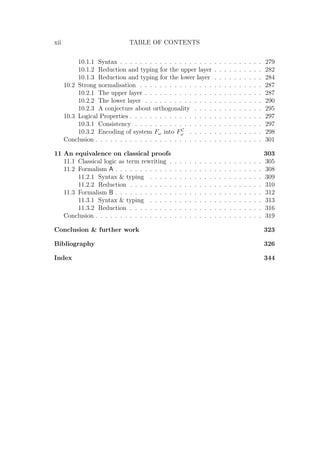
Introduction 1
1 Concepts  terminology 9
1.1 Relations . . . . . . . . . . . . . . . . . . . . . . . . . . . . . . . . 11
1.1.1 Definitions  notations . . . . . . . . . . . . . . . . . . . . 11
1.1.2 Confluence . . . . . . . . . . . . . . . . . . . . . . . . . . . 15
1.1.3 Inference  derivations . . . . . . . . . . . . . . . . . . . . 16
1.2 A constructive theory of normalisation . . . . . . . . . . . . . . . 20
1.2.1 Normalisation  induction . . . . . . . . . . . . . . . . . . 20
1.2.2 Termination by simulation . . . . . . . . . . . . . . . . . . 26
1.2.3 Lexicographic termination . . . . . . . . . . . . . . . . . . 27
1.2.4 Multi-set termination . . . . . . . . . . . . . . . . . . . . . 30
1.3 Higher-Order Calculi (HOC) . . . . . . . . . . . . . . . . . . . . . 33
1.3.1 Introduction and literature . . . . . . . . . . . . . . . . . . 33
1.3.2 Syntax of HOC . . . . . . . . . . . . . . . . . . . . . . . . 34
1.3.3 Meta-level  conventions about variable binding . . . . . . 40
1.3.4 Rules, systems  encoding as HRS . . . . . . . . . . . . . 50
1.3.5 Induction principles with HOC . . . . . . . . . . . . . . . . 55
1.4 Termination by Recursive Path Ordering . . . . . . . . . . . . . . 56
Conclusion . . . . . . . . . . . . . . . . . . . . . . . . . . . . . . . . . . 57
I Proof-terms for Intuitionistic Implicational Logic 59
2 Natural deduction  sequent calculus 61
2.1 Logical systems  implicational intuitionistic logic . . . . . . . . . 61
2.2 Typing systems . . . . . . . . . . . . . . . . . . . . . . . . . . . . 66
2.3 Natural deduction  λ-calculus . . . . . . . . . . . . . . . . . . . 72
2.4 An HOC for G3ii . . . . . . . . . . . . . . . . . . . . . . . . . . . . 74
2.5 Encodings to  from λ-calculus . . . . . . . . . . . . . . . . . . . 76
Conclusion . . . . . . . . . . . . . . . . . . . . . . . . . . . . . . . . . . 77
ix
x TABLE OF CONTENTS
3 Call-by-value λ-calculus 79
3.1 λV  CPS-translations . . . . . . . . . . . . . . . . . . . . . . . . 81
3.2 The CPS calculi λR
CPS  λF
CPS . . . . . . . . . . . . . . . . . . . . . 84
3.3 Moggi’s λC-calculus . . . . . . . . . . . . . . . . . . . . . . . . . . 88
3.4 The refined Fischer translation is a reflection . . . . . . . . . . . . 90
Conclusion . . . . . . . . . . . . . . . . . . . . . . . . . . . . . . . . . . 94
4 Two refinements of the simulation technique 95
4.1 The safeness  minimality technique . . . . . . . . . . . . . . . . 98
4.1.1 A case study: PSN of λx . . . . . . . . . . . . . . . . . . . 101
4.1.2 A case study: strong normalisation of typed λx . . . . . . 103
4.2 The simulation technique using a memory operator . . . . . . . . 106
4.2.1 The λI-calculus . . . . . . . . . . . . . . . . . . . . . . . . 107
4.2.2 Simulating the perpetual strategy . . . . . . . . . . . . . . 108
Conclusion . . . . . . . . . . . . . . . . . . . . . . . . . . . . . . . . . . 116
5 Weakening, contraction  cut in λ-calculus 117
5.1 The calculus λlxr . . . . . . . . . . . . . . . . . . . . . . . . . . . 120
5.1.1 The linear syntax . . . . . . . . . . . . . . . . . . . . . . . 120
5.1.2 Congruence  notations . . . . . . . . . . . . . . . . . . . 121
5.1.3 Reduction . . . . . . . . . . . . . . . . . . . . . . . . . . . 122
5.1.4 Termination of xr . . . . . . . . . . . . . . . . . . . . . . . 125
5.1.5 Typing . . . . . . . . . . . . . . . . . . . . . . . . . . . . . 130
5.2 A reflection in λlxr of λ-calculus . . . . . . . . . . . . . . . . . . . 137
5.2.1 From λ-calculus to λlxr-calculus . . . . . . . . . . . . . . . 137
5.2.2 From λlxr-calculus to λ-calculus . . . . . . . . . . . . . . . 144
5.2.3 Reflection  confluence . . . . . . . . . . . . . . . . . . . . 146
5.3 Normalisation results . . . . . . . . . . . . . . . . . . . . . . . . . 149
5.3.1 Preservation of Strong Normalisation . . . . . . . . . . . . 149
5.3.2 Strong normalisation of typed terms . . . . . . . . . . . . 153
Conclusion . . . . . . . . . . . . . . . . . . . . . . . . . . . . . . . . . . 154
6 Cut-elimination in G3ii  stable fragments 155
6.1 Cut-elimination . . . . . . . . . . . . . . . . . . . . . . . . . . . . 156
6.1.1 Aims . . . . . . . . . . . . . . . . . . . . . . . . . . . . . . 156
6.1.2 Kernel  propagation system . . . . . . . . . . . . . . . . 157
6.1.3 Instances of propagation systems . . . . . . . . . . . . . . 159
6.2 T-restriction  LJT . . . . . . . . . . . . . . . . . . . . . . . . . . 168
6.2.1 A fragment of λG3 . . . . . . . . . . . . . . . . . . . . . . 168
6.2.2 The λ-calculus . . . . . . . . . . . . . . . . . . . . . . . . 169
6.2.3 A reflection of (CBN) λ-calculus . . . . . . . . . . . . . . . 169
6.2.4 Normalisation results in λ . . . . . . . . . . . . . . . . . . 173
6.3 Q-restriction  LJQ . . . . . . . . . . . . . . . . . . . . . . . . . . 176
TABLE OF CONTENTS xi
6.3.1 A fragment of λG3 . . . . . . . . . . . . . . . . . . . . . . 176
6.3.2 The CPS-semantics of λLJQ . . . . . . . . . . . . . . . . . 176
6.3.3 Connection with Call-by-Value λ-calculus . . . . . . . . . . 181
Conclusion . . . . . . . . . . . . . . . . . . . . . . . . . . . . . . . . . . 184
7 A higher-order calculus for G4ii 187
7.1 From G3ii to G4ii . . . . . . . . . . . . . . . . . . . . . . . . . . . 188
7.2 An HOC for G4ii . . . . . . . . . . . . . . . . . . . . . . . . . . . . 190
7.2.1 Syntax . . . . . . . . . . . . . . . . . . . . . . . . . . . . . 190
7.2.2 Typing . . . . . . . . . . . . . . . . . . . . . . . . . . . . . 191
7.3 Proof transformations  reduction rules . . . . . . . . . . . . . . 192
7.4 Subject reduction  strong normalisation . . . . . . . . . . . . . . 195
7.5 Variants of reduction systems . . . . . . . . . . . . . . . . . . . . 210
7.5.1 η-expansion  the alternative in the cut-reduction system 211
7.5.2 Orthogonal systems . . . . . . . . . . . . . . . . . . . . . . 212
Conclusion . . . . . . . . . . . . . . . . . . . . . . . . . . . . . . . . . . 214
II Type Theory in Sequent Calculus 215
8 Pure Type Sequent Calculi (PTSC) 217
8.1 Syntax  reduction . . . . . . . . . . . . . . . . . . . . . . . . . . 219
8.2 A reflection of Pure Type Systems . . . . . . . . . . . . . . . . . . 221
8.3 Typing system  properties . . . . . . . . . . . . . . . . . . . . . 224
8.4 Correspondence with Pure Type Systems . . . . . . . . . . . . . . 235
8.5 Equivalence of strong normalisation . . . . . . . . . . . . . . . . . 238
Conclusion . . . . . . . . . . . . . . . . . . . . . . . . . . . . . . . . . . 240
9 Variants of PTSC 243
9.1 Proof synthesis . . . . . . . . . . . . . . . . . . . . . . . . . . . . 246
9.2 Higher-order variables for proof enumeration . . . . . . . . . . . . 250
9.3 PTSC with implicit substitutions . . . . . . . . . . . . . . . . . . 256
9.4 Type synthesis . . . . . . . . . . . . . . . . . . . . . . . . . . . . 258
9.5 PTSC with de Bruijn indices (PTSCdb) . . . . . . . . . . . . . . . 262
9.5.1 From PTSCdb to PTSC . . . . . . . . . . . . . . . . . . . . 265
9.5.2 From PTSC to PTSCdb . . . . . . . . . . . . . . . . . . . . 268
9.5.3 Composing the encodings . . . . . . . . . . . . . . . . . . 271
Conclusion . . . . . . . . . . . . . . . . . . . . . . . . . . . . . . . . . . 272
III Towards Classical Logic 275
10 Classical Fω in sequent calculus 277
10.1 The calculus FC
ω . . . . . . . . . . . . . . . . . . . . . . . . . . . . 279
xii TABLE OF CONTENTS
10.1.1 Syntax . . . . . . . . . . . . . . . . . . . . . . . . . . . . . 279
10.1.2 Reduction and typing for the upper layer . . . . . . . . . . 282
10.1.3 Reduction and typing for the lower layer . . . . . . . . . . 284
10.2 Strong normalisation . . . . . . . . . . . . . . . . . . . . . . . . . 287
10.2.1 The upper layer . . . . . . . . . . . . . . . . . . . . . . . . 287
10.2.2 The lower layer . . . . . . . . . . . . . . . . . . . . . . . . 290
10.2.3 A conjecture about orthogonality . . . . . . . . . . . . . . 295
10.3 Logical Properties . . . . . . . . . . . . . . . . . . . . . . . . . . . 297
10.3.1 Consistency . . . . . . . . . . . . . . . . . . . . . . . . . . 297
10.3.2 Encoding of system Fω into FC
ω . . . . . . . . . . . . . . . 298
Conclusion . . . . . . . . . . . . . . . . . . . . . . . . . . . . . . . . . . 301
11 An equivalence on classical proofs 303
11.1 Classical logic as term rewriting . . . . . . . . . . . . . . . . . . . 305
11.2 Formalism A . . . . . . . . . . . . . . . . . . . . . . . . . . . . . . 308
11.2.1 Syntax  typing . . . . . . . . . . . . . . . . . . . . . . . 309
11.2.2 Reduction . . . . . . . . . . . . . . . . . . . . . . . . . . . 310
11.3 Formalism B . . . . . . . . . . . . . . . . . . . . . . . . . . . . . . 312
11.3.1 Syntax  typing . . . . . . . . . . . . . . . . . . . . . . . 313
11.3.2 Reduction . . . . . . . . . . . . . . . . . . . . . . . . . . . 316
Conclusion . . . . . . . . . . . . . . . . . . . . . . . . . . . . . . . . . . 319
Conclusion  further work 323
Bibliography 326
Index 344
Introduction
At the heart of the connections between Proof Theory and Type Theory undoubt-
edly lies the Curry-Howard correspondence [How80]. What Logic gains from these
connections is not the issue that we take as the purpose of this dissertation, in
which we rather take for granted the fact that are intellectually appealing such
concepts in Logic as:
• mathematical objects that can formalise the notion of proof,
• computational features of these objects with notions of normalisation,
• equational theories about these objects, that is to say, notions of equiva-
lence, that are related to their computational features.
The Curry-Howard correspondence provides such concepts to Logic by relating
proofs to programs and propositions to types, so that insight into one aspect
helps the understanding of the other. While its original framework was intuition-
istic propositional natural deduction [Gen35] (or Hilbert-style systems), this dis-
sertation investigates some issues pertaining to a more general framework, with
a particular emphasis on the notions of equivalence and normalisation. More
precisely, it contributes to broaden the scope of the concepts provided by the
Curry-Howard correspondence in three directions:
• proof-theoretic formalisms (such as sequent calculus [Gen35]) that are ap-
pealing for logical purposes such as proof-search,
• powerful systems beyond propositional logic such as type theories,
• classical reasoning rather than intuitionistic reasoning.
The three parts of this dissertation reflect these directions.
Part I is entitled Proof-terms for Intuitionistic Implicational Logic; it
remains within the framework of propositional intuitionistic logic (with impli-
cation as the only connective) but investigates the notions given by the Curry-
Howard correspondence in natural deduction as well as in sequent calculus. It
addresses such topics as the terms (a.k.a. proof-terms) with which the proofs of
these formalisms are represented, the benefits of using in natural deduction some
1
2 Introduction
rules of sequent calculus, the notions of computation in sequent calculus and their
relation with call-by-name and call-by-value semantics [Plo75].
Part II is entitled Type Theory in Sequent Calculus; it remains in the
framework of intuitionistic logic and builds a theory that is to sequent calculus
what Pure Type Systems [Bar92] are to natural deduction. Beyond the basic
properties of the theory, further aspects are developed, such as proof-search and
type inference.
Part III is entitled Towards Classical Logic and is motivated by the purpose
of building theories in classical logic such as those of Part II in intuitionistic logic.
In particular it develops a sequent calculus corresponding to System Fω [Gir72]
but whose layer of proofs is classical. Beyond such a type theory, the notion of
equivalence of classical proofs becomes crucial and the part concludes with an
approach to this issue.
This dissertation thus addresses a wide range of topics, for which a unified
framework and terminology, covering all of them, are thus both important and
non-trivial:
Chapter 1
This chapter introduces the concepts and the terminology that are used through-
out the three parts of the dissertation. It first introduces all notions and no-
tations about relations and functions, including reduction relation, strong and
weak simulation, equational correspondence, reflection, confluence, derivation in
an inference structure. . .
Then a major section is devoted to the notions of (weak and strong) nor-
malisation and basic techniques to prove these properties. A particular concern
of this section is to develop these ideas in a constructive setting, avoiding the
usual reasonings starting with “Let us assume that there is an infinite reduction
sequence,. . . ”, used especially when the strong normalisation of a reduction rela-
tion is inferred, by simulation, from that of another one that we already know to
be strongly normalising. We thus prove results about the strong normalisation
of the lexicographic composition of relations and the multi-set reduction relation.
Another major section of this chapter is devoted to Higher-Order Calculi. In-
deed, the tools for the Curry-Howard correspondence, whether in its original set-
ting or in the various ones tackled here, are based on syntaxes of terms involving
variable binding, with reduction relations given by rewrite systems [Ter03] which
we present together with the notions, traditional in rewriting, of redex, contextual
closure, free variables, substitution,. . . Such tools require a careful treatment of
α-equivalence (the fact that the choice of a variable that is bound is irrelevant),
usually using conditions to avoid variable capture and liberation. In this disser-
tation we deliberately not write these conditions, precisely because they can be
recovered mechanically from the context in which they are needed. This chapter
explains how.
Introduction 3
Part I
Chapter 2
This chapter introduces natural deduction, sequent calculus [Gen35] with (or
without) its cut-rule, λ-calculus [Chu41] with its notion of reduction called β-
reduction, and the Curry-Howard correspondence [How80]. For that it extends
Chapter 1 with such general concepts as sequents, logical systems, typing systems,
proof-terms, and subject reduction property, which will not only be used through-
out Part I but also in Chapter 10. It concludes by presenting an higher-order
calculus to represent proofs of the intuitionistic sequent calculus G3ii, as used for
instance in [DP99b]. It notes the fact that the constructor typed by a cut has
the shape of an explicit substitution [ACCL91, BR95]. Gentzen’s and Prawitz’s
encodings [Gen35, Pra65] between natural deduction and sequent calculus are
expressed here as type-preserving translations of proof-terms.
Chapter 3
In this chapter we investigate the call-by-value (CBV) λ-calculus. We start from
the calculus λV [Plo75], which merely restricts β-reduction to the case βV where
arguments of functions are already evaluated as values. We then present the CBV
semantics given by Continuation Passing Style (CPS) translations (into fragments
of λ-calculus), in two variants: Reynolds’ [Rey72, Rey98] and Fischer’s [Fis72,
Fis93]. We present Moggi’s λC-calculus [Mog88] that extends λV in a way such
that the CPS-translations become equational correspondences [SF93, SW97]. In
other words, the equivalence on λC-terms generated by their reductions matches
the equivalence between their encodings given by β-reduction. In [SW97] the
result is stronger in that (a refinement of) the Reynolds translation even forms
a reflection. In this chapter we prove that it is also the case for the Fischer
translation (if we make a minor and natural modification to λC), and we infer
from our reflection the confluence of (this modified) λC. The modification and
the reflection also help establishing a connection with a sequent calculus called
LJQ and presented in Chapter 6.
Chapter 4
In this chapter we present two techniques, which can be combined, to prove strong
normalisation properties, especially properties of calculi related to λ-calculus such
as Preservation of Strong Normalisation (PSN) [BBLRD96]. They are both re-
finements of the simulation technique from Chapter 1.
The first technique, called the safeness and minimality technique, starts with
the fact that, in order to prove strong normalisation, only the reduction of re-
dexes whose sub-terms are strongly normalising need to be looked at (minimal-
4 Introduction
ity). Then safeness provides a useful criterion (reducing redexes that are strongly
normalising or that are not) in order to split the (minimal) reductions of a calcu-
lus into two reduction relations, which can then be proved strongly normalising
by a lexicographic composition. The example of the explicit substitution calcu-
lus λx [BR95] illustrates the technique, with short proofs of PSN, strong nor-
malisation of the simply-typed version and that of its version with intersection
types [CD78, LLD+
04].
The second technique provides tools to prove the strong normalisation of a
calculus related to λ-calculus by simulation in the λI-calculus of [Klo80] (based
on earlier work by [Chu41, Ned73]), when a direct simulation in λ-calculus fails.
Such a tool is the PSN property for λI. This technique is illustrated in Chapter 5.
Chapter 5
In this chapter, we present a higher-order calculus called λlxr whose typed version
corresponds, via the Curry-Howard correspondence, to a multiplicative version of
intuitionistic natural deduction. The latter uses weakenings, contractions and
cuts, which are common in sequent calculus, e.g. in its original version [Gen35].
The constructors typed by the above rules can be seen as resource constructors
handling erasure and duplication of explicit substitutions.
We describe the operational behaviour of λlxr and its fundamental proper-
ties, for which a notion of equivalence on terms plays an essential role, in par-
ticular in the reduction relation of the calculus. This equivalence brings λlxr
close to the proof nets for (the intuitionistic fragment of) linear logic [Gir87] (in
fact [KL05, KL07] reveals a sound and complete correspondence), but it is also
necessary in order for λlxr to simulate β-reduction. In this chapter we actually
establish a reflection of λ-calculus in λlxr, which includes the strong simulation of
β-reduction and entails confluence of λlxr. Using the second technique developed
in Chapter 4, we also prove PSN, and strong normalisation of typed terms. λlxr is
an HOC with explicit substitutions having full composition and preserving strong
normalisation.
Chapter 6
In this chapter we investigate the notions of computation in intuitionistic propo-
sitional sequent calculus —here G3ii, based on cut-elimination. We survey three
kinds of cut-elimination system, proved or conjectured to be strongly normalis-
ing on typed terms, and identify a common structure in them, from which we
generically define call-by-name (CBN) and call-by-value (CBV) reductions. We
recall the t- and q-restrictions in sequent calculus [DJS95, Her95] which, in the
intuitionistic case, lead to the fragments LJT and LJQ of G3ii. These are stable
under CBN and CBV reductions, respectively. By means of a reflection we relate
Introduction 5
LJT, and its higher-order calculus λ that provides its proof-terms, to natural de-
duction and λ-calculus. We also prove PSN of λ as another illustration of the
safeness and minimality technique from Chapter 4. We then relate LJQ and its
proof-terms to (the modified version of) the CBV calculus λC [Mog88] presented
in Chapter 3.
Chapter 7
In this chapter we apply the methodology of Chapter 2 and Chapter 6 (for G3ii) to
the depth-bounded intuitionistic sequent calculus G4ii of [Hud89, Hud92, Dyc92].
We first show how G4ii is obtained from LJQ. We then present a higher-order
calculus for it —decorating proofs with proof-terms, which uses constructors cor-
responding to admissible rules such as the cut-rule. While existing inductive
arguments for admissibility suggest weakly normalising proof transformations,
we strengthen these approaches by introducing various term-reduction systems,
all strongly normalising on typed terms, representing proof transformations. The
variations correspond to different optimisations, some of them being orthogonal
such as CBN and CBV sub-systems similar to those of G3ii. We note however
that the CBV sub-system seems more natural than the CBN one, which is related
to the fact that G4ii is based on LJQ.
Part II
Chapter 8
Based on natural deduction, Pure Type Systems (PTS) [Bar92] can express a
wide range of type theories. In order to express proof-search in such theories, we
introduce in this chapter the Pure Type Sequent Calculi (PTSC) by enriching LJT
and the λ-calculus [Her95], presented in Chapter 6, because they are adapted to
proof-search and strongly related to natural deduction and λ-calculus.
PTSC are equipped with a normalisation procedure, adapted from that of λ
and defined by local rewrite rules as in cut-elimination, using explicit substitu-
tions. We prove that they satisfy subject reduction and turn the reflection in λ of
λ-calculus into a reflection in PTSC of PTS. Moreover, the fact that the reflection
is type-preserving shows that a PTSC is logically equivalent to its corresponding
PTS. Then we prove that the former is strongly normalising if and only if the
latter is.
Chapter 9
In this chapter we investigate variants of PTSC, mostly designed for proof-search
and type inference.
6 Introduction
We show how the conversion rules can be incorporated into the other rules so
that basic proof-search tactics in type theory are merely the root-first application
of the inference rules. We then add to this formalism higher-order variables (that
can be seen as meta-variables) and unification constraints, in order to delay the
resolution of sub-goals in proof-search and express type inhabitant enumeration
algorithms such as those of [Dow93, Mun01].
We also show how the conversion rules can be incorporated into the other
rules so that type inference becomes the root-first application of the inference
rules, in a way similar to the Constructive engine in natural deduction [Hue89,
vBJMP94]. For this section we also need to introduce a version of PTSC with
implicit substitutions, since type inference fails on our typing rule for explicit
substitutions.
This version with implicit substitutions is also easier to turn into a version
with de Bruijn indices, which we do in the final part of the chapter, in the style
of [KR02].
Part III
Chapter 10
In this chapter we present a system called FC
ω , a version of System Fω [Gir72] in
which the layer of type constructors is essentially the same whereas provability of
types is classical. The proof-term calculus accounting for the classical reasoning
is a variant of Barbanera and Berardi’s symmetric λ-calculus [BB96].
We prove that the whole calculus is strongly normalising. For the layer of
type constructors, we use Tait and Girard’s reducibility method combined with
orthogonality techniques. For the (classical) layer of terms, we use Barbanera and
Berardi’s method based on a symmetric notion of reducibility candidates. System
FC
ω , with its two layers of different nature, is thus an opportunity to compare the
two above techniques and raise the conjecture that the latter cannot be captured
by the former.
We conclude with a proof of consistency for FC
ω , and an encoding from the
traditional System Fω into FC
ω , also when the former uses extra axioms to allow
classical reasonings.
Chapter 11
Trying to introduce classical reasonings further inside the type theories developed
in Part II, namely when these feature dependent types, runs into the problem of
defining a suitable notion of equivalence for classical proofs. In this chapter we
suggest an original approach, in the framework of classical propositional logic,
based on the Calculus of Structures [Gug, Gug02]. Proofs are rewrite sequences
Introduction 7
on formulae, and we use the notion of parallel reduction [Tak89] to collapse bu-
reaucratic sequentialisations of rewrite steps that reduce non-overlapping redexes.
The case of parallel redexes and that of nested redexes give rise to two notions
of equivalence on rewrite sequences (according to a linear rewrite system that
formalises classical logic). We thence introduce two formalisms that allow par-
allel rewrite steps, thus providing to equivalent proofs a single representative.
This representative can be obtained from any proof in the equivalence class by
a particular reduction relation, which is confluent and terminating (confluence
in the case of nested redexes is only conjectured). These formalisms turn out to
be sequent calculi with axioms and proof-terms for them use combinators as in
Hilbert-style systems. The normalisation process that produce canonical repre-
sentatives is then a cut-reduction process.
Dependencies between chapters
To facilitate the reading of this dissertation and allow particular chapters to be
read independently, we show in Fig. 1 the dependency graph of chapters, together
with the references where some or all of their contents already appeared.
Full arrows represent a real dependency (but sometimes only because a chap-
ter uses definitions, given in another chapter, of notions that are familiar to the
reader), while dashed arrows represent only a weak connection without making
one chapter a prerequisite for the other.
8 Introduction
General
definitions
Intuitionistic
logic
Classical
logic
Chapter 1
[Len05]
ÐÐ


Chapter 2
xx
“•–—™dfgijlm
o
ÔÔ
|| ~~}}}}}}}}}}}}}}}}}}}
ÑÑ
××

Chapter 3
33
‡ „ €
u
p
Chapter 5
[KL05, KL07]
Chapter 6
[DL06]
1
1
1
DDe d ™ ˜ – • ” ’ ‘  ‰
Chapter 8
[LDM06]
ÒÒÕ
Õ
Õ
Õ
Õ
Õ
Õ
Õ
Õ
Õ
Õ
Chapter 4
[Len05]
yy1
1
1
VVq
q
q
q
q
Chapter 7
[DKL06]
Chapter 9
Chapter 10
[LM06]
yyr
r
r
r
r
Chapter 11
[BL05]
Propositional logic Type theories
Natural
deduction
Sequent calculus
Figure 1: Dependency graph
Chapter 1
Concepts  terminology
This chapter defines coherent terminology and notations for the concepts used in
this dissertation.
Section 1.1 introduces the concepts related to relations, simulation, conflu-
ence, inference and derivations.
Section 1.2 tackles notions of normalisation. Their definitions are inspired by
a thread created by René Vestergaard on the TYPES mailing-list, gathering and
comparing various definitions. Our first purpose here is defining and establishing
a theory of normalisation that does not rely on classical logic and double negation.
Negation usually lies in the very definition of strong normalisation when it is
expressed as “there is no infinite reduction sequence”. The most striking example
is the following use of the definition to prove that a reduction relation is strongly
normalising, starting with “suppose an infinite reduction sequence” and ending
with a contradiction.
A positive version such as “all reduction sequences are finite” subtly requires
a general definition of reduction sequence that can be finite or not, and its careful
formal treatment in a constructive theory of finiteness and infiniteness does not
seem simpler than our approach, which we now present.
In our approach, the induction principle is no longer a property of strongly
normalising relations, but is the basis of its very definition. In other words,
instead of basing the notion of strong normalisation on the finiteness of reduction
sequences, we base it on the notion of induction: by definition, a relation is
strongly normalising if it satisfies the induction principle. The latter should
hold for every predicate, so the notion of normalisation is based on second-order
quantification rather than double-negation.
We express several induction principles in this setting, then we re-establish
some traditional results, especially some techniques to prove strong normalisa-
tion. We constructively prove the correctness of the simulation technique and a
few refinements, as well as the termination of the lexicographic reductions and
the multi-set reductions. A constructive proof of the latter has already been
given by Wilfried Buchholz and is a special case of Coquand’s constructive treat-
9
10 Chapter 1. Concepts  terminology
ment [Coq94] of Ramsey theory.
Most of the material in this section can be found in various textbooks
(e.g. [Ter03]), but perhaps not always with constructive proofs, and we intend to
make this dissertation self-contained.
A first version of this section, together with the major part of chapter 4,
appeared as the technical report [Len05].
Section 1.3 describes how the rest of the dissertation treats higher-order cal-
culi, i.e. calculi involving variable binding. Again, a good overview of formalisms
describing higher-order formalisms can be found in [Ter03].
Objects of the theory are α-equivalence classes of terms, and variable binding
requires us to take care of such problems as variable capture and variable libera-
tion, constantly juggling between α-equivalence classes and their representatives.
Reasonings about higher-order calculi are thus tricky: formalising them prop-
erly in first-order logic, where terms have no intrinsic notion of binding, might re-
quire a lot of side-conditions and lemmas (e.g. about renaming, name-indifference,
etc.).
Whether or not such a heavy formalisation is in fact helpful for the reader’s
understanding might be questioned. It could be argued that a human mind is
rather distracted from the main reasoning by such formalities, while it can nat-
urally grasp reasonings modulo α-conversion, noting that mathematicians have
been working with bound variables for a long time.
Stating Barendregt’s convention at the beginning of a short paper is often
the only option that space permits, with the implicit intention to convince the
reader that, with some effort, he could formalise the forthcoming reasonings in
first-order logic by recovering all necessary side-conditions.
Here we develop the ideas of Barendregt’s convention, starting with the claim
that solutions for dealing with variable binding do not concern the object-level
(in other words, the terms), but the meta-level in the way we describe reasoning
—in other words, the expressions that we use to denote terms.
We can mechanically infer the side-conditions avoiding variable capture and
liberation by looking at expressions: for each meta-variable we look at the binders
in the scope of which it occurs, and if a binder on some variable appears above
one occurrence but not above another, then we forbid this variable to be free
in the term represented by the meta-variable, otherwise it will be liberated or
captured (depending on the way we see the two occurrences).
The concepts are thus very natural but their formalisation makes this section
rather technical, as with most works tackling the formalisation of the meta-level.
Hence, reading section 1.3 is only of significant interest to the rest of the
dissertation insofar as assuring that our treatment of α-equivalence is rigorous.
We also recall the notions of terms, sub-terms, rewrite systems, but only standard
knowledge of these concepts is required for the understanding of the following
chapters.
1.1. Relations 11
1.1 Relations
We take for granted usual notions and results of set theory, such as the empty set
and subsets, the union, intersection and difference of sets, relations, functions,
injectivity, surjectivity, natural numbers. . . (see e.g. [Kri71]). Unless otherwise
stated, relations are binary relations. We denote by |S| the cardinal of a set S.
1.1.1 Definitions  notations
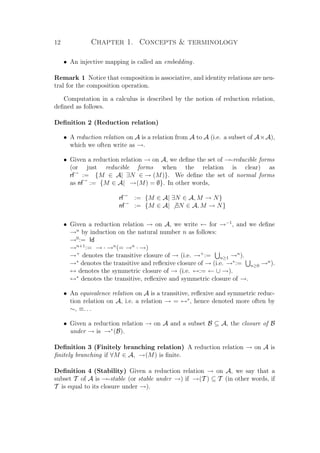
Definition 1 (Relations)
• We denote the composition of relations by · , the identity relation by Id,
and the inverse of a relation by −1
, all defined below:
Let R : A −→ B and R : B −→ C.
– Composition
R · R : A −→ C is defined as follows: given M ∈ A and N ∈ C,
M(R · R )N if there exists P ∈ B such that MRP and PR N. Some-
times we also use the notation R ◦ R for R · R .
– Identity
Id[A] : A −→ A is defined as follows:
given M ∈ A and N ∈ A, MIdAN if M = N.
– Inverse
R−1
: B −→ A is defined as follows:
given M ∈ B and N ∈ A, MR−1
N if NRM.
• If D ⊆ A, we write R(D) for {M ∈ B| ∃N ∈ D, NRM}, or equivalently
N∈D{M ∈ B| NRM}. When D is the singleton {M}, we write R(M) for
R({M}).
• Now when A = B we define the relation induced by R through R , written
R [R], as R −1
· R · R : C −→ C.
• We say that a relation R : A −→ B is total if R−1
(B) = A.
• If R : A −→ B and A ⊆ A then R|A : A −→ B is the restriction of R to
A , i.e. those pairs of R whose first components are in A .
• All those notions and notations can be used in the particular case when
R is a function, that is, if ∀M ∈ A, R(M) is of the form {N} (which we
simply write R(M) = N).
• A total function is called a mapping (also called an encoding, a translation
or an interpretation).
12 Chapter 1. Concepts  terminology
• An injective mapping is called an embedding.
Remark 1 Notice that composition is associative, and identity relations are neu-
tral for the composition operation.
Computation in a calculus is described by the notion of reduction relation,
defined as follows.
Definition 2 (Reduction relation)
• A reduction relation on A is a relation from A to A (i.e. a subset of A×A),
which we often write as →.
• Given a reduction relation → on A, we define the set of →-reducible forms
(or just reducible forms when the relation is clear) as
rf→
:= {M ∈ A| ∃N ∈ → (M)}. We define the set of normal forms
as nf→
:= {M ∈ A| →(M) = ∅}. In other words,
rf→
:= {M ∈ A| ∃N ∈ A, M → N}
nf→
:= {M ∈ A| ∃N ∈ A, M → N}
• Given a reduction relation → on A, we write ← for →−1
, and we define
→n
by induction on the natural number n as follows:
→0
:= Id
→n+1
:= → · →n
(= →n
· →)
→+
denotes the transitive closure of → (i.e. →+
:= n≥1 →n
).
→∗
denotes the transitive and reflexive closure of → (i.e. →∗
:= n≥0 →n
).
↔ denotes the symmetric closure of → (i.e. ↔:= ← ∪ →).
↔∗
denotes the transitive, reflexive and symmetric closure of →.
• An equivalence relation on A is a transitive, reflexive and symmetric reduc-
tion relation on A, i.e. a relation → = ↔∗
, hence denoted more often by
∼, ≡. . .
• Given a reduction relation → on A and a subset B ⊆ A, the closure of B
under → is →∗
(B).
Definition 3 (Finitely branching relation) A reduction relation → on A is
finitely branching if ∀M ∈ A, →(M) is finite.
Definition 4 (Stability) Given a reduction relation → on A, we say that a
subset T of A is →-stable (or stable under →) if →(T ) ⊆ T (in other words, if
T is equal to its closure under →).
1.1. Relations 13
Definition 5 (Reduction modulo) Let ∼ be an equivalence relation on a set
A, let → be a reduction relation on A. The reduction relation → modulo ∼ on A,
denoted →∼, is ∼ · → · ∼. It provides a reduction relation on the ∼-equivalence
classes of A. If → is a reduction relation → modulo ∼, → alone is called the
basic reduction relation and denoted →b.1
We now present the notion of simulation. We shall use it for two kinds of
results: confluence (below) and strong normalisation (section 1.2). While sim-
ulation is often presented using an mapping from one calculus to another, we
provide here a useful generalised version for an arbitrary relation between two
calculi.
Definition 6 (Strong and weak simulation)
Let R be a relation between two sets A and B, respectively equipped with the
reduction relations →A and →B.
• →B strongly simulates →A through R if (R−1
· →A) ⊆ (→+
B · R−1
).
In other words, for all M, M ∈ A and for all N ∈ B, if MRN and
M →A M then there is N ∈ B such that M RN and N →+
B N .
Notice that when R is a function, this implies R[→A] ⊆→+
B .
If it is a mapping, then →A ⊆ R−1
[→+
B ].
• →B weakly simulates →A through R if (R−1
· →A) ⊆ (→∗
B · R−1
).
In other words, for all M, M ∈ A and for all N ∈ B, if MRN and
M →A M then there is N ∈ B such that M RN and N →∗
B N .
Notice that when R is a function, this implies R[→A] ⊆→∗
B.
If it is a mapping, then →A ⊆ R−1
[→∗
B].
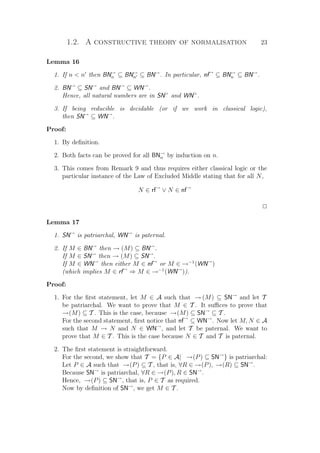
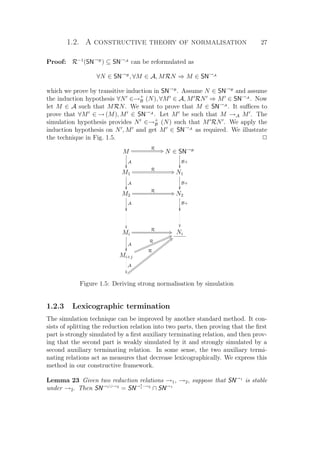
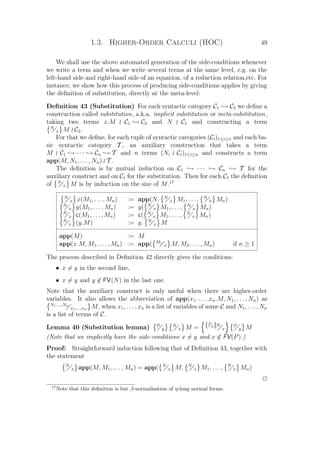
The notions are illustrated in Fig. 1.1.
M
A

R CQ N
B+

M
R CQ N
M
A

R CQ N
B∗

M
R CQ N
Strong simulation Weak simulation
Figure 1.1: Strong and weak simulation
1
This is not a functional notation that only depends on a reduction relation → on ∼-
equivalence classes of A, but a notation that depends on the construction of → as a reduction
relation modulo ∼.
14 Chapter 1. Concepts  terminology
Remark 2
1. If →B strongly (resp. weakly) simulates →A through R, and if →B⊆→B
and →A⊆→A, then →B strongly (resp. weakly) simulates →A through R.
2. If →B strongly (resp. weakly) simulates →A and →A through R, then it
also strongly (resp. weakly) simulates →A · →A through R.
3. Hence, if →B strongly simulates →A through R, then it also strongly sim-
ulates →+
A through R.
If →B strongly or weakly simulates →A through R, then it also weakly
simulates →+
A and →∗
A through R.
We now define some more elaborate notions based on simulation, such as
equational correspondence [SF93], Galois connection and reflection [MSS86].
Definition 7 (Galois connection, reflection  related notions)
Let A and B be sets respectively equipped with the reduction relations →A and
→B. Consider two mappings f : A −→ B and g : B −→ A.
• f and g form an equational correspondence between A and B if the following
holds:
– f[↔A] ⊆↔B
– g[↔B] ⊆↔A
– f · g ⊆↔A
– g · f ⊆↔B
• f and g form a Galois connection from A to B if the following holds:
– →B weakly simulates →A through f
– →A weakly simulates →B through g
– f · g ⊆→∗
A
– g · f ⊆←∗
B
• f and g form a pre-Galois connection from A to B if in the four conditions
above we remove the last one.
• f and g form a reflection in A of B if the following holds:
– →B weakly simulates →A through f
– →A weakly simulates →B through g
– f · g ⊆→∗
A
– g · f = IdB
1.1. Relations 15
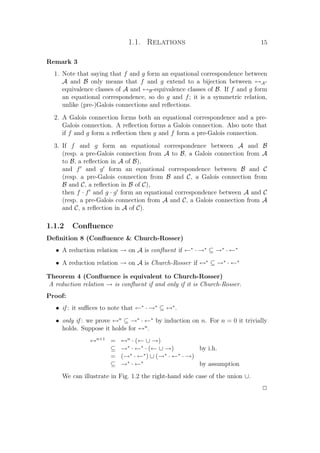
Remark 3
1. Note that saying that f and g form an equational correspondence between
A and B only means that f and g extend to a bijection between ↔A-
equivalence classes of A and ↔B-equivalence classes of B. If f and g form
an equational correspondence, so do g and f; it is a symmetric relation,
unlike (pre-)Galois connections and reflections.
2. A Galois connection forms both an equational correspondence and a pre-
Galois connection. A reflection forms a Galois connection. Also note that
if f and g form a reflection then g and f form a pre-Galois connection.
3. If f and g form an equational correspondence between A and B
(resp. a pre-Galois connection from A to B, a Galois connection from A
to B, a reflection in A of B),
and f and g form an equational correspondence between B and C
(resp. a pre-Galois connection from B and C, a Galois connection from
B and C, a reflection in B of C),
then f · f and g · g form an equational correspondence between A and C
(resp. a pre-Galois connection from A and C, a Galois connection from A
and C, a reflection in A of C).
1.1.2 Confluence
Definition 8 (Confluence  Church-Rosser)
• A reduction relation → on A is confluent if ←∗
· →∗
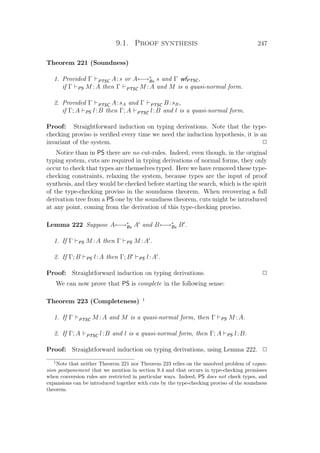
⊆ →∗
· ←∗
• A reduction relation → on A is Church-Rosser if ↔∗
⊆ →∗
· ←∗
Theorem 4 (Confluence is equivalent to Church-Rosser)
A reduction relation → is confluent if and only if it is Church-Rosser.
Proof:
• if : it suffices to note that ←∗
· →∗
⊆ ↔∗
.
• only if : we prove ↔n
⊆ →∗
· ←∗
by induction on n. For n = 0 it trivially
holds. Suppose it holds for ↔n
.
↔n+1
= ↔n
· (← ∪ →)
⊆ →∗
· ←∗
· (← ∪ →) by i.h.
= (→∗
· ←∗
) ∪ (→∗
· ←∗
· →)
⊆ →∗
· ←∗
by assumption
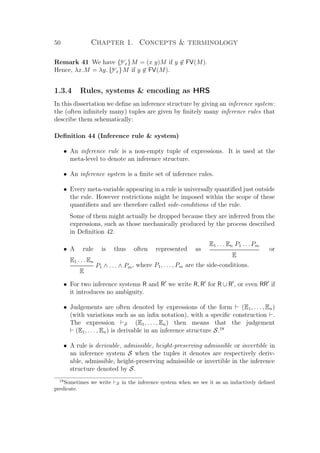
We can illustrate in Fig. 1.2 the right-hand side case of the union ∪.
P
16 Chapter 1. Concepts  terminology
∗
11c
c
c
c GGnoo
∗


GG
∗
1
1
1
∗ GG••••••
Figure 1.2: Confluence implies Church-Rosser
Theorem 5 (Confluence by simulation) If f and g form a pre-Galois con-
nection from A to B and →B is confluent, then →A is confluent.
Proof:
←∗
A · →∗
A ⊆ f−1
[←∗
B · →∗
B] weak simulation
⊆ f−1
[→∗
B · ←∗
B] confluence of →B
= f · →∗
B · ←∗
B · f−1
⊆ f · g−1
[→∗
A · ←∗
A] · f−1
weak simulation
= f · g · →∗
A · ←∗
Ag−1
· f−1
weak simulation
⊆ →∗
A · ←∗
A by assumption
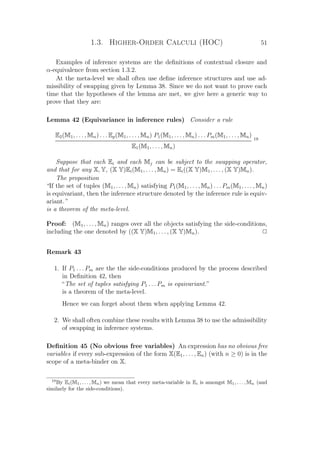
This proof can be graphically represented in Fig. 1.3. P
∗
A 66rrrrrrrrr
∗
A{{vvvvvvvvv
f

∗A
$$
f

f
 ∗ A
ÖÖ
∗
B 66rrrrrrrrr
∗
B{{vvvvvvvvv
∗
B 66rrrrrrrrr
g

∗
B{{vvvvvvvvv
g
g

∗
A
66rrrrrrrrr
∗
A
{{vvvvvvvvv
Figure 1.3: Confluence by simulation
1.1.3 Inference  derivations
We take for granted the notion of (labelled) tree, the notions of node, internal
node and leaf, see e.g. [CDG+
97]. In particular, the height of a tree is the length
of its longest branch (e.g. the height of a tree with only one node is 1), and its
size is its number of nodes.
We now introduce the notions of inference structure and derivations. The
former are used to inductively define atomic predicates, which can be seen as
1.1. Relations 17
particular sets (for predicates with one argument), or as particular n-ary relations
(for predicates with n-arguments). The definitions are more readable if we only
consider sets (rather than arbitrary n-ary relations), but are not less general:
indeed, a n-ary relation is but a set of n-tuples.
Definition 9 (Inference structure) Let A1, . . . , An be sets whose elements
are called judgements. An inference structure is a set of non-empty tuples of
judgements, usually denoted
M1 . . . Mn
M
instead of (M, M1, . . . , Mn). M is called the conclusion of the tuple and M1 . . . Mn
are called the premisses.
Definition 10 (Derivations)
• A derivation in an inference structure (sometimes called full derivation2
)
is a tree whose nodes are labelled with judgements, and such that if a
node is labelled with M and has n sons (n ≥ 0) respectively labelled with
M1, . . . , Mn then (M, M1, . . . , Mn) is in the inference structure.3
• A partial derivation4
is a tree whose nodes are labelled with judgements,
together with a subset of its leaves whose elements are called open leaves,
and such that if a node is not an open leaf, is labelled with M and has n
sons (n ≥ 0) respectively labelled with M1, . . . , Mn then (M, M1, . . . , Mn)
is in the inference structure.5
• The judgement at the root of a (partial or full) derivation is called the
conclusion of the derivation. The latter is said to conclude this judgement.
• A derivation of a judgement is a (full) derivation concluding this judgement.
The latter is said to be derivable.
• A derivation from a set A to a judgement M is a partial derivation con-
cluding M and whose open leaves are labelled with judgements in A.
• Derivations inherit from their tree structures a notion of sub-derivation,
height and size. We sometimes say that we prove a statement “by induction
on a derivation” when we mean “on the height of a derivation”.
• A derivation step is a partial derivation of height 1, i.e. a node and its sons
(i.e. an element of the inference structure).
2
Some authors also call them complete derivations or categorical derivations
3
Leaves of the tree are such that n = 0, with (M) belonging to the inference structure.
4
Some authors also call them complete derivations or hypothetical derivations
5
Note that no condition is imposed on open leaves.
18 Chapter 1. Concepts  terminology
• We write down derivations by composing with itself the notation with one
horizontal bar that we use for inference steps, as shown in Example 1.
Example 1 (Inference structure  derivation) Consider the following in-
ference structure:
d b
c
c b
a d
The following derivation is from {b} to a, has height 3 and size 5.
d b
c b
a
Note the different status of the leaves labelled with b and d, the former being
open and the latter being not.
Definition 11 (Derivability  admissibility)
• A tuple of judgements
M1 . . . Mn
M
is derivable in an inference system if there
is a derivation from the set {M1, . . . , Mn} to M.
In this case we write
M1 . . . Mn
========
M
.6
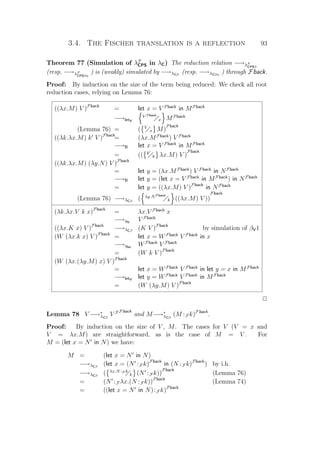
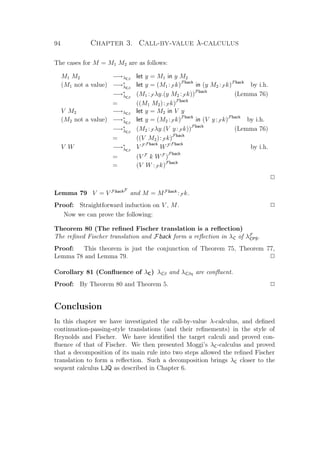
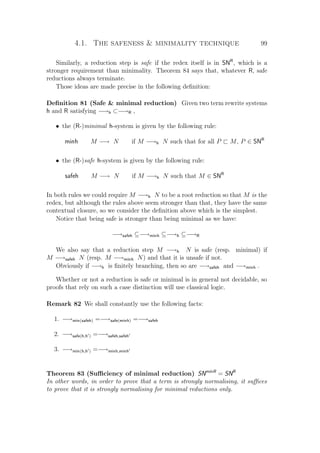
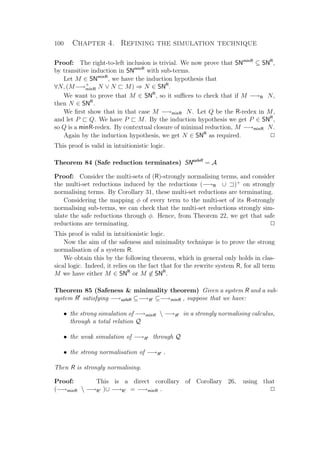
• A tuple of judgements
M1 . . . Mn
M
is admissible in an inference system if for
all derivations of M1 . . . Mn there is a derivation of M.
In this case we write
M1 . . . Mn
· · · · · · · · · ·
M
.
• A tuple of judgements
M1 . . . Mn
M
is height-preserving admissible in an in-
ference system if for all derivations of M1 . . . Mn with heights at most h ∈ N
there exists a derivation of M with height at most h.
In this case we write
M1 . . . Mn
− − − −−
M
.7
6
Note that our notation for derivability, using a double line, is used by some authors for
invertibility. Our notation is based on Kleene’s [Kle52], with the rationale that the double line
evokes several inference steps.
7
The rationale of our notation for height-preserving admissibility is that we can bound the
height of a derivation with fake steps of height-preserving admissibility just by not counting
these steps, since the conclusion in such a step can be derived with a height no greater than
that of some premiss.
1.1. Relations 19
• A tuple of judgements
M1 . . . Mn
M
is invertible in an inference system if it is
derivable and if for all derivations of M there are derivations of M1 . . . Mn.
In this case we write
M1 . . . Mn
M
.8
We shall use these notations within derivations: when writing a derivation we can
use derivable and admissible tuples as fake inference steps. Proofs of derivability
and admissibility then provide the real derivations that are denoted with fake
steps: a fake step of derivability stands in fact for a sequence of real steps, while
a fake step of admissibility requires its premisses to be derivable (i.e. with full
derivations rather than partial ones).
Remark 6 If
M1 . . . Mn
M
is derivable then it is admissible (we can plug the deriva-
tions of M1,. . . , Mn into the derivation from M1,. . . , Mn to M). Note that the
reverse is not true: in order to build a derivation of M knowing derivations of
M1,. . . , Mn we could use another construction than the one above, potentially
without the existence of a derivation from M1,. . . , Mn to M.
Remark 7 Note that a reduction relation is a particular inference structure
made of pairs.
Definition 12 (Reduction sequence)
• A reduction sequence is a partial derivation in a reduction relation →, and
we often write M → · · · → N instead of
M
...
N
. In that case we also say
reduction step instead of inference step. Note that M →∗
N is then the
same as
M
==
N
.
• The height of a reduction sequence is also called its length.
Remark 8 Note that M →n
N if and only if there is a reduction sequence of
length n from M to N.
8
The rationale of our notation for invertibility is that derivability of the conclusion is equiv-
alent to the derivability of the premisses.
20 Chapter 1. Concepts  terminology
1.2 A constructive theory of normalisation
1.2.1 Normalisation  induction
Proving a universally quantified property by induction consists of verifying that
the set of elements having the property is stable, in some sense similar to —yet
more subtle than— that of Definition 4. Leading to different induction principles,
we define two such notions of stability property: being patriarchal and being
paternal.
Definition 13 (Patriarchal, paternal) Given a reduction relation → on A,
we say that
• a subset T of A is →-patriarchal (or just patriarchal when the relation is
clear) if ∀N ∈ A, →(N) ⊆ T ⇒ N ∈ T .
• a subset T of A is →-paternal (or just paternal when the relation is clear)
if it contains nf→
and is stable under →−1
.
• a predicate P on A is patriarchal (resp. paternal) if {M ∈ A| P(M)} is
patriarchal (resp. paternal).
Lemma 9 Suppose that for any N in A, N ∈ rf→
or N ∈ nf→
and suppose
T ⊆ A. If T is paternal, then it is patriarchal.
Proof: In order to prove ∀N ∈ A, →(N) ⊆ T ⇒ N ∈ T , a case analysis is
needed: either N ∈ rf→
or N ∈ nf→
. In both cases N ∈ T because T is paternal.
P
Remark 10 Notice that we can obtain from classical logic the hypothesis for
all N in A, N ∈ rf→
or N ∈ nf→
, because it is an instance of the Law of
Excluded Middle. In intuitionistic logic, assuming this amounts to saying that
being reducible is decidable, which might not always be true.
We would not require this hypothesis if we defined that T is paternal whenever
∀N ∈ A, N ∈ T ∨ (N ∈ rf→
∧ ( →(N) ∩ T = ∅)). This is classically equivalent to
the definition above, but this definition also has some disadvantages as we shall
see later.
Typically, if we want to prove that a predicate P on on some set A holds
throughout A, we actually prove that P is patriarchal or paternal, depending on
the induction principle we use.
Hence, we define normalisation so that normalising elements are those cap-
tured by an induction principle, which should hold for every predicate satisfying
the corresponding stability property. We thus get two notions of normalisation:
the strongly (resp. weakly) normalising elements are those in every patriarchal
(resp. paternal) set.
1.2. A constructive theory of normalisation 21
Definition 14 (Normalising elements) Given a reduction relation → on A:
• The set of →-strongly normalising elements is
SN→
:=
T is patriarchal
T
• The set of →-weakly normalising elements is
WN→
:=
T is paternal
T
Remark 11 Interestingly enough, WN→
can also be captured by an inductive
definition:
WN→
=
n≥0
WN→
n
where WN→
n is defined by induction on the natural number n as follows:
WN→
0 := nf→
WN→
n+1 := {M ∈ A| ∃n ≤ n, M ∈ →−1
(WN→
n )}
With the alternative definition of paternal suggested in Remark 10, the inclu-
sion WN→
⊆ n WN→
n would require the assumption that being reducible by → is
decidable. We therefore preferred the first definition because we can then extract
from a term M in WN→
a natural number n such that M ∈ WN→
n , without the
hypothesis of decidability.
Such a characterisation gives us the possibility to prove that all weakly nor-
malising elements satisfy some property by induction on natural numbers. On
the other hand, trying to do so with strong normalisation leads to a different
notion, as we shall see below. Hence, we lack for SN→
an induction principle
based on natural numbers, which is the reason why we built a specific induction
principle into the definition of SN→
.
Definition 15 (Bounded elements) The set of →-bounded elements is defined
as
BN→
:=
n≥0
BN→
n
where BN→
n is defined by induction on the natural number n as follows:
BN→
0 := nf→
BN→
n+1 := {M ∈ A| ∃n ≤ n, →(M) ⊆ BN→
n }
But we have the following fact:
22 Chapter 1. Concepts  terminology
M
uulllllllllllllllll
||yyyyyyyy

44hhhhhhhh
@@
M1,1 M2,1

. . . Mi,1

. . .
M2,2 . . . Mi,2

. . .
. . . Mi,i . . .
Figure 1.4: M ∈ SN→
but M ∈ BN→
Remark 12 For some reduction relations →, SN→
= BN→
. For instance, Fig. 1.4
shows a term M and relation → such that M ∈ SN→
but M ∈ BN→
.
Lemma 13 However, if → is finitely branching, then BN→
is patriarchal.
As a consequence, BN→
= SN→
(the counter-example above could not be finitely
branching).
Proof: Suppose →(M) ⊆ BN→
. Because → is finitely branching, there exists
a natural number n such that →(M) ⊆ BN→
n . Clearly, M ∈ BN→
n+1 ⊆ BN→
. P
Remark 14 As a trivial example, all the natural numbers are -bounded. In-
deed, any natural number n is in BN
n , which can be proved by induction.
A canonical way of proving a statement ∀M ∈ BN→
, P(M) is to prove by
induction on the natural number n that ∀M ∈ BN→
n , P(M). Although we can
exhibit no such natural number on which a statement ∀M ∈ SN→
, P(M) can
be proved by induction, the following induction principles hold by definition of
normalisation:
Remark 15 Given a predicate P on A and an element M ∈ A,
1. If P is patriarchal and M ∈ SN→
, then P(M).
2. If P is paternal and M ∈ WN→
, then P(M).
When we use this remark to prove ∀M ∈ SN→
, P(M) (resp. ∀M ∈ WN→
, P(M)),
we say that we prove it by raw induction in SN→
(resp. in WN→
).
Definition 16 (Strongly  weakly normalising relations) Given a reduc-
tion relation → on A and a subset T ⊆ A, we say that the reduction relation is
strongly normalising or terminating on T (or it terminates on T ) if T ⊆ SN→
.
We say that it is weakly normalising on T if T ⊆ WN→
. If we do not specify T ,
it means that we take T = A.
1.2. A constructive theory of normalisation 23
Lemma 16
1. If n  n then BN→
n ⊆ BN→
n ⊆ BN→
. In particular, nf→
⊆ BN→
n ⊆ BN→
.
2. BN→
⊆ SN→
and BN→
⊆ WN→
.
Hence, all natural numbers are in SN
and WN
.
3. If being reducible is decidable (or if we work in classical logic),
then SN→
⊆ WN→
.
Proof:
1. By definition.
2. Both facts can be proved for all BN→
n by induction on n.
3. This comes from Remark 9 and thus requires either classical logic or the
particular instance of the Law of Excluded Middle stating that for all N,
N ∈ rf→
∨ N ∈ nf→
P
Lemma 17
1. SN→
is patriarchal, WN→
is paternal.
2. If M ∈ BN→
then → (M) ⊆ BN→
.
If M ∈ SN→
then → (M) ⊆ SN→
.
If M ∈ WN→
then either M ∈ nf→
or M ∈ →−1
(WN→
)
(which implies M ∈ rf→
⇒ M ∈ →−1
(WN→
)).
Proof:
1. For the first statement, let M ∈ A such that → (M) ⊆ SN→
and let T
be patriarchal. We want to prove that M ∈ T . It suffices to prove that
→(M) ⊆ T . This is the case, because →(M) ⊆ SN→
⊆ T .
For the second statement, first notice that nf→
⊆ WN→
. Now let M, N ∈ A
such that M → N and N ∈ WN→
, and let T be paternal. We want to
prove that M ∈ T . This is the case because N ∈ T and T is paternal.
2. The first statement is straightforward.
For the second, we show that T = {P ∈ A| →(P) ⊆ SN→
} is patriarchal:
Let P ∈ A such that →(P) ⊆ T , that is, ∀R ∈ →(P), →(R) ⊆ SN→
.
Because SN→
is patriarchal, ∀R ∈ →(P), R ∈ SN→
.
Hence, →(P) ⊆ SN→
, that is, P ∈ T as required.
Now by definition of SN→
, we get M ∈ T .
24 Chapter 1. Concepts  terminology
For the third statement, we prove that T = nf→
∪ →−1
(WN→
) is paternal:
Clearly, it suffices to prove that it is stable under →−1
. Let P, Q ∈ A such
that P → Q and Q ∈ T . If Q ∈ nf→
⊆ WN→
, then P ∈ →−1
(WN→
) ⊆ T .
If Q ∈ →−1
(WN→
), then, because WN→
is paternal, we get Q ∈ WN→
, so
that P ∈ →−1
(WN→
) ⊆ T as required.
Now by definition of M ∈ WN→
, we get M ∈ T .
P
Notice that this lemma gives the well-known characterisation of SN→
:
M ∈ SN→
if and only if ∀N ∈ →(M), N ∈ SN→
.
Now we refine the induction principle immediately contained in the defini-
tion of normalisation by relaxing the requirement that the predicate should be
patriarchal or paternal:
Theorem 18 (Induction principle) Given a predicate P on A,
1. Suppose ∀M ∈ SN→
, (∀N ∈ →(M), P(N)) ⇒ P(M).
Then ∀M ∈ SN→
, P(M).
2. Suppose ∀M ∈ WN→
, (M ∈ nf→
∨ ∃N ∈ →(M), P(N)) ⇒ P(M).
Then ∀M ∈ WN→
, P(M).
When we use this theorem to prove a statement P(M) for all M in SN→
(resp.
WN→
), we just add (∀N ∈ →(M), P(N)) (resp. M ∈ nf→
∨ ∃N ∈ →(M), P(N))
to the assumptions, which we call the induction hypothesis.
We say that we prove the statement by induction in SN→
(resp. in WN→
).
Proof:
1. We prove that T = {M ∈ A| M ∈ SN→
⇒ P(M)} is patriarchal.
Let N ∈ A such that →(N) ⊆ T . We want to prove that N ∈ T :
Suppose that N ∈ SN→
. By Lemma 17 we get that ∀R ∈ →(N), R ∈ SN→
.
By definition of T we then get ∀R ∈ →(N), P(R). From the main hypoth-
esis we get P(N). Hence, we have shown N ∈ T .
Now by definition of M ∈ SN→
, we get M ∈ T , which can be simplified as
P(M) as required.
2. We prove that T = {M ∈ A| M ∈ WN→
∧ P(M)} is paternal.
Let N ∈ nf→
⊆ WN→
. By the main hypothesis we get P(N).
Now let N ∈ →−1
(T ), that is, there is R ∈ T such that N → R.
We want to prove that N ∈ T :
By definition of T , we have R ∈ WN→
, so N ∈ WN→
(because WN→
is
paternal). We also have P(R), so we can apply the main hypothesis to get
P(N). Hence, we have shown N ∈ T .
Now by definition of M ∈ WN→
, we get M ∈ T , which can be simplified as
P(M) as required.
1.2. A constructive theory of normalisation 25
P
As a first application of the induction principle, we prove the following results:
Lemma 19 M ∈ SN→
if and only if there is no infinite reduction sequence
starting from M (classically, with the countable axiom of choice).
Proof:
• only if : Consider the predicate P(M) “having no infinite reduction sequence
starting from M”. We prove it by induction in SN→
. If M starts an infinite
reduction sequence, then there is a N ∈ →(M) that also starts an infinite
reduction sequence, which contradicts the induction hypothesis.
• if : Suppose M ∈ SN→
. There is a patriarchal set T in which M is not.
Hence, there is a N ∈ → (M) that is not in T , and we re-iterate on it,
creating an infinite reduction sequence. This uses the countable axiom of
choice.
P
Lemma 20
1. If →1⊆→2, then nf→1
⊇ nf→2
, WN→1
⊇ WN→2
, SN→1
⊇ SN→2
,
and for all n, BN→1
n ⊇ BN→2
n .
2. nf→
= nf→+
, WN→
= WN→+
, SN→
= SN→+
, and for all n, BN→+
n = BN→
n .
Proof:
1. By expanding the definitions.
2. For each statement, the right-to-left inclusion is a corollary of point 1.
For the first statement, it remains to prove that nf→
⊆ nf→+
.
Let M ∈ nf→
. By definition, →(M) = ∅, so clearly →+
(M) = ∅ as well.
For the second statement, it remains to prove that WN→
⊆ WN→+
which
we do by induction in WN→
:
Assume M ∈ WN→
and the induction hypothesis that either M ∈ nf→
or there is N ∈ → (M) such that N ∈ WN→+
. In the former case, we
have M ∈ nf→
= nf→+
and nf→+
⊆ WN→+
. In the latter case, we have
N ∈ →+
(M). Because of Lemma 17, WN→+
is stable by WN→+−1
, and
hence M ∈ WN→+
.
For the third statement, it remains to prove that SN→
⊆ SN→+
. We prove
the stronger statement that ∀M ∈ SN→
, →∗
(M) ⊆ SN→+
by induction in
SN→
: assume M ∈ SN→
and the induction hypothesis
∀N ∈ → (M), →∗
(N) ⊆ SN→+
. Clearly, →+
(M) ⊆ SN→+
. Because of
26 Chapter 1. Concepts  terminology
Lemma 17, SN→+
is →+
-patriarchal, so M ∈ SN→+
, and hence
→∗
(M) ⊆ SN→+
.
The statement BN→
n ⊆ BN→+
n can easily be proved by induction on n.
P
Notice that this result enables us to use a stronger induction principle: in order
to prove ∀M ∈ SN→
, P(M), it now suffices to prove
∀M ∈ SN→
, (∀N ∈ →+
(M), P(N)) ⇒ P(M)
This induction principle is called the transitive induction in SN→
.
Theorem 21 (Strong normalisation of disjoint union)
Suppose that (Ai)i∈I is a family of disjoint sets on some index set I, each be-
ing equipped with a reduction relation →i, and consider the reduction relation
→:= i∈I →i on i∈I Ai.
We have i∈I SN→i
⊆ SN→
.
Proof: It suffices to prove that for all j ∈ I, SN→j
⊆ SN→
, which we do by
induction in SN→j
. Assume M ∈ SN→j
and assume the induction hypothesis
→j (M) ⊆ SN→
. We must prove M ∈ SN→
, so it suffices to prove that for all N
such that M → N we have N ∈ SN→
. By definition of the disjoint union, since
M ∈ Ai, all such N are in →j (M) so we can apply the induction hypothesis. P
1.2.2 Termination by simulation
Now that we have established an induction principle on strongly normalising el-
ements, the question arises of how we can prove strong normalisation. In this
subsection we re-establish in our framework the well-known technique of simu-
lation, which can be found for instance in [BN98]. The first technique to prove
that a reduction relation on the set A terminates consists in simulating it (in the
sense of Definition 6) in another set B equipped with its own reduction relation
known to be terminating.
The mapping from A to B is sometimes called the measure function or the
weight function, but Definition 6 generalises the concept to an arbitrary relation
between A and B, not necessarily functional. Similar results are to be found
in [Che04], with the notions of prosimulation, insertion, and repercussion. The
main point here is that the simulation technique is the typical example where the
proof usually starts with “suppose an infinite reduction sequence” and ends with
a contradiction. We show how the use of classical logic is completely unnecessary,
provided that we use a constructive definition of SN such as ours.
Theorem 22 (Strong normalisation by strong simulation) Let R be a re-
lation between A and B, equipped with the reduction relations →A and →B.
If →B strongly simulates →A through R, then R−1
(SN→B
) ⊆ SN→A
.
1.2. A constructive theory of normalisation 27
Proof: R−1
(SN→B
) ⊆ SN→A
can be reformulated as
∀N ∈ SN→B
, ∀M ∈ A, MRN ⇒ M ∈ SN→A
which we prove by transitive induction in SN→B
. Assume N ∈ SN→B
and assume
the induction hypothesis ∀N ∈→+
B (N), ∀M ∈ A, M RN ⇒ M ∈ SN→A
. Now
let M ∈ A such that MRN. We want to prove that M ∈ SN→A
. It suffices to
prove that ∀M ∈ → (M), M ∈ SN→A
. Let M be such that M →A M . The
simulation hypothesis provides N ∈→+
B (N) such that M RN . We apply the
induction hypothesis on N , M and get M ∈ SN→A
as required. We illustrate
the technique in Fig. 1.5. P
M
A

R CQ N ∈ SN→B
B+

M1
A

R CQ N1
B+

M2
A

R CQ N2
B+

 
Mi
A

R CQ Ni
Mi+j
A

R
PXmmmmmmmmmmmmmmm
mmmmmmmmmmmmmmm R
Vdxxxxxxxxxxxxxxxxxxxxx
xxxxxxxxxxxxxxxxxxxxx
Figure 1.5: Deriving strong normalisation by simulation
1.2.3 Lexicographic termination
The simulation technique can be improved by another standard method. It con-
sists of splitting the reduction relation into two parts, then proving that the first
part is strongly simulated by a first auxiliary terminating relation, and then prov-
ing that the second part is weakly simulated by it and strongly simulated by a
second auxiliary terminating relation. In some sense, the two auxiliary termi-
nating relations act as measures that decrease lexicographically. We express this
method in our constructive framework.
Lemma 23 Given two reduction relations →1, →2, suppose that SN→1
is stable
under →2. Then SN→1∪→2
= SN→∗
1·→2
∩ SN→1
28 Chapter 1. Concepts  terminology
Proof: The left-to-right inclusion is an application of Theorem 22: →1 ∪ →2
strongly simulates both →∗
1 · →2 and →1 through Id.
Now we prove the right-to-left inclusion. We first prove the following lemma:
∀M ∈ SN→1
, (→∗
1 · →2)(M) ⊆ SN→1∪→2
⇒ M ∈ SN→1∪→2
We do this by induction in SN→1
, so not only assume (→∗
1 · →2)(M) ⊆ SN→1∪→2
,
but also assume the induction hypothesis:
∀N ∈ →1(M), (→∗
1 · →2)(N) ⊆ SN→1∪→2
⇒ N ∈ SN→1∪→2
.
We want to prove that M ∈ SN→1∪→2
, so it suffices to prove that both
∀N ∈ →2(M), N ∈ SN→1∪→2
and ∀N ∈ →1(M), N ∈ SN→1∪→2
. The former case
is a particular case of the first hypothesis. The latter case would be provided
by the second hypothesis (the induction hypothesis) if only we could prove that
(→∗
1 ·→2)(N) ⊆ SN→1∪→2
. But this is true because (→∗
1 ·→2)(N) ⊆ (→∗
1 ·→2)(M)
and the first hypothesis reapplies.
Now we prove
∀M ∈ SN→∗
1·→2
, M ∈ SN→1
⇒ M ∈ SN→1∪→2
We do this by induction in SN→∗
1·→2
, so not only assume M ∈ SN→1
, but also as-
sume the induction hypothesis ∀N ∈ (→∗
1 ·→2)(M), N ∈ SN→1
⇒ N ∈ SN→1∪→2
.
Now we can combine those two hypotheses, because we know that SN→1
is stable
under →2: since M ∈ SN→1
, we have (→∗
1 · →2)(M) ⊆ SN→1
, so that the induc-
tion hypothesis can be simplified in ∀N ∈ (→∗
1 · →2)(M), N ∈ SN→1∪→2
.
This gives us exactly the conditions to apply the above lemma to M. P
Definition 17 (Lexicographic reduction) Let A1, . . . , An be sets,
respectively equipped with the reduction relations →A1 , . . . , →An .
For 1 ≤ i ≤ n, let →i be the reduction relation on A1 × · · · × An defined as
follows:
(M1, . . . , Mn) →i (N1, . . . , Nn)
if Mi →Ai
Ni and for all 1 ≤ j  i, Mj = Nj and for all i  j ≤ n, Nj ∈ SN→Aj .
We define the lexicographic reduction
→lex=
1≤i≤n
→i
We sometimes write →lexx for →lex
+
, i.e. the transitive closure of →lex.9
Corollary 24 (Lexicographic termination 1)
SN→A1 × · · · × SN→An ⊆ SN→lex
In particular, if →Ai
is terminating on Ai for all 1 ≤ i ≤ n, then →lex is termi-
nating on A1 × · · · × An.
9
This is the traditional lexicographic order, see e.g. [Ter03].
1.2. A constructive theory of normalisation 29
Proof: By induction on n: for n = 1, we conclude from →A1 =→1.
Then notice that →An+1 strongly simulates →n+1 through the (n + 1)th
projec-
tion. Hence, by Theorem 22, if Nn+1 ∈ SN→An+1 then (N1, . . . , Nn+1) ∈ SN→n+1
,
which we can also formulate as A1 × · · · × An × SN→An+1 ⊆ SN→n+1
.
A first consequence of this is SN→A1 × · · · × SN→An+1 ⊆ SN→n+1
(1). A sec-
ond one is that SN→n+1
is stable under →1 ∪ . . . ∪ →n (2). Now notice that
→1 ∪ . . . ∪ →n strongly simulates →∗
n+1 · (→1 ∪ . . . ∪ →n) through the projec-
tion that drops the (n + 1)th
component. We can thus apply Theorem 22 to get
SN→1∪...∪→n
× An+1 ⊆ SN→∗
n+1·(→1∪...∪→n)
, which, combined with the induction
hypothesis, gives SN→A1 ×· · ·×SN→An+1 ⊆ SN→∗
n+1·(→1∪...∪→n)
(3). From (1), (2),
and (3) we can now conclude by using Lemma 23. P
Corollary 25 (Lexicographic termination 2) Let A be a set equipped with a
reduction relation →.
For each natural number n, let →lexn be the lexicographic reduction on An
.
Consider the reduction relation →lex= n →lexn on the disjoint union n An
.
n
(SN→
)n
⊆ SN→lex
Proof: It suffices to combine Corollary 24 with Theorem 21. P
Corollary 26 (Lexicographic simulation technique) Let →A and →A be
two reduction relations on A, and →B be a reduction relation on B. Suppose
• →A is strongly simulated by →B through R
• →A is weakly simulated by →B through R
• SN→A
= A
Then R−1
(SN→B
) ⊆ SN→A∪→A .
(In other words, if MRN and N ∈ SN→B
then M ∈ SN→A∪→A .)
Proof: Clearly, the reduction relation →∗
A · →A is strongly simulated by →B
through R, so that by Theorem 22 we get R−1
(SN→B
) ⊆ SN→∗
A·→A .
But SN→∗
A·→A = SN→∗
A·→A ∩SN→A
= SN→A∪→A , by the Lemma 23 (since SN→A
=
A is obviously stable by →A). P
The intuitive idea behind this corollary is that after a certain number of →A-
steps and →A-steps, the only reductions in A that can take place are those that
no longer modify the encoding in B, that is, →A-steps. Then it suffices to show
that →A terminate, so that no infinite reduction sequence can start from M, as
illustrated in Fig. 1.6.
30 Chapter 1. Concepts  terminology
M
A∗

R CQ N ∈ SN→B
B∗

M1
A

R CQ N1
B+

M1
A∗

R CQ N1
B∗

M2
A

R CQ N2
B+

 
Mi
A∗

R CQ Ni
Mi+j
A∗

R
PXmmmmmmmmmmmmmmm
mmmmmmmmmmmmmmm R
Vdxxxxxxxxxxxxxxxxxxxxx
xxxxxxxxxxxxxxxxxxxxx
Figure 1.6: Deriving strong normalisation by lexicographic simulation
1.2.4 Multi-set termination
Now we define the notions of multi-sets their reductions [DM79, BN98]. We
constructively prove their termination. Classical proofs of the result can also be
found in [Ter03].
Definition 18 (Multi-Sets)
• Given a set A, a multi-set of A is a total function from A to the natural
numbers such that only a finite subset of elements are not mapped to 0.
• Note that for two multi-sets f and g, the function f + g mapping any
element M of A to f(M) + g(M) is still a multi-set of A and is called
the (multi-set) union of f and g. We also define the multi-set f  g as the
function mapping each element M ∈ A to max(f(M) − g(M), 0).
• We define the multi-set {{N1, . . . , Nn}} as f1 + · · · + fn, where for all
1 ≤ i ≤ n, fi maps Ni to 1 and every other element to 0.
• We abusively write M ∈ f if f(M) = 0.
1.2. A constructive theory of normalisation 31
Definition 19 (Multi-Set reduction relation) Given → is a reduction rela-
tion on A, we define the multi-set reduction as follows:
if f and g are multi-sets of A, we say that f →mul g if there is a M in A such
that
f(M) = g(M) + 1
∀N ∈ A, f(N)  g(N) ⇒ M → N
We sometimes write →mull for →mul
+
, i.e. the transitive closure of →mul.10
Example 2 (Multi-set reduction) Considering multi-sets of natural numbers,
for which the reduction relation is , we have for instance
{{5, 7, 3, 5, 1, 3}}mul{{4, 3, 1, 7, 3, 5, 1, 3}}. In this case, the element M is 5, and
an occurrence has been “replaced” by 4, 3, 1, which are all smaller than 5.
In what follows we always assume that A is a set with a reduction relation →.
Lemma 27 If f1, . . . , fn, g are multi-sets of A and f1 +· · ·+fn →mul g then there
is 1 ≤ i ≤ n and a multi-set fi such that fi →mul fi and
f1 + · · · + fi−1 + fi + fi+1 + · · · + fn = g.
Proof: We know that there is a M in A such that
f1(M) + · · · + fn(M) = g(M) + 1
∀N ∈ A, f1(N) + · · · + fn(N)  g(N) ⇒ M → N
An easy lexicographic induction on two natural numbers p and q shows that if
p + q  0 then p  0 or q  0. By induction on the natural number n, we
extend this result: if p1 + · · · + pn  0 then ∃i, pi  0. We apply this result on
f1(M) + · · · + fn(M) and get some fi(M)  0. Obviously there is a unique fi
such that f1 + · · · + fi−1 + fi + fi+1 + · · · + fn = g, and we also get fi →mul fi. P
Definition 20 (Sets of multi-sets) Given two sets N and N of multi-sets, we
define N + N as {f + g | f ∈ N, g ∈ N }.
We define for every M in A its relative multi-sets as all the multi-sets f of A
such that if N ∈ f then M →∗
N. We denote the set of relative multi-sets as
MM .
Remark 28 Notice that for any M ∈ A, MM is stable under →mul.
Lemma 29 For all M1, . . . , Mn in A, if MM1 ∪ . . . ∪ MMn ⊆ SN→mul
then MM1 + · · · + MMn ⊆ SN→mul
.
Proof: Let W be the relation between MM1 +· · ·+MMn and MM1 ×· · ·×MMn
defined as: f1 + · · · + fnW(f1, . . . , fn) for all f1, . . . , fn in MM1 × · · · × MMn .
10
This is the traditional multi-set order, see e.g. [Ter03].
32 Chapter 1. Concepts  terminology
We consider as a reduction relation on MM1 × · · · × MMn the lexicographic
composition of →mul. We denote this reduction relation as →mullex. By Corol-
lary 24, we know that MM1 × · · · × MMn ⊆ SN→mullex
.
Hence, W−1
(SN→mullex
) = MM1 + · · · + MMn .
Now we prove that MM1 + · · · + MMn is stable by →mul and that →mullex
strongly simulates →mul through W. Suppose f1 +· · ·+fn →mul g. By Lemma 27
we get a multi-set fi such that f1 + · · · + fi−1 + fi + fi+1 + · · · + fn = g and
fi →mul fi.
Hence, fi ∈ MMi
, so that (f1, . . . , fi−1, fi, fi+1, · · · , fn) ∈ MM1 ×· · ·×MMn and
even (f1, · · · , fn) →mullex (f1, . . . , fi−1, fi, fi+1, · · · , fn).
By Theorem 22 we then get W−1
(SN→mullex
) ⊆ SN→mul
, which concludes the
proof because W−1
(SN→mullex
) = MM1 + · · · + MMn . P
Lemma 30 ∀M ∈ SN→
, MM ⊆ SN→mul
Proof: By transitive induction in SN→
. Assume that M ∈ SN→
and assume
the induction hypothesis ∀N ∈ →+
(M), MN ⊆ SN→mul
.
Let us split the reduction relation →mul: if f →mul g, let f →mul1 g if
f(M) = g(M) and let f →mul2 g if f(M)  g(M). Clearly, if f →mul g then
either f →mul1 g or f →mul1 g. This is an intuitionistic implication since the
equality of two natural numbers can be decided.
Now we prove that →mul1 is terminating on MM .
Let W be the following relation (actually, a function) between MM to itself:
for all f and g in MM , fWg if g(M) = 0 and for all N = M, f(N) = g(N).
For a given f ∈ MM , let N1, . . . , Nn be the elements of A that are not mapped
to 0 by f and that are different from M. Since f ∈ MM , for all 1 ≤ i ≤ n we
know M →+
Ni, and we also know that W (f) ∈ MN1 + · · · + MNn . Hence, we
apply the induction hypothesis and Lemma 29 to get MN1 +· · ·+MNn ⊆ SN→mul
.
Hence, W (f) ∈ SN→mul
.
Now notice that →mul strongly simulates →mul1 through W , so by Theorem 22,
f ∈ SN→mul1
.
Now that we know that →mul is terminating on MM , we notice that the
decreasing order on natural numbers strongly simulates →mul2 and weakly simu-
lates →mul1 through the function that maps every f ∈ MM to the natural number
f(M).
Hence, we can apply Corollary 26 to get MM ⊆ SN→mul
. P
Corollary 31 (Multi-Set termination) Let f be a multi-set of A.
If for every M ∈ f, M ∈ SN→
, then f ∈ SN→mul
.
Proof: Let M1, . . . , Mn be the elements of A that are not mapped to 0 by f.
Clearly, f ∈ MM1 + · · · + MMn . By Lemma 30, MM1 ∪ . . . MMn ⊆ SN→mul
, and
by Lemma 29, MM1 + · · · + MMn ⊆ SN→mul
, so f ∈ SN→mul
. P
1.3. Higher-Order Calculi (HOC) 33
1.3 Higher-Order Calculi (HOC)
In this section we introduce higher-order calculi, in which the set A is recursively
defined by a term syntax possibly involving variable binding and the reduction
relation → is defined as a rewrite system. This section is intended to capture all
the formalisms introduced in the rest of this thesis, which are quite numerous.
1.3.1 Introduction and literature
There are several ways to express higher-order calculi in a generic way, among
which Higher-Order Systems (HRS) [Nip91], Combinatory Reduction Systems
(CRS) [Klo80], Expression Reduction Systems (ERS) [Kha90], Interaction Sys-
tems (IS) [AL94], etc. These formalisms are presented in particular in [Ter03]
with a comparative approach.
Here we choose a presentation of higher-order calculi of which traditional
presentations of many calculi are direct instances. In this presentation, higher-
order terms can be seen as those of HRS, i.e. the η-long β-normal forms of the
simply-typed λ-calculus [Bar84] extended with constants (representing term con-
structors). Types are here called syntactic categories to avoid confusion with
systems presented later.
The notion of reduction is given by rewriting. However, unlike the aforemen-
tioned formalisms, rewrite systems are considered not at the object-level but at
the meta-level as a way to define a (reduction) relation (just like we can define a
function by a set of equations treating different cases for its argument).
We thus use in rewrite systems the same meta-variables for terms as in the rest
of the dissertation, i.e. those variables of the meta-level that we use to quantify
over terms in statements and proofs. Meta-variables are convenient to describe
higher-order grammars in BNF-format and allow the presentation of rewrite sys-
tems in a traditional way. They are similar to those of CRS and even more
similar to those of ERS and IS (since they have no arity and are not applied).
These formalisms internalise parts of the meta-level (such as rewrite systems with
meta-variables) into the object-level.
The meta-level language for describing higher-order calculi can actually be
considered on its own as an object, and this is for example what we do in sec-
tion 1.3.3 to state our conventions for dropping the side-conditions that are needed
in first-order logic to deal with α-conversion and avoid variable capture and lib-
eration.
Particular definitions of reduction relations can thus be encoded at the object-
level in the formalisms mentioned earlier, so that we can use established results
such as confluence of orthogonal systems. Rewriting in IS is constrained by
the notions of constructor and destructor (here we call term constructor any
constant) and that in ERS is more general, but it is into HRS that we explicitly
give an encoding (section 1.3.4), both because we want to use its intrinsic typing
34 Chapter 1. Concepts  terminology
system and because everything is expressed within the object-level (thus avoiding
confusion between the meta-level and the extra elements added to the object-level
to mimic the meta-level —such as meta-variables in the same syntax as variables).
1.3.2 Syntax of HOC
When representing labelled trees as strings, we shall use parentheses to remove
ambiguities.
Definition 21 (Syntactic categories)
• Given a set SC of elements called basic syntactic categories, the set of syn-
tactic categories is the set of binary trees whose internal nodes are labelled
with the symbol → and whose leaves are labelled with basic syntactic cat-
egories.
In other words, syntactic categories are given by the following syntax:
C, C ::= T ∈ SC | C → C
We consider that → is associative to the right, i.e. we abbreviate
C1 → (C2 → C3) as C1 → C2 → C3.
• The arity of a syntactic category C is defined by induction on C as follows:
arity(T ) := 0 if T ∈ SC
arity(C1 → C2) := 1 + arity(C2)
• The order of a syntactic category C is defined by induction on C as follows:
order(T ) := 0 if T ∈ SC
order(C1 → C2) := max(order(C1) + 1, order(C2))
A Higher-Order Calculus (HOC) is given by a grammar, as defined in Defini-
tion 22, and a reduction relation on terms, which are defined in Definition 28.
Definition 22 (Grammar of HOC) The grammar of an HOC is given by
• a finite or denumerable set of basic syntactic categories;
• for each syntactic category C,
– a set of elements called variables and ranged over by x (sometimes
written x C to indicate the category); C is said to be variable-free if
this set is empty, otherwise it is with variables,
1.3. Higher-Order Calculi (HOC) 35
– a set of elements called term constructors (or just constructors), de-
noted c C.
A basic syntactic category T with variables and such that for no C1, . . . , Cn
there is a term constructor c C1 → · · · → Cn → T is called a variable category.
We sometimes write f for either a variable or a term constructor. The arity
of f C is arity(C).
The aforementioned sets of variables are assumed to be pairwise disjoint. We
also fix a total order on the set of all variables.
Definition 23 (Syntactic terms of HOC)
• In such an HOC, the syntactic terms of a syntactic category are trees whose
nodes are labelled with either variables, term constructors or a dot with
a bracketed variable, and respecting the syntactic categories in the sense
specified by the following two rules:
For each variable or term constructor f C1 → · · · → Cn → T
(with n ≥ 0 and T being a basic syntactic category),
(Si Ci)1≤i≤n
f(S1, . . . , Sn) T
For each variable x C1,
S C2
[x].S C1 → C2
• The height and size of a syntactic term are its height and size as a tree. The
notion of sub-tree (resp. strict sub-tree) provides the notion of sub-syntactic
term (resp. strict sub-syntactic term). If S is a sub-syntactic term (resp.
strict sub-syntactic term) of S we write S S (resp. S S ), and we
write for −1
(resp. for −1
).
• The terminating relation provides a notion of induction on syntactic
terms.
• We abbreviate f() as f for a variable or term constructor f T .
• The notion of equality between syntactic terms is sometimes called syntactic
equality.
Example 3 (λ-calculus as an HOC) We can express the syntax of λ-calculus
as an HOC. There is one basic syntactic category T with variables, and there are
two term constructors: the abstraction λ : (T → T ) → T and the application,
of the syntactic category T → T → T .
36 Chapter 1. Concepts  terminology
It will often be necessary to rename variables, and a elegant way of doing it
is by swapping two variables, a notion borrowed from nominal logic [Pit03].
Definition 24 (Swapping) The swapping of two variables x and y in a syntac-
tic term S is defined by induction on S, using the swapping of two variables x
and y on a variable z:
(x y)x := y
(x y)y := x
(x y)z := z z = x, z = y
(x y)(z(S1, . . . , Sn)) := ((x y)z)((x y)S1, . . . , (x y)Sn)
(x y)(c(S1, . . . , Sn)) := c((x y)S1, . . . , (x y)Sn)
(x y)([z].S) := [(x y)z].(x y)S
Remark 32 Swapping preserves the height and size of syntactic terms.
Definition 25 (Syntactic terms  relations) A relation R between syntac-
tic terms respects syntactic categories if whenever SRS then S and S belong to
the same syntactic category.
Definition 26 (Free variables) The set of free C-variables of a syntactic term
S, denoted FVC(S) is defined inductively as follows:
FVC(x(S1, . . . , Sn)) := {x} ∪ 1≤i≤n FVC(Si) if x C
FVC(x(S1, . . . , Sn)) := 1≤i≤n FVC(Si) if not
FVC(c(S1, . . . , Sn)) := 1≤i≤n FVC(Si)
FVC([x].S) := FVC(S)  x
We also write FV(S) for C FVC(S) (C ranging over categories with variables) or
when C is unique or clear from context.
The construct [x].S gives a mechanism for binding and induces a notion of α-
equivalence, for which we follow Kahrs’ definition [Kah92]. Again, this definition
is an example of an inference structure.
Definition 27 (α-equivalence)
• Two syntactic terms S, S are α-equivalent, denoted S=αS , if the judgement
S =α S is derivable in the following inference structure for judgements
of the form Γ S =α S or Γ x − y (where Γ is a list of pairs of variables
written x − y ):
1.3. Higher-Order Calculi (HOC) 37
x − x Γ, x − y x − y
Γ x − y
x = x ∧ y = y
Γ, x − y x − y
Γ x − y (Γ Si =α Si)1≤i≤n
Γ x(S1, . . . , Sn) =α y(S1, . . . , Sn)
(Γ Si =α Si)1≤i≤n
Γ c(S1, . . . , Sn) =α c(S1, . . . , Sn)
Γ, x − y S1 =α S2
x C ∧ y C
Γ [x].S1 =α [y].S2
• A relation R between syntactic terms is compatible with α-equivalence if
(=α · R · =α) ⊆ R.
• A function f from syntactic terms to a set A is compatible with α-equivalence
if α-equivalent terms are mapped to the same element of A.
Remark 33
1. If x ∈ FV(S) then [y].S =α [x].(x y)S.
2. α-equivalence is an equivalence relation that respects syntactic categories.
Definition 28 (Terms of HOC)
• The terms of HOC are simply the α-equivalence classes of syntactic terms.11
• We now introduce notations whose meanings are defined inductively as
terms:
– x.M denotes the α-equivalence class of [x].S if M denotes the α-
equivalence class of S,
– f(M1, . . . , Mn) denotes the α-equivalence class of f(S1, . . . , Sn) if each
Mi denotes the α-equivalence class of Si and f is a variable or a term
constructor. (Again we abbreviate f() as f for a variable or term
constructor f T .)
A term x.M is called abstraction or binder on x with scope M.
11
The terms of HOC can be seen as the η-long β-normal forms of the simply-typed λ-calculus
(extended with constants corresponding to term constructors), i.e. as the terms of HRS, in
effect. (Note however in Definition 22 that we can prevent some syntactic categories from
being inhabited by variables.)
38 Chapter 1. Concepts  terminology
Note that when there are no binders, a syntactic term and its α-equivalence
class are denoted by the same expression, in other words there is an over-
loaded notation for a syntactic term and the singleton set that contains
it.
• The syntactic category of a term is the syntactic category of any/all12
of
its representatives, and again we use the notation M C.13
We identify a
syntactic category C with the set of terms {M | M C}.
Remark 34
1. The function that maps a syntactic term S to FVC(S) is compatible with
α-conversion, so we can now use the notations FVC(M) for a term M.14
Again, we also write FV(M) for C FVC(M) (C ranging over categories
with variables) or when C is unique or clear from context.
2. The function that maps a syntactic term S to FV(S), to (x y)S, so we can
now use the notation (x y)M for a term M.15
Also, if x ∈ FV(M) then
y.M =α x.(x y)M.
3. The height and size of a syntactic term are compatible with α-conversion,
so we can now talk about the height and size of a term.
Definition 29 (Closed terms) Given a syntactic category C with variables, we
say that a term M is C-closed if FVC(M) = ∅, and that it is closed if FV(M) = ∅.
Definition 30 (Sub-terms) The relations and on syntactic terms are not
compatible with α-conversion, however · =α and · =α are. This provides two
relations on terms, which we call the sub-term (resp. strict sub-term) relation
12
This is the same because of Remark 33
13
Hence, x.M C1 → C2 if and only if x C1 and M C2, and for all variable or term constructor
f, f(S1, . . . , Sn) T if and only if f C1 → · · · → Cn → T and for all i, Si Ci.
14
Hence, the free variables of C of a term M, denoted FVC(M), satisfy the following equations:
FVC(x(M1, . . . , Mn)) = {x} ∪ 1≤i≤n FVC(Mi) if x C
FVC(x(M1, . . . , Mn)) = 1≤i≤n FVC(Mi) if not
FVC(c(M1, . . . , Mn)) = 1≤i≤n FVC(Mi)
FVC(x.M) = FVC(M)  x
15
Hence, the swapping of two variables x and y on a term M satisfies the following equalities:
(x y)(z(M1, . . . , Mn)) = ((x y)z)((x y)M1, . . . , (x y)Mn)
(x y)(c(M1, . . . , Mn)) = c((x y)M1, . . . , (x y)Mn)
(x y)(z.M) = (x y)z.(x y)M
1.3. Higher-Order Calculi (HOC) 39
and denote (resp. ) as well. Again we write for −1
(resp. for −1
).
For instance, y is a sub-term of x.x.
Remark 35 By definition of terms, SN is equal to the set of all terms of an
HOC, and thus provides a notion of induction on terms, called (structural)
induction (on terms).
Definition 31 (Terms  relations)
• If a relation between syntactic term (resp. a function on syntactic terms)
is compatible with α-equivalence, then it provides a relation between terms
(resp. function on terms), usually denoted the same way.
• Conversely, a relation between terms provides a relation between syntactic
terms that is compatible with α-equivalence.
• A relation R between terms respects syntactic categories if the relation it
provides on syntactic terms does (i.e. if whenever MRM then M and M
belong to the same syntactic category).
• Let R be a relation between terms respecting syntactic categories. The
contextual closure ccR of R is the set of pairs derivable in the inference
structure given by the following rules:
M R M
M ccR M
M ccR M
x.M ccR x.M
∃i0, Mi0 ccR Mi0
∧ ∀i = i0, Mi = Mi
f(M1, . . . , Mn) ccR f(M1, . . . , Mn)
if f is a variable or a term constructor.
• R is context-closed if R = ccR. A congruence is an equivalence relation
between terms that is context-closed, e.g. syntactic equality.
Remark 36 The contextual closure of the union is the union of the contextual
closures. In other words if R and R are relations on terms that respects syntactic
categories then cc(R ∪ R ) = ccR ∪ ccR .
It will later be useful to have a common notation to extract the variables of
various structures:
Definition 32 (Support)
• The support of a variable is itself as a singleton: Support(x) := {x}.
40 Chapter 1. Concepts  terminology
• The support of a term is its set of free variables: Support(M) := FV(M).
• The support of a set of variables or terms is the union of the supports of its
elements: Support(S) := h∈S Support(h)
• The support of a multi-set or a list of variables or terms is also the union
of the supports of its elements.
We also generalise the notion of swapping to these structures:
Definition 33 (Generalised swapping) If S is a set, a multi-set or a list of
variables, syntactic terms or terms, then (x y)S denotes the same set, multi-set
or list but with each of its elements h changed to (x y)h. This can in fact be gen-
eralised to any structure whose elementary components are variables, syntactic
terms or terms.
Generalised swapping provides the notion of equivariance:
Definition 34 (Equivariance) A set S of elements that can be subject to (gen-
eralised) swapping is equivariant if for any variables x, y we have (x y)S ⊆ S.
Example 4 (Equivariance) The relations {(x, M) | x ∈ FV(M)} and
{(x, M) | x ∈ FV(M)} are equivariant.
Remark 37 Saying that the function on syntactic terms S → (x y)S is compat-
ible with α-equivalence is the same as saying that α-equivalence (i.e. the set of
pairs of syntactic terms that are α-equivalent) is equivariant.
Lemma 38 (Admissibility of swapping) Suppose we have an inference struc-
ture whose judgements h, h1, h2, . . . can be subject to (generalised) swapping (vari-
ables, terms, sets, lists of them,. . .). Assume that the inference structure is equiv-
ariant.
If there is a derivation from A to h there is one of same height from (x y)A
to (x y)h.
In particular,
h
− − −
(x y)h
is admissible.
Proof: By induction on the height of derivations. P
1.3.3 Meta-level  conventions about variable binding
The meta-language is based on multi-sorted first-order logic, and again, we replace
the terminology of sorts by that of syntactic categories (of the meta-level). As
in multi-sorted first-order logic, expressions are based on notational constants
taking n arguments (n ≥ 0), each being of some syntactic category.
As in multi-sorted first-order logic, the meta-level has no higher-order syntac-
tic category; however some first-order notations intend some variable binding:
1.3. Higher-Order Calculi (HOC) 41
• to denote a binder of the object level,
• to denote a construction in which some variable name does not matter, as
for the (implicit) substitution N
x M that we define in this section.
Both kinds of bindings introduce the problem of variable capture and liberation.
We might want to write for instance
• a rule like η-reduction in λ-calculus: λx.M x → M, or the propagation of
an explicit substitution through an abstraction in the λx-calculus [BR95]:
P/y λx.M → λx. P/y M (all bindings from the object-level)
• the substitution lemma P
y
N
x M = {P
y}N
x
P
y M (all bindings
from the meta-level)
• the case of the abstraction for the definition of (implicit) substitution:
P
y (x.M) = x. P
y M (interaction between object-level binding and
meta-level binding)
The side-conditions avoiding variable capture and liberation are x ∈ FV(M) for
η-reduction, and x ∈ FV(P) and x = y for the rule of λx, the substitution lemma,
and the definition of implicit substitution. In all cases we want a safe way to drop
these side-conditions, because they can be mechanically recovered just by looking
at the above expressions, and this is the main point of this section. But in order to
define this mechanical process, information about the intended variable bindings
must be available, so we slightly enrich the sorting of multi-sorted first-order logic
so that it bears this information.
The grammar for syntactic categories of the meta-level must cover every kind
of notation used in this dissertation. First-order notations are standard to deal
with, but expressions of the meta-level might intend not only unary bindings
(as in the example of the substitution) but also n-ary bindings, i.e. bindings of
several variables in one construct. For example in Chapter 5 we use lists. Lists
can be used as binders in a notation of λ-calculus like λΠ.M that stands for
λx1. . . . .λxn.M if Π is the list x1, . . . , xn. In this case writing N
x (λΠ.M) =
λΠ. N
x M should generate the side-conditions Dom(Π) ∩ FV(N) = ∅ and
x ∈ Dom(Π), which are more complex than the side-conditions of the previous
examples.
Definition 35 (Syntactic categories of the meta-level)
The meta-level uses the basic syntactic categories of the object-level but new ones
can also be used, given in a set SCM
. Syntactic categories of the meta-level are
given by the following grammar:
S ::= U ∈ SCM
| B | P
42 Chapter 1. Concepts  terminology
where P ranges over the syntactic categories of super-bound expressions and
B ranges over the syntactic categories of binders, given as follows:
P ::= T | B × P
T ::= T ∈ SC | VC × T
B ::= VC | ListsC | MultisetsC | SetsC | . . .
The syntactic categories ranged over by T are syntactic categories of term-expressions,
those expressions denoting terms. Expressions of a syntactic category P, called
super-bound expressions are those involving the complex binders mentioned ear-
lier such as lists of variables.
Expressions in B × P will be pairs, with the first component representing
some binders of the object-level and the second component representing their
scope. We must be able to apply the support extractor Support to expressions
representing binders to produce the set of variables that they bind.
Hence, these expressions can be in VC, ListsC, MultisetsC, SetsC, i.e. respec-
tively the syntactic categories of variables, lists of variables, multi-sets and sets
of variables of some syntactic category C of the object-level (with variables).
In fact in this dissertation the only categories of binders we use are variables,
and lists of variables in Chapter 5. But we could imagine having other categories
of binders whose expressions can be the argument of Support, for instance terms
themselves if we needed to express pattern matching.
Now we give an encoding †
of syntactic category of the object-level as syntactic
categories of term-expressions, ranged over by T. The idea is that a term of a
syntactic category C will be represented by an expression of C†
:
Definition 36 (Encoding of object-level syntactic categories)
T †
:= T if T ∈ SC
(C1 → C2)†
:= VC1 × C2
†
Note that is encoding is bijective: expressions of T will denote a term of some C
with C†
= T.
Definition 37 (Meta-grammar of HOC) The grammar of the meta-language
to describe HOC is given by the following sets, for each syntactic category S:
• a denumerable set of elements called meta-variables such as M, N . . ., and
ranged over by M, N . . . As at the object-level, we also write M
... S to
indicate the category.
If M
... T (T category of term-expressions) we say that M is a meta-variable
for terms, and if M
... VC we say it is a meta-variable for variables, but
rather use X, Y, . . . instead of M.
1.3. Higher-Order Calculi (HOC) 43
• a set of elements called constructions, denoted like d, that can take n argu-
ments (n ≥ 0). Its signature is a tuple of syntactic categories (S1, . . . , Sn)
which describes the expected categories of the arguments.
We also write c
... S1 · · · Sn S.
Definition 38 (Expressions of HOC)
• In such an HOC, the expressions, also called meta-terms, of a syntactic
category are given by the following five rules:
For each meta-variable M
... S,
M
... S
For all construction d
... S1 · · · Sn S,
(Ei
... Si)1≤i≤n
d(E1, . . . , En)
... S
For each meta-variable X
... VC1 →···→Cn →T (T ∈ SC),
(Ei
... Ci
†
)1≤i≤n
X(E1, . . . , En)
... T
For each term constructor c C1 → · · · → Cn → T (T ∈ SC),
(Ei
... Ci
†
)1≤i≤n
c(E1, . . . , En)
... T
E
... B E
... P
E.E
... B × P
• As at the object-level, definitions and theorems about the meta-language
are sometimes done by induction on expressions, i.e. on their sizes as trees.
• This inductive definition provides a notion of sub-expression.
• The expression E .E is called a meta-binder on E with scope E.
44 Chapter 1. Concepts  terminology
Example 5 (Constructions)
• In the meta-language we often use notions from set theory, for instance
we have the constructions FVC
... T SetsC for each T. We also have
constructions ∅
... SetsC and ∪, ∩
... SetsC SetsC SetsC that we use as
usual as an infix notation, as well as set difference denoted .
• We have also used Support
... VC SetsC and Support
... ListsC SetsC and
the swapping (_ _)_
... VC VC T T.
Generalised swapping can apply to expressions of other syntactic categories:
we general say that an expression E can be subject to the swapping operator
if it makes sense to write (X Y)E.
• Note that the notation _._ can itself be considered a construction of
B T (B × T) with a particular binding behaviour. On the con-
trary, the notation [_]._ for syntactic terms, that has no intrinsic notion
of binding, can be seen as a construction of VC STC STC →C if STC
is the syntactic category in SCM
of the expressions representing syntactic
terms of C. No side-condition avoiding variable capture and liberation will
then be produced, since the represented objects are syntactic terms and not
equivalence classes of them.
• For each syntactic category C of the object level and each syntactic category
P, we have an construction called substitution in
(VC × P) C†
P.
The construction of substitution, when applied to two arguments X.E and
E , is denoted E
X E.
• We have mentioned that we sometimes use lists, such as in Π.M, and we
sometimes write x1. . . . .xn for Π = (xi)1≤i≤n.
We now describe how we define HOC in BNF-format, noting that a connection
between BNF-definitions and ERS has been studied in [Kha90].
Definition 39 (BNF-definitions) We shall often give the grammar of an HOC
in BNF-format, by giving for each syntactic category T a structure like the fol-
lowing one:
MT , NT , . . . ::= XT (
−−→
X1C1
.M1T1
, . . . ,
−−−→
XmCm
.MmTm
) | . . .
| cT (
−−→
X1C1
.M1T1
, . . . ,
−−→
XnCn
.MnTn
) | . . .
where
• MT , NT , . . . is a scheme describing the meta-variables of T ,
1.3. Higher-Order Calculi (HOC) 45
• XT (
−−→
X1C1
.M1T1
, . . . ,
−−−→
XmCm
.MmTm
) | . . . is a scheme describing the constructs
with the meta-variables XT
... VC1 →···→Cm →T (with, for all 1 ≤ i ≤ m,
Ci = Ci,1 → · · · → Ci,pi
→ Ti, and
−−→
XiCi
. representing a series of bindings on
(Xi,j
... VCi,j
)1≤j≤pi
, and MiTi
being a meta-variable of Ti),
• cT (
−−→
X1C1
.M1T1
, . . . ,
−−→
XnCn
.MnTn
) | . . . is a scheme describing the constructs
with the term constructors cT C1 → · · · → Cn → T (with, for all
1 ≤ i ≤ n, Ci = Ci,1 → · · · → Ci,pi
→ Ti , and
−−→
XiCi
. representing a se-
ries of bindings on (Xi,j
... VCi,j
)1≤j≤pi
, and MiTi
being a meta-variable of
Ti ).
Either of the last two schemes can be absent when the sets of such variables
or term constructors are empty (e.g. variable-free syntactic categories).
All isomorphic notations are acceptable in the definition of HOC, as long as the
binders and their scopes are specified. Traditional notations will thus be allowed.
For instance we can write a term construct as N/x M instead of expsub(x.M, N)
for explicit substitutions such as those of λx [BR95]. More generally, when a term
constructor corresponds, in some sense, to a construction, we tend to use angled
brackets for the term constructor and braces for the construction (as in the case
of explicit and implicit substitutions).
Example 6 (BNF-definition of λ-calculus) We re-express in BNF-format the
definition of the syntax of λ-calculus from Example 3:
M, N ::= x | λx.M | M N
But we can also define the notation λΠ.M if Π is a list of variables, where
λx1, . . . , xn.M abbreviates λx1. . . . .λxn.M.
Note that for a variable category T of order 0, the meta-variables for terms
in T are abusively taken to be the same as meta-variables for variables in VT . In
BNF-definitions we thus often omit lines such as
M ::= X
and we use X everywhere instead of M, as we illustrate with the following example.
Example 7 (BNF-definition of λx) We can express in BNF-format the defi-
nition of the syntax of the calculus with explicit substitutions λx by [BR95].16
Instead of
U, V ::= x
M, N ::= var(U) | λx.M | M N | N/x M
16
As discussed in Chapter 4, this presentation of λx is one among others.
46 Chapter 1. Concepts  terminology
we can more simply write
M, N ::= var(x) | λx.M | M N | N/x M
We also abusively write
M, N ::= x | λx.M | M N | N/x M
if it is clear from context that variables form a syntactic category of their own.
As mentioned in the introduction of this chapter, we now develop the ideas
of Barendregt’s convention by giving a mechanical way to recover, just from the
expressions we write to denote terms, the side-conditions that are needed to
avoid variable capture and liberation. We shall then be able to safely drop those
side-conditions throughout the rest of this dissertation.
Nominal logic [Pit03] might be a way of implementing the reasonings that use
such conventions in first-order logic.
The idea is very close to the notion of parameter path of SERS [BKR00]
(a particular notion of ERS): given a finite set of expressions (Ei)1≤i≤n with
occurrences of a particular meta-variable for terms M, [BKR00] forbids M to be
instantiated with a term that contains a variable that is bound by the parameter
path of one occurrence and not by that of another occurrence.
Here we bypass the notion of instance but instead produce the side-conditions,
directly expressed in the meta-language, that avoid variable capture and liber-
ation. For this we define a set-theoretic expression of the meta-language that
represents the set of variables that are allowed to occur freely in the term rep-
resented by M but that are bound outside by abstractions having M in their
scopes.
We first need to define what the meta-variables of an expression are. For
that we use set theoretic notions (at the meta-meta-level), which we need to
distinguish from the set-theoretic constructions of the meta-level. Hence we write
[], , , E, [. . .] for the former and ∅, ∪, ∩, ∈, {. . .} for the latter. For instance, if
F is the set [E1, . . . , En] of expressions denoting sets, then F stands for the
expression E1 ∪. . .∪En (for any particular order) while F does not make sense
(the (Ei)1≤i≤n are not sets but expressions).
1.3. Higher-Order Calculi (HOC) 47
Definition 40 (Meta-variables of an expression) We define the meta-
variables for terms  variables MV(E) of an expression E by induction on E:
MV(M) := [M] if M
... T
MV(M) := [] if not
MV(E .E) := MV(E)
MV(X(E1, . . . , En)) := [X] 1≤i≤n MV(Ei)
MV(c(E1, . . . , En)) := 1≤i≤n MV(Ei)
MV(d(E1, . . . , En)) := 1≤i≤n MV(Ei)
where X, c and d are respectively a meta-variable
of some VC, a term constructor and a construction
Definition 41 (Allowed variables)
• The expression of allowed variables in a meta-variable M E MV(E), denoted
AVeM(E), is an expression defined by induction on E:
AVeM(M) := ∅
AVeM(E .E) := AVeM(E) ∪ Support(E )
AVeM(M(E1, . . . , En)) := ∅
AVeM(X(E1, . . . , En)) := [AVeM(Ei) | M ∈ MV(Ei)] if X = M
AVeM(c(E1, . . . , En)) := [AVeM(Ei) | M ∈ MV(Ei)]
AVeM(d(E1, . . . , En)) := [AVeM(Ei) | M ∈ MV(Ei)]
where X, c and d respectively stand for a meta-variable
of some VC, a term constructor and a construction
• Suppose every construct E1.E2 in an expression E are such that E1 = X
... VC.
The set of allowed meta-variables in a meta-variable M E MV(E), denoted
AVsM(E), is the set of meta-variables defined by induction on E as follows:
AVsM(M) := []
AVsM(X.E) := AVsM(E) [X]
AVsM(M(E1, . . . , En)) := []
AVsM(X(E1, . . . , En)) := [AVsM(Ei) | M ∈ MV(Ei)] if X = M
AVsM(c(E1, . . . , En)) := [AVsM(Ei) | M ∈ MV(Ei)]
AVsM(d(E1, . . . , En)) := [AVsM(Ei) | M ∈ MV(Ei)]
where X, c and d respectively stand for a meta-variable
of some VC, a term constructor and a construction
Definition 42 (Generation of side-conditions) We define the side-
conditions against capture and liberation of a finite set of expressions [E1, . . . , En].
These are expressed directly in the meta-language and defined by use of a similar
notion for a single expression E:
48 Chapter 1. Concepts  terminology
• For E = M, there is no side-condition.
• For E = E .E , the side-conditions are those of E and those of E , plus
Support(E ) ∩ AVeM(E ) = ∅
for each meta-variable M ∈ MV(E ).
• For E = c(E1, . . . , En) or E = d(E1, . . . , En) (where c and d respectively
stand for a term constructor and an construction), the side-conditions are
those of {E1, . . . , En}.
• For E = X(E1, . . . , En) (where X
... VC for some C), the side-conditions are
those of [E1, . . . , En], plus
[AVeX(Ei) | X ∈ MV(Ei)] = ∅
• The side-conditions of [E1, . . . , En] are:
for each meta-variable M ∈ 1≤i≤n MV(Ei),
F  F ∩ FV(M) = ∅
writing F for the set of expressions [AVeM(Ei) | M ∈ MV(Ei)],
as well as the side-conditions produced by each Ei.
Remark 39 Note that the meta-variables that appear in the side-conditions
produced by the process above can all be subject to the swapping operator.
Example 8 (Side-conditions against variable capture and liberation)
• AVeM (c(x.y.M, Π.M)) is the expression
(((∅ ∪ Support(y)) ∪ Support(x)) ∩ Support(Π))
and because the meta-level uses first-order logic with set theory, this is
therein equal to {x, y} ∩ Support(Π).
The side-conditions are equal, after a similar set-theoretic simplification at
the meta-level, to (({y, x}∪Support(Π))({y, x}∩Support(Π)))∩FV(M) = ∅
and x = y.
If Support(Π) = {y, z} then AVeM (c(x.y.M, Π.M)) = {y} and the first side-
condition becomes {x, z} ∩ FV(M) = ∅, i.e. x ∈ FV(M) and z ∈ FV(M).
• Note that the expression λx.λx.M of λ-calculus, although we are allowed
to write it, produces the unsatisfiable side-condition x = x. To denote
the α-equivalence class of λ[x].λ[x].M, we can use λy.λx.M with the side-
condition y ∈ FV(M).
1.3. Higher-Order Calculi (HOC) 49
We shall use the above automated generation of the side-conditions whenever
we write a term and when we write several terms at the same level, e.g. on the
left-hand side and right-hand side of an equation, of a reduction relation,etc. For
instance, we show how this process of producing side-conditions applies by giving
the definition of substitution, directly at the meta-level:
Definition 43 (Substitution) For each syntactic category C1 → C2 we define a
construction called substitution, a.k.a. implicit substitution or meta-substitution,
taking two terms x.M C1 → C2 and N C1 and constructing a term
N
x M C2.
For that we define, for each tuple of syntactic categories (Ci)1≤i≤n and each ba-
sic syntactic category T , an auxiliary construction that takes a term
M C1 → · · · → Cn → T and n terms (Ni Ci)1≤i≤n and constructs a term
app(M, N1, . . . , Nn) T .
The definition is by mutual induction on C1 → · · · → Cn → T for the
auxiliary construct and on C1 for the substitution. Then for each C1 the definition
of N
x M is by induction on the size of M.17
N
x x(M1, . . . , Mn) := app(N, N
x M1, . . . , N
x Mn)
N
x y(M1, . . . , Mn) := y( N
x M1, . . . , N
x Mn)
N
x c(M1, . . . , Mn) := c( N
x M1, . . . , N
x Mn)
N
x (y.M) := y. N
x M
app(M) := M
app(x.M, M1, . . . , Mn) := app( M1
x M, M2, . . . , Mn) if n ≥ 1
The process described in Definition 42 directly gives the conditions:
• x = y in the second line,
• x = y and y ∈ FV(N) in the last one.
Note that the auxiliary construct is only useful when there are higher-order
variables. It also allows the abbreviation of app(x1. . . . .xn.M, N1, . . . , Nn) as
N1,...,Nn
x1,...,xn M, when x1, . . . , xn is a list of variables of some C and N1, . . . , Nn
is a list of terms of C.
Lemma 40 (Substitution lemma) P
y
N
x M = {P
y}N
x
P
y M
(Note that we implicitly have the side-conditions x = y and x ∈ FV(P).)
Proof: Straightforward induction following that of Definition 43, together with
the statement
N
x app(M, M1, . . . , Mn) = app( N
x M, N
x M1, . . . , N
x Mn)
P
17
Note that this definition is but β-normalisation of η-long normal forms.
50 Chapter 1. Concepts  terminology
Remark 41 We have {y
x}M = (x y)M if y ∈ FV(M).
Hence, λx.M = λy. {y
x}M if y ∈ FV(M).
1.3.4 Rules, systems  encoding as HRS
In this dissertation we define an inference structure by giving an inference system:
the (often infinitely many) tuples are given by finitely many inference rules that
describe them schematically:
Definition 44 (Inference rule  system)
• An inference rule is a non-empty tuple of expressions. It is used at the
meta-level to denote an inference structure.
• An inference system is a finite set of inference rules.
• Every meta-variable appearing in a rule is universally quantified just outside
the rule. However restrictions might be imposed within the scope of these
quantifiers and are therefore called side-conditions of the rule.
Some of them might actually be dropped because they are inferred from the
expressions, such as those mechanically produced by the process described
in Definition 42.
• A rule is thus often represented as
E1 . . . En P1 . . . Pm
E
or
E1 . . . En
P1 ∧ . . . ∧ Pm
E
, where P1, . . . , Pm are the side-conditions.
• For two inference systems R and R we write R, R for R ∪ R , or even RR if
it introduces no ambiguity.
• Judgements are often denoted by expressions of the form (E1, . . . , En)
(with variations such as an infix notation), with a specific construction .
The expression S (E1, . . . , En) then means that the judgement
(E1, . . . , En) is derivable in an inference structure S.18
• A rule is derivable, admissible, height-preserving admissible or invertible in
an inference system S when the tuples it denotes are respectively deriv-
able, admissible, height-preserving admissible or invertible in the inference
structure denoted by S.
18
Sometimes we write S in the inference system when we see it as an inductively defined
predicate.
1.3. Higher-Order Calculi (HOC) 51
Examples of inference systems are the definitions of contextual closure and
α-equivalence from section 1.3.2.
At the meta-level we shall often use define inference structures and use ad-
missibility of swapping given by Lemma 38. Since we do not want to prove each
time that the hypotheses of the lemma are met, we give here a generic way to
prove that they are:
Lemma 42 (Equivariance in inference rules) Consider a rule
E2(M1, . . . , Mn) . . . Ep(M1, . . . , Mn) P1(M1, . . . , Mn) . . . Pm(M1, . . . , Mn)
E1(M1, . . . , Mn)
19
Suppose that each Ei and each Mj can be subject to the swapping operator,
and that for any X, Y, (X Y)Ei(M1, . . . , Mn) = Ei((X Y)M1, . . . , (X Y)Mn).
The proposition
“If the set of tuples (M1, . . . , Mn) satisfying P1(M1, . . . , Mn) . . . Pm(M1, . . . , Mn)
is equivariant, then the inference structure denoted by the inference rule is equiv-
ariant.”
is a theorem of the meta-level.
Proof: (M1, . . . , Mn) ranges over all the objects satisfying the side-conditions,
including the one denoted by ((X Y)M1, . . . , (X Y)Mn). P
Remark 43
1. If P1 . . . Pm are the the side-conditions produced by the process described
in Definition 42, then
“The set of tuples satisfying P1 . . . Pm is equivariant.”
is a theorem of the meta-level.
Hence we can forget about them when applying Lemma 42.
2. We shall often combine these results with Lemma 38 to use the admissibility
of swapping in inference systems.
Definition 45 (No obvious free variables) An expression has no obvious free
variables if every sub-expression of the form X(E1, . . . , En) (with n ≥ 0) is in the
scope of a meta-binder on X.
19
By Ei(M1, . . . , Mn) we mean that every meta-variable in Ei is amongst M1, . . . , Mn (and
similarly for the side-conditions).
52 Chapter 1. Concepts  terminology
Definition 46 (Rewrite rule  system)
• A rewrite rule is particular case of inference rule: a pair of expressions of
the same syntactic category, often written E1 −→ E2, possibly with side-
conditions.
The first component is called the left-hand side of the rule and the second
is called its right-hand side.
A rewrite system is a finite set of rewrite rules.
• A term rewrite rule is a rewrite rule made of two expressions of T ∈ SC.
A term rewrite system is a finite set of term rewrite rules.
• A reductive rewrite rule is a term rewrite rule whose left-hand side contains
no constructions and is not a meta-variable, and it has no side-conditions
other than the implicit ones produced by Definition 42.
A reductive rewrite system is a finite set of reductive rewrite rules.
• An atomic rewrite rule is a reductive rewrite rule E −→ E in which
– the only construction used in E is the substitution,
– E and E have no obvious free variables,
– if M
... T is in MV(E ) then it is in MV(E).
An atomic rewrite system is a finite set of atomic rewrite rules.
Remark 44 In an atomic rewrite system the only binders are of the form X.E
for some X
... VC.
Example 9 (Rewrite rules  systems)
• The rewrite rules of λ-calculus (expressed as the HOC of Example 3) are an
example of an atomic rewrite system:
(λx.M) N −→β
N
x M
λx.M x −→η M
Note that in the η-rule, the implicit side-conditions generated by Defini-
tion 42 impose x /∈ FV(M). Sometimes we shall still write such condition,
especially when they prevent variable liberation.
• As an example of a reductive (but not atomic) rewrite system we can give:
apply(apply(M, l), l ) −→ apply(M, concat(l, l ))
where M is a meta-variable of some category T , l and l are meta-variables of
the syntactic category LT of lists of terms of T , apply is a term constructor
of T → LT → T , and concat is a construction of LT → LT → LT
formally defined somewhere else as the concatenation of two lists.
1.3. Higher-Order Calculi (HOC) 53
• As an example of a (non-reductive) term rewrite system we can give β-
expansion:
N
x M −→ (λx.M) N
Analysing how the rule applies to some term is not straightforward because
of the implicit substitution.
• As an example of the most general notion of rewrite system we can give a
rule that eliminates several occurrences of an element in a multi-set:
Γ + {{A, A}} −→ Γ + {{A}}
Note that Γ+{{A, A}} is not a term, it could be for instance {{B, A, C, D, A}}.
Definition 47 (Root reduction  redex)
• The relation denoted by a term rewrite system R is written
r o o t
−→R at the
meta-level, and its contextual closure is written −→R (for cc
r o o t
−→R ). As-
suming M −→R N implies a root reduction inside M and a derivation
for the contextual closure, on which we can do inductions. We call such
an induction induction on (the derivation of) the reduction step, with root
reduction as the base case.
• A R-redex of a term (or simply redex when the term rewrite system R is
clear from context) is a sub-term that is
r o o t
−→R -reducible.
• We simply say R-normal form (resp. R-reducible form) for −→R -normal
form (resp. −→R -reducible form).
Definition 48 (Strongly  weakly normalising systems) A term rewrite sys-
tem R is strongly normalising/terminating or weakly normalising on a set of terms
T (or it terminates on T ) if −→R is.
If we do not specify T , it means that we take T = A.
As we have already said in the introduction of this section, particular re-
duction relations could be given by HRS (rather than by rewrite systems at the
meta-level as defined above). Such an alternative definition is useful to use estab-
lished theorems of HRS such as confluence of orthogonal systems. We refer the
reader to [Ter03] for the definition of a HRS and the reduction relation induced
by it. However the HRS have to be given in each case, unless the work is fac-
torised by analysing the way that the meta-level defines the reduction relations.
Indeed, in the same way as we could generically produce a theorem of the meta-
level from assumptions about the meta-level (Lemma 42), we can also generically
produce a definition of the meta-level from assumptions about the meta-level.
These assumptions are that the reduction relation is given by an atomic rewrite
systems.
We start by defining the η-long form of a variable as follows
54 Chapter 1. Concepts  terminology
Definition 49 (η-long form of a meta-variable) The η-long form of a meta-
variable X
... VC is the expression ηC(X)
... C†
defined by induction on C as follows:
ηC1 →···→Cn →T (X) := X1 . . . Xn.X(ηC1 (X1), . . . , ηCn (Xn))
for fresh meta-variables (Xi)1≤i≤n.
Definition 50 (Generation of the HRS)
• Consider an atomic rewrite rule E −→ E . We translate it as a rule of HRS
(another expression of the meta-level) as follows:
For each meta-variable M
... (C1 → · · · → Cp → T )†
of MV(E −→ E ),
order AVsM(E −→ E ) as the list X1, . . . , Xn with (Xi
... VCi
)1≤i≤n,
take a fresh meta-variable XM
... VC1 →···→Cn →C1 →···→Cp →T and p fresh meta-
variables (XM−i
... VCi
)1≤i≤n, and consider the expression:
EM := XM−1 . . . XM−p.XM(ηC1
(X1), . . . , ηCn
(Xn), ηC1 (XM−1), . . . , ηCp (XM−p))
Consider the mapping ρ := M → EM.
The “rule of HRS corresponding to E −→ E ” is the expression
XM1 . . . . .XMm .θρ(E) −→ XM1 . . . . .XMm .θρ(E )
where M1, . . . , Mm is a list obtained by ordering MV(E −→ E ) and θ is
inductively defined as follows:
θρ(M) := ρM
θρ(Y.E) := Y.θρ(E)
θρ(f(E1, . . . , En)) := f(θρ(E1), . . . , θρ(En))
{θρ( E2
Y E1) := θρ(E2)
Y θρ(E1)
where f stands for a meta-variable
of some VC or a term constructor
• Given an atomic rewrite system R, “a corresponding HRS” is the expression
{E1, . . . , En} where the Ei are the rules of HRS corresponding to the rules
of R.
Example 10 We apply the above transformation to the reductions rules of λ-
calculus given in Example 9, and we respectively get for β and η:
xM .xN .(λx.xM x) xN −→β xM .xN . {xN
x}(xM x)
xM .λx.xM x −→η xM .xM
Note in rule β that we get {xN
x}(xM x) = xM xN from Definition 43.
The way we obtain the HRS rule for the η-rule is by noticing that x could not
be in M, in fact AVsM (λx.M x −→η M) = ∅.
1.3. Higher-Order Calculi (HOC) 55
Remark 45 Consider an atomic rewrite system R. The proposition
“The reduction relation −→R between terms is equal to the one generated by a
corresponding HRS.”
is a theorem of the meta-level.
Remark 46 We sometimes use the terminology “system” and “rule” directly at
the meta-level, to which we now come back.
1.3.5 Induction principles with HOC
Lemma 47 If R is a reduction system on terms of an HOC, then
SN−→R ∪
= SN−→R
.
Proof: This is a typical theorem that is usually proved classically (using for
instance the postponing technique [Ter03]). We prove it constructively here. The
left-to-right inclusion is trivial, by Lemma 20. Now for the other direction, first
notice that SN = A. Because of the definition of a contextual closure, −→R
strongly simulates −→R through . Also, it weakly simulates through , so we
may apply Corollary 26 and get ∀N ∈ SN→R
, ∀M ∈ A, M N ⇒ M ∈ SN→R∪
.
In particular, ∀N ∈ SN→R
, M ∈ SN→R∪
. P
Notice that this result enables us to use a stronger induction principle: in
order to prove ∀M ∈ SN−→R
, P(M), it now suffices to prove
∀M ∈ SN−→R
, (∀N ∈ A, (M−→+
R N ∨ N M) ⇒ P(N)) ⇒ P(M)
This induction principle is called the transitive induction in SNR
with sub-terms
and is used in the following sections.
We briefly recall the various induction principles:
In order to prove ∀M ∈ SN−→R
, P(M), it suffices to prove
• ∀M ∈ A, (∀N ∈ A, (M −→R N) ⇒ P(N)) ⇒ P(M)
(raw induction in SNR
), or just
• ∀M ∈ SN−→R
, (∀N ∈ A, (M −→R N) ⇒ P(N)) ⇒ P(M)
(induction in SNR
), or just
• ∀M ∈ SN−→R
, (∀N ∈ A, (M−→+
R N) ⇒ P(N)) ⇒ P(M)
(transitive induction in SNR
), or even
• ∀M ∈ SN−→R
, (∀N ∈ A, (M−→+
R N ∨ N M) ⇒ P(N)) ⇒ P(M)
(transitive induction in SNR
with sub-terms)
Definition 51 SNR
henceforth denotes SN−→R ∪
= SN−→R
.
56 Chapter 1. Concepts  terminology
1.4 Termination by Recursive Path Ordering
Having defined the notion of HOC, we now give another technique to prove ter-
mination: the Recursive Path Orderings (RPO) [Der82]. In this section we define
the concepts for first-order terms only, i.e. those terms built with constructors
whose syntactic categories are of order 1 (in other word, there is no variable bind-
ing). The technique of RPO will still be relevant for HOC in general, which can
all be turned into first-order calculi by erasing all bindings and replacing every
bound variable by a common constructor of arity 0, say (pronounced blob).
Such an encoding loses the information about the higher-order features of the
calculus but will work for our purposes. The RPO technique could equivalently
be defined for HOC in general, by embedding the erasure of bound variables into
the definitions,20
but the literature usually makes the encoding explicit, as we
shall do as well.
Definition 52 (Path Orderings) Consider a terminating and transitive re-
duction relation on term constructors of the HOC. In the context of path
orderings this will be called the precedence relation.
• Suppose that each term constructor is labelled with a status lex or mul.
The Recursive Path Ordering (RPO) [Der82], noted , is the relation on
terms defined inductively21
by the following rules:
c(M1, . . . , Mn)Mi
MiM
c(M1, . . . , Mn)M
(c(M1, . . . , Mn)Ni)1≤i≤n
c d
c(M1, . . . , Mn)d(N1, . . . , Nm)
if c has status lex
(M1, . . . , Mn)lexx(N1, . . . , Nn) (c(M1, . . . , Mn)Ni)1≤i≤n
c(M1, . . . , Mn)c(N1, . . . , Nn)
if c has status mul
{{M1, . . . , Mn}}mull{{N1, . . . , Nm}}
c(M1, . . . , Mn)c(N1, . . . , Nm)
20
This is clearly quite different from (and much weaker than) Jouannaud and Rubio’s higher-
order RPO [JR99], which takes the higher-order features into account, by including in the
technique the termination of the simply-typed λ-calculus.
21
Note that because of the reference to the multi-set reduction and the lexicographic reduc-
tion, the above rules do not form a proper inductive definition. However, we can label  with
integers and define k by induction on k using the rules. Then it suffices to take  = k k.
See [Ter03] for a discussion on this.
Conclusion 57
where d and c are term constructors with arities m and n, respectively, and
M, the Mi, and the Nj are terms.
• The Lexicographic Path Ordering (LPO) [KL80] is the RPO obtained by
giving the label lex to all term constructors.
• The Multi-set Path Ordering (MPO) is the RPO obtained by giving the
label mul to all term constructors.
Remark 48
1. If s t then st, which we call the sub-term property of .
2. The relation  is transitive and context-closed.
Theorem 49 (Termination of RPO) If terminates on the set of term con-
structors, then  terminates on the set of terms.
Proof: See e.g. [Ter03] for a classical proof. P
Conclusion
In this chapter we have established the notations, the terminology and the basic
concepts that are used in the rest of this dissertation. We have presented a
constructive theory of normalisation and induction based on an approach that
relies on second-order quantification rather than classical logic. We have re-
established a few normalisation results in this framework, including the simulation
technique and a few variants.
We have presented higher-order calculi (HOC), i.e. calculi involving variable
binding. Variable capture an liberation is avoided by the use of side-conditions
that we often not write explicitly, but instead we described how they can be
recovered mechanically from the expressions that we use to denote terms, building
on the principles behind Barendregt’s convention. For that we needed to formalise
the meta-level. This step back could be avoided by encoding parts of the meta-
level into the object-level, such as introducing meta-variables in the syntax of
higher-order calculi. This is the approach of CRS, ERS and IS. However, the
extent of meta-level encoded in the object-level might not feature any notions of
variable binding other than the object-level bindings (and possibly the bindings
of implicit substitutions). Here we wanted to define a notion of expression that
can feature any object-level and meta-level bindings.
Part I
Proof-terms for Intuitionistic
Implicational Logic
Chapter 2
Natural deduction  sequent
calculus
In this chapter we introduce the concepts common to all chapters of Part I,
which investigates intuitionistic implicational logic, i.e. intuitionistic logic with
implication as the only logical connective. We start by formalising, in a more
generic framework, a generalisation of the aforementioned concepts (also used in
Part III which tackles classical logic), such as the notions of logical systems and
typing systems, proof-terms, etc.
The paradigm of the Curry-Howard correspondence, which relates logical sys-
tems and typing systems, is then illustrated not only by (intuitionistic implica-
tional) natural deduction and the simply-typed λ-calculus [How80], but also by
a typed HOC corresponding to the (intuitionistic implicational) sequent calculus
G3ii [Kle52]. We conclude the chapter by recalling traditional encodings from
one to the other, originating from works by Gentzen [Gen35] and Prawitz [Pra65]
but here presented by type-preserving translations of proof-terms (as in e.g.
[Zuc74, DP99b]).
The main purpose of this chapter is to make the dissertation self-contained,
but most concepts formalised therein correspond, in each particular framework
treated in this dissertation, to the standard ones, so the reader may safely skip
them (note however some notions that are new, such as being logically principal
—Definition 57, and term-irrelevant admissibility —Definition 65).
2.1 Logical systems  implicational intuitionistic
logic
We first introduce general notions related to logical systems. The syntax of logical
systems is based on HOC as described in Chapter 1.
61
62 Chapter 2. Natural deduction  sequent calculus
Definition 53 (Logical sequent) Given two index sets J ⊆ I and basic syn-
tactic categories (Ti)i∈I, a logical sequent is an object of the form
(Mk)k∈J
p
S
where
• p ∈ I, allowing the distinction of different kinds of logical sequents,
• for all k ∈ J , Mk is a multi-set of terms of Tk, and
• S Tp.
Definition 54 (Logical rule, system  derivation)
• A logical system (resp. logical rule) for an HOC is an inference system (resp.
inference rule) whose judgements are logical sequents.
• A logical derivation is a derivation in an inference structure given by a
logical system.
We now consider an HOC with one basic syntactic category, namely that of
implicational formulae:
Definition 55 (Implicational formulae and logical sequents)
• Let Y be a denumerable set, the element of which are called atomic formu-
lae, and denoted p, q, . . .
The set of implicational formulae1
is defined by the grammar:
A, B ::= p | A→B
The constructor→is called the implication.
• An (implicational intuitionistic)2
logical sequent is a logical sequent as de-
fined in Definition 53 with index sets J = I being a singleton, so it is
simply of the form Γ A, where Γ is a multi-set of formulae. Γ is called
the antecedent and the singleton multi-set {{A}} is called the succedent of
the logical sequent.
• Derivations of logical sequents in a particular inference system are called
proof-trees or sometimes just proofs.
The intuitive meaning of such a logical sequent is “A can be inferred from the
hypotheses Γ”.
Notice 1 For logical sequents we now use the notation Γ, ∆ for the union of
multi-sets Γ + ∆. We sometimes also write A for {{A}}.
1
In the chapters of this part we sometimes say formula for implicational formula.
2
Again in the chapters of this part we say logical sequent for implicational intuitionistic
logical sequent.
2.1. Logical systems  intuitionistic logic 63
Natural deduction is a logical system introduced by Gentzen [Gen35]. Its
implicational fragment in intuitionistic logic, called NJi, is given in Fig. 2.1.
ax
Γ, A A
Γ, A B
→right
Γ A→B
Γ A→B Γ A
→elim
Γ B
Figure 2.1: Logical NJi
Of the sequent calculus LJ for intuitionistic logic, also introduced by
Gentzen [Gen35], we present two versions (here for implication only): systems G1ii
and G3ii (with i for intuitionistic and i for implicational), which are respectively
presented in Fig. 2.2 and Fig. 2.3.
axm
A A
Γ A ∆, A B
cutm
Γ, ∆ B
Γ, A B
→right
Γ A→B
Γ A ∆, B C
→leftm
Γ, ∆, A→B C
Γ B
weak
Γ, A B
Γ, A, A B
cont
Γ, A B
Figure 2.2: Logical G1ii
ax
Γ, A A
Γ A Γ, A B
cut
Γ B
Γ, A B
→right
Γ A→B
Γ, A→B A Γ, A→B, B C
→left
Γ, A→B C
Figure 2.3: Logical G3ii
Definition 56 (Derivability in NJi, G1ii, G3ii) We write Γ NJ A if Γ A is
derivable in NJi, Γ G1ii A if it is derivable in G1ii (Γ G1iicf A if it is derivable
without the cutm-rule), and Γ G3ii A if it is derivable in G3ii (Γ G3iicf A if it is
derivable without the cut-rule).
64 Chapter 2. Natural deduction  sequent calculus
Rules ax and axm are called axiom rules, cut and cutm are called cut-rules,
weak and cont are structural rules, respectively called the weakening rule and con-
traction rule. Rules →left and →leftm are the left-introduction rules for implica-
tion, →right is the right-introduction rule for implication, and →elim is the elimina-
tion rule for implication. Axioms are considered both left- and right-introduction
rules.3
On the contrary, cut, cutm are neither left- nor right-introduction rules.
On the one hand, sequent calculus has left- and right-introduction rules, cuts
and possibly structural rules. On the other hand, natural deduction never modi-
fies the antecedent; only the axiom is a left-introduction rule, otherwise the rules
are either right-introduction rules or elimination rules.
Definition 57 (Principal formula)
• In some rules of the above three systems, there is a formula that we dis-
tinguish and call principal formula of the inference step: A→B in →left,
→leftm and →right, and A in ax, axm, weak and cont,
• A formula A is not used in a derivation in G3ii if the tree obtained from
this derivation by changing the label Γ B of each node into Γ{{A}} B
is still a derivation in G3ii.
• In G3ii, a formula A is logically principal if it is either principal in the
succedent or both principal in the antecedent and not used in strict sub-
derivations.
The definitions of (logically) principal formula, left- and right-introduction
rules can clearly be adapted to other rules dealing e.g. with connectives other than
implication. However, while it is very easy and natural to adapt the definition on
a case by case basis, it seems much more difficult to give an abstract definition
whose genericity would apply to all cases, e.g. in the general framework of logical
systems.
Definition 58 (Context) In all the above rules, the formulae of the antecedent
that are not principal are called the context.4
Note that G1ii is made of context-splitting rules, in that the context of the
conclusion is split into the contexts of the premisses (and this holds for the
axiom, which has no premiss: only the empty context can be split between 0
premisses). System G3ii is made of context-sharing rules, in that the context of
3
This could be inherited from variants of the axioms where the formula A is necessarily
atomic, in which case they do introduce atomic formulae, just like →left, →leftm and →right
introduce the implication. But we shall see later that considering axioms as introduction rules
has more profound reasons connected to the notions of value and covalue, as we shall see from
Section 2.3 onwards.
4
This has nothing to do with the notion of contextual closure introduced in Chapter 1.
2.1. Logical systems  intuitionistic logic 65
the conclusion is shared between all the premisses, being duplicated in rules with
at least two premisses, and being erased in rules with no premisses such as the
axiom. For rules with exactly one premiss, the notions of context-splitting and
context-sharing is the same.
Sometimes, context-splitting rules are said to be multiplicative (hence the
subscript m in the name of the rules), while context-sharing rules are said to be
additive. Note that NJi is a context-sharing/additive system, like G3ii.
System G1ii and G3ii already illustrate the diversity of systems that exist in the
literature for sequent calculus (including G4ii, which we investigate in Chapter 7),
with quite a bewildering nomenclature.
Our G1ii-system here matches the implicational fragment of both the G1i-
system of [TS00] and the G0i-system of [NvP01]. These slightly differ from earlier
work by Kleene [Kle52] whose intuitionistic G1-system sticks to Gentzen’s original
presentation of LJ where the antecedent is a list of formulae instead of a multi-set,
with an inference rule called exchange:
Γ, A, B, ∆ C
Γ, B, A, ∆ C
The terminology G1, G2, G3 originates from the sequent calculi presented
in [Kle52], which differ from each other in the way they treat structural rules, i.e.
weakening, contraction and exchange. G1-systems make them explicit as rules,
whilst G3-systems incorporate them into the other rules.
Our system G3ii is exactly the implicational fragment Kleene’s intuitionistic
G3, from which both [TS00] and [NvP01] differ (ax is restricted to A being an
atomic formula, and the antecedent formula A→B is systematically dropped in
the second premiss of → left, building on Kleene’s variant G3a where arbitrary
omissions of formulae are allowed in the premisses of the rules).
Remark 50 In G3-systems such as G3ii, weakenings are hidden in the ax-rule
and contractions are hidden in the context-sharing rules and in the fact that
principal formulae of the antecedent are already in the premisses.
The following lemma holds:
Lemma 51 Weakening and contraction are height-preserving admissible in G3ii
and in NJi.
Proof: Straightforward induction on derivations. P
This is used to establish the following equivalence:
Theorem 52 (Logical equivalence of G1ii, G3ii  NJi)
Γ G1ii A if and only if Γ G3ii A if and only if Γ NJ A.
66 Chapter 2. Natural deduction  sequent calculus
Proof:
• We obtain that Γ G1ii A implies Γ G3ii A by a straightforward induction on
derivations, using Lemma 51. The converse is also obtained by an induction,
which formally reveals the ideas of Remark 50.
• The second equivalence is proved in the rest of this chapter by using the
proof-terms approach.
P
System G1ii illustrates how the notions of weakening and contraction (together
with that of cut) traditionally come from sequent calculus. Our approach of using
them in natural deduction in Chapter 5 is thus an example of how fruitful the
connection between sequent calculus and natural deduction can be made.
2.2 Typing systems
In this section we introduce basic notions of typing for an HOC with no higher-
order variables (if x C then order(C) = 0). Issues connected to α-equivalence
such as variable capture and liberation are treated as described in Chapter 1.
We consider a function that maps some basic syntactic categories to other
basic syntactic categories. If this function maps T to TT (possibly the same), TT
is called the typing category of T , and T is called a typable category. Nothing
prevents a typing category from being a typable one, including the case T = TT .
If T is typed by TT which is typed by TTT
, terms of TTT
are often called kinds
and terms of TT are often called types, while terms is then reserved to terms of
T . TT is called the category of types of T and TTT
the category of kinds of T .
Definition 59 (Environments) Suppose T is a typable category (with vari-
ables), with category of types TT .
• An T -environment (or just environment when T is clear) Γ is a consistent5
finite set of declarations, i.e. expressions x : S (where x is a variable of T
and S is a type —i.e. a term of TT ) declaring x to be of type S. In other
words, an environment is a finite function from variables to types, so we
have the standard notion of domain of an environment Γ, written Dom(Γ).
The environment Γ declares the variable x if its belongs to its domain, i.e.
if there is a type A such that (x:A) ∈ Γ.
• Unless otherwise stated, Γ, ∆, . . . will henceforth denote environments.
• We write Γ, ∆ to denote the disjoint and consistent union of two
T -environments Γ and ∆.
5
By consistent is meant that if x:S1 and x:S2 are in Γ, then S1 = S2.
2.2. Typing systems 67
• We say that ∆ is a sub-environment of Γ if ∆ ⊆ Γ (in the set-theoretic
sense).
• We denote by m(Γ) the range of an environment Γ, i.e. the multi-set asso-
ciated with Γ, obtained from Γ by removing the variables but keeping the
types. Formally, it is the multi-set f that maps every A TT to the natural
number |{x | (x:A) ∈ Γ}|.
Definition 60 (Sequent) Suppose T is a typable category with category of
types TT . A T -sequent (or just sequent when T is clear) is an object of the form
{ΓT1 , . . . , ΓTn } T
M :S, where
• for all i, ΓTi
is an Ti-environment, for every typable category Ti of the HOC
with variables (and i = j implies Ti = Tj),
• M T , and
• S TT .
Definition 61 (Typing system  typing derivation)
• A typing rule for an HOC is an inference rule denoting an inference structure
whose judgements are sequents and that is equivariant, i.e. if
J1 . . . Jm
J
is in the inference structure then so is
(x y)J1 . . . (x y)Jm
(x y)J
for all vari-
ables x, y of some syntactic category.
• A typing system for an HOC is an inference system whose inference rules
are typing rules.
• A typing derivation is a derivation in an inference structure given by a
typing system.
We now introduce a basic property that we shall require of reduction relations
on typed HOC:
Definition 62 (Subject reduction property) A reduction relation → on a
typed HOC satisfies the subject reduction property if the following holds:
If M → N and {ΓT1 , . . . , ΓTn } T
M :S then {ΓT1 , . . . , ΓTn } T
N :S.
We now define a translation from typing systems to logical systems, by re-
moving all variable and term annotations:
Definition 63 (Erasure of term annotations) We consider logical sequents
built by taking the typable categories as the index set I and the typable categories
with variables as the index set J .
68 Chapter 2. Natural deduction  sequent calculus
• We extend the notation m to sequents:
m({ΓT1 , . . . , ΓTn } T
M :S) = (m(ΓTi
))1≤i≤n
T
S
• We extend the notation m to typing rules:
m
J1 . . . Jn
J
=
m(J1) . . . m(Jn)
m(J )
• The notation m extends naturally to typing systems, typing derivations,
etc.
Sequents can thus be turned into logical sequents by simply erasing the vari-
ables and the term, and conversely logical sequents can be decorated by variables
and terms. Hence, we shall define inference rules with sequents, so that a logical
sequent is derivable if and only if it can be decorated into a derivable sequent. In
fact in general we only have the following:
Remark 53 If there exists a term M such that {ΓT1 , . . . , ΓTn } T
M :S is deriv-
able in R then the logical sequent (m(ΓTi
))1≤i≤n
T
S is derivable in m(R).
The reverse in not true in general, however we can express a condition for
the reverse to hold. This is based on the notion of unconditionality. In simple
words, a rule is unconditional if whenever it applies on premisses that type the
terms (Mi)1≤i≤p, it should also apply on premisses that type any terms (Ni)1≤i≤p
with the same types in the same environments. In other words, the rule does not
analyse the shape of the terms being typed in the premisses.
Definition 64 (Unconditionality)
• An inference structure E whose judgements are sequents is unconditional
w.r.t. another inference structure E if the following property holds:
For all
({Γi
T1
, . . . , Γi
Tn
} T i
Mi
:Si
)1≤i≤p
{ΓT1 , . . . , ΓTn } T
M :S
∈ E and all terms (Ni)1≤i≤p,
if ({Γi
T1
, . . . , Γi
Tn
} T i
Ni
:Si
)1≤i≤p are sequents derivable in E
then there is a term N such that
({Γi
T1
, . . . , Γi
Tn
} T i
Ni
:Si
)1≤i≤p
{ΓT1 , . . . , ΓTn } T
N :S
∈ E.
• A rule is unconditional w.r.t. a typing system if the inference structure that
the former denotes is unconditional w.r.t. the inference structure that the
latter denotes.
• A typing system is unconditional if its rules are unconditional w.r.t. itself.
2.2. Typing systems 69
Now we can prove:
Remark 54 There exists a term M such that {ΓT1 , . . . , ΓTn } T
M :A is deriv-
able in an unconditional typing system R if and only if the logical sequent
(m(ΓTi
))1≤i≤n
T
A is derivable in m(R).
Typing systems are often unconditional when the typed terms reflect precisely
the structure of their typing derivations, and thus that of the logical derivations
obtained by erasing the variable and term annotations.
This is the basis of the Curry-Howard paradigm, according to which the
terms/types/reduction of a typed HOC respectively correspond to the
proofs/propositions/proof transformations of a logical system. Such a correspon-
dence gives a double reading of proofs as programs and programs as proofs, so
that insight into one aspect helps the understanding of the other. A good account
can be found in e.g. [SU06].
In unconditional systems, such as those used in the Curry-Howard paradigm,
we can define a notion that corresponds to the notion of admissibility in the
logical system obtained by erasing the variable and term annotations:
Definition 65 (Term-irrelevant admissibility)
Suppose R is an unconditional typing system. A rule
J1 . . . Jp
· · · · · · · · · · · · · · · · · · · · · · ··
{ΓT1 , . . . , ΓTn } T
M :S
6
that is unconditional w.r.t. R is term-irrelevantly admissible in R if the following
property holds:
If the premisses J1, . . . , Jp are derivable in R,
then there exists a derivation in R of {ΓT1 , . . . , ΓTn } T
M :S for some term M .
Remark 55 The notion of term-irrelevant admissibility corresponds to the stan-
dard notion of admissibility (Definition 11) when term annotations are erased:
J1 . . . Jn
· · · · · · · · · · · · ··
J
is term-irrelevantly admissible in an unconditional typing system
R,
if and only if
m
J1 . . . Jn
· · · · · · · · · · · · ··
J
is admissible in m(R).
We now give a canonical way to generate typing systems for the Curry-Howard
paradigm, with one term construct for each derivation step. These typing systems
are called canonical typing systems, and we give here the definition for only a
particular kind of HOC:
6
Note the use of the dotted line to indicate this notion of admissibility as well.
70 Chapter 2. Natural deduction  sequent calculus
Definition 66 (Canonical typing system) We consider an HOC in which
only one typable category, called T0, has variables (a set X of variables denoted
x, y, z, . . .). By “variables” we now mean these ones rather than those of non-
typable categories (in particular, variables of typing categories are called type
variables). Most typed HOC presented in the chapters of Part I are built in
that framework. Types are denoted A, B, C, D, . . . regardless of their syntactic
categories.
Assume the BNF-definition of such an HOC is a collection of lines such as the
following one for T0
MT0 , NT0 , PT0 , . . . ::= x | cT0 (−→x1.M1T1
, . . . , −→xn.MnTn
) | . . .
and such as the following one for each other typable category T
MT , NT , PT , . . . ::= cT (−→x1.M1T1
, . . . , −→xn.MnTn
) | . . .
A canonical typing system is a typing system of the form:
for each term constructor cT ,
(x:A) ∈ Γ
Γ T0
x:A
(Γi,
−−−→
xi :Bi
Ti
Mi :Ai)1≤i≤n
Γ T
cT (−→x1.M1, . . . , −→xn.Mn):A
for all Mi Ti,
with Γi ⊆ Γ for all i and 1≤i≤n Γi = Γ
Note that:
• the condition that the rules are equivariant must still be checked for each
specification of the environments Γ, Γi, etc.
• the unconditionality of the system is ensured by forcing Mi to range over
all terms of Ti,
• the tree-structure of a term M reflects the tree-structure of a derivation of
Γ T
M :A, so the terms are often called proof-terms,
• if Γ T
M :A then FV(M) ⊆ Dom(Γ).
Note that a canonical typing system constrains terms to satisfy a structural
property that we call being well-formed:
Definition 67 (Being well-formed) A term M is well-formed if in every sub-
term of the form c(N1, . . . , Nn), (Dom(Γ)  Dom(Γi)) ∩ FV(Ni) = ∅ for all i.
2.2. Typing systems 71
This notion is especially interesting when, for every term constructor c,
Dom(Γ)  Dom(Γi) can be expressed independently from the typing system, in
which case the constraint of being well-formed can be considered before and in-
dependently from the notion of typing. Such an example of constraint is given in
Chapter 7.
We can identify two kinds of canonical typing systems.
Definition 68 (Additive  multiplicative typing system)
An additive typing system is one of the form:
for each term constructor cT ,
(x:A) ∈ Γ
Γ T0
x:A
(Γ,
−−−→
xi :Bi
Ti
Mi :Ai)1≤i≤n
Γ T
cT (−→x1.M1, . . . , −→xn.Mn):A
for all Mi Ti and
all environment Γ (also for the axiom)
Note that
• equivariance is ensured by forcing Γ to range over all environments,
• the left-hand side rule, often called axiom, allows an arbitrary environment
that declares x, and
• the rules with several premisses are environment-sharing, in that their pre-
misses all use the antecedent of the conclusion instead of splitting it.
A multiplicative typing system is one of the form:
for each term constructor cT :
x:A T0
x:A
(Γi,
−−−→
xi :Bi
Ti
Mi :Ai)1≤i≤n
Γ1, . . . , Γn
T
cT (−→x1.M1, . . . , −→xn.Mn):A
for all Mi Ti and
all environments Γ1,. . . ,Γn
Note that
• equivariance is ensured by forcing Γ1,. . . ,Γn to range over all environments,
• only x is declared by the environment, and
72 Chapter 2. Natural deduction  sequent calculus
• the rules with several premisses are environment-splitting.
Most chapters of this dissertation investigate additive typing systems, but an
example of multiplicative system is the object of Chapter 5. Some other typing
systems are mixtures of multiplicative and additive systems (e.g. in Chapter 7).
In the additive case, the constraint of being well-formed becomes empty: no
restriction on terms is suggested by the typing system. In the multiplicative
case, the constraint can be strengthened as the notion of linearity on terms,
which, indeed, can be considered before and independently from the notion of
typing:
Definition 69 (Linearity) A term M is linear if
• in every sub-term x.N we have x ∈ FV(N), and
• in every sub-term c(N1, . . . , Nn) the sets (FV(Ni))1≤i≤n are pairwise disjoint.
Remark 56 Indeed, if {ΓT1 , . . . , ΓTn } T
M : A is derivable in a multiplicative
system, then M is linear.
From now on, throughout the chapters of Part I and unless otherwise stated,
types are the implicational formulae7
of Definition 55. Atomic types are atomic
formulae (a.k.a. type variables), still denoted p, q, . . . The intuitive meaning of the
decorated sequent Γ M :A is that each use of a free variable in M corresponds
to the “logical use of an hypothesis of Γ to derive A”.
In the next section we start with the traditional Curry-Howard correspondence
between NJi and the simply-typed λ-calculus [Chu41] as described in [How80],
and then we introduce an HOC for a similar correspondence for G3ii.
2.3 Natural deduction  λ-calculus
Definition 70 (Syntax of λ-calculus) The syntax of λ-calculus [Chu41] is de-
fined as follows:
M, N ::= x | λx.M | M N
where x ranges over a denumerable set of variables.
Terms of the form λx.M are called a (λ)-abstractions, and those of the form
M N applications.
Definition 71 (β-reduction  η-reduction) The notion of reduction is β-
reduction and η-reduction defined by the following rules:
β (λx.M) N −→ N
x M
η λx.M x −→ M if x ∈ FV(M)
7
Hence, by principal type we mean principal formula rather than the principal type of a term
in implicitly or explicitly polymorphic systems and intersection type systems.
2.3. Natural deduction  λ-calculus 73
We say that a λ-term is normal if it is a β-normal form.
We now present a typing system for λ-calculus, called the simply-typed λ-
calculus8
[GTL89].
Definition 72 (Simply-typed λ-calculus) We write Γ λ M :A if the sequent
Γ M :A is derivable with the inference rules of Fig. 2.4.
ax
Γ, x:A x:A
Γ, x:A M :B
→right
Γ λx.M :A→B
Γ M :A→B Γ N :A
→elim
Γ M N :B
Figure 2.4: Typing rules for λ-calculus
Note how the typing rules match those of Fig. 2.1, in that the erasure of
variable and term annotations (of Definition 63) of the typing system is exactly
the logical system.
Remark 57 By Remark 54, Γ NJ A if and only if Γ and M can be found such
that Γ λ M :A with Γ = m(Γ ).
This is the basis of the Curry-Howard correspondence [How80].
Definition 73 (Value) Those terms of the form x or λx.M are called val-
ues and are ranged over by V, V , . . . These are the term constructs typed by
(right-)introduction rules.
Remark 58 The fact that weakening and contraction are admissible in NJi
(Lemma 51) can be seen with terms:
Γ M :B
· · · · · · · · · · · · · · ··
Γ, x:A M :B
and
Γ, x:A, y:A M :B
· · · · · · · · · · · · · · · · · · · ·
Γ, x:A M :B
are term-irrelevantly admissible rules in the simply-typed system of λ-calculus.
The fact that they are even height-preserving admissible can be seen if in each
case we give the term M that works:
Γ M :B
− − − − − − −
Γ, x:A M :B
and
Γ, x:A, y:A M :B
− − − − − − − − −
Γ, x:A {x
y}M :B
are height-preserving rules in the simply-typed system of λ-calculus.
8
The adjective “simply” opposes this typing system to more complicated ones, as we shall
see e.g. in Chapter 4.
74 Chapter 2. Natural deduction  sequent calculus
Remark 59 The notion of being free in a proof-term expresses whether an an-
tecedent type of the sequent is actually used in the proof. Indeed, the following
rule is also height-preserving admissible:
Γ, x:A M :B x ∈ FV(M)
− − − − − − − − − − − − −
Γ M :B
Finally, we give three main theorems of the λ-calculus that we use later:
Theorem 60 (Confluence of λ-calculus) −→β and −→β,η are confluent.
Proof: See e.g. [Bar84]. P
Theorem 61 (Typing of substitution) The following rule is admissible9
in
the simply-typed system of λ-calculus:
Γ λ N :A Γ, x:A λ M :B
· · · · · · · · · · · · · · · · · · · · · · · · · · · · · · ·
Γ λ
N
x M :B
Proof: See e.g. [GTL89]. P
Theorem 62 (Strong Normalisation of the simply-typed λ-calculus)
If Γ λ M :A then M ∈ SNβη
.
Proof: See e.g. [GTL89]. P
2.4 An HOC for G3ii
Formalisms where structural rules are treated implicitly, such as LJ or G3ii, can
be turned into typing systems of HOC without implying any condition on sub-
terms and free variables such as linearity or similar notions. Just as the purely
logical system NJi is a typing system of λ-calculus, G3ii can also be turned into the
typing system of an HOC, which we call λG3. This syntax can be found in various
textbooks (e.g. [TS00]) and papers (e.g. [DP99b]) with notational variants. It is
defined as follows:
Definition 74 (λG3)
M, N, P ::= x | λx.M | x[M, y.N] | M † x.N
where x ranges over a denumerable set of variables (which form a syntactic cat-
egory of their own).
The last constructor of the syntax is called the cut-constructor, and we call
λG3cf
the sub-syntax made without it.
9
Note that in general it is not height-preserving admissible.
2.4. An HOC for G3ii 75
Definition 75 (Simply-typed λG3-calculus) We write Γ λG3 M : A if the
sequent is derivable with the inference rules of Fig. 2.5, and Γ λG3cf M :A if it is
derivable without the cut-rule (i.e. M ∈ λG3cf
).
ax
Γ, x:A x:A
Γ M :A Γ, x:A N :B
cut
Γ M † x.N :B
Γ, x:A M :B
→right
Γ λx.M :A→B
Γ, x:A→B M :A Γ, x:A→B, y:B N :C
→left
Γ, x:A→B x[M, y.N]:C
Figure 2.5: G3ii
Note how the typing rules match those of Fig. 2.3, in that the erasure of
variable and term annotations (of Definition 63) of the typing system is exactly
the logical system.
Remark 63 By Remark 54, Γ G3ii A (resp. Γ G3iicf A) if and only if Γ and M
can be found such that Γ λG3 M :A (resp. Γ λG3cf M :A) with Γ = m(Γ ).
Definition 76 (Value  covalue)
• Those terms of the form x or λx.M are called values and are ranged over
by V, V , . . .
• We say that M is an x-covalue if M = x or M = x[N, y.P] for some N, y, P
with x ∈ FV (N) ∪ FV (P).
At this point we can already notice that values are constructs typed by a deriv-
able sequent whose succedent is (logically) principal. Similarly, typed y-covalues
correspond to those proofs of a sequent in the last step of which the type of y is
logically principal.
It is clear that the λ-abstraction is the same as in the λ-calculus, and it will
be made clear that the cut-constructor is very similar to a let. . . in construct or
an explicit substitution.
Remark 64 As in Remark 58, the fact that weakening and contraction are
height-preserving admissible in LJ (Lemma 51) can be seen with terms:
Γ M :B
− − − − − − −
Γ, x:A M :B
and
Γ, x:A, y:A M :B
− − − − − − − − −
Γ, x:A {x
y}M :B
are height-preserving admissible rules.
76 Chapter 2. Natural deduction  sequent calculus
Remark 65 Again, the notion of being free in a proof-term expresses whether
an antecedent type of the sequent is actually used in the proof. Indeed, the
following rule is also admissible:
Γ, x:A M :B x ∈ FV(M)
− − − − − − − − − − − − −
Γ M :B
Note that various HOC, similar to these proof-terms for G3ii, can be introduced
for classical sequent calculus, see e.g. [CH00, Urb00, Len03].
2.5 Encodings to  from λ-calculus
In order to understand the semantics of such a term syntax for G3ii, we can re-
express Gentzen’s translation of proofs in sequent calculus to natural deductions
using λG3-terms and λ-terms.
G1
(x) := x
G1
(λx.M) := λx.G1
(M)
G1
(x[M, y.N]) := x G1(M)
y G1
(N)
G1
( M † x.N ) := G1(M)
x G1
(N)
Notice that terms of λG3cf
are always mapped to λ-terms in normal form.
We can also a give backward translation from natural deduction to sequent
calculus:
G2
(x) := x
G2
(λx.M) := λx.G2
(M)
G2
(M N) := G2
(M) † x.x[G2
(N), y.y]
Interestingly enough, normal forms of λ-calculus are not necessarily mapped to
λG3cf
-terms. This is fixed by Prawitz’s encoding [Pra65]:
Pr(x) := x
Pr(λx.M) := λx.Pr(M)
Pr(M N) := Prx.x(M N)
Prx.Q(y M) := y[Pr(M), x.Q]
Prx.Q((λy.N) M) := λy.Pr(N) † z.z[Pr(M), x.Q]
Prx.Q(N1 N2 M) := Prz.z[Pr(M),x.Q](N1 N2)
requiring n ≥ 1 in the last two lines.
Conclusion 77
Theorem 66 (Preservation of typing)
• If Γ λG3 M :A then Γ λ G1
(M):A.
• If Γ λ M :A then Γ λG3 G2
(M):A.
• If Γ λ M N :A and Γ, x:A λG3 Pr(M):B then Γ λG3 Prx.Q(M N):B.
• If Γ λ M :A then Γ λG3 Pr(M):A.
Proof: Straightforward induction on derivations, using Theorem 61. P
The following theorems can be found in the literature, some of them
in [DP99b].
Theorem 67 (Properties of the encodings)
• G1
is surjective, G1
|λG3cf is surjective on normal λ-terms, and neither is
injective.
• G2
and Pr are both injective but not surjective on λG3.
• G1
◦ G2
= Idλ and G1
◦ Pr = Idλ
• Neither G2
◦ G1
= IdλG3 nor Pr ◦ G1
= IdλG3.
• G2
◦ G1
does not leave λG3cf
stable but Pr ◦ G1
does.
Proof: Straightforward induction on terms. P
Conclusion
The first part of this chapter gives some directions for further work. The first
is a generalisation to every logical systems of the notions of additive and mul-
tiplicative rules, introduction and elimination rules, principal formula, logically
principal formula, context, etc. The second is a generic mechanism that would
produce a canonical typing system that corresponds, when variable and term an-
notations are erased, to a given logical system, so that they form a Curry-Howard
correspondence.
Chapter 3
Call-by-value λ-calculus
This chapter presents a few new results about λ-calculus.
The call-by-name (CBN) and call-by-value (CBV ) disciplines occur both as
particular reduction strategies in functional programming (leaving no choice as
for which redex is to be reduced), and also more simply (in various λ-calculi) as
two sub-calculi that can be interpreted with particular denotational semantics.
Theorems relating the two aspects can be found in [Plo75], and here we are
interested in the second, i.e. with no particular constraint about the context in
which we perform root reductions.
While the CBN λ-calculus is simply the full λ-calculus, with β-reduction and
possibly η-reduction (as presented in Chapter 2), the notion of CBV λ-calculus
seems less canonical:
In [Plo75], a calculus called λV is introduced, whose terms are exactly those
of λ-calculus and whose reduction rule βV is merely β-reduction restricted to the
case where the argument is a value V , i.e. a variable or an abstraction.
βV (λx.M) V −→ V
x M
Clearly, in the fragment λEvalArg of λ-calculus where all arguments are values,
βV = β. Hence, applying CBN- (general β) or CBV- (βV) reduction is the same,
a property that is called strategy indifference.
Using the notion of continuation, of which a history can be found in [Rey93],
the (CBN) λ-calculus can be encoded into λEvalArg with a continuation-passing-
style (CPS) translation in a way such that two terms are β-equivalent if and only
if their encodings are β/βV-equivalent [Plo75]. Similarly, two CPS-translations
into λEvalArg can be defined for the CBV calculus λV: Reynolds’ [Rey72, Rey98]
and Fischer’s [Fis72, Fis93], which only differ in the order of two arguments
appearing in these translations. Both of them are sound, in that in each case
two βV-equivalent λ-terms are mapped to two β/βV-equivalent terms, but they
are incomplete in that the β/βV-equivalence in λEvalArg is bigger than needed (see
e.g. [Plo75]).
79
80 Chapter 3. Call-by-value λ-calculus
Strongly related to the idea of monad and monadic λ-calculus [Mog91], Moggi’s
λC-calculus [Mog88] extends λV with a let _ = _ in _ constructor and new re-
duction rules, such as:
letV let x = V in M −→ V
x M
In particular, with the use of this constructor, an application cannot be a normal
form if one of its sides is not a value.
Both aforementioned CPS-translations can be extended to λC, in a way such
that they are both sound and complete. Alternatively, the new constructor can
be avoided and represented as a β-redex, and the reduction rules can then be
expressed as manipulations (essentially, permutations) of β-redexes, with the
same properties (e.g. [SF93] for the case of Fischer).
More refined investigations about the CBV λ-calculus consist of analysing
how reduction, rather than equivalence, is preserved by CPS-translations. In
other words, the question arises of how CPS-translations could be made not only
equational correspondences, but also Galois connections or reflections (see Defi-
nition 7). The two aforementioned translations, in their original forms, construct
redexes that do not correspond to those redexes present in the term that they
translate. Directly reducing some of them, which are called administrative re-
dexes, produces refined versions of the Reynolds and Fischer translations.
In [SW97], a refined Reynolds translation (with a reverse translation) is proved
to form a reflection in λC of its target calculus λR
CPS. It is also stated that a
particular refined Fischer translation cannot be a reflection, nor can it even be a
Galois connection from λC. We claim here that a different choice of which redexes
are considered administrative, which seems more natural, leads to a different
refined version of the Fischer translation that does form a reflection of its target
calculus λF
CPS in (a minor variation of) λC.
We leave the discussion about administrative redexes for section 3.1. The
minor variation of λC consists of replacing rule βV with the following:
B (λx.M) N −→ let x = N in M
This change is justified for four reasons:
• This variation makes our refined Fischer translation a reflection in λC of its
target calculus.
• It is closer to a sequent calculus called LJQ and presented in Chapter 6 as
the CBV-fragment of G3ii from Chapter 2.
• It does not change the equational theory of λC.
• Splitting βV into B followed by letV seems more atomic and natural, with
only one rule controlling whether a particular sub-term is a value or not.
3.1. λV  CPS-translations 81
From the reflection result we can also prove (Theorem 5) that our version of
λC is confluent, using the confluence of λF
CPS. The latter is a simple consequence
of the confluence of β-reduction in λ-calculus (Theorem 60) and the fact that
λF
CPS is stable under β/βV-reduction.
All these results (reflection, confluence, etc. ) also hold with (CBV) η-reduction
added, e.g. in λV with the rule:
ηV λx.V x −→ V if x ∈ FV(V )
Unfortunately, confluence of λF
CPS with its corresponding η-reduction rules ηV1
and ηV2 is not as direct as with β-reduction only, since λF
CPS is not stable under
general η-reduction1
(so we cannot directly use Theorem 60). Since we could not
find a proof of this result in the literature, we establish it as follows:
• we consider the closure λ+
CPS of λF
CPS under general β, η-reduction, which we
know to be confluent from Theorem 60,
• we establish a reflection in λ+
CPS of λF
CPS and use Theorem 5.
Section 3.1 presents Plotkin’s CBV λV-calculus [Plo75], the Reynolds and Fis-
cher continuation-passing style (CPS) translations from λV. Section 3.2 iden-
tifies the target calculi λR
CPS and λF
CPS, and proves the confluence of λF
CPS. Sec-
tion 3.3 presents Moggi’s λC-calculus [Mog88] extending λV, in which the extended
Reynolds translation and its reverse translation were proved to form a reflection
of λR
CPS [SW97]. In section 3.4 we prove that the extended Fischer translation
and its reverse translation, which we here introduce, similarly form a reflection
of λF
CPS in our slightly modified version of λC.
3.1 λV  CPS-translations
Now we present the λV-calculus:
Definition 77 (λV) The syntax of λV is the same as that of λ-calculus, although
it is elegant to present it by letting values form a syntactic category of their own:
V, W, . . . ::= x | λx.M
M, N, . . . ::= V | M N
V, W, . . . stand for values, i.e. variables or abstractions.
We obtain the reduction rules of λV by restricting β-reduction to the cases
where the argument is a value and restricting η-reduction to the cases where the
function is a value:
βV (λx.M) V −→ V
x M
ηV λx.V x −→ V if x ∈ FV(V )
1
In fact, even λEvalArg is not stable under general η-reduction.
82 Chapter 3. Call-by-value λ-calculus
In presence of βV, the following rule has the same effect as ηV:
ηV λx.y x −→ y if x = y
Definition 78 (λEvalArg) λEvalArg is the fragment of λ-calculus where all argu-
ments are values, hence given by the following syntax:
V, W, . . . ::= x | λx.M
M, N, . . . ::= V | M V
Remark 68 (Strategy indifference) In the λEvalArg fragment, βV = β, so ap-
plying CBN- (general β) or CBV- (βV) reduction is the same.
Note that the situation is different for η-conversion in λEvalArg, since ηV = η.
The fragment λEvalArg is stable under βV/β-reduction and under ηV-reduction, but
not under η-reduction.
We can encode λV into λEvalArg by using the notion of continuation and defin-
ing Continuation Passing Style translations (CPS-translations). There are in
fact two variants of the CBV CPS-translation: Reynolds’ [Rey72, Rey98] and
Fischer’s [Fis72, Fis93], presented in Fig. 3.1.
R(V ) := λk.k RV(V )
R(M N) := λk.R(M) (λx.R(N) (λy.x y k))
RV(x) := x
RV(λx.M) := λx.λk.R(M) k
Reynolds’ translation
F(V ) := λk.k FV(V )
F(M N) := λk.F(M) (λx.F(N) (λy.x k y))
FV(x) := x
FV(λx.M) := λk.λx.F(M) k
Fischer’s translation
Figure 3.1: CBV CPS-translations
Note that the two translations only differ in the order of arguments in x y k
/ x k y and λx.λk.R(M) k / λk.λx.F(M) k.
As mentioned in the introduction, both translations map βV-equivalent terms
to β/βV-equivalent terms (soundness), but the converse fails (incompleteness)
(see e.g. [Plo75]).
A more refined analysis is given by looking at the reduction rather than just
equivalence. Note that the two translations above introduce many fresh vari-
ables, but bind them, often leading to new redexes and potential redexes not
corresponding to redexes in the original terms. Some of these get in the way of
3.1. λV  CPS-translations 83
simulating β-reduction of the original terms. However, they can be identified as
administrative, so that the translations above can be refined by reducing these
redexes. The precise definition of which redexes are administrative is crucial,
since this choice might or might not make the refined Fischer translation a Ga-
lois connection or a reflection (Definition 7), as we shall see in section 3.4. In
Fig. 3.2 we give the refinement for a particular choice of administrative redexes.
V :RK := K V R
M N :RK := M :Rλx.(x N :RK) if M is not a value
V N :RK := N :Rλy.(V y:RK) if N is not a value
V V :RK := V R
V R
K
xR
:= x
(λx.M)R
:= λx.λk.(M :Rk)
Reynolds
V :F K := K V F
M N :F K := M :F λx.(x N :F K) if M is not a value
V N :F K := N :F λy.(V y:F K) if N is not a value
V V :F K := V F
K V F
xF
:= x
(λx.M)F
:= λk.λx.(M :F k)
Fischer
Figure 3.2: Refined CBV CPS-translations
We first prove that the refined translations are indeed obtained by reduction
of the original ones.
Lemma 69
1. RV(V )−→∗
β V R
and R(M) K−→∗
β M :RK
2. FV(V )−→∗
β V F
and F(M) K−→∗
β M :F K
Proof: For each point the two statements are proved by mutual induction
on V and M. The interesting case is for M = M1 M2, which we present with
the Fischer translation (the case of Reynolds is very similar): F(M1 M2) K =
F(M1) (λx.F(M2) (λy.x K y)) −→β M1 :F (λx.N :F (λy.x K y)) by induction
hypothesis.
• If neither M1 nor M2 are values, this is also
M1 M2 :F K.
• If M1 is a value and M2 is not, this is also
(λx.M2 :F (λy.x K y)) M1
F
−→β M2 :F (λy.M1
F
K y) = M1 M2 :F K.
84 Chapter 3. Call-by-value λ-calculus
• If M1 is not a value but M2 is, this is also
M1 :F (λx.(λy.x K y) M2
F
) −→β M1 :F (λx.x K M2
F
) = M1 M2 :F K.
• If both M1 and M2 are values, this is also
(λx.(λy.x K y) M2
F
) M1
F
−→∗
β M1
F
K M2
F
= M1 M2 :F K.
P
Remark 70 Note that K is a sub-term of M :RK and M :F K with exactly
one occurrence2
, so for instance if x ∈ FV(K)  FV(M) then x has exactly one
free occurrence in M :RK and M :F K. Hence, the variables introduced by the
translations and denoted by k, which we call the continuation variables, are such
that the set of those that are free in the scope of a binder λk. is exactly {k}, with
exactly one occurrence (only one of them can be free at a time).
In other words, in a term (which is a α-equivalence class of syntactic terms,
i.e. a set) there is always a representative that always uses the same variable
k. Note that K does not need to range over all λ-terms for the definition of
the refined translations to make sense, but only over constructs of the form k or
λx.M, with x = k.
In that case, note that if we call continuation redex any β-redex binding a
continuation variable (i.e. of the form (λk.M) N), then the refined Reynolds
translation considers all continuation redexes administrative and has thus re-
duced all of them, while the refined Fischer translation leaves a continuation
redex in the construct (λx.M) V :F K = (λk.λx.M :F k) K V F
, which is thus not
administrative.
This choice is different from that of [SW97] which, as for the Reynolds trans-
lation, considers all continuation redexes administrative. With that choice they
establish negative results about the refined Fischer translation as we shall discuss
in section 3.4.
We can now identify the target calculi of the refined translations, i.e. the
fragments of λ-calculus reached by them, and look at their associated notions of
reduction.
3.2 The CPS calculi λR
CPS  λF
CPS
From the refined Reynolds and Fischer translations we get the target fragments
of λ-calculus described in Fig. 3.3.
• M, N, . . . denote (CPS-)programs,
• V, W, . . . denote (CPS-)values,
• K, K , . . . denote continuations.
3.2. The CPS calculi λR
CPS  λF
CPS 85
M, N ::= K V | V W K
V, W ::= x | λx.λk.M
with k ∈ FV(M)
K ::= k | λx.M
M, N ::= K V | V K W
V, W ::= x | λk.λx.M
with k ∈ FV(λx.M)
K ::= k | λx.M
Reynolds: λR
CPS Fischer: λF
CPS
Figure 3.3: Target calculi
Note that values have no free occurrence of continuation variables while pro-
grams and continuations have exactly one. Also note that x ranges over an infinite
set of variables, while for every term it is always possible to find a representative
(i.e. a syntactic term) that uses a unique continuation variable k. In fact we
could have a constructor with arity 0 to represent this variable and a constructor
with arity 1 for λk._, but treating k as a variable allows the use of the implicit
substitution of k.
The fragments are stable under the reductions in Fig. 3.4 and are sufficient to
simulate βV and ηV through the CPS-translations, as we shall see in section 3.4.
We write λR
CPSβ (resp. λF
CPSβ) for system βV1, βV2 and λR
CPSβη (resp. λF
CPSβη) for
system βV1, βV2, ηV1, ηV2 in λR
CPS (resp. λF
CPS).
βV1 (λx.M) V −→ V
x M
βV2 (λx.λk.M) V K −→ K
k
V
x M
ηV1 λx.λk.V x k −→ V if x ∈ FV(V )
ηV2 λx.K x −→ K if x ∈ FV(K)
Reynolds
βV1 (λx.M) V −→ V
x M
βV2 (λk.λx.M) K V −→ (λx. K
k M) V
ηV1 λk.λx.V k x −→ V if x ∈ FV(V )
ηV2 λx.K x −→ K if x ∈ FV(K)
Fischer
Figure 3.4: Reduction rules for λR
CPS  λF
CPS
Note the difference between the case of Reynolds and that of Fischer in the rule
βV2. Reynolds-βV2 must perform two βV-reduction steps, since (λk. V
x M) K
is not a program of the fragment. Fischer-βV2 performs only one βV-reduction
step, (λx. K
k M) V being a valid program. It could obviously reduce further
to V
x
K
k M as for the case of Reynolds, but leaving this second step as a
βV1-reduction has nice properties: this split of reduction into two atomic βV-steps
makes the refined Fischer translation (as defined here) a reflection.
2
In some sense the construction _:F _ is linear in its second argument.
86 Chapter 3. Call-by-value λ-calculus
A good account of the refined Reynolds translation as a reflection can be found
in [SW97], so here we study similar properties for the refined Fischer translation,
building on earlier work [SF93] that established results of equational correspon-
dence. Moreover, Fischer’s approach helps establishing connections between CBV-
λ-calculus and a particular fragment of G3ii called LJQ and studied in Chapter 6.
We now establish the confluence of λF
CPS. The confluence of λF
CPSβ is straight-
forward, since every case of β-reduction in λF
CPS is covered by either βV1 or βV2, so
it is a particular case of the confluence of β-reduction in λ-calculus (Theorem 60).
For λF
CPSβη we use the confluence of β, η-reduction in λ-calculus, but unfortu-
nately the grammar of λF
CPS is not stable under β, η. Fig. 3.5 shows its closure
λ+
CPS under β, η.
M, N ::= K V
V, W ::= x | λk.K
K ::= k | λx.M | V K
Figure 3.5: Grammar of λ+
CPS
First, note that we no longer have β = βV. Second, this grammar is indeed
stable under β, η; all the cases are:
(λx.M) V −→β
V
x M
(λk.K) K −→β
K
k K
λk.V k −→η V
λx.K x −→η K if x ∈ FV(K)
We can then take β, η as the reductions of λ+
CPS, and derive from the confluence
of λ-calculus (Theorem 60) that β and η are confluent in λ+
CPS.
Note that λ+
CPS is the smallest grammar that includes that of λF
CPS and that
is stable under β, η: Fig. 3.6 defines a mapping ⇑ from λ+
CPS onto λF
CPS such that
⇑ M −→η M. Our convention for parentheses assumes that ⇑ applies to the
smallest expression on its right-hand side.
Remark 71 Note that ⇑ M −→η M, ⇑ V −→η V , ⇑ K −→η K and if M, V ,
K are in λF
CPS then ⇑ M = M, ⇑ V = V , ⇑ K = K.
We can now prove the following:
Theorem 72 (⇑ is a Galois connection) The identity IdλF
CPS
and the map-
ping ⇑ form a Galois connection from λF
CPS, equipped with λF
CPSβη, to λ+
CPS, equipped
with βV (and also with only λF
CPSβ and β).
Proof: Given Remark 71, it suffices to check the simulations:
• For the simulation of η by λF
CPSβη through ⇑, we check all cases:
3.2. The CPS calculi λR
CPS  λF
CPS 87
⇑ (k V ) := k ⇑ V
⇑ ((λx.M) V ) := (λx. ⇑ M) ⇑ V
⇑ (W K V ) := ⇑ W ⇑ K ⇑ V
⇑ x := x
⇑ λk.k := λk.λx.k x
⇑ λk.λx.M := λk.λx. ⇑ M
⇑ λk.V K := λk.λx. ⇑ V ⇑ K x
⇑ k := k
⇑ λx.M := λx. ⇑ M
⇑ (V K) := λx. ⇑ V ⇑ K x
Figure 3.6: Projection of λ+
CPS onto λF
CPS
⇑ λk.λx.k x = λk.λx.k x = ⇑ λk.k
⇑ λk.λx.(λy.M) x = λk.λx.(λy. ⇑ M) x −→ηV2 λk.λy. ⇑ M = ⇑ λk.λy.M
⇑ λk.λx.V K x = λk.λx. ⇑ V ⇑ K x = ⇑ λk.V K
⇑ λk.V k = λk.λx. ⇑ V k x −→ηV1 ⇑ V
⇑ λx.k x = λx.k x −→ηV2 k = ⇑ k
⇑ λx.(λy.M) x = λx.(λy. ⇑ M) x −→ηV2 λy. ⇑ M = ⇑ λy.M
⇑ λx.V K x = λx. ⇑ V ⇑ K x = ⇑ V K
For the simulation of β by λF
CPSβη through ⇑, we must first check:
⇑V
x ⇑ M =⇑ V
x M ⇑K
k ⇑ M−→∗
βV1 ⇑ K
k M
⇑V
x ⇑ W =⇑ V
x W ⇑K
k ⇑ W−→∗
βV1 ⇑ K
k W
⇑V
x ⇑ K =⇑ V
x K ⇑K
k ⇑ K −→∗
βV1 ⇑ K
k K
The left-hand side equalities and the right-hand side equalities are respec-
tively proved by mutual induction on terms, with the following interesting
case:
⇑K
k ⇑ (k V ) = ⇑ K ⇑K
k ⇑ V
by i.h. −→∗
βV1 ⇑ K ⇑ K
k V
−→∗
βV1 ⇑ (K K
k V )
= ⇑ K
k (k V )
The penultimate step is justified by the fact that ⇑ K ⇑ V −→∗
βV1 ⇑ (K V )
(it is an equality for K = k or K = λx.M and one βV1-reduction step for
K = W K ).
88 Chapter 3. Call-by-value λ-calculus
We now check all cases for β-reduction. The last step for the simulation of
the β-reduction of a value is an equality if K
k K = k and one βV1-step
otherwise.
⇑ ((λx.M) V ) = (λx. ⇑ M) ⇑ V
−→βV1
⇑V
x ⇑ M
= ⇑ V
x M
⇑ ((λk.k) K V ) = (λk.λx.k x) ⇑ K ⇑ V
−→∗
βV2,βV1 ⇑ K ⇑ V
−→∗
βV1 ⇑ (K V )
⇑ ((λk.λx.M) K V ) = (λk.λx. ⇑ M) ⇑ K ⇑ V
−→βV2
⇑K
k (λx. ⇑ M) ⇑ V
−→∗
βV1 ⇑ (( K
k λx.M) V )
⇑ ((λk.W K ) K V ) = (λk.λx. ⇑ W ⇑ K x) ⇑ K ⇑ V
−→∗
βV2,βV1 ⇑ W ⇑K
k ⇑ K ⇑ V
−→∗
βV1 ⇑ (W ( K
k K ) V )
⇑ λk .(λk.K ) K = λk .λx. ⇑ (λk.K ) ⇑ K x
−→∗
βV2,βV1 λk .λx. ⇑ ( K
k K ) x as above
−→∗
βV1 ⇑ λk . K
k K
⇑ ((λk.K ) K) = λx. ⇑ (λk.K ) ⇑ K x
−→∗
βV2,βV1 λx. ⇑ ( K
k K ) x as above
−→ηV2 ⇑ K
k K
• The fact that β, η simulate βV1, βV2, ηV1, ηV2 through IdλF
CPS
is trivial, since
the latter are particular cases of the former.
P
Corollary 73 (Confluence of λF
CPS) λF
CPSβ and λF
CPSβη are confluent.
Proof: The first system is confluent as it is the entire β-reduction relation in
λF
CPS, the second system is confluent by Theorem 72 and Theorem 5. P
3.3 Moggi’s λC-calculus
Both the refined Reynolds translation and the refined Fischer translations suggest
to extend λV with a construct let _ = _ in _ (reminiscent of our cut-construct
for G3ii) with the following semantics:
(let x = M in N):RK = M :Rλx.(N :RK)
(let x = M in N):F K = M :F λx.(N :F K)
3.3. Moggi’s λC-calculus 89
and with the following rules:
M N −→ let x = M in (x N) if M is not a value
V N −→ let y = N in (V y) if N is not a value
Indeed, for both refined translations, a redex of these rules and its reduced form
are mapped to the same term.
This extension is related to Moggi’s monadic λ-calculus [Mog91], which sug-
gests additional rules to form the CBV-calculus λC [Mog88]3
defined as follows:
Definition 79 (λC) The terms of λC are given by the following grammar:
V, W, . . . ::= x | λx.M
M, N, P, . . . ::= V | M N | let x = M in N
The reduction system of λC is given in Fig. 3.7.
βV (λx.M) V −→ V
x M
letV let x = V in M −→ V
x M
let1 M N −→ let x = M in (x N)
(M not a value)
let2 V N −→ let y = N in (V y)
(N not a value)
assoc let y = (let x = M in N) in P −→ let x = M in (let y = N in P)
Figure 3.7: Rules of λC
Again, η-reduction can be added:
ηlet let x = M in x −→ M
ηV λx.(V x) −→ V if x ∈ FV (V )
And again, in presence of βV , rule ηV has the same effect as the following one:
ηV λx.(y x) −→ y if x = y
For various purposes described in the introduction, here we also consider a
slight variation of λC, in which reduction is refined by replacing the reduction
rule βV with the following:
B (λx.M) N −→ let x = N in M
This allows the split of the rule βV into two steps: B followed by letV. Note that
in B we do not require N to be a value. Such a restriction will only apply when
reducing let x = N in M by rule letV.
3
A detailed presentation of these ideas can also be found in [SW97].
90 Chapter 3. Call-by-value λ-calculus
System λCβ is B, letV, let1, let2, assoc and λCβη is λCβ, ηlet, ηV.
In [SF93] it is shown that, in effect, Fischer’s translation forms an equational
correspondence between (Moggi’s original) λC and λF
CPS. In [SW97], Sabry and
Wadler establish not only that Reynolds’ translation form an equational cor-
respondence between (Moggi’s original) λC and λR
CPS, but the refined Reynolds
translation actually forms a reflection.
3.4 The refined Fischer translation is a reflection
In [SW97], Sabry and Wadler also establish that for a particular definition of
administrative redex (namely, every β-redex with a binder on the continuation
variable k is administrative), the refined Fischer translation cannot be a reflection,
and from from λC to λF
CPS it cannot even be a Galois connection.
Here we show that our (different) choice of administrative redex for the Fischer
translation (given in Fig. 3.2) makes it a reflection of λF
CPS in our version of λC,
where the rule βV is decomposed into two steps as described above. This will
also bring λC closer to a particular fragment of λG3 called LJQ and studied in
Chapter 6.
Lemma 74
1. K
k (M :F K) = M :F
K
k K
2. V F
x (M :F K) = V
x M :F
V F
x K and V F
x WF
= ( V
x W)
F
.
3. If K −→λF
CPSβ
K then M :F K −→λF
CPSβ
M :F K
(and similarly for −→λF
CPSβη
).
Proof: Straightforward induction on M for the first and third points and on
M and W for the second. P
Theorem 75 (Simulation of λC in λF
CPS) The reduction relation −→λCβ
(resp. −→λCβη
) is (weakly) simulated by −→λF
CPSβ
(resp. −→λF
CPSβη
) through
the refined Fischer translation.
Proof: By induction on the size of the term being reduced: We check all the
root reduction cases, relying on Lemma 74:
3.4. The Fischer translation is a reflection 91
((λx.M) V ):F K = (λk.λx.(M :F k)) K V F
(Lemma 74.1) −→βV2 (λx.(M :F K)) V F
= (let x = V in M):F K
((λx.M) N):F K = N :F λy.(λk.λx.(M :F k)) K y
(N not a value) (Lemma 74) −→∗
βV2,βV1N :F λx.(M :F K)
= (let x = N in M):F K
(let x = V in M):F K = (λx.M :F K) V F
−→βV1
V F
x (M :F K)
(Lemma 74.2) = ( V
x M):F K
(M N):F K = M :F λx.(x N :F K)
(M not a value) = (let x = M in x N):F K
(V N):F K = N :F λx.(V x:F K)
(N not a value) = (let x = N in V x):F K
(let y = (let x = M in N) in P):F K = M :F λx.(N :F λy.(P :F K))
= (let x = M in (let y = N in P)):F K
(let x = M in x):F K = M :F λx.K x
(Lemma 74.3) −→ηV2 M :F K
(λx.V x)F
= λk.λx.V F
k x
−→ηV1 V F
The contextual closure is straightforward as well: only the side-condition “N
is not a value” can become false by reduction of N. In that case if N −→λCβ
V
we have
N M :F K = N :F λx.(x M :F K)
by i.h. −→∗
λF
CPSβ
V :F λx.(x M :F K)
= (λx.(x M :F K)) V F
−→βV1 V M :F K
as well as:
W N :F K = N :F λx.(W x:F K)
by i.h. −→∗
λF
CPSβ
V :F λx.(W x:F K)
= (λx.(W x:F K)) V F
−→βV1 W V :F K
and also if M is not a value:
M N :F K = M :F λx.(x N :F K)
by i.h. −→∗
λF
CPSβ
M :F λx.(x V :F K)
= M V :F K
and similarly with −→λF
CPSβη
instead of −→λF
CPSβ
. P
92 Chapter 3. Call-by-value λ-calculus
Definition 80 (The Fischer reverse translation)
We define a translation from λF
CPS to λC:
(k V )Fback
:= V Fback
((λx.M) V )Fback
:= let x = V Fback
in MFback
(W k V )Fback
:= WFback
V Fback
(W (λx.M) V )Fback
:= let x = WFback
V Fback
in MFback
xFback
:= x
(λk.λx.M)Fback
:= λx.MFback
Lemma 76
1. ( V
x W)
Fback
= V Fback
x WFback
and
( V
x M)
Fback
= V Fback
x MFback
.
2. let x = MFback
in NFback
−→∗
λCβ
( λx.N
k M)
Fback
(if k ∈ FV(M)).
Proof: The first point is straightforward by induction on W, M. The second
is proved by induction on M:
let x = (k V )Fback
in NFback
= let x = V Fback
in NFback
= ( λx.N
k (k V ))
Fback
let x = ((λy.P) V )Fback
in NFback
= let x = (let y = V Fback
in PFback
) in NFback
−→assoc let y = V Fback
in let x = PFback
in NFback
by i.h. −→∗
λCβ
let y = V Fback
in ( λx.N
k P)
Fback
= ((λy. λx.N
k P) V )
Fback
let x = (W k V )Fback
in NFback
= let x = WFback
V Fback
in NFback
= (W (λx.N) V )Fback
= ( λx.N
k (W k V ))
Fback
let x = (W (λy.P) V )Fback
in NFback
= let x = (let y = WFback
V Fback
in PFback
) in NFback
−→assoc let y = WFback
V Fback
in let x = PFback
in NFback
by i.h. −→∗
λCβ
let y = WFback
V Fback
in ( λx.N
k PFback
)
= (W (λy. λx.N
k PFback
) V )
Fback
= ( λx.N
k (W (λy.P) V ))
Fback
P
3.4. The Fischer translation is a reflection 93
Theorem 77 (Simulation of λF
CPS in λC) The reduction relation −→λF
CPSβ
(resp. −→λF
CPSβη
) is (weakly) simulated by −→λCβ
(resp. −→λCβη
) through Fback.
Proof: By induction on the size of the term being reduced: We check all root
reduction cases, relying on Lemma 76:
((λx.M) V )Fback
= let x = V Fback
in MFback
−→letV
V Fback
x MFback
(Lemma 76) = ( V
x M)
Fback
((λk.λx.M) k V )Fback
= (λx.MFback
) V Fback
−→B let x = V Fback
in MFback
= (( k
k λx.M) V )
Fback
((λk.λx.M) (λy.N) V )Fback
= let y = (λx.MFback
) V Fback
in NFback
−→B let y = (let x = V Fback
in MFback
) in NFback
= let y = ((λx.M) V )Fback
in NFback
(Lemma 76) −→λCβ
( λy.NFback
k ((λx.M) V ))
Fback
(λk.λx.V k x)Fback
= λx.V Fback
x
−→ηV
V Fback
((λx.K x) V )Fback
−→λCβ
(K V )Fback
by simulation of βV1
(W (λx.k x) V )Fback
= let x = WFback
V Fback
in x
−→ηlet
WFback
V Fback
= (W k V )Fback
(W (λx.(λy.M) x) V )Fback
= let x = WFback
V Fback
in let y = x in MFback
−→letV
let y = WFback
V Fback
in MFback
= (W (λy.M) V )Fback
P
Lemma 78 V −→∗
λCβ
V F Fback
and M−→∗
λCβ
(M :F k)Fback
.
Proof: By induction on the size of V , M. The cases for V (V = x and
V = λx.M) are straightforward, as is the case of M = V . For
M = (let x = N in N) we have:
M = (let x = N in N)
−→λCβ
(let x = (N :F k)Fback
in (N :F k)Fback
) by i.h.
−→λCβ
( λx.N :F k
k (N :F k))
Fback
(Lemma 76)
= (N :F λx.(N :F k))Fback
(Lemma 74)
= ((let x = N in N):F k)Fback
94 Chapter 3. Call-by-value λ-calculus
The cases for M = M1 M2 are as follows:
M1 M2 −→λCβ
let y = M1 in y M2
(M1 not a value) −→∗
λCβ
let y = (M1 :F k)Fback
in (y M2 :F k)Fback
by i.h.
−→∗
λCβ
(M1 :F λy.(y M2 :F k))Fback
(Lemma 76)
= ((M1 M2):F k)Fback
V M2 −→λCβ
let y = M2 in V y
(M2 not a value) −→∗
λCβ
let y = (M2 :F k)Fback
in (V y:F k)Fback
by i.h.
−→∗
λCβ
(M2 :F λy.(V y:F k))Fback
(Lemma 76)
= ((V M2):F k)Fback
V W −→∗
λCβ
V F Fback
WF Fback
by i.h.
= (V F
k WF
)
Fback
= (V W :F k)Fback
P
Lemma 79 V = V FbackF
and M = MFback
:F k.
Proof: Straightforward induction on V , M. P
Now we can prove the following:
Theorem 80 (The refined Fischer translation is a reflection)
The refined Fischer translation and Fback form a reflection in λC of λF
CPS.
Proof: This theorem is just the conjunction of Theorem 75, Theorem 77,
Lemma 78 and Lemma 79. P
Corollary 81 (Confluence of λC) λCβ and λCβη are confluent.
Proof: By Theorem 80 and Theorem 5. P
Conclusion
In this chapter we have investigated the call-by-value λ-calculus, and defined
continuation-passing-style translations (and their refinements) in the style of
Reynolds and Fischer. We have identified the target calculi and proved con-
fluence of that of Fischer. We then presented Moggi’s λC-calculus and proved
that a decomposition of its main rule into two steps allowed the refined Fischer
translation to form a reflection. Such a decomposition brings λC closer to the
sequent calculus LJQ as described in Chapter 6.
Chapter 4
Two refinements of the simulation
technique
In this chapter, whose contents appeared in [Len05], we develop two refine-
ments of the simulation technique (Corollary 26) that were originally designed
for deriving strong normalisation results from the strong normalisation of typed
λ-calculus (Theorem 62).
The first technique, presented in section 4.1 and called the Safeness  Mini-
mality technique, turns out to be more general and can be applied to any HOC.
In contrast to other results, our proof of the main theorem about this technique
is only valid in classical logic.
As an example, we show how this technique can be used for the explicit sub-
stitution calculus λx [BR95], yielding a short proof of Preservation of Strong
Normalisation (PSN) [BBLRD96]. The technique also allows us to easily derive
the strong normalisation of typed terms from that of typed λ-terms. Unfortu-
nately, since the technique is fundamentally classical, it cannot draw advantage
of the constructive proofs of strong normalisation such as the one in [JM03] for
the simply-typed λ-calculus.
The second technique, presented in section 4.2, is more specifically designed
for proving normalisation results that are related to normalisation of β-reduction
in λ-calculus. It consists in simulating an HOC in the calculus λI of [Klo80],
when a simple attempt of simulation in λ-calculus fails. Its applicability holds
in intuitionistic logic, apart maybe from one external result, whose provability in
intuitionistic logic remains to be checked.
An example of how this technique can be applied is given in Chapter 5 to
prove the PSN property of an explicit substitution calculus called λlxr with full
composition of substitutions, for which standard techniques that we tried all
failed. This is a new result. Note that a presentation of λlxr has been published
by Kesner and Lengrand in [KL05, KL07].
95
96 Chapter 4. Refining the simulation technique
λx
λ
λlxr
λ
A CQ
Figure 4.1: Standard and generalised situations for stating PSN
Preservation of Strong Normalisation
An important normalisation property related to λ-calculus is the Preservation of
Strong Normalisation (PSN) [BBLRD96]. It concerns syntactic extensions of λ-
calculus with their own reduction relations and states that if a λ-term is strongly
normalising for β-reduction, then it is still strongly normalising when considered
as a term of the extended calculus, subject to the reductions of the latter. In
other words, the reduction relation should not be too big, although it is often
required to be big enough to simulate β-reduction.
The definition of the PSN property can be slightly generalised for calculi in
which λ-calculus can be embedded (by a one-to-one translation, say A) rather than
just included. In that case PSN states that if a λ-term is strongly normalising,
then its encoding is also strongly normalising.
Fig. 4.1 illustrates the two situations with the examples of the calculus
λx [BR95] and the calculus λlxr, introduced in Chapter 5: the former is a syntactic
extension of λ-calculus, while the latter can encode the λ-calculus.
As discussed below, λx and λlxr are calculi with explicit substitutions.
Calculi with explicit substitutions
Indeed, examples of cases where the PSN property is relevant are the calculi
with explicit substitutions. Such constructs, which use specific substitution con-
structors and which can be reduced, thus implement the notion of substitution
(Definition 43), by means of which β-reduction can usually be decomposed.
In a wider sense we can call explicit substitution a construct that can be
interpreted as (i.e. mapped to) an (implicit) substitution, with rules manipulat-
ing substitution constructors that are valid with respect to this interpretation,
and whether or not, among these manipulations, some propagation rules actu-
ally implement substitution. In that sense will constructs such as _ † _._ (of
section 2.4) or let _ = _ in _ (of section 3.3) be seen as explicit substitutions as
well.
Among the possible manipulations of explicit substitutions is the notion of
composition, in which, for instance, one explicit substitution can be permuted into
another. In the literature about explicit substitutions, which has been especially
abundant in the last 15 years (e.g. [ACCL91, BBLRD96, BR95, BBLRD96]),
an unexpected result was given by Melliès [Mel95] who gave a counter-example
Introduction 97
to the PSN property that applies to many calculi with explicit substitutions
with a (rather weak, but present) notion of composition, such as for example
λσ [ACCL91] or λσ⇑ [HL89].
This phenomenon shows a flaw in the design of these calculi with explicit
substitutions in that they are supposed to implement their underlying calculus
without losing its good properties such as strong normalisation of simply-typed
terms, as Melliès’ counter-example implies. PSN is in some sense a test property
when a calculus with explicit substitutions is introduced.
However, there are many ways to avoid Melliès’ counter-example in order
to recover the PSN property. One of them is simply to forbid the substitution
constructors to cross λ-abstractions [LM99, For02]; another imposes a simple
strategy on the calculus with explicit substitutions to mimic exactly the calculus
without explicit substitutions [GL98]; another simply consists of avoiding com-
position of substitutions [BBLRD96]. The first solution leads to weak λ-calculi,
not able to express strong β-equality, which is used for example in implementa-
tions of proof-assistants [Coq, HOL]. The second solution exploits very little of
the notion of explicit substitutions because they can be neither composed nor
even delayed. The last one is simple but composition of substitutions is useful
in implementations of higher-order unification [DHK95, DHKP96] or functional
abstract machines [HMP96].
The solution [BBLRD96] for the calculus with explicit substitutions λx [BR95],
whose syntax extends that of λ-calculus, is investigated in section 4.1.1, with a
proof of PSN. Its explicit substitutions are of the form M/x N, in which the
variable x is bound in N and the sub-term M is called the body. Most explicit
substitutions in this dissertation (except from section 9.5 which uses de Bruijn
indices [dB72]) are of this form as well. Of course, the techniques of this chapter
are likely to be adaptable to other frameworks, e.g. with de Bruijn indices [dB72]
or additional parameters.
Another example of calculus with explicit substitutions is λlxr, introduced in
Chapter 5 and also presented in [KL05, KL07]. It uses the same form of explicit
substitutions as above but requires terms to be linear and hence is not a syntactic
extension of λ-calculus. However the latter can be embedded in the former so
the generalised notion of PSN makes sense.
Strong normalisation of typed terms  sequent calculus
Apart from PSN, other normalisation results are desirable in calculi with explicit
substitutions, such as strong normalisation of typed terms, which can sometimes
be inferred from PSN.
Among the calculi with explicit substitutions for which this is extremely rel-
evant are the intuitionistic sequent calculi [Gen35] (with term annotations), e.g.
G3ii from Chapter 2. Indeed, the most natural typing rule for an explicit sub-
stitution as expressed above is precisely a cut-rule. The notion of computation
98 Chapter 4. Refining the simulation technique
in sequent calculi is cut-elimination: the proof of a sequent may be simplified by
eliminating the applications of the cut-rule, so that a sequent which is provable
with the cut-rule is provable without. Many techniques aimed at proving normal-
isation results about calculi with explicit substitutions are in fact relevant for cut-
elimination in sequent calculus. In other words, termination of cut-elimination
processes can often be derived from termination of calculi with explicit substi-
tutions. Of course, in the case of sequent calculi, termination of cut-elimination
relies only on the strong normalisation of typed terms.
Failure of the simple simulation technique
The basic idea in proving that a term M of a calculus with explicit substitutions
is SN is to use Corollary 26, that is, simulating the reduction steps from M by
β-reduction steps from a strongly normalising λ-term H(M).
For PSN, if M = A(t) where t is the λ-term known to be SNβ
by hypothesis,
then we would take H(M) = t.
For sequent calculus, it would be a typed (and hence strongly normalising)
λ-term that denotes a proof in natural deduction of the same sequent (using
the Curry-Howard correspondence). The idea of simulating cut-elimination by
β-reductions has been investigated in [Zuc74].
There is one problem in doing so: an encoding into λ-calculus that allows the
simulation needs to interpret explicit substitutions by implicit substitutions such
as {u
x}t. But should x not be free in t, all reduction steps taking place within
the term of which u is the encoding would not induce any β-reduction in {u
x}t.
Therefore, the reduction relation that is only weakly simulated, i.e. the one
consisting of all the reductions that are not necessarily simulated by at least one
β-reduction, is too big to be proved terminating (and very often it is not).
The two techniques developed hereafter are designed to overcome this prob-
lem, in a somewhat general setting. The two aforementioned calculi with explicit
substitutions λx and λlxr respectively illustrate how each can be applied and can
provide in particular a proof of the PSN property. The example of λx is presented
just after the first technique, while λlxr is the object of Chapter 5.
4.1 The safeness  minimality technique
Given a rewrite system R on a set of terms A, the safeness and minimality tech-
nique presents two subsystems minR and safeR satisfying
−→safeR ⊆−→minR ⊆−→R and SNminR
= SNR
.
The intuitive idea is that a reduction step is minimal if all the (strict) sub-
terms of the redex are in SNR
. Theorem 83 says that in order to prove that −→R
is terminating, we can restrict our attention to minimal reductions only, without
loss of generality.
4.1. The safeness  minimality technique 99
Similarly, a reduction step is safe if the redex itself is in SNR
, which is a
stronger requirement than minimality. Theorem 84 says that, whatever R, safe
reductions always terminate.
Those ideas are made precise in the following definition:
Definition 81 (Safe  minimal reduction) Given two term rewrite systems
h and R satisfying −→h ⊂−→R ,
• the (R-)minimal h-system is given by the following rule:
minh M −→ N if M −→h N such that for all P M, P ∈ SNR
• the (R-)safe h-system is given by the following rule:
safeh M −→ N if M −→h N such that M ∈ SNR
In both rules we could require M −→h N to be a root reduction so that M is the
redex, but although the rules above seem stronger than that, they have the same
contextual closure, so we consider the definition above which is the simplest.
Notice that being safe is stronger than being minimal as we have:
−→safeh ⊆−→minh ⊆−→h ⊆−→R
We also say that a reduction step M −→h N is safe (resp. minimal) if
M −→safeh N (resp. M −→minh N) and that it is unsafe if not.
Obviously if −→h is finitely branching, then so are −→safeh and −→minh .
Whether or not a reduction is safe or minimal is in general not decidable, so
proofs that rely on such a case distinction will use classical logic.
Remark 82 We shall constantly use the following facts:
1. −→min(safeh) =−→safe(minh) =−→safeh
2. −→safe(h,h ) =−→safeh,safeh
3. −→min(h,h ) =−→minh,minh
Theorem 83 (Sufficiency of minimal reduction) SNminR
= SNR
In other words, in order to prove that a term is strongly normalising, it suffices
to prove that it is strongly normalising for minimal reductions only.
100 Chapter 4. Refining the simulation technique
Proof: The right-to-left inclusion is trivial. We now prove that SNminR
⊆ SNR
,
by transitive induction in SNminR
with sub-terms.
Let M ∈ SNminR
, we have the induction hypothesis that
∀N, (M−→+
minR N ∨ N M) ⇒ N ∈ SNR
.
We want to prove that M ∈ SNR
, so it suffices to check that if M −→R N,
then N ∈ SNR
.
We first show that in that case M −→minR N. Let Q be the R-redex in M,
and let P Q. We have P M. By the induction hypothesis we get P ∈ SNR
,
so Q is a minR-redex. By contextual closure of minimal reduction, M −→minR N.
Again by the induction hypothesis, we get N ∈ SNR
as required. P
This proof is valid in intuitionistic logic.
Theorem 84 (Safe reduction terminates) SNsafeR
= A
Proof: Consider the multi-sets of (R)-strongly normalising terms, and consider
the multi-set reductions induced by the reductions (−→R ∪ )+
on strongly
normalising terms. By Corollary 31, these multi-set reductions are terminating.
Considering the mapping φ of every term to the multi-set of its R-strongly
normalising sub-terms, we can check that the multi-set reductions strongly sim-
ulate the safe reductions through φ. Hence, from Theorem 22, we get that safe
reductions are terminating. P
This proof is valid in intuitionistic logic.
Now the aim of the safeness and minimality technique is to prove the strong
normalisation of a system R.
We obtain this by the following theorem, which in general only holds in clas-
sical logic. Indeed, it relies on the fact that for the rewrite system R, for all term
M we have either M ∈ SNR
or M ∈ SNR
.
Theorem 85 (Safeness  minimality theorem) Given a system R and a sub-
system R satisfying −→safeR ⊆−→R ⊆−→minR , suppose that we have:
• the strong simulation of −→minR  −→R in a strongly normalising calculus,
through a total relation Q
• the weak simulation of −→R through Q
• the strong normalisation of −→R .
Then R is strongly normalising.
Proof: This is a direct corollary of Corollary 26, using that
(−→minR  −→R )∪ −→R = −→minR . P
4.1. The safeness  minimality technique 101
B (λx.M) N −→ N/x M
x :



Abs N/x λy.M −→ λy. N/x M
App N/x M1 M2 −→ N/x M1 N/x M2
VarK N/x y −→ y
VarI N/x x −→ N
Figure 4.2: Reduction rules for λx
Now notice the particular case of the technique when we take R = safeR. By
Theorem 84 we would directly have its strong normalisation. Unfortunately, this
situation is often too coarse, that is to say, the relation −→R is too small, so
that −→minR  −→R is often too big to be strongly simulated.
Hence, in order to define R , we use the safeness criterion, but the precise
definition depends on the calculus that is being treated. In the following section
we give the example of the λx-calculus [BR95] and prove a few normalisation
results. The technique will also be used in Chapter 6 to prove similar results
about the calculus λ [Her95], the proof being shorter than the existing ones
in [DU03] and [Kik04a].
This technique seems close to the notion of dependency pairs (see e.g. [AG00]).
Formal connections with it should be studied and is left as further work.
4.1.1 A case study: PSN of λx
Definition 82 (Syntax of λx) λx [BR95] is the syntactic extension of λ-calculus
with the aforementioned explicit substitutions:
M, N ::= x| λx.M| M N| N/x M
Definition 83 (Reduction in λx) The reduction relation of λx reduces β-redexes
into explicit substitutions which are thence evaluated, as shown in Fig. 4.2.
Note that for this system to be an atomic one (and hence be expressible as an
HRS), there should be no obvious free variable in the rules (Definitions 46 and 45).
Hence, variables should form a syntactic category of their own: in that case, rule
VarK can be read with y standing for a meta-variable of that variable category
(otherwise it could stand for a term and then we have the rule of garbage collection
N/x M −→ M). If variables form a syntactic category of their own, then the
only notion of substitution that is provided by Definition 43 is the substitution of
a variable for another variable and nothing else, but now we have a substitution
constructor to deal with other substitutions explicitly. Alternatively, one could
simply not require the system to be atomic, but then we lose the possibility to
express it as a HRS and the advantages thereof.
In this example we take R = safeB, minx.
102 Chapter 4. Refining the simulation technique
Lemma 86 −→safeB,x is terminating.
Proof: We use for that the LPO based on the following infinite first-order
signature and its precedence relation:
sub(_, _) ii(_, _) i(_) cM
where for every M ∈ SNB,x
there is a constant cM
. Those constants are all
below i(_), and the precedence between them is given by cM
cN
if and only if
M−→+
B,x N or M N. By Lemma 47, the precedence relation is terminating.
Encode λx as follows:
M = cM
if M ∈ SNB,x
otherwise
λx.M = i(M)
M N = ii(M, N)
N/x M = sub(N, M)
It is quite easy to check that (safeB, x)-reduction is simulated by the decreasing
LPO through ( ), so it is terminating. P
Now consider the following encoding in λ:
H(x) = x
H(λx.M) = λx.H(M)
H(M N) = H(M) H(N)
H( N/x M) = H(N)
x H(M) if N ∈ SNB,x
= (λx.H(M)) H(N) if N ∈ SNB,x
Lemma 87
1. If M −→minB N is unsafe then H(M) −→β H(N)
2. If M −→minB N is safe then H(M)−→∗
β H(N)
3. If M −→minx N then H(M) = H(N)
Proof: Straightforward induction on the derivation of the reduction step, with
root reduction as the base case. P
Corollary 88 If H(M) ∈ SNβ
then M ∈ SNB,x
.
Proof: Direct application of Theorem 85. P
4.1. The safeness  minimality technique 103
Considering that on pure terms (that is, substitution-free terms), the encoding
into λ-calculus is the identity, this gives directly the PSN property for λx.
Corollary 89 (Preservation of Strong Normalisation)
If t ∈ SNβ
then t ∈ SNB,x
.
Notice the subtlety of the definition for the encoding of an explicit substitu-
tion:
1. As we have already said, always encoding explicit substitutions as implicit
substitutions leads to the weak simulation of too many B-steps, so that the
system that is only weakly simulated is too big to be proved terminating.
2. On the other hand, always raising N/x M into a β-redex would be too
strong, because the substitution N/x can be propagated into the sub-
terms of M but the β-redex cannot be moved around, so the simulation
theorem would not hold.
3. Hence, we needed to define an encoding that is a compromise of those two,
and the side-condition N ∈ SNB,x
is precisely the criterion we need:
• First, the satisfiability of the condition may only evolve in one direc-
tion, as it may only become satisfied by some reduction within N, and
not the other way around. If it does so, we can simulate this step by
reducing the β-redex.
• Now if N ∈ SNB,x
, then the substitution is lifted into a β-redex and
for the same reason as in point 2 we cannot simulate the propagation
of N/x . So we need to prove that we need not consider reduction
steps that propagate a substitution of which the body is not strongly
normalising. This is precisely the point of minimal reduction: Theo-
rem 83 says that in order to prove a strong normalisation result, we
may assume that all sub-terms of the redex are strongly normalising.
• If on the contrary N ∈ SNB,x
, then we can indeed simulate its propa-
gation, but for the same reason as in point 1, reduction steps within
N might only be weakly simulated, but these are precisely what we
call safe reductions and we have proved above that they (together with
x-reduction) terminate.
4.1.2 A case study: strong normalisation of typed λx
With the Safeness and Minimality technique we can also prove strong normal-
isation of the typed versions of λx. The rules of Fig. 4.3 define the derivable
judgements of the simply-typed λx, which we note as Γ λx M :A.
104 Chapter 4. Refining the simulation technique
Γ, x : A x:A
Γ P :A Γ, (x : A) M :C
Γ P/x M :C
Γ, (x : A) M :B
Γ λx.M :A→B
Γ M :A→B Γ N :A
Γ M N :B
Figure 4.3: Typing rules for λx
In [Bon01, DL03], it is proved that typed terms are strongly normalising
by a reducibility technique. We show here that one application of the Safeness
and Minimality technique, apart from PSN, is to derive this result from the
strong normalisation of λ-calculus (Theorem 62). Indeed, it turns out that the
aforementioned encoding preserves typing:
Theorem 90 (Preservation of simple typing)
If Γ λx M :A then Γ λ H(M):A.
Proof: Straightforward induction on the typing tree. P
Corollary 91 (Strong normalisation of the simply-typed λx)
If Γ λx M :A then M ∈ SNB,x
.
Proof: By combining Theorem 62, Theorem 90 and Corollary 88. P
Moreover, this technique is quite modular, since it only relies on the preser-
vation of typing by the translation H. Hence, any typing system on λx entails
strong normalisation if typed terms are mapped by H to strongly normalising
λ-terms (maybe because these can be typed in a corresponding typing system
on λ-calculus that entails strong normalisation). We illustrate this by presenting
systems with intersection types [CD78].
Definition 84 (Types with intersections) For the purpose of this section
only, we extend the syntax of types (which, until now, were just implicational
formulae —Definition 55). The set of types with intersections is defined by the
grammar:
A, B ::= p | A→B | A ∩ B
The constructor ∩ is called the intersection.
Γ M :A Γ M :B
Γ M :A ∩ B
Γ M :A1 ∩ A2
i ∈ {1, 2}
Γ M :Ai
Figure 4.4: Intersection types for λ-calculus
4.1. The safeness  minimality technique 105
Then we can add the two typing rules of Fig. 4.4 to those of the simply-typed
λ-calculus (presented in Fig. 2.4).
Remark 92 Note that the left-hand side rule of Fig. 4.4 is not unconditional
w.r.t. the general system, since the two premisses require the same term M.
This has long prevented the understanding of intersection types via the Curry-
Howard paradigm. Investigations into some logical counterpart to intersection
types can be found in [PRDRR05].
We write Γ λ∩ M :A when the sequent is derivable in the typing system thus
obtained, which was introduced in [CD78] and characterises SNβ
:
Theorem 93 (Strong Normalisation of λ-calculus with intersections)
Γ λ∩ M :A if and only if M ∈ SNβ
.
Proof: See e.g. [Pot80]. P
Similarly, when the three inference rules of Fig. 4.5 are added to those of
Fig. 4.3, we obtain a typing system whose derivable sequents we denote like
Γ λx∩ M :A.
Γ M :A Γ M :B
Γ M :A ∩ B
Γ M :A1 ∩ A2
i ∈ {1, 2}
Γ M :Ai
Γ M :A ∆ N :B x ∈ Dom(Γ)
Γ N/x M :A
Figure 4.5: Intersection types for λx
This typing system echoes that of intersection types for λ-calculus, since it
has the interesting property of characterising SNB,x
[LLD+
04]:
Theorem 94 (Capturing strongly normalising terms)
If M ∈ SNB,x
then there exist Γ and A such that Γ λx∩ M :A.
In [LLD+
04], the converse (typed terms are strongly normalising) is also proved
by a reducibility technique. Again we show that the Safeness and Minimality tech-
nique applies here to derive this result from the strong normalisation of λ-calculus
with intersection types (Theorem 93). Indeed, the aforementioned encoding also
preserves typing with intersections:
Theorem 95 (Preservation of typing with intersections)
If Γ λx∩ M :A then Γ λ∩ H(M):A.
Proof: Straightforward induction on the typing tree. P
106 Chapter 4. Refining the simulation technique
Hence, we also get:
Corollary 96 (Strong normalisation of λx typed with intersections)
If Γ λx∩ M :A then M ∈ SNB,x
.
Proof: By combining Theorem 93, Theorem 95 and Corollary 88. P
Often, this kind of strong normalisation result is derived from the PSN prop-
erty by lifting the explicit substitutions into β-redexes [Her95], but this is pre-
cisely what the encoding does in the necessary places, so that Corollary 88 is a
shortcut of Herbelin’s technique.
4.2 The simulation technique using a memory op-
erator
In this section we present another refinement of the simulation technique to prove
normalisation results of a calculus, henceforth called the calculus, that is related
to λ-calculus, for instance a calculus with explicit substitutions. In case a simple
simulation in λ-calculus fails, as described in the introduction, we suggest to use
instead the λI-calculus of [Klo80], based on earlier work by [Chu41, Ned73]. We
refer the reader to [Sør97, Xi97] for a survey on different techniques based on the
λI-calculus to infer normalisation properties.
On the one hand, λI extends the syntax of λ-calculus with a “memory opera-
tor” so that, instead of being thrown away, a term N can be retained and carried
along in a construct [ − , N]. With this operator, those bodies of substitutions
are encoded that would otherwise disappear, as described in the introduction.
On the other hand, λI restricts λ-abstractions to variables that have at least one
free occurrence, so that β-reduction never erases its argument.
Performing a simulation in λI requires the encoding to be non-deterministic,
i.e. we define a relation H between the calculus and λI, and the reason for this
is that, since the reductions in λI are non-erasing reductions, we need to add this
memory operator at random places in the encoding, using such a rule:
M H T
U ∈ ΛI
M H [T, U]
where ΛI is the set of λI-terms.
For instance, if the calculus is λ-calculus itself, we would have λx.x H λx.[x, x]
but also λx.x H [λx.x, λz.z], so that both λx.[x, x] and [λx.x, λz.z] (and also
λx.x) are encodings of λx.x.
The reduction relation of the calculus must then satisfy the hypotheses of
Corollary 26. Namely, it should be the union of a reduction relation −→Y that
is strongly simulated by −→β,π through H and a terminating reduction relation
−→Z that is weakly simulated by −→β,π through H . We then need the fact
4.2. Simulation with a memory operator 107
that every term M of the calculus can be encoded into a strongly normalising
term of λI, to start off the simulations. This depends on the calculus, but the
following method generally works:
1. Encode the term M as a strongly normalising λ-term t, such that no sub-
term is lost, i.e. not using implicit substitutions. For PSN, the original
λ-term would do, because it is strongly normalising by hypothesis; for a
proof-term of sequent calculus, t would be a λ-term typed in an appropriate
typing system, the typing tree of which is derived from the proof-tree of the
sequent (we would get t ∈ SNβ
using a theorem stating that typed terms
are SNβ
).
2. Using a translation i from λ-calculus to λI, introduced in this section, prove
that i(t) reduces to one of the non-deterministic encodings of M in λI, that
is, that there is a term T such that M H T and i(t)−→∗
β,π T.
In this section we prove that if a λ-term t is strongly normalising for β-reductions,
then i(t) is weakly normalising in λI. The proof simply consists of simulating
an adequate reduction sequence that starts from t and ends with a normal form,
the encoding of which is a normal form of λI. What makes this simulation work
is the fact that the reduction sequence is provided by a perpetual strategy, i.e.
a strategy that terminates on a term only if it is strongly normalising. Also,
weak normalisation implies strong normalisation in λI [Ned73], so i(t) is strongly
normalising, as well as the above λI-term T.
The technique is summarised in Fig. 4.6.
As we shall see, this technique works for proving PSN of the explicit sub-
stitution calculus λlxr of chapter 5. Furthermore, it can be combined with the
safeness and minimality technique which provides proofs of strong normalisation
for various sequent calculi, and it is, we believe, likely to be applicable to many
other calculi.
4.2.1 The λI-calculus
Definition 85 (Grammar of λI) The set ΛI of terms of the λI-calculus
of [Klo80] is defined by the following grammar:
T, U ::= x | λx.T | T U | [T, U]
with the additional restriction that every abstraction λx.T satisfies x ∈ FV(T).
We denote lists of λI-terms using vectors, and if
−→
T = T1, . . . , Tn, then U
−→
T
denotes U T1 . . . Tn and [U,
−→
T ] denotes [. . . [U, T1], . . . , Tn], assuming that these
expressions denote U when n = 0.
The following property is straightforward by induction on terms.
108 Chapter 4. Refining the simulation technique
the calculus λ λI
t ∈ SNβ
i()
CQ i(t)
β,π∗

M
Y Z∗

H CQ
HV
T
β,π∗

N1
Y Z∗

H CQ U1
β,π∗

Ni
Z∗

H CQ Ui
Ni+j
Z∗

H
HViiiiiiiiiiiiiiiiiiiiiiii
iiiiiiiiiiiiiiiiiiiiiiii H
R`ppppppppppppppppppppppppppppp
ppppppppppppppppppppppppppppp
Figure 4.6: The general technique to prove that M ∈ SN
Lemma 97 (Stability under substitution [Klo80])
If T, U ∈ ΛI, then U
x T ∈ ΛI.
Proof: By induction on T. P
Definition 86 (Reduction system of λI) The reduction rules are:
(β) (λx.T) U → U
x T
(π) [T, U] T → [T T , U]
The following remark is straightforward [Klo80]:
Remark 98 If T −→β,π T then FV(T) = FV(T ) and T
x U−→+
β,π
T
x U
provided that x ∈ FV(U).
4.2.2 Simulating the perpetual strategy
We may want to use the technique of simulation in λI with some calculi that
annotate λ-abstractions with types, and with others that do not. Indeed, one
of the applications is the normalisation of systems in type theory (possibly with
dependent types), so we also consider Π-types. In order to express the technique
in its most general form, we present it with a mixed syntax called λ?
-calculus (to
suggest that λ may or may not be annotated with types):
4.2. Simulation with a memory operator 109
Definition 87 (λ?
-calculus) The annotated?-λ-calculus, denoted λ?
-calculus,
uses the following syntax:
M, N, A, B ::= x | s | ΠxA
.B | λxA
.M | λx.M | M N
where x ranges over a denumerable set of variables, and s ranges over a set of
constants.
The reduction rules are
βt
(λxA
.M) N −→ N
x M
β (λx.M) N −→ N
x M
Again, we denote lists of λ?
-terms using vectors, and if
−→
t = t1, . . . , tn, then
u
−→
t denotes u t1 . . . tn.
Definition 88 (Annotations)
• Fully annotated terms are those terms that have no construct λx.M. The
fragment of fully annotated terms is stable under βt
-reductions, so that
β-reductions never apply and hence SNβt
= SNβt,β
for that fragment.
• We define the notion of type-annotation as the smallest transitive, reflexive,
context-closed relation ¡ such that λx.M ¡ λxA
.M.
Note that, for a fully annotated term N, N ¡ P implies N = P.
Lemma 99 If M ¡ M and M −→βt,β N then there is a N such that N ¡ N
and M −→βt,β N .
Proof: By induction on the derivation of M ¡ M . P
Corollary 100 (Strong normalisation with fewer type annotations)
If M ¡ M and M ∈ SNβt,β
then M ∈ SNβt,β
.
Proof: By Theorem 22 (−→βt,β strongly simulates itself through ¡). P
We now proceed with the connections between the λ?
-calculus and λI, with
some results based on simulation again.
Definition 89 (Encoding of λ?
-calculus into λI) We encode the λ?
-calculus
into λI as follows:
i(x) = x
i(λx.t) = λx.i(t) x ∈ FV(t)
i(λx.t) = λx.[i(t), x] x /∈ FV(t)
i(λxA
.t) = [i(λx.t), i(A)]
i(t u) = i(t) i(u)
i(s) = ℘
i(ΠxA
.B) = ℘ [i(λx.t), i(A)]
where ℘ is a dummy variable that does not appear in the term that is encoded.
110 Chapter 4. Refining the simulation technique
Lemma 101 For any λ?
-terms t and u,
1. FV(i(t)) = FV(t)
2. i(u)
x i(t) = i({u
x}t)
Proof: Straightforward induction on t. P
Definition 90 (Relation between λ?
 λI) The relation G between λ?
-
terms and λI-terms is given by the rules of Fig. 4.7.
A G T B G U x ∈ FV(U)
GΠ
ΠxA
.B G ℘ [λx.U, T]
∀j tj G Tj
Gvar
(x
−→
tj ) G (x
−→
Tj )
t G T x ∈ FV(T)
Gλ
λx.t G λx.T
Gβ1
((λx.t) t
−→
tj ) G i((λx.t) t
−→
tj )
t G T A G U x ∈ FV(T)
Gλt
λxA
.t G [λx.T, U]
t G T x /∈ FV(t)
Gβ2
((λx.t) t
−→
tj ) G (i(λx.t) T
−−→
i(tj))
Gc
s G ℘ Gβt
1
((λxA
.t) t
−→
tj ) G i((λxA
.t) t
−→
tj )
t G T N ∈ nfβ,π
Gweak
t G [T, N]
t G T A G U x /∈ FV(t)
Gβt
2
((λxA
.t) t
−→
tj ) G ([i(λx.t), U] T
−−→
i(tj))
Figure 4.7: Relation between λ?
 λI
Lemma 102
1. If t ∈ nfβt
and t G T, then T ∈ nfβ,π
.
2. For any λ?
-term t, t G i(t).
Proof:
1. By induction on the proof tree associated to t G T, one can check that no
β and no π-redex is introduced, since rules Gβ1, Gβ2, Gβt
1 and Gβt
2 are
forbidden by the hypothesis that t is a β-normal form.
2. By induction on t:
4.2. Simulation with a memory operator 111
• If t = x
−→
tj , then by induction hypothesis tj G i(tj) for all j and then
we can apply Gvar.
• If t = (λx.t ) u
−→
tj , then it suffices to use rules Gβ1.
• If t = (λxA
.t ) u
−→
tj , then it suffices to use rules Gβt
1.
• If t = λx.u then by induction hypothesis u G i(u). If x ∈ FV(u),
then i(t) = λx.i(u) and t G i(t) by rule Gλ. If x /∈ FV(u), then
i(t) = λx.[i(u), x], and thus u G [i(u), x] by rule Gweak and t G i(t) by
rule Gλ.
• If t = λxA
.u then by induction hypothesis u G i(u) and A G i(A).
If x ∈ FV(u), then i(t) = [λx.i(u), i(A)] and t G i(t) by rule Gλt
. If
x /∈ FV(u), then i(t) = [λx.[i(u), x], i(A)], and thus u G [i(u), x] by rule
Gweak and t G i(t) by rule Gλt
.
• If t = s, then clearly s G ℘.
• If t = ΠxA
.B, then by induction hypothesis A G i(A) and B G i(B).
If x ∈ FV(B) then i(ΠxA
.B) = ℘ [λx.i(B), i(A)] and t G i(t) by rule
GΠ. If x ∈ FV(B) then i(ΠxA
.B) = ℘ [λx.[i(B), x], i(A)], and thus
B G [i(B), x] by rule Gweak and t G i(t) by rule GΠ.
P
Definition 91 (A reduction strategy for λ?
) We define a reduction relation
for λ?
-terms by the rules of Fig. 4.8.
Remark 103 ⊆−→βtβ
If t is not a βt
β-normal form, then there is a λ?
-term t such that t t .
Remark 104 Although we do not need it in the rest of the proof, it is worth
mentioning that, at least in the fragment of the untyped λ-calculus, the rela-
tion defines a perpetual strategy w.r.t. β-reduction, i.e. if M is not β-strongly
normalising and M M , then neither is M [vRSSX99].
Theorem 105 (Strong simulation of in λI)
−→β,π strongly simulates through G .
Proof:
perpβ1) (λx.t) t
−→
tj
t
x t
−→
tj
– x ∈ FV(t):
The last rule used to prove u G U must be Gβ1 (possibly followed by
several steps of Gweak), so
U = [λx.i(t) i(t )
−−→
i(tj),
−→
N ]
−→β [ i(t )
x i(t)
−−→
i(tj),
−→
N ]
(Lemma 101.2) = [i( t
x t
−→
tj ),
−→
N ]
112 Chapter 4. Refining the simulation technique
t t
perp-var
x
−→
tj t −→pj x
−→
tj t −→pj
t t
perpλ
λx.t λx.t
t t
perpλt
1
λxA
.t λxA
.t
A A
perpλt
2
λxA
.t λxA
.t
x ∈ FV(t) ∨ t ∈ nfβtβ
perpβ1
(λx.t) t
−→
tj
t
x t
−→
tj
t t x /∈ FV(t)
perpβ2
(λx.t) t
−→
tj (λx.t) t
−→
tj
x ∈ FV(t) ∨ t , A ∈ nfβtβ
perpβt
1
(λxA
.t) t
−→
tj
t
x t
−→
tj
t t x /∈ FV(t)
perpβt
2
(λxA
.t) t
−→
tj (λxA
.t) t
−→
tj
A A x /∈ FV(t)
perpβt
3
(λxA
.t) t
−→
tj (λxA
.t) t
−→
tj
A A
perpΠ1
ΠxA
.B ΠxA
.B
B B
perpΠ2
ΠxA
.B ΠxA
.B
Figure 4.8: A reduction strategy for λ?
Then by Lemma 102.2, t
x t
−→
tj G i( t
x t
−→
tj ) and by rule Gweak,
t
x t
−→
tj G [i( t
x t
−→
tj ),
−→
N ].
– x /∈ FV(t):
It means that t is a β-normal form and t
x t
−→
tj = t
−→
tj . The last rule
used to prove u G U must be Gβ1 or Gβ2 (possibly followed by several
steps of Gweak), so in both cases we have
U = [λx.[i(t), x] T
−−→
i(tj),
−→
N ] with t G T (using Lemma 102.2 in the
former case where T = i(t )). By Lemma 102.1, T is a β, π-normal
form. Now U −→β [[ T
x i(t), T ]
−−→
i(tj),
−→
N ]. But by Lemma 101.1,
4.2. Simulation with a memory operator 113
x /∈ FV(i(t)) so the above term is [[i(t), T ]
−−→
i(tj),
−→
N ], which reduces
by π to [i(t)
−−→
i(tj), T ,
−→
N ] = [i(t
−→
tj ), T ,
−→
N ]. By Lemma 102.2 and rule
Gweak, we get t
−→
tj G [i(t
−→
tj ), T ,
−→
N ].
perpβ2) (λx.t) t
−→
tj (λx.t) t
−→
tj with t t and x /∈ FV(t).
The last rule used to prove u G U must be Gβ1 or Gβ2 (possibly followed
by several steps of Gweak), so in both cases U = [λx.[i(t), x] T
−−→
i(tj),
−→
N ]
with t G T (using Lemma 102.2 in the former case where T = i(t )).
By induction hypothesis, there is a term T such that T −→+
β,π T and
t G T .
Hence, U−→+
β,π [λx.[i(t), x] T
−−→
i(tj),
−→
N ]. By application of the rule Gβ2,
(λx.t) t
−→
tj G λx.[i(t), x] T
−−→
i(tj), and we use rule Gweak to conclude.
perpβt
1) (λxA
.t) t
−→
tj
t
x t
−→
tj
– x ∈ FV(t):
The last rule used to prove u G U must be Gβt
1 (possibly followed by
several steps of Gweak), so
U = [[λx.i(t), i(A)] i(t )
−−→
i(tj),
−→
N ]
−→+
π [λx.i(t) i(t )
−−→
i(tj), i(A),
−→
N ]
−→β [ i(t )
x i(t)
−−→
i(tj), i(A),
−→
N ]
(Lemma 101.2) = [i( t
x t
−→
tj ), i(A),
−→
N ]
Then by Lemma 102.2, t
x t
−→
tj G i( t
x t
−→
tj ) and by rule Gweak,
t
x t
−→
tj G [i( t
x t
−→
tj ), i(A),
−→
N ].
– x /∈ FV(t):
It means that t and A are β-normal forms and t
x t
−→
tj = t
−→
tj .
The last rule used to prove u G U must be Gβt
1 or Gβt
2 (possi-
bly followed by several steps of Gweak), so in both cases we have
U = [[λx.[i(t), x], U ] T
−−→
i(tj),
−→
N ] with A G U and t G T (using
Lemma 102.2 in the former case where U = i(A) and
T = i(t )). By Lemma 102.1, U and T are β, π-normal forms. Now
U −→π [λx.[i(t), x] T
−−→
i(tj), U ,
−→
N ] −→β [[ T
x i(t), T ]
−−→
i(tj), U ,
−→
N ].
But by Lemma 101.1, x /∈ FV(i(t)) so the above term is
[[i(t), T ]
−−→
i(tj), U ,
−→
N ]. This term reduces by π to
[i(t)
−−→
i(tj), T , U ,
−→
N ] = [i(t
−→
tj ), T , U ,
−→
N ]. By Lemma 102.2 and rule
Gweak, we get t
−→
tj G [i(t
−→
tj ), T , U ,
−→
N ].
114 Chapter 4. Refining the simulation technique
perpβt
2) (λxA
.t) t
−→
tj (λxA
.t) t
−→
tj with t t and x /∈ FV(t).
The last rule used to prove u G U must be Gβt
1 or Gβt
2 (possibly followed by
several steps of Gweak), so in both cases U = [[λx.[i(t), x], U ] T
−−→
i(tj),
−→
N ]
with A G U and t G T (using Lemma 102.2 in the former case where
U = i(A) and T = i(t )). By induction hypothesis, there is a term T such
that T −→+
β,π T and t G T .
Hence, U−→+
β,π [[λx.[i(t), x], U ] T
−−→
i(tj),
−→
N ]. By application of the rule
Gβt
2, (λxA
.t) t
−→
tj G [λx.[i(t), x], U ] T
−−→
i(tj), and we use rule Gweak to
conclude.
perpβt
3) (λxA
.t) t
−→
tj (λxA
.t) t
−→
tj with A A and x /∈ FV(t).
The last rule used to prove u G U must be Gβt
1 or Gβt
2 (possibly followed by
several steps of Gweak), so in both cases U = [[λx.[i(t), x], U ] T
−−→
i(tj),
−→
N ]
with A G U and t G T (using Lemma 102.2 in the former case where
U = i(A) and T = i(t )). By induction hypothesis, there is a term U such
that U −→+
β,π U and A G U .
Hence, U−→+
β,π [[λx.[i(t), x], U ] T
−−→
i(tj),
−→
N ]. By application of the rule
Gβt
2, (λxA
.t) t
−→
tj G [λx.[i(t), x], U ] T
−−→
i(tj), and we use rule Gweak to
conclude.
perpλ) λx.t λx.t with t t .
The last rule used to prove u G U must be Gλ, so U = [λx.T,
−→
N ] with
t G T. By induction hypothesis, there is a term T such that T−→+
β,π T
and t G T . Hence, U−→+
β,π [λx.T ,
−→
N ] (with x ∈ FV(T )), and we obtain
by application of rules Gλ and Gweak that λx.t G [λx.T ,
−→
N ].
perpλt
1) λxA
.t λxA
.t with t t .
The last rule used to prove u G U must be Gλt
, so U = [λx.T, U ,
−→
N ]
with A G U and t G T. By induction hypothesis, there is a term T
such that T−→+
β,π T and t G T . Hence, U−→+
β,π [λx.T , U ,
−→
N ] (with
x ∈ FV(T )), and we obtain by application of rules Gλt
and Gweak that
λxA
.t G [λx.T , U ,
−→
N ].
perpλt
2) λxA
.t λxA
.t with A A .
The last rule used to prove u G U must be Gλt
, so U = [λx.T, U ,
−→
N ]
with A G U and t G T. By induction hypothesis, there is a term U
such that U −→+
β,π U and A G U . Hence, U−→+
β,π [λx.T, U ,
−→
N ] (with
x ∈ FV(T )), and we obtain by application of rules Gλt
and Gweak that
λxA
.t G [λx.T, U ,
−→
N ].
4.2. Simulation with a memory operator 115
perp-var) x
−→
tj t −→pj x
−→
tj t −→pj with t t .
The last rule used to prove u G U must be Gvar, so U = [x
−→
Qj T
−→
Uj,
−→
N ]
with t G T, tj G Qj and pj G Uj. By induction hypothesis, there is
a term T such that T−→+
β,π T and t G T . As a consequence we get
U−→+
β,π [x
−→
Qj T
−→
Uj,
−→
N ] and by rules Gvar and Gweak we obtain
x
−→
tj t −→pj G [x
−→
Qj T
−→
Uj,
−→
N ].
perpΠ1) ΠxA
.B ΠxA
.B with A A .
The last rule used to prove u G U must be GΠ, so U = [℘ [λx.T, V ],
−→
N ]
with B G T and A G V . By induction hypothesis, there is a term V such
that V −→+
β,π V and A G V .
As a consequence we get U−→+
β,π [℘ [λx.T, V ],
−→
N ] and by application of
rules GΠ and Gweak we obtain ΠxA
.B G [℘ [λx.T, V ],
−→
N ].
perpΠ2) ΠxA
.B ΠxA
.B with B B .
The last rule used to prove u G U must be GΠ, so U = [℘ [λx.T, V ],
−→
N ]
with B G T and A G V . By induction hypothesis, there is a term T such
that T−→+
β,π T and B G T .
As a consequence we get U−→+
β,π [℘ [λx.T , V ],
−→
N ] and by application of
rules GΠ and Gweak we obtain ΠxA
.B G [℘ [λx.T , V ],
−→
N ].
P
Corollary 106 (Reaching normal forms)
If t ∈ WN and t G T then T ∈ WNβ,π
.
Proof: By induction in WN , the induction hypothesis is:
t ∈ nf ∨ (∃u ∈ (t), ∀U, u G U ⇒ U ∈ WNβ,π
).
If t ∈ nf , then Lemma 102.1 gives T ∈ nfβ,π
⊆ WNβ,π
.
If ∃u ∈ (t), ∀U, u G U ⇒ U ∈ WNβ,π
, then by Theorem 105 we get a specific
T such that u G T and T−→+
β,π T . We can apply the induction hypothesis by
taking U = T and get T ∈ WNβ,π
. But because WNβ,π
is patriarchal, T ∈ WNβ,π
as required. P
Corollary 107 (SN in λ?
implies WN in λI) i(SNβt,β
) ⊆ WNβ,π
Proof: Notice that SNβt,β
⊆ SN ⊆ WN . Then Lemma 102.2 gives
∀t ∈ SNβt,β
, t G i(t), and thus, by Theorem 105, i(t) ∈ WNβ,π
. P
116 Chapter 4. Refining the simulation technique
We then use the following theorem about λI:
Theorem 108 (Nederpelt [Ned73]) WNβ,π
⊆ SNβ,π
From this we conclude that the property of being strongly normalising is
preserved by i:
Corollary 109 (Preservation of strong normalisation)
For any λ?
-term t, if t ∈ SNβt,β
, then i(t) ∈ SNβ,π
.
Proof: By Corollary 107 and Theorem 108. If t ∈ SNβ
, then every strat-
egy terminates for t. We have in particular that terminates for t so that
i(t) ∈ WNβπ
by Corollary 106 and hence i(t) ∈ SNβ,π
by Theorem 108. P
Conclusion
In this chapter we introduced two new extensions of the simulation technique.
The first one, called the Safeness  Minimality technique, can be applied to any
HOC. The second one concerns more specifically systems that can be related to
λ-calculus, and uses the λI-calculus of [Klo80].
The first technique has been illustrated by the example of the calculus λx [BR95],
and the second will be illustrated by the example of λlxr [KL05, KL07] in the
next chapter.
Further work includes checking that Nederpelt’s result that weak normalisa-
tion in λI implies strong normalisation (Theorem 108) can be proved construc-
tively, so that the whole technique of simulation in λI is constructive.
Also, the examples for the Safeness  Minimality technique rely on a few ex-
ternal results such as the termination of LPO [KL80], which has been proved in a
framework with traditional definitions of normalisation. The latter are classically
equivalent to ours, so that we can classically use them.
However, although the Safeness  Minimality technique is classical, it would
be interesting to prove the LPO technique in our constructive framework, which
is left as future work. This technique seems close to the notion of dependency
pairs (see e.g. [AG00]). Formal connections with it should be studied and is left
as further work.
Chapter 5
Weakening, contraction  cut in
λ-calculus
As we have seen in Chapter 2, a typical example of the Curry-Howard cor-
respondence is obtained between the simply-typed λ-calculus [Chu41] and the
logical system NJi. Both formalisms can be decomposed in the following sense:
On the one hand, β-reduction in λ-calculus can be decomposed into more
elementary operations by implementing the implicit substitution as the inter-
action between (and the propagation of) erasure, duplication and substitution
constructors.
On the other hand, the additive rules of NJi can be decomposed into mul-
tiplicative rules and the structural rules of weakening and contraction, just like
G3ii can be decomposed into G1ii in the same manner (as described in Chapter 2).
In this chapter, we show the connection between these two elementary de-
compositions by introducing a calculus called λlxr with erasure, duplication and
substitution constructors, which can be seen as a λ-calculus with explicit substi-
tutions. Its simply-typed version corresponds, via the Curry-Howard paradigm,
to a multiplicative version of NJi, with cuts.
Note that λlxr and most of the theory presented hereafter already appeared
in [KL05, KL07].
Explicit substitutions  new constructors
The λlxr-calculus is the product of a line of research tackling the problem de-
scribed in Chapter 4 of designing an HOC, with explicit substitutions and a
notion of composition as strong as possible, but satisfying the PSN property.
In order to tackle this problem, [DG01] defined a calculus with labels, called
λws, which allows a controlled composition of explicit substitutions without losing
PSN. The typing rule for these labels is precisely a weakening rule such as that
of G1ii (in Chapter 2). But the λws-calculus has a complicated syntax and its
117
118 Chapter 5. Weak., cont.  cut in λ-calculus
named version [DCKP00] is even less readable. On the positive side, we should
mention that λws-calculus has nice properties as it is confluent and satisfies PSN.
Also, [DCKP03] establishes a translation from the simply-typed λws to proof-
nets, a graph formalism originally introduced for proofs in [Gir87]. However, a
clear fragment of linear logic’s proof-nets accounts for intuitionistic logic, and is
the part of the formalism concerned by the aforementioned translation. Moreover,
the translation reveals a natural semantics for composition of explicit substitu-
tions, and also suggests that erasure and duplication constructors can be naturally
added to the calculus, respectively corresponding to weakening and contraction,
while the substitution constructor corresponds to cut.
This is the essence of λlxr in its typed version. The connection between λlxr
and proof-nets is formalised in [KL05, KL07], by means of a translation, from
the former to the latter, that is not only sound but also complete (in contrast to
the translation from λws to proof-nets, which is only sound). This is achieved by
equipping λlxr with a congruence on terms that corresponds, via a translation, to
equalities between proof-nets, when these are considered modulo two equations
that allow the simulation of β-reduction in λ-calculus by cut-elimination in proof-
nets [DCG99]. To this notion of reduction of proof-nets modulo corresponds the
reduction of λlxr-terms modulo the aforementioned congruence.
In this chapter we do not tackle the connection with proof-nets from which
λlxr originates, but concentrate on some intrinsic properties of the calculus, of
which most features make sense even in an untyped framework (such as the
aforementioned congruence), as well as its connection with λ-calculus. Namely,
we establish a reflection in λlxr of λ-calculus, from which we get confluence, and
we prove the PSN property as well as the strong normalisation of typed terms.
Composition
From a rewriting point of view this calculus is the first HOC that is confluent and
strongly normalising on typed terms, strongly simulates β-reduction, satisfies
PSN as well as having full composition. By full composition is meant that we can
compute the application of a substitution constructor to a term, no matter which
substitution remains non-evaluated within that term. In particular, in a term
v/x u/y t, the external substitution is not blocked by the internal one and can
be further evaluated without ever requiring any preliminary evaluation of u/y t.
In other words, the application of the substitution v/x to the term t can be
evaluated independently from that of u/y . A more technical explanation of the
concept of full composition appears in section 5.1.
Weakening and Garbage Collection
The erasure/weakening constructor has an interesting computational behaviour
in calculi such as λws and λlxr that we illustrate via an example. Let us denote
Introduction 119
by W_(_) the weakening constructor, so that a λlxr-term whose variable x is
used to weaken the term t is written Wx(t), that is, we explicitly annotate that
the variable x does not appear free in the term t. Then, when evaluating the
application of a term λx.Wx(t) to another term u, a substitution constructor
u/x is created and the computation will continue with u/x Wx(t). Then, the
weakening constructor will be used to prevent the substitution u/x from going
into the term t, thus making more efficient the propagation of a substitution with
respect to the original term.
Another interesting feature of our system is that weakening constructors are
always pulled out to the top-level during λlxr-reduction. Moreover, free variables
are never lost during computation because they get marked as weakening con-
structors. Indeed, if t β-reduces to t , then its λlxr-interpretation reduces to that
of t where weakening constructors are added at the top level to keep track of
the variables that are lost during the β-reduction step. Thus for example, when
simulating the β-reduction steps (λx.λy.x) u z−→∗
β u, the lost variable z will
appear in the result of the computation by means of a weakening constructor
at the top level, i.e. as Wz(u) (where u is the interpretation of u in λlxr), thus
preparing the situation for an efficient garbage collection on z.
The weakening constructor can thus be seen as a tool for handling garbage
collection. For instance, it is worth noticing that the labels of the λws-calculus
cannot be pulled out to the top-level as in λlxr. Also, free variables may be lost
during λws-computation. Thus, garbage collection within λws does not offer the
advantages existing in λlxr.
Related work
The literature is rich in correspondences between logical systems with cuts and
typed HOC with explicit substitutions.
For intuitionistic logic, we can mention for instance [VW01], and the next
chapters tackle G3ii and λG3, with some fragments such as LJT [Her94], as well as
some variants such as G4ii (in Chapter 7). In a very different spirit, [CK99] relates
the pattern matching constructor in functional programming to cut-elimination
in sequent calculus for intuitionistic logic.
For linear logic, Abramsky [Abr93] gives computational interpretations which
are based on sequents rather than proof-nets (i.e. no equations between terms
reflect the irrelevance of some syntactic details appearing in sequent proofs).
Many other term calculi based on sequents rather than proof-nets have been
proposed for linear logic, as for example [GdR00, BBdH93, RR97, Wad93, OH06].
An axiomatisation of (acyclic and cyclic) sharing graphs by means of higher-
order term syntax is proposed by Hasegawa [Has99] who investigates categorical
models of the term calculi thus obtained. While we exploit the relation between
particular graphs (proof-nets) and λ-calculus, he mainly focuses on Ariola and
Klop’s cyclic lambda calculi and Milner’s action calculi.
120 Chapter 5. Weak., cont.  cut in λ-calculus
A related approach was independently developed by V. van Oostrom (avail-
able in course notes written in Dutch [vO01]), where constructors for contraction
and weakening are added to the λ-calculus to define a fine control of duplication
and erasing. We show here how the same constructors allow a fine control of com-
position when using substitution constructors, although the proofs of some fun-
damental properties, such as PSN and confluence, become harder. An overview
on optimal sharing in functional programming languages, and its connection with
linear logic can be found in [AG98].
Finally, a revised version of the calculus λws with names has been developed
simultaneously and independently in [Pol04b], satisfying similar properties such
as full composition and PSN, but with a more complicated substitution construc-
tor due to the absence of duplication constructors.
Structure of the chapter
Section 5.1 presents the syntax and operational semantics of the λlxr-calculus.
Section 5.2 shows the relation between λ-calculus and λlxr-calculus by establishing
the reflection. In section 5.3 we establish PSN and strong normalisation of typed
terms.
5.1 The calculus λlxr
5.1.1 The linear syntax
We present in this section the syntax of the untyped λlxr-calculus as well as the
notions of congruence and reduction between terms.
The syntax for raw terms, given by the following grammar, is very simple1
and
can be just viewed as an extension of that of λx [BR95], presented in Chapter 4.
We recall that the denumerable set of variables, denoted x, y, z, . . ., is equipped
with a total order (Definition 22).
t ::= x | λx.t | t t | t/x t | Wx(t) | Cy | z
x (t)
The term λx.t is called an abstraction, t u an application, and u/x t an
explicit substitution. The term constructors W_(_), C_ | _
_ (_) and _/_ _ are
respectively called weakening, contraction and substitution constructors. The
constructs λx.t and u/x t bind x in t. The construct C
y | z
x (t) binds x and y in t.
We now consider linear terms in the syntax of λlxr, in the sense of Defini-
tion 69. For instance, the terms Wx(x) and λx.xx are not linear. However, the
latter can be represented in the λlxr-calculus by the linear term λx.C
y | z
x (y z).
1
in contrast to λws with names [DCKP00, DCKP03], where terms affected by substitutions
have a complex format t[x, u, Γ, ∆]
5.1. The calculus λlxr 121
More generally, every λ-term can be represented by a linear λlxr-term (cf. Sec-
tion 5.2). Note that being linear is a property of α-equivalent classes, i.e. given
two α-equivalent terms, either both are linear or both are not.
5.1.2 Congruence  notations
As mentioned in the introduction of this chapter, λlxr inherits a congruence on
terms from the connection with proof-nets modulo. Not only is the congruence
an essential part of this connection, as described in [KL05, KL07], but the notion
of reduction in λlxr, presented in the next section, hardly makes sense without
considering it modulo the congruence, in particular for simulating β-reduction.
The equations defining the congruence of λlxr are presented in Fig. 5.1.
C
x | v
w (C
z | y
x (t)) ≡Ac C
z | x
w (C
y | v
x (t))
C
y | z
x (t) ≡Cc C
z | y
x (t)
C
y | z
x (C
y | z
x (t)) ≡Pc C
y | z
x (C
y | z
x (t)) if x = y , z  x = y, z
Wx(Wy(t)) ≡Pw Wy(Wx(t))
v/y u/x t ≡Ps u/x v/y t if y /∈ FV(u)  x /∈ FV(v)
u/x C
y | z
w (t) ≡Pcs C
y | z
w ( u/x t) if x = w  y, z ∈ FV(u)
Figure 5.1: Congruence equations for λlxr-terms
The equations Ac and Cc express the internal associativity and commutativ-
ity of contraction, when seen as a binary operation merging two “wires” labelled
with its two bound variables into one labelled by its free variable. The equations
Pc, Pw, Ps express the permutability of independent contractions, weakenings, and
substitutions, respectively. The point of the equation Pcs, expressing the per-
mutability between independent contraction and substitution, is discussed in the
next sub-section.
We define the relation ≡ as the smallest congruence on terms that contains
the equations of Fig. 5.1. It can easily be proved that ≡ preserves free variables
and linearity. Since we shall deal with rewriting modulo the congruence ≡, it
is worth noticing that ≡ is decidable. More than that, each congruence class
contains finitely many terms. Indeed, two congruent terms have clearly the same
size, so it is easy to see by induction on this size that the congruence rules generate
finitely many possibilities to pick up a representative of the class.
We use Φ, Υ, Σ, Ψ, Ξ, Ω, . . . to denote finite lists of variables (with no
repetition). The notation Φ, Ψ denote the concatenation of Φ and Ψ, and we
always suppose in that case that no variable appears in both Φ and Ψ.
Since variables form a syntactic category of their own, we have the standard
notion of substitution for that category (see Definition 43), written Ψ
Φ t for two
lists of variables Φ and Ψ of the same length. Thus for instance
x ,y
x,y C
y | z
w (x (y z)) = C
y | z
w (x (y z)) (y is not replaced since the occur-
122 Chapter 5. Weak., cont.  cut in λ-calculus
rence is bound). We remark that for any permutation π of 1 . . . n, we have
Ψ
Φ t = π(Ψ)
π(Φ) t.
We use the notation Wx1,...,xn (t) for Wx1 (. . . Wxn (t)) and C
y1,...,yn | z1,...,zn
x1,...,xn (t) for
C
y1 | z1
x1 (. . . C
yn | zn
xn (t)), where x1, . . . , xn, y1, . . . , yn, z1, . . . , zn are all distinct vari-
ables. In the case of the empty list, we define W∅(t) = t and C
∅ | ∅
∅ (t) = t.
As in the case of substitution, for any permutation π of 1 . . . n, we have
WΨ(t) ≡ Wπ(Ψ)(t) and C
Ψ | Υ
Φ (t) ≡ C
π(Ψ) | π(Υ)
π(Φ) (t). Moreover, we have
C
Ψ | Υ
Φ (t) ≡ C
Υ | Ψ
Φ (t) and C
Ψ | Υ
Φ (C
Σ | Ψ
Ψ (t)) ≡ C
Σ | Ψ
Φ (C
Ψ | Υ
Ψ (t)).
Notice 2 Sometimes we use a set of variables, e.g. S, in places where lists are
expected, as in WS(u), C
Φ | Ψ
S (t), Φ
S t or Φ := S. The intended list is obtained
by ordering S according to the total order that we have on the set of variables.
These notations introduce no ambiguity and are much more legible.
5.1.3 Reduction
Rules  relation
The reduction relation of the calculus is the relation generated by the reduction
rules in Fig. 5.2 modulo the congruence relation in Fig. 5.1.
We will use xr to denote the set of rules x ∪ r and Bxr to denote the set
{B} ∪ xr. Hence, the most general reduction relation of our calculus is −→Bxr
(i.e. generated by the rules of Bxr), often written −→λlxr (i.e. pertaining to the
calculus λlxr).
General properties
The rules should be understood in the prospect of applying them to linear terms.
Indeed, linearity is preserved by the reduction relation, which satisfies the follow-
ing properties:
Lemma 110 (Preservation Properties)
Let t be a linear term and t −→λlxr t .
1. The set of free variables is preserved, i.e. FV(t) = FV(t ).
2. Linearity is preserved, i.e. t is linear.
Proof: By using the fact that the congruence preserves free variables and
linearity, the two properties have to be satisfied by the basic reduction relation.
This can be checked by a straightforward simultaneous induction on the reduction
step and case analysis. P
5.1. The calculus λlxr 123
B (λx.t) u −→ u/x t
System x
Abs u/x (λy.t) −→ λy. u/x t
App1 u/x (t v) −→ u/x t v x ∈ FV(v)
App2 u/x (t v) −→ t u/x v x ∈ FV(t)
Var u/x x −→ u
Weak1 u/x Wx(t) −→ WFV(u)(t)
Weak2 u/x Wy(t) −→ Wy( u/x t) x = y
Cont u/x C
y | z
x (t) −→ C
Υ | Ψ
FV(u)( Υ
FV(u) u/z Ψ
FV(u) u/y t)
Comp u/x v/y t −→ u/x v/y t x ∈ FV(t)  {y}
System r
WAbs λx.Wy(t) −→ Wy(λx.t) x = y
WApp1 Wy(u) v −→ Wy(u v)
WApp2 u Wy(v) −→ Wy(u v)
WSubs Wy(u)/x t −→ Wy( u/x t)
Merge C
y | z
w (Wy(t)) −→ {w
z}t
Cross C
y | z
w (Wx(t)) −→ Wx(C
y | z
w (t)) x = y, x = z
CAbs C
y | z
w (λx.t) −→ λx.C
y | z
w (t)
CApp1 C
y | z
w (t u) −→ C
y | z
w (t) u y, z ∈ FV(u)
CApp2 C
y | z
w (t u) −→ t C
y | z
w (u) y, z ∈ FV(t)
CSubs C
y | z
w ( u/x t) −→ C
y | z
w (u)/x t y, z ∈ FV(t)  {x}
Figure 5.2: Reduction rules for λlxr-terms
For instance in rule Cont, it is the introduction of the lists of fresh variables
Ψ and Υ that ensures the linearity of terms.
In contrast to λ-calculus where the set of free variables may decrease dur-
ing reduction, preservation of free variables (Lemma 110.1) holds in λlxr thanks
to the weakening constructor. This is similar to the property called “interface
preserving” [Laf90] in interaction nets. It is also worth noticing that the set of
bound variables of a term may either increase (cf. rule Cont) or decrease (cf. rules
Var, Merge, Weak1, . . .).
124 Chapter 5. Weak., cont.  cut in λ-calculus
The fact that linearity is preserved by congruence and reduction
(Lemma 110.2) is a minimal requirement of the system.
Notice 3 From now on we only consider linear terms.
Role of the rules
The B-rule is a key rule of λlxr in that it reduces what is considered in the λ-
calculus as a β-redex, and creates a substitution constructor, as in λx [BR95] but
respecting the linearity constraints.
System x propagates and eliminates substitution constructors, and duplication
and erasure are controlled by the presence of contraction and weakening (rules
Cont and Weak1 respectively). Contraction and weakening can thus be seen as
resource constructors also called respectively duplication and erasure construc-
tors. Note that this only makes sense if the linearity constraints are satisfied; in
this case a construct such as t/x y is forbidden.
Lemma 111 t is a x-normal form if and only if t has no explicit substitution.
Proof: We first remark that if t has no explicit substitution, then clearly no
x-rule can be applied. Conversely, for each substitution constructor applied term
that is not an explicit substitution there is a reduction rule. P
Thus for instance, the term λz.z/y (λx.x y) reduces to λx.(x λz.z). Re-
ducing terms by system x implements a notion of implicit substitution (on λlxr-
terms), but a major difference with λx is that the notion of substitution thus im-
plemented applies here to all terms, not only to those that have no explicit substi-
tutions. For example, λz.z/y y λz.z/x x does not reduces to (λz.z) λz.z/x x
in λx but it does in λlxr thanks to the notion of composition.
Note that when linearity constraints are not considered, four cases may occur
when composing two substitutions as in u/x v/y t: either (1) x ∈ FV(t)∩FV(v),
or (2) x ∈ FV(t)  FV(v), or (3) x ∈ FV(v)  FV(t), or (4) x /∈ FV(t) ∪ FV(v).
Composition is said to be partial in calculi like λws [DG01] because only cases
(1) and (3) are considered by the reduction rules. Because of the linearity con-
straints of λlxr, cases (1) and (4) have to be dealt with by the introduction of
a contraction for case (1) and a weakening for case (4). Those constructors will
interact with external substitutions by the use of rules (Weak1) and (Cont), re-
spectively. Case (3) is treated by rule (Comp), and case (2) by the congruence rule
Ps. More precisely, the congruence rule can be applied to swap the substitutions,
thus allowing the evaluation of the external substitution u/x without forcing
the internal one to be evaluated first. We say in this case that composition is full
as all cases (1)-(4) are treated.
The linearity constraints are essential for composition: if they are not taken
into account, the composition rule Comp causes failure of the PSN and strong
5.1. The calculus λlxr 125
normalisation properties [BG99]. Hence, it is because of the presence of weaken-
ings and contractions, combined with the linearity constraints, that the notion
of composition in λlxr is full. Thus, λlxr turns out to be the first term calculus
with substitution constructors having full composition and preserving β-strong
normalisation (Corollary 137).
Respectively viewed as duplication and erasure constructors, contraction and
weakening play a very special role with respect to optimisation issues. In a
term, the further down a contraction C
y | z
x (_) lies, the later a substitution con-
structor on x will be duplicated in its propagation process by system x. Sym-
metrically, the further up a weakening Wx(_) lies, the sooner a substitution
on x, called a void substitution, will be erased. For instance, if y, z ∈ FV(t2),
we have λx .x /x C
y | z
x (t1 t2 t3)−→5
x t1 λx .x /z λx .x /y t2 t3 but
λx .x /x (t1 C
y | z
x (t2) t3)−→3
x t1 λx .x /z λx .x /y t2 t3, so t1 C
y | z
x (t2) t3 is in a
sense more optimised than C
y | z
x (t1 t2 t3). Symmetrically, we have
λx .x /x (t1 Wx(t2) t3)−→3
x t1 t2 t3 but λx .x /x Wx(t1 t2 t3)−→1
x t1 t2 t3, so
Wx(t1 t2 t3) is in a sense more optimised than t1 Wx(t2) t3.
System r optimises terms by pushing down contractions and pulling up weak-
enings, so that they reach canonical places in λlxr-terms (also using Weak2 and
the left to right direction of the equation Pcs). Such a place for a contraction
C
y | z
x (_) is just above an application or an explicit substitution, with y and z in
distinct sides (i.e. C
y | z
x (t u) or C
y | z
x ( u/x t) with y ∈ FV(t) and z ∈ FV(u) or
vice versa). The canonical place for a weakening Wx(_) is either at the top-level
of a term or just below a binder on x (i.e. λx.Wx(t) or u/x Wx(t)).
For terms without explicit substitutions, these constructs are just C
y | z
x (t u)
(with y ∈ FV(t) and z ∈ FV(u) or vice versa) and either λx.Wx(t) or Wx(t)
at the top-level. In that case, the rules CSubs and WSubs and the right to left
direction of the equation Pcs are not needed to place contractions and weakenings
in canonical places. Removing these rules and orienting Pcs from left to right as a
rule of system x would yield a system for which most of the results of this chapter
would hold (but not optimising as much terms with explicit substitutions); in
particular, x would still eliminate substitution constructors and implement the
same notion of implicit substitution and β-reduction could still be simulated (cf.
Theorem 121).
5.1.4 Termination of xr
It is clear that rule B will be used to simulate β-reduction. The rules of system
xr handle the constructors that we have introduced, and a minimal requirement
for those rules is to induce a terminating system. We shall also see in Section 5.3
that xr is confluent.
The use of resource constructors allows us to derive information about the
number of times that a substitution can be duplicated along a sequence of xr-
126 Chapter 5. Weak., cont.  cut in λ-calculus
reductions. Indeed, this will happen when a substitution meets a contraction that
concerns the substituted variable. This idea inspires the notion of multiplicity of
the substituted variable:
Definition 92 (Multiplicity) Given a free variable x in a (linear) term t, the
multiplicity of x in t, written Mx(t), is defined by induction on terms as presented
in Fig. 5.3.
Supposing that x = y, x = z, x = w,
Mx(x) := 1 Mx( u/y t) := Mx(t) if x ∈ FV(t)  {y}
Mx(λy.t) := Mx(t) Mx( u/y t) := My(t) · (Mx(u) + 1) if x ∈ FV(u)
Mx(Wx(t)):= 1 Mx((t u)) := Mx(t) if x ∈ FV(t)
Mx(Wy(t)):= Mx(t) Mx((t u)) := Mx(u) if x ∈ FV(u)
Mx(C
z | w
x (t)):= Mz(t) + Mw(t) + 1
Mx(C
z | w
y (t)):= Mx(t)
Figure 5.3: Multiplicity
Roughly, this notion corresponds to the number of occurrences of a variable
in a λlxr-term when translated to its corresponding λ-term free from linearity
constraints and resource constructors (see Section 5.2 for details), but we add a
twist to this concept (+1 in the second case for explicit substitution and the first
case for contraction in the definition above), so that the following notion of term
complexity, which weighs the complexity of a sub-term in a substitution with the
multiplicity of the substituted variable, is decreased by reductions (Lemma 2).
Definition 93 (Term complexity) We define the notion of term complexity
by induction on terms as presented in Fig. 5.4.
Tx(x) := 1 Tx( u/x t) := Tx(t) + Mx(t) · Tx(u)
Tx(λx.t) := Tx(t) Tx(t u) := Tx(t) + Tx(u)
Tx(Wx(t)) := Tx(t) Tx(C
y | z
x (t)) := Tx(t)
Figure 5.4: Term complexity
Lemma 112 The notions of multiplicity and term complexity are invariant un-
der conversion by ≡.
Proof: Indeed, as two non-trivial cases, let us consider the case
C
x | v
w (C
y | z
x (t)) ≡ C
x | y
w (C
z | v
x (t)) for which we have:
Mw(Cx | v
w (Cy | z
x (t))) = My(t) + Mz(t) + Mv(t) + 2 = Mw(Cx | y
w (Cz | v
x (t)))
and let us consider the case v/y u/x t ≡ u/x v/y t, where y /∈ FV(u) and
x /∈ FV(v), for which we have:
5.1. The calculus λlxr 127
• if w ∈ FV(t)  {x, y}, then
Mw( v/y u/x t) = Mw(t) = Mw( u/x v/y t);
• if w ∈ FV(u), then
Mw( v/y u/x t) = Mx(t) · (Mw(u) + 1) = Mw( u/x v/y t);
• if w ∈ FV(v), then
Mw( v/y u/x t) = My(t) · (Mw(v) + 1) = Mw( u/x v/y t).
We then obtain
Tx( v/y u/x t) = Tx(t) + Mx(t) · Tx(u) + My(t) · Tx(v) = Tx( u/x v/y t)
P
We have now to show that the term complexity does not increase during xr-
reduction. In particular, the term complexity strictly decreases for some rules
and it remains equal for others. This relies on the fact that the multiplicities
cannot increase.
Lemma 113 (Decrease of multiplicities and term complexities)
1. If t −→xr u, then for all w ∈ FV(t), Mw(t) ≥ Mw(u).
2. If t −→xr u, then Tx(t) ≥ Tx(u). Moreover,
if t −→Var,Weak1,Cont,Comp u, then Tx(t)  Tx(u).
Proof:
1. Since the congruence steps preserve the multiplicity, we only have to con-
sider the basic reduction relation. This is done by induction on the reduc-
tion step, the base cases being shown in Fig. 5.5. Note that we use the fact
that Mx(t)  0 (provided x ∈ FV(t)) and Tx(t)  0.
2. Since the congruence steps preserve the term complexity, we only have to
consider the basic reduction relation. The proof can be done by structural
induction on terms. The inductive cases are straightforward by using by
the first point. We show in Fig. 5.6 the root reductions.
The last line holds because the term complexity measure forgets weakenings,
contractions, abstractions and applications.
P
128 Chapter 5. Weak., cont.  cut in λ-calculus
Left-hand side Right-hand side
(Var) u/x x −→ u
Mw(u) + 1  Mw(u)
(Weak1) u/x Wx(t) −→ WFV(u)(t)
w ∈ FV(u) Mw(u) + 1  1
w ∈ FV(t)  {x} Mw(t) = Mw(t)
(Cont) u/x C
y | z
x (t) −→ C
Ψ | Υ
Φ ( Υ
Φ u/z Ψ
Φ u/y t)
w ∈ FV(u) = Φ
(My(t) + Mz(t) + 1) ·
(Mw(u) + 1)

My(t) · (Mw(u) + 1)+
Mz(t) · (Mw(u) + 1) + 1
w ∈ FV(t)  {x, y, z} Mw(t) = Mw(t)
(Comp) u/x v/y t −→ u/x v/y t
w ∈ FV(t)  {y} Mw(t) = Mw(t)
w ∈ FV(v)  {x} My(t) · (Mw(v) + 1) = My(t) · (Mw(v) + 1)
w ∈ FV(u)
My(t) · (Mx(v) + 1) ·
(Mw(u) + 1)

My(t)·
(Mx(v) · (Mw(u) + 1) + 1)
Other x u/x t −→ t
w ∈ FV(t)  {x} Mw(t) = Mw(t)
w ∈ FV(u) Mw(u) = Mw(u)
(Merge) C
y | z
w (Wy(t)) −→ w
z t
w = w Mz(t) + 2  Mz(t)
w = w Mw(t) = Mw(t)
(WSubs) Wy(u)/x t −→ Wy( u/x t)
w ∈ FV(t)  {x} Mw(t) = Mw(t)
w = y Mx(t) · (1 + 1)  1
w ∈ FV(u) Mx(t) · (Mw(u) + 1) = Mx(t) · (Mw(u) + 1)
(CSubs) C
x | y
z ( u/y t) −→ C
x | y
z (u)/y t
w ∈ FV(t)  {y } Mw(t) = Mw(t)
w = z
My (t) · (Mx(u) + My(u) + 2)
+1

My (t)·
(Mx(u) + My(u) + 1 + 1)
w ∈ FV(u) My (t) · (Mw(u) + 1) = My (t) · (Mw(u) + 1)
Other r t −→ t
Mw(t) = Mw(t )
Figure 5.5: Decrease of multiplicities
Note that this does not hold for rule B. For instance,
t = (λx.C
x1 | x2
x (x1 x2)) λy.C
y1 | y2
y (y1 y2) −→B λy.C
y1 | y2
y (y1 y2)/x C
x1 | x2
x (x1 x2) =
u but Tx(t) = 4 and Tx(u) = 8.
We now use another measure to show the termination of the subsystem of xr
containing only the rules that might not decrease the term complexity.
5.1. The calculus λlxr 129
Left-hand side Right-hand side
u/x x −→Var u
1 + Tx(u)  Tx(u)
u/x Wx(t) −→Weak1 WFV(u)(t)
Tx(t) + Tx(u)  Tx(t)
u/x C
y | z
x (t) −→Cont C
Ψ | Υ
Φ ( Υ
Φ u/z Ψ
Φ u/y t)
Tx(t) + Tx(u) · (My(t) + Mz(t) + 1)  Tx(t) + Tx(u) · My(t) + Tx(u) · Mz(t)
u/x v/y t −→Comp u/x v/y t
Tx(t) + My(t) · (Tx(v) + (Mx(v) + 1) · Tx(u))  Tx(t) + My(t) · (Tx(v) + Mx(v) · Tx(u))
t −→Other xr t
Tx(t) = Tx(t )
Figure 5.6: Decrease of term complexity
P(x) := 2 P( u/x t) := P(t) · (P(u) + 1)
P(λx.t) := 2 · P(t) + 2 P(t u) := 2 · (P(t) + P(u)) + 2
P(Wx(t)) := P(t) + 1 P(C
y | z
x (t)) := 2 · P(t)
Figure 5.7: Mapping P to natural numbers
Definition 94 We define an mapping P from λlxr-terms to natural numbers as
resented in Fig. 5.7.
Lemma 114 The mapping P is invariant under conversion by ≡.
Proof: The polynomial interpretation is blind to the variables’ names, so it is
trivially sound with respect to α-conversion, and rules Ac, Cc, Pc and Pw. For
the equivalence rule Ps we have by commutativity of multiplication the following
equality:
P( v/y u/x t) = P(t) · P(u) · P(v) = P( u/x v/y t)
For the equivalence rule Pcs we have:
P( u/x Cy | z
w (t)) = 2 · P(t) · P(u) + 2 · P(t) = P(Cy | z
w ( u/x t))
P
Lemma 115 (Simulation through P) If t −→xr u and the reduction is nei-
ther Var, Weak1, Cont nor Comp, then P(t)  P(u).
130 Chapter 5. Weak., cont.  cut in λ-calculus
Proof: Since the mapping is invariant under the congruence, we only have
to consider the basic reduction relation. The proof can be done by structural
induction on terms. The cases of root reductions are given in Fig. 5.8:
Rule Left-hand side Right-hand side
(Abs) (2 · P(t) + 2) · (P(u) + 1)  2 · P(t) · (P(u) + 1) + 2
(App1) (2 · (P(t) + P(v)) + 2) · (P(u) + 1)  2 · (P(t) · (P(u) + 1) + P(v)) + 2
(App2) (2 · (P(t) + P(v)) + 2) · (P(u) + 1)  2 · (P(t) + P(v) · (P(u) + 1)) + 2
(Weak2) (P(t) + 1) · (P(u) + 1)  P(t) · (P(u) + 1) + 1
(WAbs) 2 · (P(t) + 1) + 2  2 · P(t) + 2 + 1
(WApp1) 2 · (P(u) + 1 + P(v)) + 2  2 · (P(u) + P(v)) + 2 + 1
(WApp2) 2 · (P(u) + P(v) + 1) + 2  2 · (P(u) + P(v)) + 2 + 1
(WSubs) P(t) · (P(u) + 1 + 1)  P(t) · (P(u) + 1) + 1
(Merge) 2 · (P(t) + 1)  P(t)
(Cross) 2 · (P(t) + 1)  2 · P(t) + 1
(CAbs) 2 · (2 · P(t) + 2)  2 · (2 · P(t)) + 2
(CApp1) 2 · (2 · (P(t) + P(u)) + 2)  2 · (2 · P(t) + P(u)) + 2
(CApp2) 2 · (2 · (P(t) + P(u)) + 2)  2 · (P(t) + 2 · P(u)) + 2
(CSubs) 2 · P(t) · (P(u) + 1)  P(t) · (2 · P(u) + 1)
Figure 5.8: Simulation through P
P
We can conclude this section with the following property:
Theorem 116 The system xr is terminating.
Proof: By Corollary 26 (xr-reduction decreases the pair of integers (Tx(t), P(t))
w.r.t. the lexicographical order). P
5.1.5 Typing
In this section we present the simply-typed λlxr-calculus. The typing system
ensures strong normalisation (as in the λ-calculus) and also linearity.
The typing rules of the simply-typed λlxr-calculus are shown in Fig. 5.9. The
derivability of a sequent Γ t : A in this system is denoted Γ λlxr t : A.
Remark that Γ λlxr t : A implies that Dom(Γ) = FV(t).
Lemma 117 The following rule is height-preserving admissible in the typing sys-
tem of λlxr:
Γ, ∆ t: A
− − − − − − − − − − − − −Φ
_ Γ, ∆ Φ
Dom(Γ) t: A
5.1. The calculus λlxr 131
axm
x : A x : A
∆ u : B Γ, x : B t : A
cutm
Γ, ∆ u/x t : A
Γ, x : A t : B
→right
Γ λx.t : A→B
Γ t : A→B ∆ v : A
→elimm
Γ, ∆ t v : B
Γ t : A
weak
Γ, x : B Wx(t) : A
Γ, x : A, y : A M : B
cont
Γ, z : A Cx | y
z (M) : B
Figure 5.9: Typing Rules for λlxr-terms
where y1,...,yn
_ {x1 : A1, . . . , xn : An} := {y1 : A1, . . . , yn : An} (provided
x1, . . . , xn are ordered according to the total order on the set of variables).
The following rules are derivable in the typing system of λlxr:
∆ t: A
=================
Γ, ∆ WDom(Γ)(t): A
Φ
_ Γ, Π
_ Γ, ∆ t: A
=====================
Γ, ∆ C
Φ | Π
Dom(Γ)(t): A
Proof: The admissibility of the first rule is proved by a routine induction on
(the size of) t. For the next two rules an induction on the cardinal of Dom(Γ)
suffices. P
As expected, the following holds:
Theorem 118 (Subject reduction)
• If Γ λlxr s : A and s ≡ s , then Γ λlxr s : A.
• If Γ λlxr s : A and s −→λlxr s , then Γ λlxr s : A.
Proof: The proof of the first point is straightforward, by an induction on the
derivation of the reduction step and by case analysis. We can easily re-compose
from the hypothesis Γ λlxr s : A the last steps of its derivation and rearrange the
sub-derivations to conclude Γ λlxr s : A as follows:
• For C
x | v
w (C
y | z
x (t)) ≡ C
y | x
w (C
z | v
x (t)) we have
Γ, y : B, z : B, v : B λlxr t : A
Γ, x : B, v : B λlxr Cy | z
x (t) : A
Γ, w : B λlxr Cx | v
w (Cy | z
x (t)) : A
Γ, y : B, z : B, v : B λlxr t : A
Γ, y : B, x : B λlxr Cz | v
x (t) : A
Γ, w : B λlxr Cy | x
w (Cz | v
x (t)) : A
• For C
y | z
x (t) ≡ C
z | y
x (t) we have
Γ, y : B, z : B λlxr t : A
Γ, x : B λlxr Cy | z
x (t) : A
Γ, y : B, z : B λlxr t : A
Γ, x : B λlxr Cz | y
x (t) : A
132 Chapter 5. Weak., cont.  cut in λ-calculus
• For C
y | z
x (C
y | z
x (t)) ≡ C
y | z
x (C
y | z
x (t)) we have on the one hand
Γ, y : B, z : B, y : C, z : C λlxr t : A
Γ, x : B, y : C, z : C λlxr Cy | z
x (t) : A
Γ, x : B, x : C λlxr C
y | z
x (Cy | z
x (t)) : A
and on the other hand
Γ, y : B, z : B, y : C, z : C λlxr t : A
Γ, y : B, z : B, x : C λlxr C
y | z
x (t) : A
Γ, x : B, x : C λlxr Cy | z
x (C
y | z
x (t)) : A
• For Wx(Wy(t)) ≡ Wy(Wx(t))
Γ λlxr t : A
Γ, y : B λlxr Wy(t) : A
Γ, y : B, x : C λlxr Wx(Wy(t)) : A
Γ λlxr t : A
Γ, x : C λlxr Wx(t) : A
Γ, y : B, x : C λlxr Wy(Wx(t)) : A
• For v/y u/x t ≡ u/x v/y t we have on the one hand
Π λlxr v : B
∆ λlxr u : C Γ, y : B, x : C λlxr t : A
Γ, y : B, ∆ λlxr u/x t : A
Γ, ∆, Π λlxr v/y u/x t : A
and on the other hand,
∆ λlxr u : C
Π λlxr v : B Γ, y : B, x : C λlxr t : A
Γ, x : C, Π λlxr v/y t : A
Γ, Π, ∆ λlxr u/x v/y t : A
• For v/x C
y | z
w (t) ≡ C
y | z
w ( v/x t) we have on the one hand
Π λlxr v : B
Γ, y : C, z : C, x : B λlxr t : A
Γ, w : C, x : B λlxr Cy | z
w (t) : A
Γ, w : C, Π λlxr v/x Cy | z
w (t) : A
and on the other hand
Π λlxr v : B Γ, y : C, z : C, x : B λlxr t : A
Γ, y : C, z : C, Π λlxr v/x t : A
Γ, w : C, Π λlxr Cy | z
w ( v/x t) : A
5.1. The calculus λlxr 133
Using the first point leaves only the basic reduction to be checked in the
second point. This is also straightforward and proved again by an induction on
the reduction step and by case analysis.
• (B): We have s = (λx.t) u and s = u/x t.
Γ, x : B λlxr t : A
Γ λlxr λx.t : B→A ∆ λlxr u : B
Γ, ∆ λlxr (λx.t) u : A
∆ λlxr u : B Γ, x : B λlxr t : A
Γ, ∆ λlxr u/x t : A
• (Abs): We have s = u/x (λy.t), s = λy. u/x t and A = B→C.
∆ λlxr u : D
Γ, x : D, y : B λlxr t : C
Γ, x : D λlxr λy.t : B→C
Γ, ∆ λlxr u/x (λy.t) : B→C
∆ λlxr u : D Γ, x : D, y : B λlxr t : C
Γ, y : B, ∆ λlxr u/x t : C
Γ, ∆ λlxr λy. u/x t : B→C
• (App1): We have s = u/x (t v) and s = u/x t v.
Π λlxr u : B
Γ, x : B λlxr t : C→A ∆ λlxr v : C
Γ, ∆, x : B λlxr t v : A
Γ, ∆, Π λlxr u/x (t v) : A
Π λlxr u : B Γ, x : B λlxr t : C→A
Γ, Π λlxr u/x t : C→A ∆ λlxr v : C
Γ, Π, ∆ λlxr u/x t v : A
• (App2): Similar to the previous case.
• (Var): We have s = u/x x and s = u.
x : A λlxr x : A Γ λlxr u : A
Γ λlxr u/x x : A
Γ λlxr u : A
134 Chapter 5. Weak., cont.  cut in λ-calculus
• (Weak1): We have s = u/x Wx(t) and s = WFV(u)(t).
Γ λlxr t : A
Γ, x : B λlxr Wx(t) : A ∆ λlxr u : B
Γ, ∆ λlxr u/x Wx(t) : A
Γ λlxr t : A
==================
Γ, ∆ λlxr WFV(u)(t) : A
since Dom(∆) = FV(u).
• (Weak2): We have s = u/x Wy(t) and s = Wy( u/x t) with x = y.
Γ, x : B λlxr t : A
Γ, y : C, x : B λlxr Wy(t) : A ∆ λlxr u : B
Γ, y : C, ∆ λlxr u/x Wy(t) : A
Γ, x : B λlxr t : A ∆ λlxr u : B
Γ, ∆ λlxr u/x t : A
Γ, y : C, ∆ λlxr Wy( u/x t) : A
• (Cont): s = v/x C
y | z
x (t) and s = C
Φ | Σ
FV(v)( Σ
FV(v) v/z Φ
FV(v) v/y t).
Γ, y : B, z : B λlxr t : A
Γ, x : B λlxr Cy | z
x (t) : A ∆ λlxr v : B
Γ, ∆ λlxr v/x Cy | z
x (t) : A
D
Γ, z : B, Φ
_ ∆ λlxr
Φ
FV(v) v/y t : A
∆ λlxr v : B
− − − − − − − − − − − − −
Σ
_ ∆ λlxr
Σ
FV(v) v : B
Γ, Φ
_ ∆, Σ
_ ∆ λlxr
Σ
FV(v) v/z Φ
FV(v) v/y t : A
==============================================
Γ, ∆ λlxr C
Φ | Σ
FV(v)( Σ
FV(v) v/z Φ
FV(v) v/y t) : A
since Dom(∆) = FV(v), with D being the following derivation:
Γ, y : B, z : B λlxr t : A
∆ λlxr v : B
− − − − − − − − − − − − −Φ
_ ∆ λlxr
Φ
FV(v) v : B
Γ, z : B, Φ
_ ∆ λlxr
Φ
FV(v) v/y t : A
5.1. The calculus λlxr 135
• (Comp): s = v/x u/y t and s = v/x u/y t.
Π λlxr v : B
∆, x : B λlxr u : C Γ, y : C λlxr t : A
Γ, ∆, x : B λlxr u/y t : A
Γ, ∆, Π λlxr v/x u/y t : A
Π λlxr v : B ∆, x : B λlxr u : C
∆, Π λlxr v/x u : C Γ, y : C λlxr t : A
Γ, ∆, Π λlxr v/x u/y t : A
• (WAbs): We have s = Wy(λx.t) and s = λx.Wy(t).
Γ, x : B λlxr t : C
Γ λlxr λx.t : B→C
y : D, Γ λlxr Wy(λx.t) : B→C
Γ, x : B λlxr t : C
y : D, Γ, x : B λlxr Wy(t) : C
y : D, Γ λlxr λx.Wy(t) : B→C
• (WApp1): We have s = Wy(u) v and s = Wy(u v).
Γ λlxr u : B→C
Γ, y : D λlxr Wy(u) : B→C ∆ λlxr v : B
Γ, y : D, ∆ λlxr Wy(u) v : C
Γ λlxr u : B→C ∆ λlxr v : B
Γ, ∆ λlxr u v : C
Γ, y : D, ∆ λlxr Wy(u v) : C
• (WApp2): Similar to the previous case.
• (WSubs): We have s = Wy(u)/x t and s = Wy( u/x t).
Γ λlxr u : B
Γ, y : C λlxr Wy(u) : B ∆, x : B λlxr t : A
Γ, y : C, ∆ λlxr Wy(u)/x t : A
136 Chapter 5. Weak., cont.  cut in λ-calculus
Γ λlxr u : B ∆, x : B λlxr t : A
Γ, ∆ λlxr u/x t : A
Γ, y : C, ∆ λlxr Wy( u/x t) : A
• (Merge): s = C
y | z
w (Wy(t)) and s = {w
z}t.
Γ, z : C λlxr t : A
Γ, y : C, z : C λlxr Wy(t) : A
Γ, w : C λlxr Cy | z
w (Wy(t)) : A
Γ, z : C λlxr t : A
− − − − − − − − − − −
Γ, w : C λlxr {w
z}t : A
• (Cross): s = C
y | z
w (Wx(t)) and s = Wx(C
y | z
w (t)).
Γ, y : C, z : C λlxr t : A
Γ, y : C, z : C, x : B λlxr Wx(t) : A
Γ, w : C, x : B λlxr Cy | z
w (Wx(t)) : A
Γ, y : C, z : C λlxr t : A
Γ, w : C λlxr Cy | z
w (t) : A
Γ, w : C, x : B λlxr Wx(Cy | z
w (t)) : A
• (CAbs): s = C
y | z
w (λx.t) and s = λx.C
y | z
w (t).
Γ, y : D, z : D, x : B λlxr t : C
Γ, y : D, z : D λlxr λx.t : B→C
Γ, w : D λlxr Cy | z
w (λx.t) : B→C
Γ, y : D, z : D, x : B λlxr t : C
Γ, w : D, x : B λlxr Cy | z
w (t) : C
Γ, w : D λlxr λx.Cy | z
w (t) : B→C
• (CApp1): s = C
y | z
w (t u) and s = C
y | z
w (t) u.
Γ, y : C, z : C λlxr t : A→B ∆ λlxr u : A
Γ, y : C, z : C, ∆ λlxr (t u) : B
Γ, w : C, ∆ λlxr Cy | z
w (t u) : B
Γ, y : C, z : C λlxr t : A→B
Γ, w : C λlxr Cy | z
w (t) : A→B ∆ λlxr u : A
Γ, w : C, ∆ λlxr (Cy | z
w (t) u) : B
• (CApp2): Similar to the previous case.
5.2. A reflection in λlxr of λ-calculus 137
• (CSubs): s = C
y | z
w ( u/x t) and s = C
y | z
w (u)/x t.
Γ, y : B, z : B λlxr u : C ∆, x : C λlxr t : A
Γ, ∆, y : B, z : B λlxr u/x t : A
Γ, ∆, w : B λlxr Cy | z
w ( u/x t) : A
Γ, y : B, z : B λlxr u : C
Γ, w : B λlxr Cy | z
w (u) : C ∆, x : C λlxr t : A
Γ, ∆, w : B λlxr Cy | z
w (u)/x t
P
5.2 A reflection in λlxr of λ-calculus
We show in this section the relation between λlxr-terms and λ-terms. We consider
λ-terms as an independent syntax rather than particular λlxr-terms, since they
might not be linear.
We define two translations B and A and establish that they form a reflection
in λlxrof λ-calculus. A corollary of the reflection is the confluence of λlxr. We
will also show in this section that the two translations A and B preserve typing.
In particular, the reflection includes the property that the reduction relation
in λlxr simulates (in fact, strongly simulates) β-reduction through A: we show
that the linearity constraints and the use of the resource constructors in λlxr
decompose the β-reduction step into smaller steps.
5.2.1 From λ-calculus to λlxr-calculus
In this section we investigate an encoding A from λ-calculus to λlxr, with the
strong simulation result (Theorem 121).
Definition 95 (Translation from λ-calculus to λlxr) The encoding of
λ-terms is defined by induction as shown in Fig. 5.10.
Using the fact that W∅(t) = t, we can write the translation of an abstraction,
with only one case, as A(λx.t) = λx.W{x}FV(t)(A(t)). Note that
A(t u) = A(t)A(u) in the particular case FV(t) ∩ FV(u) = ∅. More gener-
ally, a λ-term which, viewed as a particular λlxr-term, is linear, is translated by
A to itself. Note also that the weakenings and contractions introduced by this
translations are already in their canonical places, i.e. A(t) is an xr-normal form
for every λ-term t.
In most of the following proofs, we shall use the following results:
138 Chapter 5. Weak., cont.  cut in λ-calculus
A(x) := x
A(λx.t) := λx.A(t) if x ∈ FV(t)
A(λx.t) := λx.Wx(A(t)) if x /∈ FV(t)
A(t u) := C
Υ | Ω
Φ ( Υ
Φ A(t) Ω
Φ A(u)) (where Φ := FV(t) ∩ FV(u)
and Υ, Ω are fresh)
Figure 5.10: From λ-calculus to λlxr
Lemma 119 (Properties of A)
1. FV(t) = FV(A(t)).
2. A( Υ
Φ t) = Υ
Φ A(t)
As a consequence, the encoding of a λ-term is a linear λlxr-term.
Example 11 If t = λx.λy.y(zz), then A(t) = λx.Wx(λy.(y C
z1 | z2
z (z1 z2))).
We now want to simulate a β-reduction step in λlxr, so we start by proving
that the interaction between (and the propagation of) the three constructors of
λlxr by means of the system xr do implement the notion of substitution. More
precisely, given two λ-terms t1 and t2, we identify a λlxr-term, built from the
translations by A of t1 and t2 and using a substitution constructor, that reduces
to the translation of {t2
x}t1, as shown by the following lemma:
Lemma 120 For all λ-terms t1 and t2 such that x ∈ FV(t1),
C
Υ | Ω
Φ ( Ω
Φ A(t2)/x Υ
Φ A(t1))−→∗
xr A( t2
x t1)
where Φ := (FV(t1)  {x}) ∩ FV(t2), provided that the former term is linear.
In the simple case where Φ = ∅, the statement reads:
A(t2)/x A(t1)−→∗
xr A( t2
x t1)
Proof: By induction on the size of t1, by propagating the substitution construc-
tor, pulling out weakenings and pushing in contractions. Note that whenever we
use the induction hypothesis throughout the proof, it will be applied to a term
which is linear (Lemma 110, Property 1).
1. If t1 is a variable, then it must be x, so there is no contraction and
A(t2)/x x −→Var A(t2) = A( t2
x x)
5.2. A reflection in λlxr of λ-calculus 139
2. If t1 = λy.v then by α-conversion we can suppose y = x and y /∈ FV(t2).
(a) If y ∈ FV(v) then
C
Υ | Ω
Φ ( Ω
Φ A(t2)/x Υ
Φ λy.A(v))
= C
Υ | Ω
Φ ( Ω
Φ A(t2)/x (λy. Υ
Φ A(v)))
−→Abs C
Υ | Ω
Φ (λy.( Ω
Φ A(t2)/x Υ
Φ A(v)))
−→CAbs λy.C
Υ | Ω
Φ ( Ω
Φ A(t2)/x Υ
Φ A(v))
and we get the result by the induction hypothesis.
(b) If y /∈ FV(v) then
C
Υ | Ω
Φ ( Ω
Φ A(t2)/x Υ
Φ λy.Wy(A(v)))
= C
Υ | Ω
Φ ( Ω
Φ A(t2)/x (λy.Wy( Υ
Φ A(v))))
−→Abs C
Υ | Ω
Φ ( Ω
Φ A(t2)/x λy.(Wy( Υ
Φ A(v))))
−→Weak2 C
Υ | Ω
Φ (λy.Wy( Ω
Φ A(t2)/x Υ
Φ A(v)))
−→CAbs λy.C
Υ | Ω
Φ (Wy( Ω
Φ A(t2)/x Υ
Φ A(v)))
−→∗
Cross λy.Wy(C
Υ | Ω
Φ ( Ω
Φ A(t2)/x Υ
Φ A(v)))
and we get the result by the induction hypothesis.
3. If t1 = (t u), then by α-conversion we can suppose x /∈ FV(t2), and let
Σ := FV(t2) ∩ FV(t) ∩ FV(u)
Λ := (FV(t2) ∩ FV(t))  (FV(t2) ∩ FV(t) ∩ FV(u))
Ψ := (FV(t2) ∩ FV(u))  (FV(t2) ∩ FV(t) ∩ FV(u))
Ξ := (FV(t) ∩ FV(u))  (FV(t2) ∩ FV(t) ∩ FV(u))
Θ := FV(t2)  (FV(t) ∪ FV(u))
Note that Φ = FV(t1) ∩ FV(t2) is a permutation of Σ, Λ, Ψ.
Also note that FV(t) ∩ FV(u) is a permutation of Σ, Ξ and hence
A(t1) ≡ C
Σ3,Ξ3 | Σ4,Ξ4
Σ,Ξ ( Σ3,Ξ3
Σ,Ξ A(t) Σ4,Ξ4
Σ,Ξ A(u))
Hence the term h that we have to reduce is:
h := C
Σ1,Λ1,Ψ1 | Σ2,Λ2,Ψ2
Σ,Λ,Ψ ( Σ2,Λ2,Ψ2
Σ,Λ,Ψ A(t2)/x Σ1,Λ1,Ψ1
Σ,Λ,Ψ A(t1))
= C
Σ1,Λ1,Ψ1 | Σ2,Λ2,Ψ2
Σ,Λ,Ψ ( Σ2,Λ2,Ψ2
Σ,Λ,Ψ A(t2)/x C
Σ3,Ξ3 | Σ4,Ξ4
Σ1,Ξ (t u ))
where t = Λ1,Σ3,Ξ3
Λ,Σ,Ξ A(t) and u = Ψ1,Σ4,Ξ4
Ψ,Σ,Ξ A(u).
(a) If x ∈ FV(t) ∩ FV(u), then x is necessarily in Ξ (since x /∈ FV(t2)), so
Ξ is a permutation of Ξ , x for some list Ξ . Hence, the contractions
C
Σ3,Ξ3 | Σ4,Ξ4
Σ1,Ξ (_) are equivalent by ≡ to C
Σ3,Ξ3 | Σ4,Ξ4
Σ1,Ξ (C
x3 | x4
x (_)) (where
140 Chapter 5. Weak., cont.  cut in λ-calculus
Ξ3, x3 and Ξ4, x4 are the corresponding permutations of Ξ3 and Ξ4,
respectively). Hence:
h ≡ C
Σ1,Λ1,Ψ1 | Σ2,Λ2,Ψ2
Σ,Λ,Ψ (C
Σ3,Ξ3 | Σ4,Ξ4
Σ1,Ξ ( v/x C
x3 | x4
x (t u )))
where v := Σ2,Λ2,Ψ2
Σ,Λ,Ψ A(t2)
−→Cont C
Σ1,Λ1,Ψ1 | Σ2,Λ2,Ψ2
Σ,Λ,Ψ (C
Σ3,Ξ3 | Σ4,Ξ4
Σ1,Ξ (C
Θ5,Σ5,Λ5,Ψ5 | Θ6,Σ6,Λ6,Ψ6
Θ,Σ2,Λ2,Ψ2
(v1)))
where v1 := v /x4 v /x3 (t u )
with v := Θ5,Σ5,Λ5,Ψ5
Θ,Σ,Λ,Ψ A(t2)
and v := Θ6,Σ6,Λ6,Ψ6
Θ,Σ,Λ,Ψ A(t2)
≡ C
Θ5 | Θ6
Θ (C
Ξ3 | Ξ4
Ξ (C
Λ1 | Λ2
Λ (C
Λ5 | Λ6
Λ2
(C
Ψ1 | Ψ2
Ψ (C
Ψ5 | Ψ6
Ψ2
(v2))))))
where v2 := C
Σ1 | Σ2
Σ (C
Σ3 | Σ4
Σ1
(C
Σ5 | Σ6
Σ2
(v1)))
≡ C
Θ5 | Θ6
Θ (C
Ξ3 | Ξ4
Ξ (C
Λ2 | Λ6
Λ (C
Λ1 | Λ5
Λ2
(C
Ψ5 | Ψ2
Ψ (C
Ψ1 | Ψ6
Ψ2
(v2))))))
where v2 := C
Σ1 | Σ2
Σ (C
Σ3 | Σ5
Σ1
(C
Σ4 | Σ6
Σ2
(v1)))
≡ C
Θ5,Ξ3,Λ2,Ψ5,Σ1 | Θ6,Ξ4,Λ6,Ψ2,Σ2
Θ,Ξ ,Λ,Ψ,Σ (C
Λ1,Σ3 | Λ5,Σ5
Λ2,Σ1
(C
Ψ1,Σ4 | Ψ6,Σ6
Ψ2,Σ2
(v1)))
−→2
xr C
Θ5,Ξ3,Λ2,Ψ5,Σ1 | Θ6,Ξ4,Λ6,Ψ2,Σ2
Θ,Ξ ,Λ,Ψ,Σ (C
Λ1,Σ3 | Λ5,Σ5
Λ2,Σ1
(C
Ψ1,Σ4 | Ψ6,Σ6
Ψ2,Σ2
(p q)))
with p := t2/x3 t and q := t2/x4 u
−→CApp2 C
Θ5,Ξ3,Λ2,Ψ5,Σ1 | Θ6,Ξ4,Λ6,Ψ2,Σ2
Θ,Ξ ,Λ,Ψ,Σ (C
Λ1,Σ3 | Λ5,Σ5
Λ2,Σ1
(p C
Ψ1,Σ4 | Ψ6,Σ6
Ψ2,Σ2
(q)))
−→CApp1 C
Θ5,Ξ3,Λ2,Ψ5,Σ1 | Θ6,Ξ4,Λ6,Ψ2,Σ2
Θ,Ξ ,Λ,Ψ,Σ (C
Λ1,Σ3 | Λ5,Σ5
Λ2,Σ1
(p) C
Ψ1,Σ4 | Ψ6,Σ6
Ψ2,Σ2
(q))
The Cont-reduction step is justified by noticing that FV(t2) is a per-
mutation of Θ, Σ, Λ, Ψ, and the reduction sequence v1−→2
xr p q is:
v1 = t2/x4 t2/x3 (t u )
−→App1 t2/x4 ( t2/x3 t u )
−→App2 t2/x3 t t2/x4 u
5.2. A reflection in λlxr of λ-calculus 141
Then note that
C
Λ1,Σ3 | Λ5,Σ5
Λ2,Σ1
(p) = Θ5,Ξ3,Λ2,Ψ5,Σ1
Θ,Ξ ,Λ,Ψ,Σ p
C
Ψ1,Σ4 | Ψ6,Σ6
Ψ2,Σ2
(q) = Θ6,Ξ4,Λ6,Ψ2,Σ2
Θ,Ξ ,Λ,Ψ,Σ q
with p := C
Λ1,Σ3 | Λ5,Σ5
Λ,Σ ( Σ5,Λ5
Σ,Λ A(t2)/x3
Λ1,Σ3
Λ,Σ {x3
x}A(t))
and q := C
Ψ1,Σ4 | Ψ6,Σ6
Ψ,Σ ( Σ6,Ψ6
Σ,Ψ A(t2)/x4
Ψ1,Σ4
Ψ,Σ {x4
x}A(u))
We can now apply the induction hypothesis to both p and q and we
get:
p −→∗
xr A({t2
x}t)
q −→∗
xr A({t2
x}u)
Hence,
C
Λ1,Σ3 | Λ5,Σ5
Λ2,Σ1
(p)−→∗
xr p := Θ5,Ξ3,Λ2,Ψ5,Σ1
Θ,Ξ ,Λ,Ψ,Σ A({t2
x}t)
C
Ψ1,Σ4 | Ψ6,Σ6
Ψ2,Σ2
(q)−→∗
xr q := Θ6,Ξ4,Λ6,Ψ2,Σ2
Θ,Ξ ,Λ,Ψ,Σ A({t2
x}u)
And h finally reduces to
C
Θ5,Ξ3,Λ2,Ψ5,Σ1 | Θ6,Ξ4,Λ6,Ψ2,Σ2
Θ,Ξ ,Λ,Ψ,Σ (p q )
which is A({t2
x}t {t2
x}u) = A({t2
x}(t u)).
(b) If x ∈ FV(t) et x /∈ FV(u), the term h can be transformed by Pcs to:
C
Σ1,Λ1,Ψ1 | Σ2,Λ2,Ψ2
Σ,Λ,Ψ (C
Σ3,Ξ3 | Σ4,Ξ4
Σ1,Ξ ( Σ2,Λ2,Ψ2
Σ,Λ,Ψ A(t2)/x (t u )))
−→App1 C
Σ1,Λ1,Ψ1 | Σ2,Λ2,Ψ2
Σ,Λ,Ψ (C
Σ3,Ξ3 | Σ4,Ξ4
Σ1,Ξ ( Σ2,Λ2,Ψ2
Σ,Λ,Ψ A(t2)/x t u ))
≡ C
Σ1,Ψ2,Ξ3 | Σ4,Ψ1,Ξ4
Σ,Ψ,Ξ (C
Σ3,Λ1 | Σ2,Λ2
Σ1,Λ ( Σ2,Λ2,Ψ2
Σ,Λ,Ψ A(t2)/x t u ))
−→CApp1C
Σ1,Ψ2,Ξ3 | Σ4,Ψ1,Ξ4
Σ,Ψ,Ξ (C
Σ3,Λ1 | Σ2,Λ2
Σ1,Λ ( Σ2,Λ2,Ψ2
Σ,Λ,Ψ A(t2)/x t ) u )
= C
Σ1,Ψ2,Ξ3 | Σ4,Ψ1,Ξ4
Σ,Ψ,Ξ ( Σ1,Ψ2,Ξ3
Σ,Ψ,Ξ v Σ4,Ψ1,Ξ4
Σ,Ψ,Ξ u)
where v := C
Σ3,Λ1 | Σ2,Λ2
Σ,Λ ( Σ2,Λ2
Σ,Λ A(t2)/x Λ1,Σ3
Λ,Σ A(t)), which
reduces, by induction hypothesis, to A({t2
x}t). Hence,
h−→∗
xr C
Σ1,Ψ2,Ξ3 | Σ4,Ψ1,Ξ4
Σ,Ψ,Ξ ( Σ1,Ψ2,Ξ3
Σ,Ψ,Ξ A( t2
x t) Σ4,Ψ1,Ξ4
Σ,Ψ,Ξ u)
which is exactly A({t2
x}t u) = A({t2
x}(t u)).
(c) If x ∈ FV(t) et x /∈ FV(u) the proof is exactly the same.
(d) The case x /∈ FV(t) and x /∈ FV(u) cannot happen since we assumed
x ∈ FV(t1).
P
142 Chapter 5. Weak., cont.  cut in λ-calculus
The correctness result concerning substitution constructors obtained in the
previous lemma enables us to prove a more general property concerning simu-
lation of β-reduction in λlxr. Notice that a β-reduction step may not preserve
the set of free variables whereas any reduction in λlxr does. Indeed, we have
t = (λx.y) z −→β y, but
A(t) = (λx.Wx(y)) z−→∗
λlxr Wz(y) = Wz(A(y))
As a consequence, the simulation property has to be stated by taking into
account the operational behaviour of system xr given by Lemma 120.
Theorem 121 (Simulating β-reduction)
Let t be a λ-term such that t −→β t . Then A(t)−→+
λlxr WFV(t)FV(t )(A(t )).
Proof: We prove this by induction on the derivation of reduction step. We only
show here the root reduction cases.
1. The root case is the reduction (λx.t1)t2 −→β {t2
x}t1. By α-conversion,
x /∈ FV(t2).
(a) If x /∈ FV(t1), let Φ := FV(t1) ∩ FV(t2) and Ξ := FV(t2)  FV(t1).
A((λx.t1)t2) = C
Υ | Ω
Φ (λx.Wx( Υ
Φ A(t1)) Ω
Φ A(t2))
−→B C
Υ | Ω
Φ ( Ω
Φ A(t2)/x Wx( Υ
Φ A(t1)))
−→Weak1 C
Υ | Ω
Φ (WFV({Ω
Φ}t2)( Υ
Φ A(t1)))
≡ C
Υ | Ω
Φ (WΩ,Ξ( Υ
Φ A(t1)))
= C
Υ | Ω
Φ (WΩ(WΞ( Υ
Φ A(t1))))
−→∗
Merge
Φ
Υ WΞ( Υ
Φ A(t1))
= WΞ(A(t1))
Now it suffices to notice that Ξ := FV((λx.t1) t2)  FV({t2
x}t1) using
FV({t2
x}t1) = FV(t1) since x /∈ FV(t1).
(b) If x ∈ FV(t1), let Φ := (FV(t1)  {x}) ∩ FV(t2).
A((λx.t1)t2) = C
Υ | Ω
Φ (λx. Υ
Φ A(t1) Ω
Φ A(t2))
−→B C
Υ | Ω
Φ ( A( Ω
Φ t2)/x A( Υ
Φ t1))
−→∗
xr A({t2
x}t1) by Lemma 120
2. Now suppose λx.u −→β λx.u with u −→β u ,
(a) If x /∈ FV(u)
A(λx.u) = λx.Wx(A(u))
−→+
λlxr λx.Wx(WFV(u)FV(u )(A(u ))) by the i.h.
= λx.Wx(WFV(λx.u)FV(λx.u )(A(u )))
−→∗
WAbs WFV(λx.u)FV(λx.u )(λx.Wx(A(u )))
5.2. A reflection in λlxr of λ-calculus 143
(b) If x ∈ FV(u)
A(λx.u) = λx.A(u)
−→+
λlxr λx.WFV(u)FV(u )(A(u )) by the i.h.
= λx.WFV(λx.u)FV(u )(W{x}FV(u )(A(u )))
= λx.WFV(λx.u)FV(λx.u )(W{x}FV(u )(A(u )))
−→∗
WAbs WFV(λx.u)FV(λx.u )(λx.W{x}FV(u )(A(u )))
3. Now suppose t1 t2 −→β t1 t2 with t1 −→β t1, let
Σ := FV(t1) ∩ FV(t2)
Λ := FV(t1)  FV(t2)
Ψ := (FV(t1) ∩ FV(t2))  FV(t1)
Ξ := (FV(t1)  FV(t2))  FV(t1)
Note in particular that FV(t1) ∩ FV(t2) is a permutation of Σ, Ψ. Corre-
spondingly, let Σl, Ψl and Σr, Ψr be fresh variables.
We have:
A(t1 t2) ≡ C
Σl,Ψl | Σr,Ψr
Σ,Ψ ( Σl,Ψl
Σ,Ψ A(t1) Σr,Ψr
Σ,Ψ A(t2))
−→+
λlxr C
Σl,Ψl | Σr,Ψr
Σ,Ψ ( Σl,Ψl
Σ,Ψ WFV(t1)FV(t1)(A(t1)) Σr,Ψr
Σ,Ψ A(t2))
by the i.h.
≡ C
Σl,Ψl | Σr,Ψr
Σ,Ψ ( Σl,Ψl
Σ,Ψ WΞ,Ψ(A(t1)) Σr,Ψr
Σ,Ψ A(t2))
= C
Σl,Ψl | Σr,Ψr
Σ,Ψ (WΞ(WΨl
( Σl
Σ A(t1))) Σr,Ψr
Σ,Ψ A(t2))
−→∗
WApp1C
Σl,Ψl | Σr,Ψr
Σ,Ψ (WΞ(WΨl
( Σl
Σ A(t1) Σr,Ψr
Σ,Ψ A(t2))))
−→∗
Cross WΞ(C
Σl,Ψl | Σr,Ψr
Σ,Ψ (WΨl
( Σl
Σ A(t1) Σr,Ψr
Σ,Ψ A(t2))))
−→∗
Merge WΞ(C
Σl | Σr
Σ ( Ψ
Ψr
Σl
Σ A(t1) Σr,Ψr
Σ,Ψ A(t2)))
= WΞ(C
Σl | Σr
Σ ( Σl
Σ A(t1) Σr
Σ A(t2)))
Then it suffices to notice that Ξ = FV(t1 t2)  FV(t1 t2).
4. The case t1 t2 −→β t1 t2 is similar to the previous one.
P
As for the types, a straightforward induction on typing derivations allows us
to show soundness of the translation A:
Lemma 122 (Encoding A preserves types) If t is a λ-term s.t. Γ λ t : A,
then Γ λlxr WΓFV(t)(A(t)) : A.
144 Chapter 5. Weak., cont.  cut in λ-calculus
5.2.2 From λlxr-calculus to λ-calculus
In this section we investigate an encoding B from λlxr to λ-calculus, with the
(weak) simulation result (Theorem 121).
Definition 96 (Translation from λlxr to λ-calculus) We define the function
B(t) by induction on the structure of the λlxr-t as shown in Fig. 5.11.
B(x) := x
B(λx.t) := λx.B(t)
B(Wx(t)) := B(t)
B(C
y | z
x (t)) := {x
z}{x
y}B(t)
B(t u) := B(t) B(u)
B( u/x t) := B(u)
x B(t)
Figure 5.11: From λlxr to λ-calculus
Remark that B(t) is not the xr-normal form of t since weakenings and con-
tractions disappear and thus the linearity constraints need not hold anymore.
Lemma 123 (Properties of B) The translation B satisfies the following prop-
erties.
• B( Υ
Φ t) = Υ
Φ B(t)
• FV(B(t)) ⊆ FV(t)
The following result will allow us to project the λlxr-calculus onto the λ-
calculus, as usually done for calculi with explicit substitutions [Ros96].
Lemma 124 (Simulating λlxr-reduction)
1. If t1 ≡ t2, then B(t1) = B(t2).
2. If t1 −→B t2, then B(t1)−→∗
β B(t2).
3. If t1 −→xr t2, then B(t1) = B(t2).
Proof:
1. This is obvious for the equivalence rule Pw. For the other ones we have to
use the substitution lemma (Lemma 40).
2. A B-reduction step at the root of t1 corresponds exactly to a β-reduction
step at the root of B(t1). For the contextual closure, all cases are trivial
except for:
5.2. A reflection in λlxr of λ-calculus 145
• the contraction, for which we use the fact that if B(t)−→∗
β B(t )
then {x
z}{x
y}B(t)−→∗
β {x
z}{x
y}B(t ).
• the substitution constructor, for which we use the two following facts:
If B(t)−→∗
β B(t ) then B(u)
x B(t)−→∗
β
B(u)
x B(t ).
If B(u)−→∗
β B(u ) then B(u)
x B(t)−→∗
β
B(u )
x B(t).
3. We only discuss the cases where the reduction takes place at the root, all
the other ones being trivial.
• If the rule applied is WAbs, WApp1, WApp2, WSubs, Cross, Weak2, then
the property is trivial.
• If the rule applied is Abs, App1, App2, Var, CAbs, CApp1, CApp2, then
the property follows from the definition of substitution.
• If the rule applied is Comp, then x is not free in t since the left-hand
side is linear, so by Lemma 123 x is neither free in B(t). It suffices to
use the substitution lemma as before.
• If the rule applied is Weak1, then x is not free in t since the left-hand
side is linear, so by Lemma 123 x is neither free in B(t). Hence, we
get on the left-hand side B(u)
x B(t) which is exactly B(t).
• If the rule applied is Merge, then, as before, y is not free in B(t) so
that it suffices to notice that {w
z}B(t) = B({w
z}t) by Lemma 123.
• If the rule applies is CSubs, then it is sufficient to apply the substitution
lemma of λ-calculus.
• If the rule applied is Cont, then, as before, x is not free in B(t) so
that B(t1) = B(u)
z
B(u)
y B(t) by the substitution lemma. For the
right-hand side we have
B(t2) = Φ
Ξ
Φ
Ψ
B({Ξ
Φ}u)
z
B({Ψ
Φ}u)
y B(t)
which, using Lemma 123, is equal to
Φ
Ξ
Φ
Ψ
{Ξ
Φ}B(u)
z
{Ψ
Φ}B(u)
y B(t)
which is equal to the left-hand side.
P
Corollary 125 If t1 −→λlxr t2, then B(t1)−→∗
β B(t2).
A straightforward induction on typing derivations allows us to show:
Lemma 126 (B preserves types) If t is a λlxr-term such that Γ λlxr t : A,
then Γ λ B(t) : A.
146 Chapter 5. Weak., cont.  cut in λ-calculus
5.2.3 Reflection  confluence
We now proceed to prove the remaining conditions for B and A to form a reflection
in λlxr of λ-calculus, namely, we look at their compositions.
In one direction, the composition is easy:
Remark 127 (Composition 1) Since congruent terms are mapped to the
same λ-term, it makes sense to consider B ◦ A, which is in fact the identity:
t = B(A(t)) (straightforward induction on t).
For the other direction we shall get t−→∗
xr WFV(t)FV(B(t))(A(B(t))), which is
a xr-normal form. We start with a result that relates xr-normal forms to the
composition of encodings A and B.
Theorem 128 (Composition 2)
If t is an xr-normal form, then t ≡ WFV(t)FV(B(t))(A(B(t))).
Proof: The proof may proceed by induction since a sub-term of an xr-normal
form is an xr-normal form:
• If t = x, then x = A(B(x)) and FV(t)  FV(B(t)) = ∅
• If t = λx.u, then we know u ≡ WFV(u)FV(B(u))(A(B(u))) by the i.h. But t is
an xr-normal form, so FV(u)  FV(B(u)) ⊆ {x}, otherwise it can be reduced
by WAbs. Now, if FV(u)  FV(B(u)) = ∅, then also FV(t)  FV(B(t)) = ∅
and the claim t ≡ A(B(λx.u)) immediately holds. Otherwise,
FV(u)  FV(B(u)) = {x} and t ≡ λx.Wx(A(B(u))) = A(B(t)).
• If t = u v, t ≡ WFV(u)FV(B(u))(A(B(u))) WFV(v)FV(B(v))(A(B(v))) by the
i.h. But t is a xr-normal form, so
FV(u)  FV(B(u)) = FV(v)  FV(B(v)) = ∅
(otherwise it could be reduced by WApp1 or WApp1). Hence,
FV(t) = FV(B(t)) and t ≡ A(B(u)) A(B(v)) ≡ A(B(t)) since u and v
have no variable in common.
• The case t = v/x u is not possible by Lemma 111.
• If t = Wx(u), t ≡ Wx(WFV(u)FV(B(u))(A(B(u)))) by the i.h. This last term
is equal to WFV(t)FV(B(t))(A(B(t))) since x ∈ FV(t) but x /∈ FV(B(t)).
• If t = C
y | z
x (u), t ≡ C
y | z
x (WFV(u)FV(B(u))(A(B(u)))) by the i.h.
First, we remark that y and z are free in u since t is linear, and also x is
not free in u, hence neither is it free in B(u).
5.2. A reflection in λlxr of λ-calculus 147
Second, since t is an xr-normal form, we have FV(u)  FV(B(u)) = ∅ (oth-
erwise t could be reduced by Cross or Merge). Hence, y and z are free in
B(u) and t ≡ C
y | z
x (A(B(u))).
But B(t) = {x
z}{x
y}B(u), so x is free in B(t). We conclude
FV(t) = FV(B(t)).
Third, notice that B(u) can be neither a variable (otherwise t would not
be linear) nor an abstraction (otherwise t could be reduced by CAbs), so
B(u) = w v,
and A(B(u)) = C
Υ | Ψ
Φ ( Υ
Φ A(w) Ψ
Φ A(v)) with Φ = FV(w) ∩ FV(v).
Hence, t ≡ C
y | z
x (C
Υ | Ψ
Φ ( Υ
Φ A(w) Ψ
Φ A(v))).
Now it would suffice that y ∈ FV(w)  FV(v) and z ∈ FV(v)  FV(w) to
prove that this term is in fact
A({x
y}w {x
z}v) = A({x
z}{x
y}B(u)) = A(B(t))
We are going to prove that this is the case (or the symmetrical case when
y and z are swapped): we know that they are free in w v.
Suppose that one of them, say y, is both in w and in v. Then y ∈ Φ, so
t ≡ Cy | z
x (C
(Υ ,y ) | (Ψ ,y )
Φ ,y ( Υ
Φ A(w) Ψ
Φ A(v)))
which we can rearrange into
t ≡ Cy | y
x (C
(Υ ,y ) | (Ψ ,z)
Φ ,y ( Υ
Φ A(w) Ψ
Φ A(v)))
if z ∈ FV(w), or t ≡ C
y | y
x (C
(Υ ,z) | (Ψ ,y )
Φ ,y ( Υ
Φ A(w) Ψ
Φ A(v))) if
z ∈ FV(v).
In the first case, t can be reduced by CApp1 (on C
y | z
y (_)), and in the second
by CApp2 (on C
z | y
y (_)). In both cases, it contradicts the fact that t is a
xr-normal form. Hence, y /∈ Φ (and similarly z /∈ Φ).
Now suppose that both y and z are on the same side, say in w. Then t
can be reduced by CApp1 on C
y | z
x (_). Similarly, they cannot be both in v
(t could be reduced by CApp2). Hence one of them is only in w, and the
other is only in v, as required.
P
148 Chapter 5. Weak., cont.  cut in λ-calculus
Lemma 129 The system xr is confluent (and we already know that it is termi-
nating), and the xr-normal form of t is WFV(t)FV(B(t))(A(B(t))).
Proof: By Theorem 116 the system xr is terminating so we can take any
xr-normal form t of t such that t−→∗
xr t . We then have FV(t) = FV(t ) by
Lemma 1 and B(t) = B(t ) by Lemma 124. Since t is an xr-normal form,
t ≡ WFV(t )FV(B(t ))(A(B(t ))) by Theorem 128, so t ≡ WFV(t)FV(B(t))(A(B(t))).
To show confluence let us suppose t−→∗
xr t1 and t−→∗
xr t2. Let us take xr-
normal forms t1 and t2 such that ti−→∗
xr ti. By the previous remark both t1 and
t2 are congruent to WFV(t)FV(B(t))(A(B(t))) which concludes the proof. P
We now establish the reflection. Unfortunately, the shape of the simulation
of β-reduction is not exactly the standard one for a simulation, owing to the
weakenings placed at the top-level that record the free variables that were lost in
the β-reduction. Hence, we use a trick given by O’Conchúir [O’C06] that consists
in generalising the encoding A with a parameter as follows:
Definition 97 (Generalised A) For all finite set S of variables and all λ-term
t such that FV(t) ⊆ S,
AS(t) := WSFV(t)(A(t))
Remark 130 Note that AFV(t)(t) = A(t).
Theorem 131 (Reflection in λlxr of λ-calculus) B and AS form a reflection
in λlxr of the λ-calculus (more precisely, a reflection, in the terms of λlxr whose
free variables are S, of the λ-terms whose free variables are among S).
Proof:
• For the simulation through AS, consider a finite set of variables S. From
Theorem 121, we get that for all λ-term t and u such that FV(t) ⊆ S and
t −→β u the following holds:
AS(t) = WSFV(t)(A(t))
−→+
λlxr WSFV(t)(WFV(t)FV(u)(A(u)))
= WSFV(u)(A(u))
= AS(u)
• The simulation through B is Corollary 125.
• From Remark 127 we get t = B(AS(t)).
• From Lemma 129 we get t−→∗
xr AS(B(t)),
since t−→∗
xr WFV(t)FV(B(t))(A(B(t))) and S = FV(t).
P
5.3. Normalisation results 149
We can now derive the confluence property for system λlxr:
Theorem 132 The system λlxr is confluent.
Proof: From Theorems 5 and 131. P
5.3 Normalisation results
In sections 5.1 and 5.2 we have already established the property of subject reduc-
tion, and the reflection in λlxr of λ-calculus. But a calculus which is defined in
order to implement λ-calculus is also expected to satisfy preservation of strong
normalisation (PSN), which we prove in this section.
5.3.1 Preservation of Strong Normalisation
We establish PSN of λlxr by using the simulation technique with a memory op-
erator as presented in Section 4.2. The application of the technique to λlxr can
be summarised as follows:
1. Define a relation H between linear λlxr-terms and λI-terms (Definition 98).
2. Show that −→βπ strongly simulates −→B and weakly simulates −→xr
through H (Theorem 134).
3. Deduce by Corollary 26 that if t H T and T ∈ SNβπ
, then t ∈ SNBxr
.
4. Show that A(t) H i(t) (Theorem 136) and conclude by Theorem 109 the
PSN property (Corollary 137).
We now proceed to develop the above points needed to conclude PSN as
explained above.
Definition 98 The relation H between linear λlxr-terms and λI-terms is in-
ductively defined in Fig. 5.12.
x H x
t H T
λx.t H λx.T
t H T u H U
tu H TU
t H T
N ∈ ΛI
t H [T, N]
t H T u H U
u/x t H U
x T
t H T
Cy | z
x (t) H {x
z}{x
y}T
t H T
x ∈ FV(T)
Wx(t) H T
Figure 5.12: Relation between λlxr  λI
150 Chapter 5. Weak., cont.  cut in λ-calculus
The relation H satisfies the following properties.
Lemma 133 If t H M, then
1. FV(t) ⊆ FV(M)
2. M ∈ ΛI
3. x /∈ FV(t) and N ∈ ΛI implies t H N
x M
4. t ≡ t implies t H M
5. Ψ
Φ t H Ψ
Φ M
Proof: Property (1) is a straightforward induction on the proof tree as well as
Property (2). Properties (3) and (5) are also proved by induction on the tree,
using Lemma 40. For Property (4):
• If Wx(Wy(t)) H M then M = [[T,
−→
Ti ],
−→
Ui] with t H T, y ∈ FV(T) and
x ∈ FV([T,
−→
Ti ]). Then Wy(Wx(t)) H M.
• If v/y u/x t H M with y /∈ FV(u), then M = [ V
y [ U
x T,
−→
Ti ],
−→
Ui]
with t H T, u H U and v H V .
By α-conversion we can assume that x /∈ FV(T1) ∪ . . . ∪ FV(Tm) ∪ FV(V ),
so that M = [ V
y
U
x [T,
−→
Ti ],
−→
Ui] = [ {V
y}U
x
V
y [T,
−→
Ti ],
−→
Ui]. As a
consequence u/x v/y t H M, since by (3) we get u H V
y U.
• Associativity and commutativity of contraction are very similar to the pre-
vious case.
• If u/x C
y | z
w (p) H M, then M = [ U
x [{w
z}{w
y}P,
−→
Pi],
−→
Ui], with p H P
and u H U. We then conclude that C
y | z
w ( u/x p) H M where
M = [{w
z}{w
y} U
x P,
−−−−−→U
x Pi,
−→
Ui].
P
Theorem 134 (Simulation in ΛI)
1. If t H T and t −→xr t , then t H T.
2. If t H T and t −→B t , then there is T ∈ ΛI such that t H T and
T−→+
βπ T .
Proof: By induction on the reduction step. Remark that the case t ∼= t is
already considered by Lemma 133.4 so that we restrict the proof here to basic
reduction steps.
5.3. Normalisation results 151
• B: (λx.p) u −→ u/x p.
Then T = [[λx.P,
−→
Pi]U,
−→
Ui] with p H P and u H U. We then obtain the
reduction sequence T−→∗
π [(λx.P)U,
−→
Pi,
−→
Ui] −→β [ U
x P,
−→
Pi,
−→
Ui] = T .
• Abs: u/x (λy.p) −→ λy. u/x p. Then T = [ U
x [λy.P,
−→
Pi],
−→
Ui] with
p H P and u H U. We have T = [λy.( U
x P),
−−−−−→U
x Pi,
−→
Ui].
• App1,App2: Similar to the previous case.
• Var: u/x x −→ u. Then T = [ U
x [x,
−→
Pi],
−→
Ui] with u H U. We have
T = [U,
−−−−−→U
x Pi,
−→
Ui].
• Weak1: u/x Wx(p) −→ WFV(u)(p).
Then T = [ U
x [P,
−→
Pi],
−→
Ui] with p H P, u H U, and x ∈ FV(P). We
have T = [ U
x P,
−−−−−→U
x Pi,
−→
Ui]. Since x /∈ FV(p), then by Lemma 133.3
p H U
x P, and since x ∈ FV(P), FV(U) ⊆ FV( U
x P). By
Lemma 133.1 FV(u) ⊆ FV(U) so FV(u) ⊆ FV( U
x P) concludes the proof.
• Weak2: u/x Wy(p) −→ Wy( u/x p).
Then T = [ U
x [P,
−→
Pi],
−→
Ui] with p H P, u H U, and y ∈ FV(P). We have
T = [ U
x P,
−−−−−→U
x Pi,
−→
Ui] and we still have y ∈ FV( U
x P).
• Cont: u/x C
y | z
x (p) −→ C
Ψ | Υ
Φ ( Υ
Φ u/z Ψ
Φ u/y p).
Then T = [ U
x [{x
z}{x
y}P,
−→
Pi],
−→
Ui] with p H P and u H U. We ob-
tain the following equality T = [ U
z
U
y P,
−−−−−→U
x Pi,
−→
Ui] which can be
expressed as
T = [ Φ
Υ
Φ
Ψ
U
z
U
y P,
−−−−−→U
x Pi,
−→
Ui]
where U = Ψ
Φ U and U = Υ
Φ U. We obtain Ψ
Φ u H U and
Υ
Φ u H U by Lemma 133.5.
• Comp: u/x v/y p −→ u/x v/y p where x ∈ FV(v).
Then T = [ U
x [ Q
y P,
−→
Pi],
−→
Ui] with p H P, v H Q, and u H U.
We have T = [ {U
x}Q
y
U
x P,
−−−−−→U
x Pi,
−→
Ui]. Notice that we obtain
t H U
x P by Lemma 133.3.
• WAbs, WApp1, WApp2, WSubs, Cross are straightforward because the con-
dition x ∈ FV(P) that is checked by Wx(_) is just changed into a side-
condition x ∈ FV(Q) (checked one step later), where x ∈ FV(P) implies
x ∈ FV(Q).
152 Chapter 5. Weak., cont.  cut in λ-calculus
• Merge: C
y | z
w (Wy(p)) −→ {w
z}p.
Then T = [{w
z}{w
y}[P,
−→
Pi],
−→
Ui] with p H P and y ∈ FV(P). We then
have the equality T = [{w
y}[{w
z}P,
−−−−→
{w
z}Pi],
−→
Ui] and we conclude by
Lemma 133.3.
• CAbs: C
y | z
w (λx.t) −→ λx.C
y | z
w (p).
Then T = [{w
z}{w
y}[λx.P,
−→
Pi],
−→
Ui] with t H P.
We have T = [λx.({w
z}{w
y}P),
−−−−−−−−−→
{w
z}{w
y}Pi,
−→
Ui].
• CApp1, CApp2: Similar to the previous case.
• CSubs: We have C
y | z
w ( u/x p) H [{w
z}{w
y}[ U
x P,
−→
Pi],
−→
Ui] which is equal
to T = [[ {w
z}{w
y}U
x {w
z}{w
y}P,
−−−−−−−−−→
{w
z}{w
y}Pi],
−→
Ui] by Lemma 40. We
have C
y | z
w (u)/x p H T by Lemma 133.3, which concludes this case.
Now for the contextual closure, we use the fact that if P −→βπ P then
U
x P −→βπ
U
x P , and if moreover x ∈ FV(P) and U −→βπ U then
U
x P−→+
βπ
U
x P. The latter is useful for explicit substitutions: if t/x p H Q
and t −→B t , then Q = [ T
x P,
−→
Ui] with p H P, t H T and by the by i.h.we
get T−→+
βπ T such that t H T . Since x ∈ FV(p), x ∈ FV(P) by Lemma 133.1,
and hence Q−→+
βπ [ T
x P,
−→
Ui]. P
Corollary 135 If t H T and T ∈ SNβπ
, then t ∈ SNλlxr
.
Proof: Given that xr is terminating (Lemma 110), it suffices to apply Corol-
lary 26. P
Theorem 136 For any λ-term u, A(u) H i(u).
Proof: By induction on u:
• x H x trivially holds.
• If u = λx.t , then A(t) H i(t) holds by the by i.h. Therefore, we obtain
λx.A(t) H λx.i(t) and λx.Wx(A(t)) H λx.[i(t), x].
• If u = (t u) , then A(t) H i(t) and A(u) H i(u) hold by the i.h. and
Υ
Φ A(t) H Υ
Φ i(t) and Υ
Φ A(u) H Υ
Φ i(u) by Lemma 133-5.
Since Φ
Υ
Υ
Φ i(t) = i(t) (and the same for i(u)), we can then conclude
C
Ψ | Υ
Φ ( Ψ
Φ A(t) Υ
Φ A(u)) H i(t) i(u). P
Corollary 137 (PSN) For any λ-term t, if t ∈ SNβ
, then A(t) ∈ SNλlxr
.
Proof: If t ∈ SNβ
, then i(t) ∈ SNβπ
by Theorems 109 and 108. As A(t) H i(t)
by Theorem 136, then we conclude A(t) ∈ SNλlxr
by Corollary 135. P
5.3. Normalisation results 153
5.3.2 Strong normalisation of typed terms
We slightly refine the translation B by lifting all explicit substitutions into B-
redexes (as suggested in [Her95]):
Definition 99 (Refined translation from λlxr to λ-calculus) The function
H(t) is defined by induction in Fig. 5.13.
H(x) := x
H(λx.t) := λx.H(t)
H(Wx(t)) := (λy.H(t)) x
H(C
y | z
x (t)) := (λy.λz.H(t)) x x
H(t u) := H(t) H(u)
H( u/x t) := (λx.H(t)) H(u)
Figure 5.13: From λlxr to λ-calculus
We easily get:
Lemma 138 For all λlxr-term t, A(H(t))−→∗
λlxr t.
Proof: Straightforward induction on t. P
A straightforward induction on typing derivations allows us to show:
Lemma 139 (H preserves types) If t is a λlxr-term such that Γ λlxr t : A,
then Γ λ H(t) : A.
Theorem 140 (Strong normalisation of typed terms) If Γ λlxr t : A then
t ∈ SNB,xr
.
Proof: If Γ λlxr t : A then Γ λ H(t) : A (Lemma 139), so H(t) ∈ SNβ
(Theo-
rem 62). By PSN (Corollary 137) we get A(H(t)) ∈ SNB,xr
. Since A(H(t))−→∗
λlxr t
(Lemma 138), we also have t ∈ SNB,xr
. P
154 Chapter 5. Weak., cont.  cut in λ-calculus
Conclusion
The calculus λlxr extends the explicit substitution paradigm, in that it features
new constructors in a simple syntax equipped with a natural operational seman-
tics, given by the notion of reduction modulo a set of equations, and further
decomposing β-reduction into more atomic steps.
These constructors represent a tool to analyse and control when sub-terms are
duplicated or erased during computation, thus providing an elegant framework for
studying resource usage or control. This relates to contractions and weakenings
of proof-nets for linear logic [Gir87] to which a sound and complete interpretation
can be defined [KL05, KL07]. From a computational point of view, weakening
constructors are a useful tool to handle garbage collection. Indeed, free variables
are never lost and weakening constructors are pulled out to the top-level during
computation.
In contrast to other HOC in which there is a reflection of λ-calculus, λlxr has
full composition of substitutions and satisfies PSN. It also satisfies confluence and
strong normalisation of simply-typed terms.
It is worth mentioning the calculus obtained by turning the equation Pcs into
a reduction rule (from left to right) and by eliminating reduction rules WSubs
and CSubs satisfies exactly the same properties as the calculus presented in this
chapter, namely Theorems 118,140,121,125,132, and Corollary 137. However,
these rules seem to be necessary for the confluence on open terms (ongoing work).
Many points raised in this work deserve further development. The first one
concerns the study of reduction strategies well-adapted to handle the constructors
for substitution, erasure and duplication. This may take into account the notion
of weak reduction used to implement functional programming [LM99].
Proof techniques used in the literature to show PSN of calculi with explicit
substitutions (zoom-in [ABR00], minimality [BBLRD96], labelled RPO [BG99],
PSN by standardisation [KOvO01], or intersection types) are not all easy to
adapt/extend to reduction modulo and other formalisms. The proof technique
used here seems really flexible.
Using the PSN result, we believe that we can characterise very neatly the
strongly normalising terms of λlxr as the terms typable with intersection types,
as it it the case in λ-calculus as well as in the explicit substitution calculus
λx [LLD+
04].
First-order term syntax for λlxr via de Bruijn indices [dB72], or other special
notation to avoid α-conversion as for example explicit scoping [HvO03] or also
director strings [SFM03], would make implementation easier.
Connections with similar approaches relating graph formalisms to term cal-
culi, as for example that of Hasegawa [Has99] also merits further investigations.
Chapter 6
Cut-elimination in G3ii  stable
fragments
This chapter tackles the notion of computation in sequent calculus based on
cut-elimination. In a way similar to a survey, it presents traditional ideas in a uni-
fied framework, using the traditional sequent calculus G3ii and its corresponding
HOC of proof-terms called λG3 and presented in Chapter 2.
Starting from the admissibility of the cut-rule in G3ii, we use our framework
with terms called λG3 to relate inductive proofs of term-irrelevant admissibility to
rewrite systems that eliminate the cut-constructor. These systems in fact make
sense even without the notion of typing for λG3, although we do need typing
to prove their strong normalisation. We identify the structure of such rewrite
systems that perform cut-elimination in a typed framework, in that they are made
of a kernel that reduces principal cuts/cut constructors and propagation systems
which may vary. In this generic framework we show the critical pairs of these
systems, which can be solved in two canonical ways leading to the introduction
of a generic notion of CBN and CBV sub-systems. We present three kinds of
propagation system with a comparative approach, essentially by investigating
their ability to simulate β-reduction through Gentzen’s or Prawitz’s encodings
described in Chapter 2. We also compare the CBN and CBV equational theories
that these propagation systems produce.
We then show two restrictions on λG3-terms and their typing rules that corre-
spond to the sequent calculi LJT and LJQ [Her95], and show that these restrictions
are respectively stable under the CBN and CBV sub-systems, which become their
natural cut-elimination procedures. Two simple purification rules, reducing arbi-
trary terms of λG3 to terms of these restrictions, show the completeness of the
two fragments.
We recall the strong connection between LJT, the λ-calculus and the λ-
calculus, by means of a reflection based on Prawitz’s encoding. We also give
a new proof of the PSN property for λ, as another illustrative example of the
safeness and minimality technique.
155
156 Chapter 6. Cut-elimination  stable fragments
We then investigate LJQ, described as the typing system of a term syn-
tax, which we then use to establish a connection with the CBV calculus λC of
Moggi [Mog88]. A preliminary version of this work has been published in [DL06].
6.1 Cut-elimination
6.1.1 Aims
The main property of G3ii is that the cut-rule is admissible in the cut-free system,
so for any derivation using cuts there exists a derivation of the same logical
sequent. As described in Chapter 2, this corresponds, in the framework of λG3
with terms, to the term-irrelevant admissibility of the cut-rule in the rest of the
system.
Usually, admissibility of a rule in sequent calculus is proved by induction, for
instance on derivations of the premisses. The very same argument can be used to
prove term-irrelevant admissibility, in a canonical typed HOC that corresponds
to the sequent calculus. Moreover, it defines a process that transforms a term M
that uses the constructor typed by the rule into another term M , with the same
type in the same environment, that does not use this constructors.
The process given by the induction is in fact a notion of reduction given by
an innermost strategy in a rewrite system that specifies how to eliminate the
constructor in the following sense:
Property 141
141.1 A term containing the constructor is reducible (all cases are covered by the
induction).
141.2 The rewrite system satisfies the subject reduction property.
141.3 The innermost strategy given by the inductive argument terminates, using
the induction measure.
This gives a notion of reduction in the typed HOC that is weakly normalising
(from point 3). This suffices to prove term-irrelevant admissibility, but for a gen-
eral notion of computation we often want a strong normalisation property. And
in fact it is often the case that the induction measure that proves termination of
the innermost strategy also proves the strong normalisation of general reduction.1
This applies to G3ii and λG3, in that the admissibility of cut gives rise to a
cut-elimination process. In the framework of λG3, this can be done by means of
a rewrite system, cut-free proofs being thus denoted by terms in normal form.
1
Strong normalisation can actually be directly inferred from weak innermost normalisation
in the particular case of orthogonal first-order systems [O’D77]
6.1. Cut-elimination 157
Various such reduction systems are given in the literature, but their diversity
is striking. Whilst this might be explained by the diverse requirements that the
systems fulfil on top of the above properties, choices of design are often given little
justification. They might aim at simplicity, strong normalisation, confluence,
simulation of β-reduction. . .
Here we try to cover various reduction systems achieving cut-elimination, in
the prospect of showing connections between proof theory and computer science,
especially rewriting and (functional) programming. We thus express these sys-
tems with two (diverging) concerns:
• formulating them as general, unrestricted, and simple as we can without
breaking strong normalisation,
• partitioning and restricting them only to give them semantical meaning, in
effect relating them to CBV and CBN semantics.
Proving strong normalisation of the cut-reduction system inferred from in-
ductive proofs of cut-admissibility such as that of [Gen35] is often simpler than
proving strong normalisation of typed λ-calculus (this was in fact the motivation
of [Gen35] for introducing sequent calculus). This is true until cut-reduction is
able to strongly simulate β-reduction. Indeed, a criterion on which we compare
the various systems expressed with the above concerns is their computational
strength, how they simulate, or more generally how they relate to, β-reduction.
Finally, we choose to base those systems on λG3 as it is the most natural
framework without, for instance, adding to the syntax extra constructors -and
typing rules- as in [Her94, EFP06], until Chapter 7 where the G4ii-calculus re-
quires a particular treatment.
6.1.2 Kernel  propagation system
Despite their diversity, all the cut-elimination systems have to deal with those
basic cases when the cut-type is principal in both premisses. In these cases
the inference rules provide canonical ways of reducing the cut, possibly creating
cuts on sub-formulae. These cuts are sometimes called logical cuts [Urb00], or
principal cuts. At the level of terms, they correspond to the constructs N † x.M
where N is a value and M is an x-covalue, which we call logical cut-constructor
or principal cut-constructor. Fig. 6.1 shows the standard rewrite rules to reduce
them. We denotes the reduction relation −→princs
.
What is less standard is the way to deal with those cases in which the cut-type
is not principal in at least one premiss. What process will reduce the problem
to the case of principal cuts? It clearly depends on the proof of the premiss
in which the cut-formula is not principal, pushing the cut thereinto, and can
disregard the proof of the other premiss. But then if in both premisses the cut-
type is not principal, a choice has to be made, leading to non-confluence of the
158 Chapter 6. Cut-elimination  stable fragments
B λx.M † y.y[N, z.P] −→ N † x.M † z.P if y /∈ FV(P) ∪ FV(N)
x † y.y[N, z.P] −→ x[N, z.P] if y /∈ FV(P) ∪ FV(N)
λx.M † y.y −→ λx.M
x † y.y −→ x
Figure 6.1: Principal cut-reductions
process unless it is restricted by a general preference (or strategy) that determines
each of these choices. It is interesting to see that this non-confluence can even
occur in the intuitionistic sequent calculus, whilst it is often thought to be a
specificity of classical logic.
Cut-elimination systems thus reduce non-principal cuts with rules based on
two kinds of behaviour: left-propagation, denoted −→left , reduces a cut by push-
ing it to the left, depending on the proof of its first premiss (in which the cut-
type is not principal), while right-propagation, denoted −→right , reduces a cut by
pushing it to the right depending on the proof of its second premiss (in which the
cut-type is not principal). The former reduces N † x.M depending on N that
is not a value (in other words, it alleviates the body N of the cut-constructor, re-
gardless of M), and the latter reduces it depending on M that is not an x-covalue,
regardless of N.
Clearly, the two situations overlap when neither N is a value nor M is an
x-covalue, or, in a typed framework, when in neither premisses of the cut the
cut-type is principal. This generates critical pairs and non-confluence, and an
interesting point is that techniques to avoid this situation (namely, deciding which
kind of rule will apply with priority) reveal connections with the CBV and CBN
semantics of functional programming, as introduced in Chapter 3. Thus, always
giving preference to left-propagation corresponds to CBV, while preference to the
right-propagation corresponds to CBN, which we define as follows:
Definition 100 (CBV  CBN sub-systems)
• The CBN-sub-system restricts the left-propagation system by requiring it
to reduce N † x.M only when M is an x-covalue (and thus the cut-
constructor cannot be right-propagated).
We write −→CBNs for the reduction relation generated by −→princs
, −→right ,
and this restricted −→left .
• The CBV-sub-system restricts the right-propagation system by requiring it
to reduce N † x.M only when N is a value (and thus the cut-constructor
cannot be left-propagated).
We write −→CBVs for the reduction relation generated by −→princs
, −→left ,
and this restricted −→right .
6.1. Cut-elimination 159
Now, obtaining the completeness of these restrictions for cut-elimination also
justifies the need for a general strong normalisation result of the whole system
rather than weak normalisation.
Finally, variations of the principal rules are of interest. When in one of the
premisses of a principal cut, the cut-type is introduced by an axiom, the standard
way to eliminate the cut is to only keep the proof of the other premiss (possibly
using a contraction if the axiom proves the first premiss). But this works in fact
whether or not the cut-type is principal in this other premiss, and it thus applies
to cuts that might not be logical as well. This generalises the scope of principal
rules, the reduction relation of which we denote −→princ , but it also simplifies
them as shown in Fig 6.2.
B λx.M † y.y[N, z.P] −→ N † x.M † z.P if y /∈ FV(P) ∪ FV(N)
B1 x † y.N −→ {x
y}N
B2 M † y.y −→ M
Figure 6.2: Generalised principal reductions
We define −→CBV and −→CBN just like −→CBVs and −→CBNs , but consider-
ing −→princ instead of −→princs
.
Convenient and simplifying though this extension is, it creates new critical
pairs with the left and right propagation (making confluence of −→CBV and
−→CBN more difficult to prove).
In the next section we present three kinds of propagation rules, respectively
generating systems SI, KK and JC, for which we have
(←→∗
CBVKKs
) = (←→∗
CBVKK
) = (←→∗
CBVJCs
) = (←→∗
CBVJC
)
(←→∗
CBNKKs
) = (←→∗
CBNKK
) = (←→∗
CBNJCs
) = (←→∗
CBNJC
)
We call those equational theories ≡CBV and ≡CBN. In system SI, we only have in
general
(←→∗
CBVSIs
) ⊆ (←→∗
CBVSI
) ⊆ (≡CBV)
(←→∗
CBNSIs
) ⊆ (←→∗
CBNSI
) ⊆ (≡CBN)
However, on weakly normalising terms we also have
(←→∗
CBVSIs
) = (←→∗
CBVSI
) and (←→∗
CBNSIs
) = (←→∗
CBNSI
). On strongly normal-
ising terms, in particular for typed terms, we even have
(←→∗
CBVSIs
) = (←→∗
CBVSI
) = (≡CBV) and (←→∗
CBNSIs
) = (←→∗
CBNSI
) = (≡CBN).
6.1.3 Instances of propagation systems
Simple propagation - System SI
We present in Figure 6.3 perhaps the simplest rewrite systems for left and right
propagation, respectively denoted −→leftSI
and −→rightSI
. We call SI (resp. SIs)
160 Chapter 6. Cut-elimination  stable fragments
the system with these rules and those of princ (resp. of princs).
left1 z[N, y.P] † x.M −→ z[N, y. P † x.M ]
right1 N † x.y −→ y
right2 N † x.(λy.M) −→ λy. N † x.M
right3 N † x.x[M, z.P] −→ N † x.x[ N † x.M , z. N † x.P ]
if x ∈ FV(M) ∪ FV(P)
right4 N † x.x [M, z.P] −→ x [ N † x.M , z. N † x.P ]
Figure 6.3: SI-propagation
Notice that in rule right3, the side-condition x ∈ FV(M) ∪ FV(P) comes
from our requiring the term, to which the cut-constructor is applied, to not
be an x-covalue. Otherwise, the rule could be re-applied indefinitely, although
termination could be alternatively recovered by applying the rule only before rule
B as follows:
λx.M † y.y[N, z.P] −→ λx.M † y.N † x.M † z. λx.M † y.P
The whole system remains complete for cut-elimination, but it intermingles the
three rewrite systems in a way that obscures the connection with CBV and CBN,
which we want to reveal formally. We therefore keep the side-condition.
The reduction relation −→SI can easily be proved satisfying Properties 141.1
and 141.2 (subject reduction). Now we consider normalisation:
Theorem 142 (Strong Normalisation)
1. −→SIB is strongly normalising.
2. If Γ λG3 M :A then M ∈ SNSI
.
Proof: Both results can be proved using a LPO based on the following infinite
first-order signature and its precedence relation:
sub(_, _) cut(_, _) ii(_, _) i(_)
We define the following encoding:
x :=
λx.M := i(M)
x[N, y.M] := ii(N, M)
N † y.M := cut(N, M) if M is a y-covalue
N † y.M := sub(N, M) otherwise
All the rules but B decrease the encoding. In the typed case, we refine the above
precedence relation by
subB
(_, _) cutB
(_, _) · · · subA
(_, _) cutA
(_, _) ii(_, _) i(_)
6.1. Cut-elimination 161
if type B A. We now refine the above encoding: technically, it is now defined
on the typing trees (and the proof of subject reduction shows how the rules
transform the trees), although we abusively express the encoding from the proof-
term:
x :=
λx.M := i(M)
x[N, y.M] := ii(N, M)
N † y.M := cutA
(N, M) if M is a y-covalue
N † y.M := subA
(N, M) otherwise
where A is the cut-formula. Now rule B decreases the encoding as well as the
other rules. P
Now we state a few properties about the CBV and CBN relations :
Theorem 143 (Confluence)
1. −→CBNSIs
and −→CBVSIs
are confluent.
2. We conjecture that −→CBNSI
and −→CBVSI
are confluent.
Proof:
1. The left and right propagation systems are orthogonal higher-order rewrite
systems, and hence, so are −→CBNSIs
and −→CBVSIs
, which entails conflu-
ence (see e.g. [Ter03]).
2. We could either try the method of parallel reduction (see e.g. [Tak89])
or establish that a CPS-translation forms a pre-Galois connection with a
confluent fragment of λ-calculus (as in Chapter 3).
P
Lemma 144 Provided the terms are weakly normalising,
1. x † y.M ←→∗
CBVSIs
{x
y}M and x † y.M ←→∗
CBNSIs
{x
y}M,
2. M † y.y ←→∗
CBVSIs
M and M † y.y ←→∗
CBNSIs
M.
Proof: We first prove it for M ∈ λG3cf
by structural induction on M. Then
for an arbitrary M we first reduce it using Property 141.1, to a M ∈ λG3cf
for
which the statement holds. P
Theorem 145 (Equational theories) On weakly normalising terms,
(←→∗
CBVSIs
) = (←→∗
CBVSI
) and (←→∗
CBNSIs
) = (←→∗
CBNSI
).
Proof: This is a direct corollary. P
162 Chapter 6. Cut-elimination  stable fragments
Now we prove a lemma about commutation of cuts, that will later be used to
relate the equational theories of system SI to those of richer propagation systems.
Lemma 146 Provided N † x.M is strongly normalising, we have
P † y. N † x.M ←→∗
CBNSI
P † y.N † x. P † y.M
P † y. N † x.M ←→∗
CBVSI
P † y.N † x. P † y.M if P is a value
N † x.M † y.P ←→∗
CBNSI
N † x. M † y.P if P is a y-covalue
N † x.M † y.P ←→∗
CBNSI
N † x. M † y.P
Proof: By induction on the length of the longest reduction sequence reducing
N † x.M . If N ∈ λG3cf
or M ∈ λG3cf
we can reduce it and the induction
hypothesis applies. If both are in λG3cf
then N † x.M is the redex of a rewrite
rule and then it is a case analysis on the rule. P
A richer propagation - System KK
Simple though it is, the above propagation system does not make cut-elimination
powerful enough to simulate β-reduction. Consider the reduction
M = (λx.(λx1.x) x2) λy.y −→β (λx1.λy.y) x2 = N. We have
G2
(M) = Pr(M) = λx. λx1.x † z3.z3[x2, z4.z4] † z1.z1[λy.y, z2.z2]
−→∗
SI λy.y † x. λx1.x † z3.z3[x2, z4.z4]
but then we are stuck, because all we could do before propagating the cut we
want is reduce the inner cut first, which encodes the β-redex that remains in N
and which we still therefore need.
Whether λ-calculus is encoded via Gentzen’s or Prawitz’s translation, a β-
redex is encoded using a cut, and a substitution is implementing by reducing and
propagating a cut. Hence, since substitutions can instantiate variables through
a β-redex, cut should be propagated through cuts. However, a permutation of
cuts such as N † x. M † y.P −→ N † x.M † y. N † x.P would fail to be
terminating. Variations on that problem can be found in works tackling the
notion of composition in explicit substitution calculi such as λx [BR95], already
mentioned in Chapters 4 and 5.
However, [Kik04b, Kik06] noticed that arbitrary permutations were not nec-
essary for the simulation, but only specific ones. Following his ideas, the permu-
tation rules of Fig 6.4 enable the simulation of β-reduction.
We call KK (resp. KKs) the system with these rules and those of princ (resp.
with princs).
Remark 147 If all cut-constructors in N are logical and x ∈ FV(N) then
N † x.N −→CBNKK
N and V † x.N −→CBVKK
N.
6.1. Cut-elimination 163
left2 λz.M † y.y[P, z .Q] † x.N
−→ λz.M † y.y[P, z . Q † x.N ]
if y ∈ FV(P) ∪ FV(Q)
right5 N † x. λz.M † y.y[P, z .Q]
−→ λz. N † x.M † y.y[ N † x.P , z . N † x.Q ]
if y ∈ FV(P) ∪ FV(Q)
Figure 6.4: Additional rules for KK-propagation
Lemma 148
1. All cuts in Pr(M) and Prx.N (M1 M2) are logical (provided all cuts in N
are). This is a major difference with Gentzen’s encoding.
2. If N −→CBNKKs
N then Prx.N (M1 M2) −→CBNKKs
Prx.N (M1 M2) and
if N −→CBVKKs
N then Prx.N (M1 M2) −→CBVKKs
Prx.N (M1 M2).
3. If N is a y-covalue, then
Prx.N (M1 M2) † y.N −→∗
CBNKKs
Prx. N †y.N (M1 M2) and
Pr(M1 M2) † y.N −→∗
CBNKKs
Pry.N (M1 M2).
4. We then have Pr(M ) † x.Pr(M) −→∗
CBNKKs
Pr( M
x M) and
Pr(V ) † x.Pr(M) −→∗
CBVKKs
Pr( V
x M).
Proof: Each of the above points is obtained by straightforward inductions on M
and M1 M2. For the last point the induction also requires the auxiliary property
that if all cut-constructors in N are logical, the following holds:
if x ∈ FV(N), then
Pr(M ) † x.Pry.N (M1 M2) −→∗
CBNKKs
Pry. Pr(M )†x.N ( M
x (M1 M2)) and
Pr(V ) † x.Pry.N (M1 M2) −→∗
CBVKKs
Pry. Pr(V )†x.N ( V
x (M1 M2))
otherwise, Pr(M ) † x.Pry.N (M1 M2) −→∗
CBNKKs
Pry.N ( M
x (M1 M2)) and
Pr(V ) † x.Pry.N (M1 M2) −→∗
CBVKKs
Pry.N ( V
x (M1 M2)). P
Theorem 149 (Simulation of β-reduction)
−→KKs strongly simulates −→β through Prawitz’s translation. More precisely,
1. If M −→β M then Pr(M)−→+
CBNKKs
Pr(M ).
2. If M −→βV
M then Pr(M)−→+
CBVKKs
Pr(M ).
where βV is the reduction rule of the λV-calculus (see Chapter 3).
164 Chapter 6. Cut-elimination  stable fragments
Proof: By induction on the derivation of the reduction step, using the lemma
above. If M −→β M then Pr(M)−→+
CBNKKs
Pr(M ) and if M1 M2 −→β M1 M2
Pry.N (M1 M2)−→+
CBNKKs
Pry.N (M1 M2), which are proved by induction on the
derivation step, using the above lemma. This is a minor variant of the proof
in [Kik06]. Point 2 is proved similarly. P
The reduction relation −→KK still satisfies Property 141.1 because it extends
−→SI . For Property 141.2 (subject reduction), it suffices to check the two new
rules, which is straightforward.
As for Property 141.3, we only conjecture the strong normalisation of typed
terms:
Conjecture 150 (Strong Normalisation) If Γ λG3 M :A then M ∈ SNKK
.
Since the calculus simulates β-reduction, proving this conjecture is at least as
hard as the strong normalisation of the simply-typed λ-calculus. However what
we can do now is prove the strong normalisation of the system without rule B:
it suffices to refine the first encoding from the proof of Theorem 142 as shown in
Fig. 6.5.
x :=
λx.M := i(M)
x[N, y.M] := ii(N, M)
N † y.M := cut(N, M) if M is a y-covalue
N † y.M := sub(N, M) otherwise
Figure 6.5: Encoding of λG3 into a first-order syntax
Lemma 151 If M −→KKB N then MN. Hence, −→KKB is terminating.
Proof: It suffices to check all the rules. P
The conjecture above is motivated by the fact that in rules left2 and right5,
the outer cut, which is not principal, is pushed through a principal cut. In other
words, the property for a cut of being principal is preserved by reduction and can
be used as a flag (as in Fig. 6.5) whose state can only evolve in one direction.
Note that the simulation works with Prawitz’s encoding because cuts are
only used to encode β-redexes and are thus principal. In Gentzen’s encoding
where a potentially non-principal cut-constructor encodes each application, the
simulation fails. In fact, the original system of [Kik06] is rather like the rules
below (although the first one is restricted to the case when N is an x-covalue
6.1. Cut-elimination 165
different from x):
M † y.P † x.N −→ M † y. P † x.N
if M † y.P is a principal cut-constructor
N † x. M † y.P −→ N † x.M † y. N † x.P
if M † y.P is a principal cut-constructor
Those rules are simpler, and in case we consider other connectives than impli-
cation, they suffice, otherwise we would need as many rules left2 and right5 as
connectives, i.e. one for each pair of dual constructors for the left and right in-
troduction.
However, the cut-constructor at the root of the right-hand side of the rules
above is no longer a principal cut-constructor. It could become one again if the
cut-constructor that has come in-between were pushed one step further (as in
left2 and right5). Hence, in presence of non-determinism, a change of strategy can
occur precisely after applying the above rules, so this version seems more difficult
to prove strongly normalising than the previous one (however, the restriction
of [Kik06] about N in the first rule above might reduce the difficulty of proving
strong normalisation).
Again, we conjecture the confluence of the CBV- and CBN-reduction.
Conjecture 152 (Confluence) Both −→CBNKK
and −→CBVKK
are confluent.
And again we could either try the method of parallel reduction (see e.g. [Tak89])
or establish that a CPS-translation forms a pre-Galois connection with a confluent
fragment of λ-calculus (as in Chapter 3).
Lemma 153
x † y.M ←→∗
CBVKKs
{x
y}M (resp. x † y.M ←→∗
CBNKKs
{x
y}M) and
M † y.y ←→∗
CBVKKs
M (resp. M † y.y ←→∗
CBNKKs
M).
Proof: We first prove it in the case when M is a normal form for system
−→KKB , that is to say, when all its cut-constructors are logical. With the two
new rules left2 and right5 of system KK, the above terms are all redexes of KK  B
(this is why this theorem might not hold for system SI), hence we can prove this
by induction on M.
Then for an arbitrary M we first reduce it, using Lemma 151, to a term M
that is a normal form for −→KKB , and for which the statement holds. P
Corollary 154 (Equational theories)
1. (←→∗
CBVSI
) ⊆ (←→∗
CBVKK
) and (←→∗
CBNSI
) ⊆ (←→∗
CBNKK
).
2. (←→∗
CBVKKs
) = (←→∗
CBVKK
) and (←→∗
CBNKKs
) = (←→∗
CBNKK
).
166 Chapter 6. Cut-elimination  stable fragments
Proof: The first point is straightforward. The second is a consequence of the
above lemma. P
Remark 155 Note that on terms that are in SNSI
, we can infer from Lemma 146
that (←→∗
CBVKK
) = (←→∗
CBVSI
) and (←→∗
CBNKK
) = (←→∗
CBNSI
).
The simulation of λ-calculus only works with Prawitz’s encoding because only
logical cuts lie in the encoding. We shall also see that Prawitz’s encoding will need
to be modified to be adapted to the call-by-value discipline, in a way that creates
non-principal cuts. Hence, we shall need propagation systems more powerful than
KK that allow propagation of cuts through any kind of cut.
Urban’s jumping cuts - System JC
One of the purposes of this chapter being to relate cut-elimination to normalisa-
tion in λ-calculus, we present an alternative (more powerful) propagation system.
This idea comes from Christian Urban [Urb00]: a cut “jumps” to the places where
the cut-formula is principal, as shown in the right-propagation system of Fig 6.6.
left N † x.M −→ {N † x.M} if N is not a value
right N † x.M −→ N †x.M if M is not an x-covalue
where {N † x.M} and N †x.M are constructions defined as follows:
{y † x.N} := {y
x}N
{λy.M † x.N} := λy.M † x.N
{z[M, y.P]† x.N} := z[M, y. {P † x.N}]
{ M † y.P † x.N} := M † y.{P † x.N}
N †x.x := N
N †x.y := y
N †x.(λy.M) := λy. N †x.M
N †x.x[M, z.P] := N † x.x[ N †x.M , z. N †x.P ]
N †x.x [M, z.P] := x [ N †x.M , z. N †x.P ]
N †x. M † y.P := N †x.M † y. N †x.P
Figure 6.6: JC-propagation
Alternatively, one could introduce {_† _._} and _ †_._ as constructors
of the syntax of proof-terms (with the same typing rule as that of _ † _._ ), and
turn the above definitions into sets of rewrite rules, oriented from left to right,
that eliminate the two constructors.
The rewrite rule corresponding to the last line of each definition would then
not be needed for completeness of the cut-elimination process, as the inner cut
could be eliminated first. However, this commutation of cuts is precisely what
6.1. Cut-elimination 167
makes the simulation of β-reduction possible (as in system KK), as does the
version written above, with {_† _._} and _ †_._ considered as construc-
tions, rather than constructors. Indeed, both versions can reduce the external
substitution in N † x. P † y.R while the simple system cannot.
Although the version with the explicit operator is also proved terminating on
typed terms, we shall stick to the version presented above, as it avoids extending
the syntax and more closely relates to λ-calculus, which uses the construction of
substitution.
Theorem 156 (Strong Normalisation)
1. −→JCB is strongly normalising.
2. If Γ λG3 M :A then M ∈ SNJC
.
Proof: This is simply the intuitionistic restriction of the system of [Urb00],
which is proved strongly normalising. P
Again, we conjecture the confluence of the CBV- and CBN-reduction.
Conjecture 157 (Confluence) Both −→CBNJC
and −→CBVJC
are confluent.
And again we could either try the method of parallel reduction (see e.g. [Tak89])
or establish that a CPS-translation forms a pre-Galois connection with a confluent
fragment of λ-calculus (as in Chapter 3).
Again, we show that the enhanced cut-elimination is consistent with the sim-
ple one in the following sense:
Theorem 158 (Equational theories 1)
(←→∗
CBVJCs
) = (←→∗
CBVJC
) and (←→∗
CBNJCs
) = (←→∗
CBNJC
)
Proof: System JCs simulates system JC. P
Theorem 159 (Equational theories 2)
1. We have
(←→∗
CBVKK
) = (←→∗
CBVJC
)
(←→∗
CBNKK
) = (←→∗
CBNJC
)
2. Note that on terms that are in SNSI
,
(←→∗
CBVSI
) = (←→∗
CBVJC
)
(←→∗
CBNSI
) = (←→∗
CBNJC
)
Proof: System KK  B can reduce any term to a term in which all cut-
constructors are principal. Now for terms that satisfy this property, rules left2
and right5 of system KK are just as powerful as the reduction in JC that use
{_† _._} and _ †_._ . The second point is then a corollary of Remark 155.
P
168 Chapter 6. Cut-elimination  stable fragments
6.2 T-restriction  LJT
6.2.1 A fragment of λG3
We call t-restriction of λG3 the fragment of CBN-pure terms defined as follows:
Definition 101 (CBN-purity) A term is CBN-pure if in any sub-term of the
form x[M, y.N], N is a y-co-value.
Theorem 160 (Preservation of CBN-purity) CBN-reduction preserve CBN-
purity.
Proof: Easy check on the rules. P
Now we prove that the t-restriction is logically complete. We show that any
proof can be transformed into a CBN-pure term, and we use for that the following
purification rule:
(CBN − pur) x[M, y.N] −→ x[M, z.z] † y.N if N is not a y-covalue
Note that this rule satisfies the subject reduction property. It also terminates,
simply because every application of this rule deceases the number of sub-terms
of the form x[M, y.N] with N not a y-covalue.
Theorem 161 (Prawitz’s encoding produces CBN-pure terms)
Prawitz’s encoding only produces CBN-pure terms of λG3, that is, for every λ-
term t, Pr(t) is CBN-pure.
Proof: This is proved by induction on t, together with the fact that if N is an
x-covalue that is CBN-pure, then Prx.N (t1 t2) is CBN-pure. P
This is an important remark since it already suggests a strong connection between
the t-fragment and λ-calculus.
From a logical point of view, the t-restriction corresponds to the sequent
calculus LJT, as defined for instance in [Her95]. The t-restriction can also be
expressed by separating explicitly the covalues from the other terms, with a
syntactic category for covalues, that is to say, for x-covalues, abstracting on x:
M, N, P ::= λx.M | x l | M † x.N
l ::= [] | M · l
The constructor [] can be seen as representing the higher-order term x.x and M ·l
can be seen as representing x.x[M, y.N] if l represents y.N with
x ∈ FV(M) ∪ FV(N).
The reduction rules are simply inherited from the CBN-reductions of λG3.
The typing rules are also inherited from λG3, as shown in Figure 6.7.
6.2. T-restriction  LJT 169
Γ; A [] : A
Γ M :A Γ, x : A N :B
Γ M † x.N :B
Γ M :A Γ; B l : C
Γ; A→B M · l : C
Γ, x : A M :B
Γ λx.M :A→B
Γ, x : A; A l : B
Γ, x : A x l:B
Figure 6.7: LJT
6.2.2 The λ-calculus
This calculus is (almost) that of [Her95] called λ, whose syntax turns the con-
structions {_† _._} and _ †_._ into constructors _@_ and _/_ _, re-
spectively. The syntax of λ is thus:
Definition 102 (Syntax of λ)
M, N ::= λx.M | x l | M l | M/x N
l, l ::= [] | M · l | l@l | M/x l
λx.M and N/x M bind x in M, and M/x l binds x in l.
The reduction rules of λ are defined in Figure 6.8, the typing rules are defined
in Figure 6.9. They inductively define the derivability of three kinds of sequents:
some of the form Γ M :A and some of the form Γ; B l:A. In the latter case,
B is said to be in the stoup of the sequent, according to a terminology due to
Girard. Derivability in λ of the two kinds of sequents is denoted Γ λ
M :A, and
Γ; B λ
l:A, respectively.
Many variants of λ can be defined (such as the one in Fig. 6.7), depending
on whether we prefer constructors or constructions, in particular whether we
consider explicit or implicit substitutions. A comprehensive study of the variants
for the t-restriction can be found in [Esp02].
6.2.3 A reflection of (CBN) λ-calculus
In this section we establish a strong connection between λ (or the t-fragment of
λG3) and λ-calculus, whose unrestricted notion of computation can be considered
as the CBN-λ-calculus.
Indeed, the example of λ is a typical case where the syntax does not include
that of λ-calculus, but the latter can be encoded in it, since Prawitz’s encoding
170 Chapter 6. Cut-elimination  stable fragments
B (λx.M) (N · l) −→ ( N/x M) l
System x:



B1 M [] −→ M
B2 (x l) l −→ x (l@l )
B3 (M l) l −→ M (l@l )
A1 (M · l )@l −→ M · (l @l)
A2 []@l −→ l
A3 (l@l )@l −→ l@(l @l )
C1 P/y λx.M −→ λx. P/y M
C2 P/y (y l) −→ P P/y l
C3 P/y (x l) −→ x P/y l
C4 P/y (M l) −→ P/y M P/y l
D1 P/y [] −→ []
D2 P/y (M · l) −→ ( P/y M) · ( P/y l)
D3 P/y (l@l ) −→ ( P/y l)@( P/y l )
Figure 6.8: Reduction rules for λ
Γ; A l:B (x : A) ∈ Γ
selectx
Γ x l:B
ax
Γ; A []:A
Γ, x:A M :B
→ r
Γ λx.M :A→B
Γ M :A Γ; B l:C
→ l
Γ; A→B M · l:C
Γ M :A Γ; A l:B
cut3
Γ M l:B
Γ; C l :A Γ; A l:B
cut1
Γ; C l @l:B
Γ P :A Γ, x:A M :C
cut4
Γ P/x M :C
Γ P :A Γ, x:A; B l:C
cut2
Γ; B P/x l:C
Figure 6.9: Typing rules for λ
only produces CBN-pure terms of λG3 (Theorem 161). Hence we can reformulate
the latter with the syntax of λ, we do in Figure 6.10.
Fig. 6.11 reformulates, in the case of λ, Gentzen’s encoding from λG3 to λ-
calculus (see Chapter 2).
Now we show that B and A form a reflection in λ of λ-calculus. We first prove
the following results:
6.2. T-restriction  LJT 171
A(λxT
.t) := λxA(T)
.A(t)
A(t) := A[](t) otherwise
Al(t u) := AA(u)·l(t)
Al(x) := x l
Al(t) := A(t) l otherwise
Figure 6.10: From λ-calculus to λ
B(λxA
.M) := λxB(A)
.B(M)
B(x l) := {x
z}Bz
(l)
B(M l) := B(M)
z Bz
(l)
B( P/x M) := B(P)
x B(M)
By
([]) := y
By
(M · l) := y B(M)
z Bz
(l)
By
(l@l ) := By(l)
z Bz
(l )
By
( P/x l) := B(P)
x By
(l)
Figure 6.11: From λ to λ-calculus
Lemma 162
1. A(t) and Al(t) are always x-normal forms (provided l is).
2. If l −→Bx l then Al(t) −→Bx Al (t).
3. Al (t) l−→∗
x Al @l(t) and A(t) l−→∗
x Al(t).
4. A(u)/x A(t)−→∗
x A({u
x}t) and A(u)/x Al(t)−→∗
x A A(u)/x l({u
x}t).
Proof: Each of the above points is obtained by straightforward inductions on
t. P
Now we study the composition of the two encodings:
Lemma 163 Suppose M and l are x-normal forms.
1. If t = x or t = t1 t2 or l = [], then Al(t) = A({t
x}Bx
(l)) if x /∈ FV(l).
2. M = A(B(M)).
Proof: By simultaneous induction on l and M. P
172 Chapter 6. Cut-elimination  stable fragments
Theorem 164 (A reflection of λ-calculus in λ)
1. −→Bx strongly simulates −→β through A.
2. B and A form a reflection in λ of λ-calculus.
Proof:
1. If t −→β u then A(t)−→+
Bx A(u) and Al(t)−→+
Bx Al(u), which are proved
by induction on the derivation step, using Lemma 162.4 for the base case
and Lemma 162.3.
2. • The first simulation is given by point 1.
• If M −→B N then B(M)−→∗
β B(N), if l−→B l then By
(l)−→∗
β By
(l ),
if M −→x N then B(M) = B(N) and if l −→x l then By
(l) = By
(l ),
which are proved by simultaneous induction on the derivation step and
case analysis.
• M−→∗
x A(B(M)) holds by induction in SNx
(because x is terminating):
by Lemma 163.2 it holds if M is an x-normal form, and if M −→x N
then we can apply the induction hypothesis on N and by point 2 we
have B(M) = B(N).
• B(A(t)) = t and B(Al(t)) = {t
x}Bx
(l) (with x = FV(l)) are obtained
by simultaneous induction on t.
P
Now we use Theorem 164 to prove the confluence of λand the equivalence of
the equational theories.
Corollary 165 (Confluence) −→x and −→Bx are confluent.
Proof: From Theorems 5 and 164. P
Corollary 166 (Equational theories)
1. t←→∗
β u if and only if A(t)←→∗
Bx A(u).
2. M←→∗
Bx N if and only if B(M)←→∗
β B(N).
From the reflection of λ-calculus we also get an intuitive and functional inter-
pretation of the λ-calculus:
Notice that Prawitz’s encoding, producing only CBN-pure terms, is based on
a mechanism close to that of stack-based abstract machines such as in [Kri]:
arguments of functions (e.g. values) are recursively stored in a stack or list, rep-
resented by the parameter of the encoding. Expressing Prawitz’s encoding with λ
clarifies the notion of list as follows: lists are those terms of the second syntactic
6.2. T-restriction  LJT 173
category of Definition 102. They are used to represent series of arguments of a
function, the terms x l (resp. M l) representing the application of x (resp. M)
to the list of arguments l. Note that a variable alone is not a term, it has to be
applied to a list, possibly the empty list, denoted []. The list with head M and tail
l is denoted M ·l, with a typing rule corresponding to the left-introduction of im-
plication. Successive applications give rise to the concatenation of lists, denoted
l@l , and M/x N and M/x l are explicit substitution operators on terms and
lists, respectively. They are used to describe explicitly the interaction between
the constructors in the normalisation process, adapted from [Her95, DU03]. More
intuition about λ, its syntax and operational semantics is given in [Her95].
6.2.4 Normalisation results in λ
The λ-calculus is also an example of example of how the safeness and minimality
technique applies to prove PSN, with a proof shorter than those of [DU03, Kik04a].
Since λ can be typed by a version called LJT of the intuitionistic sequent
calculus and the technique provides again a type-preserving encoding of λ into
the simply-typed λ-calculus, we thus prove the strong normalisation of cut-
elimination in LJT.
Now we prove PSN (and strong normalisation of typed terms) for λ with
the safeness and minimality technique. Again, we consider a first-order syntax
equipped with a LPO based on the following precedence:
sub(_, _) ii(_, _) i(_) cM
where for every M ∈ SNB,x
(resp. l ∈ SNB,x
) there is a constant cM
(resp. cl
).
Those constants are all below i(), and the precedence between them is given by
cM
cN
if M−→+
B,x N or M N (and similarly for lists). The precedence
relation is thus terminating.
The encoding is presented in Fig. 6.12.
Lemma 167
1. If M −→safeB,x N then MN.
2. If l −→safeB,x l then ll .
Proof: We first check root reductions.
Clearly, if M, l ∈ SNB,x
the Lemma holds, and this covers the case of safe reduc-
tions.
Also, when N, l ∈ SNB,x
the Lemma holds as well.
The remaining cases are when M, l and N, l are not constants.
For B1, A2, the term N (resp. l ) is a sub-term of M (resp. l).
For B2, B3, A1, the arguments of ii(, ) decrease in the lexicographic order.
174 Chapter 6. Cut-elimination  stable fragments
M = cM
if M ∈ SNB,x
otherwise
λx.M = ii(A, M)
x l = i(l)
M l = ii(l, M)
M/x N = sub(M, N)
l = cl
if l ∈ SNB,x
otherwise
M · l = ii(M, l)
l@l = ii(l, l )
M/x l = sub(M, l)
Figure 6.12: Encoding of λ into a first-order syntax
For Cs, Ds, the symbol at the root of N (resp. l ) is strictly inferior to that
of M (resp. l), so we only have to check that the direct sub-terms of N (resp.
l ) are smaller than M (resp. l). Clearly, it is the case for all sub-terms that are
constants (namely, those encodings of strongly normalising sub-terms of N or l ).
For those that are not, it is a routine check on every rule.
The contextual closure is a straightforward induction on M, l:
Again, if M, l ∈ SNB,x
or N, l ∈ SNB,x
, the Lemma holds;
otherwise, if the reduction is a safeB, x-reduction in a direct sub-term of M or l,
it suffices to use the induction hypothesis on that sub-term. P
Corollary 168 The reduction relation −→safeB,x is terminating.
Now we slightly modify the encoding of λ into λ-calculus as presented in
Fig. 6.13.
B(λx.M) = λx.B(M)
B(x l) = {x
z}Bz
(l)
B(M l) = B(M)
z Bz
(l)
B( M/x N) = B(M)
x B(N) if M ∈ SNB,x
B( M/x N) = (λx.B(N)) B(M) if M ∈ SNB,x
By
([]) = y
By
(M · l) = y B(M)
z Bz
(l)
By
(l@l ) = By(l)
z Bz
(l )
By
( M/x l) = B(M)
x By
(l) if M ∈ SNB,x
By
( M/x l) = (λx.By
(l)) B(M) if M ∈ SNB,x
Figure 6.13: Modified encoding of λ into λ-calculus
6.2. T-restriction  LJT 175
Remark 169 For all y and l, y ∈ FV (By
(l))
Lemma 170
1. If M −→minB N is unsafe then B(M) −→β B(N)
If l −→minB l is unsafe then By
(l) −→β By
(l )
2. If M −→minB N is safe then B(M)−→∗
β B(N)
If l −→minB l is safe then By
(l)−→∗
β By
(l )
3. If M −→minx N then B(M) = B(N)
If l −→minx l then By
(l) = By
(l )
Corollary 171 If B(M) ∈ SNβ
(resp. By
(l) ∈ SNβ
) then M ∈ SNB,x
(resp.
l ∈ SNB,x
).
Proof: Direct application of Theorem 85. P
Now notice that B · A = Id, so that we conclude the following:
Corollary 172 (Preservation of Strong Normalisation)
If t ∈ SNβ
then A(t) ∈ SNB,x
.
Note that the modified encoding still preserves types:
Remark 173
1. If Γ λ
M :A then Γ λ B(M):A
2. If Γ; B λ
l:A then Γ, y : B λ By
(l):A if y is fresh
And now by using the fact that typed λ-terms are in SNβ
, we directly get:
Corollary 174 (Strong Normalisation of typed terms)
1. If Γ λ
M :A then M ∈ SNB,x
.
2. If Γ; B λ
l:A then l ∈ SNB,x
.
Again, this could also be done with any typing system such that the encodings of
typed terms by B are typable in a typing system of λ-calculus that entails strong
normalisation.
This is again the case with intersection types. Kentaro Kikuchi is working
on a characterisation of SNB,x
in λ by such a typing system, the rules of which
differ from those of Figure 4.4 in that the elimination rules of the intersection are
replaced by rules for left-introduction, in the spirit of sequent calculus. Again,
we expect the safeness and minimality technique to prove that typable terms are
strongly normalising (using again Theorem 62), but this remains to be checked.
176 Chapter 6. Cut-elimination  stable fragments
6.3 Q-restriction  LJQ
6.3.1 A fragment of λG3
We call q-restriction of λG3 the fragment of CBV-pure terms defined as follows:
Definition 103 (CBV-purity) A term is CBV-pure if in any sub-term of the
form x[M, y.N], M is a value.
Theorem 175 (Preservation of CBV-purity) CBV-reduction preserve CBV-
purity.
Proof: Easy check on the rules. P
Now we prove that the q-restriction is logically complete. We show that any
proof can be transformed into a CBV-pure term, and we use for that the following
purification rule:
(CBV − pur) x[M, y.N] −→ M † z.x[z, y.N] if M is not a value
Note that this rule satisfies the subject reduction property. It also terminates,
simply because every application of this rule deceases the number of sub-terms
of the form x[M, y.N] with M not a value.
From a logical point of view, the q-restriction corresponds to the sequent
calculus LJQ, as defined for instance in [Her95]. The q-restriction can also be
expressed by separating explicitly the values from the other terms, which leads
to a calculus that we call λLJQ. It appeared in [DL06] which contains a summary
of this chapter.
Definition 104 (λLJQ)
V, V ::= x | λx.M | V †x.V
M, N, P ::= [V ] | x[V, y.N] | V †x.N | M † x.N
The typing rules, shown in Fig. 6.14, are inherited from those of λG3. Deriv-
ability, in the typing system of λLJQ, of the sequents Γ V
V :A and Γ M :A,
is denoted Γ V
λLJQ V :A and Γ λLJQ M :A, respectively.
The reduction system, also called λLJQ, is inherited from CBV-reduction in
λG3 as well, as shown in Fig. 6.15.
6.3.2 The CPS-semantics of λLJQ
From λLJQ to λCPS
We can adapt Fischer’s translation to λLJQ so that reductions in λLJQ can be
simulated. The (refined) Fischer CPS-translation of the terms of λLJQ is pre-
sented in Fig. 6.16.
6.3. Q-restriction  LJQ 177
Γ, x:A V x:A
Γ V V :A
Γ [V ]:A
Γ, x:A M :B
Γ V λx.M :A→B
Γ, x:A→B V V :A Γ, x:A→B, y:B N :C
Γ, x:A→B x[V, y.N]:C
Γ V V :A Γ, x:A V V :B
Γ V V †x.V :B
Γ V V :A Γ, x:A N :B
Γ V †x.N :B
Γ M :A Γ, x:A N :B
Γ M † x.N :B
Figure 6.14: Typing system of λLJQ
[λx.M] † y.y[V, z.P] −→ [V ] † x.M † z.P if y /∈ FV(V ) ∪ FV(P)
[x] † y.N −→ {x
y}N
M † y.[y] −→ M
z[V, y.P] † x.N −→ z[V, y. P † x.N ]
[V ] † y.y[V, z.P] † x.N −→ [V ] † y.y[V, z. P † x.N ]
if y /∈ FV(V ) ∪ FV(P)
M † y.P † x.N −→ M † y. P † x.N
if the redex is not one of the previous rule
[λy.M] † x.N −→ λy.M †x.N if N is not an x-covalue
V †x.x −→ V
V †x.y −→ y
V †x.λy.M −→ λy. V †x.M
V †x.[V ] −→ [ V †x.V ]
V †x.x[V , z.P] −→ [V ] † x.x[ V †x.V , z. V †x.P ]
V †x.x [V , z.P] −→ x [ V †x.V , z. V †x.P ]
V †x. M † y.P −→ V †x.M † y. V †x.P
Figure 6.15: Reduction rules of λLJQ
Now we prove the simulation of λLJQ by λF
CPS, and for that we need the
following remark and lemma.
178 Chapter 6. Cut-elimination  stable fragments
[V ]: K := K V †
(x[V, y.M]): K := x (λy.(M : K)) V †
W † x.x[V, y.M] : K := W†
(λy.(M : K)) V †
if x ∈ FV(V ) ∪ FV(M)
N † x.M : K := N : λx.(M : K) otherwise
V †x.M : K := V †
x (M : K)
x†
:= x
(λx.M)†
:= λk.λx.(M : k)
V †x.W
†
:= V †
x W†
Figure 6.16: The (refined) Fischer translation from LJQ
Remark 176 FV(M : K) ⊆ FV(M) ∪ FV(K) and FV(V †
) ⊆ FV(V ).
Lemma 177
1. K
k (M : K) = M : K
k K.
2. M : λx.(P : K)−→∗
βV1 M † x.P : K if x ∈ FV(K).
3. ({y
x}V )†
= {y
x}V †
, and
{y
x}M : K = {y
x}(M : K), provided x ∈ FV(K).
4. If x ∈ FV(K), then M : λx.K x −→βV1 M : K.
5. V †
x (M : K) = V †
x (M : V †
x K)
Proof:
1. By induction on M.
2. The interesting case is the following:
W : λx.(x[V, y.M]: K) = (λx.x (λy.(M : K)) V †
) W†
−→βV1 W†
(λy.(M : K)) V †
= ( W † x.x[V, y.M] ): K
when x ∈ FV(V ) ∪ FV(M).
3. By structural induction on V, M.
4. By induction on M. The translation propagates the continuation λx.K x
into the sub-terms of M until it reaches a value, for which
[V ]: λx.K x = (λx.K x) V †
−→βV1 K V = [V ]: K.
6.3. Q-restriction  LJQ 179
5. By induction on M. The term M : K only depends on K in that K is a
sub-term of M : K, affected by the substitution.
P
Theorem 178 (Simulation of λLJQ)
1. If M −→λLJQ M then for all K we have M : K−→∗
λF
CPSβ
M : K.
2. If W −→λLJQ W then we have W†
−→∗
λF
CPSβ
W †
.
Proof: By simultaneous induction on the derivation of the reduction step, using
Lemma 177. P
A restriction on λF
CPS: λf
CPS
The (refined) Fischer translation of λLJQ is not surjective on the terms of λCPS,
indeed we only need the terms of Fig. 6.17, which we call λf
CPS.
M, N ::= K V | V (λx.M) W
V, W ::= x | λk.λx.M k ∈ FV(M)
K ::= k | λx.M
Figure 6.17: λf
CPS
Note that λf
CPS is stable under βV1, βV2, but not under ηV1 and ηV2. However
we can equip λf
CPS with the reduction system of Fig. 6.18. Note that βV1 is the
same as for λF
CPS and βV3 is merely rule βV2 with the assumption that the redex
is in λf
CPS, while rule ηV3 combines ηV2 and ηV1 in one step. We write λf
CPSβ for
system βV1, βV2 and λf
CPSβη for system βV1, βV2, ηV1, ηV2 in λf
CPS.
(λx.M) V −→βV1
V
x M
(λk.λx.M) (λy.N) V −→βV3 (λx. λy.N
k M) V
λk.λx.V (λz.k z) x −→ηV3 V if x ∈ FV(V )
Figure 6.18: Reduction rules of λf
CPS
We can now project λF
CPS onto λf
CPS, as shown in Fig. 6.19.
Remark 179 Note that, in λF
CPS, ↑ M −→ηV2 M, ↑ V −→ηV2 V , ↑ K −→ηV2 K
and if M, V , K are in λf
CPS then ↑ M = M, ↑ V = V , ↑ K = K.
Theorem 180 (Galois connection from λf
CPS to λF
CPS) The identity Idλf
CPS
and
the mapping ↑ form a Galois connection from λf
CPS, equipped with λf
CPSβη, to λF
CPS,
equipped with λF
CPSβη (and also with only λf
CPSβ and λF
CPSβ).
180 Chapter 6. Cut-elimination  stable fragments
↑ (K V ) := ↑ K ↑ V
↑ (W k V ) := ↑ W (λx.k x) ↑ V
↑ (W (λx.M) V ) := ↑ W ↑ (λx. ↑ M) ↑ V
↑ x := x
↑ λk.λx.M := λk.λx. ↑ M
↑ k := k
↑ λx.M := λx. ↑ M
Figure 6.19: Projection of λF
CPS onto λf
CPS
Proof: Given Remark 179, it suffices to check the simulations.
• For the simulation of λF
CPSβη by λf
CPSβη through ↑, we use a straightforward
induction on the derivation of the reduction step, using the following fact:
↑V
x ↑ M =↑ V
x M ↑K
k ↑ M−→∗
βV1 ↑ K
k M
↑V
x ↑ W =↑ V
x W ↑K
k ↑ W−→∗
βV1 ↑ K
k W
↑V
x ↑ K =↑ V
x K ↑K
k ↑ K −→∗
βV1 ↑ K
k K
↑λx.k x
k ↑ M−→∗
βV1 ↑ M
↑λx.k x
k ↑ W−→∗
βV1 ↑ W
↑λx.k x
k ↑ K −→∗
βV1 ↑ K
• The fact that βV1, βV2, ηV1, ηV2 simulate βV1, βV3, ηV3 through Idλf
CPS
is
straightforward.
P
Corollary 181 (Confluence of λf
CPS) λf
CPSβ and λf
CPSβη are confluent.
Proof: By Theorem 180 and Theorem 5. P
From λf
CPSto λLJQ
Definition 105 (The Fischer reverse translation)
We now encode λf
CPS into λLJQ.
(k V )back
:= [V back
]
((λx.M) V )back
:= V back
† x.Mback
(y (λx.M) V )back
:= y[V back
, x.Mback
]
((λk.λz.N) (λx.M) V )back
:= λz.Nback
† y.y[V back
, x.Mback
]
xback
:= x
(λk.λx.M)back
:= λx.Mback
6.3. Q-restriction  LJQ 181
Lemma 182
1. V back
†x.Wback
−→∗
λLJQ ( V
x W)
back
and
V back
†x.Mback
−→∗
λLJQ ( V
x M)
back
.
2. Mback
† x.Nback
−→∗
λLJQ ( λx.N
k M)
back
(if k ∈ FV(M)).
Proof: By induction on W, M. P
Theorem 183 (Simulation of λf
CPS in λLJQ)
The reduction relation −→λf
CPSβ
is (weakly) simulated by −→λLJQ through (_)back
.
Proof: By induction on the derivation of the reduction step, using Lemma 182.
P
Lemma 184 (Composition of the encodings)
1. V −→∗
λCβ
V †back
and M−→∗
λCβ
(M : k)back
.
2. V = V back†
and M = Mback
: k.
Proof: By structural induction, using Lemma 182 for the first point. P
Now we can prove the following:
Theorem 185 (The refined Fischer translation is a reflection)
The refined Fischer translation and (_)back
form a reflection in λLJQ of λf
CPS
(equipped with λf
CPSβ).
Proof: This theorem is just the conjunction of Theorem 178, Theorem 183,
and Lemma 184. P
Corollary 186 (Confluence of λLJQ-reductions) λLJQ is confluent.
Proof: By Theorem 185 and Theorem 5. P
6.3.3 Connection with Call-by-Value λ-calculus
We have established three connections:
• a reflection in λLJQ of λf
CPS,
• a Galois connection from λf
CPS of λF
CPS,
• a reflection in λC of λF
CPS (in Chapter 3).
182 Chapter 6. Cut-elimination  stable fragments
By composing the first two connections, we have a Galois connection from λLJQ
to λF
CPS, and together with last one, we have a a pre-Galois connection from
λLJQ to λC. The compositions of these connections also form an equational
correspondence between λLJQ to λC. These facts imply the following theorem:
Theorem 187 (Connections between λLJQ and λC) Let us write V for
(↑ (V F
))
back
, M for (↑ (M :F k))back
, V for (V †
)
Fback
and M for (M : k)Fback
.
1. For any terms M and N of λC, if M −→λCβ
N then M −→∗
λLJQ N .
2. For any terms M and N of λLJQ, if M −→λLJQ N then M −→∗
λCβ
N .
3. For any term M of λC, M←→∗
λCβ
M .
4. For any term M of λLJQ, M−→∗
λLJQ M .
Proof: By composition of the reflections and Galois connection. P
Corollary 188 (Equational correspondence between λLJQ and λC)
1. For any terms M and N of λLJQ, M←→∗
λLJQ N if and only if M ←→∗
λCβ
N .
2. For any terms M and N of λC, M←→∗
λCβ
N if and only if M ←→∗
λLJQ N .
We can give the composition of encodings explicitly. We have for instance the
following theorem:
Theorem 189 (From λC to λLJQ) The following equations hold:
x = x
(λx.M) = λx.M
V = [V ]
(let y = x V in P) = x[V , y.P ]
(let y = (λx.M) V in P) = λx.M † z.z[V , y.P ]
(let z = V N in P) = (let y = N in (let z = V y in P))
if N is not a value
(let z = M N in P) = (let x = M in (let z = x N in P))
if M is not a value
(let z = (let x = M in N) in P) = (let x = M in (let z = N in P))
(let y = V in P) = V † y.P
(M N) = (let y = M N in y)
Proof: By structural induction, unfolding the definition of the encodings on
both sides of each equation. P
6.3. Q-restriction  LJQ 183
In fact, we could take this set of equalities as the definition of the direct
encoding of λC into λLJQ. For that it suffices to check that there is a measure
that makes this set of equations a well-founded definition. We now give this
measure, given by an encoding of the terms of λC into first-order terms equipped
with an LPO.
Definition 106 (An LPO for λC) We encode λC into the first-order syntax
given by the following term constructors and their precedence relation:
ap(_, _) let(_, _) ii(_, _) i(_)
The precedence relation generates a terminating LPO  as presented in Defi-
nition 52. The encoding is given in Fig. 6.20. We can now consider the (termi-
nating) relation induced by  through the reverse relation of the encoding as a
measure for λC.
x :=
λx.M := i(M)
let x = M1 M2 in N := let(ii(M1, M2), N)
let x = M in N := let(M, N) otherwise
M N := ap(M, N)
Figure 6.20: Encoding of λC into the first-order syntax
Remark 190 let(M, N)let x = M in N or let(M, N) = let x = M in N.
In the other direction, we have:
Theorem 191 (From λLJQ to λC)
x = x
(λx.M) = λx.M
V †x.V = V
x V
[V ] = V
(x[V, y.M]) = let y = x V in M
N † x.M ∗
λCβ
←− let x = N in M
V †x.M = V
x M
Proof: By structural induction, unfolding the definition of the encodings on
each side and using Lemma 76. Also note that we do not have an equality in the
penultimate line but only a reduction. This prevents the use of this theorem as
a definition for the encoding from λLJQ to λC, although refining this case (with
different sub-cases) could lead to a situation like that of Theorem 189 (with a
measure to find in order for the set of equations to form a well-formed definition).
P
184 Chapter 6. Cut-elimination  stable fragments
Remark 192 Note from Theorem 189 and Theorem 191 that if M is a cut-free
term of λLJQ, M = M.
The connection between λLJQ and λC suggests to restricts λC by always requir-
ing (a series of) applications to be explicitly given with a contination, i.e. to refuse
a term of λC such as λx.M1 M2 M3 but only accept λx.let y = M1 M2 M3 in y.
The refined Fischer translation from Chapter 3, on that particular fragment of
λC, directly has λf
CPS as its target calculus, and the equational correspondence
between λC d λLJQ would then also become a pre-Galois connection from the
former to the latter. The fragment is not stable under rule ηlet, and corresponds
to the terms of λC in some notion of ηlet-long form.
This restriction can be formalised with the syntax of a calculus given in [Esp05]:
M, N, P ::= x | λx.M | let x = E in M
E ::= M | E M
In fact, this calculus is introduced in [Esp05] as a counterpart, in natural deduc-
tion, of a sequent calculus. Hence, it seems that it is the adequate framework
for formalising in natural deduction the concepts developed in this chapter about
sequent calculus, in particular the CBN- and CBV-reductions, and the t- and
q-restrictions. This calculus would thus capture both the traditional λ-calculus
and (the ηlet-long forms of) λC. Further work includes investigating the relation
between this calculus and λG3.
Conclusion
This chapter surveyed some computational notions in λG3 based on cut-elimination
in the sequent calculus G3ii. It presented various propagation systems with a
comparative approach and a general framework with proof-terms, in which CBV
and CBN sub-systems were generically defined. In each case, confluence of these
sub-systems is only conjectured, which gives a direction for further work.
This chapter then presented the t- and q-restrictions of λG3/G3ii, both in the
proof-terms and in the logic, corresponding to the sequent calculi LJT and LJQ.
The two fragments are respectively stable under CBN- and CBV-reduction.
We recalled the strong connection between the t-fragment and the (CBN)
λ-calculus by means of a reflection in the calculus λ, and derived from this con-
nection some properties of λ such as confluence, PSN and strong normalisation of
typed terms (illustrating the use of the safeness and minimality technique from
Chapter 2).
We established some new results about the q-fragment and the CBV λ-calculus,
expressed via Moggi’s λC-calculus presented in Chapter 3. Further development of
the material in this section about LJQ and λC is ongoing work, including refining
the encodings and the simulations to have a Galois connection or a reflection.
Conclusion 185
Once this is done, a promising direction for further work is given by the
calculus from [Esp05] in natural deduction that encompasses both the traditional
(CBN) λ-calculus and (a minor variant of) the CBV λC-calculus, with a very strong
connection with sequent calculus as a whole (i.e. not just with the t-fragment or
the q-fragment).
Chapter 7
A higher-order calculus for G4ii
In this chapter, whose contents appeared in [DKL06], we apply the same tech-
nique as in Chapter 6 to the sequent calculus G4ii (as it is called in [TS00]) for
intuitionistic propositional logic.
Independently developed in [Hud89, Hud92] and [Dyc92] (see also [LSS91]),
it has the strong property of being depth-bounded, in that proofs are of bounded
depth and thus (for root-first proof search) no loop-checking is required. This
contrasts with other calculi for this logic such as G3ii, where proofs can be of
unbounded depth. Its essential ingredients appeared already in 1952 work of
Vorob’ev, published in detail in [Vor70].
Its completeness can be shown by various means, either indirectly, using the
completeness of another calculus and a permutation argument [Dyc92], or di-
rectly, such as in [DN00] where cut-admissibility is proved without reference to
the completeness of any other sequent calculus.
As described in Chapter 6, such an admissibility proof can be seen, via the
Curry-Howard correspondence, as a weakly normalising proof-reduction system.
Again we present a formulation of implicational G4ii with derivations represented
by terms; strong (instead of weak) normalisation is proved by the use of a MPO.
Several variations, all of them being strongly normalising, are considered, depend-
ing on whether we want to have a system as general as possible or a system more
restricted (but simpler) implementing some reduction strategy.
The merits of G4ii for proof-search and automated reasoning have been dis-
cussed in many papers (see [ORK05] for some recent pointers; note its use of an
old name LJT for G4ii). However, a question that has been less investigated is
the following: what are the proofs expressed in G4ii and what is their seman-
tics? Here we investigate an operational, rather than denotational, semantics
because it is more directly related to inductive proofs of cut-admissibility (such
as in [DN00]). Further work will investigate denotational semantics, by relating
these proofs and their reductions to the simply-typed λ-calculus.
In contrast to previous work, we present G4ii with a term syntax, and our
approach to cut-elimination differs from that in [DN00], which showed (using
187
188 Chapter 7. A higher-order calculus for G4ii
logical sequents) first the admissibility of contraction and then the admissibility
of context-splitting (a.k.a. multiplicative) cut. By rather using a context-sharing
(a.k.a. additive) cut (which is easier to handle with proof-terms since no linearity
constraint restricts the cut-constructor), admissibility of contraction follows as a
special case of that of cut.
To some extent, Matthes [Mat02] also investigated terms and reductions corre-
sponding to cut-elimination in G4ii, with a variety of motivations, such as that of
understanding better Pitts’ algorithm [Pit92] for uniform interpolation. His work
is similar to ours in using terms to represent derivations; but it differs conceptu-
ally from ours by considering not the use of explicit operators for the cut-rule but
the closure of the syntax under (implicit) substitution, as in λ-calculus, where
the general syntax of λ-terms may be regarded as the extension of the normal
λ-terms by such a closure. His reduction rules are global (using implicit substitu-
tions) rather than local (using explicit operators); strong normalisation is shown
for a subset of the reductions, but unfortunately not for all that are required.
The chapter is organised as follows. Section 7.1 describes the steps that change
G3ii into G4ii. Section 7.2 presents the term syntax and typing rules of our HOC for
G4ii and its auxiliary (admissible) rules. Section 7.3 studies proof transformations
and reduction rules of the calculus. Section 7.4 shows a translation from the
derivations of the calculus to a first-order syntax and proves that every reduction
step satisfies subject reduction and decreases first-order terms with respect to an
MPO, thus proving strong normalisation. In Section 7.5 we discuss variants for
the reduction system introduced in Section 7.3, some of them being confluent.
Finally we conclude and give some ideas for further work.
7.1 From G3ii to G4ii
In this section we describe the steps that transform G3ii into G4ii.
Definition 107 (Standard terms of λG3) A term is standard if in any sub-
term of the form y[N, x.M], y ∈ FV(M).
In a typed framework, this corresponds to changing the left-introduction to the
following one:
Γ, x:A→B M :A Γ, y:B N :C
Γ, x:A→B x[M, y.N]:C
We call this sequent calculus G3ii , and the following purification rule standardises
terms, but using cuts:
x[M, y.N] −→purG3ii x[M, y. λz.y † x.N ]
Clearly this rule is non-terminating unless the side-condition y ∈ FV(M) ensures
that the application of the rule is actually needed.
7.1. From G3ii to G4ii 189
Unfortunately, G3ii is not stable under either CBN or CBV-reductions, so
eliminating the cut introduced by purG3ii can produce non-standard terms so
that purG3ii is needed again. Hence, it would be interesting to prove that adding
this rule to the reductions of λG3 does not break strong normalisation on typed
terms. Alternatively we could also look for an internal reduction system for G3ii ,
by dropping the side-condition purG3ii but rather integrating the rule to each
rewrite rule that might produce a non-standard term.
Now this rule is interesting in that it is the first rule we introduce that makes
a semantical jump: so far, all the rules reducing terms of λG3 leave the image by
G1
in the same βη-class. This one, on the contrary, jumps from one to another,
as noticed by Vestergaard [Ves99].
f[x, y.f[y, z.z]] −→purG3ii f[x, y. λy .y † f.f[y, z.z] ]−→∗
f[x, z.z]
while G1
(f[x, y.f[y, z.z]]) = f (f x) and
G1
(f[x, y. λy .y † f.f[y, z.z] ]) = G1
(f[x, z.z]) = f x.
More generally for n ≥ 2 we have by induction
f[x, xn. . . . f[x2, x1.x1]] −→∗
i.h. f[x, xn.f[xn, x1.x1]]
−→∗
f[x, x1.x1]
The G4ii-calculus is built from the combination of G3ii with the q-restriction.
Indeed, such a combination replaces rule →left of G3ii by the following ones:
Γ, y: A, z: B N: E
Γ, x: A→B, y: A x[y, z.N]: E
Γ, y: C, x: (C→D)→B M: D Γ, z: B N: E
Γ, x: (C→D)→B x[λy.M, z.N]: E
with x ∈ FV(N) in both cases (the restriction of being standard).
We obtain these two rules only by case analysis on the proof-term of the first
premiss in the left-introduction rule of LJQ: it must be a value, so it is either a
variable y or an abstraction λy.M.
The restriction of G3ii forbids x to appear in N because it can use z instead,
which has a logically stronger type, and this already drastically reduces the set
of proofs (without losing completeness, see e.g. [TS00]).
For instance, all Church numerals (but zero) collapse to 1: Let n be the
Church numeral n in λ-calculus, i.e. λx.λf.f (. . . f x) (with n occurrences of f),
we encode them in the q-fragment. Suppose n ≥ 2.
Pr(n) = G2
(n) = λx.λf.f[. . . f[x, xn.xn], x1.x1]
−→∗
pur-q,CBV λx.λf.f[x, xn. . . . f[x2, x1.x1]]
−→∗
purG3ii ,CBV λx.λf.f[x, x1.x1]
−→∗
Pr(1)
190 Chapter 7. A higher-order calculus for G4ii
The G4ii sequent calculus takes the even more drastic step of forbidding x (of
type (C →D)→B) in M but allowing a variable v with a type D →B which,
in presence of C (the type of y) is intuitionistically equivalent to (C →D)→B.
Hence, we get the rule:
Γ, z :C, v:D→B M :B Γ, y:B N :C
Γ, x:(C→D)→B x[z.v.M, y.N]:C
with a new constructor for the rule: x[z.v.M, y.N].
An interpretation of this constructor in λG3 could be:
x[λz. λw.x[λu.w, y .y ] † v.M , y.N]
As we shall see, the move from the q-restriction of G3ii’ to G4ii is what provides
the property of being depth-bounded. As we shall see, logical completeness is not
lost, but there is clearly some computational completeness that is lost (compared
to, say, λG3 or λ-calculus): it was already the case for the q-restriction of G3ii’,
but even more proofs are lost in G4ii. On the other hand, depth-boundedness is
very convenient for proof-search, since they ensure finiteness of search space.
7.2 An HOC for G4ii
7.2.1 Syntax
Definition 108 (Grammar of Terms)
M, N ::= x | λx.M | x[y, z.M] | x[u.v.M, z.N] |
inv(x, y.M) | dec(x, y, z.M) | M † x.N
In this definition, the first line defines the syntax for normal terms (cor-
responding to primitive derivations) and the second gives the extra syntax for
auxiliary terms, which may be built up using also the “auxiliary constructors”
that appear in bold teletype font, such as cut. Six of the eight term constructors
use variable binding: in λx.M, x binds in M; in x[y, z.M], z binds in M; in
x[u.v.M, z.N], u and v bind in M and z binds in N; in inv(x, y.M), y binds in
M; in dec(x, y, z.M), z binds in M; and in M † x.N , x binds in N.
Certain constraints on the use of the term syntax will be evident once we
present the typing rules; these constraints are captured by the notion of well-
formed term, mentioned in Chapter 2 and defined in the case of G4ii as follows:
Definition 109 (Well-formed term) A term L is well-formed if in any sub-
term of the form
• x[y, z.M], we have x = y, with x not free in M;
7.2. An HOC for G4ii 191
• x[u.v.M, z.N], we have u = v, with x not free in M and not free in N;
• inv(x, y.M), we have x not free in M;
• dec(x, y, z.M), we have x = y, with both of them not free in M.
Definition 110 (Ordering on multi-sets of types) We compare multi-sets of
types with the traditional multi-set ordering, denoted mul, while types are com-
pared according to their sizes (as trees).
For every rule of the logical sequent calculus G4ii, the multi-set of types ap-
pearing in the conclusion is greater than that of each premiss. Hence, we say
that G4ii is depth-bounded. See [Dyc92] or [TS00] for details, and see the next
section for the corresponding property in our version of G4ii with terms.
7.2.2 Typing
The next definition adds term notation to the rules for implication of G4ii; another
view is that it shows how the untyped normal terms of the above grammar may
be typed.
Definition 111 (Typing Rules for Normal Terms)
Ax
Γ, x: A x: A
Γ, x: A M: B
R→
Γ λx.M: A→B
Γ, y: A, z: B M: E
L0→
Γ, x: A→B, y: A x[y, z.M]: E
Γ, u: C, v: D→B M: D Γ, z: B N: E
L→→
Γ, x: (C→D)→B x[u.v.M, z.N]: E
These rules only construct well-formed terms; e.g. the notation Γ, x: A→B, y: A
in the conclusion of L0 → forces x = y and x to be not already declared in Γ
(hence not free in M).
These rules are the extensions with terms of the logical rules of G4ii in [TS00]
(note a slight difference of the L→→rule from that of [Dyc92]), with the variation
that both in Ax and in L0→the type A need not be atomic. In the rules R→,
L0→and L→→the types A→B, A→B and (C→D)→B respectively are principal;
in L0 → the type A is auxiliary. (This use of “auxiliary” is not to be confused
with its use in Definition 108 to describe certain kinds of term.)
Remark 193 Note that, in both cases, terms reflect the structure of their typing
derivation: for each derivable sequent Γ M: A there is a unique derivation tree
192 Chapter 7. A higher-order calculus for G4ii
(up to renaming, in sub-derivations, of the variables bound in M), which can be
reconstructed using the structure of the term M that represents the proof. M is
therefore called a proof-term.
Note that in every instance of a rule in Definition 111 with conclusion Γ M: A,
each premiss Γ N: B is such that m(Γ) ∪ Amulm(Γ ) ∪ B, where ∪ denotes
the union of multi-sets. As a consequence, given Γ and A, there are finitely many
derivations concluding, for some (normal) term M, the sequent Γ M: A.
Definition 112 (Typing Rules for Auxiliary Terms)
Γ, y: C→D M: E
Inv
Γ, x: D inv(x, y.M): E
Γ, z: (C→D)→B M: A
Dec
Γ, x: C, y: D→B dec(x, y, z.M): A
Γ M: A x: A, Γ N: B
Cut
Γ M † x.N : B
These rules only construct well-formed terms; e.g. the notation Γ, x: A in the
conclusion of Inv forces x to be not declared in Γ and hence not free in M.
In the Cut-rule, we say that A is the cut-type. A derivation is normal if it
uses only the primitive rules, i.e. those of Definition 111.
We will occasionally find it necessary to rename free variables. We can use
for that the notion of substitution from Definition 43, but because of the well-
formedness constraint we shall only use (y x)M when y is not free in M.
As in λG3 and its derived systems, we have admissibility of weakening:
Lemma 194 The following rule is height-preserving admissible both in the sys-
tem of normal derivations and in the full system with auxiliary terms.
Γ M: A
− − − − − − − (weak)
Γ, y: B M: A
Proof: Routine induction on the height of the derivation of the premiss. Note
that the notation Γ, y: B forces y to be not declared in Γ and hence not free in
M. P
7.3 Proof transformations  reduction rules
The starting point of this section is the admissibility in the (cut-free) logical
sequent calculus G4ii of the following inference rules (i.e. the logical counter-part
of the typing rules for auxiliary terms given in Definition 112):
7.3. Proof transformations  reduction rules 193
Γ, C→D E
Inv
Γ, D E
Γ, (C→D)→B A
Dec
Γ, C, D→B A
Γ A A, Γ B
Cut
Γ B
The admissibility in G4ii of Inv alone can be proved by induction on the
height of the derivation of the premiss. For the admissibility of Dec and Cut we
can use a simultaneous induction, the admissibility of one rule being recursively
used for the admissibility of the other. The measure now uses the multi-set of
types appearing in the unique premiss for Dec and in the second premiss for Cut.
In other words, the induction can be done on {{Γ, (C→D)→B, A}} for Dec and
on {{Γ, A, B}} for Cut.
We do not include here the detail of these proofs of admissibility, because the
property turns out to be a consequence (Corollary 199) of our strong normalisa-
tion result for our calculus with terms.
Indeed, the admissibility property means, in our framework with terms, that
a term M with auxiliary constructors inv, dec or cut can be transformed into
another term M with the same type in the same context that does not use
these constructors. In other words, it means that the auxiliary typing rules are
term-irrelevant admissible in the system of normal derivations. As described in
Chapter 6 we extract from these proofs a rewrite system, such that the measures
for induction mentioned above can be used (as part of a MPO —see section 7.4)
to conclude their strong normalisation as well. We give in Fig. 7.1 and Fig. 7.2
the reduction systems that eliminate the auxiliary constructors inv and dec. All
these rules, which we call system ivdc, will be part of the different variants that
we are going to introduce.
inv(x, y.z) −→i1 z
inv(x, y.y) −→i2 λz.x
inv(x, y.λz.M) −→i3 λz.inv(x, y.M)
inv(x, y.y[w, z.N]) −→i4 (x z)N
inv(x, y.y[u.v.M, z.N]) −→i5 (x z)N
inv(x, y.w[y, z.N]) −→i6 w[u.v.x, z.inv(x, y.N)]
inv(x, y.y [w, z.N]) −→i7 y [w, z.inv(x, y.N)]
inv(x, y.y [u.v.M, z.N]) −→i8 y [u.v.inv(x, y.M), z.inv(x, y.N)]
Figure 7.1: Reduction rules for inv-terms
The structure cut-reduction system follows the general pattern of cut-reduction
systems described in Chapter 6: the rules can be split into three kinds
(Kind1, Kind2, Kind3), according to whether they push cuts to the right, to the
left, or they reduce logical cuts, breaking them into cuts on smaller types.
Here, owing to the particular inference rules of G4ii and the well-formedness
194 Chapter 7. A higher-order calculus for G4ii
dec(x, y, z.w) −→d1 w
dec(x, y, z.z) −→d2 λv.v[x, w.y[w, u.u]]
dec(x, y, z.λw.M) −→d3 λw.dec(x, y, z.M)
dec(x, y, z.w[u.v.M, w .N]) −→d4 w[u.v.dec(x, y, z.M), w .dec(x, y, z.N)]
dec(x, y, z.w[y , z .M]) −→d5 w[y , z .dec(x, y, z.M)]
dec(x, y, z.z[y , z .M]) −→d6 y [x, z .y[z , z .inv(z , y .M)]]
dec(x, y, z.x [z, z .M]) −→d7 x[u.v.v[x, z .y[z , w.w]], z .dec(x, y, z.M)]
dec(x, y, z.z[u.v.M, z .N]) −→d8 (x u)(y v)M † y .y[y , z .N]
Figure 7.2: Reduction rules for dec-terms
Kind1
M † x.x −→c1 M
M † x.y −→c2 y
M † x.λy.N −→c3 λy. M † x.N
M † x.y[z, w.N] −→c4 y[z, w. inv(w, y.M) † x.N ]
M † x.y[u.v.N , w.N] −→c5 y[u.v.P, w. inv(w, y.M) † x.N ]
where P = dec(u, v, y.M) † x.N
λz.M † x.y[x, w.N] −→c6 y[u.v.P, w. inv(w, y.λz.M) † x.N ]
where P = u † z.dec(u, v, y.M)
z † x.y[x, w.N] −→c7 y[z, w. z † x.N ]
Kind2
y[z, w.M] † x.N −→c8 y[z, w. M † x.inv(w, y.N) ]
y[u.v.M , w.M] † x.N −→c9 y[u.v.M , w. M † x.inv(w, y.N) ]
Figure 7.3: Cut-elimination rules cers/cears (Kind1 and Kind2)
Kind3
λy.M † x.x[z, w.N] −→C z † y.M † w.N
λy.M † x.x[u.v.N , w.N] −→D λu. λz.inv(z, y.M) † v.N † y.M † w.N
y † x.x[z, w.N] −→E y[z, w . w † w.inv(w , y.N) ]
y † x.x[u.v.N , w.N] −→F y[u .v . u † u.P , w . w † w.inv(w , y.N) ]
where P := dec(u , v , y. λy .y[u.v.y , z.z] † v.N )
Figure 7.4: Cut-elimination rules cers (Kind3)
7.4. Subject reduction  strong normalisation 195
Kind3
λy.M † x.x[z, w.N] −→C z † y.M † w.N
λy.M † x.x[u.v.N , w.N] −→D λu. λz.inv(z, y.M) † v.N † y.M † w.N
y † x.x[z, w.N] −→E y[z, w . w † w.inv(w , y.N) ]
y † x.x[u.v.N , w.N] −→G y[u .v . u † u.P , w . w † w.inv(w , y.N) ]
where P := v † v.dec(u , v , y.N )
Figure 7.5: Cut-elimination rules cears (Kind3)
constraints they impose on terms, the rewrite rules must use the auxiliary con-
structs inv and dec, rather than just propagate the cuts.
For the third kind of cut-reduction rules, reducing logical cuts, we have an
alternative between rule −→F by −→G , discussed in section 7.5, and leading to
two different systems called rs (with −→F ) or ars (with −→G ).
Summing up :
Name of the System Reduction Rules
ivdc Fig. 7.1 and Fig. 7.2
cers/cears Fig. 7.3, and Fig. 7.4/7.5
rs/ars ivdc ∪ cers/ivdc ∪ cears
Lemma 195 All rules of system rs and ars are such that well-formed terms reduce
to well-formed terms.
Proof: Routine. P
7.4 Subject reduction  strong normalisation
In this section we prove two fundamental properties of systems rs and ars. The
first one is subject reduction and it guarantees that types are preserved by the
reduction system. The second one is strong normalisation on typed terms of
the rewrite systems of section 7.3, which guarantees that no infinite reduction
sequence starts from a typed term.
The latter is proved using a simulation by MPO-reduction in a first-order
syntax that encodes typing derivations. It is convenient to prove the simulation
together with subject reduction since the proofs are based on the same case
analysis.
196 Chapter 7. A higher-order calculus for G4ii
The first-order syntax is given by the following infinite signature and its prece-
dence relation:
Cn
(_, _) Dn
(_) · · · Cm
(_, _) Dm
(_) J(_) K(_, _) I(_)
for all multi-sets of types nmulm.
The precedence relation on symbols provides an MPO  on first-order terms.
Remark 196
1. The order on types (Definition 110) is terminating, so mul is terminat-
ing [DM79].
2. The order mul is terminating, so is also terminating.
3. The order is terminating, so the MPO  is also terminating (Theo-
rem 49).
Definition 113 (Encoding into the first-order syntax) Derivations are
mapped to the first-order syntax according to Fig. 7.6. Note that since each
sequent Γ M: A has at most one derivation, we write φ(Γ M: A) for such a
translation, and even φ(M) when the environment and the type are clear from
context.
φ(Γ, x: A x: A) :=
φ(Γ λx.M: A→B) := I(φ(M))
φ(Γ, x: A→B, y: A x[y, z.M]: E) := I(φ(M))
φ(Γ, x: (C→D)→B x[u.v.M, z.N]: E) := K(φ(M), φ(N))
φ(Γ, x: D inv(x, y.M): E) := J(φ(M))
φ(Γ, x: C, y: D→B dec(x, y, z.M): A) := Dk
(φ(Γ, z: (C→D)→B M: A))
where k := {{Γ, (C→D)→B, A}}
φ(Γ M † x.N : B) := Ck
(φ(Γ M: A), φ(x: A, Γ N: B))
where k := {{Γ, A, B}}
Figure 7.6: Encoding into the first-order syntax
Observe that φ(M) = φ((x y)M) for any renaming of M.
Theorem 197 If Γ L: E and L −→rs,ars L , then Γ L : E and φ(L)φ(L ).
Proof: By induction on the derivation of Γ L: E. We show only the cases
of root-reduction.
i1 inv(x, y.z) −→i1 z
7.4. Subject reduction  strong normalisation 197
The derivation
Ax
Γ , z: E, y: A→B z: E
Inv
Γ , z: E, x: B inv(x, y.z): E
rewrites to
Ax
Γ , z: E, x: B z: E
Also, φ(L) = J( ) = φ(L ) holds by the sub-term property of .
i2 inv(x, y.y) −→i2 λz.x
The derivation
Ax
Γ , y: A→B y: A→B
Inv
Γ , x: B inv(x, y.y): A→B
rewrites to
Ax
Γ , x: B, z: A x: B
R→
Γ , x: B λz.x: A→B
Also, φ(L) = J( ) I( ) = φ(L ) holds by J I.
i3 inv(x, y.λz.M) −→i3 λz.inv(x, y.M) with E = C→D
The derivation
Γ , y: A→B, z: C M: D
R→
Γ , y: A→B λz.M: C→D
Inv
Γ , x: B inv(x, y.λz.M): C→D
rewrites to
Γ , y: A→B, z: C M: D
Inv
Γ , x: B, z: C inv(x, y.M): D
R→
Γ , x: B λz.inv(x, y.M): C→D
Also, φ(L) = J(I(φ(M)))I(J(φ(M))) = φ(L ) by J I.
i4 inv(x, y.y[w, z.N]) −→i4 (x z)N
The derivation
Γ , w: A, z: B N: E
L0→
Γ , w: A, y: A→B y[w, z.N]: E
Inv
Γ , w: A, x: B inv(x, y.y[w, z.N]): E
198 Chapter 7. A higher-order calculus for G4ii
rewrites to
Γ , w: A, z: B N: E
− − − − − − − − − − − −
Γ , w: A, x: B (x z)N: E
by equivariance of typing systems.
Also, φ(M) = J(I(φ(N)))φ(N) = φ(M ) holds by the sub-term property
of .
i5 inv(x, y.y[u.v.M, z.N]) −→i5 (x z)N with A = C→D
The derivation
Γ , u: C, v: D→B M: D Γ , z: B N: E
L→→
Γ , y: A→B y[u.v.M, z.N]: E
Inv
Γ , x: B inv(x, y.y[u.v.M, z.N]): E
rewrites to
Γ , z: B N: E
− − − − − − − − −
Γ , x: B (x z)N: E
by equivariance of typing systems.
Also, φ(L) = J(K(φ(M), φ(N)))φ(N) = φ(L ) holds by the sub-term
property of .
i6 inv(x, y.w[y, z.N]) −→i6 w[u.v.x, z.inv(x, y.N)]
The derivation
Γ , y: A→B, z: C N: E
L0→
Γ , w: (A→B)→C, y: A→B w[y, z.N]: E
Inv
Γ , w: (A→B)→C, x: B inv(x, y.w[y, z.N]): E
rewrites to
Ax
Γ , x: B, u: A, v: B→C x: B
Γ , y: A→B, z: C N: E
Inv
Γ , x: B, z: C inv(x, y.N): E
L→→
Γ , w: (A→B)→C, x: B w[u.v.x, z.inv(x, y.N)]: E
Also, φ(L) = J(I(φ(N)))K( , J(φ(N))) = φ(L ) by J K, .
i7 inv(x, y.y [w, z.N]) −→i7 y [w, z.inv(x, y.N)]
The derivation
Γ , w: C, z: D, y: A→B N: E
L0→
Γ , w: C, y : C→D, y: A→B y [w, z.N]: E
Inv
Γ , w: C, y : C→D, x: B inv(x, y.y [w, z.N]): E
7.4. Subject reduction  strong normalisation 199
rewrites to
Γ , w: C, z: D, y: A→B N: E
Inv
Γ , w: C, z: D, x: B inv(x, y.N): E
L0→
Γ , w: C, y : C→D, x: B y [w, z.inv(x, y.N)]: E
Also, φ(L) = J(I(φ(N)))I(J(φ(N))) = φ(L ) by J I.
i8 inv(x, y.y [u.v.M, z.N]) −→i8 y [u.v.inv(x, y.M), z.inv(x, y.N)]
The derivation
Γ , y: A→B, u: C, v: D→B M: D Γ , y: A→B, z: B N: E
L→→
Γ , y : (C→D)→B , y: A→B y [u.v.M, z.N]: E
Inv
Γ , y : (C→D)→B , x: B inv(x, y.y [u.v.M, z.N]): E
rewrites to
Γ , y: A→B, u: C, v: D→B M: D
Inv
Γ , x: B, u: C, v: D→B inv(x, y.M): D
Γ , y: A→B, z: B N: E
Inv
Γ , x: B, z: B inv(x, y.N): E
L→→
Γ , y : (C→D)→B , x: B y [u.v.inv(x, y.M), z.inv(x, y.N)]: E
Also, φ(L) = J(K(φ(M), φ(N)))K(J(φ(M)), J(φ(N))) = φ(L ) by J K.
d1 dec(x, y, z.w) −→d1 w
The derivation
Ax
Γ , w: E, z: (C→D)→B w: E
Dec
Γ , w: E, x: C, y: D→B dec(x, y, z.w): E
rewrites to
Ax
Γ , w: E, x: C, y: D→B w: E
Also, φ(L) = Dm
( ) = φ(L ), where m := {{Γ , E, (C→D)→B, E}}.
d2 dec(x, y, z.z) −→d2 λv.v[x, w.y[w, u.u]].
The derivation
Ax
Γ , z: (C→D)→B z: (C→D)→B
Dec
Γ , x: C, y: D→B dec(x, y, z.z): E
200 Chapter 7. A higher-order calculus for G4ii
rewrites to
Ax
Γ , x: C, w: D, u: B u: B
L0→
Γ , x: C, w: D, y: D→B y[w, u.u]: B
L0→
Γ , x: C, y: D→B, v: C→D v[x, w.y[w, u.u]]: B
R→
Γ , x: C, y: D→B λv.v[x, w.y[w, u.u]]: (C→D)→B
Also, φ(L) = Dm
( )I(I(I( ))) = φ(L ),
where m := {{Γ , (C→D)→B, (C→D)→B}}, by Dm
I.
d3 dec(x, y, z.λw.M) −→d3 λw.dec(x, y, z.M).
The derivation
Γ , z: (C→D)→B, w: E1 M: E2
R→
Γ , z: (C→D)→B λw.M: E1→E2
Dec
Γ , x: C, y: D→B dec(x, y, z.λw.M): E1→E2
rewrites to
Γ , z: (C→D)→B, w: E1 M: E2
Dec
Γ , x: C, y: D→B, w: E1 dec(x, y, z.M): E2
R→
Γ , x: C, y: D→B λw.dec(x, y, z.M): E1→E2
Let m := {{Γ , (C→D)→B, E1→E2}} and n := {{Γ , (C→D)→B, E1, E2}}.
We have
φ(L) = Dm
(I(φ(M)))I(Dn
(φ(M))) = φ(L )
since Dm
I, Dn
because mmuln.
d4 dec(x, y, z.w[u.v.M, w .N]) −→d4 w[u.v.dec(x, y, z.M), w .dec(x, y, z.N)].
The derivation
Γ , v: F, u: G→H, z: (C→D)→B M: G Γ , w : H, z: (C→D)→B N: E
L→→
Γ , w: (F→G)→H, z: (C→D)→B w[u.v.M, w .N]: E
Dec
Γ , w: (F→G)→H, x: C, y: D→B dec(x, y, z.w[u.v.M, w .N]): E
rewrites to
Γ , v: F, u: G→H, z: (C→D)→B M: G
Dec
Γ , v: F, u: G→H, x: C, y: D→B M : G
Γ , w : H, z: (C→D)→B N: E
Dec
Γ , w : H, x: C, y: D→B N : E
L→→
Γ , w: (F→G)→H, x: C, y: D→B w[u.v.M , w .N ]: G
with M := dec(x, y, z.M) and N := dec(x, y, z.N).
7.4. Subject reduction  strong normalisation 201
Let k := {{Γ , (F →G)→H, (C→D)→B, E}} and
m := {{Γ , F, G→H, (C→D)→B, G}} and n := {{Γ , H, (C→D)→B, E}}.
We have
φ(L) = Dk
(K(φ(M), φ(N)))K(Dm
(φ(M), Dn
(φ(N))) = φ(L )
since Dk
K, Dm
, Dn
because kmulm, n.
d5 dec(x, y, z.w[y , z .M]) −→d5 w[y , z .dec(x, y, z.M)].
The derivation
Γ , y : F, z : G, z: (C→D)→B M: E
L0→
Γ , y : F, w: F→G, z: (C→D)→B w[y , z .M]: E
Dec
Γ , y : F, w: F→G, x: C, y: D→B dec(x, y, z.w[y , z .M]): E
rewrites to
Γ , y : F, z : G, z: (C→D)→B M: E
Dec
Γ , y : F, z : G, x: C, y: D→B dec(x, y, z.M): E
L0→
Γ , y : F, w: F→G, x: C, y: D→B w[y , z .dec(x, y, z.M)]: E
Let k := {{Γ , F, F →G, (C→D)→B, E}} and
m := {{Γ , F, G, (C→D)→B, E}}. We have
φ(L) = Dk
(I(φ(M)))I(Dm
(φ(M))) = φ(L )
since Dk
I, Dm
because kmulm.
d6 dec(x, y, z.z[y , z .M]) −→d6 y [x, z .y[z , z .inv(z , y .M)]].
The derivation
Γ , y : C→D, z : B M: E
L0→
Γ , z: (C→D)→B, y : C→D z[y , z .M]: E
Dec
Γ , x: C, y: D→B, y : C→D dec(x, y, z.z[y , z .M]): E
rewrites to
Γ , y : C→D, z : B M: E
Inv
Γ , z : D, z : B inv(z , y .M): E
L0→
Γ , z : D, y: D→B y[z , z .inv(z , y .M)]: E
− − − − − − − − − − − − − − − − − − − − − − − weak
Γ , x: C, z : D, y: D→B y[z , z .inv(z , y .M)]: E
L0→
Γ , y : C→D, x: C, y: D→B y [x, z .y[z , z .inv(z , y .M)]]: E
Also, φ(L) = Dk
(I(φ(M)))I(I(J(φ(M)))) = φ(L ) since Dk
I, J, where
k := {{Γ , (C→D)→B, C→D, E}}.
202 Chapter 7. A higher-order calculus for G4ii
d7 dec(x, y, z.x [z, z .M]) −→d7 x[u.v.v[x, z .y[z , w.w]], z .dec(x, y, z.M)].
The derivation
Γ , z: (C→D)→B, z : A M: E
L0→
Γ , x : ((C→D)→B)→A, z: (C→D)→B x [z, z .M]: E
Dec
Γ , x : ((C→D)→B)→A, x: C, y: D→B dec(x, y, z.x [z, z .M]): E
rewrites to
D
Γ v[x, z .y[z , w.w]]: B
Γ , z: (C→D)→B, z : A M: E
Dec
Γ , x: C, y: D→B, z : A dec(x, y, z.M): E
L→→
Γ , x: ((C→D)→B)→A, y: C, z: D→B x[u.v.v[x, z .y[z , w.w]], z .dec(x, y, z.M)]: E
where Γ := Γ , x: C, y: D→B, u: B→A, v: C→D and D is the following
derivation:
Ax
Γ , x: C, w: B, u: B→A, z : D w: B
L0→
Γ , x: C, y: D→B, u: B→A, z : D y[z , w.w]: B
L0→
Γ , x: C, y: D→B, u: B→A, v: C→D v[x, z .y[z , w.w]]: B
Let k := {{Γ , (C→D)→B, ((C→D)→B)→A, E}} and
m := {{Γ , (C→D)→B, A, E}}. We have
φ(L) = Dk
(I(φ(M)))K(I(I( )), Dm
(φ(M))) = φ(L )
since Dk
K, I, , Dm
because kmulm.
d8 dec(x, y, z.z[u.v.M, z .N]) −→d8 (y u)(x v)M † y .y[y , z .N] .
The derivation
Γ , v: C, u: D→B M: D Γ , z : B N: E
L→→
Γ , z: (C→D)→B z[u.v.M, z .N]: E
Dec
Γ , x: C, y: D→B dec(x, y, z.z[u.v.M, z .N]): E
rewrites to
Γ , v: C, u: D→B M: D
− − − − − − − − − − − − − − − −
Γ , x: C, y: D→B (y u)(x v)M: D
Γ , z : B N: E
− − − − − − − − − − − − weak
y : D, Γ , x: C, z : B N: E
L0→
y : D, Γ , x: C, y: D→B y[y , z .N]: E
Cut
Γ , x: C, y: D→B (y u)(x v)M † y .y[y , z .N] : E
Let k := {{Γ , (C→D)→B, E}} and j := {{Γ , D, C, D→B, E}}. We have
φ(L) = Dk
(K(φ(M), φ(N)))Cj
(φ(M), I(φ(N))) = φ(L )
since Dk
Cj
, I because kmulj.
7.4. Subject reduction  strong normalisation 203
c1 M † x.x −→c1 M.
The derivation
Γ M: A
Ax
Γ, x: A x: A
Cut
Γ M † x.x : A
rewrites to
Γ M: A
Also, φ(L) = Cm
(φ(M), )φ(M) = φ(L ), where m = {{Γ, A, A}}.
c2 M † x.y −→c2 y.
The derivation
Γ , y: E M: A
Ax
Γ , y: E, x: A y: E
Cut
Γ , y: E M † x.y : E
rewrites to
Γ , y: E y: E
Also, φ(L) = Cm
(φ(M), ) = φ(L ), where m := {{Γ , E, A, E}}.
c3 M † x.λy.N −→c3 λy. M † x.N .
The derivation
Γ M: A
x: A, Γ, y: C N: D
R→
x: A, Γ λy.N: C→D
Cut
Γ M † x.λy.N : C→D
rewrites to
Γ M: A
(weak)
Γ, y: C M: A x: A, Γ, y: C N: D
Cut
Γ, y: C M † x.N : D
R→
Γ λy. M † x.N : C→D
Let k := {{A, Γ, C→D}} and j := {{A, Γ, C, D}}. We have
φ(L) = Ck
(φ(M), I(φ(N)))I(Cj
(φ(M), φ(N))) = φ(L )
since Ck
I, Cj
because kmulj.
204 Chapter 7. A higher-order calculus for G4ii
c4 M † x.z[y, w.N] −→c4 z[y, w. inv(w, z.M) † x.N ].
The derivation
Γ , y: C, z: C→B M: A
x: A, Γ , y: C, w: B N: E
L0→
x: A, Γ , y: C, z: C→B z[y, w.N]: E
Cut
Γ , y: C, z: C→B M † x.z[y, w.N] : E
rewrites to
Γ , y: C, z: C→B M: A
Inv
Γ , y: C, w: B inv(w, z.M): A x: A, Γ , y: C, w: B N: E
Cut
Γ , y: C, w: B inv(w, z.M) † x.N : E
L0→
Γ , y: C, z: C→B z[y, w. inv(w, z.M) † x.N ]: E
Let k := {{A, Γ , C, C→B, E}} and j := {{A, Γ , C, B, E}}. We have
φ(L) = Ck
(φ(M), I(φ(N)))I(Cj
(J(φ(M)), φ(N)) = φ(L )
since Ck
I, Cj
, J because kmulj.
c5 M † x.y[u.v.N, z.N ]
−→c5 y[u.v. dec(v, u, y.M) † x.N , z. inv(z, y.M) † x.N ].
The derivation
Γ , y: (C→D)→B M: A
x: A, Γ , v: C, u: D→B N: D x: A, Γ , z: B N : E
L→→
x: A, Γ , y: (C→D)→B y[u.v.N, z.N ]: E
Cut
Γ , y: (C→D)→B M † x.y[u.v.N, z.N ] : E
rewrites to
D
Γ , v: C, u: D→B dec(v, u, y.M) † x.N : D
D
Γ , z: B inv(z, y.M) † x.N : E
L→→
Γ , y: (C→D)→B y[u.v. dec(v, u, y.M) † x.N , z. inv(z, y.M) † x.N ]: E
where D is the following derivation:
Γ , y: (C→D)→B M: A
Dec
Γ , v: C, u: D→B dec(v, u, y.M): A x: A, Γ , v: C, u: D→B N: D
Cut
Γ , v: C, u: D→B dec(v, u, y.M) † x.N : D
and D is the following derivation:
Γ , y: (C→D)→B M: A
Inv
Γ , z: B inv(z, y.M): A x: A, Γ , z: B N : E
Cut
Γ , z: B inv(z, y.M) † x.N : E
7.4. Subject reduction  strong normalisation 205
Let k := {{A, Γ , (C → D) → B, E}} and j := {{A, Γ , C, D → B, D}} and
i := {{A, Γ , B, E}} and h := {{Γ , (C→D)→B, A}}. We have
φ(L) = Ck
(φ(M), K(φ(N ), φ(N)))
K(Cj
(Dh
(φ(M)), φ(N )), Ci
(J(φ(M)), φ(N)) = φ(L )
since Ck
K, J, Cj
, Ci
, Dh
because kmulj, h, i.
c6 λz.M † x.y[x, w.N]
−→c6 y[u.v. u † w.dec(w, v, y.M) , w. inv(w, y.λz.M) † x.N ].
The derivation
z: C, Γ , y: (C→D)→B M: D
R→
Γ , y: (C→D)→B λz.M: C→D
x: C→D, Γ , w: B N: E
L0→
x: C→D, Γ , y: (C→D)→B y[x, w.N]: E
Cut
Γ , y: (C→D)→B λz.M † x.y[x, w.N] : E
rewrites to
D
Γ , u: C, v: D→B M : D
D
Γ , w: B N : E
L→→
Γ , y: (C→D)→B y[u.v.M , w.N ]: E
where M := u † w.dec(w, v, y.M) , N := inv(w, y.λz.M) † x.N , D is
the following derivation:
Ax
Γ , u: C, v: D→B u: C
u: C, Γ , y: (C→D)→B M: D
Dec
Γ , u: C, w: C, v: D→B dec(w, v, y.M): D
Cut
Γ , u: C, v: D→B u † w.dec(w, v, y.M) : D
and D is the following derivation:
Γ , y: A→B λz.M: C→D
Inv
Γ , w: B inv(w, y.λz.M): C→D x: C→D, Γ , w: B N: E
Cut
Γ , w: B inv(w, y.λz.M) † x.N : E
Let k := {{C→D, Γ , (C→D)→B, E}} and j := {{Γ , C, C, D→B, D}} and
h := {{C, Γ , (C→D)→B, D}} and i := {{C→D, Γ , B, E}}. We have
φ(L) = Ck
(I(φ(M)), I(φ(N)))
K(Cj
( , Dh
(φ(M))), Ci
(J(I(φ(M))), φ(N))) = φ(L )
since Ck
K, , J, I, Cj
, Ci
, Dh
because kmulj, i, h.
206 Chapter 7. A higher-order calculus for G4ii
c7 x † y.z[y, w.M] −→c7 z[y, w. x † y.M ].
The derivation
Ax
Γ , x: A, z: A→B x: A
x: A, y: A, w: B, Γ M: E
L0→
x: A, y: A, z: A→B, Γ z[y, w.M]: E
Cut
Γ , x: A, z: A→B x † y.z[y, w.M] : E
rewrites to
Ax
Γ , x: A, w: B x: A x: A, y: A, w: B, Γ M: E
Cut
Γ , x: A, w: B x † y.M : E
L0→
Γ , x: A, z: A→B z[y, w. x † y.M ]: E
Let k := {{A, A, A→B, Γ , E}} and j := {{A, A, B, Γ , E}}. We have
φ(L) = Ck
( , I(φ(M)))I(Cj
( , φ(M))) = φ(L )
since Ck
I, Cj
because kmulj.
c8 z[y, w.M] † x.N −→c8 z[y, w. M † x.inv(w, z.N) ].
The derivation
Γ , y: C, w: B M: A
L0→
Γ , y: C, z: C→B z[y, w.M]: A x: A, Γ , y: C, z: C→B N: E
Cut
Γ , y: C, z: C→B z[y, w.M] † x.N : E
rewrites to
Γ , y: C, w: B M: A
x: A, Γ , y: C, z: C→B N: E
Inv
x: A, Γ , y: C, w: B inv(w, z.N): E
Cut
Γ , y: C, w: B M † x.inv(w, z.N) : E
L0→
Γ , y: C, z: C→B z[y, w. M † x.inv(w, z.N) ]: E
Let k := {{A, Γ , C, C→B, E}} and j := {{A, Γ , C, B, E}}. We have
φ(L) = Ck
(I(φ(M)), φ(N))I(Cj
(φ(M), J(φ(N))) = φ(L )
since Ck
I, Cj
, J because kmulj.
c9 y[u.v.M, z.M ] † x.N −→c9 y[u.v.M, z. M † x.inv(z, y.N) ].
The derivation
7.4. Subject reduction  strong normalisation 207
Γ , v: C, u: D→B M: D Γ , z: B M : A
L→→
Γ , y: (C→D)→B y[u.v.M, z.M ]: A x: A, Γ , y: (C→D)→B N: E
Cut
Γ , y: (C→D)→B y[u.v.M, z.M ] † x.N : E
rewrites to
Γ , v: C, u: D→B M: D
Γ , z: B M : A
x: A, Γ , y: (C→D)→B N: E
Inv
x: A, Γ , z: B inv(z, y.N): E
Cut
Γ , z: B M † x.inv(z, y.N) : E
L→→
Γ , y: (C→D)→B y[u.v.M, z. M † x.inv(z, y.N) ]: E
Let k := {{A, Γ , (C→D)→B, E}} and j := {{A, Γ , B, E}}. We have
φ(L) = Ck
(K(φ(M), φ(M )), φ(N))
K(φ(M), Cj
(φ(M ), J(φ(N)))) = φ(L )
since Ck
K, Cj
, J because kmulj.
A λy.M † x.x[z, w.N] −→A z † y.M † w.N .
The derivation
Γ , z: C, y: C M: B
R→
Γ , z: C λy.M: C→B
Γ , z: C, w: B N: E
L0→
Γ , z: C, x: C→B x[z, w.N]: E
Cut
Γ , z: C λy.M † x.x[z, w.N] : E
rewrites to
Ax
Γ , z: C z: C Γ , z: C, y: C M: B
Cut
Γ , z: C z † y.M : B Γ , z: C, w: B N: E
Cut
Γ , z: C z † y.M † w.N : E
Let k := {{Γ , C, C→B, E}} and j := {{Γ , C, B, E}} and i := {{Γ , C, C, B}}.
We have
φ(L) = Ck
(I(φ(M)), I(φ(N)))Cj
(Ci
( , φ(M)), φ(N)) = φ(L )
since Ck
, J, Cj
, Ci
because kmulj, i.
B λy.M † x.x[u.v.N, z.N ] −→B λu. λy .inv(y , y.M) † v.N † y.M † z.N .
208 Chapter 7. A higher-order calculus for G4ii
The derivation
Γ, y: C→D M: B
Γ λy.M: (C→D)→B
u: C, v: D→B, Γ N: D z: B, Γ N : E
L→→
x: (C→D)→B, Γ x[u.v.N, z.N ]: E
Cut
Γ λy.M † x.x[u.v.N, z.N ] : E
rewrites to
D
Γ M : C→D Γ, y: C→D M: B
Cut
Γ M † y.M : B z: B, Γ N : E
Cut
Γ M † y.M † z.N : E
where M = λu. λy .inv(y , y.M) † v.N and D is the following derivation:
Γ, y: C→D M: B
− − − − − − − − − − − (weak)
Γ, u: C, y: C→D M: B
Inv
Γ, u: C, y : D inv(y , y.M): B
R→
Γ, u: C λy .inv(y , y.M): D→B u: C, v: D→B, Γ N: D
Cut
Γ, u: C λy .inv(y , y.M) † v.N : D
R→
Γ λu. λy .inv(y , y.M) † v.N : C→D
Let k := {{(C→D)→B, Γ, E}} and j := {{B, Γ, E}} and
i := {{Γ, C→D, B}} and h := {{C, D→B, Γ, D}}. We have
φ(L) = Ck
(I(φ(M)), K(φ(N), φ(N )))
Cj
(Ci
(I(Ch
(I(J(φ(M))), φ(N))), φ(M)), φ(N )) = φ(L )
since Ck
I, J, Cj
, Ci
, Ch
because kmulj, i, h.
E y † x.x[z, w.N] −→E y[z, w . w † w.inv(w , y.N) ].
The derivation
Ax
Γ , z: C, y: C→B y: C→B
Γ , z: C, y: C→B, w: B N: E
L0→
Γ , z: C, y: C→B, x: C→B x[z, w.N]: E
Cut
Γ , z: C, y: C→B y † x.x[z, w.N] : E
rewrites to
Ax
Γ , z: C, w : B w : B
Γ , z: C, y: C→B, w: B N: E
Inv
Γ , z: C, w : B, w: B inv(w , y.N): E
Cut
Γ , z: C, w : B w † w.inv(w , y.N) : E
L0→
Γ , z: C, y: C→B y[z, w . w † w.inv(w , y.N) ]: E
7.4. Subject reduction  strong normalisation 209
Let k := {{Γ , C, C→B, C→B, E}} and j := {{Γ , C, B, B, E}}. We have
φ(L) = Ck
( , I(φ(N)))I(Cj
( , J(φ(N)))) = φ(L )
since Ck
, J, Cj
because kmulj.
F  G y † x.x[u.v.N , w.N]
−→F/G y[u .v . u † u.P , w . w † w.inv(w , y.N) ]
with P = dec(u , v , y. λy .y[u .v .y , z.z] † v.N ) for F
and P = v † v.dec(u , v , y.N ) for G.
Γ is of the form Γ , y: (C→D)→B. The derivation
Γ y: (C→D)→B
Γ, u: C, v: D→B N : D Γ, w: B N: E
L→→
Γ, x: (C→D)→B x[u.v.N , w.N]: E
Cut
Γ y † x.x[u.v.N , w.N] : E
rewrites to
Ax
Γ , u : C, v : D→B u : C
D
Γ , u: C, u : C, v : D→B P : D
Cut
Γ , u : C, v : D→B u † u.P : D
D
Γ , w : B M: E
Γ , y: (C→D)→B y[u .v . u † u.P , w .L ]: E
where the last rule is L→→, M = w † w.inv(w , y.N) , and D is the fol-
lowing derivation:
Γ , w : B w : B
Γ , y: (C→D)→B, w: B N: E
Inv
Γ , w : B, w: B inv(w , y.N): E
Cut
Γ , w : B w † w.inv(w , y.N) : E
In the case of F, D is the following derivation:
Ax
Γ , u : C, v : C→B y : D
Ax
Γ , z: B z: B
L→→
Γ y[u .v .y , z.z]: B
R→
Γ, u: C λy .y[u .v .y , z.z]: D→B Γ, u: C, v: D→B N : D
Cut
Γ, u: C λy .y[u .v .y , z.z] † v.N : D
Dec
Γ , u: C, u : C, v : D→B dec(u , v , y. λy .y[u .v .y , z.z] † v.N ): D
where Γ := Γ, u: C, y : D.
210 Chapter 7. A higher-order calculus for G4ii
Let k := {{Γ, (C →D)→B, (C →D)→B, E}} and i := {{Γ , B, B, E}} and
j := {{Γ , C, C, D→B, D}} and h := {{Γ, C, D}} and l := {{Γ, C, D→B, D}}.
We have
φ(L) = Ck
( , K(φ(N ), φ(N)))
K(Cj
( , Dh
(Cl
(I(K( , )), φ(N )))), Ci
( , J(φ(N)))) = φ(L )
since kmuli, j, h, l.
In the case of G, D is the following derivation:
Γ v : D→B
Γ, u: C, v: D→B N : D
Dec
Γ , v: D→B dec(u , v , y.N ): D
Cut
Γ v † v.dec(u , v , y.N ) : D
where Γ := Γ , u: C, u : C, v : D→B.
Let k := {{Γ, (C →D)→B, (C →D)→B, E}} and i := {{Γ , B, B, E}} and
j := {{Γ , C, C, D → B, D}} and h := {{Γ , C, D → B, C, D → B, D}} and
l := {{Γ , (C→D)→B, C, D→B, E}}. We have
φ(L)K(Cj
( , Ch
( , Dl
(φ(N )))), Ci
( , J(φ(N)))) = φ(L )
since kmuli, j, h, l.
P
Corollary 198 (Strong Normalisation) Systems rs and ars are strongly nor-
malising on typed terms.
Proof: This is a consequence of Theorem 197 and Remark 196. P
Corollary 199 Rules Inv, Of, Dec, and Cut are term-irrelevantly admissible in
the system of Definition 111.
Proof: Every term with an auxiliary constructor is reducible by system rs and
ars. P
7.5 Variants of reduction systems
We investigate in this section some variants of the cut-elimination system pre-
sented in section 7.3. We discuss in section 7.5.1 the difference between system
cers and system cears. In section 7.5.2, we then discuss the critical pairs in these
systems, which are usual between the rules of Kind1 and those of Kind2. As in
Chapter 6 for λG3 we present the CBN and CBV restrictions that make systems
rs and ars orthogonal.
7.5. Variants of reduction systems 211
7.5.1 η-expansion  the alternative in the cut-reduction
system
The two variants cers and system cears come from whether we want variables to
behave like their η-expansions or we want the elimination of a cut with a variable
to be simpler and closer to renaming.
The behaviour of functionals is interesting in G4ii, because it is a depth-
bounded calculus: as presented in section 7.1, among all Church’s numerals only
0 and 1 can be represented in the t-restriction of G3ii , and hence in G4ii as
well (which is even more restrictive). So when reducing the term that represents
(using cuts) “1+1”, we should expect some semantical anomaly in the reductions
(similar to the one reported by Vestergaard in [Ves99]). Such an anomaly is to be
found for instance in rules B and D, and for abstractions we have no alternative
choice. In system rs, we can prove that variables have have the same functional
behaviour as their η-expansions:
Theorem 200 (η-expansion of variables)
Consider the η-expansion of a variable y −→η λy .y[y , w .w ].
λy .y[y , w .w ] † x.x[z, w.N] −→∗
rs y[z, w . w † w.inv(w , y.N) ]
and
λy .y[y , w .w ] † x.x[u.v.N , w.N]
−→∗
rs y[u .v . u † u.P , w . w † w.inv(w , y.N) ]
where P := dec(u , v , y. λy .y[u.v.y , z.z] † v.N )
Proof:
(Rule E) λy .y[y , w .w ] † x.x[z, w.N]
−→C z † y .y[y , w .w ] † w.N
−→c7 y[z, w . z † y .w ] † w.N
−→c2 y[z, w .w ] † w.N
−→c8 y[z, w . w † w.inv(w , y.N) ]
(Rule F) λy .y[y , w .w ] † x.x[u.v.N , w.N]
−→D λu. L † v.N † y .y[y , w .w ] † w.N
−→∗
rs λu. L † v.N † y .y[y , w .w ] † w.N
−→∗
rs y[u .v . u † u.P , w .w ] † w.N
−→c9 y[u .v . u † u.P , w . w † w.inv(w , y.N) ]
where the first −→∗
rs is justified by
L := λy .inv(y , w .y[w , z.z])
−→i6 λy .y[y1.y2.y , z.inv(y , w .z)]
−→i1 λy .y[y1.y2.y , z.z] =: L
212 Chapter 7. A higher-order calculus for G4ii
and the last −→∗
rs is justified by
λu. L † v.N † y .y[y , w .w ]
−→c6,c2 y[u .v . u † u.dec(u , v , y. L † v.N ) , w .w ]
= y[u .v . u † u.P , w .w ]
P
So rules E and F make variables have the same functional behaviour as their
η-expansion, hence rule F inherits the anomaly of rule D.
But instead of forcing variables to inherit the anomaly of abstractions, we
might rather follow the intuition that cutting a variable with another variable
is almost renaming, and rather chose G, simpler, instead of F. This new rule is
more natural than rule F; however the reducts are semantically different and thus
the choice of rule G breaks the property that a variable and its η-expansion have
the same behaviour.
Note that [DKL06] introduces a cut-elimination system which integrates η-
expansion to its rules, with the use of an extra constructor of that can be elimi-
nated. Since this system deals with abstractions and variables uniformly, it thus
leads to cers, as explained in [DKL06] by the use of a theorem with the same
substance as Theorem 200.
7.5.2 Orthogonal systems
In this section we suggest two ways of restricting the rules of Kind1 and Kind2 to
make systems rs and ars orthogonal, and hence confluent.
In the restricted systems gs and ars there are overlaps between the right and
left propagation sub-systems, i.e. there is a critical pair between any rule in
{c1, c2, c3, c4, c5} and any rule in {c8, c9}. This is shown in Fig. 7.7, where
column headers represent the different cases concerning the first premiss of the
cut, while row headers represent the different cases for the second one (marking
inside parentheses the status of the cut-type).
Axiom R→ L0→ L→→
Axiom (Principal) c1 c1 c1, c8 c1, c9
Axiom (Non-Principal) c2 c2 c2, c8 c2, c9
R→ c3 c3 c3, c8 c3, c9
L0→(Non-Principal, Non-Auxiliary) c4 c4 c4, c8 c4, c9
L→→(Non-Principal) c5 c5 c5, c8 c5, c9
L0→(Non-Principal, Auxiliary) c7 c6 c8 c9
L0→(Principal) E C c8 c9
L→→(Principal)
F (rs)
or G (ars)
D c8 c9
Figure 7.7: Overlaps of reduction rules
The overlaps pointed out in Fig. 7.7 are well-known in sequent calculus, and
correspond to the choice of whether to push a cut into the proof of its left premiss
7.5. Variants of reduction systems 213
or into the proof of its right premiss. The former corresponds to a call-by-value
strategy and the latter corresponds to a call-by-name strategy, as described in
Chapter 6.
Since the overlaps only concerns cut-reduction rules of Kind1 and Kind2, we
discuss in the following possible ways to make them non-overlapping.
Call-by-name
One way to make the system orthogonal is to give preference to rules c1-c2-c3-
c4-c5 over rules c8-c9, thus restricted to the case when N is an x-covalue Q, i.e.
is of the form x[y, w.N] or x[u.v.M, w.N].
Note that in order to reduce a term like M † x.y[x, w.N] , there is no choice
other than left-propagation (rules c8 and c9) until a similar redex is found in
which M is a value, and then only rules c6 or c7 can be applied.
Call-by-value
Alternatively, preference might be given to rules c8 and c9, which we can formalise
as restricting rules c1-c2-c3-c4-c5 to the case when M is a value V (variable or
abstraction).
The choice of call-by-value is more natural than that of call-by-name because
the two rules of right-propagation c6 and c7 only apply to cuts whose first ar-
gument is a value. This suggests that G4ii has an inherent call-by-value flavour,
echoing the idea that it is somehow based on the call-by-value sequent calcu-
lus LJQ. Indeed, completeness of LJQ gives a short proof of the completeness of
G4ii [DL06].
We finish this section by stating the following property of cbn and cbv.
Theorem 201 Reduction systems CBN and CBV are confluent.
Proof: Systems CBN and CBV can be seen as particular orthogonal CRS, so
they satisfy confluence (see [vOvR94] for details). P
214 Chapter 7. A higher-order calculus for G4ii
Conclusion
This chapter defines various term calculi for the depth-bounded intuitionistic
sequent calculus of Hudelmaier. Using standard techniques of rewriting, we prove
subject reduction and strong normalisation for all of them, so Cut-admissibility
turns out to be a corollary. The cbn and cbv systems presented in this chapter are
also orthogonal, which guarantees confluence (and uniqueness of normal forms).
Some relations between G4ii and other calculi for intuitionistic logic are stud-
ied in [DL06]. Also, from our term calculi for G4ii, which use explicit operators, we
could extract term calculi with implicit operators (as in λ-calculus). This would
bring our calculus closer to that of Matthes [Mat02], and with a strong normal-
ising cut-elimination procedure. As mentioned in the introduction, defining a
denotational semantics for our calculi as well as investigating the connections
with the simply-typed λ-calculus would reveal more properties of the proofs in
G4ii. This is left for further investigations.
Part II
Type Theory in Sequent Calculus
Chapter 8
Pure Type Sequent Calculi (PTSC)
In this chapter, whose contents appeared in [LDM06], we apply to the framework
of Pure Type Systems [Bar92] the insight into the relationship between sequent
calculus and natural deduction developed in the first part of this dissertation and
in previous work such as [Her94, Her95, DP99b, PD98, DU03].
In sequent calculus the proof-search space is often the cut-free fragment,
since the latter usually satisfies the sub-formula property. The sequent calcu-
lus LJT [Her95], has the extra advantage of being closer to natural deduction (a
reflection is established in Chapter 6), and it makes proof-search more determin-
istic than a Gentzen-style sequent calculus. This makes LJT a natural formalism
to organise proof-search in intuitionistic logic [DP99a], and, its derivations being
close to the notion of uniform proofs, LJT can be used to describe proof-search
in pure Prolog and some of its extensions [MNPS91]. The corresponding term
assignment system also expresses the intimate details of β-normalisation in λ-
calculus in a form closer to abstract (stack-based) machines for reduction (such
as Krivine’s [Kri]).
The framework of Pure Type Systems (PTS) [Bar92] exploits and generalises
the Curry-Howard correspondence, and accounts for many systems already exist-
ing, starting with Barendregt’s Cube. Proof assistants based on them, such as the
Coq system [Coq] or the Lego system [LP92], feature interactive proof construc-
tion methods using proof-search tactics. Primitive tactics display an asymmetry
between introduction rules and elimination rules of the underlying natural de-
duction calculus: the tactic Intro corresponds to the right-introduction rule for
the Π-type (whether in natural deduction or in sequent calculus), but the tactics
Apply in Coq or Refine in Lego are much closer (in spirit) to the left-introduction
of Π-types (as in sequent calculus) than to elimination rules of natural deduc-
tion [McK97].
Although encodings from natural deduction to sequent calculus and vice-versa
have been widely studied [Gen35, Pra65, Zuc74], the representation in sequent
calculus of type theories is relatively undeveloped compared to the literature
about type theory in natural deduction. An interesting approach to PTS using
217
218 Chapter 8. Pure Type Sequent Calculi (PTSC)
sequent calculus is in [GR03b]. Nevertheless, only the typing rules are in a
sequent calculus style, whereas the syntax is still in a natural deduction style:
in particular, proofs are denoted by λ-terms, the structure of which no longer
matches the structure of proofs.
However, proofs in sequent calculus can be reflected by specific proof-terms;
for instance, a construction M ·l, representing a list of terms with head M and tail
l, is introduced in [Her94, Her95] to denote the left-introduction of implication
(in the sequent calculus LJT):
Γ M :A Γ; B l:C
Γ; A → B M · l:C
This approach is extended to the corner of the Cube with dependent types and
type constructors in [PD98], but types are still built with λ-terms, so the system
extensively uses conversion functions from sequent calculus to natural deduction
and back.
With such term assignment systems, cut-elimination can be done by means
of a rewrite system, cut-free proofs being thus denoted by terms in normal form.
In type theory, not only is the notion of proof-normalisation/cut-elimination in-
teresting on its own, but it is even necessary to define the notion of typability, as
soon as types depend on terms.
In this chapter we enrich the sequent calculus LJT into a collection of systems
called Pure Type Sequent Calculi (PTSC), capturing the traditional PTS, with
the hope to improve the understanding of implementation of proof systems based
on PTS in respect of:
• having a direct analysis of the basic proof-search tactics, which could then
be moved into the kernel, rather than requiring a separate type-checking
layer for correctness,
• opening the way to improve the basic system with an approach closer to
abstract machines to express reductions, both in type-checking and in ex-
ecution (of extracted programs),
• studying extensions to systems involving inductive types/families (such as
the Calculus of Inductive Constructions).
In fact, the idea of using LJT to describe basic proof-search tactics in Lego was
earlier raised in [McK97]. Here we formalise and develop this approach.
Inspired by the fact that, in type theory, implication and universal quantifica-
tion are just a dependent product, we modify the inference rule above to obtain
the left-introduction rule for a Π-type in a PTSC:
Γ M :A Γ; M/x B l:C
Πl
Γ; ΠxA
.B M · l:C
8.1. Syntax  reduction 219
We use here explicit substitutions, whose natural typing rule are cuts [BR95].
From our system a version with implicit substitutions can be derived (see Chap-
ter 9), but this does not allow cuts on an arbitrary formula of a typing environ-
ment Γ. Also, explicit substitutions allow the definition of a normalisation proce-
dure by local (small-step) rewrite rules in the spirit of Gentzen’s cut-elimination.
We establish the logical equivalence between a PTSC and its corresponding
PTS by means of type-preserving encodings. We also prove that the former is
strongly normalising if and only if the latter is. The proof is based on mutual en-
codings that allow the normalisation procedure of one formalism to be simulated
by that of the other. Part of the proof also uses a technique by Bloo and Geu-
vers [BG99], introduced to prove strong normalisation properties of the explicit
substitution calculus λx and later used in [DU03] for λ [Her95].
Section 8.1 presents the syntax of a PTSC and gives the rewrite rules for
normalisation. Section 8.3 gives the typing system with the parameters specifying
the PTSC, and a few properties are stated such as subject reduction. Section 8.4
establishes the correspondence between a PTSC and its corresponding PTS, from
which we derive confluence. Section 8.5 presents the strong normalisation result.
8.1 Syntax  reduction
Definition 114 (Grammar of PTSC) The syntax of a PTSC depends on a
given set S of sorts, written s, s , . . ., and a denumerable set X of variables,
written x, y, z, . . ..
The set T of terms (denoted M, N, P, . . .) and the set L of lists (denoted
l, l , . . .) are inductively defined as
M, N, A, B ::= ΠxA
.B | λxA
.M | s | x l | M l | M/x N
l, l ::= [] | M · l | l@l | M/x l
ΠxA
.M, λxA
.M, and N/x M bind x in M, and M/x l binds x in l, thus
defining the free variables of terms and lists as well as α-conversion. The set
of free variables of a term M (resp. a list l) is denoted FV(M) (resp. FV(l)).
ΠxA
.M is called a Π-type. Let A→B denote ΠxA
.B when x ∈ FV(B).
This syntax is an extension of Herbelin’s λ [Her95] (with type annotations on
λ-abstractions) presented in Chapter 6. An intuitive understanding of λ in terms
of functions, arguments, abstract machines is presented therein. Note that the
list with head M and tail l, denoted M · l, now has a typing rule corresponding
to the left-introduction of Π-types (cf. Section 8.3). Explicit substitutions will
here be used in two ways: first, to instantiate a universally quantified variable,
and second, to describe explicitly the interaction between the constructors in
the normalisation process, shown in Fig. 8.1. Side-conditions to avoid variable
capture and liberation can be inferred by the process described in Definition 42.
220 Chapter 8. Pure Type Sequent Calculi (PTSC)
Confluence of the system is proved in section 8.4. More intuition about λ, its
syntax and operational semantics is also given in [Her95].
B (λxA
.M) (N · l) −→ ( N/x M) l
x



B1 M [] −→ M
B2 (x l) l −→ x (l@l )
B3 (M l) l −→ M (l@l )
A1 (M · l )@l −→ M · (l @l)
A2 []@l −→ l
A3 (l@l )@l −→ l@(l @l )
xsubst:



C1 P/y λxA
.M −→ λx P/y A
. P/y M
C2 P/y (y l) −→ P P/y l
C3 P/y (x l) −→ x P/y l if x = y
C4 P/y (M l) −→ P/y M P/y l
C5 P/y ΠxA
.B −→ Πx P/y A
. P/y B
C6 P/y s −→ s
D1 P/y [] −→ []
D2 P/y (M · l) −→ ( P/y M) · ( P/y l)
D3 P/y (l@l ) −→ ( P/y l)@( P/y l )
Figure 8.1: Reduction Rules
Definition 115 (Convertibility) We say that two terms M and N are con-
vertible if M←→∗
Bx N.
We now show that system x is terminating. If we add rule B, then the system
fails to be terminating unless we only consider terms that are typed in a particular
typing system.
Definition 116 (First-order encoding) We consider the following first-order
signature and its (terminating) precedence relation:
sub(_, _) cut(_, _) ii(_, _) i(_)
The LPO induced on the first-order terms is also terminating. The encoding is
given in Fig. 8.2.
Theorem 202 If M −→x M then MM , and if l −→x l then ll .
8.2. A reflection of Pure Type Systems 221
s :=
λxA.M := ii(A, M)
ΠxA.M := ii(A, M)
x l := i(l)
M l := cut(M, l)
M/x N := sub(M, N)
[] :=
M · l := ii(M, l)
l@l := ii(l, l )
M/x l := sub(M, l)
Figure 8.2: Encoding to the first-order syntax
Proof: By induction on M, l. The case analysis for root reduction gives:
B1 cut(M, ) M
B2 cut(i(l), l ) i(ii(l, l ))
B3 cut(cut(M, l), l ) cut(M, ii(l, l ))
A1 ii(ii(M, l ), l) ii(M, ii(l , l))
A2 ii( , l) l
A3 ii(ii(l, l ), l ) ii(l, ii(l , l ))
C1 sub(P, ii(A, M)) ii(sub(P, A), sub(P, M))
C2 sub(P, i(l)) cut(P, sub(P, l))
C3 sub(P, i(l)) i(sub(P, l))
C4 sub(P, cut(M, l)) cut(sub(P, M), sub(P, l))
C5 sub(P, ii(A, B)) ii(sub(P, A), sub(P, B))
C6 sub(P, s) 
D1 sub(P, ) 
D2 sub(P, (ii(M, l))) ii((sub(P, M)), (sub(P, l)))
D3 sub(P, ii(l, l )) ii(sub(P, l), sub(P, l ))
P
Corollary 203 System x is terminating (on all terms and lists).
8.2 A reflection of Pure Type Systems
In this section we establish a reflection in PTSC of Pure Type Systems [Bar92].
Section 8.4 will establish a logical correspondence between a PTSC and a PTS,
in that the following encodings, which form the reflection, preserve a notion of
typing that is given in the next sections.
222 Chapter 8. Pure Type Sequent Calculi (PTSC)
We briefly recall the syntax and operational semantics of a PTS. See e.g. [Bar92]
for more detail.
Definition 117 (Syntax  reduction of a PTS) The terms have the follow-
ing syntax:
t, u, v, T, U, V, . . . ::= x | s | ΠxT
.t | λxT
.t | t u
where x ranges over variables and s over sorts (as in PTSC).
The calculus is equipped with the β-reduction rule (λxU
.t) u −→β {u
x}t,
which is confluent.
A(s) := s
A(ΠxT
.U) := ΠxA(T)
.A(U)
A(λxT
.t) := λxA(T)
.A(t)
A(t) := A[](t) otherwise
Al(t u) := AA(u)·l(t)
Al(x) := x l
Al(t) := A(t) l otherwise
Figure 8.3: From a PTS to a PTSC
The translation from a PTS to a PTSC is given in Fig. 8.3. It is simply
the adaptation to the higher-order case of Prawitz’s translation from natural
deduction to sequent calculus from Chapter 2: the encoding of an application
relies on a parameterised version of the translation.
B(ΠxA
.B) := ΠxB(A)
.B(B)
B(λxA
.M) := λxB(A)
.B(M)
B(s) := s
B(x l) := {x
z}Bz
(l) z fresh
B(M l) := B(M)
z Bz
(l) z fresh
B( P/x M) := B(P)
x B(M)
By
([]) := y
By
(M · l) := y B(M)
z Bz
(l) z fresh
By
(l@l ) := By(l)
z Bz
(l ) z fresh
By
( P/x l) := B(P)
x By
(l)
Figure 8.4: From a PTSC to a PTS
Fig. 8.4 shows the encoding from a PTSC to a PTS.
Now we want to show that B and A form a reflection in PTSC of PTS. We
first prove the following results:
8.2. A reflection of Pure Type Systems 223
Lemma 204
1. A(t) and Al(t) are always x-normal forms (provided l is).
2. If l −→Bx l then Al(t) −→Bx Al (t).
3. Al (t) l−→∗
x Al @l(t) and A(t) l−→∗
x Al(t).
4. A(u)/x A(t)−→∗
x A({u
x}t) and A(u)/x Al(t)−→∗
x A A(u)/x l({u
x}t).
Proof: Each of the above points is obtained by straightforward inductions on
t. P
Now we study the composition of the two encodings:
Lemma 205 Suppose M and l are x-normal forms.
1. If t = x or t = t1 t2 or l = [], then Al(t) = A({t
x}Bx
(l)) if x /∈ FV(l).
2. M = A(B(M)).
Proof: By simultaneous induction on l and M. P
Theorem 206 (A reflection of PTS in PTSC)
1. −→Bx strongly simulates −→β through A.
2. B and A form a reflection in PTSC of PTS.
Proof:
1. If t −→β u then A(t)−→+
Bx A(u) and Al(t)−→+
Bx Al(u), which are proved
by induction on the derivation step, using Lemma 204.4 for the base case
and Lemma 204.3.
2. • The first simulation is given by point 1.
• If M −→B N then B(M)−→∗
β B(N), if l−→B l then By
(l)−→∗
β By
(l ),
if M −→x N then B(M) = B(N) and if l −→x l then By
(l) = By
(l ),
which are proved by simultaneous induction on the derivation step and
case analysis.
• M−→∗
x A(B(M)) holds by induction in SNx
(because x is terminating):
by Lemma 205.2 it holds if M is an x-normal form, and if M −→x N
then we can apply the induction hypothesis on N and by point 2 we
have B(M) = B(N).
• B(A(t)) = t and B(Al(t)) = {t
x}Bx
(l) (with x = FV(l)) are obtained
by simultaneous induction on t.
P
224 Chapter 8. Pure Type Sequent Calculi (PTSC)
Now we use Theorem 206 to prove the confluence of PTSC and the equivalence
of the equational theories.
Corollary 207 (Confluence) −→x and −→Bx are confluent.
Proof: From Theorems 5 and 206. P
Corollary 208 (Equational theories)
1. t←→∗
β u if and only if A(t)←→∗
Bx A(u).
2. M←→∗
Bx N if and only if B(M)←→∗
β B(N).
8.3 Typing system  properties
Given the set S of sorts, a particular PTSC is specified by a set A ⊆ S2
and a
set R ⊆ S3
. We shall see an example in section 8.5.
Definition 118 (Environments)
• In this chapter, environments, denoted Γ, ∆, Π, . . . are lists of pairs from
X × T denoted x : A. If a pair x:A is an element of an environment Γ, we
also write (x : A) ∈ Γ.
• We define the domain of an environment and the application of a substitu-
tion to an environment by induction on the environment as follows:
Dom([]) := [] P/y ([]) := []
Dom(Γ, x : A) := Dom(Γ), x P/y (Γ, x:A) := P/y Γ, x: P/y A
The domain of an environment is thus a list, but again we allow the notation
x ∈ Dom(Γ) as if it were a set, as well as Dom(Γ) ∩ Dom(∆) which is the
set {x ∈ X | x ∈ Dom(Γ) ∧ x ∈ Dom(∆)}.
• We define the following sub-environment relation:
Γ ∆ if for all (x : A) ∈ Γ, there is (x : B) ∈ ∆ with A←→∗
Bx B.
The inference rules in Fig. 8.5 inductively define the derivability of three kinds
of judgement: some of the form Γ wf, some of the form Γ M :A and some of the
form Γ; B l:A. In the last two cases we call these judgements sequents. In the
last case, B is said to be in the stoup of the sequent, according to a terminology
due to Girard. Side-conditions are used, such as (s1, s2, s3) ∈ R, x ∈ Dom(Γ),
A←→∗
Bx B or ∆ Γ, and we use the abbreviation ∆ Γ wfPTSC for ∆ Γ
and Γ wfPTSC. Derivability in a PTSC of the three kinds of judgement is denoted
Γ wfPTSC, Γ PTSC M :A, and Γ; B PTSC l:A, respectively.
8.3. Typing system  properties 225
empty
[] wf
Γ A:s x /∈ Dom(Γ)
extend
Γ, x:A wf
Γ A:s
ax
Γ; A []:A
Γ ΠxA
.B :s Γ M :A Γ; M/x B l:C
Πl
Γ; ΠxA
.B M · l:C
Γ; C l:A Γ B :s A←→∗
Bx B
convr
Γ; C l:B
Γ; A l:C Γ B :s A←→∗
Bx B
convl
Γ; B l:C
Γ; C l :A Γ; A l:B
cut1
Γ; C l @l:B
Γ P :A Γ, x:A, ∆; B l:C Γ, P/x ∆ ∆ wf
cut2
∆ ; P/x B P/x l: P/x C
Γ wf (s, s ) ∈ A
sorted
Γ s:s
Γ A:s1 Γ, x:A B :s2 (s1, s2, s3) ∈ R
Πwf
Γ ΠxA
.B :s3
Γ; A l:B (x:A) ∈ Γ
selectx
Γ x l:B
Γ ΠxA
.B :s Γ, x:A M :B
Πr
Γ λxA
.M :ΠxA
.B
Γ M :A Γ B :s A←→∗
Bx B
convr
Γ M :B
Γ M :A Γ; A l:B
cut3
Γ M l:B
Γ P :A Γ, x:A, ∆ M :C Γ, P/x ∆ ∆ wf
cut4
∆ P/x M :C
where either (C = C ∈ S) or C ∈ S and C = P/x C
Figure 8.5: Typing rules of a PTSC
226 Chapter 8. Pure Type Sequent Calculi (PTSC)
Since the substitution of a variable in an environment affects the rest of the
environment (which could depend on the variable), the two rules for explicit sub-
stitutions cut2 and cut4 must have a particular shape that is admittedly complex:
thinning (Lemma 212) is built-in by allowing a controlled change of environment.
This may appear artificial, but simpler versions that we have tried failed the
thinning property. More generally, typing rules for explicit substitutions in type
theory are known to be a tricky issue (see for instance [Blo01]), often leading
to the failure of subject reduction (Theorem 216). The rules here are sound in
that respect, but more elegant alternatives are still to be investigated, possibly
by enriching the structure of environments as in [Blo01].
The case analysis for C in the rule cut4 is only necessary for Lemma 209.2
to hold in the presence of top sorts (untyped sorts), and is avoided in [Blo01] by
not using explicit substitutions for types in sequents. Here we were attracted by
the uniformity of using them everywhere, the use of implicit substitutions for C
and the stoup of the third premiss of Πl being only a minor variant.
There are three conversion rules convr, convr, and convl in order to deal with
the two kinds of judgement and, for one of them, convert the type in the stoup.
Lemma 209 (Properties of typing judgements) If Γ PTSC M :A (resp.
Γ; B PTSC l : C) then FV(M) ⊆ Dom(Γ) (resp. FV(l) ⊆ Dom(Γ)), and the
following judgements can be derived with strictly smaller typing derivations:
1. Γ wfPTSC
2. Γ PTSC A:s for some s ∈ S, or A ∈ S
(resp. Γ PTSC B :s and Γ PTSC C :s for some s, s ∈ S)
Proof: Straightforward induction on derivations. P
Corollary 210 (Properties of well-formed environments)
1. If Γ, x:A, ∆ wfPTSC then Γ PTSC A:s for some s ∈ S with a strictly smaller
derivation, with x ∈ Dom(Γ) ∪ Dom(∆) and FV(A) ⊆ Dom(Γ)
(and in particular x ∈ FV(A)).
2. If Γ, ∆ wfPTSC then Γ wfPTSC.
Proof:
1. The first point is proved by induction on the length of ∆ (as a list):
The base case, when ∆ is empty, is obtained by rule extend. Otherwise
∆ = ∆ , y : B and by rule extend we get y = x and Γ, x : A, ∆ PTSC A : sB
for some sB ∈ S with a strictly smaller tree. Hence, by Lemma 209.1 we get
Γ, x : A, ∆ wfPTSC with an even smaller tree, on which it suffices to apply
the induction hypothesis.
The facts that FV(A) ⊆ Dom(Γ) and x ∈ FV(A) then come from Lemma 209.
8.3. Typing system  properties 227
2. The second point is a corollary of the first and Lemma 209: if ∆ is empty
then the statement trivially holds, otherwise ∆ starts with x : A, so we
apply the first point to get Γ PTSC A : s for some s ∈ S, and we conclude
with Lemma 209.1.
P
Now we prove the weakening property:
Lemma 211 (Weakening) Suppose Γ, Γ wfPTSC and Dom(Γ ) ∩ Dom(∆) = ∅.
1. If Γ, ∆ PTSC M :B then Γ, Γ , ∆ PTSC M :B.
2. If Γ, ∆; C PTSC l:B, then Γ, Γ , ∆; C PTSC l:B.
3. If Γ, ∆ wfPTSC, then Γ, Γ , ∆ wfPTSC.
Proof: By induction on derivations.
• For rules cut2 and cut4 we use the fact that if Γ1 Γ, ∆ then Γ1 Γ, Γ , ∆,
as well as the induction hypothesis to prove that Γ, Γ , ∆ wfPTSC.
• For rule selectx we use the fact that if (x:A) ∈ Γ, ∆ then (x:A) ∈ Γ, Γ , ∆.
• For rule extend we have the case disjunction: if ∆ is empty then we use the
hypothesis Γ, Γ wfPTSC, otherwise we use the induction hypothesis.
• The case of the other rules is straightforward.
P
We can also strengthen the weakening property into the thinning property.
This allows to weaken the environment, change its order, and convert the types
inside, as long as it remains well-formed:
Lemma 212 (Thinning) Suppose Γ Γ wfPTSC.
1. If Γ PTSC M :B then Γ PTSC M :B.
2. If Γ; C PTSC l:B, then Γ ; C PTSC l:B.
Proof: Again, by induction on the typing derivation.
• For rules cut2 and cut4 we use the fact that if Γ1 Γ and Γ Γ then
Γ1 Γ .
• For rule selectx we have (x:A) ∈ Γ, so by definition of we have Γ = ∆1, x:
A , ∆2, with A←→∗
Bx A . Hence, we can apply the induction hypothesis,
but the type in the stoup (A) no longer matches the type of x (A ). So by
Lemma 210.1 we have ∆1 PTSC A :s for some s, and by Lemma 211.1 we
get Γ PTSC A :s. Hence we use rule convr to convert the formula A in the
stoup to A .
228 Chapter 8. Pure Type Sequent Calculi (PTSC)
• For rules Πwf and Πr, we want to use the induction hypothesis so we choose
x ∈ Dom(Γ ) and we must prove that Γ, x : A Γ , x : A (which holds by
definition of ) and Γ , x:A wfPTSC. To prove the latter, we use Lemma 209
to get Γ, x:A wfPTSC with a smaller derivation, and Γ PTSC A:s for some s,
with an even smaller derivation, on which we apply the induction hypothesis
and thus get Γ PTSC A:s and then Γ , x:A wfPTSC.
• The case of the other rules is straightforward.
P
For the purpose of proving subject reduction we want to prove a lemma called
the Generation Lemma, and for that we need the following definition.
Definition 119 (Derived without conversion) We write Γ ∗
PTSC M :A (resp.
Γ; B ∗
PTSC l : A) whenever we can derive Γ PTSC M : A (resp. Γ; B PTSC l : A)
and the last rule is not a conversion rule.
In contrast to proof systems in propositional logic, the generation lemma is
non-trivial:
Lemma 213 (Generation Lemma)
1. (a) If Γ PTSC s:C then there is s such that Γ ∗
PTSC s:s with C←→∗
Bx s .
(b) If Γ PTSC ΠxA
.B :C then there is s such that Γ ∗
PTSC ΠxA
.B :s with
C←→∗
Bx s.
(c) If Γ PTSC λxA
.M :C then
there is B such that C←→∗
Bx ΠxA
.B and Γ ∗
PTSC λxA
.M :ΠxA
.B.
(d) If Γ PTSC M/x N :C then there is C such that Γ ∗
PTSC M/x N :C
with C←→∗
Bx C .
(e) If M is not of the above forms and Γ PTSC M :C, then Γ ∗
PTSC M :C.
2. (a) If Γ; B PTSC []:C then B←→∗
Bx C.
(b) If Γ; D PTSC M · l:C then
there are A, B such that D←→∗
Bx ΠxA
.B and Γ; ΠxA
.B ∗
PTSC M · l:C.
(c) If Γ; B PTSC M/x l:C then are B , C such that
Γ; B ∗
PTSC M/x l:C with C←→∗
Bx C and B←→∗
Bx B .
(d) If l is not of the above forms and Γ; D PTSC l:C then Γ; D ∗
PTSC l:C.
Proof: Straightforward induction on the typing tree. P
8.3. Typing system  properties 229
Remark 214 The following rule is derivable, using a conversion rule:
Γ PTSC Q:A Γ, (x : A), ∆ PTSC M :C ∆ PTSC Q/x C :s Γ, Q/x ∆ ∆
=================================================================
∆ PTSC Q/x M : Q/x C
Proving subject reduction relies on the following properties of −→Bx :
Lemma 215
• Two distinct sorts are not convertible.
• A Π-construct is not convertible to a sort.
• ΠxA
.B←→∗
Bx ΠxD
.E if and only if A←→∗
Bx D and B←→∗
Bx E.
• If y ∈ FV (P), then M←→∗
Bx N/y P.
• M/y N/x P←→∗
Bx M/y N/x M/y P (provided x ∈ FV (M)).
Proof: The first three properties are a consequence of the confluence of the
rewrite system (Corollary 207). The last two rely on the fact that the system
xsubst is terminating, so that only the case when P is an xsubst-normal form
remains to be checked, which is done by structural induction. P
Using all of the results above, subject reduction can be proved:
Theorem 216 (Subject reduction in a PTSC)
1. If Γ PTSC M :F and M −→Bx M , then Γ PTSC M :F
2. If Γ; H PTSC l:F and l −→Bx l , then Γ; H PTSC l :F
Proof: By simultaneous induction on the typing tree. For every rule, if the
reduction takes place within a sub-term that is typed by one of the premisses of
the rule (e.g. the conversion rules), then we can apply the induction hypothesis
on that premiss. In particular, this takes care of the cases where the last typing
rule is a conversion rule.
So it now suffices to look at the root reductions. For lack of space we often do
not display some minor premisses in following derivations, but we mention them
before or after. We also drop the subscript PTSC from derivable judgements.
B (λxA
.N) (P · l1) −→ ( P/x N) l1
By the Generation Lemma, 1.(c) and 2.(b), there exist B, D, E such that:
Γ ΠxA
.B :s Γ, x : A N :B
Γ λxA
.N :C
Γ P :D Γ; P/x E l1 :F
Γ; C P · l1 :F
Γ ∗
(λxA
.N) (P · l1):F
230 Chapter 8. Pure Type Sequent Calculi (PTSC)
with ΠxA
.B←→∗
Bx C←→∗
Bx ΠxD
.E. Hence, A←→∗
Bx D and B←→∗
Bx E.
Moreover, Γ A:sA, Γ, x : A B :sB and Γ wf.
Hence, we get Γ P/x B :sB, so:
Γ P :D
Γ P :A Γ, x : A N :B
Γ P/x N : P/x B
Γ; P/x E l1 :F
Γ; P/x B l1 :F
Γ ( P/x N l1):F
with P/x B←→∗
Bx P/x E.
As A1 (N · l1)@l2 −→ N · (l1@l2)
By the Generation Lemma 2.(b), there are A and B such that
H←→∗
Bx ΠxA
.B and:
Γ ΠxA
.B :s Γ N :A Γ; N/x B l1 :C
Γ; H N · l1 :C Γ; C l2 :F
Γ; H ∗
(N · l1)@l2 :F
Hence,
Γ H :sH
Γ ΠxA
.B :s Γ N :A
Γ; N/x B l1 :C Γ; C l2 :F
Γ; N/x B l1@l2 :C
Γ; ΠxA
.B N · (l1@l2):F
Γ; H N · (l1@l2):F
A2 []@l1 −→ l1
By the Generation Lemma 2.(a), we have A←→∗
Bx H and
Γ; H []:A Γ; A l1 :F
Γ; H ∗
[]@l1 :F
Since Γ H :sH, we get
Γ; A l1 :F
Γ; H l1 :F
A3 (l1@l2)@l3 −→ l1@(l2@l3)
By the Generation Lemma 2.(d),
Γ; H l1 :B Γ; B l2 :A
Γ; H ∗
l1@l2 :A Γ; A l3 :F
Γ; H ∗
(l1@l2)@l3 :F
Hence,
Γ; H l1 :B
Γ; B l2 :A Γ; A l3 :F
Γ; B l2@l3 :F
Γ; H l1@(l2@l3):F
8.3. Typing system  properties 231
Bs B1 N [] −→ N
Γ N :A Γ; A []:F
Γ ∗
N []:F
By the Generation Lemma 2.(a), we have A←→∗
Bx F.
Since Γ F :sF , we get
Γ N :A
Γ N :F
B2 (x l1) l2 −→ x (l1@l )
By the Generation Lemma 1.(e),
Γ; A l1 :B (x : A) ∈ Γ
Γ ∗
x l:B Γ; B l2 :F
Γ ∗
(x l1) l2 :F
Hence,
(x : A) ∈ Γ
Γ; A l1 :B Γ; B l2 :F
Γ; A l1@l2 :F
Γ x (l1@l2):F
B3 (N l1) l2 −→ N (l1@l2)
By the Generation Lemma 1.(e),
Γ N :A Γ; A l1 :B
Γ ∗
N l1 :B Γ; B l2 :F
Γ ∗
(N l1) l2 :F
Hence,
Γ N :A
Γ; A l1 :B Γ; B l2 :F
Γ; A l1@l2 :F
Γ N (l1@l2):F
Cs We have a redex of the form Q/y R typed by:
∆ Q:E ∆ , y : E, ∆ R:F ∆ , Q/y ∆ Γ wf
Γ ∗
Q/y R:F
with either F = F ∈ S or F = Q/y F .
In the latter case, Γ F :sF for some sF ∈ S. We also have Γ wf.
Let us consider each rule:
C1 Q/y λxA
.N −→ λx Q/y A
. Q/y N
232 Chapter 8. Pure Type Sequent Calculi (PTSC)
R = λxA
.N
By the Generation Lemma 1.(b), there is s3 such that C←→∗
Bx s3 and:
∆ , y : E, ∆ A:s1 ∆ , y : E, ∆, x : A B :s2
∆ , y : E, ∆ ΠxA
.B :C ∆ , y : E, ∆, x : A N :B
∆ , y : E, ∆ λxA
.N :F
with (s1, s2, s3) ∈ R and F ≡ ΠxA
.B. Hence, F ∈ S, so
F = Q/y F ←→∗
Bx Q/y ΠxA
.B←→∗
Bx Πx Q/y A
. Q/y B. We have:
∆ Q:E ∆ , y : E, ∆ A:s1
Γ Q/y A:s1
Hence, Γ, x : Q/y A wf and ∆ , Q/y ∆, x : Q/y A Γ, x : Q/y A,
so:
∆ Q:E ∆ , y : E, ∆, x : A B :s2
Γ, x : Q/y A Q/y B :s2
so that Γ Πx Q/y A
. Q/y B :s3 and
∆ Q:E ∆ , y : E, ∆, x : A N :B
==============================
Γ, x : Q/y A Q/y N : Q/y B
Γ λx Q/y A
. Q/y N :Πx Q/y A
. Q/y B F←→∗
Bx Πx Q/y A
. Q/y B
Γ λx Q/y A
. Q/y N :F
C2 Q/y (y l1) −→ Q Q/y l1
R = y l1
By the Generation Lemma 1.(e), ∆ , y : E, ∆; E l1 : F . Now notice
that y ∈ FV (E), so Q/y E←→∗
Bx E and ∆ E : sE. Also, ∆ Γ,
so
∆ Q:E
· · · · · · · · · · ·
Γ Q:E
∆ Q:E ∆ , y : E, ∆; E l1 :F
Γ; Q/y E Q/y l1 :F
∆ E :sE
· · · · · · · · · · ··
Γ E :sE
Γ; E Q/y l1 :F
Γ Q Q/y l1 :F
C3 Q/y (x l1) −→ x Q/y l1
R = x l1
By the Generation Lemma 1.(e), ∆ , y : E, ∆; A l1 :F with
(x : A) ∈ ∆ , ∆. Let B be the type of x in Γ. We have
∆ Q:E ∆ , y : E, ∆; A l1 :F
Γ; Q/y A Q/y l1 :F Γ B :sB
Γ; B Q/y l1 :F
Γ x Q/y l1 :F
8.3. Typing system  properties 233
Indeed, if x ∈ Dom(∆) then B←→∗
Bx Q/y A, otherwise B←→∗
Bx A
with y ∈ FV (A), so in both cases B←→∗
Bx Q/y A. Besides, Γ wf so
Γ B :sB.
C4 Q/y (N l1) −→ Q/y N Q/y l1
R = N l1
By the Generation Lemma 1.(e),
∆ , y : E, ∆ N :A ∆ , y : E, ∆; A l1 :F
∆ , y : E, ∆ ∗
N l1 :F
Also, we have
∆ Q:E ∆ , y : E, ∆ A:sA
Γ Q/y A:sA
Hence,
∆ Q:E ∆ , y : E, ∆ N :A
Γ Q/y N : Q/y A
∆ Q:E ∆ , y : E, ∆; A l1 :F
Γ; Q/y A Q/y l1 :F
Γ Q/y N Q/y l1 :F
C5 Q/y ΠxA
.B −→ Πx Q/y A
. Q/y B
R = ΠxA
.B
By the Generation Lemma 1.(b), there exist s3 such that F ←→∗
Bx s3
and:
∆ , y : E, ∆ A:s1 ∆ , y : E, ∆, x : A B :s2
∆ , y : E, ∆ ΠxA
.B :F
with (s1, s2, s3) ∈ R.
∆ Q:E ∆ , y : E, ∆ A:s1
Γ Q/y A:s1
Hence, Γ, x : Q/y A wf and ∆ , Q/y ∆, x : Q/y A Γ, x : Q/y A,
so:
∆ Q:E ∆ , y : E, ∆, x : A B :s2
Γ, x : Q/y A Q/y B :s2
so that Γ Πx Q/y A
. Q/y B : s3. Now if F ∈ S, then F = F = s3
and we are done. Otherwise F = Q/y F ←→∗
Bx Q/y s3←→∗
Bx s3,
and we conclude using a conversion rule (because Γ F :sF ).
C6 Q/y s −→ s
R = s
By the Generation Lemma 1.(a), we get F ←→∗
Bx s for some s with
(s, s ) ∈ A. Since Γ wf, we get Γ s:s . If F ∈ S, then F = F = s
and we are done. Otherwise F = Q/y F ←→∗
Bx Q/y s ←→∗
Bx s and
we conclude using a conversion rule (because Γ F :sF ).
234 Chapter 8. Pure Type Sequent Calculi (PTSC)
Ds We have a redex of the form Q/y l1 typed by:
∆ Q:E ∆ , y : E, ∆; H l1 :F ∆ , Q/y ∆ Γ wf
Γ; H ∗
Q/y l1 :F
with F = Q/y F and H = Q/y H . We also have Γ wf and Γ H : sH
and Γ F :sF .
Let us consider each rule:
D1 Q/y [] −→ []
l1 = []
By the Generation Lemma 2.(a), H ←→∗
Bx F , so H←→∗
Bx F.
Γ H :sH
Γ; H []:H Γ F :sF
H []:F
D2 Q/y (N · l2) −→ ( Q/y N) · ( Q/y l2)
l1 = N · l2
By the Generation Lemma 2.(b), there are A, B such that
H ←→∗
Bx ΠxA
.B and:
∆ , y : E, ∆ ΠxA
.B :s ∆ , y : E, ∆ N :A ∆ , y : E, ∆; N/x B l2 :F
∆ , y : E, ∆; ΠxA
.B ∗
l1 :F
From ∆ , y : E, ∆; N/x B l2 :F we get
Γ; Q/y N/x B Q/y l2 :F
From ∆ , y : E, ∆ N :A we get Γ Q/y N : Q/y A.
From ∆ , y : E, ∆ ΠxA
.B : s the Generation Lemma 1.(b) provides
∆ , y : E, ∆ A:sA and ∆ , y : E, ∆, x:A B :sB. Hence we get
∆ , y : E, ∆ A:sA
Γ Q/y A:sA
and thus Γ, x: Q/y A wf and then
∆ , y : E, ∆, x:A B :sB
Γ, x: Q/y A Q/y B :sB
From that we get both Γ Πx Q/y A
. Q/y B :s and
Γ Q/y N/x Q/y B :sB.
8.4. Correspondence with Pure Type Systems 235
Note that Πx Q/y A
. Q/y B←→∗
Bx Q/y ΠxA
.B←→∗
Bx Q/y H = H.
We get
Γ Q/y N : Q/y A
Γ; Q/y N/x B Q/y l2 :F
Γ; Q/y N/x Q/y B Q/y l2 :F
Γ; Πx Q/y A
. Q/y B ( Q/y N) · ( Q/y l2):F
Γ; H ( Q/y N) · ( Q/y l2):F
D3 Q/y (l2@l3) −→ ( Q/y l2)@( Q/y l3)
l1 = l2@l3
By the Generation Lemma 2.(d),
∆ , y : E, ∆; H l2 :A ∆ , y : E, ∆; A l3 :F
∆ , y : E, ∆; H ∗
l2@l3 :F
Hence,
Γ; H Q/y l2 : Q/y A Γ; Q/y A Q/y l3 :F
Γ; H ( Q/y l2)@( Q/y l3):F
P
8.4 Correspondence with Pure Type Systems
In this section we establish a logical correspondence between a PTSC given by
the sets S, A and R and the PTS given by the same sets.
Definition 120 (Environments  judgements of PTS) Environments of
PTS are lists of pairs such as (x : T) (with T being a PTS-term) and are de-
noted Γ, ∆, Π, . . .. Judgements of PTS are of two kinds: Γ wf, and Γ t:T.
Definition 121 (PTS) The derivable judgements of a PTS specified by the sets
S, A and R are given by the typing rules of Fig. 8.4 and denoted Γ wfPTS and
Γ PTS t:T.
PTS satisfy the following properties:
Theorem 217 (Theorems about PTS)
1. If Γ PTS t:T and Γ ∆ wfPTS then ∆ PTS t:T (where the relation is
defined similarly to that of PTSC, but with β-equivalence).
2. If Γ PTS t:T and Γ, y : T, ∆ PTS u:U
then Γ, {t
y}∆ PTS {t
y}u:{t
y}U.
3. If Γ PTS t:T and t −→β u then Γ PTS u:T.
Proof: See e.g. [Bar92]. P
236 Chapter 8. Pure Type Sequent Calculi (PTSC)
[] wf
Γ T :s x /∈ Dom(Γ)
Γ, x:T wf
Γ wf (s, s ) ∈ A
Γ s:s
Γ U :s1 Γ, x:U T :s2 (s1, s2, s3) ∈ R
Γ ΠxU
.T :s3
Γ ΠxU
.T :s Γ, x:U t:T
Γ λxU
.t:ΠxU
.T
Γ t:ΠxU
.T Γ u:U
Γ t u:{u
x}T
Γ wf (x:T) ∈ Γ
Γ x:T
Γ t:U Γ V :s U←→∗
β V
Γ t:V
Figure 8.6: Typing rules of a PTS
Definition 122 (Encoding of environments) We now extend to environments
the encodings between terms of PTS and terms of PTSC:
A([]) := [] B([]) := []
A(Γ, x:T) := A(Γ), x:A(T) B(Γ, x:A) := B(Γ), x:B(A)
Preservation of typing can now be established:
Theorem 218 (Preservation of typing 1)
1. If Γ PTS t:T and Γ; A(T) PTSC l:C then A(Γ) PTSC Al(t):C.
2. If Γ PTS t:T then A(Γ) PTSC A(t):A(T).
3. If Γ wfPTS then A(Γ) wfPTSC.
Proof: By induction on derivations:
1. • For the typing rule of the application, we have t = t1 t2. The other
hypothesis we have is A(Γ); A({t2
x}U) PTSC l:C.
Applying the i.h. on the premisses of the typing rule for application
we get A(Γ) PTSC A(t1):ΠxA(T)
.A(U) and A(Γ) PTSC A(t2):A(T).
By Lemma 209 we get A(Γ) PTSC ΠxA(T)
.A(U):s for some s.
By Lemma 213 we get A(Γ), x:A(T) PTSC A(U):s for some s .
8.4. Correspondence with Pure Type Systems 237
By rule cut4 we get A(Γ) PTSC A(t2)/x A(U):s .
By Theorem 206.1 we get A(t2)/x A(U)←→∗
Bx A({t2
x}U). Hence,
A(Γ) PTSC A(t2):A(T)
A(Γ); A( t2
x U) PTSC l:C
A(Γ); A(t2)/x A(U) PTSC l:C
A(Γ); ΠxA(T)
.A(U) PTSC A(t2) · l:C
and then we can conclude by applying point 1 of the i.h. on t1.
• The case of the other rules is straightforward.
2. • For the typing rule of the application, we have t = t1 t2:
By point 2 of the i.h. we get again A(Γ) PTSC A(t1) : ΠxA(T)
.A(U)
and A(Γ) PTSC A(t2):A(T).
As for point 1 we get A(Γ) PTSC A(t2)/x A(U):s .
By Theorem 206.1 and subject reduction (Theorem 216) we get
A(Γ) PTSC A({t2
x}U):s, from which we can derive
A(Γ); A({t2
x}U) PTSC [] : A({t2
x}U) and we can apply the first
point.
• For the axiom, we have t = x, with x:T in the environment Γ wfPTS:
Point 3 of the i.h. gives A(Γ) wfPTSC, so by Lemma 210 and Lemma 211
we get A(Γ) PTSC A(T) : s for some s. We can then derive
A(Γ); A(T) PTSC []:A(T) and A(Γ) PTSC x []:A(T).
• The case of the other rules is straightforward.
3. All cases are straightforward.
P
Theorem 219 (Preservation of typing 2)
1. If Γ PTSC M :A then B(Γ) PTS B(M):B(A)
2. If Γ; B PTSC l:A then B(Γ), y : B(B) PTS By
(l):B(A) for a fresh y
3. If Γ wfPTSC then B(Γ) wfPTS
Proof: Straightforward induction on derivations, using Theorem 217. P
238 Chapter 8. Pure Type Sequent Calculi (PTSC)
8.5 Equivalence of strong normalisation
Theorem 220 A PTSC given by the sets S, A, and R is strongly normalising
if and only if the PTS given by the same sets is.
Proof: Assume that the PTSC is strongly normalising, and let us consider
a typed term t of the corresponding PTS, i.e. Γ PTS t : T for some Γ, T. By
Theorem 218, A(Γ) A(t) : A(T) so A(t) ∈ SNBx
. Hence, by Theorem 206.1
and Theorem 22, t ∈ SNβ
.
Now assume that the PTS is strongly normalising and that Γ M : A in
the corresponding PTSC. We shall now apply Bloo and Geuvers’ technique
from [BG99]. By subject reduction, any N such that M−→∗
Bx N satisfies Γ N :
A and any sub-term P (resp. sub-list l) of any such N is also typable. By Theo-
rem 219, for any such P (resp. l), B(P) (resp. By
(l)) is typable in the PTS, so it
is strongly normalising by assumption and we denote by B(P) (resp. By
(l)) the
length of the longest β-reduction sequence reducing it.
We now encode any such P and l into a first-order syntax given by the fol-
lowing infinite signature and its precedence relation:
subn
(_, _) cutn
(_, _) ii(_, _) i(_)
for all integers n. Moreover, we set subn
(_, _) cutm
(_, _) if n  m. The
precedence relation is terminating, and the LPO that it induces on the first-order
terms is also terminating (Theorem 49). The encoding is given in Fig 8.7.
s :=
λxA.M := ii(A, M)
ΠxA.M := ii(A, M)
x l := i(l)
M l := cut B(M l)
(M, l)
M/x N := sub B( M/x N)
(M, N)
[] :=
M · l := ii(M, l)
l@l := ii(l, l )
M/x l := sub By( M/x l)
(M, l) where y is fresh
Figure 8.7: Encoding into the first-order syntax
An induction on terms shows that reductions decrease the LPO:
B cutn
(ii(A, M), ii(N, l))cutn
(subm
(N, M), l)
where n = (λxB(A).B(M)) B(N)
y By
(l)  {B(N)
x}B(M)
y By
(l) = n
and n  B(N)
x B(M) = m.
8.5. Equivalence of strong normalisation 239
B1 cutn
(M, )M
B2 cutn
(i(l), l )i(ii(l, l ))
B3 cutp
(cutn
(M, l), l )cutp
(M, ii(l, l ))
where p = {B(M)
z}Bz(l)
y By
(l ) = B(M)
z
Bz(l)
y By
(l ).
A1 ii(ii(M, l ), l)ii(M, ii(l , l))
A2 ii( , l)l
A3 ii(ii(l, l ), l )ii(l, ii(l , l ))
C1 subp
(P, ii(A, M))ii(subp1
(P, A), subp2
(P, M))
where p = B(P)
y B(λxA
.M) ≥ B(P)
y B(A) = p1
and p ≥ B(P)
y B(M) = p2.
C2 subp
(P, i(l))cutp
(P, subp
(P, l))
where p = B(P)
y B(y l) ≥ B(P)
y Bz
(l) = p .
C3 subp
(P, i(l))i(subp
(P, l))
where p = B(P)
y B(x l) = B(P)
y Bz
(l).
C4 subp
(P, cutn
(M, l))cutp
(subp1
(P, M), subp2
(P, l))
where p = B(P)
y B(M l) ≥ B(P)
y B(M) = p1
and p ≥ B(P)
y Bz
(l) = p2.
C5 subp
(P, ii(A, B))ii(subp1
(P, A), subp2
(P, B))
where p = B(P)
y B(ΠxA
.B) ≥ B(P)
y B(A) = p1
and p ≥ B(P)
y B(B) = p2.
C6 subn
(P, )
D1 subn
(P, )
D2 subp
(P, (ii(M, l)))ii((subp1
(P, M)), (subp2
(P, l)))
where p = B(P)
y Bz
(N · l) ≥ B(P)
y B(N) = p1
and p ≥ B(P)
y Bz
(l) = p2.
D3 subn
(P, ii(l, l ))ii(subp1
(P, l), subp2
(P, l ))
where p = B(P)
y Bz
(l@l ) ≥ B(P)
y Bz
(l) = p1
and p ≥ B(P)
y Bz
(l ) = p2.
P
240 Chapter 8. Pure Type Sequent Calculi (PTSC)
Examples of strongly normalising PTS are the eight corners of Barendregt’s
Cube [Bar92], the collection of PTS given by the following sets:
S := {P0, P1}
A := {(P0, P1)}
{(P0, P0, P0)} ⊆ R ⊆ {(P0, P0, P0), (P0, P1, P1), (P1, P0, P0), (P1, P1, P1)}
The three dimensions of the Cube correspond to the properties (P0, P1, P1) ∈ R
(dependent types), (P1, P0, P0) ∈ R (polymorphism), and (P1, P1, P1) ∈ R (type
constructors), which can be combined in eight different ways.
Among these systems are the simply-typed λ-calculus, system F, system Fω,
their respective versions with dependent types such as the Calculus of
Constructions [CH88] (CoC), which combines the three dimensions with
R = {(P0, P0, P0), (P0, P1, P1), (P1, P0, P0), (P1, P1, P1)}.
The latter can be extended into the PTS given by following sets, which is still
strongly normalising:
S := {P0, P1, . . . , Pi, . . .}
A := {(Pi, Pi+1)| i ∈ N}
R ⊆ {(Pi, Pj, Pmax(i,j))| i, j ∈ N} ∪ {(Pi, P0)| i ∈ N}
This is the Calculus of Constructions with Universes [Luo90], on which the proof-
assistant Coq is based [Coq] (but it also uses inductive types and local definitions).
For each of the above PTS we now have a strongly normalising and logically
equivalent sequent calculus, namely the PTSC given by the same sets S, A and
R, which can be used for proof-search as we shall see in the next chapter. We
thus have for instance the Sequent Calculus of Constructions and the Sequent
Calculus of Constructions with Universes.
Conclusion
We have defined a parameterised formalism that gives a sequent calculus for each
PTS. It comprises a syntax, a rewrite system and typing rules. In contrast to
previous work, the syntax of both types and proof-terms of PTSC is in a sequent-
calculus style, thus avoiding the use of implicit or explicit conversions to natural
deduction [GR03b, PD98].
A strong correspondence with natural deduction has been established (in par-
ticular, regarding both the logic and the strong normalisation), and for instance
we derive from it the confluence of each PTSC. We can give as examples the
corners of Barendregt’s Cube.
The sequent calculus that we have used is based on LJT because of its well-
known connections with natural deduction, in particular it is permutation-free,
in that its x-normal forms are in bijection with λ-terms, with the same equational
theory on them.
Conclusion 241
However this raises the question of whether a type theory can be built on
a Gentzen-style sequent calculus such as G3ii. In that case, various options are
possible for the equational theory that is used in the conversion rules: we can
either include therein the permutations of those sequent calculus proof-terms
that correspond to identical λ-terms, or not. Draft work in my research has
shown that both options are possible, leading to different (probably syntactic and
uninteresting) models. However we do not include the Gentzen-style approach in
this dissertation because it is highly technical, while less inelegant alternatives
are to be sought, maybe using Espirito Santo’s approach [EFP06].
Also, it would be interesting to have direct proofs of strong normalisation for
particular PTSC, such as the Sequent Calculus of Constructions. This could be
based on [Kik04a], which adapts Tait’s [Tai75] method to the particular PTSC
corresponding to propositional logic.
Further work includes the investigation of inductive types in sequent calculus,
such as those used in Coq. Finally, sequent calculus is also more elegant than
natural deduction to express classical logic, so it would be interesting to build
classical Pure Type Sequent Calculi.
Chapter 9
Variants of PTSC
In this chapter we present variants of PTSC. We are especially interested in the
notion of computation in PTSC which is threefold:
• Execution of programs/normalisation of terms.
• Proof search.
• Type inference.
In the complex framework of type theory, proof search and type inference are
often called proof synthesis and type synthesis.
Proof synthesis is the process that takes an environment Γ and a type A
as inputs and produces a (normal) term M such that Γ M : A. The recursive
calls of the process will also take, as inputs, an environment Γ and two types B
and A, and produce, as an output, a list l such that Γ; B l:A. In type theory,
proof synthesis also enumerates all such terms M: Indeed, with the dependencies
created by Π-types, such a proof-term M produced by a recursive call might affect
the inputs of another recursive call, which could fail because of this particular
M. In this case, the proof synthesis process has to backtrack and find another
term M . In many type theories, proof synthesis is in fact undecidable; however
it is still interesting to have a semi-decision procedure that will enumerate all
proof-terms of a given type in a given environment. Here we claim that such
a procedure can be defined simply as the root-first application of typing rules
in sequent calculus, thus showing one of main motives of developing PTSC. An
inference system that defines such a procedure by root-first application of its
rules is syntax-directed: the rules must be directed by the syntax of the type or
the types that are the inputs of the procedure. In the typing system of PTSC
(Fig. 8.5), what makes the rules non-syntax-directed is the conversion rules, which
could apply at any point, with a type to invent.
Section 9.1 presents a system optimised for proof synthesis that integrates
the conversion rules into the typing rules of term constructions, in a way similar
243
244 Chapter 9. Variants of PTSC
to the Constructive engine in natural deduction [Hue89, vBJMP94]. However
the latter is used for type synthesis, whose inputs and outputs are different from
those of proof synthesis and lead to a different way to integrate conversion rules,
as discussed further. In section 9.1 the version of PTSC optimised for proof
synthesis is proved equivalent to the PTSC, i.e. sound and complete in a strong
sense that we shall make precise. We illustrate the use of the proof synthesis
version of PTSC with an example.
To the root-first application of our optimised rules we can then compare some
basic proof search tactics of proof assistants based on PTS, most interestingly
the tactics Apply in Coq or Refine in Lego. As mentioned in the introduction of
Chapter 8 and noticed by [McK97] long before, these are much closer (in spirit)
to the left-introduction of Π-types (as in rule Πl below) than to elimination rules
of natural deduction.
Γ M :A Γ; M/x B l:C
Πl
Γ; ΠxA
.B M · l:C
However these tactics are also able to postpone the investigation of the first
premiss of the rule and start investigating the second, using unification constraints
instead of simple conversions. Moreover, [Dow93] shows that in type theories such
as the Calculus of Constructions [CH88], the process of proof synthesis merges
with that of unification [Hue76].
While [McK97] investigates the aforementioned postponement of the resolu-
tion of the first premiss by using Lego’s local definition mechanism [LP92], we
show in section 9.2 that the sequent calculus approach is also convenient to ex-
press proof synthesis algorithms such as those of [Dow93, Mun01]. This is done
by extending the syntax of PTSC with higher-order variables, which have the
same role as meta-variables added to the object-level syntax, in that they repre-
sent unknown proof-terms yet to be found. These variables are used to postpone
recursive calls of the proof synthesis procedure as well as in the unification con-
straints. Further development of this part seems to represent some of the most
promising directions for future work.
Type synthesis is the process that takes as an input an environment Γ and
a term M and that produces as an output a type A such that Γ M : A. The
recursive calls of the process will also take, as inputs, an environment Γ, a type
B and a list l, and produce, as an output, a type A such that Γ; B l:A. They
will also take an environment Γ as an input and answer whether or not it is well-
formed. These three kinds of input/output behaviour naturally correspond to the
three kinds of judgements as in Fig. 8.5. Again, an inference system that defines
such a procedure by root-first application of its rules is also syntax-directed, but
this time, since the inputs and outputs are different from those of proof synthesis,
the rules are directed by the syntax of the term which is the input (as well as
using the information given in the environment). Note that in the typing system
of PTSC (Fig. 8.5), what makes the rules non-syntax-directed is:
Introduction 245
• the conversion rules, which could apply at any point, with a type A to
invent,
• the shape of the typing rules for explicit substitutions: type synthesis would
need to extract, from an environment Π and a term M, an environment
Γ, x:A, ∆ such that Γ, M/x ∆ Π.
The latter point is as hard as extracting from a substituted term the original
(implicit) substitution that formed it; there are just too many possibilities. This
is naturally connected to the inelegance of our typing rules cut2 and cut4, and
probably the way to make type synthesis work for explicit substitutions is to have
a typing system in which Subject Expansion holds for xsubst: if M −→xsubst N
and Γ N :A then Γ M :A, possibly under some particular conditions. Then,
since xsubst terminates (it is in fact confluent), the process of type synthesis
could produce a type for the xsubst-normal form of its input term, and this
would also be a valid type for the input term. Kervarc and Lescanne [KL04]
develop a version of PTS along these lines, in natural deduction but with a form
of explicit substitution similar to ours. Also in natural deduction is the Calculus
of Constructions with explicit substitutions of [Mun01], but in quite a different
setting that uses de Bruijn indices [dB72] in the style of λσ [ACCL91, CHL96].
Explicit substitutions are of a more advanced/complex kind, forming a syntactic
category of their own, with typing rules that depart from a simple cut in sequent
calculus.
In this dissertation we give in section 9.3 a version of PTSC, called PTSCimp,
that uses implicit substitutions rather than explicit ones. PTSCimp will also be
easier to convert into a version that uses de Bruijn indices.
An inference system for type synthesis can then be defined in section 9.4, based
on PTSCimp. The former point that made the typing system of PTSC (Fig. 8.5)
non-syntax-directed for type synthesis was the presence of the conversion rules,
so the inference system of section 9.4 integrates them into the typing rules of term
constructions. This time, such an integration is exactly the counterpart in sequent
calculus of the constructive engine in natural deduction [Hue89, vBJMP94], which
serves the same purpose of type synthesis. Our system gives the opportunity
to discuss whether normal forms can be typed without cut-rules and raise, in
our framework of sequent calculus, well-known issues related to PTS, such as
Expansion Postponement [Pol92, vBJMP94, Pol98, GR03a].
Finally, in section 9.5 we develop implementation-friendly versions of PTSC
using de Bruijn indices and corresponding to PTSC with implicit substitutions in
two variants: the version optimised for proof synthesis (but not with the extension
of higher-order variables, left as future work), and the version optimised for type
synthesis. It appears that [KR02] developed a version of PTS with de Bruijn
indices, using the very same machinery (same style of indices, reduction. . . ). In
other word, section 9.5 turns out to be the PTSC version of [KR02].
246 Chapter 9. Variants of PTSC
9.1 Proof synthesis
In contrast to propositional logic where cut is an admissible rule of sequent calcu-
lus, terms of PTSC in normal form may need a cut-rule in their typing derivation.
For instance in the rule Πl, a type which is not normalised ( M/x B) must ap-
pear in the stoup of the third premiss, so that cuts might be needed to type it
inside the derivation.
In this section we present a system for proof synthesis that avoids all cuts, is
complete and is sound provided that types are checked independently. In proof
synthesis, the inputs are an environment Γ and a type A, henceforth called goal,
and the output is a term M such that Γ M :A. When we look for a list, the type
in the stoup is also an input. The inference rules now need to be directed by the
shape of the goal (or of the type in the stoup), and the proof synthesis system (PS,
for short) can be obtained by optimising the use of the conversion rules as shown in
Fig. 9.1. The incorporation of the conversion rules into the other rules is similar to
that of the Constructive Engine in natural deduction [Hue89, vBJMP94]; however
the latter was designed for type synthesis, for which the inputs and outputs are
not the same as in proof synthesis, as mentioned in the introduction.
A←→∗
Bx A
axPS
Γ; A PS []:A
D−→∗
Bx ΠxA
.B Γ PS M :A Γ; M/x B PS l:C
ΠlPS
Γ; D PS M · l:C
C−→∗
Bx s3 (s1, s2, s3) ∈ R Γ PS A:s1 Γ, x:A PS B :s2
ΠwfPS
Γ PS ΠxA
.B :C
C−→∗
Bx s2 (s1, s2) ∈ A
sortedPS
Γ PS s:C
(x : A) ∈ Γ Γ; A PS l:B
selectx
Γ PS x l:B
C−→∗
Bx ΠxA
.B Γ, x:A PS M :B
ΠrPS
Γ PS λxA
.M :C
Figure 9.1: System PS
We now prove soundness, and for that it is useful to define the following
notion:
Definition 123 A term (or a list) is a quasi normal form if all its redexes are
within type annotations of λ-abstractions, e.g. A in λxA
.M.
System PS is sound in the following sense:
9.1. Proof synthesis 247
Theorem 221 (Soundness)
1. Provided Γ PTSC A:s or A←→∗
Bx s and Γ wfPTSC,
if Γ PS M :A then Γ PTSC M :A and M is a quasi-normal form.
2. Provided Γ PTSC A:sA and Γ PTSC B :sB,
if Γ; A PS l:B then Γ; A PTSC l:B and l is a quasi-normal form.
Proof: Straightforward induction on typing derivations. Note that the type-
checking proviso is verified every time we need the induction hypothesis, it is an
invariant of the system. P
Notice than in PS there are no cut-rules. Indeed, even though, in the original
typing system, cuts are required in typing derivations of normal forms, they only
occur to check that types are themselves typed. Here we have removed these type-
checking constraints, relaxing the system, because types are the input of proof
synthesis, and they would be checked before starting the search, which is the spirit
of the type-checking proviso in the soundness theorem. When recovering a full
derivation tree from a PS one by the soundness theorem, cuts might be introduced
at any point, coming from the derivation of this type-checking proviso.
Lemma 222 Suppose A←→∗
Bx A and B←→∗
Bx B .
1. If Γ PS M :A then Γ PS M :A .
2. If Γ; B PS l:A then Γ; B PS l:A .
Proof: Straightforward induction on typing derivations. P
We can now prove that PS is complete in the following sense:
Theorem 223 (Completeness) 1
1. If Γ PTSC M :A and M is a quasi-normal form, then Γ PS M :A.
2. If Γ; A PTSC l:B and l is a quasi-normal form, then Γ; A PS l:B.
Proof: Straightforward induction on typing derivations, using Lemma 222. P
1
Note that neither Theorem 221 nor Theorem 223 relies on the unsolved problem of expan-
sion postponement that we mention in section 9.4 and that occurs in type-checking premisses
when conversion rules are restricted in particular ways. Indeed, PS does not check types, and
expansions can be introduced together with cuts by the type-checking proviso of the soundness
theorem.
248 Chapter 9. Variants of PTSC
In order to state the soundness and completeness theorems with normal forms
instead of quasi-normal forms, we would need to require A to be a normal form
in rule ΠrPS. In general, reaching such a normal form would require the strong
normalisation of the PTSC. However, its existence for proving completeness is
given in any case by the hypothesis, which provides the normal form M with all
the type annotations of its λ-abstractions, also in normal form. This would be a
minor variant.
Basic proof synthesis can be done in PS simply by
• reducing the goal, or the type in the stoup;
• depending on its shape, trying to apply one of the inference rules bottom-
up,
• recursively call the process on the new goals (called sub-goals) corresponding
to each premisses.
Indeed, the rules are syntax-directed for proof synthesis, i.e. they are directed
by the syntax of the goal or the type in the stoup. However, some degree of
non-determinism is expected in proof synthesis, often called “don’t care” non-
determinism in the case of the choice to apply an invertible rule and “don’t know”
non-determinism when the choice identifies a potential point of back-track.
Non-determinism is already present in natural deduction, but the sequent
calculus version elegantly identifies where it occurs:
• The choice of a variable x for applying rule selectx, knowing only Γ and B
(this corresponds in natural deduction to the choice of the head-variable of
the proof-term). Not every variable of the environment will work, since the
type in the stoup will eventually have to be unified with the goal, so we
might need to back-track; this is a “don’t know” non-determinism.
• When the goal reduces to a Π-type, there is an overlap between rules Πr and
selectx; similarly, when the type in the stoup reduces to a Π-type, there is
an overlap between rules Πl and ax. This is a “don’t know” non-determinism
unless we consider η-conversion in our notion of convertibility. In that case
we could also restrict selectx is to the case when the goal does not reduce
to a Π-type (and sequents with stoups never have such a goal), and both
overlaps disappear. This corresponds to looking only for η-long normal
forms in natural deduction. This restriction also brings the derivations in
LJT (and in our PTSC) closer to the notion of uniform proofs. Further work
includes the addition of η to the notion of conversion in PTSC.
• When the goal reduces to a sort s, three rules can be applied (in contrast to
the first two points, this source of non-determinism does not already appear
in the propositional case). This is also a “don’t know” non-determinism.
9.1. Proof synthesis 249
We now give the example of a derivation in PS. We consider the PTSC equiv-
alent to system F, i.e. the one given by the sets:
S = { , P}, A = {( , P)}, and R = {( , ), (P, )}.
For brevity we omit the types on λ-abstractions, we abbreviate x [] as x for
any variable x and simplify N/x P as P when x ∈ FV(P). We also write A∧B for
ΠQ .(A→(B→Q))→Q. Trying to find a term M such that
A : , B : M :(A ∧ B)→(B ∧ A), we get the PS-derivation below:
πB
Γ PS NB :B
πA
Γ PS NA :A
ax
Γ; Q PS []:Q
Πl
Γ; A→Q PS NA · []:Q
Πl
Γ; B→(A→Q) PS NB · NA · []:Q
selecty
Γ PS y NB · NA · []:Q
============================================== Πr
A : , B : PS λx.λQ.λy.y NB · NA · []:(A ∧ B)→(B ∧ A)
where Γ = A : , B : , x : A ∧ B, Q : , y : B→(A→Q), and πA is the following
derivation (NA = x A · (λx .λy .x ) · []):
Γ; PS []:
Γ PS A:
Γ, x : A, y : B; A PS []:A
Γ, x : A, y : B PS x :A
=======================
Γ PS λx .λy .x :A→(B→A) Γ; A PS []:A
Γ; A/Q (A→(B→Q))→Q PS (λx .λy .x ) · []:A
Γ; A ∧ B PS A · (λx .λy .x ) · []:A
Γ PS x A · (λx .λy .x ) · []:A
and πB is the derivation similar to πA (NB = x B · (λx .λy .y ) · []) with conclusion
Γ PS x B · (λx .λy .y ) · []:B.
This example shows how the non-determinism of proof synthesis is sometimes
quite constrained by the need to eventually unify the type in the stoup with
the goal. For instance in πA (resp. πB), solving Γ Q : must produce A
(resp. B) otherwise the resolution of the right-hand side branch fails. Indeed,
the dependency created by a Π-type forces the resolution of the two premisses of
rule Πl to be sequentialised in a way that might reveal inefficient: the proof-term
produced for the first premiss, selected among others at random, might well lead
to the failure of solving the second premiss, leading to endless backtracking.
Hence, there is much to gain in postponing the resolution of the first pre-
miss and trying to solve the second with incomplete inputs (in our example, not
knowing Q). This might not terminate with success or failure but this will send
back useful constraints that will help the resolution of the first premiss with the
250 Chapter 9. Variants of PTSC
right proof-term. “Helping” could just be giving some information to orient and
speed-up the search for the right proof-term, but it could well define it completely
(saving numerous attempts with proof-terms that will lead to failure). Unsurpris-
ingly, these constraints are produced by the axiom rule as unification constraints,
in our example the constraint Q = A for πA and Q = B for πB, which in both
cases define Q entirely indeed.
This is what happens in Coq [Coq], whose proof-search tactic apply x can
be decomposed into the bottom-up application of selectx followed by a series of
bottom-up applications of Πl and finally ax, but it either postpones the resolution
of sub-goals or automatically solves them from the unification attempt, often
avoiding obvious back-tracking.
In the next section we investigate how we can express this behaviour in a
sequent calculus.
9.2 Higher-order variables for proof enumeration
In order to mimic even more closely such a tactic as apply x of Coq, we tackle
in this section the issue of delaying the resolution of sub-goals. Where such a
resolution should have produced a proof-term of the correct type, we now offer
the possibility of “cheating” by producing something similar to a meta-variable
that represents a term yet to be found and that can be manipulated as one.
By thus extending PTSC, we can go further than accounting for a proof-
search tactic such as apply x of Coq and express a sound and complete algo-
rithm for type inhabitant enumeration. This is similar to Dowek’s [Dow93] and
Muñoz’s [Mun01] in natural deduction, but the novelty here is that the algorithm
is simply the root-first construction of derivation trees in sequent calculus.
In fact, instead of meta-variables, we use the possibility, offered by the for-
malism of HOC, of higher-order variables. This is quite similar to CRS [Klo80], in
that unknown terms are represented with (meta/higher-order) variables applied
to the series of (term-)variables that could occur freely in those terms, e.g. α(x, y)
to represent a term M in which x and y could be free. These arguments can later
be instantiated, so that α(N, P) will represent N,P
x,y M. In other words, a
(meta/higher-order) variable on its own represents something closed, e.g. x.y.M
with FV(M) ⊆ {x, y}, using the binding mechanism of HOC (or CRS).
This kind of meta-variable differs from that of in [Mun01], which is rather
in the style of ERS [Kha90] where the variables that could occur freely in the
unknown term are not specified explicitly. The drawback of our approach is that
we have to know in advance the free variables that might occur freely in the
unknown term, but in a typed setting such as proof synthesis these are actually
the variables declared in the environment. Moreover, although specifying explic-
itly the variables that could occur freely in an unknown term might seem heavy,
it actually avoids the well-known problem of non-confluence of reduction when
9.2. Proof enumeration 251
terms contain meta-variables in the style of [Mun01]. The solution in [Mun01] has
the drawback of not simulating β-reduction (but the reductions in [Mun01] reach
the expected normal forms). The machinery developed in Chapter 5 might allow
a similar solution but with simulation of β-reduction, however it would be very
heavy and here we simply prefer avoiding the problem by using the CRS-approach
to meta-variables.
Definition 124 (Open terms) The grammar of open terms and open lists is
defined as follows:
M, N, A, B ::= ΠxA
.B | λxA
.M | s | x l | M l | M/x N | α(M1, . . . , Mn)
l, l ::= [] | M · l | l@l | M/x l | β(M1, . . . , Mn)
where α, β range over variables of order 1 and arity n, for all n, respectively
producing terms and lists.
Terms and lists without these variables (i.e. terms and lists of Definition 114)
are now called ground terms and ground lists, respectively.
Definition 125 (Extension of x-reduction) Owing to the presence of higher-
order variables, we have to extend system x with the following rules:
P/y α(M1, . . . , Mn) −→ α( P/y M1, . . . , P/y Mn)
P/y β(M1, . . . , Mn) −→ β( P/y M1, . . . , P/y Mn)
This extended system is called x .
Conjecture 224 (Confluence of Bx ) System Bx is confluent.
Proof: Considering higher-order variables in the style of CRS [Klo80] avoids the
usual problem of non-confluence coming from the critical pair between B and C4
which generate the two terms N/x P/y M and N/x P/y N/x M. Indeed,
with ERS-style meta-variables these two terms need not reduce to a common
term, but with the CRS-approach they now can with the two new rules of x .
The other critical pairs between Bs and C4, as well as the critical pairs between
As and D3, B and B3, As and A3 are also easily joined. The last critical pair is
between B3 and itself (or B2), and for that rule A3 is needed, while it was only
there for convenience when all terms were ground.
Joinability of critical pairs is not sufficient to derive confluence of the (higher-
order) rewrite system, but it gives confidence that a proof can be found. In
fact, it seems that the proof technique for Corollary 207 (confluence of PTSC
with ground terms) can be adapted to the case with open terms: to derive the
confluence result from that of PTS using a reflection we only need to find a
good encoding of our higher-order variables in PTS (this seems to work precisely
because we use CRS-style meta/higher-order variables). The details remain to be
checked. P
252 Chapter 9. Variants of PTSC
Definition 126 (Open environment) Open environments are defined like en-
vironments (Definition 118), but with open terms instead of ground terms.
We now keep track of a new environment that contains the sub-goals that are
left to be proved:
Definition 127 (Goal environment)
• A goal environment Σ is a list of:
– Triples of the form Γ α:A, called (term-)goals, where A is an open
term, Γ is an open environment, and α is a variable of order 1 and
arity |Γ|.
– 4-tuples of the form Γ; B β : A, called (list-)goals, where A and B
are open terms, Γ is an open environment, and β is a variable of order
1 and arity |Γ|.
– Triples of the form A
Γ
←→ B, called constraints, where Γ is an open
environment and A and B are open terms.
• A constraint is solved if it is of the form A
Γ
←→ B where A and B are
ground and A←→∗
Bx B.
• A goal environment is solved if it has no goals and only solved constraints.
Definition 128 (An inference system for proof enumeration)
The inference rules for proof synthesis manipulate three kinds of judgement:
• The first two are of the form Γ M : A | Σ and Γ; B M : A | Σ. These
have the same intuitive meaning as the corresponding judgements in system
PS, but note the extra goal environment Σ, which represents the list of
sub-goals and constraints that have been produced by proof-synthesis and
that are left to solve and satisfy, respectively. Hence, the inputs of proof
synthesis are Γ and A (and B for the second kind of judgement) and the
outputs are M (or l) and Σ. Judgements of PS are in fact particular cases
of these judgements with Σ being always solved.
• The third kind of judgement is of the form Σ =⇒ σ, where
– Σ is the list of goals to solve, together with the constraints that the
solutions must satisfy, and
– σ is a substitution, i.e. a finite function from higher-order variables to
higher-order terms and lists (by higher-order terms and lists is meant
terms and lists under a series of HOC bindings on all their potential
free variables, e.g. x.y.M if FV(M) ⊆ {x, y}).
9.2. Proof enumeration 253
Γ = x1 :A1, . . . , xn :An
Γ; D β(x1 [], . . . , xn []):C | (Γ; D β :C)
Γ; D []:C | D
Γ
←→ C
D−→∗
Bx ΠxA
.B Γ M :A | Σ1 Γ; M/x B l:C | Σ2
Γ; D M · l:C | Σ1, Σ2
Γ = x1 :A1, . . . , xn :An
Γ α(x1 [], . . . , xn []):C | (Γ α:C)
C−→∗
Bx s (s , s) ∈ A
Γ s :C | []
C−→∗
Bx s (s1, s2, s) ∈ R Γ A:s1 | Σ1 Γ, x:A B :s2 | Σ2
Γ ΠxA
.B :C | Σ1, Σ2
(x:A) ∈ Γ Γ; A l:C | Σ
Γ x l:C | Σ
C−→∗
Bx ΠxA
.B Γ, x:A M :B | Σ
Γ λxA
.M :C | Σ
Γ; B l:A | Σ Σ, Σ , Dom(Γ).l
β Σ =⇒ σ
Σ, (Γ; B β :A), Σ =⇒ σ, β → Dom(Γ).σ(l)
Γ M :A | Σ Σ, Σ , Dom(Γ).M
α Σ =⇒ σ
Σ, (Γ α:A), Σ =⇒ σ, α → Dom(Γ).σ(M)
Σ is solved
Σ =⇒ ∅
Figure 9.2: Proof-term enumeration
254 Chapter 9. Variants of PTSC
Σ is the input of proof synthesis and σ is meant to be its solution, i.e.
the output. We write σ(M) (resp. σ(l)) for M1,...,Mn
α1,...,αn M (resp.
M1,...,Mn
α1,...,αn l) if σ = α1 → M1, . . . , αn → Mn, and similarly for sub-
stitutions on higher-order variables like β and mixtures of the two kinds.
The inference rules of system PE (for Proof Enumeration) are presented in Fig. 9.2.
Derivability in PE of the three kinds of judgement is denoted Γ PE M : A | Σ,
Γ; B PE M :A | Σ and Σ =⇒PE σ.
Now we prove that PE is sound. For that we need the following notion:
Definition 129 (Solution) We define the property σ is a solution of a goal
environment Σ, by induction on the length of Σ.
• σ is a solution of [].
• If σ is a solution of Σ and
x1 :σ(A1), . . . , xn :σ(An) PS app(σ(α), x1 [], . . . , xn []):σ(A)
then σ is a solution of Σ, (x1 :A1, . . . , xn :An α:A).
• If σ is a solution of Σ and
x1 :σ(A1), . . . , xn :σ(An); σ(B) PS app(σ(β), x1 [], . . . , xn []):σ(A)
then σ is a solution of Σ, (x1 :A1, . . . , xn :An; B β :A).
• If σ is a solution of Σ and
σ(M)←→∗
Bx σ(N)
then σ is a solution of Σ, M
Γ
←→ N.
For soundness we also need the following lemma:
Lemma 225 Suppose that σ(M) and σ(M) are ground.
1. If M −→Bx N then σ(M) −→Bx σ(N).
2. If l −→Bx l then σ(l) −→Bx σ(l ).
Proof: By simultaneous induction on the derivation of the reduction step,
checking all rules for the base case of root reduction. P
Theorem 226 (Soundness) Suppose σ is a solution of Σ.
1. If Γ PE M :A | Σ then σ(Γ) PS σ(M):σ(A).
2. If Γ; B PE M :A | Σ then σ(Γ); σ(B) PS σ(M):σ(A).
Proof: By induction on derivations. P
9.2. Proof enumeration 255
Corollary 227 If Σ =⇒PE σ then σ is a solution of Σ.
Proof: By induction on the derivation, using Theorem 226. P
System PE is complete in the following sense:
Theorem 228 (Completeness)
1. If Γ PS M :A then Γ PE M :A | Σ for some solved goal environment Σ.
2. If Γ; B PS M :A then Γ; B PE M :A | Σ for some solved Σ.
Proof: By induction on derivations. The rules of PE generalise those of PS. P
In fact, the completeness of the full system PE is not surprising, since it is
quite general. In particular, nothing is said about when the process should decide
to abandon the current goal and start working on another one. Hence we should
be interested in completeness of particular strategies dealing with that question.
• For instance, PS corresponds to the strategy of eagerly solving sub-goals as
soon as they are created, never delaying them with the sub-goal environ-
ment.
• The algorithm for proof enumeration in [Dow93] would correspond here to
the “lazy” strategy that always abandons the sub-goal generated by rule
ΠlPS, but this in fact enables the unification constraints to give guidance in
solving this sub-goal later, so in that case laziness is probably more efficient
than eagerness. This is probably what should be chosen for automated
theorem proving.
• Mixtures of the two strategies can also be considered and could be the basis
of interactive theorem proving. Indeed in some cases the user’s input might
be more efficient than the automated algorithm, and rule ΠlPS would be a
good place to ask whether the user has any clue to solve the sub-goal (since
it could help solving the rest of the unification). If he or she has none, then
by default the algorithm might abandon the sub-goal and leave it for later.
In Coq, the tactic apply x does something similar: it tries to automatically
solve the sub-goals that interfere with the unification constraint (leaving
the other ones for later, visible to the user), but if the unification fails,
it is always possible for the user to use the tactic and explicitly give the
proof-term that will make it work. However, such an input is not provided
in proof synthesis mode and the user really has to give it fully, since the
tactic will fail if the unification fails. In PE, the unification constraint can
remain partially solved.
All these behaviours can be simulated in PE, which is therefore a useful framework
to study proof synthesis strategies in type theory.
256 Chapter 9. Variants of PTSC
9.3 PTSC with implicit substitutions
In this section we define a version of PTSC with implicit substitutions, called
PTSCimp. Note that the notion of implicit substitution from Definition 43 is not
very useful here, since variables form a syntactic category of their own. What
allows the definition of a notion of implicit substitution that corresponds to the
explicit ones of PTSC is that the constructor for x l can turn into the constructor
for M l, which is different.
Definition 130 (The syntax with implicit substitutions) The syntax of
PTSCimp is that of PTSC when we remove explicit substitutions, namely:
M, N, A, B ::= ΠxA
.B | λxA
.M | s | x l | M l
l, l ::= [] | M · l | l@l
These terms and lists are henceforth called substitution-free terms and lists.
Fig. 9.3 defines implicit substitutions on substitution-free terms and lists.
P
y (λxA
.M) := λx{P
y}A
. P
y M
P
y (y l) := P P
y l
P
y (x l) := x P
y l
P
y (M l) := P
y M P
y l
P
y (ΠxA
.B) := Πx{P
y}A
. P
y B
P
y s := s
P
y [] := []
P
y (M · l) := ( P
y M) · ( P
y l)
P
y (l@l ) := ( P
y l)@( P
y l )
Figure 9.3: Implicit substitutions in PTSCimp
As with the notion of substitution from Definition 43, the substitution lemma
holds (Lemma 40):
Lemma 229 (Substitution Lemma)
1. If M, N, P are substitution-free terms, P
y
N
x M = {P
y}N
x
P
y M
2. If l is a substitution-free list and N, P are substitution-free terms,
P
y
N
x l = {P
y}N
x
P
y l
Proof: By induction on M, l. P
9.3. PTSC with implicit substitutions (PTSCimp) 257
The following lemma shows that the propagation of explicit substitutions by
th system x of PTSC implements the notion of implicit substitution defined above.
Lemma 230 Provided P, M, l are substitution-free, we have
P/x M−→∗
xsubst
P
x M and P/x l−→∗
xsubst
P
x l.
Proof: By induction on M, l. P
Definition 131 (Reduction system for PTSCimp) The internal reduction sys-
tem of PTSCimp is presented in Fig. 9.4.
B (λxA
.M) (N · l) −→ ( N
x M) l
x



B1 M [] −→ M
B2 (x l) l −→ x (l@l )
B3 (M l) l −→ M (l@l )
A1 (M · l )@l −→ M · (l @l)
A2 []@l −→ l
A3 (l@l )@l −→ l@(l @l )
Figure 9.4: Reduction Rules of PTSCimp
Note that the system x of Fig. 9.4 is but the system x of Fig. 8.1 when all
terms are substitution-free.
Remark 231
1. The syntax of substitution-free terms and lists is stable under −→B x .
2. Moreover, from Lemma 230 we get −→B ⊆ −→∗
Bx , so the rule adds nothing
to the equational theory.
The reduction relation is closed under substitutions in the following sense:
Lemma 232 Provided P, M, l are substitution-free,
1. if P −→B x P then P
x M −→B x
P
x M and P
x l −→B x
P
x l,
2. if M −→B x M then P
x M −→B x
P
x M , and
if l −→B x l then P
x l −→B x
P
x l .
Proof: By induction on M, l, using the Substitution Lemma for point 2 in the
case of root B -reduction. P
Using implicit substitutions we can now “purify” a term to remove its explicit
substitutions. This purification is presented in Fig. 9.5.
Remark 233 If M is substitution-free then ⇓(M) = M.
Lemma 234 M−→∗
xsubst ⇓(M) and l−→∗
xsubst ⇓(l).
Proof: By induction on M, l. P
258 Chapter 9. Variants of PTSC
⇓(λxA
.M) := λx⇓(A)
.⇓(M)
⇓(x l) := x ⇓(l)
⇓(M l) := ⇓(M) ⇓(l)
⇓(ΠxA
.B) := Πx⇓(A)
.⇓(B)
⇓(s) := s
⇓( P/y M) := ⇓(P)
y ⇓(M)
⇓([]) := []
⇓(M · l) := (⇓(M)) · (⇓(l))
⇓(l@l ) := (⇓(l))@(⇓(l ))
Figure 9.5: Purification
Theorem 235 (Simulation of Bx by B x through ⇓)
1. If M −→Bx N then ⇓(M)−→∗
B x ⇓(N).
2. If l −→Bx l then ⇓(l)−→∗
B x ⇓(l ).
Proof: By induction on M, l, using Lemma 229. P
Corollary 236 (Reflection in PTSC of PTSCimp) ⇓ and the identity func-
tion form a reflection in PTSC of PTSCimp.
Proof: This is the conjunction of Lemma 230, Remark 233, Lemma 234, and
Theorem 235. P
Corollary 237 (Confluence of PTSCimp) PTSCimp are confluent.
Proof: From Corollary 236 we get that the identity function and ⇓ form a
pre-Galois connection from PTSCimp to PTSC, so we can apply Theorem 5. P
9.4 Type synthesis
Having identified the substitution-free fragment of the syntax, we can now remove
from the typing system rules cut2 and cut4. The second step to get a typing system
that is syntax-directed for type synthesis is to integrate the conversion rules to the
other rules in the spirit of the Constructive Engine in natural deduction [Hue89,
vBJMP94]. Such a treatment of the conversion rules allows the type-checking
constraints to be treated in a particular way:
• the output must be type-checked as the type synthesis procedure goes, but
9.4. Type synthesis 259
• as in proof synthesis, we can gather in a preliminary phase the type-checking
of its inputs, namely the fact that the environment is well-formed (and, if
need be, that the type in the stoup can be typed in that environment),
which will then be an invariant of the system, used in the proof of soundness
(Corollary 239).
A consequence of this is that normal forms can be typed without using cut-
rules in this system, which is still sound and complete. This property held in
propositional logic but was lost in the system defining PTSC (Fig. 8.5).
Definition 132 (A constructive engine for PTSC)
The inference rules of system TS are given in Fig. 9.6, where Γ M :≡A abbre-
viates ∃C, (Γ M :C) ∧ (C←→∗
Bx A) (and similarly for Γ; B l:≡A). We write
Γ TS M :A, Γ; B TS l:A and Γ wfTS when the judgements are derivable in TS.
empty
[] wf
Γ wf Γ A:≡s x /∈ Dom(Γ)
extendTS
Γ, x:A wf
ax
Γ; A []:A
D−→∗
Bx ΠxA
.B Γ M :≡A Γ; M
x B l:C
ΠlTS
Γ; D M · l:C
Γ; C l :A Γ; A l:B
cut1
Γ; C l @l:B
(s1, s2) ∈ A
sorted
Γ s1 :s2
Γ A:≡s1 Γ, x:A B :≡s2 (s1, s2, s3) ∈ R
ΠwfTS
Γ ΠxA
.B :s3
(x : A) ∈ Γ Γ; A l:B
selectx
Γ x l:B
Γ, x:A M :≡B Γ ΠxA
.B :s
ΠrTS
Γ λxA
.M :ΠxA
.B
Γ M :A Γ; A l:B
cut3
Γ M l:B
Figure 9.6: System TS
In order to prove soundness we need the following lemma:
260 Chapter 9. Variants of PTSC
Lemma 238
1. Provided Γ wfPTSC, if Γ TS M :A then Γ PTSC M :A.
2. Provided Γ PTSC B :s, if Γ; B TS l:A then Γ; B l:A.
Proof: By simultaneous induction on the typing derivations for M and l. P
Soundness can then be stated (notice the proviso that the inputs of type
synthesis have themselves been type-checked):
Corollary 239 (Soundness)
1. If Γ wfTS then Γ wfPTSC.
2. Provided Γ wfTS, if Γ TS M :A then Γ PTSC M :A.
3. Provided Γ wfTS and Γ TS B :s, if Γ; B TS l:A then Γ; B PTSC l:A.
Proof: Point 1 is proved by induction on the length of Γ, using Lemma 238.1.
Point 2 and 3 are straightforward consequences of point 1 and Lemma 238. P
Now we want to prove completeness, for which we need the following lemma:
Lemma 240 If Γ; B TS l:A and B←→∗
Bx B then Γ; B TS l:≡A
Proof: By induction on the derivation. P
For completeness we extend ⇓ to environment as follows:
Definition 133 (⇓ on environments) We define ⇓ (Γ) by induction on the
length of Γ:
⇓([]) := []
⇓(Γ, x:A) := ⇓(Γ), x:⇓(A)
Theorem 241 (Completeness) Suppose M and l are substitution-free.
1. If Γ PTSC M :A then Γ TS M :≡A.
2. If Γ; B PTSC l:A then Γ; B TS l:≡A.
3. If Γ wfPTSC then ⇓(Γ) wfTS.
Proof: Th first two points are proved by simultaneous induction on derivations.
Point 3 is proved by induction on the length of Γ, using Lemma 230, subject
reduction in PTSC (Theorem 216), and point 1. P
9.4. Type synthesis 261
In system TS, the conversion rules are embedded in some of the rules. This
and the fact that we have given up typing of explicit substitutions, removing rules
cut2 and cut4, make the system almost syntax-directed.
A non-problematic point of non-determinism lies in rule ΠlTS, where the type
A is not completely given. But in fact, its existence just expresses the convert-
ibility of the type produced for M with the first component of whichever Π-type
D reduces to. Hence, any such A would do (but deciding whether there exists
one by normalisation would require the strong normalisation of the PTS).
A minor point of non-determinism lies in rules sorted and ΠwfTS when there
is a choice for s2 and s3, respectively. This cannot be avoided unless A and R
are functions.
A more problematic point lies in rule ΠrTS where the type B has to be in-
vented. It is tempting to replace rule ΠrTS with the following one:
Γ, x:A M :B Γ ΠxA
.B :s
ΠrTS
Γ λxA
.M :ΠxA
.B
Unfortunately, unlike the previous version, completeness of the system with that
rule would imply the property of Expansion Postponement [Pol92, vBJMP94,
Pol98, GR03a], which is still an open problem for general PTS, and thus for gen-
eral PTSC as well. Indeed, in our framework of PTSC the problem of Expansion
Postponement can be seen as the completeness of TS but with the following rule
instead of ΠrTS:
Γ, x:A M :C C−→∗
Bx B Γ ΠxA
.B :s
ΠrTS
Γ λxA
.M :ΠxA
.B
Completeness of a system with this rule relies on the following permutation:
Γ, x:A M :D D←→∗
Bx C Γ, x:A C :s
Γ, x:A M :C C−→∗
Bx B Γ ΠxA
.B :s
Γ λxA
.M :ΠxA
.B
must be transformed into
Γ, x:A M :D D−→∗
Bx D Γ ΠxA
.D :s
Γ λxA
.M :ΠxA
.D ΠxA
.B−→∗
Bx ΠxA
.D Γ ΠxA
.B :s
Γ λxA
.M :ΠxA
.B
with D−→∗
Bx D and B−→∗
Bx D obtained by confluence of Bx. The bottom-most
inference step is the expansion (a particular case of conversion) that is being
postponed after the interesting rule Πr, rather than before (when the derivations
are considered top-down). But how could we derive the premiss Γ ΠxA
.D : s
262 Chapter 9. Variants of PTSC
knowing Γ ΠxA
.B :s? We could if we knew that subject reduction held in the
system where expansions are postponed, and one way to obtain subject reduction
is to use completeness; in fact the two properties are equivalent.
As mentioned above, we are particularly interested in PTSC where types are
strongly normalising, in which we can easily decide the convertibility problem of
rule ΠlTS. In such a framework, [GR03a] proves that Expansion Postponement
holds if normal forms (of proof-terms in natural deduction) can be typed in a cut-
free sequent calculus. Further work includes relating this result to the following
question in our framework: what is the relation between Expansion Postponement
and the following property that a PTSC can have?
If M, A and the types in Γ are all normal forms and Γ PTSC M : A, can
Γ M :A be derived in the (cut-free) system of Fig. 9.7 (which is similar to that
of [GR03a])?
[] wf
Γ A:s x /∈ Dom(Γ)
Γ, x:A wf
Γ A:s
Γ; A []:A
Γ M :A M
x B−→∗
Bx D Γ; D l:C
Γ; ΠxA
.B M · l:C
Γ wf(s1, s2) ∈ A
Γ s1 :s2
Γ A:s1 Γ, x:A B :s2 (s1, s2, s3) ∈ R
Γ ΠxA
.B :s3
(x : A) ∈ Γ Γ; A l:B
Γ x l:B
Γ, x:A M :B Γ ΠxA
.B :s
Γ λxA
.M :ΠxA
.B
Figure 9.7: System for tackling Expansion Postponement?
Answering this question in the light of [GR03a] might help finding a potential
counter-example to Expansion Postponement.
9.5 PTSC with de Bruijn indices (PTSCdb)
In this section we present implementation-friendly versions of PTSC, using
de Bruijn indices [dB72] in the version which is closest to our unary version of
substitutions with variables. We base the approach on the version of PTSC with
implicit substitutions (otherwise the typing rules cut2 and cut4 for explicit substi-
tutions require an even heavier machinery with de Bruijn indices). As mentioned
9.5. PTSC with de Bruijn indices (PTSCdb) 263
in the introduction of this chapter, this section develops for PTSC what [KR02]
developed for PTS, although we were not aware of it.
Definition 134 (Terms) The set Tdb of terms (denoted M, N, P, . . .) and the
set Ldb of lists (denoted l, l , . . .) are defined by induction as:
M, N, A, B ::= ΠA
B | λA
M | s | n l | M l
l, l ::= [] | M · l | l@l
where n ranges over natural numbers.
Definition 135 (Updating, Substitution, Reduction) We define the updat-
ing operation of the free variables of terms as described in Fig. 9.8. The notion of
substitution is defined in Fig. 9.9. The reduction rules are presented in Fig. 9.10.
Un
i (λA
M) := λUn
i (A)
Un
i+1(M)
Un
i ((m l)) := (m + i) Un
i (l) i ≤ m
Un
i ((m l)) := m Un
i (l) i  m
Un
i ((M l)) := Un
i (M) Un
i (l)
Un
i (ΠA
B) := ΠUn
i (A)
Un
n+1(B)
Un
i (s) := s
Un
i ([]) := []
Un
i ((M · l)) := (Un
i (M)) · (Un
i (l))
Un
i ((l@l )) := (Un
i (l))@(Un
i (l ))
Figure 9.8: Updating
(λA
M){{n←P}} := λA{{n←P}}
M{{n + 1←P}}
(m l){{n←P}} := Un
0 (P) l{{n←P}} m = n
(m l){{n←P}} := m l{{n←P}} m  n
(m l){{n←P}} := (m − 1) l{{n←P}} m  n
(M l){{n←P}} := M{{n←P}} l{{n←P}}
(ΠA
B){{n←P}} := ΠA{{n←P}}
B{{n + 1←P}}
s{{n←P}} := s
[]{{n←P}} := []
(M · l){{n←P}} := (M{{n←P}}) · (l{{n←P}})
(l@l ){{n←P}} := (l{{n←P}})@(l {{n←P}})
Figure 9.9: Substitutions
264 Chapter 9. Variants of PTSC
Bdb (λA
M) (N · l) −→ (M{{0←N}}) l
System xdb:



B1db M [] −→ M
B2db (n l) l −→ n (l@l )
B3db (M l) l −→ M (l@l )
A1db (M · l )@l −→ M · (l @l)
A2db []@l −→ l
A3db (l@l )@l −→ l@(l @l )
Figure 9.10: Reduction rules
Now we proceed to the typing systems:
Definition 136 (Environment  typing systems)
• Environments are lists of terms.
• The typing rules for proof synthesis are presented in Fig. 9.11. Judgements
derivable in PSdb are denoted Γ PSdb
M :A and Γ; B PSdb
l:A.
• The typing rules for type synthesis are presented in Fig. 9.12. We write
Γ M : ≡A if there is C such that Γ M : C and C←→∗
Bdbxdb
A (and
similarly for Γ; B l : ≡C). Judgements derivable in TSdb are denoted
Γ TSdb
M :A, Γ; B TSdb
l:A and Γ wfTSdb
.
A←→∗
Bdbxdb
A
Γ; A []:A
D−→∗
Bdbxdb
ΠA
B Γ M :A Γ; B{{0←M}} l:C
Γ; D M · l:C
C−→∗
Bdbxdb
s3 Γ A:s1 Γ, A B :s2 (s1, s2, s3) ∈ R
Γ ΠA
B :C
C−→∗
Bdbxdb
s2 (s1, s2) ∈ A
Γ s1 :s2
Γ, A, ∆; U
|∆|+1
0 (A) l:B
Γ |∆| l:B
D−→∗
Bdbxdb
ΠA
B Γ, A M :B
Γ λA
M :D
Figure 9.11: Proof synthesis system for PTSCdb
9.5. PTSC with de Bruijn indices (PTSCdb) 265
[] wf
Γ wf Γ A:≡s
Γ, A wf
Γ; A []:A
D−→∗
Bdbxdb
ΠA
B Γ M :≡A Γ; B{{0←M}} l:C
Γ; D M · l:C
(s1, s2) ∈ A
Γ s1 :s2
Γ A:≡s1 Γ, A B :≡s2 (s1, s2) ∈ R
Γ ΠA
B :s2
Γ, A, ∆; U
|∆|+1
0 (A) l:B
Γ |∆| l:B
Γ, A M :≡B Γ ΠA
B :C
Γ λA
M :ΠA
B
Γ; C l :A Γ; A l:B
Γ; C l @l:B
Γ M :A Γ; A l:B
Γ M l:B
Figure 9.12: Type synthesis system for PTSCdb
9.5.1 From PTSCdb to PTSC
We encode the terms with de Bruijn indices as terms with variables. The encoding
depends on a one-to-one total function from natural numbers to variables, which
is required to be co-partial:
Definition 137 (Co-partiality)
• A co-partial function is an injective and total function from natural numbers
to variables such that im(f) := {x ∈ X|∀n, f(n) = x} is infinite.
• For any co-partial f, we define the function f, x as the following mapping:
0 → x
n + 1 → f(n)
We extend the notation to f, h for a list h of variables by obvious induction
on the length of h.
Intuitively, a co-partial function is an infinite list of distinct variables
. . . , f(n), . . . , f(1), f(0) which still leaves infinitely many variables that are not
enumerated.
266 Chapter 9. Variants of PTSC
Remark 242
1. If x /∈ im(f) then f, x is also co-partial.
2. For any co-partial f there exists f and x such that f = f , x.
Definition 138 (Splitting an infinite list) Every co-partial function f can
be split as f = ρn
(f), πn
(f), where
• ρn
(f) is another co-partial function defined as follows:
ρ0
(f) := f
ρn+1
(f, m) := ρn
(f)
• πn
(f) is a list of variable defined as follows
π0
(f) := []
πn+1
(f, m) := πn
(f), m
Intuitively, πn
(f) is the list of the first n variables enumerated by f, and f
is the rest (an infinite list of variables described as a co-partial function).
Definition 139 (Encoding PTSCdb into PTSCimp) The encoding is presented
in Fig. 9.13. It naturally depends on a co-partial function f that assigns fresh
variables to de Bruijn indices.
ΠAM
f
:= ΠxA
f
.M
f,x
x ∈ im(f)
λAM
f
:= λxA
f
.M
f,x
x ∈ im(f)
sf
:= s
m l
f
:= f(m) l
f
M l
f
:= M
f
l
f
[]
f
:= []
M · l
f
:= M
f
· l
f
l@l
f
:= l
f
@l
f
Figure 9.13: Encoding of PTSCdb into PTSCimp
Now we investigate the notions of reduction and equivalence between PTSCdb
and PTSC:
Lemma 243
1. Un
i (M)
f
= M
ρi+n(f),πi(f)
and Un
i (l)
f
= l
ρi+n(f),πi(f)
9.5. PTSC with de Bruijn indices (PTSCdb) 267
2. M{{n←P}}
f
= P
ρn(f)
x M
ρn(f),x,πn(f)
and
l{{n←P}}
f
= P
ρn(f)
x l
ρn(f),x,πn(f)
.
Proof:
1. By induction on M, l.
2. By induction on M, l, using point 1.
P
Theorem 244 (Simulation of Bdbxdb by B x)
1. If M −→Bdbxdb
N then M
f
−→B x N
f
(and then M
f
−→∗
Bx N
f
as well).
2. If l −→Bdbxdb
l then l
f
−→B x l
f
. (and then l
f
−→∗
Bx l
f
as well).
Proof: By induction on the derivation of the reduction step, checking all the
rules and using Lemma 243. P
From this we deduce the inclusion of the equational theories:
Corollary 245 If M←→∗
Bdbxdb
N then M
f
←→∗
B x N
f
(and then M
f
←→∗
Bx N
f
as well).
Proof: This is a trivial consequence of Theorem 244. P
Now we check that the typing is preserved by the encoding:
Definition 140 (Encoding of environments) We now encode the environ-
ments as follows:
[]
f
:= []
Γ, A
f
:= Γ
ρ1(f)
, f(0) : A
ρ1(f)
The following theorems are natural consequences of the fact that the rules of
Fig. 9.11 and Fig. 9.12 are respectively those of Fig. 9.1 and Fig. 9.6 but with
de Bruijn indices.
Theorem 246 (Preservation of typing: proof synthesis)
1. If Γ PSdb
M :A then Γ
f
PS M
f
:A
f
.
2. If Γ; l PSdb
M :A then Γ
f
; l
f
PS M
f
:A
f
.
Proof: By induction on derivations. P
268 Chapter 9. Variants of PTSC
Theorem 247 (Preservation of typing: type synthesis)
1. If Γ TSdb
M :A then Γ
f
TS M
f
:A
f
.
2. If Γ; l TSdb
M :A then Γ
f
; l
f
TS M
f
:A
f
.
3. If Γ wfTSdb
then Γ
f
wfTS.
Proof: By induction on derivations. P
9.5.2 From PTSC to PTSCdb
We encode the terms with variables as terms with de Bruijn indices. The encoding
depends on a one-to-one function that maps variables to natural numbers.
Definition 141 (Co-finiteness)
• A co-finite function f is a (partial) injective function from variables (set
X) to natural numbers such that X  Dom(f) is infinite.
• Given a co-finite function f and a natural number n, we define the function
f + n as:
(f + n) := x → f(x) + n
• Given a co-finite function f and a finite injective function g with disjoint
domains, we write f, g to denote the union of them (seen as sets), which is
again a co-finite function.
Definition 142 (Encoding PTSCimp into PTSCdb) Given a co-finite function
f and a substitution-free term M (resp. list l) of PTSCimp such that
FV(M) ⊆ Dom(f) (resp. FV(l) ⊆ Dom(f)), we define the encoding of M
(resp. l) in Fig. 9.14.
ΠxA
.M f := ΠA f M f+1,x→0 x ∈ Dom(f)
λxA
.M f := λA f M f+1,x→0 x ∈ Dom(f)
sf := s
x lf := f(x) lf
M lf := M f lf
[]f
:= []
M · lf := M f · lf
l@l f := lf @l f
Figure 9.14: Encoding of PTSCimp into PTSCdb
9.5. PTSC with de Bruijn indices (PTSCdb) 269
Now we establish properties of the updating and substitution:
Lemma 248
1. If FV(M) ⊆ Dom(f) then Un
i (M f ) = M f , and
if FV(l) ⊆ Dom(f) then Un
i (lf ) = lf ,
where
f (x) = f(x) if f(x)  i
f (x) = f(x) + n if f(x) ≥ i
2. (a) If FV(N) ⊆ Dom(f) and FV(M) ⊆ Dom(f) ∪ Dom(g) ∪ {x}
then N
x M
f+n,g
= M f+n+1,g,x→n{{n←N f }}.
(b) If FV(N) ⊆ Dom(f) and FV(l) ⊆ Dom(f) ∪ Dom(g) ∪ {x}
then N
x l
f+n,g
= lf+n+1,g,x→n{{n←N f }}.
Proof:
1. By induction on M, l.
2. By induction on M, l, using point 1.
P
Theorem 249 (Simulation of B x by Bdbxdb)
Provided M and l are substitution-free,
1. If M −→B x N then M f −→Bdbxdb
N f .
2. If l −→B x l then lf −→Bdbxdb
l f .
Proof: By induction on the derivation step, by checking all the rules and using
Lemma 248. P
From this we deduce the inclusion of the equational theories:
Corollary 250 Supposing that M is substitution-free,
if M←→∗
B x N then M f ←→∗
Bdbxdb
N f .
Proof: This is a trivial consequence of Theorem 249. P
270 Chapter 9. Variants of PTSC
Definition 143 (Encoding of PTSC into PTSCdb) Now we extend the en-
coding on every term and list:
• If FV(M) ⊆ Dom(f), we define M f = ⇓(M)f
.
• If FV(l) ⊆ Dom(f), we define lf = ⇓(l)f
.
Theorem 251 (Simulation of Bx by Bdbxdb)
1. If M −→Bx N then M f −→∗
Bdbxdb
N f .
2. If l −→Bx l then lf −→∗
Bdbxdb
l f .
Proof: By Theorem 235 and Theorem 249. P
From this we deduce the inclusion of the equational theories:
Corollary 252 If M←→∗
Bx N then M f ←→∗
Bdbxdb
N f .
Proof: This is a trivial consequence of Theorem 251. P
Definition 144 (Encoding of environments of PTSC)
• An environment Γ of PTSC is decent if for all of its decompositions
Γ = ∆, x : A, ∆ we have x ∈ Dom(∆) and FV(A) ⊆ Dom(∆).
Note that all well-formed environments are decent.
• A decent environment defines the following co-finite function:
φ[] := ∅
φΓ,x:A := φΓ + 1, x → 0
• We define the encoding of a decent environment as follows:
[] := []
Γ, x : A := Γ , AφΓ
Again, the following theorems are natural consequences of the fact that the
rules of Fig. 9.11 and Fig. 9.12 are respectively those of Fig. 9.1 and Fig. 9.6 but
with de Bruijn indices.
Theorem 253 (Preservation of typing: proof synthesis)
Suppose that Γ is decent.
1. If Γ PS M :A then Γ PSdb
M φΓ
:AφΓ
.
2. If Γ; l PS M :A then Γ ; lφΓ PSdb
M φΓ
:AφΓ
.
Proof: By induction on derivations. P
9.5. PTSC with de Bruijn indices (PTSCdb) 271
Theorem 254 (Preservation of typing: type synthesis)
1. If Γ TS M :A then Γ TSdb
M φΓ
:AφΓ
.
2. If Γ; l TS M :A then Γ ; lφΓ TSdb
M φΓ
:AφΓ
.
3. If Γ wfTS then Γ wfTSdb
.
Proof: By induction on derivations. P
9.5.3 Composing the encodings
Remark 255 Note that if the function f from variables to natural numbers
is co-finite and onto then f−1
is co-partial, and if the function f from natural
numbers to variables is co-partial then f−1
is co-finite and onto.
Theorem 256 (Composition)
1. Suppose that f is a function from variables to natural numbers that is co-
finite and onto.
If FV(M)⊆Dom(f), M f
f−1
=⇓(M), and if FV(l)⊆Dom(f), lf
f−1
=⇓(l).
2. Suppose that f is a co-partial function from natural numbers to variables.
M
f
f−1 = M and l
f
f−1 = l.
Proof: By induction on M, l. P
Theorem 257 (Reflections between PTSC and PTSCdb)
Suppose that f is a co-partial function from natural numbers to variables.
The mappings (_)f−1
and (_)
f
form a reflection in PTSC of PTSCdb
(more precisely, in the fragment of those terms whose free variables are in the
image of f).
Proof: This is the conjunction of Theorem 251, Theorem 244 and Theorem 256.
P
Corollary 258 (Confluence of PTSCdb) −→Bdbxdb
is confluent.
Proof: By Theorem 257 and Theorem 5. P
272 Chapter 9. Variants of PTSC
Finally we establish the equivalence of typing, but for that we need the fol-
lowing lemma:
Lemma 259 Suppose that f is a co-partial function from natural numbers to
variables and Γ
f
is decent.
1. φΓ
f is the restriction of f−1
to Dom(Γ
f
).
2. Γ
f
= Γ.
Proof: Each point is proved by induction on the length of Γ. P
Corollary 260 (Equivalence of typing: proof synthesis)
1. Γ PSdb
M :A if and only if Γ
f
PS M
f
:A
f
2. Γ; l PSdb
M :A if and only if Γ
f
; l
f
PS M
f
:A
f
Proof: Straightforward consequence of Theorems 246 and 253, using Theo-
rems 256 and Lemma 259. P
Corollary 261 (Equivalence of typing: type synthesis)
1. Γ TSdb
M :A if and only if Γ
f
TS M
f
:A
f
2. Γ; l TSdb
M :A if and only if Γ
f
; l
f
TS M
f
:A
f
3. Γ wfTS if and only if Γ
f
wfTS
Proof: Straightforward consequence of Theorems 247 and 247, using Theo-
rems 256 and Lemma 259. P
Conclusion
In this chapter we have defined variants of PTSC for proof synthesis and type
synthesis, with corresponding implementation-friendly versions using de Bruijn
indices. We developed a version of PTSC without explicit substitutions along
the way, because the typing rules of the latter were problematic for both type
synthesis and the versions with de Bruijn indices. However in Chapter 8 we
still presented PTSC with explicit substitutions for their theoretical interest, be-
cause they are closer to a step by step Gentzen-style cut-elimination procedure
and because we had a solution for the typing rules of explicit substitutions which,
inelegant though it might be, made the typing system satisfy basic required prop-
erties such as subject reduction.
Conclusion 273
With type synthesis we have recalled issues such as Expansion Postponement
and typing normal forms without cuts, in a framework similar to that of [GR03a]
(but with proof-terms representing sequent calculus derivations).
For all PTSC, for instance all corners of Barendregt’s Cube, we now have an
elegant theoretical framework for proof synthesis: We have shown how to deal
with conversion rules so that basic proof-search tactics are simply the bottom-
up application of the typing rules. Proof-search tactics in natural deduction
simply depart from the simple bottom-up application of the typing rules, and
consequently their readability and usage is more complex. Just as in propositional
logic [DP99a], sequent calculi can be a useful theoretical approach to study and
design those tactics, in the hope to improve semi-automated reasoning in proof-
assistants such as Coq or Lego.
As mentioned in the conclusion of Chapter 8, further work includes dealing
with inductive types such as those used in Coq. Their specific proof-search tactics
should also clearly appear in sequent calculus.
Also, a version of PTSC with de Bruijn indices, optimised for proof synthesis
with the extension of higher-order variables to postpone recursive calls of the
procedure, is left as further work. This would be the version closest to that
of [Mun01] in natural deduction.
Indeed, adapting some ideas of this approach to our framework of sequent
calculus is left as one of most interesting directions for further work: First, the
motives of [Mun01] are very similar to ours regarding proof synthesis, and indeed
it proposes an algorithm for proof synthesis similar to that of [Dow93], also in
natural deduction. Second, mention is made of λ, the calculus on which PTSC
are based, since its ability to distinguish a constructor for head variables and
a constructor for head redexes seems to be extremely relevant for the approach
of [Mun01] to the problem of defining a strongly normalising and confluent cal-
culus with explicit substitutions and meta-variables. In fact, [Mun01] develops a
theory in natural deduction that emulates this particular feature of λ.
Part III
Towards Classical Logic
Chapter 10
Classical Fω in sequent calculus
In Part II we have used the paradigm of the Curry-Howard correspondence for
sequent calculus to turn Pure Type Systems (PTS [Bar91, Bar92]) into Pure Type
Sequent Calculi (PTSC).
Noticing the elegance of sequent calculus to display the symmetries of classical
logic, it is then tempting to try and build classical versions of powerful type
theories (PTS and perhaps more elegantly the corresponding PTSC, but also
Martin-Löf type theories [ML84]). Approaches to this task (in natural deduction)
can be found in [Ste00], in a framework à la Martin-Löf, and in [BHS97] (but
with a confluent restriction of the reductions of classical logic).
Approaches to the Curry-Howard correspondence for classical logic converge
towards the idea of programs equipped with some notion of control [Par92,
BB96, Urb00, Sel01, CH00]. The general notion of reduction/computation is
non-confluent but there are possible ways to restrict reductions and thus recover
confluence.1
Intuitionistic type theories, however, exploit the fact that predicates are pure
functions, which, when fully applied, give rise to formulae with logical meanings.
The Curry-Howard correspondence in intuitionistic logic can then describe these
pure functions as the inhabitants of implicative types in a higher type layer (often
called the layer of kinds).
On the other hand, inhabitants of implicative types in classical logic can be
much wilder than pure functions (owing to the aforementioned notion of control),
so it is not clear what meaning could be given to those simili-predicates, built
from classical inhabitants of implicative types, and whose reductions may not
even be confluent. However, such an issue is problematic only in the layer of
types, a.k.a the upper layer, which various type theories “cleanly” separate from
the layer of terms, a.k.a the lower layer.
In this chapter, most of which appeared in [LM06], we show that it is perfectly
1
Two such canonical ways are related to CBV and CBN, with associated semantics given by
CPS-translations, which correspond to the usual encodings of classical logic into intuitionistic
logic known as “not-not”-translations.
277
278 Chapter 10. Classical Fω in sequent calculus
safe to have cohabiting layers with different logics, provided that the upper layer
does not depend on the lower layer, i.e. that the system has no dependent types.
For that we chose to tackle system Fω [Gir72], which can be seen as the PTS
given by the sets S = { , P}, A = {( , P)}, and R = {( , ), (P, ), (P, P)}. We
present here a version of it called FC
ω that is classical in the following sense:
The upper layer is purely functional, i.e. intuitionistic, but for those objects
of the layer that represent formulae, we have a notion of provability, with proof
derivations and proof-terms in the lower layer, that is classical instead of intu-
itionistic.
The motivation for the choice of tackling Fω is threefold:
• System Fω is indeed the most powerful corner of Barendregt’s Cube without
dependent types [Bar91, Bar92].
• System F and the simply-typed λ-calculus also cleanly separate the lower
layer from the upper layer, but the latter is trivial as no computation hap-
pens there, in contrast to System Fω which features computation in both
layers, both strongly normalising.
• The version FC
ω with a classical lower layer, in contrast to the intuitionistic
one, features two different notions of computation (one intuitionistic and
confluent, the other one classical and non-confluent), also both strongly
normalising. Hence, FC
ω represents an excellent opportunity to express and
compare two techniques to prove strong normalisation that are based on
the method of reducibility of Tait and Girard [Gir72] and that look very
similar, and to raise a conjecture about one technique not capturing the
other.
Furthermore, in contrast to [LM06] where we presented the upper layer of
FC
ω in natural deduction (i.e. as the simply-typed λ-calculus extended with con-
stants for logical connectives), we develop here FC
ω entirely in sequent calculus,
for the purpose of homogeneity, both with the lower layer (the proofs of strong
normalisation of the two layers become even more similar than in [LM06]) and
with Part II of this dissertation. More precisely, we base FC
ω on the correspond-
ing PTSC given by the above sets S, A, and R (in fact, its version with implicit
substitutions developed in Chapter 9), extending the lower layer to classical logic.
The novelty of the strong normalisation of the upper layer (section 10.2.1) is
twofold:
• It rephrases the reducibility method [Gir72] with the concepts and terminol-
ogy of orthogonality, which provides a high level of abstraction and potential
for modularity, but has a sparse literature (which includes [MV05]).
• Also, the proof that appeared in [LM06], due to A. Miquel, was for the ver-
sion of the upper layer in natural deduction. Here we adapt it to the frame-
work of sequent calculus, namely LJT, which types the λ-calculus (here in a
10.1. The calculus FC
ω 279
version with implicit substitutions). This also makes the result itself, inde-
pendently from the proof technique, slightly newer. However let us mention
the proofs in [DU03, Kik04a] (the latter also using the reducibility method)
for λ with explicit substitutions, but without the logical constructions (for
conjunction, disjunction, an quantifiers) and the concepts of duality, which
arise from the fact that we want to express in this layer some formulae to
be proved in classical logic.
The technique for the strong normalisation of the lower layer (section 10.2.2)
adapts Barbanera and Berardi’s method based on a symmetric notion of reducibil-
ity candidate [BB96] and a fixpoint construction. Previous works (e.g. [Pol04a,
DGLL05]) adapt it to prove the strong normalisation of various sequent calculi,
but (to our knowledge) not pushing it to such a typing system as that of FC
ω
(with a notion of computation on types). Note that we also introduce the notion
of orthogonality in the proof technique (to elegantly express it and compare it to
the proof for the upper layer).
On the whole, the technical development of FC
ω works in fact without any sur-
prise. Difficulties would come with dependent types (the only feature of Baren-
dregt’s Cube missing here), precisely because they would pollute the layer of
types with non-confluence and unclear semantics.
Finally, the main purpose of presenting together the two proof techniques
described above is to express them whilst pointing out similarities, and to examine
whether or not the concepts of the symmetric candidates method can be captured
by the concept of orthogonality. We conjecture that it cannot.
Section 10.1 introduces FC
ω , section 10.2 establishes the strong normalisation
of the two layers, concluding with a comparative discussion and the aforemen-
tioned conjecture, and section 10.3 establishes some logical properties of FC
ω ,
such as consistency and the fact that it encodes Fω equipped with the axiom of
elimination of double negation.
10.1 The calculus FC
ω
10.1.1 Syntax
Definition 145 (Grammar of FC
ω ) FC
ω distinguishes five syntactic categories:
kinds, type constructors, type lists, terms and programs, presented in Fig. 10.1,
where α, β, . . . range over a set VarT
of constructor variables and x, y, . . . range
over a set Var of term variables.
The constructions µxA
.p bind x in p, λxA
yB
.p bind x and y in p. The con-
structions ∀αK
.B, ∃αK
.B and λαK
.B bind α in B, including those in a sub-term
of the form α l. In other words, constructor variables form a syntactic category of
their own (as well as term variables), and α l and α l are two different constructs
using the same variable.
280 Chapter 10. Classical Fω in sequent calculus
Kinds K, K ::= | K → K
Type constructors A, B, C, . . . ::= λαK
.B | α l | α l | A l
| A ∧ B | A ∨ B
| ∀αK
.A | ∃αK
.A
Type lists l, l , . . . ::= [] | A · l | l@l
Terms t, u, v, . . . ::= x | µxA
.p
| t, u | λxA
yB
.p
| ΛαK
.t | A, t
Programs p ::= {t | u}
Figure 10.1: Grammar of FC
ω
We write FV(t) (resp. FV(p)) for the free term variables of t (resp. p), and
FVVarT (t) (resp. FVVarT (p)) for its free constructor variables.
Kinds, which are exactly the same as in system Fω [Gir72, BG01], are a
system of simple types for type constructors and type lists (we use the word
‘kind’ to distinguish kinds from the types which appear at the level of type
constructors). The basic kind , denoted P0 in the description of Barendregt’s
Cube in Chapter 8, is the kind of types, that is, the kind of all type constructors
which which terms can be typed —a.k.a propositions through the Curry-Howard
correspondence.
The upper layer of FC
ω is that of type constructors and type lists. In [LM06]
we used a syntax based on the simply-typed λ-calculus, but here we develop
a version based on λ [Her95] whose typing system is the sequent calculus LJT,
because we are interested in expressing type theory in sequent calculus (indeed,
in Part II we have developed Pure Type Sequent Calculi based on λ as well).
For this layer we extend λ with two binary constructs A ∧ B (conjunction),
A ∨ B (disjunction) and two binding constructs ∀αK
.A and ∃αK
.A to represent
universal and existential quantification. There is no primitive implication in the
system. The constructs α l, α l, A l are called applications and l represents the
list of arguments of the “functions” α, α, and A, respectively. More intuition
about the functional meaning of λ can be found in Chapter 8. Hence, the version
of FC
ω entirely in sequent calculus is thus the particular PTSC given by the sets
S = { , P}, A = {( , P)}, and R = {( , ), (P, ), (P, P)} whose lower layer (see
below) is extended to classical logic.
Definition 146 (Duality) The duality function A → A⊥
on all type construc-
tors is defined in Fig. 10.2 by induction on A and extends, via de Morgan’s laws,
the intrinsic duality between the two constructs α l and α l.
Note the definition of duality for λ-abstraction and applications where the list
10.1. The calculus FC
ω 281
(α l)⊥
:= α l (α l)⊥
:= α l
(A ∧ B)⊥
:= A⊥
∨ B⊥
(A ∨ B)⊥
:= A⊥
∧ B⊥
(∀αK
.B)
⊥
:= ∃αK
.B⊥
(∃αK
.B)
⊥
:= ∀αK
.B⊥
(λαK
.B)
⊥
:= λαK
.B⊥
(A l)⊥
:= A⊥
l
Figure 10.2: Duality
of arguments l is unaffected. The notation A⊥
is not only meaningful for types
(that is, type constructors of kind ), but it is defined for all type constructors.
Remark 262 With duality extended to all type constructors we can define im-
plication A → B as (A⊥
) ∨ B.
Definition 147 (Substitution) As in Definition 130, we have to define the
notion of substitution (Definition 43 is not very useful here, since constructor
variables form a syntactic category of their own), but this time it must take into
account the duality on variables:
The computation rules of duality are incorporated into the calculus by ex-
tending the definition of substitution to sub-terms of the form α l, as shown in
Fig. 10.3.
C
β (λαK
.A) := λαK
. C
β A
C
β (β l) := C C
β l
C
β (α l) := α C
β l
C
β (β l) := C⊥ C
β l
C
β (α l) := α C
β l
C
β (A l) := C
β A C
β l
C
β (A ∧ B) := C
β A ∧ C
β B
C
β (A ∨ B) := C
β A ∨ C
β B
C
β (∀αK
.A) := ∀αK
. C
β A
C
β (∃αK
.A) := ∃αK
. C
β A
C
β [] := []
C
β (A · l) := ( C
β A) · ( C
β l)
C
β (l@l ) := ( C
β l)@( C
β l )
Figure 10.3: Substitution in the upper layer
Remark 263 ( B
α A)
⊥
= B
α A⊥
.
As with the notion of implicit substitution from Definition 43, the substitution
lemma holds (Lemma 40):
282 Chapter 10. Classical Fω in sequent calculus
Lemma 264 (Substitution Lemma) C
β
B
α A = {C
β}B
α
C
β A and
C
β
B
α l = {C
β}B
α
C
β l
Proof: By induction on A, l, using Remark 263. P
The lower layer of FC
ω is that of terms and programs. These are basically the
terms of the symmetric λ-calculus [BB96], with the difference that connectives are
treated multiplicatively. In particular, disjunction is treated with a double binder
written λxA
yB
.p. On the other hand, conjunction is proved as usual, using the
pairing construct written t, u . Programs are built by making two terms t and u
interact using a construct written {t | u}, where each term can be understood as
the evaluation context of the other term. We assume that this construction is
symmetric, that is, that {t | u} and {u | t} denote the same program. Henceforth,
terms and programs are considered up to this equality.
10.1.2 Reduction and typing for the upper layer
Definition 148 (Reduction system of the upper layer) The reduction sys-
tem of the upper layer of FC
ω is presented in Fig. 10.4. Note the rule B that refers
to the rule of λ that uses an implicit substitution rather than an explicit one (see
e.g. Chapter 9), and the rule B2⊥
that is dual to B2 and whose presence justifies
to name the system x instead of just x.
B (λαK
.A) (B · l) −→ ( B
α A) l
x’



B1 A [] −→ A
B2 (α l) l −→ α (l@l )
B2⊥
(α l) l −→ α (l@l )
B3 (A l) l −→ A (l@l )
A1 (A · l )@l −→ A · (l @l)
A2 []@l −→ l
A3 (l@l )@l −→ l@(l @l )
Figure 10.4: Reduction system of the upper layer
By defining negation as the closed term ¬ := λα .α (a function of kind
→ ), we get de Morgan’s equalities for free:
¬(A ∧ B) ←→∗
B x ¬A ∨ ¬B ¬(A ∨ B) ←→∗
B x ¬A ∧ ¬B
¬(∀αK
.B) ←→∗
B x ∃αK
.¬B ¬(∃αK
.B) ←→∗
B x ∀αK
.¬B
Theorem 265 (Confluence of the upper layer)
System B x of the upper layer is confluent.
10.1. The calculus FC
ω 283
Proof: A reflection of the traditional λ-calculus as in the proof of Corollary 207
seems difficult here because of duality, but we can apply the method of parallel
reduction following Tait and Martin-Löf [Bar84]. P
Definition 149 (Typing of the upper layer)
• Signatures are VarT
-environments, with kinds as the typing category of VarT
(see Definition 61).
• The typing system of the upper layer manipulates two kinds of sequent,
those of the form Σ A : K for type constructors and those of the form
Σ; K l : K for type lists. The typing system is presented in Fig. 10.5.
Derivability in this system of the two kinds of sequents is denoted
Σ FC
ω
A:K and Σ; K FC
ω
l:K, respectively.
Σ; K []:K
Σ A:K1 Σ; K2 l:K3
Σ; K1 → K2 A · l:K3
Σ; K1 l:K2 Σ; K2 l :K3
Σ; K1 l@l :K3
(α:K) ∈ Σ Σ; K l:K
Σ α l:K
(α:K) ∈ Σ Σ; K l:K
Σ α l:K
Σ, α:K B :K
Σ λαK
.B :K → K
Σ A:K Σ; K l:K
Σ A l:K
Σ A: Σ B :
Σ A ∧ B :
Σ A: Σ B :
Σ A ∨ B :
Σ, α : K B :
Σ ∀αK
.B :
Σ, α : K B :
Σ ∃αK
.B :
Figure 10.5: Typing rules for type constructors
284 Chapter 10. Classical Fω in sequent calculus
Remark 266 The following rules are admissible (all of them apart the last two
are height-preserving admissible):
Σ A:K
− − − − − − −
Σ, α:K A:K
Σ; K2 l:K1
− − − − − − − − −
Σ, α:K ; K2 l:K1
Σ A:K
− − − − −
Σ A⊥
:K
Σ A:K Σ, α:K B :K
· · · · · · · · · · · · · · · · · · · · · · · · · · ··
Σ A
α B :K
Σ A:K Σ, α:K; K1 l:K2
· · · · · · · · · · · · · · · · · · · · · · · · · · · · · ··
Σ; K1
A
α l:K2
The typing system for type constructors and type lists satisfies the following
property:
Theorem 267 (Subject reduction)
1. If Σ FC
ω
A:K and if A −→B x A , then Σ FC
ω
A :K.
2. If Σ; K FC
ω
l:K and if l −→B x l , then Σ; K FC
ω
l :K.
Proof: As in Chapter 8, by induction on derivations and case analysis, using
Remark 266. P
10.1.3 Reduction and typing for the lower layer
Definition 150 (Reduction system of the lower layer) The reduction sys-
tem of the lower layer of FC
ω , presented in Fig. 10.6, applies on programs, but the
contextual closure equip programs and terms with a reduction relation. Recall
that the programs {t | u} and {u | t} are identified, so we consider the reduction
relation modulo the congruence defined by this identity and we denote it −→FC
ω
.
µ {µxA
.p | t} −→ {t
x}p
∧∨l { t1, t2 | λxA
1 xB
2 .p} −→ {t1 | µxA
1.{t2 | µxB
2.p}}
∧∨r or −→ {t2 | µxB
2.{t1 | µxA
1.p}}
∀∃ {ΛαK
.t | A, u } −→ { A
α t | u}
Figure 10.6: Reduction system of the lower layer
As in Barbanera and Berardi’s symmetric λ-calculus [BB96] or in Curien and
Herbelin’s λµµ-calculus [CH00], the critical pair
{µxA
.p | µyA
.q}
µyA .q
x p µxA.p
y q
10.1. The calculus FC
ω 285
cannot be joined, and in fact reduction is not confluent in general in this layer
(see Example 13 below).
Definition 151 (Typing of the lower layer)
• Environments are here environments for term variables, with type construc-
tors as the typing category (see Definition 61).
• Since the type constructors that appear in an environment may depend
on constructor variables, each environment only makes sense in a given
signature. In what follows, we say that an environment Γ is well-formed in
a signature Σ, denoted wfΣ(Γ), if for all declarations (x : A) ∈ Γ we have
Σ FC
ω
A: .
• The typing system of the lower layer manipulates two kinds of sequents,
those of the form Γ Σ
t : A for terms and those of the form Γ Σ
p :
for programs. The typing system is presented in Fig. 10.7. Derivability
in this system of the two kinds of sequents is denoted Γ Σ
FC
ω
t : A and
Γ Σ
FC
ω
p: , respectively.
wfΣ(Γ) (x:A) ∈ Γ
Γ Σ
x:A
Γ, x:A Σ
p:
Γ Σ
µxA
.p:A⊥
Γ Σ
t:A Γ Σ
u:B
Γ Σ
t, u :A ∧ B
Γ, x:A, y:B Σ
p:
Γ Σ
λxA
yB
.p:A⊥
∨ B⊥
Γ Σ,α:K
t:B
Γ Σ
ΛαK
.t:∀αK
.B
Σ FC
ω
A:K Γ Σ
u: A
α B
Γ Σ
A, u :∃αK
.B
Γ Σ
t:A Σ FC
ω
A : A←→∗
B x A
Γ Σ
t:A
Γ Σ
t:A Γ Σ
u:A⊥
Γ Σ
{t | u}:
Figure 10.7: Typing rules for terms and programs
286 Chapter 10. Classical Fω in sequent calculus
Remark 268 The following rules are admissible (all of them apart the last two
are height-preserving admissible):
Γ Σ
t:B
− − − − − −
Γ Σ,α: K
t:B
Γ Σ
p:
− − − − − −
Γ Σ,α: K
p:
Σ FC
ω
A:K Γ Σ
t:B
− − − − − − − − − − −
Γ, x:A Σ
t:A
Σ FC
ω
A:K Γ Σ
p:
− − − − − − − − − −−
Γ, x:A Σ
p:
Σ FC
ω
A:K Γ Σ,α: K
t:B
− − − − − − − − − − − − −A
α Γ Σ A
α t: A
α B
Σ FC
ω
A:K Γ Σ,α: K
p:
− − − − − − − − − − − −−A
α Γ Σ A
α p:
Γ Σ
t:A Γ, x:A Σ
t :B
· · · · · · · · · · · · · · · · · · · · · · · · · ··
Γ Σ t
x t :B
Γ Σ
t:A Γ, x:A Σ
p:
· · · · · · · · · · · · · · · · · · · · · · · · ··
Γ Σ t
x p:
Again, the type system for proof-terms satisfies the subject reduction prop-
erty, despite the non-deterministic nature of reduction:
Theorem 269 (Subject reduction)
1. If Γ Σ
FC
ω
t:A and t −→FC
ω
t , then Γ Σ
FC
ω
t :A.
2. If Γ Σ
FC
ω
p: and p −→FC
ω
p , then Γ Σ
FC
ω
p : .
Proof: By simultaneous induction on derivations, using Remark 268. P
Example 12 (Law of excluded middle) Here is a proof of the Law of ex-
cluded middle (we abbreviate α [] as α and α [] as α):
x:α, y:α α:
x:α x:α, y:α α:
y:α
x:α, y:α α:
{x | y}:
α:
λxα
yα
.{x | y}:α ∨ α
Λα .λxα
yα
.{x | y}:∀α .α ∨ α
Example 13 (Lafont’s example) Here is Lafont’s example of non-confluence
(again, we abbreviate α [] as α and α [] as α). Suppose Γ α:
FC
ω
p1 : and
Γ α:
FC
ω
p2 : . With x ∈ FV(p1) and y ∈ FV(p2), by weakening we get
Γ α:
p1 :
· · · · · · · · · · · · · · · · ·
Γ, x:α α:
p1 :
Γ α:
µxα
.p1 :α
Γ α:
p2 :
· · · · · · · · · · · · · · · · ·
Γ, y:α α:
p2 :
Γ α:
µyα
.p2 :α
Γ α:
{µxα
.p1 | µyα
.p2}:
10.2. Strong normalisation 287
But {µxα
.p1 | µyα
.p2}−→∗
µ p1 or {µxα
.p1 | µyα
.p2}−→∗
µ p2. And p1 and p2 can be
completely different.
Note that, in contrast to Barbanera and Berardi’s symmetric λ-calculus,
our design choices for the typing rules are such that, by constraining terms
and programs to be linear, we get exactly the multiplicative fragment of linear
logic [Gir87].
10.2 Strong normalisation
In this section we prove the strong normalisation of the two layers of FC
ω . In both
cases the method is based on the reducibility technique of Tait and Girard [Gir72].
This consists in building a strongly normalising model of the calculus. The
kinds (resp. types) are interpreted as pairs such as (X, Y ) (resp. (U, V)), where
X is set of type constructors and Y a set of type lists (resp. U and V are both
sets of terms2
).
These pairs of sets are orthogonal, in that by combining elements of the two
components in a construct typed by a cut we get something strongly normalis-
ing. The two components of the pairs above contain the basic constructs that
introduce a connective on the right and on the left (resp. that introduce dual
connectives). This is sufficient to treat most cases of the induction to prove the
soundness theorem (which roughly states that being typed implies being in the
model, hence being strongly normalising), but for the other cases we need the
property that the interpretation of kinds (resp. types) is saturated, so we extend
the two components of the pairs into saturated pairs by a completion process.
Now the completion process is precisely where the proofs of strong normali-
sation of the two layers differ: For the upper layer we simply use a completion by
bi-orthogonality and this gives us the desired saturation property. For the lower
layer, the completion process is obtained by Barbanera and Berardi’s fixpoint
construction. We discuss this difference in section 10.2.3.
10.2.1 The upper layer
In this section we prove that all type constructors and type lists that are typable
(by kinds) are strongly normalising.
For that, let SNB x
TC and SNB x
TL be the sets of all strongly normalisable type
constructors and type lists, respectively.
2
This is due to our mono-sided approach to classical sequent calculus, but with a bi-sided
approach as in [CH00, Wad03], the two sets of the pair would contain “terms” and “contexts”.
288 Chapter 10. Classical Fω in sequent calculus
Definition 152 (Orthogonality —type constructors/type lists)
• Given a type constructor A and a type list l, we say that A and l are
orthogonal, written A ⊥ l, if A l ∈ SNB x
TC .
• If X and Y are sets of type constructors and type lists, respectively, we say
that X and Y are orthogonal, written X ⊥ Y , if ∀A ∈ X, ∀l ∈ Y, A ⊥ l.
• We define the orthogonal of X as X⊥
:= {l | ∀A ∈ X, A ⊥ l}. Similarly,
the orthogonal of Y is Y ⊥
:= {A | ∀l ∈ Y, A ⊥ l}.
In general, if B ∈ SNB x
TC and l ∈ SNB x
TL we do not have B ⊥ l.
The operation X → X⊥
satisfies the usual properties of orthogonality:
Remark 270
1. X ⊆ X entails X ⊥
⊆ X⊥
(contravariance)
2. X ⊆ X⊥⊥
(closure)
3. X⊥⊥⊥
= X⊥
(tri-orthogonal)
Definition 153 (Saturation —type constructors/type lists) A pair of sets
(X, Y ) of type constructors and type lists, respectively, is saturated if it satisfies
the rules of Fig. 10.8 (in the sense that for each each rule if the premisses hold
then so does the conclusion).
∀l ∈ Y, A ⊥ l@l
A l ∈ X
A, B ∈ SNB x
TC
A ∧ B ∈ X
A, B ∈ SNB x
TC
A ∨ B ∈ X
B
α A ∈ SNB x
TC
∀αK
.A ∈ X
B
α A ∈ SNB x
TC
∃αK
.A ∈ X
l ∈ Y
[]@l ∈ Y
A · (l@l ) ∈ Y
(A · l)@l ∈ Y
l1@(l2@l3) ∈ Y
(l1@l2)@l3 ∈ Y
Figure 10.8: Saturation
Definition 154 (Reducibility candidate) A pair of sets (X, Y ) of type con-
structors and type lists, respectively, is a reducibility candidate if the following
conditions hold:
• Neither X nor Y is empty.
10.2. Strong normalisation 289
• X = Y ⊥
• Y = X⊥
Remark 271 Note that if (X, Y ) is a reducibility candidate, X = X⊥⊥
and
Y = Y ⊥⊥
.
Reducibility candidates satisfy the following properties:
Theorem 272 (Properties of reducibility candidates) For all reducibility
candidate (X, Y ):
1. X ⊆ SNB x
TC and Y ⊆ SNB x
TL ;
2. α [] ∈ X, α [] ∈ X and [] ∈ Y ;
3. (X, Y ) is saturated.
Proof:
1. This holds because neither X nor Y is empty.
2. This holds because (α []) l and (α []) l are in SNB x
TC (resp. A [] ∈ SNB x
TC ) as
soon as l ∈ SNB x
TL (resp. A ∈ SNB x
TC ), which is enforced by point 1).
3. All the rules of Fig. 10.8 are straightforward, except the first one of the
upper part and the last one of the lower part, which respectively rely on
the following properties:
(a) If A (l1@(l2@l3)) ∈ SNB x
TC then A ((l1@l2)@l3) ∈ SNB x
TC .
(b) If A (l@l ) ∈ SNB x
TC then (A l) l ∈ SNB x
TC .
P
Definition 155 (Set constructions) We define the following abbreviations:
λXK
.X := {λαK
.A | ∀B ∈ X, B
α A ∈ X }
X · Y := {A · l | A ∈ X, l ∈ Y }
Remark 273 Note that if X ⊥ Y and X ⊆ SNB x
TC then λXK
.X ⊥ X · Y .
We now interpret each kind K as a reducibility candidate:
Definition 156 (Interpretation of kinds) The interpretation [K] of a kind
K is a reducibility candidate (X, Y ) (we write [K]+
:= X and [K]−
:= Y )
defined by induction on K as follows:
[ ] := (({α []} ∪ {α []})⊥⊥
, {[]}⊥⊥
)
[K → K ] := ((λ[K]+K
.[K ]+
)
⊥⊥
, ([K]+
· [K ]−
)
⊥⊥
)
290 Chapter 10. Classical Fω in sequent calculus
Note that these pairs are indeed reducibility candidates, which is ensured by the
bi-orthogonal closures of orthogonal pairs. Indeed we have
({α []} ∪ {α []}) ⊥ {[]} and by induction on K we have [K]+
⊥ [K]−
and then
(λ[K]+K
.[K ]+
) ⊥ ([K]+
· [K ]−
).
Theorem 274 (Soundness)
1. If α1 : K1, . . . , αn : Kn FC
ω
A : K, then for all A1 ∈ [K1]+
, .. . , An ∈ [Kn]+
we have
A1,...,An
α1,...,αn A ∈ [K]+
2. If α1 :K1, . . . , αn :Kn; K FC
ω
l:K , then for all A1 ∈ [K1]+
, . .. , An ∈ [Kn]+
and all l ∈ [K ]−
we have
( A1,...,An
α1,...,αn l)@l ∈ [K]−
Proof: By simultaneous induction on derivations, all the ingredients of the
steps are in the saturation of [K]. P
From this we get:
Corollary 275 (Strong normalisation of the upper layer)
1. If Σ FC
ω
A:K, then A ∈ SNB x
TC .
2. If Σ; K FC
ω
l:K , then A ∈ SNB x
TC .
Proof: Use point 2 of Theorem 272 to apply Theorem 274 with:
A1 := α1 [], . . . , An := αn [] and l = [], and this gives:
A1,...,An
α1,...,αn A ∈ [K]+
⊆ SNB x
TC and ( A1,...,An
α1,...,αn l)@l ∈ [K]−
⊆ SNB x
TL .
Then note that A1,...,An
α1,...,αn A−→∗
x A and ( A1,...,An
α1,...,αn l)@l −→∗
x l@l ,
so A ∈ SNB x
TC and l@l ∈ SNB x
TL and then l ∈ SNB x
TL . P
10.2.2 The lower layer
This proof is adapted from those of [BB96, Pol04a, DGLL05] for the symmetric
λ-calculus [BB96], the λµµ-calculus [CH00], and the dual calculus [Wad03], re-
spectively. They all use Barbanera and Berardi’s symmetric candidates, with a
fixpoint construct to capture the non-confluence of classical logic.
As usual with the reducibility method we construct a model of the calculus
by interpreting types (here, type constructors and type lists) as sets of terms.
However, the second-order quantification that appears in System F or Fω is
conveniently interpreted as a set intersection only if terms do not display type
annotations. We therefore start by defining such term and programs, i.e. Curry-
style terms and programs.
10.2. Strong normalisation 291
Definition 157 (Curry-style terms and programs) We consider terms and
programs without their type annotations, a.k.a. Curry-style terms and programs,
whose syntax is the following:
Curry-style terms
Curry-style programs
t, u, v, . . . ::= x | µx.p | t, u | λxy.p | Λ_.t | _, t
p ::= {t | u}
The corresponding reduction rules, that are shown in Fig. 10.9, define the re-
ductions −→FC
ω
and the set SNFC
ω
of Curry-style terms and Curry-style programs.
{µx.p | t} −→ {t
x}p
{ t1, t2 | λx1x2.p} −→ {t1 | µx1.{t2 | µx2.p}}
or {t2 | µx2.{t1 | µx1.p}}
{Λ_.t | _, u } −→ {t | u}
Figure 10.9: Reduction rules without types
Definition 158 (Type-erasure operation) The type-erasure operation from
terms (resp. programs) to Curry-style terms (resp. Curry-style programs) is re-
cursively defined in Fig. 10.10:
x := x
t, u := t , u
λxA
yB
.p := λxy. p
µxA
.p := µx. p
ΛαK
.t := Λ_. t
A, t := _, t
{t | u} := { t | u }
Figure 10.10: Type-erasure operation
Note that by erasing the types we still keep, in Curry-style programs, a trace
of the constructs introducing the ∀ and ∃ quantifiers. Thus, it is slightly different
from the traditional Curry-style polymorphism of system F or Fω, but this trace
turns out to be important in classical logic: if we removed it, we could make some
µ-µ critical pair appear that was not present in the original program with type
annotations, and one of the two reductions might not satisfy subject reduction.
This is a general problem of polymorphism and classical logic with non-
confluent reduction: for instance the spirit of intersection types [CD78] (see
Definition 84), which represent finite polymorphism, is to give several types to
the same program, free from any trace of where the typing rules for intersection
types have been used in its typing derivation. In that case again, non-confluent
reductions of classical logic often fail to satisfy subject reduction.
292 Chapter 10. Classical Fω in sequent calculus
Lemma 276 (Equivalence of strong normalisation) Provided all type an-
notations in a term t are in SNB x
TC , if t ∈ SNFC
ω
then t ∈ SNFC
ω
.
Proof: Let M(t) be the multi-set of all the types appearing in t, equipped with
the multi-set reduction based on B x -reduction on types. Every reduction from
t is simulated by the lexicographic reduction of the pair ( t , M(t)). P
Definition 159 (Orthogonality —terms)
• We say that that a Curry-style term t is orthogonal to a Curry-style term
u, written t ⊥ u, if {t | u} ∈ SNFC
ω
.
• We say that that a set U of Curry-style terms is orthogonal to a set V of
Curry-style terms, written U ⊥ V, if ∀t ∈ U, ∀u ∈ V, t ⊥ u.
Remark 277 If {v
x}t ⊥ {v
x}u, then t ⊥ u and µx.{t | u} ∈ SN.
Definition 160 (Simplicity) A set U of Curry-style terms is simple if it is
non-empty and it contains no Curry-style term of the form µx.p.
Definition 161 (Saturation —terms) A pair (U, V) of sets of Curry-style
terms is saturated if:
• Var ⊆ U and Var ⊆ V
• {µx.{t | u} | ∀v ∈ V, {v
x}t ⊥ {v
x}u} ⊆ U and
{µx.{t | u} | ∀v ∈ U, {v
x}t ⊥ {v
x}u} ⊆ V.
Definition 162 (The completion function) Whenever U is simple, we define
the following function
ΦU (V) = U ∪ Var ∪ {µx.{t | u} | ∀v ∈ V, {v
x}t ⊥ {v
x}u}
Remark 278 For all simple U, ΦU is anti-monotone. Hence, for any simple U
and V, ΦU · ΦV is monotone, so it admits a fixpoint U ⊇ U.
Theorem 279 (Existence of saturated extensions)
Assume that U and V are simple with U ⊥ V.
There exist U and V such that U ⊆ U and V ⊆ V , (U , V ) is saturated and
U ⊥ V .
Proof: Let U be a fixpoint of ΦU · ΦV, and let V = ΦV(U ). We have
U = ΦU (V ) = U ∪ Var ∪ {µx.{t | u} | ∀v ∈ V , {v
x}t ⊥ {v
x}u}
V = ΦV(U ) = V ∪ Var ∪ {µx.{t | u} | ∀v ∈ U , {v
x}t ⊥ {v
x}u}
It is clearly saturated. We now prove that U ⊥ V .
10.2. Strong normalisation 293
Since U ⊥ V and U and V are non-empty, we have U ⊆ SNFC
ω
and V ⊆ SNFC
ω
.
We also have Var ⊆ SNFC
ω
. Finally, by Remark 277, we conclude U ⊆ SNFC
ω
and
V ⊆ SNFC
ω
.
Now assume u ∈ U and v ∈ V . We show u ⊥ v by lexicographical induction
in SNFC
ω
.
If u ∈ U and v ∈ V then u ⊥ v because U ⊥ V. If not, we prove u ⊥ v by
showing that whenever {u | v} −→ p, then p ∈ SNFC
ω
.
• If {u | v} −→ {u | v} or {u | v} −→ {u | v }, the induction hypothesis
applies.
• The only other case is u = µx.p (resp. v = µx.p) and {u | v} −→ {v
x}p
(resp. {u | v} −→ {u
x}p). But since u ∈ U and v ∈ V , we know that
{v
x}p ∈ SNFC
ω
(resp. {u
x}p ∈ SNFC
ω
).
P
Now we interpret kinds:
Definition 163 (Interpretation of kinds)
• The interpretation [[K]] of a kind K is defined by induction on K as follows:
[[ ]] := {(U, V) | U ⊥ V and (U, V) is saturated}
[[K → K ]] := [[K ]][[K]]
where [[K ]][[K]]
is simply the set of (total) functions from [[K]] to [[K ]].
• Given a pair p ∈ [[ ]], we write p+
(resp. p−
) its first (resp. second) compo-
nent.
• We also define the function swapK : [[K]] → [[K]] by induction on K:
swap (U, V) := (V, U)
swapK→K (f) := swapK ◦ f
• Let swap : ( K[[K]]) → ( K[[K]]) be the disjoint union of all the swapK.
Definition 164 (Set constructions) Let U and V be sets of Curry-style terms.
We set the following definitions:
U, V := { u, v | u ∈ U, v ∈ V}
λUV. := {λxy.{t1 | t2} | ∀u ∈ U, ∀v ∈ V, ({u,v
x,y}t1) ⊥ ({u,v
x,y}t2)}
Λ_.U := {Λ_.u | u ∈ U}
_, U := { _, u | u ∈ U}
294 Chapter 10. Classical Fω in sequent calculus
Remark 280
1. The sets U, V , λUV. , Λ_.U and _, U are always simple.
2. If U ⊆ SNFC
ω
and V ⊆ SNFC
ω
then U, V ⊥ λUV. .
3. If U ⊥ V then Λ_.U ⊥ _, V .
Definition 165 (Compatibility) We say that a mapping ρ : VarT
→ K[[K]]
is compatible with Σ if ∀(α:K) ∈ Σ, ρ(α) ∈ [[K]].
Definition 166 (Interpretation of type constructors) For each ρ compati-
ble with Σ we define the interpretation [[Σ A : K]]ρ ∈ [[K]] (resp.
[[Σ; K A:K]]ρ ∈ [[K]][[K ]]
) of a derivable sequent Σ A:K (resp. Σ; K A:K)
by induction on its derivation.3
We sometimes write only [[A]]ρ (resp. [[K , A]]ρ)
when Σ is clear. The inductive definition is presented in Fig. 10.11.
The soundness of the definition inductively relies on the fact that
[[A]]ρ ∈ [[K]], ρ keeps being compatible with Σ, and [[A]]+
ρ ⊥ [[A]]−
ρ . The exis-
tence of the saturated extensions in the case of A∧B, A∨B, ∀αK
.A and ∃αK
.A
is given by Theorem 279.
Remark 281
• Note that [[A⊥
]]ρ = swap[[A]]ρ.
• [[A]]ρ,α→[[B]]ρ = [[ B
α A]]ρ and [[K, l]]ρ,α→[[B]]ρ = [[K, B
α l]]ρ
• If A −→B x B then [[A]]ρ = [[B]]ρ and if l −→B x l then [[K, l]]ρ = [[K, l ]]ρ.
• If Σ FC
ω
A: , then [[A]]ρ is saturated, with [[A]]+
ρ ⊆ SN and [[A]]−
ρ ⊆ SN.
Theorem 282 (Soundness) If x1 :A1, . . . , xn :An
Σ
FC
ω
t:A then for all ρ com-
patible with Σ, and for all t1 ∈ [[A1]]+
ρ , ... , tn ∈ [[An]]+
ρ we have:
t1,...,tn
x1,...,xn t ∈ [[A]]+
ρ
Proof: By induction on the derivation. P
Corollary 283 (Strong normalisation of the lower layer)
If x1 :A1, . . . , xn :An
Σ
FC
ω
t:A then t ∈ SN.
Proof: We first prove that we can find a ρ compatible with Σ (for α: , take ρ(α)
to be any saturated extension of (Var, Var)). Then we can apply Theorem 282
and conclude by Lemma 276. P
3
Given Σ and A —and K in the case of type lists, K is unique, and so is the derivation up
to renaming, in sub-derivations, of the constructor variables bound in A.
10.2. Strong normalisation 295
[[α l]]ρ := [[K, l]]ρ(ρ(α)) if (α:K) ∈ Σ
[[α l]]ρ := [[K, l]]ρ(swap(ρ(α)) if (α:K) ∈ Σ
[[A ∧ B]]ρ := any saturated (U, V) such that
[[A]]+
ρ , [[B]]+
ρ ⊆ U
λ[[A]]+
ρ [[B]]+
ρ . ⊆ V
U ⊥ V
[[A ∨ B]]ρ := any saturated (U, V) such that
λ[[A]]−
ρ [[B]]−
ρ . ⊆ U
[[A]]−
ρ , [[B]]−
ρ ⊆ V
U ⊥ V
[[∀αK
.A]]ρ := any saturated (U, V) such that
Λ_. h∈[[K ]][[A]]+
ρ,α→h ⊆ U
_, h∈[[K ]][[A]]−
ρ,α→h ⊆ V
U ⊥ V
[[∃αK
.A]]ρ := any saturated (U, V) such that
_, h∈[[K ]][[A]]+
ρ,α→h ⊆ U
Λ_. h∈[[K ]][[A]]−
ρ,α→h ⊆ V
U ⊥ V
[[λαK
.A]]ρ := h ∈ [[K ]] → [[A]]ρ,α→h
[[K, []]]ρ := Id[[K]]
[[K, A · l]]ρ := h ∈ K2
K1
→ ([[K2, l]]ρ)(h([[A]]ρ)) with K = K1 → K2
Figure 10.11: Interpretation of type constructors
10.2.3 A conjecture about orthogonality
As mentioned in the introduction of section 10.2, the similarity between the proof
of strong normalisation of the upper layer and that of the lower layer is striking.
The first difference between the two proofs is insignificant: For the lower layer
we have removed type annotations from the terms of the model, simply because
we can thus interpret universal and existential second-order quantification (∀ and
∃) with intersections and unions of sets. Although we could have done the same
for the upper layer, we did not need to do it (i.e. we kept the kinds annotating
type constructors and type lists) since there is no second-order quantifiers in the
syntax of kinds.
More importantly, while in the upper layer the saturation of the interpretation
of kinds is obtained by a bi-orthogonal completion, it is important to understand
why, for the lower layer, we used another notion of completion using fixpoints
instead.
The reason is that in general, if the pair (U, V) is simple and orthogonal,
296 Chapter 10. Classical Fω in sequent calculus
the extension (U⊥⊥
, V⊥⊥
) does not seem to be saturated in the sense of Defini-
tion 161, while in the upper layer such a completion by bi-orthogonality ensures
the corresponding notion of saturation given in Definition 153. Technically, the
presence of the µ-µ critical pair makes the proof of Theorem 272.3 difficult or
impossible to adapt to the non-confluent case of the lower layer. This lack of
saturation is the motivation for the fixpoint construction in the interpretation
of types, instead of the bi-orthogonal construction. Hence we set the following
conjecture:
Conjecture 284 (Orthogonality does not imply saturation) Given a sim-
ple and orthogonal pair (U, V), the bi-orthogonal extension (U⊥⊥
, V⊥⊥
) need not
be saturated.
Ongoing work with A. Miquel is about answering this conjecture. If the
pair (U⊥⊥
, V⊥⊥
) were always saturated, then the fixpoint construction would be
unnecessary. But if the conjecture is true, it would be interesting to investigate
whether the choice of a more sophisticated relation of orthogonality could solve
the problem and replace the fixpoint construction, but I doubt it.
Note that [DN05b] already notices that “the technique using the usual candi-
dates of reducibility does not work” for the non-confluent reductions of classical
logic (that they express in the λµ-calculus [Par92]). However, their counter-
examples translate in our setting to the fact that even if t and {t
x}p are in SNFC
ω
,
{µx.p | t} need not be in SNFC
ω
. This is quite direct, but the method of com-
pletion by bi-orthogonality is more subtle: Indeed, Conjecture 284 states that
a bi-orthogonal extension (U⊥⊥
, V⊥⊥
) (with V⊥⊥
= U⊥
and U⊥⊥
= V⊥
) need
not be saturated. In other words, we conjecture that there exist u ∈ U⊥⊥
and
{u
x}p ∈ SNFC
ω
, such that µx.p ∈ V⊥⊥
(or the symmetric situation, swapping U
and V). Indeed we could obtain this with {µx.p | u} ∈ SNFC
ω
, but the counter-
examples of [DN05b] only provide this with u ∈ SNFC
ω
instead of u ∈ U⊥⊥
⊆ SNFC
ω
.
To conclude this section we mention that we have developed the two reducibil-
ity methods for the two strong normalisation results in order to compare them
and state the above conjecture, and for other reasons mentioned in the intro-
duction, but alternative proofs could have been given. For the upper layer we
could simply have simulated the reduction in the simply-typed λ-calculus (or even
in the simply-typed λ), forgetting all the information about duality (A and A⊥
would be mapped to the same term) which plays no computational role in this
layer. For instance, α l and α l would be mapped to the same term, A ∧ B and
A ∨ B would both be mapped to x∧∨ A B and ∀αK
.B and ∃αK
.A would both
be mapped to x∀∃ λα.A for two particular variables x∧∨ and x∀∃ that are never
bound because they represent the logical connectives.
However, such an encoding, while preserving the notion of computation, loses
all information about duality. This has two consequences:
10.3. Logical Properties 297
• It cannot be used to establish a reflection between the upper layer of FC
ω
and the simply-typed λ-calculus (or the upper layer of Fω).
• Since it loses all the logical meaning of type constructors, it cannot be used
for a type-preserving encoding of the lower layer in e.g. a version of Fω
with a particular variable whose type implies classical logic, such as the
elimination of double negation (see section 10.3.2 and Conjecture 293).
Ongoing work is about refining this forgetful mapping by encoding in λ-terms the
information about duality, i.e. some notion of “polarity”, in a way that is useful
for the above two points.
For the lower layer we could try to adapt to Fω simpler proofs of strong
normalisation of the simply-typed λµµ [CH00] (a variant in a bi-sided sequent
calculus of our calculus and of the symmetric λ-calculus [BB96]), such as those
of [DN05a] or [Dou06] which do not involve the fixpoint construction. We do not
know whether these proofs break, for a typing system as strong as that of FC
ω .
10.3 Logical Properties
10.3.1 Consistency
The consistency of FC
ω follows from Corollary 283 using a very simple combina-
torial argument. Let us first notice that all untyped programs that are in normal
form are of one of the following thirteen forms:
{x | y}
{x | λxA
yB
.p}
{x | t, u }
{x | ΛαK
.t}
{x | A, t }
{ t1, u1 | t2, u2 }
{λxA1
1 yB1
1 .p1 | λxA2
2 yB2
2 .p2}
{Λα1
K
.t1 | Λα2
K
.t2}
{ A1, t1 | A2, t2 }
{λxA1
1 yB1
1 .p1 | ΛαK
.t2}
{ t1, u1 | ΛαK
.t2}
{λxA1
1 yB1
1 .p1 | A2, t2 }
{ t1, u1 | A2, t2 }
However, if we consider only typed programs, then the last eight forms are
ruled out for typing reasons, indeed:
Lemma 285 There is no closed typed program in normal form.
298 Chapter 10. Classical Fω in sequent calculus
Proof: In each of the eight last forms, both members introduce a main connec-
tive or quantifier which is not the dual of the one introduced on the other side,
which contradicts the typing rule of programs. All the remaining forms have a
free variable, namely x. P
Hence we get the logical consistency of system FC
ω .
Theorem 286 (Consistency) There is no closed typed program in FC
ω .
Proof: It suffices to combine Lemma 285 with corollary 283 and Theorem 269.
P
10.3.2 Encoding of system Fω into FC
ω
In this section we describe how the encoding of PTS into PTSC from Chapter 8
can be turned into an encoding of Fω into FC
ω , based on our definition, in FC
ω ,
of implication A → B as (A⊥
) ∨ B. The encoding itself is adapted from that of
Prawitz of natural deduction into sequent calculus (described in Chapter 2).
Definition 167 (Translation of type constructors)
Each type constructor A of Fω is translated as a type constructor A∗
of FC
ω accord-
ing to Fig. 10.12, which recalls the encoding of PTS into PTSC from Chapter 8
(indeed for the type constructors of FC
ω we have used the same syntax as for
PTSC).
A(∀αK
.A) := ∀αK
.A(A)
A(A → B) := A(A)⊥
∨ A(B)
A(λαK
.B) := λαK
.A(B)
A(A) := A[](A) otherwise
Al(B A) := AA(A)·l(B)
Al(α) := α l
Al(A) := A(A) l otherwise
Figure 10.12: Encoding of type constructors
As in Chapter 8 and Chapter 9, system B x simulates β-reduction through
the translation:
Theorem 287 (Simulation of β for type constructors) If A −→β B, then
A(A) −→B x A(B).
Derivability of sequents of system Fω, denoted using Fω
, can be defined as
that of a PTS, but simpler rules with different syntactic categories and unordered
environments can also be given [Gir72] as we did for FC
ω . Now the kinds of Fω
10.3. Logical Properties 299
are identical to those of FC
ω , so no encoding but the identity is needed there. As
in Chapter 8, the translation preserves typing:
Theorem 288 (Preservation of typing for type constructors)
1. If Σ Fω
A:K, then Σ FC
ω
A(A):K.
2. If Σ Fω
A:K and Σ; K FC
ω
l:K , then Σ FC
ω
Al(A):K.
Proof: By simultaneous induction on derivations. P
We now translate terms, adapting again Prawitz’s translation of natural de-
duction into sequent calculus from Chapter 2, this time using Curry-style terms
and programs, because without a typing derivation for the terms of Fω we lack
some type annotations to place in the encoding.
Definition 168 (Encoding of terms) The encoding A(u) of a term u of Fω
is defined by induction on u as described in Fig. 10.13. It relies on an auxiliary
encoding that maps u to a program A(u, t) and that is parameterised by a term
t of FC
ω .
A(x) := x
A(λxA
.u) := λxy.A(u, y)
A(ΛαK
.u) := Λ_.A(u)
A(u) := µy.A(u, y) otherwise
A((u u ), t) := A(u, A(u ), t )
A((u A), t) := A(u, _, t )
A(v, t) := {A(v) | t} otherwise
Figure 10.13: Encoding of terms
Remark 289 For a Curry-style term t and a Curry-style program p of FC
ω ,
1. If t −→FC
ω
t then A(u, t) −→FC
ω
A(u, t ).
2. {A(u) | t}−→∗
FC
ω
A(u, t)
3. A(u )
x A(u, t)−→∗
FC
ω
A( u
x u, A(u )
x t) and
A(u )
x A(u)−→∗
FC
ω
A( u
x u).
Again, the encoding of terms allows the simulation of reductions as in Theo-
rem 206:
Theorem 290 (Simulation of β for terms)
If u −→Fω u , then A(u, t)−→+
FC
ω
A(u , t) and A(u)−→+
FC
ω
A(u ).
Proof: By simultaneous induction on the derivation of the reduction step, using
Remark 289. P
300 Chapter 10. Classical Fω in sequent calculus
Again, the translation preserves typing:
Theorem 291 (Preservation of typing for terms)
1. If Γ Σ
Fω
u : A, then there exists a term t of system FC
ω (with type annota-
tions) such that t = A(u) and A(Γ) Σ
FC
ω
t:A.
2. If Γ Σ
Fω
u : A and A(Γ), ∆ Σ
FC
ω
t : A(A)⊥
, then there exists a program
p of system FC
ω (with type annotations) such that p = A(u, t ) and
A(Γ), ∆ Σ
FC
ω
p: .
Proof: Again, as in Theorem 66 and Theorem 218, this is obtained by the same
induction on derivations, using Theorem 287 for the conversion rule. P
Since FC
ω is classical, we have a proof of the axiom of double negation elimi-
nation (again we abbreviate α [] as α and α [] as α):
Let ⊥ := ∀α .α (in Fω and FC
ω ) and := ∃α .α (in FC
ω ), and let
DNE := ∀α .((α ⇒ ⊥) ⇒ ⊥) ⇒ α in system Fω.
We have A(DNE) = ∀α .((α ∨ ⊥) ∧ ) ∨ α.
Let C := Λα .λxB
yα
.{x | λx α
y .{x | y}, α, y }, where B := (α ∧ ) ∨ ⊥.
We have
FC
ω
C:A(DNE)
Hence, provable propositions of system Fω + DNE become provable proposi-
tions of system FC
ω :
Theorem 292 (Fω captures Fω + DNE) For all derivable judgements of the
form
z :DNE, Γ Σ
Fω
u : A
there exists a term t of system FC
ω (with type annotations) such that t = A(u)
and we have
A(Γ) Σ
FC
ω
C
z t:A(A)
Through the translation A → A(A), system FC
ω appears as an extension of
system Fω + DNE, and hence the consistency of FC
ω , proved in section 10.3.1,
implies that of Fω + DNE.
Conclusion 301
We then set the following conjecture:
Conjecture 293 (FC
ω is a conservative extension of Fω + DNE)
There exists a mapping B of the upper layer of FC
ω into that of Fω such that:
1. If Σ Fω
A: , then there exist two terms u and u such that
Σ
Fω
u:A → B(A(A)) and Σ
Fω
u :B(A(A)) → A.
2. If Γ Σ
FC
ω
t:A then there exists a term u of Fω such that
B(Γ), z :DNE Σ
Fω
u:B(A).
As mentioned in section 10.2.3, the mapping that forgets the information about
duality is obviously not a good candidate to prove this conjecture, but ongoing
work is about refining it for that purpose.
Conclusion
In this chapter we have designed a classical version of system Fω, called FC
ω ,
entirely in sequent calculus in the spirit of PTSC of Chapter 8.
The first technical purpose was to express two methods to prove strong nor-
malisation that are very similar, and the two layers of FC
ω provided an excellent
opportunity for such a comparison. The two methods are both based on the tech-
nique of reducibility of Tait and Girard [Gir72], and, while the first technique,
involving orthogonality, builds reducibility candidates by a bi-orthogonal com-
pletion, the second technique (Barbanera and Berardi’s symmetric candidates)
uses a completion by a fixpoint construction. We raised the conjecture (Conjec-
ture 284) that orthogonality does not capture the fixpoint construction.
In section 10.2.3 and section 10.3.2 we have mentioned some ongoing work:
• proving Conjecture 284 with a counter-example, and
• defining an encoding, say B, of the upper layer of FC
ω into the upper layer
of Fω, such that B and A form a reflection (from which we could directly
derive the confluence of the layer), and we could prove the conservativity
theorem (Conjecture 293).
As mentioned before, Fω is the strongest corner of Barendregt’s Cube where
the layer of proofs can be turned classical without much trouble (in particular,
Barbanera and Berardi’s method for strong normalisation does not break up to
that point, as we have shown in section 10.2.2). Adding the last dimension of
Barendregt’s Cube, namely dependent types, seems much more complicated be-
cause of the unclear semantics that classical logic would bring within the types
(and the semantics matters, if only because the reducibility method is based
on the construction of a model). Indeed, which notion of conversion would we
302 Chapter 10. Classical Fω in sequent calculus
consider on types (e.g. for typing terms) if these depend on terms? The reflex-
ive, transitive and symmetric closure of reduction leads to proof-irrelevance, as
Lafont’s example shows (Example 13), but maybe this could be acceptable. Re-
stricting reduction to CBV or CBN reduction to get a confluent system [DGLL05]
would avoid the problem but is frustrating in that such a restriction allows the
definition of a CPS-translation into intuitionistic logic, missing out on the essence
of classical logic. Considering syntactic equality of terms is drastic, since the logic
would then distinguish proofs that only differ in the bureaucratic details due to
the structure of the formalism.
In the next chapter, we investigate an alternative option, namely a notion of
equivalence on classical proofs, which, with dependent types, could be used to
define an interesting notion of convertibility of types, and which, instead of being
based on cut-elimination, is simply based on permutations of inference rules.
These permutations correspond to the inessential details by which some proofs in
sequent calculus differ,4
and are surprisingly captured by the well-known notion
of parallel reduction in rewriting.
4
These already appear in intuitionistic logic as those permutations that identify the proofs
of sequent calculus corresponding to the same proof in natural deduction, see [DP99b].
Chapter 11
An equivalence on classical proofs
In this chapter, most of which appeared in [BL05], we investigate a particular
approach to the notion of equivalence of classical proofs.
In intuitionistic logic, a notion of equivalence of proofs is directly obtained
from their functional interpretation, say in a set-theoretic model or more generally
in a cartesian-closed category. For the proofs in natural deduction, represented
by λ-terms (see Chapter 2), this corresponds to βη-equivalence, in other words,
the reflexive, transitive and symmetric closure of the notion of normalisation
(or cut-elimination). Such a notion of equivalence has revealed very fruitful, for
instance in Type Theory (e.g. those mentioned in Part II and Chapter 10 of this
dissertation).
We would like to have a similar notion for classical logic, namely a proof-
theoretic formalism equipped with
1. an equivalence on proofs,
2. canonical representatives of equivalence classes,
3. a notion of computation such that equivalence of two proofs can be decided
by computing the canonical representatives of their equivalence classes.
Point 1 is desirable in that, if (classical) proofs are to be considered as mathemat-
ical objects, we expect to know when two syntactic representations denote the
same object (e.g. 5 + 4 and 9 for natural numbers). Points 2 and 3 are desirable
on their own, because we like to decide point 1 and have a notion of canonical
representation (e.g. 9 rather than 5+4), but even more so if proofs are themselves
the objects described in a formal language and logic, i.e. when we have predicates
on proofs as in Type Theory.
These features are provided by β- or βη-reduction in intuitionistic natural
deduction, but considering the corresponding notion of normalisation in classical
logic lacks the semantical justification that intuitionistic logic enjoys. In fact, the
non-confluence of normalisation leads in this case to proof-irrelevance, as Lafont’s
counter-example illustrates (Example 13).
303
304 Chapter 11. An equivalence on classical proofs
This can be avoided by restricting normalisation to confluent sub-systems such
as CBN and CBV, but this fails to capture the essence of computation in classical
logic, since these restrictions can be encoded back into intuitionistic logic by the
use of CPS (a.k.a not-not) translations, with corresponding semantics given in
control and co-control categories [Sel01].
The full notion of normalisation can be modelled in classical categories [FP06,
McK05] which feature an order on morphisms. This does not lead to proof irrele-
vance since some normalisation steps of a proof do not preserve its interpretation
as a morphism but decrease it w.r.t. the order. Nevertheless, how we could ac-
commodate this order where we wanted a notion of equivalence (e.g. to define
the notion of convertibility of types in dependent type theories) is not clear.
In this chapter we consider a notion of equivalence on classical proofs that we
can identify in a formalism different from, but still related to, sequent calculus
and natural deduction, called the Calculus of Structures (CoS) [Gug, Gug02].
One way of presenting it is simply as a rewrite system on formulae, such that
if A −→ B then A implies B in classical logic. Hence a proof of a formula A
is simply a reduction sequence from the constant true to the formula A, and we
have to show that the rewrite system makes such a notion of provability sound
and complete for classical logic.
We use CoS to provide a notion of equivalence on classical proofs because we
can clearly identify its bureaucracy, i.e. the details by which two proofs featured
by a proof-theoretic formalism differ while being “morally” the same.
In fact in intuitionistic logic, β- or βη-equivalence can be considered as identi-
fying the bureaucracy featured by intuitionistic natural deduction. Normalisation
in classical logic does not play the same role, as illustrated for instance by its
semantics in classical categories. On the other hand, consider the following two
derivations in a mono-sided sequent calculus (similar to that of Chapter 10):
A, B, A⊥
, C
A, B, A⊥
∨ C
A ∨ B, A⊥
∨ C
and
A, B, A⊥
, C
A ∨ B, A⊥
, C
A ∨ B, A⊥
∨ C
Clearly, these two proofs are essentially the same, and we prefer not to distinguish
them. More to the point, the sequent calculus forces us to choose an order to
apply the two rules that is not relevant.
Proof nets, introduced by Girard [Gir87] for linear logic, are a less bureaucratic
formalism than the sequent calculus. They have also been developed for classical
logic, e.g. in [Rob03] and [LS05] which mainly differ in the way contraction is
represented. Proof nets have the merit that they do not distinguish between
proofs such as the above, but it is not clear how such graphical formalisms can
be used either in a language and a logic whose objects are proofs or in practical
systems like those based on the notion of derivation (e.g. Type Theory). Also,
the notion of inference step is lost when moving from the sequent calculus to
11.1. Classical logic as term rewriting 305
proof nets, since the correctness of the latter generally requires checking a global
criterion (which is more algorithmic than deductive).
The difference between the two proofs above can be captured as a particular
case of bureaucracy identified in CoS. The latter is of two kinds, Bureaucracy
A [Gug04a] and Bureaucracy B [Gug04b], and in fact occurs in any rewrite system
(in fact, any left- and right-linear one for Bureaucracy B).
Bureaucracy A corresponds to the choice of an order for two consecutive
rewrite steps that reduce disjoint/non-overlapping/parallel sub-terms. Bureau-
cracy B corresponds to the choice of an order for two consecutive rewrite steps
whose redexes a nested, i.e. when one redex is inside the other without being
destroyed by the reduction of the latter (i.e. there is a residual). In other words,
Bureaucracy A and Bureaucracy B correspond to the choice of ordering two re-
dexes when these do not form a critical pair, and can be captured by the notion
of parallel reduction (see e.g. [Tak89]).
Two formalisms are suggested in [Gug04a, Gug04b] to address these kinds of
bureaucracy, namely Formalisms A and B, respectively, and the starting point
of this chapter is first to formalise them with proof-terms, and second to pro-
vide a normalisation procedure which, given a bureaucratic derivation, yields its
bureaucracy-free representative. We shall see that these formalisms can be con-
sidered as sequent calculi with axioms (say, A A with A = A but A implies
A in classical logic), so cut can no longer be eliminated, but the normalisation
procedure that produces canonical representatives is in fact cut-reduction.
Section 11.1 presents a linear term rewrite system for classical propositional
logic. Section 11.2 defines proof terms for derivations in Formalism A and give
a rewrite system for these proof terms that removes bureaucracy, which, as we
shall see, turns out to be a process of cut-elimination. Section 11.3 goes further
by presenting Formalism B, but is not as complete. However the main tool to
eliminate the bureaucracy is a notion of tube, which is a placeholder which winds
through a derivation and contains another derivation.
11.1 Classical logic as term rewriting
A system in the Calculus of Structures (CoS) [Gug02] is a rewrite system on
formulae modulo a simple equational theory, such as associativity and commuta-
tivity of disjunction and conjunction, cf. [Kah04].
A proof of a formula A is simply a reduction sequence from the constant true
( ) to the formula A. Recall from Chapter 1 that a reduction sequence is just
a particular case of derivation where inference steps have only one premiss (and
this is indeed the terminology originally used to define CoS [Gug, Gug02]).
We slightly depart from the rewriting modulo by dropping the equational
theory (which is difficult to work with) and replace some of these equations by
rules, in a way that is still logically sound and complete. This would be harmful
306 Chapter 11. An equivalence on classical proofs
for properties such as termination, but in fact termination and confluence, which
are typical properties of interest in rewriting, are not properties that we require
from systems in CoS. Typical properties we require from systems in CoS are rather
about the admissibility of rules and about the existence of certain normal forms
for derivations. Nevertheless, rewrite systems is what they are.
The rewrite rules should satisfies the property that if A −→ B then A
implies B in the logic considered. In order for this property to hold for the
contextual closure of the rewrite rules, formulae must not have sub-formulae in
contrapositive positions, such as A in ¬A or A → B. Hence, as in Chapter 10, we
only use conjunction and disjunction, and primitive negation on variables (and
primitive constants true and false).
Definition 169 (Formula) The grammar of formulae is similar to that of Chap-
ter 10 as follows:
A, B, C, . . . ::= | ⊥ | α | α | A ∨ B | A ∧ B
where and ⊥ are the constants true and false taken as primitive, α ranges
over a set of variables that form a syntactic category of their own, with two dual
injections in the syntax of formulae: α and α.
Atoms are those formulae of the form α or α and are ranged over by a, b, c, . . .
Definition 170 (Duality) The notion of dual of a formula is defined as in
Chapter 10 as follows:
⊥⊥
:= ⊥
:= ⊥
α⊥
:= α α⊥
:= α
(A ∨ B)⊥
:= A⊥
∧ B⊥
(A ∧ B)⊥
:= A⊥
∨ B⊥
In the rest of this section we present rewrite systems (one non-linear, one
linear) on formulae that can be used for classical logic. These systems are essen-
tially obtained from system SKS from [BT01, Brü03] by removing all equations
and adding some of them as rewrite rules.
The systems are rather idiosyncratic and are not really central to the ideas
developed hereafter. We present them just to show that linear rewriting indeed
can be a proof-theoretic formalism for classical logic and also to have some rules
as running examples. Formalisms A and B as we present them easily generalise
to any linear rewrite system.
Definition 171 (Rewrite rules on formulae) A system of rewrite rules for
classical propositional logic is given in Fig. 11.1. The sub-system in the upper
part is called KSf where K means classical, S means calculus of structures and f
is for (equation-)free. The entire system is called SKSf, where the first S is for
11.1. Classical logic as term rewriting 307
symmetric. The name of the rules in the upper part are short for duplication,
unit, commutativity, identity, switch, weakening and contraction. Their dual
rules (actually, their contrapositions) in the lower part have the same name but
with the prefix “co-”.
du↓ −→ ∧
un↓ A −→ A ∨ ⊥
co↓ A ∨ B −→ B ∨ A
i↓ −→ A⊥
∨ A
s↓ (A ∨ B) ∧ (C ∨ D) −→ (A ∨ C) ∨ (B ∧ D)
w↓ ⊥ −→ A
c↓ A ∨ A −→ A
du↑ ⊥ ∨ ⊥ −→ ⊥
un↑ A ∧ −→ A
co↑ A ∧ B −→ B ∧ A
i↑ A ∧ A⊥
−→ ⊥
s↑ (A ∧ C) ∧ (B ∨ D) −→ (A ∧ B) ∨ (C ∧ D)
w↑ A −→
c↑ A −→ A ∧ A
Figure 11.1: System SKSf
We have soundness and completeness for classical propositional logic:
Theorem 294 (Soundness  completeness)
1. −→∗
KSf A if and only if A is valid in classical logic.
2. A−→∗
SKSf B if and only if A classically implies B.
Proof: Soundness in both cases follows from a simple induction on the length of
the derivation and the observation that implication is closed under conjunction
and disjunction. System KSf is complete: a formula can be derived from its
conjunctive normal form via the rules c↓, co↓, s↓. If the formula is valid, then each
of the nested disjunctions in the conjunctive normal form contains two dual atoms.
By w↓, un↓ this formula can be derived from a formula where all atoms except for
the two dual atoms are removed. By i↓ we derive this from a conjunction of lots
of occurrences of , which is derived from by du↓. The completeness direction
of point 2 is then a matter of constructing a derivation from A to B in SKSf for
each derivation from to A⊥
∨ B in KSf, see [Brü03] for details. P
Definition 172 (Linear rewrite rules on formulae) From SKSf we obtain a
linear rewriting system SKSfl, where l is for linear, which is shown in Fig. 11.2.
308 Chapter 11. An equivalence on classical proofs
du↓ −→ ∧
un↓ A −→ A ∨ ⊥
co↓ A ∨ B −→ B ∨ A
ai↓ −→ a⊥
∨ a
s↓ (A ∨ B) ∧ (C ∨ D) −→ (A ∨ C) ∨ (B ∧ D)
m (A ∧ B) ∨ (C ∧ D) −→ (A ∨ C) ∧ (B ∨ D)
m0↓ (A ∨ B) ∨ (C ∨ D) −→ (A ∨ C) ∨ (B ∨ D)
w0↓ ⊥ −→ ⊥ ∧ ⊥
aw↓ ⊥ −→ a
ac↓ a ∨ a −→ a
du↑ ⊥ ∨ ⊥ −→ ⊥
un↑ A ∧ −→ A
co↑ A ∧ B −→ B ∧ A
ai↑ a ∧ a⊥
−→ ⊥
s↑ (A ∧ C) ∧ (B ∨ D) −→ (A ∧ B) ∨ (C ∧ D)
m (A ∧ B) ∨ (C ∧ D) −→ (A ∨ C) ∧ (B ∨ D)
m0↑ (A ∧ B) ∧ (C ∧ D) −→ (A ∧ C) ∧ (B ∧ D)
w0↑ ∧ −→
aw↑ a −→
ac↑ a −→ a ∧ a
Figure 11.2: System SKSfl
Derivability in the linear system is the same as in the non-linear system.
Theorem 295 (Soundness  completeness)
1. A−→∗
SKSf B if and only if A−→∗
SKSfl B
2. A−→∗
KSf B if and only if A−→∗
KSfl B
Proof: See [Brü03]. P
11.2 Formalism A
Consider the following two reduction sequences:
(a ∨ a) ∧ (b ∨ b) −→ac↓ a ∧ (b ∨ b) −→ac↓ a ∧ b
(a ∨ a) ∧ (b ∨ b) −→ac↓ (a ∨ a) ∧ b −→ac↓ a ∧ b
As in the example presented in the introduction (vertically), these two sequences
inessentially differ in the order in which the two rules are applied. No matter
11.2. Formalism A 309
which of the sequences we choose, it contains irrelevant information. We now
define Formalism A, which provides a third derivation which stores no informa-
tion about the order between the two applications of ac↓. The solution is by
introducing a parallel composition of reduction.
11.2.1 Syntax  typing
Definition 173 (Proof-term) Proof-terms (or just terms) of Formalism A are
defined as follows:
R, S, T, U, . . . ::= id | ρ | (R | S) | R.S
where id is identity, ρ ranges over a set of constants (one for each rewrite rule of
Fig. 11.2) called combinators (we use the very name of the rule as these constants),
(R1 | R2) is parallel composition and (R1 . R2) is sequential composition.
Definition 174 (Typing rules) Derivability of a judgement A R : B in the
typing system of Fig. 11.3 (which considers the rewrite rules —a.k.a. axioms— of
Fig. 11.2) is denoted A FA R:B, and it means that the proof-term R is a proof
of B assuming A.1
A id:A
A
r o o t
−→ρ B
A ρ:B
A R:C B S :D
A ∧ B R | S :C ∧ D
A R:C B S :D
A ∨ B R | S :C ∨ D
A R:B B S :C
A R.S :C
Figure 11.3: Typing rules for Formalism A
Note that this typing system forms a sequent calculus, where the typing rule
for combinators is an axiom given by the corresponding rewrite rule, the typing
rule for sequential composition is a particular form of cut (quite similar to Modus
Ponens as well), and the three other rules are there both to capture the contextual
closure of the rewriting and also to parallelise reductions of two disjoint/non-
overlapping sub-formulae.
1
Note that our notations A R:B and A FA R:B differ from [BL05] which denoted both
of them A
R
−→ B.
310 Chapter 11. An equivalence on classical proofs
This is clearly very much like a Hilbert-style system considered as a typing
system.
Not every term is typable, for example s↓ . s↓ is not. In general, terms are
typable in different ways. For instance we have a FA id:a, just like b FA id:b.
We have soundness and completeness for classical propositional logic:
Theorem 296 (Soundness  completeness) There is a proof term R of For-
malism Awith A FA R:B if and only if A−→∗
SKSfl B.
Proof: The direction from left to right is an easy induction on the typing
derivation. The converse is easy to see since a rewrite rule can be applied at an
arbitrary depth with a proof term build from the label of the rewrite rule, identity
and parallel composition, and consecutive rule applications are represented using
sequential composition. P
Remark 297 Associativity of sequential composition (R1.R2).R3 ∼ R1.(R2.R3)
preserves typing.
Notice 4 From now on we consider terms up to associativity of sequential com-
position, and we write R1.R2.R3 for (the equivalence class of) (R1.R2).R3 and
R1.(R2.R3).
11.2.2 Reduction
We now use the potential of parallel composition to reduce Bureaucracy A, and
our normalisation system turns out to be exactly cut-reduction in this sequent
calculus with axioms. All cuts are not eliminated because some of them are
blocked by non-identity axioms (while a cut with an identity axiom is eliminated
as in a traditional cut-elimination procedure).
Definition 175 (Rewrite rules on terms) Normalisation is given as the re-
duction relation generated by the following system, called FA, modulo associa-
tivity of sequential composition.
id . R −→ R
R . id −→ R
id | id −→ id
(R | S) . (T | U) −→ (R . T) | (S . U)
Theorem 298 (Termination  confluence) The reduction relation −→FA is
terminating and confluent.
Proof: Each rule decreases the sum of the number of occurrences of id and the
number of occurrences of parallel composition. Local confluence is easily checked.
P
11.2. Formalism A 311
We call normal forms of FA canonical. The reduction rules preserve types,
and the following theorem shows how the reduction is in fact cut-reduction.2
Theorem 299 (Subject reduction) If A FA R : B and R −→FA S then
A FA S :B.
Proof:
• The derivation
A id:A A R:B
A id . R:B
is transformed into
A R:B
For the second rule we have the symmetrical case.
• The derivation
A id:A B id:B
A ∧ B id | id:A ∧ B
is transformed into
A ∧ B id:A ∧ B
And similarly for disjunction.
• The derivation
A R:E B S :F
A ∧ B R | S :E ∧ F
E T :C F U :D
E ∧ F T | U :C ∧ D
A ∧ B (R | S) . (T | U):C ∧ D
is transformed into
A R:E E T :C
A R . T :C
B S :F F U :D
B S . U :D
A ∧ B (R . T) | (S . U):C ∧ D
And similarly for disjunction.
P
2
Note however that the cut rule for a typing derivation has nothing to with a notion of cut
sometime referred to in the literature of CoS, which may or may not be part of the rewrite
rules. In our case, all the rules with an up-arrow are in some sense cuts. Their admissibility
follows from the previous section and is unrelated to the following theorem.
312 Chapter 11. An equivalence on classical proofs
Example 14 (Reducing Bureaucracy A) The two reduction sequences from
the beginning of the section are represented by the following terms: (ac↓ | id) .
(id | ac↓) and (id | ac↓) . (ac↓ | id), which represents the situation of two reduction
steps with parallel redexes. Both terms normalise to (ac↓ | ac↓).
However, there still is bureaucracy remaining in the canonical derivations of
Formalism A. Consider the following two reduction sequences, where two reduc-
tion steps have nested, rather than parallel, redexes:
(b ∨ b) ∧ a −→co↓ a ∧ (b ∨ b) −→ac↓ a ∧ b
(b ∨ b) ∧ a −→ac↓ b ∧ a −→co↓ a ∧ b
Formalism A assigns them the following proof-terms: co↓.(id|ac↓) and (ac↓|id).co↓.
There is no proof-term in Formalism A that composes the two rules in such a
way that no order between them is fixed. The next section will provide such a
bureaucracy-free proof-term.
11.3 Formalism B
In general, a rewrite step can be permuted with any other rewrite step that does
not interact with its redex, that is, keeps it as a residual (which is unique, if we
assume the system to be left- and right-linear). Formalism A captured the case
when the two redexes are independent in that they are parallel. Formalism B
tackles the case when the two redexes are nested, without forming a critical pair.
For instance, if a rewrite rule uses a meta-variable A in its left-hand side and
right-hand side, then any reduction of an instance of A can occur after of before
the application of the rewrite rule. Geometrically, there is a tube corresponding
to this meta-variable, in which any reduction can happen independently from
the rewrite rule. The requirement that the rewrite system is left- and right-
linear corresponds to the fact that there is no branching of tubes. In a reduction
sequence using the rewrite rule, the tube can extend over several steps whose
application are not conditional on the instance of A. It extends to the left until
a reduction step creates the actual instance and it extends to the right until a
reduction step needs this instance to be reduced in order to apply. Viewed from
inside the tube, a rewrite rule reducing the instance can be performed at any
point along the tube, with two canonical points: it can apply as soon as its redex
is created or delayed until the reduced instance is needed (to create the redex of
another rule).
Correspondingly, if we represent the reduction sequence as a proof-term, an
occurrence of a combinator can be permuted a certain distance to the left and a
certain distance to the right (possibly both zero) until it hits another occurrence
of a combinator such that the two collide (do not permute). The position of the
combinator within these two collision points is irrelevant and the space between
them, within which the combinator can permute freely, is precisely the tube.
11.3. Formalism B 313
Tubes are identified by a pair of variables, one marking its start, one marking
its end, and they can be filled with proof-terms.
11.3.1 Syntax  typing
Definition 176 (Types  proof-terms) Starting from Formalism A, we ex-
tend the definition of formulae, which we now call types, and that of terms as
follows:
A, B, C, . . . ::= ⊥ | | α | α | A ∨ B | A ∧ B | A
xyB
and
R, S, T, . . . ::= id | ρ | (R | R) | R . R | x | y
where x ranges over a set of variables for tube starts and y ranges over a set of
variables for tube ends.
The type A
xyB
represent “any type along the tube xy deriving B from A”.3
Now the contents of tubes need to be recorded in an environment: An en-
vironment indicates, for each variable of a tube start, what is the variable for
the end of the tube and what is the content of the tube (and vice versa for tube
ends). We first define the notion of pre-environment.
Definition 177 (Pre-environment) A pre-environment Γ is a finite function
that maps variables x (resp. y) to pairs of the form (y, R) (resp. (x, R)). The
elements of its graph are called declarations and are denoted xy ∝ R and x
y ∝ R,
respectively.
Now the fact that the contents of tubes can use other tubes defines a depen-
dency graph on tubes that with shall require to be non-circular.
Definition 178 (Dependency graph of tubes) The dependency graph of a
pre-environment is the binary relation between variables given as follows: if xy ∝ R
or x
y ∝ R then y and x depend on every variable of R.
Definition 179 (Environment) An environment is a pre-environment that is
injective in its first component, that is consistent, in that for all xy ∝ R and
x
y ∝ R with x = x or y = y we have x = x , y = y and R = R , and whose
dependency graph is non-circular.
The union Γ ∪ ∆ of two environments Γ and ∆ is denoted Γ, ∆ if it is an
environment.
3
Note that in contrast to [BL05] we use a variable for a tube start and a variable for a tube
end, rather than one variable for a tube with two polarised occurrences x and x for its start
and its end. This is more convenient to define the normalisation procedure of the next section.
Correspondingly, we write A
xyB
instead of xA
B from [BL05].
314 Chapter 11. An equivalence on classical proofs
The intuition of an environment is that xy ∝ R (resp. x
y ∝ R) declares that x
(resp. y) marks the beginning (resp. the end) of a tube that will end with y (resp.
has started with x) and that contains the proof-term R. Since we declare the
beginning and the end of a tube separately, we must then check that these two
declarations are not contradictory, i.e. that the content of the tube is the same
in the two declarations.
Definition 180 (Declarations concerning the same tube) The relation
identifies pairs of declarations that should concern the same tube:
:= {(x
y ∝ R, x y
∝ R ) | x = x ∨ y = y }
∪ {(xy ∝ R, x y
∝ R ) | x = x ∨ y = y }
∪ {(x
y ∝ R, x
y ∝ R ) | x = x ∨ y = y }
Definition 181 (Separability  connectability)
• Γ and ∆ are separated if their variables are all different (by all variables is
meant not only the elements of their domains but also the variables in the
first components of their images).
The disjoint union of two separated environments Γ and ∆ (which is also
an environment) is denoted Γ ∆.
• Γ can be connected with ∆ if
– Γ, ∆ is an environment,
– for all declarations i ∈ Γ and j ∈ ∆ such that i j, there is (xy ∝ R) ∈ Γ
and (x
y ∝ R) ∈ ∆ such that in both Γ and ∆, x and y transitively
depend on the variables declared in i and j.
Intuitively, this means that Γ, ∆ is almost a disjoint union apart for those
declarations that Γ and ∆ have in common because they declare tube starts
and tube ends that are used in the contents R of a tube xy opened in Γ
and closed in ∆.
Definition 182 (Typing rules) Derivability of a judgement Γ; A R:B in the
typing system of Fig. 11.4 (which considers the rewrite rules —a.k.a. axioms—
of Fig. 11.2) is denoted Γ; A FB R:B, and it means that the proof-term R, with
tubes whose contents are given in Γ, is a proof of B assuming A.4
Remark 300 Linearity of variables is ensured by the fact that the rules are
multiplicative in that they split the environment between premisses.
4
Note that our notations Γ; A R:B and Γ; A FB R:B differ from [BL05] which denoted
both of them A
R,Γ
−−→ B, and also preferred to Γ.
11.3. Formalism B 315
; A id:A
A
r o o t
−→ρ B
; A ρ:B
Γ; A R:C ∆; B S :D
Γ ∆; A ∧ B R | S :C ∧ D
Γ; A R:C ∆; B S :D
Γ ∆; A ∨ B R | S :C ∨ D
Γ; A R:B
Γ (xy ∝ R); A x:A
xyB
Γ; A R:B
Γ (x
y ∝ R); A
xyB
y:B
Γ; A R:B ∆; B S :C
Γ can be connected to ∆
Γ, ∆; A R.S :C
Figure 11.4: Typing rules for Formalism B
1. In the rules for parallel composition the disjoint union of environments
is required to be separated, because the tubes of one side of the parallel
composition are unrelated to those on the other side. This corresponds
to the fact that we capture left- and right-linear rewrite systems (there is
no branching of tubes, which would happen if rewrite rules used a meta-
variable several times), so a tube can only go on one side of the parallel
composition.
2. For the cut-rule we do not require Γ and ∆ to be separated but only con-
nectable because this is precisely how we connect the tubes in R to those
in S.
Remark 301 As in Formalism A, associativity of sequential composition
(R1.R2).R3 ∼ R1.(R2.R3) preserves typing, so again we consider terms up to
associativity of sequential composition, and we write R1.R2.R3 for (the equiva-
lence class of) (R1.R2).R3 and R1.(R2.R3).
Since a tube represent the space in which a sub-term can freely permute,
there are two canonical positions where the sub-term could occur: at the start
of the tube or at the end. Creating the tube and keeping the sub-term in the
environment is a solution for not having to choose one of these two positions.
But we can recover proof-terms with no tubes (i.e. proof-terms of Formalism A)
by selecting one of these two positions as shown by the following lemma:
Lemma 302 Let Γ, x?y ∝ R denote either Γ, xy ∝ R, x
y ∝ R or Γ, xy ∝ R or
Γ, x
y ∝ R or even just Γ, in all cases with x ∈ Dom(Γ) and y ∈ Dom(Γ).
316 Chapter 11. An equivalence on classical proofs
If Γ, x?y ∝ R; A FB R:B then
T,id
x,y Γ; D
C xyD A FB
T,id
x,y R: D
C xyD B
and
id,T
x,y Γ; C
C xyD A FB
id,T
x,y R: C
C xyD B
Proof: By induction on the derivation of the premiss. P
Such a transformation can be applied recursively until Γ is empty; this is what
we use for the soundness theorem.
As in Formalism A, we have soundness and completeness for classical propo-
sitional logic since we have the following theorem:
Theorem 303 (Soundness  completeness) For all formulas A, B there is
a proof-term R of Formalism A with A FA R : B if and only if there is a proof-
term T of Formalism B with Γ; A FB T :B.
Proof: The direction from left to right is obvious, since the typing rules of
Formalism A are also typing rules of Formalism B with an empty environment.
To prove the converse we start by using Lemma 302 to empty the environment Γ,
and because A and B are formulae, they are unaffected by this transformation.
Then it suffices to notice that sequents with empty environments can only be
derived with those rules of Formalism B that are already in Formalism A. P
11.3.2 Reduction
To obtain a bureaucracy-free representative of a proof, we start from a proof term
in Formalism A. The normalisation process has three stages.
The first stage is an initialisation: it is a one step transformation of a term
that adds to each combinator its inner tubes. Given a combinator representing
a rewrite rule, we create one tube for every meta-variables of the rewrite rule,
that starts just before the combinator and ends just after it. For instance, co↓
is replaced by (x | x ) . co↓ . (y | y) (with tubes xy and x y ). This is where the
requirement that the rewrite system is left- and right-linear is used. We create
the environment to map all tubes to id.
The second stage extends tubes as much as possible. It is given by the
rewrite system FB of Fig. 11.5 (which includes the rules of Formalism A), which
rewrites both a term and on an environment. We write Γ, xy ∝ R for
Γ, xy ∝ R, x
y ∝ R. We refer to the second and third rules of Fig. 11.5 as tube
loading or tube extension and to the fourth rule as tube fusion.
11.3. Formalism B 317
T
Γ
−→
T
Γ
if T −→FA T
if R = (T | U) or R = ρ
y . R
Γ, xy ∝ T
−→
x
Γ, xy ∝ T.R
R . x
Γ, xy ∝ T
−→
x
Γ, xy ∝ R.T
y . x
Γ, x y ∝ T, xy ∝ U
−→
id
Γ, x y ∝ T.U
Figure 11.5: System FB
The notion of contextual closure is given explicitly as follows:
T
Γ
−→
T
Γ
S{T}
Γ
−→
S{T }
Γ
T
Γ
−→
T
Γ
R
Γ, xy ∝ T
−→
R
Γ , xy ∝ T
where the first rule abbreviates the four rules corresponding to the four cases of
sub-terms (reduction can be performed within the components of parallel and
sequential composition).
The third stage is a cleanup phase, when all empty tubes are discarded (the
reduction rule is subject to the same contextual closure as above):
R
Γ, xy ∝ id
−→
id,id
x,y R
id,id
x,y Γ
Example 15 (Reducing Bureaucracy B)
• The minimal example are the terms (id | ac↓) . co↓ and co↓ . (ac↓ | id) that
both rewrite to:
(id | x) . co↓ . (y | id) , xy ∝ ac↓
• More than one rule can be inside a tube. (id | ac↓) . co↓ . (ac↑ | id) rewrites
to:
(id | x) . co↓ . (y | id) , xy ∝ ac↓ . ac↑
• Tubes can be nested. ((ac↓ | id) | id) . co↓ . (id | co↓) rewrites to:
(x | id) . co↓ . (id | y) ,
xy ∝ (x | id) . co↓ . (id | y )
x y ∝ ac↓
318 Chapter 11. An equivalence on classical proofs
The reduction relation preserves types:
Theorem 304 (Subject reduction) If Γ; A FB U : B and U, Γ −→FB U , Γ
then Γ ; A FB U :B.
Proof: It is easy to check that the first and third stage preserve typing, we give
the necessary transformation of the typing derivation for tube extension in the
second stage. Tube fusion works similarly. The derivation
Γ1; A T :B
Γ1, xy ∝ T; A x:A
xyB
Γ1; A T :B
Γ1, x
y ∝ T; A
xyB
y:B Γ2; B R:C
Γ1, Γ2, x
y ∝ T; A
xyB
y . R:C
ccccccccccccccccccccccccccc
∆
Γ, xy ∝ T; D U :E
is transformed into
Γ1; A T :B Γ2; B R:C
Γ1, Γ2; A T.R:C
Γ1, Γ2, xy ∝ T.R; A x:A
xyC
Γ1; A T :B Γ2; B R:C
Γ1, Γ2; A T.R:C
Γ1, Γ2, x
y ∝ T.R; A
xyC
y:C
ccccccccccccccccccccccccc
AxyC
AxyB ∆
Γ, xy ∝ T.R; D U :E
P
Theorem 305 (Termination) The normalisation process is terminating.
Proof: The first stage is a one-step transformation, there is no termination
issue there. We then show that the second and third stages, even mixed together,
terminate. First, note that the number of tubes decrease. We define a measure
on the pairs consisting of a term and a environment.
Conclusion 319
For that we assign to the term and to each declared variable a number p: To
the term we affect the total number of variables 2·n, where n is the total number
of tubes. Then we look at the dependency graph of the environment: to each
variable we affect 2 · n − 1 − i, where i is the length of the longest path in the
graph that reaches the variable (for instance, if no variable depends on x, such a
length is i = 0 and we assign 2 · n − 1 to x). Because we have safely started with
2 · n, all the above numbers are positive.
To the term (resp. to each declared variable x or y) we assign another number,
say q, that is an extension of the measure used to prove termination of reduction
in Formalism A: it is the total number of parallel compositions, id constructors,
combinators and variables in the term (resp. the term in the declaration of x or
y).
The measure of the pair is the sum of all the 2n
· q corresponding to the term
and each declared variable.
Then it suffices to check all reduction rules to show that reduction decrease
pairs w.r.t. this measure. P
Conjecture 306 (Confluence) The normalisation process is confluent (mod-
ulo naming of tubes given in the first stage).
Conclusion
In this chapter we investigated the notion of normalisation and equivalence of
classical proofs. The approach consisted in starting from CoS [Gug, Gug02],
where proofs are reduction sequences. The reduction relation is given by rewrite
rules on formulae, which can be presented as inference rules that have exactly
one premiss (and are contextually closed).
Doing so serves the purpose of defining a notion of proof equivalence based
on the permutation of independent inference steps, similar to the permutations
of [DP99b] for intuitionistic (cut-free) sequent calculus. Here, by avoiding the
branching pertaining to sequent calculus derivations (or also those of natural
deduction), we could identify such permutations as the permutations of those
reduction steps whose redexes do not form critical pairs (used e.g. in parallel
reductions [Tak89] or finite developments).
These permutations form an acceptable notion of equivalence on classical
proofs when expressed as reduction sequences in a left- and right-linear rewrite
system, where a residual of a redex is always unique. Such a system for classical
logic was presented in section 11.1, taken from [Brü03].
Building on [Gug04a, Gug04b], we introduced two formalisms, called For-
malism A and Formalism B, to provide canonical representatives for equivalence
classes of proofs with respect to these permutations. We formalised each of them
with proof-terms and a typing system, which is in fact a sequent calculus with
320 Chapter 11. An equivalence on classical proofs
axioms. Because of these axioms, the cut-rule cannot be eliminated (it is in fact
the main tool for combining axioms to form derivations). However, cut-reduction
is precisely the procedure that provides canonical representative of equivalence
classes of proofs; it is indeed terminating and confluent (confluence in the case of
Formalism B is only conjectured).
Moving from a classical sequent calculus to a sequent calculus with axioms
allows the notion of proof equivalence to be based on the normalisation process
(in our case, cut-reduction), as in intuitionistic logic. Whether or not such a move
sacrifices good properties of (axiom-free) sequent calculus (e.g. for proof-search),
and whether or not it provides better properties, is discussed in [Gug, Gug02] (at
least for CoS).
Further work also includes formalising how Formalism A and Formalism B ac-
tually do capture Bureaucracy A and Bureaucracy B, e.g. by showing that canon-
ical terms are in one-to-one correspondence with equivalence classes of proofs.
Alternative presentations of Formalism A and Formalism B could take two direc-
tions:
• Our typing system for Formalism B has the drawback that the contents of
tubes have to be typed twice in a derivation: once at the start of a tube
and once at the end. This redundancy is what prevented us from defining
the cut-rule with the requirement that environments should simply have
disjoint domains, leading to the notion of connectability. It would thus be
interesting to develop a typing system where the contents of tubes have to
be type checked only once. This would hopefully simplify the cut-rule.
• We chose Curry-style typing for brevity, but it could be done in Church-
style. Then we need two parallel constructors, one for conjunction and one
for disjunction. All combinators are then parameterised by their types, as
well as id. Church-style could be more convenient for type-checking.
Connections with the literature are numerous but remain to be investigated:
Our approach seems close to rewriting logic [MOM02]: our goal with For-
malism B is to give canonical representatives for arrows in the initial model of
a rewrite theory if the latter is linear and without equations. The deductive
system for rewriting logic as given in [MOM02] seems close to Formalism A (its
congruence rule corresponds to our rule for parallel composition), but it does not
provide canonical representatives for Bureaucracy B.
The definition and/or treatment of Bureaucracy A and Bureaucracy B in terms
of the rewriting notions of parallel reduction, finite developments, and residual
theory remain to be formalised, maybe in the light of [Mel97, Mel98, Mel02].
It should be mentioned that, beyond the two kinds of bureaucracy treated
by Formalism A and Formalism B for the purpose of proof equivalence, these
formalisms feature other kinds of bureaucracy. First, Formalism B introduces
some new bureaucracy in the choice of tube names, but note that this is also
Conclusion 321
featured by α-equivalence in any formalism using a higher-order term syntax for
proofs. Second, sequential composition is associative, but an n-ary constructor
can provide canonical representatives. Third, we might like to make parallel
composition associative and commutative (AC), as in process calculi.
Associativity of parallel composition could also be useful for the denota-
tional semantics of our proofs, since it seems that these are to be found in
3-categories à la Albert Burroni [Bur93] (as suggested by the connections, in-
vestigated in [Gui05], between CoS and 3-categories).
So far we cannot make parallel composition associative and/or commutative,
since parallel compositions mimic the tree-structure of formulae. Defining a sys-
tem with an AC parallel composition would probably either break the connection
(found e.g. in proof nets) between the tree-structure of formulae and that of
proofs, or abandon the tree-structure of formulae and maybe, using the AC of
conjunction and disjunction in classical logic, opt for a graph notion such as the
relation webs of [Gug02].
However, it can be argued that the AC of conjunction and disjunction is a
kind of bureaucracy pertaining not to the proof system, but to the logic, along
with other type isomorphisms —as in (the categorical semantics of) intuitionistic
logic. In this chapter, classical logic and the rewrite system SKSfl can be consid-
ered just as an example of our approach, we really are addressing bureaucracy in
the proof system, which is independent from the particular logic that we are for-
malising. For the attack on logic-independent bureaucracy two obvious directions
for further work are the extension of our approach to term rewriting systems in
general, not only those with linear rules, and to term rewriting systems modulo
equations.
Finally, using the approach of this chapter in order to build classical type
theories (especially with dependent types) is one of the main directions for further
work. The first step would be to redefine system FC
ω with a layer of proof-
terms such as that of Formalism B (equivalently, extend the typing system of
Formalism B with polymorphism and type constructors). The second step would
then be to make type constructors depend on these proof-terms, using the notion
of normalisation of the latter in order to define the notion of convertibility of type
constructors.
Conclusion  further work
This dissertation addressed a wide range of topics related to the Curry-Howard
correspondence. It developed its concepts in various directions: Part I investi-
gated the relationship between higher-order calculi that form a Curry-Howard
correspondence with natural deduction on the one hand and with sequent calcu-
lus on the other hand. Part II introduced the formalism of Pure Type Sequent
Calculi, with a thorough study of their properties and their variants, especially
for proof synthesis and type synthesis. Part III introduced a particular classical
type theory and investigated an approach to the issue of equivalence of classical
proofs.
In almost all chapters, there are directions for further work:
• From Chapter 2 we would like to have a general framework for logical
systems, with generic definitions for additive and multiplicative systems,
principal formulae,. . . This would allow a much more general expression
of the Curry-Howard correspondence, for instance independently from a
particular logic.
• From Chapter 4 there are connections to be investigated between the safe-
ness and minimality technique and dependency pairs (see e.g. [AG00]). The
technique of simulation in λI should also be related to other works about
normalisation results in λI, such as in [Sør97, Xi97].
• From Chapter 5, several directions could be taken. The first one would be
the study of the notion of perpetuality in λlxr, since the power of compo-
sition of substitution makes major changes to the notion of perpetuality
of, say, λx [Bon01]. Interesting properties of λI w.r.t. perpetuality should
be connected to λlxr, by strengthening the link established by the proof of
PSN. For instance, the memory operator of λI can be represented in λlxr
as a Weak1-redex that is not reduced.
Together with the notion of perpetuality can be mentioned the character-
isation of strongly normalising terms by a typing system with intersection
types. Not only does perpetuality play a key role in establishing such a
characterisation (see e.g. [LLD+
04]), but the power of composition of λlxr
should also allow the characterisation with the simple rules for intersections
323
324 Conclusion  further work
that are given in Fig. 4.4, instead of having to add an ad hoc rule such as
the one needed for λx in Fig. 4.5.
Moreover, the contraction constructor of λlxr is particularly adequate for
a left-introduction of intersection types: the purpose of typing a variable
with an intersection is to use it in different places with different types, and
the role of the contraction constructor is precisely to make explicit those
points where several variables merge into one, which must then have the
type of each of them.
Finally, this suggests also to use the same methodology for a multiplicative
sequent calculus such as G1ii, with primitive weakening and contraction
rules. The connection between an explicit contraction rule and rule selectx
of LJT, which also represents a contraction, should be investigated.
• From Chapter 6, we should start by proving the conjectures about con-
fluence of the CBN and CBV systems, in the three cases of propagation
systems. We should also prove the conjecture about the strong normalisa-
tion of system KK.
Another direction for further work is to develop the same ideas in natural
deduction as we did for G3ii, probably using the calculus of [Esp05] to
capture CBN and CBV in a unified natural deduction framework.
Also, understanding in the setting of G3ii what η-conversion exactly cor-
responds to, in particular in terms of whether or not axioms should be
restricted to type variables, is also a direction for further work.
Finally, including the notions of this chapter in a more general approach
with classical implicational logic as its starting point could be in fact simpler
and enlightening, because the symmetries of classical logic would explain
phenomena that might look strange in the asymmetric world of intuitionistic
logic.
• From Chapter 7, directions for further work could be the investigation of
direct relations between our higher-order calculus for G4ii, with its vari-
ous notions of reduction, and λ-calculus. There is a semantical mismatch
between the reductions of one and those of the other, which needs clarifi-
cation. Also, it would be interesting to know, for each type, which are the
λ-terms that our calculus for G4ii encode.
• Chapter 8 and Chapter 9 could give the most promising directions for fur-
ther research. The theory of the system optimised for proof synthesis, with
higher-order variables, needs to be further developed. Its ability to encode
proof synthesis with or without delaying the sub-goals leaves a great free-
dom for tactics, depending on whether there is a user interaction or we only
want an algorithm that enumerates inhabitants of types (or even mixing the
Conclusion  further work 325
two). Its potential for expressing and performing higher-order unification,
as in [Dow93], should be studied as such, as well as the connections with
the algorithms using explicit substitutions [DHK95].
Also, in order to be used in implemented tools, we should turn this system
into a version with de Bruijn indices, as we did for the case without higher-
order variables.
Concerning the theory itself, two extensions can be investigated: developing
a Gentzen-style sequent calculus for Pure Type Systems (i.e. based on G3ii
rather than LJT, and maybe even on LJQ and G4ii to benefit from the proof-
search capabilities of the latter), and also deal with inductive types, such as
those used in Coq.
• From Chapter 10 the first and foremost objective is to solve the two con-
jectures. Solving Conjecture 293, probably requiring some minor technical
effort, and Conjecture 284, requiring a counter-example, are both ongoing
work.
• Chapter 11 leaves one conjecture (the confluence of the normalisation pro-
cess) as further work. Beyond that, alternative and more elegant presen-
tations of tubes could be investigated, since the current one is somewhat
cumbersome. Connections with other works in the literature have also been
mentioned as further work. Finally we would like to use the proof system
that we have for classical logic in a more developed type theory, eventu-
ally using dependent types with the notions of equivalence on proof-terms
developed in this chapter.
Bibliography
[Abr93] S. Abramsky. Computational interpretations of linear logic. The-
oret. Comput. Sci., 111:3–57, 1993.
[ABR00] A. Arbiser, E. Bonelli, and A. Ríos. Perpetuality in a lambda
calculus with explicit substitutions and composition. Workshop Ar-
gentino de Informática Teórica (WAIT), JAIIO, 2000.
[ACCL91] M. Abadi, L. Cardelli, P.-L. Curien, and J.-J. Lévy. Ex-
plicit substitutions. J. Funct. Programming, 1(4):375–416, 1991.
[AG98] A. Asperti and S. Guerrini. The Optimal Implementation of
Functional Programming Languages, volume 45 of Cambridge Tracts
in Theoret. Comput. Sci. Cambridge University Press, 1998.
[AG00] T. Arts and J. Giesl. Termination of term rewriting using de-
pendency pairs. Theoret. Comput. Sci., 236(1-2):133–178, 2000.
[AL94] A. Asperti and C. Laneve. Interaction systems i: The theory of
optimal reductions. Math. Structures in Comput. Sci., 4(4):457–504,
1994.
[Bar84] H. P. Barendregt. The Lambda-Calculus, its syntax and seman-
tics. Studies in Logic and the Foundation of Mathematics. Elsevier,
1984. Second edition.
[Bar91] H. P. Barendregt. Introduction to generalized type systems. J.
Funct. Programming, 1(2):125–154, 1991.
[Bar92] H. P. Barendregt. Lambda calculi with types. In S. Abramsky,
D. M. Gabby, and T. S. E. Maibaum, editors, Hand. Log. Comput.
Sci., volume 2, chapter 2, pages 117–309. Oxford University Press,
1992.
[BB96] F. Barbanera and S. Berardi. A symmetric lambda-calculus
for classical program extraction. Inform. and Comput., 125(2):103–
117, 1996.
327
328 BIBLIOGRAPHY
[BBdH93] N. Benton, G. Bierman, V. de Paiva, and M. Hyland. A
term calculus for intuitionistic linear logic. In J. F. G. Groote and
M. Bezem, editors, Proc. of the 1st Int. Conf. on Typed Lambda Cal-
culus and Applications, volume 664 of LNCS, pages 75–90. Springer-
Verlag, 1993.
[BBLRD96] Z. Benaissa, D. Briaud, P. Lescanne, and J. Rouyer-Degli.
λυ, a calculus of explicit substitutions which preserves strong nor-
malisation. J. Funct. Programming, 6(5):699–722, 1996.
[BG99] R. Bloo and H. Geuvers. Explicit substitution: on the edge
of strong normalization. Theoret. Comput. Sci., 211(1-2):375–395,
1999.
[BG01] H. Barendregt and H. Geuvers. Proof-assistants using de-
pendent type systems. In J. A. Robinson and A. Voronkov, editors,
Handbook of Automated Reasoning, pages 1149–1238. Elsevier and
MIT Press, 2001.
[BHS97] G. Barthe, J. Hatcliff, and M. H. Sørensen. A notion of
classical pure type system. In S. Brookes, M. Main, A. Melton, and
M. Mislove, editors, Proc. of the 13th Annual Conf. on Math. Foun-
dations of Programming Semantics, MFPS’97, volume 6 of ENTCS,
pages 4–59. Elsevier, 1997.
[BKR00] E. Bonelli, D. Kesner, and A. Rios. A de Bruijn notation for
higher-order rewriting. In L. Bachmair, editor, Proc. of the 11th Int.
Conf. on Rewriting Techniques and Applications(RTA’00), volume
1833 of LNCS, pages 62–79. Springer-Verlag, July 2000.
[BL05] K. Brünnler and S. Lengrand. On two forms of bureaucracy
in derivations. In F. L. Paola Bruscoli and J. Stewart, editors,
1st Work. on Structures and Deductions (SD’05), Technical Report,
Technische Universität Dresden, pages 69–80, July 2005. ISSN 1430-
211X.
[Blo01] R. Bloo. Pure type systems with explicit substitution. Math.
Structures in Comput. Sci., 11(1):3–19, 2001.
[BN98] F. Baader and T. Nipkow. Term rewriting and all that. Cam-
bridge University Press, 1998.
[Bon01] E. Bonelli. Perpetuality in a named lambda calculus with explicit
substitutions. Math. Structures in Comput. Sci., 11(1), 2001.
BIBLIOGRAPHY 329
[BR95] R. Bloo and K. H. Rose. Preservation of strong normalisation in
named lambda calculi with explicit substitution and garbage collec-
tion. In J. van Vliet, editor, Computing Science in the Netherlands
(CSN ’95), pages 62–72, November 1995.
[Brü03] K. Brünnler. Deep Inference and Symmetry in Classical Proofs.
PhD thesis, Technische Universität Dresden, 2003.
[BT01] K. Brünnler and A. F. Tiu. A local system for classical logic.
In R. Nieuwenhuis and A. Voronkov, editors, LPAR 2001, volume
2250 of LNCS, pages 347–361. Springer-Verlag, 2001.
[Bur93] A. Burroni. Higher-dimensional word problems with applications
to equational logic. Theoret. Comput. Sci., 115(1):43–62, 1993.
[CD78] M. Coppo and M. Dezani-Ciancaglini. A new type assignment
for lambda-terms. Archive f. math. Logic u. Grundlagenforschung,
19:139–156, 1978.
[CDG+
97] H. Comon, M. Dauchet, R. Gilleron, F. Jacquemard,
D. Lugiez, S. Tison, and M. Tommasi. Tree automata tech-
niques and applications, 1997. release October, 1rst 2002. Available
at http://www.grappa.univ-lille3.fr/tata.
[CH88] T. Coquand and G. Huet. The calculus of constructions. Inform.
and Comput., 76(2–3):95–120, 1988.
[CH00] P.-L. Curien and H. Herbelin. The duality of computation. In
Proc. of the 5th
ACM SIGPLAN Int. Conf. on Functional Program-
ming (ICFP’00), pages 233–243. ACM Press, 2000.
[Che04] D. Chemouil. Types inductifs, isomorphismes et récriture exten-
sionnelle. PhD thesis, Université Paul Sabatier – Toulouse 3, 2004.
[CHL96] P.-L. Curien, T. Hardin, and J.-J. Lévy. Confluence properties
of weak and strong calculi of explicit substitutions. J. of the ACM
Press, 43(2):362–397, 1996.
[Chu41] A. Church. The Calculi of Lambda Conversion. Princeton Uni-
versity Press, 1941.
[CK99] S. Cerrito and D. Kesner. Pattern matching as cut elimination.
In G. Longo, editor, 14th Annual IEEE Symp. on Logic in Computer
Science, pages 98–108. IEEE Computer Society Press, July 1999.
[Coq] The Coq Proof Assistant. Available at http://coq.inria.fr/.
330 BIBLIOGRAPHY
[Coq94] T. Coquand. An analysis of Ramsey’s theorem. Inform. and Com-
put., 110(2):297–304, 1994.
[dB72] N. de Bruijn. Lambda calculus notation with nameless dummies,
a tool for automatic formula manipulation, with application to the
church-rosser theorem. Indag. Mathematicae, 5(35):381–392, 1972.
[DCG99] R. Di Cosmo and S. Guerrini. Strong normalization of proof
nets modulo structural congruences. In P. Narendran and M. Rusi-
nowitch, editors, Proc. of the 10th Int. Conf. on Rewriting Tech-
niques and Applications(RTA’99), volume 1631 of LNCS, pages 75–
89. Springer-Verlag, July 1999.
[DCKP00] R. Di Cosmo, D. Kesner, and E. Polonovski. Proof nets and
explicit substitutions. In J. Tiuryn, editor, Foundations of Software
Science and Computation Structures (FOSSACS), volume 1784 of
LNCS, pages 63–81. Springer-Verlag, March 2000.
[DCKP03] R. Di Cosmo, D. Kesner, and E. Polonovski. Proof nets and
explicit substitutions. Math. Structures in Comput. Sci., 13(3):409–
450, 2003.
[Der82] N. Dershowitz. Orderings for term-rewriting systems. Theoret.
Comput. Sci., 17:279–301, 1982.
[DG01] R. David and B. Guillaume. A λ-calculus with explicit weak-
ening and explicit substitution. Math. Structures in Comput. Sci.,
11:169–206, 2001.
[DGLL05] D. J. Dougherty, S. Ghilezan, P. Lescanne, and
S. Likavec. Strong normalization of the dual classical sequent
calculus. In G. Sutcliffe and A. Voronkov, editors, Proc. of the
12th Int. Conf. on Logic for Programming, Artificial Intelligence,
and Reasoning (LPAR’05), volume 3835 of LNCS, pages 169–183.
Springer-Verlag, December 2005.
[DHK95] G. Dowek, T. Hardin, and C. Kirchner. Higher-order unifi-
cation via explicit substitutions. In D. Kozen, editor, Proc. of the
10th Annual Symp. on Logic in Computer Science, pages 366–374.
IEEE Computer Society Press, June 1995.
[DHKP96] G. Dowek, T. Hardin, C. Kirchner, and F. Pfenning. Uni-
fication via explicit substitutions: The case of higher-order patterns.
In M. Maher, editor, Int. Joint Conf. and Symp. on Logic Program-
ming, pages 259–273. The MIT press, September 1996.
BIBLIOGRAPHY 331
[DJS95] V. Danos, J.-B. Joinet, and H. Schellinx. LKQ and LKT:
sequent calculi for second order logic based upon dual linear decom-
positions of classical implication. In J.-Y. Girard, Y. Lafont, and
L. Regnier, editors, Proc. of the Work. on Advances in Linear Logic,
volume 222 of London Math. Soc. Lecture Note Ser., pages 211–224.
Cambridge University Press, 1995.
[DKL06] R. Dyckhoff, D. Kesner, and S. Lengrand. Strong cut-
elimination systems for Hudelmaier’s depth-bounded sequent cal-
culus for implicational logic. In U. Furbach and N. Shankar, edi-
tors, Proc. of the 3rd Int. Joint Conf. on Automated Reasoning (IJ-
CAR’06), volume 4130 of LNAI, pages 347–361. Springer-Verlag,
August 2006.
[DL03] D. Dougherty and P. Lescanne. Reductions, intersection
types, and explicit substitutions. Math. Structures in Comput. Sci.,
13(1):55–85, 2003.
[DL06] R. Dyckhoff and S. Lengrand. LJQ, a strongly focused calculus
for intuitionistic logic. In A. Beckmann, U. Berger, B. Loewe, and
J. V. Tucker, editors, Proc. of the 2nd Conf. on Computability in
Europe (CiE’06), volume 3988 of LNCS, pages 173–185. Springer-
Verlag, July 2006.
[DM79] N. Dershowitz and Z. Manna. Proving termination with mul-
tiset orderings. Communications of the ACM, 22(8):465–476, 1979.
[DN00] R. Dyckhoff and S. Negri. Admissibility of structural rules for
contraction-free systems of intuitionistic logic. J. of Symbolic Logic,
65(4):1499–1518, 2000.
[DN05a] R. David and K. Nour. Arithmetical proofs of strong normal-
ization results for the symmetric λµ. In P. Urzyczyn, editor, Proc.
of the 9th Int. Conf. on Typed Lambda Calculus and Applications
(TLCA’05), volume 3461 of LNCS, pages 162–178. Springer-Verlag,
April 2005.
[DN05b] R. David and K. Nour. Why the usual candidates of reducibil-
ity do not work for the symmetric λµ-calculus. In P. Lescanne,
R. David, and M. Zaionc, editors, Post-proc. of the 2nd Work.
on Computational Logic and Applications (CLA’04), volume 140
of ENTCS, pages 101–111. Elsevier, 2005.
[Dou06] D. Dougherty. Personal communication, August 2006.
332 BIBLIOGRAPHY
[Dow93] G. Dowek. A complete proof synthesis method for type systems
of the cube. J. Logic Comput., 3(3):287–315, 1993.
[DP99a] R. Dyckhoff and L. Pinto. Proof search in constructive logics.
In Sets and proofs (Leeds, 1997), pages 53–65. Cambridge University
Press, 1999.
[DP99b] R. Dyckhoff and L. Pinto. Permutability of proofs in intu-
itionistic sequent calculi. Theoret. Comput. Sci., 212(1–2):141–155,
1999.
[DU03] R. Dyckhoff and C. Urban. Strong normalization of Herbelin’s
explicit substitution calculus with substitution propagation. J. Logic
Comput., 13(5):689–706, 2003.
[Dyc92] R. Dyckhoff. Contraction-free sequent calculi for intuitionistic
logic. J. of Symbolic Logic, 57(3):795–807, 1992.
[EFP06] J. Espírito Santo, M. J. Frade, and L. Pinto. Structural
proof theory as rewriting. In F. Pfenning, editor, Proc. of the 17th
Int. Conf. on Rewriting Techniques and Applications(RTA’06), vol-
ume 4098 of LNCS, pages 197–211. Springer-Verlag, August 2006.
[Esp02] J. Espírito Santo. Conservative extensions of the lambda-calculus
for the computational interpretation of sequent calculus. PhD thesis,
University of Edinburgh, 2002.
[Esp05] J. Espírito Santo. Unity in structural proof theory and structural
extensions of the λ-calculus. July 2005. Manuscript. Available at
http://www.math.uminho.pt/~jes/Publications.htm.
[Fis72] M. J. Fischer. Lambda calculus schemata. In Proc. of the ACM
Conf. on Proving Assertions about Programs, pages 104–109. SIG-
PLAN Notices, Vol. 7, No 1 and SIGACT News, No 14, January
1972.
[Fis93] M. J. Fischer. Lambda-calculus schemata. LISP and Symbolic
Computation, 6(3/4):259–288, 1993.
[For02] J. Forest. A weak calculus with explicit operators for pattern
matching and substitution. In S. Tison, editor, Proc. of the 13th Int.
Conf. on Rewriting Techniques and Applications(RTA’02), volume
2378 of LNCS, pages 174–191. Springer-Verlag, July 2002.
[FP06] C. Fürmann and D. Pym. Order-enriched categorical models of
the classical sequent calculus. J. Pure Appl. Algebra, 204(1):21–78,
2006.
BIBLIOGRAPHY 333
[GdR00] N. Ghani, V. de Paiva, and E. Ritter. Linear explicit substi-
tutions. Logic J. of the IGPL, 8(1):7–31, 2000.
[Gen35] G. Gentzen. Investigations into logical deduction. In Gentzen col-
lected works, pages 68–131. Ed M. E. Szabo, North Holland, (1969),
1935.
[Gir72] J.-Y. Girard. Interprétation fonctionelle et élimination des
coupures de l’arithmétique d’ordre supérieur. Thèse d’état, Uni-
versité Paris 7, 1972.
[Gir87] J.-Y. Girard. Linear logic. Theoret. Comput. Sci., 50(1):1–101,
1987.
[GL98] J. Goubault-Larrecq. A proof of weak termination of typed
lambda sigma-calculi. In T. Altenkirch, W. Naraschewski, and
B. Reus, editors, Proc. of the Int. Work. Types for Proofs and Pro-
grams, volume 1512 of LNCS, pages 134–151. Springer-Verlag, De-
cember 1998.
[GR03a] F. Gutiérrez and B. C. Ruiz. Expansion postponement via
cut elimination in sequent calculi for pure type systems. In J. C. M.
Baeten, J. K. Lenstra, J. Parrow, and G. J. Woeginger, editors, Proc.
of the 30th Intern. Col. on Automata, Languages and Programming
(ICALP), volume 2719 of LNCS, pages 956–968. Springer-Verlag,
July 2003.
[GR03b] F. Gutiérrez and B. Ruiz. Cut elimination in a class of sequent
calculi for pure type systems. In R. de Queiroz, E. Pimentel, and
L. Figueiredo, editors, Proc. of the 10th Work. on Logic, Language,
Information and Computation (WOLLIC’03), volume 84 of ENTCS.
Elsevier, August 2003.
[GTL89] J.-Y. Girard, P. Taylor, and Y. Lafont. Proofs and Types,
volume 7 of Cambridge Tracts in Theoret. Comput. Sci. Cambridge
University Press, 1989.
[Gug] A. Guglielmi. The calculus of structures website. Available at
http://alessio.guglielmi.name/res/cos/index.html.
[Gug02] A. Guglielmi. A system of interaction and structure. Technical
Report WV-02-10, Technische Universität Dresden, 2002. To appear
in ACM Transactions on Computational Logic.
[Gug04a] A. Guglielmi. Formalism A. 2004. Manuscript. Available at
http://iccl.tu-dresden.de/~guglielm/p/AG11.pdf.
334 BIBLIOGRAPHY
[Gug04b] A. Guglielmi. Formalism B. 2004. Manuscript. Available at
http://iccl.tu-dresden.de/~guglielm/p/AG13.pdf.
[Gui05] Y. Guiraud. The three dimensions of proofs. 2005. to appear in
Annals of pure and applied logic.
[Has99] M. Hasegawa. Models of Sharing Graphs: A Categorical Semantics
of let and letrec. Distinguished Dissertation Series. Springer-
Verlag, 1999. PhD Thesis.
[Her94] H. Herbelin. A lambda-calculus structure isomorphic to Gentzen-
style sequent calculus structure. In L. Pacholski and J. Tiuryn,
editors, Computer Science Logic, 8th Int. Work. , CSL ’94, volume
933 of LNCS, pages 61–75. Springer-Verlag, September 1994.
[Her95] H. Herbelin. Séquents qu’on calcule. Thèse de doctorat, Université
Paris 7, 1995.
[HL89] T. Hardin and J.-J. Lévy. A confluent calculus of substitutions.
In France-Japan Artificial Intelligence and Computer Science Sym-
posium, 1989.
[HMP96] T. Hardin, L. Maranget, and B. Pagano. Functional back-
ends within the lambda-sigma calculus. In R. K. Dybvig, editor,
Proc. of the ACM International Conference on Functional Program-
ming. ACM Press, May 1996.
[HOL] The HOL system. Available at
http://www.cl.cam.ac.uk/research/hvg/HOL/.
[How80] W. A. Howard. The formulae-as-types notion of construction. In
J. P. Seldin and J. R. Hindley, editors, To H. B. Curry: Essays on
Combinatory Logic, Lambda Calculus, and Formalism, pages 479–
490. Academic Press, 1980. Reprint of a manuscript written 1969.
[Hud89] J. Hudelmaier. Bounds for Cut Elimination in Intuitionistic
Logic. PhD thesis, Universität Tübingen, 1989.
[Hud92] J. Hudelmaier. Bounds on cut-elimination in intuitionistic propo-
sitional logic. Arch. Math. Log., 31:331–354, 1992.
[Hue76] G. Huet. Résolution d’équations dans les langages d’ordre
1, 2, . . . , ω. Thèse d’état, Université Paris 7, 1976.
[Hue89] G. Huet. The constructive engine. World Scientific Publishing,
Commemorative Volume for Gift Siromoney, 1989.
BIBLIOGRAPHY 335
[HvO03] D. Hendriks and V. van Oostrom. Adbmal. In F. Baader,
editor, Proc. of the 19th Conf. on Automated Deduction (CADE
19), volume 2741 of LNAI, pages 136 – 150. Springer-Verlag, July-
August 2003.
[JM03] F. Joachimski and R. Matthes. Short proofs of normalization
for the simply- typed lambda-calculus, permutative conversions and
Gödel’s T . Arch. Math. Log., 42(1):59–87, 2003.
[JR99] J.-P. Jouannaud and A. Rubio. The higher-order recursive path
ordering. In G. Longo, editor, 14th Annual IEEE Symp. on Logic in
Computer Science, pages 402–411. IEEE Computer Society Press,
July 1999.
[Kah92] S. Kahrs. Context rewriting. In M. Rusinowitch and J.-L. Rémy,
editors, CTRS, volume 656 of LNCS, pages 21–35. Springer-Verlag,
July 1992.
[Kah04] O. Kahramanoğullari. Implementing system BV of the calculus
of structures in Maude. In L. A. i Alemany and P. Égré, editors,
Proc. of the ESSLLI-2004 Student Session, pages 117–127, 2004.
[Kha90] Z. Khasidashvili. Expression reduction systems. In Proc. of the
IN Vekua Institute of Applied Mathematics, volume 36, 1990.
[Kik04a] K. Kikuchi. A direct proof of strong normalization for an extended
Herbelin’s calculus. In Y. Kameyama and P. J. Stuckey, editors,
Proc. of the 7th Int. Symp. on Functional and Logic Programming
(FLOPS’04), volume 2998 of LNCS, pages 244–259. Springer-Verlag,
April 2004.
[Kik04b] K. Kikuchi. Personal communication, July 2004.
[Kik06] K. Kikuchi. On a local-step cut-elimination procedure for the
intuitionistic sequent calculus. In M. Hermann and A. Voronkov,
editors, Proc. of the the 13th Int. Conf. on Logic for Programming
Artificial Intelligence and Reasoning (LPAR’06), volume 4246 of
LNCS, pages 120–134. Springer-Verlag, November 2006.
[KL80] S. Kamin and J.-J. Lévy. Attempts for generalizing the recursive
path orderings. 1980. Handwritten paper, University of Illinois.
[KL04] R. Kervarc and P. Lescanne. Pure Type Systems, cut and ex-
plicit substitutions. In D. Kesner, F. van Raamsdonk, and J. Wells,
editors, 2nd Int. Work. on Higher-Order Rewriting (HOR’04), Tech-
nical Report AIB-2004-03, RWTH Aachen, pages 72–77, June 2004.
336 BIBLIOGRAPHY
[KL05] D. Kesner and S. Lengrand. Extending the explicit substi-
tution paradigm. In J. Giesl, editor, Proc. of the 16th Int. Conf.
on Rewriting Techniques and Applications(RTA’05), volume 3467
of LNCS, pages 407–422. Springer-Verlag, April 2005.
[KL07] D. Kesner and S. Lengrand. Resource operators for the λ-
calculus. Inform. and Comput., 205:419–473, 2007.
[Kle52] S. C. Kleene. Introduction to Metamathematics, volume 1 of Bib-
liotheca Mathematica. North-Holland, 1952.
[Klo80] J.-W. Klop. Combinatory Reduction Systems, volume 127 of Math-
ematical Centre Tracts. CWI, 1980. PhD Thesis.
[KOvO01] Z. Khasidashvili, M. Ogawa, and V. van Oostrom. Uniform
Normalization Beyond Orthogonality. In A. Middeldorp, editor,
Proc. of the 12th Int. Conf. on Rewriting Techniques and Appli-
cations(RTA’01), volume 2051 of LNCS, pages 122–136. Springer-
Verlag, May 2001.
[KR02] F. Kamareddine and A. Ríos. Pure type systems with de bruijn
indices. Comput. J., 45(2):187–201, 2002.
[Kri] J.-L. Krivine. Un interpréteur du λ-calcul. Available at
http://www.pps.jussieu.fr/~krivine/.
[Kri71] J.-L. Krivine. Introduction to axiomatic set theory. Dordrecht,
Reidel, 1971.
[Laf90] Y. Lafont. Interaction nets. In P. Hudak, editor, 17th
Annual ACM Symp. on Principles of Programming Languages
(POPL)(POPL’90), pages 95–108. ACM Press, January 1990.
[LDM06] S. Lengrand, R. Dyckhoff, and J. McKinna. A sequent cal-
culus for type theory. In Z. Esik, editor, Proc. of the 15th An-
nual Conf. of the European Association for Computer Science Logic
(CSL’06), volume 4207 of LNCS, pages 441–455. Springer-Verlag,
September 2006.
[Len03] S. Lengrand. Call-by-value, call-by-name, and strong normaliza-
tion for the classical sequent calculus. In B. Gramlich and S. Lucas,
editors, Post-proc. of the 3rd Int. Work. on Reduction Strategies in
Rewriting and Programming (WRS’03), volume 86(4) of ENTCS.
Elsevier, 2003.
BIBLIOGRAPHY 337
[Len05] S. Lengrand. Induction principles as the foundation of the the-
ory of normalisation: Concepts and techniques. Technical report,
PPS laboratory, Université Paris 7, March 2005. Available at
http://hal.ccsd.cnrs.fr/ccsd-00004358.
[LLD+
04] S. Lengrand, P. Lescanne, D. Dougherty, M. Dezani-
Ciancaglini, and S. van Bakel. Intersection types for explicit
substitutions. Inform. and Comput., 189(1):17–42, 2004.
[LM99] J.-J. Lévy and L. Maranget. Explicit substitutions and pro-
gramming languages. In R. R. C. Pandu Rangan, Venkatesh Ra-
man, editor, Foundations of Software Technology and Theoretical
Computer Science, volume 1738 of LNCS, pages 181–200. Springer-
Verlag, December 1999.
[LM06] S. Lengrand and A. Miquel. A classical version of Fω. In
S. van Bakel and S. Berardi, editors, 1st Work. on Classical logic
and Computation, July 2006.
[LP92] Z. Luo and R. Pollack. LEGO Proof Development Sys-
tem: User’s Manual. Technical Report ECS-LFCS-92-211, School
of Informatics, University of Edinburgh, 1992. Available at
http://www.dcs.ed.ac.uk/home/lego/html/papers.html.
[LS05] F. Lamarche and L. Straßburger. Naming proofs in clas-
sical propositional logic. In P. Urzyczyn, editor, Proc. of the 9th
Int. Conf. on Typed Lambda Calculus and Applications (TLCA’05),
volume 3461 of LNCS, pages 246–261. Springer-Verlag, April 2005.
[LSS91] P. Lincoln, A. Scedrov, and N. Shankar. Linearizing intu-
itionistic implication. In Proc. of the Sixth Annual IEEE Symp. on
Logic in Computer Science, pages 51–62, 1991.
[Luo90] Z. Luo. An Extended Calculus of Constructions. PhD thesis, Uni-
versity of Edinburgh, 1990.
[Mat02] R. Matthes. Contraction-aware lambda-calculus, 2002. Seminar
at Oberwolfach.
[McK97] J. McKinna. A rational reconstruction of LEGO, 1997. Seminar
at Durham.
[McK05] R. McKinley. Categorical Models of First-Order Classical Proofs.
PhD thesis, University of Bath, 2005.
338 BIBLIOGRAPHY
[Mel95] P.-A. Melliès. Typed λ-calculi with explicit substitution may not
terminate. In M. Dezani-Ciancaglini and G. Plotkin, editors, Proc.
of the 2nd Int. Conf. on Typed Lambda Calculus and Applications
(TLCA’95), volume 902 of LNCS, pages 328–334. Springer-Verlag,
April 1995.
[Mel97] P.-A. Melliès. Axiomatic rewriting theory III: A factorisation
theorem in rewriting theory. In Proc. of the 7th Conf. on Category
Theory and Computer Science, volume 1290 of LNCS, pages 49–68.
Springer-Verlag, 1997.
[Mel98] P.-A. Melliès. Axiomatic rewriting theory IV: A stability theo-
rem in rewriting theory. In 13rd Annual IEEE Symp. on Logic in
Computer Science, pages 287–298. IEEE Computer Society Press,
June 1998.
[Mel02] P.-A. Melliès. Axiomatic rewriting theory VI: Residual theory re-
visited. In S. Tison, editor, Proc. of the 13th Int. Conf. on Rewriting
Techniques and Applications(RTA’02), volume 2378 of LNCS, pages
24–50. Springer-Verlag, July 2002.
[ML84] P. Martin-Löf. Intuitionistic Type Theory. Number 1 in Studies
in Proof Theory, Lecture Notes. Bibliopolis, 1984.
[MNPS91] D. Miller, G. Nadathur, F. Pfenning, and A. Scedrov.
Uniform proofs as a foundation for logic programming. Ann. Pure
Appl. Logic, 51:125–157, 1991.
[Mog88] E. Moggi. Computational lambda-calculus and monads. Report
ECS-LFCS-88-66, University of Edinburgh, Edinburgh, Scotland,
October 1988.
[Mog91] E. Moggi. Notions of computation and monads. Inform. and Com-
put., 93:55–92, 1991.
[MOM02] N. Martí-Oliet and J. Meseguer. Rewriting logic: roadmap
and bibliography. Theoret. Comput. Sci., 285(2):121–154, 2002.
[MSS86] A. Melton, D. A. Schmidt, and G. Strecker. Galois con-
nections and computer science applications. In D. Pitt, S. Abram-
sky, A. Poigné, and D. Rydeheard, editors, Proc. of a Tutorial and
Work. on Category Theory and Computer Programming, volume 240
of LNCS, pages 299–312. Springer-Verlag, November 1986.
[Mun01] C. Munõz. Proof-term synthesis on dependent-type systems via
explicit substitutions. Theor. Comput. Sci., 266(1-2):407–440, 2001.
BIBLIOGRAPHY 339
[MV05] P. Melliès and J. Vouillon. Recursive polymorphic types and
parametricity in an operational framework. In P. Panangaden, edi-
tor, 20th Annual IEEE Symp. on Logic in Computer Science, pages
82–91. IEEE Computer Society Press, June 2005.
[Ned73] R. Nederpelt. Strong Normalization in a Typed Lambda Calculus
with Lambda Structured Types. PhD thesis, Eindhoven University
of Technology, 1973.
[Nip91] T. Nipkow. Higher-order critical pairs. In 6th Annual IEEE Symp.
on Logic in Computer Science, pages 342–349. IEEE Computer So-
ciety Press, July 1991.
[NvP01] S. Negri and J. von Plato. Structural Proof Theory. Cambridge
University Press, 2001. Appendix C “PESCA—A Proof Editor for
Sequent Calculus” by Aarne Ranta.
[O’C06] S. O’Conchúir. Proving PSN by simulating non-local substi-
tution with local substitution. In D. Kesner, M.-O. Stehr, and
F. van Raamsdonk, editors, 3rd Int. Work. on Higher-Order Rewrit-
ing (HOR’06), pages 37–42, August 2006.
[O’D77] M. J. O’Donnell. Computing in Systems Described by Equations,
volume 58 of LNCS. Springer-Verlag, 1977.
[OH06] Y. Ohta and M. Hasegawa. A terminating and confluent linear
lambda calculus. In F. Pfenning, editor, Proc. of the 17th Int. Conf.
on Rewriting Techniques and Applications(RTA’06), volume 4098 of
LNCS. Springer-Verlag, August 2006.
[ORK05] J. Otten, T. Raths, and C. Kreitz. The ILTP Library: Bench-
marking automated theorem provers for intuitionistic logic. In
B. Beckert, editor, Int. Conf. TABLEAUX-2005, volume 3702 of
LNAI, pages 333–337. Springer-Verlag, 2005.
[Par92] M. Parigot. λµ-calculus: An algorithmique interpretation of clas-
sical natural deduction. In A. Voronkov, editor, Proc. of the Int.
Conf. on Logic Programming and Automated Reasoning (LPAR’92),
volume 624 of LNCS, pages 190–201. Springer-Verlag, July 1992.
[PD98] L. Pinto and R. Dyckhoff. Sequent calculi for the normal terms
of the ΛΠ and ΛΠΣ calculi. In D. Galmiche, editor, Proc. of the
CADE-15 Work. on Proof Search in Type-Theoretic Languages, vol-
ume 17 of ENTCS. Elsevier, July 1998.
340 BIBLIOGRAPHY
[Pit92] A. M. Pitts. On an interpretation of second order quantification
in first-order intuitionistic propositional logic. J. of Symbolic Logic,
57:33–52, 1992.
[Pit03] A. M. Pitts. Nominal logic, a first order theory of names and
binding. Inform. and Control, 186:165–193, 2003.
[Plo75] G. D. Plotkin. Call-by-name, call-by-value and the lambda-
calculus. Theoret. Comput. Sci., 1:125–159, 1975.
[Pol92] R. Pollack. Typechecking in Pure Type Systems. In Informal
Proceedings of the 1992 Work. on Types for Proofs and Programs,
Båstad, Sweden, pages 271–288, June 1992.
[Pol98] E. Poll. Expansion Postponement for Normalising Pure Type Sys-
tems. J. Funct. Programming, 8(1):89–96, 1998.
[Pol04a] E. Polonovski. Strong normalization of lambda-mu-mu/tilde-
calculus with explicit substitutions. In I. Walukiewicz, editor, Proc.
of the 7th Int. Conf. on Foundations of Software Science and Com-
putation Structures (FOSSACS’04), volume 2987 of LNCS, pages
423–437. Springer-Verlag, March 2004.
[Pol04b] E. Polonovski. Substitutions explicites, logique et normalisation.
Thèse de doctorat, Université Paris 7, 2004.
[Pot80] G. Pottinger. A type assignment for the strongly normalizable
λ-terms. In To H.B. Curry: Essays on Combinatory Logic, Lambda
Calculus and Formalism, pages 561–578. Academic Press, 1980.
[Pra65] D. Prawitz. Natural deduction. a proof-theoretical study. In Acta
Universitatis Stockholmiensis, volume 3. Almqvist  Wiksell, 1965.
[PRDRR05] E. Pimentel, S. Ronchi Della Rocca, and L. Roversi. Inter-
section types: a proof-theoretical approach. In F. L. Paola Bruscoli
and J. Stewart, editors, 1st Work. on Structures and Deductions,
Technical Report, Technische Universität Dresden, July 2005. ISSN
1430-211X.
[Rey72] J. C. Reynolds. Definitional interpreters for higher-order pro-
gramming languages. In Proc. of the ACM annual Conf. , pages
717–740, 1972.
[Rey93] J. C. Reynolds. The discoveries of continuations. LISP and Sym-
bolic Computation, 6(3–4):233–247, 1993.
BIBLIOGRAPHY 341
[Rey98] J. C. Reynolds. Definitional interpreters for higher-order pro-
gramming languages. Higher-Order and Symbolic Computation,
11(4):363–397, 1998.
[Rob03] E. P. Robinson. Proof nets for classical logic. J. Logic Comput.,
13(5):777–797, 2003.
[Ros96] K. Rose. Explicit substitution - tu-
torial  survey, 1996. Available at
http://www.brics.dk/LS/96/3/BRICS-LS-96-3/BRICS-LS-96-3.html.
[RR97] S. Ronchi della Rocca and L. Roversi. Lambda calculus and
intuitionistic linear logic. Studia Logica, 59(3), 1997.
[Sel01] P. Selinger. Control categories and duality: on the categorical
semantics of the λµ-calculus. Math. Structures in Comput. Sci.,
11(2):207–260, 2001.
[SF93] A. Sabry and M. Felleisen. Reasoning about programs in
continuation-passing style. Lisp Symb. Comput., 6(3-4):289–360,
1993.
[SFM03] F.-R. Sinot, M. Fernández, and I. Mackie. Efficient reduc-
tions with director strings. In R. Nieuwenhuis, editor, Proc. of the
14th Int. Conf. on Rewriting Techniques and Applications(RTA’03),
volume 2706 of LNCS, pages 46–60. Springer-Verlag, June 2003.
[Sør97] M. H. B. Sørensen. Strong normalization from weak normaliza-
tion in typed lambda-calculi. Inform. and Comput., 37:35–71, 1997.
[Ste00] C. A. Stewart. On the formulae-as-types correspondence for clas-
sical logic. PhD thesis, University of Oxford, 2000.
[SU06] M. H. B. Sørensen and P. Urzyczyn. Lectures on the Curry-
Howard Isomorphism. Studies in Logic and the Foundations of
Mathematics. Elsevier, 2006.
[SW97] A. Sabry and P. Wadler. A reflection on call-by-value. ACM
Trans. Program. Lang. Syst., 19(6):916–941, 1997.
[Tai75] W. W. Tait. A realizability interpretation of the theory of species.
In Logic Colloquium, volume 453 of Lecture Notes in Mathematics,
pages 240–251. Springer-Verlag, 1975.
[Tak89] M. Takahashi. Parallel reductions in lambda-calculus. J. of Sym-
bolic Computation, 2(7):113–123, 1989.
342 BIBLIOGRAPHY
[Ter03] Terese. Term Rewriting Systems, volume 55 of Cambridge Tracts
in Theoret. Comput. Sci. Cambridge University Press, 2003.
[TS00] A. S. Troelstra and H. Schwichtenberg. Basic Proof The-
ory. Cambridge University Press, 2000.
[Urb00] C. Urban. Classical Logic and Computation. PhD thesis, Univer-
sity of Cambridge, 2000.
[vBJMP94] B. van Benthem Jutting, J. McKinna, and R. Pollack.
Checking Algorithms for Pure Type Systems. In H. Barendregt and
T. Nipkow, editors, Types for Proofs and Programs, volume 806 of
LNCS. Springer-Verlag, 1994.
[Ves99] R. Vestergaard. Revisiting Kreisel: A computational anomaly
in the Troelstra-Schwichtenberg G3i system, March 1999. Available
at http://www.cee.hw.ac.uk/~jrvest/.
[vO01] V. van Oostrom. Net-calculus. Course
Notes in Dutch, 2001. Available at
http://www.phil.uu.nl/~oostrom/typcomp/00-01/net.ps.
[Vor70] N. N. Vorob’ev. A new algorithm for derivability in the construc-
tive propositional calculus. Amer. Math. Soc. Transl., 94(2):37–71,
1970.
[vOvR94] V. van Oostrom and F. van Raamsdonk. Weak orthogonal-
ity implies confluence: the higher-order case. In A. Nerode and
Y. Matiyasevich, editors, Proc. of the 3rd Int. Symp. on Logical
Foundations of Computer Science, volume 813 of LNCS, pages 379–
392. Springer-Verlag, July 1994.
[vRSSX99] F. van Raamsdonk, P. Severi, M. H. B. Sørensen, and
H. Xi. Perpetual reductions in λ-calculus. Inform. and Comput.,
149(2):173–225, 1999.
[VW01] R. Vestergaard and J. Wells. Cut rules and explicit substi-
tutions. Math. Structures in Comput. Sci., 11(1):131–168, 2001.
[Wad93] P. Wadler. A syntax for linear logic. In S. D. Brookes, M. G. Main,
A. Melton, M. W. Mislove, and D. A. Schmidt, editors, Proc. of the
the 9th Int. Conf. on the Mathematical Foundations of Programming
Semantics, volume 802 of LNCS, pages 513–529. Springer-Verlag,
April 1993.
BIBLIOGRAPHY 343
[Wad03] P. Wadler. Call-by-value is dual to call-by-name. In Proc. of
the 8th ACM SIGPLAN Int. Conf. on Functional programming
(ICFP’03), volume 38(9), pages 189–201. ACM Press, September
2003.
[Xi97] H. Xi. Weak and strong beta normalisations in typed lambda-
calculi. In P. de Groote, editor, Proc. of the 3th Int. Conf. on
Typed Lambda Calculus and Applications (TLCA’97), volume 1210
of LNCS, pages 390–404. Springer-Verlag, April 1997.
[Zuc74] J. Zucker. The correspondence between cut-elimination and nor-
malization. Ann. of Math. Logic, 7:1–156, 1974.
Index
Π-type, 219
α-equivalence, 36
ηlet-long normal form, 184
x-covalue, 75
(list-)goal, 252
(term-)goal, 252
CBN, 79
CBN-pure, 168
CBV, 79
CBV-pure, 176
CPS, 79
CPS-translations, 82
“don’t care” non-determinism, 248
“don’t know” non-determinism, 248
BNF, 44
CoC, 240
CoS, 305
HOC, 34
LPO, 56
MPO, 56
PSN, 96
PTSC, 224
RPO, 56
abstraction, 37, 72
additive rules, 65
additive typing system, 71
administrative redex, 80, 82
admissible, 18, 50
antecedent, 62
application, 72, 280
application of a substitution to an en-
vironment, 224
arity, 34, 35
associated with, 67
atom, 306
atomic formula, 62
atomic rewrite rule, 51
atomic rewrite system, 52
atomic type, 72
axiom, 64, 71
Barendregt’s Cube, 239
basic, 13
basic syntactic categories, 34
binder, 37
blob, 55
body of an explicit substitution, 97
bounded, 21
bureaucracy, 304
Calculus of Constructions, 240
Calculus of Constructions with Uni-
verses, 240
Calculus of Structures, 305
call-by-name, 79
call-by-value, 79
can be connected with, 314
canonical, 310
canonical typing system, 70
categorical derivation, 17
category of kinds, 66
category of types, 66
Church-Rosser, 15
classical category, 304
closed, 38
closure under . . . , 12
co-control, 304
co-finite, 268
co-partial, 265
combinators, 309
Combinatory Reduction Systems, 33
344
INDEX 345
compatible, 293
compatible with α-equivalence, 37
complete derivation, 17
conclude, 17
conclusion, 17
conclusion of a derivation, 17
confluent, 15
congruence, 39
consistent, 66, 313
constraint, 252
construction, 42
Constructive Engine, 258
constructor, 35
constructor variable, 279
context, 64
context-closed, 39
context-sharing, 65
context-splitting, 64
contextual closure, 39
continuation, 79
Continuation Passing Style transla-
tions, 82
continuation redex, 84
continuation variables, 84
continuation-passing-style, 79
continuations, 84
contraction, 64
control category, 304
conversion rule, 226
convertible, 220
corresponding rule of HRS, 54
corresponding HRS, 54
cut, 64
cut-constructor, 74
decent, 270
declaration, 66
declarations, 313
declare, 66
decorated, 68
dependency pairs, 101
depending on, 313
depth-bounded, 191
derivable, 17, 18, 50
derivation, 17
derivation step, 17
domain, 66, 224
dual, 306
duality, 280
duplication constructor, 124
elimination rule, 64
embedding, 12
encoding, 11
environment, 66, 224, 313
environment-sharing, 71
environment-splitting, 71
equational correspondence, 14
equivalence relation, 12
equivariance, 40
erasure constructor, 124
exchange, 65
expansion, 261
Expansion Postponement, 261
explicit substitution, 96
expression, 43
expression of allowed variables, 46
Expression Reduction Systems, 33
fake inference step, 19
false, 306
finitely branching, 12
formula, 62
free variable, 36
full derivation, 17
Galois connection, 14
garbage collection, 101
Generation Lemma, 228
goal, 246
goal environment, 252
grammar of an HOC, 34
ground lists, 251
ground terms, 251
has no obvious free variables, 51
height, 16, 17, 35
346 INDEX
height-preserving admissible, 18, 50
higher-order calculi, 33
higher-order calculus, 34
Higher-Order Systems, 33
hypothetical derivation, 17
identity, 309
implication, 62
implicational formula, 62
implicational formulae, 62
implicit substitution, 48
incomplete derivation, 17
induced relation, 11
induction hypothesis, 24
induction in SN→
, 24
induction in WN→
, 24
induction on (the derivation of) the
reduction step, 53
inference rule, 50
inference structure, 17
inference system, 50
inner tube, 316
Interaction Systems, 33
interpretation, 11
intersection, 104
invertible, 18, 50
judgements, 17
kind, 66, 279
left-hand side, 51
left-introduction rule, 64
length of a reduction sequence, 19
Lexicographic Path Ordering, 56
lexicographic reduction, 28
lexicographic termination, 27
linear, 72
linear logic, 118
linearity, 72
list, 173
logical cut, 157
logical cut-constructor, 157
logical derivation, 62
logical rule, 62
logical sequent, 62
logical system, 62
logically principal, 64
lower layer, 282
mapping, 11
meta-binder, 43
meta-substitution, 48
meta-term, 43
meta-variable, 42
meta-variable for terms, 42
meta-variable for terms and variables,
46
meta-variable for variables, 42
minimal, 99
multi-set, 30
Multi-set Path Ordering, 56
multiplicative rules, 65
multiplicative typing system, 71
multiplicity, 126
negation, 282
normal, 72, 190
normal derivation, 192
normal form, 12, 53
not used, 64
open leaves, 17
order, 34
orthogonality —terms, 291
orthogonality —type constructors/type
lists, 287
parallel composition, 309
partial derivation, 17
paternal, 20
patriarchal, 20
perpetual strategy, 111
pre-environment, 313
pre-Galois connection, 14
precedence relation, 56
premiss, 17
INDEX 347
Preservation of Strong Normalisation,
96
principal cut, 157
principal cut-constructor, 157
principal formula, 64
principal type, 72
program, 279
programs, 84
proof, 62
proof-nets, 118
proof-term, 70, 192
proof-tree, 62
Pure Type Systems, 221
quasi normal form, 246
range, 67
raw induction, 22
Recursive Path Ordering, 56
redex, 53
reducibility candidate, 288
reducible form, 12, 53
reduction modulo, 13
reduction relation, 12
reduction sequence, 19
reduction step, 19
reductive rewrite rule, 51
reductive rewrite system, 51
reflection, 14
relative multi-set, 31
resource constructors, 124
respecting syntactic categories, 36, 39
rewrite rule, 51
rewrite system, 51
right-hand side, 51
right-introduction rule, 64
safe, 99
safeness and minimality technique, 98
saturation —terms, 292
saturation —type constructors/type
lists, 288
scope, 37, 43
separated, 314
sequent, 67, 224
Sequent Calculus of Constructions, 240
Sequent Calculus of Constructions with
Universes, 240
sequential composition, 309
set of allowed meta-variables, 47
side-condition of a rule, 50
side-conditions against capture and
liberation, 47
signature, 42, 283
simple, 292
size, 17, 35
solution, 254
solved constraint, 252
solved goal environment, 252
sort, 219
stable, 12
stack, 173
stoup, 170, 224
strategy indifference, 79
strict sub-syntactic term, 35
strict sub-term, 38
strong simulation, 13
strongly normalising, 20
strongly normalising, strong normal-
isation, 22, 53
structural induction, 38
structural rules, 64, 65
sub-derivation, 17
sub-environment, 67, 224
sub-expression, 43
sub-goal, 248
sub-syntactic term, 35
sub-term, 38
sub-term property of path orderings,
57
Subject Reduction property, 67
subject to swapping, 44
substitution, 44, 48
substitution-free term/list, 256
succedent, 62
super-bound expressions, 42
support, 39
348 INDEX
swapping, 36
syntactic categories, 34
syntactic category of binders, 41
syntactic category of super-bound ex-
pressions, 41
syntactic category of term-expressions,
42
syntactic category with variables, 34
syntactic equality, 35
syntactic term, 35
syntax-directed, 248
term, 37, 279
term complexity, 126
term constructor, 35
term rewrite rule, 51
term rewrite system, 51
term variable, 279
term-irrelevantly admissible, 69
terminating, termination, 22, 53
thinning, 227
total, 11
transitive induction in SN→
, 26
translation, 11
true, 306
tube extension, 316
tube fusion, 316
tube loading, 316
typable category, 66
type, 66, 280
type constructor, 279
type list, 279
type variable, 70
type with intersections, 104
typing category, 66
typing derivation, 67
typing rule, 67
typing system, 67
unconditional, 68
unification, 250
updating operation, 263
upper layer, 280
values, 73, 75, 84
variable, 34
variable binding, 33
variable category, 35
variable-free, 34
weak simulation, 13
weakening, 64, 227
weakly normalising, 21
weakly normalising, weak normalisa-
tion, 22, 53
well-form environment, 284
well-formed, 70, 190
List of Figures
1 Dependency graph . . . . . . . . . . . . . . . . . . . . . . . . . . 8
1.1 Strong and weak simulation . . . . . . . . . . . . . . . . . . . . . 13
1.2 Confluence implies Church-Rosser . . . . . . . . . . . . . . . . . . 16
1.3 Confluence by simulation . . . . . . . . . . . . . . . . . . . . . . . 16
1.4 M ∈ SN→
but M ∈ BN→
. . . . . . . . . . . . . . . . . . . . . . . 22
1.5 Deriving strong normalisation by simulation . . . . . . . . . . . . 27
1.6 Deriving strong normalisation by lexicographic simulation . . . . . 30
2.1 Logical NJi . . . . . . . . . . . . . . . . . . . . . . . . . . . . . . . 63
2.2 Logical G1ii . . . . . . . . . . . . . . . . . . . . . . . . . . . . . . 63
2.3 Logical G3ii . . . . . . . . . . . . . . . . . . . . . . . . . . . . . . 63
2.4 Typing rules for λ-calculus . . . . . . . . . . . . . . . . . . . . . . 73
2.5 G3ii . . . . . . . . . . . . . . . . . . . . . . . . . . . . . . . . . . . 75
3.1 CBV CPS-translations . . . . . . . . . . . . . . . . . . . . . . . . . 82
3.2 Refined CBV CPS-translations . . . . . . . . . . . . . . . . . . . . 83
3.3 Target calculi . . . . . . . . . . . . . . . . . . . . . . . . . . . . . 85
3.4 Reduction rules for λR
CPS  λF
CPS . . . . . . . . . . . . . . . . . . . 85
3.5 Grammar of λ+
CPS . . . . . . . . . . . . . . . . . . . . . . . . . . . 86
3.6 Projection of λ+
CPS onto λF
CPS . . . . . . . . . . . . . . . . . . . . . 87
3.7 Rules of λC . . . . . . . . . . . . . . . . . . . . . . . . . . . . . . 89
4.1 Standard and generalised situations for stating PSN . . . . . . . . 96
4.2 Reduction rules for λx . . . . . . . . . . . . . . . . . . . . . . . . 101
4.3 Typing rules for λx . . . . . . . . . . . . . . . . . . . . . . . . . . 104
4.4 Intersection types for λ-calculus . . . . . . . . . . . . . . . . . . . 104
4.5 Intersection types for λx . . . . . . . . . . . . . . . . . . . . . . . 105
4.6 The general technique to prove that M ∈ SN . . . . . . . . . . . . 108
4.7 Relation between λ?
 λI . . . . . . . . . . . . . . . . . . . . . . 110
4.8 A reduction strategy for λ?
. . . . . . . . . . . . . . . . . . . . . . 112
5.1 Congruence equations for λlxr-terms . . . . . . . . . . . . . . . . . 121
5.2 Reduction rules for λlxr-terms . . . . . . . . . . . . . . . . . . . . 123
5.3 Multiplicity . . . . . . . . . . . . . . . . . . . . . . . . . . . . . . 126
349
350 LIST OF FIGURES
5.4 Term complexity . . . . . . . . . . . . . . . . . . . . . . . . . . . 126
5.5 Decrease of multiplicities . . . . . . . . . . . . . . . . . . . . . . . 128
5.6 Decrease of term complexity . . . . . . . . . . . . . . . . . . . . . 129
5.7 Mapping P to natural numbers . . . . . . . . . . . . . . . . . . . 129
5.8 Simulation through P . . . . . . . . . . . . . . . . . . . . . . . . . 130
5.9 Typing Rules for λlxr-terms . . . . . . . . . . . . . . . . . . . . . 131
5.10 From λ-calculus to λlxr . . . . . . . . . . . . . . . . . . . . . . . . 138
5.11 From λlxr to λ-calculus . . . . . . . . . . . . . . . . . . . . . . . . 144
5.12 Relation between λlxr  λI . . . . . . . . . . . . . . . . . . . . . 149
5.13 From λlxr to λ-calculus . . . . . . . . . . . . . . . . . . . . . . . . 153
6.1 Principal cut-reductions . . . . . . . . . . . . . . . . . . . . . . . 158
6.2 Generalised principal reductions . . . . . . . . . . . . . . . . . . . 159
6.3 SI-propagation . . . . . . . . . . . . . . . . . . . . . . . . . . . . . 160
6.4 Additional rules for KK-propagation . . . . . . . . . . . . . . . . . 163
6.5 Encoding of λG3 into a first-order syntax . . . . . . . . . . . . . . 164
6.6 JC-propagation . . . . . . . . . . . . . . . . . . . . . . . . . . . . 166
6.7 LJT . . . . . . . . . . . . . . . . . . . . . . . . . . . . . . . . . . . 169
6.8 Reduction rules for λ . . . . . . . . . . . . . . . . . . . . . . . . . 170
6.9 Typing rules for λ . . . . . . . . . . . . . . . . . . . . . . . . . . . 170
6.10 From λ-calculus to λ . . . . . . . . . . . . . . . . . . . . . . . . . 171
6.11 From λ to λ-calculus . . . . . . . . . . . . . . . . . . . . . . . . . 171
6.12 Encoding of λ into a first-order syntax . . . . . . . . . . . . . . . 174
6.13 Modified encoding of λ into λ-calculus . . . . . . . . . . . . . . . 174
6.14 Typing system of λLJQ . . . . . . . . . . . . . . . . . . . . . . . . 177
6.15 Reduction rules of λLJQ . . . . . . . . . . . . . . . . . . . . . . . 177
6.16 The (refined) Fischer translation from LJQ . . . . . . . . . . . . . 178
6.17 λf
CPS . . . . . . . . . . . . . . . . . . . . . . . . . . . . . . . . . . 179
6.18 Reduction rules of λf
CPS . . . . . . . . . . . . . . . . . . . . . . . . 179
6.19 Projection of λF
CPS onto λf
CPS . . . . . . . . . . . . . . . . . . . . . 180
6.20 Encoding of λC into the first-order syntax . . . . . . . . . . . . . 183
7.1 Reduction rules for inv-terms . . . . . . . . . . . . . . . . . . . . 193
7.2 Reduction rules for dec-terms . . . . . . . . . . . . . . . . . . . . 194
7.3 Cut-elimination rules cers/cears (Kind1 and Kind2) . . . . . . . . . 194
7.4 Cut-elimination rules cers (Kind3) . . . . . . . . . . . . . . . . . . 194
7.5 Cut-elimination rules cears (Kind3) . . . . . . . . . . . . . . . . . 195
7.6 Encoding into the first-order syntax . . . . . . . . . . . . . . . . . 196
7.7 Overlaps of reduction rules . . . . . . . . . . . . . . . . . . . . . . 212
8.1 Reduction Rules . . . . . . . . . . . . . . . . . . . . . . . . . . . . 220
8.2 Encoding to the first-order syntax . . . . . . . . . . . . . . . . . . 221
8.3 From a PTS to a PTSC . . . . . . . . . . . . . . . . . . . . . . . . 222
LIST OF FIGURES 351
8.4 From a PTSC to a PTS . . . . . . . . . . . . . . . . . . . . . . . . 222
8.5 Typing rules of a PTSC . . . . . . . . . . . . . . . . . . . . . . . . 225
8.6 Typing rules of a PTS . . . . . . . . . . . . . . . . . . . . . . . . 236
8.7 Encoding into the first-order syntax . . . . . . . . . . . . . . . . . 238
9.1 System PS . . . . . . . . . . . . . . . . . . . . . . . . . . . . . . . 246
9.2 Proof-term enumeration . . . . . . . . . . . . . . . . . . . . . . . 253
9.3 Implicit substitutions in PTSCimp . . . . . . . . . . . . . . . . . . 256
9.4 Reduction Rules of PTSCimp . . . . . . . . . . . . . . . . . . . . . 257
9.5 Purification . . . . . . . . . . . . . . . . . . . . . . . . . . . . . . 258
9.6 System TS . . . . . . . . . . . . . . . . . . . . . . . . . . . . . . . 259
9.7 System for tackling Expansion Postponement? . . . . . . . . . . . 262
9.8 Updating . . . . . . . . . . . . . . . . . . . . . . . . . . . . . . . 263
9.9 Substitutions . . . . . . . . . . . . . . . . . . . . . . . . . . . . . 263
9.10 Reduction rules . . . . . . . . . . . . . . . . . . . . . . . . . . . . 264
9.11 Proof synthesis system for PTSCdb . . . . . . . . . . . . . . . . . . 264
9.12 Type synthesis system for PTSCdb . . . . . . . . . . . . . . . . . . 265
9.13 Encoding of PTSCdb into PTSCimp . . . . . . . . . . . . . . . . . . 266
9.14 Encoding of PTSCimp into PTSCdb . . . . . . . . . . . . . . . . . . 268
10.1 Grammar of FC
ω . . . . . . . . . . . . . . . . . . . . . . . . . . . . 280
10.2 Duality . . . . . . . . . . . . . . . . . . . . . . . . . . . . . . . . . 281
10.3 Substitution in the upper layer . . . . . . . . . . . . . . . . . . . 281
10.4 Reduction system of the upper layer . . . . . . . . . . . . . . . . 282
10.5 Typing rules for type constructors . . . . . . . . . . . . . . . . . . 283
10.6 Reduction system of the lower layer . . . . . . . . . . . . . . . . . 284
10.7 Typing rules for terms and programs . . . . . . . . . . . . . . . . 285
10.8 Saturation . . . . . . . . . . . . . . . . . . . . . . . . . . . . . . . 288
10.9 Reduction rules without types . . . . . . . . . . . . . . . . . . . . 291
10.10Type-erasure operation . . . . . . . . . . . . . . . . . . . . . . . . 291
10.11Interpretation of type constructors . . . . . . . . . . . . . . . . . 295
10.12Encoding of type constructors . . . . . . . . . . . . . . . . . . . . 298
10.13Encoding of terms . . . . . . . . . . . . . . . . . . . . . . . . . . . 299
11.1 System SKSf . . . . . . . . . . . . . . . . . . . . . . . . . . . . . . 307
11.2 System SKSfl . . . . . . . . . . . . . . . . . . . . . . . . . . . . . 308
11.3 Typing rules for Formalism A . . . . . . . . . . . . . . . . . . . . 309
11.4 Typing rules for Formalism B . . . . . . . . . . . . . . . . . . . . 315
11.5 System FB . . . . . . . . . . . . . . . . . . . . . . . . . . . . . . . 317
Abstract
At the heart of the connections between Proof Theory and Type Theory, the Curry-Howard
correspondence provides proof-terms with computational features and equational theories, i.e.
notions of normalisation and equivalence. This dissertation contributes to extend its framework
in the directions of proof-theoretic formalisms (such as sequent calculus) that are appealing for
logical purposes like proof-search, powerful systems beyond propositional logic such as type
theories, and classical (rather than intuitionistic) reasoning.
Part I is entitled Proof-terms for Intuitionistic Implicational Logic. Its contribu-
tions use rewriting techniques on proof-terms for natural deduction (λ-calculus) and sequent
calculus, and investigate normalisation and cut-elimination, with call-by-name and call-by-value
semantics. In particular, it introduces proof-term calculi for multiplicative natural deduction
and for the depth-bounded sequent calculus G4. The former gives rise to the calculus λlxr with
explicit substitutions, weakenings and contractions that refines the λ-calculus and β-reduction,
and preserves strong normalisation with a full notion of composition of substitutions.
Part II, entitled Type Theory in Sequent Calculus develops a theory of Pure Type Se-
quent Calculi (PTSC), which are sequent calculi that are equivalent (with respect to provability
and normalisation) to Pure Type Systems but better suited for proof-search, in connection with
proof-assistant tactics and proof-term enumeration algorithms.
Part III, entitled Towards Classical Logic, presents some approaches to classical type
theory. In particular it develops a sequent calculus for a classical version of System Fω. Be-
yond such a type theory, the notion of equivalence of classical proofs becomes crucial and, with
such a notion based on parallel rewriting in the Calculus of Structures, we compute canonical
representatives of equivalent proofs.
Keywords:
Proof Theory, Type Theory, Normalisation, Equivalence, λ-calculus, Pure Type Systems,
Sequent Calculus, Cut-elimination, Proof-search, Classical logic, Call-by-name, Call-by-value
Résumé
Au coeur des liens entre Théorie de la Démonstration et Théorie des Types, la correspon-
dance de Curry-Howard fournit des termes de preuves aux aspects calculatoires et équipés de
théories équationnelles, i.e. des notions de normalisation et d’équivalence. Cette thèse contribue
à étendre son cadre à des formalismes (comme le calcul des séquents) appropriés à des consid-
érations d’ordre logique comme la recherche de preuve, à des systèmes expressifs dépassant la
logique propositionnelle comme des théories des types, et aux raisonnements classiques plutôt
qu’intuitionistes.
La première partie est intitulée Termes de Preuve pour la Logique Intuitioniste Im-
plicationnelle, avec des contributions en déduction naturelle et calcul des séquents, normali-
sation et élimination des coupures, sémantiques en appel par nom et par valeur. En particulier
elle introduit des calculs de termes de preuve pour le calcul des séquents depth-bounded G4
et la déduction naturelle multiplicative. Cette dernière donne lieu à un calcul de substitutions
explicites avec affaiblissements et contractions, qui raffine la β-réduction.
La deuxième partie, intitulée Théorie des Types en Calcul des Séquents, développe
une théorie des Pure Type Sequent Calculi, équivalents aux Systèmes de Types Purs mais mieux
adaptés à la recherche de preuve.
La troisième partie, intitulée Vers la Logique Classique, étudie des approches à la
Théorie des Types classique. Elle développe un calcul des séquents pour une version classique
du SystèmeFω. Une approche à la question de l’équivalence de preuves classiques est de calculer
les représentants canoniques de preuves équivalentes dans le cadre du Calcul des Structures.

French english

  • 1.
    Université Paris VII— Denis Diderot University of St Andrews Normalisation & Équivalence en Théorie de la Démonstration & Théorie des Types Stéphane Lengrand Thèse de Doctorat Spécialité Informatique Dirigée par : Pr. Delia Kesner, Paris VII Dr Roy Dyckhoff, St Andrews Soutenue publiquement le 8 Décembre 2006 devant le jury composé de : Dr Pierre-Louis Curien, Président Dr James McKinna, Examinateur interne de St Andrews Pr. Gilles Dowek, Rapporteur pour Paris VII Pr. Luke Ong, Rapporteur pour St Andrews Pr. Henk Barendregt Examinateur Pr. Dale Miller Examinateur & des directeurs de thèse
  • 3.
    Résumé Au coeur desliens entre Théorie de la Démonstration et Théorie des Types, la correspondance de Curry-Howard fournit des termes de preuves aux aspects cal- culatoires et équipés de théories équationnelles, i.e. des notions de normalisation et d’équivalence. Cette thèse contribue à étendre son cadre à des formalismes (comme le calcul des séquents) appropriés à des considérations d’ordre logique comme la recherche de preuve, à des systèmes expressifs dépassant la logique propositionnelle comme des théories des types, et aux raisonnements classiques plutôt qu’intuitionistes. La première partie est intitulée Termes de Preuve pour la Logique In- tuitioniste Implicationnelle, avec des contributions en déduction naturelle et calcul des séquents, normalisation et élimination des coupures, sémantiques en appel par nom et par valeur. En particulier elle introduit des calculs de termes de preuve pour le calcul des séquents depth-bounded G4 et la déduction naturelle multiplicative. Cette dernière donne lieu à un calcul de substitutions explicites avec affaiblissements et contractions, qui raffine la β-réduction. La deuxième partie, intitulée Théorie des Types en Calcul des Séquents, développe une théorie des Pure Type Sequent Calculi, équivalents aux Systèmes de Types Purs mais mieux adaptés à la recherche de preuve. La troisième partie, intitulée Vers la Logique Classique, étudie des ap- proches à la Théorie des Types classique. Elle développe un calcul des séquents pour une version classique du Système Fω. Une approche à la question de l’équivalence de preuves classiques consiste à calculer les représentants canon- iques de preuves équivalentes dans le cadre du Calcul des Structures.
  • 5.
    Synopsis Au coeur desliens entre Théorie de la Démonstration et Théorie des Types se trouve sans aucun doute la correspondance de Curry-Howard [How80]. Quels avantages la Logique tire de ces liens n’est pas la question qui fait l’objet de la présente thèse, dans laquelle on considère comme acquis le fait qu’il soit intel- lectuelement désirable d’avoir en Logique: • des objets mathématiques qui formalisent la notion de démonstration, • des notions de calcul et de normalisation de ces objets, • des théories équationnelles sur ces objets, c’est-à-dire des notions d’équivalence, en relation avec les notions de calcul. La correspondance de Curry-Howard fournit de tels concepts à la Logique en connectant démonstrations et programmes d’une part, et proposition et types d’autre part. Alors que son cadre originel était la déduction naturelle intuition- iste [Gen35] (ou des systèmes à la Hilbert), les questions abordées par la présente thèse se positionnent dans un cadre plus large, mais en mettant toujours l’accent sur les notions d’équivalence et de normalisation. Plus précisément, elle contribue à étendre le cadre des concepts fournis par la correspondance de Curry-Howard: • à des formalismes en théorie de la démonstration (tels que le calcul des séquents [Gen35]) qui sont appropriés à des considérations d’ordre logique comme la recherche de démonstration (aussi appelée recherche de preuve), • à des systèmes expressifs dépassant la logique propositionnelle tels que des théories des types, • aux raisonnements classiques plutôt qu’intuitionistes. Les trois parties de cette thèse reflètent ces directions. La première partie est intitulée Termes de Preuve pour la Logique Intu- itioniste Implicationnelle; elle reste dans le cadre de la logique propositionnelle intuitioniste (avec l’implication comme seul connecteur logique) mais elle étudie les notions de la correspondance de Curry-Howard non seulement en déduction naturelle mais aussi en calcul des séquents. Elle présente ainsi les termes (aussi v
  • 6.
    vi appelés termes depreuve) avec lesquels sont représentés les démonstrations des formalismes sus-mentionnés, ainsi que les avantages de l’utilisation, en déduction naturelle, de règles issues du calcul des séquents, et enfin les notions de calcul dans ce dernier formalisme et leurs liens avec les sémantiques d’appel par nom et d’appel par valeur [Plo75]. La seconde partie est intitulée Théorie des Types en Calcul des Séquents; elle reste dans le cadre de la logique intuitioniste et construit une théorie qui est au calcul des séquents ce que les Systèmes de Types Purs [Bar92] sont à la déduc- tion naturelle. Au delà des propriétés fondamentales de cette théorie sont aussi étudiées des questions telles que la recherche de preuve et l’inférence de type. La troisième partie est intitulée Vers la logique classique et est motivée par l’objectif de construire en logique classique des théories similaires à celles dévelopées dans la seconde partie en logique intuitioniste. En particulier, cette partie dévelope un calcul des séquent correspondant au Système Fω [Gir72] mais dont la couche des démonstrations est classique. Au delà d’une telle théorie des types, la notion d’équivalence des démonstrations classiques devient cruciale et la partie est conclue par une approche à ce problème. La présente thèse aborde donc un grand nombre de questions, pour lesquelles un cadre et une terminologie unifiés, les couvrant toutes, sont à la fois importants et non-triviaux: Chapitre 1 Ce chapitre présente les concepts et la terminologie utilisés dans le reste de la thèse. Il présente tout d’abord les notions et notations concernant relations et fonctions, comme les notions de (relation de) réduction, forte et faible simula- tion, correspondance équationnelle, réflection, confluence, dérivation dans une structure d’inférence. . . Puis une partie importante est consacrée à la forte et la faible simulation ainsi qu’aux techniques fondamentales pour prouver ces propriétés. Une considération omniprésente dans cette partie est l’approche intuitioniste des résultats établis, qui évite les raisonnements classiques commençant par “Supposons qu’il existe une séquence de réduction infinie” et aboutissant à une contradiction. Par exemple la technique de simulation est établie de manière intuitioniste, ainsi que les résultats de forte normalisation des réductions lexicographiques et des réductions de multi- ensembles. Une autre partie importante de ce chapitre est consacrée aux calculs d’ordre supérieur (HOC). En effet, les outils de la correspondance de Curry-Howard, dans son cadre originel ou dans ceux abordés dans cette thèse, sont fondés sur des syn- taxes de termes dont les constructeurs impliquent des liaisons de variables et dont les relations de réduction sont définies par systèmes de réécriture [Ter03] (que nous présentons avec les notions associées de redex, clôture contextuelle, variable libre et muette, substitution,. . . ). De tels outils nécessitent un prudent
  • 7.
    vii traitement de l’α-equivalence(le fait que le choix d’une variable muette n’est pas d’importance), en utilisant habituellement des conditions qui évitent la cap- ture et la libération de variables. Dans la présente thèse nous écrirons rarement ces conditions, précisément parce qu’elles peuvent être retrouvée mécaniquement d’après le contexte où elle sont nécéssitées. Ce chapitre décrit comment. Partie I Chapitre 2 Ce chapitre présente la déduction naturelle, le calcul des séquents [Gen35] avec (ou sans) sans règle de coupure, le λ-calcul [Chu41] avec sa notion de réduction ap- pelée β-reduction, ainsi que la correspondance de Curry-Howard [How80]. Pour cela, ce chapitre prolonge le chapitre 1 avec les concepts de sequent, système logique, système de typage, terme de preuve, et la propriété de subject reduc- tion, utilisés non seulement dans la partie I mais aussi dans le chapitre 10. Ce chapitre est conclu par un calcul d’ordre supérieur pour représenter les démonstra- tions du calcul des séquents intuitioniste G3ii, utilisé par exemple dans [DP99b]. Est remarqué le fait que le constructeur typé par une coupure est de la forme d’une substitution explicite [ACCL91, BR95]. Les encodages de Gentzen et Prawitz [Gen35, Pra65] entre la déduction naturelle et le calcul des séquents sont exprimés ici comme des traductions de termes de preuves qui préservent le typage. Chapitre 3 Ce chapitre étudie le λ-calculus en appel par valeur (CBV) et part du calcul λV [Plo75], qui restreint la β-reduction aux cas βV où l’argument d’une fonction est déjà évalué comme valeur. On présente ensuite la sémantique CBV grâce à deux variantes de traduction en Continuation Passing Style (CPS) dans des fragments du λ-calcul : celle de Reynolds [Rey72, Rey98] et celle de Fischer [Fis72, Fis93]. On présente le calcul λC de Moggi qui étend λV [Mog88] d’une manière telle que les traductions CPS deviennent des correspondances équationnelles [SF93, SW97] : l’équivalence entre termes de λC générée par leurs réductions correspond à l’équivalence entre leurs encodages générée par la β-reduction. Dans [SW97], ceci est renforcé par le fait qu’un raffinement de la traduction de Reynolds forme même une réflection. On prouve ici que c’est aussi le cas pour la traduction de Fischer (si une modification mineure et naturelle de λC est faite), and l’on déduit de cette réflection la confluence de λC (modifié). La modification et la réflection aide aussi à établir un lien avec le calcul des séquents LJQ présenté au chapitre 6.
  • 8.
    viii Chapitre 4 Dans cechapitre sont présentées deux techniques (qui peuvent être combinées) pour prouver des propriétés de forte normalisation, en particulier des propriétés de calculs proches du λ-calcul telles que la préservation de la forte normalisation (PSN) [BBLRD96]. Ces deux techniques sont des raffinements de la technique de simulation du chapitre 1. Le point de départ de la première technique, appelée safeness and minimality technique, est le fait que, pour prouver la forte normalisation, seules les réductions de rédexes dont les sous-termes sont fortement normalisables ont besoin d’être considérées (minimality). Ensuite, la notion de safeness fournit un critère utile (selon que le rédex à réduire est fortement normalisable ou non) pour séparer les réductions minimales en deux relations de réduction, dont la forte normalisation peut être alors prouvée par composition lexicographique. L’exemple du calcul de substitution explicites λx [BR95] illustre la technique, par des preuves courtes de PSN, et de forte normalisation des termes simplement typés ou typés avec des types intersection [CD78, LLD+ 04]. La seconde technique fournit des outils pour prouver la forte normalisation d’un calcul lié au λ-calcul, par simulation dans le λI-calcul de [Klo80] (fondé sur les travaux antérieurs de [Chu41, Ned73]), si une simulation directe dans le λ-calcul échoue. On démontre ainsi la propriété PSN pour λI. Cette seconde technique est illustrée dans le chapitre 5. Chapitre 5 Dans ce chapitre on présente un calcul d’ordre supérieur appelé λlxr dont la ver- sion typée correspond, par la correspondance de Curry-Howard, à une version multiplicative de la déduction naturelle intuitioniste. Celle-ci utilise des affaib- lissements, des contractions and des coupures, habituels en calcul des séquents (par exemple dans la version original de [Gen35]). Les constructeurs typés par les règles sus-mentionnées peuvent être vus comme des constructeurs de ressources gérant l’effacement et la duplication de substitutions explicites. On décrit le comportement opérationnel de λlxr et ses propriétés fondamen- tales, pour lesquels une notion d’équivalence sur les termes joue un rôle essentiel, en particulier dans les réductions du calcul. Cette équivalence rapproche λlxr des réseaux de preuve pour (le fragment intuitioniste de) la logique linéaire [Gir87] (en fait [KL05, KL07] révèle une correspondance), mais elle est aussi nécessaire pour que λlxr simule la β-réduction. Dans ce chapitre est établie une réflection du λ-calculus dans λlxr, qui inclut la forte simulation de la β-reduction et entraîne la confluence de λlxr. En utilisant la seconde technique dévelopée au chapitre 4, on prouve aussi PSN et la forte normalisation des termes typés. λlxr est un calcul de substitutions explicites qui a une notion de full composition et la propriété PSN.
  • 9.
    ix Chapitre 6 Dans cechapitre est étudiée la notion de calcul dans le calcul des séquents in- tuitioniste propositionnel —ici G3ii, fondée sur l’élimination des coupures. On passe en revue trois types de systèmes d’élimination des coupures, tous forte- ment normalisables sur les termes de preuve (typés), et l’on identifie une struc- ture commune d’où sont définies les notions de réduction en appel par nom (CBN) et en appel par valeur (CBV). On rappelle la t-restriction et la q-restriction dans le calcul des séquents [DJS95, Her95] qui, dans le cas intuitioniste, mènent aux fragments LJT et LJQ. Ceux-ci sont respectivement stables par réductions CBN et CBV. On formalise par une réflection le lien entre LJT (et son calcul λ de termes de preuve) et la déduction naturelle (et le λ-calcul). On prouve aussi PSN pour λ, illustrant à nouveau la méthode de safeness and minimality dévelopée au Chapitre 4. Le fragment LJQ est quant à lui connecté à la version du calcul CBV λC [Mog88] présentée au chapitre 3. Chapitre 7 Dans ce chapitre est appliquée la méthodologie des chapitre 2 et 6 (pour G3ii) au calcul des séquents intuitioniste depth-bounded G4ii de [Hud89, Hud92, Dyc92]. On montre dans un premier temps comment l’on passe de LJQ à G4ii. Un cal- cul de termes de preuve est ensuite présenté, utilisant des constructeurs corre- spondant aux règles d’inférence admissibles dans le système (comme la règle de coupure). Alors que les démonstrations traditionnelle d’admissibilité par induc- tion suggèrent des transformations de démonstration faiblement normalisables, on renforce ces approches en introduisant divers systèmes de réduction de terme de preuve qui sont fortement normalisables. Les diverses variantes correspondent à différentes optimisations, dont certaines sont orthogonales comme les sous- systèmes CBN et CBV similaires à ceux de G3ii. Nous remarquons toutefois que le sous-système CBV est plus naturel que celui CBN, ce qui est lié au fait que G4ii est fondé sur LJQ. Partie II Chapitre 8 Fondés sur la déduction naturelle, les Systèmes de types purs (PTS) [Bar92] peu- vent exprimer de nombreuses théories des types. Pour exprimer la recherche de preuve dans de telles théories, on présente dans ce chapitre les Pure Type Sequent Calculi (PTSC) en enrichissant LJT et le λ-calculus [Her95], presentés au chapitre 6, car ils sont particulièrement adaptés à la recherche de preuve et fortement liés à la déduction naturelle et au λ-calcul.
  • 10.
    x Les PTSC sontéquippés d’une procédure de normalisation, adaptant celle de λ et donc définie par des règles de réécriture locales en utilisant des substitutions explicites. La propriété de subject reduction est démontrée et la réflection dans λ du λ-calcul est adaptée en une réflection dans les PTSC des PTS. De plus, le fait que la réflection préserve le typage montre qu’un PTSC est logiquement équivalent au PTS correspondant. On démontre aussi que le premier est fortement normalisable si et seulement si le deuxième l’est aussi. Chapitre 9 Dans se chapitre sont étudiées des variantes des PTSC, essentiellement dévelop- pées pour la recherche de preuve et l’inférence de type. On montre comment les règles de conversion peuvent être incorporées aux autres règles pour que les tactiques basiques de recherche de preuve soient sim- plement l’application de bas en haut des règles d’inférence. Des variables d’ordre supérieur (qui peuvent être vues comme des méta-variables) sont alors ajoutées au formalisme ainsi que des contraintes d’unification, afin d’ajourner la réso- lution de sous-buts dans la recherche de preuve et d’exprimer des algorithmes d’énumération d’habitants de types similaire à ceux de [Dow93, Mun01]. On montre aussi comment les règles de conversion peuvent être incorporées aux autres règles pour que l’inférence de type soit l’application de bas en haut des règles d’inférence, d’un manière similaire au Constructive engine de la déduction naturelle [Hue89, vBJMP94]. Pour cette section il est nécessaire d’introduire une version des PTSC aux substitutions implicites, car l’inférence de type échoue avec nos règles de typage pour les substitutions explicites. Cette version avec substitutions implicites peut être aussi plus facilement transformée en une version avec indices de de Bruijn, ce qui est fait dans la dernière partie du chapitre, dans le style de [KR02]. Partie III Chapitre 10 Dans ce chapitre on présente un système appelé FC ω , une version du Système Fω [Gir72] dans laquelle la couche des constructeurs de types est es- sentiellement la même mais la prouvabilité des types est classique. Le calcul des termes de preuve qui rend compte du raisonnement classique est une variante du λ-calcul symétrique de [BB96]. On prouve que l’ensemble du calcul est fortement normalisable. Pour la couche des constructeurs de types, on utilise la méthode de réductibilité de Tait et Girard, combinée à des techniques d’orthogonalité. Pour la couche (classique) des termes de preuve, on utilise la méthode de [BB96] fondée sur une notion symétrique de
  • 11.
    candidats de réductibilité.Le système FC ω , avec ses deux couches de différente nature, est ainsi une opportunité de comparer les deux techniques et poser la conjecture que la deuxième technique ne peut pas être subsumée par la première. Nous concluons avec une preuve de cohérence de FC ω , et un encodage du tra- ditionel Système Fω dans FC ω , même lorsque le premier utilise des axiomes sup- plémentaires de la logique classique. Chapitre 11 Tenter d’introduire des raisonnements classiques plus loin dans les théories des types dévelopées en seconde partie (par exemple avec des types dépendants) se heurte au problème de la définition d’une notion appropriée d’équivalence de dé- monstrations classiques. Dans ce chapitre une approche originale est suggérée, dans le cadre de la logique propositionnelle classique, et fondée sur le Calcul des Structures [Gug, Gug02]. Les démonstrations sont des séquences de réécriture sur les formules, et nous utilisons la notion de réduction parallèle [Tak89] pour identifier différentes séquentialisations d’étapes de réécritures qui réduisent des rédexes qui ne se chevauchent pas. Le cas des rédexes parallèles et celui des rédexes imbriqués donnent lieu à deux notions d’équivalence sur les séquences de réécriture (dans un système de réécriture linéaire qui formalise la logique clas- sique). A partir de ces notions sont présentés deux formalismes qui autorisent les réductions parallèles et ainsi fournissent un représentant canonique à deux démonstrations équivalentes. Ce représentant peut être obtenu d’une démonstra- tion quelconque par une relation de réduction particulière, qui est confluente and qui termine (la confluence dans le cas des rédexes imbriqués n’est que conjec- turée). Ces formalismes se révèlent être des calculs des séquents avec axiomes, et leurs termes de preuves utilisent des combinateurs comme pour les systèmes à la Hilbert. La procédure de normalisation qui produit les représentants canoniques se trouve être une procédure de réduction des coupures. Dépendences entre chapitres Pour faciliter la lecture de cette thèse et permettre certains chapitres d’être lus indépendemment, le graphe de dépendence des chapitres est présenté dans la Fig. 0, ainsi que les références bibliographiques dans lesquelles leur contenus, ou certaines parties de leurs contenus, sont parus. Les flèches pleines représentent une réelle dépendence (mais parfois seulement parce qu’un chapitre utilise des définitions données dans un chapitre antérieur mais familières au lecteur) ; les flèches en pointillés ne représentent qu’un lien plus faible sans faire d’un chapitre le préalable d’un autre.
  • 12.
    Définitions générales Logique intuitioniste Logique classique Chapitre 1 [Len05] ÐÐ Chapitre 2 xx •–—™dfghjlm o ÔÔ ||~~||||||||||||||||||| ÐÐ ×× Chapitre 3 44 ‡ „ € u q Chapitre 5 [KL05, KL07] Chapitre 6 [DL06] 1 1 1 DDe d ™ — – • ” “ ‘  ‰ Chapitre 8 [LDM06] ÑÑÔ Ô Ô Ô Ô Ô Ô Ô Ô Ô Ô Chapitre 4 [Len05] yy1 1 1 VVq q q q q Chapitre 7 [DKL06] Chapitre 9 Chapitre 10 [LM06] xxq q q q q Chapitre 11 [BL05] Logique propositionnelle Théorie des types Déduction naturelle Calcul des séquents Fig. 0: Graphe de dépendence
  • 13.
    Normalisation Equivalence inProof Theory Type Theory Stéphane Lengrand Dissertation submitted towards the degree of Doctor of Philosophy Université Paris VII — Denis Diderot University of St Andrews Advisers: Pr. Delia Kesner, Paris VII Dr Roy Dyckhoff, St Andrews Thesis publicly defended on Friday 8th December 2006 before Dr Pierre-Louis Curien, Chairman Dr James McKinna, Internal examiner of St Andrews Pr. Gilles Dowek, Referee for Paris VII Pr. Luke Ong, Referee for St Andrews Pr. Henk Barendregt Examiner Pr. Dale Miller Examiner the advisers
  • 15.
    Abstract At the heartof the connections between Proof Theory and Type Theory, the Curry-Howard correspondence provides proof-terms with computational features and equational theories, i.e. notions of normalisation and equivalence. This dis- sertation contributes to extend its framework in the directions of proof-theoretic formalisms (such as sequent calculus) that are appealing for logical purposes like proof-search, powerful systems beyond propositional logic such as type theories, and classical (rather than intuitionistic) reasoning. Part I is entitled Proof-terms for Intuitionistic Implicational Logic. Its contributions use rewriting techniques on proof-terms for natural deduction (λ- calculus) and sequent calculus, and investigate normalisation and cut-elimination, with call-by-name and call-by-value semantics. In particular, it introduces proof- term calculi for multiplicative natural deduction and for the depth-bounded se- quent calculus G4. The former gives rise to the calculus λlxr with explicit substi- tutions, weakenings and contractions that refines the λ-calculus and β-reduction, and preserves strong normalisation with a full notion of composition of substitu- tions. The latter gives a new insight to cut-elimination in G4. Part II, entitled Type Theory in Sequent Calculus develops a theory of Pure Type Sequent Calculi (PTSC), which are sequent calculi that are equivalent (with respect to provability and normalisation) to Pure Type Systems but better suited for proof-search, in connection with proof-assistant tactics and proof-term enumeration algorithms. Part III, entitled Towards Classical Logic, presents some approaches to classical type theory. In particular it develops a sequent calculus for a classical version of System Fω. Beyond such a type theory, the notion of equivalence of classical proofs becomes crucial and, with such a notion based on parallel rewriting in the Calculus of Structures, we compute canonical representatives of equivalent proofs.
  • 16.
    Acknowledgements It goes withoutsaying that my greatest debt of gratitude is owed to my advisers Delia Kesner and Roy Dyckhoff for all the time and energy that they have invested in my thesis. Not only was I lucky to grow up in a biparental academic family, but both of them provided the support and patience that a Ph.D. student could hope for from a single adviser; the joint supervision was thus all the more fruitful, eventually leading to [KL05, KL07, DL06, DKL06] and this dissertation. Whilst they had a central role in making this cotutelle rewarding, it would not have been possible without the initial efforts of Jacques Chevalier and the French Embassy in London, whose plans met my Auld Alliance project at the right time. With them I wish to thank Frank Riddell in St Andrews and other people from each university whom I have not met, for pushing the cotutelle agreement through many bureaucratic obstacles. I am very grateful to Gilles Dowek and Luke Ong for agreeing to referee my thesis, particularly in light of the work and time requisite in reading the 349 pages of this unexpectedly lengthy dissertation. I also wish to thank Pierre- Louis Curien, Henk Barendregt, and Dale Miller for having accepted to sit on my examination panel, and thus honoured me with their interest and time. I thank James McKinna for the above reasons, and also for his role during my time in St Andrews. Owing to his pioneering some of the ideas that Part II investigates, his unique insight consolidated the progress I made. Part II thus benefitted from numerous discussions with him, to the extent that his role therein was that of an additional adviser, eventually leading to [LDM06]. I was met with equal friendliness working with my other co-authors, such as Alexandre Miquel and Kai Brünnler with whom joint work [LM06, BL05] was the origin of Part III. They share a genuine and open-minded scientific curiosity that supported my work. Alexandre’s grasp of Type Theory, pedagogical skills, patience, and frequent after-dark presence at PPS made him a point of reference in the field to which I regularly turn to. I appreciate in Kai his analytical mind and method- ological approach to research, always having astute questions and concerns; a memorable experience of skihock during a delightful wintery week-end in Bern reminds me that his energy and enthusiasm to explore new and exotic ideas go beyond academia.
  • 17.
    I am alsoextremely grateful to Hugo Herbelin —on the work of whom most of my thesis is based, Kentaro Kikuchi and José Espírito Santo for their challenging ideas and feedback, countless enlightening discussions and shared interests, which, I hope, will lead to future work together. Among those many people with whom scientific discussions helped me make progress in my thesis are Alessio Guglielmi, Claude Kirchner, Alex Simpson, Christian Urban, Emmanuel Polonovski, and Zhaohui Luo, who were so kind as to invite me to give a talk and/or go for a pint. To conclude the scientific acknowledgements, I thank Pierre Lescanne and his teachings that have ushered me to my field of research and its communities, and anonymous referees for their helpful feedback and constructive criticism. I am particularly grateful to my mother, for having heavily edited the latex source of Chapter 10 with me dictating over the phone the day before a deadline, and my father; their experience as academics is and has consistently been of great value for me. Greatly appreciated was the friendly atmosphere of my offices in Paris and St Andrews, mostly due to their occupants. I wish to thank the secretaries of both departments for their patience and efforts, I know that I have been much of a complicated case at times. Finally, I thank those who put up with me in times of hardship, and sincerely apologise for my absence or silence which these busy times of writing have caused. For the close person amongst them who endured this most I have a very special thought. Thank you.
  • 19.
  • 21.
    Table of Contents Introduction1 1 Concepts terminology 9 1.1 Relations . . . . . . . . . . . . . . . . . . . . . . . . . . . . . . . . 11 1.1.1 Definitions notations . . . . . . . . . . . . . . . . . . . . 11 1.1.2 Confluence . . . . . . . . . . . . . . . . . . . . . . . . . . . 15 1.1.3 Inference derivations . . . . . . . . . . . . . . . . . . . . 16 1.2 A constructive theory of normalisation . . . . . . . . . . . . . . . 20 1.2.1 Normalisation induction . . . . . . . . . . . . . . . . . . 20 1.2.2 Termination by simulation . . . . . . . . . . . . . . . . . . 26 1.2.3 Lexicographic termination . . . . . . . . . . . . . . . . . . 27 1.2.4 Multi-set termination . . . . . . . . . . . . . . . . . . . . . 30 1.3 Higher-Order Calculi (HOC) . . . . . . . . . . . . . . . . . . . . . 33 1.3.1 Introduction and literature . . . . . . . . . . . . . . . . . . 33 1.3.2 Syntax of HOC . . . . . . . . . . . . . . . . . . . . . . . . 34 1.3.3 Meta-level conventions about variable binding . . . . . . 40 1.3.4 Rules, systems encoding as HRS . . . . . . . . . . . . . 50 1.3.5 Induction principles with HOC . . . . . . . . . . . . . . . . 55 1.4 Termination by Recursive Path Ordering . . . . . . . . . . . . . . 56 Conclusion . . . . . . . . . . . . . . . . . . . . . . . . . . . . . . . . . . 57 I Proof-terms for Intuitionistic Implicational Logic 59 2 Natural deduction sequent calculus 61 2.1 Logical systems implicational intuitionistic logic . . . . . . . . . 61 2.2 Typing systems . . . . . . . . . . . . . . . . . . . . . . . . . . . . 66 2.3 Natural deduction λ-calculus . . . . . . . . . . . . . . . . . . . 72 2.4 An HOC for G3ii . . . . . . . . . . . . . . . . . . . . . . . . . . . . 74 2.5 Encodings to from λ-calculus . . . . . . . . . . . . . . . . . . . 76 Conclusion . . . . . . . . . . . . . . . . . . . . . . . . . . . . . . . . . . 77 ix
  • 22.
    x TABLE OFCONTENTS 3 Call-by-value λ-calculus 79 3.1 λV CPS-translations . . . . . . . . . . . . . . . . . . . . . . . . 81 3.2 The CPS calculi λR CPS λF CPS . . . . . . . . . . . . . . . . . . . . . 84 3.3 Moggi’s λC-calculus . . . . . . . . . . . . . . . . . . . . . . . . . . 88 3.4 The refined Fischer translation is a reflection . . . . . . . . . . . . 90 Conclusion . . . . . . . . . . . . . . . . . . . . . . . . . . . . . . . . . . 94 4 Two refinements of the simulation technique 95 4.1 The safeness minimality technique . . . . . . . . . . . . . . . . 98 4.1.1 A case study: PSN of λx . . . . . . . . . . . . . . . . . . . 101 4.1.2 A case study: strong normalisation of typed λx . . . . . . 103 4.2 The simulation technique using a memory operator . . . . . . . . 106 4.2.1 The λI-calculus . . . . . . . . . . . . . . . . . . . . . . . . 107 4.2.2 Simulating the perpetual strategy . . . . . . . . . . . . . . 108 Conclusion . . . . . . . . . . . . . . . . . . . . . . . . . . . . . . . . . . 116 5 Weakening, contraction cut in λ-calculus 117 5.1 The calculus λlxr . . . . . . . . . . . . . . . . . . . . . . . . . . . 120 5.1.1 The linear syntax . . . . . . . . . . . . . . . . . . . . . . . 120 5.1.2 Congruence notations . . . . . . . . . . . . . . . . . . . 121 5.1.3 Reduction . . . . . . . . . . . . . . . . . . . . . . . . . . . 122 5.1.4 Termination of xr . . . . . . . . . . . . . . . . . . . . . . . 125 5.1.5 Typing . . . . . . . . . . . . . . . . . . . . . . . . . . . . . 130 5.2 A reflection in λlxr of λ-calculus . . . . . . . . . . . . . . . . . . . 137 5.2.1 From λ-calculus to λlxr-calculus . . . . . . . . . . . . . . . 137 5.2.2 From λlxr-calculus to λ-calculus . . . . . . . . . . . . . . . 144 5.2.3 Reflection confluence . . . . . . . . . . . . . . . . . . . . 146 5.3 Normalisation results . . . . . . . . . . . . . . . . . . . . . . . . . 149 5.3.1 Preservation of Strong Normalisation . . . . . . . . . . . . 149 5.3.2 Strong normalisation of typed terms . . . . . . . . . . . . 153 Conclusion . . . . . . . . . . . . . . . . . . . . . . . . . . . . . . . . . . 154 6 Cut-elimination in G3ii stable fragments 155 6.1 Cut-elimination . . . . . . . . . . . . . . . . . . . . . . . . . . . . 156 6.1.1 Aims . . . . . . . . . . . . . . . . . . . . . . . . . . . . . . 156 6.1.2 Kernel propagation system . . . . . . . . . . . . . . . . 157 6.1.3 Instances of propagation systems . . . . . . . . . . . . . . 159 6.2 T-restriction LJT . . . . . . . . . . . . . . . . . . . . . . . . . . 168 6.2.1 A fragment of λG3 . . . . . . . . . . . . . . . . . . . . . . 168 6.2.2 The λ-calculus . . . . . . . . . . . . . . . . . . . . . . . . 169 6.2.3 A reflection of (CBN) λ-calculus . . . . . . . . . . . . . . . 169 6.2.4 Normalisation results in λ . . . . . . . . . . . . . . . . . . 173 6.3 Q-restriction LJQ . . . . . . . . . . . . . . . . . . . . . . . . . . 176
  • 23.
    TABLE OF CONTENTSxi 6.3.1 A fragment of λG3 . . . . . . . . . . . . . . . . . . . . . . 176 6.3.2 The CPS-semantics of λLJQ . . . . . . . . . . . . . . . . . 176 6.3.3 Connection with Call-by-Value λ-calculus . . . . . . . . . . 181 Conclusion . . . . . . . . . . . . . . . . . . . . . . . . . . . . . . . . . . 184 7 A higher-order calculus for G4ii 187 7.1 From G3ii to G4ii . . . . . . . . . . . . . . . . . . . . . . . . . . . 188 7.2 An HOC for G4ii . . . . . . . . . . . . . . . . . . . . . . . . . . . . 190 7.2.1 Syntax . . . . . . . . . . . . . . . . . . . . . . . . . . . . . 190 7.2.2 Typing . . . . . . . . . . . . . . . . . . . . . . . . . . . . . 191 7.3 Proof transformations reduction rules . . . . . . . . . . . . . . 192 7.4 Subject reduction strong normalisation . . . . . . . . . . . . . . 195 7.5 Variants of reduction systems . . . . . . . . . . . . . . . . . . . . 210 7.5.1 η-expansion the alternative in the cut-reduction system 211 7.5.2 Orthogonal systems . . . . . . . . . . . . . . . . . . . . . . 212 Conclusion . . . . . . . . . . . . . . . . . . . . . . . . . . . . . . . . . . 214 II Type Theory in Sequent Calculus 215 8 Pure Type Sequent Calculi (PTSC) 217 8.1 Syntax reduction . . . . . . . . . . . . . . . . . . . . . . . . . . 219 8.2 A reflection of Pure Type Systems . . . . . . . . . . . . . . . . . . 221 8.3 Typing system properties . . . . . . . . . . . . . . . . . . . . . 224 8.4 Correspondence with Pure Type Systems . . . . . . . . . . . . . . 235 8.5 Equivalence of strong normalisation . . . . . . . . . . . . . . . . . 238 Conclusion . . . . . . . . . . . . . . . . . . . . . . . . . . . . . . . . . . 240 9 Variants of PTSC 243 9.1 Proof synthesis . . . . . . . . . . . . . . . . . . . . . . . . . . . . 246 9.2 Higher-order variables for proof enumeration . . . . . . . . . . . . 250 9.3 PTSC with implicit substitutions . . . . . . . . . . . . . . . . . . 256 9.4 Type synthesis . . . . . . . . . . . . . . . . . . . . . . . . . . . . 258 9.5 PTSC with de Bruijn indices (PTSCdb) . . . . . . . . . . . . . . . 262 9.5.1 From PTSCdb to PTSC . . . . . . . . . . . . . . . . . . . . 265 9.5.2 From PTSC to PTSCdb . . . . . . . . . . . . . . . . . . . . 268 9.5.3 Composing the encodings . . . . . . . . . . . . . . . . . . 271 Conclusion . . . . . . . . . . . . . . . . . . . . . . . . . . . . . . . . . . 272 III Towards Classical Logic 275 10 Classical Fω in sequent calculus 277 10.1 The calculus FC ω . . . . . . . . . . . . . . . . . . . . . . . . . . . . 279
  • 24.
    xii TABLE OFCONTENTS 10.1.1 Syntax . . . . . . . . . . . . . . . . . . . . . . . . . . . . . 279 10.1.2 Reduction and typing for the upper layer . . . . . . . . . . 282 10.1.3 Reduction and typing for the lower layer . . . . . . . . . . 284 10.2 Strong normalisation . . . . . . . . . . . . . . . . . . . . . . . . . 287 10.2.1 The upper layer . . . . . . . . . . . . . . . . . . . . . . . . 287 10.2.2 The lower layer . . . . . . . . . . . . . . . . . . . . . . . . 290 10.2.3 A conjecture about orthogonality . . . . . . . . . . . . . . 295 10.3 Logical Properties . . . . . . . . . . . . . . . . . . . . . . . . . . . 297 10.3.1 Consistency . . . . . . . . . . . . . . . . . . . . . . . . . . 297 10.3.2 Encoding of system Fω into FC ω . . . . . . . . . . . . . . . 298 Conclusion . . . . . . . . . . . . . . . . . . . . . . . . . . . . . . . . . . 301 11 An equivalence on classical proofs 303 11.1 Classical logic as term rewriting . . . . . . . . . . . . . . . . . . . 305 11.2 Formalism A . . . . . . . . . . . . . . . . . . . . . . . . . . . . . . 308 11.2.1 Syntax typing . . . . . . . . . . . . . . . . . . . . . . . 309 11.2.2 Reduction . . . . . . . . . . . . . . . . . . . . . . . . . . . 310 11.3 Formalism B . . . . . . . . . . . . . . . . . . . . . . . . . . . . . . 312 11.3.1 Syntax typing . . . . . . . . . . . . . . . . . . . . . . . 313 11.3.2 Reduction . . . . . . . . . . . . . . . . . . . . . . . . . . . 316 Conclusion . . . . . . . . . . . . . . . . . . . . . . . . . . . . . . . . . . 319 Conclusion further work 323 Bibliography 326 Index 344
  • 25.
    Introduction At the heartof the connections between Proof Theory and Type Theory undoubt- edly lies the Curry-Howard correspondence [How80]. What Logic gains from these connections is not the issue that we take as the purpose of this dissertation, in which we rather take for granted the fact that are intellectually appealing such concepts in Logic as: • mathematical objects that can formalise the notion of proof, • computational features of these objects with notions of normalisation, • equational theories about these objects, that is to say, notions of equiva- lence, that are related to their computational features. The Curry-Howard correspondence provides such concepts to Logic by relating proofs to programs and propositions to types, so that insight into one aspect helps the understanding of the other. While its original framework was intuition- istic propositional natural deduction [Gen35] (or Hilbert-style systems), this dis- sertation investigates some issues pertaining to a more general framework, with a particular emphasis on the notions of equivalence and normalisation. More precisely, it contributes to broaden the scope of the concepts provided by the Curry-Howard correspondence in three directions: • proof-theoretic formalisms (such as sequent calculus [Gen35]) that are ap- pealing for logical purposes such as proof-search, • powerful systems beyond propositional logic such as type theories, • classical reasoning rather than intuitionistic reasoning. The three parts of this dissertation reflect these directions. Part I is entitled Proof-terms for Intuitionistic Implicational Logic; it remains within the framework of propositional intuitionistic logic (with impli- cation as the only connective) but investigates the notions given by the Curry- Howard correspondence in natural deduction as well as in sequent calculus. It addresses such topics as the terms (a.k.a. proof-terms) with which the proofs of these formalisms are represented, the benefits of using in natural deduction some 1
  • 26.
    2 Introduction rules ofsequent calculus, the notions of computation in sequent calculus and their relation with call-by-name and call-by-value semantics [Plo75]. Part II is entitled Type Theory in Sequent Calculus; it remains in the framework of intuitionistic logic and builds a theory that is to sequent calculus what Pure Type Systems [Bar92] are to natural deduction. Beyond the basic properties of the theory, further aspects are developed, such as proof-search and type inference. Part III is entitled Towards Classical Logic and is motivated by the purpose of building theories in classical logic such as those of Part II in intuitionistic logic. In particular it develops a sequent calculus corresponding to System Fω [Gir72] but whose layer of proofs is classical. Beyond such a type theory, the notion of equivalence of classical proofs becomes crucial and the part concludes with an approach to this issue. This dissertation thus addresses a wide range of topics, for which a unified framework and terminology, covering all of them, are thus both important and non-trivial: Chapter 1 This chapter introduces the concepts and the terminology that are used through- out the three parts of the dissertation. It first introduces all notions and no- tations about relations and functions, including reduction relation, strong and weak simulation, equational correspondence, reflection, confluence, derivation in an inference structure. . . Then a major section is devoted to the notions of (weak and strong) nor- malisation and basic techniques to prove these properties. A particular concern of this section is to develop these ideas in a constructive setting, avoiding the usual reasonings starting with “Let us assume that there is an infinite reduction sequence,. . . ”, used especially when the strong normalisation of a reduction rela- tion is inferred, by simulation, from that of another one that we already know to be strongly normalising. We thus prove results about the strong normalisation of the lexicographic composition of relations and the multi-set reduction relation. Another major section of this chapter is devoted to Higher-Order Calculi. In- deed, the tools for the Curry-Howard correspondence, whether in its original set- ting or in the various ones tackled here, are based on syntaxes of terms involving variable binding, with reduction relations given by rewrite systems [Ter03] which we present together with the notions, traditional in rewriting, of redex, contextual closure, free variables, substitution,. . . Such tools require a careful treatment of α-equivalence (the fact that the choice of a variable that is bound is irrelevant), usually using conditions to avoid variable capture and liberation. In this disser- tation we deliberately not write these conditions, precisely because they can be recovered mechanically from the context in which they are needed. This chapter explains how.
  • 27.
    Introduction 3 Part I Chapter2 This chapter introduces natural deduction, sequent calculus [Gen35] with (or without) its cut-rule, λ-calculus [Chu41] with its notion of reduction called β- reduction, and the Curry-Howard correspondence [How80]. For that it extends Chapter 1 with such general concepts as sequents, logical systems, typing systems, proof-terms, and subject reduction property, which will not only be used through- out Part I but also in Chapter 10. It concludes by presenting an higher-order calculus to represent proofs of the intuitionistic sequent calculus G3ii, as used for instance in [DP99b]. It notes the fact that the constructor typed by a cut has the shape of an explicit substitution [ACCL91, BR95]. Gentzen’s and Prawitz’s encodings [Gen35, Pra65] between natural deduction and sequent calculus are expressed here as type-preserving translations of proof-terms. Chapter 3 In this chapter we investigate the call-by-value (CBV) λ-calculus. We start from the calculus λV [Plo75], which merely restricts β-reduction to the case βV where arguments of functions are already evaluated as values. We then present the CBV semantics given by Continuation Passing Style (CPS) translations (into fragments of λ-calculus), in two variants: Reynolds’ [Rey72, Rey98] and Fischer’s [Fis72, Fis93]. We present Moggi’s λC-calculus [Mog88] that extends λV in a way such that the CPS-translations become equational correspondences [SF93, SW97]. In other words, the equivalence on λC-terms generated by their reductions matches the equivalence between their encodings given by β-reduction. In [SW97] the result is stronger in that (a refinement of) the Reynolds translation even forms a reflection. In this chapter we prove that it is also the case for the Fischer translation (if we make a minor and natural modification to λC), and we infer from our reflection the confluence of (this modified) λC. The modification and the reflection also help establishing a connection with a sequent calculus called LJQ and presented in Chapter 6. Chapter 4 In this chapter we present two techniques, which can be combined, to prove strong normalisation properties, especially properties of calculi related to λ-calculus such as Preservation of Strong Normalisation (PSN) [BBLRD96]. They are both re- finements of the simulation technique from Chapter 1. The first technique, called the safeness and minimality technique, starts with the fact that, in order to prove strong normalisation, only the reduction of re- dexes whose sub-terms are strongly normalising need to be looked at (minimal-
  • 28.
    4 Introduction ity). Thensafeness provides a useful criterion (reducing redexes that are strongly normalising or that are not) in order to split the (minimal) reductions of a calcu- lus into two reduction relations, which can then be proved strongly normalising by a lexicographic composition. The example of the explicit substitution calcu- lus λx [BR95] illustrates the technique, with short proofs of PSN, strong nor- malisation of the simply-typed version and that of its version with intersection types [CD78, LLD+ 04]. The second technique provides tools to prove the strong normalisation of a calculus related to λ-calculus by simulation in the λI-calculus of [Klo80] (based on earlier work by [Chu41, Ned73]), when a direct simulation in λ-calculus fails. Such a tool is the PSN property for λI. This technique is illustrated in Chapter 5. Chapter 5 In this chapter, we present a higher-order calculus called λlxr whose typed version corresponds, via the Curry-Howard correspondence, to a multiplicative version of intuitionistic natural deduction. The latter uses weakenings, contractions and cuts, which are common in sequent calculus, e.g. in its original version [Gen35]. The constructors typed by the above rules can be seen as resource constructors handling erasure and duplication of explicit substitutions. We describe the operational behaviour of λlxr and its fundamental proper- ties, for which a notion of equivalence on terms plays an essential role, in par- ticular in the reduction relation of the calculus. This equivalence brings λlxr close to the proof nets for (the intuitionistic fragment of) linear logic [Gir87] (in fact [KL05, KL07] reveals a sound and complete correspondence), but it is also necessary in order for λlxr to simulate β-reduction. In this chapter we actually establish a reflection of λ-calculus in λlxr, which includes the strong simulation of β-reduction and entails confluence of λlxr. Using the second technique developed in Chapter 4, we also prove PSN, and strong normalisation of typed terms. λlxr is an HOC with explicit substitutions having full composition and preserving strong normalisation. Chapter 6 In this chapter we investigate the notions of computation in intuitionistic propo- sitional sequent calculus —here G3ii, based on cut-elimination. We survey three kinds of cut-elimination system, proved or conjectured to be strongly normalis- ing on typed terms, and identify a common structure in them, from which we generically define call-by-name (CBN) and call-by-value (CBV) reductions. We recall the t- and q-restrictions in sequent calculus [DJS95, Her95] which, in the intuitionistic case, lead to the fragments LJT and LJQ of G3ii. These are stable under CBN and CBV reductions, respectively. By means of a reflection we relate
  • 29.
    Introduction 5 LJT, andits higher-order calculus λ that provides its proof-terms, to natural de- duction and λ-calculus. We also prove PSN of λ as another illustration of the safeness and minimality technique from Chapter 4. We then relate LJQ and its proof-terms to (the modified version of) the CBV calculus λC [Mog88] presented in Chapter 3. Chapter 7 In this chapter we apply the methodology of Chapter 2 and Chapter 6 (for G3ii) to the depth-bounded intuitionistic sequent calculus G4ii of [Hud89, Hud92, Dyc92]. We first show how G4ii is obtained from LJQ. We then present a higher-order calculus for it —decorating proofs with proof-terms, which uses constructors cor- responding to admissible rules such as the cut-rule. While existing inductive arguments for admissibility suggest weakly normalising proof transformations, we strengthen these approaches by introducing various term-reduction systems, all strongly normalising on typed terms, representing proof transformations. The variations correspond to different optimisations, some of them being orthogonal such as CBN and CBV sub-systems similar to those of G3ii. We note however that the CBV sub-system seems more natural than the CBN one, which is related to the fact that G4ii is based on LJQ. Part II Chapter 8 Based on natural deduction, Pure Type Systems (PTS) [Bar92] can express a wide range of type theories. In order to express proof-search in such theories, we introduce in this chapter the Pure Type Sequent Calculi (PTSC) by enriching LJT and the λ-calculus [Her95], presented in Chapter 6, because they are adapted to proof-search and strongly related to natural deduction and λ-calculus. PTSC are equipped with a normalisation procedure, adapted from that of λ and defined by local rewrite rules as in cut-elimination, using explicit substitu- tions. We prove that they satisfy subject reduction and turn the reflection in λ of λ-calculus into a reflection in PTSC of PTS. Moreover, the fact that the reflection is type-preserving shows that a PTSC is logically equivalent to its corresponding PTS. Then we prove that the former is strongly normalising if and only if the latter is. Chapter 9 In this chapter we investigate variants of PTSC, mostly designed for proof-search and type inference.
  • 30.
    6 Introduction We showhow the conversion rules can be incorporated into the other rules so that basic proof-search tactics in type theory are merely the root-first application of the inference rules. We then add to this formalism higher-order variables (that can be seen as meta-variables) and unification constraints, in order to delay the resolution of sub-goals in proof-search and express type inhabitant enumeration algorithms such as those of [Dow93, Mun01]. We also show how the conversion rules can be incorporated into the other rules so that type inference becomes the root-first application of the inference rules, in a way similar to the Constructive engine in natural deduction [Hue89, vBJMP94]. For this section we also need to introduce a version of PTSC with implicit substitutions, since type inference fails on our typing rule for explicit substitutions. This version with implicit substitutions is also easier to turn into a version with de Bruijn indices, which we do in the final part of the chapter, in the style of [KR02]. Part III Chapter 10 In this chapter we present a system called FC ω , a version of System Fω [Gir72] in which the layer of type constructors is essentially the same whereas provability of types is classical. The proof-term calculus accounting for the classical reasoning is a variant of Barbanera and Berardi’s symmetric λ-calculus [BB96]. We prove that the whole calculus is strongly normalising. For the layer of type constructors, we use Tait and Girard’s reducibility method combined with orthogonality techniques. For the (classical) layer of terms, we use Barbanera and Berardi’s method based on a symmetric notion of reducibility candidates. System FC ω , with its two layers of different nature, is thus an opportunity to compare the two above techniques and raise the conjecture that the latter cannot be captured by the former. We conclude with a proof of consistency for FC ω , and an encoding from the traditional System Fω into FC ω , also when the former uses extra axioms to allow classical reasonings. Chapter 11 Trying to introduce classical reasonings further inside the type theories developed in Part II, namely when these feature dependent types, runs into the problem of defining a suitable notion of equivalence for classical proofs. In this chapter we suggest an original approach, in the framework of classical propositional logic, based on the Calculus of Structures [Gug, Gug02]. Proofs are rewrite sequences
  • 31.
    Introduction 7 on formulae,and we use the notion of parallel reduction [Tak89] to collapse bu- reaucratic sequentialisations of rewrite steps that reduce non-overlapping redexes. The case of parallel redexes and that of nested redexes give rise to two notions of equivalence on rewrite sequences (according to a linear rewrite system that formalises classical logic). We thence introduce two formalisms that allow par- allel rewrite steps, thus providing to equivalent proofs a single representative. This representative can be obtained from any proof in the equivalence class by a particular reduction relation, which is confluent and terminating (confluence in the case of nested redexes is only conjectured). These formalisms turn out to be sequent calculi with axioms and proof-terms for them use combinators as in Hilbert-style systems. The normalisation process that produce canonical repre- sentatives is then a cut-reduction process. Dependencies between chapters To facilitate the reading of this dissertation and allow particular chapters to be read independently, we show in Fig. 1 the dependency graph of chapters, together with the references where some or all of their contents already appeared. Full arrows represent a real dependency (but sometimes only because a chap- ter uses definitions, given in another chapter, of notions that are familiar to the reader), while dashed arrows represent only a weak connection without making one chapter a prerequisite for the other.
  • 32.
    8 Introduction General definitions Intuitionistic logic Classical logic Chapter 1 [Len05] ÐÐ Chapter2 xx “•–—™dfgijlm o ÔÔ || ~~}}}}}}}}}}}}}}}}}}} ÑÑ ×× Chapter 3 33 ‡ „ € u p Chapter 5 [KL05, KL07] Chapter 6 [DL06] 1 1 1 DDe d ™ ˜ – • ” ’ ‘  ‰ Chapter 8 [LDM06] ÒÒÕ Õ Õ Õ Õ Õ Õ Õ Õ Õ Õ Chapter 4 [Len05] yy1 1 1 VVq q q q q Chapter 7 [DKL06] Chapter 9 Chapter 10 [LM06] yyr r r r r Chapter 11 [BL05] Propositional logic Type theories Natural deduction Sequent calculus Figure 1: Dependency graph
  • 33.
    Chapter 1 Concepts terminology This chapter defines coherent terminology and notations for the concepts used in this dissertation. Section 1.1 introduces the concepts related to relations, simulation, conflu- ence, inference and derivations. Section 1.2 tackles notions of normalisation. Their definitions are inspired by a thread created by René Vestergaard on the TYPES mailing-list, gathering and comparing various definitions. Our first purpose here is defining and establishing a theory of normalisation that does not rely on classical logic and double negation. Negation usually lies in the very definition of strong normalisation when it is expressed as “there is no infinite reduction sequence”. The most striking example is the following use of the definition to prove that a reduction relation is strongly normalising, starting with “suppose an infinite reduction sequence” and ending with a contradiction. A positive version such as “all reduction sequences are finite” subtly requires a general definition of reduction sequence that can be finite or not, and its careful formal treatment in a constructive theory of finiteness and infiniteness does not seem simpler than our approach, which we now present. In our approach, the induction principle is no longer a property of strongly normalising relations, but is the basis of its very definition. In other words, instead of basing the notion of strong normalisation on the finiteness of reduction sequences, we base it on the notion of induction: by definition, a relation is strongly normalising if it satisfies the induction principle. The latter should hold for every predicate, so the notion of normalisation is based on second-order quantification rather than double-negation. We express several induction principles in this setting, then we re-establish some traditional results, especially some techniques to prove strong normalisa- tion. We constructively prove the correctness of the simulation technique and a few refinements, as well as the termination of the lexicographic reductions and the multi-set reductions. A constructive proof of the latter has already been given by Wilfried Buchholz and is a special case of Coquand’s constructive treat- 9
  • 34.
    10 Chapter 1.Concepts terminology ment [Coq94] of Ramsey theory. Most of the material in this section can be found in various textbooks (e.g. [Ter03]), but perhaps not always with constructive proofs, and we intend to make this dissertation self-contained. A first version of this section, together with the major part of chapter 4, appeared as the technical report [Len05]. Section 1.3 describes how the rest of the dissertation treats higher-order cal- culi, i.e. calculi involving variable binding. Again, a good overview of formalisms describing higher-order formalisms can be found in [Ter03]. Objects of the theory are α-equivalence classes of terms, and variable binding requires us to take care of such problems as variable capture and variable libera- tion, constantly juggling between α-equivalence classes and their representatives. Reasonings about higher-order calculi are thus tricky: formalising them prop- erly in first-order logic, where terms have no intrinsic notion of binding, might re- quire a lot of side-conditions and lemmas (e.g. about renaming, name-indifference, etc.). Whether or not such a heavy formalisation is in fact helpful for the reader’s understanding might be questioned. It could be argued that a human mind is rather distracted from the main reasoning by such formalities, while it can nat- urally grasp reasonings modulo α-conversion, noting that mathematicians have been working with bound variables for a long time. Stating Barendregt’s convention at the beginning of a short paper is often the only option that space permits, with the implicit intention to convince the reader that, with some effort, he could formalise the forthcoming reasonings in first-order logic by recovering all necessary side-conditions. Here we develop the ideas of Barendregt’s convention, starting with the claim that solutions for dealing with variable binding do not concern the object-level (in other words, the terms), but the meta-level in the way we describe reasoning —in other words, the expressions that we use to denote terms. We can mechanically infer the side-conditions avoiding variable capture and liberation by looking at expressions: for each meta-variable we look at the binders in the scope of which it occurs, and if a binder on some variable appears above one occurrence but not above another, then we forbid this variable to be free in the term represented by the meta-variable, otherwise it will be liberated or captured (depending on the way we see the two occurrences). The concepts are thus very natural but their formalisation makes this section rather technical, as with most works tackling the formalisation of the meta-level. Hence, reading section 1.3 is only of significant interest to the rest of the dissertation insofar as assuring that our treatment of α-equivalence is rigorous. We also recall the notions of terms, sub-terms, rewrite systems, but only standard knowledge of these concepts is required for the understanding of the following chapters.
  • 35.
    1.1. Relations 11 1.1Relations We take for granted usual notions and results of set theory, such as the empty set and subsets, the union, intersection and difference of sets, relations, functions, injectivity, surjectivity, natural numbers. . . (see e.g. [Kri71]). Unless otherwise stated, relations are binary relations. We denote by |S| the cardinal of a set S. 1.1.1 Definitions notations Definition 1 (Relations) • We denote the composition of relations by · , the identity relation by Id, and the inverse of a relation by −1 , all defined below: Let R : A −→ B and R : B −→ C. – Composition R · R : A −→ C is defined as follows: given M ∈ A and N ∈ C, M(R · R )N if there exists P ∈ B such that MRP and PR N. Some- times we also use the notation R ◦ R for R · R . – Identity Id[A] : A −→ A is defined as follows: given M ∈ A and N ∈ A, MIdAN if M = N. – Inverse R−1 : B −→ A is defined as follows: given M ∈ B and N ∈ A, MR−1 N if NRM. • If D ⊆ A, we write R(D) for {M ∈ B| ∃N ∈ D, NRM}, or equivalently N∈D{M ∈ B| NRM}. When D is the singleton {M}, we write R(M) for R({M}). • Now when A = B we define the relation induced by R through R , written R [R], as R −1 · R · R : C −→ C. • We say that a relation R : A −→ B is total if R−1 (B) = A. • If R : A −→ B and A ⊆ A then R|A : A −→ B is the restriction of R to A , i.e. those pairs of R whose first components are in A . • All those notions and notations can be used in the particular case when R is a function, that is, if ∀M ∈ A, R(M) is of the form {N} (which we simply write R(M) = N). • A total function is called a mapping (also called an encoding, a translation or an interpretation).
  • 36.
    12 Chapter 1.Concepts terminology • An injective mapping is called an embedding. Remark 1 Notice that composition is associative, and identity relations are neu- tral for the composition operation. Computation in a calculus is described by the notion of reduction relation, defined as follows. Definition 2 (Reduction relation) • A reduction relation on A is a relation from A to A (i.e. a subset of A×A), which we often write as →. • Given a reduction relation → on A, we define the set of →-reducible forms (or just reducible forms when the relation is clear) as rf→ := {M ∈ A| ∃N ∈ → (M)}. We define the set of normal forms as nf→ := {M ∈ A| →(M) = ∅}. In other words, rf→ := {M ∈ A| ∃N ∈ A, M → N} nf→ := {M ∈ A| ∃N ∈ A, M → N} • Given a reduction relation → on A, we write ← for →−1 , and we define →n by induction on the natural number n as follows: →0 := Id →n+1 := → · →n (= →n · →) →+ denotes the transitive closure of → (i.e. →+ := n≥1 →n ). →∗ denotes the transitive and reflexive closure of → (i.e. →∗ := n≥0 →n ). ↔ denotes the symmetric closure of → (i.e. ↔:= ← ∪ →). ↔∗ denotes the transitive, reflexive and symmetric closure of →. • An equivalence relation on A is a transitive, reflexive and symmetric reduc- tion relation on A, i.e. a relation → = ↔∗ , hence denoted more often by ∼, ≡. . . • Given a reduction relation → on A and a subset B ⊆ A, the closure of B under → is →∗ (B). Definition 3 (Finitely branching relation) A reduction relation → on A is finitely branching if ∀M ∈ A, →(M) is finite. Definition 4 (Stability) Given a reduction relation → on A, we say that a subset T of A is →-stable (or stable under →) if →(T ) ⊆ T (in other words, if T is equal to its closure under →).
  • 37.
    1.1. Relations 13 Definition5 (Reduction modulo) Let ∼ be an equivalence relation on a set A, let → be a reduction relation on A. The reduction relation → modulo ∼ on A, denoted →∼, is ∼ · → · ∼. It provides a reduction relation on the ∼-equivalence classes of A. If → is a reduction relation → modulo ∼, → alone is called the basic reduction relation and denoted →b.1 We now present the notion of simulation. We shall use it for two kinds of results: confluence (below) and strong normalisation (section 1.2). While sim- ulation is often presented using an mapping from one calculus to another, we provide here a useful generalised version for an arbitrary relation between two calculi. Definition 6 (Strong and weak simulation) Let R be a relation between two sets A and B, respectively equipped with the reduction relations →A and →B. • →B strongly simulates →A through R if (R−1 · →A) ⊆ (→+ B · R−1 ). In other words, for all M, M ∈ A and for all N ∈ B, if MRN and M →A M then there is N ∈ B such that M RN and N →+ B N . Notice that when R is a function, this implies R[→A] ⊆→+ B . If it is a mapping, then →A ⊆ R−1 [→+ B ]. • →B weakly simulates →A through R if (R−1 · →A) ⊆ (→∗ B · R−1 ). In other words, for all M, M ∈ A and for all N ∈ B, if MRN and M →A M then there is N ∈ B such that M RN and N →∗ B N . Notice that when R is a function, this implies R[→A] ⊆→∗ B. If it is a mapping, then →A ⊆ R−1 [→∗ B]. The notions are illustrated in Fig. 1.1. M A R CQ N B+ M R CQ N M A R CQ N B∗ M R CQ N Strong simulation Weak simulation Figure 1.1: Strong and weak simulation 1 This is not a functional notation that only depends on a reduction relation → on ∼- equivalence classes of A, but a notation that depends on the construction of → as a reduction relation modulo ∼.
  • 38.
    14 Chapter 1.Concepts terminology Remark 2 1. If →B strongly (resp. weakly) simulates →A through R, and if →B⊆→B and →A⊆→A, then →B strongly (resp. weakly) simulates →A through R. 2. If →B strongly (resp. weakly) simulates →A and →A through R, then it also strongly (resp. weakly) simulates →A · →A through R. 3. Hence, if →B strongly simulates →A through R, then it also strongly sim- ulates →+ A through R. If →B strongly or weakly simulates →A through R, then it also weakly simulates →+ A and →∗ A through R. We now define some more elaborate notions based on simulation, such as equational correspondence [SF93], Galois connection and reflection [MSS86]. Definition 7 (Galois connection, reflection related notions) Let A and B be sets respectively equipped with the reduction relations →A and →B. Consider two mappings f : A −→ B and g : B −→ A. • f and g form an equational correspondence between A and B if the following holds: – f[↔A] ⊆↔B – g[↔B] ⊆↔A – f · g ⊆↔A – g · f ⊆↔B • f and g form a Galois connection from A to B if the following holds: – →B weakly simulates →A through f – →A weakly simulates →B through g – f · g ⊆→∗ A – g · f ⊆←∗ B • f and g form a pre-Galois connection from A to B if in the four conditions above we remove the last one. • f and g form a reflection in A of B if the following holds: – →B weakly simulates →A through f – →A weakly simulates →B through g – f · g ⊆→∗ A – g · f = IdB
  • 39.
    1.1. Relations 15 Remark3 1. Note that saying that f and g form an equational correspondence between A and B only means that f and g extend to a bijection between ↔A- equivalence classes of A and ↔B-equivalence classes of B. If f and g form an equational correspondence, so do g and f; it is a symmetric relation, unlike (pre-)Galois connections and reflections. 2. A Galois connection forms both an equational correspondence and a pre- Galois connection. A reflection forms a Galois connection. Also note that if f and g form a reflection then g and f form a pre-Galois connection. 3. If f and g form an equational correspondence between A and B (resp. a pre-Galois connection from A to B, a Galois connection from A to B, a reflection in A of B), and f and g form an equational correspondence between B and C (resp. a pre-Galois connection from B and C, a Galois connection from B and C, a reflection in B of C), then f · f and g · g form an equational correspondence between A and C (resp. a pre-Galois connection from A and C, a Galois connection from A and C, a reflection in A of C). 1.1.2 Confluence Definition 8 (Confluence Church-Rosser) • A reduction relation → on A is confluent if ←∗ · →∗ ⊆ →∗ · ←∗ • A reduction relation → on A is Church-Rosser if ↔∗ ⊆ →∗ · ←∗ Theorem 4 (Confluence is equivalent to Church-Rosser) A reduction relation → is confluent if and only if it is Church-Rosser. Proof: • if : it suffices to note that ←∗ · →∗ ⊆ ↔∗ . • only if : we prove ↔n ⊆ →∗ · ←∗ by induction on n. For n = 0 it trivially holds. Suppose it holds for ↔n . ↔n+1 = ↔n · (← ∪ →) ⊆ →∗ · ←∗ · (← ∪ →) by i.h. = (→∗ · ←∗ ) ∪ (→∗ · ←∗ · →) ⊆ →∗ · ←∗ by assumption We can illustrate in Fig. 1.2 the right-hand side case of the union ∪. P
  • 40.
    16 Chapter 1.Concepts terminology ∗ 11c c c c GGnoo ∗     GG ∗ 1 1 1 ∗ GG•••••• Figure 1.2: Confluence implies Church-Rosser Theorem 5 (Confluence by simulation) If f and g form a pre-Galois con- nection from A to B and →B is confluent, then →A is confluent. Proof: ←∗ A · →∗ A ⊆ f−1 [←∗ B · →∗ B] weak simulation ⊆ f−1 [→∗ B · ←∗ B] confluence of →B = f · →∗ B · ←∗ B · f−1 ⊆ f · g−1 [→∗ A · ←∗ A] · f−1 weak simulation = f · g · →∗ A · ←∗ Ag−1 · f−1 weak simulation ⊆ →∗ A · ←∗ A by assumption This proof can be graphically represented in Fig. 1.3. P ∗ A 66rrrrrrrrr ∗ A{{vvvvvvvvv f ∗A $$ f f ∗ A ÖÖ ∗ B 66rrrrrrrrr ∗ B{{vvvvvvvvv ∗ B 66rrrrrrrrr g ∗ B{{vvvvvvvvv g g ∗ A 66rrrrrrrrr ∗ A {{vvvvvvvvv Figure 1.3: Confluence by simulation 1.1.3 Inference derivations We take for granted the notion of (labelled) tree, the notions of node, internal node and leaf, see e.g. [CDG+ 97]. In particular, the height of a tree is the length of its longest branch (e.g. the height of a tree with only one node is 1), and its size is its number of nodes. We now introduce the notions of inference structure and derivations. The former are used to inductively define atomic predicates, which can be seen as
  • 41.
    1.1. Relations 17 particularsets (for predicates with one argument), or as particular n-ary relations (for predicates with n-arguments). The definitions are more readable if we only consider sets (rather than arbitrary n-ary relations), but are not less general: indeed, a n-ary relation is but a set of n-tuples. Definition 9 (Inference structure) Let A1, . . . , An be sets whose elements are called judgements. An inference structure is a set of non-empty tuples of judgements, usually denoted M1 . . . Mn M instead of (M, M1, . . . , Mn). M is called the conclusion of the tuple and M1 . . . Mn are called the premisses. Definition 10 (Derivations) • A derivation in an inference structure (sometimes called full derivation2 ) is a tree whose nodes are labelled with judgements, and such that if a node is labelled with M and has n sons (n ≥ 0) respectively labelled with M1, . . . , Mn then (M, M1, . . . , Mn) is in the inference structure.3 • A partial derivation4 is a tree whose nodes are labelled with judgements, together with a subset of its leaves whose elements are called open leaves, and such that if a node is not an open leaf, is labelled with M and has n sons (n ≥ 0) respectively labelled with M1, . . . , Mn then (M, M1, . . . , Mn) is in the inference structure.5 • The judgement at the root of a (partial or full) derivation is called the conclusion of the derivation. The latter is said to conclude this judgement. • A derivation of a judgement is a (full) derivation concluding this judgement. The latter is said to be derivable. • A derivation from a set A to a judgement M is a partial derivation con- cluding M and whose open leaves are labelled with judgements in A. • Derivations inherit from their tree structures a notion of sub-derivation, height and size. We sometimes say that we prove a statement “by induction on a derivation” when we mean “on the height of a derivation”. • A derivation step is a partial derivation of height 1, i.e. a node and its sons (i.e. an element of the inference structure). 2 Some authors also call them complete derivations or categorical derivations 3 Leaves of the tree are such that n = 0, with (M) belonging to the inference structure. 4 Some authors also call them complete derivations or hypothetical derivations 5 Note that no condition is imposed on open leaves.
  • 42.
    18 Chapter 1.Concepts terminology • We write down derivations by composing with itself the notation with one horizontal bar that we use for inference steps, as shown in Example 1. Example 1 (Inference structure derivation) Consider the following in- ference structure: d b c c b a d The following derivation is from {b} to a, has height 3 and size 5. d b c b a Note the different status of the leaves labelled with b and d, the former being open and the latter being not. Definition 11 (Derivability admissibility) • A tuple of judgements M1 . . . Mn M is derivable in an inference system if there is a derivation from the set {M1, . . . , Mn} to M. In this case we write M1 . . . Mn ======== M .6 • A tuple of judgements M1 . . . Mn M is admissible in an inference system if for all derivations of M1 . . . Mn there is a derivation of M. In this case we write M1 . . . Mn · · · · · · · · · · M . • A tuple of judgements M1 . . . Mn M is height-preserving admissible in an in- ference system if for all derivations of M1 . . . Mn with heights at most h ∈ N there exists a derivation of M with height at most h. In this case we write M1 . . . Mn − − − −− M .7 6 Note that our notation for derivability, using a double line, is used by some authors for invertibility. Our notation is based on Kleene’s [Kle52], with the rationale that the double line evokes several inference steps. 7 The rationale of our notation for height-preserving admissibility is that we can bound the height of a derivation with fake steps of height-preserving admissibility just by not counting these steps, since the conclusion in such a step can be derived with a height no greater than that of some premiss.
  • 43.
    1.1. Relations 19 •A tuple of judgements M1 . . . Mn M is invertible in an inference system if it is derivable and if for all derivations of M there are derivations of M1 . . . Mn. In this case we write M1 . . . Mn M .8 We shall use these notations within derivations: when writing a derivation we can use derivable and admissible tuples as fake inference steps. Proofs of derivability and admissibility then provide the real derivations that are denoted with fake steps: a fake step of derivability stands in fact for a sequence of real steps, while a fake step of admissibility requires its premisses to be derivable (i.e. with full derivations rather than partial ones). Remark 6 If M1 . . . Mn M is derivable then it is admissible (we can plug the deriva- tions of M1,. . . , Mn into the derivation from M1,. . . , Mn to M). Note that the reverse is not true: in order to build a derivation of M knowing derivations of M1,. . . , Mn we could use another construction than the one above, potentially without the existence of a derivation from M1,. . . , Mn to M. Remark 7 Note that a reduction relation is a particular inference structure made of pairs. Definition 12 (Reduction sequence) • A reduction sequence is a partial derivation in a reduction relation →, and we often write M → · · · → N instead of M ... N . In that case we also say reduction step instead of inference step. Note that M →∗ N is then the same as M == N . • The height of a reduction sequence is also called its length. Remark 8 Note that M →n N if and only if there is a reduction sequence of length n from M to N. 8 The rationale of our notation for invertibility is that derivability of the conclusion is equiv- alent to the derivability of the premisses.
  • 44.
    20 Chapter 1.Concepts terminology 1.2 A constructive theory of normalisation 1.2.1 Normalisation induction Proving a universally quantified property by induction consists of verifying that the set of elements having the property is stable, in some sense similar to —yet more subtle than— that of Definition 4. Leading to different induction principles, we define two such notions of stability property: being patriarchal and being paternal. Definition 13 (Patriarchal, paternal) Given a reduction relation → on A, we say that • a subset T of A is →-patriarchal (or just patriarchal when the relation is clear) if ∀N ∈ A, →(N) ⊆ T ⇒ N ∈ T . • a subset T of A is →-paternal (or just paternal when the relation is clear) if it contains nf→ and is stable under →−1 . • a predicate P on A is patriarchal (resp. paternal) if {M ∈ A| P(M)} is patriarchal (resp. paternal). Lemma 9 Suppose that for any N in A, N ∈ rf→ or N ∈ nf→ and suppose T ⊆ A. If T is paternal, then it is patriarchal. Proof: In order to prove ∀N ∈ A, →(N) ⊆ T ⇒ N ∈ T , a case analysis is needed: either N ∈ rf→ or N ∈ nf→ . In both cases N ∈ T because T is paternal. P Remark 10 Notice that we can obtain from classical logic the hypothesis for all N in A, N ∈ rf→ or N ∈ nf→ , because it is an instance of the Law of Excluded Middle. In intuitionistic logic, assuming this amounts to saying that being reducible is decidable, which might not always be true. We would not require this hypothesis if we defined that T is paternal whenever ∀N ∈ A, N ∈ T ∨ (N ∈ rf→ ∧ ( →(N) ∩ T = ∅)). This is classically equivalent to the definition above, but this definition also has some disadvantages as we shall see later. Typically, if we want to prove that a predicate P on on some set A holds throughout A, we actually prove that P is patriarchal or paternal, depending on the induction principle we use. Hence, we define normalisation so that normalising elements are those cap- tured by an induction principle, which should hold for every predicate satisfying the corresponding stability property. We thus get two notions of normalisation: the strongly (resp. weakly) normalising elements are those in every patriarchal (resp. paternal) set.
  • 45.
    1.2. A constructivetheory of normalisation 21 Definition 14 (Normalising elements) Given a reduction relation → on A: • The set of →-strongly normalising elements is SN→ := T is patriarchal T • The set of →-weakly normalising elements is WN→ := T is paternal T Remark 11 Interestingly enough, WN→ can also be captured by an inductive definition: WN→ = n≥0 WN→ n where WN→ n is defined by induction on the natural number n as follows: WN→ 0 := nf→ WN→ n+1 := {M ∈ A| ∃n ≤ n, M ∈ →−1 (WN→ n )} With the alternative definition of paternal suggested in Remark 10, the inclu- sion WN→ ⊆ n WN→ n would require the assumption that being reducible by → is decidable. We therefore preferred the first definition because we can then extract from a term M in WN→ a natural number n such that M ∈ WN→ n , without the hypothesis of decidability. Such a characterisation gives us the possibility to prove that all weakly nor- malising elements satisfy some property by induction on natural numbers. On the other hand, trying to do so with strong normalisation leads to a different notion, as we shall see below. Hence, we lack for SN→ an induction principle based on natural numbers, which is the reason why we built a specific induction principle into the definition of SN→ . Definition 15 (Bounded elements) The set of →-bounded elements is defined as BN→ := n≥0 BN→ n where BN→ n is defined by induction on the natural number n as follows: BN→ 0 := nf→ BN→ n+1 := {M ∈ A| ∃n ≤ n, →(M) ⊆ BN→ n } But we have the following fact:
  • 46.
    22 Chapter 1.Concepts terminology M uulllllllllllllllll ||yyyyyyyy 44hhhhhhhh @@ M1,1 M2,1 . . . Mi,1 . . . M2,2 . . . Mi,2 . . . . . . Mi,i . . . Figure 1.4: M ∈ SN→ but M ∈ BN→ Remark 12 For some reduction relations →, SN→ = BN→ . For instance, Fig. 1.4 shows a term M and relation → such that M ∈ SN→ but M ∈ BN→ . Lemma 13 However, if → is finitely branching, then BN→ is patriarchal. As a consequence, BN→ = SN→ (the counter-example above could not be finitely branching). Proof: Suppose →(M) ⊆ BN→ . Because → is finitely branching, there exists a natural number n such that →(M) ⊆ BN→ n . Clearly, M ∈ BN→ n+1 ⊆ BN→ . P Remark 14 As a trivial example, all the natural numbers are -bounded. In- deed, any natural number n is in BN n , which can be proved by induction. A canonical way of proving a statement ∀M ∈ BN→ , P(M) is to prove by induction on the natural number n that ∀M ∈ BN→ n , P(M). Although we can exhibit no such natural number on which a statement ∀M ∈ SN→ , P(M) can be proved by induction, the following induction principles hold by definition of normalisation: Remark 15 Given a predicate P on A and an element M ∈ A, 1. If P is patriarchal and M ∈ SN→ , then P(M). 2. If P is paternal and M ∈ WN→ , then P(M). When we use this remark to prove ∀M ∈ SN→ , P(M) (resp. ∀M ∈ WN→ , P(M)), we say that we prove it by raw induction in SN→ (resp. in WN→ ). Definition 16 (Strongly weakly normalising relations) Given a reduc- tion relation → on A and a subset T ⊆ A, we say that the reduction relation is strongly normalising or terminating on T (or it terminates on T ) if T ⊆ SN→ . We say that it is weakly normalising on T if T ⊆ WN→ . If we do not specify T , it means that we take T = A.
  • 47.
    1.2. A constructivetheory of normalisation 23 Lemma 16 1. If n n then BN→ n ⊆ BN→ n ⊆ BN→ . In particular, nf→ ⊆ BN→ n ⊆ BN→ . 2. BN→ ⊆ SN→ and BN→ ⊆ WN→ . Hence, all natural numbers are in SN and WN . 3. If being reducible is decidable (or if we work in classical logic), then SN→ ⊆ WN→ . Proof: 1. By definition. 2. Both facts can be proved for all BN→ n by induction on n. 3. This comes from Remark 9 and thus requires either classical logic or the particular instance of the Law of Excluded Middle stating that for all N, N ∈ rf→ ∨ N ∈ nf→ P Lemma 17 1. SN→ is patriarchal, WN→ is paternal. 2. If M ∈ BN→ then → (M) ⊆ BN→ . If M ∈ SN→ then → (M) ⊆ SN→ . If M ∈ WN→ then either M ∈ nf→ or M ∈ →−1 (WN→ ) (which implies M ∈ rf→ ⇒ M ∈ →−1 (WN→ )). Proof: 1. For the first statement, let M ∈ A such that → (M) ⊆ SN→ and let T be patriarchal. We want to prove that M ∈ T . It suffices to prove that →(M) ⊆ T . This is the case, because →(M) ⊆ SN→ ⊆ T . For the second statement, first notice that nf→ ⊆ WN→ . Now let M, N ∈ A such that M → N and N ∈ WN→ , and let T be paternal. We want to prove that M ∈ T . This is the case because N ∈ T and T is paternal. 2. The first statement is straightforward. For the second, we show that T = {P ∈ A| →(P) ⊆ SN→ } is patriarchal: Let P ∈ A such that →(P) ⊆ T , that is, ∀R ∈ →(P), →(R) ⊆ SN→ . Because SN→ is patriarchal, ∀R ∈ →(P), R ∈ SN→ . Hence, →(P) ⊆ SN→ , that is, P ∈ T as required. Now by definition of SN→ , we get M ∈ T .
  • 48.
    24 Chapter 1.Concepts terminology For the third statement, we prove that T = nf→ ∪ →−1 (WN→ ) is paternal: Clearly, it suffices to prove that it is stable under →−1 . Let P, Q ∈ A such that P → Q and Q ∈ T . If Q ∈ nf→ ⊆ WN→ , then P ∈ →−1 (WN→ ) ⊆ T . If Q ∈ →−1 (WN→ ), then, because WN→ is paternal, we get Q ∈ WN→ , so that P ∈ →−1 (WN→ ) ⊆ T as required. Now by definition of M ∈ WN→ , we get M ∈ T . P Notice that this lemma gives the well-known characterisation of SN→ : M ∈ SN→ if and only if ∀N ∈ →(M), N ∈ SN→ . Now we refine the induction principle immediately contained in the defini- tion of normalisation by relaxing the requirement that the predicate should be patriarchal or paternal: Theorem 18 (Induction principle) Given a predicate P on A, 1. Suppose ∀M ∈ SN→ , (∀N ∈ →(M), P(N)) ⇒ P(M). Then ∀M ∈ SN→ , P(M). 2. Suppose ∀M ∈ WN→ , (M ∈ nf→ ∨ ∃N ∈ →(M), P(N)) ⇒ P(M). Then ∀M ∈ WN→ , P(M). When we use this theorem to prove a statement P(M) for all M in SN→ (resp. WN→ ), we just add (∀N ∈ →(M), P(N)) (resp. M ∈ nf→ ∨ ∃N ∈ →(M), P(N)) to the assumptions, which we call the induction hypothesis. We say that we prove the statement by induction in SN→ (resp. in WN→ ). Proof: 1. We prove that T = {M ∈ A| M ∈ SN→ ⇒ P(M)} is patriarchal. Let N ∈ A such that →(N) ⊆ T . We want to prove that N ∈ T : Suppose that N ∈ SN→ . By Lemma 17 we get that ∀R ∈ →(N), R ∈ SN→ . By definition of T we then get ∀R ∈ →(N), P(R). From the main hypoth- esis we get P(N). Hence, we have shown N ∈ T . Now by definition of M ∈ SN→ , we get M ∈ T , which can be simplified as P(M) as required. 2. We prove that T = {M ∈ A| M ∈ WN→ ∧ P(M)} is paternal. Let N ∈ nf→ ⊆ WN→ . By the main hypothesis we get P(N). Now let N ∈ →−1 (T ), that is, there is R ∈ T such that N → R. We want to prove that N ∈ T : By definition of T , we have R ∈ WN→ , so N ∈ WN→ (because WN→ is paternal). We also have P(R), so we can apply the main hypothesis to get P(N). Hence, we have shown N ∈ T . Now by definition of M ∈ WN→ , we get M ∈ T , which can be simplified as P(M) as required.
  • 49.
    1.2. A constructivetheory of normalisation 25 P As a first application of the induction principle, we prove the following results: Lemma 19 M ∈ SN→ if and only if there is no infinite reduction sequence starting from M (classically, with the countable axiom of choice). Proof: • only if : Consider the predicate P(M) “having no infinite reduction sequence starting from M”. We prove it by induction in SN→ . If M starts an infinite reduction sequence, then there is a N ∈ →(M) that also starts an infinite reduction sequence, which contradicts the induction hypothesis. • if : Suppose M ∈ SN→ . There is a patriarchal set T in which M is not. Hence, there is a N ∈ → (M) that is not in T , and we re-iterate on it, creating an infinite reduction sequence. This uses the countable axiom of choice. P Lemma 20 1. If →1⊆→2, then nf→1 ⊇ nf→2 , WN→1 ⊇ WN→2 , SN→1 ⊇ SN→2 , and for all n, BN→1 n ⊇ BN→2 n . 2. nf→ = nf→+ , WN→ = WN→+ , SN→ = SN→+ , and for all n, BN→+ n = BN→ n . Proof: 1. By expanding the definitions. 2. For each statement, the right-to-left inclusion is a corollary of point 1. For the first statement, it remains to prove that nf→ ⊆ nf→+ . Let M ∈ nf→ . By definition, →(M) = ∅, so clearly →+ (M) = ∅ as well. For the second statement, it remains to prove that WN→ ⊆ WN→+ which we do by induction in WN→ : Assume M ∈ WN→ and the induction hypothesis that either M ∈ nf→ or there is N ∈ → (M) such that N ∈ WN→+ . In the former case, we have M ∈ nf→ = nf→+ and nf→+ ⊆ WN→+ . In the latter case, we have N ∈ →+ (M). Because of Lemma 17, WN→+ is stable by WN→+−1 , and hence M ∈ WN→+ . For the third statement, it remains to prove that SN→ ⊆ SN→+ . We prove the stronger statement that ∀M ∈ SN→ , →∗ (M) ⊆ SN→+ by induction in SN→ : assume M ∈ SN→ and the induction hypothesis ∀N ∈ → (M), →∗ (N) ⊆ SN→+ . Clearly, →+ (M) ⊆ SN→+ . Because of
  • 50.
    26 Chapter 1.Concepts terminology Lemma 17, SN→+ is →+ -patriarchal, so M ∈ SN→+ , and hence →∗ (M) ⊆ SN→+ . The statement BN→ n ⊆ BN→+ n can easily be proved by induction on n. P Notice that this result enables us to use a stronger induction principle: in order to prove ∀M ∈ SN→ , P(M), it now suffices to prove ∀M ∈ SN→ , (∀N ∈ →+ (M), P(N)) ⇒ P(M) This induction principle is called the transitive induction in SN→ . Theorem 21 (Strong normalisation of disjoint union) Suppose that (Ai)i∈I is a family of disjoint sets on some index set I, each be- ing equipped with a reduction relation →i, and consider the reduction relation →:= i∈I →i on i∈I Ai. We have i∈I SN→i ⊆ SN→ . Proof: It suffices to prove that for all j ∈ I, SN→j ⊆ SN→ , which we do by induction in SN→j . Assume M ∈ SN→j and assume the induction hypothesis →j (M) ⊆ SN→ . We must prove M ∈ SN→ , so it suffices to prove that for all N such that M → N we have N ∈ SN→ . By definition of the disjoint union, since M ∈ Ai, all such N are in →j (M) so we can apply the induction hypothesis. P 1.2.2 Termination by simulation Now that we have established an induction principle on strongly normalising el- ements, the question arises of how we can prove strong normalisation. In this subsection we re-establish in our framework the well-known technique of simu- lation, which can be found for instance in [BN98]. The first technique to prove that a reduction relation on the set A terminates consists in simulating it (in the sense of Definition 6) in another set B equipped with its own reduction relation known to be terminating. The mapping from A to B is sometimes called the measure function or the weight function, but Definition 6 generalises the concept to an arbitrary relation between A and B, not necessarily functional. Similar results are to be found in [Che04], with the notions of prosimulation, insertion, and repercussion. The main point here is that the simulation technique is the typical example where the proof usually starts with “suppose an infinite reduction sequence” and ends with a contradiction. We show how the use of classical logic is completely unnecessary, provided that we use a constructive definition of SN such as ours. Theorem 22 (Strong normalisation by strong simulation) Let R be a re- lation between A and B, equipped with the reduction relations →A and →B. If →B strongly simulates →A through R, then R−1 (SN→B ) ⊆ SN→A .
  • 51.
    1.2. A constructivetheory of normalisation 27 Proof: R−1 (SN→B ) ⊆ SN→A can be reformulated as ∀N ∈ SN→B , ∀M ∈ A, MRN ⇒ M ∈ SN→A which we prove by transitive induction in SN→B . Assume N ∈ SN→B and assume the induction hypothesis ∀N ∈→+ B (N), ∀M ∈ A, M RN ⇒ M ∈ SN→A . Now let M ∈ A such that MRN. We want to prove that M ∈ SN→A . It suffices to prove that ∀M ∈ → (M), M ∈ SN→A . Let M be such that M →A M . The simulation hypothesis provides N ∈→+ B (N) such that M RN . We apply the induction hypothesis on N , M and get M ∈ SN→A as required. We illustrate the technique in Fig. 1.5. P M A R CQ N ∈ SN→B B+ M1 A R CQ N1 B+ M2 A R CQ N2 B+ Mi A R CQ Ni Mi+j A R PXmmmmmmmmmmmmmmm mmmmmmmmmmmmmmm R Vdxxxxxxxxxxxxxxxxxxxxx xxxxxxxxxxxxxxxxxxxxx Figure 1.5: Deriving strong normalisation by simulation 1.2.3 Lexicographic termination The simulation technique can be improved by another standard method. It con- sists of splitting the reduction relation into two parts, then proving that the first part is strongly simulated by a first auxiliary terminating relation, and then prov- ing that the second part is weakly simulated by it and strongly simulated by a second auxiliary terminating relation. In some sense, the two auxiliary termi- nating relations act as measures that decrease lexicographically. We express this method in our constructive framework. Lemma 23 Given two reduction relations →1, →2, suppose that SN→1 is stable under →2. Then SN→1∪→2 = SN→∗ 1·→2 ∩ SN→1
  • 52.
    28 Chapter 1.Concepts terminology Proof: The left-to-right inclusion is an application of Theorem 22: →1 ∪ →2 strongly simulates both →∗ 1 · →2 and →1 through Id. Now we prove the right-to-left inclusion. We first prove the following lemma: ∀M ∈ SN→1 , (→∗ 1 · →2)(M) ⊆ SN→1∪→2 ⇒ M ∈ SN→1∪→2 We do this by induction in SN→1 , so not only assume (→∗ 1 · →2)(M) ⊆ SN→1∪→2 , but also assume the induction hypothesis: ∀N ∈ →1(M), (→∗ 1 · →2)(N) ⊆ SN→1∪→2 ⇒ N ∈ SN→1∪→2 . We want to prove that M ∈ SN→1∪→2 , so it suffices to prove that both ∀N ∈ →2(M), N ∈ SN→1∪→2 and ∀N ∈ →1(M), N ∈ SN→1∪→2 . The former case is a particular case of the first hypothesis. The latter case would be provided by the second hypothesis (the induction hypothesis) if only we could prove that (→∗ 1 ·→2)(N) ⊆ SN→1∪→2 . But this is true because (→∗ 1 ·→2)(N) ⊆ (→∗ 1 ·→2)(M) and the first hypothesis reapplies. Now we prove ∀M ∈ SN→∗ 1·→2 , M ∈ SN→1 ⇒ M ∈ SN→1∪→2 We do this by induction in SN→∗ 1·→2 , so not only assume M ∈ SN→1 , but also as- sume the induction hypothesis ∀N ∈ (→∗ 1 ·→2)(M), N ∈ SN→1 ⇒ N ∈ SN→1∪→2 . Now we can combine those two hypotheses, because we know that SN→1 is stable under →2: since M ∈ SN→1 , we have (→∗ 1 · →2)(M) ⊆ SN→1 , so that the induc- tion hypothesis can be simplified in ∀N ∈ (→∗ 1 · →2)(M), N ∈ SN→1∪→2 . This gives us exactly the conditions to apply the above lemma to M. P Definition 17 (Lexicographic reduction) Let A1, . . . , An be sets, respectively equipped with the reduction relations →A1 , . . . , →An . For 1 ≤ i ≤ n, let →i be the reduction relation on A1 × · · · × An defined as follows: (M1, . . . , Mn) →i (N1, . . . , Nn) if Mi →Ai Ni and for all 1 ≤ j i, Mj = Nj and for all i j ≤ n, Nj ∈ SN→Aj . We define the lexicographic reduction →lex= 1≤i≤n →i We sometimes write →lexx for →lex + , i.e. the transitive closure of →lex.9 Corollary 24 (Lexicographic termination 1) SN→A1 × · · · × SN→An ⊆ SN→lex In particular, if →Ai is terminating on Ai for all 1 ≤ i ≤ n, then →lex is termi- nating on A1 × · · · × An. 9 This is the traditional lexicographic order, see e.g. [Ter03].
  • 53.
    1.2. A constructivetheory of normalisation 29 Proof: By induction on n: for n = 1, we conclude from →A1 =→1. Then notice that →An+1 strongly simulates →n+1 through the (n + 1)th projec- tion. Hence, by Theorem 22, if Nn+1 ∈ SN→An+1 then (N1, . . . , Nn+1) ∈ SN→n+1 , which we can also formulate as A1 × · · · × An × SN→An+1 ⊆ SN→n+1 . A first consequence of this is SN→A1 × · · · × SN→An+1 ⊆ SN→n+1 (1). A sec- ond one is that SN→n+1 is stable under →1 ∪ . . . ∪ →n (2). Now notice that →1 ∪ . . . ∪ →n strongly simulates →∗ n+1 · (→1 ∪ . . . ∪ →n) through the projec- tion that drops the (n + 1)th component. We can thus apply Theorem 22 to get SN→1∪...∪→n × An+1 ⊆ SN→∗ n+1·(→1∪...∪→n) , which, combined with the induction hypothesis, gives SN→A1 ×· · ·×SN→An+1 ⊆ SN→∗ n+1·(→1∪...∪→n) (3). From (1), (2), and (3) we can now conclude by using Lemma 23. P Corollary 25 (Lexicographic termination 2) Let A be a set equipped with a reduction relation →. For each natural number n, let →lexn be the lexicographic reduction on An . Consider the reduction relation →lex= n →lexn on the disjoint union n An . n (SN→ )n ⊆ SN→lex Proof: It suffices to combine Corollary 24 with Theorem 21. P Corollary 26 (Lexicographic simulation technique) Let →A and →A be two reduction relations on A, and →B be a reduction relation on B. Suppose • →A is strongly simulated by →B through R • →A is weakly simulated by →B through R • SN→A = A Then R−1 (SN→B ) ⊆ SN→A∪→A . (In other words, if MRN and N ∈ SN→B then M ∈ SN→A∪→A .) Proof: Clearly, the reduction relation →∗ A · →A is strongly simulated by →B through R, so that by Theorem 22 we get R−1 (SN→B ) ⊆ SN→∗ A·→A . But SN→∗ A·→A = SN→∗ A·→A ∩SN→A = SN→A∪→A , by the Lemma 23 (since SN→A = A is obviously stable by →A). P The intuitive idea behind this corollary is that after a certain number of →A- steps and →A-steps, the only reductions in A that can take place are those that no longer modify the encoding in B, that is, →A-steps. Then it suffices to show that →A terminate, so that no infinite reduction sequence can start from M, as illustrated in Fig. 1.6.
  • 54.
    30 Chapter 1.Concepts terminology M A∗ R CQ N ∈ SN→B B∗ M1 A R CQ N1 B+ M1 A∗ R CQ N1 B∗ M2 A R CQ N2 B+ Mi A∗ R CQ Ni Mi+j A∗ R PXmmmmmmmmmmmmmmm mmmmmmmmmmmmmmm R Vdxxxxxxxxxxxxxxxxxxxxx xxxxxxxxxxxxxxxxxxxxx Figure 1.6: Deriving strong normalisation by lexicographic simulation 1.2.4 Multi-set termination Now we define the notions of multi-sets their reductions [DM79, BN98]. We constructively prove their termination. Classical proofs of the result can also be found in [Ter03]. Definition 18 (Multi-Sets) • Given a set A, a multi-set of A is a total function from A to the natural numbers such that only a finite subset of elements are not mapped to 0. • Note that for two multi-sets f and g, the function f + g mapping any element M of A to f(M) + g(M) is still a multi-set of A and is called the (multi-set) union of f and g. We also define the multi-set f g as the function mapping each element M ∈ A to max(f(M) − g(M), 0). • We define the multi-set {{N1, . . . , Nn}} as f1 + · · · + fn, where for all 1 ≤ i ≤ n, fi maps Ni to 1 and every other element to 0. • We abusively write M ∈ f if f(M) = 0.
  • 55.
    1.2. A constructivetheory of normalisation 31 Definition 19 (Multi-Set reduction relation) Given → is a reduction rela- tion on A, we define the multi-set reduction as follows: if f and g are multi-sets of A, we say that f →mul g if there is a M in A such that f(M) = g(M) + 1 ∀N ∈ A, f(N) g(N) ⇒ M → N We sometimes write →mull for →mul + , i.e. the transitive closure of →mul.10 Example 2 (Multi-set reduction) Considering multi-sets of natural numbers, for which the reduction relation is , we have for instance {{5, 7, 3, 5, 1, 3}}mul{{4, 3, 1, 7, 3, 5, 1, 3}}. In this case, the element M is 5, and an occurrence has been “replaced” by 4, 3, 1, which are all smaller than 5. In what follows we always assume that A is a set with a reduction relation →. Lemma 27 If f1, . . . , fn, g are multi-sets of A and f1 +· · ·+fn →mul g then there is 1 ≤ i ≤ n and a multi-set fi such that fi →mul fi and f1 + · · · + fi−1 + fi + fi+1 + · · · + fn = g. Proof: We know that there is a M in A such that f1(M) + · · · + fn(M) = g(M) + 1 ∀N ∈ A, f1(N) + · · · + fn(N) g(N) ⇒ M → N An easy lexicographic induction on two natural numbers p and q shows that if p + q 0 then p 0 or q 0. By induction on the natural number n, we extend this result: if p1 + · · · + pn 0 then ∃i, pi 0. We apply this result on f1(M) + · · · + fn(M) and get some fi(M) 0. Obviously there is a unique fi such that f1 + · · · + fi−1 + fi + fi+1 + · · · + fn = g, and we also get fi →mul fi. P Definition 20 (Sets of multi-sets) Given two sets N and N of multi-sets, we define N + N as {f + g | f ∈ N, g ∈ N }. We define for every M in A its relative multi-sets as all the multi-sets f of A such that if N ∈ f then M →∗ N. We denote the set of relative multi-sets as MM . Remark 28 Notice that for any M ∈ A, MM is stable under →mul. Lemma 29 For all M1, . . . , Mn in A, if MM1 ∪ . . . ∪ MMn ⊆ SN→mul then MM1 + · · · + MMn ⊆ SN→mul . Proof: Let W be the relation between MM1 +· · ·+MMn and MM1 ×· · ·×MMn defined as: f1 + · · · + fnW(f1, . . . , fn) for all f1, . . . , fn in MM1 × · · · × MMn . 10 This is the traditional multi-set order, see e.g. [Ter03].
  • 56.
    32 Chapter 1.Concepts terminology We consider as a reduction relation on MM1 × · · · × MMn the lexicographic composition of →mul. We denote this reduction relation as →mullex. By Corol- lary 24, we know that MM1 × · · · × MMn ⊆ SN→mullex . Hence, W−1 (SN→mullex ) = MM1 + · · · + MMn . Now we prove that MM1 + · · · + MMn is stable by →mul and that →mullex strongly simulates →mul through W. Suppose f1 +· · ·+fn →mul g. By Lemma 27 we get a multi-set fi such that f1 + · · · + fi−1 + fi + fi+1 + · · · + fn = g and fi →mul fi. Hence, fi ∈ MMi , so that (f1, . . . , fi−1, fi, fi+1, · · · , fn) ∈ MM1 ×· · ·×MMn and even (f1, · · · , fn) →mullex (f1, . . . , fi−1, fi, fi+1, · · · , fn). By Theorem 22 we then get W−1 (SN→mullex ) ⊆ SN→mul , which concludes the proof because W−1 (SN→mullex ) = MM1 + · · · + MMn . P Lemma 30 ∀M ∈ SN→ , MM ⊆ SN→mul Proof: By transitive induction in SN→ . Assume that M ∈ SN→ and assume the induction hypothesis ∀N ∈ →+ (M), MN ⊆ SN→mul . Let us split the reduction relation →mul: if f →mul g, let f →mul1 g if f(M) = g(M) and let f →mul2 g if f(M) g(M). Clearly, if f →mul g then either f →mul1 g or f →mul1 g. This is an intuitionistic implication since the equality of two natural numbers can be decided. Now we prove that →mul1 is terminating on MM . Let W be the following relation (actually, a function) between MM to itself: for all f and g in MM , fWg if g(M) = 0 and for all N = M, f(N) = g(N). For a given f ∈ MM , let N1, . . . , Nn be the elements of A that are not mapped to 0 by f and that are different from M. Since f ∈ MM , for all 1 ≤ i ≤ n we know M →+ Ni, and we also know that W (f) ∈ MN1 + · · · + MNn . Hence, we apply the induction hypothesis and Lemma 29 to get MN1 +· · ·+MNn ⊆ SN→mul . Hence, W (f) ∈ SN→mul . Now notice that →mul strongly simulates →mul1 through W , so by Theorem 22, f ∈ SN→mul1 . Now that we know that →mul is terminating on MM , we notice that the decreasing order on natural numbers strongly simulates →mul2 and weakly simu- lates →mul1 through the function that maps every f ∈ MM to the natural number f(M). Hence, we can apply Corollary 26 to get MM ⊆ SN→mul . P Corollary 31 (Multi-Set termination) Let f be a multi-set of A. If for every M ∈ f, M ∈ SN→ , then f ∈ SN→mul . Proof: Let M1, . . . , Mn be the elements of A that are not mapped to 0 by f. Clearly, f ∈ MM1 + · · · + MMn . By Lemma 30, MM1 ∪ . . . MMn ⊆ SN→mul , and by Lemma 29, MM1 + · · · + MMn ⊆ SN→mul , so f ∈ SN→mul . P
  • 57.
    1.3. Higher-Order Calculi(HOC) 33 1.3 Higher-Order Calculi (HOC) In this section we introduce higher-order calculi, in which the set A is recursively defined by a term syntax possibly involving variable binding and the reduction relation → is defined as a rewrite system. This section is intended to capture all the formalisms introduced in the rest of this thesis, which are quite numerous. 1.3.1 Introduction and literature There are several ways to express higher-order calculi in a generic way, among which Higher-Order Systems (HRS) [Nip91], Combinatory Reduction Systems (CRS) [Klo80], Expression Reduction Systems (ERS) [Kha90], Interaction Sys- tems (IS) [AL94], etc. These formalisms are presented in particular in [Ter03] with a comparative approach. Here we choose a presentation of higher-order calculi of which traditional presentations of many calculi are direct instances. In this presentation, higher- order terms can be seen as those of HRS, i.e. the η-long β-normal forms of the simply-typed λ-calculus [Bar84] extended with constants (representing term con- structors). Types are here called syntactic categories to avoid confusion with systems presented later. The notion of reduction is given by rewriting. However, unlike the aforemen- tioned formalisms, rewrite systems are considered not at the object-level but at the meta-level as a way to define a (reduction) relation (just like we can define a function by a set of equations treating different cases for its argument). We thus use in rewrite systems the same meta-variables for terms as in the rest of the dissertation, i.e. those variables of the meta-level that we use to quantify over terms in statements and proofs. Meta-variables are convenient to describe higher-order grammars in BNF-format and allow the presentation of rewrite sys- tems in a traditional way. They are similar to those of CRS and even more similar to those of ERS and IS (since they have no arity and are not applied). These formalisms internalise parts of the meta-level (such as rewrite systems with meta-variables) into the object-level. The meta-level language for describing higher-order calculi can actually be considered on its own as an object, and this is for example what we do in sec- tion 1.3.3 to state our conventions for dropping the side-conditions that are needed in first-order logic to deal with α-conversion and avoid variable capture and lib- eration. Particular definitions of reduction relations can thus be encoded at the object- level in the formalisms mentioned earlier, so that we can use established results such as confluence of orthogonal systems. Rewriting in IS is constrained by the notions of constructor and destructor (here we call term constructor any constant) and that in ERS is more general, but it is into HRS that we explicitly give an encoding (section 1.3.4), both because we want to use its intrinsic typing
  • 58.
    34 Chapter 1.Concepts terminology system and because everything is expressed within the object-level (thus avoiding confusion between the meta-level and the extra elements added to the object-level to mimic the meta-level —such as meta-variables in the same syntax as variables). 1.3.2 Syntax of HOC When representing labelled trees as strings, we shall use parentheses to remove ambiguities. Definition 21 (Syntactic categories) • Given a set SC of elements called basic syntactic categories, the set of syn- tactic categories is the set of binary trees whose internal nodes are labelled with the symbol → and whose leaves are labelled with basic syntactic cat- egories. In other words, syntactic categories are given by the following syntax: C, C ::= T ∈ SC | C → C We consider that → is associative to the right, i.e. we abbreviate C1 → (C2 → C3) as C1 → C2 → C3. • The arity of a syntactic category C is defined by induction on C as follows: arity(T ) := 0 if T ∈ SC arity(C1 → C2) := 1 + arity(C2) • The order of a syntactic category C is defined by induction on C as follows: order(T ) := 0 if T ∈ SC order(C1 → C2) := max(order(C1) + 1, order(C2)) A Higher-Order Calculus (HOC) is given by a grammar, as defined in Defini- tion 22, and a reduction relation on terms, which are defined in Definition 28. Definition 22 (Grammar of HOC) The grammar of an HOC is given by • a finite or denumerable set of basic syntactic categories; • for each syntactic category C, – a set of elements called variables and ranged over by x (sometimes written x C to indicate the category); C is said to be variable-free if this set is empty, otherwise it is with variables,
  • 59.
    1.3. Higher-Order Calculi(HOC) 35 – a set of elements called term constructors (or just constructors), de- noted c C. A basic syntactic category T with variables and such that for no C1, . . . , Cn there is a term constructor c C1 → · · · → Cn → T is called a variable category. We sometimes write f for either a variable or a term constructor. The arity of f C is arity(C). The aforementioned sets of variables are assumed to be pairwise disjoint. We also fix a total order on the set of all variables. Definition 23 (Syntactic terms of HOC) • In such an HOC, the syntactic terms of a syntactic category are trees whose nodes are labelled with either variables, term constructors or a dot with a bracketed variable, and respecting the syntactic categories in the sense specified by the following two rules: For each variable or term constructor f C1 → · · · → Cn → T (with n ≥ 0 and T being a basic syntactic category), (Si Ci)1≤i≤n f(S1, . . . , Sn) T For each variable x C1, S C2 [x].S C1 → C2 • The height and size of a syntactic term are its height and size as a tree. The notion of sub-tree (resp. strict sub-tree) provides the notion of sub-syntactic term (resp. strict sub-syntactic term). If S is a sub-syntactic term (resp. strict sub-syntactic term) of S we write S S (resp. S S ), and we write for −1 (resp. for −1 ). • The terminating relation provides a notion of induction on syntactic terms. • We abbreviate f() as f for a variable or term constructor f T . • The notion of equality between syntactic terms is sometimes called syntactic equality. Example 3 (λ-calculus as an HOC) We can express the syntax of λ-calculus as an HOC. There is one basic syntactic category T with variables, and there are two term constructors: the abstraction λ : (T → T ) → T and the application, of the syntactic category T → T → T .
  • 60.
    36 Chapter 1.Concepts terminology It will often be necessary to rename variables, and a elegant way of doing it is by swapping two variables, a notion borrowed from nominal logic [Pit03]. Definition 24 (Swapping) The swapping of two variables x and y in a syntac- tic term S is defined by induction on S, using the swapping of two variables x and y on a variable z: (x y)x := y (x y)y := x (x y)z := z z = x, z = y (x y)(z(S1, . . . , Sn)) := ((x y)z)((x y)S1, . . . , (x y)Sn) (x y)(c(S1, . . . , Sn)) := c((x y)S1, . . . , (x y)Sn) (x y)([z].S) := [(x y)z].(x y)S Remark 32 Swapping preserves the height and size of syntactic terms. Definition 25 (Syntactic terms relations) A relation R between syntac- tic terms respects syntactic categories if whenever SRS then S and S belong to the same syntactic category. Definition 26 (Free variables) The set of free C-variables of a syntactic term S, denoted FVC(S) is defined inductively as follows: FVC(x(S1, . . . , Sn)) := {x} ∪ 1≤i≤n FVC(Si) if x C FVC(x(S1, . . . , Sn)) := 1≤i≤n FVC(Si) if not FVC(c(S1, . . . , Sn)) := 1≤i≤n FVC(Si) FVC([x].S) := FVC(S) x We also write FV(S) for C FVC(S) (C ranging over categories with variables) or when C is unique or clear from context. The construct [x].S gives a mechanism for binding and induces a notion of α- equivalence, for which we follow Kahrs’ definition [Kah92]. Again, this definition is an example of an inference structure. Definition 27 (α-equivalence) • Two syntactic terms S, S are α-equivalent, denoted S=αS , if the judgement S =α S is derivable in the following inference structure for judgements of the form Γ S =α S or Γ x − y (where Γ is a list of pairs of variables written x − y ):
  • 61.
    1.3. Higher-Order Calculi(HOC) 37 x − x Γ, x − y x − y Γ x − y x = x ∧ y = y Γ, x − y x − y Γ x − y (Γ Si =α Si)1≤i≤n Γ x(S1, . . . , Sn) =α y(S1, . . . , Sn) (Γ Si =α Si)1≤i≤n Γ c(S1, . . . , Sn) =α c(S1, . . . , Sn) Γ, x − y S1 =α S2 x C ∧ y C Γ [x].S1 =α [y].S2 • A relation R between syntactic terms is compatible with α-equivalence if (=α · R · =α) ⊆ R. • A function f from syntactic terms to a set A is compatible with α-equivalence if α-equivalent terms are mapped to the same element of A. Remark 33 1. If x ∈ FV(S) then [y].S =α [x].(x y)S. 2. α-equivalence is an equivalence relation that respects syntactic categories. Definition 28 (Terms of HOC) • The terms of HOC are simply the α-equivalence classes of syntactic terms.11 • We now introduce notations whose meanings are defined inductively as terms: – x.M denotes the α-equivalence class of [x].S if M denotes the α- equivalence class of S, – f(M1, . . . , Mn) denotes the α-equivalence class of f(S1, . . . , Sn) if each Mi denotes the α-equivalence class of Si and f is a variable or a term constructor. (Again we abbreviate f() as f for a variable or term constructor f T .) A term x.M is called abstraction or binder on x with scope M. 11 The terms of HOC can be seen as the η-long β-normal forms of the simply-typed λ-calculus (extended with constants corresponding to term constructors), i.e. as the terms of HRS, in effect. (Note however in Definition 22 that we can prevent some syntactic categories from being inhabited by variables.)
  • 62.
    38 Chapter 1.Concepts terminology Note that when there are no binders, a syntactic term and its α-equivalence class are denoted by the same expression, in other words there is an over- loaded notation for a syntactic term and the singleton set that contains it. • The syntactic category of a term is the syntactic category of any/all12 of its representatives, and again we use the notation M C.13 We identify a syntactic category C with the set of terms {M | M C}. Remark 34 1. The function that maps a syntactic term S to FVC(S) is compatible with α-conversion, so we can now use the notations FVC(M) for a term M.14 Again, we also write FV(M) for C FVC(M) (C ranging over categories with variables) or when C is unique or clear from context. 2. The function that maps a syntactic term S to FV(S), to (x y)S, so we can now use the notation (x y)M for a term M.15 Also, if x ∈ FV(M) then y.M =α x.(x y)M. 3. The height and size of a syntactic term are compatible with α-conversion, so we can now talk about the height and size of a term. Definition 29 (Closed terms) Given a syntactic category C with variables, we say that a term M is C-closed if FVC(M) = ∅, and that it is closed if FV(M) = ∅. Definition 30 (Sub-terms) The relations and on syntactic terms are not compatible with α-conversion, however · =α and · =α are. This provides two relations on terms, which we call the sub-term (resp. strict sub-term) relation 12 This is the same because of Remark 33 13 Hence, x.M C1 → C2 if and only if x C1 and M C2, and for all variable or term constructor f, f(S1, . . . , Sn) T if and only if f C1 → · · · → Cn → T and for all i, Si Ci. 14 Hence, the free variables of C of a term M, denoted FVC(M), satisfy the following equations: FVC(x(M1, . . . , Mn)) = {x} ∪ 1≤i≤n FVC(Mi) if x C FVC(x(M1, . . . , Mn)) = 1≤i≤n FVC(Mi) if not FVC(c(M1, . . . , Mn)) = 1≤i≤n FVC(Mi) FVC(x.M) = FVC(M) x 15 Hence, the swapping of two variables x and y on a term M satisfies the following equalities: (x y)(z(M1, . . . , Mn)) = ((x y)z)((x y)M1, . . . , (x y)Mn) (x y)(c(M1, . . . , Mn)) = c((x y)M1, . . . , (x y)Mn) (x y)(z.M) = (x y)z.(x y)M
  • 63.
    1.3. Higher-Order Calculi(HOC) 39 and denote (resp. ) as well. Again we write for −1 (resp. for −1 ). For instance, y is a sub-term of x.x. Remark 35 By definition of terms, SN is equal to the set of all terms of an HOC, and thus provides a notion of induction on terms, called (structural) induction (on terms). Definition 31 (Terms relations) • If a relation between syntactic term (resp. a function on syntactic terms) is compatible with α-equivalence, then it provides a relation between terms (resp. function on terms), usually denoted the same way. • Conversely, a relation between terms provides a relation between syntactic terms that is compatible with α-equivalence. • A relation R between terms respects syntactic categories if the relation it provides on syntactic terms does (i.e. if whenever MRM then M and M belong to the same syntactic category). • Let R be a relation between terms respecting syntactic categories. The contextual closure ccR of R is the set of pairs derivable in the inference structure given by the following rules: M R M M ccR M M ccR M x.M ccR x.M ∃i0, Mi0 ccR Mi0 ∧ ∀i = i0, Mi = Mi f(M1, . . . , Mn) ccR f(M1, . . . , Mn) if f is a variable or a term constructor. • R is context-closed if R = ccR. A congruence is an equivalence relation between terms that is context-closed, e.g. syntactic equality. Remark 36 The contextual closure of the union is the union of the contextual closures. In other words if R and R are relations on terms that respects syntactic categories then cc(R ∪ R ) = ccR ∪ ccR . It will later be useful to have a common notation to extract the variables of various structures: Definition 32 (Support) • The support of a variable is itself as a singleton: Support(x) := {x}.
  • 64.
    40 Chapter 1.Concepts terminology • The support of a term is its set of free variables: Support(M) := FV(M). • The support of a set of variables or terms is the union of the supports of its elements: Support(S) := h∈S Support(h) • The support of a multi-set or a list of variables or terms is also the union of the supports of its elements. We also generalise the notion of swapping to these structures: Definition 33 (Generalised swapping) If S is a set, a multi-set or a list of variables, syntactic terms or terms, then (x y)S denotes the same set, multi-set or list but with each of its elements h changed to (x y)h. This can in fact be gen- eralised to any structure whose elementary components are variables, syntactic terms or terms. Generalised swapping provides the notion of equivariance: Definition 34 (Equivariance) A set S of elements that can be subject to (gen- eralised) swapping is equivariant if for any variables x, y we have (x y)S ⊆ S. Example 4 (Equivariance) The relations {(x, M) | x ∈ FV(M)} and {(x, M) | x ∈ FV(M)} are equivariant. Remark 37 Saying that the function on syntactic terms S → (x y)S is compat- ible with α-equivalence is the same as saying that α-equivalence (i.e. the set of pairs of syntactic terms that are α-equivalent) is equivariant. Lemma 38 (Admissibility of swapping) Suppose we have an inference struc- ture whose judgements h, h1, h2, . . . can be subject to (generalised) swapping (vari- ables, terms, sets, lists of them,. . .). Assume that the inference structure is equiv- ariant. If there is a derivation from A to h there is one of same height from (x y)A to (x y)h. In particular, h − − − (x y)h is admissible. Proof: By induction on the height of derivations. P 1.3.3 Meta-level conventions about variable binding The meta-language is based on multi-sorted first-order logic, and again, we replace the terminology of sorts by that of syntactic categories (of the meta-level). As in multi-sorted first-order logic, expressions are based on notational constants taking n arguments (n ≥ 0), each being of some syntactic category. As in multi-sorted first-order logic, the meta-level has no higher-order syntac- tic category; however some first-order notations intend some variable binding:
  • 65.
    1.3. Higher-Order Calculi(HOC) 41 • to denote a binder of the object level, • to denote a construction in which some variable name does not matter, as for the (implicit) substitution N x M that we define in this section. Both kinds of bindings introduce the problem of variable capture and liberation. We might want to write for instance • a rule like η-reduction in λ-calculus: λx.M x → M, or the propagation of an explicit substitution through an abstraction in the λx-calculus [BR95]: P/y λx.M → λx. P/y M (all bindings from the object-level) • the substitution lemma P y N x M = {P y}N x P y M (all bindings from the meta-level) • the case of the abstraction for the definition of (implicit) substitution: P y (x.M) = x. P y M (interaction between object-level binding and meta-level binding) The side-conditions avoiding variable capture and liberation are x ∈ FV(M) for η-reduction, and x ∈ FV(P) and x = y for the rule of λx, the substitution lemma, and the definition of implicit substitution. In all cases we want a safe way to drop these side-conditions, because they can be mechanically recovered just by looking at the above expressions, and this is the main point of this section. But in order to define this mechanical process, information about the intended variable bindings must be available, so we slightly enrich the sorting of multi-sorted first-order logic so that it bears this information. The grammar for syntactic categories of the meta-level must cover every kind of notation used in this dissertation. First-order notations are standard to deal with, but expressions of the meta-level might intend not only unary bindings (as in the example of the substitution) but also n-ary bindings, i.e. bindings of several variables in one construct. For example in Chapter 5 we use lists. Lists can be used as binders in a notation of λ-calculus like λΠ.M that stands for λx1. . . . .λxn.M if Π is the list x1, . . . , xn. In this case writing N x (λΠ.M) = λΠ. N x M should generate the side-conditions Dom(Π) ∩ FV(N) = ∅ and x ∈ Dom(Π), which are more complex than the side-conditions of the previous examples. Definition 35 (Syntactic categories of the meta-level) The meta-level uses the basic syntactic categories of the object-level but new ones can also be used, given in a set SCM . Syntactic categories of the meta-level are given by the following grammar: S ::= U ∈ SCM | B | P
  • 66.
    42 Chapter 1.Concepts terminology where P ranges over the syntactic categories of super-bound expressions and B ranges over the syntactic categories of binders, given as follows: P ::= T | B × P T ::= T ∈ SC | VC × T B ::= VC | ListsC | MultisetsC | SetsC | . . . The syntactic categories ranged over by T are syntactic categories of term-expressions, those expressions denoting terms. Expressions of a syntactic category P, called super-bound expressions are those involving the complex binders mentioned ear- lier such as lists of variables. Expressions in B × P will be pairs, with the first component representing some binders of the object-level and the second component representing their scope. We must be able to apply the support extractor Support to expressions representing binders to produce the set of variables that they bind. Hence, these expressions can be in VC, ListsC, MultisetsC, SetsC, i.e. respec- tively the syntactic categories of variables, lists of variables, multi-sets and sets of variables of some syntactic category C of the object-level (with variables). In fact in this dissertation the only categories of binders we use are variables, and lists of variables in Chapter 5. But we could imagine having other categories of binders whose expressions can be the argument of Support, for instance terms themselves if we needed to express pattern matching. Now we give an encoding † of syntactic category of the object-level as syntactic categories of term-expressions, ranged over by T. The idea is that a term of a syntactic category C will be represented by an expression of C† : Definition 36 (Encoding of object-level syntactic categories) T † := T if T ∈ SC (C1 → C2)† := VC1 × C2 † Note that is encoding is bijective: expressions of T will denote a term of some C with C† = T. Definition 37 (Meta-grammar of HOC) The grammar of the meta-language to describe HOC is given by the following sets, for each syntactic category S: • a denumerable set of elements called meta-variables such as M, N . . ., and ranged over by M, N . . . As at the object-level, we also write M ... S to indicate the category. If M ... T (T category of term-expressions) we say that M is a meta-variable for terms, and if M ... VC we say it is a meta-variable for variables, but rather use X, Y, . . . instead of M.
  • 67.
    1.3. Higher-Order Calculi(HOC) 43 • a set of elements called constructions, denoted like d, that can take n argu- ments (n ≥ 0). Its signature is a tuple of syntactic categories (S1, . . . , Sn) which describes the expected categories of the arguments. We also write c ... S1 · · · Sn S. Definition 38 (Expressions of HOC) • In such an HOC, the expressions, also called meta-terms, of a syntactic category are given by the following five rules: For each meta-variable M ... S, M ... S For all construction d ... S1 · · · Sn S, (Ei ... Si)1≤i≤n d(E1, . . . , En) ... S For each meta-variable X ... VC1 →···→Cn →T (T ∈ SC), (Ei ... Ci † )1≤i≤n X(E1, . . . , En) ... T For each term constructor c C1 → · · · → Cn → T (T ∈ SC), (Ei ... Ci † )1≤i≤n c(E1, . . . , En) ... T E ... B E ... P E.E ... B × P • As at the object-level, definitions and theorems about the meta-language are sometimes done by induction on expressions, i.e. on their sizes as trees. • This inductive definition provides a notion of sub-expression. • The expression E .E is called a meta-binder on E with scope E.
  • 68.
    44 Chapter 1.Concepts terminology Example 5 (Constructions) • In the meta-language we often use notions from set theory, for instance we have the constructions FVC ... T SetsC for each T. We also have constructions ∅ ... SetsC and ∪, ∩ ... SetsC SetsC SetsC that we use as usual as an infix notation, as well as set difference denoted . • We have also used Support ... VC SetsC and Support ... ListsC SetsC and the swapping (_ _)_ ... VC VC T T. Generalised swapping can apply to expressions of other syntactic categories: we general say that an expression E can be subject to the swapping operator if it makes sense to write (X Y)E. • Note that the notation _._ can itself be considered a construction of B T (B × T) with a particular binding behaviour. On the con- trary, the notation [_]._ for syntactic terms, that has no intrinsic notion of binding, can be seen as a construction of VC STC STC →C if STC is the syntactic category in SCM of the expressions representing syntactic terms of C. No side-condition avoiding variable capture and liberation will then be produced, since the represented objects are syntactic terms and not equivalence classes of them. • For each syntactic category C of the object level and each syntactic category P, we have an construction called substitution in (VC × P) C† P. The construction of substitution, when applied to two arguments X.E and E , is denoted E X E. • We have mentioned that we sometimes use lists, such as in Π.M, and we sometimes write x1. . . . .xn for Π = (xi)1≤i≤n. We now describe how we define HOC in BNF-format, noting that a connection between BNF-definitions and ERS has been studied in [Kha90]. Definition 39 (BNF-definitions) We shall often give the grammar of an HOC in BNF-format, by giving for each syntactic category T a structure like the fol- lowing one: MT , NT , . . . ::= XT ( −−→ X1C1 .M1T1 , . . . , −−−→ XmCm .MmTm ) | . . . | cT ( −−→ X1C1 .M1T1 , . . . , −−→ XnCn .MnTn ) | . . . where • MT , NT , . . . is a scheme describing the meta-variables of T ,
  • 69.
    1.3. Higher-Order Calculi(HOC) 45 • XT ( −−→ X1C1 .M1T1 , . . . , −−−→ XmCm .MmTm ) | . . . is a scheme describing the constructs with the meta-variables XT ... VC1 →···→Cm →T (with, for all 1 ≤ i ≤ m, Ci = Ci,1 → · · · → Ci,pi → Ti, and −−→ XiCi . representing a series of bindings on (Xi,j ... VCi,j )1≤j≤pi , and MiTi being a meta-variable of Ti), • cT ( −−→ X1C1 .M1T1 , . . . , −−→ XnCn .MnTn ) | . . . is a scheme describing the constructs with the term constructors cT C1 → · · · → Cn → T (with, for all 1 ≤ i ≤ n, Ci = Ci,1 → · · · → Ci,pi → Ti , and −−→ XiCi . representing a se- ries of bindings on (Xi,j ... VCi,j )1≤j≤pi , and MiTi being a meta-variable of Ti ). Either of the last two schemes can be absent when the sets of such variables or term constructors are empty (e.g. variable-free syntactic categories). All isomorphic notations are acceptable in the definition of HOC, as long as the binders and their scopes are specified. Traditional notations will thus be allowed. For instance we can write a term construct as N/x M instead of expsub(x.M, N) for explicit substitutions such as those of λx [BR95]. More generally, when a term constructor corresponds, in some sense, to a construction, we tend to use angled brackets for the term constructor and braces for the construction (as in the case of explicit and implicit substitutions). Example 6 (BNF-definition of λ-calculus) We re-express in BNF-format the definition of the syntax of λ-calculus from Example 3: M, N ::= x | λx.M | M N But we can also define the notation λΠ.M if Π is a list of variables, where λx1, . . . , xn.M abbreviates λx1. . . . .λxn.M. Note that for a variable category T of order 0, the meta-variables for terms in T are abusively taken to be the same as meta-variables for variables in VT . In BNF-definitions we thus often omit lines such as M ::= X and we use X everywhere instead of M, as we illustrate with the following example. Example 7 (BNF-definition of λx) We can express in BNF-format the defi- nition of the syntax of the calculus with explicit substitutions λx by [BR95].16 Instead of U, V ::= x M, N ::= var(U) | λx.M | M N | N/x M 16 As discussed in Chapter 4, this presentation of λx is one among others.
  • 70.
    46 Chapter 1.Concepts terminology we can more simply write M, N ::= var(x) | λx.M | M N | N/x M We also abusively write M, N ::= x | λx.M | M N | N/x M if it is clear from context that variables form a syntactic category of their own. As mentioned in the introduction of this chapter, we now develop the ideas of Barendregt’s convention by giving a mechanical way to recover, just from the expressions we write to denote terms, the side-conditions that are needed to avoid variable capture and liberation. We shall then be able to safely drop those side-conditions throughout the rest of this dissertation. Nominal logic [Pit03] might be a way of implementing the reasonings that use such conventions in first-order logic. The idea is very close to the notion of parameter path of SERS [BKR00] (a particular notion of ERS): given a finite set of expressions (Ei)1≤i≤n with occurrences of a particular meta-variable for terms M, [BKR00] forbids M to be instantiated with a term that contains a variable that is bound by the parameter path of one occurrence and not by that of another occurrence. Here we bypass the notion of instance but instead produce the side-conditions, directly expressed in the meta-language, that avoid variable capture and liber- ation. For this we define a set-theoretic expression of the meta-language that represents the set of variables that are allowed to occur freely in the term rep- resented by M but that are bound outside by abstractions having M in their scopes. We first need to define what the meta-variables of an expression are. For that we use set theoretic notions (at the meta-meta-level), which we need to distinguish from the set-theoretic constructions of the meta-level. Hence we write [], , , E, [. . .] for the former and ∅, ∪, ∩, ∈, {. . .} for the latter. For instance, if F is the set [E1, . . . , En] of expressions denoting sets, then F stands for the expression E1 ∪. . .∪En (for any particular order) while F does not make sense (the (Ei)1≤i≤n are not sets but expressions).
  • 71.
    1.3. Higher-Order Calculi(HOC) 47 Definition 40 (Meta-variables of an expression) We define the meta- variables for terms variables MV(E) of an expression E by induction on E: MV(M) := [M] if M ... T MV(M) := [] if not MV(E .E) := MV(E) MV(X(E1, . . . , En)) := [X] 1≤i≤n MV(Ei) MV(c(E1, . . . , En)) := 1≤i≤n MV(Ei) MV(d(E1, . . . , En)) := 1≤i≤n MV(Ei) where X, c and d are respectively a meta-variable of some VC, a term constructor and a construction Definition 41 (Allowed variables) • The expression of allowed variables in a meta-variable M E MV(E), denoted AVeM(E), is an expression defined by induction on E: AVeM(M) := ∅ AVeM(E .E) := AVeM(E) ∪ Support(E ) AVeM(M(E1, . . . , En)) := ∅ AVeM(X(E1, . . . , En)) := [AVeM(Ei) | M ∈ MV(Ei)] if X = M AVeM(c(E1, . . . , En)) := [AVeM(Ei) | M ∈ MV(Ei)] AVeM(d(E1, . . . , En)) := [AVeM(Ei) | M ∈ MV(Ei)] where X, c and d respectively stand for a meta-variable of some VC, a term constructor and a construction • Suppose every construct E1.E2 in an expression E are such that E1 = X ... VC. The set of allowed meta-variables in a meta-variable M E MV(E), denoted AVsM(E), is the set of meta-variables defined by induction on E as follows: AVsM(M) := [] AVsM(X.E) := AVsM(E) [X] AVsM(M(E1, . . . , En)) := [] AVsM(X(E1, . . . , En)) := [AVsM(Ei) | M ∈ MV(Ei)] if X = M AVsM(c(E1, . . . , En)) := [AVsM(Ei) | M ∈ MV(Ei)] AVsM(d(E1, . . . , En)) := [AVsM(Ei) | M ∈ MV(Ei)] where X, c and d respectively stand for a meta-variable of some VC, a term constructor and a construction Definition 42 (Generation of side-conditions) We define the side- conditions against capture and liberation of a finite set of expressions [E1, . . . , En]. These are expressed directly in the meta-language and defined by use of a similar notion for a single expression E:
  • 72.
    48 Chapter 1.Concepts terminology • For E = M, there is no side-condition. • For E = E .E , the side-conditions are those of E and those of E , plus Support(E ) ∩ AVeM(E ) = ∅ for each meta-variable M ∈ MV(E ). • For E = c(E1, . . . , En) or E = d(E1, . . . , En) (where c and d respectively stand for a term constructor and an construction), the side-conditions are those of {E1, . . . , En}. • For E = X(E1, . . . , En) (where X ... VC for some C), the side-conditions are those of [E1, . . . , En], plus [AVeX(Ei) | X ∈ MV(Ei)] = ∅ • The side-conditions of [E1, . . . , En] are: for each meta-variable M ∈ 1≤i≤n MV(Ei), F F ∩ FV(M) = ∅ writing F for the set of expressions [AVeM(Ei) | M ∈ MV(Ei)], as well as the side-conditions produced by each Ei. Remark 39 Note that the meta-variables that appear in the side-conditions produced by the process above can all be subject to the swapping operator. Example 8 (Side-conditions against variable capture and liberation) • AVeM (c(x.y.M, Π.M)) is the expression (((∅ ∪ Support(y)) ∪ Support(x)) ∩ Support(Π)) and because the meta-level uses first-order logic with set theory, this is therein equal to {x, y} ∩ Support(Π). The side-conditions are equal, after a similar set-theoretic simplification at the meta-level, to (({y, x}∪Support(Π))({y, x}∩Support(Π)))∩FV(M) = ∅ and x = y. If Support(Π) = {y, z} then AVeM (c(x.y.M, Π.M)) = {y} and the first side- condition becomes {x, z} ∩ FV(M) = ∅, i.e. x ∈ FV(M) and z ∈ FV(M). • Note that the expression λx.λx.M of λ-calculus, although we are allowed to write it, produces the unsatisfiable side-condition x = x. To denote the α-equivalence class of λ[x].λ[x].M, we can use λy.λx.M with the side- condition y ∈ FV(M).
  • 73.
    1.3. Higher-Order Calculi(HOC) 49 We shall use the above automated generation of the side-conditions whenever we write a term and when we write several terms at the same level, e.g. on the left-hand side and right-hand side of an equation, of a reduction relation,etc. For instance, we show how this process of producing side-conditions applies by giving the definition of substitution, directly at the meta-level: Definition 43 (Substitution) For each syntactic category C1 → C2 we define a construction called substitution, a.k.a. implicit substitution or meta-substitution, taking two terms x.M C1 → C2 and N C1 and constructing a term N x M C2. For that we define, for each tuple of syntactic categories (Ci)1≤i≤n and each ba- sic syntactic category T , an auxiliary construction that takes a term M C1 → · · · → Cn → T and n terms (Ni Ci)1≤i≤n and constructs a term app(M, N1, . . . , Nn) T . The definition is by mutual induction on C1 → · · · → Cn → T for the auxiliary construct and on C1 for the substitution. Then for each C1 the definition of N x M is by induction on the size of M.17 N x x(M1, . . . , Mn) := app(N, N x M1, . . . , N x Mn) N x y(M1, . . . , Mn) := y( N x M1, . . . , N x Mn) N x c(M1, . . . , Mn) := c( N x M1, . . . , N x Mn) N x (y.M) := y. N x M app(M) := M app(x.M, M1, . . . , Mn) := app( M1 x M, M2, . . . , Mn) if n ≥ 1 The process described in Definition 42 directly gives the conditions: • x = y in the second line, • x = y and y ∈ FV(N) in the last one. Note that the auxiliary construct is only useful when there are higher-order variables. It also allows the abbreviation of app(x1. . . . .xn.M, N1, . . . , Nn) as N1,...,Nn x1,...,xn M, when x1, . . . , xn is a list of variables of some C and N1, . . . , Nn is a list of terms of C. Lemma 40 (Substitution lemma) P y N x M = {P y}N x P y M (Note that we implicitly have the side-conditions x = y and x ∈ FV(P).) Proof: Straightforward induction following that of Definition 43, together with the statement N x app(M, M1, . . . , Mn) = app( N x M, N x M1, . . . , N x Mn) P 17 Note that this definition is but β-normalisation of η-long normal forms.
  • 74.
    50 Chapter 1.Concepts terminology Remark 41 We have {y x}M = (x y)M if y ∈ FV(M). Hence, λx.M = λy. {y x}M if y ∈ FV(M). 1.3.4 Rules, systems encoding as HRS In this dissertation we define an inference structure by giving an inference system: the (often infinitely many) tuples are given by finitely many inference rules that describe them schematically: Definition 44 (Inference rule system) • An inference rule is a non-empty tuple of expressions. It is used at the meta-level to denote an inference structure. • An inference system is a finite set of inference rules. • Every meta-variable appearing in a rule is universally quantified just outside the rule. However restrictions might be imposed within the scope of these quantifiers and are therefore called side-conditions of the rule. Some of them might actually be dropped because they are inferred from the expressions, such as those mechanically produced by the process described in Definition 42. • A rule is thus often represented as E1 . . . En P1 . . . Pm E or E1 . . . En P1 ∧ . . . ∧ Pm E , where P1, . . . , Pm are the side-conditions. • For two inference systems R and R we write R, R for R ∪ R , or even RR if it introduces no ambiguity. • Judgements are often denoted by expressions of the form (E1, . . . , En) (with variations such as an infix notation), with a specific construction . The expression S (E1, . . . , En) then means that the judgement (E1, . . . , En) is derivable in an inference structure S.18 • A rule is derivable, admissible, height-preserving admissible or invertible in an inference system S when the tuples it denotes are respectively deriv- able, admissible, height-preserving admissible or invertible in the inference structure denoted by S. 18 Sometimes we write S in the inference system when we see it as an inductively defined predicate.
  • 75.
    1.3. Higher-Order Calculi(HOC) 51 Examples of inference systems are the definitions of contextual closure and α-equivalence from section 1.3.2. At the meta-level we shall often use define inference structures and use ad- missibility of swapping given by Lemma 38. Since we do not want to prove each time that the hypotheses of the lemma are met, we give here a generic way to prove that they are: Lemma 42 (Equivariance in inference rules) Consider a rule E2(M1, . . . , Mn) . . . Ep(M1, . . . , Mn) P1(M1, . . . , Mn) . . . Pm(M1, . . . , Mn) E1(M1, . . . , Mn) 19 Suppose that each Ei and each Mj can be subject to the swapping operator, and that for any X, Y, (X Y)Ei(M1, . . . , Mn) = Ei((X Y)M1, . . . , (X Y)Mn). The proposition “If the set of tuples (M1, . . . , Mn) satisfying P1(M1, . . . , Mn) . . . Pm(M1, . . . , Mn) is equivariant, then the inference structure denoted by the inference rule is equiv- ariant.” is a theorem of the meta-level. Proof: (M1, . . . , Mn) ranges over all the objects satisfying the side-conditions, including the one denoted by ((X Y)M1, . . . , (X Y)Mn). P Remark 43 1. If P1 . . . Pm are the the side-conditions produced by the process described in Definition 42, then “The set of tuples satisfying P1 . . . Pm is equivariant.” is a theorem of the meta-level. Hence we can forget about them when applying Lemma 42. 2. We shall often combine these results with Lemma 38 to use the admissibility of swapping in inference systems. Definition 45 (No obvious free variables) An expression has no obvious free variables if every sub-expression of the form X(E1, . . . , En) (with n ≥ 0) is in the scope of a meta-binder on X. 19 By Ei(M1, . . . , Mn) we mean that every meta-variable in Ei is amongst M1, . . . , Mn (and similarly for the side-conditions).
  • 76.
    52 Chapter 1.Concepts terminology Definition 46 (Rewrite rule system) • A rewrite rule is particular case of inference rule: a pair of expressions of the same syntactic category, often written E1 −→ E2, possibly with side- conditions. The first component is called the left-hand side of the rule and the second is called its right-hand side. A rewrite system is a finite set of rewrite rules. • A term rewrite rule is a rewrite rule made of two expressions of T ∈ SC. A term rewrite system is a finite set of term rewrite rules. • A reductive rewrite rule is a term rewrite rule whose left-hand side contains no constructions and is not a meta-variable, and it has no side-conditions other than the implicit ones produced by Definition 42. A reductive rewrite system is a finite set of reductive rewrite rules. • An atomic rewrite rule is a reductive rewrite rule E −→ E in which – the only construction used in E is the substitution, – E and E have no obvious free variables, – if M ... T is in MV(E ) then it is in MV(E). An atomic rewrite system is a finite set of atomic rewrite rules. Remark 44 In an atomic rewrite system the only binders are of the form X.E for some X ... VC. Example 9 (Rewrite rules systems) • The rewrite rules of λ-calculus (expressed as the HOC of Example 3) are an example of an atomic rewrite system: (λx.M) N −→β N x M λx.M x −→η M Note that in the η-rule, the implicit side-conditions generated by Defini- tion 42 impose x /∈ FV(M). Sometimes we shall still write such condition, especially when they prevent variable liberation. • As an example of a reductive (but not atomic) rewrite system we can give: apply(apply(M, l), l ) −→ apply(M, concat(l, l )) where M is a meta-variable of some category T , l and l are meta-variables of the syntactic category LT of lists of terms of T , apply is a term constructor of T → LT → T , and concat is a construction of LT → LT → LT formally defined somewhere else as the concatenation of two lists.
  • 77.
    1.3. Higher-Order Calculi(HOC) 53 • As an example of a (non-reductive) term rewrite system we can give β- expansion: N x M −→ (λx.M) N Analysing how the rule applies to some term is not straightforward because of the implicit substitution. • As an example of the most general notion of rewrite system we can give a rule that eliminates several occurrences of an element in a multi-set: Γ + {{A, A}} −→ Γ + {{A}} Note that Γ+{{A, A}} is not a term, it could be for instance {{B, A, C, D, A}}. Definition 47 (Root reduction redex) • The relation denoted by a term rewrite system R is written r o o t −→R at the meta-level, and its contextual closure is written −→R (for cc r o o t −→R ). As- suming M −→R N implies a root reduction inside M and a derivation for the contextual closure, on which we can do inductions. We call such an induction induction on (the derivation of) the reduction step, with root reduction as the base case. • A R-redex of a term (or simply redex when the term rewrite system R is clear from context) is a sub-term that is r o o t −→R -reducible. • We simply say R-normal form (resp. R-reducible form) for −→R -normal form (resp. −→R -reducible form). Definition 48 (Strongly weakly normalising systems) A term rewrite sys- tem R is strongly normalising/terminating or weakly normalising on a set of terms T (or it terminates on T ) if −→R is. If we do not specify T , it means that we take T = A. As we have already said in the introduction of this section, particular re- duction relations could be given by HRS (rather than by rewrite systems at the meta-level as defined above). Such an alternative definition is useful to use estab- lished theorems of HRS such as confluence of orthogonal systems. We refer the reader to [Ter03] for the definition of a HRS and the reduction relation induced by it. However the HRS have to be given in each case, unless the work is fac- torised by analysing the way that the meta-level defines the reduction relations. Indeed, in the same way as we could generically produce a theorem of the meta- level from assumptions about the meta-level (Lemma 42), we can also generically produce a definition of the meta-level from assumptions about the meta-level. These assumptions are that the reduction relation is given by an atomic rewrite systems. We start by defining the η-long form of a variable as follows
  • 78.
    54 Chapter 1.Concepts terminology Definition 49 (η-long form of a meta-variable) The η-long form of a meta- variable X ... VC is the expression ηC(X) ... C† defined by induction on C as follows: ηC1 →···→Cn →T (X) := X1 . . . Xn.X(ηC1 (X1), . . . , ηCn (Xn)) for fresh meta-variables (Xi)1≤i≤n. Definition 50 (Generation of the HRS) • Consider an atomic rewrite rule E −→ E . We translate it as a rule of HRS (another expression of the meta-level) as follows: For each meta-variable M ... (C1 → · · · → Cp → T )† of MV(E −→ E ), order AVsM(E −→ E ) as the list X1, . . . , Xn with (Xi ... VCi )1≤i≤n, take a fresh meta-variable XM ... VC1 →···→Cn →C1 →···→Cp →T and p fresh meta- variables (XM−i ... VCi )1≤i≤n, and consider the expression: EM := XM−1 . . . XM−p.XM(ηC1 (X1), . . . , ηCn (Xn), ηC1 (XM−1), . . . , ηCp (XM−p)) Consider the mapping ρ := M → EM. The “rule of HRS corresponding to E −→ E ” is the expression XM1 . . . . .XMm .θρ(E) −→ XM1 . . . . .XMm .θρ(E ) where M1, . . . , Mm is a list obtained by ordering MV(E −→ E ) and θ is inductively defined as follows: θρ(M) := ρM θρ(Y.E) := Y.θρ(E) θρ(f(E1, . . . , En)) := f(θρ(E1), . . . , θρ(En)) {θρ( E2 Y E1) := θρ(E2) Y θρ(E1) where f stands for a meta-variable of some VC or a term constructor • Given an atomic rewrite system R, “a corresponding HRS” is the expression {E1, . . . , En} where the Ei are the rules of HRS corresponding to the rules of R. Example 10 We apply the above transformation to the reductions rules of λ- calculus given in Example 9, and we respectively get for β and η: xM .xN .(λx.xM x) xN −→β xM .xN . {xN x}(xM x) xM .λx.xM x −→η xM .xM Note in rule β that we get {xN x}(xM x) = xM xN from Definition 43. The way we obtain the HRS rule for the η-rule is by noticing that x could not be in M, in fact AVsM (λx.M x −→η M) = ∅.
  • 79.
    1.3. Higher-Order Calculi(HOC) 55 Remark 45 Consider an atomic rewrite system R. The proposition “The reduction relation −→R between terms is equal to the one generated by a corresponding HRS.” is a theorem of the meta-level. Remark 46 We sometimes use the terminology “system” and “rule” directly at the meta-level, to which we now come back. 1.3.5 Induction principles with HOC Lemma 47 If R is a reduction system on terms of an HOC, then SN−→R ∪ = SN−→R . Proof: This is a typical theorem that is usually proved classically (using for instance the postponing technique [Ter03]). We prove it constructively here. The left-to-right inclusion is trivial, by Lemma 20. Now for the other direction, first notice that SN = A. Because of the definition of a contextual closure, −→R strongly simulates −→R through . Also, it weakly simulates through , so we may apply Corollary 26 and get ∀N ∈ SN→R , ∀M ∈ A, M N ⇒ M ∈ SN→R∪ . In particular, ∀N ∈ SN→R , M ∈ SN→R∪ . P Notice that this result enables us to use a stronger induction principle: in order to prove ∀M ∈ SN−→R , P(M), it now suffices to prove ∀M ∈ SN−→R , (∀N ∈ A, (M−→+ R N ∨ N M) ⇒ P(N)) ⇒ P(M) This induction principle is called the transitive induction in SNR with sub-terms and is used in the following sections. We briefly recall the various induction principles: In order to prove ∀M ∈ SN−→R , P(M), it suffices to prove • ∀M ∈ A, (∀N ∈ A, (M −→R N) ⇒ P(N)) ⇒ P(M) (raw induction in SNR ), or just • ∀M ∈ SN−→R , (∀N ∈ A, (M −→R N) ⇒ P(N)) ⇒ P(M) (induction in SNR ), or just • ∀M ∈ SN−→R , (∀N ∈ A, (M−→+ R N) ⇒ P(N)) ⇒ P(M) (transitive induction in SNR ), or even • ∀M ∈ SN−→R , (∀N ∈ A, (M−→+ R N ∨ N M) ⇒ P(N)) ⇒ P(M) (transitive induction in SNR with sub-terms) Definition 51 SNR henceforth denotes SN−→R ∪ = SN−→R .
  • 80.
    56 Chapter 1.Concepts terminology 1.4 Termination by Recursive Path Ordering Having defined the notion of HOC, we now give another technique to prove ter- mination: the Recursive Path Orderings (RPO) [Der82]. In this section we define the concepts for first-order terms only, i.e. those terms built with constructors whose syntactic categories are of order 1 (in other word, there is no variable bind- ing). The technique of RPO will still be relevant for HOC in general, which can all be turned into first-order calculi by erasing all bindings and replacing every bound variable by a common constructor of arity 0, say (pronounced blob). Such an encoding loses the information about the higher-order features of the calculus but will work for our purposes. The RPO technique could equivalently be defined for HOC in general, by embedding the erasure of bound variables into the definitions,20 but the literature usually makes the encoding explicit, as we shall do as well. Definition 52 (Path Orderings) Consider a terminating and transitive re- duction relation on term constructors of the HOC. In the context of path orderings this will be called the precedence relation. • Suppose that each term constructor is labelled with a status lex or mul. The Recursive Path Ordering (RPO) [Der82], noted , is the relation on terms defined inductively21 by the following rules: c(M1, . . . , Mn)Mi MiM c(M1, . . . , Mn)M (c(M1, . . . , Mn)Ni)1≤i≤n c d c(M1, . . . , Mn)d(N1, . . . , Nm) if c has status lex (M1, . . . , Mn)lexx(N1, . . . , Nn) (c(M1, . . . , Mn)Ni)1≤i≤n c(M1, . . . , Mn)c(N1, . . . , Nn) if c has status mul {{M1, . . . , Mn}}mull{{N1, . . . , Nm}} c(M1, . . . , Mn)c(N1, . . . , Nm) 20 This is clearly quite different from (and much weaker than) Jouannaud and Rubio’s higher- order RPO [JR99], which takes the higher-order features into account, by including in the technique the termination of the simply-typed λ-calculus. 21 Note that because of the reference to the multi-set reduction and the lexicographic reduc- tion, the above rules do not form a proper inductive definition. However, we can label with integers and define k by induction on k using the rules. Then it suffices to take = k k. See [Ter03] for a discussion on this.
  • 81.
    Conclusion 57 where dand c are term constructors with arities m and n, respectively, and M, the Mi, and the Nj are terms. • The Lexicographic Path Ordering (LPO) [KL80] is the RPO obtained by giving the label lex to all term constructors. • The Multi-set Path Ordering (MPO) is the RPO obtained by giving the label mul to all term constructors. Remark 48 1. If s t then st, which we call the sub-term property of . 2. The relation is transitive and context-closed. Theorem 49 (Termination of RPO) If terminates on the set of term con- structors, then terminates on the set of terms. Proof: See e.g. [Ter03] for a classical proof. P Conclusion In this chapter we have established the notations, the terminology and the basic concepts that are used in the rest of this dissertation. We have presented a constructive theory of normalisation and induction based on an approach that relies on second-order quantification rather than classical logic. We have re- established a few normalisation results in this framework, including the simulation technique and a few variants. We have presented higher-order calculi (HOC), i.e. calculi involving variable binding. Variable capture an liberation is avoided by the use of side-conditions that we often not write explicitly, but instead we described how they can be recovered mechanically from the expressions that we use to denote terms, building on the principles behind Barendregt’s convention. For that we needed to formalise the meta-level. This step back could be avoided by encoding parts of the meta- level into the object-level, such as introducing meta-variables in the syntax of higher-order calculi. This is the approach of CRS, ERS and IS. However, the extent of meta-level encoded in the object-level might not feature any notions of variable binding other than the object-level bindings (and possibly the bindings of implicit substitutions). Here we wanted to define a notion of expression that can feature any object-level and meta-level bindings.
  • 83.
    Part I Proof-terms forIntuitionistic Implicational Logic
  • 85.
    Chapter 2 Natural deduction sequent calculus In this chapter we introduce the concepts common to all chapters of Part I, which investigates intuitionistic implicational logic, i.e. intuitionistic logic with implication as the only logical connective. We start by formalising, in a more generic framework, a generalisation of the aforementioned concepts (also used in Part III which tackles classical logic), such as the notions of logical systems and typing systems, proof-terms, etc. The paradigm of the Curry-Howard correspondence, which relates logical sys- tems and typing systems, is then illustrated not only by (intuitionistic implica- tional) natural deduction and the simply-typed λ-calculus [How80], but also by a typed HOC corresponding to the (intuitionistic implicational) sequent calculus G3ii [Kle52]. We conclude the chapter by recalling traditional encodings from one to the other, originating from works by Gentzen [Gen35] and Prawitz [Pra65] but here presented by type-preserving translations of proof-terms (as in e.g. [Zuc74, DP99b]). The main purpose of this chapter is to make the dissertation self-contained, but most concepts formalised therein correspond, in each particular framework treated in this dissertation, to the standard ones, so the reader may safely skip them (note however some notions that are new, such as being logically principal —Definition 57, and term-irrelevant admissibility —Definition 65). 2.1 Logical systems implicational intuitionistic logic We first introduce general notions related to logical systems. The syntax of logical systems is based on HOC as described in Chapter 1. 61
  • 86.
    62 Chapter 2.Natural deduction sequent calculus Definition 53 (Logical sequent) Given two index sets J ⊆ I and basic syn- tactic categories (Ti)i∈I, a logical sequent is an object of the form (Mk)k∈J p S where • p ∈ I, allowing the distinction of different kinds of logical sequents, • for all k ∈ J , Mk is a multi-set of terms of Tk, and • S Tp. Definition 54 (Logical rule, system derivation) • A logical system (resp. logical rule) for an HOC is an inference system (resp. inference rule) whose judgements are logical sequents. • A logical derivation is a derivation in an inference structure given by a logical system. We now consider an HOC with one basic syntactic category, namely that of implicational formulae: Definition 55 (Implicational formulae and logical sequents) • Let Y be a denumerable set, the element of which are called atomic formu- lae, and denoted p, q, . . . The set of implicational formulae1 is defined by the grammar: A, B ::= p | A→B The constructor→is called the implication. • An (implicational intuitionistic)2 logical sequent is a logical sequent as de- fined in Definition 53 with index sets J = I being a singleton, so it is simply of the form Γ A, where Γ is a multi-set of formulae. Γ is called the antecedent and the singleton multi-set {{A}} is called the succedent of the logical sequent. • Derivations of logical sequents in a particular inference system are called proof-trees or sometimes just proofs. The intuitive meaning of such a logical sequent is “A can be inferred from the hypotheses Γ”. Notice 1 For logical sequents we now use the notation Γ, ∆ for the union of multi-sets Γ + ∆. We sometimes also write A for {{A}}. 1 In the chapters of this part we sometimes say formula for implicational formula. 2 Again in the chapters of this part we say logical sequent for implicational intuitionistic logical sequent.
  • 87.
    2.1. Logical systems intuitionistic logic 63 Natural deduction is a logical system introduced by Gentzen [Gen35]. Its implicational fragment in intuitionistic logic, called NJi, is given in Fig. 2.1. ax Γ, A A Γ, A B →right Γ A→B Γ A→B Γ A →elim Γ B Figure 2.1: Logical NJi Of the sequent calculus LJ for intuitionistic logic, also introduced by Gentzen [Gen35], we present two versions (here for implication only): systems G1ii and G3ii (with i for intuitionistic and i for implicational), which are respectively presented in Fig. 2.2 and Fig. 2.3. axm A A Γ A ∆, A B cutm Γ, ∆ B Γ, A B →right Γ A→B Γ A ∆, B C →leftm Γ, ∆, A→B C Γ B weak Γ, A B Γ, A, A B cont Γ, A B Figure 2.2: Logical G1ii ax Γ, A A Γ A Γ, A B cut Γ B Γ, A B →right Γ A→B Γ, A→B A Γ, A→B, B C →left Γ, A→B C Figure 2.3: Logical G3ii Definition 56 (Derivability in NJi, G1ii, G3ii) We write Γ NJ A if Γ A is derivable in NJi, Γ G1ii A if it is derivable in G1ii (Γ G1iicf A if it is derivable without the cutm-rule), and Γ G3ii A if it is derivable in G3ii (Γ G3iicf A if it is derivable without the cut-rule).
  • 88.
    64 Chapter 2.Natural deduction sequent calculus Rules ax and axm are called axiom rules, cut and cutm are called cut-rules, weak and cont are structural rules, respectively called the weakening rule and con- traction rule. Rules →left and →leftm are the left-introduction rules for implica- tion, →right is the right-introduction rule for implication, and →elim is the elimina- tion rule for implication. Axioms are considered both left- and right-introduction rules.3 On the contrary, cut, cutm are neither left- nor right-introduction rules. On the one hand, sequent calculus has left- and right-introduction rules, cuts and possibly structural rules. On the other hand, natural deduction never modi- fies the antecedent; only the axiom is a left-introduction rule, otherwise the rules are either right-introduction rules or elimination rules. Definition 57 (Principal formula) • In some rules of the above three systems, there is a formula that we dis- tinguish and call principal formula of the inference step: A→B in →left, →leftm and →right, and A in ax, axm, weak and cont, • A formula A is not used in a derivation in G3ii if the tree obtained from this derivation by changing the label Γ B of each node into Γ{{A}} B is still a derivation in G3ii. • In G3ii, a formula A is logically principal if it is either principal in the succedent or both principal in the antecedent and not used in strict sub- derivations. The definitions of (logically) principal formula, left- and right-introduction rules can clearly be adapted to other rules dealing e.g. with connectives other than implication. However, while it is very easy and natural to adapt the definition on a case by case basis, it seems much more difficult to give an abstract definition whose genericity would apply to all cases, e.g. in the general framework of logical systems. Definition 58 (Context) In all the above rules, the formulae of the antecedent that are not principal are called the context.4 Note that G1ii is made of context-splitting rules, in that the context of the conclusion is split into the contexts of the premisses (and this holds for the axiom, which has no premiss: only the empty context can be split between 0 premisses). System G3ii is made of context-sharing rules, in that the context of 3 This could be inherited from variants of the axioms where the formula A is necessarily atomic, in which case they do introduce atomic formulae, just like →left, →leftm and →right introduce the implication. But we shall see later that considering axioms as introduction rules has more profound reasons connected to the notions of value and covalue, as we shall see from Section 2.3 onwards. 4 This has nothing to do with the notion of contextual closure introduced in Chapter 1.
  • 89.
    2.1. Logical systems intuitionistic logic 65 the conclusion is shared between all the premisses, being duplicated in rules with at least two premisses, and being erased in rules with no premisses such as the axiom. For rules with exactly one premiss, the notions of context-splitting and context-sharing is the same. Sometimes, context-splitting rules are said to be multiplicative (hence the subscript m in the name of the rules), while context-sharing rules are said to be additive. Note that NJi is a context-sharing/additive system, like G3ii. System G1ii and G3ii already illustrate the diversity of systems that exist in the literature for sequent calculus (including G4ii, which we investigate in Chapter 7), with quite a bewildering nomenclature. Our G1ii-system here matches the implicational fragment of both the G1i- system of [TS00] and the G0i-system of [NvP01]. These slightly differ from earlier work by Kleene [Kle52] whose intuitionistic G1-system sticks to Gentzen’s original presentation of LJ where the antecedent is a list of formulae instead of a multi-set, with an inference rule called exchange: Γ, A, B, ∆ C Γ, B, A, ∆ C The terminology G1, G2, G3 originates from the sequent calculi presented in [Kle52], which differ from each other in the way they treat structural rules, i.e. weakening, contraction and exchange. G1-systems make them explicit as rules, whilst G3-systems incorporate them into the other rules. Our system G3ii is exactly the implicational fragment Kleene’s intuitionistic G3, from which both [TS00] and [NvP01] differ (ax is restricted to A being an atomic formula, and the antecedent formula A→B is systematically dropped in the second premiss of → left, building on Kleene’s variant G3a where arbitrary omissions of formulae are allowed in the premisses of the rules). Remark 50 In G3-systems such as G3ii, weakenings are hidden in the ax-rule and contractions are hidden in the context-sharing rules and in the fact that principal formulae of the antecedent are already in the premisses. The following lemma holds: Lemma 51 Weakening and contraction are height-preserving admissible in G3ii and in NJi. Proof: Straightforward induction on derivations. P This is used to establish the following equivalence: Theorem 52 (Logical equivalence of G1ii, G3ii NJi) Γ G1ii A if and only if Γ G3ii A if and only if Γ NJ A.
  • 90.
    66 Chapter 2.Natural deduction sequent calculus Proof: • We obtain that Γ G1ii A implies Γ G3ii A by a straightforward induction on derivations, using Lemma 51. The converse is also obtained by an induction, which formally reveals the ideas of Remark 50. • The second equivalence is proved in the rest of this chapter by using the proof-terms approach. P System G1ii illustrates how the notions of weakening and contraction (together with that of cut) traditionally come from sequent calculus. Our approach of using them in natural deduction in Chapter 5 is thus an example of how fruitful the connection between sequent calculus and natural deduction can be made. 2.2 Typing systems In this section we introduce basic notions of typing for an HOC with no higher- order variables (if x C then order(C) = 0). Issues connected to α-equivalence such as variable capture and liberation are treated as described in Chapter 1. We consider a function that maps some basic syntactic categories to other basic syntactic categories. If this function maps T to TT (possibly the same), TT is called the typing category of T , and T is called a typable category. Nothing prevents a typing category from being a typable one, including the case T = TT . If T is typed by TT which is typed by TTT , terms of TTT are often called kinds and terms of TT are often called types, while terms is then reserved to terms of T . TT is called the category of types of T and TTT the category of kinds of T . Definition 59 (Environments) Suppose T is a typable category (with vari- ables), with category of types TT . • An T -environment (or just environment when T is clear) Γ is a consistent5 finite set of declarations, i.e. expressions x : S (where x is a variable of T and S is a type —i.e. a term of TT ) declaring x to be of type S. In other words, an environment is a finite function from variables to types, so we have the standard notion of domain of an environment Γ, written Dom(Γ). The environment Γ declares the variable x if its belongs to its domain, i.e. if there is a type A such that (x:A) ∈ Γ. • Unless otherwise stated, Γ, ∆, . . . will henceforth denote environments. • We write Γ, ∆ to denote the disjoint and consistent union of two T -environments Γ and ∆. 5 By consistent is meant that if x:S1 and x:S2 are in Γ, then S1 = S2.
  • 91.
    2.2. Typing systems67 • We say that ∆ is a sub-environment of Γ if ∆ ⊆ Γ (in the set-theoretic sense). • We denote by m(Γ) the range of an environment Γ, i.e. the multi-set asso- ciated with Γ, obtained from Γ by removing the variables but keeping the types. Formally, it is the multi-set f that maps every A TT to the natural number |{x | (x:A) ∈ Γ}|. Definition 60 (Sequent) Suppose T is a typable category with category of types TT . A T -sequent (or just sequent when T is clear) is an object of the form {ΓT1 , . . . , ΓTn } T M :S, where • for all i, ΓTi is an Ti-environment, for every typable category Ti of the HOC with variables (and i = j implies Ti = Tj), • M T , and • S TT . Definition 61 (Typing system typing derivation) • A typing rule for an HOC is an inference rule denoting an inference structure whose judgements are sequents and that is equivariant, i.e. if J1 . . . Jm J is in the inference structure then so is (x y)J1 . . . (x y)Jm (x y)J for all vari- ables x, y of some syntactic category. • A typing system for an HOC is an inference system whose inference rules are typing rules. • A typing derivation is a derivation in an inference structure given by a typing system. We now introduce a basic property that we shall require of reduction relations on typed HOC: Definition 62 (Subject reduction property) A reduction relation → on a typed HOC satisfies the subject reduction property if the following holds: If M → N and {ΓT1 , . . . , ΓTn } T M :S then {ΓT1 , . . . , ΓTn } T N :S. We now define a translation from typing systems to logical systems, by re- moving all variable and term annotations: Definition 63 (Erasure of term annotations) We consider logical sequents built by taking the typable categories as the index set I and the typable categories with variables as the index set J .
  • 92.
    68 Chapter 2.Natural deduction sequent calculus • We extend the notation m to sequents: m({ΓT1 , . . . , ΓTn } T M :S) = (m(ΓTi ))1≤i≤n T S • We extend the notation m to typing rules: m J1 . . . Jn J = m(J1) . . . m(Jn) m(J ) • The notation m extends naturally to typing systems, typing derivations, etc. Sequents can thus be turned into logical sequents by simply erasing the vari- ables and the term, and conversely logical sequents can be decorated by variables and terms. Hence, we shall define inference rules with sequents, so that a logical sequent is derivable if and only if it can be decorated into a derivable sequent. In fact in general we only have the following: Remark 53 If there exists a term M such that {ΓT1 , . . . , ΓTn } T M :S is deriv- able in R then the logical sequent (m(ΓTi ))1≤i≤n T S is derivable in m(R). The reverse in not true in general, however we can express a condition for the reverse to hold. This is based on the notion of unconditionality. In simple words, a rule is unconditional if whenever it applies on premisses that type the terms (Mi)1≤i≤p, it should also apply on premisses that type any terms (Ni)1≤i≤p with the same types in the same environments. In other words, the rule does not analyse the shape of the terms being typed in the premisses. Definition 64 (Unconditionality) • An inference structure E whose judgements are sequents is unconditional w.r.t. another inference structure E if the following property holds: For all ({Γi T1 , . . . , Γi Tn } T i Mi :Si )1≤i≤p {ΓT1 , . . . , ΓTn } T M :S ∈ E and all terms (Ni)1≤i≤p, if ({Γi T1 , . . . , Γi Tn } T i Ni :Si )1≤i≤p are sequents derivable in E then there is a term N such that ({Γi T1 , . . . , Γi Tn } T i Ni :Si )1≤i≤p {ΓT1 , . . . , ΓTn } T N :S ∈ E. • A rule is unconditional w.r.t. a typing system if the inference structure that the former denotes is unconditional w.r.t. the inference structure that the latter denotes. • A typing system is unconditional if its rules are unconditional w.r.t. itself.
  • 93.
    2.2. Typing systems69 Now we can prove: Remark 54 There exists a term M such that {ΓT1 , . . . , ΓTn } T M :A is deriv- able in an unconditional typing system R if and only if the logical sequent (m(ΓTi ))1≤i≤n T A is derivable in m(R). Typing systems are often unconditional when the typed terms reflect precisely the structure of their typing derivations, and thus that of the logical derivations obtained by erasing the variable and term annotations. This is the basis of the Curry-Howard paradigm, according to which the terms/types/reduction of a typed HOC respectively correspond to the proofs/propositions/proof transformations of a logical system. Such a correspon- dence gives a double reading of proofs as programs and programs as proofs, so that insight into one aspect helps the understanding of the other. A good account can be found in e.g. [SU06]. In unconditional systems, such as those used in the Curry-Howard paradigm, we can define a notion that corresponds to the notion of admissibility in the logical system obtained by erasing the variable and term annotations: Definition 65 (Term-irrelevant admissibility) Suppose R is an unconditional typing system. A rule J1 . . . Jp · · · · · · · · · · · · · · · · · · · · · · ·· {ΓT1 , . . . , ΓTn } T M :S 6 that is unconditional w.r.t. R is term-irrelevantly admissible in R if the following property holds: If the premisses J1, . . . , Jp are derivable in R, then there exists a derivation in R of {ΓT1 , . . . , ΓTn } T M :S for some term M . Remark 55 The notion of term-irrelevant admissibility corresponds to the stan- dard notion of admissibility (Definition 11) when term annotations are erased: J1 . . . Jn · · · · · · · · · · · · ·· J is term-irrelevantly admissible in an unconditional typing system R, if and only if m J1 . . . Jn · · · · · · · · · · · · ·· J is admissible in m(R). We now give a canonical way to generate typing systems for the Curry-Howard paradigm, with one term construct for each derivation step. These typing systems are called canonical typing systems, and we give here the definition for only a particular kind of HOC: 6 Note the use of the dotted line to indicate this notion of admissibility as well.
  • 94.
    70 Chapter 2.Natural deduction sequent calculus Definition 66 (Canonical typing system) We consider an HOC in which only one typable category, called T0, has variables (a set X of variables denoted x, y, z, . . .). By “variables” we now mean these ones rather than those of non- typable categories (in particular, variables of typing categories are called type variables). Most typed HOC presented in the chapters of Part I are built in that framework. Types are denoted A, B, C, D, . . . regardless of their syntactic categories. Assume the BNF-definition of such an HOC is a collection of lines such as the following one for T0 MT0 , NT0 , PT0 , . . . ::= x | cT0 (−→x1.M1T1 , . . . , −→xn.MnTn ) | . . . and such as the following one for each other typable category T MT , NT , PT , . . . ::= cT (−→x1.M1T1 , . . . , −→xn.MnTn ) | . . . A canonical typing system is a typing system of the form: for each term constructor cT , (x:A) ∈ Γ Γ T0 x:A (Γi, −−−→ xi :Bi Ti Mi :Ai)1≤i≤n Γ T cT (−→x1.M1, . . . , −→xn.Mn):A for all Mi Ti, with Γi ⊆ Γ for all i and 1≤i≤n Γi = Γ Note that: • the condition that the rules are equivariant must still be checked for each specification of the environments Γ, Γi, etc. • the unconditionality of the system is ensured by forcing Mi to range over all terms of Ti, • the tree-structure of a term M reflects the tree-structure of a derivation of Γ T M :A, so the terms are often called proof-terms, • if Γ T M :A then FV(M) ⊆ Dom(Γ). Note that a canonical typing system constrains terms to satisfy a structural property that we call being well-formed: Definition 67 (Being well-formed) A term M is well-formed if in every sub- term of the form c(N1, . . . , Nn), (Dom(Γ) Dom(Γi)) ∩ FV(Ni) = ∅ for all i.
  • 95.
    2.2. Typing systems71 This notion is especially interesting when, for every term constructor c, Dom(Γ) Dom(Γi) can be expressed independently from the typing system, in which case the constraint of being well-formed can be considered before and in- dependently from the notion of typing. Such an example of constraint is given in Chapter 7. We can identify two kinds of canonical typing systems. Definition 68 (Additive multiplicative typing system) An additive typing system is one of the form: for each term constructor cT , (x:A) ∈ Γ Γ T0 x:A (Γ, −−−→ xi :Bi Ti Mi :Ai)1≤i≤n Γ T cT (−→x1.M1, . . . , −→xn.Mn):A for all Mi Ti and all environment Γ (also for the axiom) Note that • equivariance is ensured by forcing Γ to range over all environments, • the left-hand side rule, often called axiom, allows an arbitrary environment that declares x, and • the rules with several premisses are environment-sharing, in that their pre- misses all use the antecedent of the conclusion instead of splitting it. A multiplicative typing system is one of the form: for each term constructor cT : x:A T0 x:A (Γi, −−−→ xi :Bi Ti Mi :Ai)1≤i≤n Γ1, . . . , Γn T cT (−→x1.M1, . . . , −→xn.Mn):A for all Mi Ti and all environments Γ1,. . . ,Γn Note that • equivariance is ensured by forcing Γ1,. . . ,Γn to range over all environments, • only x is declared by the environment, and
  • 96.
    72 Chapter 2.Natural deduction sequent calculus • the rules with several premisses are environment-splitting. Most chapters of this dissertation investigate additive typing systems, but an example of multiplicative system is the object of Chapter 5. Some other typing systems are mixtures of multiplicative and additive systems (e.g. in Chapter 7). In the additive case, the constraint of being well-formed becomes empty: no restriction on terms is suggested by the typing system. In the multiplicative case, the constraint can be strengthened as the notion of linearity on terms, which, indeed, can be considered before and independently from the notion of typing: Definition 69 (Linearity) A term M is linear if • in every sub-term x.N we have x ∈ FV(N), and • in every sub-term c(N1, . . . , Nn) the sets (FV(Ni))1≤i≤n are pairwise disjoint. Remark 56 Indeed, if {ΓT1 , . . . , ΓTn } T M : A is derivable in a multiplicative system, then M is linear. From now on, throughout the chapters of Part I and unless otherwise stated, types are the implicational formulae7 of Definition 55. Atomic types are atomic formulae (a.k.a. type variables), still denoted p, q, . . . The intuitive meaning of the decorated sequent Γ M :A is that each use of a free variable in M corresponds to the “logical use of an hypothesis of Γ to derive A”. In the next section we start with the traditional Curry-Howard correspondence between NJi and the simply-typed λ-calculus [Chu41] as described in [How80], and then we introduce an HOC for a similar correspondence for G3ii. 2.3 Natural deduction λ-calculus Definition 70 (Syntax of λ-calculus) The syntax of λ-calculus [Chu41] is de- fined as follows: M, N ::= x | λx.M | M N where x ranges over a denumerable set of variables. Terms of the form λx.M are called a (λ)-abstractions, and those of the form M N applications. Definition 71 (β-reduction η-reduction) The notion of reduction is β- reduction and η-reduction defined by the following rules: β (λx.M) N −→ N x M η λx.M x −→ M if x ∈ FV(M) 7 Hence, by principal type we mean principal formula rather than the principal type of a term in implicitly or explicitly polymorphic systems and intersection type systems.
  • 97.
    2.3. Natural deduction λ-calculus 73 We say that a λ-term is normal if it is a β-normal form. We now present a typing system for λ-calculus, called the simply-typed λ- calculus8 [GTL89]. Definition 72 (Simply-typed λ-calculus) We write Γ λ M :A if the sequent Γ M :A is derivable with the inference rules of Fig. 2.4. ax Γ, x:A x:A Γ, x:A M :B →right Γ λx.M :A→B Γ M :A→B Γ N :A →elim Γ M N :B Figure 2.4: Typing rules for λ-calculus Note how the typing rules match those of Fig. 2.1, in that the erasure of variable and term annotations (of Definition 63) of the typing system is exactly the logical system. Remark 57 By Remark 54, Γ NJ A if and only if Γ and M can be found such that Γ λ M :A with Γ = m(Γ ). This is the basis of the Curry-Howard correspondence [How80]. Definition 73 (Value) Those terms of the form x or λx.M are called val- ues and are ranged over by V, V , . . . These are the term constructs typed by (right-)introduction rules. Remark 58 The fact that weakening and contraction are admissible in NJi (Lemma 51) can be seen with terms: Γ M :B · · · · · · · · · · · · · · ·· Γ, x:A M :B and Γ, x:A, y:A M :B · · · · · · · · · · · · · · · · · · · · Γ, x:A M :B are term-irrelevantly admissible rules in the simply-typed system of λ-calculus. The fact that they are even height-preserving admissible can be seen if in each case we give the term M that works: Γ M :B − − − − − − − Γ, x:A M :B and Γ, x:A, y:A M :B − − − − − − − − − Γ, x:A {x y}M :B are height-preserving rules in the simply-typed system of λ-calculus. 8 The adjective “simply” opposes this typing system to more complicated ones, as we shall see e.g. in Chapter 4.
  • 98.
    74 Chapter 2.Natural deduction sequent calculus Remark 59 The notion of being free in a proof-term expresses whether an an- tecedent type of the sequent is actually used in the proof. Indeed, the following rule is also height-preserving admissible: Γ, x:A M :B x ∈ FV(M) − − − − − − − − − − − − − Γ M :B Finally, we give three main theorems of the λ-calculus that we use later: Theorem 60 (Confluence of λ-calculus) −→β and −→β,η are confluent. Proof: See e.g. [Bar84]. P Theorem 61 (Typing of substitution) The following rule is admissible9 in the simply-typed system of λ-calculus: Γ λ N :A Γ, x:A λ M :B · · · · · · · · · · · · · · · · · · · · · · · · · · · · · · · Γ λ N x M :B Proof: See e.g. [GTL89]. P Theorem 62 (Strong Normalisation of the simply-typed λ-calculus) If Γ λ M :A then M ∈ SNβη . Proof: See e.g. [GTL89]. P 2.4 An HOC for G3ii Formalisms where structural rules are treated implicitly, such as LJ or G3ii, can be turned into typing systems of HOC without implying any condition on sub- terms and free variables such as linearity or similar notions. Just as the purely logical system NJi is a typing system of λ-calculus, G3ii can also be turned into the typing system of an HOC, which we call λG3. This syntax can be found in various textbooks (e.g. [TS00]) and papers (e.g. [DP99b]) with notational variants. It is defined as follows: Definition 74 (λG3) M, N, P ::= x | λx.M | x[M, y.N] | M † x.N where x ranges over a denumerable set of variables (which form a syntactic cat- egory of their own). The last constructor of the syntax is called the cut-constructor, and we call λG3cf the sub-syntax made without it. 9 Note that in general it is not height-preserving admissible.
  • 99.
    2.4. An HOCfor G3ii 75 Definition 75 (Simply-typed λG3-calculus) We write Γ λG3 M : A if the sequent is derivable with the inference rules of Fig. 2.5, and Γ λG3cf M :A if it is derivable without the cut-rule (i.e. M ∈ λG3cf ). ax Γ, x:A x:A Γ M :A Γ, x:A N :B cut Γ M † x.N :B Γ, x:A M :B →right Γ λx.M :A→B Γ, x:A→B M :A Γ, x:A→B, y:B N :C →left Γ, x:A→B x[M, y.N]:C Figure 2.5: G3ii Note how the typing rules match those of Fig. 2.3, in that the erasure of variable and term annotations (of Definition 63) of the typing system is exactly the logical system. Remark 63 By Remark 54, Γ G3ii A (resp. Γ G3iicf A) if and only if Γ and M can be found such that Γ λG3 M :A (resp. Γ λG3cf M :A) with Γ = m(Γ ). Definition 76 (Value covalue) • Those terms of the form x or λx.M are called values and are ranged over by V, V , . . . • We say that M is an x-covalue if M = x or M = x[N, y.P] for some N, y, P with x ∈ FV (N) ∪ FV (P). At this point we can already notice that values are constructs typed by a deriv- able sequent whose succedent is (logically) principal. Similarly, typed y-covalues correspond to those proofs of a sequent in the last step of which the type of y is logically principal. It is clear that the λ-abstraction is the same as in the λ-calculus, and it will be made clear that the cut-constructor is very similar to a let. . . in construct or an explicit substitution. Remark 64 As in Remark 58, the fact that weakening and contraction are height-preserving admissible in LJ (Lemma 51) can be seen with terms: Γ M :B − − − − − − − Γ, x:A M :B and Γ, x:A, y:A M :B − − − − − − − − − Γ, x:A {x y}M :B are height-preserving admissible rules.
  • 100.
    76 Chapter 2.Natural deduction sequent calculus Remark 65 Again, the notion of being free in a proof-term expresses whether an antecedent type of the sequent is actually used in the proof. Indeed, the following rule is also admissible: Γ, x:A M :B x ∈ FV(M) − − − − − − − − − − − − − Γ M :B Note that various HOC, similar to these proof-terms for G3ii, can be introduced for classical sequent calculus, see e.g. [CH00, Urb00, Len03]. 2.5 Encodings to from λ-calculus In order to understand the semantics of such a term syntax for G3ii, we can re- express Gentzen’s translation of proofs in sequent calculus to natural deductions using λG3-terms and λ-terms. G1 (x) := x G1 (λx.M) := λx.G1 (M) G1 (x[M, y.N]) := x G1(M) y G1 (N) G1 ( M † x.N ) := G1(M) x G1 (N) Notice that terms of λG3cf are always mapped to λ-terms in normal form. We can also a give backward translation from natural deduction to sequent calculus: G2 (x) := x G2 (λx.M) := λx.G2 (M) G2 (M N) := G2 (M) † x.x[G2 (N), y.y] Interestingly enough, normal forms of λ-calculus are not necessarily mapped to λG3cf -terms. This is fixed by Prawitz’s encoding [Pra65]: Pr(x) := x Pr(λx.M) := λx.Pr(M) Pr(M N) := Prx.x(M N) Prx.Q(y M) := y[Pr(M), x.Q] Prx.Q((λy.N) M) := λy.Pr(N) † z.z[Pr(M), x.Q] Prx.Q(N1 N2 M) := Prz.z[Pr(M),x.Q](N1 N2) requiring n ≥ 1 in the last two lines.
  • 101.
    Conclusion 77 Theorem 66(Preservation of typing) • If Γ λG3 M :A then Γ λ G1 (M):A. • If Γ λ M :A then Γ λG3 G2 (M):A. • If Γ λ M N :A and Γ, x:A λG3 Pr(M):B then Γ λG3 Prx.Q(M N):B. • If Γ λ M :A then Γ λG3 Pr(M):A. Proof: Straightforward induction on derivations, using Theorem 61. P The following theorems can be found in the literature, some of them in [DP99b]. Theorem 67 (Properties of the encodings) • G1 is surjective, G1 |λG3cf is surjective on normal λ-terms, and neither is injective. • G2 and Pr are both injective but not surjective on λG3. • G1 ◦ G2 = Idλ and G1 ◦ Pr = Idλ • Neither G2 ◦ G1 = IdλG3 nor Pr ◦ G1 = IdλG3. • G2 ◦ G1 does not leave λG3cf stable but Pr ◦ G1 does. Proof: Straightforward induction on terms. P Conclusion The first part of this chapter gives some directions for further work. The first is a generalisation to every logical systems of the notions of additive and mul- tiplicative rules, introduction and elimination rules, principal formula, logically principal formula, context, etc. The second is a generic mechanism that would produce a canonical typing system that corresponds, when variable and term an- notations are erased, to a given logical system, so that they form a Curry-Howard correspondence.
  • 103.
    Chapter 3 Call-by-value λ-calculus Thischapter presents a few new results about λ-calculus. The call-by-name (CBN) and call-by-value (CBV ) disciplines occur both as particular reduction strategies in functional programming (leaving no choice as for which redex is to be reduced), and also more simply (in various λ-calculi) as two sub-calculi that can be interpreted with particular denotational semantics. Theorems relating the two aspects can be found in [Plo75], and here we are interested in the second, i.e. with no particular constraint about the context in which we perform root reductions. While the CBN λ-calculus is simply the full λ-calculus, with β-reduction and possibly η-reduction (as presented in Chapter 2), the notion of CBV λ-calculus seems less canonical: In [Plo75], a calculus called λV is introduced, whose terms are exactly those of λ-calculus and whose reduction rule βV is merely β-reduction restricted to the case where the argument is a value V , i.e. a variable or an abstraction. βV (λx.M) V −→ V x M Clearly, in the fragment λEvalArg of λ-calculus where all arguments are values, βV = β. Hence, applying CBN- (general β) or CBV- (βV) reduction is the same, a property that is called strategy indifference. Using the notion of continuation, of which a history can be found in [Rey93], the (CBN) λ-calculus can be encoded into λEvalArg with a continuation-passing- style (CPS) translation in a way such that two terms are β-equivalent if and only if their encodings are β/βV-equivalent [Plo75]. Similarly, two CPS-translations into λEvalArg can be defined for the CBV calculus λV: Reynolds’ [Rey72, Rey98] and Fischer’s [Fis72, Fis93], which only differ in the order of two arguments appearing in these translations. Both of them are sound, in that in each case two βV-equivalent λ-terms are mapped to two β/βV-equivalent terms, but they are incomplete in that the β/βV-equivalence in λEvalArg is bigger than needed (see e.g. [Plo75]). 79
  • 104.
    80 Chapter 3.Call-by-value λ-calculus Strongly related to the idea of monad and monadic λ-calculus [Mog91], Moggi’s λC-calculus [Mog88] extends λV with a let _ = _ in _ constructor and new re- duction rules, such as: letV let x = V in M −→ V x M In particular, with the use of this constructor, an application cannot be a normal form if one of its sides is not a value. Both aforementioned CPS-translations can be extended to λC, in a way such that they are both sound and complete. Alternatively, the new constructor can be avoided and represented as a β-redex, and the reduction rules can then be expressed as manipulations (essentially, permutations) of β-redexes, with the same properties (e.g. [SF93] for the case of Fischer). More refined investigations about the CBV λ-calculus consist of analysing how reduction, rather than equivalence, is preserved by CPS-translations. In other words, the question arises of how CPS-translations could be made not only equational correspondences, but also Galois connections or reflections (see Defi- nition 7). The two aforementioned translations, in their original forms, construct redexes that do not correspond to those redexes present in the term that they translate. Directly reducing some of them, which are called administrative re- dexes, produces refined versions of the Reynolds and Fischer translations. In [SW97], a refined Reynolds translation (with a reverse translation) is proved to form a reflection in λC of its target calculus λR CPS. It is also stated that a particular refined Fischer translation cannot be a reflection, nor can it even be a Galois connection from λC. We claim here that a different choice of which redexes are considered administrative, which seems more natural, leads to a different refined version of the Fischer translation that does form a reflection of its target calculus λF CPS in (a minor variation of) λC. We leave the discussion about administrative redexes for section 3.1. The minor variation of λC consists of replacing rule βV with the following: B (λx.M) N −→ let x = N in M This change is justified for four reasons: • This variation makes our refined Fischer translation a reflection in λC of its target calculus. • It is closer to a sequent calculus called LJQ and presented in Chapter 6 as the CBV-fragment of G3ii from Chapter 2. • It does not change the equational theory of λC. • Splitting βV into B followed by letV seems more atomic and natural, with only one rule controlling whether a particular sub-term is a value or not.
  • 105.
    3.1. λV CPS-translations 81 From the reflection result we can also prove (Theorem 5) that our version of λC is confluent, using the confluence of λF CPS. The latter is a simple consequence of the confluence of β-reduction in λ-calculus (Theorem 60) and the fact that λF CPS is stable under β/βV-reduction. All these results (reflection, confluence, etc. ) also hold with (CBV) η-reduction added, e.g. in λV with the rule: ηV λx.V x −→ V if x ∈ FV(V ) Unfortunately, confluence of λF CPS with its corresponding η-reduction rules ηV1 and ηV2 is not as direct as with β-reduction only, since λF CPS is not stable under general η-reduction1 (so we cannot directly use Theorem 60). Since we could not find a proof of this result in the literature, we establish it as follows: • we consider the closure λ+ CPS of λF CPS under general β, η-reduction, which we know to be confluent from Theorem 60, • we establish a reflection in λ+ CPS of λF CPS and use Theorem 5. Section 3.1 presents Plotkin’s CBV λV-calculus [Plo75], the Reynolds and Fis- cher continuation-passing style (CPS) translations from λV. Section 3.2 iden- tifies the target calculi λR CPS and λF CPS, and proves the confluence of λF CPS. Sec- tion 3.3 presents Moggi’s λC-calculus [Mog88] extending λV, in which the extended Reynolds translation and its reverse translation were proved to form a reflection of λR CPS [SW97]. In section 3.4 we prove that the extended Fischer translation and its reverse translation, which we here introduce, similarly form a reflection of λF CPS in our slightly modified version of λC. 3.1 λV CPS-translations Now we present the λV-calculus: Definition 77 (λV) The syntax of λV is the same as that of λ-calculus, although it is elegant to present it by letting values form a syntactic category of their own: V, W, . . . ::= x | λx.M M, N, . . . ::= V | M N V, W, . . . stand for values, i.e. variables or abstractions. We obtain the reduction rules of λV by restricting β-reduction to the cases where the argument is a value and restricting η-reduction to the cases where the function is a value: βV (λx.M) V −→ V x M ηV λx.V x −→ V if x ∈ FV(V ) 1 In fact, even λEvalArg is not stable under general η-reduction.
  • 106.
    82 Chapter 3.Call-by-value λ-calculus In presence of βV, the following rule has the same effect as ηV: ηV λx.y x −→ y if x = y Definition 78 (λEvalArg) λEvalArg is the fragment of λ-calculus where all argu- ments are values, hence given by the following syntax: V, W, . . . ::= x | λx.M M, N, . . . ::= V | M V Remark 68 (Strategy indifference) In the λEvalArg fragment, βV = β, so ap- plying CBN- (general β) or CBV- (βV) reduction is the same. Note that the situation is different for η-conversion in λEvalArg, since ηV = η. The fragment λEvalArg is stable under βV/β-reduction and under ηV-reduction, but not under η-reduction. We can encode λV into λEvalArg by using the notion of continuation and defin- ing Continuation Passing Style translations (CPS-translations). There are in fact two variants of the CBV CPS-translation: Reynolds’ [Rey72, Rey98] and Fischer’s [Fis72, Fis93], presented in Fig. 3.1. R(V ) := λk.k RV(V ) R(M N) := λk.R(M) (λx.R(N) (λy.x y k)) RV(x) := x RV(λx.M) := λx.λk.R(M) k Reynolds’ translation F(V ) := λk.k FV(V ) F(M N) := λk.F(M) (λx.F(N) (λy.x k y)) FV(x) := x FV(λx.M) := λk.λx.F(M) k Fischer’s translation Figure 3.1: CBV CPS-translations Note that the two translations only differ in the order of arguments in x y k / x k y and λx.λk.R(M) k / λk.λx.F(M) k. As mentioned in the introduction, both translations map βV-equivalent terms to β/βV-equivalent terms (soundness), but the converse fails (incompleteness) (see e.g. [Plo75]). A more refined analysis is given by looking at the reduction rather than just equivalence. Note that the two translations above introduce many fresh vari- ables, but bind them, often leading to new redexes and potential redexes not corresponding to redexes in the original terms. Some of these get in the way of
  • 107.
    3.1. λV CPS-translations 83 simulating β-reduction of the original terms. However, they can be identified as administrative, so that the translations above can be refined by reducing these redexes. The precise definition of which redexes are administrative is crucial, since this choice might or might not make the refined Fischer translation a Ga- lois connection or a reflection (Definition 7), as we shall see in section 3.4. In Fig. 3.2 we give the refinement for a particular choice of administrative redexes. V :RK := K V R M N :RK := M :Rλx.(x N :RK) if M is not a value V N :RK := N :Rλy.(V y:RK) if N is not a value V V :RK := V R V R K xR := x (λx.M)R := λx.λk.(M :Rk) Reynolds V :F K := K V F M N :F K := M :F λx.(x N :F K) if M is not a value V N :F K := N :F λy.(V y:F K) if N is not a value V V :F K := V F K V F xF := x (λx.M)F := λk.λx.(M :F k) Fischer Figure 3.2: Refined CBV CPS-translations We first prove that the refined translations are indeed obtained by reduction of the original ones. Lemma 69 1. RV(V )−→∗ β V R and R(M) K−→∗ β M :RK 2. FV(V )−→∗ β V F and F(M) K−→∗ β M :F K Proof: For each point the two statements are proved by mutual induction on V and M. The interesting case is for M = M1 M2, which we present with the Fischer translation (the case of Reynolds is very similar): F(M1 M2) K = F(M1) (λx.F(M2) (λy.x K y)) −→β M1 :F (λx.N :F (λy.x K y)) by induction hypothesis. • If neither M1 nor M2 are values, this is also M1 M2 :F K. • If M1 is a value and M2 is not, this is also (λx.M2 :F (λy.x K y)) M1 F −→β M2 :F (λy.M1 F K y) = M1 M2 :F K.
  • 108.
    84 Chapter 3.Call-by-value λ-calculus • If M1 is not a value but M2 is, this is also M1 :F (λx.(λy.x K y) M2 F ) −→β M1 :F (λx.x K M2 F ) = M1 M2 :F K. • If both M1 and M2 are values, this is also (λx.(λy.x K y) M2 F ) M1 F −→∗ β M1 F K M2 F = M1 M2 :F K. P Remark 70 Note that K is a sub-term of M :RK and M :F K with exactly one occurrence2 , so for instance if x ∈ FV(K) FV(M) then x has exactly one free occurrence in M :RK and M :F K. Hence, the variables introduced by the translations and denoted by k, which we call the continuation variables, are such that the set of those that are free in the scope of a binder λk. is exactly {k}, with exactly one occurrence (only one of them can be free at a time). In other words, in a term (which is a α-equivalence class of syntactic terms, i.e. a set) there is always a representative that always uses the same variable k. Note that K does not need to range over all λ-terms for the definition of the refined translations to make sense, but only over constructs of the form k or λx.M, with x = k. In that case, note that if we call continuation redex any β-redex binding a continuation variable (i.e. of the form (λk.M) N), then the refined Reynolds translation considers all continuation redexes administrative and has thus re- duced all of them, while the refined Fischer translation leaves a continuation redex in the construct (λx.M) V :F K = (λk.λx.M :F k) K V F , which is thus not administrative. This choice is different from that of [SW97] which, as for the Reynolds trans- lation, considers all continuation redexes administrative. With that choice they establish negative results about the refined Fischer translation as we shall discuss in section 3.4. We can now identify the target calculi of the refined translations, i.e. the fragments of λ-calculus reached by them, and look at their associated notions of reduction. 3.2 The CPS calculi λR CPS λF CPS From the refined Reynolds and Fischer translations we get the target fragments of λ-calculus described in Fig. 3.3. • M, N, . . . denote (CPS-)programs, • V, W, . . . denote (CPS-)values, • K, K , . . . denote continuations.
  • 109.
    3.2. The CPScalculi λR CPS λF CPS 85 M, N ::= K V | V W K V, W ::= x | λx.λk.M with k ∈ FV(M) K ::= k | λx.M M, N ::= K V | V K W V, W ::= x | λk.λx.M with k ∈ FV(λx.M) K ::= k | λx.M Reynolds: λR CPS Fischer: λF CPS Figure 3.3: Target calculi Note that values have no free occurrence of continuation variables while pro- grams and continuations have exactly one. Also note that x ranges over an infinite set of variables, while for every term it is always possible to find a representative (i.e. a syntactic term) that uses a unique continuation variable k. In fact we could have a constructor with arity 0 to represent this variable and a constructor with arity 1 for λk._, but treating k as a variable allows the use of the implicit substitution of k. The fragments are stable under the reductions in Fig. 3.4 and are sufficient to simulate βV and ηV through the CPS-translations, as we shall see in section 3.4. We write λR CPSβ (resp. λF CPSβ) for system βV1, βV2 and λR CPSβη (resp. λF CPSβη) for system βV1, βV2, ηV1, ηV2 in λR CPS (resp. λF CPS). βV1 (λx.M) V −→ V x M βV2 (λx.λk.M) V K −→ K k V x M ηV1 λx.λk.V x k −→ V if x ∈ FV(V ) ηV2 λx.K x −→ K if x ∈ FV(K) Reynolds βV1 (λx.M) V −→ V x M βV2 (λk.λx.M) K V −→ (λx. K k M) V ηV1 λk.λx.V k x −→ V if x ∈ FV(V ) ηV2 λx.K x −→ K if x ∈ FV(K) Fischer Figure 3.4: Reduction rules for λR CPS λF CPS Note the difference between the case of Reynolds and that of Fischer in the rule βV2. Reynolds-βV2 must perform two βV-reduction steps, since (λk. V x M) K is not a program of the fragment. Fischer-βV2 performs only one βV-reduction step, (λx. K k M) V being a valid program. It could obviously reduce further to V x K k M as for the case of Reynolds, but leaving this second step as a βV1-reduction has nice properties: this split of reduction into two atomic βV-steps makes the refined Fischer translation (as defined here) a reflection. 2 In some sense the construction _:F _ is linear in its second argument.
  • 110.
    86 Chapter 3.Call-by-value λ-calculus A good account of the refined Reynolds translation as a reflection can be found in [SW97], so here we study similar properties for the refined Fischer translation, building on earlier work [SF93] that established results of equational correspon- dence. Moreover, Fischer’s approach helps establishing connections between CBV- λ-calculus and a particular fragment of G3ii called LJQ and studied in Chapter 6. We now establish the confluence of λF CPS. The confluence of λF CPSβ is straight- forward, since every case of β-reduction in λF CPS is covered by either βV1 or βV2, so it is a particular case of the confluence of β-reduction in λ-calculus (Theorem 60). For λF CPSβη we use the confluence of β, η-reduction in λ-calculus, but unfortu- nately the grammar of λF CPS is not stable under β, η. Fig. 3.5 shows its closure λ+ CPS under β, η. M, N ::= K V V, W ::= x | λk.K K ::= k | λx.M | V K Figure 3.5: Grammar of λ+ CPS First, note that we no longer have β = βV. Second, this grammar is indeed stable under β, η; all the cases are: (λx.M) V −→β V x M (λk.K) K −→β K k K λk.V k −→η V λx.K x −→η K if x ∈ FV(K) We can then take β, η as the reductions of λ+ CPS, and derive from the confluence of λ-calculus (Theorem 60) that β and η are confluent in λ+ CPS. Note that λ+ CPS is the smallest grammar that includes that of λF CPS and that is stable under β, η: Fig. 3.6 defines a mapping ⇑ from λ+ CPS onto λF CPS such that ⇑ M −→η M. Our convention for parentheses assumes that ⇑ applies to the smallest expression on its right-hand side. Remark 71 Note that ⇑ M −→η M, ⇑ V −→η V , ⇑ K −→η K and if M, V , K are in λF CPS then ⇑ M = M, ⇑ V = V , ⇑ K = K. We can now prove the following: Theorem 72 (⇑ is a Galois connection) The identity IdλF CPS and the map- ping ⇑ form a Galois connection from λF CPS, equipped with λF CPSβη, to λ+ CPS, equipped with βV (and also with only λF CPSβ and β). Proof: Given Remark 71, it suffices to check the simulations: • For the simulation of η by λF CPSβη through ⇑, we check all cases:
  • 111.
    3.2. The CPScalculi λR CPS λF CPS 87 ⇑ (k V ) := k ⇑ V ⇑ ((λx.M) V ) := (λx. ⇑ M) ⇑ V ⇑ (W K V ) := ⇑ W ⇑ K ⇑ V ⇑ x := x ⇑ λk.k := λk.λx.k x ⇑ λk.λx.M := λk.λx. ⇑ M ⇑ λk.V K := λk.λx. ⇑ V ⇑ K x ⇑ k := k ⇑ λx.M := λx. ⇑ M ⇑ (V K) := λx. ⇑ V ⇑ K x Figure 3.6: Projection of λ+ CPS onto λF CPS ⇑ λk.λx.k x = λk.λx.k x = ⇑ λk.k ⇑ λk.λx.(λy.M) x = λk.λx.(λy. ⇑ M) x −→ηV2 λk.λy. ⇑ M = ⇑ λk.λy.M ⇑ λk.λx.V K x = λk.λx. ⇑ V ⇑ K x = ⇑ λk.V K ⇑ λk.V k = λk.λx. ⇑ V k x −→ηV1 ⇑ V ⇑ λx.k x = λx.k x −→ηV2 k = ⇑ k ⇑ λx.(λy.M) x = λx.(λy. ⇑ M) x −→ηV2 λy. ⇑ M = ⇑ λy.M ⇑ λx.V K x = λx. ⇑ V ⇑ K x = ⇑ V K For the simulation of β by λF CPSβη through ⇑, we must first check: ⇑V x ⇑ M =⇑ V x M ⇑K k ⇑ M−→∗ βV1 ⇑ K k M ⇑V x ⇑ W =⇑ V x W ⇑K k ⇑ W−→∗ βV1 ⇑ K k W ⇑V x ⇑ K =⇑ V x K ⇑K k ⇑ K −→∗ βV1 ⇑ K k K The left-hand side equalities and the right-hand side equalities are respec- tively proved by mutual induction on terms, with the following interesting case: ⇑K k ⇑ (k V ) = ⇑ K ⇑K k ⇑ V by i.h. −→∗ βV1 ⇑ K ⇑ K k V −→∗ βV1 ⇑ (K K k V ) = ⇑ K k (k V ) The penultimate step is justified by the fact that ⇑ K ⇑ V −→∗ βV1 ⇑ (K V ) (it is an equality for K = k or K = λx.M and one βV1-reduction step for K = W K ).
  • 112.
    88 Chapter 3.Call-by-value λ-calculus We now check all cases for β-reduction. The last step for the simulation of the β-reduction of a value is an equality if K k K = k and one βV1-step otherwise. ⇑ ((λx.M) V ) = (λx. ⇑ M) ⇑ V −→βV1 ⇑V x ⇑ M = ⇑ V x M ⇑ ((λk.k) K V ) = (λk.λx.k x) ⇑ K ⇑ V −→∗ βV2,βV1 ⇑ K ⇑ V −→∗ βV1 ⇑ (K V ) ⇑ ((λk.λx.M) K V ) = (λk.λx. ⇑ M) ⇑ K ⇑ V −→βV2 ⇑K k (λx. ⇑ M) ⇑ V −→∗ βV1 ⇑ (( K k λx.M) V ) ⇑ ((λk.W K ) K V ) = (λk.λx. ⇑ W ⇑ K x) ⇑ K ⇑ V −→∗ βV2,βV1 ⇑ W ⇑K k ⇑ K ⇑ V −→∗ βV1 ⇑ (W ( K k K ) V ) ⇑ λk .(λk.K ) K = λk .λx. ⇑ (λk.K ) ⇑ K x −→∗ βV2,βV1 λk .λx. ⇑ ( K k K ) x as above −→∗ βV1 ⇑ λk . K k K ⇑ ((λk.K ) K) = λx. ⇑ (λk.K ) ⇑ K x −→∗ βV2,βV1 λx. ⇑ ( K k K ) x as above −→ηV2 ⇑ K k K • The fact that β, η simulate βV1, βV2, ηV1, ηV2 through IdλF CPS is trivial, since the latter are particular cases of the former. P Corollary 73 (Confluence of λF CPS) λF CPSβ and λF CPSβη are confluent. Proof: The first system is confluent as it is the entire β-reduction relation in λF CPS, the second system is confluent by Theorem 72 and Theorem 5. P 3.3 Moggi’s λC-calculus Both the refined Reynolds translation and the refined Fischer translations suggest to extend λV with a construct let _ = _ in _ (reminiscent of our cut-construct for G3ii) with the following semantics: (let x = M in N):RK = M :Rλx.(N :RK) (let x = M in N):F K = M :F λx.(N :F K)
  • 113.
    3.3. Moggi’s λC-calculus89 and with the following rules: M N −→ let x = M in (x N) if M is not a value V N −→ let y = N in (V y) if N is not a value Indeed, for both refined translations, a redex of these rules and its reduced form are mapped to the same term. This extension is related to Moggi’s monadic λ-calculus [Mog91], which sug- gests additional rules to form the CBV-calculus λC [Mog88]3 defined as follows: Definition 79 (λC) The terms of λC are given by the following grammar: V, W, . . . ::= x | λx.M M, N, P, . . . ::= V | M N | let x = M in N The reduction system of λC is given in Fig. 3.7. βV (λx.M) V −→ V x M letV let x = V in M −→ V x M let1 M N −→ let x = M in (x N) (M not a value) let2 V N −→ let y = N in (V y) (N not a value) assoc let y = (let x = M in N) in P −→ let x = M in (let y = N in P) Figure 3.7: Rules of λC Again, η-reduction can be added: ηlet let x = M in x −→ M ηV λx.(V x) −→ V if x ∈ FV (V ) And again, in presence of βV , rule ηV has the same effect as the following one: ηV λx.(y x) −→ y if x = y For various purposes described in the introduction, here we also consider a slight variation of λC, in which reduction is refined by replacing the reduction rule βV with the following: B (λx.M) N −→ let x = N in M This allows the split of the rule βV into two steps: B followed by letV. Note that in B we do not require N to be a value. Such a restriction will only apply when reducing let x = N in M by rule letV. 3 A detailed presentation of these ideas can also be found in [SW97].
  • 114.
    90 Chapter 3.Call-by-value λ-calculus System λCβ is B, letV, let1, let2, assoc and λCβη is λCβ, ηlet, ηV. In [SF93] it is shown that, in effect, Fischer’s translation forms an equational correspondence between (Moggi’s original) λC and λF CPS. In [SW97], Sabry and Wadler establish not only that Reynolds’ translation form an equational cor- respondence between (Moggi’s original) λC and λR CPS, but the refined Reynolds translation actually forms a reflection. 3.4 The refined Fischer translation is a reflection In [SW97], Sabry and Wadler also establish that for a particular definition of administrative redex (namely, every β-redex with a binder on the continuation variable k is administrative), the refined Fischer translation cannot be a reflection, and from from λC to λF CPS it cannot even be a Galois connection. Here we show that our (different) choice of administrative redex for the Fischer translation (given in Fig. 3.2) makes it a reflection of λF CPS in our version of λC, where the rule βV is decomposed into two steps as described above. This will also bring λC closer to a particular fragment of λG3 called LJQ and studied in Chapter 6. Lemma 74 1. K k (M :F K) = M :F K k K 2. V F x (M :F K) = V x M :F V F x K and V F x WF = ( V x W) F . 3. If K −→λF CPSβ K then M :F K −→λF CPSβ M :F K (and similarly for −→λF CPSβη ). Proof: Straightforward induction on M for the first and third points and on M and W for the second. P Theorem 75 (Simulation of λC in λF CPS) The reduction relation −→λCβ (resp. −→λCβη ) is (weakly) simulated by −→λF CPSβ (resp. −→λF CPSβη ) through the refined Fischer translation. Proof: By induction on the size of the term being reduced: We check all the root reduction cases, relying on Lemma 74:
  • 115.
    3.4. The Fischertranslation is a reflection 91 ((λx.M) V ):F K = (λk.λx.(M :F k)) K V F (Lemma 74.1) −→βV2 (λx.(M :F K)) V F = (let x = V in M):F K ((λx.M) N):F K = N :F λy.(λk.λx.(M :F k)) K y (N not a value) (Lemma 74) −→∗ βV2,βV1N :F λx.(M :F K) = (let x = N in M):F K (let x = V in M):F K = (λx.M :F K) V F −→βV1 V F x (M :F K) (Lemma 74.2) = ( V x M):F K (M N):F K = M :F λx.(x N :F K) (M not a value) = (let x = M in x N):F K (V N):F K = N :F λx.(V x:F K) (N not a value) = (let x = N in V x):F K (let y = (let x = M in N) in P):F K = M :F λx.(N :F λy.(P :F K)) = (let x = M in (let y = N in P)):F K (let x = M in x):F K = M :F λx.K x (Lemma 74.3) −→ηV2 M :F K (λx.V x)F = λk.λx.V F k x −→ηV1 V F The contextual closure is straightforward as well: only the side-condition “N is not a value” can become false by reduction of N. In that case if N −→λCβ V we have N M :F K = N :F λx.(x M :F K) by i.h. −→∗ λF CPSβ V :F λx.(x M :F K) = (λx.(x M :F K)) V F −→βV1 V M :F K as well as: W N :F K = N :F λx.(W x:F K) by i.h. −→∗ λF CPSβ V :F λx.(W x:F K) = (λx.(W x:F K)) V F −→βV1 W V :F K and also if M is not a value: M N :F K = M :F λx.(x N :F K) by i.h. −→∗ λF CPSβ M :F λx.(x V :F K) = M V :F K and similarly with −→λF CPSβη instead of −→λF CPSβ . P
  • 116.
    92 Chapter 3.Call-by-value λ-calculus Definition 80 (The Fischer reverse translation) We define a translation from λF CPS to λC: (k V )Fback := V Fback ((λx.M) V )Fback := let x = V Fback in MFback (W k V )Fback := WFback V Fback (W (λx.M) V )Fback := let x = WFback V Fback in MFback xFback := x (λk.λx.M)Fback := λx.MFback Lemma 76 1. ( V x W) Fback = V Fback x WFback and ( V x M) Fback = V Fback x MFback . 2. let x = MFback in NFback −→∗ λCβ ( λx.N k M) Fback (if k ∈ FV(M)). Proof: The first point is straightforward by induction on W, M. The second is proved by induction on M: let x = (k V )Fback in NFback = let x = V Fback in NFback = ( λx.N k (k V )) Fback let x = ((λy.P) V )Fback in NFback = let x = (let y = V Fback in PFback ) in NFback −→assoc let y = V Fback in let x = PFback in NFback by i.h. −→∗ λCβ let y = V Fback in ( λx.N k P) Fback = ((λy. λx.N k P) V ) Fback let x = (W k V )Fback in NFback = let x = WFback V Fback in NFback = (W (λx.N) V )Fback = ( λx.N k (W k V )) Fback let x = (W (λy.P) V )Fback in NFback = let x = (let y = WFback V Fback in PFback ) in NFback −→assoc let y = WFback V Fback in let x = PFback in NFback by i.h. −→∗ λCβ let y = WFback V Fback in ( λx.N k PFback ) = (W (λy. λx.N k PFback ) V ) Fback = ( λx.N k (W (λy.P) V )) Fback P
  • 117.
    3.4. The Fischertranslation is a reflection 93 Theorem 77 (Simulation of λF CPS in λC) The reduction relation −→λF CPSβ (resp. −→λF CPSβη ) is (weakly) simulated by −→λCβ (resp. −→λCβη ) through Fback. Proof: By induction on the size of the term being reduced: We check all root reduction cases, relying on Lemma 76: ((λx.M) V )Fback = let x = V Fback in MFback −→letV V Fback x MFback (Lemma 76) = ( V x M) Fback ((λk.λx.M) k V )Fback = (λx.MFback ) V Fback −→B let x = V Fback in MFback = (( k k λx.M) V ) Fback ((λk.λx.M) (λy.N) V )Fback = let y = (λx.MFback ) V Fback in NFback −→B let y = (let x = V Fback in MFback ) in NFback = let y = ((λx.M) V )Fback in NFback (Lemma 76) −→λCβ ( λy.NFback k ((λx.M) V )) Fback (λk.λx.V k x)Fback = λx.V Fback x −→ηV V Fback ((λx.K x) V )Fback −→λCβ (K V )Fback by simulation of βV1 (W (λx.k x) V )Fback = let x = WFback V Fback in x −→ηlet WFback V Fback = (W k V )Fback (W (λx.(λy.M) x) V )Fback = let x = WFback V Fback in let y = x in MFback −→letV let y = WFback V Fback in MFback = (W (λy.M) V )Fback P Lemma 78 V −→∗ λCβ V F Fback and M−→∗ λCβ (M :F k)Fback . Proof: By induction on the size of V , M. The cases for V (V = x and V = λx.M) are straightforward, as is the case of M = V . For M = (let x = N in N) we have: M = (let x = N in N) −→λCβ (let x = (N :F k)Fback in (N :F k)Fback ) by i.h. −→λCβ ( λx.N :F k k (N :F k)) Fback (Lemma 76) = (N :F λx.(N :F k))Fback (Lemma 74) = ((let x = N in N):F k)Fback
  • 118.
    94 Chapter 3.Call-by-value λ-calculus The cases for M = M1 M2 are as follows: M1 M2 −→λCβ let y = M1 in y M2 (M1 not a value) −→∗ λCβ let y = (M1 :F k)Fback in (y M2 :F k)Fback by i.h. −→∗ λCβ (M1 :F λy.(y M2 :F k))Fback (Lemma 76) = ((M1 M2):F k)Fback V M2 −→λCβ let y = M2 in V y (M2 not a value) −→∗ λCβ let y = (M2 :F k)Fback in (V y:F k)Fback by i.h. −→∗ λCβ (M2 :F λy.(V y:F k))Fback (Lemma 76) = ((V M2):F k)Fback V W −→∗ λCβ V F Fback WF Fback by i.h. = (V F k WF ) Fback = (V W :F k)Fback P Lemma 79 V = V FbackF and M = MFback :F k. Proof: Straightforward induction on V , M. P Now we can prove the following: Theorem 80 (The refined Fischer translation is a reflection) The refined Fischer translation and Fback form a reflection in λC of λF CPS. Proof: This theorem is just the conjunction of Theorem 75, Theorem 77, Lemma 78 and Lemma 79. P Corollary 81 (Confluence of λC) λCβ and λCβη are confluent. Proof: By Theorem 80 and Theorem 5. P Conclusion In this chapter we have investigated the call-by-value λ-calculus, and defined continuation-passing-style translations (and their refinements) in the style of Reynolds and Fischer. We have identified the target calculi and proved con- fluence of that of Fischer. We then presented Moggi’s λC-calculus and proved that a decomposition of its main rule into two steps allowed the refined Fischer translation to form a reflection. Such a decomposition brings λC closer to the sequent calculus LJQ as described in Chapter 6.
  • 119.
    Chapter 4 Two refinementsof the simulation technique In this chapter, whose contents appeared in [Len05], we develop two refine- ments of the simulation technique (Corollary 26) that were originally designed for deriving strong normalisation results from the strong normalisation of typed λ-calculus (Theorem 62). The first technique, presented in section 4.1 and called the Safeness Mini- mality technique, turns out to be more general and can be applied to any HOC. In contrast to other results, our proof of the main theorem about this technique is only valid in classical logic. As an example, we show how this technique can be used for the explicit sub- stitution calculus λx [BR95], yielding a short proof of Preservation of Strong Normalisation (PSN) [BBLRD96]. The technique also allows us to easily derive the strong normalisation of typed terms from that of typed λ-terms. Unfortu- nately, since the technique is fundamentally classical, it cannot draw advantage of the constructive proofs of strong normalisation such as the one in [JM03] for the simply-typed λ-calculus. The second technique, presented in section 4.2, is more specifically designed for proving normalisation results that are related to normalisation of β-reduction in λ-calculus. It consists in simulating an HOC in the calculus λI of [Klo80], when a simple attempt of simulation in λ-calculus fails. Its applicability holds in intuitionistic logic, apart maybe from one external result, whose provability in intuitionistic logic remains to be checked. An example of how this technique can be applied is given in Chapter 5 to prove the PSN property of an explicit substitution calculus called λlxr with full composition of substitutions, for which standard techniques that we tried all failed. This is a new result. Note that a presentation of λlxr has been published by Kesner and Lengrand in [KL05, KL07]. 95
  • 120.
    96 Chapter 4.Refining the simulation technique λx λ λlxr λ A CQ Figure 4.1: Standard and generalised situations for stating PSN Preservation of Strong Normalisation An important normalisation property related to λ-calculus is the Preservation of Strong Normalisation (PSN) [BBLRD96]. It concerns syntactic extensions of λ- calculus with their own reduction relations and states that if a λ-term is strongly normalising for β-reduction, then it is still strongly normalising when considered as a term of the extended calculus, subject to the reductions of the latter. In other words, the reduction relation should not be too big, although it is often required to be big enough to simulate β-reduction. The definition of the PSN property can be slightly generalised for calculi in which λ-calculus can be embedded (by a one-to-one translation, say A) rather than just included. In that case PSN states that if a λ-term is strongly normalising, then its encoding is also strongly normalising. Fig. 4.1 illustrates the two situations with the examples of the calculus λx [BR95] and the calculus λlxr, introduced in Chapter 5: the former is a syntactic extension of λ-calculus, while the latter can encode the λ-calculus. As discussed below, λx and λlxr are calculi with explicit substitutions. Calculi with explicit substitutions Indeed, examples of cases where the PSN property is relevant are the calculi with explicit substitutions. Such constructs, which use specific substitution con- structors and which can be reduced, thus implement the notion of substitution (Definition 43), by means of which β-reduction can usually be decomposed. In a wider sense we can call explicit substitution a construct that can be interpreted as (i.e. mapped to) an (implicit) substitution, with rules manipulat- ing substitution constructors that are valid with respect to this interpretation, and whether or not, among these manipulations, some propagation rules actu- ally implement substitution. In that sense will constructs such as _ † _._ (of section 2.4) or let _ = _ in _ (of section 3.3) be seen as explicit substitutions as well. Among the possible manipulations of explicit substitutions is the notion of composition, in which, for instance, one explicit substitution can be permuted into another. In the literature about explicit substitutions, which has been especially abundant in the last 15 years (e.g. [ACCL91, BBLRD96, BR95, BBLRD96]), an unexpected result was given by Melliès [Mel95] who gave a counter-example
  • 121.
    Introduction 97 to thePSN property that applies to many calculi with explicit substitutions with a (rather weak, but present) notion of composition, such as for example λσ [ACCL91] or λσ⇑ [HL89]. This phenomenon shows a flaw in the design of these calculi with explicit substitutions in that they are supposed to implement their underlying calculus without losing its good properties such as strong normalisation of simply-typed terms, as Melliès’ counter-example implies. PSN is in some sense a test property when a calculus with explicit substitutions is introduced. However, there are many ways to avoid Melliès’ counter-example in order to recover the PSN property. One of them is simply to forbid the substitution constructors to cross λ-abstractions [LM99, For02]; another imposes a simple strategy on the calculus with explicit substitutions to mimic exactly the calculus without explicit substitutions [GL98]; another simply consists of avoiding com- position of substitutions [BBLRD96]. The first solution leads to weak λ-calculi, not able to express strong β-equality, which is used for example in implementa- tions of proof-assistants [Coq, HOL]. The second solution exploits very little of the notion of explicit substitutions because they can be neither composed nor even delayed. The last one is simple but composition of substitutions is useful in implementations of higher-order unification [DHK95, DHKP96] or functional abstract machines [HMP96]. The solution [BBLRD96] for the calculus with explicit substitutions λx [BR95], whose syntax extends that of λ-calculus, is investigated in section 4.1.1, with a proof of PSN. Its explicit substitutions are of the form M/x N, in which the variable x is bound in N and the sub-term M is called the body. Most explicit substitutions in this dissertation (except from section 9.5 which uses de Bruijn indices [dB72]) are of this form as well. Of course, the techniques of this chapter are likely to be adaptable to other frameworks, e.g. with de Bruijn indices [dB72] or additional parameters. Another example of calculus with explicit substitutions is λlxr, introduced in Chapter 5 and also presented in [KL05, KL07]. It uses the same form of explicit substitutions as above but requires terms to be linear and hence is not a syntactic extension of λ-calculus. However the latter can be embedded in the former so the generalised notion of PSN makes sense. Strong normalisation of typed terms sequent calculus Apart from PSN, other normalisation results are desirable in calculi with explicit substitutions, such as strong normalisation of typed terms, which can sometimes be inferred from PSN. Among the calculi with explicit substitutions for which this is extremely rel- evant are the intuitionistic sequent calculi [Gen35] (with term annotations), e.g. G3ii from Chapter 2. Indeed, the most natural typing rule for an explicit sub- stitution as expressed above is precisely a cut-rule. The notion of computation
  • 122.
    98 Chapter 4.Refining the simulation technique in sequent calculi is cut-elimination: the proof of a sequent may be simplified by eliminating the applications of the cut-rule, so that a sequent which is provable with the cut-rule is provable without. Many techniques aimed at proving normal- isation results about calculi with explicit substitutions are in fact relevant for cut- elimination in sequent calculus. In other words, termination of cut-elimination processes can often be derived from termination of calculi with explicit substi- tutions. Of course, in the case of sequent calculi, termination of cut-elimination relies only on the strong normalisation of typed terms. Failure of the simple simulation technique The basic idea in proving that a term M of a calculus with explicit substitutions is SN is to use Corollary 26, that is, simulating the reduction steps from M by β-reduction steps from a strongly normalising λ-term H(M). For PSN, if M = A(t) where t is the λ-term known to be SNβ by hypothesis, then we would take H(M) = t. For sequent calculus, it would be a typed (and hence strongly normalising) λ-term that denotes a proof in natural deduction of the same sequent (using the Curry-Howard correspondence). The idea of simulating cut-elimination by β-reductions has been investigated in [Zuc74]. There is one problem in doing so: an encoding into λ-calculus that allows the simulation needs to interpret explicit substitutions by implicit substitutions such as {u x}t. But should x not be free in t, all reduction steps taking place within the term of which u is the encoding would not induce any β-reduction in {u x}t. Therefore, the reduction relation that is only weakly simulated, i.e. the one consisting of all the reductions that are not necessarily simulated by at least one β-reduction, is too big to be proved terminating (and very often it is not). The two techniques developed hereafter are designed to overcome this prob- lem, in a somewhat general setting. The two aforementioned calculi with explicit substitutions λx and λlxr respectively illustrate how each can be applied and can provide in particular a proof of the PSN property. The example of λx is presented just after the first technique, while λlxr is the object of Chapter 5. 4.1 The safeness minimality technique Given a rewrite system R on a set of terms A, the safeness and minimality tech- nique presents two subsystems minR and safeR satisfying −→safeR ⊆−→minR ⊆−→R and SNminR = SNR . The intuitive idea is that a reduction step is minimal if all the (strict) sub- terms of the redex are in SNR . Theorem 83 says that in order to prove that −→R is terminating, we can restrict our attention to minimal reductions only, without loss of generality.
  • 123.
    4.1. The safeness minimality technique 99 Similarly, a reduction step is safe if the redex itself is in SNR , which is a stronger requirement than minimality. Theorem 84 says that, whatever R, safe reductions always terminate. Those ideas are made precise in the following definition: Definition 81 (Safe minimal reduction) Given two term rewrite systems h and R satisfying −→h ⊂−→R , • the (R-)minimal h-system is given by the following rule: minh M −→ N if M −→h N such that for all P M, P ∈ SNR • the (R-)safe h-system is given by the following rule: safeh M −→ N if M −→h N such that M ∈ SNR In both rules we could require M −→h N to be a root reduction so that M is the redex, but although the rules above seem stronger than that, they have the same contextual closure, so we consider the definition above which is the simplest. Notice that being safe is stronger than being minimal as we have: −→safeh ⊆−→minh ⊆−→h ⊆−→R We also say that a reduction step M −→h N is safe (resp. minimal) if M −→safeh N (resp. M −→minh N) and that it is unsafe if not. Obviously if −→h is finitely branching, then so are −→safeh and −→minh . Whether or not a reduction is safe or minimal is in general not decidable, so proofs that rely on such a case distinction will use classical logic. Remark 82 We shall constantly use the following facts: 1. −→min(safeh) =−→safe(minh) =−→safeh 2. −→safe(h,h ) =−→safeh,safeh 3. −→min(h,h ) =−→minh,minh Theorem 83 (Sufficiency of minimal reduction) SNminR = SNR In other words, in order to prove that a term is strongly normalising, it suffices to prove that it is strongly normalising for minimal reductions only.
  • 124.
    100 Chapter 4.Refining the simulation technique Proof: The right-to-left inclusion is trivial. We now prove that SNminR ⊆ SNR , by transitive induction in SNminR with sub-terms. Let M ∈ SNminR , we have the induction hypothesis that ∀N, (M−→+ minR N ∨ N M) ⇒ N ∈ SNR . We want to prove that M ∈ SNR , so it suffices to check that if M −→R N, then N ∈ SNR . We first show that in that case M −→minR N. Let Q be the R-redex in M, and let P Q. We have P M. By the induction hypothesis we get P ∈ SNR , so Q is a minR-redex. By contextual closure of minimal reduction, M −→minR N. Again by the induction hypothesis, we get N ∈ SNR as required. P This proof is valid in intuitionistic logic. Theorem 84 (Safe reduction terminates) SNsafeR = A Proof: Consider the multi-sets of (R)-strongly normalising terms, and consider the multi-set reductions induced by the reductions (−→R ∪ )+ on strongly normalising terms. By Corollary 31, these multi-set reductions are terminating. Considering the mapping φ of every term to the multi-set of its R-strongly normalising sub-terms, we can check that the multi-set reductions strongly sim- ulate the safe reductions through φ. Hence, from Theorem 22, we get that safe reductions are terminating. P This proof is valid in intuitionistic logic. Now the aim of the safeness and minimality technique is to prove the strong normalisation of a system R. We obtain this by the following theorem, which in general only holds in clas- sical logic. Indeed, it relies on the fact that for the rewrite system R, for all term M we have either M ∈ SNR or M ∈ SNR . Theorem 85 (Safeness minimality theorem) Given a system R and a sub- system R satisfying −→safeR ⊆−→R ⊆−→minR , suppose that we have: • the strong simulation of −→minR −→R in a strongly normalising calculus, through a total relation Q • the weak simulation of −→R through Q • the strong normalisation of −→R . Then R is strongly normalising. Proof: This is a direct corollary of Corollary 26, using that (−→minR −→R )∪ −→R = −→minR . P
  • 125.
    4.1. The safeness minimality technique 101 B (λx.M) N −→ N/x M x :    Abs N/x λy.M −→ λy. N/x M App N/x M1 M2 −→ N/x M1 N/x M2 VarK N/x y −→ y VarI N/x x −→ N Figure 4.2: Reduction rules for λx Now notice the particular case of the technique when we take R = safeR. By Theorem 84 we would directly have its strong normalisation. Unfortunately, this situation is often too coarse, that is to say, the relation −→R is too small, so that −→minR −→R is often too big to be strongly simulated. Hence, in order to define R , we use the safeness criterion, but the precise definition depends on the calculus that is being treated. In the following section we give the example of the λx-calculus [BR95] and prove a few normalisation results. The technique will also be used in Chapter 6 to prove similar results about the calculus λ [Her95], the proof being shorter than the existing ones in [DU03] and [Kik04a]. This technique seems close to the notion of dependency pairs (see e.g. [AG00]). Formal connections with it should be studied and is left as further work. 4.1.1 A case study: PSN of λx Definition 82 (Syntax of λx) λx [BR95] is the syntactic extension of λ-calculus with the aforementioned explicit substitutions: M, N ::= x| λx.M| M N| N/x M Definition 83 (Reduction in λx) The reduction relation of λx reduces β-redexes into explicit substitutions which are thence evaluated, as shown in Fig. 4.2. Note that for this system to be an atomic one (and hence be expressible as an HRS), there should be no obvious free variable in the rules (Definitions 46 and 45). Hence, variables should form a syntactic category of their own: in that case, rule VarK can be read with y standing for a meta-variable of that variable category (otherwise it could stand for a term and then we have the rule of garbage collection N/x M −→ M). If variables form a syntactic category of their own, then the only notion of substitution that is provided by Definition 43 is the substitution of a variable for another variable and nothing else, but now we have a substitution constructor to deal with other substitutions explicitly. Alternatively, one could simply not require the system to be atomic, but then we lose the possibility to express it as a HRS and the advantages thereof. In this example we take R = safeB, minx.
  • 126.
    102 Chapter 4.Refining the simulation technique Lemma 86 −→safeB,x is terminating. Proof: We use for that the LPO based on the following infinite first-order signature and its precedence relation: sub(_, _) ii(_, _) i(_) cM where for every M ∈ SNB,x there is a constant cM . Those constants are all below i(_), and the precedence between them is given by cM cN if and only if M−→+ B,x N or M N. By Lemma 47, the precedence relation is terminating. Encode λx as follows: M = cM if M ∈ SNB,x otherwise λx.M = i(M) M N = ii(M, N) N/x M = sub(N, M) It is quite easy to check that (safeB, x)-reduction is simulated by the decreasing LPO through ( ), so it is terminating. P Now consider the following encoding in λ: H(x) = x H(λx.M) = λx.H(M) H(M N) = H(M) H(N) H( N/x M) = H(N) x H(M) if N ∈ SNB,x = (λx.H(M)) H(N) if N ∈ SNB,x Lemma 87 1. If M −→minB N is unsafe then H(M) −→β H(N) 2. If M −→minB N is safe then H(M)−→∗ β H(N) 3. If M −→minx N then H(M) = H(N) Proof: Straightforward induction on the derivation of the reduction step, with root reduction as the base case. P Corollary 88 If H(M) ∈ SNβ then M ∈ SNB,x . Proof: Direct application of Theorem 85. P
  • 127.
    4.1. The safeness minimality technique 103 Considering that on pure terms (that is, substitution-free terms), the encoding into λ-calculus is the identity, this gives directly the PSN property for λx. Corollary 89 (Preservation of Strong Normalisation) If t ∈ SNβ then t ∈ SNB,x . Notice the subtlety of the definition for the encoding of an explicit substitu- tion: 1. As we have already said, always encoding explicit substitutions as implicit substitutions leads to the weak simulation of too many B-steps, so that the system that is only weakly simulated is too big to be proved terminating. 2. On the other hand, always raising N/x M into a β-redex would be too strong, because the substitution N/x can be propagated into the sub- terms of M but the β-redex cannot be moved around, so the simulation theorem would not hold. 3. Hence, we needed to define an encoding that is a compromise of those two, and the side-condition N ∈ SNB,x is precisely the criterion we need: • First, the satisfiability of the condition may only evolve in one direc- tion, as it may only become satisfied by some reduction within N, and not the other way around. If it does so, we can simulate this step by reducing the β-redex. • Now if N ∈ SNB,x , then the substitution is lifted into a β-redex and for the same reason as in point 2 we cannot simulate the propagation of N/x . So we need to prove that we need not consider reduction steps that propagate a substitution of which the body is not strongly normalising. This is precisely the point of minimal reduction: Theo- rem 83 says that in order to prove a strong normalisation result, we may assume that all sub-terms of the redex are strongly normalising. • If on the contrary N ∈ SNB,x , then we can indeed simulate its propa- gation, but for the same reason as in point 1, reduction steps within N might only be weakly simulated, but these are precisely what we call safe reductions and we have proved above that they (together with x-reduction) terminate. 4.1.2 A case study: strong normalisation of typed λx With the Safeness and Minimality technique we can also prove strong normal- isation of the typed versions of λx. The rules of Fig. 4.3 define the derivable judgements of the simply-typed λx, which we note as Γ λx M :A.
  • 128.
    104 Chapter 4.Refining the simulation technique Γ, x : A x:A Γ P :A Γ, (x : A) M :C Γ P/x M :C Γ, (x : A) M :B Γ λx.M :A→B Γ M :A→B Γ N :A Γ M N :B Figure 4.3: Typing rules for λx In [Bon01, DL03], it is proved that typed terms are strongly normalising by a reducibility technique. We show here that one application of the Safeness and Minimality technique, apart from PSN, is to derive this result from the strong normalisation of λ-calculus (Theorem 62). Indeed, it turns out that the aforementioned encoding preserves typing: Theorem 90 (Preservation of simple typing) If Γ λx M :A then Γ λ H(M):A. Proof: Straightforward induction on the typing tree. P Corollary 91 (Strong normalisation of the simply-typed λx) If Γ λx M :A then M ∈ SNB,x . Proof: By combining Theorem 62, Theorem 90 and Corollary 88. P Moreover, this technique is quite modular, since it only relies on the preser- vation of typing by the translation H. Hence, any typing system on λx entails strong normalisation if typed terms are mapped by H to strongly normalising λ-terms (maybe because these can be typed in a corresponding typing system on λ-calculus that entails strong normalisation). We illustrate this by presenting systems with intersection types [CD78]. Definition 84 (Types with intersections) For the purpose of this section only, we extend the syntax of types (which, until now, were just implicational formulae —Definition 55). The set of types with intersections is defined by the grammar: A, B ::= p | A→B | A ∩ B The constructor ∩ is called the intersection. Γ M :A Γ M :B Γ M :A ∩ B Γ M :A1 ∩ A2 i ∈ {1, 2} Γ M :Ai Figure 4.4: Intersection types for λ-calculus
  • 129.
    4.1. The safeness minimality technique 105 Then we can add the two typing rules of Fig. 4.4 to those of the simply-typed λ-calculus (presented in Fig. 2.4). Remark 92 Note that the left-hand side rule of Fig. 4.4 is not unconditional w.r.t. the general system, since the two premisses require the same term M. This has long prevented the understanding of intersection types via the Curry- Howard paradigm. Investigations into some logical counterpart to intersection types can be found in [PRDRR05]. We write Γ λ∩ M :A when the sequent is derivable in the typing system thus obtained, which was introduced in [CD78] and characterises SNβ : Theorem 93 (Strong Normalisation of λ-calculus with intersections) Γ λ∩ M :A if and only if M ∈ SNβ . Proof: See e.g. [Pot80]. P Similarly, when the three inference rules of Fig. 4.5 are added to those of Fig. 4.3, we obtain a typing system whose derivable sequents we denote like Γ λx∩ M :A. Γ M :A Γ M :B Γ M :A ∩ B Γ M :A1 ∩ A2 i ∈ {1, 2} Γ M :Ai Γ M :A ∆ N :B x ∈ Dom(Γ) Γ N/x M :A Figure 4.5: Intersection types for λx This typing system echoes that of intersection types for λ-calculus, since it has the interesting property of characterising SNB,x [LLD+ 04]: Theorem 94 (Capturing strongly normalising terms) If M ∈ SNB,x then there exist Γ and A such that Γ λx∩ M :A. In [LLD+ 04], the converse (typed terms are strongly normalising) is also proved by a reducibility technique. Again we show that the Safeness and Minimality tech- nique applies here to derive this result from the strong normalisation of λ-calculus with intersection types (Theorem 93). Indeed, the aforementioned encoding also preserves typing with intersections: Theorem 95 (Preservation of typing with intersections) If Γ λx∩ M :A then Γ λ∩ H(M):A. Proof: Straightforward induction on the typing tree. P
  • 130.
    106 Chapter 4.Refining the simulation technique Hence, we also get: Corollary 96 (Strong normalisation of λx typed with intersections) If Γ λx∩ M :A then M ∈ SNB,x . Proof: By combining Theorem 93, Theorem 95 and Corollary 88. P Often, this kind of strong normalisation result is derived from the PSN prop- erty by lifting the explicit substitutions into β-redexes [Her95], but this is pre- cisely what the encoding does in the necessary places, so that Corollary 88 is a shortcut of Herbelin’s technique. 4.2 The simulation technique using a memory op- erator In this section we present another refinement of the simulation technique to prove normalisation results of a calculus, henceforth called the calculus, that is related to λ-calculus, for instance a calculus with explicit substitutions. In case a simple simulation in λ-calculus fails, as described in the introduction, we suggest to use instead the λI-calculus of [Klo80], based on earlier work by [Chu41, Ned73]. We refer the reader to [Sør97, Xi97] for a survey on different techniques based on the λI-calculus to infer normalisation properties. On the one hand, λI extends the syntax of λ-calculus with a “memory opera- tor” so that, instead of being thrown away, a term N can be retained and carried along in a construct [ − , N]. With this operator, those bodies of substitutions are encoded that would otherwise disappear, as described in the introduction. On the other hand, λI restricts λ-abstractions to variables that have at least one free occurrence, so that β-reduction never erases its argument. Performing a simulation in λI requires the encoding to be non-deterministic, i.e. we define a relation H between the calculus and λI, and the reason for this is that, since the reductions in λI are non-erasing reductions, we need to add this memory operator at random places in the encoding, using such a rule: M H T U ∈ ΛI M H [T, U] where ΛI is the set of λI-terms. For instance, if the calculus is λ-calculus itself, we would have λx.x H λx.[x, x] but also λx.x H [λx.x, λz.z], so that both λx.[x, x] and [λx.x, λz.z] (and also λx.x) are encodings of λx.x. The reduction relation of the calculus must then satisfy the hypotheses of Corollary 26. Namely, it should be the union of a reduction relation −→Y that is strongly simulated by −→β,π through H and a terminating reduction relation −→Z that is weakly simulated by −→β,π through H . We then need the fact
  • 131.
    4.2. Simulation witha memory operator 107 that every term M of the calculus can be encoded into a strongly normalising term of λI, to start off the simulations. This depends on the calculus, but the following method generally works: 1. Encode the term M as a strongly normalising λ-term t, such that no sub- term is lost, i.e. not using implicit substitutions. For PSN, the original λ-term would do, because it is strongly normalising by hypothesis; for a proof-term of sequent calculus, t would be a λ-term typed in an appropriate typing system, the typing tree of which is derived from the proof-tree of the sequent (we would get t ∈ SNβ using a theorem stating that typed terms are SNβ ). 2. Using a translation i from λ-calculus to λI, introduced in this section, prove that i(t) reduces to one of the non-deterministic encodings of M in λI, that is, that there is a term T such that M H T and i(t)−→∗ β,π T. In this section we prove that if a λ-term t is strongly normalising for β-reductions, then i(t) is weakly normalising in λI. The proof simply consists of simulating an adequate reduction sequence that starts from t and ends with a normal form, the encoding of which is a normal form of λI. What makes this simulation work is the fact that the reduction sequence is provided by a perpetual strategy, i.e. a strategy that terminates on a term only if it is strongly normalising. Also, weak normalisation implies strong normalisation in λI [Ned73], so i(t) is strongly normalising, as well as the above λI-term T. The technique is summarised in Fig. 4.6. As we shall see, this technique works for proving PSN of the explicit sub- stitution calculus λlxr of chapter 5. Furthermore, it can be combined with the safeness and minimality technique which provides proofs of strong normalisation for various sequent calculi, and it is, we believe, likely to be applicable to many other calculi. 4.2.1 The λI-calculus Definition 85 (Grammar of λI) The set ΛI of terms of the λI-calculus of [Klo80] is defined by the following grammar: T, U ::= x | λx.T | T U | [T, U] with the additional restriction that every abstraction λx.T satisfies x ∈ FV(T). We denote lists of λI-terms using vectors, and if −→ T = T1, . . . , Tn, then U −→ T denotes U T1 . . . Tn and [U, −→ T ] denotes [. . . [U, T1], . . . , Tn], assuming that these expressions denote U when n = 0. The following property is straightforward by induction on terms.
  • 132.
    108 Chapter 4.Refining the simulation technique the calculus λ λI t ∈ SNβ i() CQ i(t) β,π∗ M Y Z∗ H CQ HV T β,π∗ N1 Y Z∗ H CQ U1 β,π∗ Ni Z∗ H CQ Ui Ni+j Z∗ H HViiiiiiiiiiiiiiiiiiiiiiii iiiiiiiiiiiiiiiiiiiiiiii H R`ppppppppppppppppppppppppppppp ppppppppppppppppppppppppppppp Figure 4.6: The general technique to prove that M ∈ SN Lemma 97 (Stability under substitution [Klo80]) If T, U ∈ ΛI, then U x T ∈ ΛI. Proof: By induction on T. P Definition 86 (Reduction system of λI) The reduction rules are: (β) (λx.T) U → U x T (π) [T, U] T → [T T , U] The following remark is straightforward [Klo80]: Remark 98 If T −→β,π T then FV(T) = FV(T ) and T x U−→+ β,π T x U provided that x ∈ FV(U). 4.2.2 Simulating the perpetual strategy We may want to use the technique of simulation in λI with some calculi that annotate λ-abstractions with types, and with others that do not. Indeed, one of the applications is the normalisation of systems in type theory (possibly with dependent types), so we also consider Π-types. In order to express the technique in its most general form, we present it with a mixed syntax called λ? -calculus (to suggest that λ may or may not be annotated with types):
  • 133.
    4.2. Simulation witha memory operator 109 Definition 87 (λ? -calculus) The annotated?-λ-calculus, denoted λ? -calculus, uses the following syntax: M, N, A, B ::= x | s | ΠxA .B | λxA .M | λx.M | M N where x ranges over a denumerable set of variables, and s ranges over a set of constants. The reduction rules are βt (λxA .M) N −→ N x M β (λx.M) N −→ N x M Again, we denote lists of λ? -terms using vectors, and if −→ t = t1, . . . , tn, then u −→ t denotes u t1 . . . tn. Definition 88 (Annotations) • Fully annotated terms are those terms that have no construct λx.M. The fragment of fully annotated terms is stable under βt -reductions, so that β-reductions never apply and hence SNβt = SNβt,β for that fragment. • We define the notion of type-annotation as the smallest transitive, reflexive, context-closed relation ¡ such that λx.M ¡ λxA .M. Note that, for a fully annotated term N, N ¡ P implies N = P. Lemma 99 If M ¡ M and M −→βt,β N then there is a N such that N ¡ N and M −→βt,β N . Proof: By induction on the derivation of M ¡ M . P Corollary 100 (Strong normalisation with fewer type annotations) If M ¡ M and M ∈ SNβt,β then M ∈ SNβt,β . Proof: By Theorem 22 (−→βt,β strongly simulates itself through ¡). P We now proceed with the connections between the λ? -calculus and λI, with some results based on simulation again. Definition 89 (Encoding of λ? -calculus into λI) We encode the λ? -calculus into λI as follows: i(x) = x i(λx.t) = λx.i(t) x ∈ FV(t) i(λx.t) = λx.[i(t), x] x /∈ FV(t) i(λxA .t) = [i(λx.t), i(A)] i(t u) = i(t) i(u) i(s) = ℘ i(ΠxA .B) = ℘ [i(λx.t), i(A)] where ℘ is a dummy variable that does not appear in the term that is encoded.
  • 134.
    110 Chapter 4.Refining the simulation technique Lemma 101 For any λ? -terms t and u, 1. FV(i(t)) = FV(t) 2. i(u) x i(t) = i({u x}t) Proof: Straightforward induction on t. P Definition 90 (Relation between λ? λI) The relation G between λ? - terms and λI-terms is given by the rules of Fig. 4.7. A G T B G U x ∈ FV(U) GΠ ΠxA .B G ℘ [λx.U, T] ∀j tj G Tj Gvar (x −→ tj ) G (x −→ Tj ) t G T x ∈ FV(T) Gλ λx.t G λx.T Gβ1 ((λx.t) t −→ tj ) G i((λx.t) t −→ tj ) t G T A G U x ∈ FV(T) Gλt λxA .t G [λx.T, U] t G T x /∈ FV(t) Gβ2 ((λx.t) t −→ tj ) G (i(λx.t) T −−→ i(tj)) Gc s G ℘ Gβt 1 ((λxA .t) t −→ tj ) G i((λxA .t) t −→ tj ) t G T N ∈ nfβ,π Gweak t G [T, N] t G T A G U x /∈ FV(t) Gβt 2 ((λxA .t) t −→ tj ) G ([i(λx.t), U] T −−→ i(tj)) Figure 4.7: Relation between λ? λI Lemma 102 1. If t ∈ nfβt and t G T, then T ∈ nfβ,π . 2. For any λ? -term t, t G i(t). Proof: 1. By induction on the proof tree associated to t G T, one can check that no β and no π-redex is introduced, since rules Gβ1, Gβ2, Gβt 1 and Gβt 2 are forbidden by the hypothesis that t is a β-normal form. 2. By induction on t:
  • 135.
    4.2. Simulation witha memory operator 111 • If t = x −→ tj , then by induction hypothesis tj G i(tj) for all j and then we can apply Gvar. • If t = (λx.t ) u −→ tj , then it suffices to use rules Gβ1. • If t = (λxA .t ) u −→ tj , then it suffices to use rules Gβt 1. • If t = λx.u then by induction hypothesis u G i(u). If x ∈ FV(u), then i(t) = λx.i(u) and t G i(t) by rule Gλ. If x /∈ FV(u), then i(t) = λx.[i(u), x], and thus u G [i(u), x] by rule Gweak and t G i(t) by rule Gλ. • If t = λxA .u then by induction hypothesis u G i(u) and A G i(A). If x ∈ FV(u), then i(t) = [λx.i(u), i(A)] and t G i(t) by rule Gλt . If x /∈ FV(u), then i(t) = [λx.[i(u), x], i(A)], and thus u G [i(u), x] by rule Gweak and t G i(t) by rule Gλt . • If t = s, then clearly s G ℘. • If t = ΠxA .B, then by induction hypothesis A G i(A) and B G i(B). If x ∈ FV(B) then i(ΠxA .B) = ℘ [λx.i(B), i(A)] and t G i(t) by rule GΠ. If x ∈ FV(B) then i(ΠxA .B) = ℘ [λx.[i(B), x], i(A)], and thus B G [i(B), x] by rule Gweak and t G i(t) by rule GΠ. P Definition 91 (A reduction strategy for λ? ) We define a reduction relation for λ? -terms by the rules of Fig. 4.8. Remark 103 ⊆−→βtβ If t is not a βt β-normal form, then there is a λ? -term t such that t t . Remark 104 Although we do not need it in the rest of the proof, it is worth mentioning that, at least in the fragment of the untyped λ-calculus, the rela- tion defines a perpetual strategy w.r.t. β-reduction, i.e. if M is not β-strongly normalising and M M , then neither is M [vRSSX99]. Theorem 105 (Strong simulation of in λI) −→β,π strongly simulates through G . Proof: perpβ1) (λx.t) t −→ tj t x t −→ tj – x ∈ FV(t): The last rule used to prove u G U must be Gβ1 (possibly followed by several steps of Gweak), so U = [λx.i(t) i(t ) −−→ i(tj), −→ N ] −→β [ i(t ) x i(t) −−→ i(tj), −→ N ] (Lemma 101.2) = [i( t x t −→ tj ), −→ N ]
  • 136.
    112 Chapter 4.Refining the simulation technique t t perp-var x −→ tj t −→pj x −→ tj t −→pj t t perpλ λx.t λx.t t t perpλt 1 λxA .t λxA .t A A perpλt 2 λxA .t λxA .t x ∈ FV(t) ∨ t ∈ nfβtβ perpβ1 (λx.t) t −→ tj t x t −→ tj t t x /∈ FV(t) perpβ2 (λx.t) t −→ tj (λx.t) t −→ tj x ∈ FV(t) ∨ t , A ∈ nfβtβ perpβt 1 (λxA .t) t −→ tj t x t −→ tj t t x /∈ FV(t) perpβt 2 (λxA .t) t −→ tj (λxA .t) t −→ tj A A x /∈ FV(t) perpβt 3 (λxA .t) t −→ tj (λxA .t) t −→ tj A A perpΠ1 ΠxA .B ΠxA .B B B perpΠ2 ΠxA .B ΠxA .B Figure 4.8: A reduction strategy for λ? Then by Lemma 102.2, t x t −→ tj G i( t x t −→ tj ) and by rule Gweak, t x t −→ tj G [i( t x t −→ tj ), −→ N ]. – x /∈ FV(t): It means that t is a β-normal form and t x t −→ tj = t −→ tj . The last rule used to prove u G U must be Gβ1 or Gβ2 (possibly followed by several steps of Gweak), so in both cases we have U = [λx.[i(t), x] T −−→ i(tj), −→ N ] with t G T (using Lemma 102.2 in the former case where T = i(t )). By Lemma 102.1, T is a β, π-normal form. Now U −→β [[ T x i(t), T ] −−→ i(tj), −→ N ]. But by Lemma 101.1,
  • 137.
    4.2. Simulation witha memory operator 113 x /∈ FV(i(t)) so the above term is [[i(t), T ] −−→ i(tj), −→ N ], which reduces by π to [i(t) −−→ i(tj), T , −→ N ] = [i(t −→ tj ), T , −→ N ]. By Lemma 102.2 and rule Gweak, we get t −→ tj G [i(t −→ tj ), T , −→ N ]. perpβ2) (λx.t) t −→ tj (λx.t) t −→ tj with t t and x /∈ FV(t). The last rule used to prove u G U must be Gβ1 or Gβ2 (possibly followed by several steps of Gweak), so in both cases U = [λx.[i(t), x] T −−→ i(tj), −→ N ] with t G T (using Lemma 102.2 in the former case where T = i(t )). By induction hypothesis, there is a term T such that T −→+ β,π T and t G T . Hence, U−→+ β,π [λx.[i(t), x] T −−→ i(tj), −→ N ]. By application of the rule Gβ2, (λx.t) t −→ tj G λx.[i(t), x] T −−→ i(tj), and we use rule Gweak to conclude. perpβt 1) (λxA .t) t −→ tj t x t −→ tj – x ∈ FV(t): The last rule used to prove u G U must be Gβt 1 (possibly followed by several steps of Gweak), so U = [[λx.i(t), i(A)] i(t ) −−→ i(tj), −→ N ] −→+ π [λx.i(t) i(t ) −−→ i(tj), i(A), −→ N ] −→β [ i(t ) x i(t) −−→ i(tj), i(A), −→ N ] (Lemma 101.2) = [i( t x t −→ tj ), i(A), −→ N ] Then by Lemma 102.2, t x t −→ tj G i( t x t −→ tj ) and by rule Gweak, t x t −→ tj G [i( t x t −→ tj ), i(A), −→ N ]. – x /∈ FV(t): It means that t and A are β-normal forms and t x t −→ tj = t −→ tj . The last rule used to prove u G U must be Gβt 1 or Gβt 2 (possi- bly followed by several steps of Gweak), so in both cases we have U = [[λx.[i(t), x], U ] T −−→ i(tj), −→ N ] with A G U and t G T (using Lemma 102.2 in the former case where U = i(A) and T = i(t )). By Lemma 102.1, U and T are β, π-normal forms. Now U −→π [λx.[i(t), x] T −−→ i(tj), U , −→ N ] −→β [[ T x i(t), T ] −−→ i(tj), U , −→ N ]. But by Lemma 101.1, x /∈ FV(i(t)) so the above term is [[i(t), T ] −−→ i(tj), U , −→ N ]. This term reduces by π to [i(t) −−→ i(tj), T , U , −→ N ] = [i(t −→ tj ), T , U , −→ N ]. By Lemma 102.2 and rule Gweak, we get t −→ tj G [i(t −→ tj ), T , U , −→ N ].
  • 138.
    114 Chapter 4.Refining the simulation technique perpβt 2) (λxA .t) t −→ tj (λxA .t) t −→ tj with t t and x /∈ FV(t). The last rule used to prove u G U must be Gβt 1 or Gβt 2 (possibly followed by several steps of Gweak), so in both cases U = [[λx.[i(t), x], U ] T −−→ i(tj), −→ N ] with A G U and t G T (using Lemma 102.2 in the former case where U = i(A) and T = i(t )). By induction hypothesis, there is a term T such that T −→+ β,π T and t G T . Hence, U−→+ β,π [[λx.[i(t), x], U ] T −−→ i(tj), −→ N ]. By application of the rule Gβt 2, (λxA .t) t −→ tj G [λx.[i(t), x], U ] T −−→ i(tj), and we use rule Gweak to conclude. perpβt 3) (λxA .t) t −→ tj (λxA .t) t −→ tj with A A and x /∈ FV(t). The last rule used to prove u G U must be Gβt 1 or Gβt 2 (possibly followed by several steps of Gweak), so in both cases U = [[λx.[i(t), x], U ] T −−→ i(tj), −→ N ] with A G U and t G T (using Lemma 102.2 in the former case where U = i(A) and T = i(t )). By induction hypothesis, there is a term U such that U −→+ β,π U and A G U . Hence, U−→+ β,π [[λx.[i(t), x], U ] T −−→ i(tj), −→ N ]. By application of the rule Gβt 2, (λxA .t) t −→ tj G [λx.[i(t), x], U ] T −−→ i(tj), and we use rule Gweak to conclude. perpλ) λx.t λx.t with t t . The last rule used to prove u G U must be Gλ, so U = [λx.T, −→ N ] with t G T. By induction hypothesis, there is a term T such that T−→+ β,π T and t G T . Hence, U−→+ β,π [λx.T , −→ N ] (with x ∈ FV(T )), and we obtain by application of rules Gλ and Gweak that λx.t G [λx.T , −→ N ]. perpλt 1) λxA .t λxA .t with t t . The last rule used to prove u G U must be Gλt , so U = [λx.T, U , −→ N ] with A G U and t G T. By induction hypothesis, there is a term T such that T−→+ β,π T and t G T . Hence, U−→+ β,π [λx.T , U , −→ N ] (with x ∈ FV(T )), and we obtain by application of rules Gλt and Gweak that λxA .t G [λx.T , U , −→ N ]. perpλt 2) λxA .t λxA .t with A A . The last rule used to prove u G U must be Gλt , so U = [λx.T, U , −→ N ] with A G U and t G T. By induction hypothesis, there is a term U such that U −→+ β,π U and A G U . Hence, U−→+ β,π [λx.T, U , −→ N ] (with x ∈ FV(T )), and we obtain by application of rules Gλt and Gweak that λxA .t G [λx.T, U , −→ N ].
  • 139.
    4.2. Simulation witha memory operator 115 perp-var) x −→ tj t −→pj x −→ tj t −→pj with t t . The last rule used to prove u G U must be Gvar, so U = [x −→ Qj T −→ Uj, −→ N ] with t G T, tj G Qj and pj G Uj. By induction hypothesis, there is a term T such that T−→+ β,π T and t G T . As a consequence we get U−→+ β,π [x −→ Qj T −→ Uj, −→ N ] and by rules Gvar and Gweak we obtain x −→ tj t −→pj G [x −→ Qj T −→ Uj, −→ N ]. perpΠ1) ΠxA .B ΠxA .B with A A . The last rule used to prove u G U must be GΠ, so U = [℘ [λx.T, V ], −→ N ] with B G T and A G V . By induction hypothesis, there is a term V such that V −→+ β,π V and A G V . As a consequence we get U−→+ β,π [℘ [λx.T, V ], −→ N ] and by application of rules GΠ and Gweak we obtain ΠxA .B G [℘ [λx.T, V ], −→ N ]. perpΠ2) ΠxA .B ΠxA .B with B B . The last rule used to prove u G U must be GΠ, so U = [℘ [λx.T, V ], −→ N ] with B G T and A G V . By induction hypothesis, there is a term T such that T−→+ β,π T and B G T . As a consequence we get U−→+ β,π [℘ [λx.T , V ], −→ N ] and by application of rules GΠ and Gweak we obtain ΠxA .B G [℘ [λx.T , V ], −→ N ]. P Corollary 106 (Reaching normal forms) If t ∈ WN and t G T then T ∈ WNβ,π . Proof: By induction in WN , the induction hypothesis is: t ∈ nf ∨ (∃u ∈ (t), ∀U, u G U ⇒ U ∈ WNβ,π ). If t ∈ nf , then Lemma 102.1 gives T ∈ nfβ,π ⊆ WNβ,π . If ∃u ∈ (t), ∀U, u G U ⇒ U ∈ WNβ,π , then by Theorem 105 we get a specific T such that u G T and T−→+ β,π T . We can apply the induction hypothesis by taking U = T and get T ∈ WNβ,π . But because WNβ,π is patriarchal, T ∈ WNβ,π as required. P Corollary 107 (SN in λ? implies WN in λI) i(SNβt,β ) ⊆ WNβ,π Proof: Notice that SNβt,β ⊆ SN ⊆ WN . Then Lemma 102.2 gives ∀t ∈ SNβt,β , t G i(t), and thus, by Theorem 105, i(t) ∈ WNβ,π . P
  • 140.
    116 Chapter 4.Refining the simulation technique We then use the following theorem about λI: Theorem 108 (Nederpelt [Ned73]) WNβ,π ⊆ SNβ,π From this we conclude that the property of being strongly normalising is preserved by i: Corollary 109 (Preservation of strong normalisation) For any λ? -term t, if t ∈ SNβt,β , then i(t) ∈ SNβ,π . Proof: By Corollary 107 and Theorem 108. If t ∈ SNβ , then every strat- egy terminates for t. We have in particular that terminates for t so that i(t) ∈ WNβπ by Corollary 106 and hence i(t) ∈ SNβ,π by Theorem 108. P Conclusion In this chapter we introduced two new extensions of the simulation technique. The first one, called the Safeness Minimality technique, can be applied to any HOC. The second one concerns more specifically systems that can be related to λ-calculus, and uses the λI-calculus of [Klo80]. The first technique has been illustrated by the example of the calculus λx [BR95], and the second will be illustrated by the example of λlxr [KL05, KL07] in the next chapter. Further work includes checking that Nederpelt’s result that weak normalisa- tion in λI implies strong normalisation (Theorem 108) can be proved construc- tively, so that the whole technique of simulation in λI is constructive. Also, the examples for the Safeness Minimality technique rely on a few ex- ternal results such as the termination of LPO [KL80], which has been proved in a framework with traditional definitions of normalisation. The latter are classically equivalent to ours, so that we can classically use them. However, although the Safeness Minimality technique is classical, it would be interesting to prove the LPO technique in our constructive framework, which is left as future work. This technique seems close to the notion of dependency pairs (see e.g. [AG00]). Formal connections with it should be studied and is left as further work.
  • 141.
    Chapter 5 Weakening, contraction cut in λ-calculus As we have seen in Chapter 2, a typical example of the Curry-Howard cor- respondence is obtained between the simply-typed λ-calculus [Chu41] and the logical system NJi. Both formalisms can be decomposed in the following sense: On the one hand, β-reduction in λ-calculus can be decomposed into more elementary operations by implementing the implicit substitution as the inter- action between (and the propagation of) erasure, duplication and substitution constructors. On the other hand, the additive rules of NJi can be decomposed into mul- tiplicative rules and the structural rules of weakening and contraction, just like G3ii can be decomposed into G1ii in the same manner (as described in Chapter 2). In this chapter, we show the connection between these two elementary de- compositions by introducing a calculus called λlxr with erasure, duplication and substitution constructors, which can be seen as a λ-calculus with explicit substi- tutions. Its simply-typed version corresponds, via the Curry-Howard paradigm, to a multiplicative version of NJi, with cuts. Note that λlxr and most of the theory presented hereafter already appeared in [KL05, KL07]. Explicit substitutions new constructors The λlxr-calculus is the product of a line of research tackling the problem de- scribed in Chapter 4 of designing an HOC, with explicit substitutions and a notion of composition as strong as possible, but satisfying the PSN property. In order to tackle this problem, [DG01] defined a calculus with labels, called λws, which allows a controlled composition of explicit substitutions without losing PSN. The typing rule for these labels is precisely a weakening rule such as that of G1ii (in Chapter 2). But the λws-calculus has a complicated syntax and its 117
  • 142.
    118 Chapter 5.Weak., cont. cut in λ-calculus named version [DCKP00] is even less readable. On the positive side, we should mention that λws-calculus has nice properties as it is confluent and satisfies PSN. Also, [DCKP03] establishes a translation from the simply-typed λws to proof- nets, a graph formalism originally introduced for proofs in [Gir87]. However, a clear fragment of linear logic’s proof-nets accounts for intuitionistic logic, and is the part of the formalism concerned by the aforementioned translation. Moreover, the translation reveals a natural semantics for composition of explicit substitu- tions, and also suggests that erasure and duplication constructors can be naturally added to the calculus, respectively corresponding to weakening and contraction, while the substitution constructor corresponds to cut. This is the essence of λlxr in its typed version. The connection between λlxr and proof-nets is formalised in [KL05, KL07], by means of a translation, from the former to the latter, that is not only sound but also complete (in contrast to the translation from λws to proof-nets, which is only sound). This is achieved by equipping λlxr with a congruence on terms that corresponds, via a translation, to equalities between proof-nets, when these are considered modulo two equations that allow the simulation of β-reduction in λ-calculus by cut-elimination in proof- nets [DCG99]. To this notion of reduction of proof-nets modulo corresponds the reduction of λlxr-terms modulo the aforementioned congruence. In this chapter we do not tackle the connection with proof-nets from which λlxr originates, but concentrate on some intrinsic properties of the calculus, of which most features make sense even in an untyped framework (such as the aforementioned congruence), as well as its connection with λ-calculus. Namely, we establish a reflection in λlxr of λ-calculus, from which we get confluence, and we prove the PSN property as well as the strong normalisation of typed terms. Composition From a rewriting point of view this calculus is the first HOC that is confluent and strongly normalising on typed terms, strongly simulates β-reduction, satisfies PSN as well as having full composition. By full composition is meant that we can compute the application of a substitution constructor to a term, no matter which substitution remains non-evaluated within that term. In particular, in a term v/x u/y t, the external substitution is not blocked by the internal one and can be further evaluated without ever requiring any preliminary evaluation of u/y t. In other words, the application of the substitution v/x to the term t can be evaluated independently from that of u/y . A more technical explanation of the concept of full composition appears in section 5.1. Weakening and Garbage Collection The erasure/weakening constructor has an interesting computational behaviour in calculi such as λws and λlxr that we illustrate via an example. Let us denote
  • 143.
    Introduction 119 by W_(_)the weakening constructor, so that a λlxr-term whose variable x is used to weaken the term t is written Wx(t), that is, we explicitly annotate that the variable x does not appear free in the term t. Then, when evaluating the application of a term λx.Wx(t) to another term u, a substitution constructor u/x is created and the computation will continue with u/x Wx(t). Then, the weakening constructor will be used to prevent the substitution u/x from going into the term t, thus making more efficient the propagation of a substitution with respect to the original term. Another interesting feature of our system is that weakening constructors are always pulled out to the top-level during λlxr-reduction. Moreover, free variables are never lost during computation because they get marked as weakening con- structors. Indeed, if t β-reduces to t , then its λlxr-interpretation reduces to that of t where weakening constructors are added at the top level to keep track of the variables that are lost during the β-reduction step. Thus for example, when simulating the β-reduction steps (λx.λy.x) u z−→∗ β u, the lost variable z will appear in the result of the computation by means of a weakening constructor at the top level, i.e. as Wz(u) (where u is the interpretation of u in λlxr), thus preparing the situation for an efficient garbage collection on z. The weakening constructor can thus be seen as a tool for handling garbage collection. For instance, it is worth noticing that the labels of the λws-calculus cannot be pulled out to the top-level as in λlxr. Also, free variables may be lost during λws-computation. Thus, garbage collection within λws does not offer the advantages existing in λlxr. Related work The literature is rich in correspondences between logical systems with cuts and typed HOC with explicit substitutions. For intuitionistic logic, we can mention for instance [VW01], and the next chapters tackle G3ii and λG3, with some fragments such as LJT [Her94], as well as some variants such as G4ii (in Chapter 7). In a very different spirit, [CK99] relates the pattern matching constructor in functional programming to cut-elimination in sequent calculus for intuitionistic logic. For linear logic, Abramsky [Abr93] gives computational interpretations which are based on sequents rather than proof-nets (i.e. no equations between terms reflect the irrelevance of some syntactic details appearing in sequent proofs). Many other term calculi based on sequents rather than proof-nets have been proposed for linear logic, as for example [GdR00, BBdH93, RR97, Wad93, OH06]. An axiomatisation of (acyclic and cyclic) sharing graphs by means of higher- order term syntax is proposed by Hasegawa [Has99] who investigates categorical models of the term calculi thus obtained. While we exploit the relation between particular graphs (proof-nets) and λ-calculus, he mainly focuses on Ariola and Klop’s cyclic lambda calculi and Milner’s action calculi.
  • 144.
    120 Chapter 5.Weak., cont. cut in λ-calculus A related approach was independently developed by V. van Oostrom (avail- able in course notes written in Dutch [vO01]), where constructors for contraction and weakening are added to the λ-calculus to define a fine control of duplication and erasing. We show here how the same constructors allow a fine control of com- position when using substitution constructors, although the proofs of some fun- damental properties, such as PSN and confluence, become harder. An overview on optimal sharing in functional programming languages, and its connection with linear logic can be found in [AG98]. Finally, a revised version of the calculus λws with names has been developed simultaneously and independently in [Pol04b], satisfying similar properties such as full composition and PSN, but with a more complicated substitution construc- tor due to the absence of duplication constructors. Structure of the chapter Section 5.1 presents the syntax and operational semantics of the λlxr-calculus. Section 5.2 shows the relation between λ-calculus and λlxr-calculus by establishing the reflection. In section 5.3 we establish PSN and strong normalisation of typed terms. 5.1 The calculus λlxr 5.1.1 The linear syntax We present in this section the syntax of the untyped λlxr-calculus as well as the notions of congruence and reduction between terms. The syntax for raw terms, given by the following grammar, is very simple1 and can be just viewed as an extension of that of λx [BR95], presented in Chapter 4. We recall that the denumerable set of variables, denoted x, y, z, . . ., is equipped with a total order (Definition 22). t ::= x | λx.t | t t | t/x t | Wx(t) | Cy | z x (t) The term λx.t is called an abstraction, t u an application, and u/x t an explicit substitution. The term constructors W_(_), C_ | _ _ (_) and _/_ _ are respectively called weakening, contraction and substitution constructors. The constructs λx.t and u/x t bind x in t. The construct C y | z x (t) binds x and y in t. We now consider linear terms in the syntax of λlxr, in the sense of Defini- tion 69. For instance, the terms Wx(x) and λx.xx are not linear. However, the latter can be represented in the λlxr-calculus by the linear term λx.C y | z x (y z). 1 in contrast to λws with names [DCKP00, DCKP03], where terms affected by substitutions have a complex format t[x, u, Γ, ∆]
  • 145.
    5.1. The calculusλlxr 121 More generally, every λ-term can be represented by a linear λlxr-term (cf. Sec- tion 5.2). Note that being linear is a property of α-equivalent classes, i.e. given two α-equivalent terms, either both are linear or both are not. 5.1.2 Congruence notations As mentioned in the introduction of this chapter, λlxr inherits a congruence on terms from the connection with proof-nets modulo. Not only is the congruence an essential part of this connection, as described in [KL05, KL07], but the notion of reduction in λlxr, presented in the next section, hardly makes sense without considering it modulo the congruence, in particular for simulating β-reduction. The equations defining the congruence of λlxr are presented in Fig. 5.1. C x | v w (C z | y x (t)) ≡Ac C z | x w (C y | v x (t)) C y | z x (t) ≡Cc C z | y x (t) C y | z x (C y | z x (t)) ≡Pc C y | z x (C y | z x (t)) if x = y , z x = y, z Wx(Wy(t)) ≡Pw Wy(Wx(t)) v/y u/x t ≡Ps u/x v/y t if y /∈ FV(u) x /∈ FV(v) u/x C y | z w (t) ≡Pcs C y | z w ( u/x t) if x = w y, z ∈ FV(u) Figure 5.1: Congruence equations for λlxr-terms The equations Ac and Cc express the internal associativity and commutativ- ity of contraction, when seen as a binary operation merging two “wires” labelled with its two bound variables into one labelled by its free variable. The equations Pc, Pw, Ps express the permutability of independent contractions, weakenings, and substitutions, respectively. The point of the equation Pcs, expressing the per- mutability between independent contraction and substitution, is discussed in the next sub-section. We define the relation ≡ as the smallest congruence on terms that contains the equations of Fig. 5.1. It can easily be proved that ≡ preserves free variables and linearity. Since we shall deal with rewriting modulo the congruence ≡, it is worth noticing that ≡ is decidable. More than that, each congruence class contains finitely many terms. Indeed, two congruent terms have clearly the same size, so it is easy to see by induction on this size that the congruence rules generate finitely many possibilities to pick up a representative of the class. We use Φ, Υ, Σ, Ψ, Ξ, Ω, . . . to denote finite lists of variables (with no repetition). The notation Φ, Ψ denote the concatenation of Φ and Ψ, and we always suppose in that case that no variable appears in both Φ and Ψ. Since variables form a syntactic category of their own, we have the standard notion of substitution for that category (see Definition 43), written Ψ Φ t for two lists of variables Φ and Ψ of the same length. Thus for instance x ,y x,y C y | z w (x (y z)) = C y | z w (x (y z)) (y is not replaced since the occur-
  • 146.
    122 Chapter 5.Weak., cont. cut in λ-calculus rence is bound). We remark that for any permutation π of 1 . . . n, we have Ψ Φ t = π(Ψ) π(Φ) t. We use the notation Wx1,...,xn (t) for Wx1 (. . . Wxn (t)) and C y1,...,yn | z1,...,zn x1,...,xn (t) for C y1 | z1 x1 (. . . C yn | zn xn (t)), where x1, . . . , xn, y1, . . . , yn, z1, . . . , zn are all distinct vari- ables. In the case of the empty list, we define W∅(t) = t and C ∅ | ∅ ∅ (t) = t. As in the case of substitution, for any permutation π of 1 . . . n, we have WΨ(t) ≡ Wπ(Ψ)(t) and C Ψ | Υ Φ (t) ≡ C π(Ψ) | π(Υ) π(Φ) (t). Moreover, we have C Ψ | Υ Φ (t) ≡ C Υ | Ψ Φ (t) and C Ψ | Υ Φ (C Σ | Ψ Ψ (t)) ≡ C Σ | Ψ Φ (C Ψ | Υ Ψ (t)). Notice 2 Sometimes we use a set of variables, e.g. S, in places where lists are expected, as in WS(u), C Φ | Ψ S (t), Φ S t or Φ := S. The intended list is obtained by ordering S according to the total order that we have on the set of variables. These notations introduce no ambiguity and are much more legible. 5.1.3 Reduction Rules relation The reduction relation of the calculus is the relation generated by the reduction rules in Fig. 5.2 modulo the congruence relation in Fig. 5.1. We will use xr to denote the set of rules x ∪ r and Bxr to denote the set {B} ∪ xr. Hence, the most general reduction relation of our calculus is −→Bxr (i.e. generated by the rules of Bxr), often written −→λlxr (i.e. pertaining to the calculus λlxr). General properties The rules should be understood in the prospect of applying them to linear terms. Indeed, linearity is preserved by the reduction relation, which satisfies the follow- ing properties: Lemma 110 (Preservation Properties) Let t be a linear term and t −→λlxr t . 1. The set of free variables is preserved, i.e. FV(t) = FV(t ). 2. Linearity is preserved, i.e. t is linear. Proof: By using the fact that the congruence preserves free variables and linearity, the two properties have to be satisfied by the basic reduction relation. This can be checked by a straightforward simultaneous induction on the reduction step and case analysis. P
  • 147.
    5.1. The calculusλlxr 123 B (λx.t) u −→ u/x t System x Abs u/x (λy.t) −→ λy. u/x t App1 u/x (t v) −→ u/x t v x ∈ FV(v) App2 u/x (t v) −→ t u/x v x ∈ FV(t) Var u/x x −→ u Weak1 u/x Wx(t) −→ WFV(u)(t) Weak2 u/x Wy(t) −→ Wy( u/x t) x = y Cont u/x C y | z x (t) −→ C Υ | Ψ FV(u)( Υ FV(u) u/z Ψ FV(u) u/y t) Comp u/x v/y t −→ u/x v/y t x ∈ FV(t) {y} System r WAbs λx.Wy(t) −→ Wy(λx.t) x = y WApp1 Wy(u) v −→ Wy(u v) WApp2 u Wy(v) −→ Wy(u v) WSubs Wy(u)/x t −→ Wy( u/x t) Merge C y | z w (Wy(t)) −→ {w z}t Cross C y | z w (Wx(t)) −→ Wx(C y | z w (t)) x = y, x = z CAbs C y | z w (λx.t) −→ λx.C y | z w (t) CApp1 C y | z w (t u) −→ C y | z w (t) u y, z ∈ FV(u) CApp2 C y | z w (t u) −→ t C y | z w (u) y, z ∈ FV(t) CSubs C y | z w ( u/x t) −→ C y | z w (u)/x t y, z ∈ FV(t) {x} Figure 5.2: Reduction rules for λlxr-terms For instance in rule Cont, it is the introduction of the lists of fresh variables Ψ and Υ that ensures the linearity of terms. In contrast to λ-calculus where the set of free variables may decrease dur- ing reduction, preservation of free variables (Lemma 110.1) holds in λlxr thanks to the weakening constructor. This is similar to the property called “interface preserving” [Laf90] in interaction nets. It is also worth noticing that the set of bound variables of a term may either increase (cf. rule Cont) or decrease (cf. rules Var, Merge, Weak1, . . .).
  • 148.
    124 Chapter 5.Weak., cont. cut in λ-calculus The fact that linearity is preserved by congruence and reduction (Lemma 110.2) is a minimal requirement of the system. Notice 3 From now on we only consider linear terms. Role of the rules The B-rule is a key rule of λlxr in that it reduces what is considered in the λ- calculus as a β-redex, and creates a substitution constructor, as in λx [BR95] but respecting the linearity constraints. System x propagates and eliminates substitution constructors, and duplication and erasure are controlled by the presence of contraction and weakening (rules Cont and Weak1 respectively). Contraction and weakening can thus be seen as resource constructors also called respectively duplication and erasure construc- tors. Note that this only makes sense if the linearity constraints are satisfied; in this case a construct such as t/x y is forbidden. Lemma 111 t is a x-normal form if and only if t has no explicit substitution. Proof: We first remark that if t has no explicit substitution, then clearly no x-rule can be applied. Conversely, for each substitution constructor applied term that is not an explicit substitution there is a reduction rule. P Thus for instance, the term λz.z/y (λx.x y) reduces to λx.(x λz.z). Re- ducing terms by system x implements a notion of implicit substitution (on λlxr- terms), but a major difference with λx is that the notion of substitution thus im- plemented applies here to all terms, not only to those that have no explicit substi- tutions. For example, λz.z/y y λz.z/x x does not reduces to (λz.z) λz.z/x x in λx but it does in λlxr thanks to the notion of composition. Note that when linearity constraints are not considered, four cases may occur when composing two substitutions as in u/x v/y t: either (1) x ∈ FV(t)∩FV(v), or (2) x ∈ FV(t) FV(v), or (3) x ∈ FV(v) FV(t), or (4) x /∈ FV(t) ∪ FV(v). Composition is said to be partial in calculi like λws [DG01] because only cases (1) and (3) are considered by the reduction rules. Because of the linearity con- straints of λlxr, cases (1) and (4) have to be dealt with by the introduction of a contraction for case (1) and a weakening for case (4). Those constructors will interact with external substitutions by the use of rules (Weak1) and (Cont), re- spectively. Case (3) is treated by rule (Comp), and case (2) by the congruence rule Ps. More precisely, the congruence rule can be applied to swap the substitutions, thus allowing the evaluation of the external substitution u/x without forcing the internal one to be evaluated first. We say in this case that composition is full as all cases (1)-(4) are treated. The linearity constraints are essential for composition: if they are not taken into account, the composition rule Comp causes failure of the PSN and strong
  • 149.
    5.1. The calculusλlxr 125 normalisation properties [BG99]. Hence, it is because of the presence of weaken- ings and contractions, combined with the linearity constraints, that the notion of composition in λlxr is full. Thus, λlxr turns out to be the first term calculus with substitution constructors having full composition and preserving β-strong normalisation (Corollary 137). Respectively viewed as duplication and erasure constructors, contraction and weakening play a very special role with respect to optimisation issues. In a term, the further down a contraction C y | z x (_) lies, the later a substitution con- structor on x will be duplicated in its propagation process by system x. Sym- metrically, the further up a weakening Wx(_) lies, the sooner a substitution on x, called a void substitution, will be erased. For instance, if y, z ∈ FV(t2), we have λx .x /x C y | z x (t1 t2 t3)−→5 x t1 λx .x /z λx .x /y t2 t3 but λx .x /x (t1 C y | z x (t2) t3)−→3 x t1 λx .x /z λx .x /y t2 t3, so t1 C y | z x (t2) t3 is in a sense more optimised than C y | z x (t1 t2 t3). Symmetrically, we have λx .x /x (t1 Wx(t2) t3)−→3 x t1 t2 t3 but λx .x /x Wx(t1 t2 t3)−→1 x t1 t2 t3, so Wx(t1 t2 t3) is in a sense more optimised than t1 Wx(t2) t3. System r optimises terms by pushing down contractions and pulling up weak- enings, so that they reach canonical places in λlxr-terms (also using Weak2 and the left to right direction of the equation Pcs). Such a place for a contraction C y | z x (_) is just above an application or an explicit substitution, with y and z in distinct sides (i.e. C y | z x (t u) or C y | z x ( u/x t) with y ∈ FV(t) and z ∈ FV(u) or vice versa). The canonical place for a weakening Wx(_) is either at the top-level of a term or just below a binder on x (i.e. λx.Wx(t) or u/x Wx(t)). For terms without explicit substitutions, these constructs are just C y | z x (t u) (with y ∈ FV(t) and z ∈ FV(u) or vice versa) and either λx.Wx(t) or Wx(t) at the top-level. In that case, the rules CSubs and WSubs and the right to left direction of the equation Pcs are not needed to place contractions and weakenings in canonical places. Removing these rules and orienting Pcs from left to right as a rule of system x would yield a system for which most of the results of this chapter would hold (but not optimising as much terms with explicit substitutions); in particular, x would still eliminate substitution constructors and implement the same notion of implicit substitution and β-reduction could still be simulated (cf. Theorem 121). 5.1.4 Termination of xr It is clear that rule B will be used to simulate β-reduction. The rules of system xr handle the constructors that we have introduced, and a minimal requirement for those rules is to induce a terminating system. We shall also see in Section 5.3 that xr is confluent. The use of resource constructors allows us to derive information about the number of times that a substitution can be duplicated along a sequence of xr-
  • 150.
    126 Chapter 5.Weak., cont. cut in λ-calculus reductions. Indeed, this will happen when a substitution meets a contraction that concerns the substituted variable. This idea inspires the notion of multiplicity of the substituted variable: Definition 92 (Multiplicity) Given a free variable x in a (linear) term t, the multiplicity of x in t, written Mx(t), is defined by induction on terms as presented in Fig. 5.3. Supposing that x = y, x = z, x = w, Mx(x) := 1 Mx( u/y t) := Mx(t) if x ∈ FV(t) {y} Mx(λy.t) := Mx(t) Mx( u/y t) := My(t) · (Mx(u) + 1) if x ∈ FV(u) Mx(Wx(t)):= 1 Mx((t u)) := Mx(t) if x ∈ FV(t) Mx(Wy(t)):= Mx(t) Mx((t u)) := Mx(u) if x ∈ FV(u) Mx(C z | w x (t)):= Mz(t) + Mw(t) + 1 Mx(C z | w y (t)):= Mx(t) Figure 5.3: Multiplicity Roughly, this notion corresponds to the number of occurrences of a variable in a λlxr-term when translated to its corresponding λ-term free from linearity constraints and resource constructors (see Section 5.2 for details), but we add a twist to this concept (+1 in the second case for explicit substitution and the first case for contraction in the definition above), so that the following notion of term complexity, which weighs the complexity of a sub-term in a substitution with the multiplicity of the substituted variable, is decreased by reductions (Lemma 2). Definition 93 (Term complexity) We define the notion of term complexity by induction on terms as presented in Fig. 5.4. Tx(x) := 1 Tx( u/x t) := Tx(t) + Mx(t) · Tx(u) Tx(λx.t) := Tx(t) Tx(t u) := Tx(t) + Tx(u) Tx(Wx(t)) := Tx(t) Tx(C y | z x (t)) := Tx(t) Figure 5.4: Term complexity Lemma 112 The notions of multiplicity and term complexity are invariant un- der conversion by ≡. Proof: Indeed, as two non-trivial cases, let us consider the case C x | v w (C y | z x (t)) ≡ C x | y w (C z | v x (t)) for which we have: Mw(Cx | v w (Cy | z x (t))) = My(t) + Mz(t) + Mv(t) + 2 = Mw(Cx | y w (Cz | v x (t))) and let us consider the case v/y u/x t ≡ u/x v/y t, where y /∈ FV(u) and x /∈ FV(v), for which we have:
  • 151.
    5.1. The calculusλlxr 127 • if w ∈ FV(t) {x, y}, then Mw( v/y u/x t) = Mw(t) = Mw( u/x v/y t); • if w ∈ FV(u), then Mw( v/y u/x t) = Mx(t) · (Mw(u) + 1) = Mw( u/x v/y t); • if w ∈ FV(v), then Mw( v/y u/x t) = My(t) · (Mw(v) + 1) = Mw( u/x v/y t). We then obtain Tx( v/y u/x t) = Tx(t) + Mx(t) · Tx(u) + My(t) · Tx(v) = Tx( u/x v/y t) P We have now to show that the term complexity does not increase during xr- reduction. In particular, the term complexity strictly decreases for some rules and it remains equal for others. This relies on the fact that the multiplicities cannot increase. Lemma 113 (Decrease of multiplicities and term complexities) 1. If t −→xr u, then for all w ∈ FV(t), Mw(t) ≥ Mw(u). 2. If t −→xr u, then Tx(t) ≥ Tx(u). Moreover, if t −→Var,Weak1,Cont,Comp u, then Tx(t) Tx(u). Proof: 1. Since the congruence steps preserve the multiplicity, we only have to con- sider the basic reduction relation. This is done by induction on the reduc- tion step, the base cases being shown in Fig. 5.5. Note that we use the fact that Mx(t) 0 (provided x ∈ FV(t)) and Tx(t) 0. 2. Since the congruence steps preserve the term complexity, we only have to consider the basic reduction relation. The proof can be done by structural induction on terms. The inductive cases are straightforward by using by the first point. We show in Fig. 5.6 the root reductions. The last line holds because the term complexity measure forgets weakenings, contractions, abstractions and applications. P
  • 152.
    128 Chapter 5.Weak., cont. cut in λ-calculus Left-hand side Right-hand side (Var) u/x x −→ u Mw(u) + 1 Mw(u) (Weak1) u/x Wx(t) −→ WFV(u)(t) w ∈ FV(u) Mw(u) + 1 1 w ∈ FV(t) {x} Mw(t) = Mw(t) (Cont) u/x C y | z x (t) −→ C Ψ | Υ Φ ( Υ Φ u/z Ψ Φ u/y t) w ∈ FV(u) = Φ (My(t) + Mz(t) + 1) · (Mw(u) + 1) My(t) · (Mw(u) + 1)+ Mz(t) · (Mw(u) + 1) + 1 w ∈ FV(t) {x, y, z} Mw(t) = Mw(t) (Comp) u/x v/y t −→ u/x v/y t w ∈ FV(t) {y} Mw(t) = Mw(t) w ∈ FV(v) {x} My(t) · (Mw(v) + 1) = My(t) · (Mw(v) + 1) w ∈ FV(u) My(t) · (Mx(v) + 1) · (Mw(u) + 1) My(t)· (Mx(v) · (Mw(u) + 1) + 1) Other x u/x t −→ t w ∈ FV(t) {x} Mw(t) = Mw(t) w ∈ FV(u) Mw(u) = Mw(u) (Merge) C y | z w (Wy(t)) −→ w z t w = w Mz(t) + 2 Mz(t) w = w Mw(t) = Mw(t) (WSubs) Wy(u)/x t −→ Wy( u/x t) w ∈ FV(t) {x} Mw(t) = Mw(t) w = y Mx(t) · (1 + 1) 1 w ∈ FV(u) Mx(t) · (Mw(u) + 1) = Mx(t) · (Mw(u) + 1) (CSubs) C x | y z ( u/y t) −→ C x | y z (u)/y t w ∈ FV(t) {y } Mw(t) = Mw(t) w = z My (t) · (Mx(u) + My(u) + 2) +1 My (t)· (Mx(u) + My(u) + 1 + 1) w ∈ FV(u) My (t) · (Mw(u) + 1) = My (t) · (Mw(u) + 1) Other r t −→ t Mw(t) = Mw(t ) Figure 5.5: Decrease of multiplicities Note that this does not hold for rule B. For instance, t = (λx.C x1 | x2 x (x1 x2)) λy.C y1 | y2 y (y1 y2) −→B λy.C y1 | y2 y (y1 y2)/x C x1 | x2 x (x1 x2) = u but Tx(t) = 4 and Tx(u) = 8. We now use another measure to show the termination of the subsystem of xr containing only the rules that might not decrease the term complexity.
  • 153.
    5.1. The calculusλlxr 129 Left-hand side Right-hand side u/x x −→Var u 1 + Tx(u) Tx(u) u/x Wx(t) −→Weak1 WFV(u)(t) Tx(t) + Tx(u) Tx(t) u/x C y | z x (t) −→Cont C Ψ | Υ Φ ( Υ Φ u/z Ψ Φ u/y t) Tx(t) + Tx(u) · (My(t) + Mz(t) + 1) Tx(t) + Tx(u) · My(t) + Tx(u) · Mz(t) u/x v/y t −→Comp u/x v/y t Tx(t) + My(t) · (Tx(v) + (Mx(v) + 1) · Tx(u)) Tx(t) + My(t) · (Tx(v) + Mx(v) · Tx(u)) t −→Other xr t Tx(t) = Tx(t ) Figure 5.6: Decrease of term complexity P(x) := 2 P( u/x t) := P(t) · (P(u) + 1) P(λx.t) := 2 · P(t) + 2 P(t u) := 2 · (P(t) + P(u)) + 2 P(Wx(t)) := P(t) + 1 P(C y | z x (t)) := 2 · P(t) Figure 5.7: Mapping P to natural numbers Definition 94 We define an mapping P from λlxr-terms to natural numbers as resented in Fig. 5.7. Lemma 114 The mapping P is invariant under conversion by ≡. Proof: The polynomial interpretation is blind to the variables’ names, so it is trivially sound with respect to α-conversion, and rules Ac, Cc, Pc and Pw. For the equivalence rule Ps we have by commutativity of multiplication the following equality: P( v/y u/x t) = P(t) · P(u) · P(v) = P( u/x v/y t) For the equivalence rule Pcs we have: P( u/x Cy | z w (t)) = 2 · P(t) · P(u) + 2 · P(t) = P(Cy | z w ( u/x t)) P Lemma 115 (Simulation through P) If t −→xr u and the reduction is nei- ther Var, Weak1, Cont nor Comp, then P(t) P(u).
  • 154.
    130 Chapter 5.Weak., cont. cut in λ-calculus Proof: Since the mapping is invariant under the congruence, we only have to consider the basic reduction relation. The proof can be done by structural induction on terms. The cases of root reductions are given in Fig. 5.8: Rule Left-hand side Right-hand side (Abs) (2 · P(t) + 2) · (P(u) + 1) 2 · P(t) · (P(u) + 1) + 2 (App1) (2 · (P(t) + P(v)) + 2) · (P(u) + 1) 2 · (P(t) · (P(u) + 1) + P(v)) + 2 (App2) (2 · (P(t) + P(v)) + 2) · (P(u) + 1) 2 · (P(t) + P(v) · (P(u) + 1)) + 2 (Weak2) (P(t) + 1) · (P(u) + 1) P(t) · (P(u) + 1) + 1 (WAbs) 2 · (P(t) + 1) + 2 2 · P(t) + 2 + 1 (WApp1) 2 · (P(u) + 1 + P(v)) + 2 2 · (P(u) + P(v)) + 2 + 1 (WApp2) 2 · (P(u) + P(v) + 1) + 2 2 · (P(u) + P(v)) + 2 + 1 (WSubs) P(t) · (P(u) + 1 + 1) P(t) · (P(u) + 1) + 1 (Merge) 2 · (P(t) + 1) P(t) (Cross) 2 · (P(t) + 1) 2 · P(t) + 1 (CAbs) 2 · (2 · P(t) + 2) 2 · (2 · P(t)) + 2 (CApp1) 2 · (2 · (P(t) + P(u)) + 2) 2 · (2 · P(t) + P(u)) + 2 (CApp2) 2 · (2 · (P(t) + P(u)) + 2) 2 · (P(t) + 2 · P(u)) + 2 (CSubs) 2 · P(t) · (P(u) + 1) P(t) · (2 · P(u) + 1) Figure 5.8: Simulation through P P We can conclude this section with the following property: Theorem 116 The system xr is terminating. Proof: By Corollary 26 (xr-reduction decreases the pair of integers (Tx(t), P(t)) w.r.t. the lexicographical order). P 5.1.5 Typing In this section we present the simply-typed λlxr-calculus. The typing system ensures strong normalisation (as in the λ-calculus) and also linearity. The typing rules of the simply-typed λlxr-calculus are shown in Fig. 5.9. The derivability of a sequent Γ t : A in this system is denoted Γ λlxr t : A. Remark that Γ λlxr t : A implies that Dom(Γ) = FV(t). Lemma 117 The following rule is height-preserving admissible in the typing sys- tem of λlxr: Γ, ∆ t: A − − − − − − − − − − − − −Φ _ Γ, ∆ Φ Dom(Γ) t: A
  • 155.
    5.1. The calculusλlxr 131 axm x : A x : A ∆ u : B Γ, x : B t : A cutm Γ, ∆ u/x t : A Γ, x : A t : B →right Γ λx.t : A→B Γ t : A→B ∆ v : A →elimm Γ, ∆ t v : B Γ t : A weak Γ, x : B Wx(t) : A Γ, x : A, y : A M : B cont Γ, z : A Cx | y z (M) : B Figure 5.9: Typing Rules for λlxr-terms where y1,...,yn _ {x1 : A1, . . . , xn : An} := {y1 : A1, . . . , yn : An} (provided x1, . . . , xn are ordered according to the total order on the set of variables). The following rules are derivable in the typing system of λlxr: ∆ t: A ================= Γ, ∆ WDom(Γ)(t): A Φ _ Γ, Π _ Γ, ∆ t: A ===================== Γ, ∆ C Φ | Π Dom(Γ)(t): A Proof: The admissibility of the first rule is proved by a routine induction on (the size of) t. For the next two rules an induction on the cardinal of Dom(Γ) suffices. P As expected, the following holds: Theorem 118 (Subject reduction) • If Γ λlxr s : A and s ≡ s , then Γ λlxr s : A. • If Γ λlxr s : A and s −→λlxr s , then Γ λlxr s : A. Proof: The proof of the first point is straightforward, by an induction on the derivation of the reduction step and by case analysis. We can easily re-compose from the hypothesis Γ λlxr s : A the last steps of its derivation and rearrange the sub-derivations to conclude Γ λlxr s : A as follows: • For C x | v w (C y | z x (t)) ≡ C y | x w (C z | v x (t)) we have Γ, y : B, z : B, v : B λlxr t : A Γ, x : B, v : B λlxr Cy | z x (t) : A Γ, w : B λlxr Cx | v w (Cy | z x (t)) : A Γ, y : B, z : B, v : B λlxr t : A Γ, y : B, x : B λlxr Cz | v x (t) : A Γ, w : B λlxr Cy | x w (Cz | v x (t)) : A • For C y | z x (t) ≡ C z | y x (t) we have Γ, y : B, z : B λlxr t : A Γ, x : B λlxr Cy | z x (t) : A Γ, y : B, z : B λlxr t : A Γ, x : B λlxr Cz | y x (t) : A
  • 156.
    132 Chapter 5.Weak., cont. cut in λ-calculus • For C y | z x (C y | z x (t)) ≡ C y | z x (C y | z x (t)) we have on the one hand Γ, y : B, z : B, y : C, z : C λlxr t : A Γ, x : B, y : C, z : C λlxr Cy | z x (t) : A Γ, x : B, x : C λlxr C y | z x (Cy | z x (t)) : A and on the other hand Γ, y : B, z : B, y : C, z : C λlxr t : A Γ, y : B, z : B, x : C λlxr C y | z x (t) : A Γ, x : B, x : C λlxr Cy | z x (C y | z x (t)) : A • For Wx(Wy(t)) ≡ Wy(Wx(t)) Γ λlxr t : A Γ, y : B λlxr Wy(t) : A Γ, y : B, x : C λlxr Wx(Wy(t)) : A Γ λlxr t : A Γ, x : C λlxr Wx(t) : A Γ, y : B, x : C λlxr Wy(Wx(t)) : A • For v/y u/x t ≡ u/x v/y t we have on the one hand Π λlxr v : B ∆ λlxr u : C Γ, y : B, x : C λlxr t : A Γ, y : B, ∆ λlxr u/x t : A Γ, ∆, Π λlxr v/y u/x t : A and on the other hand, ∆ λlxr u : C Π λlxr v : B Γ, y : B, x : C λlxr t : A Γ, x : C, Π λlxr v/y t : A Γ, Π, ∆ λlxr u/x v/y t : A • For v/x C y | z w (t) ≡ C y | z w ( v/x t) we have on the one hand Π λlxr v : B Γ, y : C, z : C, x : B λlxr t : A Γ, w : C, x : B λlxr Cy | z w (t) : A Γ, w : C, Π λlxr v/x Cy | z w (t) : A and on the other hand Π λlxr v : B Γ, y : C, z : C, x : B λlxr t : A Γ, y : C, z : C, Π λlxr v/x t : A Γ, w : C, Π λlxr Cy | z w ( v/x t) : A
  • 157.
    5.1. The calculusλlxr 133 Using the first point leaves only the basic reduction to be checked in the second point. This is also straightforward and proved again by an induction on the reduction step and by case analysis. • (B): We have s = (λx.t) u and s = u/x t. Γ, x : B λlxr t : A Γ λlxr λx.t : B→A ∆ λlxr u : B Γ, ∆ λlxr (λx.t) u : A ∆ λlxr u : B Γ, x : B λlxr t : A Γ, ∆ λlxr u/x t : A • (Abs): We have s = u/x (λy.t), s = λy. u/x t and A = B→C. ∆ λlxr u : D Γ, x : D, y : B λlxr t : C Γ, x : D λlxr λy.t : B→C Γ, ∆ λlxr u/x (λy.t) : B→C ∆ λlxr u : D Γ, x : D, y : B λlxr t : C Γ, y : B, ∆ λlxr u/x t : C Γ, ∆ λlxr λy. u/x t : B→C • (App1): We have s = u/x (t v) and s = u/x t v. Π λlxr u : B Γ, x : B λlxr t : C→A ∆ λlxr v : C Γ, ∆, x : B λlxr t v : A Γ, ∆, Π λlxr u/x (t v) : A Π λlxr u : B Γ, x : B λlxr t : C→A Γ, Π λlxr u/x t : C→A ∆ λlxr v : C Γ, Π, ∆ λlxr u/x t v : A • (App2): Similar to the previous case. • (Var): We have s = u/x x and s = u. x : A λlxr x : A Γ λlxr u : A Γ λlxr u/x x : A Γ λlxr u : A
  • 158.
    134 Chapter 5.Weak., cont. cut in λ-calculus • (Weak1): We have s = u/x Wx(t) and s = WFV(u)(t). Γ λlxr t : A Γ, x : B λlxr Wx(t) : A ∆ λlxr u : B Γ, ∆ λlxr u/x Wx(t) : A Γ λlxr t : A ================== Γ, ∆ λlxr WFV(u)(t) : A since Dom(∆) = FV(u). • (Weak2): We have s = u/x Wy(t) and s = Wy( u/x t) with x = y. Γ, x : B λlxr t : A Γ, y : C, x : B λlxr Wy(t) : A ∆ λlxr u : B Γ, y : C, ∆ λlxr u/x Wy(t) : A Γ, x : B λlxr t : A ∆ λlxr u : B Γ, ∆ λlxr u/x t : A Γ, y : C, ∆ λlxr Wy( u/x t) : A • (Cont): s = v/x C y | z x (t) and s = C Φ | Σ FV(v)( Σ FV(v) v/z Φ FV(v) v/y t). Γ, y : B, z : B λlxr t : A Γ, x : B λlxr Cy | z x (t) : A ∆ λlxr v : B Γ, ∆ λlxr v/x Cy | z x (t) : A D Γ, z : B, Φ _ ∆ λlxr Φ FV(v) v/y t : A ∆ λlxr v : B − − − − − − − − − − − − − Σ _ ∆ λlxr Σ FV(v) v : B Γ, Φ _ ∆, Σ _ ∆ λlxr Σ FV(v) v/z Φ FV(v) v/y t : A ============================================== Γ, ∆ λlxr C Φ | Σ FV(v)( Σ FV(v) v/z Φ FV(v) v/y t) : A since Dom(∆) = FV(v), with D being the following derivation: Γ, y : B, z : B λlxr t : A ∆ λlxr v : B − − − − − − − − − − − − −Φ _ ∆ λlxr Φ FV(v) v : B Γ, z : B, Φ _ ∆ λlxr Φ FV(v) v/y t : A
  • 159.
    5.1. The calculusλlxr 135 • (Comp): s = v/x u/y t and s = v/x u/y t. Π λlxr v : B ∆, x : B λlxr u : C Γ, y : C λlxr t : A Γ, ∆, x : B λlxr u/y t : A Γ, ∆, Π λlxr v/x u/y t : A Π λlxr v : B ∆, x : B λlxr u : C ∆, Π λlxr v/x u : C Γ, y : C λlxr t : A Γ, ∆, Π λlxr v/x u/y t : A • (WAbs): We have s = Wy(λx.t) and s = λx.Wy(t). Γ, x : B λlxr t : C Γ λlxr λx.t : B→C y : D, Γ λlxr Wy(λx.t) : B→C Γ, x : B λlxr t : C y : D, Γ, x : B λlxr Wy(t) : C y : D, Γ λlxr λx.Wy(t) : B→C • (WApp1): We have s = Wy(u) v and s = Wy(u v). Γ λlxr u : B→C Γ, y : D λlxr Wy(u) : B→C ∆ λlxr v : B Γ, y : D, ∆ λlxr Wy(u) v : C Γ λlxr u : B→C ∆ λlxr v : B Γ, ∆ λlxr u v : C Γ, y : D, ∆ λlxr Wy(u v) : C • (WApp2): Similar to the previous case. • (WSubs): We have s = Wy(u)/x t and s = Wy( u/x t). Γ λlxr u : B Γ, y : C λlxr Wy(u) : B ∆, x : B λlxr t : A Γ, y : C, ∆ λlxr Wy(u)/x t : A
  • 160.
    136 Chapter 5.Weak., cont. cut in λ-calculus Γ λlxr u : B ∆, x : B λlxr t : A Γ, ∆ λlxr u/x t : A Γ, y : C, ∆ λlxr Wy( u/x t) : A • (Merge): s = C y | z w (Wy(t)) and s = {w z}t. Γ, z : C λlxr t : A Γ, y : C, z : C λlxr Wy(t) : A Γ, w : C λlxr Cy | z w (Wy(t)) : A Γ, z : C λlxr t : A − − − − − − − − − − − Γ, w : C λlxr {w z}t : A • (Cross): s = C y | z w (Wx(t)) and s = Wx(C y | z w (t)). Γ, y : C, z : C λlxr t : A Γ, y : C, z : C, x : B λlxr Wx(t) : A Γ, w : C, x : B λlxr Cy | z w (Wx(t)) : A Γ, y : C, z : C λlxr t : A Γ, w : C λlxr Cy | z w (t) : A Γ, w : C, x : B λlxr Wx(Cy | z w (t)) : A • (CAbs): s = C y | z w (λx.t) and s = λx.C y | z w (t). Γ, y : D, z : D, x : B λlxr t : C Γ, y : D, z : D λlxr λx.t : B→C Γ, w : D λlxr Cy | z w (λx.t) : B→C Γ, y : D, z : D, x : B λlxr t : C Γ, w : D, x : B λlxr Cy | z w (t) : C Γ, w : D λlxr λx.Cy | z w (t) : B→C • (CApp1): s = C y | z w (t u) and s = C y | z w (t) u. Γ, y : C, z : C λlxr t : A→B ∆ λlxr u : A Γ, y : C, z : C, ∆ λlxr (t u) : B Γ, w : C, ∆ λlxr Cy | z w (t u) : B Γ, y : C, z : C λlxr t : A→B Γ, w : C λlxr Cy | z w (t) : A→B ∆ λlxr u : A Γ, w : C, ∆ λlxr (Cy | z w (t) u) : B • (CApp2): Similar to the previous case.
  • 161.
    5.2. A reflectionin λlxr of λ-calculus 137 • (CSubs): s = C y | z w ( u/x t) and s = C y | z w (u)/x t. Γ, y : B, z : B λlxr u : C ∆, x : C λlxr t : A Γ, ∆, y : B, z : B λlxr u/x t : A Γ, ∆, w : B λlxr Cy | z w ( u/x t) : A Γ, y : B, z : B λlxr u : C Γ, w : B λlxr Cy | z w (u) : C ∆, x : C λlxr t : A Γ, ∆, w : B λlxr Cy | z w (u)/x t P 5.2 A reflection in λlxr of λ-calculus We show in this section the relation between λlxr-terms and λ-terms. We consider λ-terms as an independent syntax rather than particular λlxr-terms, since they might not be linear. We define two translations B and A and establish that they form a reflection in λlxrof λ-calculus. A corollary of the reflection is the confluence of λlxr. We will also show in this section that the two translations A and B preserve typing. In particular, the reflection includes the property that the reduction relation in λlxr simulates (in fact, strongly simulates) β-reduction through A: we show that the linearity constraints and the use of the resource constructors in λlxr decompose the β-reduction step into smaller steps. 5.2.1 From λ-calculus to λlxr-calculus In this section we investigate an encoding A from λ-calculus to λlxr, with the strong simulation result (Theorem 121). Definition 95 (Translation from λ-calculus to λlxr) The encoding of λ-terms is defined by induction as shown in Fig. 5.10. Using the fact that W∅(t) = t, we can write the translation of an abstraction, with only one case, as A(λx.t) = λx.W{x}FV(t)(A(t)). Note that A(t u) = A(t)A(u) in the particular case FV(t) ∩ FV(u) = ∅. More gener- ally, a λ-term which, viewed as a particular λlxr-term, is linear, is translated by A to itself. Note also that the weakenings and contractions introduced by this translations are already in their canonical places, i.e. A(t) is an xr-normal form for every λ-term t. In most of the following proofs, we shall use the following results:
  • 162.
    138 Chapter 5.Weak., cont. cut in λ-calculus A(x) := x A(λx.t) := λx.A(t) if x ∈ FV(t) A(λx.t) := λx.Wx(A(t)) if x /∈ FV(t) A(t u) := C Υ | Ω Φ ( Υ Φ A(t) Ω Φ A(u)) (where Φ := FV(t) ∩ FV(u) and Υ, Ω are fresh) Figure 5.10: From λ-calculus to λlxr Lemma 119 (Properties of A) 1. FV(t) = FV(A(t)). 2. A( Υ Φ t) = Υ Φ A(t) As a consequence, the encoding of a λ-term is a linear λlxr-term. Example 11 If t = λx.λy.y(zz), then A(t) = λx.Wx(λy.(y C z1 | z2 z (z1 z2))). We now want to simulate a β-reduction step in λlxr, so we start by proving that the interaction between (and the propagation of) the three constructors of λlxr by means of the system xr do implement the notion of substitution. More precisely, given two λ-terms t1 and t2, we identify a λlxr-term, built from the translations by A of t1 and t2 and using a substitution constructor, that reduces to the translation of {t2 x}t1, as shown by the following lemma: Lemma 120 For all λ-terms t1 and t2 such that x ∈ FV(t1), C Υ | Ω Φ ( Ω Φ A(t2)/x Υ Φ A(t1))−→∗ xr A( t2 x t1) where Φ := (FV(t1) {x}) ∩ FV(t2), provided that the former term is linear. In the simple case where Φ = ∅, the statement reads: A(t2)/x A(t1)−→∗ xr A( t2 x t1) Proof: By induction on the size of t1, by propagating the substitution construc- tor, pulling out weakenings and pushing in contractions. Note that whenever we use the induction hypothesis throughout the proof, it will be applied to a term which is linear (Lemma 110, Property 1). 1. If t1 is a variable, then it must be x, so there is no contraction and A(t2)/x x −→Var A(t2) = A( t2 x x)
  • 163.
    5.2. A reflectionin λlxr of λ-calculus 139 2. If t1 = λy.v then by α-conversion we can suppose y = x and y /∈ FV(t2). (a) If y ∈ FV(v) then C Υ | Ω Φ ( Ω Φ A(t2)/x Υ Φ λy.A(v)) = C Υ | Ω Φ ( Ω Φ A(t2)/x (λy. Υ Φ A(v))) −→Abs C Υ | Ω Φ (λy.( Ω Φ A(t2)/x Υ Φ A(v))) −→CAbs λy.C Υ | Ω Φ ( Ω Φ A(t2)/x Υ Φ A(v)) and we get the result by the induction hypothesis. (b) If y /∈ FV(v) then C Υ | Ω Φ ( Ω Φ A(t2)/x Υ Φ λy.Wy(A(v))) = C Υ | Ω Φ ( Ω Φ A(t2)/x (λy.Wy( Υ Φ A(v)))) −→Abs C Υ | Ω Φ ( Ω Φ A(t2)/x λy.(Wy( Υ Φ A(v)))) −→Weak2 C Υ | Ω Φ (λy.Wy( Ω Φ A(t2)/x Υ Φ A(v))) −→CAbs λy.C Υ | Ω Φ (Wy( Ω Φ A(t2)/x Υ Φ A(v))) −→∗ Cross λy.Wy(C Υ | Ω Φ ( Ω Φ A(t2)/x Υ Φ A(v))) and we get the result by the induction hypothesis. 3. If t1 = (t u), then by α-conversion we can suppose x /∈ FV(t2), and let Σ := FV(t2) ∩ FV(t) ∩ FV(u) Λ := (FV(t2) ∩ FV(t)) (FV(t2) ∩ FV(t) ∩ FV(u)) Ψ := (FV(t2) ∩ FV(u)) (FV(t2) ∩ FV(t) ∩ FV(u)) Ξ := (FV(t) ∩ FV(u)) (FV(t2) ∩ FV(t) ∩ FV(u)) Θ := FV(t2) (FV(t) ∪ FV(u)) Note that Φ = FV(t1) ∩ FV(t2) is a permutation of Σ, Λ, Ψ. Also note that FV(t) ∩ FV(u) is a permutation of Σ, Ξ and hence A(t1) ≡ C Σ3,Ξ3 | Σ4,Ξ4 Σ,Ξ ( Σ3,Ξ3 Σ,Ξ A(t) Σ4,Ξ4 Σ,Ξ A(u)) Hence the term h that we have to reduce is: h := C Σ1,Λ1,Ψ1 | Σ2,Λ2,Ψ2 Σ,Λ,Ψ ( Σ2,Λ2,Ψ2 Σ,Λ,Ψ A(t2)/x Σ1,Λ1,Ψ1 Σ,Λ,Ψ A(t1)) = C Σ1,Λ1,Ψ1 | Σ2,Λ2,Ψ2 Σ,Λ,Ψ ( Σ2,Λ2,Ψ2 Σ,Λ,Ψ A(t2)/x C Σ3,Ξ3 | Σ4,Ξ4 Σ1,Ξ (t u )) where t = Λ1,Σ3,Ξ3 Λ,Σ,Ξ A(t) and u = Ψ1,Σ4,Ξ4 Ψ,Σ,Ξ A(u). (a) If x ∈ FV(t) ∩ FV(u), then x is necessarily in Ξ (since x /∈ FV(t2)), so Ξ is a permutation of Ξ , x for some list Ξ . Hence, the contractions C Σ3,Ξ3 | Σ4,Ξ4 Σ1,Ξ (_) are equivalent by ≡ to C Σ3,Ξ3 | Σ4,Ξ4 Σ1,Ξ (C x3 | x4 x (_)) (where
  • 164.
    140 Chapter 5.Weak., cont. cut in λ-calculus Ξ3, x3 and Ξ4, x4 are the corresponding permutations of Ξ3 and Ξ4, respectively). Hence: h ≡ C Σ1,Λ1,Ψ1 | Σ2,Λ2,Ψ2 Σ,Λ,Ψ (C Σ3,Ξ3 | Σ4,Ξ4 Σ1,Ξ ( v/x C x3 | x4 x (t u ))) where v := Σ2,Λ2,Ψ2 Σ,Λ,Ψ A(t2) −→Cont C Σ1,Λ1,Ψ1 | Σ2,Λ2,Ψ2 Σ,Λ,Ψ (C Σ3,Ξ3 | Σ4,Ξ4 Σ1,Ξ (C Θ5,Σ5,Λ5,Ψ5 | Θ6,Σ6,Λ6,Ψ6 Θ,Σ2,Λ2,Ψ2 (v1))) where v1 := v /x4 v /x3 (t u ) with v := Θ5,Σ5,Λ5,Ψ5 Θ,Σ,Λ,Ψ A(t2) and v := Θ6,Σ6,Λ6,Ψ6 Θ,Σ,Λ,Ψ A(t2) ≡ C Θ5 | Θ6 Θ (C Ξ3 | Ξ4 Ξ (C Λ1 | Λ2 Λ (C Λ5 | Λ6 Λ2 (C Ψ1 | Ψ2 Ψ (C Ψ5 | Ψ6 Ψ2 (v2)))))) where v2 := C Σ1 | Σ2 Σ (C Σ3 | Σ4 Σ1 (C Σ5 | Σ6 Σ2 (v1))) ≡ C Θ5 | Θ6 Θ (C Ξ3 | Ξ4 Ξ (C Λ2 | Λ6 Λ (C Λ1 | Λ5 Λ2 (C Ψ5 | Ψ2 Ψ (C Ψ1 | Ψ6 Ψ2 (v2)))))) where v2 := C Σ1 | Σ2 Σ (C Σ3 | Σ5 Σ1 (C Σ4 | Σ6 Σ2 (v1))) ≡ C Θ5,Ξ3,Λ2,Ψ5,Σ1 | Θ6,Ξ4,Λ6,Ψ2,Σ2 Θ,Ξ ,Λ,Ψ,Σ (C Λ1,Σ3 | Λ5,Σ5 Λ2,Σ1 (C Ψ1,Σ4 | Ψ6,Σ6 Ψ2,Σ2 (v1))) −→2 xr C Θ5,Ξ3,Λ2,Ψ5,Σ1 | Θ6,Ξ4,Λ6,Ψ2,Σ2 Θ,Ξ ,Λ,Ψ,Σ (C Λ1,Σ3 | Λ5,Σ5 Λ2,Σ1 (C Ψ1,Σ4 | Ψ6,Σ6 Ψ2,Σ2 (p q))) with p := t2/x3 t and q := t2/x4 u −→CApp2 C Θ5,Ξ3,Λ2,Ψ5,Σ1 | Θ6,Ξ4,Λ6,Ψ2,Σ2 Θ,Ξ ,Λ,Ψ,Σ (C Λ1,Σ3 | Λ5,Σ5 Λ2,Σ1 (p C Ψ1,Σ4 | Ψ6,Σ6 Ψ2,Σ2 (q))) −→CApp1 C Θ5,Ξ3,Λ2,Ψ5,Σ1 | Θ6,Ξ4,Λ6,Ψ2,Σ2 Θ,Ξ ,Λ,Ψ,Σ (C Λ1,Σ3 | Λ5,Σ5 Λ2,Σ1 (p) C Ψ1,Σ4 | Ψ6,Σ6 Ψ2,Σ2 (q)) The Cont-reduction step is justified by noticing that FV(t2) is a per- mutation of Θ, Σ, Λ, Ψ, and the reduction sequence v1−→2 xr p q is: v1 = t2/x4 t2/x3 (t u ) −→App1 t2/x4 ( t2/x3 t u ) −→App2 t2/x3 t t2/x4 u
  • 165.
    5.2. A reflectionin λlxr of λ-calculus 141 Then note that C Λ1,Σ3 | Λ5,Σ5 Λ2,Σ1 (p) = Θ5,Ξ3,Λ2,Ψ5,Σ1 Θ,Ξ ,Λ,Ψ,Σ p C Ψ1,Σ4 | Ψ6,Σ6 Ψ2,Σ2 (q) = Θ6,Ξ4,Λ6,Ψ2,Σ2 Θ,Ξ ,Λ,Ψ,Σ q with p := C Λ1,Σ3 | Λ5,Σ5 Λ,Σ ( Σ5,Λ5 Σ,Λ A(t2)/x3 Λ1,Σ3 Λ,Σ {x3 x}A(t)) and q := C Ψ1,Σ4 | Ψ6,Σ6 Ψ,Σ ( Σ6,Ψ6 Σ,Ψ A(t2)/x4 Ψ1,Σ4 Ψ,Σ {x4 x}A(u)) We can now apply the induction hypothesis to both p and q and we get: p −→∗ xr A({t2 x}t) q −→∗ xr A({t2 x}u) Hence, C Λ1,Σ3 | Λ5,Σ5 Λ2,Σ1 (p)−→∗ xr p := Θ5,Ξ3,Λ2,Ψ5,Σ1 Θ,Ξ ,Λ,Ψ,Σ A({t2 x}t) C Ψ1,Σ4 | Ψ6,Σ6 Ψ2,Σ2 (q)−→∗ xr q := Θ6,Ξ4,Λ6,Ψ2,Σ2 Θ,Ξ ,Λ,Ψ,Σ A({t2 x}u) And h finally reduces to C Θ5,Ξ3,Λ2,Ψ5,Σ1 | Θ6,Ξ4,Λ6,Ψ2,Σ2 Θ,Ξ ,Λ,Ψ,Σ (p q ) which is A({t2 x}t {t2 x}u) = A({t2 x}(t u)). (b) If x ∈ FV(t) et x /∈ FV(u), the term h can be transformed by Pcs to: C Σ1,Λ1,Ψ1 | Σ2,Λ2,Ψ2 Σ,Λ,Ψ (C Σ3,Ξ3 | Σ4,Ξ4 Σ1,Ξ ( Σ2,Λ2,Ψ2 Σ,Λ,Ψ A(t2)/x (t u ))) −→App1 C Σ1,Λ1,Ψ1 | Σ2,Λ2,Ψ2 Σ,Λ,Ψ (C Σ3,Ξ3 | Σ4,Ξ4 Σ1,Ξ ( Σ2,Λ2,Ψ2 Σ,Λ,Ψ A(t2)/x t u )) ≡ C Σ1,Ψ2,Ξ3 | Σ4,Ψ1,Ξ4 Σ,Ψ,Ξ (C Σ3,Λ1 | Σ2,Λ2 Σ1,Λ ( Σ2,Λ2,Ψ2 Σ,Λ,Ψ A(t2)/x t u )) −→CApp1C Σ1,Ψ2,Ξ3 | Σ4,Ψ1,Ξ4 Σ,Ψ,Ξ (C Σ3,Λ1 | Σ2,Λ2 Σ1,Λ ( Σ2,Λ2,Ψ2 Σ,Λ,Ψ A(t2)/x t ) u ) = C Σ1,Ψ2,Ξ3 | Σ4,Ψ1,Ξ4 Σ,Ψ,Ξ ( Σ1,Ψ2,Ξ3 Σ,Ψ,Ξ v Σ4,Ψ1,Ξ4 Σ,Ψ,Ξ u) where v := C Σ3,Λ1 | Σ2,Λ2 Σ,Λ ( Σ2,Λ2 Σ,Λ A(t2)/x Λ1,Σ3 Λ,Σ A(t)), which reduces, by induction hypothesis, to A({t2 x}t). Hence, h−→∗ xr C Σ1,Ψ2,Ξ3 | Σ4,Ψ1,Ξ4 Σ,Ψ,Ξ ( Σ1,Ψ2,Ξ3 Σ,Ψ,Ξ A( t2 x t) Σ4,Ψ1,Ξ4 Σ,Ψ,Ξ u) which is exactly A({t2 x}t u) = A({t2 x}(t u)). (c) If x ∈ FV(t) et x /∈ FV(u) the proof is exactly the same. (d) The case x /∈ FV(t) and x /∈ FV(u) cannot happen since we assumed x ∈ FV(t1). P
  • 166.
    142 Chapter 5.Weak., cont. cut in λ-calculus The correctness result concerning substitution constructors obtained in the previous lemma enables us to prove a more general property concerning simu- lation of β-reduction in λlxr. Notice that a β-reduction step may not preserve the set of free variables whereas any reduction in λlxr does. Indeed, we have t = (λx.y) z −→β y, but A(t) = (λx.Wx(y)) z−→∗ λlxr Wz(y) = Wz(A(y)) As a consequence, the simulation property has to be stated by taking into account the operational behaviour of system xr given by Lemma 120. Theorem 121 (Simulating β-reduction) Let t be a λ-term such that t −→β t . Then A(t)−→+ λlxr WFV(t)FV(t )(A(t )). Proof: We prove this by induction on the derivation of reduction step. We only show here the root reduction cases. 1. The root case is the reduction (λx.t1)t2 −→β {t2 x}t1. By α-conversion, x /∈ FV(t2). (a) If x /∈ FV(t1), let Φ := FV(t1) ∩ FV(t2) and Ξ := FV(t2) FV(t1). A((λx.t1)t2) = C Υ | Ω Φ (λx.Wx( Υ Φ A(t1)) Ω Φ A(t2)) −→B C Υ | Ω Φ ( Ω Φ A(t2)/x Wx( Υ Φ A(t1))) −→Weak1 C Υ | Ω Φ (WFV({Ω Φ}t2)( Υ Φ A(t1))) ≡ C Υ | Ω Φ (WΩ,Ξ( Υ Φ A(t1))) = C Υ | Ω Φ (WΩ(WΞ( Υ Φ A(t1)))) −→∗ Merge Φ Υ WΞ( Υ Φ A(t1)) = WΞ(A(t1)) Now it suffices to notice that Ξ := FV((λx.t1) t2) FV({t2 x}t1) using FV({t2 x}t1) = FV(t1) since x /∈ FV(t1). (b) If x ∈ FV(t1), let Φ := (FV(t1) {x}) ∩ FV(t2). A((λx.t1)t2) = C Υ | Ω Φ (λx. Υ Φ A(t1) Ω Φ A(t2)) −→B C Υ | Ω Φ ( A( Ω Φ t2)/x A( Υ Φ t1)) −→∗ xr A({t2 x}t1) by Lemma 120 2. Now suppose λx.u −→β λx.u with u −→β u , (a) If x /∈ FV(u) A(λx.u) = λx.Wx(A(u)) −→+ λlxr λx.Wx(WFV(u)FV(u )(A(u ))) by the i.h. = λx.Wx(WFV(λx.u)FV(λx.u )(A(u ))) −→∗ WAbs WFV(λx.u)FV(λx.u )(λx.Wx(A(u )))
  • 167.
    5.2. A reflectionin λlxr of λ-calculus 143 (b) If x ∈ FV(u) A(λx.u) = λx.A(u) −→+ λlxr λx.WFV(u)FV(u )(A(u )) by the i.h. = λx.WFV(λx.u)FV(u )(W{x}FV(u )(A(u ))) = λx.WFV(λx.u)FV(λx.u )(W{x}FV(u )(A(u ))) −→∗ WAbs WFV(λx.u)FV(λx.u )(λx.W{x}FV(u )(A(u ))) 3. Now suppose t1 t2 −→β t1 t2 with t1 −→β t1, let Σ := FV(t1) ∩ FV(t2) Λ := FV(t1) FV(t2) Ψ := (FV(t1) ∩ FV(t2)) FV(t1) Ξ := (FV(t1) FV(t2)) FV(t1) Note in particular that FV(t1) ∩ FV(t2) is a permutation of Σ, Ψ. Corre- spondingly, let Σl, Ψl and Σr, Ψr be fresh variables. We have: A(t1 t2) ≡ C Σl,Ψl | Σr,Ψr Σ,Ψ ( Σl,Ψl Σ,Ψ A(t1) Σr,Ψr Σ,Ψ A(t2)) −→+ λlxr C Σl,Ψl | Σr,Ψr Σ,Ψ ( Σl,Ψl Σ,Ψ WFV(t1)FV(t1)(A(t1)) Σr,Ψr Σ,Ψ A(t2)) by the i.h. ≡ C Σl,Ψl | Σr,Ψr Σ,Ψ ( Σl,Ψl Σ,Ψ WΞ,Ψ(A(t1)) Σr,Ψr Σ,Ψ A(t2)) = C Σl,Ψl | Σr,Ψr Σ,Ψ (WΞ(WΨl ( Σl Σ A(t1))) Σr,Ψr Σ,Ψ A(t2)) −→∗ WApp1C Σl,Ψl | Σr,Ψr Σ,Ψ (WΞ(WΨl ( Σl Σ A(t1) Σr,Ψr Σ,Ψ A(t2)))) −→∗ Cross WΞ(C Σl,Ψl | Σr,Ψr Σ,Ψ (WΨl ( Σl Σ A(t1) Σr,Ψr Σ,Ψ A(t2)))) −→∗ Merge WΞ(C Σl | Σr Σ ( Ψ Ψr Σl Σ A(t1) Σr,Ψr Σ,Ψ A(t2))) = WΞ(C Σl | Σr Σ ( Σl Σ A(t1) Σr Σ A(t2))) Then it suffices to notice that Ξ = FV(t1 t2) FV(t1 t2). 4. The case t1 t2 −→β t1 t2 is similar to the previous one. P As for the types, a straightforward induction on typing derivations allows us to show soundness of the translation A: Lemma 122 (Encoding A preserves types) If t is a λ-term s.t. Γ λ t : A, then Γ λlxr WΓFV(t)(A(t)) : A.
  • 168.
    144 Chapter 5.Weak., cont. cut in λ-calculus 5.2.2 From λlxr-calculus to λ-calculus In this section we investigate an encoding B from λlxr to λ-calculus, with the (weak) simulation result (Theorem 121). Definition 96 (Translation from λlxr to λ-calculus) We define the function B(t) by induction on the structure of the λlxr-t as shown in Fig. 5.11. B(x) := x B(λx.t) := λx.B(t) B(Wx(t)) := B(t) B(C y | z x (t)) := {x z}{x y}B(t) B(t u) := B(t) B(u) B( u/x t) := B(u) x B(t) Figure 5.11: From λlxr to λ-calculus Remark that B(t) is not the xr-normal form of t since weakenings and con- tractions disappear and thus the linearity constraints need not hold anymore. Lemma 123 (Properties of B) The translation B satisfies the following prop- erties. • B( Υ Φ t) = Υ Φ B(t) • FV(B(t)) ⊆ FV(t) The following result will allow us to project the λlxr-calculus onto the λ- calculus, as usually done for calculi with explicit substitutions [Ros96]. Lemma 124 (Simulating λlxr-reduction) 1. If t1 ≡ t2, then B(t1) = B(t2). 2. If t1 −→B t2, then B(t1)−→∗ β B(t2). 3. If t1 −→xr t2, then B(t1) = B(t2). Proof: 1. This is obvious for the equivalence rule Pw. For the other ones we have to use the substitution lemma (Lemma 40). 2. A B-reduction step at the root of t1 corresponds exactly to a β-reduction step at the root of B(t1). For the contextual closure, all cases are trivial except for:
  • 169.
    5.2. A reflectionin λlxr of λ-calculus 145 • the contraction, for which we use the fact that if B(t)−→∗ β B(t ) then {x z}{x y}B(t)−→∗ β {x z}{x y}B(t ). • the substitution constructor, for which we use the two following facts: If B(t)−→∗ β B(t ) then B(u) x B(t)−→∗ β B(u) x B(t ). If B(u)−→∗ β B(u ) then B(u) x B(t)−→∗ β B(u ) x B(t). 3. We only discuss the cases where the reduction takes place at the root, all the other ones being trivial. • If the rule applied is WAbs, WApp1, WApp2, WSubs, Cross, Weak2, then the property is trivial. • If the rule applied is Abs, App1, App2, Var, CAbs, CApp1, CApp2, then the property follows from the definition of substitution. • If the rule applied is Comp, then x is not free in t since the left-hand side is linear, so by Lemma 123 x is neither free in B(t). It suffices to use the substitution lemma as before. • If the rule applied is Weak1, then x is not free in t since the left-hand side is linear, so by Lemma 123 x is neither free in B(t). Hence, we get on the left-hand side B(u) x B(t) which is exactly B(t). • If the rule applied is Merge, then, as before, y is not free in B(t) so that it suffices to notice that {w z}B(t) = B({w z}t) by Lemma 123. • If the rule applies is CSubs, then it is sufficient to apply the substitution lemma of λ-calculus. • If the rule applied is Cont, then, as before, x is not free in B(t) so that B(t1) = B(u) z B(u) y B(t) by the substitution lemma. For the right-hand side we have B(t2) = Φ Ξ Φ Ψ B({Ξ Φ}u) z B({Ψ Φ}u) y B(t) which, using Lemma 123, is equal to Φ Ξ Φ Ψ {Ξ Φ}B(u) z {Ψ Φ}B(u) y B(t) which is equal to the left-hand side. P Corollary 125 If t1 −→λlxr t2, then B(t1)−→∗ β B(t2). A straightforward induction on typing derivations allows us to show: Lemma 126 (B preserves types) If t is a λlxr-term such that Γ λlxr t : A, then Γ λ B(t) : A.
  • 170.
    146 Chapter 5.Weak., cont. cut in λ-calculus 5.2.3 Reflection confluence We now proceed to prove the remaining conditions for B and A to form a reflection in λlxr of λ-calculus, namely, we look at their compositions. In one direction, the composition is easy: Remark 127 (Composition 1) Since congruent terms are mapped to the same λ-term, it makes sense to consider B ◦ A, which is in fact the identity: t = B(A(t)) (straightforward induction on t). For the other direction we shall get t−→∗ xr WFV(t)FV(B(t))(A(B(t))), which is a xr-normal form. We start with a result that relates xr-normal forms to the composition of encodings A and B. Theorem 128 (Composition 2) If t is an xr-normal form, then t ≡ WFV(t)FV(B(t))(A(B(t))). Proof: The proof may proceed by induction since a sub-term of an xr-normal form is an xr-normal form: • If t = x, then x = A(B(x)) and FV(t) FV(B(t)) = ∅ • If t = λx.u, then we know u ≡ WFV(u)FV(B(u))(A(B(u))) by the i.h. But t is an xr-normal form, so FV(u) FV(B(u)) ⊆ {x}, otherwise it can be reduced by WAbs. Now, if FV(u) FV(B(u)) = ∅, then also FV(t) FV(B(t)) = ∅ and the claim t ≡ A(B(λx.u)) immediately holds. Otherwise, FV(u) FV(B(u)) = {x} and t ≡ λx.Wx(A(B(u))) = A(B(t)). • If t = u v, t ≡ WFV(u)FV(B(u))(A(B(u))) WFV(v)FV(B(v))(A(B(v))) by the i.h. But t is a xr-normal form, so FV(u) FV(B(u)) = FV(v) FV(B(v)) = ∅ (otherwise it could be reduced by WApp1 or WApp1). Hence, FV(t) = FV(B(t)) and t ≡ A(B(u)) A(B(v)) ≡ A(B(t)) since u and v have no variable in common. • The case t = v/x u is not possible by Lemma 111. • If t = Wx(u), t ≡ Wx(WFV(u)FV(B(u))(A(B(u)))) by the i.h. This last term is equal to WFV(t)FV(B(t))(A(B(t))) since x ∈ FV(t) but x /∈ FV(B(t)). • If t = C y | z x (u), t ≡ C y | z x (WFV(u)FV(B(u))(A(B(u)))) by the i.h. First, we remark that y and z are free in u since t is linear, and also x is not free in u, hence neither is it free in B(u).
  • 171.
    5.2. A reflectionin λlxr of λ-calculus 147 Second, since t is an xr-normal form, we have FV(u) FV(B(u)) = ∅ (oth- erwise t could be reduced by Cross or Merge). Hence, y and z are free in B(u) and t ≡ C y | z x (A(B(u))). But B(t) = {x z}{x y}B(u), so x is free in B(t). We conclude FV(t) = FV(B(t)). Third, notice that B(u) can be neither a variable (otherwise t would not be linear) nor an abstraction (otherwise t could be reduced by CAbs), so B(u) = w v, and A(B(u)) = C Υ | Ψ Φ ( Υ Φ A(w) Ψ Φ A(v)) with Φ = FV(w) ∩ FV(v). Hence, t ≡ C y | z x (C Υ | Ψ Φ ( Υ Φ A(w) Ψ Φ A(v))). Now it would suffice that y ∈ FV(w) FV(v) and z ∈ FV(v) FV(w) to prove that this term is in fact A({x y}w {x z}v) = A({x z}{x y}B(u)) = A(B(t)) We are going to prove that this is the case (or the symmetrical case when y and z are swapped): we know that they are free in w v. Suppose that one of them, say y, is both in w and in v. Then y ∈ Φ, so t ≡ Cy | z x (C (Υ ,y ) | (Ψ ,y ) Φ ,y ( Υ Φ A(w) Ψ Φ A(v))) which we can rearrange into t ≡ Cy | y x (C (Υ ,y ) | (Ψ ,z) Φ ,y ( Υ Φ A(w) Ψ Φ A(v))) if z ∈ FV(w), or t ≡ C y | y x (C (Υ ,z) | (Ψ ,y ) Φ ,y ( Υ Φ A(w) Ψ Φ A(v))) if z ∈ FV(v). In the first case, t can be reduced by CApp1 (on C y | z y (_)), and in the second by CApp2 (on C z | y y (_)). In both cases, it contradicts the fact that t is a xr-normal form. Hence, y /∈ Φ (and similarly z /∈ Φ). Now suppose that both y and z are on the same side, say in w. Then t can be reduced by CApp1 on C y | z x (_). Similarly, they cannot be both in v (t could be reduced by CApp2). Hence one of them is only in w, and the other is only in v, as required. P
  • 172.
    148 Chapter 5.Weak., cont. cut in λ-calculus Lemma 129 The system xr is confluent (and we already know that it is termi- nating), and the xr-normal form of t is WFV(t)FV(B(t))(A(B(t))). Proof: By Theorem 116 the system xr is terminating so we can take any xr-normal form t of t such that t−→∗ xr t . We then have FV(t) = FV(t ) by Lemma 1 and B(t) = B(t ) by Lemma 124. Since t is an xr-normal form, t ≡ WFV(t )FV(B(t ))(A(B(t ))) by Theorem 128, so t ≡ WFV(t)FV(B(t))(A(B(t))). To show confluence let us suppose t−→∗ xr t1 and t−→∗ xr t2. Let us take xr- normal forms t1 and t2 such that ti−→∗ xr ti. By the previous remark both t1 and t2 are congruent to WFV(t)FV(B(t))(A(B(t))) which concludes the proof. P We now establish the reflection. Unfortunately, the shape of the simulation of β-reduction is not exactly the standard one for a simulation, owing to the weakenings placed at the top-level that record the free variables that were lost in the β-reduction. Hence, we use a trick given by O’Conchúir [O’C06] that consists in generalising the encoding A with a parameter as follows: Definition 97 (Generalised A) For all finite set S of variables and all λ-term t such that FV(t) ⊆ S, AS(t) := WSFV(t)(A(t)) Remark 130 Note that AFV(t)(t) = A(t). Theorem 131 (Reflection in λlxr of λ-calculus) B and AS form a reflection in λlxr of the λ-calculus (more precisely, a reflection, in the terms of λlxr whose free variables are S, of the λ-terms whose free variables are among S). Proof: • For the simulation through AS, consider a finite set of variables S. From Theorem 121, we get that for all λ-term t and u such that FV(t) ⊆ S and t −→β u the following holds: AS(t) = WSFV(t)(A(t)) −→+ λlxr WSFV(t)(WFV(t)FV(u)(A(u))) = WSFV(u)(A(u)) = AS(u) • The simulation through B is Corollary 125. • From Remark 127 we get t = B(AS(t)). • From Lemma 129 we get t−→∗ xr AS(B(t)), since t−→∗ xr WFV(t)FV(B(t))(A(B(t))) and S = FV(t). P
  • 173.
    5.3. Normalisation results149 We can now derive the confluence property for system λlxr: Theorem 132 The system λlxr is confluent. Proof: From Theorems 5 and 131. P 5.3 Normalisation results In sections 5.1 and 5.2 we have already established the property of subject reduc- tion, and the reflection in λlxr of λ-calculus. But a calculus which is defined in order to implement λ-calculus is also expected to satisfy preservation of strong normalisation (PSN), which we prove in this section. 5.3.1 Preservation of Strong Normalisation We establish PSN of λlxr by using the simulation technique with a memory op- erator as presented in Section 4.2. The application of the technique to λlxr can be summarised as follows: 1. Define a relation H between linear λlxr-terms and λI-terms (Definition 98). 2. Show that −→βπ strongly simulates −→B and weakly simulates −→xr through H (Theorem 134). 3. Deduce by Corollary 26 that if t H T and T ∈ SNβπ , then t ∈ SNBxr . 4. Show that A(t) H i(t) (Theorem 136) and conclude by Theorem 109 the PSN property (Corollary 137). We now proceed to develop the above points needed to conclude PSN as explained above. Definition 98 The relation H between linear λlxr-terms and λI-terms is in- ductively defined in Fig. 5.12. x H x t H T λx.t H λx.T t H T u H U tu H TU t H T N ∈ ΛI t H [T, N] t H T u H U u/x t H U x T t H T Cy | z x (t) H {x z}{x y}T t H T x ∈ FV(T) Wx(t) H T Figure 5.12: Relation between λlxr λI
  • 174.
    150 Chapter 5.Weak., cont. cut in λ-calculus The relation H satisfies the following properties. Lemma 133 If t H M, then 1. FV(t) ⊆ FV(M) 2. M ∈ ΛI 3. x /∈ FV(t) and N ∈ ΛI implies t H N x M 4. t ≡ t implies t H M 5. Ψ Φ t H Ψ Φ M Proof: Property (1) is a straightforward induction on the proof tree as well as Property (2). Properties (3) and (5) are also proved by induction on the tree, using Lemma 40. For Property (4): • If Wx(Wy(t)) H M then M = [[T, −→ Ti ], −→ Ui] with t H T, y ∈ FV(T) and x ∈ FV([T, −→ Ti ]). Then Wy(Wx(t)) H M. • If v/y u/x t H M with y /∈ FV(u), then M = [ V y [ U x T, −→ Ti ], −→ Ui] with t H T, u H U and v H V . By α-conversion we can assume that x /∈ FV(T1) ∪ . . . ∪ FV(Tm) ∪ FV(V ), so that M = [ V y U x [T, −→ Ti ], −→ Ui] = [ {V y}U x V y [T, −→ Ti ], −→ Ui]. As a consequence u/x v/y t H M, since by (3) we get u H V y U. • Associativity and commutativity of contraction are very similar to the pre- vious case. • If u/x C y | z w (p) H M, then M = [ U x [{w z}{w y}P, −→ Pi], −→ Ui], with p H P and u H U. We then conclude that C y | z w ( u/x p) H M where M = [{w z}{w y} U x P, −−−−−→U x Pi, −→ Ui]. P Theorem 134 (Simulation in ΛI) 1. If t H T and t −→xr t , then t H T. 2. If t H T and t −→B t , then there is T ∈ ΛI such that t H T and T−→+ βπ T . Proof: By induction on the reduction step. Remark that the case t ∼= t is already considered by Lemma 133.4 so that we restrict the proof here to basic reduction steps.
  • 175.
    5.3. Normalisation results151 • B: (λx.p) u −→ u/x p. Then T = [[λx.P, −→ Pi]U, −→ Ui] with p H P and u H U. We then obtain the reduction sequence T−→∗ π [(λx.P)U, −→ Pi, −→ Ui] −→β [ U x P, −→ Pi, −→ Ui] = T . • Abs: u/x (λy.p) −→ λy. u/x p. Then T = [ U x [λy.P, −→ Pi], −→ Ui] with p H P and u H U. We have T = [λy.( U x P), −−−−−→U x Pi, −→ Ui]. • App1,App2: Similar to the previous case. • Var: u/x x −→ u. Then T = [ U x [x, −→ Pi], −→ Ui] with u H U. We have T = [U, −−−−−→U x Pi, −→ Ui]. • Weak1: u/x Wx(p) −→ WFV(u)(p). Then T = [ U x [P, −→ Pi], −→ Ui] with p H P, u H U, and x ∈ FV(P). We have T = [ U x P, −−−−−→U x Pi, −→ Ui]. Since x /∈ FV(p), then by Lemma 133.3 p H U x P, and since x ∈ FV(P), FV(U) ⊆ FV( U x P). By Lemma 133.1 FV(u) ⊆ FV(U) so FV(u) ⊆ FV( U x P) concludes the proof. • Weak2: u/x Wy(p) −→ Wy( u/x p). Then T = [ U x [P, −→ Pi], −→ Ui] with p H P, u H U, and y ∈ FV(P). We have T = [ U x P, −−−−−→U x Pi, −→ Ui] and we still have y ∈ FV( U x P). • Cont: u/x C y | z x (p) −→ C Ψ | Υ Φ ( Υ Φ u/z Ψ Φ u/y p). Then T = [ U x [{x z}{x y}P, −→ Pi], −→ Ui] with p H P and u H U. We ob- tain the following equality T = [ U z U y P, −−−−−→U x Pi, −→ Ui] which can be expressed as T = [ Φ Υ Φ Ψ U z U y P, −−−−−→U x Pi, −→ Ui] where U = Ψ Φ U and U = Υ Φ U. We obtain Ψ Φ u H U and Υ Φ u H U by Lemma 133.5. • Comp: u/x v/y p −→ u/x v/y p where x ∈ FV(v). Then T = [ U x [ Q y P, −→ Pi], −→ Ui] with p H P, v H Q, and u H U. We have T = [ {U x}Q y U x P, −−−−−→U x Pi, −→ Ui]. Notice that we obtain t H U x P by Lemma 133.3. • WAbs, WApp1, WApp2, WSubs, Cross are straightforward because the con- dition x ∈ FV(P) that is checked by Wx(_) is just changed into a side- condition x ∈ FV(Q) (checked one step later), where x ∈ FV(P) implies x ∈ FV(Q).
  • 176.
    152 Chapter 5.Weak., cont. cut in λ-calculus • Merge: C y | z w (Wy(p)) −→ {w z}p. Then T = [{w z}{w y}[P, −→ Pi], −→ Ui] with p H P and y ∈ FV(P). We then have the equality T = [{w y}[{w z}P, −−−−→ {w z}Pi], −→ Ui] and we conclude by Lemma 133.3. • CAbs: C y | z w (λx.t) −→ λx.C y | z w (p). Then T = [{w z}{w y}[λx.P, −→ Pi], −→ Ui] with t H P. We have T = [λx.({w z}{w y}P), −−−−−−−−−→ {w z}{w y}Pi, −→ Ui]. • CApp1, CApp2: Similar to the previous case. • CSubs: We have C y | z w ( u/x p) H [{w z}{w y}[ U x P, −→ Pi], −→ Ui] which is equal to T = [[ {w z}{w y}U x {w z}{w y}P, −−−−−−−−−→ {w z}{w y}Pi], −→ Ui] by Lemma 40. We have C y | z w (u)/x p H T by Lemma 133.3, which concludes this case. Now for the contextual closure, we use the fact that if P −→βπ P then U x P −→βπ U x P , and if moreover x ∈ FV(P) and U −→βπ U then U x P−→+ βπ U x P. The latter is useful for explicit substitutions: if t/x p H Q and t −→B t , then Q = [ T x P, −→ Ui] with p H P, t H T and by the by i.h.we get T−→+ βπ T such that t H T . Since x ∈ FV(p), x ∈ FV(P) by Lemma 133.1, and hence Q−→+ βπ [ T x P, −→ Ui]. P Corollary 135 If t H T and T ∈ SNβπ , then t ∈ SNλlxr . Proof: Given that xr is terminating (Lemma 110), it suffices to apply Corol- lary 26. P Theorem 136 For any λ-term u, A(u) H i(u). Proof: By induction on u: • x H x trivially holds. • If u = λx.t , then A(t) H i(t) holds by the by i.h. Therefore, we obtain λx.A(t) H λx.i(t) and λx.Wx(A(t)) H λx.[i(t), x]. • If u = (t u) , then A(t) H i(t) and A(u) H i(u) hold by the i.h. and Υ Φ A(t) H Υ Φ i(t) and Υ Φ A(u) H Υ Φ i(u) by Lemma 133-5. Since Φ Υ Υ Φ i(t) = i(t) (and the same for i(u)), we can then conclude C Ψ | Υ Φ ( Ψ Φ A(t) Υ Φ A(u)) H i(t) i(u). P Corollary 137 (PSN) For any λ-term t, if t ∈ SNβ , then A(t) ∈ SNλlxr . Proof: If t ∈ SNβ , then i(t) ∈ SNβπ by Theorems 109 and 108. As A(t) H i(t) by Theorem 136, then we conclude A(t) ∈ SNλlxr by Corollary 135. P
  • 177.
    5.3. Normalisation results153 5.3.2 Strong normalisation of typed terms We slightly refine the translation B by lifting all explicit substitutions into B- redexes (as suggested in [Her95]): Definition 99 (Refined translation from λlxr to λ-calculus) The function H(t) is defined by induction in Fig. 5.13. H(x) := x H(λx.t) := λx.H(t) H(Wx(t)) := (λy.H(t)) x H(C y | z x (t)) := (λy.λz.H(t)) x x H(t u) := H(t) H(u) H( u/x t) := (λx.H(t)) H(u) Figure 5.13: From λlxr to λ-calculus We easily get: Lemma 138 For all λlxr-term t, A(H(t))−→∗ λlxr t. Proof: Straightforward induction on t. P A straightforward induction on typing derivations allows us to show: Lemma 139 (H preserves types) If t is a λlxr-term such that Γ λlxr t : A, then Γ λ H(t) : A. Theorem 140 (Strong normalisation of typed terms) If Γ λlxr t : A then t ∈ SNB,xr . Proof: If Γ λlxr t : A then Γ λ H(t) : A (Lemma 139), so H(t) ∈ SNβ (Theo- rem 62). By PSN (Corollary 137) we get A(H(t)) ∈ SNB,xr . Since A(H(t))−→∗ λlxr t (Lemma 138), we also have t ∈ SNB,xr . P
  • 178.
    154 Chapter 5.Weak., cont. cut in λ-calculus Conclusion The calculus λlxr extends the explicit substitution paradigm, in that it features new constructors in a simple syntax equipped with a natural operational seman- tics, given by the notion of reduction modulo a set of equations, and further decomposing β-reduction into more atomic steps. These constructors represent a tool to analyse and control when sub-terms are duplicated or erased during computation, thus providing an elegant framework for studying resource usage or control. This relates to contractions and weakenings of proof-nets for linear logic [Gir87] to which a sound and complete interpretation can be defined [KL05, KL07]. From a computational point of view, weakening constructors are a useful tool to handle garbage collection. Indeed, free variables are never lost and weakening constructors are pulled out to the top-level during computation. In contrast to other HOC in which there is a reflection of λ-calculus, λlxr has full composition of substitutions and satisfies PSN. It also satisfies confluence and strong normalisation of simply-typed terms. It is worth mentioning the calculus obtained by turning the equation Pcs into a reduction rule (from left to right) and by eliminating reduction rules WSubs and CSubs satisfies exactly the same properties as the calculus presented in this chapter, namely Theorems 118,140,121,125,132, and Corollary 137. However, these rules seem to be necessary for the confluence on open terms (ongoing work). Many points raised in this work deserve further development. The first one concerns the study of reduction strategies well-adapted to handle the constructors for substitution, erasure and duplication. This may take into account the notion of weak reduction used to implement functional programming [LM99]. Proof techniques used in the literature to show PSN of calculi with explicit substitutions (zoom-in [ABR00], minimality [BBLRD96], labelled RPO [BG99], PSN by standardisation [KOvO01], or intersection types) are not all easy to adapt/extend to reduction modulo and other formalisms. The proof technique used here seems really flexible. Using the PSN result, we believe that we can characterise very neatly the strongly normalising terms of λlxr as the terms typable with intersection types, as it it the case in λ-calculus as well as in the explicit substitution calculus λx [LLD+ 04]. First-order term syntax for λlxr via de Bruijn indices [dB72], or other special notation to avoid α-conversion as for example explicit scoping [HvO03] or also director strings [SFM03], would make implementation easier. Connections with similar approaches relating graph formalisms to term cal- culi, as for example that of Hasegawa [Has99] also merits further investigations.
  • 179.
    Chapter 6 Cut-elimination inG3ii stable fragments This chapter tackles the notion of computation in sequent calculus based on cut-elimination. In a way similar to a survey, it presents traditional ideas in a uni- fied framework, using the traditional sequent calculus G3ii and its corresponding HOC of proof-terms called λG3 and presented in Chapter 2. Starting from the admissibility of the cut-rule in G3ii, we use our framework with terms called λG3 to relate inductive proofs of term-irrelevant admissibility to rewrite systems that eliminate the cut-constructor. These systems in fact make sense even without the notion of typing for λG3, although we do need typing to prove their strong normalisation. We identify the structure of such rewrite systems that perform cut-elimination in a typed framework, in that they are made of a kernel that reduces principal cuts/cut constructors and propagation systems which may vary. In this generic framework we show the critical pairs of these systems, which can be solved in two canonical ways leading to the introduction of a generic notion of CBN and CBV sub-systems. We present three kinds of propagation system with a comparative approach, essentially by investigating their ability to simulate β-reduction through Gentzen’s or Prawitz’s encodings described in Chapter 2. We also compare the CBN and CBV equational theories that these propagation systems produce. We then show two restrictions on λG3-terms and their typing rules that corre- spond to the sequent calculi LJT and LJQ [Her95], and show that these restrictions are respectively stable under the CBN and CBV sub-systems, which become their natural cut-elimination procedures. Two simple purification rules, reducing arbi- trary terms of λG3 to terms of these restrictions, show the completeness of the two fragments. We recall the strong connection between LJT, the λ-calculus and the λ- calculus, by means of a reflection based on Prawitz’s encoding. We also give a new proof of the PSN property for λ, as another illustrative example of the safeness and minimality technique. 155
  • 180.
    156 Chapter 6.Cut-elimination stable fragments We then investigate LJQ, described as the typing system of a term syn- tax, which we then use to establish a connection with the CBV calculus λC of Moggi [Mog88]. A preliminary version of this work has been published in [DL06]. 6.1 Cut-elimination 6.1.1 Aims The main property of G3ii is that the cut-rule is admissible in the cut-free system, so for any derivation using cuts there exists a derivation of the same logical sequent. As described in Chapter 2, this corresponds, in the framework of λG3 with terms, to the term-irrelevant admissibility of the cut-rule in the rest of the system. Usually, admissibility of a rule in sequent calculus is proved by induction, for instance on derivations of the premisses. The very same argument can be used to prove term-irrelevant admissibility, in a canonical typed HOC that corresponds to the sequent calculus. Moreover, it defines a process that transforms a term M that uses the constructor typed by the rule into another term M , with the same type in the same environment, that does not use this constructors. The process given by the induction is in fact a notion of reduction given by an innermost strategy in a rewrite system that specifies how to eliminate the constructor in the following sense: Property 141 141.1 A term containing the constructor is reducible (all cases are covered by the induction). 141.2 The rewrite system satisfies the subject reduction property. 141.3 The innermost strategy given by the inductive argument terminates, using the induction measure. This gives a notion of reduction in the typed HOC that is weakly normalising (from point 3). This suffices to prove term-irrelevant admissibility, but for a gen- eral notion of computation we often want a strong normalisation property. And in fact it is often the case that the induction measure that proves termination of the innermost strategy also proves the strong normalisation of general reduction.1 This applies to G3ii and λG3, in that the admissibility of cut gives rise to a cut-elimination process. In the framework of λG3, this can be done by means of a rewrite system, cut-free proofs being thus denoted by terms in normal form. 1 Strong normalisation can actually be directly inferred from weak innermost normalisation in the particular case of orthogonal first-order systems [O’D77]
  • 181.
    6.1. Cut-elimination 157 Varioussuch reduction systems are given in the literature, but their diversity is striking. Whilst this might be explained by the diverse requirements that the systems fulfil on top of the above properties, choices of design are often given little justification. They might aim at simplicity, strong normalisation, confluence, simulation of β-reduction. . . Here we try to cover various reduction systems achieving cut-elimination, in the prospect of showing connections between proof theory and computer science, especially rewriting and (functional) programming. We thus express these sys- tems with two (diverging) concerns: • formulating them as general, unrestricted, and simple as we can without breaking strong normalisation, • partitioning and restricting them only to give them semantical meaning, in effect relating them to CBV and CBN semantics. Proving strong normalisation of the cut-reduction system inferred from in- ductive proofs of cut-admissibility such as that of [Gen35] is often simpler than proving strong normalisation of typed λ-calculus (this was in fact the motivation of [Gen35] for introducing sequent calculus). This is true until cut-reduction is able to strongly simulate β-reduction. Indeed, a criterion on which we compare the various systems expressed with the above concerns is their computational strength, how they simulate, or more generally how they relate to, β-reduction. Finally, we choose to base those systems on λG3 as it is the most natural framework without, for instance, adding to the syntax extra constructors -and typing rules- as in [Her94, EFP06], until Chapter 7 where the G4ii-calculus re- quires a particular treatment. 6.1.2 Kernel propagation system Despite their diversity, all the cut-elimination systems have to deal with those basic cases when the cut-type is principal in both premisses. In these cases the inference rules provide canonical ways of reducing the cut, possibly creating cuts on sub-formulae. These cuts are sometimes called logical cuts [Urb00], or principal cuts. At the level of terms, they correspond to the constructs N † x.M where N is a value and M is an x-covalue, which we call logical cut-constructor or principal cut-constructor. Fig. 6.1 shows the standard rewrite rules to reduce them. We denotes the reduction relation −→princs . What is less standard is the way to deal with those cases in which the cut-type is not principal in at least one premiss. What process will reduce the problem to the case of principal cuts? It clearly depends on the proof of the premiss in which the cut-formula is not principal, pushing the cut thereinto, and can disregard the proof of the other premiss. But then if in both premisses the cut- type is not principal, a choice has to be made, leading to non-confluence of the
  • 182.
    158 Chapter 6.Cut-elimination stable fragments B λx.M † y.y[N, z.P] −→ N † x.M † z.P if y /∈ FV(P) ∪ FV(N) x † y.y[N, z.P] −→ x[N, z.P] if y /∈ FV(P) ∪ FV(N) λx.M † y.y −→ λx.M x † y.y −→ x Figure 6.1: Principal cut-reductions process unless it is restricted by a general preference (or strategy) that determines each of these choices. It is interesting to see that this non-confluence can even occur in the intuitionistic sequent calculus, whilst it is often thought to be a specificity of classical logic. Cut-elimination systems thus reduce non-principal cuts with rules based on two kinds of behaviour: left-propagation, denoted −→left , reduces a cut by push- ing it to the left, depending on the proof of its first premiss (in which the cut- type is not principal), while right-propagation, denoted −→right , reduces a cut by pushing it to the right depending on the proof of its second premiss (in which the cut-type is not principal). The former reduces N † x.M depending on N that is not a value (in other words, it alleviates the body N of the cut-constructor, re- gardless of M), and the latter reduces it depending on M that is not an x-covalue, regardless of N. Clearly, the two situations overlap when neither N is a value nor M is an x-covalue, or, in a typed framework, when in neither premisses of the cut the cut-type is principal. This generates critical pairs and non-confluence, and an interesting point is that techniques to avoid this situation (namely, deciding which kind of rule will apply with priority) reveal connections with the CBV and CBN semantics of functional programming, as introduced in Chapter 3. Thus, always giving preference to left-propagation corresponds to CBV, while preference to the right-propagation corresponds to CBN, which we define as follows: Definition 100 (CBV CBN sub-systems) • The CBN-sub-system restricts the left-propagation system by requiring it to reduce N † x.M only when M is an x-covalue (and thus the cut- constructor cannot be right-propagated). We write −→CBNs for the reduction relation generated by −→princs , −→right , and this restricted −→left . • The CBV-sub-system restricts the right-propagation system by requiring it to reduce N † x.M only when N is a value (and thus the cut-constructor cannot be left-propagated). We write −→CBVs for the reduction relation generated by −→princs , −→left , and this restricted −→right .
  • 183.
    6.1. Cut-elimination 159 Now,obtaining the completeness of these restrictions for cut-elimination also justifies the need for a general strong normalisation result of the whole system rather than weak normalisation. Finally, variations of the principal rules are of interest. When in one of the premisses of a principal cut, the cut-type is introduced by an axiom, the standard way to eliminate the cut is to only keep the proof of the other premiss (possibly using a contraction if the axiom proves the first premiss). But this works in fact whether or not the cut-type is principal in this other premiss, and it thus applies to cuts that might not be logical as well. This generalises the scope of principal rules, the reduction relation of which we denote −→princ , but it also simplifies them as shown in Fig 6.2. B λx.M † y.y[N, z.P] −→ N † x.M † z.P if y /∈ FV(P) ∪ FV(N) B1 x † y.N −→ {x y}N B2 M † y.y −→ M Figure 6.2: Generalised principal reductions We define −→CBV and −→CBN just like −→CBVs and −→CBNs , but consider- ing −→princ instead of −→princs . Convenient and simplifying though this extension is, it creates new critical pairs with the left and right propagation (making confluence of −→CBV and −→CBN more difficult to prove). In the next section we present three kinds of propagation rules, respectively generating systems SI, KK and JC, for which we have (←→∗ CBVKKs ) = (←→∗ CBVKK ) = (←→∗ CBVJCs ) = (←→∗ CBVJC ) (←→∗ CBNKKs ) = (←→∗ CBNKK ) = (←→∗ CBNJCs ) = (←→∗ CBNJC ) We call those equational theories ≡CBV and ≡CBN. In system SI, we only have in general (←→∗ CBVSIs ) ⊆ (←→∗ CBVSI ) ⊆ (≡CBV) (←→∗ CBNSIs ) ⊆ (←→∗ CBNSI ) ⊆ (≡CBN) However, on weakly normalising terms we also have (←→∗ CBVSIs ) = (←→∗ CBVSI ) and (←→∗ CBNSIs ) = (←→∗ CBNSI ). On strongly normal- ising terms, in particular for typed terms, we even have (←→∗ CBVSIs ) = (←→∗ CBVSI ) = (≡CBV) and (←→∗ CBNSIs ) = (←→∗ CBNSI ) = (≡CBN). 6.1.3 Instances of propagation systems Simple propagation - System SI We present in Figure 6.3 perhaps the simplest rewrite systems for left and right propagation, respectively denoted −→leftSI and −→rightSI . We call SI (resp. SIs)
  • 184.
    160 Chapter 6.Cut-elimination stable fragments the system with these rules and those of princ (resp. of princs). left1 z[N, y.P] † x.M −→ z[N, y. P † x.M ] right1 N † x.y −→ y right2 N † x.(λy.M) −→ λy. N † x.M right3 N † x.x[M, z.P] −→ N † x.x[ N † x.M , z. N † x.P ] if x ∈ FV(M) ∪ FV(P) right4 N † x.x [M, z.P] −→ x [ N † x.M , z. N † x.P ] Figure 6.3: SI-propagation Notice that in rule right3, the side-condition x ∈ FV(M) ∪ FV(P) comes from our requiring the term, to which the cut-constructor is applied, to not be an x-covalue. Otherwise, the rule could be re-applied indefinitely, although termination could be alternatively recovered by applying the rule only before rule B as follows: λx.M † y.y[N, z.P] −→ λx.M † y.N † x.M † z. λx.M † y.P The whole system remains complete for cut-elimination, but it intermingles the three rewrite systems in a way that obscures the connection with CBV and CBN, which we want to reveal formally. We therefore keep the side-condition. The reduction relation −→SI can easily be proved satisfying Properties 141.1 and 141.2 (subject reduction). Now we consider normalisation: Theorem 142 (Strong Normalisation) 1. −→SIB is strongly normalising. 2. If Γ λG3 M :A then M ∈ SNSI . Proof: Both results can be proved using a LPO based on the following infinite first-order signature and its precedence relation: sub(_, _) cut(_, _) ii(_, _) i(_) We define the following encoding: x := λx.M := i(M) x[N, y.M] := ii(N, M) N † y.M := cut(N, M) if M is a y-covalue N † y.M := sub(N, M) otherwise All the rules but B decrease the encoding. In the typed case, we refine the above precedence relation by subB (_, _) cutB (_, _) · · · subA (_, _) cutA (_, _) ii(_, _) i(_)
  • 185.
    6.1. Cut-elimination 161 iftype B A. We now refine the above encoding: technically, it is now defined on the typing trees (and the proof of subject reduction shows how the rules transform the trees), although we abusively express the encoding from the proof- term: x := λx.M := i(M) x[N, y.M] := ii(N, M) N † y.M := cutA (N, M) if M is a y-covalue N † y.M := subA (N, M) otherwise where A is the cut-formula. Now rule B decreases the encoding as well as the other rules. P Now we state a few properties about the CBV and CBN relations : Theorem 143 (Confluence) 1. −→CBNSIs and −→CBVSIs are confluent. 2. We conjecture that −→CBNSI and −→CBVSI are confluent. Proof: 1. The left and right propagation systems are orthogonal higher-order rewrite systems, and hence, so are −→CBNSIs and −→CBVSIs , which entails conflu- ence (see e.g. [Ter03]). 2. We could either try the method of parallel reduction (see e.g. [Tak89]) or establish that a CPS-translation forms a pre-Galois connection with a confluent fragment of λ-calculus (as in Chapter 3). P Lemma 144 Provided the terms are weakly normalising, 1. x † y.M ←→∗ CBVSIs {x y}M and x † y.M ←→∗ CBNSIs {x y}M, 2. M † y.y ←→∗ CBVSIs M and M † y.y ←→∗ CBNSIs M. Proof: We first prove it for M ∈ λG3cf by structural induction on M. Then for an arbitrary M we first reduce it using Property 141.1, to a M ∈ λG3cf for which the statement holds. P Theorem 145 (Equational theories) On weakly normalising terms, (←→∗ CBVSIs ) = (←→∗ CBVSI ) and (←→∗ CBNSIs ) = (←→∗ CBNSI ). Proof: This is a direct corollary. P
  • 186.
    162 Chapter 6.Cut-elimination stable fragments Now we prove a lemma about commutation of cuts, that will later be used to relate the equational theories of system SI to those of richer propagation systems. Lemma 146 Provided N † x.M is strongly normalising, we have P † y. N † x.M ←→∗ CBNSI P † y.N † x. P † y.M P † y. N † x.M ←→∗ CBVSI P † y.N † x. P † y.M if P is a value N † x.M † y.P ←→∗ CBNSI N † x. M † y.P if P is a y-covalue N † x.M † y.P ←→∗ CBNSI N † x. M † y.P Proof: By induction on the length of the longest reduction sequence reducing N † x.M . If N ∈ λG3cf or M ∈ λG3cf we can reduce it and the induction hypothesis applies. If both are in λG3cf then N † x.M is the redex of a rewrite rule and then it is a case analysis on the rule. P A richer propagation - System KK Simple though it is, the above propagation system does not make cut-elimination powerful enough to simulate β-reduction. Consider the reduction M = (λx.(λx1.x) x2) λy.y −→β (λx1.λy.y) x2 = N. We have G2 (M) = Pr(M) = λx. λx1.x † z3.z3[x2, z4.z4] † z1.z1[λy.y, z2.z2] −→∗ SI λy.y † x. λx1.x † z3.z3[x2, z4.z4] but then we are stuck, because all we could do before propagating the cut we want is reduce the inner cut first, which encodes the β-redex that remains in N and which we still therefore need. Whether λ-calculus is encoded via Gentzen’s or Prawitz’s translation, a β- redex is encoded using a cut, and a substitution is implementing by reducing and propagating a cut. Hence, since substitutions can instantiate variables through a β-redex, cut should be propagated through cuts. However, a permutation of cuts such as N † x. M † y.P −→ N † x.M † y. N † x.P would fail to be terminating. Variations on that problem can be found in works tackling the notion of composition in explicit substitution calculi such as λx [BR95], already mentioned in Chapters 4 and 5. However, [Kik04b, Kik06] noticed that arbitrary permutations were not nec- essary for the simulation, but only specific ones. Following his ideas, the permu- tation rules of Fig 6.4 enable the simulation of β-reduction. We call KK (resp. KKs) the system with these rules and those of princ (resp. with princs). Remark 147 If all cut-constructors in N are logical and x ∈ FV(N) then N † x.N −→CBNKK N and V † x.N −→CBVKK N.
  • 187.
    6.1. Cut-elimination 163 left2λz.M † y.y[P, z .Q] † x.N −→ λz.M † y.y[P, z . Q † x.N ] if y ∈ FV(P) ∪ FV(Q) right5 N † x. λz.M † y.y[P, z .Q] −→ λz. N † x.M † y.y[ N † x.P , z . N † x.Q ] if y ∈ FV(P) ∪ FV(Q) Figure 6.4: Additional rules for KK-propagation Lemma 148 1. All cuts in Pr(M) and Prx.N (M1 M2) are logical (provided all cuts in N are). This is a major difference with Gentzen’s encoding. 2. If N −→CBNKKs N then Prx.N (M1 M2) −→CBNKKs Prx.N (M1 M2) and if N −→CBVKKs N then Prx.N (M1 M2) −→CBVKKs Prx.N (M1 M2). 3. If N is a y-covalue, then Prx.N (M1 M2) † y.N −→∗ CBNKKs Prx. N †y.N (M1 M2) and Pr(M1 M2) † y.N −→∗ CBNKKs Pry.N (M1 M2). 4. We then have Pr(M ) † x.Pr(M) −→∗ CBNKKs Pr( M x M) and Pr(V ) † x.Pr(M) −→∗ CBVKKs Pr( V x M). Proof: Each of the above points is obtained by straightforward inductions on M and M1 M2. For the last point the induction also requires the auxiliary property that if all cut-constructors in N are logical, the following holds: if x ∈ FV(N), then Pr(M ) † x.Pry.N (M1 M2) −→∗ CBNKKs Pry. Pr(M )†x.N ( M x (M1 M2)) and Pr(V ) † x.Pry.N (M1 M2) −→∗ CBVKKs Pry. Pr(V )†x.N ( V x (M1 M2)) otherwise, Pr(M ) † x.Pry.N (M1 M2) −→∗ CBNKKs Pry.N ( M x (M1 M2)) and Pr(V ) † x.Pry.N (M1 M2) −→∗ CBVKKs Pry.N ( V x (M1 M2)). P Theorem 149 (Simulation of β-reduction) −→KKs strongly simulates −→β through Prawitz’s translation. More precisely, 1. If M −→β M then Pr(M)−→+ CBNKKs Pr(M ). 2. If M −→βV M then Pr(M)−→+ CBVKKs Pr(M ). where βV is the reduction rule of the λV-calculus (see Chapter 3).
  • 188.
    164 Chapter 6.Cut-elimination stable fragments Proof: By induction on the derivation of the reduction step, using the lemma above. If M −→β M then Pr(M)−→+ CBNKKs Pr(M ) and if M1 M2 −→β M1 M2 Pry.N (M1 M2)−→+ CBNKKs Pry.N (M1 M2), which are proved by induction on the derivation step, using the above lemma. This is a minor variant of the proof in [Kik06]. Point 2 is proved similarly. P The reduction relation −→KK still satisfies Property 141.1 because it extends −→SI . For Property 141.2 (subject reduction), it suffices to check the two new rules, which is straightforward. As for Property 141.3, we only conjecture the strong normalisation of typed terms: Conjecture 150 (Strong Normalisation) If Γ λG3 M :A then M ∈ SNKK . Since the calculus simulates β-reduction, proving this conjecture is at least as hard as the strong normalisation of the simply-typed λ-calculus. However what we can do now is prove the strong normalisation of the system without rule B: it suffices to refine the first encoding from the proof of Theorem 142 as shown in Fig. 6.5. x := λx.M := i(M) x[N, y.M] := ii(N, M) N † y.M := cut(N, M) if M is a y-covalue N † y.M := sub(N, M) otherwise Figure 6.5: Encoding of λG3 into a first-order syntax Lemma 151 If M −→KKB N then MN. Hence, −→KKB is terminating. Proof: It suffices to check all the rules. P The conjecture above is motivated by the fact that in rules left2 and right5, the outer cut, which is not principal, is pushed through a principal cut. In other words, the property for a cut of being principal is preserved by reduction and can be used as a flag (as in Fig. 6.5) whose state can only evolve in one direction. Note that the simulation works with Prawitz’s encoding because cuts are only used to encode β-redexes and are thus principal. In Gentzen’s encoding where a potentially non-principal cut-constructor encodes each application, the simulation fails. In fact, the original system of [Kik06] is rather like the rules below (although the first one is restricted to the case when N is an x-covalue
  • 189.
    6.1. Cut-elimination 165 differentfrom x): M † y.P † x.N −→ M † y. P † x.N if M † y.P is a principal cut-constructor N † x. M † y.P −→ N † x.M † y. N † x.P if M † y.P is a principal cut-constructor Those rules are simpler, and in case we consider other connectives than impli- cation, they suffice, otherwise we would need as many rules left2 and right5 as connectives, i.e. one for each pair of dual constructors for the left and right in- troduction. However, the cut-constructor at the root of the right-hand side of the rules above is no longer a principal cut-constructor. It could become one again if the cut-constructor that has come in-between were pushed one step further (as in left2 and right5). Hence, in presence of non-determinism, a change of strategy can occur precisely after applying the above rules, so this version seems more difficult to prove strongly normalising than the previous one (however, the restriction of [Kik06] about N in the first rule above might reduce the difficulty of proving strong normalisation). Again, we conjecture the confluence of the CBV- and CBN-reduction. Conjecture 152 (Confluence) Both −→CBNKK and −→CBVKK are confluent. And again we could either try the method of parallel reduction (see e.g. [Tak89]) or establish that a CPS-translation forms a pre-Galois connection with a confluent fragment of λ-calculus (as in Chapter 3). Lemma 153 x † y.M ←→∗ CBVKKs {x y}M (resp. x † y.M ←→∗ CBNKKs {x y}M) and M † y.y ←→∗ CBVKKs M (resp. M † y.y ←→∗ CBNKKs M). Proof: We first prove it in the case when M is a normal form for system −→KKB , that is to say, when all its cut-constructors are logical. With the two new rules left2 and right5 of system KK, the above terms are all redexes of KK B (this is why this theorem might not hold for system SI), hence we can prove this by induction on M. Then for an arbitrary M we first reduce it, using Lemma 151, to a term M that is a normal form for −→KKB , and for which the statement holds. P Corollary 154 (Equational theories) 1. (←→∗ CBVSI ) ⊆ (←→∗ CBVKK ) and (←→∗ CBNSI ) ⊆ (←→∗ CBNKK ). 2. (←→∗ CBVKKs ) = (←→∗ CBVKK ) and (←→∗ CBNKKs ) = (←→∗ CBNKK ).
  • 190.
    166 Chapter 6.Cut-elimination stable fragments Proof: The first point is straightforward. The second is a consequence of the above lemma. P Remark 155 Note that on terms that are in SNSI , we can infer from Lemma 146 that (←→∗ CBVKK ) = (←→∗ CBVSI ) and (←→∗ CBNKK ) = (←→∗ CBNSI ). The simulation of λ-calculus only works with Prawitz’s encoding because only logical cuts lie in the encoding. We shall also see that Prawitz’s encoding will need to be modified to be adapted to the call-by-value discipline, in a way that creates non-principal cuts. Hence, we shall need propagation systems more powerful than KK that allow propagation of cuts through any kind of cut. Urban’s jumping cuts - System JC One of the purposes of this chapter being to relate cut-elimination to normalisa- tion in λ-calculus, we present an alternative (more powerful) propagation system. This idea comes from Christian Urban [Urb00]: a cut “jumps” to the places where the cut-formula is principal, as shown in the right-propagation system of Fig 6.6. left N † x.M −→ {N † x.M} if N is not a value right N † x.M −→ N †x.M if M is not an x-covalue where {N † x.M} and N †x.M are constructions defined as follows: {y † x.N} := {y x}N {λy.M † x.N} := λy.M † x.N {z[M, y.P]† x.N} := z[M, y. {P † x.N}] { M † y.P † x.N} := M † y.{P † x.N} N †x.x := N N †x.y := y N †x.(λy.M) := λy. N †x.M N †x.x[M, z.P] := N † x.x[ N †x.M , z. N †x.P ] N †x.x [M, z.P] := x [ N †x.M , z. N †x.P ] N †x. M † y.P := N †x.M † y. N †x.P Figure 6.6: JC-propagation Alternatively, one could introduce {_† _._} and _ †_._ as constructors of the syntax of proof-terms (with the same typing rule as that of _ † _._ ), and turn the above definitions into sets of rewrite rules, oriented from left to right, that eliminate the two constructors. The rewrite rule corresponding to the last line of each definition would then not be needed for completeness of the cut-elimination process, as the inner cut could be eliminated first. However, this commutation of cuts is precisely what
  • 191.
    6.1. Cut-elimination 167 makesthe simulation of β-reduction possible (as in system KK), as does the version written above, with {_† _._} and _ †_._ considered as construc- tions, rather than constructors. Indeed, both versions can reduce the external substitution in N † x. P † y.R while the simple system cannot. Although the version with the explicit operator is also proved terminating on typed terms, we shall stick to the version presented above, as it avoids extending the syntax and more closely relates to λ-calculus, which uses the construction of substitution. Theorem 156 (Strong Normalisation) 1. −→JCB is strongly normalising. 2. If Γ λG3 M :A then M ∈ SNJC . Proof: This is simply the intuitionistic restriction of the system of [Urb00], which is proved strongly normalising. P Again, we conjecture the confluence of the CBV- and CBN-reduction. Conjecture 157 (Confluence) Both −→CBNJC and −→CBVJC are confluent. And again we could either try the method of parallel reduction (see e.g. [Tak89]) or establish that a CPS-translation forms a pre-Galois connection with a confluent fragment of λ-calculus (as in Chapter 3). Again, we show that the enhanced cut-elimination is consistent with the sim- ple one in the following sense: Theorem 158 (Equational theories 1) (←→∗ CBVJCs ) = (←→∗ CBVJC ) and (←→∗ CBNJCs ) = (←→∗ CBNJC ) Proof: System JCs simulates system JC. P Theorem 159 (Equational theories 2) 1. We have (←→∗ CBVKK ) = (←→∗ CBVJC ) (←→∗ CBNKK ) = (←→∗ CBNJC ) 2. Note that on terms that are in SNSI , (←→∗ CBVSI ) = (←→∗ CBVJC ) (←→∗ CBNSI ) = (←→∗ CBNJC ) Proof: System KK B can reduce any term to a term in which all cut- constructors are principal. Now for terms that satisfy this property, rules left2 and right5 of system KK are just as powerful as the reduction in JC that use {_† _._} and _ †_._ . The second point is then a corollary of Remark 155. P
  • 192.
    168 Chapter 6.Cut-elimination stable fragments 6.2 T-restriction LJT 6.2.1 A fragment of λG3 We call t-restriction of λG3 the fragment of CBN-pure terms defined as follows: Definition 101 (CBN-purity) A term is CBN-pure if in any sub-term of the form x[M, y.N], N is a y-co-value. Theorem 160 (Preservation of CBN-purity) CBN-reduction preserve CBN- purity. Proof: Easy check on the rules. P Now we prove that the t-restriction is logically complete. We show that any proof can be transformed into a CBN-pure term, and we use for that the following purification rule: (CBN − pur) x[M, y.N] −→ x[M, z.z] † y.N if N is not a y-covalue Note that this rule satisfies the subject reduction property. It also terminates, simply because every application of this rule deceases the number of sub-terms of the form x[M, y.N] with N not a y-covalue. Theorem 161 (Prawitz’s encoding produces CBN-pure terms) Prawitz’s encoding only produces CBN-pure terms of λG3, that is, for every λ- term t, Pr(t) is CBN-pure. Proof: This is proved by induction on t, together with the fact that if N is an x-covalue that is CBN-pure, then Prx.N (t1 t2) is CBN-pure. P This is an important remark since it already suggests a strong connection between the t-fragment and λ-calculus. From a logical point of view, the t-restriction corresponds to the sequent calculus LJT, as defined for instance in [Her95]. The t-restriction can also be expressed by separating explicitly the covalues from the other terms, with a syntactic category for covalues, that is to say, for x-covalues, abstracting on x: M, N, P ::= λx.M | x l | M † x.N l ::= [] | M · l The constructor [] can be seen as representing the higher-order term x.x and M ·l can be seen as representing x.x[M, y.N] if l represents y.N with x ∈ FV(M) ∪ FV(N). The reduction rules are simply inherited from the CBN-reductions of λG3. The typing rules are also inherited from λG3, as shown in Figure 6.7.
  • 193.
    6.2. T-restriction LJT 169 Γ; A [] : A Γ M :A Γ, x : A N :B Γ M † x.N :B Γ M :A Γ; B l : C Γ; A→B M · l : C Γ, x : A M :B Γ λx.M :A→B Γ, x : A; A l : B Γ, x : A x l:B Figure 6.7: LJT 6.2.2 The λ-calculus This calculus is (almost) that of [Her95] called λ, whose syntax turns the con- structions {_† _._} and _ †_._ into constructors _@_ and _/_ _, re- spectively. The syntax of λ is thus: Definition 102 (Syntax of λ) M, N ::= λx.M | x l | M l | M/x N l, l ::= [] | M · l | l@l | M/x l λx.M and N/x M bind x in M, and M/x l binds x in l. The reduction rules of λ are defined in Figure 6.8, the typing rules are defined in Figure 6.9. They inductively define the derivability of three kinds of sequents: some of the form Γ M :A and some of the form Γ; B l:A. In the latter case, B is said to be in the stoup of the sequent, according to a terminology due to Girard. Derivability in λ of the two kinds of sequents is denoted Γ λ M :A, and Γ; B λ l:A, respectively. Many variants of λ can be defined (such as the one in Fig. 6.7), depending on whether we prefer constructors or constructions, in particular whether we consider explicit or implicit substitutions. A comprehensive study of the variants for the t-restriction can be found in [Esp02]. 6.2.3 A reflection of (CBN) λ-calculus In this section we establish a strong connection between λ (or the t-fragment of λG3) and λ-calculus, whose unrestricted notion of computation can be considered as the CBN-λ-calculus. Indeed, the example of λ is a typical case where the syntax does not include that of λ-calculus, but the latter can be encoded in it, since Prawitz’s encoding
  • 194.
    170 Chapter 6.Cut-elimination stable fragments B (λx.M) (N · l) −→ ( N/x M) l System x:    B1 M [] −→ M B2 (x l) l −→ x (l@l ) B3 (M l) l −→ M (l@l ) A1 (M · l )@l −→ M · (l @l) A2 []@l −→ l A3 (l@l )@l −→ l@(l @l ) C1 P/y λx.M −→ λx. P/y M C2 P/y (y l) −→ P P/y l C3 P/y (x l) −→ x P/y l C4 P/y (M l) −→ P/y M P/y l D1 P/y [] −→ [] D2 P/y (M · l) −→ ( P/y M) · ( P/y l) D3 P/y (l@l ) −→ ( P/y l)@( P/y l ) Figure 6.8: Reduction rules for λ Γ; A l:B (x : A) ∈ Γ selectx Γ x l:B ax Γ; A []:A Γ, x:A M :B → r Γ λx.M :A→B Γ M :A Γ; B l:C → l Γ; A→B M · l:C Γ M :A Γ; A l:B cut3 Γ M l:B Γ; C l :A Γ; A l:B cut1 Γ; C l @l:B Γ P :A Γ, x:A M :C cut4 Γ P/x M :C Γ P :A Γ, x:A; B l:C cut2 Γ; B P/x l:C Figure 6.9: Typing rules for λ only produces CBN-pure terms of λG3 (Theorem 161). Hence we can reformulate the latter with the syntax of λ, we do in Figure 6.10. Fig. 6.11 reformulates, in the case of λ, Gentzen’s encoding from λG3 to λ- calculus (see Chapter 2). Now we show that B and A form a reflection in λ of λ-calculus. We first prove the following results:
  • 195.
    6.2. T-restriction LJT 171 A(λxT .t) := λxA(T) .A(t) A(t) := A[](t) otherwise Al(t u) := AA(u)·l(t) Al(x) := x l Al(t) := A(t) l otherwise Figure 6.10: From λ-calculus to λ B(λxA .M) := λxB(A) .B(M) B(x l) := {x z}Bz (l) B(M l) := B(M) z Bz (l) B( P/x M) := B(P) x B(M) By ([]) := y By (M · l) := y B(M) z Bz (l) By (l@l ) := By(l) z Bz (l ) By ( P/x l) := B(P) x By (l) Figure 6.11: From λ to λ-calculus Lemma 162 1. A(t) and Al(t) are always x-normal forms (provided l is). 2. If l −→Bx l then Al(t) −→Bx Al (t). 3. Al (t) l−→∗ x Al @l(t) and A(t) l−→∗ x Al(t). 4. A(u)/x A(t)−→∗ x A({u x}t) and A(u)/x Al(t)−→∗ x A A(u)/x l({u x}t). Proof: Each of the above points is obtained by straightforward inductions on t. P Now we study the composition of the two encodings: Lemma 163 Suppose M and l are x-normal forms. 1. If t = x or t = t1 t2 or l = [], then Al(t) = A({t x}Bx (l)) if x /∈ FV(l). 2. M = A(B(M)). Proof: By simultaneous induction on l and M. P
  • 196.
    172 Chapter 6.Cut-elimination stable fragments Theorem 164 (A reflection of λ-calculus in λ) 1. −→Bx strongly simulates −→β through A. 2. B and A form a reflection in λ of λ-calculus. Proof: 1. If t −→β u then A(t)−→+ Bx A(u) and Al(t)−→+ Bx Al(u), which are proved by induction on the derivation step, using Lemma 162.4 for the base case and Lemma 162.3. 2. • The first simulation is given by point 1. • If M −→B N then B(M)−→∗ β B(N), if l−→B l then By (l)−→∗ β By (l ), if M −→x N then B(M) = B(N) and if l −→x l then By (l) = By (l ), which are proved by simultaneous induction on the derivation step and case analysis. • M−→∗ x A(B(M)) holds by induction in SNx (because x is terminating): by Lemma 163.2 it holds if M is an x-normal form, and if M −→x N then we can apply the induction hypothesis on N and by point 2 we have B(M) = B(N). • B(A(t)) = t and B(Al(t)) = {t x}Bx (l) (with x = FV(l)) are obtained by simultaneous induction on t. P Now we use Theorem 164 to prove the confluence of λand the equivalence of the equational theories. Corollary 165 (Confluence) −→x and −→Bx are confluent. Proof: From Theorems 5 and 164. P Corollary 166 (Equational theories) 1. t←→∗ β u if and only if A(t)←→∗ Bx A(u). 2. M←→∗ Bx N if and only if B(M)←→∗ β B(N). From the reflection of λ-calculus we also get an intuitive and functional inter- pretation of the λ-calculus: Notice that Prawitz’s encoding, producing only CBN-pure terms, is based on a mechanism close to that of stack-based abstract machines such as in [Kri]: arguments of functions (e.g. values) are recursively stored in a stack or list, rep- resented by the parameter of the encoding. Expressing Prawitz’s encoding with λ clarifies the notion of list as follows: lists are those terms of the second syntactic
  • 197.
    6.2. T-restriction LJT 173 category of Definition 102. They are used to represent series of arguments of a function, the terms x l (resp. M l) representing the application of x (resp. M) to the list of arguments l. Note that a variable alone is not a term, it has to be applied to a list, possibly the empty list, denoted []. The list with head M and tail l is denoted M ·l, with a typing rule corresponding to the left-introduction of im- plication. Successive applications give rise to the concatenation of lists, denoted l@l , and M/x N and M/x l are explicit substitution operators on terms and lists, respectively. They are used to describe explicitly the interaction between the constructors in the normalisation process, adapted from [Her95, DU03]. More intuition about λ, its syntax and operational semantics is given in [Her95]. 6.2.4 Normalisation results in λ The λ-calculus is also an example of example of how the safeness and minimality technique applies to prove PSN, with a proof shorter than those of [DU03, Kik04a]. Since λ can be typed by a version called LJT of the intuitionistic sequent calculus and the technique provides again a type-preserving encoding of λ into the simply-typed λ-calculus, we thus prove the strong normalisation of cut- elimination in LJT. Now we prove PSN (and strong normalisation of typed terms) for λ with the safeness and minimality technique. Again, we consider a first-order syntax equipped with a LPO based on the following precedence: sub(_, _) ii(_, _) i(_) cM where for every M ∈ SNB,x (resp. l ∈ SNB,x ) there is a constant cM (resp. cl ). Those constants are all below i(), and the precedence between them is given by cM cN if M−→+ B,x N or M N (and similarly for lists). The precedence relation is thus terminating. The encoding is presented in Fig. 6.12. Lemma 167 1. If M −→safeB,x N then MN. 2. If l −→safeB,x l then ll . Proof: We first check root reductions. Clearly, if M, l ∈ SNB,x the Lemma holds, and this covers the case of safe reduc- tions. Also, when N, l ∈ SNB,x the Lemma holds as well. The remaining cases are when M, l and N, l are not constants. For B1, A2, the term N (resp. l ) is a sub-term of M (resp. l). For B2, B3, A1, the arguments of ii(, ) decrease in the lexicographic order.
  • 198.
    174 Chapter 6.Cut-elimination stable fragments M = cM if M ∈ SNB,x otherwise λx.M = ii(A, M) x l = i(l) M l = ii(l, M) M/x N = sub(M, N) l = cl if l ∈ SNB,x otherwise M · l = ii(M, l) l@l = ii(l, l ) M/x l = sub(M, l) Figure 6.12: Encoding of λ into a first-order syntax For Cs, Ds, the symbol at the root of N (resp. l ) is strictly inferior to that of M (resp. l), so we only have to check that the direct sub-terms of N (resp. l ) are smaller than M (resp. l). Clearly, it is the case for all sub-terms that are constants (namely, those encodings of strongly normalising sub-terms of N or l ). For those that are not, it is a routine check on every rule. The contextual closure is a straightforward induction on M, l: Again, if M, l ∈ SNB,x or N, l ∈ SNB,x , the Lemma holds; otherwise, if the reduction is a safeB, x-reduction in a direct sub-term of M or l, it suffices to use the induction hypothesis on that sub-term. P Corollary 168 The reduction relation −→safeB,x is terminating. Now we slightly modify the encoding of λ into λ-calculus as presented in Fig. 6.13. B(λx.M) = λx.B(M) B(x l) = {x z}Bz (l) B(M l) = B(M) z Bz (l) B( M/x N) = B(M) x B(N) if M ∈ SNB,x B( M/x N) = (λx.B(N)) B(M) if M ∈ SNB,x By ([]) = y By (M · l) = y B(M) z Bz (l) By (l@l ) = By(l) z Bz (l ) By ( M/x l) = B(M) x By (l) if M ∈ SNB,x By ( M/x l) = (λx.By (l)) B(M) if M ∈ SNB,x Figure 6.13: Modified encoding of λ into λ-calculus
  • 199.
    6.2. T-restriction LJT 175 Remark 169 For all y and l, y ∈ FV (By (l)) Lemma 170 1. If M −→minB N is unsafe then B(M) −→β B(N) If l −→minB l is unsafe then By (l) −→β By (l ) 2. If M −→minB N is safe then B(M)−→∗ β B(N) If l −→minB l is safe then By (l)−→∗ β By (l ) 3. If M −→minx N then B(M) = B(N) If l −→minx l then By (l) = By (l ) Corollary 171 If B(M) ∈ SNβ (resp. By (l) ∈ SNβ ) then M ∈ SNB,x (resp. l ∈ SNB,x ). Proof: Direct application of Theorem 85. P Now notice that B · A = Id, so that we conclude the following: Corollary 172 (Preservation of Strong Normalisation) If t ∈ SNβ then A(t) ∈ SNB,x . Note that the modified encoding still preserves types: Remark 173 1. If Γ λ M :A then Γ λ B(M):A 2. If Γ; B λ l:A then Γ, y : B λ By (l):A if y is fresh And now by using the fact that typed λ-terms are in SNβ , we directly get: Corollary 174 (Strong Normalisation of typed terms) 1. If Γ λ M :A then M ∈ SNB,x . 2. If Γ; B λ l:A then l ∈ SNB,x . Again, this could also be done with any typing system such that the encodings of typed terms by B are typable in a typing system of λ-calculus that entails strong normalisation. This is again the case with intersection types. Kentaro Kikuchi is working on a characterisation of SNB,x in λ by such a typing system, the rules of which differ from those of Figure 4.4 in that the elimination rules of the intersection are replaced by rules for left-introduction, in the spirit of sequent calculus. Again, we expect the safeness and minimality technique to prove that typable terms are strongly normalising (using again Theorem 62), but this remains to be checked.
  • 200.
    176 Chapter 6.Cut-elimination stable fragments 6.3 Q-restriction LJQ 6.3.1 A fragment of λG3 We call q-restriction of λG3 the fragment of CBV-pure terms defined as follows: Definition 103 (CBV-purity) A term is CBV-pure if in any sub-term of the form x[M, y.N], M is a value. Theorem 175 (Preservation of CBV-purity) CBV-reduction preserve CBV- purity. Proof: Easy check on the rules. P Now we prove that the q-restriction is logically complete. We show that any proof can be transformed into a CBV-pure term, and we use for that the following purification rule: (CBV − pur) x[M, y.N] −→ M † z.x[z, y.N] if M is not a value Note that this rule satisfies the subject reduction property. It also terminates, simply because every application of this rule deceases the number of sub-terms of the form x[M, y.N] with M not a value. From a logical point of view, the q-restriction corresponds to the sequent calculus LJQ, as defined for instance in [Her95]. The q-restriction can also be expressed by separating explicitly the values from the other terms, which leads to a calculus that we call λLJQ. It appeared in [DL06] which contains a summary of this chapter. Definition 104 (λLJQ) V, V ::= x | λx.M | V †x.V M, N, P ::= [V ] | x[V, y.N] | V †x.N | M † x.N The typing rules, shown in Fig. 6.14, are inherited from those of λG3. Deriv- ability, in the typing system of λLJQ, of the sequents Γ V V :A and Γ M :A, is denoted Γ V λLJQ V :A and Γ λLJQ M :A, respectively. The reduction system, also called λLJQ, is inherited from CBV-reduction in λG3 as well, as shown in Fig. 6.15. 6.3.2 The CPS-semantics of λLJQ From λLJQ to λCPS We can adapt Fischer’s translation to λLJQ so that reductions in λLJQ can be simulated. The (refined) Fischer CPS-translation of the terms of λLJQ is pre- sented in Fig. 6.16.
  • 201.
    6.3. Q-restriction LJQ 177 Γ, x:A V x:A Γ V V :A Γ [V ]:A Γ, x:A M :B Γ V λx.M :A→B Γ, x:A→B V V :A Γ, x:A→B, y:B N :C Γ, x:A→B x[V, y.N]:C Γ V V :A Γ, x:A V V :B Γ V V †x.V :B Γ V V :A Γ, x:A N :B Γ V †x.N :B Γ M :A Γ, x:A N :B Γ M † x.N :B Figure 6.14: Typing system of λLJQ [λx.M] † y.y[V, z.P] −→ [V ] † x.M † z.P if y /∈ FV(V ) ∪ FV(P) [x] † y.N −→ {x y}N M † y.[y] −→ M z[V, y.P] † x.N −→ z[V, y. P † x.N ] [V ] † y.y[V, z.P] † x.N −→ [V ] † y.y[V, z. P † x.N ] if y /∈ FV(V ) ∪ FV(P) M † y.P † x.N −→ M † y. P † x.N if the redex is not one of the previous rule [λy.M] † x.N −→ λy.M †x.N if N is not an x-covalue V †x.x −→ V V †x.y −→ y V †x.λy.M −→ λy. V †x.M V †x.[V ] −→ [ V †x.V ] V †x.x[V , z.P] −→ [V ] † x.x[ V †x.V , z. V †x.P ] V †x.x [V , z.P] −→ x [ V †x.V , z. V †x.P ] V †x. M † y.P −→ V †x.M † y. V †x.P Figure 6.15: Reduction rules of λLJQ Now we prove the simulation of λLJQ by λF CPS, and for that we need the following remark and lemma.
  • 202.
    178 Chapter 6.Cut-elimination stable fragments [V ]: K := K V † (x[V, y.M]): K := x (λy.(M : K)) V † W † x.x[V, y.M] : K := W† (λy.(M : K)) V † if x ∈ FV(V ) ∪ FV(M) N † x.M : K := N : λx.(M : K) otherwise V †x.M : K := V † x (M : K) x† := x (λx.M)† := λk.λx.(M : k) V †x.W † := V † x W† Figure 6.16: The (refined) Fischer translation from LJQ Remark 176 FV(M : K) ⊆ FV(M) ∪ FV(K) and FV(V † ) ⊆ FV(V ). Lemma 177 1. K k (M : K) = M : K k K. 2. M : λx.(P : K)−→∗ βV1 M † x.P : K if x ∈ FV(K). 3. ({y x}V )† = {y x}V † , and {y x}M : K = {y x}(M : K), provided x ∈ FV(K). 4. If x ∈ FV(K), then M : λx.K x −→βV1 M : K. 5. V † x (M : K) = V † x (M : V † x K) Proof: 1. By induction on M. 2. The interesting case is the following: W : λx.(x[V, y.M]: K) = (λx.x (λy.(M : K)) V † ) W† −→βV1 W† (λy.(M : K)) V † = ( W † x.x[V, y.M] ): K when x ∈ FV(V ) ∪ FV(M). 3. By structural induction on V, M. 4. By induction on M. The translation propagates the continuation λx.K x into the sub-terms of M until it reaches a value, for which [V ]: λx.K x = (λx.K x) V † −→βV1 K V = [V ]: K.
  • 203.
    6.3. Q-restriction LJQ 179 5. By induction on M. The term M : K only depends on K in that K is a sub-term of M : K, affected by the substitution. P Theorem 178 (Simulation of λLJQ) 1. If M −→λLJQ M then for all K we have M : K−→∗ λF CPSβ M : K. 2. If W −→λLJQ W then we have W† −→∗ λF CPSβ W † . Proof: By simultaneous induction on the derivation of the reduction step, using Lemma 177. P A restriction on λF CPS: λf CPS The (refined) Fischer translation of λLJQ is not surjective on the terms of λCPS, indeed we only need the terms of Fig. 6.17, which we call λf CPS. M, N ::= K V | V (λx.M) W V, W ::= x | λk.λx.M k ∈ FV(M) K ::= k | λx.M Figure 6.17: λf CPS Note that λf CPS is stable under βV1, βV2, but not under ηV1 and ηV2. However we can equip λf CPS with the reduction system of Fig. 6.18. Note that βV1 is the same as for λF CPS and βV3 is merely rule βV2 with the assumption that the redex is in λf CPS, while rule ηV3 combines ηV2 and ηV1 in one step. We write λf CPSβ for system βV1, βV2 and λf CPSβη for system βV1, βV2, ηV1, ηV2 in λf CPS. (λx.M) V −→βV1 V x M (λk.λx.M) (λy.N) V −→βV3 (λx. λy.N k M) V λk.λx.V (λz.k z) x −→ηV3 V if x ∈ FV(V ) Figure 6.18: Reduction rules of λf CPS We can now project λF CPS onto λf CPS, as shown in Fig. 6.19. Remark 179 Note that, in λF CPS, ↑ M −→ηV2 M, ↑ V −→ηV2 V , ↑ K −→ηV2 K and if M, V , K are in λf CPS then ↑ M = M, ↑ V = V , ↑ K = K. Theorem 180 (Galois connection from λf CPS to λF CPS) The identity Idλf CPS and the mapping ↑ form a Galois connection from λf CPS, equipped with λf CPSβη, to λF CPS, equipped with λF CPSβη (and also with only λf CPSβ and λF CPSβ).
  • 204.
    180 Chapter 6.Cut-elimination stable fragments ↑ (K V ) := ↑ K ↑ V ↑ (W k V ) := ↑ W (λx.k x) ↑ V ↑ (W (λx.M) V ) := ↑ W ↑ (λx. ↑ M) ↑ V ↑ x := x ↑ λk.λx.M := λk.λx. ↑ M ↑ k := k ↑ λx.M := λx. ↑ M Figure 6.19: Projection of λF CPS onto λf CPS Proof: Given Remark 179, it suffices to check the simulations. • For the simulation of λF CPSβη by λf CPSβη through ↑, we use a straightforward induction on the derivation of the reduction step, using the following fact: ↑V x ↑ M =↑ V x M ↑K k ↑ M−→∗ βV1 ↑ K k M ↑V x ↑ W =↑ V x W ↑K k ↑ W−→∗ βV1 ↑ K k W ↑V x ↑ K =↑ V x K ↑K k ↑ K −→∗ βV1 ↑ K k K ↑λx.k x k ↑ M−→∗ βV1 ↑ M ↑λx.k x k ↑ W−→∗ βV1 ↑ W ↑λx.k x k ↑ K −→∗ βV1 ↑ K • The fact that βV1, βV2, ηV1, ηV2 simulate βV1, βV3, ηV3 through Idλf CPS is straightforward. P Corollary 181 (Confluence of λf CPS) λf CPSβ and λf CPSβη are confluent. Proof: By Theorem 180 and Theorem 5. P From λf CPSto λLJQ Definition 105 (The Fischer reverse translation) We now encode λf CPS into λLJQ. (k V )back := [V back ] ((λx.M) V )back := V back † x.Mback (y (λx.M) V )back := y[V back , x.Mback ] ((λk.λz.N) (λx.M) V )back := λz.Nback † y.y[V back , x.Mback ] xback := x (λk.λx.M)back := λx.Mback
  • 205.
    6.3. Q-restriction LJQ 181 Lemma 182 1. V back †x.Wback −→∗ λLJQ ( V x W) back and V back †x.Mback −→∗ λLJQ ( V x M) back . 2. Mback † x.Nback −→∗ λLJQ ( λx.N k M) back (if k ∈ FV(M)). Proof: By induction on W, M. P Theorem 183 (Simulation of λf CPS in λLJQ) The reduction relation −→λf CPSβ is (weakly) simulated by −→λLJQ through (_)back . Proof: By induction on the derivation of the reduction step, using Lemma 182. P Lemma 184 (Composition of the encodings) 1. V −→∗ λCβ V †back and M−→∗ λCβ (M : k)back . 2. V = V back† and M = Mback : k. Proof: By structural induction, using Lemma 182 for the first point. P Now we can prove the following: Theorem 185 (The refined Fischer translation is a reflection) The refined Fischer translation and (_)back form a reflection in λLJQ of λf CPS (equipped with λf CPSβ). Proof: This theorem is just the conjunction of Theorem 178, Theorem 183, and Lemma 184. P Corollary 186 (Confluence of λLJQ-reductions) λLJQ is confluent. Proof: By Theorem 185 and Theorem 5. P 6.3.3 Connection with Call-by-Value λ-calculus We have established three connections: • a reflection in λLJQ of λf CPS, • a Galois connection from λf CPS of λF CPS, • a reflection in λC of λF CPS (in Chapter 3).
  • 206.
    182 Chapter 6.Cut-elimination stable fragments By composing the first two connections, we have a Galois connection from λLJQ to λF CPS, and together with last one, we have a a pre-Galois connection from λLJQ to λC. The compositions of these connections also form an equational correspondence between λLJQ to λC. These facts imply the following theorem: Theorem 187 (Connections between λLJQ and λC) Let us write V for (↑ (V F )) back , M for (↑ (M :F k))back , V for (V † ) Fback and M for (M : k)Fback . 1. For any terms M and N of λC, if M −→λCβ N then M −→∗ λLJQ N . 2. For any terms M and N of λLJQ, if M −→λLJQ N then M −→∗ λCβ N . 3. For any term M of λC, M←→∗ λCβ M . 4. For any term M of λLJQ, M−→∗ λLJQ M . Proof: By composition of the reflections and Galois connection. P Corollary 188 (Equational correspondence between λLJQ and λC) 1. For any terms M and N of λLJQ, M←→∗ λLJQ N if and only if M ←→∗ λCβ N . 2. For any terms M and N of λC, M←→∗ λCβ N if and only if M ←→∗ λLJQ N . We can give the composition of encodings explicitly. We have for instance the following theorem: Theorem 189 (From λC to λLJQ) The following equations hold: x = x (λx.M) = λx.M V = [V ] (let y = x V in P) = x[V , y.P ] (let y = (λx.M) V in P) = λx.M † z.z[V , y.P ] (let z = V N in P) = (let y = N in (let z = V y in P)) if N is not a value (let z = M N in P) = (let x = M in (let z = x N in P)) if M is not a value (let z = (let x = M in N) in P) = (let x = M in (let z = N in P)) (let y = V in P) = V † y.P (M N) = (let y = M N in y) Proof: By structural induction, unfolding the definition of the encodings on both sides of each equation. P
  • 207.
    6.3. Q-restriction LJQ 183 In fact, we could take this set of equalities as the definition of the direct encoding of λC into λLJQ. For that it suffices to check that there is a measure that makes this set of equations a well-founded definition. We now give this measure, given by an encoding of the terms of λC into first-order terms equipped with an LPO. Definition 106 (An LPO for λC) We encode λC into the first-order syntax given by the following term constructors and their precedence relation: ap(_, _) let(_, _) ii(_, _) i(_) The precedence relation generates a terminating LPO as presented in Defi- nition 52. The encoding is given in Fig. 6.20. We can now consider the (termi- nating) relation induced by through the reverse relation of the encoding as a measure for λC. x := λx.M := i(M) let x = M1 M2 in N := let(ii(M1, M2), N) let x = M in N := let(M, N) otherwise M N := ap(M, N) Figure 6.20: Encoding of λC into the first-order syntax Remark 190 let(M, N)let x = M in N or let(M, N) = let x = M in N. In the other direction, we have: Theorem 191 (From λLJQ to λC) x = x (λx.M) = λx.M V †x.V = V x V [V ] = V (x[V, y.M]) = let y = x V in M N † x.M ∗ λCβ ←− let x = N in M V †x.M = V x M Proof: By structural induction, unfolding the definition of the encodings on each side and using Lemma 76. Also note that we do not have an equality in the penultimate line but only a reduction. This prevents the use of this theorem as a definition for the encoding from λLJQ to λC, although refining this case (with different sub-cases) could lead to a situation like that of Theorem 189 (with a measure to find in order for the set of equations to form a well-formed definition). P
  • 208.
    184 Chapter 6.Cut-elimination stable fragments Remark 192 Note from Theorem 189 and Theorem 191 that if M is a cut-free term of λLJQ, M = M. The connection between λLJQ and λC suggests to restricts λC by always requir- ing (a series of) applications to be explicitly given with a contination, i.e. to refuse a term of λC such as λx.M1 M2 M3 but only accept λx.let y = M1 M2 M3 in y. The refined Fischer translation from Chapter 3, on that particular fragment of λC, directly has λf CPS as its target calculus, and the equational correspondence between λC d λLJQ would then also become a pre-Galois connection from the former to the latter. The fragment is not stable under rule ηlet, and corresponds to the terms of λC in some notion of ηlet-long form. This restriction can be formalised with the syntax of a calculus given in [Esp05]: M, N, P ::= x | λx.M | let x = E in M E ::= M | E M In fact, this calculus is introduced in [Esp05] as a counterpart, in natural deduc- tion, of a sequent calculus. Hence, it seems that it is the adequate framework for formalising in natural deduction the concepts developed in this chapter about sequent calculus, in particular the CBN- and CBV-reductions, and the t- and q-restrictions. This calculus would thus capture both the traditional λ-calculus and (the ηlet-long forms of) λC. Further work includes investigating the relation between this calculus and λG3. Conclusion This chapter surveyed some computational notions in λG3 based on cut-elimination in the sequent calculus G3ii. It presented various propagation systems with a comparative approach and a general framework with proof-terms, in which CBV and CBN sub-systems were generically defined. In each case, confluence of these sub-systems is only conjectured, which gives a direction for further work. This chapter then presented the t- and q-restrictions of λG3/G3ii, both in the proof-terms and in the logic, corresponding to the sequent calculi LJT and LJQ. The two fragments are respectively stable under CBN- and CBV-reduction. We recalled the strong connection between the t-fragment and the (CBN) λ-calculus by means of a reflection in the calculus λ, and derived from this con- nection some properties of λ such as confluence, PSN and strong normalisation of typed terms (illustrating the use of the safeness and minimality technique from Chapter 2). We established some new results about the q-fragment and the CBV λ-calculus, expressed via Moggi’s λC-calculus presented in Chapter 3. Further development of the material in this section about LJQ and λC is ongoing work, including refining the encodings and the simulations to have a Galois connection or a reflection.
  • 209.
    Conclusion 185 Once thisis done, a promising direction for further work is given by the calculus from [Esp05] in natural deduction that encompasses both the traditional (CBN) λ-calculus and (a minor variant of) the CBV λC-calculus, with a very strong connection with sequent calculus as a whole (i.e. not just with the t-fragment or the q-fragment).
  • 211.
    Chapter 7 A higher-ordercalculus for G4ii In this chapter, whose contents appeared in [DKL06], we apply the same tech- nique as in Chapter 6 to the sequent calculus G4ii (as it is called in [TS00]) for intuitionistic propositional logic. Independently developed in [Hud89, Hud92] and [Dyc92] (see also [LSS91]), it has the strong property of being depth-bounded, in that proofs are of bounded depth and thus (for root-first proof search) no loop-checking is required. This contrasts with other calculi for this logic such as G3ii, where proofs can be of unbounded depth. Its essential ingredients appeared already in 1952 work of Vorob’ev, published in detail in [Vor70]. Its completeness can be shown by various means, either indirectly, using the completeness of another calculus and a permutation argument [Dyc92], or di- rectly, such as in [DN00] where cut-admissibility is proved without reference to the completeness of any other sequent calculus. As described in Chapter 6, such an admissibility proof can be seen, via the Curry-Howard correspondence, as a weakly normalising proof-reduction system. Again we present a formulation of implicational G4ii with derivations represented by terms; strong (instead of weak) normalisation is proved by the use of a MPO. Several variations, all of them being strongly normalising, are considered, depend- ing on whether we want to have a system as general as possible or a system more restricted (but simpler) implementing some reduction strategy. The merits of G4ii for proof-search and automated reasoning have been dis- cussed in many papers (see [ORK05] for some recent pointers; note its use of an old name LJT for G4ii). However, a question that has been less investigated is the following: what are the proofs expressed in G4ii and what is their seman- tics? Here we investigate an operational, rather than denotational, semantics because it is more directly related to inductive proofs of cut-admissibility (such as in [DN00]). Further work will investigate denotational semantics, by relating these proofs and their reductions to the simply-typed λ-calculus. In contrast to previous work, we present G4ii with a term syntax, and our approach to cut-elimination differs from that in [DN00], which showed (using 187
  • 212.
    188 Chapter 7.A higher-order calculus for G4ii logical sequents) first the admissibility of contraction and then the admissibility of context-splitting (a.k.a. multiplicative) cut. By rather using a context-sharing (a.k.a. additive) cut (which is easier to handle with proof-terms since no linearity constraint restricts the cut-constructor), admissibility of contraction follows as a special case of that of cut. To some extent, Matthes [Mat02] also investigated terms and reductions corre- sponding to cut-elimination in G4ii, with a variety of motivations, such as that of understanding better Pitts’ algorithm [Pit92] for uniform interpolation. His work is similar to ours in using terms to represent derivations; but it differs conceptu- ally from ours by considering not the use of explicit operators for the cut-rule but the closure of the syntax under (implicit) substitution, as in λ-calculus, where the general syntax of λ-terms may be regarded as the extension of the normal λ-terms by such a closure. His reduction rules are global (using implicit substitu- tions) rather than local (using explicit operators); strong normalisation is shown for a subset of the reductions, but unfortunately not for all that are required. The chapter is organised as follows. Section 7.1 describes the steps that change G3ii into G4ii. Section 7.2 presents the term syntax and typing rules of our HOC for G4ii and its auxiliary (admissible) rules. Section 7.3 studies proof transformations and reduction rules of the calculus. Section 7.4 shows a translation from the derivations of the calculus to a first-order syntax and proves that every reduction step satisfies subject reduction and decreases first-order terms with respect to an MPO, thus proving strong normalisation. In Section 7.5 we discuss variants for the reduction system introduced in Section 7.3, some of them being confluent. Finally we conclude and give some ideas for further work. 7.1 From G3ii to G4ii In this section we describe the steps that transform G3ii into G4ii. Definition 107 (Standard terms of λG3) A term is standard if in any sub- term of the form y[N, x.M], y ∈ FV(M). In a typed framework, this corresponds to changing the left-introduction to the following one: Γ, x:A→B M :A Γ, y:B N :C Γ, x:A→B x[M, y.N]:C We call this sequent calculus G3ii , and the following purification rule standardises terms, but using cuts: x[M, y.N] −→purG3ii x[M, y. λz.y † x.N ] Clearly this rule is non-terminating unless the side-condition y ∈ FV(M) ensures that the application of the rule is actually needed.
  • 213.
    7.1. From G3iito G4ii 189 Unfortunately, G3ii is not stable under either CBN or CBV-reductions, so eliminating the cut introduced by purG3ii can produce non-standard terms so that purG3ii is needed again. Hence, it would be interesting to prove that adding this rule to the reductions of λG3 does not break strong normalisation on typed terms. Alternatively we could also look for an internal reduction system for G3ii , by dropping the side-condition purG3ii but rather integrating the rule to each rewrite rule that might produce a non-standard term. Now this rule is interesting in that it is the first rule we introduce that makes a semantical jump: so far, all the rules reducing terms of λG3 leave the image by G1 in the same βη-class. This one, on the contrary, jumps from one to another, as noticed by Vestergaard [Ves99]. f[x, y.f[y, z.z]] −→purG3ii f[x, y. λy .y † f.f[y, z.z] ]−→∗ f[x, z.z] while G1 (f[x, y.f[y, z.z]]) = f (f x) and G1 (f[x, y. λy .y † f.f[y, z.z] ]) = G1 (f[x, z.z]) = f x. More generally for n ≥ 2 we have by induction f[x, xn. . . . f[x2, x1.x1]] −→∗ i.h. f[x, xn.f[xn, x1.x1]] −→∗ f[x, x1.x1] The G4ii-calculus is built from the combination of G3ii with the q-restriction. Indeed, such a combination replaces rule →left of G3ii by the following ones: Γ, y: A, z: B N: E Γ, x: A→B, y: A x[y, z.N]: E Γ, y: C, x: (C→D)→B M: D Γ, z: B N: E Γ, x: (C→D)→B x[λy.M, z.N]: E with x ∈ FV(N) in both cases (the restriction of being standard). We obtain these two rules only by case analysis on the proof-term of the first premiss in the left-introduction rule of LJQ: it must be a value, so it is either a variable y or an abstraction λy.M. The restriction of G3ii forbids x to appear in N because it can use z instead, which has a logically stronger type, and this already drastically reduces the set of proofs (without losing completeness, see e.g. [TS00]). For instance, all Church numerals (but zero) collapse to 1: Let n be the Church numeral n in λ-calculus, i.e. λx.λf.f (. . . f x) (with n occurrences of f), we encode them in the q-fragment. Suppose n ≥ 2. Pr(n) = G2 (n) = λx.λf.f[. . . f[x, xn.xn], x1.x1] −→∗ pur-q,CBV λx.λf.f[x, xn. . . . f[x2, x1.x1]] −→∗ purG3ii ,CBV λx.λf.f[x, x1.x1] −→∗ Pr(1)
  • 214.
    190 Chapter 7.A higher-order calculus for G4ii The G4ii sequent calculus takes the even more drastic step of forbidding x (of type (C →D)→B) in M but allowing a variable v with a type D →B which, in presence of C (the type of y) is intuitionistically equivalent to (C →D)→B. Hence, we get the rule: Γ, z :C, v:D→B M :B Γ, y:B N :C Γ, x:(C→D)→B x[z.v.M, y.N]:C with a new constructor for the rule: x[z.v.M, y.N]. An interpretation of this constructor in λG3 could be: x[λz. λw.x[λu.w, y .y ] † v.M , y.N] As we shall see, the move from the q-restriction of G3ii’ to G4ii is what provides the property of being depth-bounded. As we shall see, logical completeness is not lost, but there is clearly some computational completeness that is lost (compared to, say, λG3 or λ-calculus): it was already the case for the q-restriction of G3ii’, but even more proofs are lost in G4ii. On the other hand, depth-boundedness is very convenient for proof-search, since they ensure finiteness of search space. 7.2 An HOC for G4ii 7.2.1 Syntax Definition 108 (Grammar of Terms) M, N ::= x | λx.M | x[y, z.M] | x[u.v.M, z.N] | inv(x, y.M) | dec(x, y, z.M) | M † x.N In this definition, the first line defines the syntax for normal terms (cor- responding to primitive derivations) and the second gives the extra syntax for auxiliary terms, which may be built up using also the “auxiliary constructors” that appear in bold teletype font, such as cut. Six of the eight term constructors use variable binding: in λx.M, x binds in M; in x[y, z.M], z binds in M; in x[u.v.M, z.N], u and v bind in M and z binds in N; in inv(x, y.M), y binds in M; in dec(x, y, z.M), z binds in M; and in M † x.N , x binds in N. Certain constraints on the use of the term syntax will be evident once we present the typing rules; these constraints are captured by the notion of well- formed term, mentioned in Chapter 2 and defined in the case of G4ii as follows: Definition 109 (Well-formed term) A term L is well-formed if in any sub- term of the form • x[y, z.M], we have x = y, with x not free in M;
  • 215.
    7.2. An HOCfor G4ii 191 • x[u.v.M, z.N], we have u = v, with x not free in M and not free in N; • inv(x, y.M), we have x not free in M; • dec(x, y, z.M), we have x = y, with both of them not free in M. Definition 110 (Ordering on multi-sets of types) We compare multi-sets of types with the traditional multi-set ordering, denoted mul, while types are com- pared according to their sizes (as trees). For every rule of the logical sequent calculus G4ii, the multi-set of types ap- pearing in the conclusion is greater than that of each premiss. Hence, we say that G4ii is depth-bounded. See [Dyc92] or [TS00] for details, and see the next section for the corresponding property in our version of G4ii with terms. 7.2.2 Typing The next definition adds term notation to the rules for implication of G4ii; another view is that it shows how the untyped normal terms of the above grammar may be typed. Definition 111 (Typing Rules for Normal Terms) Ax Γ, x: A x: A Γ, x: A M: B R→ Γ λx.M: A→B Γ, y: A, z: B M: E L0→ Γ, x: A→B, y: A x[y, z.M]: E Γ, u: C, v: D→B M: D Γ, z: B N: E L→→ Γ, x: (C→D)→B x[u.v.M, z.N]: E These rules only construct well-formed terms; e.g. the notation Γ, x: A→B, y: A in the conclusion of L0 → forces x = y and x to be not already declared in Γ (hence not free in M). These rules are the extensions with terms of the logical rules of G4ii in [TS00] (note a slight difference of the L→→rule from that of [Dyc92]), with the variation that both in Ax and in L0→the type A need not be atomic. In the rules R→, L0→and L→→the types A→B, A→B and (C→D)→B respectively are principal; in L0 → the type A is auxiliary. (This use of “auxiliary” is not to be confused with its use in Definition 108 to describe certain kinds of term.) Remark 193 Note that, in both cases, terms reflect the structure of their typing derivation: for each derivable sequent Γ M: A there is a unique derivation tree
  • 216.
    192 Chapter 7.A higher-order calculus for G4ii (up to renaming, in sub-derivations, of the variables bound in M), which can be reconstructed using the structure of the term M that represents the proof. M is therefore called a proof-term. Note that in every instance of a rule in Definition 111 with conclusion Γ M: A, each premiss Γ N: B is such that m(Γ) ∪ Amulm(Γ ) ∪ B, where ∪ denotes the union of multi-sets. As a consequence, given Γ and A, there are finitely many derivations concluding, for some (normal) term M, the sequent Γ M: A. Definition 112 (Typing Rules for Auxiliary Terms) Γ, y: C→D M: E Inv Γ, x: D inv(x, y.M): E Γ, z: (C→D)→B M: A Dec Γ, x: C, y: D→B dec(x, y, z.M): A Γ M: A x: A, Γ N: B Cut Γ M † x.N : B These rules only construct well-formed terms; e.g. the notation Γ, x: A in the conclusion of Inv forces x to be not declared in Γ and hence not free in M. In the Cut-rule, we say that A is the cut-type. A derivation is normal if it uses only the primitive rules, i.e. those of Definition 111. We will occasionally find it necessary to rename free variables. We can use for that the notion of substitution from Definition 43, but because of the well- formedness constraint we shall only use (y x)M when y is not free in M. As in λG3 and its derived systems, we have admissibility of weakening: Lemma 194 The following rule is height-preserving admissible both in the sys- tem of normal derivations and in the full system with auxiliary terms. Γ M: A − − − − − − − (weak) Γ, y: B M: A Proof: Routine induction on the height of the derivation of the premiss. Note that the notation Γ, y: B forces y to be not declared in Γ and hence not free in M. P 7.3 Proof transformations reduction rules The starting point of this section is the admissibility in the (cut-free) logical sequent calculus G4ii of the following inference rules (i.e. the logical counter-part of the typing rules for auxiliary terms given in Definition 112):
  • 217.
    7.3. Proof transformations reduction rules 193 Γ, C→D E Inv Γ, D E Γ, (C→D)→B A Dec Γ, C, D→B A Γ A A, Γ B Cut Γ B The admissibility in G4ii of Inv alone can be proved by induction on the height of the derivation of the premiss. For the admissibility of Dec and Cut we can use a simultaneous induction, the admissibility of one rule being recursively used for the admissibility of the other. The measure now uses the multi-set of types appearing in the unique premiss for Dec and in the second premiss for Cut. In other words, the induction can be done on {{Γ, (C→D)→B, A}} for Dec and on {{Γ, A, B}} for Cut. We do not include here the detail of these proofs of admissibility, because the property turns out to be a consequence (Corollary 199) of our strong normalisa- tion result for our calculus with terms. Indeed, the admissibility property means, in our framework with terms, that a term M with auxiliary constructors inv, dec or cut can be transformed into another term M with the same type in the same context that does not use these constructors. In other words, it means that the auxiliary typing rules are term-irrelevant admissible in the system of normal derivations. As described in Chapter 6 we extract from these proofs a rewrite system, such that the measures for induction mentioned above can be used (as part of a MPO —see section 7.4) to conclude their strong normalisation as well. We give in Fig. 7.1 and Fig. 7.2 the reduction systems that eliminate the auxiliary constructors inv and dec. All these rules, which we call system ivdc, will be part of the different variants that we are going to introduce. inv(x, y.z) −→i1 z inv(x, y.y) −→i2 λz.x inv(x, y.λz.M) −→i3 λz.inv(x, y.M) inv(x, y.y[w, z.N]) −→i4 (x z)N inv(x, y.y[u.v.M, z.N]) −→i5 (x z)N inv(x, y.w[y, z.N]) −→i6 w[u.v.x, z.inv(x, y.N)] inv(x, y.y [w, z.N]) −→i7 y [w, z.inv(x, y.N)] inv(x, y.y [u.v.M, z.N]) −→i8 y [u.v.inv(x, y.M), z.inv(x, y.N)] Figure 7.1: Reduction rules for inv-terms The structure cut-reduction system follows the general pattern of cut-reduction systems described in Chapter 6: the rules can be split into three kinds (Kind1, Kind2, Kind3), according to whether they push cuts to the right, to the left, or they reduce logical cuts, breaking them into cuts on smaller types. Here, owing to the particular inference rules of G4ii and the well-formedness
  • 218.
    194 Chapter 7.A higher-order calculus for G4ii dec(x, y, z.w) −→d1 w dec(x, y, z.z) −→d2 λv.v[x, w.y[w, u.u]] dec(x, y, z.λw.M) −→d3 λw.dec(x, y, z.M) dec(x, y, z.w[u.v.M, w .N]) −→d4 w[u.v.dec(x, y, z.M), w .dec(x, y, z.N)] dec(x, y, z.w[y , z .M]) −→d5 w[y , z .dec(x, y, z.M)] dec(x, y, z.z[y , z .M]) −→d6 y [x, z .y[z , z .inv(z , y .M)]] dec(x, y, z.x [z, z .M]) −→d7 x[u.v.v[x, z .y[z , w.w]], z .dec(x, y, z.M)] dec(x, y, z.z[u.v.M, z .N]) −→d8 (x u)(y v)M † y .y[y , z .N] Figure 7.2: Reduction rules for dec-terms Kind1 M † x.x −→c1 M M † x.y −→c2 y M † x.λy.N −→c3 λy. M † x.N M † x.y[z, w.N] −→c4 y[z, w. inv(w, y.M) † x.N ] M † x.y[u.v.N , w.N] −→c5 y[u.v.P, w. inv(w, y.M) † x.N ] where P = dec(u, v, y.M) † x.N λz.M † x.y[x, w.N] −→c6 y[u.v.P, w. inv(w, y.λz.M) † x.N ] where P = u † z.dec(u, v, y.M) z † x.y[x, w.N] −→c7 y[z, w. z † x.N ] Kind2 y[z, w.M] † x.N −→c8 y[z, w. M † x.inv(w, y.N) ] y[u.v.M , w.M] † x.N −→c9 y[u.v.M , w. M † x.inv(w, y.N) ] Figure 7.3: Cut-elimination rules cers/cears (Kind1 and Kind2) Kind3 λy.M † x.x[z, w.N] −→C z † y.M † w.N λy.M † x.x[u.v.N , w.N] −→D λu. λz.inv(z, y.M) † v.N † y.M † w.N y † x.x[z, w.N] −→E y[z, w . w † w.inv(w , y.N) ] y † x.x[u.v.N , w.N] −→F y[u .v . u † u.P , w . w † w.inv(w , y.N) ] where P := dec(u , v , y. λy .y[u.v.y , z.z] † v.N ) Figure 7.4: Cut-elimination rules cers (Kind3)
  • 219.
    7.4. Subject reduction strong normalisation 195 Kind3 λy.M † x.x[z, w.N] −→C z † y.M † w.N λy.M † x.x[u.v.N , w.N] −→D λu. λz.inv(z, y.M) † v.N † y.M † w.N y † x.x[z, w.N] −→E y[z, w . w † w.inv(w , y.N) ] y † x.x[u.v.N , w.N] −→G y[u .v . u † u.P , w . w † w.inv(w , y.N) ] where P := v † v.dec(u , v , y.N ) Figure 7.5: Cut-elimination rules cears (Kind3) constraints they impose on terms, the rewrite rules must use the auxiliary con- structs inv and dec, rather than just propagate the cuts. For the third kind of cut-reduction rules, reducing logical cuts, we have an alternative between rule −→F by −→G , discussed in section 7.5, and leading to two different systems called rs (with −→F ) or ars (with −→G ). Summing up : Name of the System Reduction Rules ivdc Fig. 7.1 and Fig. 7.2 cers/cears Fig. 7.3, and Fig. 7.4/7.5 rs/ars ivdc ∪ cers/ivdc ∪ cears Lemma 195 All rules of system rs and ars are such that well-formed terms reduce to well-formed terms. Proof: Routine. P 7.4 Subject reduction strong normalisation In this section we prove two fundamental properties of systems rs and ars. The first one is subject reduction and it guarantees that types are preserved by the reduction system. The second one is strong normalisation on typed terms of the rewrite systems of section 7.3, which guarantees that no infinite reduction sequence starts from a typed term. The latter is proved using a simulation by MPO-reduction in a first-order syntax that encodes typing derivations. It is convenient to prove the simulation together with subject reduction since the proofs are based on the same case analysis.
  • 220.
    196 Chapter 7.A higher-order calculus for G4ii The first-order syntax is given by the following infinite signature and its prece- dence relation: Cn (_, _) Dn (_) · · · Cm (_, _) Dm (_) J(_) K(_, _) I(_) for all multi-sets of types nmulm. The precedence relation on symbols provides an MPO on first-order terms. Remark 196 1. The order on types (Definition 110) is terminating, so mul is terminat- ing [DM79]. 2. The order mul is terminating, so is also terminating. 3. The order is terminating, so the MPO is also terminating (Theo- rem 49). Definition 113 (Encoding into the first-order syntax) Derivations are mapped to the first-order syntax according to Fig. 7.6. Note that since each sequent Γ M: A has at most one derivation, we write φ(Γ M: A) for such a translation, and even φ(M) when the environment and the type are clear from context. φ(Γ, x: A x: A) := φ(Γ λx.M: A→B) := I(φ(M)) φ(Γ, x: A→B, y: A x[y, z.M]: E) := I(φ(M)) φ(Γ, x: (C→D)→B x[u.v.M, z.N]: E) := K(φ(M), φ(N)) φ(Γ, x: D inv(x, y.M): E) := J(φ(M)) φ(Γ, x: C, y: D→B dec(x, y, z.M): A) := Dk (φ(Γ, z: (C→D)→B M: A)) where k := {{Γ, (C→D)→B, A}} φ(Γ M † x.N : B) := Ck (φ(Γ M: A), φ(x: A, Γ N: B)) where k := {{Γ, A, B}} Figure 7.6: Encoding into the first-order syntax Observe that φ(M) = φ((x y)M) for any renaming of M. Theorem 197 If Γ L: E and L −→rs,ars L , then Γ L : E and φ(L)φ(L ). Proof: By induction on the derivation of Γ L: E. We show only the cases of root-reduction. i1 inv(x, y.z) −→i1 z
  • 221.
    7.4. Subject reduction strong normalisation 197 The derivation Ax Γ , z: E, y: A→B z: E Inv Γ , z: E, x: B inv(x, y.z): E rewrites to Ax Γ , z: E, x: B z: E Also, φ(L) = J( ) = φ(L ) holds by the sub-term property of . i2 inv(x, y.y) −→i2 λz.x The derivation Ax Γ , y: A→B y: A→B Inv Γ , x: B inv(x, y.y): A→B rewrites to Ax Γ , x: B, z: A x: B R→ Γ , x: B λz.x: A→B Also, φ(L) = J( ) I( ) = φ(L ) holds by J I. i3 inv(x, y.λz.M) −→i3 λz.inv(x, y.M) with E = C→D The derivation Γ , y: A→B, z: C M: D R→ Γ , y: A→B λz.M: C→D Inv Γ , x: B inv(x, y.λz.M): C→D rewrites to Γ , y: A→B, z: C M: D Inv Γ , x: B, z: C inv(x, y.M): D R→ Γ , x: B λz.inv(x, y.M): C→D Also, φ(L) = J(I(φ(M)))I(J(φ(M))) = φ(L ) by J I. i4 inv(x, y.y[w, z.N]) −→i4 (x z)N The derivation Γ , w: A, z: B N: E L0→ Γ , w: A, y: A→B y[w, z.N]: E Inv Γ , w: A, x: B inv(x, y.y[w, z.N]): E
  • 222.
    198 Chapter 7.A higher-order calculus for G4ii rewrites to Γ , w: A, z: B N: E − − − − − − − − − − − − Γ , w: A, x: B (x z)N: E by equivariance of typing systems. Also, φ(M) = J(I(φ(N)))φ(N) = φ(M ) holds by the sub-term property of . i5 inv(x, y.y[u.v.M, z.N]) −→i5 (x z)N with A = C→D The derivation Γ , u: C, v: D→B M: D Γ , z: B N: E L→→ Γ , y: A→B y[u.v.M, z.N]: E Inv Γ , x: B inv(x, y.y[u.v.M, z.N]): E rewrites to Γ , z: B N: E − − − − − − − − − Γ , x: B (x z)N: E by equivariance of typing systems. Also, φ(L) = J(K(φ(M), φ(N)))φ(N) = φ(L ) holds by the sub-term property of . i6 inv(x, y.w[y, z.N]) −→i6 w[u.v.x, z.inv(x, y.N)] The derivation Γ , y: A→B, z: C N: E L0→ Γ , w: (A→B)→C, y: A→B w[y, z.N]: E Inv Γ , w: (A→B)→C, x: B inv(x, y.w[y, z.N]): E rewrites to Ax Γ , x: B, u: A, v: B→C x: B Γ , y: A→B, z: C N: E Inv Γ , x: B, z: C inv(x, y.N): E L→→ Γ , w: (A→B)→C, x: B w[u.v.x, z.inv(x, y.N)]: E Also, φ(L) = J(I(φ(N)))K( , J(φ(N))) = φ(L ) by J K, . i7 inv(x, y.y [w, z.N]) −→i7 y [w, z.inv(x, y.N)] The derivation Γ , w: C, z: D, y: A→B N: E L0→ Γ , w: C, y : C→D, y: A→B y [w, z.N]: E Inv Γ , w: C, y : C→D, x: B inv(x, y.y [w, z.N]): E
  • 223.
    7.4. Subject reduction strong normalisation 199 rewrites to Γ , w: C, z: D, y: A→B N: E Inv Γ , w: C, z: D, x: B inv(x, y.N): E L0→ Γ , w: C, y : C→D, x: B y [w, z.inv(x, y.N)]: E Also, φ(L) = J(I(φ(N)))I(J(φ(N))) = φ(L ) by J I. i8 inv(x, y.y [u.v.M, z.N]) −→i8 y [u.v.inv(x, y.M), z.inv(x, y.N)] The derivation Γ , y: A→B, u: C, v: D→B M: D Γ , y: A→B, z: B N: E L→→ Γ , y : (C→D)→B , y: A→B y [u.v.M, z.N]: E Inv Γ , y : (C→D)→B , x: B inv(x, y.y [u.v.M, z.N]): E rewrites to Γ , y: A→B, u: C, v: D→B M: D Inv Γ , x: B, u: C, v: D→B inv(x, y.M): D Γ , y: A→B, z: B N: E Inv Γ , x: B, z: B inv(x, y.N): E L→→ Γ , y : (C→D)→B , x: B y [u.v.inv(x, y.M), z.inv(x, y.N)]: E Also, φ(L) = J(K(φ(M), φ(N)))K(J(φ(M)), J(φ(N))) = φ(L ) by J K. d1 dec(x, y, z.w) −→d1 w The derivation Ax Γ , w: E, z: (C→D)→B w: E Dec Γ , w: E, x: C, y: D→B dec(x, y, z.w): E rewrites to Ax Γ , w: E, x: C, y: D→B w: E Also, φ(L) = Dm ( ) = φ(L ), where m := {{Γ , E, (C→D)→B, E}}. d2 dec(x, y, z.z) −→d2 λv.v[x, w.y[w, u.u]]. The derivation Ax Γ , z: (C→D)→B z: (C→D)→B Dec Γ , x: C, y: D→B dec(x, y, z.z): E
  • 224.
    200 Chapter 7.A higher-order calculus for G4ii rewrites to Ax Γ , x: C, w: D, u: B u: B L0→ Γ , x: C, w: D, y: D→B y[w, u.u]: B L0→ Γ , x: C, y: D→B, v: C→D v[x, w.y[w, u.u]]: B R→ Γ , x: C, y: D→B λv.v[x, w.y[w, u.u]]: (C→D)→B Also, φ(L) = Dm ( )I(I(I( ))) = φ(L ), where m := {{Γ , (C→D)→B, (C→D)→B}}, by Dm I. d3 dec(x, y, z.λw.M) −→d3 λw.dec(x, y, z.M). The derivation Γ , z: (C→D)→B, w: E1 M: E2 R→ Γ , z: (C→D)→B λw.M: E1→E2 Dec Γ , x: C, y: D→B dec(x, y, z.λw.M): E1→E2 rewrites to Γ , z: (C→D)→B, w: E1 M: E2 Dec Γ , x: C, y: D→B, w: E1 dec(x, y, z.M): E2 R→ Γ , x: C, y: D→B λw.dec(x, y, z.M): E1→E2 Let m := {{Γ , (C→D)→B, E1→E2}} and n := {{Γ , (C→D)→B, E1, E2}}. We have φ(L) = Dm (I(φ(M)))I(Dn (φ(M))) = φ(L ) since Dm I, Dn because mmuln. d4 dec(x, y, z.w[u.v.M, w .N]) −→d4 w[u.v.dec(x, y, z.M), w .dec(x, y, z.N)]. The derivation Γ , v: F, u: G→H, z: (C→D)→B M: G Γ , w : H, z: (C→D)→B N: E L→→ Γ , w: (F→G)→H, z: (C→D)→B w[u.v.M, w .N]: E Dec Γ , w: (F→G)→H, x: C, y: D→B dec(x, y, z.w[u.v.M, w .N]): E rewrites to Γ , v: F, u: G→H, z: (C→D)→B M: G Dec Γ , v: F, u: G→H, x: C, y: D→B M : G Γ , w : H, z: (C→D)→B N: E Dec Γ , w : H, x: C, y: D→B N : E L→→ Γ , w: (F→G)→H, x: C, y: D→B w[u.v.M , w .N ]: G with M := dec(x, y, z.M) and N := dec(x, y, z.N).
  • 225.
    7.4. Subject reduction strong normalisation 201 Let k := {{Γ , (F →G)→H, (C→D)→B, E}} and m := {{Γ , F, G→H, (C→D)→B, G}} and n := {{Γ , H, (C→D)→B, E}}. We have φ(L) = Dk (K(φ(M), φ(N)))K(Dm (φ(M), Dn (φ(N))) = φ(L ) since Dk K, Dm , Dn because kmulm, n. d5 dec(x, y, z.w[y , z .M]) −→d5 w[y , z .dec(x, y, z.M)]. The derivation Γ , y : F, z : G, z: (C→D)→B M: E L0→ Γ , y : F, w: F→G, z: (C→D)→B w[y , z .M]: E Dec Γ , y : F, w: F→G, x: C, y: D→B dec(x, y, z.w[y , z .M]): E rewrites to Γ , y : F, z : G, z: (C→D)→B M: E Dec Γ , y : F, z : G, x: C, y: D→B dec(x, y, z.M): E L0→ Γ , y : F, w: F→G, x: C, y: D→B w[y , z .dec(x, y, z.M)]: E Let k := {{Γ , F, F →G, (C→D)→B, E}} and m := {{Γ , F, G, (C→D)→B, E}}. We have φ(L) = Dk (I(φ(M)))I(Dm (φ(M))) = φ(L ) since Dk I, Dm because kmulm. d6 dec(x, y, z.z[y , z .M]) −→d6 y [x, z .y[z , z .inv(z , y .M)]]. The derivation Γ , y : C→D, z : B M: E L0→ Γ , z: (C→D)→B, y : C→D z[y , z .M]: E Dec Γ , x: C, y: D→B, y : C→D dec(x, y, z.z[y , z .M]): E rewrites to Γ , y : C→D, z : B M: E Inv Γ , z : D, z : B inv(z , y .M): E L0→ Γ , z : D, y: D→B y[z , z .inv(z , y .M)]: E − − − − − − − − − − − − − − − − − − − − − − − weak Γ , x: C, z : D, y: D→B y[z , z .inv(z , y .M)]: E L0→ Γ , y : C→D, x: C, y: D→B y [x, z .y[z , z .inv(z , y .M)]]: E Also, φ(L) = Dk (I(φ(M)))I(I(J(φ(M)))) = φ(L ) since Dk I, J, where k := {{Γ , (C→D)→B, C→D, E}}.
  • 226.
    202 Chapter 7.A higher-order calculus for G4ii d7 dec(x, y, z.x [z, z .M]) −→d7 x[u.v.v[x, z .y[z , w.w]], z .dec(x, y, z.M)]. The derivation Γ , z: (C→D)→B, z : A M: E L0→ Γ , x : ((C→D)→B)→A, z: (C→D)→B x [z, z .M]: E Dec Γ , x : ((C→D)→B)→A, x: C, y: D→B dec(x, y, z.x [z, z .M]): E rewrites to D Γ v[x, z .y[z , w.w]]: B Γ , z: (C→D)→B, z : A M: E Dec Γ , x: C, y: D→B, z : A dec(x, y, z.M): E L→→ Γ , x: ((C→D)→B)→A, y: C, z: D→B x[u.v.v[x, z .y[z , w.w]], z .dec(x, y, z.M)]: E where Γ := Γ , x: C, y: D→B, u: B→A, v: C→D and D is the following derivation: Ax Γ , x: C, w: B, u: B→A, z : D w: B L0→ Γ , x: C, y: D→B, u: B→A, z : D y[z , w.w]: B L0→ Γ , x: C, y: D→B, u: B→A, v: C→D v[x, z .y[z , w.w]]: B Let k := {{Γ , (C→D)→B, ((C→D)→B)→A, E}} and m := {{Γ , (C→D)→B, A, E}}. We have φ(L) = Dk (I(φ(M)))K(I(I( )), Dm (φ(M))) = φ(L ) since Dk K, I, , Dm because kmulm. d8 dec(x, y, z.z[u.v.M, z .N]) −→d8 (y u)(x v)M † y .y[y , z .N] . The derivation Γ , v: C, u: D→B M: D Γ , z : B N: E L→→ Γ , z: (C→D)→B z[u.v.M, z .N]: E Dec Γ , x: C, y: D→B dec(x, y, z.z[u.v.M, z .N]): E rewrites to Γ , v: C, u: D→B M: D − − − − − − − − − − − − − − − − Γ , x: C, y: D→B (y u)(x v)M: D Γ , z : B N: E − − − − − − − − − − − − weak y : D, Γ , x: C, z : B N: E L0→ y : D, Γ , x: C, y: D→B y[y , z .N]: E Cut Γ , x: C, y: D→B (y u)(x v)M † y .y[y , z .N] : E Let k := {{Γ , (C→D)→B, E}} and j := {{Γ , D, C, D→B, E}}. We have φ(L) = Dk (K(φ(M), φ(N)))Cj (φ(M), I(φ(N))) = φ(L ) since Dk Cj , I because kmulj.
  • 227.
    7.4. Subject reduction strong normalisation 203 c1 M † x.x −→c1 M. The derivation Γ M: A Ax Γ, x: A x: A Cut Γ M † x.x : A rewrites to Γ M: A Also, φ(L) = Cm (φ(M), )φ(M) = φ(L ), where m = {{Γ, A, A}}. c2 M † x.y −→c2 y. The derivation Γ , y: E M: A Ax Γ , y: E, x: A y: E Cut Γ , y: E M † x.y : E rewrites to Γ , y: E y: E Also, φ(L) = Cm (φ(M), ) = φ(L ), where m := {{Γ , E, A, E}}. c3 M † x.λy.N −→c3 λy. M † x.N . The derivation Γ M: A x: A, Γ, y: C N: D R→ x: A, Γ λy.N: C→D Cut Γ M † x.λy.N : C→D rewrites to Γ M: A (weak) Γ, y: C M: A x: A, Γ, y: C N: D Cut Γ, y: C M † x.N : D R→ Γ λy. M † x.N : C→D Let k := {{A, Γ, C→D}} and j := {{A, Γ, C, D}}. We have φ(L) = Ck (φ(M), I(φ(N)))I(Cj (φ(M), φ(N))) = φ(L ) since Ck I, Cj because kmulj.
  • 228.
    204 Chapter 7.A higher-order calculus for G4ii c4 M † x.z[y, w.N] −→c4 z[y, w. inv(w, z.M) † x.N ]. The derivation Γ , y: C, z: C→B M: A x: A, Γ , y: C, w: B N: E L0→ x: A, Γ , y: C, z: C→B z[y, w.N]: E Cut Γ , y: C, z: C→B M † x.z[y, w.N] : E rewrites to Γ , y: C, z: C→B M: A Inv Γ , y: C, w: B inv(w, z.M): A x: A, Γ , y: C, w: B N: E Cut Γ , y: C, w: B inv(w, z.M) † x.N : E L0→ Γ , y: C, z: C→B z[y, w. inv(w, z.M) † x.N ]: E Let k := {{A, Γ , C, C→B, E}} and j := {{A, Γ , C, B, E}}. We have φ(L) = Ck (φ(M), I(φ(N)))I(Cj (J(φ(M)), φ(N)) = φ(L ) since Ck I, Cj , J because kmulj. c5 M † x.y[u.v.N, z.N ] −→c5 y[u.v. dec(v, u, y.M) † x.N , z. inv(z, y.M) † x.N ]. The derivation Γ , y: (C→D)→B M: A x: A, Γ , v: C, u: D→B N: D x: A, Γ , z: B N : E L→→ x: A, Γ , y: (C→D)→B y[u.v.N, z.N ]: E Cut Γ , y: (C→D)→B M † x.y[u.v.N, z.N ] : E rewrites to D Γ , v: C, u: D→B dec(v, u, y.M) † x.N : D D Γ , z: B inv(z, y.M) † x.N : E L→→ Γ , y: (C→D)→B y[u.v. dec(v, u, y.M) † x.N , z. inv(z, y.M) † x.N ]: E where D is the following derivation: Γ , y: (C→D)→B M: A Dec Γ , v: C, u: D→B dec(v, u, y.M): A x: A, Γ , v: C, u: D→B N: D Cut Γ , v: C, u: D→B dec(v, u, y.M) † x.N : D and D is the following derivation: Γ , y: (C→D)→B M: A Inv Γ , z: B inv(z, y.M): A x: A, Γ , z: B N : E Cut Γ , z: B inv(z, y.M) † x.N : E
  • 229.
    7.4. Subject reduction strong normalisation 205 Let k := {{A, Γ , (C → D) → B, E}} and j := {{A, Γ , C, D → B, D}} and i := {{A, Γ , B, E}} and h := {{Γ , (C→D)→B, A}}. We have φ(L) = Ck (φ(M), K(φ(N ), φ(N))) K(Cj (Dh (φ(M)), φ(N )), Ci (J(φ(M)), φ(N)) = φ(L ) since Ck K, J, Cj , Ci , Dh because kmulj, h, i. c6 λz.M † x.y[x, w.N] −→c6 y[u.v. u † w.dec(w, v, y.M) , w. inv(w, y.λz.M) † x.N ]. The derivation z: C, Γ , y: (C→D)→B M: D R→ Γ , y: (C→D)→B λz.M: C→D x: C→D, Γ , w: B N: E L0→ x: C→D, Γ , y: (C→D)→B y[x, w.N]: E Cut Γ , y: (C→D)→B λz.M † x.y[x, w.N] : E rewrites to D Γ , u: C, v: D→B M : D D Γ , w: B N : E L→→ Γ , y: (C→D)→B y[u.v.M , w.N ]: E where M := u † w.dec(w, v, y.M) , N := inv(w, y.λz.M) † x.N , D is the following derivation: Ax Γ , u: C, v: D→B u: C u: C, Γ , y: (C→D)→B M: D Dec Γ , u: C, w: C, v: D→B dec(w, v, y.M): D Cut Γ , u: C, v: D→B u † w.dec(w, v, y.M) : D and D is the following derivation: Γ , y: A→B λz.M: C→D Inv Γ , w: B inv(w, y.λz.M): C→D x: C→D, Γ , w: B N: E Cut Γ , w: B inv(w, y.λz.M) † x.N : E Let k := {{C→D, Γ , (C→D)→B, E}} and j := {{Γ , C, C, D→B, D}} and h := {{C, Γ , (C→D)→B, D}} and i := {{C→D, Γ , B, E}}. We have φ(L) = Ck (I(φ(M)), I(φ(N))) K(Cj ( , Dh (φ(M))), Ci (J(I(φ(M))), φ(N))) = φ(L ) since Ck K, , J, I, Cj , Ci , Dh because kmulj, i, h.
  • 230.
    206 Chapter 7.A higher-order calculus for G4ii c7 x † y.z[y, w.M] −→c7 z[y, w. x † y.M ]. The derivation Ax Γ , x: A, z: A→B x: A x: A, y: A, w: B, Γ M: E L0→ x: A, y: A, z: A→B, Γ z[y, w.M]: E Cut Γ , x: A, z: A→B x † y.z[y, w.M] : E rewrites to Ax Γ , x: A, w: B x: A x: A, y: A, w: B, Γ M: E Cut Γ , x: A, w: B x † y.M : E L0→ Γ , x: A, z: A→B z[y, w. x † y.M ]: E Let k := {{A, A, A→B, Γ , E}} and j := {{A, A, B, Γ , E}}. We have φ(L) = Ck ( , I(φ(M)))I(Cj ( , φ(M))) = φ(L ) since Ck I, Cj because kmulj. c8 z[y, w.M] † x.N −→c8 z[y, w. M † x.inv(w, z.N) ]. The derivation Γ , y: C, w: B M: A L0→ Γ , y: C, z: C→B z[y, w.M]: A x: A, Γ , y: C, z: C→B N: E Cut Γ , y: C, z: C→B z[y, w.M] † x.N : E rewrites to Γ , y: C, w: B M: A x: A, Γ , y: C, z: C→B N: E Inv x: A, Γ , y: C, w: B inv(w, z.N): E Cut Γ , y: C, w: B M † x.inv(w, z.N) : E L0→ Γ , y: C, z: C→B z[y, w. M † x.inv(w, z.N) ]: E Let k := {{A, Γ , C, C→B, E}} and j := {{A, Γ , C, B, E}}. We have φ(L) = Ck (I(φ(M)), φ(N))I(Cj (φ(M), J(φ(N))) = φ(L ) since Ck I, Cj , J because kmulj. c9 y[u.v.M, z.M ] † x.N −→c9 y[u.v.M, z. M † x.inv(z, y.N) ]. The derivation
  • 231.
    7.4. Subject reduction strong normalisation 207 Γ , v: C, u: D→B M: D Γ , z: B M : A L→→ Γ , y: (C→D)→B y[u.v.M, z.M ]: A x: A, Γ , y: (C→D)→B N: E Cut Γ , y: (C→D)→B y[u.v.M, z.M ] † x.N : E rewrites to Γ , v: C, u: D→B M: D Γ , z: B M : A x: A, Γ , y: (C→D)→B N: E Inv x: A, Γ , z: B inv(z, y.N): E Cut Γ , z: B M † x.inv(z, y.N) : E L→→ Γ , y: (C→D)→B y[u.v.M, z. M † x.inv(z, y.N) ]: E Let k := {{A, Γ , (C→D)→B, E}} and j := {{A, Γ , B, E}}. We have φ(L) = Ck (K(φ(M), φ(M )), φ(N)) K(φ(M), Cj (φ(M ), J(φ(N)))) = φ(L ) since Ck K, Cj , J because kmulj. A λy.M † x.x[z, w.N] −→A z † y.M † w.N . The derivation Γ , z: C, y: C M: B R→ Γ , z: C λy.M: C→B Γ , z: C, w: B N: E L0→ Γ , z: C, x: C→B x[z, w.N]: E Cut Γ , z: C λy.M † x.x[z, w.N] : E rewrites to Ax Γ , z: C z: C Γ , z: C, y: C M: B Cut Γ , z: C z † y.M : B Γ , z: C, w: B N: E Cut Γ , z: C z † y.M † w.N : E Let k := {{Γ , C, C→B, E}} and j := {{Γ , C, B, E}} and i := {{Γ , C, C, B}}. We have φ(L) = Ck (I(φ(M)), I(φ(N)))Cj (Ci ( , φ(M)), φ(N)) = φ(L ) since Ck , J, Cj , Ci because kmulj, i. B λy.M † x.x[u.v.N, z.N ] −→B λu. λy .inv(y , y.M) † v.N † y.M † z.N .
  • 232.
    208 Chapter 7.A higher-order calculus for G4ii The derivation Γ, y: C→D M: B Γ λy.M: (C→D)→B u: C, v: D→B, Γ N: D z: B, Γ N : E L→→ x: (C→D)→B, Γ x[u.v.N, z.N ]: E Cut Γ λy.M † x.x[u.v.N, z.N ] : E rewrites to D Γ M : C→D Γ, y: C→D M: B Cut Γ M † y.M : B z: B, Γ N : E Cut Γ M † y.M † z.N : E where M = λu. λy .inv(y , y.M) † v.N and D is the following derivation: Γ, y: C→D M: B − − − − − − − − − − − (weak) Γ, u: C, y: C→D M: B Inv Γ, u: C, y : D inv(y , y.M): B R→ Γ, u: C λy .inv(y , y.M): D→B u: C, v: D→B, Γ N: D Cut Γ, u: C λy .inv(y , y.M) † v.N : D R→ Γ λu. λy .inv(y , y.M) † v.N : C→D Let k := {{(C→D)→B, Γ, E}} and j := {{B, Γ, E}} and i := {{Γ, C→D, B}} and h := {{C, D→B, Γ, D}}. We have φ(L) = Ck (I(φ(M)), K(φ(N), φ(N ))) Cj (Ci (I(Ch (I(J(φ(M))), φ(N))), φ(M)), φ(N )) = φ(L ) since Ck I, J, Cj , Ci , Ch because kmulj, i, h. E y † x.x[z, w.N] −→E y[z, w . w † w.inv(w , y.N) ]. The derivation Ax Γ , z: C, y: C→B y: C→B Γ , z: C, y: C→B, w: B N: E L0→ Γ , z: C, y: C→B, x: C→B x[z, w.N]: E Cut Γ , z: C, y: C→B y † x.x[z, w.N] : E rewrites to Ax Γ , z: C, w : B w : B Γ , z: C, y: C→B, w: B N: E Inv Γ , z: C, w : B, w: B inv(w , y.N): E Cut Γ , z: C, w : B w † w.inv(w , y.N) : E L0→ Γ , z: C, y: C→B y[z, w . w † w.inv(w , y.N) ]: E
  • 233.
    7.4. Subject reduction strong normalisation 209 Let k := {{Γ , C, C→B, C→B, E}} and j := {{Γ , C, B, B, E}}. We have φ(L) = Ck ( , I(φ(N)))I(Cj ( , J(φ(N)))) = φ(L ) since Ck , J, Cj because kmulj. F G y † x.x[u.v.N , w.N] −→F/G y[u .v . u † u.P , w . w † w.inv(w , y.N) ] with P = dec(u , v , y. λy .y[u .v .y , z.z] † v.N ) for F and P = v † v.dec(u , v , y.N ) for G. Γ is of the form Γ , y: (C→D)→B. The derivation Γ y: (C→D)→B Γ, u: C, v: D→B N : D Γ, w: B N: E L→→ Γ, x: (C→D)→B x[u.v.N , w.N]: E Cut Γ y † x.x[u.v.N , w.N] : E rewrites to Ax Γ , u : C, v : D→B u : C D Γ , u: C, u : C, v : D→B P : D Cut Γ , u : C, v : D→B u † u.P : D D Γ , w : B M: E Γ , y: (C→D)→B y[u .v . u † u.P , w .L ]: E where the last rule is L→→, M = w † w.inv(w , y.N) , and D is the fol- lowing derivation: Γ , w : B w : B Γ , y: (C→D)→B, w: B N: E Inv Γ , w : B, w: B inv(w , y.N): E Cut Γ , w : B w † w.inv(w , y.N) : E In the case of F, D is the following derivation: Ax Γ , u : C, v : C→B y : D Ax Γ , z: B z: B L→→ Γ y[u .v .y , z.z]: B R→ Γ, u: C λy .y[u .v .y , z.z]: D→B Γ, u: C, v: D→B N : D Cut Γ, u: C λy .y[u .v .y , z.z] † v.N : D Dec Γ , u: C, u : C, v : D→B dec(u , v , y. λy .y[u .v .y , z.z] † v.N ): D where Γ := Γ, u: C, y : D.
  • 234.
    210 Chapter 7.A higher-order calculus for G4ii Let k := {{Γ, (C →D)→B, (C →D)→B, E}} and i := {{Γ , B, B, E}} and j := {{Γ , C, C, D→B, D}} and h := {{Γ, C, D}} and l := {{Γ, C, D→B, D}}. We have φ(L) = Ck ( , K(φ(N ), φ(N))) K(Cj ( , Dh (Cl (I(K( , )), φ(N )))), Ci ( , J(φ(N)))) = φ(L ) since kmuli, j, h, l. In the case of G, D is the following derivation: Γ v : D→B Γ, u: C, v: D→B N : D Dec Γ , v: D→B dec(u , v , y.N ): D Cut Γ v † v.dec(u , v , y.N ) : D where Γ := Γ , u: C, u : C, v : D→B. Let k := {{Γ, (C →D)→B, (C →D)→B, E}} and i := {{Γ , B, B, E}} and j := {{Γ , C, C, D → B, D}} and h := {{Γ , C, D → B, C, D → B, D}} and l := {{Γ , (C→D)→B, C, D→B, E}}. We have φ(L)K(Cj ( , Ch ( , Dl (φ(N )))), Ci ( , J(φ(N)))) = φ(L ) since kmuli, j, h, l. P Corollary 198 (Strong Normalisation) Systems rs and ars are strongly nor- malising on typed terms. Proof: This is a consequence of Theorem 197 and Remark 196. P Corollary 199 Rules Inv, Of, Dec, and Cut are term-irrelevantly admissible in the system of Definition 111. Proof: Every term with an auxiliary constructor is reducible by system rs and ars. P 7.5 Variants of reduction systems We investigate in this section some variants of the cut-elimination system pre- sented in section 7.3. We discuss in section 7.5.1 the difference between system cers and system cears. In section 7.5.2, we then discuss the critical pairs in these systems, which are usual between the rules of Kind1 and those of Kind2. As in Chapter 6 for λG3 we present the CBN and CBV restrictions that make systems rs and ars orthogonal.
  • 235.
    7.5. Variants ofreduction systems 211 7.5.1 η-expansion the alternative in the cut-reduction system The two variants cers and system cears come from whether we want variables to behave like their η-expansions or we want the elimination of a cut with a variable to be simpler and closer to renaming. The behaviour of functionals is interesting in G4ii, because it is a depth- bounded calculus: as presented in section 7.1, among all Church’s numerals only 0 and 1 can be represented in the t-restriction of G3ii , and hence in G4ii as well (which is even more restrictive). So when reducing the term that represents (using cuts) “1+1”, we should expect some semantical anomaly in the reductions (similar to the one reported by Vestergaard in [Ves99]). Such an anomaly is to be found for instance in rules B and D, and for abstractions we have no alternative choice. In system rs, we can prove that variables have have the same functional behaviour as their η-expansions: Theorem 200 (η-expansion of variables) Consider the η-expansion of a variable y −→η λy .y[y , w .w ]. λy .y[y , w .w ] † x.x[z, w.N] −→∗ rs y[z, w . w † w.inv(w , y.N) ] and λy .y[y , w .w ] † x.x[u.v.N , w.N] −→∗ rs y[u .v . u † u.P , w . w † w.inv(w , y.N) ] where P := dec(u , v , y. λy .y[u.v.y , z.z] † v.N ) Proof: (Rule E) λy .y[y , w .w ] † x.x[z, w.N] −→C z † y .y[y , w .w ] † w.N −→c7 y[z, w . z † y .w ] † w.N −→c2 y[z, w .w ] † w.N −→c8 y[z, w . w † w.inv(w , y.N) ] (Rule F) λy .y[y , w .w ] † x.x[u.v.N , w.N] −→D λu. L † v.N † y .y[y , w .w ] † w.N −→∗ rs λu. L † v.N † y .y[y , w .w ] † w.N −→∗ rs y[u .v . u † u.P , w .w ] † w.N −→c9 y[u .v . u † u.P , w . w † w.inv(w , y.N) ] where the first −→∗ rs is justified by L := λy .inv(y , w .y[w , z.z]) −→i6 λy .y[y1.y2.y , z.inv(y , w .z)] −→i1 λy .y[y1.y2.y , z.z] =: L
  • 236.
    212 Chapter 7.A higher-order calculus for G4ii and the last −→∗ rs is justified by λu. L † v.N † y .y[y , w .w ] −→c6,c2 y[u .v . u † u.dec(u , v , y. L † v.N ) , w .w ] = y[u .v . u † u.P , w .w ] P So rules E and F make variables have the same functional behaviour as their η-expansion, hence rule F inherits the anomaly of rule D. But instead of forcing variables to inherit the anomaly of abstractions, we might rather follow the intuition that cutting a variable with another variable is almost renaming, and rather chose G, simpler, instead of F. This new rule is more natural than rule F; however the reducts are semantically different and thus the choice of rule G breaks the property that a variable and its η-expansion have the same behaviour. Note that [DKL06] introduces a cut-elimination system which integrates η- expansion to its rules, with the use of an extra constructor of that can be elimi- nated. Since this system deals with abstractions and variables uniformly, it thus leads to cers, as explained in [DKL06] by the use of a theorem with the same substance as Theorem 200. 7.5.2 Orthogonal systems In this section we suggest two ways of restricting the rules of Kind1 and Kind2 to make systems rs and ars orthogonal, and hence confluent. In the restricted systems gs and ars there are overlaps between the right and left propagation sub-systems, i.e. there is a critical pair between any rule in {c1, c2, c3, c4, c5} and any rule in {c8, c9}. This is shown in Fig. 7.7, where column headers represent the different cases concerning the first premiss of the cut, while row headers represent the different cases for the second one (marking inside parentheses the status of the cut-type). Axiom R→ L0→ L→→ Axiom (Principal) c1 c1 c1, c8 c1, c9 Axiom (Non-Principal) c2 c2 c2, c8 c2, c9 R→ c3 c3 c3, c8 c3, c9 L0→(Non-Principal, Non-Auxiliary) c4 c4 c4, c8 c4, c9 L→→(Non-Principal) c5 c5 c5, c8 c5, c9 L0→(Non-Principal, Auxiliary) c7 c6 c8 c9 L0→(Principal) E C c8 c9 L→→(Principal) F (rs) or G (ars) D c8 c9 Figure 7.7: Overlaps of reduction rules The overlaps pointed out in Fig. 7.7 are well-known in sequent calculus, and correspond to the choice of whether to push a cut into the proof of its left premiss
  • 237.
    7.5. Variants ofreduction systems 213 or into the proof of its right premiss. The former corresponds to a call-by-value strategy and the latter corresponds to a call-by-name strategy, as described in Chapter 6. Since the overlaps only concerns cut-reduction rules of Kind1 and Kind2, we discuss in the following possible ways to make them non-overlapping. Call-by-name One way to make the system orthogonal is to give preference to rules c1-c2-c3- c4-c5 over rules c8-c9, thus restricted to the case when N is an x-covalue Q, i.e. is of the form x[y, w.N] or x[u.v.M, w.N]. Note that in order to reduce a term like M † x.y[x, w.N] , there is no choice other than left-propagation (rules c8 and c9) until a similar redex is found in which M is a value, and then only rules c6 or c7 can be applied. Call-by-value Alternatively, preference might be given to rules c8 and c9, which we can formalise as restricting rules c1-c2-c3-c4-c5 to the case when M is a value V (variable or abstraction). The choice of call-by-value is more natural than that of call-by-name because the two rules of right-propagation c6 and c7 only apply to cuts whose first ar- gument is a value. This suggests that G4ii has an inherent call-by-value flavour, echoing the idea that it is somehow based on the call-by-value sequent calcu- lus LJQ. Indeed, completeness of LJQ gives a short proof of the completeness of G4ii [DL06]. We finish this section by stating the following property of cbn and cbv. Theorem 201 Reduction systems CBN and CBV are confluent. Proof: Systems CBN and CBV can be seen as particular orthogonal CRS, so they satisfy confluence (see [vOvR94] for details). P
  • 238.
    214 Chapter 7.A higher-order calculus for G4ii Conclusion This chapter defines various term calculi for the depth-bounded intuitionistic sequent calculus of Hudelmaier. Using standard techniques of rewriting, we prove subject reduction and strong normalisation for all of them, so Cut-admissibility turns out to be a corollary. The cbn and cbv systems presented in this chapter are also orthogonal, which guarantees confluence (and uniqueness of normal forms). Some relations between G4ii and other calculi for intuitionistic logic are stud- ied in [DL06]. Also, from our term calculi for G4ii, which use explicit operators, we could extract term calculi with implicit operators (as in λ-calculus). This would bring our calculus closer to that of Matthes [Mat02], and with a strong normal- ising cut-elimination procedure. As mentioned in the introduction, defining a denotational semantics for our calculi as well as investigating the connections with the simply-typed λ-calculus would reveal more properties of the proofs in G4ii. This is left for further investigations.
  • 239.
    Part II Type Theoryin Sequent Calculus
  • 241.
    Chapter 8 Pure TypeSequent Calculi (PTSC) In this chapter, whose contents appeared in [LDM06], we apply to the framework of Pure Type Systems [Bar92] the insight into the relationship between sequent calculus and natural deduction developed in the first part of this dissertation and in previous work such as [Her94, Her95, DP99b, PD98, DU03]. In sequent calculus the proof-search space is often the cut-free fragment, since the latter usually satisfies the sub-formula property. The sequent calcu- lus LJT [Her95], has the extra advantage of being closer to natural deduction (a reflection is established in Chapter 6), and it makes proof-search more determin- istic than a Gentzen-style sequent calculus. This makes LJT a natural formalism to organise proof-search in intuitionistic logic [DP99a], and, its derivations being close to the notion of uniform proofs, LJT can be used to describe proof-search in pure Prolog and some of its extensions [MNPS91]. The corresponding term assignment system also expresses the intimate details of β-normalisation in λ- calculus in a form closer to abstract (stack-based) machines for reduction (such as Krivine’s [Kri]). The framework of Pure Type Systems (PTS) [Bar92] exploits and generalises the Curry-Howard correspondence, and accounts for many systems already exist- ing, starting with Barendregt’s Cube. Proof assistants based on them, such as the Coq system [Coq] or the Lego system [LP92], feature interactive proof construc- tion methods using proof-search tactics. Primitive tactics display an asymmetry between introduction rules and elimination rules of the underlying natural de- duction calculus: the tactic Intro corresponds to the right-introduction rule for the Π-type (whether in natural deduction or in sequent calculus), but the tactics Apply in Coq or Refine in Lego are much closer (in spirit) to the left-introduction of Π-types (as in sequent calculus) than to elimination rules of natural deduc- tion [McK97]. Although encodings from natural deduction to sequent calculus and vice-versa have been widely studied [Gen35, Pra65, Zuc74], the representation in sequent calculus of type theories is relatively undeveloped compared to the literature about type theory in natural deduction. An interesting approach to PTS using 217
  • 242.
    218 Chapter 8.Pure Type Sequent Calculi (PTSC) sequent calculus is in [GR03b]. Nevertheless, only the typing rules are in a sequent calculus style, whereas the syntax is still in a natural deduction style: in particular, proofs are denoted by λ-terms, the structure of which no longer matches the structure of proofs. However, proofs in sequent calculus can be reflected by specific proof-terms; for instance, a construction M ·l, representing a list of terms with head M and tail l, is introduced in [Her94, Her95] to denote the left-introduction of implication (in the sequent calculus LJT): Γ M :A Γ; B l:C Γ; A → B M · l:C This approach is extended to the corner of the Cube with dependent types and type constructors in [PD98], but types are still built with λ-terms, so the system extensively uses conversion functions from sequent calculus to natural deduction and back. With such term assignment systems, cut-elimination can be done by means of a rewrite system, cut-free proofs being thus denoted by terms in normal form. In type theory, not only is the notion of proof-normalisation/cut-elimination in- teresting on its own, but it is even necessary to define the notion of typability, as soon as types depend on terms. In this chapter we enrich the sequent calculus LJT into a collection of systems called Pure Type Sequent Calculi (PTSC), capturing the traditional PTS, with the hope to improve the understanding of implementation of proof systems based on PTS in respect of: • having a direct analysis of the basic proof-search tactics, which could then be moved into the kernel, rather than requiring a separate type-checking layer for correctness, • opening the way to improve the basic system with an approach closer to abstract machines to express reductions, both in type-checking and in ex- ecution (of extracted programs), • studying extensions to systems involving inductive types/families (such as the Calculus of Inductive Constructions). In fact, the idea of using LJT to describe basic proof-search tactics in Lego was earlier raised in [McK97]. Here we formalise and develop this approach. Inspired by the fact that, in type theory, implication and universal quantifica- tion are just a dependent product, we modify the inference rule above to obtain the left-introduction rule for a Π-type in a PTSC: Γ M :A Γ; M/x B l:C Πl Γ; ΠxA .B M · l:C
  • 243.
    8.1. Syntax reduction 219 We use here explicit substitutions, whose natural typing rule are cuts [BR95]. From our system a version with implicit substitutions can be derived (see Chap- ter 9), but this does not allow cuts on an arbitrary formula of a typing environ- ment Γ. Also, explicit substitutions allow the definition of a normalisation proce- dure by local (small-step) rewrite rules in the spirit of Gentzen’s cut-elimination. We establish the logical equivalence between a PTSC and its corresponding PTS by means of type-preserving encodings. We also prove that the former is strongly normalising if and only if the latter is. The proof is based on mutual en- codings that allow the normalisation procedure of one formalism to be simulated by that of the other. Part of the proof also uses a technique by Bloo and Geu- vers [BG99], introduced to prove strong normalisation properties of the explicit substitution calculus λx and later used in [DU03] for λ [Her95]. Section 8.1 presents the syntax of a PTSC and gives the rewrite rules for normalisation. Section 8.3 gives the typing system with the parameters specifying the PTSC, and a few properties are stated such as subject reduction. Section 8.4 establishes the correspondence between a PTSC and its corresponding PTS, from which we derive confluence. Section 8.5 presents the strong normalisation result. 8.1 Syntax reduction Definition 114 (Grammar of PTSC) The syntax of a PTSC depends on a given set S of sorts, written s, s , . . ., and a denumerable set X of variables, written x, y, z, . . .. The set T of terms (denoted M, N, P, . . .) and the set L of lists (denoted l, l , . . .) are inductively defined as M, N, A, B ::= ΠxA .B | λxA .M | s | x l | M l | M/x N l, l ::= [] | M · l | l@l | M/x l ΠxA .M, λxA .M, and N/x M bind x in M, and M/x l binds x in l, thus defining the free variables of terms and lists as well as α-conversion. The set of free variables of a term M (resp. a list l) is denoted FV(M) (resp. FV(l)). ΠxA .M is called a Π-type. Let A→B denote ΠxA .B when x ∈ FV(B). This syntax is an extension of Herbelin’s λ [Her95] (with type annotations on λ-abstractions) presented in Chapter 6. An intuitive understanding of λ in terms of functions, arguments, abstract machines is presented therein. Note that the list with head M and tail l, denoted M · l, now has a typing rule corresponding to the left-introduction of Π-types (cf. Section 8.3). Explicit substitutions will here be used in two ways: first, to instantiate a universally quantified variable, and second, to describe explicitly the interaction between the constructors in the normalisation process, shown in Fig. 8.1. Side-conditions to avoid variable capture and liberation can be inferred by the process described in Definition 42.
  • 244.
    220 Chapter 8.Pure Type Sequent Calculi (PTSC) Confluence of the system is proved in section 8.4. More intuition about λ, its syntax and operational semantics is also given in [Her95]. B (λxA .M) (N · l) −→ ( N/x M) l x    B1 M [] −→ M B2 (x l) l −→ x (l@l ) B3 (M l) l −→ M (l@l ) A1 (M · l )@l −→ M · (l @l) A2 []@l −→ l A3 (l@l )@l −→ l@(l @l ) xsubst:    C1 P/y λxA .M −→ λx P/y A . P/y M C2 P/y (y l) −→ P P/y l C3 P/y (x l) −→ x P/y l if x = y C4 P/y (M l) −→ P/y M P/y l C5 P/y ΠxA .B −→ Πx P/y A . P/y B C6 P/y s −→ s D1 P/y [] −→ [] D2 P/y (M · l) −→ ( P/y M) · ( P/y l) D3 P/y (l@l ) −→ ( P/y l)@( P/y l ) Figure 8.1: Reduction Rules Definition 115 (Convertibility) We say that two terms M and N are con- vertible if M←→∗ Bx N. We now show that system x is terminating. If we add rule B, then the system fails to be terminating unless we only consider terms that are typed in a particular typing system. Definition 116 (First-order encoding) We consider the following first-order signature and its (terminating) precedence relation: sub(_, _) cut(_, _) ii(_, _) i(_) The LPO induced on the first-order terms is also terminating. The encoding is given in Fig. 8.2. Theorem 202 If M −→x M then MM , and if l −→x l then ll .
  • 245.
    8.2. A reflectionof Pure Type Systems 221 s := λxA.M := ii(A, M) ΠxA.M := ii(A, M) x l := i(l) M l := cut(M, l) M/x N := sub(M, N) [] := M · l := ii(M, l) l@l := ii(l, l ) M/x l := sub(M, l) Figure 8.2: Encoding to the first-order syntax Proof: By induction on M, l. The case analysis for root reduction gives: B1 cut(M, ) M B2 cut(i(l), l ) i(ii(l, l )) B3 cut(cut(M, l), l ) cut(M, ii(l, l )) A1 ii(ii(M, l ), l) ii(M, ii(l , l)) A2 ii( , l) l A3 ii(ii(l, l ), l ) ii(l, ii(l , l )) C1 sub(P, ii(A, M)) ii(sub(P, A), sub(P, M)) C2 sub(P, i(l)) cut(P, sub(P, l)) C3 sub(P, i(l)) i(sub(P, l)) C4 sub(P, cut(M, l)) cut(sub(P, M), sub(P, l)) C5 sub(P, ii(A, B)) ii(sub(P, A), sub(P, B)) C6 sub(P, s) D1 sub(P, ) D2 sub(P, (ii(M, l))) ii((sub(P, M)), (sub(P, l))) D3 sub(P, ii(l, l )) ii(sub(P, l), sub(P, l )) P Corollary 203 System x is terminating (on all terms and lists). 8.2 A reflection of Pure Type Systems In this section we establish a reflection in PTSC of Pure Type Systems [Bar92]. Section 8.4 will establish a logical correspondence between a PTSC and a PTS, in that the following encodings, which form the reflection, preserve a notion of typing that is given in the next sections.
  • 246.
    222 Chapter 8.Pure Type Sequent Calculi (PTSC) We briefly recall the syntax and operational semantics of a PTS. See e.g. [Bar92] for more detail. Definition 117 (Syntax reduction of a PTS) The terms have the follow- ing syntax: t, u, v, T, U, V, . . . ::= x | s | ΠxT .t | λxT .t | t u where x ranges over variables and s over sorts (as in PTSC). The calculus is equipped with the β-reduction rule (λxU .t) u −→β {u x}t, which is confluent. A(s) := s A(ΠxT .U) := ΠxA(T) .A(U) A(λxT .t) := λxA(T) .A(t) A(t) := A[](t) otherwise Al(t u) := AA(u)·l(t) Al(x) := x l Al(t) := A(t) l otherwise Figure 8.3: From a PTS to a PTSC The translation from a PTS to a PTSC is given in Fig. 8.3. It is simply the adaptation to the higher-order case of Prawitz’s translation from natural deduction to sequent calculus from Chapter 2: the encoding of an application relies on a parameterised version of the translation. B(ΠxA .B) := ΠxB(A) .B(B) B(λxA .M) := λxB(A) .B(M) B(s) := s B(x l) := {x z}Bz (l) z fresh B(M l) := B(M) z Bz (l) z fresh B( P/x M) := B(P) x B(M) By ([]) := y By (M · l) := y B(M) z Bz (l) z fresh By (l@l ) := By(l) z Bz (l ) z fresh By ( P/x l) := B(P) x By (l) Figure 8.4: From a PTSC to a PTS Fig. 8.4 shows the encoding from a PTSC to a PTS. Now we want to show that B and A form a reflection in PTSC of PTS. We first prove the following results:
  • 247.
    8.2. A reflectionof Pure Type Systems 223 Lemma 204 1. A(t) and Al(t) are always x-normal forms (provided l is). 2. If l −→Bx l then Al(t) −→Bx Al (t). 3. Al (t) l−→∗ x Al @l(t) and A(t) l−→∗ x Al(t). 4. A(u)/x A(t)−→∗ x A({u x}t) and A(u)/x Al(t)−→∗ x A A(u)/x l({u x}t). Proof: Each of the above points is obtained by straightforward inductions on t. P Now we study the composition of the two encodings: Lemma 205 Suppose M and l are x-normal forms. 1. If t = x or t = t1 t2 or l = [], then Al(t) = A({t x}Bx (l)) if x /∈ FV(l). 2. M = A(B(M)). Proof: By simultaneous induction on l and M. P Theorem 206 (A reflection of PTS in PTSC) 1. −→Bx strongly simulates −→β through A. 2. B and A form a reflection in PTSC of PTS. Proof: 1. If t −→β u then A(t)−→+ Bx A(u) and Al(t)−→+ Bx Al(u), which are proved by induction on the derivation step, using Lemma 204.4 for the base case and Lemma 204.3. 2. • The first simulation is given by point 1. • If M −→B N then B(M)−→∗ β B(N), if l−→B l then By (l)−→∗ β By (l ), if M −→x N then B(M) = B(N) and if l −→x l then By (l) = By (l ), which are proved by simultaneous induction on the derivation step and case analysis. • M−→∗ x A(B(M)) holds by induction in SNx (because x is terminating): by Lemma 205.2 it holds if M is an x-normal form, and if M −→x N then we can apply the induction hypothesis on N and by point 2 we have B(M) = B(N). • B(A(t)) = t and B(Al(t)) = {t x}Bx (l) (with x = FV(l)) are obtained by simultaneous induction on t. P
  • 248.
    224 Chapter 8.Pure Type Sequent Calculi (PTSC) Now we use Theorem 206 to prove the confluence of PTSC and the equivalence of the equational theories. Corollary 207 (Confluence) −→x and −→Bx are confluent. Proof: From Theorems 5 and 206. P Corollary 208 (Equational theories) 1. t←→∗ β u if and only if A(t)←→∗ Bx A(u). 2. M←→∗ Bx N if and only if B(M)←→∗ β B(N). 8.3 Typing system properties Given the set S of sorts, a particular PTSC is specified by a set A ⊆ S2 and a set R ⊆ S3 . We shall see an example in section 8.5. Definition 118 (Environments) • In this chapter, environments, denoted Γ, ∆, Π, . . . are lists of pairs from X × T denoted x : A. If a pair x:A is an element of an environment Γ, we also write (x : A) ∈ Γ. • We define the domain of an environment and the application of a substitu- tion to an environment by induction on the environment as follows: Dom([]) := [] P/y ([]) := [] Dom(Γ, x : A) := Dom(Γ), x P/y (Γ, x:A) := P/y Γ, x: P/y A The domain of an environment is thus a list, but again we allow the notation x ∈ Dom(Γ) as if it were a set, as well as Dom(Γ) ∩ Dom(∆) which is the set {x ∈ X | x ∈ Dom(Γ) ∧ x ∈ Dom(∆)}. • We define the following sub-environment relation: Γ ∆ if for all (x : A) ∈ Γ, there is (x : B) ∈ ∆ with A←→∗ Bx B. The inference rules in Fig. 8.5 inductively define the derivability of three kinds of judgement: some of the form Γ wf, some of the form Γ M :A and some of the form Γ; B l:A. In the last two cases we call these judgements sequents. In the last case, B is said to be in the stoup of the sequent, according to a terminology due to Girard. Side-conditions are used, such as (s1, s2, s3) ∈ R, x ∈ Dom(Γ), A←→∗ Bx B or ∆ Γ, and we use the abbreviation ∆ Γ wfPTSC for ∆ Γ and Γ wfPTSC. Derivability in a PTSC of the three kinds of judgement is denoted Γ wfPTSC, Γ PTSC M :A, and Γ; B PTSC l:A, respectively.
  • 249.
    8.3. Typing system properties 225 empty [] wf Γ A:s x /∈ Dom(Γ) extend Γ, x:A wf Γ A:s ax Γ; A []:A Γ ΠxA .B :s Γ M :A Γ; M/x B l:C Πl Γ; ΠxA .B M · l:C Γ; C l:A Γ B :s A←→∗ Bx B convr Γ; C l:B Γ; A l:C Γ B :s A←→∗ Bx B convl Γ; B l:C Γ; C l :A Γ; A l:B cut1 Γ; C l @l:B Γ P :A Γ, x:A, ∆; B l:C Γ, P/x ∆ ∆ wf cut2 ∆ ; P/x B P/x l: P/x C Γ wf (s, s ) ∈ A sorted Γ s:s Γ A:s1 Γ, x:A B :s2 (s1, s2, s3) ∈ R Πwf Γ ΠxA .B :s3 Γ; A l:B (x:A) ∈ Γ selectx Γ x l:B Γ ΠxA .B :s Γ, x:A M :B Πr Γ λxA .M :ΠxA .B Γ M :A Γ B :s A←→∗ Bx B convr Γ M :B Γ M :A Γ; A l:B cut3 Γ M l:B Γ P :A Γ, x:A, ∆ M :C Γ, P/x ∆ ∆ wf cut4 ∆ P/x M :C where either (C = C ∈ S) or C ∈ S and C = P/x C Figure 8.5: Typing rules of a PTSC
  • 250.
    226 Chapter 8.Pure Type Sequent Calculi (PTSC) Since the substitution of a variable in an environment affects the rest of the environment (which could depend on the variable), the two rules for explicit sub- stitutions cut2 and cut4 must have a particular shape that is admittedly complex: thinning (Lemma 212) is built-in by allowing a controlled change of environment. This may appear artificial, but simpler versions that we have tried failed the thinning property. More generally, typing rules for explicit substitutions in type theory are known to be a tricky issue (see for instance [Blo01]), often leading to the failure of subject reduction (Theorem 216). The rules here are sound in that respect, but more elegant alternatives are still to be investigated, possibly by enriching the structure of environments as in [Blo01]. The case analysis for C in the rule cut4 is only necessary for Lemma 209.2 to hold in the presence of top sorts (untyped sorts), and is avoided in [Blo01] by not using explicit substitutions for types in sequents. Here we were attracted by the uniformity of using them everywhere, the use of implicit substitutions for C and the stoup of the third premiss of Πl being only a minor variant. There are three conversion rules convr, convr, and convl in order to deal with the two kinds of judgement and, for one of them, convert the type in the stoup. Lemma 209 (Properties of typing judgements) If Γ PTSC M :A (resp. Γ; B PTSC l : C) then FV(M) ⊆ Dom(Γ) (resp. FV(l) ⊆ Dom(Γ)), and the following judgements can be derived with strictly smaller typing derivations: 1. Γ wfPTSC 2. Γ PTSC A:s for some s ∈ S, or A ∈ S (resp. Γ PTSC B :s and Γ PTSC C :s for some s, s ∈ S) Proof: Straightforward induction on derivations. P Corollary 210 (Properties of well-formed environments) 1. If Γ, x:A, ∆ wfPTSC then Γ PTSC A:s for some s ∈ S with a strictly smaller derivation, with x ∈ Dom(Γ) ∪ Dom(∆) and FV(A) ⊆ Dom(Γ) (and in particular x ∈ FV(A)). 2. If Γ, ∆ wfPTSC then Γ wfPTSC. Proof: 1. The first point is proved by induction on the length of ∆ (as a list): The base case, when ∆ is empty, is obtained by rule extend. Otherwise ∆ = ∆ , y : B and by rule extend we get y = x and Γ, x : A, ∆ PTSC A : sB for some sB ∈ S with a strictly smaller tree. Hence, by Lemma 209.1 we get Γ, x : A, ∆ wfPTSC with an even smaller tree, on which it suffices to apply the induction hypothesis. The facts that FV(A) ⊆ Dom(Γ) and x ∈ FV(A) then come from Lemma 209.
  • 251.
    8.3. Typing system properties 227 2. The second point is a corollary of the first and Lemma 209: if ∆ is empty then the statement trivially holds, otherwise ∆ starts with x : A, so we apply the first point to get Γ PTSC A : s for some s ∈ S, and we conclude with Lemma 209.1. P Now we prove the weakening property: Lemma 211 (Weakening) Suppose Γ, Γ wfPTSC and Dom(Γ ) ∩ Dom(∆) = ∅. 1. If Γ, ∆ PTSC M :B then Γ, Γ , ∆ PTSC M :B. 2. If Γ, ∆; C PTSC l:B, then Γ, Γ , ∆; C PTSC l:B. 3. If Γ, ∆ wfPTSC, then Γ, Γ , ∆ wfPTSC. Proof: By induction on derivations. • For rules cut2 and cut4 we use the fact that if Γ1 Γ, ∆ then Γ1 Γ, Γ , ∆, as well as the induction hypothesis to prove that Γ, Γ , ∆ wfPTSC. • For rule selectx we use the fact that if (x:A) ∈ Γ, ∆ then (x:A) ∈ Γ, Γ , ∆. • For rule extend we have the case disjunction: if ∆ is empty then we use the hypothesis Γ, Γ wfPTSC, otherwise we use the induction hypothesis. • The case of the other rules is straightforward. P We can also strengthen the weakening property into the thinning property. This allows to weaken the environment, change its order, and convert the types inside, as long as it remains well-formed: Lemma 212 (Thinning) Suppose Γ Γ wfPTSC. 1. If Γ PTSC M :B then Γ PTSC M :B. 2. If Γ; C PTSC l:B, then Γ ; C PTSC l:B. Proof: Again, by induction on the typing derivation. • For rules cut2 and cut4 we use the fact that if Γ1 Γ and Γ Γ then Γ1 Γ . • For rule selectx we have (x:A) ∈ Γ, so by definition of we have Γ = ∆1, x: A , ∆2, with A←→∗ Bx A . Hence, we can apply the induction hypothesis, but the type in the stoup (A) no longer matches the type of x (A ). So by Lemma 210.1 we have ∆1 PTSC A :s for some s, and by Lemma 211.1 we get Γ PTSC A :s. Hence we use rule convr to convert the formula A in the stoup to A .
  • 252.
    228 Chapter 8.Pure Type Sequent Calculi (PTSC) • For rules Πwf and Πr, we want to use the induction hypothesis so we choose x ∈ Dom(Γ ) and we must prove that Γ, x : A Γ , x : A (which holds by definition of ) and Γ , x:A wfPTSC. To prove the latter, we use Lemma 209 to get Γ, x:A wfPTSC with a smaller derivation, and Γ PTSC A:s for some s, with an even smaller derivation, on which we apply the induction hypothesis and thus get Γ PTSC A:s and then Γ , x:A wfPTSC. • The case of the other rules is straightforward. P For the purpose of proving subject reduction we want to prove a lemma called the Generation Lemma, and for that we need the following definition. Definition 119 (Derived without conversion) We write Γ ∗ PTSC M :A (resp. Γ; B ∗ PTSC l : A) whenever we can derive Γ PTSC M : A (resp. Γ; B PTSC l : A) and the last rule is not a conversion rule. In contrast to proof systems in propositional logic, the generation lemma is non-trivial: Lemma 213 (Generation Lemma) 1. (a) If Γ PTSC s:C then there is s such that Γ ∗ PTSC s:s with C←→∗ Bx s . (b) If Γ PTSC ΠxA .B :C then there is s such that Γ ∗ PTSC ΠxA .B :s with C←→∗ Bx s. (c) If Γ PTSC λxA .M :C then there is B such that C←→∗ Bx ΠxA .B and Γ ∗ PTSC λxA .M :ΠxA .B. (d) If Γ PTSC M/x N :C then there is C such that Γ ∗ PTSC M/x N :C with C←→∗ Bx C . (e) If M is not of the above forms and Γ PTSC M :C, then Γ ∗ PTSC M :C. 2. (a) If Γ; B PTSC []:C then B←→∗ Bx C. (b) If Γ; D PTSC M · l:C then there are A, B such that D←→∗ Bx ΠxA .B and Γ; ΠxA .B ∗ PTSC M · l:C. (c) If Γ; B PTSC M/x l:C then are B , C such that Γ; B ∗ PTSC M/x l:C with C←→∗ Bx C and B←→∗ Bx B . (d) If l is not of the above forms and Γ; D PTSC l:C then Γ; D ∗ PTSC l:C. Proof: Straightforward induction on the typing tree. P
  • 253.
    8.3. Typing system properties 229 Remark 214 The following rule is derivable, using a conversion rule: Γ PTSC Q:A Γ, (x : A), ∆ PTSC M :C ∆ PTSC Q/x C :s Γ, Q/x ∆ ∆ ================================================================= ∆ PTSC Q/x M : Q/x C Proving subject reduction relies on the following properties of −→Bx : Lemma 215 • Two distinct sorts are not convertible. • A Π-construct is not convertible to a sort. • ΠxA .B←→∗ Bx ΠxD .E if and only if A←→∗ Bx D and B←→∗ Bx E. • If y ∈ FV (P), then M←→∗ Bx N/y P. • M/y N/x P←→∗ Bx M/y N/x M/y P (provided x ∈ FV (M)). Proof: The first three properties are a consequence of the confluence of the rewrite system (Corollary 207). The last two rely on the fact that the system xsubst is terminating, so that only the case when P is an xsubst-normal form remains to be checked, which is done by structural induction. P Using all of the results above, subject reduction can be proved: Theorem 216 (Subject reduction in a PTSC) 1. If Γ PTSC M :F and M −→Bx M , then Γ PTSC M :F 2. If Γ; H PTSC l:F and l −→Bx l , then Γ; H PTSC l :F Proof: By simultaneous induction on the typing tree. For every rule, if the reduction takes place within a sub-term that is typed by one of the premisses of the rule (e.g. the conversion rules), then we can apply the induction hypothesis on that premiss. In particular, this takes care of the cases where the last typing rule is a conversion rule. So it now suffices to look at the root reductions. For lack of space we often do not display some minor premisses in following derivations, but we mention them before or after. We also drop the subscript PTSC from derivable judgements. B (λxA .N) (P · l1) −→ ( P/x N) l1 By the Generation Lemma, 1.(c) and 2.(b), there exist B, D, E such that: Γ ΠxA .B :s Γ, x : A N :B Γ λxA .N :C Γ P :D Γ; P/x E l1 :F Γ; C P · l1 :F Γ ∗ (λxA .N) (P · l1):F
  • 254.
    230 Chapter 8.Pure Type Sequent Calculi (PTSC) with ΠxA .B←→∗ Bx C←→∗ Bx ΠxD .E. Hence, A←→∗ Bx D and B←→∗ Bx E. Moreover, Γ A:sA, Γ, x : A B :sB and Γ wf. Hence, we get Γ P/x B :sB, so: Γ P :D Γ P :A Γ, x : A N :B Γ P/x N : P/x B Γ; P/x E l1 :F Γ; P/x B l1 :F Γ ( P/x N l1):F with P/x B←→∗ Bx P/x E. As A1 (N · l1)@l2 −→ N · (l1@l2) By the Generation Lemma 2.(b), there are A and B such that H←→∗ Bx ΠxA .B and: Γ ΠxA .B :s Γ N :A Γ; N/x B l1 :C Γ; H N · l1 :C Γ; C l2 :F Γ; H ∗ (N · l1)@l2 :F Hence, Γ H :sH Γ ΠxA .B :s Γ N :A Γ; N/x B l1 :C Γ; C l2 :F Γ; N/x B l1@l2 :C Γ; ΠxA .B N · (l1@l2):F Γ; H N · (l1@l2):F A2 []@l1 −→ l1 By the Generation Lemma 2.(a), we have A←→∗ Bx H and Γ; H []:A Γ; A l1 :F Γ; H ∗ []@l1 :F Since Γ H :sH, we get Γ; A l1 :F Γ; H l1 :F A3 (l1@l2)@l3 −→ l1@(l2@l3) By the Generation Lemma 2.(d), Γ; H l1 :B Γ; B l2 :A Γ; H ∗ l1@l2 :A Γ; A l3 :F Γ; H ∗ (l1@l2)@l3 :F Hence, Γ; H l1 :B Γ; B l2 :A Γ; A l3 :F Γ; B l2@l3 :F Γ; H l1@(l2@l3):F
  • 255.
    8.3. Typing system properties 231 Bs B1 N [] −→ N Γ N :A Γ; A []:F Γ ∗ N []:F By the Generation Lemma 2.(a), we have A←→∗ Bx F. Since Γ F :sF , we get Γ N :A Γ N :F B2 (x l1) l2 −→ x (l1@l ) By the Generation Lemma 1.(e), Γ; A l1 :B (x : A) ∈ Γ Γ ∗ x l:B Γ; B l2 :F Γ ∗ (x l1) l2 :F Hence, (x : A) ∈ Γ Γ; A l1 :B Γ; B l2 :F Γ; A l1@l2 :F Γ x (l1@l2):F B3 (N l1) l2 −→ N (l1@l2) By the Generation Lemma 1.(e), Γ N :A Γ; A l1 :B Γ ∗ N l1 :B Γ; B l2 :F Γ ∗ (N l1) l2 :F Hence, Γ N :A Γ; A l1 :B Γ; B l2 :F Γ; A l1@l2 :F Γ N (l1@l2):F Cs We have a redex of the form Q/y R typed by: ∆ Q:E ∆ , y : E, ∆ R:F ∆ , Q/y ∆ Γ wf Γ ∗ Q/y R:F with either F = F ∈ S or F = Q/y F . In the latter case, Γ F :sF for some sF ∈ S. We also have Γ wf. Let us consider each rule: C1 Q/y λxA .N −→ λx Q/y A . Q/y N
  • 256.
    232 Chapter 8.Pure Type Sequent Calculi (PTSC) R = λxA .N By the Generation Lemma 1.(b), there is s3 such that C←→∗ Bx s3 and: ∆ , y : E, ∆ A:s1 ∆ , y : E, ∆, x : A B :s2 ∆ , y : E, ∆ ΠxA .B :C ∆ , y : E, ∆, x : A N :B ∆ , y : E, ∆ λxA .N :F with (s1, s2, s3) ∈ R and F ≡ ΠxA .B. Hence, F ∈ S, so F = Q/y F ←→∗ Bx Q/y ΠxA .B←→∗ Bx Πx Q/y A . Q/y B. We have: ∆ Q:E ∆ , y : E, ∆ A:s1 Γ Q/y A:s1 Hence, Γ, x : Q/y A wf and ∆ , Q/y ∆, x : Q/y A Γ, x : Q/y A, so: ∆ Q:E ∆ , y : E, ∆, x : A B :s2 Γ, x : Q/y A Q/y B :s2 so that Γ Πx Q/y A . Q/y B :s3 and ∆ Q:E ∆ , y : E, ∆, x : A N :B ============================== Γ, x : Q/y A Q/y N : Q/y B Γ λx Q/y A . Q/y N :Πx Q/y A . Q/y B F←→∗ Bx Πx Q/y A . Q/y B Γ λx Q/y A . Q/y N :F C2 Q/y (y l1) −→ Q Q/y l1 R = y l1 By the Generation Lemma 1.(e), ∆ , y : E, ∆; E l1 : F . Now notice that y ∈ FV (E), so Q/y E←→∗ Bx E and ∆ E : sE. Also, ∆ Γ, so ∆ Q:E · · · · · · · · · · · Γ Q:E ∆ Q:E ∆ , y : E, ∆; E l1 :F Γ; Q/y E Q/y l1 :F ∆ E :sE · · · · · · · · · · ·· Γ E :sE Γ; E Q/y l1 :F Γ Q Q/y l1 :F C3 Q/y (x l1) −→ x Q/y l1 R = x l1 By the Generation Lemma 1.(e), ∆ , y : E, ∆; A l1 :F with (x : A) ∈ ∆ , ∆. Let B be the type of x in Γ. We have ∆ Q:E ∆ , y : E, ∆; A l1 :F Γ; Q/y A Q/y l1 :F Γ B :sB Γ; B Q/y l1 :F Γ x Q/y l1 :F
  • 257.
    8.3. Typing system properties 233 Indeed, if x ∈ Dom(∆) then B←→∗ Bx Q/y A, otherwise B←→∗ Bx A with y ∈ FV (A), so in both cases B←→∗ Bx Q/y A. Besides, Γ wf so Γ B :sB. C4 Q/y (N l1) −→ Q/y N Q/y l1 R = N l1 By the Generation Lemma 1.(e), ∆ , y : E, ∆ N :A ∆ , y : E, ∆; A l1 :F ∆ , y : E, ∆ ∗ N l1 :F Also, we have ∆ Q:E ∆ , y : E, ∆ A:sA Γ Q/y A:sA Hence, ∆ Q:E ∆ , y : E, ∆ N :A Γ Q/y N : Q/y A ∆ Q:E ∆ , y : E, ∆; A l1 :F Γ; Q/y A Q/y l1 :F Γ Q/y N Q/y l1 :F C5 Q/y ΠxA .B −→ Πx Q/y A . Q/y B R = ΠxA .B By the Generation Lemma 1.(b), there exist s3 such that F ←→∗ Bx s3 and: ∆ , y : E, ∆ A:s1 ∆ , y : E, ∆, x : A B :s2 ∆ , y : E, ∆ ΠxA .B :F with (s1, s2, s3) ∈ R. ∆ Q:E ∆ , y : E, ∆ A:s1 Γ Q/y A:s1 Hence, Γ, x : Q/y A wf and ∆ , Q/y ∆, x : Q/y A Γ, x : Q/y A, so: ∆ Q:E ∆ , y : E, ∆, x : A B :s2 Γ, x : Q/y A Q/y B :s2 so that Γ Πx Q/y A . Q/y B : s3. Now if F ∈ S, then F = F = s3 and we are done. Otherwise F = Q/y F ←→∗ Bx Q/y s3←→∗ Bx s3, and we conclude using a conversion rule (because Γ F :sF ). C6 Q/y s −→ s R = s By the Generation Lemma 1.(a), we get F ←→∗ Bx s for some s with (s, s ) ∈ A. Since Γ wf, we get Γ s:s . If F ∈ S, then F = F = s and we are done. Otherwise F = Q/y F ←→∗ Bx Q/y s ←→∗ Bx s and we conclude using a conversion rule (because Γ F :sF ).
  • 258.
    234 Chapter 8.Pure Type Sequent Calculi (PTSC) Ds We have a redex of the form Q/y l1 typed by: ∆ Q:E ∆ , y : E, ∆; H l1 :F ∆ , Q/y ∆ Γ wf Γ; H ∗ Q/y l1 :F with F = Q/y F and H = Q/y H . We also have Γ wf and Γ H : sH and Γ F :sF . Let us consider each rule: D1 Q/y [] −→ [] l1 = [] By the Generation Lemma 2.(a), H ←→∗ Bx F , so H←→∗ Bx F. Γ H :sH Γ; H []:H Γ F :sF H []:F D2 Q/y (N · l2) −→ ( Q/y N) · ( Q/y l2) l1 = N · l2 By the Generation Lemma 2.(b), there are A, B such that H ←→∗ Bx ΠxA .B and: ∆ , y : E, ∆ ΠxA .B :s ∆ , y : E, ∆ N :A ∆ , y : E, ∆; N/x B l2 :F ∆ , y : E, ∆; ΠxA .B ∗ l1 :F From ∆ , y : E, ∆; N/x B l2 :F we get Γ; Q/y N/x B Q/y l2 :F From ∆ , y : E, ∆ N :A we get Γ Q/y N : Q/y A. From ∆ , y : E, ∆ ΠxA .B : s the Generation Lemma 1.(b) provides ∆ , y : E, ∆ A:sA and ∆ , y : E, ∆, x:A B :sB. Hence we get ∆ , y : E, ∆ A:sA Γ Q/y A:sA and thus Γ, x: Q/y A wf and then ∆ , y : E, ∆, x:A B :sB Γ, x: Q/y A Q/y B :sB From that we get both Γ Πx Q/y A . Q/y B :s and Γ Q/y N/x Q/y B :sB.
  • 259.
    8.4. Correspondence withPure Type Systems 235 Note that Πx Q/y A . Q/y B←→∗ Bx Q/y ΠxA .B←→∗ Bx Q/y H = H. We get Γ Q/y N : Q/y A Γ; Q/y N/x B Q/y l2 :F Γ; Q/y N/x Q/y B Q/y l2 :F Γ; Πx Q/y A . Q/y B ( Q/y N) · ( Q/y l2):F Γ; H ( Q/y N) · ( Q/y l2):F D3 Q/y (l2@l3) −→ ( Q/y l2)@( Q/y l3) l1 = l2@l3 By the Generation Lemma 2.(d), ∆ , y : E, ∆; H l2 :A ∆ , y : E, ∆; A l3 :F ∆ , y : E, ∆; H ∗ l2@l3 :F Hence, Γ; H Q/y l2 : Q/y A Γ; Q/y A Q/y l3 :F Γ; H ( Q/y l2)@( Q/y l3):F P 8.4 Correspondence with Pure Type Systems In this section we establish a logical correspondence between a PTSC given by the sets S, A and R and the PTS given by the same sets. Definition 120 (Environments judgements of PTS) Environments of PTS are lists of pairs such as (x : T) (with T being a PTS-term) and are de- noted Γ, ∆, Π, . . .. Judgements of PTS are of two kinds: Γ wf, and Γ t:T. Definition 121 (PTS) The derivable judgements of a PTS specified by the sets S, A and R are given by the typing rules of Fig. 8.4 and denoted Γ wfPTS and Γ PTS t:T. PTS satisfy the following properties: Theorem 217 (Theorems about PTS) 1. If Γ PTS t:T and Γ ∆ wfPTS then ∆ PTS t:T (where the relation is defined similarly to that of PTSC, but with β-equivalence). 2. If Γ PTS t:T and Γ, y : T, ∆ PTS u:U then Γ, {t y}∆ PTS {t y}u:{t y}U. 3. If Γ PTS t:T and t −→β u then Γ PTS u:T. Proof: See e.g. [Bar92]. P
  • 260.
    236 Chapter 8.Pure Type Sequent Calculi (PTSC) [] wf Γ T :s x /∈ Dom(Γ) Γ, x:T wf Γ wf (s, s ) ∈ A Γ s:s Γ U :s1 Γ, x:U T :s2 (s1, s2, s3) ∈ R Γ ΠxU .T :s3 Γ ΠxU .T :s Γ, x:U t:T Γ λxU .t:ΠxU .T Γ t:ΠxU .T Γ u:U Γ t u:{u x}T Γ wf (x:T) ∈ Γ Γ x:T Γ t:U Γ V :s U←→∗ β V Γ t:V Figure 8.6: Typing rules of a PTS Definition 122 (Encoding of environments) We now extend to environments the encodings between terms of PTS and terms of PTSC: A([]) := [] B([]) := [] A(Γ, x:T) := A(Γ), x:A(T) B(Γ, x:A) := B(Γ), x:B(A) Preservation of typing can now be established: Theorem 218 (Preservation of typing 1) 1. If Γ PTS t:T and Γ; A(T) PTSC l:C then A(Γ) PTSC Al(t):C. 2. If Γ PTS t:T then A(Γ) PTSC A(t):A(T). 3. If Γ wfPTS then A(Γ) wfPTSC. Proof: By induction on derivations: 1. • For the typing rule of the application, we have t = t1 t2. The other hypothesis we have is A(Γ); A({t2 x}U) PTSC l:C. Applying the i.h. on the premisses of the typing rule for application we get A(Γ) PTSC A(t1):ΠxA(T) .A(U) and A(Γ) PTSC A(t2):A(T). By Lemma 209 we get A(Γ) PTSC ΠxA(T) .A(U):s for some s. By Lemma 213 we get A(Γ), x:A(T) PTSC A(U):s for some s .
  • 261.
    8.4. Correspondence withPure Type Systems 237 By rule cut4 we get A(Γ) PTSC A(t2)/x A(U):s . By Theorem 206.1 we get A(t2)/x A(U)←→∗ Bx A({t2 x}U). Hence, A(Γ) PTSC A(t2):A(T) A(Γ); A( t2 x U) PTSC l:C A(Γ); A(t2)/x A(U) PTSC l:C A(Γ); ΠxA(T) .A(U) PTSC A(t2) · l:C and then we can conclude by applying point 1 of the i.h. on t1. • The case of the other rules is straightforward. 2. • For the typing rule of the application, we have t = t1 t2: By point 2 of the i.h. we get again A(Γ) PTSC A(t1) : ΠxA(T) .A(U) and A(Γ) PTSC A(t2):A(T). As for point 1 we get A(Γ) PTSC A(t2)/x A(U):s . By Theorem 206.1 and subject reduction (Theorem 216) we get A(Γ) PTSC A({t2 x}U):s, from which we can derive A(Γ); A({t2 x}U) PTSC [] : A({t2 x}U) and we can apply the first point. • For the axiom, we have t = x, with x:T in the environment Γ wfPTS: Point 3 of the i.h. gives A(Γ) wfPTSC, so by Lemma 210 and Lemma 211 we get A(Γ) PTSC A(T) : s for some s. We can then derive A(Γ); A(T) PTSC []:A(T) and A(Γ) PTSC x []:A(T). • The case of the other rules is straightforward. 3. All cases are straightforward. P Theorem 219 (Preservation of typing 2) 1. If Γ PTSC M :A then B(Γ) PTS B(M):B(A) 2. If Γ; B PTSC l:A then B(Γ), y : B(B) PTS By (l):B(A) for a fresh y 3. If Γ wfPTSC then B(Γ) wfPTS Proof: Straightforward induction on derivations, using Theorem 217. P
  • 262.
    238 Chapter 8.Pure Type Sequent Calculi (PTSC) 8.5 Equivalence of strong normalisation Theorem 220 A PTSC given by the sets S, A, and R is strongly normalising if and only if the PTS given by the same sets is. Proof: Assume that the PTSC is strongly normalising, and let us consider a typed term t of the corresponding PTS, i.e. Γ PTS t : T for some Γ, T. By Theorem 218, A(Γ) A(t) : A(T) so A(t) ∈ SNBx . Hence, by Theorem 206.1 and Theorem 22, t ∈ SNβ . Now assume that the PTS is strongly normalising and that Γ M : A in the corresponding PTSC. We shall now apply Bloo and Geuvers’ technique from [BG99]. By subject reduction, any N such that M−→∗ Bx N satisfies Γ N : A and any sub-term P (resp. sub-list l) of any such N is also typable. By Theo- rem 219, for any such P (resp. l), B(P) (resp. By (l)) is typable in the PTS, so it is strongly normalising by assumption and we denote by B(P) (resp. By (l)) the length of the longest β-reduction sequence reducing it. We now encode any such P and l into a first-order syntax given by the fol- lowing infinite signature and its precedence relation: subn (_, _) cutn (_, _) ii(_, _) i(_) for all integers n. Moreover, we set subn (_, _) cutm (_, _) if n m. The precedence relation is terminating, and the LPO that it induces on the first-order terms is also terminating (Theorem 49). The encoding is given in Fig 8.7. s := λxA.M := ii(A, M) ΠxA.M := ii(A, M) x l := i(l) M l := cut B(M l) (M, l) M/x N := sub B( M/x N) (M, N) [] := M · l := ii(M, l) l@l := ii(l, l ) M/x l := sub By( M/x l) (M, l) where y is fresh Figure 8.7: Encoding into the first-order syntax An induction on terms shows that reductions decrease the LPO: B cutn (ii(A, M), ii(N, l))cutn (subm (N, M), l) where n = (λxB(A).B(M)) B(N) y By (l) {B(N) x}B(M) y By (l) = n and n B(N) x B(M) = m.
  • 263.
    8.5. Equivalence ofstrong normalisation 239 B1 cutn (M, )M B2 cutn (i(l), l )i(ii(l, l )) B3 cutp (cutn (M, l), l )cutp (M, ii(l, l )) where p = {B(M) z}Bz(l) y By (l ) = B(M) z Bz(l) y By (l ). A1 ii(ii(M, l ), l)ii(M, ii(l , l)) A2 ii( , l)l A3 ii(ii(l, l ), l )ii(l, ii(l , l )) C1 subp (P, ii(A, M))ii(subp1 (P, A), subp2 (P, M)) where p = B(P) y B(λxA .M) ≥ B(P) y B(A) = p1 and p ≥ B(P) y B(M) = p2. C2 subp (P, i(l))cutp (P, subp (P, l)) where p = B(P) y B(y l) ≥ B(P) y Bz (l) = p . C3 subp (P, i(l))i(subp (P, l)) where p = B(P) y B(x l) = B(P) y Bz (l). C4 subp (P, cutn (M, l))cutp (subp1 (P, M), subp2 (P, l)) where p = B(P) y B(M l) ≥ B(P) y B(M) = p1 and p ≥ B(P) y Bz (l) = p2. C5 subp (P, ii(A, B))ii(subp1 (P, A), subp2 (P, B)) where p = B(P) y B(ΠxA .B) ≥ B(P) y B(A) = p1 and p ≥ B(P) y B(B) = p2. C6 subn (P, ) D1 subn (P, ) D2 subp (P, (ii(M, l)))ii((subp1 (P, M)), (subp2 (P, l))) where p = B(P) y Bz (N · l) ≥ B(P) y B(N) = p1 and p ≥ B(P) y Bz (l) = p2. D3 subn (P, ii(l, l ))ii(subp1 (P, l), subp2 (P, l )) where p = B(P) y Bz (l@l ) ≥ B(P) y Bz (l) = p1 and p ≥ B(P) y Bz (l ) = p2. P
  • 264.
    240 Chapter 8.Pure Type Sequent Calculi (PTSC) Examples of strongly normalising PTS are the eight corners of Barendregt’s Cube [Bar92], the collection of PTS given by the following sets: S := {P0, P1} A := {(P0, P1)} {(P0, P0, P0)} ⊆ R ⊆ {(P0, P0, P0), (P0, P1, P1), (P1, P0, P0), (P1, P1, P1)} The three dimensions of the Cube correspond to the properties (P0, P1, P1) ∈ R (dependent types), (P1, P0, P0) ∈ R (polymorphism), and (P1, P1, P1) ∈ R (type constructors), which can be combined in eight different ways. Among these systems are the simply-typed λ-calculus, system F, system Fω, their respective versions with dependent types such as the Calculus of Constructions [CH88] (CoC), which combines the three dimensions with R = {(P0, P0, P0), (P0, P1, P1), (P1, P0, P0), (P1, P1, P1)}. The latter can be extended into the PTS given by following sets, which is still strongly normalising: S := {P0, P1, . . . , Pi, . . .} A := {(Pi, Pi+1)| i ∈ N} R ⊆ {(Pi, Pj, Pmax(i,j))| i, j ∈ N} ∪ {(Pi, P0)| i ∈ N} This is the Calculus of Constructions with Universes [Luo90], on which the proof- assistant Coq is based [Coq] (but it also uses inductive types and local definitions). For each of the above PTS we now have a strongly normalising and logically equivalent sequent calculus, namely the PTSC given by the same sets S, A and R, which can be used for proof-search as we shall see in the next chapter. We thus have for instance the Sequent Calculus of Constructions and the Sequent Calculus of Constructions with Universes. Conclusion We have defined a parameterised formalism that gives a sequent calculus for each PTS. It comprises a syntax, a rewrite system and typing rules. In contrast to previous work, the syntax of both types and proof-terms of PTSC is in a sequent- calculus style, thus avoiding the use of implicit or explicit conversions to natural deduction [GR03b, PD98]. A strong correspondence with natural deduction has been established (in par- ticular, regarding both the logic and the strong normalisation), and for instance we derive from it the confluence of each PTSC. We can give as examples the corners of Barendregt’s Cube. The sequent calculus that we have used is based on LJT because of its well- known connections with natural deduction, in particular it is permutation-free, in that its x-normal forms are in bijection with λ-terms, with the same equational theory on them.
  • 265.
    Conclusion 241 However thisraises the question of whether a type theory can be built on a Gentzen-style sequent calculus such as G3ii. In that case, various options are possible for the equational theory that is used in the conversion rules: we can either include therein the permutations of those sequent calculus proof-terms that correspond to identical λ-terms, or not. Draft work in my research has shown that both options are possible, leading to different (probably syntactic and uninteresting) models. However we do not include the Gentzen-style approach in this dissertation because it is highly technical, while less inelegant alternatives are to be sought, maybe using Espirito Santo’s approach [EFP06]. Also, it would be interesting to have direct proofs of strong normalisation for particular PTSC, such as the Sequent Calculus of Constructions. This could be based on [Kik04a], which adapts Tait’s [Tai75] method to the particular PTSC corresponding to propositional logic. Further work includes the investigation of inductive types in sequent calculus, such as those used in Coq. Finally, sequent calculus is also more elegant than natural deduction to express classical logic, so it would be interesting to build classical Pure Type Sequent Calculi.
  • 267.
    Chapter 9 Variants ofPTSC In this chapter we present variants of PTSC. We are especially interested in the notion of computation in PTSC which is threefold: • Execution of programs/normalisation of terms. • Proof search. • Type inference. In the complex framework of type theory, proof search and type inference are often called proof synthesis and type synthesis. Proof synthesis is the process that takes an environment Γ and a type A as inputs and produces a (normal) term M such that Γ M : A. The recursive calls of the process will also take, as inputs, an environment Γ and two types B and A, and produce, as an output, a list l such that Γ; B l:A. In type theory, proof synthesis also enumerates all such terms M: Indeed, with the dependencies created by Π-types, such a proof-term M produced by a recursive call might affect the inputs of another recursive call, which could fail because of this particular M. In this case, the proof synthesis process has to backtrack and find another term M . In many type theories, proof synthesis is in fact undecidable; however it is still interesting to have a semi-decision procedure that will enumerate all proof-terms of a given type in a given environment. Here we claim that such a procedure can be defined simply as the root-first application of typing rules in sequent calculus, thus showing one of main motives of developing PTSC. An inference system that defines such a procedure by root-first application of its rules is syntax-directed: the rules must be directed by the syntax of the type or the types that are the inputs of the procedure. In the typing system of PTSC (Fig. 8.5), what makes the rules non-syntax-directed is the conversion rules, which could apply at any point, with a type to invent. Section 9.1 presents a system optimised for proof synthesis that integrates the conversion rules into the typing rules of term constructions, in a way similar 243
  • 268.
    244 Chapter 9.Variants of PTSC to the Constructive engine in natural deduction [Hue89, vBJMP94]. However the latter is used for type synthesis, whose inputs and outputs are different from those of proof synthesis and lead to a different way to integrate conversion rules, as discussed further. In section 9.1 the version of PTSC optimised for proof synthesis is proved equivalent to the PTSC, i.e. sound and complete in a strong sense that we shall make precise. We illustrate the use of the proof synthesis version of PTSC with an example. To the root-first application of our optimised rules we can then compare some basic proof search tactics of proof assistants based on PTS, most interestingly the tactics Apply in Coq or Refine in Lego. As mentioned in the introduction of Chapter 8 and noticed by [McK97] long before, these are much closer (in spirit) to the left-introduction of Π-types (as in rule Πl below) than to elimination rules of natural deduction. Γ M :A Γ; M/x B l:C Πl Γ; ΠxA .B M · l:C However these tactics are also able to postpone the investigation of the first premiss of the rule and start investigating the second, using unification constraints instead of simple conversions. Moreover, [Dow93] shows that in type theories such as the Calculus of Constructions [CH88], the process of proof synthesis merges with that of unification [Hue76]. While [McK97] investigates the aforementioned postponement of the resolu- tion of the first premiss by using Lego’s local definition mechanism [LP92], we show in section 9.2 that the sequent calculus approach is also convenient to ex- press proof synthesis algorithms such as those of [Dow93, Mun01]. This is done by extending the syntax of PTSC with higher-order variables, which have the same role as meta-variables added to the object-level syntax, in that they repre- sent unknown proof-terms yet to be found. These variables are used to postpone recursive calls of the proof synthesis procedure as well as in the unification con- straints. Further development of this part seems to represent some of the most promising directions for future work. Type synthesis is the process that takes as an input an environment Γ and a term M and that produces as an output a type A such that Γ M : A. The recursive calls of the process will also take, as inputs, an environment Γ, a type B and a list l, and produce, as an output, a type A such that Γ; B l:A. They will also take an environment Γ as an input and answer whether or not it is well- formed. These three kinds of input/output behaviour naturally correspond to the three kinds of judgements as in Fig. 8.5. Again, an inference system that defines such a procedure by root-first application of its rules is also syntax-directed, but this time, since the inputs and outputs are different from those of proof synthesis, the rules are directed by the syntax of the term which is the input (as well as using the information given in the environment). Note that in the typing system of PTSC (Fig. 8.5), what makes the rules non-syntax-directed is:
  • 269.
    Introduction 245 • theconversion rules, which could apply at any point, with a type A to invent, • the shape of the typing rules for explicit substitutions: type synthesis would need to extract, from an environment Π and a term M, an environment Γ, x:A, ∆ such that Γ, M/x ∆ Π. The latter point is as hard as extracting from a substituted term the original (implicit) substitution that formed it; there are just too many possibilities. This is naturally connected to the inelegance of our typing rules cut2 and cut4, and probably the way to make type synthesis work for explicit substitutions is to have a typing system in which Subject Expansion holds for xsubst: if M −→xsubst N and Γ N :A then Γ M :A, possibly under some particular conditions. Then, since xsubst terminates (it is in fact confluent), the process of type synthesis could produce a type for the xsubst-normal form of its input term, and this would also be a valid type for the input term. Kervarc and Lescanne [KL04] develop a version of PTS along these lines, in natural deduction but with a form of explicit substitution similar to ours. Also in natural deduction is the Calculus of Constructions with explicit substitutions of [Mun01], but in quite a different setting that uses de Bruijn indices [dB72] in the style of λσ [ACCL91, CHL96]. Explicit substitutions are of a more advanced/complex kind, forming a syntactic category of their own, with typing rules that depart from a simple cut in sequent calculus. In this dissertation we give in section 9.3 a version of PTSC, called PTSCimp, that uses implicit substitutions rather than explicit ones. PTSCimp will also be easier to convert into a version that uses de Bruijn indices. An inference system for type synthesis can then be defined in section 9.4, based on PTSCimp. The former point that made the typing system of PTSC (Fig. 8.5) non-syntax-directed for type synthesis was the presence of the conversion rules, so the inference system of section 9.4 integrates them into the typing rules of term constructions. This time, such an integration is exactly the counterpart in sequent calculus of the constructive engine in natural deduction [Hue89, vBJMP94], which serves the same purpose of type synthesis. Our system gives the opportunity to discuss whether normal forms can be typed without cut-rules and raise, in our framework of sequent calculus, well-known issues related to PTS, such as Expansion Postponement [Pol92, vBJMP94, Pol98, GR03a]. Finally, in section 9.5 we develop implementation-friendly versions of PTSC using de Bruijn indices and corresponding to PTSC with implicit substitutions in two variants: the version optimised for proof synthesis (but not with the extension of higher-order variables, left as future work), and the version optimised for type synthesis. It appears that [KR02] developed a version of PTS with de Bruijn indices, using the very same machinery (same style of indices, reduction. . . ). In other word, section 9.5 turns out to be the PTSC version of [KR02].
  • 270.
    246 Chapter 9.Variants of PTSC 9.1 Proof synthesis In contrast to propositional logic where cut is an admissible rule of sequent calcu- lus, terms of PTSC in normal form may need a cut-rule in their typing derivation. For instance in the rule Πl, a type which is not normalised ( M/x B) must ap- pear in the stoup of the third premiss, so that cuts might be needed to type it inside the derivation. In this section we present a system for proof synthesis that avoids all cuts, is complete and is sound provided that types are checked independently. In proof synthesis, the inputs are an environment Γ and a type A, henceforth called goal, and the output is a term M such that Γ M :A. When we look for a list, the type in the stoup is also an input. The inference rules now need to be directed by the shape of the goal (or of the type in the stoup), and the proof synthesis system (PS, for short) can be obtained by optimising the use of the conversion rules as shown in Fig. 9.1. The incorporation of the conversion rules into the other rules is similar to that of the Constructive Engine in natural deduction [Hue89, vBJMP94]; however the latter was designed for type synthesis, for which the inputs and outputs are not the same as in proof synthesis, as mentioned in the introduction. A←→∗ Bx A axPS Γ; A PS []:A D−→∗ Bx ΠxA .B Γ PS M :A Γ; M/x B PS l:C ΠlPS Γ; D PS M · l:C C−→∗ Bx s3 (s1, s2, s3) ∈ R Γ PS A:s1 Γ, x:A PS B :s2 ΠwfPS Γ PS ΠxA .B :C C−→∗ Bx s2 (s1, s2) ∈ A sortedPS Γ PS s:C (x : A) ∈ Γ Γ; A PS l:B selectx Γ PS x l:B C−→∗ Bx ΠxA .B Γ, x:A PS M :B ΠrPS Γ PS λxA .M :C Figure 9.1: System PS We now prove soundness, and for that it is useful to define the following notion: Definition 123 A term (or a list) is a quasi normal form if all its redexes are within type annotations of λ-abstractions, e.g. A in λxA .M. System PS is sound in the following sense:
  • 271.
    9.1. Proof synthesis247 Theorem 221 (Soundness) 1. Provided Γ PTSC A:s or A←→∗ Bx s and Γ wfPTSC, if Γ PS M :A then Γ PTSC M :A and M is a quasi-normal form. 2. Provided Γ PTSC A:sA and Γ PTSC B :sB, if Γ; A PS l:B then Γ; A PTSC l:B and l is a quasi-normal form. Proof: Straightforward induction on typing derivations. Note that the type- checking proviso is verified every time we need the induction hypothesis, it is an invariant of the system. P Notice than in PS there are no cut-rules. Indeed, even though, in the original typing system, cuts are required in typing derivations of normal forms, they only occur to check that types are themselves typed. Here we have removed these type- checking constraints, relaxing the system, because types are the input of proof synthesis, and they would be checked before starting the search, which is the spirit of the type-checking proviso in the soundness theorem. When recovering a full derivation tree from a PS one by the soundness theorem, cuts might be introduced at any point, coming from the derivation of this type-checking proviso. Lemma 222 Suppose A←→∗ Bx A and B←→∗ Bx B . 1. If Γ PS M :A then Γ PS M :A . 2. If Γ; B PS l:A then Γ; B PS l:A . Proof: Straightforward induction on typing derivations. P We can now prove that PS is complete in the following sense: Theorem 223 (Completeness) 1 1. If Γ PTSC M :A and M is a quasi-normal form, then Γ PS M :A. 2. If Γ; A PTSC l:B and l is a quasi-normal form, then Γ; A PS l:B. Proof: Straightforward induction on typing derivations, using Lemma 222. P 1 Note that neither Theorem 221 nor Theorem 223 relies on the unsolved problem of expan- sion postponement that we mention in section 9.4 and that occurs in type-checking premisses when conversion rules are restricted in particular ways. Indeed, PS does not check types, and expansions can be introduced together with cuts by the type-checking proviso of the soundness theorem.
  • 272.
    248 Chapter 9.Variants of PTSC In order to state the soundness and completeness theorems with normal forms instead of quasi-normal forms, we would need to require A to be a normal form in rule ΠrPS. In general, reaching such a normal form would require the strong normalisation of the PTSC. However, its existence for proving completeness is given in any case by the hypothesis, which provides the normal form M with all the type annotations of its λ-abstractions, also in normal form. This would be a minor variant. Basic proof synthesis can be done in PS simply by • reducing the goal, or the type in the stoup; • depending on its shape, trying to apply one of the inference rules bottom- up, • recursively call the process on the new goals (called sub-goals) corresponding to each premisses. Indeed, the rules are syntax-directed for proof synthesis, i.e. they are directed by the syntax of the goal or the type in the stoup. However, some degree of non-determinism is expected in proof synthesis, often called “don’t care” non- determinism in the case of the choice to apply an invertible rule and “don’t know” non-determinism when the choice identifies a potential point of back-track. Non-determinism is already present in natural deduction, but the sequent calculus version elegantly identifies where it occurs: • The choice of a variable x for applying rule selectx, knowing only Γ and B (this corresponds in natural deduction to the choice of the head-variable of the proof-term). Not every variable of the environment will work, since the type in the stoup will eventually have to be unified with the goal, so we might need to back-track; this is a “don’t know” non-determinism. • When the goal reduces to a Π-type, there is an overlap between rules Πr and selectx; similarly, when the type in the stoup reduces to a Π-type, there is an overlap between rules Πl and ax. This is a “don’t know” non-determinism unless we consider η-conversion in our notion of convertibility. In that case we could also restrict selectx is to the case when the goal does not reduce to a Π-type (and sequents with stoups never have such a goal), and both overlaps disappear. This corresponds to looking only for η-long normal forms in natural deduction. This restriction also brings the derivations in LJT (and in our PTSC) closer to the notion of uniform proofs. Further work includes the addition of η to the notion of conversion in PTSC. • When the goal reduces to a sort s, three rules can be applied (in contrast to the first two points, this source of non-determinism does not already appear in the propositional case). This is also a “don’t know” non-determinism.
  • 273.
    9.1. Proof synthesis249 We now give the example of a derivation in PS. We consider the PTSC equiv- alent to system F, i.e. the one given by the sets: S = { , P}, A = {( , P)}, and R = {( , ), (P, )}. For brevity we omit the types on λ-abstractions, we abbreviate x [] as x for any variable x and simplify N/x P as P when x ∈ FV(P). We also write A∧B for ΠQ .(A→(B→Q))→Q. Trying to find a term M such that A : , B : M :(A ∧ B)→(B ∧ A), we get the PS-derivation below: πB Γ PS NB :B πA Γ PS NA :A ax Γ; Q PS []:Q Πl Γ; A→Q PS NA · []:Q Πl Γ; B→(A→Q) PS NB · NA · []:Q selecty Γ PS y NB · NA · []:Q ============================================== Πr A : , B : PS λx.λQ.λy.y NB · NA · []:(A ∧ B)→(B ∧ A) where Γ = A : , B : , x : A ∧ B, Q : , y : B→(A→Q), and πA is the following derivation (NA = x A · (λx .λy .x ) · []): Γ; PS []: Γ PS A: Γ, x : A, y : B; A PS []:A Γ, x : A, y : B PS x :A ======================= Γ PS λx .λy .x :A→(B→A) Γ; A PS []:A Γ; A/Q (A→(B→Q))→Q PS (λx .λy .x ) · []:A Γ; A ∧ B PS A · (λx .λy .x ) · []:A Γ PS x A · (λx .λy .x ) · []:A and πB is the derivation similar to πA (NB = x B · (λx .λy .y ) · []) with conclusion Γ PS x B · (λx .λy .y ) · []:B. This example shows how the non-determinism of proof synthesis is sometimes quite constrained by the need to eventually unify the type in the stoup with the goal. For instance in πA (resp. πB), solving Γ Q : must produce A (resp. B) otherwise the resolution of the right-hand side branch fails. Indeed, the dependency created by a Π-type forces the resolution of the two premisses of rule Πl to be sequentialised in a way that might reveal inefficient: the proof-term produced for the first premiss, selected among others at random, might well lead to the failure of solving the second premiss, leading to endless backtracking. Hence, there is much to gain in postponing the resolution of the first pre- miss and trying to solve the second with incomplete inputs (in our example, not knowing Q). This might not terminate with success or failure but this will send back useful constraints that will help the resolution of the first premiss with the
  • 274.
    250 Chapter 9.Variants of PTSC right proof-term. “Helping” could just be giving some information to orient and speed-up the search for the right proof-term, but it could well define it completely (saving numerous attempts with proof-terms that will lead to failure). Unsurpris- ingly, these constraints are produced by the axiom rule as unification constraints, in our example the constraint Q = A for πA and Q = B for πB, which in both cases define Q entirely indeed. This is what happens in Coq [Coq], whose proof-search tactic apply x can be decomposed into the bottom-up application of selectx followed by a series of bottom-up applications of Πl and finally ax, but it either postpones the resolution of sub-goals or automatically solves them from the unification attempt, often avoiding obvious back-tracking. In the next section we investigate how we can express this behaviour in a sequent calculus. 9.2 Higher-order variables for proof enumeration In order to mimic even more closely such a tactic as apply x of Coq, we tackle in this section the issue of delaying the resolution of sub-goals. Where such a resolution should have produced a proof-term of the correct type, we now offer the possibility of “cheating” by producing something similar to a meta-variable that represents a term yet to be found and that can be manipulated as one. By thus extending PTSC, we can go further than accounting for a proof- search tactic such as apply x of Coq and express a sound and complete algo- rithm for type inhabitant enumeration. This is similar to Dowek’s [Dow93] and Muñoz’s [Mun01] in natural deduction, but the novelty here is that the algorithm is simply the root-first construction of derivation trees in sequent calculus. In fact, instead of meta-variables, we use the possibility, offered by the for- malism of HOC, of higher-order variables. This is quite similar to CRS [Klo80], in that unknown terms are represented with (meta/higher-order) variables applied to the series of (term-)variables that could occur freely in those terms, e.g. α(x, y) to represent a term M in which x and y could be free. These arguments can later be instantiated, so that α(N, P) will represent N,P x,y M. In other words, a (meta/higher-order) variable on its own represents something closed, e.g. x.y.M with FV(M) ⊆ {x, y}, using the binding mechanism of HOC (or CRS). This kind of meta-variable differs from that of in [Mun01], which is rather in the style of ERS [Kha90] where the variables that could occur freely in the unknown term are not specified explicitly. The drawback of our approach is that we have to know in advance the free variables that might occur freely in the unknown term, but in a typed setting such as proof synthesis these are actually the variables declared in the environment. Moreover, although specifying explic- itly the variables that could occur freely in an unknown term might seem heavy, it actually avoids the well-known problem of non-confluence of reduction when
  • 275.
    9.2. Proof enumeration251 terms contain meta-variables in the style of [Mun01]. The solution in [Mun01] has the drawback of not simulating β-reduction (but the reductions in [Mun01] reach the expected normal forms). The machinery developed in Chapter 5 might allow a similar solution but with simulation of β-reduction, however it would be very heavy and here we simply prefer avoiding the problem by using the CRS-approach to meta-variables. Definition 124 (Open terms) The grammar of open terms and open lists is defined as follows: M, N, A, B ::= ΠxA .B | λxA .M | s | x l | M l | M/x N | α(M1, . . . , Mn) l, l ::= [] | M · l | l@l | M/x l | β(M1, . . . , Mn) where α, β range over variables of order 1 and arity n, for all n, respectively producing terms and lists. Terms and lists without these variables (i.e. terms and lists of Definition 114) are now called ground terms and ground lists, respectively. Definition 125 (Extension of x-reduction) Owing to the presence of higher- order variables, we have to extend system x with the following rules: P/y α(M1, . . . , Mn) −→ α( P/y M1, . . . , P/y Mn) P/y β(M1, . . . , Mn) −→ β( P/y M1, . . . , P/y Mn) This extended system is called x . Conjecture 224 (Confluence of Bx ) System Bx is confluent. Proof: Considering higher-order variables in the style of CRS [Klo80] avoids the usual problem of non-confluence coming from the critical pair between B and C4 which generate the two terms N/x P/y M and N/x P/y N/x M. Indeed, with ERS-style meta-variables these two terms need not reduce to a common term, but with the CRS-approach they now can with the two new rules of x . The other critical pairs between Bs and C4, as well as the critical pairs between As and D3, B and B3, As and A3 are also easily joined. The last critical pair is between B3 and itself (or B2), and for that rule A3 is needed, while it was only there for convenience when all terms were ground. Joinability of critical pairs is not sufficient to derive confluence of the (higher- order) rewrite system, but it gives confidence that a proof can be found. In fact, it seems that the proof technique for Corollary 207 (confluence of PTSC with ground terms) can be adapted to the case with open terms: to derive the confluence result from that of PTS using a reflection we only need to find a good encoding of our higher-order variables in PTS (this seems to work precisely because we use CRS-style meta/higher-order variables). The details remain to be checked. P
  • 276.
    252 Chapter 9.Variants of PTSC Definition 126 (Open environment) Open environments are defined like en- vironments (Definition 118), but with open terms instead of ground terms. We now keep track of a new environment that contains the sub-goals that are left to be proved: Definition 127 (Goal environment) • A goal environment Σ is a list of: – Triples of the form Γ α:A, called (term-)goals, where A is an open term, Γ is an open environment, and α is a variable of order 1 and arity |Γ|. – 4-tuples of the form Γ; B β : A, called (list-)goals, where A and B are open terms, Γ is an open environment, and β is a variable of order 1 and arity |Γ|. – Triples of the form A Γ ←→ B, called constraints, where Γ is an open environment and A and B are open terms. • A constraint is solved if it is of the form A Γ ←→ B where A and B are ground and A←→∗ Bx B. • A goal environment is solved if it has no goals and only solved constraints. Definition 128 (An inference system for proof enumeration) The inference rules for proof synthesis manipulate three kinds of judgement: • The first two are of the form Γ M : A | Σ and Γ; B M : A | Σ. These have the same intuitive meaning as the corresponding judgements in system PS, but note the extra goal environment Σ, which represents the list of sub-goals and constraints that have been produced by proof-synthesis and that are left to solve and satisfy, respectively. Hence, the inputs of proof synthesis are Γ and A (and B for the second kind of judgement) and the outputs are M (or l) and Σ. Judgements of PS are in fact particular cases of these judgements with Σ being always solved. • The third kind of judgement is of the form Σ =⇒ σ, where – Σ is the list of goals to solve, together with the constraints that the solutions must satisfy, and – σ is a substitution, i.e. a finite function from higher-order variables to higher-order terms and lists (by higher-order terms and lists is meant terms and lists under a series of HOC bindings on all their potential free variables, e.g. x.y.M if FV(M) ⊆ {x, y}).
  • 277.
    9.2. Proof enumeration253 Γ = x1 :A1, . . . , xn :An Γ; D β(x1 [], . . . , xn []):C | (Γ; D β :C) Γ; D []:C | D Γ ←→ C D−→∗ Bx ΠxA .B Γ M :A | Σ1 Γ; M/x B l:C | Σ2 Γ; D M · l:C | Σ1, Σ2 Γ = x1 :A1, . . . , xn :An Γ α(x1 [], . . . , xn []):C | (Γ α:C) C−→∗ Bx s (s , s) ∈ A Γ s :C | [] C−→∗ Bx s (s1, s2, s) ∈ R Γ A:s1 | Σ1 Γ, x:A B :s2 | Σ2 Γ ΠxA .B :C | Σ1, Σ2 (x:A) ∈ Γ Γ; A l:C | Σ Γ x l:C | Σ C−→∗ Bx ΠxA .B Γ, x:A M :B | Σ Γ λxA .M :C | Σ Γ; B l:A | Σ Σ, Σ , Dom(Γ).l β Σ =⇒ σ Σ, (Γ; B β :A), Σ =⇒ σ, β → Dom(Γ).σ(l) Γ M :A | Σ Σ, Σ , Dom(Γ).M α Σ =⇒ σ Σ, (Γ α:A), Σ =⇒ σ, α → Dom(Γ).σ(M) Σ is solved Σ =⇒ ∅ Figure 9.2: Proof-term enumeration
  • 278.
    254 Chapter 9.Variants of PTSC Σ is the input of proof synthesis and σ is meant to be its solution, i.e. the output. We write σ(M) (resp. σ(l)) for M1,...,Mn α1,...,αn M (resp. M1,...,Mn α1,...,αn l) if σ = α1 → M1, . . . , αn → Mn, and similarly for sub- stitutions on higher-order variables like β and mixtures of the two kinds. The inference rules of system PE (for Proof Enumeration) are presented in Fig. 9.2. Derivability in PE of the three kinds of judgement is denoted Γ PE M : A | Σ, Γ; B PE M :A | Σ and Σ =⇒PE σ. Now we prove that PE is sound. For that we need the following notion: Definition 129 (Solution) We define the property σ is a solution of a goal environment Σ, by induction on the length of Σ. • σ is a solution of []. • If σ is a solution of Σ and x1 :σ(A1), . . . , xn :σ(An) PS app(σ(α), x1 [], . . . , xn []):σ(A) then σ is a solution of Σ, (x1 :A1, . . . , xn :An α:A). • If σ is a solution of Σ and x1 :σ(A1), . . . , xn :σ(An); σ(B) PS app(σ(β), x1 [], . . . , xn []):σ(A) then σ is a solution of Σ, (x1 :A1, . . . , xn :An; B β :A). • If σ is a solution of Σ and σ(M)←→∗ Bx σ(N) then σ is a solution of Σ, M Γ ←→ N. For soundness we also need the following lemma: Lemma 225 Suppose that σ(M) and σ(M) are ground. 1. If M −→Bx N then σ(M) −→Bx σ(N). 2. If l −→Bx l then σ(l) −→Bx σ(l ). Proof: By simultaneous induction on the derivation of the reduction step, checking all rules for the base case of root reduction. P Theorem 226 (Soundness) Suppose σ is a solution of Σ. 1. If Γ PE M :A | Σ then σ(Γ) PS σ(M):σ(A). 2. If Γ; B PE M :A | Σ then σ(Γ); σ(B) PS σ(M):σ(A). Proof: By induction on derivations. P
  • 279.
    9.2. Proof enumeration255 Corollary 227 If Σ =⇒PE σ then σ is a solution of Σ. Proof: By induction on the derivation, using Theorem 226. P System PE is complete in the following sense: Theorem 228 (Completeness) 1. If Γ PS M :A then Γ PE M :A | Σ for some solved goal environment Σ. 2. If Γ; B PS M :A then Γ; B PE M :A | Σ for some solved Σ. Proof: By induction on derivations. The rules of PE generalise those of PS. P In fact, the completeness of the full system PE is not surprising, since it is quite general. In particular, nothing is said about when the process should decide to abandon the current goal and start working on another one. Hence we should be interested in completeness of particular strategies dealing with that question. • For instance, PS corresponds to the strategy of eagerly solving sub-goals as soon as they are created, never delaying them with the sub-goal environ- ment. • The algorithm for proof enumeration in [Dow93] would correspond here to the “lazy” strategy that always abandons the sub-goal generated by rule ΠlPS, but this in fact enables the unification constraints to give guidance in solving this sub-goal later, so in that case laziness is probably more efficient than eagerness. This is probably what should be chosen for automated theorem proving. • Mixtures of the two strategies can also be considered and could be the basis of interactive theorem proving. Indeed in some cases the user’s input might be more efficient than the automated algorithm, and rule ΠlPS would be a good place to ask whether the user has any clue to solve the sub-goal (since it could help solving the rest of the unification). If he or she has none, then by default the algorithm might abandon the sub-goal and leave it for later. In Coq, the tactic apply x does something similar: it tries to automatically solve the sub-goals that interfere with the unification constraint (leaving the other ones for later, visible to the user), but if the unification fails, it is always possible for the user to use the tactic and explicitly give the proof-term that will make it work. However, such an input is not provided in proof synthesis mode and the user really has to give it fully, since the tactic will fail if the unification fails. In PE, the unification constraint can remain partially solved. All these behaviours can be simulated in PE, which is therefore a useful framework to study proof synthesis strategies in type theory.
  • 280.
    256 Chapter 9.Variants of PTSC 9.3 PTSC with implicit substitutions In this section we define a version of PTSC with implicit substitutions, called PTSCimp. Note that the notion of implicit substitution from Definition 43 is not very useful here, since variables form a syntactic category of their own. What allows the definition of a notion of implicit substitution that corresponds to the explicit ones of PTSC is that the constructor for x l can turn into the constructor for M l, which is different. Definition 130 (The syntax with implicit substitutions) The syntax of PTSCimp is that of PTSC when we remove explicit substitutions, namely: M, N, A, B ::= ΠxA .B | λxA .M | s | x l | M l l, l ::= [] | M · l | l@l These terms and lists are henceforth called substitution-free terms and lists. Fig. 9.3 defines implicit substitutions on substitution-free terms and lists. P y (λxA .M) := λx{P y}A . P y M P y (y l) := P P y l P y (x l) := x P y l P y (M l) := P y M P y l P y (ΠxA .B) := Πx{P y}A . P y B P y s := s P y [] := [] P y (M · l) := ( P y M) · ( P y l) P y (l@l ) := ( P y l)@( P y l ) Figure 9.3: Implicit substitutions in PTSCimp As with the notion of substitution from Definition 43, the substitution lemma holds (Lemma 40): Lemma 229 (Substitution Lemma) 1. If M, N, P are substitution-free terms, P y N x M = {P y}N x P y M 2. If l is a substitution-free list and N, P are substitution-free terms, P y N x l = {P y}N x P y l Proof: By induction on M, l. P
  • 281.
    9.3. PTSC withimplicit substitutions (PTSCimp) 257 The following lemma shows that the propagation of explicit substitutions by th system x of PTSC implements the notion of implicit substitution defined above. Lemma 230 Provided P, M, l are substitution-free, we have P/x M−→∗ xsubst P x M and P/x l−→∗ xsubst P x l. Proof: By induction on M, l. P Definition 131 (Reduction system for PTSCimp) The internal reduction sys- tem of PTSCimp is presented in Fig. 9.4. B (λxA .M) (N · l) −→ ( N x M) l x    B1 M [] −→ M B2 (x l) l −→ x (l@l ) B3 (M l) l −→ M (l@l ) A1 (M · l )@l −→ M · (l @l) A2 []@l −→ l A3 (l@l )@l −→ l@(l @l ) Figure 9.4: Reduction Rules of PTSCimp Note that the system x of Fig. 9.4 is but the system x of Fig. 8.1 when all terms are substitution-free. Remark 231 1. The syntax of substitution-free terms and lists is stable under −→B x . 2. Moreover, from Lemma 230 we get −→B ⊆ −→∗ Bx , so the rule adds nothing to the equational theory. The reduction relation is closed under substitutions in the following sense: Lemma 232 Provided P, M, l are substitution-free, 1. if P −→B x P then P x M −→B x P x M and P x l −→B x P x l, 2. if M −→B x M then P x M −→B x P x M , and if l −→B x l then P x l −→B x P x l . Proof: By induction on M, l, using the Substitution Lemma for point 2 in the case of root B -reduction. P Using implicit substitutions we can now “purify” a term to remove its explicit substitutions. This purification is presented in Fig. 9.5. Remark 233 If M is substitution-free then ⇓(M) = M. Lemma 234 M−→∗ xsubst ⇓(M) and l−→∗ xsubst ⇓(l). Proof: By induction on M, l. P
  • 282.
    258 Chapter 9.Variants of PTSC ⇓(λxA .M) := λx⇓(A) .⇓(M) ⇓(x l) := x ⇓(l) ⇓(M l) := ⇓(M) ⇓(l) ⇓(ΠxA .B) := Πx⇓(A) .⇓(B) ⇓(s) := s ⇓( P/y M) := ⇓(P) y ⇓(M) ⇓([]) := [] ⇓(M · l) := (⇓(M)) · (⇓(l)) ⇓(l@l ) := (⇓(l))@(⇓(l )) Figure 9.5: Purification Theorem 235 (Simulation of Bx by B x through ⇓) 1. If M −→Bx N then ⇓(M)−→∗ B x ⇓(N). 2. If l −→Bx l then ⇓(l)−→∗ B x ⇓(l ). Proof: By induction on M, l, using Lemma 229. P Corollary 236 (Reflection in PTSC of PTSCimp) ⇓ and the identity func- tion form a reflection in PTSC of PTSCimp. Proof: This is the conjunction of Lemma 230, Remark 233, Lemma 234, and Theorem 235. P Corollary 237 (Confluence of PTSCimp) PTSCimp are confluent. Proof: From Corollary 236 we get that the identity function and ⇓ form a pre-Galois connection from PTSCimp to PTSC, so we can apply Theorem 5. P 9.4 Type synthesis Having identified the substitution-free fragment of the syntax, we can now remove from the typing system rules cut2 and cut4. The second step to get a typing system that is syntax-directed for type synthesis is to integrate the conversion rules to the other rules in the spirit of the Constructive Engine in natural deduction [Hue89, vBJMP94]. Such a treatment of the conversion rules allows the type-checking constraints to be treated in a particular way: • the output must be type-checked as the type synthesis procedure goes, but
  • 283.
    9.4. Type synthesis259 • as in proof synthesis, we can gather in a preliminary phase the type-checking of its inputs, namely the fact that the environment is well-formed (and, if need be, that the type in the stoup can be typed in that environment), which will then be an invariant of the system, used in the proof of soundness (Corollary 239). A consequence of this is that normal forms can be typed without using cut- rules in this system, which is still sound and complete. This property held in propositional logic but was lost in the system defining PTSC (Fig. 8.5). Definition 132 (A constructive engine for PTSC) The inference rules of system TS are given in Fig. 9.6, where Γ M :≡A abbre- viates ∃C, (Γ M :C) ∧ (C←→∗ Bx A) (and similarly for Γ; B l:≡A). We write Γ TS M :A, Γ; B TS l:A and Γ wfTS when the judgements are derivable in TS. empty [] wf Γ wf Γ A:≡s x /∈ Dom(Γ) extendTS Γ, x:A wf ax Γ; A []:A D−→∗ Bx ΠxA .B Γ M :≡A Γ; M x B l:C ΠlTS Γ; D M · l:C Γ; C l :A Γ; A l:B cut1 Γ; C l @l:B (s1, s2) ∈ A sorted Γ s1 :s2 Γ A:≡s1 Γ, x:A B :≡s2 (s1, s2, s3) ∈ R ΠwfTS Γ ΠxA .B :s3 (x : A) ∈ Γ Γ; A l:B selectx Γ x l:B Γ, x:A M :≡B Γ ΠxA .B :s ΠrTS Γ λxA .M :ΠxA .B Γ M :A Γ; A l:B cut3 Γ M l:B Figure 9.6: System TS In order to prove soundness we need the following lemma:
  • 284.
    260 Chapter 9.Variants of PTSC Lemma 238 1. Provided Γ wfPTSC, if Γ TS M :A then Γ PTSC M :A. 2. Provided Γ PTSC B :s, if Γ; B TS l:A then Γ; B l:A. Proof: By simultaneous induction on the typing derivations for M and l. P Soundness can then be stated (notice the proviso that the inputs of type synthesis have themselves been type-checked): Corollary 239 (Soundness) 1. If Γ wfTS then Γ wfPTSC. 2. Provided Γ wfTS, if Γ TS M :A then Γ PTSC M :A. 3. Provided Γ wfTS and Γ TS B :s, if Γ; B TS l:A then Γ; B PTSC l:A. Proof: Point 1 is proved by induction on the length of Γ, using Lemma 238.1. Point 2 and 3 are straightforward consequences of point 1 and Lemma 238. P Now we want to prove completeness, for which we need the following lemma: Lemma 240 If Γ; B TS l:A and B←→∗ Bx B then Γ; B TS l:≡A Proof: By induction on the derivation. P For completeness we extend ⇓ to environment as follows: Definition 133 (⇓ on environments) We define ⇓ (Γ) by induction on the length of Γ: ⇓([]) := [] ⇓(Γ, x:A) := ⇓(Γ), x:⇓(A) Theorem 241 (Completeness) Suppose M and l are substitution-free. 1. If Γ PTSC M :A then Γ TS M :≡A. 2. If Γ; B PTSC l:A then Γ; B TS l:≡A. 3. If Γ wfPTSC then ⇓(Γ) wfTS. Proof: Th first two points are proved by simultaneous induction on derivations. Point 3 is proved by induction on the length of Γ, using Lemma 230, subject reduction in PTSC (Theorem 216), and point 1. P
  • 285.
    9.4. Type synthesis261 In system TS, the conversion rules are embedded in some of the rules. This and the fact that we have given up typing of explicit substitutions, removing rules cut2 and cut4, make the system almost syntax-directed. A non-problematic point of non-determinism lies in rule ΠlTS, where the type A is not completely given. But in fact, its existence just expresses the convert- ibility of the type produced for M with the first component of whichever Π-type D reduces to. Hence, any such A would do (but deciding whether there exists one by normalisation would require the strong normalisation of the PTS). A minor point of non-determinism lies in rules sorted and ΠwfTS when there is a choice for s2 and s3, respectively. This cannot be avoided unless A and R are functions. A more problematic point lies in rule ΠrTS where the type B has to be in- vented. It is tempting to replace rule ΠrTS with the following one: Γ, x:A M :B Γ ΠxA .B :s ΠrTS Γ λxA .M :ΠxA .B Unfortunately, unlike the previous version, completeness of the system with that rule would imply the property of Expansion Postponement [Pol92, vBJMP94, Pol98, GR03a], which is still an open problem for general PTS, and thus for gen- eral PTSC as well. Indeed, in our framework of PTSC the problem of Expansion Postponement can be seen as the completeness of TS but with the following rule instead of ΠrTS: Γ, x:A M :C C−→∗ Bx B Γ ΠxA .B :s ΠrTS Γ λxA .M :ΠxA .B Completeness of a system with this rule relies on the following permutation: Γ, x:A M :D D←→∗ Bx C Γ, x:A C :s Γ, x:A M :C C−→∗ Bx B Γ ΠxA .B :s Γ λxA .M :ΠxA .B must be transformed into Γ, x:A M :D D−→∗ Bx D Γ ΠxA .D :s Γ λxA .M :ΠxA .D ΠxA .B−→∗ Bx ΠxA .D Γ ΠxA .B :s Γ λxA .M :ΠxA .B with D−→∗ Bx D and B−→∗ Bx D obtained by confluence of Bx. The bottom-most inference step is the expansion (a particular case of conversion) that is being postponed after the interesting rule Πr, rather than before (when the derivations are considered top-down). But how could we derive the premiss Γ ΠxA .D : s
  • 286.
    262 Chapter 9.Variants of PTSC knowing Γ ΠxA .B :s? We could if we knew that subject reduction held in the system where expansions are postponed, and one way to obtain subject reduction is to use completeness; in fact the two properties are equivalent. As mentioned above, we are particularly interested in PTSC where types are strongly normalising, in which we can easily decide the convertibility problem of rule ΠlTS. In such a framework, [GR03a] proves that Expansion Postponement holds if normal forms (of proof-terms in natural deduction) can be typed in a cut- free sequent calculus. Further work includes relating this result to the following question in our framework: what is the relation between Expansion Postponement and the following property that a PTSC can have? If M, A and the types in Γ are all normal forms and Γ PTSC M : A, can Γ M :A be derived in the (cut-free) system of Fig. 9.7 (which is similar to that of [GR03a])? [] wf Γ A:s x /∈ Dom(Γ) Γ, x:A wf Γ A:s Γ; A []:A Γ M :A M x B−→∗ Bx D Γ; D l:C Γ; ΠxA .B M · l:C Γ wf(s1, s2) ∈ A Γ s1 :s2 Γ A:s1 Γ, x:A B :s2 (s1, s2, s3) ∈ R Γ ΠxA .B :s3 (x : A) ∈ Γ Γ; A l:B Γ x l:B Γ, x:A M :B Γ ΠxA .B :s Γ λxA .M :ΠxA .B Figure 9.7: System for tackling Expansion Postponement? Answering this question in the light of [GR03a] might help finding a potential counter-example to Expansion Postponement. 9.5 PTSC with de Bruijn indices (PTSCdb) In this section we present implementation-friendly versions of PTSC, using de Bruijn indices [dB72] in the version which is closest to our unary version of substitutions with variables. We base the approach on the version of PTSC with implicit substitutions (otherwise the typing rules cut2 and cut4 for explicit substi- tutions require an even heavier machinery with de Bruijn indices). As mentioned
  • 287.
    9.5. PTSC withde Bruijn indices (PTSCdb) 263 in the introduction of this chapter, this section develops for PTSC what [KR02] developed for PTS, although we were not aware of it. Definition 134 (Terms) The set Tdb of terms (denoted M, N, P, . . .) and the set Ldb of lists (denoted l, l , . . .) are defined by induction as: M, N, A, B ::= ΠA B | λA M | s | n l | M l l, l ::= [] | M · l | l@l where n ranges over natural numbers. Definition 135 (Updating, Substitution, Reduction) We define the updat- ing operation of the free variables of terms as described in Fig. 9.8. The notion of substitution is defined in Fig. 9.9. The reduction rules are presented in Fig. 9.10. Un i (λA M) := λUn i (A) Un i+1(M) Un i ((m l)) := (m + i) Un i (l) i ≤ m Un i ((m l)) := m Un i (l) i m Un i ((M l)) := Un i (M) Un i (l) Un i (ΠA B) := ΠUn i (A) Un n+1(B) Un i (s) := s Un i ([]) := [] Un i ((M · l)) := (Un i (M)) · (Un i (l)) Un i ((l@l )) := (Un i (l))@(Un i (l )) Figure 9.8: Updating (λA M){{n←P}} := λA{{n←P}} M{{n + 1←P}} (m l){{n←P}} := Un 0 (P) l{{n←P}} m = n (m l){{n←P}} := m l{{n←P}} m n (m l){{n←P}} := (m − 1) l{{n←P}} m n (M l){{n←P}} := M{{n←P}} l{{n←P}} (ΠA B){{n←P}} := ΠA{{n←P}} B{{n + 1←P}} s{{n←P}} := s []{{n←P}} := [] (M · l){{n←P}} := (M{{n←P}}) · (l{{n←P}}) (l@l ){{n←P}} := (l{{n←P}})@(l {{n←P}}) Figure 9.9: Substitutions
  • 288.
    264 Chapter 9.Variants of PTSC Bdb (λA M) (N · l) −→ (M{{0←N}}) l System xdb:    B1db M [] −→ M B2db (n l) l −→ n (l@l ) B3db (M l) l −→ M (l@l ) A1db (M · l )@l −→ M · (l @l) A2db []@l −→ l A3db (l@l )@l −→ l@(l @l ) Figure 9.10: Reduction rules Now we proceed to the typing systems: Definition 136 (Environment typing systems) • Environments are lists of terms. • The typing rules for proof synthesis are presented in Fig. 9.11. Judgements derivable in PSdb are denoted Γ PSdb M :A and Γ; B PSdb l:A. • The typing rules for type synthesis are presented in Fig. 9.12. We write Γ M : ≡A if there is C such that Γ M : C and C←→∗ Bdbxdb A (and similarly for Γ; B l : ≡C). Judgements derivable in TSdb are denoted Γ TSdb M :A, Γ; B TSdb l:A and Γ wfTSdb . A←→∗ Bdbxdb A Γ; A []:A D−→∗ Bdbxdb ΠA B Γ M :A Γ; B{{0←M}} l:C Γ; D M · l:C C−→∗ Bdbxdb s3 Γ A:s1 Γ, A B :s2 (s1, s2, s3) ∈ R Γ ΠA B :C C−→∗ Bdbxdb s2 (s1, s2) ∈ A Γ s1 :s2 Γ, A, ∆; U |∆|+1 0 (A) l:B Γ |∆| l:B D−→∗ Bdbxdb ΠA B Γ, A M :B Γ λA M :D Figure 9.11: Proof synthesis system for PTSCdb
  • 289.
    9.5. PTSC withde Bruijn indices (PTSCdb) 265 [] wf Γ wf Γ A:≡s Γ, A wf Γ; A []:A D−→∗ Bdbxdb ΠA B Γ M :≡A Γ; B{{0←M}} l:C Γ; D M · l:C (s1, s2) ∈ A Γ s1 :s2 Γ A:≡s1 Γ, A B :≡s2 (s1, s2) ∈ R Γ ΠA B :s2 Γ, A, ∆; U |∆|+1 0 (A) l:B Γ |∆| l:B Γ, A M :≡B Γ ΠA B :C Γ λA M :ΠA B Γ; C l :A Γ; A l:B Γ; C l @l:B Γ M :A Γ; A l:B Γ M l:B Figure 9.12: Type synthesis system for PTSCdb 9.5.1 From PTSCdb to PTSC We encode the terms with de Bruijn indices as terms with variables. The encoding depends on a one-to-one total function from natural numbers to variables, which is required to be co-partial: Definition 137 (Co-partiality) • A co-partial function is an injective and total function from natural numbers to variables such that im(f) := {x ∈ X|∀n, f(n) = x} is infinite. • For any co-partial f, we define the function f, x as the following mapping: 0 → x n + 1 → f(n) We extend the notation to f, h for a list h of variables by obvious induction on the length of h. Intuitively, a co-partial function is an infinite list of distinct variables . . . , f(n), . . . , f(1), f(0) which still leaves infinitely many variables that are not enumerated.
  • 290.
    266 Chapter 9.Variants of PTSC Remark 242 1. If x /∈ im(f) then f, x is also co-partial. 2. For any co-partial f there exists f and x such that f = f , x. Definition 138 (Splitting an infinite list) Every co-partial function f can be split as f = ρn (f), πn (f), where • ρn (f) is another co-partial function defined as follows: ρ0 (f) := f ρn+1 (f, m) := ρn (f) • πn (f) is a list of variable defined as follows π0 (f) := [] πn+1 (f, m) := πn (f), m Intuitively, πn (f) is the list of the first n variables enumerated by f, and f is the rest (an infinite list of variables described as a co-partial function). Definition 139 (Encoding PTSCdb into PTSCimp) The encoding is presented in Fig. 9.13. It naturally depends on a co-partial function f that assigns fresh variables to de Bruijn indices. ΠAM f := ΠxA f .M f,x x ∈ im(f) λAM f := λxA f .M f,x x ∈ im(f) sf := s m l f := f(m) l f M l f := M f l f [] f := [] M · l f := M f · l f l@l f := l f @l f Figure 9.13: Encoding of PTSCdb into PTSCimp Now we investigate the notions of reduction and equivalence between PTSCdb and PTSC: Lemma 243 1. Un i (M) f = M ρi+n(f),πi(f) and Un i (l) f = l ρi+n(f),πi(f)
  • 291.
    9.5. PTSC withde Bruijn indices (PTSCdb) 267 2. M{{n←P}} f = P ρn(f) x M ρn(f),x,πn(f) and l{{n←P}} f = P ρn(f) x l ρn(f),x,πn(f) . Proof: 1. By induction on M, l. 2. By induction on M, l, using point 1. P Theorem 244 (Simulation of Bdbxdb by B x) 1. If M −→Bdbxdb N then M f −→B x N f (and then M f −→∗ Bx N f as well). 2. If l −→Bdbxdb l then l f −→B x l f . (and then l f −→∗ Bx l f as well). Proof: By induction on the derivation of the reduction step, checking all the rules and using Lemma 243. P From this we deduce the inclusion of the equational theories: Corollary 245 If M←→∗ Bdbxdb N then M f ←→∗ B x N f (and then M f ←→∗ Bx N f as well). Proof: This is a trivial consequence of Theorem 244. P Now we check that the typing is preserved by the encoding: Definition 140 (Encoding of environments) We now encode the environ- ments as follows: [] f := [] Γ, A f := Γ ρ1(f) , f(0) : A ρ1(f) The following theorems are natural consequences of the fact that the rules of Fig. 9.11 and Fig. 9.12 are respectively those of Fig. 9.1 and Fig. 9.6 but with de Bruijn indices. Theorem 246 (Preservation of typing: proof synthesis) 1. If Γ PSdb M :A then Γ f PS M f :A f . 2. If Γ; l PSdb M :A then Γ f ; l f PS M f :A f . Proof: By induction on derivations. P
  • 292.
    268 Chapter 9.Variants of PTSC Theorem 247 (Preservation of typing: type synthesis) 1. If Γ TSdb M :A then Γ f TS M f :A f . 2. If Γ; l TSdb M :A then Γ f ; l f TS M f :A f . 3. If Γ wfTSdb then Γ f wfTS. Proof: By induction on derivations. P 9.5.2 From PTSC to PTSCdb We encode the terms with variables as terms with de Bruijn indices. The encoding depends on a one-to-one function that maps variables to natural numbers. Definition 141 (Co-finiteness) • A co-finite function f is a (partial) injective function from variables (set X) to natural numbers such that X Dom(f) is infinite. • Given a co-finite function f and a natural number n, we define the function f + n as: (f + n) := x → f(x) + n • Given a co-finite function f and a finite injective function g with disjoint domains, we write f, g to denote the union of them (seen as sets), which is again a co-finite function. Definition 142 (Encoding PTSCimp into PTSCdb) Given a co-finite function f and a substitution-free term M (resp. list l) of PTSCimp such that FV(M) ⊆ Dom(f) (resp. FV(l) ⊆ Dom(f)), we define the encoding of M (resp. l) in Fig. 9.14. ΠxA .M f := ΠA f M f+1,x→0 x ∈ Dom(f) λxA .M f := λA f M f+1,x→0 x ∈ Dom(f) sf := s x lf := f(x) lf M lf := M f lf []f := [] M · lf := M f · lf l@l f := lf @l f Figure 9.14: Encoding of PTSCimp into PTSCdb
  • 293.
    9.5. PTSC withde Bruijn indices (PTSCdb) 269 Now we establish properties of the updating and substitution: Lemma 248 1. If FV(M) ⊆ Dom(f) then Un i (M f ) = M f , and if FV(l) ⊆ Dom(f) then Un i (lf ) = lf , where f (x) = f(x) if f(x) i f (x) = f(x) + n if f(x) ≥ i 2. (a) If FV(N) ⊆ Dom(f) and FV(M) ⊆ Dom(f) ∪ Dom(g) ∪ {x} then N x M f+n,g = M f+n+1,g,x→n{{n←N f }}. (b) If FV(N) ⊆ Dom(f) and FV(l) ⊆ Dom(f) ∪ Dom(g) ∪ {x} then N x l f+n,g = lf+n+1,g,x→n{{n←N f }}. Proof: 1. By induction on M, l. 2. By induction on M, l, using point 1. P Theorem 249 (Simulation of B x by Bdbxdb) Provided M and l are substitution-free, 1. If M −→B x N then M f −→Bdbxdb N f . 2. If l −→B x l then lf −→Bdbxdb l f . Proof: By induction on the derivation step, by checking all the rules and using Lemma 248. P From this we deduce the inclusion of the equational theories: Corollary 250 Supposing that M is substitution-free, if M←→∗ B x N then M f ←→∗ Bdbxdb N f . Proof: This is a trivial consequence of Theorem 249. P
  • 294.
    270 Chapter 9.Variants of PTSC Definition 143 (Encoding of PTSC into PTSCdb) Now we extend the en- coding on every term and list: • If FV(M) ⊆ Dom(f), we define M f = ⇓(M)f . • If FV(l) ⊆ Dom(f), we define lf = ⇓(l)f . Theorem 251 (Simulation of Bx by Bdbxdb) 1. If M −→Bx N then M f −→∗ Bdbxdb N f . 2. If l −→Bx l then lf −→∗ Bdbxdb l f . Proof: By Theorem 235 and Theorem 249. P From this we deduce the inclusion of the equational theories: Corollary 252 If M←→∗ Bx N then M f ←→∗ Bdbxdb N f . Proof: This is a trivial consequence of Theorem 251. P Definition 144 (Encoding of environments of PTSC) • An environment Γ of PTSC is decent if for all of its decompositions Γ = ∆, x : A, ∆ we have x ∈ Dom(∆) and FV(A) ⊆ Dom(∆). Note that all well-formed environments are decent. • A decent environment defines the following co-finite function: φ[] := ∅ φΓ,x:A := φΓ + 1, x → 0 • We define the encoding of a decent environment as follows: [] := [] Γ, x : A := Γ , AφΓ Again, the following theorems are natural consequences of the fact that the rules of Fig. 9.11 and Fig. 9.12 are respectively those of Fig. 9.1 and Fig. 9.6 but with de Bruijn indices. Theorem 253 (Preservation of typing: proof synthesis) Suppose that Γ is decent. 1. If Γ PS M :A then Γ PSdb M φΓ :AφΓ . 2. If Γ; l PS M :A then Γ ; lφΓ PSdb M φΓ :AφΓ . Proof: By induction on derivations. P
  • 295.
    9.5. PTSC withde Bruijn indices (PTSCdb) 271 Theorem 254 (Preservation of typing: type synthesis) 1. If Γ TS M :A then Γ TSdb M φΓ :AφΓ . 2. If Γ; l TS M :A then Γ ; lφΓ TSdb M φΓ :AφΓ . 3. If Γ wfTS then Γ wfTSdb . Proof: By induction on derivations. P 9.5.3 Composing the encodings Remark 255 Note that if the function f from variables to natural numbers is co-finite and onto then f−1 is co-partial, and if the function f from natural numbers to variables is co-partial then f−1 is co-finite and onto. Theorem 256 (Composition) 1. Suppose that f is a function from variables to natural numbers that is co- finite and onto. If FV(M)⊆Dom(f), M f f−1 =⇓(M), and if FV(l)⊆Dom(f), lf f−1 =⇓(l). 2. Suppose that f is a co-partial function from natural numbers to variables. M f f−1 = M and l f f−1 = l. Proof: By induction on M, l. P Theorem 257 (Reflections between PTSC and PTSCdb) Suppose that f is a co-partial function from natural numbers to variables. The mappings (_)f−1 and (_) f form a reflection in PTSC of PTSCdb (more precisely, in the fragment of those terms whose free variables are in the image of f). Proof: This is the conjunction of Theorem 251, Theorem 244 and Theorem 256. P Corollary 258 (Confluence of PTSCdb) −→Bdbxdb is confluent. Proof: By Theorem 257 and Theorem 5. P
  • 296.
    272 Chapter 9.Variants of PTSC Finally we establish the equivalence of typing, but for that we need the fol- lowing lemma: Lemma 259 Suppose that f is a co-partial function from natural numbers to variables and Γ f is decent. 1. φΓ f is the restriction of f−1 to Dom(Γ f ). 2. Γ f = Γ. Proof: Each point is proved by induction on the length of Γ. P Corollary 260 (Equivalence of typing: proof synthesis) 1. Γ PSdb M :A if and only if Γ f PS M f :A f 2. Γ; l PSdb M :A if and only if Γ f ; l f PS M f :A f Proof: Straightforward consequence of Theorems 246 and 253, using Theo- rems 256 and Lemma 259. P Corollary 261 (Equivalence of typing: type synthesis) 1. Γ TSdb M :A if and only if Γ f TS M f :A f 2. Γ; l TSdb M :A if and only if Γ f ; l f TS M f :A f 3. Γ wfTS if and only if Γ f wfTS Proof: Straightforward consequence of Theorems 247 and 247, using Theo- rems 256 and Lemma 259. P Conclusion In this chapter we have defined variants of PTSC for proof synthesis and type synthesis, with corresponding implementation-friendly versions using de Bruijn indices. We developed a version of PTSC without explicit substitutions along the way, because the typing rules of the latter were problematic for both type synthesis and the versions with de Bruijn indices. However in Chapter 8 we still presented PTSC with explicit substitutions for their theoretical interest, be- cause they are closer to a step by step Gentzen-style cut-elimination procedure and because we had a solution for the typing rules of explicit substitutions which, inelegant though it might be, made the typing system satisfy basic required prop- erties such as subject reduction.
  • 297.
    Conclusion 273 With typesynthesis we have recalled issues such as Expansion Postponement and typing normal forms without cuts, in a framework similar to that of [GR03a] (but with proof-terms representing sequent calculus derivations). For all PTSC, for instance all corners of Barendregt’s Cube, we now have an elegant theoretical framework for proof synthesis: We have shown how to deal with conversion rules so that basic proof-search tactics are simply the bottom- up application of the typing rules. Proof-search tactics in natural deduction simply depart from the simple bottom-up application of the typing rules, and consequently their readability and usage is more complex. Just as in propositional logic [DP99a], sequent calculi can be a useful theoretical approach to study and design those tactics, in the hope to improve semi-automated reasoning in proof- assistants such as Coq or Lego. As mentioned in the conclusion of Chapter 8, further work includes dealing with inductive types such as those used in Coq. Their specific proof-search tactics should also clearly appear in sequent calculus. Also, a version of PTSC with de Bruijn indices, optimised for proof synthesis with the extension of higher-order variables to postpone recursive calls of the procedure, is left as further work. This would be the version closest to that of [Mun01] in natural deduction. Indeed, adapting some ideas of this approach to our framework of sequent calculus is left as one of most interesting directions for further work: First, the motives of [Mun01] are very similar to ours regarding proof synthesis, and indeed it proposes an algorithm for proof synthesis similar to that of [Dow93], also in natural deduction. Second, mention is made of λ, the calculus on which PTSC are based, since its ability to distinguish a constructor for head variables and a constructor for head redexes seems to be extremely relevant for the approach of [Mun01] to the problem of defining a strongly normalising and confluent cal- culus with explicit substitutions and meta-variables. In fact, [Mun01] develops a theory in natural deduction that emulates this particular feature of λ.
  • 299.
  • 301.
    Chapter 10 Classical Fωin sequent calculus In Part II we have used the paradigm of the Curry-Howard correspondence for sequent calculus to turn Pure Type Systems (PTS [Bar91, Bar92]) into Pure Type Sequent Calculi (PTSC). Noticing the elegance of sequent calculus to display the symmetries of classical logic, it is then tempting to try and build classical versions of powerful type theories (PTS and perhaps more elegantly the corresponding PTSC, but also Martin-Löf type theories [ML84]). Approaches to this task (in natural deduction) can be found in [Ste00], in a framework à la Martin-Löf, and in [BHS97] (but with a confluent restriction of the reductions of classical logic). Approaches to the Curry-Howard correspondence for classical logic converge towards the idea of programs equipped with some notion of control [Par92, BB96, Urb00, Sel01, CH00]. The general notion of reduction/computation is non-confluent but there are possible ways to restrict reductions and thus recover confluence.1 Intuitionistic type theories, however, exploit the fact that predicates are pure functions, which, when fully applied, give rise to formulae with logical meanings. The Curry-Howard correspondence in intuitionistic logic can then describe these pure functions as the inhabitants of implicative types in a higher type layer (often called the layer of kinds). On the other hand, inhabitants of implicative types in classical logic can be much wilder than pure functions (owing to the aforementioned notion of control), so it is not clear what meaning could be given to those simili-predicates, built from classical inhabitants of implicative types, and whose reductions may not even be confluent. However, such an issue is problematic only in the layer of types, a.k.a the upper layer, which various type theories “cleanly” separate from the layer of terms, a.k.a the lower layer. In this chapter, most of which appeared in [LM06], we show that it is perfectly 1 Two such canonical ways are related to CBV and CBN, with associated semantics given by CPS-translations, which correspond to the usual encodings of classical logic into intuitionistic logic known as “not-not”-translations. 277
  • 302.
    278 Chapter 10.Classical Fω in sequent calculus safe to have cohabiting layers with different logics, provided that the upper layer does not depend on the lower layer, i.e. that the system has no dependent types. For that we chose to tackle system Fω [Gir72], which can be seen as the PTS given by the sets S = { , P}, A = {( , P)}, and R = {( , ), (P, ), (P, P)}. We present here a version of it called FC ω that is classical in the following sense: The upper layer is purely functional, i.e. intuitionistic, but for those objects of the layer that represent formulae, we have a notion of provability, with proof derivations and proof-terms in the lower layer, that is classical instead of intu- itionistic. The motivation for the choice of tackling Fω is threefold: • System Fω is indeed the most powerful corner of Barendregt’s Cube without dependent types [Bar91, Bar92]. • System F and the simply-typed λ-calculus also cleanly separate the lower layer from the upper layer, but the latter is trivial as no computation hap- pens there, in contrast to System Fω which features computation in both layers, both strongly normalising. • The version FC ω with a classical lower layer, in contrast to the intuitionistic one, features two different notions of computation (one intuitionistic and confluent, the other one classical and non-confluent), also both strongly normalising. Hence, FC ω represents an excellent opportunity to express and compare two techniques to prove strong normalisation that are based on the method of reducibility of Tait and Girard [Gir72] and that look very similar, and to raise a conjecture about one technique not capturing the other. Furthermore, in contrast to [LM06] where we presented the upper layer of FC ω in natural deduction (i.e. as the simply-typed λ-calculus extended with con- stants for logical connectives), we develop here FC ω entirely in sequent calculus, for the purpose of homogeneity, both with the lower layer (the proofs of strong normalisation of the two layers become even more similar than in [LM06]) and with Part II of this dissertation. More precisely, we base FC ω on the correspond- ing PTSC given by the above sets S, A, and R (in fact, its version with implicit substitutions developed in Chapter 9), extending the lower layer to classical logic. The novelty of the strong normalisation of the upper layer (section 10.2.1) is twofold: • It rephrases the reducibility method [Gir72] with the concepts and terminol- ogy of orthogonality, which provides a high level of abstraction and potential for modularity, but has a sparse literature (which includes [MV05]). • Also, the proof that appeared in [LM06], due to A. Miquel, was for the ver- sion of the upper layer in natural deduction. Here we adapt it to the frame- work of sequent calculus, namely LJT, which types the λ-calculus (here in a
  • 303.
    10.1. The calculusFC ω 279 version with implicit substitutions). This also makes the result itself, inde- pendently from the proof technique, slightly newer. However let us mention the proofs in [DU03, Kik04a] (the latter also using the reducibility method) for λ with explicit substitutions, but without the logical constructions (for conjunction, disjunction, an quantifiers) and the concepts of duality, which arise from the fact that we want to express in this layer some formulae to be proved in classical logic. The technique for the strong normalisation of the lower layer (section 10.2.2) adapts Barbanera and Berardi’s method based on a symmetric notion of reducibil- ity candidate [BB96] and a fixpoint construction. Previous works (e.g. [Pol04a, DGLL05]) adapt it to prove the strong normalisation of various sequent calculi, but (to our knowledge) not pushing it to such a typing system as that of FC ω (with a notion of computation on types). Note that we also introduce the notion of orthogonality in the proof technique (to elegantly express it and compare it to the proof for the upper layer). On the whole, the technical development of FC ω works in fact without any sur- prise. Difficulties would come with dependent types (the only feature of Baren- dregt’s Cube missing here), precisely because they would pollute the layer of types with non-confluence and unclear semantics. Finally, the main purpose of presenting together the two proof techniques described above is to express them whilst pointing out similarities, and to examine whether or not the concepts of the symmetric candidates method can be captured by the concept of orthogonality. We conjecture that it cannot. Section 10.1 introduces FC ω , section 10.2 establishes the strong normalisation of the two layers, concluding with a comparative discussion and the aforemen- tioned conjecture, and section 10.3 establishes some logical properties of FC ω , such as consistency and the fact that it encodes Fω equipped with the axiom of elimination of double negation. 10.1 The calculus FC ω 10.1.1 Syntax Definition 145 (Grammar of FC ω ) FC ω distinguishes five syntactic categories: kinds, type constructors, type lists, terms and programs, presented in Fig. 10.1, where α, β, . . . range over a set VarT of constructor variables and x, y, . . . range over a set Var of term variables. The constructions µxA .p bind x in p, λxA yB .p bind x and y in p. The con- structions ∀αK .B, ∃αK .B and λαK .B bind α in B, including those in a sub-term of the form α l. In other words, constructor variables form a syntactic category of their own (as well as term variables), and α l and α l are two different constructs using the same variable.
  • 304.
    280 Chapter 10.Classical Fω in sequent calculus Kinds K, K ::= | K → K Type constructors A, B, C, . . . ::= λαK .B | α l | α l | A l | A ∧ B | A ∨ B | ∀αK .A | ∃αK .A Type lists l, l , . . . ::= [] | A · l | l@l Terms t, u, v, . . . ::= x | µxA .p | t, u | λxA yB .p | ΛαK .t | A, t Programs p ::= {t | u} Figure 10.1: Grammar of FC ω We write FV(t) (resp. FV(p)) for the free term variables of t (resp. p), and FVVarT (t) (resp. FVVarT (p)) for its free constructor variables. Kinds, which are exactly the same as in system Fω [Gir72, BG01], are a system of simple types for type constructors and type lists (we use the word ‘kind’ to distinguish kinds from the types which appear at the level of type constructors). The basic kind , denoted P0 in the description of Barendregt’s Cube in Chapter 8, is the kind of types, that is, the kind of all type constructors which which terms can be typed —a.k.a propositions through the Curry-Howard correspondence. The upper layer of FC ω is that of type constructors and type lists. In [LM06] we used a syntax based on the simply-typed λ-calculus, but here we develop a version based on λ [Her95] whose typing system is the sequent calculus LJT, because we are interested in expressing type theory in sequent calculus (indeed, in Part II we have developed Pure Type Sequent Calculi based on λ as well). For this layer we extend λ with two binary constructs A ∧ B (conjunction), A ∨ B (disjunction) and two binding constructs ∀αK .A and ∃αK .A to represent universal and existential quantification. There is no primitive implication in the system. The constructs α l, α l, A l are called applications and l represents the list of arguments of the “functions” α, α, and A, respectively. More intuition about the functional meaning of λ can be found in Chapter 8. Hence, the version of FC ω entirely in sequent calculus is thus the particular PTSC given by the sets S = { , P}, A = {( , P)}, and R = {( , ), (P, ), (P, P)} whose lower layer (see below) is extended to classical logic. Definition 146 (Duality) The duality function A → A⊥ on all type construc- tors is defined in Fig. 10.2 by induction on A and extends, via de Morgan’s laws, the intrinsic duality between the two constructs α l and α l. Note the definition of duality for λ-abstraction and applications where the list
  • 305.
    10.1. The calculusFC ω 281 (α l)⊥ := α l (α l)⊥ := α l (A ∧ B)⊥ := A⊥ ∨ B⊥ (A ∨ B)⊥ := A⊥ ∧ B⊥ (∀αK .B) ⊥ := ∃αK .B⊥ (∃αK .B) ⊥ := ∀αK .B⊥ (λαK .B) ⊥ := λαK .B⊥ (A l)⊥ := A⊥ l Figure 10.2: Duality of arguments l is unaffected. The notation A⊥ is not only meaningful for types (that is, type constructors of kind ), but it is defined for all type constructors. Remark 262 With duality extended to all type constructors we can define im- plication A → B as (A⊥ ) ∨ B. Definition 147 (Substitution) As in Definition 130, we have to define the notion of substitution (Definition 43 is not very useful here, since constructor variables form a syntactic category of their own), but this time it must take into account the duality on variables: The computation rules of duality are incorporated into the calculus by ex- tending the definition of substitution to sub-terms of the form α l, as shown in Fig. 10.3. C β (λαK .A) := λαK . C β A C β (β l) := C C β l C β (α l) := α C β l C β (β l) := C⊥ C β l C β (α l) := α C β l C β (A l) := C β A C β l C β (A ∧ B) := C β A ∧ C β B C β (A ∨ B) := C β A ∨ C β B C β (∀αK .A) := ∀αK . C β A C β (∃αK .A) := ∃αK . C β A C β [] := [] C β (A · l) := ( C β A) · ( C β l) C β (l@l ) := ( C β l)@( C β l ) Figure 10.3: Substitution in the upper layer Remark 263 ( B α A) ⊥ = B α A⊥ . As with the notion of implicit substitution from Definition 43, the substitution lemma holds (Lemma 40):
  • 306.
    282 Chapter 10.Classical Fω in sequent calculus Lemma 264 (Substitution Lemma) C β B α A = {C β}B α C β A and C β B α l = {C β}B α C β l Proof: By induction on A, l, using Remark 263. P The lower layer of FC ω is that of terms and programs. These are basically the terms of the symmetric λ-calculus [BB96], with the difference that connectives are treated multiplicatively. In particular, disjunction is treated with a double binder written λxA yB .p. On the other hand, conjunction is proved as usual, using the pairing construct written t, u . Programs are built by making two terms t and u interact using a construct written {t | u}, where each term can be understood as the evaluation context of the other term. We assume that this construction is symmetric, that is, that {t | u} and {u | t} denote the same program. Henceforth, terms and programs are considered up to this equality. 10.1.2 Reduction and typing for the upper layer Definition 148 (Reduction system of the upper layer) The reduction sys- tem of the upper layer of FC ω is presented in Fig. 10.4. Note the rule B that refers to the rule of λ that uses an implicit substitution rather than an explicit one (see e.g. Chapter 9), and the rule B2⊥ that is dual to B2 and whose presence justifies to name the system x instead of just x. B (λαK .A) (B · l) −→ ( B α A) l x’    B1 A [] −→ A B2 (α l) l −→ α (l@l ) B2⊥ (α l) l −→ α (l@l ) B3 (A l) l −→ A (l@l ) A1 (A · l )@l −→ A · (l @l) A2 []@l −→ l A3 (l@l )@l −→ l@(l @l ) Figure 10.4: Reduction system of the upper layer By defining negation as the closed term ¬ := λα .α (a function of kind → ), we get de Morgan’s equalities for free: ¬(A ∧ B) ←→∗ B x ¬A ∨ ¬B ¬(A ∨ B) ←→∗ B x ¬A ∧ ¬B ¬(∀αK .B) ←→∗ B x ∃αK .¬B ¬(∃αK .B) ←→∗ B x ∀αK .¬B Theorem 265 (Confluence of the upper layer) System B x of the upper layer is confluent.
  • 307.
    10.1. The calculusFC ω 283 Proof: A reflection of the traditional λ-calculus as in the proof of Corollary 207 seems difficult here because of duality, but we can apply the method of parallel reduction following Tait and Martin-Löf [Bar84]. P Definition 149 (Typing of the upper layer) • Signatures are VarT -environments, with kinds as the typing category of VarT (see Definition 61). • The typing system of the upper layer manipulates two kinds of sequent, those of the form Σ A : K for type constructors and those of the form Σ; K l : K for type lists. The typing system is presented in Fig. 10.5. Derivability in this system of the two kinds of sequents is denoted Σ FC ω A:K and Σ; K FC ω l:K, respectively. Σ; K []:K Σ A:K1 Σ; K2 l:K3 Σ; K1 → K2 A · l:K3 Σ; K1 l:K2 Σ; K2 l :K3 Σ; K1 l@l :K3 (α:K) ∈ Σ Σ; K l:K Σ α l:K (α:K) ∈ Σ Σ; K l:K Σ α l:K Σ, α:K B :K Σ λαK .B :K → K Σ A:K Σ; K l:K Σ A l:K Σ A: Σ B : Σ A ∧ B : Σ A: Σ B : Σ A ∨ B : Σ, α : K B : Σ ∀αK .B : Σ, α : K B : Σ ∃αK .B : Figure 10.5: Typing rules for type constructors
  • 308.
    284 Chapter 10.Classical Fω in sequent calculus Remark 266 The following rules are admissible (all of them apart the last two are height-preserving admissible): Σ A:K − − − − − − − Σ, α:K A:K Σ; K2 l:K1 − − − − − − − − − Σ, α:K ; K2 l:K1 Σ A:K − − − − − Σ A⊥ :K Σ A:K Σ, α:K B :K · · · · · · · · · · · · · · · · · · · · · · · · · · ·· Σ A α B :K Σ A:K Σ, α:K; K1 l:K2 · · · · · · · · · · · · · · · · · · · · · · · · · · · · · ·· Σ; K1 A α l:K2 The typing system for type constructors and type lists satisfies the following property: Theorem 267 (Subject reduction) 1. If Σ FC ω A:K and if A −→B x A , then Σ FC ω A :K. 2. If Σ; K FC ω l:K and if l −→B x l , then Σ; K FC ω l :K. Proof: As in Chapter 8, by induction on derivations and case analysis, using Remark 266. P 10.1.3 Reduction and typing for the lower layer Definition 150 (Reduction system of the lower layer) The reduction sys- tem of the lower layer of FC ω , presented in Fig. 10.6, applies on programs, but the contextual closure equip programs and terms with a reduction relation. Recall that the programs {t | u} and {u | t} are identified, so we consider the reduction relation modulo the congruence defined by this identity and we denote it −→FC ω . µ {µxA .p | t} −→ {t x}p ∧∨l { t1, t2 | λxA 1 xB 2 .p} −→ {t1 | µxA 1.{t2 | µxB 2.p}} ∧∨r or −→ {t2 | µxB 2.{t1 | µxA 1.p}} ∀∃ {ΛαK .t | A, u } −→ { A α t | u} Figure 10.6: Reduction system of the lower layer As in Barbanera and Berardi’s symmetric λ-calculus [BB96] or in Curien and Herbelin’s λµµ-calculus [CH00], the critical pair {µxA .p | µyA .q} µyA .q x p µxA.p y q
  • 309.
    10.1. The calculusFC ω 285 cannot be joined, and in fact reduction is not confluent in general in this layer (see Example 13 below). Definition 151 (Typing of the lower layer) • Environments are here environments for term variables, with type construc- tors as the typing category (see Definition 61). • Since the type constructors that appear in an environment may depend on constructor variables, each environment only makes sense in a given signature. In what follows, we say that an environment Γ is well-formed in a signature Σ, denoted wfΣ(Γ), if for all declarations (x : A) ∈ Γ we have Σ FC ω A: . • The typing system of the lower layer manipulates two kinds of sequents, those of the form Γ Σ t : A for terms and those of the form Γ Σ p : for programs. The typing system is presented in Fig. 10.7. Derivability in this system of the two kinds of sequents is denoted Γ Σ FC ω t : A and Γ Σ FC ω p: , respectively. wfΣ(Γ) (x:A) ∈ Γ Γ Σ x:A Γ, x:A Σ p: Γ Σ µxA .p:A⊥ Γ Σ t:A Γ Σ u:B Γ Σ t, u :A ∧ B Γ, x:A, y:B Σ p: Γ Σ λxA yB .p:A⊥ ∨ B⊥ Γ Σ,α:K t:B Γ Σ ΛαK .t:∀αK .B Σ FC ω A:K Γ Σ u: A α B Γ Σ A, u :∃αK .B Γ Σ t:A Σ FC ω A : A←→∗ B x A Γ Σ t:A Γ Σ t:A Γ Σ u:A⊥ Γ Σ {t | u}: Figure 10.7: Typing rules for terms and programs
  • 310.
    286 Chapter 10.Classical Fω in sequent calculus Remark 268 The following rules are admissible (all of them apart the last two are height-preserving admissible): Γ Σ t:B − − − − − − Γ Σ,α: K t:B Γ Σ p: − − − − − − Γ Σ,α: K p: Σ FC ω A:K Γ Σ t:B − − − − − − − − − − − Γ, x:A Σ t:A Σ FC ω A:K Γ Σ p: − − − − − − − − − −− Γ, x:A Σ p: Σ FC ω A:K Γ Σ,α: K t:B − − − − − − − − − − − − −A α Γ Σ A α t: A α B Σ FC ω A:K Γ Σ,α: K p: − − − − − − − − − − − −−A α Γ Σ A α p: Γ Σ t:A Γ, x:A Σ t :B · · · · · · · · · · · · · · · · · · · · · · · · · ·· Γ Σ t x t :B Γ Σ t:A Γ, x:A Σ p: · · · · · · · · · · · · · · · · · · · · · · · · ·· Γ Σ t x p: Again, the type system for proof-terms satisfies the subject reduction prop- erty, despite the non-deterministic nature of reduction: Theorem 269 (Subject reduction) 1. If Γ Σ FC ω t:A and t −→FC ω t , then Γ Σ FC ω t :A. 2. If Γ Σ FC ω p: and p −→FC ω p , then Γ Σ FC ω p : . Proof: By simultaneous induction on derivations, using Remark 268. P Example 12 (Law of excluded middle) Here is a proof of the Law of ex- cluded middle (we abbreviate α [] as α and α [] as α): x:α, y:α α: x:α x:α, y:α α: y:α x:α, y:α α: {x | y}: α: λxα yα .{x | y}:α ∨ α Λα .λxα yα .{x | y}:∀α .α ∨ α Example 13 (Lafont’s example) Here is Lafont’s example of non-confluence (again, we abbreviate α [] as α and α [] as α). Suppose Γ α: FC ω p1 : and Γ α: FC ω p2 : . With x ∈ FV(p1) and y ∈ FV(p2), by weakening we get Γ α: p1 : · · · · · · · · · · · · · · · · · Γ, x:α α: p1 : Γ α: µxα .p1 :α Γ α: p2 : · · · · · · · · · · · · · · · · · Γ, y:α α: p2 : Γ α: µyα .p2 :α Γ α: {µxα .p1 | µyα .p2}:
  • 311.
    10.2. Strong normalisation287 But {µxα .p1 | µyα .p2}−→∗ µ p1 or {µxα .p1 | µyα .p2}−→∗ µ p2. And p1 and p2 can be completely different. Note that, in contrast to Barbanera and Berardi’s symmetric λ-calculus, our design choices for the typing rules are such that, by constraining terms and programs to be linear, we get exactly the multiplicative fragment of linear logic [Gir87]. 10.2 Strong normalisation In this section we prove the strong normalisation of the two layers of FC ω . In both cases the method is based on the reducibility technique of Tait and Girard [Gir72]. This consists in building a strongly normalising model of the calculus. The kinds (resp. types) are interpreted as pairs such as (X, Y ) (resp. (U, V)), where X is set of type constructors and Y a set of type lists (resp. U and V are both sets of terms2 ). These pairs of sets are orthogonal, in that by combining elements of the two components in a construct typed by a cut we get something strongly normalis- ing. The two components of the pairs above contain the basic constructs that introduce a connective on the right and on the left (resp. that introduce dual connectives). This is sufficient to treat most cases of the induction to prove the soundness theorem (which roughly states that being typed implies being in the model, hence being strongly normalising), but for the other cases we need the property that the interpretation of kinds (resp. types) is saturated, so we extend the two components of the pairs into saturated pairs by a completion process. Now the completion process is precisely where the proofs of strong normali- sation of the two layers differ: For the upper layer we simply use a completion by bi-orthogonality and this gives us the desired saturation property. For the lower layer, the completion process is obtained by Barbanera and Berardi’s fixpoint construction. We discuss this difference in section 10.2.3. 10.2.1 The upper layer In this section we prove that all type constructors and type lists that are typable (by kinds) are strongly normalising. For that, let SNB x TC and SNB x TL be the sets of all strongly normalisable type constructors and type lists, respectively. 2 This is due to our mono-sided approach to classical sequent calculus, but with a bi-sided approach as in [CH00, Wad03], the two sets of the pair would contain “terms” and “contexts”.
  • 312.
    288 Chapter 10.Classical Fω in sequent calculus Definition 152 (Orthogonality —type constructors/type lists) • Given a type constructor A and a type list l, we say that A and l are orthogonal, written A ⊥ l, if A l ∈ SNB x TC . • If X and Y are sets of type constructors and type lists, respectively, we say that X and Y are orthogonal, written X ⊥ Y , if ∀A ∈ X, ∀l ∈ Y, A ⊥ l. • We define the orthogonal of X as X⊥ := {l | ∀A ∈ X, A ⊥ l}. Similarly, the orthogonal of Y is Y ⊥ := {A | ∀l ∈ Y, A ⊥ l}. In general, if B ∈ SNB x TC and l ∈ SNB x TL we do not have B ⊥ l. The operation X → X⊥ satisfies the usual properties of orthogonality: Remark 270 1. X ⊆ X entails X ⊥ ⊆ X⊥ (contravariance) 2. X ⊆ X⊥⊥ (closure) 3. X⊥⊥⊥ = X⊥ (tri-orthogonal) Definition 153 (Saturation —type constructors/type lists) A pair of sets (X, Y ) of type constructors and type lists, respectively, is saturated if it satisfies the rules of Fig. 10.8 (in the sense that for each each rule if the premisses hold then so does the conclusion). ∀l ∈ Y, A ⊥ l@l A l ∈ X A, B ∈ SNB x TC A ∧ B ∈ X A, B ∈ SNB x TC A ∨ B ∈ X B α A ∈ SNB x TC ∀αK .A ∈ X B α A ∈ SNB x TC ∃αK .A ∈ X l ∈ Y []@l ∈ Y A · (l@l ) ∈ Y (A · l)@l ∈ Y l1@(l2@l3) ∈ Y (l1@l2)@l3 ∈ Y Figure 10.8: Saturation Definition 154 (Reducibility candidate) A pair of sets (X, Y ) of type con- structors and type lists, respectively, is a reducibility candidate if the following conditions hold: • Neither X nor Y is empty.
  • 313.
    10.2. Strong normalisation289 • X = Y ⊥ • Y = X⊥ Remark 271 Note that if (X, Y ) is a reducibility candidate, X = X⊥⊥ and Y = Y ⊥⊥ . Reducibility candidates satisfy the following properties: Theorem 272 (Properties of reducibility candidates) For all reducibility candidate (X, Y ): 1. X ⊆ SNB x TC and Y ⊆ SNB x TL ; 2. α [] ∈ X, α [] ∈ X and [] ∈ Y ; 3. (X, Y ) is saturated. Proof: 1. This holds because neither X nor Y is empty. 2. This holds because (α []) l and (α []) l are in SNB x TC (resp. A [] ∈ SNB x TC ) as soon as l ∈ SNB x TL (resp. A ∈ SNB x TC ), which is enforced by point 1). 3. All the rules of Fig. 10.8 are straightforward, except the first one of the upper part and the last one of the lower part, which respectively rely on the following properties: (a) If A (l1@(l2@l3)) ∈ SNB x TC then A ((l1@l2)@l3) ∈ SNB x TC . (b) If A (l@l ) ∈ SNB x TC then (A l) l ∈ SNB x TC . P Definition 155 (Set constructions) We define the following abbreviations: λXK .X := {λαK .A | ∀B ∈ X, B α A ∈ X } X · Y := {A · l | A ∈ X, l ∈ Y } Remark 273 Note that if X ⊥ Y and X ⊆ SNB x TC then λXK .X ⊥ X · Y . We now interpret each kind K as a reducibility candidate: Definition 156 (Interpretation of kinds) The interpretation [K] of a kind K is a reducibility candidate (X, Y ) (we write [K]+ := X and [K]− := Y ) defined by induction on K as follows: [ ] := (({α []} ∪ {α []})⊥⊥ , {[]}⊥⊥ ) [K → K ] := ((λ[K]+K .[K ]+ ) ⊥⊥ , ([K]+ · [K ]− ) ⊥⊥ )
  • 314.
    290 Chapter 10.Classical Fω in sequent calculus Note that these pairs are indeed reducibility candidates, which is ensured by the bi-orthogonal closures of orthogonal pairs. Indeed we have ({α []} ∪ {α []}) ⊥ {[]} and by induction on K we have [K]+ ⊥ [K]− and then (λ[K]+K .[K ]+ ) ⊥ ([K]+ · [K ]− ). Theorem 274 (Soundness) 1. If α1 : K1, . . . , αn : Kn FC ω A : K, then for all A1 ∈ [K1]+ , .. . , An ∈ [Kn]+ we have A1,...,An α1,...,αn A ∈ [K]+ 2. If α1 :K1, . . . , αn :Kn; K FC ω l:K , then for all A1 ∈ [K1]+ , . .. , An ∈ [Kn]+ and all l ∈ [K ]− we have ( A1,...,An α1,...,αn l)@l ∈ [K]− Proof: By simultaneous induction on derivations, all the ingredients of the steps are in the saturation of [K]. P From this we get: Corollary 275 (Strong normalisation of the upper layer) 1. If Σ FC ω A:K, then A ∈ SNB x TC . 2. If Σ; K FC ω l:K , then A ∈ SNB x TC . Proof: Use point 2 of Theorem 272 to apply Theorem 274 with: A1 := α1 [], . . . , An := αn [] and l = [], and this gives: A1,...,An α1,...,αn A ∈ [K]+ ⊆ SNB x TC and ( A1,...,An α1,...,αn l)@l ∈ [K]− ⊆ SNB x TL . Then note that A1,...,An α1,...,αn A−→∗ x A and ( A1,...,An α1,...,αn l)@l −→∗ x l@l , so A ∈ SNB x TC and l@l ∈ SNB x TL and then l ∈ SNB x TL . P 10.2.2 The lower layer This proof is adapted from those of [BB96, Pol04a, DGLL05] for the symmetric λ-calculus [BB96], the λµµ-calculus [CH00], and the dual calculus [Wad03], re- spectively. They all use Barbanera and Berardi’s symmetric candidates, with a fixpoint construct to capture the non-confluence of classical logic. As usual with the reducibility method we construct a model of the calculus by interpreting types (here, type constructors and type lists) as sets of terms. However, the second-order quantification that appears in System F or Fω is conveniently interpreted as a set intersection only if terms do not display type annotations. We therefore start by defining such term and programs, i.e. Curry- style terms and programs.
  • 315.
    10.2. Strong normalisation291 Definition 157 (Curry-style terms and programs) We consider terms and programs without their type annotations, a.k.a. Curry-style terms and programs, whose syntax is the following: Curry-style terms Curry-style programs t, u, v, . . . ::= x | µx.p | t, u | λxy.p | Λ_.t | _, t p ::= {t | u} The corresponding reduction rules, that are shown in Fig. 10.9, define the re- ductions −→FC ω and the set SNFC ω of Curry-style terms and Curry-style programs. {µx.p | t} −→ {t x}p { t1, t2 | λx1x2.p} −→ {t1 | µx1.{t2 | µx2.p}} or {t2 | µx2.{t1 | µx1.p}} {Λ_.t | _, u } −→ {t | u} Figure 10.9: Reduction rules without types Definition 158 (Type-erasure operation) The type-erasure operation from terms (resp. programs) to Curry-style terms (resp. Curry-style programs) is re- cursively defined in Fig. 10.10: x := x t, u := t , u λxA yB .p := λxy. p µxA .p := µx. p ΛαK .t := Λ_. t A, t := _, t {t | u} := { t | u } Figure 10.10: Type-erasure operation Note that by erasing the types we still keep, in Curry-style programs, a trace of the constructs introducing the ∀ and ∃ quantifiers. Thus, it is slightly different from the traditional Curry-style polymorphism of system F or Fω, but this trace turns out to be important in classical logic: if we removed it, we could make some µ-µ critical pair appear that was not present in the original program with type annotations, and one of the two reductions might not satisfy subject reduction. This is a general problem of polymorphism and classical logic with non- confluent reduction: for instance the spirit of intersection types [CD78] (see Definition 84), which represent finite polymorphism, is to give several types to the same program, free from any trace of where the typing rules for intersection types have been used in its typing derivation. In that case again, non-confluent reductions of classical logic often fail to satisfy subject reduction.
  • 316.
    292 Chapter 10.Classical Fω in sequent calculus Lemma 276 (Equivalence of strong normalisation) Provided all type an- notations in a term t are in SNB x TC , if t ∈ SNFC ω then t ∈ SNFC ω . Proof: Let M(t) be the multi-set of all the types appearing in t, equipped with the multi-set reduction based on B x -reduction on types. Every reduction from t is simulated by the lexicographic reduction of the pair ( t , M(t)). P Definition 159 (Orthogonality —terms) • We say that that a Curry-style term t is orthogonal to a Curry-style term u, written t ⊥ u, if {t | u} ∈ SNFC ω . • We say that that a set U of Curry-style terms is orthogonal to a set V of Curry-style terms, written U ⊥ V, if ∀t ∈ U, ∀u ∈ V, t ⊥ u. Remark 277 If {v x}t ⊥ {v x}u, then t ⊥ u and µx.{t | u} ∈ SN. Definition 160 (Simplicity) A set U of Curry-style terms is simple if it is non-empty and it contains no Curry-style term of the form µx.p. Definition 161 (Saturation —terms) A pair (U, V) of sets of Curry-style terms is saturated if: • Var ⊆ U and Var ⊆ V • {µx.{t | u} | ∀v ∈ V, {v x}t ⊥ {v x}u} ⊆ U and {µx.{t | u} | ∀v ∈ U, {v x}t ⊥ {v x}u} ⊆ V. Definition 162 (The completion function) Whenever U is simple, we define the following function ΦU (V) = U ∪ Var ∪ {µx.{t | u} | ∀v ∈ V, {v x}t ⊥ {v x}u} Remark 278 For all simple U, ΦU is anti-monotone. Hence, for any simple U and V, ΦU · ΦV is monotone, so it admits a fixpoint U ⊇ U. Theorem 279 (Existence of saturated extensions) Assume that U and V are simple with U ⊥ V. There exist U and V such that U ⊆ U and V ⊆ V , (U , V ) is saturated and U ⊥ V . Proof: Let U be a fixpoint of ΦU · ΦV, and let V = ΦV(U ). We have U = ΦU (V ) = U ∪ Var ∪ {µx.{t | u} | ∀v ∈ V , {v x}t ⊥ {v x}u} V = ΦV(U ) = V ∪ Var ∪ {µx.{t | u} | ∀v ∈ U , {v x}t ⊥ {v x}u} It is clearly saturated. We now prove that U ⊥ V .
  • 317.
    10.2. Strong normalisation293 Since U ⊥ V and U and V are non-empty, we have U ⊆ SNFC ω and V ⊆ SNFC ω . We also have Var ⊆ SNFC ω . Finally, by Remark 277, we conclude U ⊆ SNFC ω and V ⊆ SNFC ω . Now assume u ∈ U and v ∈ V . We show u ⊥ v by lexicographical induction in SNFC ω . If u ∈ U and v ∈ V then u ⊥ v because U ⊥ V. If not, we prove u ⊥ v by showing that whenever {u | v} −→ p, then p ∈ SNFC ω . • If {u | v} −→ {u | v} or {u | v} −→ {u | v }, the induction hypothesis applies. • The only other case is u = µx.p (resp. v = µx.p) and {u | v} −→ {v x}p (resp. {u | v} −→ {u x}p). But since u ∈ U and v ∈ V , we know that {v x}p ∈ SNFC ω (resp. {u x}p ∈ SNFC ω ). P Now we interpret kinds: Definition 163 (Interpretation of kinds) • The interpretation [[K]] of a kind K is defined by induction on K as follows: [[ ]] := {(U, V) | U ⊥ V and (U, V) is saturated} [[K → K ]] := [[K ]][[K]] where [[K ]][[K]] is simply the set of (total) functions from [[K]] to [[K ]]. • Given a pair p ∈ [[ ]], we write p+ (resp. p− ) its first (resp. second) compo- nent. • We also define the function swapK : [[K]] → [[K]] by induction on K: swap (U, V) := (V, U) swapK→K (f) := swapK ◦ f • Let swap : ( K[[K]]) → ( K[[K]]) be the disjoint union of all the swapK. Definition 164 (Set constructions) Let U and V be sets of Curry-style terms. We set the following definitions: U, V := { u, v | u ∈ U, v ∈ V} λUV. := {λxy.{t1 | t2} | ∀u ∈ U, ∀v ∈ V, ({u,v x,y}t1) ⊥ ({u,v x,y}t2)} Λ_.U := {Λ_.u | u ∈ U} _, U := { _, u | u ∈ U}
  • 318.
    294 Chapter 10.Classical Fω in sequent calculus Remark 280 1. The sets U, V , λUV. , Λ_.U and _, U are always simple. 2. If U ⊆ SNFC ω and V ⊆ SNFC ω then U, V ⊥ λUV. . 3. If U ⊥ V then Λ_.U ⊥ _, V . Definition 165 (Compatibility) We say that a mapping ρ : VarT → K[[K]] is compatible with Σ if ∀(α:K) ∈ Σ, ρ(α) ∈ [[K]]. Definition 166 (Interpretation of type constructors) For each ρ compati- ble with Σ we define the interpretation [[Σ A : K]]ρ ∈ [[K]] (resp. [[Σ; K A:K]]ρ ∈ [[K]][[K ]] ) of a derivable sequent Σ A:K (resp. Σ; K A:K) by induction on its derivation.3 We sometimes write only [[A]]ρ (resp. [[K , A]]ρ) when Σ is clear. The inductive definition is presented in Fig. 10.11. The soundness of the definition inductively relies on the fact that [[A]]ρ ∈ [[K]], ρ keeps being compatible with Σ, and [[A]]+ ρ ⊥ [[A]]− ρ . The exis- tence of the saturated extensions in the case of A∧B, A∨B, ∀αK .A and ∃αK .A is given by Theorem 279. Remark 281 • Note that [[A⊥ ]]ρ = swap[[A]]ρ. • [[A]]ρ,α→[[B]]ρ = [[ B α A]]ρ and [[K, l]]ρ,α→[[B]]ρ = [[K, B α l]]ρ • If A −→B x B then [[A]]ρ = [[B]]ρ and if l −→B x l then [[K, l]]ρ = [[K, l ]]ρ. • If Σ FC ω A: , then [[A]]ρ is saturated, with [[A]]+ ρ ⊆ SN and [[A]]− ρ ⊆ SN. Theorem 282 (Soundness) If x1 :A1, . . . , xn :An Σ FC ω t:A then for all ρ com- patible with Σ, and for all t1 ∈ [[A1]]+ ρ , ... , tn ∈ [[An]]+ ρ we have: t1,...,tn x1,...,xn t ∈ [[A]]+ ρ Proof: By induction on the derivation. P Corollary 283 (Strong normalisation of the lower layer) If x1 :A1, . . . , xn :An Σ FC ω t:A then t ∈ SN. Proof: We first prove that we can find a ρ compatible with Σ (for α: , take ρ(α) to be any saturated extension of (Var, Var)). Then we can apply Theorem 282 and conclude by Lemma 276. P 3 Given Σ and A —and K in the case of type lists, K is unique, and so is the derivation up to renaming, in sub-derivations, of the constructor variables bound in A.
  • 319.
    10.2. Strong normalisation295 [[α l]]ρ := [[K, l]]ρ(ρ(α)) if (α:K) ∈ Σ [[α l]]ρ := [[K, l]]ρ(swap(ρ(α)) if (α:K) ∈ Σ [[A ∧ B]]ρ := any saturated (U, V) such that [[A]]+ ρ , [[B]]+ ρ ⊆ U λ[[A]]+ ρ [[B]]+ ρ . ⊆ V U ⊥ V [[A ∨ B]]ρ := any saturated (U, V) such that λ[[A]]− ρ [[B]]− ρ . ⊆ U [[A]]− ρ , [[B]]− ρ ⊆ V U ⊥ V [[∀αK .A]]ρ := any saturated (U, V) such that Λ_. h∈[[K ]][[A]]+ ρ,α→h ⊆ U _, h∈[[K ]][[A]]− ρ,α→h ⊆ V U ⊥ V [[∃αK .A]]ρ := any saturated (U, V) such that _, h∈[[K ]][[A]]+ ρ,α→h ⊆ U Λ_. h∈[[K ]][[A]]− ρ,α→h ⊆ V U ⊥ V [[λαK .A]]ρ := h ∈ [[K ]] → [[A]]ρ,α→h [[K, []]]ρ := Id[[K]] [[K, A · l]]ρ := h ∈ K2 K1 → ([[K2, l]]ρ)(h([[A]]ρ)) with K = K1 → K2 Figure 10.11: Interpretation of type constructors 10.2.3 A conjecture about orthogonality As mentioned in the introduction of section 10.2, the similarity between the proof of strong normalisation of the upper layer and that of the lower layer is striking. The first difference between the two proofs is insignificant: For the lower layer we have removed type annotations from the terms of the model, simply because we can thus interpret universal and existential second-order quantification (∀ and ∃) with intersections and unions of sets. Although we could have done the same for the upper layer, we did not need to do it (i.e. we kept the kinds annotating type constructors and type lists) since there is no second-order quantifiers in the syntax of kinds. More importantly, while in the upper layer the saturation of the interpretation of kinds is obtained by a bi-orthogonal completion, it is important to understand why, for the lower layer, we used another notion of completion using fixpoints instead. The reason is that in general, if the pair (U, V) is simple and orthogonal,
  • 320.
    296 Chapter 10.Classical Fω in sequent calculus the extension (U⊥⊥ , V⊥⊥ ) does not seem to be saturated in the sense of Defini- tion 161, while in the upper layer such a completion by bi-orthogonality ensures the corresponding notion of saturation given in Definition 153. Technically, the presence of the µ-µ critical pair makes the proof of Theorem 272.3 difficult or impossible to adapt to the non-confluent case of the lower layer. This lack of saturation is the motivation for the fixpoint construction in the interpretation of types, instead of the bi-orthogonal construction. Hence we set the following conjecture: Conjecture 284 (Orthogonality does not imply saturation) Given a sim- ple and orthogonal pair (U, V), the bi-orthogonal extension (U⊥⊥ , V⊥⊥ ) need not be saturated. Ongoing work with A. Miquel is about answering this conjecture. If the pair (U⊥⊥ , V⊥⊥ ) were always saturated, then the fixpoint construction would be unnecessary. But if the conjecture is true, it would be interesting to investigate whether the choice of a more sophisticated relation of orthogonality could solve the problem and replace the fixpoint construction, but I doubt it. Note that [DN05b] already notices that “the technique using the usual candi- dates of reducibility does not work” for the non-confluent reductions of classical logic (that they express in the λµ-calculus [Par92]). However, their counter- examples translate in our setting to the fact that even if t and {t x}p are in SNFC ω , {µx.p | t} need not be in SNFC ω . This is quite direct, but the method of com- pletion by bi-orthogonality is more subtle: Indeed, Conjecture 284 states that a bi-orthogonal extension (U⊥⊥ , V⊥⊥ ) (with V⊥⊥ = U⊥ and U⊥⊥ = V⊥ ) need not be saturated. In other words, we conjecture that there exist u ∈ U⊥⊥ and {u x}p ∈ SNFC ω , such that µx.p ∈ V⊥⊥ (or the symmetric situation, swapping U and V). Indeed we could obtain this with {µx.p | u} ∈ SNFC ω , but the counter- examples of [DN05b] only provide this with u ∈ SNFC ω instead of u ∈ U⊥⊥ ⊆ SNFC ω . To conclude this section we mention that we have developed the two reducibil- ity methods for the two strong normalisation results in order to compare them and state the above conjecture, and for other reasons mentioned in the intro- duction, but alternative proofs could have been given. For the upper layer we could simply have simulated the reduction in the simply-typed λ-calculus (or even in the simply-typed λ), forgetting all the information about duality (A and A⊥ would be mapped to the same term) which plays no computational role in this layer. For instance, α l and α l would be mapped to the same term, A ∧ B and A ∨ B would both be mapped to x∧∨ A B and ∀αK .B and ∃αK .A would both be mapped to x∀∃ λα.A for two particular variables x∧∨ and x∀∃ that are never bound because they represent the logical connectives. However, such an encoding, while preserving the notion of computation, loses all information about duality. This has two consequences:
  • 321.
    10.3. Logical Properties297 • It cannot be used to establish a reflection between the upper layer of FC ω and the simply-typed λ-calculus (or the upper layer of Fω). • Since it loses all the logical meaning of type constructors, it cannot be used for a type-preserving encoding of the lower layer in e.g. a version of Fω with a particular variable whose type implies classical logic, such as the elimination of double negation (see section 10.3.2 and Conjecture 293). Ongoing work is about refining this forgetful mapping by encoding in λ-terms the information about duality, i.e. some notion of “polarity”, in a way that is useful for the above two points. For the lower layer we could try to adapt to Fω simpler proofs of strong normalisation of the simply-typed λµµ [CH00] (a variant in a bi-sided sequent calculus of our calculus and of the symmetric λ-calculus [BB96]), such as those of [DN05a] or [Dou06] which do not involve the fixpoint construction. We do not know whether these proofs break, for a typing system as strong as that of FC ω . 10.3 Logical Properties 10.3.1 Consistency The consistency of FC ω follows from Corollary 283 using a very simple combina- torial argument. Let us first notice that all untyped programs that are in normal form are of one of the following thirteen forms: {x | y} {x | λxA yB .p} {x | t, u } {x | ΛαK .t} {x | A, t } { t1, u1 | t2, u2 } {λxA1 1 yB1 1 .p1 | λxA2 2 yB2 2 .p2} {Λα1 K .t1 | Λα2 K .t2} { A1, t1 | A2, t2 } {λxA1 1 yB1 1 .p1 | ΛαK .t2} { t1, u1 | ΛαK .t2} {λxA1 1 yB1 1 .p1 | A2, t2 } { t1, u1 | A2, t2 } However, if we consider only typed programs, then the last eight forms are ruled out for typing reasons, indeed: Lemma 285 There is no closed typed program in normal form.
  • 322.
    298 Chapter 10.Classical Fω in sequent calculus Proof: In each of the eight last forms, both members introduce a main connec- tive or quantifier which is not the dual of the one introduced on the other side, which contradicts the typing rule of programs. All the remaining forms have a free variable, namely x. P Hence we get the logical consistency of system FC ω . Theorem 286 (Consistency) There is no closed typed program in FC ω . Proof: It suffices to combine Lemma 285 with corollary 283 and Theorem 269. P 10.3.2 Encoding of system Fω into FC ω In this section we describe how the encoding of PTS into PTSC from Chapter 8 can be turned into an encoding of Fω into FC ω , based on our definition, in FC ω , of implication A → B as (A⊥ ) ∨ B. The encoding itself is adapted from that of Prawitz of natural deduction into sequent calculus (described in Chapter 2). Definition 167 (Translation of type constructors) Each type constructor A of Fω is translated as a type constructor A∗ of FC ω accord- ing to Fig. 10.12, which recalls the encoding of PTS into PTSC from Chapter 8 (indeed for the type constructors of FC ω we have used the same syntax as for PTSC). A(∀αK .A) := ∀αK .A(A) A(A → B) := A(A)⊥ ∨ A(B) A(λαK .B) := λαK .A(B) A(A) := A[](A) otherwise Al(B A) := AA(A)·l(B) Al(α) := α l Al(A) := A(A) l otherwise Figure 10.12: Encoding of type constructors As in Chapter 8 and Chapter 9, system B x simulates β-reduction through the translation: Theorem 287 (Simulation of β for type constructors) If A −→β B, then A(A) −→B x A(B). Derivability of sequents of system Fω, denoted using Fω , can be defined as that of a PTS, but simpler rules with different syntactic categories and unordered environments can also be given [Gir72] as we did for FC ω . Now the kinds of Fω
  • 323.
    10.3. Logical Properties299 are identical to those of FC ω , so no encoding but the identity is needed there. As in Chapter 8, the translation preserves typing: Theorem 288 (Preservation of typing for type constructors) 1. If Σ Fω A:K, then Σ FC ω A(A):K. 2. If Σ Fω A:K and Σ; K FC ω l:K , then Σ FC ω Al(A):K. Proof: By simultaneous induction on derivations. P We now translate terms, adapting again Prawitz’s translation of natural de- duction into sequent calculus from Chapter 2, this time using Curry-style terms and programs, because without a typing derivation for the terms of Fω we lack some type annotations to place in the encoding. Definition 168 (Encoding of terms) The encoding A(u) of a term u of Fω is defined by induction on u as described in Fig. 10.13. It relies on an auxiliary encoding that maps u to a program A(u, t) and that is parameterised by a term t of FC ω . A(x) := x A(λxA .u) := λxy.A(u, y) A(ΛαK .u) := Λ_.A(u) A(u) := µy.A(u, y) otherwise A((u u ), t) := A(u, A(u ), t ) A((u A), t) := A(u, _, t ) A(v, t) := {A(v) | t} otherwise Figure 10.13: Encoding of terms Remark 289 For a Curry-style term t and a Curry-style program p of FC ω , 1. If t −→FC ω t then A(u, t) −→FC ω A(u, t ). 2. {A(u) | t}−→∗ FC ω A(u, t) 3. A(u ) x A(u, t)−→∗ FC ω A( u x u, A(u ) x t) and A(u ) x A(u)−→∗ FC ω A( u x u). Again, the encoding of terms allows the simulation of reductions as in Theo- rem 206: Theorem 290 (Simulation of β for terms) If u −→Fω u , then A(u, t)−→+ FC ω A(u , t) and A(u)−→+ FC ω A(u ). Proof: By simultaneous induction on the derivation of the reduction step, using Remark 289. P
  • 324.
    300 Chapter 10.Classical Fω in sequent calculus Again, the translation preserves typing: Theorem 291 (Preservation of typing for terms) 1. If Γ Σ Fω u : A, then there exists a term t of system FC ω (with type annota- tions) such that t = A(u) and A(Γ) Σ FC ω t:A. 2. If Γ Σ Fω u : A and A(Γ), ∆ Σ FC ω t : A(A)⊥ , then there exists a program p of system FC ω (with type annotations) such that p = A(u, t ) and A(Γ), ∆ Σ FC ω p: . Proof: Again, as in Theorem 66 and Theorem 218, this is obtained by the same induction on derivations, using Theorem 287 for the conversion rule. P Since FC ω is classical, we have a proof of the axiom of double negation elimi- nation (again we abbreviate α [] as α and α [] as α): Let ⊥ := ∀α .α (in Fω and FC ω ) and := ∃α .α (in FC ω ), and let DNE := ∀α .((α ⇒ ⊥) ⇒ ⊥) ⇒ α in system Fω. We have A(DNE) = ∀α .((α ∨ ⊥) ∧ ) ∨ α. Let C := Λα .λxB yα .{x | λx α y .{x | y}, α, y }, where B := (α ∧ ) ∨ ⊥. We have FC ω C:A(DNE) Hence, provable propositions of system Fω + DNE become provable proposi- tions of system FC ω : Theorem 292 (Fω captures Fω + DNE) For all derivable judgements of the form z :DNE, Γ Σ Fω u : A there exists a term t of system FC ω (with type annotations) such that t = A(u) and we have A(Γ) Σ FC ω C z t:A(A) Through the translation A → A(A), system FC ω appears as an extension of system Fω + DNE, and hence the consistency of FC ω , proved in section 10.3.1, implies that of Fω + DNE.
  • 325.
    Conclusion 301 We thenset the following conjecture: Conjecture 293 (FC ω is a conservative extension of Fω + DNE) There exists a mapping B of the upper layer of FC ω into that of Fω such that: 1. If Σ Fω A: , then there exist two terms u and u such that Σ Fω u:A → B(A(A)) and Σ Fω u :B(A(A)) → A. 2. If Γ Σ FC ω t:A then there exists a term u of Fω such that B(Γ), z :DNE Σ Fω u:B(A). As mentioned in section 10.2.3, the mapping that forgets the information about duality is obviously not a good candidate to prove this conjecture, but ongoing work is about refining it for that purpose. Conclusion In this chapter we have designed a classical version of system Fω, called FC ω , entirely in sequent calculus in the spirit of PTSC of Chapter 8. The first technical purpose was to express two methods to prove strong nor- malisation that are very similar, and the two layers of FC ω provided an excellent opportunity for such a comparison. The two methods are both based on the tech- nique of reducibility of Tait and Girard [Gir72], and, while the first technique, involving orthogonality, builds reducibility candidates by a bi-orthogonal com- pletion, the second technique (Barbanera and Berardi’s symmetric candidates) uses a completion by a fixpoint construction. We raised the conjecture (Conjec- ture 284) that orthogonality does not capture the fixpoint construction. In section 10.2.3 and section 10.3.2 we have mentioned some ongoing work: • proving Conjecture 284 with a counter-example, and • defining an encoding, say B, of the upper layer of FC ω into the upper layer of Fω, such that B and A form a reflection (from which we could directly derive the confluence of the layer), and we could prove the conservativity theorem (Conjecture 293). As mentioned before, Fω is the strongest corner of Barendregt’s Cube where the layer of proofs can be turned classical without much trouble (in particular, Barbanera and Berardi’s method for strong normalisation does not break up to that point, as we have shown in section 10.2.2). Adding the last dimension of Barendregt’s Cube, namely dependent types, seems much more complicated be- cause of the unclear semantics that classical logic would bring within the types (and the semantics matters, if only because the reducibility method is based on the construction of a model). Indeed, which notion of conversion would we
  • 326.
    302 Chapter 10.Classical Fω in sequent calculus consider on types (e.g. for typing terms) if these depend on terms? The reflex- ive, transitive and symmetric closure of reduction leads to proof-irrelevance, as Lafont’s example shows (Example 13), but maybe this could be acceptable. Re- stricting reduction to CBV or CBN reduction to get a confluent system [DGLL05] would avoid the problem but is frustrating in that such a restriction allows the definition of a CPS-translation into intuitionistic logic, missing out on the essence of classical logic. Considering syntactic equality of terms is drastic, since the logic would then distinguish proofs that only differ in the bureaucratic details due to the structure of the formalism. In the next chapter, we investigate an alternative option, namely a notion of equivalence on classical proofs, which, with dependent types, could be used to define an interesting notion of convertibility of types, and which, instead of being based on cut-elimination, is simply based on permutations of inference rules. These permutations correspond to the inessential details by which some proofs in sequent calculus differ,4 and are surprisingly captured by the well-known notion of parallel reduction in rewriting. 4 These already appear in intuitionistic logic as those permutations that identify the proofs of sequent calculus corresponding to the same proof in natural deduction, see [DP99b].
  • 327.
    Chapter 11 An equivalenceon classical proofs In this chapter, most of which appeared in [BL05], we investigate a particular approach to the notion of equivalence of classical proofs. In intuitionistic logic, a notion of equivalence of proofs is directly obtained from their functional interpretation, say in a set-theoretic model or more generally in a cartesian-closed category. For the proofs in natural deduction, represented by λ-terms (see Chapter 2), this corresponds to βη-equivalence, in other words, the reflexive, transitive and symmetric closure of the notion of normalisation (or cut-elimination). Such a notion of equivalence has revealed very fruitful, for instance in Type Theory (e.g. those mentioned in Part II and Chapter 10 of this dissertation). We would like to have a similar notion for classical logic, namely a proof- theoretic formalism equipped with 1. an equivalence on proofs, 2. canonical representatives of equivalence classes, 3. a notion of computation such that equivalence of two proofs can be decided by computing the canonical representatives of their equivalence classes. Point 1 is desirable in that, if (classical) proofs are to be considered as mathemat- ical objects, we expect to know when two syntactic representations denote the same object (e.g. 5 + 4 and 9 for natural numbers). Points 2 and 3 are desirable on their own, because we like to decide point 1 and have a notion of canonical representation (e.g. 9 rather than 5+4), but even more so if proofs are themselves the objects described in a formal language and logic, i.e. when we have predicates on proofs as in Type Theory. These features are provided by β- or βη-reduction in intuitionistic natural deduction, but considering the corresponding notion of normalisation in classical logic lacks the semantical justification that intuitionistic logic enjoys. In fact, the non-confluence of normalisation leads in this case to proof-irrelevance, as Lafont’s counter-example illustrates (Example 13). 303
  • 328.
    304 Chapter 11.An equivalence on classical proofs This can be avoided by restricting normalisation to confluent sub-systems such as CBN and CBV, but this fails to capture the essence of computation in classical logic, since these restrictions can be encoded back into intuitionistic logic by the use of CPS (a.k.a not-not) translations, with corresponding semantics given in control and co-control categories [Sel01]. The full notion of normalisation can be modelled in classical categories [FP06, McK05] which feature an order on morphisms. This does not lead to proof irrele- vance since some normalisation steps of a proof do not preserve its interpretation as a morphism but decrease it w.r.t. the order. Nevertheless, how we could ac- commodate this order where we wanted a notion of equivalence (e.g. to define the notion of convertibility of types in dependent type theories) is not clear. In this chapter we consider a notion of equivalence on classical proofs that we can identify in a formalism different from, but still related to, sequent calculus and natural deduction, called the Calculus of Structures (CoS) [Gug, Gug02]. One way of presenting it is simply as a rewrite system on formulae, such that if A −→ B then A implies B in classical logic. Hence a proof of a formula A is simply a reduction sequence from the constant true to the formula A, and we have to show that the rewrite system makes such a notion of provability sound and complete for classical logic. We use CoS to provide a notion of equivalence on classical proofs because we can clearly identify its bureaucracy, i.e. the details by which two proofs featured by a proof-theoretic formalism differ while being “morally” the same. In fact in intuitionistic logic, β- or βη-equivalence can be considered as identi- fying the bureaucracy featured by intuitionistic natural deduction. Normalisation in classical logic does not play the same role, as illustrated for instance by its semantics in classical categories. On the other hand, consider the following two derivations in a mono-sided sequent calculus (similar to that of Chapter 10): A, B, A⊥ , C A, B, A⊥ ∨ C A ∨ B, A⊥ ∨ C and A, B, A⊥ , C A ∨ B, A⊥ , C A ∨ B, A⊥ ∨ C Clearly, these two proofs are essentially the same, and we prefer not to distinguish them. More to the point, the sequent calculus forces us to choose an order to apply the two rules that is not relevant. Proof nets, introduced by Girard [Gir87] for linear logic, are a less bureaucratic formalism than the sequent calculus. They have also been developed for classical logic, e.g. in [Rob03] and [LS05] which mainly differ in the way contraction is represented. Proof nets have the merit that they do not distinguish between proofs such as the above, but it is not clear how such graphical formalisms can be used either in a language and a logic whose objects are proofs or in practical systems like those based on the notion of derivation (e.g. Type Theory). Also, the notion of inference step is lost when moving from the sequent calculus to
  • 329.
    11.1. Classical logicas term rewriting 305 proof nets, since the correctness of the latter generally requires checking a global criterion (which is more algorithmic than deductive). The difference between the two proofs above can be captured as a particular case of bureaucracy identified in CoS. The latter is of two kinds, Bureaucracy A [Gug04a] and Bureaucracy B [Gug04b], and in fact occurs in any rewrite system (in fact, any left- and right-linear one for Bureaucracy B). Bureaucracy A corresponds to the choice of an order for two consecutive rewrite steps that reduce disjoint/non-overlapping/parallel sub-terms. Bureau- cracy B corresponds to the choice of an order for two consecutive rewrite steps whose redexes a nested, i.e. when one redex is inside the other without being destroyed by the reduction of the latter (i.e. there is a residual). In other words, Bureaucracy A and Bureaucracy B correspond to the choice of ordering two re- dexes when these do not form a critical pair, and can be captured by the notion of parallel reduction (see e.g. [Tak89]). Two formalisms are suggested in [Gug04a, Gug04b] to address these kinds of bureaucracy, namely Formalisms A and B, respectively, and the starting point of this chapter is first to formalise them with proof-terms, and second to pro- vide a normalisation procedure which, given a bureaucratic derivation, yields its bureaucracy-free representative. We shall see that these formalisms can be con- sidered as sequent calculi with axioms (say, A A with A = A but A implies A in classical logic), so cut can no longer be eliminated, but the normalisation procedure that produces canonical representatives is in fact cut-reduction. Section 11.1 presents a linear term rewrite system for classical propositional logic. Section 11.2 defines proof terms for derivations in Formalism A and give a rewrite system for these proof terms that removes bureaucracy, which, as we shall see, turns out to be a process of cut-elimination. Section 11.3 goes further by presenting Formalism B, but is not as complete. However the main tool to eliminate the bureaucracy is a notion of tube, which is a placeholder which winds through a derivation and contains another derivation. 11.1 Classical logic as term rewriting A system in the Calculus of Structures (CoS) [Gug02] is a rewrite system on formulae modulo a simple equational theory, such as associativity and commuta- tivity of disjunction and conjunction, cf. [Kah04]. A proof of a formula A is simply a reduction sequence from the constant true ( ) to the formula A. Recall from Chapter 1 that a reduction sequence is just a particular case of derivation where inference steps have only one premiss (and this is indeed the terminology originally used to define CoS [Gug, Gug02]). We slightly depart from the rewriting modulo by dropping the equational theory (which is difficult to work with) and replace some of these equations by rules, in a way that is still logically sound and complete. This would be harmful
  • 330.
    306 Chapter 11.An equivalence on classical proofs for properties such as termination, but in fact termination and confluence, which are typical properties of interest in rewriting, are not properties that we require from systems in CoS. Typical properties we require from systems in CoS are rather about the admissibility of rules and about the existence of certain normal forms for derivations. Nevertheless, rewrite systems is what they are. The rewrite rules should satisfies the property that if A −→ B then A implies B in the logic considered. In order for this property to hold for the contextual closure of the rewrite rules, formulae must not have sub-formulae in contrapositive positions, such as A in ¬A or A → B. Hence, as in Chapter 10, we only use conjunction and disjunction, and primitive negation on variables (and primitive constants true and false). Definition 169 (Formula) The grammar of formulae is similar to that of Chap- ter 10 as follows: A, B, C, . . . ::= | ⊥ | α | α | A ∨ B | A ∧ B where and ⊥ are the constants true and false taken as primitive, α ranges over a set of variables that form a syntactic category of their own, with two dual injections in the syntax of formulae: α and α. Atoms are those formulae of the form α or α and are ranged over by a, b, c, . . . Definition 170 (Duality) The notion of dual of a formula is defined as in Chapter 10 as follows: ⊥⊥ := ⊥ := ⊥ α⊥ := α α⊥ := α (A ∨ B)⊥ := A⊥ ∧ B⊥ (A ∧ B)⊥ := A⊥ ∨ B⊥ In the rest of this section we present rewrite systems (one non-linear, one linear) on formulae that can be used for classical logic. These systems are essen- tially obtained from system SKS from [BT01, Brü03] by removing all equations and adding some of them as rewrite rules. The systems are rather idiosyncratic and are not really central to the ideas developed hereafter. We present them just to show that linear rewriting indeed can be a proof-theoretic formalism for classical logic and also to have some rules as running examples. Formalisms A and B as we present them easily generalise to any linear rewrite system. Definition 171 (Rewrite rules on formulae) A system of rewrite rules for classical propositional logic is given in Fig. 11.1. The sub-system in the upper part is called KSf where K means classical, S means calculus of structures and f is for (equation-)free. The entire system is called SKSf, where the first S is for
  • 331.
    11.1. Classical logicas term rewriting 307 symmetric. The name of the rules in the upper part are short for duplication, unit, commutativity, identity, switch, weakening and contraction. Their dual rules (actually, their contrapositions) in the lower part have the same name but with the prefix “co-”. du↓ −→ ∧ un↓ A −→ A ∨ ⊥ co↓ A ∨ B −→ B ∨ A i↓ −→ A⊥ ∨ A s↓ (A ∨ B) ∧ (C ∨ D) −→ (A ∨ C) ∨ (B ∧ D) w↓ ⊥ −→ A c↓ A ∨ A −→ A du↑ ⊥ ∨ ⊥ −→ ⊥ un↑ A ∧ −→ A co↑ A ∧ B −→ B ∧ A i↑ A ∧ A⊥ −→ ⊥ s↑ (A ∧ C) ∧ (B ∨ D) −→ (A ∧ B) ∨ (C ∧ D) w↑ A −→ c↑ A −→ A ∧ A Figure 11.1: System SKSf We have soundness and completeness for classical propositional logic: Theorem 294 (Soundness completeness) 1. −→∗ KSf A if and only if A is valid in classical logic. 2. A−→∗ SKSf B if and only if A classically implies B. Proof: Soundness in both cases follows from a simple induction on the length of the derivation and the observation that implication is closed under conjunction and disjunction. System KSf is complete: a formula can be derived from its conjunctive normal form via the rules c↓, co↓, s↓. If the formula is valid, then each of the nested disjunctions in the conjunctive normal form contains two dual atoms. By w↓, un↓ this formula can be derived from a formula where all atoms except for the two dual atoms are removed. By i↓ we derive this from a conjunction of lots of occurrences of , which is derived from by du↓. The completeness direction of point 2 is then a matter of constructing a derivation from A to B in SKSf for each derivation from to A⊥ ∨ B in KSf, see [Brü03] for details. P Definition 172 (Linear rewrite rules on formulae) From SKSf we obtain a linear rewriting system SKSfl, where l is for linear, which is shown in Fig. 11.2.
  • 332.
    308 Chapter 11.An equivalence on classical proofs du↓ −→ ∧ un↓ A −→ A ∨ ⊥ co↓ A ∨ B −→ B ∨ A ai↓ −→ a⊥ ∨ a s↓ (A ∨ B) ∧ (C ∨ D) −→ (A ∨ C) ∨ (B ∧ D) m (A ∧ B) ∨ (C ∧ D) −→ (A ∨ C) ∧ (B ∨ D) m0↓ (A ∨ B) ∨ (C ∨ D) −→ (A ∨ C) ∨ (B ∨ D) w0↓ ⊥ −→ ⊥ ∧ ⊥ aw↓ ⊥ −→ a ac↓ a ∨ a −→ a du↑ ⊥ ∨ ⊥ −→ ⊥ un↑ A ∧ −→ A co↑ A ∧ B −→ B ∧ A ai↑ a ∧ a⊥ −→ ⊥ s↑ (A ∧ C) ∧ (B ∨ D) −→ (A ∧ B) ∨ (C ∧ D) m (A ∧ B) ∨ (C ∧ D) −→ (A ∨ C) ∧ (B ∨ D) m0↑ (A ∧ B) ∧ (C ∧ D) −→ (A ∧ C) ∧ (B ∧ D) w0↑ ∧ −→ aw↑ a −→ ac↑ a −→ a ∧ a Figure 11.2: System SKSfl Derivability in the linear system is the same as in the non-linear system. Theorem 295 (Soundness completeness) 1. A−→∗ SKSf B if and only if A−→∗ SKSfl B 2. A−→∗ KSf B if and only if A−→∗ KSfl B Proof: See [Brü03]. P 11.2 Formalism A Consider the following two reduction sequences: (a ∨ a) ∧ (b ∨ b) −→ac↓ a ∧ (b ∨ b) −→ac↓ a ∧ b (a ∨ a) ∧ (b ∨ b) −→ac↓ (a ∨ a) ∧ b −→ac↓ a ∧ b As in the example presented in the introduction (vertically), these two sequences inessentially differ in the order in which the two rules are applied. No matter
  • 333.
    11.2. Formalism A309 which of the sequences we choose, it contains irrelevant information. We now define Formalism A, which provides a third derivation which stores no informa- tion about the order between the two applications of ac↓. The solution is by introducing a parallel composition of reduction. 11.2.1 Syntax typing Definition 173 (Proof-term) Proof-terms (or just terms) of Formalism A are defined as follows: R, S, T, U, . . . ::= id | ρ | (R | S) | R.S where id is identity, ρ ranges over a set of constants (one for each rewrite rule of Fig. 11.2) called combinators (we use the very name of the rule as these constants), (R1 | R2) is parallel composition and (R1 . R2) is sequential composition. Definition 174 (Typing rules) Derivability of a judgement A R : B in the typing system of Fig. 11.3 (which considers the rewrite rules —a.k.a. axioms— of Fig. 11.2) is denoted A FA R:B, and it means that the proof-term R is a proof of B assuming A.1 A id:A A r o o t −→ρ B A ρ:B A R:C B S :D A ∧ B R | S :C ∧ D A R:C B S :D A ∨ B R | S :C ∨ D A R:B B S :C A R.S :C Figure 11.3: Typing rules for Formalism A Note that this typing system forms a sequent calculus, where the typing rule for combinators is an axiom given by the corresponding rewrite rule, the typing rule for sequential composition is a particular form of cut (quite similar to Modus Ponens as well), and the three other rules are there both to capture the contextual closure of the rewriting and also to parallelise reductions of two disjoint/non- overlapping sub-formulae. 1 Note that our notations A R:B and A FA R:B differ from [BL05] which denoted both of them A R −→ B.
  • 334.
    310 Chapter 11.An equivalence on classical proofs This is clearly very much like a Hilbert-style system considered as a typing system. Not every term is typable, for example s↓ . s↓ is not. In general, terms are typable in different ways. For instance we have a FA id:a, just like b FA id:b. We have soundness and completeness for classical propositional logic: Theorem 296 (Soundness completeness) There is a proof term R of For- malism Awith A FA R:B if and only if A−→∗ SKSfl B. Proof: The direction from left to right is an easy induction on the typing derivation. The converse is easy to see since a rewrite rule can be applied at an arbitrary depth with a proof term build from the label of the rewrite rule, identity and parallel composition, and consecutive rule applications are represented using sequential composition. P Remark 297 Associativity of sequential composition (R1.R2).R3 ∼ R1.(R2.R3) preserves typing. Notice 4 From now on we consider terms up to associativity of sequential com- position, and we write R1.R2.R3 for (the equivalence class of) (R1.R2).R3 and R1.(R2.R3). 11.2.2 Reduction We now use the potential of parallel composition to reduce Bureaucracy A, and our normalisation system turns out to be exactly cut-reduction in this sequent calculus with axioms. All cuts are not eliminated because some of them are blocked by non-identity axioms (while a cut with an identity axiom is eliminated as in a traditional cut-elimination procedure). Definition 175 (Rewrite rules on terms) Normalisation is given as the re- duction relation generated by the following system, called FA, modulo associa- tivity of sequential composition. id . R −→ R R . id −→ R id | id −→ id (R | S) . (T | U) −→ (R . T) | (S . U) Theorem 298 (Termination confluence) The reduction relation −→FA is terminating and confluent. Proof: Each rule decreases the sum of the number of occurrences of id and the number of occurrences of parallel composition. Local confluence is easily checked. P
  • 335.
    11.2. Formalism A311 We call normal forms of FA canonical. The reduction rules preserve types, and the following theorem shows how the reduction is in fact cut-reduction.2 Theorem 299 (Subject reduction) If A FA R : B and R −→FA S then A FA S :B. Proof: • The derivation A id:A A R:B A id . R:B is transformed into A R:B For the second rule we have the symmetrical case. • The derivation A id:A B id:B A ∧ B id | id:A ∧ B is transformed into A ∧ B id:A ∧ B And similarly for disjunction. • The derivation A R:E B S :F A ∧ B R | S :E ∧ F E T :C F U :D E ∧ F T | U :C ∧ D A ∧ B (R | S) . (T | U):C ∧ D is transformed into A R:E E T :C A R . T :C B S :F F U :D B S . U :D A ∧ B (R . T) | (S . U):C ∧ D And similarly for disjunction. P 2 Note however that the cut rule for a typing derivation has nothing to with a notion of cut sometime referred to in the literature of CoS, which may or may not be part of the rewrite rules. In our case, all the rules with an up-arrow are in some sense cuts. Their admissibility follows from the previous section and is unrelated to the following theorem.
  • 336.
    312 Chapter 11.An equivalence on classical proofs Example 14 (Reducing Bureaucracy A) The two reduction sequences from the beginning of the section are represented by the following terms: (ac↓ | id) . (id | ac↓) and (id | ac↓) . (ac↓ | id), which represents the situation of two reduction steps with parallel redexes. Both terms normalise to (ac↓ | ac↓). However, there still is bureaucracy remaining in the canonical derivations of Formalism A. Consider the following two reduction sequences, where two reduc- tion steps have nested, rather than parallel, redexes: (b ∨ b) ∧ a −→co↓ a ∧ (b ∨ b) −→ac↓ a ∧ b (b ∨ b) ∧ a −→ac↓ b ∧ a −→co↓ a ∧ b Formalism A assigns them the following proof-terms: co↓.(id|ac↓) and (ac↓|id).co↓. There is no proof-term in Formalism A that composes the two rules in such a way that no order between them is fixed. The next section will provide such a bureaucracy-free proof-term. 11.3 Formalism B In general, a rewrite step can be permuted with any other rewrite step that does not interact with its redex, that is, keeps it as a residual (which is unique, if we assume the system to be left- and right-linear). Formalism A captured the case when the two redexes are independent in that they are parallel. Formalism B tackles the case when the two redexes are nested, without forming a critical pair. For instance, if a rewrite rule uses a meta-variable A in its left-hand side and right-hand side, then any reduction of an instance of A can occur after of before the application of the rewrite rule. Geometrically, there is a tube corresponding to this meta-variable, in which any reduction can happen independently from the rewrite rule. The requirement that the rewrite system is left- and right- linear corresponds to the fact that there is no branching of tubes. In a reduction sequence using the rewrite rule, the tube can extend over several steps whose application are not conditional on the instance of A. It extends to the left until a reduction step creates the actual instance and it extends to the right until a reduction step needs this instance to be reduced in order to apply. Viewed from inside the tube, a rewrite rule reducing the instance can be performed at any point along the tube, with two canonical points: it can apply as soon as its redex is created or delayed until the reduced instance is needed (to create the redex of another rule). Correspondingly, if we represent the reduction sequence as a proof-term, an occurrence of a combinator can be permuted a certain distance to the left and a certain distance to the right (possibly both zero) until it hits another occurrence of a combinator such that the two collide (do not permute). The position of the combinator within these two collision points is irrelevant and the space between them, within which the combinator can permute freely, is precisely the tube.
  • 337.
    11.3. Formalism B313 Tubes are identified by a pair of variables, one marking its start, one marking its end, and they can be filled with proof-terms. 11.3.1 Syntax typing Definition 176 (Types proof-terms) Starting from Formalism A, we ex- tend the definition of formulae, which we now call types, and that of terms as follows: A, B, C, . . . ::= ⊥ | | α | α | A ∨ B | A ∧ B | A xyB and R, S, T, . . . ::= id | ρ | (R | R) | R . R | x | y where x ranges over a set of variables for tube starts and y ranges over a set of variables for tube ends. The type A xyB represent “any type along the tube xy deriving B from A”.3 Now the contents of tubes need to be recorded in an environment: An en- vironment indicates, for each variable of a tube start, what is the variable for the end of the tube and what is the content of the tube (and vice versa for tube ends). We first define the notion of pre-environment. Definition 177 (Pre-environment) A pre-environment Γ is a finite function that maps variables x (resp. y) to pairs of the form (y, R) (resp. (x, R)). The elements of its graph are called declarations and are denoted xy ∝ R and x y ∝ R, respectively. Now the fact that the contents of tubes can use other tubes defines a depen- dency graph on tubes that with shall require to be non-circular. Definition 178 (Dependency graph of tubes) The dependency graph of a pre-environment is the binary relation between variables given as follows: if xy ∝ R or x y ∝ R then y and x depend on every variable of R. Definition 179 (Environment) An environment is a pre-environment that is injective in its first component, that is consistent, in that for all xy ∝ R and x y ∝ R with x = x or y = y we have x = x , y = y and R = R , and whose dependency graph is non-circular. The union Γ ∪ ∆ of two environments Γ and ∆ is denoted Γ, ∆ if it is an environment. 3 Note that in contrast to [BL05] we use a variable for a tube start and a variable for a tube end, rather than one variable for a tube with two polarised occurrences x and x for its start and its end. This is more convenient to define the normalisation procedure of the next section. Correspondingly, we write A xyB instead of xA B from [BL05].
  • 338.
    314 Chapter 11.An equivalence on classical proofs The intuition of an environment is that xy ∝ R (resp. x y ∝ R) declares that x (resp. y) marks the beginning (resp. the end) of a tube that will end with y (resp. has started with x) and that contains the proof-term R. Since we declare the beginning and the end of a tube separately, we must then check that these two declarations are not contradictory, i.e. that the content of the tube is the same in the two declarations. Definition 180 (Declarations concerning the same tube) The relation identifies pairs of declarations that should concern the same tube: := {(x y ∝ R, x y ∝ R ) | x = x ∨ y = y } ∪ {(xy ∝ R, x y ∝ R ) | x = x ∨ y = y } ∪ {(x y ∝ R, x y ∝ R ) | x = x ∨ y = y } Definition 181 (Separability connectability) • Γ and ∆ are separated if their variables are all different (by all variables is meant not only the elements of their domains but also the variables in the first components of their images). The disjoint union of two separated environments Γ and ∆ (which is also an environment) is denoted Γ ∆. • Γ can be connected with ∆ if – Γ, ∆ is an environment, – for all declarations i ∈ Γ and j ∈ ∆ such that i j, there is (xy ∝ R) ∈ Γ and (x y ∝ R) ∈ ∆ such that in both Γ and ∆, x and y transitively depend on the variables declared in i and j. Intuitively, this means that Γ, ∆ is almost a disjoint union apart for those declarations that Γ and ∆ have in common because they declare tube starts and tube ends that are used in the contents R of a tube xy opened in Γ and closed in ∆. Definition 182 (Typing rules) Derivability of a judgement Γ; A R:B in the typing system of Fig. 11.4 (which considers the rewrite rules —a.k.a. axioms— of Fig. 11.2) is denoted Γ; A FB R:B, and it means that the proof-term R, with tubes whose contents are given in Γ, is a proof of B assuming A.4 Remark 300 Linearity of variables is ensured by the fact that the rules are multiplicative in that they split the environment between premisses. 4 Note that our notations Γ; A R:B and Γ; A FB R:B differ from [BL05] which denoted both of them A R,Γ −−→ B, and also preferred to Γ.
  • 339.
    11.3. Formalism B315 ; A id:A A r o o t −→ρ B ; A ρ:B Γ; A R:C ∆; B S :D Γ ∆; A ∧ B R | S :C ∧ D Γ; A R:C ∆; B S :D Γ ∆; A ∨ B R | S :C ∨ D Γ; A R:B Γ (xy ∝ R); A x:A xyB Γ; A R:B Γ (x y ∝ R); A xyB y:B Γ; A R:B ∆; B S :C Γ can be connected to ∆ Γ, ∆; A R.S :C Figure 11.4: Typing rules for Formalism B 1. In the rules for parallel composition the disjoint union of environments is required to be separated, because the tubes of one side of the parallel composition are unrelated to those on the other side. This corresponds to the fact that we capture left- and right-linear rewrite systems (there is no branching of tubes, which would happen if rewrite rules used a meta- variable several times), so a tube can only go on one side of the parallel composition. 2. For the cut-rule we do not require Γ and ∆ to be separated but only con- nectable because this is precisely how we connect the tubes in R to those in S. Remark 301 As in Formalism A, associativity of sequential composition (R1.R2).R3 ∼ R1.(R2.R3) preserves typing, so again we consider terms up to associativity of sequential composition, and we write R1.R2.R3 for (the equiva- lence class of) (R1.R2).R3 and R1.(R2.R3). Since a tube represent the space in which a sub-term can freely permute, there are two canonical positions where the sub-term could occur: at the start of the tube or at the end. Creating the tube and keeping the sub-term in the environment is a solution for not having to choose one of these two positions. But we can recover proof-terms with no tubes (i.e. proof-terms of Formalism A) by selecting one of these two positions as shown by the following lemma: Lemma 302 Let Γ, x?y ∝ R denote either Γ, xy ∝ R, x y ∝ R or Γ, xy ∝ R or Γ, x y ∝ R or even just Γ, in all cases with x ∈ Dom(Γ) and y ∈ Dom(Γ).
  • 340.
    316 Chapter 11.An equivalence on classical proofs If Γ, x?y ∝ R; A FB R:B then T,id x,y Γ; D C xyD A FB T,id x,y R: D C xyD B and id,T x,y Γ; C C xyD A FB id,T x,y R: C C xyD B Proof: By induction on the derivation of the premiss. P Such a transformation can be applied recursively until Γ is empty; this is what we use for the soundness theorem. As in Formalism A, we have soundness and completeness for classical propo- sitional logic since we have the following theorem: Theorem 303 (Soundness completeness) For all formulas A, B there is a proof-term R of Formalism A with A FA R : B if and only if there is a proof- term T of Formalism B with Γ; A FB T :B. Proof: The direction from left to right is obvious, since the typing rules of Formalism A are also typing rules of Formalism B with an empty environment. To prove the converse we start by using Lemma 302 to empty the environment Γ, and because A and B are formulae, they are unaffected by this transformation. Then it suffices to notice that sequents with empty environments can only be derived with those rules of Formalism B that are already in Formalism A. P 11.3.2 Reduction To obtain a bureaucracy-free representative of a proof, we start from a proof term in Formalism A. The normalisation process has three stages. The first stage is an initialisation: it is a one step transformation of a term that adds to each combinator its inner tubes. Given a combinator representing a rewrite rule, we create one tube for every meta-variables of the rewrite rule, that starts just before the combinator and ends just after it. For instance, co↓ is replaced by (x | x ) . co↓ . (y | y) (with tubes xy and x y ). This is where the requirement that the rewrite system is left- and right-linear is used. We create the environment to map all tubes to id. The second stage extends tubes as much as possible. It is given by the rewrite system FB of Fig. 11.5 (which includes the rules of Formalism A), which rewrites both a term and on an environment. We write Γ, xy ∝ R for Γ, xy ∝ R, x y ∝ R. We refer to the second and third rules of Fig. 11.5 as tube loading or tube extension and to the fourth rule as tube fusion.
  • 341.
    11.3. Formalism B317 T Γ −→ T Γ if T −→FA T if R = (T | U) or R = ρ y . R Γ, xy ∝ T −→ x Γ, xy ∝ T.R R . x Γ, xy ∝ T −→ x Γ, xy ∝ R.T y . x Γ, x y ∝ T, xy ∝ U −→ id Γ, x y ∝ T.U Figure 11.5: System FB The notion of contextual closure is given explicitly as follows: T Γ −→ T Γ S{T} Γ −→ S{T } Γ T Γ −→ T Γ R Γ, xy ∝ T −→ R Γ , xy ∝ T where the first rule abbreviates the four rules corresponding to the four cases of sub-terms (reduction can be performed within the components of parallel and sequential composition). The third stage is a cleanup phase, when all empty tubes are discarded (the reduction rule is subject to the same contextual closure as above): R Γ, xy ∝ id −→ id,id x,y R id,id x,y Γ Example 15 (Reducing Bureaucracy B) • The minimal example are the terms (id | ac↓) . co↓ and co↓ . (ac↓ | id) that both rewrite to: (id | x) . co↓ . (y | id) , xy ∝ ac↓ • More than one rule can be inside a tube. (id | ac↓) . co↓ . (ac↑ | id) rewrites to: (id | x) . co↓ . (y | id) , xy ∝ ac↓ . ac↑ • Tubes can be nested. ((ac↓ | id) | id) . co↓ . (id | co↓) rewrites to: (x | id) . co↓ . (id | y) , xy ∝ (x | id) . co↓ . (id | y ) x y ∝ ac↓
  • 342.
    318 Chapter 11.An equivalence on classical proofs The reduction relation preserves types: Theorem 304 (Subject reduction) If Γ; A FB U : B and U, Γ −→FB U , Γ then Γ ; A FB U :B. Proof: It is easy to check that the first and third stage preserve typing, we give the necessary transformation of the typing derivation for tube extension in the second stage. Tube fusion works similarly. The derivation Γ1; A T :B Γ1, xy ∝ T; A x:A xyB Γ1; A T :B Γ1, x y ∝ T; A xyB y:B Γ2; B R:C Γ1, Γ2, x y ∝ T; A xyB y . R:C ccccccccccccccccccccccccccc ∆ Γ, xy ∝ T; D U :E is transformed into Γ1; A T :B Γ2; B R:C Γ1, Γ2; A T.R:C Γ1, Γ2, xy ∝ T.R; A x:A xyC Γ1; A T :B Γ2; B R:C Γ1, Γ2; A T.R:C Γ1, Γ2, x y ∝ T.R; A xyC y:C ccccccccccccccccccccccccc AxyC AxyB ∆ Γ, xy ∝ T.R; D U :E P Theorem 305 (Termination) The normalisation process is terminating. Proof: The first stage is a one-step transformation, there is no termination issue there. We then show that the second and third stages, even mixed together, terminate. First, note that the number of tubes decrease. We define a measure on the pairs consisting of a term and a environment.
  • 343.
    Conclusion 319 For thatwe assign to the term and to each declared variable a number p: To the term we affect the total number of variables 2·n, where n is the total number of tubes. Then we look at the dependency graph of the environment: to each variable we affect 2 · n − 1 − i, where i is the length of the longest path in the graph that reaches the variable (for instance, if no variable depends on x, such a length is i = 0 and we assign 2 · n − 1 to x). Because we have safely started with 2 · n, all the above numbers are positive. To the term (resp. to each declared variable x or y) we assign another number, say q, that is an extension of the measure used to prove termination of reduction in Formalism A: it is the total number of parallel compositions, id constructors, combinators and variables in the term (resp. the term in the declaration of x or y). The measure of the pair is the sum of all the 2n · q corresponding to the term and each declared variable. Then it suffices to check all reduction rules to show that reduction decrease pairs w.r.t. this measure. P Conjecture 306 (Confluence) The normalisation process is confluent (mod- ulo naming of tubes given in the first stage). Conclusion In this chapter we investigated the notion of normalisation and equivalence of classical proofs. The approach consisted in starting from CoS [Gug, Gug02], where proofs are reduction sequences. The reduction relation is given by rewrite rules on formulae, which can be presented as inference rules that have exactly one premiss (and are contextually closed). Doing so serves the purpose of defining a notion of proof equivalence based on the permutation of independent inference steps, similar to the permutations of [DP99b] for intuitionistic (cut-free) sequent calculus. Here, by avoiding the branching pertaining to sequent calculus derivations (or also those of natural deduction), we could identify such permutations as the permutations of those reduction steps whose redexes do not form critical pairs (used e.g. in parallel reductions [Tak89] or finite developments). These permutations form an acceptable notion of equivalence on classical proofs when expressed as reduction sequences in a left- and right-linear rewrite system, where a residual of a redex is always unique. Such a system for classical logic was presented in section 11.1, taken from [Brü03]. Building on [Gug04a, Gug04b], we introduced two formalisms, called For- malism A and Formalism B, to provide canonical representatives for equivalence classes of proofs with respect to these permutations. We formalised each of them with proof-terms and a typing system, which is in fact a sequent calculus with
  • 344.
    320 Chapter 11.An equivalence on classical proofs axioms. Because of these axioms, the cut-rule cannot be eliminated (it is in fact the main tool for combining axioms to form derivations). However, cut-reduction is precisely the procedure that provides canonical representative of equivalence classes of proofs; it is indeed terminating and confluent (confluence in the case of Formalism B is only conjectured). Moving from a classical sequent calculus to a sequent calculus with axioms allows the notion of proof equivalence to be based on the normalisation process (in our case, cut-reduction), as in intuitionistic logic. Whether or not such a move sacrifices good properties of (axiom-free) sequent calculus (e.g. for proof-search), and whether or not it provides better properties, is discussed in [Gug, Gug02] (at least for CoS). Further work also includes formalising how Formalism A and Formalism B ac- tually do capture Bureaucracy A and Bureaucracy B, e.g. by showing that canon- ical terms are in one-to-one correspondence with equivalence classes of proofs. Alternative presentations of Formalism A and Formalism B could take two direc- tions: • Our typing system for Formalism B has the drawback that the contents of tubes have to be typed twice in a derivation: once at the start of a tube and once at the end. This redundancy is what prevented us from defining the cut-rule with the requirement that environments should simply have disjoint domains, leading to the notion of connectability. It would thus be interesting to develop a typing system where the contents of tubes have to be type checked only once. This would hopefully simplify the cut-rule. • We chose Curry-style typing for brevity, but it could be done in Church- style. Then we need two parallel constructors, one for conjunction and one for disjunction. All combinators are then parameterised by their types, as well as id. Church-style could be more convenient for type-checking. Connections with the literature are numerous but remain to be investigated: Our approach seems close to rewriting logic [MOM02]: our goal with For- malism B is to give canonical representatives for arrows in the initial model of a rewrite theory if the latter is linear and without equations. The deductive system for rewriting logic as given in [MOM02] seems close to Formalism A (its congruence rule corresponds to our rule for parallel composition), but it does not provide canonical representatives for Bureaucracy B. The definition and/or treatment of Bureaucracy A and Bureaucracy B in terms of the rewriting notions of parallel reduction, finite developments, and residual theory remain to be formalised, maybe in the light of [Mel97, Mel98, Mel02]. It should be mentioned that, beyond the two kinds of bureaucracy treated by Formalism A and Formalism B for the purpose of proof equivalence, these formalisms feature other kinds of bureaucracy. First, Formalism B introduces some new bureaucracy in the choice of tube names, but note that this is also
  • 345.
    Conclusion 321 featured byα-equivalence in any formalism using a higher-order term syntax for proofs. Second, sequential composition is associative, but an n-ary constructor can provide canonical representatives. Third, we might like to make parallel composition associative and commutative (AC), as in process calculi. Associativity of parallel composition could also be useful for the denota- tional semantics of our proofs, since it seems that these are to be found in 3-categories à la Albert Burroni [Bur93] (as suggested by the connections, in- vestigated in [Gui05], between CoS and 3-categories). So far we cannot make parallel composition associative and/or commutative, since parallel compositions mimic the tree-structure of formulae. Defining a sys- tem with an AC parallel composition would probably either break the connection (found e.g. in proof nets) between the tree-structure of formulae and that of proofs, or abandon the tree-structure of formulae and maybe, using the AC of conjunction and disjunction in classical logic, opt for a graph notion such as the relation webs of [Gug02]. However, it can be argued that the AC of conjunction and disjunction is a kind of bureaucracy pertaining not to the proof system, but to the logic, along with other type isomorphisms —as in (the categorical semantics of) intuitionistic logic. In this chapter, classical logic and the rewrite system SKSfl can be consid- ered just as an example of our approach, we really are addressing bureaucracy in the proof system, which is independent from the particular logic that we are for- malising. For the attack on logic-independent bureaucracy two obvious directions for further work are the extension of our approach to term rewriting systems in general, not only those with linear rules, and to term rewriting systems modulo equations. Finally, using the approach of this chapter in order to build classical type theories (especially with dependent types) is one of the main directions for further work. The first step would be to redefine system FC ω with a layer of proof- terms such as that of Formalism B (equivalently, extend the typing system of Formalism B with polymorphism and type constructors). The second step would then be to make type constructors depend on these proof-terms, using the notion of normalisation of the latter in order to define the notion of convertibility of type constructors.
  • 347.
    Conclusion furtherwork This dissertation addressed a wide range of topics related to the Curry-Howard correspondence. It developed its concepts in various directions: Part I investi- gated the relationship between higher-order calculi that form a Curry-Howard correspondence with natural deduction on the one hand and with sequent calcu- lus on the other hand. Part II introduced the formalism of Pure Type Sequent Calculi, with a thorough study of their properties and their variants, especially for proof synthesis and type synthesis. Part III introduced a particular classical type theory and investigated an approach to the issue of equivalence of classical proofs. In almost all chapters, there are directions for further work: • From Chapter 2 we would like to have a general framework for logical systems, with generic definitions for additive and multiplicative systems, principal formulae,. . . This would allow a much more general expression of the Curry-Howard correspondence, for instance independently from a particular logic. • From Chapter 4 there are connections to be investigated between the safe- ness and minimality technique and dependency pairs (see e.g. [AG00]). The technique of simulation in λI should also be related to other works about normalisation results in λI, such as in [Sør97, Xi97]. • From Chapter 5, several directions could be taken. The first one would be the study of the notion of perpetuality in λlxr, since the power of compo- sition of substitution makes major changes to the notion of perpetuality of, say, λx [Bon01]. Interesting properties of λI w.r.t. perpetuality should be connected to λlxr, by strengthening the link established by the proof of PSN. For instance, the memory operator of λI can be represented in λlxr as a Weak1-redex that is not reduced. Together with the notion of perpetuality can be mentioned the character- isation of strongly normalising terms by a typing system with intersection types. Not only does perpetuality play a key role in establishing such a characterisation (see e.g. [LLD+ 04]), but the power of composition of λlxr should also allow the characterisation with the simple rules for intersections 323
  • 348.
    324 Conclusion further work that are given in Fig. 4.4, instead of having to add an ad hoc rule such as the one needed for λx in Fig. 4.5. Moreover, the contraction constructor of λlxr is particularly adequate for a left-introduction of intersection types: the purpose of typing a variable with an intersection is to use it in different places with different types, and the role of the contraction constructor is precisely to make explicit those points where several variables merge into one, which must then have the type of each of them. Finally, this suggests also to use the same methodology for a multiplicative sequent calculus such as G1ii, with primitive weakening and contraction rules. The connection between an explicit contraction rule and rule selectx of LJT, which also represents a contraction, should be investigated. • From Chapter 6, we should start by proving the conjectures about con- fluence of the CBN and CBV systems, in the three cases of propagation systems. We should also prove the conjecture about the strong normalisa- tion of system KK. Another direction for further work is to develop the same ideas in natural deduction as we did for G3ii, probably using the calculus of [Esp05] to capture CBN and CBV in a unified natural deduction framework. Also, understanding in the setting of G3ii what η-conversion exactly cor- responds to, in particular in terms of whether or not axioms should be restricted to type variables, is also a direction for further work. Finally, including the notions of this chapter in a more general approach with classical implicational logic as its starting point could be in fact simpler and enlightening, because the symmetries of classical logic would explain phenomena that might look strange in the asymmetric world of intuitionistic logic. • From Chapter 7, directions for further work could be the investigation of direct relations between our higher-order calculus for G4ii, with its vari- ous notions of reduction, and λ-calculus. There is a semantical mismatch between the reductions of one and those of the other, which needs clarifi- cation. Also, it would be interesting to know, for each type, which are the λ-terms that our calculus for G4ii encode. • Chapter 8 and Chapter 9 could give the most promising directions for fur- ther research. The theory of the system optimised for proof synthesis, with higher-order variables, needs to be further developed. Its ability to encode proof synthesis with or without delaying the sub-goals leaves a great free- dom for tactics, depending on whether there is a user interaction or we only want an algorithm that enumerates inhabitants of types (or even mixing the
  • 349.
    Conclusion furtherwork 325 two). Its potential for expressing and performing higher-order unification, as in [Dow93], should be studied as such, as well as the connections with the algorithms using explicit substitutions [DHK95]. Also, in order to be used in implemented tools, we should turn this system into a version with de Bruijn indices, as we did for the case without higher- order variables. Concerning the theory itself, two extensions can be investigated: developing a Gentzen-style sequent calculus for Pure Type Systems (i.e. based on G3ii rather than LJT, and maybe even on LJQ and G4ii to benefit from the proof- search capabilities of the latter), and also deal with inductive types, such as those used in Coq. • From Chapter 10 the first and foremost objective is to solve the two con- jectures. Solving Conjecture 293, probably requiring some minor technical effort, and Conjecture 284, requiring a counter-example, are both ongoing work. • Chapter 11 leaves one conjecture (the confluence of the normalisation pro- cess) as further work. Beyond that, alternative and more elegant presen- tations of tubes could be investigated, since the current one is somewhat cumbersome. Connections with other works in the literature have also been mentioned as further work. Finally we would like to use the proof system that we have for classical logic in a more developed type theory, eventu- ally using dependent types with the notions of equivalence on proof-terms developed in this chapter.
  • 351.
    Bibliography [Abr93] S. Abramsky.Computational interpretations of linear logic. The- oret. Comput. Sci., 111:3–57, 1993. [ABR00] A. Arbiser, E. Bonelli, and A. Ríos. Perpetuality in a lambda calculus with explicit substitutions and composition. Workshop Ar- gentino de Informática Teórica (WAIT), JAIIO, 2000. [ACCL91] M. Abadi, L. Cardelli, P.-L. Curien, and J.-J. Lévy. Ex- plicit substitutions. J. Funct. Programming, 1(4):375–416, 1991. [AG98] A. Asperti and S. Guerrini. The Optimal Implementation of Functional Programming Languages, volume 45 of Cambridge Tracts in Theoret. Comput. Sci. Cambridge University Press, 1998. [AG00] T. Arts and J. Giesl. Termination of term rewriting using de- pendency pairs. Theoret. Comput. Sci., 236(1-2):133–178, 2000. [AL94] A. Asperti and C. Laneve. Interaction systems i: The theory of optimal reductions. Math. Structures in Comput. Sci., 4(4):457–504, 1994. [Bar84] H. P. Barendregt. The Lambda-Calculus, its syntax and seman- tics. Studies in Logic and the Foundation of Mathematics. Elsevier, 1984. Second edition. [Bar91] H. P. Barendregt. Introduction to generalized type systems. J. Funct. Programming, 1(2):125–154, 1991. [Bar92] H. P. Barendregt. Lambda calculi with types. In S. Abramsky, D. M. Gabby, and T. S. E. Maibaum, editors, Hand. Log. Comput. Sci., volume 2, chapter 2, pages 117–309. Oxford University Press, 1992. [BB96] F. Barbanera and S. Berardi. A symmetric lambda-calculus for classical program extraction. Inform. and Comput., 125(2):103– 117, 1996. 327
  • 352.
    328 BIBLIOGRAPHY [BBdH93] N.Benton, G. Bierman, V. de Paiva, and M. Hyland. A term calculus for intuitionistic linear logic. In J. F. G. Groote and M. Bezem, editors, Proc. of the 1st Int. Conf. on Typed Lambda Cal- culus and Applications, volume 664 of LNCS, pages 75–90. Springer- Verlag, 1993. [BBLRD96] Z. Benaissa, D. Briaud, P. Lescanne, and J. Rouyer-Degli. λυ, a calculus of explicit substitutions which preserves strong nor- malisation. J. Funct. Programming, 6(5):699–722, 1996. [BG99] R. Bloo and H. Geuvers. Explicit substitution: on the edge of strong normalization. Theoret. Comput. Sci., 211(1-2):375–395, 1999. [BG01] H. Barendregt and H. Geuvers. Proof-assistants using de- pendent type systems. In J. A. Robinson and A. Voronkov, editors, Handbook of Automated Reasoning, pages 1149–1238. Elsevier and MIT Press, 2001. [BHS97] G. Barthe, J. Hatcliff, and M. H. Sørensen. A notion of classical pure type system. In S. Brookes, M. Main, A. Melton, and M. Mislove, editors, Proc. of the 13th Annual Conf. on Math. Foun- dations of Programming Semantics, MFPS’97, volume 6 of ENTCS, pages 4–59. Elsevier, 1997. [BKR00] E. Bonelli, D. Kesner, and A. Rios. A de Bruijn notation for higher-order rewriting. In L. Bachmair, editor, Proc. of the 11th Int. Conf. on Rewriting Techniques and Applications(RTA’00), volume 1833 of LNCS, pages 62–79. Springer-Verlag, July 2000. [BL05] K. Brünnler and S. Lengrand. On two forms of bureaucracy in derivations. In F. L. Paola Bruscoli and J. Stewart, editors, 1st Work. on Structures and Deductions (SD’05), Technical Report, Technische Universität Dresden, pages 69–80, July 2005. ISSN 1430- 211X. [Blo01] R. Bloo. Pure type systems with explicit substitution. Math. Structures in Comput. Sci., 11(1):3–19, 2001. [BN98] F. Baader and T. Nipkow. Term rewriting and all that. Cam- bridge University Press, 1998. [Bon01] E. Bonelli. Perpetuality in a named lambda calculus with explicit substitutions. Math. Structures in Comput. Sci., 11(1), 2001.
  • 353.
    BIBLIOGRAPHY 329 [BR95] R.Bloo and K. H. Rose. Preservation of strong normalisation in named lambda calculi with explicit substitution and garbage collec- tion. In J. van Vliet, editor, Computing Science in the Netherlands (CSN ’95), pages 62–72, November 1995. [Brü03] K. Brünnler. Deep Inference and Symmetry in Classical Proofs. PhD thesis, Technische Universität Dresden, 2003. [BT01] K. Brünnler and A. F. Tiu. A local system for classical logic. In R. Nieuwenhuis and A. Voronkov, editors, LPAR 2001, volume 2250 of LNCS, pages 347–361. Springer-Verlag, 2001. [Bur93] A. Burroni. Higher-dimensional word problems with applications to equational logic. Theoret. Comput. Sci., 115(1):43–62, 1993. [CD78] M. Coppo and M. Dezani-Ciancaglini. A new type assignment for lambda-terms. Archive f. math. Logic u. Grundlagenforschung, 19:139–156, 1978. [CDG+ 97] H. Comon, M. Dauchet, R. Gilleron, F. Jacquemard, D. Lugiez, S. Tison, and M. Tommasi. Tree automata tech- niques and applications, 1997. release October, 1rst 2002. Available at http://www.grappa.univ-lille3.fr/tata. [CH88] T. Coquand and G. Huet. The calculus of constructions. Inform. and Comput., 76(2–3):95–120, 1988. [CH00] P.-L. Curien and H. Herbelin. The duality of computation. In Proc. of the 5th ACM SIGPLAN Int. Conf. on Functional Program- ming (ICFP’00), pages 233–243. ACM Press, 2000. [Che04] D. Chemouil. Types inductifs, isomorphismes et récriture exten- sionnelle. PhD thesis, Université Paul Sabatier – Toulouse 3, 2004. [CHL96] P.-L. Curien, T. Hardin, and J.-J. Lévy. Confluence properties of weak and strong calculi of explicit substitutions. J. of the ACM Press, 43(2):362–397, 1996. [Chu41] A. Church. The Calculi of Lambda Conversion. Princeton Uni- versity Press, 1941. [CK99] S. Cerrito and D. Kesner. Pattern matching as cut elimination. In G. Longo, editor, 14th Annual IEEE Symp. on Logic in Computer Science, pages 98–108. IEEE Computer Society Press, July 1999. [Coq] The Coq Proof Assistant. Available at http://coq.inria.fr/.
  • 354.
    330 BIBLIOGRAPHY [Coq94] T.Coquand. An analysis of Ramsey’s theorem. Inform. and Com- put., 110(2):297–304, 1994. [dB72] N. de Bruijn. Lambda calculus notation with nameless dummies, a tool for automatic formula manipulation, with application to the church-rosser theorem. Indag. Mathematicae, 5(35):381–392, 1972. [DCG99] R. Di Cosmo and S. Guerrini. Strong normalization of proof nets modulo structural congruences. In P. Narendran and M. Rusi- nowitch, editors, Proc. of the 10th Int. Conf. on Rewriting Tech- niques and Applications(RTA’99), volume 1631 of LNCS, pages 75– 89. Springer-Verlag, July 1999. [DCKP00] R. Di Cosmo, D. Kesner, and E. Polonovski. Proof nets and explicit substitutions. In J. Tiuryn, editor, Foundations of Software Science and Computation Structures (FOSSACS), volume 1784 of LNCS, pages 63–81. Springer-Verlag, March 2000. [DCKP03] R. Di Cosmo, D. Kesner, and E. Polonovski. Proof nets and explicit substitutions. Math. Structures in Comput. Sci., 13(3):409– 450, 2003. [Der82] N. Dershowitz. Orderings for term-rewriting systems. Theoret. Comput. Sci., 17:279–301, 1982. [DG01] R. David and B. Guillaume. A λ-calculus with explicit weak- ening and explicit substitution. Math. Structures in Comput. Sci., 11:169–206, 2001. [DGLL05] D. J. Dougherty, S. Ghilezan, P. Lescanne, and S. Likavec. Strong normalization of the dual classical sequent calculus. In G. Sutcliffe and A. Voronkov, editors, Proc. of the 12th Int. Conf. on Logic for Programming, Artificial Intelligence, and Reasoning (LPAR’05), volume 3835 of LNCS, pages 169–183. Springer-Verlag, December 2005. [DHK95] G. Dowek, T. Hardin, and C. Kirchner. Higher-order unifi- cation via explicit substitutions. In D. Kozen, editor, Proc. of the 10th Annual Symp. on Logic in Computer Science, pages 366–374. IEEE Computer Society Press, June 1995. [DHKP96] G. Dowek, T. Hardin, C. Kirchner, and F. Pfenning. Uni- fication via explicit substitutions: The case of higher-order patterns. In M. Maher, editor, Int. Joint Conf. and Symp. on Logic Program- ming, pages 259–273. The MIT press, September 1996.
  • 355.
    BIBLIOGRAPHY 331 [DJS95] V.Danos, J.-B. Joinet, and H. Schellinx. LKQ and LKT: sequent calculi for second order logic based upon dual linear decom- positions of classical implication. In J.-Y. Girard, Y. Lafont, and L. Regnier, editors, Proc. of the Work. on Advances in Linear Logic, volume 222 of London Math. Soc. Lecture Note Ser., pages 211–224. Cambridge University Press, 1995. [DKL06] R. Dyckhoff, D. Kesner, and S. Lengrand. Strong cut- elimination systems for Hudelmaier’s depth-bounded sequent cal- culus for implicational logic. In U. Furbach and N. Shankar, edi- tors, Proc. of the 3rd Int. Joint Conf. on Automated Reasoning (IJ- CAR’06), volume 4130 of LNAI, pages 347–361. Springer-Verlag, August 2006. [DL03] D. Dougherty and P. Lescanne. Reductions, intersection types, and explicit substitutions. Math. Structures in Comput. Sci., 13(1):55–85, 2003. [DL06] R. Dyckhoff and S. Lengrand. LJQ, a strongly focused calculus for intuitionistic logic. In A. Beckmann, U. Berger, B. Loewe, and J. V. Tucker, editors, Proc. of the 2nd Conf. on Computability in Europe (CiE’06), volume 3988 of LNCS, pages 173–185. Springer- Verlag, July 2006. [DM79] N. Dershowitz and Z. Manna. Proving termination with mul- tiset orderings. Communications of the ACM, 22(8):465–476, 1979. [DN00] R. Dyckhoff and S. Negri. Admissibility of structural rules for contraction-free systems of intuitionistic logic. J. of Symbolic Logic, 65(4):1499–1518, 2000. [DN05a] R. David and K. Nour. Arithmetical proofs of strong normal- ization results for the symmetric λµ. In P. Urzyczyn, editor, Proc. of the 9th Int. Conf. on Typed Lambda Calculus and Applications (TLCA’05), volume 3461 of LNCS, pages 162–178. Springer-Verlag, April 2005. [DN05b] R. David and K. Nour. Why the usual candidates of reducibil- ity do not work for the symmetric λµ-calculus. In P. Lescanne, R. David, and M. Zaionc, editors, Post-proc. of the 2nd Work. on Computational Logic and Applications (CLA’04), volume 140 of ENTCS, pages 101–111. Elsevier, 2005. [Dou06] D. Dougherty. Personal communication, August 2006.
  • 356.
    332 BIBLIOGRAPHY [Dow93] G.Dowek. A complete proof synthesis method for type systems of the cube. J. Logic Comput., 3(3):287–315, 1993. [DP99a] R. Dyckhoff and L. Pinto. Proof search in constructive logics. In Sets and proofs (Leeds, 1997), pages 53–65. Cambridge University Press, 1999. [DP99b] R. Dyckhoff and L. Pinto. Permutability of proofs in intu- itionistic sequent calculi. Theoret. Comput. Sci., 212(1–2):141–155, 1999. [DU03] R. Dyckhoff and C. Urban. Strong normalization of Herbelin’s explicit substitution calculus with substitution propagation. J. Logic Comput., 13(5):689–706, 2003. [Dyc92] R. Dyckhoff. Contraction-free sequent calculi for intuitionistic logic. J. of Symbolic Logic, 57(3):795–807, 1992. [EFP06] J. Espírito Santo, M. J. Frade, and L. Pinto. Structural proof theory as rewriting. In F. Pfenning, editor, Proc. of the 17th Int. Conf. on Rewriting Techniques and Applications(RTA’06), vol- ume 4098 of LNCS, pages 197–211. Springer-Verlag, August 2006. [Esp02] J. Espírito Santo. Conservative extensions of the lambda-calculus for the computational interpretation of sequent calculus. PhD thesis, University of Edinburgh, 2002. [Esp05] J. Espírito Santo. Unity in structural proof theory and structural extensions of the λ-calculus. July 2005. Manuscript. Available at http://www.math.uminho.pt/~jes/Publications.htm. [Fis72] M. J. Fischer. Lambda calculus schemata. In Proc. of the ACM Conf. on Proving Assertions about Programs, pages 104–109. SIG- PLAN Notices, Vol. 7, No 1 and SIGACT News, No 14, January 1972. [Fis93] M. J. Fischer. Lambda-calculus schemata. LISP and Symbolic Computation, 6(3/4):259–288, 1993. [For02] J. Forest. A weak calculus with explicit operators for pattern matching and substitution. In S. Tison, editor, Proc. of the 13th Int. Conf. on Rewriting Techniques and Applications(RTA’02), volume 2378 of LNCS, pages 174–191. Springer-Verlag, July 2002. [FP06] C. Fürmann and D. Pym. Order-enriched categorical models of the classical sequent calculus. J. Pure Appl. Algebra, 204(1):21–78, 2006.
  • 357.
    BIBLIOGRAPHY 333 [GdR00] N.Ghani, V. de Paiva, and E. Ritter. Linear explicit substi- tutions. Logic J. of the IGPL, 8(1):7–31, 2000. [Gen35] G. Gentzen. Investigations into logical deduction. In Gentzen col- lected works, pages 68–131. Ed M. E. Szabo, North Holland, (1969), 1935. [Gir72] J.-Y. Girard. Interprétation fonctionelle et élimination des coupures de l’arithmétique d’ordre supérieur. Thèse d’état, Uni- versité Paris 7, 1972. [Gir87] J.-Y. Girard. Linear logic. Theoret. Comput. Sci., 50(1):1–101, 1987. [GL98] J. Goubault-Larrecq. A proof of weak termination of typed lambda sigma-calculi. In T. Altenkirch, W. Naraschewski, and B. Reus, editors, Proc. of the Int. Work. Types for Proofs and Pro- grams, volume 1512 of LNCS, pages 134–151. Springer-Verlag, De- cember 1998. [GR03a] F. Gutiérrez and B. C. Ruiz. Expansion postponement via cut elimination in sequent calculi for pure type systems. In J. C. M. Baeten, J. K. Lenstra, J. Parrow, and G. J. Woeginger, editors, Proc. of the 30th Intern. Col. on Automata, Languages and Programming (ICALP), volume 2719 of LNCS, pages 956–968. Springer-Verlag, July 2003. [GR03b] F. Gutiérrez and B. Ruiz. Cut elimination in a class of sequent calculi for pure type systems. In R. de Queiroz, E. Pimentel, and L. Figueiredo, editors, Proc. of the 10th Work. on Logic, Language, Information and Computation (WOLLIC’03), volume 84 of ENTCS. Elsevier, August 2003. [GTL89] J.-Y. Girard, P. Taylor, and Y. Lafont. Proofs and Types, volume 7 of Cambridge Tracts in Theoret. Comput. Sci. Cambridge University Press, 1989. [Gug] A. Guglielmi. The calculus of structures website. Available at http://alessio.guglielmi.name/res/cos/index.html. [Gug02] A. Guglielmi. A system of interaction and structure. Technical Report WV-02-10, Technische Universität Dresden, 2002. To appear in ACM Transactions on Computational Logic. [Gug04a] A. Guglielmi. Formalism A. 2004. Manuscript. Available at http://iccl.tu-dresden.de/~guglielm/p/AG11.pdf.
  • 358.
    334 BIBLIOGRAPHY [Gug04b] A.Guglielmi. Formalism B. 2004. Manuscript. Available at http://iccl.tu-dresden.de/~guglielm/p/AG13.pdf. [Gui05] Y. Guiraud. The three dimensions of proofs. 2005. to appear in Annals of pure and applied logic. [Has99] M. Hasegawa. Models of Sharing Graphs: A Categorical Semantics of let and letrec. Distinguished Dissertation Series. Springer- Verlag, 1999. PhD Thesis. [Her94] H. Herbelin. A lambda-calculus structure isomorphic to Gentzen- style sequent calculus structure. In L. Pacholski and J. Tiuryn, editors, Computer Science Logic, 8th Int. Work. , CSL ’94, volume 933 of LNCS, pages 61–75. Springer-Verlag, September 1994. [Her95] H. Herbelin. Séquents qu’on calcule. Thèse de doctorat, Université Paris 7, 1995. [HL89] T. Hardin and J.-J. Lévy. A confluent calculus of substitutions. In France-Japan Artificial Intelligence and Computer Science Sym- posium, 1989. [HMP96] T. Hardin, L. Maranget, and B. Pagano. Functional back- ends within the lambda-sigma calculus. In R. K. Dybvig, editor, Proc. of the ACM International Conference on Functional Program- ming. ACM Press, May 1996. [HOL] The HOL system. Available at http://www.cl.cam.ac.uk/research/hvg/HOL/. [How80] W. A. Howard. The formulae-as-types notion of construction. In J. P. Seldin and J. R. Hindley, editors, To H. B. Curry: Essays on Combinatory Logic, Lambda Calculus, and Formalism, pages 479– 490. Academic Press, 1980. Reprint of a manuscript written 1969. [Hud89] J. Hudelmaier. Bounds for Cut Elimination in Intuitionistic Logic. PhD thesis, Universität Tübingen, 1989. [Hud92] J. Hudelmaier. Bounds on cut-elimination in intuitionistic propo- sitional logic. Arch. Math. Log., 31:331–354, 1992. [Hue76] G. Huet. Résolution d’équations dans les langages d’ordre 1, 2, . . . , ω. Thèse d’état, Université Paris 7, 1976. [Hue89] G. Huet. The constructive engine. World Scientific Publishing, Commemorative Volume for Gift Siromoney, 1989.
  • 359.
    BIBLIOGRAPHY 335 [HvO03] D.Hendriks and V. van Oostrom. Adbmal. In F. Baader, editor, Proc. of the 19th Conf. on Automated Deduction (CADE 19), volume 2741 of LNAI, pages 136 – 150. Springer-Verlag, July- August 2003. [JM03] F. Joachimski and R. Matthes. Short proofs of normalization for the simply- typed lambda-calculus, permutative conversions and Gödel’s T . Arch. Math. Log., 42(1):59–87, 2003. [JR99] J.-P. Jouannaud and A. Rubio. The higher-order recursive path ordering. In G. Longo, editor, 14th Annual IEEE Symp. on Logic in Computer Science, pages 402–411. IEEE Computer Society Press, July 1999. [Kah92] S. Kahrs. Context rewriting. In M. Rusinowitch and J.-L. Rémy, editors, CTRS, volume 656 of LNCS, pages 21–35. Springer-Verlag, July 1992. [Kah04] O. Kahramanoğullari. Implementing system BV of the calculus of structures in Maude. In L. A. i Alemany and P. Égré, editors, Proc. of the ESSLLI-2004 Student Session, pages 117–127, 2004. [Kha90] Z. Khasidashvili. Expression reduction systems. In Proc. of the IN Vekua Institute of Applied Mathematics, volume 36, 1990. [Kik04a] K. Kikuchi. A direct proof of strong normalization for an extended Herbelin’s calculus. In Y. Kameyama and P. J. Stuckey, editors, Proc. of the 7th Int. Symp. on Functional and Logic Programming (FLOPS’04), volume 2998 of LNCS, pages 244–259. Springer-Verlag, April 2004. [Kik04b] K. Kikuchi. Personal communication, July 2004. [Kik06] K. Kikuchi. On a local-step cut-elimination procedure for the intuitionistic sequent calculus. In M. Hermann and A. Voronkov, editors, Proc. of the the 13th Int. Conf. on Logic for Programming Artificial Intelligence and Reasoning (LPAR’06), volume 4246 of LNCS, pages 120–134. Springer-Verlag, November 2006. [KL80] S. Kamin and J.-J. Lévy. Attempts for generalizing the recursive path orderings. 1980. Handwritten paper, University of Illinois. [KL04] R. Kervarc and P. Lescanne. Pure Type Systems, cut and ex- plicit substitutions. In D. Kesner, F. van Raamsdonk, and J. Wells, editors, 2nd Int. Work. on Higher-Order Rewriting (HOR’04), Tech- nical Report AIB-2004-03, RWTH Aachen, pages 72–77, June 2004.
  • 360.
    336 BIBLIOGRAPHY [KL05] D.Kesner and S. Lengrand. Extending the explicit substi- tution paradigm. In J. Giesl, editor, Proc. of the 16th Int. Conf. on Rewriting Techniques and Applications(RTA’05), volume 3467 of LNCS, pages 407–422. Springer-Verlag, April 2005. [KL07] D. Kesner and S. Lengrand. Resource operators for the λ- calculus. Inform. and Comput., 205:419–473, 2007. [Kle52] S. C. Kleene. Introduction to Metamathematics, volume 1 of Bib- liotheca Mathematica. North-Holland, 1952. [Klo80] J.-W. Klop. Combinatory Reduction Systems, volume 127 of Math- ematical Centre Tracts. CWI, 1980. PhD Thesis. [KOvO01] Z. Khasidashvili, M. Ogawa, and V. van Oostrom. Uniform Normalization Beyond Orthogonality. In A. Middeldorp, editor, Proc. of the 12th Int. Conf. on Rewriting Techniques and Appli- cations(RTA’01), volume 2051 of LNCS, pages 122–136. Springer- Verlag, May 2001. [KR02] F. Kamareddine and A. Ríos. Pure type systems with de bruijn indices. Comput. J., 45(2):187–201, 2002. [Kri] J.-L. Krivine. Un interpréteur du λ-calcul. Available at http://www.pps.jussieu.fr/~krivine/. [Kri71] J.-L. Krivine. Introduction to axiomatic set theory. Dordrecht, Reidel, 1971. [Laf90] Y. Lafont. Interaction nets. In P. Hudak, editor, 17th Annual ACM Symp. on Principles of Programming Languages (POPL)(POPL’90), pages 95–108. ACM Press, January 1990. [LDM06] S. Lengrand, R. Dyckhoff, and J. McKinna. A sequent cal- culus for type theory. In Z. Esik, editor, Proc. of the 15th An- nual Conf. of the European Association for Computer Science Logic (CSL’06), volume 4207 of LNCS, pages 441–455. Springer-Verlag, September 2006. [Len03] S. Lengrand. Call-by-value, call-by-name, and strong normaliza- tion for the classical sequent calculus. In B. Gramlich and S. Lucas, editors, Post-proc. of the 3rd Int. Work. on Reduction Strategies in Rewriting and Programming (WRS’03), volume 86(4) of ENTCS. Elsevier, 2003.
  • 361.
    BIBLIOGRAPHY 337 [Len05] S.Lengrand. Induction principles as the foundation of the the- ory of normalisation: Concepts and techniques. Technical report, PPS laboratory, Université Paris 7, March 2005. Available at http://hal.ccsd.cnrs.fr/ccsd-00004358. [LLD+ 04] S. Lengrand, P. Lescanne, D. Dougherty, M. Dezani- Ciancaglini, and S. van Bakel. Intersection types for explicit substitutions. Inform. and Comput., 189(1):17–42, 2004. [LM99] J.-J. Lévy and L. Maranget. Explicit substitutions and pro- gramming languages. In R. R. C. Pandu Rangan, Venkatesh Ra- man, editor, Foundations of Software Technology and Theoretical Computer Science, volume 1738 of LNCS, pages 181–200. Springer- Verlag, December 1999. [LM06] S. Lengrand and A. Miquel. A classical version of Fω. In S. van Bakel and S. Berardi, editors, 1st Work. on Classical logic and Computation, July 2006. [LP92] Z. Luo and R. Pollack. LEGO Proof Development Sys- tem: User’s Manual. Technical Report ECS-LFCS-92-211, School of Informatics, University of Edinburgh, 1992. Available at http://www.dcs.ed.ac.uk/home/lego/html/papers.html. [LS05] F. Lamarche and L. Straßburger. Naming proofs in clas- sical propositional logic. In P. Urzyczyn, editor, Proc. of the 9th Int. Conf. on Typed Lambda Calculus and Applications (TLCA’05), volume 3461 of LNCS, pages 246–261. Springer-Verlag, April 2005. [LSS91] P. Lincoln, A. Scedrov, and N. Shankar. Linearizing intu- itionistic implication. In Proc. of the Sixth Annual IEEE Symp. on Logic in Computer Science, pages 51–62, 1991. [Luo90] Z. Luo. An Extended Calculus of Constructions. PhD thesis, Uni- versity of Edinburgh, 1990. [Mat02] R. Matthes. Contraction-aware lambda-calculus, 2002. Seminar at Oberwolfach. [McK97] J. McKinna. A rational reconstruction of LEGO, 1997. Seminar at Durham. [McK05] R. McKinley. Categorical Models of First-Order Classical Proofs. PhD thesis, University of Bath, 2005.
  • 362.
    338 BIBLIOGRAPHY [Mel95] P.-A.Melliès. Typed λ-calculi with explicit substitution may not terminate. In M. Dezani-Ciancaglini and G. Plotkin, editors, Proc. of the 2nd Int. Conf. on Typed Lambda Calculus and Applications (TLCA’95), volume 902 of LNCS, pages 328–334. Springer-Verlag, April 1995. [Mel97] P.-A. Melliès. Axiomatic rewriting theory III: A factorisation theorem in rewriting theory. In Proc. of the 7th Conf. on Category Theory and Computer Science, volume 1290 of LNCS, pages 49–68. Springer-Verlag, 1997. [Mel98] P.-A. Melliès. Axiomatic rewriting theory IV: A stability theo- rem in rewriting theory. In 13rd Annual IEEE Symp. on Logic in Computer Science, pages 287–298. IEEE Computer Society Press, June 1998. [Mel02] P.-A. Melliès. Axiomatic rewriting theory VI: Residual theory re- visited. In S. Tison, editor, Proc. of the 13th Int. Conf. on Rewriting Techniques and Applications(RTA’02), volume 2378 of LNCS, pages 24–50. Springer-Verlag, July 2002. [ML84] P. Martin-Löf. Intuitionistic Type Theory. Number 1 in Studies in Proof Theory, Lecture Notes. Bibliopolis, 1984. [MNPS91] D. Miller, G. Nadathur, F. Pfenning, and A. Scedrov. Uniform proofs as a foundation for logic programming. Ann. Pure Appl. Logic, 51:125–157, 1991. [Mog88] E. Moggi. Computational lambda-calculus and monads. Report ECS-LFCS-88-66, University of Edinburgh, Edinburgh, Scotland, October 1988. [Mog91] E. Moggi. Notions of computation and monads. Inform. and Com- put., 93:55–92, 1991. [MOM02] N. Martí-Oliet and J. Meseguer. Rewriting logic: roadmap and bibliography. Theoret. Comput. Sci., 285(2):121–154, 2002. [MSS86] A. Melton, D. A. Schmidt, and G. Strecker. Galois con- nections and computer science applications. In D. Pitt, S. Abram- sky, A. Poigné, and D. Rydeheard, editors, Proc. of a Tutorial and Work. on Category Theory and Computer Programming, volume 240 of LNCS, pages 299–312. Springer-Verlag, November 1986. [Mun01] C. Munõz. Proof-term synthesis on dependent-type systems via explicit substitutions. Theor. Comput. Sci., 266(1-2):407–440, 2001.
  • 363.
    BIBLIOGRAPHY 339 [MV05] P.Melliès and J. Vouillon. Recursive polymorphic types and parametricity in an operational framework. In P. Panangaden, edi- tor, 20th Annual IEEE Symp. on Logic in Computer Science, pages 82–91. IEEE Computer Society Press, June 2005. [Ned73] R. Nederpelt. Strong Normalization in a Typed Lambda Calculus with Lambda Structured Types. PhD thesis, Eindhoven University of Technology, 1973. [Nip91] T. Nipkow. Higher-order critical pairs. In 6th Annual IEEE Symp. on Logic in Computer Science, pages 342–349. IEEE Computer So- ciety Press, July 1991. [NvP01] S. Negri and J. von Plato. Structural Proof Theory. Cambridge University Press, 2001. Appendix C “PESCA—A Proof Editor for Sequent Calculus” by Aarne Ranta. [O’C06] S. O’Conchúir. Proving PSN by simulating non-local substi- tution with local substitution. In D. Kesner, M.-O. Stehr, and F. van Raamsdonk, editors, 3rd Int. Work. on Higher-Order Rewrit- ing (HOR’06), pages 37–42, August 2006. [O’D77] M. J. O’Donnell. Computing in Systems Described by Equations, volume 58 of LNCS. Springer-Verlag, 1977. [OH06] Y. Ohta and M. Hasegawa. A terminating and confluent linear lambda calculus. In F. Pfenning, editor, Proc. of the 17th Int. Conf. on Rewriting Techniques and Applications(RTA’06), volume 4098 of LNCS. Springer-Verlag, August 2006. [ORK05] J. Otten, T. Raths, and C. Kreitz. The ILTP Library: Bench- marking automated theorem provers for intuitionistic logic. In B. Beckert, editor, Int. Conf. TABLEAUX-2005, volume 3702 of LNAI, pages 333–337. Springer-Verlag, 2005. [Par92] M. Parigot. λµ-calculus: An algorithmique interpretation of clas- sical natural deduction. In A. Voronkov, editor, Proc. of the Int. Conf. on Logic Programming and Automated Reasoning (LPAR’92), volume 624 of LNCS, pages 190–201. Springer-Verlag, July 1992. [PD98] L. Pinto and R. Dyckhoff. Sequent calculi for the normal terms of the ΛΠ and ΛΠΣ calculi. In D. Galmiche, editor, Proc. of the CADE-15 Work. on Proof Search in Type-Theoretic Languages, vol- ume 17 of ENTCS. Elsevier, July 1998.
  • 364.
    340 BIBLIOGRAPHY [Pit92] A.M. Pitts. On an interpretation of second order quantification in first-order intuitionistic propositional logic. J. of Symbolic Logic, 57:33–52, 1992. [Pit03] A. M. Pitts. Nominal logic, a first order theory of names and binding. Inform. and Control, 186:165–193, 2003. [Plo75] G. D. Plotkin. Call-by-name, call-by-value and the lambda- calculus. Theoret. Comput. Sci., 1:125–159, 1975. [Pol92] R. Pollack. Typechecking in Pure Type Systems. In Informal Proceedings of the 1992 Work. on Types for Proofs and Programs, Båstad, Sweden, pages 271–288, June 1992. [Pol98] E. Poll. Expansion Postponement for Normalising Pure Type Sys- tems. J. Funct. Programming, 8(1):89–96, 1998. [Pol04a] E. Polonovski. Strong normalization of lambda-mu-mu/tilde- calculus with explicit substitutions. In I. Walukiewicz, editor, Proc. of the 7th Int. Conf. on Foundations of Software Science and Com- putation Structures (FOSSACS’04), volume 2987 of LNCS, pages 423–437. Springer-Verlag, March 2004. [Pol04b] E. Polonovski. Substitutions explicites, logique et normalisation. Thèse de doctorat, Université Paris 7, 2004. [Pot80] G. Pottinger. A type assignment for the strongly normalizable λ-terms. In To H.B. Curry: Essays on Combinatory Logic, Lambda Calculus and Formalism, pages 561–578. Academic Press, 1980. [Pra65] D. Prawitz. Natural deduction. a proof-theoretical study. In Acta Universitatis Stockholmiensis, volume 3. Almqvist Wiksell, 1965. [PRDRR05] E. Pimentel, S. Ronchi Della Rocca, and L. Roversi. Inter- section types: a proof-theoretical approach. In F. L. Paola Bruscoli and J. Stewart, editors, 1st Work. on Structures and Deductions, Technical Report, Technische Universität Dresden, July 2005. ISSN 1430-211X. [Rey72] J. C. Reynolds. Definitional interpreters for higher-order pro- gramming languages. In Proc. of the ACM annual Conf. , pages 717–740, 1972. [Rey93] J. C. Reynolds. The discoveries of continuations. LISP and Sym- bolic Computation, 6(3–4):233–247, 1993.
  • 365.
    BIBLIOGRAPHY 341 [Rey98] J.C. Reynolds. Definitional interpreters for higher-order pro- gramming languages. Higher-Order and Symbolic Computation, 11(4):363–397, 1998. [Rob03] E. P. Robinson. Proof nets for classical logic. J. Logic Comput., 13(5):777–797, 2003. [Ros96] K. Rose. Explicit substitution - tu- torial survey, 1996. Available at http://www.brics.dk/LS/96/3/BRICS-LS-96-3/BRICS-LS-96-3.html. [RR97] S. Ronchi della Rocca and L. Roversi. Lambda calculus and intuitionistic linear logic. Studia Logica, 59(3), 1997. [Sel01] P. Selinger. Control categories and duality: on the categorical semantics of the λµ-calculus. Math. Structures in Comput. Sci., 11(2):207–260, 2001. [SF93] A. Sabry and M. Felleisen. Reasoning about programs in continuation-passing style. Lisp Symb. Comput., 6(3-4):289–360, 1993. [SFM03] F.-R. Sinot, M. Fernández, and I. Mackie. Efficient reduc- tions with director strings. In R. Nieuwenhuis, editor, Proc. of the 14th Int. Conf. on Rewriting Techniques and Applications(RTA’03), volume 2706 of LNCS, pages 46–60. Springer-Verlag, June 2003. [Sør97] M. H. B. Sørensen. Strong normalization from weak normaliza- tion in typed lambda-calculi. Inform. and Comput., 37:35–71, 1997. [Ste00] C. A. Stewart. On the formulae-as-types correspondence for clas- sical logic. PhD thesis, University of Oxford, 2000. [SU06] M. H. B. Sørensen and P. Urzyczyn. Lectures on the Curry- Howard Isomorphism. Studies in Logic and the Foundations of Mathematics. Elsevier, 2006. [SW97] A. Sabry and P. Wadler. A reflection on call-by-value. ACM Trans. Program. Lang. Syst., 19(6):916–941, 1997. [Tai75] W. W. Tait. A realizability interpretation of the theory of species. In Logic Colloquium, volume 453 of Lecture Notes in Mathematics, pages 240–251. Springer-Verlag, 1975. [Tak89] M. Takahashi. Parallel reductions in lambda-calculus. J. of Sym- bolic Computation, 2(7):113–123, 1989.
  • 366.
    342 BIBLIOGRAPHY [Ter03] Terese.Term Rewriting Systems, volume 55 of Cambridge Tracts in Theoret. Comput. Sci. Cambridge University Press, 2003. [TS00] A. S. Troelstra and H. Schwichtenberg. Basic Proof The- ory. Cambridge University Press, 2000. [Urb00] C. Urban. Classical Logic and Computation. PhD thesis, Univer- sity of Cambridge, 2000. [vBJMP94] B. van Benthem Jutting, J. McKinna, and R. Pollack. Checking Algorithms for Pure Type Systems. In H. Barendregt and T. Nipkow, editors, Types for Proofs and Programs, volume 806 of LNCS. Springer-Verlag, 1994. [Ves99] R. Vestergaard. Revisiting Kreisel: A computational anomaly in the Troelstra-Schwichtenberg G3i system, March 1999. Available at http://www.cee.hw.ac.uk/~jrvest/. [vO01] V. van Oostrom. Net-calculus. Course Notes in Dutch, 2001. Available at http://www.phil.uu.nl/~oostrom/typcomp/00-01/net.ps. [Vor70] N. N. Vorob’ev. A new algorithm for derivability in the construc- tive propositional calculus. Amer. Math. Soc. Transl., 94(2):37–71, 1970. [vOvR94] V. van Oostrom and F. van Raamsdonk. Weak orthogonal- ity implies confluence: the higher-order case. In A. Nerode and Y. Matiyasevich, editors, Proc. of the 3rd Int. Symp. on Logical Foundations of Computer Science, volume 813 of LNCS, pages 379– 392. Springer-Verlag, July 1994. [vRSSX99] F. van Raamsdonk, P. Severi, M. H. B. Sørensen, and H. Xi. Perpetual reductions in λ-calculus. Inform. and Comput., 149(2):173–225, 1999. [VW01] R. Vestergaard and J. Wells. Cut rules and explicit substi- tutions. Math. Structures in Comput. Sci., 11(1):131–168, 2001. [Wad93] P. Wadler. A syntax for linear logic. In S. D. Brookes, M. G. Main, A. Melton, M. W. Mislove, and D. A. Schmidt, editors, Proc. of the the 9th Int. Conf. on the Mathematical Foundations of Programming Semantics, volume 802 of LNCS, pages 513–529. Springer-Verlag, April 1993.
  • 367.
    BIBLIOGRAPHY 343 [Wad03] P.Wadler. Call-by-value is dual to call-by-name. In Proc. of the 8th ACM SIGPLAN Int. Conf. on Functional programming (ICFP’03), volume 38(9), pages 189–201. ACM Press, September 2003. [Xi97] H. Xi. Weak and strong beta normalisations in typed lambda- calculi. In P. de Groote, editor, Proc. of the 3th Int. Conf. on Typed Lambda Calculus and Applications (TLCA’97), volume 1210 of LNCS, pages 390–404. Springer-Verlag, April 1997. [Zuc74] J. Zucker. The correspondence between cut-elimination and nor- malization. Ann. of Math. Logic, 7:1–156, 1974.
  • 368.
    Index Π-type, 219 α-equivalence, 36 ηlet-longnormal form, 184 x-covalue, 75 (list-)goal, 252 (term-)goal, 252 CBN, 79 CBN-pure, 168 CBV, 79 CBV-pure, 176 CPS, 79 CPS-translations, 82 “don’t care” non-determinism, 248 “don’t know” non-determinism, 248 BNF, 44 CoC, 240 CoS, 305 HOC, 34 LPO, 56 MPO, 56 PSN, 96 PTSC, 224 RPO, 56 abstraction, 37, 72 additive rules, 65 additive typing system, 71 administrative redex, 80, 82 admissible, 18, 50 antecedent, 62 application, 72, 280 application of a substitution to an en- vironment, 224 arity, 34, 35 associated with, 67 atom, 306 atomic formula, 62 atomic rewrite rule, 51 atomic rewrite system, 52 atomic type, 72 axiom, 64, 71 Barendregt’s Cube, 239 basic, 13 basic syntactic categories, 34 binder, 37 blob, 55 body of an explicit substitution, 97 bounded, 21 bureaucracy, 304 Calculus of Constructions, 240 Calculus of Constructions with Uni- verses, 240 Calculus of Structures, 305 call-by-name, 79 call-by-value, 79 can be connected with, 314 canonical, 310 canonical typing system, 70 categorical derivation, 17 category of kinds, 66 category of types, 66 Church-Rosser, 15 classical category, 304 closed, 38 closure under . . . , 12 co-control, 304 co-finite, 268 co-partial, 265 combinators, 309 Combinatory Reduction Systems, 33 344
  • 369.
    INDEX 345 compatible, 293 compatiblewith α-equivalence, 37 complete derivation, 17 conclude, 17 conclusion, 17 conclusion of a derivation, 17 confluent, 15 congruence, 39 consistent, 66, 313 constraint, 252 construction, 42 Constructive Engine, 258 constructor, 35 constructor variable, 279 context, 64 context-closed, 39 context-sharing, 65 context-splitting, 64 contextual closure, 39 continuation, 79 Continuation Passing Style transla- tions, 82 continuation redex, 84 continuation variables, 84 continuation-passing-style, 79 continuations, 84 contraction, 64 control category, 304 conversion rule, 226 convertible, 220 corresponding rule of HRS, 54 corresponding HRS, 54 cut, 64 cut-constructor, 74 decent, 270 declaration, 66 declarations, 313 declare, 66 decorated, 68 dependency pairs, 101 depending on, 313 depth-bounded, 191 derivable, 17, 18, 50 derivation, 17 derivation step, 17 domain, 66, 224 dual, 306 duality, 280 duplication constructor, 124 elimination rule, 64 embedding, 12 encoding, 11 environment, 66, 224, 313 environment-sharing, 71 environment-splitting, 71 equational correspondence, 14 equivalence relation, 12 equivariance, 40 erasure constructor, 124 exchange, 65 expansion, 261 Expansion Postponement, 261 explicit substitution, 96 expression, 43 expression of allowed variables, 46 Expression Reduction Systems, 33 fake inference step, 19 false, 306 finitely branching, 12 formula, 62 free variable, 36 full derivation, 17 Galois connection, 14 garbage collection, 101 Generation Lemma, 228 goal, 246 goal environment, 252 grammar of an HOC, 34 ground lists, 251 ground terms, 251 has no obvious free variables, 51 height, 16, 17, 35
  • 370.
    346 INDEX height-preserving admissible,18, 50 higher-order calculi, 33 higher-order calculus, 34 Higher-Order Systems, 33 hypothetical derivation, 17 identity, 309 implication, 62 implicational formula, 62 implicational formulae, 62 implicit substitution, 48 incomplete derivation, 17 induced relation, 11 induction hypothesis, 24 induction in SN→ , 24 induction in WN→ , 24 induction on (the derivation of) the reduction step, 53 inference rule, 50 inference structure, 17 inference system, 50 inner tube, 316 Interaction Systems, 33 interpretation, 11 intersection, 104 invertible, 18, 50 judgements, 17 kind, 66, 279 left-hand side, 51 left-introduction rule, 64 length of a reduction sequence, 19 Lexicographic Path Ordering, 56 lexicographic reduction, 28 lexicographic termination, 27 linear, 72 linear logic, 118 linearity, 72 list, 173 logical cut, 157 logical cut-constructor, 157 logical derivation, 62 logical rule, 62 logical sequent, 62 logical system, 62 logically principal, 64 lower layer, 282 mapping, 11 meta-binder, 43 meta-substitution, 48 meta-term, 43 meta-variable, 42 meta-variable for terms, 42 meta-variable for terms and variables, 46 meta-variable for variables, 42 minimal, 99 multi-set, 30 Multi-set Path Ordering, 56 multiplicative rules, 65 multiplicative typing system, 71 multiplicity, 126 negation, 282 normal, 72, 190 normal derivation, 192 normal form, 12, 53 not used, 64 open leaves, 17 order, 34 orthogonality —terms, 291 orthogonality —type constructors/type lists, 287 parallel composition, 309 partial derivation, 17 paternal, 20 patriarchal, 20 perpetual strategy, 111 pre-environment, 313 pre-Galois connection, 14 precedence relation, 56 premiss, 17
  • 371.
    INDEX 347 Preservation ofStrong Normalisation, 96 principal cut, 157 principal cut-constructor, 157 principal formula, 64 principal type, 72 program, 279 programs, 84 proof, 62 proof-nets, 118 proof-term, 70, 192 proof-tree, 62 Pure Type Systems, 221 quasi normal form, 246 range, 67 raw induction, 22 Recursive Path Ordering, 56 redex, 53 reducibility candidate, 288 reducible form, 12, 53 reduction modulo, 13 reduction relation, 12 reduction sequence, 19 reduction step, 19 reductive rewrite rule, 51 reductive rewrite system, 51 reflection, 14 relative multi-set, 31 resource constructors, 124 respecting syntactic categories, 36, 39 rewrite rule, 51 rewrite system, 51 right-hand side, 51 right-introduction rule, 64 safe, 99 safeness and minimality technique, 98 saturation —terms, 292 saturation —type constructors/type lists, 288 scope, 37, 43 separated, 314 sequent, 67, 224 Sequent Calculus of Constructions, 240 Sequent Calculus of Constructions with Universes, 240 sequential composition, 309 set of allowed meta-variables, 47 side-condition of a rule, 50 side-conditions against capture and liberation, 47 signature, 42, 283 simple, 292 size, 17, 35 solution, 254 solved constraint, 252 solved goal environment, 252 sort, 219 stable, 12 stack, 173 stoup, 170, 224 strategy indifference, 79 strict sub-syntactic term, 35 strict sub-term, 38 strong simulation, 13 strongly normalising, 20 strongly normalising, strong normal- isation, 22, 53 structural induction, 38 structural rules, 64, 65 sub-derivation, 17 sub-environment, 67, 224 sub-expression, 43 sub-goal, 248 sub-syntactic term, 35 sub-term, 38 sub-term property of path orderings, 57 Subject Reduction property, 67 subject to swapping, 44 substitution, 44, 48 substitution-free term/list, 256 succedent, 62 super-bound expressions, 42 support, 39
  • 372.
    348 INDEX swapping, 36 syntacticcategories, 34 syntactic category of binders, 41 syntactic category of super-bound ex- pressions, 41 syntactic category of term-expressions, 42 syntactic category with variables, 34 syntactic equality, 35 syntactic term, 35 syntax-directed, 248 term, 37, 279 term complexity, 126 term constructor, 35 term rewrite rule, 51 term rewrite system, 51 term variable, 279 term-irrelevantly admissible, 69 terminating, termination, 22, 53 thinning, 227 total, 11 transitive induction in SN→ , 26 translation, 11 true, 306 tube extension, 316 tube fusion, 316 tube loading, 316 typable category, 66 type, 66, 280 type constructor, 279 type list, 279 type variable, 70 type with intersections, 104 typing category, 66 typing derivation, 67 typing rule, 67 typing system, 67 unconditional, 68 unification, 250 updating operation, 263 upper layer, 280 values, 73, 75, 84 variable, 34 variable binding, 33 variable category, 35 variable-free, 34 weak simulation, 13 weakening, 64, 227 weakly normalising, 21 weakly normalising, weak normalisa- tion, 22, 53 well-form environment, 284 well-formed, 70, 190
  • 373.
    List of Figures 1Dependency graph . . . . . . . . . . . . . . . . . . . . . . . . . . 8 1.1 Strong and weak simulation . . . . . . . . . . . . . . . . . . . . . 13 1.2 Confluence implies Church-Rosser . . . . . . . . . . . . . . . . . . 16 1.3 Confluence by simulation . . . . . . . . . . . . . . . . . . . . . . . 16 1.4 M ∈ SN→ but M ∈ BN→ . . . . . . . . . . . . . . . . . . . . . . . 22 1.5 Deriving strong normalisation by simulation . . . . . . . . . . . . 27 1.6 Deriving strong normalisation by lexicographic simulation . . . . . 30 2.1 Logical NJi . . . . . . . . . . . . . . . . . . . . . . . . . . . . . . . 63 2.2 Logical G1ii . . . . . . . . . . . . . . . . . . . . . . . . . . . . . . 63 2.3 Logical G3ii . . . . . . . . . . . . . . . . . . . . . . . . . . . . . . 63 2.4 Typing rules for λ-calculus . . . . . . . . . . . . . . . . . . . . . . 73 2.5 G3ii . . . . . . . . . . . . . . . . . . . . . . . . . . . . . . . . . . . 75 3.1 CBV CPS-translations . . . . . . . . . . . . . . . . . . . . . . . . . 82 3.2 Refined CBV CPS-translations . . . . . . . . . . . . . . . . . . . . 83 3.3 Target calculi . . . . . . . . . . . . . . . . . . . . . . . . . . . . . 85 3.4 Reduction rules for λR CPS λF CPS . . . . . . . . . . . . . . . . . . . 85 3.5 Grammar of λ+ CPS . . . . . . . . . . . . . . . . . . . . . . . . . . . 86 3.6 Projection of λ+ CPS onto λF CPS . . . . . . . . . . . . . . . . . . . . . 87 3.7 Rules of λC . . . . . . . . . . . . . . . . . . . . . . . . . . . . . . 89 4.1 Standard and generalised situations for stating PSN . . . . . . . . 96 4.2 Reduction rules for λx . . . . . . . . . . . . . . . . . . . . . . . . 101 4.3 Typing rules for λx . . . . . . . . . . . . . . . . . . . . . . . . . . 104 4.4 Intersection types for λ-calculus . . . . . . . . . . . . . . . . . . . 104 4.5 Intersection types for λx . . . . . . . . . . . . . . . . . . . . . . . 105 4.6 The general technique to prove that M ∈ SN . . . . . . . . . . . . 108 4.7 Relation between λ? λI . . . . . . . . . . . . . . . . . . . . . . 110 4.8 A reduction strategy for λ? . . . . . . . . . . . . . . . . . . . . . . 112 5.1 Congruence equations for λlxr-terms . . . . . . . . . . . . . . . . . 121 5.2 Reduction rules for λlxr-terms . . . . . . . . . . . . . . . . . . . . 123 5.3 Multiplicity . . . . . . . . . . . . . . . . . . . . . . . . . . . . . . 126 349
  • 374.
    350 LIST OFFIGURES 5.4 Term complexity . . . . . . . . . . . . . . . . . . . . . . . . . . . 126 5.5 Decrease of multiplicities . . . . . . . . . . . . . . . . . . . . . . . 128 5.6 Decrease of term complexity . . . . . . . . . . . . . . . . . . . . . 129 5.7 Mapping P to natural numbers . . . . . . . . . . . . . . . . . . . 129 5.8 Simulation through P . . . . . . . . . . . . . . . . . . . . . . . . . 130 5.9 Typing Rules for λlxr-terms . . . . . . . . . . . . . . . . . . . . . 131 5.10 From λ-calculus to λlxr . . . . . . . . . . . . . . . . . . . . . . . . 138 5.11 From λlxr to λ-calculus . . . . . . . . . . . . . . . . . . . . . . . . 144 5.12 Relation between λlxr λI . . . . . . . . . . . . . . . . . . . . . 149 5.13 From λlxr to λ-calculus . . . . . . . . . . . . . . . . . . . . . . . . 153 6.1 Principal cut-reductions . . . . . . . . . . . . . . . . . . . . . . . 158 6.2 Generalised principal reductions . . . . . . . . . . . . . . . . . . . 159 6.3 SI-propagation . . . . . . . . . . . . . . . . . . . . . . . . . . . . . 160 6.4 Additional rules for KK-propagation . . . . . . . . . . . . . . . . . 163 6.5 Encoding of λG3 into a first-order syntax . . . . . . . . . . . . . . 164 6.6 JC-propagation . . . . . . . . . . . . . . . . . . . . . . . . . . . . 166 6.7 LJT . . . . . . . . . . . . . . . . . . . . . . . . . . . . . . . . . . . 169 6.8 Reduction rules for λ . . . . . . . . . . . . . . . . . . . . . . . . . 170 6.9 Typing rules for λ . . . . . . . . . . . . . . . . . . . . . . . . . . . 170 6.10 From λ-calculus to λ . . . . . . . . . . . . . . . . . . . . . . . . . 171 6.11 From λ to λ-calculus . . . . . . . . . . . . . . . . . . . . . . . . . 171 6.12 Encoding of λ into a first-order syntax . . . . . . . . . . . . . . . 174 6.13 Modified encoding of λ into λ-calculus . . . . . . . . . . . . . . . 174 6.14 Typing system of λLJQ . . . . . . . . . . . . . . . . . . . . . . . . 177 6.15 Reduction rules of λLJQ . . . . . . . . . . . . . . . . . . . . . . . 177 6.16 The (refined) Fischer translation from LJQ . . . . . . . . . . . . . 178 6.17 λf CPS . . . . . . . . . . . . . . . . . . . . . . . . . . . . . . . . . . 179 6.18 Reduction rules of λf CPS . . . . . . . . . . . . . . . . . . . . . . . . 179 6.19 Projection of λF CPS onto λf CPS . . . . . . . . . . . . . . . . . . . . . 180 6.20 Encoding of λC into the first-order syntax . . . . . . . . . . . . . 183 7.1 Reduction rules for inv-terms . . . . . . . . . . . . . . . . . . . . 193 7.2 Reduction rules for dec-terms . . . . . . . . . . . . . . . . . . . . 194 7.3 Cut-elimination rules cers/cears (Kind1 and Kind2) . . . . . . . . . 194 7.4 Cut-elimination rules cers (Kind3) . . . . . . . . . . . . . . . . . . 194 7.5 Cut-elimination rules cears (Kind3) . . . . . . . . . . . . . . . . . 195 7.6 Encoding into the first-order syntax . . . . . . . . . . . . . . . . . 196 7.7 Overlaps of reduction rules . . . . . . . . . . . . . . . . . . . . . . 212 8.1 Reduction Rules . . . . . . . . . . . . . . . . . . . . . . . . . . . . 220 8.2 Encoding to the first-order syntax . . . . . . . . . . . . . . . . . . 221 8.3 From a PTS to a PTSC . . . . . . . . . . . . . . . . . . . . . . . . 222
  • 375.
    LIST OF FIGURES351 8.4 From a PTSC to a PTS . . . . . . . . . . . . . . . . . . . . . . . . 222 8.5 Typing rules of a PTSC . . . . . . . . . . . . . . . . . . . . . . . . 225 8.6 Typing rules of a PTS . . . . . . . . . . . . . . . . . . . . . . . . 236 8.7 Encoding into the first-order syntax . . . . . . . . . . . . . . . . . 238 9.1 System PS . . . . . . . . . . . . . . . . . . . . . . . . . . . . . . . 246 9.2 Proof-term enumeration . . . . . . . . . . . . . . . . . . . . . . . 253 9.3 Implicit substitutions in PTSCimp . . . . . . . . . . . . . . . . . . 256 9.4 Reduction Rules of PTSCimp . . . . . . . . . . . . . . . . . . . . . 257 9.5 Purification . . . . . . . . . . . . . . . . . . . . . . . . . . . . . . 258 9.6 System TS . . . . . . . . . . . . . . . . . . . . . . . . . . . . . . . 259 9.7 System for tackling Expansion Postponement? . . . . . . . . . . . 262 9.8 Updating . . . . . . . . . . . . . . . . . . . . . . . . . . . . . . . 263 9.9 Substitutions . . . . . . . . . . . . . . . . . . . . . . . . . . . . . 263 9.10 Reduction rules . . . . . . . . . . . . . . . . . . . . . . . . . . . . 264 9.11 Proof synthesis system for PTSCdb . . . . . . . . . . . . . . . . . . 264 9.12 Type synthesis system for PTSCdb . . . . . . . . . . . . . . . . . . 265 9.13 Encoding of PTSCdb into PTSCimp . . . . . . . . . . . . . . . . . . 266 9.14 Encoding of PTSCimp into PTSCdb . . . . . . . . . . . . . . . . . . 268 10.1 Grammar of FC ω . . . . . . . . . . . . . . . . . . . . . . . . . . . . 280 10.2 Duality . . . . . . . . . . . . . . . . . . . . . . . . . . . . . . . . . 281 10.3 Substitution in the upper layer . . . . . . . . . . . . . . . . . . . 281 10.4 Reduction system of the upper layer . . . . . . . . . . . . . . . . 282 10.5 Typing rules for type constructors . . . . . . . . . . . . . . . . . . 283 10.6 Reduction system of the lower layer . . . . . . . . . . . . . . . . . 284 10.7 Typing rules for terms and programs . . . . . . . . . . . . . . . . 285 10.8 Saturation . . . . . . . . . . . . . . . . . . . . . . . . . . . . . . . 288 10.9 Reduction rules without types . . . . . . . . . . . . . . . . . . . . 291 10.10Type-erasure operation . . . . . . . . . . . . . . . . . . . . . . . . 291 10.11Interpretation of type constructors . . . . . . . . . . . . . . . . . 295 10.12Encoding of type constructors . . . . . . . . . . . . . . . . . . . . 298 10.13Encoding of terms . . . . . . . . . . . . . . . . . . . . . . . . . . . 299 11.1 System SKSf . . . . . . . . . . . . . . . . . . . . . . . . . . . . . . 307 11.2 System SKSfl . . . . . . . . . . . . . . . . . . . . . . . . . . . . . 308 11.3 Typing rules for Formalism A . . . . . . . . . . . . . . . . . . . . 309 11.4 Typing rules for Formalism B . . . . . . . . . . . . . . . . . . . . 315 11.5 System FB . . . . . . . . . . . . . . . . . . . . . . . . . . . . . . . 317
  • 376.
    Abstract At the heartof the connections between Proof Theory and Type Theory, the Curry-Howard correspondence provides proof-terms with computational features and equational theories, i.e. notions of normalisation and equivalence. This dissertation contributes to extend its framework in the directions of proof-theoretic formalisms (such as sequent calculus) that are appealing for logical purposes like proof-search, powerful systems beyond propositional logic such as type theories, and classical (rather than intuitionistic) reasoning. Part I is entitled Proof-terms for Intuitionistic Implicational Logic. Its contribu- tions use rewriting techniques on proof-terms for natural deduction (λ-calculus) and sequent calculus, and investigate normalisation and cut-elimination, with call-by-name and call-by-value semantics. In particular, it introduces proof-term calculi for multiplicative natural deduction and for the depth-bounded sequent calculus G4. The former gives rise to the calculus λlxr with explicit substitutions, weakenings and contractions that refines the λ-calculus and β-reduction, and preserves strong normalisation with a full notion of composition of substitutions. Part II, entitled Type Theory in Sequent Calculus develops a theory of Pure Type Se- quent Calculi (PTSC), which are sequent calculi that are equivalent (with respect to provability and normalisation) to Pure Type Systems but better suited for proof-search, in connection with proof-assistant tactics and proof-term enumeration algorithms. Part III, entitled Towards Classical Logic, presents some approaches to classical type theory. In particular it develops a sequent calculus for a classical version of System Fω. Be- yond such a type theory, the notion of equivalence of classical proofs becomes crucial and, with such a notion based on parallel rewriting in the Calculus of Structures, we compute canonical representatives of equivalent proofs. Keywords: Proof Theory, Type Theory, Normalisation, Equivalence, λ-calculus, Pure Type Systems, Sequent Calculus, Cut-elimination, Proof-search, Classical logic, Call-by-name, Call-by-value Résumé Au coeur des liens entre Théorie de la Démonstration et Théorie des Types, la correspon- dance de Curry-Howard fournit des termes de preuves aux aspects calculatoires et équipés de théories équationnelles, i.e. des notions de normalisation et d’équivalence. Cette thèse contribue à étendre son cadre à des formalismes (comme le calcul des séquents) appropriés à des consid- érations d’ordre logique comme la recherche de preuve, à des systèmes expressifs dépassant la logique propositionnelle comme des théories des types, et aux raisonnements classiques plutôt qu’intuitionistes. La première partie est intitulée Termes de Preuve pour la Logique Intuitioniste Im- plicationnelle, avec des contributions en déduction naturelle et calcul des séquents, normali- sation et élimination des coupures, sémantiques en appel par nom et par valeur. En particulier elle introduit des calculs de termes de preuve pour le calcul des séquents depth-bounded G4 et la déduction naturelle multiplicative. Cette dernière donne lieu à un calcul de substitutions explicites avec affaiblissements et contractions, qui raffine la β-réduction. La deuxième partie, intitulée Théorie des Types en Calcul des Séquents, développe une théorie des Pure Type Sequent Calculi, équivalents aux Systèmes de Types Purs mais mieux adaptés à la recherche de preuve. La troisième partie, intitulée Vers la Logique Classique, étudie des approches à la Théorie des Types classique. Elle développe un calcul des séquents pour une version classique du SystèmeFω. Une approche à la question de l’équivalence de preuves classiques est de calculer les représentants canoniques de preuves équivalentes dans le cadre du Calcul des Structures.