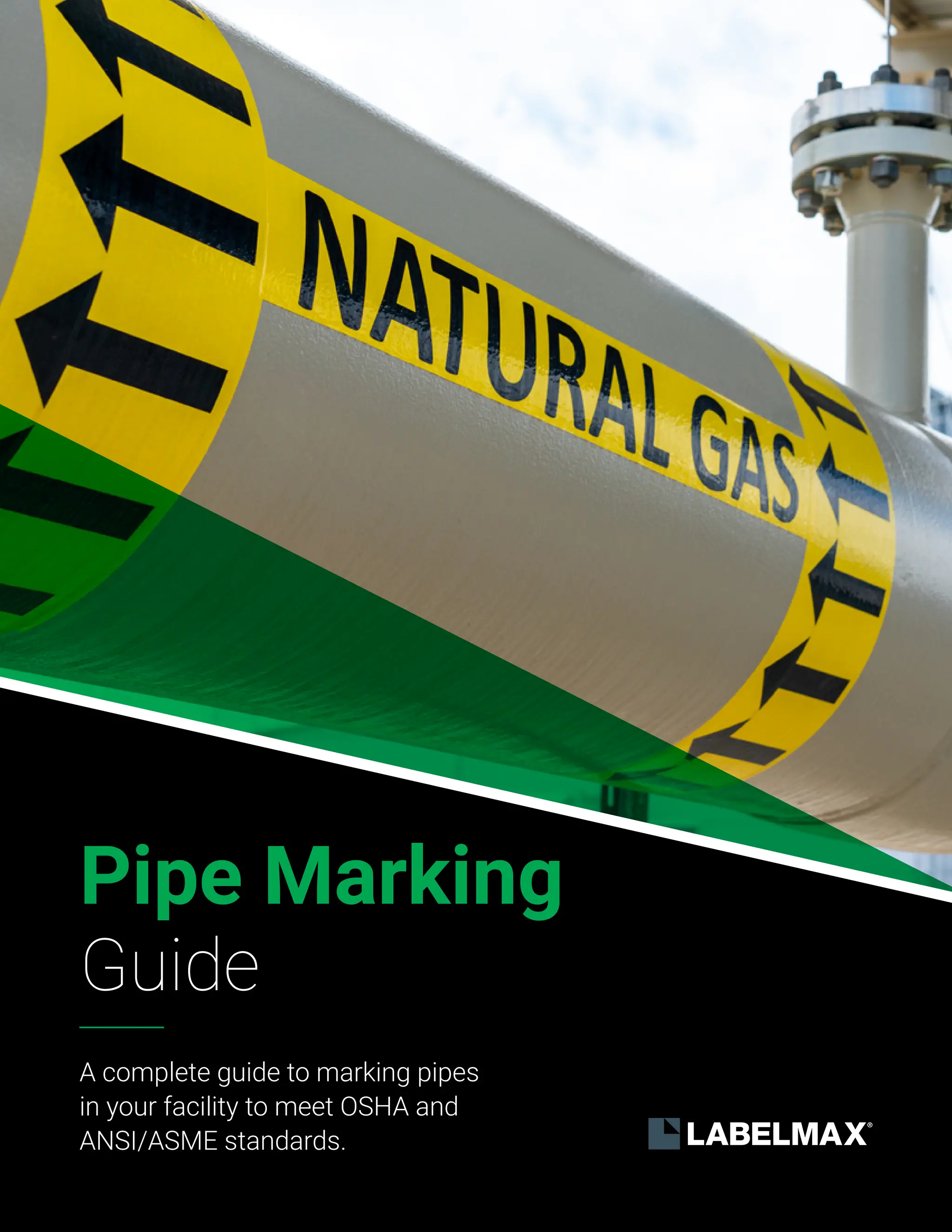
Pipe Marking
Guide
A complete guide to marking pipes
in your facility to meet OSHA and
ANSI/ASME standards.
2 Pipe Marking Guide 1-855-484-7266 | www.LabelMax.com
Table of Contents
1 Introduction 3
2 Where Pipe Labels Should Go 4
3 Check Your Facility 6
4 Label Formatting Requirements 7
5 Industry-Specific Pipe Labeling Requirements 13
6 How to Place Labels for Maximum Visibility 14
7 How to Make Pipe Labels 15
LabelMax
17475 SW 63rd Ave, Lake Oswego, OR 97035
1-855-484-7266
3 Pipe Marking Guide 1-855-484-7266 | www.LabelMax.com
Introduction
Clearlylabelingpipesinindustrial,commercial,andinstitutionalsettingsisasimple
yet powerful step toward creating a safer and more efficient work environment.
When piping systems are marked correctly, the risk of injury or property damage
due to confusion or accidents is significantly reduced.
This guide will walk you through essential practices for establishing an effective
visual pipe marking system that enhances both safety and workflow in your facility.
The Importance of Pipe Identification
When pipes go unlabeled—or are improperly labeled—it can lead to serious safety
concerns.
Workers, emergency personnel, and even
visitors may be unaware of the materials
flowing through a pipe, which increases the
chance of mishandling or underestimating
potential hazards. Misidentifying a pipe’s
contents can result in dangerous situations
or delays in responding to emergencies.
Beyondsafety,unclearlabelingcanslowdown
maintenance and repairs, as staff must take
extra steps to identify what’s inside a pipe.
Thiscandisruptoperationsandreduceoverall
productivity.
In many sectors, compliance with specific
pipe labeling standards is mandatory. For
example, hospitals must mark medical gas
lines according to healthcare regulations,
whileshipsfollowmarine-specificcolorcodes.
For most facilities, the ASME/ANSI A13.1
standard is the benchmark to follow. This
standard requires that pipes be labeled with
their contents and any associated hazards.
Adhering to it not only improves safety—it
also helps ensure compliance with OSHA
standards, including regulation 29 CFR
1910.261(a)(3)(ii).
4 Pipe Marking Guide 1-855-484-7266 | www.LabelMax.com
Where Pipe Labels
Should Go
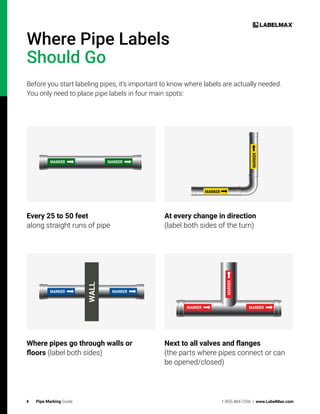
Before you start labeling pipes, it’s important to know where labels are actually needed.
You only need to place pipe labels in four main spots:
Every 25 to 50 feet
along straight runs of pipe
At every change in direction
(label both sides of the turn)
Where pipes go through walls or
floors (label both sides)
Next to all valves and flanges
(the parts where pipes connect or can
be opened/closed)
MARKER
MARKER
MARKER
MARKER
MARKER MARKER
WALL
MARKER MARKER
MARKER
5 Pipe Marking Guide 1-855-484-7266 | www.LabelMax.com
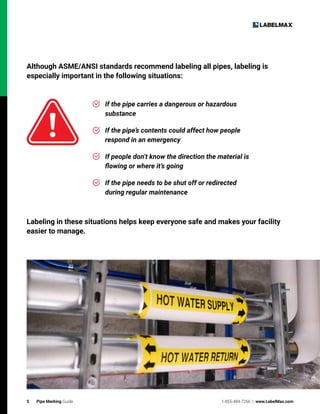
Although ASME/ANSI standards recommend labeling all pipes, labeling is
especially important in the following situations:
If the pipe carries a dangerous or hazardous
substance
If the pipe’s contents could affect how people
respond in an emergency
If people don’t know the direction the material is
flowing or where it’s going
If the pipe needs to be shut off or redirected
during regular maintenance
Labeling in these situations helps keep everyone safe and makes your facility
easier to manage.
6 Pipe Marking Guide 1-855-484-7266 | www.LabelMax.com
6 Pipe Marking Guide
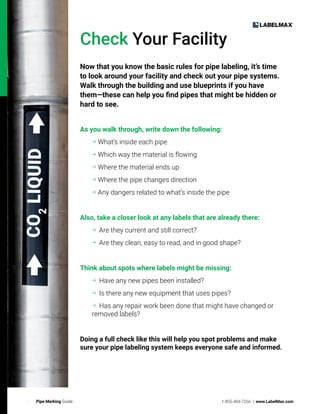
Check Your Facility
Now that you know the basic rules for pipe labeling, it’s time
to look around your facility and check out your pipe systems.
Walk through the building and use blueprints if you have
them—these can help you find pipes that might be hidden or
hard to see.
As you walk through, write down the following:

What’s inside each pipe
Which way the material is flowing
Where the material ends up
Where the pipe changes direction
Any dangers related to what’s inside the pipe
Also, take a closer look at any labels that are already there:
Are they current and still correct?
Are they clean, easy to read, and in good shape?
Think about spots where labels might be missing:
Have any new pipes been installed?
Is there any new equipment that uses pipes?
Has any repair work been done that might have changed or
removed labels?
Doing a full check like this will help you spot problems and make
sure your pipe labeling system keeps everyone safe and informed.
7 Pipe Marking Guide 1-855-484-7266 | www.LabelMax.com
Label Formatting
Requirements
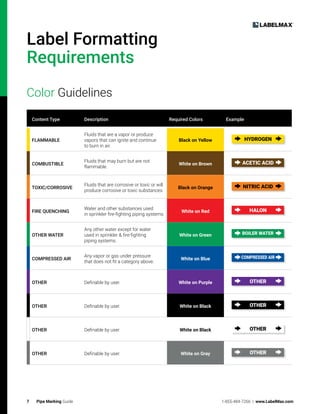
Color Guidelines
Content Type Description Required Colors Example
FLAMMABLE
Fluids that are a vapor or produce
vapors that can ignite and continue
to burn in air.
Black on Yellow HYDROGEN
COMBUSTIBLE
Fluids that may burn but are not
flammable.
White on Brown ACETIC ACID
TOXIC/CORROSIVE
Fluids that are corrosive or toxic or will
produce corrosive or toxic substances.
Black on Orange NITRIC ACID
FIRE QUENCHING
Water and other substances used
in sprinkler fire-fighting piping systems.
White on Red HALON
OTHER WATER
Any other water except for water
used in sprinkler  fire-fighting
piping systems.
White on Green BOILER WATER
COMPRESSED AIR
Any vapor or gas under pressure
that does not fit a category above.
White on Blue COMPRESSED AIR
OTHER Definable by user. White on Purple OTHER
OTHER Definable by user. White on Black OTHER
OTHER Definable by user. White on Gray OTHER
8 Pipe Marking Guide 1-855-484-7266 | www.LabelMax.com
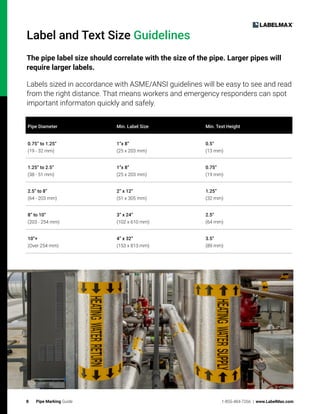
Label and Text Size Guidelines
The pipe label size should correlate with the size of the pipe. Larger pipes will
require larger labels.
Labels sized in accordance with ASME/ANSI guidelines will be easy to see and read
from the right distance. That means workers and emergency responders can spot
important informaton quickly and safely.
Pipe Diameter Min. Label Size Min. Text Height
0.75” to 1.25”
(19 - 32 mm)
1”x 8”
(25 x 203 mm)
0.5”
(13 mm)
1.25” to 2.5”
(38 - 51 mm)
1”x 8”
(25 x 203 mm)
0.75”
(19 mm)
2.5” to 8”
(64 - 203 mm)
2” x 12”
(51 x 305 mm)
1.25”
(32 mm)
8” to 10”
(203 - 254 mm)
3” x 24”
(102 x 610 mm)
2.5”
(64 mm)
10”+
(Over 254 mm)
4” x 32”
(153 x 813 mm)
3.5”
(89 mm)
9 Pipe Marking Guide 1-855-484-7266 | www.LabelMax.com
Using Abbreviations
for Pipe Labels
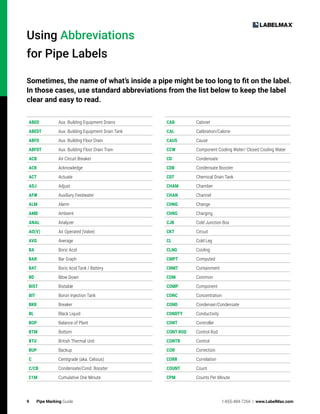
ABED Aux. Building Equipment Drains
ABEDT Aux. Building Equipment Drain Tank
ABFD Aux. Building Floor Drain
ABFDT Aux. Building Floor Drain Train
ACB Air Circuit Breaker
ACK Acknowledge
ACT Actuate
ADJ Adjust
AFW Auxiliary Feedwater
ALM Alarm
AMB Ambient
ANAL Analyzer
AO(V) Air Operated (Valve)
AVG Average
BA Boric Acid
BAR Bar Graph
BAT Boric Acid Tank / Battery
BD Blow Down
BIST Bistable
BIT Boron Injection Tank
BKR Breaker
BL Black Liquid
BOP Balance of Plant
BTM Bottom
BTU British Thermal Unit
BUP Backup
C Centigrade (aka. Celsius)
C/CB Condensate/Cond. Booster
C1M Cumulative One Minute
Sometimes, the name of what’s inside a pipe might be too long to fit on the label.
In those cases, use standard abbreviations from the list below to keep the label
clear and easy to read.
CAB Cabinet
CAL Calibration/Calorie
CAUS Cause
CCW Component Cooling Water/ Closed Cooling Water
CD Condensate
CDB Condensate Booster
CDT Chemical Drain Tank
CHAM Chamber
CHAN Channel
CHNG Change
CHRG Charging
CJB Cold Junction Box
CKT Circuit
CL Cold Leg
CLNG Cooling
CMPT Computed
CNMT Containment
COM Common
COMP Component
CONC Concentration
COND Condenser/Condensate
CONDTY Conductivity
CONT Controller
CONT ROD Control Rod
CONTR Control
COR Correction
CORR Correlation
COUNT Count
CPM Counts Per Minute
10 Pipe Marking Guide 1-855-484-7266 | www.LabelMax.com
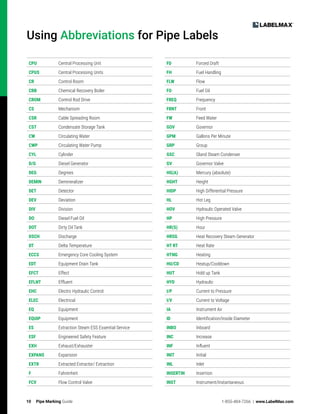
Using Abbreviations for Pipe Labels
CPU Central Processing Unit
CPUS Central Processing Units
CR Control Room
CRB Chemical Recovery Boiler
CROM Control Rod Drive
CS Mechanism
CSR Cable Spreading Room
CST Condensate Storage Tank
CW Circulating Water
CWP Circulating Water Pump
CYL Cylinder
D/G Diesel Generator
DEG Degrees
DEMIN Demineralizer
DET Detector
DEV Deviation
DIV Division
DO Diesel Fuel Oil
DOT Dirty Oil Tank
DSCH Discharge
DT Delta Temperature
ECCS Emergency Core Cooling System
EDT Equipment Drain Tank
EFCT Effect
EFLNT Effluent
ЕНС Electro Hydraulic Control
ELEC Electrical
EQ Equipment
EQUIP Equipment
ES Extraction Steam ESS Essential Service
ESF Engineered Safety Feature
EXH Exhaust/Exhauster
EXPANS Expansion
EXTR Extracted Extractor/ Extraction
F Fahrenheit
FCV Flow Control Valve
FD Forced Draft
FH Fuel Handling
FLW Flow
FO Fuel Oil
FREQ Frequency
FRNT Front
FW Feed Water
GOV Governor
GPM Gallons Per Minute
GRP Group
GSC Gland Steam Condenser
GV Governor Valve
HG(A) Mercury (absolute)
HGHT Height
HIDP High Differential Pressure
HL Hot Leg
HOV Hydraulic Operated Valve
HP High Pressure
HR(S) Hour
HRSG Heat Recovery Steam Generator
HT RT Heat Rate
HTNG Heating
HU/CD Heatup/Cooldown
HUT Hold up Tank
HYD Hydraulic
I/P Current to Pressure
I/V Current to Voltage
IA Instrument Air
ID Identification/Inside Diameter
INBO Inboard
INC Increase
INF Influent
INIT Initial
INL Inlet
INSERTIN Insertion
INST Instrument/Instantaneous
11 Pipe Marking Guide 1-855-484-7266 | www.LabelMax.com
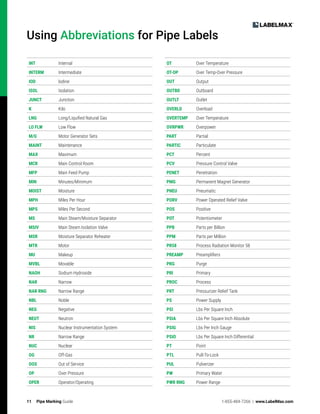
Using Abbreviations for Pipe Labels
INT Internal
INTERM Intermediate
IOD lodine
ISOL Isolation
JUNCT Junction
K Kilo
LNG Long/Liquified Natural Gas
LO FLW Low Flow
M/G Motor Generator Sets
MAINT Maintenance
MAX Maximum
MCR Main Control Room
MFP Main Feed Pump
MIN Minutes/Minimum
MOIST Moisture
MPH Miles Per Hour
MPS Miles Per Second
MS Main Steam/Moisture Separator
MSIV Main Steam Isolation Valve
MSR Moisture Separator Reheater
MTR Motor
MU Makeup
MVBL Movable
NAOH Sodium Hydroxide
NAR Narrow
NAR RNG Narrow Range
NBL Noble
NEG Negative
NEUT Neutron
NIS Nuclear Instrumentation System
NR Narrow Range
NUC Nuclear
OG Off-Gas
OOS Out of Service
OP Over Pressure
OPER Operator/Operating
OT Over Temperature
ОТ-ОР Over Temp-Over Pressure
OUT Output
OUTBD Outboard
OUTLT Outlet
OVERLD Overload
OVERTEMP Over Temperature
OVRPWR Overpower
PART Partial
PARTIC Particulate
PCT Percent
PCV Pressure Control Valve
PENET Penetration
PMG Permanent Magnet Generator
PNEU Pneumatic
PORV Power Operated Relief Valve
POS Positive
POT Potentiometer
PPB Parts per Billion
PPM Parts per Million
PR58 Process Radiation Monitor 58
PREAMP Preamplifiers
PRG Purge
PRI Primary
PROC Process
PRT Pressurizer Relief Tank
PS Power Supply
PSI Lbs Per Square Inch
PSIA Lbs Per Square Inch Absolute
PSIG Lbs Per Inch Gauge
PSIO Lbs Per Square Inch Differential
PT Point
PTL Pull-To-Lock
PUL Pulverizer
PW Primary Water
PWR RNG Power Range
12 Pipe Marking Guide 1-855-484-7266 | www.LabelMax.com
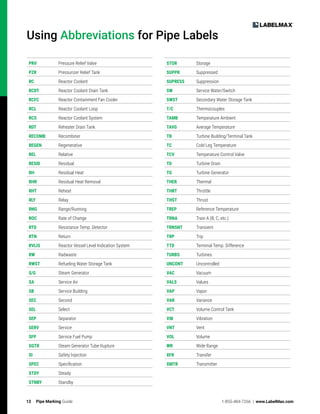
Using Abbreviations for Pipe Labels
PRV Pressure Relief Valve
PZR Pressurizer Relief Tank
RC Reactor Coolant
RCDT Reactor Coolant Drain Tank
RCFC Reactor Containment Fan Cooler
RCL Reactor Coolant Loop
RCS Reactor Coolant System
RDT Reheater Drain Tank
RECOMB Recombiner
REGEN Regenerative
REL Relative
RESID Residual
RH Residual Heat
RHR Residual Heat Removal
RHT Reheat
RLY Relay
RNG Range/Running
ROC Rate of Change
RTD Resistance Temp. Detector
RTN Return
RVLIS Reactor Vessel Level Indication System
RW Radwaste
RWST Refueling Water Storage Tank
S/G Steam Generator
SA Service Air
SB Service Building
SEC Second
SEL Select
SEP Separator
SERV Service
SFP Service Fuel Pump
SGTR Steam Generator Tube Rupture
SI Safety Injection
SPEC Specification
STDY Steady
STNBY Standby
STOR Storage
SUPPR Suppressed
SUPRESS Suppression
SW Service Water/Switch
SWST Secondary Water Storage Tank
T/C Thermocouples
TAMB Temperature Ambient
TAVG Average Temperature
TB Turbine Building/Terminal Tank
TC Cold Leg Temperature
TCV Temperature Control Valve
TD Turbine Drain
TG Turbine Generator
THER Thermal
THRT Throttle
THST Thrust
TREP Reference Temperature
TRNA Train A (B, C, etc.)
TRNSNT Transient
TRP Trip
TTD Terminal Temp. Difference
TURBS Turbines
UNCONT Uncontrolled
VAC Vacuum
VALS Values
VAP Vapor
VAR Variance
VCT Volume Control Tank
VIB Vibration
VNT Vent
VOL Volume
WR Wide Range
XFR Transfer
XMTR Transmitter
13 Pipe Marking Guide 1-855-484-7266 | www.LabelMax.com
Industry-Specific Pipe
Labeling Requirements
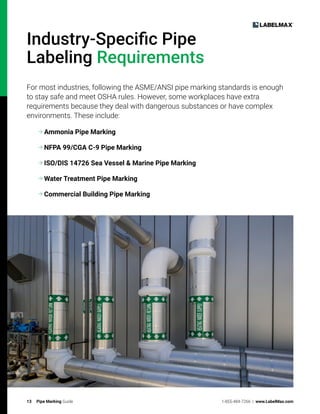
For most industries, following the ASME/ANSI pipe marking standards is enough
to stay safe and meet OSHA rules. However, some workplaces have extra
requirements because they deal with dangerous substances or have complex
environments. These include:

Ammonia Pipe Marking

NFPA 99/CGA C-9 Pipe Marking

ISO/DIS 14726 Sea Vessel  Marine Pipe Marking

Water Treatment Pipe Marking

Commercial Building Pipe Marking
14 Pipe Marking Guide 1-855-484-7266 | www.LabelMax.com
How to Place Labels
for Maximum Visibility
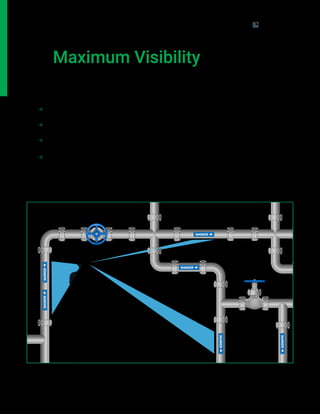
Pipe labels should be placed where most people can easily see them. Here are
some simple guidelines to make sure labels are visible:
The label should be easy to see from the normal approach point.
The label should be visible at every entry point in floors or walls.

If a pipe is below eye level, place the label above the pipe’s center.

If a pipe is above eye level, place the label below the pipe’s center
MARKER
MARKER
MARKER
MARKER
MARKER
MARKER
15 Pipe Marking Guide 1-855-484-7266 | www.LabelMax.com
How to Make
Pipe Labels
Select from 1 of 3 options:
1.
2.
3.
Buy Pre-Made Labels
You can order standard pipe labels from a label supplier. Just make
sure to choose the right size, color, and material for your needs. This is
a good option for small pipe marking projects.
Order Custom Labels
Many suppliers can print custom labels for your pipes. This is helpful if
you need labels for pipes that aren’t common or have unique needs.
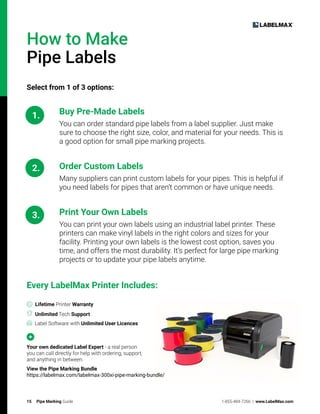
Print Your Own Labels
You can print your own labels using an industrial label printer. These
printers can make vinyl labels in the right colors and sizes for your
facility. Printing your own labels is the lowest cost option, saves you
time, and offers the most durability. It’s perfect for large pipe marking
projects or to update your pipe labels anytime.
Every LabelMax Printer Includes:
Lifetime Printer Warranty
Unlimited Tech Support
Label Software with Unlimited User Licences
Your own dedicated Label Expert - a real person
you can call directly for help with ordering, support,
and anything in between.
View the Pipe Marking Bundle
https://labelmax.com/labelmax-300xi-pipe-marking-bundle/
Shop online now at www.LabelMax.com
5S Lean, Safety, and Compliance
Solutions for Every Industry
LabelMax delivers industrial label printing solutions, floor marking, and identification
products to keep facilities efficient, and safe for any application.

Free Guide to Pipe Marking & Labeling Compliance | LabelMax

  • 1.
    Pipe Marking Guide A completeguide to marking pipes in your facility to meet OSHA and ANSI/ASME standards.
  • 2.
    2 Pipe MarkingGuide 1-855-484-7266 | www.LabelMax.com Table of Contents 1 Introduction 3 2 Where Pipe Labels Should Go 4 3 Check Your Facility 6 4 Label Formatting Requirements 7 5 Industry-Specific Pipe Labeling Requirements 13 6 How to Place Labels for Maximum Visibility 14 7 How to Make Pipe Labels 15 LabelMax 17475 SW 63rd Ave, Lake Oswego, OR 97035 1-855-484-7266
  • 3.
    3 Pipe MarkingGuide 1-855-484-7266 | www.LabelMax.com Introduction Clearlylabelingpipesinindustrial,commercial,andinstitutionalsettingsisasimple yet powerful step toward creating a safer and more efficient work environment. When piping systems are marked correctly, the risk of injury or property damage due to confusion or accidents is significantly reduced. This guide will walk you through essential practices for establishing an effective visual pipe marking system that enhances both safety and workflow in your facility. The Importance of Pipe Identification When pipes go unlabeled—or are improperly labeled—it can lead to serious safety concerns. Workers, emergency personnel, and even visitors may be unaware of the materials flowing through a pipe, which increases the chance of mishandling or underestimating potential hazards. Misidentifying a pipe’s contents can result in dangerous situations or delays in responding to emergencies. Beyondsafety,unclearlabelingcanslowdown maintenance and repairs, as staff must take extra steps to identify what’s inside a pipe. Thiscandisruptoperationsandreduceoverall productivity. In many sectors, compliance with specific pipe labeling standards is mandatory. For example, hospitals must mark medical gas lines according to healthcare regulations, whileshipsfollowmarine-specificcolorcodes. For most facilities, the ASME/ANSI A13.1 standard is the benchmark to follow. This standard requires that pipes be labeled with their contents and any associated hazards. Adhering to it not only improves safety—it also helps ensure compliance with OSHA standards, including regulation 29 CFR 1910.261(a)(3)(ii).
  • 4.
    4 Pipe MarkingGuide 1-855-484-7266 | www.LabelMax.com Where Pipe Labels Should Go Before you start labeling pipes, it’s important to know where labels are actually needed. You only need to place pipe labels in four main spots: Every 25 to 50 feet along straight runs of pipe At every change in direction (label both sides of the turn) Where pipes go through walls or floors (label both sides) Next to all valves and flanges (the parts where pipes connect or can be opened/closed) MARKER MARKER MARKER MARKER MARKER MARKER WALL MARKER MARKER MARKER
  • 5.
    5 Pipe MarkingGuide 1-855-484-7266 | www.LabelMax.com Although ASME/ANSI standards recommend labeling all pipes, labeling is especially important in the following situations: If the pipe carries a dangerous or hazardous substance If the pipe’s contents could affect how people respond in an emergency If people don’t know the direction the material is flowing or where it’s going If the pipe needs to be shut off or redirected during regular maintenance Labeling in these situations helps keep everyone safe and makes your facility easier to manage.
  • 6.
    6 Pipe MarkingGuide 1-855-484-7266 | www.LabelMax.com 6 Pipe Marking Guide Check Your Facility Now that you know the basic rules for pipe labeling, it’s time to look around your facility and check out your pipe systems. Walk through the building and use blueprints if you have them—these can help you find pipes that might be hidden or hard to see. As you walk through, write down the following: What’s inside each pipe Which way the material is flowing Where the material ends up Where the pipe changes direction Any dangers related to what’s inside the pipe Also, take a closer look at any labels that are already there: Are they current and still correct? Are they clean, easy to read, and in good shape? Think about spots where labels might be missing: Have any new pipes been installed? Is there any new equipment that uses pipes? Has any repair work been done that might have changed or removed labels? Doing a full check like this will help you spot problems and make sure your pipe labeling system keeps everyone safe and informed.
  • 7.
    7 Pipe MarkingGuide 1-855-484-7266 | www.LabelMax.com Label Formatting Requirements Color Guidelines Content Type Description Required Colors Example FLAMMABLE Fluids that are a vapor or produce vapors that can ignite and continue to burn in air. Black on Yellow HYDROGEN COMBUSTIBLE Fluids that may burn but are not flammable. White on Brown ACETIC ACID TOXIC/CORROSIVE Fluids that are corrosive or toxic or will produce corrosive or toxic substances. Black on Orange NITRIC ACID FIRE QUENCHING Water and other substances used in sprinkler fire-fighting piping systems. White on Red HALON OTHER WATER Any other water except for water used in sprinkler fire-fighting piping systems. White on Green BOILER WATER COMPRESSED AIR Any vapor or gas under pressure that does not fit a category above. White on Blue COMPRESSED AIR OTHER Definable by user. White on Purple OTHER OTHER Definable by user. White on Black OTHER OTHER Definable by user. White on Black OTHER OTHER Definable by user. White on Gray OTHER
  • 8.
    8 Pipe MarkingGuide 1-855-484-7266 | www.LabelMax.com Label and Text Size Guidelines The pipe label size should correlate with the size of the pipe. Larger pipes will require larger labels. Labels sized in accordance with ASME/ANSI guidelines will be easy to see and read from the right distance. That means workers and emergency responders can spot important informaton quickly and safely. Pipe Diameter Min. Label Size Min. Text Height 0.75” to 1.25” (19 - 32 mm) 1”x 8” (25 x 203 mm) 0.5” (13 mm) 1.25” to 2.5” (38 - 51 mm) 1”x 8” (25 x 203 mm) 0.75” (19 mm) 2.5” to 8” (64 - 203 mm) 2” x 12” (51 x 305 mm) 1.25” (32 mm) 8” to 10” (203 - 254 mm) 3” x 24” (102 x 610 mm) 2.5” (64 mm) 10”+ (Over 254 mm) 4” x 32” (153 x 813 mm) 3.5” (89 mm)
  • 9.
    9 Pipe MarkingGuide 1-855-484-7266 | www.LabelMax.com Using Abbreviations for Pipe Labels ABED Aux. Building Equipment Drains ABEDT Aux. Building Equipment Drain Tank ABFD Aux. Building Floor Drain ABFDT Aux. Building Floor Drain Train ACB Air Circuit Breaker ACK Acknowledge ACT Actuate ADJ Adjust AFW Auxiliary Feedwater ALM Alarm AMB Ambient ANAL Analyzer AO(V) Air Operated (Valve) AVG Average BA Boric Acid BAR Bar Graph BAT Boric Acid Tank / Battery BD Blow Down BIST Bistable BIT Boron Injection Tank BKR Breaker BL Black Liquid BOP Balance of Plant BTM Bottom BTU British Thermal Unit BUP Backup C Centigrade (aka. Celsius) C/CB Condensate/Cond. Booster C1M Cumulative One Minute Sometimes, the name of what’s inside a pipe might be too long to fit on the label. In those cases, use standard abbreviations from the list below to keep the label clear and easy to read. CAB Cabinet CAL Calibration/Calorie CAUS Cause CCW Component Cooling Water/ Closed Cooling Water CD Condensate CDB Condensate Booster CDT Chemical Drain Tank CHAM Chamber CHAN Channel CHNG Change CHRG Charging CJB Cold Junction Box CKT Circuit CL Cold Leg CLNG Cooling CMPT Computed CNMT Containment COM Common COMP Component CONC Concentration COND Condenser/Condensate CONDTY Conductivity CONT Controller CONT ROD Control Rod CONTR Control COR Correction CORR Correlation COUNT Count CPM Counts Per Minute
  • 10.
    10 Pipe MarkingGuide 1-855-484-7266 | www.LabelMax.com Using Abbreviations for Pipe Labels CPU Central Processing Unit CPUS Central Processing Units CR Control Room CRB Chemical Recovery Boiler CROM Control Rod Drive CS Mechanism CSR Cable Spreading Room CST Condensate Storage Tank CW Circulating Water CWP Circulating Water Pump CYL Cylinder D/G Diesel Generator DEG Degrees DEMIN Demineralizer DET Detector DEV Deviation DIV Division DO Diesel Fuel Oil DOT Dirty Oil Tank DSCH Discharge DT Delta Temperature ECCS Emergency Core Cooling System EDT Equipment Drain Tank EFCT Effect EFLNT Effluent ЕНС Electro Hydraulic Control ELEC Electrical EQ Equipment EQUIP Equipment ES Extraction Steam ESS Essential Service ESF Engineered Safety Feature EXH Exhaust/Exhauster EXPANS Expansion EXTR Extracted Extractor/ Extraction F Fahrenheit FCV Flow Control Valve FD Forced Draft FH Fuel Handling FLW Flow FO Fuel Oil FREQ Frequency FRNT Front FW Feed Water GOV Governor GPM Gallons Per Minute GRP Group GSC Gland Steam Condenser GV Governor Valve HG(A) Mercury (absolute) HGHT Height HIDP High Differential Pressure HL Hot Leg HOV Hydraulic Operated Valve HP High Pressure HR(S) Hour HRSG Heat Recovery Steam Generator HT RT Heat Rate HTNG Heating HU/CD Heatup/Cooldown HUT Hold up Tank HYD Hydraulic I/P Current to Pressure I/V Current to Voltage IA Instrument Air ID Identification/Inside Diameter INBO Inboard INC Increase INF Influent INIT Initial INL Inlet INSERTIN Insertion INST Instrument/Instantaneous
  • 11.
    11 Pipe MarkingGuide 1-855-484-7266 | www.LabelMax.com Using Abbreviations for Pipe Labels INT Internal INTERM Intermediate IOD lodine ISOL Isolation JUNCT Junction K Kilo LNG Long/Liquified Natural Gas LO FLW Low Flow M/G Motor Generator Sets MAINT Maintenance MAX Maximum MCR Main Control Room MFP Main Feed Pump MIN Minutes/Minimum MOIST Moisture MPH Miles Per Hour MPS Miles Per Second MS Main Steam/Moisture Separator MSIV Main Steam Isolation Valve MSR Moisture Separator Reheater MTR Motor MU Makeup MVBL Movable NAOH Sodium Hydroxide NAR Narrow NAR RNG Narrow Range NBL Noble NEG Negative NEUT Neutron NIS Nuclear Instrumentation System NR Narrow Range NUC Nuclear OG Off-Gas OOS Out of Service OP Over Pressure OPER Operator/Operating OT Over Temperature ОТ-ОР Over Temp-Over Pressure OUT Output OUTBD Outboard OUTLT Outlet OVERLD Overload OVERTEMP Over Temperature OVRPWR Overpower PART Partial PARTIC Particulate PCT Percent PCV Pressure Control Valve PENET Penetration PMG Permanent Magnet Generator PNEU Pneumatic PORV Power Operated Relief Valve POS Positive POT Potentiometer PPB Parts per Billion PPM Parts per Million PR58 Process Radiation Monitor 58 PREAMP Preamplifiers PRG Purge PRI Primary PROC Process PRT Pressurizer Relief Tank PS Power Supply PSI Lbs Per Square Inch PSIA Lbs Per Square Inch Absolute PSIG Lbs Per Inch Gauge PSIO Lbs Per Square Inch Differential PT Point PTL Pull-To-Lock PUL Pulverizer PW Primary Water PWR RNG Power Range
  • 12.
    12 Pipe MarkingGuide 1-855-484-7266 | www.LabelMax.com Using Abbreviations for Pipe Labels PRV Pressure Relief Valve PZR Pressurizer Relief Tank RC Reactor Coolant RCDT Reactor Coolant Drain Tank RCFC Reactor Containment Fan Cooler RCL Reactor Coolant Loop RCS Reactor Coolant System RDT Reheater Drain Tank RECOMB Recombiner REGEN Regenerative REL Relative RESID Residual RH Residual Heat RHR Residual Heat Removal RHT Reheat RLY Relay RNG Range/Running ROC Rate of Change RTD Resistance Temp. Detector RTN Return RVLIS Reactor Vessel Level Indication System RW Radwaste RWST Refueling Water Storage Tank S/G Steam Generator SA Service Air SB Service Building SEC Second SEL Select SEP Separator SERV Service SFP Service Fuel Pump SGTR Steam Generator Tube Rupture SI Safety Injection SPEC Specification STDY Steady STNBY Standby STOR Storage SUPPR Suppressed SUPRESS Suppression SW Service Water/Switch SWST Secondary Water Storage Tank T/C Thermocouples TAMB Temperature Ambient TAVG Average Temperature TB Turbine Building/Terminal Tank TC Cold Leg Temperature TCV Temperature Control Valve TD Turbine Drain TG Turbine Generator THER Thermal THRT Throttle THST Thrust TREP Reference Temperature TRNA Train A (B, C, etc.) TRNSNT Transient TRP Trip TTD Terminal Temp. Difference TURBS Turbines UNCONT Uncontrolled VAC Vacuum VALS Values VAP Vapor VAR Variance VCT Volume Control Tank VIB Vibration VNT Vent VOL Volume WR Wide Range XFR Transfer XMTR Transmitter
  • 13.
    13 Pipe MarkingGuide 1-855-484-7266 | www.LabelMax.com Industry-Specific Pipe Labeling Requirements For most industries, following the ASME/ANSI pipe marking standards is enough to stay safe and meet OSHA rules. However, some workplaces have extra requirements because they deal with dangerous substances or have complex environments. These include: Ammonia Pipe Marking NFPA 99/CGA C-9 Pipe Marking ISO/DIS 14726 Sea Vessel Marine Pipe Marking Water Treatment Pipe Marking Commercial Building Pipe Marking
  • 14.
    14 Pipe MarkingGuide 1-855-484-7266 | www.LabelMax.com How to Place Labels for Maximum Visibility Pipe labels should be placed where most people can easily see them. Here are some simple guidelines to make sure labels are visible: The label should be easy to see from the normal approach point. The label should be visible at every entry point in floors or walls. If a pipe is below eye level, place the label above the pipe’s center. If a pipe is above eye level, place the label below the pipe’s center MARKER MARKER MARKER MARKER MARKER MARKER
  • 15.
    15 Pipe MarkingGuide 1-855-484-7266 | www.LabelMax.com How to Make Pipe Labels Select from 1 of 3 options: 1. 2. 3. Buy Pre-Made Labels You can order standard pipe labels from a label supplier. Just make sure to choose the right size, color, and material for your needs. This is a good option for small pipe marking projects. Order Custom Labels Many suppliers can print custom labels for your pipes. This is helpful if you need labels for pipes that aren’t common or have unique needs. Print Your Own Labels You can print your own labels using an industrial label printer. These printers can make vinyl labels in the right colors and sizes for your facility. Printing your own labels is the lowest cost option, saves you time, and offers the most durability. It’s perfect for large pipe marking projects or to update your pipe labels anytime. Every LabelMax Printer Includes: Lifetime Printer Warranty Unlimited Tech Support Label Software with Unlimited User Licences Your own dedicated Label Expert - a real person you can call directly for help with ordering, support, and anything in between. View the Pipe Marking Bundle https://labelmax.com/labelmax-300xi-pipe-marking-bundle/
  • 16.
    Shop online nowat www.LabelMax.com 5S Lean, Safety, and Compliance Solutions for Every Industry LabelMax delivers industrial label printing solutions, floor marking, and identification products to keep facilities efficient, and safe for any application.