Federal Trade Commission | consumer.ftc.gov
Credit Repair
How
to Help
Yourself
1
You see the ads in newspapers, on TV, and online. You
hear them on the radio. You get fliers in the mail,
email messages, and maybe even calls offering credit
repair services. They all make the same claims:
“Credit problems? No problem!”
“We can remove bankruptcies, judgments, liens, and bad
loans from your credit file forever!”
“We can erase your bad credit — 100% guaranteed.”
“Create a new credit identity — legally.”
Do yourself a favor and save some money, too. Don’t
believe these claims: they’re very likely signs of a scam.
Indeed, attorneys at the Federal Trade Commission,
the nation’s consumer protection agency, say they’ve
never seen a legitimate credit repair operation making
those claims. The fact is there’s no quick fix for
creditworthiness. You can improve your credit report
legitimately, but it takes time, a conscious effort, and
sticking to a personal debt repayment plan.
Your Rights
No one can legally remove accurate and timely negative
information from a credit report. You can ask for an
investigation — at no charge to you — of information in
your file that you dispute as inaccurate or incomplete.
Some people hire a company to investigate for them, but
anything a credit repair company can do legally, you can
do for yourself at little or no cost.
2
By law:
●● You’re entitled to a free credit report if a
company takes “adverse action” against you, like
denying your application for credit, insurance,
or employment. You have to ask for your report
within 60 days of receiving notice of the action.
The notice includes the name, address, and phone
number of the consumer reporting company. You’re
also entitled to one free report a year if you’re
unemployed and plan to look for a job within 60
days; if you’re on welfare; or if your report is
inaccurate because of fraud, including identity theft.
●● Each of the nationwide credit reporting companies
— Equifax, Experian, and TransUnion — is
required to provide you with a free copy of your
credit report once every 12 months, if you ask for
it. To order, visit annualcreditreport.com, call
1-877-322-8228, or use the form at the center of this
booklet. You may order reports from each of the
three credit reporting companies at the same time, or
you can stagger your requests throughout the year.
●● It doesn’t cost anything to dispute mistakes or
outdated items on your credit report. Both the
credit reporting company and the information
provider (the person, company, or organization that
provides information about you to a credit reporting
company) are responsible for correcting inaccurate
or incomplete information in your report. To take
advantage of all your rights, contact both the credit
reporting company and the information provider.
3
DIY
Step 1: Tell the credit reporting company, in writing,
what information you think is inaccurate. Include copies
(NOT originals) of any documents that support your
position. In addition to including your complete name
and address, your letter should identify each item in your
report that you dispute; state the facts and the reasons
you dispute the information, and ask that it be removed
or corrected. You may want to enclose a copy of your
report, and circle the items in question. Send your letter
by certified mail, “return receipt requested,” so you can
document that the credit reporting company got it. Keep
copies of your dispute letter and enclosures.
Credit reporting companies must investigate the items
you question within 30 days — unless they consider
your dispute frivolous. They also must forward all the
relevant data you provide about the inaccuracy to the
organization that provided the information. After the
information provider gets notice of a dispute from the
credit reporting company, it must investigate, review the
relevant information, and report the results back to the
credit reporting company. If the investigation reveals that
the disputed information is inaccurate, the information
provider has to notify the nationwide credit reporting
companies so they can correct it in your file.
When the investigation is complete, the credit reporting
company must give you the results in writing, too, and a
free copy of your report if the dispute results in a change.
If an item is changed or deleted, the credit reporting
company cannot put the disputed information back in
your file unless the information provider verifies that it’s
4
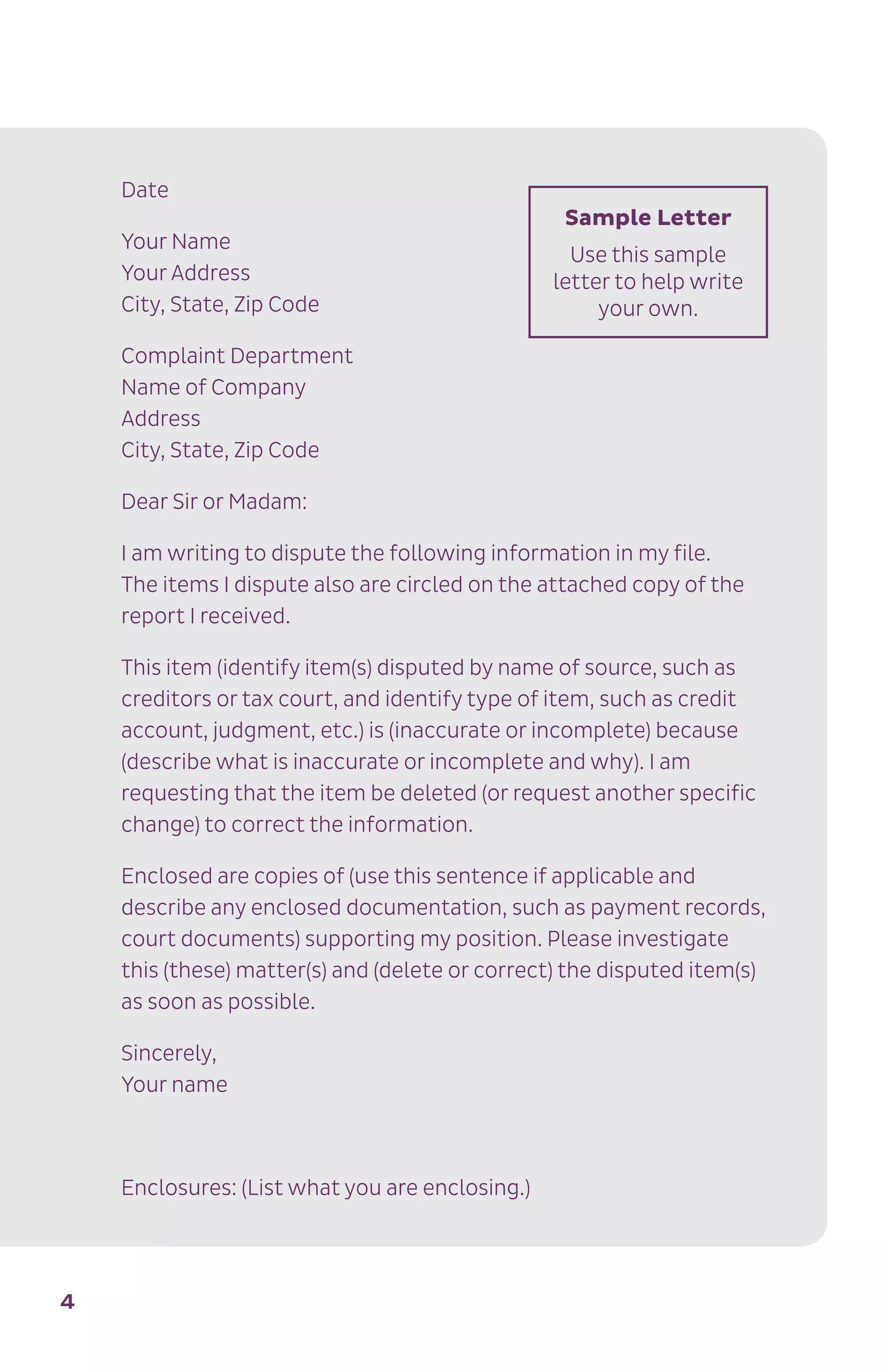
Date
Your Name
Your Address
City, State, Zip Code
Complaint Department
Name of Company
Address
City, State, Zip Code
Dear Sir or Madam:
I am writing to dispute the following information in my file.
The items I dispute also are circled on the attached copy of the
report I received.
This item (identify item(s) disputed by name of source, such as
creditors or tax court, and identify type of item, such as credit
account, judgment, etc.) is (inaccurate or incomplete) because
(describe what is inaccurate or incomplete and why). I am
requesting that the item be deleted (or request another specific
change) to correct the information.
Enclosed are copies of (use this sentence if applicable and
describe any enclosed documentation, such as payment records,
court documents) supporting my position. Please investigate
this (these) matter(s) and (delete or correct) the disputed item(s)
as soon as possible.
Sincerely,
Your name
Enclosures: (List what you are enclosing.)
Sample Letter
Use this sample
letter to help write
your own.
5
accurate and complete. The credit reporting company
also must send you written notice that includes the name,
address, and phone number of the information provider. If
you ask, the credit reporting company must send notices
of any correction to anyone who got your report in the
past six months. You also can ask that a corrected copy of
your report be sent to anyone who got a copy during the
past two years for employment purposes.
If an investigation doesn’t resolve your dispute with the
credit reporting company, you can ask that a statement of
the dispute be included in your file and in future reports.
You also can ask the credit reporting company to give
your statement to anyone who got a copy of your report
in the recent past. You’ll probably have to pay for this
service.
Step 2: Tell the creditor or other information provider,
in writing, that you dispute an item. Include copies (NOT
originals) of documents that support your position. Many
providers specify an address for disputes. If the provider
reports the item to a consumer reporting company, it must
include a notice of your dispute. And if the information
is found to be inaccurate, the provider may not report it
again.
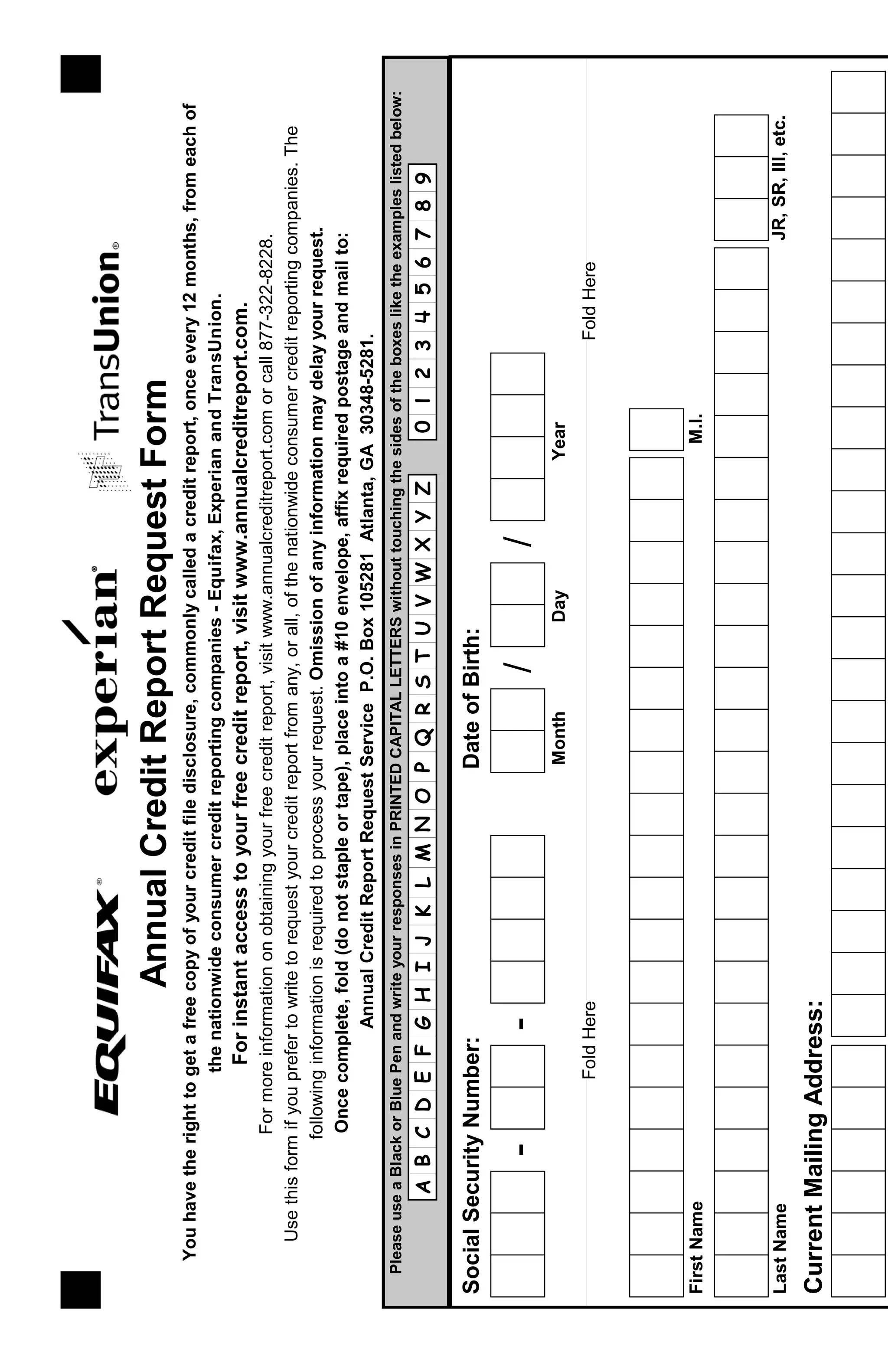
Youhavetherighttogetafreecopyofyourcreditfiledisclosure,commonlycalledacreditreport,onceevery12months,fromeachof
thenationwideconsumercreditreportingcompanies-Equifax,ExperianandTransUnion.
Forinstantaccesstoyourfreecreditreport,visitwww.annualcreditreport.com.
Formoreinformationonobtainingyourfreecreditreport,visitwww.annualcreditreport.comorcall877-322-8228.
Usethisformifyouprefertowritetorequestyourcreditreportfromany,orall,ofthenationwideconsumercreditreportingcompanies.The
followinginformationisrequiredtoprocessyourrequest.Omissionofanyinformationmaydelayyourrequest.
AnnualCreditReportRequestForm
Oncecomplete,fold(donotstapleortape),placeintoa#10envelope,affixrequiredpostageandmailto:
AnnualCreditReportRequestServiceP.O.Box105281Atlanta,GA30348-5281.
SocialSecurityNumber:
--
DateofBirth:
//
MonthDayYear
FirstNameM.I.
LastNameJR,SR,III,etc.
CurrentMailingAddress:
FoldHereFoldHere
PleaseuseaBlackorBluePenandwriteyourresponsesinPRINTEDCAPITALLETTERSwithouttouchingthesidesoftheboxesliketheexampleslistedbelow:
ABCDEFGHIJKLMNOPQRSTUVWXYZ0123456789
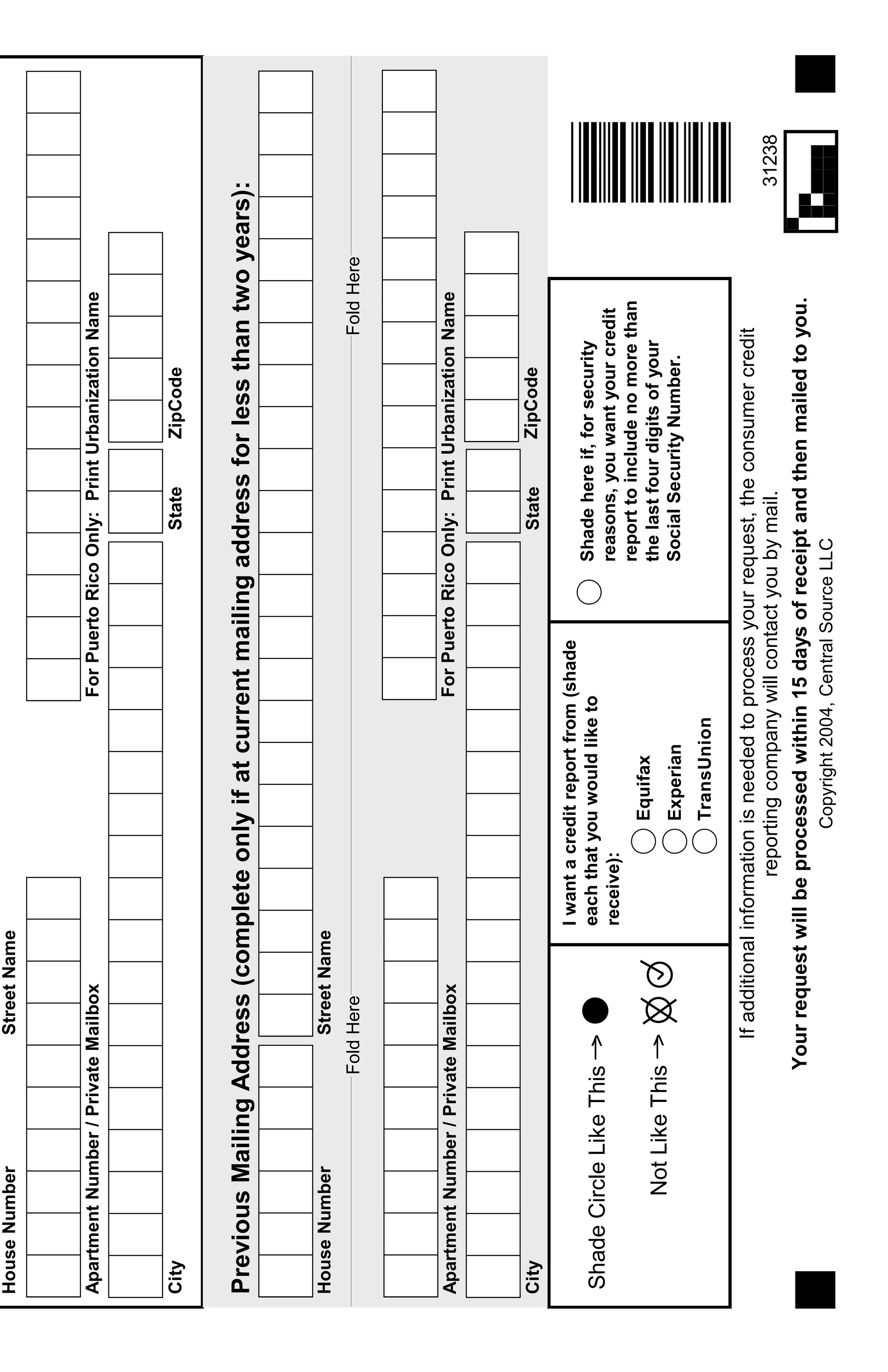
Ifadditionalinformationisneededtoprocessyourrequest,theconsumercredit
reportingcompanywillcontactyoubymail.
Yourrequestwillbeprocessedwithin15daysofreceiptandthenmailedtoyou.
Copyright2004,CentralSourceLLC
Equifax
Experian
TransUnion
Iwantacreditreportfrom(shade
eachthatyouwouldliketo
receive):
Shadehereif,forsecurity
reasons,youwantyourcredit
reporttoincludenomorethan
thelastfourdigitsofyour
SocialSecurityNumber.
ShadeCircleLikeThis>
NotLikeThis>
HouseNumberStreetName
CityStateZipCode
ZipCodeStateCity
ApartmentNumber/PrivateMailboxForPuertoRicoOnly:PrintUrbanizationName
StreetNameHouseNumber
PreviousMailingAddress(completeonlyifatcurrentmailingaddressforlessthantwoyears):
FoldHereFoldHere
ForPuertoRicoOnly:PrintUrbanizationNameApartmentNumber/PrivateMailbox
31238
8
Reporting Accurate Negative Information
When negative information in your report is accurate,
only time can make it go away. A credit reporting
company can report most accurate negative information
for seven years and bankruptcy information for 10 years.
Information about an unpaid judgment against you can be
reported for seven years or until the statute of limitations
runs out, whichever is longer. The seven-year reporting
period starts from the date the event took place. There
is no time limit on reporting information about criminal
convictions; information reported in response to your
application for a job that pays more than $75,000 a year;
and information reported because you’ve applied for more
than $150,000 worth of credit or life insurance.
The Credit Repair Organizations Act
The Credit Repair Organization Act (CROA) makes
it illegal for credit repair companies to lie about what
they can do for you, and to charge you before they’ve
performed their services. The CROA is enforced by the
Federal Trade Commission and requires credit repair
companies to explain:
●● your legal rights in a written contract that also
details the services they’ll perform
●● your three day right to cancel without any charge
●● how long it will take to get results
●● the total cost you will pay
●● any guarantees
9
What if a credit repair company you hired doesn’t live up
to its promises? You have some options. You can:
●● sue them in federal court for your actual losses or
for what you paid them, whichever is more
●● seek punitive damages — money to punish the
company for violating the law
●● join other people in a class action lawsuit against the
company, and if you win, the company has to pay
your attorney’s fees
Report Credit Repair Fraud
State Attorneys General
Many states also have laws regulating credit repair
companies. If you have a problem with a credit repair
company, report it to your local consumer affairs office or
to your state attorney general (AG, www.naag.org).
Federal Trade Commission
You also can file a complaint with the Federal Trade
Commission. Although the FTC can’t resolve individual
credit disputes, it can take action against a company
if there’s a pattern of possible law violations. File
your complaint online at ftc.gov/complaint or call
1-877-FTC-HELP.
10
Where to Get Legitimate Help
Just because you have a poor credit history doesn’t mean
you can’t get credit. Creditors set their own standards,
and not all look at your credit history the same way. Some
may look only at recent years to evaluate you for credit,
and they may give you credit if your bill-paying history
has improved. It may be worthwhile to contact creditors
informally to discuss their credit standards.
If you’re not disciplined enough to create a budget and
stick to it, to work out a repayment plan with your
creditors, or to keep track of your mounting bills,
you might consider contacting a credit counseling
organization. Many are nonprofit and work with you
to solve your financial problems. But remember that
“nonprofit” status doesn’t guarantee free, affordable, or
even legitimate services. In fact, some credit counseling
organizations — even some that claim nonprofit status
— may charge high fees or hide their fees by pressuring
people to make “voluntary” contributions that only cause
more debt.
Most credit counselors offer services through local
offices, online, or on the phone. If possible, find an
organization that offers in-person counseling. Many
universities, military bases, credit unions, housing
authorities, and branches of the U.S. Cooperative
Extension Service operate nonprofit credit counseling
programs. Your financial institution, local consumer
protection agency, and friends and family also may be
good sources of information and referrals.
11
If you’re thinking about filing for bankruptcy, be aware
that bankruptcy laws require that you get credit counseling
from a government-approved organization within six
months before you file for bankruptcy relief. You can find
a state-by-state list of government-approved organizations
at www.usdoj.gov/ust, the website of the U.S. Trustee
Program. That’s the organization within the U.S.
Department of Justice that supervises bankruptcy cases
and trustees. Be wary of credit counseling organizations
that say they are government-approved, but don’t appear
on the list of approved organizations.
Reputable credit counseling organizations can advise
you on managing your money and debts, help you
develop a budget, and offer free educational materials
and workshops. Their counselors are certified and
trained in the areas of consumer credit, money and
debt management, and budgeting. Counselors discuss
your entire financial situation with you, and can help
you develop a personalized plan to solve your money
problems. An initial counseling session typically lasts an
hour, with an offer of follow-up sessions.
12
For More Information
The FTC works to prevent fraudulent, deceptive and
unfair business practices in the marketplace and to provide
information to help consumers spot, stop and avoid them.
To learn more about credit issues and protecting your
personal information, visit consumer.ftc.gov.
To file a complaint or get free information on consumer
issues, visit consumer.ftc.gov or call toll-free,
1-877-FTC-HELP (1-877-382-4357); TTY: 1-866-
653-4261. Watch a video, How to File a Complaint,
at consumer.ftc.gov/media to learn more. The FTC
enters consumer complaints into the Consumer Sentinel
Network, a secure online database and investigative tool
used by hundreds of civil and criminal law enforcement
agencies in the U.S. and abroad.
Federal Trade Commission
consumer.ftc.gov
November 2012

Free Credit Information

  • 1.
    Federal Trade Commission| consumer.ftc.gov Credit Repair How to Help Yourself
  • 3.
    1 You see theads in newspapers, on TV, and online. You hear them on the radio. You get fliers in the mail, email messages, and maybe even calls offering credit repair services. They all make the same claims: “Credit problems? No problem!” “We can remove bankruptcies, judgments, liens, and bad loans from your credit file forever!” “We can erase your bad credit — 100% guaranteed.” “Create a new credit identity — legally.” Do yourself a favor and save some money, too. Don’t believe these claims: they’re very likely signs of a scam. Indeed, attorneys at the Federal Trade Commission, the nation’s consumer protection agency, say they’ve never seen a legitimate credit repair operation making those claims. The fact is there’s no quick fix for creditworthiness. You can improve your credit report legitimately, but it takes time, a conscious effort, and sticking to a personal debt repayment plan. Your Rights No one can legally remove accurate and timely negative information from a credit report. You can ask for an investigation — at no charge to you — of information in your file that you dispute as inaccurate or incomplete. Some people hire a company to investigate for them, but anything a credit repair company can do legally, you can do for yourself at little or no cost.
  • 4.
    2 By law: ●● You’reentitled to a free credit report if a company takes “adverse action” against you, like denying your application for credit, insurance, or employment. You have to ask for your report within 60 days of receiving notice of the action. The notice includes the name, address, and phone number of the consumer reporting company. You’re also entitled to one free report a year if you’re unemployed and plan to look for a job within 60 days; if you’re on welfare; or if your report is inaccurate because of fraud, including identity theft. ●● Each of the nationwide credit reporting companies — Equifax, Experian, and TransUnion — is required to provide you with a free copy of your credit report once every 12 months, if you ask for it. To order, visit annualcreditreport.com, call 1-877-322-8228, or use the form at the center of this booklet. You may order reports from each of the three credit reporting companies at the same time, or you can stagger your requests throughout the year. ●● It doesn’t cost anything to dispute mistakes or outdated items on your credit report. Both the credit reporting company and the information provider (the person, company, or organization that provides information about you to a credit reporting company) are responsible for correcting inaccurate or incomplete information in your report. To take advantage of all your rights, contact both the credit reporting company and the information provider.
  • 5.
    3 DIY Step 1: Tellthe credit reporting company, in writing, what information you think is inaccurate. Include copies (NOT originals) of any documents that support your position. In addition to including your complete name and address, your letter should identify each item in your report that you dispute; state the facts and the reasons you dispute the information, and ask that it be removed or corrected. You may want to enclose a copy of your report, and circle the items in question. Send your letter by certified mail, “return receipt requested,” so you can document that the credit reporting company got it. Keep copies of your dispute letter and enclosures. Credit reporting companies must investigate the items you question within 30 days — unless they consider your dispute frivolous. They also must forward all the relevant data you provide about the inaccuracy to the organization that provided the information. After the information provider gets notice of a dispute from the credit reporting company, it must investigate, review the relevant information, and report the results back to the credit reporting company. If the investigation reveals that the disputed information is inaccurate, the information provider has to notify the nationwide credit reporting companies so they can correct it in your file. When the investigation is complete, the credit reporting company must give you the results in writing, too, and a free copy of your report if the dispute results in a change. If an item is changed or deleted, the credit reporting company cannot put the disputed information back in your file unless the information provider verifies that it’s
  • 6.
    4 Date Your Name Your Address City,State, Zip Code Complaint Department Name of Company Address City, State, Zip Code Dear Sir or Madam: I am writing to dispute the following information in my file. The items I dispute also are circled on the attached copy of the report I received. This item (identify item(s) disputed by name of source, such as creditors or tax court, and identify type of item, such as credit account, judgment, etc.) is (inaccurate or incomplete) because (describe what is inaccurate or incomplete and why). I am requesting that the item be deleted (or request another specific change) to correct the information. Enclosed are copies of (use this sentence if applicable and describe any enclosed documentation, such as payment records, court documents) supporting my position. Please investigate this (these) matter(s) and (delete or correct) the disputed item(s) as soon as possible. Sincerely, Your name Enclosures: (List what you are enclosing.) Sample Letter Use this sample letter to help write your own.
  • 7.
    5 accurate and complete.The credit reporting company also must send you written notice that includes the name, address, and phone number of the information provider. If you ask, the credit reporting company must send notices of any correction to anyone who got your report in the past six months. You also can ask that a corrected copy of your report be sent to anyone who got a copy during the past two years for employment purposes. If an investigation doesn’t resolve your dispute with the credit reporting company, you can ask that a statement of the dispute be included in your file and in future reports. You also can ask the credit reporting company to give your statement to anyone who got a copy of your report in the recent past. You’ll probably have to pay for this service. Step 2: Tell the creditor or other information provider, in writing, that you dispute an item. Include copies (NOT originals) of documents that support your position. Many providers specify an address for disputes. If the provider reports the item to a consumer reporting company, it must include a notice of your dispute. And if the information is found to be inaccurate, the provider may not report it again.
  • 8.
    Youhavetherighttogetafreecopyofyourcreditfiledisclosure,commonlycalledacreditreport,onceevery12months,fromeachof thenationwideconsumercreditreportingcompanies-Equifax,ExperianandTransUnion. Forinstantaccesstoyourfreecreditreport,visitwww.annualcreditreport.com. Formoreinformationonobtainingyourfreecreditreport,visitwww.annualcreditreport.comorcall877-322-8228. Usethisformifyouprefertowritetorequestyourcreditreportfromany,orall,ofthenationwideconsumercreditreportingcompanies.The followinginformationisrequiredtoprocessyourrequest.Omissionofanyinformationmaydelayyourrequest. AnnualCreditReportRequestForm Oncecomplete,fold(donotstapleortape),placeintoa#10envelope,affixrequiredpostageandmailto: AnnualCreditReportRequestServiceP.O.Box105281Atlanta,GA30348-5281. SocialSecurityNumber: -- DateofBirth: // MonthDayYear FirstNameM.I. LastNameJR,SR,III,etc. CurrentMailingAddress: FoldHereFoldHere PleaseuseaBlackorBluePenandwriteyourresponsesinPRINTEDCAPITALLETTERSwithouttouchingthesidesoftheboxesliketheexampleslistedbelow: ABCDEFGHIJKLMNOPQRSTUVWXYZ0123456789
  • 9.
  • 10.
    8 Reporting Accurate NegativeInformation When negative information in your report is accurate, only time can make it go away. A credit reporting company can report most accurate negative information for seven years and bankruptcy information for 10 years. Information about an unpaid judgment against you can be reported for seven years or until the statute of limitations runs out, whichever is longer. The seven-year reporting period starts from the date the event took place. There is no time limit on reporting information about criminal convictions; information reported in response to your application for a job that pays more than $75,000 a year; and information reported because you’ve applied for more than $150,000 worth of credit or life insurance. The Credit Repair Organizations Act The Credit Repair Organization Act (CROA) makes it illegal for credit repair companies to lie about what they can do for you, and to charge you before they’ve performed their services. The CROA is enforced by the Federal Trade Commission and requires credit repair companies to explain: ●● your legal rights in a written contract that also details the services they’ll perform ●● your three day right to cancel without any charge ●● how long it will take to get results ●● the total cost you will pay ●● any guarantees
  • 11.
    9 What if acredit repair company you hired doesn’t live up to its promises? You have some options. You can: ●● sue them in federal court for your actual losses or for what you paid them, whichever is more ●● seek punitive damages — money to punish the company for violating the law ●● join other people in a class action lawsuit against the company, and if you win, the company has to pay your attorney’s fees Report Credit Repair Fraud State Attorneys General Many states also have laws regulating credit repair companies. If you have a problem with a credit repair company, report it to your local consumer affairs office or to your state attorney general (AG, www.naag.org). Federal Trade Commission You also can file a complaint with the Federal Trade Commission. Although the FTC can’t resolve individual credit disputes, it can take action against a company if there’s a pattern of possible law violations. File your complaint online at ftc.gov/complaint or call 1-877-FTC-HELP.
  • 12.
    10 Where to GetLegitimate Help Just because you have a poor credit history doesn’t mean you can’t get credit. Creditors set their own standards, and not all look at your credit history the same way. Some may look only at recent years to evaluate you for credit, and they may give you credit if your bill-paying history has improved. It may be worthwhile to contact creditors informally to discuss their credit standards. If you’re not disciplined enough to create a budget and stick to it, to work out a repayment plan with your creditors, or to keep track of your mounting bills, you might consider contacting a credit counseling organization. Many are nonprofit and work with you to solve your financial problems. But remember that “nonprofit” status doesn’t guarantee free, affordable, or even legitimate services. In fact, some credit counseling organizations — even some that claim nonprofit status — may charge high fees or hide their fees by pressuring people to make “voluntary” contributions that only cause more debt. Most credit counselors offer services through local offices, online, or on the phone. If possible, find an organization that offers in-person counseling. Many universities, military bases, credit unions, housing authorities, and branches of the U.S. Cooperative Extension Service operate nonprofit credit counseling programs. Your financial institution, local consumer protection agency, and friends and family also may be good sources of information and referrals.
  • 13.
    11 If you’re thinkingabout filing for bankruptcy, be aware that bankruptcy laws require that you get credit counseling from a government-approved organization within six months before you file for bankruptcy relief. You can find a state-by-state list of government-approved organizations at www.usdoj.gov/ust, the website of the U.S. Trustee Program. That’s the organization within the U.S. Department of Justice that supervises bankruptcy cases and trustees. Be wary of credit counseling organizations that say they are government-approved, but don’t appear on the list of approved organizations. Reputable credit counseling organizations can advise you on managing your money and debts, help you develop a budget, and offer free educational materials and workshops. Their counselors are certified and trained in the areas of consumer credit, money and debt management, and budgeting. Counselors discuss your entire financial situation with you, and can help you develop a personalized plan to solve your money problems. An initial counseling session typically lasts an hour, with an offer of follow-up sessions.
  • 14.
    12 For More Information TheFTC works to prevent fraudulent, deceptive and unfair business practices in the marketplace and to provide information to help consumers spot, stop and avoid them. To learn more about credit issues and protecting your personal information, visit consumer.ftc.gov. To file a complaint or get free information on consumer issues, visit consumer.ftc.gov or call toll-free, 1-877-FTC-HELP (1-877-382-4357); TTY: 1-866- 653-4261. Watch a video, How to File a Complaint, at consumer.ftc.gov/media to learn more. The FTC enters consumer complaints into the Consumer Sentinel Network, a secure online database and investigative tool used by hundreds of civil and criminal law enforcement agencies in the U.S. and abroad.
  • 16.