CHAT GPT NOTES
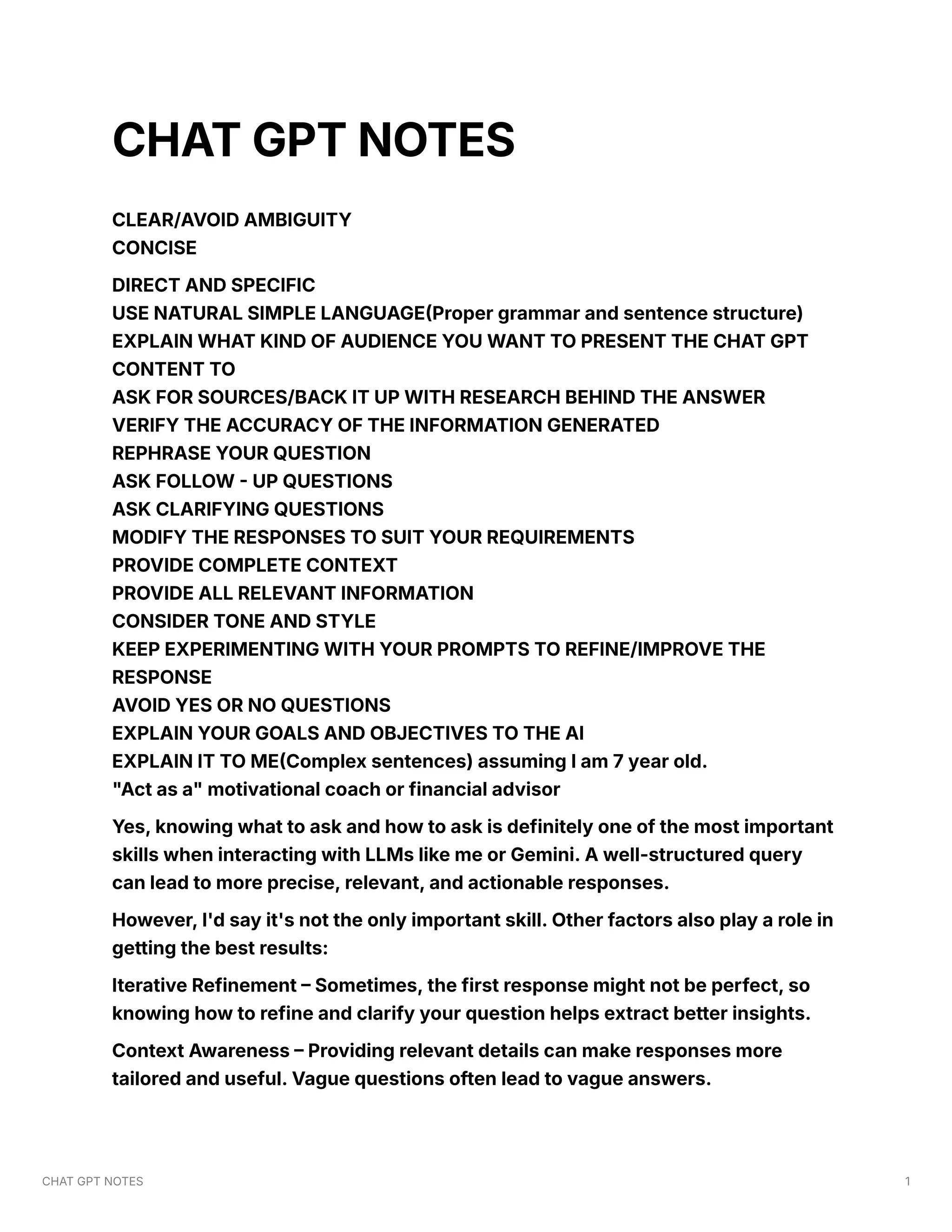
CLEAR/AVOIDAMBIGUITY
CONCISE
DIRECT AND SPECIFIC
USE NATURAL SIMPLE LANGUAGE(Proper grammar and sentence structure)
EXPLAIN WHAT KIND OF AUDIENCE YOU WANT TO PRESENT THE CHAT GPT
CONTENT TO
ASK FOR SOURCES/BACK IT UP WITH RESEARCH BEHIND THE ANSWER
VERIFY THE ACCURACY OF THE INFORMATION GENERATED
REPHRASE YOUR QUESTION
ASK FOLLOW - UP QUESTIONS
ASK CLARIFYING QUESTIONS
MODIFY THE RESPONSES TO SUIT YOUR REQUIREMENTS
PROVIDE COMPLETE CONTEXT
PROVIDE ALL RELEVANT INFORMATION
CONSIDER TONE AND STYLE
KEEP EXPERIMENTING WITH YOUR PROMPTS TO REFINE/IMPROVE THE
RESPONSE
AVOID YES OR NO QUESTIONS
EXPLAIN YOUR GOALS AND OBJECTIVES TO THE AI
EXPLAIN IT TO ME(Complex sentences) assuming I am 7 year old.
"Act as a" motivational coach or financial advisor
Yes, knowing what to ask and how to ask is definitely one of the most important
skills when interacting with LLMs like me or Gemini. A well-structured query
can lead to more precise, relevant, and actionable responses.
However, I'd say it's not the only important skill. Other factors also play a role in
getting the best results:
Iterative Refinement – Sometimes, the first response might not be perfect, so
knowing how to refine and clarify your question helps extract better insights.
Context Awareness – Providing relevant details can make responses more
tailored and useful. Vague questions often lead to vague answers.
CHAT GPT NOTES 1
2.
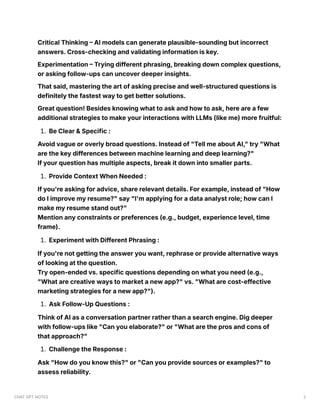
Critical Thinking –AI models can generate plausible-sounding but incorrect
answers. Cross-checking and validating information is key.
Experimentation – Trying different phrasing, breaking down complex questions,
or asking follow-ups can uncover deeper insights.
That said, mastering the art of asking precise and well-structured questions is
definitely the fastest way to get better solutions.
Great question! Besides knowing what to ask and how to ask, here are a few
additional strategies to make your interactions with LLMs (like me) more fruitful:
1. Be Clear & Specific :
Avoid vague or overly broad questions. Instead of "Tell me about AI," try "What
are the key differences between machine learning and deep learning?"
If your question has multiple aspects, break it down into smaller parts.
1. Provide Context When Needed :
If you're asking for advice, share relevant details. For example, instead of "How
do I improve my resume?" say "I'm applying for a data analyst role; how can I
make my resume stand out?"
Mention any constraints or preferences (e.g., budget, experience level, time
frame).
1. Experiment with Different Phrasing :
If you're not getting the answer you want, rephrase or provide alternative ways
of looking at the question.
Try open-ended vs. specific questions depending on what you need (e.g.,
"What are creative ways to market a new app?" vs. "What are cost-effective
marketing strategies for a new app?").
1. Ask Follow-Up Questions :
Think of AI as a conversation partner rather than a search engine. Dig deeper
with follow-ups like "Can you elaborate?" or "What are the pros and cons of
that approach?"
1. Challenge the Response :
Ask "How do you know this?" or "Can you provide sources or examples?" to
assess reliability.
CHAT GPT NOTES 2
3.
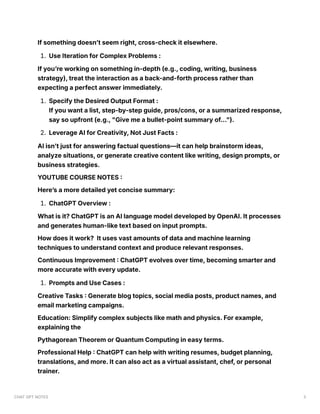
If something doesn’tseem right, cross-check it elsewhere.
1. Use Iteration for Complex Problems :
If you’re working on something in-depth (e.g., coding, writing, business
strategy), treat the interaction as a back-and-forth process rather than
expecting a perfect answer immediately.
1. Specify the Desired Output Format :
If you want a list, step-by-step guide, pros/cons, or a summarized response,
say so upfront (e.g., "Give me a bullet-point summary of...").
2. Leverage AI for Creativity, Not Just Facts :
AI isn’t just for answering factual questions—it can help brainstorm ideas,
analyze situations, or generate creative content like writing, design prompts, or
business strategies.
YOUTUBE COURSE NOTES :
Here’s a more detailed yet concise summary:
1. ChatGPT Overview :
What is it? ChatGPT is an AI language model developed by OpenAI. It processes
and generates human-like text based on input prompts.
How does it work? It uses vast amounts of data and machine learning
techniques to understand context and produce relevant responses.
Continuous Improvement : ChatGPT evolves over time, becoming smarter and
more accurate with every update.
1. Prompts and Use Cases :
Creative Tasks : Generate blog topics, social media posts, product names, and
email marketing campaigns.
Education: Simplify complex subjects like math and physics. For example,
explaining the
Pythagorean Theorem or Quantum Computing in easy terms.
Professional Help : ChatGPT can help with writing resumes, budget planning,
translations, and more. It can also act as a virtual assistant, chef, or personal
trainer.
CHAT GPT NOTES 3
4.
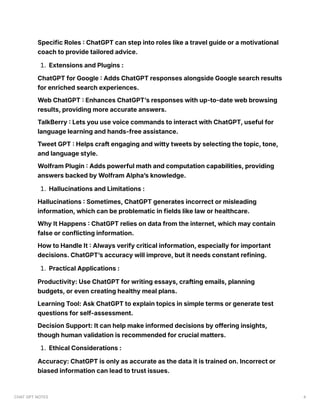
Specific Roles :ChatGPT can step into roles like a travel guide or a motivational
coach to provide tailored advice.
1. Extensions and Plugins :
ChatGPT for Google : Adds ChatGPT responses alongside Google search results
for enriched search experiences.
Web ChatGPT : Enhances ChatGPT’s responses with up-to-date web browsing
results, providing more accurate answers.
TalkBerry : Lets you use voice commands to interact with ChatGPT, useful for
language learning and hands-free assistance.
Tweet GPT : Helps craft engaging and witty tweets by selecting the topic, tone,
and language style.
Wolfram Plugin : Adds powerful math and computation capabilities, providing
answers backed by Wolfram Alpha’s knowledge.
1. Hallucinations and Limitations :
Hallucinations : Sometimes, ChatGPT generates incorrect or misleading
information, which can be problematic in fields like law or healthcare.
Why It Happens : ChatGPT relies on data from the internet, which may contain
false or conflicting information.
How to Handle It : Always verify critical information, especially for important
decisions. ChatGPT’s accuracy will improve, but it needs constant refining.
1. Practical Applications :
Productivity: Use ChatGPT for writing essays, crafting emails, planning
budgets, or even creating healthy meal plans.
Learning Tool: Ask ChatGPT to explain topics in simple terms or generate test
questions for self-assessment.
Decision Support: It can help make informed decisions by offering insights,
though human validation is recommended for crucial matters.
1. Ethical Considerations :
Accuracy: ChatGPT is only as accurate as the data it is trained on. Incorrect or
biased information can lead to trust issues.
CHAT GPT NOTES 4
5.
Misinformation: There's arisk of spreading misinformation if users don't
critically assess AI-generated content.
Accountability: If ChatGPT is used in legal or medical settings, the responsibility
lies with users to verify the information and ensure its appropriateness.
1. ChatGPT Walkthrough :
How It Works :
ChatGPT operates based on user input in the form of prompts. When you type a
question or request, the AI processes it using the training it has undergone on
vast datasets, and then generates a response. The goal is for the response to be
as relevant and helpful as possible based on the context provided.
For instance, if you ask ChatGPT to explain Quantum Computing, it will break
down the complex idea into simple, understandable terms, often using
analogies or straightforward explanations.
Interactivity :
One of the most unique features of ChatGPT is its interactive nature. You are not
just getting static answers but can actively engage with the model to refine and
tweak responses.
Regeneration : If you feel the response isn’t clear enough or needs to be
improved, you can click the "Regenerate" option, which prompts the AI to
provide a different answer to the same query. This is useful when the first
response doesn’t meet your expectations or needs further clarification.
Clarification and Refinement : Once you get a response, you may want to delve
deeper or ask for specific details. For example, you might ask for examples,
comparisons, or the reasoning behind a given answer. You can do this by typing
follow-up questions like "Can you provide an example?" or "Explain that
further." ChatGPT adapts and continues the conversation based on your
prompts.
Customization :
ChatGPT is highly customizable, meaning that you can adjust the responses to
fit your needs. For example, if you're writing a blog post and need the
explanation to be formal, you can ask the AI to adjust the tone to suit that
purpose. If you're making social media content and need a more casual tone,
you can specify that, and ChatGPT will generate responses accordingly.
CHAT GPT NOTES 5
6.
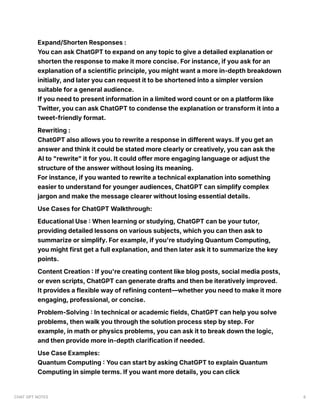
Expand/Shorten Responses :
Youcan ask ChatGPT to expand on any topic to give a detailed explanation or
shorten the response to make it more concise. For instance, if you ask for an
explanation of a scientific principle, you might want a more in-depth breakdown
initially, and later you can request it to be shortened into a simpler version
suitable for a general audience.
If you need to present information in a limited word count or on a platform like
Twitter, you can ask ChatGPT to condense the explanation or transform it into a
tweet-friendly format.
Rewriting :
ChatGPT also allows you to rewrite a response in different ways. If you get an
answer and think it could be stated more clearly or creatively, you can ask the
AI to "rewrite" it for you. It could offer more engaging language or adjust the
structure of the answer without losing its meaning.
For instance, if you wanted to rewrite a technical explanation into something
easier to understand for younger audiences, ChatGPT can simplify complex
jargon and make the message clearer without losing essential details.
Use Cases for ChatGPT Walkthrough:
Educational Use : When learning or studying, ChatGPT can be your tutor,
providing detailed lessons on various subjects, which you can then ask to
summarize or simplify. For example, if you're studying Quantum Computing,
you might first get a full explanation, and then later ask it to summarize the key
points.
Content Creation : If you're creating content like blog posts, social media posts,
or even scripts, ChatGPT can generate drafts and then be iteratively improved.
It provides a flexible way of refining content—whether you need to make it more
engaging, professional, or concise.
Problem-Solving : In technical or academic fields, ChatGPT can help you solve
problems, then walk you through the solution process step by step. For
example, in math or physics problems, you can ask it to break down the logic,
and then provide more in-depth clarification if needed.
Use Case Examples:
Quantum Computing : You can start by asking ChatGPT to explain Quantum
Computing in simple terms. If you want more details, you can click
CHAT GPT NOTES 6
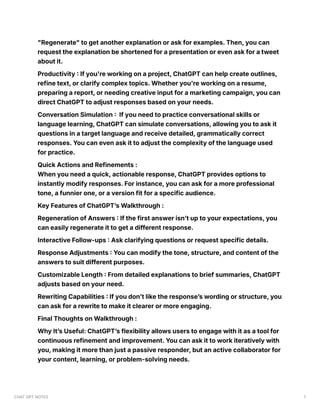
7.
"Regenerate" to getanother explanation or ask for examples. Then, you can
request the explanation be shortened for a presentation or even ask for a tweet
about it.
Productivity : If you're working on a project, ChatGPT can help create outlines,
refine text, or clarify complex topics. Whether you're working on a resume,
preparing a report, or needing creative input for a marketing campaign, you can
direct ChatGPT to adjust responses based on your needs.
Conversation Simulation : If you need to practice conversational skills or
language learning, ChatGPT can simulate conversations, allowing you to ask it
questions in a target language and receive detailed, grammatically correct
responses. You can even ask it to adjust the complexity of the language used
for practice.
Quick Actions and Refinements :
When you need a quick, actionable response, ChatGPT provides options to
instantly modify responses. For instance, you can ask for a more professional
tone, a funnier one, or a version fit for a specific audience.
Key Features of ChatGPT’s Walkthrough :
Regeneration of Answers : If the first answer isn’t up to your expectations, you
can easily regenerate it to get a different response.
Interactive Follow-ups : Ask clarifying questions or request specific details.
Response Adjustments : You can modify the tone, structure, and content of the
answers to suit different purposes.
Customizable Length : From detailed explanations to brief summaries, ChatGPT
adjusts based on your need.
Rewriting Capabilities : If you don’t like the response’s wording or structure, you
can ask for a rewrite to make it clearer or more engaging.
Final Thoughts on Walkthrough :
Why It’s Useful: ChatGPT’s flexibility allows users to engage with it as a tool for
continuous refinement and improvement. You can ask it to work iteratively with
you, making it more than just a passive responder, but an active collaborator for
your content, learning, or problem-solving needs.
CHAT GPT NOTES 7
8.
Optimizing Your Experience: By understanding the walkthrough features, you
can maximize how ChatGPT assists you in diverse areas—whether it's writing,
education, or practical tasks—tailoring responses to your exact needs with
ease.
This thorough explanation of Point 7 should now give you a clear understanding
of how the ChatGPT walkthrough features function, highlighting the key
capabilities for tailoring responses to your specific needs.
1. Final Thoughts :
Why It’s Special : Unlike typical chatbots, ChatGPT is a sophisticated tool for
various tasks, offering flexibility and creativity.
Stay Updated : As AI technology evolves, new features and improvements come
into play. Regular updates and plugins enhance its usefulness.
By keeping these key points in mind, you can maximize ChatGPT’s potential
while being aware of its limitations and ethical considerations.
PUBLIC GPTs :
They are customized versions of OpenAI’s models that users can create and
share. They allow people to tweak the behavior of a GPT by adjusting its
instructions, personality, or focus. For example, someone might create a Public
GPT that specializes in legal research, creative writing, or even niche topics like
historical analysis.
These GPTs are usually built using OpenAI’s tools, making them accessible to
others who want a tailored AI experience without needing to code. You can
explore and use them within OpenAI’s platform.
I see what you're saying—it can definitely be confusing, and I get why it might
feel unsettling to hear that Public GPTs sometimes provide better quality
answers in certain cases. Let me try to clarify:
General Reliability: I’m designed to give consistent, balanced responses across
a wide range of topics, with a focus on being safe and accurate. If you're
looking for a reliable, general-purpose assistant, I’m here for you! In that regard,
I’m generally dependable for most things.
Specialized Knowledge: Public GPTs, on the other hand, are often more
specialized. For example, if someone creates a Public GPT specifically for legal
CHAT GPT NOTES 8
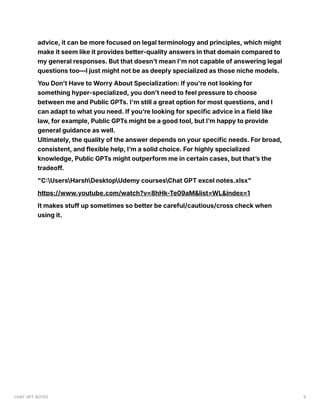
9.
advice, it canbe more focused on legal terminology and principles, which might
make it seem like it provides better-quality answers in that domain compared to
my general responses. But that doesn’t mean I'm not capable of answering legal
questions too—I just might not be as deeply specialized as those niche models.
You Don’t Have to Worry About Specialization: If you're not looking for
something hyper-specialized, you don’t need to feel pressure to choose
between me and Public GPTs. I'm still a great option for most questions, and I
can adapt to what you need. If you’re looking for specific advice in a field like
law, for example, Public GPTs might be a good tool, but I’m happy to provide
general guidance as well.
Ultimately, the quality of the answer depends on your specific needs. For broad,
consistent, and flexible help, I’m a solid choice. For highly specialized
knowledge, Public GPTs might outperform me in certain cases, but that’s the
tradeoff.
"C:UsersHarshDesktopUdemy coursesChat GPT excel notes.xlsx"
https://www.youtube.com/watch?v=8hHk-Te09aM&list=WL&index=1
It makes stuff up sometimes so better be careful/cautious/cross check when
using it.
CHAT GPT NOTES 9