#AHEAD2020 – 10 Weeks of
Webinars
Keynote AHEAD 2020: A Utopian vision of what HE
Disability service provision might look like in a
genuinely inclusive future
AHEAD Conference 2020, Dublin
Frederic Fovet, School of Education and Technology, RRU
Interactive interlude
• We will use a quick Zoom poll in order to get you individually engaging in the
overarching theme.
• Poll:
• Do you feel, looking ahead to perhaps just two years ahead down the line, the
format of accessibility services delivery will be able to withstand current
challenges? Will we make it through to 2022 without a massive rethink?
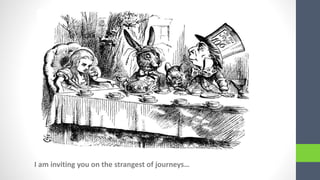
I am inviting you on the strangest of journeys…
Key issue discussed
in this workshop
• Higher Education is changing rapidly.
Our goals when it comes to Inclusion
in post-secondary are evolving quickly
too. It is in this context that Universal
Design for Learning (UDL) is becoming
increasingly appealing.
• It will be difficult to move forward
towards this new reality, however,
without first fully acknowledging the
complex tension which is appearing
between the traditional format of
accessibility services and the goals we
are seeking to achieve.
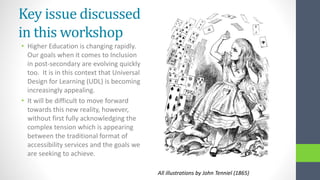
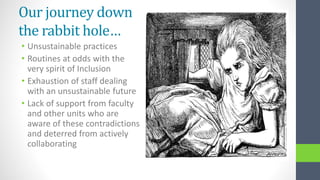
All illustrations by John Tenniel (1865)
Your travel partner on this dystopian
journey
• Currently Associate Professor in Education at Royal
Roads University in BC, Canada
• Previously Director of the Office for Students with
Disabilities at McGill for 4 years
• Continue to act as consultant to colleges and
universities on matters of accessibility and Universal
Design for Learning
• Heavily involved in UDL promotion in HE in Canada
• Have been Academic Lead on an MEd for 3 years at
UPEI and am now Program Head on an MA in
Educational Leadership and Management.
• Identify seamlessly with the perspective of
accessibility services, but also able to step back and
take some distance to examine objectively how
existing practices create uneasiness.
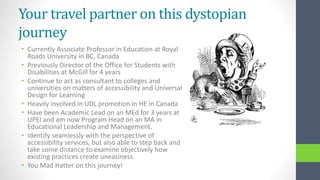
• You Mad Hatter on this journey!
Format of Keynote
• When discussing the transfer of the Keynote to an online format, Dara and I thought the
most engaging way to structure the talk would be a discussion format. Dara has graciously
accepted to be my partner in this dialogue.
• Will encourage Dara to stop me when participants have questions. Please use the chat
function in Zoom.
• We have inserted interactive activities to encourage participants to take on an active role in
the discussion.
• A reflection on UDL within the conference delivery format has led me to create a website to
support the talk, and offer participants multiple pathways to the content. The site can be
found at: www.keynoteAHEAD2020.com
• I also wish to stretch the opportunity we have for dialogue well beyond the hour we are given
here. You can continue the discussion via email (frederic.fovet@royalroads.ca) or through
social media such as Twitter (@ffovet or #AHEAD2020). Please join these discussions and
build the momentum around these important themes.
First part of the journey: Down the rabbit
hole
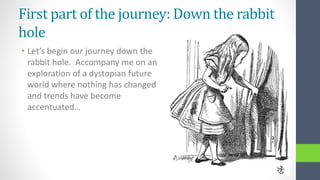
• Let’s begin our journey down the
rabbit hole. Accompany me on an
exploration of a dystopian future
world where nothing has changed
and trends have become
accentuated…
Interactive interlude
• Interactive activity – Using Menti, we are going to get you to
explore and share some of the areas of tension you are currently
experiencing within Disability support services. Where are the
seams cracking? Please keep entering your thoughts in Menti
through this section and we will go through some of the
comments together at the end of the section.
• Go to Menti.com – enter code 583960
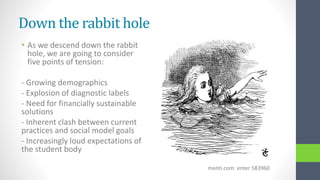
Down the rabbit hole
• As we descend down the rabbit
hole, we are going to consider
five points of tension:
- Growing demographics
- Explosion of diagnostic labels
- Need for financially sustainable
solutions
- Inherent clash between current
practices and social model goals
- Increasingly loud expectations of
the student body
menti.com: enter 583960
Explosion in demographics
Emerging trends
• Unprecedented explosion in
service request (up to 150% in one
year on certain North American
campuses)
• Emergence of a significant body of
‘floaters’, students who require
services but do not register
• Percentage of service users who
do not identify as having a
Disability and refuse to approach
these services
Impact on Accessibility services
• Intake appointments impossible to
maintain in their current format
• Long bottleneck and waitlists
• High percentage of learners cannot
access their services
• Increasing provision of template
services that are not specifically
aligned with learners’ needs.
• Increased number of complaints and
appeals – including litigation and
settlements
• Disconnect and frustration from
faculty
menti.com: enter 583960
Explosion of diagnostic labels
Emerging trends
• Services set up for ‘traditional’
disabilities (hearing, visual and
mobility impairments) are forced well
beyond their expertise and applying a
targeted, remedial, diagnostic
approach to diagnoses they have little
understanding of.
• This leads to processes that are
contradictory and purport to put a
campus on notice of a diagnosis whilst
not providing specialized expertise.
Letter of accommodations to
instructors has become entirely
meaningless.
Impact on Accessibility services
• Phenomenon of disempowerment and
emergence of a ‘culture of referral’ on
campuses that seem to purport that to be
a specialist on access one needs to have
diagnostic expertise.
• The diagnostic document is no longer a
tool it becomes a barrier between the
service provider and the learner and
often precludes genuine dialogue on
barriers created by the learning
environment.
• Many learners in fact do not actually
require traditional accommodations, but
are still being forced to acquire diagnostic
documentation.
Need for financially sustainable solutions
• Accommodations were designed and conceived at a time when students with
Disabilities represented a very small percentage of the campus population.
• In those days it was possible to create inclusive provisions in this way; it remained
uncomplicated, relatively cheap, manageable and relatively efficient.
• This is no longer the case: the existing format of services is extremely costly and has
become unsustainable.
• The issue is not the cost itself, but rather the fact that these expenses keep
increasing, that they snowball and escalate out of control – without ever having any
tangible structural impact on practices or pedagogy.
• A cost of this magnitude can only be justified if it succeeds in fundamentally altering
structure and creates a more sustainable campus.
menti.com: enter 583960
Inherent clash between current practices
and social model goals
• Intake format
• Flavour of appointments and power dynamics
• Issues with the notion of ‘help’ – breeds co-dependency on services than actual
autonomy
• Over-reliance on documentation
• Creation of additional barriers, not removal of challenges
• Particularly thorny issue of exam accommodation and onerous registration processes
• Issues with outreach with implies an inherent adhesion to medical model
• Funding model of accessibility services is ambivalent and prioritizes ‘bodies through
the door’
• Breeds a ‘working myself out of a job’ ambivalence in relation to UDL
• Little time and resources dedicated to faculty support
menti.com: enter 583960
Increasingly loud expectations of the
student body
• There is starting to be a clash of culture between a generation of students who ahev
very specific expectations with regards to inclusion and a system that has so far not
shied away from setting them apart and labelling them.
• Where does that eloquent anger come from? We are now supporting a generation
of students that has benefitted from inclusion in schools. They have a very clear
understanding of social capital and why it is so important within education.
• They wish to be treated as all other students and often reject being channelled
towards a parallel system that purports to treat them differently.
• Anecdote from my own practice in relation to final exams in Undrgraduate courses.
• Mediatized case in Ontario that has set a precedent for Ontario universities:
• This student voice highlights daily the fundamental clash that exist between some of
our Disability services practices and the social model of disability/ genuine inclusion
Our journey down
the rabbit hole…
• Unsustainable practices
• Routines at odds with the
very spirit of Inclusion
• Exhaustion of staff dealing
with an unsustainable future
• Lack of support from faculty
and other units who are
aware of these contradictions
and deterred from actively
collaborating
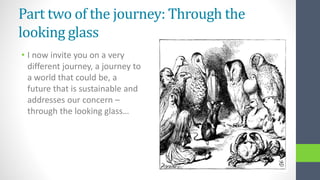
Part two of the journey: Through the
looking glass
• I now invite you on a very
different journey, a journey to
a world that could be, a
future that is sustainable and
addresses our concern –
through the looking glass…
Interactive interlude
• Interactive activity – Using Menti, Dara and I are going to ask you
to create a word puzzle by posting words you feel have strong
suggestive connotations in relation to the changes you feel are
needed urgently in order to avoid the ‘madness’ we have just
journeyed through… What would be your ‘one word’
recommendations to the sector for immediate change in the way
we see and construct the Inclusion of diverse learners.
• Go to Menti.com – enter code 293964
Part two of the journey: Through the
looking glass
Suggestions for a sustainable future:
(i) shifting services towards faculty support
(ii) reframing the image of Accessibility services
(iii) rationalizing exam services
(iv) removing barriers from student interface
(v) redefining sustainable development of Accessibility
service
menti.com: enter 293964
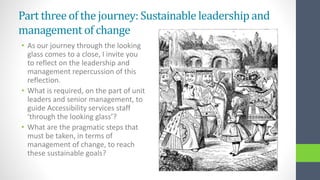
Part threeof the journey: Sustainable leadership and
management of change
• As our journey through the looking
glass comes to a close, I invite you
to reflect on the leadership and
management repercussion of this
reflection.
• What is required, on the part of unit
leaders and senior management, to
guide Accessibility services staff
‘through the looking glass’?
• What are the pragmatic steps that
must be taken, in terms of
management of change, to reach
these sustainable goals?
Interactive Interlude
• Interactive activity – During this section we will ask you to write
down questions and use the Zoom Meeting chatbox to post them.
Frederic and Dara will tackle as many of these as possible as the
section comes to a close.
Part three of the journey: Sustainable
leadership and management of change
• Acknowledge and challenge our ambivalence with regards to UDL
• Engage in meaningful cross-campus alliances for the development and
implementation of UDL
• Avoid using obsolete funding model as an excuse for stagnation
• Engage in an authentic reflection on hiring practices
• Support staff as they begin using UDL as a lens on their practice
• Collaborate with other student services and embracing Intersectionality
• Boldly embrace a new wider role for Accessibility services on campus
Interactive Interlude
• Interactive activity – Recap on questions posted in the
Zoom Meeting Q&A chatbox.
Let’s continue this journey together –
Extend the conversation!
• Let’s break this Keynote out of the
traditional constraints of
conference delivery.
• AHEAD and Dara have helped us
do this in part already by allowing
it to take shape online.
• Let’s apply UDL fully to it and turn
it into an ongoing conversation!
• I’ll be online for the evening (my
afternoon) and we can chat using
email
(frederic.fovet@royalroads.ca) or
Twitter (@Ffovet or #AHEAD2020)
References
Bailey, M. (2017) Race and Disability in the Academy. The Sociological Review.
Beck, T., Diaz del Castillo, P., Fovet, F., Mole, H., & Noga, B. (2014) Applying Universal
Design to disability service provision: outcome analysis of a UD audit. Journal of Post-
secondary Education and Disability, 27(2), 209-222
Fichten, C., Heiman, T., Havel, A., Jorgensen, M., & Budd, J. (2016) Sustainability of
Disability-Related Services in Canada and Israel: Will the Real Universal Design Please
Stand Up? Exceptionality Education International, 26(1), 19–35
Fovet, F., & Giles, J. (2015) ‘What`s in a name?’ Assessing dynamic tension between
Critical Theory ambitions and Neoliberal pragmatism in Higher Education Disability
service provision. International Studies in Widening Participation, 2 (2), 4-11
Fovet, F. (2017) Access, Universal Design and Sustainability of Teaching Practices: a
Powerful Synchronicity of Concepts at a Crucial Conjuncture for Higher Education.
Indonesian Journal of Disability Studies (IJDS), 4(2), 118-129
Fovet, F. (2020) Examining the (lack of) impact the #disabilitytoowhite movement has
had on Higher Ed Disability Service Provision. Paper presented at the Hawaii
International Conference on Education, Honolulu, January
Fovet, F. (in print) Developing an Ecological Approach to Strategic UDL Implementation
in Higher Education. Journal of Education and Teaching
Houghton, M. & Fovet, F. (2012) Reframing Disability, reshaping the provision of
services. Communiqué, 13 (1), 16-19
Stienstra, D., Nyerere, L. (2016). Race, ethnicity and disability: Charting complex and
intersectional terrains. In Grech, S., Soldatic, K. (Eds.), Disability in the global South (pp.
255–268). Cham, Switzerland: Springer.
Contact details
• Frederic Fovet (PhD.)
• Associate Professor, School of Education and Technology, Royal Roads
University
• Frederic.fovet@royalroads.ca
• @Ffovet
• www.implementudl.com
Next Up for #AHEAD2020
Tomorrow: 11:00am GMT - 'Come together: An
exploration, with you, on how campus learning
networks can support inclusion', Dr Etienne Wenger
Traynor
Next Friday (April 3rd): 14:30 – ‘Final of John Kelly
Award for Universal Design for Learning’
Register for all sessions free at
ahead.ie/conference2020

Fovet Keynote AHEAD 2020

  • 1.
    #AHEAD2020 – 10Weeks of Webinars
  • 2.
    Keynote AHEAD 2020:A Utopian vision of what HE Disability service provision might look like in a genuinely inclusive future AHEAD Conference 2020, Dublin Frederic Fovet, School of Education and Technology, RRU
  • 3.
    Interactive interlude • Wewill use a quick Zoom poll in order to get you individually engaging in the overarching theme. • Poll: • Do you feel, looking ahead to perhaps just two years ahead down the line, the format of accessibility services delivery will be able to withstand current challenges? Will we make it through to 2022 without a massive rethink?
  • 4.
    I am invitingyou on the strangest of journeys…
  • 5.
    Key issue discussed inthis workshop • Higher Education is changing rapidly. Our goals when it comes to Inclusion in post-secondary are evolving quickly too. It is in this context that Universal Design for Learning (UDL) is becoming increasingly appealing. • It will be difficult to move forward towards this new reality, however, without first fully acknowledging the complex tension which is appearing between the traditional format of accessibility services and the goals we are seeking to achieve. All illustrations by John Tenniel (1865)
  • 6.
    Your travel partneron this dystopian journey • Currently Associate Professor in Education at Royal Roads University in BC, Canada • Previously Director of the Office for Students with Disabilities at McGill for 4 years • Continue to act as consultant to colleges and universities on matters of accessibility and Universal Design for Learning • Heavily involved in UDL promotion in HE in Canada • Have been Academic Lead on an MEd for 3 years at UPEI and am now Program Head on an MA in Educational Leadership and Management. • Identify seamlessly with the perspective of accessibility services, but also able to step back and take some distance to examine objectively how existing practices create uneasiness. • You Mad Hatter on this journey!
  • 7.
    Format of Keynote •When discussing the transfer of the Keynote to an online format, Dara and I thought the most engaging way to structure the talk would be a discussion format. Dara has graciously accepted to be my partner in this dialogue. • Will encourage Dara to stop me when participants have questions. Please use the chat function in Zoom. • We have inserted interactive activities to encourage participants to take on an active role in the discussion. • A reflection on UDL within the conference delivery format has led me to create a website to support the talk, and offer participants multiple pathways to the content. The site can be found at: www.keynoteAHEAD2020.com • I also wish to stretch the opportunity we have for dialogue well beyond the hour we are given here. You can continue the discussion via email (frederic.fovet@royalroads.ca) or through social media such as Twitter (@ffovet or #AHEAD2020). Please join these discussions and build the momentum around these important themes.
  • 8.
    First part ofthe journey: Down the rabbit hole • Let’s begin our journey down the rabbit hole. Accompany me on an exploration of a dystopian future world where nothing has changed and trends have become accentuated…
  • 9.
    Interactive interlude • Interactiveactivity – Using Menti, we are going to get you to explore and share some of the areas of tension you are currently experiencing within Disability support services. Where are the seams cracking? Please keep entering your thoughts in Menti through this section and we will go through some of the comments together at the end of the section. • Go to Menti.com – enter code 583960
  • 10.
    Down the rabbithole • As we descend down the rabbit hole, we are going to consider five points of tension: - Growing demographics - Explosion of diagnostic labels - Need for financially sustainable solutions - Inherent clash between current practices and social model goals - Increasingly loud expectations of the student body menti.com: enter 583960
  • 11.
    Explosion in demographics Emergingtrends • Unprecedented explosion in service request (up to 150% in one year on certain North American campuses) • Emergence of a significant body of ‘floaters’, students who require services but do not register • Percentage of service users who do not identify as having a Disability and refuse to approach these services Impact on Accessibility services • Intake appointments impossible to maintain in their current format • Long bottleneck and waitlists • High percentage of learners cannot access their services • Increasing provision of template services that are not specifically aligned with learners’ needs. • Increased number of complaints and appeals – including litigation and settlements • Disconnect and frustration from faculty menti.com: enter 583960
  • 12.
    Explosion of diagnosticlabels Emerging trends • Services set up for ‘traditional’ disabilities (hearing, visual and mobility impairments) are forced well beyond their expertise and applying a targeted, remedial, diagnostic approach to diagnoses they have little understanding of. • This leads to processes that are contradictory and purport to put a campus on notice of a diagnosis whilst not providing specialized expertise. Letter of accommodations to instructors has become entirely meaningless. Impact on Accessibility services • Phenomenon of disempowerment and emergence of a ‘culture of referral’ on campuses that seem to purport that to be a specialist on access one needs to have diagnostic expertise. • The diagnostic document is no longer a tool it becomes a barrier between the service provider and the learner and often precludes genuine dialogue on barriers created by the learning environment. • Many learners in fact do not actually require traditional accommodations, but are still being forced to acquire diagnostic documentation.
  • 13.
    Need for financiallysustainable solutions • Accommodations were designed and conceived at a time when students with Disabilities represented a very small percentage of the campus population. • In those days it was possible to create inclusive provisions in this way; it remained uncomplicated, relatively cheap, manageable and relatively efficient. • This is no longer the case: the existing format of services is extremely costly and has become unsustainable. • The issue is not the cost itself, but rather the fact that these expenses keep increasing, that they snowball and escalate out of control – without ever having any tangible structural impact on practices or pedagogy. • A cost of this magnitude can only be justified if it succeeds in fundamentally altering structure and creates a more sustainable campus. menti.com: enter 583960
  • 14.
    Inherent clash betweencurrent practices and social model goals • Intake format • Flavour of appointments and power dynamics • Issues with the notion of ‘help’ – breeds co-dependency on services than actual autonomy • Over-reliance on documentation • Creation of additional barriers, not removal of challenges • Particularly thorny issue of exam accommodation and onerous registration processes • Issues with outreach with implies an inherent adhesion to medical model • Funding model of accessibility services is ambivalent and prioritizes ‘bodies through the door’ • Breeds a ‘working myself out of a job’ ambivalence in relation to UDL • Little time and resources dedicated to faculty support menti.com: enter 583960
  • 15.
    Increasingly loud expectationsof the student body • There is starting to be a clash of culture between a generation of students who ahev very specific expectations with regards to inclusion and a system that has so far not shied away from setting them apart and labelling them. • Where does that eloquent anger come from? We are now supporting a generation of students that has benefitted from inclusion in schools. They have a very clear understanding of social capital and why it is so important within education. • They wish to be treated as all other students and often reject being channelled towards a parallel system that purports to treat them differently. • Anecdote from my own practice in relation to final exams in Undrgraduate courses. • Mediatized case in Ontario that has set a precedent for Ontario universities: • This student voice highlights daily the fundamental clash that exist between some of our Disability services practices and the social model of disability/ genuine inclusion
  • 16.
    Our journey down therabbit hole… • Unsustainable practices • Routines at odds with the very spirit of Inclusion • Exhaustion of staff dealing with an unsustainable future • Lack of support from faculty and other units who are aware of these contradictions and deterred from actively collaborating
  • 17.
    Part two ofthe journey: Through the looking glass • I now invite you on a very different journey, a journey to a world that could be, a future that is sustainable and addresses our concern – through the looking glass…
  • 18.
    Interactive interlude • Interactiveactivity – Using Menti, Dara and I are going to ask you to create a word puzzle by posting words you feel have strong suggestive connotations in relation to the changes you feel are needed urgently in order to avoid the ‘madness’ we have just journeyed through… What would be your ‘one word’ recommendations to the sector for immediate change in the way we see and construct the Inclusion of diverse learners. • Go to Menti.com – enter code 293964
  • 19.
    Part two ofthe journey: Through the looking glass Suggestions for a sustainable future: (i) shifting services towards faculty support (ii) reframing the image of Accessibility services (iii) rationalizing exam services (iv) removing barriers from student interface (v) redefining sustainable development of Accessibility service menti.com: enter 293964
  • 20.
    Part threeof thejourney: Sustainable leadership and management of change • As our journey through the looking glass comes to a close, I invite you to reflect on the leadership and management repercussion of this reflection. • What is required, on the part of unit leaders and senior management, to guide Accessibility services staff ‘through the looking glass’? • What are the pragmatic steps that must be taken, in terms of management of change, to reach these sustainable goals?
  • 21.
    Interactive Interlude • Interactiveactivity – During this section we will ask you to write down questions and use the Zoom Meeting chatbox to post them. Frederic and Dara will tackle as many of these as possible as the section comes to a close.
  • 22.
    Part three ofthe journey: Sustainable leadership and management of change • Acknowledge and challenge our ambivalence with regards to UDL • Engage in meaningful cross-campus alliances for the development and implementation of UDL • Avoid using obsolete funding model as an excuse for stagnation • Engage in an authentic reflection on hiring practices • Support staff as they begin using UDL as a lens on their practice • Collaborate with other student services and embracing Intersectionality • Boldly embrace a new wider role for Accessibility services on campus
  • 23.
    Interactive Interlude • Interactiveactivity – Recap on questions posted in the Zoom Meeting Q&A chatbox.
  • 24.
    Let’s continue thisjourney together – Extend the conversation! • Let’s break this Keynote out of the traditional constraints of conference delivery. • AHEAD and Dara have helped us do this in part already by allowing it to take shape online. • Let’s apply UDL fully to it and turn it into an ongoing conversation! • I’ll be online for the evening (my afternoon) and we can chat using email (frederic.fovet@royalroads.ca) or Twitter (@Ffovet or #AHEAD2020)
  • 25.
    References Bailey, M. (2017)Race and Disability in the Academy. The Sociological Review. Beck, T., Diaz del Castillo, P., Fovet, F., Mole, H., & Noga, B. (2014) Applying Universal Design to disability service provision: outcome analysis of a UD audit. Journal of Post- secondary Education and Disability, 27(2), 209-222 Fichten, C., Heiman, T., Havel, A., Jorgensen, M., & Budd, J. (2016) Sustainability of Disability-Related Services in Canada and Israel: Will the Real Universal Design Please Stand Up? Exceptionality Education International, 26(1), 19–35 Fovet, F., & Giles, J. (2015) ‘What`s in a name?’ Assessing dynamic tension between Critical Theory ambitions and Neoliberal pragmatism in Higher Education Disability service provision. International Studies in Widening Participation, 2 (2), 4-11 Fovet, F. (2017) Access, Universal Design and Sustainability of Teaching Practices: a Powerful Synchronicity of Concepts at a Crucial Conjuncture for Higher Education. Indonesian Journal of Disability Studies (IJDS), 4(2), 118-129 Fovet, F. (2020) Examining the (lack of) impact the #disabilitytoowhite movement has had on Higher Ed Disability Service Provision. Paper presented at the Hawaii International Conference on Education, Honolulu, January Fovet, F. (in print) Developing an Ecological Approach to Strategic UDL Implementation in Higher Education. Journal of Education and Teaching Houghton, M. & Fovet, F. (2012) Reframing Disability, reshaping the provision of services. Communiqué, 13 (1), 16-19 Stienstra, D., Nyerere, L. (2016). Race, ethnicity and disability: Charting complex and intersectional terrains. In Grech, S., Soldatic, K. (Eds.), Disability in the global South (pp. 255–268). Cham, Switzerland: Springer.
  • 26.
    Contact details • FredericFovet (PhD.) • Associate Professor, School of Education and Technology, Royal Roads University • Frederic.fovet@royalroads.ca • @Ffovet • www.implementudl.com
  • 27.
    Next Up for#AHEAD2020 Tomorrow: 11:00am GMT - 'Come together: An exploration, with you, on how campus learning networks can support inclusion', Dr Etienne Wenger Traynor Next Friday (April 3rd): 14:30 – ‘Final of John Kelly Award for Universal Design for Learning’ Register for all sessions free at ahead.ie/conference2020