Decolonizing UDL
Power of Potential: Sharing Experiences from Universal Design for Learning
(UDL) Journeys
June 26th-28th, 2024
Dr. Frederic Fovet, Faculty of Education and Social Work, Thompson Rivers
University
Land Acknowledgement
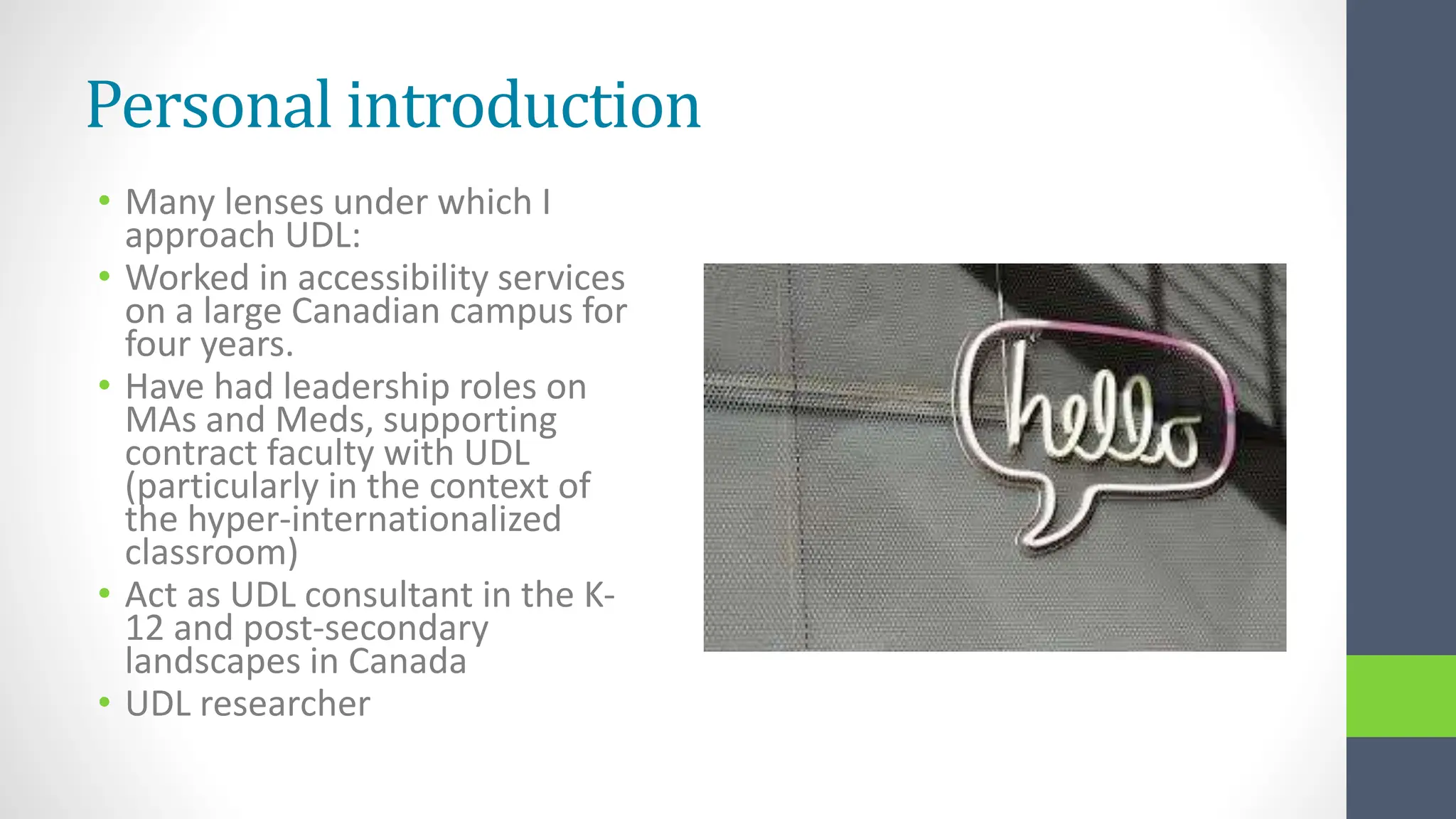
• Thompson Rivers University
campuses are on the traditional
lands of the Tk'emlúps te
Secwépemc (Kamloops campus)
and the T’exelc (Williams Lake
campus) within
Secwépemc'ulucw, the
traditional and unceded
territory of the Secwépemc. The
region TRU serves also extends
into the territories of the
St’át’imc, Nlaka’pamux,
Tŝilhqot'in, Nuxalk, and Dakelh
Personal introduction
• Many lenses under which I
approach UDL:
• Worked in accessibility services
on a large Canadian campus for
four years.
• Have had leadership roles on
MAs and Meds, supporting
contract faculty with UDL
(particularly in the context of
the hyper-internationalized
classroom)
• Act as UDL consultant in the K-
12 and post-secondary
landscapes in Canada
• UDL researcher
Context –identifying the issue
• UDL has been to date white, Global North domain.
• The scholarship itself has allowed for very little voice and representation from
Global South and Indigenous voices
• Also, a general and ongoing reluctance to consider UDL beyond impairment
and disability.
• Yet this is a framework about inclusion and about diversity.
• How can it have become so entrenched as a Caucasian, middle class, and
occidental model?
• How do we move out of this status quo to take UDL back to more authentic
concerns around diversity?
Objectives
• Brainstorm as a group around the
concept of ‘decolonizing UDL’
• Examine how there might be
synchronicity between UDL and
Indigenization
• Consider how we might decolonize
UDL within the Global North – Global
South tension
• Examine pragmatic action items
available to the field
• Consider how best break issues of
silos within UDL scholarship
• Find a global setting for UDL growth
• Examine UDL within the neoliberal-
critical theory dichotomy
Activity 1: Initial brainstorm around the notion
of decolonizing UDL
• Let’s spend 8 minutes
thinking about what
decolonizing might mean.
• How do you interpret that
expression in your own
professional context?
• What would you like to see
‘decolonized’ about UDL?
• [Table discussion, 8 min]
Debrieffromgroup activity:An ironicreluctanceoftheUDLdiscourse
torecognizebarrierstolearningbeyondimpairment
• First observation: resistance
• It can be argued that despite the articulation of its discourse, the UDL
movement is reluctant to examine barriers to learning, beyond Disability and
impairment.
• When one adopts UDL, one shifts from a focus on learner exceptionality to a
design-based identification of ‘barriers’ in T&L; it is the implementation of the
social model of disability into teaching practices.
• Yet, it is clear many advocates of UDL refuse to examine the barriers other
diverse learners in T&L
Debrieffromgroup activity:An ironicreluctanceoftheUDLdiscourse
torecognizebarrierstolearningbeyondimpairment(contd.)
• Ironically, this means the field is currently fighting ‘deficit thinking’ in relation
to students with disabilities, but perpetuating deficit thinking in relation to
culturally, linguistically, ethnically, or racially diverse learners.
• Yet these barriers are usually exactly the same as those experiences by
students with disabilities.
• Because they are not acknowledged, these barriers have a far greater impact
for learners who are culturally or ethnically diverse.
• During the pandemic for example, they were the ‘greatest losers’ because
their plight remained unacknowledged.
What might we include in a reflection around
decolonizing UDL?
• Keep thinking about the list
you might want to begin
creating and we will revisit
these ideas at the end of the
workshop. We are on the
lookout for actionable
objectives. This is not just
about theorizing!
Activity 2: Synchronicity between UDL and the
Indigenization of the curriculum?
• It seems intuitive but it is far
more complex than appears.
• Let’s take some time together
to examine this overlap/
synchronicity
Alignment of Indigenous principles of
learning with UDL
• First issue: there is a great amount of variety in what is framed as Indigenous
or First Nations principle of T&L.
• Let’s take two examples:
• First Nations Education Steering Committee [FNESC] (2007) First Peoples
Principles of Learning.
• New South Wales Department of Education (2023) 8 Aboriginal Ways of
Learning.
• Let’s see to what extent UDL can fit these frameworks.
UDL & the First Peoples Principles of
Learning
• First Nations Education Steering Committee [FNESC] (2007) First Peoples Principles of
Learning.
• The Principles are as follows:
• Learning ultimately supports the well-being of the self, the family, the community, the land,
the spirits, and the ancestors.
• Learning is holistic, reflexive, reflective, experiential, and relational (focused on
connectedness, on reciprocal relationships, and a sense of place).
• Learning involves recognizing the consequences of one‘s actions.
• Learning involves generational roles and responsibilities.
• Learning recognizes the role of Indigenous knowledge.
• Learning is embedded in memory, history, and story.
• Learning involves patience and time.
• Learning requires exploration of one‘s identity.
• Learning involves recognizing that some knowledge is sacred and only shared with
permission and/or in certain situations.
Interactive task [table discussions, 5 min]
• Where do you identify an overlap between the First People Principles of Learning and UDL?
• Learning ultimately supports the well-being of the self, the family, the community, the land,
the spirits, and the ancestors.
• Learning is holistic, reflexive, reflective, experiential, and relational (focused on
connectedness, on reciprocal relationships, and a sense of place).
• Learning involves recognizing the consequences of one‘s actions.
• Learning involves generational roles and responsibilities.
• Learning recognizes the role of Indigenous knowledge.
• Learning is embedded in memory, history, and story.
• Learning involves patience and time.
• Learning requires exploration of one‘s identity.
• Learning involves recognizing that some knowledge is sacred and only shared with
permission and/or in certain situations.
First People Principles of Learning and
UDL
• Learning ultimately supports the well-being of the self, the family, the community, the land,
the spirits, and the ancestors.
• Learning is holistic, reflexive, reflective, experiential, and relational (focused on
connectedness, on reciprocal relationships, and a sense of place). Multiples means of action
and expression?
• Learning involves recognizing the consequences of one‘s actions.
• Learning involves generational roles and responsibilities.
• Learning recognizes the role of Indigenous knowledge. Multiple means of engagement?
• Learning is embedded in memory, history, and story. Multiple means of representation?
• Learning involves patience and time.
• Learning requires exploration of one‘s identity.
• Learning involves recognizing that some knowledge is sacred and only shared with
permission and/or in certain situations.
• Not an easy cohabitation. The First People Principles of Learning are more focused on
context and ontological preoccupations than on T&L techniques.
Eight ways of knowing and UDL
• Is the task different in this second example?
• The NSW Department of Education Eights Ways of Knowing are:
• Story sharing
• learning maps
• non-verbal
• symbols and images
• land links
• non-linear
• deconstruct and reconstruct
• community links.
Interactive task: Eight aboriginal ways of
knowing and UDL
• All these principles can be integrated into UDL as they are essentially about being
multimodal in presentation, expression and engagement. This can be problematic as
they do not acknowledge the wider ontological conundrum Western teachers may
experience entering mindsets that are not theirs. There is here an overfocus on the
techniques of communicating in T&L
• Story sharing
• learning maps
• non-verbal
• symbols and images
• land links
• non-linear
• deconstruct and reconstruct
• community links.
Capacity of UDL to address the priorities
of Indigenous education
• Multiple means of representation: being multimodal in the framing of content
• Multiple means of action and expression: being dialogical in the way learners
are invited into learning
• Multiple means of engagement: the most delicate of the three principles.
Room here for a great deal of Indigenization (curriculum co-creation, critical
pedagogy, culturally responsive pedagogy, etc.)
A Euro-Caucasian urgency to frame and
formalize?
• Indigenous epistemology is at ease with intuitive understandings of ways of being.
• Almost impossible to discuss T&L without touching on ontology and world views.
• Frustration of Indigenous folks at having to explain and frame their world view and
their cosmologies in a post-colonial landscape
• The very insistence on frameworks, principles, and written formulations is Western
and therefore inherently colonial.
• Savoir être versus savoir faire
• Problematic observation in the area of UDL: UDL even when it does not stress ‘the
universal’ purports to be a ‘how to guide’ that all instructors can ‘buy into’
• UDL – in order to allow for Indigenization – will have to keep stressing that it is no
more than a lens on practice.
Ecological complexity of Indigenizing the UDL
movement: we’re not doing this in a historical vacuum
• Historical absence of Indigenous communities at the UDL table
• Concerns over the Eurocentric nature of the UDL discourse to date
• Whenever the word ‘universal’ appears, it can create fear and suspicion
within the Indigenization movement which is very much about a return to the
local.
• Not necessarily such a notion as universalized Indigenous principles of
education
• UDL movement’s considerable failure at ‘inviting in’ other scholarships
• Fragmentation of services and expertise within the inclusion landscape
Some examples of Indigenous initiatives
with UDL
• Kearney, D.B. (2022) UDL for Indigenous pedagogies. In: Universal Design for
Learning (UDL) for Inclusion, Diversity, Equity, and Accessibility (IDEA).
https://opentextbooks.uregina.ca/universaldesign/chapter/6-4-indigenous-
pedagogies/
• Indigenous Ways of Teaching, Learning & Being with Libby Roderick [Podcast]:
https://thinkudl.org/episodes/indigenous-ways-of-teaching-learning-being-with-
libby-roderick
• Jennifer Katz’s work at UBC: https://www.threeblockmodel.com/indigenous-
education--the-three-block-model-of-udl.html
• UDL at Mohawk College: https://www.mohawkcollege.ca/centre-for-teaching-
learning-innovation/teaching-effectively/universal-design-for-learning
Activity 3: Decolonizing UDL within the broad Global
North-Global South divide and balance inequity
• Decolonization is not just an
internal process
• It makes us reflect richly on Global
North vs. Global South power
imbalances.
• What are some of the troubling
observations we can make about
UDL from a global perspective,
when using the post-colonial
paradigm as a lens?
• What is not right currently in the
state of UDL and the Global South?
• [Whole room discussion, 6 min]
Debrief on Activity 3
• Creating authentic space for Global South voices
• Widening the discourse to invite in our Global South colleagues
• Ensuring that the UDL discourse in the Global South is not seen as simply a
duplication of our own Global North preoccupations
• Acknowledging that UDL in the Global South will not be a duplication of Global
North initiatives
• Understanding that UDL in the Global South may look very different than it does in
North American and European contexts
• Understanding the role of UDL in breaking reductionist and deficit model view of
international student engaged in mobility
• Applying UDL to the complex dynamics of the hyper-internationalized classroom.
• Examining the use of UDL to effectively include students from the Global South who
are lured the Global North through a process of hyper-internationalization, that
prioritizes revenue but does not acknowledge the unease of these learners.
Activity 4: From the theoretical to the practical. What
would be your to do list?
• We started the workshop
saying we would create a list
of actionable items that are
immediate relevant to your
institutional contexts.
• What are these actionable
items so far?
Activity 6: Creating dialogue (one of the
items on my list)
• How do we go about creating a new form of dialogue so that our conversation around UDL
acknowledges dangerous post-colonial power dynamics and steers away from the regular
Eurocentric pitfalls?
• ‘The purpose of this study is to first ensure that before further research is done, that we hear
from Indigenous parents that the practices and Universal Design for Learning might be
beneficial to their children and supportive of their cultural identities.’ (Vasilez, 2023)
• Interactive task:
• How is this new etiquette for collaboration to be defined and formulated within the UDL
scholarship and within field experimentations and initiatives?
• What would this look like in your own institution?
• Risks: over-solicitation, being the ‘object’ of UDL experimentation rather than co-
investigators, imposition of a Euro-Caucasian lens, expenditure of resource on something
that does not matter to non-Caucasian communities? [Whole room discussion]
Activity 7: Addressing the ‘sine qua non’ groundwork
that needs to take place around silos (another off my
list!)
• It will be impossible to really
stretch UDL to serve these
objectives while we continue to
silo our work with inclusion.
• Do you feel we are able to
overcome the siloing of
departments and faculty when
it comes to UDL, beyond
impairment?
• What are some of the ways
forward? [Whole room
discussion]
A note: Issues or territoriality and the
relevance of funding models
• The reasons why UDL advocates are currently reluctant to consider the potential of
UDL for culturally diverse learners are multiple and complex:
• The work of these agencies and departments is delineated with care and does not
allow them to grow their scope
• Much of the funding of these agencies and departments is bio-medical in flavour: it
requires clinical documentation. These stakeholders advocate for UDL but are
funded by deficit model envelopes. Inherent tension.
• It is felt that growing the scope of this work would also weaken the strength of the
support generated for students with disabilities
• The post-secondary sector is a landscape that is highly neo-liberal and is structured
around the notion of competitivity as driver of productivity and efficiency.
• Felt as a result that support for students with disabilities effectively ‘competes’ with
funding for the support of other diverse learners.
Examining the impact of leadership
• ‘As I learned more about universal design for learning, I began to notice some central ideas,
embedded in universal design for learning practices and tenets that aligned with Indigenous
leadership, frameworks and pedagogies. I want to be clear, ensuring that Universal Design for
Learning utilizes standards in lesson design. These standards are usually based on norming
data from the dominant culture, which often does not consider their Indigenous experience.
For this reason, alone, I am not suggesting that there is full alignment between universal
design for learning and Indigenous leadership, frameworks and pedagogies. I am suggesting
that there are important crossover’s, however, that better support our Indigenous students
in public classrooms.
• The purpose of this study is to first ensure that before further research is done, that we hear
from Indigenous parents that the practices and Universal Design for Learning might be
beneficial to their children and supportive of their cultural identities. The first step, then, was
to Universal Design for Learning and Indigenous Leadership Frameworks 9 determine how
parents may respond to components of Universal Design for Learning, and to get a picture of
how Indigenous students are doing in their current school settings.’ (Vasilez, 2023)
Activity 8: Finding a global setting for UDL
growth
• We talk about breaking silos,
inviting Global South partners,
creating synchronicity with
Indigenization, etc.
• This requires creating an entirely
new setting for UDL growth.
• What are some of the
requirements for us as UDL
advocates and practitioners to be
able to create this wider global
discourse and area of authentic
engagement? [Group reflection]
Absence of broad geo-political awareness
within the UDL scholarship
• A fear that UDL does not recognize regional context
• UDL has not thus far tried to fit within the leading framework for sustainable
development for social justice: UN Sustainability Goals
• One of these goals is specifically to support learners navigate issues simultaneously
on a global and a hyper-regional scale
• Similarly, the UN Sustainability Goals seek to create ‘global citizens’, not just ‘expert
learner’. The UDL discourse has much growing to do to fit seamlessly within a global
ecology which acknowledges geo-political realities.
• UDL can become so focused on the neuro-cognitive dimensions of learning that it
ignores the wider historic and political dimensions within which any T&L model
necessarily operates.
• Can you be an ‘expert learner’ by just understanding yourself, or do you inevitably
also need an understanding of yourself within a changing and political world?
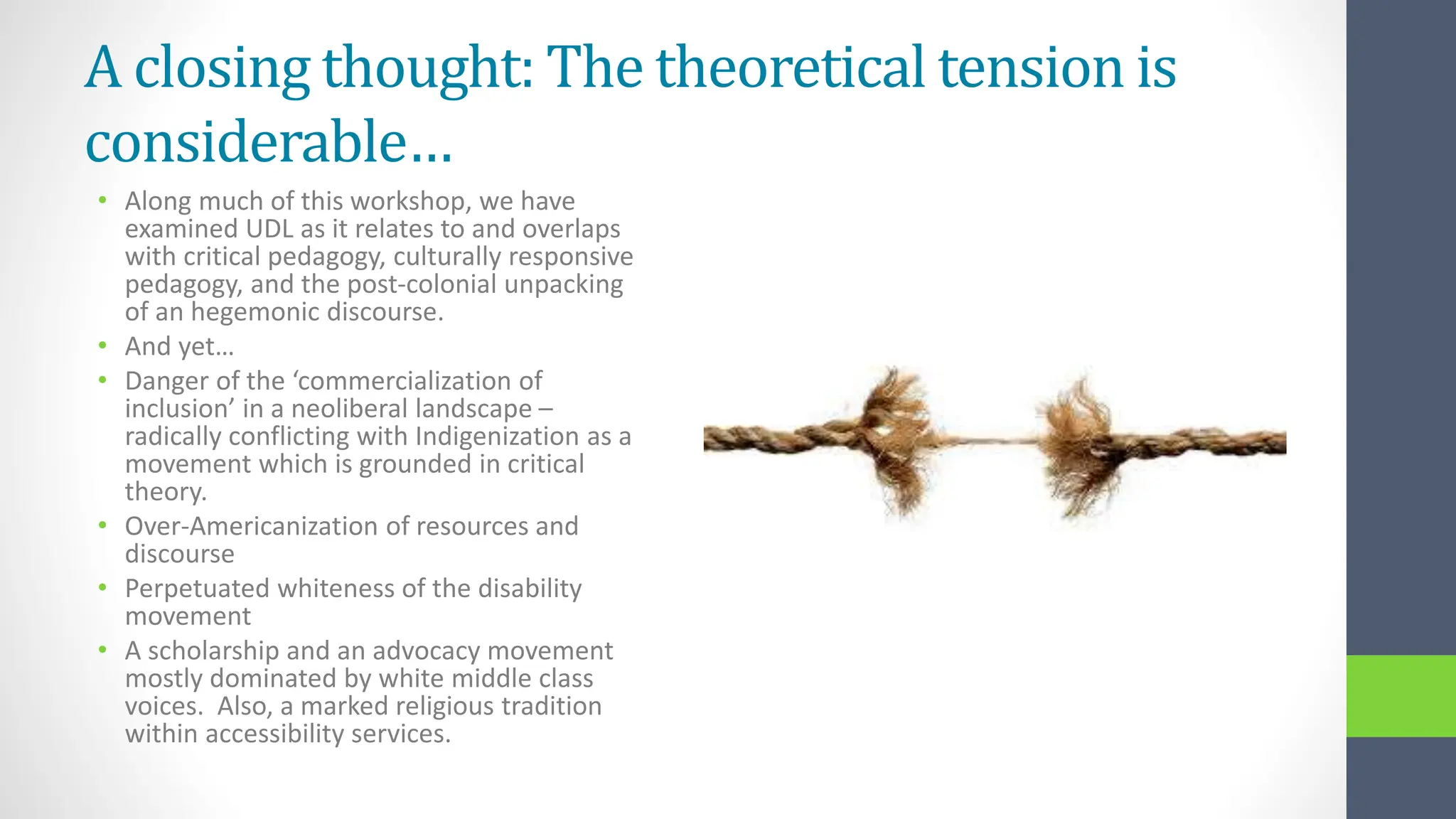
A closing thought: The theoretical tension is
considerable…
• Along much of this workshop, we have
examined UDL as it relates to and overlaps
with critical pedagogy, culturally responsive
pedagogy, and the post-colonial unpacking
of an hegemonic discourse.
• And yet…
• Danger of the ‘commercialization of
inclusion’ in a neoliberal landscape –
radically conflicting with Indigenization as a
movement which is grounded in critical
theory.
• Over-Americanization of resources and
discourse
• Perpetuated whiteness of the disability
movement
• A scholarship and an advocacy movement
mostly dominated by white middle class
voices. Also, a marked religious tradition
within accessibility services.
Approaching the overlap from the stance
of culturally responsive pedagogy
• Considerable literature around norms, values, societal purpose of instruction and
assessment, etc.
• Also, a significant amount of literature in existence in relation to culturally sensitive
design
• “A pedagogy that uses students' customs, characteristics, experiences, and
perspectives as tools for better classroom instruction. Students of color see
themselves and their communities as belonging in academic spaces.” (Will & Najarro,
2022)
• CRP is used to frame Indigenization of the curriculum. There is also emerging
literature around UDL and CRP (James, 2018).
Questions
The upcoming volume
• Fovet, F. (Ed.) (2024)
Decolinizing Universal Design
for Learning. CSMFL
Publications
• Should be out in the fall.
Watch my social media for
further announcements
References & Resources
Aguilera-Bear, D., & Tippeconnic, J. (2015). Voices of resistance and renewal: Indigenous leadership in education.
University of Oklahoma Press.
Chita-Tegmark, M., Gravel, J. W., Maria De Lourdes, B. S., Domings, Y., & Rose, D. H. (2012). Using the Universal
Design for Learning Framework to Support Culturally Diverse Learners. Journal of Education, 192(1), 17–22.
https://doi.org/10.1177/002205741219200104
Cross, T. L., Pewewardy, C., & Smith, A. T. (2019). Restorative education, reconciliation, and healing: Indigenous
perspectives on decolonizing leadership education. New Directions for Student Leadership, (163), 101–115.
https://doi.org/10.1002/yd.20350
Dalton, E. M., Lyner-Cleophas, M., Ferguson, B. T., & McKenzie, J. (2019). Inclusion, universal design and
universal design for learning in higher education: South Africa and the United States. African Journal of
Disability, 8, 519. doi: 10.4102/ajod.v8i0.519
First Nations Education Steering Committee [FNESC] (2007) First Peoples Principles of Learning.
https://www.fnesc.ca/first-peoples-principles-of-
learning/#:~:text=The%20Principles%20are%20as%20follows,and%20a%20sense%20of%20place).
Fovet, F. (2021) Developing an Ecological Approach to Strategic UDL Implementation in Higher Education.
Journal of Education and Learning, 10(4).
Fovet, F. (2020) Universal Design for Learning as a Tool for Inclusion in the Higher Education Classroom: Tips for
the Next Decade of Implementation. Education Journal. Special Issue: Effective Teaching Practices for Addressing
Diverse Students’ Needs for Academic Success in Universities, 9(6), 163-172.
http://www.sciencepublishinggroup.com/journal/paperinfo?journalid=196&doi=10.11648/j.edu.20200906.13
References & Resources (contd.)
Fovet, F. (2019) Not just about disability: Getting traction for UDL implementation with International
Students. In: Kate Novak & Sean Bracken (Eds.) Transforming Higher Education through Universal Design
for Learning: An International Perspective, Routledge.
James, K. (2018) Universal Design for Learning (UDL) as a Structure for Culturally Responsive Practice.
Northwest Journal of Teacher Education, 13(1), Article 4.
New South Wales Department of Education (2023) 8 Aboriginal Ways of Learning.
https://www.8ways.online/
Vasilez, J. (2023) Indigenizing Education: Universal Design for Learning and Indigenous Leadership
Frameworks. Ed.D. Thesis, Graduate School, University of Washington Tacoma. Ed.D. Dissertations in
Practice. 76. https://digitalcommons.tacoma.uw.edu/edd_capstones/76
Will, M., & Najarro, I. (2022, April 18) What Is Culturally Responsive Teaching? Ed Week.
https://www.edweek.org/teaching-learning/culturally-responsive-teaching-culturally-responsive-
pedagogy/2022/04#:~:text=culturally%20responsive%20teaching%3A%20a%20pedagogy,as%20belongi
ng%20in%20academic%20spaces.
Contact details
• Frederic Fovet (PhD.)
• Assistant Professor, School of Education, Thompson Rivers University
• ffovet@tru.ca
• @Ffovet
• www.implementudl.com

Decolonizing Universal Design for Learning

  • 1.
    Decolonizing UDL Power ofPotential: Sharing Experiences from Universal Design for Learning (UDL) Journeys June 26th-28th, 2024 Dr. Frederic Fovet, Faculty of Education and Social Work, Thompson Rivers University
  • 2.
    Land Acknowledgement • ThompsonRivers University campuses are on the traditional lands of the Tk'emlúps te Secwépemc (Kamloops campus) and the T’exelc (Williams Lake campus) within Secwépemc'ulucw, the traditional and unceded territory of the Secwépemc. The region TRU serves also extends into the territories of the St’át’imc, Nlaka’pamux, Tŝilhqot'in, Nuxalk, and Dakelh
  • 3.
    Personal introduction • Manylenses under which I approach UDL: • Worked in accessibility services on a large Canadian campus for four years. • Have had leadership roles on MAs and Meds, supporting contract faculty with UDL (particularly in the context of the hyper-internationalized classroom) • Act as UDL consultant in the K- 12 and post-secondary landscapes in Canada • UDL researcher
  • 4.
    Context –identifying theissue • UDL has been to date white, Global North domain. • The scholarship itself has allowed for very little voice and representation from Global South and Indigenous voices • Also, a general and ongoing reluctance to consider UDL beyond impairment and disability. • Yet this is a framework about inclusion and about diversity. • How can it have become so entrenched as a Caucasian, middle class, and occidental model? • How do we move out of this status quo to take UDL back to more authentic concerns around diversity?
  • 5.
    Objectives • Brainstorm asa group around the concept of ‘decolonizing UDL’ • Examine how there might be synchronicity between UDL and Indigenization • Consider how we might decolonize UDL within the Global North – Global South tension • Examine pragmatic action items available to the field • Consider how best break issues of silos within UDL scholarship • Find a global setting for UDL growth • Examine UDL within the neoliberal- critical theory dichotomy
  • 6.
    Activity 1: Initialbrainstorm around the notion of decolonizing UDL • Let’s spend 8 minutes thinking about what decolonizing might mean. • How do you interpret that expression in your own professional context? • What would you like to see ‘decolonized’ about UDL? • [Table discussion, 8 min]
  • 7.
    Debrieffromgroup activity:An ironicreluctanceoftheUDLdiscourse torecognizebarrierstolearningbeyondimpairment •First observation: resistance • It can be argued that despite the articulation of its discourse, the UDL movement is reluctant to examine barriers to learning, beyond Disability and impairment. • When one adopts UDL, one shifts from a focus on learner exceptionality to a design-based identification of ‘barriers’ in T&L; it is the implementation of the social model of disability into teaching practices. • Yet, it is clear many advocates of UDL refuse to examine the barriers other diverse learners in T&L
  • 8.
    Debrieffromgroup activity:An ironicreluctanceoftheUDLdiscourse torecognizebarrierstolearningbeyondimpairment(contd.) •Ironically, this means the field is currently fighting ‘deficit thinking’ in relation to students with disabilities, but perpetuating deficit thinking in relation to culturally, linguistically, ethnically, or racially diverse learners. • Yet these barriers are usually exactly the same as those experiences by students with disabilities. • Because they are not acknowledged, these barriers have a far greater impact for learners who are culturally or ethnically diverse. • During the pandemic for example, they were the ‘greatest losers’ because their plight remained unacknowledged.
  • 9.
    What might weinclude in a reflection around decolonizing UDL? • Keep thinking about the list you might want to begin creating and we will revisit these ideas at the end of the workshop. We are on the lookout for actionable objectives. This is not just about theorizing!
  • 10.
    Activity 2: Synchronicitybetween UDL and the Indigenization of the curriculum? • It seems intuitive but it is far more complex than appears. • Let’s take some time together to examine this overlap/ synchronicity
  • 11.
    Alignment of Indigenousprinciples of learning with UDL • First issue: there is a great amount of variety in what is framed as Indigenous or First Nations principle of T&L. • Let’s take two examples: • First Nations Education Steering Committee [FNESC] (2007) First Peoples Principles of Learning. • New South Wales Department of Education (2023) 8 Aboriginal Ways of Learning. • Let’s see to what extent UDL can fit these frameworks.
  • 12.
    UDL & theFirst Peoples Principles of Learning • First Nations Education Steering Committee [FNESC] (2007) First Peoples Principles of Learning. • The Principles are as follows: • Learning ultimately supports the well-being of the self, the family, the community, the land, the spirits, and the ancestors. • Learning is holistic, reflexive, reflective, experiential, and relational (focused on connectedness, on reciprocal relationships, and a sense of place). • Learning involves recognizing the consequences of one‘s actions. • Learning involves generational roles and responsibilities. • Learning recognizes the role of Indigenous knowledge. • Learning is embedded in memory, history, and story. • Learning involves patience and time. • Learning requires exploration of one‘s identity. • Learning involves recognizing that some knowledge is sacred and only shared with permission and/or in certain situations.
  • 13.
    Interactive task [tablediscussions, 5 min] • Where do you identify an overlap between the First People Principles of Learning and UDL? • Learning ultimately supports the well-being of the self, the family, the community, the land, the spirits, and the ancestors. • Learning is holistic, reflexive, reflective, experiential, and relational (focused on connectedness, on reciprocal relationships, and a sense of place). • Learning involves recognizing the consequences of one‘s actions. • Learning involves generational roles and responsibilities. • Learning recognizes the role of Indigenous knowledge. • Learning is embedded in memory, history, and story. • Learning involves patience and time. • Learning requires exploration of one‘s identity. • Learning involves recognizing that some knowledge is sacred and only shared with permission and/or in certain situations.
  • 14.
    First People Principlesof Learning and UDL • Learning ultimately supports the well-being of the self, the family, the community, the land, the spirits, and the ancestors. • Learning is holistic, reflexive, reflective, experiential, and relational (focused on connectedness, on reciprocal relationships, and a sense of place). Multiples means of action and expression? • Learning involves recognizing the consequences of one‘s actions. • Learning involves generational roles and responsibilities. • Learning recognizes the role of Indigenous knowledge. Multiple means of engagement? • Learning is embedded in memory, history, and story. Multiple means of representation? • Learning involves patience and time. • Learning requires exploration of one‘s identity. • Learning involves recognizing that some knowledge is sacred and only shared with permission and/or in certain situations. • Not an easy cohabitation. The First People Principles of Learning are more focused on context and ontological preoccupations than on T&L techniques.
  • 15.
    Eight ways ofknowing and UDL • Is the task different in this second example? • The NSW Department of Education Eights Ways of Knowing are: • Story sharing • learning maps • non-verbal • symbols and images • land links • non-linear • deconstruct and reconstruct • community links.
  • 16.
    Interactive task: Eightaboriginal ways of knowing and UDL • All these principles can be integrated into UDL as they are essentially about being multimodal in presentation, expression and engagement. This can be problematic as they do not acknowledge the wider ontological conundrum Western teachers may experience entering mindsets that are not theirs. There is here an overfocus on the techniques of communicating in T&L • Story sharing • learning maps • non-verbal • symbols and images • land links • non-linear • deconstruct and reconstruct • community links.
  • 17.
    Capacity of UDLto address the priorities of Indigenous education • Multiple means of representation: being multimodal in the framing of content • Multiple means of action and expression: being dialogical in the way learners are invited into learning • Multiple means of engagement: the most delicate of the three principles. Room here for a great deal of Indigenization (curriculum co-creation, critical pedagogy, culturally responsive pedagogy, etc.)
  • 18.
    A Euro-Caucasian urgencyto frame and formalize? • Indigenous epistemology is at ease with intuitive understandings of ways of being. • Almost impossible to discuss T&L without touching on ontology and world views. • Frustration of Indigenous folks at having to explain and frame their world view and their cosmologies in a post-colonial landscape • The very insistence on frameworks, principles, and written formulations is Western and therefore inherently colonial. • Savoir être versus savoir faire • Problematic observation in the area of UDL: UDL even when it does not stress ‘the universal’ purports to be a ‘how to guide’ that all instructors can ‘buy into’ • UDL – in order to allow for Indigenization – will have to keep stressing that it is no more than a lens on practice.
  • 19.
    Ecological complexity ofIndigenizing the UDL movement: we’re not doing this in a historical vacuum • Historical absence of Indigenous communities at the UDL table • Concerns over the Eurocentric nature of the UDL discourse to date • Whenever the word ‘universal’ appears, it can create fear and suspicion within the Indigenization movement which is very much about a return to the local. • Not necessarily such a notion as universalized Indigenous principles of education • UDL movement’s considerable failure at ‘inviting in’ other scholarships • Fragmentation of services and expertise within the inclusion landscape
  • 20.
    Some examples ofIndigenous initiatives with UDL • Kearney, D.B. (2022) UDL for Indigenous pedagogies. In: Universal Design for Learning (UDL) for Inclusion, Diversity, Equity, and Accessibility (IDEA). https://opentextbooks.uregina.ca/universaldesign/chapter/6-4-indigenous- pedagogies/ • Indigenous Ways of Teaching, Learning & Being with Libby Roderick [Podcast]: https://thinkudl.org/episodes/indigenous-ways-of-teaching-learning-being-with- libby-roderick • Jennifer Katz’s work at UBC: https://www.threeblockmodel.com/indigenous- education--the-three-block-model-of-udl.html • UDL at Mohawk College: https://www.mohawkcollege.ca/centre-for-teaching- learning-innovation/teaching-effectively/universal-design-for-learning
  • 21.
    Activity 3: DecolonizingUDL within the broad Global North-Global South divide and balance inequity • Decolonization is not just an internal process • It makes us reflect richly on Global North vs. Global South power imbalances. • What are some of the troubling observations we can make about UDL from a global perspective, when using the post-colonial paradigm as a lens? • What is not right currently in the state of UDL and the Global South? • [Whole room discussion, 6 min]
  • 22.
    Debrief on Activity3 • Creating authentic space for Global South voices • Widening the discourse to invite in our Global South colleagues • Ensuring that the UDL discourse in the Global South is not seen as simply a duplication of our own Global North preoccupations • Acknowledging that UDL in the Global South will not be a duplication of Global North initiatives • Understanding that UDL in the Global South may look very different than it does in North American and European contexts • Understanding the role of UDL in breaking reductionist and deficit model view of international student engaged in mobility • Applying UDL to the complex dynamics of the hyper-internationalized classroom. • Examining the use of UDL to effectively include students from the Global South who are lured the Global North through a process of hyper-internationalization, that prioritizes revenue but does not acknowledge the unease of these learners.
  • 23.
    Activity 4: Fromthe theoretical to the practical. What would be your to do list? • We started the workshop saying we would create a list of actionable items that are immediate relevant to your institutional contexts. • What are these actionable items so far?
  • 24.
    Activity 6: Creatingdialogue (one of the items on my list) • How do we go about creating a new form of dialogue so that our conversation around UDL acknowledges dangerous post-colonial power dynamics and steers away from the regular Eurocentric pitfalls? • ‘The purpose of this study is to first ensure that before further research is done, that we hear from Indigenous parents that the practices and Universal Design for Learning might be beneficial to their children and supportive of their cultural identities.’ (Vasilez, 2023) • Interactive task: • How is this new etiquette for collaboration to be defined and formulated within the UDL scholarship and within field experimentations and initiatives? • What would this look like in your own institution? • Risks: over-solicitation, being the ‘object’ of UDL experimentation rather than co- investigators, imposition of a Euro-Caucasian lens, expenditure of resource on something that does not matter to non-Caucasian communities? [Whole room discussion]
  • 25.
    Activity 7: Addressingthe ‘sine qua non’ groundwork that needs to take place around silos (another off my list!) • It will be impossible to really stretch UDL to serve these objectives while we continue to silo our work with inclusion. • Do you feel we are able to overcome the siloing of departments and faculty when it comes to UDL, beyond impairment? • What are some of the ways forward? [Whole room discussion]
  • 26.
    A note: Issuesor territoriality and the relevance of funding models • The reasons why UDL advocates are currently reluctant to consider the potential of UDL for culturally diverse learners are multiple and complex: • The work of these agencies and departments is delineated with care and does not allow them to grow their scope • Much of the funding of these agencies and departments is bio-medical in flavour: it requires clinical documentation. These stakeholders advocate for UDL but are funded by deficit model envelopes. Inherent tension. • It is felt that growing the scope of this work would also weaken the strength of the support generated for students with disabilities • The post-secondary sector is a landscape that is highly neo-liberal and is structured around the notion of competitivity as driver of productivity and efficiency. • Felt as a result that support for students with disabilities effectively ‘competes’ with funding for the support of other diverse learners.
  • 27.
    Examining the impactof leadership • ‘As I learned more about universal design for learning, I began to notice some central ideas, embedded in universal design for learning practices and tenets that aligned with Indigenous leadership, frameworks and pedagogies. I want to be clear, ensuring that Universal Design for Learning utilizes standards in lesson design. These standards are usually based on norming data from the dominant culture, which often does not consider their Indigenous experience. For this reason, alone, I am not suggesting that there is full alignment between universal design for learning and Indigenous leadership, frameworks and pedagogies. I am suggesting that there are important crossover’s, however, that better support our Indigenous students in public classrooms. • The purpose of this study is to first ensure that before further research is done, that we hear from Indigenous parents that the practices and Universal Design for Learning might be beneficial to their children and supportive of their cultural identities. The first step, then, was to Universal Design for Learning and Indigenous Leadership Frameworks 9 determine how parents may respond to components of Universal Design for Learning, and to get a picture of how Indigenous students are doing in their current school settings.’ (Vasilez, 2023)
  • 28.
    Activity 8: Findinga global setting for UDL growth • We talk about breaking silos, inviting Global South partners, creating synchronicity with Indigenization, etc. • This requires creating an entirely new setting for UDL growth. • What are some of the requirements for us as UDL advocates and practitioners to be able to create this wider global discourse and area of authentic engagement? [Group reflection]
  • 29.
    Absence of broadgeo-political awareness within the UDL scholarship • A fear that UDL does not recognize regional context • UDL has not thus far tried to fit within the leading framework for sustainable development for social justice: UN Sustainability Goals • One of these goals is specifically to support learners navigate issues simultaneously on a global and a hyper-regional scale • Similarly, the UN Sustainability Goals seek to create ‘global citizens’, not just ‘expert learner’. The UDL discourse has much growing to do to fit seamlessly within a global ecology which acknowledges geo-political realities. • UDL can become so focused on the neuro-cognitive dimensions of learning that it ignores the wider historic and political dimensions within which any T&L model necessarily operates. • Can you be an ‘expert learner’ by just understanding yourself, or do you inevitably also need an understanding of yourself within a changing and political world?
  • 30.
    A closing thought:The theoretical tension is considerable… • Along much of this workshop, we have examined UDL as it relates to and overlaps with critical pedagogy, culturally responsive pedagogy, and the post-colonial unpacking of an hegemonic discourse. • And yet… • Danger of the ‘commercialization of inclusion’ in a neoliberal landscape – radically conflicting with Indigenization as a movement which is grounded in critical theory. • Over-Americanization of resources and discourse • Perpetuated whiteness of the disability movement • A scholarship and an advocacy movement mostly dominated by white middle class voices. Also, a marked religious tradition within accessibility services.
  • 31.
    Approaching the overlapfrom the stance of culturally responsive pedagogy • Considerable literature around norms, values, societal purpose of instruction and assessment, etc. • Also, a significant amount of literature in existence in relation to culturally sensitive design • “A pedagogy that uses students' customs, characteristics, experiences, and perspectives as tools for better classroom instruction. Students of color see themselves and their communities as belonging in academic spaces.” (Will & Najarro, 2022) • CRP is used to frame Indigenization of the curriculum. There is also emerging literature around UDL and CRP (James, 2018).
  • 32.
  • 33.
    The upcoming volume •Fovet, F. (Ed.) (2024) Decolinizing Universal Design for Learning. CSMFL Publications • Should be out in the fall. Watch my social media for further announcements
  • 34.
    References & Resources Aguilera-Bear,D., & Tippeconnic, J. (2015). Voices of resistance and renewal: Indigenous leadership in education. University of Oklahoma Press. Chita-Tegmark, M., Gravel, J. W., Maria De Lourdes, B. S., Domings, Y., & Rose, D. H. (2012). Using the Universal Design for Learning Framework to Support Culturally Diverse Learners. Journal of Education, 192(1), 17–22. https://doi.org/10.1177/002205741219200104 Cross, T. L., Pewewardy, C., & Smith, A. T. (2019). Restorative education, reconciliation, and healing: Indigenous perspectives on decolonizing leadership education. New Directions for Student Leadership, (163), 101–115. https://doi.org/10.1002/yd.20350 Dalton, E. M., Lyner-Cleophas, M., Ferguson, B. T., & McKenzie, J. (2019). Inclusion, universal design and universal design for learning in higher education: South Africa and the United States. African Journal of Disability, 8, 519. doi: 10.4102/ajod.v8i0.519 First Nations Education Steering Committee [FNESC] (2007) First Peoples Principles of Learning. https://www.fnesc.ca/first-peoples-principles-of- learning/#:~:text=The%20Principles%20are%20as%20follows,and%20a%20sense%20of%20place). Fovet, F. (2021) Developing an Ecological Approach to Strategic UDL Implementation in Higher Education. Journal of Education and Learning, 10(4). Fovet, F. (2020) Universal Design for Learning as a Tool for Inclusion in the Higher Education Classroom: Tips for the Next Decade of Implementation. Education Journal. Special Issue: Effective Teaching Practices for Addressing Diverse Students’ Needs for Academic Success in Universities, 9(6), 163-172. http://www.sciencepublishinggroup.com/journal/paperinfo?journalid=196&doi=10.11648/j.edu.20200906.13
  • 35.
    References & Resources(contd.) Fovet, F. (2019) Not just about disability: Getting traction for UDL implementation with International Students. In: Kate Novak & Sean Bracken (Eds.) Transforming Higher Education through Universal Design for Learning: An International Perspective, Routledge. James, K. (2018) Universal Design for Learning (UDL) as a Structure for Culturally Responsive Practice. Northwest Journal of Teacher Education, 13(1), Article 4. New South Wales Department of Education (2023) 8 Aboriginal Ways of Learning. https://www.8ways.online/ Vasilez, J. (2023) Indigenizing Education: Universal Design for Learning and Indigenous Leadership Frameworks. Ed.D. Thesis, Graduate School, University of Washington Tacoma. Ed.D. Dissertations in Practice. 76. https://digitalcommons.tacoma.uw.edu/edd_capstones/76 Will, M., & Najarro, I. (2022, April 18) What Is Culturally Responsive Teaching? Ed Week. https://www.edweek.org/teaching-learning/culturally-responsive-teaching-culturally-responsive- pedagogy/2022/04#:~:text=culturally%20responsive%20teaching%3A%20a%20pedagogy,as%20belongi ng%20in%20academic%20spaces.
  • 36.
    Contact details • FredericFovet (PhD.) • Assistant Professor, School of Education, Thompson Rivers University • ffovet@tru.ca • @Ffovet • www.implementudl.com

Editor's Notes

  • #5 Frederic will take on this slide
  • #10 Frederic will do this slide
  • #11 Frederic will do this slide