1
Foundations of public health
Dr. Anwar Bibi
Associate Professor
Community Medicine
HITEC –IMS
2
PMDC Requirement
 50 Hours both in practical & theory
3
Clinical Rotation
 3 days a week for 3 weeks from 10:20 hrs – 1:20 hrs.
 50 – 27hrs = 23 hours for lectures
4
Lectures
Lecture : Every Monday
Total : 4 Lectures per
month
5
Practical Training Rotation
 1st
Week
Biostatistics & Data Collection of House Hold Survey
 2nd
Week
Biostatistics
House Hold Survey / Data analysis
6
Practical Training Rotation cont…
 3rd
Week
End of rotation test
Compilation and submission of house hold
survey
7
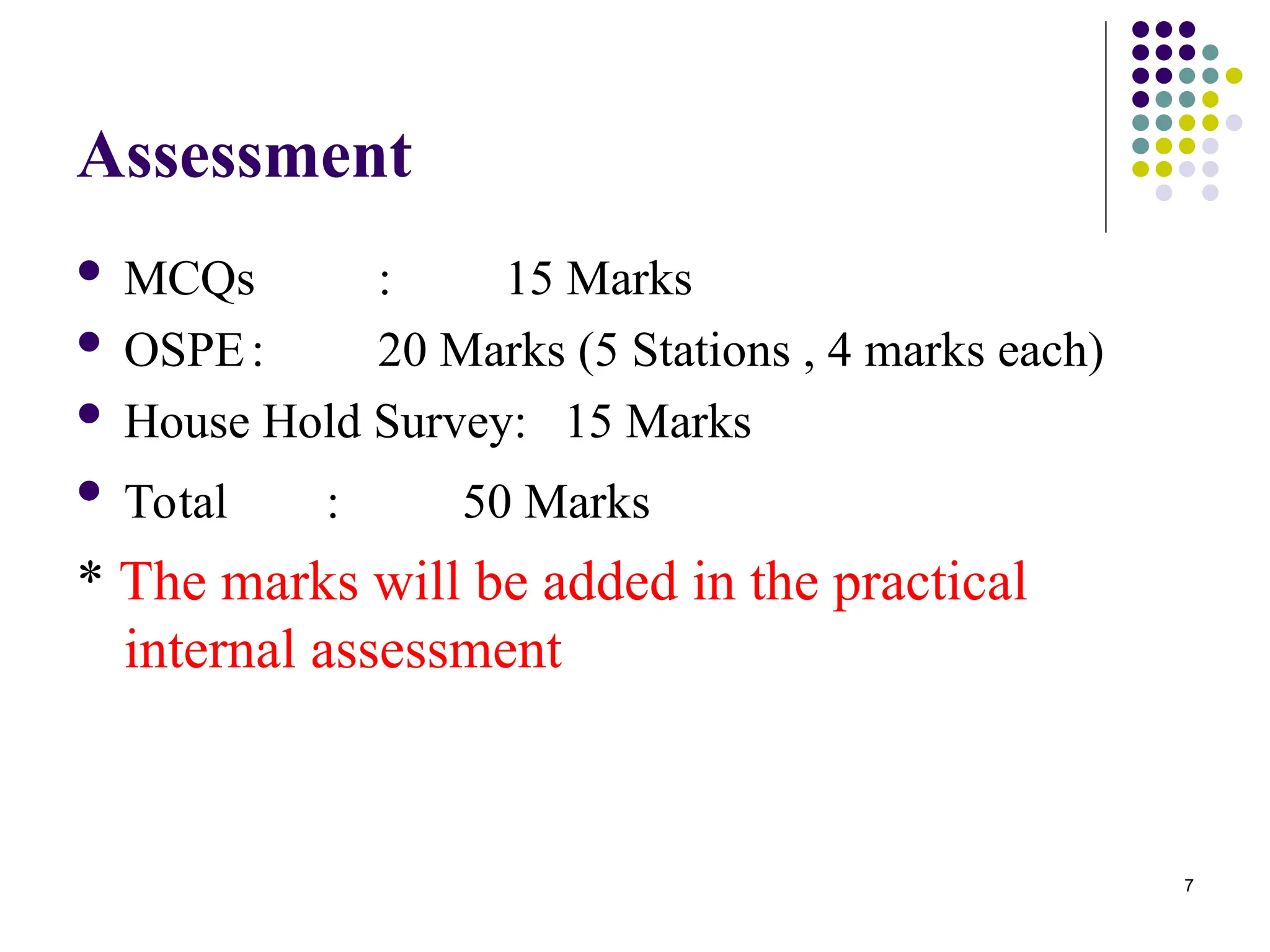
Assessment
 MCQs : 15 Marks
 OSPE: 20 Marks (5 Stations , 4 marks each)
 House Hold Survey: 15 Marks
 Total : 50 Marks
* The marks will be added in the practical
internal assessment
8
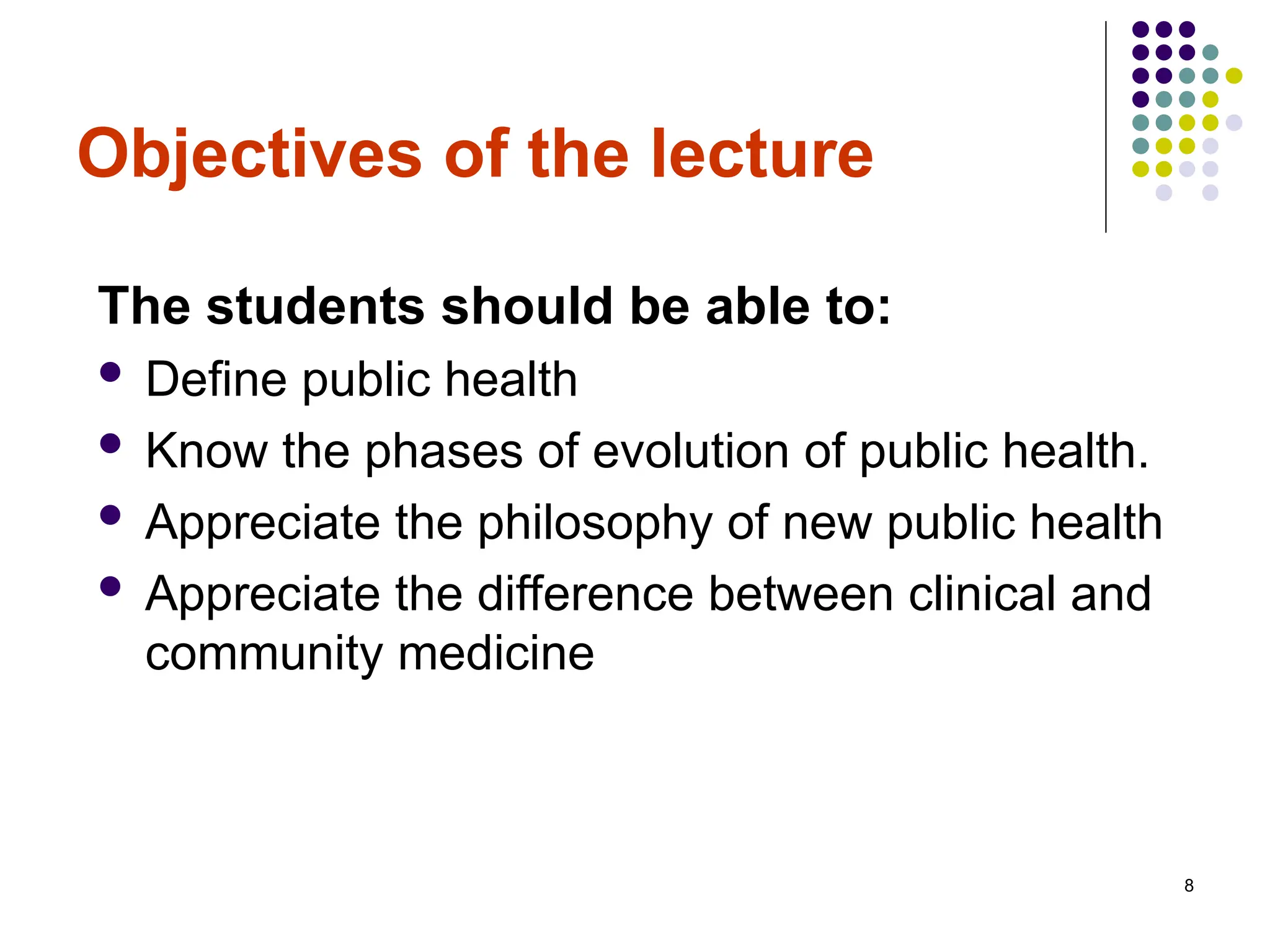
Objectives of the lecture
The students should be able to:
 Define public health
 Know the phases of evolution of public health.
 Appreciate the philosophy of new public health
 Appreciate the difference between clinical and
community medicine
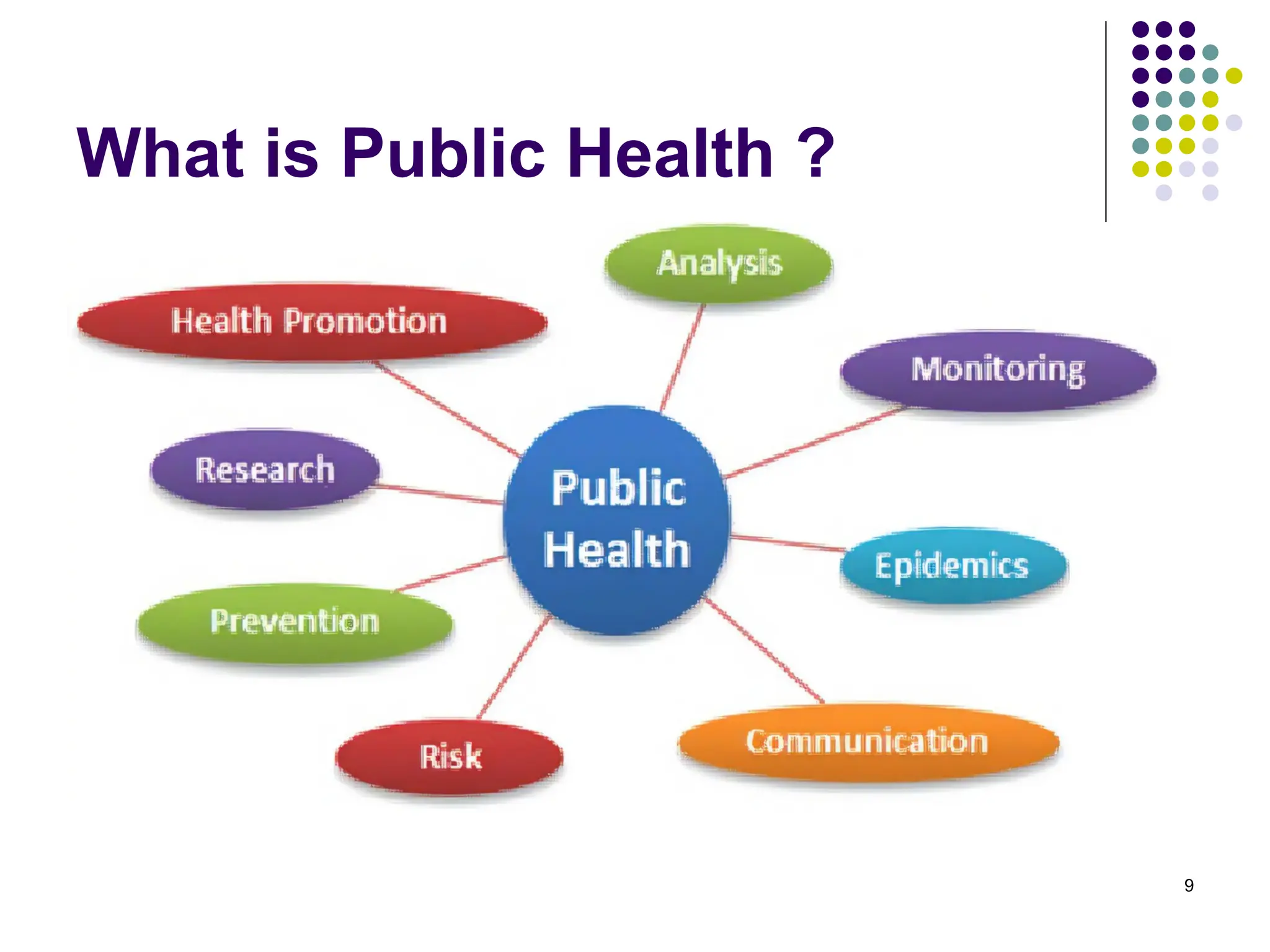
What is Public Health ?
9
10
11
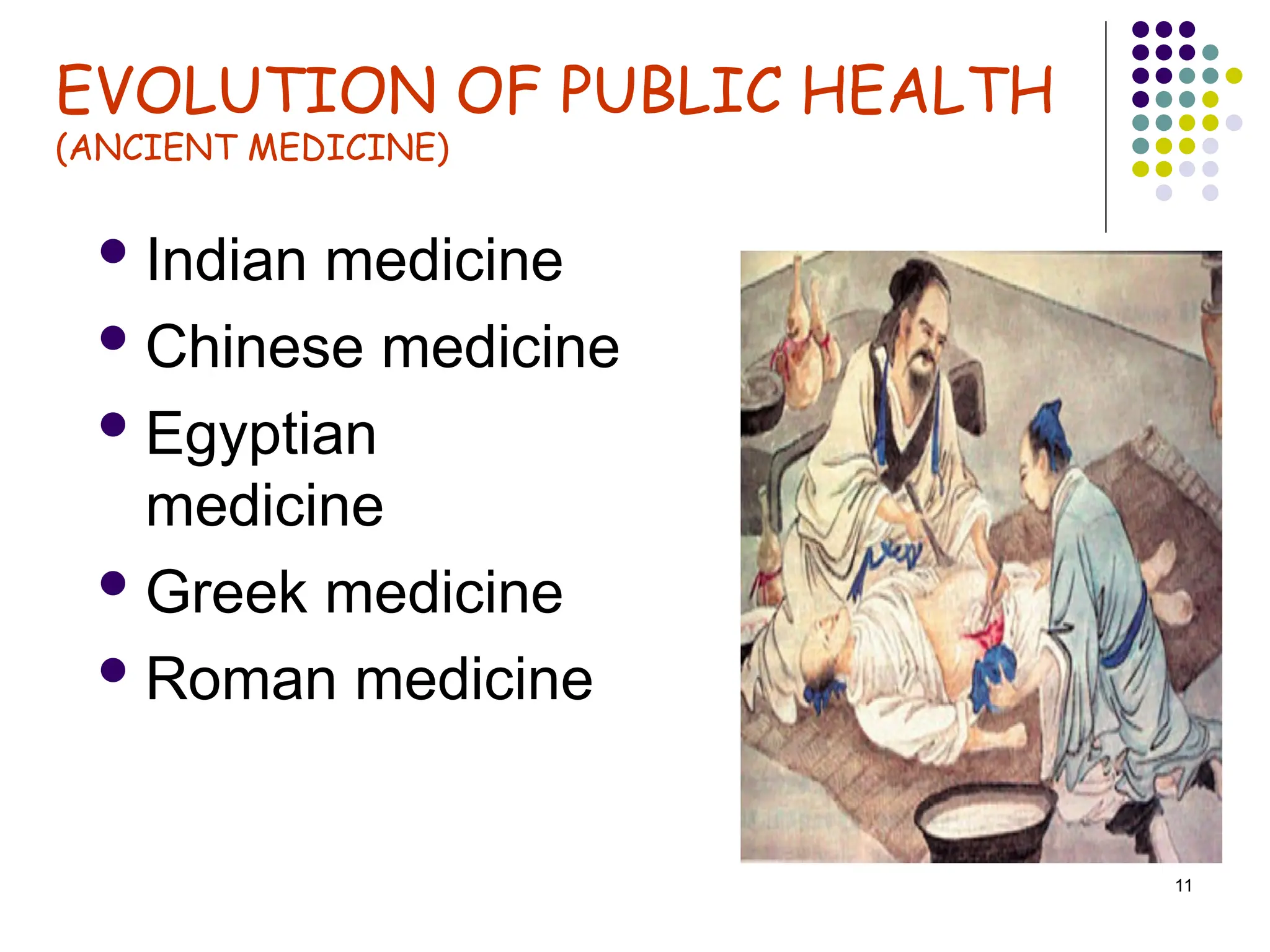
EVOLUTION OF PUBLIC HEALTH
(ANCIENT MEDICINE)
Indian medicine
Chinese medicine
Egyptian
medicine
Greek medicine
Roman medicine
12
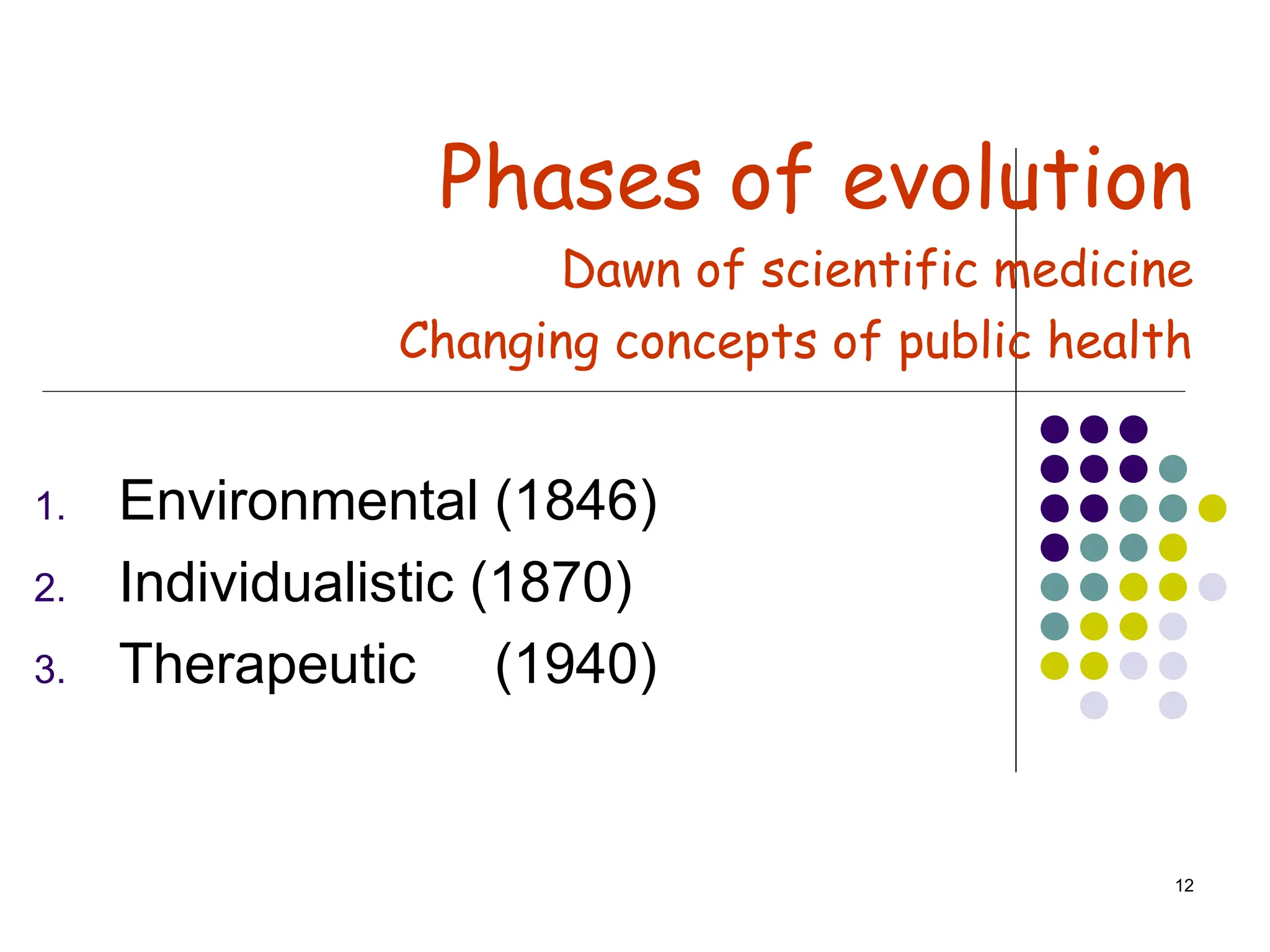
Phases of evolution
Dawn of scientific medicine
Changing concepts of public health
1. Environmental (1846)
2. Individualistic (1870)
3. Therapeutic (1940)
History
 In an almost complete absence of scientific
medical knowledge, it would not be fair to say
that the early practitioners of medicine
contributed nothing to the alleviation of man's
suffering from disease.
13
Medical knowledge has been derived from the
observations and cumulative experiences gleaned
from others.
It is study of the
evolution of man and of
human knowledge down
the ages
 Medicine has drawn from the traditional
cultures, and later from biological and natural
sciences and more recently from social and
behavioral sciences.
14
The "explosion" of knowledge
during the 20th century has
made medicine more complex,
and treatment more costly
 The glaring contrasts in the
state of health between the
developed and developing
countries, between the
rural and urban areas, and
between the rich and poor
have attracted worldwide
criticism as "social injustice
15
". The commitment of all countries,
under the banner of the World
Health Organization, is to wipe out
the inequalities in the distribution of
health resources and services, and
attain the Millenium Development
Goals
Goal of Modern Medicine
The goal of modern medicine
is no longer merely treatment
of sickness.
Prevention of disease
Promotion of health
Improvement of the quality
of life (individuals, groups or
communities.).
16
It is also
regarded as an
essential
component of
socio-economic
development
“Primitive medicine: Supernatural theory of
disease
17
It is thus obvious that medicine in the prehistoric times
(about 5000 B.C.) was intermingled with superstition,
religion, magic and witchcraft.
Medicine was conceived in sympathy and born out of
necessity
The medicine he practiced consisted in appeasing gods by
prayers, rituals and sacrifices, driving out "evil spirits" from
the human body by witchcraft and other crude means
18
The supernatural theory of disease is as new as
today. For example, in India, one may still hear
the talk of curing snake bites by "mantras
19
Traditional healers" are found everywhere.
They live close to the people and their
treatments are based on various
combinations of religion, magic and
empiricism.
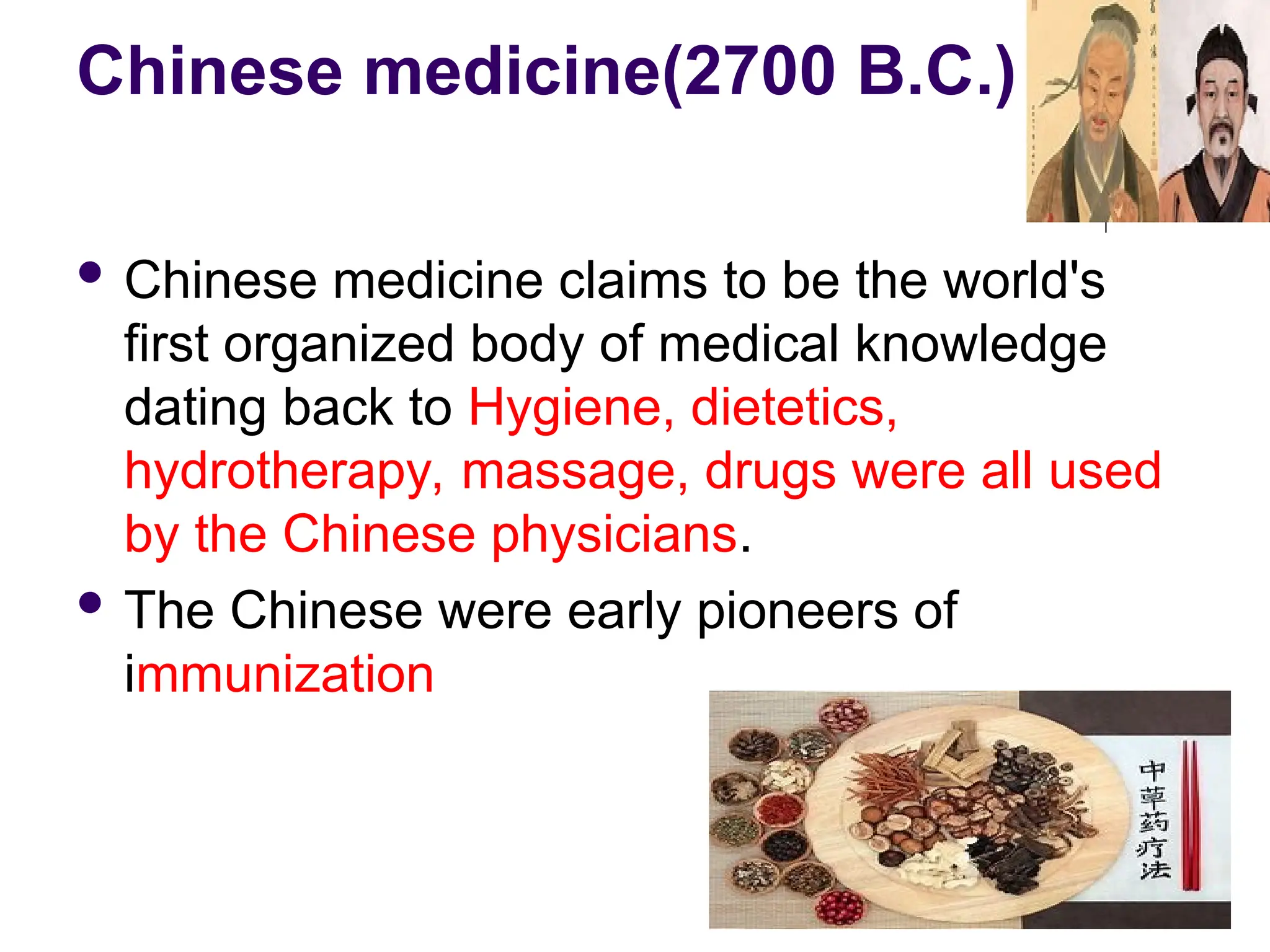
Chinese medicine(2700 B.C.)
 Chinese medicine claims to be the world's
first organized body of medical knowledge
dating back to Hygiene, dietetics,
hydrotherapy, massage, drugs were all used
by the Chinese physicians.
 The Chinese were early pioneers of
immunization
20
To a Chinese, "the great doctor is one who
treats not someone who is already ill but
someone not yet ill".
 The Chinese have great faith in their
traditional medicine, which is fully integrated
with modern medicine.
21
Egyptian medicine (2000 B.C)
 Egypt had one of the oldest civilizations
 the art of medicine was mingled with religion.
Egyptian physicians were co-equals of
priests, trained in schools within the temples.
22
Specialization prevailed in Egyptian times eye
doctors, head doctors and tooth doctors. All
these doctors were officials paid by the State
 Egyptian medicine was far from primitive.
They believed in pathological nature of
disease
 They believed that the pulse was "the speech
of the heart".
 Different modalities of treatment like enema,
blood-letting and a wide range of drugs were
used
 Egyptians are to be considered the "the best
of all" the ancient doctors
 In the realm of public health also, the Egyptians
excelled. They built planned cities, public baths
and underground water supply.
 They had also some knowledge of inoculation
against smallpox, the value of mosquito nets and
the association of plague with rats.
24
Mesopotamian medicine
 In ancient Mesopotamia, the basic concepts of
medicine were religious, and taught and practiced
by herb doctors, knife doctors and spell doctors -
a classification that roughly parallels our own
internists, surgeons and psychiatrists.
 Prescriptions were written on tablets, in
cuneiform writing.
25
the "Hippocratic oath"
has become the keystone
of medical ethics.
Greek medicine (460- 136 B.C
 Civilizers of the ancient world.
They taught men to think in terms
of 'Why' and 'How”
 They gave rise to dynasties of
healers (curative medicine) and
hygienists (preventive medicine)
with different philosophies.
 By far the greatest physician in
Greek medicine was Hippocrates
(460-370 B.C.) who is often
called the "Father of Medicine
26
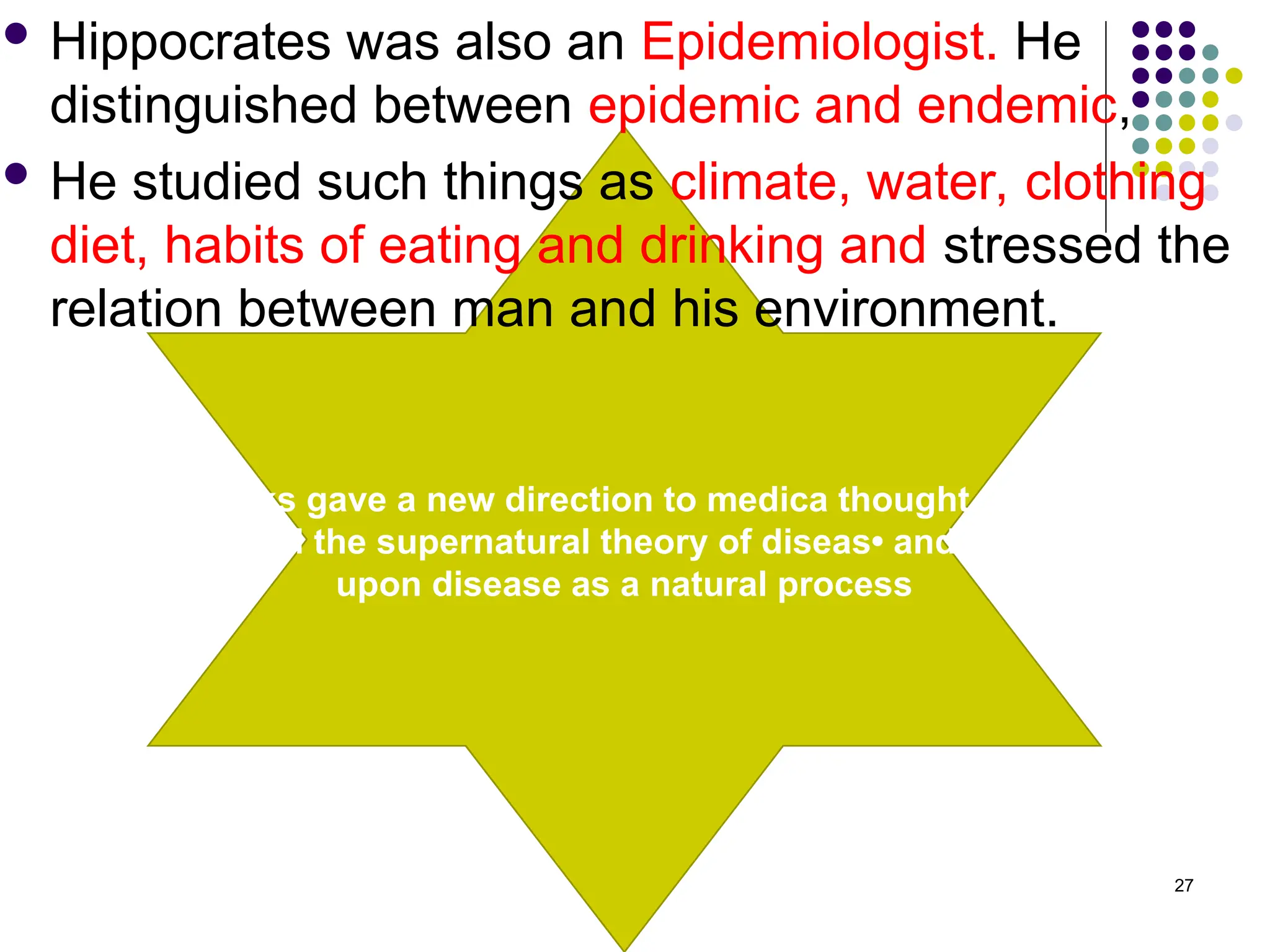
Greeks gave a new direction to medica thought. They
rejected the supernatural theory of diseas• and looked
upon disease as a natural process
 Hippocrates was also an Epidemiologist. He
distinguished between epidemic and endemic,
 He studied such things as climate, water, clothing
diet, habits of eating and drinking and stressed the
relation between man and his environment.
27
28
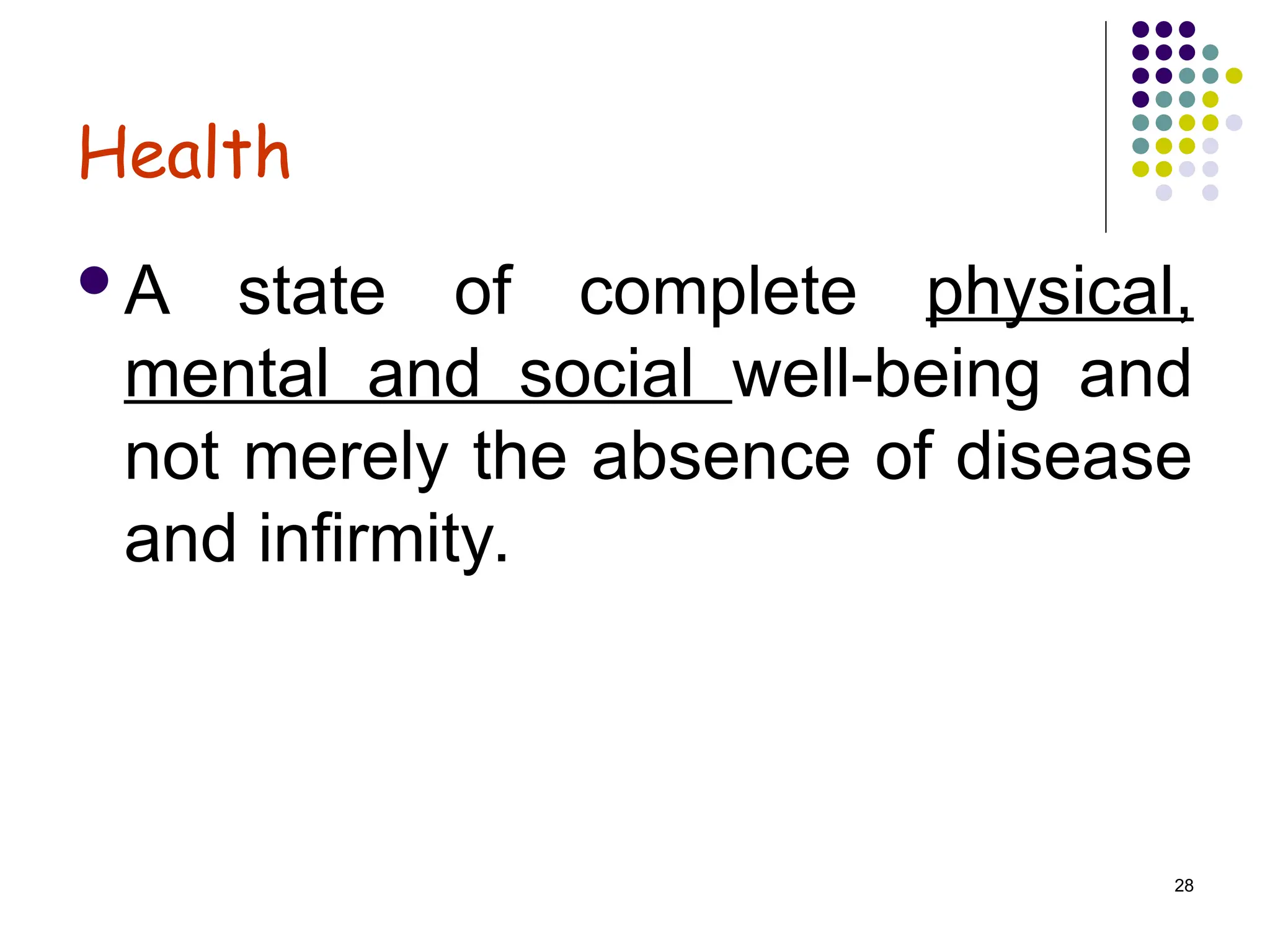
Health
A state of complete physical,
mental and social well-being and
not merely the absence of disease
and infirmity.
29
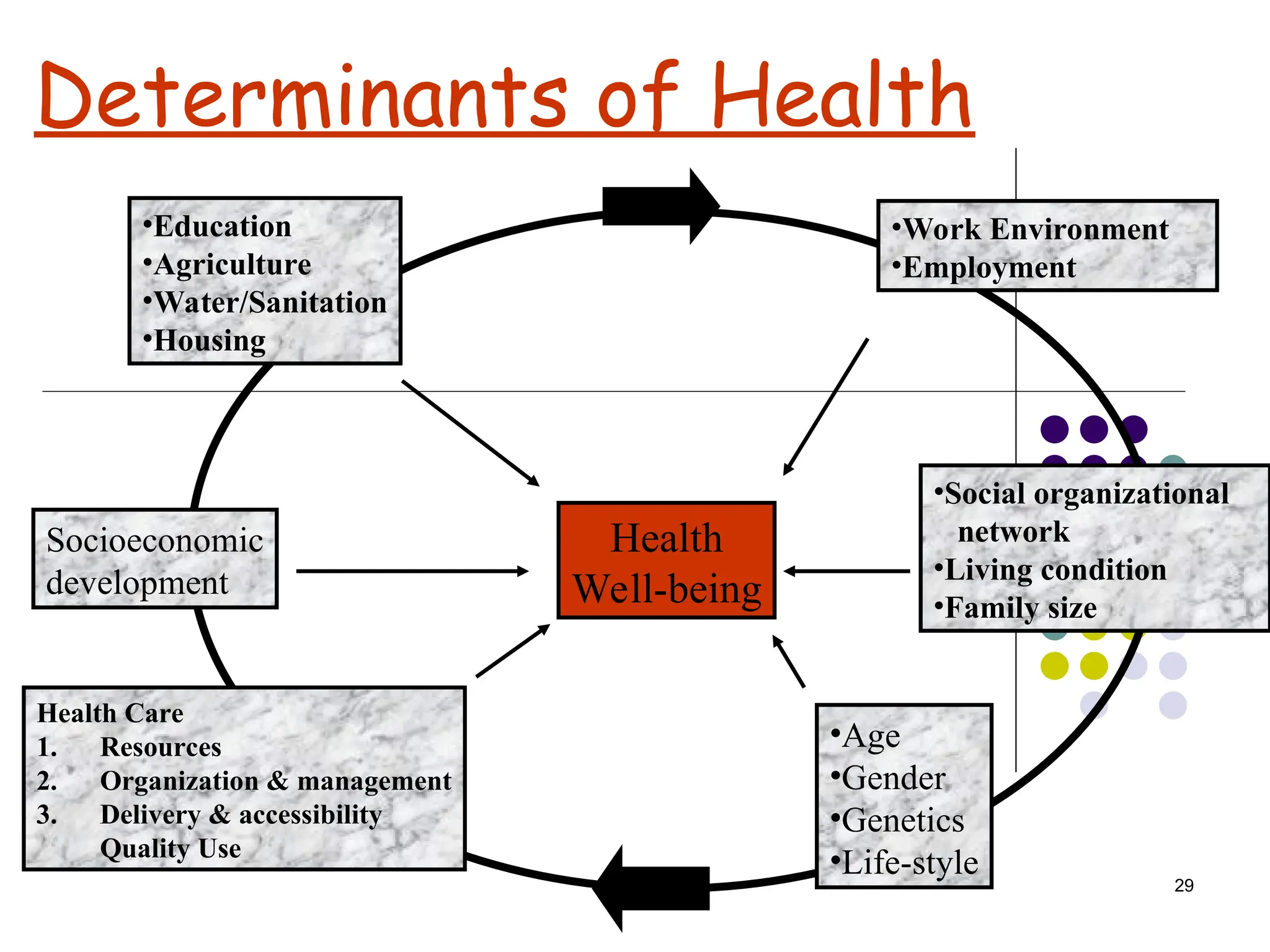
Determinants of Health
Health
Well-being
•Education
•Agriculture
•Water/Sanitation
•Housing
Socioeconomic
development
Health Care
1. Resources
2. Organization & management
3. Delivery & accessibility
Quality Use
•Work Environment
•Employment
•Social organizational
network
•Living condition
•Family size
•Age
•Gender
•Genetics
•Life-style
30
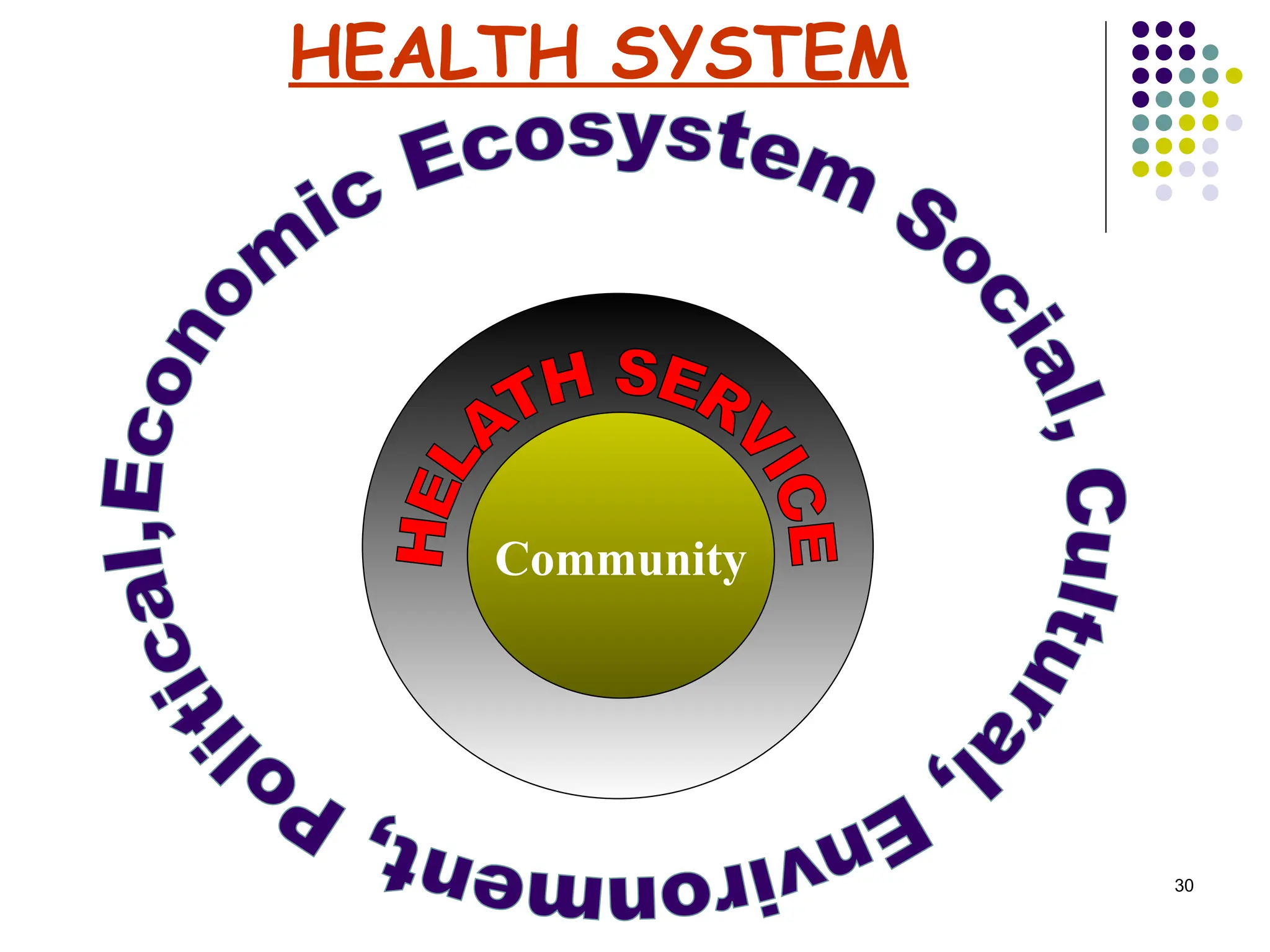
HEALTH SYSTEM
Community
31
4. Winslow’s 1923 Definition of Public
Health adapted by WHO (1952)
Winslow Definition
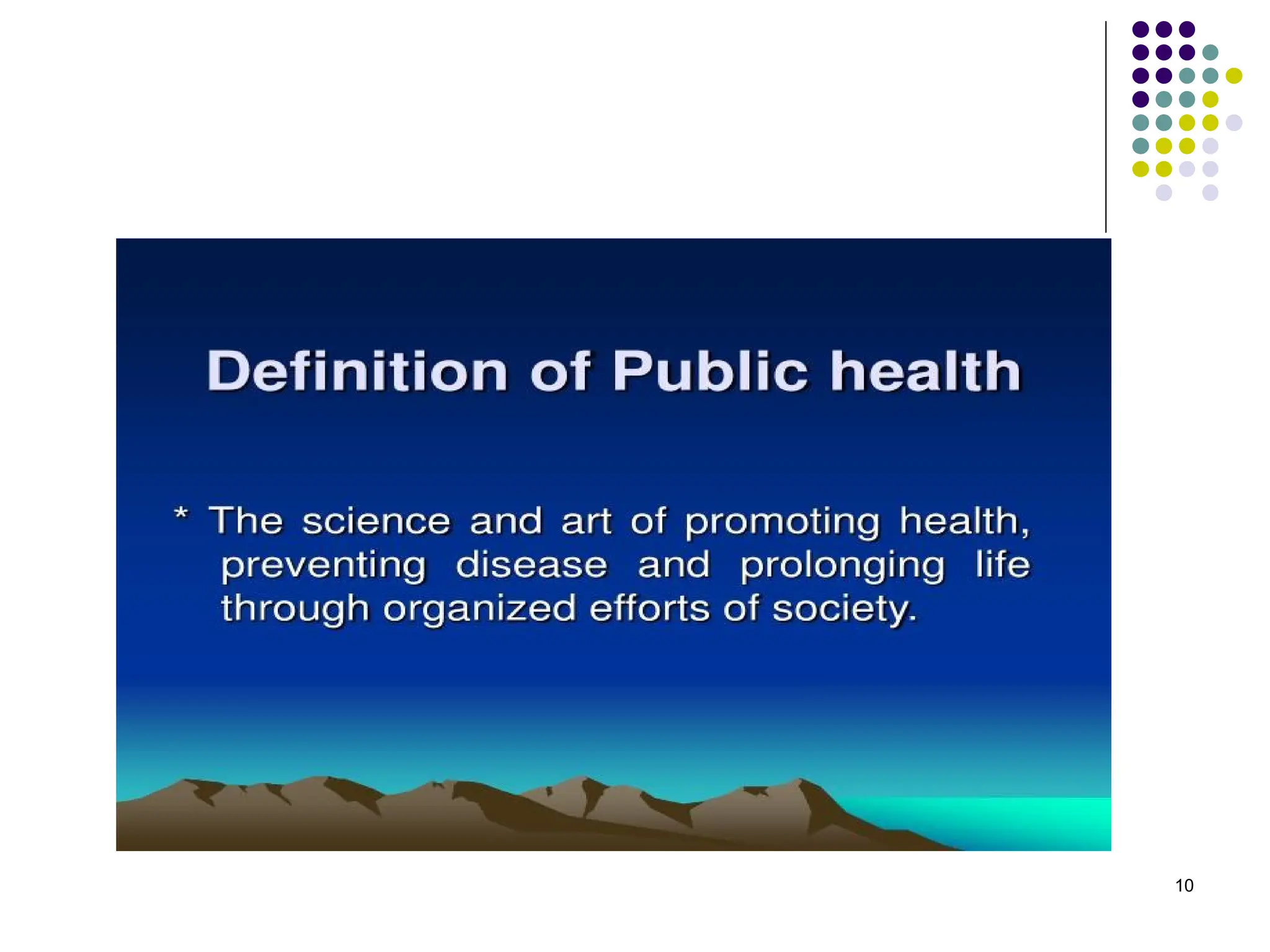
The science and art of preventing disease, prolonging life
and promoting physical and mental health and efficiency
through the organized community efforts for the sanitation
of environments,the control of communicable infection, the
education of the individual in personal hygiene, the
organization of medical and nursing services for the early
diagnosis and preventive treatment of disease and the
development of social machinery to ensure to every
individual a standard of living adequate for the
maintenance of health, so organizing these benefits as to
enable every citizen to realize his birth right of health and
longevity.
32
5. Basic Health Services (1953)
 Maternal and child health
 communicable disease control
 Environmental sanitation
 Maintenance of record for
statistical purposes
 Health education of the public
 Public health nursing
 Medical care
33
6. BHORE COMMITTEE (1946)
 No individual should be left out.
 Fully developed health services.
 Concept of health promotion.
 As close to people as possible.
 Involvement of the people.
34
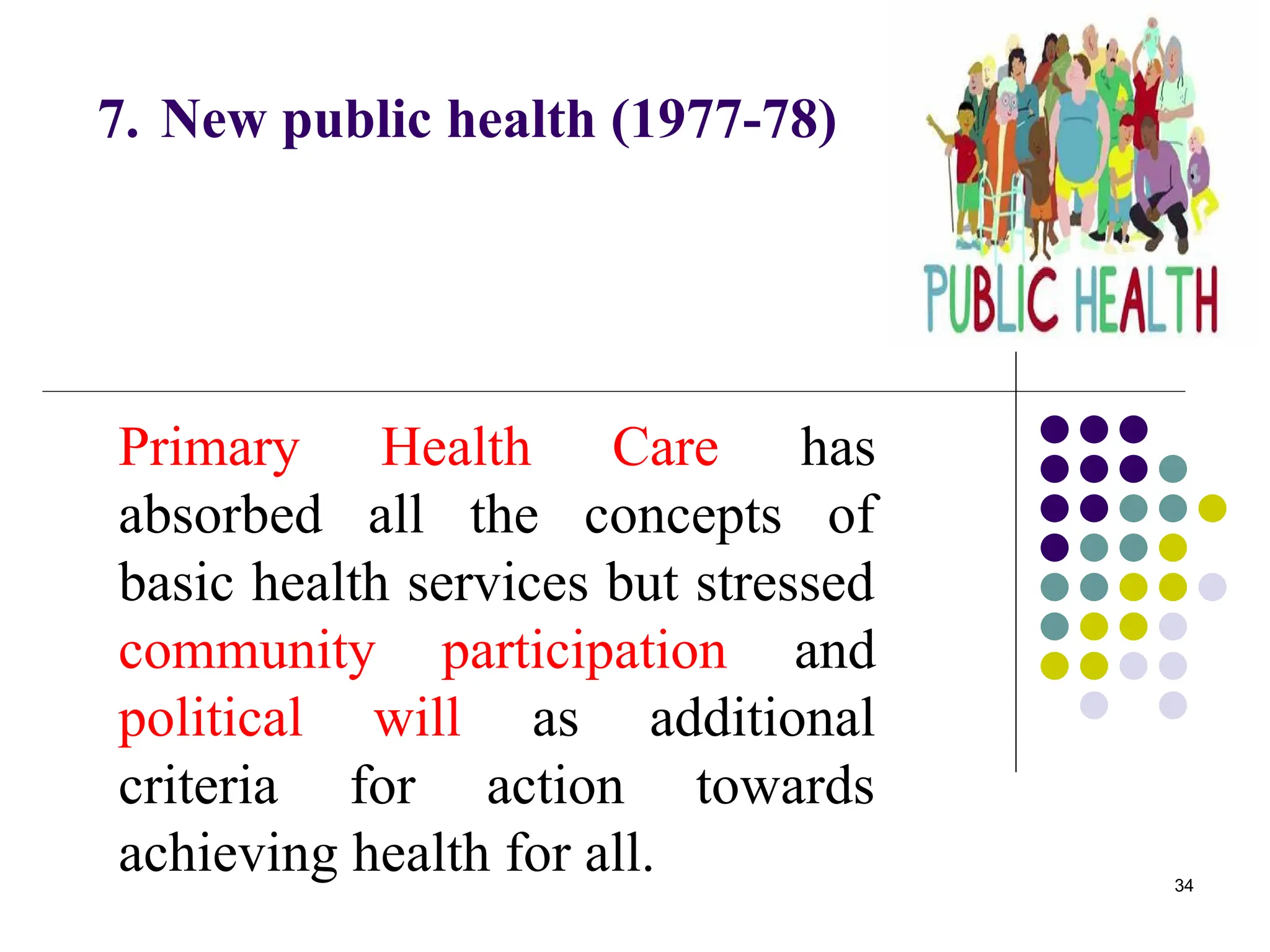
7. New public health (1977-78)
Primary Health Care has
absorbed all the concepts of
basic health services but stressed
community participation and
political will as additional
criteria for action towards
achieving health for all.
35
New Public Health Approach
The principles of good health are:
 Equitable access to effective care
 Health friendly public policy based on
community participation
 Intersectoral collaboration
 Supportive environment
 Personal skill development
36
New Public Health Approach
(Renaissance)
The idea that living conditions (physical social
and economic environment) are the main
determinants of health. Health services are
important but new public health focuses on
changing the determinants rather than
providing treatment for the sick.
37
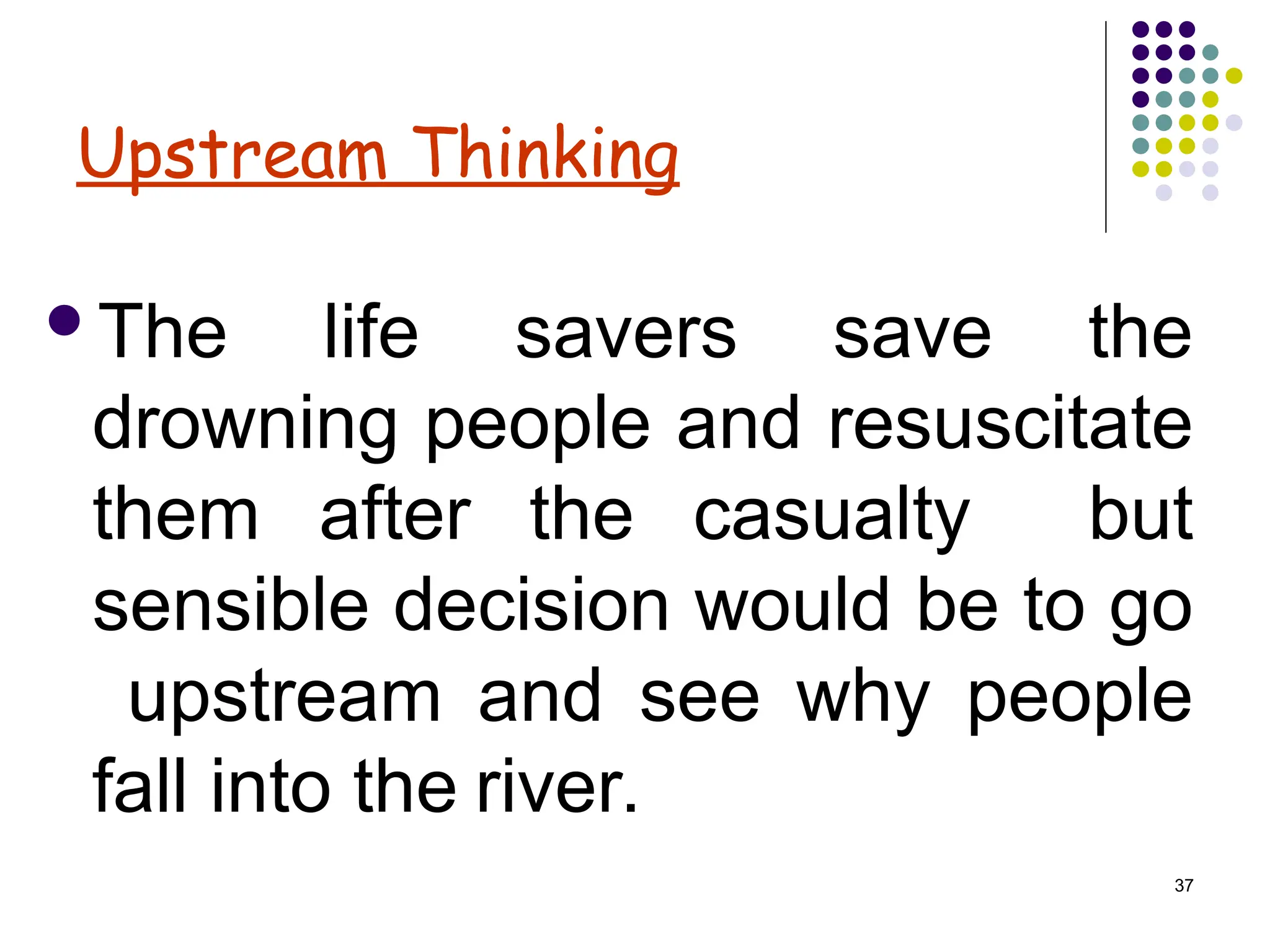
Upstream Thinking
The life savers save the
drowning people and resuscitate
them after the casualty but
sensible decision would be to go
upstream and see why people
fall into the river.
38
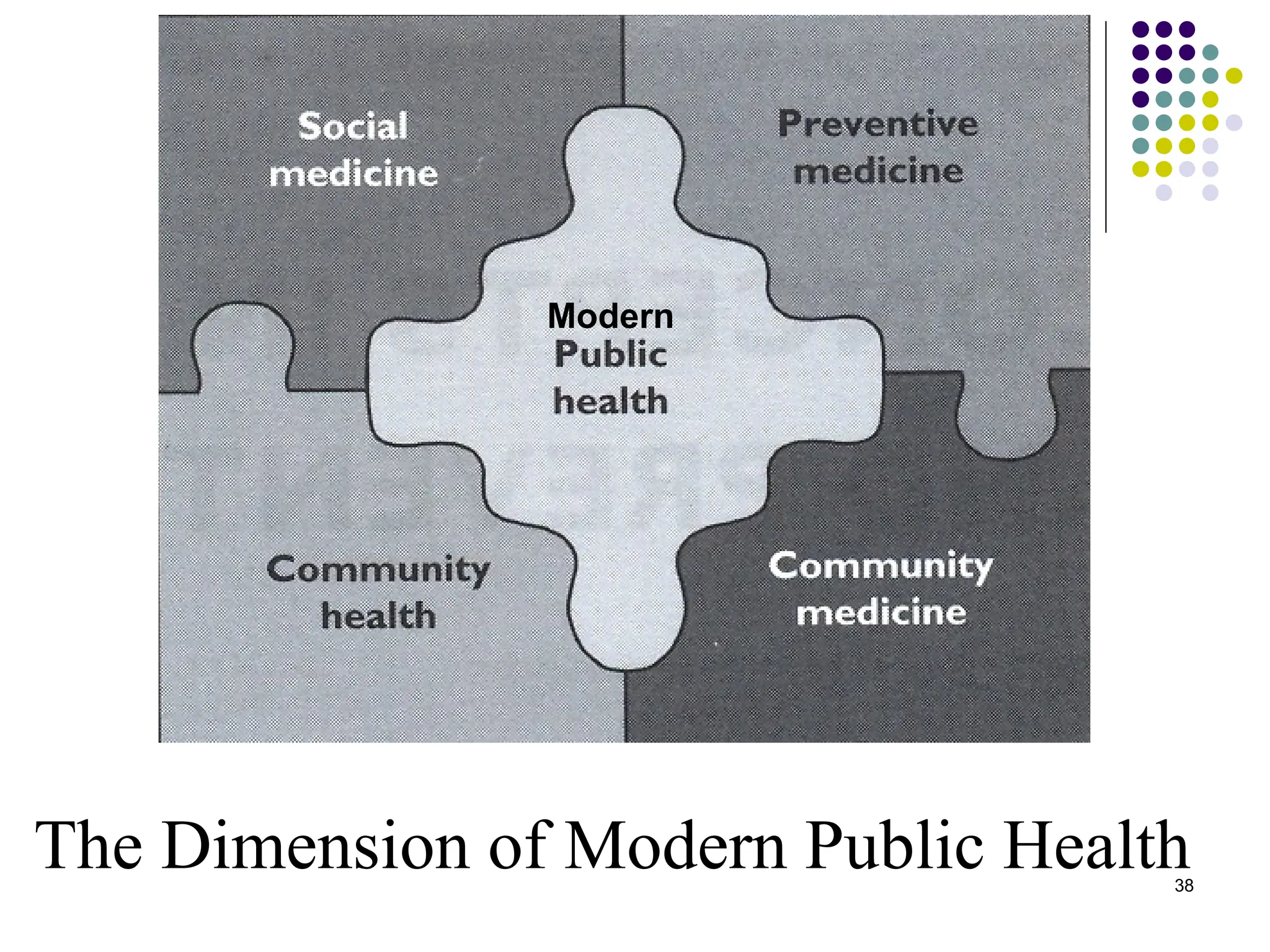
The Dimension of Modern Public Health
Modern
39
PREVENTIVE
MEDICINE
The science and art of preventing disease,
prolonging life and promoting physical and
mental health and efficiency.
40
SOCIAL MEDICINE
• Social Medicine is the study of man in his
total environment, physical, biological and
socioeconomic. It is concerned not only with
curative medicine, but also with health
promotion and prevention. It is concerned
with factors that influence the utilization and
effectiveness of the health and health related
services.
41
COMMUNITY HEALTH
• Community health deals with the services that
aim at protecting the health of the community.
The interventions vary from environmental
sanitation including vector control to personal
health care, immunization, health education
and such like. It includes an important
diagnostic element – community diagnosis –
aimed at surveying and monitoring
community health needs and assessing the
impact of interventions.
42
COMMUNITY MEDICINE
 A system of delivery of comprehensive health-
care to the people by a health team in order to
improve the health of the community.
43
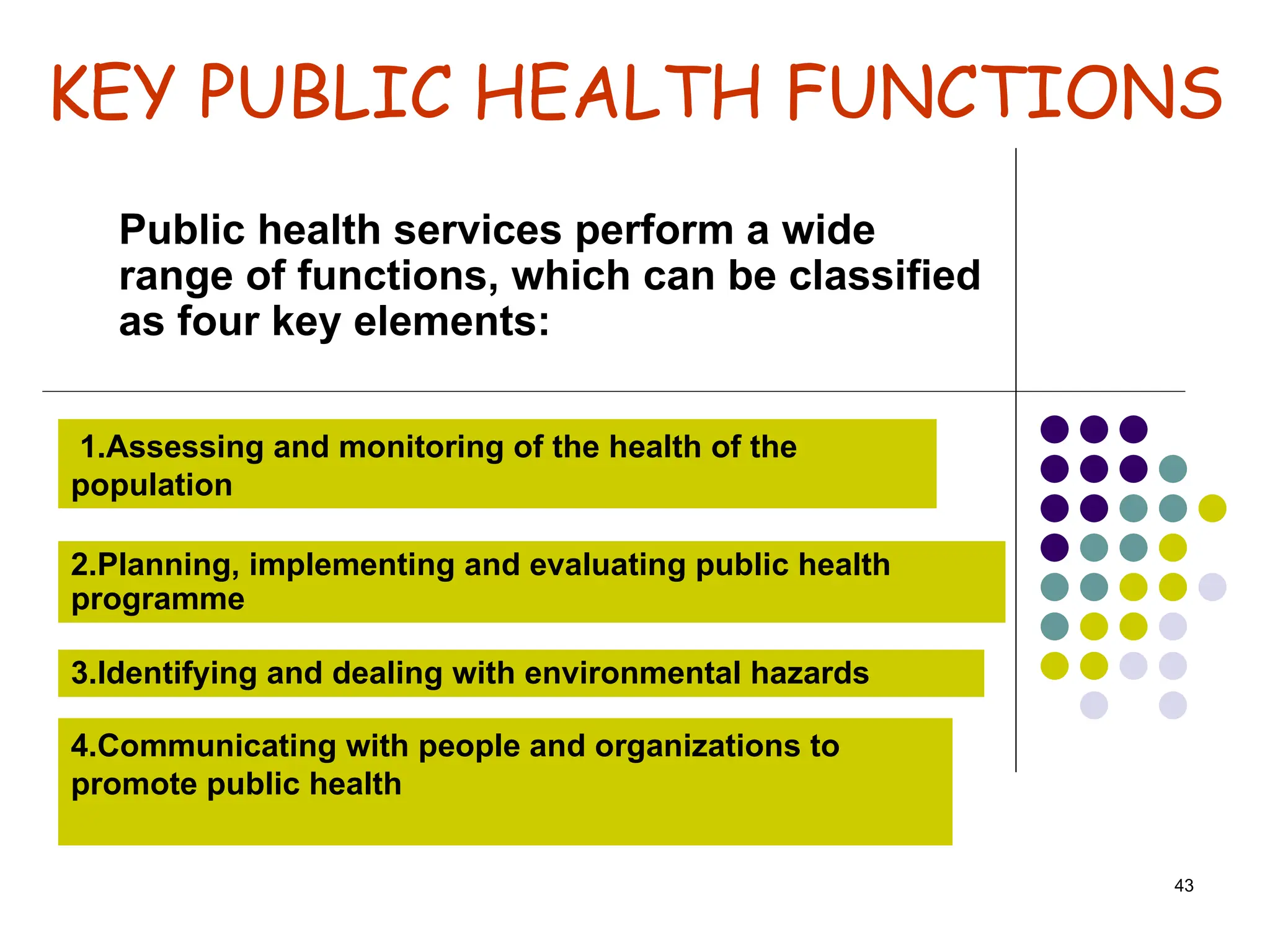
KEY PUBLIC HEALTH FUNCTIONS
Public health services perform a wide
range of functions, which can be classified
as four key elements:
2.Planning, implementing and evaluating public health
programme
1.Assessing and monitoring of the health of the
population
3.Identifying and dealing with environmental hazards
4.Communicating with people and organizations to
promote public health
44
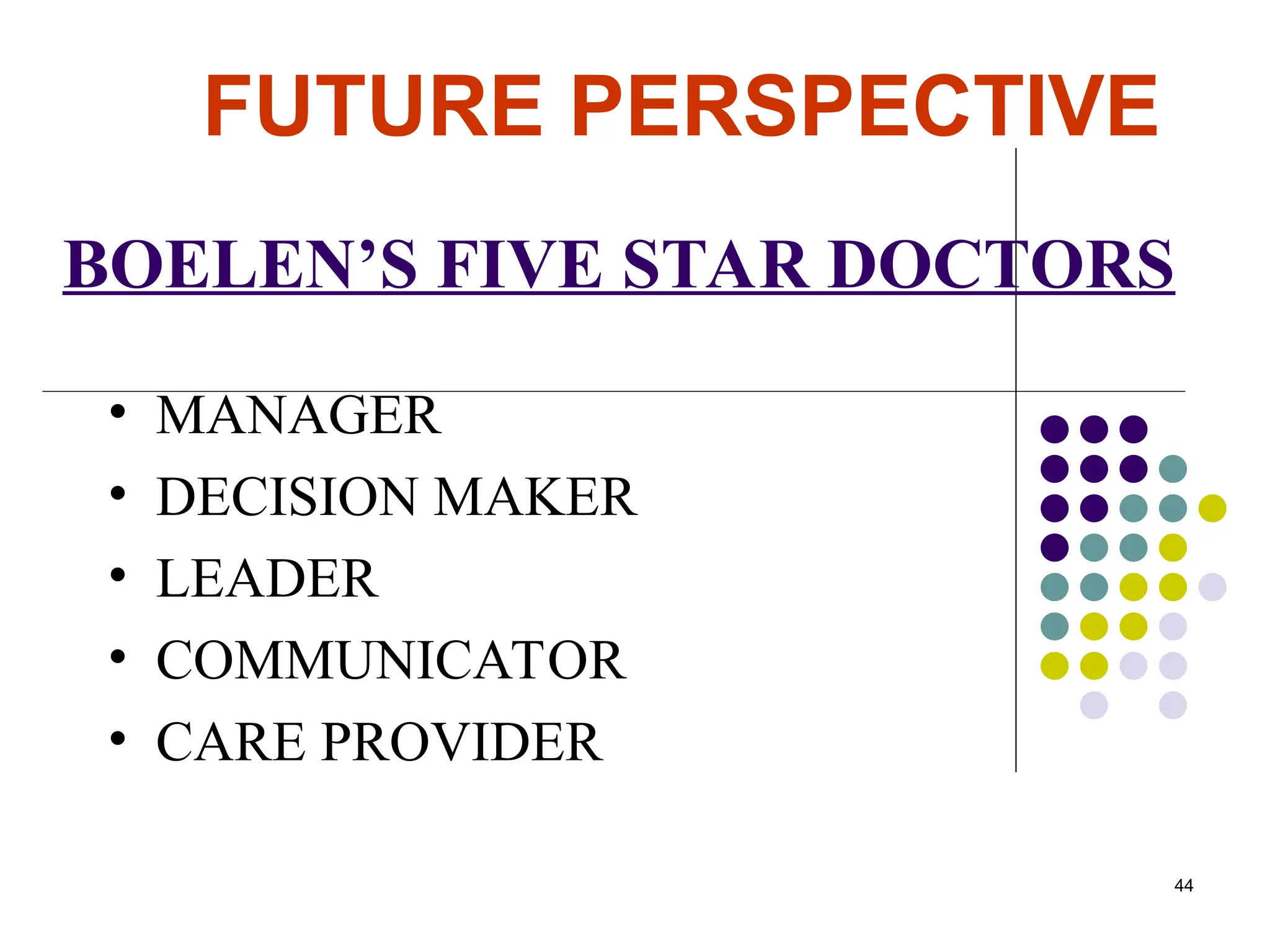
FUTURE PERSPECTIVE
BOELEN’S FIVE STAR DOCTORS
• MANAGER
• DECISION MAKER
• LEADER
• COMMUNICATOR
• CARE PROVIDER
45
Clinical Medicine Versus
Community Medicine
46
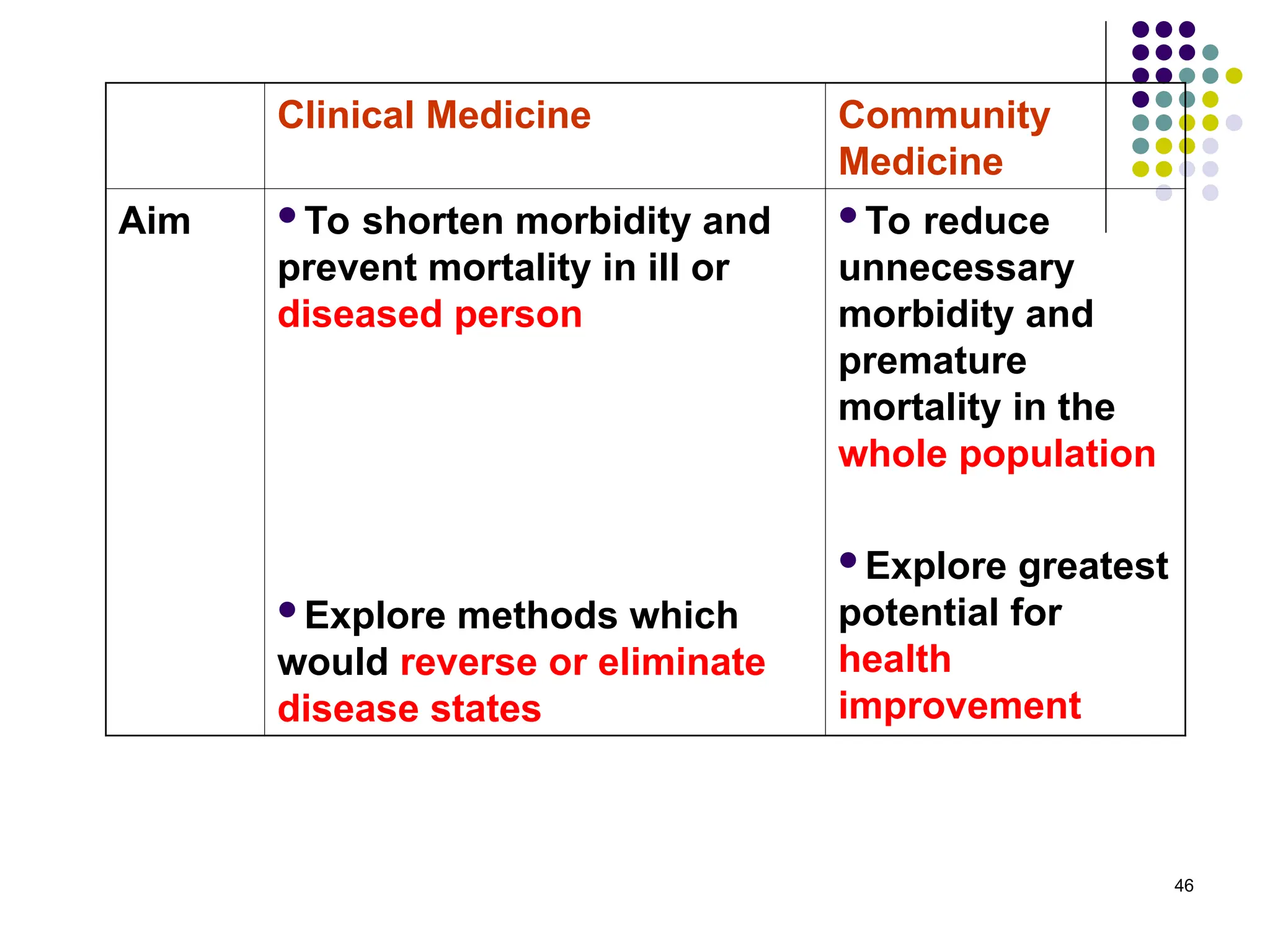
Clinical Medicine Community
Medicine
Aim To shorten morbidity and
prevent mortality in ill or
diseased person
Explore methods which
would reverse or eliminate
disease states
To reduce
unnecessary
morbidity and
premature
mortality in the
whole population
Explore greatest
potential for
health
improvement
47
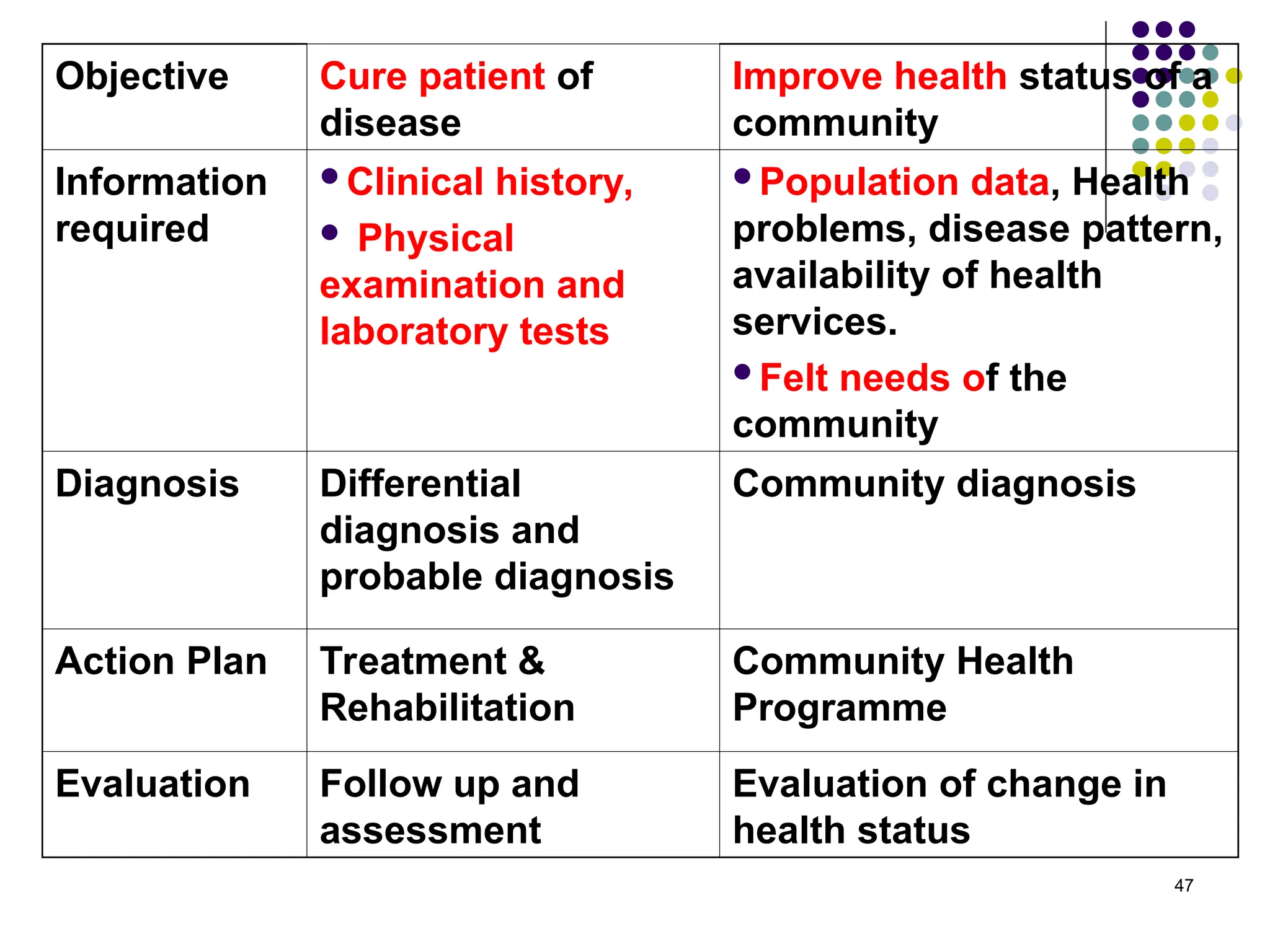
Objective Cure patient of
disease
Improve health status of a
community
Information
required
Clinical history,
 Physical
examination and
laboratory tests
Population data, Health
problems, disease pattern,
availability of health
services.
Felt needs of the
community
Diagnosis Differential
diagnosis and
probable diagnosis
Community diagnosis
Action Plan Treatment &
Rehabilitation
Community Health
Programme
Evaluation Follow up and
assessment
Evaluation of change in
health status
48
49
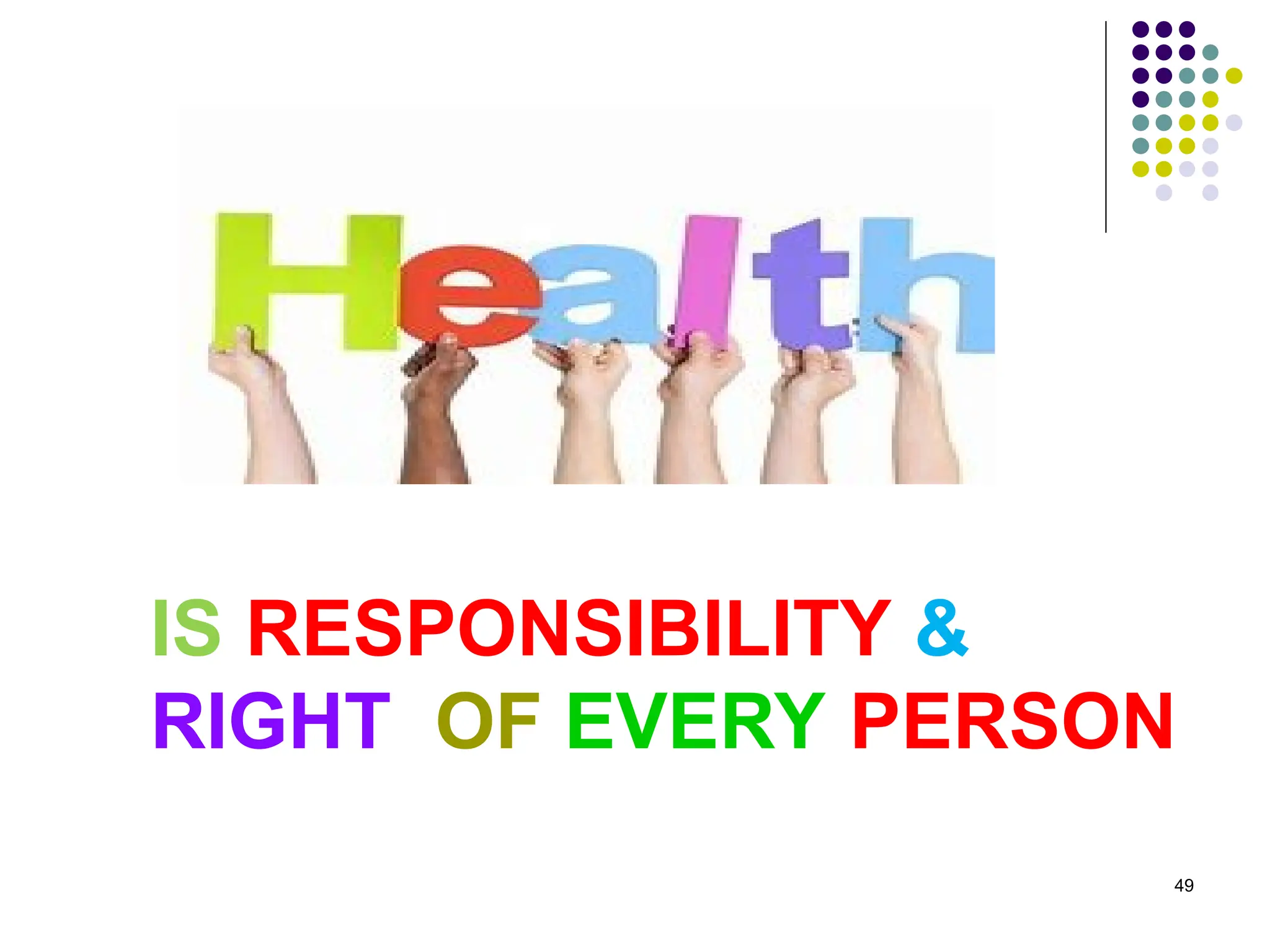
IS RESPONSIBILITY &
RIGHT OF EVERY PERSON

Foundations of public health for St. ppt

  • 1.
    1 Foundations of publichealth Dr. Anwar Bibi Associate Professor Community Medicine HITEC –IMS
  • 2.
    2 PMDC Requirement  50Hours both in practical & theory
  • 3.
    3 Clinical Rotation  3days a week for 3 weeks from 10:20 hrs – 1:20 hrs.  50 – 27hrs = 23 hours for lectures
  • 4.
    4 Lectures Lecture : EveryMonday Total : 4 Lectures per month
  • 5.
    5 Practical Training Rotation 1st Week Biostatistics & Data Collection of House Hold Survey  2nd Week Biostatistics House Hold Survey / Data analysis
  • 6.
    6 Practical Training Rotationcont…  3rd Week End of rotation test Compilation and submission of house hold survey
  • 7.
    7 Assessment  MCQs :15 Marks  OSPE: 20 Marks (5 Stations , 4 marks each)  House Hold Survey: 15 Marks  Total : 50 Marks * The marks will be added in the practical internal assessment
  • 8.
    8 Objectives of thelecture The students should be able to:  Define public health  Know the phases of evolution of public health.  Appreciate the philosophy of new public health  Appreciate the difference between clinical and community medicine
  • 9.
    What is PublicHealth ? 9
  • 10.
  • 11.
    11 EVOLUTION OF PUBLICHEALTH (ANCIENT MEDICINE) Indian medicine Chinese medicine Egyptian medicine Greek medicine Roman medicine
  • 12.
    12 Phases of evolution Dawnof scientific medicine Changing concepts of public health 1. Environmental (1846) 2. Individualistic (1870) 3. Therapeutic (1940)
  • 13.
    History  In analmost complete absence of scientific medical knowledge, it would not be fair to say that the early practitioners of medicine contributed nothing to the alleviation of man's suffering from disease. 13 Medical knowledge has been derived from the observations and cumulative experiences gleaned from others. It is study of the evolution of man and of human knowledge down the ages
  • 14.
     Medicine hasdrawn from the traditional cultures, and later from biological and natural sciences and more recently from social and behavioral sciences. 14 The "explosion" of knowledge during the 20th century has made medicine more complex, and treatment more costly
  • 15.
     The glaringcontrasts in the state of health between the developed and developing countries, between the rural and urban areas, and between the rich and poor have attracted worldwide criticism as "social injustice 15 ". The commitment of all countries, under the banner of the World Health Organization, is to wipe out the inequalities in the distribution of health resources and services, and attain the Millenium Development Goals
  • 16.
    Goal of ModernMedicine The goal of modern medicine is no longer merely treatment of sickness. Prevention of disease Promotion of health Improvement of the quality of life (individuals, groups or communities.). 16 It is also regarded as an essential component of socio-economic development
  • 17.
    “Primitive medicine: Supernaturaltheory of disease 17 It is thus obvious that medicine in the prehistoric times (about 5000 B.C.) was intermingled with superstition, religion, magic and witchcraft. Medicine was conceived in sympathy and born out of necessity The medicine he practiced consisted in appeasing gods by prayers, rituals and sacrifices, driving out "evil spirits" from the human body by witchcraft and other crude means
  • 18.
    18 The supernatural theoryof disease is as new as today. For example, in India, one may still hear the talk of curing snake bites by "mantras
  • 19.
    19 Traditional healers" arefound everywhere. They live close to the people and their treatments are based on various combinations of religion, magic and empiricism.
  • 20.
    Chinese medicine(2700 B.C.) Chinese medicine claims to be the world's first organized body of medical knowledge dating back to Hygiene, dietetics, hydrotherapy, massage, drugs were all used by the Chinese physicians.  The Chinese were early pioneers of immunization 20
  • 21.
    To a Chinese,"the great doctor is one who treats not someone who is already ill but someone not yet ill".  The Chinese have great faith in their traditional medicine, which is fully integrated with modern medicine. 21
  • 22.
    Egyptian medicine (2000B.C)  Egypt had one of the oldest civilizations  the art of medicine was mingled with religion. Egyptian physicians were co-equals of priests, trained in schools within the temples. 22 Specialization prevailed in Egyptian times eye doctors, head doctors and tooth doctors. All these doctors were officials paid by the State
  • 23.
     Egyptian medicinewas far from primitive. They believed in pathological nature of disease  They believed that the pulse was "the speech of the heart".  Different modalities of treatment like enema, blood-letting and a wide range of drugs were used  Egyptians are to be considered the "the best of all" the ancient doctors
  • 24.
     In therealm of public health also, the Egyptians excelled. They built planned cities, public baths and underground water supply.  They had also some knowledge of inoculation against smallpox, the value of mosquito nets and the association of plague with rats. 24
  • 25.
    Mesopotamian medicine  Inancient Mesopotamia, the basic concepts of medicine were religious, and taught and practiced by herb doctors, knife doctors and spell doctors - a classification that roughly parallels our own internists, surgeons and psychiatrists.  Prescriptions were written on tablets, in cuneiform writing. 25
  • 26.
    the "Hippocratic oath" hasbecome the keystone of medical ethics. Greek medicine (460- 136 B.C  Civilizers of the ancient world. They taught men to think in terms of 'Why' and 'How”  They gave rise to dynasties of healers (curative medicine) and hygienists (preventive medicine) with different philosophies.  By far the greatest physician in Greek medicine was Hippocrates (460-370 B.C.) who is often called the "Father of Medicine 26
  • 27.
    Greeks gave anew direction to medica thought. They rejected the supernatural theory of diseas• and looked upon disease as a natural process  Hippocrates was also an Epidemiologist. He distinguished between epidemic and endemic,  He studied such things as climate, water, clothing diet, habits of eating and drinking and stressed the relation between man and his environment. 27
  • 28.
    28 Health A state ofcomplete physical, mental and social well-being and not merely the absence of disease and infirmity.
  • 29.
    29 Determinants of Health Health Well-being •Education •Agriculture •Water/Sanitation •Housing Socioeconomic development HealthCare 1. Resources 2. Organization & management 3. Delivery & accessibility Quality Use •Work Environment •Employment •Social organizational network •Living condition •Family size •Age •Gender •Genetics •Life-style
  • 30.
  • 31.
    31 4. Winslow’s 1923Definition of Public Health adapted by WHO (1952) Winslow Definition The science and art of preventing disease, prolonging life and promoting physical and mental health and efficiency through the organized community efforts for the sanitation of environments,the control of communicable infection, the education of the individual in personal hygiene, the organization of medical and nursing services for the early diagnosis and preventive treatment of disease and the development of social machinery to ensure to every individual a standard of living adequate for the maintenance of health, so organizing these benefits as to enable every citizen to realize his birth right of health and longevity.
  • 32.
    32 5. Basic HealthServices (1953)  Maternal and child health  communicable disease control  Environmental sanitation  Maintenance of record for statistical purposes  Health education of the public  Public health nursing  Medical care
  • 33.
    33 6. BHORE COMMITTEE(1946)  No individual should be left out.  Fully developed health services.  Concept of health promotion.  As close to people as possible.  Involvement of the people.
  • 34.
    34 7. New publichealth (1977-78) Primary Health Care has absorbed all the concepts of basic health services but stressed community participation and political will as additional criteria for action towards achieving health for all.
  • 35.
    35 New Public HealthApproach The principles of good health are:  Equitable access to effective care  Health friendly public policy based on community participation  Intersectoral collaboration  Supportive environment  Personal skill development
  • 36.
    36 New Public HealthApproach (Renaissance) The idea that living conditions (physical social and economic environment) are the main determinants of health. Health services are important but new public health focuses on changing the determinants rather than providing treatment for the sick.
  • 37.
    37 Upstream Thinking The lifesavers save the drowning people and resuscitate them after the casualty but sensible decision would be to go upstream and see why people fall into the river.
  • 38.
    38 The Dimension ofModern Public Health Modern
  • 39.
    39 PREVENTIVE MEDICINE The science andart of preventing disease, prolonging life and promoting physical and mental health and efficiency.
  • 40.
    40 SOCIAL MEDICINE • SocialMedicine is the study of man in his total environment, physical, biological and socioeconomic. It is concerned not only with curative medicine, but also with health promotion and prevention. It is concerned with factors that influence the utilization and effectiveness of the health and health related services.
  • 41.
    41 COMMUNITY HEALTH • Communityhealth deals with the services that aim at protecting the health of the community. The interventions vary from environmental sanitation including vector control to personal health care, immunization, health education and such like. It includes an important diagnostic element – community diagnosis – aimed at surveying and monitoring community health needs and assessing the impact of interventions.
  • 42.
    42 COMMUNITY MEDICINE  Asystem of delivery of comprehensive health- care to the people by a health team in order to improve the health of the community.
  • 43.
    43 KEY PUBLIC HEALTHFUNCTIONS Public health services perform a wide range of functions, which can be classified as four key elements: 2.Planning, implementing and evaluating public health programme 1.Assessing and monitoring of the health of the population 3.Identifying and dealing with environmental hazards 4.Communicating with people and organizations to promote public health
  • 44.
    44 FUTURE PERSPECTIVE BOELEN’S FIVESTAR DOCTORS • MANAGER • DECISION MAKER • LEADER • COMMUNICATOR • CARE PROVIDER
  • 45.
  • 46.
    46 Clinical Medicine Community Medicine AimTo shorten morbidity and prevent mortality in ill or diseased person Explore methods which would reverse or eliminate disease states To reduce unnecessary morbidity and premature mortality in the whole population Explore greatest potential for health improvement
  • 47.
    47 Objective Cure patientof disease Improve health status of a community Information required Clinical history,  Physical examination and laboratory tests Population data, Health problems, disease pattern, availability of health services. Felt needs of the community Diagnosis Differential diagnosis and probable diagnosis Community diagnosis Action Plan Treatment & Rehabilitation Community Health Programme Evaluation Follow up and assessment Evaluation of change in health status
  • 48.
  • 49.