Data Imperative forDevelopment
● A "Culture of Data" means: Systematically using data for decision-making, innovation, and transparency to improve development
outcomes.
● Why it's Critical:
○ Data is transforming the global development landscape.
○ Essential for achieving Sustainable Development Goals (SDGs).
○ Enhances governance, public service delivery, and crisis response.
● This artifact proposes how government policies can nurture this culture.
3.
Common Challenges inDeveloping Data Cultures
● Limited data infrastructure and connectivity.
● Shortages in data literacy and specialized skills.
● Weak data governance, privacy concerns, and lack of trust.
● Data silos within government and between sectors.
● Underutilization of available "public intent data."
4.
Vision: A DataEmpowered Future
● Evidence-based policies become standard practice.
● Public services are more efficient, responsive, and citizen-centric.
● Data fuels innovation in both public and private sectors.
● Increased transparency and accountability in governance.
● Citizens are empowered by access to information and data skills
5.
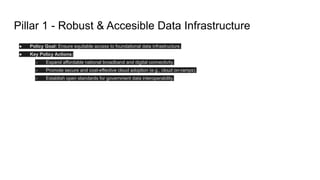
Pillar 1 -Robust & Accesible Data Infrastructure
● Policy Goal: Ensure equitable access to foundational data infrastructure.
● Key Policy Actions:
○ Expand affordable national broadband and digital connectivity.
○ Promote secure and cost-effective cloud adoption (e.g., cloud on-ramps).
○ Establish open standards for government data interoperability.
6.
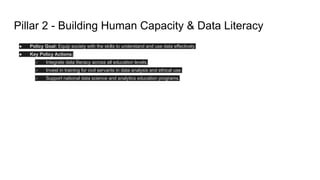
Pillar 2 -Building Human Capacity & Data Literacy
● Policy Goal: Equip society with the skills to understand and use data effectively.
● Key Policy Actions:
○ Integrate data literacy across all education levels.
○ Invest in training for civil servants in data analysis and ethical use.
○ Support national data science and analytics education programs.
7.
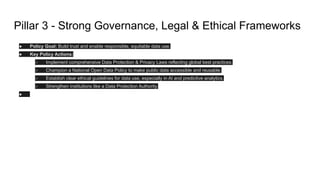
Pillar 3 -Strong Governance, Legal & Ethical Frameworks
● Policy Goal: Build trust and enable responsible, equitable data use.
● Key Policy Actions:
○ Implement comprehensive Data Protection & Privacy Laws reflecting global best practices.
○ Champion a National Open Data Policy to make public data accessible and reusable.
○ Establish clear ethical guidelines for data use, especially in AI and predictive analytics.
○ Strengthen institutions like a Data Protection Authority.
●
8.
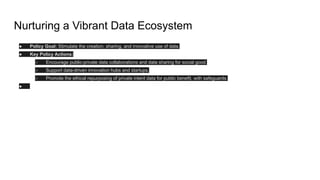
Nurturing a VibrantData Ecosystem
● Policy Goal: Stimulate the creation, sharing, and innovative use of data.
● Key Policy Actions:
○ Encourage public-private data collaborations and data sharing for social good.
○ Support data-driven innovation hubs and startups.
○ Promote the ethical repurposing of private intent data for public benefit, with safeguards.
●
9.
Measuring Progress &Ensuring Adaptability
● Tracking Success: Develop Key Performance Indicators (KPIs) such as:
○ Use of data in policy formulation.
○ Availability and use of open government data.
○ Public trust in data governance.
● Adaptive Governance: Policies must evolve with the rapidly changing data landscape.
10.
Conclusion: A Callfor Data-Driven Development
● A strong "culture of data" is fundamental to accelerating development.
● Strategic government policies are the cornerstone of this transformation.
● Requires a whole-of-society approach: collaboration between government, industry, academia, and citizens.
● Let's build a future where data empowers all.


![Where does Data Democracy begin? [Segment-Synapse, 2019]](https://cdn.slidesharecdn.com/ss_thumbnails/sunbasketsynapse2019agfinal-190928134248-thumbnail.jpg?width=640&height=640&fit=bounds)


![[DSC Europe 25] Laila Kakar - Leveraging AI for Strategic Excellence: Enhanci...](https://cdn.slidesharecdn.com/ss_thumbnails/eykmhrtsqmaaftwkexh7-dsc-lailakakar-1-260119101520-5f3b5616-thumbnail.jpg?width=640&height=640&fit=bounds)


![[DSC Europe 25] Mikhail Rozhkov - AI Product Canvas: From Business Goals to T...](https://cdn.slidesharecdn.com/ss_thumbnails/d53doddtpgfqivmzqel6-mikhail-rozhkov-ai-product-canvas-v1-260121115910-9dd517a7-thumbnail.jpg?width=640&height=640&fit=bounds)
![[DSC Europe 25] Milos Belcevic - Product Professional's Journey to Full-Stack...](https://cdn.slidesharecdn.com/ss_thumbnails/1zovd6fgsycdg4wvgvls-milos-belcevic-product-professionals-journey-to-full-stack-product-developer-260123083019-d993120d-thumbnail.jpg?width=640&height=640&fit=bounds)
![[DSC Europe 25] Tali Fulman - Guild Meetings, Then What? Building Data Commun...](https://cdn.slidesharecdn.com/ss_thumbnails/fgohhi33rwmhqdowdj5k-tali-fulman-guild-meetings-then-what-building-data-communities-that-actually-ch-260120105855-528492c3-thumbnail.jpg?width=640&height=640&fit=bounds)
![[DSC Europe 25] Josip Saban - Career building for data professionals.pptx](https://cdn.slidesharecdn.com/ss_thumbnails/zroflcttkm1vmli0txea-josip-saban-career-building-for-data-professionals-260123083019-587cdb8c-thumbnail.jpg?width=640&height=640&fit=bounds)


![[DSC Europe 25] Jovan Sumarac - Real-World Applications of Computer Vision in...](https://cdn.slidesharecdn.com/ss_thumbnails/fiksms22smcpopvvld03-jovan-sumarac-real-life-applications-of-computer-vision-in-automotive-systems-260120105855-de622abb-thumbnail.jpg?width=640&height=640&fit=bounds)
![[DSC Europe 25] Milovan Jovicic - Beyond AI's Reach: The Enduring Value of Ev...](https://cdn.slidesharecdn.com/ss_thumbnails/pyeij0hurgwq5jugmtnv-2-milovan-jovicic-beyond-ais-reach-the-enduring-value-of-evergreen-design-v2-260120105856-d6ee57e5-thumbnail.jpg?width=640&height=640&fit=bounds)

![[DSC Europe 25] Tamas Srancsik - How To Teach Your AI Football? An Argument f...](https://cdn.slidesharecdn.com/ss_thumbnails/bcjh1m9xtbosv20ucftb-tamas-srancsik-how-to-teach-your-ai-football-260121115910-08b53e9e-thumbnail.jpg?width=640&height=640&fit=bounds)

