Network of networks in
the OpenMRS
community
The strengths and “strength” of the
bazaar model
Saptarshi Purkayastha, Ph.D.
Assistant professor, Indiana University – Purdue University Indianapolis
Senior Manager, Education programs, OpenMRS
FOSS Asia 2016 - Singapore
Mar 19th, 2016
Lets start with an experiment
• Two sheets of paper have been circulated in the room.
• On Sheet 1, write the first letter of your last name and pass it on
• On Sheet 2, write any one letter. Your goal is to try to spell an
English word of at least 3 letters.
• Write your letter next to the letter written by the person who
passed you the sheet.
• When a new word is created, strikethrough that word. Then write
a new letter and pass the sheet.
• Continue listening to me, while passing the paper forward.
• Before we start, how many words will we create?
What is OpenMRS?
• A community that works in the domain of health/medical
informatics to build a medical records platform.
• Over the last 11 years, we have seen community members build
different things.
• What do we do in our community of practice?
– Create, share, learn a medical records platform (product)
– Create, share, learn standards for health terminology (bi-product)
– Create, share, learn mobile health applications (coproduct)
– Create, share, learn knowledge about health informatics (raw material)
– Create, share, learn open-source principles (side effect)
– Create, share, learn software dev methods – OpenScrum (process)
– …
Community of practice (read as-is)
• A group of doctors were having their 10th annual meeting. For these years,
they had been coming together to hear how others were doing health
information management and sharing knowledge about a platform that they
felt was missing from their profession. Only a few of the original members
were still part of the group, but the shared work, stories, and artifacts
created over time gave their meetings a sense of continuity and purpose. If
you were a fly-on-the wall at one of their events you would notice how new
members were warmly welcomed into “the family”, how many people
stepped up to take initiative or share their battle stories, and how ambitious
core members were to advance the practice of health information
management across the world...
Why are the parts of CoP?
• Academics coined the term to explain collective learning, with
following aspects (Lave & Wegner, 1991):
1) The domain
2) The community
3) The practice
• Why are we more than a CoP? – because at the extreme of the bazaar model,
community members don’t have a common preferred practice.
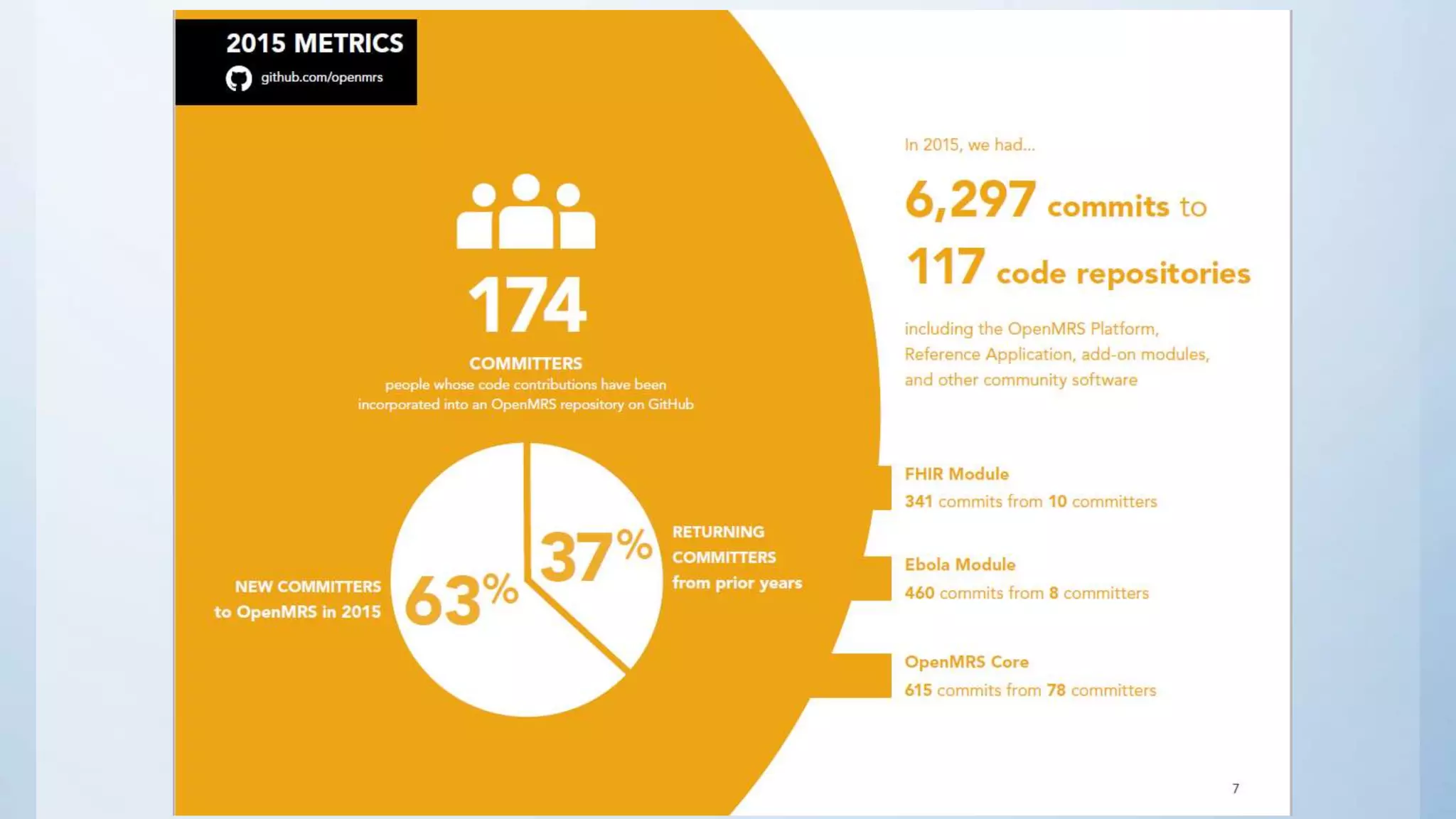
– The OpenMRS platform and core modules are worked on by a central team of
contributors who design and release these features through coordinated
communication.
– there are over 300 publicly available modules that have been developed to work on
OpenMRS by over 800 different developers/organizations who maintain it without
much coordination between themselves.
– There are modules that have moved between maintainers.
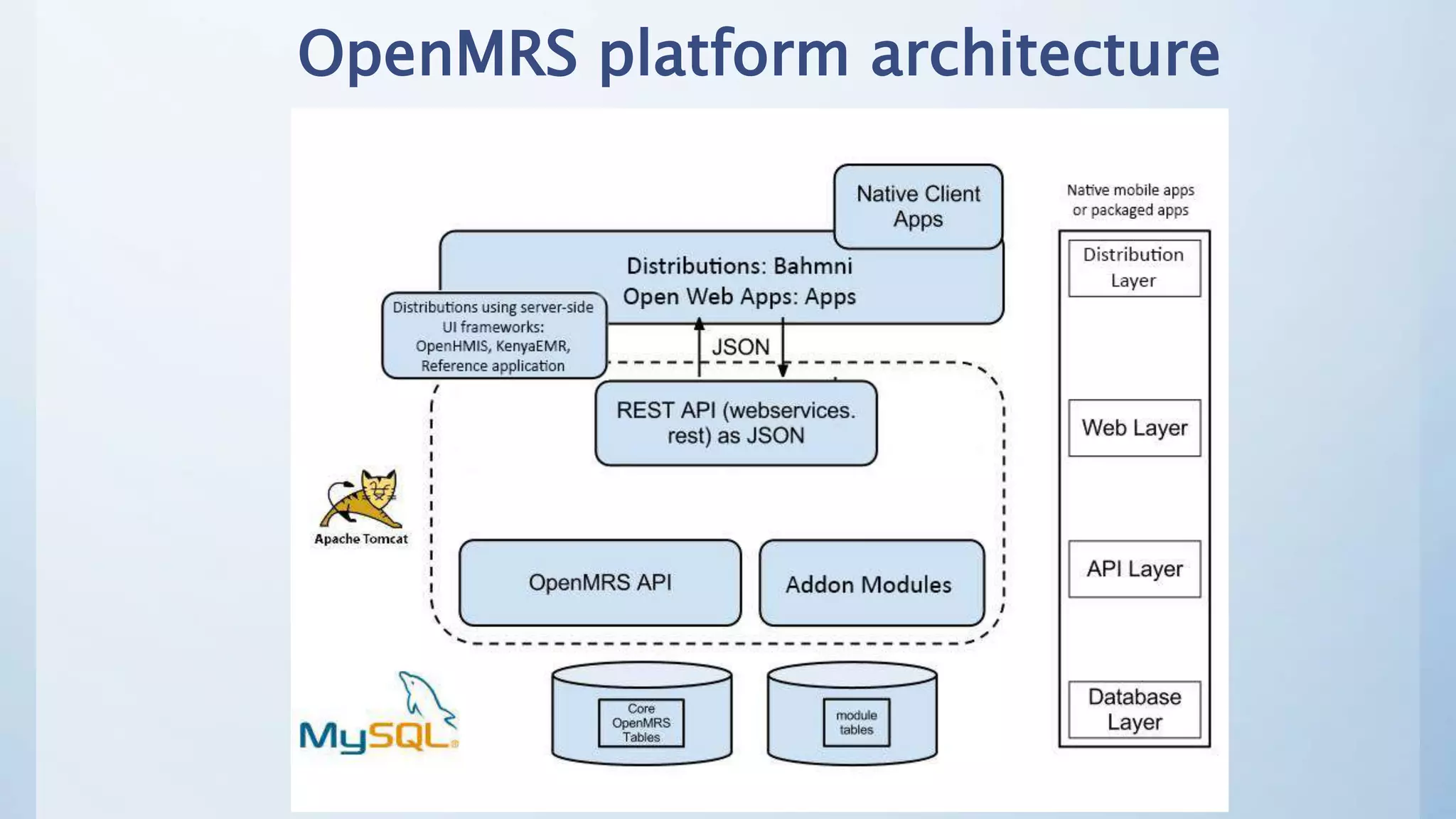
OpenMRS platform architecture
OpenMRS distributions
• OpenMRS is a flexible, modular, multi-layered system, and one of its
strengths is that its platform can be used in many different
configurations
• To implement an OpenMRS system, you typically start from an
existing OpenMRS Distribution, and configure that distribution for
your implementation use case..
• Depending on which distribution you choose, and what your use case
is, this may range from:
– configuring metadata through a UI
– to writing custom add-on modules,
– or your own custom UI backed by OpenMRS REST web services.
• Implementations with strong development teams may choose to build
their own custom application(s) on top of the Platform
OpenMRS reference application
• The OpenMRS reference application is a sample EMR application
running atop the OpenMRS API.
• OpenMRS has always had a web application component; however, the
web application focused primarily on basic administrative features and
lacked most content, leaving it up to modules and administrators to
provide EMR functionality and content.
• The Reference Application, on the other hand, strives to provide more
of a starter set of content along with basic EMR functionality (e.g.,
registration, basic reports, etc.).
• The Reference Application comprises a handful of modules that run
within the Java web application and provides a Groovy (a scripting
language)-based framework for web development.
• In community lingo, you’ll hear this distribution referred to as
OpenMRS reference application (cont’d)
• The RefApp distribution demonstrates how the OpenMRS platform can
be used to build a facility EMR, and it is where the community
develops starter sets of metadata and terminology.
• The RefApp is a good starting point for implementing OpenMRS in a
facility, and it intends to eventually be a full-featured EMR system, but
it is dependent on distributed volunteer efforts, and hasn't yet
achieved that goal.
• This distribution does not intend to cover the entire Hospital
Information System use case, e.g. we won't cover billing or pharmacy
stock management.
• In this tutorial, we use the Reference application as a starter EMR on
which you will be able to explore the different features provided by
OpenMRS.
The under performance of bazaar
• Wasted resources – people doing similar things multiple number of
times:
– We have 6 known registration modules
– There have been 3 attempts at web services.
• Undiscovered resources
– Many implementers have modules that could be generalized, but don’t want to
make an effort beyond their own market
• Lack of motivation to merge back
– Platform is embedded in large proprietary EMR, but no reason for them to come
back.
– Their market research doesn’t show that they’ll benefit from community
participation
• Friction and competition
– Implementers are creating modules in GPL v3, so they get back modifications
How do you manage the bazaar?
• Marketplace model has worked for products. Successful projects have
been able to use the strength of bazaar
• The regulation model is common where regulation is created and QA
is ensured
• The crowd-sourced model of ratings - like in a store.
• We are planning a combination of these models to create a
certification process for distributions and matching process for use-
cases and the distributions
What/Who do we certify?
• OpenMRS Certified Implementer (individuals) or Implementation
Partner (orgs) - implementers who have proven record, including a
team of developers and trainers
• OpenMRS Certified Developer - a developer who has contributed and
can be an independent hire or consultant to implementers
• OpenMRS Certified Trainer - a trainer or training organization that can
deliver training content on OpenMRS or can create content for
implementers
• In 2016, we will release the whole process and start certifying by the
end of this year.
• Our annual worldwide summit will be in Singapore in December 2016,
where we will do the training and certification.
Why do we certify?
• Not to make money… clearly not our motivation, vision or revenue
model. It will only be covering our costs
• But to be able to get advantage of the network/infrastructure by
engaging with the bazaar
• Both actor-network theory (Latour, Callon, Law) or the Information
infrastructure theory (Hanseth & Monteiro) have shown that:
the whole is greater than the sum of the
parts
• Being able to create that whole in the OpenMRS community will help
visibility… and hopefully help save more lives. Make software that
exists out there, available to the users
• We’ve found service provider visibility to be one of the biggest
Do you guys want to know
the results of our
experiment?
Q&A – you can tweet - @sunny2eets

FOSS Asia 2016 - OpenMRS networks for networks

  • 1.
    Network of networksin the OpenMRS community The strengths and “strength” of the bazaar model Saptarshi Purkayastha, Ph.D. Assistant professor, Indiana University – Purdue University Indianapolis Senior Manager, Education programs, OpenMRS FOSS Asia 2016 - Singapore Mar 19th, 2016
  • 2.
    Lets start withan experiment • Two sheets of paper have been circulated in the room. • On Sheet 1, write the first letter of your last name and pass it on • On Sheet 2, write any one letter. Your goal is to try to spell an English word of at least 3 letters. • Write your letter next to the letter written by the person who passed you the sheet. • When a new word is created, strikethrough that word. Then write a new letter and pass the sheet. • Continue listening to me, while passing the paper forward. • Before we start, how many words will we create?
  • 3.
    What is OpenMRS? •A community that works in the domain of health/medical informatics to build a medical records platform. • Over the last 11 years, we have seen community members build different things. • What do we do in our community of practice? – Create, share, learn a medical records platform (product) – Create, share, learn standards for health terminology (bi-product) – Create, share, learn mobile health applications (coproduct) – Create, share, learn knowledge about health informatics (raw material) – Create, share, learn open-source principles (side effect) – Create, share, learn software dev methods – OpenScrum (process) – …
  • 4.
    Community of practice(read as-is) • A group of doctors were having their 10th annual meeting. For these years, they had been coming together to hear how others were doing health information management and sharing knowledge about a platform that they felt was missing from their profession. Only a few of the original members were still part of the group, but the shared work, stories, and artifacts created over time gave their meetings a sense of continuity and purpose. If you were a fly-on-the wall at one of their events you would notice how new members were warmly welcomed into “the family”, how many people stepped up to take initiative or share their battle stories, and how ambitious core members were to advance the practice of health information management across the world...
  • 5.
    Why are theparts of CoP? • Academics coined the term to explain collective learning, with following aspects (Lave & Wegner, 1991): 1) The domain 2) The community 3) The practice • Why are we more than a CoP? – because at the extreme of the bazaar model, community members don’t have a common preferred practice. – The OpenMRS platform and core modules are worked on by a central team of contributors who design and release these features through coordinated communication. – there are over 300 publicly available modules that have been developed to work on OpenMRS by over 800 different developers/organizations who maintain it without much coordination between themselves. – There are modules that have moved between maintainers.
  • 7.
  • 8.
    OpenMRS distributions • OpenMRSis a flexible, modular, multi-layered system, and one of its strengths is that its platform can be used in many different configurations • To implement an OpenMRS system, you typically start from an existing OpenMRS Distribution, and configure that distribution for your implementation use case.. • Depending on which distribution you choose, and what your use case is, this may range from: – configuring metadata through a UI – to writing custom add-on modules, – or your own custom UI backed by OpenMRS REST web services. • Implementations with strong development teams may choose to build their own custom application(s) on top of the Platform
  • 9.
    OpenMRS reference application •The OpenMRS reference application is a sample EMR application running atop the OpenMRS API. • OpenMRS has always had a web application component; however, the web application focused primarily on basic administrative features and lacked most content, leaving it up to modules and administrators to provide EMR functionality and content. • The Reference Application, on the other hand, strives to provide more of a starter set of content along with basic EMR functionality (e.g., registration, basic reports, etc.). • The Reference Application comprises a handful of modules that run within the Java web application and provides a Groovy (a scripting language)-based framework for web development. • In community lingo, you’ll hear this distribution referred to as
  • 10.
    OpenMRS reference application(cont’d) • The RefApp distribution demonstrates how the OpenMRS platform can be used to build a facility EMR, and it is where the community develops starter sets of metadata and terminology. • The RefApp is a good starting point for implementing OpenMRS in a facility, and it intends to eventually be a full-featured EMR system, but it is dependent on distributed volunteer efforts, and hasn't yet achieved that goal. • This distribution does not intend to cover the entire Hospital Information System use case, e.g. we won't cover billing or pharmacy stock management. • In this tutorial, we use the Reference application as a starter EMR on which you will be able to explore the different features provided by OpenMRS.
  • 11.
    The under performanceof bazaar • Wasted resources – people doing similar things multiple number of times: – We have 6 known registration modules – There have been 3 attempts at web services. • Undiscovered resources – Many implementers have modules that could be generalized, but don’t want to make an effort beyond their own market • Lack of motivation to merge back – Platform is embedded in large proprietary EMR, but no reason for them to come back. – Their market research doesn’t show that they’ll benefit from community participation • Friction and competition – Implementers are creating modules in GPL v3, so they get back modifications
  • 12.
    How do youmanage the bazaar? • Marketplace model has worked for products. Successful projects have been able to use the strength of bazaar • The regulation model is common where regulation is created and QA is ensured • The crowd-sourced model of ratings - like in a store. • We are planning a combination of these models to create a certification process for distributions and matching process for use- cases and the distributions
  • 13.
    What/Who do wecertify? • OpenMRS Certified Implementer (individuals) or Implementation Partner (orgs) - implementers who have proven record, including a team of developers and trainers • OpenMRS Certified Developer - a developer who has contributed and can be an independent hire or consultant to implementers • OpenMRS Certified Trainer - a trainer or training organization that can deliver training content on OpenMRS or can create content for implementers • In 2016, we will release the whole process and start certifying by the end of this year. • Our annual worldwide summit will be in Singapore in December 2016, where we will do the training and certification.
  • 14.
    Why do wecertify? • Not to make money… clearly not our motivation, vision or revenue model. It will only be covering our costs • But to be able to get advantage of the network/infrastructure by engaging with the bazaar • Both actor-network theory (Latour, Callon, Law) or the Information infrastructure theory (Hanseth & Monteiro) have shown that: the whole is greater than the sum of the parts • Being able to create that whole in the OpenMRS community will help visibility… and hopefully help save more lives. Make software that exists out there, available to the users • We’ve found service provider visibility to be one of the biggest
  • 15.
    Do you guyswant to know the results of our experiment? Q&A – you can tweet - @sunny2eets

Editor's Notes

  • #2 Introduce the title – networks of network – how intertangled work practices produces “different things” in OpenMRS. A somewhat extreme case of the bazaar model (which after many yrs, I think is still a relevant noun). I am an assistant professor in health informatics and long term contributor to the open-source (OpenMRS, DHIS2, Netbeans, OpenSuSE) and the project itself. So my vantage point comes from what people in literature refer to as “engaged researcher” and serve in a leadership role which gives a wider perspective.
  • #3 Distribute the two sheets of paper at opposite ends of the audience. Length of the words striked is equal to number of points, but don’t tell the audience this now. Count at the end of the presentation and then make your point
  • #4 OpenMRS historically is a product, but over the years we have discovered that it is not a product, but an network/infrastructure that enables people to create, share and learn electronic health systems
  • #5 Ethnography – story
  • #8 Platform arch – describe how the distributions on the left are different from OWA apps or Bahmni
  • #9 Discuss how distributions are created… More advanced tutorial like the one about Angular+REST teaches building custom UI or the Extending openmrs tutorial teaches how to create your own add-on module
  • #10 In this tutorial, we will not teach you to compile or build OpenMRS from source code. No programming is involved to use the reference application.
  • #11 Discuss how this is only meant to showcase and inform users, particularly technically inclined ones, to customize the OpenMRS platforms. There are distributions such as OpenHMIS, DHIS Hospital and Bahmni that are suited for a rural hospital setting. There is no free/open-source distribution for large-scale tertiary hospitals, but there are proprietary ones that have used OpenMRS platform as their starting point
  • #12 A fear reaction