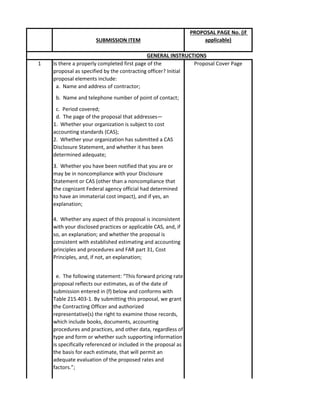
SUBMISSION ITEM
PROPOSAL PAGE No. (if
applicable)
Is there a properly completed first page of the
proposal as specified by the contracting officer? Initial
proposal elements include:
a. Name and address of contractor;
b. Name and telephone number of point of contact;
c. Period covered;
d. The page of the proposal that addresses—
1. Whether your organization is subject to cost
accounting standards (CAS);
2. Whether your organization has submitted a CAS
Disclosure Statement, and whether it has been
determined adequate;
3. Whether you have been notified that you are or
may be in noncompliance with your Disclosure
Statement or CAS (other than a noncompliance that
the cognizant Federal agency official had determined
to have an immaterial cost impact), and if yes, an
explanation;
4. Whether any aspect of this proposal is inconsistent
with your disclosed practices or applicable CAS, and, if
so, an explanation; and whether the proposal is
consistent with established estimating and accounting
principles and procedures and FAR part 31, Cost
Principles, and, if not, an explanation;
e. The following statement: “This forward pricing rate
proposal reflects our estimates, as of the date of
submission entered in (f) below and conforms with
Table 215.403-1. By submitting this proposal, we grant
the Contracting Officer and authorized
representative(s) the right to examine those records,
which include books, documents, accounting
procedures and practices, and other data, regardless of
type and form or whether such supporting information
is specifically referenced or included in the proposal as
the basis for each estimate, that will permit an
adequate evaluation of the proposed rates and
factors.”;
GENERAL INSTRUCTIONS
1 Proposal Cover Page
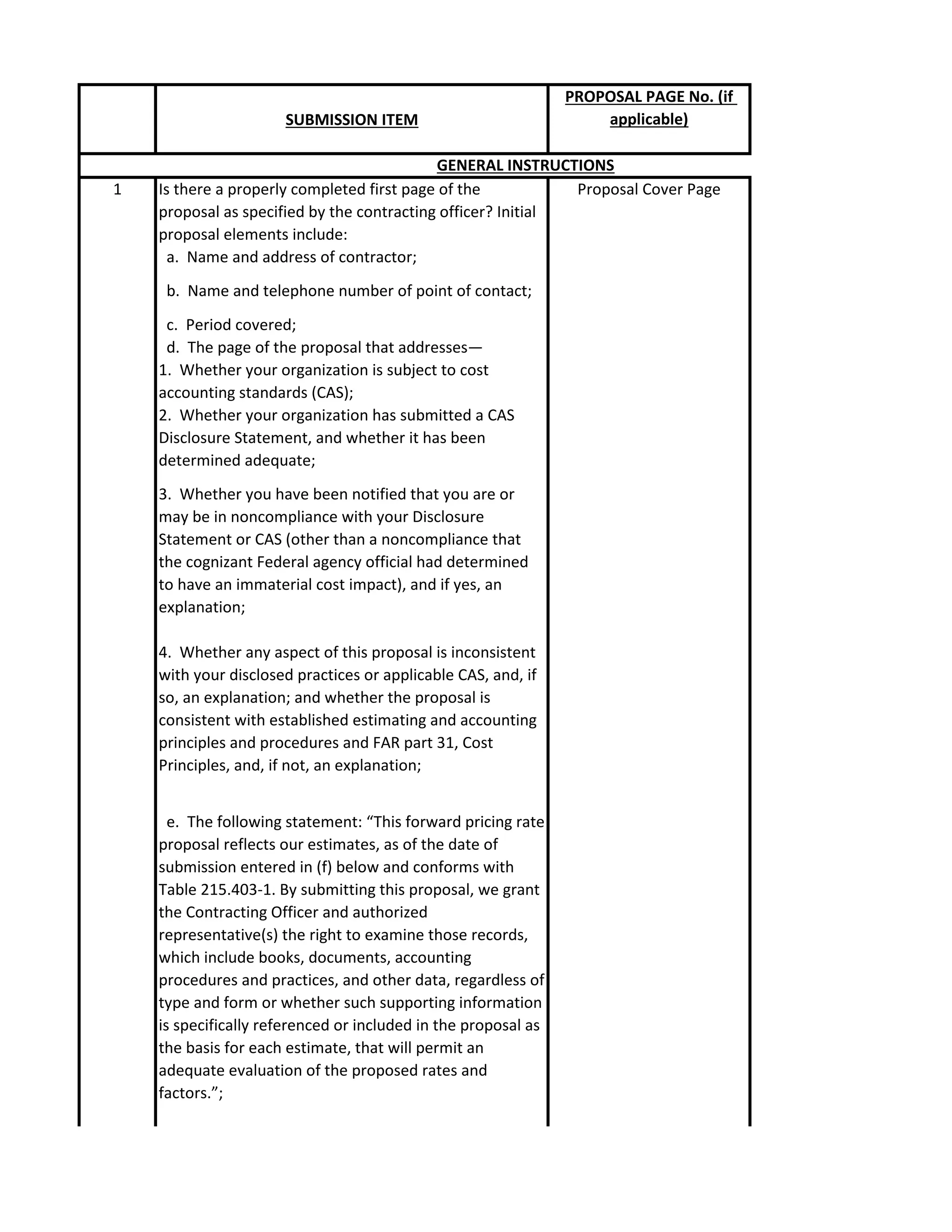
f. Date of submission; and
g. Name, title, and signature of authorized
representative.
2
Summary of proposed direct and indirect rates and
factors, including the proposed pool and base costs for
each proposed indirect rate and factor.
Immediately following the
proposal cover page
Table of Contents or index.
a. Does the proposal include a table of contents or
index identifying and referencing all supporting data
accompanying or identified in the proposal?
b. For supporting documentation not provided with
the proposal, does the basis of each estimate in the
proposal include the location of the documentation
and the point of contact (custodian) name, phone
number, and email address?
Does the proposal disclose known or anticipated
changes in business activities or processes that could
materially impact the proposed rates (if not previously
provided)? For example—
a. Management initiatives to reduce costs;
b. Changes in management objectives as a result of
economic conditions and increased competitiveness;
c. Changes in accounting policies, procedures, and
practices including (i) reclassification of expenses from
direct to indirect or vice versa; (ii) new methods of
accumulating and allocating indirect costs and the
related impact; and (iii) advance agreements;
d. Company reorganizations (including acquisitions or
divestitures);
e. Shutdown of facilities; or
f. Changes in business volume and/or contract
mix/type.
5 Do proposed costs based on judgmental factors
include an explanation of the estimating processes and
methods used, including those used in projecting from
known data?
6 Does the proposal show trends and budgetary data?
Does the proposal provide an explanation of how the
data, as well as any adjustments to the data, were
used?
3 Proposal Cover Page
4
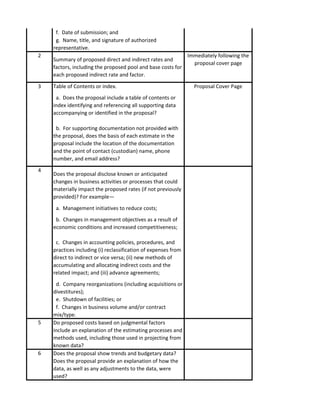
7 The proposal should reconcile to the supporting data
referenced. If the proposal does not reconcile to the
supporting data referenced, identify applicable page(s)
and explain.
8 The proposal should be internally consistent. If the
proposal is not internally consistent, identify applicable
page(s) and explain.
Direct Labor Rates Methodology and Basis of Each
Estimate.
a. Does the proposal include an explanation of the
methodology used to develop the direct labor rates
and identify the basis of each estimate?
b. Does the proposal include or identify the location
of the supporting documents for the base-period labor
rates (e.g., payroll records)?
10
Does the proposal identify escalation factors for the
out-year labor rates, the costs to which escalation is
applicable, and the basis of each factor used?
11 Does the proposal identify planned or anticipated
changes in the composition of labor rates, labor
categories, union agreements, headcounts, or other
factors that could significantly impact the direct labor
rates?
Indirect Rates Methodology and Basis of Each
Estimate.
a. Does the proposal identify the basis of each
estimate and provide an explanation of the
methodology used to develop the indirect rates?
b. Does the proposal include or identify the location
of the supporting documents for the proposed rates?
13
Does the proposal identify indirect expenses by burden
center, by cost element, by year (including any
voluntary deletions, if applicable) in a format that is
consistent with the accounting system used to
accumulate actual expenses?
14 Does the proposal identify any contingencies?
15 Does the proposal identify planned or anticipated
changes in the nature, type, or level of indirect costs,
including fringe benefits?
Direct Labor
9
Indirect Rates (Fringe, Overhead, G&A, etc.)
12
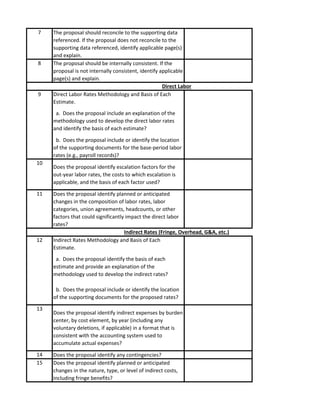
16
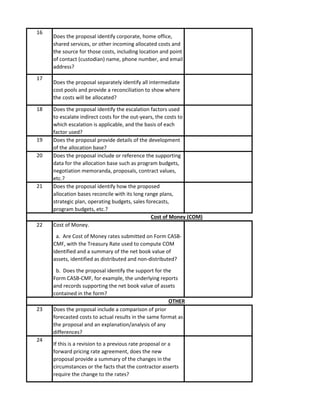
Does the proposal identify corporate, home office,
shared services, or other incoming allocated costs and
the source for those costs, including location and point
of contact (custodian) name, phone number, and email
address?
17
Does the proposal separately identify all intermediate
cost pools and provide a reconciliation to show where
the costs will be allocated?
18 Does the proposal identify the escalation factors used
to escalate indirect costs for the out-years, the costs to
which escalation is applicable, and the basis of each
factor used?
19 Does the proposal provide details of the development
of the allocation base?
20 Does the proposal include or reference the supporting
data for the allocation base such as program budgets,
negotiation memoranda, proposals, contract values,
etc.?
21 Does the proposal identify how the proposed
allocation bases reconcile with its long range plans,
strategic plan, operating budgets, sales forecasts,
program budgets, etc.?
Cost of Money.
a. Are Cost of Money rates submitted on Form CASB-
CMF, with the Treasury Rate used to compute COM
identified and a summary of the net book value of
assets, identified as distributed and non-distributed?
b. Does the proposal identify the support for the
Form CASB-CMF, for example, the underlying reports
and records supporting the net book value of assets
contained in the form?
23 Does the proposal include a comparison of prior
forecasted costs to actual results in the same format as
the proposal and an explanation/analysis of any
differences?
24
If this is a revision to a previous rate proposal or a
forward pricing rate agreement, does the new
proposal provide a summary of the changes in the
circumstances or the facts that the contractor asserts
require the change to the rates?
OTHER
Cost of Money (COM)
22
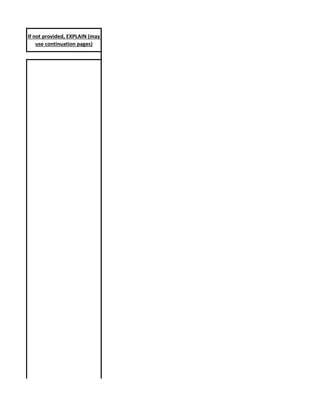
If not provided, EXPLAIN (may
use continuation pages)
c.)
Forward Pricing Rates Proposal Adequacy Audit Checklist

Forward Pricing Rates Proposal Adequacy Audit Checklist

  • 1.
    SUBMISSION ITEM PROPOSAL PAGENo. (if applicable) Is there a properly completed first page of the proposal as specified by the contracting officer? Initial proposal elements include: a. Name and address of contractor; b. Name and telephone number of point of contact; c. Period covered; d. The page of the proposal that addresses— 1. Whether your organization is subject to cost accounting standards (CAS); 2. Whether your organization has submitted a CAS Disclosure Statement, and whether it has been determined adequate; 3. Whether you have been notified that you are or may be in noncompliance with your Disclosure Statement or CAS (other than a noncompliance that the cognizant Federal agency official had determined to have an immaterial cost impact), and if yes, an explanation; 4. Whether any aspect of this proposal is inconsistent with your disclosed practices or applicable CAS, and, if so, an explanation; and whether the proposal is consistent with established estimating and accounting principles and procedures and FAR part 31, Cost Principles, and, if not, an explanation; e. The following statement: “This forward pricing rate proposal reflects our estimates, as of the date of submission entered in (f) below and conforms with Table 215.403-1. By submitting this proposal, we grant the Contracting Officer and authorized representative(s) the right to examine those records, which include books, documents, accounting procedures and practices, and other data, regardless of type and form or whether such supporting information is specifically referenced or included in the proposal as the basis for each estimate, that will permit an adequate evaluation of the proposed rates and factors.”; GENERAL INSTRUCTIONS 1 Proposal Cover Page
  • 2.
    f. Date ofsubmission; and g. Name, title, and signature of authorized representative. 2 Summary of proposed direct and indirect rates and factors, including the proposed pool and base costs for each proposed indirect rate and factor. Immediately following the proposal cover page Table of Contents or index. a. Does the proposal include a table of contents or index identifying and referencing all supporting data accompanying or identified in the proposal? b. For supporting documentation not provided with the proposal, does the basis of each estimate in the proposal include the location of the documentation and the point of contact (custodian) name, phone number, and email address? Does the proposal disclose known or anticipated changes in business activities or processes that could materially impact the proposed rates (if not previously provided)? For example— a. Management initiatives to reduce costs; b. Changes in management objectives as a result of economic conditions and increased competitiveness; c. Changes in accounting policies, procedures, and practices including (i) reclassification of expenses from direct to indirect or vice versa; (ii) new methods of accumulating and allocating indirect costs and the related impact; and (iii) advance agreements; d. Company reorganizations (including acquisitions or divestitures); e. Shutdown of facilities; or f. Changes in business volume and/or contract mix/type. 5 Do proposed costs based on judgmental factors include an explanation of the estimating processes and methods used, including those used in projecting from known data? 6 Does the proposal show trends and budgetary data? Does the proposal provide an explanation of how the data, as well as any adjustments to the data, were used? 3 Proposal Cover Page 4
  • 3.
    7 The proposalshould reconcile to the supporting data referenced. If the proposal does not reconcile to the supporting data referenced, identify applicable page(s) and explain. 8 The proposal should be internally consistent. If the proposal is not internally consistent, identify applicable page(s) and explain. Direct Labor Rates Methodology and Basis of Each Estimate. a. Does the proposal include an explanation of the methodology used to develop the direct labor rates and identify the basis of each estimate? b. Does the proposal include or identify the location of the supporting documents for the base-period labor rates (e.g., payroll records)? 10 Does the proposal identify escalation factors for the out-year labor rates, the costs to which escalation is applicable, and the basis of each factor used? 11 Does the proposal identify planned or anticipated changes in the composition of labor rates, labor categories, union agreements, headcounts, or other factors that could significantly impact the direct labor rates? Indirect Rates Methodology and Basis of Each Estimate. a. Does the proposal identify the basis of each estimate and provide an explanation of the methodology used to develop the indirect rates? b. Does the proposal include or identify the location of the supporting documents for the proposed rates? 13 Does the proposal identify indirect expenses by burden center, by cost element, by year (including any voluntary deletions, if applicable) in a format that is consistent with the accounting system used to accumulate actual expenses? 14 Does the proposal identify any contingencies? 15 Does the proposal identify planned or anticipated changes in the nature, type, or level of indirect costs, including fringe benefits? Direct Labor 9 Indirect Rates (Fringe, Overhead, G&A, etc.) 12
  • 4.
    16 Does the proposalidentify corporate, home office, shared services, or other incoming allocated costs and the source for those costs, including location and point of contact (custodian) name, phone number, and email address? 17 Does the proposal separately identify all intermediate cost pools and provide a reconciliation to show where the costs will be allocated? 18 Does the proposal identify the escalation factors used to escalate indirect costs for the out-years, the costs to which escalation is applicable, and the basis of each factor used? 19 Does the proposal provide details of the development of the allocation base? 20 Does the proposal include or reference the supporting data for the allocation base such as program budgets, negotiation memoranda, proposals, contract values, etc.? 21 Does the proposal identify how the proposed allocation bases reconcile with its long range plans, strategic plan, operating budgets, sales forecasts, program budgets, etc.? Cost of Money. a. Are Cost of Money rates submitted on Form CASB- CMF, with the Treasury Rate used to compute COM identified and a summary of the net book value of assets, identified as distributed and non-distributed? b. Does the proposal identify the support for the Form CASB-CMF, for example, the underlying reports and records supporting the net book value of assets contained in the form? 23 Does the proposal include a comparison of prior forecasted costs to actual results in the same format as the proposal and an explanation/analysis of any differences? 24 If this is a revision to a previous rate proposal or a forward pricing rate agreement, does the new proposal provide a summary of the changes in the circumstances or the facts that the contractor asserts require the change to the rates? OTHER Cost of Money (COM) 22
  • 5.
    If not provided,EXPLAIN (may use continuation pages)
  • 7.