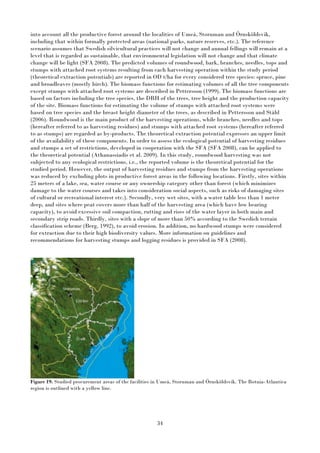
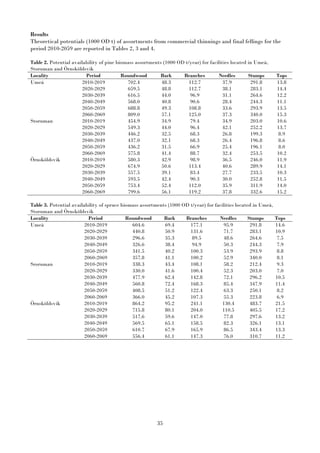
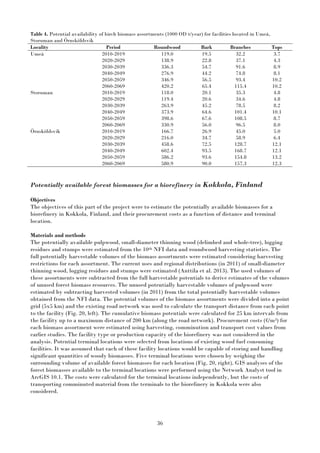
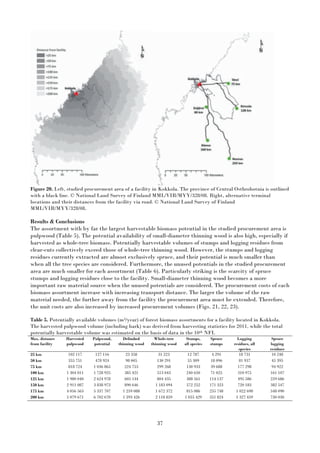
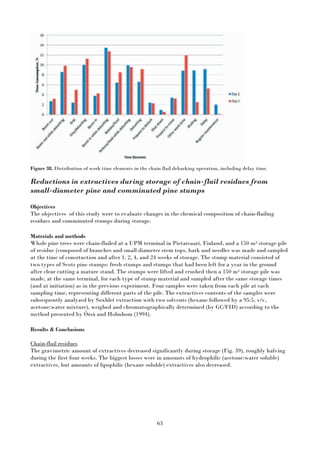
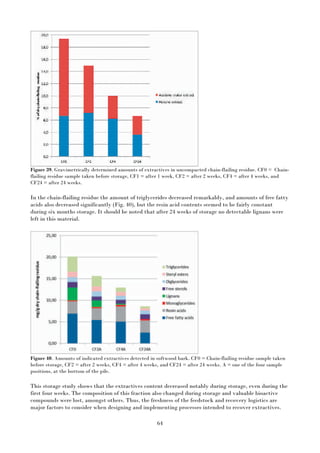
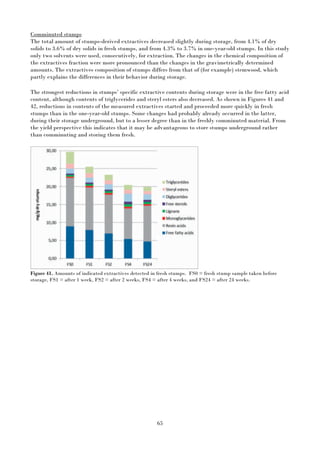
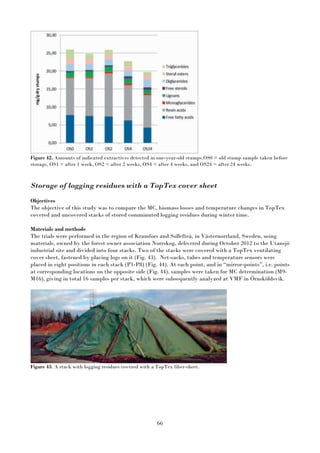
This document summarizes a project that analyzed forest biomass supply chains for biorefineries in northern Sweden and Finland. It found that integrating supplies of pulpwood and residues can significantly reduce supply costs compared to separate supply chains. However, assessing costs and benefits is complex due to interactions between multiple feedstock types and users. Supply costs may be reduced by around 10% through new practices like pre-treatment to utilize previously non-viable feedstocks, though this must be weighed against additional treatment costs. Ensuring flexible biomass supplies that can rapidly adjust to potential shifts in demand will be critical. Terminals may play a key role in providing flexibility if upgraded to function as refineries with appropriate infrastructure and resources.







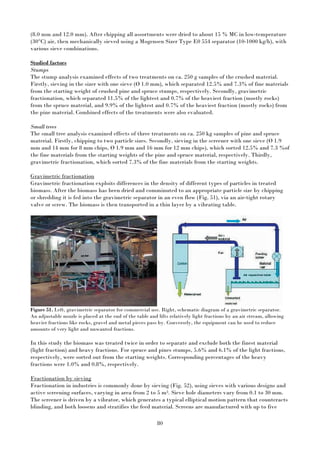
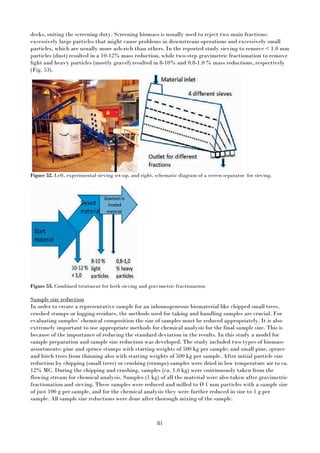
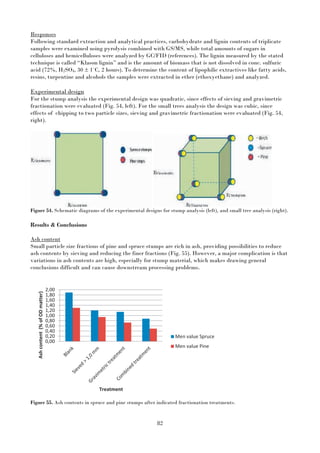
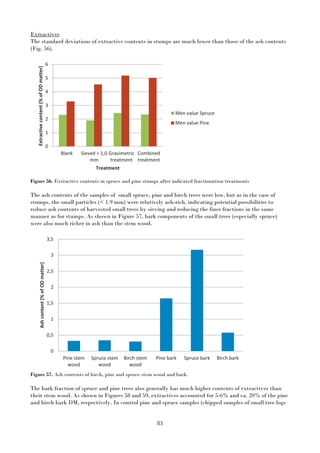





![105
References
Alén R, 2000. Structure and chemical composition of wood. In: Stenius P (ed.) Forest Products
Chemistry. Jyväskylä, Finland: Gummerus Printing; 2000. p. 11-57.
Allen GF. 1962. Screen and pneumatic classification. Ind Eng Chem. 54:39–44.
Anerud E, Jirjis R, 2011. Fuel quality of norway spruce stumps – influence of harvesting
technique and storage method. Scandinavian Journal of Forest Research 26(3):257-66.
Anttila P, Nivala M, Laitila J & Korhonen KT. 2013. Metsähakkeen alueellinen korjuupotentiaali
ja käyttö. Working Papers of the Finnish Forest Research Institute 267.
Arthur, J.F., Kepner,R.A., Dobie , J.B. et al. 1982. Tub grinder performance with crop and forest
residues, Transactions of the ASAE (American Society of Agricultural Engineers), 25(6) 1488-1494
Asikainen, A. and Pulkkinen, P. 1998. Comminution of logging residues with Evolution 910R
chipper, MOHA chipper truck and Morbark 1200 tub grinder, Journal of Forest Engineering, 9:
47-53
Athanassiadis, D. 2000. Energy consumption and exhaust emissions in mechanized timber
harvesting operations in Sweden. Science of the Total Environment. 255: 135-143.
Athanassiadis, D., Melin, Y. Lundström, A., Nordfjell, T. 2009. Marginalkostnader för skörd av
grot och stubbar från föryngringsavverkningar i Sverige [Marginal cost for harvesting logging
residues in clear cuts]. Sveriges Lantbruksuniversitet, Arbetsrapport 261.
Berg, S. 1992. Terrain classification system for forestry work. Forest Operations Institute,
Sweden. ISBN 91-7614-078-4.
Berg, S. 2014. Technology and Systems for Stump Harvesting with Low Ground .Doctoral Thesis.
Swedish University of Agricultural Sciences, Acta Universitatis agriculturae Sueciae, 2014:XXX.
Berg S., Bergström D., Nordfjell T. 2014. Simulation of conventional and integrated stump wood
and round wood harvesting systems and comparison of their productivity and cost. International
Journal of Forest Engineering.
Berg, S., Nurmi, J. & Prinz, R. 2014. Comparison of ground disturbance caused by the Ellettari
stump drill and a stump rake harvesting head on frozen peat land. (manuscript).
Bergström, D. 2009. Techniques and systems for boom-corridor thinning in young dense forests.
Doctoral thesis. Acta Universitatis Agriculturae Sueciae, 87. ISBN 978-91-576-7343-0.
Bergström, D. , Bergsten, U. , Nordfjell, T., Lundmark, T., 2007: Simulation of geometric
thinning systems and their time requirements for young forests. - Silva Fennica, 41(1):137-147 .
Bergström, D. & Di Fulvio, F. 2014. Studies on the use of a novel prototype harvester head in
early fuel wood thinnings. International Journal of Forest Engineering DOI:
10.1080/14942119.2014.945697.](https://image.slidesharecdn.com/a7e1adec-1e3f-4f7e-883a-86812620e587-150822060500-lva1-app6892/85/Forest-Refine-2012-2014-105-320.jpg)
![106
Bergström, D., Nordfjell, T. & Bergsten, U. 2010. Compressing processing and load compression of
young Scots pine and birch trees in thinnings for bioenergy. International Journal of Forest
Engineering 21(1): 31-39.
Bergström, D. Di Fulvio, F. & Nuutinen, Y. 2014. Effect of harvested tree size and density of
undergrowth on the operational efficiency of a bundle-harvester system in early fuel wood
thinnings. (manuscript).
Bergström, D. & Di Fulvio, D. 2014. Comparison of the cost and energy efficiencies of present and
future biomass supply systems for young dense forests (manuscript submitted to Scandinavian
Journal of Forest Research).
Bertaud F, Holmbom B, 2004. Chemical composition of earlywood and latewood in norway
spruce heartwood, sapwood and transition zone wood. Wood Science and Technology 38(4):245-
56.
Björheden R. & Nuutinen Y. 2014. Kan klenträdsbuntning rädda konfliktbestånden? Skogforsk,
Resultat nr 32-2014.
Bredberg, C-J. 1972. Type stands for the first thinning. Stockholm: Royal College of Forestry,
Department of Operational Efficiency, Research Notes: no. 55. (In Swedish with English
summary.)
Demirbas, A. 2010. Biorefineries - For Biomass Upgrading Facilities. Springer. ISBN 978-1-
84882-720-2
Di Fulvio, D., Eriksson, G. & Bergström, D. 2014. Effects of wood properties and chipping length
on the operational efficiency of a electrical 30 kW powered disc chipper (manuscript accepted in
CroJFE).
Di Fulvio F., Bergström D., Nordfjell T. 2011a. Skörd av skogsbränsle och/eller massaved i
förstagallringar, vägkanter och på igenväxt åkermark. [Harvesting of fuel wood and/or pulpwood
in early thinnings, road-sides and on overgrown arable land]. Swedish University of Agriculture
Sciences, Department of forest resource management, Work report no. 343. (Swedish).
Dietrichs HH, Garves K, Behrensdorf D, Sinner M, 1978. Untersuchungen über die kohlenhydrate
der rinden einheimischer holzarten. Holzforschung 32:60-97.
Ekman, R., Eckerman, C. (1985). Aliphatic carboxylic acids from suberin in birch outer bark by
hydrolysis, methanolysis, and alkali fusion. Paperi Ja Puu, 67 (4), pp. 255–273.
Ekman, R. (1983). The Suberin monomers and triterpenoids from the outer bark of Betula
verrucosa Ehrh. Holzforschung, 37 (4), pp. 205–211.
Ekman R (2000). Resin during storage and in biological treatment, In E.L. Back, (Ed.); Pitch
Control, Wood Resin and Deresination, Tappi Press: Atlanta, USA, pp. 37-76.
Eliasson, L. & Granlund, P. 2010. Crushing of woody fuel with a large-scale crusher - a study of
CBI 8400 at Skellefteå Kraft (Krossning av ksogsbränsle med en stor kross - en tudie av CBI 8400
hos Skellefte Kraft, in Swedish). Skogforsk, Working report 716 (Arbetsrapport 716).](https://image.slidesharecdn.com/a7e1adec-1e3f-4f7e-883a-86812620e587-150822060500-lva1-app6892/85/Forest-Refine-2012-2014-106-320.jpg)
![107
Eriksson, P. 2008. A study of crushing logging residues and fuel wood, master's thesis, Swedish
University of Agricultural Sciences. report 2008:07, Skogsmästarprogrammet.
Eriksson, G., Bergström, B. & Nordfjell, T. 2013. The state of the art in woody biomass
comminution and sorting in Northern Europe. International Journal of Forest Engineering, DOI:
10.1080/14942119.2013.852391
Everett, B., Boyle, G., Peake, S., Ramage, J. 2012. Energy Systems and Sustainability: Power for
a Sustainable Future. 2nd ed. Oxford University Press, United Kingdom.
Fengel D, Wegener G, 1989. Wood: Chemistry, Ultrastructure, Reactions. Walter de Gruyter,
Germany.
Finnish Forest Research Institute. 2012. Finnish Statistical Yearbook of Forestry 2011. Ylitalo,
E., (ed.). ISBN 978-951-40-2330-9.
Firus S, Belter A. 1998. A power-saving device for chipping slash, brushwood or recycled wood
(Energiesparende Zerkleinerung von Reisig, Restund Recyclingholz, in German). Wiesenschaftlich
Zeitschrift dr Technischen Universität Dresden. 48:96–101.
Forsberg, J., Wennberg, R. 2011. Teknikutveckling av aggregat för kontinuerligt ackumulerande
skörd i unga skogar. [Development of harvesting technology for continuous accumulation of trees
in young dense forests]. Luleå Techniqual University, Master thesis, Machine technology.
(Swedish).
Franz NC. 1958. Analysis of the wood-cutting process, Ph.D. Thesis. University of Michigan, Ann
Arbor, US.
Gasslander JE, Mattsson JE, Sundberg U. 1979. A pilot study on the energy requirements in
forest logging, Swedish University of Agricultural Sciences, Department of Operational
Efficiency, Report No 127.
Gustavsson, R. 1974. Type stands for cleaning. Garpenberg: Royal College of Forestry,
Department of Operational Efficiency, Research Notes: no.70. (Swedish).
Gandini, A., Neto, C.P., Silvestre, A.J.D. (2006). Suberin: A promising renewable resource for
novel macromolecular materials. Progress in Polymer Science, 31(10), pp. 878-892
Hakkila P, 1989. Utilization of residual forest biomass. Springer, Germany.
Harstela P. 1993. Forest work science and technology, Part I. Silva Carelica, 25.
Holzapple MT, Humphrey AE, Taylor JD. 1989. Energy requirements for the size reduction of
poplar and aspen wood. Biotech BioEng. 33:207–210.
Holmbom, B. (2011). Extraction and utilization of non-structural wood and bark components. In
R. Alén (Ed.), Biorefining of Forest Resources. Helsinki, Finland: Paperi ja Puu Oy, pp. 178-224.
Hoque, M. Sokhansanj, S., Naimi, L. Bi X. & Lim J. 2007. Review and analysis of performance
and productivity of size reduction equipment for fibrous materials, presented at the 2007 ASABE](https://image.slidesharecdn.com/a7e1adec-1e3f-4f7e-883a-86812620e587-150822060500-lva1-app6892/85/Forest-Refine-2012-2014-107-320.jpg)
![108
(American Society of Agricultural and Biological Engineers), Annual International Meeting
(paper number 075154), Minneapolis, MI, U:S.A. (17-20 June).
International Energy Agency. 2010 World Energy Outlook. www.iea.org/
Joelsson, J. & Tuuttila, T. 2012. The history and current development of forest biorefineries in
Finland and Sweden. Biofuel region, work report.
Joelsson et al. 2014. Integrated supply of stem wood and residual biomass to forest-based
biorefineries (manuscript).
Jylhä, P. 2011. Harvesting undelimbed Scots pine (Pinus sylvestris L.) from first thinnings for
integrated production of kraft pulp and energy. Academic dissertation. University of Helsinki,
Dissertationes Forestales, 133.
Kilpeläinen A, Peltola H, Ryyppö A, Sauvala K, Laitinen K, Kellomäki S, 2003. Wood properties
of scots pines (Pinus sylvestris) grown at elevated temperature and carbon dioxide concentration.
Tree Physiology 23(13):889-97.
Kons, K., Bergström, D., Eriksson, U., Athanassiadis, D. & Nordfjell, T. 2014. Characteristics of
Swedish forest biomass terminals (manuscript submitted to IJFE).
Korhonen P, 1997. Kemiallisten pääkomponenttien jakautuminen puuaineksessa ja puukuidun
soluseinässä [Master’s thesis]. Department of Chemistry, University of Jyväskylä, Finland.
Krasutsky, P.A. (2011). Laboratory of Chemical Extractive. Available:
http://www.nati.net/media/7446/pavel_a._krasutsky__oct2011.pdf
Krutul D, Zielenkiewicz T, Antaczak A, Zawadski J, Radomski A, Kupczyk M, et al., 2011.
Influence of the environmental pollution on the chemical composition of bark and wood of trunk,
branches and main roots of birch (Betula pendula Roth.). Annals of Warsaw University of Life
Sciences, Forestry and Wood Technology 74:242-8.
Lassi U, Wikman B (eds.), 2011. Biomassan kaasutus sähköksi, lämmöksi ja biopolttoaineiksi.
highbio - projektijulkaisu. Kokkola: University of Jyväskylä, Kokkola University Consortium
Chydenius, Finland.
Lidestav, G. & Nordfjell, T. 2005. A conceptual model for understanding social practices in family
forestry. Small-scale Forest Economics, Management and Policy, 4(4): 391-408.
Liss, J.-E., 1987. Power requirement and energy consumption in fuel-chip production using a
tractor-mounted chipper (Effektbehov och energiförbrukning vid produktion av bränsleflis med
lantbrukstraktormonterade huggar), Swedish University of Agricultural Sciences, Department of
Operational Efficiency report no 173.
Liss, J-E. 1991. Bränsleflisens fraktionsfördelning – En studie av några maskin- och
vedparametrars inverkan på fliskvaliteten [Fractional distribution on fuel chips – Machine and
wood parameters influence on chip quality]. Swedish University of Agricultural Sciences,
Department of Operational Efficiency, Uppsatser och Resultat nr 208. Garpenberg (in Swedish).
Logan KC, Sepall OJK, Chollet JL, Little TB. 1960. Pulpwood subdivision without compression
damage. Pulp and Paper Magazine of Canada. 61:T515–523.](https://image.slidesharecdn.com/a7e1adec-1e3f-4f7e-883a-86812620e587-150822060500-lva1-app6892/85/Forest-Refine-2012-2014-108-320.jpg)
![109
Marklund, L-G. 1987. Biomassafunktioner för tall, gran och björk i Sverige. [Biomass functions
for pine, spruce and birch in Sweden]. Swedish University of Agriculture Sciences, Department of
forest taxation, Work report no. 45. (Swedish).
McKenzie WM. 1961. Fundamental analysis of the woodcutting process, PhD thesis, University
of Michigan, Department of Wood Technology.
Miranda, I., Gominho, J., Pereira, H. (2013). Fractioning and chemical characterization of barks
of Betula pendula and Eucalyptus globulus. Industrial Crops and Products, 41, pp. 299-305
Nomura S, Tanaka T. 2011. Analysis of energy-size reduction relationships in batch tumbling ball
mills. Powder Technology 208:610–616.
Nordfjell, T., Nilsson, P., Henningsson, M., Wästerlund, I. 2008. Unutilized biomass resources in
Swedish young dense stands. Proceedings, World Bioenergy 2008, 27-19 May, Jönköping, Sweden.
pp: 323-325.
Novak W. 1986. The composition of full-tree logging residue and testing of the prototype logging
residue processor (LRP), Forest Engineering Research Institute of Canada, Special report
1986:38.
Nurmi J 1993. Heating values of the above ground biomass of small-sized trees. Acta Forestalia
Fennica 236:30p.
Nurmi J 1997. Heating values of mature trees. Acta Forestalia Fennica 256:28p.
Nuutinen, Y., Kärhä, K., Laitila, J., Jylhä, P., Keskinen, S. 2011. Productivity of whole-tree
bundler in energy wood and pulpwood harvesting from early thinning. Scandinavian Journal of
Forest Research, 26(4): 329-338.
Peltonen S, 1981. Studies on bark extracts from scots pine (Pinus sylvestris) and Norway spruce
(Picea abies). part I. main chemical composition. Paperi ja Puu 63:593-5.
Petersson, H. 1999. Biomassafunktioner för trädfraktioner av tall, gran och björk i Sverige (in
Swedish). Rapport 59, Institutionen för skogstaxering, SLU.
Petersson, H. & Ståhl, G. (2006). Functions for below-ground biomass of Pinus sylvestris, Picea
abies, Betula pendula and Betula pubescens in Sweden. Scandinavian Journal of Forest Research
21(Suppl 7): 84-93.
Pinto, P. C. R. O., Sousa, A. F., Silvestre, A. J. D., Neto, C. P., Gandini, A., Eckerman, C.,
Holmbom, B. (2009). Quercus suber and Betula pendula outer barks as renewable sources of
oleochemicals: A comparative study. Industrial Crops and Products, 29(1), 126-132.
Pottie M, Guimier D. 1985. Preparation of forest biomass for optimal conversion, FERIC Special
Report No SR-32/IEA Cooperative Project No CPC3 (October).
Promberger, A., Weber, H. K., Stockinger, A., Sixta, H. Investigation of storage conditions on
beech wood logs and chips and its influence on the production of dissolving sulfite pulp. Lenzinger
Berichte, 2004, 83, pp. 17-23.](https://image.slidesharecdn.com/a7e1adec-1e3f-4f7e-883a-86812620e587-150822060500-lva1-app6892/85/Forest-Refine-2012-2014-109-320.jpg)
![111
Vávřová P, Penttilä T, Laiho R, 2009. Decomposition of scots pine fine woody debris in boreal
conditions: Implications for estimating carbon pools and fluxes. Forest Ecology and Management
257(2):401-12.
Viikki A, 1995. Puun polysakkaridien käyttäytyminen sulfaattikeitossa [Master’s thesis].
Department of Chemistry, University of Jyväskylä, Finland.
Voipio R, Laakso T, 1992. Pienikokoisten puiden maanpäällisen biomassan kemiallinen
koostumus. Folia Forestalia 789:22p.
Väisänen, J. 2010. The requirements for wood based biomass in different bio energy processes and
biomass properties and logistics. TAMK University of Applied Sciences.
Wainhouse D, Cross DJ, Howell RS, 1990. The role of lignin as a defence against the spruce bark
beetle Dendroctonus micans: effect on larvae and adults. Oecologia 85(2):257-65.
Willför S, Sundberg A, Hemming J, Holmbom B, 2005. Polysaccharides in some industrially
important softwood species. Wood Science and Technology 39(4):245-57.
Willför S, Sundberg A, Pranovich A, Holmbom B, 2005. Polysaccharides in some industrially
important hardwood species. Wood Science and Technology 39(8):601-17.
Ylitalo E. (ed.) 2011a. Finnish Statistical Yearbook of Forestry 2011. Finnish Forest Research
Institute.
Ylitalo E. (ed.) 2011b. Wood Fuel Used for Energy Generation 2010. Finnish Forest Research
Institute, Forest Statistical Bulletin 7.
Örså F, Holmbom B (1994): A convenient method for the determination of wood extractives in
papermaking process waters and effluents. Journal of Pulp and Paper Science, 20:12, p. 361.](https://image.slidesharecdn.com/a7e1adec-1e3f-4f7e-883a-86812620e587-150822060500-lva1-app6892/85/Forest-Refine-2012-2014-111-320.jpg)



![[SMCFI] God's Purpose in My Talents](https://cdn.slidesharecdn.com/ss_thumbnails/smcfigodspurposeinmytalents-150822051506-lva1-app6891-thumbnail.jpg?width=640&height=640&fit=bounds)


