Forensic Scientists
Definition:
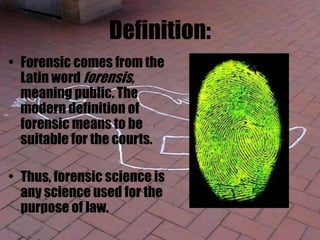
• Forensic comes from the
Latin word forensis,
meaning public. The
modern definition of
forensic means to be
suitable for the courts.
• Thus, forensic science is
any science used for the
purpose of law.
What is a Forensic Scientist?
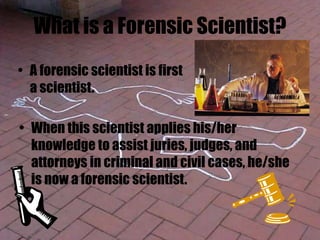
• When this scientist applies his/her
knowledge to assist juries, judges, and
attorneys in criminal and civil cases, he/she
is now a forensic scientist.
• A forensic scientist is first
a scientist.
What do Forensic Scientists do?
• Forensic scientists perform chemical and
physical tests on evidence submitted by
police officers to resolve legal issues.
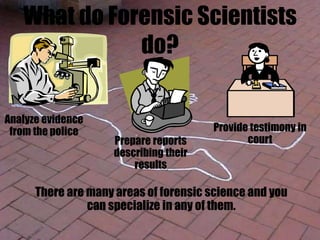
What do Forensic Scientists
do?
Analyze evidence
from the police
There are many areas of forensic science and you
can specialize in any of them.
Prepare reports
describing their
results
Provide testimony in
court
Early Forensic Science
• Can you guess when the first reported
use of forensic science occurred?
Somewhere between 287 B.C. and 212 B.C.
Early Forensic Science
• In this case, by examining the principles
of water displacement and density,
Archimedes was able to prove that a
crown was not made of gold, (as was
claimed).
• How do you prove that a crown is made of
gold?
Forensic Science
• However, forensics is still a relatively
new area of science.
• It was not until the beginning of the
1800’s that hair, blood, and fingerprints
were frequently used as evidence to
convict someone of a crime.
Forensics in the Media
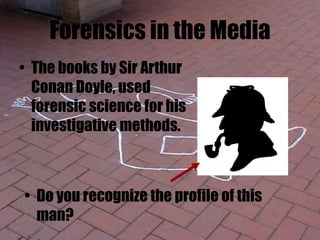
• The books by Sir Arthur
Conan Doyle, used
forensic science for his
investigative methods.
• Do you recognize the profile of this
man?
Forensics in the Media
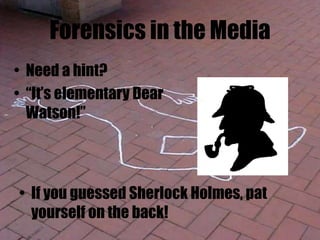
• Need a hint?
• “It’s elementary Dear
Watson!”
• If you guessed Sherlock Holmes, pat
yourself on the back!
Sherlock Holmes
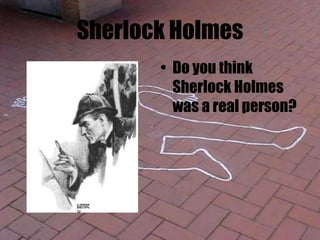
• Do you think
Sherlock Holmes
was a real person?
Sherlock Holmes
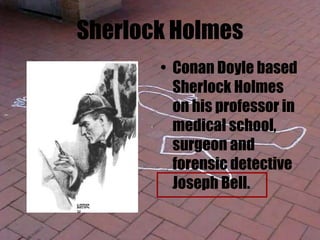
• Conan Doyle based
Sherlock Holmes
on his professor in
medical school,
surgeon and
forensic detective
Joseph Bell.
Joseph Bell
• Bell taught the importance
of close observation in
making a diagnosis.
• He would often pick a
stranger and, by observing
him, deduce his occupation
and recent activities.
• These skills made him a pioneer in forensic
science.
Name that Show!
• What is the name of a popular TV show
that depicts a glamorized version of 21st
Century forensic scientists?
Crime Scene Investigation: CSI
There were other crime scene shows
prior to CSI. In the 70’s “Quincy” was
another show about a medical
examiner –detective.
“CSI” Effect
• The “CSI” effect is where the popularity
of forensic based TV shows has raised
crime victim’s and jury’s expectations of
forensic evidence.
• Although the technology seen on these
shows are used in crime labs, they take
much more time and detail in real life.
So you want to be a Forensic
Scientist?
YOU NEED:
• A bachelor’s degree-preferably in science
• Some forensic sciences require advanced
degrees
• Good speaking and note-taking skills
• Ability to write a science report that a non-
science person can understand!
Criminalists
• Criminalists are the most common form of
forensic scientists. They analyze, identify and
interpret a broad range of physical evidence.
• Using chemicals and various instruments,
they discover useful information for an
investigation or trial.
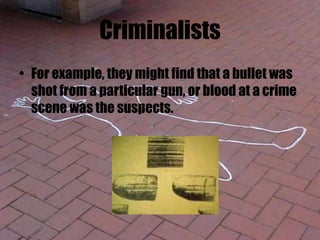
Criminalists
• For example, they might find that a bullet was
shot from a particular gun, or blood at a crime
scene was the suspects.
Criminalists
• The most important task of a criminalist is to
interpret the results of the tests they run to
determine the truth.
• This requires an understanding of human
nature, of laws of science, and how they
interact.
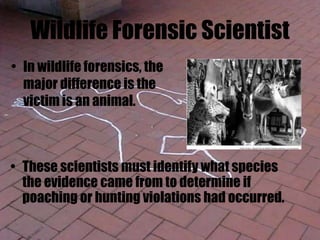
Wildlife Forensic Scientist
• In wildlife forensics, the
major difference is the
victim is an animal.
• These scientists must identify what species
the evidence came from to determine if
poaching or hunting violations had occurred.
Wildlife Forensic Scientist
• What types of items do you think they
would try to collect and analyze?
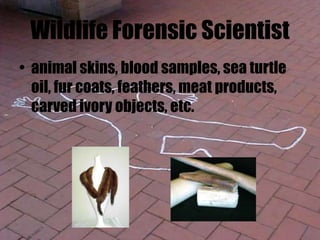
Wildlife Forensic Scientist
• animal skins, blood samples, sea turtle
oil, fur coats, feathers, meat products,
carved ivory objects, etc.
Becoming A Criminalist
• A bachelor’s degree is required at a minimum,
with a master’s degree preferred.
• You do not have to major in biology or
chemistry, but you do have to take at least 24
hours of math and science.
Forensic Pathologists
• Pathology is the study of disease.
• Forensic pathologists perform autopsies to
determine the cause of death and the
circumstances surrounding a person’s death.
• They investigate not only violent deaths, but
also sudden deaths, deaths in police custody,
and death during surgery.
Forensic Pathologists
• They also may visit the scene of the death to
discover what happened at the time of death,
what the person was doing at the time, and the
person’s medical history.
• A forensic pathologist collects evidence from
the body and sends it to a criminalist to
analyze.
Forensic Pathologists
• Forensic pathology plays an
important role in public health and
disease prevention.
• They can recognize when a disease is occurring
in an area and discover faulty consumer
products that may lead to injury or death.
There is a need for pathologists!! If you can get through
med school and you like to work on your own, this field
is less competitive to start a career in.
Becoming a Forensic
Pathologist
• Then a pathology residency of 3-4 years is
required, and a one year fellowship in forensic
pathology.
• All forensic pathologists are
medical doctors. This means
they must take four years of
college and four years of medical
school.
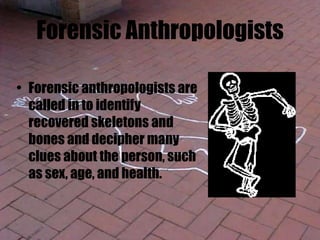
Forensic Anthropologists
• Forensic anthropologists are
called in to identify
recovered skeletons and
bones and decipher many
clues about the person, such
as sex, age, and health.
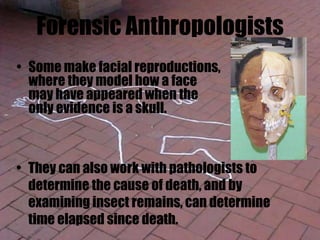
Forensic Anthropologists
• They can also work with pathologists to
determine the cause of death, and by
examining insect remains, can determine
time elapsed since death.
• Some make facial reproductions,
where they model how a face
may have appeared when the
only evidence is a skull.
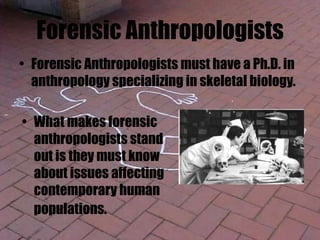
Forensic Anthropologists
• Forensic Anthropologists must have a Ph.D. in
anthropology specializing in skeletal biology.
• What makes forensic
anthropologists stand
out is they must know
about issues affecting
contemporary human
populations.
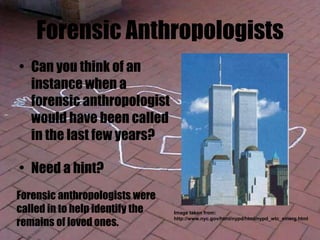
Forensic Anthropologists
• Can you think of an
instance when a
forensic anthropologist
would have been called
in the last few years?
• Need a hint?
Image taken from:
http://www.nyc.gov/html/nypd/html/nypd_wtc_emerg.html
Forensic anthropologists were
called in to help identify the
remains of loved ones.
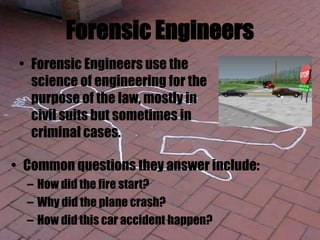
Forensic Engineers
• Forensic Engineers use the
science of engineering for the
purpose of the law, mostly in
civil suits but sometimes in
criminal cases.
• Common questions they answer include:
– How did the fire start?
– Why did the plane crash?
– How did this car accident happen?
Forensic Psychiatrist
• Forensic Psychiatrists are doctors
that perform assessments of mental
illness to determine innocence by
reason of mental illness.
• They spend a lot of time with lawyers and
judges and are trained to give expert
testimony in the courts.
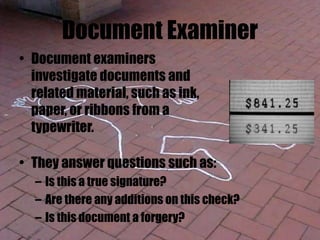
Document Examiner
• Document examiners
investigate documents and
related material, such as ink,
paper, or ribbons from a
typewriter.
• They answer questions such as:
– Is this a true signature?
– Are there any additions on this check?
– Is this document a forgery?
Toxicologists
• Toxicology is the
study of harmful
effects of chemicals
or drugs on living
systems.
Forensic Toxicologists
• Forensic toxicologists answer the question,
"Did prescription or illegal drugs and/or
alcohol lead or contribute to the person's
death or intoxication?"
• This is accomplished by performing
chemistry tests on body fluid and tissue
samples and interpreting the findings.
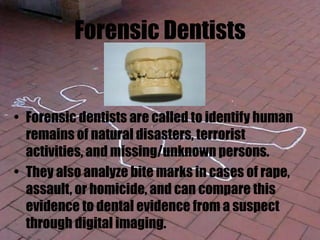
Forensic Dentists
• Forensic dentists are called to identify human
remains of natural disasters, terrorist
activities, and missing/unknown persons.
• They also analyze bite marks in cases of rape,
assault, or homicide, and can compare this
evidence to dental evidence from a suspect
through digital imaging.
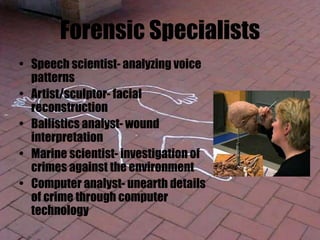
Forensic Specialists
• Speech scientist- analyzing voice
patterns
• Artist/sculptor- facial
reconstruction
• Ballistics analyst- wound
interpretation
• Marine scientist- investigation of
crimes against the environment
• Computer analyst- unearth details
of crime through computer
technology
Summing it Up
• So if you have a love of science and you
would like to use it for the good of
society and public safety, forensic
science could be a career for you!

Forensic Scientist - What forensics do and its function.

  • 1.
  • 2.
    Definition: • Forensic comesfrom the Latin word forensis, meaning public. The modern definition of forensic means to be suitable for the courts. • Thus, forensic science is any science used for the purpose of law.
  • 3.
    What is aForensic Scientist? • When this scientist applies his/her knowledge to assist juries, judges, and attorneys in criminal and civil cases, he/she is now a forensic scientist. • A forensic scientist is first a scientist.
  • 4.
    What do ForensicScientists do? • Forensic scientists perform chemical and physical tests on evidence submitted by police officers to resolve legal issues.
  • 5.
    What do ForensicScientists do? Analyze evidence from the police There are many areas of forensic science and you can specialize in any of them. Prepare reports describing their results Provide testimony in court
  • 6.
    Early Forensic Science •Can you guess when the first reported use of forensic science occurred? Somewhere between 287 B.C. and 212 B.C.
  • 7.
    Early Forensic Science •In this case, by examining the principles of water displacement and density, Archimedes was able to prove that a crown was not made of gold, (as was claimed). • How do you prove that a crown is made of gold?
  • 8.
    Forensic Science • However,forensics is still a relatively new area of science. • It was not until the beginning of the 1800’s that hair, blood, and fingerprints were frequently used as evidence to convict someone of a crime.
  • 9.
    Forensics in theMedia • The books by Sir Arthur Conan Doyle, used forensic science for his investigative methods. • Do you recognize the profile of this man?
  • 10.
    Forensics in theMedia • Need a hint? • “It’s elementary Dear Watson!” • If you guessed Sherlock Holmes, pat yourself on the back!
  • 11.
    Sherlock Holmes • Doyou think Sherlock Holmes was a real person?
  • 12.
    Sherlock Holmes • ConanDoyle based Sherlock Holmes on his professor in medical school, surgeon and forensic detective Joseph Bell.
  • 13.
    Joseph Bell • Belltaught the importance of close observation in making a diagnosis. • He would often pick a stranger and, by observing him, deduce his occupation and recent activities. • These skills made him a pioneer in forensic science.
  • 14.
    Name that Show! •What is the name of a popular TV show that depicts a glamorized version of 21st Century forensic scientists? Crime Scene Investigation: CSI There were other crime scene shows prior to CSI. In the 70’s “Quincy” was another show about a medical examiner –detective.
  • 15.
    “CSI” Effect • The“CSI” effect is where the popularity of forensic based TV shows has raised crime victim’s and jury’s expectations of forensic evidence. • Although the technology seen on these shows are used in crime labs, they take much more time and detail in real life.
  • 16.
    So you wantto be a Forensic Scientist? YOU NEED: • A bachelor’s degree-preferably in science • Some forensic sciences require advanced degrees • Good speaking and note-taking skills • Ability to write a science report that a non- science person can understand!
  • 17.
    Criminalists • Criminalists arethe most common form of forensic scientists. They analyze, identify and interpret a broad range of physical evidence. • Using chemicals and various instruments, they discover useful information for an investigation or trial.
  • 18.
    Criminalists • For example,they might find that a bullet was shot from a particular gun, or blood at a crime scene was the suspects.
  • 19.
    Criminalists • The mostimportant task of a criminalist is to interpret the results of the tests they run to determine the truth. • This requires an understanding of human nature, of laws of science, and how they interact.
  • 20.
    Wildlife Forensic Scientist •In wildlife forensics, the major difference is the victim is an animal. • These scientists must identify what species the evidence came from to determine if poaching or hunting violations had occurred.
  • 21.
    Wildlife Forensic Scientist •What types of items do you think they would try to collect and analyze?
  • 22.
    Wildlife Forensic Scientist •animal skins, blood samples, sea turtle oil, fur coats, feathers, meat products, carved ivory objects, etc.
  • 23.
    Becoming A Criminalist •A bachelor’s degree is required at a minimum, with a master’s degree preferred. • You do not have to major in biology or chemistry, but you do have to take at least 24 hours of math and science.
  • 24.
    Forensic Pathologists • Pathologyis the study of disease. • Forensic pathologists perform autopsies to determine the cause of death and the circumstances surrounding a person’s death. • They investigate not only violent deaths, but also sudden deaths, deaths in police custody, and death during surgery.
  • 25.
    Forensic Pathologists • Theyalso may visit the scene of the death to discover what happened at the time of death, what the person was doing at the time, and the person’s medical history. • A forensic pathologist collects evidence from the body and sends it to a criminalist to analyze.
  • 26.
    Forensic Pathologists • Forensicpathology plays an important role in public health and disease prevention. • They can recognize when a disease is occurring in an area and discover faulty consumer products that may lead to injury or death. There is a need for pathologists!! If you can get through med school and you like to work on your own, this field is less competitive to start a career in.
  • 27.
    Becoming a Forensic Pathologist •Then a pathology residency of 3-4 years is required, and a one year fellowship in forensic pathology. • All forensic pathologists are medical doctors. This means they must take four years of college and four years of medical school.
  • 28.
    Forensic Anthropologists • Forensicanthropologists are called in to identify recovered skeletons and bones and decipher many clues about the person, such as sex, age, and health.
  • 29.
    Forensic Anthropologists • Theycan also work with pathologists to determine the cause of death, and by examining insect remains, can determine time elapsed since death. • Some make facial reproductions, where they model how a face may have appeared when the only evidence is a skull.
  • 30.
    Forensic Anthropologists • ForensicAnthropologists must have a Ph.D. in anthropology specializing in skeletal biology. • What makes forensic anthropologists stand out is they must know about issues affecting contemporary human populations.
  • 31.
    Forensic Anthropologists • Canyou think of an instance when a forensic anthropologist would have been called in the last few years? • Need a hint? Image taken from: http://www.nyc.gov/html/nypd/html/nypd_wtc_emerg.html Forensic anthropologists were called in to help identify the remains of loved ones.
  • 32.
    Forensic Engineers • ForensicEngineers use the science of engineering for the purpose of the law, mostly in civil suits but sometimes in criminal cases. • Common questions they answer include: – How did the fire start? – Why did the plane crash? – How did this car accident happen?
  • 33.
    Forensic Psychiatrist • ForensicPsychiatrists are doctors that perform assessments of mental illness to determine innocence by reason of mental illness. • They spend a lot of time with lawyers and judges and are trained to give expert testimony in the courts.
  • 34.
    Document Examiner • Documentexaminers investigate documents and related material, such as ink, paper, or ribbons from a typewriter. • They answer questions such as: – Is this a true signature? – Are there any additions on this check? – Is this document a forgery?
  • 35.
    Toxicologists • Toxicology isthe study of harmful effects of chemicals or drugs on living systems.
  • 36.
    Forensic Toxicologists • Forensictoxicologists answer the question, "Did prescription or illegal drugs and/or alcohol lead or contribute to the person's death or intoxication?" • This is accomplished by performing chemistry tests on body fluid and tissue samples and interpreting the findings.
  • 37.
    Forensic Dentists • Forensicdentists are called to identify human remains of natural disasters, terrorist activities, and missing/unknown persons. • They also analyze bite marks in cases of rape, assault, or homicide, and can compare this evidence to dental evidence from a suspect through digital imaging.
  • 38.
    Forensic Specialists • Speechscientist- analyzing voice patterns • Artist/sculptor- facial reconstruction • Ballistics analyst- wound interpretation • Marine scientist- investigation of crimes against the environment • Computer analyst- unearth details of crime through computer technology
  • 39.
    Summing it Up •So if you have a love of science and you would like to use it for the good of society and public safety, forensic science could be a career for you!