10 2
THE FOREIGN CONTRIBUTION
(REGULATION) ACT, 2010
LEARNING OUTCOMES
By the end of this Chapter, you will be able to-
 Know and appreciate significant terminologies used in the Act
 Determine how the law regulates the acceptance and utilization of foreign
contribution or Foreign Hospitality
 Identify the restrictions on acceptance and utilisation of foreign
contribution or Foreign Hospitality
 Explain the procedure for the registration of persons to be regulated in this
Act
 Elucidate how persons regulated by the Act are required to manage the
financial aspects of Foreign Contribution
 Recognise the Adjudicating Authority, the provisions related to appeal and
revision, and offences and penalties on contravention of the compliances
a
v
v
a
v
v
CHAPTER 2
© The Institute of Chartered Accountants of India
CORPORATE AND ECONOMIC LAWS
a
2.2
1. INTRODUCTION
The Preamble to the Indian constitution defines India as a ‘Sovereign’ country, meaning India has
its own supreme law and is not a dominion or province of any other nation. Moreover, India is
independent of any kind of external intervention in its domestic operations. Therefore, no other
country or international body can infringe on India's sovereignty. One of the threats to the
sovereignty of India could be through transfer of funds from foreign sources as Foreign Contribution
for any activities detrimental to the national interest.
The Foreign Contribution (Regulation) Act, 2010, together with the Foreign Contribution (Regulation)
Rules, 2011 and other notification and orders, issued thereunder from time to time regulates the flow
of foreign contributions into India and ensures that such contributions do not adversely affect
national security. First enacted in 1976, it was amended in 2010 when new measures were adopted
to regulate foreign contributions with effect from 1st May, 2011. The Foreign Contribution
(Regulation) Act, 2010 was again amended through the Foreign Contribution (Regulation)
Amendment Act, 2020 with effect from 28th September, 2020. The FCRA is administered by Ministry
of Home Affairs.
Amendments made by the 2020 Amendment Act – Following were the highlights of the Foreign
Contribution (Regulation) Amendment Act, 2020:
♦ No Foreign contribution can be accepted by a public servant, Judge, Government servant or
employee of any corporation or any other body controlled or owned by the Government
[section 3(1)(c) of FCRA, 2010]
♦ Amendment Act completely prohibits transfer of foreign contribution to any other person -
[section 7 of FCRA, 2010].
♦ Defraying of foreign contribution towards administrative expenses reduced to 20% from 50%
of contribution received – [section 8(1) of FCRA, 2010].
♦ Central Government may restrict or prohibit a person granted “prior permission” from either
utilising the unutilized foreign contribution or receive remaining portion of foreign contribution
if it has reason to believe that provisions of the Act have been contravened – [proviso to
section 11(2) of FCRA, 2010].
♦ Every person who makes an application for “prior permission” or “registration” to open an
“FCRA Account” as specified in section 17 – [section 12 (1A) of FCRA, 2010].
♦ Aadhaar number of all functionaries Resident in India and copy of Passport or OCI card in
case of foreigner mandatory for application of prior permission or registration under FCRA or
renewal thereof – [section 12A of FCRA, 2010].
© The Institute of Chartered Accountants of India
THE FOREIGN CONTRIBUTION (REGULATION) ACT, 2010 2.3
♦ Suspension of certificate under consideration for cancellation extended for a further period,
not exceeding one hundred and eighty days, beyond the initial suspension period of one
hundred and eighty days – [section 13 of FCRA, 2010].
♦ Provision made for Surrender of Certificate of Registration under FCRA and the management
of foreign contribution and asset to vest with such authority as specified – [section 14A of
FCRA, 2010].
♦ All foreign contributions to be received in the designated 'FCRA Account', namely State Bank
of India, New Delhi Main Branch (SBI-NDMB). May open another “FCRA account” in any of
the scheduled bank for the purpose of keeping or utilising the foreign contribution received in
the SBI ‘‘FCRA Account’. May also open one or more accounts in one or more scheduled
banks to which funds may be transferred for utilising any foreign contribution, subject to the
condition that no local contributions shall be deposited in this account– [section 17 of FCRA,
2010].
Vide Notification G.S.R. 695(E) [F. NO. II/21022/23(12)/2020-FCRA-III], dated 10-11-2020, in
exercise of the powers conferred by section 48 of the Foreign Contribution (Regulation) Act, 2010,
the Central Government hereby makes the following rules further to amend the Foreign Contribution
(Regulation) Rules, 2011, through the enforcement of the Foreign Contribution (Regulation)
(Amendment) Rules, 2020 w.r.e.f 29.04.2011.
Structure of the Act
The Foreign Contribution (Regulation) Act, 2010, (FCRA, 2010) comprises of nine chapters with 54
sections.
Chapter No. Chapter Name
Chapter I Preliminary (Section 1- 2)
Chapter II Regulation of Foreign Contribution and Foreign
Hospitality (Section 3 -10)
Chapter III Registration (Section 11- 16)
Chapter IV Accounts, Intimation, Audit and Disposal of Assets, etc.
(Section 17- 22)
Chapter V Inspection, Search and Seizure (section 23-27)
Chapter VI Adjudication (Section 28-29)
Chapter VII Appeal and Revision (Section 31- 32)
Chapter VIII Offences and Penalties (Section 33- 41)
Chapter IX Miscellaneous (Section 42- 54)
© The Institute of Chartered Accountants of India
CORPORATE AND ECONOMIC LAWS
a
2.4
Extent, Application and Commencement of FCRA (Section 1)
As per Section 1(2) of FCRA, 2010, the provisions of the Act shall apply to:
 Whole of India
 Citizens of India outside India; and
 Associate Branches or subsidiaries, outside India, of companies or bodies corporate,
registered or incorporated in India.
In line with the stated provision, the Act is applicable to any citizen of India whether he is in India or
outside India. However, the Act is not applicable to a foreigner while outside India.
Note: An Indian passport holder would continue to be treated as a local source, irrespective of his stay
outside India and outside the purview of FCRA whereas a Person of Indian Origin holding a foreign
passport will be considered a foreign source and FCRA shall apply.
As per section 1(3) of the Act, the Central Government has appointed the 1st May, 2011 as the date
on which the provisions of the said Act came into force.
2. IMPORTANT DEFINITIONS (SECTION 2)
In this Act, unless the context otherwise requires,—
"FCRA Account" [Section 2(1)(f)]
FCRA Account means the FCRA Account referred to in section 17 of the Act.
“Foreign Company” [Section 2(1)(g)]
Foreign Company means any company or association or body of individuals incorporated outside
India and includes :—
 a foreign company within the meaning of section 591 of the Companies Act, 1956 (Section
379 of the Companies Act, 2013)
 Company which is a subsidiary of a foreign company;
 the registered office or principal place of business of a foreign company;
 a multi-national corporation.
Explanation— A corporation incorporated in a foreign country or territory shall be deemed to be a
multi-national corporation if such corporation,—
(a) has a subsidiary or a branch or a place of business in two or more countries or territories; or
(b) carries on business, or otherwise operates, in two or more countries or territories;
Illustration 1: A Company is incorporated in India under the Companies Act, 2013 and has
operations in 2 or more countries. Would it be treated as a MNC under FCRA, 2010?
© The Institute of Chartered Accountants of India
THE FOREIGN CONTRIBUTION (REGULATION) ACT, 2010 2.5
Answer. No
Foreign Source [Section 2(1)(j)]
Foreign Source includes,—
(i) the Government of any foreign country or territory and any agency of such Government;
(ii) any international agency, not being the United Nations or any of its specialized agencies, the
World Bank, International Monetary Fund or such other agency as the Central Government
may, by notification, specify in this behalf;
(iii) a foreign company;
(iv) a corporation, not being a foreign company, incorporated in a foreign country or territory;
(v) a multi-national corporation referred to in Section 2(g) sub-clause (iv) of FCRA, 2010;
(vi) a company within the meaning of the Companies Act, 1956 (presently, the Companies Act,
2013) and more than one-half of the nominal value of its share capital is held, either singly or
in the aggregate, by one or more of the following, namely:-
A. the Government of a foreign country or territory;
B. the citizens of a foreign country or territory;
C. corporations incorporated in a foreign country or territory;
D. trusts, societies or other associations of individuals (whether incorporated or not),
formed or registered in a foreign country or territory;
E. Foreign company;
Provided that where the nominal value of share capital is within the limits specified for foreign
investment under the Foreign Exchange Management Act, 1999, or the rules or regulations
made there under, then, notwithstanding the nominal value of share capital of a company
being more than one-half of such value at the time of making the contribution, such company
shall not be a foreign source
[Clarity provided in the FAQs issued under FCRA by the Ministry of Home Affairs - I.
Introduction to the Foreign Contribution (Regulation) Act, 2010 (FCRA, 2010)]
(vii) a trade union in any foreign country or territory, whether or not registered in such foreign
country or territory;
(viii) a foreign trust or a foreign foundation, by whatever name called, or such trust or foundation
mainly financed by a foreign country or territory;
(ix) a society, club or other association or individuals formed or registered outside India;
(x) a citizen of a foreign country;”
© The Institute of Chartered Accountants of India
CORPORATE AND ECONOMIC LAWS
a
2.6
A few bodies/ organisations of the United Nations, World Bank (including the International Monetary
Fund (IMF) and some other International agencies or multilateral organisations are exempted from
this definition, and are not treated as foreign source. Hence, the funds received from them are not
considered as foreign contribution.
Foreign Contribution [Section 2(1)(h)]
Foreign Contribution means the donation, delivery or transfer made by any foreign source,—
(i) of any article,
Exception: An article given to a person as a gift for his personal use, if the market value, in
India, of such article, on the date of such gift, is not more than Rs. 1,00,000/- as per Rule 6A
of the Foreign Contribution (Regulation) Rules, 2011 as amended by Foreign Contribution
(Regulation) (Second Amendment) Rules, 2019 notified vide G.S.R. 659 (E) dated 16th
September, 2019.
(ii) any currency, whether Indian or foreign;
(iii) of any security as defined in the Securities Contracts (Regulation) Act, 1956 and includes
any foreign security as defined in the Foreign Exchange Management Act, 1999;
Explanations Nature of contribution Whether Foreign
contribution or not
Explanation 1 A donation, delivery or transfer of
any article, currency or foreign
security by any person who has
received it from any foreign source,
either directly or through one or
more persons
Shall also be deemed to be
foreign contribution within
the meaning of this clause
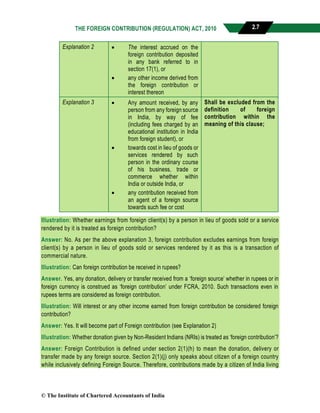
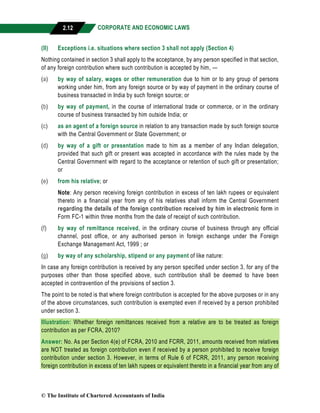
DEFINITION OF FOREIGN SOURCE
Government of any foreign country / agency of such government
International agency
foreign company
Corporation incorporated in a foreign country/territory
MNC
Company
Trade Union
Foreign trust/foundation
Society, club, association/individuals registered outside India
Citizen of foreign country
© The Institute of Chartered Accountants of India
THE FOREIGN CONTRIBUTION (REGULATION) ACT, 2010 2.7
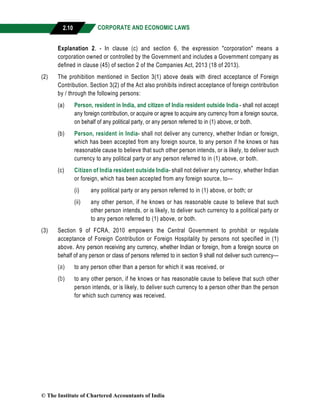
Explanation 2  The interest accrued on the
foreign contribution deposited
in any bank referred to in
section 17(1), or
 any other income derived from
the foreign contribution or
interest thereon
Explanation 3  Any amount received, by any
person from any foreign source
in India, by way of fee
(including fees charged by an
educational institution in India
from foreign student), or
 towards cost in lieu of goods or
services rendered by such
person in the ordinary course
of his business, trade or
commerce whether within
India or outside India, or
 any contribution received from
an agent of a foreign source
towards such fee or cost
Shall be excluded from the
definition of foreign
contribution within the
meaning of this clause;
Illustration: Whether earnings from foreign client(s) by a person in lieu of goods sold or a service
rendered by it is treated as foreign contribution?
Answer: No. As per the above explanation 3, foreign contribution excludes earnings from foreign
client(s) by a person in lieu of goods sold or services rendered by it as this is a transaction of
commercial nature.
Illustration: Can foreign contribution be received in rupees?
Answer. Yes, any donation, delivery or transfer received from a ‘foreign source’ whether in rupees or in
foreign currency is construed as ‘foreign contribution’ under FCRA, 2010. Such transactions even in
rupees terms are considered as foreign contribution.
Illustration: Will interest or any other income earned from foreign contribution be considered foreign
contribution?
Answer: Yes. It will become part of Foreign contribution (see Explanation 2)
Illustration: Whether donation given by Non-Resident Indians (NRIs) is treated as ‘foreign contribution’?
Answer: Foreign Contribution is defined under section 2(1)(h) to mean the donation, delivery or
transfer made by any foreign source. Section 2(1)(j) only speaks about citizen of a foreign country
while inclusively defining Foreign Source. Therefore, contributions made by a citizen of India living
© The Institute of Chartered Accountants of India
CORPORATE AND ECONOMIC LAWS
a
2.8
in another country (i.e., Non-Resident Indian), from his personal savings, through the normal banking
channels, is not to be treated as foreign contribution. However, while accepting any donations from
such NRI, it is advisable to obtain his passport details to ascertain that he/she is actually an Indian
citizen.
Illustration: Whether 100% subsidiary of foreign company in IT sector can give donation to trust
who doesn’t have registration under FCRA?
Answer: Yes, it can. As per proviso of Section 2(1)(j)(vi) since the investment is within limits of
FEMA, hence though it may be a 100% subsidiary of a foreign company it will not be considered a
foreign source.
Illustration: Whether an Individual of Indian Origin who has acquired foreign nationality is treated as
foreign source?
Answer: Yes. All citizens of a foreign country are treated as “Foreign Source”, including Persons of
Indian Origin holding foreign passport.
Person [Section 2(1)(m)]
Person includes:
(i) an individual;
(ii) a Hindu undivided family;
(iii) an association;
a company registered under section 25 of the Companies Act, 1956 (now Section 8 of Companies
Act, 2013).
Foreign Hospitality [Section 2(1)(i)]
Foreign Hospitality means any offer, not being a purely casual one, made in cash or kind by a foreign
source for providing a person with the costs of travel to any foreign country or territory or with free
boarding, lodging, transport or medical treatment.
Political party [Section 2(1)(n)]
Political party means—
(i) an association or body of individual citizens of India—
(A) to be registered with the Election Commission of India as a political party under section
29A of the Representation of the People Act, 1951, or
(B) which has set up candidates for election to any Legislature, but is not so registered or
deemed to be registered under the Election Symbols (Reservation and Allotment)
Order, 1968;
(ii) a political party mentioned in column 2 of Table 1 and Table 2 to the notification of the Election
Commission of India No. 56/J&K/02, dated the 8th August, 2002, as in force for the time
being;
© The Institute of Chartered Accountants of India
THE FOREIGN CONTRIBUTION (REGULATION) ACT, 2010 2.9
Relative [Section 2(1)(r)]
“Relative” has the meaning assigned to it in section 2(41) of the Companies Act, 1956 (Now section
2(77) of the Companies Act, 2013)
Any words and expressions used in FCRA, 2010 but not defined in the said Act shall carry the
meaning as defined in the Representation of the People Act, 1950 or the Representation of the
People Act, 1951 or the Foreign Exchange Management Act, 1999. [Section 2(2)]
3. REGULATION OF FOREIGN CONTRIBUTION AND
FOREIGN HOSPITALITY
Chapter II of the Act deals with the regulation of foreign contribution and foreign hospitality. It covers
sections 3 to 10 of the Act. The chapter broadly focuses on certain prohibitions on acceptance of
Foreign Contribution and restrictions on acceptance of Foreign Hospitality by certain classes of
persons.
(I) Prohibition to accept foreign contribution (Section 3)
(1) No foreign contribution shall be accepted by any:
(a) candidate for election;
(b) correspondent, columnist, cartoonist, editor, owner, printer or publisher of a registered
newspaper;
(c) public servant, Judge, Government servant or employee of any corporation or any
other body controlled or owned by the Government;
(d) member of any Legislature;
(e) political party or office-bearer thereof;
(f) organisation of a political nature as may be specified under section 5(1) by the Central
Government;
(g) association or company engaged in the production or broadcast of audio news or audio
visual news or current affairs programmes through any electronic mode, or any other
electronic form as defined in the Information Technology Act, 2000 or any other mode
of mass communication;
(h) correspondent or columnist, cartoonist, editor, owner of the association or company
referred to in clause (g).
Explanation 1. - For the purpose of clause (c), "public servant" means a public servant as
defined in section 21 of the Indian Penal Code (45 of 1860).
© The Institute of Chartered Accountants of India
CORPORATE AND ECONOMIC LAWS
a
2.10
Explanation 2. - In clause (c) and section 6, the expression "corporation" means a
corporation owned or controlled by the Government and includes a Government company as
defined in clause (45) of section 2 of the Companies Act, 2013 (18 of 2013).
(2) The prohibition mentioned in Section 3(1) above deals with direct acceptance of Foreign
Contribution. Section 3(2) of the Act also prohibits indirect acceptance of foreign contribution
by / through the following persons:
(a) Person, resident in India, and citizen of India resident outside India - shall not accept
any foreign contribution, or acquire or agree to acquire any currency from a foreign source,
on behalf of any political party, or any person referred to in (1) above, or both.
(b) Person, resident in India- shall not deliver any currency, whether Indian or foreign,
which has been accepted from any foreign source, to any person if he knows or has
reasonable cause to believe that such other person intends, or is likely, to deliver such
currency to any political party or any person referred to in (1) above, or both.
(c) Citizen of India resident outside India- shall not deliver any currency, whether Indian
or foreign, which has been accepted from any foreign source, to—
(i) any political party or any person referred to in (1) above, or both; or
(ii) any other person, if he knows or has reasonable cause to believe that such
other person intends, or is likely, to deliver such currency to a political party or
to any person referred to (1) above, or both.
(3) Section 9 of FCRA, 2010 empowers the Central Government to prohibit or regulate
acceptance of Foreign Contribution or Foreign Hospitality by persons not specified in (1)
above. Any person receiving any currency, whether Indian or foreign, from a foreign source on
behalf of any person or class of persons referred to in section 9 shall not deliver such currency—
(a) to any person other than a person for which it was received, or
(b) to any other person, if he knows or has reasonable cause to believe that such other
person intends, or is likely, to deliver such currency to a person other than the person
for which such currency was received.
© The Institute of Chartered Accountants of India
THE FOREIGN CONTRIBUTION (REGULATION) ACT, 2010 2.11
Procedure to notify an organisation of a political nature (Section 5)
Certain organisations may not be registered as a political party, but their activities and the ideologies
propagated by them may be such as to be closely aligned with that of a registered political party. This
section empowers the Central Government to identify these organizations and notify them as organisation
of a political nature. Thereafter, the provisions of the Act will apply to these organisations as if they are
an organisation of a political nature mentioned in section 3 (1) (f).
The Central Government may be satisfied that an organisation is of a political nature, having regard to
the activities of the organisation or the ideology propagated by the organisation or the programme of the
organisation or the association of the organisations with the activities of any political party.
Central Government has clarified the guidelines specifying the ground or grounds on which an
organisation shall be specified as an organisation of a political nature in Rule 3 of the Foreign Contribution
(Regulation) Rules, 2011.
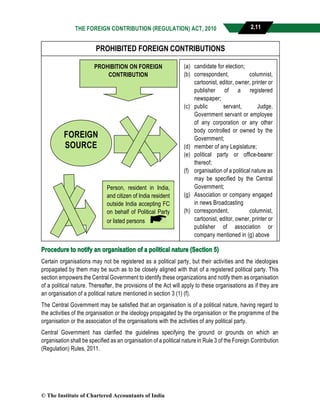
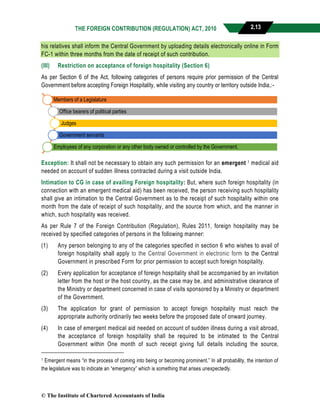
PROHIBITED FOREIGN CONTRIBUTIONS
FOREIGN
SOURCE
(a) candidate for election;
(b) correspondent, columnist,
cartoonist, editor, owner, printer or
publisher of a registered
newspaper;
(c) public servant, Judge,
Government servant or employee
of any corporation or any other
body controlled or owned by the
Government;
(d) member of any Legislature;
(e) political party or office-bearer
thereof;
(f) organisation of a political nature as
may be specified by the Central
Government;
(g) Association or company engaged
in news Broadcasting
(h) correspondent, columnist,
cartoonist, editor, owner, printer or
publisher of association or
company mentioned in (g) above
PROHIBITION ON FOREIGN
CONTRIBUTION
Person, resident in India,
and citizen of India resident
outside India accepting FC
on behalf of Political Party
or listed persons
© The Institute of Chartered Accountants of India
CORPORATE AND ECONOMIC LAWS
a
2.12
(II) Exceptions i.e. situations where section 3 shall not apply (Section 4)
Nothing contained in section 3 shall apply to the acceptance, by any person specified in that section,
of any foreign contribution where such contribution is accepted by him, —
(a) by way of salary, wages or other remuneration due to him or to any group of persons
working under him, from any foreign source or by way of payment in the ordinary course of
business transacted in India by such foreign source; or
(b) by way of payment, in the course of international trade or commerce, or in the ordinary
course of business transacted by him outside India; or
(c) as an agent of a foreign source in relation to any transaction made by such foreign source
with the Central Government or State Government; or
(d) by way of a gift or presentation made to him as a member of any Indian delegation,
provided that such gift or present was accepted in accordance with the rules made by the
Central Government with regard to the acceptance or retention of such gift or presentation;
or
(e) from his relative; or
Note: Any person receiving foreign contribution in excess of ten lakh rupees or equivalent
thereto in a financial year from any of his relatives shall inform the Central Government
regarding the details of the foreign contribution received by him in electronic form in
Form FC-1 within three months from the date of receipt of such contribution.
(f) by way of remittance received, in the ordinary course of business through any official
channel, post office, or any authorised person in foreign exchange under the Foreign
Exchange Management Act, 1999 ; or
(g) by way of any scholarship, stipend or any payment of like nature:
In case any foreign contribution is received by any person specified under section 3, for any of the
purposes other than those specified above, such contribution shall be deemed to have been
accepted in contravention of the provisions of section 3.
The point to be noted is that where foreign contribution is accepted for the above purposes or in any
of the above circumstances, such contribution is exempted even if received by a person prohibited
under section 3.
Illustration: Whether foreign remittances received from a relative are to be treated as foreign
contribution as per FCRA, 2010?
Answer: No. As per Section 4(e) of FCRA, 2010 and FCRR, 2011, amounts received from relatives
are NOT treated as foreign contribution even if received by a person prohibited to receive foreign
contribution under section 3. However, in terms of Rule 6 of FCRR, 2011, any person receiving
foreign contribution in excess of ten lakh rupees or equivalent thereto in a financial year from any of
© The Institute of Chartered Accountants of India
THE FOREIGN CONTRIBUTION (REGULATION) ACT, 2010 2.13
his relatives shall inform the Central Government by uploading details electronically online in Form
FC-1 within three months from the date of receipt of such contribution.
(III) Restriction on acceptance of foreign hospitality (Section 6)
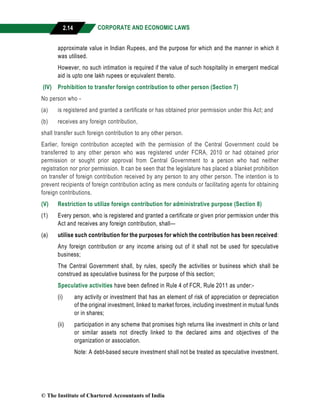
As per Section 6 of the Act, following categories of persons require prior permission of the Central
Government before accepting Foreign Hospitality, while visiting any country or territory outside India,:-
Exception: It shall not be necessary to obtain any such permission for an emergent 1 medical aid
needed on account of sudden illness contracted during a visit outside India.
Intimation to CG in case of availing Foreign hospitality: But, where such foreign hospitality (in
connection with an emergent medical aid) has been received, the person receiving such hospitality
shall give an intimation to the Central Government as to the receipt of such hospitality within one
month from the date of receipt of such hospitality, and the source from which, and the manner in
which, such hospitality was received.
As per Rule 7 of the Foreign Contribution (Regulation), Rules 2011, foreign hospitality may be
received by specified categories of persons in the following manner:
(1) Any person belonging to any of the categories specified in section 6 who wishes to avail of
foreign hospitality shall apply to the Central Government in electronic form to the Central
Government in prescribed Form for prior permission to accept such foreign hospitality.
(2) Every application for acceptance of foreign hospitality shall be accompanied by an invitation
letter from the host or the host country, as the case may be, and administrative clearance of
the Ministry or department concerned in case of visits sponsored by a Ministry or department
of the Government.
(3) The application for grant of permission to accept foreign hospitality must reach the
appropriate authority ordinarily two weeks before the proposed date of onward journey.
(4) In case of emergent medical aid needed on account of sudden illness during a visit abroad,
the acceptance of foreign hospitality shall be required to be intimated to the Central
Government within One month of such receipt giving full details including the source,
1 Emergent means “in the process of coming into being or becoming prominent.” In all probability, the intention of
the legislature was to indicate an “emergency” which is something that arises unexpectedly.
Members of a Legislature
Office bearers of political parties
Judges
Government servants
Employees of any corporation or any other body owned or controlled by the Government.
© The Institute of Chartered Accountants of India
CORPORATE AND ECONOMIC LAWS
a
2.14
approximate value in Indian Rupees, and the purpose for which and the manner in which it
was utilised.
However, no such intimation is required if the value of such hospitality in emergent medical
aid is upto one lakh rupees or equivalent thereto.
(IV) Prohibition to transfer foreign contribution to other person (Section 7)
No person who -
(a) is registered and granted a certificate or has obtained prior permission under this Act; and
(b) receives any foreign contribution,
shall transfer such foreign contribution to any other person.
Earlier, foreign contribution accepted with the permission of the Central Government could be
transferred to any other person who was registered under FCRA, 2010 or had obtained prior
permission or sought prior approval from Central Government to a person who had neither
registration nor prior permission. It can be seen that the legislature has placed a blanket prohibition
on transfer of foreign contribution received by any person to any other person. The intention is to
prevent recipients of foreign contribution acting as mere conduits or facilitating agents for obtaining
foreign contributions.
(V) Restriction to utilize foreign contribution for administrative purpose (Section 8)
(1) Every person, who is registered and granted a certificate or given prior permission under this
Act and receives any foreign contribution, shall—
(a) utilise such contribution for the purposes for which the contribution has been received:
Any foreign contribution or any income arising out of it shall not be used for speculative
business;
The Central Government shall, by rules, specify the activities or business which shall be
construed as speculative business for the purpose of this section;
Speculative activities have been defined in Rule 4 of FCR, Rule 2011 as under:-
(i) any activity or investment that has an element of risk of appreciation or depreciation
of the original investment, linked to market forces, including investment in mutual funds
or in shares;
(ii) participation in any scheme that promises high returns like investment in chits or land
or similar assets not directly linked to the declared aims and objectives of the
organization or association.
Note: A debt-based secure investment shall not be treated as speculative investment.
© The Institute of Chartered Accountants of India
THE FOREIGN CONTRIBUTION (REGULATION) ACT, 2010 2.15
(b) not defray2 as far as possible such sum, not exceeding twenty per cent of such contribution,
received in a financial year, to meet administrative expenses:
Administrative expenses exceeding twenty per cent of such contribution may be defrayed
with prior approval of the Central Government.
The Central Government may prescribe the elements which shall be included in the administrative
expenses and the manner in which the administrative expenses shall be calculated.
3Amounts that constitute Administrative Expenses
(i) salaries, wages, travel expenses or any remuneration realised by the Members of the
Executive Committee or Governing Council of the person;
(ii) all expenses towards hiring of personnel for management of the activities of the person and
salaries, wages or any kind of remuneration paid, including cost of travel, to such personnel;
(iii) all expenses related to consumables like electricity and water charges, telephone charges,
postal charges, repairs to premise(s) from where the organisation or Association is
functioning, stationery and printing charges transport and travel charges by the Members of
the Executive Committee or Governing Council and expenditure on office equipment;
(iv) cost of accounting for and administering funds;
(v) expenses towards running and maintenance of vehicles;
(vi) cost of writing and filing reports;
(vii) legal and professional charges; and
(viii) rent of premises, repairs to premises and expenses on other utilities:
Amounts not to be counted as administrative expenses:
1. Expenditure incurred on salaries or remuneration of personnel engaged in training or for
collection or analysis of field data of an association primarily engaged in research or training;
2. Expenses incurred directly in furtherance of the stated objectives of the welfare oriented
organisation such as salaries to doctors of hospital, salaries to teachers of school etc.;
(VI) Power of Central Government to prohibit receipt of foreign contribution, etc., in certain
cases (Section 9)
The Central Government shall be satisfied that the acceptance of foreign contribution by any person
or class of persons, as the case may be, or the acceptance of foreign hospitality by any person, is
likely to affect prejudicially—
(i) the sovereignty and integrity of India; or
2 Defray means “to provide for payment of”
3 Regulation - 5, Foreign Contribution (Regulation) Rules, 2011
© The Institute of Chartered Accountants of India
CORPORATE AND ECONOMIC LAWS
a
2.16
(ii) public interest; or
(iii) freedom or fairness of election to any Legislature; or
(iv) friendly relations with any foreign State; or
(v) harmony between religious, racial, social, linguistic or regional groups, castes or
communities.
Then, the Central Government may—
(a) prohibit any person or organisation (not specified in section 3), from accepting any foreign
contribution;
(b) require any person or class of persons, (not specified in section 6), to obtain prior permission
of the Central Government before accepting any foreign hospitality;
(c) require any person or class of persons (not specified in section 11), to furnish intimation as
to the amount of any foreign contribution received by such person or class of persons as the
case may be, and the source from which and the manner in which such contribution was
received and the purpose for which and the manner in which such foreign contribution was
utilised;
(d) require any person or class of persons specified in that Section 11(1) to obtain prior
permission of the Central Government before accepting any foreign contribution;
(e) require any person or class of persons, (not specified in section 6), to furnish intimation, as
to the receipt of any foreign hospitality, the source from which and the manner in which such
hospitality was received.
(VII) Power to prohibit payment of currency received in contravention of the Act (Section 10)
Where the Central Government is satisfied, after making such inquiry, that any person has in his
custody or control any-
 article or
 currency or
 security,
whether Indian or foreign, which has been accepted by such person in contravention of any of the
provisions of this Act, it may, by order in writing prohibit such person from-paying,
 delivering,
 transferring
 or otherwise dealing with,
 such article or currency or security.
© The Institute of Chartered Accountants of India
THE FOREIGN CONTRIBUTION (REGULATION) ACT, 2010 2.17
A copy of such order shall be served upon the person so prohibited as per Rule 8 of the FCR, Rule
2011, and thereupon the provisions of section 7 of the Unlawful Activities (Prevention) Act, 1967
shall, apply to, or in relation to, such article or currency or security and references in the said sub-
sections to moneys, securities or credits shall be taken as references to such article or currency or
security.
Action in respect of article, currency or security received in contravention of the Act.
(1) The Central Government may issue a prohibitory order for contravention of the Act in respect
of any article, currency or securities.
(2) The prohibitory order issued shall be served on the person concerned in the following
manner-
(a) by delivering or tendering it to that person or to his duly authorised agent; or
(b) by sending it to him by 'registered post with acknowledgement due' or 'speed post' to the
address of his last known place of residence or the place where he carries on, or is
known to have last carried on, business or the place where he personally works for
gain or is known to have last worked for gain and, in case the person is an organisation
or an association, to the last known address of the office of such organisation or
association; or
(c) if it cannot be served in any of the manner aforesaid, by affixing it on the outer door or
some other conspicuous part of the premises in which that person resides or carries
on, or is known to have last carried on, business or personally works for gain, or is
known to have last worked personally for gain and, in case the person is an
organisation or an association, on the outer door or some other conspicuous part of
the premises in which the office of that organisation or association is located, or is
known to have been last located, and the written report whereof should be witnessed
by at least two persons.
4. REGISTRATION
The provisions related to registration of persons for acceptance of foreign contribution, grant of
certificate, its suspension, cancellation and renewal are dealt in chapter III of the FCRA. It covers
sections 11 to 16 of the Act.
There are two modes of accepting the foreign contribution according to FCRA, 2010-
© The Institute of Chartered Accountants of India
CORPORATE AND ECONOMIC LAWS
a
2.18
(I) Registration of certain persons with Central Government (Section 11)
(1) No person having a definite cultural, economic, educational, religious or social
programme- shall accept foreign contribution unless such person obtains a certificate of registration
from the Central Government.
[Note: However, any association registered with the Central Government under section 6, or granted
prior permission under that section of the Foreign Contribution (Regulation) Act, 1976, as it stood
immediately before the commencement of this Act, shall be deemed to have been registered or
granted prior permission, as the case may be, under this Act and such registration shall be valid for
a period of five years from the date on which this section comes into force – this was a one time
relief granted to such persons which were “registered” or granted “prior permission” under
the erstwhile FCRA, 1976.]
(2) Acceptance of foreign contribution after obtaining prior permission of the Central
Government: Every person may, if it is not registered with the Central Government, accept any
foreign contribution only after obtaining the prior permission of the Central Government and such
prior permission shall be valid for the specific purpose for which it is obtained and from the specific
source.
Forms for Application under Section 114: An application for certificate of registration by a person
under Section 11(1) for acceptance of foreign contribution shall be made in electronic form in Form
FC-3A with an affidavit executed by each office bearer and key functionary and member in Proforma
'AA'.
An application for obtaining prior permission by a person under Section 11(2), for acceptance of
foreign contribution, shall be made in electronic form in Form FC-3B with an affidavit executed by
each office bearer and key functionary and member in Proforma 'AA' appended to these rules.
Any person making an application for registration shall have an FCRA Account.
4 Regulation - 9, Foreign Contribution (Regulation) Rules, 2011
Mode I
•By Registration (Section 11(1)) - Registration is granted to only such persons which have been
in existence for three years, have the audited financials of the past three years and spent at least
INR 15 lacs, excluding administrative expenses.
Mode II
•Through Prior Permission (Section 11(2)) - Any organization which is in formative stage and is
not elgibile for certificate of registration may apply for prior permission, for receipt of a specific
amount from specific donor/donors for carrying out specific activities/projects.
© The Institute of Chartered Accountants of India
THE FOREIGN CONTRIBUTION (REGULATION) ACT, 2010 2.19
If the Central Government, on the basis of any information or report, and after holding a summary
inquiry, has reason to believe that a person who has been granted prior permission has contravened
any of the provisions of this Act, it may, pending any further inquiry, direct that such person shall not
utilise the unutilised foreign contribution or receive the remaining portion of foreign contribution
which has not been received or, as the case may be, any additional foreign contribution, without
prior approval of the Central Government.
Further, if the person has been found guilty of violation of any of the provisions of this Act or the
Foreign Contribution (Regulation) Act, 1976, the unutilised or unreceived amount of foreign
contribution shall not be utilised or received, as the case may be, without the prior approval of the
Central Government.
(3) The Central Government may, by notification in the Official Gazette, specify—
(i) the person or class of persons who shall obtain its prior permission before accepting the
foreign contribution; or
(ii) the area or areas in which the foreign contribution shall be accepted and utilised with the prior
permission of the Central Government; or
(iii) the purpose or purposes for which the foreign contribution shall be utilised with the prior
permission of the Central Government; or
(iv) the source or sources from which the foreign contribution shall be accepted with the prior
permission of the Central Government.
The person may open one or more accounts in one or more banks for the purpose of utilising the
foreign contribution after it has been received and, in all such cases, intimation in electronic form in
Form FC-6D shall be furnished to the Secretary, Ministry of Home Affairs, New Delhi within fifteen
days of the opening of any account.
Illustration: Can a private limited company or a partnership firm get registration or prior permission
under FCRA, 2010?
Answer: Yes, a private limited company, provided the same is registered as a section 8 company
under the Companies Act, 2013 may seek prior permission/registration for receiving foreign funds.
Partnership Firm is not permitted to obtain registration or prior permission.
Illustration: Whether an individual or a Hindu Undivided Family (HUF) can be given registration or
prior permission to accept foreign contribution in terms of section 11 of FCRA, 2010?
Answer: Yes. The definition of the ‘person’ in the Foreign Contribution (Regulation) Act, 2010
includes any individual and ‘Hindu Undivided Family’ among others. As such an Individual or an HUF
is also eligible to apply for prior permission to accept foreign contribution.
Illustration: Whether organisations under Central/State Governments are required to obtain
registration or prior permission under FCRA, 2010 for accepting foreign contribution?
© The Institute of Chartered Accountants of India
CORPORATE AND ECONOMIC LAWS
a
2.20
Answer: Yes. However, all bodies constituted or established by or under a Central Act or a State
Act requiring to have their accounts compulsorily audited by Comptroller & Auditor General of India
are exempted from all the provisions of FCRA, 2010.
(II) Grant of certificate of registration (Section 12)
1. Conditions to be met for the grant of registration and prior permission
(1) An application by a person, referred to in section 11 for grant of certificate or giving prior
permission, shall be made to the Central Government in such form and manner and along with such
fee, as may be prescribed under Rule 9 of the Foreign Contribution (Regulation) Rules, 2011.
In terms of Section 12 (4) of FCRA, 2010, the following shall be the conditions for the grant of
registration and prior permission:
(a) The 'person' making an application for registration or grant of prior permission-
i. is not fictitious or benami;
ii. has not been prosecuted or convicted for indulging in activities aimed at conversion
through inducement or force, either directly or indirectly, from one religious faith to
another;
iii. has not been prosecuted or convicted for creating communal tension or disharmony in
any specified district or any other part of the country;
iv. has not been found guilty of diversion or mis-utilisation of its funds;
v. is not engaged or likely to engage in propagation of sedition or advocate violent
methods to achieve its ends;
vi. is not likely to use the foreign contribution for personal gains or divert it for undesirable
purposes;
vii. has not contravened any of the provisions of this Act;
viii. has not been prohibited from accepting foreign contribution;
(b) the person making an application for registration under sub-section (1) has undertaken
reasonable activity in its chosen field for the benefit of the society for which the foreign
contribution is proposed to be utilised;
(c) the person making an application for giving prior permission under sub-section (1) has
prepared a reasonable project for the benefit of the society for which the foreign contribution
is proposed to be utilised;
(d) the person being an individual, such individual has neither been convicted under any law for
the time being in force nor any prosecution for any offence is pending against him.
© The Institute of Chartered Accountants of India
THE FOREIGN CONTRIBUTION (REGULATION) ACT, 2010 2.21
(e) the person being other than an individual, any of its directors or office bearers has neither
been convicted under any law for the time being in force nor any prosecution for any offence
is pending against him.
(f) the acceptance of foreign contribution by the association/ person is not likely to affect
prejudicially -
i. the sovereignty and integrity of India;
ii. the security, strategic, scientific or economic interest of the State;
iii. the public interest;
iv. freedom or fairness of election to any Legislature;
v. friendly relation with any foreign State;
vi. harmony between religious, racial, social, linguistic, regional groups, castes or
communities.
(g) the acceptance of foreign contribution-
i. shall not lead to incitement of an offence;
ii. shall not endanger the life or physical safety of any person.
2. Procedure for grant of certificate of Registration / Prior Permission
(1) Application for Registration/ Prior Permission: An application by a person, referred to in
section 11 for grant of certificate or giving prior permission, shall be made to the Central
Government in such form and manner and along with such fee, as may be prescribed.
Every person who makes an application under sub-section (1) shall be required to open
"FCRA Account" in the manner specified in section 17 and mention details of such account
in his application.
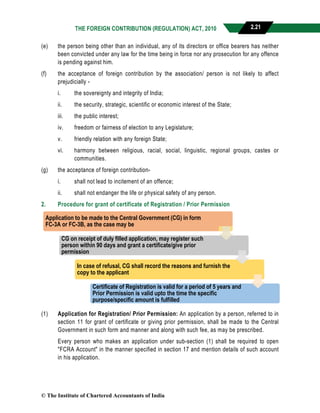
Application to be made to the Central Government (CG) in form
FC-3A or FC-3B, as the case may be
CG on receipt of duly filled application, may register such
person within 90 days and grant a certificate/give prior
permission
In case of refusal, CG shall record the reasons and furnish the
copy to the applicant
Certificate of Registration is valid for a period of 5 years and
Prior Permission is valid upto the time the specific
purpose/specific amount is fulfilled
© The Institute of Chartered Accountants of India
CORPORATE AND ECONOMIC LAWS
a
2.22
(2) Rejection of Application: On receipt of an application the Central Government shall, by an
order, if the application is not in the prescribed form or does not contain any of the particulars
specified in that form, reject the application.
(3) Grant of Certificate of Registration /Prior Permission: If on receipt of an application for
grant of certificate of registration or giving prior permission and after making such inquiry as
the Central Government deems fit, it is of the opinion that the conditions specified in sub-
section (4) are satisfied, it may, ordinarily within ninety days from the date of receipt of
application, register such person and grant him a certificate or give him prior permission, as
the case may be, subject to such terms and conditions as may be prescribed.
If the Central Government does not grant, within the said period of ninety days, a certificate
or gives prior permission, it shall communicate the reasons therefor to the applicant.
Note: A person shall not be eligible for grant of certificate or prior permission, if his certificate
has been suspended and such suspension of certificate continues on the date of making
application.
(4) Refusal to grant certificate of Registration /Prior Permission and furnishing of reasons
therefor by Central Government: Where the Central Government refuses the grant of
certificate or does not give prior permission, it shall record in its order the reasons therefor
and furnish a copy thereof to the applicant.
However, the Central Government may not communicate the reasons for refusal for grant of
certificate of registration or for not giving prior permission to the applicant under this section,
in cases where there is no obligation to give any information or documents or records or
papers under the Right to Information Act, 2005.
(5) Validity of Certificate: The certificate of Registration granted shall be valid for a period of
five years from the date of its issue and the prior permission shall be valid for the specific
purpose or specific amount of foreign contribution proposed to be received, as the case may
be.
No person shall prefer a second application for registration or prior permission within a period of six
months after submitting an application either for the grant of prior permission for the same project
or for registration.
Permission for receipt of foreign contribution in application for obtaining prior permission.
As per Rule 9A of the Foreign Contribution (Regulation) Rules, 2011 If the value of foreign
contribution on the date of final disposal of an application for obtaining prior permission is over
rupees one crore, the Central Government may permit receipt of foreign contribution in such
instalments, as it may deem fit.
© The Institute of Chartered Accountants of India
THE FOREIGN CONTRIBUTION (REGULATION) ACT, 2010 2.23
Provided that the second and subsequent instalment shall be released after submission of proof of
utilisation of seventy five per cent. of the foreign contribution received in the previous instalment and
after field inquiry of the utilisation of foreign contribution.
Power of Central Government to require Aadhaar number, etc., as identification document:
[Section 12A]
Notwithstanding anything contained in this Act, the Central Government may require that any person
who seeks
a. prior permission or prior approval under section 11, or
b. makes an application for grant of certificate under section 12, or,
c. as the case may be, for renewal of certificate under section 16,
shall provide an identification document.
For citizens of India, the Aadhaar number of all its office bearers or Directors or other key
functionaries, by whatever name called, issued under the Aadhaar (Targeted Delivery of Financial
and Other Subsidies, Benefits and Services) Act, 2016 shall be provided.
In case of a foreigner, a copy of the Passport or Overseas Citizen of India (OCI) Card shall be
provided,
(III) Suspension of certificate (Section 13)
(1) Circumstances when certificate may be suspended: The Central Government while
considering the cancellation of a certificate on any of the grounds mentioned in Section 14(1)
shall be satisfied that, it is necessary to suspend the certificate.
Period of suspension of certificate: Then, it may, by order in writing, suspend the certificate
for a period of one hundred and eighty days, or such further period, not exceeding one
hundred and eighty days, as may be specified.
(2) Effect of suspension: Every person whose certificate has been suspended shall—
(a) not receive any foreign contribution during the period of suspension of certificate.
However, the Central Government may, on an application made by such person, if it
considers appropriate, allow receipt of any foreign contribution by such person on such
terms and conditions as it may specify;
(b) Not utilise, in the prescribed manner, the foreign contribution in his custody without
the prior approval of the Central Government.
Rule 14 of FCR, Rules 2011 defines the extent of amount that can be utilised in case of
suspension of the certificate of registration. The unspent amount that can be utilised in case
of suspension of a certificate of registration may be as under:—
© The Institute of Chartered Accountants of India
CORPORATE AND ECONOMIC LAWS
a
2.24
(a) In case the certificate of registration is suspended under sub-section (1) of section 13
of the Act, up to twenty-five per cent of the unutilised amount may be spent, with the
prior approval of the Central Government, for the declared aims and objects for which
the foreign contribution was received.
(b) The remaining seventy-five per cent of the unutilised foreign contribution shall be
utilised only after revocation of suspension of the certificate of registration.
(IV) Cancellation of certificate (Section 14)
(1) Grounds for Cancellation of certificate
The Central Government may, by an order, cancel the certificate if the holder of the certificate
has—
(a) made an incorrect or false statement in, or in relation to, the application for the grant
of registration or renewal thereof; or
(b) violated any of the terms and conditions of the certificate or renewal thereof; or
(c) violated any of the provisions of this Act or rules or order made thereunder; or
(d) if the holder of the certificate has not been engaged in any reasonable activity in its
chosen field for the benefit of the society for two consecutive years or has become
defunct.
(e) in the opinion of the Central Government, it is necessary in the public interest to cancel
the certificate; or
(2) No order of cancellation of certificate under this section shall be made unless the person
concerned has been given a reasonable opportunity of being heard.
(3) Cooling period of three years: Any person whose certificate has been cancelled under this
section shall not be eligible for registration or grant of prior permission for a period of three
years from the date of cancellation of such certificate.
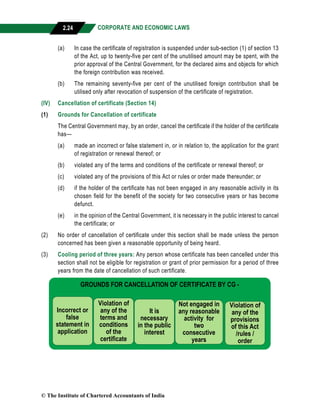
GROUNDS FOR CANCELLATION OF CERTIFICATE BY CG -
Incorrect or
false
statement in
application
Violation of
any of the
terms and
conditions
of the
certificate
It is
necessary
in the public
interest
Not engaged in
any reasonable
activity for
two
consecutive
years
Violation of
any of the
provisions
of this Act
/rules /
order
© The Institute of Chartered Accountants of India
THE FOREIGN CONTRIBUTION (REGULATION) ACT, 2010 2.25
(V) Surrender of certificate (Section 14A)
(1) A request may be made to the Central Government for surrender of certificate.
(2) The Central Government shall make such inquiry as it deems fit and satisfy itself that such
person has not contravened any of the provisions of this Act, and the management of foreign
contribution and asset, if any, created out of such contribution has been vested in the
authority as provided in sub-section (1) of section 15.
(3) Thereafter the Central Government may permit any person to surrender the certificate
granted under this Act.
5The validity of certificate surrendered under section 14A of the Act shall be deemed to have expired
on the date of acceptance of the request by the Central Government.
6Voluntary surrender of certificate
Every person who has been granted certificate of registration under section 12 of the Act may make
an application in electronic form in Form FC-7 for surrender of the certificate of registration in terms
of section 14A of the Act.
(VI) Management of foreign contribution of person whose certificate has been cancelled or
surrendered (Section 15)
(1) Vesting of custody: The foreign contribution and assets created out of the foreign
contribution in the custody of every person whose certificate has been cancelled or
surrendered shall vest in banking authority concerned till the Central Government issues
further directions in the matter as per Rule 15 of the FCR Rules, 2011.
Custody of foreign contribution in respect of a person whose certificate has been
cancelled.
If the certificate of registration of a person who has opened an FCRA Account under section
17 is cancelled, the amount of foreign contribution lying unutilised in that Account shall vest
with the prescribed authority under the Act.
(2) Role of Authority: Such an authority may, if it considers necessary and in public interest
manage the activities of the person, as the Central Government may direct and such authority
may utilise the foreign contribution or dispose of the assets created out of it in case adequate
funds are not available for running such activity.
(3) Return of vested Foreign Contribution & assets: The concerned authority shall return the
foreign contribution and the assets vested upon it to the person, if such person is
subsequently registered under this Act.
5 Regulation - 10, Foreign Contribution (Regulation) Rules, 2011
6 Regulation - 15A, Foreign Contribution (Regulation) Rules, 2011.
© The Institute of Chartered Accountants of India
CORPORATE AND ECONOMIC LAWS
a
2.26
(VII) Renewal of certificate (Section 16)
(1) Period for applying for renewal of certificate: Every person who has been granted a
certificate, shall have such certificate renewed within six months before the expiry of the
period of the certificate.
(2) 7Filing of an application to CG: An application for renewal of the certificate of registration shall
be made to the Central Government in electronic form in Form FC-3C accompanied with an
affidavit executed by each office bearer, key functionary and member in Proforma 'AA'
appended to these rules within six months before the date of expiry of the certificate of
registration.
Every person seeking renewal of the certificate of registration under section 16 of the Act
shall open an FCRA Account and mention details of the account in his application for renewal
of registration.
An application made for renewal of the certificate of registration shall be accompanied by a
fee of rupees five thousand only, which shall be paid through payment gateway specified by
the Central Government.
No person whose certificate of registration has ceased to exist shall either receive or utilise
the foreign contribution until the certificate is renewed.
If no application for renewal of registration is received or the application is not accompanied
by requisite fee before the expiry of the validity of the certificate of registration, the validity of
the certificate of registration shall be deemed to have ceased from the date of completion of
the period of five years from the date of the grant of certificate of registration.
Note 1: A certificate of registration granted on the 1st January, 2017 shall be valid till the 31st
December, 2022 and a request for renewal of certificate of registration shall be submitted in
electronic form accompanied by requisite fee after the 30th June, 2022 and within the 31st
December, 2022.
Note 2: If no application is received or is not accompanied by renewal fee, the validity of the
certificate of registration issued on the 1st January 2017 shall be deemed to have ceased
after the 31st December, 2022 and the applicant shall neither receive nor utilise the foreign
contribution until the certificate of registration is renewed, from 1st January 2023 onwards.
The amount of foreign contribution lying unutilised in the FCRA Account and utilisation
account of a person whose certificate of registration is deemed to have ceased under sub-
rule (6) and assets, if any, created out of the foreign contribution, shall vest with the
prescribed authority under the Act until the certificate is renewed or fresh registration is
granted by the Central Government.
7 Regulation - 12, Foreign Contribution (Regulation) Rules, 2011
© The Institute of Chartered Accountants of India
THE FOREIGN CONTRIBUTION (REGULATION) ACT, 2010 2.27
If the validity of the certificate of registration of a person has ceased in accordance with the
provisions of these rules, a fresh request for the grant of a certificate of registration may be
made by the person to the Central Government as per the provisions of rule 9.
Illustration 12: A certificate of registration was granted to an NGO on the 1st January, 2014.
A request for renewal of the certificate was received by the Central Government, by the 30th
June, 2018. But the request was not accompanied by the renewal fee. Comment on the
validity of the registration certificate issued on 1st January 2014.
Answer: A certificate of registration granted on the 1st January, 2014 shall be valid till the
31st December, 2018. A request for renewal of the registration certificate shall reach the
Central Government, accompanied by the requisite fee, by the 30th June, 2018. In the instant
case although an application has been made it was not accompanied by the renewal fee, the
validity of the registration certificate issued on the 1st January 2014 shall be deemed to have
lapsed with effect from the close of the day on 31st December, 2018.
(3) Period for renewal of certificate: The Central Government shall renew the certificate,
ordinarily within ninety days from the date of receipt of application for renewal of certificate
subject to such terms and conditions as it may deem fit and grant a certificate of renewal for
a period of five years.
The Central Government may, before renewing the certificate, make such inquiry, as it deems
fit, to satisfy itself that such person has fulfilled all conditions specified in sub-section (4) of
section 12. (Discussed earlier).
However, in case the Central Government does not renew the certificate within the said period
of ninety days, it shall communicate the reasons therefor to the applicant.
The Central Government may refuse to renew the certificate in case where a person has
violated any of the provisions of this Act or rules made thereunder.
(4) Procedure where certificate has lapsed or ceased to be valid:8 If the validity of the
certificate of registration of a person has ceased in accordance with the provisions of Rule
12 a fresh request for the grant of a certificate of registration may be made by the person to
the Central Government as per the provisions of rule 9 (Discussed earlier).
In case a person provides sufficient grounds, in writing, explaining the reasons for not
submitting the certificate of registration for renewal within the stipulated time, his application
may be accepted for consideration along with the requisite fee and with late fee of`5,000/-,
but not later than one year after the expiry of the original certificate of registration.
8 Sub Rules (7) and (8) of Rule 12 of the Foreign Contribution (Regulation) Rules, 2011.
© The Institute of Chartered Accountants of India
CORPORATE AND ECONOMIC LAWS
a
2.28
5. ACCOUNTS, INTIMATION, AUDIT AND DISPOSAL OF
ASSETS, ETC.
Chapter IV of the Act deals with incidental and consequential matters such as opening of a
designated “FCRA Account, maintenance of accounts, provision of information and disposal of
assets. It covers sections 17 to 22 of the Act.
(I) Foreign contribution through scheduled bank (Section 17)
Every person who has been granted certificate or prior permission under section 12 shall receive
foreign contribution only in an account designated as "FCRA Account" by the bank,
Such “FCRA Account” shall be opened by him for the purpose of remittances of foreign contribution
in such branch of the State Bank of India at New Delhi, as the Central Government may, by
notification, specify in this behalf:
Provided that such person may also open another "FCRA Account" in a scheduled bank of his choice
for the purpose of keeping or utilising the foreign contribution which has been received from his
"FCRA Account" in the specified branch of State Bank of India at New Delhi:
Provided further that such person may also open one or more accounts in one or more scheduled
banks of his choice to which he may transfer for utilising any foreign contribution received by him in
his "FCRA Account" in the specified branch of the State Bank of India at New Delhi or kept by him
in another "FCRA Account" in a scheduled bank of his choice:
No funds other than foreign contribution shall be received or deposited in any such account.
The specified branch of the State Bank of India at New Delhi or the branch of the scheduled bank
where the person referred to in sub-section (1) has opened his foreign contribution account or the
authorised person in foreign exchange, shall report to such authority as may be specified, -
(a) the prescribed amount of foreign remittance;
(b) the source and manner in which the foreign remittance was received; and
(c) other particulars,
in such form and manner as may be prescribed.
Reporting by banks of receipt of foreign contribution. 9The bank shall report to the Central
Government within forty-eight hours any transaction in respect of receipt or utilisation of any foreign
contribution by any person whether or not such person is registered or granted prior permission
under the Act.
9 Rule 16 of the Foreign Contribution (Regulation) Rules, 2011.
© The Institute of Chartered Accountants of India
THE FOREIGN CONTRIBUTION (REGULATION) ACT, 2010 2.29
The aim of the new Section 17, substituted by the FCR Amendment Act, 2020, appears to be to
ensure that all foreign contribution received into the country is routed through the State Bank of India
at New Delhi. The recipient may also open other accounts with scheduled banks of his choice for
operational convenience. Initial receipt shall be into the FCRA Account with designated branch of
State Bank of India, New Delhi. Later the amount may be transferred to another account with
scheduled bank of choice. Further transfers to “other” accounts with Scheduled banks of choice for
utilisation is also permitted. This somewhat cumbersome procedure would, apparently, ensure
tighter monitoring both at source as well as destination of the Foreign Contribution.
Illustration: Can foreign contribution be mixed with local receipts?
Answer: No. Foreign contribution cannot be deposited or utilised from the bank account being used
for domestic funds.
(II) Intimation (Section 18)
Every person who has been granted a certificate or given prior approval shall give an intimation to the
Central Government, and such other authority as may be specified by the Central Government.
Every person receiving foreign contribution shall submit a copy of a statement with the particulars
of foreign contribution received duly certified by officer of the bank or authorised person in foreign
exchange and furnish the same to the Central Government along with the intimation.
Intimation of foreign contribution by the recipient.
(1) Every person who receives foreign contribution under the Act, shall submit a signed or
digitally signed report in electronic form in Form FC-4 with scanned copies of income and
expenditure statement, receipt and payment account and balance sheet for every financial
year beginning on the 1st day of April within nine months of the closure of the financial year.
(2) The annual return in Form FC-4 shall reflect the foreign contribution received in the exclusive
bank account and include the details in respect of the funds transferred to other bank
accounts for utilisation.
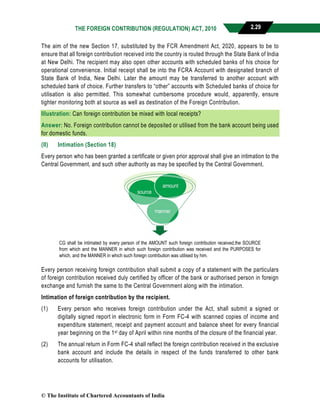
CG shall be intimated by every person of the AMOUNT such foreign contribution received,the SOURCE
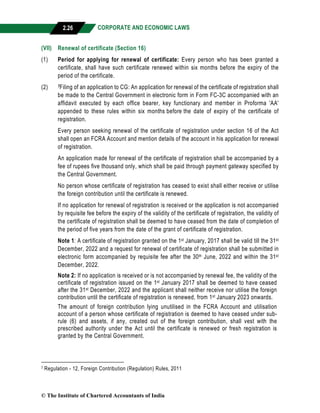
from which and the MANNER in which such foreign contribution was received and the PURPOSES for
which, and the MANNER in which such foreign contribution was utilised by him.
manner
source
amount
© The Institute of Chartered Accountants of India
CORPORATE AND ECONOMIC LAWS
a
2.30
(3) If the foreign contribution relates only to articles, the intimation shall be submitted in Form
FC-1.
(4) If the foreign contribution relates to foreign securities, the intimation shall be submitted in
Form FC-1.
(5) Every report submitted under sub-rules (2) to (4) shall be duly certified by a chartered
accountant.
(6) Every such return in Form FC-4 shall also be accompanied by a copy of a statement of
account from the bank where the exclusive foreign contribution account is maintained by the
person, duly certified by an officer of such bank.
(7) The accounting statements referred to above in the preceding sub-rule shall be preserved by
the person for a period of six years.
(8) A 'NIL' report shall be furnished even if no foreign contribution is received during a financial
year:
Provided that where foreign contribution has not been received or utilised during a financial year, it
shall not be required to enclose certificate from Chartered Accountant or income and expenditure
statement or receipt and payment account or balance sheet with Form FC-4.
(III) Maintenance of accounts (Section 19)
Every person who has been granted a certificate or given prior approval under this Act shall maintain,
in such form and manner as may be prescribed,—
(a) an account of any foreign contribution received by him; and
(b) a record as to the manner in which such contribution has been utilised by him.
Rule 11 of FCR, Rule 2011 states that every person who has been granted registration or prior
permission under section 12 shall maintain a separate set of accounts and records, exclusively, for
the foreign contribution received and utilised.
(IV) Audit of accounts (Section 20)
(1) Where any person who has been granted a certificate or given prior permission,
a. fails to furnish any intimation under this Act, or
b. the intimation so furnished is not in accordance with law or
c. if, after inspection of such intimation, the Central Government has any reasonable
cause to believe that any provision of this Act has been, or is being, contravened,
© The Institute of Chartered Accountants of India
THE FOREIGN CONTRIBUTION (REGULATION) ACT, 2010 2.31
the Central Government may-
 by general or special order, authorise such Gazetted Officer, holding a Group A post
under the Central Government or any other officer or authority or organisation, as it
may think fit.
 to audit any books of account kept or maintained by such person.
(2) Every such officer shall have the right to enter in or upon any premises at any reasonable
hour, before sunset and after sunrise, for the purpose of auditing the said books of account.
(3) Any information obtained from such audit shall be kept confidential and shall not be disclosed
except for the purposes of this Act.
(V) Intimation by candidate for election (Section 21)
Every candidate for election, who had received any foreign contribution, at any time within one
hundred and eighty days immediately preceding the date on which he is duly nominated as such
candidate, shall give, within such time and in such manner as may be prescribed, an intimation to
the Central Government or prescribed authority or both as to the amount of foreign contribution
received by him, the source from which, and the manner in which, such foreign contribution was
received and the purposes for which and the manner in which such foreign contribution was utilised
by him.
Foreign contribution received by a candidate for election
As per Regulation 18 of FCR, Rule 2011, foreign contribution received by a candidate for election,
shall be furnished in Form FC-1 in electronic form within forty-five days from the date on which he
is duly nominated as a candidate for election.
(VI) Disposal of assets created out of foreign contribution (Section 22)
Where any person who was permitted to accept foreign contribution under this Act-
(a) ceases to exist or has become defunct – in this case all the assets of such person shall be
disposed of in accordance with the provisions contained in any law for the time being in force
under which the person was registered or incorporated, and
(b) in the absence of any such law- the Central Government may, having regard to the nature
of assets created out of foreign contribution received under this Act, by notification, specify
that all such assets shall be disposed of by such authority, in such manner and procedure as
may be prescribed.
6. ADJUDICATION
Chapter VI of the Act deals with Adjudication. It covers sections 28 to 30 of the Act.
© The Institute of Chartered Accountants of India
CORPORATE AND ECONOMIC LAWS
a
2.32
Confiscation of article or currency or security obtained in contravention of the Act
(Section 28)
Any article or currency or security which is seized under the Act shall be liable to confiscation if such
article or currency or security has been adjudged under section 29 to have been received or obtained
in contravention of this Act.
Adjudication of confiscation (Section 29)
(1) Any confiscation referred to in section 28 may be adjudged—
(a) without limit, by the Court of Session within the local limits of whose jurisdiction the
seizure was made; and
(b) subject to such limits as may be prescribed, by such officer, not below the rank of
an Assistant Sessions Judge, as the Central Government may, by notification in the
Official Gazette, specify in this behalf.
As per Rule 19 of FCR, Rule 2011 an officer referred to above in clause 29(1)(b), may adjudge
confiscation in relation to any article or currency seized under the Act, if the value of such
article or the amount of such currency seized does not exceed Rs. 10,00,000 (Rupees Ten
lakh only).
(2) When an adjudication is concluded by the Court of Session/Assistant Sessions Judge, as the
case may be, he/she may make such order as he/she thinks fit for disposal of seized article
or currency or security (i.e.) either
a. confiscation of seized article or currency or security which has been used for the
commission of any offence under this Act, or
b. delivery to any person claiming to be entitled to possession thereof or otherwise.
Procedure for confiscation (Section 30)
Reasonable opportunity of making a representation has to been given to the person from whom any
article or currency or security has been seized prior to passing the order of adjudication of
confiscation.
7. APPEAL & REVISION
Chapter VIII of the Act deals with Appeal & Revision. It covers sections 31 and 32 of the Act.
Appeal (Section 31)
(1) Any person aggrieved by any order made under Section 29 may prefer an appeal as follows:
Where an order is passed by- Appellate Authority
the Court of Session The High Court to which such Court is subordinate
© The Institute of Chartered Accountants of India
THE FOREIGN CONTRIBUTION (REGULATION) ACT, 2010 2.33
any officer specified section 29(1)(b) The Court of Session within the local limits of whose
jurisdiction such order of adjudication of confiscation
was made
Appeal is to be preferred within one month from the date of communication of the order to such
person.
The appellate court may allow such appeal to be preferred for a further period of one month.
(2) Any organisation referred to in section 3(1)(f), or any person or association referred to in
section 6 or section 9, aggrieved by an order made in pursuance of section 5 or by an order
of the Central Government refusing to give permission under this Act, or by any order made
by the Central Government under section 12(2) or 12(4), or section 14(1), as the case may
be, may,
 prefer an appeal against such order to the High Court within the local limits of whose
jurisdiction the appellant ordinarily resides or carries on business or personally works
for gain, or, where the appellant is an organisation or association, the principal office
of such organisation or association is located-
 within sixty days from the date of such order.
The above appellate remedy is available to organisations
a. that have been adjudged to be Political in nature under Section 5;
b. that have been refused grant of registration; or
c. whose registration has been cancelled
by Central government.
Revision of orders by Central Government (Section 32)
(1) The Central Government may either-
 of its own motion or
 on an application for revision by the person registered under this Act,
call for and examine the record of any proceeding under this Act in which any such order has
been passed by it and may make such inquiry or cause such inquiry to be made and, subject
to the provisions of this Act, may pass such order thereon as it thinks fit.
(2) Time limit for power of revision: The Central Government shall not of its own motion revise
any order under this section if the order has been made more than one year previously.
(3) Time limit for making application for revision: In the case of an application for revision by
a person registered under the act, the application must be made within one year from the
© The Institute of Chartered Accountants of India
CORPORATE AND ECONOMIC LAWS
a
2.34
date on which the order in question was communicated to him or the date on which he
otherwise came to know of it, whichever is earlier.
If the Central Government is satisfied that such person was prevented by sufficient cause
from making the application within that period it may admit an application made after the
expiry of that period.
(4) The Central Government shall revise any order where an appeal against the order lies but
has not been made until the time within which such appeal may be made has expired or such
person has waived his right of appeal or an appeal has been filed under this Act.
(5) Every application by such person for revision under this section shall be accompanied by
such fee, as may be prescribed.
An order by the Central Government declining to interfere shall, for the purposes of this
section, be deemed not to be an order prejudicial to such person. This means that the
applicant has no right of appeal against the declining to interfere.
As per Regulation 20 of the FCR Rule 2011, an application for revision of an order passed by the
competent authority under section 32 of the Act shall be made to the Secretary, Ministry of Home
Affairs, Government of India, New Delhi in such form and manner, including in electronic form as
may be specified by the Central Government and it shall be accompanied by a fee of rupees three
thousand only, which shall be paid through the payment gateway specified by the Central
Government.
In exercise of the powers under rule 20 of the Foreign Contribution (Regulation) Rules, 2011 as
amended vide gazette notification No. 506(E), dated 1-7-2022, it is hereby ordered that w.e.f. 1st
September 2022 an application under section 32 of the Act for revision of an order passed by the
competent authority shall be made in electronic form only through the website
https://fcraonline.nic.in.
8. OFFENCES AND PENALTIES
Chapter VII of the Act deals with Offences & Penalties. It covers sections 33 to 41 of the Act. This
chapter lists out various types of offences committed and prescribes the penalties levied for the
same.
Types of offences (Sections 33-38)
Section Type of offence Penalty
Any person who knowingly—
(a) gives false intimation under
section 9(c) or section 18; or
(b) seeks prior permission or
shall, on conviction by a court, be
liable to imprisonment for a term
which may extend to six months or
with fine or with both.
© The Institute of Chartered Accountants of India
THE FOREIGN CONTRIBUTION (REGULATION) ACT, 2010 2.35
33 registration by means of fraud,
false representation or
concealment of material fact,
34
Any person, on whom any prohibitory
order has been served under section
10, pays, delivers, transfers or otherwise
deals with, any article or currency or
security, whether Indian or foreign, in
contravention of such prohibitory order.
 shall be punished with
imprisonment for a term which
may extend to three years, or
with fine, or with both.
 the court trying such
contravention may also impose
on the person convicted an
additional fine equivalent to the
market value of the article or the
amount of the currency or
security in respect of which the
prohibitory order has been
contravened by him or such part
thereof as the court may deem fit.
35
Whoever accepts, or assists any
person, political party or organisation
in accepting, any foreign contribution or
any currency or security from a foreign
source, in contravention of any provision
of this Act or any rule or order made
thereunder
shall be punished with imprisonment
for a term which may extend to five
years, or with fine, or with both.
36
The court trying a person, who, in
relation to any article or currency or
security, whether Indian or foreign, does
or omits to do any act which act or
omission would render such article or
currency or security liable to
confiscation under this Act, may, in
the event of the conviction of such
person for the act or omission aforesaid
impose on such person a fine not
exceeding five times the value of
the article or currency or security
or one thousand rupees, whichever
is more, if such article or currency or
security is not available for
confiscation, and the fine so imposed
shall be in addition to any other fine
which may be imposed on such
person under this Act.
37
Whoever fails to comply with any
provision of this Act for which no
separate penalty has been provided in
this Act
shall be punished with imprisonment
for a term which may extend to one
year, or with fine or with both.
Second Conviction or Repeat shall not accept any foreign
© The Institute of Chartered Accountants of India
CORPORATE AND ECONOMIC LAWS
a
2.36
38 Offender: Any person having been
convicted of any offence under
section 35 or section 37, insofar as
such offence relates to the acceptance
or utilisation of foreign contribution, is
again convicted of such offence
contribution for a period of five years
from the date of the subsequent
conviction.
Offences by companies (Section 39)
Where an offence under this Act or any rule or order made thereunder has been committed by a company-
 every person who, at the time the offence was committed, was in charge of, and
 was responsible to, the company for the conduct of the business of the company,
 as well as the company,
shall be deemed to be guilty of the offence and shall be liable to be proceeded against and punished
accordingly.
Exemption: However, such person shall not be liable to any punishment if he proves that the offence was
committed –
 without his knowledge, or
 he had exercised all due diligence to prevent the commission of such offence.
Where an offence under this Act or any rule or order made thereunder has been committed by a
company and it is proved that the offence has been committed with the consent or connivance of, or
is attributable to any neglect on the part of, any director, manager, secretary or other officer of the
company, such director, manager, secretary or other officer shall also be deemed to be guilty of that
offence and shall be liable to be proceeded against and punished accordingly.
Explanation.—For the purposes of this section,—
(a) “company” means any body corporate and includes a firm, society, trade union or other
association of individuals; and
(b) “director”, in relation to a firm, society, trade union or other association of individuals, means
a partner in the firm or a member of the governing body of such society, trade union or other
association of individuals.
Bar on prosecution of offences under the Act (Section 40)
No court shall take cognizance of any offence under this Act, except with the previous sanction of
the Central Government or any officer authorised by that Government in this behalf.
Compounding of certain offences (Section 41)
 any offence punishable under this Act (whether committed by an individual or association or
any officer or employee thereof), not being an offence punishable with imprisonment only,
© The Institute of Chartered Accountants of India
THE FOREIGN CONTRIBUTION (REGULATION) ACT, 2010 2.37
may, before the institution of any prosecution, be compounded by such officers or authorities
and for such sums as the Central Government may, by notification in the Official Gazette,
specify.
 Compounding of offences as stated above, shall not apply to an offence committed by an
individual or association or its officer or other employee within a period of three years from
the date on which a similar offence committed by it or him was compounded under this
section.
For the purposes of this section, any second or subsequent offence committed after the expiry
of a period of three years from the date on which the offence was previously compounded,
shall be deemed to be a first offence.
 Every officer or authority shall exercise the powers to compound an offence, subject to the
direction, control and supervision of the Central Government.
 Where any offence is compounded before the institution of any prosecution, no prosecution
shall be instituted in relation to such offence, against the offender in relation to whom the
offence is so compounded.
 Every officer or authority while dealing with a proposal for the compounding of an offence for
a default in compliance with any provision of this Act which requires by an individual or
association or its officer or other employee to obtain permission or file or register with, or
deliver or send to, the Central Government or any prescribed authority any return, account or
other document, may-
direct, by order, any individual or association or its officer or other employee to file or register
with, such return, account or other document within such time as may be specified in the
order.
9. MISCELLANEOUS
(I) Power to call of information or document and Investigation into cases under the
Act (Sections 42 & 43)
 Any inspecting officer, authorised by the Central Government may, during the course of any
inspection of any account or record maintained by any political party, person, organisation or
association in connection with the contravention of any provision of this Act,—
(a) call for information from any person for the purpose of satisfying himself whether there
has been any contravention of the provisions of this Act or rule or order made
thereunder;
(b) require any person to produce or deliver any document or thing useful or relevant to
such inspection;
© The Institute of Chartered Accountants of India
CORPORATE AND ECONOMIC LAWS
a
2.38
(c) examine any person acquainted with the facts and circumstances of the case related
to the inspection.
 Investigation into cases under the Act: Any offence punishable under this Act may also be
investigated into by such authority as the Central Government may specify in this behalf and
the authority so specified shall have all the powers which an officer-in-charge of a police
station has while making an investigation into a cognizable offence.
(II) Power of Central Government to give directions and delegation of powers (Sections 46 & 47)
 The Central Government may give such directions as it may deem necessary to any other
authority or any person or class of persons regarding the carrying into execution of the
provisions of this Act, except power to make rule under section 48.
(III) Power to make rules (Section 48)
The Central Government may, by notification, make rules for carrying out the provisions of this Act.
(IV) Power to exempt in certain cases (Section 50)
If the Central Government is of opinion that it is necessary or expedient in the interests of the general
public so to do, it may-
 by order and subject to such conditions as may be specified in the order, exempt-
o any person or
o association or
o organisation (not being a political party), or
o any individual (not being a candidate for election)
 from the operation of all or any of the provisions of this Act and may, revoke or modify such
order.
(V) Act not to apply to certain Government transactions (Section 51)
Nothing contained in this Act shall apply to any transaction between-
 the Government of India, and
 the Government of any foreign country or territory.
(VI) Application of other laws not barred (Section 52)
The provisions of this Act shall be in addition to, and not in derogation of, the provisions of any other
law for the time being in force.
© The Institute of Chartered Accountants of India
THE FOREIGN CONTRIBUTION (REGULATION) ACT, 2010 2.39
TEST YOUR KNOWLEDGE
Multiple Choice Questions
1. Alexander Philip, a foreign citizen, has made donations in kind to his known resident Indians
for their personal use. When shall such donation in kind be excluded from the definition of
‘foreign contribution’ considering the relevant provisions of Foreign Contribution (Regulation)
Act, 2010?
(a) A donation in kind by a foreign citizen to a resident Indian shall be excluded from the
definition of ‘foreign contribution’, if the market value, in India, of such article, on the
date of such gift, is more than 1,00,000 but less than 5,00,000.
(b) A donation in kind by a foreign citizen to a resident Indian shall be excluded from the
definition of ‘foreign contribution’, if the market value, in India, of such article, on the
date of such gift, is more than 5,00,000 but less than 10,00,000.
(c) Any donation in kind given by a foreign citizen to a resident Indian for personal use is
always excluded.
(d) A donation in kind by a foreign citizen to a resident Indian shall be excluded from the
definition of ‘foreign contribution’, if the market value, in India, of such article, on the
date of such gift, is not more than 1,00,000.
2. Mr. Vijay, Sanjay and Ajay are brothers. Mr. Sanjay who is professor reside in India, rest both
the brothers settled in abroad. Mr. Sanjay on his 25th wedding anniversary received a gift
from his elder brother who is American national currently. Gift includes i-phone and an old
chain of their father, with attached emotional memories. I-phone in Indian rupee worth INRs
1 lac 10 thousands, while chain worth INRs 80 thousand.
While younger brother of Mr. Sanjay who is British national and investment banker by
profession, present him securities worth INRs 2 lacs.
Regarding the intimation of foreign contribution received by Mr. Sanjay, state the correct legal
requirement in the light of the FCRA :
(a) Intimation is required to be given to Central Government regarding any of the foreign
contribution received by him within three months from the date of receipt of such
contribution.
(b) Intimation is required to be given to Central Government regarding the foreign
contribution received by him with his brothers being more than limit of 1 Lakh within
30 days from the date of receipt of such contribution.
© The Institute of Chartered Accountants of India
CORPORATE AND ECONOMIC LAWS
a
2.40
(c) Intimation is not required to be given to Central Government regarding the foreign
contribution received by him with his brothers being less than the threshold limit of 10
Lakh whereas w.r.t. to chain of worth INR 80,000.
(d) No Intimation is required to be given to Central Government regarding the foreign
contribution received him as it was for personal use.
3. The Certificate of registration for receiving foreign contribution was issued on 1st April, 2023
to Mr. X . What shall be the validity period for said registration:
(a) 31st March 2025
(b) 1st April 2026
(c) 1st April, 2027
(d) 31st March 2028
4. Mr Raja, an office-bearer of a political party, receives foreign contribution of Rs. 9 lakh during
the financial year 2022-2023 from his sister residing abroad. Mr. Raja is required to inform of
such foreign contribution received to the Central Government within how many time period:
(a) With in 30 days from the date of receipt of such foreign contribution
(b) With in 3 months from the date of receipt of such foreign contribution
(c) With in 6 months from the date of receipt of such foreign contribution
(d) No intimation is required for such foreign contribution
5. Mr. X has been found guilty of violation of the provisions of FCRA, 2010. What shall be the
consequences w.r.t. the unutilised amount of foreign contribution?
(a) Such unutilised amount of foreign contribution shall be forfeited.
(b) Such unutilised amount of foreign contribution shall not be utilized, without the prior
approval of the C.G
(c) Such unutilised amount of foreign contribution shall not be utilized without the prior
approval of the RBI.
(d) Such unutilised amount of foreign contribution shall not be utilized till the settlement
of penalty imposed
© The Institute of Chartered Accountants of India
THE FOREIGN CONTRIBUTION (REGULATION) ACT, 2010 2.41
Descriptive Questions
1. State under what circumstances Government can cancel the certificate of registration granted
to a person under FCRA?
2. X, an association having registration wishes to transfer the Foreign Contribution received by
it to another organization? Can it do so? Is there any restriction on transfer of funds to other
organisations?
3. Can foreign contribution be received in and utilised from multiple Bank Accounts?
4. Can capital assets purchased with the help of foreign contributions be acquired in the name
of the Mr Ram, an office bearer of the association?
5. Mr. X, an individual of Indian origin but currently a citizen of a foreign country gives a donation.
State whether the donation given by Mr. X will be treated as ‘foreign contribution’?
6. Mr. Rohit, a relative of Ms. Suman, who is residing in France remitted foreign contribution of
Rs. 2 lakhs to her for arrangement of religious programme for the believers of Gurudev.
Whether foreign remittances received from a relative are to be treated as foreign contribution
as per FCRA, 2010?
7. After giving a reasonable opportunity of being heard, Central Government cancelled the
certification of registration of Toastea Ltd, a company registered under FCRA on the ground
that such cancellation was in public interest. Two and a half years have passed since such
cancellation. Company has submitted its written declaration not to involve in such activities
again and requests restoration of the registration. Advise Toastea Ltd. on its eligibility for re-
registration or grant of prior permission.
8. In the light of the provisions of the Foreign Contribution (Regulation) Act, 2010 examine and
decide whether the following persons in India are permitted to receive the amount/articles in
the following situations:
(i) M/s KG & Co.; a partnership firm obtained loan from a club registered in London for
its business purpose.
(ii) Hello FM, a registered association, received funds from a foreign company for
establishing Frequency Model Radio Station to broadcast audio news.
(iii) Mr. Happy received a wrist watch as marriage anniversary gift from his uncle, a citizen
of USA. The market value of the wrist watch is Rs. 25,000.
9. Mr. Ramakant Hathi, an Indian Administrative Service (IAS) officer has received an invitation
to visit Germany for representing India in an Annual Summit programme. Mr. Ramakant Hathi,
on his visit has met with a sudden illness and received foreign hospitality of amount equivalent
to INR 65,000 in the form of emergent medical treatment. Under the given scenario, you are
required to advise Mr. Ramakant Hathi regarding his responsibility to intimate the receipt of
© The Institute of Chartered Accountants of India
CORPORATE AND ECONOMIC LAWS
a
2.42
Foreign Hospitality as per the provisions of the Foreign Contribution (Regulation) Act, 2010
and rules made thereunder.
10. XYZ Foundation, a society registered under the Societies Registration Act, 1860, has
received foreign contribution from a Mala Company LLC, a company incorporated in
Singapore. XYZ Foundation deposited the amount of foreign contribution in a bank and
earned interest on it. XYZ Foundation desires to invest maturity proceeds from deposits in
mutual funds. You are required to advise whether XYZ Foundation is allowed to make such
investment considering the provisions of the Foreign Contribution (Regulation) Act, 2010 (the
Act) (Note: XYZ Foundation has obtained certificate of registration under section 11 of the
Act).
ANSWERS
Answer to Multiple Choice Questions
1. d 2. c 3. d 4. d 5. b
Answer to Descriptive Answers
1. As per section 14 of the FCRA, Central Government may cancel the certificate, after carrying
out an inquiry, on the following grounds –
(a) the holder of the certificate has made an incorrect/false statement in the application
for the grant of registration or renewal
(b) the holder of the certificate has violated any of the terms and conditions of the
certificate or renewal thereof
(c) in the opinion of the Central Government, it is necessary in the public interest to cancel
the certificate
(d) the holder of the certificate has violated any of the provisions of this Act or rules or
order made thereunder.
(e) if the holder of the certificate has not been engaged in any reasonable activity in its
chosen field for the benefit of the society for two consecutive years or has become
defunct.
Any person whose certificate has been cancelled under this section shall not be eligible for
registration or grant of prior permission for a period of three years from the date of
cancellation of such certificate.
2. As per amendment to Section 7 of FCRA, 2010, vide The Foreign Contribution (Amendment)
Act, 2020;
© The Institute of Chartered Accountants of India
THE FOREIGN CONTRIBUTION (REGULATION) ACT, 2010 2.43
No person who -
(a) is registered and granted a certificate or has obtained prior permission under this Act;
and
(b) receives any foreign contribution,
shall transfer such foreign contribution to any other person.
Prior to amendment, foreign contribution could be transferred with the prior approval of the
Central Government to such persons which did not possess the certificate of registration or
prior permission. Further foreign contribution was also permitted to be transferred to any other
person who was registered under FCRA, 2010 or had obtained prior permission. It can be
seen that the legislature has placed a blanket prohibition on transfer of foreign contribution
received by any person to any other person. The intention is to prevent recipients of foreign
contribution acting as mere conduits or facilitating agents for obtaining foreign contributions.
3. Yes. The foreign contribution should be received only in the exclusive single “FCRA account”
of New Delhi Main Branch of SBI (also called designated FC account), as mentioned in the
order for registration or prior permission granted and shall be independently maintained by
the associations. Besides, this “FCRA Account”, the association may also open “another
FCRA Account” in any scheduled bank of its choice & link these accounts for transfer of
foreign contribution. Also, one or more accounts (called Utilization Account) in one or more
scheduled banks may be opened by the association for ‘utilising’ the foreign contribution after
it has been received in the designated FCRA bank account, provided that no fund other than
foreign contribution shall be received or deposited in such account or accounts and in all
cases of any change, intimation in FC-6D is to be given online within 45 days of opening of
such account. .
4. No. Every asset purchased with foreign contribution should be acquired and possessed in
the name of the association since an association has a separate legal entity distinct from its
members.
5. Yes. Donation from a Person of Indian origin who has acquired foreign citizenship is treated
as foreign contribution. This will also apply to Person of Indian Origin / Overseas Citizen of
India cardholders. However, this will not apply to 'Non-resident Indians', who still hold Indian
citizenship and they are not foreigners. Therefore, donation given by Mr. X, an individual of
Indian origin with foreign nationality will be treated as foreign contribution.
6. No. As per Section 4(e) of FCRA, 2010 and Rule 6 of FCRR, 2011, even the persons
prohibited under section 3, i.e., persons not permitted to accept foreign contribution, are
allowed to accept foreign contribution from their relatives. However, in terms of Rule 6 of
FCRR, 2011, any person receiving foreign contribution in excess of ten lakh rupees or
equivalent thereto in a financial year from any of his relatives shall inform the Central
© The Institute of Chartered Accountants of India
CORPORATE AND ECONOMIC LAWS
a
2.44
Government regarding the details of the foreign contribution received by him in electronic
form in Form FC-1 within three months from the date of receipt of such contribution.
Here in the given situation, since the amount remitted by Mr. Rohit is less than Rs. ten lakh,
so Ms. Suman is not required to inform the Central Government.
7. Restoration of Registration: As per section 14(3) of the Foreign Contribution (Regulation)
Act, 2010, any person whose certificate has been cancelled under this section shall not be
eligible for registration or grant of prior permission for a period of three years from the date of
cancellation of such certificate.
In the instant case, Toastea Ltd. is not eligible for re-registration or grant of prior permission as onlytwo
and a half years have passed since such cancellation. So, restoration is not permissible as the
requirement of three years cooling period from the date of cancellation of such certificate for re-
registration is not complied with. Therefore Toastea Ltd.is advised to seek for fresh registration or grant
of prior permission on the completion of three years from the date of cancellation.
8. (i) As per Explanation 3 to section 2(1)(h)‒Any amount received, by any person from any
foreign source in India, by way of fee (including fees charged by an educational
institution in India from foreign student) or towards cost in lieu of goods or services
rendered by such person in the ordinary course of his business, trade or commerce
whether within India or outside India or any contribution received from an agent or a
foreign source towards such fee or cost shall be excluded from the definition of foreign
contribution within the meaning of this Thus the loan availed from a club registered in
London will be covered under business hence excluded from definition of foreign
contribution. However, the provisions of FEMA, 1999 shall apply and permissibility of
availing foreign currency loan by a partnership firm needs to be evaluated.
(ii) As per section 3 of the FCRA, 2010, no foreign contribution shall be accepted by any
association or company engaged in the production or broadcast of audio news or audio
visual news or current affairs programs through any electronic mode, or any other
electronic form as defined in the Information Technology Act, 2000 or any other mode
of mass communication; Accordingly, Hello FM is not permitted to receive any funds
from a foreign company.
(iii) As per the provisions of the Foreign Contribution (Regulation) Act, 2010, “foreign
contribution” means the donation, delivery or transfer made by any foreign source, of
any article, not being an article given to a person as a gift for his personal use, if the
market value, in India, of such article, on the date of such gift, is not more than such
sum as may be specified from time to time, by the Central Government by the rules
made by it in this behalf;(This sum has been specified as Rupees One lakh/-currently).
In the given situation, Mr. Happy received the wrist watch (market value Rs.25,000)
as marriage anniversary gift from his uncle, a citizen of USA. Since, the value of the
© The Institute of Chartered Accountants of India
THE FOREIGN CONTRIBUTION (REGULATION) ACT, 2010 2.45
wrist watch is within the prescribed limit, hence, Mr. Happy is permitted to receive the
article.
9. As per section 6 of the Foreign Contribution (Regulation) Act, 2010, various categories of
persons are required to take prior permission of the Central Government before accepting
Foreign Hospitality, while visiting any country or territory outside India. Government servants
are one of such persons who are required to take prior permission. Provided it shall not be
necessary to obtain any such permission for an emergent medical aid needed on account of
sudden illness contracted during a visit outside India.
Section 6 read along with Rule 7 of Foreign Contribution Rules 2011 and amendments thereto
states that in case of emergent medical treatment aid needed on account of sudden illness
during a visit abroad, the acceptance of foreign hospitality shall be required to be intimated
to the Central Government within one month of such receipt in electronic form FC-2 giving
full details including the source, approximate value in Indian rupees, and the purpose for
which and the manner in which it was utilised. No such intimation is required if the value of such
hospitality in emergent medical aid is upto one lakh rupees or equivalent.
Accordingly, Mr. Ramakant Hathi is not required to intimate such details of acceptance of foreign
hospitality as the value of such hospitality in emergent medical treatment of foreign currency
equivalent to INR 65,000 is within the limits specified in Rule 7 of Foreign Contribution (Regulation)
Rules, 2011 of up to Rupees one lakh or equivalent.
10. As per section 8 of the Act, every person, who is registered and granted a certificate or given
prior permission under this Act and receives any foreign contribution, shall utilise such
contribution for the purpose for which the contribution has been received.
Further Rule 4 (1) of FCRR, 2011 defines speculative activities and includes instruments
where there is an element of risk of appreciation or depreciation of the original investment.
Further as per the explanation 2 to the definition of foreign contribution under the Act, the
interest accrued on the foreign contribution deposited in any bank referred to in section 17(1)
or any other income derived from the foreign contribution or interest thereon shall also be
deemed to be foreign contribution within the meaning of this clause.
Foreign contribution or any income arising out of it shall not be used for speculative business,
where speculative business which includes investment in mutual fund.
Therefore, XYZ Foundation cannot use the foreign contribution or the interest earner on the
foreign contribution for the Investment in Mutual Funds or for any speculative activities.
© The Institute of Chartered Accountants of India

Foreign contribution .....................

  • 1.
    10 2 THE FOREIGNCONTRIBUTION (REGULATION) ACT, 2010 LEARNING OUTCOMES By the end of this Chapter, you will be able to-  Know and appreciate significant terminologies used in the Act  Determine how the law regulates the acceptance and utilization of foreign contribution or Foreign Hospitality  Identify the restrictions on acceptance and utilisation of foreign contribution or Foreign Hospitality  Explain the procedure for the registration of persons to be regulated in this Act  Elucidate how persons regulated by the Act are required to manage the financial aspects of Foreign Contribution  Recognise the Adjudicating Authority, the provisions related to appeal and revision, and offences and penalties on contravention of the compliances a v v a v v CHAPTER 2 © The Institute of Chartered Accountants of India
  • 2.
    CORPORATE AND ECONOMICLAWS a 2.2 1. INTRODUCTION The Preamble to the Indian constitution defines India as a ‘Sovereign’ country, meaning India has its own supreme law and is not a dominion or province of any other nation. Moreover, India is independent of any kind of external intervention in its domestic operations. Therefore, no other country or international body can infringe on India's sovereignty. One of the threats to the sovereignty of India could be through transfer of funds from foreign sources as Foreign Contribution for any activities detrimental to the national interest. The Foreign Contribution (Regulation) Act, 2010, together with the Foreign Contribution (Regulation) Rules, 2011 and other notification and orders, issued thereunder from time to time regulates the flow of foreign contributions into India and ensures that such contributions do not adversely affect national security. First enacted in 1976, it was amended in 2010 when new measures were adopted to regulate foreign contributions with effect from 1st May, 2011. The Foreign Contribution (Regulation) Act, 2010 was again amended through the Foreign Contribution (Regulation) Amendment Act, 2020 with effect from 28th September, 2020. The FCRA is administered by Ministry of Home Affairs. Amendments made by the 2020 Amendment Act – Following were the highlights of the Foreign Contribution (Regulation) Amendment Act, 2020: ♦ No Foreign contribution can be accepted by a public servant, Judge, Government servant or employee of any corporation or any other body controlled or owned by the Government [section 3(1)(c) of FCRA, 2010] ♦ Amendment Act completely prohibits transfer of foreign contribution to any other person - [section 7 of FCRA, 2010]. ♦ Defraying of foreign contribution towards administrative expenses reduced to 20% from 50% of contribution received – [section 8(1) of FCRA, 2010]. ♦ Central Government may restrict or prohibit a person granted “prior permission” from either utilising the unutilized foreign contribution or receive remaining portion of foreign contribution if it has reason to believe that provisions of the Act have been contravened – [proviso to section 11(2) of FCRA, 2010]. ♦ Every person who makes an application for “prior permission” or “registration” to open an “FCRA Account” as specified in section 17 – [section 12 (1A) of FCRA, 2010]. ♦ Aadhaar number of all functionaries Resident in India and copy of Passport or OCI card in case of foreigner mandatory for application of prior permission or registration under FCRA or renewal thereof – [section 12A of FCRA, 2010]. © The Institute of Chartered Accountants of India
  • 3.
    THE FOREIGN CONTRIBUTION(REGULATION) ACT, 2010 2.3 ♦ Suspension of certificate under consideration for cancellation extended for a further period, not exceeding one hundred and eighty days, beyond the initial suspension period of one hundred and eighty days – [section 13 of FCRA, 2010]. ♦ Provision made for Surrender of Certificate of Registration under FCRA and the management of foreign contribution and asset to vest with such authority as specified – [section 14A of FCRA, 2010]. ♦ All foreign contributions to be received in the designated 'FCRA Account', namely State Bank of India, New Delhi Main Branch (SBI-NDMB). May open another “FCRA account” in any of the scheduled bank for the purpose of keeping or utilising the foreign contribution received in the SBI ‘‘FCRA Account’. May also open one or more accounts in one or more scheduled banks to which funds may be transferred for utilising any foreign contribution, subject to the condition that no local contributions shall be deposited in this account– [section 17 of FCRA, 2010]. Vide Notification G.S.R. 695(E) [F. NO. II/21022/23(12)/2020-FCRA-III], dated 10-11-2020, in exercise of the powers conferred by section 48 of the Foreign Contribution (Regulation) Act, 2010, the Central Government hereby makes the following rules further to amend the Foreign Contribution (Regulation) Rules, 2011, through the enforcement of the Foreign Contribution (Regulation) (Amendment) Rules, 2020 w.r.e.f 29.04.2011. Structure of the Act The Foreign Contribution (Regulation) Act, 2010, (FCRA, 2010) comprises of nine chapters with 54 sections. Chapter No. Chapter Name Chapter I Preliminary (Section 1- 2) Chapter II Regulation of Foreign Contribution and Foreign Hospitality (Section 3 -10) Chapter III Registration (Section 11- 16) Chapter IV Accounts, Intimation, Audit and Disposal of Assets, etc. (Section 17- 22) Chapter V Inspection, Search and Seizure (section 23-27) Chapter VI Adjudication (Section 28-29) Chapter VII Appeal and Revision (Section 31- 32) Chapter VIII Offences and Penalties (Section 33- 41) Chapter IX Miscellaneous (Section 42- 54) © The Institute of Chartered Accountants of India
  • 4.
    CORPORATE AND ECONOMICLAWS a 2.4 Extent, Application and Commencement of FCRA (Section 1) As per Section 1(2) of FCRA, 2010, the provisions of the Act shall apply to:  Whole of India  Citizens of India outside India; and  Associate Branches or subsidiaries, outside India, of companies or bodies corporate, registered or incorporated in India. In line with the stated provision, the Act is applicable to any citizen of India whether he is in India or outside India. However, the Act is not applicable to a foreigner while outside India. Note: An Indian passport holder would continue to be treated as a local source, irrespective of his stay outside India and outside the purview of FCRA whereas a Person of Indian Origin holding a foreign passport will be considered a foreign source and FCRA shall apply. As per section 1(3) of the Act, the Central Government has appointed the 1st May, 2011 as the date on which the provisions of the said Act came into force. 2. IMPORTANT DEFINITIONS (SECTION 2) In this Act, unless the context otherwise requires,— "FCRA Account" [Section 2(1)(f)] FCRA Account means the FCRA Account referred to in section 17 of the Act. “Foreign Company” [Section 2(1)(g)] Foreign Company means any company or association or body of individuals incorporated outside India and includes :—  a foreign company within the meaning of section 591 of the Companies Act, 1956 (Section 379 of the Companies Act, 2013)  Company which is a subsidiary of a foreign company;  the registered office or principal place of business of a foreign company;  a multi-national corporation. Explanation— A corporation incorporated in a foreign country or territory shall be deemed to be a multi-national corporation if such corporation,— (a) has a subsidiary or a branch or a place of business in two or more countries or territories; or (b) carries on business, or otherwise operates, in two or more countries or territories; Illustration 1: A Company is incorporated in India under the Companies Act, 2013 and has operations in 2 or more countries. Would it be treated as a MNC under FCRA, 2010? © The Institute of Chartered Accountants of India
  • 5.
    THE FOREIGN CONTRIBUTION(REGULATION) ACT, 2010 2.5 Answer. No Foreign Source [Section 2(1)(j)] Foreign Source includes,— (i) the Government of any foreign country or territory and any agency of such Government; (ii) any international agency, not being the United Nations or any of its specialized agencies, the World Bank, International Monetary Fund or such other agency as the Central Government may, by notification, specify in this behalf; (iii) a foreign company; (iv) a corporation, not being a foreign company, incorporated in a foreign country or territory; (v) a multi-national corporation referred to in Section 2(g) sub-clause (iv) of FCRA, 2010; (vi) a company within the meaning of the Companies Act, 1956 (presently, the Companies Act, 2013) and more than one-half of the nominal value of its share capital is held, either singly or in the aggregate, by one or more of the following, namely:- A. the Government of a foreign country or territory; B. the citizens of a foreign country or territory; C. corporations incorporated in a foreign country or territory; D. trusts, societies or other associations of individuals (whether incorporated or not), formed or registered in a foreign country or territory; E. Foreign company; Provided that where the nominal value of share capital is within the limits specified for foreign investment under the Foreign Exchange Management Act, 1999, or the rules or regulations made there under, then, notwithstanding the nominal value of share capital of a company being more than one-half of such value at the time of making the contribution, such company shall not be a foreign source [Clarity provided in the FAQs issued under FCRA by the Ministry of Home Affairs - I. Introduction to the Foreign Contribution (Regulation) Act, 2010 (FCRA, 2010)] (vii) a trade union in any foreign country or territory, whether or not registered in such foreign country or territory; (viii) a foreign trust or a foreign foundation, by whatever name called, or such trust or foundation mainly financed by a foreign country or territory; (ix) a society, club or other association or individuals formed or registered outside India; (x) a citizen of a foreign country;” © The Institute of Chartered Accountants of India
  • 6.
    CORPORATE AND ECONOMICLAWS a 2.6 A few bodies/ organisations of the United Nations, World Bank (including the International Monetary Fund (IMF) and some other International agencies or multilateral organisations are exempted from this definition, and are not treated as foreign source. Hence, the funds received from them are not considered as foreign contribution. Foreign Contribution [Section 2(1)(h)] Foreign Contribution means the donation, delivery or transfer made by any foreign source,— (i) of any article, Exception: An article given to a person as a gift for his personal use, if the market value, in India, of such article, on the date of such gift, is not more than Rs. 1,00,000/- as per Rule 6A of the Foreign Contribution (Regulation) Rules, 2011 as amended by Foreign Contribution (Regulation) (Second Amendment) Rules, 2019 notified vide G.S.R. 659 (E) dated 16th September, 2019. (ii) any currency, whether Indian or foreign; (iii) of any security as defined in the Securities Contracts (Regulation) Act, 1956 and includes any foreign security as defined in the Foreign Exchange Management Act, 1999; Explanations Nature of contribution Whether Foreign contribution or not Explanation 1 A donation, delivery or transfer of any article, currency or foreign security by any person who has received it from any foreign source, either directly or through one or more persons Shall also be deemed to be foreign contribution within the meaning of this clause DEFINITION OF FOREIGN SOURCE Government of any foreign country / agency of such government International agency foreign company Corporation incorporated in a foreign country/territory MNC Company Trade Union Foreign trust/foundation Society, club, association/individuals registered outside India Citizen of foreign country © The Institute of Chartered Accountants of India
  • 7.
    THE FOREIGN CONTRIBUTION(REGULATION) ACT, 2010 2.7 Explanation 2  The interest accrued on the foreign contribution deposited in any bank referred to in section 17(1), or  any other income derived from the foreign contribution or interest thereon Explanation 3  Any amount received, by any person from any foreign source in India, by way of fee (including fees charged by an educational institution in India from foreign student), or  towards cost in lieu of goods or services rendered by such person in the ordinary course of his business, trade or commerce whether within India or outside India, or  any contribution received from an agent of a foreign source towards such fee or cost Shall be excluded from the definition of foreign contribution within the meaning of this clause; Illustration: Whether earnings from foreign client(s) by a person in lieu of goods sold or a service rendered by it is treated as foreign contribution? Answer: No. As per the above explanation 3, foreign contribution excludes earnings from foreign client(s) by a person in lieu of goods sold or services rendered by it as this is a transaction of commercial nature. Illustration: Can foreign contribution be received in rupees? Answer. Yes, any donation, delivery or transfer received from a ‘foreign source’ whether in rupees or in foreign currency is construed as ‘foreign contribution’ under FCRA, 2010. Such transactions even in rupees terms are considered as foreign contribution. Illustration: Will interest or any other income earned from foreign contribution be considered foreign contribution? Answer: Yes. It will become part of Foreign contribution (see Explanation 2) Illustration: Whether donation given by Non-Resident Indians (NRIs) is treated as ‘foreign contribution’? Answer: Foreign Contribution is defined under section 2(1)(h) to mean the donation, delivery or transfer made by any foreign source. Section 2(1)(j) only speaks about citizen of a foreign country while inclusively defining Foreign Source. Therefore, contributions made by a citizen of India living © The Institute of Chartered Accountants of India
  • 8.
    CORPORATE AND ECONOMICLAWS a 2.8 in another country (i.e., Non-Resident Indian), from his personal savings, through the normal banking channels, is not to be treated as foreign contribution. However, while accepting any donations from such NRI, it is advisable to obtain his passport details to ascertain that he/she is actually an Indian citizen. Illustration: Whether 100% subsidiary of foreign company in IT sector can give donation to trust who doesn’t have registration under FCRA? Answer: Yes, it can. As per proviso of Section 2(1)(j)(vi) since the investment is within limits of FEMA, hence though it may be a 100% subsidiary of a foreign company it will not be considered a foreign source. Illustration: Whether an Individual of Indian Origin who has acquired foreign nationality is treated as foreign source? Answer: Yes. All citizens of a foreign country are treated as “Foreign Source”, including Persons of Indian Origin holding foreign passport. Person [Section 2(1)(m)] Person includes: (i) an individual; (ii) a Hindu undivided family; (iii) an association; a company registered under section 25 of the Companies Act, 1956 (now Section 8 of Companies Act, 2013). Foreign Hospitality [Section 2(1)(i)] Foreign Hospitality means any offer, not being a purely casual one, made in cash or kind by a foreign source for providing a person with the costs of travel to any foreign country or territory or with free boarding, lodging, transport or medical treatment. Political party [Section 2(1)(n)] Political party means— (i) an association or body of individual citizens of India— (A) to be registered with the Election Commission of India as a political party under section 29A of the Representation of the People Act, 1951, or (B) which has set up candidates for election to any Legislature, but is not so registered or deemed to be registered under the Election Symbols (Reservation and Allotment) Order, 1968; (ii) a political party mentioned in column 2 of Table 1 and Table 2 to the notification of the Election Commission of India No. 56/J&K/02, dated the 8th August, 2002, as in force for the time being; © The Institute of Chartered Accountants of India
  • 9.
    THE FOREIGN CONTRIBUTION(REGULATION) ACT, 2010 2.9 Relative [Section 2(1)(r)] “Relative” has the meaning assigned to it in section 2(41) of the Companies Act, 1956 (Now section 2(77) of the Companies Act, 2013) Any words and expressions used in FCRA, 2010 but not defined in the said Act shall carry the meaning as defined in the Representation of the People Act, 1950 or the Representation of the People Act, 1951 or the Foreign Exchange Management Act, 1999. [Section 2(2)] 3. REGULATION OF FOREIGN CONTRIBUTION AND FOREIGN HOSPITALITY Chapter II of the Act deals with the regulation of foreign contribution and foreign hospitality. It covers sections 3 to 10 of the Act. The chapter broadly focuses on certain prohibitions on acceptance of Foreign Contribution and restrictions on acceptance of Foreign Hospitality by certain classes of persons. (I) Prohibition to accept foreign contribution (Section 3) (1) No foreign contribution shall be accepted by any: (a) candidate for election; (b) correspondent, columnist, cartoonist, editor, owner, printer or publisher of a registered newspaper; (c) public servant, Judge, Government servant or employee of any corporation or any other body controlled or owned by the Government; (d) member of any Legislature; (e) political party or office-bearer thereof; (f) organisation of a political nature as may be specified under section 5(1) by the Central Government; (g) association or company engaged in the production or broadcast of audio news or audio visual news or current affairs programmes through any electronic mode, or any other electronic form as defined in the Information Technology Act, 2000 or any other mode of mass communication; (h) correspondent or columnist, cartoonist, editor, owner of the association or company referred to in clause (g). Explanation 1. - For the purpose of clause (c), "public servant" means a public servant as defined in section 21 of the Indian Penal Code (45 of 1860). © The Institute of Chartered Accountants of India
  • 10.
    CORPORATE AND ECONOMICLAWS a 2.10 Explanation 2. - In clause (c) and section 6, the expression "corporation" means a corporation owned or controlled by the Government and includes a Government company as defined in clause (45) of section 2 of the Companies Act, 2013 (18 of 2013). (2) The prohibition mentioned in Section 3(1) above deals with direct acceptance of Foreign Contribution. Section 3(2) of the Act also prohibits indirect acceptance of foreign contribution by / through the following persons: (a) Person, resident in India, and citizen of India resident outside India - shall not accept any foreign contribution, or acquire or agree to acquire any currency from a foreign source, on behalf of any political party, or any person referred to in (1) above, or both. (b) Person, resident in India- shall not deliver any currency, whether Indian or foreign, which has been accepted from any foreign source, to any person if he knows or has reasonable cause to believe that such other person intends, or is likely, to deliver such currency to any political party or any person referred to in (1) above, or both. (c) Citizen of India resident outside India- shall not deliver any currency, whether Indian or foreign, which has been accepted from any foreign source, to— (i) any political party or any person referred to in (1) above, or both; or (ii) any other person, if he knows or has reasonable cause to believe that such other person intends, or is likely, to deliver such currency to a political party or to any person referred to (1) above, or both. (3) Section 9 of FCRA, 2010 empowers the Central Government to prohibit or regulate acceptance of Foreign Contribution or Foreign Hospitality by persons not specified in (1) above. Any person receiving any currency, whether Indian or foreign, from a foreign source on behalf of any person or class of persons referred to in section 9 shall not deliver such currency— (a) to any person other than a person for which it was received, or (b) to any other person, if he knows or has reasonable cause to believe that such other person intends, or is likely, to deliver such currency to a person other than the person for which such currency was received. © The Institute of Chartered Accountants of India
  • 11.
    THE FOREIGN CONTRIBUTION(REGULATION) ACT, 2010 2.11 Procedure to notify an organisation of a political nature (Section 5) Certain organisations may not be registered as a political party, but their activities and the ideologies propagated by them may be such as to be closely aligned with that of a registered political party. This section empowers the Central Government to identify these organizations and notify them as organisation of a political nature. Thereafter, the provisions of the Act will apply to these organisations as if they are an organisation of a political nature mentioned in section 3 (1) (f). The Central Government may be satisfied that an organisation is of a political nature, having regard to the activities of the organisation or the ideology propagated by the organisation or the programme of the organisation or the association of the organisations with the activities of any political party. Central Government has clarified the guidelines specifying the ground or grounds on which an organisation shall be specified as an organisation of a political nature in Rule 3 of the Foreign Contribution (Regulation) Rules, 2011. PROHIBITED FOREIGN CONTRIBUTIONS FOREIGN SOURCE (a) candidate for election; (b) correspondent, columnist, cartoonist, editor, owner, printer or publisher of a registered newspaper; (c) public servant, Judge, Government servant or employee of any corporation or any other body controlled or owned by the Government; (d) member of any Legislature; (e) political party or office-bearer thereof; (f) organisation of a political nature as may be specified by the Central Government; (g) Association or company engaged in news Broadcasting (h) correspondent, columnist, cartoonist, editor, owner, printer or publisher of association or company mentioned in (g) above PROHIBITION ON FOREIGN CONTRIBUTION Person, resident in India, and citizen of India resident outside India accepting FC on behalf of Political Party or listed persons © The Institute of Chartered Accountants of India
  • 12.
    CORPORATE AND ECONOMICLAWS a 2.12 (II) Exceptions i.e. situations where section 3 shall not apply (Section 4) Nothing contained in section 3 shall apply to the acceptance, by any person specified in that section, of any foreign contribution where such contribution is accepted by him, — (a) by way of salary, wages or other remuneration due to him or to any group of persons working under him, from any foreign source or by way of payment in the ordinary course of business transacted in India by such foreign source; or (b) by way of payment, in the course of international trade or commerce, or in the ordinary course of business transacted by him outside India; or (c) as an agent of a foreign source in relation to any transaction made by such foreign source with the Central Government or State Government; or (d) by way of a gift or presentation made to him as a member of any Indian delegation, provided that such gift or present was accepted in accordance with the rules made by the Central Government with regard to the acceptance or retention of such gift or presentation; or (e) from his relative; or Note: Any person receiving foreign contribution in excess of ten lakh rupees or equivalent thereto in a financial year from any of his relatives shall inform the Central Government regarding the details of the foreign contribution received by him in electronic form in Form FC-1 within three months from the date of receipt of such contribution. (f) by way of remittance received, in the ordinary course of business through any official channel, post office, or any authorised person in foreign exchange under the Foreign Exchange Management Act, 1999 ; or (g) by way of any scholarship, stipend or any payment of like nature: In case any foreign contribution is received by any person specified under section 3, for any of the purposes other than those specified above, such contribution shall be deemed to have been accepted in contravention of the provisions of section 3. The point to be noted is that where foreign contribution is accepted for the above purposes or in any of the above circumstances, such contribution is exempted even if received by a person prohibited under section 3. Illustration: Whether foreign remittances received from a relative are to be treated as foreign contribution as per FCRA, 2010? Answer: No. As per Section 4(e) of FCRA, 2010 and FCRR, 2011, amounts received from relatives are NOT treated as foreign contribution even if received by a person prohibited to receive foreign contribution under section 3. However, in terms of Rule 6 of FCRR, 2011, any person receiving foreign contribution in excess of ten lakh rupees or equivalent thereto in a financial year from any of © The Institute of Chartered Accountants of India
  • 13.
    THE FOREIGN CONTRIBUTION(REGULATION) ACT, 2010 2.13 his relatives shall inform the Central Government by uploading details electronically online in Form FC-1 within three months from the date of receipt of such contribution. (III) Restriction on acceptance of foreign hospitality (Section 6) As per Section 6 of the Act, following categories of persons require prior permission of the Central Government before accepting Foreign Hospitality, while visiting any country or territory outside India,:- Exception: It shall not be necessary to obtain any such permission for an emergent 1 medical aid needed on account of sudden illness contracted during a visit outside India. Intimation to CG in case of availing Foreign hospitality: But, where such foreign hospitality (in connection with an emergent medical aid) has been received, the person receiving such hospitality shall give an intimation to the Central Government as to the receipt of such hospitality within one month from the date of receipt of such hospitality, and the source from which, and the manner in which, such hospitality was received. As per Rule 7 of the Foreign Contribution (Regulation), Rules 2011, foreign hospitality may be received by specified categories of persons in the following manner: (1) Any person belonging to any of the categories specified in section 6 who wishes to avail of foreign hospitality shall apply to the Central Government in electronic form to the Central Government in prescribed Form for prior permission to accept such foreign hospitality. (2) Every application for acceptance of foreign hospitality shall be accompanied by an invitation letter from the host or the host country, as the case may be, and administrative clearance of the Ministry or department concerned in case of visits sponsored by a Ministry or department of the Government. (3) The application for grant of permission to accept foreign hospitality must reach the appropriate authority ordinarily two weeks before the proposed date of onward journey. (4) In case of emergent medical aid needed on account of sudden illness during a visit abroad, the acceptance of foreign hospitality shall be required to be intimated to the Central Government within One month of such receipt giving full details including the source, 1 Emergent means “in the process of coming into being or becoming prominent.” In all probability, the intention of the legislature was to indicate an “emergency” which is something that arises unexpectedly. Members of a Legislature Office bearers of political parties Judges Government servants Employees of any corporation or any other body owned or controlled by the Government. © The Institute of Chartered Accountants of India
  • 14.
    CORPORATE AND ECONOMICLAWS a 2.14 approximate value in Indian Rupees, and the purpose for which and the manner in which it was utilised. However, no such intimation is required if the value of such hospitality in emergent medical aid is upto one lakh rupees or equivalent thereto. (IV) Prohibition to transfer foreign contribution to other person (Section 7) No person who - (a) is registered and granted a certificate or has obtained prior permission under this Act; and (b) receives any foreign contribution, shall transfer such foreign contribution to any other person. Earlier, foreign contribution accepted with the permission of the Central Government could be transferred to any other person who was registered under FCRA, 2010 or had obtained prior permission or sought prior approval from Central Government to a person who had neither registration nor prior permission. It can be seen that the legislature has placed a blanket prohibition on transfer of foreign contribution received by any person to any other person. The intention is to prevent recipients of foreign contribution acting as mere conduits or facilitating agents for obtaining foreign contributions. (V) Restriction to utilize foreign contribution for administrative purpose (Section 8) (1) Every person, who is registered and granted a certificate or given prior permission under this Act and receives any foreign contribution, shall— (a) utilise such contribution for the purposes for which the contribution has been received: Any foreign contribution or any income arising out of it shall not be used for speculative business; The Central Government shall, by rules, specify the activities or business which shall be construed as speculative business for the purpose of this section; Speculative activities have been defined in Rule 4 of FCR, Rule 2011 as under:- (i) any activity or investment that has an element of risk of appreciation or depreciation of the original investment, linked to market forces, including investment in mutual funds or in shares; (ii) participation in any scheme that promises high returns like investment in chits or land or similar assets not directly linked to the declared aims and objectives of the organization or association. Note: A debt-based secure investment shall not be treated as speculative investment. © The Institute of Chartered Accountants of India
  • 15.
    THE FOREIGN CONTRIBUTION(REGULATION) ACT, 2010 2.15 (b) not defray2 as far as possible such sum, not exceeding twenty per cent of such contribution, received in a financial year, to meet administrative expenses: Administrative expenses exceeding twenty per cent of such contribution may be defrayed with prior approval of the Central Government. The Central Government may prescribe the elements which shall be included in the administrative expenses and the manner in which the administrative expenses shall be calculated. 3Amounts that constitute Administrative Expenses (i) salaries, wages, travel expenses or any remuneration realised by the Members of the Executive Committee or Governing Council of the person; (ii) all expenses towards hiring of personnel for management of the activities of the person and salaries, wages or any kind of remuneration paid, including cost of travel, to such personnel; (iii) all expenses related to consumables like electricity and water charges, telephone charges, postal charges, repairs to premise(s) from where the organisation or Association is functioning, stationery and printing charges transport and travel charges by the Members of the Executive Committee or Governing Council and expenditure on office equipment; (iv) cost of accounting for and administering funds; (v) expenses towards running and maintenance of vehicles; (vi) cost of writing and filing reports; (vii) legal and professional charges; and (viii) rent of premises, repairs to premises and expenses on other utilities: Amounts not to be counted as administrative expenses: 1. Expenditure incurred on salaries or remuneration of personnel engaged in training or for collection or analysis of field data of an association primarily engaged in research or training; 2. Expenses incurred directly in furtherance of the stated objectives of the welfare oriented organisation such as salaries to doctors of hospital, salaries to teachers of school etc.; (VI) Power of Central Government to prohibit receipt of foreign contribution, etc., in certain cases (Section 9) The Central Government shall be satisfied that the acceptance of foreign contribution by any person or class of persons, as the case may be, or the acceptance of foreign hospitality by any person, is likely to affect prejudicially— (i) the sovereignty and integrity of India; or 2 Defray means “to provide for payment of” 3 Regulation - 5, Foreign Contribution (Regulation) Rules, 2011 © The Institute of Chartered Accountants of India
  • 16.
    CORPORATE AND ECONOMICLAWS a 2.16 (ii) public interest; or (iii) freedom or fairness of election to any Legislature; or (iv) friendly relations with any foreign State; or (v) harmony between religious, racial, social, linguistic or regional groups, castes or communities. Then, the Central Government may— (a) prohibit any person or organisation (not specified in section 3), from accepting any foreign contribution; (b) require any person or class of persons, (not specified in section 6), to obtain prior permission of the Central Government before accepting any foreign hospitality; (c) require any person or class of persons (not specified in section 11), to furnish intimation as to the amount of any foreign contribution received by such person or class of persons as the case may be, and the source from which and the manner in which such contribution was received and the purpose for which and the manner in which such foreign contribution was utilised; (d) require any person or class of persons specified in that Section 11(1) to obtain prior permission of the Central Government before accepting any foreign contribution; (e) require any person or class of persons, (not specified in section 6), to furnish intimation, as to the receipt of any foreign hospitality, the source from which and the manner in which such hospitality was received. (VII) Power to prohibit payment of currency received in contravention of the Act (Section 10) Where the Central Government is satisfied, after making such inquiry, that any person has in his custody or control any-  article or  currency or  security, whether Indian or foreign, which has been accepted by such person in contravention of any of the provisions of this Act, it may, by order in writing prohibit such person from-paying,  delivering,  transferring  or otherwise dealing with,  such article or currency or security. © The Institute of Chartered Accountants of India
  • 17.
    THE FOREIGN CONTRIBUTION(REGULATION) ACT, 2010 2.17 A copy of such order shall be served upon the person so prohibited as per Rule 8 of the FCR, Rule 2011, and thereupon the provisions of section 7 of the Unlawful Activities (Prevention) Act, 1967 shall, apply to, or in relation to, such article or currency or security and references in the said sub- sections to moneys, securities or credits shall be taken as references to such article or currency or security. Action in respect of article, currency or security received in contravention of the Act. (1) The Central Government may issue a prohibitory order for contravention of the Act in respect of any article, currency or securities. (2) The prohibitory order issued shall be served on the person concerned in the following manner- (a) by delivering or tendering it to that person or to his duly authorised agent; or (b) by sending it to him by 'registered post with acknowledgement due' or 'speed post' to the address of his last known place of residence or the place where he carries on, or is known to have last carried on, business or the place where he personally works for gain or is known to have last worked for gain and, in case the person is an organisation or an association, to the last known address of the office of such organisation or association; or (c) if it cannot be served in any of the manner aforesaid, by affixing it on the outer door or some other conspicuous part of the premises in which that person resides or carries on, or is known to have last carried on, business or personally works for gain, or is known to have last worked personally for gain and, in case the person is an organisation or an association, on the outer door or some other conspicuous part of the premises in which the office of that organisation or association is located, or is known to have been last located, and the written report whereof should be witnessed by at least two persons. 4. REGISTRATION The provisions related to registration of persons for acceptance of foreign contribution, grant of certificate, its suspension, cancellation and renewal are dealt in chapter III of the FCRA. It covers sections 11 to 16 of the Act. There are two modes of accepting the foreign contribution according to FCRA, 2010- © The Institute of Chartered Accountants of India
  • 18.
    CORPORATE AND ECONOMICLAWS a 2.18 (I) Registration of certain persons with Central Government (Section 11) (1) No person having a definite cultural, economic, educational, religious or social programme- shall accept foreign contribution unless such person obtains a certificate of registration from the Central Government. [Note: However, any association registered with the Central Government under section 6, or granted prior permission under that section of the Foreign Contribution (Regulation) Act, 1976, as it stood immediately before the commencement of this Act, shall be deemed to have been registered or granted prior permission, as the case may be, under this Act and such registration shall be valid for a period of five years from the date on which this section comes into force – this was a one time relief granted to such persons which were “registered” or granted “prior permission” under the erstwhile FCRA, 1976.] (2) Acceptance of foreign contribution after obtaining prior permission of the Central Government: Every person may, if it is not registered with the Central Government, accept any foreign contribution only after obtaining the prior permission of the Central Government and such prior permission shall be valid for the specific purpose for which it is obtained and from the specific source. Forms for Application under Section 114: An application for certificate of registration by a person under Section 11(1) for acceptance of foreign contribution shall be made in electronic form in Form FC-3A with an affidavit executed by each office bearer and key functionary and member in Proforma 'AA'. An application for obtaining prior permission by a person under Section 11(2), for acceptance of foreign contribution, shall be made in electronic form in Form FC-3B with an affidavit executed by each office bearer and key functionary and member in Proforma 'AA' appended to these rules. Any person making an application for registration shall have an FCRA Account. 4 Regulation - 9, Foreign Contribution (Regulation) Rules, 2011 Mode I •By Registration (Section 11(1)) - Registration is granted to only such persons which have been in existence for three years, have the audited financials of the past three years and spent at least INR 15 lacs, excluding administrative expenses. Mode II •Through Prior Permission (Section 11(2)) - Any organization which is in formative stage and is not elgibile for certificate of registration may apply for prior permission, for receipt of a specific amount from specific donor/donors for carrying out specific activities/projects. © The Institute of Chartered Accountants of India
  • 19.
    THE FOREIGN CONTRIBUTION(REGULATION) ACT, 2010 2.19 If the Central Government, on the basis of any information or report, and after holding a summary inquiry, has reason to believe that a person who has been granted prior permission has contravened any of the provisions of this Act, it may, pending any further inquiry, direct that such person shall not utilise the unutilised foreign contribution or receive the remaining portion of foreign contribution which has not been received or, as the case may be, any additional foreign contribution, without prior approval of the Central Government. Further, if the person has been found guilty of violation of any of the provisions of this Act or the Foreign Contribution (Regulation) Act, 1976, the unutilised or unreceived amount of foreign contribution shall not be utilised or received, as the case may be, without the prior approval of the Central Government. (3) The Central Government may, by notification in the Official Gazette, specify— (i) the person or class of persons who shall obtain its prior permission before accepting the foreign contribution; or (ii) the area or areas in which the foreign contribution shall be accepted and utilised with the prior permission of the Central Government; or (iii) the purpose or purposes for which the foreign contribution shall be utilised with the prior permission of the Central Government; or (iv) the source or sources from which the foreign contribution shall be accepted with the prior permission of the Central Government. The person may open one or more accounts in one or more banks for the purpose of utilising the foreign contribution after it has been received and, in all such cases, intimation in electronic form in Form FC-6D shall be furnished to the Secretary, Ministry of Home Affairs, New Delhi within fifteen days of the opening of any account. Illustration: Can a private limited company or a partnership firm get registration or prior permission under FCRA, 2010? Answer: Yes, a private limited company, provided the same is registered as a section 8 company under the Companies Act, 2013 may seek prior permission/registration for receiving foreign funds. Partnership Firm is not permitted to obtain registration or prior permission. Illustration: Whether an individual or a Hindu Undivided Family (HUF) can be given registration or prior permission to accept foreign contribution in terms of section 11 of FCRA, 2010? Answer: Yes. The definition of the ‘person’ in the Foreign Contribution (Regulation) Act, 2010 includes any individual and ‘Hindu Undivided Family’ among others. As such an Individual or an HUF is also eligible to apply for prior permission to accept foreign contribution. Illustration: Whether organisations under Central/State Governments are required to obtain registration or prior permission under FCRA, 2010 for accepting foreign contribution? © The Institute of Chartered Accountants of India
  • 20.
    CORPORATE AND ECONOMICLAWS a 2.20 Answer: Yes. However, all bodies constituted or established by or under a Central Act or a State Act requiring to have their accounts compulsorily audited by Comptroller & Auditor General of India are exempted from all the provisions of FCRA, 2010. (II) Grant of certificate of registration (Section 12) 1. Conditions to be met for the grant of registration and prior permission (1) An application by a person, referred to in section 11 for grant of certificate or giving prior permission, shall be made to the Central Government in such form and manner and along with such fee, as may be prescribed under Rule 9 of the Foreign Contribution (Regulation) Rules, 2011. In terms of Section 12 (4) of FCRA, 2010, the following shall be the conditions for the grant of registration and prior permission: (a) The 'person' making an application for registration or grant of prior permission- i. is not fictitious or benami; ii. has not been prosecuted or convicted for indulging in activities aimed at conversion through inducement or force, either directly or indirectly, from one religious faith to another; iii. has not been prosecuted or convicted for creating communal tension or disharmony in any specified district or any other part of the country; iv. has not been found guilty of diversion or mis-utilisation of its funds; v. is not engaged or likely to engage in propagation of sedition or advocate violent methods to achieve its ends; vi. is not likely to use the foreign contribution for personal gains or divert it for undesirable purposes; vii. has not contravened any of the provisions of this Act; viii. has not been prohibited from accepting foreign contribution; (b) the person making an application for registration under sub-section (1) has undertaken reasonable activity in its chosen field for the benefit of the society for which the foreign contribution is proposed to be utilised; (c) the person making an application for giving prior permission under sub-section (1) has prepared a reasonable project for the benefit of the society for which the foreign contribution is proposed to be utilised; (d) the person being an individual, such individual has neither been convicted under any law for the time being in force nor any prosecution for any offence is pending against him. © The Institute of Chartered Accountants of India
  • 21.
    THE FOREIGN CONTRIBUTION(REGULATION) ACT, 2010 2.21 (e) the person being other than an individual, any of its directors or office bearers has neither been convicted under any law for the time being in force nor any prosecution for any offence is pending against him. (f) the acceptance of foreign contribution by the association/ person is not likely to affect prejudicially - i. the sovereignty and integrity of India; ii. the security, strategic, scientific or economic interest of the State; iii. the public interest; iv. freedom or fairness of election to any Legislature; v. friendly relation with any foreign State; vi. harmony between religious, racial, social, linguistic, regional groups, castes or communities. (g) the acceptance of foreign contribution- i. shall not lead to incitement of an offence; ii. shall not endanger the life or physical safety of any person. 2. Procedure for grant of certificate of Registration / Prior Permission (1) Application for Registration/ Prior Permission: An application by a person, referred to in section 11 for grant of certificate or giving prior permission, shall be made to the Central Government in such form and manner and along with such fee, as may be prescribed. Every person who makes an application under sub-section (1) shall be required to open "FCRA Account" in the manner specified in section 17 and mention details of such account in his application. Application to be made to the Central Government (CG) in form FC-3A or FC-3B, as the case may be CG on receipt of duly filled application, may register such person within 90 days and grant a certificate/give prior permission In case of refusal, CG shall record the reasons and furnish the copy to the applicant Certificate of Registration is valid for a period of 5 years and Prior Permission is valid upto the time the specific purpose/specific amount is fulfilled © The Institute of Chartered Accountants of India
  • 22.
    CORPORATE AND ECONOMICLAWS a 2.22 (2) Rejection of Application: On receipt of an application the Central Government shall, by an order, if the application is not in the prescribed form or does not contain any of the particulars specified in that form, reject the application. (3) Grant of Certificate of Registration /Prior Permission: If on receipt of an application for grant of certificate of registration or giving prior permission and after making such inquiry as the Central Government deems fit, it is of the opinion that the conditions specified in sub- section (4) are satisfied, it may, ordinarily within ninety days from the date of receipt of application, register such person and grant him a certificate or give him prior permission, as the case may be, subject to such terms and conditions as may be prescribed. If the Central Government does not grant, within the said period of ninety days, a certificate or gives prior permission, it shall communicate the reasons therefor to the applicant. Note: A person shall not be eligible for grant of certificate or prior permission, if his certificate has been suspended and such suspension of certificate continues on the date of making application. (4) Refusal to grant certificate of Registration /Prior Permission and furnishing of reasons therefor by Central Government: Where the Central Government refuses the grant of certificate or does not give prior permission, it shall record in its order the reasons therefor and furnish a copy thereof to the applicant. However, the Central Government may not communicate the reasons for refusal for grant of certificate of registration or for not giving prior permission to the applicant under this section, in cases where there is no obligation to give any information or documents or records or papers under the Right to Information Act, 2005. (5) Validity of Certificate: The certificate of Registration granted shall be valid for a period of five years from the date of its issue and the prior permission shall be valid for the specific purpose or specific amount of foreign contribution proposed to be received, as the case may be. No person shall prefer a second application for registration or prior permission within a period of six months after submitting an application either for the grant of prior permission for the same project or for registration. Permission for receipt of foreign contribution in application for obtaining prior permission. As per Rule 9A of the Foreign Contribution (Regulation) Rules, 2011 If the value of foreign contribution on the date of final disposal of an application for obtaining prior permission is over rupees one crore, the Central Government may permit receipt of foreign contribution in such instalments, as it may deem fit. © The Institute of Chartered Accountants of India
  • 23.
    THE FOREIGN CONTRIBUTION(REGULATION) ACT, 2010 2.23 Provided that the second and subsequent instalment shall be released after submission of proof of utilisation of seventy five per cent. of the foreign contribution received in the previous instalment and after field inquiry of the utilisation of foreign contribution. Power of Central Government to require Aadhaar number, etc., as identification document: [Section 12A] Notwithstanding anything contained in this Act, the Central Government may require that any person who seeks a. prior permission or prior approval under section 11, or b. makes an application for grant of certificate under section 12, or, c. as the case may be, for renewal of certificate under section 16, shall provide an identification document. For citizens of India, the Aadhaar number of all its office bearers or Directors or other key functionaries, by whatever name called, issued under the Aadhaar (Targeted Delivery of Financial and Other Subsidies, Benefits and Services) Act, 2016 shall be provided. In case of a foreigner, a copy of the Passport or Overseas Citizen of India (OCI) Card shall be provided, (III) Suspension of certificate (Section 13) (1) Circumstances when certificate may be suspended: The Central Government while considering the cancellation of a certificate on any of the grounds mentioned in Section 14(1) shall be satisfied that, it is necessary to suspend the certificate. Period of suspension of certificate: Then, it may, by order in writing, suspend the certificate for a period of one hundred and eighty days, or such further period, not exceeding one hundred and eighty days, as may be specified. (2) Effect of suspension: Every person whose certificate has been suspended shall— (a) not receive any foreign contribution during the period of suspension of certificate. However, the Central Government may, on an application made by such person, if it considers appropriate, allow receipt of any foreign contribution by such person on such terms and conditions as it may specify; (b) Not utilise, in the prescribed manner, the foreign contribution in his custody without the prior approval of the Central Government. Rule 14 of FCR, Rules 2011 defines the extent of amount that can be utilised in case of suspension of the certificate of registration. The unspent amount that can be utilised in case of suspension of a certificate of registration may be as under:— © The Institute of Chartered Accountants of India
  • 24.
    CORPORATE AND ECONOMICLAWS a 2.24 (a) In case the certificate of registration is suspended under sub-section (1) of section 13 of the Act, up to twenty-five per cent of the unutilised amount may be spent, with the prior approval of the Central Government, for the declared aims and objects for which the foreign contribution was received. (b) The remaining seventy-five per cent of the unutilised foreign contribution shall be utilised only after revocation of suspension of the certificate of registration. (IV) Cancellation of certificate (Section 14) (1) Grounds for Cancellation of certificate The Central Government may, by an order, cancel the certificate if the holder of the certificate has— (a) made an incorrect or false statement in, or in relation to, the application for the grant of registration or renewal thereof; or (b) violated any of the terms and conditions of the certificate or renewal thereof; or (c) violated any of the provisions of this Act or rules or order made thereunder; or (d) if the holder of the certificate has not been engaged in any reasonable activity in its chosen field for the benefit of the society for two consecutive years or has become defunct. (e) in the opinion of the Central Government, it is necessary in the public interest to cancel the certificate; or (2) No order of cancellation of certificate under this section shall be made unless the person concerned has been given a reasonable opportunity of being heard. (3) Cooling period of three years: Any person whose certificate has been cancelled under this section shall not be eligible for registration or grant of prior permission for a period of three years from the date of cancellation of such certificate. GROUNDS FOR CANCELLATION OF CERTIFICATE BY CG - Incorrect or false statement in application Violation of any of the terms and conditions of the certificate It is necessary in the public interest Not engaged in any reasonable activity for two consecutive years Violation of any of the provisions of this Act /rules / order © The Institute of Chartered Accountants of India
  • 25.
    THE FOREIGN CONTRIBUTION(REGULATION) ACT, 2010 2.25 (V) Surrender of certificate (Section 14A) (1) A request may be made to the Central Government for surrender of certificate. (2) The Central Government shall make such inquiry as it deems fit and satisfy itself that such person has not contravened any of the provisions of this Act, and the management of foreign contribution and asset, if any, created out of such contribution has been vested in the authority as provided in sub-section (1) of section 15. (3) Thereafter the Central Government may permit any person to surrender the certificate granted under this Act. 5The validity of certificate surrendered under section 14A of the Act shall be deemed to have expired on the date of acceptance of the request by the Central Government. 6Voluntary surrender of certificate Every person who has been granted certificate of registration under section 12 of the Act may make an application in electronic form in Form FC-7 for surrender of the certificate of registration in terms of section 14A of the Act. (VI) Management of foreign contribution of person whose certificate has been cancelled or surrendered (Section 15) (1) Vesting of custody: The foreign contribution and assets created out of the foreign contribution in the custody of every person whose certificate has been cancelled or surrendered shall vest in banking authority concerned till the Central Government issues further directions in the matter as per Rule 15 of the FCR Rules, 2011. Custody of foreign contribution in respect of a person whose certificate has been cancelled. If the certificate of registration of a person who has opened an FCRA Account under section 17 is cancelled, the amount of foreign contribution lying unutilised in that Account shall vest with the prescribed authority under the Act. (2) Role of Authority: Such an authority may, if it considers necessary and in public interest manage the activities of the person, as the Central Government may direct and such authority may utilise the foreign contribution or dispose of the assets created out of it in case adequate funds are not available for running such activity. (3) Return of vested Foreign Contribution & assets: The concerned authority shall return the foreign contribution and the assets vested upon it to the person, if such person is subsequently registered under this Act. 5 Regulation - 10, Foreign Contribution (Regulation) Rules, 2011 6 Regulation - 15A, Foreign Contribution (Regulation) Rules, 2011. © The Institute of Chartered Accountants of India
  • 26.
    CORPORATE AND ECONOMICLAWS a 2.26 (VII) Renewal of certificate (Section 16) (1) Period for applying for renewal of certificate: Every person who has been granted a certificate, shall have such certificate renewed within six months before the expiry of the period of the certificate. (2) 7Filing of an application to CG: An application for renewal of the certificate of registration shall be made to the Central Government in electronic form in Form FC-3C accompanied with an affidavit executed by each office bearer, key functionary and member in Proforma 'AA' appended to these rules within six months before the date of expiry of the certificate of registration. Every person seeking renewal of the certificate of registration under section 16 of the Act shall open an FCRA Account and mention details of the account in his application for renewal of registration. An application made for renewal of the certificate of registration shall be accompanied by a fee of rupees five thousand only, which shall be paid through payment gateway specified by the Central Government. No person whose certificate of registration has ceased to exist shall either receive or utilise the foreign contribution until the certificate is renewed. If no application for renewal of registration is received or the application is not accompanied by requisite fee before the expiry of the validity of the certificate of registration, the validity of the certificate of registration shall be deemed to have ceased from the date of completion of the period of five years from the date of the grant of certificate of registration. Note 1: A certificate of registration granted on the 1st January, 2017 shall be valid till the 31st December, 2022 and a request for renewal of certificate of registration shall be submitted in electronic form accompanied by requisite fee after the 30th June, 2022 and within the 31st December, 2022. Note 2: If no application is received or is not accompanied by renewal fee, the validity of the certificate of registration issued on the 1st January 2017 shall be deemed to have ceased after the 31st December, 2022 and the applicant shall neither receive nor utilise the foreign contribution until the certificate of registration is renewed, from 1st January 2023 onwards. The amount of foreign contribution lying unutilised in the FCRA Account and utilisation account of a person whose certificate of registration is deemed to have ceased under sub- rule (6) and assets, if any, created out of the foreign contribution, shall vest with the prescribed authority under the Act until the certificate is renewed or fresh registration is granted by the Central Government. 7 Regulation - 12, Foreign Contribution (Regulation) Rules, 2011 © The Institute of Chartered Accountants of India
  • 27.
    THE FOREIGN CONTRIBUTION(REGULATION) ACT, 2010 2.27 If the validity of the certificate of registration of a person has ceased in accordance with the provisions of these rules, a fresh request for the grant of a certificate of registration may be made by the person to the Central Government as per the provisions of rule 9. Illustration 12: A certificate of registration was granted to an NGO on the 1st January, 2014. A request for renewal of the certificate was received by the Central Government, by the 30th June, 2018. But the request was not accompanied by the renewal fee. Comment on the validity of the registration certificate issued on 1st January 2014. Answer: A certificate of registration granted on the 1st January, 2014 shall be valid till the 31st December, 2018. A request for renewal of the registration certificate shall reach the Central Government, accompanied by the requisite fee, by the 30th June, 2018. In the instant case although an application has been made it was not accompanied by the renewal fee, the validity of the registration certificate issued on the 1st January 2014 shall be deemed to have lapsed with effect from the close of the day on 31st December, 2018. (3) Period for renewal of certificate: The Central Government shall renew the certificate, ordinarily within ninety days from the date of receipt of application for renewal of certificate subject to such terms and conditions as it may deem fit and grant a certificate of renewal for a period of five years. The Central Government may, before renewing the certificate, make such inquiry, as it deems fit, to satisfy itself that such person has fulfilled all conditions specified in sub-section (4) of section 12. (Discussed earlier). However, in case the Central Government does not renew the certificate within the said period of ninety days, it shall communicate the reasons therefor to the applicant. The Central Government may refuse to renew the certificate in case where a person has violated any of the provisions of this Act or rules made thereunder. (4) Procedure where certificate has lapsed or ceased to be valid:8 If the validity of the certificate of registration of a person has ceased in accordance with the provisions of Rule 12 a fresh request for the grant of a certificate of registration may be made by the person to the Central Government as per the provisions of rule 9 (Discussed earlier). In case a person provides sufficient grounds, in writing, explaining the reasons for not submitting the certificate of registration for renewal within the stipulated time, his application may be accepted for consideration along with the requisite fee and with late fee of`5,000/-, but not later than one year after the expiry of the original certificate of registration. 8 Sub Rules (7) and (8) of Rule 12 of the Foreign Contribution (Regulation) Rules, 2011. © The Institute of Chartered Accountants of India
  • 28.
    CORPORATE AND ECONOMICLAWS a 2.28 5. ACCOUNTS, INTIMATION, AUDIT AND DISPOSAL OF ASSETS, ETC. Chapter IV of the Act deals with incidental and consequential matters such as opening of a designated “FCRA Account, maintenance of accounts, provision of information and disposal of assets. It covers sections 17 to 22 of the Act. (I) Foreign contribution through scheduled bank (Section 17) Every person who has been granted certificate or prior permission under section 12 shall receive foreign contribution only in an account designated as "FCRA Account" by the bank, Such “FCRA Account” shall be opened by him for the purpose of remittances of foreign contribution in such branch of the State Bank of India at New Delhi, as the Central Government may, by notification, specify in this behalf: Provided that such person may also open another "FCRA Account" in a scheduled bank of his choice for the purpose of keeping or utilising the foreign contribution which has been received from his "FCRA Account" in the specified branch of State Bank of India at New Delhi: Provided further that such person may also open one or more accounts in one or more scheduled banks of his choice to which he may transfer for utilising any foreign contribution received by him in his "FCRA Account" in the specified branch of the State Bank of India at New Delhi or kept by him in another "FCRA Account" in a scheduled bank of his choice: No funds other than foreign contribution shall be received or deposited in any such account. The specified branch of the State Bank of India at New Delhi or the branch of the scheduled bank where the person referred to in sub-section (1) has opened his foreign contribution account or the authorised person in foreign exchange, shall report to such authority as may be specified, - (a) the prescribed amount of foreign remittance; (b) the source and manner in which the foreign remittance was received; and (c) other particulars, in such form and manner as may be prescribed. Reporting by banks of receipt of foreign contribution. 9The bank shall report to the Central Government within forty-eight hours any transaction in respect of receipt or utilisation of any foreign contribution by any person whether or not such person is registered or granted prior permission under the Act. 9 Rule 16 of the Foreign Contribution (Regulation) Rules, 2011. © The Institute of Chartered Accountants of India
  • 29.
    THE FOREIGN CONTRIBUTION(REGULATION) ACT, 2010 2.29 The aim of the new Section 17, substituted by the FCR Amendment Act, 2020, appears to be to ensure that all foreign contribution received into the country is routed through the State Bank of India at New Delhi. The recipient may also open other accounts with scheduled banks of his choice for operational convenience. Initial receipt shall be into the FCRA Account with designated branch of State Bank of India, New Delhi. Later the amount may be transferred to another account with scheduled bank of choice. Further transfers to “other” accounts with Scheduled banks of choice for utilisation is also permitted. This somewhat cumbersome procedure would, apparently, ensure tighter monitoring both at source as well as destination of the Foreign Contribution. Illustration: Can foreign contribution be mixed with local receipts? Answer: No. Foreign contribution cannot be deposited or utilised from the bank account being used for domestic funds. (II) Intimation (Section 18) Every person who has been granted a certificate or given prior approval shall give an intimation to the Central Government, and such other authority as may be specified by the Central Government. Every person receiving foreign contribution shall submit a copy of a statement with the particulars of foreign contribution received duly certified by officer of the bank or authorised person in foreign exchange and furnish the same to the Central Government along with the intimation. Intimation of foreign contribution by the recipient. (1) Every person who receives foreign contribution under the Act, shall submit a signed or digitally signed report in electronic form in Form FC-4 with scanned copies of income and expenditure statement, receipt and payment account and balance sheet for every financial year beginning on the 1st day of April within nine months of the closure of the financial year. (2) The annual return in Form FC-4 shall reflect the foreign contribution received in the exclusive bank account and include the details in respect of the funds transferred to other bank accounts for utilisation. CG shall be intimated by every person of the AMOUNT such foreign contribution received,the SOURCE from which and the MANNER in which such foreign contribution was received and the PURPOSES for which, and the MANNER in which such foreign contribution was utilised by him. manner source amount © The Institute of Chartered Accountants of India
  • 30.
    CORPORATE AND ECONOMICLAWS a 2.30 (3) If the foreign contribution relates only to articles, the intimation shall be submitted in Form FC-1. (4) If the foreign contribution relates to foreign securities, the intimation shall be submitted in Form FC-1. (5) Every report submitted under sub-rules (2) to (4) shall be duly certified by a chartered accountant. (6) Every such return in Form FC-4 shall also be accompanied by a copy of a statement of account from the bank where the exclusive foreign contribution account is maintained by the person, duly certified by an officer of such bank. (7) The accounting statements referred to above in the preceding sub-rule shall be preserved by the person for a period of six years. (8) A 'NIL' report shall be furnished even if no foreign contribution is received during a financial year: Provided that where foreign contribution has not been received or utilised during a financial year, it shall not be required to enclose certificate from Chartered Accountant or income and expenditure statement or receipt and payment account or balance sheet with Form FC-4. (III) Maintenance of accounts (Section 19) Every person who has been granted a certificate or given prior approval under this Act shall maintain, in such form and manner as may be prescribed,— (a) an account of any foreign contribution received by him; and (b) a record as to the manner in which such contribution has been utilised by him. Rule 11 of FCR, Rule 2011 states that every person who has been granted registration or prior permission under section 12 shall maintain a separate set of accounts and records, exclusively, for the foreign contribution received and utilised. (IV) Audit of accounts (Section 20) (1) Where any person who has been granted a certificate or given prior permission, a. fails to furnish any intimation under this Act, or b. the intimation so furnished is not in accordance with law or c. if, after inspection of such intimation, the Central Government has any reasonable cause to believe that any provision of this Act has been, or is being, contravened, © The Institute of Chartered Accountants of India
  • 31.
    THE FOREIGN CONTRIBUTION(REGULATION) ACT, 2010 2.31 the Central Government may-  by general or special order, authorise such Gazetted Officer, holding a Group A post under the Central Government or any other officer or authority or organisation, as it may think fit.  to audit any books of account kept or maintained by such person. (2) Every such officer shall have the right to enter in or upon any premises at any reasonable hour, before sunset and after sunrise, for the purpose of auditing the said books of account. (3) Any information obtained from such audit shall be kept confidential and shall not be disclosed except for the purposes of this Act. (V) Intimation by candidate for election (Section 21) Every candidate for election, who had received any foreign contribution, at any time within one hundred and eighty days immediately preceding the date on which he is duly nominated as such candidate, shall give, within such time and in such manner as may be prescribed, an intimation to the Central Government or prescribed authority or both as to the amount of foreign contribution received by him, the source from which, and the manner in which, such foreign contribution was received and the purposes for which and the manner in which such foreign contribution was utilised by him. Foreign contribution received by a candidate for election As per Regulation 18 of FCR, Rule 2011, foreign contribution received by a candidate for election, shall be furnished in Form FC-1 in electronic form within forty-five days from the date on which he is duly nominated as a candidate for election. (VI) Disposal of assets created out of foreign contribution (Section 22) Where any person who was permitted to accept foreign contribution under this Act- (a) ceases to exist or has become defunct – in this case all the assets of such person shall be disposed of in accordance with the provisions contained in any law for the time being in force under which the person was registered or incorporated, and (b) in the absence of any such law- the Central Government may, having regard to the nature of assets created out of foreign contribution received under this Act, by notification, specify that all such assets shall be disposed of by such authority, in such manner and procedure as may be prescribed. 6. ADJUDICATION Chapter VI of the Act deals with Adjudication. It covers sections 28 to 30 of the Act. © The Institute of Chartered Accountants of India
  • 32.
    CORPORATE AND ECONOMICLAWS a 2.32 Confiscation of article or currency or security obtained in contravention of the Act (Section 28) Any article or currency or security which is seized under the Act shall be liable to confiscation if such article or currency or security has been adjudged under section 29 to have been received or obtained in contravention of this Act. Adjudication of confiscation (Section 29) (1) Any confiscation referred to in section 28 may be adjudged— (a) without limit, by the Court of Session within the local limits of whose jurisdiction the seizure was made; and (b) subject to such limits as may be prescribed, by such officer, not below the rank of an Assistant Sessions Judge, as the Central Government may, by notification in the Official Gazette, specify in this behalf. As per Rule 19 of FCR, Rule 2011 an officer referred to above in clause 29(1)(b), may adjudge confiscation in relation to any article or currency seized under the Act, if the value of such article or the amount of such currency seized does not exceed Rs. 10,00,000 (Rupees Ten lakh only). (2) When an adjudication is concluded by the Court of Session/Assistant Sessions Judge, as the case may be, he/she may make such order as he/she thinks fit for disposal of seized article or currency or security (i.e.) either a. confiscation of seized article or currency or security which has been used for the commission of any offence under this Act, or b. delivery to any person claiming to be entitled to possession thereof or otherwise. Procedure for confiscation (Section 30) Reasonable opportunity of making a representation has to been given to the person from whom any article or currency or security has been seized prior to passing the order of adjudication of confiscation. 7. APPEAL & REVISION Chapter VIII of the Act deals with Appeal & Revision. It covers sections 31 and 32 of the Act. Appeal (Section 31) (1) Any person aggrieved by any order made under Section 29 may prefer an appeal as follows: Where an order is passed by- Appellate Authority the Court of Session The High Court to which such Court is subordinate © The Institute of Chartered Accountants of India
  • 33.
    THE FOREIGN CONTRIBUTION(REGULATION) ACT, 2010 2.33 any officer specified section 29(1)(b) The Court of Session within the local limits of whose jurisdiction such order of adjudication of confiscation was made Appeal is to be preferred within one month from the date of communication of the order to such person. The appellate court may allow such appeal to be preferred for a further period of one month. (2) Any organisation referred to in section 3(1)(f), or any person or association referred to in section 6 or section 9, aggrieved by an order made in pursuance of section 5 or by an order of the Central Government refusing to give permission under this Act, or by any order made by the Central Government under section 12(2) or 12(4), or section 14(1), as the case may be, may,  prefer an appeal against such order to the High Court within the local limits of whose jurisdiction the appellant ordinarily resides or carries on business or personally works for gain, or, where the appellant is an organisation or association, the principal office of such organisation or association is located-  within sixty days from the date of such order. The above appellate remedy is available to organisations a. that have been adjudged to be Political in nature under Section 5; b. that have been refused grant of registration; or c. whose registration has been cancelled by Central government. Revision of orders by Central Government (Section 32) (1) The Central Government may either-  of its own motion or  on an application for revision by the person registered under this Act, call for and examine the record of any proceeding under this Act in which any such order has been passed by it and may make such inquiry or cause such inquiry to be made and, subject to the provisions of this Act, may pass such order thereon as it thinks fit. (2) Time limit for power of revision: The Central Government shall not of its own motion revise any order under this section if the order has been made more than one year previously. (3) Time limit for making application for revision: In the case of an application for revision by a person registered under the act, the application must be made within one year from the © The Institute of Chartered Accountants of India
  • 34.
    CORPORATE AND ECONOMICLAWS a 2.34 date on which the order in question was communicated to him or the date on which he otherwise came to know of it, whichever is earlier. If the Central Government is satisfied that such person was prevented by sufficient cause from making the application within that period it may admit an application made after the expiry of that period. (4) The Central Government shall revise any order where an appeal against the order lies but has not been made until the time within which such appeal may be made has expired or such person has waived his right of appeal or an appeal has been filed under this Act. (5) Every application by such person for revision under this section shall be accompanied by such fee, as may be prescribed. An order by the Central Government declining to interfere shall, for the purposes of this section, be deemed not to be an order prejudicial to such person. This means that the applicant has no right of appeal against the declining to interfere. As per Regulation 20 of the FCR Rule 2011, an application for revision of an order passed by the competent authority under section 32 of the Act shall be made to the Secretary, Ministry of Home Affairs, Government of India, New Delhi in such form and manner, including in electronic form as may be specified by the Central Government and it shall be accompanied by a fee of rupees three thousand only, which shall be paid through the payment gateway specified by the Central Government. In exercise of the powers under rule 20 of the Foreign Contribution (Regulation) Rules, 2011 as amended vide gazette notification No. 506(E), dated 1-7-2022, it is hereby ordered that w.e.f. 1st September 2022 an application under section 32 of the Act for revision of an order passed by the competent authority shall be made in electronic form only through the website https://fcraonline.nic.in. 8. OFFENCES AND PENALTIES Chapter VII of the Act deals with Offences & Penalties. It covers sections 33 to 41 of the Act. This chapter lists out various types of offences committed and prescribes the penalties levied for the same. Types of offences (Sections 33-38) Section Type of offence Penalty Any person who knowingly— (a) gives false intimation under section 9(c) or section 18; or (b) seeks prior permission or shall, on conviction by a court, be liable to imprisonment for a term which may extend to six months or with fine or with both. © The Institute of Chartered Accountants of India
  • 35.
    THE FOREIGN CONTRIBUTION(REGULATION) ACT, 2010 2.35 33 registration by means of fraud, false representation or concealment of material fact, 34 Any person, on whom any prohibitory order has been served under section 10, pays, delivers, transfers or otherwise deals with, any article or currency or security, whether Indian or foreign, in contravention of such prohibitory order.  shall be punished with imprisonment for a term which may extend to three years, or with fine, or with both.  the court trying such contravention may also impose on the person convicted an additional fine equivalent to the market value of the article or the amount of the currency or security in respect of which the prohibitory order has been contravened by him or such part thereof as the court may deem fit. 35 Whoever accepts, or assists any person, political party or organisation in accepting, any foreign contribution or any currency or security from a foreign source, in contravention of any provision of this Act or any rule or order made thereunder shall be punished with imprisonment for a term which may extend to five years, or with fine, or with both. 36 The court trying a person, who, in relation to any article or currency or security, whether Indian or foreign, does or omits to do any act which act or omission would render such article or currency or security liable to confiscation under this Act, may, in the event of the conviction of such person for the act or omission aforesaid impose on such person a fine not exceeding five times the value of the article or currency or security or one thousand rupees, whichever is more, if such article or currency or security is not available for confiscation, and the fine so imposed shall be in addition to any other fine which may be imposed on such person under this Act. 37 Whoever fails to comply with any provision of this Act for which no separate penalty has been provided in this Act shall be punished with imprisonment for a term which may extend to one year, or with fine or with both. Second Conviction or Repeat shall not accept any foreign © The Institute of Chartered Accountants of India
  • 36.
    CORPORATE AND ECONOMICLAWS a 2.36 38 Offender: Any person having been convicted of any offence under section 35 or section 37, insofar as such offence relates to the acceptance or utilisation of foreign contribution, is again convicted of such offence contribution for a period of five years from the date of the subsequent conviction. Offences by companies (Section 39) Where an offence under this Act or any rule or order made thereunder has been committed by a company-  every person who, at the time the offence was committed, was in charge of, and  was responsible to, the company for the conduct of the business of the company,  as well as the company, shall be deemed to be guilty of the offence and shall be liable to be proceeded against and punished accordingly. Exemption: However, such person shall not be liable to any punishment if he proves that the offence was committed –  without his knowledge, or  he had exercised all due diligence to prevent the commission of such offence. Where an offence under this Act or any rule or order made thereunder has been committed by a company and it is proved that the offence has been committed with the consent or connivance of, or is attributable to any neglect on the part of, any director, manager, secretary or other officer of the company, such director, manager, secretary or other officer shall also be deemed to be guilty of that offence and shall be liable to be proceeded against and punished accordingly. Explanation.—For the purposes of this section,— (a) “company” means any body corporate and includes a firm, society, trade union or other association of individuals; and (b) “director”, in relation to a firm, society, trade union or other association of individuals, means a partner in the firm or a member of the governing body of such society, trade union or other association of individuals. Bar on prosecution of offences under the Act (Section 40) No court shall take cognizance of any offence under this Act, except with the previous sanction of the Central Government or any officer authorised by that Government in this behalf. Compounding of certain offences (Section 41)  any offence punishable under this Act (whether committed by an individual or association or any officer or employee thereof), not being an offence punishable with imprisonment only, © The Institute of Chartered Accountants of India
  • 37.
    THE FOREIGN CONTRIBUTION(REGULATION) ACT, 2010 2.37 may, before the institution of any prosecution, be compounded by such officers or authorities and for such sums as the Central Government may, by notification in the Official Gazette, specify.  Compounding of offences as stated above, shall not apply to an offence committed by an individual or association or its officer or other employee within a period of three years from the date on which a similar offence committed by it or him was compounded under this section. For the purposes of this section, any second or subsequent offence committed after the expiry of a period of three years from the date on which the offence was previously compounded, shall be deemed to be a first offence.  Every officer or authority shall exercise the powers to compound an offence, subject to the direction, control and supervision of the Central Government.  Where any offence is compounded before the institution of any prosecution, no prosecution shall be instituted in relation to such offence, against the offender in relation to whom the offence is so compounded.  Every officer or authority while dealing with a proposal for the compounding of an offence for a default in compliance with any provision of this Act which requires by an individual or association or its officer or other employee to obtain permission or file or register with, or deliver or send to, the Central Government or any prescribed authority any return, account or other document, may- direct, by order, any individual or association or its officer or other employee to file or register with, such return, account or other document within such time as may be specified in the order. 9. MISCELLANEOUS (I) Power to call of information or document and Investigation into cases under the Act (Sections 42 & 43)  Any inspecting officer, authorised by the Central Government may, during the course of any inspection of any account or record maintained by any political party, person, organisation or association in connection with the contravention of any provision of this Act,— (a) call for information from any person for the purpose of satisfying himself whether there has been any contravention of the provisions of this Act or rule or order made thereunder; (b) require any person to produce or deliver any document or thing useful or relevant to such inspection; © The Institute of Chartered Accountants of India
  • 38.
    CORPORATE AND ECONOMICLAWS a 2.38 (c) examine any person acquainted with the facts and circumstances of the case related to the inspection.  Investigation into cases under the Act: Any offence punishable under this Act may also be investigated into by such authority as the Central Government may specify in this behalf and the authority so specified shall have all the powers which an officer-in-charge of a police station has while making an investigation into a cognizable offence. (II) Power of Central Government to give directions and delegation of powers (Sections 46 & 47)  The Central Government may give such directions as it may deem necessary to any other authority or any person or class of persons regarding the carrying into execution of the provisions of this Act, except power to make rule under section 48. (III) Power to make rules (Section 48) The Central Government may, by notification, make rules for carrying out the provisions of this Act. (IV) Power to exempt in certain cases (Section 50) If the Central Government is of opinion that it is necessary or expedient in the interests of the general public so to do, it may-  by order and subject to such conditions as may be specified in the order, exempt- o any person or o association or o organisation (not being a political party), or o any individual (not being a candidate for election)  from the operation of all or any of the provisions of this Act and may, revoke or modify such order. (V) Act not to apply to certain Government transactions (Section 51) Nothing contained in this Act shall apply to any transaction between-  the Government of India, and  the Government of any foreign country or territory. (VI) Application of other laws not barred (Section 52) The provisions of this Act shall be in addition to, and not in derogation of, the provisions of any other law for the time being in force. © The Institute of Chartered Accountants of India
  • 39.
    THE FOREIGN CONTRIBUTION(REGULATION) ACT, 2010 2.39 TEST YOUR KNOWLEDGE Multiple Choice Questions 1. Alexander Philip, a foreign citizen, has made donations in kind to his known resident Indians for their personal use. When shall such donation in kind be excluded from the definition of ‘foreign contribution’ considering the relevant provisions of Foreign Contribution (Regulation) Act, 2010? (a) A donation in kind by a foreign citizen to a resident Indian shall be excluded from the definition of ‘foreign contribution’, if the market value, in India, of such article, on the date of such gift, is more than 1,00,000 but less than 5,00,000. (b) A donation in kind by a foreign citizen to a resident Indian shall be excluded from the definition of ‘foreign contribution’, if the market value, in India, of such article, on the date of such gift, is more than 5,00,000 but less than 10,00,000. (c) Any donation in kind given by a foreign citizen to a resident Indian for personal use is always excluded. (d) A donation in kind by a foreign citizen to a resident Indian shall be excluded from the definition of ‘foreign contribution’, if the market value, in India, of such article, on the date of such gift, is not more than 1,00,000. 2. Mr. Vijay, Sanjay and Ajay are brothers. Mr. Sanjay who is professor reside in India, rest both the brothers settled in abroad. Mr. Sanjay on his 25th wedding anniversary received a gift from his elder brother who is American national currently. Gift includes i-phone and an old chain of their father, with attached emotional memories. I-phone in Indian rupee worth INRs 1 lac 10 thousands, while chain worth INRs 80 thousand. While younger brother of Mr. Sanjay who is British national and investment banker by profession, present him securities worth INRs 2 lacs. Regarding the intimation of foreign contribution received by Mr. Sanjay, state the correct legal requirement in the light of the FCRA : (a) Intimation is required to be given to Central Government regarding any of the foreign contribution received by him within three months from the date of receipt of such contribution. (b) Intimation is required to be given to Central Government regarding the foreign contribution received by him with his brothers being more than limit of 1 Lakh within 30 days from the date of receipt of such contribution. © The Institute of Chartered Accountants of India
  • 40.
    CORPORATE AND ECONOMICLAWS a 2.40 (c) Intimation is not required to be given to Central Government regarding the foreign contribution received by him with his brothers being less than the threshold limit of 10 Lakh whereas w.r.t. to chain of worth INR 80,000. (d) No Intimation is required to be given to Central Government regarding the foreign contribution received him as it was for personal use. 3. The Certificate of registration for receiving foreign contribution was issued on 1st April, 2023 to Mr. X . What shall be the validity period for said registration: (a) 31st March 2025 (b) 1st April 2026 (c) 1st April, 2027 (d) 31st March 2028 4. Mr Raja, an office-bearer of a political party, receives foreign contribution of Rs. 9 lakh during the financial year 2022-2023 from his sister residing abroad. Mr. Raja is required to inform of such foreign contribution received to the Central Government within how many time period: (a) With in 30 days from the date of receipt of such foreign contribution (b) With in 3 months from the date of receipt of such foreign contribution (c) With in 6 months from the date of receipt of such foreign contribution (d) No intimation is required for such foreign contribution 5. Mr. X has been found guilty of violation of the provisions of FCRA, 2010. What shall be the consequences w.r.t. the unutilised amount of foreign contribution? (a) Such unutilised amount of foreign contribution shall be forfeited. (b) Such unutilised amount of foreign contribution shall not be utilized, without the prior approval of the C.G (c) Such unutilised amount of foreign contribution shall not be utilized without the prior approval of the RBI. (d) Such unutilised amount of foreign contribution shall not be utilized till the settlement of penalty imposed © The Institute of Chartered Accountants of India
  • 41.
    THE FOREIGN CONTRIBUTION(REGULATION) ACT, 2010 2.41 Descriptive Questions 1. State under what circumstances Government can cancel the certificate of registration granted to a person under FCRA? 2. X, an association having registration wishes to transfer the Foreign Contribution received by it to another organization? Can it do so? Is there any restriction on transfer of funds to other organisations? 3. Can foreign contribution be received in and utilised from multiple Bank Accounts? 4. Can capital assets purchased with the help of foreign contributions be acquired in the name of the Mr Ram, an office bearer of the association? 5. Mr. X, an individual of Indian origin but currently a citizen of a foreign country gives a donation. State whether the donation given by Mr. X will be treated as ‘foreign contribution’? 6. Mr. Rohit, a relative of Ms. Suman, who is residing in France remitted foreign contribution of Rs. 2 lakhs to her for arrangement of religious programme for the believers of Gurudev. Whether foreign remittances received from a relative are to be treated as foreign contribution as per FCRA, 2010? 7. After giving a reasonable opportunity of being heard, Central Government cancelled the certification of registration of Toastea Ltd, a company registered under FCRA on the ground that such cancellation was in public interest. Two and a half years have passed since such cancellation. Company has submitted its written declaration not to involve in such activities again and requests restoration of the registration. Advise Toastea Ltd. on its eligibility for re- registration or grant of prior permission. 8. In the light of the provisions of the Foreign Contribution (Regulation) Act, 2010 examine and decide whether the following persons in India are permitted to receive the amount/articles in the following situations: (i) M/s KG & Co.; a partnership firm obtained loan from a club registered in London for its business purpose. (ii) Hello FM, a registered association, received funds from a foreign company for establishing Frequency Model Radio Station to broadcast audio news. (iii) Mr. Happy received a wrist watch as marriage anniversary gift from his uncle, a citizen of USA. The market value of the wrist watch is Rs. 25,000. 9. Mr. Ramakant Hathi, an Indian Administrative Service (IAS) officer has received an invitation to visit Germany for representing India in an Annual Summit programme. Mr. Ramakant Hathi, on his visit has met with a sudden illness and received foreign hospitality of amount equivalent to INR 65,000 in the form of emergent medical treatment. Under the given scenario, you are required to advise Mr. Ramakant Hathi regarding his responsibility to intimate the receipt of © The Institute of Chartered Accountants of India
  • 42.
    CORPORATE AND ECONOMICLAWS a 2.42 Foreign Hospitality as per the provisions of the Foreign Contribution (Regulation) Act, 2010 and rules made thereunder. 10. XYZ Foundation, a society registered under the Societies Registration Act, 1860, has received foreign contribution from a Mala Company LLC, a company incorporated in Singapore. XYZ Foundation deposited the amount of foreign contribution in a bank and earned interest on it. XYZ Foundation desires to invest maturity proceeds from deposits in mutual funds. You are required to advise whether XYZ Foundation is allowed to make such investment considering the provisions of the Foreign Contribution (Regulation) Act, 2010 (the Act) (Note: XYZ Foundation has obtained certificate of registration under section 11 of the Act). ANSWERS Answer to Multiple Choice Questions 1. d 2. c 3. d 4. d 5. b Answer to Descriptive Answers 1. As per section 14 of the FCRA, Central Government may cancel the certificate, after carrying out an inquiry, on the following grounds – (a) the holder of the certificate has made an incorrect/false statement in the application for the grant of registration or renewal (b) the holder of the certificate has violated any of the terms and conditions of the certificate or renewal thereof (c) in the opinion of the Central Government, it is necessary in the public interest to cancel the certificate (d) the holder of the certificate has violated any of the provisions of this Act or rules or order made thereunder. (e) if the holder of the certificate has not been engaged in any reasonable activity in its chosen field for the benefit of the society for two consecutive years or has become defunct. Any person whose certificate has been cancelled under this section shall not be eligible for registration or grant of prior permission for a period of three years from the date of cancellation of such certificate. 2. As per amendment to Section 7 of FCRA, 2010, vide The Foreign Contribution (Amendment) Act, 2020; © The Institute of Chartered Accountants of India
  • 43.
    THE FOREIGN CONTRIBUTION(REGULATION) ACT, 2010 2.43 No person who - (a) is registered and granted a certificate or has obtained prior permission under this Act; and (b) receives any foreign contribution, shall transfer such foreign contribution to any other person. Prior to amendment, foreign contribution could be transferred with the prior approval of the Central Government to such persons which did not possess the certificate of registration or prior permission. Further foreign contribution was also permitted to be transferred to any other person who was registered under FCRA, 2010 or had obtained prior permission. It can be seen that the legislature has placed a blanket prohibition on transfer of foreign contribution received by any person to any other person. The intention is to prevent recipients of foreign contribution acting as mere conduits or facilitating agents for obtaining foreign contributions. 3. Yes. The foreign contribution should be received only in the exclusive single “FCRA account” of New Delhi Main Branch of SBI (also called designated FC account), as mentioned in the order for registration or prior permission granted and shall be independently maintained by the associations. Besides, this “FCRA Account”, the association may also open “another FCRA Account” in any scheduled bank of its choice & link these accounts for transfer of foreign contribution. Also, one or more accounts (called Utilization Account) in one or more scheduled banks may be opened by the association for ‘utilising’ the foreign contribution after it has been received in the designated FCRA bank account, provided that no fund other than foreign contribution shall be received or deposited in such account or accounts and in all cases of any change, intimation in FC-6D is to be given online within 45 days of opening of such account. . 4. No. Every asset purchased with foreign contribution should be acquired and possessed in the name of the association since an association has a separate legal entity distinct from its members. 5. Yes. Donation from a Person of Indian origin who has acquired foreign citizenship is treated as foreign contribution. This will also apply to Person of Indian Origin / Overseas Citizen of India cardholders. However, this will not apply to 'Non-resident Indians', who still hold Indian citizenship and they are not foreigners. Therefore, donation given by Mr. X, an individual of Indian origin with foreign nationality will be treated as foreign contribution. 6. No. As per Section 4(e) of FCRA, 2010 and Rule 6 of FCRR, 2011, even the persons prohibited under section 3, i.e., persons not permitted to accept foreign contribution, are allowed to accept foreign contribution from their relatives. However, in terms of Rule 6 of FCRR, 2011, any person receiving foreign contribution in excess of ten lakh rupees or equivalent thereto in a financial year from any of his relatives shall inform the Central © The Institute of Chartered Accountants of India
  • 44.
    CORPORATE AND ECONOMICLAWS a 2.44 Government regarding the details of the foreign contribution received by him in electronic form in Form FC-1 within three months from the date of receipt of such contribution. Here in the given situation, since the amount remitted by Mr. Rohit is less than Rs. ten lakh, so Ms. Suman is not required to inform the Central Government. 7. Restoration of Registration: As per section 14(3) of the Foreign Contribution (Regulation) Act, 2010, any person whose certificate has been cancelled under this section shall not be eligible for registration or grant of prior permission for a period of three years from the date of cancellation of such certificate. In the instant case, Toastea Ltd. is not eligible for re-registration or grant of prior permission as onlytwo and a half years have passed since such cancellation. So, restoration is not permissible as the requirement of three years cooling period from the date of cancellation of such certificate for re- registration is not complied with. Therefore Toastea Ltd.is advised to seek for fresh registration or grant of prior permission on the completion of three years from the date of cancellation. 8. (i) As per Explanation 3 to section 2(1)(h)‒Any amount received, by any person from any foreign source in India, by way of fee (including fees charged by an educational institution in India from foreign student) or towards cost in lieu of goods or services rendered by such person in the ordinary course of his business, trade or commerce whether within India or outside India or any contribution received from an agent or a foreign source towards such fee or cost shall be excluded from the definition of foreign contribution within the meaning of this Thus the loan availed from a club registered in London will be covered under business hence excluded from definition of foreign contribution. However, the provisions of FEMA, 1999 shall apply and permissibility of availing foreign currency loan by a partnership firm needs to be evaluated. (ii) As per section 3 of the FCRA, 2010, no foreign contribution shall be accepted by any association or company engaged in the production or broadcast of audio news or audio visual news or current affairs programs through any electronic mode, or any other electronic form as defined in the Information Technology Act, 2000 or any other mode of mass communication; Accordingly, Hello FM is not permitted to receive any funds from a foreign company. (iii) As per the provisions of the Foreign Contribution (Regulation) Act, 2010, “foreign contribution” means the donation, delivery or transfer made by any foreign source, of any article, not being an article given to a person as a gift for his personal use, if the market value, in India, of such article, on the date of such gift, is not more than such sum as may be specified from time to time, by the Central Government by the rules made by it in this behalf;(This sum has been specified as Rupees One lakh/-currently). In the given situation, Mr. Happy received the wrist watch (market value Rs.25,000) as marriage anniversary gift from his uncle, a citizen of USA. Since, the value of the © The Institute of Chartered Accountants of India
  • 45.
    THE FOREIGN CONTRIBUTION(REGULATION) ACT, 2010 2.45 wrist watch is within the prescribed limit, hence, Mr. Happy is permitted to receive the article. 9. As per section 6 of the Foreign Contribution (Regulation) Act, 2010, various categories of persons are required to take prior permission of the Central Government before accepting Foreign Hospitality, while visiting any country or territory outside India. Government servants are one of such persons who are required to take prior permission. Provided it shall not be necessary to obtain any such permission for an emergent medical aid needed on account of sudden illness contracted during a visit outside India. Section 6 read along with Rule 7 of Foreign Contribution Rules 2011 and amendments thereto states that in case of emergent medical treatment aid needed on account of sudden illness during a visit abroad, the acceptance of foreign hospitality shall be required to be intimated to the Central Government within one month of such receipt in electronic form FC-2 giving full details including the source, approximate value in Indian rupees, and the purpose for which and the manner in which it was utilised. No such intimation is required if the value of such hospitality in emergent medical aid is upto one lakh rupees or equivalent. Accordingly, Mr. Ramakant Hathi is not required to intimate such details of acceptance of foreign hospitality as the value of such hospitality in emergent medical treatment of foreign currency equivalent to INR 65,000 is within the limits specified in Rule 7 of Foreign Contribution (Regulation) Rules, 2011 of up to Rupees one lakh or equivalent. 10. As per section 8 of the Act, every person, who is registered and granted a certificate or given prior permission under this Act and receives any foreign contribution, shall utilise such contribution for the purpose for which the contribution has been received. Further Rule 4 (1) of FCRR, 2011 defines speculative activities and includes instruments where there is an element of risk of appreciation or depreciation of the original investment. Further as per the explanation 2 to the definition of foreign contribution under the Act, the interest accrued on the foreign contribution deposited in any bank referred to in section 17(1) or any other income derived from the foreign contribution or interest thereon shall also be deemed to be foreign contribution within the meaning of this clause. Foreign contribution or any income arising out of it shall not be used for speculative business, where speculative business which includes investment in mutual fund. Therefore, XYZ Foundation cannot use the foreign contribution or the interest earner on the foreign contribution for the Investment in Mutual Funds or for any speculative activities. © The Institute of Chartered Accountants of India
  • 46.
    © The Instituteof Chartered Accountants of India