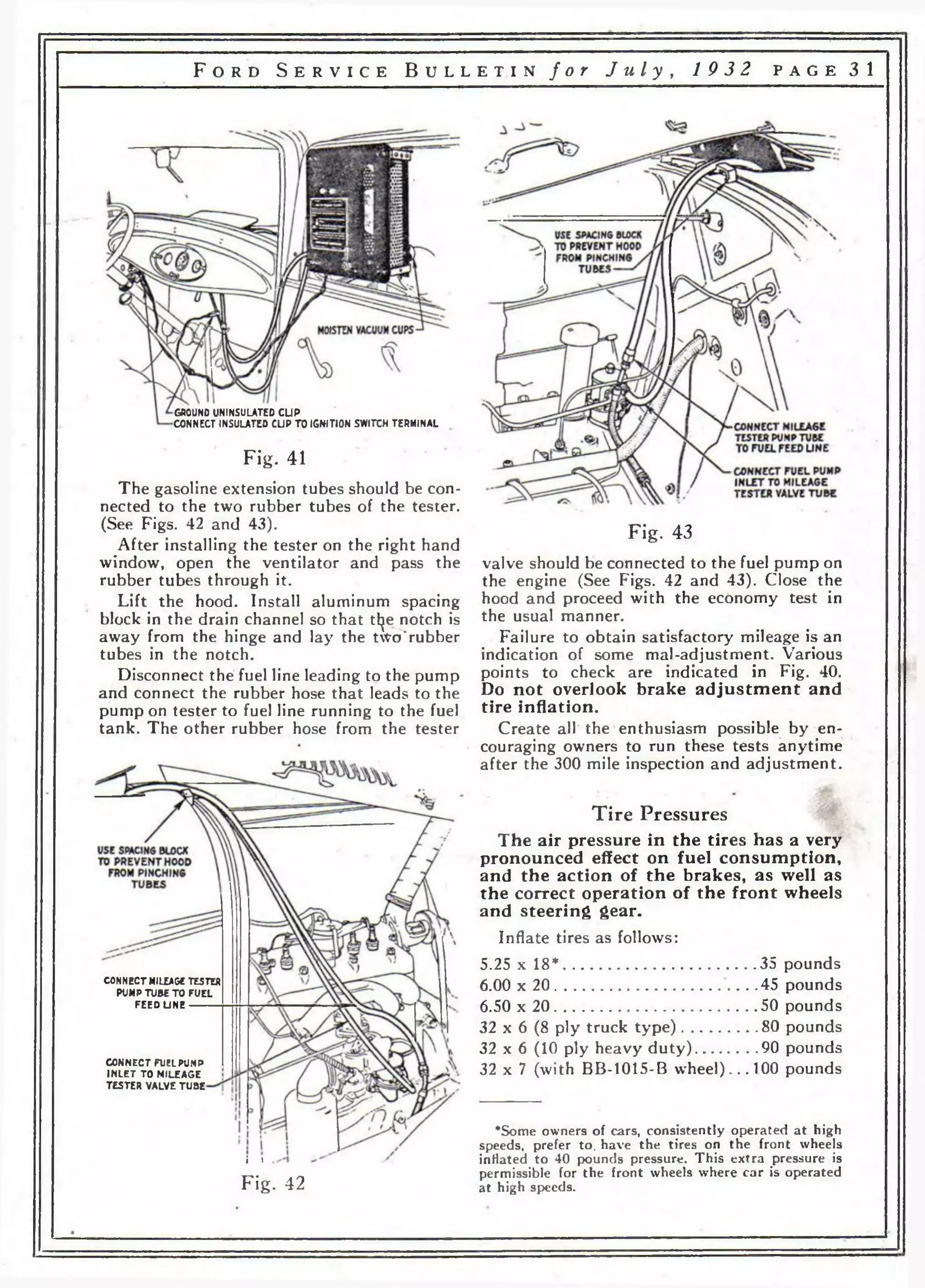
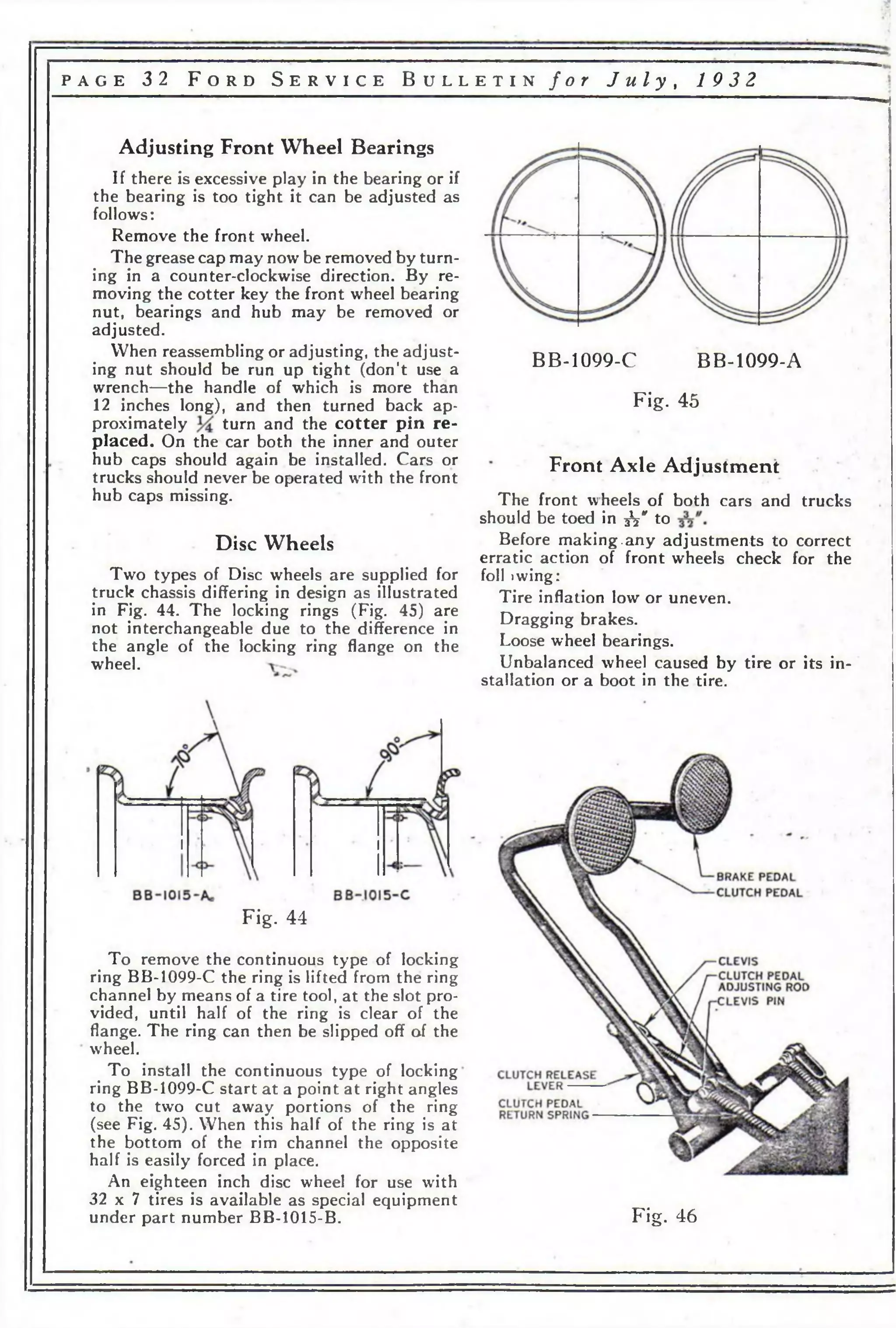
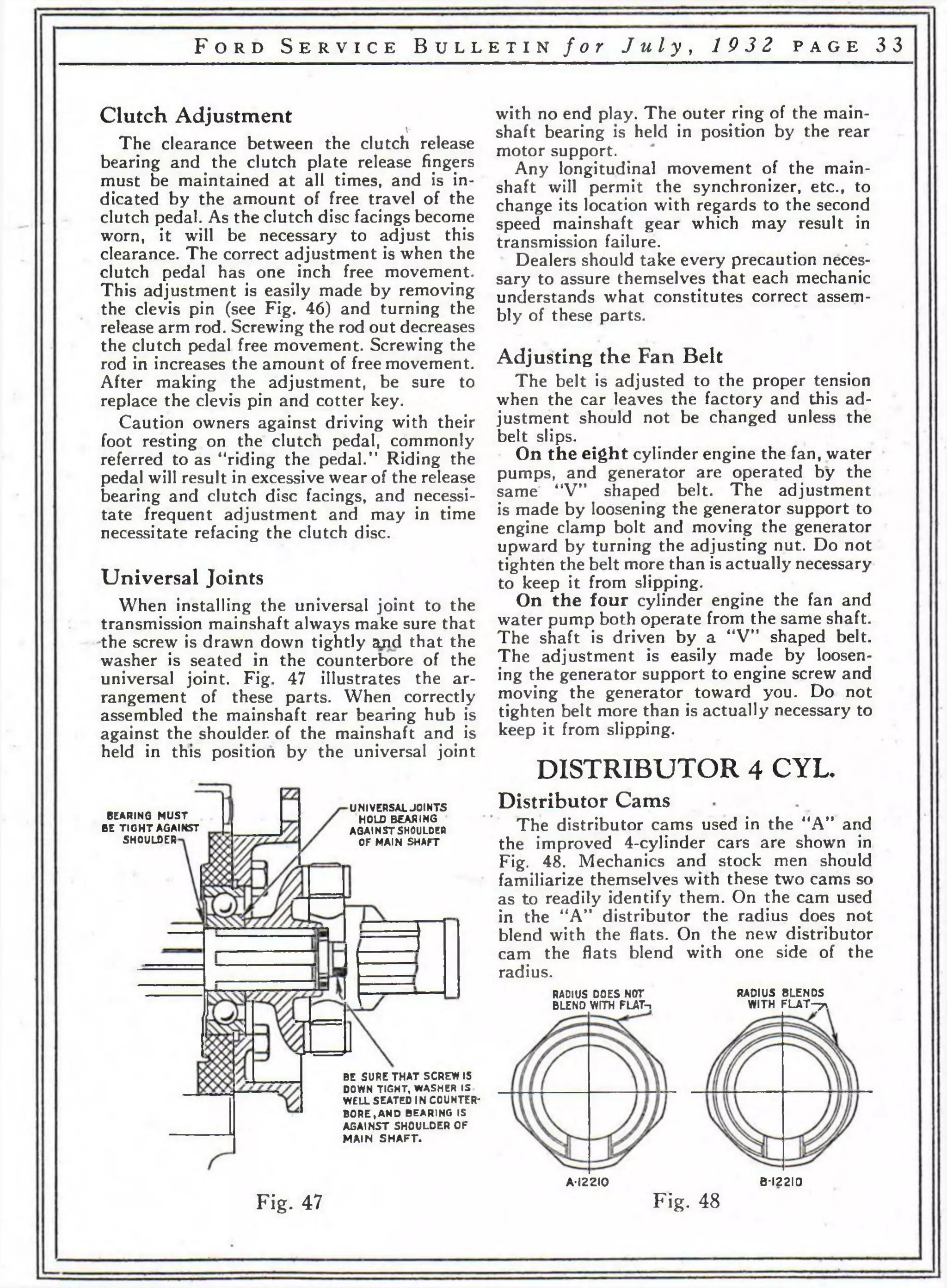
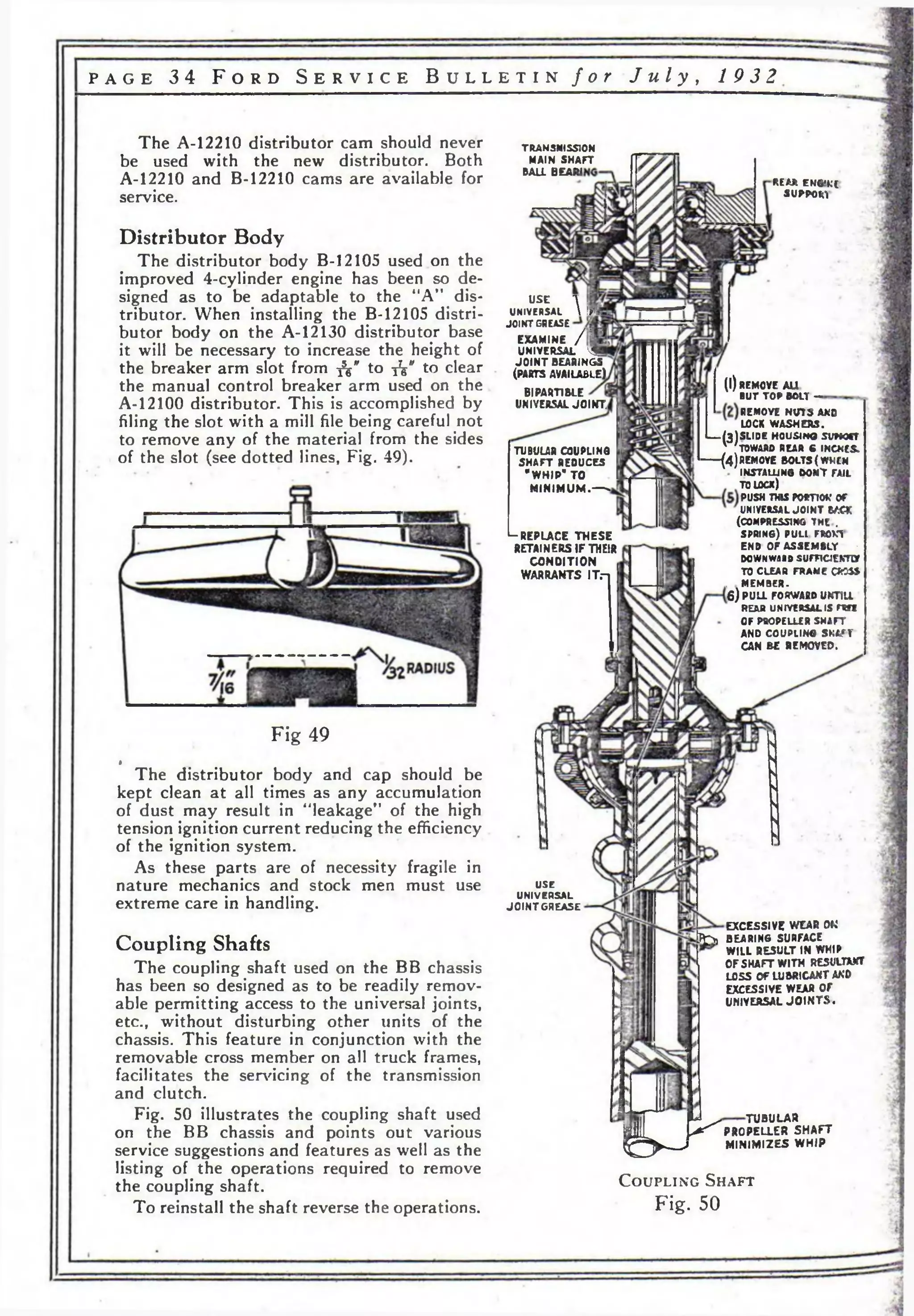
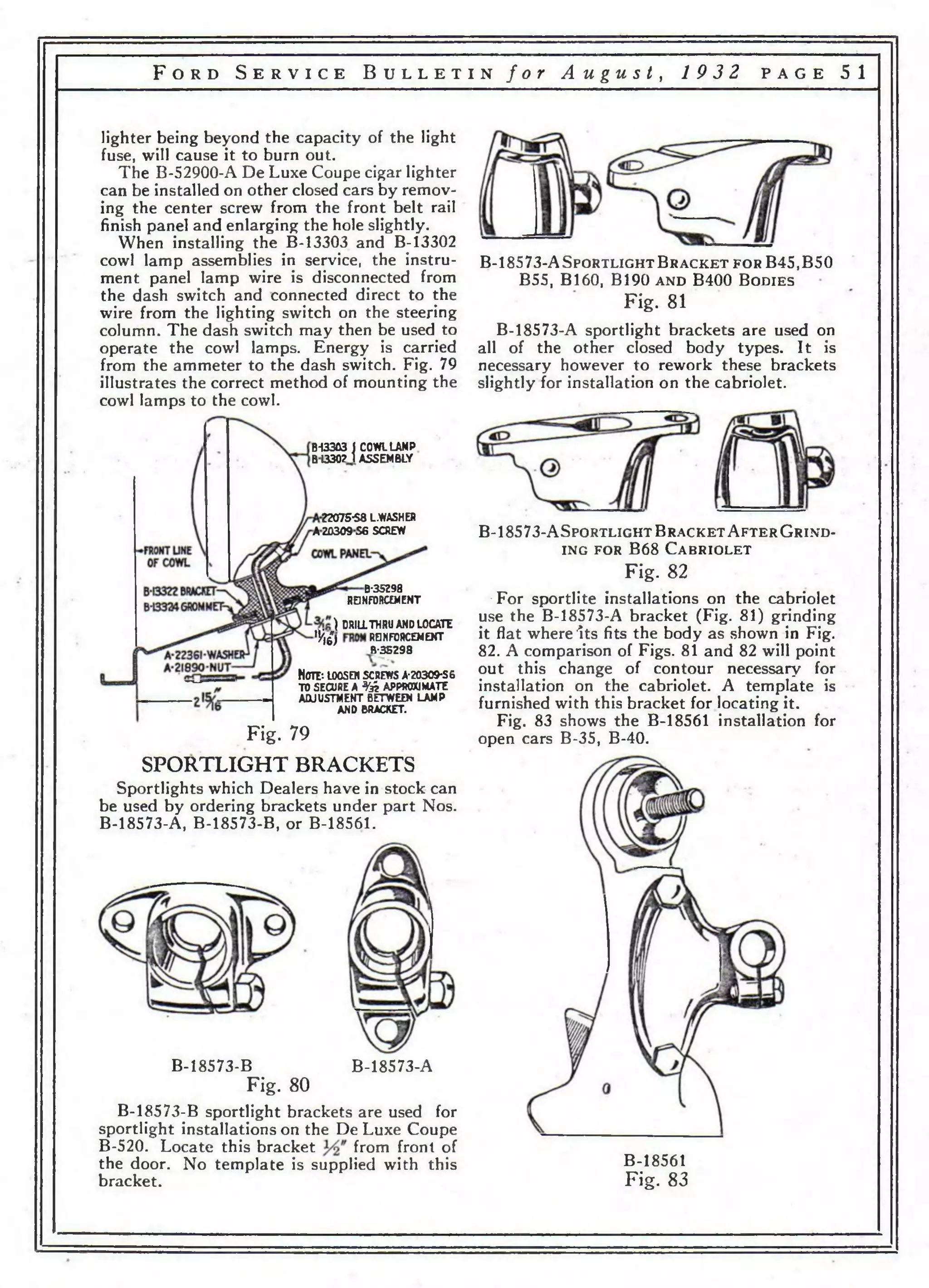
I l x f l 
к/Ts Л . U , 4,*. ?•» 
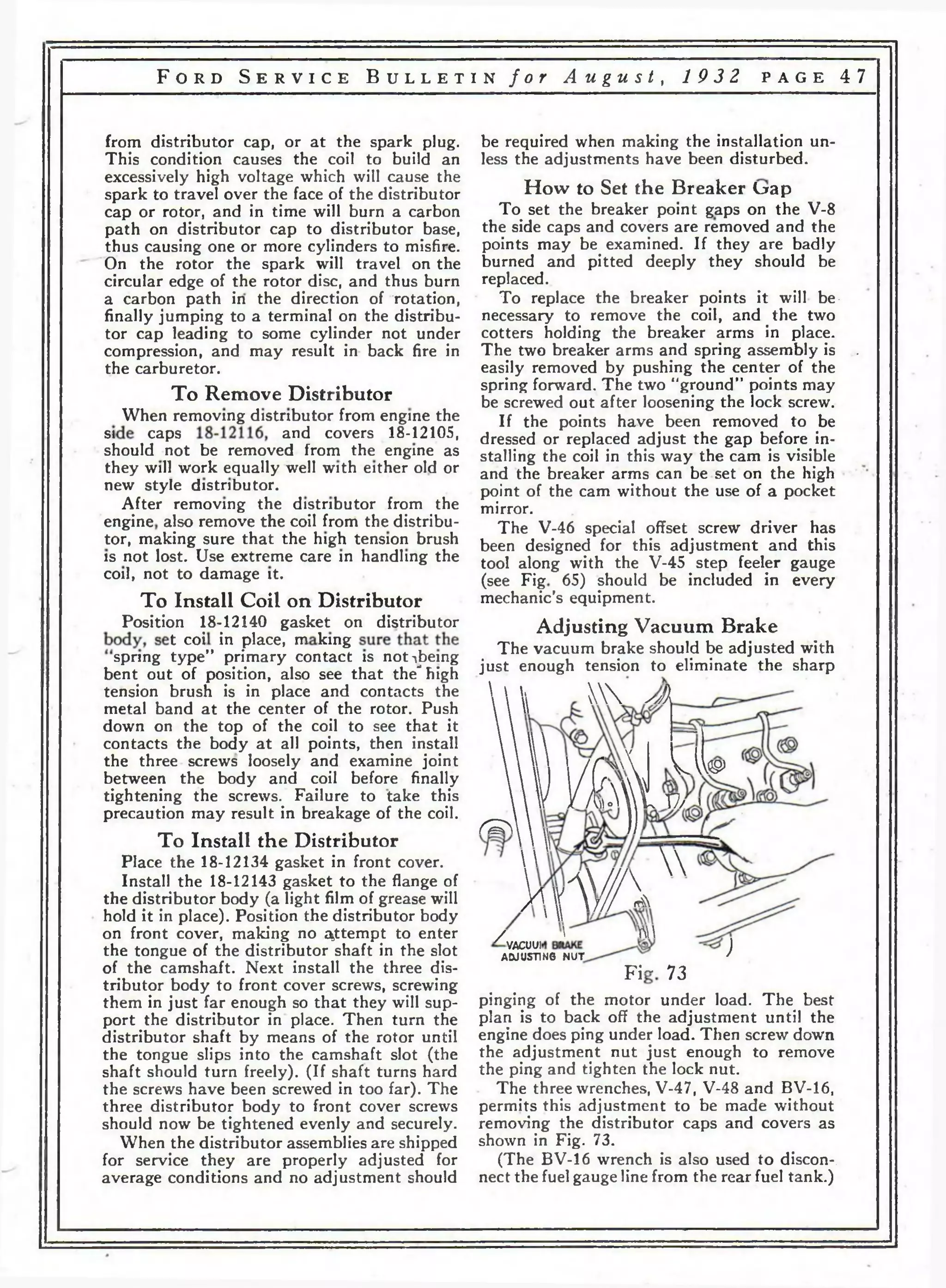
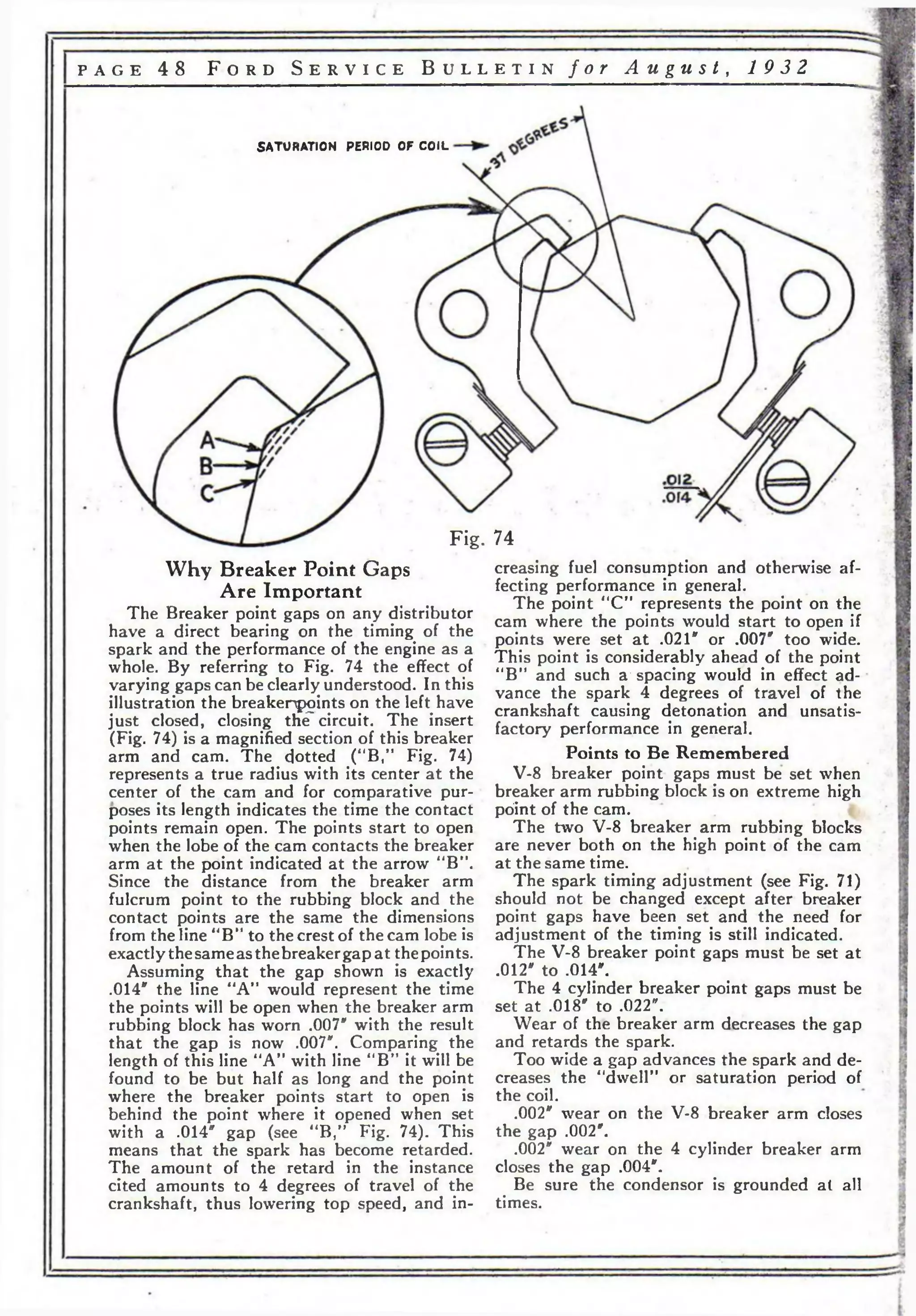
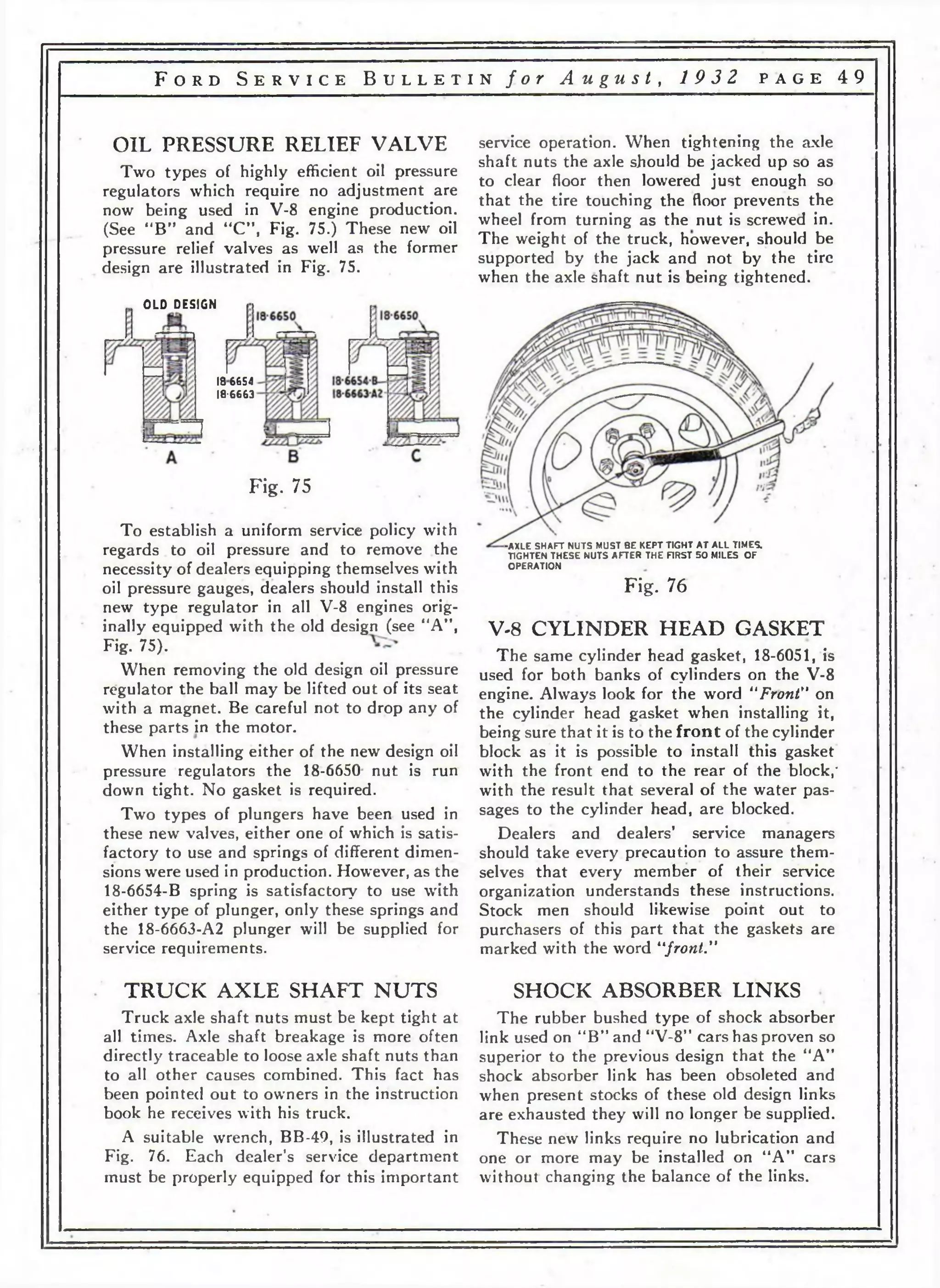
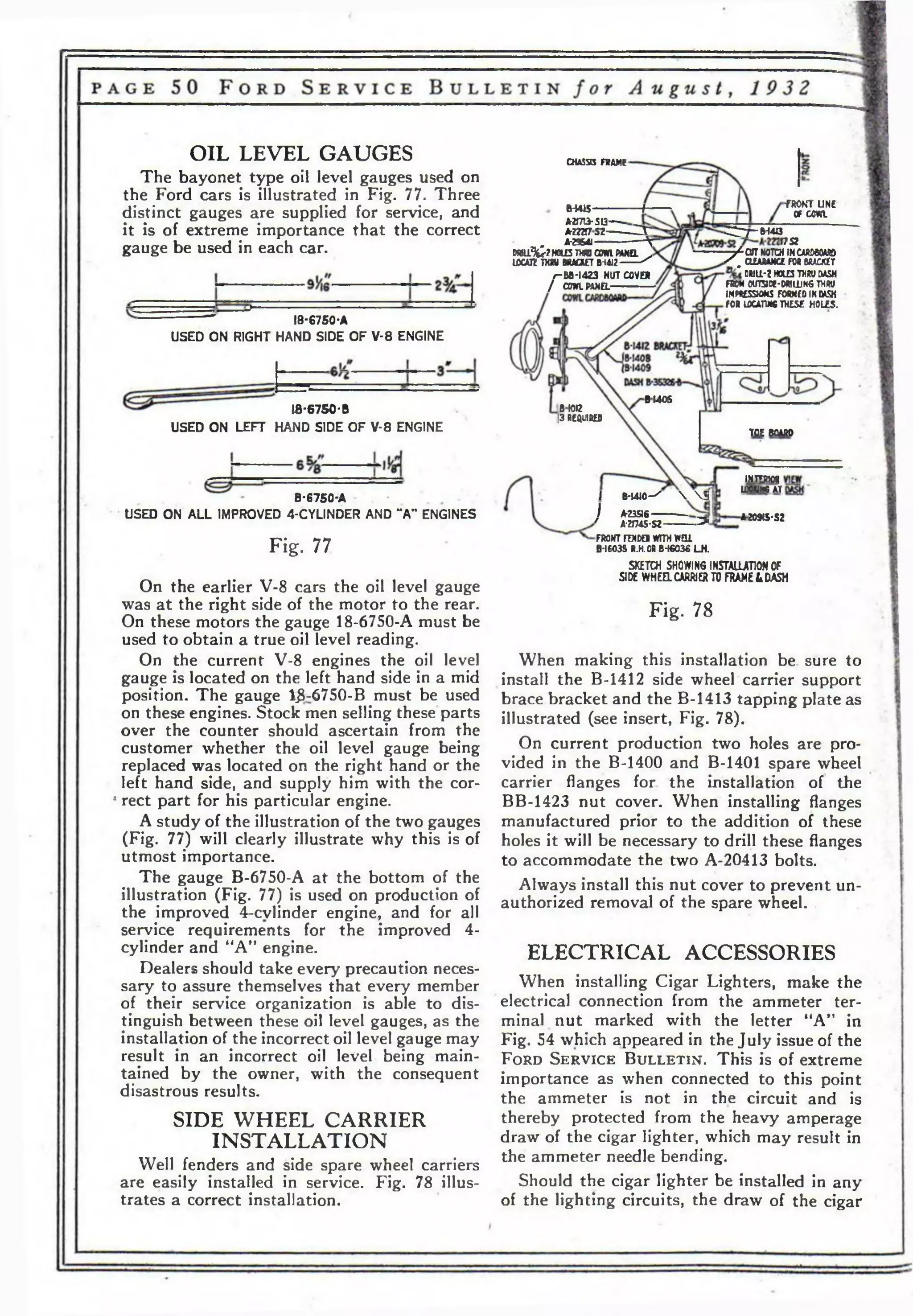
Ш Ш 
■фj?rT-^^SzL 
I FORD MOTOR: COMP А 
'»£4*фМ! * ж Д д д о 
^ ‘ r . r  T 7 A' T > T > A T ) T V T TV Т Т Л
Vol. 13 June 1932 No. I 
P r e l im i n a r y Se r vi c e 
I n s t r u c t i o n s 
F O R T H E 
FORD V-8 
and Im p ro v ed 4 'C y lin d e r Cars 
and Trucks 
This issue of the “ Ford Service Bulletin” contains information 
necessary for the correct servicing of the Ford Cars and Trucks— 
read it carefully. 
See that all mechanics in your organization understand each 
of the adjustments and service operations thoroughly. 
This issue contains complete information about the following: 
Page 
Electrical System....................16 
Distributor—V-8..................... 16 
Distributor—4-Cyl.................. 21 
4-Cyl. Engine M o u n tin g .. .22 
Lubrication Maintenance. .24 
Brakes............................ 
Page 
........ 2 
Carburetor—V-8......... ........ 5 
Carburetor—4-Cyl.... ........ 8 
Fuel Pumps ................... ........ 11 
Fuel Gauge................... ........ 13
p a g e 2 F o r d S e r v i c e B u l l e t i n f o r J u n e , 1 9 3 2 
BRAKES 
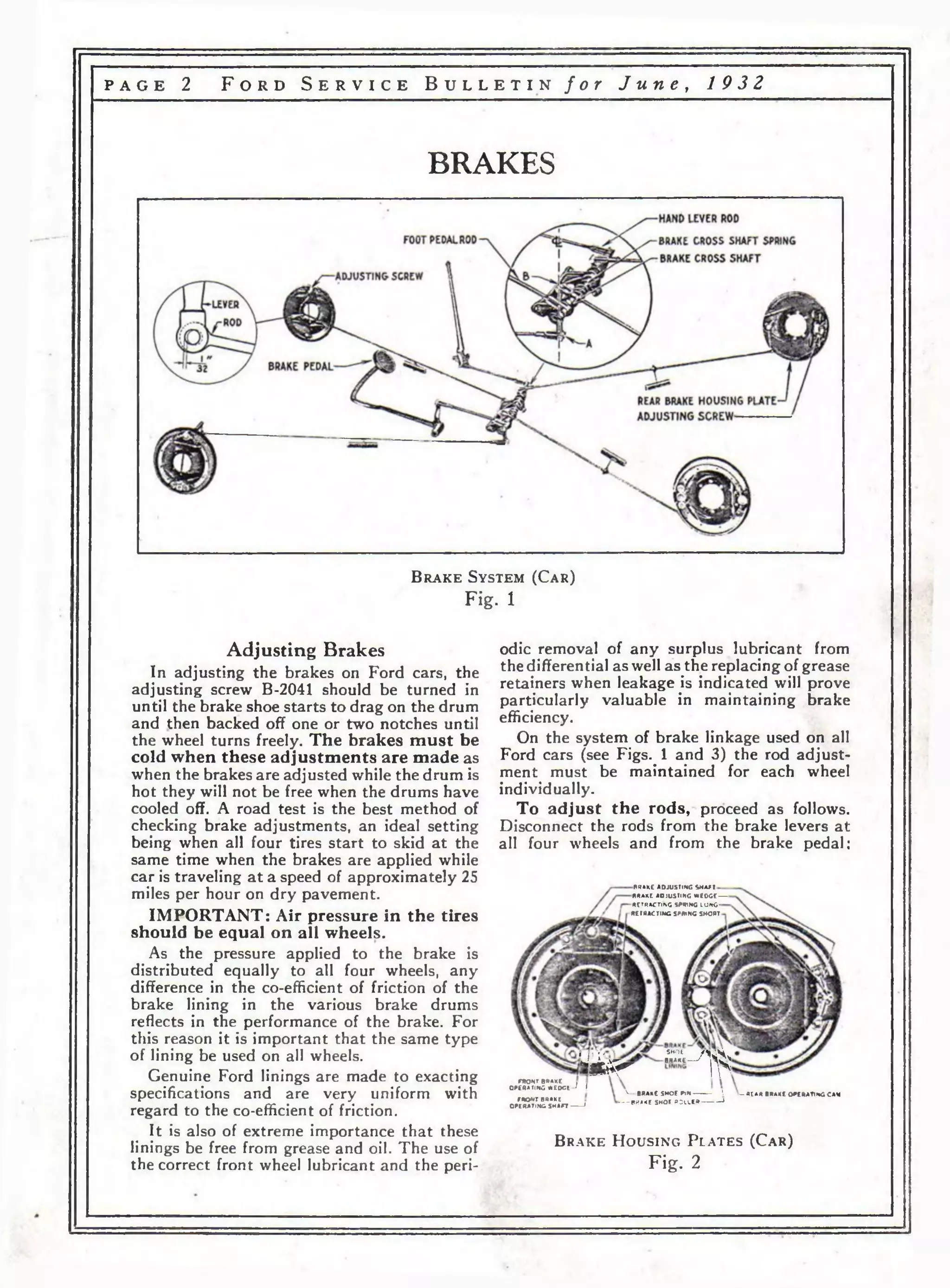
B r a k e S y s t em (C a r ) 
Fig. 1 
Adjusting Brakes 
In adjusting the brakes on Ford cars, the 
adjusting screw B-2041 should be turned in 
until the brake shoe starts to drag on the drum 
and then backed off one or two notches until 
the wheel turns freely. The brakes must be 
cold when these adjustments are made as 
when the brakes are adjusted while the drum is 
hot they will not be free when the drums have 
cooled off. A road test is the best method of 
checking brake adjustments, an ideal setting 
being when all four tires start to skid at the 
same time when the brakes are applied while 
car is traveling at a speed of approximately 25 
miles per hour on dry pavement. 
IMPORTANT: Air pressure in the tires 
should be equal on all wheels. 
As the pressure applied to the brake is 
distributed equally to all four wheels, any 
difference in the co-efficient of friction of the 
brake lining in the various brake drums 
reflects in the performance of the brake. For 
this reason it is important that the same type 
of lining be used on all wheels. 
Genuine Ford linings are made to exacting 
specifications and are very uniform with 
regard to the co-efificient of friction. 
It is also of extreme importance that these 
linings be free from grease and oil. The use of 
the correct front wheel lubricant and the peri­odic 
removal of any surplus lubricant from 
the differential as well as the replacing of grease 
retainers when leakage is indicated will prove 
particularly valuable in maintaining brake 
efficiency. 
On the system of brake linkage used on all 
Ford cars (see Figs. 1 and 3) the rod adjust­ment 
must be maintained for each wheel 
individually. 
To adjust the rods, proceed as follows. 
Disconnect the rods from the brake levers at 
all four wheels and from the brake pedal; 
PRAKE ADJUSTING S H A f t 
BRAKE ADJUSTING WEOGE------- 
RETRACTING SPRING LO N G-RETMACTiNG 
SPRING SHORT 
. г - SMOt /44* J . - 1 , 8ЯАКС f | Л О ъш & Г Гп 
т о HT BRAKE I , 
OPERATING Л ЕО О Е 1 I 
кктеиАке 
OPERATING S H A F T ---------' 
v _ BRAKE SHOE P lN -------------  — «E A R BRAKE 0 »E »A T t i «G CAM 
BRAKE SMOt R O L L ER ----------------» 
B r a k e H o u s i n g P l a t e s ( C a r ) 
Fig. 2
FRONT BRAKE PEDAL 
SHAFT 
— REAR BRAKE 
ADJUSTING SCREW 
FRONT BRAKE ADJUSTING SCREW 
SERVICE BRAKE CROSS SHAFT 
HAND BRAKE CROSS SHAFT 
SERVICE BRAKE SHOE 
REAR BRAKE HOUSING PLATE 
HANO BRAKE SHOE 
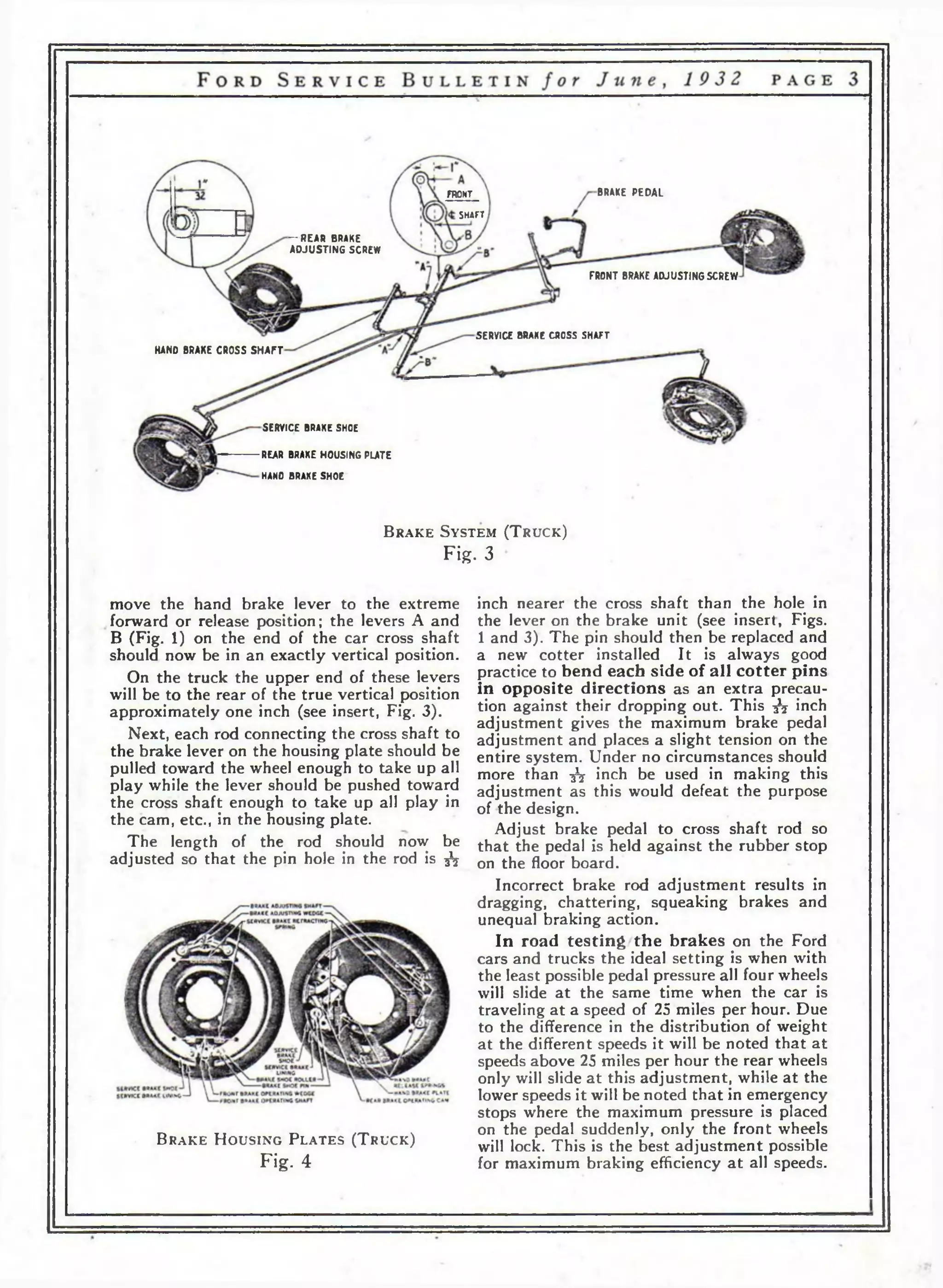
B r a k e S y s t e m ( T r u c k ) 
Fig. 3 
move the hand brake lever to the extreme 
forward or release position; the levers A and 
В (Fig. 1) on the end of the car cross shaft 
should now be in an exactly vertical position. 
On the truck the upper end of these levers 
will be to the rear of the true vertical position 
approximately one inch (see insert, Fig. 3). 
Next, each rod connecting the cross shaft to 
the brake lever on the housing plate should be 
pulled toward the wheel enough to take up all 
play while the lever should be pushed toward 
the cross shaft enough to take up all play in 
the cam, etc., in the housing plate. 
The length of the rod should now be 
adjusted so that the pin hole in the rod is fa 
B r a k e H o u s i n g P l a t e s ( T r u c k ) 
Fig. 4 
inch nearer the cross shaft than the hole in 
the lever on the brake unit (see insert, Figs. 
1 and 3). The pin should then be replaced and 
a new cotter installed It is always good 
practice to bend each side of all cotter pins 
in opposite directions as an extra precau­tion 
against their dropping out. This fa inch 
adjustment gives the maximum brake pedal 
adjustment and places a slight tension on the 
entire system. Under no circumstances should 
more than fa inch be used in making this 
adjustment as this would defeat the purpose 
of the design. 
Adjust brake pedal to cross shaft rod so 
that the pedal is held against the rubber stop 
on the floor board. 
Incorrect brake rod adjustment results in 
dragging, chattering, squeaking brakes and 
unequal braking action. 
In road testing the brakes on the Ford 
cars and trucks the ideal setting is when with 
the least possible pedal pressure all four wheels 
will slide at the same time when the car is 
traveling at a speed of 25 miles per hour. Due 
to the difference in the distribution of weight 
at the different speeds it will be noted that at 
speeds above 25 miles per hour the rear wheels 
only will slide at this adjustment, while at the 
lower speeds it will be noted that in emergency 
stops where the maximum pressure is placed 
on the pedal suddenly, only the front wheels 
will lock. This is the best adjustment possible 
for maximum braking efficiency at all speeds.
After washing cars, brakes should be 
tested and if the lining has become wet the 
owner should be advised that the braking 
efficiency is below normal until the brakes 
have dried. Avoid allowing the car to set over 
night with hand brake set if the brakes are wet. 
Overhauling the Brakes 
% 
When disassembling the brake shoe, such 
practices as are apt to distort the shoe should 
be avoided. The rib of the brake shoe should 
always be supported when removing the brake 
shoe pin. These pins are pressed into the shoe 
tightly and if they are driven out with the 
rib unsupported, serious distortion of the arc 
of the shoe is liable to result. 
Installing Lining 
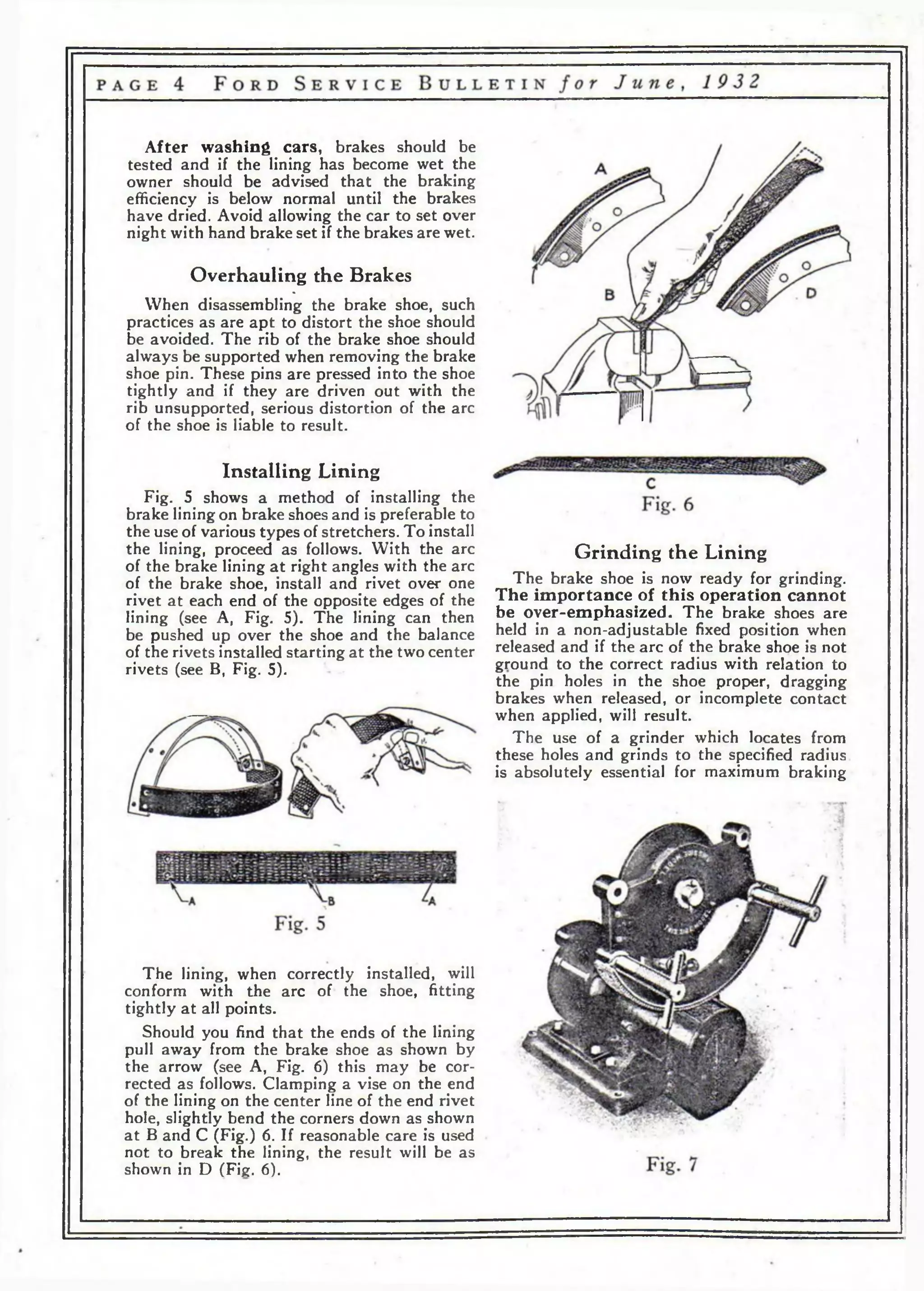
Fig. 5 shows a method of installing the 
brake lining on brake shoes and is preferable to 
the use of various types of stretchers. To install 
the lining, proceed as follows. With the arc 
of the brake lining a t right angles with the arc 
of the brake shoe, install and rivet over one 
rivet at each end of the opposite edges of the 
lining (see A, Fig. 5). The lining can then 
be pushed up over the shoe and the balance 
of the rivets installed starting at the two center 
rivets (see B, Fig. 5). 
Grinding the Lining 
The brake shoe is now ready for grinding. 
The importance of this operation cannot 
be over-emphasized. The brake shoes are 
held in a non-adjustable fixed position when 
released and if the arc of the brake shoe is not 
ground to the correct radius with relation to 
the pin holes in the shoe proper, dragging 
brakes when released, or incomplete contact 
when applied, will result. 
The use of a grinder which locates from 
these holes and grinds to the specified radius 
is absolutely essential for maximum braking 
The lining, when correctly installed, will 
conform with the arc of the shoe, fitting 
tightly at all points. 
Should you find that the ends of the lining 
pull away from the brake shoe as shown by 
the arrow (see A, Fig. 6) this may be cor­rected 
as follows. Clamping a vise on the end 
of the lining on the center line of the end rivet 
hole, slightly bend the corners down as shown 
at В and С (Fig.) 6. If reasonable care is used 
not to break the lining, the result will be as 
shown in D (Fig. 6).
F o r d S e r v i c e B u l l e t i n f o r J u n e , 1 9 3 2 p a g e 5 
efficiency. Such a grinder may be secured from 
the K. R. Wilson Co. of Buffalo, N. Y., with 
attachments for the eleven, twelve and 
fourteen inch diameter brakes (see Fig. 7). 
When using this grinder the gauge for 
setting the height should always be used 
to avoid grinding the lining too deeply. 
Genuine Ford linings only should be used as 
they have been developed for the Ford car and 
the Ford brake drum and are manufactured 
under the most exacting specifications. 
Checking for Dragging Brakes 
Many mechanics keep on hand a front and 
rear hub and drum assembly which has been 
cut out to permit the use of a feeler gauge 
between the brake shoe and the drum. This is 
a very good method of checking for dragging 
brakes as it removes the human element or 
guesswork which is necessary when they are 
checked by feel alone. In using this method of 
checking a .005" feeler should pass clearly be­tween 
the lining and the drum a t all points. 
Chattering brakes are usually caused by 
either incorrect rod adjustment, oil soaked 
linings, loose wheel or spindle bearings or 
brake housing plates loose on the axle. 
Squeaking brakes are usually caused by 
incorrectly ground brake shoes or faulty ad­justment 
of the brake or oil soaked linings. 
CARBURETOR — V-8 
The carburetor used on the V-8 cars is of the 
down draft type particularly adapted to the 
Ford 8 cylinder engine. The carburetor size is 
114V with an air capacity ample for even the 
highest speed operation. The carburetor is 
made of fine materials manufactured with a 
high degree of precision which assures an 
accurately balanced fuel-air mixture at all 
times, regardless of engine speed, and instant 
response to foot throttle movement. To 
properly service or adjust the carburetor, a 
complete understanding of its operation is 
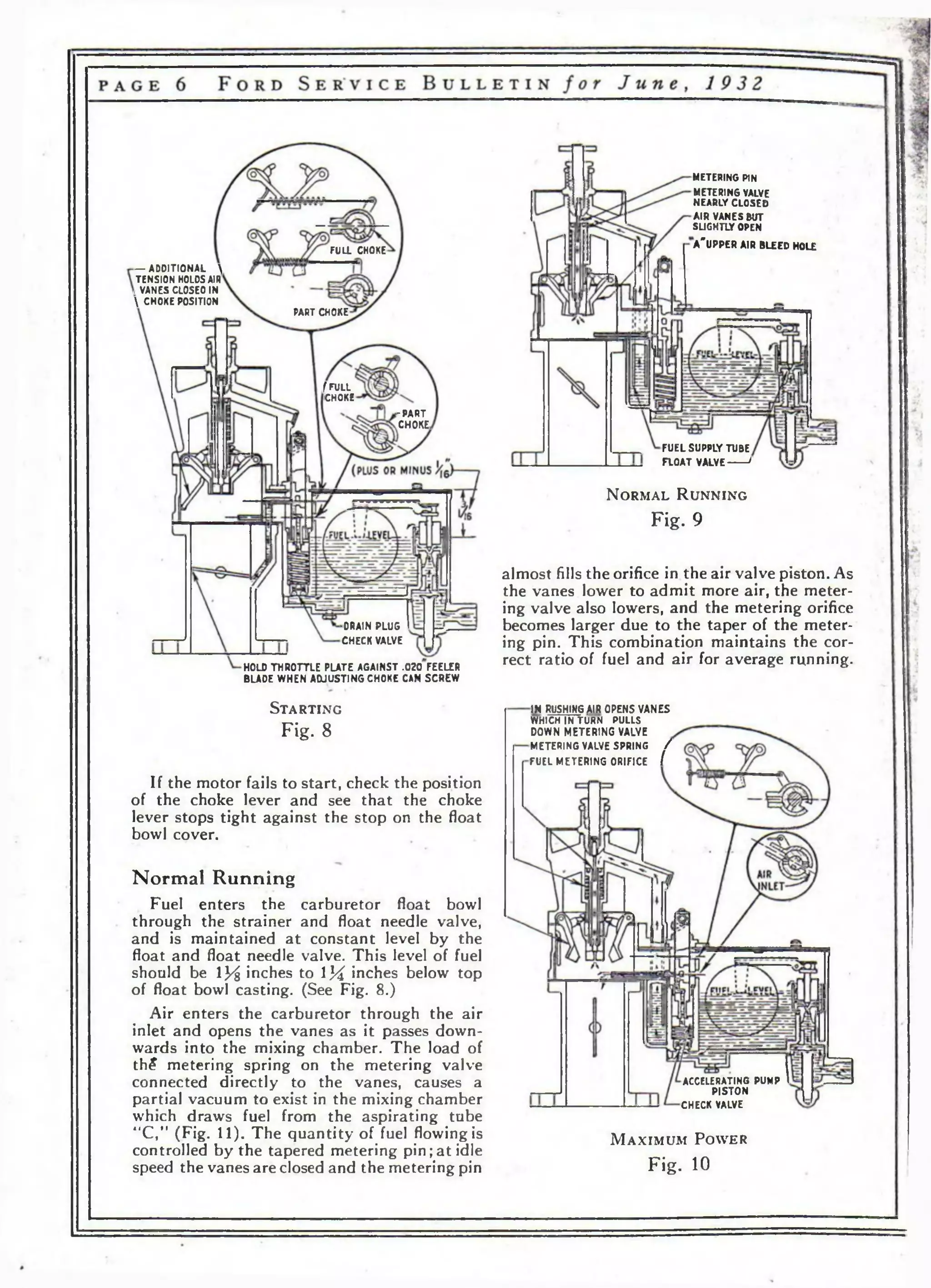
essential. Figs. 8 to 10 are diagrams of the 
V-8 carburetor which will permit the follow­ing 
of the various passages from the float bowl 
to the carburetor throat from which it is 
carried to the intake manifold and cylinders. 
The carburetor consists chiefly of two 
units, namely: 
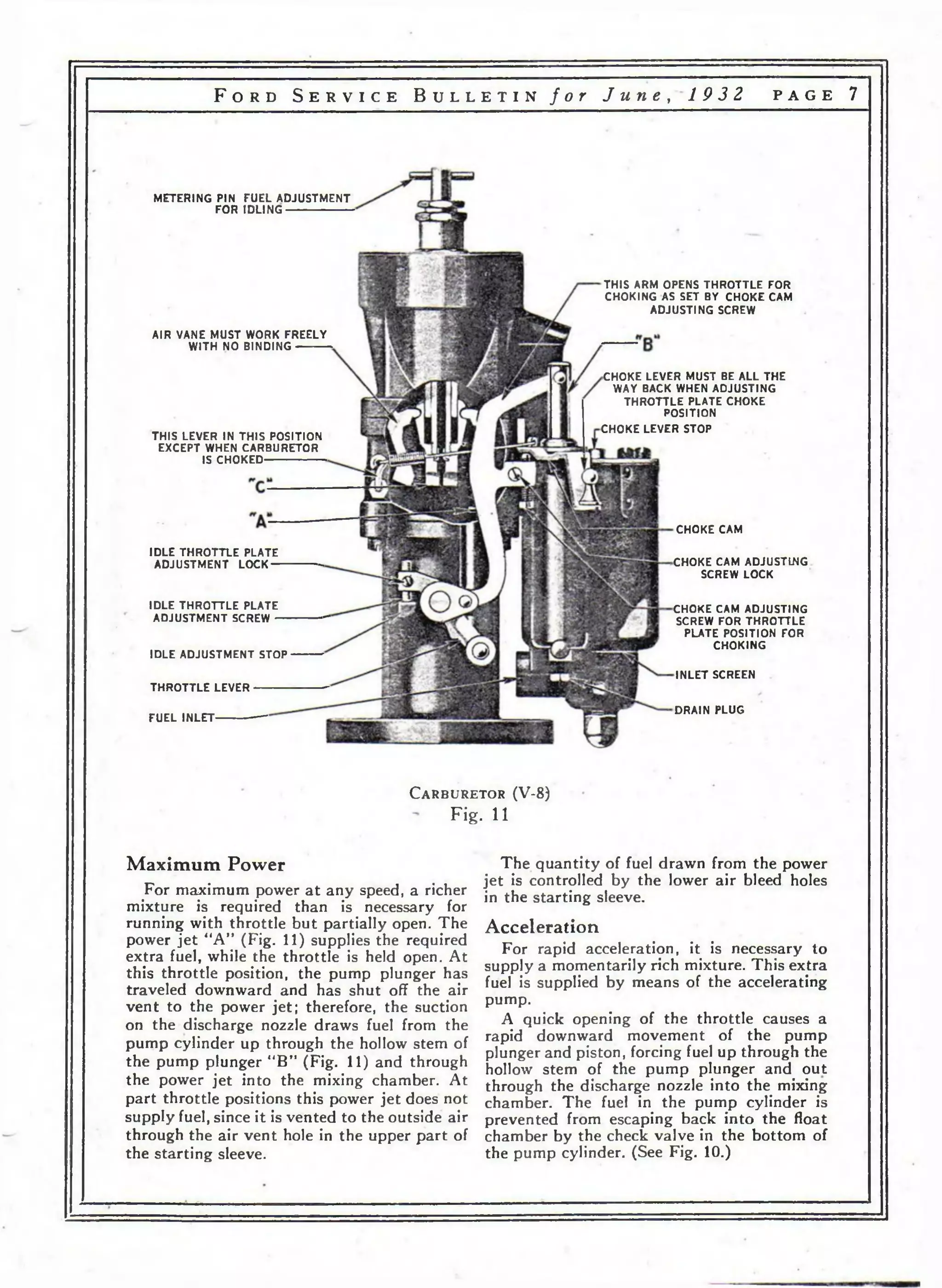
1. The Main Metering Unit consists of a 
pair of air valves or vanes, hinged a t their 
upper ends and opening downward to admit 
air to the mixing chamber. These vanes have 
fingers which engage a central aspirating tube 
(see “C,” Fig. 11), lowering it as the vanes 
open. This aspirating tube is attached to a 
spring-loaded hollow stem carrying the fuel 
metering orifice in its upper end. An adjust­able 
tapered metering pin projects into this 
orifice. 
2. The Auxiliary Unit combines an auxil­iary 
power jet (“A,” Fig. 11), an accelerating 
pump (Fig. 10), and a priming passage for 
starting. The operation of the auxiliary unit 
is controlled by the registering of progressively 
located ports in the starting sleeve which line 
up with passages in the main body. The start­ing 
sleeve rotates with the choke lever; the 
pump plunger “B,” Fig. 11, and piston move 
downward as the throttle is opened. 
Starting 
To start a cold motor in cold weather, the 
choke control button should be pulled out to 
its limit and the throttle left in a closed posi­tion. 
This rotates the starting sleeve in the 
throttle body and lines up the primer passage 
with a hole in the wall of the starting sleeve, 
allowing fuel to be drawn into the manifold 
directly from the float chamber through the 
pump cylinder and hollow stem of the pump 
plunger. The throttle button must be in so 
that a strong suction will be created below the 
throttle plate to draw fuel through the prim­ing 
passage. 
Actually, the throttle plate will be opened 
slightly by the kicker rod when the choke 
button is pulled out, but this action is auto­matic 
and allows just enough air to pass the 
throttle to insure good starting. 
In extremely cold weather, starting can 
be aided by giving several quick strokes of the 
accelerator pedal after the choke control has 
been pulled out. By this action the acceler­ating 
pump forces fuel through the primer 
passage into the manifold and so assists 
starting. 
After the motor has started, push the choke 
control button part way in; the motor will 
then run on a richer mixture than normal. 
Experience will show the correct place to 
set the dash control, which will depend on 
temperature. As the motor warms up, the 
dash control should be pushed farther in, and 
after the motor has become warm the dash 
control should be pushed in to the limit of its 
travel.
METERING PIN 
METERIN6 YALYE 
NEARLY CLOSED 
AIR VANES BUT 
SUGKTLY OPEN 
A'UPPER FULL CHOKE AIR BLEED HOLE 
— ADDITIONAL  
TENSION HOLDS AIR 
, VANES CLOSEO IN 
 CHOKE POSITION 
PART CHOKE 
f FULL 
CHOKE 
-PART 
CHOKE. 
FUEL SUPPLY TUBE 
FLOAT VALVE--------* 
N o rm a l R u n n in g 
Fig. 9 
almost fills the orifice in the air valve piston. As 
the vanes lower to admit more air, the meter­ing 
valve also lowers, and the metering orifice 
becomes larger due to the taper of the meter­ing 
pin. This combination maintains the cor­rect 
ratio of fuel and air for average running. 
■DRAIN PLUG 
CHECK VALVE 
HOLD THROTTLE PLATE AGAINST .020 FEELER 
BLADE WHEN AOJUSTING CHOKE CAN SCREW 
S t a r t i n g 
Fig. 8 
IN RUSHING |MR OPENS VANES 
WHICH IN TURN PULLS 
DOWN METERING VALYE 
METERING VALVE SPRING / 
FUEL METERING ORIFICE I 
If the motor fails to start, check the position 
of the choke lever and see that the choke 
lever stops tight against the stop on the float 
bowl cover. 
Normal Running 
Fuel enters the carburetor float bowl 
through the strainer and float needle valve, 
and is maintained at constant level by the 
float and float needle valve. This level of fuel 
should be 1% inches to  x/ i inches below top 
of float bowl casting. (See Fig. 8.) 
Air enters the carburetor through the air 
inlet and opens the vanes as it passes down­wards 
into the mixing chamber. The load of 
th? metering spring on the metering valve 
connected directly to the vanes, causes a 
partial vacuum to exist in the mixing chamber 
which draws fuel from the aspirating tube 
“C,M (Fig. 11). The quantity of fuel flowing is 
controlled by the tapered metering pin;at idle 
speed the vanes are closed and the metering pin 
ACCELERATING PUMP 
PISTON 
CHECK VALVE 
M a x im u m P o w e r 
Fig. 10
F o r d S e r v i c e B u l l e t i n f o r J u n e , 1 9 3 2 p a g e 7 
METERING PIN FUEL ADJUSTMENT 
FOR IDLING 
AIR VANE MUST WORK FREELY 
WITH NO BINDING 
THIS ARM OPENS THROTTLE FOR 
CHOKING AS SET BY CHOKE CAM 
ADJUSTING SCREW 
THIS LEVER IN THIS POSITION 
EXCEPT WHEN CARBURETOR 
IS CHOKED 
CHOKE LEVER MUST BE ALL THE 
WAY BACK WHEN ADJUSTING 
THROTTLE PLATE CHOKE 
POSITION 
CHOKE LEVER STOP 
IDLE THROTTLE PLATE 
ADJUSTMENT LOCK 
IDLE THROTTLE PLATE 
ADJUSTMENT SCREW 
IDLE ADJUSTMENT STOP 
THROTTLE LEVER 
FUEL INLET 
CHOKE CAM 
CHOKE CAM ADJUSTLNG 
SCREW LOCK 
CHOKE CAM ADJUSTING 
SCREW FOR THROTTLE 
PLATE POSITION FOR 
CHOKING 
INLET SCREEN 
DRAIN PLUG 
C a r b u r e t o r (V-8 ) 
Fig. 11 
Maximum Power 
For maximum power at any speed, a richer 
mixture is required than is necessary for 
running with throttle but partially open. The 
power jet “A” (Fig. 11) supplies the required 
extra fuel, while the throttle is held open. At 
this throttle position, the pump plunger has 
traveled downward and has shut off the air 
vent to the power jet; therefore, the suction 
on the discharge nozzle draws fuel from the 
pump cylinder up through the hollow stem of 
the pump plunger “B” (Fig. 11) and through 
the power jet into the mixing chamber. At 
part throttle positions this power jet does not 
supply fuel, since it is vented to the outside air 
through the air vent hole in the upper part of 
the starting sleeve. 
The quantity of fuel drawn from the power 
jet is controlled by the lower air bleed holes 
in the starting sleeve. 
Acceleration 
For rapid acceleration, it is necessary to 
supply a momentarily rich mixture. This extra 
fuel is supplied by means of the accelerating 
pump. 
A quick opening of the throttle causes a 
rapid downward movement of the pump 
plunger and piston, forcing fuel up through the 
hollow stem of the pump plunger and out 
through the discharge nozzle into the mixing 
chamber. The fuel in the pump cylinder is 
prevented from escaping back into the float 
chamber by the check valve in the bottom of 
the pump cylinder. (See Fig. 10.)
p a g e 8 F o r d S e r v i c e B u l l e t i n f o r J u n e , 19 3 2 
In general, for steady driving conditions up 
to 65 miles per hour on level roads, the fuel 
is all supplied from the aspirating tube. When 
the throttle is opened suddenly, an additional 
charge of fuel is supplied from the accelerating 
pump; and, if the throttle is held open as for 
hard pulling or high speed, extra fuel con­tinues 
to flow from the pump discharge nozzle 
through the power jet “A”. 
Adjustment 
The idle speed of the engine should be set 
by means of the throttle plate adjusting screw 
to a speed equivalent to five miles per hour 
(high gear). See Fig. 11. 
When the metering pin is correctly adjusted 
at idle speed, the carburetor is set for maxi­mum 
engine performance, and usually no 
other adjustments are required. 
Metering Pin Adjustment 
Normally, only one adjustment of the 
carburetor is required, this adjustment being 
the fuel adjustment for idling. The metering 
pin is raised or lowered by screwing it into 
or out of the fuel orifice. The metering pin is 
properly adjusted when the car leaves the 
factory, but it will require readjusting 
after the breaking-in period. 
This adjustment should be made a t the 300 
mile inspection. Be sure the motor is well 
warmed up, and there are no air leaks at 
manifold, (tighten screws) or windshield 
wiper or distributor vacuum line (tighten con­nections), 
then remove carburetor silencer, 
adjust the metering pin carefully a t idle speed. 
Turning the pin cloclcwise moves the pin 
CARBURETOR 
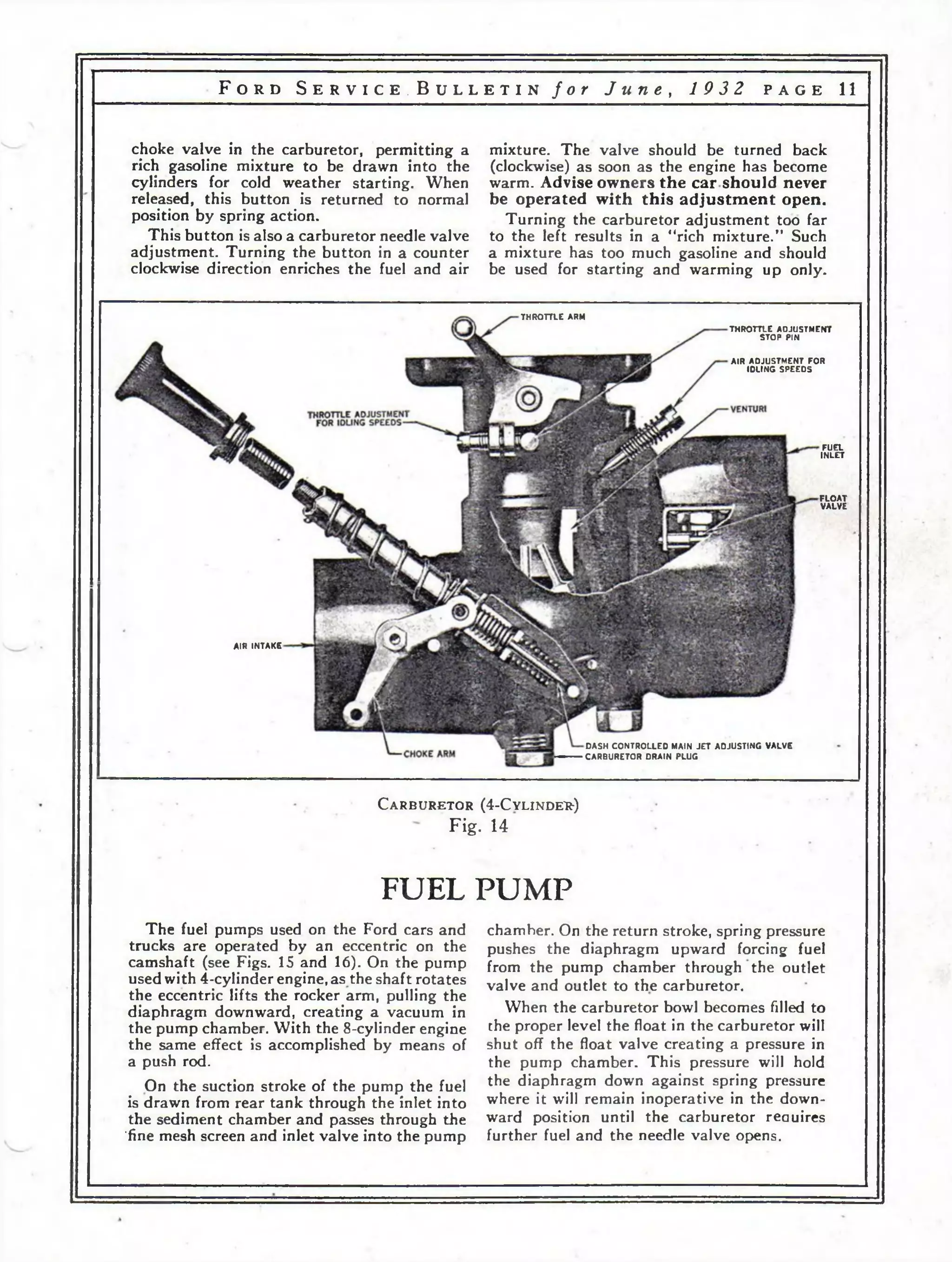
Fig. 14 shows the carburetor used on the 
4 cylinder motor. The carburetor size is 1}^". 
A power jet is employed which cuts in when 
the throttle butterfly is approximately two-thirds 
open. This jet slightly enriches the fuel 
air mixture when the car is operated at high 
speed or under heavy load. 
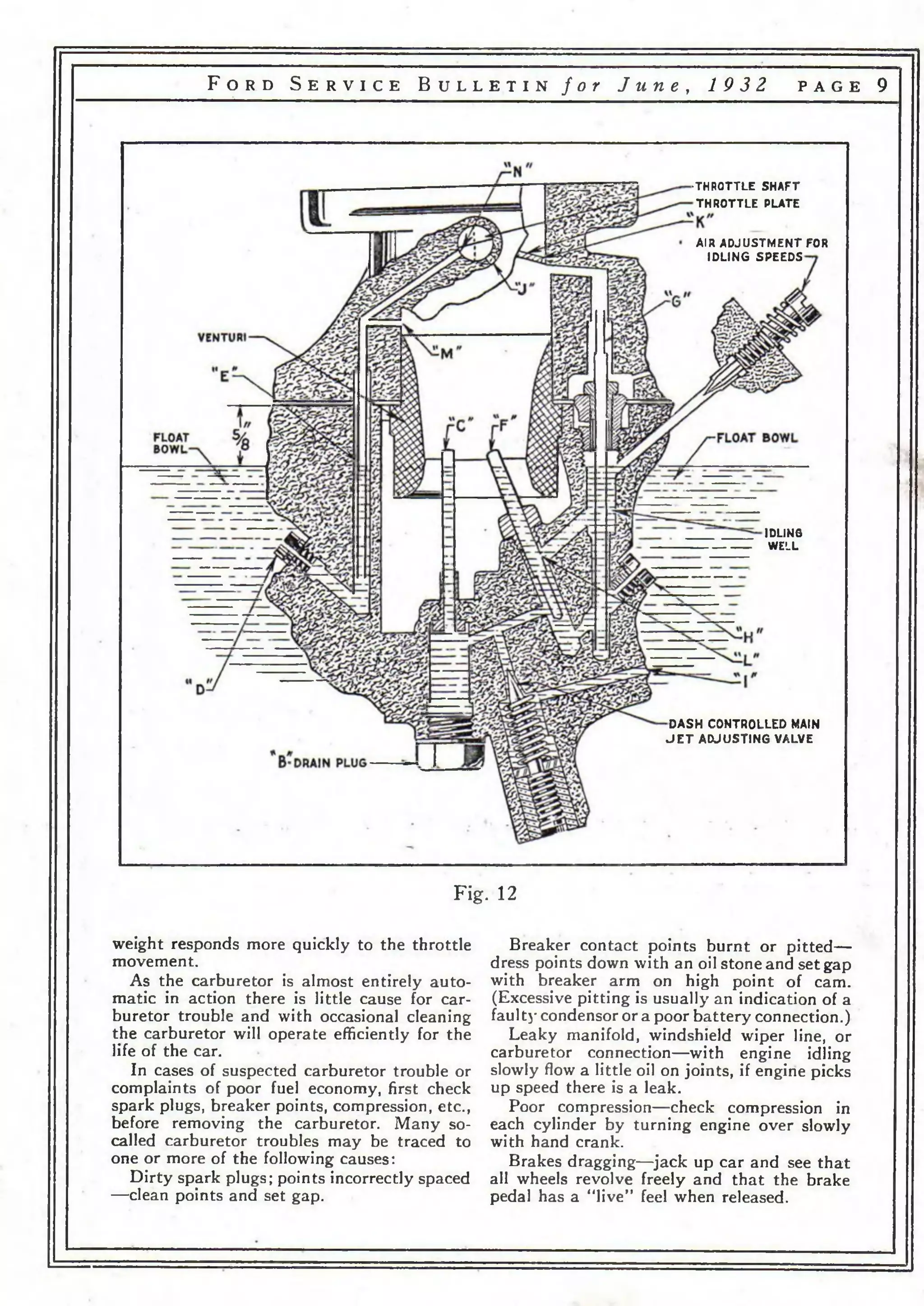
Fig. 12 is a diagram of the 4 cylinder car­buretor 
which will permit the following of the 
various passages from the float bowl to the 
carburetor throat from which it is carried to 
the intake manifold and cylinders. 
The same distinguishing symbols are used 
in both Fig. 12 and Fig. 13 so by referring to 
both of these figures a complete identification 
of each of these orifices may be made. 
When the throttle plate is less than two-thirds 
open the suction at “M ” (Fig. 12) 
downward into the orifice and makes the 
mixture leaner; turning it anti-clockwise in­creases 
the orifice and makes the mixture 
richer. 
Screw the adjustment down until the per­formance 
of the engine indicates that the 
mixture is too lean, then turn it back slowly, 
(allowing approximately 30 seconds at each 
setting to note the performance of the engine) 
until engine performance is again smooth. 
For initial setting for cold engine, screw 
down the metering pin until air vanes just 
start to open. Then turn back 5 full turns. 
Readjust after engine is warmed up. 
Throttle Plate Position for Starting 
Unless tampered with this adjustment will 
remain permanently correct. To check this 
adjustment, carburetor assembly would have 
to be removed then: insert a .020" feeler blade 
as shown in Fig. 8 and adjust position of 
throttle plate adjusting screw to maintain this 
throttle plate position when choke lever is 
all the way to rear and starting sleeve lug is 
against the stop provided on the float 
bowl cover. 
Warning: 
Most cases of suspected carburetor trouble 
resolve themselves into: under-inflated tires, 
dragging brakes, faulty ignition (check breaker 
point gap, with arm on high point of cam), 
check spark plug gaps, loss of compression 
(check with crank), air leak at manifold or 
vacuum lines (distributor and windshield 
wiper), or dirty carburetor silencer screeen 
(clean with gasoline, dry with compressed air, 
dip in engine oil and reinstall). 
4'CYLINDER 
draws air through the opening " J ” (see 
Figs. 12 and 13) by the "flat” on the throttle 
shaft and through the passage "N” (Fig. 12). 
When throttle shaft is rotated until the flat 
of the shaft is away from the opening “N” 
(as indicated by dotted line, Fig. 12), the shaft 
closes this opening thus shutting off this supply 
of air. With the air supply cut off the vacuum 
thus created causes the fuel to be lifted in the 
power jet tube “E” and discharged into the 
carburetor throat a t the opening “M.” 
An improvement has been made in the 
compensator tube by the addition of several 
holes through the side (see "L” , Fig. 12), 
which permit air to be drawn through the 
quill (after the idling well is emptied), thus 
forming an emulsion of air and fuel which 
vaporizes more readily and being lighter in
F o r d S e r v i c e B u l l e t i n f o r J u n e , 19 3 2 p a g e 9 
•THROTTLE SHAFT 
THROTTLE PLATE 
AIR ADJUSTMENT FOR 
IDLING SPEEDS 
IDLING 
WELL 
DASH CONTROLLED MAIN 
J E T ADJUSTING VALVE 
Fig. 12 
weight responds more quickly to the throttle 
movement. 
As the carburetor is almost entirely auto­matic 
in action there is little cause for car­buretor 
trouble and with occasional cleaning 
the carburetor will operate efficiently for the 
life of the car. 
In cases of suspected carburetor trouble or 
complaints of poor fuel economy, first check 
spark plugs, breaker points, compression, etc., 
before removing the carburetor. Many so-called 
carburetor troubles may be traced to 
one or more of the following causes: 
Dirty spark plugs; points incorrectly spaced 
—clean points and set gap. 
Breaker contact points burnt or pitted— 
dress points down with an oil stone and set gap 
with breaker arm on high point of cam. 
(Excessive pitting is usually an indication of a 
fault}' condensor or a poor battery connection.) 
Leaky manifold, windshield wiper line, or 
carburetor connection—with engine idling 
slowly flow a little oil on joints, if engine picks 
up speed there is a leak. 
Poor compression—check compression in 
each cylinder by turning engine over slowly 
with hand crank. 
Brakes dragging—jack up car and see that 
all wheels revolve freely and that the brake 
pedal has a “live” feel when released.
p a g e 10 F o r d S e r v i c e B u l l e t i n f o r J u n e , 1 9 3 2 
Tires soft—under inflated tires are re­sponsible 
for more complaints of excessive fuel 
consumption than any other cause. Inflate all 
tires to the recommended pressure. 
Cleaning 
For complete cleaning remove the car­buretor 
and disassemble it by removing the 
main assembly bolt. Separate the upper and 
lower halves carefully to avoid damaging the 
gasket, float, idling jet or power jet tubes. Re­move 
the plug “B” beneath the main jet and 
rinse the carburetor bowl in gasoline or use air 
to blow out any dirt which may have lodged in 
the bottom of the bowl or in the jets. When 
cleaning one of the carburetor jets, it is always 
advisable to clean all of the jets and jet tubes; 
in this way you may avoid the necessity of 
again disassembling the carburetor. 
Make certain that there is gasoline in the 
tank and a free flow of fuel through the line 
and that the fuel pump is functioning properly. 
On complaint of lack of speed, see that the 
main jet “C" and the power jet "D” and 
power jet tube “E ” are free from dirt. 
A plugged compensator tube “F” (Fig. 13) 
will result in poor idling and low speed 
performance. 
The idling jet <4G,r furnishes all the fuel for 
idling. Consequently the tube and metering 
or cap jet “H ” must be kept clear. 
The power jet “D” supplies all of the fuel 
for the power jet tube "E ” 
In case of leaks see that all connections and 
jets are tight. If it is not functioning replace 
float and float valve assembly. 
On complaints of poor fuel economy make 
certain that the owner understands the proper 
operation of the dash adjustment as covered 
in the Instruction Book. 
To Set Idle Adjustment 
With engine warmed up, push in throttle 
button on instrument panel. Adjust throttle 
adjusting screw so that the engine will run 
sufficiently fast to keep from stalling. Next 
turn idling air adjustment screw in or out 
until engine runs evenly without rolling or 
skipping. (Usually from  ]/i to 1% turns open 
is correct.) Then slowly screw in throttle 
plate adjusting screw until engine picks up a 
slight additional speed. 
Regulating Gasoline Mixture 
The pulling out of the choke button 
(located on the instrument panel) closes the 
CHOKE VALVE 
"M A IN J E T 
f " c o m p e n s a t o r t u b e 
g " i d l i n g j e t 
D POWER J E T 
h ” c a p j e t 
Z POWER J E T T U B E 
VALVE 
D i s a s s em b l e d C a r b u r e t o r ( 4 -C y l in d e r ) 
Fig. 13
F o r d S e r v i с e . В u l l e t i n f o r J u n e , 1 9 3 2 p a g e 11 
choke valve in the carburetor, permitting a 
rich gasoline mixture to be drawn into the 
cylinders for cold weather starting. When 
released, this button is returned to normal 
position by spring action. 
This button is also a carburetor needle valve 
adjustment. Turning the button in a counter 
clockwise direction enriches the fuel and air 
mixture. The valve should be turned back 
(clockwise) as soon as the engine has become 
warm. Advise owners the car should never 
be operated with this adjustment open. 
Turning the carburetor adjustment too far 
to the left results in a “rich mixture." Such 
a mixture has too much gasoline and should 
be used for starting and warming up only. 
THROTTLE ARM 
THROTTLE ADJUSTMENT 
STOP PIN 
AIR ADJUSTMENT FOR 
IDLING SPEEOS 
FUEL 
INLET 
F LO AT 
VALVE 
AIR INTAKE 
DASH CONTROLLED MAIN JE T AOJUSTING VALVE 
CARBURETOR DRAIN PLUG 
C a r b u r e t o r ( 4 -C y l in d e * - ) 
Fig. 14 
FUEL PUMP 
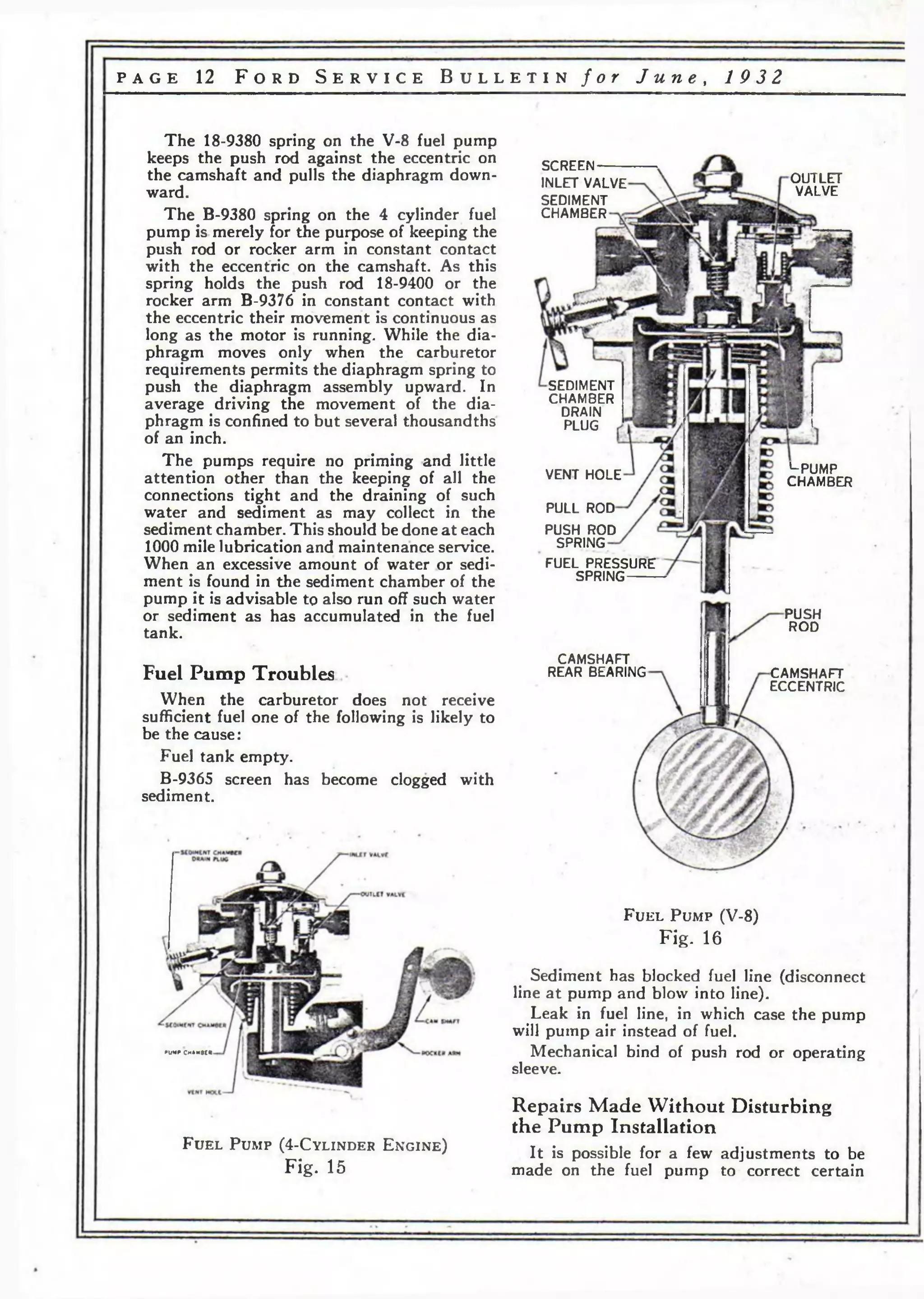
The fuel pumps used on the Ford cars and 
trucks are operated by an eccentric on the 
camshaft (see Figs. 15 and 16). On the pump 
used with 4-cylinder engine, as the shaft rotates 
the eccentric lifts the rocker arm, pulling the 
diaphragm downward, creating a vacuum in 
the pump chamber. With the 8-cylinder engine 
the same effect is accomplished by means of 
a push rod. 
On the suction stroke of the pump the fuel 
is drawn from rear tank through the inlet into 
the sediment chamber and passes through the 
'fine mesh screen and inlet valve into the pump 
chamber. On the return stroke, spring pressure 
pushes the diaphragm upward forcing fuel 
from the pump chamber through the outlet 
valve and outlet to the carburetor. 
When the carburetor bowl becomes filled to 
the proper level the float in the carburetor will 
shut off the float valve creating a pressure in 
the pump chamber. This pressure will hold 
the diaphragm down against spring pressure 
where it will remain inoperative in the down­ward 
position until the carburetor reauires 
further fuel and the needle valve opens.
p a g e 12 F o r d S e r v i c e B u l l e t i n f o r J u n e , 1 9 3 2 
OUTLET 
VALVE 
L PUMP 
CHAMBER 
PUSH 
ROD 
SCREEN 
INLET VALVE 
SEDIMENT 
CHAMBER 
SEDIMENT 
CHAMBER 
DRAIN 
PLUG 
VENT HOLE 
PULL ROD 
PUSH ROD 
SPRING 
FUEL PRESSURE 
SPRING 
CAMSHAFT 
REAR BEARING CAMSHAFT 
ECCENTRIC 
The 18-9380 spring on the V-8 fuel pump 
keeps the push rod against the eccentric on 
the camshaft and pulls the diaphragm down­ward. 
The B-9380 spring on the 4 cylinder fuel 
pump is merely for the purpose of keeping the 
push rod or rocker arm in constant contact 
with the eccentric on the camshaft. As this 
spring holds the push rod 18-9400 or the 
rocker arm B-9376 in constant contact with 
the eccentric their movement is continuous as 
long as the motor is running. While the dia­phragm 
moves only when the carburetor 
requirements permits the diaphragm spring to 
push the diaphragm assembly upward. In 
average driving the movement of the dia­phragm 
is confined to but several thousandths 
of an inch. 
The pumps require no priming and little 
attention other than the keeping of all the 
connections tight and the draining of such 
water and sediment as may collect in the 
sediment chamber. This should be done at each 
1000 mile lubrication and maintenance service. 
When an excessive amount of water or sedi­ment 
is found in the sediment chamber of the 
pump it is advisable to also run off such water 
or sediment as has accumulated in the fuel 
tank. 
Fuel Pump Troubles 
When the carburetor does not receive 
sufficient fuel one of the following is likely to 
be the cause: 
Fuel tank empty. 
B-9365 screen has become clogged with 
sediment. 
F u e l P um p (V-8) 
Fig. 16 
Sediment has blocked fuel line (disconnect 
line at pump and blow into line). 
Leak in fuel line, in which case the pump 
will pump air instead of fuel. 
Mechanical bind of push rod or operating 
sleeve. 
F u e l P um p ( 4 - C y l i n d e r E n g i n e ) 
Fig. 15 
Repairs Made Without Disturbing 
the Pump Installation 
It is possible for a few adjustments to be 
made on the fuel pump to correct certain
F o r d S e r v i c e B u l l e t i n f o r J u n e , 19 32 p a g e 13 
troubles without removing the pump from 
the motor. These troubles and remedies are 
as follows: 
1. Loose pipe fittings. 
Tighten all pipe connections at gasoline 
tank and at the pump. 
2. Dirty screen. 
Remove cover plate and clean screen, ob­serving 
that cork gasket is in good condition 
and properly seated when reassembling cover 
plate. 
3. Leakage around edge of cover plate. 
Tighten cover plate nut, making certain 
that both the cover nut gasket and the cork 
gasket are unbroken and in good condition. 
4. Loose valve plugs. 
Remove cover plate and screen, tightening 
both inlet and outlet valve plugs securely, 
replacing valve plug gaskets if necessary. 
FUEL GAUGE 
Operation 
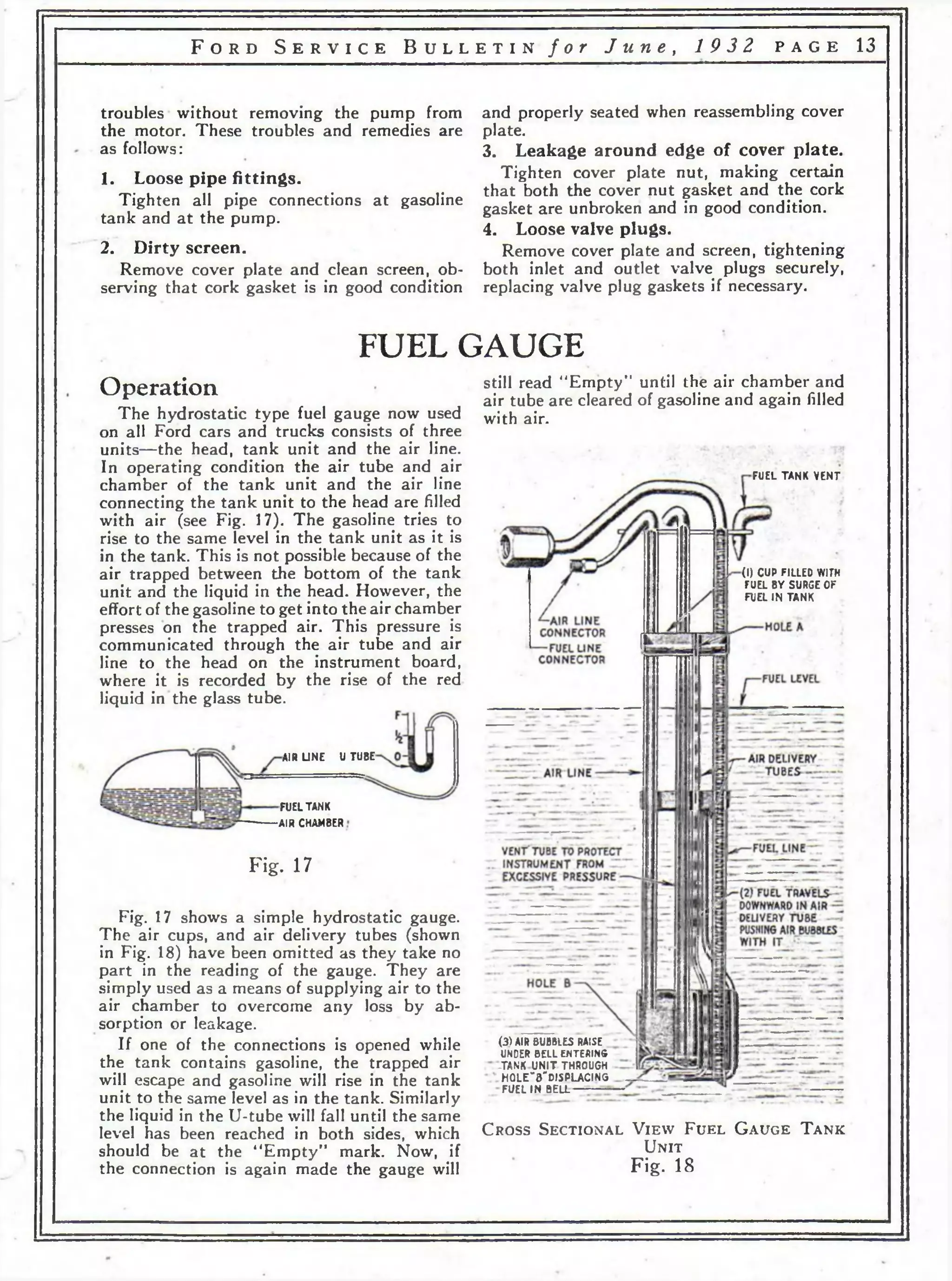
The hydrostatic type fuel gauge now used 
on all Ford cars and trucks consists of three 
units—the head, tank unit and the air line. 
In operating condition the air tube and air 
chamber of the tank unit and the air line 
connecting the tank unit to the head are filled 
with air (see Fig. 17). The gasoline tries to 
rise to the same level in the tank unit as it is 
in the tank. This is not possible because of the 
air trapped between the bottom of the tank 
unit and the liquid in the head. However, the 
effort of the gasoline to get into the air chamber 
presses on the trapped air. This pressure is 
communicated through the air tube and air 
line to the head on the instrument board, 
where it is recorded by the rise of the red 
liquid in the glass tube. 
AIR LINE U TUBE 
FUEL TANK 
AIR CHAMBER 
Fig. 17 
Fig. 17 shows a simple hydrostatic gauge. 
The air cups, and air delivery tubes (shown 
in Fig. 18) have been omitted as they take no 
part in the reading of the gauge. They are 
simply used as a means of supplying air to the 
air chamber to overcome any loss by ab­sorption 
or leakage. 
If one of the connections is opened while 
the tank contains gasoline, the trapped air 
will escape and gasoline will rise in the tank 
unit to the same level as in the tank. Similarly 
the liquid in the U-tube will fall until the same 
level has been reached in both sides, which 
should be at the “Empty” mark. Now, if 
the connection is again made the gauge will 
still read ‘'Empty” until the air chamber and 
air tube are cleared of gasoline and again filled 
with air. 
FUEL TANK VENT 
(I) CUP FILLED WITH 
FUEL BY SURGE OK 
FUEL IN TANK 
(3) AIR BUBBLES RAISE 
UNDER BELL ENTERING 
-TANK UNIT THROUGH 
HOLEVDISPLACING 
FUEL IN BELL 
C ro s s S e c t io n a l V i e w F u e l G a u g e T a n k 
U n i t 
Fig. 18
p a g e 14 F o r d S e r v i c e B u l l e t i n f o r J u n e , 19 32 
Tank Unit 
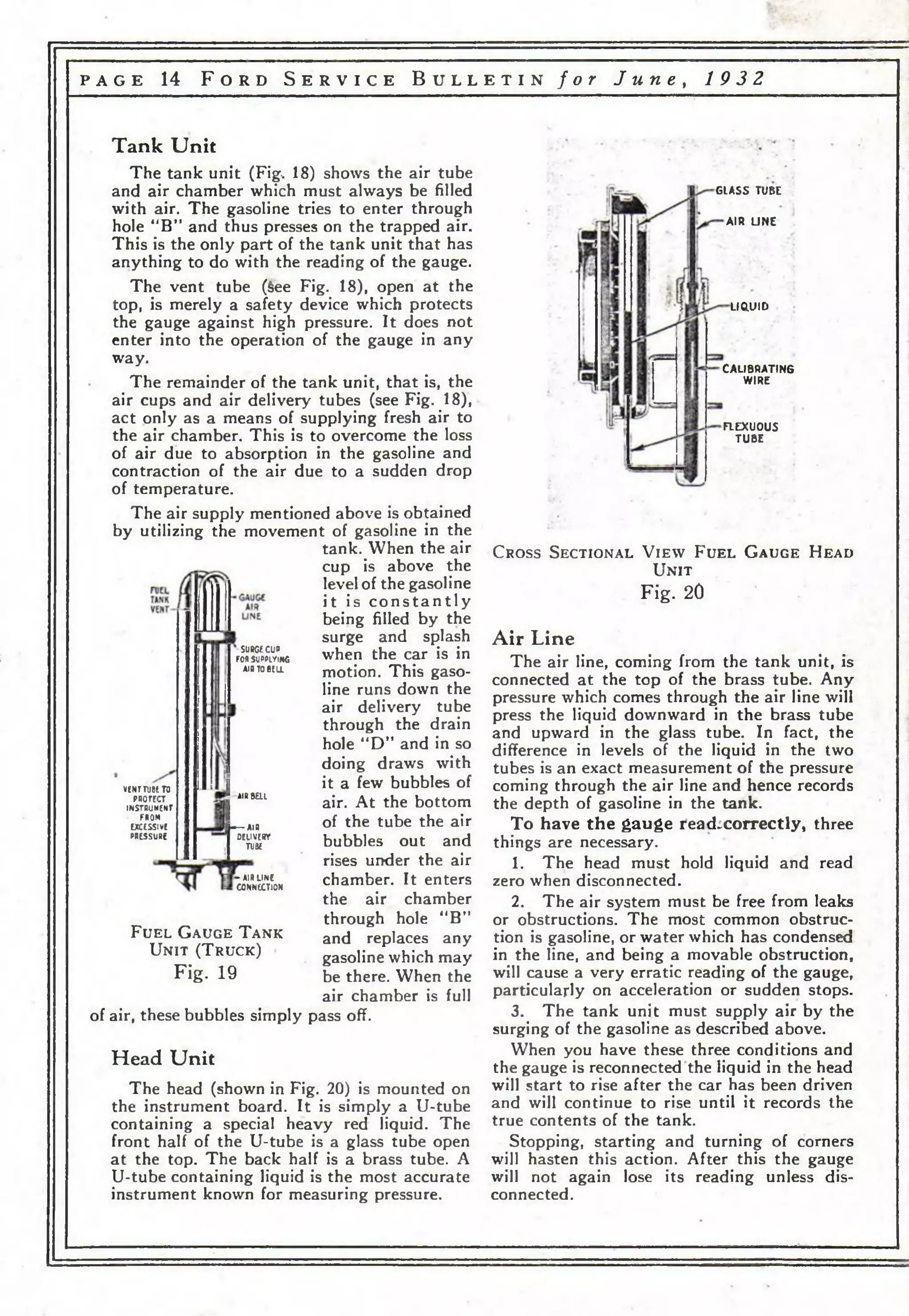
The tank unit (Fig, 18) shows the air tube 
and air chamber which must always be filled 
with air. The gasoline tries to enter through 
hole “B” and thus presses on the trapped air. 
This is the only part of the tank unit that has 
anything to do with the reading of the gauge. 
The vent tube (See Fig. 18), open at the 
top, is merely a safety device which protects 
the gauge against high pressure. It does not 
enter into the operation of the gauge in any 
way. 
The remainder of the tank unit, that is, the 
air cups and air delivery tubes (see Fig. 18), 
act only as a means of supplying fresh air to 
the air chamber. This is to overcome the loss 
of air due to absorption in the gasoline and 
contraction of the air due to a sudden drop 
of temperature. 
The air supply mentioned above is obtained 
by utilizing the movement of gasoline in the 
tank. When the air 
cup is above the 
level of the gasoline 
it is c o n s t a n t ly 
being filled by the 
surge and splash 
when the car is in 
motion. This gaso­line 
runs down the 
air delivery tube 
through the drain 
hole “D” and in so 
doing draws with 
it a few bubbles of 
air. At the bottom 
of the tube the air 
bubbles out and 
rises under the air 
chamber. It enters 
the air chamber 
through hole “B” 
and replaces any 
gasoline which may 
be there. When the 
air chamber is full 
V lN r T U B l TO 
PROTECT INSTRUMENT 
FROM 
EXCESSIVE 
PRESSURE 
SURGE CUP 
FOR SUPPLYING 
AIR TO BELL 
AIR&ai 
— AIR 
OEUVERT 
TU3E 
— AIR LINE 
CONNECTION 
F u e l G a u g e T a n k 
U n it ( T r u c k ) 
Fig. 19 
of air, these bubbles simply pass off. 
Head Unit 
The head (shown in Fig. 20) is mounted on 
the instrument board. It is simply a U-tube 
containing a special heavy red liquid. The 
front half of the U-tube is a glass tube open 
at the top. The back half is a brass tube. A 
U-tube containing liquid is the most accurate 
instrument known for measuring pressure. 
GLASS TUBE 
AIR LINE 
LIQUID 
CALIBRATING 
WIRE 
FLEXU0U5 
T U 8E 
C ro s s S e c t io n a l V i e w F u e l G a u g e H ea d 
U n it 
Fig. 20 
Air Line 
The air line, coming from the tank unit, is 
connected at the top of the brass tube. Any 
pressure which comes through the air line will 
press the liquid downward in the brass tube 
and upward in the glass tube. In fact, the 
difference in levels of the liquid in the two 
tubes is an exact measurement of the pressure 
coming through the air line and hence records 
the depth of gasoline in the tank. 
To have the gauge read-correctly, three 
things are necessary. 
1. The head must hold liquid and read 
zero when disconnected. 
2. The air system must be free from leaks 
or obstructions. The most common obstruc­tion 
is gasoline, or water which has condensed 
in the line, and being a movable obstruction, 
will cause a very erratic reading of the gauge, 
particularly on acceleration or sudden stops. 
3. The tank unit must supply air by the 
surging of the gasoline as described above. 
When you have these three conditions and 
the gauge is reconnected the liquid in the head 
will start to rise after the car has been driven 
and will continue to rise until it records the 
true contents of the tank. 
Stopping, starting and turning of corners 
will hasten this action. After this the gauge 
will not again lose its reading unless dis­connected.
F o r d S e r v i c e B u l l e t i n f o r J u n e , 1 9 3 2 p a g e 15 
A quick method of correcting the reading 
on the car is to disconnect the fuel line at the 
fuel pump and blow into it with the mouth— 
not compressed air—to replace the air in 
the tank unit. 
Due to the different arrangement of the 
fuel feed line for tanks mounted under the 
seat this method of replacing the air in the 
tank unit is not possible with this installation. 
On the truck it will be necessary to drain the 
tank or drive the truck or in some manner 
surge the fuel in the tank to correct the 
reading. Fig. 19 illustrates the tank unit used 
with tanks mounted under the seat. 
Normally the reading should be corrected 
before the car is returned to the owner. The 
reading, however, will correct itself in time. 
Correcting Faulty Gauge 
Correction of a faulty gasoline gauge is very 
simple. This is assuming that you will 
follow the directions below exactly. 
Do not remove the gauge from the instru­ment 
board or start installing new units until 
these instructions have been followed. 
Head U n it 
Disconnect gauge line (air line) at gauge 
head and set gauge reading exactly at bottom 
line (zero). Liquid can be added or removed 
at the top of the brass tube where the air line 
comes off. To fill, use a medicine dropper, 
being careful not to over-fill. To remove liquid, 
use a toothpick or a match to absorb some of 
the liquid from the brass tube. 
The red liquid, M-1128, used in the gauge 
head unit is supplied in one ounce bottles by 
■ the Ford Motor Company. As the accuracy 
of the gauge is dependent on the specific 
gravity of the fluid, it is of extreme importance 
that only the genuine fluid be used. 
Inspect the head unit for dirt or flaws on 
the cone seat, or liquid leaks at the flex tube 
(small connecting tube). 
Pump the liquid up in the head unit to any 
point on the dial above the bottom line. 
Method: Move the thumb rapidly up and 
down against the top end of the brass tube at 
the back of the head unit. (This action will 
supply air pressure to the liquid, causing it to 
rise in the glass tube.) Entrap the air by hold­ing 
the thumb against the top of the tube. If 
the liquid holds at a given point, the head 
unit is О. K. If the liquid will not rise, there 
is an air leak, liquid leak, or the tube is 
plugged. Change the unit. 
Air Line 
When a line is blown out, a hand tire pump 
should be used—positively not a compressed air 
line—as compressed air lines generally contain 
water or moisture at least (moisture in gauge 
air line will cause erratic reading of the gauge). 
Install tire pump connection on front end 
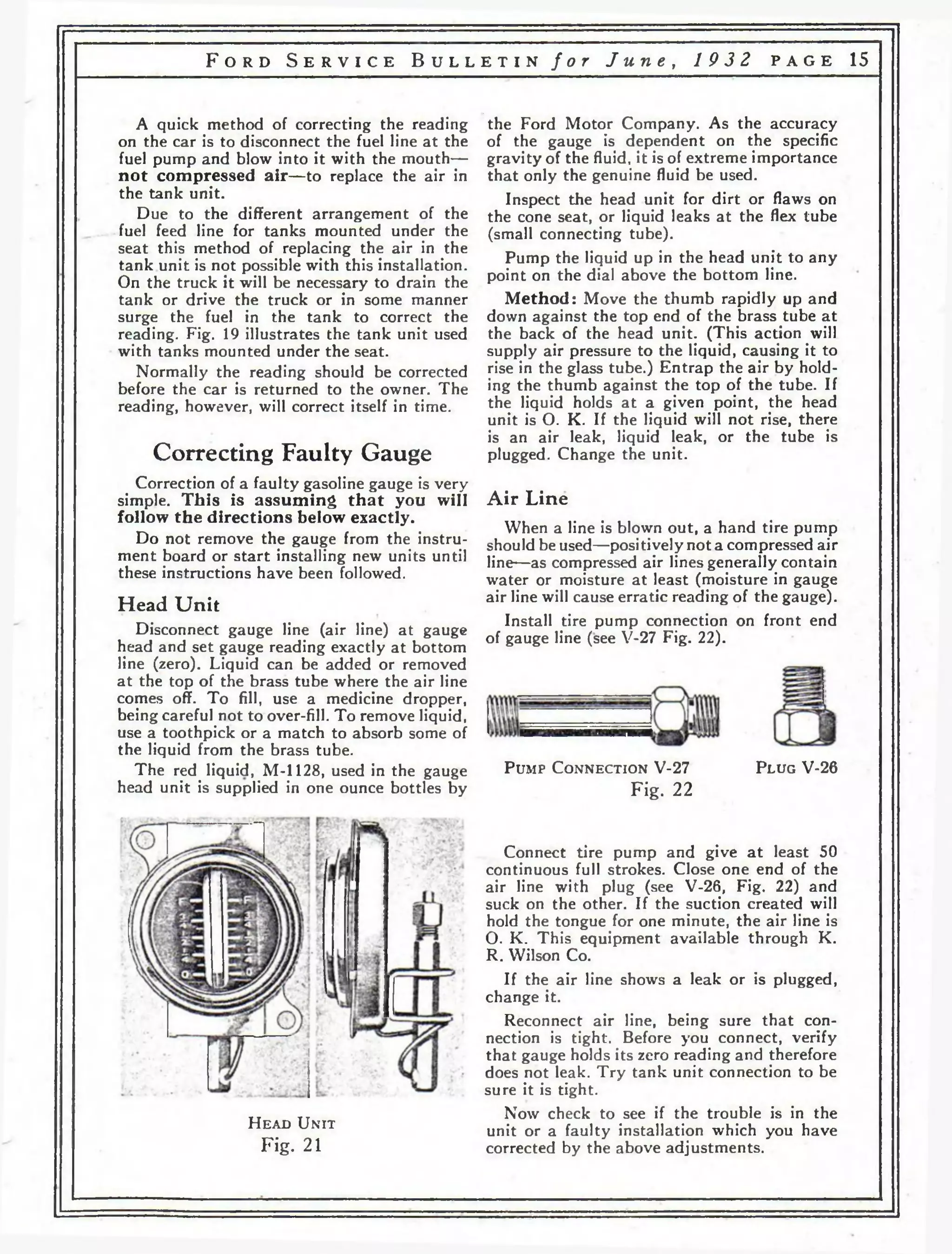
of gauge line (see V-27 Fig. 22). 
P um p C o n n e c t io n V-27 
Fig. 22 
P l u g V-26 
H e a d U n it 
Fig. 21 
Connect tire pump and give a t least 50 
continuous full strokes. Close one end of the 
air line with plug (see V-26, Fig. 22) and 
suck on the other. If the suction created will 
hold the tongue for one minute, the air line is 
О. K. This equipment available through K. 
R. Wilson Co. 
If the air line shows a leak or is plugged, 
change it. 
Reconnect air line, being sure that con­nection 
is tight. Before you connect, verify 
that gauge holds its zero reading and therefore 
does not leak. Try tank unit connection to be 
sure it is tight. 
Now check to see if the trouble is in the 
unit or a faulty installation which you have 
corrected by the above adjustments.
p a g e 16 F o r d S e r v i c e B u l l e t i n f o r J u n e , 1 9 3 2 
Test 
Determine whether the gauge can be 
brought up to proper reading by supplying 
air to the tank unit. 
On the 4-cylinder or 8-cylinder car this is 
accomplished by blowing in the fuel feed line 
as previously described. 
On the truck this is accomplished by draining 
and refilling the tank or by driving the truck 
until the surge of the gasoline replenishes 
the air supply in the tank unit. 
If the reading stays set with the car stand­ing, 
the gauge will function correctly. If, 
however, a reading is obtained but it will not 
hold inspect connections for dirt and flaws. 
If the air line, head unit and connections 
check О. K. the trouble is in the tank unit 
which should be changed. 
Caution: Faulty tank units are very rare; 
therefore, inspect carefully the head unit, air 
line and connections, as the trouble is more 
likely to be in one of these places than in the 
tank unit. 
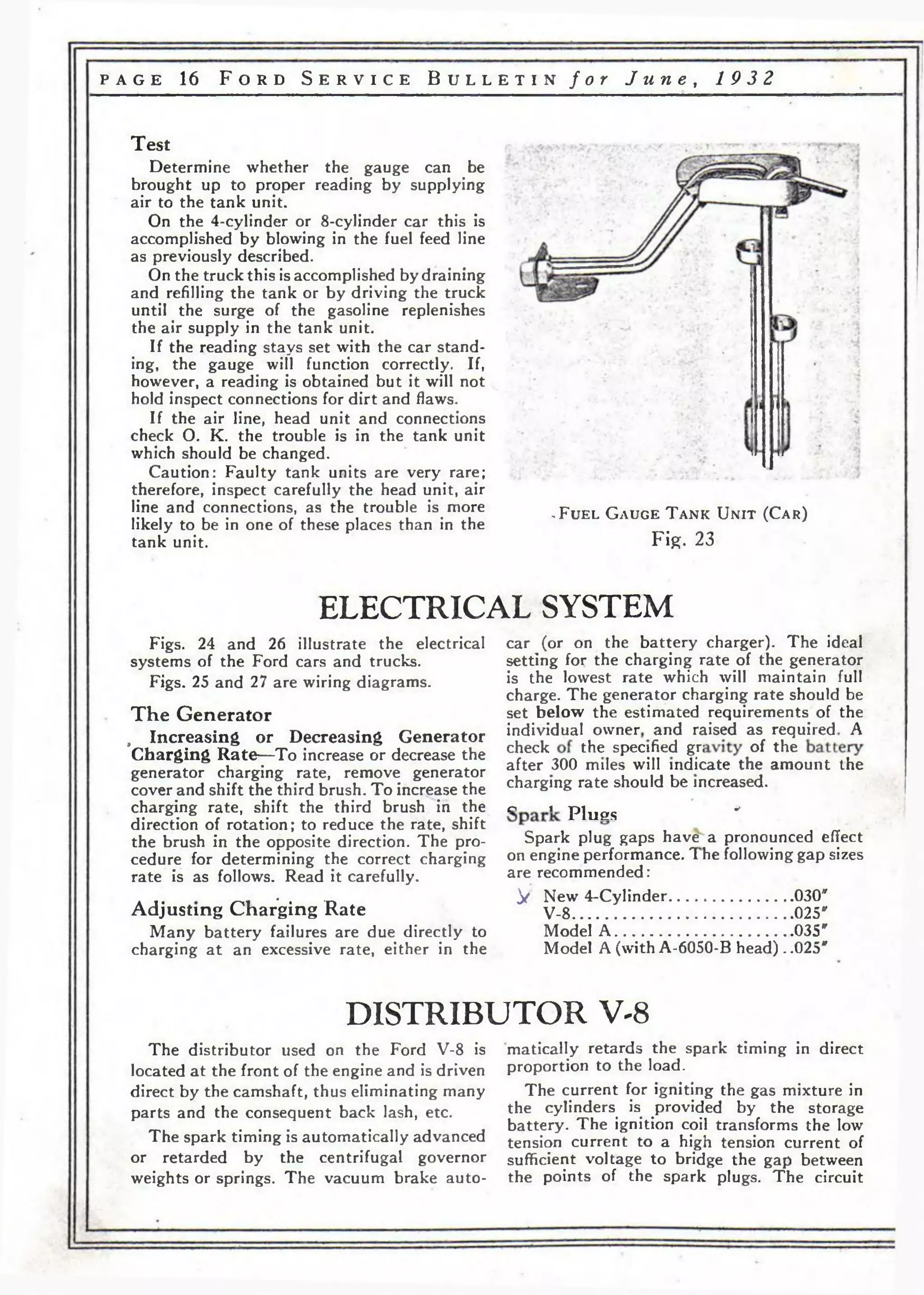
. F u e l G a u g e T a n k U n i t (C a r ) 
Fig. 23 
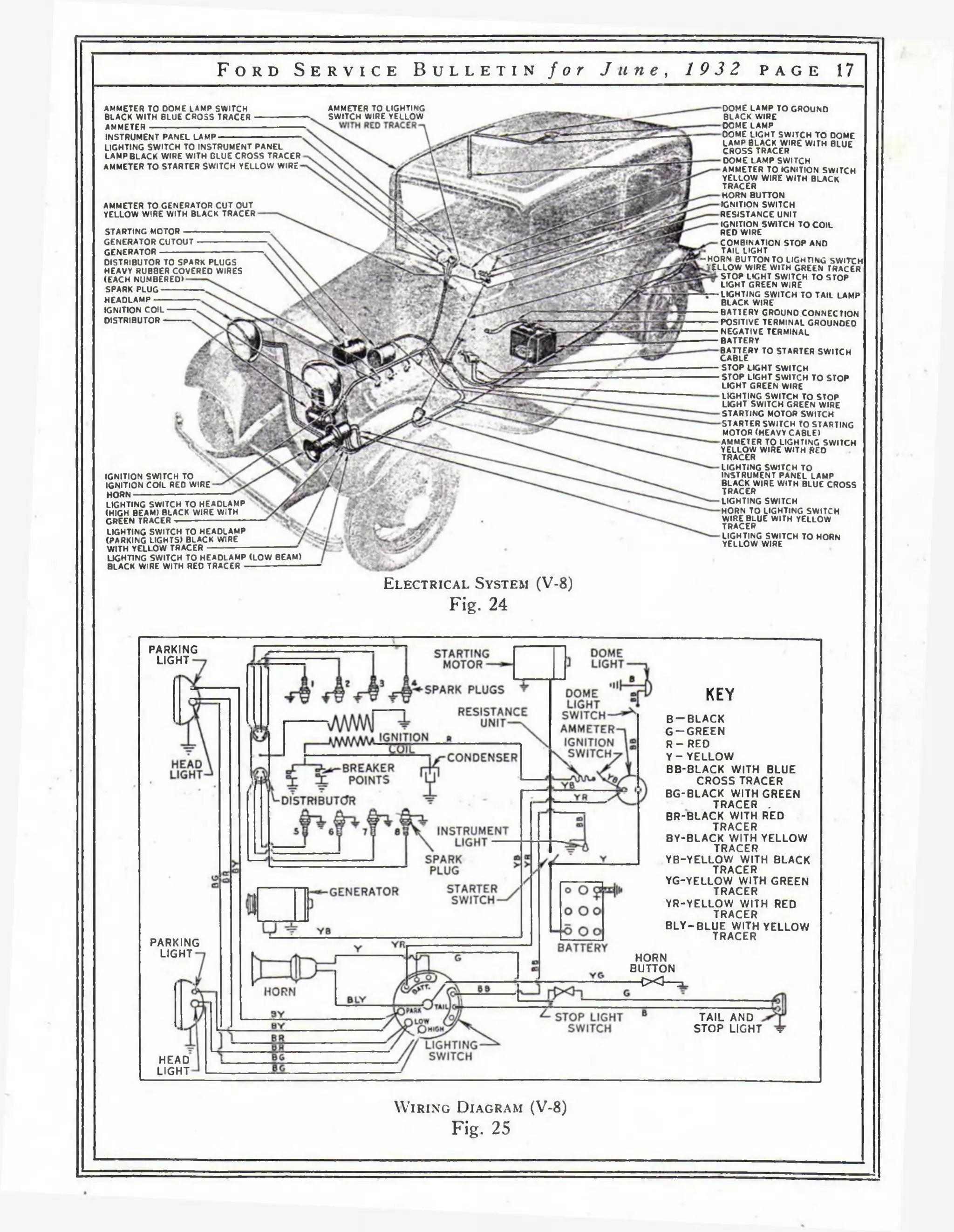
ELECTRICAL SYSTEM 
Figs. 24 and 26 illustrate the electrical car (or on the battery charger). The ideal 
systems of the Ford cars and trucks. setting for the charging rate of the generator 
Figs. 25 and 27 are wiring diagrams. is the lowest rate which vill maintain full 
charge. The generator charging rate should be 
T h e Generator set below the estimated requirements of the 
, Increasing or Decreasing Generator individual owner and raised as required A 
Charging Rate—To increase or decrease the <*eck the. sPec!f.ed £ P ° f the 
generator charging rate, remove generator after 300 milesjw.ll indicate the amount the 
cover and shift the third brush. To increase the charging rate should be increased. 
charging rate, shift the third brush in the о i P lu e s * 
direction of rotation; to reduce the rate, shift , n-the 
brush in the opposite direction. The pro- Spark plug gaps have a pronounced effect 
cedure for determining the correct charging on engine performance. 1 he following gap sizes 
rate is as follows. Read it carefully. are recommended: 
a j . r*u * • -d ♦ ^ New 4-Cylinder.......................................Adjusting Charging Kate V-8.....................................................025*030" 
Many battery failures are due directly to Model A ....035" 
charging at an excessive rate, either in the Model A (with A-6050-B head). .025" 
DISTRIBUTOR V-8 
The distributor used on the Ford V-8 is 
located at the front of the engine and is driven 
direct by the camshaft, thus eliminating many 
parts and the consequent back lash, etc. 
The spark timing is automatically advanced 
or retarded by the centrifugal governor 
weights or springs. The vacuum brake auto­matically 
retards the spark timing in direct 
proportion to the load. 
The current for igniting the gas mixture in 
the cylinders is provided by the storage 
battery. The ignition coil transforms the low 
tension current to a high tension current of 
sufficient voltage to bridge the gap between 
the points of the spark plugs. The circuit
F o r d S e r v i c e B u l l e t i n f o r J u n e , 19 3 2 p a g e 17 
AMMETER TO DOME LAMP SWITCH 
BLACK WITH BLUE CROSS TRACER 
AMMETER 
INSTRUMENT PANEL LAMP 
LIGHTING SWITCH TO INSTRUMENT PANEL 
LAMPBLACK WIRE WITH GLUE CROSS TRACER 
AMMETER TO STARTER SWITCH YELLOW WIRE 
AMMETER TO GENERATOR C U T O U T 
YELLOW WIRE WITH BLACK TRACER 
STARTING MOTOR 
GENERATOR C U TO U T 
GENERATOR 
DISTRIBUTOR TO SPARK PLUGS 
HEAVY RUB8ER COVERED WIRES 
(EACH NUMBERED» 
SPARK PLUG 
HEADLAMP 
IGNITION COIL 
DISTRIBUTOR 
AMMETER TO LIGHTING 
SWITCH WIRE YELLOW 
IGNITION SWITCH TO 
IGNITION COfL REO WIRE 
H O R N -------------------------------------- 
LIGHTING SWITCH TO HEADLAMP 
(HIGH BEAM) BLACK WIRE WITH 
GREEN TRACER ---------------------------------- 
LIGHTING SWITCH TO HEADLAMP 
(PARKING LIGHTS) BLACK WIRE 
WITH YELLOW TRACER 
UGHTING SWITCH TO HEADLAMP (LOW BEAM) 
BLACK WIRE WITH RED TRACER 
DOME LAMP TO GROUND 
BLACK WIRE 
DOME LAMP 
DOME LIGHT SWITCH TO DOME 
LAMP BLACK WIRE WITH BLUE 
CROSS TRACER 
DOME LAMP SWITCH 
AMMETER TO IGNITION SWITCH 
YELLOW WIRE WITH BLACK 
TRACER 
HORN BUTTON 
IGNITION SWITCH 
RESISTANCE UNIT 
IGNITION SWITCH TO COIL 
RED WIRE 
COMBINATION STOP AND 
TAIL LIGHT 
— HORN BUTTON TO LIGHTING SWITCH 
* ELLOW WIRE WITH GREEN TRACER 
STOP LIGHT SWITCH TO STOP 
LIGHT GREEN WIRE 
LIGHTING SWITCH TO TAIL LAMP 
BLACK WIRE 
BATTERY GROUND CONNECTION 
POSITIVE TERMINAL GROUNDEO 
NEGATIVE TERMINAL 
BATTERY 
BATTERY TO STARTER SWITCH 
CABLE 
STOP LIGHT SWITCH 
STOP LIGHT SWITCH TO STOP 
LIGHT GREEN WIRE 
LIGHTING SWITCH TO STOP 
LIGHT SWITCH GREEN WIRE 
STARTING MOTOR SWITCH 
STARTER SWITCH TO STARTING 
MOTOR (HEAVY CABLE) 
AMMETER TO LIGHTING SWITCH 
YELLOW WIRE WITH REO 
TRACER 
LIGHTING SWITCH TO 
INSTRUMENT PANEL LAMP 
BLACK WIRE WITH BLUE CROSS 
TRACER 
LIGHTING SWITCH 
HORN TO LIGHTING SWITCH 
WIRE BLUE WITH YELLOW 
TRACER 
LIGHTING SWITCH TO HORN 
YELLOW WIRE 
E l e c t r i c a l S y s t em (V-8) 
Fig. 24 
PARKING 
LIGHT 
KEY 
PARKING 
LIGHT 
B -B L A C K 
G -G R E E N 
R -R E D 
Y - YELLOW 
BB-BLACK WITH BLUE 
CROSS TRACER 
BG-BLACK WITH GREEN 
TRACER . 
BR-BLACK WITH RED 
TRACER 
BY-BLACK WITH YELLOW 
TRACER 
YB-YELLOW WITH BLACK 
TRACER 
YG-YELLOW WITH GREEN 
TRACER 
YR-YELLOW WITH RED 
TRACER 
B LY -B LU E WITH YELLOW 
TRACER 
HORN 
BUTTON 
{X3—з_ 
TAIL AND 
STOP LIGHT ? 
HEAD 
LIGHT 
W ir in g D ia g r am (V-8 ) 
Fig. 25
p a g e 18 F o r d S e r v i c e B u l l e t i n / » r J u n e , 1 9 3 2 
с о и . т о b r e a k e r b l a c k 
WIRE WITH BLUE CROSS TRACER 
COIL TO DISTRIBUTOR HEAVY 
RUBBER COVEREO WIRE 
DISTRIBUTE 
CON DENSER-SPARK 
PLUGS 
GENERATOR CUTOUT 
GENERATOR 
HEADLAMP 
HORN 
GENERATOR CUTOUT TO AMUCTCft 
TELLOW WIRE WITH BLACK TRACER 
AMMETER 
AMMETER TO IGNITION SWITCH 
U L L O W WIRE WITH BLACK TRACER 
STARTER SWITCH CONTROL 
BUTTON 
MORN BUTTON 
LIGHTING SWITCH CONTROL 
IGNITION SWITCH 
UGHTING SWITCH TO HORN BUTTON 
VELLOW WIRE WITH GREEN TRACER 
IGNITION SWITCH TO COIL REO WIRE 
IN CONDUIT 
X ' . A C OM B IN A T IO N 
i in M STOP AND 
TAIL LIGHT 
i UGHTING SWITCH TO 
HEADLAMP (HIGH BEAM) 
BLACK WIRE WITH GREEN 
TRACER ------------------- 
UGHTING SWITCH TO HEADLAMP 
• (PARKING LIGHTS) BLACK WIRE WITH 
YELLOW TRACER---------------------- 
UGHTING SWITCH TO HEADLAMP (LOW BEAM) 
BLACK WIRE WITH RED TRACER 
— BATTERY GROUND 
CONNECTION 
STOP LIGHT SWITCH 
TO STOP LIGHT 
GREEN WIRE 
LIGHTING SWITCH TO 
TAIL LAMPBLACK WIRE 
POSITIVE TERMINAL GROUNOED 
NEGATIVE TERMINAL 
BATTERY 
UGHTING SWITCH TO STOP LIGHT 
SWITCH GREEN WIRE 
STOP LIGHT SWITCH 
BATTERY CABLE (HEAVY) 
STARTING MOTOR SWITCH 
- STARTING MOTOR 
LIGHTING'SWITCH 
STARTER SWITCH TO AMMETER 
VELLOW WIRE 
GENERATOR CUTOUT TO HORN 
YELLOW WIRE 
LIGHTING SWITCH TO HORN 8LUE 
WIRE WITH YELLOW TRACER 
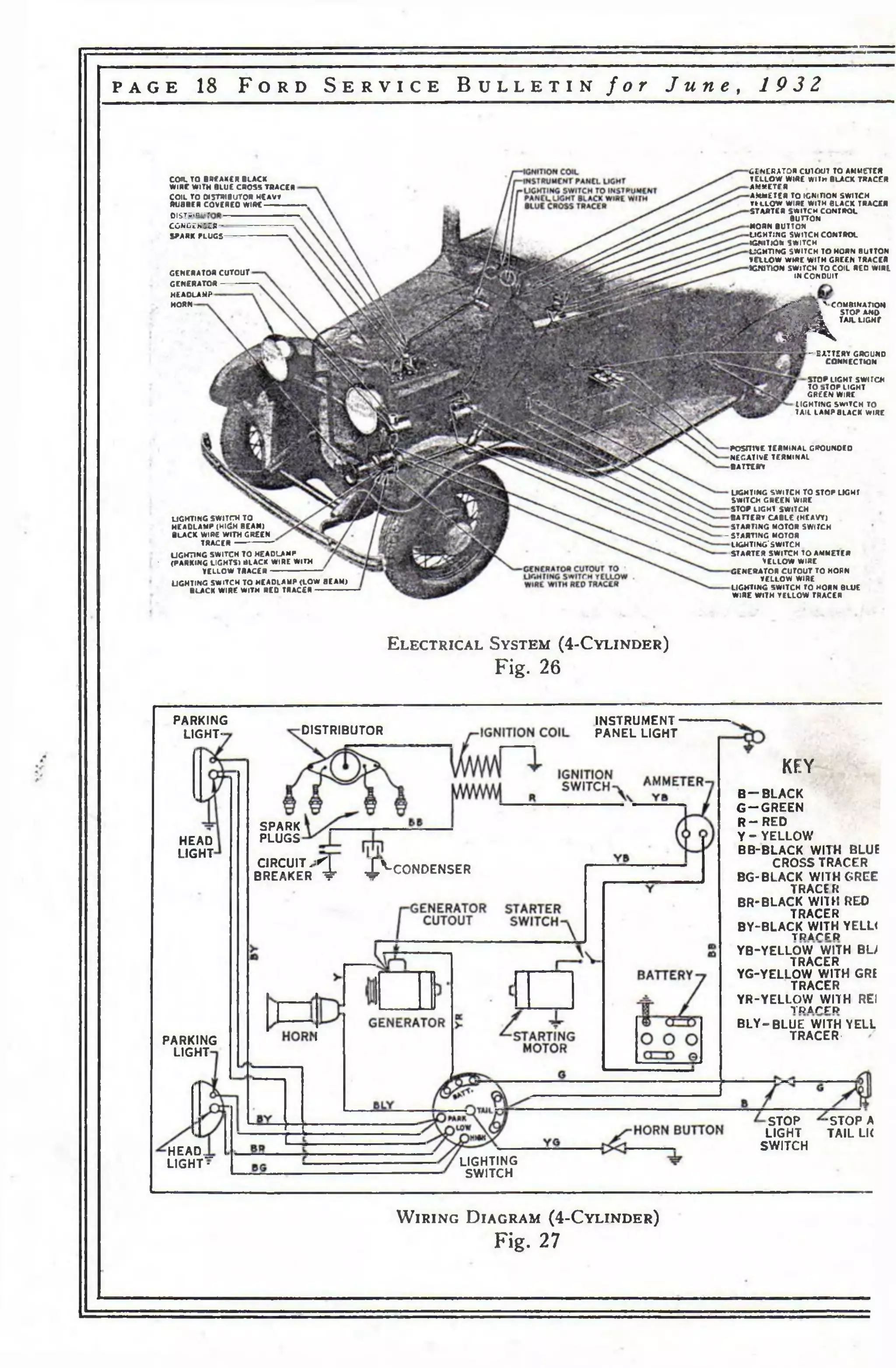
E l e c t r ic a l S y s t em ( 4 -C y l in d e r ) 
Fig. 26 
PARKING 
LIGHT-HEAD 
LIGHT 
PARKING 
LIGHT 
DISTRIBUTOR 
INSTRUMENT 
PANEL LIGHT 
SPARK 
PLUGS 
CIRCUIT-BREAKER 
^ Jp'-CONDENSER 
KEY 
B -B L A C K 
G — GREEN 
R -R E D 
Y - YELLOW 
BB-BLACK WITH BLUE 
CROSS TRACER 
BG-BLACK WITH GREE 
TRACER 
BR-BLACK WITH RED 
TRACER 
BY-BLACK WITH YELL< 
TRAPFR 
YB-YELLOW WITH B U 
TRACER 
YG-YELLOW WITH GRE 
TRACER 
YR-YELLTODWA PWFIPTH REI 
B L Y -B LU E WITH YELL 
TRACER-HEAD.__ 
LIGHT • 
STOP 
LIGHT 
SWITCH 
■STOP A 
TAIL LIC 
LIGHTING 
SWITCH 
W ir in g D ia g r am ( 4 -C y l in d e r ) 
Fig. 27
F o r d S e r v i c e B u l l e t i n f o r J u n e , 1 9 3 2 p a g e 19 
breaker points interrupt the flow of low ten­sion 
current at regular intervals, while the 
distributor rotor distributes the high tension 
current to each spark plug in proper firing 
order. 
Circuit Breaker 
While the circuit is closed the coil builds up 
a high tension charge and a spark is produced 
as soon as the circuit is broken. The longer 
the circuit is closed the ' ‘hotter” the spark will 
be. This is commonly referred to as the 
“dwell.” The circuit breaker used on the Ford 
V-8 differs from the conventional in that the 
cam used has 8 lobes and that one set of con­tact 
points open the circuit whereas the other 
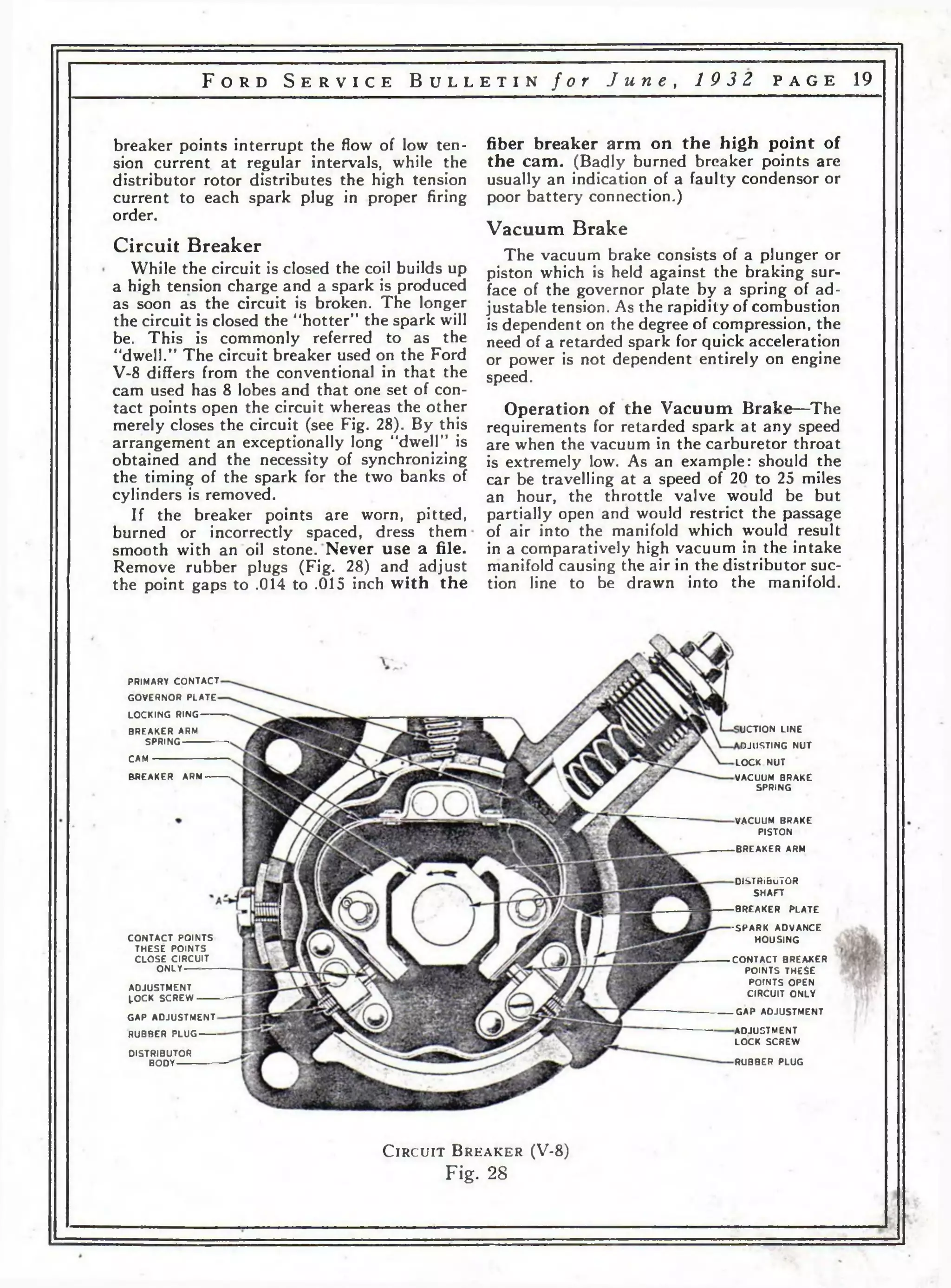
merely closes the circuit (see Fig. 28). By this 
arrangement an exceptionally long “dwell” is 
obtained and the necessity of synchronizing 
the timing of the spark for the two banks of 
cylinders is removed. 
If the breaker points are worn, pitted, 
burned or incorrectly spaced, dress them 
smooth with an oil stone. Never use a file. 
Remove rubber plugs (Fig. 28) and adjust 
the point gaps to .014 to .015 inch with the 
fiber breaker arm on the high point of 
the cam. (Badly burned breaker points are 
usually an indication of a faulty condensor or 
poor battery connection.) 
Vacuum Brake 
The vacuum brake consists of a plunger or 
piston which is held against the braking sur­face 
of the governor plate by a spring of ad­justable 
tension. As the rapidity of combustion 
is dependent on the degree of compression, the 
need of a retarded spark for quick acceleration 
or power is not dependent entirely on engine 
speed. 
Operation of the Vacuum Brake—The 
requirements for retarded spark at any speed 
are when the vacuum in the carburetor throat 
is extremely low. As an example: should the 
car be travelling at a speed of 20 to 25 miles 
an hour, the throttle valve would be but 
partially open and would restrict the passage 
of air into the manifold which w'ould result 
in a comparatively high vacuum in the intake 
manifold causing the air in the distributor suc­tion 
line to be drawn into the manifold. 
PRIMARY C O N TA C T 
GO V ER N O R P LA TE 
LO C K IN G RING 
BR EAK ER ARM 
SPRING 
CAM 
BREAKER ARM 
C O N T A C T PO INTS 
TH E S E PO INTS 
C LO S E C IR C U IT 
ONLY 
A D JU S TM E N T 
LO CK S C R EW --------- 
GAP A D JU S TM E N T 
RUBBER P LU G -------- 
DISTRIBUTOR 
BODY 
U C T IO N LINE 
O JU S T IN G N U T 
LO CK N U T 
VACUUM BRAKE 
SPRING 
VACUUM BRAKE 
PISTON 
8R EA KER ARM 
DISTRIBUTOR 
S H A F T 
BREAKER K .A T E 
•SPARK AD V AN C E 
H O U S IN G 
C O N T A C T BREAKER 
PO INTS TH E S E 
POrNTS OPEN 
C IR C U IT O N LY 
GAP A D JU S TM EN T 
A D JU S TM EN T 
LO CK SCREW 
RUBBER PLUG 
C ir c u it B r e a k e r (V-8 ) 
Fig. 28
p a g e 20 F o r d S e r v i c e B u l l e t i n f o r J u n e , 19 32 
This suction draws the vacuum brake piston 
upward compressing the vacuum brake oper­ating 
spring. When the brake piston is in this 
position, the brake is inoperative and the 
timing is automatically advanced by the 
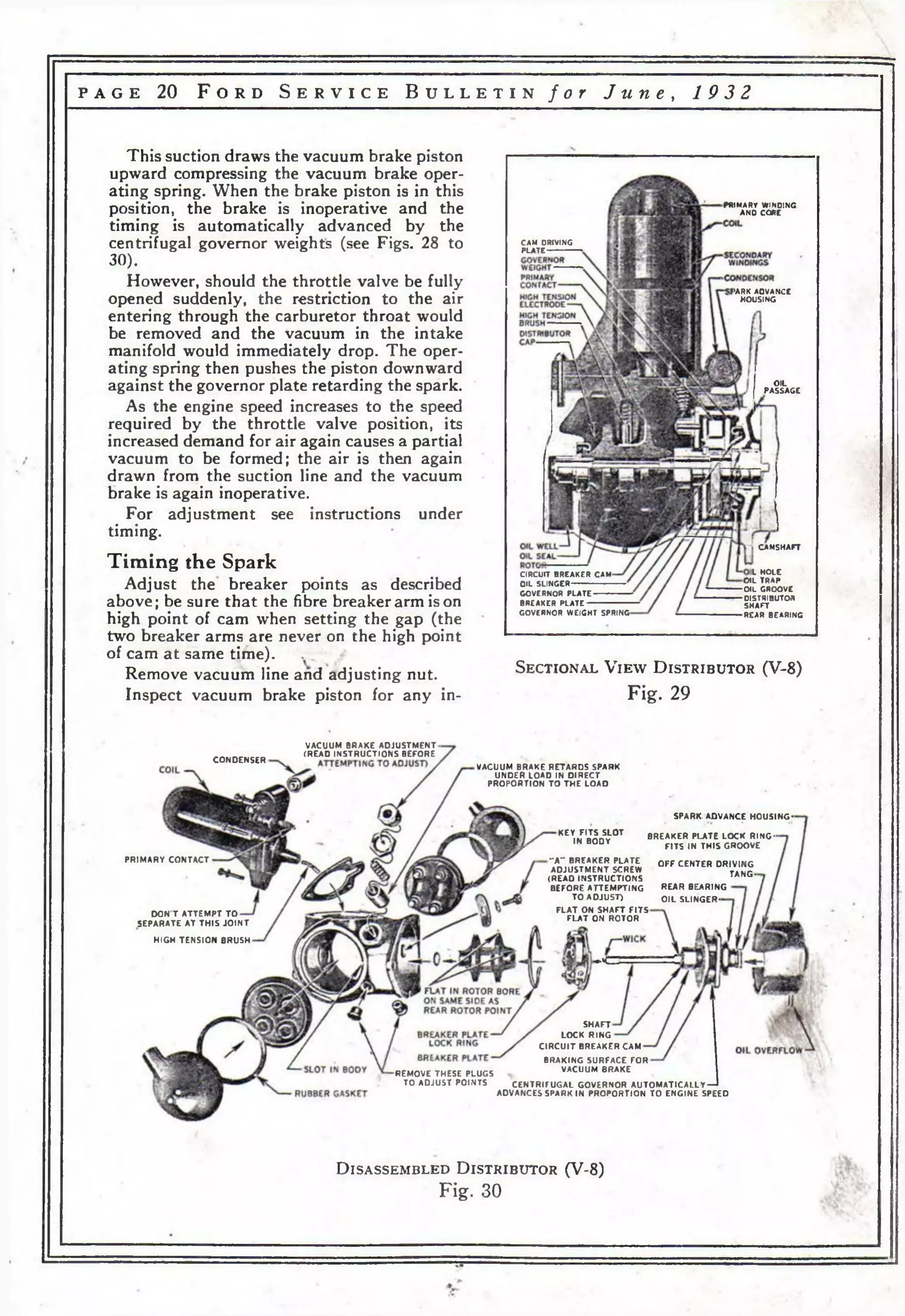
centrifugal governor weights (see Figs. 28 to 
30). 
However, should the throttle valve be fully 
opened suddenly, the restriction to the air 
entering through the carburetor throat would 
be removed and the vacuum in the intake 
manifold would immediately drop. The oper­ating 
spring then pushes the piston downward 
against the governor plate retarding the spark. 
As the engine speed increases to the speed 
required by the throttle valve position, its 
increased demand for air again causes a partial 
vacuum to be formed; the air is then again 
drawn from the suction line and the vacuum 
brake is again inoperative. 
For adjustment see instructions under 
timing. 
Timing the Spark 
Adjust the breaker points as described 
above; be sure that the fibre breaker arm is on 
high point of cam when setting the gap (the 
two breaker arms are never on the high point 
of cam at same time). , 
Remove vacuum line and adjusting nut. 
Inspect vacuum brake piston for any in- 
PRJMARY WINDING 
AND CORE 
CAM DRIVING 
PLATE 
'ARK AOVANCE 
HOUSING 
OIL 
PASSAGE 
CIRCUIT BREAKER CAM 
O IL SLINGER 
GOVERNOR PLATE 
BREAKER PLATE 
GOVERNOR WEIGHT SPRING 
CAMSHAFT 
IL HOLE 
O IL TRAP 
O IL GROOVE 
DISTRIBUTOR 
SHAFT 
REAR BEARING 
S e c t i o n a l V i e w D i s t r i b u t o r (V -8 ) 
Fig. 29 
CONDENSER 
VACUUM BRAKE ADJUSTMENT - 
(READ INSTRUCTIONS BEFORE 
VACUUM BRAKE RETARDS SPARK 
UNDER LOAD IN DIRECT 
PROPORTION TO THE LOAD 
KEY FITS SLOT 
IN BODY 
PRIMARY CONTACT 
DON T ATTEMPT TO 
SEPARATE AT THIS JO INT 
SPARK- ADVANCE HOUSING-BREAKER 
PLATE LOCK RING-FITS 
IN THIS GROOVE 
HIGH TENSION BRUSH 
REMOVE THESE PLUGS 
TO ADJUST POINTS 
-A ” BREAKER PLATE 
ADJUSTMENT SCREW 
(READ INSTRUCTIONS 
BEFORE ATTEMPTING 
TO ADJUST) 
F LAT ON SHAFT FITS 
FLAT ON ROTOR 
— К 
SHAFT 
LOCK RING 
C IRCU IT BREAKER CAM 
BRAKING SURFACE FOR 
VACUUM BRAKE 
OFF CENTER DRIVING 
TANG-REAR 
BEARING 
O IL SLINGER-CENTRIFUGAL 
GOVERNOR AUTOMATICALLY— * 
ADVANCES SPARK IN PROPORTION TO ENGINE SPEED 
D i s a s s e m b l e d D i s t r i b u t o r (V-8 ) 
Fig. 30 
ТГ
F o r d S e r v i c e B u l l e t i n f o r J u n e , 19 32 p a g e 21 
dication of its binding in the distributor body 
(the vacuum brake must work freely with no 
, bind). Apply a few drops of engine oil to the 
piston. 
^fristall the vacuum brake spring and ad-justhtg 
nut (to which the I6ck nut has been 
added); screwing the adjusting nut down not 
more than 2 or 3 turns. Locking it in this 
position so as to prevent the spring from hold­ing 
the piston down. 
Set breaker plate adjustment screw .(“A,” 
Fig. 28) at center of slot in distributor body 
locking it in this position. 
Test the motor on acceleration (a distinct 
ping should be heard when engine speed is 
accelerated. 
Next adjust tension on vacuum brake spring 
by means of the adjusting nut until ping on 
acceleration is removed. Avoid screwing the 
vacuum brake adjusting nut down more than 
is actually required to remove the ping or the 
spark will not advance correctly for less rapid 
acceleration. 
It is essential that a good grade of fuel 
be used. 
DISTRIBUTOR (4-CYLINDER) 
With the distributor used on the 4-cylinder 
engine the spark is automatically retarded by 
the centrifugal governor weight springs for 
starting. By means of this centrifugal governor 
the spark is automatically advanced at in­creased 
engine speeds in direct proportion to 
the speed. _ . 
Circuit Breaker 
If the points are worn, pitted, burned, or 
CAM SCREW 
CONTACT 
POINTS 
ELECTRODES 
BREAKER ARM 
-R O TO R POINT 
HERE WHEN 
TIMING MOTOR 
CONTACT 
LOCK 
SCREW 
CONTACT 
SCREW 
BREAKER 
PLATE 
CAM 
ELECTRODES 
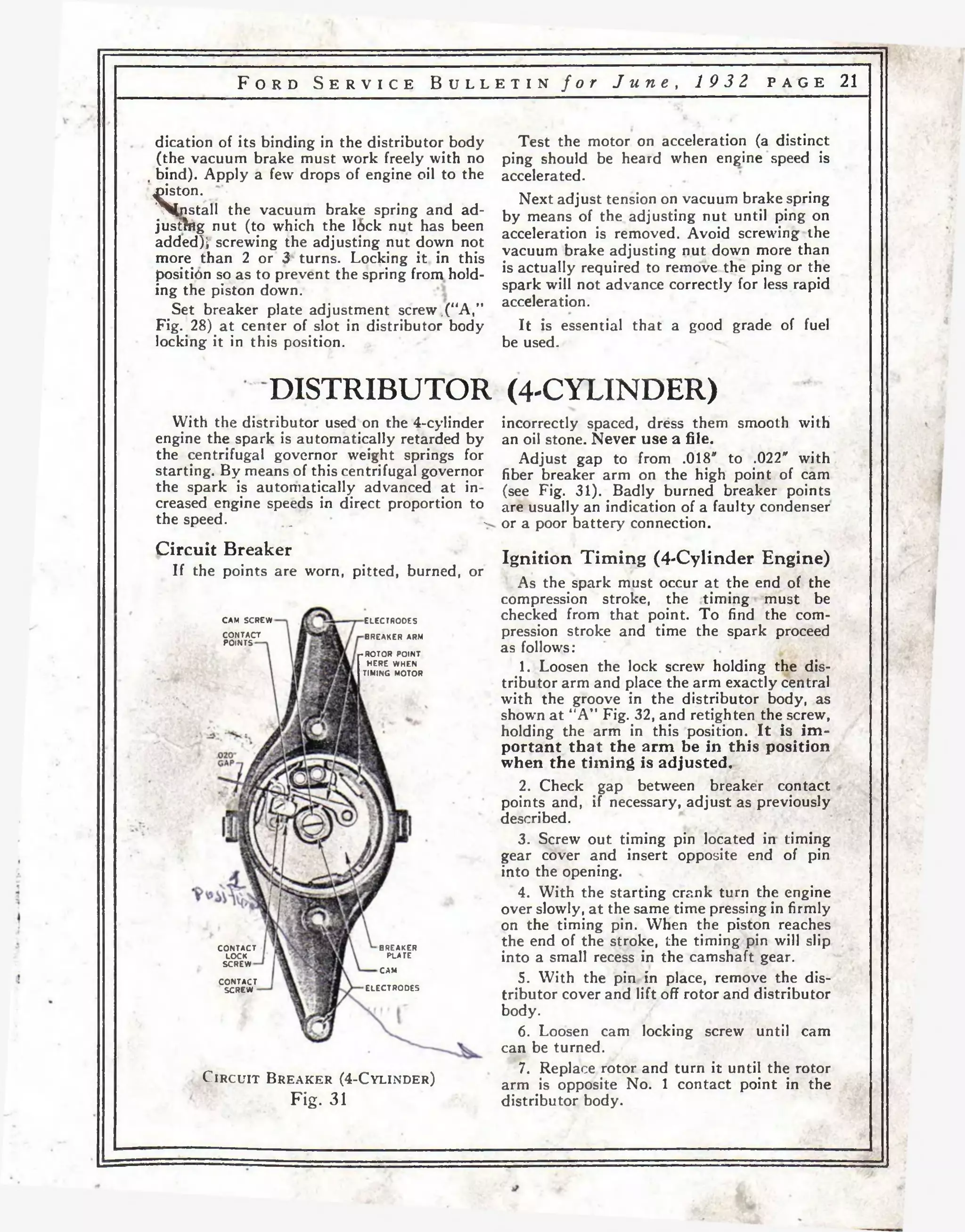
C i r c u i t B r e a k e r ( 4 - C y l i n d e r ) 
Fig. 31 
incorrectly spaced, dress them smooth with 
an oil stone. Never use a file. 
Adjust gap to from .018" to .022" with 
fiber breaker arm on the high point of cam 
(see Fig. 31). Badly burned breaker points 
are usually an indication of a faulty condenser 
or a poor battery connection. 
Ignition Timing (4-Cylinder Engine) 
As the spark must occur at the end of the 
compression stroke, the timing must be 
checked from that point. To find the com­pression 
stroke and time the spark proceed 
as follows: 
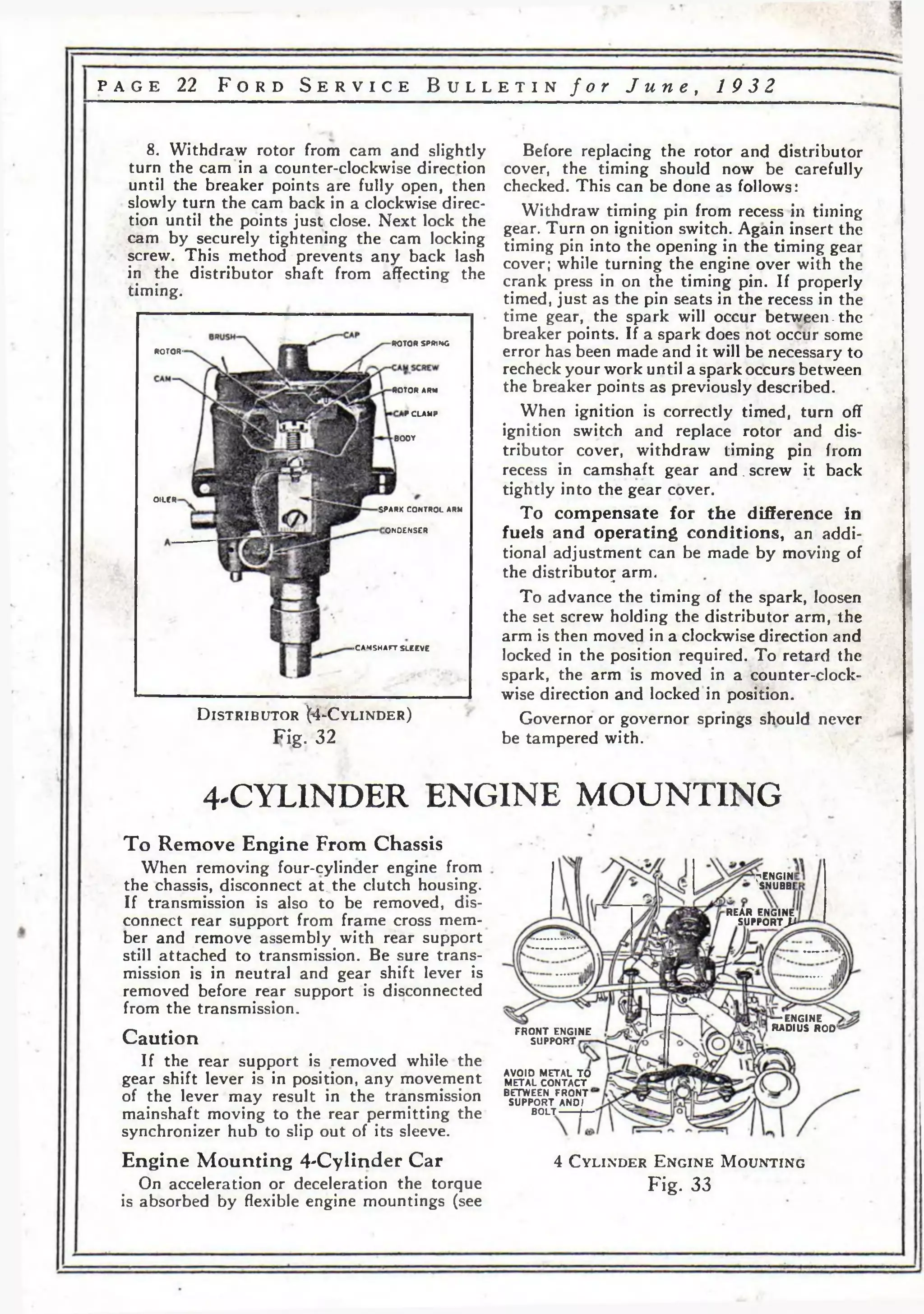
1. Loosen the lock screw holding the dis­tributor 
arm and place the arm exactly central 
with the groove in the distributor body, as 
show’n at “A” Fig. 32, and retighten the screw, 
holding the arm in this position. It is im­portant 
that the arm be in this position 
when the timing is adjusted. 
2. Check gap к g< between breaker contact 
points and, if necessary, adjust as previously 
described. 
3. Screw out timing pin located in timing 
gear cover and insert opposite end of pin 
into the opening. 
4. With the starting crank turn the engine 
over slowly, a t the same time pressing in firmly 
on the timing pin. When the piston reaches 
the end of the stroke, the timing pin will slip 
into a small recess in the camshaft gear. 
5. With the pin in place, remove the dis­tributor 
cover and lift off rotor arid distributor 
body. 
6. Loosen cam locking screw until cam 
can be turned. 
7. Replace rotor and turn it until the rotor 
arm is opposite No. 1 contact point in the 
distributor body.
p a g e 22 F o r d S e r v i c e B u l l e t i n f o r J u n e , 19 3 2 
7ENGIN1 
SNUBBE 
REAR ENGINE 
SUPPORT P 
— ENGINE 
RADIUS ROD1 
8. Withdraw rotor from cam and slightly 
turn the cam in a counter-clockwise direction 
until the breaker points are fully open, then 
slowly turn the cam back in a clockwise direc­tion 
AVOID METAL TO 
METAL CONTACT 
BETWEEN FRONT' 
SUPPORT AND I 
BOLT— —f— 
until the points just close. Next lock the 
cam by securely tightening the cam locking 
screw. This method prevents any back lash 
in the distributor shaft from affecting the 
timing. 
ROTOR SPRING 
ROTOR-ROTOR 
ARM 
iP CLAMP 
BODY 
OILER 
SPARK 
CONTROL ARM 
iONOENSCR 
•CAMSHAFT SLEEVE 
D i s t r ib u t o r ( 4 -C y l in d e r ) 
Fig. 32 
Before replacing the rotor and distributor 
cover, the timing should now be carefully 
checked. This can be done as follows: 
Withdraw timing pin from recess in timing 
gear. Turn on ignition switch. Again insert the 
timing pin into the opening in the timing gear 
cover; while turning the engine over with the 
crank press in on the timing pin. If properly 
timed, just as the pin seats in the recess in the 
time gear, the spark will occur between-the 
breaker points. If a spark does not occur some 
error has been made and it will be necessary to 
recheck your work until a spark occurs between 
the breaker points as previously described. 
When ignition is correctly timed, turn off 
ignition switch and replace rotor and dis­tributor 
cover, withdraw timing pin from 
recess in camshaft gear a n d . screw it back 
tightly into the gear cover. 
To compensate for the difference in 
fuels and operating conditions, an addi­tional 
adjustment can be made by moving of 
the distributor arm. •• 
To advance the timing of the spark, loosen 
the set screw holding the distributor arm, the 
arm is then moved in a clockwise direction and 
locked in the position required. To retard the 
spark, the arm is moved in a counter-clock-wise 
direction and locked in position. 
Governor or governor springs should never 
be tampered with. 
4'CYL1NDER ENGINE MOUNTING 
To Remove Engine From Chassis 
When removing four-cylinder engine from 
the chassis, disconnect at. the clutch housing. 
If transmission is also to be removed, dis­connect 
rear support from frame cross mem­ber 
and remove assembly with rear support 
still attached to transmission. Be sure trans­mission 
is in neutral and gear shift lever is 
removed before rear support is disconnected 
from the transmission. 
Caution 
If the rear support is removed while the 
gear shift lever is in position, any movement 
of the lever may result in the transmission 
mainshaft moving to the rear permitting the 
synchronizer hub to slip out of its sleeve. 
Engine Mounting 4-Cylinder Car 
On acceleration or deceleration the torque 
is absorbed by flexible engine mountings (see 
FRONT ENGINE 
SUPPORT 
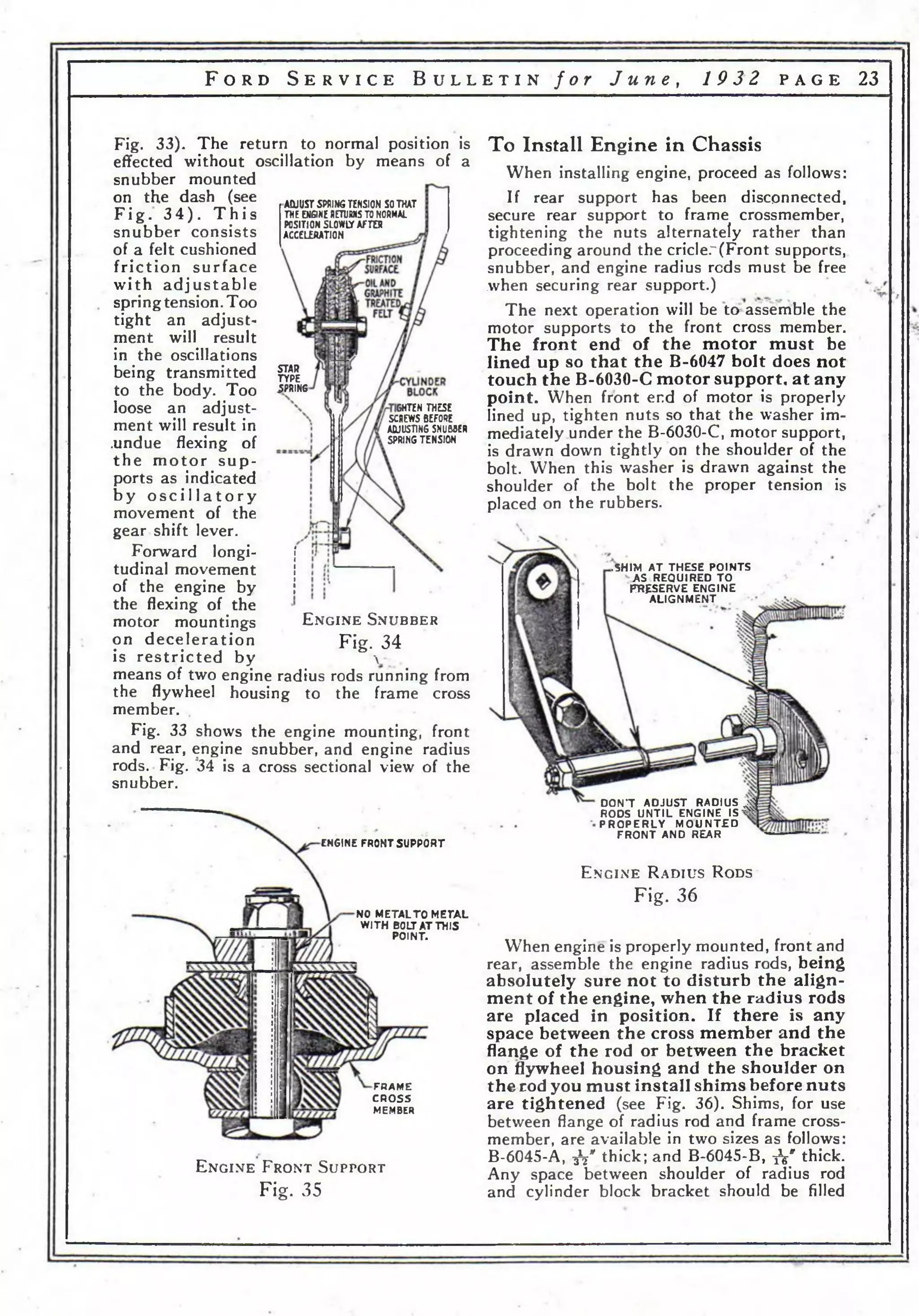
4 C y l i n d e r E n g i n e M o u n t i n g 
Fig. 33
F o r d S e r v i c e B u l l e t i n f o r J u n e , 1 9 3 2 p a g e 23 
Fig. 33). The return to normal position is 
effected without oscillation by means of a 
snubber mounted 
on the dash (see 
F ig . 3 4 ) . T h i s 
ACUUST SPRING TENSION SO THAT 
THE ENGINE RETURNS TO NORMAL 
snubber consists 
POSITION SLOWCT AFTER 
ACCELERATION 
of a felt cushioned 
friction surface 
with a d ju s ta b le 
spring tension. Too 
tight an adjust­ment 
STAR 
TYPE 
SPRING 
GHTEN THESE 
SCREWS BEFORE 
ADJUSTING SNUMER 
SPRING TENSION 
will result 
in the oscillations 
being transmitted 
to the body. Too 
loose an adjust­ment 
will result in 
.undue flexing of 
th e mo to r s u p ­ports 
as indicated 
b y o s c i l l a t o r y 
movement of the 
gear shift lever. 
Forward longi­tudinal 
movement 
of the engine by 
the flexing of the 
motor mountings E n g i n e S n u b b e r 
on deceleration Fig. 34 
is restricted by & v 
means of two engine radius rods running from 
the flywheel housing to the frame cross 
member. 
Fig. 33 shows the engine mounting, front 
and rear, engine snubber, and engine radius 
rods. Fig. ’34 is a cross sectional view of the 
snubber. 
ENGINE FRONT SUPPORT 
NO METAL TO METAL 
WITH BOLT AT THIS 
POINT. 
FRAME 
CROSS 
MEMBER 
To Install Engine in Chassis 
When installing engine, proceed as follows: 
If rear support has been disconnected, 
secure rear support to frame crossmember, 
tightening the nuts alternately rather than 
proceeding around the cricler(Front supports, 
snubber, and engine radius reds must be free 
when securing rear support.) 
The next operation will be to assemble the 
motor supports to the front cross member. 
The front end of the motor must be 
lined up so that the B-6047 bolt does not 
touch the B-6030-C motor support, at any 
point. When front end of motor is properly 
lined up, tighten nuts so that the washer im­mediately 
under the B-6030-C, motor support, 
is drawn down tightly on the shoulder of the 
bolt. When this washer is drawn against the 
shoulder of the bolt the proper tension is 
placed on the rubbers. 
.SHIM A T THESE POINTS 
AS REQUIRED TO 
PRESERVE ENGINE 
A LIGNMEN T 
DON’T A D JU S T RADIUS лй 
RODS U N T IL ENGINE I S ^ 
P R O P E R L Y M O U N T E D 
FR O N T AND REAR 
E n g in e R a d iu s R ods 
E n g i n e F r o n t S u p p o r t 
Fig. 35 
Fig. 36 
When engine is properly mounted, front and 
rear, assemble the engine radius rods, being 
absolutely sure not to disturb the align­ment 
of the engine, when the radius rods 
are placed in position. If there is any 
space between the cross member and the 
flange of the rod or between the bracket 
on flywheel housing and the shoulder on 
the rod you must install shims before nuts 
are tightened (see Fig. 36). Shims, for use 
between flange of radius rod and frame cross­member, 
are available in two sizes as follows: 
B-6045-A, fa" thick; and B-6045-B, fa* thick. 
Any space between shoulder of radius rod 
and cylinder block bracket should be filled
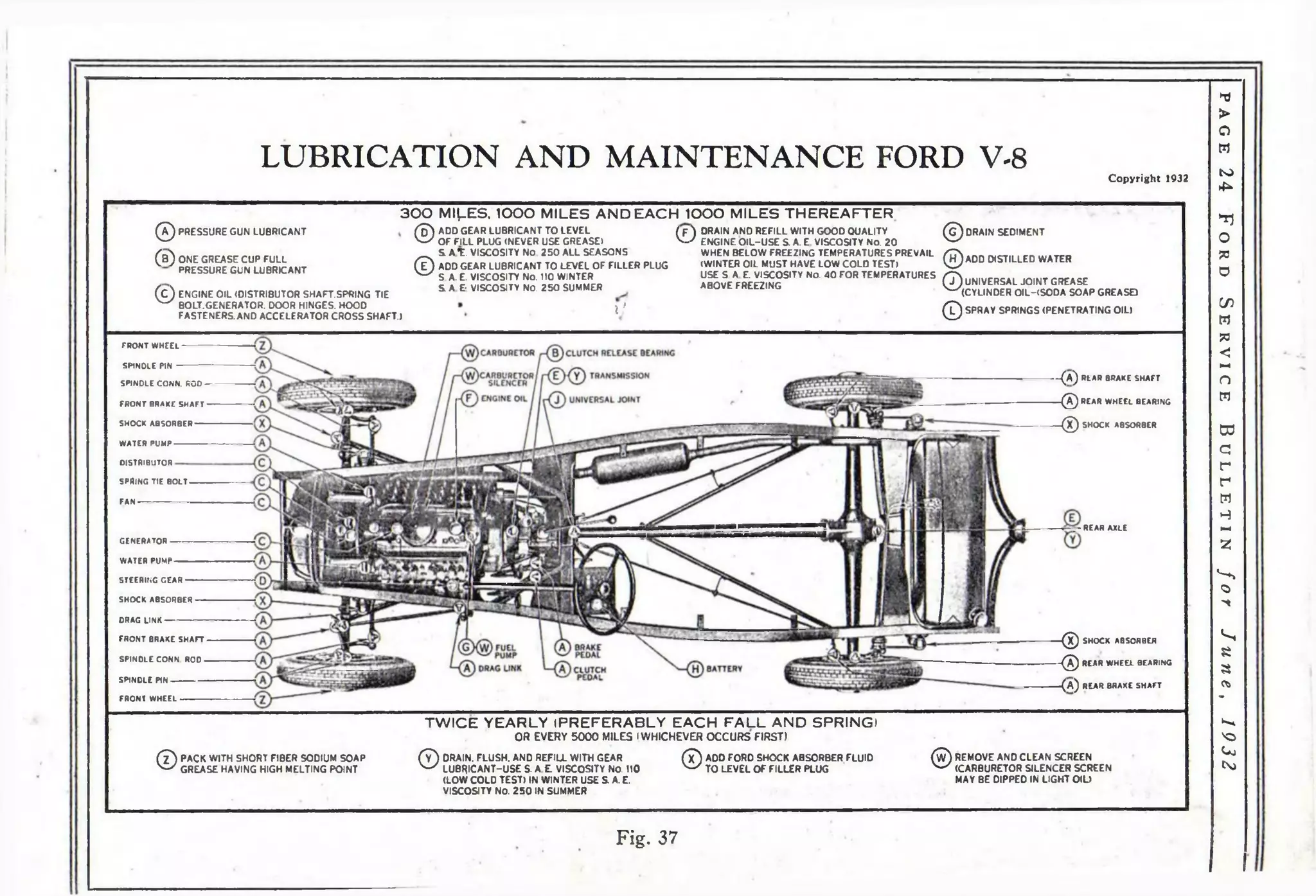
LUBRICATION AND MAINTENANCE FORD V-8 
Copyright 1932 
®PRESSURE GUN LUBRICANT 
(в) ONE GREASE CUP FULL 
PRESSURE GUN LUBRICANT 
( c ) ENGINE OIL (DISTRIBUTOR SHAFT.SPRING TIE 
w BOLT.GENERATOR. DOOR HINGES. HOOD 
3 0 0 Mll.ES. lOOO MILES AND EACH ЮОО MILES TH ER EA F TER 
®ADD GEAR LUBRICANT TO LEVEL ( j ) DRAIN AND REFILL WITH GOOD QUALITY 
FASTENERS. AND ACCELERATOR CROSS SHAFT.) 
OF FILL PLUG (NEVER USE GREASE) v - ' ®S A T . VISCOSITY NO 250 ALL SEASONS 
ADD GEAR LUBRICANT TO LEVEL OF FILLER PLUG 
S A. E. VISCOSITY No. 110 WINTER 
S A E- VISCOSITY No. 250 SUMMER 
ENGINE OIL-USE S A. E VISCOSITY No. 20 
WHEN BELOW FREEZING TEMPERATURES PREVAIL 
(WINTER OIL MUST HAVE LOW COLD TEST) 
USE S A E. VISCOSITY No. 40 FOR TEMPERATURES 
ABOVE FREEZING 
DRAIN SEDIMENT 
ADD DISTILLED WATER 
i ' 
©® 
(7) UNIVERSAL JOINT GREASE 
^ (C Y L IN D ER OILHSODA SOAP GREASE) 
Q SPRAY SPRINGS (PENETRATING OIL) 
FRONT WHEEL 
SPINDLE PIN 
SPINDLE CONN. ROD — 
FRONT BRAKE SHAFT 
SHOCK ABSORBER 
WATER PUMP 
DISTRIBUTOR 
SPRING TIE BOLT 
FAN 
GENERATOR 
WATER PUMP 
STEERING GEAR 
SHOCK ABSORBER 
DRAG UNK 
FRONT BRAKE SHAFT 
SPINDLE CONN. ROO 
SPINDLE PIN 
FRONT WHEEL 
~ ( A ) REAR BRAKE SHAFT 
® REAR WHEEL BEARING 
0 SHOCK ABSORBER 
Г - REAR AXLE 
0 SHOCK ABSORBER 
- 0 REAR WHEEL BEARING 
( A ) REAR BRAKE SHAFT 
TW IC E YEARLY (PREFERABLY EACH FA L L AND SPRING) 
OR EVERY 5000 MILES (WHICHEVER OCCURS FIRST) 
GREASE HAVING HIGH MELTING POINT ©DRAIN. FLUSH. AND REFILL WITH GEAR 
©PACK WITH SHORT FIBER SODIUM SOAP 
LUBRICANT-USE S. A E VISCOSITY No. 110 
(LOW COLO TEST) IN WINTER USE S. A. E. 
VISCOSITY NO. 250 IN SUMMER 
TO LEVEL OF FILLER PLUG ©REMOVE AND CLEAN SCREEN 
®ADD FORD SHOCK ABSORBER FLUID 
(CARBURETOR SILENCER SCREEN 
MAY BE DIPPED IN LIGHT OIL) 
Fig. 37 
p a g e 24 F ord S e r v i c e B u l l e t i n for J u n e , 1 9 3 2
F o r d S e r v i c e B u l l e t i n f o r J u n e , 19 3 2 p a g e 25 
with xV' round washers as required. A-22310 
washer is suitable for this purpose. 
Next bolt the arms of the B-6800 engine 
snubber to the flywheel housing, being careful 
to see that there is no tension on the springs 
until the arms have been bolted. After the 
arms are secured, adjust the snubber spring 
tension so that the engine’s return to normal 
position after acceleration requires approx­imately 
5 times as long as the original move­ment 
(see Fig. 34). 
Always remove all tension from the snub­bing 
unit springs if the engine mounting or en­gine 
radius rods are being disturbed in anyway. 
LUBRICATION AND MAINTENANCE 
The importance of proper lubrication and periodic inspection and adjustments cannot be 
over-emphasized. The lubrication and maintenance work on the Ford cars and trucks can 
be divided into two groups: first, points requiring attention every 1000 miles; second, points 
requiring attention twice yearly or every 5000 miles (whichever occurs first). 
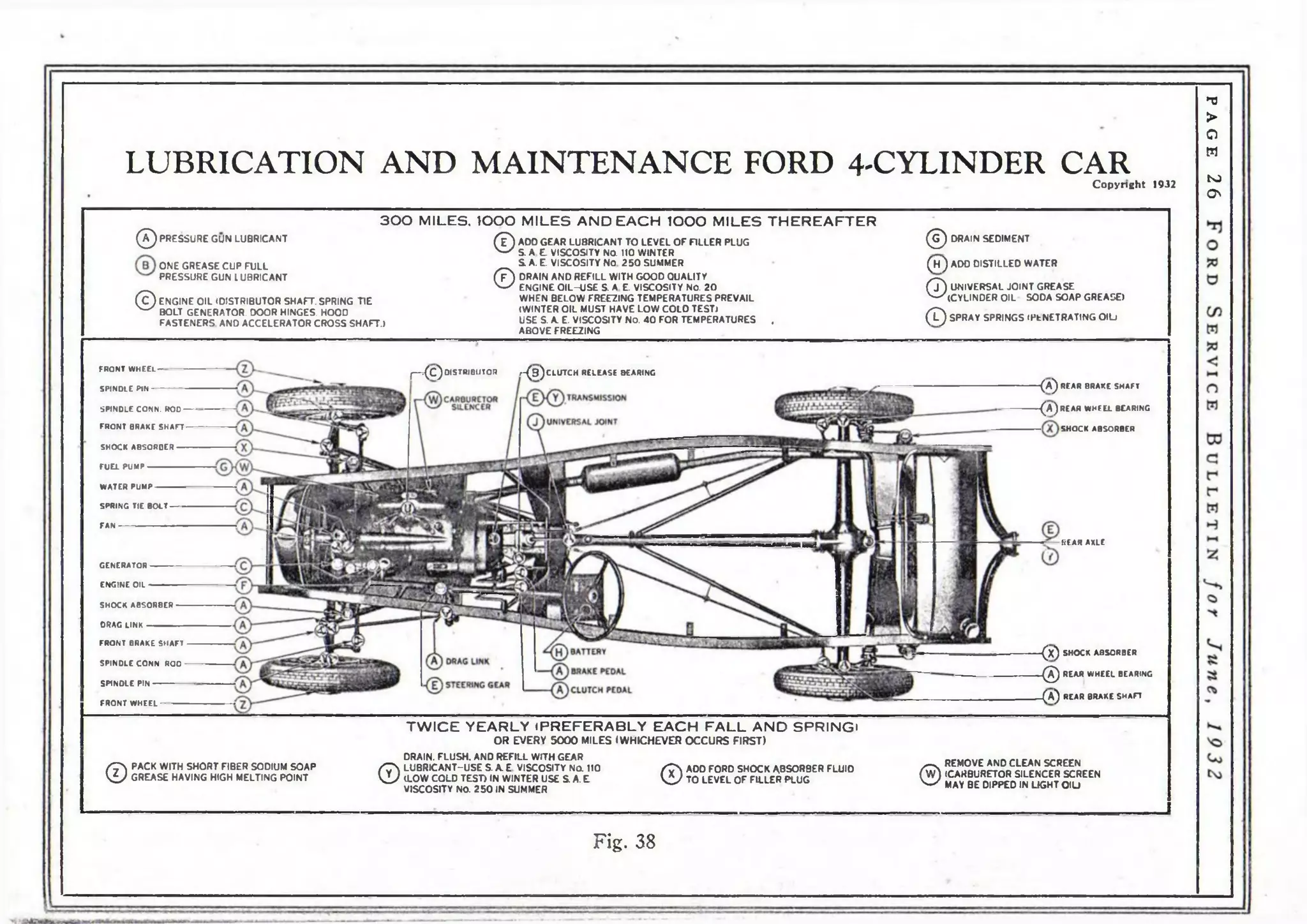
The lubrication charts, Figs. 37, 38 and 39, give information for the complete lubrication of 
the cars and trucks. Proper lubrication has a vital effect on the life of any machine, conse­quently 
you should follow these instructions very carefully. 
Group 1 
AT 300 MILES, 1000 MILES AND EACH 
1000 MILES THEREAFTER. 
Engine 
Drain off the old oil w'hen the new car has 
been driven 300 miles, and again when a total 
mileage of 1000 miles has been reached and at 
each 1000 miles thereafter. The qil will drain 
out more completely if warm, ancl should be 
replaced with 5 quarts of engine oil of the 
proper viscosity and quality. In general, an oil 
having the body of S. A. E. viscosity No. 40 
will prove satisfactory for summer use. For 
winter use, oil having the specifications of 
S. A. E. viscosity No. 20 should be used. It is 
essential, however, that this winter oil have a 
low cold test. It must be understood that these 
classifications are of “body” only and not of 
quality. It is also essential that the oil be 
otherwise properly refined. 
Advise owners that oil level should be check­ed 
periodically between changes. 
Chassis 
The chassis should be lubricated at 1000 
miles and after each 1000 miles of operation 
thereafter. Suggest that the lubrication of the 
chassis and the changing.of engine oil be per­formed 
at the same time. 
Clutch Release Bearing 
The clutch release bearing is lubricated by 
means of a grease cup, located on the top of 
the clutch housing (on the earlier V-8 cars 
this grease cup is located on right side of clutch 
housing). The cup should be screwed in as far 
as it will go, then backed off and repacked 
with a good grade of pressure gun lubricant 
and replaced, screwing it in 2]/2 to 3 turns. 
Steering Gear 
Remove the plug on the steering gear hous­ing 
and add gear lubricant until it reaches the 
level of the filler plug hole. Use gear lubricant 
only, never use greases in the steering gear. 
Generator 
The bearings in the generator are lubricated 
through a small oil hole, located at both ends 
of the generator. Fill with engine oil. 
Distributor 
Fill the oil cup at the side of the distributor 
with engine oil. A light film of vaseline should 
be applied to the cam. 
Transmission and Rear Axle 
Sufficient gear lubricant should be added 
to bring it level with the filler hole. 
Universal Joint 
The universal joint housing should be filled 
with a universal joint lubricant composed of 
cylinder oil, thickened with sodium tallow 
soap. Pressure gun lubricator fittings are pro­vided. 
(3 fittings on truck, see Chart.) 
Pressure Gun Fittings 
Force pressure gun lubricant to all parts 
equipped with the conical shaped lubricator 
fittings (except universal joints). (See Charts 
for locations.) 
Clutch and Brake Pedals 
On the earlier cars and trucks the pedal 
shaft was provided with a pressure gun fitting. 
A fitting is now provided on each pedal. 
Fan 
The fan on the V-8 operates on the generator 
shaft (see Generator). The fan on 4-cylinder 
engine is provided with a pressure gun fitting.
LUBRICATION AND MAINTENANCE FORD 4-CYLINDER CAR 
Copyright 1932 
*0►ОИ 
NJ 
ON 
® 
© 
PRESSURE GUN LUBRICANT 
3 0 0 MILES. ЮОО MILES AND EACH ЮОО MILES TH ER EA F TER 
ONE GREASE CUP FULL 
PRESSURE GUN LUBRICANT 
ENGINE OIL (DISTRIBUTOR SHAFT. SPRING TIE 
BOLT GENERATOR. DOOR HINGES. HOOD 
FASTENERS AND ACCELERATOR CROSS SHAFT.) 
©ADD GEAR LUBRICANT TO LEVEL OF FILLER PLUG 
S. A E. VISCOSITY NO. 110 WINTER 
S A. E. VISCOSITY NO 250 SUMMER 
©DRAIN AND REFILL WITH GOOD QUALITY 
ENGINE OIL-USE S. A E. VISCOSITY No. 20 
WHEN BELOW FREEZING TEMPERATURES PREVAIL 
(WINTER OIL MUST HAVE LOW COLD TEST) 
USE S. A. E. VISCOSITY No. 40 FOR TEMPERATURES . 
ABOVE FREEZING 
@ DRAIN SEDIMENT 
( H ) ADO DISTILLED WATER 
©UNIVERSAL JOINT GREASE 
(CYLINDER OIL SODA SOAP GREASE) 
( T ) SPRAY SPRINGS <PtNETRATING OIU 
FRONT WHEEL— 
SPINDLE PIN 
SPINDLE CONN. ROD------ 
FRONT 0RAKF SHAFT-SHOCK 
ABSORCER 
FUEL PUMP 
WATER PUMP 
SPRING TIE BOLT 
FAN 
I— < C ) DISTRIBUTOR r - (3 )c L U T C H RELEASE BEARING 
{ A ) REAR BRAKE SHAFT 
(A )R E A R WHEEL BEARING 
SHOCK ABSORBER 
REAR AXLE 
GENERATOR 
ENGINE OIL 
SHOCK ABSORBER 
DRAG LINK 
FRONT BRAKE SHAFT 
SPINDLE CONN ROO 
SPINDLE PIN 
FRONT WHEEL 
< x ) SHOCK ABSORBER 
@ REAR WHEEL BEARING 
( A ) REAR BRAKE SHAFT 
GREASE HAVING HIGH MELTING POINT © 
©PACK WITH SHORT FIBER SODIUM SOAP 
TW IC E YEARLY (PREFERABLY EACH FA L L AND SPRING» 
OR EVERY 5000 MILES (WHICHEVER OCCURS FIRST) 
DRAIN. FLUSH. ANO REFILL WITH GEAR 
LUBRICANT-USE S. A E VISCOSITY No. 110 
(LOW COLD TEST) IN WINTER USE S. A. E. 
VISCOSITY N0. 250 IN SUMMER ©AOD FORD SHOCK A8S0RBER FLUID 
TO LEVEL OF FILLER PLUG ©REMOVE AND CLEAN SCREEN 
(CARBURETOR SILENCER SCREEN 
MAY BE DIPPED IN LIGHT O IU 
Fig. 38
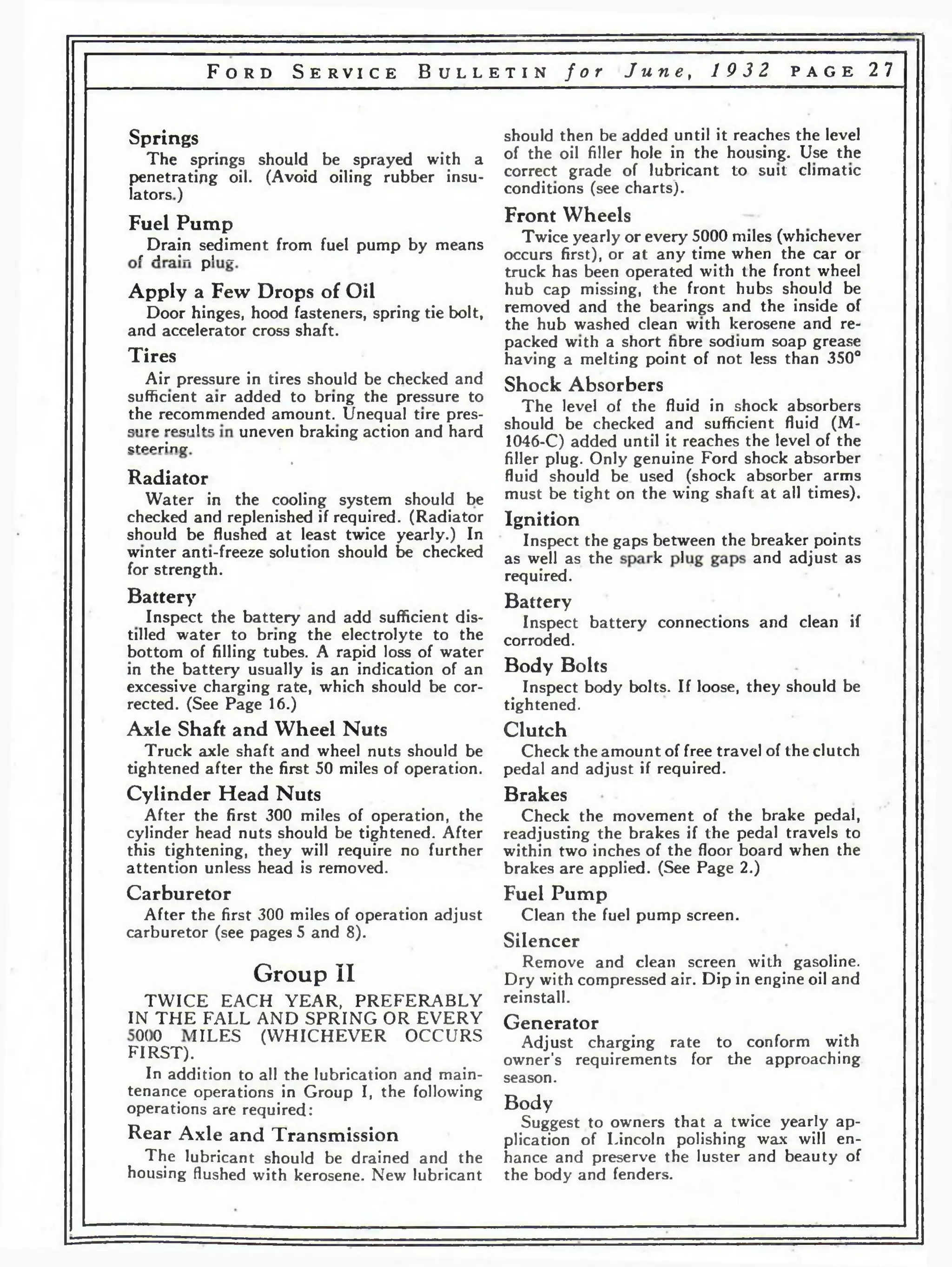
F o r d S e r v i c e B u l l e t i n f o r J u n e , 1 9 3 2 p a g e 27 
Springs should then be added until it reaches the level 
The springs should be sprayed with a of the oil fi'ler |?0Jeuin. the housing. Use the 
penetrating oil. (Avoid oiling rubber insu- сог,е.с* gra,.de ° [ lubricant to suit climatic 
lators ) conditions (see charts). 
Fuel Pump Front Wheels 
Drain sediment from fuel pump by means Twic« Уеаг1у or,every ?°°° r j •_ _I _ K occurs first), or at any time wmh'leens ^thhe lcchaer voerr 
P truck has been operated with the front wheel 
Apply a Few Drops of Oil bub cap missing, the front hubs should be 
Door hinges, hood fasteners, spring tie bolt, removed and the bearings and the inside of 
and accelerator cross shaft. the hub washed clean with kerosene and re-packed 
with a short fibre sodium soap grease 
Tires having a melting point of not less than 350° 
Air pressure in tires should be checked and Shock Absorbers 
sufficient air added to bring the pressure to f . a . , . , , , , 
t.1h e rPe0^commrmvieanndj e0dj aотmЛo1u1пn4t.. уU Lnoenqnuoail tire pres- « Th< e, l.e vel . of « the« flui«d in sh• ock, яa b•so» rb/лeлrs 
c«„tPr fPi rri0nct„ ifc nunnae,vr oenn braking ao cr ttiinonn ao nnrdi hard s1h0o4u6l_dC j baed dcehde cuknetdil aitn rde ascuhfefsic tihenet lefvlueild o f (tMhe- 
, filler plug. Only genuine Ford shock absorber 
Radiator fluid should be used (shock absorber arms 
Water in the cooling system should be must be t!ght on the winS shaft at 8,1 times>- 
checked and replenished if required. (Radiator Ignition 
should be flushed at least twice yearly.) In • inspect the gaps between the breaker points 
winter anti-freeze solution should be checked as we„ as the k , and adjust as 
for strength. required. 
Battery Battery 
Inspect the battery and add sufficient dis- Inspect battery connections and clean if 
tilled water to bring the electrolyte to the corroded, 
bottom of filling tubes. A rapid loss of water т> л t*  
in the battery usually is an indication of an Body Bolts 
excessive charging rate, which should be cor- Inspect body bolts. If loose, they should be 
rected. (See Page 16.) tightened. 
Axle Shaft and Wheel Nuts Clutch 
Truck axle shaft and wheel nuts should be Check the amount of free travel of the clutch 
tightened after the first 50 miles of operation, pedal and adjust if required. 
Cylinder Head Nuts Brakes 
After the first 300 miles of operation, the Check the movement of the brake pedal, 
cylinder head nuts should be tightened. After readjusting the brakes if the pedal travels to 
this tightening, they will require no further within two inches of the floor board when the 
attention unless head is removed. brakes are applied. (See Page 2.) 
Carburetor Fuel Pump 
After the first 300 miles of operation adjust Clean the fuel pump screen, 
carburetor (see pages 5 and 8). Silencer 
^ -ry Remove and clean screen with gasoline. 
I jr rO U p 11- Dry with compressed air. Dip in engine oil and 
TWICE EACH YEAR, PREFERABLY reinstall. 
IN THE FALL AND SPRING OR EVERY Generator 
p T r ^ 'n ^ ^ E S (WHICHEVER OCCURS Adjust charging rate to conform with 
МКЬГ). owner's requirements for the approaching 
In addition to all the lubrication and main- season, 
tenance operations in Group I, the following R , 
operations are required: Uoay e 
^ A - . . Suggest to owners that a twice yearly ap- 
Kear Axle and Transmission plication of Lincoln polishing wax will en- 
The lubricant should be drained and the hance and preserve the luster and beauty of 
housing flushed with kerosene. New lubricant the body and fenders.
LUBRICATION AND MAINTENANCE FORD 4-CYLINDER TRUCK 
FUEL P U M P (G V W REAR WHEEL 
BEARING 
С ) DISTRIBUTOR 
J ) UNIVERSAL JOINT 
B jCLUTCH RELEASE BEARING 
A)SPRING SHACKLE 
Y ) TRANSMISSION 
J)UNIVERSAL JOINT 
CLUTCH PEDAL 
A)SPRING SHACKLE 
BRAKE PEDAL 
J ) DRIVE SHAFT 
DRAG LINK 
STEERING GEAR 
WATER PUMP 
Copyright 1932 
®PRESSURE GUN LUBRICANT 
ONE GREASE CUP FULL 
PRESSURE GUN LUBRICANT 
3 0 0 MILES. lOOO MILES AND EACH 1000 MILES THER EA F TER 
©ADO GEAR LUBRICANT TO LEVEL OF FILLER PLUG 
S A L VISCOSITY No 110 WINTER 
S A E VISCOSITY No. 250 SUMMER 
ENGINE OIL (DISTRIBUTOR SHAFT SPRING TIE 
BOLT. GENERATOR. DOOR HINGES. HOOD 
FASTENERS. AND ACCELERATOR CROSS SHAFT.) 
©DRAIN AND REFILL WITH GOOD QUALITY • 
ENGINE OIL - USE S A E VISCOSITY No 20 
WHEN BELOW FREEZING TEMPERATURES PREVAIL 
(WINTER OIL MUST HAVE LOW COLD TEST) 
USE S. A E. VISCOSITY No 40 FOR TEMPERATURES 
ABOVE FREEZING 
© 
DRAIN SEDIMENT 
( h ) a d d d is t il l ed w a ter 
©0 , 
UNIVERSAL JOINT GREASE 
( l ) SPRAY SPRINGS (PENETRATING OIL) 
(CYLINDER OIL- SODA SOAP GREASE) 
FRONT WHEEL 
SPINOLE CONN. ROD 
SPINDLE PIN 
FRONT BRAKE SHAFT 
SPRING SHACKLE 
SPRING TIE BOLT 
FAN 
REAR BRAKE SHAFT 
SPRING SEAT 
SPRING SHACKLE 
GENERATOR 
ENOINE OIL 
SPRING SHACKLE 
ORAG LINK 
FRONT BRAKE SHAFT 
SPINOLE PIN 
SP1N0LE CONN. ROD 
FRONT WHEEL 
< A ) SPRING SHACKLE 
SPRING SEAT 
REAR BRAKE SHA*7 
( a ) r ear WHEEL BEARING 
©PACK WITH SHORT FIBER SODIUM SOAP 
GREASE HAVING HIGH MELTING POINT ©DRAIN. FLUSH. AND REFILL WITH GEAR 
LUBRICANT-USE S A.E. VISCOSITY No 110 
(LOW COLD TEST) IN WINTER USE £ A. E 
VISCOSITY N0. 250 IN SUMMER 
(w ) REMOVE AND CLEAN SCREEN 
TWIC E YEARLY (PREFERABLY EACH FA L L AND SPRING) 
OR EVERY 5000 MILES «WHICHEVER OCCURS FIRST) 
p a g e 28 F ord S e r v i c e B u l l e t i n for J u n e , 193 2
Vol. 13 July 1932 No. 2 
<fe OF VALVES IN 
RIGHT BANK 
<fc OF ROTOR POINT 
<fc OF VALVES IN 
LEFT BANK 
<t OF ROTOR POINT 
265 
SPLIT PISTON SKIRTS 
TO L E F T SIDE OF MOTOR 
OF CYLINDERS IN 
RIQHT BANK 
OF CRANKSHAFT 
CRANKSHAFT COUNTER 
BALANCES 
OF CRANKSHAFT 
OF ENGINE 
CAMSHAFT GEAR 56 TEETH 
THESE MARKS MUST BE 
TOGETHER WHEN CAM-SHAFTGEAR 
IS INSTALLED 
TIMING MARK ON 
CAMSHAFT GEAR 
<fcOF CYLINDERS 
IN L E F T BANK 
TIMING MARK ON 
CRANKSHAFT GEAR 
<t OF CRANKSHAFT 
CRANKSHAFT GEAR 
28 TE E TH 
FLYWHEEL RING GEAR 
112 T E E TH 
V-8 ENGINE 
Various adjustments affecting the performance of the V-8 engine are covered in this 
bulletin. Periodically check each member of your organization on these adjustments. 
Have each man actually make each of the adjustments.
p a g e 3 0 F o r d S e r v i c e B u l l e t i n / o r J u l y , 1 9 3 2 
V-8 Engine Performance 
One or more incorrect adjustments usually 
reflects itself in unsatisfactory engine perfor­mance. 
Fig. 40 illustrates the various points 
which should be checked to restore the engine’s 
operation to the high standard to which it was 
designed. 
Each of the adjustments is lettered for 
convenience, the lettering however is not an 
attempt to outline a definite line of procedure. 
The sequence of the various adjustments is 
best determined by the performance of each 
individual car. As an example, the car that 
idles nicely but misses at high speed should 
suggest to the mechanic that the spark plug 
gap may be too great, thus the spark plugs 
should be checked first or if the fault seems to 
be a lack of fuel, remove the flexible fuel line 
to fuel pump connection to see that the pas­sage 
is not blocked. Blow into balance of line 
m O T T L E PLATE ADJUSTING 
SCREW SHOULD BE SET 
TO SPEED OF 5 TO 7 MILES 
PER HOUR (HIGH GEAR).------------ 
Ф а FEED UNE CONNECTIONS 
MUST BE TIGHT AND PROPERLY 
SEATED (AT BOTH PUMP AND TANK) 
FLEXIBLE CONNECTIONS SHOULD 
FEEL FIRM AND NOT COLLAPSE 
AT HIGH SPEEDS.----------------------- 
fcR E EN S IN SILENCER, CARBURETOR, 
AND FUEL PUMP MUST BE CLEAN. 
to remove any obstructions. If these do not 
correct the trouble the next most likely cause 
of the trouble should be examined and so on 
until performance is correct. 
Sluggish performance in low speeds, if motor 
does not “miss” and no “ping” is noted under 
load at low speeds, should suggest that the 
vacuum brake adjustment is too tight or 
the vacuum brake piston is binding in the 
distributor body. 
If the motor stalls at sudden stops the 
throttle plate adjustment (see “A” , Fig. 40) 
may be set so that the car is propelled at 6У2 
to 7 miles per hour in high gear providing the 
adjustments “A” , “E” , “F ”, “H ”, “ I ” and 
“K” are correct. 
Dealers should arrange to periodically check 
each member of his service organization on 
these adjustments. 
% 'EL PUMP MUST PRIME ITSELF 
AND FLOW FUEL FROM OUTLET 
IN 20 SECONDS OR LESS WHEN 
ENGINE IS CRANKED WITH STARTER. 
* OP ANY LEAKS BETWEEN CARBURETOR 
AIR VANES AND CYLINDER AS FOLLOWS: 
TIGHTEN MANIFOLD SCREWS. WINDSHIELD 
WIPER AND DISTRIBUTOR VACUUM UNES 
AT BfiTH END§, CARBURETOR GASKETS. 
AND METERING PIN PACKING. 
WITH ENGINE IDLING SLOWLY. FLOW OIL 
ON JOINTS. IF ENGINE PICKS UP SPEED 
THERE IS ALEAK. 
ROUND EACH SPARK PLUG TERMINAL TO SEE 
THAT PLUG IS RECEIVING HIGH TENSION CURRENT. 
SPARK PLUGS MUST BE CLEAN AND SPACED A T .025л-* © 
ALL WHEELS MUST REVOLVE FREELY; BRAKE PEDAL 
MUST HAVE4lVE"FEEL WHEN RELEASED. 
ADJUST METERING PIN-eE SURE 
ENGINE 15 WELL WARMED UP. 
ScftiW ADJUSTMENT DOWN UNTIL 
ENGINE RUNS UNEVENLY. THEN TURN 
BACK SLOWLY (ALLOWING 30 
SECONDS AT EACH SETTING) 
UNTIL ENGINE PERFORMANCE IS 
AGAIN SMOOTH. 
CD 
BREAKER POINTS MUST BE 
SMOOTH AND GAP SPACED 
.0I4"T0 .015." 
9 e$T COMPRESSION WITH 
CRANK; VALVES MUST SEAT 
PROPERLY; GAP SHOULO BE 
.OI25TO .0I3S'WITH ENGINE 
COLD. 
S> 
SET BREAKER PLATE ADJUSTING 
S CR EW V A T CENTER OF SLOT. 
ROAD TEST AND ADJUST VACUUM 
BRAKE TO LEAST POSSIBLE 
TENSION WITHOUT MOTOR 
PINGING. VACUUM BRAKE PISTON 
MUST WORK FREELY IN 
DISTRIBUTOR BODY WITH NO 
BIND. SCREW V M A Y NOW 
BE SET SLIGHTLY HIGHER FOR 
FUEL WITH HIGH ANTI-KNOCK 
RATING; NEVER MORE THAN '/a 
ABOVE CENTER. SETTING MUST 
BE DETERMINED BY ENGINE 
PERFORMANCE,LOCK POSITION. 
(D 
INFLATE TIRES TO 
RECOMMENDED PRESSURE. 
Fig. 40 
Gasoline Mileage Tester 
In order to use the mileage tester designed 
for the “A” on the V-8 or the improved 4- 
cylinder cars or trucks, a set of extension 
fittings is necessary as follows: 
Electrical extension. 
Two rubber tube extensions with fittings. 
Aluminum spacing block. 
The electrical extension comprises a socket 
to connect to the plug of the tester, two wires 
18* long and two battery clamps, one of 
which is insulated. The insulated' clip is 
to be connected to a live electrical post on 
the underside of the ignition switch (See 
Fig. 41) on the steering column bracket. The 
other clip should be connected to a grounded 
part such as the throttle rod (See Fig. 41). The 
socket and plug should be insulated and a pure 
gum rubber tube is furnished for this purpose.
F o r d S e r v i c e B u l l e t i n f o r J u l y , 19 3 2 p a g e 31 
GROUND UNINSULATED CUP 
•CONNECT INSULATED CUP TO IGNITION SWITCH TERMINAL 
Fig. 41 
The gasoline extension tubes should be con­nected 
to the two rubber tubes of the tester. 
(See Figs. 42 and 43). 
After installing the tester on the right hand 
window, open the ventilator and pass the 
rubber tubes through it. 
Lift the hood. Install aluminum spacing 
block in the drain channel so that tl^e notch is 
away from the hinge and lay the tWo'rubber 
tubes in the notch. 
Disconnect the fuel line leading to the pump 
and connect the rubber hose that leads to the 
pump on tester to fuel line running to the fuel 
tank. The other rubber hose from the tester 
CONNECT MILEAGE TESTER 
PUMP TUBE TO FUEL 
FEEOUNE 
CONNECT FUEL PUMP 
INLET TO MILEAGE 
TESTER VALVE TUBE 
Fig. 43 
valve should be connected to the fuel pump on 
the engine (See Figs. 42 and 43). Close the 
hood and proceed with the economy test in 
the usual manner. 
Failure to obtain satisfactory mileage is an 
indication of some mal-adjustment. Various 
points to check are indicated in Fig. 40. 
Do not overlook brake adjustment and 
tire inflation. 
Create all' the enthusiasm possible by en­couraging 
owners to run these tests anytime 
after the 300 mile inspection and adjustment. 
Tire Pressures 
The air pressure in the tires has a very 
pronounced effect on fuel consumption, 
and the action of the brakes, as well as 
the correct operation of the front wheels 
and steering gear. 
Inflate tires as follows: 
5.25 x 18*..............................................35 pounds 
6.00 x 20..............................................45 pounds 
6.50 x 20................................................50 pounds 
32 x 6 (8 ply truck ty p e )...................80 pounds 
32 x 6 (10 ply heavy duty)............... 90 pounds 
32 x 7 (with BB-1015-B wheel)... 100 pounds 
i i 
Fig . 42 
*Some owners of cars, consistently operated at high 
speeds, prefer to. have the tires on the front wheels 
inHated to 40 pounds pressure. This extra pressure is 
permissible for the front wheels where car is operated 
at high speeds.
p a g e 32 F o r d S e r v i c e B u l l e t i n f o r J u l y , 1 9 3 2 
Adjusting Front Wheel Bearings 
If there is excessive play in the bearing or if 
the bearing is too tight it can be adjusted as 
follows: 
Remove the front wheel. 
The grease cap may now be removed by turn­ing 
in a counter-clockwise direction. By re­moving 
the cotter key the front wheel bearing 
nut, bearings and hub may be removed or 
adjusted. 
When reassembling or adjusting, the adjust­ing 
nut should be run up tight (don’t use a 
wrench—the handle of which is more than 
12 inches long), and then turned back ap­proximately 
turn and the cotter pin re­placed. 
On the car both the inner and outer 
hub caps should again be installed. Cars or 
trucks should never be operated with the front 
hub caps missing. 
Disc Wheels 
Two types of Disc wheels are supplied for 
truck chassis differing in design as illustrated 
in Fig. 44. The locking rings (Fig. 45) are 
not interchangeable due to the difference in 
the angle of the locking ring flange on the 
wheel. 
Fig. 44 
To remove the continuous type of locking 
ring BB-1099-C the ring is lifted from the ring 
channel by means of a tire tool, at the slot pro­vided, 
until half of the ring is clear of the 
flange. The ring can then be slipped off of the 
wheel. 
To install the continuous type of locking 
ring BB-1099-C start at a point at right angles 
to the two cut away portions of the ring 
(see Fig. 45). When this half of the ring is at 
the bottom of the rim channel the opposite 
half is easily forced in place. 
An eighteen inch disc wheel for use with 
32 x 7 tires is available as special equipment 
under part number BB-1015-B. 
BB-1099-C BB-1099-A 
Fig. 45 
Front Axle Adjustment 
The front wheels of both cars and trucks 
should be toed in -fa" to 
Before making.any adjustments to correct 
erratic action of front wheels check for the 
foil >wing: 
Tire inflation low or uneven. 
Dragging brakes. 
Loose wheel bearings. 
Unbalanced wheel caused by tire or its in­stallation 
or a boot in the tire. 
Fig. 46
F o r d S e r v i c e B u l l e t i n f o r J u l y , 19 3 2 p a g e 3 3 
Clutch Adjustment 
V 
The clearance between the clutch release 
bearing and the clutch plate release fingers 
must be maintained at all times, and is in­dicated 
by the amount of free travel of the 
clutch pedal. As the clutch disc facings become 
worn, it will be necessary to adjust this 
clearance. The correct adjustment is when the 
clutch pedal has one inch free movement. 
This adjustment is easily made by removing 
the clevis pin (see Fig. 46) and turning the 
release arm rod. Screwing the rod out decreases 
the clutch pedal free movement. Screwing the 
rod in increases the amount of free movement. 
After making the adjustment, be sure to 
replace the clevis pin and cotter key. 
Caution owners against driving w'ith their 
foot resting on the clutch pedal, commonly 
referred to as “riding the pedal.” Riding the 
pedal will result in excessive wear of the release 
bearing and clutch disc facings, and necessi­tate 
frequent adjustment and may in time 
necessitate refacing the clutch disc. 
Universal Joints 
When installing the universal joint to the 
transmission mainshaft always make sure that 
the screw is drawn down tightly and that the 
washer is seated in the counterbore of the 
universal joint. Fig. 47 illustrates the ar­rangement 
of these parts. When correctly 
assembled the mainshaft rear bearing hub is 
against the shoulder, of the mainshaft and is 
held in this position by the universal joint 
with no end play. The outer ring of the main­shaft 
bearing is held in position by the rear 
motor support. 
Any longitudinal movement of the main­shaft 
will permit the synchronizer, etc., to 
change its location with regards to the second 
speed mainshaft gear which may result in 
transmission failure. 
Dealers should take every precaution neces­sary 
to assure themselves that each mechanic 
understands what constitutes correct assem­bly 
of these parts. 
Adjusting the Fan Belt 
The belt is adjusted to the proper tension 
when the car leaves the factory and this ad­justment 
should not be changed unless the 
belt slips. 
On the eight cylinder engine the fan, water 
pumps, and generator are operated by the 
same “V” shaped belt. The adjustment 
is made by loosening the generator support to 
engine clamp bolt and moving the generator 
upward by turning the adjusting nut. Do not 
tighten the belt more than is actually necessary 
to keep it from slipping. 
On the four cylinder engine the fan and 
water pump both operate from the same shaft. 
The shaft is driven by a “V” shaped belt. 
The adjustment is easily made by loosen­ing 
the generator support to engine screw and 
moving the generator toward you. Do not 
tighten belt more than is actually necessary to 
keep it from slipping. 
DISTRIBUTOR 4 CYL. 
Distributor Cams 
The distributor cams used in the “A” and 
the improved 4-cylinder cars are shown in 
Fig. 48. Mechanics and stock men should 
familiarize themselves with these two cams so 
as to readily identify them. On the cam used 
in the “A” distributor the radius does not 
blend with the flats. On the new distributor 
cam the flats blend with one side of the 
radius. 
RADIUS DOES NOT RADIUS BLENDS 
BLEND WITH FLAT-. WITH F L A T -^ v 
BEARING MUST 
BE T IG H T AGAINST 
SHOULDER 
UNIVERSAL JOINTS 
HOLD BEARING 
AGAINST SHOULDEB 
OF MAIN SHAFT 
BE SURE THAT SCREW IS 
DOWN TIGHT, WASHER IS 
WELL SEATED IN COUNTER­BORE, 
AND BEARING IS 
AGAINST SHOULDER OF 
MAIN SH A F T . 
Fig. 47 
A*I22I0 B-I22I0 
Fig. 48
p a g e 3 4 F o r d S e r v i c e B u l l e t i n f o r J u l y , 19 3 2 
REAR ENG* К С 
SUPPOIrt 
TRANSMISSION 
MAIN SHAFT 
BALL BEAR! 
The A-12210 distributor cam should never 
be used with the new distributor. Both 
A-12210 and B-12210 cams are available for 
service. 
Distributor Body 
The distributor body B-12105 used on the 
improved 4-cylinder engine has been so de­signed 
as to be adaptable to the “A” dis­tributor. 
When installing the B-12105 distri­butor 
body on the A-12130 distributor base 
it will be necessary to increase the height of 
the breaker arm slot from -fa" to jV' to clear 
the manual control breaker arm used on the 
A-12100 distributor. This is accomplished by 
filing the slot with a mill file being careful not 
to remove any of the material from the sides 
of the slot (see dotted lines, Fig. 49). 
Fig 49 
* The distributor body and cap should be 
kept clean at all times as any accumulation 
of dust may result in “leakage” of the high 
tension ignition current reducing the efficiency 
of the ignition system. 
As these parts are of necessity fragile in 
nature mechanics and stock men must use 
extreme care in handling. 
Coupling Shafts 
The coupling shaft used on the BB chassis 
has been so designed as to be readily remov­able 
permitting access to the universal joints, 
etc., without disturbing other units of the 
chassis. This feature in conjunction with the 
removable cross member on all truck frames, 
facilitates the servicing of the transmission 
and clutch. 
Fig. 50 illustrates the coupling shaft used 
on the BB chassis and points out various 
service suggestions and features as well as the 
listing of the operations required to remove 
the coupling shaft. 
To reinstall the shaft reverse the operations. 
use л 
UNIVERSAL  |ГЯ 
JOINT GREASE 
EXAMINE / Ш 
UNIVERSAL ^19 
JO IN T BEARINGS 
(PARTS AVAILABLE) 
BlPARTIBLE 
UNIVERSAL JOINT, 
(i) 
TUBULAR COUPLING 
SHAFT REDUCES 
"WHIP" TO 
M IN IM UM .— > 
—(4) 
‘-REPLACE THESE 
RETAINERS IF THEIR 
CONDITION 
WARRANTS IT.- 
REMOVE AU 
BUT TOP BOLT — 
REMOVE NUTS AND 
LOCK WASHERS. 
— (3 ) SLIDE HOUS4HO SVWOfT 
V 'TOWARD REAR С INCKCS* 
REMOVE BOLTS (WKCM 
INSTALLING DOMT FAIL 
TO lock) 
push this гостю* or 
UNIVERSAL JOINT ВАС* 
(COMPRESSING THE . 
SPRING) PULI FROKl 
END OF ASSEMBLY • 
DOWNWARD SUFFlCJEKTOr 
TO CLEAR FRAME О Ю » 
, MEMBER. 
6) PULL FORWARD UKTH1 
REAR UNIVERSAL IS FRff 
OF PROPELLER SHAFT 
AND COUPLING SHAW 
CAN BE REMOVED. 
USE 
UNIVERSAL 
JO IN T GREASE 
EXCESSIVE WEAR 0U‘ 
J£>> BEARING SURFACE 
WILL RESULT IN WHIP 
OF SHAFT W ITH RESULTWfT 
LOSS Of LUBRICANT AKD 
EXCESSIVE WEAR OF 
UHIVEASAL JO IN T S . 
git P^PRO 
^ -------> MIN 
TUBULAR 
PROPELLER SHAFT 
MINIMIZES WHIP 
C o u p l in g S h a f t 
Fig. 50
F o r d S e r v i c e B u l l e t i n f o r J u l y , 1 932 p a g e 3 5 
Fig. 51 illustrates the coupling shaft recently 
made available for “AA” trucks having four 
speed transmission and bevel gear type rear 
axle. 
TRANSMISSION 
MAIN SHAFT 
BALLBEARING 
Bl PARTIBLE 
UNIVERSAL 
JO IN T 
( l ) REMOVE ALL BUT 
TOP BOLT------------- 
(Z) REMOVE NUTS AND 
LOCK WASHERS 
L (3 ) SLIDE HOUSING SUPPORT 
TOWARO REAR в INCHES. 
— (4 ) REMOVE BOLTS(WHEN 
INSTALLING DONT FAIL 
TO LOCK) 
(5 ) PUSH THIS PORTION.OF 
UNIVERSAL JOINT BACK 
(COMPRESSING THE 
SPRING) PULL FRONT 
END OF ASSEMBLY 
DOWNWARD SUFFICIENTLY 
TO CLEAR FRAME CROSS 
MEMBER. 
PULL FORWARD UNTIL 
REAR UNIVERSAL IS FREE 
OF PROPELLER SHAFT 
ANO COUPLING SHAFT 
CAN BE REMOVED. 
EXCESSIVE WEAR ON 
BEARING SURFACE 
WILL RESULT IN WHIP 
OF SHAFT WITH RESULTANT 
LOSS OF LUBRICANT AND 
EXCESSIVE WEAR OF 
UNIVERSAL JOINTS 
S e r v ic e C o u p l in g S h a f t f o r “AA” C h a s s is 
Fig. 51 
LIGHTS 
Headlight Requirements 
When the car is delivered, the headlamps are 
properly focused and aligned, and will pass 
the lighting requirements of all states. 
The focusing of the lights is a permanently 
built-in feature of the Ford headlamps, re­quiring 
no attention. The focus will remain 
fixed as long as accurately built bulbs are 
used. 
Should the lamps get out of alignment, they 
should immediately be realigned. 
Aligning Headlamps 
Align headlamps w'ith empty car standing 
on a level surface in front of a white wall or 
screen, 25 feet from front of headlamps. This 
wall must be in semi-darkness or sufficiently 
shielded from direct light so that the light 
spots from the headlamps can be clearly seen. 
The wall must be marked off with black lines, 
as follows: 
Three exactly vertical lines spaced 14 inches 
apart. 
Two horizontal lines 37 and 34 inches above 
the floor. 
Position the car 25 feet in front of these 
lines. Center line of the car should be at 90 
degrees from the wall and central with the 
three vertical lines. Sighting through the 
center of the rear window the center vertical 
line should be in line with center of the 
radiator cap. 
Headlamps are aligned by moving lamps 
after nut at bottom of bracket has been 
slightly loosened. 
For 5-passenger cars, the tops of the bright 
spots on the 25-foot wall are to be set at the 
line 34 inches above level of surface on which 
car stands. 
For all other cars and all trucks, the bright 
spots on the wall are to be set at the line 37 
inches above the level of surface on which it 
stands. 
The beam of light from each headlamp is 
to extend straight forward, that is, the centers 
of the elliptical spots of light must be 28 
inches apart. 
With tops of bright spots thus set for empty 
car the headlamps comply, under all con­ditions 
of loading, with the requirements of 
nearly all states. Consult your local police 
department.
p a g e 3 6 F o r d S e r v i c e B u l l e t i n f o r J u l y , 19 3 2 
PARKING 
LIGHT STARTING 
SPARK PLUGS DOME -| 
LIGHT “J 
SWITCH— 
AMMETER-л J 
IGNITION !• 
SW I TC H ^ ! 1 
RESISTANCE 
UNIT— v 
IGNITION и 
CONDENSER 
J T — Э и г- BREAKER 
J ^ POINTS 
DISTRIBUTOR 
INSTRUMENT 
LIGHT 
SWITCH — * 
FUSE 
INSTRUMENT BLOCK 
 L IG H T --------- 
SPARK « 
PLUG 
STARTER у 
SWITCH— ' 
GENERATOR 
О О o 
- ООО 
BATTERY 
HORN 
LIGHTING 
SWITCH 
AMMETER 
DOME LAMP 
SPARK 
PLUGS 
DOME LAMP SWITCH 
C IR C U I T S ! CONDENSER 
BREAKER 1 
ENERA^OR STARTER FUSE BLOCK 
CUTOUT SWITCH-BATTERY 
GENERATOR 
STARTING 
MOTOR 
HORN 
HEAD. 
LIGHT 
I4UIUK 
DOME 
LIGHT 
HEAD 
LIGHT 
HORN 
BUTTON 
STOP LIGHT 
SWITCH 
PARKING 
LIGHT 
B — BLACK 
G -G R E E N 
R - R E D 
Y - YELLOW 
BB-BLACK WITH BLUE 
CROSS TRACER 
BG-BLACK WITH GREEN 
TRACER 
BR-BLACK WITH RED 
TRACER 
BY-BLACK WITH YELLOW 
TRACER 
YB-YELLOW WITH BLACK 
TRACER 
YG-YELLOW WITH GREEN 
TRACER 
YR-YELLOW WITH RED 
TRACER 
B L Y -B LU E WITH YELLOW 
TRACER 
TAIL AND 
STOP LIGHT 
HEAD 
V-8 W ir in g D ia g r am 
Fig. 52 
PARKING 
LIGHT-HEAD 
LIGHT 
PARKING 
LIGHT- 
■DISTRIBUTOR 
INSTRUMENT - 
IGNITION COIL PANEL LAMP 
INSTRUMENT PANEL 
LAMP SWITCH — 
IGNITION 
SWITCH-LIGHTING 
SWITCH 
HORN BUTTON 
1 
B -B L A C K 
G -G R E E N 
R -R E D 
Y - YELLOW 
BB-BLACK WITH BLUE 
CROSS TRACER 
BG-BLACK^WITH GREEN 
TRACER 
BR-BLACK WITH RED 
TRACER 
BY-BLACK WITH YELLOW 
TRACER 
YB-YELLOW WITH BLACK 
TRACER 
YG-YELLOW WITH GREEN 
TRACER 
YR-YELLOW WITH RED 
TRACER 
B LY -BLUE WITH YELLOW 
TRACER 
/ - СSТTПOРP A 
UGHT 
SWITCH 
^ S T O P AND 
TAIL LIGHT 
4 C y l . W i r i n g ’ D i a g r a m 
Fig. 53
F o r d S e r v i c e B u l l e t i n f o r J u l y , 1 9 3 2 p a g e 3 7 
INSTRUMENT UGHT 
(PULL OUT TO REPLACE BULB) 
BLACK WIRE 
DASH LIGHT SWITCH 
STARTER SWITCH TO 
AM M E TER -Y E L LOW 
W IR E 
DASH LIGHT SWITCH 
TO LIGHT SWITCH 
BLACK WIRE WITH 
BLUE CROSS TRACER 
AMMETER 
AM M ETER TO GENERATOR 
CUTOUT-YELLOW WIRE 
WITH BLACK TRACER 
AMMETER TO IGNITION 
SWITCH-YELLOW WIRE 
WITH BLACK TRACER 
RESISTANCE COIL TO 
IGNITION SWITCH 
RED WIRE 
RESISTANCE COIL 
FUSE BLOCK TO AMMETER 
YELLOW WIRE WITH 
BLACK TRACER 
RESISTANCE COIL TO 
IGNmON COIL-RED WIRE 
I.........Д 20 AMPERE FUSE 
М Ш Я Я * ! FUse BLOCK TO LIGHT 
SWITCH-YELLOW WIRE 
WITH RED TRACER 
FUSE BLOCK TO DOME 
LIGHT SWITCH-BLACK 
WIRE WITH BLUE CROSS 
TRACER 
Fig. 54 
Light Fuse 
A 20 ampere fuse B-14526 is now provided 
in the lighting circuit of all cars and trucks 
to protect the wiring. 
The practice of testing the light wiring 
by “grounding” the bulb contact ^points 
must be stopped as such a practice will 
result in the burning out of the fuse. 
The adoption of the light fuse changed the 
wiring arrangements. Figs. 52 and 53 illus­trate 
the arrangement. To facilitate the ready 
identification of the various wires, etc., behind 
the instrument panel of the V-8 refer to 
Fig. 54. 
Replacing the Bulbs 
When replacing burned out bulbs, make 
certain that you use genuine Ford bulbs. 
Genuine Ford bulbs have the name “FORD” 
marked on the base. They insure your head­lights 
meeting the lighting requirements of the 
various states. 
Headlamp bulbs are available in the 
following candle powers: 
B-13007-A............................;_____21—21 C. P. 
B-13007-B.... .................................. 21—32 C. P. 
B-13007-C........... ............................ 32—32 C. P. 
Use B-13465 21 C. P. bulb for stop light. 
Use B-13466 3 C. P. for tail light, instru­ment 
light, and car dome light. 
Use B-13799 15 C. P. for dome light on 
commercial vehicles. 
4 Cyl. En g in e S n u b b e r 
The engine must be idling when the 
spring tension of the engine snubber is adjust­ed. 
Adjust snubber so that the engine’s return 
to normal position after acceleration from idle 
speed requires approximately 5 times as long 
as the original movement. Be sure to make this 
adjustment with engine idling. Accelerate the 
engine speed after each change of the adjust­ment 
to note the action of the snubber. 
When the felts used in the engine snubber 
become dry or when new felts are being in­stalled 
they must be treated with oil and 
graphite as follows: 
Mix flake graphite and cup grease to make 
a thick paste; the ratio should be 5 parts cup 
grease to one part graphite by weight. 
Add engine oil to obtain the proper con­sistency. 
Mix on a clean flat surface (a smooth 
board is suitable). 
Rub one side of the felts to this surface 
working it back and forth to permit the felt 
to absorb the mixture and assure even dis­tribution. 
Be sure to oil only one side of 
the felt. 
The grease and graphite mixture may be 
kept ready mixed and the oil added and 
mixed with it on the board as required to 
obtain the proper consistency. 
The treated sides of the felts are in ­stalled 
next to the dash bracket and the 
dry side next to the snubber arms.
p a g e 3 8 F o r d S e r v i c e B u l l e t i n f o r J u l y , 19 3 2 
AIR CLEANER 
An oil bath type air cleaner, BB-9625, is 
now available through Service for the im­proved 
4 cylinder trucks. 
This cleaner is the result of extensive 
research and experimentation in sections 
where the dust conditions are the most severe 
and is recommended for all units operated 
under dusty conditions. 
Tests made in actual service have shown 
these cleaners to be highly efficient in the 
removal of abrasives from the air used by the 
motor, greatly increasing the life of the 
reciprocating parts. 
Installation 
When installing the air cleaner it will be 
necessary to remove a portion of the right 
hand engine pan as follows: Start at a point 
W to the rear of the third bolt hole cutting on 
a line at right angles to the inner side of the 
pan (see Fig. 56). Then cut around the curved 
portion approximately fa" below the flat portion 
of pan (see insert Fig. 56). The leaving of this 
curved portion contributes to the rigidity of 
the pan. 
The mounting bracket is held to the engine 
by two of the valve chamber cover screws. 
The mounting brackets are provided with 2 
MOUNTING 
BRACKET 
DUST LADEN AIR 
FILTER ELEMENT IN 
WHICH CONTINUOUS 
WASH OF OIL REMOVES 
REMAINDER OF DUST. 
BEAD INDICATING 
PROPER OIL LEVEL 
OIL RESERVOIR INTO 
WHICH DUST IS WASHED. 
REMOVE CUP AND CLEAN 
REGULARLY 
CLEAN AIR 
TO 
CARBURETOR 
AIR INTAKE 
AROUND 
ENTIRE CLEANER 
OIL SPRAY 
IN 
AIR S TR E AM 
•LARGE 
PERCENTAGE OF 
DUST STRIKES OIL 
AND IS REMOVED 
AT THIS POINT. 
•OILCUP FASTENER 
S e c t io n a l V i e w o f A ir C l e a n e r 
AFFLE TO PREVENT 
EXCESSIVE AMOUNT OF 
OIL BEING DRAWN INTO 
FILTER AT HIGH SPEEDS. 
Fig. 55
holes each side to make the cleaner adaptable to 
trucks equipped with speed governor (B-6850). 
Care 
At each oil change remove accumulation of 
dirt from the cleaner and refill the cup with 
oil. Oil of the same viscosity as is used in the 
crankcase is satisfactory. Keep oil in the 
cup at all times. 
The engine oil pan should occasionally be 
flushed with a light oil or removed and 
thoroughly cleaned if the engine is operated 
under dusty conditions. 
Governor 4-Cylinder Engine 
to the flow and pressure reaction of the gas 
mixtures passing from the carburetor to the 
engine in accordance with speed. 
The valve is controlled in its movement and 
balanced for every given condition by the 
cam lever and spring arrangement contained 
within the dust-proof housing. No oiling or 
attention is required. 
A speed governor (B-6850) is now available 
through service on new 4-cylinder cars and 
trucks (see Figs. 57 and 58). 
The governor is a compact fool-proof, self-contained 
unit installed between the car­buretor 
and intake manifold of the 4 cylinder 
engine. 
It is easily and conveniently attached and 
is supplied with the necessary studs and 
gaskets for installation as well as parts for 
attachment of the choke control. . . 
Construction 
The cam is an exclusive feature of patented 
design. 
The shaft, from which the throttle operates, 
is mounted on needle type roller bearings, 
eliminating friction and providing extremely 
sensitive regulation. 
All material used is of a high grade. This» 
combined with the fact that there are only two 
moving parts, which are hardened, insures 
long life and freedom from mechanical 
trouble, proven by many years of satisfactory 
service. 
The governor can easily be adjusted to any 
desired speed by turning the adjusting screw 
clockwise for increased speed and anti-clock­wise 
for decreased speed. 
Locking pins and seals for both the adjust­ment 
and studs that hold the governor to the 
engine, which is most important, are supplied 
and prevent unauthorized tampering. 
Installation Instructions 
Remove carburetor throttle plate control 
rod, gas line and choke bracket. 
Loosen choke lever nut and remove choke 
wire assembly. Remove snap ring, sleeve, 
spring and bracket (see Fig. 59). 
Remove carburetor and reassemble with 
governor using studs, nuts and gaskets 
Th rv tU * Plate Throttle Shaft 
Roller Bearing 
Stabilize* Piiton 
Sealing Pm 
Speed Adjuumcnt 
— Bronx* Roller 
lalibrated Spring 
Fig. 57 
Operation 
The governor operates automatically to 
control the speed of the engine with minimum 
variability throughout the entire load range, 
and maintains a uniform road speed, the 
governor control adjusting itself to the re­quirements 
of the load and power. 
The operation is accomplished by means of 
a throttle valve, which is offset or unbalanced. 
Attached to the throttle valve is a small 
stabilizer piston working within a cylinder at 
the side of the governor. This piston responds
supplied. (Governor housing to rear). Seal as 
shown to prevent unauthorized removal (see 
“E”, Fig. 58). 
Bend and attach fuel pump to carburetor 
fuel line. (“B”, Fig. 58.) Tighten nut on fuel 
pump end before carburetor end. 
Place new choke bracket, spring and sleeve 
on choke wire and close snap ring in groove on 
end of wire (Fig. 59). Place choke rod extension 
in carburetor (see “FM, Fig. 58). Replace choke 
assembly and tighten nut (“D”, Fig. 58). 
Attach bracket to manifold with original 
screw. Tighten clamp screw, allowing armoured 
cable to extend through bracket and bend 
bracket in or out, so choke wire will be in line. 
Check choke travel to make sure it will 
open and close properly. 
Replace throttle rod and bend accelerator 
cross shaft lever (see “G”, Fig. 58) toward 
front as required to allow full throttle 
travel. 
Set governor for desired speed and seal. 
When the speed governor (B-6850) is in­stalled 
on units equipped with the BB-9625 air 
cleaner or the carburetor silencer, it will be 
necessary to remove a portion of the B-6775 
Fig. 58 
engine pan as shown in Fig. 56. Start at a 
point to the rear of the third bolt hole 
cutting on a line at right angles to the inner j 
side of the pan. Then cut around curved 
portion approximately below flat portion 
of pan (see insert Fig. 56). The leaving of this 
curved portion contributes to the rigidity of 
the pan. 
• ' it*-, < з 
« 
'3 
IP 
Fig. 59 
SPORTLITES 
To exactly locate the correct point for 
drilling the dutside metal to locate the hole 
in the corner post it is important that the 
cardboard templet furnished with all new 
lights be used. The templet is placed on line 
of front edge of door at top of belt moulding 
as shown in Fig. 60 and location of the 
bracket holes are marked. The bracket is then 
mounted to the corner post. Next place 
56-Z-796 drill bushing in the bracket and 
drill through with a one-half inch diameter 
by eight inch long drill. 
' In the manufacture of the new Closed 
Bodies a hole is provided in the corner post 
of the body for the installation of a Sportlite. 
Providing a hole at this point eliminates 
drilling through the post and it is only neces­sary 
to drill through the outside metal. 
P o s it io n o f T e m p l a t e f o r S p o r t l it e 
I n s t a l l a t io n 
Fig. 60
mm, 
Vi-v^V 
August 1932 
T T THILE the Ford Service Bulletins are primarily for 
^ * mechanical instruction of Ford mechanics, interesting 
information is being included pertaining to Ford cars and 
trucks that if properly assimilated by your Service organiza-tion 
will equip them to intelligently discuss the product with 
0 
car owners and prospects as well as permit them to correctly 
diagnose Service complaints. 
Insist on each mechanic reading the 
and hold periodic meetings to discuss the 
Service Bulletins 
subjects covered. 
T h e following subjects are covered in this issue 
Subject 
V-8 v a lv e s........................... 
Step fe e le rs......................... 
S p a rk p lu g s ....................... 
P isto n assembly fix tu re . 
M e a su rin g c y lin d e r s .. . . 
W in d sh ie ld w ip e r ........... 
V-8 d is tr ib u to r .................. 
Oil pre ssu re re lie f valve 
Subject 
T ru c k axle shaft n u ts 
V-8 c y lin d e r h e ad gasket 
Shock ab so rb e r l i n k s . . -. 
Side wheel c a r rie r 
Va rio u s accessor 
C lu tc h pedal a d ju s tm e n t 
Tools
p a g e 4 2 F o r d S e r v i c e B u l l e t i n f o r A u g u s t , 19 3 2 
V-8 VALVES 
When the timing marks on the gears are 
together as shown on front cover of July 
Bulletin, the timing of the valves is correct if 
valve clearance is correct. 
The manifold and valve ports of the V-8 
engine are in diameter. 
The angle of the valve seat is 45 degrees. 
DATA FOR GRINDING VALVES 
KEY: N-INTAKE X-EXHAUST 
VALVES OPEN VALVES TO GRIND 
4X + 1 N ............................3 X -8 N -6 N -7 X -3 N -2 X 
8X + 5 N ............................1 X -7 N -6 N -7 X -3 N -2 X 
6X + 4 N ........................... 5 X -2 N -1 X -7 N -3 N -2 X 
3X + 8 N ........................... 1 X -7 N -5 X -2 N -4 X -1 N 
6N + 7X - .......................5X—2N—4X— 1N—8X—5N 
3N + 2X - - - - - - - 4 X -1 N -8 X -5 N -6 X -4 N 
1X + 7 N ............................8 X -5 N -6 X -4 N 
5X + 2 N ............................ 6 X -4 N -3 X -8 N 
4 X + 1 N ............................ 3 X -8 N -6 N -7 X 
BE SURE TO INSTALL CYLINDER HEAD GASKETS 
WITH WORD ■’FRONT" AT FORWARD END OF 
ENGINE. (SAME GASKET USED ON BOTH BANKS OF 
CYLINDERS)—  
 VALVE GUIDE REMOVER 
BE SURE ENGINE HAS THE NON- ‘ 
ADJUSTABLE OIL RELIEF VALVE 
BEFORE REPLACING MANIFOLD > 
V a l v e G u i d e R e m o v e r V-60 
Fig. 61 
Explanation of Valve Grinding Chart 
When the cylinder heads are removed one 
of the combinations of valves shown in the 
first column (see Fig. 62) will be found to be 
wide open. As an example—when the heads 
are removed if No. 8 exhaust and No. 5 intake 
valves are found to be full open, the key 
would be the letter “B” and the six valves ROTOR 
listed in the group on the same line under the 
heading “Valves to grind” may be ground. 
In front of each of the combinations of 
valves in the first column a letter has been 
placed. This letter is the key for the next 
crankshaft setting. 
After grinding the six valves designated, 
turn the crank until the next combination be­hind 
the letter “B” is full open. In this posi­tion 
you will find six valves may be ground, 
after which the next “B” combination is used, 
namely, No. 5 exhaust and No. 2 intake. In 
this position four valves may be ground. Thus 
all the valves are ground with but two part 
turns of the crank, yet each of the push rods 
were on the heel of the cam when the valves 
were being ground and clearance set. 
FIRING ORDER 1-5-4-8-6-3-7-2 
Fig. 62 
If the original combination of valves had 
been 4-X and 1-N the letter A would be the 
key for each new position. 
Clearance for all V-8 valves should be set 
to .0125" to .0135м and is best checked by 
means of the V-45 step feeler gauge (see 
Figs. 64 and 65). 
An attachment for the KRW valve grinder 
which will accommodate A, В and V-8 valves 
is illustrated in Fig. 63. Make certain that 
you are properly equipped for this important 
service operation.
F o r d S e r v i c e B u l l e t i n / o r A u g u s t , 1 9 3 2 p a g e 4 3 
AT TACHMENT FOR VALVE GRINDER 
Fig. 63 
STEP FEELER GAUGE 
A set of step feelers (BV-45) have been de­veloped 
for Ford mechanics (see Fig. 65). 
These feelers have one plain and seven step 
blades. The step blades are made as follows: 
The thickness of the body of the blade is 
exactly the same as the high limit permissible. 
The end of the blade has been accurately 
ground to the low limit. As an example: the 
blade titled 11 ALL-VALVES—'V8” shown in 
Fig. 65 is .0125* thick for the first b/% of its 
length, this is the low limit for the setting of 
all V-8 valves both intake and exhaust. The 
balance of the blade is .0135" thick which is 
the high limit for setting V-8 valve clearance. 
The .0125" portion of the blade is referred to 
as the “GO” size and the .0135" portion of the 
blade is referred to as the “NO-GO.**^ 
Fig. 64 illustrates this blade being used 
to test the clearance between the push rod 
and valve of the V-8. The “GO” end of the 
gauge must pass between the push rod and 
the valve freely. If it does not pass freely the 
V MAXIMUM W ID TH ^ у 
CO END OF GAUGE 
MUST PASS BETWEEN 
PUSH ROO AND VALVE 
FREELY 
4 5 -VALVE SEAT ANGLE 
±_ 
WHEN CORRECTLY SPACED STEP ON 
FEELER SHOULD STOP AGAINST VALVE 
STEM 
NOGO PORTION OF GAUGE 
MUST NOT PASS BETWEEN 
PUSH ROO AND VALVE 
PUSH ROD MUST BE ON HEEL 
OF CAM WHEN CLEARANCE IS 
CHECKED 
Fig. 65 
clearance is too little and the valve stem must 
be ground off until it does. 
The “NO-GO” portion of the gauge must 
not pass between the push rod and valve. 
When correctly spaced the step on the feeler 
should stop against the valve stem. If the 
“NO-GO” portion of the blade does pass be­tween 
the push rod and the valve the clear­ance 
is too great and the valve must be ground 
“in” until clearance is correct. 
The eight blades in this gauge are as follows: 
NAME_____________ 
ALL VALVES—V8__ 
N—VALVE-A-B_____ 
X—VALVE-B_______ 
X—VALVE-A_______ 
BREAKER-A-B_____ 
BREAKER-V8______ 
“GO" “NO-GO 
.0125" .0135 V 
.010' .013' * 
.020' .022' t 
.015' .017' 
.018' .022' 
.012' .014' 
t▲ 
t 
Fig. 64 
SPARK PLUG-A..___ 
* “N” represents intake 
J “X” represents exhaust 
f “SPARK PLUG-B-V8” this blade is .025" 
and .030"; this is not a “GO” and “NO-GO” 
gauge. The end or .025" size is for setting 
“V-8” spark plug points and the .030" por­tion 
is for setting the “B” spark plug points. 
A The blade titled “SPARK PLUG-A” has no 
step and is .035" thick which is the correct 
spacing for spark plug points with the 
A-6050-A cylinder head. When setting “A” 
plugs used in the A-6050-B head use the end or 
.025" portion of the SPARK PLUG-B-V8 blade.
SPARK PLUGS 
Figure 66 illustrates cross section of the two 
spark plugs supplied for service, as well as 
points out a means of identification. 
The B-12405 spark plug used on the 
improved 4-cylinder engine, and for service 
requirements on the “A” engine, is what is 
commonly designated as a moderately hot 
plug, and is exactly suited to the requirements 
of the Ford 4-cylinder engines which are of 
medium compression and are comparatively 
cold running. Such an engine requires this 
type plug to prevent the plugs from fouling. 
This type of plug however is not suited for 
the V-8 engine which runs considerably hotter 
and requires what is commonly referred to as 
a cold plug. The use of the B-12405 plug in the 
V-8 engine will result in the electrodes over­heating 
to such an extent that they may cause 
pre-ignition when the car is operated under 
sustained high speeds. 
The 18-12405 spark plug used in the V-8 
engine has been designed for the Ford V-8 
engine and exhaustive tests indicate that it 
is suited to the requirements of this engine 
even when operated under the most unusual 
conditions. This plug is of the type commonly 
referred to as the cold type of spark plug. A 
study of the illustration (Fig. 66) clearly re­veals 
the differences ц these plugs. The tip of 
the porcelain on the 1842405 spark plug pro­jects 
beyond the spark plug cage, or housing, 
thus taking advantage of the cooling influ­ences 
of the intake gases as they are drawn 
into the cylinder. 
When adjusting the spark plug gap, never 
attempt to bend the center electrode. Always 
make the adjustment by bending of the 
outer electrode. Failure to take this pre­caution 
may result in breakage of the porce­lain. 
Dealers should make every effort to make 
certain that each of the mechanics in his or­ganization 
thoroughly understands this point. 
Spark plug gaps should be adjusted as 
follows: 
Plug Cap Cyl. head Compression 
18-12405 .025 V-8 110 lbs. 
B-12405 .030 B-6050 90 lbs. 
B-12405 .035 A-6050-A 75 lbs. 
B-12405 .025 A-6050-B 110 lbs. 
The new step feeler gauge BV-45 shown in 
Fig. 65 incorporates blades for setting spark 
plug gaps. 
Dealers having equipment to test the spark 
plugs under compression should always adjust 
the spark plug gap as outlined above before 
making the test, and run the compression up 
to the point indicated. 
B-12405 NEVER BEND 18-12405 
CENTER ELEC 
TRODE 
Fig. 66 
Cleaning Spark Plugs 
The soft black or fluffy grey deposits should 
always be removed from the porcelain even 
when the plug checks OK under compression. 
These deposits often causes leakage when the 
plug is hot, yet when tested cold appear to 
be OK. 
Failure to properly clean the porcelain and 
properly adjust the points before making the 
test may result in spark plugs being replaced 
unnecessarily. 
The glass-like brown, blistery deposit some­times 
found on the porcelain tip of spark plugs, 
often having the appearance of fused or melted 
porcelain, is a characteristic ethyl deposit and 
in no way affects the operation of the plug and 
need not be removed as it is not an electrical 
conductor. Mechanics should learn to recog­nize 
this deposit and not change spark plugs 
unnecessarily. 
PISTON ASSEMBLY FIXTURE 
A neat, compact, highly efficient, piston 
assembly fixture embodying a thermostatically 
controlled piston heater has been developed 
for Ford dealers. This fixture is available from 
K. R. Wilson, Buffalo, N. Y., with attach­ments 
for the assembly of the V-8 piston.
F o r d S e r v i c e B u l l e t i n f o r A u g u s t , 19 3 2 p a g e 4 5 
Fig. 67 
• * ‘ * • • 
An automatic heat control switch maintains 
the correct temperature and only one minute 
is required to heat the piston sufficiently to 
freely insert the pin without distorting the 
piston, and only a slight pressure is required 
to push the pilot through the locking ring in 
the connecting rod. An adjustable stop against 
the outside end of the piston boss prevents 
distorting the piston out of round. The pistons, 
including all oversizes, are held “squarely” 
at 4 points. Attachments are ipcluded for 
installing piston pin retainer rings without 
damage to the bronze bearing of the connect­ing 
rod. The connecting rod is centered with 
the piston before removing it from the fixture. 
TELESCOPE GAUGE FOR 
MEASURING CYLINDERS 
A new tool, A-426, has been developed for 
Ford Service work by means of which the 
diameter of any bore between 2}^ inches and 
4J/£ inches may be checked quickly and accur­ately. 
The new tool is known as a telescope 
gauge and is similar to the telescope gauges 
used by tool and gauge makers everywhere, 
differing only in its range. The range has been 
so fixed as to permit the checking of the bore 
of all “T ” and “A” cylinders as well as the 
cylinders of the improved 4 and V-8, all 
models of Lincoln cars and Fordson tractors 
and all of their various oversizes. (Car and 
truck hub bores also are within the range of 
this gauge.) 
To check the bore size proceed as follows: 
Loosen the friction screw on the end of the 
handle. 
Close the points to a size smaller than the 
bore to be checked, holding them while you 
retighten the friction screw. 
Fig. 68 
Place the gauge in the bore on a slight angle 
(see Fig. 68). 
Loosen the friction screw (see Fig. 68). 
Spring tension will now cause the points to 
expand until stopped by the walls of the bore. 
Retighten the screw. Owing to the angle on 
which the tool was held the distance between 
the points will be greater than the bore. 
To close the points to the actual size of the 
bore move as shown by the dotted lines (Fig. 
69). This movement will cause the gauge to 
find center and will close the points. The fric­tion 
screw will hold the setting. 
Fig. 70 
Check this setting with micrometers as 
shown in Fig. 70.
p a g e 4 6 F o r d S e r v i c e B u l l e t i n / o r A u g u s t , 1 9 3 2 
SERVICING THE WINDSHIELD WIPER 
The vacuum type windshield wiper is used 
on all models of the new Ford cars and trucks; 
because of its construction practically no 
wear takes place on any of the moving parts 
of this type of windshield wiper and it is 
seldom necessary to service the unit. In the 
event a wiper fails to function properly, how­ever, 
the procedure listed below should be 
followed: , 
1. Inspect the suction line and fittings for 
leaking. 
2. If there is no leakage in suction line or 
fittings, remove the two small screws which 
hold the cover on the front of the wiper motor 
and examine the tripper spring for breakage. 
If broken, replace it. 
3. In some cases the failure of the wiper to 
operate may be due to need of oil in the wiper 
motor, which can be done without removing 
it from the car. Secure an old piece of suction 
hose approximately 6" in length and slip one 
end over the outlet of the wiper. Move the 
wiper bar by hand to either side and just 
before the valve mechanism “clicks/’ insert the 
hose into a small can of good light machine 
oil. Then pull the wiper bar quickly in the 
opposite direction, thus sucking the oil into 
the motor. Next move the wiper bar back and 
forth in a normal manner so as to allow the 
surplus oil to be blown back into the can. This 
operation will fully lubricate one side of the 
wiper motor. The other side should then be 
lubricated by repeating the process but by 
starting the blade on the opposite side of the 
shield. (Do not permit oil to touch the wiper 
blade as it might cause the rubber to curl.) 
V-8 DISTRIBUTOR 
Improvements in the Centrifugal Governor 
have been incorporated in the 18-12000 
Distributor, smoothing out the spark advance 
at low engine speeds. 
The new distributor can be identified by the 
graduations on the manual spark adjustment 
screw plate (see insert, Fig. 71). The addition 
of these graduations having been made at the 
same time as the changes in the centrifugal 
governor. 
The breaker gaps on the new distributors 
(see Fig. 71) are set at .012* to .014", which 
gives a slightly longer “dwell” or period of 
saturation of the coil. 
On the old design V-8 distributors the 
breaker gaps were originally set at .014" to 
.015" as was given in the June and July issues 
of the F o r d S e r v ic e B u l l e t in , however to 
establish a uniform service policy and avoid 
SPARK TIMING ADJUSTMENT 
MOVE UPWARO TO ADVANCE 
MOVE DOWNWARO TO RETARO 
GRADUATED ADJU5TIN6 SCREW PLATE 
confusion the breaker point gaps on both old 
and new distributors are to be set the same, 
namely: .012" to .014". All other V-8 distribu­tor 
information given in June and July bulle­tins 
apply equally to both the old and new 
design. 
dis tributor Caps and Cap Covers 
Figure 72 illustrates the new design dis­tributor 
cap and cover which is held together 
bya small rubber retainer, 18-12115,permitting 
the cap, cover and gasket to be removed from 
distributor body as a unit. Extreme care must 
be exercised when assembling these or the 
BE SURE ALL HIGH TENSION 
WIRES ARE IN PLACE 
18*12115 RETAINER 
IN THIS GROOVE- 
18-12115 I8*I2II6-B 18-12108 I8 -I2 I0 5 -B 
Fig. 72 
F ig . 71 
former type of caps and covers to see that all 
the wires are in place and that the cap is 
properly seated in the distributor body. 
Broken rotors are usually caused by the 
pilot on distributor cap not being properly 
seated in the slot in distributor base. 
Shorted distributor caps and rotors are 
caused by a spark plug wire being disconnected
F o r d S e r v i c e B u l l e t i n f o r A u g u s t , 1 9 3 2 p a g e 4 7 
from distributor cap, or at the spark plug, be required when making the installation un* 
This condition causes the coil to build an less the adjustments have been disturbed, 
excessively high voltage which will cause the и с u тэ i 
spark to travel over the face of the distributor How to oet the oreaker Lrap 
cap or rotor, and in time will burn a carbon To set the breaker point gaps on the V-8 
path on distributor cap to distributor base, the side caps and covers are removed and the 
thus causing one or more cylinders to misfire, points may be examined. If they are badly 
On the rotor the spark will travel on the burned and pitted deeply they should be 
circular edge of the rotor disc, and thus burn replaced. 
a carbon path in the direction of rotation, To replace the breaker points it will be-finally 
jumping to a terminal on the distribu- necessary to remove the coil, and the two 
tor cap leading to some cylinder not under cotters holding the breaker arms in place, 
compression, and may result in back fire in The two breaker arms and spring assembly is . 
the carburetor. easily removed by pushing the center of the 
rr n T* . • . spring forward. The two “ground” points may 
To Remove Distributor ke screwecj out after loosening the lock screw. 
When removing distributor from engine the If the points have been rem0Ved to be 
S!_ i^a^S and covers 18-12105, dressed or replaced adjust the gap before in-should 
not be removed from the engine as stalling the coil in this way the cam is visible 
they will work equally well with either old or and the breaker arms can be set on the high • 
new style distributor. point of the cam without the use of a pocket 
After removing the distributor from the mirror 
engine a|so remove the coil from the distribu- T he‘V-46 special offset screw driver has 
tor, making sure that the h.gh tension brush been designed for this adjustment and this 
is not lost. Use extreme care in handling the tool along with the v .45 step feeler gauge 
coil, not to damage it. ^see pjg ^ should be included in every 
To Install Coil on Distributor mechanic’s equipment. 
Position 18-12140 gasket on distributor Adjusting Vacuum Brake 
LCn°i” t r t ™пкДПД The vacuum brake spring type primary contact is not^being . pnnll{yh tpn,;on sthn ould be adjusted with e l i m i n a t e t h e sharn 
bent out of position, also see that the high Just enouSh tenslon *o eliminate the sharp 
tension brush is in place and contacts the   I    Улк 
metal band at the center of the rotor. Push    
down on the top of the coil to see that it   
contacts the body at all points, then install      
the three screws loosely and examine joint     1 /ГжЛ V A w 
between the body and coil before finally     ) 1 / /vV 
tightening the screws. Failure to take this   V У /m°V 17/ ' 
precaution may result in breakage of the coil. ^ Д ^ )) 
To Install the Distributor    v 
Place the 18-12134 gasket in front cover.     
Install the 18-12143 gasket to the flange of  Л  / / /  
the distributor body (a light film of grease will JA V  j / / fA 
hold it in place). Position the distributor body '  
on front cover, making no attempt to enter /  Ш 
the tongue of the distributor shaft in the slot a ^ ^ n g ^ n u t ' ) 
of the camshaft. Next install the three dis- p j~ y j 
tributor body to front cover screws, screwing 
them in just far enough so that they will sup- pinging of the motor under load. The best 
port the distributor in place. Then turn the plan is to back off the adjustment until the 
distributor shaft by means of the rotor until engine does ping under load. Then screw down 
the tongue slips into the camshaft slot (the the adjustment nut just enough to remove 
shaft should turn freely). (If shaft turns hard the ping and tighten the lock nut. 
the screws have been screwed in too far). The The three wrenches, V-47, V-48 and BV-16, 
three distributor body to front cover screws permits this adjustment to be made without 
should now be tightened evenly and securely, removing the distributor caps and covers as 
When the distributor assemblies are shipped shown in Fig. 73. 
for service they are properly adjusted for (The BV-16 wrench is also used to discon-, 
average conditions and no adjustment should nect the fuel gauge line from the rear fuel tank.)
p a g e 4 8 F o r d S e r v i c e B u l l e t i n f o r A u g u s t , 19 3 2 
SATURATION PERIOD OF COIL 
Fig. 74 
Why Breaker Point Gaps 
Are Important 
The Breaker point gaps on any distributor 
have a direct bearing on the timing of the 
spark and the performance of the engine as a 
whole. By referring to Fig. 74 the effect of 
varying gaps can be clearly understood. In this 
illustration the breakenpoints on the left have 
just closed, closing the' circuit. The insert 
(Fig. 74) is a magnified section of this breaker 
arm and cam. The dotted (“B,” Fig. 74) 
represents a true radius with its center at the 
center of the cam and for comparative pur­poses 
its length indicates the time the contact 
points remain open. The points start to open 
when the lobe of the cam contacts the breaker 
arm at the point indicated at the arrow “B”. 
Since the distance from the breaker arm 
fulcrum point to the rubbing block and the 
contact points are the same the dimensions 
from the line “B” to the crest of the cam lobe is 
exactly the same as the breaker gap at the points. 
Assuming that the gap shown is exactly 
.014" the line “A” would represent the time 
the points will be open when the breaker arm 
rubbing block has worn .007* with the result 
that the gap is now .007". Comparing the 
length of this line “A” with line “BM it will be 
found to be but half as long and the point 
where the breaker points start to open is 
behind the point where it opened when set 
with a .014" gap (see “B," Fig. 74). This 
means that the spark has become retarded. 
The amount of the retard in the instance 
cited amounts to 4 degrees of travel of the 
crankshaft, thus lowering top speed, and in­creasing 
fuel consumption and otherwise af­fecting 
performance in general. 
The point “CM represents the point on the 
cam where the points would start to open if 
points were set a t .021" or .007" too wide. 
This point is considerably ahead of the point 
“B” and such a* spacing would in effect ad­vance 
the spark 4 degrees of travel of the 
crankshaft causing detonation and unsatis­factory 
performance in general. 
Points to Be Remembered 
V-8 breaker point gaps must be set when 
breaker arm rubbing block is on extreme high 
point of the cam. 
The two V-8 breaker arm rubbing blocks 
are never both on the high point of the cam 
at the same time. 
The spark timing adjustment (see Fig. 71) 
should not be changed except after breaker 
point gaps have been set and the need for 
adjustment of the timing is still indicated. 
The V-8 breaker point gaps must be set at 
.012" to .014". 
The 4 cylinder breaker point gaps must be 
set at .018" to .022". 
Wear of the breaker arm decreases the gap 
and retards the spark. 
Too wide a gap advances the spark and de­creases 
the “dwell” or saturation period of 
the coil. 
.002" wear on the V-8 breaker arm closes 
the gap .002". 
.002" wear on the 4 cylinder breaker arm 
closes the gap .004". 
Be sure the condensor is grounded al all 
times.
F o r d S e r v i c e B u l l e t i n f o r A u g u s t , 19 3 2 p a g e 4 9 
OIL PRESSURE RELIEF VALVE 
Two types of highly efficient oil pressure 
regulators which require no adjustment are 
now being used in V-8 engine production. 
(See “B” and “C”, Fig. 75.) These new oil 
pressure relief valves as well as the former 
design are illustrated in Fig. 75. 
OLD DESIGN 
service operation. When tightening the axle 
shaft nuts the axle should be jacked up so as 
to clear floor then lowered just enough so 
that the tire touching the floor prevents the 
wheel from turning as the nut is screwed in. 
The weight of the truck, however, should be 
supported by the jack and not by the tire 
when the axle shaft nut is being tightened. 
186654 
1 8 - 6 6 6 3 
Fig. 75 
To establish a uniform service policy with 
regards to oil pressure and to remove the 
necessity of dealers equipping themselves with 
oil pressure gauges, dealers should install this 
new type regulator in all V-8 engines orig­inally 
equipped with the old design (see “A” , 
Fig. 75). 
When removing the old design oil pressure 
regulator the ball may be lifted out of its seat 
with a magnet. Be careful not to drop any of 
these parts in the motor. 
When installing either of the new design oil 
pressure regulators the 18-6650 nut is run 
clown tight. No gasket is required. 
Two types of plungers have been used in 
these new valves, either one of which is satis­factory 
to use and springs of different dimen­sions 
were used in production. However, as the 
18-6654-B spring is satisfactory to use with 
either type of plunger, only these springs and 
the 18-6663-A2 plunger will be supplied for 
service requirements. 
TRUCK AXLE SHAFT NUTS 
Truck axle shaft nuts must be kept tight at 
all times. Axle shaft breakage is more often 
directly traceable to loose axle shaft nuts than 
to all other causes combined. This fact has 
been pointed out to owners in the instruction 
book he receives with his truck. 
A suitable wrench, BB-49, is illustrated in 
Fig. 76. Each dealer’s service department 
must be properly equipped for this important 
-AXLE SHAFT NUTS MUST BE KEPT TIGHT AT ALL TIMES. 
TIGHTEN THESE NUTS AFTER THE FIRST 50 MILES OF 
OPERATION 
Fig. 76 
V-8 CYLINDER HEAD GASKET 
The same cylinder head gasket, 18-6051, is 
used for both banks of cylinders on the V-8 
engine. Always look for the word “Front" on 
the cylinder head gasket when installing it, 
being sure that it is to the front of the cylinder 
block as it is possible to install this gasket 
with the front end to the rear of the block,' 
with the result that several of the water pas­sages 
to the cylinder head, are blocked. 
Dealers and dealers’ service managers 
should take every precaution to assure them­selves 
that every member of their service 
organization understands these instructions. 
Stock men should likewise point out to 
purchasers of this part that the gaskets are 
marked with the word “front." 
SHOCK ABSORBER LINKS 
The rubber bushed type of shock absorber 
link used on “B” and “V-8’' cars has proven so 
superior to the previous design that the “A” 
shock absorber link has been obsoleted and 
when present stocks of these old design links 
are exhausted they will no longer be supplied. 
These new links require no lubrication and 
one or more may be installed on “A” cars 
without changing the balance of the links.
fRONT UNE 
of c m Ы415-------- tr 
А-2Г713- S13------- 
AOT7S2--------- Z r 
A-29S4J-----------------------^ 
РЯ11^?Н0ШТ)ЛС0*1Р*/Ш. . 
ЮСАЯ ШУ BRACKET D-idJ2-------- ^ 
/-Вв-1423 NUT COVER 
/ COWlPANa------------- 
^Г7~М4вГ7Я 
— /CUT NOTCH INCAftDCOMD 
/ , (ШДАМСЕ FM BUCKET 
DULL'Z HOLES THW DASH 
FROM Ol/TSCC-WniUNG THW 
IMPHESSWkS FORNEOIKMSH 
FOR LOCATW* THESE HOLES. 
B140S 1ВЮ12 
|3 REQUIRED 
I B -W JO - ^   3 
I A-23516-------------- 
' A-2f7<45*S2--------- - • > 
FRONT FWDO WITH WEU 
B-I603S R.H.CR В-16036 LH . 
A209tS'SZ 
OIL LEVEL GAUGES 
The bayonet type oil level gauges used on 
the Ford cars is illustrated in Fig. 77. Three 
distinct gauges are supplied for service, and 
it is of extreme importance that the correct 
gauge be used in each car. 
18-6750-A 
USED ON RIGHT HAND SIDE OF V-8 ENGINE 
18-6750-В 
USED ON LEFT HAND SIDE OF V-8 ENGINE 
B-6750-A 
• USED ON ALL IMPROVED 4-CYLINDER AND **A” ENGINES 
Fig. 77 
On the earlier V-8 cars the oil level gauge 
was at the right side of the motor to the rear. 
On these motors the gauge 18-6750-A must be 
used to obtain a true oil level reading. 
On the current V-8 engines the oil level 
gauge is located on the left hand side in a mid 
position. The gauge ljS-6750-В must be used 
on these engines. Stock men selling these parts 
over the counter should ascertain from the 
customer whether the oil level gauge being 
replaced was located on the right hand or the 
left hand side, and supply him with the cor- 
8 rect part for his particular engine. 
A study of the illustration of the two gauges 
(Fig. 77) will clearly illustrate why this is of 
utmost importance. 
The gauge B-6750-A at the bottom of the 
illustration (Fig. 77) is used on production of 
the improved 4-cvlinder engine, and for all 
service requirements for the improved 4- 
cylinder and “A" engine. 
Dealers should take every precaution neces­sary 
to assure themselves that every member 
of their service organization is able to dis­tinguish 
between these oil level gauges, as the 
installation of the incorrect oil level gauge may 
result in an incorrect oil level being main­tained 
by the owner, with the consequent 
disastrous results. 
SIDE WHEEL CARRIER 
INSTALLATION 
Well fenders and side spare wheel carriers 
are easily installed in service. Fig. 78 illus­trates 
a correct installation. 
CHASSIS FRAME 
toe вст 
IHTWOg 
LOOM н е AT 
SKETCH SHOWING INSTALLATION OF 
SIDE WHEEL CARRIE* TO FRAMED DASH 
Fig. 78 
When making this installation be sure to 
install the B-1412 side wheel carrier support 
brace bracket and the B-1413 tapping plate as 
illustrated (see insert, Fig. 78). 
On current production two holes are pro­vided 
in the B-1400 and B-1401 spare wheel 
carrier flanges for the installation of the 
BB-1423 nut cover. When installing flanges 
manufactured prior to the addition of these 
holes it will be necessary to drill these flanges 
to accommodate the two A-20413 bolts. 
Always install this nut cover to prevent un­authorized 
removal of the spare wheel. . 
ELECTRICAL ACCESSORIES 
When installing Cigar Lighters, make the 
electrical connection from the ammeter ter­minal 
nut marked with the letter “A” in 
Fig. 54 which appeared in the July issue of the 
F o r d S e r v ic e B u l l e t i n . This is of extreme 
importance as when connected to this point 
the ammeter is not in the circuit and is 
thereby protected from the heavy amperage 
draw of the cigar lighter, which may result in 
the ammeter needle bending. 
Should the cigar lighter be installed in any 
of the lighting circuits, the draw of the cigar
F o r d S e r v i c e B u l l e t i n f o r A u g u s t , 1 9 3 2 p a g e 5 1 
lighter being beyond the capacity of the light 
fuse, will cause it to burn out. 
The B-52900-A De Luxe Coupe cigar lighter 
can be installed on other closed cars by remov­ing 
the center screw from the front belt rail 
finish panel and enlarging the hole slightly. 
When installing the B-13303 and B-13302 
cowl lamp assemblies in service, the instru­ment 
panel lamp wire is disconnected from 
the dash switch and connected direct to the 
wire from the lighting switch on the steering 
column. The dash switch may then be used to 
operate the cowl lamps. Energy is carried 
from the ammeter to the dash switch. Fig. 79 
illustrates the correct method of mounting the 
cowl lamps to the cowl. 
B-f3303 J COWL LAMP. 
B1330M ASSEMBLY 
22075*58 L.WASHER 
AZ0309S6 SCREW 
B-35298 
REINFORCEMENT 
) DRILL THRU AND LOCATE 
% £ ) REJNFORCEMEXT 
B-35298 
Ноте*, loosen screws a-20309*S6 
TO SECURE A % APPROXIMATE 
ADJUSTMENT BETWEEN LAMP 
AND BRACKET. 
Fig. 79 
SPORTLIGHT BRACKETS 
Sportlights which Dealers have in stock can 
be used by ordering brackets under part Nos. 
B-18573-A, B-18573-B, or B-18561. 
B-18573-B B-18573-A 
Fig. 80 
B-18573-B sportlight brackets are used for 
sportlight installations on the De Luxe Coupe 
B-520. Locate this bracket from front of 
the door. No template is supplied with this 
bracket. 
B-18573-A S p o r t l ig h t B r a c k e t f o r B45,B50 
B55, В160, В190 a n d B400 B o d ie s 
Fig. 81 
B-18573-A sportlight brackets are used on 
all of the other closed body types. It is 
necessary however to rework these brackets 
slightly for installation on the cabriolet. 
В - 1 8 5 7 3 -A S p o r t l ig h t B r a c k e t A f t e r G r in d - 
in g f o r B 6 8 C a b r io l e t 
Fig. 82 
•For sportlite installations on the cabriolet 
use the B-18573-A bracket (Fig. 81) grinding 
it flat where Its fits the body as shown in Fig. 
82. A comparison of Figs. 81 and 82 will point 
out this change of contour necessary for 
installation on the cabriolet. A template is 
furnished with this bracket for locating it. 
Fig. 83 shows the B-18561 installation for 
open cars B-35, B-40. 
B-18561 
Fig. 83
C L U T C H PEDAL A D JU S TM EN T left by fuel gauge using special nuts provided 
• * I , » , , ... , and lock washers from When adjusting clutch pedal as outlined on # removed fuel &g augг>e. 
page 3 3 of the July issue of the S e r v ic e Remove radiator hose and with sharp knife 
B u l l e t in , make the adjustment so as to cut a hole in hose from motor end of 
obtain 134" free movement. Readjust at any hose (see Fig. 85). Wet knife blade for ease in 
time when the free movement becomes less cutting. 
than one inch. Place adaptor in hose (from inside of hose). 
Check this adjustment on all cars coming Secure adaptor and washer in place by screw-into 
your establishment for service or inspec- ing adaptor nut down tight, then replace 
tion and adjust as outlined above. This is' radiator hose and insert bulb in adaptor and 
particularly important on new cars and trucks tighten down bulb nut. (Loop excess tubing 
or on cars and trucks in which a new clutch as in Fig. 85.) 
disc has been installed. As the initial wear or 
burnishing in of the clutch disc decreases the 
amount of free movement of the clutch pedal. 
Failure to maintain correct clutch 
pedal adjustment may result in failure 
of the clutch release bearing. 
Fig. 85 
Clip tubing to tie rod and insert grommet 
in hole in dash (see Fig. 85). 
Remove nut and cone from brass tube at 
back of fuel gauge and set Jiquid in indicator 
to zero by adding or removing from brass 
tube. (Use toothpick or match to absorb sur­plus 
liquid. If necessary to add liquid to obtain 
correct reading [zero], take the liquid required 
from the brass tube of gauge removed.) (Com­plete 
fuel gauge service information was given 
in June issue of Service Bulletin.) 
Reconnect air line and bring fuel gauge 
indicator up to proper reading on passenger 
cars by disconnecting gas line at fuel pump 
and blowing back through gas line into gas 
tank with mouth. (Do not use compressed air.) 
For trucks driving is best manner to establish 
reading, turning corners frequently will hasten 
this action. 
Refill radiator, and installation is complete. 
TOOLS 
WAT ER T EM P E R A TU R E G A U G E 
• A combination fuel and water temperature 
gauge (see Fig. 84) is now available for sale 
through service for either V-8 or improved 
4-cvlinder cars. To install proceed as follows: 
Drain cooling system, disconnect air line from 
standard fuel gauge head unit and remove 
head unit. 
Remove the rubber plug from unused hole 
in dash (not instrument panel, see Fig. 85) 
cut dash insulation in back of hole. Increase 
the size of this hole t^>. one inch diameter (a 
round file is satisfactory'for this operation). 
The increasing of the size of this hole is 
necessary to permit the bulb and nut to pass 
through the dash. 
Uncoil gauge, push bulb and tubing through 
;hole in dash. Next mount gauge in opening 
Fig. 84 
Tools referred to in these Bulletins are 
available from K. R. Wilson, Buffalo, N. Y., 
unless otherwise specified. The tool numbers 
given being the catalog number by which each 
tool is identified.
warn ш 
к к 
/ЙЫбя 
Scptember-Occobcr 1932 
UNLESS the information contained in these Service 
Bulletins is absorbed and put to use by the mechanics 
actually performing the various operations, the Service 
Bulletin is failing in its purpose. 
Last month we suggested periodic meetings to discuss the 
subjects covered. In these meetings ask questions about the 
subjects previously covered in the bulletin to assure yourself 
that every man in your establishment is using the informa­tion 
given. 
a . 
Th e following pertinent questions are offered as a sug­gestion, 
many others are possible: 
Covered in 
Question Bulletin 
What is correct spacing for V-8 breaker points...........August, Page 46 
How is the timing of the spark on the two banks of 
cylinders synchronized...................................................June, Page 19 
How is correct alignment of 4-cylinder engine 
• obtained.......................................................................June, Pages 23-25 
What is correct generator charging rate 
What is correct clearance for “A” exhaust valve........August, Page 43
p a g e 5 4 F o r d S e r v i c e B u l l e t i n for September-October, 1932 
FITTING PISTON PINS 
WHITE PAINT INDICATES 
THAT PIN DIAMETER IS 
1.0002" TO 1 0003” 
GREEN PAINT INDICATES 
lTHAT PIN DIAMETER 
IS 1.0022 TO 1.0023“ 
YELLOW PAINT AT THIS POINT INDICATES 
THAT PISTON PIN BORE IS .7493“ TO .7501 
WHITE PAINT INDICATES 
THAT PIN DIAMETER IS 
7503 ' TO .7504" 
GREEN PAINT INOICATES 
THAT PIN DIAMETER IS 
.7523" TO .7524' 
YELLOW PAINT AT THIS 
FOINT INDICATES THAT 
PISTON PIN BORE 
IS .9998 ' TO 1.0000“ 
DIAMETER------------------------ 18-6135-A 
18-6135BR 
WEAR OF RING GROOVES 
AFFECT OIL CONSUMPTION 
MORE THAN WEAR OF / 
PISTON SKIRT.--------------------- r 
B-6135 A / 
8-6135-BR 
WHITE PAINT INDICATES 
THAT PISTON PIN BORE 
IS .7505 TO 7506" 
READ INSTRUCTIONS FOR 
FITTING OVERSIZE PINS. 
WHITE PAINT INDICATES 1 
THAT PISTON PIN BORE IS 
1.0004 TO 1 0005 REAO 
INSTRUCTIONS FOR FITTING 
OVERSIZE PINS----------------------- 
A-6200-A 18-6200 
B-6200-A 
A~ AND "8“ RODS ARE FURNISHED UNDERSIZE 
AT CRANK PIN BEARING TO PERMIT FITTING TO 
CRANKSHAFT. CHECK ALIGNMENT OF ROD AFTER 
FITTING AND BEFORE ASSEMBLY 
be held in a fixed position when the piston has 
become cold and the bore has contracted. 
Never attempt to install or remove pis­ton 
pins without first heating the piston. 
The extremely fine limits on the various 
parts making up the assembly are actually 
much finer than are practial in the manufac­ture 
of these parts. For this reason we have de­veloped 
a selective assembly plan in produc­tion, 
in which parts having a possible manu­facturing 
limit of .0003 of an inch are sepa­rated 
into three distinct groups or in steps of 
.0001" each. All other parts forming the assem­bly 
are likewise separated into three groups. 
In this manner it is possible to make the 
assembly with three times the accuracy pos­sible 
without this selective assembly plan. • 
The diameters of the piston pin, piston pin 
bore in the connecting rod, and the piston pin 
bore in the piston are calibrated in a glass 
enclosed room where a temperature of exactly 
70 degrees is maintained which permits each of 
these parts being measured under the same 
temperature conditions, assuring the accuracy 
of the measurements. 
Starting immediately, parts comprising this 
The piston pin arrangement in the connect­ing 
rod is such that a .0002" to .0004" clearance 
is desired. With this clearance an ample film 
of oil covers the bearing at all times, yet a 
maximum amount of wear is possible before 
the bearing becomes noisy in operation. 
The piston pins are fitted in the piston 
with a slight shrink fit so that when the 
piston is cold, the pin is held in a fixed posi­tion; 
in operation when the piston has become 
heated to a temperature equal to the tempera­ture 
used in establishing the shrink fit in 
assembly, the pin is freed and a longitudinal 
movement is possible, thus permitting the 
wrist pin bearing to align itself to compensate 
for expansion of the crankshaft, etc. It, there­fore, 
is extremely important that when fitting 
the piston pin to the piston, that a. tem­perature 
not in excess of boiling water be 
used. The piston pin should push into the 
piston with a slight drag, after the piston 
has been expanded by immersion in boiling 
water for one minute, or by heating for one 
minute in the K.RAV. thermostatically con­trolled 
piston heater adjusted to a temperature 
not greater than 200 degrees. The pin should
F o r d S e r v i c e B u l l e t i n for September-Octobcr, 1932 p a g e 5 5 
required for fitting the oversize piston pin to 
the connecting rod, as the correct clearance 
can be arrived at by “feel." 
The best method for obtaining the correct fit 
between the connecting rod and piston pin is 
as follows: 
Assuming that the retainer ring is not bind­ing 
(establish the fit before' installing the 
retainer), when the piston is grasped in the 
two hands the weight of the connecting rod 
should allow it to drop turning on the 
piston pin. This will show you th a t the fit is 
not too tight. By grasping the connecting rod, 
the weight of the piston should not be enough 
to allow it to turn on the piston pin. This will 
show you if the pin is too loose in the connect­ing 
rod. 
AIR CLEANER 
An oil bath type air cleaner, B-9625, is now 
available through service for installation on 
the improved 4-cylinder Chassis. 1 he cleaner 
proper is identical with the BB-9625 air 
cleaner as described on Page 38 of the July 
bulletin. For obvious reasons, however, the 
method of mounting on the В Chassis differs. 
Fig. 87 illustrates the method of mounting 
this new cleaner to the forward side of the 
dash. A study of this illustration will indicate 
what constitutes correct installation. 
When installing this cleaner on cars equipped 
with the B-6850 speed governor (see Page 39 
of July Bulletin) the difference in the position 
of the carburetor is taken care of in the upper 
rubber hose connection as indicated by the 
dotted line (see Fig. 87). 
assembly supplied for service will be selected 
from one of these three groups, thus reducing 
the limit on piston pins as supplied for service 
from .0003 inch to .0001 inch. 
The piston pin bore in connecting rods as 
supplied for service will have a tolerance of 
.0001 inch as compared to .0003 inch, as was 
formerly supplied. 
Due to the fact that the various oversize 
pistons are not used in production, the pos­sibility 
of separating these parts into groups 
is removed. For this reason the limit on the 
piston pin bore in the piston as supplied for 
service will be .0002 inch. 
Fig. 86 illustrates the various parts affected 
by this change in tolerances as well as gives 
the dimensions in which these parts in the 
future will be supplied. • 
Under this plan, any piston pin may be as­sembled 
with any connecting rod and any 
piston, yet even when extreme limits of toler­ances 
are encountered, the pin will be within 
the specified limits for clearance or shrink fit. 
This will save considerable time when making 
this assembly and will assure a correct as­sembly 
and customer satisfaction. 
To assist dealers in readily identifying these 
parts, each of the parts are marked with paint 
as shown in the illustration—see Fig. 86. 
Dealers can best take advantag£~;of the 
saving in labor and the increased customer 
satisfaction possible through this arrangement 
by keeping stocks of these parts separated, 
using unmarked stocks first. It will be neces­sary 
for mechanics to select piston pins to 
fit the piston or rework the piston to fit 
the piston pin until unmarked stocks are 
exhausted. 
Oversize Piston Pins 
The necessity for the installation of an over­size 
piston pin is an indication of wear in the 
piston pin. bearings, and the piston pin bores 
of the piston and connecting rod must be re­worked 
to assure the roundness of the hole 
and the permanence of the piston pin fit. 
Piston pins are supplied in standard size 
and .002 inch oversize. The limits on these 
.002 inch oversize pins have likewise been 
reduced, thus simplifying the installation. 
Wrhen installing these oversize piston pins 
in the piston, a correct fit is obtained when 
the piston pin bore in the piston has been re­worked 
to a diameter of 1.0018 inch to 1.0020 
inch for the 4-cylinder engine and to .7519 inch 
to .7521 inch for the V-8 engine. A four diame­ter 
double end go and no-go plug gauge, to be 
used for installing the .002 inch oversize pin 
on either piston is being developed and will 
be available from K. R. Wilson, Buffalo, in 
the immediate future. A plug gauge is not 
DRILL 
юздгвои 
2379*52 NUT 
34307 SZ10CX WASHD 
34708’ S Р1АЖИА5НЫ 
_ ^EMUUGE WISENT H O lf 
J TO DIAMETER 
Г ?0388*S2 BOLT 
USE 33799 S ? NUT 
ilW 7 S ? L .W A S N « 
G0TTED LINE INDICATES 
POSmOMOFENDOFPIPE 
WHEN USIN6 B « 5 0 
COVE»NOR BETWEEN IN­TAKE 
MANIFOLD ANO 
САЙ31Л1ЕТ0Я----------------*
p a g e 5 6 F o r d S e r v i c e B u l l e t i n for September-October, 1932 
HIGH TENSION TEST SET 
In the August Service Bulletin on pages 46 
and 47, mention is made of leakage of the high 
tension current caused by the presence of a 
carbon path having burned its way into either 
the rotor or the distributor cap or terminal 
plate. The presence of this carbon path or 
“leakage” of the rotor or cap due to a break­down 
of the insulating material is quite often 
very difficult to locate as the short is not 
always continuous, often being noticeable only 
when the cylinder is under maximum com­pression. 
A simple inexpensive test set as illustrated 
in Figs. 88 and 89 can easily be built with 
materials you now have by means of which a 
positive test of the parts under doubt can be 
made. 
b a l l of s o ld e r 
V-8 SPARK PLUG WIRE 
INSTALL STIFF WIRES SO AS 
TO ESTABLISH 3/8"GAP-THIS 
[5 IMPORTANT. THIS GAP 
MUST BE MAINTA1NE0 
HIGH TENSION 
WIRE 
LOW TENSION 
WIRE TO. 
BATTERY 
LOW TENSION WIRE TO BATT£RY 
Fig. 88 
To make the set, proceed as follows: 
Solder three binding posts to a Model T 
ignition coil (see Fig. 88). 
Solder two lengths of stiff wire between the 
two posts on the side of the coil as shown in 
illustration (Fig. 88), establishing a per­manent 
gap of */% as shown. This is extremely 
important as this permanent gap acts as a 
safety valve and prevents the coil from becom­ing 
damaged due to the building up of ex­tremely 
high voltage. These wires must not 
contact the surface of the coil. A y% ball of 
solder a t gap end of each of these wires is 
necessary. 
Secure two high tension and two low tension 
wires to the coil as illustrated. 
Next secure a piece of metal approximately 
x 2" x as shown in Fig. 89. Drill and 
tap this plate in the center and install a piece 
of rod approximately V long in this hole as 
'3/0 h o l e 
IVTw.4nn.r..*.y. i.. 
F IBRE BLOCK 
BINDING 
P O S T 
•SHORT LENGTH 
OF S/,6"R0D 
USE P IE C E OF RUBBER M A T 
TO INSU LA TE FROM BENCH. 
Fig. 89 
shown in the illustration. Install a binding 
post at one end of plate. A piece of floor mat 
or other suitable insulator will be required to 
insulate this metal base from the bench. Do 
not attempt to mount the rod directly into 
the bench top as the bench will act as a con­denser 
and make the test unreliable. A block 
of fibre or other suitable insulator as shown 
in the illustration (see Fig. 89) is also required. 
To Test the Rotor, Proceed as Follows: 
In cold weather the temperature of the part 
to be tested should be brought up to at least 
room temperature. Place the plate (Fig. 89) on 
the piece of rubber matting and the fibre block 
around the pin. The rotor in question is then 
slipped over the pin, the bore of the rotor 
must not touch the rod at any point. 
Connect the two primary leads to a storage 
battery and secure the high tension lead hav­ing 
the clamp (see Fig. 88) to the binding post 
FIBRE BLOCK 
INSULATE 
TEST BLOCK 
FROM BENCH 
IF SPARK OCCURS 
IN ROTOR BORE 
THE ROTOR HAS BROK­EN 
DOWN AND SHOULD 
BE REPLACED 
HIGH TENSION LEAD 
Fig. 90
F o r d S e r v i c e B u l l e t i n for September-October, 1932 p a g e 5 7 
on the plate (Fig. 89). The other high tension 
lead is then touched to one of the rotor points. 
If the insulating material has broken down a 
spark will occur between the rod and the bore 
of the rotor as shown in Fig 90. 
If the rotor passes this test satisfactorily it 
should be then given a surface test as follows: 
Clip one of the high tension wires to one of 
the rotor points as shown in Fig. 91. The 
other high tension wire should then be passed 
quickly over the surface of the rotor, being 
careful not to actually touch the surface of 
the rotor. Failure to take this precaution may 
result in the formation of a carbon path, the 
very thing which you are trying to detect. 
Duration of surface test should not ex­ceed 
30 seconds. 
>LUG INTO EACH OF THE 4 SOCKETS.TESnNG 
SURFACE OF CAP FOR LEAKAGE EACH TIME. 
H O LD Vb AWAY FROM 
S U R FA C E 0 Г ROTOR 
SPARK TRA VE L IN G ALONG SURFACE 
OF R O T O R IN D IC A T E S T H A T A 
C AR BO N PA TH H A S B E E N BURN­ED 
O N R O T O R S U R F A C E . 
Fig. 91 
In case of surface leakage, a spark will jump 
from this high tension wire to the surface and 
follow along the surface to the band at the 
center of the rotor or the rotor point as shown 
in Fig. 91. 
If surface leakage is indicated by this test 
the rotor should be replaced for while it is 
sometimes possible to make a temporary 
repair by scraping the surface with a knife or 
other sharp instrument, such repairs in nearly 
every instance are unsatisfactory and should 
not be practiced by Ford dealers. The scraping 
of the material will decrease the dielectric 
strength of the material in which the moulding 
crust is very valuable. 
To test the distributor cap or terminal 
plate, proceed as follows: Insert the V-8 spark 
plug wire (see Fig. 92) into one of the sockets 
in the terminal plate. Next touch the other 
-NO ACTUAL CONTACT. 
HOLD Уъ AWAY FROM 
SURFACE OF TERMINAL 
PLATE OR ROTOR 
Fig. 92 
high tension lead to each of the other three 
electrodes (opposite side of terminal plate). If 
a heavy spark occurs, it is an indication of a 
breakdown of the insulating material and the 
terminal plate must be replaced. Make this 
test in all four of the spark plug wire sockets. 
To test the terminal plate for surface 
leakage, proceed in the same manner as with 
the rotor. It, however, will be necessary to 
insert the spark plug wire into each of the 
spark plug wire sockets in the terminal plate, 
testing the surface of the terminal plate on 
both sides while the wire is in each of these 
sockets. Make test quickly, duration of test 
should not exceed 30 seconds. 
In nearly every instance failures of these 
parts are directly traceable to the fact that at 
some time one of the spark plug wires has been 
disconnected either from the terminal plate or 
from the spark plug as described on pages 46 
and 47 of the August Service Bulletin and for 
this reason it is extremely important that 
dealers make every effort to assure themselves 
that each member of their organization fully 
understands the possible damage which may 
result from an incomplete high tension circuit, 
taking every precaution necessary to assure 
themselves that each member of their organi­zation 
will use extreme care when installing 
the distributor terminal plate and covers to 
the distributor body. 
OVERSIZE CAMSHAFT GEAR 
A new .004' oversize camshaft gear, B-6256- 
B, has been released for service in units the 
crankshaft gear of which have become worn 
to such a degree as to make it impossible* to 
obtain the maximum of .004" back lash as 
specified. 
Dealers’ service managers should advise all 
mechanics working on Ford cars in their 
establishments that this oversize gear is now 
available and will, in many instances, correct 
timing gear noise on engines, the crankshaft 
gear of which has become worn sufficiently to 
prevent a satisfactory installation with the 
standard gear.
P A G E 5 8 F o r d S e r v i c e B u l l e t i n for September-October, 1932 
RUMBLE SEAT INSTALLATION 
IN DE LUXE COUPE 
Rumble seats can easily be installed in the 
B-520 De Luxe Coupe in service. Fig. 93 il­lustrates 
the first step in making the instal­lation, 
clearly pointing out the parts to be 
removed. The B-52600-A deck door assembly 
can not be used and must be replaced with 
B-52600-B deck door assembly (with rumble 
seat). 
Fig. 94 illustrates the parts to be added and 
points out the method of attaching. 
Fig. 95 illustrates the mounting of the deck 
door remote control. 
A study of these illustrations and the keep- 
REINSTALL TRIM PANELS 
•REMOVE DECK DOOR SUPPORT 
ARM TO DECK DRAIN TROUGH SCREW 
REMOVE DECK DOOR 
HINGE(0N BODY) 
■REMOVE DECK LOWER 
INSIDE PANELAND 
STRIKER PLATE ASST 
REMOVE DECK 
DOOR GUIDE 
REMOVE DECK 
DOOR BUMPERS 
Fig. 93 
INSTALL DECK 000* GUIDES fl-526830-В- 
B4J5I8-A DECK DOOR BUMPER-B- 
528136 TRIMST1CK USE A-2267S W000 SCREWS-A- 
20445-S2 BOLT I AFTER UDIS ASSEMBLED)- 
IKSTALL 6-526898 
SPACER USE А-230Я 
RIVET- 
1577090 TRIMSTICK-D 
526912 DECK DCO* SPRING 
ADJUSTMENT PLATE 
(USE A-23054 RIVETS) 
AFTER LJO IS ASSEM5LED-BS26900 
ARM ASSY.- 
INSTALL 
В-526844 ВЯАСХЕТ 
INSTALL B-5204J6 
REINFORCEMENT 
UNOER FLOOR PAN­USE 
A-230 81 RIVET. 
Fig. 94 
B482I6 A DECK DOOR INSIDE HANDLE 
В-48284 SPRING 
B48I39 ESCUTCHEON 
A-29502 SCREW 
Fig. 95 
ing of them readily available when making 
the installation, will save considerable time 
and will avoid confusion when making the 
installation. 
SPECIAL WATER PUMP 
LUBRICANTS 
Many special water pump lubricants are 
now on the market and are no doubt being 
offered to Ford dealers for use in the water 
pumps of the Ford Cars and Trucks. As 
specified in the June issue of the Ford Service 
Bulletin, pages 24 to 28 inclusive, special lubri­cants 
are not required for the water pump on 
any of the Ford Cars or Trucks. The use Oi 
pressure gun lubricant is recommended for 
these water pumps. 
The water pumps (both 4-cylinder and V-8) 
were designed to use pressure gun lubricants 
which melt at temperatures below the tem­peratures 
reached by the water in the cooling 
system and offer little resistance to the flow 
of the water should any find it?* way into the 
cooling system, whereas many of these special 
water pump lubricants have a melting point 
considerably higher than the maximum water 
temperature which permits such surplus as is 
forced into the cooling system to lodge in the 
radiator tubes, effectively blocking them. 
While there is little objection to the use of 
these stiff water pump lubricants in the 4- 
cylinder water pumps, these same special 
water pump lubricants when used in the V-8 
water pump offer sufficient resistance to the 
coiled packing spring as to impair its action, 
often resulting in the water pump leaking. 
Dealers should check their lubrication depart­ments 
and assure themselves that they are not 
using a lubricant unsuited to the Ford water 
pump when a less expensive lubricant which 
they already use in quantity is more desirable 
than these more expensive lubricants.
F o r d S e r v i c e B u l l e t i n for September-October, 1932 p a g e 5 9 
DRIVE PINION BEARING SLEEVE 
A proper assembly of the Rear Axle Drive 
Pinion Bearing Sleeve is accomplished in the 
following manner: 
The housing should be heated sufficiently to 
expand the bearing sleeve. neck. A suitable 
fixture, V-61, has been developed and is now 
available which when used in conjunction with 
a blow torch is entirely satisfactory for this 
operation (see Fig. 96). 
OUSING MUST BE HEATED 
WHEN INSTALLING BEARING 
SLEEVE. PINION BEARING 
SHOULD BE ADJUSTED 
BEFORE INSTALLING ASSV 
IN HOUSING. 
Y - 
Fig. 96 
When assembling the bearing sleeve to the 
heated housing, the drive pinion bearing and 
bearing sleeve should be assembled to the 
propeller shaft and the assembly slipped as 
a unit into the differential housing. (A light 
film of gear lubricant over the outer surface of 
the bearing sleeve will assist in the installation). 
When the bearing sleeve has been removed 
from the differential housing make the pinion 
bearing adjustment before re-assembling. 
To test the adjustment use a towel to 
prevent the bearing sleeve slipping in the 
hand. If the adjustment is too tight the sleeve 
can not be turned. If too loose it can be turned 
with the use of a towel. In "inch pounds" the 
effort required to turn the sleeve amounts to 
22 to 34 pounds. 
DRIVE SH A F T , PINION, 
BEARINGS AND BEARING 
SLEEVE ARE REMOVED 
AS ON ASS'Y. HOUSING 
MUST BE H E A T E D TO 
R E IN S T A L L . 
AATAI 
D O N T C L A M P 
IN V IS E 
Fig. 97 
To Remove the Differential Pinion 
Bearing Sleeve 
When for any reason it is necessary to re­move 
the differential pinion bearing sleeve, the 
REMOVE PINION FROM 
SHAFT TO INSPECT 
BEARINGS 
A-330 
WHEN CORRECTLY ADJUSTED. 
BEARING SLEEVE CAN BE 
TURNED BY HAND BUT WILL 
HAVE NO END PLAY 
D O N T CLAMP PROPELL0R 
SH A F T IN V IS E 
Fig. 98
P AGE 6 0 F o r d S e r v i c e B u l l e t i n for September-October, 1932 
propeller shaft, drive pinion and bearing sleeve 
should be removed as an assembly. This is 
easily accomplished by the use of the AATA-1 
Tool as shown in illustration (see Fig. 97). This 
method is preferable over the use of the 
A-329 Tool which was developed for this 
operation on the “A” cars. (It is not possible 
to use the A-329 Tool on the “B” axle due to 
the tubular propeller shaft.) 
If disassembly is to be made without the 
removal of the bearing sleeve, the propeller 
shaft nut should be removed, and the propeller 
shaft removed from the taper of the drive 
pinion in the same manner as shown in Fig. 97 
with the exception that Fig. 97 shows the 
propeller shaft nut in place. 
The bearing adjusting nuts are then re­moved 
and the drive pinion and bearing cone 
are easily slipped out of place. 
The A-330 Tool as shown in Fig. 98 is used 
for removing the propeller shaft when the 
propeller shaft, pinion, pinion bearing and 
bearing sleeve have been removed from the 
housing as an assembly. 
OIL LEVEL GAUGES 
To establish a higher minimum oil level in 
V-8 engines a change has been made in the 
18-6750-B oil level gauge as follows: the 
dimension from the bottom of the “F” to the 
bottom of the 4<L” maxjcs^on the gauge has 
been changed from 3" to 2*. 
The three types of oil level gauges supplied 
for service were illustrated in Fig. 77 of the 
August Service Bulletin. In this illustration 
the dimension between the “F ” and “L” 
marks was given as 3" for the 18-6750-B oil 
level gauge. On future shipments this di­mension 
will be 2". The 6J4" dimension as 
shown in Fig. 77 of the August Bulletin re­mains 
unchanged and this dimension should 
be ample to serve as a means of identification 
when endeavoring to distinguish between the 
18-6750-B and the 18-6750-A gauges. 
Any 18-6750-B gauges in dealers’ stock, 
measuring 3" from the bottom of the “L” 
to the bottom of the "F," should be returned 
to the branch. 
It may be advisable to make a marginal note 
in your copy of the August Service Bulletin 
alongside of Fig. 77 to the effect that the 3" 
dimension has been changed to 2" on the 
18-6750-B oil level gauge. 
No change has been made in the 18-6750-A 
gauge. 
VACUUM BRAKE SPRING 
In the August Service Bulletin on Page 46 
announcement of the improvement in the 
centrifugal governor of the V-8 distributor 
were given along with a means of identification 
(see Fig. 71). The difference in the spark 
advance characteristics of these improved 
distributors as compared with the former type 
necessitate the use of a vacuum brake spring 
of different tension. Two types of vacuum 
brake springs will be carried for service, as 
follows: 
The 18-12225-AR vacuum brake spring 
used on distributors manufactured prior to 
the improvements in the centrifugal governor 
as outlined on Page 46 of the August Service 
Bulletin (identified from distributors in which 
the improvements were incorporated by the 
absence of the graduations on the adjusting 
screw plate—see Fig. 71). These springs can 
be identified by the cadmium plating. 
The 18-12225-B vacuum brake spring is 
used exclusively on the new distributor and 
can be readily distinguished from the 18- 
12225-AR springs as they are not cadmium 
plated. 
Dealers’ stock men when selling this part 
over the counter should make every effort to 
assure themselves that they are supplying the 
correct part for the distributor in question. 
COMPRESSION GAUGE 
A compression gauge A-429 for testing the 
compression on Ford Cars or Trucks is now 
available. 
When testing compression on either 4- 
cylinder or 8-cylinder cars it is important that 
all of the spark plugs be removed before a t­tempting 
to make the test. The gauge is then 
installed and the engine is turned over by 
means of the starter. A notation is. then 
made of the compression of each cylinder. 
It is extremely important that all the spark 
plugs be removed before making the test. 
Usually a variation in compression less than 5 
pounds will not noticeably affect the operation 
of the engine. 
FAN BELT ADJUSTMENT 
Many cases of overheating of the V-8 
engine have been found to be directly trace­able 
to loose fan belt adjustment, and as the 
initial stretching of the fan belt takes place 
within the first several hundred miles it is 
extremely important that the adjustment 
of the fan belt be included in the 300 mile 
inspection given to new cars. When cor­rectly 
adjusted the fan belt will have not over 
1" total movement as shown in Fig. 99. The 
belt should be grasped between the thumb and 
finger and pulled out to take up all slack, then 
pushed in. The total movement should be 1"; 
if incorrect, adjust as required.
F o r d S e r v i c e B u l l e t i n for September-October, 1932 p a g e 6 1 
the old design differential case bolt, which is 
lY i long, be used in the new design differen­tial 
cases and due to the increased length of 
the new design bolt, they cannot be used in 
the old design cases. 
TRUCK UNIVERSAL JO IN T 
LUBRICATOR 
To better distribute the lubricant around 
the rear universal joint on the Truck Chassis 
the universal joint lubricator fitting location 
has been changed from the front end of the 
torque tube to the coupling shaft housing 
support, rear, as illustrated in Fig. 101. 
Dealers’ stock men and mechanics must 
keep this change in mind when servicing these 
parts. When installing a torque tube without 
the lubricator fitting at the front end, in a unit 
formerly equipped with a lubricator fitting at 
this point and having no lubricator fitting on 
the coupling shaft housing rear support, it will 
be necessary to drill and tap the torque tube 
for a lubricator fitting as shown in Fig. 101. 
The coupling shaft rear housing support 
having the lubricator fitting may be used 
with torque tube assemblies either with or 
without the universal joint housing lubricator 
fitting. However, assemblies should never be 
made without a lubricator fitting at either the 
front end of the torque tube or the coupling 
shaft rear housing support. 
_ I TOTAL 
MOVEMENT 
The adjustment is made by loosening the 
generator support to engine clamp bolt and 
moving the generator upwards by turning the 
adjustment nut. (Use a spanner wrench when 
making this adjustment.) 
TRUCK DIFFERENTIAL 
To better preserve the alignment between 
the two halves a change has recently been 
made in the “BB” differential case and the 
BB-4216 bolt as illustrated in Fig. 100. 
In the new design the body of the bolt acts 
as a dowel, holding the two halves in perfect 
alignment. A study of Fig 100 will clearly 
illustrate this. Under no circumstances should 
— NEW LOCATION 
OF REAR UNIVERSAL 
JOINT LUBRICATION 
FITTING. 
NEW DESIGN 
> - FORMER LOCATION OF 
LUBRICATION FITTING. 
WHEN INSTALLING NEW 
TORQUE TUBE WITHOUT 
FITTING AT THIS POINT 
ON CHASSIS NOT H A V - 
^ ING FITTING ON COUPL-ING 
SHAFT HOUSING 
(SEE ABOVE) DRILL 
AND TAP TORQUE TUBE 
AND INSTALL FITTING 
ON TORQUE TUBE. 
J . "2 - Z I i L l l 
■JOINT BETWEEN 
CASE HALVES. 
BB-4 2 I6 -B BODY OF BOLT 
NOW A C T S AS DOWEL 
PRESERVING ALIGNMENT 
BETWEEN DIFFERENTIAL 
C A S E HALVES. 
BOLT HOLE ON GEAR SIDE 
OF DIFFERENTIAL CASE 
COUNTERBORED TO F I T 
BODY OF BOLT. 
H O L E IS NOW 
COUNTERBORED % DEEP
P AGE 6 2 F o r d S e r v i c e B u l l e t i n for September-October, 1932 
V-8 CARBURETOR 
Consistent with the Ford policy of constant 
improvement of its products, several changes 
have been made in the V-8 carburetor since 
its inception. 
The following is a brief outline of such of 
the changes as affect the servicing of the 
carburetor. The letter stamped on the float 
bowl cover designates the month of manu­facture, 
“A” representing January, “B” rep­resenting 
February, etc. The first two figures 
following this letter represents the year. Hence 
the carburetor shown in Fig. 106 being 
marked H32907 was manufactured during 
August, 1932. 
On carburetors manufactured prior to April 
6th, the 18-9578 kicker (see Fig. 104) was 
made of a round rod instead of the flat stamp­ing 
as shown in the illustration. On these car­buretors, 
it is possible to assemble the acceler­ating 
pump piston plunger in a reverse 
position. Mechanics should use extreme care 
when assembling these parts on early car­buretors. 
(It is not possible to assemble the 
later type plunger incorrectly.) 
Approximately April 8th, a ratchet was 
added in the float bowl cover for the starting 
lever so as to prevent the flexing of the motor 
on its mountings from changing the choke 
lever position as set at the dash control. 
Approximately April 14th this ratchet was 
removed from the float bSwT cover and was 
incorporated in the float bowl body. 
Approximately April 19th the diameter of 
the accelerating pump piston was increased to 
ъ/ъ*. This improvement is not adaptable to 
previous carburetors (see Fig. 104). 
The next change affecting service was made 
approximately May 26th at which time a 
spring loaded metering pin packing gland was 
adopted. No change was made in the metering 
pin proper and this new part is adaptable to 
all previous carburetors as shown in the 
illustration (see Fig. 104). These new spring 
loaded packing glands are highly efficient in 
the elimination of air leaks at this point. 
At this same time, a change in the float 
bowl assembly was made, including a change 
in the float valve (see Fig. 104), the float bowl 
drain plug, and, due to the effectiveness of the 
screen in the fuel pump, the carburetor inlet 
body and inlet screen were removed (see 
Fig. 104). 
During the month of August a baffle was 
added to the float bowl cover to prevent 
undesirable gas fumes in the car as a result of 
the surge of the fuel in the float bowl, permit­ting 
a quantity of the fuel to escape through 
the float bowl vent. This change has been 
18-9559-B USE FOR 
SERVICE REPLACEMENT 
ON CARBURETORS HAVING 
CHORE LEVER RATCHET 
PIN IN CARBURETOR 
BODY AND ON CARBURE­TORS 
HAVING NO RATCHET. 
BAFFLE PREVENTS FUEL SURG­ING 
THROUGH FLOAT BOWL VENT. 
18-9559-A USE FOR 
SERVICE REPLACEMENTS 
ON CARBURETORS HAY* 
ING RATCHET PIN ASS­EMBLED 
TO FLOAT 
BOWL COVER. 
RATCHET PIN AND SPRING 
ASSEMBLED TO COVER. 
Fig. 102 
incorporated in all float bowl covers as 
supplied for service. Two types of covers are 
available as shown in Figs 102 and 104. 
Cleaning and Disassembling 
The carburetor can be disassembled for 
cleaning or repairs as follows: 
First, remove metering pin assembly so 
that the metering pin cannot be damaged by 
being jammed into the orifice when the air 
vanes are removed. 
Lift off the upper body by removing two 
cap screws. Remove vanes from upper body 
by lifting hinge pins from slots in body. 
To remove the aspirating tube and metering 
valve, a special spanner wrench V-71 must be 
used to turn the metering valve, while the 
aspirating tube is held with a -wrench on the 
flats provided as shown in Fig. 103. 
It should be seldom necessary to remove 
metering valve and aspirating tube, as long 
as these parts move freely up and down it is 
Fig. 103
F ord S e r v ic e B u l l e t in for September-October, 1932 p a g e 6 3 
18-9578 KICKER (F L A T TYPE AS SUPPLIED FOR SERVICE) 
18-9597 
31037-S2 
THIS END ASSEMBLED TO TH R O T TL E LEVER 
PROGRESSIVELY LOCATED CHOKE 
VALVE AIR BLEED OPENINGS 
-18-9525 METERING PIN ASSY 
REPLACES TH E S E PARTS 
USE V-71 END 
SPANNER WRENCH 
18-9579 PIN 
18-9580 
18-9590 
METERING PIN 
PACKING NUT 
WICK PACKING 
CHECK VALVE 
USE V-71 END 
SPANNER WRENCH 
18-9559-A 
18-9539 
31646-S 
34805-S2 
AIR VANES MUST WORK FREELY 
18-9519 GASKET 
EXAMINE THIS GASKET 
FOR AIR LEAK IF ENGINE 
DOES NOT IDLE WELL 
34805— S 2 
18-9543 HOLD THIS ARM BEHIND AIR 
VANE WHEN ASSEMBLING UPPER B 0 D Y ~ r 
MUST BE IN VERTICAL POSITION У 
18-9570 AS SUPPLIED FOR SERVICE 
USED WITH F LA T KICKER BAR 18-9578 
ORIGINAL DESIGN 
ACCELERATING PUMP PISTON 
NOW OB SO LE TE 
. - ■ — 18-9572 PISTON LARGE.ONLY THIS 
TYPE SUPPLIED FOR SERVICE 
18-9571 USED WITH EITHER PISTON 
• - • « 
31045— S2 SCREW % LONG 
31077— S2 SCREW LONG 
18-9559-B 
.— OR 
R A TCH E T LO C ATED 
ON COVER 
18-9561 GA SKET 
ORIGINAL DESIGN NOW 
OB SOLE TE USE 
18-9550 
LUGS IN FLOAT 
LEVER. FIT 
RECESS IN F LO A T 
VALVE PIN 
F LO A T VALVt(ORIGINAL] 
(USE V-72 WRENCH) 
THIS PART INCORPORATED 
_ IN CASTING ON LATER 
CARBURETORS 
18-9569-A(ORIGINAL) 
F LO A T VALVE 
NOW USED N O T 
INTERCHANGEABLE 
WITH FORMER TYP E 
-U S E V-72 WRENCH 
18-9542 
18-9516 GASKET 
18-9586 
18-9585 TH R O T TL E PLATE 
18-9562-A PLUG 
18-9563-A GASKET 
34803— S 2 
31628— S 2 
31077-S2 
18-9581 TH R O T TLE LEVER USED 
WITH F LA T KICKER BAR 18-9578 
A— 20107-S2 
18-9569 B (N EW ) 
18-9558-B 
18-9562-B PLUG 
18-9563-B GA SKE T 
v , TH E S E USED ON EARLY 
Г ~ CARBURETORS ONLY 
Fig. 104
p a g e 6 4 F o r d S e r v i c e B u l l e t i n for September-October, 1932 
/  
best not to remove them unless they require 
cleaning, however if these parts are removed 
make sure that they are handled carefully and 
that the 18-9539 spring is not tampered with 
and the small disc jet is not lost. 
The starting sleeve and float mechanism 
may be removed by loosening the four throttle 
body screws and sliding throttle body out from 
under carburetor. Then lift throttle body so as 
to remove pump plunger from starting sleeve. 
Loosen the three float cover screws and 
starting sleeve will slip off with the cover. Two 
of the float cover screws act as retaining screws 
for the float hinge pin 18-9558-A used on 
the earlier carburetors (see Fig. 104), so this 
pin can now be removed. On the later carbure­tors 
using the 18-9558-B pin (see Fig. 104) the 
pin is retained by the cover. 
R e m o v i n g F u e l S u p p l y T u b e 
W i t h V-72 W r e n c h 
Fig. 105 
Two special wrenches V-71 and V-72 are 
required to completely disassemble the V-8 
carburetor (see Figs. 103 to 106). 
Wash the disassembled parts in gasoline and 
dry with compressed air. Never use any sort 
of abrasive such as a file or emery cloth 
for cleaning the moving parts. 
Reassembling 
Always use new gaskets throughout when 
reassembling the carburetor. This is particu­larly 
important on carburetors originally 
equipped with the black surfaced asbestos 
gaskets which have been discontinued and are 
replaced by treated brown paper gaskets. 
Reassemble the float and needle valve and 
put on cover, holding starting sleeve in place. 
On the earlier carburetors be sure that the 
R e m o v i n g F l o a t V a l v e W i t h V-72 W r e n c h 
(U s e O p p o s i t e E n d f o r E a r l y D e s i g n ) 
Fig. 106 
float hinge pin is properly entered in the body 
so the float cover screws will screw down past 
it and retain it in place. 
Place pump plunger into starting sleeve and 
slide throttle body into place with a new 
gasket between it and main body to prevent 
leakage. 
Engage vane fingers in groove on aspirating 
tube and place hinge pins in slots. Press 
firmly into place. 
Open vanes and place upper body on main 
body with a new gasket between so that they 
will seat firmly together. Before tightening 
the two cap screws be sure to inspect the 
vane check (18-9543) to see that it is not 
caught below the vanes in a horizontal 
position. It should be in a vertical position 
and loose after the bodies have been tightened 
together. 
After the carburetor has been assembled, 
check the vanes for free movement up and 
down and see that the throttle and pump 
work freely; also see that the choke lever 
moves freely and stops against the stop at 
both ends of its travel. 
Float Level 
In Figure 8 of the June Service Bulletin, 
Page 6, a float level of l ^ v plus or minus fa" 
was given as being correct for the V-8 car­buretor. 
This information was given to permit 
the dealers’ mechanics to more readily under­stand 
the operation of the carburetor. The 
float level in all Ford carburetors is accurately 
set at the time of manufacture and will not 
change unless altered in the field. In cases 
where the appearance of the various parts 
indicate a change has been made, install a 
new part or parts as required rather than 
attempt to change the level by altering the 
various parts.
Vol. 13 November 1932 No. 5 
Seasonal Service Requirements 
THE mileage accumulated is usually considered the yard­stick 
for judging the necessity for most of the various 
service maintenance operations, and such adjustments as are 
required to compensate for normal wear. However, all cars 
have additional requirements governed almost entirely by 
climatic conditions and dealers must be prepared and alert 
to rende r these services. 
» 
Be sure you have sufficient stocks of batteries, radiator 
hose, anti-freeze and such other items, seasonal in nature, 
as are required to efficiently render these services. 
Check your equipment such as battery charger, hydrom­eters, 
master ammeter, etc. to make sure that you can prop­erly 
handle this seasonal work. 
Dealers must anticipate these seasonal service require­ments 
and prepare their organizations to properly solicit 
and perform this work. Have each member thinking of and 
suggesting such services as are made necessary by the ap­proaching 
season. Each member of your organization should 
review the seasonal requirements covered on Page 27 of the 
June issue of the Service Bulletin.
p a g e 6 6 F o r d S e r v i c e B u l l e t i n f o r No v emb e r , 19 3 2 
FITTING PISTONS 
Pistons used in both 4 cylinder and V-8 
Ford Cars and Trucks are of aluminum alloy 
split skirt constant clearance design, fitted to 
the cylinder with .0005" to .0025" clearance. 
The skirt of the piston tapers approximately 
.001" in its length. The large diameter being at 
the bottom of the piston where it contributes 
to the wiping action of the piston. Pistons 
manufactured since approximately June 1, 
1931 have been "cam ground” to compensate 
for the expansion of the piston pin boss and 
supporting ribs (see “E” Fig. 86 September 
and October Bulletin). The cam ground por­tion 
of the piston skirt blends into the tapered 
portion at approximately the point indicated 
1 by the dotted line “D” (Fig. 86)'this improve­ment 
is not detectable with the eye. However, 
dealers stocks of pistons manufactured prior to 
this improvement should now be exhausted if 
stock men have consistently adhered to the 
policy of using their old stocks first. 
Since the piston skirt is neither straight nor 
round and the skirt is split it is impossible to 
check the piston size with micrometers with 
any degree of accuracy. However, piston 
diameters (both Standard and all oversizes) 
are accurately held to a tolerance of plus or 
minus .0005 inch in manufacture. Cylinder 
bore sizes are held to the same limits in both 
production and service. Thus a Standard 4 
^cylinder piston at the high limit would be 
3.8745 inches in diameter. A cylinder bore of 
the minimum size would be 3.875 inches. The 
resultant clearance would be .0005". 
A 4 cylinder Standard piston on the low 
limit or minimum size allowed would be 3.8735 
inches in diameter. Should this piston be fitted 
to a cylinder bored to the maximum size, 3.876 
inches, the resultant clearance would be .0025". 
These are the most extreme cases possible with 
these limits. The same limits are also “held on 
all oversize pistons and must be observed in 
service when cylinders are reworked. 
Standard pistons for the 4 cylinder engine 
are from 3.8735" to 3.8745" in diameter. 
Standard cylinder bore of the 4 cylinder 
engine is 3.875" to 3.876". • 
Standard pistons for the V-8 engine are 
from 3.061" to 3.062" in diameter. 
Standard cylinder bore for the V-8 engine is 
3.0625" to 3.0635". 
To ascertain the size of any oversize piston 
add the amount of the oversize to these sizes 
—thus a .045" oversize piston for the 4 cylinder 
engine is 3.9185" to 3.9195" in diameter. The 
standard cylinder bore is 3.875" to 3.876"; 
thus, to fit a .045" oversize piston the cylinder 
must be bored to a diameter between л.92<Г 
and 3.921". 
An accurate method of measuring the cyl­inder 
bore was described and illustrated on 
page 45 of the August issue of the Service 
Bulletin. Measure the cylinder bore at several 
points, top, bottom, front to rear and side to 
side the piston size is determined bv the 
smallest measurement obtained. 
Fitting Piston Rings 
If the cylinder bore has been reworked to 
the correct size for any of the various oversize 
pistons, piston rings of the same oversize will 
have the correct gap and will require no re­working. 
However, when new piston rings 
are being installed in a cylinder bore 
which has not been reworked it will be 
necessary to establish the gap for each 
ring as follows: 
4 Cylinder Ring Gaps 
Top ring .012" to .015". 
Center ring .010" to .012". 
Oil control ring .008" to .010". 
V-8 Ring Gaps 
Top ring .010" to .012". 
Center ring .008" to .010". 
Oil control ring .005" to .008". 
When establishing the piston ring gap in 
cylinders not reworked be sure to check the 
gap at the smallest diameter of that portion 
of the cylinder bore in which the ring operates. 
The piston rings are fitted in the piston ring 
grooves with .001" clearance. Excessive clear­ance 
of the rings in the ring grooves more often 
than any one other condition causes high oil 
consumption. 
Mechanics should examine old pistons 
closely for excessive wear in the piston ring 
grooves recommending the installation of new 
pistons also, if excessive wear is noted and 
where the need of an efficient air cleaner is 
noted the installation of a Ford oil bath type 
air cleaner (see Figs. 55 and 87) should also 
be recommended. These cleaners are now 
available for all ”B,” “BB” and “V-8” chassis. 
Connecting Rods 
When installing a new' connecting rod in the 
4 cylinder engine, ream the crank pin bearing 
to fit the crank pin for w'hich it is intended. 
After re amin g the rod must be checked for 
alignment—and fitted to the crank pin bear­ing. 
The alignment of the connecting rod was 
completely covered in the Service Bulletin for 
January, 1929. Reamer and aligning fixture 
are available through K. R. W. Co.
F o r d S e r v i c e B u l l e t i n f o r N o v e m b e r , 19 3 2 p a g e 67 
OIL PUMPS 
Several improvements affecting service 
have been made in the oil pumps used on Ford 
Cars and Trucks. 
At the inception of the improved 4-cylinder 
engine the oil pump shaft as used in the “A" 
Cars and Trucks was redesigned to include an 
undercut between the two bearings, thus per­mitting 
a larger volume of oil to pass along the 
shaft. The difference between the “B” oil 
pump shaft and the “A” oil pump shaft is 
shown in Fig. 107. 
NEVER USE THIS SHAFT 
IN ENGINES 
INCREASED OIL 
PASSAGE FORMED 
BY UNDERCUT 
IN SHAFT-THESE 
GEARS NOW 
STEEL.WHEN RE­PLACING 
ONE CAST 
GEAR WITH A STEEL 
GEAR. IT WILL BE 
NECESSARY TO RE­PLACE 
BOTH AND 
INSTALL A CA ST 
COVER 18-6616 
8 -6608 
OIL PUMP SHAFT 
(UNDERCUT) 
USE FOR EITHER 
•A*OR •8‘ PUMPS 
A-6608-B 
(STRAIGHT SHAFT)-*» 
USE ONLY IN "A" 
OIL PUMPS HAV­ING 
5/g" BORE. 
BORE 
KEEP THIS SCREEN 
CLEAN 
(ORIGINAL A 
PUMP HAD 
9/|'6 ВОДЕ) 
V-8 OIL PUMP 
18-6616 (C A S T ) 
В *6616 (STEEL) 
"B"OIL PUMP 
O i l P u m p s 
F ig . 107 
"A" OIL PUMP 
cast iron to steel, greatly increasing their 
strength. 
When stocks of the cast iron gears are ex­hausted 
the steel type of gear only will be 
supplied for service requirements. 
When replacing either oil pump gear in an 
oil pump equipped with cast iron gears with a 
steel gear, it will be necessary to replace both 
gears and install a cast iron cover. 
Two types of oil pump covers are available 
as follows: 18-6616 (cast type) and B-6616 
(steel type). 
The B-6616 steel cover should never be used 
with the steel oil pump gears. 
The 18-6616 (cast) oil pump cover may be 
used with either the cast or steel oil pump 
gears (see Fig. 107}. 
USE OIL PUMP COYERS WITHOUT INLET PIPE 
ONIY WITH OIL PANS HAVING NO OIL 
SUMP AT CENTER OF OIL PAN 
OIL PAN 
(0RI6JNAL DESIGN) 
CLEAN OIL PUMP SCREEN WHEN 
EVER OIL PAN IS REMOVED 
FOR ANY REASON------- 
F ig . 108 
On the earlier V-8 engines the oil pump 
intake was at the left rear corner of the oil 
pan as shown in Fig. 108. To reduce the effects 
of the oil surging in the pan (as when making 
turns at high speed) a sump has been incor­porated 
in the engine pan and an inlet pipe 
added .to the oil pump cover as shown in 
Fig. 109. 
The B-6608 oil pump shafts (undercut) can 
be used with either “A” or “B” oil pump, and 
it replaces the A-6608-B oil pump shaft used 
on the “A” engine when stocks of this part are 
exhausted. 
The A-6608-B oil pump shaft (without the 
undercut, see Fig. 107) must be used only in 
“A” oil pumps, having bore as shown in 
the illustrations (see Fig. 107). 
Use the B-6608 oil pump shaft in “A” oil 
pumps having •&" bore (manufactured during 
the first four months of 1928). 
Approximately June 25th the gears used for 
all production and service requirements in all 
oil pumps (V-8, В and A) were changed from 
USE ONLY OIL PUMP COVERS HAVING 
HAVING OIL SUMP 
OIL SUMP 
OIL P, 
CLEAN OIL PUMP SCREEN 
WHENEVER OIL PAN IS 
REMOVED FOR ANY REASON-F 
ig . 109 
Use only the oil pump cover assembly 
having the inlet pipe on oil pumps used with 
oil pans having the sump as shown in Fig. 109. 
Use only the cover without inlet pipe on oil 
pumps used with oil pans having no sump (see 
Fig. 108).
p a g e 6 8 F o r d S e r v i c e B u l l e t i n f o r N o v e m b e r , 1 9 3 2 
BATTERIES 
This year more than ever Dealers should 
be on the alert to render efficient b a tte ry 
service not only to increase the sale of bat­teries, 
but also to increase the owner’s satis­faction 
with his car and the Dealers service 
department. For the next few months increased 
electrical requirements will draw heavily on 
the batteries in all cars and trucks and Dealers 
must assume the responsibility of adjusting 
the generator charging rate on these cars when 
they come in for any service. In many in ­stances 
you will find that owners, have 
been operating their cars with the battery 
in such condition that the first real 
change in temperature will necessitate 
battery replacement. 
Inspect the batteries on all cars coming 
into your shop for ^ny service. Remember 
that the replacement of the battery before its 
complete failure will save the owner consider­able 
inconvenience and loss of time. 
Adding Water 
It is of extreme importance that only dis­tilled 
water be added to the battery and it 
should cover the plates at all times. A rapid 
loss of water in the battery usually is an in­dication 
of an excessive charging rate. 
Battery Connections 
It is important that battery connections be 
kept clean, free from corrosion and tight, as 
when the connections are poor or dirty the 
generator voltage automatically increases until 
it is sufficient to overcome this resistance often 
raising the voltage beyond the capacity of the 
various light bulbs in the lighting system, 
causing them to burn out and breaker points 
to burn and pit and causes the generator to 
overheat damaging the insulation, materially 
shortening the life of the .generator. 
Adjusting Charging Rate (in the Car) 
Clean the commutators and examine the 
brushes of both generator and starting motor 
before adjusting the charging rate for the 
approaching season. 
Many battery failures are due directly to 
charging at an excessive rate, either in the 
car or on the battery charger. The ideal setting 
for the charging rate of the generator is the 
lowest rate which will maintain full charge. 
The generator charging rate should be set be­low 
the estimated requirements of the indi­vidual 
owner, and raised as required. A check 
of the specific gravity of the battery after 
300 miles will indicate the amount the charg­ing 
rate should be increased. 
The electrical requirements for cars equip­ped 
with the Ford Auto Radio are between 4 
and 6 amperes more than for cars without 
radio receiving equipment and the generator 
charging rate of such cars should be adjusted 
accordingly. 
Special generators are available for "A,” 
“B” and V-8 cars, trucks and busses having 
heavy electrical requirements or low cruising 
speeds. 
If the battery, when in the car, fails to 
charge it may be because of a short in the 
wiring system, a faulty cutout or the generator 
is not properly operating. Observe the am­meter, 
if with lights and other electrical equip­ment 
turned off there is a discharge showing 
on the ammeter with the engine running at a 
speed equivalent to 20 miles per hour or more, 
the generator is-not charging the battery. A 
constantly discharging battery may indicate 
that the electrical requirements are such 
that the generator is not charging suffi­ciently 
to keep the battery in a fully 
charged condition. Increase the charging 
rate. 
If there is a ground in the wiring system it 
may be determined by turning all switches to 
the “off” position and removing the battery 
cable from the battery terminal, then touching 
it lightly to the battery post. If there is a short 
in the wiring a spark will occur between the 
cable and battery terminal. This test should 
be made whenever the connections are 
being cleaned. If neither of the above con­ditions 
are present the cause is probably due 
to some internal disarrangement w'ithin the 
battery, such as warped or buckled plates 
having cut through the separators. 
Batteries in Stock 
Batteries which are not in use gradually lose 
their charge and must be recharged at least 
every 30 days. The specific gravity drops from 
.0015 to .002 every 24 hours, varying with the • 
temperature.' The rate of this internal dis­charge 
increasing with a raise of temperature. 
Dealers should regularly check all bat­teries 
in their establishment, recharging 
them when the specific gravity drops be­low 
1.250. This applies to batteries in 
both new and used cars, as well as bat­teries 
in stock. 
Charging Batteries (out of the Car) 
The temperature of the electrolyte of a b at­tery 
on charge should never exceed 110 degrees 
F. A thermometer should be readily available 
at all times at the battery charger, a thermom­eter, 
the bulb of which actually is submerged 
in the electrolyte of the battery is preferable.
F o r d S e r v i c e B u l l e t i n f o r N o v e m b e r , 1 9 3 2 p a g e 69 
Time Test 
After a battery has been charged it is advis­able 
whenever possible to allow the battery to 
set for 24 hours, at which time the specific 
gravity should again be checked. The differ­ence 
between this check and the check im­mediately 
after charge, will indicate the 
amount of internal discharge. If this internal 
discharge for the 24 hour period amounts to 
more than .005, the internal discharge is 
excessive, and would indicate that trouble will 
result at a future date. 
Electrolyte 
Electrolyte should never be added to a bat­tery 
except after the following procedure: If 
for any reason the specific gravity of the bat­tery 
is either too high or too low when the bat­tery 
is fully charged, the electrolyte should all 
be removed and discarded and pure water only 
should be added. The battery should then be 
placed on the battery charger and recharged 
until maximum specific gravity reading is ob­tained. 
After this recharge the battery should 
again be emptied and sufficient electrolyte of 
1.340 specific gravity added. 
Mixing Electrolyte 
Caution must be exercised when ?nixing 
-electrolyte. Commercial sulphuric acid is 
not suitable—use only chemically pure 
sulphuric acid and distilled water. Only 
glass, glazed earthenware, stone, rubber, lead 
or porcelain vessels should be used. Always put 
the distilled water in the vessel first, otherwise 
an explosion might result from the heat gen­erated 
upon the addition of the water to the 
acid. When adding sulphuric acid to water, 
place the nozzle of the syringe below the sur­face 
of the water. The solution may be stirred 
with either a glass rod or a clean wood stick. 
When taking specific gravity reading of solu­tion 
never take the reading of the first filling 
of the syringe but empty the contents back 
into the solution and take the reading from 
the second filling of the syringe. If this pre­caution 
is not taken the acid remaining in the 
syringe will cause an inaccurate reading. If 
specific gravity reading is too low add. more 
acid, if too high add more water. 
Freezing Point 
Electrolyte having the specific gravity as 
shown below will freeze at the following tem­peratures: 
1.150— 6 degrees F. above zero. 
1.200—17 degrees F. below zero. 
1.225—35 degrees F. below zero. 
1.250—62 degrees F. below zero. 
Computing Specific Gravity 
When the battery is in good condition the 
specific gravity reading of the electrolyte in 
all cells will be within .025 of each other. Never 
transfer the electrolyte from one cell to 
another. 
Use 70 degrees F. as a standard when com­puting 
the specific gravity of the battery. 
At 70 degrees F. the specific gravity of a 
fully charged battery is from 1.270 to 1.290. 
The specific gravity raises approximately .001 
with each 3 degrees drop of temperature. 
FRONT COVERS FOR 
4-CYLINDER ENGINE 
Due to the fact that different distributors 
are used, two types of front end covers, B-6019 
and A-6019-B,*are supplied for service on the 
4-cylinder engine. Both are made from the 
same casting, the only difference being in the 
location of the timing pin hole, as follows: 
On the B-6019 cover, the timing pin hole 
is at the upper end of the boss as shown in Fig. 
110. When the timing pin on the improved 4- 
cylinder engine slips into the recess in the cam 
gear as outlined on page 21 of the June Service 
Bulletin, number 1 piston is exactly 19 crank­shaft 
degrees before top dead center on the 
compression stroke. 
Fig. 110 
The timing pin hole on the A-6019-B cover 
is at the lower end of this boss (see Fig. 110) 
and when the timing pin on these covers is in 
place, in the recess in the cam gear, number 1 
piston is on exactly top dead center. Procedure 
outlined on Page 346 of May 1929 Service 
Bulletin (mechanics should also review article 
on Page 480 of August 1930 Service Bulletin). 
It would be practically impossible to cor­rectly 
time the spark of either of the four cyl­inder 
engines if the wrong front end cover were 
installed on them and for this reason it is ex­tremely 
important that all mechanics and 
stock men be familiar with these covers and 
means of identification.
p a g e 7 0 F o r d S e r v i c e B u l l e t i n f o r N o v e m b e r , 1 9 3 2 
V-8 CONDENSER 
A change has been made in the condenser 
assembly used with the V-8 ignition coil. 
On the original design the condenser was 
grounded at the left end of the condenser 
bore in the coil base. (See Fig. 111.) 
Fig. 111 
On current production a short strap has 
been added to the right hand end of the con­denser 
assembly which is grounded to the 
distributor body by means of the coil to 
distributor base screw. 
Mechanics should use extreme care when 
installing the former typ^o/ condenser, thor­oughly 
cleaning the end of the condenser be­fore 
installing it in the coil base and drawing 
the condenser screw tight so as to prevent the 
ground connection becoming loose. A loose 
ground connection will cause burning and 
pitting of the circuit breaker points and cut­ting 
out of the ignition. 
Fig. I l l illustrates both the former and the 
present designs of condenser. 
REAR BUMPER BRACKET 
A change has been made in the rear bumper 
brackets, B-17821 and B-17822, used on 
В and V-8 cars, raising the rear bumper ap­proximately 
% inches—thus affording in­creased 
protection to the rear of car. This 
change is illustrated by Fig. 112. 
When replacing either the right or left hand 
bracket on cars formerly equipped with the 
original design as indicated by the dotted lines 
(see Fig. 112), it will be necessary to replace 
the bracket on the opposite side also. Failure 
to change both brackets will result in one side 
of the bumper being mounted higher than the 
other. 
DOTTED LINE 
ORIGINAL BUMPER 
Fig. 112 
The BV23 drift and the BV24 wrench will 
materially assist mechanics when installing 
these rear bumper brackets. 
OIL FILLER PIPE 
Fig. 113 illustrates the B- 
6763-B oil filler pipe released 
for production on 4-cylinder 
engines and for all service re­quirements 
for “B” and “A” 
engines. 
This new design oil filler 
pipe is larger in diameter and 
has more baffles than the pre­vious 
design. The increased 
diameter offers less restriction 
to escaping crankcase vapors, 
reducing the velocity of the 
oil vapors sufficiently to per­mit 
the oil particles to deposit 
on the baffles and return to 
the crankcase, and permits 
the easy escape of the more 
volatile gases thus tending to 
reduce crankcase dilution. 
The installation of this oil 
filler pipe is recommended 
where loss of oil through the 
previous design filler is indi­cated. 
Fig. 113 
OIL RETURN PIPE 
.A crankshaft rear main bearing oil return 
pipe, B-6328, is available through service for 
trucks that are used in work that necessitates 
the front end of the truck being elevated to an 
angle of 17 degrees or greater. For example in 
grain elevators where the grain is emptied by 
raising the front end of the truck with a hoist. 
This oil return pipe is provided with a ball 
check valve which prevents any possibility 
of oil flowing through the rear main bearing 
cap assembly into the clutch compartment 
when the engine is tipped at an angle of 17 
degrees or greater from the horizontal. 
To ins ta ll take off rear main bearing cap. 
Cut weld and remove standard pipe from 
bearing cap. Screw the new pipe assembly 
into bearing cap with lower end of pipe point­ing 
forward and solder pipe securely in place.
F o r d S e r v i c e B u l l e t i n / о г N o v e m b e r , 1 9 3 2 p a g e 71 
VIBRATOR HORN 
A-I380IAR BRACKET USED 
FOR INSTALLATION ON 
’A" CARS AND TRUCKS — 
NEVER HAVE MORE B ' 
THAN TWO BOLTS 4. REMOVED A T AN Y X T IM E ----------< 7 
SPRINGS 
CONTACT POINTS MAY REQUIRE 
DRESSING IN TIME. TONE SHOULD 
BE ADJUSTED AFTER DRESSING 
POINTS----------------------- - 
TONE ADJUSTMENT-SLIGHT 
MOVEMENT 
ONIY IS REQUIRED 
SPRINGS 
B-I380I BRACKET USED 
FOR INSTALLATION ON 
IMPROVED “4 "A N D * V 8 ' 
Fig. 114 
The B-13802-B vibrator type horn having 
met with widespread public approval has been 
released for all service requirements for the 
Ford Cars and Trucks. 
These vibrator horns cannot be satisfactorily 
mounted on the previous type of horn bracket 
and for this reason it will be necessary when 
installing one of these horns on cars originally 
equipped with motor-driven horns to install a 
new horn bracket also. 
These horns will be supplied for service with 
two long bolts a t the bottom (see “A” , “A", 
Fig. 114) for assembly to the B-13801 brackets 
used on the improved 4-cylinder and V-8 Cars 
and Trucks. 
To install the new vibrator horn on “A” or 
“AA” units it will be necessary to remove 
these long bolts (“A”, “A”, Fig. 114) and 
install them at the top of the horn (see “B” 
and “ B” f Fig. 114). To do this, proceed as 
follows: remove one of the long bolts (“A”) 
and one of the short bolts (“B”, see Fig. 114), 
putting the short bolt in the hole where the 
long bolt formerly was and securely tightening 
it in place and the long bolt in the hole 
formerly occupied by the short bolt, securely 
tightening it. Then remove the other long and 
short bolts whose positions are to be reversed. 
Never have more than two bolts removed 
at any one time as the horn diaphragm is 
held by the six bolts around the edge and if it 
is at any time held by less than four bolts it 
may change its position seriously affecting 
the tone of the horn. 
Stock men when selling these horns over the 
counter for either “A” , “AA” , “B” or “BB” 
units should determine from the customer 
whether or not the unit for which the horn is 
intended was formerly equipped with a motor-driven 
horn, in which case it will be necessary 
for the customer to purchase a suitable 
bracket also. If the horn is to be installed on 
an A or AA unit, stockmen should advise the 
purchaser never to remove more than two 
bolts from the diaphragm flange a t one time 
as outlined above.
p a g e 72 F o r d S e r v i c e B u l l e t i n f o r N o v e m b e r , 1932 
B-5 0 3 0 -B REAR CROSS M EM B E R U S E 
B-5030-AR ON FRAMES NOT HAVING LONG 
REINFO RCEMEN T - 
USE B -S 0 3 3 -R REINFORCEMENT A T - 
SHOCK ABSORBER ON F R A M E S N O T 
H A V IN G R E IN F O R C EM E N T 
B-1430 W H EN CARRIER 
IS REMOVED U S E B-18618 
Fig. 115 
FRAME 
During July reinforcements were added and 
welded in place on both frame side members 
as shown in Fig. 115. 
. The addition of these reinforcements re­moves 
the necessity for the B-5033-R frame 
reinforcement at the rear shock absorber on 
all frames equipped with the new reinforce­ments 
as shown in Fig. 115. It is, however, 
extremely important that the B-5033-R rein­forcements 
be used on all frames not provided 
with the long reinforcement as shown in the 
illustration. 
The addition of these reinforcements to the 
frame side member also necessitates the use of 
a shorter rear cross memberv^s*follows: 
B-5030-B rear cross member (short) used on 
all frames reinforced as shown in Fig. 115. 
B-5030-AR rear cross member (long) used 
for replacement on all frames manufactured 
prior to the addition of the reinforcements to 
the frame side members as illustrated in Fig. 
115. 
The B-1430 spare wheel carrier shown in the 
illustration (Fig. 115) also acts as a frame cross 
member, greatly contributing to its rigidity. 
In instances where this spare wheel carrier is 
removed, as on fender well installations, it 
should be replaced with B-18618 bar. Either 
the B-1430 spare wheel carrier or the B-18618 
bar must be in place on all cars and com­mercial 
chassis. 
BATTERY SHIELD 
Fig. 115 also illustrates the BB-5151 battery 
bracket now used in production having a 
flange at the front affording maximum protec­tion 
to the battery from flying stones, etc. 
A new battery shield, B-5167-R, as shown 
in Fig. 116 is now available for all chassis manu­factured 
prior to the adoption of the flange at 
the front of the battery support base as shown 
in Fig. 115. These B-5167-R battery shields are 
easily installed by removing the floor board 
and battery and inserting the shield in the 
battery bracket with the high flange toward 
the front of the car. (See Fig. 116.) 
When the battery is reinstalled it will hold 
the shield in place. 
-------B -5 0 6 7 -R BATTERY 
S H IE LD 
Fig. 116 
STEERING GEAR 
Due to a slight difference in the angle of the 
“B” Cpmmercial Chassis Steering Gear, as 
compared with the passenger car chassis, these 
steering gears were originally provided with a 
different steering gear cover assembly 
B-3583-B. To remove the necessity of dealers 
carrying this part in stock, the B-3583-B hous­ing 
cover has been obsoleted, and when present 
stocks are exhausted, will no longer be 
supplied. 
The steering gear housing cover bolt holes 
in the frame side member are now elongated on 
all current production, as shown by the dotted 
lines (see Fig. 117). The elongation of these 
holes permit sufficient variation in the angle of 
the steering column, thus making the 
B-3583-A steering gear housing cover adapt­able 
to both the car and commercial chassis.
F o r d S e r v i c e B u l l e t i n / о г No v emb e r , 1 932 p a g e 73 
Fig. 117 
On commercial chassis manufactured prior 
to the elongation of these holes, whenever the 
steering gear assembly or the steering gear 
housing cover B-3583-B requires replacement, 
these holes in the side member may be elon­gated 
as shown in Fig. 117 to adapt them to 
the B-3583-A cover. 
These holes can be quickly elongated by 
laying out the location as shown in the illus­tration 
(see Fig. 117) using a 10" round or 
rat-tail file to remove the necessary metal. 
On frames having the elongated holes, 
either the B-3583-B or the B-3583-A cover 
can be used for either the passenger car or the 
commercial chassis. 
V - 
SPARE WHEEL LOCKS 
An attractive spare wheel lock affording 
maximum theft protection is now available to 
owners of the improved 4-cylinder and V-8 
cars and commercial chassis equipped with 
well fenders. 
These spare wheel locks take the place of 
the spare wheel hub cap and are provided with 
wheel are carried under part No. 18-18305 (see 
Fig. 118). 
In addition to displaying these locks, deal­ers’ 
service managers and floor men contacting 
owners will be rendering a real service to 
owners of Ford cars equipped with side wheel 
carrier by informing them that these locks 
are now available. 
ASSEMBLING V-8 FLYWHEEL 
Several improvements have been made in 
the V-8 flywheel affecting service as follows: 
The undercut has been removed and a -fa* 
radius added to the corner of the flywheel 
counterbore as shown in lower insert (see Fig. 
119). This change necessitates the chamfering 
of the crankshaft flange as shown in the upper 
insert (see Fig. 119). This chamfer will be 
machined on all future production of the V-8 
crankshaft and must be added to crankshafts 
manufactured prior to this change when a fly­wheel 
not undercut at the bottom of the 
counterbore is installed. This is important as 
it would be impossible to correctly install the 
flywheel if the corner of the crankshaft flange 
was.resting on the radius at corner of the 
counterbore. 
These same instructions apply when a new 
crankshaft is being installed. 
First examine the counterbore of the fly­wheel. 
If the flywheel counterbore has a radius 
in the corner as illustrated (see Fig. 119) a ^ 
chamfer must be added to the crankshaft 
flange if it is not already present. 
1 he depth of the clutch pressure plate bolt 
holes in the flywheel has been reduced from 
to iV necessitating the use of a shorter 20036-S 
bolt in place of the 20346-S bolt previously 
used. 
Fig. 118 
a neat emblem similar to the emblem on the 
original hub cap. Locks for the 4-cylinder units 
are carried under part No. B-18305-B (see 
Fig. 118). The spare wheel locks for the V-8 Fig. 119
p a g e 74 F o r d S e r v i c e B u l l e t i n f o r No v emb e r , 19 3 2 
ANTI-FREEZE SOLUTIONS 
30 25 20 15 10 5 0 -5 -10 -15 TEMPERATURE IN DEGREES FAHRENHEIT 
Fig. 120 
Fig.^l20is an anti-freeze protection chart 
giving the percentage of the various anti-freeze 
solutions required to afford protection to the 
cooling system at various temperatures. 
Fig. 121 is used to convert these percentages 
into pints of anti-freeze required for the vari­ous 
capacities. 
Alcohol 
The curve entitled “Denatured Alcohol” in 
Fig. 120, is for 90% pure denatured alcohol 
(180 proof). The line entitled “Wood Alcohol” 
(see Fig. 120) is given for 97% pure wood 
alcohol. Many wood alcohols marketed in the 
United States are diluted with 24% water. For 
such wood alcohol, . the denatured alcohol 
curve applies; however, differently calibrated 
hydrometers are required for testing. 
Ethylene Glycol and Radiator Glycer­in 
eT 
he curve entitled “Radiator Glycerine” 
(see Fig. 120) applies to a 60% concentration 
glycerine, as almost universally adopted by 
producers of radiator glycerine. Chemically 
pure glycerine is not desirable. 
Both Ethylene Glycol and Radiator Glycer­ine 
used as anti-freeze solution must contain 
effective inhibitors designed to control cor­rosion. 
Before adding either Ethylene Glycol or 
Radiator Glycerine to the cooling system, it is 
important that the entire system be thor­oughly 
flushed. Cylinder head gaskets must 
be in good condition and kept tight a t all 
times to prevent the solution leaking into 
the crankcase where it may cause gumming 
and sticking of the working parts. 
Other Anti-Freeze Solutions 
Salt solutions, such as calcium or mag­nesium 
chloride, sodium salicylate, etc., honey, 
glucose and sugar solutions, and oils are not 
satisfactory for use in the cooling system. 
Testing Anti-Freeze Solution 
In using a hydrometer to determine the 
temperature a t which a solution will freeze, 
the test must be made a t the temperature at 
which the hydrometer is calibrated. If the 
solution is warmer or colder, it must be 
brought to this temperature, or large errors
F o r d S e r v i c e B u l l e t i n f o r N o v e m b e r , 19 32 p a g e 7 5 
C a p a c i ty 
Pints 5 % 1 0% 1 5% 2 0 % 2 5 % 3 0 % 3 5 % 4 0 % 4 5 % 5 0 % 5 5 % 6 0 % 6 5 % 7 0 % 7 5 % 8 0 % 8 5 % 9 0 % 9 5 % 1 0 0% 
20 1 2 3 4 5 6 7 8 9 10 11 12 13 14 15 16 17 18 19 20 
22 2 3 4 5 6 7 8 9 10 11 12 13 14 15 17 18 19 20 21 22 
24 2 3 4 5 6 7 9 10 11 12 14 15 16 17 18 19 20 21 23 24 
26 I 2 3 5 6 7 8 10 11 12 13 15 16 17 18 20 21 22 23 25 26 
28 2 3 5 6 8 9 10 11 13 14 16 17 19 20 22 23 24 25 27 28 
30 2 4 5 6 8 9 11 12 14 15 17 18 20 21 23 24 26 27 29 30 
32 2 4 6 7 9 10 12 13 15 16 18 19 21 23 25 26 28 29 31 32 
34 2 4 6 7 9 10 12 14 16 17 19 21 23 24 26 27 29 31 33 34 
36 2 4 6 8 10 11 13 15 17 18 20 22 24 25 27 29 31 33 35 36 
38 2 4 6 8 10 11 13 15 17 19 21 23 25 27 29 31 33 34 36 38 
40 2 4 6 8 10 12 15 16 18 20 22 24. 26 28 30 32 34 36 38 40 
42 2 4 ' 7 9 11 13 15 17 * 19 21 23 *25 28 30 32 34 36 38 •40 " 42 
44 3 5 7 9 11 13 16 18 20 22 25 27 29 31 33 35 38 40 42 44 
46 ‘ 3 5 7 9 12 14 17 19 21 23 26 28 30 32 35 37 39 41 44 46 
48 3 5 8 10 13 14 17 19 22 24 27 29 32 34 37 39 41 43 46 48 
50 3 5 1 8 10 13 15 18 20 23 25 28 30 33 35 38 40 43 45 48 50 
TABLE FOR DETERMINING PINTS OF ANTI-FREEZE REQUIRED FOR VARIOUS 
CAPACITIES . 
FI^121 
ularly that the primary spring type contact 
(see Fig. 28 June Service Bulletin) is properly-seated 
and repeat test. 
If the spark still fails to jump the H-inch 
gap, remove the insulation for approximately 
one inch on one end of an 18-inch length of 
high tension wire. Slip this uninsulated por­tion 
between the high tension brush and the 
metal band around the center of the rotor (see 
Fig. 29) insulating it away from the rotor with 
a thin piece of fibre or bakelite. Connect 
one terminal of a fully charged battery 
to the terminal on left side of the distributor 
(to which red wire is normally connected). A 
wire from the other terminal of this battery 
is intermittently touched to the spring type 
primary contact (see Fig. 28). Hold the high 
tension wire so as to establish a J/£-inch gap. 
Make and break the connection between the 
wire running from the test battery and the 
spring type primary contact. A spark should 
occur at the J^-inch gap each time the primary 
circuit is broken. If spark jumps the 3^-inch 
gap, the coil is О. K., if not, the coil should be 
replaced. 
The same principles apply also to the 4- 
cvlinder coil. A gap, however, will be satis­factory 
for the 4-cylinder coil. 
may result. In some cases these errors may be 
as large as 30° F. Freezing point hydrometers 
are not interchangeable. Different floats are 
required for.denatured alcohol, wood alcohol, 
glycerine, and Ethylene Glycol. 
Warning 
Lacquers are softened by wood or de­natured 
alcohol, and it is, therefore, extremely 
important that every precaution be taken or 
avoid spilling either on any of the painted sur­faces 
of the car. If this should accidentally oc­cur, 
the surface should be immediately flushed 
with a large quantity of water. 
IGNIT ION COIL TEST 
An effective test for the ignition coil is 
easily made on the car without the aid of any 
special equipment as outlined below. 
To test the V-8 coil proceed as follows: 
Turn on ignition. Remove one spark plug wire 
from the spark plug. Hold the end of this wire 
exactly Y i inch away from the cylinder head 
while the engine is cranked. If the spark jumps 
this gap—the coil is О. K. If the spark fails 
to jump this Ц -inch gap, additional tests are 
required as follows: 
Be sure the primary circuit is complete and 
is not grounded at any point. Note partic-
PAGE 76 F o r d S e r v i c e B u l l e t i n f o r N o v e m b e r , 1 932 
LUBRICANT SPECIFICATIONS 
The various lubricants for Ford cars and 
trucks have been specified only after ex­haustive 
tests by Ford Motor Co. laboratories 
working in conjunction with leading oil com­panies. 
Compare these lubricants with the 
lubricants you are now using. Your supplier 
will advise you if the oils and greases you are 
now using meet with these recommendations. 
W in t e r * S u m m e r * 
Engine Oil............. S.A.E. 20 S.A.E. 40 
Gear Oil .................S.A.E. 110** S.A.E. 250** 
Zerk Fittings.........Pressure gun Pressure gun 
lubricant lubricant 
Universal Joints ..Seespecifica- Seespecifica-tions 
below tions below 
Front Wheel • • 
Lubrican t .......... See specifica- See specifica­tions 
below tions below 
Distributor Cam..Vaseline Vaseline 
Automatic Shock 
Absorbers......... ...M -1046-C + M -1046-C 
Manually Adjusted 
Shock Absorbers.M-1046-BI M-1046-В 
*In general winter oil recommendations 
apply to temperatures below freezing and 
summer oil recommendations apply to tem­peratures 
above 32 degrees Fahrenheit. 
**Due to the overlapping of S. A. E. viscosi­ties 
for gear oils S. A. K. viscosity No. 90 can 
satisfactorily be substituted for S. A. E. No. 
110 when No. 110 is not available. 
S. A. ;E. viscosity No. 160 can be substituted 
for S. А. Е. No. 250 when S. A. E. No. 250 is 
not available. 
JM-1046-C shock absorber fluid has been 
developed to meet the requirements peculiar 
to the automatic type Ford shock absorber. 
This fluid is not suited to the requirements 
of the manually adjusted shock absorber. 
M-1046-B shock absorber fluid is exactly 
suited to the requirements of the manually 
adjusted type of shock absorber used on “A” 
chassis and “B” commercial chassis. 
Use only genuine Ford shock absorber fluids 
in Ford shock absorbers. Combinations of 
glycerine and alcohol do not have the neces­sary 
cold test and viscosity characteristics and 
should never be used. Genuine Ford shock 
absorber fluids meet with cold test and vis­cosity 
requirements, are non-corrosive and are 
harmless to the rawhide gaskets. 
Front Wheel Bearing Lubricant 
As specified in the June 1931 Service Bulle­tin, 
a short fiber sodium soap grease having a 
high melting point is desired in all front wheel 
bearings. This front wheel bearing lubricant 
has been carefully tested under severe operat­ing 
conditions and has proven unusually 
efficient. Front wheel lubricants meeting these 
specifications are available and Dealers can 
obtain them by insisting that the lubricant 
they purchase meets the specifications given 
below. 
The following are the specifications of this 
lubricant: 
Sodium Soap____________ ___15.0—17.0% 
P'ree Patty Acid (Calc as Oleic). 0.2% Max. 
Free Alkali as NaOH.....______ 0.3% Max. 
Moisture.........._........... ................0.2% Max. 
Mineral Oil..................... ...............„82.3—85.0% 
Viscosity of Mineral Oil at 100° F. to be 
290—310 (Saybolt Universal) and to have 
nil acidity. 
Consistency—Penetration of an unworked 
sample determined according to A. S. Т. M. 
method D-217 shall be 175—200 at 77° F. 
Shall contain no filler. 
Shall be non-corrosive. 
Shall contain no grit. 
Shall be non-rancid and shall not bleed in 
storage. 
Shall be made by Open P'ire Process. 
Melting Point to be 350° F. Min. 
Universal Joint Grease 
The material desired is a mineral oil 
thickened with sodium tallow soap and shall 
have the following composition : 
Sodium Tallow Soap ............ 9.0—10.5% 
Mineral Oil—100% less other 
ingredients 
Free Tallow Oil_____ __.....____ not over 1.5% 
Moisture»______..___________ 2.5% Max. 
Free Alkali_______ _________None 
Shall contain no grit. 
Consistency—Penetration on unworked sam­ple 
according to A. S. Т. M.—D-217 to be 
310 to 330 at 77° F. 
The mineral oil shall have the following 
physical constants: 
Plash Point............ .......................370° F. 
Fire Point........ - ............................410° F. 
Viscosity at 210° F. (Saybolt 
Universal)........... ......................85-90 
The tallow used shall be the clear rendered 
product obtained from solid tallow.
Vol. 13 Dcccmbcr 1932 No. 6 
The Effects of High Speed Operation on 
Oil Consumption 
Oil consumption in ­creases 
several hundred 
percent with sustained 
high speed driving. 
This is a natural phe­nomenon 
character­istic 
of all cars and in 
effect is assurance of 
sufficient cylinder wall 
lubrication. 
Even at sustained *5 
high speed the cost of t 
oil per mile is insig-nificant 
compared to ~ 
the expense of prema-. E, 
ture wear as a result of § 
insufficient oil at high g. 
speeds. Caution your § 
owners as to the neces- с 
s i t y of f r e q u e n t l y 5 
checking the oil level 6 
when operating their 
car at high speeds. 
S p e e d , m . p . h . 
(Reprinted from SA E Journal of Sept. 1931, by permission)
The V-8 WATER PUMP 
18*6610 , 
SHAFT ASSY 
186559 3 5 3 0 2 8 -5 
PACKING WASHER LUBRICATOR FITTING 
18-8557  
TH R U S T A 
WASHER 
(REAR) 
18-8520 
BUSHING 
USE V I3 
DRIVER 
18-8 5 40 
FELT RETAINER 
USE V 4 4 
DRIVER 
18*8509 
P U LLEY 
18-8560 
PACKING SPRING 
18-8524 
PACKING 
1 8-8 5 07 18*8503 353052-S 1 88 5 54 18*8542 
HOUSING GASKET HOUSING PLUG THRUST WASHER F E L T 
(FRO NT ) 
7 2 2 5 5 • S 8 
PULLEY PIN 
A change has been made in the V-8 water 
pump as supplied for service, making them 
adaptable to either right or left hand side of 
the engine. These water pumps differ from 
the water pump used in production in that 
provision has been made for the installation 
of the lubricator fitting on either side (see 
Fig. 124). 
These water pumps will be supplied with a 
lubricator fitting correctly locafecbfor instal­lation 
on the right hand side of the engine and 
a 353052-S pipe plug on the opposite side. 
When these pumps are desired for instal­lation 
on the left hand side of the motor the 
lubricator fittings and the pipe plugs are 
removed and their positions are reversed. 
Dealers’ stockmen should watch their stocks 
closely so as to exhaust any stocks they may 
have of the production type of pump as 
originally supplied for service. 
Various tools are required to service the V-8 
water pump as follows: 
18-8503 HOUSING 
18*8520 
BUSHING 18-8557 THRUST WASHER 
18-8560 SPRING(ASSEMBLE WITH 
SMALL END TOWARD IMPELLER) 
18-8510 SHAFT ASSEMBLY 
-353028-5 LUBRICATOR FITTING 
V-14 driver for installing the felt retainer in 
the water pump pulley as shown in Fig. 125. 
V-13 bushing driver (see Fig. 125). 
Figure 123 shows the ptimp completely dis­assembled 
with all of the parts correctly posi­tioned 
for assembly. 
Mechanics should review the article on Page 
58 of the Sept.-Oct. issue of the S e r v i c e 
B u l l e t i n and if the presence of these special 
lubricants is noted when the water pump is dis­assembled, 
caution the owner against their use. 
'— PACKING 
18*8524 
LUBRICANT POCKET 353052-S 
PLUG 
18-8509 PULLEY 
18-8542 F E L T 
7 2 2 5 5 -S 8 P U LLEY PIN 
Fig. 124
F o r d S e r v i c e B u l l e t i n f o r D e c e m b e r , 19 3 2 p a g e 79 
The STEERING GEAR 
SHIMS FOR WORM END 
P L A Y A D J U S TM E N T 
OIL FILLER PLUG 
S t e e r i n g G e a r 
Fig. 126 
With the inception of the current models 
three different steering gear assemblies were 
adopted as follows: 
B-3503-A used on all “B7 and “V-8” pas­senger 
cars and on all commercial chassis 
having elongated mounting holes in the frame 
side member as shown in Figure 117 (Novem­ber 
S e r v i c e B u l l e t i n ) . 
B-3503-B differs from the B-3503-A in that 
the B-3583-B housing cover is used on this 
assembly instead of the B-3583-A as used on 
the B-3503-A. The B-3503-B assembly is 
used on all commercial chassis either with or 
without elongated mounting holes in frame 
side member (see Fig. 117). 
BB-3503 used on all “BB” chassis. This 
steering gear is of heavier construction; how­ever, 
it is of the same design and the following 
instructions apply equally to all of these 
steering gears. 
The chief consideration in steering gear life, 
however, is proper lubrication. 
Lubrication 
Fill with approved lubricant until it is level 
with filler hole (see Figs. 37, 38 and 39). 
Avoid use of graphite, white lead or 
heavy solidified oils or greases. 
Adjustments 
Owing to efficient design and sturdy con­struction, 
the steering-gear assembly used 
on current production with ordinary care will 
last indefinitely and should require little 
attention from a repair standpoint. In time, 
of course, it will require adjustments to 
compensate for natural wear. As means of 
mechanically eliminating all play within the 
mechanism have been provided, there is no
р л с; к 8 0 F o r d S k r v i c k B u l l e t i n f o r D e c e m b e r , 19 3 2 
need of being forced to choose between a 
stiffly operating unit and one having lost 
motion, since all of the adjustments can be 
set at the will of the adjuster at the most 
desirable point. 
The thrust on the worm is taken up by 
roller thrust bearings, placed at each end of 
the worm. This insures proper alignment and 
prevents any binding of the steering worm 
shaft. 
An automatic take-up device is provided 
between the upper worm thrust bearing and 
housing cap (see Fig. 126). Its purpose is to 
remove the need for adjustment except, 
perhaps, after considerable usage. 
BEFORE altering this adjustment, be sure 
that cause of trouble is not from some other 
looseness such as in ball sockets, or end play 
in sector shaft (see Fig. 126). 
If these adjustment instructions are fol­lowed 
carefully and correct lubricant used, 
proper functioning of the steering mechanism 
will result. Do not deviate from these in­structions 
to correct any erratic action of the 
front wheels, as evidenced by shimmy or hard 
steering, but instead see that tires are properly 
inflated and front axle checked for correct 
toe-in. Tie rod and drag link^soqkets or con­nections 
must also of necessity 6e adjusted to 
correct tension and freedom. 
TOP OF WORM 
OPEN 
MESH 
SHAFT 
ON CENTER 
MESH ADJUSTMENT 
(ECCENTRIC SLEEVE 
MUST BE IN TH IS 
POSITION WHEN 
STARTING ASSEMBLY) 
WORM ->!TCH LINE 
ARC OF ECCENTRIC 
RIVET RANGE 
(ADJUS TMENT FOR 
CENTRALIZATION OF 
TOOTH CONTACT) 
Make Adjustments in Following 
Order: 
Steering wheel should swing throughout its 
turning radius without tight spots, and not 
pull more than 10 pounds on drag link in 
either direction. 
It is important that front wheels of 
car be jacked up and the drag link 
removed from steering gear ball arm in 
order to effect a satisfactory steering gear 
adjustment. 
Adjustment of End Play in Sector 
Shaft 
First see that housing cover nuts and the 
mesh adjustment jam nut (see Fig. 126) are 
securely tightened. Next turn steering wheel 
to either extreme, then back one-eighth of a 
turn. Gripping steering arm at hub (see Fig. 
126), the shaft should move freely when turned 
back and forth, without a particle of end play. 
Adjust as required for above movement by 
means of sector thrust screw a t side of housing 
next to motor (see Fig. 126). A special offset 
CORRECT A D JU S TM E N T 
NO LASH A T C E N T E R 
EQUAL LASH WHEN WORM 
IS TURNED /2 TURN BOTH 
/ ' v SIDES CENTER ----------EQUAL 
< 4 > 1 , L A S H 
• ^ ^ TOP OF WORM 
SECTOR TOOTH 
PITCH LINE 
ARC OF 
ECCENTRIC 
RIVET RANGE 
FINISH MOVEMENT OF 
MESH A D JU S TM E N T 
ECCENTRIC SLEEVEIN 
CLOCKWISE DIRECTION 
WORM PITCH LINE 
SHAFT ON CENTER 
F ig . 127 Fig. 128
F o r d S e r v i c e B u l l e t i n f o r D e c e m b e r , 19 3 2 p a g e 81 
screw driver, A-345, is required for this purpose. 
After making adjustment, be sure to tighten 
lock nut (see Fig. 126), then reinspect for end 
play and freedom. 
Adjustment for P roper Mesh of Sector 
Teeth in Worm ( 
Turn steering wheel to thfe mid-position of 
its complete travel or turning limits. (Drag 
link disconnected.) Shake steering arm to 
determine amount of lost motion. Next loosen 
the three housing cover nuts exactly one-quarter 
turn, then loosen mesh adjustment 
jam nut one-half turn. Turn the eccentric 
adjusting sleeve clockwise, very gradually, 
checking at each movement the amount of 
lost motion still existing at the steering arm. 
Adjust only sufficiently tight to eliminate all 
lash of steering arm (no more), being sure 
to finish movement of eccentric adjust­ment 
sleeve in clockwise direction. Turn 
steering wheel throughout full travel to test 
for free operation. If too tight, turn eccentric 
adjusting sleeve counter-clockwise to free and 
readjust, as above, more carefully. Next se­curely 
tighten mesh adjustment jam nut (^*tg. 
126) and follow by tightening housing cover 
nuts. It is important that the mesh adjust­ment 
nut be tightened before tightening 
housing cover nuts. 
The worm is machined in such manner that 
close mesh with sector teeth is provided at the 
mid-position or place corresponding to the 
straight ahead driving range with gradual 
relief toward the extremes. Since any normal 
wear is most pronounced at mid-position, this 
provision allows for subsequent adjustment 
without fear of binding toward the extremes. 
When the sector teeth are properly central­ized 
in relation to the worm thread, there 
should be an equal amount of lash in the mesh 
of these parts at one-half turn of hand wheel 
each side of mid-position previously described. 
If this is not the case, correct as follows: 
“Centralization of Tooth Contact” 
(Seldom Required) 
Start check at center of worm (see Fig. 128) 
as indicated by keyway being in line with 
filler plug (see Fig. 126). 
Turn steering shaft exactly one-half turn 
to right and shake steering arm to note 
amount of play or lash. 
Then turn the shaft back to the left one 
complete revolution, or in other words, one- 
TOP O F WORM 
TURN CLOCKWISE TO CORRECT 
TURN T IG HT 
(N O T ENOUGH l a s h ) 
RIGHT TURN 
LOOSE 
MUCH 
LASH) 
S H A F T 
OFF CENTER 
WORM PITCH 
L IN E 
COVER 
TO FAR UP 
TOOTH PITCH 
L INE 
TOP OF WORM 
TURN 
LOOSE(TOO 
(M U C H LASH) 
RIGHT TURN 
T IGH T (NOT 
LASH] 
Ь 
WORM 
PITCH LINE 
SHAFT OFF CENTER 
COVER 
FAR 
ARC OF ECCENTRIC 
RIVET RANGE 
TURN COUNTER-CLOCKWISE TO CORRECT 
Fig. 129 Fig. 130
p a g e 8 2 F o r d S e r v i c e B u l l e t i n f o r D e c e m b e r , 19 3 2 
half revolution to the left of center, and shake 
steering arm to see if there is any difference in 
the amount of lash in the arm as compared 
with other location (see Fig. 129). 
If there is less lash when steering shaft is 
turned to the left, slightly move eccentric 
rivet in a clockwise direction (see Fig. 129). 
If the lash is less when the shaft is turned to 
the right one-half turn than it was when the 
shaft was turned to the left, move the eccen­tric 
rivet a small amount in an anti-clockwise 
direction (see Fig. 130). 
When the amount of lash of the steering arm 
is equal when the steering shaft is turned both 
right and left one-half turn from central 
position, adjust for proper mesh of sector 
teeth in worm as described under heading 
“Adjustment for Proper Mesh of Sector Teeth 
in YVorm.” 
After making final adjustment, securely 
tighten mesh adjustment jam nut, then follow 
by tightening housing cover nuts. It is im­portant 
that the jam nut be tightened first. 
End Play of W orm Shaft 
End play of the worm shaft is adjusted by the 
removal of shims from beneath the housing 
cap (see Fig. 126). The necessity for this adjust­ment 
is an indication of excessive wear and 
the entire assembly should be removed and 
reconditioned. 
Tools for Reconditioning the 
Steering Gear 
The simplicity of the steering gear permits 
easy dismantling and the replacement of any 
parts. Suitable tools for the reconditioning of 
the car and truck steering gears are available 
through K. R. Wilson, Buffalo, N. Y. Tools 
for the car steering gear are as follows: 
BV-21 Puller for steering wheel. This tool is 
also adaptable to the “A” steering gear; how­ever 
the A-373 is not adaptable to the “B” 
wheel. Fig. 131 shows this tool in use. 
BV-20 Puller for steering arms. This tool is 
very necessary as the sector shaft and the 
arm are tapered as well as serrated and the 
arm is very difficult to remove. The use of 
this tool is illustrated in Fig. 132. 
BV-34 driver for removing bearing cup. 
BV-35 driver for installing bearing cup. 
A-345 offset screw driver. 
BV-12 tool for removing the B-3731 stud 
from the steering lock assembly. 
Reamers and bushing drivers are available 
for rebushing the steering gear housing covers. 
Disassembly and Inspection 
The steering gear should be removed from 
the car and disassembled. The parts should 
be washed in kerosene and each part carefully 
examined for wear. The lower bearing cup in 
the housing and the bushing in the steering 
column tube should also be inspected and 
replaced if required. New gaskets should be 
installed when reassembling. Inspect each 
gasket before installing; see that the surface 
against which it fits is clean and in good 
condition. 
The B-3517 and B-3533 bushings may be 
lubricated with C. P. castor oil before as­sembly. 
F ig . 131 F ig . 132
F o r d S e r v i c e B u l l e t i n f o r D e c e m b e r , 19 3 2 p a g e 83 
Assembling 
Insert steering shaft assembly into housing 
being sure lower bearing is in proper position. 
Adjust end play of the worm to not less 
than .002" and not more than .010". With 
this adjustment the B-3562 or BB-3562 spring 
tension is from 500 to 700 pounds which has 
proven the most satisfactory tension for ab­sorbing 
worm thrusts. 
Less than .002" end play when the thrust 
spring is completely compressed will result in 
hard steering and excessive wear of the 
bearings. 
More than .010" end play when the spring 
is completely compressed will result in mis­alignment 
of bearings with their cups and re­sultant 
premature wear as well as making 
other steering gear adjustments inaccurate. 
When the steering gears are built, a .010" 
shim is placed on top (see Fig. 126). Usually 
when in time adjustment of the worm end 
play becomes necessary, the removal of the 
top shim will give the correct adjustment. 
Do not attempt to attain the .002" to .010" 
clearance by adding shims. The necessity 
for additional shims indicates incorrect 
assembly which should be corrected. 
After making this adjustment, turn steep­ing 
shaft until keyway in shaft lines up with 
oil filler plug (see Fig. 126). 
Reassemble sector shaft, replacing the cork 
gasket, and adjust sector shaft end play and 
mesh as outlined on Pages 79 and 80. 
When reinstalling the steering gear assem­bly 
in the chassis be sure to secure the steering 
column at the B-3675 bracket before securing 
the assembly at the frame side member. This 
will permit the column to align itself. Failure 
to take this precaution may result in undue 
distortion, hard steering and subsequent 
failure of the gear. 
If when the steering gear was disas­sembled 
the presence of grease or other 
than the correct lubricant is noted, be 
sure tocaution theowner against theiruse. 
CLUTCH RELEASE BEARING 
GREASE CONNECTIONS 
Three different types of grease connections 
are supplied for service on the current models, 
as follows: 
grease cup located on the top of the clutch 
housing portion of the transmission case, but 
without the handhole cover at this point. 
18-7557-D—These connections are 6И" long 
measuring the overall length as shown in Fig. 
133. These grease connections are used on V-8 
cars having the grease cup on the side of the 
transmission case. 
B-7557-B—These grease connections are 
6%" long when measured as shown in the 
illustration (see Fig. 133) and are used on all 
“B” and “BB” chassis, as well as on all V-8 
chassis having the handhole cover in the clutch 
housing portion of the transmission case. 
Dealers’ mechanics and stock men should 
be familiar with all three types as much in­convenience 
and delay may be avoided by 
ordering the correct parts. 
5^32' 
18-7557-C USED ON AL L V-8 CARS 
WITH GREASE CUP ON TO P O F C LU TCH 
ISING AND HAVING NO H A N D H O L E COVER 
18-7557-D USED ON AL L V-8 CARS 
HAVING GREASE CUP A T SIDE O F 
C LU TCH HOUSING 
18-7557-C—These connections are 05 32-7j " 
long and are used on V-8 cars having the 
B-7557-B USED ON ALLT B'AND'BB'CHASSIS AS 
WELL AS AL L V-8 CHASSIS HAVING HAND HOLE 
COVER ON C L U TC H HOUSING 
Fig. 133 
SIDE WHEEL CARRIER INSTAL 
LATION 
Instructions for installing side wheel carriers 
on the В and V-8 Chassis were given in the 
August issue of the Ford S e r v i c e B u l l e t i n 
on Page 50 (see Fig. 78). 
The upper rivet shown in Fig. 78 used to 
establish the 3jV' dimension for the location 
of the holes to be drilled in the dash can no 
longer be used for this purpose due to a slight 
change in the location of this rivet. 
These holes may now be located by drilling 
through the small impression found in the 
dash for this purpose. 
Dealers and dealers’ service managers 
should immediately make the necessary 
marginal notes on Page 50 of any copies they 
may have of the August issue of the F o r d 
S e r v i c e B u l l e t i n .
р л Гм к 8 4 F o r d S e r v i c e B u l l e t i n f o r D e c e m b e r , 19 3 2 
FUEL PUMP 
A new fuel pump has been released for 
production on the V-8 engine as shown 
in Fig. 135. These fuel pumps differ in oper­ation 
from the former type in that the down 
or intake stroke of the diaphragm is com­pleted 
on the high side of the camshaft 
eccentric instead of the low portion of the 
eccentric as was true of the original design. 
In this respect these new V-8 fuel pumps are 
the same as the 4-cylinder fuel pump. 
m 
1 8 -9 4 0 0 -В 
1 8 -9 4 0 0 -A 
Fig. 134 
A new fuel pump push rod 18-9400-В is used 
with the new fuel pumps as shown in Figs. 134 
and 135 and maybe identified from the alter­nate 
design by the absence of the flange at 
the upper end as shown in Fig. 134. 
Operation 
The operation of these new V-8 fuel pumps 
is as follows: The 18-9400-B pi^h rod lifts the 
18-9377 rocker arm, which actfcm causes the 
lug -“A” (see Fig. 135) to push against a 
similar lug on the 18-9383 link, resulting in the 
link moving downward pulling the 18-9405-B 
pull rod and the diaphragm down. 
When the 18-9400-B push rod is on the low 
portion of the eccentric the 18-9384 spring 
pushes the 18-9377 lower arm downward 
serving the same purpose of the B-9380 spring 
on the 4-cylinder fuel pump (see Figs. 141 and 
142). 
The difference in operation of these new 
pumps as compared to the original design 
can be readily seen by a comparison of Figs. 
16 and 135, paying particular attention to the 
above paragraph as compared to the first 
paragraph on Page 12 of the June, 1932, 
S e r v i c e B u l l e t i n . 
Repairs Made Without Disturbing the 
Pump Installation 
It is possible for a few adjustments to be 
made on any of the fuel pumps to correct 
certain troubles without removing the pump 
from the engine. These troubles and remedies 
are as follows: 
BOTH INLET AND OUTLET VALVE SEATS 
MUST BE SMOOTH AND FREE FROM 
BURRS. VALVES MUST BE F L A T ANO CLEAN 
AVOID AIR LEAKS AT 
THESE POINTS 
SCSEEN 
INLET VALVE 
SEOIMENT 
CHAMBERr 
AVOID 
AIR LEAK 
H E R E ------ 
I N L E T V A L V E P L U G 
M U S T B E T I G H T A N O 
G A S K E T IN G O O D 
C O N O t n O N 
O U T L E T 
V A L V E 
SEOIMENT CHAMBER 
DRAIN PLU6 _ 
VENT H O L E -F U E L / / 
LEAKAGE AT THIS POINT h 
INDICATES FAULTY 
DIAPHRAGM OR B-9394 j 
GASKET. PULL ROD NUT f 
MUST BE TIGHT. 
INSERT SCREW OPIVER HERE 
TO HOLD DIAPHRAGM DOWN 
WHEN TIGHTENING UPPER 
BODY SCREW 
ROCXER ARM 
PUSH ROD 
CAMSHA FT REAP 
BEARING 
CAMSHAFT 
E C C E N T R I C 
P U M P 
C H A M B E R 
F U E L P R E S S U R ! 
S P R I N G 
P U L L R O D 
L IN K 
R O C K E R A R M 
S P R I N G 
■DIAPHRAGM ( 4 L A Y E R S ) 
M U S T B E P U L L E D D O W N 
W H E N T I G H T E N I N G U P P E R 
B O D Y S C R E W S T O A S S U R E 
U N R E S T R A I N E D M O V E M E N T 
A N D P R E V E N T T E A R I N G 
O F T H E D I A P H R A G M C L O T H . 
V-8 R o c k e r A rm T y p e F u e l P um p 
Fig. 135 
1. Loss of Vacuum 
This permits the pump to pump air instead 
of fuel. Tighten all pipe connections at 
gasoline tank and at pump. See that there is 
no air leak at cover, cover nut or drain plug. 
The tightening of the cover nut and drain 
plug would have corrected the trouble ex­perienced 
with 75% of the pumps that have 
been returned as defective. 
2. Dirty screen 
Remove cover plate and clean screen, 
observing that the В-9357 and В-9364 gaskets 
are in good condition and are properly seated 
when reassembling the В-9355 cover. Failure 
to take this precaution may result in loss of 
vacuum as described above. 
If the screen is badly distorted install new 
screen as shown in Fig. 138.
F o r d S e r v i c e B u l l e t i n f o r D e c e m b e r , 19 3 2 p a g e 8 5 
3. Leakage around edge of cover plate 
Tighten cover plate nut making certain that 
both the B-9357 and B-9364 gaskets are un­broken 
and in good condition, also inspect 
inlet valve seat. 
4. Loose valve plugs 
Remove cover plate and screen, tightening 
both inlet and outlet valve plugs securely, 
replacing valve plug gaskets if required. 
5. Leakage at diaphragm flange 
Tighten upper body screws evenly and 
securely. 
NOTE: Presence of fuel at diaphragm flange 
does not always indicate leakage at that point. 
The leak may actually exist under the cover 
plate or at the pipe fittings, and the fuel al­lowed 
to run down to the diaphragm flange, 
appearing to originate there. It is also advis­able 
to check and make certain that the drain 
plug is seated properly and is not allowing 
leakage at that point. 
Figs. 15, 16 and 135 are sectional views of the 
pumps. Fuel leakage at the vent hole is an 
indication of the diaphragm or the B-9394 
gasket leaking, in which case repairs are made 
by disassembling the fuel pump. (Care should 
be taken in removing the pump from 
4-cylinder crank case not to damage the 
rocker arm or body of the pump.) 
Before disassembling the pump, a mark 
should be made across the edge of the upper 
and lower pump body to facilitate proper 
reassembly. If the diaphragm is punctured 
or worn out, replace complete diaphragm. Do 
NOT attempt to replace just one or two layers, 
but replace all four layers. 
Diaphragms are supplied in cartons con­taining 
40 layers (10 set). Keep your stock 
in these cartons, they afford excellent pro­tection 
for the diaphragms 
If the valves stick, remove both inlet and 
outlet valve plugs, valve springs and valves. 
Wash valves in gasoline. Examine valve seats 
to make certain there are no irregularities 
wrhich prevent the valve from opening or 
closing properly. Replace valve if worn or 
warped. Reassemble valve using new gaskets 
under valve plugs. (A drop of oil on a new 
valve before installing will assist in first 
priming.) 
In case of a loose outlet valve seat, it will 
be necessary to replace fuel pump upper body. 
In case of fuel leakage around pull rod 
evidenced by gasoline dripping out of the pump 
body through vent hole in lower body, replace 
pull rod gasket and diaphragm if needed, reas­semble 
diaphragm washer and tighten pull rod 
nut securely, using the V-83 wrench to prevent 
wrinkling the diaphragm (see Figs. 141 and 142). 
In case of leakage at diaphragm flange, 
replace diaphragm, tightening cover screws 
alternately and securely. Do’not use shellac 
or any other adhesive on diaphragm. 
Procedure in Assembling 
As many service operations require either 
a complete or almost complete disassembly of 
the fuel pump, it is imperative that the 
operator follow the systematic procedure and 
order of assembly, in order to save time and 
in order to make certain that the pump will 
function properly when reassembled. Unless 
the instructions are followed, there is no 
assurance that the pump will operate properly 
when reassembled on the engine. 
1/8" HOLE HAS BEEN ADDED 
A T THIS POINT----------------------------- 
USE B-9185-AR ON FUEL PUMP 
UPPER BODIES EITHER WITH OR 
WITHOUT HOLE “A” 
- U S E B-9185-B ONLY ON FUEL 
PUMPS HAVING HOLE “A‘ 
Fig. 136 
A }/% hole has been added to the upper 
bodies of all fuel pumps as shown in Fig. 136. 
A different drain plug B-9185-B is used in 
conjunction with these drilled upper bodies 
on production as shown in Fig. 137. 
B-9I85-AR AS S U P P L IE D 
FO R S E R V 1 C E . -U S E ON 
E I T H E R OLD OR NEW P UMP S . 
B-9185-B AS U S ED ON 
P R O D U C T IO N . -N E V E R 
U S E ON O LD PUMPS. 
B-9185-AR P LUG S 
ID E N T IF IE D BY T H IS H O L E . 
Fig. 137 
The B-9185-B drain plugs are used in pro­duction 
on fuel pump upper bodies having 
the У8" hole as shown in Fig. 136. These plugs 
are not supplied for service as the B-9185-AR 
drain plug can be used on fuel pump upper 
bodies either with or without the У% hole.
p a g e 8 6 F o r d S e r v i c e B u l l e t i n f o r D e c e m b e r , 1 9 3 2 
If the B-9185-B plug were installed on a 
fuel pump not having the У% hole it would 
be necessary to completely remove the plug 
to drain the sediment chamber. 
N e w D e s ig n O r ig in a l D e s ig n 
Fig. 138 
To prevent the possibility of the high 
vacuum developed in the pump chamber from 
distorting the inlet screen a stiffener has been 
incorporated in this part as shown in Fig. 138. 
Mechanics should note the condition of the 
old design screens when reassembling fuel 
pumps, replacing the old design screen with a 
new design screen if its condition warrants it. 
Old and new designs are illustrated in Fig. 138. 
Fig. 139 illustrates all of the component 
parts of the upper body of the 4-cylinder fuel 
pump positioned in the manner in which they 
are assembled. 
34179 S7 COVER N U T 
B-9357 GASKET 
B - 9 3 5 5 - C O V E R 
B - 9 3 6 4 C O V E R G A S K E T 
B - 9 3 6 5 SCREEN 
В -9 3 6 2 VALVE CHAMBER PLUG 
В-Э361 IN L E T VALVE S E A T 
B - 9 3 6 3 G A S K E T 
В -Э 3 6 0 SPRING 
B - 9 3 5 8 VALVE 
B-9353 UPPER BODY FOUR CYL INDER 
U S E 18*9353 ON V - 8 
B -9 1 8 2 S P R IN G 
ft I USE B-9366 SCREW > 
^ I USE 34803-S WASHER j 
B -9 I8 5 -A R PLUGtUSE 
B -9 I 8 5 -B PLUG ONLY ON 
PUMPS HAVING '/8"HOLE A T MA" ) 
F ig . 139 
The V-8 fuel pump uses 18-9353 upper 
body aside from this Fig. 139, applies equally to 
either the 4-cylinder or V-8 fuel pump upper 
body. 
Valves and Cover 
Before installing valves in pump upper body, 
blow out both valve chambers to make certain 
there are no foreign particles present and 
ascertain that no burrs or irregularities 
exist in the valve seats which would prevent 
the valves from closing properly. A drop of 
oil placed on each fibre valve before installing 
will assist in first priming. 
Assemble inlet valve spring in pump upper 
body, making certain that bottom coil of 
spring rests flat in its seat. 
Place fibre valve on top of inlet valve spring. 
Assemble inlet valve plug, using valve plug 
gasket and tightening securely. 
Place outlet fibre valve in position in upper 
body on top of outlet valve seat. 
Place outlet valve spring on top of fibre 
valve and assemble outlet valve plug, using 
valve plug gasket and centering pilot of out­let 
valve plug in valve spring. Tighten plug 
securely. 
Place strainer screen in position on top of 
upper body, making certain that it fits snugly 
around the gasoline inlet and edge of upper 
body. Screen should be flat and not buckle at 
any point. 
Assemble cork gasket in cover plate and 
install cover plate in position on top of pump. 
Use care to see that gasket seats properly and 
strainer screen is not wrinkled or distorted. 
Place small gasket and cover plate nut on 
top of cover plate, tightening securely. 
Place drain valve spring on stem of drain 
valve and insert drain valve in proper opening 
in the side of the pump. 
Assembling the Diaphragm 
On the new V-8 fuel pump or the pump used 
on the 4-cylinder engines (see Figs. 141 and 
142) it is necessary to complete the assembly 
of the diaphragm and pull rod outside of the 
pump body. 
Different pull rods are required for the 4- 
cylinder and V-8 fuel pumps as follows: 
18-9405-B pull rod Iff" I°ng overall used on 
V-8 rocker arm type fuel pumps (see Fig. 142). 
B-9393 pull rod 2}"6" long overall used on 
4-cylinder fuel pumps (see Fig. 141). 
Mount pull rod in bench vise, engaging 
flatted end of pull rod between jaws of vise.
F o r d S e r v i c e B u l l e t i n f o r D e c e m b e r , 19 3 2 p a g e 87 
Place pull rod gasket over threaded end of 
pull rod. 
Place diaphragm protector lower washer, 
with dished edge down or away from dia­phragm, 
over threaded end of pull rod. 
Place four layers of diaphragm cloth over 
threaded end of pull rod, on the 4 cyl. fuel 
pump line up tabs on circumference of 
diaphragm with center line of flats on pull 
rod (see Fig. 140). 
On the V-8 rocker arm.type line up tabs so 
as to bring center line of pull rod flats midway 
between the tabs and the next nearest hole. 
Place upper diaphragm protector on top of 
four layers of diaphragm cloth oyer threaded 
end of pull rod with dished edge away from 
diaphragm. 
Place diaphragm alignment washer, pull 
rod lock washer, and pull rod nut on threaded 
end of pull rod, tightening nut loosely with 
fingers. 
Tighten pull rod nut securely, holding dia­phragm 
alignment washer with V-83 wrench. 
Holding alignment washer with special 
wrench prevents diaphragms from twisting or 
turning. IMPORTANT: Make certain that 
diaphragms do not change position or become 
wrinkled, and that tabs are in correct location 
with center line of flats on pull rod as described 
above. 
Remove completed diaphragm assembly 
from bench vise and place pump body in vise, 
holding mounting flange of pump between 
jaws of vise. 
Place diaphragm spring in position in pump 
body with lower end over boss, as shown in 
Figs. 15 and 135. 
Dip diaphragm and pull rod assembly in 
kerosene and install in pump body. Tabs on 
the diaphragm should be 30 degrees to one 
side of the centerline of the rocker arm on the 
V-8 rocker arm type fuel pump. On the 4-cyl. 
fuel pump the tabs on diaphragm should be in 
line with rocker arm. Push downward against 
diaphragm spring pressure, and engage flatted 
end of pull rod into slot in end of link; turning 
diaphragm assembly 90° right or left leaves 
diaphragm assembly in its proper position. 
NOTE: If holes in diaphragm do not line 
up with holes in mounting flange when dia­phragm 
assembly is turned 90°, turn slightly 
so that diaphragm holes line up with holes 
in flange and the tabs are a t a point nearest 
90° from original position (see Fig. 140). 
В-93Э5 
ALIGNMENT 
WASHER 
33796S4 NUT— J @ 
B-9397 WASHER-USE 
V -8 3 WRENCH 
ON ALIGNMENT WASHER 
B - 9391 PR O T E C TO R (U P P ER ) -^ ^ ------- ^ - 
В -9 3 9 0 DIAPHRAGM------ -------- 
B - 9392 PROTECTOR(LOWER)— ^ 
B-9394 GASKET---------------------------------------- 
В•9393 PULL ROD 
ENGAGE P U L L ROD W I TH L IN K . 
Fig. 140 
B -9 3 7 9 RETAINERS 
Fig. 141
p a g e 8 8 F o r d S e r v i c e B u l l e t i n f o r D e c e m b e r , 1 9 3 2 
Fig. 141 illustrates all of the component 
parts of the lower body of the 4-cylinder fuel 
pump. 
Fig. 142 illustrates all of the component 
parts of the lower body of the new V-8 fuel 
pump described on preceding pages (see Fig. 
135). 
By referring to these illustrations no trouble 
should be experienced in assembling either of 
these pumps. 
To replace any parts of the lower body 
assembly exclusive of the diaphragm assembly 
on either the new V-8 or the 4-cylinder fuel 
pump the rocker arm, link and spring can be 
removed by removing the rocker arm and 
link shafts (two shafts 18-9378 on the new 
V-8 pump, one B-9378 pin on the 4-cylinder). 
The B-9378 pin on the 4-cylinder pump 
is held in place by two B-9379 retainers. 
The 18-9378 pins on the new V-8 pump are 
held in place by upsetting or swredging both 
ends of the hole in the lower body. 
When assembling the B-9381 link in the 
4-cylinder pump be sure the loop is up as 
shown in Figs. 15 and 141. 
Up p e r and Lower Body Assembly 
1. Place upper body assembly in proper 
position on top of lower pump b6dy. 
2. Drop cover screws into proper holes in 
cover, using lock washers, and making certain 
that screws pass through the four layers of 
diaphragm correctly. 
3. Tighten screws slightly so that a light 
tension is placed on the lockwashers. 
4. With diaphragm in its lowest possible 
position (attained by pressing the rocker arm 
in to the limit of its travel [see note on Fig. 
135]), or at the highest possible position 
(attained by pressing the 18-9383 link “in” by 
means of a small rod through the hole in the 
end of the 18-9377 rocker) tighten cover 
screws alternately and securely. 
Fuel Pump Test 
There are different ways of checking the 
suction and pressure of the pump when it is 
not mounted on the car. One of these is to 
assemble a gasoline line about three feet long 
to the inlet of the pump; then by placing the 
lower end of the this line in a tank of fuel and 
manipulating the operating sleeve or rocker 
arm, observe whether or not there is a suction 
and pressure. The pump should force fuel 
from the outlet opening with this method of 
test, raising the fuel at least thirty inches with 
a maximum of forty strokes. If fuel does not 
appear on the outlet opening with this number 
of strokes, the pump will not function properly 
and the pump must be disassembled to locate 
the cause. 
A simple check of the suction and pressure 
may be made by holding the fingers over the 
inlet and outlet of the pump, manipulating 
operating sleeve or the rocker arm. Whenever 
possible, reinstall the pump on the car and 
check it by watching the priming action. A 
pump properly repaired and installed will 
prime itself—that is, show a flow of fuel at the 
outlet of the pump, when the starter is 
depressed, in about twenty seconds or less. 
33796-S-i NUT“ ---------------------- 
B-9397 WASHER-------------------------- 
B-9395 ALIGNMENT WASHER 
USE V - 8 3 WRENCH TO 
HOLD ALIGNMENT WASHER 
B-9391 PROTECTOR (UPPER) 
B-9390 DIAPHRAGM 
USE 4 LAYERS 
B-9392 PROTECTOR (LOWER) 
10-9407 
18-9408 
B-9394 GASKET 
18-94.05-B PULL ROD 
18-9396-B SPRING DIAPHRAGM 
18-9375-B BODY LOWER 
SWEDGE END OF HOLES 
TO HOLD 18-9373 
PINS IN PLACE 
18-9383 LINK 
18*9378 PIN 
18-9384 SPRING 
18*9377 ROCKER 
18*9378 PIN 
Fig.*142

Ford v8 4_c_1932

  • 1.
    I l xf l к/Ts Л . U , 4,*. ?•» Ш Ш ■фj?rT-^^SzL I FORD MOTOR: COMP А '»£4*фМ! * ж Д д д о ^ ‘ r . r T 7 A' T > T > A T ) T V T TV Т Т Л
  • 2.
    Vol. 13 June1932 No. I P r e l im i n a r y Se r vi c e I n s t r u c t i o n s F O R T H E FORD V-8 and Im p ro v ed 4 'C y lin d e r Cars and Trucks This issue of the “ Ford Service Bulletin” contains information necessary for the correct servicing of the Ford Cars and Trucks— read it carefully. See that all mechanics in your organization understand each of the adjustments and service operations thoroughly. This issue contains complete information about the following: Page Electrical System....................16 Distributor—V-8..................... 16 Distributor—4-Cyl.................. 21 4-Cyl. Engine M o u n tin g .. .22 Lubrication Maintenance. .24 Brakes............................ Page ........ 2 Carburetor—V-8......... ........ 5 Carburetor—4-Cyl.... ........ 8 Fuel Pumps ................... ........ 11 Fuel Gauge................... ........ 13
  • 3.
    p a ge 2 F o r d S e r v i c e B u l l e t i n f o r J u n e , 1 9 3 2 BRAKES B r a k e S y s t em (C a r ) Fig. 1 Adjusting Brakes In adjusting the brakes on Ford cars, the adjusting screw B-2041 should be turned in until the brake shoe starts to drag on the drum and then backed off one or two notches until the wheel turns freely. The brakes must be cold when these adjustments are made as when the brakes are adjusted while the drum is hot they will not be free when the drums have cooled off. A road test is the best method of checking brake adjustments, an ideal setting being when all four tires start to skid at the same time when the brakes are applied while car is traveling at a speed of approximately 25 miles per hour on dry pavement. IMPORTANT: Air pressure in the tires should be equal on all wheels. As the pressure applied to the brake is distributed equally to all four wheels, any difference in the co-efficient of friction of the brake lining in the various brake drums reflects in the performance of the brake. For this reason it is important that the same type of lining be used on all wheels. Genuine Ford linings are made to exacting specifications and are very uniform with regard to the co-efificient of friction. It is also of extreme importance that these linings be free from grease and oil. The use of the correct front wheel lubricant and the peri­odic removal of any surplus lubricant from the differential as well as the replacing of grease retainers when leakage is indicated will prove particularly valuable in maintaining brake efficiency. On the system of brake linkage used on all Ford cars (see Figs. 1 and 3) the rod adjust­ment must be maintained for each wheel individually. To adjust the rods, proceed as follows. Disconnect the rods from the brake levers at all four wheels and from the brake pedal; PRAKE ADJUSTING S H A f t BRAKE ADJUSTING WEOGE------- RETRACTING SPRING LO N G-RETMACTiNG SPRING SHORT . г - SMOt /44* J . - 1 , 8ЯАКС f | Л О ъш & Г Гп т о HT BRAKE I , OPERATING Л ЕО О Е 1 I кктеиАке OPERATING S H A F T ---------' v _ BRAKE SHOE P lN ------------- — «E A R BRAKE 0 »E »A T t i «G CAM BRAKE SMOt R O L L ER ----------------» B r a k e H o u s i n g P l a t e s ( C a r ) Fig. 2
  • 4.
    FRONT BRAKE PEDAL SHAFT — REAR BRAKE ADJUSTING SCREW FRONT BRAKE ADJUSTING SCREW SERVICE BRAKE CROSS SHAFT HAND BRAKE CROSS SHAFT SERVICE BRAKE SHOE REAR BRAKE HOUSING PLATE HANO BRAKE SHOE B r a k e S y s t e m ( T r u c k ) Fig. 3 move the hand brake lever to the extreme forward or release position; the levers A and В (Fig. 1) on the end of the car cross shaft should now be in an exactly vertical position. On the truck the upper end of these levers will be to the rear of the true vertical position approximately one inch (see insert, Fig. 3). Next, each rod connecting the cross shaft to the brake lever on the housing plate should be pulled toward the wheel enough to take up all play while the lever should be pushed toward the cross shaft enough to take up all play in the cam, etc., in the housing plate. The length of the rod should now be adjusted so that the pin hole in the rod is fa B r a k e H o u s i n g P l a t e s ( T r u c k ) Fig. 4 inch nearer the cross shaft than the hole in the lever on the brake unit (see insert, Figs. 1 and 3). The pin should then be replaced and a new cotter installed It is always good practice to bend each side of all cotter pins in opposite directions as an extra precau­tion against their dropping out. This fa inch adjustment gives the maximum brake pedal adjustment and places a slight tension on the entire system. Under no circumstances should more than fa inch be used in making this adjustment as this would defeat the purpose of the design. Adjust brake pedal to cross shaft rod so that the pedal is held against the rubber stop on the floor board. Incorrect brake rod adjustment results in dragging, chattering, squeaking brakes and unequal braking action. In road testing the brakes on the Ford cars and trucks the ideal setting is when with the least possible pedal pressure all four wheels will slide at the same time when the car is traveling at a speed of 25 miles per hour. Due to the difference in the distribution of weight at the different speeds it will be noted that at speeds above 25 miles per hour the rear wheels only will slide at this adjustment, while at the lower speeds it will be noted that in emergency stops where the maximum pressure is placed on the pedal suddenly, only the front wheels will lock. This is the best adjustment possible for maximum braking efficiency at all speeds.
  • 5.
    After washing cars,brakes should be tested and if the lining has become wet the owner should be advised that the braking efficiency is below normal until the brakes have dried. Avoid allowing the car to set over night with hand brake set if the brakes are wet. Overhauling the Brakes % When disassembling the brake shoe, such practices as are apt to distort the shoe should be avoided. The rib of the brake shoe should always be supported when removing the brake shoe pin. These pins are pressed into the shoe tightly and if they are driven out with the rib unsupported, serious distortion of the arc of the shoe is liable to result. Installing Lining Fig. 5 shows a method of installing the brake lining on brake shoes and is preferable to the use of various types of stretchers. To install the lining, proceed as follows. With the arc of the brake lining a t right angles with the arc of the brake shoe, install and rivet over one rivet at each end of the opposite edges of the lining (see A, Fig. 5). The lining can then be pushed up over the shoe and the balance of the rivets installed starting at the two center rivets (see B, Fig. 5). Grinding the Lining The brake shoe is now ready for grinding. The importance of this operation cannot be over-emphasized. The brake shoes are held in a non-adjustable fixed position when released and if the arc of the brake shoe is not ground to the correct radius with relation to the pin holes in the shoe proper, dragging brakes when released, or incomplete contact when applied, will result. The use of a grinder which locates from these holes and grinds to the specified radius is absolutely essential for maximum braking The lining, when correctly installed, will conform with the arc of the shoe, fitting tightly at all points. Should you find that the ends of the lining pull away from the brake shoe as shown by the arrow (see A, Fig. 6) this may be cor­rected as follows. Clamping a vise on the end of the lining on the center line of the end rivet hole, slightly bend the corners down as shown at В and С (Fig.) 6. If reasonable care is used not to break the lining, the result will be as shown in D (Fig. 6).
  • 6.
    F o rd S e r v i c e B u l l e t i n f o r J u n e , 1 9 3 2 p a g e 5 efficiency. Such a grinder may be secured from the K. R. Wilson Co. of Buffalo, N. Y., with attachments for the eleven, twelve and fourteen inch diameter brakes (see Fig. 7). When using this grinder the gauge for setting the height should always be used to avoid grinding the lining too deeply. Genuine Ford linings only should be used as they have been developed for the Ford car and the Ford brake drum and are manufactured under the most exacting specifications. Checking for Dragging Brakes Many mechanics keep on hand a front and rear hub and drum assembly which has been cut out to permit the use of a feeler gauge between the brake shoe and the drum. This is a very good method of checking for dragging brakes as it removes the human element or guesswork which is necessary when they are checked by feel alone. In using this method of checking a .005" feeler should pass clearly be­tween the lining and the drum a t all points. Chattering brakes are usually caused by either incorrect rod adjustment, oil soaked linings, loose wheel or spindle bearings or brake housing plates loose on the axle. Squeaking brakes are usually caused by incorrectly ground brake shoes or faulty ad­justment of the brake or oil soaked linings. CARBURETOR — V-8 The carburetor used on the V-8 cars is of the down draft type particularly adapted to the Ford 8 cylinder engine. The carburetor size is 114V with an air capacity ample for even the highest speed operation. The carburetor is made of fine materials manufactured with a high degree of precision which assures an accurately balanced fuel-air mixture at all times, regardless of engine speed, and instant response to foot throttle movement. To properly service or adjust the carburetor, a complete understanding of its operation is essential. Figs. 8 to 10 are diagrams of the V-8 carburetor which will permit the follow­ing of the various passages from the float bowl to the carburetor throat from which it is carried to the intake manifold and cylinders. The carburetor consists chiefly of two units, namely: 1. The Main Metering Unit consists of a pair of air valves or vanes, hinged a t their upper ends and opening downward to admit air to the mixing chamber. These vanes have fingers which engage a central aspirating tube (see “C,” Fig. 11), lowering it as the vanes open. This aspirating tube is attached to a spring-loaded hollow stem carrying the fuel metering orifice in its upper end. An adjust­able tapered metering pin projects into this orifice. 2. The Auxiliary Unit combines an auxil­iary power jet (“A,” Fig. 11), an accelerating pump (Fig. 10), and a priming passage for starting. The operation of the auxiliary unit is controlled by the registering of progressively located ports in the starting sleeve which line up with passages in the main body. The start­ing sleeve rotates with the choke lever; the pump plunger “B,” Fig. 11, and piston move downward as the throttle is opened. Starting To start a cold motor in cold weather, the choke control button should be pulled out to its limit and the throttle left in a closed posi­tion. This rotates the starting sleeve in the throttle body and lines up the primer passage with a hole in the wall of the starting sleeve, allowing fuel to be drawn into the manifold directly from the float chamber through the pump cylinder and hollow stem of the pump plunger. The throttle button must be in so that a strong suction will be created below the throttle plate to draw fuel through the prim­ing passage. Actually, the throttle plate will be opened slightly by the kicker rod when the choke button is pulled out, but this action is auto­matic and allows just enough air to pass the throttle to insure good starting. In extremely cold weather, starting can be aided by giving several quick strokes of the accelerator pedal after the choke control has been pulled out. By this action the acceler­ating pump forces fuel through the primer passage into the manifold and so assists starting. After the motor has started, push the choke control button part way in; the motor will then run on a richer mixture than normal. Experience will show the correct place to set the dash control, which will depend on temperature. As the motor warms up, the dash control should be pushed farther in, and after the motor has become warm the dash control should be pushed in to the limit of its travel.
  • 7.
    METERING PIN METERIN6YALYE NEARLY CLOSED AIR VANES BUT SUGKTLY OPEN A'UPPER FULL CHOKE AIR BLEED HOLE — ADDITIONAL TENSION HOLDS AIR , VANES CLOSEO IN CHOKE POSITION PART CHOKE f FULL CHOKE -PART CHOKE. FUEL SUPPLY TUBE FLOAT VALVE--------* N o rm a l R u n n in g Fig. 9 almost fills the orifice in the air valve piston. As the vanes lower to admit more air, the meter­ing valve also lowers, and the metering orifice becomes larger due to the taper of the meter­ing pin. This combination maintains the cor­rect ratio of fuel and air for average running. ■DRAIN PLUG CHECK VALVE HOLD THROTTLE PLATE AGAINST .020 FEELER BLADE WHEN AOJUSTING CHOKE CAN SCREW S t a r t i n g Fig. 8 IN RUSHING |MR OPENS VANES WHICH IN TURN PULLS DOWN METERING VALYE METERING VALVE SPRING / FUEL METERING ORIFICE I If the motor fails to start, check the position of the choke lever and see that the choke lever stops tight against the stop on the float bowl cover. Normal Running Fuel enters the carburetor float bowl through the strainer and float needle valve, and is maintained at constant level by the float and float needle valve. This level of fuel should be 1% inches to x/ i inches below top of float bowl casting. (See Fig. 8.) Air enters the carburetor through the air inlet and opens the vanes as it passes down­wards into the mixing chamber. The load of th? metering spring on the metering valve connected directly to the vanes, causes a partial vacuum to exist in the mixing chamber which draws fuel from the aspirating tube “C,M (Fig. 11). The quantity of fuel flowing is controlled by the tapered metering pin;at idle speed the vanes are closed and the metering pin ACCELERATING PUMP PISTON CHECK VALVE M a x im u m P o w e r Fig. 10
  • 8.
    F o rd S e r v i c e B u l l e t i n f o r J u n e , 1 9 3 2 p a g e 7 METERING PIN FUEL ADJUSTMENT FOR IDLING AIR VANE MUST WORK FREELY WITH NO BINDING THIS ARM OPENS THROTTLE FOR CHOKING AS SET BY CHOKE CAM ADJUSTING SCREW THIS LEVER IN THIS POSITION EXCEPT WHEN CARBURETOR IS CHOKED CHOKE LEVER MUST BE ALL THE WAY BACK WHEN ADJUSTING THROTTLE PLATE CHOKE POSITION CHOKE LEVER STOP IDLE THROTTLE PLATE ADJUSTMENT LOCK IDLE THROTTLE PLATE ADJUSTMENT SCREW IDLE ADJUSTMENT STOP THROTTLE LEVER FUEL INLET CHOKE CAM CHOKE CAM ADJUSTLNG SCREW LOCK CHOKE CAM ADJUSTING SCREW FOR THROTTLE PLATE POSITION FOR CHOKING INLET SCREEN DRAIN PLUG C a r b u r e t o r (V-8 ) Fig. 11 Maximum Power For maximum power at any speed, a richer mixture is required than is necessary for running with throttle but partially open. The power jet “A” (Fig. 11) supplies the required extra fuel, while the throttle is held open. At this throttle position, the pump plunger has traveled downward and has shut off the air vent to the power jet; therefore, the suction on the discharge nozzle draws fuel from the pump cylinder up through the hollow stem of the pump plunger “B” (Fig. 11) and through the power jet into the mixing chamber. At part throttle positions this power jet does not supply fuel, since it is vented to the outside air through the air vent hole in the upper part of the starting sleeve. The quantity of fuel drawn from the power jet is controlled by the lower air bleed holes in the starting sleeve. Acceleration For rapid acceleration, it is necessary to supply a momentarily rich mixture. This extra fuel is supplied by means of the accelerating pump. A quick opening of the throttle causes a rapid downward movement of the pump plunger and piston, forcing fuel up through the hollow stem of the pump plunger and out through the discharge nozzle into the mixing chamber. The fuel in the pump cylinder is prevented from escaping back into the float chamber by the check valve in the bottom of the pump cylinder. (See Fig. 10.)
  • 9.
    p a ge 8 F o r d S e r v i c e B u l l e t i n f o r J u n e , 19 3 2 In general, for steady driving conditions up to 65 miles per hour on level roads, the fuel is all supplied from the aspirating tube. When the throttle is opened suddenly, an additional charge of fuel is supplied from the accelerating pump; and, if the throttle is held open as for hard pulling or high speed, extra fuel con­tinues to flow from the pump discharge nozzle through the power jet “A”. Adjustment The idle speed of the engine should be set by means of the throttle plate adjusting screw to a speed equivalent to five miles per hour (high gear). See Fig. 11. When the metering pin is correctly adjusted at idle speed, the carburetor is set for maxi­mum engine performance, and usually no other adjustments are required. Metering Pin Adjustment Normally, only one adjustment of the carburetor is required, this adjustment being the fuel adjustment for idling. The metering pin is raised or lowered by screwing it into or out of the fuel orifice. The metering pin is properly adjusted when the car leaves the factory, but it will require readjusting after the breaking-in period. This adjustment should be made a t the 300 mile inspection. Be sure the motor is well warmed up, and there are no air leaks at manifold, (tighten screws) or windshield wiper or distributor vacuum line (tighten con­nections), then remove carburetor silencer, adjust the metering pin carefully a t idle speed. Turning the pin cloclcwise moves the pin CARBURETOR Fig. 14 shows the carburetor used on the 4 cylinder motor. The carburetor size is 1}^". A power jet is employed which cuts in when the throttle butterfly is approximately two-thirds open. This jet slightly enriches the fuel air mixture when the car is operated at high speed or under heavy load. Fig. 12 is a diagram of the 4 cylinder car­buretor which will permit the following of the various passages from the float bowl to the carburetor throat from which it is carried to the intake manifold and cylinders. The same distinguishing symbols are used in both Fig. 12 and Fig. 13 so by referring to both of these figures a complete identification of each of these orifices may be made. When the throttle plate is less than two-thirds open the suction at “M ” (Fig. 12) downward into the orifice and makes the mixture leaner; turning it anti-clockwise in­creases the orifice and makes the mixture richer. Screw the adjustment down until the per­formance of the engine indicates that the mixture is too lean, then turn it back slowly, (allowing approximately 30 seconds at each setting to note the performance of the engine) until engine performance is again smooth. For initial setting for cold engine, screw down the metering pin until air vanes just start to open. Then turn back 5 full turns. Readjust after engine is warmed up. Throttle Plate Position for Starting Unless tampered with this adjustment will remain permanently correct. To check this adjustment, carburetor assembly would have to be removed then: insert a .020" feeler blade as shown in Fig. 8 and adjust position of throttle plate adjusting screw to maintain this throttle plate position when choke lever is all the way to rear and starting sleeve lug is against the stop provided on the float bowl cover. Warning: Most cases of suspected carburetor trouble resolve themselves into: under-inflated tires, dragging brakes, faulty ignition (check breaker point gap, with arm on high point of cam), check spark plug gaps, loss of compression (check with crank), air leak at manifold or vacuum lines (distributor and windshield wiper), or dirty carburetor silencer screeen (clean with gasoline, dry with compressed air, dip in engine oil and reinstall). 4'CYLINDER draws air through the opening " J ” (see Figs. 12 and 13) by the "flat” on the throttle shaft and through the passage "N” (Fig. 12). When throttle shaft is rotated until the flat of the shaft is away from the opening “N” (as indicated by dotted line, Fig. 12), the shaft closes this opening thus shutting off this supply of air. With the air supply cut off the vacuum thus created causes the fuel to be lifted in the power jet tube “E” and discharged into the carburetor throat a t the opening “M.” An improvement has been made in the compensator tube by the addition of several holes through the side (see "L” , Fig. 12), which permit air to be drawn through the quill (after the idling well is emptied), thus forming an emulsion of air and fuel which vaporizes more readily and being lighter in
  • 10.
    F o rd S e r v i c e B u l l e t i n f o r J u n e , 19 3 2 p a g e 9 •THROTTLE SHAFT THROTTLE PLATE AIR ADJUSTMENT FOR IDLING SPEEDS IDLING WELL DASH CONTROLLED MAIN J E T ADJUSTING VALVE Fig. 12 weight responds more quickly to the throttle movement. As the carburetor is almost entirely auto­matic in action there is little cause for car­buretor trouble and with occasional cleaning the carburetor will operate efficiently for the life of the car. In cases of suspected carburetor trouble or complaints of poor fuel economy, first check spark plugs, breaker points, compression, etc., before removing the carburetor. Many so-called carburetor troubles may be traced to one or more of the following causes: Dirty spark plugs; points incorrectly spaced —clean points and set gap. Breaker contact points burnt or pitted— dress points down with an oil stone and set gap with breaker arm on high point of cam. (Excessive pitting is usually an indication of a fault}' condensor or a poor battery connection.) Leaky manifold, windshield wiper line, or carburetor connection—with engine idling slowly flow a little oil on joints, if engine picks up speed there is a leak. Poor compression—check compression in each cylinder by turning engine over slowly with hand crank. Brakes dragging—jack up car and see that all wheels revolve freely and that the brake pedal has a “live” feel when released.
  • 11.
    p a ge 10 F o r d S e r v i c e B u l l e t i n f o r J u n e , 1 9 3 2 Tires soft—under inflated tires are re­sponsible for more complaints of excessive fuel consumption than any other cause. Inflate all tires to the recommended pressure. Cleaning For complete cleaning remove the car­buretor and disassemble it by removing the main assembly bolt. Separate the upper and lower halves carefully to avoid damaging the gasket, float, idling jet or power jet tubes. Re­move the plug “B” beneath the main jet and rinse the carburetor bowl in gasoline or use air to blow out any dirt which may have lodged in the bottom of the bowl or in the jets. When cleaning one of the carburetor jets, it is always advisable to clean all of the jets and jet tubes; in this way you may avoid the necessity of again disassembling the carburetor. Make certain that there is gasoline in the tank and a free flow of fuel through the line and that the fuel pump is functioning properly. On complaint of lack of speed, see that the main jet “C" and the power jet "D” and power jet tube “E ” are free from dirt. A plugged compensator tube “F” (Fig. 13) will result in poor idling and low speed performance. The idling jet <4G,r furnishes all the fuel for idling. Consequently the tube and metering or cap jet “H ” must be kept clear. The power jet “D” supplies all of the fuel for the power jet tube "E ” In case of leaks see that all connections and jets are tight. If it is not functioning replace float and float valve assembly. On complaints of poor fuel economy make certain that the owner understands the proper operation of the dash adjustment as covered in the Instruction Book. To Set Idle Adjustment With engine warmed up, push in throttle button on instrument panel. Adjust throttle adjusting screw so that the engine will run sufficiently fast to keep from stalling. Next turn idling air adjustment screw in or out until engine runs evenly without rolling or skipping. (Usually from ]/i to 1% turns open is correct.) Then slowly screw in throttle plate adjusting screw until engine picks up a slight additional speed. Regulating Gasoline Mixture The pulling out of the choke button (located on the instrument panel) closes the CHOKE VALVE "M A IN J E T f " c o m p e n s a t o r t u b e g " i d l i n g j e t D POWER J E T h ” c a p j e t Z POWER J E T T U B E VALVE D i s a s s em b l e d C a r b u r e t o r ( 4 -C y l in d e r ) Fig. 13
  • 12.
    F o rd S e r v i с e . В u l l e t i n f o r J u n e , 1 9 3 2 p a g e 11 choke valve in the carburetor, permitting a rich gasoline mixture to be drawn into the cylinders for cold weather starting. When released, this button is returned to normal position by spring action. This button is also a carburetor needle valve adjustment. Turning the button in a counter clockwise direction enriches the fuel and air mixture. The valve should be turned back (clockwise) as soon as the engine has become warm. Advise owners the car should never be operated with this adjustment open. Turning the carburetor adjustment too far to the left results in a “rich mixture." Such a mixture has too much gasoline and should be used for starting and warming up only. THROTTLE ARM THROTTLE ADJUSTMENT STOP PIN AIR ADJUSTMENT FOR IDLING SPEEOS FUEL INLET F LO AT VALVE AIR INTAKE DASH CONTROLLED MAIN JE T AOJUSTING VALVE CARBURETOR DRAIN PLUG C a r b u r e t o r ( 4 -C y l in d e * - ) Fig. 14 FUEL PUMP The fuel pumps used on the Ford cars and trucks are operated by an eccentric on the camshaft (see Figs. 15 and 16). On the pump used with 4-cylinder engine, as the shaft rotates the eccentric lifts the rocker arm, pulling the diaphragm downward, creating a vacuum in the pump chamber. With the 8-cylinder engine the same effect is accomplished by means of a push rod. On the suction stroke of the pump the fuel is drawn from rear tank through the inlet into the sediment chamber and passes through the 'fine mesh screen and inlet valve into the pump chamber. On the return stroke, spring pressure pushes the diaphragm upward forcing fuel from the pump chamber through the outlet valve and outlet to the carburetor. When the carburetor bowl becomes filled to the proper level the float in the carburetor will shut off the float valve creating a pressure in the pump chamber. This pressure will hold the diaphragm down against spring pressure where it will remain inoperative in the down­ward position until the carburetor reauires further fuel and the needle valve opens.
  • 13.
    p a ge 12 F o r d S e r v i c e B u l l e t i n f o r J u n e , 1 9 3 2 OUTLET VALVE L PUMP CHAMBER PUSH ROD SCREEN INLET VALVE SEDIMENT CHAMBER SEDIMENT CHAMBER DRAIN PLUG VENT HOLE PULL ROD PUSH ROD SPRING FUEL PRESSURE SPRING CAMSHAFT REAR BEARING CAMSHAFT ECCENTRIC The 18-9380 spring on the V-8 fuel pump keeps the push rod against the eccentric on the camshaft and pulls the diaphragm down­ward. The B-9380 spring on the 4 cylinder fuel pump is merely for the purpose of keeping the push rod or rocker arm in constant contact with the eccentric on the camshaft. As this spring holds the push rod 18-9400 or the rocker arm B-9376 in constant contact with the eccentric their movement is continuous as long as the motor is running. While the dia­phragm moves only when the carburetor requirements permits the diaphragm spring to push the diaphragm assembly upward. In average driving the movement of the dia­phragm is confined to but several thousandths of an inch. The pumps require no priming and little attention other than the keeping of all the connections tight and the draining of such water and sediment as may collect in the sediment chamber. This should be done at each 1000 mile lubrication and maintenance service. When an excessive amount of water or sedi­ment is found in the sediment chamber of the pump it is advisable to also run off such water or sediment as has accumulated in the fuel tank. Fuel Pump Troubles When the carburetor does not receive sufficient fuel one of the following is likely to be the cause: Fuel tank empty. B-9365 screen has become clogged with sediment. F u e l P um p (V-8) Fig. 16 Sediment has blocked fuel line (disconnect line at pump and blow into line). Leak in fuel line, in which case the pump will pump air instead of fuel. Mechanical bind of push rod or operating sleeve. F u e l P um p ( 4 - C y l i n d e r E n g i n e ) Fig. 15 Repairs Made Without Disturbing the Pump Installation It is possible for a few adjustments to be made on the fuel pump to correct certain
  • 14.
    F o rd S e r v i c e B u l l e t i n f o r J u n e , 19 32 p a g e 13 troubles without removing the pump from the motor. These troubles and remedies are as follows: 1. Loose pipe fittings. Tighten all pipe connections at gasoline tank and at the pump. 2. Dirty screen. Remove cover plate and clean screen, ob­serving that cork gasket is in good condition and properly seated when reassembling cover plate. 3. Leakage around edge of cover plate. Tighten cover plate nut, making certain that both the cover nut gasket and the cork gasket are unbroken and in good condition. 4. Loose valve plugs. Remove cover plate and screen, tightening both inlet and outlet valve plugs securely, replacing valve plug gaskets if necessary. FUEL GAUGE Operation The hydrostatic type fuel gauge now used on all Ford cars and trucks consists of three units—the head, tank unit and the air line. In operating condition the air tube and air chamber of the tank unit and the air line connecting the tank unit to the head are filled with air (see Fig. 17). The gasoline tries to rise to the same level in the tank unit as it is in the tank. This is not possible because of the air trapped between the bottom of the tank unit and the liquid in the head. However, the effort of the gasoline to get into the air chamber presses on the trapped air. This pressure is communicated through the air tube and air line to the head on the instrument board, where it is recorded by the rise of the red liquid in the glass tube. AIR LINE U TUBE FUEL TANK AIR CHAMBER Fig. 17 Fig. 17 shows a simple hydrostatic gauge. The air cups, and air delivery tubes (shown in Fig. 18) have been omitted as they take no part in the reading of the gauge. They are simply used as a means of supplying air to the air chamber to overcome any loss by ab­sorption or leakage. If one of the connections is opened while the tank contains gasoline, the trapped air will escape and gasoline will rise in the tank unit to the same level as in the tank. Similarly the liquid in the U-tube will fall until the same level has been reached in both sides, which should be at the “Empty” mark. Now, if the connection is again made the gauge will still read ‘'Empty” until the air chamber and air tube are cleared of gasoline and again filled with air. FUEL TANK VENT (I) CUP FILLED WITH FUEL BY SURGE OK FUEL IN TANK (3) AIR BUBBLES RAISE UNDER BELL ENTERING -TANK UNIT THROUGH HOLEVDISPLACING FUEL IN BELL C ro s s S e c t io n a l V i e w F u e l G a u g e T a n k U n i t Fig. 18
  • 15.
    p a ge 14 F o r d S e r v i c e B u l l e t i n f o r J u n e , 19 32 Tank Unit The tank unit (Fig, 18) shows the air tube and air chamber which must always be filled with air. The gasoline tries to enter through hole “B” and thus presses on the trapped air. This is the only part of the tank unit that has anything to do with the reading of the gauge. The vent tube (See Fig. 18), open at the top, is merely a safety device which protects the gauge against high pressure. It does not enter into the operation of the gauge in any way. The remainder of the tank unit, that is, the air cups and air delivery tubes (see Fig. 18), act only as a means of supplying fresh air to the air chamber. This is to overcome the loss of air due to absorption in the gasoline and contraction of the air due to a sudden drop of temperature. The air supply mentioned above is obtained by utilizing the movement of gasoline in the tank. When the air cup is above the level of the gasoline it is c o n s t a n t ly being filled by the surge and splash when the car is in motion. This gaso­line runs down the air delivery tube through the drain hole “D” and in so doing draws with it a few bubbles of air. At the bottom of the tube the air bubbles out and rises under the air chamber. It enters the air chamber through hole “B” and replaces any gasoline which may be there. When the air chamber is full V lN r T U B l TO PROTECT INSTRUMENT FROM EXCESSIVE PRESSURE SURGE CUP FOR SUPPLYING AIR TO BELL AIR&ai — AIR OEUVERT TU3E — AIR LINE CONNECTION F u e l G a u g e T a n k U n it ( T r u c k ) Fig. 19 of air, these bubbles simply pass off. Head Unit The head (shown in Fig. 20) is mounted on the instrument board. It is simply a U-tube containing a special heavy red liquid. The front half of the U-tube is a glass tube open at the top. The back half is a brass tube. A U-tube containing liquid is the most accurate instrument known for measuring pressure. GLASS TUBE AIR LINE LIQUID CALIBRATING WIRE FLEXU0U5 T U 8E C ro s s S e c t io n a l V i e w F u e l G a u g e H ea d U n it Fig. 20 Air Line The air line, coming from the tank unit, is connected at the top of the brass tube. Any pressure which comes through the air line will press the liquid downward in the brass tube and upward in the glass tube. In fact, the difference in levels of the liquid in the two tubes is an exact measurement of the pressure coming through the air line and hence records the depth of gasoline in the tank. To have the gauge read-correctly, three things are necessary. 1. The head must hold liquid and read zero when disconnected. 2. The air system must be free from leaks or obstructions. The most common obstruc­tion is gasoline, or water which has condensed in the line, and being a movable obstruction, will cause a very erratic reading of the gauge, particularly on acceleration or sudden stops. 3. The tank unit must supply air by the surging of the gasoline as described above. When you have these three conditions and the gauge is reconnected the liquid in the head will start to rise after the car has been driven and will continue to rise until it records the true contents of the tank. Stopping, starting and turning of corners will hasten this action. After this the gauge will not again lose its reading unless dis­connected.
  • 16.
    F o rd S e r v i c e B u l l e t i n f o r J u n e , 1 9 3 2 p a g e 15 A quick method of correcting the reading on the car is to disconnect the fuel line at the fuel pump and blow into it with the mouth— not compressed air—to replace the air in the tank unit. Due to the different arrangement of the fuel feed line for tanks mounted under the seat this method of replacing the air in the tank unit is not possible with this installation. On the truck it will be necessary to drain the tank or drive the truck or in some manner surge the fuel in the tank to correct the reading. Fig. 19 illustrates the tank unit used with tanks mounted under the seat. Normally the reading should be corrected before the car is returned to the owner. The reading, however, will correct itself in time. Correcting Faulty Gauge Correction of a faulty gasoline gauge is very simple. This is assuming that you will follow the directions below exactly. Do not remove the gauge from the instru­ment board or start installing new units until these instructions have been followed. Head U n it Disconnect gauge line (air line) at gauge head and set gauge reading exactly at bottom line (zero). Liquid can be added or removed at the top of the brass tube where the air line comes off. To fill, use a medicine dropper, being careful not to over-fill. To remove liquid, use a toothpick or a match to absorb some of the liquid from the brass tube. The red liquid, M-1128, used in the gauge head unit is supplied in one ounce bottles by ■ the Ford Motor Company. As the accuracy of the gauge is dependent on the specific gravity of the fluid, it is of extreme importance that only the genuine fluid be used. Inspect the head unit for dirt or flaws on the cone seat, or liquid leaks at the flex tube (small connecting tube). Pump the liquid up in the head unit to any point on the dial above the bottom line. Method: Move the thumb rapidly up and down against the top end of the brass tube at the back of the head unit. (This action will supply air pressure to the liquid, causing it to rise in the glass tube.) Entrap the air by hold­ing the thumb against the top of the tube. If the liquid holds at a given point, the head unit is О. K. If the liquid will not rise, there is an air leak, liquid leak, or the tube is plugged. Change the unit. Air Line When a line is blown out, a hand tire pump should be used—positively not a compressed air line—as compressed air lines generally contain water or moisture at least (moisture in gauge air line will cause erratic reading of the gauge). Install tire pump connection on front end of gauge line (see V-27 Fig. 22). P um p C o n n e c t io n V-27 Fig. 22 P l u g V-26 H e a d U n it Fig. 21 Connect tire pump and give a t least 50 continuous full strokes. Close one end of the air line with plug (see V-26, Fig. 22) and suck on the other. If the suction created will hold the tongue for one minute, the air line is О. K. This equipment available through K. R. Wilson Co. If the air line shows a leak or is plugged, change it. Reconnect air line, being sure that con­nection is tight. Before you connect, verify that gauge holds its zero reading and therefore does not leak. Try tank unit connection to be sure it is tight. Now check to see if the trouble is in the unit or a faulty installation which you have corrected by the above adjustments.
  • 17.
    p a ge 16 F o r d S e r v i c e B u l l e t i n f o r J u n e , 1 9 3 2 Test Determine whether the gauge can be brought up to proper reading by supplying air to the tank unit. On the 4-cylinder or 8-cylinder car this is accomplished by blowing in the fuel feed line as previously described. On the truck this is accomplished by draining and refilling the tank or by driving the truck until the surge of the gasoline replenishes the air supply in the tank unit. If the reading stays set with the car stand­ing, the gauge will function correctly. If, however, a reading is obtained but it will not hold inspect connections for dirt and flaws. If the air line, head unit and connections check О. K. the trouble is in the tank unit which should be changed. Caution: Faulty tank units are very rare; therefore, inspect carefully the head unit, air line and connections, as the trouble is more likely to be in one of these places than in the tank unit. . F u e l G a u g e T a n k U n i t (C a r ) Fig. 23 ELECTRICAL SYSTEM Figs. 24 and 26 illustrate the electrical car (or on the battery charger). The ideal systems of the Ford cars and trucks. setting for the charging rate of the generator Figs. 25 and 27 are wiring diagrams. is the lowest rate which vill maintain full charge. The generator charging rate should be T h e Generator set below the estimated requirements of the , Increasing or Decreasing Generator individual owner and raised as required A Charging Rate—To increase or decrease the <*eck the. sPec!f.ed £ P ° f the generator charging rate, remove generator after 300 milesjw.ll indicate the amount the cover and shift the third brush. To increase the charging rate should be increased. charging rate, shift the third brush in the о i P lu e s * direction of rotation; to reduce the rate, shift , n-the brush in the opposite direction. The pro- Spark plug gaps have a pronounced effect cedure for determining the correct charging on engine performance. 1 he following gap sizes rate is as follows. Read it carefully. are recommended: a j . r*u * • -d ♦ ^ New 4-Cylinder.......................................Adjusting Charging Kate V-8.....................................................025*030" Many battery failures are due directly to Model A ....035" charging at an excessive rate, either in the Model A (with A-6050-B head). .025" DISTRIBUTOR V-8 The distributor used on the Ford V-8 is located at the front of the engine and is driven direct by the camshaft, thus eliminating many parts and the consequent back lash, etc. The spark timing is automatically advanced or retarded by the centrifugal governor weights or springs. The vacuum brake auto­matically retards the spark timing in direct proportion to the load. The current for igniting the gas mixture in the cylinders is provided by the storage battery. The ignition coil transforms the low tension current to a high tension current of sufficient voltage to bridge the gap between the points of the spark plugs. The circuit
  • 18.
    F o rd S e r v i c e B u l l e t i n f o r J u n e , 19 3 2 p a g e 17 AMMETER TO DOME LAMP SWITCH BLACK WITH BLUE CROSS TRACER AMMETER INSTRUMENT PANEL LAMP LIGHTING SWITCH TO INSTRUMENT PANEL LAMPBLACK WIRE WITH GLUE CROSS TRACER AMMETER TO STARTER SWITCH YELLOW WIRE AMMETER TO GENERATOR C U T O U T YELLOW WIRE WITH BLACK TRACER STARTING MOTOR GENERATOR C U TO U T GENERATOR DISTRIBUTOR TO SPARK PLUGS HEAVY RUB8ER COVERED WIRES (EACH NUMBERED» SPARK PLUG HEADLAMP IGNITION COIL DISTRIBUTOR AMMETER TO LIGHTING SWITCH WIRE YELLOW IGNITION SWITCH TO IGNITION COfL REO WIRE H O R N -------------------------------------- LIGHTING SWITCH TO HEADLAMP (HIGH BEAM) BLACK WIRE WITH GREEN TRACER ---------------------------------- LIGHTING SWITCH TO HEADLAMP (PARKING LIGHTS) BLACK WIRE WITH YELLOW TRACER UGHTING SWITCH TO HEADLAMP (LOW BEAM) BLACK WIRE WITH RED TRACER DOME LAMP TO GROUND BLACK WIRE DOME LAMP DOME LIGHT SWITCH TO DOME LAMP BLACK WIRE WITH BLUE CROSS TRACER DOME LAMP SWITCH AMMETER TO IGNITION SWITCH YELLOW WIRE WITH BLACK TRACER HORN BUTTON IGNITION SWITCH RESISTANCE UNIT IGNITION SWITCH TO COIL RED WIRE COMBINATION STOP AND TAIL LIGHT — HORN BUTTON TO LIGHTING SWITCH * ELLOW WIRE WITH GREEN TRACER STOP LIGHT SWITCH TO STOP LIGHT GREEN WIRE LIGHTING SWITCH TO TAIL LAMP BLACK WIRE BATTERY GROUND CONNECTION POSITIVE TERMINAL GROUNDEO NEGATIVE TERMINAL BATTERY BATTERY TO STARTER SWITCH CABLE STOP LIGHT SWITCH STOP LIGHT SWITCH TO STOP LIGHT GREEN WIRE LIGHTING SWITCH TO STOP LIGHT SWITCH GREEN WIRE STARTING MOTOR SWITCH STARTER SWITCH TO STARTING MOTOR (HEAVY CABLE) AMMETER TO LIGHTING SWITCH YELLOW WIRE WITH REO TRACER LIGHTING SWITCH TO INSTRUMENT PANEL LAMP BLACK WIRE WITH BLUE CROSS TRACER LIGHTING SWITCH HORN TO LIGHTING SWITCH WIRE BLUE WITH YELLOW TRACER LIGHTING SWITCH TO HORN YELLOW WIRE E l e c t r i c a l S y s t em (V-8) Fig. 24 PARKING LIGHT KEY PARKING LIGHT B -B L A C K G -G R E E N R -R E D Y - YELLOW BB-BLACK WITH BLUE CROSS TRACER BG-BLACK WITH GREEN TRACER . BR-BLACK WITH RED TRACER BY-BLACK WITH YELLOW TRACER YB-YELLOW WITH BLACK TRACER YG-YELLOW WITH GREEN TRACER YR-YELLOW WITH RED TRACER B LY -B LU E WITH YELLOW TRACER HORN BUTTON {X3—з_ TAIL AND STOP LIGHT ? HEAD LIGHT W ir in g D ia g r am (V-8 ) Fig. 25
  • 19.
    p a ge 18 F o r d S e r v i c e B u l l e t i n / » r J u n e , 1 9 3 2 с о и . т о b r e a k e r b l a c k WIRE WITH BLUE CROSS TRACER COIL TO DISTRIBUTOR HEAVY RUBBER COVEREO WIRE DISTRIBUTE CON DENSER-SPARK PLUGS GENERATOR CUTOUT GENERATOR HEADLAMP HORN GENERATOR CUTOUT TO AMUCTCft TELLOW WIRE WITH BLACK TRACER AMMETER AMMETER TO IGNITION SWITCH U L L O W WIRE WITH BLACK TRACER STARTER SWITCH CONTROL BUTTON MORN BUTTON LIGHTING SWITCH CONTROL IGNITION SWITCH UGHTING SWITCH TO HORN BUTTON VELLOW WIRE WITH GREEN TRACER IGNITION SWITCH TO COIL REO WIRE IN CONDUIT X ' . A C OM B IN A T IO N i in M STOP AND TAIL LIGHT i UGHTING SWITCH TO HEADLAMP (HIGH BEAM) BLACK WIRE WITH GREEN TRACER ------------------- UGHTING SWITCH TO HEADLAMP • (PARKING LIGHTS) BLACK WIRE WITH YELLOW TRACER---------------------- UGHTING SWITCH TO HEADLAMP (LOW BEAM) BLACK WIRE WITH RED TRACER — BATTERY GROUND CONNECTION STOP LIGHT SWITCH TO STOP LIGHT GREEN WIRE LIGHTING SWITCH TO TAIL LAMPBLACK WIRE POSITIVE TERMINAL GROUNOED NEGATIVE TERMINAL BATTERY UGHTING SWITCH TO STOP LIGHT SWITCH GREEN WIRE STOP LIGHT SWITCH BATTERY CABLE (HEAVY) STARTING MOTOR SWITCH - STARTING MOTOR LIGHTING'SWITCH STARTER SWITCH TO AMMETER VELLOW WIRE GENERATOR CUTOUT TO HORN YELLOW WIRE LIGHTING SWITCH TO HORN 8LUE WIRE WITH YELLOW TRACER E l e c t r ic a l S y s t em ( 4 -C y l in d e r ) Fig. 26 PARKING LIGHT-HEAD LIGHT PARKING LIGHT DISTRIBUTOR INSTRUMENT PANEL LIGHT SPARK PLUGS CIRCUIT-BREAKER ^ Jp'-CONDENSER KEY B -B L A C K G — GREEN R -R E D Y - YELLOW BB-BLACK WITH BLUE CROSS TRACER BG-BLACK WITH GREE TRACER BR-BLACK WITH RED TRACER BY-BLACK WITH YELL< TRAPFR YB-YELLOW WITH B U TRACER YG-YELLOW WITH GRE TRACER YR-YELLTODWA PWFIPTH REI B L Y -B LU E WITH YELL TRACER-HEAD.__ LIGHT • STOP LIGHT SWITCH ■STOP A TAIL LIC LIGHTING SWITCH W ir in g D ia g r am ( 4 -C y l in d e r ) Fig. 27
  • 20.
    F o rd S e r v i c e B u l l e t i n f o r J u n e , 1 9 3 2 p a g e 19 breaker points interrupt the flow of low ten­sion current at regular intervals, while the distributor rotor distributes the high tension current to each spark plug in proper firing order. Circuit Breaker While the circuit is closed the coil builds up a high tension charge and a spark is produced as soon as the circuit is broken. The longer the circuit is closed the ' ‘hotter” the spark will be. This is commonly referred to as the “dwell.” The circuit breaker used on the Ford V-8 differs from the conventional in that the cam used has 8 lobes and that one set of con­tact points open the circuit whereas the other merely closes the circuit (see Fig. 28). By this arrangement an exceptionally long “dwell” is obtained and the necessity of synchronizing the timing of the spark for the two banks of cylinders is removed. If the breaker points are worn, pitted, burned or incorrectly spaced, dress them smooth with an oil stone. Never use a file. Remove rubber plugs (Fig. 28) and adjust the point gaps to .014 to .015 inch with the fiber breaker arm on the high point of the cam. (Badly burned breaker points are usually an indication of a faulty condensor or poor battery connection.) Vacuum Brake The vacuum brake consists of a plunger or piston which is held against the braking sur­face of the governor plate by a spring of ad­justable tension. As the rapidity of combustion is dependent on the degree of compression, the need of a retarded spark for quick acceleration or power is not dependent entirely on engine speed. Operation of the Vacuum Brake—The requirements for retarded spark at any speed are when the vacuum in the carburetor throat is extremely low. As an example: should the car be travelling at a speed of 20 to 25 miles an hour, the throttle valve would be but partially open and would restrict the passage of air into the manifold which w'ould result in a comparatively high vacuum in the intake manifold causing the air in the distributor suc­tion line to be drawn into the manifold. PRIMARY C O N TA C T GO V ER N O R P LA TE LO C K IN G RING BR EAK ER ARM SPRING CAM BREAKER ARM C O N T A C T PO INTS TH E S E PO INTS C LO S E C IR C U IT ONLY A D JU S TM E N T LO CK S C R EW --------- GAP A D JU S TM E N T RUBBER P LU G -------- DISTRIBUTOR BODY U C T IO N LINE O JU S T IN G N U T LO CK N U T VACUUM BRAKE SPRING VACUUM BRAKE PISTON 8R EA KER ARM DISTRIBUTOR S H A F T BREAKER K .A T E •SPARK AD V AN C E H O U S IN G C O N T A C T BREAKER PO INTS TH E S E POrNTS OPEN C IR C U IT O N LY GAP A D JU S TM EN T A D JU S TM EN T LO CK SCREW RUBBER PLUG C ir c u it B r e a k e r (V-8 ) Fig. 28
  • 21.
    p a ge 20 F o r d S e r v i c e B u l l e t i n f o r J u n e , 19 32 This suction draws the vacuum brake piston upward compressing the vacuum brake oper­ating spring. When the brake piston is in this position, the brake is inoperative and the timing is automatically advanced by the centrifugal governor weights (see Figs. 28 to 30). However, should the throttle valve be fully opened suddenly, the restriction to the air entering through the carburetor throat would be removed and the vacuum in the intake manifold would immediately drop. The oper­ating spring then pushes the piston downward against the governor plate retarding the spark. As the engine speed increases to the speed required by the throttle valve position, its increased demand for air again causes a partial vacuum to be formed; the air is then again drawn from the suction line and the vacuum brake is again inoperative. For adjustment see instructions under timing. Timing the Spark Adjust the breaker points as described above; be sure that the fibre breaker arm is on high point of cam when setting the gap (the two breaker arms are never on the high point of cam at same time). , Remove vacuum line and adjusting nut. Inspect vacuum brake piston for any in- PRJMARY WINDING AND CORE CAM DRIVING PLATE 'ARK AOVANCE HOUSING OIL PASSAGE CIRCUIT BREAKER CAM O IL SLINGER GOVERNOR PLATE BREAKER PLATE GOVERNOR WEIGHT SPRING CAMSHAFT IL HOLE O IL TRAP O IL GROOVE DISTRIBUTOR SHAFT REAR BEARING S e c t i o n a l V i e w D i s t r i b u t o r (V -8 ) Fig. 29 CONDENSER VACUUM BRAKE ADJUSTMENT - (READ INSTRUCTIONS BEFORE VACUUM BRAKE RETARDS SPARK UNDER LOAD IN DIRECT PROPORTION TO THE LOAD KEY FITS SLOT IN BODY PRIMARY CONTACT DON T ATTEMPT TO SEPARATE AT THIS JO INT SPARK- ADVANCE HOUSING-BREAKER PLATE LOCK RING-FITS IN THIS GROOVE HIGH TENSION BRUSH REMOVE THESE PLUGS TO ADJUST POINTS -A ” BREAKER PLATE ADJUSTMENT SCREW (READ INSTRUCTIONS BEFORE ATTEMPTING TO ADJUST) F LAT ON SHAFT FITS FLAT ON ROTOR — К SHAFT LOCK RING C IRCU IT BREAKER CAM BRAKING SURFACE FOR VACUUM BRAKE OFF CENTER DRIVING TANG-REAR BEARING O IL SLINGER-CENTRIFUGAL GOVERNOR AUTOMATICALLY— * ADVANCES SPARK IN PROPORTION TO ENGINE SPEED D i s a s s e m b l e d D i s t r i b u t o r (V-8 ) Fig. 30 ТГ
  • 22.
    F o rd S e r v i c e B u l l e t i n f o r J u n e , 19 32 p a g e 21 dication of its binding in the distributor body (the vacuum brake must work freely with no , bind). Apply a few drops of engine oil to the piston. ^fristall the vacuum brake spring and ad-justhtg nut (to which the I6ck nut has been added); screwing the adjusting nut down not more than 2 or 3 turns. Locking it in this position so as to prevent the spring from hold­ing the piston down. Set breaker plate adjustment screw .(“A,” Fig. 28) at center of slot in distributor body locking it in this position. Test the motor on acceleration (a distinct ping should be heard when engine speed is accelerated. Next adjust tension on vacuum brake spring by means of the adjusting nut until ping on acceleration is removed. Avoid screwing the vacuum brake adjusting nut down more than is actually required to remove the ping or the spark will not advance correctly for less rapid acceleration. It is essential that a good grade of fuel be used. DISTRIBUTOR (4-CYLINDER) With the distributor used on the 4-cylinder engine the spark is automatically retarded by the centrifugal governor weight springs for starting. By means of this centrifugal governor the spark is automatically advanced at in­creased engine speeds in direct proportion to the speed. _ . Circuit Breaker If the points are worn, pitted, burned, or CAM SCREW CONTACT POINTS ELECTRODES BREAKER ARM -R O TO R POINT HERE WHEN TIMING MOTOR CONTACT LOCK SCREW CONTACT SCREW BREAKER PLATE CAM ELECTRODES C i r c u i t B r e a k e r ( 4 - C y l i n d e r ) Fig. 31 incorrectly spaced, dress them smooth with an oil stone. Never use a file. Adjust gap to from .018" to .022" with fiber breaker arm on the high point of cam (see Fig. 31). Badly burned breaker points are usually an indication of a faulty condenser or a poor battery connection. Ignition Timing (4-Cylinder Engine) As the spark must occur at the end of the compression stroke, the timing must be checked from that point. To find the com­pression stroke and time the spark proceed as follows: 1. Loosen the lock screw holding the dis­tributor arm and place the arm exactly central with the groove in the distributor body, as show’n at “A” Fig. 32, and retighten the screw, holding the arm in this position. It is im­portant that the arm be in this position when the timing is adjusted. 2. Check gap к g< between breaker contact points and, if necessary, adjust as previously described. 3. Screw out timing pin located in timing gear cover and insert opposite end of pin into the opening. 4. With the starting crank turn the engine over slowly, a t the same time pressing in firmly on the timing pin. When the piston reaches the end of the stroke, the timing pin will slip into a small recess in the camshaft gear. 5. With the pin in place, remove the dis­tributor cover and lift off rotor arid distributor body. 6. Loosen cam locking screw until cam can be turned. 7. Replace rotor and turn it until the rotor arm is opposite No. 1 contact point in the distributor body.
  • 23.
    p a ge 22 F o r d S e r v i c e B u l l e t i n f o r J u n e , 19 3 2 7ENGIN1 SNUBBE REAR ENGINE SUPPORT P — ENGINE RADIUS ROD1 8. Withdraw rotor from cam and slightly turn the cam in a counter-clockwise direction until the breaker points are fully open, then slowly turn the cam back in a clockwise direc­tion AVOID METAL TO METAL CONTACT BETWEEN FRONT' SUPPORT AND I BOLT— —f— until the points just close. Next lock the cam by securely tightening the cam locking screw. This method prevents any back lash in the distributor shaft from affecting the timing. ROTOR SPRING ROTOR-ROTOR ARM iP CLAMP BODY OILER SPARK CONTROL ARM iONOENSCR •CAMSHAFT SLEEVE D i s t r ib u t o r ( 4 -C y l in d e r ) Fig. 32 Before replacing the rotor and distributor cover, the timing should now be carefully checked. This can be done as follows: Withdraw timing pin from recess in timing gear. Turn on ignition switch. Again insert the timing pin into the opening in the timing gear cover; while turning the engine over with the crank press in on the timing pin. If properly timed, just as the pin seats in the recess in the time gear, the spark will occur between-the breaker points. If a spark does not occur some error has been made and it will be necessary to recheck your work until a spark occurs between the breaker points as previously described. When ignition is correctly timed, turn off ignition switch and replace rotor and dis­tributor cover, withdraw timing pin from recess in camshaft gear a n d . screw it back tightly into the gear cover. To compensate for the difference in fuels and operating conditions, an addi­tional adjustment can be made by moving of the distributor arm. •• To advance the timing of the spark, loosen the set screw holding the distributor arm, the arm is then moved in a clockwise direction and locked in the position required. To retard the spark, the arm is moved in a counter-clock-wise direction and locked in position. Governor or governor springs should never be tampered with. 4'CYL1NDER ENGINE MOUNTING To Remove Engine From Chassis When removing four-cylinder engine from the chassis, disconnect at. the clutch housing. If transmission is also to be removed, dis­connect rear support from frame cross mem­ber and remove assembly with rear support still attached to transmission. Be sure trans­mission is in neutral and gear shift lever is removed before rear support is disconnected from the transmission. Caution If the rear support is removed while the gear shift lever is in position, any movement of the lever may result in the transmission mainshaft moving to the rear permitting the synchronizer hub to slip out of its sleeve. Engine Mounting 4-Cylinder Car On acceleration or deceleration the torque is absorbed by flexible engine mountings (see FRONT ENGINE SUPPORT 4 C y l i n d e r E n g i n e M o u n t i n g Fig. 33
  • 24.
    F o rd S e r v i c e B u l l e t i n f o r J u n e , 1 9 3 2 p a g e 23 Fig. 33). The return to normal position is effected without oscillation by means of a snubber mounted on the dash (see F ig . 3 4 ) . T h i s ACUUST SPRING TENSION SO THAT THE ENGINE RETURNS TO NORMAL snubber consists POSITION SLOWCT AFTER ACCELERATION of a felt cushioned friction surface with a d ju s ta b le spring tension. Too tight an adjust­ment STAR TYPE SPRING GHTEN THESE SCREWS BEFORE ADJUSTING SNUMER SPRING TENSION will result in the oscillations being transmitted to the body. Too loose an adjust­ment will result in .undue flexing of th e mo to r s u p ­ports as indicated b y o s c i l l a t o r y movement of the gear shift lever. Forward longi­tudinal movement of the engine by the flexing of the motor mountings E n g i n e S n u b b e r on deceleration Fig. 34 is restricted by & v means of two engine radius rods running from the flywheel housing to the frame cross member. Fig. 33 shows the engine mounting, front and rear, engine snubber, and engine radius rods. Fig. ’34 is a cross sectional view of the snubber. ENGINE FRONT SUPPORT NO METAL TO METAL WITH BOLT AT THIS POINT. FRAME CROSS MEMBER To Install Engine in Chassis When installing engine, proceed as follows: If rear support has been disconnected, secure rear support to frame crossmember, tightening the nuts alternately rather than proceeding around the cricler(Front supports, snubber, and engine radius reds must be free when securing rear support.) The next operation will be to assemble the motor supports to the front cross member. The front end of the motor must be lined up so that the B-6047 bolt does not touch the B-6030-C motor support, at any point. When front end of motor is properly lined up, tighten nuts so that the washer im­mediately under the B-6030-C, motor support, is drawn down tightly on the shoulder of the bolt. When this washer is drawn against the shoulder of the bolt the proper tension is placed on the rubbers. .SHIM A T THESE POINTS AS REQUIRED TO PRESERVE ENGINE A LIGNMEN T DON’T A D JU S T RADIUS лй RODS U N T IL ENGINE I S ^ P R O P E R L Y M O U N T E D FR O N T AND REAR E n g in e R a d iu s R ods E n g i n e F r o n t S u p p o r t Fig. 35 Fig. 36 When engine is properly mounted, front and rear, assemble the engine radius rods, being absolutely sure not to disturb the align­ment of the engine, when the radius rods are placed in position. If there is any space between the cross member and the flange of the rod or between the bracket on flywheel housing and the shoulder on the rod you must install shims before nuts are tightened (see Fig. 36). Shims, for use between flange of radius rod and frame cross­member, are available in two sizes as follows: B-6045-A, fa" thick; and B-6045-B, fa* thick. Any space between shoulder of radius rod and cylinder block bracket should be filled
  • 25.
    LUBRICATION AND MAINTENANCEFORD V-8 Copyright 1932 ®PRESSURE GUN LUBRICANT (в) ONE GREASE CUP FULL PRESSURE GUN LUBRICANT ( c ) ENGINE OIL (DISTRIBUTOR SHAFT.SPRING TIE w BOLT.GENERATOR. DOOR HINGES. HOOD 3 0 0 Mll.ES. lOOO MILES AND EACH ЮОО MILES TH ER EA F TER ®ADD GEAR LUBRICANT TO LEVEL ( j ) DRAIN AND REFILL WITH GOOD QUALITY FASTENERS. AND ACCELERATOR CROSS SHAFT.) OF FILL PLUG (NEVER USE GREASE) v - ' ®S A T . VISCOSITY NO 250 ALL SEASONS ADD GEAR LUBRICANT TO LEVEL OF FILLER PLUG S A. E. VISCOSITY No. 110 WINTER S A E- VISCOSITY No. 250 SUMMER ENGINE OIL-USE S A. E VISCOSITY No. 20 WHEN BELOW FREEZING TEMPERATURES PREVAIL (WINTER OIL MUST HAVE LOW COLD TEST) USE S A E. VISCOSITY No. 40 FOR TEMPERATURES ABOVE FREEZING DRAIN SEDIMENT ADD DISTILLED WATER i ' ©® (7) UNIVERSAL JOINT GREASE ^ (C Y L IN D ER OILHSODA SOAP GREASE) Q SPRAY SPRINGS (PENETRATING OIL) FRONT WHEEL SPINDLE PIN SPINDLE CONN. ROD — FRONT BRAKE SHAFT SHOCK ABSORBER WATER PUMP DISTRIBUTOR SPRING TIE BOLT FAN GENERATOR WATER PUMP STEERING GEAR SHOCK ABSORBER DRAG UNK FRONT BRAKE SHAFT SPINDLE CONN. ROO SPINDLE PIN FRONT WHEEL ~ ( A ) REAR BRAKE SHAFT ® REAR WHEEL BEARING 0 SHOCK ABSORBER Г - REAR AXLE 0 SHOCK ABSORBER - 0 REAR WHEEL BEARING ( A ) REAR BRAKE SHAFT TW IC E YEARLY (PREFERABLY EACH FA L L AND SPRING) OR EVERY 5000 MILES (WHICHEVER OCCURS FIRST) GREASE HAVING HIGH MELTING POINT ©DRAIN. FLUSH. AND REFILL WITH GEAR ©PACK WITH SHORT FIBER SODIUM SOAP LUBRICANT-USE S. A E VISCOSITY No. 110 (LOW COLO TEST) IN WINTER USE S. A. E. VISCOSITY NO. 250 IN SUMMER TO LEVEL OF FILLER PLUG ©REMOVE AND CLEAN SCREEN ®ADD FORD SHOCK ABSORBER FLUID (CARBURETOR SILENCER SCREEN MAY BE DIPPED IN LIGHT OIL) Fig. 37 p a g e 24 F ord S e r v i c e B u l l e t i n for J u n e , 1 9 3 2
  • 26.
    F o rd S e r v i c e B u l l e t i n f o r J u n e , 19 3 2 p a g e 25 with xV' round washers as required. A-22310 washer is suitable for this purpose. Next bolt the arms of the B-6800 engine snubber to the flywheel housing, being careful to see that there is no tension on the springs until the arms have been bolted. After the arms are secured, adjust the snubber spring tension so that the engine’s return to normal position after acceleration requires approx­imately 5 times as long as the original move­ment (see Fig. 34). Always remove all tension from the snub­bing unit springs if the engine mounting or en­gine radius rods are being disturbed in anyway. LUBRICATION AND MAINTENANCE The importance of proper lubrication and periodic inspection and adjustments cannot be over-emphasized. The lubrication and maintenance work on the Ford cars and trucks can be divided into two groups: first, points requiring attention every 1000 miles; second, points requiring attention twice yearly or every 5000 miles (whichever occurs first). The lubrication charts, Figs. 37, 38 and 39, give information for the complete lubrication of the cars and trucks. Proper lubrication has a vital effect on the life of any machine, conse­quently you should follow these instructions very carefully. Group 1 AT 300 MILES, 1000 MILES AND EACH 1000 MILES THEREAFTER. Engine Drain off the old oil w'hen the new car has been driven 300 miles, and again when a total mileage of 1000 miles has been reached and at each 1000 miles thereafter. The qil will drain out more completely if warm, ancl should be replaced with 5 quarts of engine oil of the proper viscosity and quality. In general, an oil having the body of S. A. E. viscosity No. 40 will prove satisfactory for summer use. For winter use, oil having the specifications of S. A. E. viscosity No. 20 should be used. It is essential, however, that this winter oil have a low cold test. It must be understood that these classifications are of “body” only and not of quality. It is also essential that the oil be otherwise properly refined. Advise owners that oil level should be check­ed periodically between changes. Chassis The chassis should be lubricated at 1000 miles and after each 1000 miles of operation thereafter. Suggest that the lubrication of the chassis and the changing.of engine oil be per­formed at the same time. Clutch Release Bearing The clutch release bearing is lubricated by means of a grease cup, located on the top of the clutch housing (on the earlier V-8 cars this grease cup is located on right side of clutch housing). The cup should be screwed in as far as it will go, then backed off and repacked with a good grade of pressure gun lubricant and replaced, screwing it in 2]/2 to 3 turns. Steering Gear Remove the plug on the steering gear hous­ing and add gear lubricant until it reaches the level of the filler plug hole. Use gear lubricant only, never use greases in the steering gear. Generator The bearings in the generator are lubricated through a small oil hole, located at both ends of the generator. Fill with engine oil. Distributor Fill the oil cup at the side of the distributor with engine oil. A light film of vaseline should be applied to the cam. Transmission and Rear Axle Sufficient gear lubricant should be added to bring it level with the filler hole. Universal Joint The universal joint housing should be filled with a universal joint lubricant composed of cylinder oil, thickened with sodium tallow soap. Pressure gun lubricator fittings are pro­vided. (3 fittings on truck, see Chart.) Pressure Gun Fittings Force pressure gun lubricant to all parts equipped with the conical shaped lubricator fittings (except universal joints). (See Charts for locations.) Clutch and Brake Pedals On the earlier cars and trucks the pedal shaft was provided with a pressure gun fitting. A fitting is now provided on each pedal. Fan The fan on the V-8 operates on the generator shaft (see Generator). The fan on 4-cylinder engine is provided with a pressure gun fitting.
  • 27.
    LUBRICATION AND MAINTENANCEFORD 4-CYLINDER CAR Copyright 1932 *0►ОИ NJ ON ® © PRESSURE GUN LUBRICANT 3 0 0 MILES. ЮОО MILES AND EACH ЮОО MILES TH ER EA F TER ONE GREASE CUP FULL PRESSURE GUN LUBRICANT ENGINE OIL (DISTRIBUTOR SHAFT. SPRING TIE BOLT GENERATOR. DOOR HINGES. HOOD FASTENERS AND ACCELERATOR CROSS SHAFT.) ©ADD GEAR LUBRICANT TO LEVEL OF FILLER PLUG S. A E. VISCOSITY NO. 110 WINTER S A. E. VISCOSITY NO 250 SUMMER ©DRAIN AND REFILL WITH GOOD QUALITY ENGINE OIL-USE S. A E. VISCOSITY No. 20 WHEN BELOW FREEZING TEMPERATURES PREVAIL (WINTER OIL MUST HAVE LOW COLD TEST) USE S. A. E. VISCOSITY No. 40 FOR TEMPERATURES . ABOVE FREEZING @ DRAIN SEDIMENT ( H ) ADO DISTILLED WATER ©UNIVERSAL JOINT GREASE (CYLINDER OIL SODA SOAP GREASE) ( T ) SPRAY SPRINGS <PtNETRATING OIU FRONT WHEEL— SPINDLE PIN SPINDLE CONN. ROD------ FRONT 0RAKF SHAFT-SHOCK ABSORCER FUEL PUMP WATER PUMP SPRING TIE BOLT FAN I— < C ) DISTRIBUTOR r - (3 )c L U T C H RELEASE BEARING { A ) REAR BRAKE SHAFT (A )R E A R WHEEL BEARING SHOCK ABSORBER REAR AXLE GENERATOR ENGINE OIL SHOCK ABSORBER DRAG LINK FRONT BRAKE SHAFT SPINDLE CONN ROO SPINDLE PIN FRONT WHEEL < x ) SHOCK ABSORBER @ REAR WHEEL BEARING ( A ) REAR BRAKE SHAFT GREASE HAVING HIGH MELTING POINT © ©PACK WITH SHORT FIBER SODIUM SOAP TW IC E YEARLY (PREFERABLY EACH FA L L AND SPRING» OR EVERY 5000 MILES (WHICHEVER OCCURS FIRST) DRAIN. FLUSH. ANO REFILL WITH GEAR LUBRICANT-USE S. A E VISCOSITY No. 110 (LOW COLD TEST) IN WINTER USE S. A. E. VISCOSITY N0. 250 IN SUMMER ©AOD FORD SHOCK A8S0RBER FLUID TO LEVEL OF FILLER PLUG ©REMOVE AND CLEAN SCREEN (CARBURETOR SILENCER SCREEN MAY BE DIPPED IN LIGHT O IU Fig. 38
  • 28.
    F o rd S e r v i c e B u l l e t i n f o r J u n e , 1 9 3 2 p a g e 27 Springs should then be added until it reaches the level The springs should be sprayed with a of the oil fi'ler |?0Jeuin. the housing. Use the penetrating oil. (Avoid oiling rubber insu- сог,е.с* gra,.de ° [ lubricant to suit climatic lators ) conditions (see charts). Fuel Pump Front Wheels Drain sediment from fuel pump by means Twic« Уеаг1у or,every ?°°° r j •_ _I _ K occurs first), or at any time wmh'leens ^thhe lcchaer voerr P truck has been operated with the front wheel Apply a Few Drops of Oil bub cap missing, the front hubs should be Door hinges, hood fasteners, spring tie bolt, removed and the bearings and the inside of and accelerator cross shaft. the hub washed clean with kerosene and re-packed with a short fibre sodium soap grease Tires having a melting point of not less than 350° Air pressure in tires should be checked and Shock Absorbers sufficient air added to bring the pressure to f . a . , . , , , , t.1h e rPe0^commrmvieanndj e0dj aотmЛo1u1пn4t.. уU Lnoenqnuoail tire pres- « Th< e, l.e vel . of « the« flui«d in sh• ock, яa b•so» rb/лeлrs c«„tPr fPi rri0nct„ ifc nunnae,vr oenn braking ao cr ttiinonn ao nnrdi hard s1h0o4u6l_dC j baed dcehde cuknetdil aitn rde ascuhfefsic tihenet lefvlueild o f (tMhe- , filler plug. Only genuine Ford shock absorber Radiator fluid should be used (shock absorber arms Water in the cooling system should be must be t!ght on the winS shaft at 8,1 times>- checked and replenished if required. (Radiator Ignition should be flushed at least twice yearly.) In • inspect the gaps between the breaker points winter anti-freeze solution should be checked as we„ as the k , and adjust as for strength. required. Battery Battery Inspect the battery and add sufficient dis- Inspect battery connections and clean if tilled water to bring the electrolyte to the corroded, bottom of filling tubes. A rapid loss of water т> л t* in the battery usually is an indication of an Body Bolts excessive charging rate, which should be cor- Inspect body bolts. If loose, they should be rected. (See Page 16.) tightened. Axle Shaft and Wheel Nuts Clutch Truck axle shaft and wheel nuts should be Check the amount of free travel of the clutch tightened after the first 50 miles of operation, pedal and adjust if required. Cylinder Head Nuts Brakes After the first 300 miles of operation, the Check the movement of the brake pedal, cylinder head nuts should be tightened. After readjusting the brakes if the pedal travels to this tightening, they will require no further within two inches of the floor board when the attention unless head is removed. brakes are applied. (See Page 2.) Carburetor Fuel Pump After the first 300 miles of operation adjust Clean the fuel pump screen, carburetor (see pages 5 and 8). Silencer ^ -ry Remove and clean screen with gasoline. I jr rO U p 11- Dry with compressed air. Dip in engine oil and TWICE EACH YEAR, PREFERABLY reinstall. IN THE FALL AND SPRING OR EVERY Generator p T r ^ 'n ^ ^ E S (WHICHEVER OCCURS Adjust charging rate to conform with МКЬГ). owner's requirements for the approaching In addition to all the lubrication and main- season, tenance operations in Group I, the following R , operations are required: Uoay e ^ A - . . Suggest to owners that a twice yearly ap- Kear Axle and Transmission plication of Lincoln polishing wax will en- The lubricant should be drained and the hance and preserve the luster and beauty of housing flushed with kerosene. New lubricant the body and fenders.
  • 29.
    LUBRICATION AND MAINTENANCEFORD 4-CYLINDER TRUCK FUEL P U M P (G V W REAR WHEEL BEARING С ) DISTRIBUTOR J ) UNIVERSAL JOINT B jCLUTCH RELEASE BEARING A)SPRING SHACKLE Y ) TRANSMISSION J)UNIVERSAL JOINT CLUTCH PEDAL A)SPRING SHACKLE BRAKE PEDAL J ) DRIVE SHAFT DRAG LINK STEERING GEAR WATER PUMP Copyright 1932 ®PRESSURE GUN LUBRICANT ONE GREASE CUP FULL PRESSURE GUN LUBRICANT 3 0 0 MILES. lOOO MILES AND EACH 1000 MILES THER EA F TER ©ADO GEAR LUBRICANT TO LEVEL OF FILLER PLUG S A L VISCOSITY No 110 WINTER S A E VISCOSITY No. 250 SUMMER ENGINE OIL (DISTRIBUTOR SHAFT SPRING TIE BOLT. GENERATOR. DOOR HINGES. HOOD FASTENERS. AND ACCELERATOR CROSS SHAFT.) ©DRAIN AND REFILL WITH GOOD QUALITY • ENGINE OIL - USE S A E VISCOSITY No 20 WHEN BELOW FREEZING TEMPERATURES PREVAIL (WINTER OIL MUST HAVE LOW COLD TEST) USE S. A E. VISCOSITY No 40 FOR TEMPERATURES ABOVE FREEZING © DRAIN SEDIMENT ( h ) a d d d is t il l ed w a ter ©0 , UNIVERSAL JOINT GREASE ( l ) SPRAY SPRINGS (PENETRATING OIL) (CYLINDER OIL- SODA SOAP GREASE) FRONT WHEEL SPINOLE CONN. ROD SPINDLE PIN FRONT BRAKE SHAFT SPRING SHACKLE SPRING TIE BOLT FAN REAR BRAKE SHAFT SPRING SEAT SPRING SHACKLE GENERATOR ENOINE OIL SPRING SHACKLE ORAG LINK FRONT BRAKE SHAFT SPINOLE PIN SP1N0LE CONN. ROD FRONT WHEEL < A ) SPRING SHACKLE SPRING SEAT REAR BRAKE SHA*7 ( a ) r ear WHEEL BEARING ©PACK WITH SHORT FIBER SODIUM SOAP GREASE HAVING HIGH MELTING POINT ©DRAIN. FLUSH. AND REFILL WITH GEAR LUBRICANT-USE S A.E. VISCOSITY No 110 (LOW COLD TEST) IN WINTER USE £ A. E VISCOSITY N0. 250 IN SUMMER (w ) REMOVE AND CLEAN SCREEN TWIC E YEARLY (PREFERABLY EACH FA L L AND SPRING) OR EVERY 5000 MILES «WHICHEVER OCCURS FIRST) p a g e 28 F ord S e r v i c e B u l l e t i n for J u n e , 193 2
  • 30.
    Vol. 13 July1932 No. 2 <fe OF VALVES IN RIGHT BANK <fc OF ROTOR POINT <fc OF VALVES IN LEFT BANK <t OF ROTOR POINT 265 SPLIT PISTON SKIRTS TO L E F T SIDE OF MOTOR OF CYLINDERS IN RIQHT BANK OF CRANKSHAFT CRANKSHAFT COUNTER BALANCES OF CRANKSHAFT OF ENGINE CAMSHAFT GEAR 56 TEETH THESE MARKS MUST BE TOGETHER WHEN CAM-SHAFTGEAR IS INSTALLED TIMING MARK ON CAMSHAFT GEAR <fcOF CYLINDERS IN L E F T BANK TIMING MARK ON CRANKSHAFT GEAR <t OF CRANKSHAFT CRANKSHAFT GEAR 28 TE E TH FLYWHEEL RING GEAR 112 T E E TH V-8 ENGINE Various adjustments affecting the performance of the V-8 engine are covered in this bulletin. Periodically check each member of your organization on these adjustments. Have each man actually make each of the adjustments.
  • 31.
    p a ge 3 0 F o r d S e r v i c e B u l l e t i n / o r J u l y , 1 9 3 2 V-8 Engine Performance One or more incorrect adjustments usually reflects itself in unsatisfactory engine perfor­mance. Fig. 40 illustrates the various points which should be checked to restore the engine’s operation to the high standard to which it was designed. Each of the adjustments is lettered for convenience, the lettering however is not an attempt to outline a definite line of procedure. The sequence of the various adjustments is best determined by the performance of each individual car. As an example, the car that idles nicely but misses at high speed should suggest to the mechanic that the spark plug gap may be too great, thus the spark plugs should be checked first or if the fault seems to be a lack of fuel, remove the flexible fuel line to fuel pump connection to see that the pas­sage is not blocked. Blow into balance of line m O T T L E PLATE ADJUSTING SCREW SHOULD BE SET TO SPEED OF 5 TO 7 MILES PER HOUR (HIGH GEAR).------------ Ф а FEED UNE CONNECTIONS MUST BE TIGHT AND PROPERLY SEATED (AT BOTH PUMP AND TANK) FLEXIBLE CONNECTIONS SHOULD FEEL FIRM AND NOT COLLAPSE AT HIGH SPEEDS.----------------------- fcR E EN S IN SILENCER, CARBURETOR, AND FUEL PUMP MUST BE CLEAN. to remove any obstructions. If these do not correct the trouble the next most likely cause of the trouble should be examined and so on until performance is correct. Sluggish performance in low speeds, if motor does not “miss” and no “ping” is noted under load at low speeds, should suggest that the vacuum brake adjustment is too tight or the vacuum brake piston is binding in the distributor body. If the motor stalls at sudden stops the throttle plate adjustment (see “A” , Fig. 40) may be set so that the car is propelled at 6У2 to 7 miles per hour in high gear providing the adjustments “A” , “E” , “F ”, “H ”, “ I ” and “K” are correct. Dealers should arrange to periodically check each member of his service organization on these adjustments. % 'EL PUMP MUST PRIME ITSELF AND FLOW FUEL FROM OUTLET IN 20 SECONDS OR LESS WHEN ENGINE IS CRANKED WITH STARTER. * OP ANY LEAKS BETWEEN CARBURETOR AIR VANES AND CYLINDER AS FOLLOWS: TIGHTEN MANIFOLD SCREWS. WINDSHIELD WIPER AND DISTRIBUTOR VACUUM UNES AT BfiTH END§, CARBURETOR GASKETS. AND METERING PIN PACKING. WITH ENGINE IDLING SLOWLY. FLOW OIL ON JOINTS. IF ENGINE PICKS UP SPEED THERE IS ALEAK. ROUND EACH SPARK PLUG TERMINAL TO SEE THAT PLUG IS RECEIVING HIGH TENSION CURRENT. SPARK PLUGS MUST BE CLEAN AND SPACED A T .025л-* © ALL WHEELS MUST REVOLVE FREELY; BRAKE PEDAL MUST HAVE4lVE"FEEL WHEN RELEASED. ADJUST METERING PIN-eE SURE ENGINE 15 WELL WARMED UP. ScftiW ADJUSTMENT DOWN UNTIL ENGINE RUNS UNEVENLY. THEN TURN BACK SLOWLY (ALLOWING 30 SECONDS AT EACH SETTING) UNTIL ENGINE PERFORMANCE IS AGAIN SMOOTH. CD BREAKER POINTS MUST BE SMOOTH AND GAP SPACED .0I4"T0 .015." 9 e$T COMPRESSION WITH CRANK; VALVES MUST SEAT PROPERLY; GAP SHOULO BE .OI25TO .0I3S'WITH ENGINE COLD. S> SET BREAKER PLATE ADJUSTING S CR EW V A T CENTER OF SLOT. ROAD TEST AND ADJUST VACUUM BRAKE TO LEAST POSSIBLE TENSION WITHOUT MOTOR PINGING. VACUUM BRAKE PISTON MUST WORK FREELY IN DISTRIBUTOR BODY WITH NO BIND. SCREW V M A Y NOW BE SET SLIGHTLY HIGHER FOR FUEL WITH HIGH ANTI-KNOCK RATING; NEVER MORE THAN '/a ABOVE CENTER. SETTING MUST BE DETERMINED BY ENGINE PERFORMANCE,LOCK POSITION. (D INFLATE TIRES TO RECOMMENDED PRESSURE. Fig. 40 Gasoline Mileage Tester In order to use the mileage tester designed for the “A” on the V-8 or the improved 4- cylinder cars or trucks, a set of extension fittings is necessary as follows: Electrical extension. Two rubber tube extensions with fittings. Aluminum spacing block. The electrical extension comprises a socket to connect to the plug of the tester, two wires 18* long and two battery clamps, one of which is insulated. The insulated' clip is to be connected to a live electrical post on the underside of the ignition switch (See Fig. 41) on the steering column bracket. The other clip should be connected to a grounded part such as the throttle rod (See Fig. 41). The socket and plug should be insulated and a pure gum rubber tube is furnished for this purpose.
  • 32.
    F o rd S e r v i c e B u l l e t i n f o r J u l y , 19 3 2 p a g e 31 GROUND UNINSULATED CUP •CONNECT INSULATED CUP TO IGNITION SWITCH TERMINAL Fig. 41 The gasoline extension tubes should be con­nected to the two rubber tubes of the tester. (See Figs. 42 and 43). After installing the tester on the right hand window, open the ventilator and pass the rubber tubes through it. Lift the hood. Install aluminum spacing block in the drain channel so that tl^e notch is away from the hinge and lay the tWo'rubber tubes in the notch. Disconnect the fuel line leading to the pump and connect the rubber hose that leads to the pump on tester to fuel line running to the fuel tank. The other rubber hose from the tester CONNECT MILEAGE TESTER PUMP TUBE TO FUEL FEEOUNE CONNECT FUEL PUMP INLET TO MILEAGE TESTER VALVE TUBE Fig. 43 valve should be connected to the fuel pump on the engine (See Figs. 42 and 43). Close the hood and proceed with the economy test in the usual manner. Failure to obtain satisfactory mileage is an indication of some mal-adjustment. Various points to check are indicated in Fig. 40. Do not overlook brake adjustment and tire inflation. Create all' the enthusiasm possible by en­couraging owners to run these tests anytime after the 300 mile inspection and adjustment. Tire Pressures The air pressure in the tires has a very pronounced effect on fuel consumption, and the action of the brakes, as well as the correct operation of the front wheels and steering gear. Inflate tires as follows: 5.25 x 18*..............................................35 pounds 6.00 x 20..............................................45 pounds 6.50 x 20................................................50 pounds 32 x 6 (8 ply truck ty p e )...................80 pounds 32 x 6 (10 ply heavy duty)............... 90 pounds 32 x 7 (with BB-1015-B wheel)... 100 pounds i i Fig . 42 *Some owners of cars, consistently operated at high speeds, prefer to. have the tires on the front wheels inHated to 40 pounds pressure. This extra pressure is permissible for the front wheels where car is operated at high speeds.
  • 33.
    p a ge 32 F o r d S e r v i c e B u l l e t i n f o r J u l y , 1 9 3 2 Adjusting Front Wheel Bearings If there is excessive play in the bearing or if the bearing is too tight it can be adjusted as follows: Remove the front wheel. The grease cap may now be removed by turn­ing in a counter-clockwise direction. By re­moving the cotter key the front wheel bearing nut, bearings and hub may be removed or adjusted. When reassembling or adjusting, the adjust­ing nut should be run up tight (don’t use a wrench—the handle of which is more than 12 inches long), and then turned back ap­proximately turn and the cotter pin re­placed. On the car both the inner and outer hub caps should again be installed. Cars or trucks should never be operated with the front hub caps missing. Disc Wheels Two types of Disc wheels are supplied for truck chassis differing in design as illustrated in Fig. 44. The locking rings (Fig. 45) are not interchangeable due to the difference in the angle of the locking ring flange on the wheel. Fig. 44 To remove the continuous type of locking ring BB-1099-C the ring is lifted from the ring channel by means of a tire tool, at the slot pro­vided, until half of the ring is clear of the flange. The ring can then be slipped off of the wheel. To install the continuous type of locking ring BB-1099-C start at a point at right angles to the two cut away portions of the ring (see Fig. 45). When this half of the ring is at the bottom of the rim channel the opposite half is easily forced in place. An eighteen inch disc wheel for use with 32 x 7 tires is available as special equipment under part number BB-1015-B. BB-1099-C BB-1099-A Fig. 45 Front Axle Adjustment The front wheels of both cars and trucks should be toed in -fa" to Before making.any adjustments to correct erratic action of front wheels check for the foil >wing: Tire inflation low or uneven. Dragging brakes. Loose wheel bearings. Unbalanced wheel caused by tire or its in­stallation or a boot in the tire. Fig. 46
  • 34.
    F o rd S e r v i c e B u l l e t i n f o r J u l y , 19 3 2 p a g e 3 3 Clutch Adjustment V The clearance between the clutch release bearing and the clutch plate release fingers must be maintained at all times, and is in­dicated by the amount of free travel of the clutch pedal. As the clutch disc facings become worn, it will be necessary to adjust this clearance. The correct adjustment is when the clutch pedal has one inch free movement. This adjustment is easily made by removing the clevis pin (see Fig. 46) and turning the release arm rod. Screwing the rod out decreases the clutch pedal free movement. Screwing the rod in increases the amount of free movement. After making the adjustment, be sure to replace the clevis pin and cotter key. Caution owners against driving w'ith their foot resting on the clutch pedal, commonly referred to as “riding the pedal.” Riding the pedal will result in excessive wear of the release bearing and clutch disc facings, and necessi­tate frequent adjustment and may in time necessitate refacing the clutch disc. Universal Joints When installing the universal joint to the transmission mainshaft always make sure that the screw is drawn down tightly and that the washer is seated in the counterbore of the universal joint. Fig. 47 illustrates the ar­rangement of these parts. When correctly assembled the mainshaft rear bearing hub is against the shoulder, of the mainshaft and is held in this position by the universal joint with no end play. The outer ring of the main­shaft bearing is held in position by the rear motor support. Any longitudinal movement of the main­shaft will permit the synchronizer, etc., to change its location with regards to the second speed mainshaft gear which may result in transmission failure. Dealers should take every precaution neces­sary to assure themselves that each mechanic understands what constitutes correct assem­bly of these parts. Adjusting the Fan Belt The belt is adjusted to the proper tension when the car leaves the factory and this ad­justment should not be changed unless the belt slips. On the eight cylinder engine the fan, water pumps, and generator are operated by the same “V” shaped belt. The adjustment is made by loosening the generator support to engine clamp bolt and moving the generator upward by turning the adjusting nut. Do not tighten the belt more than is actually necessary to keep it from slipping. On the four cylinder engine the fan and water pump both operate from the same shaft. The shaft is driven by a “V” shaped belt. The adjustment is easily made by loosen­ing the generator support to engine screw and moving the generator toward you. Do not tighten belt more than is actually necessary to keep it from slipping. DISTRIBUTOR 4 CYL. Distributor Cams The distributor cams used in the “A” and the improved 4-cylinder cars are shown in Fig. 48. Mechanics and stock men should familiarize themselves with these two cams so as to readily identify them. On the cam used in the “A” distributor the radius does not blend with the flats. On the new distributor cam the flats blend with one side of the radius. RADIUS DOES NOT RADIUS BLENDS BLEND WITH FLAT-. WITH F L A T -^ v BEARING MUST BE T IG H T AGAINST SHOULDER UNIVERSAL JOINTS HOLD BEARING AGAINST SHOULDEB OF MAIN SHAFT BE SURE THAT SCREW IS DOWN TIGHT, WASHER IS WELL SEATED IN COUNTER­BORE, AND BEARING IS AGAINST SHOULDER OF MAIN SH A F T . Fig. 47 A*I22I0 B-I22I0 Fig. 48
  • 35.
    p a ge 3 4 F o r d S e r v i c e B u l l e t i n f o r J u l y , 19 3 2 REAR ENG* К С SUPPOIrt TRANSMISSION MAIN SHAFT BALL BEAR! The A-12210 distributor cam should never be used with the new distributor. Both A-12210 and B-12210 cams are available for service. Distributor Body The distributor body B-12105 used on the improved 4-cylinder engine has been so de­signed as to be adaptable to the “A” dis­tributor. When installing the B-12105 distri­butor body on the A-12130 distributor base it will be necessary to increase the height of the breaker arm slot from -fa" to jV' to clear the manual control breaker arm used on the A-12100 distributor. This is accomplished by filing the slot with a mill file being careful not to remove any of the material from the sides of the slot (see dotted lines, Fig. 49). Fig 49 * The distributor body and cap should be kept clean at all times as any accumulation of dust may result in “leakage” of the high tension ignition current reducing the efficiency of the ignition system. As these parts are of necessity fragile in nature mechanics and stock men must use extreme care in handling. Coupling Shafts The coupling shaft used on the BB chassis has been so designed as to be readily remov­able permitting access to the universal joints, etc., without disturbing other units of the chassis. This feature in conjunction with the removable cross member on all truck frames, facilitates the servicing of the transmission and clutch. Fig. 50 illustrates the coupling shaft used on the BB chassis and points out various service suggestions and features as well as the listing of the operations required to remove the coupling shaft. To reinstall the shaft reverse the operations. use л UNIVERSAL |ГЯ JOINT GREASE EXAMINE / Ш UNIVERSAL ^19 JO IN T BEARINGS (PARTS AVAILABLE) BlPARTIBLE UNIVERSAL JOINT, (i) TUBULAR COUPLING SHAFT REDUCES "WHIP" TO M IN IM UM .— > —(4) ‘-REPLACE THESE RETAINERS IF THEIR CONDITION WARRANTS IT.- REMOVE AU BUT TOP BOLT — REMOVE NUTS AND LOCK WASHERS. — (3 ) SLIDE HOUS4HO SVWOfT V 'TOWARD REAR С INCKCS* REMOVE BOLTS (WKCM INSTALLING DOMT FAIL TO lock) push this гостю* or UNIVERSAL JOINT ВАС* (COMPRESSING THE . SPRING) PULI FROKl END OF ASSEMBLY • DOWNWARD SUFFlCJEKTOr TO CLEAR FRAME О Ю » , MEMBER. 6) PULL FORWARD UKTH1 REAR UNIVERSAL IS FRff OF PROPELLER SHAFT AND COUPLING SHAW CAN BE REMOVED. USE UNIVERSAL JO IN T GREASE EXCESSIVE WEAR 0U‘ J£>> BEARING SURFACE WILL RESULT IN WHIP OF SHAFT W ITH RESULTWfT LOSS Of LUBRICANT AKD EXCESSIVE WEAR OF UHIVEASAL JO IN T S . git P^PRO ^ -------> MIN TUBULAR PROPELLER SHAFT MINIMIZES WHIP C o u p l in g S h a f t Fig. 50
  • 36.
    F o rd S e r v i c e B u l l e t i n f o r J u l y , 1 932 p a g e 3 5 Fig. 51 illustrates the coupling shaft recently made available for “AA” trucks having four speed transmission and bevel gear type rear axle. TRANSMISSION MAIN SHAFT BALLBEARING Bl PARTIBLE UNIVERSAL JO IN T ( l ) REMOVE ALL BUT TOP BOLT------------- (Z) REMOVE NUTS AND LOCK WASHERS L (3 ) SLIDE HOUSING SUPPORT TOWARO REAR в INCHES. — (4 ) REMOVE BOLTS(WHEN INSTALLING DONT FAIL TO LOCK) (5 ) PUSH THIS PORTION.OF UNIVERSAL JOINT BACK (COMPRESSING THE SPRING) PULL FRONT END OF ASSEMBLY DOWNWARD SUFFICIENTLY TO CLEAR FRAME CROSS MEMBER. PULL FORWARD UNTIL REAR UNIVERSAL IS FREE OF PROPELLER SHAFT ANO COUPLING SHAFT CAN BE REMOVED. EXCESSIVE WEAR ON BEARING SURFACE WILL RESULT IN WHIP OF SHAFT WITH RESULTANT LOSS OF LUBRICANT AND EXCESSIVE WEAR OF UNIVERSAL JOINTS S e r v ic e C o u p l in g S h a f t f o r “AA” C h a s s is Fig. 51 LIGHTS Headlight Requirements When the car is delivered, the headlamps are properly focused and aligned, and will pass the lighting requirements of all states. The focusing of the lights is a permanently built-in feature of the Ford headlamps, re­quiring no attention. The focus will remain fixed as long as accurately built bulbs are used. Should the lamps get out of alignment, they should immediately be realigned. Aligning Headlamps Align headlamps w'ith empty car standing on a level surface in front of a white wall or screen, 25 feet from front of headlamps. This wall must be in semi-darkness or sufficiently shielded from direct light so that the light spots from the headlamps can be clearly seen. The wall must be marked off with black lines, as follows: Three exactly vertical lines spaced 14 inches apart. Two horizontal lines 37 and 34 inches above the floor. Position the car 25 feet in front of these lines. Center line of the car should be at 90 degrees from the wall and central with the three vertical lines. Sighting through the center of the rear window the center vertical line should be in line with center of the radiator cap. Headlamps are aligned by moving lamps after nut at bottom of bracket has been slightly loosened. For 5-passenger cars, the tops of the bright spots on the 25-foot wall are to be set at the line 34 inches above level of surface on which car stands. For all other cars and all trucks, the bright spots on the wall are to be set at the line 37 inches above the level of surface on which it stands. The beam of light from each headlamp is to extend straight forward, that is, the centers of the elliptical spots of light must be 28 inches apart. With tops of bright spots thus set for empty car the headlamps comply, under all con­ditions of loading, with the requirements of nearly all states. Consult your local police department.
  • 37.
    p a ge 3 6 F o r d S e r v i c e B u l l e t i n f o r J u l y , 19 3 2 PARKING LIGHT STARTING SPARK PLUGS DOME -| LIGHT “J SWITCH— AMMETER-л J IGNITION !• SW I TC H ^ ! 1 RESISTANCE UNIT— v IGNITION и CONDENSER J T — Э и г- BREAKER J ^ POINTS DISTRIBUTOR INSTRUMENT LIGHT SWITCH — * FUSE INSTRUMENT BLOCK L IG H T --------- SPARK « PLUG STARTER у SWITCH— ' GENERATOR О О o - ООО BATTERY HORN LIGHTING SWITCH AMMETER DOME LAMP SPARK PLUGS DOME LAMP SWITCH C IR C U I T S ! CONDENSER BREAKER 1 ENERA^OR STARTER FUSE BLOCK CUTOUT SWITCH-BATTERY GENERATOR STARTING MOTOR HORN HEAD. LIGHT I4UIUK DOME LIGHT HEAD LIGHT HORN BUTTON STOP LIGHT SWITCH PARKING LIGHT B — BLACK G -G R E E N R - R E D Y - YELLOW BB-BLACK WITH BLUE CROSS TRACER BG-BLACK WITH GREEN TRACER BR-BLACK WITH RED TRACER BY-BLACK WITH YELLOW TRACER YB-YELLOW WITH BLACK TRACER YG-YELLOW WITH GREEN TRACER YR-YELLOW WITH RED TRACER B L Y -B LU E WITH YELLOW TRACER TAIL AND STOP LIGHT HEAD V-8 W ir in g D ia g r am Fig. 52 PARKING LIGHT-HEAD LIGHT PARKING LIGHT- ■DISTRIBUTOR INSTRUMENT - IGNITION COIL PANEL LAMP INSTRUMENT PANEL LAMP SWITCH — IGNITION SWITCH-LIGHTING SWITCH HORN BUTTON 1 B -B L A C K G -G R E E N R -R E D Y - YELLOW BB-BLACK WITH BLUE CROSS TRACER BG-BLACK^WITH GREEN TRACER BR-BLACK WITH RED TRACER BY-BLACK WITH YELLOW TRACER YB-YELLOW WITH BLACK TRACER YG-YELLOW WITH GREEN TRACER YR-YELLOW WITH RED TRACER B LY -BLUE WITH YELLOW TRACER / - СSТTПOРP A UGHT SWITCH ^ S T O P AND TAIL LIGHT 4 C y l . W i r i n g ’ D i a g r a m Fig. 53
  • 38.
    F o rd S e r v i c e B u l l e t i n f o r J u l y , 1 9 3 2 p a g e 3 7 INSTRUMENT UGHT (PULL OUT TO REPLACE BULB) BLACK WIRE DASH LIGHT SWITCH STARTER SWITCH TO AM M E TER -Y E L LOW W IR E DASH LIGHT SWITCH TO LIGHT SWITCH BLACK WIRE WITH BLUE CROSS TRACER AMMETER AM M ETER TO GENERATOR CUTOUT-YELLOW WIRE WITH BLACK TRACER AMMETER TO IGNITION SWITCH-YELLOW WIRE WITH BLACK TRACER RESISTANCE COIL TO IGNITION SWITCH RED WIRE RESISTANCE COIL FUSE BLOCK TO AMMETER YELLOW WIRE WITH BLACK TRACER RESISTANCE COIL TO IGNmON COIL-RED WIRE I.........Д 20 AMPERE FUSE М Ш Я Я * ! FUse BLOCK TO LIGHT SWITCH-YELLOW WIRE WITH RED TRACER FUSE BLOCK TO DOME LIGHT SWITCH-BLACK WIRE WITH BLUE CROSS TRACER Fig. 54 Light Fuse A 20 ampere fuse B-14526 is now provided in the lighting circuit of all cars and trucks to protect the wiring. The practice of testing the light wiring by “grounding” the bulb contact ^points must be stopped as such a practice will result in the burning out of the fuse. The adoption of the light fuse changed the wiring arrangements. Figs. 52 and 53 illus­trate the arrangement. To facilitate the ready identification of the various wires, etc., behind the instrument panel of the V-8 refer to Fig. 54. Replacing the Bulbs When replacing burned out bulbs, make certain that you use genuine Ford bulbs. Genuine Ford bulbs have the name “FORD” marked on the base. They insure your head­lights meeting the lighting requirements of the various states. Headlamp bulbs are available in the following candle powers: B-13007-A............................;_____21—21 C. P. B-13007-B.... .................................. 21—32 C. P. B-13007-C........... ............................ 32—32 C. P. Use B-13465 21 C. P. bulb for stop light. Use B-13466 3 C. P. for tail light, instru­ment light, and car dome light. Use B-13799 15 C. P. for dome light on commercial vehicles. 4 Cyl. En g in e S n u b b e r The engine must be idling when the spring tension of the engine snubber is adjust­ed. Adjust snubber so that the engine’s return to normal position after acceleration from idle speed requires approximately 5 times as long as the original movement. Be sure to make this adjustment with engine idling. Accelerate the engine speed after each change of the adjust­ment to note the action of the snubber. When the felts used in the engine snubber become dry or when new felts are being in­stalled they must be treated with oil and graphite as follows: Mix flake graphite and cup grease to make a thick paste; the ratio should be 5 parts cup grease to one part graphite by weight. Add engine oil to obtain the proper con­sistency. Mix on a clean flat surface (a smooth board is suitable). Rub one side of the felts to this surface working it back and forth to permit the felt to absorb the mixture and assure even dis­tribution. Be sure to oil only one side of the felt. The grease and graphite mixture may be kept ready mixed and the oil added and mixed with it on the board as required to obtain the proper consistency. The treated sides of the felts are in ­stalled next to the dash bracket and the dry side next to the snubber arms.
  • 39.
    p a ge 3 8 F o r d S e r v i c e B u l l e t i n f o r J u l y , 19 3 2 AIR CLEANER An oil bath type air cleaner, BB-9625, is now available through Service for the im­proved 4 cylinder trucks. This cleaner is the result of extensive research and experimentation in sections where the dust conditions are the most severe and is recommended for all units operated under dusty conditions. Tests made in actual service have shown these cleaners to be highly efficient in the removal of abrasives from the air used by the motor, greatly increasing the life of the reciprocating parts. Installation When installing the air cleaner it will be necessary to remove a portion of the right hand engine pan as follows: Start at a point W to the rear of the third bolt hole cutting on a line at right angles to the inner side of the pan (see Fig. 56). Then cut around the curved portion approximately fa" below the flat portion of pan (see insert Fig. 56). The leaving of this curved portion contributes to the rigidity of the pan. The mounting bracket is held to the engine by two of the valve chamber cover screws. The mounting brackets are provided with 2 MOUNTING BRACKET DUST LADEN AIR FILTER ELEMENT IN WHICH CONTINUOUS WASH OF OIL REMOVES REMAINDER OF DUST. BEAD INDICATING PROPER OIL LEVEL OIL RESERVOIR INTO WHICH DUST IS WASHED. REMOVE CUP AND CLEAN REGULARLY CLEAN AIR TO CARBURETOR AIR INTAKE AROUND ENTIRE CLEANER OIL SPRAY IN AIR S TR E AM •LARGE PERCENTAGE OF DUST STRIKES OIL AND IS REMOVED AT THIS POINT. •OILCUP FASTENER S e c t io n a l V i e w o f A ir C l e a n e r AFFLE TO PREVENT EXCESSIVE AMOUNT OF OIL BEING DRAWN INTO FILTER AT HIGH SPEEDS. Fig. 55
  • 40.
    holes each sideto make the cleaner adaptable to trucks equipped with speed governor (B-6850). Care At each oil change remove accumulation of dirt from the cleaner and refill the cup with oil. Oil of the same viscosity as is used in the crankcase is satisfactory. Keep oil in the cup at all times. The engine oil pan should occasionally be flushed with a light oil or removed and thoroughly cleaned if the engine is operated under dusty conditions. Governor 4-Cylinder Engine to the flow and pressure reaction of the gas mixtures passing from the carburetor to the engine in accordance with speed. The valve is controlled in its movement and balanced for every given condition by the cam lever and spring arrangement contained within the dust-proof housing. No oiling or attention is required. A speed governor (B-6850) is now available through service on new 4-cylinder cars and trucks (see Figs. 57 and 58). The governor is a compact fool-proof, self-contained unit installed between the car­buretor and intake manifold of the 4 cylinder engine. It is easily and conveniently attached and is supplied with the necessary studs and gaskets for installation as well as parts for attachment of the choke control. . . Construction The cam is an exclusive feature of patented design. The shaft, from which the throttle operates, is mounted on needle type roller bearings, eliminating friction and providing extremely sensitive regulation. All material used is of a high grade. This» combined with the fact that there are only two moving parts, which are hardened, insures long life and freedom from mechanical trouble, proven by many years of satisfactory service. The governor can easily be adjusted to any desired speed by turning the adjusting screw clockwise for increased speed and anti-clock­wise for decreased speed. Locking pins and seals for both the adjust­ment and studs that hold the governor to the engine, which is most important, are supplied and prevent unauthorized tampering. Installation Instructions Remove carburetor throttle plate control rod, gas line and choke bracket. Loosen choke lever nut and remove choke wire assembly. Remove snap ring, sleeve, spring and bracket (see Fig. 59). Remove carburetor and reassemble with governor using studs, nuts and gaskets Th rv tU * Plate Throttle Shaft Roller Bearing Stabilize* Piiton Sealing Pm Speed Adjuumcnt — Bronx* Roller lalibrated Spring Fig. 57 Operation The governor operates automatically to control the speed of the engine with minimum variability throughout the entire load range, and maintains a uniform road speed, the governor control adjusting itself to the re­quirements of the load and power. The operation is accomplished by means of a throttle valve, which is offset or unbalanced. Attached to the throttle valve is a small stabilizer piston working within a cylinder at the side of the governor. This piston responds
  • 41.
    supplied. (Governor housingto rear). Seal as shown to prevent unauthorized removal (see “E”, Fig. 58). Bend and attach fuel pump to carburetor fuel line. (“B”, Fig. 58.) Tighten nut on fuel pump end before carburetor end. Place new choke bracket, spring and sleeve on choke wire and close snap ring in groove on end of wire (Fig. 59). Place choke rod extension in carburetor (see “FM, Fig. 58). Replace choke assembly and tighten nut (“D”, Fig. 58). Attach bracket to manifold with original screw. Tighten clamp screw, allowing armoured cable to extend through bracket and bend bracket in or out, so choke wire will be in line. Check choke travel to make sure it will open and close properly. Replace throttle rod and bend accelerator cross shaft lever (see “G”, Fig. 58) toward front as required to allow full throttle travel. Set governor for desired speed and seal. When the speed governor (B-6850) is in­stalled on units equipped with the BB-9625 air cleaner or the carburetor silencer, it will be necessary to remove a portion of the B-6775 Fig. 58 engine pan as shown in Fig. 56. Start at a point to the rear of the third bolt hole cutting on a line at right angles to the inner j side of the pan. Then cut around curved portion approximately below flat portion of pan (see insert Fig. 56). The leaving of this curved portion contributes to the rigidity of the pan. • ' it*-, < з « '3 IP Fig. 59 SPORTLITES To exactly locate the correct point for drilling the dutside metal to locate the hole in the corner post it is important that the cardboard templet furnished with all new lights be used. The templet is placed on line of front edge of door at top of belt moulding as shown in Fig. 60 and location of the bracket holes are marked. The bracket is then mounted to the corner post. Next place 56-Z-796 drill bushing in the bracket and drill through with a one-half inch diameter by eight inch long drill. ' In the manufacture of the new Closed Bodies a hole is provided in the corner post of the body for the installation of a Sportlite. Providing a hole at this point eliminates drilling through the post and it is only neces­sary to drill through the outside metal. P o s it io n o f T e m p l a t e f o r S p o r t l it e I n s t a l l a t io n Fig. 60
  • 42.
    mm, Vi-v^V August1932 T T THILE the Ford Service Bulletins are primarily for ^ * mechanical instruction of Ford mechanics, interesting information is being included pertaining to Ford cars and trucks that if properly assimilated by your Service organiza-tion will equip them to intelligently discuss the product with 0 car owners and prospects as well as permit them to correctly diagnose Service complaints. Insist on each mechanic reading the and hold periodic meetings to discuss the Service Bulletins subjects covered. T h e following subjects are covered in this issue Subject V-8 v a lv e s........................... Step fe e le rs......................... S p a rk p lu g s ....................... P isto n assembly fix tu re . M e a su rin g c y lin d e r s .. . . W in d sh ie ld w ip e r ........... V-8 d is tr ib u to r .................. Oil pre ssu re re lie f valve Subject T ru c k axle shaft n u ts V-8 c y lin d e r h e ad gasket Shock ab so rb e r l i n k s . . -. Side wheel c a r rie r Va rio u s accessor C lu tc h pedal a d ju s tm e n t Tools
  • 43.
    p a ge 4 2 F o r d S e r v i c e B u l l e t i n f o r A u g u s t , 19 3 2 V-8 VALVES When the timing marks on the gears are together as shown on front cover of July Bulletin, the timing of the valves is correct if valve clearance is correct. The manifold and valve ports of the V-8 engine are in diameter. The angle of the valve seat is 45 degrees. DATA FOR GRINDING VALVES KEY: N-INTAKE X-EXHAUST VALVES OPEN VALVES TO GRIND 4X + 1 N ............................3 X -8 N -6 N -7 X -3 N -2 X 8X + 5 N ............................1 X -7 N -6 N -7 X -3 N -2 X 6X + 4 N ........................... 5 X -2 N -1 X -7 N -3 N -2 X 3X + 8 N ........................... 1 X -7 N -5 X -2 N -4 X -1 N 6N + 7X - .......................5X—2N—4X— 1N—8X—5N 3N + 2X - - - - - - - 4 X -1 N -8 X -5 N -6 X -4 N 1X + 7 N ............................8 X -5 N -6 X -4 N 5X + 2 N ............................ 6 X -4 N -3 X -8 N 4 X + 1 N ............................ 3 X -8 N -6 N -7 X BE SURE TO INSTALL CYLINDER HEAD GASKETS WITH WORD ■’FRONT" AT FORWARD END OF ENGINE. (SAME GASKET USED ON BOTH BANKS OF CYLINDERS)— VALVE GUIDE REMOVER BE SURE ENGINE HAS THE NON- ‘ ADJUSTABLE OIL RELIEF VALVE BEFORE REPLACING MANIFOLD > V a l v e G u i d e R e m o v e r V-60 Fig. 61 Explanation of Valve Grinding Chart When the cylinder heads are removed one of the combinations of valves shown in the first column (see Fig. 62) will be found to be wide open. As an example—when the heads are removed if No. 8 exhaust and No. 5 intake valves are found to be full open, the key would be the letter “B” and the six valves ROTOR listed in the group on the same line under the heading “Valves to grind” may be ground. In front of each of the combinations of valves in the first column a letter has been placed. This letter is the key for the next crankshaft setting. After grinding the six valves designated, turn the crank until the next combination be­hind the letter “B” is full open. In this posi­tion you will find six valves may be ground, after which the next “B” combination is used, namely, No. 5 exhaust and No. 2 intake. In this position four valves may be ground. Thus all the valves are ground with but two part turns of the crank, yet each of the push rods were on the heel of the cam when the valves were being ground and clearance set. FIRING ORDER 1-5-4-8-6-3-7-2 Fig. 62 If the original combination of valves had been 4-X and 1-N the letter A would be the key for each new position. Clearance for all V-8 valves should be set to .0125" to .0135м and is best checked by means of the V-45 step feeler gauge (see Figs. 64 and 65). An attachment for the KRW valve grinder which will accommodate A, В and V-8 valves is illustrated in Fig. 63. Make certain that you are properly equipped for this important service operation.
  • 44.
    F o rd S e r v i c e B u l l e t i n / o r A u g u s t , 1 9 3 2 p a g e 4 3 AT TACHMENT FOR VALVE GRINDER Fig. 63 STEP FEELER GAUGE A set of step feelers (BV-45) have been de­veloped for Ford mechanics (see Fig. 65). These feelers have one plain and seven step blades. The step blades are made as follows: The thickness of the body of the blade is exactly the same as the high limit permissible. The end of the blade has been accurately ground to the low limit. As an example: the blade titled 11 ALL-VALVES—'V8” shown in Fig. 65 is .0125* thick for the first b/% of its length, this is the low limit for the setting of all V-8 valves both intake and exhaust. The balance of the blade is .0135" thick which is the high limit for setting V-8 valve clearance. The .0125" portion of the blade is referred to as the “GO” size and the .0135" portion of the blade is referred to as the “NO-GO.**^ Fig. 64 illustrates this blade being used to test the clearance between the push rod and valve of the V-8. The “GO” end of the gauge must pass between the push rod and the valve freely. If it does not pass freely the V MAXIMUM W ID TH ^ у CO END OF GAUGE MUST PASS BETWEEN PUSH ROO AND VALVE FREELY 4 5 -VALVE SEAT ANGLE ±_ WHEN CORRECTLY SPACED STEP ON FEELER SHOULD STOP AGAINST VALVE STEM NOGO PORTION OF GAUGE MUST NOT PASS BETWEEN PUSH ROO AND VALVE PUSH ROD MUST BE ON HEEL OF CAM WHEN CLEARANCE IS CHECKED Fig. 65 clearance is too little and the valve stem must be ground off until it does. The “NO-GO” portion of the gauge must not pass between the push rod and valve. When correctly spaced the step on the feeler should stop against the valve stem. If the “NO-GO” portion of the blade does pass be­tween the push rod and the valve the clear­ance is too great and the valve must be ground “in” until clearance is correct. The eight blades in this gauge are as follows: NAME_____________ ALL VALVES—V8__ N—VALVE-A-B_____ X—VALVE-B_______ X—VALVE-A_______ BREAKER-A-B_____ BREAKER-V8______ “GO" “NO-GO .0125" .0135 V .010' .013' * .020' .022' t .015' .017' .018' .022' .012' .014' t▲ t Fig. 64 SPARK PLUG-A..___ * “N” represents intake J “X” represents exhaust f “SPARK PLUG-B-V8” this blade is .025" and .030"; this is not a “GO” and “NO-GO” gauge. The end or .025" size is for setting “V-8” spark plug points and the .030" por­tion is for setting the “B” spark plug points. A The blade titled “SPARK PLUG-A” has no step and is .035" thick which is the correct spacing for spark plug points with the A-6050-A cylinder head. When setting “A” plugs used in the A-6050-B head use the end or .025" portion of the SPARK PLUG-B-V8 blade.
  • 45.
    SPARK PLUGS Figure66 illustrates cross section of the two spark plugs supplied for service, as well as points out a means of identification. The B-12405 spark plug used on the improved 4-cylinder engine, and for service requirements on the “A” engine, is what is commonly designated as a moderately hot plug, and is exactly suited to the requirements of the Ford 4-cylinder engines which are of medium compression and are comparatively cold running. Such an engine requires this type plug to prevent the plugs from fouling. This type of plug however is not suited for the V-8 engine which runs considerably hotter and requires what is commonly referred to as a cold plug. The use of the B-12405 plug in the V-8 engine will result in the electrodes over­heating to such an extent that they may cause pre-ignition when the car is operated under sustained high speeds. The 18-12405 spark plug used in the V-8 engine has been designed for the Ford V-8 engine and exhaustive tests indicate that it is suited to the requirements of this engine even when operated under the most unusual conditions. This plug is of the type commonly referred to as the cold type of spark plug. A study of the illustration (Fig. 66) clearly re­veals the differences ц these plugs. The tip of the porcelain on the 1842405 spark plug pro­jects beyond the spark plug cage, or housing, thus taking advantage of the cooling influ­ences of the intake gases as they are drawn into the cylinder. When adjusting the spark plug gap, never attempt to bend the center electrode. Always make the adjustment by bending of the outer electrode. Failure to take this pre­caution may result in breakage of the porce­lain. Dealers should make every effort to make certain that each of the mechanics in his or­ganization thoroughly understands this point. Spark plug gaps should be adjusted as follows: Plug Cap Cyl. head Compression 18-12405 .025 V-8 110 lbs. B-12405 .030 B-6050 90 lbs. B-12405 .035 A-6050-A 75 lbs. B-12405 .025 A-6050-B 110 lbs. The new step feeler gauge BV-45 shown in Fig. 65 incorporates blades for setting spark plug gaps. Dealers having equipment to test the spark plugs under compression should always adjust the spark plug gap as outlined above before making the test, and run the compression up to the point indicated. B-12405 NEVER BEND 18-12405 CENTER ELEC TRODE Fig. 66 Cleaning Spark Plugs The soft black or fluffy grey deposits should always be removed from the porcelain even when the plug checks OK under compression. These deposits often causes leakage when the plug is hot, yet when tested cold appear to be OK. Failure to properly clean the porcelain and properly adjust the points before making the test may result in spark plugs being replaced unnecessarily. The glass-like brown, blistery deposit some­times found on the porcelain tip of spark plugs, often having the appearance of fused or melted porcelain, is a characteristic ethyl deposit and in no way affects the operation of the plug and need not be removed as it is not an electrical conductor. Mechanics should learn to recog­nize this deposit and not change spark plugs unnecessarily. PISTON ASSEMBLY FIXTURE A neat, compact, highly efficient, piston assembly fixture embodying a thermostatically controlled piston heater has been developed for Ford dealers. This fixture is available from K. R. Wilson, Buffalo, N. Y., with attach­ments for the assembly of the V-8 piston.
  • 46.
    F o rd S e r v i c e B u l l e t i n f o r A u g u s t , 19 3 2 p a g e 4 5 Fig. 67 • * ‘ * • • An automatic heat control switch maintains the correct temperature and only one minute is required to heat the piston sufficiently to freely insert the pin without distorting the piston, and only a slight pressure is required to push the pilot through the locking ring in the connecting rod. An adjustable stop against the outside end of the piston boss prevents distorting the piston out of round. The pistons, including all oversizes, are held “squarely” at 4 points. Attachments are ipcluded for installing piston pin retainer rings without damage to the bronze bearing of the connect­ing rod. The connecting rod is centered with the piston before removing it from the fixture. TELESCOPE GAUGE FOR MEASURING CYLINDERS A new tool, A-426, has been developed for Ford Service work by means of which the diameter of any bore between 2}^ inches and 4J/£ inches may be checked quickly and accur­ately. The new tool is known as a telescope gauge and is similar to the telescope gauges used by tool and gauge makers everywhere, differing only in its range. The range has been so fixed as to permit the checking of the bore of all “T ” and “A” cylinders as well as the cylinders of the improved 4 and V-8, all models of Lincoln cars and Fordson tractors and all of their various oversizes. (Car and truck hub bores also are within the range of this gauge.) To check the bore size proceed as follows: Loosen the friction screw on the end of the handle. Close the points to a size smaller than the bore to be checked, holding them while you retighten the friction screw. Fig. 68 Place the gauge in the bore on a slight angle (see Fig. 68). Loosen the friction screw (see Fig. 68). Spring tension will now cause the points to expand until stopped by the walls of the bore. Retighten the screw. Owing to the angle on which the tool was held the distance between the points will be greater than the bore. To close the points to the actual size of the bore move as shown by the dotted lines (Fig. 69). This movement will cause the gauge to find center and will close the points. The fric­tion screw will hold the setting. Fig. 70 Check this setting with micrometers as shown in Fig. 70.
  • 47.
    p a ge 4 6 F o r d S e r v i c e B u l l e t i n / o r A u g u s t , 1 9 3 2 SERVICING THE WINDSHIELD WIPER The vacuum type windshield wiper is used on all models of the new Ford cars and trucks; because of its construction practically no wear takes place on any of the moving parts of this type of windshield wiper and it is seldom necessary to service the unit. In the event a wiper fails to function properly, how­ever, the procedure listed below should be followed: , 1. Inspect the suction line and fittings for leaking. 2. If there is no leakage in suction line or fittings, remove the two small screws which hold the cover on the front of the wiper motor and examine the tripper spring for breakage. If broken, replace it. 3. In some cases the failure of the wiper to operate may be due to need of oil in the wiper motor, which can be done without removing it from the car. Secure an old piece of suction hose approximately 6" in length and slip one end over the outlet of the wiper. Move the wiper bar by hand to either side and just before the valve mechanism “clicks/’ insert the hose into a small can of good light machine oil. Then pull the wiper bar quickly in the opposite direction, thus sucking the oil into the motor. Next move the wiper bar back and forth in a normal manner so as to allow the surplus oil to be blown back into the can. This operation will fully lubricate one side of the wiper motor. The other side should then be lubricated by repeating the process but by starting the blade on the opposite side of the shield. (Do not permit oil to touch the wiper blade as it might cause the rubber to curl.) V-8 DISTRIBUTOR Improvements in the Centrifugal Governor have been incorporated in the 18-12000 Distributor, smoothing out the spark advance at low engine speeds. The new distributor can be identified by the graduations on the manual spark adjustment screw plate (see insert, Fig. 71). The addition of these graduations having been made at the same time as the changes in the centrifugal governor. The breaker gaps on the new distributors (see Fig. 71) are set at .012* to .014", which gives a slightly longer “dwell” or period of saturation of the coil. On the old design V-8 distributors the breaker gaps were originally set at .014" to .015" as was given in the June and July issues of the F o r d S e r v ic e B u l l e t in , however to establish a uniform service policy and avoid SPARK TIMING ADJUSTMENT MOVE UPWARO TO ADVANCE MOVE DOWNWARO TO RETARO GRADUATED ADJU5TIN6 SCREW PLATE confusion the breaker point gaps on both old and new distributors are to be set the same, namely: .012" to .014". All other V-8 distribu­tor information given in June and July bulle­tins apply equally to both the old and new design. dis tributor Caps and Cap Covers Figure 72 illustrates the new design dis­tributor cap and cover which is held together bya small rubber retainer, 18-12115,permitting the cap, cover and gasket to be removed from distributor body as a unit. Extreme care must be exercised when assembling these or the BE SURE ALL HIGH TENSION WIRES ARE IN PLACE 18*12115 RETAINER IN THIS GROOVE- 18-12115 I8*I2II6-B 18-12108 I8 -I2 I0 5 -B Fig. 72 F ig . 71 former type of caps and covers to see that all the wires are in place and that the cap is properly seated in the distributor body. Broken rotors are usually caused by the pilot on distributor cap not being properly seated in the slot in distributor base. Shorted distributor caps and rotors are caused by a spark plug wire being disconnected
  • 48.
    F o rd S e r v i c e B u l l e t i n f o r A u g u s t , 1 9 3 2 p a g e 4 7 from distributor cap, or at the spark plug, be required when making the installation un* This condition causes the coil to build an less the adjustments have been disturbed, excessively high voltage which will cause the и с u тэ i spark to travel over the face of the distributor How to oet the oreaker Lrap cap or rotor, and in time will burn a carbon To set the breaker point gaps on the V-8 path on distributor cap to distributor base, the side caps and covers are removed and the thus causing one or more cylinders to misfire, points may be examined. If they are badly On the rotor the spark will travel on the burned and pitted deeply they should be circular edge of the rotor disc, and thus burn replaced. a carbon path in the direction of rotation, To replace the breaker points it will be-finally jumping to a terminal on the distribu- necessary to remove the coil, and the two tor cap leading to some cylinder not under cotters holding the breaker arms in place, compression, and may result in back fire in The two breaker arms and spring assembly is . the carburetor. easily removed by pushing the center of the rr n T* . • . spring forward. The two “ground” points may To Remove Distributor ke screwecj out after loosening the lock screw. When removing distributor from engine the If the points have been rem0Ved to be S!_ i^a^S and covers 18-12105, dressed or replaced adjust the gap before in-should not be removed from the engine as stalling the coil in this way the cam is visible they will work equally well with either old or and the breaker arms can be set on the high • new style distributor. point of the cam without the use of a pocket After removing the distributor from the mirror engine a|so remove the coil from the distribu- T he‘V-46 special offset screw driver has tor, making sure that the h.gh tension brush been designed for this adjustment and this is not lost. Use extreme care in handling the tool along with the v .45 step feeler gauge coil, not to damage it. ^see pjg ^ should be included in every To Install Coil on Distributor mechanic’s equipment. Position 18-12140 gasket on distributor Adjusting Vacuum Brake LCn°i” t r t ™пкДПД The vacuum brake spring type primary contact is not^being . pnnll{yh tpn,;on sthn ould be adjusted with e l i m i n a t e t h e sharn bent out of position, also see that the high Just enouSh tenslon *o eliminate the sharp tension brush is in place and contacts the I Улк metal band at the center of the rotor. Push down on the top of the coil to see that it contacts the body at all points, then install the three screws loosely and examine joint 1 /ГжЛ V A w between the body and coil before finally ) 1 / /vV tightening the screws. Failure to take this V У /m°V 17/ ' precaution may result in breakage of the coil. ^ Д ^ )) To Install the Distributor v Place the 18-12134 gasket in front cover. Install the 18-12143 gasket to the flange of Л / / / the distributor body (a light film of grease will JA V j / / fA hold it in place). Position the distributor body ' on front cover, making no attempt to enter / Ш the tongue of the distributor shaft in the slot a ^ ^ n g ^ n u t ' ) of the camshaft. Next install the three dis- p j~ y j tributor body to front cover screws, screwing them in just far enough so that they will sup- pinging of the motor under load. The best port the distributor in place. Then turn the plan is to back off the adjustment until the distributor shaft by means of the rotor until engine does ping under load. Then screw down the tongue slips into the camshaft slot (the the adjustment nut just enough to remove shaft should turn freely). (If shaft turns hard the ping and tighten the lock nut. the screws have been screwed in too far). The The three wrenches, V-47, V-48 and BV-16, three distributor body to front cover screws permits this adjustment to be made without should now be tightened evenly and securely, removing the distributor caps and covers as When the distributor assemblies are shipped shown in Fig. 73. for service they are properly adjusted for (The BV-16 wrench is also used to discon-, average conditions and no adjustment should nect the fuel gauge line from the rear fuel tank.)
  • 49.
    p a ge 4 8 F o r d S e r v i c e B u l l e t i n f o r A u g u s t , 19 3 2 SATURATION PERIOD OF COIL Fig. 74 Why Breaker Point Gaps Are Important The Breaker point gaps on any distributor have a direct bearing on the timing of the spark and the performance of the engine as a whole. By referring to Fig. 74 the effect of varying gaps can be clearly understood. In this illustration the breakenpoints on the left have just closed, closing the' circuit. The insert (Fig. 74) is a magnified section of this breaker arm and cam. The dotted (“B,” Fig. 74) represents a true radius with its center at the center of the cam and for comparative pur­poses its length indicates the time the contact points remain open. The points start to open when the lobe of the cam contacts the breaker arm at the point indicated at the arrow “B”. Since the distance from the breaker arm fulcrum point to the rubbing block and the contact points are the same the dimensions from the line “B” to the crest of the cam lobe is exactly the same as the breaker gap at the points. Assuming that the gap shown is exactly .014" the line “A” would represent the time the points will be open when the breaker arm rubbing block has worn .007* with the result that the gap is now .007". Comparing the length of this line “A” with line “BM it will be found to be but half as long and the point where the breaker points start to open is behind the point where it opened when set with a .014" gap (see “B," Fig. 74). This means that the spark has become retarded. The amount of the retard in the instance cited amounts to 4 degrees of travel of the crankshaft, thus lowering top speed, and in­creasing fuel consumption and otherwise af­fecting performance in general. The point “CM represents the point on the cam where the points would start to open if points were set a t .021" or .007" too wide. This point is considerably ahead of the point “B” and such a* spacing would in effect ad­vance the spark 4 degrees of travel of the crankshaft causing detonation and unsatis­factory performance in general. Points to Be Remembered V-8 breaker point gaps must be set when breaker arm rubbing block is on extreme high point of the cam. The two V-8 breaker arm rubbing blocks are never both on the high point of the cam at the same time. The spark timing adjustment (see Fig. 71) should not be changed except after breaker point gaps have been set and the need for adjustment of the timing is still indicated. The V-8 breaker point gaps must be set at .012" to .014". The 4 cylinder breaker point gaps must be set at .018" to .022". Wear of the breaker arm decreases the gap and retards the spark. Too wide a gap advances the spark and de­creases the “dwell” or saturation period of the coil. .002" wear on the V-8 breaker arm closes the gap .002". .002" wear on the 4 cylinder breaker arm closes the gap .004". Be sure the condensor is grounded al all times.
  • 50.
    F o rd S e r v i c e B u l l e t i n f o r A u g u s t , 19 3 2 p a g e 4 9 OIL PRESSURE RELIEF VALVE Two types of highly efficient oil pressure regulators which require no adjustment are now being used in V-8 engine production. (See “B” and “C”, Fig. 75.) These new oil pressure relief valves as well as the former design are illustrated in Fig. 75. OLD DESIGN service operation. When tightening the axle shaft nuts the axle should be jacked up so as to clear floor then lowered just enough so that the tire touching the floor prevents the wheel from turning as the nut is screwed in. The weight of the truck, however, should be supported by the jack and not by the tire when the axle shaft nut is being tightened. 186654 1 8 - 6 6 6 3 Fig. 75 To establish a uniform service policy with regards to oil pressure and to remove the necessity of dealers equipping themselves with oil pressure gauges, dealers should install this new type regulator in all V-8 engines orig­inally equipped with the old design (see “A” , Fig. 75). When removing the old design oil pressure regulator the ball may be lifted out of its seat with a magnet. Be careful not to drop any of these parts in the motor. When installing either of the new design oil pressure regulators the 18-6650 nut is run clown tight. No gasket is required. Two types of plungers have been used in these new valves, either one of which is satis­factory to use and springs of different dimen­sions were used in production. However, as the 18-6654-B spring is satisfactory to use with either type of plunger, only these springs and the 18-6663-A2 plunger will be supplied for service requirements. TRUCK AXLE SHAFT NUTS Truck axle shaft nuts must be kept tight at all times. Axle shaft breakage is more often directly traceable to loose axle shaft nuts than to all other causes combined. This fact has been pointed out to owners in the instruction book he receives with his truck. A suitable wrench, BB-49, is illustrated in Fig. 76. Each dealer’s service department must be properly equipped for this important -AXLE SHAFT NUTS MUST BE KEPT TIGHT AT ALL TIMES. TIGHTEN THESE NUTS AFTER THE FIRST 50 MILES OF OPERATION Fig. 76 V-8 CYLINDER HEAD GASKET The same cylinder head gasket, 18-6051, is used for both banks of cylinders on the V-8 engine. Always look for the word “Front" on the cylinder head gasket when installing it, being sure that it is to the front of the cylinder block as it is possible to install this gasket with the front end to the rear of the block,' with the result that several of the water pas­sages to the cylinder head, are blocked. Dealers and dealers’ service managers should take every precaution to assure them­selves that every member of their service organization understands these instructions. Stock men should likewise point out to purchasers of this part that the gaskets are marked with the word “front." SHOCK ABSORBER LINKS The rubber bushed type of shock absorber link used on “B” and “V-8’' cars has proven so superior to the previous design that the “A” shock absorber link has been obsoleted and when present stocks of these old design links are exhausted they will no longer be supplied. These new links require no lubrication and one or more may be installed on “A” cars without changing the balance of the links.
  • 51.
    fRONT UNE ofc m Ы415-------- tr А-2Г713- S13------- AOT7S2--------- Z r A-29S4J-----------------------^ РЯ11^?Н0ШТ)ЛС0*1Р*/Ш. . ЮСАЯ ШУ BRACKET D-idJ2-------- ^ /-Вв-1423 NUT COVER / COWlPANa------------- ^Г7~М4вГ7Я — /CUT NOTCH INCAftDCOMD / , (ШДАМСЕ FM BUCKET DULL'Z HOLES THW DASH FROM Ol/TSCC-WniUNG THW IMPHESSWkS FORNEOIKMSH FOR LOCATW* THESE HOLES. B140S 1ВЮ12 |3 REQUIRED I B -W JO - ^ 3 I A-23516-------------- ' A-2f7<45*S2--------- - • > FRONT FWDO WITH WEU B-I603S R.H.CR В-16036 LH . A209tS'SZ OIL LEVEL GAUGES The bayonet type oil level gauges used on the Ford cars is illustrated in Fig. 77. Three distinct gauges are supplied for service, and it is of extreme importance that the correct gauge be used in each car. 18-6750-A USED ON RIGHT HAND SIDE OF V-8 ENGINE 18-6750-В USED ON LEFT HAND SIDE OF V-8 ENGINE B-6750-A • USED ON ALL IMPROVED 4-CYLINDER AND **A” ENGINES Fig. 77 On the earlier V-8 cars the oil level gauge was at the right side of the motor to the rear. On these motors the gauge 18-6750-A must be used to obtain a true oil level reading. On the current V-8 engines the oil level gauge is located on the left hand side in a mid position. The gauge ljS-6750-В must be used on these engines. Stock men selling these parts over the counter should ascertain from the customer whether the oil level gauge being replaced was located on the right hand or the left hand side, and supply him with the cor- 8 rect part for his particular engine. A study of the illustration of the two gauges (Fig. 77) will clearly illustrate why this is of utmost importance. The gauge B-6750-A at the bottom of the illustration (Fig. 77) is used on production of the improved 4-cvlinder engine, and for all service requirements for the improved 4- cylinder and “A" engine. Dealers should take every precaution neces­sary to assure themselves that every member of their service organization is able to dis­tinguish between these oil level gauges, as the installation of the incorrect oil level gauge may result in an incorrect oil level being main­tained by the owner, with the consequent disastrous results. SIDE WHEEL CARRIER INSTALLATION Well fenders and side spare wheel carriers are easily installed in service. Fig. 78 illus­trates a correct installation. CHASSIS FRAME toe вст IHTWOg LOOM н е AT SKETCH SHOWING INSTALLATION OF SIDE WHEEL CARRIE* TO FRAMED DASH Fig. 78 When making this installation be sure to install the B-1412 side wheel carrier support brace bracket and the B-1413 tapping plate as illustrated (see insert, Fig. 78). On current production two holes are pro­vided in the B-1400 and B-1401 spare wheel carrier flanges for the installation of the BB-1423 nut cover. When installing flanges manufactured prior to the addition of these holes it will be necessary to drill these flanges to accommodate the two A-20413 bolts. Always install this nut cover to prevent un­authorized removal of the spare wheel. . ELECTRICAL ACCESSORIES When installing Cigar Lighters, make the electrical connection from the ammeter ter­minal nut marked with the letter “A” in Fig. 54 which appeared in the July issue of the F o r d S e r v ic e B u l l e t i n . This is of extreme importance as when connected to this point the ammeter is not in the circuit and is thereby protected from the heavy amperage draw of the cigar lighter, which may result in the ammeter needle bending. Should the cigar lighter be installed in any of the lighting circuits, the draw of the cigar
  • 52.
    F o rd S e r v i c e B u l l e t i n f o r A u g u s t , 1 9 3 2 p a g e 5 1 lighter being beyond the capacity of the light fuse, will cause it to burn out. The B-52900-A De Luxe Coupe cigar lighter can be installed on other closed cars by remov­ing the center screw from the front belt rail finish panel and enlarging the hole slightly. When installing the B-13303 and B-13302 cowl lamp assemblies in service, the instru­ment panel lamp wire is disconnected from the dash switch and connected direct to the wire from the lighting switch on the steering column. The dash switch may then be used to operate the cowl lamps. Energy is carried from the ammeter to the dash switch. Fig. 79 illustrates the correct method of mounting the cowl lamps to the cowl. B-f3303 J COWL LAMP. B1330M ASSEMBLY 22075*58 L.WASHER AZ0309S6 SCREW B-35298 REINFORCEMENT ) DRILL THRU AND LOCATE % £ ) REJNFORCEMEXT B-35298 Ноте*, loosen screws a-20309*S6 TO SECURE A % APPROXIMATE ADJUSTMENT BETWEEN LAMP AND BRACKET. Fig. 79 SPORTLIGHT BRACKETS Sportlights which Dealers have in stock can be used by ordering brackets under part Nos. B-18573-A, B-18573-B, or B-18561. B-18573-B B-18573-A Fig. 80 B-18573-B sportlight brackets are used for sportlight installations on the De Luxe Coupe B-520. Locate this bracket from front of the door. No template is supplied with this bracket. B-18573-A S p o r t l ig h t B r a c k e t f o r B45,B50 B55, В160, В190 a n d B400 B o d ie s Fig. 81 B-18573-A sportlight brackets are used on all of the other closed body types. It is necessary however to rework these brackets slightly for installation on the cabriolet. В - 1 8 5 7 3 -A S p o r t l ig h t B r a c k e t A f t e r G r in d - in g f o r B 6 8 C a b r io l e t Fig. 82 •For sportlite installations on the cabriolet use the B-18573-A bracket (Fig. 81) grinding it flat where Its fits the body as shown in Fig. 82. A comparison of Figs. 81 and 82 will point out this change of contour necessary for installation on the cabriolet. A template is furnished with this bracket for locating it. Fig. 83 shows the B-18561 installation for open cars B-35, B-40. B-18561 Fig. 83
  • 53.
    C L UT C H PEDAL A D JU S TM EN T left by fuel gauge using special nuts provided • * I , » , , ... , and lock washers from When adjusting clutch pedal as outlined on # removed fuel &g augг>e. page 3 3 of the July issue of the S e r v ic e Remove radiator hose and with sharp knife B u l l e t in , make the adjustment so as to cut a hole in hose from motor end of obtain 134" free movement. Readjust at any hose (see Fig. 85). Wet knife blade for ease in time when the free movement becomes less cutting. than one inch. Place adaptor in hose (from inside of hose). Check this adjustment on all cars coming Secure adaptor and washer in place by screw-into your establishment for service or inspec- ing adaptor nut down tight, then replace tion and adjust as outlined above. This is' radiator hose and insert bulb in adaptor and particularly important on new cars and trucks tighten down bulb nut. (Loop excess tubing or on cars and trucks in which a new clutch as in Fig. 85.) disc has been installed. As the initial wear or burnishing in of the clutch disc decreases the amount of free movement of the clutch pedal. Failure to maintain correct clutch pedal adjustment may result in failure of the clutch release bearing. Fig. 85 Clip tubing to tie rod and insert grommet in hole in dash (see Fig. 85). Remove nut and cone from brass tube at back of fuel gauge and set Jiquid in indicator to zero by adding or removing from brass tube. (Use toothpick or match to absorb sur­plus liquid. If necessary to add liquid to obtain correct reading [zero], take the liquid required from the brass tube of gauge removed.) (Com­plete fuel gauge service information was given in June issue of Service Bulletin.) Reconnect air line and bring fuel gauge indicator up to proper reading on passenger cars by disconnecting gas line at fuel pump and blowing back through gas line into gas tank with mouth. (Do not use compressed air.) For trucks driving is best manner to establish reading, turning corners frequently will hasten this action. Refill radiator, and installation is complete. TOOLS WAT ER T EM P E R A TU R E G A U G E • A combination fuel and water temperature gauge (see Fig. 84) is now available for sale through service for either V-8 or improved 4-cvlinder cars. To install proceed as follows: Drain cooling system, disconnect air line from standard fuel gauge head unit and remove head unit. Remove the rubber plug from unused hole in dash (not instrument panel, see Fig. 85) cut dash insulation in back of hole. Increase the size of this hole t^>. one inch diameter (a round file is satisfactory'for this operation). The increasing of the size of this hole is necessary to permit the bulb and nut to pass through the dash. Uncoil gauge, push bulb and tubing through ;hole in dash. Next mount gauge in opening Fig. 84 Tools referred to in these Bulletins are available from K. R. Wilson, Buffalo, N. Y., unless otherwise specified. The tool numbers given being the catalog number by which each tool is identified.
  • 54.
    warn ш кк /ЙЫбя Scptember-Occobcr 1932 UNLESS the information contained in these Service Bulletins is absorbed and put to use by the mechanics actually performing the various operations, the Service Bulletin is failing in its purpose. Last month we suggested periodic meetings to discuss the subjects covered. In these meetings ask questions about the subjects previously covered in the bulletin to assure yourself that every man in your establishment is using the informa­tion given. a . Th e following pertinent questions are offered as a sug­gestion, many others are possible: Covered in Question Bulletin What is correct spacing for V-8 breaker points...........August, Page 46 How is the timing of the spark on the two banks of cylinders synchronized...................................................June, Page 19 How is correct alignment of 4-cylinder engine • obtained.......................................................................June, Pages 23-25 What is correct generator charging rate What is correct clearance for “A” exhaust valve........August, Page 43
  • 55.
    p a ge 5 4 F o r d S e r v i c e B u l l e t i n for September-October, 1932 FITTING PISTON PINS WHITE PAINT INDICATES THAT PIN DIAMETER IS 1.0002" TO 1 0003” GREEN PAINT INDICATES lTHAT PIN DIAMETER IS 1.0022 TO 1.0023“ YELLOW PAINT AT THIS POINT INDICATES THAT PISTON PIN BORE IS .7493“ TO .7501 WHITE PAINT INDICATES THAT PIN DIAMETER IS 7503 ' TO .7504" GREEN PAINT INOICATES THAT PIN DIAMETER IS .7523" TO .7524' YELLOW PAINT AT THIS FOINT INDICATES THAT PISTON PIN BORE IS .9998 ' TO 1.0000“ DIAMETER------------------------ 18-6135-A 18-6135BR WEAR OF RING GROOVES AFFECT OIL CONSUMPTION MORE THAN WEAR OF / PISTON SKIRT.--------------------- r B-6135 A / 8-6135-BR WHITE PAINT INDICATES THAT PISTON PIN BORE IS .7505 TO 7506" READ INSTRUCTIONS FOR FITTING OVERSIZE PINS. WHITE PAINT INDICATES 1 THAT PISTON PIN BORE IS 1.0004 TO 1 0005 REAO INSTRUCTIONS FOR FITTING OVERSIZE PINS----------------------- A-6200-A 18-6200 B-6200-A A~ AND "8“ RODS ARE FURNISHED UNDERSIZE AT CRANK PIN BEARING TO PERMIT FITTING TO CRANKSHAFT. CHECK ALIGNMENT OF ROD AFTER FITTING AND BEFORE ASSEMBLY be held in a fixed position when the piston has become cold and the bore has contracted. Never attempt to install or remove pis­ton pins without first heating the piston. The extremely fine limits on the various parts making up the assembly are actually much finer than are practial in the manufac­ture of these parts. For this reason we have de­veloped a selective assembly plan in produc­tion, in which parts having a possible manu­facturing limit of .0003 of an inch are sepa­rated into three distinct groups or in steps of .0001" each. All other parts forming the assem­bly are likewise separated into three groups. In this manner it is possible to make the assembly with three times the accuracy pos­sible without this selective assembly plan. • The diameters of the piston pin, piston pin bore in the connecting rod, and the piston pin bore in the piston are calibrated in a glass enclosed room where a temperature of exactly 70 degrees is maintained which permits each of these parts being measured under the same temperature conditions, assuring the accuracy of the measurements. Starting immediately, parts comprising this The piston pin arrangement in the connect­ing rod is such that a .0002" to .0004" clearance is desired. With this clearance an ample film of oil covers the bearing at all times, yet a maximum amount of wear is possible before the bearing becomes noisy in operation. The piston pins are fitted in the piston with a slight shrink fit so that when the piston is cold, the pin is held in a fixed posi­tion; in operation when the piston has become heated to a temperature equal to the tempera­ture used in establishing the shrink fit in assembly, the pin is freed and a longitudinal movement is possible, thus permitting the wrist pin bearing to align itself to compensate for expansion of the crankshaft, etc. It, there­fore, is extremely important that when fitting the piston pin to the piston, that a. tem­perature not in excess of boiling water be used. The piston pin should push into the piston with a slight drag, after the piston has been expanded by immersion in boiling water for one minute, or by heating for one minute in the K.RAV. thermostatically con­trolled piston heater adjusted to a temperature not greater than 200 degrees. The pin should
  • 56.
    F o rd S e r v i c e B u l l e t i n for September-Octobcr, 1932 p a g e 5 5 required for fitting the oversize piston pin to the connecting rod, as the correct clearance can be arrived at by “feel." The best method for obtaining the correct fit between the connecting rod and piston pin is as follows: Assuming that the retainer ring is not bind­ing (establish the fit before' installing the retainer), when the piston is grasped in the two hands the weight of the connecting rod should allow it to drop turning on the piston pin. This will show you th a t the fit is not too tight. By grasping the connecting rod, the weight of the piston should not be enough to allow it to turn on the piston pin. This will show you if the pin is too loose in the connect­ing rod. AIR CLEANER An oil bath type air cleaner, B-9625, is now available through service for installation on the improved 4-cylinder Chassis. 1 he cleaner proper is identical with the BB-9625 air cleaner as described on Page 38 of the July bulletin. For obvious reasons, however, the method of mounting on the В Chassis differs. Fig. 87 illustrates the method of mounting this new cleaner to the forward side of the dash. A study of this illustration will indicate what constitutes correct installation. When installing this cleaner on cars equipped with the B-6850 speed governor (see Page 39 of July Bulletin) the difference in the position of the carburetor is taken care of in the upper rubber hose connection as indicated by the dotted line (see Fig. 87). assembly supplied for service will be selected from one of these three groups, thus reducing the limit on piston pins as supplied for service from .0003 inch to .0001 inch. The piston pin bore in connecting rods as supplied for service will have a tolerance of .0001 inch as compared to .0003 inch, as was formerly supplied. Due to the fact that the various oversize pistons are not used in production, the pos­sibility of separating these parts into groups is removed. For this reason the limit on the piston pin bore in the piston as supplied for service will be .0002 inch. Fig. 86 illustrates the various parts affected by this change in tolerances as well as gives the dimensions in which these parts in the future will be supplied. • Under this plan, any piston pin may be as­sembled with any connecting rod and any piston, yet even when extreme limits of toler­ances are encountered, the pin will be within the specified limits for clearance or shrink fit. This will save considerable time when making this assembly and will assure a correct as­sembly and customer satisfaction. To assist dealers in readily identifying these parts, each of the parts are marked with paint as shown in the illustration—see Fig. 86. Dealers can best take advantag£~;of the saving in labor and the increased customer satisfaction possible through this arrangement by keeping stocks of these parts separated, using unmarked stocks first. It will be neces­sary for mechanics to select piston pins to fit the piston or rework the piston to fit the piston pin until unmarked stocks are exhausted. Oversize Piston Pins The necessity for the installation of an over­size piston pin is an indication of wear in the piston pin. bearings, and the piston pin bores of the piston and connecting rod must be re­worked to assure the roundness of the hole and the permanence of the piston pin fit. Piston pins are supplied in standard size and .002 inch oversize. The limits on these .002 inch oversize pins have likewise been reduced, thus simplifying the installation. Wrhen installing these oversize piston pins in the piston, a correct fit is obtained when the piston pin bore in the piston has been re­worked to a diameter of 1.0018 inch to 1.0020 inch for the 4-cylinder engine and to .7519 inch to .7521 inch for the V-8 engine. A four diame­ter double end go and no-go plug gauge, to be used for installing the .002 inch oversize pin on either piston is being developed and will be available from K. R. Wilson, Buffalo, in the immediate future. A plug gauge is not DRILL юздгвои 2379*52 NUT 34307 SZ10CX WASHD 34708’ S Р1АЖИА5НЫ _ ^EMUUGE WISENT H O lf J TO DIAMETER Г ?0388*S2 BOLT USE 33799 S ? NUT ilW 7 S ? L .W A S N « G0TTED LINE INDICATES POSmOMOFENDOFPIPE WHEN USIN6 B « 5 0 COVE»NOR BETWEEN IN­TAKE MANIFOLD ANO САЙ31Л1ЕТ0Я----------------*
  • 57.
    p a ge 5 6 F o r d S e r v i c e B u l l e t i n for September-October, 1932 HIGH TENSION TEST SET In the August Service Bulletin on pages 46 and 47, mention is made of leakage of the high tension current caused by the presence of a carbon path having burned its way into either the rotor or the distributor cap or terminal plate. The presence of this carbon path or “leakage” of the rotor or cap due to a break­down of the insulating material is quite often very difficult to locate as the short is not always continuous, often being noticeable only when the cylinder is under maximum com­pression. A simple inexpensive test set as illustrated in Figs. 88 and 89 can easily be built with materials you now have by means of which a positive test of the parts under doubt can be made. b a l l of s o ld e r V-8 SPARK PLUG WIRE INSTALL STIFF WIRES SO AS TO ESTABLISH 3/8"GAP-THIS [5 IMPORTANT. THIS GAP MUST BE MAINTA1NE0 HIGH TENSION WIRE LOW TENSION WIRE TO. BATTERY LOW TENSION WIRE TO BATT£RY Fig. 88 To make the set, proceed as follows: Solder three binding posts to a Model T ignition coil (see Fig. 88). Solder two lengths of stiff wire between the two posts on the side of the coil as shown in illustration (Fig. 88), establishing a per­manent gap of */% as shown. This is extremely important as this permanent gap acts as a safety valve and prevents the coil from becom­ing damaged due to the building up of ex­tremely high voltage. These wires must not contact the surface of the coil. A y% ball of solder a t gap end of each of these wires is necessary. Secure two high tension and two low tension wires to the coil as illustrated. Next secure a piece of metal approximately x 2" x as shown in Fig. 89. Drill and tap this plate in the center and install a piece of rod approximately V long in this hole as '3/0 h o l e IVTw.4nn.r..*.y. i.. F IBRE BLOCK BINDING P O S T •SHORT LENGTH OF S/,6"R0D USE P IE C E OF RUBBER M A T TO INSU LA TE FROM BENCH. Fig. 89 shown in the illustration. Install a binding post at one end of plate. A piece of floor mat or other suitable insulator will be required to insulate this metal base from the bench. Do not attempt to mount the rod directly into the bench top as the bench will act as a con­denser and make the test unreliable. A block of fibre or other suitable insulator as shown in the illustration (see Fig. 89) is also required. To Test the Rotor, Proceed as Follows: In cold weather the temperature of the part to be tested should be brought up to at least room temperature. Place the plate (Fig. 89) on the piece of rubber matting and the fibre block around the pin. The rotor in question is then slipped over the pin, the bore of the rotor must not touch the rod at any point. Connect the two primary leads to a storage battery and secure the high tension lead hav­ing the clamp (see Fig. 88) to the binding post FIBRE BLOCK INSULATE TEST BLOCK FROM BENCH IF SPARK OCCURS IN ROTOR BORE THE ROTOR HAS BROK­EN DOWN AND SHOULD BE REPLACED HIGH TENSION LEAD Fig. 90
  • 58.
    F o rd S e r v i c e B u l l e t i n for September-October, 1932 p a g e 5 7 on the plate (Fig. 89). The other high tension lead is then touched to one of the rotor points. If the insulating material has broken down a spark will occur between the rod and the bore of the rotor as shown in Fig 90. If the rotor passes this test satisfactorily it should be then given a surface test as follows: Clip one of the high tension wires to one of the rotor points as shown in Fig. 91. The other high tension wire should then be passed quickly over the surface of the rotor, being careful not to actually touch the surface of the rotor. Failure to take this precaution may result in the formation of a carbon path, the very thing which you are trying to detect. Duration of surface test should not ex­ceed 30 seconds. >LUG INTO EACH OF THE 4 SOCKETS.TESnNG SURFACE OF CAP FOR LEAKAGE EACH TIME. H O LD Vb AWAY FROM S U R FA C E 0 Г ROTOR SPARK TRA VE L IN G ALONG SURFACE OF R O T O R IN D IC A T E S T H A T A C AR BO N PA TH H A S B E E N BURN­ED O N R O T O R S U R F A C E . Fig. 91 In case of surface leakage, a spark will jump from this high tension wire to the surface and follow along the surface to the band at the center of the rotor or the rotor point as shown in Fig. 91. If surface leakage is indicated by this test the rotor should be replaced for while it is sometimes possible to make a temporary repair by scraping the surface with a knife or other sharp instrument, such repairs in nearly every instance are unsatisfactory and should not be practiced by Ford dealers. The scraping of the material will decrease the dielectric strength of the material in which the moulding crust is very valuable. To test the distributor cap or terminal plate, proceed as follows: Insert the V-8 spark plug wire (see Fig. 92) into one of the sockets in the terminal plate. Next touch the other -NO ACTUAL CONTACT. HOLD Уъ AWAY FROM SURFACE OF TERMINAL PLATE OR ROTOR Fig. 92 high tension lead to each of the other three electrodes (opposite side of terminal plate). If a heavy spark occurs, it is an indication of a breakdown of the insulating material and the terminal plate must be replaced. Make this test in all four of the spark plug wire sockets. To test the terminal plate for surface leakage, proceed in the same manner as with the rotor. It, however, will be necessary to insert the spark plug wire into each of the spark plug wire sockets in the terminal plate, testing the surface of the terminal plate on both sides while the wire is in each of these sockets. Make test quickly, duration of test should not exceed 30 seconds. In nearly every instance failures of these parts are directly traceable to the fact that at some time one of the spark plug wires has been disconnected either from the terminal plate or from the spark plug as described on pages 46 and 47 of the August Service Bulletin and for this reason it is extremely important that dealers make every effort to assure themselves that each member of their organization fully understands the possible damage which may result from an incomplete high tension circuit, taking every precaution necessary to assure themselves that each member of their organi­zation will use extreme care when installing the distributor terminal plate and covers to the distributor body. OVERSIZE CAMSHAFT GEAR A new .004' oversize camshaft gear, B-6256- B, has been released for service in units the crankshaft gear of which have become worn to such a degree as to make it impossible* to obtain the maximum of .004" back lash as specified. Dealers’ service managers should advise all mechanics working on Ford cars in their establishments that this oversize gear is now available and will, in many instances, correct timing gear noise on engines, the crankshaft gear of which has become worn sufficiently to prevent a satisfactory installation with the standard gear.
  • 59.
    P A GE 5 8 F o r d S e r v i c e B u l l e t i n for September-October, 1932 RUMBLE SEAT INSTALLATION IN DE LUXE COUPE Rumble seats can easily be installed in the B-520 De Luxe Coupe in service. Fig. 93 il­lustrates the first step in making the instal­lation, clearly pointing out the parts to be removed. The B-52600-A deck door assembly can not be used and must be replaced with B-52600-B deck door assembly (with rumble seat). Fig. 94 illustrates the parts to be added and points out the method of attaching. Fig. 95 illustrates the mounting of the deck door remote control. A study of these illustrations and the keep- REINSTALL TRIM PANELS •REMOVE DECK DOOR SUPPORT ARM TO DECK DRAIN TROUGH SCREW REMOVE DECK DOOR HINGE(0N BODY) ■REMOVE DECK LOWER INSIDE PANELAND STRIKER PLATE ASST REMOVE DECK DOOR GUIDE REMOVE DECK DOOR BUMPERS Fig. 93 INSTALL DECK 000* GUIDES fl-526830-В- B4J5I8-A DECK DOOR BUMPER-B- 528136 TRIMST1CK USE A-2267S W000 SCREWS-A- 20445-S2 BOLT I AFTER UDIS ASSEMBLED)- IKSTALL 6-526898 SPACER USE А-230Я RIVET- 1577090 TRIMSTICK-D 526912 DECK DCO* SPRING ADJUSTMENT PLATE (USE A-23054 RIVETS) AFTER LJO IS ASSEM5LED-BS26900 ARM ASSY.- INSTALL В-526844 ВЯАСХЕТ INSTALL B-5204J6 REINFORCEMENT UNOER FLOOR PAN­USE A-230 81 RIVET. Fig. 94 B482I6 A DECK DOOR INSIDE HANDLE В-48284 SPRING B48I39 ESCUTCHEON A-29502 SCREW Fig. 95 ing of them readily available when making the installation, will save considerable time and will avoid confusion when making the installation. SPECIAL WATER PUMP LUBRICANTS Many special water pump lubricants are now on the market and are no doubt being offered to Ford dealers for use in the water pumps of the Ford Cars and Trucks. As specified in the June issue of the Ford Service Bulletin, pages 24 to 28 inclusive, special lubri­cants are not required for the water pump on any of the Ford Cars or Trucks. The use Oi pressure gun lubricant is recommended for these water pumps. The water pumps (both 4-cylinder and V-8) were designed to use pressure gun lubricants which melt at temperatures below the tem­peratures reached by the water in the cooling system and offer little resistance to the flow of the water should any find it?* way into the cooling system, whereas many of these special water pump lubricants have a melting point considerably higher than the maximum water temperature which permits such surplus as is forced into the cooling system to lodge in the radiator tubes, effectively blocking them. While there is little objection to the use of these stiff water pump lubricants in the 4- cylinder water pumps, these same special water pump lubricants when used in the V-8 water pump offer sufficient resistance to the coiled packing spring as to impair its action, often resulting in the water pump leaking. Dealers should check their lubrication depart­ments and assure themselves that they are not using a lubricant unsuited to the Ford water pump when a less expensive lubricant which they already use in quantity is more desirable than these more expensive lubricants.
  • 60.
    F o rd S e r v i c e B u l l e t i n for September-October, 1932 p a g e 5 9 DRIVE PINION BEARING SLEEVE A proper assembly of the Rear Axle Drive Pinion Bearing Sleeve is accomplished in the following manner: The housing should be heated sufficiently to expand the bearing sleeve. neck. A suitable fixture, V-61, has been developed and is now available which when used in conjunction with a blow torch is entirely satisfactory for this operation (see Fig. 96). OUSING MUST BE HEATED WHEN INSTALLING BEARING SLEEVE. PINION BEARING SHOULD BE ADJUSTED BEFORE INSTALLING ASSV IN HOUSING. Y - Fig. 96 When assembling the bearing sleeve to the heated housing, the drive pinion bearing and bearing sleeve should be assembled to the propeller shaft and the assembly slipped as a unit into the differential housing. (A light film of gear lubricant over the outer surface of the bearing sleeve will assist in the installation). When the bearing sleeve has been removed from the differential housing make the pinion bearing adjustment before re-assembling. To test the adjustment use a towel to prevent the bearing sleeve slipping in the hand. If the adjustment is too tight the sleeve can not be turned. If too loose it can be turned with the use of a towel. In "inch pounds" the effort required to turn the sleeve amounts to 22 to 34 pounds. DRIVE SH A F T , PINION, BEARINGS AND BEARING SLEEVE ARE REMOVED AS ON ASS'Y. HOUSING MUST BE H E A T E D TO R E IN S T A L L . AATAI D O N T C L A M P IN V IS E Fig. 97 To Remove the Differential Pinion Bearing Sleeve When for any reason it is necessary to re­move the differential pinion bearing sleeve, the REMOVE PINION FROM SHAFT TO INSPECT BEARINGS A-330 WHEN CORRECTLY ADJUSTED. BEARING SLEEVE CAN BE TURNED BY HAND BUT WILL HAVE NO END PLAY D O N T CLAMP PROPELL0R SH A F T IN V IS E Fig. 98
  • 61.
    P AGE 60 F o r d S e r v i c e B u l l e t i n for September-October, 1932 propeller shaft, drive pinion and bearing sleeve should be removed as an assembly. This is easily accomplished by the use of the AATA-1 Tool as shown in illustration (see Fig. 97). This method is preferable over the use of the A-329 Tool which was developed for this operation on the “A” cars. (It is not possible to use the A-329 Tool on the “B” axle due to the tubular propeller shaft.) If disassembly is to be made without the removal of the bearing sleeve, the propeller shaft nut should be removed, and the propeller shaft removed from the taper of the drive pinion in the same manner as shown in Fig. 97 with the exception that Fig. 97 shows the propeller shaft nut in place. The bearing adjusting nuts are then re­moved and the drive pinion and bearing cone are easily slipped out of place. The A-330 Tool as shown in Fig. 98 is used for removing the propeller shaft when the propeller shaft, pinion, pinion bearing and bearing sleeve have been removed from the housing as an assembly. OIL LEVEL GAUGES To establish a higher minimum oil level in V-8 engines a change has been made in the 18-6750-B oil level gauge as follows: the dimension from the bottom of the “F” to the bottom of the 4<L” maxjcs^on the gauge has been changed from 3" to 2*. The three types of oil level gauges supplied for service were illustrated in Fig. 77 of the August Service Bulletin. In this illustration the dimension between the “F ” and “L” marks was given as 3" for the 18-6750-B oil level gauge. On future shipments this di­mension will be 2". The 6J4" dimension as shown in Fig. 77 of the August Bulletin re­mains unchanged and this dimension should be ample to serve as a means of identification when endeavoring to distinguish between the 18-6750-B and the 18-6750-A gauges. Any 18-6750-B gauges in dealers’ stock, measuring 3" from the bottom of the “L” to the bottom of the "F," should be returned to the branch. It may be advisable to make a marginal note in your copy of the August Service Bulletin alongside of Fig. 77 to the effect that the 3" dimension has been changed to 2" on the 18-6750-B oil level gauge. No change has been made in the 18-6750-A gauge. VACUUM BRAKE SPRING In the August Service Bulletin on Page 46 announcement of the improvement in the centrifugal governor of the V-8 distributor were given along with a means of identification (see Fig. 71). The difference in the spark advance characteristics of these improved distributors as compared with the former type necessitate the use of a vacuum brake spring of different tension. Two types of vacuum brake springs will be carried for service, as follows: The 18-12225-AR vacuum brake spring used on distributors manufactured prior to the improvements in the centrifugal governor as outlined on Page 46 of the August Service Bulletin (identified from distributors in which the improvements were incorporated by the absence of the graduations on the adjusting screw plate—see Fig. 71). These springs can be identified by the cadmium plating. The 18-12225-B vacuum brake spring is used exclusively on the new distributor and can be readily distinguished from the 18- 12225-AR springs as they are not cadmium plated. Dealers’ stock men when selling this part over the counter should make every effort to assure themselves that they are supplying the correct part for the distributor in question. COMPRESSION GAUGE A compression gauge A-429 for testing the compression on Ford Cars or Trucks is now available. When testing compression on either 4- cylinder or 8-cylinder cars it is important that all of the spark plugs be removed before a t­tempting to make the test. The gauge is then installed and the engine is turned over by means of the starter. A notation is. then made of the compression of each cylinder. It is extremely important that all the spark plugs be removed before making the test. Usually a variation in compression less than 5 pounds will not noticeably affect the operation of the engine. FAN BELT ADJUSTMENT Many cases of overheating of the V-8 engine have been found to be directly trace­able to loose fan belt adjustment, and as the initial stretching of the fan belt takes place within the first several hundred miles it is extremely important that the adjustment of the fan belt be included in the 300 mile inspection given to new cars. When cor­rectly adjusted the fan belt will have not over 1" total movement as shown in Fig. 99. The belt should be grasped between the thumb and finger and pulled out to take up all slack, then pushed in. The total movement should be 1"; if incorrect, adjust as required.
  • 62.
    F o rd S e r v i c e B u l l e t i n for September-October, 1932 p a g e 6 1 the old design differential case bolt, which is lY i long, be used in the new design differen­tial cases and due to the increased length of the new design bolt, they cannot be used in the old design cases. TRUCK UNIVERSAL JO IN T LUBRICATOR To better distribute the lubricant around the rear universal joint on the Truck Chassis the universal joint lubricator fitting location has been changed from the front end of the torque tube to the coupling shaft housing support, rear, as illustrated in Fig. 101. Dealers’ stock men and mechanics must keep this change in mind when servicing these parts. When installing a torque tube without the lubricator fitting at the front end, in a unit formerly equipped with a lubricator fitting at this point and having no lubricator fitting on the coupling shaft housing rear support, it will be necessary to drill and tap the torque tube for a lubricator fitting as shown in Fig. 101. The coupling shaft rear housing support having the lubricator fitting may be used with torque tube assemblies either with or without the universal joint housing lubricator fitting. However, assemblies should never be made without a lubricator fitting at either the front end of the torque tube or the coupling shaft rear housing support. _ I TOTAL MOVEMENT The adjustment is made by loosening the generator support to engine clamp bolt and moving the generator upwards by turning the adjustment nut. (Use a spanner wrench when making this adjustment.) TRUCK DIFFERENTIAL To better preserve the alignment between the two halves a change has recently been made in the “BB” differential case and the BB-4216 bolt as illustrated in Fig. 100. In the new design the body of the bolt acts as a dowel, holding the two halves in perfect alignment. A study of Fig 100 will clearly illustrate this. Under no circumstances should — NEW LOCATION OF REAR UNIVERSAL JOINT LUBRICATION FITTING. NEW DESIGN > - FORMER LOCATION OF LUBRICATION FITTING. WHEN INSTALLING NEW TORQUE TUBE WITHOUT FITTING AT THIS POINT ON CHASSIS NOT H A V - ^ ING FITTING ON COUPL-ING SHAFT HOUSING (SEE ABOVE) DRILL AND TAP TORQUE TUBE AND INSTALL FITTING ON TORQUE TUBE. J . "2 - Z I i L l l ■JOINT BETWEEN CASE HALVES. BB-4 2 I6 -B BODY OF BOLT NOW A C T S AS DOWEL PRESERVING ALIGNMENT BETWEEN DIFFERENTIAL C A S E HALVES. BOLT HOLE ON GEAR SIDE OF DIFFERENTIAL CASE COUNTERBORED TO F I T BODY OF BOLT. H O L E IS NOW COUNTERBORED % DEEP
  • 63.
    P AGE 62 F o r d S e r v i c e B u l l e t i n for September-October, 1932 V-8 CARBURETOR Consistent with the Ford policy of constant improvement of its products, several changes have been made in the V-8 carburetor since its inception. The following is a brief outline of such of the changes as affect the servicing of the carburetor. The letter stamped on the float bowl cover designates the month of manu­facture, “A” representing January, “B” rep­resenting February, etc. The first two figures following this letter represents the year. Hence the carburetor shown in Fig. 106 being marked H32907 was manufactured during August, 1932. On carburetors manufactured prior to April 6th, the 18-9578 kicker (see Fig. 104) was made of a round rod instead of the flat stamp­ing as shown in the illustration. On these car­buretors, it is possible to assemble the acceler­ating pump piston plunger in a reverse position. Mechanics should use extreme care when assembling these parts on early car­buretors. (It is not possible to assemble the later type plunger incorrectly.) Approximately April 8th, a ratchet was added in the float bowl cover for the starting lever so as to prevent the flexing of the motor on its mountings from changing the choke lever position as set at the dash control. Approximately April 14th this ratchet was removed from the float bSwT cover and was incorporated in the float bowl body. Approximately April 19th the diameter of the accelerating pump piston was increased to ъ/ъ*. This improvement is not adaptable to previous carburetors (see Fig. 104). The next change affecting service was made approximately May 26th at which time a spring loaded metering pin packing gland was adopted. No change was made in the metering pin proper and this new part is adaptable to all previous carburetors as shown in the illustration (see Fig. 104). These new spring loaded packing glands are highly efficient in the elimination of air leaks at this point. At this same time, a change in the float bowl assembly was made, including a change in the float valve (see Fig. 104), the float bowl drain plug, and, due to the effectiveness of the screen in the fuel pump, the carburetor inlet body and inlet screen were removed (see Fig. 104). During the month of August a baffle was added to the float bowl cover to prevent undesirable gas fumes in the car as a result of the surge of the fuel in the float bowl, permit­ting a quantity of the fuel to escape through the float bowl vent. This change has been 18-9559-B USE FOR SERVICE REPLACEMENT ON CARBURETORS HAVING CHORE LEVER RATCHET PIN IN CARBURETOR BODY AND ON CARBURE­TORS HAVING NO RATCHET. BAFFLE PREVENTS FUEL SURG­ING THROUGH FLOAT BOWL VENT. 18-9559-A USE FOR SERVICE REPLACEMENTS ON CARBURETORS HAY* ING RATCHET PIN ASS­EMBLED TO FLOAT BOWL COVER. RATCHET PIN AND SPRING ASSEMBLED TO COVER. Fig. 102 incorporated in all float bowl covers as supplied for service. Two types of covers are available as shown in Figs 102 and 104. Cleaning and Disassembling The carburetor can be disassembled for cleaning or repairs as follows: First, remove metering pin assembly so that the metering pin cannot be damaged by being jammed into the orifice when the air vanes are removed. Lift off the upper body by removing two cap screws. Remove vanes from upper body by lifting hinge pins from slots in body. To remove the aspirating tube and metering valve, a special spanner wrench V-71 must be used to turn the metering valve, while the aspirating tube is held with a -wrench on the flats provided as shown in Fig. 103. It should be seldom necessary to remove metering valve and aspirating tube, as long as these parts move freely up and down it is Fig. 103
  • 64.
    F ord Se r v ic e B u l l e t in for September-October, 1932 p a g e 6 3 18-9578 KICKER (F L A T TYPE AS SUPPLIED FOR SERVICE) 18-9597 31037-S2 THIS END ASSEMBLED TO TH R O T TL E LEVER PROGRESSIVELY LOCATED CHOKE VALVE AIR BLEED OPENINGS -18-9525 METERING PIN ASSY REPLACES TH E S E PARTS USE V-71 END SPANNER WRENCH 18-9579 PIN 18-9580 18-9590 METERING PIN PACKING NUT WICK PACKING CHECK VALVE USE V-71 END SPANNER WRENCH 18-9559-A 18-9539 31646-S 34805-S2 AIR VANES MUST WORK FREELY 18-9519 GASKET EXAMINE THIS GASKET FOR AIR LEAK IF ENGINE DOES NOT IDLE WELL 34805— S 2 18-9543 HOLD THIS ARM BEHIND AIR VANE WHEN ASSEMBLING UPPER B 0 D Y ~ r MUST BE IN VERTICAL POSITION У 18-9570 AS SUPPLIED FOR SERVICE USED WITH F LA T KICKER BAR 18-9578 ORIGINAL DESIGN ACCELERATING PUMP PISTON NOW OB SO LE TE . - ■ — 18-9572 PISTON LARGE.ONLY THIS TYPE SUPPLIED FOR SERVICE 18-9571 USED WITH EITHER PISTON • - • « 31045— S2 SCREW % LONG 31077— S2 SCREW LONG 18-9559-B .— OR R A TCH E T LO C ATED ON COVER 18-9561 GA SKET ORIGINAL DESIGN NOW OB SOLE TE USE 18-9550 LUGS IN FLOAT LEVER. FIT RECESS IN F LO A T VALVE PIN F LO A T VALVt(ORIGINAL] (USE V-72 WRENCH) THIS PART INCORPORATED _ IN CASTING ON LATER CARBURETORS 18-9569-A(ORIGINAL) F LO A T VALVE NOW USED N O T INTERCHANGEABLE WITH FORMER TYP E -U S E V-72 WRENCH 18-9542 18-9516 GASKET 18-9586 18-9585 TH R O T TL E PLATE 18-9562-A PLUG 18-9563-A GASKET 34803— S 2 31628— S 2 31077-S2 18-9581 TH R O T TLE LEVER USED WITH F LA T KICKER BAR 18-9578 A— 20107-S2 18-9569 B (N EW ) 18-9558-B 18-9562-B PLUG 18-9563-B GA SKE T v , TH E S E USED ON EARLY Г ~ CARBURETORS ONLY Fig. 104
  • 65.
    p a ge 6 4 F o r d S e r v i c e B u l l e t i n for September-October, 1932 / best not to remove them unless they require cleaning, however if these parts are removed make sure that they are handled carefully and that the 18-9539 spring is not tampered with and the small disc jet is not lost. The starting sleeve and float mechanism may be removed by loosening the four throttle body screws and sliding throttle body out from under carburetor. Then lift throttle body so as to remove pump plunger from starting sleeve. Loosen the three float cover screws and starting sleeve will slip off with the cover. Two of the float cover screws act as retaining screws for the float hinge pin 18-9558-A used on the earlier carburetors (see Fig. 104), so this pin can now be removed. On the later carbure­tors using the 18-9558-B pin (see Fig. 104) the pin is retained by the cover. R e m o v i n g F u e l S u p p l y T u b e W i t h V-72 W r e n c h Fig. 105 Two special wrenches V-71 and V-72 are required to completely disassemble the V-8 carburetor (see Figs. 103 to 106). Wash the disassembled parts in gasoline and dry with compressed air. Never use any sort of abrasive such as a file or emery cloth for cleaning the moving parts. Reassembling Always use new gaskets throughout when reassembling the carburetor. This is particu­larly important on carburetors originally equipped with the black surfaced asbestos gaskets which have been discontinued and are replaced by treated brown paper gaskets. Reassemble the float and needle valve and put on cover, holding starting sleeve in place. On the earlier carburetors be sure that the R e m o v i n g F l o a t V a l v e W i t h V-72 W r e n c h (U s e O p p o s i t e E n d f o r E a r l y D e s i g n ) Fig. 106 float hinge pin is properly entered in the body so the float cover screws will screw down past it and retain it in place. Place pump plunger into starting sleeve and slide throttle body into place with a new gasket between it and main body to prevent leakage. Engage vane fingers in groove on aspirating tube and place hinge pins in slots. Press firmly into place. Open vanes and place upper body on main body with a new gasket between so that they will seat firmly together. Before tightening the two cap screws be sure to inspect the vane check (18-9543) to see that it is not caught below the vanes in a horizontal position. It should be in a vertical position and loose after the bodies have been tightened together. After the carburetor has been assembled, check the vanes for free movement up and down and see that the throttle and pump work freely; also see that the choke lever moves freely and stops against the stop at both ends of its travel. Float Level In Figure 8 of the June Service Bulletin, Page 6, a float level of l ^ v plus or minus fa" was given as being correct for the V-8 car­buretor. This information was given to permit the dealers’ mechanics to more readily under­stand the operation of the carburetor. The float level in all Ford carburetors is accurately set at the time of manufacture and will not change unless altered in the field. In cases where the appearance of the various parts indicate a change has been made, install a new part or parts as required rather than attempt to change the level by altering the various parts.
  • 66.
    Vol. 13 November1932 No. 5 Seasonal Service Requirements THE mileage accumulated is usually considered the yard­stick for judging the necessity for most of the various service maintenance operations, and such adjustments as are required to compensate for normal wear. However, all cars have additional requirements governed almost entirely by climatic conditions and dealers must be prepared and alert to rende r these services. » Be sure you have sufficient stocks of batteries, radiator hose, anti-freeze and such other items, seasonal in nature, as are required to efficiently render these services. Check your equipment such as battery charger, hydrom­eters, master ammeter, etc. to make sure that you can prop­erly handle this seasonal work. Dealers must anticipate these seasonal service require­ments and prepare their organizations to properly solicit and perform this work. Have each member thinking of and suggesting such services as are made necessary by the ap­proaching season. Each member of your organization should review the seasonal requirements covered on Page 27 of the June issue of the Service Bulletin.
  • 67.
    p a ge 6 6 F o r d S e r v i c e B u l l e t i n f o r No v emb e r , 19 3 2 FITTING PISTONS Pistons used in both 4 cylinder and V-8 Ford Cars and Trucks are of aluminum alloy split skirt constant clearance design, fitted to the cylinder with .0005" to .0025" clearance. The skirt of the piston tapers approximately .001" in its length. The large diameter being at the bottom of the piston where it contributes to the wiping action of the piston. Pistons manufactured since approximately June 1, 1931 have been "cam ground” to compensate for the expansion of the piston pin boss and supporting ribs (see “E” Fig. 86 September and October Bulletin). The cam ground por­tion of the piston skirt blends into the tapered portion at approximately the point indicated 1 by the dotted line “D” (Fig. 86)'this improve­ment is not detectable with the eye. However, dealers stocks of pistons manufactured prior to this improvement should now be exhausted if stock men have consistently adhered to the policy of using their old stocks first. Since the piston skirt is neither straight nor round and the skirt is split it is impossible to check the piston size with micrometers with any degree of accuracy. However, piston diameters (both Standard and all oversizes) are accurately held to a tolerance of plus or minus .0005 inch in manufacture. Cylinder bore sizes are held to the same limits in both production and service. Thus a Standard 4 ^cylinder piston at the high limit would be 3.8745 inches in diameter. A cylinder bore of the minimum size would be 3.875 inches. The resultant clearance would be .0005". A 4 cylinder Standard piston on the low limit or minimum size allowed would be 3.8735 inches in diameter. Should this piston be fitted to a cylinder bored to the maximum size, 3.876 inches, the resultant clearance would be .0025". These are the most extreme cases possible with these limits. The same limits are also “held on all oversize pistons and must be observed in service when cylinders are reworked. Standard pistons for the 4 cylinder engine are from 3.8735" to 3.8745" in diameter. Standard cylinder bore of the 4 cylinder engine is 3.875" to 3.876". • Standard pistons for the V-8 engine are from 3.061" to 3.062" in diameter. Standard cylinder bore for the V-8 engine is 3.0625" to 3.0635". To ascertain the size of any oversize piston add the amount of the oversize to these sizes —thus a .045" oversize piston for the 4 cylinder engine is 3.9185" to 3.9195" in diameter. The standard cylinder bore is 3.875" to 3.876"; thus, to fit a .045" oversize piston the cylinder must be bored to a diameter between л.92<Г and 3.921". An accurate method of measuring the cyl­inder bore was described and illustrated on page 45 of the August issue of the Service Bulletin. Measure the cylinder bore at several points, top, bottom, front to rear and side to side the piston size is determined bv the smallest measurement obtained. Fitting Piston Rings If the cylinder bore has been reworked to the correct size for any of the various oversize pistons, piston rings of the same oversize will have the correct gap and will require no re­working. However, when new piston rings are being installed in a cylinder bore which has not been reworked it will be necessary to establish the gap for each ring as follows: 4 Cylinder Ring Gaps Top ring .012" to .015". Center ring .010" to .012". Oil control ring .008" to .010". V-8 Ring Gaps Top ring .010" to .012". Center ring .008" to .010". Oil control ring .005" to .008". When establishing the piston ring gap in cylinders not reworked be sure to check the gap at the smallest diameter of that portion of the cylinder bore in which the ring operates. The piston rings are fitted in the piston ring grooves with .001" clearance. Excessive clear­ance of the rings in the ring grooves more often than any one other condition causes high oil consumption. Mechanics should examine old pistons closely for excessive wear in the piston ring grooves recommending the installation of new pistons also, if excessive wear is noted and where the need of an efficient air cleaner is noted the installation of a Ford oil bath type air cleaner (see Figs. 55 and 87) should also be recommended. These cleaners are now available for all ”B,” “BB” and “V-8” chassis. Connecting Rods When installing a new' connecting rod in the 4 cylinder engine, ream the crank pin bearing to fit the crank pin for w'hich it is intended. After re amin g the rod must be checked for alignment—and fitted to the crank pin bear­ing. The alignment of the connecting rod was completely covered in the Service Bulletin for January, 1929. Reamer and aligning fixture are available through K. R. W. Co.
  • 68.
    F o rd S e r v i c e B u l l e t i n f o r N o v e m b e r , 19 3 2 p a g e 67 OIL PUMPS Several improvements affecting service have been made in the oil pumps used on Ford Cars and Trucks. At the inception of the improved 4-cylinder engine the oil pump shaft as used in the “A" Cars and Trucks was redesigned to include an undercut between the two bearings, thus per­mitting a larger volume of oil to pass along the shaft. The difference between the “B” oil pump shaft and the “A” oil pump shaft is shown in Fig. 107. NEVER USE THIS SHAFT IN ENGINES INCREASED OIL PASSAGE FORMED BY UNDERCUT IN SHAFT-THESE GEARS NOW STEEL.WHEN RE­PLACING ONE CAST GEAR WITH A STEEL GEAR. IT WILL BE NECESSARY TO RE­PLACE BOTH AND INSTALL A CA ST COVER 18-6616 8 -6608 OIL PUMP SHAFT (UNDERCUT) USE FOR EITHER •A*OR •8‘ PUMPS A-6608-B (STRAIGHT SHAFT)-*» USE ONLY IN "A" OIL PUMPS HAV­ING 5/g" BORE. BORE KEEP THIS SCREEN CLEAN (ORIGINAL A PUMP HAD 9/|'6 ВОДЕ) V-8 OIL PUMP 18-6616 (C A S T ) В *6616 (STEEL) "B"OIL PUMP O i l P u m p s F ig . 107 "A" OIL PUMP cast iron to steel, greatly increasing their strength. When stocks of the cast iron gears are ex­hausted the steel type of gear only will be supplied for service requirements. When replacing either oil pump gear in an oil pump equipped with cast iron gears with a steel gear, it will be necessary to replace both gears and install a cast iron cover. Two types of oil pump covers are available as follows: 18-6616 (cast type) and B-6616 (steel type). The B-6616 steel cover should never be used with the steel oil pump gears. The 18-6616 (cast) oil pump cover may be used with either the cast or steel oil pump gears (see Fig. 107}. USE OIL PUMP COYERS WITHOUT INLET PIPE ONIY WITH OIL PANS HAVING NO OIL SUMP AT CENTER OF OIL PAN OIL PAN (0RI6JNAL DESIGN) CLEAN OIL PUMP SCREEN WHEN EVER OIL PAN IS REMOVED FOR ANY REASON------- F ig . 108 On the earlier V-8 engines the oil pump intake was at the left rear corner of the oil pan as shown in Fig. 108. To reduce the effects of the oil surging in the pan (as when making turns at high speed) a sump has been incor­porated in the engine pan and an inlet pipe added .to the oil pump cover as shown in Fig. 109. The B-6608 oil pump shafts (undercut) can be used with either “A” or “B” oil pump, and it replaces the A-6608-B oil pump shaft used on the “A” engine when stocks of this part are exhausted. The A-6608-B oil pump shaft (without the undercut, see Fig. 107) must be used only in “A” oil pumps, having bore as shown in the illustrations (see Fig. 107). Use the B-6608 oil pump shaft in “A” oil pumps having •&" bore (manufactured during the first four months of 1928). Approximately June 25th the gears used for all production and service requirements in all oil pumps (V-8, В and A) were changed from USE ONLY OIL PUMP COVERS HAVING HAVING OIL SUMP OIL SUMP OIL P, CLEAN OIL PUMP SCREEN WHENEVER OIL PAN IS REMOVED FOR ANY REASON-F ig . 109 Use only the oil pump cover assembly having the inlet pipe on oil pumps used with oil pans having the sump as shown in Fig. 109. Use only the cover without inlet pipe on oil pumps used with oil pans having no sump (see Fig. 108).
  • 69.
    p a ge 6 8 F o r d S e r v i c e B u l l e t i n f o r N o v e m b e r , 1 9 3 2 BATTERIES This year more than ever Dealers should be on the alert to render efficient b a tte ry service not only to increase the sale of bat­teries, but also to increase the owner’s satis­faction with his car and the Dealers service department. For the next few months increased electrical requirements will draw heavily on the batteries in all cars and trucks and Dealers must assume the responsibility of adjusting the generator charging rate on these cars when they come in for any service. In many in ­stances you will find that owners, have been operating their cars with the battery in such condition that the first real change in temperature will necessitate battery replacement. Inspect the batteries on all cars coming into your shop for ^ny service. Remember that the replacement of the battery before its complete failure will save the owner consider­able inconvenience and loss of time. Adding Water It is of extreme importance that only dis­tilled water be added to the battery and it should cover the plates at all times. A rapid loss of water in the battery usually is an in­dication of an excessive charging rate. Battery Connections It is important that battery connections be kept clean, free from corrosion and tight, as when the connections are poor or dirty the generator voltage automatically increases until it is sufficient to overcome this resistance often raising the voltage beyond the capacity of the various light bulbs in the lighting system, causing them to burn out and breaker points to burn and pit and causes the generator to overheat damaging the insulation, materially shortening the life of the .generator. Adjusting Charging Rate (in the Car) Clean the commutators and examine the brushes of both generator and starting motor before adjusting the charging rate for the approaching season. Many battery failures are due directly to charging at an excessive rate, either in the car or on the battery charger. The ideal setting for the charging rate of the generator is the lowest rate which will maintain full charge. The generator charging rate should be set be­low the estimated requirements of the indi­vidual owner, and raised as required. A check of the specific gravity of the battery after 300 miles will indicate the amount the charg­ing rate should be increased. The electrical requirements for cars equip­ped with the Ford Auto Radio are between 4 and 6 amperes more than for cars without radio receiving equipment and the generator charging rate of such cars should be adjusted accordingly. Special generators are available for "A,” “B” and V-8 cars, trucks and busses having heavy electrical requirements or low cruising speeds. If the battery, when in the car, fails to charge it may be because of a short in the wiring system, a faulty cutout or the generator is not properly operating. Observe the am­meter, if with lights and other electrical equip­ment turned off there is a discharge showing on the ammeter with the engine running at a speed equivalent to 20 miles per hour or more, the generator is-not charging the battery. A constantly discharging battery may indicate that the electrical requirements are such that the generator is not charging suffi­ciently to keep the battery in a fully charged condition. Increase the charging rate. If there is a ground in the wiring system it may be determined by turning all switches to the “off” position and removing the battery cable from the battery terminal, then touching it lightly to the battery post. If there is a short in the wiring a spark will occur between the cable and battery terminal. This test should be made whenever the connections are being cleaned. If neither of the above con­ditions are present the cause is probably due to some internal disarrangement w'ithin the battery, such as warped or buckled plates having cut through the separators. Batteries in Stock Batteries which are not in use gradually lose their charge and must be recharged at least every 30 days. The specific gravity drops from .0015 to .002 every 24 hours, varying with the • temperature.' The rate of this internal dis­charge increasing with a raise of temperature. Dealers should regularly check all bat­teries in their establishment, recharging them when the specific gravity drops be­low 1.250. This applies to batteries in both new and used cars, as well as bat­teries in stock. Charging Batteries (out of the Car) The temperature of the electrolyte of a b at­tery on charge should never exceed 110 degrees F. A thermometer should be readily available at all times at the battery charger, a thermom­eter, the bulb of which actually is submerged in the electrolyte of the battery is preferable.
  • 70.
    F o rd S e r v i c e B u l l e t i n f o r N o v e m b e r , 1 9 3 2 p a g e 69 Time Test After a battery has been charged it is advis­able whenever possible to allow the battery to set for 24 hours, at which time the specific gravity should again be checked. The differ­ence between this check and the check im­mediately after charge, will indicate the amount of internal discharge. If this internal discharge for the 24 hour period amounts to more than .005, the internal discharge is excessive, and would indicate that trouble will result at a future date. Electrolyte Electrolyte should never be added to a bat­tery except after the following procedure: If for any reason the specific gravity of the bat­tery is either too high or too low when the bat­tery is fully charged, the electrolyte should all be removed and discarded and pure water only should be added. The battery should then be placed on the battery charger and recharged until maximum specific gravity reading is ob­tained. After this recharge the battery should again be emptied and sufficient electrolyte of 1.340 specific gravity added. Mixing Electrolyte Caution must be exercised when ?nixing -electrolyte. Commercial sulphuric acid is not suitable—use only chemically pure sulphuric acid and distilled water. Only glass, glazed earthenware, stone, rubber, lead or porcelain vessels should be used. Always put the distilled water in the vessel first, otherwise an explosion might result from the heat gen­erated upon the addition of the water to the acid. When adding sulphuric acid to water, place the nozzle of the syringe below the sur­face of the water. The solution may be stirred with either a glass rod or a clean wood stick. When taking specific gravity reading of solu­tion never take the reading of the first filling of the syringe but empty the contents back into the solution and take the reading from the second filling of the syringe. If this pre­caution is not taken the acid remaining in the syringe will cause an inaccurate reading. If specific gravity reading is too low add. more acid, if too high add more water. Freezing Point Electrolyte having the specific gravity as shown below will freeze at the following tem­peratures: 1.150— 6 degrees F. above zero. 1.200—17 degrees F. below zero. 1.225—35 degrees F. below zero. 1.250—62 degrees F. below zero. Computing Specific Gravity When the battery is in good condition the specific gravity reading of the electrolyte in all cells will be within .025 of each other. Never transfer the electrolyte from one cell to another. Use 70 degrees F. as a standard when com­puting the specific gravity of the battery. At 70 degrees F. the specific gravity of a fully charged battery is from 1.270 to 1.290. The specific gravity raises approximately .001 with each 3 degrees drop of temperature. FRONT COVERS FOR 4-CYLINDER ENGINE Due to the fact that different distributors are used, two types of front end covers, B-6019 and A-6019-B,*are supplied for service on the 4-cylinder engine. Both are made from the same casting, the only difference being in the location of the timing pin hole, as follows: On the B-6019 cover, the timing pin hole is at the upper end of the boss as shown in Fig. 110. When the timing pin on the improved 4- cylinder engine slips into the recess in the cam gear as outlined on page 21 of the June Service Bulletin, number 1 piston is exactly 19 crank­shaft degrees before top dead center on the compression stroke. Fig. 110 The timing pin hole on the A-6019-B cover is at the lower end of this boss (see Fig. 110) and when the timing pin on these covers is in place, in the recess in the cam gear, number 1 piston is on exactly top dead center. Procedure outlined on Page 346 of May 1929 Service Bulletin (mechanics should also review article on Page 480 of August 1930 Service Bulletin). It would be practically impossible to cor­rectly time the spark of either of the four cyl­inder engines if the wrong front end cover were installed on them and for this reason it is ex­tremely important that all mechanics and stock men be familiar with these covers and means of identification.
  • 71.
    p a ge 7 0 F o r d S e r v i c e B u l l e t i n f o r N o v e m b e r , 1 9 3 2 V-8 CONDENSER A change has been made in the condenser assembly used with the V-8 ignition coil. On the original design the condenser was grounded at the left end of the condenser bore in the coil base. (See Fig. 111.) Fig. 111 On current production a short strap has been added to the right hand end of the con­denser assembly which is grounded to the distributor body by means of the coil to distributor base screw. Mechanics should use extreme care when installing the former typ^o/ condenser, thor­oughly cleaning the end of the condenser be­fore installing it in the coil base and drawing the condenser screw tight so as to prevent the ground connection becoming loose. A loose ground connection will cause burning and pitting of the circuit breaker points and cut­ting out of the ignition. Fig. I l l illustrates both the former and the present designs of condenser. REAR BUMPER BRACKET A change has been made in the rear bumper brackets, B-17821 and B-17822, used on В and V-8 cars, raising the rear bumper ap­proximately % inches—thus affording in­creased protection to the rear of car. This change is illustrated by Fig. 112. When replacing either the right or left hand bracket on cars formerly equipped with the original design as indicated by the dotted lines (see Fig. 112), it will be necessary to replace the bracket on the opposite side also. Failure to change both brackets will result in one side of the bumper being mounted higher than the other. DOTTED LINE ORIGINAL BUMPER Fig. 112 The BV23 drift and the BV24 wrench will materially assist mechanics when installing these rear bumper brackets. OIL FILLER PIPE Fig. 113 illustrates the B- 6763-B oil filler pipe released for production on 4-cylinder engines and for all service re­quirements for “B” and “A” engines. This new design oil filler pipe is larger in diameter and has more baffles than the pre­vious design. The increased diameter offers less restriction to escaping crankcase vapors, reducing the velocity of the oil vapors sufficiently to per­mit the oil particles to deposit on the baffles and return to the crankcase, and permits the easy escape of the more volatile gases thus tending to reduce crankcase dilution. The installation of this oil filler pipe is recommended where loss of oil through the previous design filler is indi­cated. Fig. 113 OIL RETURN PIPE .A crankshaft rear main bearing oil return pipe, B-6328, is available through service for trucks that are used in work that necessitates the front end of the truck being elevated to an angle of 17 degrees or greater. For example in grain elevators where the grain is emptied by raising the front end of the truck with a hoist. This oil return pipe is provided with a ball check valve which prevents any possibility of oil flowing through the rear main bearing cap assembly into the clutch compartment when the engine is tipped at an angle of 17 degrees or greater from the horizontal. To ins ta ll take off rear main bearing cap. Cut weld and remove standard pipe from bearing cap. Screw the new pipe assembly into bearing cap with lower end of pipe point­ing forward and solder pipe securely in place.
  • 72.
    F o rd S e r v i c e B u l l e t i n / о г N o v e m b e r , 1 9 3 2 p a g e 71 VIBRATOR HORN A-I380IAR BRACKET USED FOR INSTALLATION ON ’A" CARS AND TRUCKS — NEVER HAVE MORE B ' THAN TWO BOLTS 4. REMOVED A T AN Y X T IM E ----------< 7 SPRINGS CONTACT POINTS MAY REQUIRE DRESSING IN TIME. TONE SHOULD BE ADJUSTED AFTER DRESSING POINTS----------------------- - TONE ADJUSTMENT-SLIGHT MOVEMENT ONIY IS REQUIRED SPRINGS B-I380I BRACKET USED FOR INSTALLATION ON IMPROVED “4 "A N D * V 8 ' Fig. 114 The B-13802-B vibrator type horn having met with widespread public approval has been released for all service requirements for the Ford Cars and Trucks. These vibrator horns cannot be satisfactorily mounted on the previous type of horn bracket and for this reason it will be necessary when installing one of these horns on cars originally equipped with motor-driven horns to install a new horn bracket also. These horns will be supplied for service with two long bolts a t the bottom (see “A” , “A", Fig. 114) for assembly to the B-13801 brackets used on the improved 4-cylinder and V-8 Cars and Trucks. To install the new vibrator horn on “A” or “AA” units it will be necessary to remove these long bolts (“A”, “A”, Fig. 114) and install them at the top of the horn (see “B” and “ B” f Fig. 114). To do this, proceed as follows: remove one of the long bolts (“A”) and one of the short bolts (“B”, see Fig. 114), putting the short bolt in the hole where the long bolt formerly was and securely tightening it in place and the long bolt in the hole formerly occupied by the short bolt, securely tightening it. Then remove the other long and short bolts whose positions are to be reversed. Never have more than two bolts removed at any one time as the horn diaphragm is held by the six bolts around the edge and if it is at any time held by less than four bolts it may change its position seriously affecting the tone of the horn. Stock men when selling these horns over the counter for either “A” , “AA” , “B” or “BB” units should determine from the customer whether or not the unit for which the horn is intended was formerly equipped with a motor-driven horn, in which case it will be necessary for the customer to purchase a suitable bracket also. If the horn is to be installed on an A or AA unit, stockmen should advise the purchaser never to remove more than two bolts from the diaphragm flange a t one time as outlined above.
  • 73.
    p a ge 72 F o r d S e r v i c e B u l l e t i n f o r N o v e m b e r , 1932 B-5 0 3 0 -B REAR CROSS M EM B E R U S E B-5030-AR ON FRAMES NOT HAVING LONG REINFO RCEMEN T - USE B -S 0 3 3 -R REINFORCEMENT A T - SHOCK ABSORBER ON F R A M E S N O T H A V IN G R E IN F O R C EM E N T B-1430 W H EN CARRIER IS REMOVED U S E B-18618 Fig. 115 FRAME During July reinforcements were added and welded in place on both frame side members as shown in Fig. 115. . The addition of these reinforcements re­moves the necessity for the B-5033-R frame reinforcement at the rear shock absorber on all frames equipped with the new reinforce­ments as shown in Fig. 115. It is, however, extremely important that the B-5033-R rein­forcements be used on all frames not provided with the long reinforcement as shown in the illustration. The addition of these reinforcements to the frame side member also necessitates the use of a shorter rear cross memberv^s*follows: B-5030-B rear cross member (short) used on all frames reinforced as shown in Fig. 115. B-5030-AR rear cross member (long) used for replacement on all frames manufactured prior to the addition of the reinforcements to the frame side members as illustrated in Fig. 115. The B-1430 spare wheel carrier shown in the illustration (Fig. 115) also acts as a frame cross member, greatly contributing to its rigidity. In instances where this spare wheel carrier is removed, as on fender well installations, it should be replaced with B-18618 bar. Either the B-1430 spare wheel carrier or the B-18618 bar must be in place on all cars and com­mercial chassis. BATTERY SHIELD Fig. 115 also illustrates the BB-5151 battery bracket now used in production having a flange at the front affording maximum protec­tion to the battery from flying stones, etc. A new battery shield, B-5167-R, as shown in Fig. 116 is now available for all chassis manu­factured prior to the adoption of the flange at the front of the battery support base as shown in Fig. 115. These B-5167-R battery shields are easily installed by removing the floor board and battery and inserting the shield in the battery bracket with the high flange toward the front of the car. (See Fig. 116.) When the battery is reinstalled it will hold the shield in place. -------B -5 0 6 7 -R BATTERY S H IE LD Fig. 116 STEERING GEAR Due to a slight difference in the angle of the “B” Cpmmercial Chassis Steering Gear, as compared with the passenger car chassis, these steering gears were originally provided with a different steering gear cover assembly B-3583-B. To remove the necessity of dealers carrying this part in stock, the B-3583-B hous­ing cover has been obsoleted, and when present stocks are exhausted, will no longer be supplied. The steering gear housing cover bolt holes in the frame side member are now elongated on all current production, as shown by the dotted lines (see Fig. 117). The elongation of these holes permit sufficient variation in the angle of the steering column, thus making the B-3583-A steering gear housing cover adapt­able to both the car and commercial chassis.
  • 74.
    F o rd S e r v i c e B u l l e t i n / о г No v emb e r , 1 932 p a g e 73 Fig. 117 On commercial chassis manufactured prior to the elongation of these holes, whenever the steering gear assembly or the steering gear housing cover B-3583-B requires replacement, these holes in the side member may be elon­gated as shown in Fig. 117 to adapt them to the B-3583-A cover. These holes can be quickly elongated by laying out the location as shown in the illus­tration (see Fig. 117) using a 10" round or rat-tail file to remove the necessary metal. On frames having the elongated holes, either the B-3583-B or the B-3583-A cover can be used for either the passenger car or the commercial chassis. V - SPARE WHEEL LOCKS An attractive spare wheel lock affording maximum theft protection is now available to owners of the improved 4-cylinder and V-8 cars and commercial chassis equipped with well fenders. These spare wheel locks take the place of the spare wheel hub cap and are provided with wheel are carried under part No. 18-18305 (see Fig. 118). In addition to displaying these locks, deal­ers’ service managers and floor men contacting owners will be rendering a real service to owners of Ford cars equipped with side wheel carrier by informing them that these locks are now available. ASSEMBLING V-8 FLYWHEEL Several improvements have been made in the V-8 flywheel affecting service as follows: The undercut has been removed and a -fa* radius added to the corner of the flywheel counterbore as shown in lower insert (see Fig. 119). This change necessitates the chamfering of the crankshaft flange as shown in the upper insert (see Fig. 119). This chamfer will be machined on all future production of the V-8 crankshaft and must be added to crankshafts manufactured prior to this change when a fly­wheel not undercut at the bottom of the counterbore is installed. This is important as it would be impossible to correctly install the flywheel if the corner of the crankshaft flange was.resting on the radius at corner of the counterbore. These same instructions apply when a new crankshaft is being installed. First examine the counterbore of the fly­wheel. If the flywheel counterbore has a radius in the corner as illustrated (see Fig. 119) a ^ chamfer must be added to the crankshaft flange if it is not already present. 1 he depth of the clutch pressure plate bolt holes in the flywheel has been reduced from to iV necessitating the use of a shorter 20036-S bolt in place of the 20346-S bolt previously used. Fig. 118 a neat emblem similar to the emblem on the original hub cap. Locks for the 4-cylinder units are carried under part No. B-18305-B (see Fig. 118). The spare wheel locks for the V-8 Fig. 119
  • 75.
    p a ge 74 F o r d S e r v i c e B u l l e t i n f o r No v emb e r , 19 3 2 ANTI-FREEZE SOLUTIONS 30 25 20 15 10 5 0 -5 -10 -15 TEMPERATURE IN DEGREES FAHRENHEIT Fig. 120 Fig.^l20is an anti-freeze protection chart giving the percentage of the various anti-freeze solutions required to afford protection to the cooling system at various temperatures. Fig. 121 is used to convert these percentages into pints of anti-freeze required for the vari­ous capacities. Alcohol The curve entitled “Denatured Alcohol” in Fig. 120, is for 90% pure denatured alcohol (180 proof). The line entitled “Wood Alcohol” (see Fig. 120) is given for 97% pure wood alcohol. Many wood alcohols marketed in the United States are diluted with 24% water. For such wood alcohol, . the denatured alcohol curve applies; however, differently calibrated hydrometers are required for testing. Ethylene Glycol and Radiator Glycer­in eT he curve entitled “Radiator Glycerine” (see Fig. 120) applies to a 60% concentration glycerine, as almost universally adopted by producers of radiator glycerine. Chemically pure glycerine is not desirable. Both Ethylene Glycol and Radiator Glycer­ine used as anti-freeze solution must contain effective inhibitors designed to control cor­rosion. Before adding either Ethylene Glycol or Radiator Glycerine to the cooling system, it is important that the entire system be thor­oughly flushed. Cylinder head gaskets must be in good condition and kept tight a t all times to prevent the solution leaking into the crankcase where it may cause gumming and sticking of the working parts. Other Anti-Freeze Solutions Salt solutions, such as calcium or mag­nesium chloride, sodium salicylate, etc., honey, glucose and sugar solutions, and oils are not satisfactory for use in the cooling system. Testing Anti-Freeze Solution In using a hydrometer to determine the temperature a t which a solution will freeze, the test must be made a t the temperature at which the hydrometer is calibrated. If the solution is warmer or colder, it must be brought to this temperature, or large errors
  • 76.
    F o rd S e r v i c e B u l l e t i n f o r N o v e m b e r , 19 32 p a g e 7 5 C a p a c i ty Pints 5 % 1 0% 1 5% 2 0 % 2 5 % 3 0 % 3 5 % 4 0 % 4 5 % 5 0 % 5 5 % 6 0 % 6 5 % 7 0 % 7 5 % 8 0 % 8 5 % 9 0 % 9 5 % 1 0 0% 20 1 2 3 4 5 6 7 8 9 10 11 12 13 14 15 16 17 18 19 20 22 2 3 4 5 6 7 8 9 10 11 12 13 14 15 17 18 19 20 21 22 24 2 3 4 5 6 7 9 10 11 12 14 15 16 17 18 19 20 21 23 24 26 I 2 3 5 6 7 8 10 11 12 13 15 16 17 18 20 21 22 23 25 26 28 2 3 5 6 8 9 10 11 13 14 16 17 19 20 22 23 24 25 27 28 30 2 4 5 6 8 9 11 12 14 15 17 18 20 21 23 24 26 27 29 30 32 2 4 6 7 9 10 12 13 15 16 18 19 21 23 25 26 28 29 31 32 34 2 4 6 7 9 10 12 14 16 17 19 21 23 24 26 27 29 31 33 34 36 2 4 6 8 10 11 13 15 17 18 20 22 24 25 27 29 31 33 35 36 38 2 4 6 8 10 11 13 15 17 19 21 23 25 27 29 31 33 34 36 38 40 2 4 6 8 10 12 15 16 18 20 22 24. 26 28 30 32 34 36 38 40 42 2 4 ' 7 9 11 13 15 17 * 19 21 23 *25 28 30 32 34 36 38 •40 " 42 44 3 5 7 9 11 13 16 18 20 22 25 27 29 31 33 35 38 40 42 44 46 ‘ 3 5 7 9 12 14 17 19 21 23 26 28 30 32 35 37 39 41 44 46 48 3 5 8 10 13 14 17 19 22 24 27 29 32 34 37 39 41 43 46 48 50 3 5 1 8 10 13 15 18 20 23 25 28 30 33 35 38 40 43 45 48 50 TABLE FOR DETERMINING PINTS OF ANTI-FREEZE REQUIRED FOR VARIOUS CAPACITIES . FI^121 ularly that the primary spring type contact (see Fig. 28 June Service Bulletin) is properly-seated and repeat test. If the spark still fails to jump the H-inch gap, remove the insulation for approximately one inch on one end of an 18-inch length of high tension wire. Slip this uninsulated por­tion between the high tension brush and the metal band around the center of the rotor (see Fig. 29) insulating it away from the rotor with a thin piece of fibre or bakelite. Connect one terminal of a fully charged battery to the terminal on left side of the distributor (to which red wire is normally connected). A wire from the other terminal of this battery is intermittently touched to the spring type primary contact (see Fig. 28). Hold the high tension wire so as to establish a J/£-inch gap. Make and break the connection between the wire running from the test battery and the spring type primary contact. A spark should occur at the J^-inch gap each time the primary circuit is broken. If spark jumps the 3^-inch gap, the coil is О. K., if not, the coil should be replaced. The same principles apply also to the 4- cvlinder coil. A gap, however, will be satis­factory for the 4-cylinder coil. may result. In some cases these errors may be as large as 30° F. Freezing point hydrometers are not interchangeable. Different floats are required for.denatured alcohol, wood alcohol, glycerine, and Ethylene Glycol. Warning Lacquers are softened by wood or de­natured alcohol, and it is, therefore, extremely important that every precaution be taken or avoid spilling either on any of the painted sur­faces of the car. If this should accidentally oc­cur, the surface should be immediately flushed with a large quantity of water. IGNIT ION COIL TEST An effective test for the ignition coil is easily made on the car without the aid of any special equipment as outlined below. To test the V-8 coil proceed as follows: Turn on ignition. Remove one spark plug wire from the spark plug. Hold the end of this wire exactly Y i inch away from the cylinder head while the engine is cranked. If the spark jumps this gap—the coil is О. K. If the spark fails to jump this Ц -inch gap, additional tests are required as follows: Be sure the primary circuit is complete and is not grounded at any point. Note partic-
  • 77.
    PAGE 76 Fo r d S e r v i c e B u l l e t i n f o r N o v e m b e r , 1 932 LUBRICANT SPECIFICATIONS The various lubricants for Ford cars and trucks have been specified only after ex­haustive tests by Ford Motor Co. laboratories working in conjunction with leading oil com­panies. Compare these lubricants with the lubricants you are now using. Your supplier will advise you if the oils and greases you are now using meet with these recommendations. W in t e r * S u m m e r * Engine Oil............. S.A.E. 20 S.A.E. 40 Gear Oil .................S.A.E. 110** S.A.E. 250** Zerk Fittings.........Pressure gun Pressure gun lubricant lubricant Universal Joints ..Seespecifica- Seespecifica-tions below tions below Front Wheel • • Lubrican t .......... See specifica- See specifica­tions below tions below Distributor Cam..Vaseline Vaseline Automatic Shock Absorbers......... ...M -1046-C + M -1046-C Manually Adjusted Shock Absorbers.M-1046-BI M-1046-В *In general winter oil recommendations apply to temperatures below freezing and summer oil recommendations apply to tem­peratures above 32 degrees Fahrenheit. **Due to the overlapping of S. A. E. viscosi­ties for gear oils S. A. K. viscosity No. 90 can satisfactorily be substituted for S. A. E. No. 110 when No. 110 is not available. S. A. ;E. viscosity No. 160 can be substituted for S. А. Е. No. 250 when S. A. E. No. 250 is not available. JM-1046-C shock absorber fluid has been developed to meet the requirements peculiar to the automatic type Ford shock absorber. This fluid is not suited to the requirements of the manually adjusted shock absorber. M-1046-B shock absorber fluid is exactly suited to the requirements of the manually adjusted type of shock absorber used on “A” chassis and “B” commercial chassis. Use only genuine Ford shock absorber fluids in Ford shock absorbers. Combinations of glycerine and alcohol do not have the neces­sary cold test and viscosity characteristics and should never be used. Genuine Ford shock absorber fluids meet with cold test and vis­cosity requirements, are non-corrosive and are harmless to the rawhide gaskets. Front Wheel Bearing Lubricant As specified in the June 1931 Service Bulle­tin, a short fiber sodium soap grease having a high melting point is desired in all front wheel bearings. This front wheel bearing lubricant has been carefully tested under severe operat­ing conditions and has proven unusually efficient. Front wheel lubricants meeting these specifications are available and Dealers can obtain them by insisting that the lubricant they purchase meets the specifications given below. The following are the specifications of this lubricant: Sodium Soap____________ ___15.0—17.0% P'ree Patty Acid (Calc as Oleic). 0.2% Max. Free Alkali as NaOH.....______ 0.3% Max. Moisture.........._........... ................0.2% Max. Mineral Oil..................... ...............„82.3—85.0% Viscosity of Mineral Oil at 100° F. to be 290—310 (Saybolt Universal) and to have nil acidity. Consistency—Penetration of an unworked sample determined according to A. S. Т. M. method D-217 shall be 175—200 at 77° F. Shall contain no filler. Shall be non-corrosive. Shall contain no grit. Shall be non-rancid and shall not bleed in storage. Shall be made by Open P'ire Process. Melting Point to be 350° F. Min. Universal Joint Grease The material desired is a mineral oil thickened with sodium tallow soap and shall have the following composition : Sodium Tallow Soap ............ 9.0—10.5% Mineral Oil—100% less other ingredients Free Tallow Oil_____ __.....____ not over 1.5% Moisture»______..___________ 2.5% Max. Free Alkali_______ _________None Shall contain no grit. Consistency—Penetration on unworked sam­ple according to A. S. Т. M.—D-217 to be 310 to 330 at 77° F. The mineral oil shall have the following physical constants: Plash Point............ .......................370° F. Fire Point........ - ............................410° F. Viscosity at 210° F. (Saybolt Universal)........... ......................85-90 The tallow used shall be the clear rendered product obtained from solid tallow.
  • 78.
    Vol. 13 Dcccmbcr1932 No. 6 The Effects of High Speed Operation on Oil Consumption Oil consumption in ­creases several hundred percent with sustained high speed driving. This is a natural phe­nomenon character­istic of all cars and in effect is assurance of sufficient cylinder wall lubrication. Even at sustained *5 high speed the cost of t oil per mile is insig-nificant compared to ~ the expense of prema-. E, ture wear as a result of § insufficient oil at high g. speeds. Caution your § owners as to the neces- с s i t y of f r e q u e n t l y 5 checking the oil level 6 when operating their car at high speeds. S p e e d , m . p . h . (Reprinted from SA E Journal of Sept. 1931, by permission)
  • 79.
    The V-8 WATERPUMP 18*6610 , SHAFT ASSY 186559 3 5 3 0 2 8 -5 PACKING WASHER LUBRICATOR FITTING 18-8557 TH R U S T A WASHER (REAR) 18-8520 BUSHING USE V I3 DRIVER 18-8 5 40 FELT RETAINER USE V 4 4 DRIVER 18*8509 P U LLEY 18-8560 PACKING SPRING 18-8524 PACKING 1 8-8 5 07 18*8503 353052-S 1 88 5 54 18*8542 HOUSING GASKET HOUSING PLUG THRUST WASHER F E L T (FRO NT ) 7 2 2 5 5 • S 8 PULLEY PIN A change has been made in the V-8 water pump as supplied for service, making them adaptable to either right or left hand side of the engine. These water pumps differ from the water pump used in production in that provision has been made for the installation of the lubricator fitting on either side (see Fig. 124). These water pumps will be supplied with a lubricator fitting correctly locafecbfor instal­lation on the right hand side of the engine and a 353052-S pipe plug on the opposite side. When these pumps are desired for instal­lation on the left hand side of the motor the lubricator fittings and the pipe plugs are removed and their positions are reversed. Dealers’ stockmen should watch their stocks closely so as to exhaust any stocks they may have of the production type of pump as originally supplied for service. Various tools are required to service the V-8 water pump as follows: 18-8503 HOUSING 18*8520 BUSHING 18-8557 THRUST WASHER 18-8560 SPRING(ASSEMBLE WITH SMALL END TOWARD IMPELLER) 18-8510 SHAFT ASSEMBLY -353028-5 LUBRICATOR FITTING V-14 driver for installing the felt retainer in the water pump pulley as shown in Fig. 125. V-13 bushing driver (see Fig. 125). Figure 123 shows the ptimp completely dis­assembled with all of the parts correctly posi­tioned for assembly. Mechanics should review the article on Page 58 of the Sept.-Oct. issue of the S e r v i c e B u l l e t i n and if the presence of these special lubricants is noted when the water pump is dis­assembled, caution the owner against their use. '— PACKING 18*8524 LUBRICANT POCKET 353052-S PLUG 18-8509 PULLEY 18-8542 F E L T 7 2 2 5 5 -S 8 P U LLEY PIN Fig. 124
  • 80.
    F o rd S e r v i c e B u l l e t i n f o r D e c e m b e r , 19 3 2 p a g e 79 The STEERING GEAR SHIMS FOR WORM END P L A Y A D J U S TM E N T OIL FILLER PLUG S t e e r i n g G e a r Fig. 126 With the inception of the current models three different steering gear assemblies were adopted as follows: B-3503-A used on all “B7 and “V-8” pas­senger cars and on all commercial chassis having elongated mounting holes in the frame side member as shown in Figure 117 (Novem­ber S e r v i c e B u l l e t i n ) . B-3503-B differs from the B-3503-A in that the B-3583-B housing cover is used on this assembly instead of the B-3583-A as used on the B-3503-A. The B-3503-B assembly is used on all commercial chassis either with or without elongated mounting holes in frame side member (see Fig. 117). BB-3503 used on all “BB” chassis. This steering gear is of heavier construction; how­ever, it is of the same design and the following instructions apply equally to all of these steering gears. The chief consideration in steering gear life, however, is proper lubrication. Lubrication Fill with approved lubricant until it is level with filler hole (see Figs. 37, 38 and 39). Avoid use of graphite, white lead or heavy solidified oils or greases. Adjustments Owing to efficient design and sturdy con­struction, the steering-gear assembly used on current production with ordinary care will last indefinitely and should require little attention from a repair standpoint. In time, of course, it will require adjustments to compensate for natural wear. As means of mechanically eliminating all play within the mechanism have been provided, there is no
  • 81.
    р л с;к 8 0 F o r d S k r v i c k B u l l e t i n f o r D e c e m b e r , 19 3 2 need of being forced to choose between a stiffly operating unit and one having lost motion, since all of the adjustments can be set at the will of the adjuster at the most desirable point. The thrust on the worm is taken up by roller thrust bearings, placed at each end of the worm. This insures proper alignment and prevents any binding of the steering worm shaft. An automatic take-up device is provided between the upper worm thrust bearing and housing cap (see Fig. 126). Its purpose is to remove the need for adjustment except, perhaps, after considerable usage. BEFORE altering this adjustment, be sure that cause of trouble is not from some other looseness such as in ball sockets, or end play in sector shaft (see Fig. 126). If these adjustment instructions are fol­lowed carefully and correct lubricant used, proper functioning of the steering mechanism will result. Do not deviate from these in­structions to correct any erratic action of the front wheels, as evidenced by shimmy or hard steering, but instead see that tires are properly inflated and front axle checked for correct toe-in. Tie rod and drag link^soqkets or con­nections must also of necessity 6e adjusted to correct tension and freedom. TOP OF WORM OPEN MESH SHAFT ON CENTER MESH ADJUSTMENT (ECCENTRIC SLEEVE MUST BE IN TH IS POSITION WHEN STARTING ASSEMBLY) WORM ->!TCH LINE ARC OF ECCENTRIC RIVET RANGE (ADJUS TMENT FOR CENTRALIZATION OF TOOTH CONTACT) Make Adjustments in Following Order: Steering wheel should swing throughout its turning radius without tight spots, and not pull more than 10 pounds on drag link in either direction. It is important that front wheels of car be jacked up and the drag link removed from steering gear ball arm in order to effect a satisfactory steering gear adjustment. Adjustment of End Play in Sector Shaft First see that housing cover nuts and the mesh adjustment jam nut (see Fig. 126) are securely tightened. Next turn steering wheel to either extreme, then back one-eighth of a turn. Gripping steering arm at hub (see Fig. 126), the shaft should move freely when turned back and forth, without a particle of end play. Adjust as required for above movement by means of sector thrust screw a t side of housing next to motor (see Fig. 126). A special offset CORRECT A D JU S TM E N T NO LASH A T C E N T E R EQUAL LASH WHEN WORM IS TURNED /2 TURN BOTH / ' v SIDES CENTER ----------EQUAL < 4 > 1 , L A S H • ^ ^ TOP OF WORM SECTOR TOOTH PITCH LINE ARC OF ECCENTRIC RIVET RANGE FINISH MOVEMENT OF MESH A D JU S TM E N T ECCENTRIC SLEEVEIN CLOCKWISE DIRECTION WORM PITCH LINE SHAFT ON CENTER F ig . 127 Fig. 128
  • 82.
    F o rd S e r v i c e B u l l e t i n f o r D e c e m b e r , 19 3 2 p a g e 81 screw driver, A-345, is required for this purpose. After making adjustment, be sure to tighten lock nut (see Fig. 126), then reinspect for end play and freedom. Adjustment for P roper Mesh of Sector Teeth in Worm ( Turn steering wheel to thfe mid-position of its complete travel or turning limits. (Drag link disconnected.) Shake steering arm to determine amount of lost motion. Next loosen the three housing cover nuts exactly one-quarter turn, then loosen mesh adjustment jam nut one-half turn. Turn the eccentric adjusting sleeve clockwise, very gradually, checking at each movement the amount of lost motion still existing at the steering arm. Adjust only sufficiently tight to eliminate all lash of steering arm (no more), being sure to finish movement of eccentric adjust­ment sleeve in clockwise direction. Turn steering wheel throughout full travel to test for free operation. If too tight, turn eccentric adjusting sleeve counter-clockwise to free and readjust, as above, more carefully. Next se­curely tighten mesh adjustment jam nut (^*tg. 126) and follow by tightening housing cover nuts. It is important that the mesh adjust­ment nut be tightened before tightening housing cover nuts. The worm is machined in such manner that close mesh with sector teeth is provided at the mid-position or place corresponding to the straight ahead driving range with gradual relief toward the extremes. Since any normal wear is most pronounced at mid-position, this provision allows for subsequent adjustment without fear of binding toward the extremes. When the sector teeth are properly central­ized in relation to the worm thread, there should be an equal amount of lash in the mesh of these parts at one-half turn of hand wheel each side of mid-position previously described. If this is not the case, correct as follows: “Centralization of Tooth Contact” (Seldom Required) Start check at center of worm (see Fig. 128) as indicated by keyway being in line with filler plug (see Fig. 126). Turn steering shaft exactly one-half turn to right and shake steering arm to note amount of play or lash. Then turn the shaft back to the left one complete revolution, or in other words, one- TOP O F WORM TURN CLOCKWISE TO CORRECT TURN T IG HT (N O T ENOUGH l a s h ) RIGHT TURN LOOSE MUCH LASH) S H A F T OFF CENTER WORM PITCH L IN E COVER TO FAR UP TOOTH PITCH L INE TOP OF WORM TURN LOOSE(TOO (M U C H LASH) RIGHT TURN T IGH T (NOT LASH] Ь WORM PITCH LINE SHAFT OFF CENTER COVER FAR ARC OF ECCENTRIC RIVET RANGE TURN COUNTER-CLOCKWISE TO CORRECT Fig. 129 Fig. 130
  • 83.
    p a ge 8 2 F o r d S e r v i c e B u l l e t i n f o r D e c e m b e r , 19 3 2 half revolution to the left of center, and shake steering arm to see if there is any difference in the amount of lash in the arm as compared with other location (see Fig. 129). If there is less lash when steering shaft is turned to the left, slightly move eccentric rivet in a clockwise direction (see Fig. 129). If the lash is less when the shaft is turned to the right one-half turn than it was when the shaft was turned to the left, move the eccen­tric rivet a small amount in an anti-clockwise direction (see Fig. 130). When the amount of lash of the steering arm is equal when the steering shaft is turned both right and left one-half turn from central position, adjust for proper mesh of sector teeth in worm as described under heading “Adjustment for Proper Mesh of Sector Teeth in YVorm.” After making final adjustment, securely tighten mesh adjustment jam nut, then follow by tightening housing cover nuts. It is im­portant that the jam nut be tightened first. End Play of W orm Shaft End play of the worm shaft is adjusted by the removal of shims from beneath the housing cap (see Fig. 126). The necessity for this adjust­ment is an indication of excessive wear and the entire assembly should be removed and reconditioned. Tools for Reconditioning the Steering Gear The simplicity of the steering gear permits easy dismantling and the replacement of any parts. Suitable tools for the reconditioning of the car and truck steering gears are available through K. R. Wilson, Buffalo, N. Y. Tools for the car steering gear are as follows: BV-21 Puller for steering wheel. This tool is also adaptable to the “A” steering gear; how­ever the A-373 is not adaptable to the “B” wheel. Fig. 131 shows this tool in use. BV-20 Puller for steering arms. This tool is very necessary as the sector shaft and the arm are tapered as well as serrated and the arm is very difficult to remove. The use of this tool is illustrated in Fig. 132. BV-34 driver for removing bearing cup. BV-35 driver for installing bearing cup. A-345 offset screw driver. BV-12 tool for removing the B-3731 stud from the steering lock assembly. Reamers and bushing drivers are available for rebushing the steering gear housing covers. Disassembly and Inspection The steering gear should be removed from the car and disassembled. The parts should be washed in kerosene and each part carefully examined for wear. The lower bearing cup in the housing and the bushing in the steering column tube should also be inspected and replaced if required. New gaskets should be installed when reassembling. Inspect each gasket before installing; see that the surface against which it fits is clean and in good condition. The B-3517 and B-3533 bushings may be lubricated with C. P. castor oil before as­sembly. F ig . 131 F ig . 132
  • 84.
    F o rd S e r v i c e B u l l e t i n f o r D e c e m b e r , 19 3 2 p a g e 83 Assembling Insert steering shaft assembly into housing being sure lower bearing is in proper position. Adjust end play of the worm to not less than .002" and not more than .010". With this adjustment the B-3562 or BB-3562 spring tension is from 500 to 700 pounds which has proven the most satisfactory tension for ab­sorbing worm thrusts. Less than .002" end play when the thrust spring is completely compressed will result in hard steering and excessive wear of the bearings. More than .010" end play when the spring is completely compressed will result in mis­alignment of bearings with their cups and re­sultant premature wear as well as making other steering gear adjustments inaccurate. When the steering gears are built, a .010" shim is placed on top (see Fig. 126). Usually when in time adjustment of the worm end play becomes necessary, the removal of the top shim will give the correct adjustment. Do not attempt to attain the .002" to .010" clearance by adding shims. The necessity for additional shims indicates incorrect assembly which should be corrected. After making this adjustment, turn steep­ing shaft until keyway in shaft lines up with oil filler plug (see Fig. 126). Reassemble sector shaft, replacing the cork gasket, and adjust sector shaft end play and mesh as outlined on Pages 79 and 80. When reinstalling the steering gear assem­bly in the chassis be sure to secure the steering column at the B-3675 bracket before securing the assembly at the frame side member. This will permit the column to align itself. Failure to take this precaution may result in undue distortion, hard steering and subsequent failure of the gear. If when the steering gear was disas­sembled the presence of grease or other than the correct lubricant is noted, be sure tocaution theowner against theiruse. CLUTCH RELEASE BEARING GREASE CONNECTIONS Three different types of grease connections are supplied for service on the current models, as follows: grease cup located on the top of the clutch housing portion of the transmission case, but without the handhole cover at this point. 18-7557-D—These connections are 6И" long measuring the overall length as shown in Fig. 133. These grease connections are used on V-8 cars having the grease cup on the side of the transmission case. B-7557-B—These grease connections are 6%" long when measured as shown in the illustration (see Fig. 133) and are used on all “B” and “BB” chassis, as well as on all V-8 chassis having the handhole cover in the clutch housing portion of the transmission case. Dealers’ mechanics and stock men should be familiar with all three types as much in­convenience and delay may be avoided by ordering the correct parts. 5^32' 18-7557-C USED ON AL L V-8 CARS WITH GREASE CUP ON TO P O F C LU TCH ISING AND HAVING NO H A N D H O L E COVER 18-7557-D USED ON AL L V-8 CARS HAVING GREASE CUP A T SIDE O F C LU TCH HOUSING 18-7557-C—These connections are 05 32-7j " long and are used on V-8 cars having the B-7557-B USED ON ALLT B'AND'BB'CHASSIS AS WELL AS AL L V-8 CHASSIS HAVING HAND HOLE COVER ON C L U TC H HOUSING Fig. 133 SIDE WHEEL CARRIER INSTAL LATION Instructions for installing side wheel carriers on the В and V-8 Chassis were given in the August issue of the Ford S e r v i c e B u l l e t i n on Page 50 (see Fig. 78). The upper rivet shown in Fig. 78 used to establish the 3jV' dimension for the location of the holes to be drilled in the dash can no longer be used for this purpose due to a slight change in the location of this rivet. These holes may now be located by drilling through the small impression found in the dash for this purpose. Dealers and dealers’ service managers should immediately make the necessary marginal notes on Page 50 of any copies they may have of the August issue of the F o r d S e r v i c e B u l l e t i n .
  • 85.
    р л Гмк 8 4 F o r d S e r v i c e B u l l e t i n f o r D e c e m b e r , 19 3 2 FUEL PUMP A new fuel pump has been released for production on the V-8 engine as shown in Fig. 135. These fuel pumps differ in oper­ation from the former type in that the down or intake stroke of the diaphragm is com­pleted on the high side of the camshaft eccentric instead of the low portion of the eccentric as was true of the original design. In this respect these new V-8 fuel pumps are the same as the 4-cylinder fuel pump. m 1 8 -9 4 0 0 -В 1 8 -9 4 0 0 -A Fig. 134 A new fuel pump push rod 18-9400-В is used with the new fuel pumps as shown in Figs. 134 and 135 and maybe identified from the alter­nate design by the absence of the flange at the upper end as shown in Fig. 134. Operation The operation of these new V-8 fuel pumps is as follows: The 18-9400-B pi^h rod lifts the 18-9377 rocker arm, which actfcm causes the lug -“A” (see Fig. 135) to push against a similar lug on the 18-9383 link, resulting in the link moving downward pulling the 18-9405-B pull rod and the diaphragm down. When the 18-9400-B push rod is on the low portion of the eccentric the 18-9384 spring pushes the 18-9377 lower arm downward serving the same purpose of the B-9380 spring on the 4-cylinder fuel pump (see Figs. 141 and 142). The difference in operation of these new pumps as compared to the original design can be readily seen by a comparison of Figs. 16 and 135, paying particular attention to the above paragraph as compared to the first paragraph on Page 12 of the June, 1932, S e r v i c e B u l l e t i n . Repairs Made Without Disturbing the Pump Installation It is possible for a few adjustments to be made on any of the fuel pumps to correct certain troubles without removing the pump from the engine. These troubles and remedies are as follows: BOTH INLET AND OUTLET VALVE SEATS MUST BE SMOOTH AND FREE FROM BURRS. VALVES MUST BE F L A T ANO CLEAN AVOID AIR LEAKS AT THESE POINTS SCSEEN INLET VALVE SEOIMENT CHAMBERr AVOID AIR LEAK H E R E ------ I N L E T V A L V E P L U G M U S T B E T I G H T A N O G A S K E T IN G O O D C O N O t n O N O U T L E T V A L V E SEOIMENT CHAMBER DRAIN PLU6 _ VENT H O L E -F U E L / / LEAKAGE AT THIS POINT h INDICATES FAULTY DIAPHRAGM OR B-9394 j GASKET. PULL ROD NUT f MUST BE TIGHT. INSERT SCREW OPIVER HERE TO HOLD DIAPHRAGM DOWN WHEN TIGHTENING UPPER BODY SCREW ROCXER ARM PUSH ROD CAMSHA FT REAP BEARING CAMSHAFT E C C E N T R I C P U M P C H A M B E R F U E L P R E S S U R ! S P R I N G P U L L R O D L IN K R O C K E R A R M S P R I N G ■DIAPHRAGM ( 4 L A Y E R S ) M U S T B E P U L L E D D O W N W H E N T I G H T E N I N G U P P E R B O D Y S C R E W S T O A S S U R E U N R E S T R A I N E D M O V E M E N T A N D P R E V E N T T E A R I N G O F T H E D I A P H R A G M C L O T H . V-8 R o c k e r A rm T y p e F u e l P um p Fig. 135 1. Loss of Vacuum This permits the pump to pump air instead of fuel. Tighten all pipe connections at gasoline tank and at pump. See that there is no air leak at cover, cover nut or drain plug. The tightening of the cover nut and drain plug would have corrected the trouble ex­perienced with 75% of the pumps that have been returned as defective. 2. Dirty screen Remove cover plate and clean screen, observing that the В-9357 and В-9364 gaskets are in good condition and are properly seated when reassembling the В-9355 cover. Failure to take this precaution may result in loss of vacuum as described above. If the screen is badly distorted install new screen as shown in Fig. 138.
  • 86.
    F o rd S e r v i c e B u l l e t i n f o r D e c e m b e r , 19 3 2 p a g e 8 5 3. Leakage around edge of cover plate Tighten cover plate nut making certain that both the B-9357 and B-9364 gaskets are un­broken and in good condition, also inspect inlet valve seat. 4. Loose valve plugs Remove cover plate and screen, tightening both inlet and outlet valve plugs securely, replacing valve plug gaskets if required. 5. Leakage at diaphragm flange Tighten upper body screws evenly and securely. NOTE: Presence of fuel at diaphragm flange does not always indicate leakage at that point. The leak may actually exist under the cover plate or at the pipe fittings, and the fuel al­lowed to run down to the diaphragm flange, appearing to originate there. It is also advis­able to check and make certain that the drain plug is seated properly and is not allowing leakage at that point. Figs. 15, 16 and 135 are sectional views of the pumps. Fuel leakage at the vent hole is an indication of the diaphragm or the B-9394 gasket leaking, in which case repairs are made by disassembling the fuel pump. (Care should be taken in removing the pump from 4-cylinder crank case not to damage the rocker arm or body of the pump.) Before disassembling the pump, a mark should be made across the edge of the upper and lower pump body to facilitate proper reassembly. If the diaphragm is punctured or worn out, replace complete diaphragm. Do NOT attempt to replace just one or two layers, but replace all four layers. Diaphragms are supplied in cartons con­taining 40 layers (10 set). Keep your stock in these cartons, they afford excellent pro­tection for the diaphragms If the valves stick, remove both inlet and outlet valve plugs, valve springs and valves. Wash valves in gasoline. Examine valve seats to make certain there are no irregularities wrhich prevent the valve from opening or closing properly. Replace valve if worn or warped. Reassemble valve using new gaskets under valve plugs. (A drop of oil on a new valve before installing will assist in first priming.) In case of a loose outlet valve seat, it will be necessary to replace fuel pump upper body. In case of fuel leakage around pull rod evidenced by gasoline dripping out of the pump body through vent hole in lower body, replace pull rod gasket and diaphragm if needed, reas­semble diaphragm washer and tighten pull rod nut securely, using the V-83 wrench to prevent wrinkling the diaphragm (see Figs. 141 and 142). In case of leakage at diaphragm flange, replace diaphragm, tightening cover screws alternately and securely. Do’not use shellac or any other adhesive on diaphragm. Procedure in Assembling As many service operations require either a complete or almost complete disassembly of the fuel pump, it is imperative that the operator follow the systematic procedure and order of assembly, in order to save time and in order to make certain that the pump will function properly when reassembled. Unless the instructions are followed, there is no assurance that the pump will operate properly when reassembled on the engine. 1/8" HOLE HAS BEEN ADDED A T THIS POINT----------------------------- USE B-9185-AR ON FUEL PUMP UPPER BODIES EITHER WITH OR WITHOUT HOLE “A” - U S E B-9185-B ONLY ON FUEL PUMPS HAVING HOLE “A‘ Fig. 136 A }/% hole has been added to the upper bodies of all fuel pumps as shown in Fig. 136. A different drain plug B-9185-B is used in conjunction with these drilled upper bodies on production as shown in Fig. 137. B-9I85-AR AS S U P P L IE D FO R S E R V 1 C E . -U S E ON E I T H E R OLD OR NEW P UMP S . B-9185-B AS U S ED ON P R O D U C T IO N . -N E V E R U S E ON O LD PUMPS. B-9185-AR P LUG S ID E N T IF IE D BY T H IS H O L E . Fig. 137 The B-9185-B drain plugs are used in pro­duction on fuel pump upper bodies having the У8" hole as shown in Fig. 136. These plugs are not supplied for service as the B-9185-AR drain plug can be used on fuel pump upper bodies either with or without the У% hole.
  • 87.
    p a ge 8 6 F o r d S e r v i c e B u l l e t i n f o r D e c e m b e r , 1 9 3 2 If the B-9185-B plug were installed on a fuel pump not having the У% hole it would be necessary to completely remove the plug to drain the sediment chamber. N e w D e s ig n O r ig in a l D e s ig n Fig. 138 To prevent the possibility of the high vacuum developed in the pump chamber from distorting the inlet screen a stiffener has been incorporated in this part as shown in Fig. 138. Mechanics should note the condition of the old design screens when reassembling fuel pumps, replacing the old design screen with a new design screen if its condition warrants it. Old and new designs are illustrated in Fig. 138. Fig. 139 illustrates all of the component parts of the upper body of the 4-cylinder fuel pump positioned in the manner in which they are assembled. 34179 S7 COVER N U T B-9357 GASKET B - 9 3 5 5 - C O V E R B - 9 3 6 4 C O V E R G A S K E T B - 9 3 6 5 SCREEN В -9 3 6 2 VALVE CHAMBER PLUG В-Э361 IN L E T VALVE S E A T B - 9 3 6 3 G A S K E T В -Э 3 6 0 SPRING B - 9 3 5 8 VALVE B-9353 UPPER BODY FOUR CYL INDER U S E 18*9353 ON V - 8 B -9 1 8 2 S P R IN G ft I USE B-9366 SCREW > ^ I USE 34803-S WASHER j B -9 I8 5 -A R PLUGtUSE B -9 I 8 5 -B PLUG ONLY ON PUMPS HAVING '/8"HOLE A T MA" ) F ig . 139 The V-8 fuel pump uses 18-9353 upper body aside from this Fig. 139, applies equally to either the 4-cylinder or V-8 fuel pump upper body. Valves and Cover Before installing valves in pump upper body, blow out both valve chambers to make certain there are no foreign particles present and ascertain that no burrs or irregularities exist in the valve seats which would prevent the valves from closing properly. A drop of oil placed on each fibre valve before installing will assist in first priming. Assemble inlet valve spring in pump upper body, making certain that bottom coil of spring rests flat in its seat. Place fibre valve on top of inlet valve spring. Assemble inlet valve plug, using valve plug gasket and tightening securely. Place outlet fibre valve in position in upper body on top of outlet valve seat. Place outlet valve spring on top of fibre valve and assemble outlet valve plug, using valve plug gasket and centering pilot of out­let valve plug in valve spring. Tighten plug securely. Place strainer screen in position on top of upper body, making certain that it fits snugly around the gasoline inlet and edge of upper body. Screen should be flat and not buckle at any point. Assemble cork gasket in cover plate and install cover plate in position on top of pump. Use care to see that gasket seats properly and strainer screen is not wrinkled or distorted. Place small gasket and cover plate nut on top of cover plate, tightening securely. Place drain valve spring on stem of drain valve and insert drain valve in proper opening in the side of the pump. Assembling the Diaphragm On the new V-8 fuel pump or the pump used on the 4-cylinder engines (see Figs. 141 and 142) it is necessary to complete the assembly of the diaphragm and pull rod outside of the pump body. Different pull rods are required for the 4- cylinder and V-8 fuel pumps as follows: 18-9405-B pull rod Iff" I°ng overall used on V-8 rocker arm type fuel pumps (see Fig. 142). B-9393 pull rod 2}"6" long overall used on 4-cylinder fuel pumps (see Fig. 141). Mount pull rod in bench vise, engaging flatted end of pull rod between jaws of vise.
  • 88.
    F o rd S e r v i c e B u l l e t i n f o r D e c e m b e r , 19 3 2 p a g e 87 Place pull rod gasket over threaded end of pull rod. Place diaphragm protector lower washer, with dished edge down or away from dia­phragm, over threaded end of pull rod. Place four layers of diaphragm cloth over threaded end of pull rod, on the 4 cyl. fuel pump line up tabs on circumference of diaphragm with center line of flats on pull rod (see Fig. 140). On the V-8 rocker arm.type line up tabs so as to bring center line of pull rod flats midway between the tabs and the next nearest hole. Place upper diaphragm protector on top of four layers of diaphragm cloth oyer threaded end of pull rod with dished edge away from diaphragm. Place diaphragm alignment washer, pull rod lock washer, and pull rod nut on threaded end of pull rod, tightening nut loosely with fingers. Tighten pull rod nut securely, holding dia­phragm alignment washer with V-83 wrench. Holding alignment washer with special wrench prevents diaphragms from twisting or turning. IMPORTANT: Make certain that diaphragms do not change position or become wrinkled, and that tabs are in correct location with center line of flats on pull rod as described above. Remove completed diaphragm assembly from bench vise and place pump body in vise, holding mounting flange of pump between jaws of vise. Place diaphragm spring in position in pump body with lower end over boss, as shown in Figs. 15 and 135. Dip diaphragm and pull rod assembly in kerosene and install in pump body. Tabs on the diaphragm should be 30 degrees to one side of the centerline of the rocker arm on the V-8 rocker arm type fuel pump. On the 4-cyl. fuel pump the tabs on diaphragm should be in line with rocker arm. Push downward against diaphragm spring pressure, and engage flatted end of pull rod into slot in end of link; turning diaphragm assembly 90° right or left leaves diaphragm assembly in its proper position. NOTE: If holes in diaphragm do not line up with holes in mounting flange when dia­phragm assembly is turned 90°, turn slightly so that diaphragm holes line up with holes in flange and the tabs are a t a point nearest 90° from original position (see Fig. 140). В-93Э5 ALIGNMENT WASHER 33796S4 NUT— J @ B-9397 WASHER-USE V -8 3 WRENCH ON ALIGNMENT WASHER B - 9391 PR O T E C TO R (U P P ER ) -^ ^ ------- ^ - В -9 3 9 0 DIAPHRAGM------ -------- B - 9392 PROTECTOR(LOWER)— ^ B-9394 GASKET---------------------------------------- В•9393 PULL ROD ENGAGE P U L L ROD W I TH L IN K . Fig. 140 B -9 3 7 9 RETAINERS Fig. 141
  • 89.
    p a ge 8 8 F o r d S e r v i c e B u l l e t i n f o r D e c e m b e r , 1 9 3 2 Fig. 141 illustrates all of the component parts of the lower body of the 4-cylinder fuel pump. Fig. 142 illustrates all of the component parts of the lower body of the new V-8 fuel pump described on preceding pages (see Fig. 135). By referring to these illustrations no trouble should be experienced in assembling either of these pumps. To replace any parts of the lower body assembly exclusive of the diaphragm assembly on either the new V-8 or the 4-cylinder fuel pump the rocker arm, link and spring can be removed by removing the rocker arm and link shafts (two shafts 18-9378 on the new V-8 pump, one B-9378 pin on the 4-cylinder). The B-9378 pin on the 4-cylinder pump is held in place by two B-9379 retainers. The 18-9378 pins on the new V-8 pump are held in place by upsetting or swredging both ends of the hole in the lower body. When assembling the B-9381 link in the 4-cylinder pump be sure the loop is up as shown in Figs. 15 and 141. Up p e r and Lower Body Assembly 1. Place upper body assembly in proper position on top of lower pump b6dy. 2. Drop cover screws into proper holes in cover, using lock washers, and making certain that screws pass through the four layers of diaphragm correctly. 3. Tighten screws slightly so that a light tension is placed on the lockwashers. 4. With diaphragm in its lowest possible position (attained by pressing the rocker arm in to the limit of its travel [see note on Fig. 135]), or at the highest possible position (attained by pressing the 18-9383 link “in” by means of a small rod through the hole in the end of the 18-9377 rocker) tighten cover screws alternately and securely. Fuel Pump Test There are different ways of checking the suction and pressure of the pump when it is not mounted on the car. One of these is to assemble a gasoline line about three feet long to the inlet of the pump; then by placing the lower end of the this line in a tank of fuel and manipulating the operating sleeve or rocker arm, observe whether or not there is a suction and pressure. The pump should force fuel from the outlet opening with this method of test, raising the fuel at least thirty inches with a maximum of forty strokes. If fuel does not appear on the outlet opening with this number of strokes, the pump will not function properly and the pump must be disassembled to locate the cause. A simple check of the suction and pressure may be made by holding the fingers over the inlet and outlet of the pump, manipulating operating sleeve or the rocker arm. Whenever possible, reinstall the pump on the car and check it by watching the priming action. A pump properly repaired and installed will prime itself—that is, show a flow of fuel at the outlet of the pump, when the starter is depressed, in about twenty seconds or less. 33796-S-i NUT“ ---------------------- B-9397 WASHER-------------------------- B-9395 ALIGNMENT WASHER USE V - 8 3 WRENCH TO HOLD ALIGNMENT WASHER B-9391 PROTECTOR (UPPER) B-9390 DIAPHRAGM USE 4 LAYERS B-9392 PROTECTOR (LOWER) 10-9407 18-9408 B-9394 GASKET 18-94.05-B PULL ROD 18-9396-B SPRING DIAPHRAGM 18-9375-B BODY LOWER SWEDGE END OF HOLES TO HOLD 18-9373 PINS IN PLACE 18-9383 LINK 18*9378 PIN 18-9384 SPRING 18*9377 ROCKER 18*9378 PIN Fig.*142