Download free for 30 days
Sign in
Upload
Language (EN)
Support
Business
Mobile
Social Media
Marketing
Technology
Art & Photos
Career
Design
Education
Presentations & Public Speaking
Government & Nonprofit
Healthcare
Internet
Law
Leadership & Management
Automotive
Engineering
Software
Recruiting & HR
Retail
Sales
Services
Science
Small Business & Entrepreneurship
Food
Environment
Economy & Finance
Data & Analytics
Investor Relations
Sports
Spiritual
News & Politics
Travel
Self Improvement
Real Estate
Entertainment & Humor
Health & Medicine
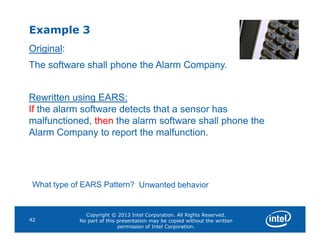
Devices & Hardware
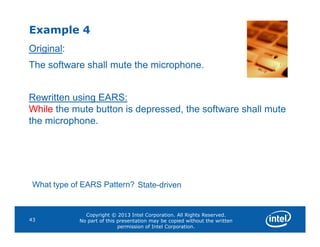
Lifestyle
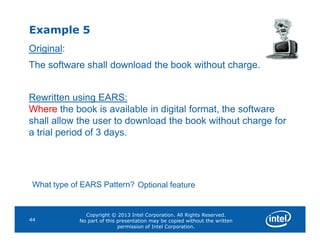
Change Language
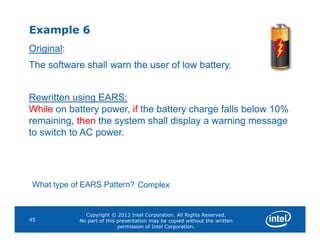
Language
English
Español
Português
Français
Deutsche
Cancel
Save
EN
Uploaded by
ROZLINABINTIMOHAMED
PDF, PPTX
9 views
For Chapter_3_ICCGI_2013_Tutorial_Terzakis.pdf
How to write requirements definition
Software
◦
Read more
0
Save
Share
Embed
Embed presentation
Download
Download as PDF, PPTX
1
/ 66
2
/ 66
3
/ 66
4
/ 66
5
/ 66
6
/ 66
7
/ 66
8
/ 66
9
/ 66
10
/ 66
11
/ 66
12
/ 66
13
/ 66
14
/ 66
15
/ 66
16
/ 66
17
/ 66
18
/ 66
19
/ 66
20
/ 66
21
/ 66
22
/ 66
23
/ 66
24
/ 66
25
/ 66
26
/ 66
27
/ 66
28
/ 66
29
/ 66
30
/ 66
31
/ 66
32
/ 66
33
/ 66
34
/ 66
35
/ 66
36
/ 66
37
/ 66
38
/ 66
39
/ 66
40
/ 66
41
/ 66
42
/ 66
43
/ 66
44
/ 66
45
/ 66
46
/ 66
47
/ 66
48
/ 66
49
/ 66
50
/ 66
51
/ 66
52
/ 66
53
/ 66
54
/ 66
55
/ 66
56
/ 66
57
/ 66
58
/ 66
59
/ 66
60
/ 66
61
/ 66
62
/ 66
63
/ 66
64
/ 66
65
/ 66
66
/ 66
More Related Content
PDF
Natural Language Processing (NLP) for Requirements Engineering (RE): an Overview
by
alessio_ferrari
PPTX
EARS: The Easy Approach to Requirements Syntax
by
TechWell
PDF
EARS: The Easy Approach to Requirements Syntax
by
TechWell
PDF
Find Requirements Defects to Build Better Software
by
TechWell
PDF
Requirements Engineering: focus on Natural Language Processing, Lecture 1
by
alessio_ferrari
PPT
Man.ppt
by
farouqalfuhidi
PPTX
Pressman_Pressman_SoftwareEngineeringPA_9e_Ch007_PPT.pptx
by
sangameshk8
PPTX
Pressman_Pressman_SoftwareEngineeringPA_9e_Ch007_PPT.pptx
by
sangameshk8
Natural Language Processing (NLP) for Requirements Engineering (RE): an Overview
by
alessio_ferrari
EARS: The Easy Approach to Requirements Syntax
by
TechWell
EARS: The Easy Approach to Requirements Syntax
by
TechWell
Find Requirements Defects to Build Better Software
by
TechWell
Requirements Engineering: focus on Natural Language Processing, Lecture 1
by
alessio_ferrari
Man.ppt
by
farouqalfuhidi
Pressman_Pressman_SoftwareEngineeringPA_9e_Ch007_PPT.pptx
by
sangameshk8
Pressman_Pressman_SoftwareEngineeringPA_9e_Ch007_PPT.pptx
by
sangameshk8
Similar to For Chapter_3_ICCGI_2013_Tutorial_Terzakis.pdf
PPT
sxdcdcfdffvfvfvfvfvfvfvvgvgvgvgvgvgggggg
by
CharuNangia
PPT
Reviewwwwwwwwwwwwwwwwwwwwwwwwwwwwwww.ppt
by
shravanichanikya
PPT
Business requirement analysis session 5
by
sampad_senapati
PPT
Requirements management
by
Adelina Maxim
PDF
[2].the requirement engineering handbook
by
Ngan Do
PDF
SE UNIT-2.pdf
by
Dr. Radhey Shyam
PPTX
Andromeda Interim Phase1.pptx
by
TriGoEV
PDF
Software Requirements and Specifications
by
vustudent1
PPTX
03_IT4557.pptx
by
johnmichael314688
PPT
11 req specs
by
Najam Uddin
PPTX
SE-Lecture 2A-Requirements.pptx
by
TangZhiSiang
PDF
Precise and Complete Requirements? An Elusive Goal
by
Lionel Briand
PDF
Session03-Requirement (1).pdf
by
PeterTran514407
PDF
notes_Software Requirement Engg Lec_11.pdf
by
Aqsa162589
DOC
Writing good requirements
by
Manish Chaurasia
PPTX
What BABoK Does not teach you content.pptx
by
LN Mishra CBAP
PDF
The Requirements Engineering Handbook Ralph R Young
by
uahpirsahrin
PPT
requirements analysis and design
by
Preeti Mishra
PPTX
Requirements Engineering in Software Engineering.pptx
by
beulj98
PPTX
How to build a requirement
by
Perry McLeod
sxdcdcfdffvfvfvfvfvfvfvvgvgvgvgvgvgggggg
by
CharuNangia
Reviewwwwwwwwwwwwwwwwwwwwwwwwwwwwwww.ppt
by
shravanichanikya
Business requirement analysis session 5
by
sampad_senapati
Requirements management
by
Adelina Maxim
[2].the requirement engineering handbook
by
Ngan Do
SE UNIT-2.pdf
by
Dr. Radhey Shyam
Andromeda Interim Phase1.pptx
by
TriGoEV
Software Requirements and Specifications
by
vustudent1
03_IT4557.pptx
by
johnmichael314688
11 req specs
by
Najam Uddin
SE-Lecture 2A-Requirements.pptx
by
TangZhiSiang
Precise and Complete Requirements? An Elusive Goal
by
Lionel Briand
Session03-Requirement (1).pdf
by
PeterTran514407
notes_Software Requirement Engg Lec_11.pdf
by
Aqsa162589
Writing good requirements
by
Manish Chaurasia
What BABoK Does not teach you content.pptx
by
LN Mishra CBAP
The Requirements Engineering Handbook Ralph R Young
by
uahpirsahrin
requirements analysis and design
by
Preeti Mishra
Requirements Engineering in Software Engineering.pptx
by
beulj98
How to build a requirement
by
Perry McLeod
Recently uploaded
PDF
Doctor On Call App Development for Digital Healthcare.
by
V3CUBE TECHNOLABS
PDF
The Ultimate Guide to Real Estate Tokenization Platforms
by
Daniel Smith
PDF
Building Smarter AI: 16 RAG Approaches for Accuracy, Memory, and Reasoning Vi...
by
Vineet Sharma
PDF
Ecommerce Website Development Services - Web Panel Solutions.pdf
by
WEB PANEL SOLUTIONS
PDF
Mastering Zero-Allocation Parsers: A Deep Dive into High-Performance C#
by
Vineet Sharma
PPTX
40m_wAIred_DigitalPlatformRabobank_10022026.pptx
by
SimonedeGijt
PDF
ACE Aarhus February 2026: Atlassian news
by
DanielEriksen5
PDF
Metrics, Logs, Traces, and Mayhem_ Introducing an observability adventure gam...
by
Imma Valls Bernaus
PPTX
Pitch Deck for MEVIA OS - No Apps, Infinite, Decentralized Operating System
by
Dr. Edwin Hernandez
PDF
MySQL Routing Guidelines: Designing Smarter Query Routing Together
by
Miguel Araújo
PPTX
How CFD Simulations Support Sustainable Data Center Design Optimization
by
Web Synergies
PPTX
Chapter Two Logic and Language - Copy.pptx
by
GediyonBelay
PDF
Ontwikkel sneller en veiliger met GitHub Copilot
by
Delta-N
PPTX
Prime Teams – Real-Time Employee Monitoring & Project Management Software
by
Prime Teams
PDF
Clean Architecture with Vertical Slice Architecture in .NET 8
by
Vineet Sharma
PDF
Lost Android Phone Recovery_ Steps That Work Fast.pdf
by
Isabella Reed
PPTX
40m_wAIred_DigitalPlatformRabobank_10022026.pptx
by
SimonedeGijt
PDF
Ready, Set, REST! Introducing MySQL's Built-In REST Service
by
Miguel Araújo
PDF
Langchain4J – An Introduction for Impatient Developers
by
Juarez Junior
PPTX
Installing Python in Visual Studio Code
by
dabydcatahanibmcom
Doctor On Call App Development for Digital Healthcare.
by
V3CUBE TECHNOLABS
The Ultimate Guide to Real Estate Tokenization Platforms
by
Daniel Smith
Building Smarter AI: 16 RAG Approaches for Accuracy, Memory, and Reasoning Vi...
by
Vineet Sharma
Ecommerce Website Development Services - Web Panel Solutions.pdf
by
WEB PANEL SOLUTIONS
Mastering Zero-Allocation Parsers: A Deep Dive into High-Performance C#
by
Vineet Sharma
40m_wAIred_DigitalPlatformRabobank_10022026.pptx
by
SimonedeGijt
ACE Aarhus February 2026: Atlassian news
by
DanielEriksen5
Metrics, Logs, Traces, and Mayhem_ Introducing an observability adventure gam...
by
Imma Valls Bernaus
Pitch Deck for MEVIA OS - No Apps, Infinite, Decentralized Operating System
by
Dr. Edwin Hernandez
MySQL Routing Guidelines: Designing Smarter Query Routing Together
by
Miguel Araújo
How CFD Simulations Support Sustainable Data Center Design Optimization
by
Web Synergies
Chapter Two Logic and Language - Copy.pptx
by
GediyonBelay
Ontwikkel sneller en veiliger met GitHub Copilot
by
Delta-N
Prime Teams – Real-Time Employee Monitoring & Project Management Software
by
Prime Teams
Clean Architecture with Vertical Slice Architecture in .NET 8
by
Vineet Sharma
Lost Android Phone Recovery_ Steps That Work Fast.pdf
by
Isabella Reed
40m_wAIred_DigitalPlatformRabobank_10022026.pptx
by
SimonedeGijt
Ready, Set, REST! Introducing MySQL's Built-In REST Service
by
Miguel Araújo
Langchain4J – An Introduction for Impatient Developers
by
Juarez Junior
Installing Python in Visual Studio Code
by
dabydcatahanibmcom
For Chapter_3_ICCGI_2013_Tutorial_Terzakis.pdf
1.
EARS: The Easy
Approach to Requirements Syntax Version 1.0 Requirements Syntax John Terzakis Intel Corporation john.terzakis@intel.com July 21, 2013 ICCGI Conference Nice, France
2.
Legal Disclaimers Intel Trademark
Notice: Intel and the Intel Logo are trademarks of Intel Corporation in the U.S. and other countries. Non-Intel Trademark Notice: *Other names and brands may be claimed as the property of others Copyright © 2013 Intel Corporation. All Rights Reserved. No part of this presentation may be copied without the written permission of Intel Corporation. 2
3.
Agenda • Requirements overview •
Issues with requirements • Overcoming issues with requirements • Identifying ubiquitous requirements • EARS and EARS examples Copyright © 2013 Intel Corporation. All Rights Reserved. No part of this presentation may be copied without the written permission of Intel Corporation. 3 • EARS and EARS examples • Using EARS to rewrite requirement examples • EARS at Intel • Wrap up
4.
Requirements Overview Copyright ©
2013 Intel Corporation. All Rights Reserved. No part of this presentation may be copied without the written permission of Intel Corporation. 4
5.
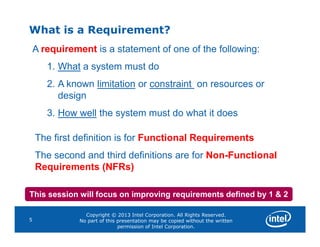
What is a
Requirement? A requirement is a statement of one of the following: 1. What a system must do 2. A known limitation or constraint on resources or design 3. How well the system must do what it does Copyright © 2013 Intel Corporation. All Rights Reserved. No part of this presentation may be copied without the written permission of Intel Corporation. 5 The first definition is for Functional Requirements The second and third definitions are for Non-Functional Requirements (NFRs) This session will focus on improving requirements defined by 1 & 2
6.
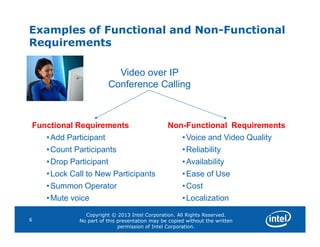
Examples of Functional
and Non-Functional Requirements Video over IP Conference Calling Functional Requirements Non-Functional Requirements Copyright © 2013 Intel Corporation. All Rights Reserved. No part of this presentation may be copied without the written permission of Intel Corporation. 6 Functional Requirements •Add Participant •Count Participants •Drop Participant •Lock Call to New Participants •Summon Operator •Mute voice Non-Functional Requirements •Voice and Video Quality •Reliability •Availability •Ease of Use •Cost •Localization
7.
Issues with Requirements Copyright
© 2013 Intel Corporation. All Rights Reserved. No part of this presentation may be copied without the written permission of Intel Corporation. 7
8.
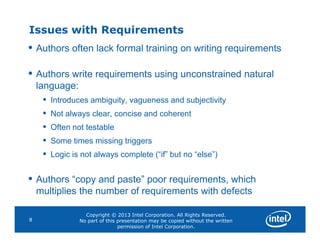
Issues with Requirements •
Authors often lack formal training on writing requirements • Authors write requirements using unconstrained natural language: • Introduces ambiguity, vagueness and subjectivity • Not always clear, concise and coherent • Often not testable Copyright © 2013 Intel Corporation. All Rights Reserved. No part of this presentation may be copied without the written permission of Intel Corporation. 8 • Often not testable • Some times missing triggers • Logic is not always complete (“if” but no “else”) • Authors “copy and paste” poor requirements, which multiplies the number of requirements with defects
9.
Examples of Issues
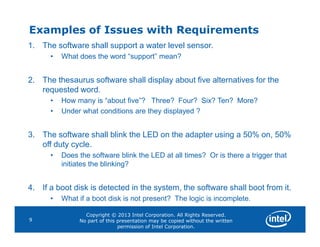
with Requirements 1. The software shall support a water level sensor. • What does the word “support” mean? 2. The thesaurus software shall display about five alternatives for the requested word. • How many is “about five”? Three? Four? Six? Ten? More? • Under what conditions are they displayed ? Copyright © 2013 Intel Corporation. All Rights Reserved. No part of this presentation may be copied without the written permission of Intel Corporation. 9 3. The software shall blink the LED on the adapter using a 50% on, 50% off duty cycle. • Does the software blink the LED at all times? Or is there a trigger that initiates the blinking? 4. If a boot disk is detected in the system, the software shall boot from it. • What if a boot disk is not present? The logic is incomplete.
10.
Overcoming Issues with
Requirements Copyright © 2013 Intel Corporation. All Rights Reserved. No part of this presentation may be copied without the written permission of Intel Corporation. 10
11.
Tools to Overcome
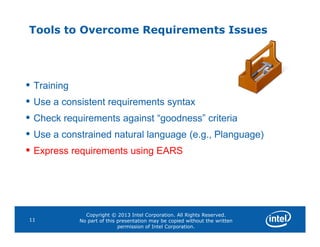
Requirements Issues • Training • Use a consistent requirements syntax • Check requirements against “goodness” criteria Copyright © 2013 Intel Corporation. All Rights Reserved. No part of this presentation may be copied without the written permission of Intel Corporation. 11 • • Use a constrained natural language (e.g., Planguage) • Express requirements using EARS
12.
Training • Develop internal
training • Attend external training • Partner requirements authors with requirements subject matter experts • Create “communities of practice” to share best known requirements methods internally Copyright © 2013 Intel Corporation. All Rights Reserved. No part of this presentation may be copied without the written permission of Intel Corporation. 12 requirements methods internally
13.
Consistent Requirements Syntax [Trigger]
[Precondition] Actor Action [Object] Here is a generic syntax for functional requirements (optional items are in square brackets): Example: When an Order is shipped and Order Terms are not Copyright © 2013 Intel Corporation. All Rights Reserved. No part of this presentation may be copied without the written permission of Intel Corporation. 13 “Prepaid”, the system shall create an Invoice. • Trigger: When an Order is shipped • Precondition: Order Terms are not “Prepaid” • Actor: the system • Action: create • Object: an Invoice
14.
Good Requirements Checklist Utilize
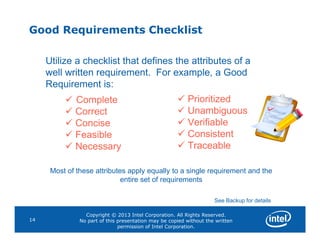
a checklist that defines the attributes of a well written requirement. For example, a Good Requirement is: Complete Correct Concise Prioritized Unambiguous Verifiable Copyright © 2013 Intel Corporation. All Rights Reserved. No part of this presentation may be copied without the written permission of Intel Corporation. 14 Concise Feasible Necessary Verifiable Consistent Traceable Most of these attributes apply equally to a single requirement and the entire set of requirements See Backup for details
15.
Planguage: A Constrained
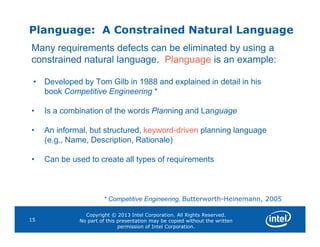
Natural Language Many requirements defects can be eliminated by using a constrained natural language. Planguage is an example: • Developed by Tom Gilb in 1988 and explained in detail in his book Competitive Engineering * • Is a combination of the words Planning and Language Copyright © 2013 Intel Corporation. All Rights Reserved. No part of this presentation may be copied without the written permission of Intel Corporation. 15 • An informal, but structured, keyword-driven planning language (e.g., Name, Description, Rationale) • Can be used to create all types of requirements * Competitive Engineering, Butterworth-Heinemann, 2005
16.
Planguage Keywords for
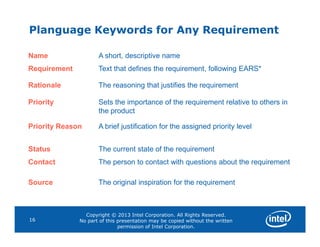
Any Requirement Name A short, descriptive name Requirement Text that defines the requirement, following EARS* Rationale The reasoning that justifies the requirement Priority Sets the importance of the requirement relative to others in the product Priority Reason A brief justification for the assigned priority level Copyright © 2013 Intel Corporation. All Rights Reserved. No part of this presentation may be copied without the written permission of Intel Corporation. 16 Priority Reason A brief justification for the assigned priority level Status The current state of the requirement Contact The person to contact with questions about the requirement Source The original inspiration for the requirement
17.
Planguage Example Name: Create_Invoice Requirement:
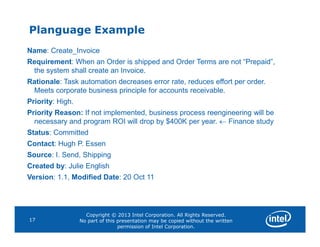
When an Order is shipped and Order Terms are not “Prepaid”, the system shall create an Invoice. Rationale: Task automation decreases error rate, reduces effort per order. Meets corporate business principle for accounts receivable. Priority: High. Priority Reason: If not implemented, business process reengineering will be necessary and program ROI will drop by $400K per year. Finance study Copyright © 2013 Intel Corporation. All Rights Reserved. No part of this presentation may be copied without the written permission of Intel Corporation. 17 necessary and program ROI will drop by $400K per year. Finance study Status: Committed Contact: Hugh P. Essen Source: I. Send, Shipping Created by: Julie English Version: 1.1, Modified Date: 20 Oct 11
18.
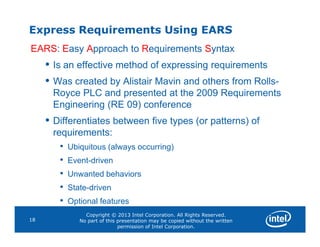
Express Requirements Using
EARS EARS: Easy Approach to Requirements Syntax • Is an effective method of expressing requirements • Was created by Alistair Mavin and others from Rolls- Royce PLC and presented at the 2009 Requirements Engineering (RE 09) conference • Differentiates between five types (or patterns) of Copyright © 2013 Intel Corporation. All Rights Reserved. No part of this presentation may be copied without the written permission of Intel Corporation. 18 • Differentiates between five types (or patterns) of requirements: • Ubiquitous (always occurring) • Event-driven • Unwanted behaviors • State-driven • Optional features
19.
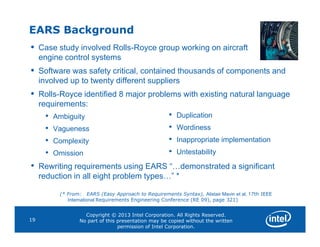
EARS Background • Case
study involved Rolls-Royce group working on aircraft engine control systems • Software was safety critical, contained thousands of components and involved up to twenty different suppliers • Rolls-Royce identified 8 major problems with existing natural language requirements: • Ambiguity • • Duplication • Wordiness Copyright © 2013 Intel Corporation. All Rights Reserved. No part of this presentation may be copied without the written permission of Intel Corporation. 19 • Vagueness • Complexity • Omission • Rewriting requirements using EARS “…demonstrated a significant reduction in all eight problem types…” * (* From: EARS (Easy Approach to Requirements Syntax), Alistair Mavin et al, 17th IEEE International Requirements Engineering Conference (RE 09), page 321) • Wordiness • Inappropriate implementation • Untestability
20.
Identifying Ubiquitous Requirements Copyright
© 2013 Intel Corporation. All Rights Reserved. No part of this presentation may be copied without the written permission of Intel Corporation. 20
21.
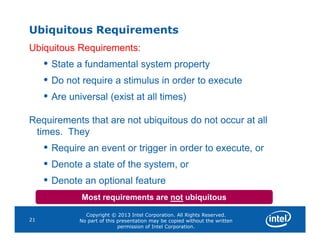
Ubiquitous Requirements Ubiquitous Requirements: •
State a fundamental system property • Do not require a stimulus in order to execute • Are universal (exist at all times) Requirements that are not ubiquitous do not occur at all Copyright © 2013 Intel Corporation. All Rights Reserved. No part of this presentation may be copied without the written permission of Intel Corporation. 21 Requirements that are not ubiquitous do not occur at all times. They • Require an event or trigger in order to execute, or • Denote a state of the system, or • Denote an optional feature Most requirements are not ubiquitous
22.
About Ubiquitous Requirements Question
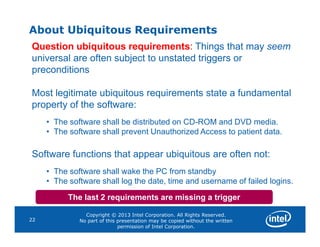
ubiquitous requirements: Things that may seem universal are often subject to unstated triggers or preconditions Most legitimate ubiquitous requirements state a fundamental property of the software: • The software shall be distributed on CD-ROM and DVD media. Copyright © 2013 Intel Corporation. All Rights Reserved. No part of this presentation may be copied without the written permission of Intel Corporation. • The software shall be distributed on CD-ROM and DVD media. • The software shall prevent Unauthorized Access to patient data. Software functions that appear ubiquitous are often not: • The software shall wake the PC from standby • The software shall log the date, time and username of failed logins. 22 The last 2 requirements are missing a trigger
23.
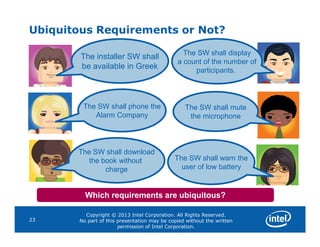
Ubiquitous Requirements or
Not? The installer SW shall be available in Greek The SW shall mute the microphone The SW shall phone the Alarm Company The SW shall display a count of the number of participants. Copyright © 2013 Intel Corporation. All Rights Reserved. No part of this presentation may be copied without the written permission of Intel Corporation. 23 Which requirements are ubiquitous? The SW shall download the book without charge The SW shall warn the user of low battery
24.
Ubiquitous or Not? 1.
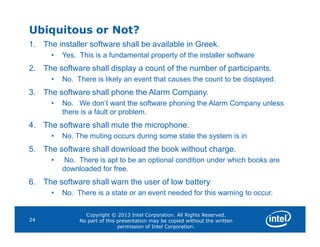
The installer software shall be available in Greek. • Yes. This is a fundamental property of the installer software 2. The software shall display a count of the number of participants. • No. There is likely an event that causes the count to be displayed. 3. The software shall phone the Alarm Company. • No. We don’t want the software phoning the Alarm Company unless there is a fault or problem. 4. The software shall mute the microphone. Copyright © 2013 Intel Corporation. All Rights Reserved. No part of this presentation may be copied without the written permission of Intel Corporation. 24 4. The software shall mute the microphone. • No. The muting occurs during some state the system is in 5. The software shall download the book without charge. • No. There is apt to be an optional condition under which books are downloaded for free. 6. The software shall warn the user of low battery • No. There is a state or an event needed for this warning to occur.
25.
EARS and EARS
Examples Copyright © 2013 Intel Corporation. All Rights Reserved. No part of this presentation may be copied without the written permission of Intel Corporation. 25
26.
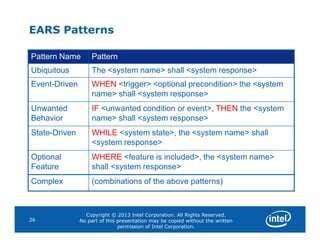
EARS Patterns Pattern Name
Pattern Ubiquitous The <system name> shall <system response> Event-Driven WHEN <trigger> <optional precondition> the <system name> shall <system response> Unwanted Behavior IF <unwanted condition or event>, THEN the <system name> shall <system response> Copyright © 2013 Intel Corporation. All Rights Reserved. No part of this presentation may be copied without the written permission of Intel Corporation. 26 State-Driven WHILE <system state>, the <system name> shall <system response> Optional Feature WHERE <feature is included>, the <system name> shall <system response> Complex (combinations of the above patterns)
27.
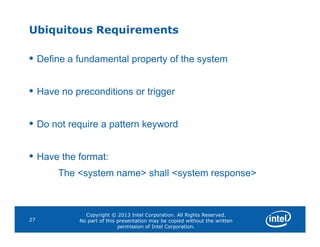
Ubiquitous Requirements • Define
a fundamental property of the system • Have no preconditions or trigger • Do not require a pattern keyword Copyright © 2013 Intel Corporation. All Rights Reserved. No part of this presentation may be copied without the written permission of Intel Corporation. 27 • Do not require a pattern keyword • Have the format: The <system name> shall <system response>
28.
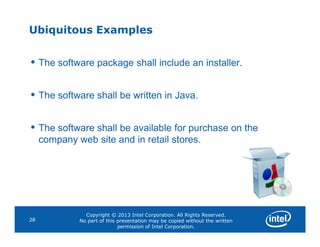
Ubiquitous Examples • The
software package shall include an installer. • The software shall be written in Java. • The software shall be available for purchase on the Copyright © 2013 Intel Corporation. All Rights Reserved. No part of this presentation may be copied without the written permission of Intel Corporation. 28 • The software shall be available for purchase on the company web site and in retail stores.
29.
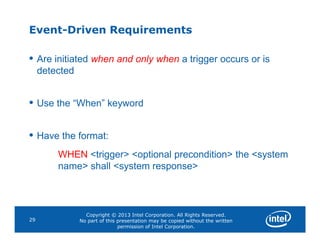
Event-Driven Requirements • Are
initiated when and only when a trigger occurs or is detected • Use the “When” keyword Copyright © 2013 Intel Corporation. All Rights Reserved. No part of this presentation may be copied without the written permission of Intel Corporation. 29 • Have the format: WHEN <trigger> <optional precondition> the <system name> shall <system response>
30.
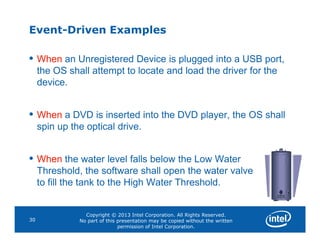
Event-Driven Examples • When
an Unregistered Device is plugged into a USB port, the OS shall attempt to locate and load the driver for the device. • When a DVD is inserted into the DVD player, the OS shall spin up the optical drive. Copyright © 2013 Intel Corporation. All Rights Reserved. No part of this presentation may be copied without the written permission of Intel Corporation. 30 spin up the optical drive. • When the water level falls below the Low Water Threshold, the software shall open the water valve to fill the tank to the High Water Threshold.
31.
Unwanted Behavior Requirements •
Handle unwanted behaviors including error conditions, failures, faults, disturbances and other undesired events • Use the “If” and “then” keywords Copyright © 2013 Intel Corporation. All Rights Reserved. No part of this presentation may be copied without the written permission of Intel Corporation. 31 • Have the format: IF <unwanted condition or event>, THEN the <system name> shall <system response>
32.
Unwanted Behavior Examples •
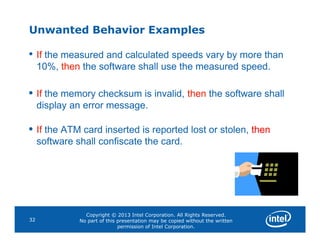
If the measured and calculated speeds vary by more than 10%, then the software shall use the measured speed. • If the memory checksum is invalid, then the software shall display an error message. • Copyright © 2013 Intel Corporation. All Rights Reserved. No part of this presentation may be copied without the written permission of Intel Corporation. 32 • If the ATM card inserted is reported lost or stolen, then software shall confiscate the card.
33.
State-Driven Requirements • Are
triggered while the system is in a specific state • Use the “While” keyword (or optionally the keyword “During”) • Have the format: Copyright © 2013 Intel Corporation. All Rights Reserved. No part of this presentation may be copied without the written permission of Intel Corporation. 33 • Have the format: WHILE <system state>, the <system name> shall <system response>
34.
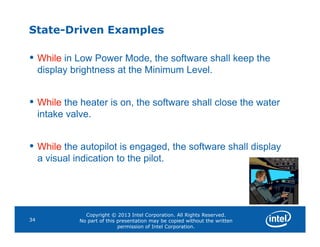
State-Driven Examples • While
in Low Power Mode, the software shall keep the display brightness at the Minimum Level. • While the heater is on, the software shall close the water intake valve. Copyright © 2013 Intel Corporation. All Rights Reserved. No part of this presentation may be copied without the written permission of Intel Corporation. 34 • While the autopilot is engaged, the software shall display a visual indication to the pilot.
35.
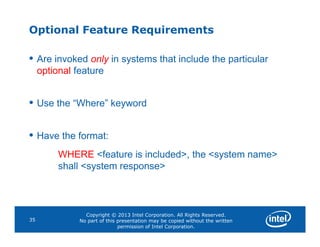
Optional Feature Requirements •
Are invoked only in systems that include the particular optional feature • Use the “Where” keyword Copyright © 2013 Intel Corporation. All Rights Reserved. No part of this presentation may be copied without the written permission of Intel Corporation. 35 • Have the format: WHERE <feature is included>, the <system name> shall <system response>
36.
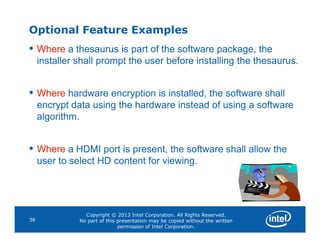
Optional Feature Examples •
Where a thesaurus is part of the software package, the installer shall prompt the user before installing the thesaurus. • Where hardware encryption is installed, the software shall encrypt data using the hardware instead of using a software algorithm. Copyright © 2013 Intel Corporation. All Rights Reserved. No part of this presentation may be copied without the written permission of Intel Corporation. 36 • Where a HDMI port is present, the software shall allow the user to select HD content for viewing.
37.
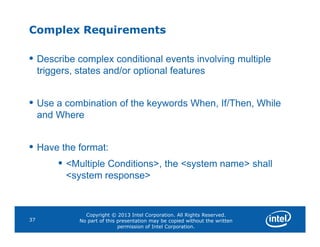
Complex Requirements • Describe
complex conditional events involving multiple triggers, states and/or optional features • Use a combination of the keywords When, If/Then, While and Where Copyright © 2013 Intel Corporation. All Rights Reserved. No part of this presentation may be copied without the written permission of Intel Corporation. 37 • Have the format: • <Multiple Conditions>, the <system name> shall <system response>
38.
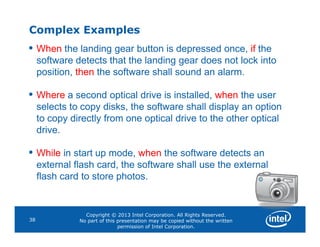
Complex Examples • When
the landing gear button is depressed once, if the software detects that the landing gear does not lock into position, then the software shall sound an alarm. • Where a second optical drive is installed, when the user selects to copy disks, the software shall display an option to copy directly from one optical drive to the other optical Copyright © 2013 Intel Corporation. All Rights Reserved. No part of this presentation may be copied without the written permission of Intel Corporation. 38 to copy directly from one optical drive to the other optical drive. • While in start up mode, when the software detects an external flash card, the software shall use the external flash card to store photos.
39.
Using EARS to
Rewrite Requirement Examples Copyright © 2013 Intel Corporation. All Rights Reserved. No part of this presentation may be copied without the written permission of Intel Corporation. 39
40.
Example 1 Original: The installer
software shall be available in Greek. Rewritten using EARS (no change): The installer software shall be available in Greek. Copyright © 2013 Intel Corporation. All Rights Reserved. No part of this presentation may be copied without the written permission of Intel Corporation. 40 What type of EARS Pattern? Ubiquitous
41.
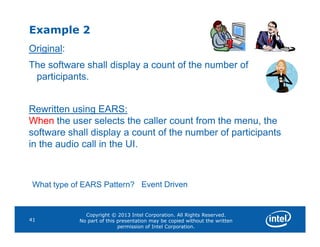
Example 2 Original: The software
shall display a count of the number of participants. Rewritten using EARS: When the user selects the caller count from the menu, the Copyright © 2013 Intel Corporation. All Rights Reserved. No part of this presentation may be copied without the written permission of Intel Corporation. 41 When the user selects the caller count from the menu, the software shall display a count of the number of participants in the audio call in the UI. What type of EARS Pattern? Event Driven
42.
Example 3 Original: The software
shall phone the Alarm Company. Rewritten using EARS: If the alarm software detects that a sensor has malfunctioned, then the alarm software shall phone the Copyright © 2013 Intel Corporation. All Rights Reserved. No part of this presentation may be copied without the written permission of Intel Corporation. 42 malfunctioned, then the alarm software shall phone the Alarm Company to report the malfunction. What type of EARS Pattern? Unwanted behavior
43.
Example 4 Original: The software
shall mute the microphone. Rewritten using EARS: While the mute button is depressed, the software shall mute the microphone. Copyright © 2013 Intel Corporation. All Rights Reserved. No part of this presentation may be copied without the written permission of Intel Corporation. 43 the microphone. What type of EARS Pattern? State-driven
44.
Example 5 Original: The software
shall download the book without charge. Rewritten using EARS: Where the book is available in digital format, the software shall allow the user to download the book without charge for Copyright © 2013 Intel Corporation. All Rights Reserved. No part of this presentation may be copied without the written permission of Intel Corporation. 44 shall allow the user to download the book without charge for a trial period of 3 days. What type of EARS Pattern? Optional feature
45.
Example 6 Original: The software
shall warn the user of low battery. Rewritten using EARS: While on battery power, if the battery charge falls below 10% remaining, then the system shall display a warning message Copyright © 2013 Intel Corporation. All Rights Reserved. No part of this presentation may be copied without the written permission of Intel Corporation. 45 remaining, then the system shall display a warning message to switch to AC power. What type of EARS Pattern? Complex
46.
EARS at Intel Copyright
© 2013 Intel Corporation. All Rights Reserved. No part of this presentation may be copied without the written permission of Intel Corporation. 46
47.
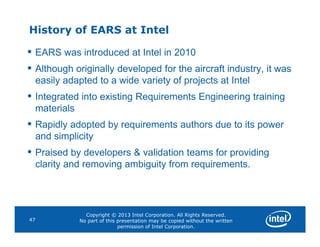
History of EARS
at Intel • EARS was introduced at Intel in 2010 • Although originally developed for the aircraft industry, it was easily adapted to a wide variety of projects at Intel • Integrated into existing Requirements Engineering training materials • Rapidly adopted by requirements authors due to its power Copyright © 2013 Intel Corporation. All Rights Reserved. No part of this presentation may be copied without the written permission of Intel Corporation. 47 • Rapidly adopted by requirements authors due to its power and simplicity • Praised by developers & validation teams for providing clarity and removing ambiguity from requirements.
48.
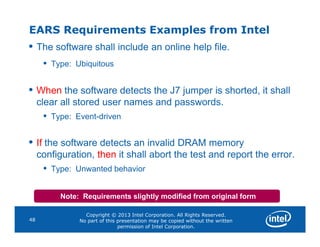
EARS Requirements Examples
from Intel • The software shall include an online help file. • Type: Ubiquitous • When the software detects the J7 jumper is shorted, it shall clear all stored user names and passwords. • Type: Event-driven Copyright © 2013 Intel Corporation. All Rights Reserved. No part of this presentation may be copied without the written permission of Intel Corporation. 48 • If the software detects an invalid DRAM memory configuration, then it shall abort the test and report the error. • Type: Unwanted behavior Note: Requirements slightly modified from original form
49.
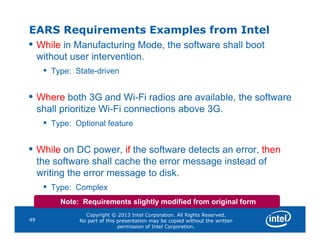
EARS Requirements Examples
from Intel • While in Manufacturing Mode, the software shall boot without user intervention. • Type: State-driven • Where both 3G and Wi-Fi radios are available, the software shall prioritize Wi-Fi connections above 3G. • Type: Optional feature Copyright © 2013 Intel Corporation. All Rights Reserved. No part of this presentation may be copied without the written permission of Intel Corporation. 49 • Type: Optional feature • While on DC power, if the software detects an error, then the software shall cache the error message instead of writing the error message to disk. • Type: Complex Note: Requirements slightly modified from original form
50.
Wrap up Copyright ©
2013 Intel Corporation. All Rights Reserved. No part of this presentation may be copied without the written permission of Intel Corporation. 50
51.
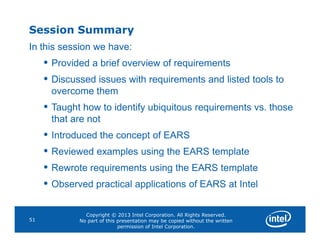
Session Summary In this
session we have: • Provided a brief overview of requirements • Discussed issues with requirements and listed tools to overcome them • Taught how to identify ubiquitous requirements vs. those that are not Copyright © 2013 Intel Corporation. All Rights Reserved. No part of this presentation may be copied without the written permission of Intel Corporation. 51 that are not • Introduced the concept of EARS • Reviewed examples using the EARS template • Rewrote requirements using the EARS template • Observed practical applications of EARS at Intel
52.
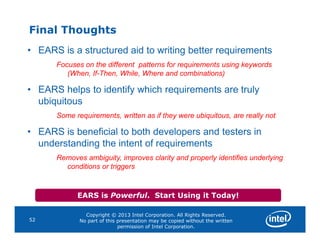
Final Thoughts • EARS
is a structured aid to writing better requirements Focuses on the different patterns for requirements using keywords (When, If-Then, While, Where and combinations) • EARS helps to identify which requirements are truly ubiquitous Some requirements, written as if they were ubiquitous, are really not Copyright © 2013 Intel Corporation. All Rights Reserved. No part of this presentation may be copied without the written permission of Intel Corporation. 52 • EARS is beneficial to both developers and testers in understanding the intent of requirements Removes ambiguity, improves clarity and properly identifies underlying conditions or triggers EARS is Powerful. Start Using it Today!
53.
Contact Information Thank You! For
more information, please contact: Copyright © 2013 Intel Corporation. All Rights Reserved. No part of this presentation may be copied without the written permission of Intel Corporation. 53 John Terzakis john.terzakis@intel.com
54.
Backup Copyright © 2013
Intel Corporation. All Rights Reserved. No part of this presentation may be copied without the written permission of Intel Corporation. 54
55.
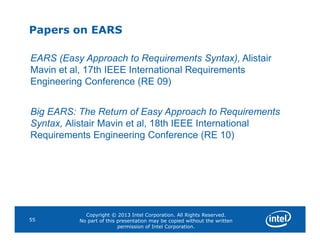
Papers on EARS EARS
(Easy Approach to Requirements Syntax), Alistair Mavin et al, 17th IEEE International Requirements Engineering Conference (RE 09) Big EARS: The Return of Easy Approach to Requirements Syntax, Alistair Mavin et al, 18th IEEE International Copyright © 2013 Intel Corporation. All Rights Reserved. No part of this presentation may be copied without the written permission of Intel Corporation. 55 Syntax, Alistair Mavin et al, 18th IEEE International Requirements Engineering Conference (RE 10)
56.
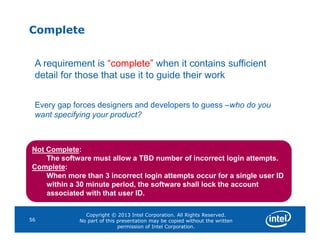
Complete A requirement is
“complete” when it contains sufficient detail for those that use it to guide their work Every gap forces designers and developers to guess –who do you want specifying your product? Copyright © 2013 Intel Corporation. All Rights Reserved. No part of this presentation may be copied without the written permission of Intel Corporation. 56 Not Complete: The software must allow a TBD number of incorrect login attempts. Complete: When more than 3 incorrect login attempts occur for a single user ID within a 30 minute period, the software shall lock the account associated with that user ID.
57.
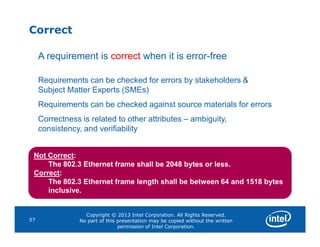
Correct A requirement is
correct when it is error-free Requirements can be checked for errors by stakeholders & Subject Matter Experts (SMEs) Requirements can be checked against source materials for errors Correctness is related to other attributes – ambiguity, Copyright © 2013 Intel Corporation. All Rights Reserved. No part of this presentation may be copied without the written permission of Intel Corporation. 57 consistency, and verifiability Not Correct: The 802.3 Ethernet frame shall be 2048 bytes or less. Correct: The 802.3 Ethernet frame length shall be between 64 and 1518 bytes inclusive.
58.
Concise A requirement is
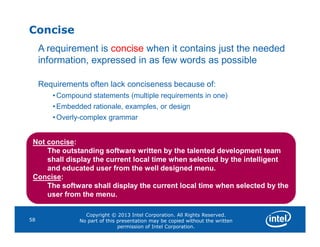
concise when it contains just the needed information, expressed in as few words as possible Requirements often lack conciseness because of: •Compound statements (multiple requirements in one) •Embedded rationale, examples, or design •Overly-complex grammar Copyright © 2013 Intel Corporation. All Rights Reserved. No part of this presentation may be copied without the written permission of Intel Corporation. 58 Not concise: The outstanding software written by the talented development team shall display the current local time when selected by the intelligent and educated user from the well designed menu. Concise: The software shall display the current local time when selected by the user from the menu.
59.
Feasible A requirement is
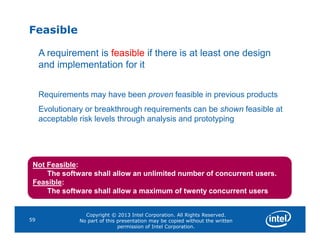
feasible if there is at least one design and implementation for it Requirements may have been proven feasible in previous products Evolutionary or breakthrough requirements can be shown feasible at acceptable risk levels through analysis and prototyping Copyright © 2013 Intel Corporation. All Rights Reserved. No part of this presentation may be copied without the written permission of Intel Corporation. 59 Not Feasible: The software shall allow an unlimited number of concurrent users. Feasible: The software shall allow a maximum of twenty concurrent users
60.
Necessary A requirement is
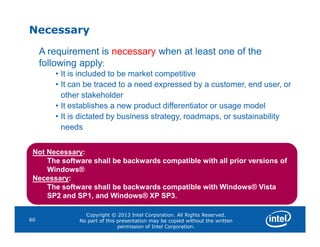
necessary when at least one of the following apply: • It is included to be market competitive • It can be traced to a need expressed by a customer, end user, or other stakeholder • It establishes a new product differentiator or usage model • It is dictated by business strategy, roadmaps, or sustainability needs Copyright © 2013 Intel Corporation. All Rights Reserved. No part of this presentation may be copied without the written permission of Intel Corporation. 60 needs Not Necessary: The software shall be backwards compatible with all prior versions of Windows® Necessary: The software shall be backwards compatible with Windows® Vista SP2 and SP1, and Windows® XP SP3.
61.
Prioritized A requirement is
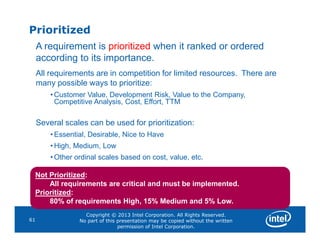
prioritized when it ranked or ordered according to its importance. All requirements are in competition for limited resources. There are many possible ways to prioritize: • Customer Value, Development Risk, Value to the Company, Competitive Analysis, Cost, Effort, TTM Several scales can be used for prioritization: Copyright © 2013 Intel Corporation. All Rights Reserved. No part of this presentation may be copied without the written permission of Intel Corporation. 61 Several scales can be used for prioritization: • Essential, Desirable, Nice to Have • High, Medium, Low • Other ordinal scales based on cost, value, etc. Not Prioritized: All requirements are critical and must be implemented. Prioritized: 80% of requirements High, 15% Medium and 5% Low.
62.
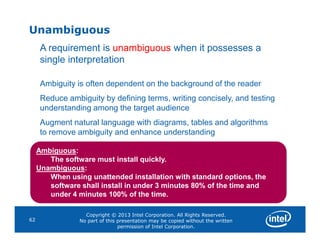
Unambiguous A requirement is
unambiguous when it possesses a single interpretation Ambiguity is often dependent on the background of the reader Reduce ambiguity by defining terms, writing concisely, and testing understanding among the target audience Augment natural language with diagrams, tables and algorithms Copyright © 2013 Intel Corporation. All Rights Reserved. No part of this presentation may be copied without the written permission of Intel Corporation. 62 Augment natural language with diagrams, tables and algorithms to remove ambiguity and enhance understanding Ambiguous: The software must install quickly. Unambiguous: When using unattended installation with standard options, the software shall install in under 3 minutes 80% of the time and under 4 minutes 100% of the time.
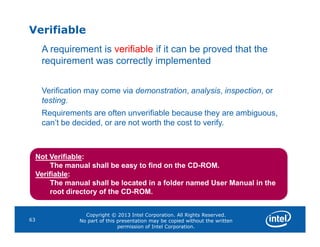
63.
Verifiable A requirement is
verifiable if it can be proved that the requirement was correctly implemented Verification may come via demonstration, analysis, inspection, or testing. Requirements are often unverifiable because they are ambiguous, can’t be decided, or are not worth the cost to verify. Copyright © 2013 Intel Corporation. All Rights Reserved. No part of this presentation may be copied without the written permission of Intel Corporation. 63 can’t be decided, or are not worth the cost to verify. Not Verifiable: The manual shall be easy to find on the CD-ROM. Verifiable: The manual shall be located in a folder named User Manual in the root directory of the CD-ROM.
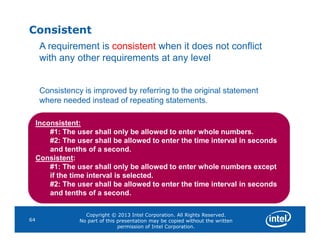
64.
Consistent A requirement is
consistent when it does not conflict with any other requirements at any level Consistency is improved by referring to the original statement where needed instead of repeating statements. Inconsistent: Copyright © 2013 Intel Corporation. All Rights Reserved. No part of this presentation may be copied without the written permission of Intel Corporation. 64 Inconsistent: #1: The user shall only be allowed to enter whole numbers. #2: The user shall be allowed to enter the time interval in seconds and tenths of a second. Consistent: #1: The user shall only be allowed to enter whole numbers except if the time interval is selected. #2: The user shall be allowed to enter the time interval in seconds and tenths of a second.
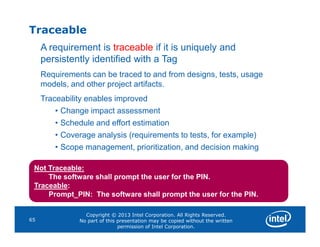
65.
Traceable A requirement is
traceable if it is uniquely and persistently identified with a Tag Requirements can be traced to and from designs, tests, usage models, and other project artifacts. Traceability enables improved • Change impact assessment • Schedule and effort estimation Copyright © 2013 Intel Corporation. All Rights Reserved. No part of this presentation may be copied without the written permission of Intel Corporation. 65 • Schedule and effort estimation • Coverage analysis (requirements to tests, for example) • Scope management, prioritization, and decision making Not Traceable: The software shall prompt the user for the PIN. Traceable: Prompt_PIN: The software shall prompt the user for the PIN.
Download

![Consistent Requirements Syntax
[Trigger] [Precondition] Actor Action [Object]
Here is a generic syntax for functional requirements (optional
items are in square brackets):
Example:
When an Order is shipped and Order Terms are not
Copyright © 2013 Intel Corporation. All Rights Reserved.
No part of this presentation may be copied without the written
permission of Intel Corporation.
13
“Prepaid”, the system shall create an Invoice.
• Trigger: When an Order is shipped
• Precondition: Order Terms are not “Prepaid”
• Actor: the system
• Action: create
• Object: an Invoice](https://image.slidesharecdn.com/forchapter3iccgi2013tutorialterzakis-250327014244-1217ff7e/85/For-Chapter_3_ICCGI_2013_Tutorial_Terzakis-pdf-13-320.jpg)


![[2].the requirement engineering handbook](https://cdn.slidesharecdn.com/ss_thumbnails/2-211026083124-thumbnail.jpg?width=640&height=640&fit=bounds)


