Requirements Management
The Requirements Engineering Process
It covers many tasks
• Elicitation
• Expression and modelling
• Requirements exchange
• Management
• Verification and validation
The Requirements Dilemma !!
• What is the best method for expressing requirements
• Formal or semi-formal ?
You said FORMAL
Nice looking formula
Example : Shakespeare (the Gil Vicente of English Theater)
To be or not to be , that is the question
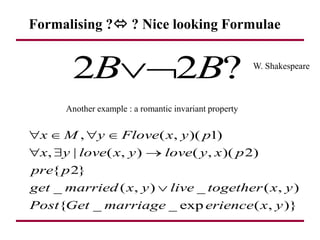
Formalising ? ? Nice looking Formulae
?
2
2 B
B 

Another example : a romantic invariant property
W. Shakespeare
, ( , )( 1)
, | ( , ) ( , )( 2)
{ 2}
_ ( , ) _ ( , )
{ _ _ exp ( , )}
x M y Flove x y p
x y love x y love y x p
pre p
get married x y live together x y
Post Get marriage erience x y
   
  

Classes of languages, models, tools, methodes, techniques
• Consider Software systems
• Any language can be a requirement language
• A programming language is a requirement language
for the computer to execute what is required
– Example : While {..} do ....
– It is well specified and no ambiguity
• However in RE
– There many stakeholders
– Different cultures (not necessarily computer scientists or
familiar with programming languages)
– Requirements are of many types
• Programming languages
• Specific notation
• General purpose Methods
• Informal
• Semi-formal : Used in industry
• Formal : Developped by academia
• Abstract : limited to specific issues (pure academia work)
• Paradigms
• Function oriented
• Object
Classes
Review of basic related aspects (seen in other courses)
• Control structure (behaviour) : seq; //, if .. Else
• Communication (shared data, synch, async, ..)
• Abstraction
• Encapsulation
• Properties
• Invariants
CRITERIA (CMU-DoD_SEI Taxonomy)
• Representation
 Concepts and techniques described using the
technique
• Derivation
 Methods to produce a specification from another
• Validation-Verification
 Properties that can be determined using the
specification technique
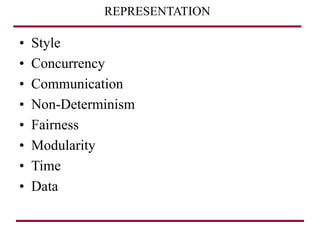
REPRESENTATION
• Style
• Concurrency
• Communication
• Non-Determinism
• Fairness
• Modularity
• Time
• Data
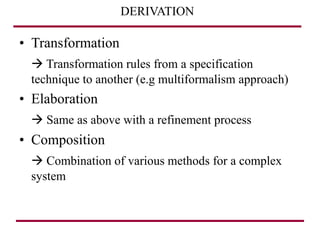
DERIVATION
• Transformation
 Transformation rules from a specification
technique to another (e.g multiformalism approach)
• Elaboration
 Same as above with a refinement process
• Composition
 Combination of various methods for a complex
system
VERIFICATION-VALIDATION
• Equivalence
• Consistency
• Safety and liveness
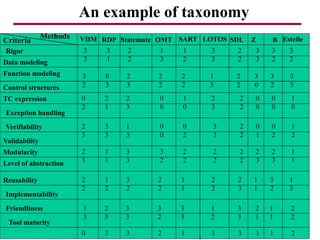
Rigor
Data modeling
Function modeling
Control structures
TC expression
Exception handling
Verifiability
Validability
Modularity
Level of abstraction
Reusability
Implementability
Friendliness
Tool maturity
VDM RDP Statemate OMT SDL Z B
3 3 2 1 1 3 2 3 3 3
3 1 2 3 2 3 2 3 2 2
3 0 2 2 2 1 2 3 3 3
2 3 3 2 2 3 2 0 2 3
0 2 2 0 1 2 2 0 0 1
2 1 3 0 0 3 2 0 0 0
2 3 1 0 0 3 2 0 0 1
3 3 3 0 2 3 2 1 2 2
2 1 3 3 2 2 2 2 2 1
3 1 3 2 2 2 2 3 3 1
2 1 3 2 1 2 2 1 3 1
2 2 2 2 1 2 3 1 2 3
1 2 3 3 3 1 3 2 1 2
3 3 3 2 3 2 3 1 1 2
0 3 3 2 1 3 3 1 1 2
Criteria
Methods SART LOTOS Estelle
An example of taxonomy
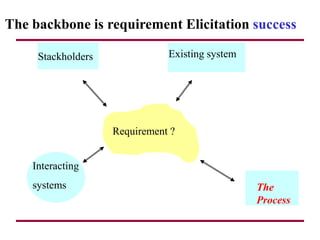
The backbone is requirement Elicitation success
Requirement ?
Stackholders Existing system
Interacting
systems The
Process
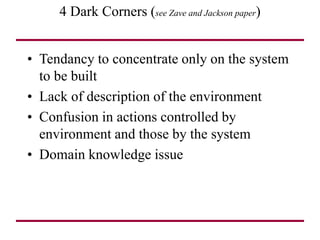
4 Dark Corners (see Zave and Jackson paper)
• Tendancy to concentrate only on the system
to be built
• Lack of description of the environment
• Confusion in actions controlled by
environment and those by the system
• Domain knowledge issue
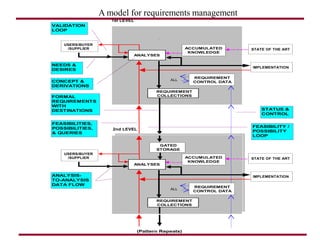
Thinking about managing requirements :
It is not a tool problem only
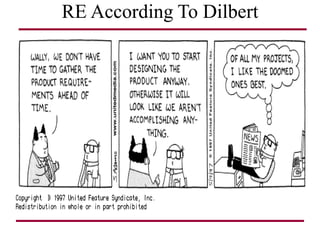
RE According To Dilbert
2nd LEVEL
1st LEVEL
(Pattern Repeats)
ANALYSES
REQUIREMENT
COLLECTIONS
USERS/BUYER
/SUPPLIER STATE OF THE ART
IMPLEMENTATION
REQUIREMENT
CONTROL DATA
ALL
ACCUMULATED
KNOWLEDGE
VALIDATION
LOOP
CONCEPT &
DERIVATIONS
FEASIBILITIES,
POSSIBILITIES,
& QUERIES
NEEDS &
DESIRES
FORMAL
REQUIREMENTS
WITH
DESTINATIONS
ANALYSIS-
TO-ANALYSIS
DATA FLOW
STATUS &
CONTROL
FEASIBILITY /
POSSIBILITY
LOOP
ANALYSES
REQUIREMENT
COLLECTIONS
USERS/BUYER
/SUPPLIER STATE OF THE ART
IMPLEMENTATION
REQUIREMENT
CONTROL DATA
GATED
STORAGE
ALL
ACCUMULATED
KNOWLEDGE
A model for requirements management
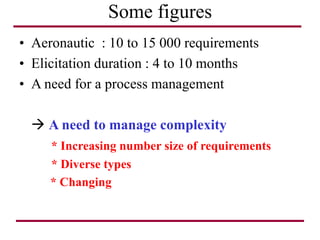
Some figures
• Aeronautic : 10 to 15 000 requirements
• Elicitation duration : 4 to 10 months
• A need for a process management
 A need to manage complexity
* Increasing number size of requirements
* Diverse types
* Changing
.
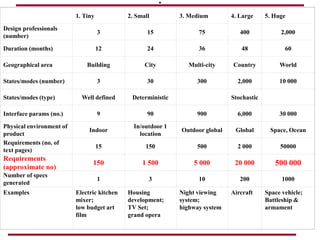
1. Tiny 2. Small 3. Medium 4. Large 5. Huge
Design professionals
(number)
3 15 75 400 2,000
Duration (months) 12 24 36 48 60
Geographical area Building City Multi-city Country World
States/modes (number) 3 30 300 2,000 10 000
States/modes (type) Well defined Deterministic Stochastic
Interface params (no.) 9 90 900 6,000 30 000
Physical environment of
product
Indoor
In/outdoor 1
location
Outdoor global Global Space, Ocean
Requirements (no. of
text pages)
15 150 500 2 000 50000
Requirements
(approximate no)
150 1 500 5 000 20 000 500 000
Number of specs
generated
1 3 10 200 1000
Examples Electric kitchen
mixer;
low budget art
film
Housing
development;
TV Set;
grand opera
Night viewing
system;
highway system
Aircraft Space vehicle;
Battleship &
armament
Why ?
• Requirements are basis for all successive steps
• It is the main reference for
– Changing requirements
– Adding a requirements
– Changing a design
– Improving the implementation (technology update)
What to manage ? What to do ?
• Managing requirements Is
– Identify a requirement
– Affect key attributes
– Know all its history
• Who expressed it
• Validation test
• Corresponding design
• Corresponding implementation
• Versions
• ....
Some example through the lecture
• Control of a lift system : the lift has to bring
people from a floor to a floor
• Refinement
– The person calls the lift at any floor
– The choice of destination is made when inside the
lift
– The door is maintained open for 30 sec unless
closed or open by user (open min 10 sec)
Finish first the elicitation process
Requirements Attributs
• Characteristics : types, application
• Validation related links
• Traceability related links
• Stakeholder related links
Requirements characteristics
• Incose : see www.incose.org/rwg
• Requirement Type
The requirement type identifies the source and contractual
applicability of a requirement.
* Primary. Those requirements (whatever their form contract
provision, specification, database, market analysis, etc.) levied
on a contractor/producer under force of contract.
The identification is unambiguous. If
- contractually applicable, or has the force of a contract as
in a market analysis, and
- comes from a source external to program personnel, it's a
primary requirement. An example would be “The system must
operate under temperature environment interval (-10, 50) ".
Requirements characteristics (Incose/rwg)
* Derived. Those requirements (whatever their source
internal, supplier, team member, customer, etc.) that
are generated apart from the primary requirements.
The identification is unambiguous. If it is not a
primary requirement, it is a derived requirement. An
example would be “the card board temperature work
in the interval (5,30)"..
Req. Attribute : application
• Requirement Application : The requirement
application identifies the object of a requirement,
There are only two requirements applications:
• Product Parameter. A product parameter is a requirement that applies
to the product or service to be developed. The identification is
unambiguous. If it directly acts on the product or service, it is a product
parameter. Examples of such requirements would include "The external
surfaces of all equipment shall be painted while", and "The operator
training program shall result in a pass rate of not less than 95% for
qualified candidates ".
• Product parameters have two primary subdivisions:
* Qualitative - This product parameter contains no measurable
requirement. An example would be "The mixer shall produce a mixture of
homogeneous appearance." A qualitative product parameter usually
necessitates further analysis to determine suitable quantifiable criteria; i.e.,
usually necessitates the development of derived requirement(s), with the
qualitative product parameter serving as the parent.
Req. Attribute : Application
• Quantitative - This product parameter contains a measurable
requirement. An example would be "The mixer shall produce
a mixture having a fineness granularity of XYZ within five
minutes “, “a query should last less 5 sec”. A quantitative
product parameter may have children, but such children would
be generated for the purpose of specifying particular
approaches to meeting this measurable requirement.
Req. Attribute : Program parameter
• Program Parameter. A program parameter is a
requirement that applies to the activities associated with
enabling the creation of a product or service, such as
conducting traders or holding design reviews. This also
includes contract provisions which define the
customer/contractor relationship; e.g., confidentiality,
intellectual property rights, warranties, etc. In short, a program
parameter defines activities related to the technical and
administrative management of product development. The
identification is unambiguous. If it does not directly act on the
product or service, it is a program parameter. Examples of such
requirements would include "The contractor shall develop a
concept of operations " or "The contractor shall conduct
internal design reviews every two weeks. "
Req. Attribute : Program parameter
• Program Parameters have three primary subdivisions:
- Task - Identifies an analysis or other effort to be performed.
Examples would include "Prepare a Systems Engineering
Management Plan" or "Perform an analysis of the structural
loads on the bridge pylons'.
- Compliance Evaluation - Identifies the methodology for
measuring compliance with parameter. (There should be a
verification program parameter associated with each product
parameter.)
- Regulatory - Identifies administrative elements such as
"Deliverable data shall be furnished with unlimited rights to the
Government".
Req. Attribute : Compliance levels
• Requirement Compliance Level : compliance levels:
• Mandatory. Whether a primary or derived requirement, it must be
implemented. Such requirements usually include a "shall" statement in
their structure.
• Guidance. Whether a primary or derived requirement, it is desirable
that it be implemented. In general, failure to implement does not
constitute noncompliance so long as it can be demonstrated that a
reasonable degree of implementation was attempted.. An example
would be "Use Mil-Std-499B as a guide in implementing the systems
engineering process. "
• Information. This unique characteristic is essential when requirements
management systems (requirements databases) are used in lieu of hard
copy source documents. By strict interpretation, these "requirements"
are not actually requirements, but are non-binding statements which
significantly influence the context, meaning, and understanding of other
requirements. An example might be a reference to the customer's
reasoning for specifying a particular approach or requirement.
Req. Attribute : Priority levels
• Priority
- This characteristic identifies the relative importance of a
requirement in terms of implementation, particularly in
establishing criteria for trade studies.
- In a cost reimbursable environment, a customer may use
priorities to mandate that certain elements must be completed
before a specified ceiling is reached.
- The priority characteristic may also be used for establishing
the sequence in which specified design or test activities should
occur. Unlike the other characteristics
- the values of priority will be dependent on program and
company needs.
READING : See paper Ivy Hooks and Larry Fellows
Req. Attribute : Summary
• Types
• Primary
• Derived
• Application
• Products parameters :
• Qualitative: Functional, Process
• Quantitative: performance, procedural, Physical
• Programs parameters : Task, compliance, evaluation
• Compliance : Mandatory, guidance
• Priority : Specific to company needs
Traceability
• Definitions
• Requirements for traceability
• Techniques
• A generic model of traceability
Traceability : Definition
• Traceability (IEEE) : the degree to which a relationship can
be established between two or more products of the
development process, especially products having a
predecessor-successor or master-subordinate relationship to one
another
• Traceability (ISO 8402) : is the ability to trace the history,
application or location of an entity by means of recorded
identifications
Traceability : In General
• Consumer protection is a cornerstone of our economic system. Therefore it is
not surprising to see that traceability is an efficient method of exoneration from
any dispute which may occur by proving that we work by the book.
• Traceability as a security factor : Any defective products which present a
serious risk to the user must be recalled without delay. Therefore it is absolutely
necessary to have a distinctive mark on the products.
• Traceability as an investigator : If a defective product has to be recalled, it is
because it has passed through the checks that should have stopped it. Therefore
we have to go back to the cause of the problem in order to find the solution.
• Traceability: an element of industrial politics : Knowing what and how was
done can be essential when responding to a client order. Traceability can lead to
a greater knowledge of the company’s capabilities, making it possible to meet
an order in a shorter time and at a lower cost. Traceability can also be the point
of initiation of the statistical methods of process control (SPC).
Traceability : In general (2)
• Traceability: a stimulus for technical progress : If you are
content to accept the final result of a progress which conforms
to specifications without question, there is a great risk of
becoming complacent and losing one’s motivation, resulting in
a decreased competitivity.
• Traceability: getting to know the customers : Traceability
also enables the collection of information concerning
consumers and their spending habits. This in turn enables the
customers to be categorised according to the marketing goals.
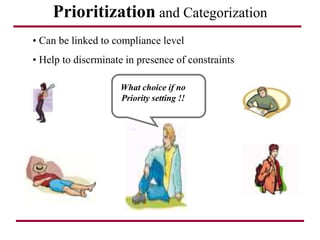
Prioritization and Categorization
• Can be linked to compliance level
• Help to discrminate in presence of constraints
What choice if no
Priority setting !!
Prioritization
• Parameters factors
• Budget
• Safety
Categorisation and classification
• Nature of requirements
• Functional
• Non functional
• Security
• Performance
• etc ..
• Validation related
• Consistency
• Clarity
Categorisation
• Can be also structured through others key issue as
• type of stackholder or derived
• type of requirement (technical issue)
• Technical
• level of abstraction
• technological basis
• Non technical
• Management
• financial
•
Categorisation (see paper by A. Gabb)
• Organize requirements according diffrent viewpoints
• Determine the requirements applicable to diffrent aspects of
development (safety, ,..)
• A way to detect redundancy and consistency
• Planning and modelling (expression)
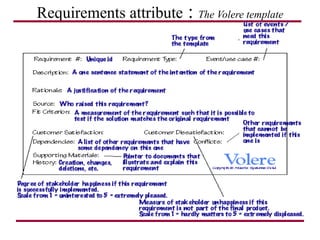
Requirements attribute : The Volere template
• Requirement # is the next unique requirement number
• Requirement Type is the section number from the template for
this type of requirement
• Requirement #: 128 Requirement Type: 9
• We shall record the time when we are notified of a gritter truck
breakdown
• A performance requirement comes from section 12, and the
next unique number is 129.
• Requirement #: 129 Requirement Type: 12
• Gritter truck drivers shall be informed of their schedule 30 minutes before
leaving the depot
Requirements attribute : The Volere template
• Client: The person or organisation for whom the product is
being built, usually responsible for paying for the development
of the product.
• Customer: The person or organisation who will buy the
product (note that the same person/organisation might play
both the client, customer and sometimes user roles)
• Design or Systems Design: Crafting a solution to fit the
requirements.
• Developers: The people who specify and build the product.
• Domain of Interest: A subject matter area that has some
relevance to the context of study.
• Non-Functional Requirement: A property that the eventual
product must have.
Requirements attribute : The Volere template
• Examples of stakeholders include:
• Users (detailed in section 3)
• Sponsor
• Testers
• Business Analysts
• Technology Experts
• System Designers
• Marketing Experts
• Legal Experts
• Domain Experts
• Usability Experts
• Representatives of external associations
Requirements Metrics
• http://systemsguild.com/GuildSite/Robs/apmeas.html
Requirements Metrics
• Requirements, if they are to be at all useful, must be
measurable
• Requirements creep is one of the most common risks in
software projects
• To prevent requirements creep, it is vital that the requirements
be measurable and that the requirements process include a
measuring and testing activity to which all requirements are
subject, without exception
• See requiration validation course on properties validations and
necessity of a requirement to validated.
CASE STUDIES
• CARE for A380 (see System engineering lecture)
• Survivable systems : Software Engineering Institute
http://www.sei.cmu.edu/publications/articles/ellison-
survivable-systems/ellison-survivable-systems.html
• Scientific Requirements and Scientific Commissioning for
the SDSS (princeton Univ)
http://tdserver1.fnal.gov/sdss/project/req_spec.htm
Survivable systems : concepts
• Survivability is defined as the capability of a system to fulfill its mission, in a
timely manner, in the presence of attacks, failures, or accidents.
• Unlike traditional security measures that require central control and
administration, survivability addresses highly distributed, unbounded network
environments with no central control or unified security policy.
• Survivability focuses on delivery of essential services and preservation of
essential assets, even when systems are penetrated and compromised.
• As an emerging discipline, survivability builds on existing disciplines,
including security, fault tolerance, and reliability, and introduces new concepts
and principles
Survivable systems : Elicitation of Essential Service Scenarios
• Requirements for large-scale systems typically specify a substantial
number and variety of services and their usage scenarios for all classes
and types of users.
• These services can exhibit substantial variations in properties such as
frequency of use, time constraints, and criticality to mission objectives.
• Some services, for example, stock buy and sell orders, are invoked
minute-by-minute, and must satisfy strict time constraints.
• The continuous availability and timeliness of such services are usually
essential to mission objectives.
• Other services, for example, production of quarterly investment reports,
are less frequently invoked, and their use can often be postponed if
necessary due to adverse conditions.
Survivable systems : Requirements
• Non-functional requirements : They are specified in the areas of
maintainability, extensibility, scalability and system distribution. In
addition, there are implied availability requirements and there is an
operational environment that also can specify system requirements.
• Availability requirements : There is a set of requirements that have
to do with viewing the data in the database on demand. Specifically,
there is a requirement to view treatment plans on demand. There is
also a requirement to view treatment plan history, but this is not
considered to be an essential service for survivability purposes.
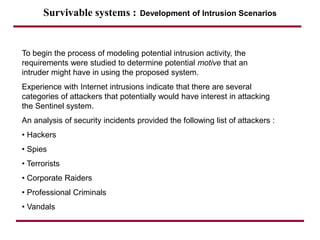
Survivable systems : Development of Intrusion Scenarios
To begin the process of modeling potential intrusion activity, the
requirements were studied to determine potential motive that an
intruder might have in using the proposed system.
Experience with Internet intrusions indicate that there are several
categories of attackers that potentially would have interest in attacking
the Sentinel system.
An analysis of security incidents provided the following list of attackers :
• Hackers
• Spies
• Terrorists
• Corporate Raiders
• Professional Criminals
• Vandals
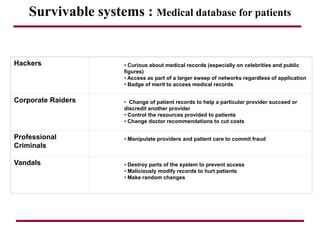
Survivable systems : Medical database for patients
Hackers • Curious about medical records (especially on celebrities and public
figures)
• Access as part of a larger sweep of networks regardless of application
• Badge of merit to access medical records
Corporate Raiders • Change of patient records to help a particular provider succeed or
discredit another provider
• Control the resources provided to patients
• Change doctor recommendations to cut costs
Professional
Criminals
• Manipulate providers and patient care to commit fraud
Vandals • Destroy parts of the system to prevent access
• Maliciously modify records to hurt patients
• Make random changes
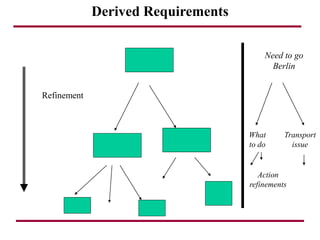
Derived Requirements
Refinement
Need to go
Berlin
What
to do
Transport
issue
Action
refinements
Tutorial_1 on requirements management
Give a general structure for a requirements list
Tutorial_2 on requirements management
Consider your RE project : give hints about managing requirements
Tutorial_3 on requirements management
If we consider the Req for a software system : indicate security types issues
Tutorial_4 on requirements management
Indicate requirements types for a web design
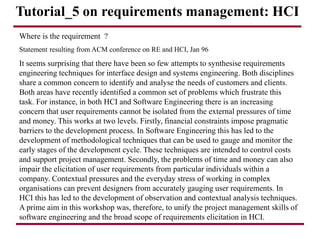
Tutorial_5 on requirements management: HCI
Where is the requirement ?
Statement resulting from ACM conference on RE and HCI, Jan 96
It seems surprising that there have been so few attempts to synthesise requirements
engineering techniques for interface design and systems engineering. Both disciplines
share a common concern to identify and analyse the needs of customers and clients.
Both areas have recently identified a common set of problems which frustrate this
task. For instance, in both HCI and Software Engineering there is an increasing
concern that user requirements cannot be isolated from the external pressures of time
and money. This works at two levels. Firstly, financial constraints impose pragmatic
barriers to the development process. In Software Engineering this has led to the
development of methodological techniques that can be used to gauge and monitor the
early stages of the development cycle. These techniques are intended to control costs
and support project management. Secondly, the problems of time and money can also
impair the elicitation of user requirements from particular individuals within a
company. Contextual pressures and the everyday stress of working in complex
organisations can prevent designers from accurately gauging user requirements. In
HCI this has led to the development of observation and contextual analysis techniques.
A prime aim in this workshop was, therefore, to unify the project management skills of
software engineering and the broad scope of requirements elicitation in HCI.
Tutorial_6 on requirements management
Develop Requirements management issues for air reservation
system
General summary
• Attributes
• Cathegories
• Priorities
Conclusions
• Managing requirements
• Is not a tool pb
• Parameters and attributes affected to each
requirement
• A process should be set up
• Activities (traceability, validation, verification, planning,
..)
• Associated method
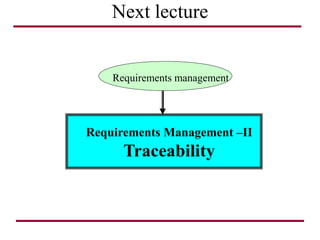
Next lecture
Requirements Management –II
Traceability
Requirements management
Paper Reading and assignments
• Papers to read under req_management topics
• Mandatory : req_cat_gabb.pdf, volere.pdf
• Optional for furher understanding (Others)
• Assignment
Apply the Volere template approach to the
scheduling problem.

Man.ppt

  • 1.
  • 2.
    The Requirements EngineeringProcess It covers many tasks • Elicitation • Expression and modelling • Requirements exchange • Management • Verification and validation
  • 3.
    The Requirements Dilemma!! • What is the best method for expressing requirements • Formal or semi-formal ? You said FORMAL Nice looking formula Example : Shakespeare (the Gil Vicente of English Theater) To be or not to be , that is the question
  • 4.
    Formalising ? ?Nice looking Formulae ? 2 2 B B   Another example : a romantic invariant property W. Shakespeare , ( , )( 1) , | ( , ) ( , )( 2) { 2} _ ( , ) _ ( , ) { _ _ exp ( , )} x M y Flove x y p x y love x y love y x p pre p get married x y live together x y Post Get marriage erience x y        
  • 5.
    Classes of languages,models, tools, methodes, techniques • Consider Software systems • Any language can be a requirement language • A programming language is a requirement language for the computer to execute what is required – Example : While {..} do .... – It is well specified and no ambiguity • However in RE – There many stakeholders – Different cultures (not necessarily computer scientists or familiar with programming languages) – Requirements are of many types
  • 6.
    • Programming languages •Specific notation • General purpose Methods • Informal • Semi-formal : Used in industry • Formal : Developped by academia • Abstract : limited to specific issues (pure academia work) • Paradigms • Function oriented • Object Classes
  • 7.
    Review of basicrelated aspects (seen in other courses) • Control structure (behaviour) : seq; //, if .. Else • Communication (shared data, synch, async, ..) • Abstraction • Encapsulation • Properties • Invariants
  • 8.
    CRITERIA (CMU-DoD_SEI Taxonomy) •Representation  Concepts and techniques described using the technique • Derivation  Methods to produce a specification from another • Validation-Verification  Properties that can be determined using the specification technique
  • 9.
    REPRESENTATION • Style • Concurrency •Communication • Non-Determinism • Fairness • Modularity • Time • Data
  • 10.
    DERIVATION • Transformation  Transformationrules from a specification technique to another (e.g multiformalism approach) • Elaboration  Same as above with a refinement process • Composition  Combination of various methods for a complex system
  • 11.
  • 12.
    Rigor Data modeling Function modeling Controlstructures TC expression Exception handling Verifiability Validability Modularity Level of abstraction Reusability Implementability Friendliness Tool maturity VDM RDP Statemate OMT SDL Z B 3 3 2 1 1 3 2 3 3 3 3 1 2 3 2 3 2 3 2 2 3 0 2 2 2 1 2 3 3 3 2 3 3 2 2 3 2 0 2 3 0 2 2 0 1 2 2 0 0 1 2 1 3 0 0 3 2 0 0 0 2 3 1 0 0 3 2 0 0 1 3 3 3 0 2 3 2 1 2 2 2 1 3 3 2 2 2 2 2 1 3 1 3 2 2 2 2 3 3 1 2 1 3 2 1 2 2 1 3 1 2 2 2 2 1 2 3 1 2 3 1 2 3 3 3 1 3 2 1 2 3 3 3 2 3 2 3 1 1 2 0 3 3 2 1 3 3 1 1 2 Criteria Methods SART LOTOS Estelle An example of taxonomy
  • 13.
    The backbone isrequirement Elicitation success Requirement ? Stackholders Existing system Interacting systems The Process
  • 14.
    4 Dark Corners(see Zave and Jackson paper) • Tendancy to concentrate only on the system to be built • Lack of description of the environment • Confusion in actions controlled by environment and those by the system • Domain knowledge issue
  • 15.
    Thinking about managingrequirements : It is not a tool problem only
  • 16.
  • 17.
    2nd LEVEL 1st LEVEL (PatternRepeats) ANALYSES REQUIREMENT COLLECTIONS USERS/BUYER /SUPPLIER STATE OF THE ART IMPLEMENTATION REQUIREMENT CONTROL DATA ALL ACCUMULATED KNOWLEDGE VALIDATION LOOP CONCEPT & DERIVATIONS FEASIBILITIES, POSSIBILITIES, & QUERIES NEEDS & DESIRES FORMAL REQUIREMENTS WITH DESTINATIONS ANALYSIS- TO-ANALYSIS DATA FLOW STATUS & CONTROL FEASIBILITY / POSSIBILITY LOOP ANALYSES REQUIREMENT COLLECTIONS USERS/BUYER /SUPPLIER STATE OF THE ART IMPLEMENTATION REQUIREMENT CONTROL DATA GATED STORAGE ALL ACCUMULATED KNOWLEDGE A model for requirements management
  • 18.
    Some figures • Aeronautic: 10 to 15 000 requirements • Elicitation duration : 4 to 10 months • A need for a process management  A need to manage complexity * Increasing number size of requirements * Diverse types * Changing
  • 19.
    . 1. Tiny 2.Small 3. Medium 4. Large 5. Huge Design professionals (number) 3 15 75 400 2,000 Duration (months) 12 24 36 48 60 Geographical area Building City Multi-city Country World States/modes (number) 3 30 300 2,000 10 000 States/modes (type) Well defined Deterministic Stochastic Interface params (no.) 9 90 900 6,000 30 000 Physical environment of product Indoor In/outdoor 1 location Outdoor global Global Space, Ocean Requirements (no. of text pages) 15 150 500 2 000 50000 Requirements (approximate no) 150 1 500 5 000 20 000 500 000 Number of specs generated 1 3 10 200 1000 Examples Electric kitchen mixer; low budget art film Housing development; TV Set; grand opera Night viewing system; highway system Aircraft Space vehicle; Battleship & armament
  • 20.
    Why ? • Requirementsare basis for all successive steps • It is the main reference for – Changing requirements – Adding a requirements – Changing a design – Improving the implementation (technology update)
  • 21.
    What to manage? What to do ? • Managing requirements Is – Identify a requirement – Affect key attributes – Know all its history • Who expressed it • Validation test • Corresponding design • Corresponding implementation • Versions • ....
  • 22.
    Some example throughthe lecture • Control of a lift system : the lift has to bring people from a floor to a floor • Refinement – The person calls the lift at any floor – The choice of destination is made when inside the lift – The door is maintained open for 30 sec unless closed or open by user (open min 10 sec) Finish first the elicitation process
  • 23.
    Requirements Attributs • Characteristics: types, application • Validation related links • Traceability related links • Stakeholder related links
  • 24.
    Requirements characteristics • Incose: see www.incose.org/rwg • Requirement Type The requirement type identifies the source and contractual applicability of a requirement. * Primary. Those requirements (whatever their form contract provision, specification, database, market analysis, etc.) levied on a contractor/producer under force of contract. The identification is unambiguous. If - contractually applicable, or has the force of a contract as in a market analysis, and - comes from a source external to program personnel, it's a primary requirement. An example would be “The system must operate under temperature environment interval (-10, 50) ".
  • 25.
    Requirements characteristics (Incose/rwg) *Derived. Those requirements (whatever their source internal, supplier, team member, customer, etc.) that are generated apart from the primary requirements. The identification is unambiguous. If it is not a primary requirement, it is a derived requirement. An example would be “the card board temperature work in the interval (5,30)"..
  • 26.
    Req. Attribute :application • Requirement Application : The requirement application identifies the object of a requirement, There are only two requirements applications: • Product Parameter. A product parameter is a requirement that applies to the product or service to be developed. The identification is unambiguous. If it directly acts on the product or service, it is a product parameter. Examples of such requirements would include "The external surfaces of all equipment shall be painted while", and "The operator training program shall result in a pass rate of not less than 95% for qualified candidates ". • Product parameters have two primary subdivisions: * Qualitative - This product parameter contains no measurable requirement. An example would be "The mixer shall produce a mixture of homogeneous appearance." A qualitative product parameter usually necessitates further analysis to determine suitable quantifiable criteria; i.e., usually necessitates the development of derived requirement(s), with the qualitative product parameter serving as the parent.
  • 27.
    Req. Attribute :Application • Quantitative - This product parameter contains a measurable requirement. An example would be "The mixer shall produce a mixture having a fineness granularity of XYZ within five minutes “, “a query should last less 5 sec”. A quantitative product parameter may have children, but such children would be generated for the purpose of specifying particular approaches to meeting this measurable requirement.
  • 28.
    Req. Attribute :Program parameter • Program Parameter. A program parameter is a requirement that applies to the activities associated with enabling the creation of a product or service, such as conducting traders or holding design reviews. This also includes contract provisions which define the customer/contractor relationship; e.g., confidentiality, intellectual property rights, warranties, etc. In short, a program parameter defines activities related to the technical and administrative management of product development. The identification is unambiguous. If it does not directly act on the product or service, it is a program parameter. Examples of such requirements would include "The contractor shall develop a concept of operations " or "The contractor shall conduct internal design reviews every two weeks. "
  • 29.
    Req. Attribute :Program parameter • Program Parameters have three primary subdivisions: - Task - Identifies an analysis or other effort to be performed. Examples would include "Prepare a Systems Engineering Management Plan" or "Perform an analysis of the structural loads on the bridge pylons'. - Compliance Evaluation - Identifies the methodology for measuring compliance with parameter. (There should be a verification program parameter associated with each product parameter.) - Regulatory - Identifies administrative elements such as "Deliverable data shall be furnished with unlimited rights to the Government".
  • 30.
    Req. Attribute :Compliance levels • Requirement Compliance Level : compliance levels: • Mandatory. Whether a primary or derived requirement, it must be implemented. Such requirements usually include a "shall" statement in their structure. • Guidance. Whether a primary or derived requirement, it is desirable that it be implemented. In general, failure to implement does not constitute noncompliance so long as it can be demonstrated that a reasonable degree of implementation was attempted.. An example would be "Use Mil-Std-499B as a guide in implementing the systems engineering process. " • Information. This unique characteristic is essential when requirements management systems (requirements databases) are used in lieu of hard copy source documents. By strict interpretation, these "requirements" are not actually requirements, but are non-binding statements which significantly influence the context, meaning, and understanding of other requirements. An example might be a reference to the customer's reasoning for specifying a particular approach or requirement.
  • 31.
    Req. Attribute :Priority levels • Priority - This characteristic identifies the relative importance of a requirement in terms of implementation, particularly in establishing criteria for trade studies. - In a cost reimbursable environment, a customer may use priorities to mandate that certain elements must be completed before a specified ceiling is reached. - The priority characteristic may also be used for establishing the sequence in which specified design or test activities should occur. Unlike the other characteristics - the values of priority will be dependent on program and company needs. READING : See paper Ivy Hooks and Larry Fellows
  • 32.
    Req. Attribute :Summary • Types • Primary • Derived • Application • Products parameters : • Qualitative: Functional, Process • Quantitative: performance, procedural, Physical • Programs parameters : Task, compliance, evaluation • Compliance : Mandatory, guidance • Priority : Specific to company needs
  • 33.
    Traceability • Definitions • Requirementsfor traceability • Techniques • A generic model of traceability
  • 34.
    Traceability : Definition •Traceability (IEEE) : the degree to which a relationship can be established between two or more products of the development process, especially products having a predecessor-successor or master-subordinate relationship to one another • Traceability (ISO 8402) : is the ability to trace the history, application or location of an entity by means of recorded identifications
  • 35.
    Traceability : InGeneral • Consumer protection is a cornerstone of our economic system. Therefore it is not surprising to see that traceability is an efficient method of exoneration from any dispute which may occur by proving that we work by the book. • Traceability as a security factor : Any defective products which present a serious risk to the user must be recalled without delay. Therefore it is absolutely necessary to have a distinctive mark on the products. • Traceability as an investigator : If a defective product has to be recalled, it is because it has passed through the checks that should have stopped it. Therefore we have to go back to the cause of the problem in order to find the solution. • Traceability: an element of industrial politics : Knowing what and how was done can be essential when responding to a client order. Traceability can lead to a greater knowledge of the company’s capabilities, making it possible to meet an order in a shorter time and at a lower cost. Traceability can also be the point of initiation of the statistical methods of process control (SPC).
  • 36.
    Traceability : Ingeneral (2) • Traceability: a stimulus for technical progress : If you are content to accept the final result of a progress which conforms to specifications without question, there is a great risk of becoming complacent and losing one’s motivation, resulting in a decreased competitivity. • Traceability: getting to know the customers : Traceability also enables the collection of information concerning consumers and their spending habits. This in turn enables the customers to be categorised according to the marketing goals.
  • 37.
    Prioritization and Categorization •Can be linked to compliance level • Help to discrminate in presence of constraints What choice if no Priority setting !!
  • 38.
  • 39.
    Categorisation and classification •Nature of requirements • Functional • Non functional • Security • Performance • etc .. • Validation related • Consistency • Clarity
  • 40.
    Categorisation • Can bealso structured through others key issue as • type of stackholder or derived • type of requirement (technical issue) • Technical • level of abstraction • technological basis • Non technical • Management • financial •
  • 41.
    Categorisation (see paperby A. Gabb) • Organize requirements according diffrent viewpoints • Determine the requirements applicable to diffrent aspects of development (safety, ,..) • A way to detect redundancy and consistency • Planning and modelling (expression)
  • 42.
    Requirements attribute :The Volere template
  • 43.
    Requirements attribute :The Volere template • Requirement # is the next unique requirement number • Requirement Type is the section number from the template for this type of requirement • Requirement #: 128 Requirement Type: 9 • We shall record the time when we are notified of a gritter truck breakdown • A performance requirement comes from section 12, and the next unique number is 129. • Requirement #: 129 Requirement Type: 12 • Gritter truck drivers shall be informed of their schedule 30 minutes before leaving the depot
  • 44.
    Requirements attribute :The Volere template • Client: The person or organisation for whom the product is being built, usually responsible for paying for the development of the product. • Customer: The person or organisation who will buy the product (note that the same person/organisation might play both the client, customer and sometimes user roles) • Design or Systems Design: Crafting a solution to fit the requirements. • Developers: The people who specify and build the product. • Domain of Interest: A subject matter area that has some relevance to the context of study. • Non-Functional Requirement: A property that the eventual product must have.
  • 45.
    Requirements attribute :The Volere template • Examples of stakeholders include: • Users (detailed in section 3) • Sponsor • Testers • Business Analysts • Technology Experts • System Designers • Marketing Experts • Legal Experts • Domain Experts • Usability Experts • Representatives of external associations
  • 46.
  • 47.
    Requirements Metrics • Requirements,if they are to be at all useful, must be measurable • Requirements creep is one of the most common risks in software projects • To prevent requirements creep, it is vital that the requirements be measurable and that the requirements process include a measuring and testing activity to which all requirements are subject, without exception • See requiration validation course on properties validations and necessity of a requirement to validated.
  • 48.
    CASE STUDIES • CAREfor A380 (see System engineering lecture) • Survivable systems : Software Engineering Institute http://www.sei.cmu.edu/publications/articles/ellison- survivable-systems/ellison-survivable-systems.html • Scientific Requirements and Scientific Commissioning for the SDSS (princeton Univ) http://tdserver1.fnal.gov/sdss/project/req_spec.htm
  • 49.
    Survivable systems :concepts • Survivability is defined as the capability of a system to fulfill its mission, in a timely manner, in the presence of attacks, failures, or accidents. • Unlike traditional security measures that require central control and administration, survivability addresses highly distributed, unbounded network environments with no central control or unified security policy. • Survivability focuses on delivery of essential services and preservation of essential assets, even when systems are penetrated and compromised. • As an emerging discipline, survivability builds on existing disciplines, including security, fault tolerance, and reliability, and introduces new concepts and principles
  • 50.
    Survivable systems :Elicitation of Essential Service Scenarios • Requirements for large-scale systems typically specify a substantial number and variety of services and their usage scenarios for all classes and types of users. • These services can exhibit substantial variations in properties such as frequency of use, time constraints, and criticality to mission objectives. • Some services, for example, stock buy and sell orders, are invoked minute-by-minute, and must satisfy strict time constraints. • The continuous availability and timeliness of such services are usually essential to mission objectives. • Other services, for example, production of quarterly investment reports, are less frequently invoked, and their use can often be postponed if necessary due to adverse conditions.
  • 51.
    Survivable systems :Requirements • Non-functional requirements : They are specified in the areas of maintainability, extensibility, scalability and system distribution. In addition, there are implied availability requirements and there is an operational environment that also can specify system requirements. • Availability requirements : There is a set of requirements that have to do with viewing the data in the database on demand. Specifically, there is a requirement to view treatment plans on demand. There is also a requirement to view treatment plan history, but this is not considered to be an essential service for survivability purposes.
  • 52.
    Survivable systems :Development of Intrusion Scenarios To begin the process of modeling potential intrusion activity, the requirements were studied to determine potential motive that an intruder might have in using the proposed system. Experience with Internet intrusions indicate that there are several categories of attackers that potentially would have interest in attacking the Sentinel system. An analysis of security incidents provided the following list of attackers : • Hackers • Spies • Terrorists • Corporate Raiders • Professional Criminals • Vandals
  • 53.
    Survivable systems :Medical database for patients Hackers • Curious about medical records (especially on celebrities and public figures) • Access as part of a larger sweep of networks regardless of application • Badge of merit to access medical records Corporate Raiders • Change of patient records to help a particular provider succeed or discredit another provider • Control the resources provided to patients • Change doctor recommendations to cut costs Professional Criminals • Manipulate providers and patient care to commit fraud Vandals • Destroy parts of the system to prevent access • Maliciously modify records to hurt patients • Make random changes
  • 54.
    Derived Requirements Refinement Need togo Berlin What to do Transport issue Action refinements
  • 55.
    Tutorial_1 on requirementsmanagement Give a general structure for a requirements list
  • 56.
    Tutorial_2 on requirementsmanagement Consider your RE project : give hints about managing requirements
  • 57.
    Tutorial_3 on requirementsmanagement If we consider the Req for a software system : indicate security types issues
  • 58.
    Tutorial_4 on requirementsmanagement Indicate requirements types for a web design
  • 59.
    Tutorial_5 on requirementsmanagement: HCI Where is the requirement ? Statement resulting from ACM conference on RE and HCI, Jan 96 It seems surprising that there have been so few attempts to synthesise requirements engineering techniques for interface design and systems engineering. Both disciplines share a common concern to identify and analyse the needs of customers and clients. Both areas have recently identified a common set of problems which frustrate this task. For instance, in both HCI and Software Engineering there is an increasing concern that user requirements cannot be isolated from the external pressures of time and money. This works at two levels. Firstly, financial constraints impose pragmatic barriers to the development process. In Software Engineering this has led to the development of methodological techniques that can be used to gauge and monitor the early stages of the development cycle. These techniques are intended to control costs and support project management. Secondly, the problems of time and money can also impair the elicitation of user requirements from particular individuals within a company. Contextual pressures and the everyday stress of working in complex organisations can prevent designers from accurately gauging user requirements. In HCI this has led to the development of observation and contextual analysis techniques. A prime aim in this workshop was, therefore, to unify the project management skills of software engineering and the broad scope of requirements elicitation in HCI.
  • 60.
    Tutorial_6 on requirementsmanagement Develop Requirements management issues for air reservation system
  • 61.
    General summary • Attributes •Cathegories • Priorities
  • 62.
    Conclusions • Managing requirements •Is not a tool pb • Parameters and attributes affected to each requirement • A process should be set up • Activities (traceability, validation, verification, planning, ..) • Associated method
  • 63.
    Next lecture Requirements Management–II Traceability Requirements management
  • 64.
    Paper Reading andassignments • Papers to read under req_management topics • Mandatory : req_cat_gabb.pdf, volere.pdf • Optional for furher understanding (Others) • Assignment Apply the Volere template approach to the scheduling problem.