Food Adulteration and Detection
Food Quality Control Practice (2)
Food Adulteration Definition
• Food Adulteration :Is any material that is increased or reduced in the food
structure to increase the amount of products and reduce the value of food. or
mixing two foods fresh and old.
• This action is done more in the country where their economy is weak And
also in countries with economic sanctions.
• Food Adulteration refers to the process by which the quality or the nature of
a given food is reduced through addition of adulterants or removal of vital
substance.
Food Adulteration & Detection:-
Any way to determine the adulteration of food such as chemical, physical or
biological ways, provided it is in a reliable place and a reliable result to prove
the truth of the food situation
Types of Adulteration
There are three types of adulteration:-
1- Intentional Adulterants.( Add Stone for increase wight)
2- Metallic Contamination.(lead From water)
3- Incidental Adulterants.(insects intrude into the food at a high degree )
4- Packaging Adulterants (used flexible package)
Types of Food Adulteration
1- Adulteration in cooked Food
2- Adulteration in Fish
3- Adulteration in Vegetable + Fruit
4- Adulteration in Juice + Jam
5- Adulteration in Milk + Condensed milk
6- Adulteration in Sugar + Flour + Oil
METHODS OF FOOD ADULTERATION:
1. Mixing: Mixing of clay, stones, pebbles, sand, marble chips, etc. with Rice and
Wheat , all Cereals to increase weight
2. Substitution: Cheaper and inferior substances being replaced wholly or partially
with good ones. (Change expensive substance to Cheaper)
3. Concealing quality: Trying to hide the food standard. E.G. adding captions of
qualitative food to low quality for selling. (Change Labeling to better)
4. Decomposed food: Mainly in fruits and vegetables. The decomposed ones are
mixed with good ones (Mixing old fruit with Fresh )
5. Misbranding/ False labels: Includes duplicate food stuffs, changing of
manufacture and expiry dates. (Canned Food)
6. Addition of toxicants: Adding non-edible substances like argemone in mustard oil,
low quality preservatives, coloring agents, etc.(Change Quality)
CAUSES OF FOOD ADULTERATION
1. Profit motive of traders: Done as a part of the business strategy
2. Food insecurity: To increase quantity of food production and sales.
3. Increased Urbanization: To make maximum profit from food items by
fewer investments.
4. High population demands: Increased food demand of the population
and its changing trends.
5. Illiteracy of general public: Lack of consciousness of proper food
consumption.
6. Lack of effective food laws
7. Lack of government in initiative
FOOD ADULTERATION IN DEVELOPING COUNTRIES:
• 1- Fresh vegetables and fruits, the main part of our meal is adulterated by the
self applied fertilizers and pesticides by the farmers to increase the production
and to avoid the attacks of insects and diseases.
• Nowadays, vegetables producing fields are irrigated with sewerage water which
included detergents, human faeces, factory wastes having high concentrations
of toxic heavy metals i.e. lead and arsenic which can cause damage to liver,
kidney and cancer.
• Vegetables and fruits are also openly sold on roads which causes the free fallen
smoke and dust particles resulting in contamination.
• 2- Wax coating/ dipping in chemical water like copper sulphate (CuSO4) is
used for increasing the marketing by making them attractive and fresh looking.
• 3- Saccharin is used as a sweetening agent in many confectionery products,
instead of sucrose, which is harmful to health
• 4- The storage room is cleaned and fumigated to protect the storage products
from insects that contain hazardous substances affecting the health.
HEALTH HAZARDS OF FOOD ADULTERATION
• Some health hazards associated with specific food adulteration incudes:
1. Mineral oil if added to edible oil and fats can cause cancers.
2. Lead chromate when added to turmeric powder and spices can cause
anemia, brain damage and abortions.
3. Mercury in mercury fungicide treated grains, or mercury-contaminated fish
can cause brain damage, paralysis, and death.
4. Non-permitted color or permitted food color like metal yellow, beyond the
safe limit in colored food can cause allergies, hyperactivity, liver damage,
infertility, cancer and birth defects.
5. Cobalt added to water and liquors and can cause cardiac damage also
copper, tin, and zinc can cause colic, vomiting and diarrhea.
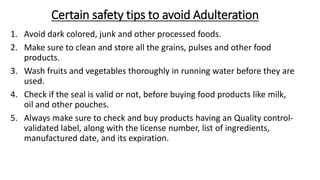
Certain safety tips to avoid Adulteration
1. Avoid dark colored, junk and other processed foods.
2. Make sure to clean and store all the grains, pulses and other food
products.
3. Wash fruits and vegetables thoroughly in running water before they are
used.
4. Check if the seal is valid or not, before buying food products like milk,
oil and other pouches.
5. Always make sure to check and buy products having an Quality control-
validated label, along with the license number, list of ingredients,
manufactured date, and its expiration.
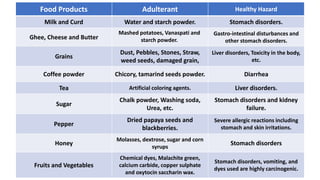
Healthy Hazard
Adulterant
Food Products
Stomach disorders.
Water and starch powder.
Milk and Curd
Gastro-intestinal disturbances and
other stomach disorders.
Mashed potatoes, Vanaspati and
starch powder.
Ghee, Cheese and Butter
Liver disorders, Toxicity in the body,
etc.
Dust, Pebbles, Stones, Straw,
weed seeds, damaged grain,
Grains
Diarrhea
Chicory, tamarind seeds powder.
Coffee powder
Liver disorders.
Artificial coloring agents.
Tea
Stomach disorders and kidney
failure.
Chalk powder, Washing soda,
Urea, etc.
Sugar
Severe allergic reactions including
stomach and skin irritations.
Dried papaya seeds and
blackberries.
Pepper
Stomach disorders
Molasses, dextrose, sugar and corn
syrups
Honey
Stomach disorders, vomiting, and
dyes used are highly carcinogenic.
Chemical dyes, Malachite green,
calcium carbide, copper sulphate
and oxytocin saccharin wax.
Fruits and Vegetables
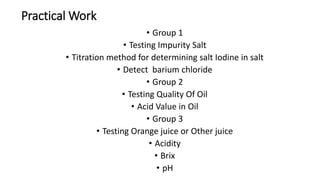
Practical Work
• Group 1
• Testing Impurity Salt
• Titration method for determining salt Iodine in salt
• Detect barium chloride
• Group 2
• Testing Quality Of Oil
• Acid Value in Oil
• Group 3
• Testing Orange juice or Other juice
• Acidity
• Brix
• pH
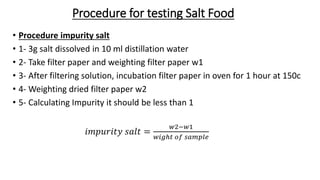
Procedure for testing Salt Food
• Procedure impurity salt
• 1- 3g salt dissolved in 10 ml distillation water
• 2- Take filter paper and weighting filter paper w1
• 3- After filtering solution, incubation filter paper in oven for 1 hour at 150c
• 4- Weighting dried filter paper w2
• 5- Calculating Impurity it should be less than 1
𝑖𝑚𝑝𝑢𝑟𝑖𝑡𝑦 𝑠𝑎𝑙𝑡 =
𝑤2−𝑤1
𝑤𝑖𝑔ℎ𝑡 𝑜𝑓 𝑠𝑎𝑚𝑝𝑙𝑒
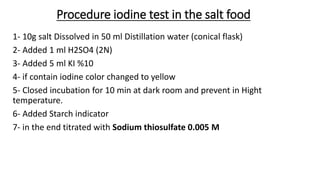
Procedure iodine test in the salt food
1- 10g salt Dissolved in 50 ml Distillation water (conical flask)
2- Added 1 ml H2SO4 (2N)
3- Added 5 ml KI %10
4- if contain iodine color changed to yellow
5- Closed incubation for 10 min at dark room and prevent in Hight
temperature.
6- Added Starch indicator
7- in the end titrated with Sodium thiosulfate 0.005 M
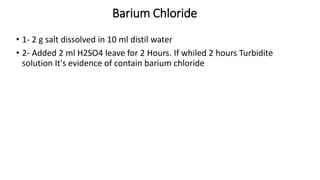
Barium Chloride
• 1- 2 g salt dissolved in 10 ml distil water
• 2- Added 2 ml H2SO4 leave for 2 Hours. If whiled 2 hours Turbidite
solution It's evidence of contain barium chloride
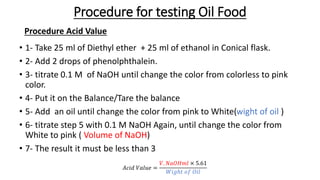
Procedure for testing Oil Food
• 1- Take 25 ml of Diethyl ether + 25 ml of ethanol in Conical flask.
• 2- Add 2 drops of phenolphthalein.
• 3- titrate 0.1 M of NaOH until change the color from colorless to pink
color.
• 4- Put it on the Balance/Tare the balance
• 5- Add an oil until change the color from pink to White(wight of oil )
• 6- titrate step 5 with 0.1 M NaOH Again, until change the color from
White to pink ( Volume of NaOH)
• 7- The result it must be less than 3
Procedure Acid Value
𝐴𝑐𝑖𝑑 𝑉𝑎𝑙𝑢𝑒 =
𝑉. 𝑁𝑎𝑂𝐻𝑚𝑙 × 5.61
𝑊𝑖𝑔ℎ𝑡 𝑜𝑓 𝑂𝑖𝑙
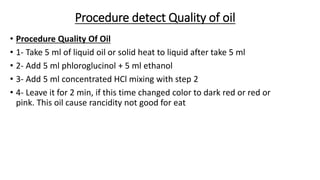
Procedure detect Quality of oil
• Procedure Quality Of Oil
• 1- Take 5 ml of liquid oil or solid heat to liquid after take 5 ml
• 2- Add 5 ml phloroglucinol + 5 ml ethanol
• 3- Add 5 ml concentrated HCl mixing with step 2
• 4- Leave it for 2 min, if this time changed color to dark red or red or
pink. This oil cause rancidity not good for eat
Procedure for testing juice
• Procedure pH test Juice:-
• 1- Wight 20 g juice in the beaker.
• 2- Add 100 ml of distil water.
• 3- Use pH meter it should be less than 3.5
• Procedure Brix test Juice:-
• For all drinks, between 8 and 12 must be given to the refractometer
machine, we take the juice directly and measure it.(detection of sugar)
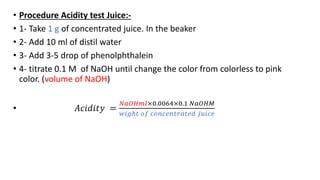
• Procedure Acidity test Juice:-
• 1- Take 1 g of concentrated juice. In the beaker
• 2- Add 10 ml of distil water
• 3- Add 3-5 drop of phenolphthalein
• 4- titrate 0.1 M of NaOH until change the color from colorless to pink
color. (volume of NaOH)
• 𝐴𝑐𝑖𝑑𝑖𝑡𝑦 =
𝑁𝑎𝑂𝐻𝑚𝑙×0.0064×0.1 𝑁𝑎𝑂𝐻𝑀
𝑤𝑖𝑔ℎ𝑡 𝑜𝑓 𝑐𝑜𝑛𝑐𝑒𝑛𝑡𝑟𝑎𝑡𝑒𝑑 𝑗𝑢𝑖𝑐𝑒

Food_Adulteration_And_detection.pptx

  • 1.
    Food Adulteration andDetection Food Quality Control Practice (2)
  • 2.
    Food Adulteration Definition •Food Adulteration :Is any material that is increased or reduced in the food structure to increase the amount of products and reduce the value of food. or mixing two foods fresh and old. • This action is done more in the country where their economy is weak And also in countries with economic sanctions. • Food Adulteration refers to the process by which the quality or the nature of a given food is reduced through addition of adulterants or removal of vital substance. Food Adulteration & Detection:- Any way to determine the adulteration of food such as chemical, physical or biological ways, provided it is in a reliable place and a reliable result to prove the truth of the food situation
  • 3.
    Types of Adulteration Thereare three types of adulteration:- 1- Intentional Adulterants.( Add Stone for increase wight) 2- Metallic Contamination.(lead From water) 3- Incidental Adulterants.(insects intrude into the food at a high degree ) 4- Packaging Adulterants (used flexible package) Types of Food Adulteration 1- Adulteration in cooked Food 2- Adulteration in Fish 3- Adulteration in Vegetable + Fruit 4- Adulteration in Juice + Jam 5- Adulteration in Milk + Condensed milk 6- Adulteration in Sugar + Flour + Oil
  • 4.
    METHODS OF FOODADULTERATION: 1. Mixing: Mixing of clay, stones, pebbles, sand, marble chips, etc. with Rice and Wheat , all Cereals to increase weight 2. Substitution: Cheaper and inferior substances being replaced wholly or partially with good ones. (Change expensive substance to Cheaper) 3. Concealing quality: Trying to hide the food standard. E.G. adding captions of qualitative food to low quality for selling. (Change Labeling to better) 4. Decomposed food: Mainly in fruits and vegetables. The decomposed ones are mixed with good ones (Mixing old fruit with Fresh ) 5. Misbranding/ False labels: Includes duplicate food stuffs, changing of manufacture and expiry dates. (Canned Food) 6. Addition of toxicants: Adding non-edible substances like argemone in mustard oil, low quality preservatives, coloring agents, etc.(Change Quality)
  • 5.
    CAUSES OF FOODADULTERATION 1. Profit motive of traders: Done as a part of the business strategy 2. Food insecurity: To increase quantity of food production and sales. 3. Increased Urbanization: To make maximum profit from food items by fewer investments. 4. High population demands: Increased food demand of the population and its changing trends. 5. Illiteracy of general public: Lack of consciousness of proper food consumption. 6. Lack of effective food laws 7. Lack of government in initiative
  • 6.
    FOOD ADULTERATION INDEVELOPING COUNTRIES: • 1- Fresh vegetables and fruits, the main part of our meal is adulterated by the self applied fertilizers and pesticides by the farmers to increase the production and to avoid the attacks of insects and diseases. • Nowadays, vegetables producing fields are irrigated with sewerage water which included detergents, human faeces, factory wastes having high concentrations of toxic heavy metals i.e. lead and arsenic which can cause damage to liver, kidney and cancer. • Vegetables and fruits are also openly sold on roads which causes the free fallen smoke and dust particles resulting in contamination.
  • 7.
    • 2- Waxcoating/ dipping in chemical water like copper sulphate (CuSO4) is used for increasing the marketing by making them attractive and fresh looking. • 3- Saccharin is used as a sweetening agent in many confectionery products, instead of sucrose, which is harmful to health • 4- The storage room is cleaned and fumigated to protect the storage products from insects that contain hazardous substances affecting the health.
  • 8.
    HEALTH HAZARDS OFFOOD ADULTERATION • Some health hazards associated with specific food adulteration incudes: 1. Mineral oil if added to edible oil and fats can cause cancers. 2. Lead chromate when added to turmeric powder and spices can cause anemia, brain damage and abortions. 3. Mercury in mercury fungicide treated grains, or mercury-contaminated fish can cause brain damage, paralysis, and death. 4. Non-permitted color or permitted food color like metal yellow, beyond the safe limit in colored food can cause allergies, hyperactivity, liver damage, infertility, cancer and birth defects. 5. Cobalt added to water and liquors and can cause cardiac damage also copper, tin, and zinc can cause colic, vomiting and diarrhea.
  • 9.
    Certain safety tipsto avoid Adulteration 1. Avoid dark colored, junk and other processed foods. 2. Make sure to clean and store all the grains, pulses and other food products. 3. Wash fruits and vegetables thoroughly in running water before they are used. 4. Check if the seal is valid or not, before buying food products like milk, oil and other pouches. 5. Always make sure to check and buy products having an Quality control- validated label, along with the license number, list of ingredients, manufactured date, and its expiration.
  • 10.
    Healthy Hazard Adulterant Food Products Stomachdisorders. Water and starch powder. Milk and Curd Gastro-intestinal disturbances and other stomach disorders. Mashed potatoes, Vanaspati and starch powder. Ghee, Cheese and Butter Liver disorders, Toxicity in the body, etc. Dust, Pebbles, Stones, Straw, weed seeds, damaged grain, Grains Diarrhea Chicory, tamarind seeds powder. Coffee powder Liver disorders. Artificial coloring agents. Tea Stomach disorders and kidney failure. Chalk powder, Washing soda, Urea, etc. Sugar Severe allergic reactions including stomach and skin irritations. Dried papaya seeds and blackberries. Pepper Stomach disorders Molasses, dextrose, sugar and corn syrups Honey Stomach disorders, vomiting, and dyes used are highly carcinogenic. Chemical dyes, Malachite green, calcium carbide, copper sulphate and oxytocin saccharin wax. Fruits and Vegetables
  • 11.
    Practical Work • Group1 • Testing Impurity Salt • Titration method for determining salt Iodine in salt • Detect barium chloride • Group 2 • Testing Quality Of Oil • Acid Value in Oil • Group 3 • Testing Orange juice or Other juice • Acidity • Brix • pH
  • 12.
    Procedure for testingSalt Food • Procedure impurity salt • 1- 3g salt dissolved in 10 ml distillation water • 2- Take filter paper and weighting filter paper w1 • 3- After filtering solution, incubation filter paper in oven for 1 hour at 150c • 4- Weighting dried filter paper w2 • 5- Calculating Impurity it should be less than 1 𝑖𝑚𝑝𝑢𝑟𝑖𝑡𝑦 𝑠𝑎𝑙𝑡 = 𝑤2−𝑤1 𝑤𝑖𝑔ℎ𝑡 𝑜𝑓 𝑠𝑎𝑚𝑝𝑙𝑒
  • 13.
    Procedure iodine testin the salt food 1- 10g salt Dissolved in 50 ml Distillation water (conical flask) 2- Added 1 ml H2SO4 (2N) 3- Added 5 ml KI %10 4- if contain iodine color changed to yellow 5- Closed incubation for 10 min at dark room and prevent in Hight temperature. 6- Added Starch indicator 7- in the end titrated with Sodium thiosulfate 0.005 M
  • 14.
    Barium Chloride • 1-2 g salt dissolved in 10 ml distil water • 2- Added 2 ml H2SO4 leave for 2 Hours. If whiled 2 hours Turbidite solution It's evidence of contain barium chloride
  • 15.
    Procedure for testingOil Food • 1- Take 25 ml of Diethyl ether + 25 ml of ethanol in Conical flask. • 2- Add 2 drops of phenolphthalein. • 3- titrate 0.1 M of NaOH until change the color from colorless to pink color. • 4- Put it on the Balance/Tare the balance • 5- Add an oil until change the color from pink to White(wight of oil ) • 6- titrate step 5 with 0.1 M NaOH Again, until change the color from White to pink ( Volume of NaOH) • 7- The result it must be less than 3 Procedure Acid Value 𝐴𝑐𝑖𝑑 𝑉𝑎𝑙𝑢𝑒 = 𝑉. 𝑁𝑎𝑂𝐻𝑚𝑙 × 5.61 𝑊𝑖𝑔ℎ𝑡 𝑜𝑓 𝑂𝑖𝑙
  • 16.
    Procedure detect Qualityof oil • Procedure Quality Of Oil • 1- Take 5 ml of liquid oil or solid heat to liquid after take 5 ml • 2- Add 5 ml phloroglucinol + 5 ml ethanol • 3- Add 5 ml concentrated HCl mixing with step 2 • 4- Leave it for 2 min, if this time changed color to dark red or red or pink. This oil cause rancidity not good for eat
  • 17.
    Procedure for testingjuice • Procedure pH test Juice:- • 1- Wight 20 g juice in the beaker. • 2- Add 100 ml of distil water. • 3- Use pH meter it should be less than 3.5 • Procedure Brix test Juice:- • For all drinks, between 8 and 12 must be given to the refractometer machine, we take the juice directly and measure it.(detection of sugar)
  • 18.
    • Procedure Aciditytest Juice:- • 1- Take 1 g of concentrated juice. In the beaker • 2- Add 10 ml of distil water • 3- Add 3-5 drop of phenolphthalein • 4- titrate 0.1 M of NaOH until change the color from colorless to pink color. (volume of NaOH) • 𝐴𝑐𝑖𝑑𝑖𝑡𝑦 = 𝑁𝑎𝑂𝐻𝑚𝑙×0.0064×0.1 𝑁𝑎𝑂𝐻𝑀 𝑤𝑖𝑔ℎ𝑡 𝑜𝑓 𝑐𝑜𝑛𝑐𝑒𝑛𝑡𝑟𝑎𝑡𝑒𝑑 𝑗𝑢𝑖𝑐𝑒