FOOD TRIVIA
Brown or white?
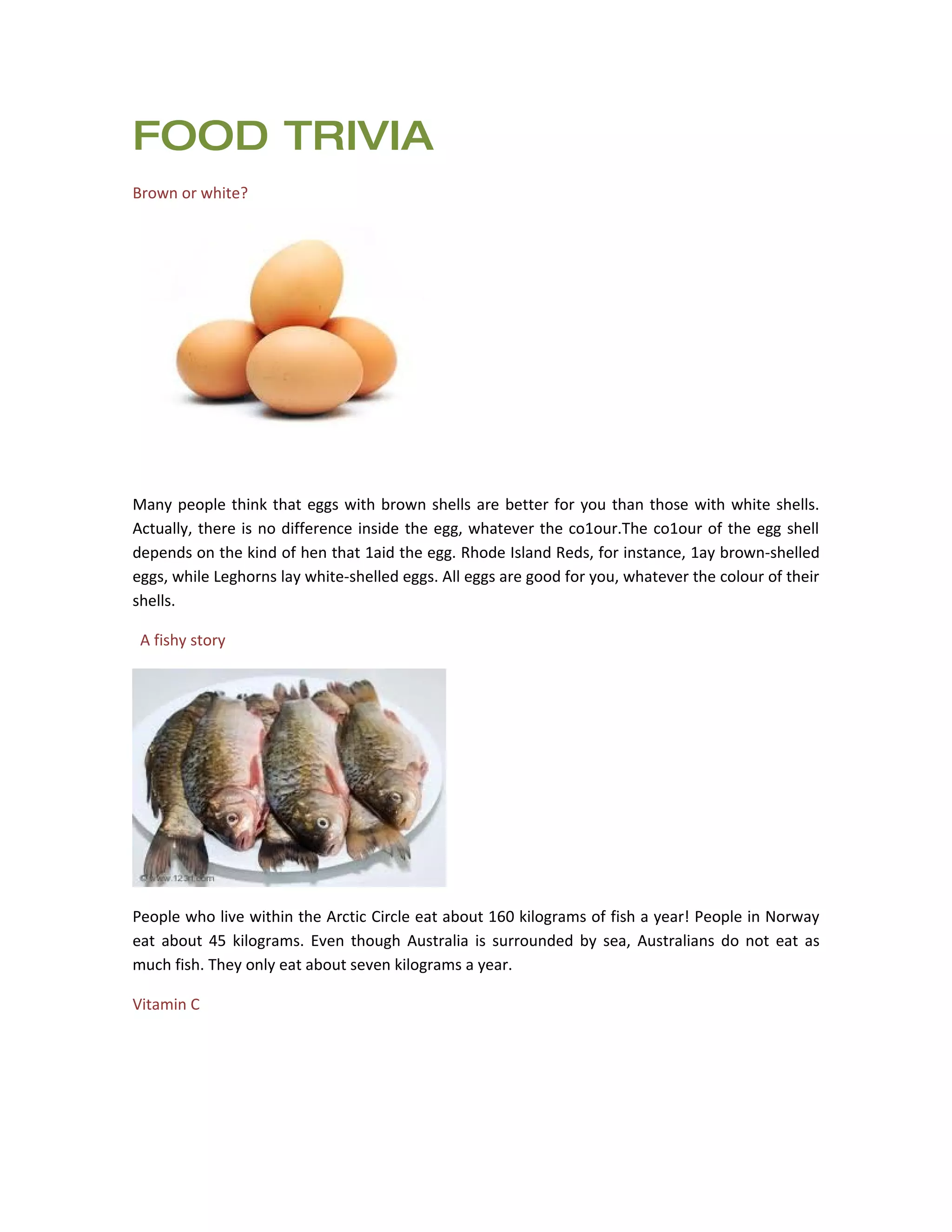
Many people think that eggs with brown shells are better for you than those with white shells.
Actually, there is no difference inside the egg, whatever the co1our.The co1our of the egg shell
depends on the kind of hen that 1aid the egg. Rhode Island Reds, for instance, 1ay brown-shelled
eggs, while Leghorns lay white-shelled eggs. All eggs are good for you, whatever the colour of their
shells.
A fishy story
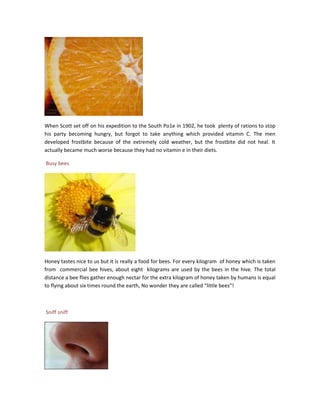
People who live within the Arctic Circle eat about 160 kilograms of fish a year! People in Norway
eat about 45 kilograms. Even though Australia is surrounded by sea, Australians do not eat as
much fish. They only eat about seven kilograms a year.
Vitamin C
When Scott set off on his expedition to the South Po1e in 1902, he took plenty of rations to stop
his party becoming hungry, but forgot to take anything which provided vitamin C. The men
developed frostbite because of the extremely cold weather, but the frostbite did not heal. It
actually became much worse because they had no vitamin e in their diets.
Busy bees
Honey tastes nice to us but it is really a food for bees. For every kilogram of honey which is taken
from commercial bee hives, about eight kilograms are used by the bees in the hive. The total
distance a bee flies gather enough nectar for the extra kilogram of honey taken by humans is equal
to flying about six times round the earth, No wonder they are called “little bees”!
Sniff sniff
We can smell far more substances than we can taste. If you have a cold with a blocked nose, there
are some foods which you cannot taste because you cannot smell them. For example, in a series
of experiments, people were blindfolded and had their noses completely blocked. They were
given coffee, chocolate and garlic, and had no idea what they were eating!
An apple a day ...
Apples (and lots of other fruit an vegetables)go brown once they are cut and exposed to the air.
This because they contain an enzyme which is affected by the oxygen. The air, It turns the flesh of
the apple yellowy brown and then brown, -you brush the cut surface of an apple with lemon juice
(which is acidic), the enzyme will not be able to work well and the apple will not go brown for
several hours.

Food trivia

  • 1.
    FOOD TRIVIA Brown orwhite? Many people think that eggs with brown shells are better for you than those with white shells. Actually, there is no difference inside the egg, whatever the co1our.The co1our of the egg shell depends on the kind of hen that 1aid the egg. Rhode Island Reds, for instance, 1ay brown-shelled eggs, while Leghorns lay white-shelled eggs. All eggs are good for you, whatever the colour of their shells. A fishy story People who live within the Arctic Circle eat about 160 kilograms of fish a year! People in Norway eat about 45 kilograms. Even though Australia is surrounded by sea, Australians do not eat as much fish. They only eat about seven kilograms a year. Vitamin C
  • 2.
    When Scott setoff on his expedition to the South Po1e in 1902, he took plenty of rations to stop his party becoming hungry, but forgot to take anything which provided vitamin C. The men developed frostbite because of the extremely cold weather, but the frostbite did not heal. It actually became much worse because they had no vitamin e in their diets. Busy bees Honey tastes nice to us but it is really a food for bees. For every kilogram of honey which is taken from commercial bee hives, about eight kilograms are used by the bees in the hive. The total distance a bee flies gather enough nectar for the extra kilogram of honey taken by humans is equal to flying about six times round the earth, No wonder they are called “little bees”! Sniff sniff
  • 3.
    We can smellfar more substances than we can taste. If you have a cold with a blocked nose, there are some foods which you cannot taste because you cannot smell them. For example, in a series of experiments, people were blindfolded and had their noses completely blocked. They were given coffee, chocolate and garlic, and had no idea what they were eating! An apple a day ... Apples (and lots of other fruit an vegetables)go brown once they are cut and exposed to the air. This because they contain an enzyme which is affected by the oxygen. The air, It turns the flesh of the apple yellowy brown and then brown, -you brush the cut surface of an apple with lemon juice (which is acidic), the enzyme will not be able to work well and the apple will not go brown for several hours.