FOOD RESEARCH
DEVELOPMENT
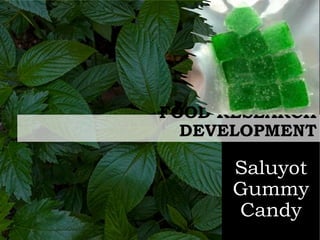
Saluyot
Gummy
Candy
I. Introduction
(Background of the study)
A. Definition of Terms
a. Fortification as defined by Codex
Alimentarius
“the addition of one or more essential
nutrients to food, whether or not it is normally
contained in the food, for the purpose of
preventing or correcting a demonstrated
deficiency of one or more nutrients in the
population or specific population groups”
I. Introduction
(Background of the study)
A. Definition of Terms
b. Food Fortification Law Republic Act 8976,
“An Act Establishing the Philippine Food
Fortification Program and for other purposes”
mandating fortification of flour, oil and sugar with
Vitamin A and flour and rice with iron by November
7, 2004 and promoting voluntary fortification
through the SPSP, Signed into law on November 7,
2000
I.
Introduction
(Background
of the
study)
B. Related Literature
Vegetables are
necessary for good health,
but most people do not
consume enough of them.
Most people dislike bitter
foods. Vegetables, while very
healthy, do have a bitter
component to them.
Children dislike bitter flavors
because their taste buds are
more sensitive than adults',
designed to protect their
more sensitive digestive
systems.
I.
Introduction
(Background
of the
study)
B. Related Literature
It's common to discover
that foods you disliked as
a child aren't so bad as an
adult, and you may even
come to enjoy some of
them. Some people's
dislike of vegetables
continues into adulthood.
It's possible they never
learned to like them, or
they have a particular
sensitivity to the bitter
compounds in vegetables.
I.
Introduction
(Background
of the
study)
B. Related Literature
From a daily average of
145 grams of greens in
1978, Filipinos consumed
only 110 grams of
vegetables a day in 2008,
according to the National
Nutrition Council (NCC).
The two figures are still
significantly lower than
the recommended fruit
and vegetable intake of
the World Health
Organization of 400 grams
a day.
I.
Introduction
(Background
of the
study)
B. Related Literature
According to the WHO,
about 1.7 million deaths
worldwide are linked to
low fruit and vegetable
consumption.
Some of the diseases
which may be caused by
not eating enough
greens are
gastrointestinal cancer,
ischemic heart disease
and stroke.
I.
Introduction
(Background
of the
study)
B. Related Literature
According to the WHO,
about 1.7 million deaths
worldwide are linked to
low fruit and vegetable
consumption.
Some of the diseases
which may be caused by
not eating enough
greens are
gastrointestinal cancer,
ischemic heart disease
and stroke.
I.
Introduction
(Background
of the
study)
B. Related Literature
According to the WHO,
about 1.7 million deaths
worldwide are linked to
low fruit and vegetable
consumption.
Some of the diseases
which may be caused by
not eating enough
greens are
gastrointestinal cancer,
ischemic heart disease
and stroke.
I.
Introduction
(Background
of the
study)
B. Related Literature
According to the
WHO, about 1.7 million
deaths worldwide are
linked to low fruit and
vegetable consumption.
Some of the diseases
which may be caused
by not eating enough
greens are
gastrointestinal cancer,
ischemic heart disease
and stroke.
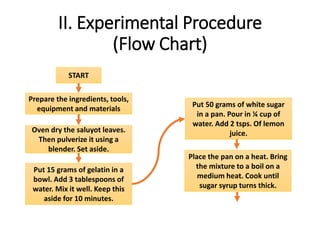
II. Experimental Procedure
(Flow Chart)
START
Prepare the ingredients, tools,
equipment and materials
Oven dry the saluyot leaves.
Then pulverize it using a
blender. Set aside.
Put 15 grams of gelatin in a
bowl. Add 3 tablespoons of
water. Mix it well. Keep this
aside for 10 minutes.
Put 50 grams of white sugar
in a pan. Pour in ¼ cup of
water. Add 2 tsps. Of lemon
juice.
Place the pan on a heat. Bring
the mixture to a boil on a
medium heat. Cook until
sugar syrup turns thick.
II. Experimental Procedure
(Flow Chart)
Test the consistency.
Drop some sugar syrup in
water. Does it form like
strings?
YES
Add ¼ cup of liquid glucose.
Give it a nice stir. Cook for 30
to 40 seconds on low heat.
Add the bloomed gelatin.
Stir it well. Bring to a boil for
a few minutes then remove
from the heat. Let the
mixture cooled slightly.
Pour the mixture in a
container or mold. Refrigerate
for 2 to 3 hours.
After 3 hours, remove from
the container. Dip a knife in
hot water then cut gummy
into cubes. Coat it with sugar.
NO
It’s not yet ready.
Cook for a few more
seconds
III. Ingredients
Saluyot Gummy Candy
Items Weight (grams)
Unflavored Gelatin 15 g
Water 45 g
Refined Sugar 50 g
Water 59 g
Lemon Juice 9.86 g
Liquid Glucose 90 g
IV. Food
Composition
Saluyot leaves as food
that offers benefits fresh
or dried. They are rich in
vitamin E and also
contain vitamin A and C.
All three nutrients are
antioxidants that protect
your cells from disease-
causing molecules
known as free radicals.
The antioxidants in
saluyot may sharpen
vision, fight arthritis and
improve fertility.
IV. Food
Composition
Besides antioxidants, saluyot
leaves provide the minerals
iron, calcium, sodium,
phosphorous and potassium.
Each has a number of roles it
plays to keep you healthy. Iron,
for example, makes it possible
for your body to make
myoglobin and hemoglobin,
two proteins essential to the
circulation of oxygen through
your body. The leaves also have
the B-complex vitamins
thiamine, riboflavin and niacin.
As a group, the B-vitamins
facilitate the extraction of
nutrients from foods during
digestion. The three that
saluyot provides contribute to
energy production.
Saluyot Gummy Candy
Items Unit Cost
Unflavored Gelatin 15 g 25.00
Water 45 g 0
Refined Sugar 50 g 2.50
Water 59 g 0
Lemon Juice 9.86 g 12.50
Liquid Glucose 90 g 10.80
Saluyot powder 3.75 g 8.00
V. Unit Cost/ Yield
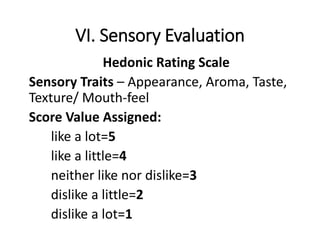
VI. Sensory Evaluation
Hedonic Rating Scale
Sensory Traits – Appearance, Aroma, Taste,
Texture/ Mouth-feel
Score Value Assigned:
like a lot=5
like a little=4
neither like nor dislike=3
dislike a little=2
dislike a lot=1
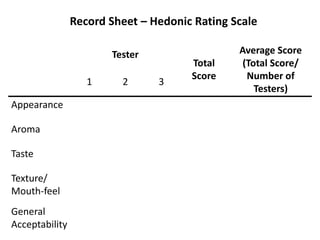
Tester
Total
Score
Average Score
(Total Score/
Number of
Testers)
1 2 3
Appearance
Aroma
Taste
Texture/
Mouth-feel
General
Acceptability
Record Sheet – Hedonic Rating Scale
• I. Introduction ( Background of the Study )
• Definition of Terms
• Related Literature
• II. Experimental Procedure ( Flow Chart )
• III. Ingredients with Measurement (grams)in table
• IV. Food Composition
• V. Costing of Ingredients
• VI. Unit Cost/ Yield
• VII. Sensory Evaluation

FOOD RESEARCH DEVELOPMENT.pptx

  • 1.
  • 2.
    I. Introduction (Background ofthe study) A. Definition of Terms a. Fortification as defined by Codex Alimentarius “the addition of one or more essential nutrients to food, whether or not it is normally contained in the food, for the purpose of preventing or correcting a demonstrated deficiency of one or more nutrients in the population or specific population groups”
  • 3.
    I. Introduction (Background ofthe study) A. Definition of Terms b. Food Fortification Law Republic Act 8976, “An Act Establishing the Philippine Food Fortification Program and for other purposes” mandating fortification of flour, oil and sugar with Vitamin A and flour and rice with iron by November 7, 2004 and promoting voluntary fortification through the SPSP, Signed into law on November 7, 2000
  • 4.
    I. Introduction (Background of the study) B. RelatedLiterature Vegetables are necessary for good health, but most people do not consume enough of them. Most people dislike bitter foods. Vegetables, while very healthy, do have a bitter component to them. Children dislike bitter flavors because their taste buds are more sensitive than adults', designed to protect their more sensitive digestive systems.
  • 5.
    I. Introduction (Background of the study) B. RelatedLiterature It's common to discover that foods you disliked as a child aren't so bad as an adult, and you may even come to enjoy some of them. Some people's dislike of vegetables continues into adulthood. It's possible they never learned to like them, or they have a particular sensitivity to the bitter compounds in vegetables.
  • 6.
    I. Introduction (Background of the study) B. RelatedLiterature From a daily average of 145 grams of greens in 1978, Filipinos consumed only 110 grams of vegetables a day in 2008, according to the National Nutrition Council (NCC). The two figures are still significantly lower than the recommended fruit and vegetable intake of the World Health Organization of 400 grams a day.
  • 7.
    I. Introduction (Background of the study) B. RelatedLiterature According to the WHO, about 1.7 million deaths worldwide are linked to low fruit and vegetable consumption. Some of the diseases which may be caused by not eating enough greens are gastrointestinal cancer, ischemic heart disease and stroke.
  • 8.
    I. Introduction (Background of the study) B. RelatedLiterature According to the WHO, about 1.7 million deaths worldwide are linked to low fruit and vegetable consumption. Some of the diseases which may be caused by not eating enough greens are gastrointestinal cancer, ischemic heart disease and stroke.
  • 9.
    I. Introduction (Background of the study) B. RelatedLiterature According to the WHO, about 1.7 million deaths worldwide are linked to low fruit and vegetable consumption. Some of the diseases which may be caused by not eating enough greens are gastrointestinal cancer, ischemic heart disease and stroke.
  • 10.
    I. Introduction (Background of the study) B. RelatedLiterature According to the WHO, about 1.7 million deaths worldwide are linked to low fruit and vegetable consumption. Some of the diseases which may be caused by not eating enough greens are gastrointestinal cancer, ischemic heart disease and stroke.
  • 11.
    II. Experimental Procedure (FlowChart) START Prepare the ingredients, tools, equipment and materials Oven dry the saluyot leaves. Then pulverize it using a blender. Set aside. Put 15 grams of gelatin in a bowl. Add 3 tablespoons of water. Mix it well. Keep this aside for 10 minutes. Put 50 grams of white sugar in a pan. Pour in ¼ cup of water. Add 2 tsps. Of lemon juice. Place the pan on a heat. Bring the mixture to a boil on a medium heat. Cook until sugar syrup turns thick.
  • 12.
    II. Experimental Procedure (FlowChart) Test the consistency. Drop some sugar syrup in water. Does it form like strings? YES Add ¼ cup of liquid glucose. Give it a nice stir. Cook for 30 to 40 seconds on low heat. Add the bloomed gelatin. Stir it well. Bring to a boil for a few minutes then remove from the heat. Let the mixture cooled slightly. Pour the mixture in a container or mold. Refrigerate for 2 to 3 hours. After 3 hours, remove from the container. Dip a knife in hot water then cut gummy into cubes. Coat it with sugar. NO It’s not yet ready. Cook for a few more seconds
  • 13.
    III. Ingredients Saluyot GummyCandy Items Weight (grams) Unflavored Gelatin 15 g Water 45 g Refined Sugar 50 g Water 59 g Lemon Juice 9.86 g Liquid Glucose 90 g
  • 14.
    IV. Food Composition Saluyot leavesas food that offers benefits fresh or dried. They are rich in vitamin E and also contain vitamin A and C. All three nutrients are antioxidants that protect your cells from disease- causing molecules known as free radicals. The antioxidants in saluyot may sharpen vision, fight arthritis and improve fertility.
  • 15.
    IV. Food Composition Besides antioxidants,saluyot leaves provide the minerals iron, calcium, sodium, phosphorous and potassium. Each has a number of roles it plays to keep you healthy. Iron, for example, makes it possible for your body to make myoglobin and hemoglobin, two proteins essential to the circulation of oxygen through your body. The leaves also have the B-complex vitamins thiamine, riboflavin and niacin. As a group, the B-vitamins facilitate the extraction of nutrients from foods during digestion. The three that saluyot provides contribute to energy production.
  • 16.
    Saluyot Gummy Candy ItemsUnit Cost Unflavored Gelatin 15 g 25.00 Water 45 g 0 Refined Sugar 50 g 2.50 Water 59 g 0 Lemon Juice 9.86 g 12.50 Liquid Glucose 90 g 10.80 Saluyot powder 3.75 g 8.00 V. Unit Cost/ Yield
  • 17.
    VI. Sensory Evaluation HedonicRating Scale Sensory Traits – Appearance, Aroma, Taste, Texture/ Mouth-feel Score Value Assigned: like a lot=5 like a little=4 neither like nor dislike=3 dislike a little=2 dislike a lot=1
  • 18.
    Tester Total Score Average Score (Total Score/ Numberof Testers) 1 2 3 Appearance Aroma Taste Texture/ Mouth-feel General Acceptability Record Sheet – Hedonic Rating Scale
  • 19.
    • I. Introduction( Background of the Study ) • Definition of Terms • Related Literature • II. Experimental Procedure ( Flow Chart ) • III. Ingredients with Measurement (grams)in table • IV. Food Composition • V. Costing of Ingredients • VI. Unit Cost/ Yield • VII. Sensory Evaluation