Kwame Nkrumah University of
Science & Technology, Kumasi, Ghana
Formation Evaluation
Fluids in Pore Space
Source of image: www.careerfirst.lk
Petroleum Engineering Department PE 363
KNUST
Kwame Nkrumah University of
Science & Technology, Kumasi, Ghana
Fluids in Pore Space
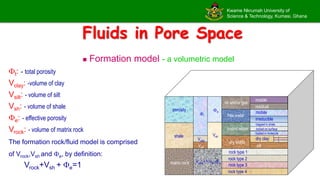
t: - total porosity
Vclay: -volume of clay
Vsilt: - volume of silt
Vsh: - volume of shale
e: - effective porosity
Vrock: - volume of matrix rock
The formation rock/fluid model is comprised
of Vrock,Vsh and e, by definition:
Vrock+Vsh + e=1
 Formation model - a volumetric model
mobile
residual
mobile
irreducible
oil and/or gas
free water
bound water
dry solids
dry clay
silt
1
2
3
trapped in shale
locked on surface
locked in molecule
rock type 1
rock type 2
rock type 3
rock type 4
e
t
Vsh
Vclay
Vsilt
Vrock=1-Vsh-e
shale
porosity
matrix rock
Kwame Nkrumah University of
Science & Technology, Kumasi, Ghana
Fluids in Pore Space
 Formation model - a volumetric model
mobile
residual
mobile
irreducible
oil and/or gas
free water
bound water
dry solids
dry clay
silt
1
2
3
trapped in shale
locked on surface
locked in molecule
rock type 1
rock type 2
rock type 3
rock type 4
e
t
Vsh
Vclay
Vsilt
Vrock=1-Vsh-e
shale
porosity
matrix rock
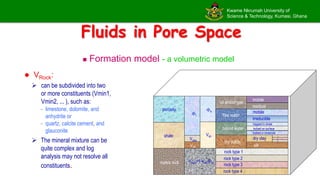
 VRock:
 can be subdivided into two
or more constituents (Vmin1,
Vmin2, ... ), such as:
- limestone, dolomite, and
anhydrite or
- quartz, calcite cement, and
glauconite
 The mineral mixture can be
quite complex and log
analysis may not resolve all
constituents.
Kwame Nkrumah University of
Science & Technology, Kumasi, Ghana
Fluids in Pore Space
 Formation model - a volumetric model
mobile
residual
mobile
irreducible
oil and/or gas
free water
bound water
dry solids
dry clay
silt
1
2
3
trapped in shale
locked on surface
locked in molecule
rock type 1
rock type 2
rock type 3
rock type 4
e
t
Vsh
Vclay
Vsilt
Vrock=1-Vsh-e
shale
porosity
matrix rock
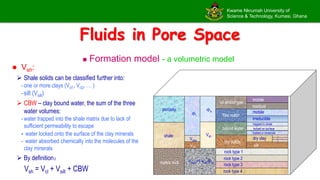
 Vsh:
 Shale solids can be classified further into:
- one or more clays (Vcl1, Vcl2, … )
-silt (Vsilt)
 CBW – clay bound water, the sum of the three
water volumes:
- water trapped into the shale matrix due to lack of
sufficient permeability to escape
- water locked onto the surface of the clay minerals
- water absorbed chemically into the molecules of the
clay minerals
 By definition:
Vsh = Vcl + Vsilt + CBW
Kwame Nkrumah University of
Science & Technology, Kumasi, Ghana
Fluids in Pore Space
 Formation model - a volumetric model
mobile
residual
mobile
irreducible
oil and/or gas
free water
bound water
dry solids
dry clay
silt
1
2
3
trapped in shale
locked on surface
locked in molecule
rock type 1
rock type 2
rock type 3
rock type 4
e
t
Vsh
Vclay
Vsilt
Vrock=1-Vsh-e
shale
porosity
matrix rock
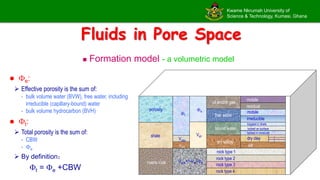
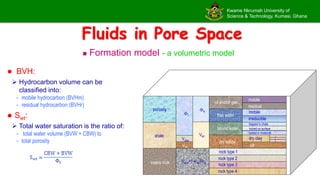
 e:
 Effective porosity is the sum of:
- bulk volume water (BVW), free water, including
irreducible (capillary-bound) water
- bulk volume hydrocarbon (BVH)
 t:
 Total porosity is the sum of:
- CBW
- e
 By definition:
t = e +CBW
Kwame Nkrumah University of
Science & Technology, Kumasi, Ghana
Fluids in Pore Space
 Formation model - a volumetric model
mobile
residual
mobile
irreducible
oil and/or gas
free water
bound water
dry solids
dry clay
silt
1
2
3
trapped in shale
locked on surface
locked in molecule
rock type 1
rock type 2
rock type 3
rock type 4
e
t
Vsh
Vclay
Vsilt
Vrock=1-Vsh-e
shale
porosity
matrix rock
 BVH:
 Hydrocarbon volume can be
classified into:
- mobile hydrocarbon (BVHm)
- residual hydrocarbon (BVHr)
 Swt:
 Total water saturation is the ratio of:
- total water volume (BVW + CBW) to
- total porosity
Kwame Nkrumah University of
Science & Technology, Kumasi, Ghana
Fluids in Pore Space
 Formation model - a volumetric model
mobile
residual
mobile
irreducible
oil and/or gas
free water
bound water
dry solids
dry clay
silt
1
2
3
trapped in shale
locked on surface
locked in molecule
rock type 1
rock type 2
rock type 3
rock type 4
e
t
Vsh
Vclay
Vsilt
Vrock=1-Vsh-e
shale
porosity
matrix rock
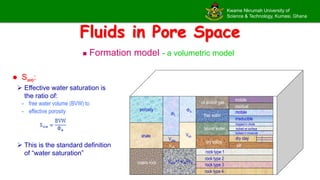
 Swe:
 Effective water saturation is
the ratio of:
- free water volume (BVW) to
- effective porosity
 This is the standard definition
of “water saturation”
Kwame Nkrumah University of
Science & Technology, Kumasi, Ghana
Fluids in Pore Space
 Formation model - a volumetric model
mobile
residual
mobile
irreducible
oil and/or gas
free water
bound water
dry solids
dry clay
silt
1
2
3
trapped in shale
locked on surface
locked in molecule
rock type 1
rock type 2
rock type 3
rock type 4
e
t
Vsh
Vclay
Vsilt
Vrock=1-Vsh-e
shale
porosity
matrix rock
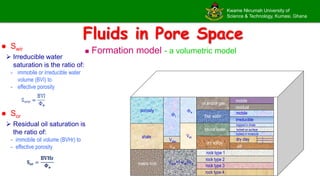
 Swir
 Irreducible water
saturation is the ratio of:
- immobile or irreducible water
volume (BVI) to
- effective porosity
 Sor
 Residual oil saturation is
the ratio of:
- immobile oil volume (BVHr) to
- effective porosity
Kwame Nkrumah University of
Science & Technology, Kumasi, Ghana
Fluids in Pore Space
 Formation model - a volumetric model
mobile
residual
mobile
irreducible
oil and/or gas
free water
bound water
dry solids
dry clay
silt
1
2
3
trapped in shale
locked on surface
locked in molecule
rock type 1
rock type 2
rock type 3
rock type 4
e
t
Vsh
Vclay
Vsilt
Vrock=1-Vsh-e
shale
porosity
matrix rock
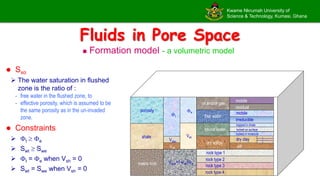
 Sxo
 The water saturation in flushed
zone is the ratio of :
- free water in the flushed zone, to
- effective porosity, which is assumed to be
the same porosity as in the un-invaded
zone.
 Constraints
 t  e
 Swt  Swe
 t = e when Vsh = 0
 Swt = Swe when Vsh = 0
Kwame Nkrumah University of
Science & Technology, Kumasi, Ghana
Fluids in Pore Space
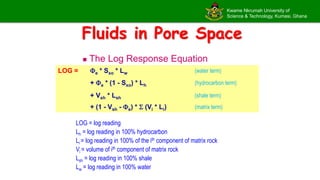
 The Log Response Equation
LOG = e * Sxo * Lw (water term)
+ e * (1 - Sxo) * Lh (hydrocarbon term)
+ Vsh * Lsh (shale term)
+ (1 - Vsh - e) *  (Vi * Li) (matrix term)
LOG = log reading
Lh = log reading in 100% hydrocarbon
Li = log reading in 100% of the ith component of matrix rock
Vi = volume of ith component of matrix rock
Lsh = log reading in 100% shale
Lw = log reading in 100% water
Kwame Nkrumah University of
Science & Technology, Kumasi, Ghana
Fluids in Pore Space
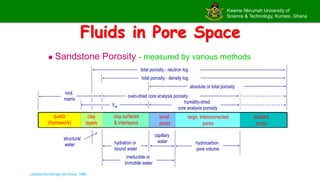
 Sandstone Porosity - measured by various methods
quartz
(framework)
small
pores
isolated
pores
large, Interconnected
pores
clay surfaces
& interlayers
clay
layers
irreducible or
immobile water
hydration or
bound water
hydrocarbon
pore volume
structural
water
rock
matrix
total porosity - neutron log
total porosity - density log
absolute or total porosity
oven-dried core analysis porosity
humidity-dried
core analysis porosity
capillary
water
Vsh
(modified from Eslinger and Pevear, 1988)
Kwame Nkrumah University of
Science & Technology, Kumasi, Ghana
Fluids in Pore Space
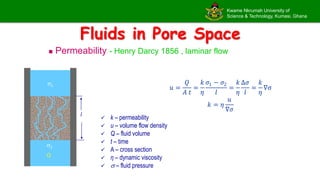
 Permeability - Henry Darcy 1856 , laminar flow
1
l
Q
2
𝑢 =
𝑄
𝐴 𝑡
=
𝑘
𝜂
𝜎1 − 𝜎2
𝑙
=
𝑘
𝜂
Δ𝜎
𝑙
=
𝑘
𝜂
∇σ
𝑘 = 𝜂
𝑢
∇𝜎
 k – permeability
 u – volume flow density
 Q – fluid volume
 t – time
 A – cross section
 η – dynamic viscosity
  – fluid pressure
Kwame Nkrumah University of
Science & Technology, Kumasi, Ghana
Fluids in Pore Space
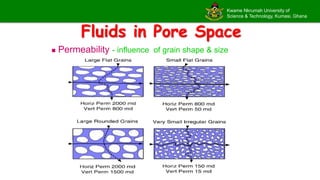
 Permeability - influence of grain shape & size
Kwame Nkrumah University of
Science & Technology, Kumasi, Ghana
Fluids in Pore Space
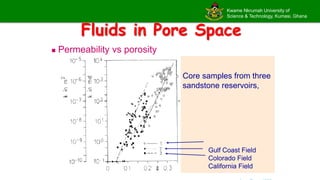
 Permeability vs porosity
Core samples from three
sandstone reservoirs,
Gulf Coast Field
Colorado Field
California Field
Kwame Nkrumah University of
Science & Technology, Kumasi, Ghana
Fluids in Pore Space
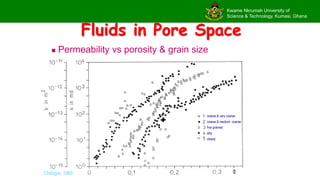
 Permeability vs porosity & grain size
Chilingar, 1969
coarse & very coarse
coarse & medium coarse
fine grained
silty
clayey
Kwame Nkrumah University of
Science & Technology, Kumasi, Ghana
Fluids in Pore Space
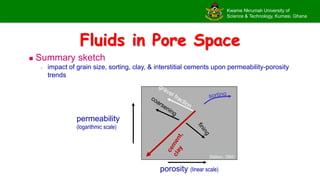
 Summary sketch
- impact of grain size, sorting, clay, & interstitial cements upon permeability-porosity
trends
porosity (linear scale)
permeability
(logarithmic scale)
(Nelson, 1994)
Kwame Nkrumah University of
Science & Technology, Kumasi, Ghana
Fluids in Pore Space
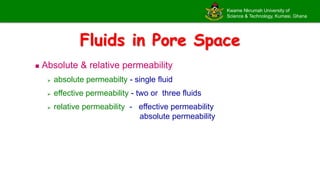
 Absolute & relative permeability
 absolute permeabilty - single fluid
 effective permeability - two or three fluids
 relative permeability - effective permeability
absolute permeability
Kwame Nkrumah University of
Science & Technology, Kumasi, Ghana
Fluids in Pore Space
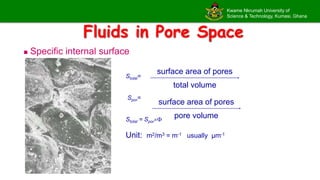
 Specific internal surface
Stotal=
Spor=
Stotal = Spor
Unit: m2/m3 = m-1 usually µm-1
surface area of pores
total volume
surface area of pores
pore volume
Kwame Nkrumah University of
Science & Technology, Kumasi, Ghana
Fluids in Pore Space
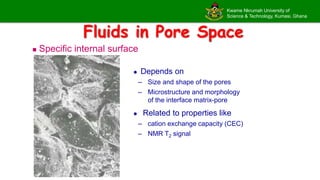
 Specific internal surface
 Depends on
– Size and shape of the pores
– Microstructure and morphology
of the interface matrix-pore
 Related to properties like
– cation exchange capacity (CEC)
– NMR T2 signal
Kwame Nkrumah University of
Science & Technology, Kumasi, Ghana
Fluids in Pore Space
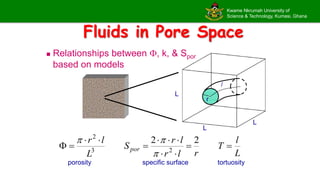
 Relationships between , k, & Spor
based on models
r
l
L
L
L
L
l
T
r
l
r
l
r
S
L
l
r
por 











2
2
2
3
2



porosity specific surface tortuosity
Kwame Nkrumah University of
Science & Technology, Kumasi, Ghana
Fluids in Pore Space
 Summary
 Porosity, permeability, & specific internal surface are most
important pore space parameters. They show a correlation,
but express different physical properties:
– porosity characterizes pore space volume (scalar property)
– specific internal surface characterizes surface of pore space (scalar
property)
– permeability expresses fluid flow ability (tensor)
– porosity correlates to density (and nuclear, acoustic, or electrical
properties).
– permeability correlates to porosity (pore diameter or grain size
dependent)
– specific internal surface links porosity & permeability - (“surface -
sensitive” properties like Sw,irr or NMR allow permeability derivation)
Kwame Nkrumah University of
Science & Technology, Kumasi, Ghana
THANKS FOR
ATTENTION!!!

Fluids in Pore space Julius.pptx

  • 1.
    Kwame Nkrumah Universityof Science & Technology, Kumasi, Ghana Formation Evaluation Fluids in Pore Space Source of image: www.careerfirst.lk Petroleum Engineering Department PE 363 KNUST
  • 2.
    Kwame Nkrumah Universityof Science & Technology, Kumasi, Ghana Fluids in Pore Space t: - total porosity Vclay: -volume of clay Vsilt: - volume of silt Vsh: - volume of shale e: - effective porosity Vrock: - volume of matrix rock The formation rock/fluid model is comprised of Vrock,Vsh and e, by definition: Vrock+Vsh + e=1  Formation model - a volumetric model mobile residual mobile irreducible oil and/or gas free water bound water dry solids dry clay silt 1 2 3 trapped in shale locked on surface locked in molecule rock type 1 rock type 2 rock type 3 rock type 4 e t Vsh Vclay Vsilt Vrock=1-Vsh-e shale porosity matrix rock
  • 3.
    Kwame Nkrumah Universityof Science & Technology, Kumasi, Ghana Fluids in Pore Space  Formation model - a volumetric model mobile residual mobile irreducible oil and/or gas free water bound water dry solids dry clay silt 1 2 3 trapped in shale locked on surface locked in molecule rock type 1 rock type 2 rock type 3 rock type 4 e t Vsh Vclay Vsilt Vrock=1-Vsh-e shale porosity matrix rock  VRock:  can be subdivided into two or more constituents (Vmin1, Vmin2, ... ), such as: - limestone, dolomite, and anhydrite or - quartz, calcite cement, and glauconite  The mineral mixture can be quite complex and log analysis may not resolve all constituents.
  • 4.
    Kwame Nkrumah Universityof Science & Technology, Kumasi, Ghana Fluids in Pore Space  Formation model - a volumetric model mobile residual mobile irreducible oil and/or gas free water bound water dry solids dry clay silt 1 2 3 trapped in shale locked on surface locked in molecule rock type 1 rock type 2 rock type 3 rock type 4 e t Vsh Vclay Vsilt Vrock=1-Vsh-e shale porosity matrix rock  Vsh:  Shale solids can be classified further into: - one or more clays (Vcl1, Vcl2, … ) -silt (Vsilt)  CBW – clay bound water, the sum of the three water volumes: - water trapped into the shale matrix due to lack of sufficient permeability to escape - water locked onto the surface of the clay minerals - water absorbed chemically into the molecules of the clay minerals  By definition: Vsh = Vcl + Vsilt + CBW
  • 5.
    Kwame Nkrumah Universityof Science & Technology, Kumasi, Ghana Fluids in Pore Space  Formation model - a volumetric model mobile residual mobile irreducible oil and/or gas free water bound water dry solids dry clay silt 1 2 3 trapped in shale locked on surface locked in molecule rock type 1 rock type 2 rock type 3 rock type 4 e t Vsh Vclay Vsilt Vrock=1-Vsh-e shale porosity matrix rock  e:  Effective porosity is the sum of: - bulk volume water (BVW), free water, including irreducible (capillary-bound) water - bulk volume hydrocarbon (BVH)  t:  Total porosity is the sum of: - CBW - e  By definition: t = e +CBW
  • 6.
    Kwame Nkrumah Universityof Science & Technology, Kumasi, Ghana Fluids in Pore Space  Formation model - a volumetric model mobile residual mobile irreducible oil and/or gas free water bound water dry solids dry clay silt 1 2 3 trapped in shale locked on surface locked in molecule rock type 1 rock type 2 rock type 3 rock type 4 e t Vsh Vclay Vsilt Vrock=1-Vsh-e shale porosity matrix rock  BVH:  Hydrocarbon volume can be classified into: - mobile hydrocarbon (BVHm) - residual hydrocarbon (BVHr)  Swt:  Total water saturation is the ratio of: - total water volume (BVW + CBW) to - total porosity
  • 7.
    Kwame Nkrumah Universityof Science & Technology, Kumasi, Ghana Fluids in Pore Space  Formation model - a volumetric model mobile residual mobile irreducible oil and/or gas free water bound water dry solids dry clay silt 1 2 3 trapped in shale locked on surface locked in molecule rock type 1 rock type 2 rock type 3 rock type 4 e t Vsh Vclay Vsilt Vrock=1-Vsh-e shale porosity matrix rock  Swe:  Effective water saturation is the ratio of: - free water volume (BVW) to - effective porosity  This is the standard definition of “water saturation”
  • 8.
    Kwame Nkrumah Universityof Science & Technology, Kumasi, Ghana Fluids in Pore Space  Formation model - a volumetric model mobile residual mobile irreducible oil and/or gas free water bound water dry solids dry clay silt 1 2 3 trapped in shale locked on surface locked in molecule rock type 1 rock type 2 rock type 3 rock type 4 e t Vsh Vclay Vsilt Vrock=1-Vsh-e shale porosity matrix rock  Swir  Irreducible water saturation is the ratio of: - immobile or irreducible water volume (BVI) to - effective porosity  Sor  Residual oil saturation is the ratio of: - immobile oil volume (BVHr) to - effective porosity
  • 9.
    Kwame Nkrumah Universityof Science & Technology, Kumasi, Ghana Fluids in Pore Space  Formation model - a volumetric model mobile residual mobile irreducible oil and/or gas free water bound water dry solids dry clay silt 1 2 3 trapped in shale locked on surface locked in molecule rock type 1 rock type 2 rock type 3 rock type 4 e t Vsh Vclay Vsilt Vrock=1-Vsh-e shale porosity matrix rock  Sxo  The water saturation in flushed zone is the ratio of : - free water in the flushed zone, to - effective porosity, which is assumed to be the same porosity as in the un-invaded zone.  Constraints  t  e  Swt  Swe  t = e when Vsh = 0  Swt = Swe when Vsh = 0
  • 10.
    Kwame Nkrumah Universityof Science & Technology, Kumasi, Ghana Fluids in Pore Space  The Log Response Equation LOG = e * Sxo * Lw (water term) + e * (1 - Sxo) * Lh (hydrocarbon term) + Vsh * Lsh (shale term) + (1 - Vsh - e) *  (Vi * Li) (matrix term) LOG = log reading Lh = log reading in 100% hydrocarbon Li = log reading in 100% of the ith component of matrix rock Vi = volume of ith component of matrix rock Lsh = log reading in 100% shale Lw = log reading in 100% water
  • 11.
    Kwame Nkrumah Universityof Science & Technology, Kumasi, Ghana Fluids in Pore Space  Sandstone Porosity - measured by various methods quartz (framework) small pores isolated pores large, Interconnected pores clay surfaces & interlayers clay layers irreducible or immobile water hydration or bound water hydrocarbon pore volume structural water rock matrix total porosity - neutron log total porosity - density log absolute or total porosity oven-dried core analysis porosity humidity-dried core analysis porosity capillary water Vsh (modified from Eslinger and Pevear, 1988)
  • 12.
    Kwame Nkrumah Universityof Science & Technology, Kumasi, Ghana Fluids in Pore Space  Permeability - Henry Darcy 1856 , laminar flow 1 l Q 2 𝑢 = 𝑄 𝐴 𝑡 = 𝑘 𝜂 𝜎1 − 𝜎2 𝑙 = 𝑘 𝜂 Δ𝜎 𝑙 = 𝑘 𝜂 ∇σ 𝑘 = 𝜂 𝑢 ∇𝜎  k – permeability  u – volume flow density  Q – fluid volume  t – time  A – cross section  η – dynamic viscosity   – fluid pressure
  • 13.
    Kwame Nkrumah Universityof Science & Technology, Kumasi, Ghana Fluids in Pore Space  Permeability - influence of grain shape & size
  • 14.
    Kwame Nkrumah Universityof Science & Technology, Kumasi, Ghana Fluids in Pore Space  Permeability vs porosity Core samples from three sandstone reservoirs, Gulf Coast Field Colorado Field California Field
  • 15.
    Kwame Nkrumah Universityof Science & Technology, Kumasi, Ghana Fluids in Pore Space  Permeability vs porosity & grain size Chilingar, 1969 coarse & very coarse coarse & medium coarse fine grained silty clayey
  • 16.
    Kwame Nkrumah Universityof Science & Technology, Kumasi, Ghana Fluids in Pore Space  Summary sketch - impact of grain size, sorting, clay, & interstitial cements upon permeability-porosity trends porosity (linear scale) permeability (logarithmic scale) (Nelson, 1994)
  • 17.
    Kwame Nkrumah Universityof Science & Technology, Kumasi, Ghana Fluids in Pore Space  Absolute & relative permeability  absolute permeabilty - single fluid  effective permeability - two or three fluids  relative permeability - effective permeability absolute permeability
  • 18.
    Kwame Nkrumah Universityof Science & Technology, Kumasi, Ghana Fluids in Pore Space  Specific internal surface Stotal= Spor= Stotal = Spor Unit: m2/m3 = m-1 usually µm-1 surface area of pores total volume surface area of pores pore volume
  • 19.
    Kwame Nkrumah Universityof Science & Technology, Kumasi, Ghana Fluids in Pore Space  Specific internal surface  Depends on – Size and shape of the pores – Microstructure and morphology of the interface matrix-pore  Related to properties like – cation exchange capacity (CEC) – NMR T2 signal
  • 20.
    Kwame Nkrumah Universityof Science & Technology, Kumasi, Ghana Fluids in Pore Space  Relationships between , k, & Spor based on models r l L L L L l T r l r l r S L l r por             2 2 2 3 2    porosity specific surface tortuosity
  • 21.
    Kwame Nkrumah Universityof Science & Technology, Kumasi, Ghana Fluids in Pore Space  Summary  Porosity, permeability, & specific internal surface are most important pore space parameters. They show a correlation, but express different physical properties: – porosity characterizes pore space volume (scalar property) – specific internal surface characterizes surface of pore space (scalar property) – permeability expresses fluid flow ability (tensor) – porosity correlates to density (and nuclear, acoustic, or electrical properties). – permeability correlates to porosity (pore diameter or grain size dependent) – specific internal surface links porosity & permeability - (“surface - sensitive” properties like Sw,irr or NMR allow permeability derivation)
  • 22.
    Kwame Nkrumah Universityof Science & Technology, Kumasi, Ghana THANKS FOR ATTENTION!!!