Flipping the script: how to
take the first step towards
internal developer platforms
Abby Bangser (she/her)
@a_bangser.bsky.social
@a_bangser
Behind every great
piece of software,
there is a great API
@a_bangser
If APIs are so key,
why is everyone in
platform engineering talking
about developer portals
@a_bangser
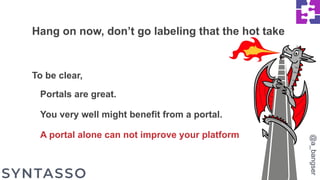
Hang on now, don’t go labeling that the hot take
To be clear,
Portals are great.
You very well might benefit from a portal.
A portal alone can not improve your platform
@a_bangser
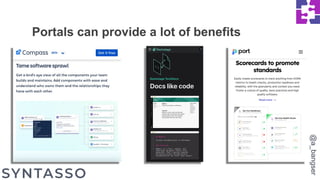
Portals can provide a lot of benefits
@a_bangser
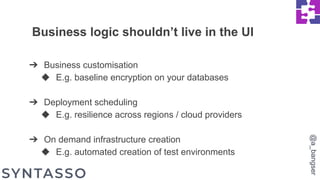
Business logic shouldn’t live in the UI
➔ Business customisation
◆ E.g. baseline encryption on your databases
➔ Deployment scheduling
◆ E.g. resilience across regions / cloud providers
➔ On demand infrastructure creation
◆ E.g. automated creation of test environments
@a_bangser
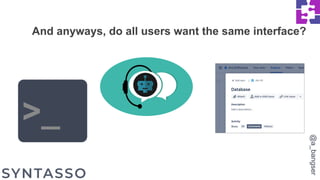
And anyways, do all users want the same interface?
>_
@a_bangser
Portals are just another UI.
Focus on delivering a high
quality platform API to
support your UIs
@a_bangser
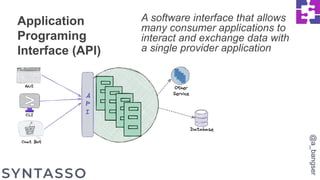
Application
Programing
Interface (API)
A software interface that allows
many consumer applications to
interact and exchange data with
a single provider application
@a_bangser
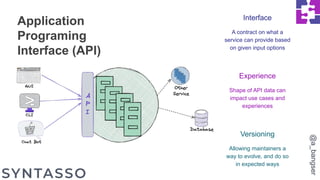
Application
Programing
Interface (API)
Interface
A contract on what a
service can provide based
on given input options
Versioning
Allowing maintainers a
way to evolve, and do so
in expected ways
Experience
Shape of API data can
impact use cases and
experiences
@a_bangser
But Abby.
This is boring.
I already provide all those
things using _________ code.
(Terraform Modules / Ansible playbooks / Helm charts / AWS CloudFormation templates)
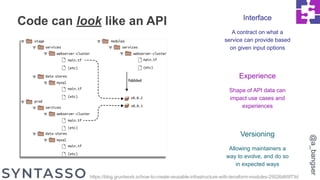
Code can look like an API Interface
A contract on what a
service can provide based
on given input options
Versioning
Allowing maintainers a
way to evolve, and do so
in expected ways
Experience
Shape of API data can
impact use cases and
experiences
https://blog.gruntwork.io/how-to-create-reusable-infrastructure-with-terraform-modules-25526d65f73d
@a_bangser
Code is NOT an API
The difference is in the
“Shared Responsibility Model”
@a_bangser
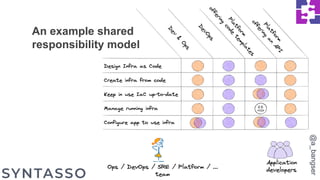
An example shared
responsibility model
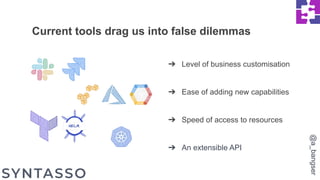
➔ Level of business customisation
➔ Ease of adding new capabilities
➔ Speed of access to resources
➔ An extensible API
Current tools drag us into false dilemmas
@a_bangser
Shift your focus.
From tech to product.
Platforms provide an experience.
@a_bangser
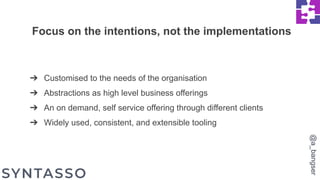
➔ Customised to the needs of the organisation
➔ Abstractions as high level business offerings
➔ An on demand, self service offering through different clients
➔ Widely used, consistent, and extensible tooling
Focus on the intentions, not the implementations
@a_bangser
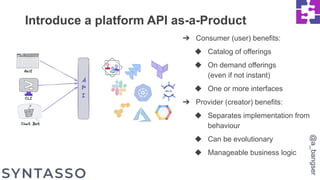
Introduce a platform API as-a-Product
➔ Consumer (user) benefits:
◆ Catalog of offerings
◆ On demand offerings
(even if not instant)
◆ One or more interfaces
➔ Provider (creator) benefits:
◆ Separates implementation from
behaviour
◆ Can be evolutionary
◆ Manageable business logic
@a_bangser
Shift your focus.
From tech to product.
Platforms provide an experience.
@a_bangser
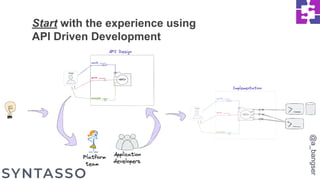
Start with the experience using
API Driven Development
@a_bangser
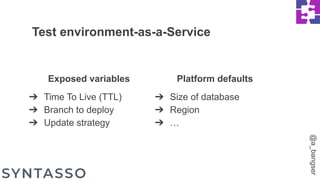
Exposed variables
➔ Time To Live (TTL)
➔ Branch to deploy
➔ Update strategy
Test environment-as-a-Service
Platform defaults
➔ Size of database
➔ Region
➔ …
@a_bangser
API driven development
doesn’t mean you have
to start with code 👀
@a_bangser
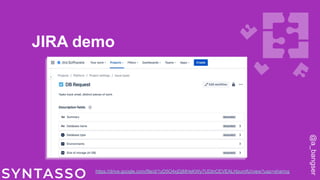
JIRA demo
@a_bangser
https://drive.google.com/file/d/1yD5O4xjDjMHeKWy7UDtnCEVEALHpumfU/view?usp=sharing
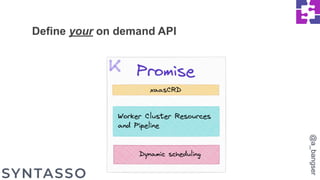
Define your on demand API
@a_bangser
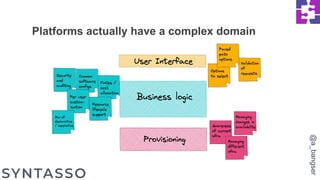
Platforms actually have a complex domain
@a_bangser
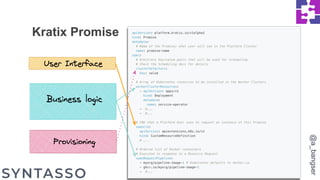
Kratix Promise
@a_bangser
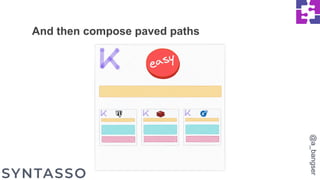
And then compose paved paths
@a_bangser
Kratix provides the ability
to create a simple API
With the building blocks
to handle complexities as
you grow
@a_bangser
➔ Platforms should be treated like any other software
➔ Communication starts manual but can become automated
➔ APIs enable extensibility and evolution
➔ Toil can make it seem impossible to make improvements
Key takeaways
@a_bangser
While an evolution
may be more practical,
by using the right (OSS) tools
you can achieve a revolution
@a_bangser
Thank you
Abby Bangser
abby@syntasso.io • @a_bangser • @a_bangser.bsky.social
@a_bangser
● https://kratix.io
● https://www.syntasso.io/post/the-12-platform-challenges-recap
● https://tomgeraghty.co.uk/index.php/platform-as-a-product
● https://martinfowler.com/articles/talk-about-platforms.html
● https://teamtopologies.com/videos-slides/what-is-platform-as-a-product-clues-from-team-topologies
● https://sre.google/sre-book/eliminating-toil/
● https://www.slideshare.net/ddegrandis/time-theft-how-hidden-unplanned-work-commit-the-perfect-crime
-78706707
● https://swagger.io/resources/articles/adopting-an-api-first-approach/
● https://thenewstack.io/platform-engineers-developers-are-your-customers/
Additional reading
@a_bangser

Flipping the script: How to take the first step towards internal developer platforms

  • 1.
    Flipping the script:how to take the first step towards internal developer platforms Abby Bangser (she/her) @a_bangser.bsky.social @a_bangser
  • 2.
    Behind every great pieceof software, there is a great API @a_bangser
  • 3.
    If APIs areso key, why is everyone in platform engineering talking about developer portals @a_bangser
  • 4.
    Hang on now,don’t go labeling that the hot take To be clear, Portals are great. You very well might benefit from a portal. A portal alone can not improve your platform @a_bangser
  • 5.
    Portals can providea lot of benefits @a_bangser
  • 6.
    Business logic shouldn’tlive in the UI ➔ Business customisation ◆ E.g. baseline encryption on your databases ➔ Deployment scheduling ◆ E.g. resilience across regions / cloud providers ➔ On demand infrastructure creation ◆ E.g. automated creation of test environments @a_bangser
  • 7.
    And anyways, doall users want the same interface? >_ @a_bangser
  • 8.
    Portals are justanother UI. Focus on delivering a high quality platform API to support your UIs @a_bangser
  • 9.
    Application Programing Interface (API) A softwareinterface that allows many consumer applications to interact and exchange data with a single provider application @a_bangser
  • 10.
    Application Programing Interface (API) Interface A contracton what a service can provide based on given input options Versioning Allowing maintainers a way to evolve, and do so in expected ways Experience Shape of API data can impact use cases and experiences @a_bangser
  • 11.
    But Abby. This isboring. I already provide all those things using _________ code. (Terraform Modules / Ansible playbooks / Helm charts / AWS CloudFormation templates)
  • 12.
    Code can looklike an API Interface A contract on what a service can provide based on given input options Versioning Allowing maintainers a way to evolve, and do so in expected ways Experience Shape of API data can impact use cases and experiences https://blog.gruntwork.io/how-to-create-reusable-infrastructure-with-terraform-modules-25526d65f73d @a_bangser
  • 13.
    Code is NOTan API The difference is in the “Shared Responsibility Model”
  • 14.
  • 15.
    ➔ Level ofbusiness customisation ➔ Ease of adding new capabilities ➔ Speed of access to resources ➔ An extensible API Current tools drag us into false dilemmas @a_bangser
  • 16.
    Shift your focus. Fromtech to product. Platforms provide an experience. @a_bangser
  • 17.
    ➔ Customised tothe needs of the organisation ➔ Abstractions as high level business offerings ➔ An on demand, self service offering through different clients ➔ Widely used, consistent, and extensible tooling Focus on the intentions, not the implementations @a_bangser
  • 18.
    Introduce a platformAPI as-a-Product ➔ Consumer (user) benefits: ◆ Catalog of offerings ◆ On demand offerings (even if not instant) ◆ One or more interfaces ➔ Provider (creator) benefits: ◆ Separates implementation from behaviour ◆ Can be evolutionary ◆ Manageable business logic @a_bangser
  • 19.
    Shift your focus. Fromtech to product. Platforms provide an experience. @a_bangser
  • 20.
    Start with theexperience using API Driven Development @a_bangser
  • 21.
    Exposed variables ➔ TimeTo Live (TTL) ➔ Branch to deploy ➔ Update strategy Test environment-as-a-Service Platform defaults ➔ Size of database ➔ Region ➔ … @a_bangser
  • 22.
    API driven development doesn’tmean you have to start with code 👀 @a_bangser
  • 23.
  • 24.
    Define your ondemand API @a_bangser
  • 25.
    Platforms actually havea complex domain @a_bangser
  • 26.
  • 27.
    And then composepaved paths @a_bangser
  • 28.
    Kratix provides theability to create a simple API With the building blocks to handle complexities as you grow @a_bangser
  • 29.
    ➔ Platforms shouldbe treated like any other software ➔ Communication starts manual but can become automated ➔ APIs enable extensibility and evolution ➔ Toil can make it seem impossible to make improvements Key takeaways @a_bangser
  • 30.
    While an evolution maybe more practical, by using the right (OSS) tools you can achieve a revolution @a_bangser
  • 31.
    Thank you Abby Bangser abby@syntasso.io• @a_bangser • @a_bangser.bsky.social @a_bangser
  • 32.
    ● https://kratix.io ● https://www.syntasso.io/post/the-12-platform-challenges-recap ●https://tomgeraghty.co.uk/index.php/platform-as-a-product ● https://martinfowler.com/articles/talk-about-platforms.html ● https://teamtopologies.com/videos-slides/what-is-platform-as-a-product-clues-from-team-topologies ● https://sre.google/sre-book/eliminating-toil/ ● https://www.slideshare.net/ddegrandis/time-theft-how-hidden-unplanned-work-commit-the-perfect-crime -78706707 ● https://swagger.io/resources/articles/adopting-an-api-first-approach/ ● https://thenewstack.io/platform-engineers-developers-are-your-customers/ Additional reading @a_bangser