Flipped Conferences
Rosário Cação
Traditional Model
• Lecture style
• Boring presentations followed by
short comments
• Requires no preparation from the
participants
• Ends as soon as the last presentation
ends
Traditional Models
are Ineffective
• Based on passive learning approaches
• Attention declines after the first 10 minutes
• People remember only 20% of the material presented
• A bit of motivation is murdered each minute
• Critical thinking, problem solving, and application are not
fostered
• The best interaction happens at coffee breaks and social
dinners
If you could change the way
conferences are organized,
what would you do?
“I’d like to go to a conference where we get to do
something, make something, instead of talking about doing
things, or showing pictures of people making something.“
Alan Levine, 2012, “we can flip more than classrooms”, retrieved from
http://cogdogblog.com/2012/03/08/flip-more-than-classrooms/
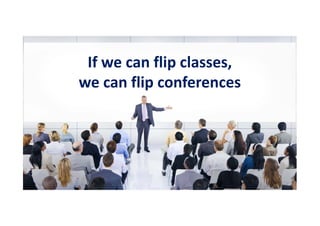
If we can flip classes,
we can flip conferences
Designing a Flipped Conference
There is no unique way to flip a conference
Philosophy: Discuss, Build, and Share
Forget the idea of a speaker, keynote or
presenter
Create simple rules that everyone
understands and follows
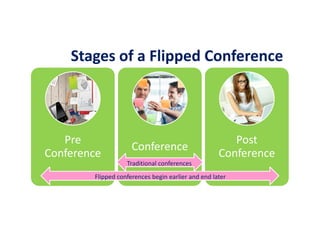
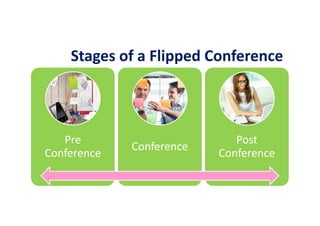
Pre
Conference
Conference
Post
Conference
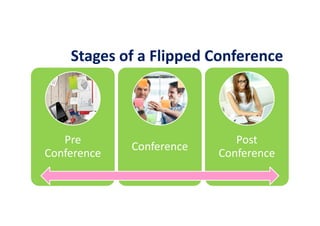
Stages of a Flipped Conference
Traditional conferences
Flipped conferences begin earlier and end later
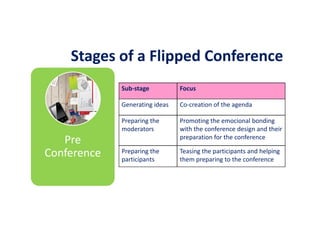
Pre
Conference
Stages of a Flipped Conference
Sub-stage Focus
Generating ideas Co-creation of the agenda
Preparing the
moderators
Promoting the emocional bonding
with the conference design and their
preparation for the conference
Preparing the
participants
Teasing the participants and helping
them preparing to the conference
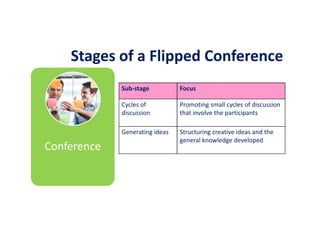
Conference
Stages of a Flipped Conference
Sub-stage Focus
Cycles of
discussion
Promoting small cycles of discussion
that involve the participants
Generating ideas Structuring creative ideas and the
general knowledge developed
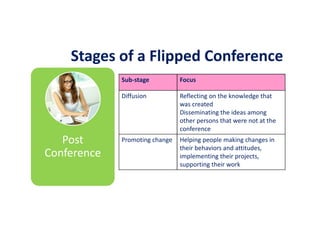
Post
Conference
Stages of a Flipped Conference
Sub-stage Focus
Diffusion Reflecting on the knowledge that
was created
Disseminating the ideas among
other persons that were not at the
conference
Promoting change Helping people making changes in
their behaviors and attitudes,
implementing their projects,
supporting their work
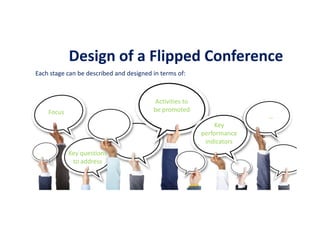
Design of a Flipped Conference
Each stage can be described and designed in terms of:
Focus
Key questions
to address
Activities to
be promoted
Key
performance
indicators
…
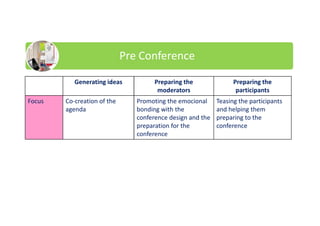
Pre Conference
Generating ideas Preparing the
moderators
Preparing the
participants
Focus Co-creation of the
agenda
Promoting the emocional
bonding with the
conference design and the
preparation for the
conference
Teasing the participants
and helping them
preparing to the
conference
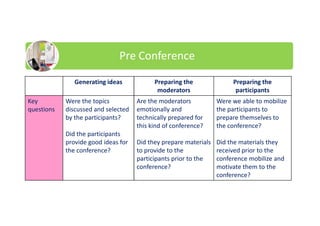
Pre Conference
Generating ideas Preparing the
moderators
Preparing the
participants
Key
questions
Were the topics
discussed and selected
by the participants?
Did the participants
provide good ideas for
the conference?
Are the moderators
emotionally and
technically prepared for
this kind of conference?
Did they prepare materials
to provide to the
participants prior to the
conference?
Were we able to mobilize
the participants to
prepare themselves to
the conference?
Did the materials they
received prior to the
conference mobilize and
motivate them to the
conference?
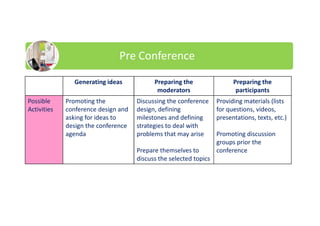
Pre Conference
Generating ideas Preparing the
moderators
Preparing the
participants
Possible
Activities
Promoting the
conference design and
asking for ideas to
design the conference
agenda
Discussing the conference
design, defining
milestones and defining
strategies to deal with
problems that may arise
Prepare themselves to
discuss the selected topics
Providing materials (lists
for questions, vídeos,
presentations, texts, etc.)
Promoting discussion
groups prior the
conference
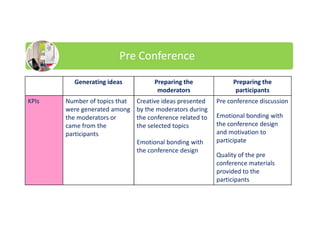
Pre Conference
Generating ideas Preparing the
moderators
Preparing the
participants
KPIs Number of topics that
were generated among
the moderators or
came from the
participants
Creative ideas presented
by the moderators during
the conference related to
the selected topics
Emotional bonding with
the conference design
Pre conference discussion
Emotional bonding with
the conference design
and motivation to
participate
Quality of the pre
conference materials
provided to the
participants
Pre
Conference
Conference
Post
Conference
Stages of a Flipped Conference
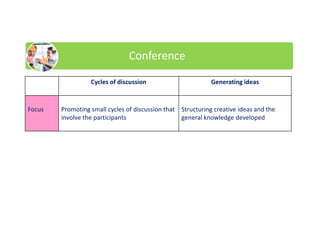
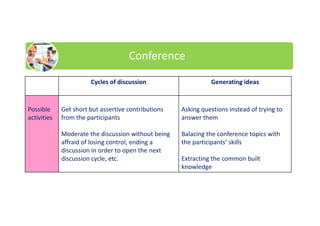
Conference
Cycles of discussion Generating ideas
Focus Promoting small cycles of discussion that
involve the participants
Structuring creative ideas and the
general knowledge developed
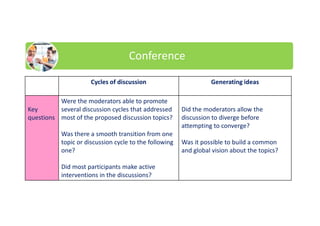
Conference
Cycles of discussion Generating ideas
Key
questions
Were the moderators able to promote
several discussion cycles that addressed
most of the proposed discussion topics?
Was there a smooth transition from one
topic or discussion cycle to the following
one?
Did most participants make active
interventions in the discussions?
Did the moderators allow the
discussion to diverge before
attempting to converge?
Was it possible to build a common
and global vision about the topics?
Conference
Cycles of discussion Generating ideas
Possible
activities
Get short but assertive contributions
from the participants
Moderate the discussion without being
affraid of losing control, ending a
discussion in order to open the next
discussion cycle, etc.
Asking questions instead of trying to
answer them
Balacing the conference topics with
the participants’ skills
Extracting the common built
knowledge
Conference
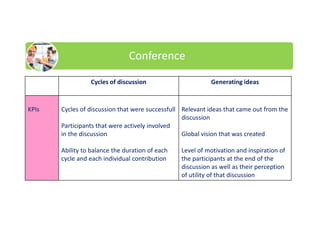
Cycles of discussion Generating ideas
KPIs Cycles of discussion that were successfull
Participants that were actively involved
in the discussion
Ability to balance the duration of each
cycle and each individual contribution
Relevant ideas that came out from the
discussion
Global vision that was created
Level of motivation and inspiration of
the participants at the end of the
discussion as well as their perception
of utility of that discussion
Pre
Conference
Conference
Post
Conference
Stages of a Flipped Conference
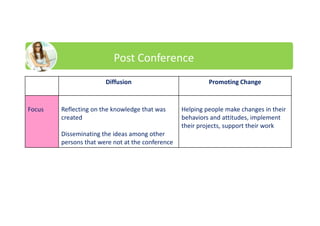
Diffusion Promoting Change
Focus Reflecting on the knowledge that was
created
Disseminating the ideas among other
persons that were not at the conference
Helping people make changes in their
behaviors and attitudes, implement
their projects, support their work
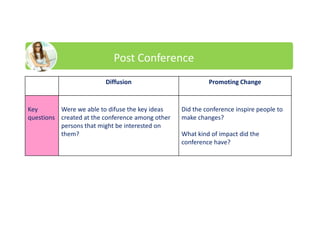
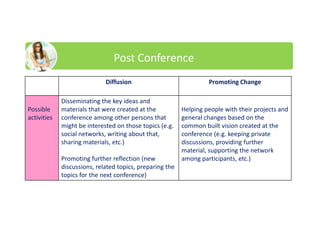
Post Conference
Post Conference
Diffusion Promoting Change
Key
questions
Were we able to difuse the key ideas
created at the conference among other
persons that might be interested on
them?
Did the conference inspire people to
make changes?
What kind of impact did the
conference have?
Diffusion Promoting Change
Possible
activities
Disseminating the key ideas and
materials that were created at the
conference among other persons that
might be interested on those topics (e.g.
social networks, writing about that,
sharing materials, etc.)
Promoting further reflection (new
discussions, related topics, preparing the
topics for the next conference)
Helping people with their projects and
general changes based on the
common built vision created at the
conference (e.g. keeping private
discussions, providing further
material, supporting the network
among participants, etc.)
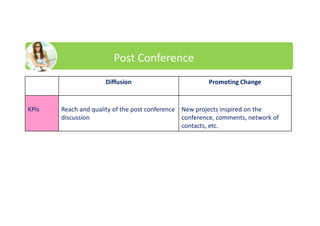
Post Conference
Diffusion Promoting Change
KPIs Reach and quality of the post conference
discussion
New projects inspired on the
conference, comments, network of
contacts, etc.
Post Conference
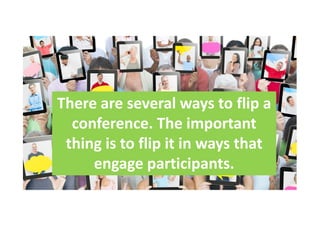
There are several ways to flip a
conference. The important
thing is to flip it in ways that
engage participants.
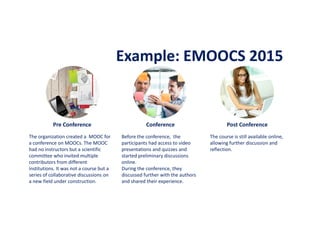
Example: EMOOCS 2015
The organization created a MOOC for
a conference on MOOCs. The MOOC
had no instructors but a scientific
committee who invited multiple
contributors from different
institutions. It was not a course but a
series of collaborative discussions on
a new field under construction.
Before the conference, the
participants had access to video
presentations and quizzes and
started preliminary discussions
online.
During the conference, they
discussed further with the authors
and shared their experience.
The course is still available online,
allowing further discussion and
reflection.
Pre Conference Conference Post Conference
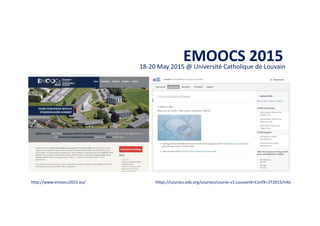
EMOOCS 201518-20 May 2015 @ Université Catholique de Louvain
https://courses.edx.org/courses/course-v1:LouvainX+ConfX+2T2015/infohttp://www.emoocs2015.eu/
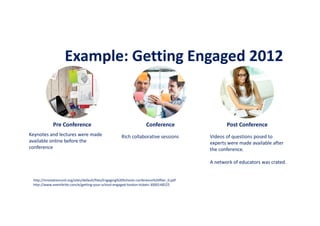
Example: Getting Engaged 2012
Keynotes and lectures were made
available online before the
conference
Rich collaborative sessions Videos of questions posed to
experts were made available after
the conference.
A network of educators was crated.
Pre Conference Conference Post Conference
http://innovationunit.org/sites/default/files/Engaging%20Schools-conference%20flier_0.pdf
http://www.eventbrite.com/e/getting-your-school-engaged-london-tickets-3000148525
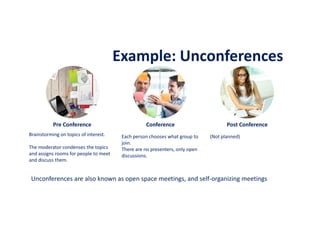
Example: Unconferences
Brainstorming on topics of interest.
The moderator condenses the topics
and assigns rooms for people to meet
and discuss them.
Each person chooses what group to
join.
There are no presenters, only open
discussions.
(Not planned)
Pre Conference Conference Post Conference
Unconferences are also known as open space meetings, and self-organizing meetings
Examples of Unconferences
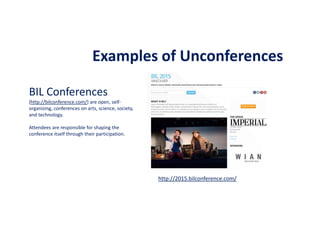
BIL Conferences
(http://bilconference.com/) are open, self-
organizing, conferences on arts, science, society,
and technology.
Attendees are responsible for shaping the
conference itself through their participation.
http://2015.bilconference.com/
Examples of Unconferences
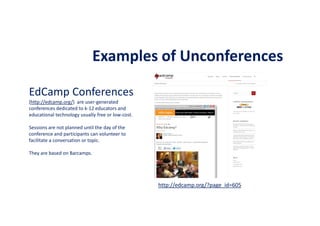
EdCamp Conferences
(http://edcamp.org/) are user-generated
conferences dedicated to k-12 educators and
educational technology usually free or low-cost.
Sessions are not planned until the day of the
conference and participants can volunteer to
facilitate a conversation or topic.
They are based on Barcamps.
http://edcamp.org/?page_id=605
Examples of Unconferences
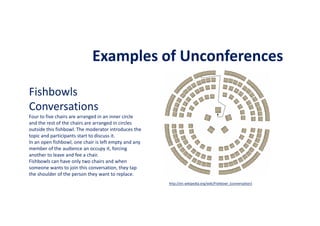
Fishbowls
Conversations
Four to five chairs are arranged in an inner circle
and the rest of the chairs are arranged in circles
outside this fishbowl. The moderator introduces the
topic and participants start to discuss it.
In an open fishbowl, one chair is left empty and any
member of the audience an occupy it, forcing
another to leave and fee a chair.
Fishbowls can have only two chairs and when
someone wants to join this conversation, they tap
the shoulder of the person they want to replace.
http://en.wikipedia.org/wiki/Fishbowl_(conversation)
Examples of Unconferences
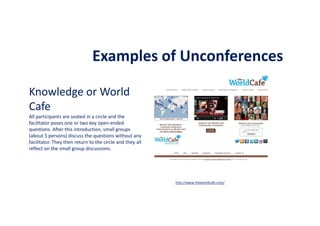
Knowledge or World
Cafe
All participants are seated in a circle and the
facilitator poses one or two key open-ended
questions. After this introduction, small groups
(about 5 persons) discuss the questions without any
facilitator. They then return to the circle and they all
reflect on the small group discussions.
http://www.theworldcafe.com/
Rosário Cação
rosario@evolui.com

Flipped Conferences

  • 1.
  • 2.
    Traditional Model • Lecturestyle • Boring presentations followed by short comments • Requires no preparation from the participants • Ends as soon as the last presentation ends
  • 3.
    Traditional Models are Ineffective •Based on passive learning approaches • Attention declines after the first 10 minutes • People remember only 20% of the material presented • A bit of motivation is murdered each minute • Critical thinking, problem solving, and application are not fostered • The best interaction happens at coffee breaks and social dinners
  • 4.
    If you couldchange the way conferences are organized, what would you do?
  • 5.
    “I’d like togo to a conference where we get to do something, make something, instead of talking about doing things, or showing pictures of people making something.“ Alan Levine, 2012, “we can flip more than classrooms”, retrieved from http://cogdogblog.com/2012/03/08/flip-more-than-classrooms/
  • 6.
    If we canflip classes, we can flip conferences
  • 7.
    Designing a FlippedConference There is no unique way to flip a conference Philosophy: Discuss, Build, and Share Forget the idea of a speaker, keynote or presenter Create simple rules that everyone understands and follows
  • 8.
    Pre Conference Conference Post Conference Stages of aFlipped Conference Traditional conferences Flipped conferences begin earlier and end later
  • 9.
    Pre Conference Stages of aFlipped Conference Sub-stage Focus Generating ideas Co-creation of the agenda Preparing the moderators Promoting the emocional bonding with the conference design and their preparation for the conference Preparing the participants Teasing the participants and helping them preparing to the conference
  • 10.
    Conference Stages of aFlipped Conference Sub-stage Focus Cycles of discussion Promoting small cycles of discussion that involve the participants Generating ideas Structuring creative ideas and the general knowledge developed
  • 11.
    Post Conference Stages of aFlipped Conference Sub-stage Focus Diffusion Reflecting on the knowledge that was created Disseminating the ideas among other persons that were not at the conference Promoting change Helping people making changes in their behaviors and attitudes, implementing their projects, supporting their work
  • 12.
    Design of aFlipped Conference Each stage can be described and designed in terms of: Focus Key questions to address Activities to be promoted Key performance indicators …
  • 13.
    Pre Conference Generating ideasPreparing the moderators Preparing the participants Focus Co-creation of the agenda Promoting the emocional bonding with the conference design and the preparation for the conference Teasing the participants and helping them preparing to the conference
  • 14.
    Pre Conference Generating ideasPreparing the moderators Preparing the participants Key questions Were the topics discussed and selected by the participants? Did the participants provide good ideas for the conference? Are the moderators emotionally and technically prepared for this kind of conference? Did they prepare materials to provide to the participants prior to the conference? Were we able to mobilize the participants to prepare themselves to the conference? Did the materials they received prior to the conference mobilize and motivate them to the conference?
  • 15.
    Pre Conference Generating ideasPreparing the moderators Preparing the participants Possible Activities Promoting the conference design and asking for ideas to design the conference agenda Discussing the conference design, defining milestones and defining strategies to deal with problems that may arise Prepare themselves to discuss the selected topics Providing materials (lists for questions, vídeos, presentations, texts, etc.) Promoting discussion groups prior the conference
  • 16.
    Pre Conference Generating ideasPreparing the moderators Preparing the participants KPIs Number of topics that were generated among the moderators or came from the participants Creative ideas presented by the moderators during the conference related to the selected topics Emotional bonding with the conference design Pre conference discussion Emotional bonding with the conference design and motivation to participate Quality of the pre conference materials provided to the participants
  • 17.
  • 18.
    Conference Cycles of discussionGenerating ideas Focus Promoting small cycles of discussion that involve the participants Structuring creative ideas and the general knowledge developed
  • 19.
    Conference Cycles of discussionGenerating ideas Key questions Were the moderators able to promote several discussion cycles that addressed most of the proposed discussion topics? Was there a smooth transition from one topic or discussion cycle to the following one? Did most participants make active interventions in the discussions? Did the moderators allow the discussion to diverge before attempting to converge? Was it possible to build a common and global vision about the topics?
  • 20.
    Conference Cycles of discussionGenerating ideas Possible activities Get short but assertive contributions from the participants Moderate the discussion without being affraid of losing control, ending a discussion in order to open the next discussion cycle, etc. Asking questions instead of trying to answer them Balacing the conference topics with the participants’ skills Extracting the common built knowledge
  • 21.
    Conference Cycles of discussionGenerating ideas KPIs Cycles of discussion that were successfull Participants that were actively involved in the discussion Ability to balance the duration of each cycle and each individual contribution Relevant ideas that came out from the discussion Global vision that was created Level of motivation and inspiration of the participants at the end of the discussion as well as their perception of utility of that discussion
  • 22.
  • 23.
    Diffusion Promoting Change FocusReflecting on the knowledge that was created Disseminating the ideas among other persons that were not at the conference Helping people make changes in their behaviors and attitudes, implement their projects, support their work Post Conference
  • 24.
    Post Conference Diffusion PromotingChange Key questions Were we able to difuse the key ideas created at the conference among other persons that might be interested on them? Did the conference inspire people to make changes? What kind of impact did the conference have?
  • 25.
    Diffusion Promoting Change Possible activities Disseminatingthe key ideas and materials that were created at the conference among other persons that might be interested on those topics (e.g. social networks, writing about that, sharing materials, etc.) Promoting further reflection (new discussions, related topics, preparing the topics for the next conference) Helping people with their projects and general changes based on the common built vision created at the conference (e.g. keeping private discussions, providing further material, supporting the network among participants, etc.) Post Conference
  • 26.
    Diffusion Promoting Change KPIsReach and quality of the post conference discussion New projects inspired on the conference, comments, network of contacts, etc. Post Conference
  • 27.
    There are severalways to flip a conference. The important thing is to flip it in ways that engage participants.
  • 28.
    Example: EMOOCS 2015 Theorganization created a MOOC for a conference on MOOCs. The MOOC had no instructors but a scientific committee who invited multiple contributors from different institutions. It was not a course but a series of collaborative discussions on a new field under construction. Before the conference, the participants had access to video presentations and quizzes and started preliminary discussions online. During the conference, they discussed further with the authors and shared their experience. The course is still available online, allowing further discussion and reflection. Pre Conference Conference Post Conference
  • 29.
    EMOOCS 201518-20 May2015 @ Université Catholique de Louvain https://courses.edx.org/courses/course-v1:LouvainX+ConfX+2T2015/infohttp://www.emoocs2015.eu/
  • 30.
    Example: Getting Engaged2012 Keynotes and lectures were made available online before the conference Rich collaborative sessions Videos of questions posed to experts were made available after the conference. A network of educators was crated. Pre Conference Conference Post Conference http://innovationunit.org/sites/default/files/Engaging%20Schools-conference%20flier_0.pdf http://www.eventbrite.com/e/getting-your-school-engaged-london-tickets-3000148525
  • 31.
    Example: Unconferences Brainstorming ontopics of interest. The moderator condenses the topics and assigns rooms for people to meet and discuss them. Each person chooses what group to join. There are no presenters, only open discussions. (Not planned) Pre Conference Conference Post Conference Unconferences are also known as open space meetings, and self-organizing meetings
  • 32.
    Examples of Unconferences BILConferences (http://bilconference.com/) are open, self- organizing, conferences on arts, science, society, and technology. Attendees are responsible for shaping the conference itself through their participation. http://2015.bilconference.com/
  • 33.
    Examples of Unconferences EdCampConferences (http://edcamp.org/) are user-generated conferences dedicated to k-12 educators and educational technology usually free or low-cost. Sessions are not planned until the day of the conference and participants can volunteer to facilitate a conversation or topic. They are based on Barcamps. http://edcamp.org/?page_id=605
  • 34.
    Examples of Unconferences Fishbowls Conversations Fourto five chairs are arranged in an inner circle and the rest of the chairs are arranged in circles outside this fishbowl. The moderator introduces the topic and participants start to discuss it. In an open fishbowl, one chair is left empty and any member of the audience an occupy it, forcing another to leave and fee a chair. Fishbowls can have only two chairs and when someone wants to join this conversation, they tap the shoulder of the person they want to replace. http://en.wikipedia.org/wiki/Fishbowl_(conversation)
  • 35.
    Examples of Unconferences Knowledgeor World Cafe All participants are seated in a circle and the facilitator poses one or two key open-ended questions. After this introduction, small groups (about 5 persons) discuss the questions without any facilitator. They then return to the circle and they all reflect on the small group discussions. http://www.theworldcafe.com/
  • 36.