THOUGHT LEADERSHIP
© 2015 BRUCE PHARR | SCIENCE&TECHNOLOGYMARKETING
www.brucepharr.com
Flexible Standardization:
The Future of Human
Biobank Management
Informatics
BACKGROUND	
  
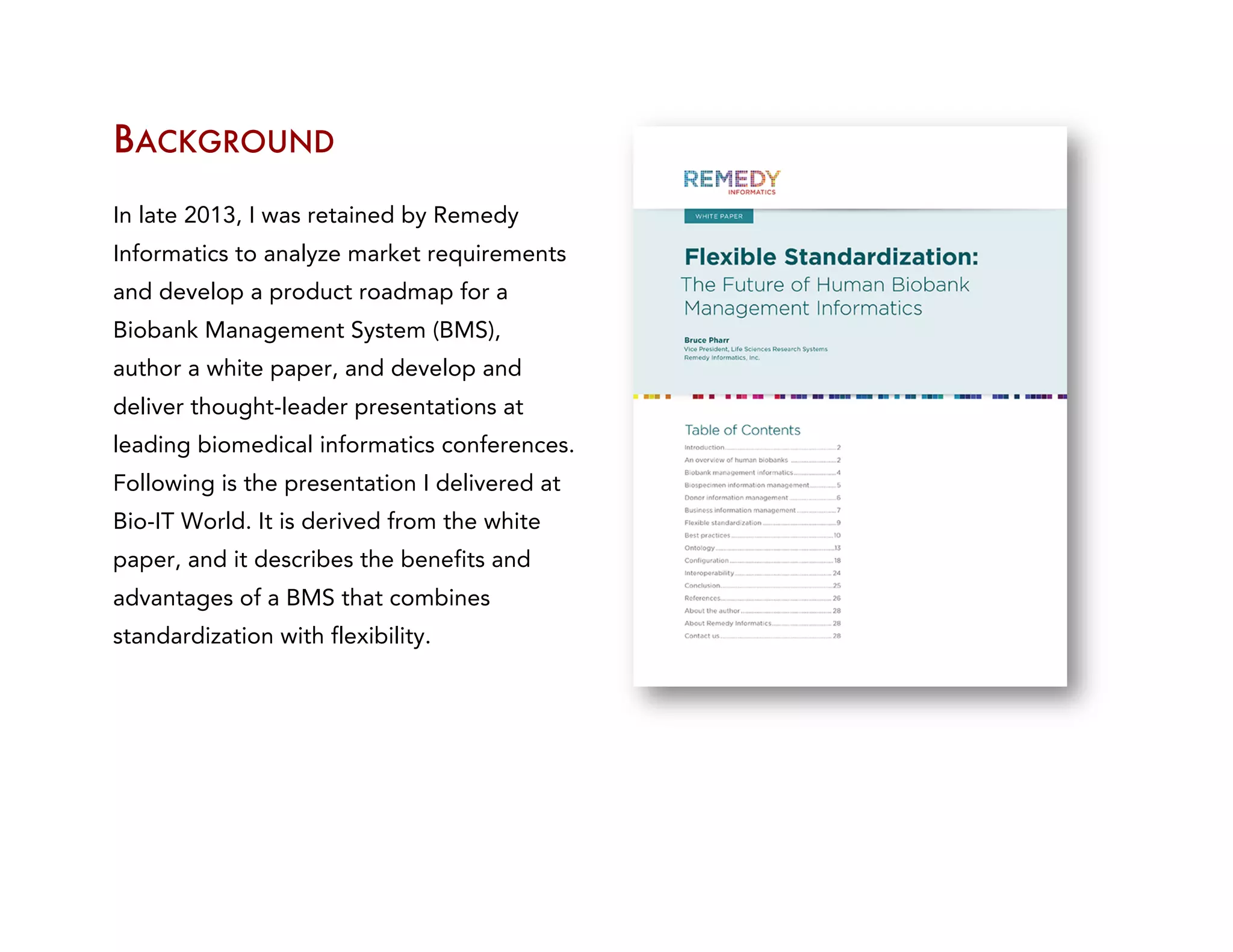
In late 2013, I was retained by Remedy
Informatics to analyze market requirements
and develop a product roadmap for a
Biobank Management System (BMS),
author a white paper, and develop and
deliver thought-leader presentations at
leading biomedical informatics conferences.
Following is the presentation I delivered at
Bio-IT World. It is derived from the white
paper, and it describes the benefits and
advantages of a BMS that combines
standardization with flexibility.
Flexible Standardization
The Future of Human Biobank Management Informatics	
  
Bruce Pharr | Vice President, Life Sciences Research Systems
Bio-IT World Conference | April 30, 2014
1	
  
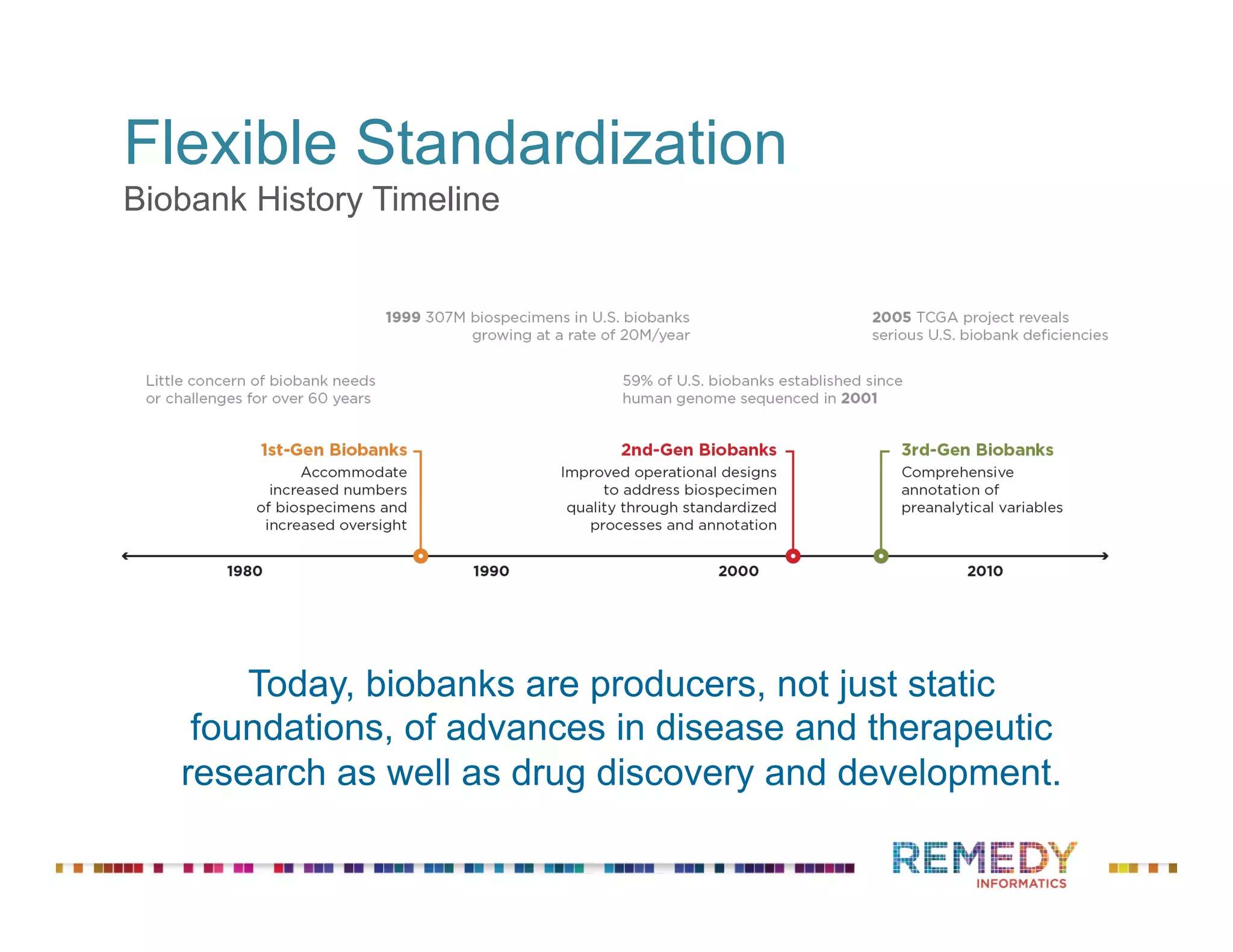
Flexible Standardization
Biobank History Timeline
Today, biobanks are producers, not just static
foundations, of advances in disease and therapeutic
research as well as drug discovery and development.
Flexible Standardization
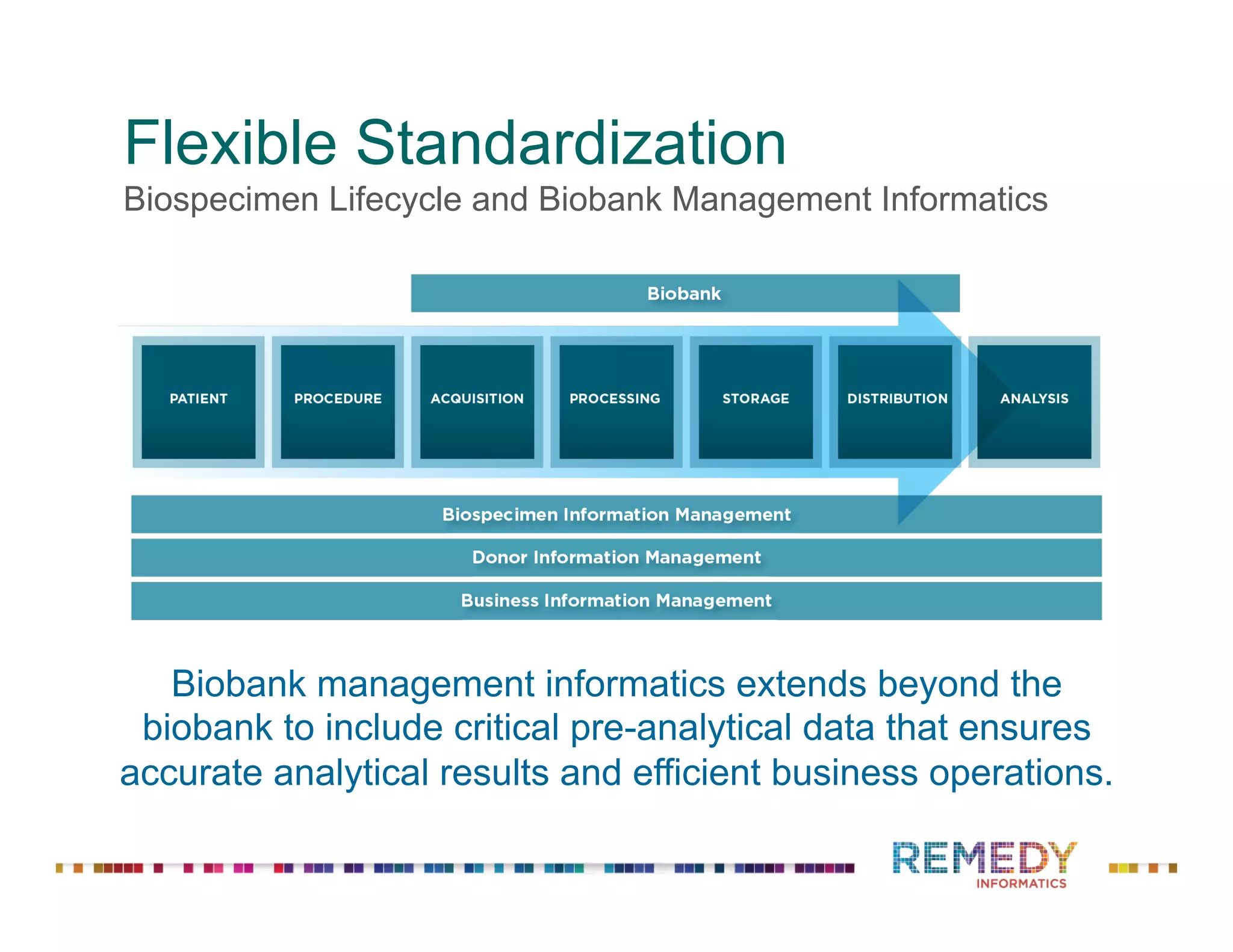
Biospecimen Lifecycle and Biobank Management Informatics
Biobank management informatics extends beyond the
biobank to include critical pre-analytical data that ensures
accurate analytical results and efficient business operations.
Flexible Standardization
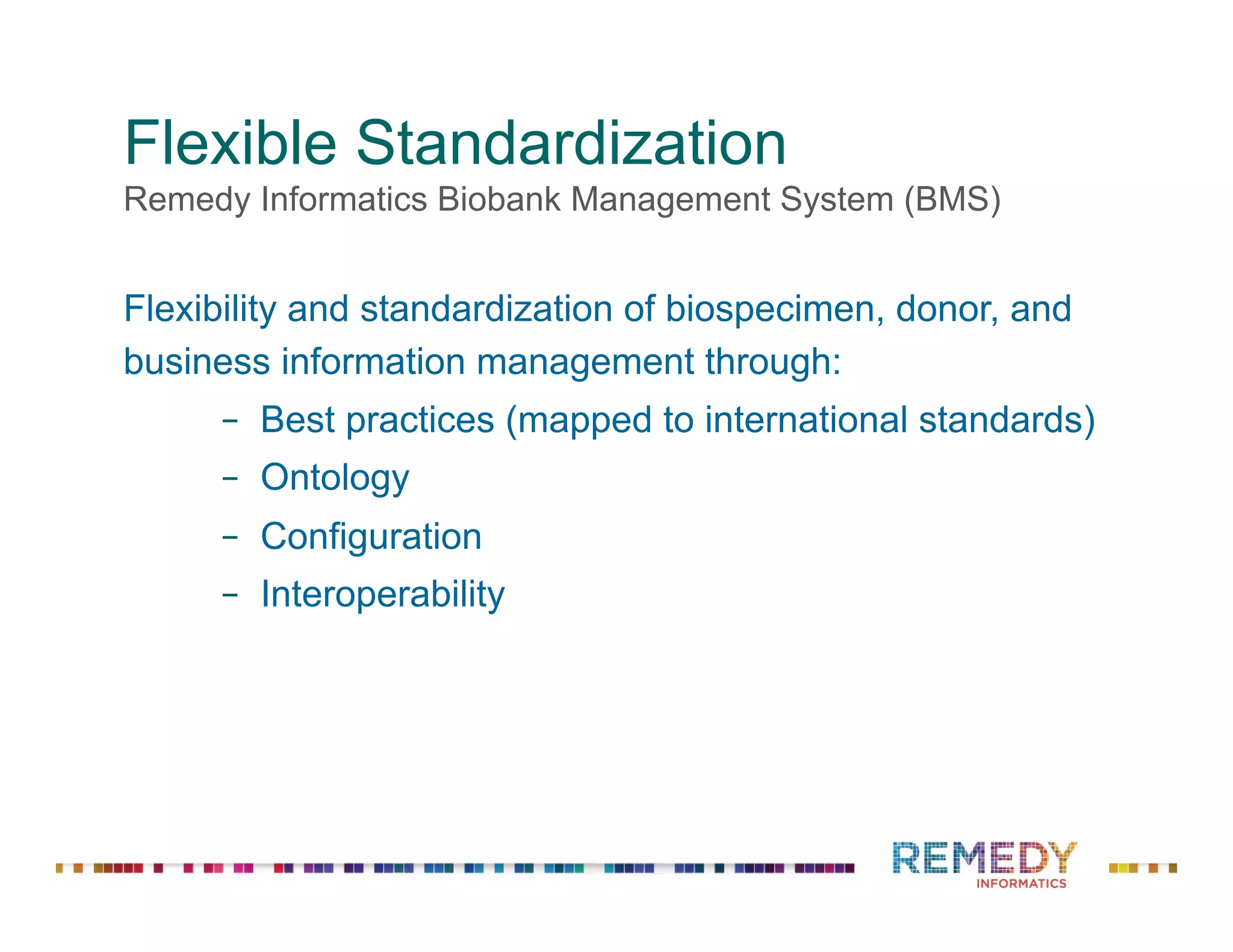
Remedy Informatics Biobank Management System (BMS)
Flexibility and standardization of biospecimen, donor, and
business information management through:
‒  Best practices (mapped to international standards)
‒  Ontology
‒  Configuration
‒  Interoperability
Flexible Standardization
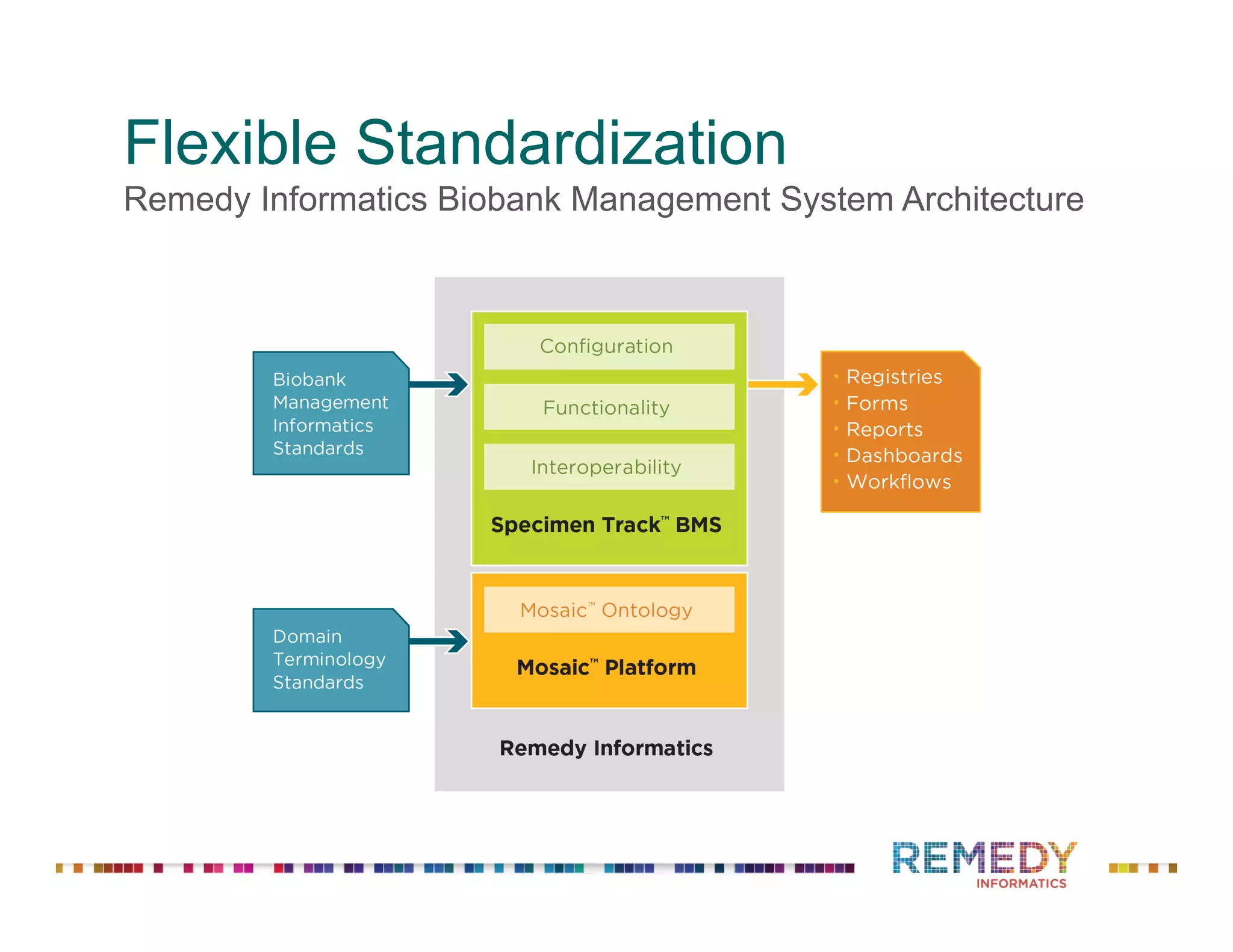
Remedy Informatics Biobank Management System Architecture
Flexible Standardization
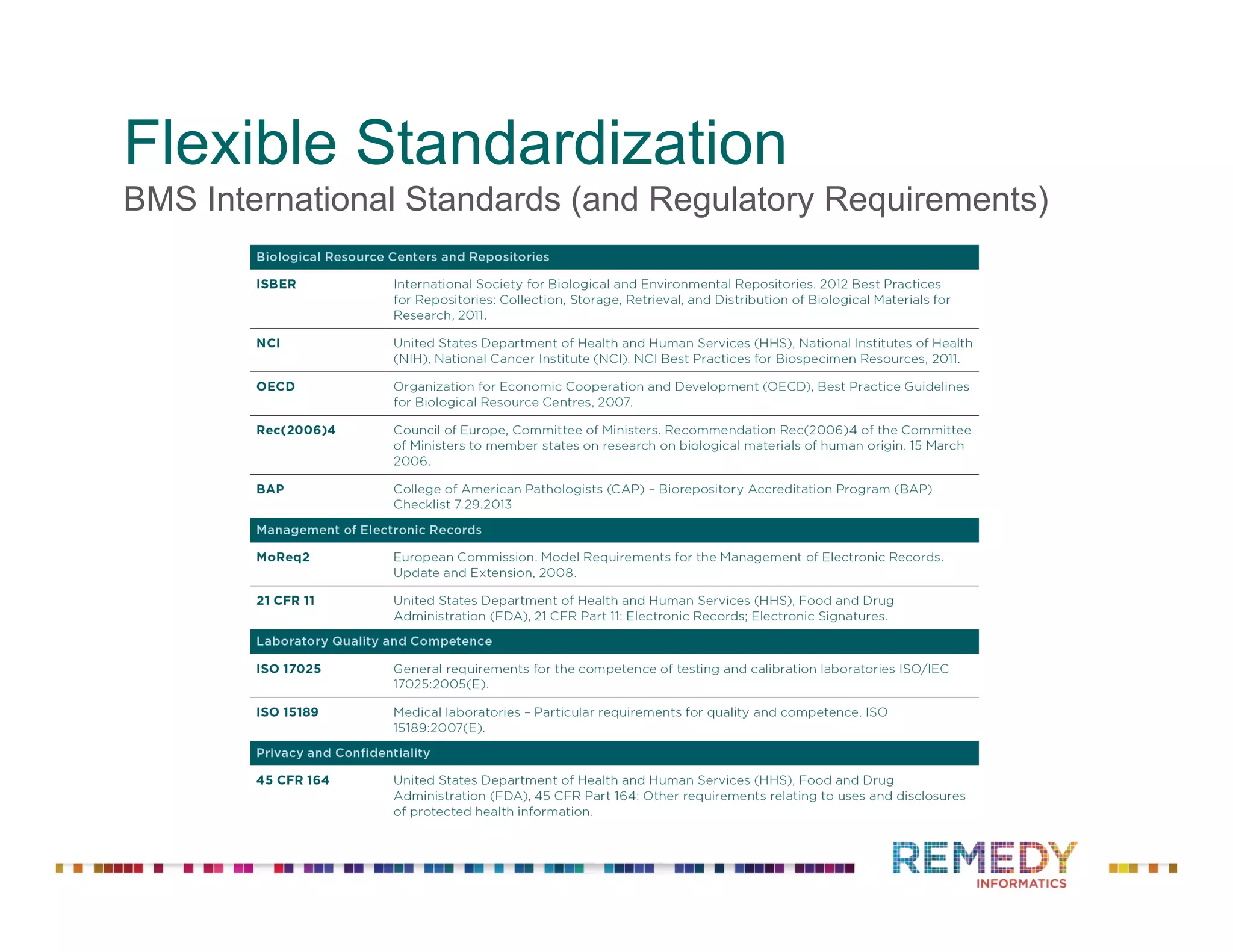
BMS International Standards (and Regulatory Requirements)
Flexible Standardization
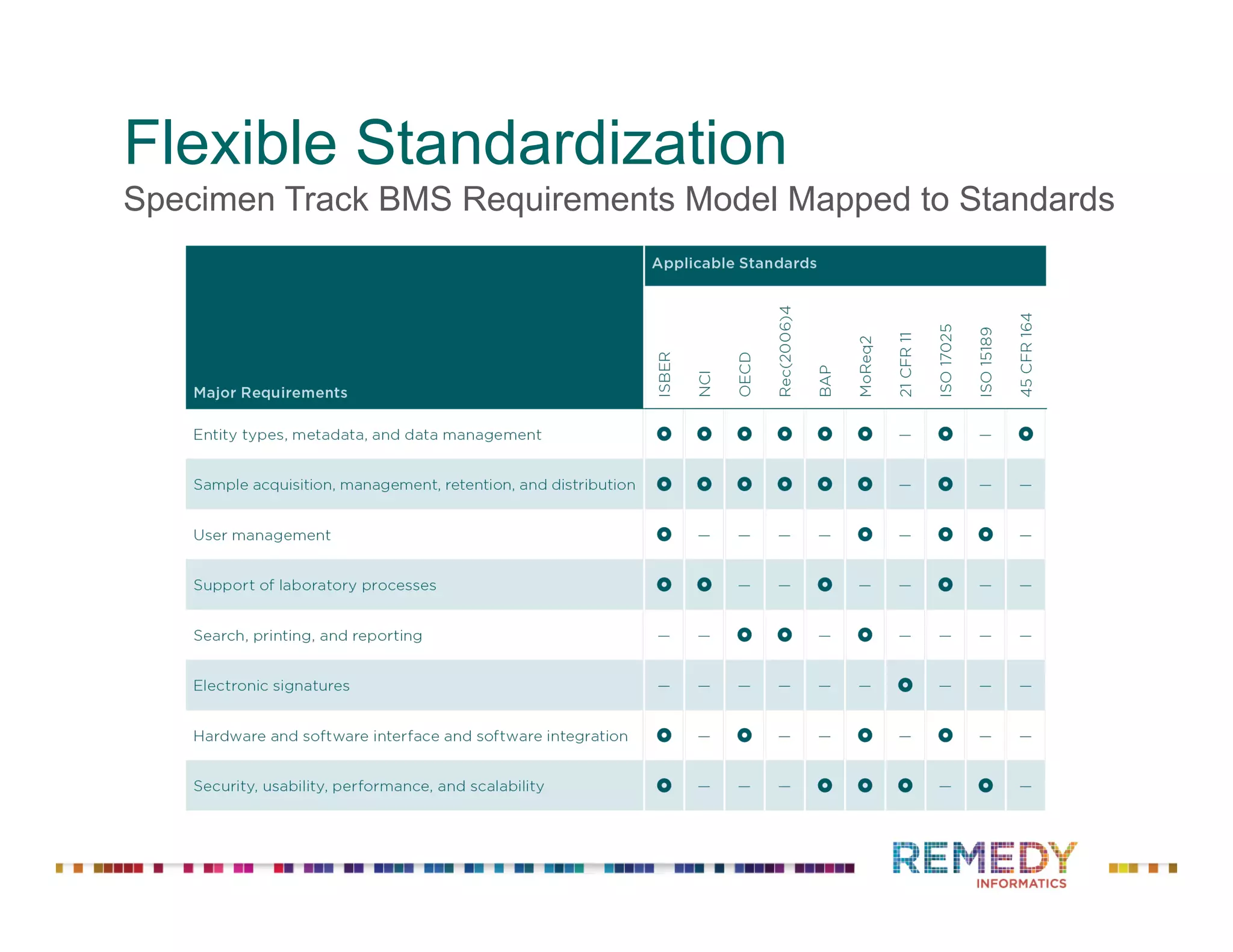
Specimen Track BMS Requirements Model Mapped to Standards
Flexible Standardization
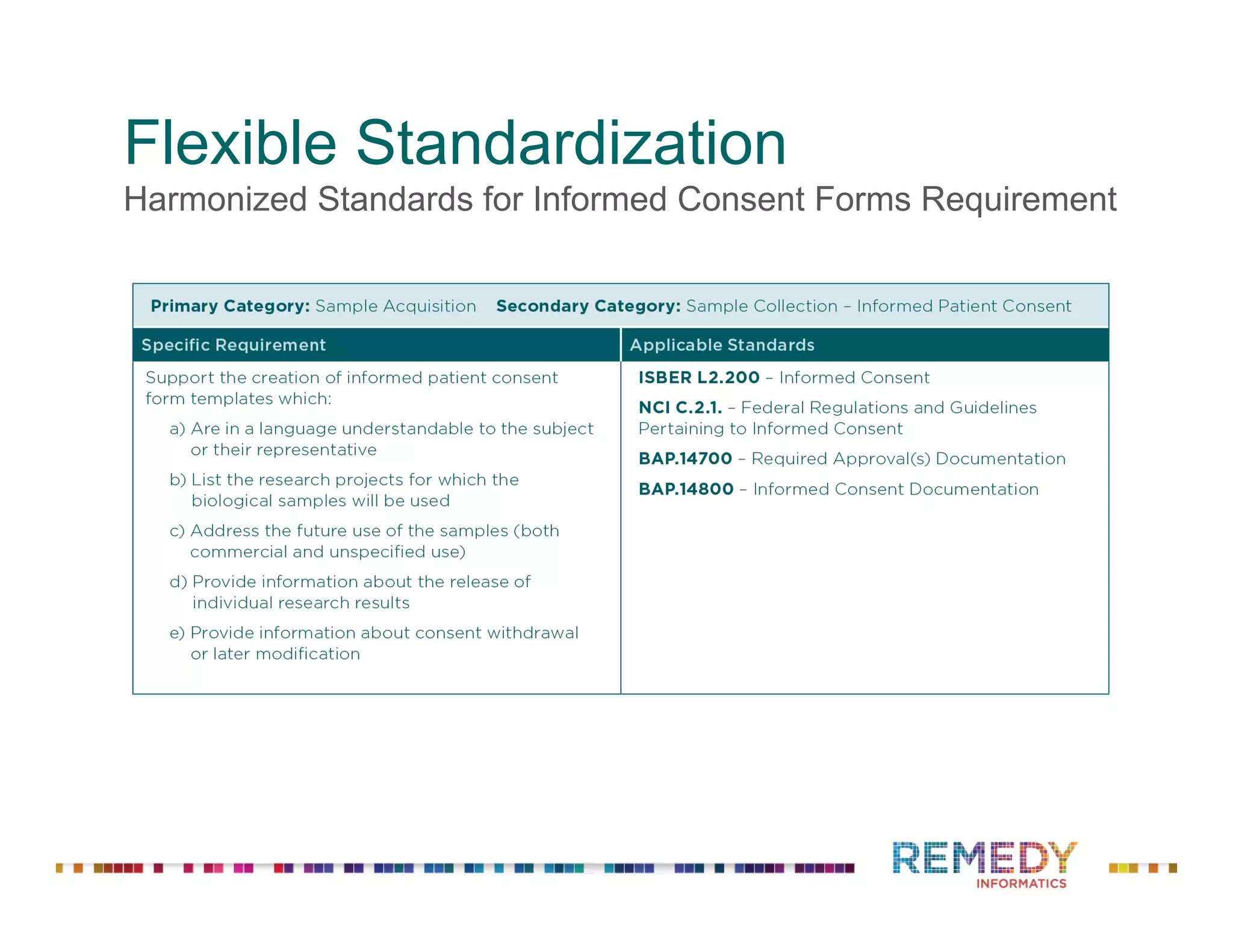
Harmonized Standards for Informed Consent Forms Requirement
Flexible Standardization
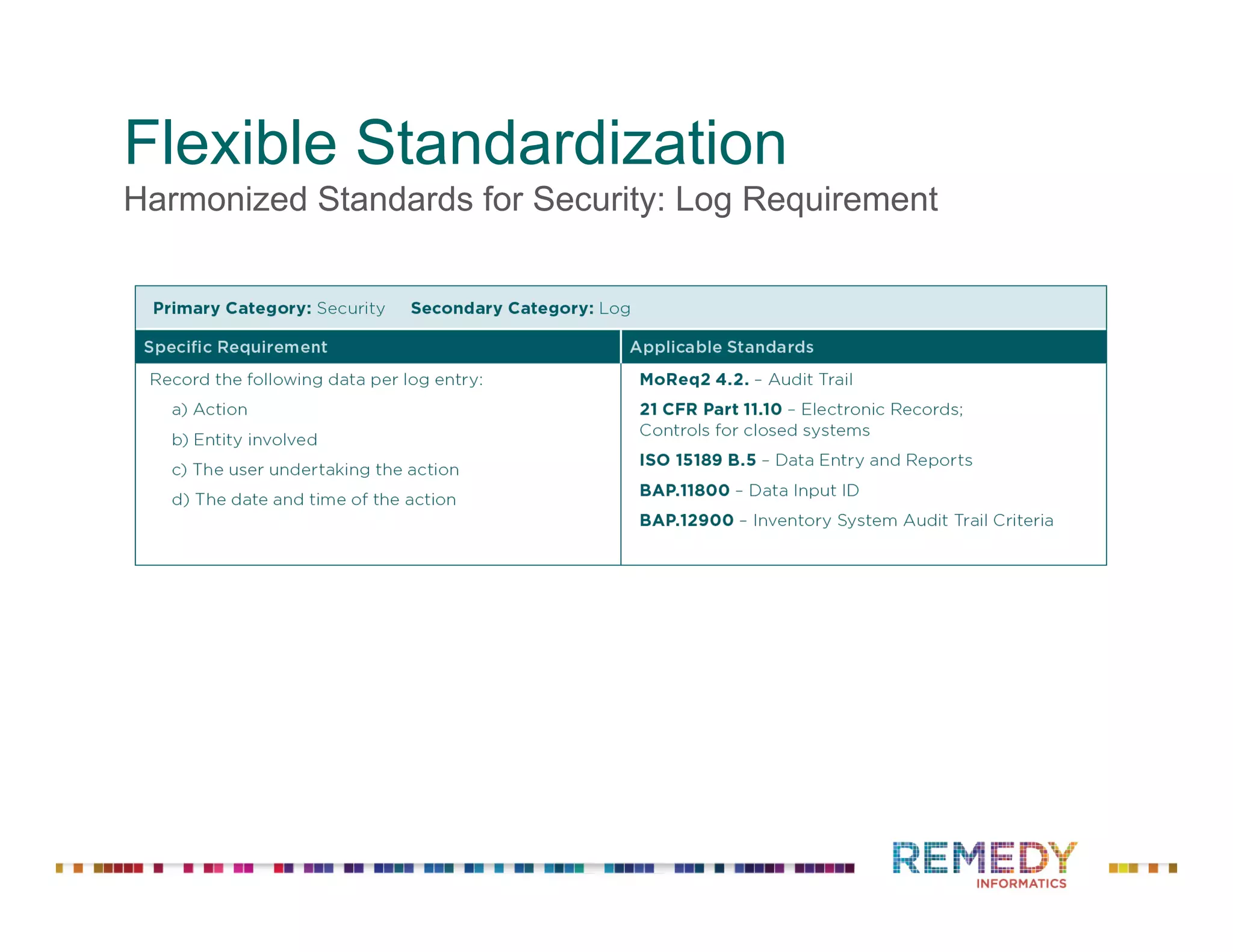
Harmonized Standards for Security: Log Requirement
Flexible Standardization
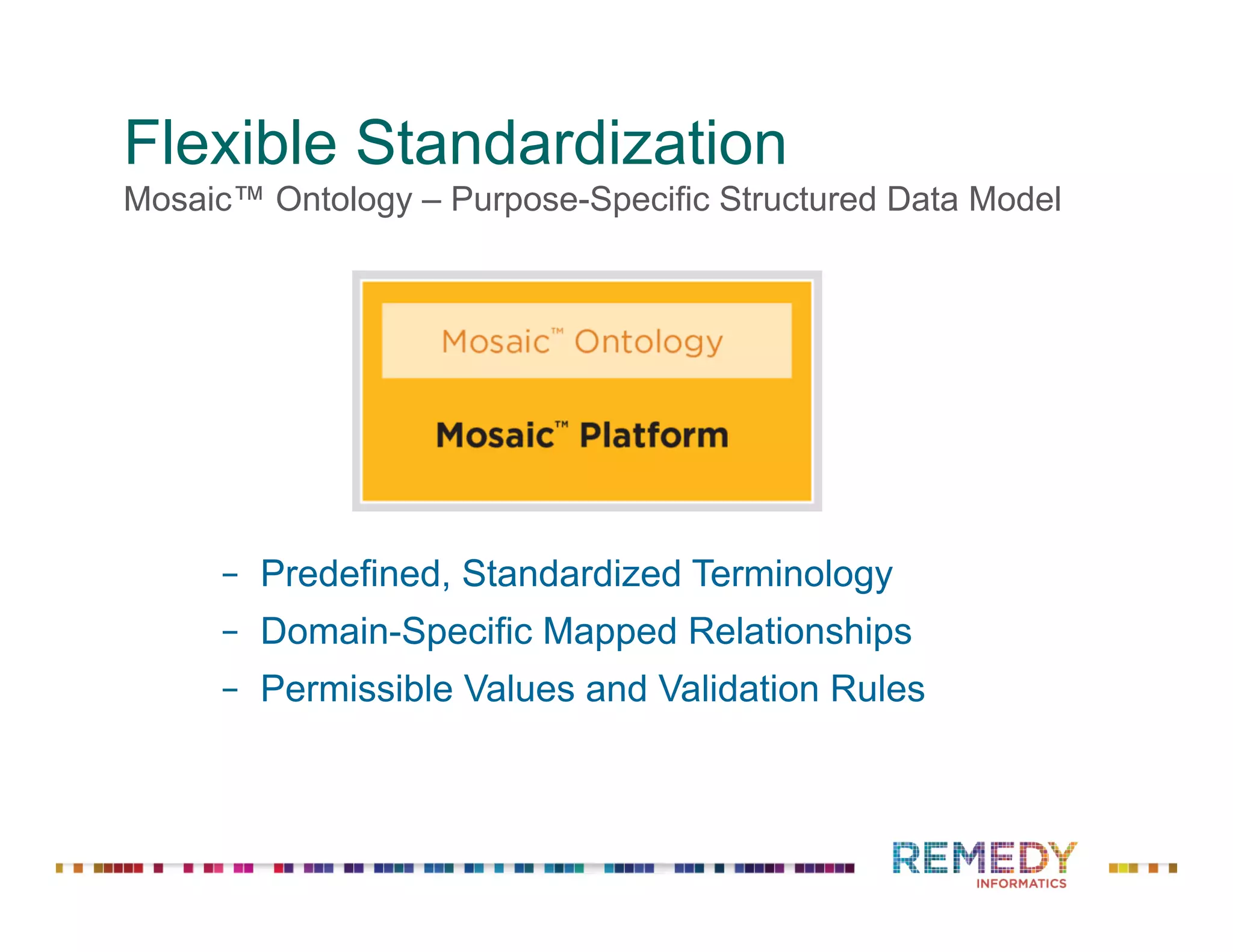
Mosaic™ Ontology – Purpose-Specific Structured Data Model
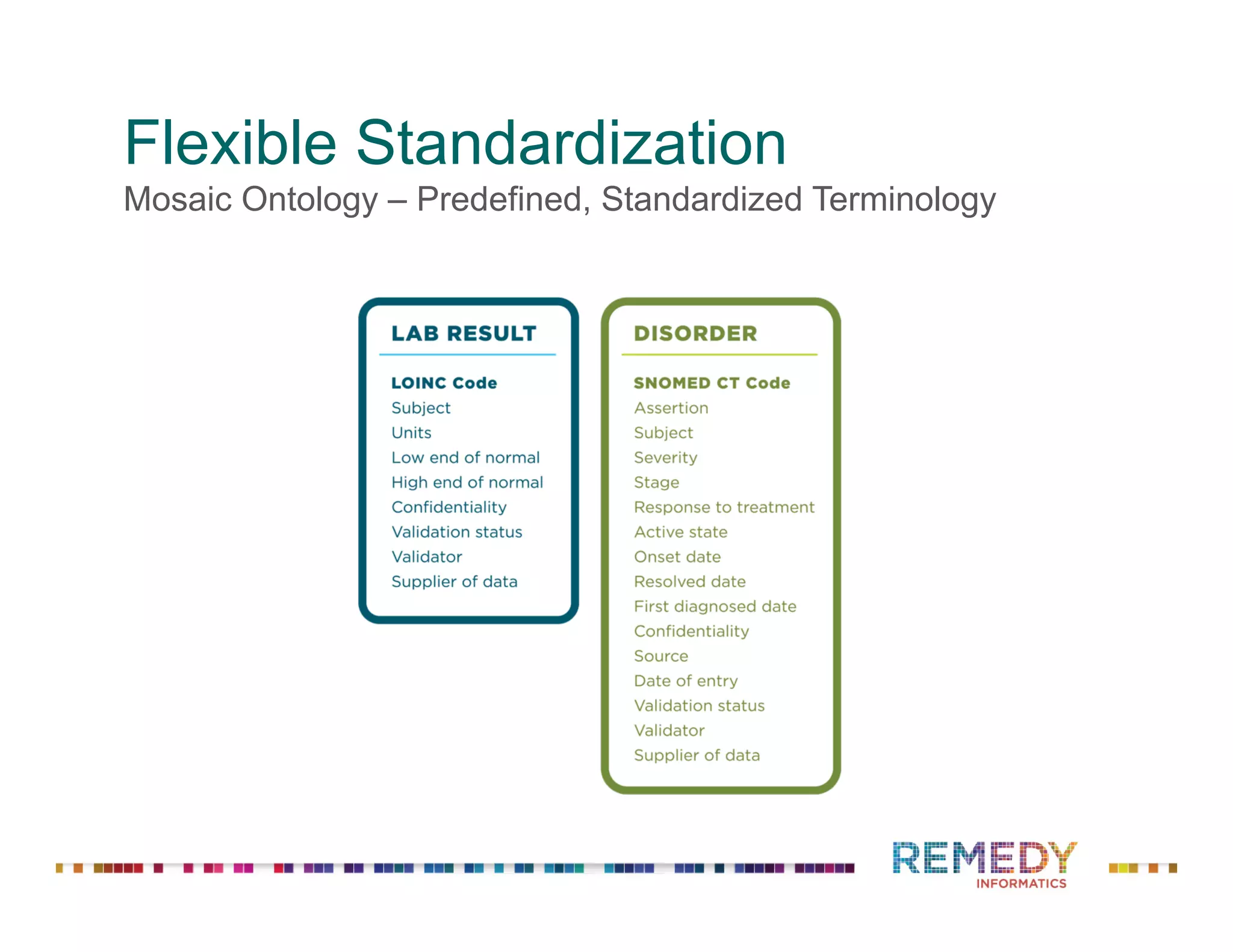
‒  Predefined, Standardized Terminology
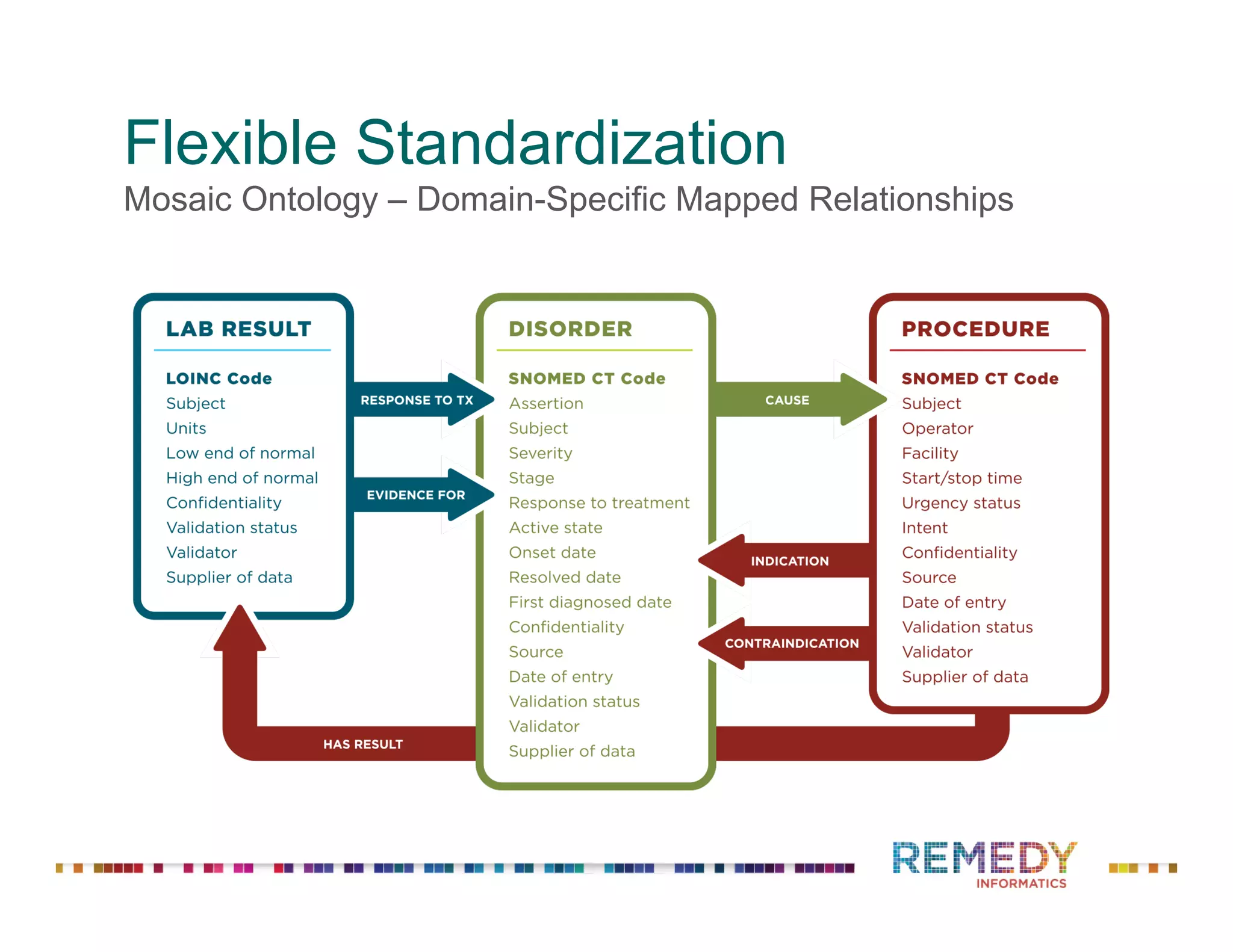
‒  Domain-Specific Mapped Relationships
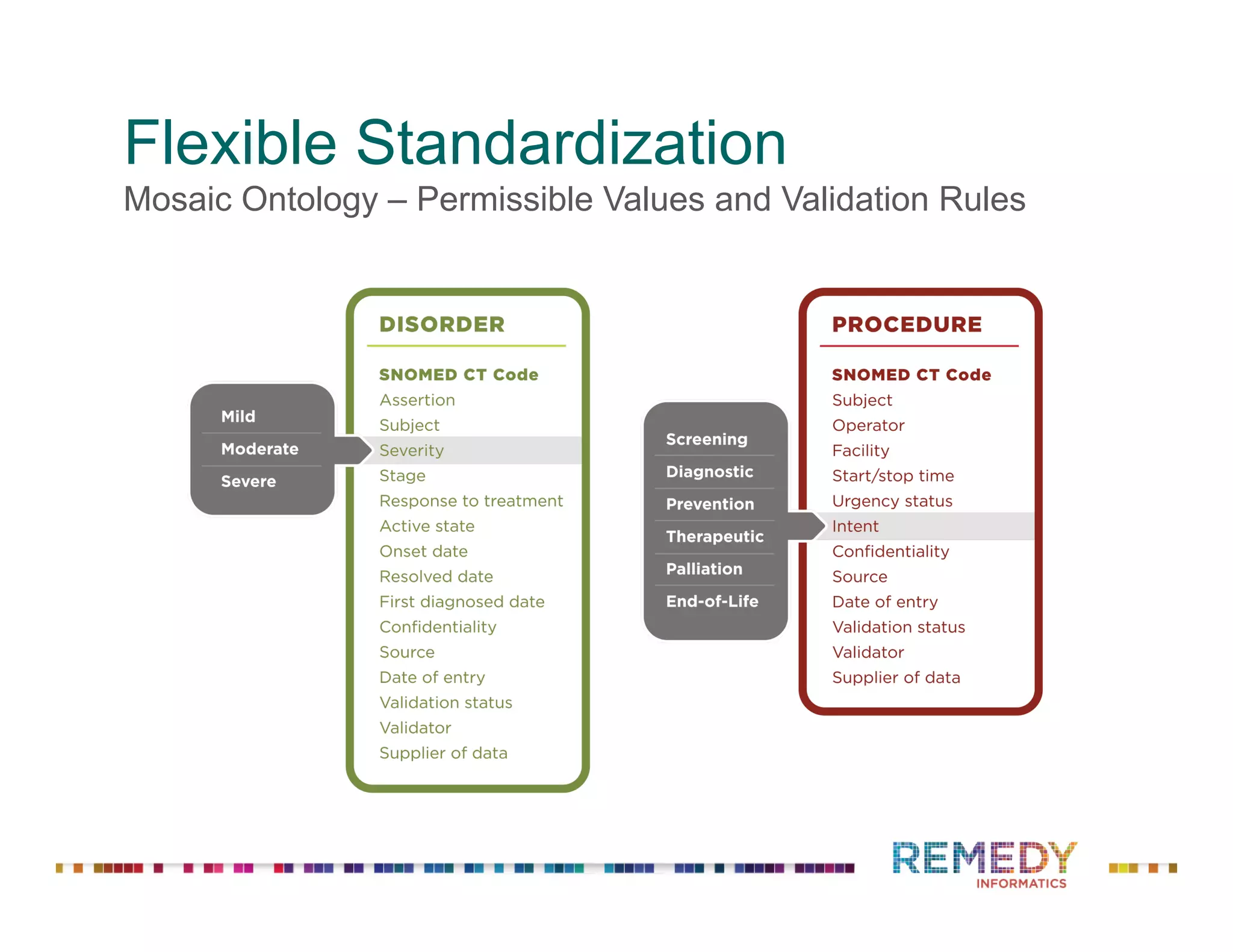
‒  Permissible Values and Validation Rules
Flexible Standardization
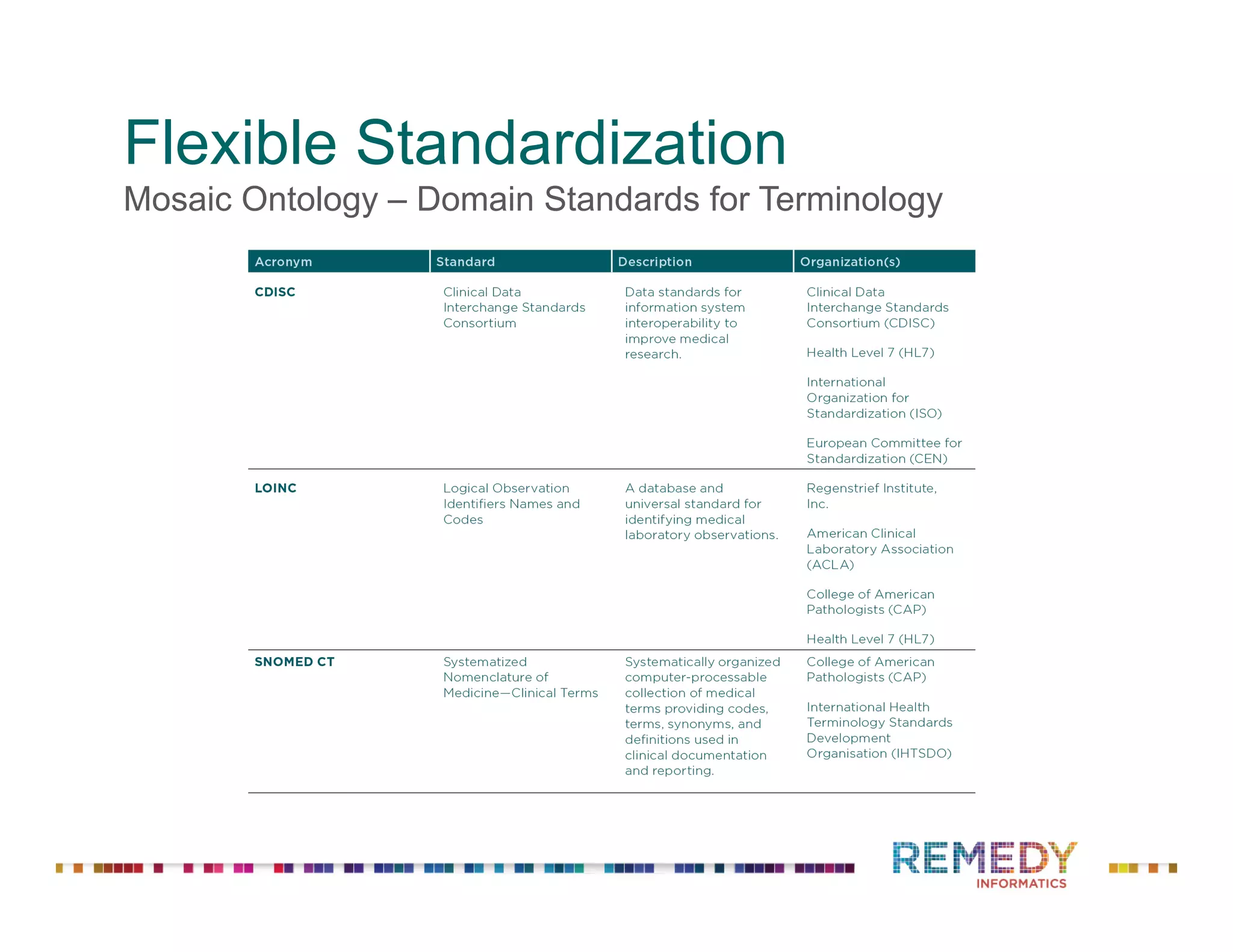
Mosaic Ontology – Domain Standards for Terminology
Flexible Standardization
Mosaic Ontology – Predefined, Standardized Terminology
Flexible Standardization
Mosaic Ontology – Domain-Specific Mapped Relationships
Flexible Standardization
Mosaic Ontology – Permissible Values and Validation Rules
Flexible Standardization
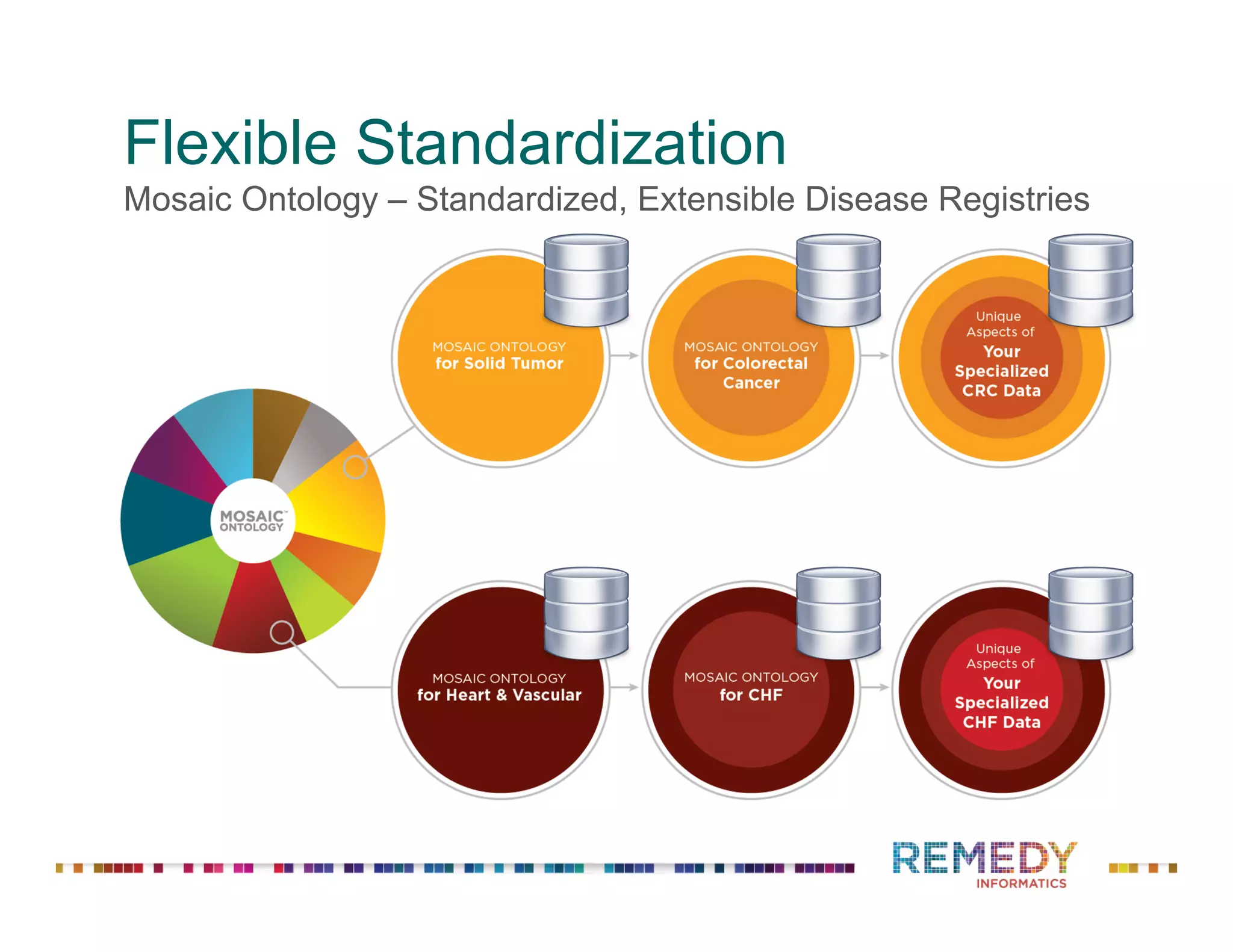
Mosaic Ontology – Standardized, Extensible Disease Registries
Flexible Standardization
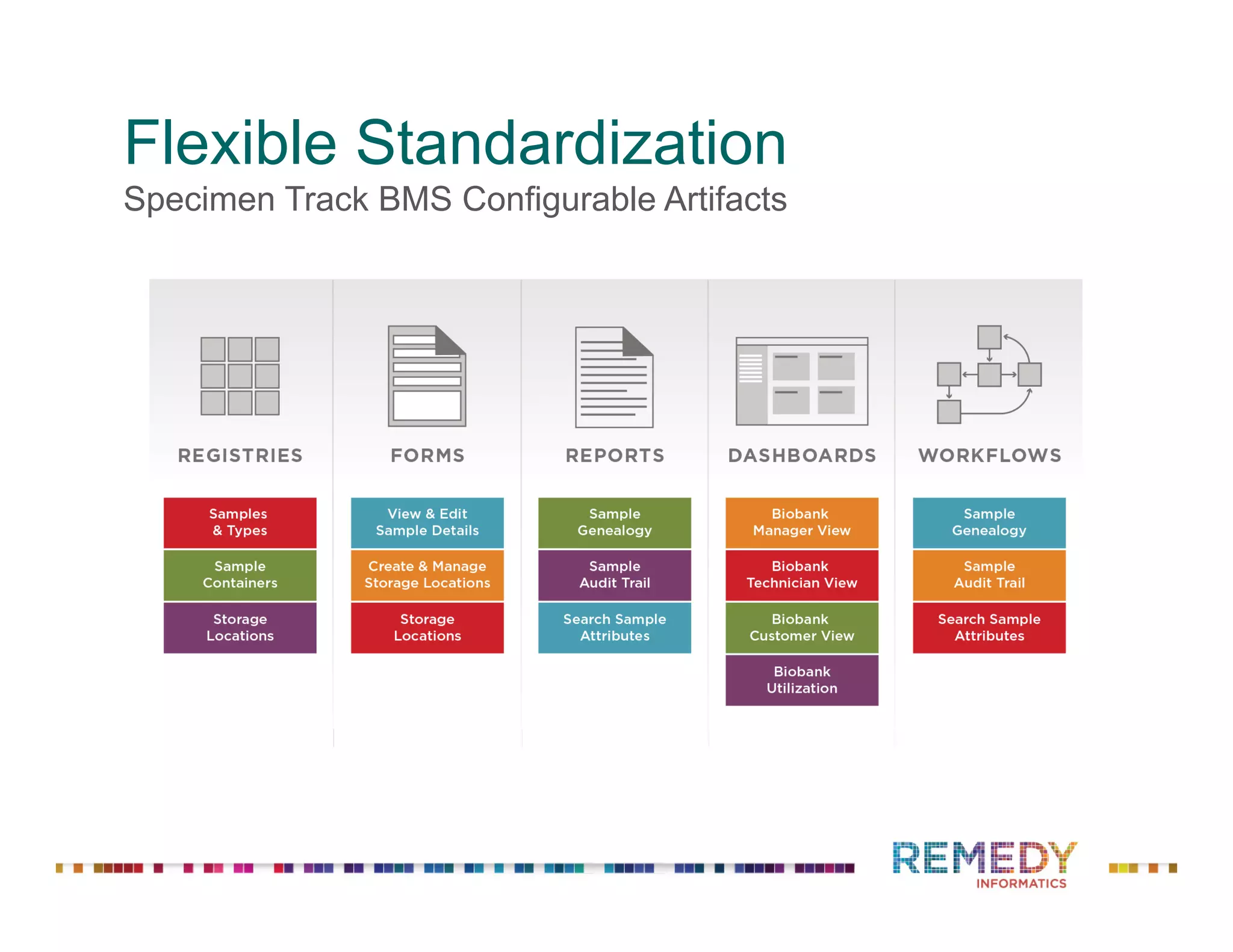
Specimen Track BMS Configurable Artifacts
Flexible Standardization
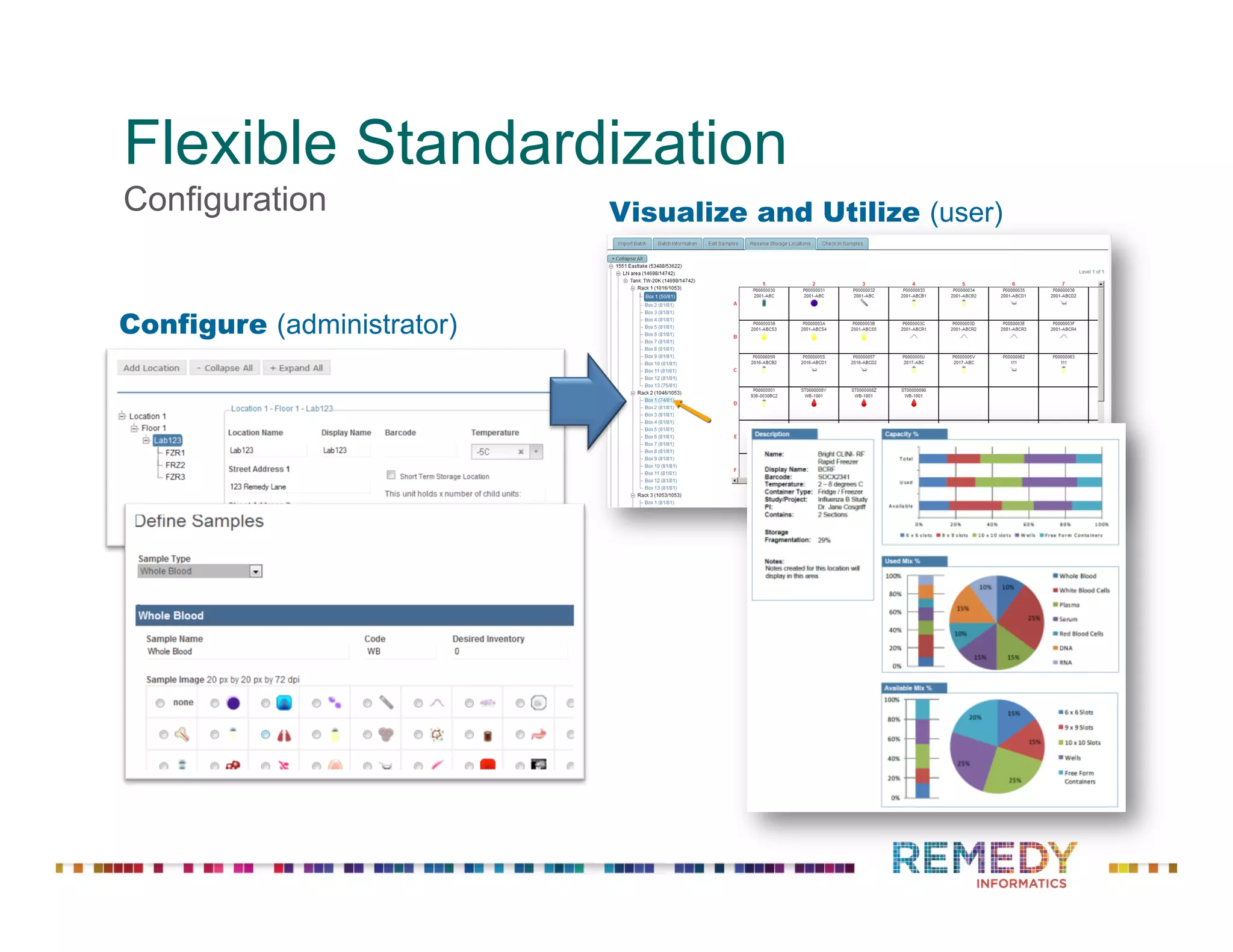
Configuration
Configure (administrator)
Visualize and Utilize (user)
Flexible Standardization
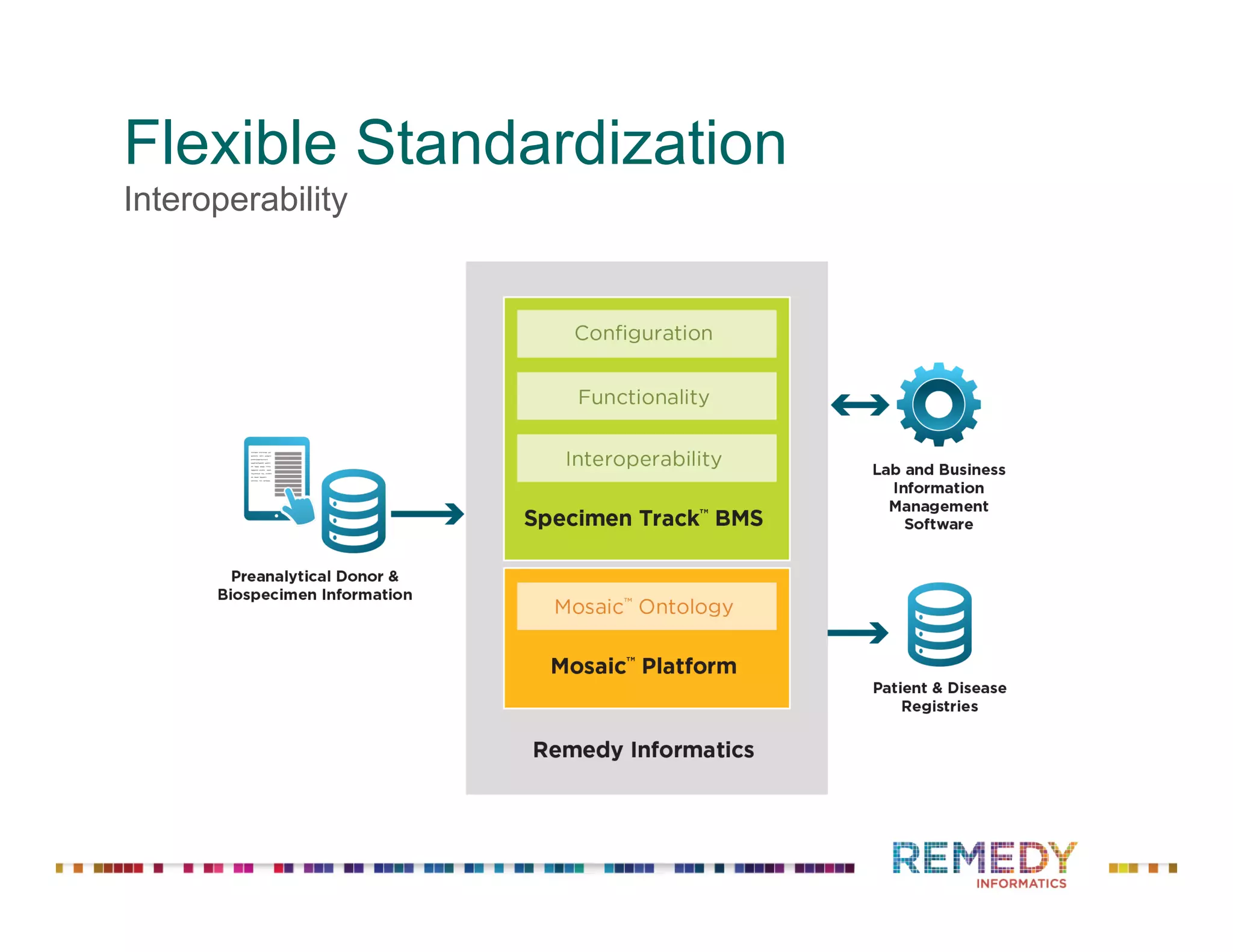
Interoperability
Flexible Standardization
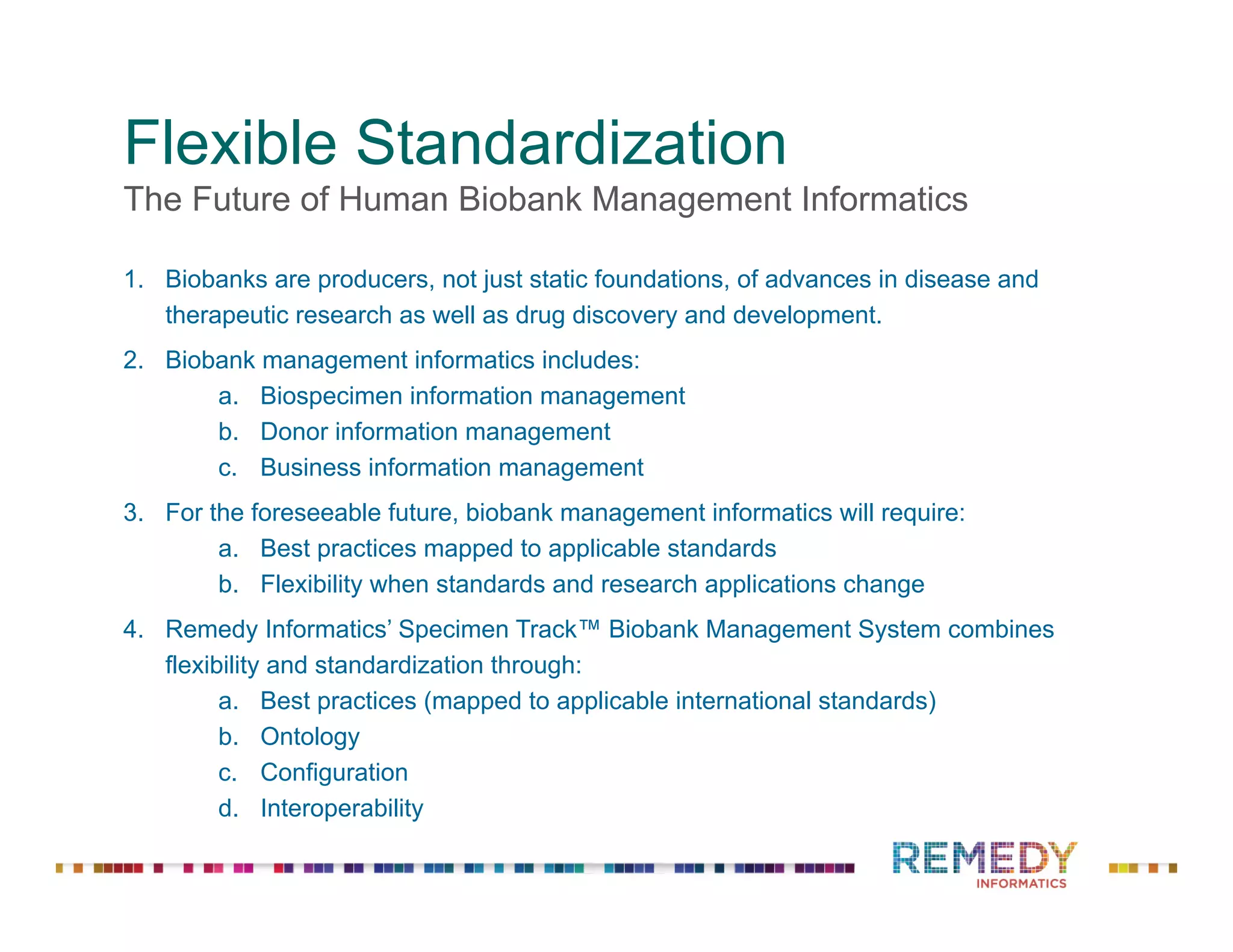
The Future of Human Biobank Management Informatics
1.  Biobanks are producers, not just static foundations, of advances in disease and
therapeutic research as well as drug discovery and development.
2.  Biobank management informatics includes:
a.  Biospecimen information management
b.  Donor information management
c.  Business information management
3.  For the foreseeable future, biobank management informatics will require:
a.  Best practices mapped to applicable standards
b.  Flexibility when standards and research applications change
4.  Remedy Informatics’ Specimen Track™ Biobank Management System combines
flexibility and standardization through:
a.  Best practices (mapped to applicable international standards)
b.  Ontology
c.  Configuration
d.  Interoperability
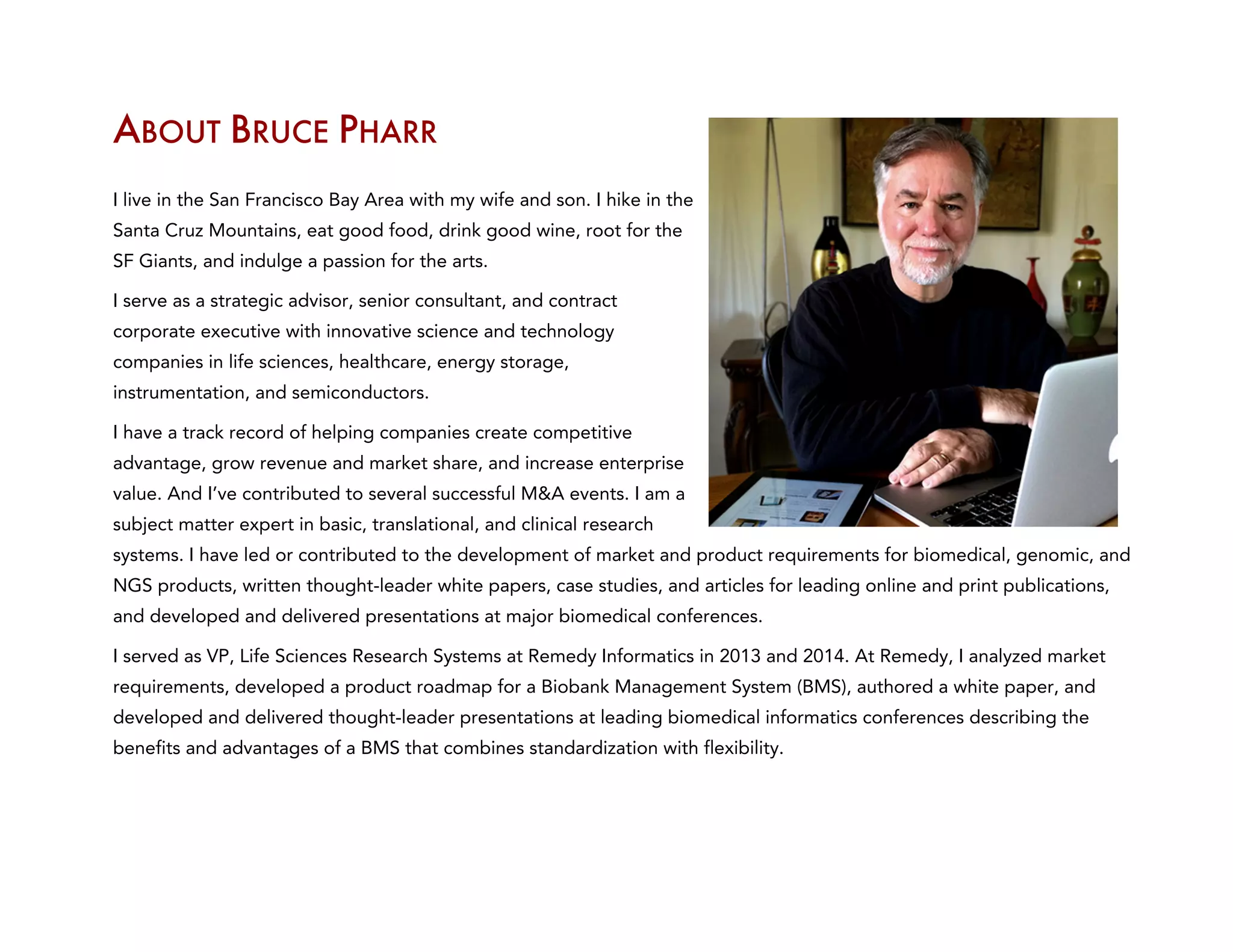
ABOUT BRUCE PHARR
I live in the San Francisco Bay Area with my wife and son. I hike in the
Santa Cruz Mountains, eat good food, drink good wine, root for the
SF Giants, and indulge a passion for the arts.
I serve as a strategic advisor, senior consultant, and contract
corporate executive with innovative science and technology
companies in life sciences, healthcare, energy storage,
instrumentation, and semiconductors.
I have a track record of helping companies create competitive
advantage, grow revenue and market share, and increase enterprise
value. And I’ve contributed to several successful M&A events. I am a
subject matter expert in basic, translational, and clinical research
systems. I have led or contributed to the development of market and product requirements for biomedical, genomic, and
NGS products, written thought-leader white papers, case studies, and articles for leading online and print publications,
and developed and delivered presentations at major biomedical conferences.
I served as VP, Life Sciences Research Systems at Remedy Informatics in 2013 and 2014. At Remedy, I analyzed market
requirements, developed a product roadmap for a Biobank Management System (BMS), authored a white paper, and
developed and delivered thought-leader presentations at leading biomedical informatics conferences describing the
benefits and advantages of a BMS that combines standardization with flexibility.

Flexible Standardization Thought Leader Presentation

  • 1.
      THOUGHT LEADERSHIP © 2015BRUCE PHARR | SCIENCE&TECHNOLOGYMARKETING www.brucepharr.com Flexible Standardization: The Future of Human Biobank Management Informatics
  • 2.
    BACKGROUND   In late2013, I was retained by Remedy Informatics to analyze market requirements and develop a product roadmap for a Biobank Management System (BMS), author a white paper, and develop and deliver thought-leader presentations at leading biomedical informatics conferences. Following is the presentation I delivered at Bio-IT World. It is derived from the white paper, and it describes the benefits and advantages of a BMS that combines standardization with flexibility.
  • 3.
    Flexible Standardization The Futureof Human Biobank Management Informatics   Bruce Pharr | Vice President, Life Sciences Research Systems Bio-IT World Conference | April 30, 2014 1  
  • 4.
    Flexible Standardization Biobank HistoryTimeline Today, biobanks are producers, not just static foundations, of advances in disease and therapeutic research as well as drug discovery and development.
  • 5.
    Flexible Standardization Biospecimen Lifecycleand Biobank Management Informatics Biobank management informatics extends beyond the biobank to include critical pre-analytical data that ensures accurate analytical results and efficient business operations.
  • 6.
    Flexible Standardization Remedy InformaticsBiobank Management System (BMS) Flexibility and standardization of biospecimen, donor, and business information management through: ‒  Best practices (mapped to international standards) ‒  Ontology ‒  Configuration ‒  Interoperability
  • 7.
    Flexible Standardization Remedy InformaticsBiobank Management System Architecture
  • 8.
    Flexible Standardization BMS InternationalStandards (and Regulatory Requirements)
  • 9.
    Flexible Standardization Specimen TrackBMS Requirements Model Mapped to Standards
  • 10.
    Flexible Standardization Harmonized Standardsfor Informed Consent Forms Requirement
  • 11.
    Flexible Standardization Harmonized Standardsfor Security: Log Requirement
  • 12.
    Flexible Standardization Mosaic™ Ontology– Purpose-Specific Structured Data Model ‒  Predefined, Standardized Terminology ‒  Domain-Specific Mapped Relationships ‒  Permissible Values and Validation Rules
  • 13.
    Flexible Standardization Mosaic Ontology– Domain Standards for Terminology
  • 14.
    Flexible Standardization Mosaic Ontology– Predefined, Standardized Terminology
  • 15.
    Flexible Standardization Mosaic Ontology– Domain-Specific Mapped Relationships
  • 16.
    Flexible Standardization Mosaic Ontology– Permissible Values and Validation Rules
  • 17.
    Flexible Standardization Mosaic Ontology– Standardized, Extensible Disease Registries
  • 18.
    Flexible Standardization Specimen TrackBMS Configurable Artifacts
  • 19.
  • 20.
  • 21.
    Flexible Standardization The Futureof Human Biobank Management Informatics 1.  Biobanks are producers, not just static foundations, of advances in disease and therapeutic research as well as drug discovery and development. 2.  Biobank management informatics includes: a.  Biospecimen information management b.  Donor information management c.  Business information management 3.  For the foreseeable future, biobank management informatics will require: a.  Best practices mapped to applicable standards b.  Flexibility when standards and research applications change 4.  Remedy Informatics’ Specimen Track™ Biobank Management System combines flexibility and standardization through: a.  Best practices (mapped to applicable international standards) b.  Ontology c.  Configuration d.  Interoperability
  • 22.
    ABOUT BRUCE PHARR Ilive in the San Francisco Bay Area with my wife and son. I hike in the Santa Cruz Mountains, eat good food, drink good wine, root for the SF Giants, and indulge a passion for the arts. I serve as a strategic advisor, senior consultant, and contract corporate executive with innovative science and technology companies in life sciences, healthcare, energy storage, instrumentation, and semiconductors. I have a track record of helping companies create competitive advantage, grow revenue and market share, and increase enterprise value. And I’ve contributed to several successful M&A events. I am a subject matter expert in basic, translational, and clinical research systems. I have led or contributed to the development of market and product requirements for biomedical, genomic, and NGS products, written thought-leader white papers, case studies, and articles for leading online and print publications, and developed and delivered presentations at major biomedical conferences. I served as VP, Life Sciences Research Systems at Remedy Informatics in 2013 and 2014. At Remedy, I analyzed market requirements, developed a product roadmap for a Biobank Management System (BMS), authored a white paper, and developed and delivered thought-leader presentations at leading biomedical informatics conferences describing the benefits and advantages of a BMS that combines standardization with flexibility.