Process Planning And Cost
Estimation of Flange Coupling
By
Karan Kumar R
192014008
Flanged Coupling
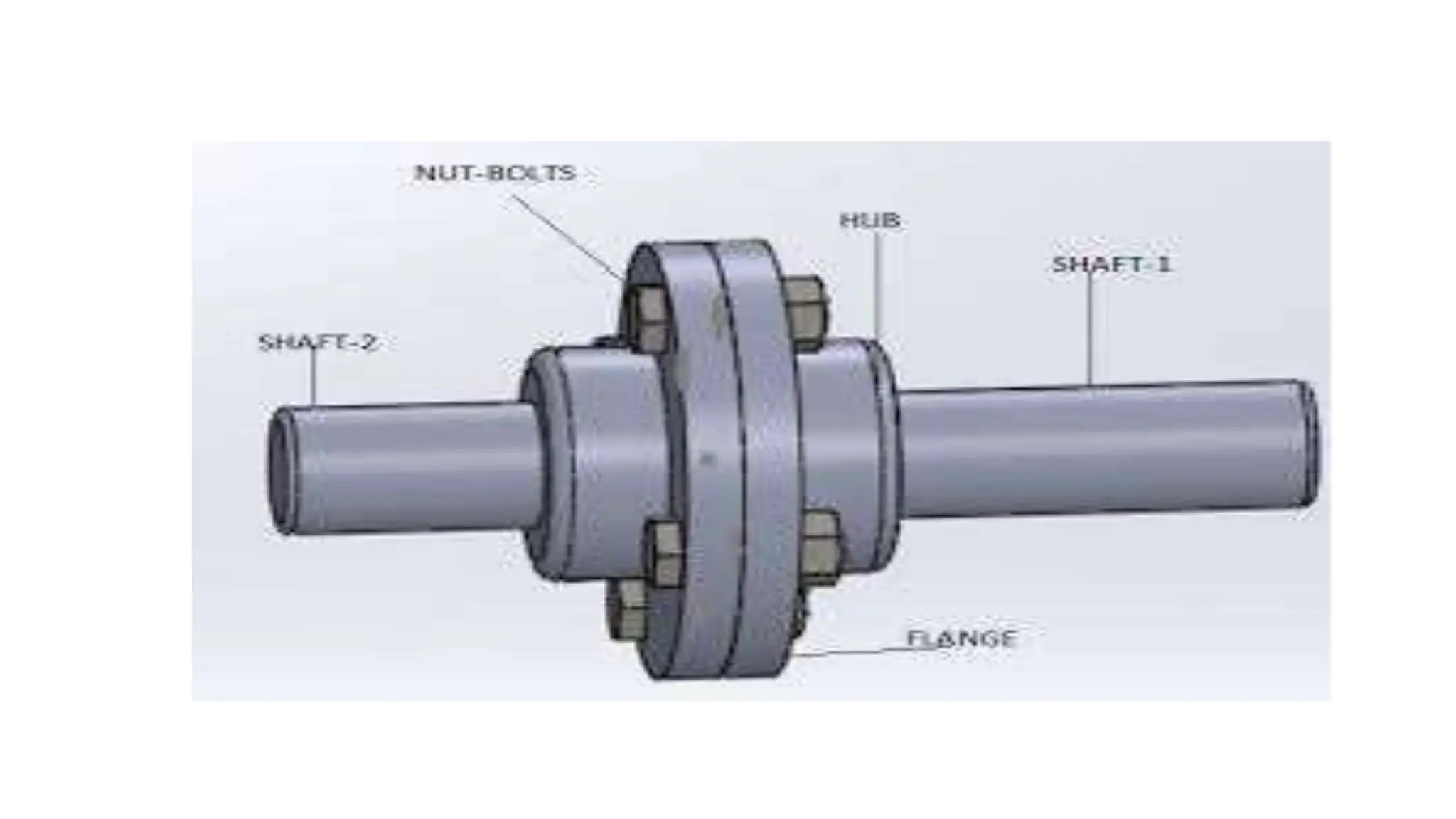
• Flange coupling involves bringing the two tube ends together in a flush,
sealed manner. The two-piece coupling unit consists of a keyed receiving
side for the flanged end to be fastened. The reason being it may be married
to the opposing tube end, which also has a flanged end.
•
• Most flange coupling assemblies have either a female or male coupler
opening so that when the two ends are brought together, they are aligned
without causing drag or resistance in the material being passed through
them. The female or male coupling method also creates a stable
connection, resistant to shifting, keeping the flange coupling sturdily in
place.
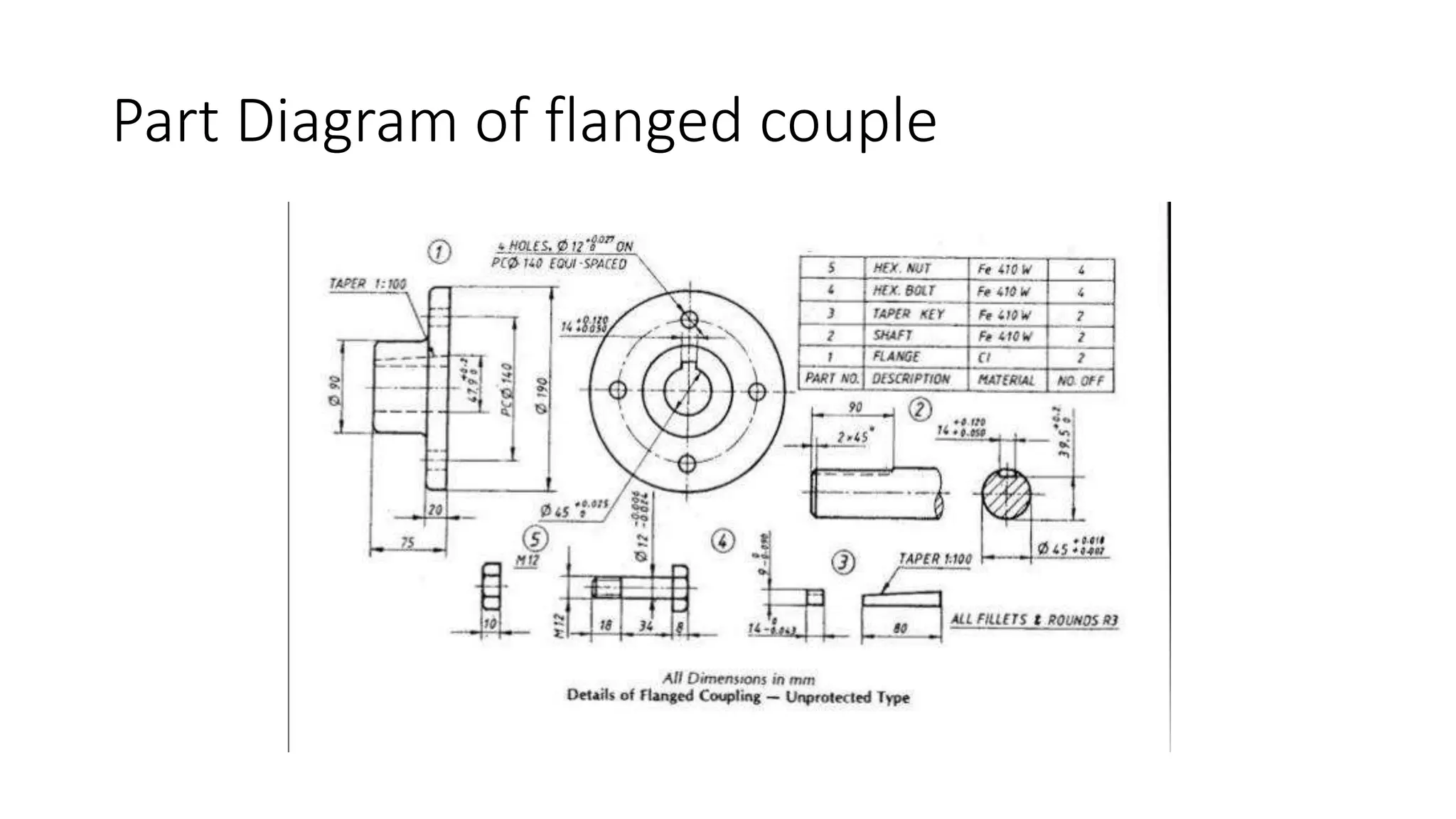
Part Diagram of flanged couple
Hexagonal nut
Process planning
• Hot forging can be defined as “a metal shaping process in which a
malleable metal part, known as a billet or workpiece, is worked to a
predetermined shape by one or more processes such as hammering,
upsetting, pressing and so forth where the workpiece is heated up to
about 75% of its melting temperature”.
• Forging is a manufacturing process involving the shaping of a metal
through hammering, pressing, or rolling. These compressive forces
are delivered with a hammer or die. Forging is often categorized
according to the temperature at which it is performed—cold, warm,
or hot forging. A wide range of metals can be forged.
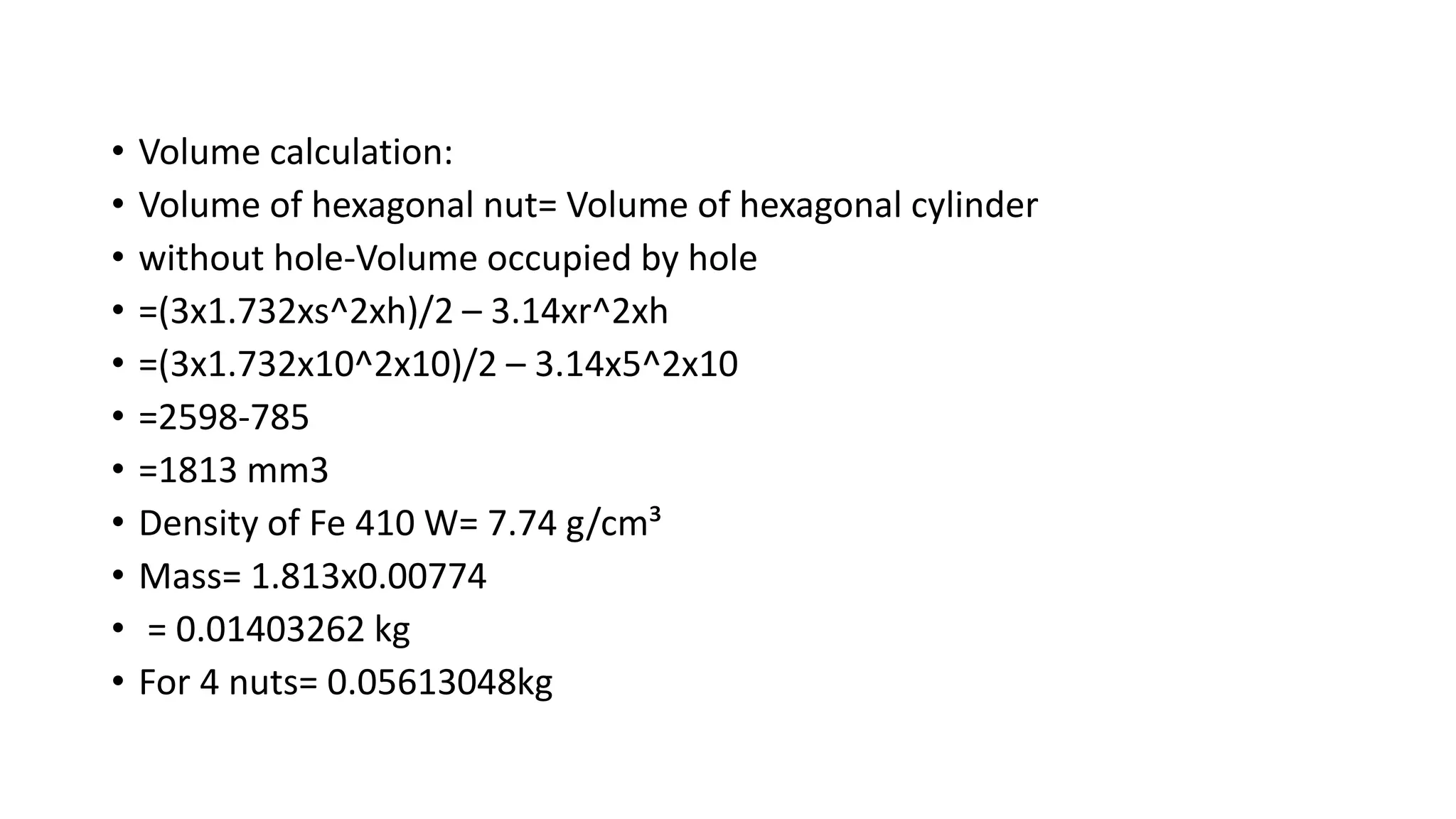
• Volume calculation:
• Volume of hexagonal nut= Volume of hexagonal cylinder
• without hole-Volume occupied by hole
• =(3x1.732xs^2xh)/2 – 3.14xr^2xh
• =(3x1.732x10^2x10)/2 – 3.14x5^2x10
• =2598-785
• =1813 mm3
• Density of Fe 410 W= 7.74 g/cm³
• Mass= 1.813x0.00774
• = 0.01403262 kg
• For 4 nuts= 0.05613048kg
Hexagonal bolt
Process planning
• Hot forging can be defined as “a metal shaping process in which a
malleable metal part, known as a billet or workpiece, is worked to a
predetermined shape by one or more processes such as hammering,
upsetting, pressing and so forth where the workpiece is heated up to
about 75% of its melting temperature”.
• Forging is a manufacturing process involving the shaping of a metal
through hammering, pressing, or rolling. These compressive forces
are delivered with a hammer or die. Forging is often categorized
according to the temperature at which it is performed—cold, warm,
or hot forging. A wide range of metals can be forged.
• Volume Calculation:
• Volume of head= 3.14xr^2xh
• = 1413mm3
• Volume of cylinder= 5878.08 mm3
• Total volume=7291.08 mm3
• Mass = 7.291 x 0.00774
• = 0.05643234kg
Taper key
Process planning
• The keys are given negative tolerance to facilitate the easy assembly.
It works well for the cases when torque transmission is in one
direction only. When, the torque is transmitted with change in
direction, the clearance results in impact and fatigue stresses. This
can be avoided with the help of setscrew placed in the hub at 900
from the key. The key length should not be more to avoid excessive
twisting with shaft deflection. More strength is achieved by using
more number of keys placed at 900.
• Volume Calculation:
• Volume of truncated cone=3.14xh(r^2+rR+R^2)/3
• =8436.13 mm3
• Mass= 8.436 x0.00774
• = 0.06529464 kg
• For 2 keys= 0.13058928 kg
Shaft
Process planning
• The most common process used to manufacture shafts is via CNC turning.
Using this technique, workers or automated processes affix or clamp bars
of materials to chucks and rotate them. While rotating, specialized tools
use cutting and other subtractive processes to create and shape the end
product.
•
• FZE uses many different machining processes to create its shafts. Our
facility houses a wide range of state-of-the-art equipment designed to
optimize even the most complex aspects of the shaft-manufacturing
processes. From custom tooling and fixturing to multi-axis equipment, we
use all types of machinery to produce extremely precise shafts to
tolerances within 0.0002” (0.00508 mm).
• Volume Calculation:
• Volume of cylinder=3.14x r^2xh
• =143066.25 mm3
• Mass= 143.066 x 0.00774
• = 1.10733084 kg
• For 2 shafts= 2.21466168 kg
Flange
Process Planning
• Flanges are manufactured using three main techniques: casting,
cutting from rolled plate material, or forging. No matter the
technique, the basic flange production includes processing raw
materials, then forming them to the appropriate specifications.
Flanges are finished to meet the applicable standards for fit and seal,
then flanges are packaged and shipped to the customer. Here, we
explain the three most common flange manufacturing techniques and
compare the pros and cons of each method.
• Volume of flange= Volume of smaller cylinder +
• Volume of larger cylinder
• Volume of smaller cylinder= 3.14h(R^2-r^2-4r’^2)
• = 525934.3 mm3
• Volume of larger cylinder= 3.14h(R^2-r^2)
• = 262288.125 mm3
• Total volume=788222.425 mm3
• Mass=788.222425 x 0.00784
• = 6.179663812 kg
• For 2 flanges= 12.359327624 kg
Material cost
• Cost of Fe 410 W =Rs. 95/kg
• Total mass= 0.22572936+ 0.05613048+
• 0.13058928+2.21466168
• = 2.6271108 kg
• Cost= 95 x 2.6271108
• =Rs.249.575526
• Cost of Carbon Steel = Rs.90/kg
• Cost = 90 x 12.359327624
• =Rs.1112.33948616
• Total material cost= Rs.1361.91501216
• Total machining time= 25 mins
• Labour cost= 40/hr
• = 0.75 x 40
• = Rs. 16.66
• Metal loss= 5% of total mass
• = 0.05 x 14.986438424
• = 0.7493219212 kg
• Metal loss cost= 0.7493219212 x 90
• = Rs.67.44
• Material cost= Rs.1361.91501216
• Total cost of production= Material cost+ Cost
• of metal lost+ Labour cost
• = Rs.
• 1446.01501216

flanged Coupling.pptx

  • 1.
    Process Planning AndCost Estimation of Flange Coupling By Karan Kumar R 192014008
  • 2.
    Flanged Coupling • Flangecoupling involves bringing the two tube ends together in a flush, sealed manner. The two-piece coupling unit consists of a keyed receiving side for the flanged end to be fastened. The reason being it may be married to the opposing tube end, which also has a flanged end. • • Most flange coupling assemblies have either a female or male coupler opening so that when the two ends are brought together, they are aligned without causing drag or resistance in the material being passed through them. The female or male coupling method also creates a stable connection, resistant to shifting, keeping the flange coupling sturdily in place.
  • 4.
    Part Diagram offlanged couple
  • 5.
  • 6.
    Process planning • Hotforging can be defined as “a metal shaping process in which a malleable metal part, known as a billet or workpiece, is worked to a predetermined shape by one or more processes such as hammering, upsetting, pressing and so forth where the workpiece is heated up to about 75% of its melting temperature”. • Forging is a manufacturing process involving the shaping of a metal through hammering, pressing, or rolling. These compressive forces are delivered with a hammer or die. Forging is often categorized according to the temperature at which it is performed—cold, warm, or hot forging. A wide range of metals can be forged.
  • 7.
    • Volume calculation: •Volume of hexagonal nut= Volume of hexagonal cylinder • without hole-Volume occupied by hole • =(3x1.732xs^2xh)/2 – 3.14xr^2xh • =(3x1.732x10^2x10)/2 – 3.14x5^2x10 • =2598-785 • =1813 mm3 • Density of Fe 410 W= 7.74 g/cm³ • Mass= 1.813x0.00774 • = 0.01403262 kg • For 4 nuts= 0.05613048kg
  • 8.
  • 9.
    Process planning • Hotforging can be defined as “a metal shaping process in which a malleable metal part, known as a billet or workpiece, is worked to a predetermined shape by one or more processes such as hammering, upsetting, pressing and so forth where the workpiece is heated up to about 75% of its melting temperature”. • Forging is a manufacturing process involving the shaping of a metal through hammering, pressing, or rolling. These compressive forces are delivered with a hammer or die. Forging is often categorized according to the temperature at which it is performed—cold, warm, or hot forging. A wide range of metals can be forged.
  • 10.
    • Volume Calculation: •Volume of head= 3.14xr^2xh • = 1413mm3 • Volume of cylinder= 5878.08 mm3 • Total volume=7291.08 mm3 • Mass = 7.291 x 0.00774 • = 0.05643234kg
  • 11.
  • 12.
    Process planning • Thekeys are given negative tolerance to facilitate the easy assembly. It works well for the cases when torque transmission is in one direction only. When, the torque is transmitted with change in direction, the clearance results in impact and fatigue stresses. This can be avoided with the help of setscrew placed in the hub at 900 from the key. The key length should not be more to avoid excessive twisting with shaft deflection. More strength is achieved by using more number of keys placed at 900.
  • 13.
    • Volume Calculation: •Volume of truncated cone=3.14xh(r^2+rR+R^2)/3 • =8436.13 mm3 • Mass= 8.436 x0.00774 • = 0.06529464 kg • For 2 keys= 0.13058928 kg
  • 14.
  • 15.
    Process planning • Themost common process used to manufacture shafts is via CNC turning. Using this technique, workers or automated processes affix or clamp bars of materials to chucks and rotate them. While rotating, specialized tools use cutting and other subtractive processes to create and shape the end product. • • FZE uses many different machining processes to create its shafts. Our facility houses a wide range of state-of-the-art equipment designed to optimize even the most complex aspects of the shaft-manufacturing processes. From custom tooling and fixturing to multi-axis equipment, we use all types of machinery to produce extremely precise shafts to tolerances within 0.0002” (0.00508 mm).
  • 16.
    • Volume Calculation: •Volume of cylinder=3.14x r^2xh • =143066.25 mm3 • Mass= 143.066 x 0.00774 • = 1.10733084 kg • For 2 shafts= 2.21466168 kg
  • 17.
  • 18.
    Process Planning • Flangesare manufactured using three main techniques: casting, cutting from rolled plate material, or forging. No matter the technique, the basic flange production includes processing raw materials, then forming them to the appropriate specifications. Flanges are finished to meet the applicable standards for fit and seal, then flanges are packaged and shipped to the customer. Here, we explain the three most common flange manufacturing techniques and compare the pros and cons of each method.
  • 19.
    • Volume offlange= Volume of smaller cylinder + • Volume of larger cylinder • Volume of smaller cylinder= 3.14h(R^2-r^2-4r’^2) • = 525934.3 mm3 • Volume of larger cylinder= 3.14h(R^2-r^2) • = 262288.125 mm3 • Total volume=788222.425 mm3 • Mass=788.222425 x 0.00784 • = 6.179663812 kg • For 2 flanges= 12.359327624 kg
  • 20.
    Material cost • Costof Fe 410 W =Rs. 95/kg • Total mass= 0.22572936+ 0.05613048+ • 0.13058928+2.21466168 • = 2.6271108 kg • Cost= 95 x 2.6271108 • =Rs.249.575526 • Cost of Carbon Steel = Rs.90/kg • Cost = 90 x 12.359327624 • =Rs.1112.33948616 • Total material cost= Rs.1361.91501216
  • 21.
    • Total machiningtime= 25 mins • Labour cost= 40/hr • = 0.75 x 40 • = Rs. 16.66 • Metal loss= 5% of total mass • = 0.05 x 14.986438424 • = 0.7493219212 kg • Metal loss cost= 0.7493219212 x 90 • = Rs.67.44 • Material cost= Rs.1361.91501216 • Total cost of production= Material cost+ Cost • of metal lost+ Labour cost • = Rs. • 1446.01501216