Fixing Intelligence For A More Secure America William E Odom
Fixing Intelligence For A More Secure America William E Odom
Fixing Intelligence For A More Secure America William E Odom
Fixing Intelligence For A More Secure America William E Odom
Fixing Intelligence For A More Secure America William E Odom
1.
Fixing Intelligence ForA More Secure America
William E Odom download
https://ebookbell.com/product/fixing-intelligence-for-a-more-
secure-america-william-e-odom-50349496
Explore and download more ebooks at ebookbell.com
2.
Here are somerecommended products that we believe you will be
interested in. You can click the link to download.
Fixing The Facts National Security And The Politics Of Intelligence
Joshua Rovner
https://ebookbell.com/product/fixing-the-facts-national-security-and-
the-politics-of-intelligence-joshua-rovner-51939990
Fixing The Facts National Security And The Politics Of Intelligence
Joshua Rovner
https://ebookbell.com/product/fixing-the-facts-national-security-and-
the-politics-of-intelligence-joshua-rovner-10652764
Fixing The Facts National Security And The Politics Of Intelligence
Joshua Rovner
https://ebookbell.com/product/fixing-the-facts-national-security-and-
the-politics-of-intelligence-joshua-rovner-81106074
Fixing Their Heart A Reverseharem Postapocalyptic Romance Men Of Eagle
Peak Book 2 Mira Stanley
https://ebookbell.com/product/fixing-their-heart-a-reverseharem-
postapocalyptic-romance-men-of-eagle-peak-book-2-mira-stanley-48575390
3.
Fixing Broken Cities2nd Edition John Kromer
https://ebookbell.com/product/fixing-broken-cities-2nd-edition-john-
kromer-49113984
Fixing Social Security The Politics Of Reform In A Polarized Age R
Douglas Arnold
https://ebookbell.com/product/fixing-social-security-the-politics-of-
reform-in-a-polarized-age-r-douglas-arnold-50730378
Fixing Frege John P Burgess
https://ebookbell.com/product/fixing-frege-john-p-burgess-50731014
Fixing The Climate Strategies For An Uncertain World Charles F Sabel
David G Victor
https://ebookbell.com/product/fixing-the-climate-strategies-for-an-
uncertain-world-charles-f-sabel-david-g-victor-50731024
Fixing Motorcycles In Postrepair Societies Technology Aesthetics And
Gender Gabriel Jderu
https://ebookbell.com/product/fixing-motorcycles-in-postrepair-
societies-technology-aesthetics-and-gender-gabriel-jderu-51440754
Contents
Preface to theSecond Edition vii
Acknowledgments xi
Introduction xiii
Glossary xxxvi
1
Why Intelligence Reform? 1
2
Essential Dogma and Useful Buzzwords 8
3
Making Dollars Yield Useful Intelligence 53
4
The World of Military Intelligence 89
5
Listening to Learn:Signals Intelligence 115
6
Looking to See:Imagery Intelligence 130
7
Spying to Know:Human Intelligence 142
8
Spying on Spies:Counterintelligence 167
9
Conclusion: What It All Means 185
Appendix
Intelligence Organizations and the Intelligence Process 195
Notes 207
Index 213
v
11.
Preface to theSecond Edition
The public response to this book has been gratifying. Most reviews
have reflected a sound understanding of its analysis and argu-
ments. Many ordinary readers whom I have encountered on radio
and television talk shows since the book was published have shown
serious interest and a solid grasp of the issues.
More important, however, the book captured some attention
in Congress.The Joint Inquiry into Intelligence CommunityActiv-
ities Before and After the Terrorist Attacks of September 11, 2001,
conducted by the two congressional intelligence committees, took
note of many of my points in the book.The joint inquiry’s report of
December 2002 cites several of the arguments I made in testimony
before the two committees. It is thus worth looking at the report’s
recommendations to see whether they reflect my arguments.
First, the bad news. Although the report highlights several of
my assessments of the problems of the FBI in dealing with counter-
intelligence and counterterrorism—the most critical and urgent
areas in need of reform—it stops short of adopting my proposal
that the FBI stick to its primary mission,law enforcement,and give
up its counterintelligence mission to a new,national level,counter-
intelligence service. Rather, the report calls for more pressure on
the FBI to repair its counterintelligence and counterterrorism op-
erations. And it emphasizes better cooperation between the CIA
and the FBI.
This is very disappointing. As readers will see in chapter 8,
“Spying on Spies,” the FBI’s problems cannot be repaired. This is
true for many reasons, but the most persuasive is that the bureau
has two antithetical tasks,counterintelligence and criminal law en-
forcement.An organization can be good at one but never both.
Second, the good news. On the need to reform the structure
vii
12.
for “resource management,”the report’s recommendations are
consistent with most of my other recommendations in the book,
especially those of chapter 3: “Making Dollars Yield Useful Intelli-
gence.” Specifically, the report calls for legislation that changes the
long-standing practice of assigning one person to two jobs at the
same time, Director of Central Intelligence (DCI) and Director of
the CIA. The proposed law would give the DCI a new name, Direc-
tor of National Intelligence (DNI), and make the job independent
of the Director of CIA.
As I explain in the book,this is a much needed change,but by
itself it achieves little. It must be accompanied by several other
changes, especially the realignment of program budget responsi-
bilities within the Intelligence Community. And it requires greatly
improved staff support for the DCI (or DNI) that I spell out in con-
siderable detail in chapter 3.
At first reading,the report’s recommendations do not seem to
go far enough because they do not specify in detail enough of the
structural changes in staff support for the DNI. On a closer read-
ing,however,it becomes clear that the report’s suggestions for what
the DNI must do are impossible unless the DNI makes most of the
changes proposed in chapter 3. There is, then, far more of the sub-
stance of my diagnosis and prescription in the report than initially
meets the eye. If Congress acted on the report’s recommendation
to create a DNI with the responsibilities listed, an incumbent in
that post could implement most of the reforms purposed in chap-
ter 3 of the book.
Whether a new law is needed to make these changes is open
to question. I do not believe it is. It could be done by presidential
executive order, and the DCI could go far in implementing the
changes without an executive order if the president and the secre-
tary of defense support him fully.
viii PREFACE TO THE SECOND EDITION
13.
This is nottrue for reforming counterintelligence. My call for
the creation of a National Counterintelligence Service would re-
quire that Congress pass a law to that effect, at the same time re-
moving the counterintelligence responsibility from the FBI.
Another bit of good news in the report concerns intelligence
support for the new homeland security department. Several pro-
posals have been made for putting either the FBI or the CIA or both
within this department, allowing its secretary to use these agencies
for collecting all the intelligence it needs.Although I do not address
the new Homeland Security Department directly, the principles
outlined in Fixing Intelligence for providing intelligence to all de-
partments—not only Defense but also State, Treasury, Energy, and
others—are consistent with the thinking in the report. The report
recommends that an intelligence analysis and production organi-
zation be created within the Homeland Security Department that
can task the Intelligence Community to collect intelligence for its
analysis and distribution to users within its various operational
agencies. This is precisely how intelligence support is provided to
the State Department, Treasury, and others. And it makes very
good sense for the Homeland Security Department.
Are any of these changes likely to be made? It is too early to
tell.A commission on intelligence reform is at work as of this writ-
ing, in fall 2003. Unless that commission repeats or improves the
recommendations of the report based on the joint inquiry,nothing
will happen soon. Even if the commission makes sound recom-
mendations, the prospects for reform will remain uncertain, albeit
slightly improved.For reform to occur,the president himself has to
take the lead.
Thus far President Bush has been adamantly opposed to in-
telligence reform.He might change his mind,however,as he did on
homeland security. He initially opposed the creation of the Home-
PREFACE TO THE SECOND EDITION ix
14.
land Security Departmentbut then suddenly became its cham-
pion, advocating a much larger and more sweeping reform than
any of the several proposals being considered in Congress.
The president seems unlikely, however, to grab the banner of
intelligence reform and make it his own unless Congress convinces
him—as it did in homeland security—that it will seize the initia-
tive if he does not. Failing leadership from either branch, the next
impetus for reform may have to await another gross intelligence
failure—perhaps another terrorist attack—that has disastrous
consequences for the United States.
Intelligence reform is by no means a panacea. It can be over-
sold.Noorganizationalstructure,nomatterhowrationallydesigned
and potentially efficient, can overcome incompetent leadership and
poor judgment. At the same time, dysfunctional organizational
structure can prevent even the most competent and gifted leaders
from making organizations perform effectively.
On its own,this book will not and cannot prompt reform.But
it can encourage two important steps toward that reform. First, it
can enable readers to judge for themselves whether intelligence re-
form is actually needed; second, it can give them the standards to
determine whether proposed reforms hold promise for genuine
improvement or are only cosmetic, even counterproductive. In
short, the goal of this second edition is to empower more Ameri-
cans to understand the intelligence reform issues and to think
clearly about them.
x PREFACE TO THE SECOND EDITION
15.
Acknowledgments
Jonathan Brent, theeditorial director of the Yale University Press,
caused this book to be written. My interest in the topic, fairly in-
tense in the early 1990s, had flagged. Jonathan revived it in the af-
termath of 11 September 2001, insisting that the issues of intelli-
gence reform could be made accessible to a wide reading public. I
had always been skeptical, but he prevailed, and I decided to try.
If I have succeeded, Dan Heaton, the manuscript editor, de-
serves much of the credit. He waged a relentless war against acro-
nyms and bureaucratic jargon, winning battle after battle.
The original study on which the book is based owes a lot to
Bernard C.Victory, the manuscript editor at the National Institute
of Public Policy and my executive assistant who supported the
study group.
My biggest debt is to the hundreds of intelligence profession-
als, officers and enlisted, civilians from the lowest to the highest
ranks, who have taught me how U.S. intelligence operations work.
Their competence and courage cannot be exaggerated.
xi
17.
Introduction
This book dealswith a timely though unpopular topic,intelligence
reform. Some members of the Senate gave public attention to re-
form in the late 1980s and early 1990s, but then their colleagues
legislated a presidential commission to investigate the matter. Like
most other presidential commissions,its sponsors wanted it to jus-
tify the status quo and silence the proponents of reform. They suc-
ceeded. Commissions on the National Reconnaissance Office and
the National Imagery Agency in 2000–2001 did the same thing
in spite of abundant evidence that both needed fundamental
changes.
In the aftermath of the events of 11 September 2001, de-
mands for reform began to be taken more seriously. The executive
branch remained opposed to change, but public voices and mem-
bers of Congress were objecting to “business as usual” in light of
the greatest intelligence failure since Pearl Harbor. The president’s
sudden reversal on homeland defense, however—initially oppos-
ing a new border control department but then sending draft legis-
lation to Congress for a vastly more complex reorganization, a
homeland security department—has complicated the intelligence
reform issue, thrusting it to the fore, then deferring it until after
creation of this new department.
All of this congressional and presidential maneuvering must
not obscure the undeniable: whether to reform U.S. intelligence is
no longer the question. Responsible leaders and legislators must
now cease their bickering and ask,“What reforms make sense? Will
they be effective?”
This book,based in large part on a study published by the Na-
tional Institute of Public Policy in 1997, should help answer such
difficult questions and make it possible for nonexpert observers to
distinguish between sense and nonsense in the debate. Moreover,
xiii
18.
the recommendations thatfollow offer yardsticks for assessing any
changes that Congress or the executive branch may make.
That this has been made possible for nonexperts does not
mean that it has been made easy for them.Both the diagnosis of the
Intelligence Community’s ills and the prescriptions for their cures
involve technical language. With the able assistance and prodding
of my editors at Yale University Press, however, I have fought a war
against acronyms and buzzwords to strip away much of the arcane
terminology.Thanks largely to their persistence,I believe the text is
reasonably accessible.
The novices and other“lay”readers should know that they are
not alone in their ignorance of the labyrinth of U.S.intelligence or-
ganizations and activities.Most officials in the intelligence“clergy”
are equally clueless but reluctant to admit it. Compartmental-
ization of organizations and programs—designed to limit knowl-
edge of them and prevent their discovery by hostile intelligence
services—makes it possible for a career intelligence official to re-
main ill-informed, often totally ignorant, of the operations of
other offices within his own agency, not to mention the workings
of other intelligence agencies throughout the U.S. government.
They are like workers in a network of mineshafts, tunnels, and un-
derground caverns.
Rare is the senior intelligence officer who has the overall pic-
ture. Moreover, many of them do not even understand their own
mineshaft very well because they have grown up in some small tun-
nel within it. This is understandable when we realize how diverse
and alien various intelligence skills and activities can be. Case offi-
cers who recruit spies abroad need the skills of a“con artist.” Code
breakers need to be world-class mathematicians. Between these
two extremes are many other required skills that do not mix well,
that cultivate different and incompatible cultures.
Talk about reform among senior intelligence officers, there-
xiv INTRODUCTION
19.
fore, tends tobe either incoherent babble or designed to mislead
others in order to protect one’s parochial organizational interests.
With some effort, however, both kinds of facades can be stripped
away because the structural arrangements they conceal are not se-
cret. They can be learned from numerous unclassified documents.
Nor are the basic processes of the intelligence collection, analysis,
and distribution a secret. A clear understanding is publicly avail-
able. Moreover, the original study on which this book is based was
cleared for publication by the CIA. My purpose here is to make in-
telligence clear to anyone who truly wants to understand it,includ-
ing intelligence professionals.
Today’s Reform Efforts: What Is at Stake
The events of 11 September 2001 cast a dark shadow over the Intel-
ligence Community. Why was there no intelligence available to
warn of the Qaeda attacks on the World Trade Center and the Pen-
tagon? No intelligence failure since December 1941 has been as
great. Going back to the events leading up to the attack on Pearl
Harbor is instructive today. Neither naval nor army intelligence
had warned of an imminent Japanese threat in fall 1941.One of the
major reasons given for the creation of the Central Intelligence
Agency (CIA) in 1947 was to prevent “another Pearl Harbor.” But
in June 1950 the CIA failed to warn of North Korea’s attack on
South Korea. Once again, the United States found itself at war and
ill-prepared to fight.
Are there any lessons here for how the United States should
respond to its most recent intelligence failure? Indeed there are,but
it is easy to learn a false lesson—namely, that reorganizing intelli-
gence makes no sense because it did not prevent an earlier intel-
ligence failure. In fact, reorganization made sense in spite of the
failure. The proper lesson is that there are no easy fixes, that the
INTRODUCTION xv
20.
xvi INTRODUCTION
problems arecomplex and structural, and that they cannot be re-
duced to television sound bites. This point becomes more com-
pelling if we take a moment to understand why it would have been
irresponsible not to have made the 1947 reforms.
Neither the army nor the navy had an effective intelligence
system before World War II, although the War Department had
created a rather successful signals intelligence unit during World
War I. Known by insiders as American Black Chamber, after the
war it was jointly funded by the War and State Departments, per-
forming some remarkable code-breaking feats until Henry Stim-
son became secretary of state in 1929. Briefed on its activities, he
ordered it closed because “gentlemen do not open other gentle-
men’s mail.” The Black Chamber had deciphered Japanese diplo-
matic codes during World War I, allowing it to intercept Tokyo’s
guidance to its diplomats at the Washington Naval Conference af-
ter the war, an advantage U.S. negotiators exploited. The Black
Chamber’s closure forced its former head into the jobless ranks of
the Great Depression. Remarkably talented, this card shark, code
breaker, and journalist promptly wrote a book recounting the
Black Chamber’s many feats.1 It was a commercial success, espe-
cially in Japan, prompting that government to change its codes.
Not until the beginning of World War II did American signals in-
telligence (which Stimson was not in a position to disband) begin
to break some of the new ones—but not the right ones and not in
time to anticipate the attack on Pearl Harbor. The country had
been cruelly served by Stimson’s decision.
Military and naval attachés were the only other intelligence
collectors of note in either department. Into this yawning gap in
military intelligence stepped William O. Donovan, who, having
used his access to President Roosevelt to press for some kind of
civilian intelligence capability outside the military departments
21.
INTRODUCTION xvii
and workingdirectly for the president, was allowed to create the
Office of the Coordinator of Information (COI) in June 1941.2 A
winner of the Congressional Medal of Honor and the Distin-
guished Service Cross in World War I, Donovan was a hero as well
as the head of a very successful NewYork law firm.He used his con-
siderable reputation and political connections to overcome the op-
position of the military departments to this new entity, but as its
first director, he was unable to assert control of the army and navy
intelligence capabilities.A new round of bureaucratic struggles fol-
lowed the outbreak of war six months later, leading to transforma-
tion of the COI into the Office of Strategic Services (OSS) in June
1942. This time, Donovan compromised with the military depart-
ments,placing the OSS nominally under the Joint Chiefs.Donovan
took command of it as a colonel and was subsequently promoted
to brigadier and major general.Although its personnel were in uni-
form and held military ranks, the OSS was not subject to military
direction of its internal organization and personnel policies. The
Joint Chiefs finally gave it official responsibility for sabotage, espi-
onage,counterespionage,and covert action in December 1942,but
Donovan was already doing some of these things by that time. Al-
though the COI carried over as the Research and Analysis division
and remained the heart of the new organization’s Washington cen-
ter, the OSS soon was acting as much like the forerunner of today’s
U.S. Army Special Forces—the Green Berets—as it was operating
as an intelligence organization. Donovan was most fascinated by
working with resistance groups within German-occupied territory
and conducting daring raids, not by passive intelligence collection.
Still, with the help of such operatives as Allen Dulles and Richard
Helms he built an espionage service that was to endure beyond the
OSS’s brief existence to become the CIA’s clandestine service. The
Research and Analysis section,led by William L.Langer of Harvard
22.
University and includinga number of distinguished university
professors who answered Donovan’s call in 1941–42, also survived
as the Directorate of Intelligence in the CIA.
But Donovan was not able to absorb signals intelligence. The
navy’s code breakers were breaking some Japanese naval crypto-
systems by 1940 and improved as the war spread into the western
Pacific. The army’s revitalized code breakers—at Arlington Hall
in northernVirginia,where they compiled the now famousVenona
decryptions of Soviet agent activities, and with the British at
Bletchley Park, where they produced the Ultra intercepts of Ger-
man communications throughout the war—remained in the War
Department. Aerial photography, what would later be known as
imagery intelligence, remained primarily within the army air
corps, but the OSS had a hand in it.
Nor was Donovan able to absorb all responsibilities and oper-
ations in counterintelligence—that is, intelligence designed to un-
cover hostile intelligence operations against the United States. On
the domestic front, the Federal Bureau of Investigation (FBI) had
that responsibility but proved no match for Soviet espionage
agents and the Communist Party of the United States.Many Soviet
spies duped the FBI, the OSS, and every other counterintelligence
effort during and after the war. Abroad, the army’s Counterintelli-
gence Corps was active in Europe and Japan, where it clashed over
turf with the successor to the OSS, the Central Intelligence Agency.
Thus the counterintelligence field was weak and increasingly frag-
mented during and after the war.
As the war came to an end, Donovan again tried to persuade
the president,now Harry Truman,to maintain a centralized peace-
time intelligence organization above the military departments, di-
rectly under the White House. He lost the bureaucratic battle and
resigned. Truman abolished the OSS in September 1945. Seeing
that the postwar period might not be peaceful, Truman created the
xviii INTRODUCTION
23.
Central Intelligence Group(CIG) in January 1946 as a temporary
organization to hold the personnel from the OSS while a review
was made of the entire national security apparatus.
The CIG allowed the strong network of OSS veterans to
maintain its coherence, but it never gained significant authority or
control over the FBI and the military service intelligence chiefs.
When the Congress finally decided to pass the National Security
Act of 1947, merging the Navy and War Departments into the De-
fense Department, OSS alumni got the chance to establish them-
selves permanently in a civilian organization outside of the mili-
tary. The new law created the Central Intelligence Agency.
The 1947 act also created a director of central intelligence
(DCI). This position is distinct from the director of the CIA, but in
practice one person has always worn both hats. If there was going
to be anything like central management of intelligence, a DCI was
necessary because signals intelligence, aerial photographic intelli-
gence, large analysis capabilities, and even larger tactical intelli-
gence capabilities within the military services remained in the
newly created Defense Department. If the CIA could not “own”
these capabilities, then its director, wearing his DCI hat, could at
least manage them. In other words, the CIA was a relatively small
part of the larger intelligence services within the armed forces,
cocky about its superiority, but insecure because it controlled so
few of the resources dedicated to intelligence in the Defense De-
partment and elsewhere.
Double-hatting the director of central intelligence as the di-
rector of the CIA limited his ability to stand above and orchestrate
the whole intelligence community.Instead,he became the prisoner
of the CIA and shared its insecurity about control over other agen-
cies’ resources and turf. Periodically, DCIs have risen above those
restraints to assert a stronger role in allocating resources efficiently
and imposing coordination in place of turf wars, but that pattern
INTRODUCTION xix
24.
has never beeninstitutionalized. In the intelligence community,
there is an old saying about the CIA: before it recruits any spies
abroad,it must“recruit the DCI,”ensuring that he works primarily
for its interests.
A few other changes soon followed, most designed to meet
particular demands, not part of an overall design of the Intelli-
gence Community. The three military departments in the Defense
Department were forced to combine their signals intelligence un-
der the National Security Agency in 1952. In 1960 President Eisen-
hower created the National Reconnaissance Office, jointly oper-
ated by the CIA and the air force, as a research and development
organization with great fiscal flexibility to carry out innovative de-
velopment, and procurement of technical collection capabilities. It
was to produce many important technological advances for tech-
nical intelligence collection, especially satellite-based systems. Fi-
nally, the Defense Intelligence Agency was created within the De-
fense Department in 1961.
The CIA itself underwent a great deal of change soon after its
creation in 1947. Its clandestine service had to be transformed into
a peacetime organization and its efforts expanded into many new
areas of the world. Langer’s Research and Analysis unit became the
CIA analysis and production arm. Langer, however, returned to
Harvard, leaving Sherman Kent, a professor from Yale, as head of
analysis and production.Kent developed a system of national intel-
ligence estimates that continues today. Other branches of the CIA
were created to conduct covert operations ranging from propa-
ganda to paramilitary operations, a restoration of the OSS tradi-
tions from World War II.
Since that time, the Intelligence Community has remained
essentially unchanged in its general outlines. The director of cen-
tral intelligence had presided over allocation of the resources for all
parts of the community, consolidated intelligence needs from all
xx INTRODUCTION
25.
government agencies, andsponsored the production of so-called
national intelligence in the form of estimates, the lineal descen-
dants of analysis produced by the Office of National Estimates.
This very brief story of the intelligence restructuring in 1947
and after should make clear (if, indeed, one can ever be “clear”
about intelligence!) the stakes in intelligence reform today.
Given the intelligence void existing in 1941, extraordinary
measures, including reorganization, were essential. By the end of
the war U.S. intelligence was becoming reasonably effective in sev-
eral areas.Had the OSS been left within the new Department of the
Army, it would have soon fallen into neglect. The old War Depart-
ment had direct access to the White House. Submerged under the
new secretary of the army,who is in turn submerged under the sec-
retary of defense, intelligence would have received neither the at-
tention nor the resources it did under the director of central intel-
ligence. Although the CIA failed to anticipate the North Korean
attack in 1950, the reorganization yielded major positive results.
But reorganization opened the way to all kinds of new turf
wars and bureaucratic struggles by creating a veritable thicket of
new intelligence organizations.And it left counterintelligence even
more fragmented,with the FBI retaining the dominant but entirely
separate domestic counterintelligence role. Thus many of today’s
problems can be traced back to the reforms under the 1947 Na-
tional Security Act.
Both military reorganization and intelligence reform were
legislated in 1947.Today,intelligence reform is once again being se-
riously considered at the same time that homeland security reorga-
nization is being designed. In 1947, however, the most prominent
intelligence organization was struggling to escape from its cabinet
department’s control. Today, it and the FBI are struggling to avoid
being subsumed under a homeland security department.Although
there were good arguments for and against creating an indepen-
INTRODUCTION xxi
26.
dent CIA, thearguments for it look fully justified in retrospect,
notwithstanding the resulting turf wars and misuse of resources.
Similarly, good arguments can be made for giving homeland secu-
rity its own intelligence collection and analysis capability, but
when we consider the implications of that approach for the effec-
tiveness of the Intelligence Community, the better arguments are
against doing so.
The Intelligence Community itself, as in 1947, desperately
needs its own structural reforms. They must be done separately
from homeland security reorganization, however, or dysfunctions
will be increased, not reduced. At the same time, proper intelli-
gence support to a homeland security department has to be pro-
vided.The Intelligence Community,especially a reformed one,can
do this. Putting the FBI and CIA into the homeland security de-
partment initially sounds sensible, but once we understand how
the Intelligence Community works, we see that such a move would
create an impossible mess.
A great deal is at stake today, not just in intelligence reform
but also in homeland security reform.The clearer our understand-
ing of the tangled issues of intelligence reform,the fewer will be the
unintended consequences. And the price of those consequences
could be very high.
“Intelligence Reform for Dummies”
A series of computer software instruction manuals with the titles
ending in“. . . for Dummies”has become popular among nontech-
nical computer users, and the concept has now spread to other
fields.The arcane language used in the intelligence community can
make the uninitiated feel—some would say is designed to make the
uninitiated feel—like dummies, but the concepts can be grasped
by any educated adult. One aim of this book is to cut through the
xxii INTRODUCTION
27.
“dummy” factor—the smokescreenof specialized language that
keeps outsiders from thinking that they have any business talking
about intelligence reform.
Chapter 1 is a more complete version of several of the points
made in this introduction. Most careful readers will understand it
easily, and to the extent that they do, they will find later sections
easier going.
We come to the real substance of reform in Chapter 2.There I
methodically clarify intelligence terminology so that people talk-
ing about intelligence reform will find it difficult to mislead or talk
past each other. Think of it as a Berlitz course in “intel speak.” The
bane of the confused language problem in the Intelligence Com-
munity can hardly be exaggerated.
Take,for example,the term security, a word that may seem too
simple to require clarification. Its meaning, however, can be dis-
torted to cause inordinate mischief. Some would-be experts insist
that security is counterintelligence—if not the whole of it, then a
key part of it. From that article of faith, these canon lawyers reason
that counterintelligence organizations are responsible for all secu-
rity against foreign intelligence—that is,keeping spies or terrorists
out of U.S. organizations and territory. Counterintelligence offi-
cials must“protect our secrets,”every one of them! To do that, they
must decide what is secret, and they must have the authority to or-
der or direct cabinet officials—the secretary of state and the secre-
tary of defense—to follow their security rules. Such rules include
the hiring and firing of people with security clearances, the con-
struction and management of buildings,and so on,to prevent hos-
tile intelligence penetrations.
It may surprise intelligence officers, but cabinet secretaries,
military commanders,and civil service line managers are not a ven-
triloquist’s wooden dummies; they will not play Charlie McCarthy
to the Edgar Bergen of low-ranking (or high-ranking) counterin-
INTRODUCTION xxiii
28.
telligence officers. Linemanagers from cabinet level downward are
normally pleased to receive counterintelligence products, but they
reserve the right to act on them as they see fit.
This problem is not just theoretical. In the 1980s, when the
newly built American embassy building in Moscow was discovered
to be saturated with Soviet listening devices, Secretary of State
George Shultz was reluctant to take the full range of security mea-
sures needed to neutralize the devices. He was no more enthusias-
tic about personnel changes and other security measures needed to
prevent new penetrations once the building had been cleansed of
devices.
At this point the definition of security became pivotal.Several
officials in the intelligence community who believed that security
is the core of counterintelligence insisted that it was their duty to
“force State to clean up its act.” Even if one fully agrees that Shultz
should have been forced to take the penetrations more seriously, it
certainly was not—and should not be—within the power of the
intelligence community to force him to do so. He worked for the
president,not for counterintelligence officials.If he wanted the So-
viet KGB to read his mail, that was his choice, not theirs. Only the
president, who hired the secretary, could deny him that choice.
Only the president was in a position to “force State to clean up its
act”over the secretary’s objections.
In the event, the president, urged by a couple of other cabinet
officers, insisted that Shultz take some actions. He begrudgingly
did, but not very effective ones. The most that good counterintel-
ligence can achieve is to show presidents, cabinet officials, and
lower-level line managers that they have been penetrated by hostile
intelligence. They cannot implement effective security measures
against penetrations. But simple definitional disputes, as this case
shows,can become the basis for all kinds of bureaucratic wrath and
infighting. A detached observer at the time would have been justi-
xxiv INTRODUCTION
29.
fied in wonderingwhether Shultz did not prefer to let the Soviet
KGB read his mail rather than yield a bureaucratic victory to Secre-
tary of Defense Caspar Weinberger and a covey of counterintelli-
gence officials in his department.
The security dispute is alive and well today among propo-
nents of counterintelligence reform. Several have long argued that
security should be the responsibility of the counterintelligence or-
ganizations, primarily the FBI. This would give the FBI powers
over the president that even the Congress and the Supreme Court
do not have! Such proposals reveal a lack of appreciation for basic
organizational and management principles, a shortcoming that
could produce very messy organizational predicaments in a new
homeland security department.
Collection management is another term saturated with defini-
tional problems. It simply means directing the collection of intelli-
gence.At the most general level,it means assigning questions to in-
telligence collection agencies to answer.Or it can be more assertive,
amounting to orders to those agencies. At some point collection
management becomes telling which spy to collect what, which
satellite to take a picture of what, and so on. It also involves decid-
ing whose requests for intelligence will be served first, whose will
be second, and whose may not be answered at all for lack of collec-
tion capabilities. It is very much like what editors of newspapers
and television news channels do in assigning journalists to stories
and deciding which ones are published and on what page in the pa-
per or in which segment of the TV broadcast.
To many senior intelligence analysts, the distinctions are not
clear between making requests for collection and “directing” col-
lection when it requires highly technical guidance and instruc-
tions. The complexities of collection management are lost on
them. Intelligence analysis centers understandably want to control
collection management. At some level they should, but does that
INTRODUCTION xxv
30.
empower them tohold a list of the CIA’s deep cover agents and to
know where they are so that these intelligence analysts can manage
their collection of information to fit the analysts’ demands? Or
does it mean that such analysts must be able to direct satellites?
Some of them have insisted that it does.
Obviously, the CIA’s Directorate of Operations has good rea-
sons not to allow analysts throughout the Intelligence Community
to hold lists of its agents. As for directing satellites and other tech-
nical collection means, general intelligence analysts are no more
capable of doing so than the average reader of this text. Technical
collection management of many such systems requires great exper-
tise and experience,but that has not always deterred senior analysts
with degrees in the social sciences from insisting that they can han-
dle the task.
The confusion does not stop here.Because intelligence analy-
sis is done in hundreds of places in the military and in civilian
agencies, which analysts will get priority in collection manage-
ment? CIA analysts will insist that they have first priority because
they are “central”—they work for the White House. The military
commander involved in a battle with Taliban forces in Afghanistan
could legitimately dispute that claim.Such cases are not imaginary.
Senior officials in intelligence analysis have repeatedly tried to grab
full control of collection management, denying the military com-
mander even a hearing for his claim on collection capabilities.
Field commanders have on occasion been equally determined that
they should have first priority in all cases. Obviously neither the
CIA analysts nor a regional military commander is in a position to
determine whose demands should be met first from a global view-
point. It is possible, however, with effectively designed organiza-
tional processes and authorities—that is, “doctrine”—for the In-
telligence Community to decide, based on senior policy-makers’
guidance, whose requests should be met first.
xxvi INTRODUCTION
31.
The definitions inchapter 2 may therefore seem elementary,
but the implications go well beyond the obvious. In the allocation
of people and budgets, for example, small definitional distinctions
can mean billion-dollar differences.
Chapter 3 makes it clear that the Central Intelligence Agency
is not the same thing as the Intelligence Community. The CIA may
be “central,” but it is neither the center of the intelligence commu-
nity nor a large part of it.
I also clarify in that chapter what the director of central intel-
ligence (DCI) really is and what the position could and should be.
When members of the intelligence oversight committees in the
Congress become frustrated by the“federal,”or“confederal,”char-
acter of the Intelligence Community, they sometimes call for a
“tsar,” a “director of national intelligence” who is “really in charge
of all intelligence.”In chapter 2 I show that such a position already
exists—the DCI—but then explain why the DCI can never be fully
in charge of intelligence without creating pandemonium in De-
fense,State,and several other departments.Were the DCI given full
executive authority over the National Security Agency (NSA) and
the National Imagery and Mapping Agency, two large intelligence
organizations within the Department of Defense, the military ser-
vices would withdraw their military personnel from both (more
than two-thirds of the total in the NSA) and duplicate these orga-
nizations within their own ranks.
In short, it would make more sense to put the CIA in the De-
partment of Defense than to take these large intelligence agencies
out and put them entirely under the DCI’s administration.
The DCI could, however, give up his hat as the director of the
CIA and begin to act like the monarch of a federal intelligence
community,an unprecedented arrangement that urgently needs to
be tried.Until it is,large and long-standing inefficiencies in the use
of funds for technical intelligence means cannot be overcome. The
INTRODUCTION xxvii
32.
potential savings werein the billions of dollars in the 1980s and
1990s. Today they are probably somewhat less because overall
spending on satellite systems and other technical means has de-
clined.
Chapter 4 deals with intelligence inside the Pentagon. Three
clear messages should be taken from it:
First, almost the entirety of the national intelligence commu-
nity can be brought to bear in support of U.S. military forces in
wartime. Often, however, the intelligence community is not ex-
ploited in this way, because the CIA does not like to be subordi-
nated to regional military commanders during a war. A flurry of
publicity was given in the early period of the war in Afghanistan to
the CIA’s brilliant performance in providing intelligence about en-
emy operations. Several months later, however, reports began to
surface about the problems the CIA was causing by operating on its
own in Afghanistan and how it failed as often as it succeeded in
linking up U.S. Green Beret units with Afghan anti-Taliban forces.
The whole story has still not been told, and we cannot be sure
which version is closer to the truth.We do know,however,that dur-
ing the Persian Gulf War the CIA disappointed and irritated Gen-
eral Schwarzkopf, the theater commander in that conflict.
Second,the military needs two quite different types of intelli-
gence support. Field commanders need timely intelligence about
enemy operations, the kind that the CIA gave U.S. forces in Af-
ghanistan. Over the past two decades, great improvements have
been made in providing this kind of intelligence support,especially
signals and imagery intelligence. Both the Gulf War and the war in
Afghanistan show that trend.
Another kind of intelligence is needed to support the design
of U.S. military weapons and organizations. Aircraft designers
must know in voluminous detail about all foreign air defense sys-
tems because U.S. aircraft may have to fly against them. Tank gun
xxviii INTRODUCTION
33.
designers must knowthe details of armor protection on all foreign
tanks and other armored vehicles to ensure that U.S. tank guns can
defeat them. Designers of U.S. submarines, ships, and aircraft need
similar intelligence about foreign weapons that can be used against
these naval systems.
This kind of intelligence, to which the CIA contributes much
less than do the Defense Intelligence Agency (DIA) and the mili-
tary services’ intelligence organizations, gets almost no public at-
tention. And yet it affects the spending of hundreds of billions of
dollars for fielding and equipping U.S.military forces.Contrast the
importance of this kind of intelligence with all the publicity given
to the Intelligence Community’s estimates of Soviet defense spend-
ing,which had no effect on any decision making either in Congress
or in the Department of Defense. The numbers and quality of
Soviet weapons drove Pentagon decisions, not Soviet budgets. Or
compare it with the public stir over the CIA’s failure to predict the
end of the Cold War, which had no influence at all on U.S. policy-
making. Can those who complained about this so-called “failure”
offer examples of anything the United States could have done bet-
ter in responding effectively to Gorbachev’s decision to end the
Cold War? Washington managed the largest strategic realignment
in Europe in its history—the reunification of Germany within
NATO and the disestablishment of the Warsaw Pact—without a
war. Important intelligence is usually boring and not newsworthy,
while newsworthy intelligence is either unimportant or destroys
important sources (agents and communications).
The third message about Pentagon intelligence sources con-
cerns so-called tactical intelligence. The money for it—more than
$10 billion annually—is not and cannot be in the intelligence com-
munity budget. The director of central intelligence—or a new di-
rector of national intelligence—cannot possibly manage army,
navy, air force, and marine intelligence needs at the tactical level.
INTRODUCTION xxix
34.
Thus a largepart of the overall spending on intelligence will never
be in the“national”intelligence budget.
At the same time, large national capabilities can collect and
disseminate intelligence to tactical forces, often within minutes af-
ter it has been collected and processed. This practice is far ad-
vanced in signals intelligence, but the CIA’s turf interests have
prevented equal progress in imagery intelligence, and they have
virtually precluded progress in clandestine human intelligence.
Chapters 5, 6, and 7 are about the major intelligence collec-
tion disciplines—signals, imagery, and human intelligence. These
are radically different methods of collection. They require equally
different collection technologies. They have different organiza-
tional cultures. They are truly different worlds. In caricature, sig-
nals intelligence is done by mathematical geniuses and nerds, im-
agery intelligence is the business of photography buffs,and human
intelligence is the world of James Bond and con artists. These, of
course, are gross distortions, but they do capture something of the
differences in cultures.
A major thesis of this book is that each of the three collection
disciplines needs to have a national manager responsible to the di-
rector of central intelligence. If these managers, regardless of the
agency in which each is located, have control of all the resources
(money and people) in their disciplines, then they can be held ac-
countable by the DCI for getting more intelligence “output” for
every dollar of “input.” Today, there is no way for the DCI to hold
anyone accountable for input-output relations in collection activi-
ties. With a budget of perhaps $30 billion, sustaining the current
arrangements borders on the criminal. Creating national man-
agers for each intelligence discipline with full power over resources
has the potential to save billions of dollars. No other reform mea-
sure can generate such large gains in efficiency.
Instead of considering a system of national managers, most
xxx INTRODUCTION
35.
ostensibly expert discussionof reforms in this area deals with non-
issues.A lot of silliness is talked about trade-offs among these three
collection disciplines.“If we just had more human intelligence and
fewer satellites,” the argument might go, “we would do better
against terrorists,”or against drug traffickers, or some other target.
Few people within the intelligence community have a sufficient
picture of what all three disciplines actually collect to speak knowl-
edgably about such trade-offs; those who have such a picture do
not believe that thinking in terms of trade-offs is useful. If a car
owner were asked to trade off his engine against his tires and steer-
ing wheel, he would stubbornly reject the demand. He needs all
three.He might buy cheaper tires,or a smaller engine,but he could
not give up either and still drive his car.
Another silly debate that occupies intelligence experts in-
volves “raw” intelligence versus “all-source” intelligence—that is,
intelligence analysis based on all available collection sources, from
espionage reports and communications intercepts to photography
and such unclassified materials as media reporting and scholarly
books and articles. The Directorate of Intelligence at the CIA and
some parts of the Defense Intelligence Agency insist that all-source
intelligence alone must be supplied to users, never raw signals in-
tercepts, or imagery reports, or clandestine agent reports.As“non-
professionals,” the users are apt to draw mistaken conclusions. So
reason the wise men of all-source analysis.
Certainly, it helps to have intelligence from all three disci-
plines and unclassified sources on any single question,and analysts
who know a target well can probably draw sounder conclusions
from the raw reports. But what if the user of the intelligence is a
battalion commander engaged in combat in Afghanistan who
wants an imagery report of what is beyond the hill in front of him?
Or an air operations center during the Persian Gulf War that wants
instant knowledge of Iraqi air defense activity? Or a diplomat ne-
INTRODUCTION xxxi
36.
gotiating a treatyin Geneva who wants to know what his negotiat-
ing partner’s president just said in a speech? Or a national security
adviser helping the president decide how to deal with a crisis re-
quiring an immediate decision, such as approving orders to allow
U.S. aircraft to shoot down Libyan fighters? Should all of these
users be forced to wait until the CIA or the DIA or the Intelligence
and Analysis Bureau at State reviews the raw reports and anoints
them with the holy water of an all-source analysis? In every one of
these illustrative cases, the local user is in a better position to make
good sense of the raw intelligence than is an all-source analysis cen-
ter far from the action. Remote all-source analysis centers seldom
have a genuine sense of the urgency and immediate needs of a mil-
itary commander, or a diplomat, or the president. Moreover, so-
called raw intelligence reports are not so raw. Because they have
been processed, they have some stand-alone character. In military
operations,signals and imagery reports can reach a user within five
or ten minutes after the occurrence of an observed event. And
combat responses are made just as quickly. Routing such raw intel-
ligence through the all-source process at the CIA, DIA, or some
other center, often merely ensures that the intelligence will arrive
too late to be of use.
The solution to this nonsense argument about raw versus all-
source intelligence is to have both. To do so requires a second
model of intelligence analysis in addition to the central processing
model demanded by the proponents of all-source exclusivity. The
distributed processing model,which is discussed at length in chap-
ter 3, makes it possible for users to receive tailored analysis done
close to the decision maker by intelligence analysts familiar with
the user’s unique needs. To call this a distributed processing model
is to draw an analogy with the shift in computers from large main-
frame systems with many users to personal computers with micro-
processors located wherever individual users chose and capable of
xxxii INTRODUCTION
37.
operating autonomously. Thisanalogy is especially useful later in
the book when I deal with issues of who should produce finished
intelligence analysis.
The raw versus all-source intelligence issue is at the heart of
deciding how best to provide intelligence support to a homeland
defense department.Giving the responsibility to the CIA or the FBI
makes no sense at all.If the new department is to have first-rate and
timely intelligence, it must have many widely dispersed analytic
centers, each supporting one of the various agencies and activities
within the department. Each of these analytic centers needs to be
able to “subscribe” to the national collection systems—signals in-
telligence, imagery intelligence, human intelligence, and counter-
intelligence. They will also want to build files, central databases,
and other such resources within the department,some centrally lo-
cated but locally available by internet, some dispersed to provide
ready access to users. Putting the FBI or the CIA or both in the
homeland security department would break them away from the
larger Intelligence Community, with its vastly superior collection
capabilities. It would defeat the very purpose the homeland secu-
rity department was meant to serve.
Chapter 8 deals with counterintelligence. Counterintelli-
gence, again, is simply information about an adversary’s intelli-
gence operations,capabilities,agents,collection technology,and so
on. It is not security. It is intelligence on which security policies
should be based. Nor is it intelligence about an adversary’s policy-
making or military operations or other nonintelligence capabilities
and activities.
The key message in chapter 8 is that criminal law enforcement
organizations have never been effective at counterintelligence, and
they never will be. Yet, the counterintelligence agencies of three of
the five organizations that have such operational agencies (the FBI,
the Naval Investigative Service, and the air force’s Office of Special
INTRODUCTION xxxiii
38.
xxxiv INTRODUCTION
Investigations) areprimarily criminal investigative agencies.Coun-
terintelligence is a secondary mission for them. Counterintelli-
gence is organizationally separate in the CIA and in the army.
The reasons for the counterintelligence ineffectiveness of law
enforcement agencies are not so complicated. The two tasks re-
quire fundamentally different cultures. Law enforcement agencies
thrive on media attention. Counterintelligence agencies perish
from it. Criminal catchers are hopeless at catching spies because
spies are generally much smarter and more patient than criminals,
and they enjoy the support of a foreign government.Counterintel-
ligence agencies need not have arrest authority to uncover spies.
They can leave it to law enforcement agencies to make arrests. The
technology and sophistication of espionage transcend the charac-
teristics of most criminal activities, allowing spies to overwhelm
cops.
The United States has always had miserable counterintelli-
gence capabilities. Spies like Robert Hanssen and Aldridge Ames
are not exceptional. Spies were placed in top posts in several de-
partments of the U.S. government in the heyday of J. Edgar
Hoover’s FBI.Hoover proved a pushover for Soviet intelligence op-
eratives, a mere amateur whose bureau was swindled, misled, and
thoroughly thrashed in the espionage war between the United
States and the Soviet Union. There are and have been outstanding
counterintelligence officers in the FBI, but they have never been
properly supported. Their culture can never dominate an agency
that is three-fourths cops, one-fourth spy-catchers.
For all its flaws, the Intelligence Community has no peer in
the world when all of its capabilities are taken together. Hostile in-
telligence services have dealt it blows in some areas,but none—not
even the Soviet KGB and its military partner, the GRU, during the
Cold War—has the full array of capabilities that exists in the U.S.
39.
INTRODUCTION xxxv
Intelligence Community.At the same time, it has weaknesses that
cry out for basic changes, not just policy tinkering and pep talks
about doing better. The burden of the remainder of the book is to
show why this is true and what needs to be done to change things
for the better.
40.
Glossary
Note: Except whereindicated, all terms are defined from the perspec-
tive of the United States.
Air Force Intelligence Agency (AIA). The air force’s signals intelli-
gence organization, which serves as its “service cryptologic element”
for the National Security Agency.
Assistant chief of staff for intelligence (ACS/I). The primary intelli-
gence staff officer for the Department of the Air Force.
Assistant secretary of defense for command,control,communica-
tions,and intelligence (ASD/C3I). An assistant secretary,who,in ad-
dition to other duties,is the secretary of defense’s staff aide overseeing
intelligence resource management issues in the Pentagon.
Bureau of Intelligence and Research (INR). The intelligence analy-
sis and research organization within the State Department.
Central Intelligence Agency (CIA). An autonomous intelligence
agency created by the National Security Act of 1947.
Chief of naval operations (CNO). An admiral and senior naval offi-
cer in the Department of the Navy who is also a member of the Joint
Chiefs of Staff.
Chief of staff of the air force (CSAF). A general and senior air force
officer in the Department of theAir Force who is also a member of the
Joint Chiefs of Staff.
Chief of station (COS). The head of a CIA clandestine staff normally
located in a U.S. embassy abroad.
Communications security (COMSEC). All means of securing com-
munications from hostile intelligence interception, especially crypto-
logic devices for encoding transmissions.
Community Management Staff (CMS). The staff that assists the Di-
xxxvi
41.
rector of CentralIntelligence in management of the Intelligence
Community.
Consolidated Cryptologic Program (CCP). The national-level pro-
gram budget for signals intelligence.
Counterintelligence (CI). Any intelligence about the capabilities and
operations of foreign intelligence services working against the United
States.
Counterintelligence Corps (CIC). The army’s counterintelligence
organization created during World War II and disestablished in the
early 1960s.
Covert action (CA). Any effort by the U.S. government to influence
another country’s policy in ways such that the United States is not
seen as responsible for the effort. This includes but is not limited to
paramilitary operations.
Criminal Investigation Division (CID). The army’s law enforcement
agency.
Cryptologic Support Group (CSG). Teams of specialists that the Na-
tional Security Agency provides to military commands to assist in
their receiving signals intelligence support.
Defense Cryptologic Program (DCP). The Pentagon’s budget for
purchasing cryptologic means for encoding and securing communi-
cations.
Defense HUMINT [human intelligence] Service (DHS). The mili-
tary clandestine service in the Pentagon.
Defense Intelligence Agency (DIA). The defense department’s all-
source intelligence-analysis organization and manager of several
other Pentagon intelligence activities.
Defense Investigative Service (DIS). The Pentagon agency that
GLOSSARY xxxvii
42.
xxxviii GLOSSARY
makes personnelbackground checks and monitors security measures
for the Defense Department.
Deputy chief of staff of the army for intelligence (DCSINT). The
primary intelligence staff officer in the Department of the Army.
Deputy director for operations (DDO). Head of the CIA’s clandes-
tine service.
Deputy director of central intelligence (DDCI). The DCI’s deputy.
Directorate of Intelligence (CIA/DI). The CIA’s intelligence analysis
and production organization.
Directorate of Operations (CIA/DO). The CIA’s clandestine ser-
vice.
Directorate of Science and Technology (CIA/S&T). One of the
three major directorates in the CIA. Its major task is managing the
CIA’s part of the National Reconnaissance Office and its program ac-
tivities.
Director of central intelligence (DCI). The position created by the
1947 National Security Act to head the U.S. intelligence community
and serve as the president’s intelligence officer.
Director of military intelligence (DMI). The primary intelligence
staff officer in the U.S. Marine Corps.
Director of naval intelligence (DNI). The primary staff intelligence
officer in the Department of the Navy.
Federal Bureau of Investigation (FBI). The federal law enforcement
agency in the department of justice which also has a national security
division devoted to counterintelligence.
Fiscal year (FY). The budget year,beginning 1 October and ending 30
September the following year, for the federal government and the
Congress.
43.
GLOSSARY xxxix
Foreign BroadcastInformation Service (FBIS). An organization
sponsored by the CIA that monitors a wide range of foreign radio and
television broadcasts as well as foreign newspapers and journals,
translating many of the broadcasts and articles into English.
General counsel (GC). The senior legal aide serving the director of
theCentralIntelligenceAgency.Theothermajorintelligenceorganiza-
tions,such as the National SecurityAgency,also have a general counsel.
General Defense Intelligence Program (GDIP). Those parts of the
program budget for intelligence in the Pentagon under the manage-
ment of the director of the Defense Intelligence Agency (DIA). It in-
cludes monies for parts of each of the military services’ intelligence
programs as well as for joint intelligence programs under the DIA.
G-2. The primary staff intelligence officer on a division or corps staff
in the army.
Human intelligence (HUMINT). Intelligence collected by human
sources rather than primarily technical means. It includes both secret
and unclassified collection activities.
Imagery intelligence (IMINT). Intelligence collected through pho-
tography and all other types of image-making technologies.
Information security (INFOSEC). Expansion of communications
security to include broader security concerns involving computer-
based information and the internet.
Information warfare (IW). In its narrow definition, it means attack-
ing an enemy’s communications and computer systems. In its broad
definition, it can include all kinds of information use, such as propa-
ganda and policy actions designed to mislead, frustrate, or otherwise
confuse or degrade the enemy’s overall information picture of a con-
flict.
Inspector general (IG). The senior official serving the director of
central intelligence who is responsible for periodic inspection of the
44.
xl GLOSSARY
CIA andall its subunits to evaluate adherence to all rules, regulations,
and laws. Inspectors general also have positions in the other major in-
telligence organizations in the Intelligence Community.
Intelligence and Research (INR). See Bureau of Intelligence and Re-
search (INR).
Intelligence and Security Command (INSCOM). The army’s
worldwide command that manages logistics, finances, and many
other support activities for army intelligence organizations above di-
vision and corps level.
Intelligence Community (IC). The name used to identify all of those
intelligence agencies and activities which come under the tasking au-
thority and the program budget authority of the director of central in-
telligence.
Intelligence Community Executive Committee (IC/EXCOM).
A committee of most of the heads of agencies within the Intelli-
gence Community, chaired by the director of central intelligence,
which deals with resource management and administrative policy
issues.
Intelligence Support Activity (ISA). A small intelligence organiza-
tion created to provide tactical intelligence in support of the Iran
hostage rescue mission in 1980.
Joint Chiefs of Staff (JCS). The committee of the chiefs of all the mil-
itary services that advises the secretary of defense and the president on
military affairs.
Joint Military Intelligence Program (JMIP). One of several program
budgets in the Pentagon designed to coordinate intelligence develop-
ment and procurement programs for tactical intelligence systems.
J-2. The primary staff intelligence officer on any joint staff.
45.
GLOSSARY xli
Measurement andSignature Intelligence (MASINT). Technical in-
telligence about adversaries’weapons and technical systems needed to
support the development and targeting of U.S.“smart” weapons sys-
tems.
Military Intelligence Board (MIB). Chaired by the director of the De-
fense IntelligenceAgency (DIA),it consists of the four military service
intelligence chiefs: the deputy chief of staff of the army for intelli-
gence, the air force assistant chief of staff for intelligence, the director
of naval intelligence, and the marine director of military intelligence.
It may also include one or two deputy directors of the DIA.
National Clandestine Service (NCS). At present not an official
term, it is proposed as a new name for the CIA’s Directorate of Opera-
tions to emphasize its operational control over any other clandestine
capabilities that exist elsewhere in the Intelligence Community.
National Counterintelligence Service (NCIS). An organization
proposed in this book to manage all counterintelligence activities.
National Foreign Intelligence Board (NFIB). A board consisting of
the most senior intelligence officials in the Intelligence Community,
chaired by the director of central intelligence (DCI), which reviews
and approves national intelligence estimates, other national intelli-
gence products, and other matters concerning intelligence analysis
and production that the DCI chooses to put before it.
National Foreign Intelligence Council (NFIC). An earlier name for
the Intelligence Community Executive Committee.
National Foreign Intelligence Program (NFIP). The combined pro-
gram budgets of all the agencies in the Intelligence Community,man-
aged and approved by the director of central intelligence.
National Imagery and Mapping Agency (NIMA). Created in 1997,it
is responsible for all national-level imagery intelligence production
46.
xlii GLOSSARY
and productionof maps,primarily for the military services’use in op-
erations and planning.
National Imagery and Mapping Program (NIMAP). The program
budget for imagery intelligence and map production within the Na-
tional Foreign Intelligence Program.
National Intelligence Council (NIC). Composed of the national in-
telligence officers and subordinate directly to the director of central
intelligence, it manages the production of national intelligence esti-
mates and other national intelligence products.
National intelligence estimate (NIE). An intelligence assessment
addressing either a broad or narrow topic that reflects the combined
judgments of all intelligence agencies on the National Foreign Intelli-
gence Board, which then approved it.
National intelligence officer (NIO). A member of the National Intel-
ligence Council who is responsible to the director of central intelli-
gence for managing national intelligence production in a specific area
or functional specialty.
National Photographic Interpretation Center (NPIC). An analysis
section of the National Imagery and Mapping Agency.
National Reconnaissance Office (NRO). A joint air force–CIA re-
search, development, and procurement agency.
National Reconnaissance Program (NRP). The program budget for
the National Reconnaissance Office, part of the National Foreign In-
telligence Program.
National Security Agency (NSA). The agency charged with signals
intelligence and information security.
National Security Division (NSD). The division within the FBI re-
sponsible for counterintelligence.
Naval Investigative Service (NIS). The law enforcement and coun-
terintelligence organization in the Department of the Navy.
47.
GLOSSARY xliii
Naval SecurityGroup (NSG). The navy’s signals intelligence unit,
also known as the navy’s service cryptologic element.
Office of Energy Intelligence (OEI). The top intelligence staff ele-
ment in the Department of Energy.
Office of Intelligence Support (OIS). The top intelligence staff ele-
ment in the Department of Treasury.
Office of Naval Intelligence (ONI). The staff office in the Depart-
ment of the Navy responsible for intelligence support.
Office of Special Investigations (OSI). The navy’s criminal investiga-
tion organization, which also has counterintelligence responsibilities.
Office of Strategic Services (OSS). An intelligence and special oper-
ations organization created inWorldWar II under the Joint Chiefs.Al-
though dissolved in 1945, most of its personnel remained to become
the core of the CIA when it was created in 1947.
Office of the Secretary of Defense (OSD). The staff sections that
work directly for the secretary of defense, including the deputy secre-
tary of defense, the undersecretaries, assistant secretaries, and others.
Operational control (OPCON). A military term for arrangements
for control over units by joint commanders without full command for
all other purposes, such as feeding, clothing, discipline, pay, housing,
equipment, and so on.
Office of Program Analysis and Evaluation (PA&E). A staff section
in the Office of the Secretary of Defense that manages program bud-
geting for the secretary and does analysis to support the secretary’s
budget decision making.
Planning, programming, and budgeting system (PPBS). A system
introduced in the Pentagon in the 1960s that groups budget items to-
gether in support of defense missions. It clarifies the connection be-
tween inputs of dollars and outputs of combat capabilities.
48.
xliv GLOSSARY
Program Analysisand Evaluation (PA&E). See Office of Program
Analysis and Evaluation (PA&E).
Remotely piloted vehicle (RPV). An aircraft without a pilot, con-
trolled from the ground, and often used to carry imaging systems to
acquire intelligence from the air.
Research, development, testing, and evaluation (RDT&E). The
term used to describe defense spending on the full process of creating,
developing, and testing military weapons and equipment.
Resource management (RM). All those activities related to deciding
what resources (people and money) are needed, making the case to
the Congress, then using those resources appropriated by Congress.
Service cryptologic element (SCE). The technical name for each
military service’s component of the National SecurityAgency’s opera-
tional capabilities: the Naval Security Group, the army’s Intelligence
and Security Command, and the Air Force Intelligence Agency.
Side-looking airborne radar (SLAR). A radar imaging system car-
ried in an aircraft.
Signals intelligence (SIGINT). Intelligence derived from intercepted
electronic communications.
Support to military operations (SMO). Provision of intelligence to
the field commands worldwide during peace and war.
Tactical exploitation of national capabilities (TENCAP). A Na-
tional Reconnaissance Office program funded by the military ser-
vices, not the director of central intelligence’s National Foreign Intel-
ligence Program.
Tactical reconnaissance and related activities (TIARA). The col-
lection of military service programs devoted to tactical intelligence
capabilities. It is not part of the director of central intelligence’s Na-
tional Foreign Intelligence Program.
49.
GLOSSARY xlv
Unmanned aerialvehicle (UAV). Another term for a remotely pi-
loted vehicle.
U.S. Special Operations Command (USSOCOM). The unified
command that employs Rangers, Seals, Special Forces units, and sev-
eral other special operations capabilities.
1
Why Intelligence Reform?
tudieson intelligence reform have become a cottage
industry.Why do we need another one? The answer
is simple: most of them have attempted to doctor
the symptoms, not the illness. The skeptical reader
will object that this claim is not self-evident. But
consider the public record.
Since Congress began investigating the Intelli-
gence Community in the mid-1970s, the issue of in-
telligence reform has been raised repeatedly. During the Carter ad-
ministration several initiatives were taken to implement some of
the ideas produced by a committee chaired by Senator Frank
Church (D-Idaho), but no fundamental structural change oc-
curred.Several times in the 1980s congressional oversight commit-
tees raised the reform issue, and Senator David Boren (D-Okla.)
actually drafted legislation for several structural changes in the In-
telligence Community. The House committee offered an alterna-
tive draft,but neither bill became law.In 1994 Senator JohnWarner
(R-Va.) introduced legislation for a presidential commission to
consider Intelligence Community reforms,and his bill became law.
The resulting commission produced its report in early 1996.1
At
the same time, several unofficial intelligence reform studies pro-
duced a flurry of activity and a wide variety of proposals.2
Most of these reform efforts were inspired by sensational
problems and episodes within the Intelligence Community, espe-
1
54.
cially in theCentral Intelligence Agency (CIA). The Church com-
mittee was outraged by evidence that the CIA had attempted assas-
sinations as part of covert actions in the past, and that the army’s
counterintelligence units had been used to help the Federal Bureau
of Investigation (FBI) keep track of antiwar movement leaders in
the late 1960s and early 1970s. In the late 1980s, CIA covert actions
in Central America and related activities by National Security
Council staff members became the focus of renewed interest in in-
telligence reform. In the 1990s a number of incidents within the
CIA, some having to do with personnel policies, others involving
serious operational failures, and still others involving National Re-
connaissance Office accountability for funds, brought the issue
once again to congressional and public attention.The revelation in
1994 that Aldrich Ames of CIA’s Directorate of Operations was a
KGB agent produced a new and unprecedented level of concern.
After almost three decades of such episodes, no fundamental
reform has occurred.Virtually all congressional investigations and
reform studies have merely focused on the scandals and raised pol-
icy issues. For example, should the CIA be permitted to carry out
assassinations? Should Army Counterintelligence be involved in
domestic surveillance of civilians? Should CIA clandestine officers
be allowed to have cover as journalists? Should the Intelligence
Community budget be made public? And so on.
Almost none of the congressional committees’ efforts at re-
form have addressed structural, organizational, and management
issues. The major exception was Senator Boren’s draft legislation
that directed certain organizational changes, notably the creation
of a national agency specializing in intelligence gleaned from pho-
tography, radar and more sophisticated imaging technologies im-
agery. A second partial exception was the 1996 organizational re-
design proposal by the House Permanent Select Committee on
Intelligence.3
A presidential commission of 1996 was instructed to
2 WHY INTELLIGENCE REFORM?
containing a partof this work or any other work associated with
Project Gutenberg™.
1.E.5. Do not copy, display, perform, distribute or redistribute
this electronic work, or any part of this electronic work, without
prominently displaying the sentence set forth in paragraph 1.E.1
with active links or immediate access to the full terms of the
Project Gutenberg™ License.
1.E.6. You may convert to and distribute this work in any binary,
compressed, marked up, nonproprietary or proprietary form,
including any word processing or hypertext form. However, if
you provide access to or distribute copies of a Project
Gutenberg™ work in a format other than “Plain Vanilla ASCII” or
other format used in the official version posted on the official
Project Gutenberg™ website (www.gutenberg.org), you must,
at no additional cost, fee or expense to the user, provide a copy,
a means of exporting a copy, or a means of obtaining a copy
upon request, of the work in its original “Plain Vanilla ASCII” or
other form. Any alternate format must include the full Project
Gutenberg™ License as specified in paragraph 1.E.1.
1.E.7. Do not charge a fee for access to, viewing, displaying,
performing, copying or distributing any Project Gutenberg™
works unless you comply with paragraph 1.E.8 or 1.E.9.
1.E.8. You may charge a reasonable fee for copies of or
providing access to or distributing Project Gutenberg™
electronic works provided that:
• You pay a royalty fee of 20% of the gross profits you derive
from the use of Project Gutenberg™ works calculated using the
method you already use to calculate your applicable taxes. The
fee is owed to the owner of the Project Gutenberg™ trademark,
but he has agreed to donate royalties under this paragraph to
the Project Gutenberg Literary Archive Foundation. Royalty
57.
payments must bepaid within 60 days following each date on
which you prepare (or are legally required to prepare) your
periodic tax returns. Royalty payments should be clearly marked
as such and sent to the Project Gutenberg Literary Archive
Foundation at the address specified in Section 4, “Information
about donations to the Project Gutenberg Literary Archive
Foundation.”
• You provide a full refund of any money paid by a user who
notifies you in writing (or by e-mail) within 30 days of receipt
that s/he does not agree to the terms of the full Project
Gutenberg™ License. You must require such a user to return or
destroy all copies of the works possessed in a physical medium
and discontinue all use of and all access to other copies of
Project Gutenberg™ works.
• You provide, in accordance with paragraph 1.F.3, a full refund of
any money paid for a work or a replacement copy, if a defect in
the electronic work is discovered and reported to you within 90
days of receipt of the work.
• You comply with all other terms of this agreement for free
distribution of Project Gutenberg™ works.
1.E.9. If you wish to charge a fee or distribute a Project
Gutenberg™ electronic work or group of works on different
terms than are set forth in this agreement, you must obtain
permission in writing from the Project Gutenberg Literary
Archive Foundation, the manager of the Project Gutenberg™
trademark. Contact the Foundation as set forth in Section 3
below.
1.F.
1.F.1. Project Gutenberg volunteers and employees expend
considerable effort to identify, do copyright research on,
transcribe and proofread works not protected by U.S. copyright
58.
law in creatingthe Project Gutenberg™ collection. Despite these
efforts, Project Gutenberg™ electronic works, and the medium
on which they may be stored, may contain “Defects,” such as,
but not limited to, incomplete, inaccurate or corrupt data,
transcription errors, a copyright or other intellectual property
infringement, a defective or damaged disk or other medium, a
computer virus, or computer codes that damage or cannot be
read by your equipment.
1.F.2. LIMITED WARRANTY, DISCLAIMER OF DAMAGES - Except
for the “Right of Replacement or Refund” described in
paragraph 1.F.3, the Project Gutenberg Literary Archive
Foundation, the owner of the Project Gutenberg™ trademark,
and any other party distributing a Project Gutenberg™ electronic
work under this agreement, disclaim all liability to you for
damages, costs and expenses, including legal fees. YOU AGREE
THAT YOU HAVE NO REMEDIES FOR NEGLIGENCE, STRICT
LIABILITY, BREACH OF WARRANTY OR BREACH OF CONTRACT
EXCEPT THOSE PROVIDED IN PARAGRAPH 1.F.3. YOU AGREE
THAT THE FOUNDATION, THE TRADEMARK OWNER, AND ANY
DISTRIBUTOR UNDER THIS AGREEMENT WILL NOT BE LIABLE
TO YOU FOR ACTUAL, DIRECT, INDIRECT, CONSEQUENTIAL,
PUNITIVE OR INCIDENTAL DAMAGES EVEN IF YOU GIVE
NOTICE OF THE POSSIBILITY OF SUCH DAMAGE.
1.F.3. LIMITED RIGHT OF REPLACEMENT OR REFUND - If you
discover a defect in this electronic work within 90 days of
receiving it, you can receive a refund of the money (if any) you
paid for it by sending a written explanation to the person you
received the work from. If you received the work on a physical
medium, you must return the medium with your written
explanation. The person or entity that provided you with the
defective work may elect to provide a replacement copy in lieu
of a refund. If you received the work electronically, the person
or entity providing it to you may choose to give you a second
opportunity to receive the work electronically in lieu of a refund.
59.
If the secondcopy is also defective, you may demand a refund
in writing without further opportunities to fix the problem.
1.F.4. Except for the limited right of replacement or refund set
forth in paragraph 1.F.3, this work is provided to you ‘AS-IS’,
WITH NO OTHER WARRANTIES OF ANY KIND, EXPRESS OR
IMPLIED, INCLUDING BUT NOT LIMITED TO WARRANTIES OF
MERCHANTABILITY OR FITNESS FOR ANY PURPOSE.
1.F.5. Some states do not allow disclaimers of certain implied
warranties or the exclusion or limitation of certain types of
damages. If any disclaimer or limitation set forth in this
agreement violates the law of the state applicable to this
agreement, the agreement shall be interpreted to make the
maximum disclaimer or limitation permitted by the applicable
state law. The invalidity or unenforceability of any provision of
this agreement shall not void the remaining provisions.
1.F.6. INDEMNITY - You agree to indemnify and hold the
Foundation, the trademark owner, any agent or employee of the
Foundation, anyone providing copies of Project Gutenberg™
electronic works in accordance with this agreement, and any
volunteers associated with the production, promotion and
distribution of Project Gutenberg™ electronic works, harmless
from all liability, costs and expenses, including legal fees, that
arise directly or indirectly from any of the following which you
do or cause to occur: (a) distribution of this or any Project
Gutenberg™ work, (b) alteration, modification, or additions or
deletions to any Project Gutenberg™ work, and (c) any Defect
you cause.
Section 2. Information about the Mission
of Project Gutenberg™
60.
Project Gutenberg™ issynonymous with the free distribution of
electronic works in formats readable by the widest variety of
computers including obsolete, old, middle-aged and new
computers. It exists because of the efforts of hundreds of
volunteers and donations from people in all walks of life.
Volunteers and financial support to provide volunteers with the
assistance they need are critical to reaching Project
Gutenberg™’s goals and ensuring that the Project Gutenberg™
collection will remain freely available for generations to come. In
2001, the Project Gutenberg Literary Archive Foundation was
created to provide a secure and permanent future for Project
Gutenberg™ and future generations. To learn more about the
Project Gutenberg Literary Archive Foundation and how your
efforts and donations can help, see Sections 3 and 4 and the
Foundation information page at www.gutenberg.org.
Section 3. Information about the Project
Gutenberg Literary Archive Foundation
The Project Gutenberg Literary Archive Foundation is a non-
profit 501(c)(3) educational corporation organized under the
laws of the state of Mississippi and granted tax exempt status
by the Internal Revenue Service. The Foundation’s EIN or
federal tax identification number is 64-6221541. Contributions
to the Project Gutenberg Literary Archive Foundation are tax
deductible to the full extent permitted by U.S. federal laws and
your state’s laws.
The Foundation’s business office is located at 809 North 1500
West, Salt Lake City, UT 84116, (801) 596-1887. Email contact
links and up to date contact information can be found at the
Foundation’s website and official page at
www.gutenberg.org/contact
61.
Section 4. Informationabout Donations to
the Project Gutenberg Literary Archive
Foundation
Project Gutenberg™ depends upon and cannot survive without
widespread public support and donations to carry out its mission
of increasing the number of public domain and licensed works
that can be freely distributed in machine-readable form
accessible by the widest array of equipment including outdated
equipment. Many small donations ($1 to $5,000) are particularly
important to maintaining tax exempt status with the IRS.
The Foundation is committed to complying with the laws
regulating charities and charitable donations in all 50 states of
the United States. Compliance requirements are not uniform
and it takes a considerable effort, much paperwork and many
fees to meet and keep up with these requirements. We do not
solicit donations in locations where we have not received written
confirmation of compliance. To SEND DONATIONS or determine
the status of compliance for any particular state visit
www.gutenberg.org/donate.
While we cannot and do not solicit contributions from states
where we have not met the solicitation requirements, we know
of no prohibition against accepting unsolicited donations from
donors in such states who approach us with offers to donate.
International donations are gratefully accepted, but we cannot
make any statements concerning tax treatment of donations
received from outside the United States. U.S. laws alone swamp
our small staff.
Please check the Project Gutenberg web pages for current
donation methods and addresses. Donations are accepted in a
number of other ways including checks, online payments and
62.
credit card donations.To donate, please visit:
www.gutenberg.org/donate.
Section 5. General Information About
Project Gutenberg™ electronic works
Professor Michael S. Hart was the originator of the Project
Gutenberg™ concept of a library of electronic works that could
be freely shared with anyone. For forty years, he produced and
distributed Project Gutenberg™ eBooks with only a loose
network of volunteer support.
Project Gutenberg™ eBooks are often created from several
printed editions, all of which are confirmed as not protected by
copyright in the U.S. unless a copyright notice is included. Thus,
we do not necessarily keep eBooks in compliance with any
particular paper edition.
Most people start at our website which has the main PG search
facility: www.gutenberg.org.
This website includes information about Project Gutenberg™,
including how to make donations to the Project Gutenberg
Literary Archive Foundation, how to help produce our new
eBooks, and how to subscribe to our email newsletter to hear
about new eBooks.
Welcome to ourwebsite – the perfect destination for book lovers and
knowledge seekers. We believe that every book holds a new world,
offering opportunities for learning, discovery, and personal growth.
That’s why we are dedicated to bringing you a diverse collection of
books, ranging from classic literature and specialized publications to
self-development guides and children's books.
More than just a book-buying platform, we strive to be a bridge
connecting you with timeless cultural and intellectual values. With an
elegant, user-friendly interface and a smart search system, you can
quickly find the books that best suit your interests. Additionally,
our special promotions and home delivery services help you save time
and fully enjoy the joy of reading.
Join us on a journey of knowledge exploration, passion nurturing, and
personal growth every day!
ebookbell.com



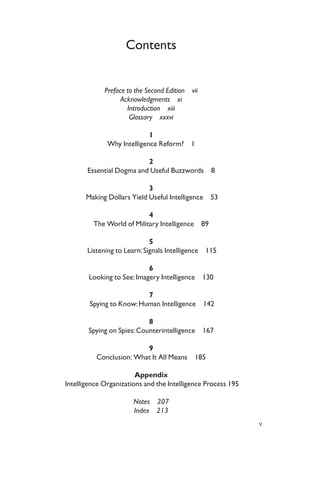


![rector of Central Intelligence in management of the Intelligence
Community.
Consolidated Cryptologic Program (CCP). The national-level pro-
gram budget for signals intelligence.
Counterintelligence (CI). Any intelligence about the capabilities and
operations of foreign intelligence services working against the United
States.
Counterintelligence Corps (CIC). The army’s counterintelligence
organization created during World War II and disestablished in the
early 1960s.
Covert action (CA). Any effort by the U.S. government to influence
another country’s policy in ways such that the United States is not
seen as responsible for the effort. This includes but is not limited to
paramilitary operations.
Criminal Investigation Division (CID). The army’s law enforcement
agency.
Cryptologic Support Group (CSG). Teams of specialists that the Na-
tional Security Agency provides to military commands to assist in
their receiving signals intelligence support.
Defense Cryptologic Program (DCP). The Pentagon’s budget for
purchasing cryptologic means for encoding and securing communi-
cations.
Defense HUMINT [human intelligence] Service (DHS). The mili-
tary clandestine service in the Pentagon.
Defense Intelligence Agency (DIA). The defense department’s all-
source intelligence-analysis organization and manager of several
other Pentagon intelligence activities.
Defense Investigative Service (DIS). The Pentagon agency that
GLOSSARY xxxvii](https://image.slidesharecdn.com/25174748-250509222227-4f6b8196/85/Fixing-Intelligence-For-A-More-Secure-America-William-E-Odom-41-320.jpg)