Five Tips for
Choosing Cloud-
Based Email Security
By: ManagedMS365
Introduction
• Critical Communication Tool: Email is pivotal for individuals and
organizationsin our digital era.
• Attracting Cyber Threats: Widespread email use exposes users to
cyber threats like phishing and malware attacks.
• Urgent Need for Security: Escalating risks stress the vital necessity
for robustemail security solutions.
• Safeguarding Communications: Implementing effective security
measures is imperative to protect against breaches, financial
losses, reputationalharm, and the exposure of sensitive data.
Tip 1 - Advanced
Threat Detection
• Machine Learning Advantages: Leveraging algorithms, it analyzes
vast datasets, recognizing malicious behavior patterns. This
adaptive tech evolves continuously, enhancing threat
identification and stayingahead of emerging risks.
• Behavioral Analysis Precision: Assessing user activities and
communication, it detects anomalies beyond signatures,
identifying unknown threats based on deviations from normal
behavior.
• Real-time Monitoring Vigilance: Constantly assessing emails,
real-time monitoring ensures immediate responses to suspicious
activities, allowing prompt identification and neutralization of
threats before potential damage occurs.
Tip 2 - Strong
Encryption Protocols
• End-to-End Encryption Safeguards Privacy: Emphasize the
pivotal role of end-to-end encryption in protecting email
content, ensuring privacy and confidentiality. This robust
security measure prevents unauthorized access throughout the
communication process.
• TLS Fortifies Data Privacy: Highlight how TLS encryption
enhances data privacy by securing the communication channel.
TLS safeguards data during transit, thwarting interception and
unauthorized viewing, fostering a secure email environment in
the dynamic landscape of cyber threats.
Tip 3 - User Authentication
and Access Controls
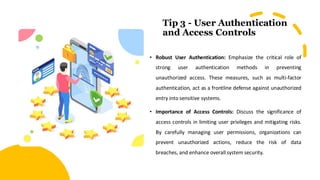
• Robust User Authentication: Emphasize the critical role of
strong user authentication methods in preventing
unauthorized access. These measures, such as multi-factor
authentication, act as a frontline defense against unauthorized
entry into sensitive systems.
• Importance of Access Controls: Discuss the significance of
access controls in limiting user privileges and mitigating risks.
By carefully managing user permissions, organizations can
prevent unauthorized actions, reduce the risk of data
breaches, and enhance overall system security.
Tip 4 - Regular Security
Audits and Updates
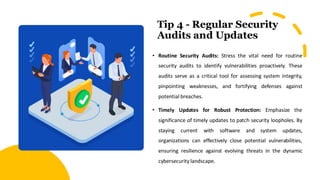
• Routine Security Audits: Stress the vital need for routine
security audits to identify vulnerabilities proactively. These
audits serve as a critical tool for assessing system integrity,
pinpointing weaknesses, and fortifying defenses against
potential breaches.
• Timely Updates for Robust Protection: Emphasize the
significance of timely updates to patch security loopholes. By
staying current with software and system updates,
organizations can effectively close potential vulnerabilities,
ensuring resilience against evolving threats in the dynamic
cybersecurity landscape.
Tip 5 - Integration with
Cloud Security Ecosystem
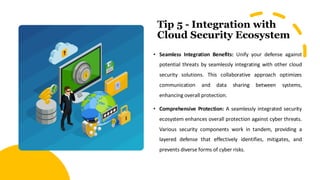
• Seamless Integration Benefits: Unify your defense against
potential threats by seamlessly integrating with other cloud
security solutions. This collaborative approach optimizes
communication and data sharing between systems,
enhancing overall protection.
• Comprehensive Protection: A seamlessly integrated security
ecosystem enhances overall protection against cyber threats.
Various security components work in tandem, providing a
layered defense that effectively identifies, mitigates, and
prevents diverse forms of cyber risks.
Conclusion
Prioritize advanced threat detection, leveraging machine
learning and behavioral analysis. Emphasize strong encryption
protocols like TLS for data privacy. Strengthen security through
user authentication and access controls. Conduct regular audits
and updates, and seamlessly integrate with the cloud security
ecosystem for comprehensive protection. Underscore the critical
importance of investing in robust email security to safeguard
sensitive information in the evolving online landscape.

Five Tips for Choosing Cloud-Based Email Security.pdf

  • 1.
    Five Tips for ChoosingCloud- Based Email Security By: ManagedMS365
  • 2.
    Introduction • Critical CommunicationTool: Email is pivotal for individuals and organizationsin our digital era. • Attracting Cyber Threats: Widespread email use exposes users to cyber threats like phishing and malware attacks. • Urgent Need for Security: Escalating risks stress the vital necessity for robustemail security solutions. • Safeguarding Communications: Implementing effective security measures is imperative to protect against breaches, financial losses, reputationalharm, and the exposure of sensitive data.
  • 3.
    Tip 1 -Advanced Threat Detection • Machine Learning Advantages: Leveraging algorithms, it analyzes vast datasets, recognizing malicious behavior patterns. This adaptive tech evolves continuously, enhancing threat identification and stayingahead of emerging risks. • Behavioral Analysis Precision: Assessing user activities and communication, it detects anomalies beyond signatures, identifying unknown threats based on deviations from normal behavior. • Real-time Monitoring Vigilance: Constantly assessing emails, real-time monitoring ensures immediate responses to suspicious activities, allowing prompt identification and neutralization of threats before potential damage occurs.
  • 4.
    Tip 2 -Strong Encryption Protocols • End-to-End Encryption Safeguards Privacy: Emphasize the pivotal role of end-to-end encryption in protecting email content, ensuring privacy and confidentiality. This robust security measure prevents unauthorized access throughout the communication process. • TLS Fortifies Data Privacy: Highlight how TLS encryption enhances data privacy by securing the communication channel. TLS safeguards data during transit, thwarting interception and unauthorized viewing, fostering a secure email environment in the dynamic landscape of cyber threats.
  • 5.
    Tip 3 -User Authentication and Access Controls • Robust User Authentication: Emphasize the critical role of strong user authentication methods in preventing unauthorized access. These measures, such as multi-factor authentication, act as a frontline defense against unauthorized entry into sensitive systems. • Importance of Access Controls: Discuss the significance of access controls in limiting user privileges and mitigating risks. By carefully managing user permissions, organizations can prevent unauthorized actions, reduce the risk of data breaches, and enhance overall system security.
  • 6.
    Tip 4 -Regular Security Audits and Updates • Routine Security Audits: Stress the vital need for routine security audits to identify vulnerabilities proactively. These audits serve as a critical tool for assessing system integrity, pinpointing weaknesses, and fortifying defenses against potential breaches. • Timely Updates for Robust Protection: Emphasize the significance of timely updates to patch security loopholes. By staying current with software and system updates, organizations can effectively close potential vulnerabilities, ensuring resilience against evolving threats in the dynamic cybersecurity landscape.
  • 7.
    Tip 5 -Integration with Cloud Security Ecosystem • Seamless Integration Benefits: Unify your defense against potential threats by seamlessly integrating with other cloud security solutions. This collaborative approach optimizes communication and data sharing between systems, enhancing overall protection. • Comprehensive Protection: A seamlessly integrated security ecosystem enhances overall protection against cyber threats. Various security components work in tandem, providing a layered defense that effectively identifies, mitigates, and prevents diverse forms of cyber risks.
  • 8.
    Conclusion Prioritize advanced threatdetection, leveraging machine learning and behavioral analysis. Emphasize strong encryption protocols like TLS for data privacy. Strengthen security through user authentication and access controls. Conduct regular audits and updates, and seamlessly integrate with the cloud security ecosystem for comprehensive protection. Underscore the critical importance of investing in robust email security to safeguard sensitive information in the evolving online landscape.