What is FIRSTtech challenge?
FIRST tech challenge (FTC) is a global robotics competition for students
in grades 7-12, designed to inspire interest in science, technology,
engineering, and math (STEM). Teams of up to 15 students design, build,
and program a robot to compete in a themed challenge each season.
Mission and Vision
“To transform our culture by creating a world where science and
technology are celebrated and where young people dream of becoming
science and technology leaders.”
3.
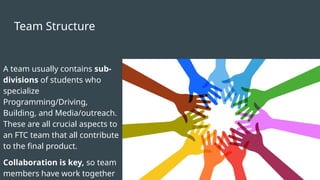
Team Structure
A teamusually contains sub-
divisions of students who
specialize
Programming/Driving,
Building, and Media/outreach.
These are all crucial aspects to
an FTC team that all contribute
to the final product.
Collaboration is key, so team
members have work together
4.
The Engineering Processin FTC
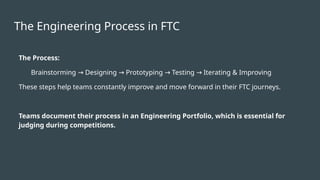
The Process:
Brainstorming Designing Prototyping Testing Iterating & Improving
→ → → →
These steps help teams constantly improve and move forward in their FTC journeys.
Teams document their process in an Engineering Portfolio, which is essential for
judging during competitions.
5.
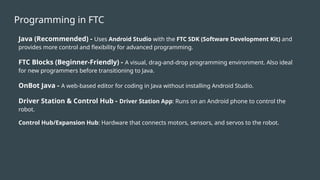
Programming in FTC
Java(Recommended) - Uses Android Studio with the FTC SDK (Software Development Kit) and
provides more control and flexibility for advanced programming.
FTC Blocks (Beginner-Friendly) - A visual, drag-and-drop programming environment. Also ideal
for new programmers before transitioning to Java.
OnBot Java - A web-based editor for coding in Java without installing Android Studio.
Driver Station & Control Hub - Driver Station App: Runs on an Android phone to control the
robot.
Control Hub/Expansion Hub: Hardware that connects motors, sensors, and servos to the robot.
6.
Building the Robot
Differentteams have different approaches to building their robots.
- Some teams start with Computer-Aided Design (CAD) to plan their builds
before actually building.
- Our team, #23014, follows this method and this allows us not only to see
our vision beforehand but also know exactly what parts are needed so that
we can build precisely
- Teams also use kits like GoBilda, and modular design helps with quick changes.
7.
The FTC GameChallenge
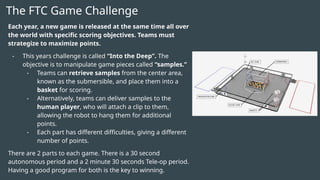
Each year, a new game is released at the same time all over
the world with specific scoring objectives. Teams must
strategize to maximize points.
- This years challenge is called “Into the Deep”. The
objective is to manipulate game pieces called “samples.”
- Teams can retrieve samples from the center area,
known as the submersible, and place them into a
basket for scoring.
- Alternatively, teams can deliver samples to the
human player, who will attach a clip to them,
allowing the robot to hang them for additional
points.
- Each part has different difficulties, giving a different
number of points.
There are 2 parts to each game. There is a 30 second
autonomous period and a 2 minute 30 seconds Tele-op period.
Having a good program for both is the key to winning.
8.
Engineering Journal
The EngineeringJournal is a document of up to 16 pages where teams must document their work
and achievements in five key award categories:
- Design: Demonstrates innovative and well-documented robot design.
- Motivate: Shows how a team inspires others and spreads STEM awareness throughout their
community and beyond.
- Control: Highlights programming and robot control.
- Think: Showcases strong engineering documentation and problem-solving.
- Connect: Recognizes teams that build strong connections with the STEM community.
Why does this matter?
- Judges review this journal to evaluate a team's performance and contributions.
- A well-documented journal strengthens a team's chances of winning awards.
- It is a key part of the judging process, alongside the presentation and pit interviews.
9.
Competitions and Judging
-Awards: Teams are evaluated based on:
- Design: Innovative and well-documented robot design.
- Motivate: Inspires others and spreads STEM awareness.
- Control: Excellence in programming and robot control.
- Think: Strong engineering documentation and problem-solving.
- Connect: Builds strong connections with the STEM community.
- Inspire Award: The highest honor, given to a team that excels in all
categories and represents FIRST values.
Judging Process:
● Teams give a 5-minute presentation to judges, followed by Q&A.
● Judges review the Engineering Portfolio.
● Pit interviews help judges assess teamwork, outreach, and robot design.
10.
Gracious Professionalism
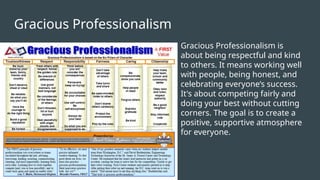
Gracious Professionalismis
about being respectful and kind
to others. It means working well
with people, being honest, and
celebrating everyone’s success.
It's about competing fairly and
doing your best without cutting
corners. The goal is to create a
positive, supportive atmosphere
for everyone.