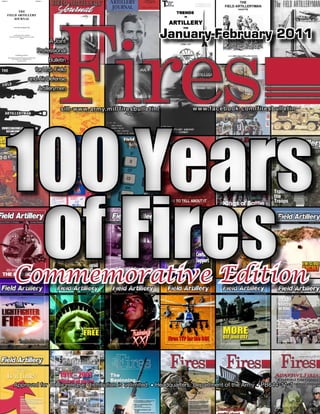
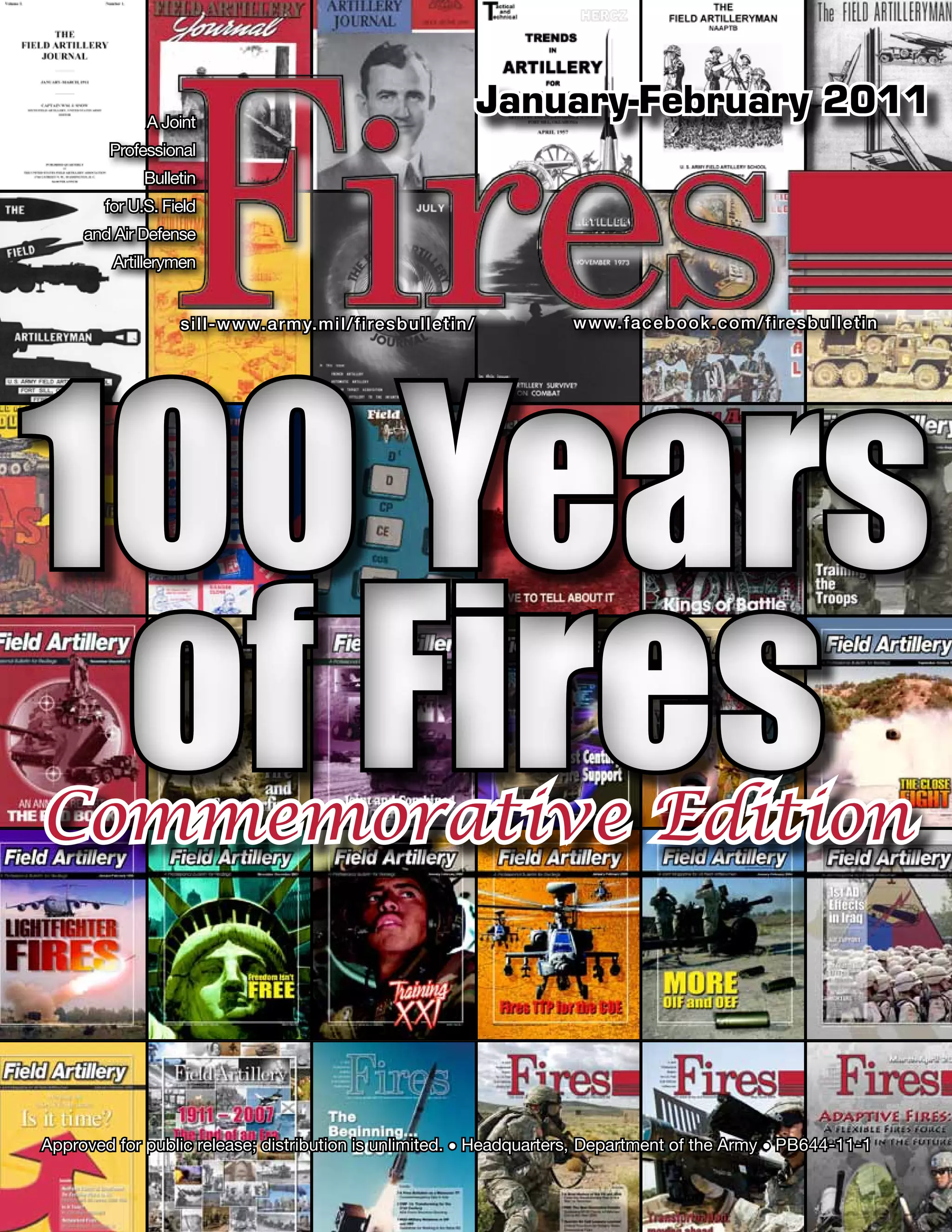
A Joint
                                                              January-February 2011
        Professional
              Bulletin
        for U.S. Field
     and Air Defense
         Artillerymen


                   sill-www.army.mil/firesb u l l e t i n /         w w w. f a c e b o o k . c o m / f i res b u l l e t i n


           of Fires
Commemorative Edition


Approved for public release; distribution is unlimited. • Headquarters, Department of the Army • PB644-11-1
Contents
January-February 2011

              100 Years of Fires; Fires Bulletin- 100                           Operational culture
              years of service to the professional Fires
Page 4
                                                                                Excellence Culture a
              Soldier
              By MG David D. Halverson                                          the standard for the
                                                                                By Dr. Mahir J. Ibrahimov
              Status of the US Field Artillery Association
Page 6
              and US Air Defense Artillery Association

              History of the US Army Field Artillery
Page 7
              School from birth to the eve of World War
              II: Part I of II
              By Dr. Boyd L. Dastrup


              Air Defense Artillery contributions,
Page 11       solutions and issues during World War I
              By David A. Christensen


              New artillery school will serve as the Fires
              foundation for the professionalism of
Page 13       Afghan National Army
              By LTC Charles D. Kirby, U.S. Army, and LTC Richard Vagg, Royal                          Volum

              Australian Artillery


Page 16       Keeping it real: Don’t let Joint Fires Observer skills deteriorate
              By MSG Timothy Ryan


Page 19       Employing joint Fires in Afghanistan
              By LTC John C. Allred


Page 30       Bouncing Back: How are we building resilient Soldiers and units?
              By COL (Ret) Joyce DiMarco and LTC (Ret) Richard McConnell


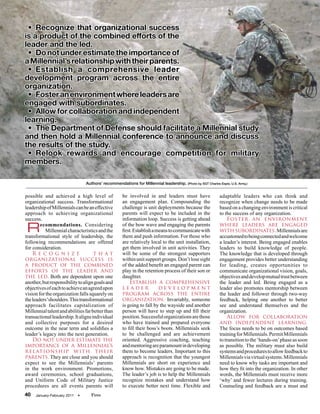
              Millennials and transformational leaders: A winning team for the
Page 38       future — Part II of II
              By COL James E. Lackey, Professor Gene Kamena and COL Paul Calvert


2
Headquarters, Department of the Army •Fires
     January-February 2011 •          PB644-11-1
DISCLAIMER: Fires, a professional bulletin, is published
                                                                                           bimonthly by Headquarters, Department of the Army under
                                                                                           the auspices of the Fires Center of Excellence (Building
                                                                                           758, McNair Road), Fort Sill, Okla. The views expressed are
                                                                                           those of the authors and not the Department of Defense
                                                                                           or its elements. Fires’ content doesn’t necessarily reflect
                                                                                           the U.S. Army’s position or supersede information in other
                                                                                           official Army publications. Use of news items constitutes
                                                                                           neither affirmation of their accuracy nor product endorse-
                                                                                           ments. Fires is printed by Monarch Litho Inc., a private
 in the US Army: The Fires Center of                                                       firm in no way connected with the Department of the
                                                                                           Army. Fires assumes no responsibility for any unsolicited
                                                                                           material. By Order of the Secretary of the Army:
 and Foreign Language Strategy sets                                                                           George W. Casey Jr.
                                                                                                         General, United States Army
                                                                                                                   Chief of Staff
e rest of TRADOC, Army                                                                     Official:

                                                                                                               Joyce E. Morrow
                                                                                                          Administrative Assistant to the
                                                                                                         Secretary of the Army, 1029202
                                                                                                              David D. Halverson
                                                                                                        Major General, United States Army
                                                                                                              Commanding General
                                                                                                                  Fort Sill, Okla.

                                                                                                        Editor-in-Chief: Sharon McBride
                                                                                                       Managing Editor: Jennifer McFadden
                                                                                                            Art Director: Jason Kelly
                                                                                                          Assistant Editor: Paul Jiron
                                                                                           PURPOSE: Founded in 2007, Fires serves as a forum
                                                                                           for the professional discussions of U.S. Army and Marine
                                                                                           Field Artillery (FA) and Army Air Defense Artillery (ADA)
                                                                                           professionals, both active and Reserve Component (RC);
                                                                                           disseminates professional knowledge about the FA’s and
                                                                                           ADA’s progress, developments and best use in cam-


                                                                   Page 22
                                                                                           paigns; cultivates a common understanding of the power,
                                                                                           limitations and application of joint Fires, both lethal and
                                                                                           nonlethal; fosters joint Fires interdependency among the
                                                                                           armed services; and promotes the understanding of and
                                                                                           interoperability between the FA’s and ADA’s active and RC
                                                                                           units—all of which contribute to the good of the FA and
                                                                                           ADA, Army, joint and combined forces, and our nation.
                                                                                           OFFICIAL DISTRIBUTION: Free copies are sent to USA
                                                                                           and USMC FA units: FA/Fires brigade, brigade combat
                                                                                           team (BCT), Stryker cavalry regiment (SCR), FA Marine
                                                                                           regiment and battlefield coordination detachment (BCD)
                                                  Number 1.                                headquarters; 13 per FA/Fires battalion/squadron; 3 per
                                                                                           fire support element (FSE), Fires and effects cell (FEC),
                                                                                           effects coordination cell (ECC) fire support cell (FSC), and
me I.                                                                                      separate battery or detachment; 2 per fire support team
                                                                                           (FIST); and 1 per Master Gunner. Free copies to Army ADA
                                                                                           units: 7 per air and missile defense command (AAMDC)
                        THE                                                                and ADA brigade headquarters; 13 per ADA battalion;
              ILLERY
                                                                                           and 3 per air defense airspace management cell (ADAM)

     IELD ART
                                                                                           and separate battery or detachment. The FA and ADA
   F                                                                                       Schools’ departments, directorates and divisions each

        JOURNAL                                                  Back cover
                                                                                           get 2 copies. Other Army branch and US armed services
                                                                                           units/organizations and US government agencies that
                                                                                           work with FA or ADA personnel, equipment, doctrine,
                                                                                           tactics, training organization or leadership issues may
                                                                                           request a free copy—including, but not limited to—ROTCs,
                                                                                           recruiting commands, libraries, attaches, liaison officers,
                                         1911
                     -MARCH,                                                               state adjutants general, public affairs offices, military
              JANUARY
                                                                   Select articles         academies, laboratories, arsenals, major commands, etc.
                                                                                           Contact Fires at http://sill-www.army.mil/firesbulletin/.
                                                                                           SUBSCRIPTIONS: Those not eligible for official distribu-
                                    SNOW ARMY
                          IN WM. J.
               CAPTA
        SIXTH FIEL
                   D ARTILLE
                             RY, UNITED
                           EDITOR
                                        ES
                                        STAT
                                                                   from The Field          tion may subscribe to Fires via the U.S. Superintendent of
                                                                                           Documents, P.O. Box 37154, Pittsburgh, PA 15250-7954
                                                                                           (1-866-512-1800).

                                                                 Artillery Journal’s       SUBMISSIONS: Email to the Editor, Fires, at firesbul-
                                                                                           letin@conus.army.mil; mail to P.O. Box 33311, Fort Sill,
                                                                                           OK 73503-0311; overnight to Building 758, Room 7,
                                                                                           McNair Road, Fort Sill, OK 73503-5600; or call at DSN
                                                                       first edition       639-5121/6806 or commercial (580) 442-5121/6806.
                                                                                           REPRINTS: Fires is pleased to grant permission to reprint;
                                                                                           please credit Fires, the author(s) and photographers.
                                            RLY                                            POSTMASTER: Fires (USPS 309-010) (ISSN 1935-4096)
                                  D QUARTE
                        PUBLISHE                             N                             is published bimonthly; periodical postage paid by Depart-
                                   BY               SOCIATIO
                                            LLERY AS C.                                    ment of the Army at Lawton, OK 73501 and an additional
                                   ELD ARTI
                         STATES FI ., WASHINGTON, D.                                       mailing post office. Send address changes to Fires, P.O.
            TH E UNITED      REET N. W
                   1744 G ST                                                               Box 33311, Fort Sill, OK 73503-0311.
                                         ANNUM
                               $4.00 PER


                                                                                   sill-www.army.mil/firesbulletin/ • January-February 2011    3
Fires                                               COMMANDING GENERAL’S
                                                                        FORWARD


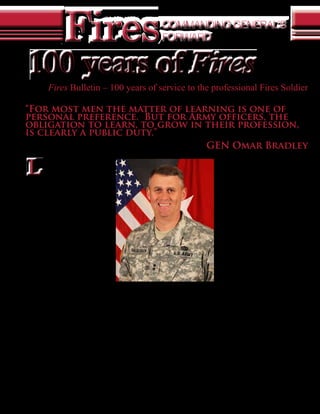
    100 years of Fires
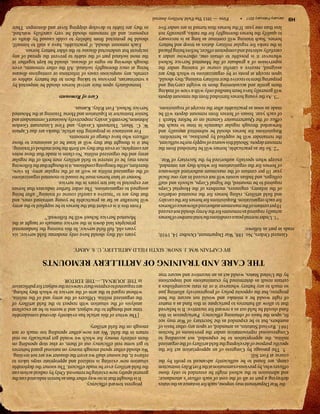
            Fires Bulletin – 100 years of service to the professional Fires Soldier

“For most men the matter of learning is one of
personal preference. But for Army officers, the
obligation to learn, to grow in their profession,
is clearly a public duty.”
                                GEN Omar Bradley

    L
         earn from the past, keep an                                                                challenges and issues we all face. Two
         eye on the present, and prepare                                                            articles in particular, provide the context for
         for the future. This special                                                               the last 100 years. As with a democracy, the
commemorative edition marks the                                                                     maturity of the Fires Center of Excellence
100th anniversary of the Fires Bulletin                                                             will take time, but focus, the basics and our
magazine. The first edition January-                                                                chararacter will posture us well.
March 1911, known as the Field Artillery                                                                The first is a historical article by Dr. Boyd
Journal, started a proud tradition of                                                               L. Dastrup, the field artillery historian for
providing leaders and Soldiers with up                                                              the U.S. Army Field Artillery School. His
to date information on doctrine, tactics,                                                           article, “History of the U.S. Army Field
techniques, and procedures.                                                                         Artillery School from birth to the eve of
    Several of the articles in this issue touch                                                     World War II,” is part one of a two-part series
on challenges of the past, changes that                                                             that chronicles the many milestones and
brought us to the present and conditions                                                            achievements Fort Sill and the FA branch
they set for the future. Many of the themes                                                         have achieved since its inception a century
we talk about today are highlighted in the                                                          ago. Many challenges we face within the
historical articles of our branches and                                                             Army, our all-volunteer human capital,
validates Bradley’s quote as we address                                                             how to shape the force for the future fight,
similar issues today – “Happy 100th                                                                 and creating a professional organization in
Birthday – Fires Bulletin.” Therefore,                                                              a resource-constrained environment, are
we must be well grounded in the basics                                                              not new challenges, but are ones the Fires
of our warfighting function                                                                                             Force must deal with now
of Fires- our Army and our                                                                                              and in the future. We must
                                                          By MG David D. Halverson
country depend on it.                                                                                                   take an enterprise approach.
    The journal was born Commanding General of the U.S. Army Fires Center of Excellence                                       The School of Fires,
to meet the need of an                                          and Fort Sill, Okla.                                    like the Fires Bulletin,
U.S. Army Field Artillery                                                                                               overcame many challenges
branch that was setting the conditions for a professional training        as well. CPT Dan T. Moore, the first Commandant of the School
and education system and as a way to keep its members up to date          of Fires, visited several different European Artillery Schools
on the current professional tactics, techniques and procedures. CPT       before establishing the School of Fires at Fort Sill in September
William J. Snow (who later became MG Snow) came up with the               1911. He used the German School as the model which had combat
concept for the magazine and was also the first editor. Although          development, testing capability and training under one roof – much
resources were scarce, he worked tirelessly to get the magazine going     like the Fires Center of Excellence we have today. Another forward
in its formative years and it has developed into the professional         thinking officer, LTC Butner’s quote from 1923 could fit into our
bulletin we have today.                                                   current Joint and Combined Fires University Implementation
  Throughout the years the Fires Bulletin has gone through several        Plan…“The subject of Field Artillery is a life study and the school
name changes, reflecting Department of the Army policies, the             hopes to lay the foundation on sound principles for such study.
reoccurring splitting and merging of branches and various other           The artillery officer must continue the study of his profession,
changes that required a title change. Today, just as in 1911, the         or he will fail when the time comes to practice it. And failure in
bulletin serves as a professional outlet for the Fires forces to address  war means failure in life, for the Soldier.”(Dastrup, 2010). LTC
4    January-February 2011   •    Fires
Butner’s thoughts focus on life-long learning and the importance                      Today, the Fires Bulletin highlights the best lessons learned and
of a “foundation” or the “basics” of the profession.                              forward thinking of both the FA and ADA branches. It maintains the
    The second article which helps draw on the past is written by Mr.             tradition started 100 years ago of a professional journal dedicated
David A. Christensen on the history of the U.S. Army Air Defense                  to the Soldiers and leaders of the Fires force.
Artillery. In it he talks about the birth of the ADA to meet a new                    Although the continuation of publishing of the bulletin has been
threat and how force design and weapons systems put the U.S.                      tenuous over the years, two key themes have endured for the past
ADA at the top of the coalition pile when it came to employment of                100 years and continue to resonate during present day: the continual
Fires - a feat achieved in very short order through a focus on basics             emphasis on combined arms doctrine and the continual effort to
and a strong training program that developed effective battle drills              include joint, intergovernmental, interagency and military (joint
and gunnery skills important to a professional branch. The latest                 and combined) components in the overall Fires campaign strategy
training techniques and tactics were studied from across Europe to                and concepts.
produce a U.S. shoot to kill ratio of “600 rounds per enemy aircraft”                 Today, the synergies between the two branches continue to grow,
versus the closest coalition partner rate of “6,000 to 1.”                        especially in our capabilities department. Constant professional
  Innovative leaders understood the new “technology” (aircraft) and               dialogue between the branches is imperative, and submitting articles
how it was changing their operating environment. They developed                   to the Fires Bulletin is just one way to achieve this objective. As
the skills and training needed for LT A.T. Slaten and his crew to                 we move deeper in to the Fires force of the future and continue to
shoot down the first enemy aircraft for an American ADA crew in                   learn from our past, we face unprecedented opportunities that as a
May 1918. Those techniques spread across the force and made the                   Fires force we are just beginning to realize. We have a wealth of
U.S. ADA crews the most effective of the war.                                     talent and innovation among our force. So as Fires professionals let’s
    Additional articles in this issue share common threads with                   not only take time to celebrate how far we’ve come, but continue
the ones from 1911 such as caring for your equipment, scouting                    to engage and collaborate providing input to the Fires Center of
techniques and joint force development. Several articles from the                 Excellence in order to make the next 100 years just as productive
1911 issue are printed this month to highlight some of the discussions            as the first.
and focus of that period in our history.                                              Fit to Fight – Fires Strong.

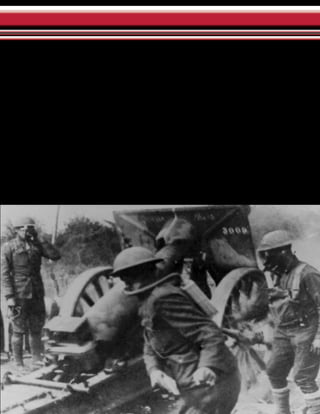
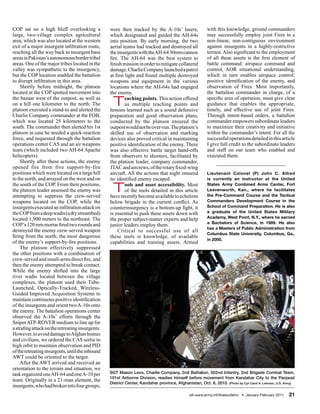
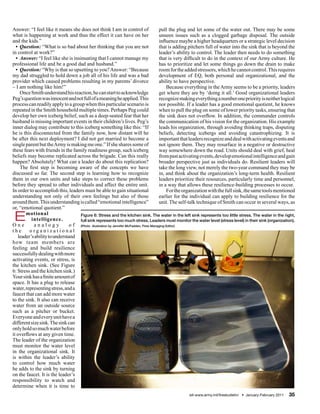
        Artillerymen fire during a gas mask attack in the Argonne Forest Area, Wis., during World War I. (Photo from Fires Bulletin historical archive.)


                                                                                                    sill-www.army.mil/firesbulletin/ • January-February 2011   5
The SITREP
One hundred years ago, the Field Artillery Journal
published its first article. Below are updates on where
the U.S. Field Artillery Association and Air Defense
Artillery Association stand today.


       US Field Artillery Association                   Air Defense Artillery Association
             Major accomplishments:                                 Major activities:
       100th anniversary celebration, May 2010           General membership meeting, Oct. 6, 2010
Donation of the Field Artilleryman Statue in front        Board member advisors engaging and
 of the Field Artillery Museum, Fort Sill, Okla.        educating students in the ADA schoolhouse
             Addition of five new scholarships            Establish contract to emplace first brick
                                                           campaign orders at the base of the Air
             Benefits of membership:                                 Defenders Statue
 Subscription to Field Artillery Journal, fellowship
 with professional field artillerymen, eligibility to         Benefits of membership:
  win scholarships for members and members’               Receive updates on current Air Defense
immediate family, invitation to U.S. Field Artillery     Artillery Association initiatives, receive the
        Association functions and events                 ADAA Journal (to be launched tentatively in
                                                        April 2011), discounts on ADAA merchandise,
                                  Dues:                        contribute to helping ADA causes
    One year: $25, two years: $40, three years: $60,
      five years: $100 and lifetime: based on age                          Dues:
                                                             Annual membership: $25 or lifetime
                              How to join:                          membership: $200
      Visit the association’s office at 758 McNair
      Avenue, Fort Sill, Okla., or the association’s                   How to join:
       website at http://www.redlegoutpost.com          Visit the association’s website at http://www.
                                                                        firsttofire.com/


6     January-February 2011   •    Fires
History of the US Army Field Artillery School
                  from birth to the eve of World War II


 Part I of II
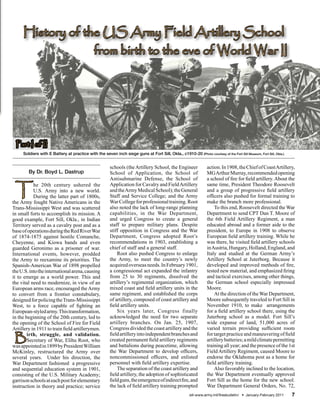
     Soldiers with E Battery at practice with the seven inch siege guns at Fort Sill, Okla., c1910-20 (Photo courtesy of the Fort Sill Museum, Fort Sill, Okla.)


                                                        schools (the Artillery School, the Engineer               action. In 1908, the Chief of Coast Artillery,
        By Dr. Boyd L. Dastrup                          School of Application, the School of                      MG Arthur Murray, recommended opening
                                                        Antisubmarine Defense, the School of                      a school of fire for field artillery. About the

 T         he 20th century ushered the                  Application for Cavalry and Field Artillery               same time, President Theodore Roosevelt
           U.S. Army into a new world.                  and the Army Medical School); the General                 and a group of progressive field artillery
           During the latter part of 1800s,             Staff and Service College; and the Army                   officers also pushed for formal training to
the Army fought Native Americans in the                 War College for professional training. Root               make the branch more professional.
Trans-Mississippi West and was scattered                also noted the lack of long-range planning                    To this end, Roosevelt directed the War
in small forts to accomplish its mission. A             capabilities, in the War Department,                      Department to send CPT Dan T. Moore of
good example, Fort Sill, Okla., in Indian               and urged Congress to create a general                    the 6th Field Artillery Regiment, a man
Territory served as a cavalry post and as a             staff to prepare military plans. Despite                  educated abroad and a former aide to the
base of operations during the Red River War             stiff opposition in Congress and the War                  president, to Europe in 1908 to observe
of 1874-1875 against hostile Comanche,                  Department, Congress adopted Root’s                       European field artillery training. While he
Cheyenne, and Kiowa bands and even                      recommendations in 1903, establishing a                   was there, he visited field artillery schools
guarded Geronimo as a prisoner of war.                  chief of staff and a general staff.                       in Austria, Hungary, Holland, England, and
International events, however, prodded                      Root also pushed Congress to enlarge                  Italy and studied at the German Army’s
the Army to reexamine its priorities. The               the Army, to meet the country’s newly                     Artillery School at Juterborg. Because it
Spanish-American War of 1898 propelled                  acquired overseas needs. In February 1901,                developed and improved methods of fire,
the U.S. into the international arena, causing          a congressional act expanded the infantry                 tested new material, and emphasized firing
it to emerge as a world power. This and                 from 25 to 30 regiments, dissolved the                    and tactical exercises, among other things,
the vital need to modernize, in view of an              artillery’s regimental organization, which                the German school especially impressed
European arms race, encouraged the Army                 mixed coast and field artillery units in the              Moore.
to convert from a frontier constabulary,                same regiment, and established the corps                      At the direction of the War Department,
designed for policing the Trans-Mississippi             of artillery, composed of coast artillery and             Moore subsequently traveled to Fort Sill in
West, to a force capable of fighting an                 field artillery units.                                    November 1910, to make arrangements
European-styled army. This transformation,                  Six years later, Congress finally                     for a field artillery school there, using the
in the beginning of the 20th century, led to            acknowledged the need for two separate                    Juterborg school as a model. Fort Sill’s
the opening of the School of Fire for Field             artillery branches. On Jan. 25, 1907,                     wide expanse of land, 51,000 acres of
Artillery in 1911 to train field artillerymen.          Congress divided the coast artillery and the              varied terrain providing sufficient room

 B      irth, struggle, and validation.
        Secretary of War, Elihu Root, who
                                                        field artillery into independent branches and
                                                        created permanent field artillery regiments
                                                        and battalions during peacetime, allowing
                                                                                                                  for target practice and maneuvering of field
                                                                                                                  artillery batteries; a mild climate permitting
                                                                                                                  training all year; and the presence of the 1st
was appointed in 1899 by President William
McKinley, restructured the Army over                    the War Department to develop officers,                   Field Artillery Regiment, caused Moore to
several years. Under his direction, the                 noncommissioned officers, and enlisted                    endorse the Oklahoma post as a home for
War Department fashioned a progressive                  personnel with field artillery expertise.                 field artillery training.
and sequential education system in 1901,                    The separation of the coast artillery and                 Also favorably inclined to the location,
consisting of the U.S. Military Academy;                field artillery, the adoption of sophisticated            the War Department eventually approved
garrison schools at each post for elementary            field guns, the emergence of indirect fire, and           Fort Sill as the home for the new school.
instruction in theory and practice; service             the lack of field artillery training prompted             War Department General Orders, No. 72,
                                                                                                       sill-www.army.mil/firesbulletin/ • January-February 2011    7
June 3, 1911, authorized the School of Fire            within the allotted fifteen seconds.                serve as instructors. Afterwards, on Aug.
for Field Artillery at Fort Sill, outlined its             Moore’s successor, LTC Edward P.                3, 1917, a small contingent of French field
priorities of providing practical instruction          McGlachlin, continued improving the                 artillery officers, with combat experience on
and designated the courses of instruction.             school. He published supplementary                  the western front, arrived to teach French
A couple of days later, War Department                 training literature and gave additional             doctrine and tactics.
General Orders, No. 73, made the school                training time to tactics. This created a more           Meanwhile, on July 27, 1917, Snow,
an official part of the War Department’s               comprehensive instruction program and               from the 4th Field Artillery Regiment,
professional educational system that                   produced a more broadly trained graduate.           reported for duty and replaced COL (later
included the U.S. Military Academy, post                   With Moore and McGlachlin as                    Brigadier General) Adrian S. Fleming. Snow
schools for enlisted personnel, garrison               commandants, the School of Fire made                found Fleming, struggling to organize a
schools for officers, and branch service               concrete progress since opening in 1911. In         school, with little or no resources. In fact,
schools for branch and technical training.             a memorandum for the Chief of Staff of the          the small cadre of instructors lectured out
Shortly after, on July 19, 1911, the                   Army, MG Hugh L. Scott, about the school,           of the Field Artillery Drill and Service
War Department selected Moore as the                   the Chief of the War College Division, BG           Regulations of 1916, to the diverse class of
commandant.                                            M.M. Macomb, on Dec., 18, 1914, stated,             21 students who had arrived earlier in July.
    Several months later, the School of                “graduates could shoot and hit targets better       They formed class zero, distinguishing it
Fire for Field Artillery opened its doors              than their predecessors of 1911-1913.” The          from the regular wartime classes that began
on Sept. 15, 1911, to mark the beginning               memorandum credited the improved firing             in October 1917. Some officers of class zero
of standardized gunnery instruction and                of FA batteries to the school and its graduates     were active U.S. Army Cavalry and Coast
training and some instruction in field                 who returned to their regiments and taught          Artillery officers, who had been transferred
artillery tactics and brought an end to Fort           their colleagues.                                   to the field artillery, filling shortages. Some

                                                        W
Sill’s days as a cavalry post. Operations                       ar years. The Mexican Revolution           were National Guard officers; and some
began with a small staff and faculty, CPT                       soon influenced the infant school.         were former noncommissioned officers
Dan T. Moore, 1LT Ralph M. Pennell, 1LT                In August 1915, the War Department                  who had recently been commissioned.
Roger S. Parrott, and 1LT John C. Maul.                shipped two of the school’s field batteries             Despite and competition for firing ranges
Of the four, only Moore had experience                 to the border, causing McGlachlin to close          and other resources with the 36th Division,
as a field artillery officer. Parrott had              the school in the fall of 1915, permitting          composed of Oklahoma and Texas National
recently transferred from field artillery to           students to return to their units. Although         Guard units, the 35th Division, comprised
ordnance, giving him minimal field artillery           the school reopened in February 1916,               of Kansas and Missouri National Guard
expertise. Pennell was a cavalry officer               reoccurring Mexican border troubles forced          units and CPT Harry S. Truman’s 129th
and Maul was an infantry officer. Moore                closure, once again. On May 9, 1916, the            Field Artillery Regiment, and the School of
wrote, “they set out to teach officers by              War Department shutdown the School of               Musketry, which had reopened and later left
actual practical exercise . . . the general            Fire and the School of Musketry, which              for Camp Benning, Ga., in the fall of 1918 to
principals in conducting fire . . . [and] the          had been at Fort Sill since 1913 and had            make room for field artillery training, and the
tactical employment of field artillery, with           competed with the School of Fire for limited        inexperience of zero class, Snow achieved
a clear emphasis on gunnery.”                          resources, and sent all officers to the border.     remarkable success. Students in zero class
    During the school’s first years, Moore             The last field artillery officer left July 9,       graduated and left for France. To support
focused on the basics. Students spent time             1916; and the School of Fire did not open           school’s training, the War Department built
with flash targets, prepared firing data and           again until July 1917, during World War I.          a school complex, for classes, as well as
learned to adjust fire onto a target. They                 World War I invigorated the School of           barracks on the plateau northwest of the
also learned panoramic sketching, technical            Fire for Field Artillery. In early July 1917, the   old post, using Snow’s facility plan. Named
and tactical battery drill, and practical              school consisted of a caretaker detachment          Snow Hall, after Snow, who later became the
ballistics. Among other things, they also              under COL Robert M. Blatchford, an                  first chief of field artillery on February 15,
fired field guns, and for many this was a              infantry officer and the commander of Fort          1918, the central school building included
new experience. Some students could even               Sill. On July 10, 1917, a brief telegram from       the office of the administrator, large class
hit a target and compute gunnery solutions             the War Department, notified Blatchford             rooms, a movie theater, small class rooms,
                                                       of plans to reopen the school, satisfying           and other rooms.
                                                       wartime requirements. Five days later, SGT              In the midst of the construction, the
                                                       Morris Swett, the school librarian, met 21          first wartime class assembled on Oct. 1,
                                                       students as they stepped off a train from           1917, for 12 weeks of training. The class,
                                                       Oklahoma City, Okla., for training.                 composed of active Army, National Guard,
                                                           Subsequently, the instructors, handpicked       and National Army officers, ranging from
                                                       by the incoming Commandant of the School            second lieutenant to colonel, received its
                                                       of Fire for Field Artillery, COL William J.         introduction to the school in the Old Trader’s
                                                       Snow, who had also participated in founding         Store, also serving as the administration
                                                       the Field Artillery Association and the “Field      building and school library until the school
                                                       Artillery Journal” in 1910 as a captain to          complex was completed. As Fleming, who
                                                       promote professionalism, and school staff,          had replaced Snow in September 1917 when
French liaison officers at the School of Fire in       slowly began to show up. On July 19, 1917,          he left to command a field artillery brigade,
1917. (FROM LEFT TO RIGHT) Lieutenant L.A.             Lieutenant Colonels F.E. Hopkins, and Fred          explained to the students, the school’s main
Girard, Captain C.P.F. Pierret, Major E. Durette,      T. Austin, Captains Robert M. Danford and           mission focused on gunnery instruction,
Lieutenants H. Negre and J. Varrall. (Photo courtesy   Cliff Andrus, as well as other active Army          although it also trained aerial observers, in
of U.S. Army Field Artillery School)
                                                       field artillery officers, reported for duty to      a two-week course at Henry Post Field on
8      January-February 2011           •   Fires
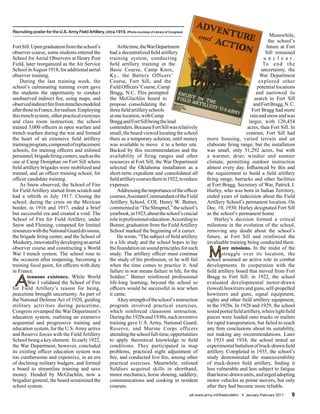
Recruiting poster for the U.S. Army Field Artillery, circa 1919. (Photo courtesy of Library of Congress)
                                                                                                                                                       Meanwhile,
                                                                                                                                                      the school’s
Fort Sill. Upon graduation from the school’s                   At the time, the War Department                                                       future at Fort
observer course, some students entered the                 had a decentralized field artillery                                                       Sill remained
School for Aerial Observers at Henry Post                  training system, conducting                                                              u n c l e a r.
Field, later reorganized as the Air Service                field artillery training in the                                                          To e n d t h e
School in August 1918, for additional aerial               Basic Course, Camp Knox,                                                                uncertainty, the
observer training.                                         Ky., the Battery Officers’                                                             War Department
    During the last training week, the                     Course, Fort Sill, and the                                                             explored other
school’s culminating training event gave                   Field Officers’ Course, Camp                                                          potential locations
the students the opportunity to conduct                    Bragg, N.C. This prompted                                                            and narrowed its
unobserved indirect fire, using maps, and                  the McGlachlin board to                                                             search to Fort Sill
observed indirect fire from trenches modeled               propose consolidating the                                                           and Fort Bragg, N. C.
after those in France, for realism. Employing              three field artillery schools                                                      Fort Bragg had more
this trench system, other practical exercises              at one location, with Camp                                                        rain and snow and was
and class room instruction, the school                     Bragg and Fort Sill being the lead                                               larger, with 120,454
trained 3,000 officers in open warfare and                 contenders. Because Fort Sill was relatively                                    acres, than Fort Sill. In
trench warfare during the war and formed                   small, the board viewed locating the school                                    contrast, Fort Sill had
the heart of an extensive field artillery                  there as a temporary solution, until money                more housing, varied terrain and an
training program, composed of replacement                  was available to move it to a better site.                elaborate firing range; but the installation
schools, for training officers and enlisted                Backed by this recommendation and the                     was small, only 51,292 acres, but with
personnel, brigade firing centers, such as the             availability of firing ranges and other                   a warmer, drier, windier and sunnier
one at Camp Doniphan on Fort Sill where                    resources at Fort Sill, the War Department                climate, permitting outdoor instruction
field artillery brigades were mobilized and                selected the Oklahoma installation as a                   almost every day. Influenced by this and
trained, and an officer training school, for               short-term expedient and consolidated all                 the requirement to build a field artillery
officer candidate training.                                field artillery courses there in 1922, to reduce          firing range, barracks and other facilities
    As Snow observed, the School of Fire                   expenses.                                                 at Fort Bragg, Secretary of War, Patrick J.
for Field Artillery started from scratch and                   Addressing the importance of the officer              Hurley, who was born in Indian Territory,
had a rebirth in July 1917. Closing the                    courses, Assistant Commandant of the Field                ended years of indecision about the Field
school, during the crisis on the Mexican                   Artillery School, COL Henry W. Butner,                    Artillery School’s permanent location. On
border, in 1916 and 1917, ended a brief                    commented in “The Shrapnel,” the school’s                 Dec. 10, 1930, Hurley designated Fort Sill
but successful era and created a void. The                 yearbook, in 1923, about the school’s crucial             as the school’s permanent home.
School of Fire for Field Artillery, under                  role in professional education. According to                  Hurley’s decision formed a critical
Snow and Fleming, competed for limited                     Butner, graduation from the Field Artillery               milestone in the evolution of the school,
resources with the National Guard divisions,               School marked the beginning of a career.                  removing any doubt about the school’s
the brigade firing center, and the School of                   He wrote, “The subject of field artillery             future, at Fort Sill and reinforced the
Musketry, innovated by developing an aerial                is a life study and the school hopes to lay               invaluable training being conducted there.
observer course and constructing a World
War I trench system. The school rose to
the occasion after reopening, becoming a
                                                           the foundation on sound principles for such
                                                           study. The artillery officer must continue
                                                           the study of his profession, or he will fail
                                                                                                                      M      ore missions. In the midst of the
                                                                                                                             struggle over its location, the
                                                                                                                     school assumed an active role in combat
training focal point, for officers with duty               when the time comes to practice it. And                   developments. In cooperation with the
in France.                                                 failure in war means failure in life, for the             field artillery board that moved from Fort

 A      tenuous existence. While World
        War I validated the School of Fire
for Field Artillery’s reason for being,
                                                           Soldier.” Butner reinforced professional
                                                           life-long learning, beyond the school so
                                                           officers would be successful in war when
                                                                                                                     Bragg to Fort Sill, in 1922, the school
                                                                                                                     evaluated developmental motor-drawn
                                                                                                                     (towed) howitzers and guns, self-propelled
peacetime brought uncertainty. As part of                  it came.                                                  howitzers and guns, signal equipment,
the National Defense Act of 1920, guiding                      A key strength of the school’s instruction            sights and other field artillery equipment,
military activities during peacetime,                      program involved practical exercises,                     in the 1920s. In 1928 and 1929, the school
Congress revamped the War Department’s                     which reinforced classroom instruction.                   tested porteé field artillery, where light field
education system, outlining an extensive                   During the 1920s and 1930s, such inventive                pieces were loaded onto trucks or trailers
sequential and progressive training and                    training gave U.S. Army, National Guard,                  for rapid transportation, but failed to reach
education system, for the U.S. Army active                 Reserve, and Marine Corps officers                        any firm conclusions about its suitability,
and Reserve forces with the Field Artillery                attending the school full-time, opportunities             not making any recommendations. Later
School being a key element. In early 1922,                 to apply theoretical knowledge to field                   in 1933 and 1934, the school tested an
the War Department, however, concluded                     conditions. They participated in map                      experimental battalion of truck-drawn field
its existing officer education system was                  problems, practiced night adjustment of                   artillery. Completed in 1935, the school’s
too cumbersome and expensive, in an era                    fire, and conducted live fire, among other                study demonstrated the maneuverability
of declining military budgets, and formed                  practical exercises. Meanwhile, enlisted                  of truck-drawn field artillery, finding it
a board to streamline training and save                    Soldiers acquired skills in shorthand,                    less vulnerable and less subject to fatigue
money. Headed by McGlachlin, now a                         motor mechanics, horse shoeing, saddlery,                 than horse-drawn units, and urged adopting
brigadier general, the board scrutinized the               communications and cooking in resident                    motor vehicles as prime movers, but only
school system.                                             courses.                                                  after they had become more reliable.
                                                                                                           sill-www.army.mil/firesbulletin/ • January-February 2011   9
Although it participated in other combat       center generally took longer to mass Fires.            formally petitioned the War Department
development projects, the school’s most                Although the fire direction center                 on Oct. 8, 1941, for organic field artillery
innovative work came with the creation             promised to make fire support more                     aerial observation. Although he initially
of the fire direction center in the 1930s.         responsive, the field artillery and the                encountered stiff resistance, from the Chief
During the 1920s, massing fires with               War Department resisted adopting it.                   of the U.S. Army Air Corps, MG Henry H.
observed indirect fire proved to be difficult.     Refinements to the center in 1939 by the               Arnold, the airpower enthusiast relented and
Observed fire relied on a forward observer,        Director of the Gunnery Department, LTC                agreed to support any experimenting. With
locating targets by providing a descriptive        H.L.C. Jones, and his staff and instructors            this endorsement, Danford subsequently
reference to a prominent terrain feature on        paved the way for acceptance. He displayed             obtained approval from the War Department
a map, or by giving the target’s coordinates       his improvements, in early 1941, to the                on Dec. 10, 1941, to test organic field
to the batteries for plotting. As long as maps     Commandant of the Field Artillery School,              artillery aerial observation in February and
were available, the battalion could mass           BG George R. Allin, convincing him to                  March 1942. Using various light aircraft
observed indirect fire. Without maps, the          accept the center. After the Chief of Staff,           models, the experiments demonstrated the
battalion had to adjust its firing batteries       GEN George C. Marshall, witnessed a                    timeliness and reliability of organic field
individually onto the target, and this was         four-battalion shoot at Fort Sill on April             artillery aerial observation. This prompted
time consuming.                                    10, 1941, the War Department adopted                   the War Department to issue a directive,
    Motivated by the need to mass fires            the fire direction center. Subsequently, a             on June 6, 1942, establishing organic field
more rapidly on a battlefield that was             demonstration of the fire direction center in          artillery aerial observation and creating the
growing more mobile, the Director of the           October 1941 finally converted the Chief of            Department of Air Training in the Field
Gunnery Department, MAJ Carlos Brewer,             Field Artillery, MG Robert M. Danford, to              Artillery School to train students to land
set out in 1929-1933 to make fires more            the concept. Coupled with the graphic firing           small aircraft on roads, short-improvised
responsive. Brewer and his instructors             table introduced in 1940 and the portable              landing strips and open fields, as well as
abandoned massing fire by a descriptive            radio, the school’s fire direction center              observing fire from the air, among other
terrain feature or grid coordinate reference.      revolutionized fire support. As a team, they           critical skills.
They introduced a firing chart, adopted the        permitted shifting observed Fires, rapidly               As participation in the development of
practice of locating battery positions by          and effectively around the battlefield.                organic field artillery aerial observation
survey, and designated targets with reference          Reinforcing its leadership, in fire                suggested, the Field Artillery School
to the base point on the chart. In the spring of   support doctrine and organization, the                 became a noteworthy institution. While
1931, the Gunnery Department successfully          school meanwhile worked on organic aerial              classroom instruction and innovative
demonstrated massing battalion fire using          observation. To make aerial observation                practical exercises trained field artillerymen
this method. Yet, Brewer did not centralize        more effective, the Field Artillery School             in their trade, the school’s stress on life-long
computing firing data, at the battalion,           and the field artillery advocated adopting             professional development and pioneering
even though he and other field artillery           organic field artillery aerial observation             efforts in combat developments led to the
officers advocated this practice. He kept          after World War I but gained few adherents.            fire direction center, organic field artillery
this function in the battery, because he could     Although organic field artillery aerial                aerial observation, and Army aviation and
not, at the battalion, find a reliable method      observation received little attention during           paved the way for the powerful field artillery
of computing firing data.                          the 1920s, Danford revived interest in it in           arm of World War II.
    Brewer’s successor, MAJ Orlando                the late 1930s because longer range field
Ward, eventually solved the problem of             guns being introduced and the growing use
centralizing computing firing data. From           of camouflage and deeply defiladed batteries           Dr. Boyd L. Dastrup is the U.S. Army Field
1932 to 1934, Ward and his instructors             made ground observation problematic. He                Artillery branch historian for the U.S. Army
developed the fire direction center.               wanted the U.S. Army Air Corps to supply               Field Artillery School, at Fort Sill, Okla. He
The battalion commander became the                 the field artillery with light aircraft, pilots        received a Ph.D. in U.S. Military and Diplomatic
                                                   and ground crews and proposed aircraft                 History from Kansas State University, in 1980.
director of fire whenever fire control
                                                   be assigned directly to field artillery units,         He has written, “The U.S. Army Command
could be centralized; and the battery                                                                     and General Staff College: A Centennial
commander became                                   rather than corps headquarters, as outlined by
                                                                                                          History;” “Crusade in Nuremberg: Military
the conductor of                                   U.S. Army doctrine. Organic field artillery            Occupation, 1945-1949;” “King of Battle:
fire. With accurate                                            aerial observation would furnish           A Branch History of the U.S. Army’s Field
maps, the battalion                                            responsive aerial observation and          Artillery;” “Modernizing the King of Battle:
fire direction                                                facilitate engaging deep targets.           1973-1991;” “The Field Artillery: History and
center could                                                            Undeterred by opposition          Sourcebook;” and “Operation Desert Storm
mass fire within                                             from airpower enthusiasts and                and Beyond: Modernizing the Field Artillery in
ten minutes of                                               U.S. Army doctrine and supported             the 1990s.” He has also written articles in, “A
                                                            by MAJ William Ford’s article                 Guide to the Sources of United States Military
receiving a
                                                            on organic aerial observation in              History;” “The Oxford Companion to American
call for fire; a                                                                                          Military History;” “The U.S. Army and World
battery could                                              the “Field Artillery Journal” in
                                                                                                          War II;” and “Professional Military Education
provide fire                                              April 1941 and various studies by               in the United States: A Historical Dictionary.”
within five                                              the Field Artillery School, Danford              He has also appeared on the History Channel
minutes.                                                                                                  in “Dangerous Missions: Forward Observation
Without                                                                                                   (2001),” and “Extreme Marksman (2008),”
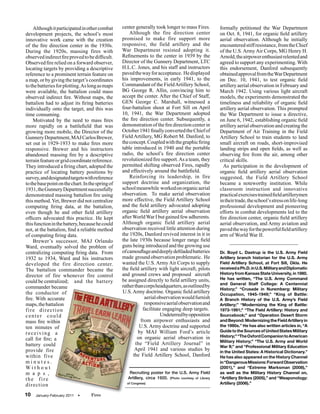
m a p s ,                                              Recruiting poster for the U.S. Army Field          as well as the Military History Channel on,
the fire                                              Artillery, circa 1920. (Photo courtesy of Library   “Artillery Strikes (2005),” and “Weaponology:
direction                                            of Congress)                                         Artillery (2006).”

10   January-February 2011   •      Fires
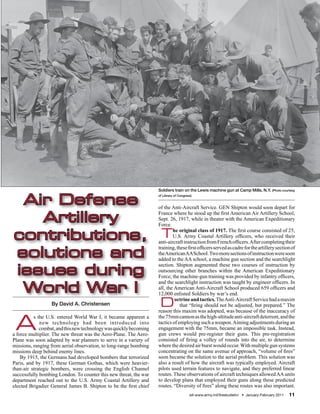
Soldiers train on the Lewis machine gun at Camp Mills, N.Y. (Photo courtesy


 Air Defense
                                                                    of Library of Congress)


                                                                    of the Anti-Aircraft Service. GEN Shipton would soon depart for

   Artillery                                                        France where he stood up the first American Air Artillery School,
                                                                    Sept. 26, 1917, while in theater with the American Expeditionary
                                                                    Force.

contributions, T
                                                                            he original class of 1917. The first course consisted of 25,
                                                                            U.S. Army Coastal Artillery officers, who received their
                                                                    anti-aircraft instruction from French officers. After completing their

solutions and
                                                                    training, these first officers served as cadre for the artillery section of
                                                                    the American AA School. Two more sections of instruction were soon
                                                                    added to the AA school, a machine gun section and the searchlight

issues during
                                                                    section. Shipton augmented these two courses of instruction by
                                                                    outsourcing other branches within the American Expeditionary
                                                                    Force; the machine-gun training was provided by infantry officers,

 World War I
                                                                    and the searchlight instruction was taught by engineer officers. In
                                                                    all, the American Anti-Aircraft School produced 659 officers and
                                                                    12,000 enlisted Soldiers by war’s end.
                  By David A. Christensen                            D       octrine and tactics. The Anti-Aircraft Service had a maxim
                                                                                that “firing should not be adjusted, but prepared.” The
                                                                    reason this maxim was adopted, was because of the inaccuracy of


 A
          s the U.S. entered World War I, it became apparent a      the 75mm cannon as the high-altitude anti-aircraft deterrent, and the
             new technology had been introduced into                tactics of employing such a weapon. Aiming adjustments during an
             combat, and this new technology was quickly becoming   engagement with the 75mm, became an impossible task. Instead,
a force multiplier. The new threat was the Aero-Plane. The Aero-    gun crews would pre-register their guns. This pre-registration
Plane was soon adapted by war planners to serve in a variety of     consisted of firing a volley of rounds into the air, to determine
missions, ranging from aerial observation, to long-range bombing    where the desired air burst would occur. With multiple gun systems
missions deep behind enemy lines.                                   concentrating on the same avenue of approach, “volume of fires”
    By 1915, the Germans had developed bombers that terrorized      soon became the solution to the aerial problem. This solution was
Paris, and by 1917, these German Gothas, which were heavier-        also a result of how the aircraft was typically employed. Aircraft
than-air strategic bombers, were crossing the English Channel       pilots used terrain features to navigate, and they preferred linear
successfully bombing London. To counter this new threat, the war    routes. These observations of aircraft techniques allowed AA units
department reached out to the U.S. Army Coastal Artillery and       to develop plans that employed their guns along these predicted
elected Brigadier General James B. Shipton to be the first chief    routes. “Diversity of fires” along these routes was also important.
                                                                                         sill-www.army.mil/firesbulletin/ • January-February 2011   11
Machine guns were used against low-altitude targets, while air                    results. The German observation plane went into a dive, followed
bursts delivered from the 75mm engaged the high-altitude threat.                  by an uncontrolled spiral, finally crashing into the 500 meters of
    The Anti-Aircraft Service also developed a doctrine of “deterrent             ground known as no-man’s land. The crew managed to survive the
fires.” It had become widespread knowledge that “although hitting a               crash, and was viewed scrambling from the wreckage and behind
plane was common, bringing one down was regarded as a fortunate                   German lines. That night, a French infantry patrol ventured across
incident.” From this lesson learned, American AA students were                    friendly lines to strip the enemy plane of its machine guns, and
instructed on techniques to deter the aircraft and keep it at a distance.         other useful equipment. The patrol was also successful in cutting
Instructors drilled into the students that forcing an aircraft to fly at          away a piece of the aircraft underbelly and later presented it to the
a higher altitude would decrease their accuracy, as was the belief                American Battery Commander, CPT E. A. Mellon as a souvenir
that a successful volume of fire would discourage the pilot from                  and confirmation of the American’s first recorded kill.
reaching his objective.                                                               By the war’s end, America’s Anti-Aircraft Service was the most
    The American Anti-Aircraft Service was the principal user of                  successful among the allies. The success was attributed to the tenants
searchlights during World War I. In all, the AA Service had 34                    of good training, the doctrine they developed and used, and to the
platoons activated while in theater. Most European’s believed that                skill and discipline of the crews operating the weapon systems.
searchlights were impractical and would give frontline positions                  When comparing the data, it took a British gun crew 10,000 rounds
away to enemy targeting. The American’s however, adopted the                      and the French crew 6,000 rounds to down a single plane. But, it
searchlights primarily for rear defenses. The searchlight quickly                 took only 600 rounds for the Americans to bring one down.
made an impact as a deterrent to nighttime bombing raids. Their                       First to Fire!
success was achieved, in part, by the ability to track and highlight a
threat. However, the nighttime tracking of an aircraft by a searchlight
often hindered a pilot’s ability to see and would cause him to become             David A. Christensen currently serves as the U.S. Army Air Defense
disorient and ineffective, often abandoning his target.                           historian for the U.S. Army Air Defense Artillery School at Fort Sill,

 T       he first recorded kill. The highlight for the newly formed
         service came to fruition on the 18th of May 1918. A
German observation plane was crossing between the security of
                                                                                  Okla. He spent 22 years of active service with the U. S. Army in various
                                                                                  assignments as both an NCO and commissioned officer. He served
                                                                                  with the Training and Doctrine Command as a professor of military
the Germany’s lines, and into the buffer of no man’s land, trying                 history at the Army’s Command and General Staff College for the past
to collect information on unit positioning. An alert crew of the 2nd              several years, before arriving to Fort Sill in 2009 as the Air Defense
Anti-aircraft Battery was located approximately 2,700 meters away                 Branch Historian. He is also resourced by Cameron University as an
and was armed with two French 75mm guns. As the crew prepared
                                                                                  adjunct professor. He received graduate degrees from The University
the shell fuses for the desired altitude, LT A.T. Slaten calculated the
                                                                                  of Oklahoma, 1993, Kansas State University, 2003, and is a graduate of
necessary data, on range, location, and speed. Soon the air was filled
                                                                                  the Army’s Command and General Staff College resident course, 2001.
with the burst of powder and fragmentation, and the effects provided

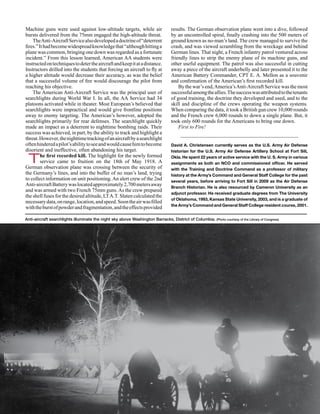
Anti-aircraft searchlights illuminate the night sky above Washington Barracks, District of Columbia. (Photo courtesy of the Library of Congress)


12    January-February 2011   •      Fires
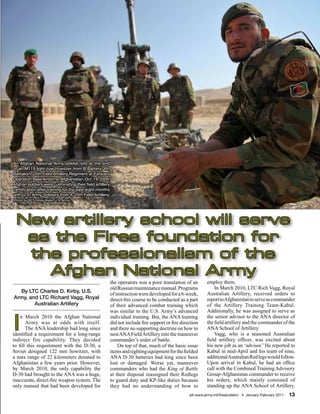
An Afghan National Army soldier sits at the end
of an M119 light-tow howitzer from B Battery, 4th
Battalion, 25th Field Artillery Regiment at Forward
Operation Base Airborne, Afghanistan, Oct. 14, 2009.
Afghan soldiers were culminating their field artillery
certification after training for the past eight months
with U.S. Army Soldiers from 4-25th Field Artillery.
(Photo by SGT Teddy Wade, U.S. Army)


 New artillery school will serve
  as the Fires foundation for
  the professionalism of the
    Afghan National Army
                                                         the operators was a poor translation of an         employ them.
                                                         old Russian maintenance manual. Programs               In March 2010, LTC Rich Vagg, Royal
  By LTC Charles D. Kirby, U.S.                                                                             Australian Artillery, received orders to
                                                         of instruction were developed for a 6-week,
Army, and LTC Richard Vagg, Royal                        direct-fire course to be conducted as a part       report to Afghanistan to serve as commander
        Australian Artillery                             of their advanced combat training which            of the Artillery Training Team-Kabul.
                                                         was similar to the U.S. Army’s advanced            Additionally, he was assigned to serve as


I
    n March 2010 the Afghan National                     individual training. But, the ANA training         the senior advisor to the ANA director of
       Army was at odds with itself.                     did not include fire support or fire direction     the field artillery and the commander of the
       The ANA leadership had long since                 and there no supporting doctrine on how to         ANA School of Artillery.
identified a requirement for a long-range                nest ANA Field Artillery into the maneuver             Vagg, who is a seasoned Australian
indirect fire capability. They decided                   commander’s order of battle.                       field artillery officer, was excited about
to fill this requirement with the D-30, a                    On top of that, much of the basic issue        his new job as an ‘advisor.’ He reported to
Soviet designed 122 mm howitzer, with                    items and sighting equipment for the fielded       Kabul in mid-April and his team of nine,
a max range of 22 kilometers donated to                  ANA D-30 batteries had long since been             additional Australian Red legs would follow.
Afghanistan a few years prior. However,                  lost or damaged. Worse yet, maneuver               Upon arrival in Kabul, he had an office
by March 2010, the only capability the                   commanders who had the King of Battle              call with the Combined Training Advisory
D-30 had brought to the ANA was a huge,                  at their disposal reassigned their Redlegs         Group-Afghanistan commander to receive
inaccurate, direct-fire weapon system. The               to guard duty and KP-like duties because           his orders, which mainly consisted of
only manual that had been developed for                  they had no understanding of how to                standing up the ANA School of Artillery.
                                                                                                  sill-www.army.mil/firesbulletin/ • January-February 2011   13
This is not what he had prepared himself for     out how to determine reliable firing data,       adopt this gunnery computer.
mentally. While artillery was being taught       and don’t forget to include a professional           The next step was to build the cadre,
in Afghanistan, there was no proponent,          education system. However, the constraints       for a two-pronged approach that included
no true institutional base to refine tactics,    he laid out for his team included some special   educating all current and future ANA Field
techniques, and procedures, no doctrine,         twists — the majority of the ANA Soldiers        Artillerymen, standardizing institutional
and most of all – no indirect fire capability.   they were dealing with were illiterate,          cadre for a training base, and creating
    He was given this as his only definitive     approximately 25 percent of the weapon           mobile education training teams for the
guidance: D-30 is the weapon system, and         systems and associated crews had already         previously fielded ANA Field Artillery units.
the first ANA Field Artillery battery needs      deployed, and all the instructors needed to      The first ANA Train the Trainer Course,
to be prepared to join it’s assigned combat      be ANA soldiers.                                 to build the institutional base with ANA
support kandak (battalion) for collective            At the time, a clear standout among the      instructors, graduated Sept. 26, 2010. These
training at the Consolidated Fielding Center     Australian Redlegs was LT Luke Haitas, a         T3 graduates executed an end-of-course,
located at Camp Blackhorse, Afghanistan          young officer assigned to develop the fire       live-fire exercise — ANA gunners, ANA
in time to graduate by April 2011.               direction procedures. Initially, as any good     FDC, and ANA fire supporters — all fired
    Vagg now refers to this as his “dream        artilleryman would do, Haitas developed          on time and on target.
job;” because where else in one’s military       an ANA version of ‘Charts and Darts’—              The new METT teams are scheduled to
career do you receive orders for such a huge     which is still used to check safety prior        be formed with a combination of coalition
undertaking and yet get so little guidance?      to executing a Fires mission. From there,        Redlegs all trained by the new cadre of the
    The Australian Redleg had his mission        Haitas began working with a contractor to        ANA School of Artillery. In May 2011, the
and immediately moved to the Australian          build a handheld fire-direction computer         METTs will complete training and begin
version of the U.S. Army military decision       which was equipped with an internal              moving to the ANA Field Artillery area
making process, the MAP or military              Global Positioning System and tabular            of operations to field newly-refurbished
appreciation process. He determined a way        firing tables based on standard metrological     D-30s complete with basic issue items. They
ahead and wrote the order that would be          data. The end result was simple, it could be     will also re-educate the currently fielded
used as a guide to develop the ANA School        operated like a palm pilot with a stylus, but    artillerymen and their owning commands.
of Artillery and the doctrine to insert the      most importantly the UDC D-30 Gunnery                Each ANA Combat Support Kandak
artillery into its operational force. When his   Computer calculated accurate, safe, firing       contains an ANA Field Artillery battery
team arrived, he gave out his orders—write       data as quickly as a handheld calculator         consisting of two, four-gun platoons.
doctrine, re-write POIs, write field manuals,    can add and subtract. Although the UDC           Given the asymmetric nature of warfare
determine battle drills, develop a 6400 mil      D-30 Gunnery Computer was developed              in Afghanistan, the employment of the
indirect fire capability with a weapon system    specifically for the ANA School of Artillery,    currently fielded artillery batteries is ideal
meant for 1600 mil zones of fire, figure         it is quite likely that other nations could      — within ANA forward operating bases.


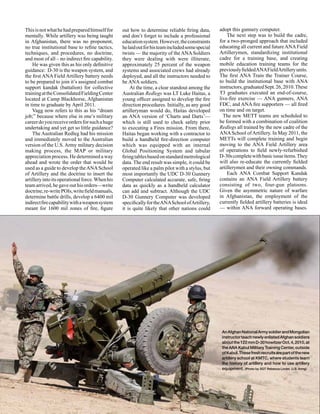
                                                                                                   An Afghan National Army soldier and Mongolian
                                                                                                   instructor teach newly enlisted Afghan soldiers
                                                                                                   about the 122 mm D-30 howitzer Oct. 4, 2010, at
                                                                                                   the ANA Kabul Military Training Center, outside
                                                                                                   of Kabul. These fresh recruits are part of the new
                                                                                                   artillery school at KMTC, where students learn
                                                                                                   the history of artillery and how to use artillery
                                                                                                   equipment. (Photo by SGT Rebecca Linder, U.S. Army)


14   January-February 2011   •    Fires
moving in the right direction, and by the
                                                                                                         summer of 2012 the artillery will take its
                                                                                                         rightful place in the Afghan National Army
                                                                                                         as the King of Battle.


                                                                                                         Lieutenant Colonel Charles “Skip” Kirby, U.S.
                                                                                                         Army Field Artillery, is currently the deputy
                                                                                                         director of operations, CJ3, NATO Training
                                                                                                         Mission Combined Security Transition
                                                                                                         Command - Afghanistan. Previously, he served
                                                                                                         as the chief of future operations, G3/5, for the
                                                                                                         Fires Center of Excellence, Fort Sill, Okla., until
                                                                                                         April 2010. He also deployed to Afghanistan
                                                                                                         from June 2006 to April 2007 in which he served
                                                                                                         as a Ministry of Defense mentor, Combined
                                                                                                         Security Transition Command-A Kabul and
                                                                                                         to Iraq in from July 20047 to February 2005
                                                                                                         as a counterfire officer for III Corps, Field
                                                                                                         Artillery. In 1984, he earned a Bachelor of
                                                                                                         Arts in business from Sterling College, Kan.


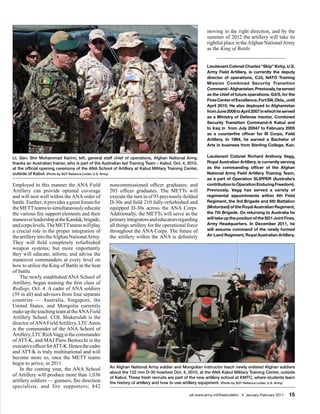
Lt. Gen. Shir Mohammad Karimi, left, general staff chief of operations, Afghan National Army,            Lieutenant Colonel Richard Anthony Vagg,
thanks an Australian trainer, who is part of the Australian led Training Team – Kabul, Oct. 4, 2010,     Royal Australian Artillery, is currently serving
at the official opening ceremony of the ANA School of Artillery at Kabul Military Training Center,       as the commanding officer of the Afghan
outside of Kabul. (Photo by SGT Rebecca Linder, U.S. Army)                                               National Army Field Artillery Training Team,
                                                                                                         as a part of Operation SLIPPER (Australia’s
Employed in this manner the ANA Field               noncommissioned officer graduates; and               contribution to Operation Enduring Freedom).
Artillery can provide optimal coverage              203 officer graduates. The METTs will                Previously, Vagg has served a variety of
and will nest well within the ANA order of          execute the turn in of 93 previously-fielded         regimental appointments within 4th Field
battle. Further, it provides a great forum for      D-30s and field 210 fully-refurbished and            Regiment, the 3rd Brigade and 6th Battalion
the METT teams to simultaneously educate            equipped D-30s across the ANA Corps.                 (Motorized) of the Royal Australian Regiment,
the various fire support elements and their         Additionally, the METTs will serve as the            the 7th Brigade. On returning to Australia he
maneuver leadership at the Kandak, brigade,         primary integrators and educators regarding          will take up the position of the SO1 Joint Fires,
and corps levels. The METT teams will play          all things artillery for the operational force       Army Headquarters. In December 2011, he
a crucial role in the proper integration of         throughout the ANA Corps. The future of              will assume command of the newly formed
the artillery into the Afghan National Army.        the artillery within the ANA is definitely           Air Land Regiment, Royal Australian Artillery.
They will field completely refurbished
weapon systems; but more importantly
they will educate, inform, and advise the
maneuver commanders at every level on
how to utilize the King of Battle in the heat
of battle.
    The newly established ANA School of
Artillery, began training the first class of
Redlegs, Oct. 4. A cadre of ANA soldiers
(39 in all) and advisors from four separate
countries — Australia, Singapore, the
United States, and Mongolia currently
make up the teaching team at the ANA Field
Artillery School. COL Shakerulah is the
director of ANA Field Artillery, LTC Amin
is the commander of the ANA School of
Artillery, LTC Rich Vagg is the commander
of ATT-K, and MAJ Piero Bertocchi is the
executive officer for ATT-K. Hence the cadre
and ATT-K is truly multinational and will
become more so, once the METT teams
begin to arrive, in 2011.
                                                    An Afghan National Army soldier and Mongolian instructor teach newly enlisted Afghan soldiers
    In the coming year, the ANA School
                                                    about the 122 mm D-30 howitzer Oct. 4, 2010, at the ANA Kabul Military Training Center, outside
of Artillery will produce more than 1,036           of Kabul. These fresh recruits are part of the new artillery school at KMTC, where students learn
artillery soldiers — gunners, fire direction        the history of artillery and how to use artillery equipment. (Photo by SGT Rebecca Linder, U.S. Army)
specialists, and fire supporters; 842
                                                                                               sill-www.army.mil/firesbulletin/ • January-February 2011   15
Keeping it real:
Don’t let Joint Fires
Observer skills deteriorate
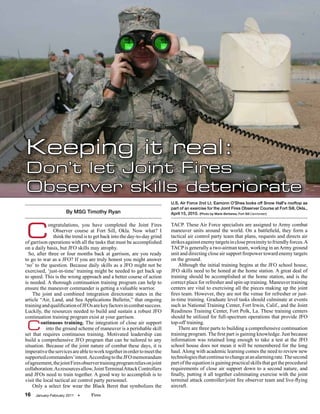
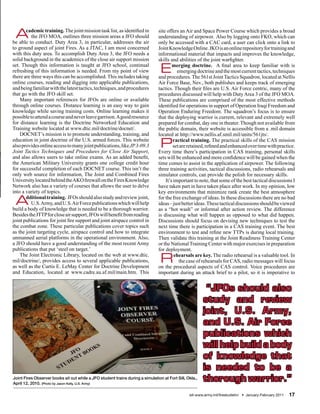
                                                                          U.S. Air Force 2nd Lt. Eamonn O'Shea looks off Snow Hall's rooftop as
                                                                          part of an exercise for the Joint Fires Observer Course at Fort Sill, Okla.,
                     By MSG Timothy Ryan                                  April 15, 2010. (Photo by Marie Berberea, Fort Sill Cannoneer)


C
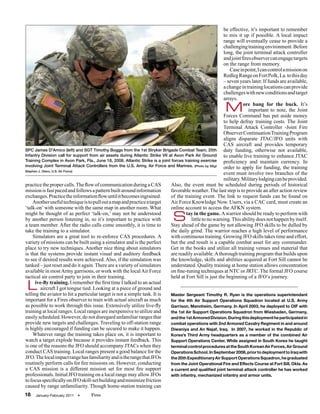
            ongratulations, you have completed the Joint Fires            TACP. These Air Force specialists are assigned to Army combat
               Observer course at Fort Sill, Okla. Now what? I            maneuver units around the world. On a battlefield, they form a
               think the trend is to get back into the day-to-day grind   tactical air control party team that plans, requests and directs air
of garrison operations with all the tasks that must be accomplished       strikes against enemy targets in close proximity to friendly forces. A
on a daily basis, but JFO skills may atrophy.                             TACP is generally a two-airman team, working in an Army ground
  So, after three or four months back at garrison, are you ready          unit and directing close air support firepower toward enemy targets
to go to war as a JFO? If you are truly honest you might answer           on the ground.
‘no’ to the question. Because daily skills as a JFO might not be              Although the initial training begins at the JFO school house,
exercised, ‘just-in-time’ training might be needed to get back up         JFO skills need to be honed at the home station. A great deal of
to speed. This is the wrong approach and a better course of action        training should be accomplished at the home station, and is the
is needed. A thorough continuation training program can help to           correct place for refresher and spin-up training. Maneuver training
ensure the maneuver commander is getting a valuable warrior.              centers are vital to exercising all the pieces making up the joint
    The joint and combined integration directorate states in the          fires team. However, they are not the venue for refresher or just-
article “Air, Land, and Sea Applications Bulletin,” that ongoing          in-time training. Graduate level tasks should culminate at events
training and qualification of JFOs are key factors in combat success.     such as National Training Center, Fort Irwin, Calif., and the Joint
Luckily, the resources needed to build and sustain a robust JFO           Readiness Training Center, Fort Polk, La. These training centers
continuation training program exist at your garrison.                     should be utilized for full-spectrum operations that provide JFO

 C      ontinuous training. The integration of close air support
           into the ground scheme of maneuver is a perishable skill
set that requires continuous training. Motivated leadership can
                                                                          top-off training.
                                                                              There are three parts to building a comprehensive continuation
                                                                          training program. The first part is gaining knowledge. Just because
build a comprehensive JFO program that can be tailored to any             information was retained long enough to take a test at the JFO
situation. Because of the joint nature of combat these days, it is        school house does not mean it will be remembered for the long
imperative the services are able to work together in order to meet the    haul. Along with academic learning comes the need to review new
supported commanders’ intent. According to the JFO memorandum             technologies that continue to change at an alarming rate. The second
of agreement, the joint Fires observer training program relies on joint   part of the equation is gaining practical skills that get the procedural
collaboration. As resources allow, Joint Terminal Attack Controllers      requirements of close air support down to a second nature, and
and JFOs need to train together. A good way to accomplish is to           finally, putting it all together culminating exercise with the joint
visit the local tactical air control party personnel.                     terminal attack controller/joint fire observer team and live-flying
    Only a select few wear the Black Beret that symbolizes the            aircraft.
16   January-February 2011   •    Fires
A     cademic training. The joint mission task list, as identified in
          the JFO MOA, outlines three mission areas a JFO should
be able to conduct. Duty Area 3, in particular, addresses the air
                                                                                site offers an Air and Space Power Course which provides a broad
                                                                                understanding of airpower. Also by logging onto FKO, which can
                                                                                only be accessed with a CAC card, a user can click onto a link to
to ground aspect of joint Fires. As a JTAC, I am most concerned                 Joint Knowledge Online. JKO is an online repository for training and
with this duty area. To accomplish Duty Area 3, the JFO needs a                 informational material that impacts and improves the knowledge,
solid background in the academics of the close air support mission              skills and abilities of the joint warfighter.
set. Though this information is taught at JFO school, continual
refreshing of this information is needed. From my point of view
there are three ways this can be accomplished. This includes taking
                                                                                 E      merging doctrine. A final area to keep familiar with is
                                                                                           emerging doctrine and the most current tactics, techniques
                                                                                and procedures. The 561st Joint Tactics Squadron, located at Nellis
online courses, reading and digging into applicable publications,               Air Force Base, Nev., both publishes and keeps track of emerging
and being familiar with the latest tactics, techniques, and procedures          tactics. Though their files are U.S. Air Force centric, many of the
that go with the JFO skill set.                                                 procedures discussed will help with Duty Area 3 of the JFO MOA.
    Many important references for JFOs are online or available                  These publications are comprised of the most effective methods
through online courses. Distance learning is an easy way to gain                identified for operations in support of Operation Iraqi Freedom and
knowledge while saving training costs. Online learning makes it                 Operation Enduring Freedom. The squadron’s focus is to ensure
possible to attend a course and never leave garrison. A good resource           that the deploying warrior is current, relevant and extremely well
for distance learning is the Doctrine Networked Education and                   prepared for combat, day one in theater. Though not available from
Training website located at www.dtic.mil/doctrine/docnet/.                      the public domain, their website is accessible from a .mil domain
    DOCNET’s mission is to promote understanding, training, and                 located at http://www.nellis.af.smil.mil/units/561jts/.
education in joint doctrine of the U.S. armed forces. This website
also provides online access to many joint publications, like JP 3-09.3
Joint Tactics Techniques and Procedures for Close Air Support,
                                                                                 P      ractical training. The practical skills of the CAS mission
                                                                                        set are retained, refined and enhanced over time with practice.
                                                                                Every time there’s participation in CAS training, personal skills
and also allows users to take online exams. As an added benefit,                sets will be enhanced and more confidence will be gained when the
the American Military University grants one college credit hour                 time comes to assist in the application of airpower. The following
for successful completion of each DOCNET course. This isn’t the                 three training activities, tactical discussions, radio rehearsals and
only web source for information, The Joint and Combined Fires                   simulator controls, can provide the polish for necessary skills.
University located behind the AKO firewall on the Fires Knowledge                   It’s important to note, that some of the best tactical discussions I
Network also has a variety of courses that allows the user to delve             have taken part in have taken place after work. In my opinion, low
into a variety of topics.                                                       key environments that minimize rank create the best atmosphere

 A     dditional training. JFOs should also study and review joint,
          U.S. Army, and U.S. Air Force publications which will help
build a body of knowledge that is needed to be a thorough warrior.
                                                                                for the free exchange of ideas. In these discussions there are no bad
                                                                                ideas – just better ideas. These tactical discussions should be viewed
                                                                                as a “hot wash” or informal after action review. The difference
Besides the JTTP for close air support, JFOs will benefit from reading          is discussing what will happen as opposed to what did happen.
joint publications for joint fire support and joint airspace control in         Discussions should focus on devising new techniques to test the
the combat zone. These particular publications cover topics such                next time there is participation in a CAS training event. The best
as the joint targeting cycle, airspace control and how to integrate             environment to test and refine new TTPs is during local training.
unmanned aerial platforms in the operational environment. Also,                 Then validate this training at the Joint Readiness Training Center
a JFO should have a good understanding of the most recent Army                  or the National Training Center with major exercises in preparation
publications that put ‘steel on target.’                                        for deployment.
    The Joint Electronic Library, located on the web at www.dtic.
mil/doctrine/, provides access to several applicable publications,
as well as the Curtis E. LeMay Center for Doctrine Development
                                                                                 R       ehearsals are key. The radio rehearsal is a valuable tool. In
                                                                                            the case of rehearsals for CAS, radio messages will focus
                                                                                on the procedural aspects of CAS control. Voice procedures are
and Education, located at www.cadre.au.af.mil/main.htm. This                    important during an attack brief to a pilot, so it is imperative to


                                                                                                          “JFOs should also
                                                                                                         study and review
                                                                                                         joint, U.S. Army,
                                                                                                         and U.S. Air Force
                                                                                                         publications which
                                                                                                         will help build a body
                                                                                                         of knowledge that
                                                                                                         is needed to be a
Joint Fires Observer books sit out while a JFO student trains during a simulation at Fort Sill, Okla.,
April 12, 2010. (Photo by Jason Kelly, U.S. Army)
                                                                                                         thorough warrior.”
                                                                                                 sill-www.army.mil/firesbulletin/ • January-February 2011   17
be effective, it’s important to remember
                                                                                                           to mix it up if possible. A local impact
                                                                                                           range will eventually cease to provide a
                                                                                                           challenging training environment. Before
                                                                                                           long, the joint terminal attack controller
                                                                                                           and joint fires observer can engage targets
                                                                                                           on the range from memory.
                                                                                                               Case in point, I can control a mission on
                                                                                                           Redleg Range on Fort Polk, La. to this day
                                                                                                           – seven years later. If funds are available,
                                                                                                           a change in training locations can provide
                                                                                                           challenges with new conditions and target
                                                                                                           arrays.

                                                                                                           M          ore bang for the buck. It’s
                                                                                                                         important to note, the Joint
                                                                                                           Forces Command has put aside money
                                                                                                           to help defray training costs. The Joint
                                                                                                           Terminal Attack Controller -Joint Fire
                                                                                                           Observer Continuation Training Program
                                                                                                           aligns disparate JTAC/JFO units with
                                                                                                           CAS aircraft and provides temporary
SPC James D'Amico (left) and SGT Timothy Boggs from the 1st Stryker Brigade Combat Team, 25th              duty funding, otherwise not available,
Infantry Division call for support from air assets during Atlantic Strike VII at Avon Park Air Ground      to enable live training to enhance JTAC
Training Complex in Avon Park, Fla., June 18, 2008. Atlantic Strike is a joint forces training exercise    proficiency and maintain currency. In
involving Joint Terminal Attack Controllers from the U.S. Army, Air Force and Marines. (Photo by SSgt      order to apply for funding, the training
Stephen J. Otero, U.S. Air Force)
                                                                                                           event must involve two branches of the
                                                                                                           military. Military lodging can be provided.
practice the proper calls. The flow of communication during a CAS              Also, the event must be scheduled during periods of historical
mission is fast paced and follows a pattern built around information           favorable weather. The last step is to provide an after action review
exchanges. Practice the information flow until it becomes ingrained.           of the training event. The link to request funds can be found on
    Another useful technique is to pull out a map and practice a target        Air Force Knowledge Now. Users, via a CAC card, must create an
‘talk-on’ with someone with the same map in another room. What                 online account to access the AFKN system.
might be thought of as perfect ‘talk-on,’ may not be understood
by another person listening in, so it’s important to practice with
a team member. After the radio calls come smoothly, it is time to
                                                                               S       tay in the game. A warrior should be ready to perform with
                                                                                          little to no warning. This ability does not happen by itself.
                                                                               Stay ahead of the game by not allowing JFO skills to be dulled by
take the training to a simulator.                                              the daily grind. The warrior reaches a high level of performance
    Simulators are a great tool to re-enforce CAS procedures. A                with continuous training. Growing JFO skills takes time and effort,
variety of missions can be built using a simulator and is the perfect          but the end result is a capable combat asset for any commander.
place to try new techniques. Another nice thing about simulators               Get in the books and utilize all training venues and material that
is that the systems provide instant visual and auditory feedback               are readily available. A thorough training program that builds upon
to see if desired results were achieved. Also, if the simulation was           the knowledge, skills and abilities acquired at Fort Sill cannot be
tanked – just reset and do it again. There are a variety of simulators         understated. Quality training at home station allows concentration
available in most Army garrisons, or work with the local Air Force             on fine-tuning techniques at NTC or JRTC. The formal JFO course
tactical air control party to join in their training.                          held at Fort Sill is just the beginning of a JFO’s journey.

 L    ive-fly training. I remember the first time I talked to an actual
         aircraft I got tongue tied. Looking at a piece of ground and
telling the aviator to hit a particular target is not a simple task. It is     Master Sergeant Timothy R. Ryan is the operations superintendant
important for a Fires observer to train with actual aircraft as much           for the 4th Air Support Operations Squadron located at U.S. Army
as possible to work through this issue. Extensively utilize live-fly           Garrison, Mannheim, Germany. In April 2003, he deployed to OIF with
training at local ranges. Local ranges are inexpensive to utilize and          the 1st Air Support Operations Squadron from Wiesbaden, Germany,
easily scheduled. However, do not disregard unfamiliar ranges that             and the 1st Armored Division. During this deployment he participated in
provide new targets and challenges. Traveling to off-station range             combat operations with 2nd Armored Cavalry Regiment in and around
is highly encouraged if funding can be secured to make it happen.              Diwaniya and An Najaf, Iraq. In 2007, he worked in the Republic of
    Whatever range the training takes place on, it is important to             Korea’s Third Army headquarters as a member of the combined Air
watch a target explode because it provides instant feedback. This              Support Operations Center. While assigned in South Korea he taught
is one of the reasons the JFO should accompany JTACs when they                 terminal control procedures at the South Korean Air Forces, Air Ground
conduct CAS training. Local ranges present a good balance for the              Operations School. In September 2008, prior to deployment to Iraq with
JFO. The local impact range has familiarity and is the range that JFOs         the 20th Expeditionary Air Support Operations Squadron, he graduated
routinely perform calls for fire missions on. However, conducting              from the Joint Operational Fire and Effects Course at Fort Sill, Okla. As
a CAS mission is a different mission set for most fire support                 a current and qualified joint terminal attack controller he has worked
professionals. Initial JFO training on a local range may allow JFOs            with infantry, mechanized infantry and armor units.
to focus specifically on JFO skill-set building and minimize friction
caused by range unfamiliarity. Though home-station training can
18   January-February 2011   •     Fires
Employing joint Fires
  in Afghanistan


 SPC Zackery Cely, from Company A, 1st Battalion, 4th
 Infantry Regiment, provides security from a tower on Forward
 Operating Base Lane in the Zabul province, Afghanistan,
 October 2009. (Photo by Tia P. Sokimson, U.S. Army)


                                                   situation for units who experienced enemy          a unit has made in its area of responsibility.
        By LTC John C. Allred                      contact across this dispersed area of              Also, the potential corrosion of Soldier
                                                   responsibility.                                    and leader morale after inflicting collateral


 J
          oint Fires lessons are critical to           The risks of employing large-                  damage cannot be understated.
             the success of our Army’s
             ongoing operations in the
contemporary operating environment. The
                                                   caliber, joint munitions while fighting
                                                   a counterinsurgency in a sovereign
                                                   country are many. Paramount to success
                                                                                                       M         ission assets. Tools that enabled
                                                                                                                    us to rapidly employ joint Fires
                                                                                                      while minimizing collateral damage were
joint Fires assets and units in this article       in counterinsurgency tactics is the staff’s        Remotely Operated Video Receivers and
detail how Fires is an essential partner and       and commanders’ ongoing assessment                 Sniper Advanced Targeting Pods. During
an enabler to maneuver units.                      of risk versus reward of joint Fires use,          our units’ deployment to Afghanistan,
    The basis of this article was my               and mitigation of civilian casualties. A           Sniper ATPs were mounted on all U.S.
experiences as the battalion commander             commander must always explore all non-             close air support-designated aircraft. The
for 2nd Battalion, 506th Infantry /Team            lethal means to effect and influence the           battalion also received additional ROVERs
Paktika East, which was operating as part          enemy.                                             to support company-level units upon
of the 4th Brigade Combat Team, 101st                  We found that often these non-                 arrival to Afghanistan. The Sniper ATP
Airborne Division (Currahee), in Paktika           lethal effects were more powerful in               transmitted to the ROVER the same high-
Province, Afghanistan, July 2008 through           accomplishing our objectives, pursuing             magnification images as seen in the CAS
March 2009. Team Paktika East consisted            the lines of effort of governance and              cockpits, allowing the battalion operations
of joint forces, who were deployed over            development, and were the focus of most            center, company command posts, and CAS
10,000 square kilometers. They served on           of the battalion’s operations. When a unit         pilots access to the same information and
twelve outpost/observation posts, as well          leader estimated he could not handle the           promoting situational understanding across
as along a 240-kilometer section of the            fight with organic assets, aerial and indirect     multiple echelons of leaders. This enabled
Afghan-Pakistan border.                            fires were often the only enablers available       more precise and safer employment of
    Our area of responsibility included            to quickly tip the balance in the favor of         precision munitions against insurgents.
terrain ranging from high-desert plains to         coalition forces.                                      Signals intelligence-cuing also played
mountains up to 10,000 feet in altitude.               The danger of misapplication of joint          an important role in the battalion’s joint
Movement between outposts included                 Fires use is the loss of support of the            Fires employment. Various off-the-shelf
distances and a terrain that could only be         indigenous population through collateral           unclassified signals collection devices such
traversed in hours – not minutes. Employing        damage. Even with careful and precise              as commercial FM radio scanners enhanced
joint Fires was the primary way our task           consequence management, these failures             the units’ situational awareness down to the
force could rapidly influence the tactical         will rapidly compromise whatever progress          platoon level. This allowed preemptive use
                                                                                            sill-www.army.mil/firesbulletin/ • January-February 2011   19
of joint Fires to destroy enemy forces before    drills and perfected mediums for passing           In response to observing the insurgent
they initiated contact where friendly forces     Fires mission requests and resulting Fires     activity we executed the following: alerted
could not execute direct fire and maneuver       orders. Due to the nondoctrinal dispersion     the nearest outpost with indirect fire assets
effectively: such as an enemy in ambush          of our artillery (four, two gun-platoons and   that could range the target (Company B
positions where steep and rough terrain          Fires directions centers at four outposts)     with its two, 155 mm M198 howitzers); the
prevented friendly forces from effectively       and a resulting shortage of communications     battalion Fires cell and Joint Terminal Attack
and quickly flanking; insurgents moving          platforms, our unit used Mardam-Bey            Controllers coordinated the airspace above
into position to set up indirect fire systems    internet relay chat to distribute information  the target to maintain UAS observation,
multiple kilometers distant from coalition       from the Advanced Field Artillery Tactical     flight of the 155’s rocket-assisted projectiles,
outposts. All Signals intelligence-cued Fires    Data System. We also generated fire            and ingress of CAS (two F-15s aircraft).
also included a hasty analysis of targets        orders that were simultaneously observed           While waiting for the civilian vehicle
considering factors like: proximity of           by sender and receiver which facilitated       traffic to clear the target area, with sufficient
historic firing points and ambush positions;     situational awareness amongst three            space to prevent collateral damage, Task
comparison to established patterns of enemy      echelons of the command.                       Force JTAC oriented F-15 pilots to the
activity; use of a lexicon of enemy code             An effective method of joint Fires         target area. Critical to maintaining the
words and phrases to better understand           employment is teaming of multiple assets,      element of surprise was keeping the UAS
our opponents’                                                                                                         and the CAS assets far
intents; proximity to             “The ability to understand weapons enough away in altitude
known or observed effects, in relation to the terrain, by and range from the
civilian population the unit’s leadership facilitated the target, to ensure their
concentrations; and
always observation of
                                rapid employment of joint Fires in engine sounds would                                 not alert the enemy, and
target area to positively support of units receiving contact.” yet close enough for
identify enemy and                                                                                                     their respective optics
preclude killing of civilians.                   specifically unmanned aerial systems,          to maintain continuous surveillance of the

 A       pplying joint Fires. A critical aid
             in the application of joint Fires
was the Precision-Strike Suite Special
                                                 indirect fire systems and fixed-wing close
                                                 air support sorties as part of an enhanced
                                                 joint air attack. One example of our battalion
                                                                                                objective.
                                                                                                    More important was the co-location
                                                                                                of the UAS operators with the battalion
Operations Force software. This application      employing JAAT was at a periodic daytime       operations center, providing real-time views
graphically portrayed weapons effects            insurgent checkpoint, which had been           of the target area from the perspective of
on overhead imagery for the target grids         identified by multiple human intelligence      the F-15 pilots (through ROVER) and the
of indirect fire missions. The ability to        sources as suspicious.                         UAS (through the ground station). After a
understand weapons effects, in relation              At this unlawful checkpoint, located       hasty analysis of the terrain and weapons
to the terrain, by the unit’s leadership         halfway between the battalion FOB and          effects with PSS-SOF, we initiated the
facilitated the rapid employment of joint        our Alpha Company COP, Afghan civilians        attack with an immediate suppression-
Fires in support of units receiving contact.     were harassed by and forced to pay tolls to    fire mission to fix the enemy. This was
On-scene commanders may not have been            local insurgents.                              immediately followed by each of the
able to see across the highly-varied terrain of      Mounted and dismounted ground patrols      F-15s hitting the target in succession with
Afghanistan for nearby villages at all times,    had not caught the AAF checkpoint in action    their 20 mm cannons. Within the next 24
though they may have seen their intended         due to the enemy’s early warning system,       hours, we received confirmation, through
targets clearly. PSS-SOF, in combination         established in the surrounding sympathetic     human intelligence, we had killed eight-
with other overhead imagery, enhanced the        tribes (specifically the Zadran Tribe , which  enemy fighters and severely wounded an
battalion’s ability to mitigate and prevent      was the parent tribe of the Haquani’s          additional 22 insurgents. The effects of this
civilian casualties, which was a vital and       insurgent network) who lived in the area.      joint Fires application, deterring enemy
essential measure needed for the confident           To counter the AAF early warning           recruitment and action in the area, resulted
and timely application of joint Fires in the     system, we employed a Shadow UAS to            in no additional, unlawful checkpoints or
current operating environment.                   observe the area of interest designated for    other overt actions, for more than a month
    One of the most important actions a          the checkpoint. The UAS ground station         after the engagement.
task force commander may take to ensure
timely and accurate joint Fires is giving
clear guidance to subordinate leaders. The
                                                 and operators were co-located with our
                                                 operations center. After several missions,
                                                 the Shadow spotted a platoon-sized element
                                                                                                    L  essons learned. We took several
                                                                                                           lessons learned away from this
                                                                                                action, learing first-hand that one of the
first step in this process is a frank discussion of suspected insurgents, not in uniform,       benefits of full-time partnering with the
with the next highest senior commander           armed with multiple crew-served weapons,       indigenous security forces to include
of what you are both comfortable with,           stopping civilian vehicles and taking goods    rapid clearance of fires. The synergy we
such as levels of authority for release of       and money from them.                           created, by teaming our assets, allowed
different types of munitions, and under              Once we confirmed that our Company A       us to circumvent the great advantages
what conditions are they used. Once I had        and their collocated Afghan national army      our enemies’ had in our current operating
this guidance, I published it in the simplest    and police counterparts were not patrolling    environment.
format possible and ensured my subordinate       in that area, we positively confirmed enemy        Later in our deployment, we had another
leaders also understood.                         activity.                                      success when our task force coordinated

E       nsuring timely and accurate Fires.
            The battalion and company
command posts, exercised Fires clearance
                                                     As we knew from experience, a ground
                                                 patrol could not get to the checkpoint with
                                                 the element of surprise.
                                                                                                CAS and rotary wing attack aviation teaming
                                                                                                in response to an enemy, 80-plus personnel
                                                                                                attack on a platoon combat outpost. The
20   January-February 2011   •   Fires
COP sat on a high bluff overlooking a             were then tracked by the A-10s’ lasers,               with this knowledge, ground commanders
large, two-village complex agricultural           which designated and guided the AH-64s                may successfully employ joint Fires in a
area, which was also located at the western       into position. By early morning, the two              non-linear, non-contiguous environment
exit of a major insurgent infiltration route,     aerial teams had tracked and destroyed all            against insurgents in a highly-restrictive
reaching all the way back to insurgent base       the insurgents with the AH-64 30mm cannon             terrain. Also significant to the employment
areas in Pakistan’s autonomous border tribal      fire. The AH-64 was the best system to                of all these assets is the first element of
areas. One of the major tribes located in the     finish mission in order to mitigate collateral        battle command: airspace command and
valley was sympathetic to the insurgency,         damage. Charlie Company launched a patrol             control, AOR situational understanding,
but the COP location enabled the battalion        at first light and found multiple destroyed           which in turn enables airspace control;
to disrupt infiltration in this area.             weapons and equipment in the various                  positive identification of the enemy, and
    Shortly before midnight, the platoon          locations where the AH-64s had engaged                observation of Fires. Most importantly,
located at the COP spotted movement into          the enemy.                                            the battalion commander in charge, of a
the bazaar west of the outpost, as well as
on a hill one kilometer to the north. The
platoon executed a stand-to and alerted the
                                                   T       eaching points. This action offered
                                                           us multiple teaching points and
                                                  lessons learned such as a sound defensive
                                                                                                        specific area of operation, must give clear
                                                                                                        guidance that enables the appropriate,
                                                                                                        timely, and effective use of joint Fires.
Charlie Company commander at the FOB,             preparation and good observation plans,               Through intent-based orders, a battalion
which was located 25 kilometers to the            conducted by the platoon ensured the                  commander empowers subordinate leaders
south. The commander then alerted his 1st         outpost would not be over-run. The platoon’s          to maximize their creativity and initiative
platoon in case he needed a quick-reaction        skilled use of observation and marking                within the commander’s intent. For all the
force, and requested through the battalion        devices also proved critical in maintaining           successful operations detailed in this article
operations center CAS and an air weapons          positive identification of the enemy. There           I give full credit to the subordinate leaders
team (which included two AH-64 Apache             was also effective battle target hand-offs            and staff on our team who enabled and
helicopters).                                     from observers to shooters, facilitated by            executed them.
    Shortly after these actions, the enemy        the platoon leader, company commander,
opened fire from five support-by-fire             JTAC and aircrews, of the rotary fixed-wing
positions which were located on a large hill      aircraft. All the actions that night ensured          Lieutenant Colonel (P) John C. Allred
to the north, and arrayed on the west and on      no identified enemy escaped.                          is currently an instructor at the United
the south of the COP. From their positions,
the platoon leader assessed the enemy was
attempting to suppress the crew-served
                                                   T       ools and asset accessibility. Most
                                                           of the tools detailed in this article
                                                  have recently become available to echelons
                                                                                                        States Army Combined Arms Center, Fort
                                                                                                        Leavenworth, Kan., where he facilitates
                                                                                                        the Pre-Command Course and the Tactical
weapons located on the COP, while the             below brigade in the current conflict. As             Commanders Development Course in the
insurgents executed an infiltration attack on     counterinsurgency is a bottom-up fight, it            School of Command Preparation. He is also
the COP from a deep wadis (a dry streambed)       is essential to push these assets down with           a graduate of the United States Military
located 1,900 meters to the northeast. The                                                              Academy, West Point, N.Y., where he earned
                                                  the proper subject-matter experts and help
                                                                                                        a Bachelors of Science, in 1989. He also
COP’s 120 mm mortar fired two rounds and          junior leaders employ them.
                                                                                                        has a Masters of Public Administration from
destroyed the enemy crew-served weapon                Critical to successful use of all
                                                                                                        Columbus State University, Columbus, Ga.,
firing from the north; the most dangerous         these tools is knowledge, of available
                                                                                                        in 2000.
of the enemy’s support-by-fire positions.         capabilities and training assets. Armed
    The platoon effectively suppressed
the other positions with a combination of
crew-served and small-arms direct fire, and
then the enemy attempted to break contact.
While the enemy shifted into the large
river wadis located between the village
complexes, the platoon used their Tube-
Launched, Optically-Tracked, Wireless-
Guided Improved Acquisition Systems to
maintain continuous positive identification
of the insurgents and orient two A-10s onto
the enemy. The battalion operations center
observed the A-10s’ efforts through the
Sniper ATP-ROVER medium to line up for
a strafing attack on the retreating insurgents.
However, to avoid damage to Afghan homes
and civilians, we ordered the CAS sortie to
high orbit to maintain observation and PID
of the retreating insurgents, until the inbound
AWT could be oriented to the target.
    After the AWT arrived and received an
orientation to the terrain and situation, we
task organized one AH-64 and one A-10 per         SGT Mason Levo, Charlie Company, 2nd Battalion, 502nd Infantry, 2nd Brigade Combat Team,
                                                  101st Airborne Division, readies himself before movement from Kandahar City to the Panjwaii
team. Originally in a 21-man element, the
                                                  District Center, Kandahar province, Afghanistan, Oct. 6, 2010. (Photo by Cpl Carol A. Lehman, U.S. Army)
insurgents, who had broken into four groups,
                                                                                              sill-www.army.mil/firesbulletin/ • January-February 2011   21
MAJ Paul Bollenbacher shakes hands with a

Operational culture                                                                                 Si Av village resident from the Bawka district
                                                                                                    in Farah province, Afghanistan, June 12, 2010.
                                                                                                    Bollenbacher is the director of the Provincial

  in the US Army:                                                                                   Reconstruction Team Farah Civil Military
                                                                                                    Operations Center. (Photo by SrA Rylan K. Albright,
                                                                                                    U.S. Air Force)


The Fires Center of                                                                                 enough to function in a variety of situations
                                                                                                    and against a myriad of threats with a

 Excellence Culture                                                                                 diverse set of national, allied and indigenous
                                                                                                    partners. It will require leaders who can
                                                                                                    anticipate change, create opportunities and

     and Foreign                                                                                    achieve results.
                                                                                                        The Army’s Leader Development
                                                                                                    Strategy prescribes the future security

Language Strategy                                                                                   environment will require leaders “who
                                                                                                    understand the context of the factors
                                                                                                    influencing the military situation, act
 sets the standard                                                                                  within that understanding, continually
                                                                                                    assess and adapt those actions based on
                                                                                                    the interactions and circumstances of
   for the rest of                                                                                  the enemy and environment, consolidate
                                                                                                    tactical and operational opportunities into
                                                                                                    strategic aims, and be able to effectively
  TRADOC, Army                                                                                      transition from one form of operations
                                                                                                    to another.” As field artillerymen and air
                                                                                                    defense artillerymen support full-spectrum
                                                  operate along with our multinational and          operations, challenges in how we conduct
       By Dr. Mahir J. Ibrahimov                  host-nation partners against sophisticated        fire support operations will require agility
                                                  and adaptive adversaries in order to achieve      and innovation as new adaptive threats that


G
              lobalization, Internet              U.S. objectives. This dictates that Soldiers of   employ a mix of new and old strategies and
                networking, and instant           every rank must become ‘culturally astute’        technologies emerge.
                access to worldwide news          about the areas where they operate.                   To prosecute the fight and accomplish
media have proliferated the merging or               Our junior leaders face adversaries who        the assigned mission, the U.S. Army
partnering of ideological groups that             employ multiple and dynamic combinations          Field Artillery and Air Defense Artillery
oppose the U.S. and/or U.S. policies.             of conventional, irregular, terrorist and         will need leaders who are adaptive,
These groups operate in pan-regional and          criminal capabilities as they engage our          competent, and capable of operating
multi-regional battle space comprised             Soldiers or attack our strategic interests.       with confidence in these ambiguous and
of numerous cultures, both friendly and           These hybrid threats can be expected to           complex environments. These leaders
hostile. It appears likely that during the next   use a full spectrum of options, including         must be able to operate in decentralized
decade the operational environment of our         every political, economic, informational,         organizations; be able to network with
troops will be characterized by persistent        and military measure at their disposal.           their joint, interagency, intergovernmental,
and unpredictable conflicts in battle space       Combating these threats will necessitate          and multinational partners; and be able to
teeming with multiple foreign cultures.           creative solutions, and such solutions will       develop plans and operations that win the
The Army must be prepared to effectively          require military forces that are adaptive         support of the population while defeating the
22   January-February 2011   •     Fires
enemy. They must have an understanding of         and other abilities that pertain to a specific      and conflict resolution; leadership and
how other people think and act, as well as        geographic area.                                    influence; cultural evaluation, synthesis, and
an appreciation of cross-cultural diversity           Additional characteristics of cross-            predictive analysis during staff planning;
and beliefs. This cultural sensitivity is just    cultural competence includes awareness of           and many other abilities that pertain to a
as important within a Soldier’s organization      culture and of one’s own cultural context,          specific area of operations.
and with other sister services and allies,        general cross-cultural schema and culture-              It’s also the ability to adopt perspectives
as it is in engaging indigenous people            analytic models, and an increasingly                common to that culture; ability to regulate
and threats who exist within the contested        complex understanding of the impact of              one’s own behavior, communication, and
operational environment. In order to meet         culture on military planning and operations         emotional expression to match cultural
these operational and environmental               (knowledge).                                        norms where appropriate. Includes positive
demands, we must enrich our leader                    Critical aspects of cross-cultural              attitudes toward the population and
training and education by leveraging              competence are interpersonal and                    motivation to learn about the culture, to
and adapting training methodologies to            communication skills, flexibility in seeing         include how they make decisions.
replicate complexity and hybrid threats in        different cultural frames and perspectives,             A combination of both competencies
the institutional classroom, at home-station      and the ability to regulate one’s own               acquired during the cycle of training,
and while deployed.                               reactions (skills).                                 education and experience would help
    Assessing the field artillery and air             Necessary ingredients of cross-cultural         overcome the ‘culture shock,’ and give
defense artillery community’s requirements,       competence are non-ethnocentric attitudes,          Soldiers the ability to adjust to an indigenous
we must develop leaders who have the              motivation to learn about culture and               culture as quickly as possible to get the
core competencies to visualize, articulate        to update one’s knowledge base as new               mission done.
and build partnerships and alliances; to
effectively lead organizations; and be able
                                                  information is encountered and the ability
                                                  to empathize (attributes).                           G        overnance. The TRADOC Deputy
                                                                                                                  Chief of Staff, G-2 serves as
to adapt to unanticipated, changing and
uncertain situations.                              R      egional competence. Another
                                                             major component of the
                                                                                                      the executive agent for the CG, TRADOC
                                                                                                      as culture and foreign language lead for

 T      he Army Culture and Foreign
        Language Strategy. To meet
these operational and cultural challenges,
                                                  culture development program is regional
                                                  competence. This concept is defined as
                                                  a set of knowledge, skills, and attributes
                                                                                                      the Army. The commander, Combined
                                                                                                      Arms Center, TRADOC is the lead for
                                                                                                      implementation of culture and foreign
the Army’s goal as defined in the Army            related to a particular country, region,            language career development within all
Culture and Foreign Language Strategy,            organization, or social group, which                TRADOC organizations. The Army Culture
dated Dec. 1, 2009, is to develop and             enables effective adaptation to that specific       and Foreign Language Management Office
maintain expeditionary forces that are led        culture. Additional characteristics include         is delegated ACFLS implementation
by Soldiers who are ready to deploy and           awareness of the historical, political,             management authority from the TRADOC
operate effectively anywhere in the world         cultural (including linguistic and religious),      DCS G-2. Fragmentary Order 18 (weekly) to
across the full spectrum of conflict. This will   sociological (including demographic),               OPORD 09-008, TRADOC Campaign Plan
require leaders who have sufficient cross-        economic, and geographic dimensions of              10-11 outlines specific tasks to TRADOC
cultural, regional and foreign language           a foreign country, global region, or other          commanders, staff and subordinate
competencies to enable the successful             specific culture.                                   organizations on implementing the Army
execution of military operations…not only             Acquiring regional competence enables           Culture and Foreign Language Strategy.
an understanding of the culture and language      negotiation and persuasion; mediation               TRADOC centers and schools, in their roles
in a particular area, but an understanding
of the implications these considerations
have on how operations are conducted. To
achieve this goal, leaders and Soldiers must
increase their cultural knowledge through
operational experience, self-development,
or as a learning opportunity during their
professional military education. Within
the Training and Doctrine Command,
this will require schools and centers to
develop, integrate and deliver cross-cultural
education within their respective programs
of instruction.

 C       ross-cultural competence. This
           is a set of knowledge, skills and
attributes that enables Soldiers to adapt
effectively in any environment. It can
develop over time through experience, but
can be accelerated by principled learning
methods. Cross-cultural competence enables
negotiation and persuasion; mediation
                                                  SSG Caleb Welch of 1-178th Field Artillery Battalion, South Carolina Army National Guard interacts
and conflict resolution; leadership and
                                                  with children on a rural road in Laghman province, Afghanistan, during a engineering assessment,
influence; cultural evaluation, synthesis, and    Aug. 18, 2010. (U.S. Army photo)
predictive analysis during staff planning;
                                                                                            sill-www.army.mil/firesbulletin/ • January-February 2011   23
as proponents, will be integrally involved
in defining common education and training
required to generate the necessary culture
                                                training and follow-on leader development
                                                professional military education courses are
                                                the principal constraints the faculty must
                                                                                                  C       haracter. A leader of character
                                                                                                            internalizes the Army Values,
                                                                                                 lives by our Professional Military Ethic,
and foreign language capability for the         contend with in order to meet the ACFLS          reflects the Warrior Ethos and displays
Army. Proponents will also determine the        desired outcome. Learning objectives will        empathy towards Soldiers, families and
culture and foreign language capabilities       be achieved through modification of existing     those people affected by the unit’s actions.
required in operating force units for which     program of instruction, incorporating tasks      Competence places an individual in position
they are the proponent.                         into collective training events (capstone        to lead – character makes him or her an
    The ACFLS goal is to establish a baseline   exercises) and through professional reading,     effective leader.
of culture and foreign language capabilities
for all leaders and Soldiers to support the
accomplishment of unit missions. The
                                                critical writing requirements, and after-duty
                                                language training and civilian education
                                                opportunities.
                                                                                                 P       resence. A leader of presence has
                                                                                                         credibility, exudes confidence and
                                                                                                 builds trust. Presence is conveyed through
strategy’s end state is to build and sustain        Resources and funding for additional         actions, appearance, demeanor and words.
an Army with the right blend of capabilities
to facilitate full spectrum operations. The
resulting force will have the ability to
                                                instructors, role players and lesson
                                                materials are limited. We must leverage
                                                existing cultural training, language,
                                                                                                 I  ntellect. A leader of intellect has the
                                                                                                       conceptual capability to understand
                                                                                                 complex situations, determine what needs
effectively conduct operations with and         civilian academic partnerships and virtual       to be done and interact with others to get
among other cultures.                           gaming solutions to support USAFAS and           it done. Leaders must have the ability to

U        .S.         Army           Field
            Artillery and Air Defense
Artillery Schools. The FCoE CFLP’s
                                                USAADAS ACFLS learning objectives.
                                                    Inclusion of ACFLS learning objectives
                                                into course curricula should complement
                                                                                                 reason, to think critically and creatively,
                                                                                                 to anticipate consequences and to solve
                                                                                                 problems.
desired outcome is to provide the Army with     and not put at risk common core and artillery        At the USAFAS and USAADAS,
technically and tactically                                                                                       the development of
proficient and expeditionary-
minded field artillery            “Cross-cultural training                                                       cultural awareness and/
                                                                                                                 or understanding will be
and air defense artillery
leaders who can operate          and education should                                                            the principal objective and
                                                                                                                 introduction to a foreign
in a joint, interagency,                                                                                         language (basic phrases and
intergovernmental and
multi-national environment
                                 build on the foundation                                                         elemental proficiency) is a
                                                                                                                 supporting effort. In order
across the full spectrum of
operations and with a level      of an individual’s existing                                                     to achieve a higher level
                                                                                                                 of cultural understanding/
of competence necessary to
                                 leader attributes which in
                                                                                                                 expertise or language
perform assigned tasks in a                                                                                      proficiency, individuals
specific geographic area.                                                                                        would need to leverage
    For field artillery and air
defense artillery Soldiers       turn reinforces the core                                                        other professional military
                                                                                                                 education, civilian education
and leaders, it is desired
they possess a sufficient        leader competencies...”                                                         and self-development
                                                                                                                 programs. (See figures 1.1
level of cross-cultural                                                                                          and 1.2 on page 25.)
and regional competence to effectively          technical training objectives.                       Cultural awareness: minimal level of
accomplish duties at their assigned level,
and to have the cognitive, interpersonal
and cultural skills necessary to make sound
                                                 T      raining approach. In order to build
                                                        and sustain an Army with the right
                                                blend of culture and foreign language
                                                                                                 regional competence necessary to perform
                                                                                                 assigned tasks in a specific geographic area;
                                                                                                 able to describe key culture terms, factors
judgments in these complex environments.        capabilities to facilitate full-spectrum         and concepts. Basic understanding of how
For target mensuration and collateral           operations, we must leverage existing            foreign culture might affect the planning
damage estimation, it is important that all     professional military education programs,        and conduct of operations is desirable.
artillerymen and air defense artillerymen       organizational and functional training and           Cultural understanding: well developed
understand the effects that culture, people     continuous life-long learning through a          cross-cultural competence in a specific
and civilian factors have on the targeting      combination of training, education and           region. A leader must be able to anticipate
process.                                        experiential opportunities to attain a level     the implications of culture and apply
      The FCoE CFLP will leverage the           of awareness, understanding and expertise.       relevant terms, factors, concepts, and
capabilities at its disposal to establish the   As we determine how to best implement            regional information to tasks and missions.
initial foundational training and education     the ACFLS, we will use the current leader        Familiarity is necessary of a specific region’s
for field artillerymen and air defense          development strategy that serves as a base       economic, religious, legal, governmental,
artillerymen to be able to competently and      for our existing instruction within the school   political and infrastructural features, and
confidently lead Soldiers. This includes the    and in the growth of our leaders.                awareness of regional sensitivities regarding
introduction and development of a basic             Cross-cultural training and education        gender, race, ethnicity, local observances
awareness in culture and languages.             should build on the foundation of an             and local perception of the U.S. and its

 C       onstraints, limitations and risk.
           Time available and specific course
length for students attending field artillery
                                                individual’s existing leader attributes
                                                which in turn reinforces the core leader
                                                competencies of leading others, developing
                                                                                                 allies is paramount.
                                                                                                     Cultural expertise: advanced level of
                                                                                                 cross-cultural competence in a specific
and air defense artillery initial military      oneself and achieving results:                   geographic area. This generally entails some
24   January-February 2011   •   Fires
Figure 1.1 U.S. Army Fires Center of Excellence Culture and Foreign Language Program Strategy and Implementation Plan

Self assessment:
 • Employ Defense Language Institute assessment
 (Defense Language Aptitude Battery) tools
 • Prepare for follow on assignment
 • Tailor to individual’s learning style (Myers-Briggs
                                                                                      Assessment
 Type Indicator)
Skills development (Training):
 • U.S. Central Command/Pacific Command regional
 focus
 • Assignment oriented training elemental language
 proficiency (Level 0+/1)


                                                              Experience                                           Training
 • Proposed languages (Dari/Pashto, Arabic, Korean
 and Russian)
 • Cameron University, Oklahoma University and
 Oklahoma State University guest lecturers
 • International Student Division/liaison officer briefs
Situational application (Education):
 • Assignment oriented training cultural awareness
 focus


                                                                                           Education
 • Strategic university partnerships
 • Lectures/seminar panels
 • Critical thinking writing requirements
Experiential learning (Experience):
 • Redleg War (key leader engagement/civilians on
 the battlefield)
 • Role playing scenarios


degree of proficiency in a language; skills that       Figure 1.2 U.S. Army Field Artillery School Culture and Foreign Language Program
enable effective cross-cultural persuasion,
negotiation, conflict resolution, influence,                                                                                Culture and foreign
                                                                    Course                  Course length
or leadership; and an understanding of                                                                                       language focus
the most salient historic and present-day                    Captains Career Course              24 weeks                             36 hours
regional structural and cultural factors of
                                                           Basic Officer Leader Course B         20 weeks                             10 hours
a specific geographic area. (See figure 1.3
on page 32.)                                                 Warrant Officer Advanced
                                                                                                 10 weeks                             15 hours
    In order to achieve this goal, FCoE CFLP                         Course
will incorporate the following learning                    Warrant Officer Basic Course          33 weeks                             22 hours
objectives in its initial military training and
                                                             Senior Leader’s Course/
follow-on leader development professional                                                        4-8 weeks                            2.5 hours
                                                            Advanced Leader’s Course
military education courses:

 L     earning Objective 1 (Character).                    Advanced Individual Training                                                1 hour
         Demonstrate interaction and cross-
cultural communications skills in order to            challenging students to employ skills to deal     highlights the implications of a region’s
effectively engage and understand people              with ambiguous and complex situations,            economic, religious, legal, governmental,
and their environment. Demonstrate a                  to regulate one’s own behavior, and to            political and infrastructural features, and
level of cultural awareness that includes             use interpersonal abilities to deal with          of sensitivities regarding gender, race,
a positive, openness to other people, an              people from one’s own or other cultures.          ethnicity, local observances and local
understanding of prevailing values, beliefs,          This includes an understanding and ability        perception of the US and its allies.
behaviors and customs, and a desire to learn          to engage other joint and allied military             Apply relevant planning considerations,
more about cultures and language. This                personnel, and host country indigenous            terms, factors, concepts and geographic
includes an introduction to a language that           leaders with a moderate level of confidence.      information to mission planning and in
supports current military operations with the
intent to promote additional study through
self-development at the institution, at home-
                                                       L    earning Objective 3 (Intellect).
                                                               Demonstrate a familiarization in
                                                      a geographic region of current operational
                                                                                                        the conduct of operations. This includes
                                                                                                        leveraging other TRADOC and DOD
                                                                                                        schools, partnerships with universities
station or at an academic university.                 significance. Leverage critical thinking          and academia, gaming technology and

 L     earning Objective 2 (Presence).
         Demonstrate communication,
influence and negotiation skills essential
                                                      and cognitive skills through organizing
                                                      information that supports cultural self-
                                                      awareness. Depending on level of leader
                                                                                                        opportunities that stress students’ ability
                                                                                                        to concisely and persuasively speak and
                                                                                                        write, to engage in discussions, and employ
for leaders to effectively operate in a JIIM          development PME, expand cross-cultural            cognitive reasoning and thinking skills.
environment.
    Leverage the knowledge gained by
                                                      competence skills by gaining an awareness
                                                      or understanding of a geographic area that         E     xecution of training. The following
                                                                                                                  information provides USAFAS,
                                                                                              sill-www.army.mil/firesbulletin/ • January-February 2011   25
USAADAS and NCO Academy with a                           • Task 1: Develop communication                 led discussions and facilitated problem-
plan for the conduct of culture and foreign            skills that enable effective cross-cultural       centered exercises to assist the student in
language training and education. The                   persuasion, negotiation, conflict resolution      understanding basic cultural awareness and
following implementation plan is consistent            or influence.                                     then by challenging him/her through use
with current Department of the Army and                  • Task 2: Apply communications skills           of relevant scenarios they may encounter
TRADOC leader development and cultural                 during cross-cultural negotiations.               in their unit and/or during a deployment.
awareness initiatives to incorporate culture             • Task 3: Develop confidence in learning        Facilitated learning will focus on initiative,
and foreign language into institutional                and applying language skills.                     critical thinking and accountability for their
training and education at the schools and                  Learning Objective 3 (Intellect):             actions. Small group instructors will receive
centers of excellence.                                 Demonstrate a familiarization in a                cultural training assistance from the FCoE
    Learning objectives and their associated           geographic region of current operational          Cultural Advisor to enable them to better
tasks:                                                 significance.                                     present information, lead discussions and
    Learning Objective 1 (Character):                    • Task 1: Apply culturally relevant terms,      to facilitate the problem-centered exercises.
Demonstrate interaction and cross-cultural             factors, concepts and regional information        The instruction will leverage blending
communications skills in order to effectively          in the development of mission plans and           learning resources and augmented by
engage and understand people and their                 orders.                                           professional reading requirements, self-
environment.                                             • Task 2: Assess and describe the effect that   paced technology-delivered instruction and
  • Task 1: Understand one’s self; internalize         culture has on military operations specific       research outside the classroom.
the Army Values, our professional military
ethic and Warrior Ethos.
  • Task 2: Assess cultural perspectives and
                                                       to countries or regions of operational
                                                       significance to the US.
                                                           USAFAS and USAADAS instructors
                                                                                                          W          eb-enabled instruction,
                                                                                                                     simulations and gaming. The
                                                                                                         U.S. Army Intelligence Center, Marine
values different from one’s own; compare               will use a variety of learning-enabled            Corps University, Defense Language
differences and sensitivities in order to              training, education and self-development          Institute Foreign Language Center, and
modify one’s behavior, practices and                   techniques to teach students attending            Near East and South Asia Center for
language; and operate in a multi-cultural              initial military training and professional        Strategic Studies at the National Defense
environment.                                           military education courses at Fort Sill.          University all have a variety of on-line
  • Ta s k 3 : A p p l y c r o s s - c u l t u r a l   Cultural instruction may be programmed,           instructional material that is available for
communication skills.                                  integrated into other training objectives,        instructor use. USAFAS and USAADAS
    Learning Objective 2 (Presence):                   or as reinforcement through the use of            currently has access to and using the Army
Demonstrate communication, influence                   self-paced learning tools or as research for      360 Cultural Trainer as well as VBS2
and negotiation skills essential for                   presentations and writing requirements.           Tactical Dari, Pashto (Afghanistan) and
leaders to effectively operate in a
JIIM environment.                                      F      acilitated instruction. Classroom
                                                              instruction will rely on instructor-
                                                                                                         Iraqi Arabic simulation and gaming tools
                                                                                                         to augment instruction. As other culture
                                                                                                         and foreign language avatar and interactive
Figure 1.3 TRADOC Cultural Competency Categories                                                         simulation programs become available, we
                                                                                                         will evaluate and leverage those educational
                                                                                                         tools to augment classroom instruction and
                                                                                                         self-development opportunities.

                                            Expertise                                                     R       ole-playing and key leader
                                                                                                                     engagement scenarios.
                                                                                                         Instructors will leverage the knowledge
                                                                                                         gained by challenging students to employ
                                                                                                         their interpersonal skills as part of in-class
                                                 Advise                                                  role-playing practical exercises and formal
                                                                                                         key leader engagement opportunities.
                                                                                                         The key leader engagement scenario will
                                                                                                         require an individual(s) to use an interpreter
                                                                                                         to engage other coalition military/police
                               Understanding                                                             members and host country indigenous
                                                                                                         leaders in order to address a particular
                                                                                                         problem. This engagement will use mock-
                                                                                                         up facilities and capstone field exercises to
                                                  Apply                                                  reinforce the learning objectives and provide
                                                                                                         each student with feedback through an after-
                                                                                                         action review. Both role-playing exercises
                                                                                                         and the key leader engagements will result


                       Awareness
                                                                                                         in constructive feedback to the individual.

                                                                                                          A        cademic lectures and seminar
                                                                                                                      panels. We currently have
                                                                                                         partnerships with several local universities,
                                                                                                         most notably with Cameron University,
                                                                                                         Oklahoma University and Oklahoma State
                                                  Learn                                                  University. These universities support
26    January-February 2011    •       Fires
USAFAS instruction by providing lectures         Figure 1.4 Elemental Language Proficiency           as an example to gradually promulgate to
and seminars for our students on topics that                                                         the USAADAS):
address geo-political and cultural trends           • Speaking 0 : No Proficiency
                                                                                                       • Field Artillery Captains Career Course:
affecting the Middle East, Northeast Asia                                                            36 hours
                                                    • Speaking 0+: Memorized Proficiency
and other areas of operational significance                                                            • Field Artillery Basic Leader Course:
                                                    • Speaking 1: Elementary Proficiency
to the Army to include specific discussions                                                          10 hours
on Afghanistan, Iraq and Korea. The target                                                             • Field Artillery Warrant Officer Advance
audience for the lectures and seminars are                                                           Course: 15 hours
the noncommissioned officers (Advanced           Japan, Korea: Culture and Customs,” by Ju             • Field Artillery Warrant Officer Basic
Leader Course/Senior Leader Course,              Brown and John Brown.                               Course: 22 hours
warrant officers (Warrant Officer Basic
and Advanced Courses) and commissioned
officers (Basic Officer Leader Course and
                                                 F      oreign language. The goal of the
                                                           FCoE Culture and Foreign
                                                 Language Program is to introduce foreign
                                                                                                       • 13B/13D/13F/13M/13P/13R/13T
                                                                                                     Senior Leader Course: 2.5 hours
                                                                                                       • 13B/13D/13F/13M/13P/13R/13T
Captains Career Course). The lecture-series      language to students attending PME                  Advance Leader Course: 2.5 hours
is scheduled as part of commandant’s time        instruction and to give them the opportunity          • Advanced Individual Training: one hour
and is conducted in sixty-to-ninety minute
sessions once every six to eight weeks.
We also have ongoing partnerships with
                                                 to achieve an elemental language proficiency
                                                 of Level 0+, 1 (See figure 1.4.) in a language
                                                 of military operational significance. This
                                                                                                      F     ield Artillery Captains Career
                                                                                                               Course (24 weeks). USAFAS’
                                                                                                     desired outcome is for FA captains to
DLI, TRADOC Culture Center, Military             includes opportunities to learn Afghan Dari,        demonstrate an understanding of culture,
Intelligence Center at Fort Huachuca, Ariz.,     Pashto, Iraqi Arabic, Korean and Russian            how to leverage that knowledge in a JIIM
among other institutions and centers.            prior to reporting to their unit assignments.       environment and with a level of competence

L      everaging the International Student
          Division and FCoE liaison
officers. All BOLC-B and CCC students
                                                 All PME students are issued and provided
                                                 basic instruction on the use of “Rosetta
                                                 Stone” or multi-platform tactical language
                                                                                                     necessary to serve as staff officers and
                                                                                                     leaders within a complex environment. (See
                                                                                                     figure 1.5 on page 34.)
receive country and cultural briefs from their
fellow international students and assigned
FCoE liaison officers during the resident
                                                 software programs in tactical Iraqi, Dari,
                                                 and Pashto. In addition, those students
                                                 who are interested in receiving additional
                                                                                                      F     ield Artillery Basic Officer Leader
                                                                                                               Course (18 weeks, 4 days).
                                                                                                     USAFAS’ desired outcome is for FA
course. Additionally, monthly “Know Your         language instruction will be provided the           lieutenants to demonstrate a basic awareness
World” program assists students in better        opportunity to receive training on Afghan           of culture, how to leverage that knowledge
understanding the culture and geo-political      Dari, Pashto, Iraqi Arabic, Korean and              in a JIIM environment and with a level of
significance of the country from where their     Russian as part of a twelve-week, 24-to-36          competence necessary to serve as company
classmate comes from and further expands         hour program. This opportunity is voluntary         fire support officers and leaders within a
the student’s awareness of other cultures.       and instruction is provided through internal        complex environment. (See figure 1.5.)

 A       nalytical writing requirement.
            To address the need to develop
critical thinking and improve written
                                                 school assets and assistance from the DLI
                                                 Foreign Language Center during off-duty
                                                 language sessions coordinated by the FCoE
                                                                                                      F     ield Artillery Warrant Officer
                                                                                                               Advance Course (10 weeks).
                                                                                                     USAFAS’ desired outcome is for junior
communication capabilities in our leaders, a     Culture and Foreign Language Advisor. The           W131A warrant officers to demonstrate a
three-to-five page analytical paper (double-     DLI Foreign Language Center also provides           basic awareness of culture, how to leverage
spaced, 12-pitch, times new roman) will          a web-site to facilitate the language training      that knowledge as a BCT/division targeting
be required from ALC, SLC, WOBC,                 and sustainment proficiency which can be            officer. (See figure 1.5.)
WOAC, BOLC-B and CCC students
that addresses a cultural or geo-political
topic of military operational significance
                                                 found at http://www.dliflc.edu.

                                                  A       dditional resources. A Culture and
                                                             Foreign Language Resource
                                                                                                      F     ield Artillery Warrant Officer
                                                                                                               Basic Course (WOBC) (33
                                                                                                     weeks). USAFAS’ desired outcome is
to the U.S. The papers will be graded by         Center is established in the Morris Swett           for senior W131A warrant officers to
USAFAS, USAADAS and NCOA faculty                 Technical Library within Snow Hall.                 demonstrate a basic understanding of
members and feedback will be provided to         Students are provided access to computers,          foreign culture, and how to leverage that
the student. The FCoE is currently working       cultural resources and professional reading         knowledge as a Corps/Theater targeting
with our university partners to contract         material to facilitate research, learning and       officer. (See figure 1.5.)
and/or hire a person to support our written
communications requirements.
                                                 language proficiency.
                                                     The Culture and Foreign Language                 N       on-Commissioned Officer
                                                                                                                Academy (4-8 weeks based

P       rofessional reading program. A
        critical component of our leadership
development and cultural awareness efforts
                                                 Program website is located on the Fires
                                                 Knowledge Network. The website contains
                                                 cultural awareness and foreign language
                                                                                                     on military occupational specialty).
                                                                                                     USAFAS’ and NCOA’s desired outcome
                                                                                                     for senior NCOs attending the Senior
includes a professional reading program          resources, DLI Foreign Language Center              Leader Course is to demonstrate a basic
(professional reading list is located on         resources, information on past lectures,            understanding of foreign culture and
the FKN-accessed CFLP web-site). All             foreign languages guides and other                  how to leverage that knowledge as a
BOLC-B and CCC students are encouraged           significant links. The website is available         platoon sergeant and/or first sergeant. The
to read one of three books based on their        with an AKO login on FKN at https://www.            desired outcome for mid-grade NCOs
follow-on assignments: “The History of           us.army.mil/suite/doc/21617522.                     attending the Advanced Leader Course
the Modern Middle East,” by William L.
Cleveland and Martin Bunton; “Taliban:
Militant Islam, Oil and Fundamentalism in
                                                  C      ourse implementation. Following
                                                            is the roll-up of Culture and
                                                 Foreign Language Program of instruction
                                                                                                     is to demonstrate a basic understanding
                                                                                                     of culture and how to leverage that
                                                                                                     knowledge as a senior section sergeant
Central Asia,” by Ahmed Rashid; or “China,       hours (programmed). (USAFAS is taken                and/or platoon sergeant. The instruction
                                                                                           sill-www.army.mil/firesbulletin/ • January-February 2011   27
Figure 1.5 Cultural Learning Objectives

         Learning Objective 1                              Learning Objective 2                                   Learning Objective 3
              Character                                         Presence                                                Intellect
                                              Field Artillery Captains Career Course: 70 hours
 Assess cultural perspectives and values            Develop communication skills that               Apply culturally relevant terms, factors, concepts
 different from one’s own; compare                  enable effective cross-cultural                 and regional information in the development of
 differences and sensitivities in order to          persuasion, negotiation, conflict               mission plans and orders
 modify one’s behavior, practices and               resolution or influence                          • Insurgency overview and theory (4 hours) (I)
 language, and operate in a multi-cultural           • Oklahoma University media training (8         • Pattern and social network analysis and practical
 environment                                         hours) (P)                                      exercise (8 hours) (I)
   • Cross-cultural skills building (4 hours) (P)    • Cross-cultural negotiations (4 hours) (P)     • Counterinsurgency intelligence preparation of the
   • Cultural influence and military operations     Apply communications skills during               battlefield and planning (6 hours) (I)
   (5 hours) (P)                                    cross-cultural negotiations                     Assess and describe the effect that culture has on
   • International Student Division briefs           • Role-playing exercises (2 hours) (P)         military operations specific to countries or regions
   “Know Your World” (2 hours) (P)                   • Key leader engagement exercise               of operational significance to the United States
 Apply cross-cultural communication skills           (1 hour) (P)                                    • Strength, weakness, opportunities and threat analysis
   • Army 360 Cultural Trainer (2 hours – self      Develop confidence in learning and               country brief (6 hours) (P)
   paced) (R)                                       applying language skills                         • Writing requirement: Analytical paper of 3-5 pages
                                                     • Introduction to a language through            (Approximately 10 hours of research) (R)
                                                     Rosetta Stone software (4 hours minimum –       • Analytical paper presentation/discussion (2 hours per
                                                     self paced) (R)                                 section) (P)
                                                     • Additional language training (optional)       • FCoE CFLP lecture series (2 hours) (P)
                                                     (PD)                                            • Professional reading program (One book from recom-
                                                                                                     mended reading list – optional) (PD)
                                                    Basic Officer Leader Course B: 53 hours
 Assess cultural perspectives and values            Develop communication skills that               Apply culturally relevant terms, factors, concepts
 different from one’s own; compare                  enable effective cross-cultural                 and regional information in the development of
 differences and sensitivities in order to          persuasion, negotiation, conflict               mission plans and orders
 modify one’s behavior, practices and               resolution or influence                          • Information Operations instruction (11 hours) (I)
 language, and operate in a multi-cultural           • Operate in a multi-cultural environment (2    • Company Intelligence Support Team training
 environment                                         hours) (P)                                      (8 hours) (I)
   • Operate in a multi-cultural environment (2     Apply communications skills during              Assess and describe the effect that culture has on
   hours) (P)                                       cross-cultural negotiations                     military operations specific to countries or regions
   • International Student Division briefs           • Key leader engagement during BOLC B          of operational significance to the United States
   “Know Your World” (2 hours) (P)                   fire support/maneuver lanes (8 hour) (R)        • Writing requirement: Analytical paper of 3-5 pages
 Apply cross-cultural communication skills          Develop confidence in learning and               (Approximately 10 hours of research) (R)
   • Army 360 Cultural Trainer (2 hours – self      applying language skills                         • Analytical paper presentation/discussion (2 hours per
   paced) (R)                                        • Introduction to a language through            section) (P)
                                                     Rosetta Stone software (4 hours minimum –       • FCoE CFLP lecture series (2 hours) (P)
                                                     self paced) (R)                                 • Professional reading program (One book from recom-
                                                     • Additional language training (optional)       mended reading list – optional) (PD)
                                                     (PD)
                                       Field Artillery Warrant Officer Advance Course: 37 hours
 Assess cultural perspectives and values            Develop communication skills that               Apply culturally relevant terms, factors, concepts
 different from one’s own; compare                  enable effective cross-cultural                 and regional information in the development of
 differences and sensitivities in order to          persuasion, negotiation, conflict               mission plans and orders
 modify one’s behavior, practices and               resolution or influence                          • Intelligence preparation of the battlefield and indirect
 language, and operate in a multi-cultural           • Cross-cultural factors and considerations     Fires threat intelligence (8 hours) (I)
 environment                                         during negotiations (2 hours) (P)               • Counterinsurgency seminar (2 hours) (I)
   • Cultural awareness (3 hours) (P)               Apply communications skills during              Assess and describe the effect that culture has on
   • Cross-cultural factors and considerations      cross-cultural negotiations                     military operations specific to countries or regions
   (2 hours) (P)                                     • Role-playing exercises (1 hour) (P)          of operational significance to the United States
   • Cultural influence and military operations                                                      • Writing requirement: Analytical paper of 3-5 pages
   (4 hours) (P)                                                                                     (Approximately 10 hours of research) (R)
 Apply cross-cultural communication skills                                                           • Analytical paper presentation/discussion (2 hours per
   • Army 360 Cultural Trainer (2 hours – self                                                       section) (P)
   paced) (R)                                                                                        • FCoE CFLP lecture series (1 hour) (P)
                                                                                                     • Professional reading program (One book from recom-
                                                                                                     mended reading list – optional) (PD)


28   January-February 2011    •       Fires
Learning Objective 1                                Learning Objective 2                                 Learning Objective 3
              Character                                           Presence                                              Intellect
                                          Field Artillery Warrant Officer Basic Course: 70 hours
 Assess cultural perspectives and values             Develop communication skills that              Apply culturally relevant terms, factors, concepts
 different from one’s own; compare                   enable effective cross-cultural                and regional information in the development of
 differences and sensitivities in order to           persuasion, negotiation, conflict              mission plans and orders
 modify one’s behavior, practices and                resolution or influence                         • Intelligence preparation of the battlefield and indirect
 language, and operate in a multi-cultural            • Cross-cultural factors and considerations    Fires threat intelligence (8 hours) (I)
 environment                                          during negotiations (3 hours) (P)              • Pattern analysis and simulation exercise (16 hours) (I)
   • Cultural awareness (3 hours) (P)                Develop confidence in learning and              • Counterinsurgency seminar (8 hours) (I)
   • Cross-cultural factors and considerations       applying language skills                       Assess and describe the effect that culture has on
   (4 hours) (P)                                      • Introduction to a language through          military operations specific to countries or regions
   • Cultural influence and military operations       Rosetta Stone software (4 hours minimum –     of operational significance to the United States
   (8 hours) (P)                                      self paced) (R)                                • Writing requirement: Analytical paper of 3-5 pages
 Apply cross-cultural communication skills            • Additional language training (optional)      (Approximately 10 hours of research) (R)
   • Army 360 Cultural Trainer (2 hours – self        (PD)                                           • Analytical paper presentation/discussion (2 hours per
   paced) (R)                                                                                        section) (P)
                                                                                                     • FCoE CFLP lecture series (2 hours) (P)
                                                                                                     • Professional reading program (One book from recom-
                                                                                                     mended reading list – optional) (PD)
   13B, 13D, 13F, 13M, 13P, 13R, 13T Senior Leader’s Course and Advanced Leader’s Course: 22.5 hours
 Assess cultural perspectives and values             Develop communication skills that              Assess and describe the effect that culture has on
 different from one’s own; compare                   enable effective cross-cultural                military operations specific to countries or regions
 differences and sensitivities in order to           persuasion, negotiation, conflict              of operational significance to the United States
 modify one’s behavior, practices and                resolution or influence                         • Writing requirement: Analytical paper of 3-5 pages
 language, and operate in a multi-cultural            • Demonstration on use of tactical lan-        (Approximately 10 hours of research) (R)
 environment                                          guage software (Two phrases weekly) (P)        • FCoE CFLP lecture series (1 hour) (P)
   • Cross-cultural factors and considerations
   (1.5 hours) (P)
 Apply cross-cultural communication skills
   • Army 360 Cultural Trainer (10 hours – self
   paced) (R)
                         13B, 13D, 13F, 13M, 13P, 13R, 13T Advanced Individual Training: 6.5 hours
 Understand one’s self; internalize the
 Army Values, our professional military
 ethic and Warrior Ethos
  • Army Core Values (1 hour) (P)
  • U.S. Army Field Artillery history and
  museum tour (3 hours) (R)
  • Command team in-brief (1 hour) (I)
  • Initial, mid-course and final counselling
  (1.5 hours) (I)
 Legend: (P) programmed, (R/I) reinforced/integrated, (PD) professional development


is offered through a blended learning                    He can be reached at mahir.ibrahimov@                helped open the first embassy of Azerbaijan
approach which includes programmed                       us.army.mil or (580) 442-6666, at                    in Washington, D.C. While working for the
instruction, seminars, educational tools and             Fort Sill, Okla.                                     U.S. Department of State, he instructed U.S.
independent study. (See figure 1.5.)                                                                          diplomats in languages and cultures. He also

 A      dvanced Individual Training.
           USAFAS’ desired outcome is for
13-series Soldiers in AIT is to internalize
                                                         Dr. Mahir J. Ibrahimov is the Cultural and
                                                         Foreign Language Advisor at Fort Sill, Okla.
                                                                                                              provided vital assistance as a multi-lingual
                                                                                                              cultural adviser to U.S. forces during Operation
                                                                                                              Iraqi Freedom II and became the subject of a
the Army Values and Warrior Ethos, live by               He completed his Ph.D. at the Academy of             Department of Defense newsreel, “Jack of All
our professional military ethic and displays             Social Sciences in Moscow in 1991 and has            Languages.” Dr. Ibrahimov specializes in the
empathy towards others. (See figure 1.4.)                attended several post graduate programs              cultural issues of the former Soviet Republics,

F     or more information. The point
      of contact for the FCoE Culture
and Foreign Language Program and its
                                                         at Johns Hopkins University, and other U.S.
                                                         institutions. He also served in the Soviet Army
                                                         and witnessed the break-up of the Soviet
                                                                                                              south-central Asia and the Middle East. He is
                                                                                                              the author of “Invitation to Rain: a Story of the
                                                                                                              Road Taken Toward Freedom,” and numerous
implementation is Dr. Mahir J. Ibrahimov.                Union. As a former high-ranking diplomat, he         other publications.

                                                                                                    sill-www.army.mil/firesbulletin/ • January-February 2011   29
Bouncing Back:
How are we building resilient
Soldiers and units?
Soldiers and airmen from Provincial Reconstruction Team Zabul return to base after a quality assurance, quality control patrol near the city of Qalat,
Zabul province, Afghanistan, Nov. 1, 2010. (Photo by SSg Brian Ferguson, U.S. Air Force)


                                                                                without then applying that toughness to making the group or
                By COL (Ret) Joyce DiMarco and                                  unit better prepared to fight and win.
                 LTC (Ret) Richard McConnell                                        The purpose of this article is to describe key resilience
                                                                                concepts. We will discuss how to apply these resilience concepts


I
    n “The Resilience Factor” Karen Reivich and Andrew Shatt’e                  to individuals and then investigate potential ways leaders might
       write, “Resilient people like all of us, feel anxious and have           apply them collectively in order to build units that are more
       doubts, but they have learned how to stop their anxiety and              resilient.
doubts from overwhelming them. We watch them handle threat with                     Here are five key concepts of resilience and how they apply
integrity and grace and we wonder: Could I do that?”                            to individuals as well as units: activating events, thoughts and
    The ability to overcome adversity and excel is a virtue all of us           consequences, disputing beliefs, detecting icebergs, avoiding
prize. However, some are more successful than others. Wouldn’t it               catastrophizing and emotional intelligence.
be wonderful if we could replicate and bottle that skill for others and
ourselves? As our Army struggles with an unprecedented suicide rate,
we do well to focus on how to improve our ability to ‘handle threat
                                                                                  A    ctivating events, thoughts, and consequences. “The bad
                                                                                           news is that having a pessimistic explanatory style can
                                                                                have a big negative impact on your life. The good news is that
with integrity and grace.’ However, is focusing solely on individual            you can change your explanatory style for better,” according
resilience enough?                                                              to Brett and Kate Mckay’s article, “Building Your Resiliency:
    The Command and General Staff College has incorporated                      Part 1, An Introduction.”
“resilience” as a key portion of its core curriculum. The foundation of             Most people’s explanatory style of any given adversity can
this idea is leaders who are more resilient will better lead subordinates       greatly affect what they believe about themselves in relation
through the myriad of challenges our current fight presents. According          to the world around them and ultimately the outcome of that
to the United States Army Combined Arms Center’s 2010 Foundations               adversity. Have you ever known someone who seemed unfazed
Student Issue Advance Book, the enabling learning objective states              by adversity? The moment they encounter adversity, they
the resilience lesson outcome as, “describe a leader’s role in building         immediately determine a way to overcome it. What makes them
resilience in Soldiers and organizations.” So, why is resilience so             so capable of bouncing back?
important to our Army today?
    American Soldiers of the 21st century are quietly making history,
serving in combat longer than almost any U.S. Soldiers in the nation’s
                                                                                  A      case study. MAJ Smith has been the assistant S3,
                                                                                            operations officer at the brigade S3 shop for six months.
                                                                                He has been working on a key staff action for a week when LTC
past, military historians say. There are currently 309,670 active-              Jones (the brigade S3) calls him into his office. Jones informs
duty enlisted Soldiers who have served combat tours. Percentage of              him he has reviewed Smith’s draft plan and has ‘big’ changes.
deployments. (See Figure 1: Percentage of deployments.)                         Smith perceives his boss is not angry but irritated. Smith and

 A      rmy combat tours. As the above quote and graphic indicates,
           building resilience into Soldiers, despite their current
deployment rotations, is essential. It is no surprise that resilience
                                                                                Figure 1: Percentage of deployments (Source: USA Today, Jan. 12, 2010)


training is a significant effort within the Command and General Staff                                                      4%
                                                                                        One                      12%
College. Resilience training is focusing on building toughness and the
ability to bounce back from adversity – not just physical but mental                                                                    53%
and emotional toughness. In light of the current tempo of deployments,                  Two
                                                                                                              31%
paired with the personal and professional challenges they bring, it
is vital we focus on the ‘total Soldier;’ but is that enough? Once we                   Three
acknowledge the need for individual resilience, we should then focus
on translating that same toughness to the groups of which they are                      Four or more
a part. It is not enough to build toughness into the individual person
30   January-February 2011   •     Fires
Jones have some choices on how they respond to this adversity – the       confirms all is not lost and they can recover from this. If Smith
question is which choice will help them effectively manage their          then recovers from this problem successfully, this whole incident
activating events, thoughts, and consequence connections in such          may result in improving his ability to bounce back from adversity
a way that will build resilience?                                         resulting in improved resilience.

 C       hoice 1. MAJ Smith can feel this event activating
            definite emotions and he gets a ‘sinking’ feeling in the
pit of his stomach. He thinks, “Man, I clearly messed this up!”
                                                                           L    TC Jones’ choices. If Jones has had a history of having to
                                                                                   refocus Smith on more than one occasion he may be more
                                                                          likely to respond with irritability, at ‘yet another occasion to correct
He can tell the boss is not happy and already he considers all the        Smith.’ However, with choice two, acknowledging that Smith has not
negative consequences that could result from this encounter. He           lost his confidence and then giving constructive guidance and helping
feels discouraged at the possibility of redoing his work and is not       to build a plan of action in order to fix problems builds resilience.
sure he can hit the mark even if he does redo the action. LTC Jones       The key to making choice two, a resilience-building situation, over
notes that Smith is getting a little defensive and his thoughts turn to   choice one, is being sensitive to the activating events, thoughts, and
negative consequences as well. The lieutenant colonel’s irritability      consequence connections as they begin to emerge. Smith realized
starts to turn to anger and he is thinking, “Smith just doesn’t get       that the adversity, or activating event, he was facing was taking
it,” and, “I do not have time for an attitude problem on this.” The       him to a place mentally he did not want to go (thoughts that he
meeting ends abruptly and Smith returns to his desk wondering             cannot win resulting in becoming discouraged), and decided to do
how he can get out of the pit he has gotten himself into. (See Figure     something about it. Jones realized that Smith had gotten the message
2: Activating events.) If this becomes a cycle, this could continue       and rather than continue that message decided to communicate he
to undermine resilience in Smith and will definitely damage their         still believed Smith could get it right and provided guidance and a
working relationship.                                                     plan of action. In order to get a resilience-building outcome, both

 C       hoice 2. MAJ Smith can feel this event activating definite
            emotions and he gets a ‘sinking’ feeling in the pit of his
stomach. He thinks, “Man, I clearly messed this up!” He can tell
                                                                          parties had to pay attention to the thoughts they were having and
                                                                          find a way to challenge them.
                                                                               So far, we have discussed how activating events, thoughts and
the boss is not happy and already he considers all the negative           consequences or ATCs affect individuals; however, how do ATCs
consequences that could result from this encounter. He feels              impact groups/units and what can be done to build units that are
discouraged at the possibility of redoing his work and is not sure he     more resilient?
can hit the mark even if he does redo the action. Smith then realizes
he has done this to himself before. He knows from experience that
sometimes he can blow situations like this out of proportion in his
                                                                           I  ncreased adversity. Three months after the above encounter,
                                                                                 Smith and Jones have deployed to Afghanistan with the rest of
                                                                          the brigade staff. The chances of more adversity, both individually
own mind. He decides to determine how much trouble he is in. “Sir,        and collectively, have increased. Staff members in the S3 shop are
sorry I missed the boat on this – hope this has not damaged your          aware that Smith has missed the mark in the past and been corrected
confidence in me.” Jones realizes he may have been a little harsh         by LTC Jones. It is the third week of operations, and Smith gets
and decides he has gotten his point across, “Jeff, you still have my      a second redo on a staff action, resulting in other subordinate
confidence. Let’s just get this fixed as soon as possible.” The meeting   staff members affected. The number of individuals involved now
ends with LTC Jones giving clear guidance and a plan of action on         multiplies the choices.
how to make up the lost time and meet the commander’s intent.                  Here are a few potentially non-resilient options:
Smith returns to his desk relieved he has not totally shot himself in       • Subordinate staff member: “If Smith does not get it together
the foot and redoubles his efforts to meet the commander’s intent.        we are in for a rough deployment.”
(See Figure 3: Activating events.)                                          • Smith: “Man the boss is just riding me. How can I get off his list?”
    What are the key differences in these two choices?                      • Jones: “We really do not have time for this right now. At this

 S       mith’s choices. If Smith’s experiences have led him to
            believe he has a bad track record in completing tasks
or if this is his third ‘talking to’ since he started at the S3 shop he
                                                                          rate, we are not going to get much sleep.” (See Figure 4 on page
                                                                          32, Activating Events).
                                                                               As a result, the number of people who have them can now
might go for the first choice. If he makes similar choices repeatedly,    multiply all of these negative consequences. If allowed to persist,
Smith may encounter more situations that may make it hard for him         this attitude can cause problems that can take on lives of their own
to deal with adversity. If Smith’s experiences lead him to believe        where all adversity reinforces bad belief/consequence linkages.
he can handle most problems thrown at him, he is more likely to           However, we do not have to choose the above ATC linkages – how
believe the adversities he faces will ultimately result in a positive     about a more resilient option?
consequence, or choice two. In choice two, when confronted by               • Operations SGM Brown: “I have served with LTC Jones
Jones’ displeasure that he had missed the mark, Smith tests the           previously and know what he is looking for in this action. I am
water to see if he can recover from this mistake. Fortunately, Jones      going to take this young major aside and get him squared away.”

 Figure 2: Activating events
 Activating event: (Failed staff action)   +   Thoughts (MAJ Smith): “I can’t win.”            =   Discouragement
 Activating event: (Failed staff action)   +   Thoughts (LTC Jones): “He doesn’t get it.”      =   Anger

 Figure 3: Activating events
                                               Thoughts (MAJ Smith): Perhaps I can fix
 Activating event: (Failed staff action)   +                                                   =   Determination
                                               this.”
                                               Thoughts (LTC Jones): “I think he got the
 Activating event: (Failed staff action)   +                                                   =   Reassurance
                                               message.”

                                                                                            sill-www.army.mil/firesbulletin/ • January-February 2011   31
Figure 4: Activating events
 Activating event: (Failed staff action redo)   +   Thoughts (Staff): “This is a bad trend.”         =   Resignation
 Activating event: (Failed staff action redo)   +   Thoughts (MAJ Smith): “I cannot win.”            =   Discouragement
                                                    Thoughts (LTC Jones): “He just doesn’t get
 Activating event: (Failed staff action redo)   +                                                    =   Anger/resignation
                                                    it.”
 Figure 5: Activating events

 Activating event: (Failed staff action redo)   +   Thoughts (Staff): “We can help MAJ Smith.”       =   Determination

 Activating event: (Failed staff action redo)   +   Thoughts (MAJ Smith): “I can do this.”           =   Determination
                                                    Thoughts (LTC Jones): “I’ll try a different
 Activating event: (Failed staff action redo)   +                                                    =   Determination
                                                    approach.”

  • Smith: “Okay, I have been here before and have been able to             finish a special project for the brigade commander and I know he
answer the mail. Let me get the staff together to make sure we get          has a deadline looming. Perhaps this stress is causing some of his
this iteration right – maybe I am missing something.”                       frustration, not just this current discussion.”
  • Jones: “I am going to get SGM Brown to help us out on this.                  Filter 3, implications: “Jones and I have been able to work
Maybe he can help me be clearer in my guidance and help Smith               well together before; perhaps the boss has not lost all confidence
to grasp the big picture.” (See Figure 5, Activating Events).               in me.”
    What are the key differences in these approaches? It is vital                Filter 4, usefulness: “Jones actually gave me pretty specific
to see how we, as individuals, connect adversities or activating            guidance on this project and I followed it. How can he be mad
events with thoughts we form. Individuals and groups can develop            now?” Smith decides this thought is not useful in solving the
a pessimistic explanatory style that can poison their resilience. This      current problem so discards it in favor of a statement designed to
explanatory style can result in groups who cannot imagine what              elicit LTC Jones’ perception.
success looks like and thus they are likely to continue to struggle.             The key to the above steps was discarding the most pessimistic
In other words, if they always expect the worst they will often             interpretation of events in favor of a perhaps more reasonable, less
meet their expectations. This is why effective management of ATC            pessimistic interpretation. Smith, at once, arrives at a more resilience-
connections is important. It is one thing to be someone who has             building option while at the same time not becoming unreasonably
been convinced by adversity to believe in bad outcomes – it is an           optimistic or ‘head in the clouds.’ If Smith can dispute his beliefs
entirely different matter when an entire group (or unit) collectively       effectively as an individual, how can these concepts help the group
expects bad outcomes. It is the responsibility of leaders to first          or unit?
manage their own ATCs and then create an environment where                       As stated earlier, when a group becomes involved, the chance
Soldiers can manage theirs. Once we have resilient Soldiers, we             for many interpretations of events becomes a challenge. However,
have a foundation for building resilient units, who able to bounce          leaders can make a huge difference. In this case, Operations SGM
back from any adversity they face. How do we do this? When we               Brown does so by injecting some very practical solutions. How did
have an activating event, we should pay attention to our thoughts           he arrive at that approach?
and find a way to challenge them. This is the resilience concept of              Filter 1, evidence: “Jones is saying this current product is not
disputing your beliefs.                                                     correct. I have seen this before. There is always a process getting
    In their work, “Building Your Resiliency,” the McKays further           a new staff officer on the same page as the boss.”
explain, “Just because you have certain beliefs, even if you have                Filter 2, alternatives: “Afghanistan is a stressful place and I
held them for as long as you can remember, that does not make them          know the boss is low on sleep. I saw this before when we worked
true. If you have some beliefs that are sabotaging your resiliency,         together at battalion level. Lack of sleep makes for more friction.”
you need to dispute them, challenge them and have an argument                    Filter 3, implications: “This is not the end of the world,
with yourself.”                                                             misunderstandings happen especially when people are tired. Both

 D       isputing your beliefs. As the above quote implies, individual
            beliefs can defeat resilience. What can we do to prevent
this? Dr. Martin Seligman, in his book, “Learned Optimism, How to
                                                                            of these officers are going to get there. We just need to work harder
                                                                            on communication.”
                                                                                 Filter 4, usefulness: “Jones actually did give the MAJ some
Change Your Mind and Your Life,” recommends using four filters              confusing guidance on this project which the major followed, but
in order to dispute potentially destructive beliefs. He recommends          it’s not useful to bring that up. Let’s focus on fixing this and not
viewing these beliefs through the filters of evidence, alternatives,        poking the tired bear.”
implications, and usefulness. How do we do this?                                 Leaders can choose to select resilience-building or destroying
    Reviewing the situation with Smith during the ATC discussion,           options when dealing with adversity. When disputing beliefs,
his thoughts connect to beliefs he holds regarding himself. The big         the individual and group can decide to ‘have an argument’ with
turning point between a resilience-defeating and resilience-building        their interpretation of events, which can result in a more resilient
option is when he challenges his belief. The key moment occurred            individual and group. Why is this so hard to accomplish? Because
when he realized in the past he has blown situations like this out          much of resilience has to do with what people are thinking inside
of proportion. He decided to test his belief. How did he arrive at          and perhaps not stating.
that approach?                                                                   So far, we have discussed managing ATCs and disputing beliefs.
    Filter 1, evidence: “Jones is saying this current product is not        What can we do if we have beliefs that focus on the worst of a
correct. He does seem frustrated but we have had a good relationship        given situation? The more we think about the situation, the more
up until now, could there be another reason for his frustration?”           we feel trapped into believing the worst outcome. This is called
    Filter 2, alternatives: “Jones has really been under the gun to         “catastrophizing.”
32   January-February 2011   •    Fires
A       voiding catastrophizing. People can fall into thinking
           traps by focusing on the worst-case interpretation of their
circumstances. When the worst-case interpretation continues to
                                                                           standard. Jones will be impressed by my inspired solution. I will
                                                                           receive an incredible OER resulting in selection below the zone. I
                                                                           will conclude my career as Chief of Staff of the Army.”
deteriorate because the person dwells on it, serious detrimental effects        Most likely: “I will fix the staff action. Jones will realize I
to resiliency can result. In their article, “Building Your Resiliency,”    screwed this one up but that I fixed it. Life will continue as before
the McKays call this thinking-trap catastrophizing. Catastrophizing        only now I have learned what not to do next time.”
can stand in the way of a resilient response to adversity. Military             Once Smith has completed this inner dialog, he has successfully
units can fall into similar collective thinking traps that can stand in    seen his left and right limits. He can realize if the best case is not
the way of dealing effectively with adversity as a group.                  likely to happen, then the worst case is equally not likely. Smith is
    Smith’s situation is one that can easily lead to catastrophizing.      now able to determine the most likely option and make plans for
When Jones counseled Smith about failing to meet his standard on           dealing with it. In this way, he is able to put his catastrophizing ‘in
the staff action, Smith could start catastrophizing by engaging in an      perspective’ and escape this thinking trap in favor of a more resilient
inner dialog that could look like this: “Man, I clearly messed this        response. So how can catastrophizing affect an entire group?
up! This is not the first time this has happened – the boss has truly           Again, once a group becomes involved, the chance for many
lost confidence in me. This is going to really mess up my officer          interpretations becomes a challenge. However, leaders can make a
evaluation report and I am not going to be promoted to the next            significant impact in preventing both individuals and groups from
higher rank. I am going to have to get out of the Army and find            catastrophizing. In the case of Smith struggling with meeting Jones’
other employment. I am going to have to learn to sell shoes at the         guidance in Afghanistan, the possibilities for catastrophizing are
discount shoe store in the rough section of town. I will not be able       significant.
to make the house payment, I will lose the house and my wife will               Here is a way it could look. “If Smith does not get it together
leave me.”                                                                 we are in for a rough deployment. I saw this last deployment down
    Clearly, this thinking only gets worse with further reflection         range, where we had multiple re-dos and people were down to three
and without some way to reverse the trend; Smith’s resilience will         hours of sleep a night. This is how horrible accidents occur – I
be adversely affected. How can we combat catastrophizing?                  could see someone hit by a truck or worse because of people not

 G       et some perspective. In the same article by the McKays,
            combating catastrophizing is a process of “putting it in
perspective.” In Smith’s situation, a way to combat catastrophizing
                                                                           getting enough rest. I could see us getting a lot of people killed at
                                                                           this rate.”
                                                                                It does not take much for this thinking to spiral down to the most
would be something like this:                                              pessimistic interpretation possible with the potential of adversely
    Worst case: already accomplished by catastrophizing: “Man, I           affecting unit morale. The difference between the unit’s situation and
clearly messed this up! This is not the first time this has happened-      Smith’s inner dialog is more than one person on the staff might be
the boss has truly lost confidence in me…etc.”                             sharing some or all elements of this catastrophic style of thinking.
    Best case: “I will not only fix the staff action but will exceed the   It is up to leaders working diligently to change this narrative in the

SGT James Small (right) helps SPC Andreas Plaza up a mountainside in the Towr Gahr Pass, Nangarhar province, Afghanistan, Nov. 6, 2010. The
Soldiers climbed up and down a 4,000-foot mountain to visit the town of Gurem for the first time. (Photo by SSG Ryan C. Matson, U.S, Army)


                                                                                           sill-www.army.mil/firesbulletin/ • January-February 2011   33
concerned about this because I know that lack of sleep does create
                                                                            an increased risk environment where accidents can happen. Some
                                                                            of you may be thinking that not getting staff actions right might
                                                                            affect units in combat where mistakes can have tragic results.”
                                                                                Best case: “But we are better than that – in fact the best case
                                                                            outcome may be, we will not only fix the staff action challenges
                                                                            but will exceed the standard. We will do so well, that all of us will
                                                                            get eight hours of sleep a night. Not only will we not have any
                                                                            accidents but we will be recognized by the chief of staff of the
                                                                            Army as best deployed unit of the year. We will do so well that the
                                                                            president will meet our plane to recognize us when we redeploy.”
                                                                                Most likely: “Ok, perhaps I got carried away. So here is what
                                                                            is most likely to occur, we will fix our challenges. We will make
                                                                            sure that all staff members have a shared understanding of how we
                                                                            fixed our challenges. The deployment will continue as before only
                                                                            now we have learned and improved as a unit.”
                                                                                Perhaps part of the above example seems farcical; however, it
                                                                            is still important for leaders to “read others’ emotional state,” and
                                                                            “provide their subordinates the proper perspective on unfolding
                                                                            events.” Setting left and right limits in this way, in order to focus
                                                                            either individuals or groups on most likely outcomes, can result in
                                                                            responses to adversity which are more resilient both individually
                                                                            and collectively.
                                                                                We have discussed managing ATCs and disputing beliefs, among
                                                                            those beliefs catastrophizing is particularly damaging to resilience.
                                                                            However, these are all beliefs of which we are aware. What do
                                                                            we do if we have beliefs that cause us to have extreme responses
                                                                            to situations that we do not understand? It is as if our emotional
                                                                            response is worsened by a belief that is not readily apparent or
                                                                            seems below the surface. These are called “iceberg beliefs.”

                                                                             D        etecting icebergs. At times, we encounter a brand of
                                                                                         adversity which gets us more emotionally invested than
                                                                            we might believe is appropriate. Someone makes a comment to
SGT James Hatcher (right) leads a column to the village of Kautiak,
Afghanistan, Oct. 30, 2010. The Nuristan Provincial Reconstruction Team     us, which at face value could have been intended as innocent, but
often visits local villagers to see how their government is helping them    touched a nerve and we become angry. In these situations, there is
improve their lives after more than three decades of war. (Photo by CMSgt   likely some underlying belief that makes us interpret this comment
Richard Simonsen, U.S. Air Force)                                           in such an emotional manner. These are icebergs because they are
                                                                            more than they appear on the surface. Individuals in a group of
minds of their Soldiers. How can we do this?                                people can have similar beliefs causing overly emotional reactions,
    According to the 2006 Field Manuel 6-22, Army Leadership,               which then affect the whole group.
Competent, Confident, and Agile, “Emotionally balanced leaders                  Let us apply this concept to Smith’s situation on the staff action
are able to display the right emotion for a given situation and can         gone wrong in garrison. He arrives home after a frustrating day
read others’ emotional state. They draw on their experience and             attempting to fix the staff action. He is home late, after the kids
provide their subordinates the proper perspective on unfolding              have gone to bed. His wife Peg activates his iceberg belief when
events. Balanced leaders know how to convey that things are urgent          she asks, “Why are you home so late?” Before he can realize how
without throwing the entire organization into chaos. They are able to       angry he is, Smith blows up at Peg and starts yelling, “Why do
encourage their people to continue the mission, even in the toughest        you always have to know when I work late? I am focused on work
of moments.”                                                                sometimes and I am working my tail off so I can provide for the
    The above quote shows the balanced leader can “read others’             family.” If Smith can calm down and review why his reaction was
emotional state” and “provide their subordinates the proper                 so extreme, he could ask himself a series of questions. In their
perspective on unfolding events.” It is clear that leaders putting          book, “The Resilience Factor,” PhDs Karen Reivich and Andrew
things in perspective for units is not a new leadership concept.            Shatte recommend asking a series of “what” questions in order to
Therefore, it is up to the leaders to address the non-resilient or          identify iceberg beliefs. Questions such as, what does that mean
overly pessimistic interpretation of events their Soldiers may hold.        to me? What is the most upsetting part of that for me? What is the
This is done by addressing them much like Smith, setting the left           worst part of that for me? What does that say about me? What’s so
and right limits then focusing on what is the most likely outcome.          bad about that?
How would this look?                                                            If Smith were to ‘engage in an argument with himself’ over
    Worst case: already done by catastrophizing but now tempered            this, perhaps it would look something like this:
for the group, “We have had some challenges getting our staff work            • Question: “Peg asked me why I was so late, what is so bad about
up to snuff and meeting our standard and some of us are worried             that?” Answer: “I am a grown man working my tail off to provide
that we are in for a rough deployment. This is not our first dance          for this family, I do not need her second guessing me every time
and many of us have seen this before in previous deployments                I have to work late.”
where multiple re-dos on staff work caused lack of sleep. I am also           • Question: “What is so upsetting about her second guessing me?”
34   January-February 2011   •     Fires
Answer: “I feel like it means she does not think I am in control of                    pull the plug and let some of the water out. There may be some
what is happening at work and thus the effect it can have on her                       unseen issues such as a clogged garbage disposal. The outside
and the kids.”                                                                         influence maybe a higher headquarters or a strategic level decision
  • Question: “What is so bad about her thinking that you are not                      that is adding pitchers full of water into the sink that is beyond the
in control at work?”                                                                   leader’s ability to control. The leader then needs to do something
  • Answer: “I feel like she is insinuating that I cannot manage my                    that is very difficult to do in the context of our Army culture. He
professional life and be a good dad and husband.”                                      has to prioritize and let some things go down the drain to make
  • Question: “Why is that so upsetting to you? Answer: “Because                       room for the added stressors, which he cannot control. This requires
my dad struggled to hold down a job all of his life and was a bad                      development of EQ, both personal and organizational, and the
provider which caused problems resulting in my parents’ divorce                        ability to have perspective.
– I am nothing like him!”                                                                   Because everything in the Army seems to be a priority, leaders
    Once Smith understand his reaction, he can start to acknowledge                    get where they are by ‘doing it all.’ Good organizational leaders
Peg’s question was innocent and not full of a meaning he applied. This                 recognize making everything a number one priority is neither logical
process can readily apply to a group when this particular scenario is                  nor possible. If a leader has a good emotional quotient, he knows
repeated in the Smith household multiple times. Perhaps Peg could                      when to pull the plug on some of lower priority tasks, ensuring that
develop her own iceberg belief, such as a deep-seated fear that her                    the sink does not overflow. In addition, the commander controls
husband is missing important events in their children’s lives. Peg’s                   the communication of his vision for the organization. His example
inner dialog may contribute to this iceberg something like this: “If                   leads his organization, through avoiding thinking traps, disputing
he is this disconnected from the family now, how distant will he                       beliefs, detecting icebergs and avoiding catastrophizing. It is
be after this next deployment? I did not get married to become a                       important that leaders recognize and deal with activating events and
single parent but the Army is making me one.” If she shares some of                    not ignore them. They may resurface in a negative or destructive
these fears with friends in the family readiness group, such iceberg                   way somewhere down the road. Units should deal with grief, heal
beliefs may become replicated across the brigade. Can this really                      from past activating events, develop emotional intelligence and gain
happen? Absolutely! What can a leader do about this replication?                       broader perspective just as individuals do. Resilient leaders will
    The first step is becoming aware of the concepts we have                           take the long view, not merely the two-year command they may be
discussed so far. The second step is learning how to recognize                         in, and think about the organization’s long-term health. Resilient
them in our own units and take steps to correct these problems                         leaders prioritize their resources, particularly time and personnel,
before they spread to other individuals and affect the entire unit.                    in a way that allows these resilience-building processes to occur.
In order to accomplish this, leaders must be able to gain situational                       For the organization with the full sink, the same tools mentioned
understanding not only of their own feelings but also of those                         earlier for the individual can apply to building resilience for the
around them. This understanding is called “emotional intelligence”                     unit. The self-talk technique of Smith can occur in several ways, as
or, “emotional quotient.”

 E
One
       motional
          intelligence.
            analogy
                                    Figure 6: Stress and the kitchen sink. The water in the left sink represents too little stress. The water in the right,
                                    full sink represents too much stress. Leaders must monitor the water level (stress level) in their sink (organization).
                               o f (Photo illustration by Jennifer McFadden, Fires Managing Editor)
the      organizational
   leader’s ability to understand
how team members are
feeling and build resilience
successfully dealing with more
activating events, or stress, is
the kitchen sink. (See Figure
6: Stress and the kitchen sink.)
Your sink has a finite amount of
space. It has a plug to release
water, representing stress, and a
faucet that can add more water
to the sink. It also can receive
water from an outside source
such as a pitcher or bucket.
Everyone and every unit have a
different size sink. The sink can
only hold so much water before
it overflows at any given time.
The leader of the organization
must monitor the water level
in the organizational sink. It
is within the leader’s ability
to control how much water
he adds to the sink by turning
on the faucet. It is the leader’s
responsibility to watch and
determine when it is time to
                                                                                                  sill-www.army.mil/firesbulletin/ • January-February 2011   35
SPC David Reaves provides security alongside an Afghan National Army soldier at an ANA compound in Parwa’i village in eastern Afghanistan’s
Nuristan province, Aug. 26, 2010. (Photo by SSgt Steven R. Doty, U.S. Air Force)


leaders communicate building member buy-in to a positive command            we can realize we can give others and ourselves ‘a little slack.’
vision. Verbalizing a vision of an improved future for the unit is a good       Organizations share many of the characteristics of individuals
start. It is imperative that the leader has an organizational message       in terms of the effects of stress and mitigating those effects. Like
that represents his vision and conveys hope for the members of the          individuals, organizations can give themselves ‘a little slack.’
organization. Organizational vision can be communicated in several          Organizational self-awareness can result in an organization that
ways: verbal, written or by example. An explanation of why the              is able to recover from a stressful activating event or relentless
organization is in a particular stressful environment often goes a long     stressful environment.
way to earning buy-in and building the ability to bounce back .                 After action reviews, and in progress reviews are good
    In the book, “Emotional Intelligence,” Daniel Goleman, describes        opportunities for a unit to develop emotional intelligence. This
why it can matter more than IQ. He says emotional intelligence is the       development can result in an organization that is as resilient
“capacity for recognizing our own feelings and those of others, for         as the individuals it contains. Organizational self-talk in these
motivating ourselves, and for managing emotions well in ourselves           forums is the equivalent of disputing beliefs, as accomplished
and our relationships.” This knowledge can result in giving others and      by Smith and Jones in our example.
ourselves an opportunity to relieve some of the pressure, like letting          Leaders can also use these tools to provide an alternate
water out of the kitchen sink, caused by adversity rather than having       narrative to FRGs as in the iceberg example in the Smith home
an emotional response. Once we know we have beliefs that can sink us        spreading to the FRG. The leader tools available are similar for
because of obstacles below the surface, like the icebergs we discussed,     both the individual and the organization.

 “Our Soldiers and units deal constantly with
the tyranny of operational tempo that sets
high demands. Never before has the need for
mental toughness been more essential, in order
to sustain the current fight for the long term.”
36   January-February 2011   •   Fires
C      reating hardiness. In Paul T. Bartone’s article, “Resilience
           Under Military Operational Stress: Can Leaders Influence
Hardiness?” he touches on leader’s influence, or what he calls
                                                                            should encourage all Soldiers to learn and practice these resilience
                                                                            techniques and then leaders should take the next step by applying
                                                                            them to the entire unit. Building individual and unit resilience is
“hardiness,” and makes the case for a “hardy leader influence               the key to how we build tougher Soldiers and Units. This is how we
process.” Army leaders’ visions include the leader’s role in building       can learn to bounce back from adversity stronger than we started.
a more resilient organization. The Army’s efforts to develop a Master
Resilience Training Program is one way to provide commanders in
the field a tool to develop a unit’s ability to bounce back. Master         Colonel (Ret) Joyce P. DiMarco, Army logistician, is a leadership
Resilience Trainers must undergo a ten-day program on the use of            instructor at the Command and General Staff College at Fort
resilience practices and their application to units. Ultimately, each       Leavenworth, Kan. Formerly, she commanded the 1st Transportation
battalion-sized element will have their own MRT. According to the           Movement Control Agency (Movement Control Brigade) in
MRT Skills Teaching Overview, these senior NCO’s are learning               Kaiserslautern, Germany, with subordinate battalions deployed to
how to assist other unit leaders in the tasks of building mental            OIF and OEF. Among other assignments, she commanded the 835th
toughness. This training includes ATC, avoiding thinking traps,             Transportation Battalion in Okinawa, Japan. She is a fellow of the
detecting icebergs, and keeping perspective. In short, these MRTs will      School of Advanced Military Studies at Fort Leavenworth, Kan.
be able to show commanders how to shut down counterproductive
thinking, enabling greater concentration and focus on the immediate         Lieutenant Colonel (Ret) Richard A. McConnell, field artillery, is a
task with resilience techniques.                                            tactics instructor at the Command and General Staff College at Fort
    Why is resilience so important to us in today’s Army? Our               Leavenworth, Kansas. Formerly he was the chief observer/trainer,
Army is ‘quietly making history’ deploying more often with less             operations group S, in the Battle Command Training Program at Fort
Soldiers than ever before in our history. Our Soldiers and units            Leavenworth, Kan. Previously, he was the 3/4/2 Military Transition Team
deal constantly with the tyranny of operational tempo that sets             Chief in Mosul, Iraq from 2006-2007. He was a fire support observer/
high demands. Never before has the need for mental toughness                trainer in the Battle Command Training Program before his MiTT
been more essential, in order to sustain the current fight for the          assignment. During OIF I, he was the S3 and executive officer of 1st
long term. Although we should all be watchful of fellow Soldiers            Battalion, 12th Field Artillery Regiment. Among other assignments, he
who are struggling, leaders at all levels are key to this effort. In        commanded Headquarters and Headquarters Battery, 41st Field Artillery
the end, leaders and especially commanders, affect the resilience           Brigade, V Corps Artillery, in Germany, and was a battery fire direction
of an organization. They influence the organization’s overall               officer in 1-320 Field Artillery Regiment, 101st Airborne Division (Air
resilience, one Soldier at a time, as well as entire groups at once.        Assault), in the Gulf during Operation Desert Storm.
Like all military operations, this is a team effort. We as an Army


Avenger gunnery strikes deep


Echo Battery, 5th Battalion, 52nd Air Defense Artillery’s Avenger gunnery crew successfully completed Table VIII certification of all battery crews
at Orogrande Range, Fort Bliss, Texas, Oct. 18-21, 2010. Avenger crews with the highest test scores and Table VIII performance attempted Table X
certification, which included engaging a drone plane with a Stinger missile. (Photo courtesy of 1LT Christopher Rossi, U.S. Army)

                                                                                            sill-www.army.mil/firesbulletin/ • January-February 2011   37
MILLENNIALS
   and transformational
leaders: a winning team for
  the future — part II of II
                             By COL James E. Lackey, Professor Gene Kamena and COL Paul Calvert


 Transactional conversation: COL Brown told CPT Jones that                                      missions to be executed ensuring purpose is
in order to receive a ‘top block’ for promotion he would have                                   linked to long term goals and objectives that
to have everyone qualify first time on the rifle range.                                         support a stated vision. Using intellectual
                                                                                                stimulation, the transformational leader
 Transformational conversation: COL Brown encouraged                                            encourages creativity and innovative
CPT Brown to strive for a 100 percent first time ‘go’s’ for his                                 problem solving when assigning missions
company on the range. COL Brown told Jones that he knew                                         and takes into consideration that Millennials
he could do it; he had the talent and leadership to set a                                       are inexperienced and mistakes are
new record. The colonel also told the captain that he was a                                     going to be made. Underwriting honest
talented officer and that he appreciated his hard work and                                      mistakes allow for Millennials to grow and
unique skills.                                                                                  encourages future initiative.

                                                                                                B       alance delegated assignments with


 T
            ransformational approach             the adequacy of the follower’s performance.               freedom and flexibility. Raised
            with Millennials. Dr. Carolyn        Transactional leadership depends on            in structured environments, Millennials
            Martin and Bruce Tulgan have         contingent reinforcement, either positive      are accustomed to being told what to do,
conducted extensive research and work-           contingent reward or the more negative         but not necessarily how to do it. Applying
place interviews with Millennials. A             active or passive forms of management-by-      the components of intellectual stimulation
product of their work is identification of       exception. Millennials will not respond well   and individualized consideration provides
expectations Millennials have for how            to threats or negative forms of leadership.    structure for accomplishing tasks while
they want to be led. Some of the key             They want to be led and inspired; they         simultaneously allowing for initiative. The
expectations are: Provide challenging work       already have the desire to excel.              transformational leader who uses these
that really matters; balance clearly delegated
assignments with freedom and flexibility;
offer increasing responsibility as a reward
                                                 L      eadership style caveat. Leadership
                                                          in the military will never be
                                                 an absolute choice of transformational
                                                                                                components defines the tasks, provides left
                                                                                                and right limits for execution and allows for
                                                                                                freedom of action to accomplish the mission.
for accomplishments; spend time getting to       or transactional style. Circumstances,         In-progress reviews become important for
know staff members and their capabilities;       personality of individuals involved and        the leader, as well as the inexperienced
establish mentoring relationships; balance       group dynamics must all be considered.         Millennials, to ensure task completion
the roles of ‘boss’ and ‘team player;’ and       The reality is leadership may evolve to a      remains on track and serves as a means to
consistently provide constructive feedback.      hybrid style to meet circumstances. There      provide additional guidance if required.
    These expectations coupled with the
four components of transformational
                                                 is a time and place for both transactional
                                                 and transformational leadership.                O       ffer increasing responsibility as
                                                                                                             a reward for accomplishments.
leadership and the knowledge of Millennials
established earlier in the paper will serve
as the framework for assessing whether a
                                                  C      hallenging work that matters.
                                                            Millennials are achievement
                                                 oriented and capable of handling multiple
                                                                                                This expectation of leaders speaks directly
                                                                                                to the confidence Millennials have in
                                                                                                themselves, as well as their peers, and desire
transformational leadership approach would       tasks simultaneously. They have a self-        for ever increasing responsibility. At face
be effective in leading Millennials to achieve   perception of being special based on being     value, this is an exchange of reward for doing
organizational success.                          raised in a protected environment and seek     something good. But a transformational

 T      ransactional leadership. Bass
        and Riggio state that transactional
leadership occurs when the leader rewards
                                                 to contribute to an organizations success. A
                                                 transformational leader using inspirational
                                                 motivation will meet this expectation
                                                                                                leader who uses individualized consideration
                                                                                                balances the Millennials desire for increased
                                                                                                responsibility as a result of achievement
or disciplines the follower, depending on        by providing clear task and purpose for        with their current experience and potential.
38   January-February 2011   •    Fires
This is accomplished through mentorship          As the transformational leader gains             new techniques for accomplishing tasks
and providing feedback to the Millennials        credibility as a mentor, he inspires the         in relationship to organizational goals and
ensuring not to give more responsibility         Millennial he is mentoring to become a           objectives, and sets a positive example for
than is capable of being handled.                mentor, too. As an effective mentor, the         development of young Millennial leaders.

K       now your team. Millennials are team
           oriented by virtue of playing team
sports growing up and being connected 24/7
                                                 transformational leader stimulates the
                                                 intellect of those he mentors and challenges
                                                 them to higher levels of potential.
                                                                                                      The Millennials’ expectations for being
                                                                                                  led are a product of how they have been
                                                                                                  raised and the traits and characteristics
to a network of people. They understand
the power of many is greater than that of
an individual. Fulfilling this expectation
                                                 B       alance the roles of ‘boss’ and
                                                            ‘team player.’ With a strong
                                                 desire to be led and having grown up
                                                                                                  which define them. It is evident when the
                                                                                                  components of transformational leadership
                                                                                                  are applied against the Millennials’
affords a transformational leader the            with an ever present authoritarian figure,       expectations that a leader can inspire
ability to employ all four components of         Millennials seek a leader who demonstrates       and influence individuals by providing
transformational leadership. Engaging at         he is, “unafraid to get into the trenches        purpose, direction and motivation resulting
the individual and organizational level –        with everyone else,” according to Bass           in organizational success, according to
transformational leaders set the example         and Riggio’s Transformational Leadership.        FM 6-22 Army Leadership: Competent,
and provide insight to common values that        Setting the example through demonstrated         Confident and Agile.
are shared. They communicate expectations        competence in worker core skills enables             While this determination is somewhat
and goals, foster a sense of team, address       a transformational leader to connect with        sterile, an example is provided. A battalion
problems and gain a greater sense of the         Millennials through the component of             deployed in support of OIF with greater
abilities held by individuals and units          idealized influence. This in turn serves         than 50 percent of its Soldiers from the
through personal engagement. This provides       as motivation to the Millennial allowing         Millennial Generation. Often, battalions
insight that enables the transformational        the transformational leader to strengthen        are detached from its organic headquarters,
leader to better understand his people and       communication and further evoke a team           and in this case 12 of the 15 months this
organization.                                    oriented approach through the component          unit was deployed it worked for four

 M         entor your Millennials.
               Millennials have been mentored
their entire lives. Raised by engaged parents,
                                                 of inspirational motivation.

                                                  C      onstantly provide constructive
                                                            feedback. Teachers, coaches,
                                                                                                  different brigade headquarters. Using a
                                                                                                  transformational leadership approach, the
                                                                                                  battalion leadership established a vision for
Millennials rely on mentorship from older        peers and parents have routinely provided        organizational success and communicated
adults and seek development by those             Millennials with feedback on how they are        it to the subordinate units routinely. The
who lead them. Establishing a mentoring          doing. Expectedly, Millennials look for          subordinate units and Soldiers bought
relationship allows a transformational           and seek performance feedback. Applying          into the vision and took ownership of it.
leader to use all four components of             all four components of transformational          Application of the four components of
transformational leadership. Serving as          leadership allows a leader to provide            transformational leadership was the norm
a role model, demonstrating competence           feedback for self-improvement during             from the lowest to the highest levels of
and building trust and respect are keys to       counseling and mentoring sessions,               leadership. Moral soared in the unit. They
influencing during a mentoring relationship.     stimulate thought in Millennials to try          accomplished more than they ever thought


 “Millennials are
team oriented by
virtue of playing
team     sports
growing up and
being connected
24/7 to a network
of people. They
                                                                                                                                                        Photo by SPC David A. Jackson, U.S. Army


understand the
power of many is
greater than that
of an individual.”

                                                                                        sill-www.army.mil/firesbulletin/ • January-February 2011   39
• Recognize that organizational success
is a product of the combined efforts of the
leader and the led.
 • Do not under estimate the importance of
a Millennial’s relationship with their parents.
 • Establish a comprehensive leader
development program across the entire
organization.
 • Foster an environment where leaders are
engaged with subordinates.
 • Allow for collaboration and independent
learning.
 • The Department of Defense should facilitate a Millennial study
and then hold a Millennial conference to announce and discuss
the results of the study.
 • Relook rewards and encourage competition for military
members.

                                 Authors’ recommendations for Millennial leadership. (Photo by SGT Charles Espie, U.S. Army.)


possible and achieved a high level of                be involved in and leaders must have                    adaptable leaders who can think and
organizational success. Transformational             an engagement plan. Compounding the                     recognize when change needs to be made
leadership of Millennials can be an effective        challenge is unit deployments because the               based on a changing environment is critical
approach to achieving organizational                 parents will expect to be included in the               to the success of any organization.
success.                                             information loop. Success is getting ahead                   Foster an environment

 R      ecommendations. Considering
           Millennial characteristics and the
transformational style of leadership, the
                                                     of the bow wave and engaging the parents
                                                     first. Establish a means to communicate with
                                                     them and push information. For those who
                                                                                                             where leaders are engaged
                                                                                                             with subordinates. Millennials are
                                                                                                             accustomed to being connected and welcome
following recommendations are offered                are relatively local to the unit installation,          a leader’s interest. Being engaged enables
for consideration.                                   get them involved in unit activities. They              leaders to build knowledge of people.
    Recognize                        that            will be some of the strongest supporters                The knowledge that is developed through
organizational success is                            within unit support groups. Don’t lose sight            engagement provides better understanding
a product of the combined                            of the added benefit an engaged parent can              for leading, creates opportunities to
efforts of the leader and                            play in the retention process of their son or           communicate organizational vision, goals,
the led. Both are dependent upon one                 daughter.                                               objectives and develop mutual trust between
another, but responsibility to align goals and           Establish a comprehensive                           the leader and led. Being engaged as a
objectives of each to achieve an agreed upon         leader              development                         leader also promotes mentorship between
vision for the organization falls squarely on        program across the entire                               the leader and follower through two-way
the leaders’shoulders. This transformational         organization. Invariably, someone                       feedback, helping one another to better
approach facilitates capitalization of               is going to fall by the wayside and another             see and understand themselves and the
Millennial talent and abilities far better than      person will have to step up and fill their              organization.
transactional leadership. It aligns individual       position. Successful organizations are those                 Allow for collaboration
and collective purposes for a desired                who have trained and prepared everyone                  and independent learning.
outcome in the near term and solidifies a            to fill their boss’s boots. Millennials seek            The focus needs to be on outcomes based
leader’s legacy into the next generation.            to be challenged and are achievement                    training for Millennials. Permit Millennials
    Do not under estimate the                        oriented. Aggressive coaching, teaching                 to transition to the ‘hands-on’ phase as soon
importance of a Millennial’s                         and mentoring are paramount in developing               as possible. The military must also build
r e l at ion ship w i t h t he ir                    them to become leaders. Important to this               systems and procedures to allow feedback to
parents. They are close and you should               approach is recognition that the youngest               Millennials via virtual systems. Millennials
expect to see the Millennials’ parents               Millennials are short on experience and                 need to know why tasks are important and
in the work environment. Promotions,                 know how. Mistakes are going to be made.                how they fit into the organization. In other
award ceremonies, school graduations,                The leader’s job is to help the Millennials             words, the Millennials must receive more
and Uniform Code of Military Justice                 recognize mistakes and understand how                   ‘why’ and fewer lectures during training.
procedures are all events parents will               to execute better next time. Flexible and               Counseling and feedback are a must and
40   January-February 2011   •     Fires
negative feedback to Millennials must           and characteristics. They are a product            Colonel James Lackey, is the Chief of the Army
be conveyed in a positive manner. Senior        of the environment in which they have              Advisory Group and senior Army Advisor to
leaders must foster a command climate that      been raised and hold tremendous potential          Commander, Air University in Montgomery,
allows Millennials to be active members of      for being the next ‘greatest generation.’          Alabama. He also teaches in the Leadership and
the team and provide them opportunities for     Through effective application of the four          Warfighting departments of Air War College.
education online and off duty.                  components of transformational leadership,         During OIF he commanded 1st Battalion, 41st
    The De pa rtm e n t of                      transformational leaders are much more             Field Artillery in the 3rd Infantry Division. His
Defense should facilitate a                     capable of capitalizing on the social and          deployments include; Desert Shield/Desert
Millennial study and then                       work-place traits and characteristics of           Storm, Kosovo and OIF. He holds a Bachelor
hold a Millennial conference                    the Millennial Generation. Aligning goals          of Science in Management from the University
to announce and discuss                         and objectives of individuals with those           of South Alabama and Masters degrees from
the results of the study.                       of the organization and appealing to the           Webster University and Air War College.
Representatives from the academic and           Millennials’ expectations is critical.
                                                                                                   Professor Gene C. Kamena currently teaches
business communities as well as the                 Millennials constitute the majority of
                                                                                                   Leadership and Ethics at the Air War College in
military should be invited to participate       those serving in uniform today and leaders
                                                                                                   Montgomery, Alabama. He is retired from the
in this conference. A representative            who take a transformational approach will
                                                                                                   Army as a Colonel of Infantry. He holds a B.A. in
number of Millennial officers and enlisted      be effective in achieving organizational
                                                                                                   History from Auburn University and a Masters
members from across the military should         success. The power and policy making
                                                                                                   Degree in Military Art and Science from CGSC
also be invited to participate. The business    authority in the U.S. military lies with
                                                                                                   at Fort Leavenworth. He graduated from the
community may be able to contribute some        the senior leadership reared in the Baby
                                                                                                   Army War College in 1998 and Commanded the
best practices and ideas on how to better       Boomer generation. Ethnocentrism plays a           2nd Brigade, 1AD. He also served as the Chief
lead Millennials. In turn, the DoD must         significant role in the military’s resistance      of Staff for the 1st Infantry Division, Director of
conduct a survey focused on Millennials         to adapt to accommodate the Millennials,           Staff of U.S. Space Command and the Deputy
providing feedback about their leaders,         due to the fact that the Baby Boomers who          Chief of Staff for U.S. Northern Command,
training environment and attitudes towards      make the policies see nothing wrong. Baby          Director for Iraqi Security Forces and formed
the service. This forum will provide the        Boomers created the current policies and           and led an Iraqi Special Border Commando
military invaluable information with which      found success with them in the past, but           Brigade on the Syrian border. His operational
to look at how it’s leading Millennials.        the demands of the ‘Long War’ in which             deployments include; Desert Shield Desert
    R e l o o k r e wa r d s a n d              we are currently engaged necessitates that         Storm, Macedonia, Kosovo, and Iraq (OIF).
encourage competition for                       DoD adapt a broader leadership model to
military members. The time is long              more effectively lead and accommodate              COL Paul Calvert is an armor officer who
overdue for the DoD to relook how it            our Millennial warriors. When it comes             currently commands 2d HBCT in the
rewards its members. Medals are tradition       to warfighting and leading Millennials,            First Infantry Division. Prior to his current
and should be maintained, but time off,         selecting the right tool is the difference         assignment he was a student at Air War
monetary rewards and education matter           between success and failure.                       College in Montgomery, Alabama. He
more to Millennials. Millennials are                                                               previously served as commander 2/3 ACR
extremely ambitious; reward often.               Editor’s note: The first half of this article     and as Regimental S3 11ACR, 2/11 ACR. COL
    The Millennial Generation is uniquely       was published in the November-December             Calvert holds a Master of Science degree in
talented with an abundance of positive traits   2010 edition of Fires.                             Strategic Studies from Air War College.


                                                                             Fires Bulletin
                                                                             i-edition
                                                                               the new interactive
                                                                                   edition online @
                                                                            http://sill-www.army.
                                                                                  mil/firesbulletin
                                                                                         sill-www.army.mil/firesbulletin/ • January-February 2011   41
11. The ranging rounds are fired, and the B. C. holding his
   deflection                                                            Editor’s note: Due to space considerations, the 1911 issue, of The
    scale at arm’s length, measures the angle of the fall of the         Field Artillery Jounal, could not be reproduced in its entirety,
   shots right or left of the target. He sends down the deflection       however it can be viewed at, sill-www.army.mil/firesbulletin/
   correction and orders a fresh elevation or elevations. (“All guns     archives/
   30’ more right. 4,500-4,600.”)
    12. The B. C. orders a further deflection correction if necessary,
   and a fresh elevation. If the target is bracketed he orders a fuse
   echelon.
    13. On the result of the echelon the B. C. gives the corrector
   setting and the final elevation, and orders the method and rate
   of fire.
    14. Should the target be visible guns, the B. C. orders
   “corrector—one round battery fire 10 seconds.” He notes the
   error of each gun, which is recorded by the signaller. He sends
   down the six corrections thus: “Number 1, line. Number 2, 10
   minutes more left. Number 3, 30 minutes more left. Number 4,
   doubtful. Numbers 5 and 6, line. Fire Number 4 again.”
    15. Number 4 gun having been fired again, the B. C. gives
   “Number 4, 50 minutes more right. Section fire 10 seconds.”
    16. To switch on a fresh target, the B. C. orders “Empty guns.
   Angle at sight 1º elevation. All guns 7º more right. Ranging
   section 3,800-4,100.”)
    The procedure is then as before, except that, the error of the
day of the fuse having been determined, there is no necessity to
fire a fuse echelon.
    The above procedure may appear complicated. But if every
detail of it has been so thoroughly practiced as to make it a matter
of routine, like harnessing up a horse, the whole operation will go
off smoothly and with less mental strain to all concerned than one
of our old drill evolutions, such as “change from right back on
number 4.”
    There is one point which should not be forgotten, and that is the
concealment of the B. C. and his Staff—the “brain of the battery.”
Under ordinary tactical conditions the enemy will probably be
able to locate the battery, though invisible, within, say, a quarter
of a mile. Then enemy will keep a bright lookout for the B. C. and
will fire on any likely observing point. It is therefore advisable for
the B. C. not only to keep under cover, but to avoid selecting any
conspicuous observing position. It by no means follows that the
point at which the director is set up is the best position to observe
from.
    The chapters on Ranging, Finding the Fuse, and Field Howitzer
Fire, are all exceedingly interesting. So, also, is the chapter on
Analysis of Practice Reports. In this latter case, by the use of
probability tables, the range as determined by the guns is checked
up, and errors in observation are also determined in the illustration
given. The remarks of the brigade commander and camp commander
are somewhat caustic.
    Part IV. Modern Quick-Firing Equipments, contains brief
descriptions and many illustrations of the present guns and howitzers
of most of the countries of the world.
    The entire book is of such interest that it should find its way
into the hands of every field artillery officer, or at least be placed
in the library of every post where field artillery is serving.
                                                                                       sill-www.army.mil/firesbulletin/ • January-February 2011   H26
step in advance by assigning infantry companies or battalions to              assistance in developing the great principle—the co-operation of
take part in the annual maneuvers of the cavalry divisions with               all three arms.
their horse batteries. It is evident that this must be of the greatest
                                       “MODERN GUNS AND GUNNERY”
     A practical manual for officers of the Horse, Field, and Mountain Artillery, by Colonel H. A. Bethell, R. F. A., published by F. J.
                                                Cattermole, Wellington street, Woolwich.
    Colonel Bethell in his preface to this third edition of his excellent     presuming the range and line already found?
work remarks that only three years have passed since the last edition             From the range table, the breadth of the 50% zone is 4.74 yards,
of the book was issued and yet the changes which have taken place             depth 32.6 yards. Then the 100% zones are four times as large. Four
have rendered it necessary to rewrite the book throughout.                    times 4.74 is 18.96; therefore all the shell will be correct for line.
    The 1910 edition of the work covers, clearly and thoroughly,                  As regards depth, 10-326 = .3 nearly; opposite to factor .3 is
many of the subjects which must be mastered by the modern                     the probability table we find 16%. Therefore all the shell will be
field artillery officer before he can efficiently perform his duties.         correct for line, and 16% of them correct for range.
Not the least value of the work lies in the fact that it is one of the            Therefore, after range and line have been correctly found to the
very few books on modern field artillery published in the English             center of the target, we may expect to obtain 16% of hits, or 1 hit
language. There is a wealth of literature on this subject published           every 6 rounds.
in the French, German, and other languages; but comparatively few                 This assumes ideal conditions for practice, and absence of wind
of these books are available to an officer who reads only English.            or other disturbing factor.
   The scope of the book is indicated by its table of contents:                   Under service conditions in war the probable rectangle would
    Part I. Theoretical Gunnery.                                              be nearly twice that given in the range table.
    Part II. Principles of Construction of Guns, Carriages, and                 Part III, Practical Gunnery, contains excellent suggestions and
   Ammunition.                                                                demonstrations, especially on the subject of the bullet cone and
    Part III. Practical Gunnery.                                              shrapnel.
    Part IV. Modern Quick-Firing Equipments.                                    In this part of the book, under the heading. Indirect Laying, the
    Part V. Gunnery Calculations.                                             following normal procedure in coming into action is given:
    An idea of the utility of the work can be obtained from Part I,               Under normal conditions the procedure from start to finish will
Chapter V, Accuracy of Fire, where examples, interesting to artillery         be as follows:
officers who know the 50% rectangle of their guns, are given to                    1. Battery Commander receives his orders, reads them to
show what results may be expected in fire. Thus:                                 officers, battery staff, and Nos. 1 and informs them where he
                                                                                 intends to go.
    Example 2. What is the chance of dropping a shell into a                       2. He advances with Staff as in Fig. 93. (Note.—The Staff now
rectangular gun emplacement 3 yards wide, 5 yards from front to                  follow as a closed body. See F. A. T., 1908, page 186.)
rear, with the 18 pr. Q. F. at 3,500 yards?                                        3. He arrives at his position, reconnoitres the enemy, selects his
    Assume the parapet revetted vertical, and 3’ high. Then since                observing position, the position for the battery, and the general
angle of descent (from range table) is about 1 in 6, a parapet 1 yard            direction of position for limbers.
high will cover 6 yards to the rear, and it will be impossible to get              4. He proceeds to the observing position, where the rangetakers
a shell into the emplacement without going through the parapet.                  have in the meantime set up the director and are taking the range.
Suppose that a shell striking the superior slope within one yard of              He sends the horseholders to mark for the flanks of the battery.
the crest will penetrate the parapet, then our target is reduced to a              5. The two signallers lay out the telephone wire from the
surface 3 yards wide by one yard from front to rear.                             observing position of the battery, working from the center
    Now, the 50% rectangle of the 18 pr. Q. F. at 3,500 yards is 1.75            outwards.
yards wide; 3 yards over 1.75 yards is 1.7, which factor we find                   6. The battery leader gallops up, followed by his signaller;
opposite 75% in the table, so that 75% of the shots will be correct              the B. C. points out to him the position of the battery and the
for line.                                                                        direction of the target.
    Again, the 50% rectangle of the 18 pr. Q. F. at 3.500 yards is                 7. The battery leader brings the battery into action as in Fig.
26 yards long; 1 over 26 is .038, or just short of factor .04 in the             94. The limbers proceed toward the position selected by the
table, so that 2% of the shots will be correct for elevation.                    Battery Commander.
    2% of 75% is 1.5% nearly.                                                      8. In the meantime the B. C. measures the angle of sight and
    So that in 100 shots, under ideal conditions, we may expect to               sends it down to the battery. He also sends down the approximate
put 1.5 effective shell into the emplacement.                                    battery angle.
                                                                                   9. The rangetakers having in the meantime taken the range to
   Again, Part II, Chapter XIX, The Quick-Firing Field Howitzer,                 the target and to the battery, the B. C. works out the battery angle
Probability of Hitting:                                                          and the range with the plotter. He sends down the correction
                                                                                 to the approximate battery angle (“all guns 1½º more right.”)
    Example: How many rounds of lyddite shell from the 5 inch                      10. The B. C. orders the ranging section, the nature of shell,
B. L. howitzer with full charge will be required to make one hit on              and the corrector, and sends down the two elevations to the
a field casement 20 yards wide and 10 yards deep at 3,500 yards,                 ranging section.
H25 January-February 2011   •      Fires — 1911 The Field Artillery Journal
The French, however, even without any such requirements in their            number; that captains be detailed from units not stationed in mixed
regulations, have of late practiced very extensively the maneuvers          garrisons, to serve for periods of not less than a month with other
of the combined arms. Particularly noteworthy are the instructions          arms—with artillery during the season of firing practice, and with
given by General Percin, now of the Superior Council of War, when           other arms shortly before the autumn maneuvers: and finally, that
commanding the 13th Corps. This officer, who was promoted from              during field exercises of all kinds, officers of different arms serving
the artillery, sought, in these instructions, to accustom the infantry      at the same station exchange places as frequently as possible. In
and artillery to constant close co-operation. He ordered twenty             this connection it is interesting to note that one of the principal
field exercises of companies and batteries, conducted by captains           reasons given by the Minister of War for the recent transfer of
of infantry and artillery, so as to accustom the smallest units to          150 lieutenants of infantry to the artillery was that these officers,
combined work and demonstrate its importance. He then ordered               thoroughly familiar with the methods of infantry combat, would
one such exercise for each regiment and each division. He further           greatly assist in getting co-operation between the two arms.
required that after the month of June, 1910, in all field exercises             Some interesting remarks on this subject were contained in
of a battalion or more, the artillery be outlined by infantry officers      the final comments of General Tremeau on the army maneuvers
detailed for the purpose, representing battery commanders, agents of        conducted by him last year in the Bourbonnais. He said that he
communication between the artillery and detachment commanders,              had noticed that separate columns almost invariably kept up
and “orientation officers.” This last term, a new one within recent         communication on the march, but frequently lost it entirely as
years, is applied to officers of artillery, specially trained in infantry   soon as they began to deploy for action. He considers it one of the
combat, who are attached to the staff of artillery commanders for           most important duties of the divisional cavalry to see that this does
the purpose of keeping their chiefs constantly informed of the              not happen; but adds that the maintenance of communication is
progress of the action.                                                     necessary, not only between different arms, but between individual
    The last autumn maneuvers of the 13th Corps showed the                  units, no matter how small. As one means to this end, he recommends
results of this training. The progress of the maneuvers, it is true,        that the headquarters of general officers, and especially of corps
was slower than formerly, for the reason that the infantry always           commanders, be not moved during the course of an engagement
waited for the active support of the artillery before undertaking           except in unusual cases. If it is necessary for the general himself
any serious attack. But this slow progress and close co-operation           to leave the spot for a time, he should do so with only such officers
were precisely the things that the corps commander was trying to            as he requires, leaving most of his staff at headquarters. Work may
get, for, as he justly said in his final discussion, this is the way it     then go on without interruption, and there will be no danger of
would have to be done in war.                                               important messages going astray because the officer addressed has
    The Minister of War approved all General Percin’s measures,             left his post.
and ordered that exercises of this nature be held in all army corps.            We have more maneuver grounds than the French, twenty to
In further development of the same idea, General Brun ordered that          their eight, and a larger part of our infantry, together with all our
corps commanders arrange to send infantry units, by rail if necessary,      field artillery, has access to them every year; but the two arms are
to suitable places for a day or two, for combined maneuvers and             not habitually combined for maneuvers and field firing. Unpleasant
field firing. In this way ground can be selected which can be reached       as it may be to crowd mixed units, infantry brigades and artillery
by infantry units from several garrisons, and cavalry and artillery         regiments, into these camps for such exercises, it is the only way
sent there by marching. Additional opportunity is thus given for            to teach a proper co-operation of these arms, and we should not
practice in field service by mixed forces, before the maneuvers.            permit ourselves to be left behind by the French in this matter.
    The Minister has also approved the instructions issued by                   The preceding remarks have dealt almost exclusively with the
General Joffre, until recently commanding the 2d Corps, for the             necessity for co-operation between infantry and artillery, they being
practical management of the service of communication in the                 the principal arms and the main reliance on the battlefield. It is not,
infantry and artillery, and adopted them for provisional use by all         however, meant that the cavalry may be neglected, or that it is not
troops. They require that, in addition to the present telephone and         entitled to as high a place as its sister arms. It is much disputed
signal service, each infantry regimental and battalion commander            today what its role in future wars will be; whether, in view of the
shall assign a mounted officer with a mounted or cyclist orderly, and       effect of modern firearms, it will take an active part in great battles,
each company commander a sergeant, as agent of communication                or have to limit itself to the services of information and security, to
with the next higher commander. Each company commander is                   operations in the enemy’s rear, and to co-operation in the pursuit.
required to keep with him, for this duty, a corporal, a trumpeter,          This is not the place to discuss this question. Whatever duties may
and one private from each platoon, and each platoon commander               fall to the cavalry, in front or on the flanks of the army, in action, on
to designate one man whose sole duty is to watch for signals from           the march or in camp, it must always keep in touch with the other
the company commander.                                                      arms and look upon itself as a part of the whole. Especially will
    In artillery communications, General Joffre’s instructions              this be the case in battle. Here the cavalry must be constantly in
distinguish between communications upward and downward. First,              touch with the commander of the whole force; keep informed of the
the artillery commander must be kept informed by the commander of           progress of the action; find out where its help is needed—where the
the whole force, how the artillery is to support the infantry; secondly,    sister arms require support and where it may have an opportunity
the batteries specially assigned to support the attack must receive         to participate in a victory or ward off danger.
information as to the obstacles and resistance encountered by the               In all cases the personality of the cavalry commander will play
infantry. The use of both mounted messengers, and telephone and             an important part; upon him will depend the close co-operation of
signal details, is provided for.                                            the cavalry with the other arms. But the troops themselves must
    Finally, the Minister has issued an order, intended to favor the co-    be properly trained; they must understand the tactics of infantry
operation of the two arms. It provides that the details of lieutenants,     and artillery and how these two arms support and assist each other.
of not less than six years service and not more than thirty-six years       Then the cavalry will see what its own part in the combined action
of age, for duty with arms other than their own, shall hereafter be         must be.
extended to periods of nine months, and shall be made in greater                Recognizing this principle also the French have taken a long
                                                                                            sill-www.army.mil/firesbulletin/ • January-February 2011   H24
to turn their whole attention to the artillery of the attack, and so          great that the batteries here had to be withdrawn. Ten companies
prevented from firing upon the advancing infantry, but that is all.           were brought up in support, but long after the artillery had come
The first object of the artillery of the attack is to locate the enemy’s      into action, and had all they could do to hold back the enemy.
batteries and range on them; so as to be able to turn fire upon them              On the other hand, the artillery must be prepared to sacrifice
at any moment. As soon as this is accomplished, the infantry should           itself for the infantry, as did von der Groben’s battery at Chlum
advance.                                                                      Lipa, when, to cover the retreat, it exposed itself to the fire of the
    In a general order issued before the battle of Mukden, General            needle gun at 200 m. In the same way at Liaoyang, a battery of the
Oku, taught by experience, urges that artillery fire and infantry             Third Siberian Corps remained in position to cover the retreat of
advance must go together, not one after the other. He says: “Artillery        the infantry until annihilated by the Japanese rifle fire.
fire is the best preparation for the attack. But merely throwing                  Good results may sometimes be obtained by sending single
projectiles into the enemy’s position is useless; the infantry must           batteries or even single guns forward with the infantry, both for
advance at the same time, even if its progress is slow. If the infantry       moral effect and to guard against counter attacks. At Spicheren,
can not advance, the artillery should wait for a time when such               on the Rother Berg, two batteries were used in this manner very
advance is possible before opening fire. Infantry advance and                 effectively. At the Tanho, on August 26, a mountain battery advanced
artillery fire must be simultaneous.”                                         to the skirmish line of the Fourth Regiment, of the Japanese Second
    The Japanese regulations express the same idea in paragraph               Division, and forced the Russians to retire. This use of artillery
238, saying that the infantry must advance during the artillery duel,         recalls the “battalion guns” of the time of Frederick the Great.
and not wait until the duel is decided.                                           It would seem, however, that machine guns are better adapted
    The Japanese artillery should not be condemned, as it sometimes           for service of this kind. The Russo-Japanese war demonstrated that
is, because, although it was used in masses, it did not always get            these weapons are an indispensable auxiliary, even in the attack.
the results expected of it. Having no shields, the batteries were             They can be used in positions that are out of the question for
often compelled to use concealed positions when, to support the               field guns. If they can be brought into action from an unexpected
infantry properly, they should have come out into the open.                   position, they may be remarkably effective, as at Wafangau, where
    The system of communications worked very satisfactorily.                  the Japanese machine guns fired upon heavy Russian Columns
Observers reported the fall of the shots by signal flags and telephones;      at 2,300 m. At Liaoyang, Russian machine guns on the left flank
the Japanese artillery masses could always be handled as units, and           caught a Japanese mountain battery in a millet field at 850 m., and
the fire concentrated upon the point of attack.                               destroyed it; and the attack of the 23d Regiment, of the Japanese
    The experience of this war has nowhere been fully embodied                6th Division, was checked by Russian machine gun fire, and the
in regulations. The German Infantry Drill Regulations, with last              regiment held stationary for twenty hours.
autumn’s supplements, seem the most advanced; the Japanese                        At Mukden, the 11th and 21st Regiments could make no progress
regulations show some of the same influence. In paragraphs 329-30,            in their attack upon Likiawopeng and Wankiawopeng until machine
the German regulations prescribe that during the infantry attack the          guns were pushed forward to the skirmish lines. The Russian machine
artillery, while keeping the hostile batteries fully occupied, must           guns were silenced by shrapnel fire from the mountain guns.
concentrate as much of its fire as possible upon the point of attack;             Machine guns were found very useful in repulsing counter
and that the infantry must advance during the artillery duel, and             attacks. General Oku recommends this use in his general order cited
compel the enemy to expose his troops to the artillery fire. This             above. “But,” he says, “the mechanism of these guns is delicate, and
is the same idea expressed in Oku’s general order. Paragraph 371              requires careful cleaning and oiling, and constant attention. Even
prescribes that while superiority of artillery fire is desirable, the         the slightest injury must be repaired on the spot, no matter how
launching of the infantry attack must not be made dependent upon              critical the situation; hence these guns should never be isolated.”
this alone, but upon all the existing conditions; the artillery duel              The Japanese assigned them singly or in pairs to battalions, and
is not entirely discarded, but such bombardments as took place at             kept them on the firing line. In the pursuit, and in holding captured
Plevna, Paardeberg and the Yalu are discountenanced. To secure                positions, they were invaluable. They were found so useful that
unity of action, the assignment of a single commander for all the             Russia sent all the machine guns of her mobile army to Eastern Asia;
artillery is recommended.                                                     and Japan increased her armament enough to give every battalion a
    A very important point is made in paragraph 446—that the                  gun. It would be very desirable for us also to increase the number
attacking troops must expect the artillery to fire over their heads           of our machine guns, and assign them to infantry regiments.
until just before the final rush; if the observation is poor, the fire is         No general rule can be given for the advance of infantry under
to be continued only until the first line has advanced to within 300          artillery fire. The Russian columns were compelled to deploy at 7,000
m. When the fire can no longer be continued upon the enemy’s firing           paces or more from the Japanese batteries, and generally formed
line, the ground just in the rear is to be swept, to prevent bringing up      line of skirmishers. The Japanese used all kinds of formations,
reserves. As recently as 1870, Prince Frederick Charles cautioned             according to the ground. At Yoshirei companies advanced in column
the artillery not to fire over the heads of the infantry, although the        of platoons at 300 m. distance, each platoon in line of skirmishers
trajectory of the gun then in use was not by any means as flat as             at 5 paces interval. Sometimes the advance was by small deployed
that of the present gun.                                                      groups, keeping on the same general line; sometimes in line of
    Paragraph 276 of the Japanese regulations makes it the duty of            platoons in column of squads, at 20 or 30 paces interval.
the infantry, without express orders, to support any artillery in its             For this advance, and for the combined action of infantry and
vicinity, the flanks and rear of artillery positions being particularly       artillery, the only rule that can be given is that each commander,
exposed to surprise by small hostile forces. As showing that this             from the highest to the lowest, must be constantly on the alert to
spontaneous support is essential, Colonel von Freytag-Loringhoven             discover the best course for his unit in every emergency, and then
mentions the Ninth Corps before Metz on August 18th. The artillery            follow it through with the utmost energy.
of the Eighteenth Division and the corps artillery, in the position               It has been remarked above that the regulations of the various
between the Bois de la Cusse and Champenois, had support only                 armies have not yet felt the full influence of the teachings of the most
on the right. The effect of the Chassepot fire from the left was so           recent wars as to the necessity of the close co-operation of the arms.
H23 January-February 2011   •      Fires — 1911 The Field Artillery Journal
batteries, succeed in taking the Boer position on Alexandra Hill.               In general, the Japanese regulated this matter well. It is difficult
     Artillery and infantry should be inseparable; their action should      to make satisfactory deductions as to artillery from the experience
be united, both in space and time. The value of a preliminary               of the Russo-Japanese war, for on neither side were the horses or
bombardment as preparation for the infantry attack should not be            material up to modern requirements. The guns had neither spring
overestimated. Although the war in Manchuria indicated that the             spades nor recoil on the carriage, nor were they provided with
importance of artillery fire had increased 50 per cent since 1870,          shields, which of course greatly affected their tactical handling. But
and even better results are to be looked for with better handling,          unquestionably the Japanese artillery deserves the highest praise,
still it will never be the predominant factor in battle, and the main       in that it supported its infantry at all times, and made the most of
reliance of the attack will continue to be upon infantry fire. The          its material. Habitually it came into action in masses, and its fire
percentages of wounds from infantry and artillery fire, taking an           was controlled and concentrated upon the point of attack.
average from all reports, seem to have been about 85 and 15; in                 On the Yalu, the Japanese heavy artillery southwest of Wiju
1870-71 they were 91.6 and 8.4.                                             silenced the Russian guns, but could not destroy them. Against
     Against inanimate targets the effect of artillery fire is not great;   infantry, the effect of the fire of preparation was slight; the troops
sufficient cover can always be found. Even its effect upon living           remained under cover until the Japanese infantry advanced, and
targets should not be exaggerated. Much greater is its moral effect,        then occupied the trenches.
and this must always be reckoned with. Artillery fire to prepare an             At Kin Chau the Japanese artillery, 198 guns, under one
infantry attack means nothing whatever. The defenders will let the          commander, prepared the attack, but did not sufficiently support it.
projectiles go harmlessly over their heads or explode in the parapets,      This was better done at Wafangau, especially on the left. Here the
as did the Turks at Plevna and the Boers at Paardeberg; when the            Fourth and Fifth artillery advanced with the infantry of the Fifth
infantry advances they will occupy the position, and meet the attack        Division; the fire was directed by flag signals. It soon silenced the
unshaken by the artillery fire. It is essential, then, not to allow the     First East Siberian Artillery brigade, and opened the way for the
action of the infantry and artillery to be separated, either in space       infantry. The shooting and the fire discipline of the Russian batteries
or time.                                                                    was good, but they did not work together.
     Perhaps the Japanese would not go so far as this; their infantry           At Tashichiao the Russian artillery was perfectly concealed;
attack did not always receive the intelligent support of the artillery,     the Japanese could not silence it, and it kept back the attack. At
although it must be said that the co-operation of their different arms      Yushulin the Russians made the mistake of holding back a large
was very good indeed. Paragraph 186 of the new Japanese Drill               artillery reserve; to do this prevents the decisive massing of guns
Regulations says: “Proper cooperation of all arms is the secret of          which is essential to success. The excuse that there is no suitable
success. But the infantry is the principal arm, and it must strike          position can not be admitted. If the batteries can not be brought
the decisive blow. It must be able to fight the battle through, even        together in one position, at least separate groups can be so placed
when not supported by the other arms.”                                      that all the guns can be used; and with the present equipment the
     A typical instance of proper co-operation of infantry and artillery    separate groups can all be controlled by one commander.
is found in the attack of the 2d Guards Division at St. Privat. The             At Lianoyang the fire of Colonel Slussarenko’s two batteries
advance of the infantry was supported by the divisional artillery           was very skillfully conducted; from a concealed position, they
battalion and the 4th Light Battery of the Corps Artillery, which           silenced the Japanese batteries in less than half an hour. By personal
advanced from their position between Ste. Marie aux Chenes                  observation, and the use of the plotting instrument and signal flags,
and St. Ail to within 1,800 meters of St. Privat. Later they again          he handled his fire so well that the Japanese attack was completely
changed position, moving 400 meters to the front, and so enabled            checked. On August 31st, the Japanese brought 234 field guns
the infantry of the division to hold the ground it had gained and           and twenty-one heavy batteries of position into action; these only
prepare for the assault on St. Privat. Toward evening, by order of          partially prepared the attack, but gave it effective support.
General Pape, the corps artillery, southwest of St. Privat, opened fire         At the Shaho, the Japanese artillery had gained sufficient
upon the village; a little later, fourteen Saxon batteries at Auboue        confidence to continue its supporting fire until the advancing infantry
did the same. This fire, although it caused some casualties among           gave the signal to cease by displaying the national flags; this fire
the assaulting infantry, enabled it to take the village.                    made the Russians keep under cover. The infantry demanded the
     Here we find that the various artillery units instinctively worked     continuance of the fire until the skirmishers had actually entered
together, even without a common commander, and twenty-five                  the zone heaten by the shrapnel.
batteries united their efforts to one end. The co-operation of the              As these few examples will indicate, the Russo-Japanese war
infantry and artillery also was spontaneous; they supported each            has not fully cleared up all the questions relating to the cooperation
other, although without any means of intercommunication. If,                of infantry and artillery. It is clear, however, that fire of preparation,
however, the artillery could have gotten word from the infantry at          so-called, is useless. The infantry can not wait for the artillery to
the proper time, it could have avoided firing into it.                      complete its work; the enemy will not expose himself until the
     On this point the German Infantry Drill Regulations say: “The          infantry advance commences.
artillery must always be in touch with the advancing skirmish lines             The Japanese procedure at Liaoyang appears to have been a
Habitually artillery officers are sent forward, to communicate by           model. The Swiss Colonel Gertsch, in his report, says of the Second
signals. Their chief duty is to keep the artillery commander informed       and Fourth Armies on September 2d: “It appeared to me that the
of the position of the skirmish lines, so that he may continue his          infantry was held back only long enough to enable the artillery to
fire as long as possible.”                                                  locate the enemy’s batteries, assign targets, and adjust the fire. This,
     The Japanese regulations express the same idea thus: “When             in my opinion, is the only proper course in attacking a fortified
the attacking infantry approaches the hostile position, the officers        position. The infantry can not wait until the effect of the artillery fire
in command at the front should keep the artillery commander, or             is perceptible; the expression “silencing the enemy’s guns” has lost
the nearest artillery patrols, informed of the positions of the troops      its meaning. With the present artillery material andtactics guns can
and of the fall of the projectiles, so as to permit of proper regulation    be silenced only in exceptional cases; it requires an overwhelmly
of the artillery fire.”                                                     superiority and a long time. The guns of the defense may be forced
                                                                                            sill-www.army.mil/firesbulletin/ • January-February 2011   H22
THE COOPERATION OF THE ARMS IN BATTLE
               [Translated from Beiheft 117 zur Internationalen Revue uber die gesamten Armeen und Flotten, April, 1910,
                                         by Captain Oliver L. Spaulding Jr., 6th Field Artillery.]
    In maneuvers, large and small, in militia lectures and discussions,       column, except that here the Russian infantry was exposed to the
and in professional publications of all kinds, the point most strongly        fire of the Turks during the artillery preparation of the attack.
emphasized of late is the necessity for cooperation of all arms, and              Before Plevna things were even worse. From the 7th to the
more especially of the infantry and artillery. The more one studies           10th of September the Russian artillery bombarded the Turkish
military history the more is one impressed with this lesson.                  positions. The Turks had no difficulty in finding cover from the fire,
    The modern principles for the use of artillery were first! laid           especially as the range was from 3,000 to 4,000 m.; they had a few
down and applied by Napoleon, as is shown by Lieutenant Bircher               guns put out of action, but their own fire was not without effect.
in an excellent paper in the Swiss Militar Zeitung. He was the                On the 11th eighty Russian battalions advanced to the assault, but
real originator of the use of artillery in mass, for concentrated             only 45 out of 444 guns could support them; the rest had fired all
effect, which is the universal practice since 1870. The battles in            their ammunition, or were out of action. And it is instructive to
Manchuria demonstrate that this principle, when intelligently                 note that the Russian attack was successful at the one point where
applied, always gives good results, but Napoleon’s application                it had artillery support and failed everywhere else.
of it will long remain unrivalled. His massed artillery decided                   An instance of better handling of artillery is found in the
Austerlitz and later Bautzen. At Ligny the artillery of the Guard             attack of Prince Mirski’s column at Shipka, on January 8, 1878. A
broke the enemy’s center; at Mont St. Jean, Drouot’s 72 guns                  mountain battery advanced with the 13th and 14th Rifle Battalions
not only prepared but accompanied the attack. So at Wagram the                and supported the infantry attack; it then changed position, and
massed artillery decided the battle, and at Borodino it shattered             by it effective fire determined the issue of the engagement. After
the Russian columns of attack.                                                occupying the enemy’s position it held its own against superior
    Napoleon’s main attack was always begun and carried through               Turkish artillery, and even against an offensive return by infantry.
by the infantry and artillery together. The cooperation of his                In this way Mirski’s advance was made much more easily than
different arms was always intelligent, and usually a model—which              Skobeleff’s farther west; his guns were unable to keep down the
contributed not a little to the brilliant success of his tactics. His         destructive fire of the Turkish artillery west of Shenovo.
commanders knew how to secure this cooperation, and habitually                    The failure of the English artillery in the Boer war was also due
did so. The power of both artillery and infantry, but especially of           to incorrect tactical handling. Buller’s operations in Natal especially
the latter, was thus greatly increased; and only in very recent years         were faulty in this regard. The bombardments of the Boer positions
are we again beginning to demand as much in this way as he did.               at Colenso and Magersfontein, by heavy naval guns were utterly
    In spite of the lessons of the war of 1870, and in spite of the           without effect; when the infantry advanced to the attack, the Boer
faulty use of artillery before Pleuna and in South Africa, it was             rifle fire was found as strong as ever.
long before any of the Regulations contained a statement of the                   The artillery wasted much ammunition in firing upon position
principles governing the combined use of infantry and artillery.              which were in fact not occupied. In the attack on Tabanyama, six
Honig, with his clear, tactical insight, hit upon the true principles         batteries fired for five hours upon the supposed Boer trenches.
and explained them in his “Tactics of the Future.” In 1870 the                The result was zero; when the infantry tried to advance between
artillery was still looked upon as a technical arm; Honig insisted            Tabanyama and Spion Kop, it came under a destructive cross fire
that it be placed as a sister arm, on the same footing as the infantry.       from the Boers, reinforced by a few well posted guns. The best
    Formerly artillery was actually massed to secure unity of action;         General Clery could do was to withdraw his brigade, under the
today the mass effect is secured by the cooperation of separate               protection of the artillery.
groups under one command. Honig insisted that infantry and                        At Spion Kop, January 24, 1900, the English artillery, though
artillery fire be used to supplement each other; that each arm must           much superior in numbers, could not cope with the seven Boer
rely upon the other, and that both together must constantly work              guns, which had much better positions, and which inflicted severe
together for the same end, the gaining of a superiority of fires as the       loss upon the British infantry.
necessary condition of success. The artillery of a division should                At Paardeberg, February 18, 1900, the English batteries on Gun
be so incorporated in it that infantry and artillery are tactically one;      Hill could not keep down the rifle fire of the Boers on the banks of
that the last gun is ready to fight for the infantry, and that each arm       the Modder River, and so could not properly prepare the attack of
thoroughly understands the other. Honig believed that all officers            the Highlanders and the 13th Brigade. The guns on the left could
from the very beginning of their service should be required to                not be used effectively, and fired upon targets not related to the
study the principles and the spirit of the others. To have generals           real point of attack, such as the Boer camp at Wolvekraal. In this
of infantry, cavalry, and artillery, is not logical; we need only one         battle, every principle of artillery tactics was disregarded. There
kind of general, but they should be at home in any saddle.                    was no unity of command, no attempt was made to get any mass
    In 1870-71 the handling of the German artillery was not                   effect, and the guns did not properly support the infantry.
uniformly good, but nevertheless conformed in general to modern                   Taught by this experience, the English artillery at Driefontein
ideas; from then until the time of the Manchurian campaign we                 did its best to support the infantry attack. Although the batteries
find no instances of its scientific use.                                      did not all work together, still two horse batteries northwest of
    The effect of the Russian artillery fire at Lovtcha and before            Cattle Kraal Hill did hold the Boer artillery on Signal Hill in check;
Plevna was most unsatisfactory. At Lovtcha, Skobeleff’s 56 guns               while it was only the fire of the 81st Battery upon the Boer infantry
bombarded the Turkish positions for hours; it succeeded in silencing          that enabled the 18th Brigade to gain the Boer advanced position.
a few guns, but as soon as it ceased firing and the infantry advanced         And not until the 81st and 76th Batteries, changing position to the
the Turks opened their rifle fire upon the Russian columns of attack          front, had silenced the Signal Hill guns, did the Buffs, Welsh and
unmolested. The same thing happened to General Dobrovolski’s                  Essex Regiments, supported by a heavy shrapnel fire from the same
H21 January-February 2011   •      Fires — 1911 The Field Artillery Journal
charge as foragers, are explained. A description of the numbers, size                  tactical situation. The problem will generally consist in reporting
and appearance of large units of cavalry and infantry is given, with                   on the strength, position, surrounding topography, etc., of hostile
the appearance of an advance guard. The scout is made familiar                         artillery which may be either completely defiladed against us, have
with the range of the rifle and the sound of a machine gun in action.                  mounted defilade or any of the other defilades. The hostile artillery
    To teach scouts to locate what they see to another person’s eye                    is represented by some objects, preferably mobile artillery targets
the instructor follows the principles of Pars. 455-458, F. A. D. R.,                   O and P, and the scouts are confined to a limited portion of the
1908. To designate the position of a target which has an appreciable                   terrain. It is explained that the map will often help to show where
front the scout is taught to locate a prominent object, as explained                   a view may be obtained of the hostile defiladed batteries whose
in paragraphs referred to. From this prominent object to locate the                    general direction only is known.
flank of the target nearer the prominent object, then to state the                         NOTE.—If a battery whose flashes are visible can be located
front.                                                                                 on a map, and the examination of the map indicates that there can
    Thus, “To our right front, on the skyline, a farm house surrounded                 be but one crest concealing that battery, the hostile battery is fairly
by evergreens.                                                                         vulnerable, for—
    “250 mils to the left of the farm house and on the skyline, a                            Flash defilade is 4 yards.
windmill.                                                                                    The slope of most hills is not more gradual than one-tenth.
    “40 mils to the left of the windmill and concealed behind the                            Therefore the battery must be within at least 40 yards of the
crest of the skyline, a battery of six guns.                                               crest or thereabouts.
    “Front of the battery, 40 mils.”
    Instruction may be begun indoors and use made of the terrain                           If we range on the crest and go back in increments of 25 yards,
board. The scout is taught to locate to the instructor’s eye an object                 taking 3 such increments, the battery should surely be within the
on the board placed there by some third person. This instruction is                    area searched.
repeated from time to time outdoors, the instructor requiring the
scout to locate to a third person some object on the landscape.                                                The Duties of Couriers
                Instruction in the Observation of Fire                                     See Par. 681, F. A. D. R., 1908.
                                                                                           A convenient method of instructing the men to learn and deliver
    The best means of instruction is the actual observation of fire.                   verbal messages is the following: The men are arranged on the
Scouts and agents of the element not firing should be required to                      circumference of a circle of large radius, with 15 yards between
attend and fill in a report similar to that required of officers shown                 adjacent men. The instructor goes to one man, gives him verbally the
below, the report to be turned in to their instructor. Previous to                     message, which the man repeats to the instructor; then accompanied
observing fire the men should be taught as much of the Rules of                        by the instructor, he delivers the message to the next man, and so
Fire (Pars. 387-413) and Observation of Fire (Pars. 359-386) as                        on. The message goes around the circle in this way and, if no error
the instructor is capable of teaching. In this connection it may                       has been made the instructor waits until the message goes around,
be mentioned that readings from the Drill Regulations on such a                        announces the original message and the message as finally delivered
subject mean nothing to the average man, and the instructor must                       and tells who made the first error.
put things in a homely and simple vocabulary.                                              Before assuming their duties with batteries, scouts and agents
                                                                                       should be equipped with a pair of field glasses and a compass (the
              Report of observation of firing by battery .......                       two preferably combined), a watch, a pencil and a notebook. They
 ............................................. 19                                      should also have a pocket knife and wire rippers. In his notebook
                   (date)                                                              the scout should leave posted the memoranda referred to above,
                                                                                       and besides other useful data such as the Myer code, etc., etc.
                                              Over or     Deviation
        Range                    Burst                                  Remarks
                                               short       in mils
 Ordered                     No.
                                       No.
   by       Observer’s      in air.
                                       on
 Battery     estimate      Height
                                      graze
  Com.                     in mils
                      Respectfully submitted,
                                    ................................................
                                         ...............th Field Artillery.
     Instruction in the Service of Reconnaissance of Targets
   The instruction is best carried on outdoors with an assumed
                                                                                                       sill-www.army.mil/firesbulletin/ • January-February 2011   H20
Instruction in the Service of Position Reconnaissance                   and critiques are of no value. A study of “des Exercises de Service
                                                                              en Campagne,” by Aubrat, will be of value to an officer conducting
    Remarks.—This service has for its object the supplementing,               these probelms and all other outdoor work with the personnel.
by enlisted personnel, of the work of the reconnaissance officer. It
will frequently be the case, in a cultivated and fenced in country                                   The Service of Security
that a reconnaissance officer will not, at first sight, be able to select
positions for all the guns of a command, and that time will not                   Instruction in this service is carried on outdoors by the instructor,
permit a proper reconnaissance by one person.                                 a special tactical situation being assumed by him and communicated
                                                                              to his scouts.
                        Method of Instruction                                     Remarks.—In the normal case, field artillery will be accompanied
                                                                              by the other arms and on the other arms will rest the duties connected
      The Instruction is Carried On Indoors and Outdoors                      with the service of security. But when the artillery advances beyond
                                                                              the bulk of the main body to take position, the amount of protection
    For the indoor instruction the instructor, by a diagram on                it may receive at this time diminishes and artillery commanders
the blackboard of a vertical section of terrain, explains what an             will take their own precautions. Likewise when having engaged the
“open position” is, and shows the positions of “slight derilade,”             enemy a change of position is ordered, the artillery is threatened
“dismounted defilade,” “mounted defilade,” and “flash defilade.” He           with chance encounters with small bodies and with danger from
instructs the men in the method of obtaining the last. He cautions            concealed sharpshooters. It must be remembered that one draft
them that the slope from crest to guns must not be too abrupt;                horse shot down when the column is moving on a narrow road,
otherwise the guns will not clear the crest. A diagram is also drawn          especially at increased gaits, will create a confusion which will
of a “counterslope position,” or a position on ground sloping toward          materially delay the occupation of a position. To provide for the
the enemy, but defiladed from him by another rise in front.                   security of the march of the artillery in either case (an advance
    He then instructs the men in the meaning of the terms “position           to position, or a change of position) the officer commanding the
for immediate action,” “position of observation,” and “position               moving column causes to be organized a service of security to fit
in readiness” (p. 110, F. A. D. R., 1908), and follows this by the            the particular needs of the case, and this, too, with the use of the
explanation of the composition of a battery on a peace footing and            least possible members. The great desideratum is timely warning
on a war footing (pp. 192 and 193, F. A. D. R., 1908), and shows by           of a danger. To this end advanced guards, rear guards, flank guards,
a diagram the front in yards of a battery, battalion, and regiment in         and patrols, all of comparatively small force, may be employed.
action. He instructs the men in the nature of positions desired for           They must see as far as possible and at the same time have means
limbers, reserves, and train—not too far from the guns for resupply           of almost instant communication by means of prearranged signals
of ammunition and replacement of casualties and promptitude in                (see last three lines, par. 675, F. A. D. R., 1908) with the artillery
limbering up, but still distant enough for concealment from the               column. If the route is being marked the personnel engaged in that
enemy and comparative safety from projectiles intended for the                service may be of assistance in the service of security.
guns.                                                                             When the artillery is in position and receives the protection of
    It is explained that if the defilade is taken against a battery which     the other arms the service of security will generally be properly
has a grove of trees in its rear, this defilade against the battery will      executed if a scout is placed on each flank of the isolated group to
not hold good against a hostile scout posted in one of the trees;             observe and report on the movements of the enemy. But when the
also that if our battery takes a defiladed position on a rounded              artillery is in position and the other arms are not affording protection,
hill against a hostile battery in its front, this defilade will not hold      as when an advance to a position is made ahead of the bulk of the
good against a hostile observer posted considerably on the flank              main body, the officer in command of the group causes a service of
of the hostile battery. On account of these facts, it is directed that        security to be organized. Scouts are posted to the front and flanks
in selecting a position its defilade against any position possible of         to give timely warning of the approach of the enemy. The officer
occupation by the enemy be noticed, as well as its defilade against           posting these scouts considers every avenue of approach open to
the positions where the enemy is known to be. This completes the              the enemy, what means of escape of resistance our guns have, how
indoor instruction in the position reconnaissance.                            long a time may pass before assistance from the other arms may
    The outdoor instruction will consist in the actual selection of           be expected, and then posts his scouts in the best possible manner
positions by enlisted men. A tactical situation, including a position         for the purpose of timely warning. He notifies the scouts of their
and strength for the hostile batteries, is assumed and scouts are             particular and general duties and of his post, selected as near the
sent out in pairs in a limited portion of the terrain to find positions,      guns as possible, and visible to the scouts, if possible, so that visual
to report on the number of guns which may be placed therein at                signals may be used. If a visual signal of danger is impracticable
normal intervals, the maximum useful defilade obtainable against              scouts are posted in pairs and messages are delivered by gallopers.
the hostile batteries, and the defilade of our guns when posted there
against other positions possible of occupation by the enemy.                             The Service of Observation of the Battlefield
    The scouts also report on the location of posts for limbers and
reserve and concealed routes whereby the position may be occupied.                Method of Instruction.—To train scouts to observe the battlefield
In each case the scouts are given a fair time limit in which to reach         they must first know how to describe in a few words what they see,
and reconnoitre the position, return and report, but an indefinite            then to locate what they see to another person’s eye with considerable
time is never permitted.                                                      accuracy.
    NOTE.—The officer conducting these exercises should, by a                     To teach scouts to explain in a few words what they see their
study of the map, or, if necessary, by actual examination of the              military vocabulary and general knowledge must be increased. To
ground, have prepared several good tactical problems before the               this end explanation is made of the infantry attack, illustrating by
personnel report to him, and should, himself, have already solved             diagrams on a blackboard. The tactics of cavalry, especially the
the problems to the men under instruction. Haphazard problems                 process of dismounting to fight on foot, the normal charge, and
H19 January-February 2011   •      Fires — 1911 The Field Artillery Journal
passable or not for artillery.                                          of the command through towns. This service is distinct from that of
        Grade crossings on the road from ................................. to   “marking the route” to be described below. The service of ground
        ............................                                            scouts is appropriately used when the command is marching off
    3. A watercourse:                                                           the road across country. It may also be used when marching over
        Length of watercourse observed. Average width and average               a road, if required. The fundamental rules for its execution are as
        depth. Strength of current: slow, swift, rushing.                       follows:
        Bottom: mud, quicksand, hard, rocky.                                        1. The personnel engaged in this service must be able to see
        Banks: Vertical, high, low, of crumbling earth, hard or                 ahead further than the officer conducting the march of the column.
        wooded.                                                                     2. Each man engaged in this service must be able to see, at all
        River can be crossed on pontoon, trestle bridge, ferry.                 times, both the man ahead of him and the man following him.
        Bridges are located at .............................. Of these the          The officer conducting the march or his adjutant designates a
        following are not practicable for artillery:                            non-commissioned officer to supervise the service of the ground
        Fordable generally, or not.                                             scouts, designates the scouts to be used, who should not exceed two
        Fords located at .................................... Of these the      or three in number, and gives the command “Ground Scouts Out.”
        following are not practicable for artillery:                            At this command the non-commissioned officer conducts his scouts
        Obstacles are or are not placed in the fords.                           on the route to be followed, leaves one of them in sight of the officer
        The ice is ......................................... inches thick.      at the head of the column, and proceeds on. The non-commissioned
    4. A swamp or marsh:                                                        officer arranges the scouts as required by the principles above and
        Length and width.                                                       is himself accompanied by the last scout. When he arrives at an
        Average depth of water.                                                 obstacle he places his scout at the obstacle with direction to the
        Nature of bottom.                                                       guns for passing it, and moves on. The scout next the column halts
        Location of fords.                                                      at the obstacle, informs the officer conducting the march in time
        Location of roads through swamp.                                        to avoid halting the column and moves on, when directed. If there
    5. A habited place:                                                         is an obstacle whose passage will involve a change of formation,
        Number of inhabitants.                                                  as from line into column, timely warning must be given.
        Number of stores and places of supply for men and horses.                   Instruction in the service of ground scouts is carried on outdoors
        Ways of passing through town.                                           over a varied terrain.
     General Remarks on the Use of Scouts and Agents with                                  Instruction in the Service of Route Markers
                   Artillery Commands
                                                                                    See par. 682, F. A. D. R., 1908.
    Whenever the enemy is known to be near, scouts must perform                     A good method of marking the route is as follows: The scouts are
their duties with great caution, not for the sake of their own safety,          numbered and the officers conducting the service of route markers
but for the sake of concealment for our guns. The scouts should                 start out, followed by the scouts. Having arrived at a point where a
attempt to get all possible information and report it, but he must              marker is required, the officer posts No. 1, and proceeds, followed
remember that the enemy is trying just as hard to find out what is              by the remaining scouts. No. 1 observes the direction taken by
going on over on our side. The apearance of horsemen on a crest                 the officer and his scouts. Nos. 2, 3, etc., are posted in succession
coming and going may reveal the presence of batteries which                     where required. When the column reaches No. 1 he shows to the
are coming into position. This galloping around and exposure of                 officer conducting the column the direction to follow and taking an
scouts on a crest may have the gravest consequence not because the              increased gait over that of the column moves on to No. 2’s station,
scouts may be hit but because it shows the enemy where our guns                 of whom he inquires the route to No. 3, whence he proceeds to No.
are going into position. Scouts and agents work in pairs whenever               4, and so on. Having arrived at the post of the highest numbered
possible. On arriving near a crest both dismount behind the crest               scout, No. 1 is posted again, or not, as circumstances require.
and one proceeds forward cautionsly, alone, on foot and looks over              Likewise No. 2 having directed the column on to the post of No.
the crest. Scouts and agents must remember that the work required               3 takes the increased gait and follows No. 1, to be posted beyond
of their horses is most hard, and that therefore they must save their           No. 1, if necessary. This operation goes on as long as desired. Great
horse’s strength and avoid useless galloping about.                             economy in the use of these scouts may be obtained by messages
    Agents march in rear of the staff of the officer to whom assigned           left with a scout such as to stay on a particular road until directed
in alphabetical order of batteries, right to left. When at a distance           off of it, etc. If the officer conducting the service of route markers
from the enemy scouts may march with the sections to which they                 finds himself finally left without scouts, he may request the officer
are assigned. When they are needed, the direction is given, “Scouts             whose route he is marking to let him use the agents. If this is not
report to ———,” or “Scouts of —— Battery report to ——,”                         practicable, the officer conducting the service of route markers
after which they fall-in in column of twos in rear of the agents,               may proceed with the officer whose route he is marking until the
alphabetical order, front to rear.                                              latter arrives at his destination, first directing the last man posted
    It is understood that the scout ought to be of intelligence superior        to stop at his post all scouts coming up and also the column. When
to the average enlisted man. In addition to this, he must always be             the destination is reached the officer conducting the service of
attentive to what is going on about him, and especially must he be              route markers returns to the last scout posted and, if the column
always oriented and always able to retrace a route passed over.                 has reached that scout, guides the column to its destination. If the
                                                                                column has not reached the last scout posted, the officer continues
           Instruction in the Service of Ground Scouts                          the marking of the route.
   This service has for its object the timely warning of the existence              Instruction in marking the route will be carried on outdoors an
of obstacles and the ways of passing them, the guidance of the                  individual man being used to represent the head of the column.
command on the right road through all turnings, and the guidance
                                                                                                sill-www.army.mil/firesbulletin/ • January-February 2011   H18
in that position measure the front covered by their four fingers                            6. Then, without their maps, to follow a route indicated on the
along the line of stakes. On a piece of paper are noted the following:                       map, previously committing to memory the route as indicated
    Width of finger at second joint .........................................mils            on the map.
    Width of four fingers at second joint................................mils                                         Sketching
    Width of thumb ................................................................mils
                                                                                              Instruction in sketching should conform to the methods specified
    This data is preserved to be pasted in the men’s notebooks.                           in text books on the subject authorized by the War Department.
                                                                                          Proficiency in the use of the service sketching case is required.
   The hand being calibrated each man is required to measure                              The men are required to sketch dismounted first, having previously
angular distances as before, using handbreadths as a unit, then to                        made a suitable scale. Then sketching mounted is taught.
measure angular distances with his hand and give the result in mils.                          After the instruction in sketching is fairly on its way, the
                                                                                          instruction in map reading is repeated. Many things not previously
                                     Orientation                                          understood by the men, will then become clear to them.
    For this instruction the men are assembled in a room and the                                  Instruction in Making Reports, Written and Verbal
instructor draws diagrams on a blackboard illustrating his remarks.
    The instructor explains what the cardinal points are and teaches                          This instruction should be left to the last. The instructor requires
the men the names of the intermediate points. The instructor draws                        the scout to ride over certain country and make a written or verbal
on the board a diagram of the North Star, the Big Dipper, and                             report, as desired. He may also require the scout to submit a sketch
Cassiopeia.                                                                               of the same.
    At the first convenient opportunity the men are taken outdoors and                      The artillery commander may or may not specify the particular
required to practice the three methods of orienting themselves—by                         points on which he wishes to be informed. Therefore, the scout
compass, sun and watch (or sun alone), and the stars, as explained                        should be able to make a report giving all desirable information
in books on map reading.                                                                  on the terrain reconnoitered. The features to be reported on may
                                                                                          be the following:
                                     Map Reading                                              1. A road; 2, a railroad; 3, a water course; 4, a swamp or marsh;
                                                                                          5, a wood; 6, a habited place.
    The men are taught the meaning of the word map and the                                    In order that the scout may overlook nothing of importance
difference between a geographical and a topographical map,                                concerning these features his notebook is provided with the following
and what the scale of a map is. It is explained that in making a                          reminders, which he should read over before he leaves on his duty
topographical map two things are required, viz.: (1) representing                         and during the performance of it, making appropriate notes in his
the shape of the surface of the ground; (2) representing the objects,                     notebook.
natural and artificial, that are on the surface of the ground. To teach
the men to recognize on the map the objects, natural and artificial,                          1. Report on a road:
on the surface of the ground, they are required to make copies of                                 General direction .......................................................
the authorized conventional signs until they can recognize any of                                 Total distance observed .............................................
them.                                                                                             Material of the road: earth, macadamized, sandy,
    To teach men to recognize the shape of the surface of the ground,                             Condition of the road: dry, boggy, cut with deep ruts, rocky,
they must, of course, be taught the meaning of the contours, A                                    smooth, solid roadbed, or soaked through and slippery.
rational explanation for the use of contours, to a beginner, is to                                Widths: Artillery can go in section column, in double section.
state this: That the shape of the ground may be represented by                                    Grade: Artillery can travel over it, or cannot.
covering the map with points and by placing opposite each point its                               Gaits: Artillery can trot over it, or cannot trot over it, or may
elevation in feet, but that this is inconvenient as it covers the map                             trot only between ................ and ................................. etc.
with figures and, moreover, the shape of the ground is recognized                                 Defiles: At (such and such) bridges, railroad crossing, or
with difficulty. Therefore the method of joining on a line all points                             passages through towns, or at (such) an obstacle in the road.
of the same altitude was adopted.                                                                 Country alongside the road: The road is mostly cut, fill, or
    Then hill forms, valleys forms and all topographical forms an                                 surface. Fences, what kind, generally, and how far along
illustrated by sketches until a contoured map is legible to the men.                              road.
A sand box may be used also. Finally the men are taught to deduce                                           Artillery can or cannot leave road.
the grade of a road from an examination of the map.                                                         If it can at ....................................... points.
    The instructor should provide himself with a dozen or so different                                      Neighboring country practicable or not for
sheets from the Geological Survey, and with a like number of                                                artillery.
the maps of the military reservation. These should be constantly                                  Nature of the surrounding country: Crops, meadowland,
referred to in the instruction. The men are taken indoors and are                                 woods, waste lands, or marshes.
given exercises in the following, using the maps:                                                 Water: Where best obtainable along road, and for how
     1. Orienting the map:                                                                        many animals at once?
         a. Knowing the position of the cardinal points;                                          Miscellaneous: Supposing the enemy to be located at
         b. Not knowing them, but knowing the position occupied,                                  ......................., the road is concealed from the enemy from
         ground and map.                                                                          .................. to........................
     2. Finding the point on the map which you occupy on the ground.                          2. A railroad:
     3. Study of the terrain around a point, being oriented and located.                          Number of tracks.
     4. Following a route indicated on the map.                                                   Length of railroad observed.
     5. To make a rapid sketch from a map.                                                        Location and extent of cuts and fills and whether they are
H17 January-February 2011        •        Fires — 1911 The Field Artillery Journal
manifests a willingness to pull his share of the load as an off swing     load.
horse, he should be changed to some other position in the team. all           As a rule, shallow ditches, ridges, etc., should be approached
this training, a caisson without ammunition should, if practicable        at right angles, as when passed through or over obliquely there is
be used, and on level ground only.                                        not only the possibility of upsetting the limber but in addition the
    The horse should now be moved over comparatively long                 pole is thrown sidewise and disturbs the balance or footing of the
stretches, so as to harden his shoulders, which must be carefully         wheel pair.
watched so as not to allow them to become sore.                               The new horse, harnessed in a well-broken team, is first driven
    When a horse works freely in any position in the team with            through or over obstructions without being hitched to any vehicle.
empty caisson on level ground, the difficulty of draft should be          When he passes the obstruction without altering his gait, the team
creased by gradually increasing the pressure of the brakes or load        is harnessed to an empty caisson, and when he works well here the
on the caisson. This training should be followed by work over more        resistance is increased gradually.
difficult terrain.                                                            The most difficult haul is up a steep side-hill where the carriage
    Particular attention should be devoted to steep ascents, but care     slews. Here the team must be kept pointed obliquely toward the
must be taken to avoid giving the horse tasks beyond his ability          crest of the hill to such an extent as to prevent the carriage from
and especially is this so with spirited horses which may easily           slewing out of the road.
through errors of the trainer’s judgment be made into balkers and             In all cases where not all of the horses of a team have good
thus ruined.                                                              footing at the same time, such as in passing ditches, low walls,
    In going up steep ascents the horses should move slowly pull          mudholes, etc., drivers whose pairs have good footing must make
steadily. To rush teams up steep ascents is pernicious harmful.           special efforts to keep the carriage moving until all secure a footing.
    All difficult tasks should be approached quietly, the driver
fraining from any unnecessary movement, noise, or excitement.                                  Assignments After Training
    Horses when drawing well should never be struck with the whip.
If they manifest a disposition to quit they may be threatened at the          As a general principle, horses under seven years of age should
particular instant of stopping. They should not be allowed to jump        habitually be employed as off horses; but they should be trained to
against the collar, as this bruises the shoulders.                        work in any position in the team, or as individual saddle horses.
    The load should be moved by the united, simultaneous action               Other guiding suggestions: The heaviest and strongest horses
of all the horses quietly working together.                               should be placed in the wheel pair on account of the extra work
    A horse in heavy draft requires a firm support on the reins. This     of this pair in turning the carriage and holding it back on down
is especially the case when the footing is at all precarious.             grades. In any pair, the horse of the best saddle conformation and
    Artillery horses should not be taught to jump, as by jumping          most durability should be the near horse, and the freest mover
over an obstacle a team horse generally bruises his shoulders, and,       should be the off one. If both are of the same disposition and similar
as the horses of the team do not jump together, each one, as he in        conformation they will work in better harmony.
turn comes against the collar, attempts alone to move the entire
                               INSTRUCTION OF SCOUTS AND AGENTS
                        BY 1ST LIEUTENANT CORTLANDT PARKER, 6TH FIELD ARTILLERY, U. S. ARMY
    The instruction received by scouts and that by agents is identical.     The Use of the B. C. Ruler and Hand in Measuring Angular
Besides instruction in signal and telephone duties it should embrace                            Distances in Miles
the following:
     1. The use of field glasses, and the use of B. C. ruler and              In this instruction it is not desired that the personnel be taught
   hand in measuring angular distances in mils.                           to measure deflection for the guns, but that each man be able to
     2. Orientation.                                                      measure the angular distance between two objects in his from This
     3. Map reading.                                                      instruction finds its application in the service of observation of the
     4. Sketching.                                                        battlefield, in the service of observation of fire, and in the service
     5. Making written and verbal reports.                                of reconnaissance of targets.
     6. Instruction in the service of:                                        The letter T at one end of the ruler, and the figures 61, 62 and 63,
         a. Ground scouts;                                                and the figures 0, 1, and 2 in heavy letters are disregarded. Attention
         b. Route markers;                                                is called to the fact that the scale runs from left to right on top of
         c. Position reconnaissance;                                      the ruler and from right to left on the bottom of the ruler. The knot
         d. Security;                                                     on the string is previously adjusted by the instructor and the men
         e. Observation of the battlefield;                               are taught to hold the knot against the cheek bone under the eye,
         f. Observation of fire;                                          and to measure angular distances of one object from another, i. e.
         g. Reconnaisance of targets.                                     “one object is so many miles to the right or left of another.”
    7.     Duties of courier.                                                 The hands of the men are then calibrated. For this purpose the
                                                                          instructor, using a B. C. telescope, causes white stakes about six
                      The Use of Field Glasses                            feet high to be set up about 200 yards from the telescope, on a line
                                                                          normal to the line joining the stake and the telescope. There should
    Service glasses are used in this instruction. Each man is taught      be 100 mils between the two left stakes and 5 mils between the
to focus a pair of glasses and describe minutely what he sees in a        remainder of the stakes to the right. These latter should number
limited portion of the terrain. The instructor checks all observations    about eight. The men are cautioned to extend the arm to the limit,
with his own field glasses.                                               back of hand toward the face, tips of fingers up, palm verical, and
                                                                                          sill-www.army.mil/firesbulletin/ • January-February 2011   H16
forward one which is the great object in all the other exercises.             time and patience. Stakes should be driven at some convenient
    To back, the following means should be used: Slightly raise               place daily passed over, every 117 1-3 yards apart, and numbered
the hands, incline the shoulders to the rear very slightly, pull              consecutively. The horse at the prescribed gait passes in one minute
progressively and equally on both reins; the moment the horse                 at a walk over one, at a trot over two, and at a gallop over three
gives a step, give the hands, and then repeat as above for each               staked spaces. The new horse is best confirmed in these gaits by
step backward. Back a few steps, and then immediately demand                  going over the above-described course, having him in harness with
the forward movement with both legs, thus leaving the forward                 well-gaited horses.
movement the last impression received by the green horse. If the
horse “stilts” on the hind legs and refuses to move back, push the                                       Training for Draft
haunches a step to one side with one leg and then back a step before
the horse has a chance to set himself again, then push the haunch                  The object is, to train the horses so that when harnessed in any
in the other direction and back a step, and continue this until you           position in the team they will move the carriage fully equipped and
can back straight.                                                            loaded with ammunition over any terrain practicable for artillery
                                                                              and be at all times and under all circumstances under perfect control
                            The Double Bridle                                 of the drivers.
                                                                                   After the horse has become accustomed to carrying the saddle
    All the training thus far has been in the snaffle bit; but if it          and does not object to being ridden, his training for draft should
is found that the horse begins to pull too much in the snaffle for            be begun.
his thorough control, it is time to put on the double bridle. This                 He may first be accustomed to the harness while he is in his
bridle should be adjusted very carefully and inspected often by the           stall, allowing him to smell it, putting on part of it, then removing
instructor. The snaffle or bridoon rests in the corner of the lips, and       it, proceeding gradually so as not to frighten him.
the curb rests just under the bridoon rings. In adjusting the bridle, the          If difficulty is anticipated, he may first be longed with the
mouth should be opened to see that the bridoon mouth-piece rests              saddle and bridle on, or ridden, and then harnessed while still on
just above the mouth-piece of the curb. The curb bit should be used           the longe. In the early lessons care must be taken that the traces do
at first without a curb chain until the horse becomes accustomed              not frighten him by continually striking his sides, nor should they
to the two mouth-pieces; subsequently, when the chain is used and             hang so as to entangle his legs.
finally adjusted, it should pass underneath the bridoon and rest                   It is preferable to use a wheel harness in all early lessons, as this
perfectly flat in the chin groove. The curb bit adjusted with the             accustoms the horse to the breeching, and in addition the races can
curb chain should fall back at an angle of about forty-five degrees           better be held up. Neither traces nor side-straps should be allowed
when pressure is put on the curb-bit rings.                                   to hang down from the breeching.
    When with the double bridle the reins are held in both hands,                  The harnessed horse, unattached to a vehicle, should not be driven
the snaffle-rein should come into the hand underneath the little              at a trot long enough for the metal collar to bruise his shoulders or
finger and both come out between the thumb and forefinger. When               make them sore.
the double reins are held in one hand, the snaffle reins should be                 As the only bit that newly-purchased horses are accustomed to
on the outside and the curb reins on the inside, each one separated           is the snaffle, they should invariably be worked in this bit.
by a finger, and all coming out of the hand together between the
thumb and forefinger.                                                                                  Elementary Training
    There are other ways of holding the reins that are equally good.
    The course of training may be carried as far as desired, the                  To teach the horse to draw a load, he should be led or longed
methods of accomplishing which are given in equitation manuals.               while a man holds ropes or pieces of sash-cord that have previously
    Bending lessons — The double bridle is especially useful in               been attached to the traces so as to prolong them, beyond the reach
securing proper carriage of the head and neck. Every effort should            of the horse’s heels if he kicks. These long traces will also prevent
be made to get the bend in the neck at the poll and not near the              his wheeling around.
withers. The trainer is dismounted and with his left hand holds both              As the horse moves forward, the man, following at the end of
snaffle reins a few inches in front and above the horse’s nose while          the traces, gradually holds back on them. If the horse halts, his
playing the curb reins held in his right hand a few inches back of            confidence must be restored before again starting (with no pull the
the jaw. The horse must stand squarely on his legs and must not be            traces), and less tension should be used. He will soon learn pull well,
allowed to back. Great patience is necessary, the slightest yielding          after which a second man may be added at the end of the traces.
of the muscles being awarded by caressing the horse. The lesson                   In this exercise the horse should be urged forward by the voice
should be continued only a few minutes at a time.                             and not with the whip. All violent, sudden movements should
    When the horse obeys the rider dismounted, the lesson should              avoided.
be given mounted, the rider holding up the head with the snaffle                  At the end of a few days he will work well without any carriage
reins and playing the curb reins lower down. The lesson should                and should then be attached to a vehicle with other horses.
ultimately be given with the horse in motion.
    Bending lessons by turning the neck sidewise should not be                                           Regular Training
given. They make a “rubberneck.”
                                                                                When placed in a team the horse should first be used as off swing
                                  Gaits                                       in a well-broken team, and if he does not at first pull he should
                                                                              be allowed to trail along. All sudden or violent movements of the
   The horse should be confirmed in the three regulation gaits                driver that would cause the horse to jump against his collar should
walk, trot, and gallop, which are at the rates of 4, 8, and 12 miles,         be carefully avoided or the horse will bruise his shoulders and
respectively, per hour.                                                       always fear the collar.
   To confirm a horse in the regulation rates of speed requires much              When he has become accustomed to his surroundings and
H15 January-February 2011    •     Fires — 1911 The Field Artillery Journal
circumference of the circle. At that moment the trainer should carry           It must be remembered that the weight of the rider should be
the inside rein toward the withers, maintaining a slight bend in the       carried over the hind leg opposite to the lead at a gallop, and the
neck with the horse’s head in, the outside rein pressed against the        croup should be held, by the leg of the rider, slightly inclined to the
curve in the neck so as to keep the shoulders from swinging out,           side of the lead. As a consequence, at the moment that the change is
and at the same time the trainer must press the horse forward with         demanded the weight is shifted and the croup is pushed over toward
both legs, the inside one used the stronger and just at the cinch,         the side of the new lead. For example: At a gallop with right lead,
and the outside leg used farther back to prevent the haunches              the weight is over the left hind leg of the horse, and the left leg of
from swinging out. The horse will thus make a circle in which the          the rider inclines the croup towards the right. As a consequence,
haunches describe a slightly larger circle than the forehand, and          when the change of lead to the left is desired, the moment it is
the horse’s neck is bent so that, to a limited extent, he is looking       demanded the weight is shifted over on the right hind leg of the
toward the center of the circle. After the horse learns this movement      horse, and the croup is pushed over to the left with the rider right
on the circle, he should be taken off on a tangent for a few steps.        leg.
He soon learns this movement, and there is no better suppler for                                         To Passage
the shoulders, the neck, and the jaw.
    This movement is exactly the reverse of “haunches in.” In                  This should not be attempted until the horse obeys the reins and
“haunches in” the front feet of the horse stay on the track and the        legs fairly well. It is best taught in the riding-hall, or at the gun
haunches are inclined to the inside of the track. In “shoulders in”        shed, or in some building.
the hind feet are left on the track and the shoulders and head and             To passage to the right (left) — Ride obliquely toward the wall
neck are inclined to the inside of the track.                              from the left, and just before reaching it, where the horse would
                                                                           change direction to the right in order to move along the wall, the
                    Half Turn on the Haunches                              trainer, controlling the forehand with the reins, closes his legs,
                                                                           the left one farther back and with greater pressure, and moves the
    The horse is now ready to be taught the “half turn on the              haunches to the right. At first, be satisfied with a slight displacement
haunches,” which is nothing more than an about on the haunches             of the haunches for a few steps only, and then move off parallel to
while marching, and is a movement in which the shoulders make a            the wall. Ride away from the wall and approach it as before. Each
larger circle than the hind quarters. As in the turns on the forehand,     time that the wall is approached, increase the displacement of the
horsemen prefer to teach this movement while moving rather than            haunches, until finally the horse moves along the wall, his body
while keeping the horse in place, to avoid losing the “go ahead.”          almost at right angles to it, the forehand slightly in advance of the
    This movement is most easily obtained by executing a flank             haunches and his head and neck in prolongation of his body. The
movement on the haunches and then, after marching a short distance         movement to the left is similiarly taught, approaching the wall from
in this position, executing another flank movement on the haunches,        the right, and displacing the haunches toward the left.
gradually cutting down the distance that the horse moves ahead                 Another method of teaching this movement is with the assistance
until the two flank movements are combined and the “half turn on           of a dismounted man. The horse is placed with his rump toward the
the haunches” is the result.                                               wall. The rider uses his reins and legs to move the horse sidewise
  Marching on the track to the right to execute a flank movement           while the dismounted assistant reinforces their efforts by holding
to the right on the haunches, slightly raise the hands, open the right     the cheek-piece of the bridle in one hand and shoving the forehand,
rein, pulling laterally and leading the head to the right, pressing        while at the same time he taps the horse back of the girth with a
gradually the left rein against the neck not far from the withers and      whip to move the haunches.
closing in the left leg behind the cinch. The weight of the trainer’s
body is carried slightly to the rear and right. The right leg remains                              Suppling and Flexions
hanging naturally. After the two flank movements are united in the
“half turn,” on the haunches and executed without effort, the circle           The suppling of the horse’s body in all parts should constantly
described by the haunches may be gradually decreased in size.              be the trainer’s aim, and the preceding movements will accomplish
Haunch movements are not only excellent as a suppling means,               that result. The suppling of the jaw and the flexions should be
but also in making quick turns they are largely used by the horse          postponed to the last part of training. It is better to begin them too
himself to preserve his balance.                                           late than too early.
                                                                               Right lateral flexions — Having the horse trained to go promptly
                           Change of Lead                                  against his bit at the demand of the legs, and while moving at a
                                                                           walk on the track to the right, demand the following flexion of the
    After the horse gallops at one lead as readily as at the other, the    neck and jaw: Open the right rein until the horse brings his nose to
trainer can begin to train for the change of lead. While galloping to      the right on a line which comes out of the right shoulder and which
the right on the track, for example, the trainer will gallop around        is parallel to the axis of the horse, press the left rein against the
both turns at the end of the track and immediately after the second        middle of the neck to limit the neck-bending to the right, and the
turn will change direction so as to follow the diagonal of the riding      moment the position desired is obtained carry the hands low and
track and when two-thirds through the diagonal he will come to a           toward the left hip and remain so until the jaw on the right gives,
trot and just before he enters the first turn at the end of the diagonal   then return the hands and reins to their normal position. Both legs
he will take the opposite or left lead of the gallop. He will then         act to push the horse straight ahead during this flexion. The left
gallop around the four turns and immediately after the fourth turn         flexion is given on the track to the left with the opposite aids.
leave the track and go across the riding track on the other diagonal,
coming down to a trot as before and taking the opposite lead at the                                         Backing
end of the diagonal. The distance at the trot can be very gradually
cut down until it disappears entirely and the change of lead made             This exercise should also be reserved for the end of the training,
just before entering the turn at the end of the diagonal.                  except for a very hot horse, as the movement is opposed to the
                                                                                           sill-www.army.mil/firesbulletin/ • January-February 2011   H14
To Make the Horse Leg-wise                                 the inside fore foot and the outside hind foot will track in a straight
                                                                               line.
    When the horse is in the riding-hall or ring going around the                  Marching on the track to the right, the method to be employed is
track with his right side toward the center of the ring, he is said to         as follows: Open the left rein with a light pull to the rear and apply
be going “to the right.”                                                       the leg on the same side with enough force to move the haunches
    If no riding-hall is available, an open-air track, about 300 by            toward the inside of the track. The right rein is pressed against the
150 feet, should be laid out, on soft level ground, in a location free         neck so as to limit its curvature. The fore legs should continue
from distracting noises.                                                       their march straight to the front and not cross. In the beginning
    When the horse readily obeys the pressure of both of the trainer’s         of training, the moment the trainer feels the least yielding of the
legs he should be taught to obey the pressure of either leg. This              haunches in obedience to the leg, the horse should be straightened.
will mean obedience of the haunches, which should now be gotten                He is straightened by the reins bringing the head to the normal
control of.                                                                    position and the inside leg pushing the haunches over. The horse
    There are two methods of accomplishing this: One dismounted,               soon learns to advance some distance in the position of “haunches
and one mounted. The former was generally in use, but is now being             in.”
superseded by the latter method. The first method:
    The trainer, being dismounted, holds the reins near the bit with                                          The Gallop
one hand and lightly taps the horse with the riding-whip back of                   After the horse understands “haunches in” he should be taught
the girth, thus causing the horse to turn his haunches around the              the gallop, as this is a gait which extends his muscles and gives him
forehand. Care must be taken not to tap him so far to the rear as              balance. To gallop without danger of falling he must lead with the
to cause him to kick. Vary the lesson by using the butt-end of the             inside fore and hind legs. A horse leans his haunches toward the
whip to lightly poke him back of the girth. If he does not yield to            side on which he is leading with the fore leg; therefore, the position
the taps and pokes alone, draw his head toward the side on which               of “haunches in” places him in position to gallop with the lead on
the whip is applied while continuing the taps and pokes, and as                the side to which the haunches are inclined. (The shoulder on the
the work progresses gradually lessen the amount the head has to                inside and the hind leg on the inside are both pushed farther to the
be turned until he will yield, with his head straight to the front. At         front.)
first be satisfied with a single step, then reward him. Again, vary                To secure a desired gallop lead, proceed as follows: The horse
the lesson by reaching over the horse’s back and tapping him with              will be moved around a large circle at a trot which will be extended,
the whip, so as to make him turn his haunches toward the trainer.              and just before the trainer feels that the horse is about to break into
When the horse turns freely dismounted, mount him, lightly kick                the gallop the aids as indicated for “haunches in” will be applied
him with one heel while keeping the forehand in place with reins,              so strongly as to push the horse into the gallop. The trainer must
and continue the lessons until he turns by mere pressure of the                remember that his weight should be placed directly over the outside
rider’s calf.                                                                  hind leg, and that his body should not be pitched forward but must
    The second method:                                                         retain its vertical position with the back supple. The gallop lead
    Going on the track to the right, execute a “right oblique,” and            can be maintained by returning at any time to the position of the
after moving a short distance from the track, execute a left about             aids as in “haunches in.” The horse at the gallop making a turn
on the forehand made while still marching, causing the haunches to             must be supported by the inside rein against the neck, the inside
make a larger circle than the forehand, the trainer taking advantage           leg over the cinch and the outside leg well behind the cinch and
of the natural desire of the green horse to get back on the track, and         the rider sitting vertical and not leaning in or forward.
unconsciously obeying the aids.                                                    Every horse has one lead which he prefers, and he should be
    The aids to be employed in the turn on the forehand while at               drilled on the side on which he does not desire to gallop until he
the right oblique are the left rein opened and pulled toward the rear          will take one lead as readily as the other. At the gallop, the horse
and the left leg used vigorously, the right rein used against the neck         should be given as long a rein as he demands, so that he can use
to regulate the amount of its curvature to the left and to stop the            his neck to balance himself in the rocking motion of the gait; but,
right shoulder from running too far to the right while the horse is            at the same time, a gentle feel on the mouth should always be
swinging around.                                                               maintained.
    As soon as the horse’s head is pointed toward the track on the                  Trainers should select soft ground on which to gallop, and
same oblique line as that on which he left it, the movement straight           never hard ground. The gallop, like all other lessons, should not be
ahead is demanded. Leaving the track on a left oblique, the aids to            continued until the horse is fatigued. It is well to cease any lesson
be employed are the opposite of those described above.                         after the horse has responded willingly to any new demand made
                                                                               upon him, thus leaving him with a pleasant impression of his work,
                    Half Turn on the Forehand                                  from which he will grow to like it and not to dread it.
   This may be taught by either of the preceding methods; but                                               Shoulder In
good horsemen now discourage the abouts in place (not marching)

except with a hot-headed horse tending to rush ahead.                              It is as necessary to supple the shoulders of a horse as it is to
                                                                               supple the haunches, because the horse in all his turnings must
                                Haunches In                                    bend his shoulders and move them laterally. The best movement
                                                                               to supple the shoulders is the movement, “shoulder in,” and it is
    When the horse has learned to readily obey the pressure of                 obtained as follows:
either leg of the trainer in (as above) half turns on the forehand,                The horse is put on a small circle at a walk and allowed to
the suppling of the haunches can be continued on the track by the              relax. The trainer then, without contraction, opens the inside rein
movement “haunches in.” This movement is nothing more than a                   and leads the shoulder off the track he is following, just enough to
bend of the haunches toward the center of the riding track so that             cause the outside fore foot and the inside hind foot to track on the
H13 January-February 2011   •       Fires — 1911 The Field Artillery Journal
on the stirrups and let them dangle.                                      horse reaches the point where standing still and unaccompanied
    When accustomed to this, gradually accustom him to the harness        by other horses he is not afraid.
in the same way, but avoid allowing the metal collar to bruise his
shoulder by continually striking it.                                                  Training for Saddle — To Move Forward
                              Mounting                                        At this stage of the training, nothing does so much good as
                                                                          walks and trots behind trained horses as nearly in a straight line
    When the horse has become accustomed to carrying the saddle           as practicable, thus accustoming the young horse to the feel of the
and harness, he should be mounted. The assistant holds the coiled         bit and the rider’s legs. The trainer should hold a rein in each hand
longe to within two feet of the nose-band, in his left hand and stands    and have only a slight feel on the mouth, giving more rein at any
just to the left and facing the horse’s head, with the right hand on      time the horse demands it and then again recovering the feel.
the reins (which are over the horse’s neck) near the bit. The trainer         In the lessons of “going ahead” (the most important), the legs of
takes the near rein and a lock of the mane in the left hand, pats the     the trainer play the most important part and are used with only the
saddle, and catches hold of the stirrup. Whenever the horse objects,      amount of force necessary to gain the amount of go-ahead desired.
a slight snap of the longe by the assistant will attract his attention    Trainers must remember that the hand must give whenever a forward
again. If the horse does not resist he should be petted. The trainer,     movement is demanded by the legs, so as not to ask something with
with his back to the assistant, should stand close up to the horse’s      the legs and contradict it with the hand.
shoulder, turn the stirrup with the right hand, and insert the foot.          The movement ahead is demanded first by even pressure with
If the horse does not object, both reins are taken with the right         the upper parts of the calves of the trainer’s legs; if that is not
hand (retaining the left rein running through the hand which had          sufficient, by taps of the same parts, and then, if necessary by blows
a hold in the mane), catching hold of the pommel, and then lifting        of the heels delivered by turning out the toes and striking with the
the major part of the weight on the arms. If the horse still does not     heels just behind the cinch. In early training, when the young horse
object, the trainer may sit down in the saddle, doing so very quietly.    is found to have dull sides, the spurs can be used with the rowels
Whenever the horse objects, the trainer should cease until the horse      wrapped with a piece of cloth or leather. Sharp spurs are liable to
is quieted. If the horse becomes nervous, he should be put on the         make kickers or vicious horses. If the horse does not respond to a
circle again until he becomes quiet. It must be remembered that the       demand for a forward movement, he can be pulled off his center of
horse’s first impressions are the most lasting, and hence the utmost      balance in place by opening one rein and pulling laterally and then
care must be taken in these first lessons.                                closing that rein and immediately opening the other at the same
    After the trainer is able to mount repeatedly without startling       time acting with both legs and clucking with the tongue. As the
the horse the assistant may move the horse a few steps by drawing         horse moves forward, do not continue the leg action or he will not
him forward, being sure to maintain the hold on the rein with the         understand what is meant by the demand for a forward movement.
right hand, and inducing the horse to walk on a larger circle than        During the first lessons, to guide the horse it is only necessary to
he, the assistant, does. In this position the assistant, by pulling the   open the rein wide and pull sufficiently to point the head in the new
head towards him with the longe, may exercise a powerful control          direction, taking care to maintain enough pressure on the opposite
and prevent the horse from making a plunge and thus getting out           rein to prevent the bit from pulling through the mouth or against
of hand.                                                                  the bars. Every day, until the horse is perfectly accustomed to being
    The mounting lesson should be frequently repeated until the           mounted and shows himself perfectly docile, he should be longed
horse will carry the rider without trouble. The horse, mounted,           for a few minutes, as much so-called viciousness is nothing more
being then placed behind a trained horse, will soon be content to         than high spirits. Moreover, no time is lost by longeing, as it aids
follow without being led by the assistant.                                training in suppling the animal and teaching him to move forward
                                                                          promptly when demanded. Nothing is gained in going further with
         Accustoming the Horse to Service Surroundings                    the training until the horse will go ahead promptly from a halt to
                                                                          a walk and from a walk to a trot by a demand from both legs.
    The horse should early be accustomed to military sights and
sounds, such as troops, colors, bands, bugles, firing, etc. This                                  To Decrease the Gait
result is best accomplished by riding a quiet and fearless horse and
leading the new one, gradually making him familiar with his new               To decrease the gait, slightly raise the hands and gently pull to
surroundings. In approaching any object the appearance of which           the rear by leaning the body back; at the same time, very gradually
frightens the new horse, he should be kept in motion, being led           close in the calves of the legs, and when the gait is reduced to that
toward the object a short distance and then edged away from it,           desired, the hands are lowered and the normal seat resumed. If at
each time approaching nearer, until he can touch it, if practicable,      any time the rider feels the gait steadily increasing beyond what is
with his nose, and smell it. He must never be punished for his            desired, the same means for reducing are employed momentarily
fear, but should be calmed, as he associates the punishment with          and repeated several times if necessary until the gait becomes
the frightening object; nor should he be gotten up to the object by       steady. This is called the “half halt.” Care must be taken that the
force. His approach must be gradual, and time will frequently be          horse’s mouth is not jerked.
gained by stationing quiet and fearless horses on either side of the
frightening object. The same methods apply to accustoming the horse                                       The Trot
to frightening sounds. In neither case is he afraid of that with which
he is familiar. Blank cartridges, gun or revolver, should be fired at         Beginning early in the training, the trot should be largely used,
some distance from him while he is being led accompanied by one           as it teaches the horse to go into his bridle, puts him in balance,
or more quiet, fearless horses. He should then be quieted with the        and develops his muscles. But care must be taken that the trot is
voice and caresses, and the sound repeated at lessening distances.        not faster than the horse can take without effort. Do not let him go
The procedure should be repeated as often as necessary until the          to “hitching.”
                                                                                         sill-www.army.mil/firesbulletin/ • January-February 2011   H12
qualifications are of paramount importance.                                   Then tie up the halter shank around the horse’s neck, being sure
    A horse learns by constant repetition of a lesson coupled with            to leave no loop hanging, through which the horse could put his
the hope of reward and fear of punishment. The latter must be                 foot. An assistant then takes the horse, holding the nose-band of
awarded only with great judgment, the trainer exercising infinite             the halter or the cheek-strap of the bridle in the right hand and the
patience in his work. The usual rewards are caresses, either by the           rope of the longe about three feet from the cavesson in the left hand.
voice or touch, a toothsome bit of food (oats, grass, etc.), rests            The trainer, with the longe in his left hand, moves about twelve feet
succeeding obedience, dropping reins, relaxing pressure of the legs,          toward the center of the circle and somewhat in rear of the assistant
dismounting, etc. Persistence in the use of the aids, employment of           at the horse’s head, and then clucks to the horse, the assistant at
the spur, harsh tones of the voice, and finally the exceptional use of        the horse’s head leading him forward on the circumference of the
the whip, are the usual punishments. No definite rules can be laid            circle. The trainer walks on a smaller circle and keeps in a position
down. The instructor must be guided by his experience and best                to the left rear oblique of the horse, thus urging the horse forward.
judgment, bearing in mind that faults of execution must be rectified          As the horse shows willingness to go forward, the assistant may
with gentleness and patience. Nervous, high-strung horses should              remove his right hand and slip his left further along the longe and
never be physically punished.                                                 eventually let go entirely and go out of the circle behind the horse.
    Most of the movements hereafter described must for a long                 Until the horse is confirmed in going around, the assistant must
time be repeated in the same order until the horse is confirmed in            return to the horse’s head and begin all over again at any time the
his knowledge of the effects of the aids and of the bit by constant           animal ceases to go around.
repetition. In this way, laborious obedience finally becomes intuitive            When the horse does well at either a walk or a trot without the
habit.                                                                        assistance, the animal should be halted and rewarded, either with
    Analysis shows that all the desired movements of the horse at all         petting or with a little grain.
gaits may be obtained by combinations of four elementary actions                  The horse is halted by a slight whip cracker motion of the longe,
directed by the rider: (1) to move forward upon pressure of the legs,         and the command “Whoa,” given with decision. If he does not
(2) to diminish the speed or move backward upon tension of the                obey promptly at the snap of the longe and the command, give a
rains, (3) to control the forehand by the reins, and (4) to control the       strong pull on the longe, thus throwing the haunches with a quick
haunches by the rider’s legs. When purchased, the horse usually               movement off the circle and bringing the horse to a standstill.
understands the tension of the reins only; the other three actions                The horse being at the walk, to increase the gait to the trot
are rarely understood at the time.                                            command “Trot,” in a sharp tone, at the same time walking toward
    The length of the training necessarily varies with the age of the         the horse, threatening him with the loose end of the longe or a whip.
horse at date of arrival, his previous training, skill of the trainer,        To bring the horse from the trot to the walk, command “Walk,”
and special conditions facilitating or retarding the work.                    in a soothing tone, and shake the longe horizontally or resort to a
    High spirts in the horse generally indicate good physical condition       sharp snap of the longe if the horse does not promptly obey.
and lack of sufficient exercise or work. This indication must not be              The horse will soon learn to go out on the circle as soon as
mistaken for viciousness nor subjugated by violent means. Only                given sufficient slack of the rope. When he is halted on the circle
unsatisfactory results will follow training when horses are not               he will soon learn to come to the trainer by the command “Come,”
worked enough. Upon such manifestations the horse should at once              accompanied by a pull on the longe.
be given sufficient exercise in some form, or work on the longe,                  To avoid accidents, the longe should always be coiled and the
before proceeding further with his training. The opposite extreme of          slack taken up whenever the horse comes nearer to the trainer.
overwork, resulting in dullness, must also be avoided. The number                 When the horse has become proficient in going to the left, the
of hours of daily work should be very gradually increased, and the            training should commence in the same manner to the right.
hours of daily drill should be divided into several short periods.                An untrained horse should not be required to go on a small circle
                                                                              until he is suppled enough to do it without great effort. Whenthe
                                Longeing                                      horse goes around with effort and leans on the longe, more rope
                                                                              should be paid out and the circle made larger.
    Training on the longe is useful both for saddle and for draft. It             One side of the horse is usually “stiffer” than the other, just as
is a convenient means for exercise, calming nervousness, teaching             most people have less skill with the left than with the right hand and
obedience, suppling the horse, and the best means for imparting               arm. The stiff side of the horse is easily discovered on the longe by
balance and sure-footedness. It teaches the young horse to go ahead           the greater difficulty he shows in going around with the stiff side
and to turn. It may be used to teach him to carry his equipment,              toward the center of the circle. The greater part of the exercise on
whether saddle or harness.                                                    the longe should be directed toward suppling the stiff side, until
    The cavesson is placed on the horse’s head so that the nose-band          both sides are equally supple.
will rest in the middle of the lower third of the face inside the cheek-          The principal gaits at which a horse should be exercised on the
straps of the halter or bridle, and should be buckled fairly tight,           longe are the walk and the trot, and especially should an untrained
so that the nose-band will have almost no play, either sidewise or            horse not be required to gallop on a small circle.
up-and-down. Care should be taken that the jowel-strap is buckled
tight enough to avoid all chance of the outer cheek-strap pulling                              Carrying the Saddle and Harness
into the eye. The throat-latch should be loose enough to allow the
horse to breathe freely. The longe should be a rope about forty feet              When the horse, equipped with only the bridle, works freely
long attached to the nose-ring of the cavesson. In teaching the horse         in either direction on the longe, he should then be longed with a
to longe, select a smooth place of soft ground where a circle with a          saddle on. Remove the stirrups and straps and put on the saddle
diameter of about forty feet can be obtained. Coil the longe in the           leaving the cinch comparatively loose but not so much so as to
left hand, leading the horse with the halter shank or the reins of the        involve any possibility of the saddle turning. After the horse has
watering bridle in the right hand, and walk around the circle to the          been longed for some minutes, the cinch may be tightened. When
left several times, thus showing the horse the road he is to follow.          the horse has thus become accustomed to carrying the saddle, put
H11 January-February 2011   •      Fires — 1911 The Field Artillery Journal
digestion is ordinarily disarranged, and they should be placed on           be directed toward securing a maximum development of his load-
a diet. Horses in civil life are fed three times daily, and as far as       pulling qualities.
practicable the practice should be followed in the service. For the             The artillery horse occupies an intermediate position between
newly received remount a suitable diet would be: Morning, 3 quarts          the saddle horse and the draft horse, pure and simple; his work
of oats; noon, 3 quarts of oats; night, 5 quarts of bran mash, made         partakes of the nature of each, but he belongs in a distinct class by
with cold water in summer and warm water in winter.                         himself. He, like the cavalry horse, works under the saddle, and
    When the digestive system becomes normal, as judged by the              therefore must have saddle training; but, unlike the cavalry horse
droppings, the bran mash may be reduced in frequency to twice a             he must not jump, seldom makes abrupt changes of direction at fast
week, but the number of mashes should be again increased whenever           gaits, does not need to work on two tracks, etc. In other words, he is
the digestive system shows the necessity therefor. As the mashes            less highly trained to obey leg action than is the cavalry horse and,
are diminished the oats ration may be increased, so that ultimately         conversely, he gets less assistance from the rider’s legs than does
it would be about 4 quarts in the morning, 3 at noon, and 5 at night.       the cavalry horse. Consequently, he must be more highly trained
The horses should have their allowance of hay, and all the good             for obedience to rein indications.
clear water they desire, at least before each feeding.                          Again, since about half the horses in a battery carry riders, the
    The following additional rules should be observed with the              animals cannot be regarded as simply draft horses. The average
remounts:                                                                   farm or city truck horse hauls a much heavier load than an artillery
    None of the remount utensils, such as currycombs, brushes,              horse, but he hauls it at a walk; the average carriage horse travels
blankets, bridles, buckets, watering-troughs, etc., should be used          much longer distances at a faster sustained gait than an artillery
with the older battery horses.                                              horse, but his load is lighter. In other words, the draft conditions
    Take the temperature of each animal, morning and evening. If            in the artillery are different from those in civil life.
in excess of 101 degrees, report the fact to the veterinarian.                  The demands on the artillery horse are great. He must be a fair
    Keep the horses warm, erring on the safe side, with blankets.           saddle horse, under difficult conditions, since he is incumbered
    Keep a lump of salt in each stall.                                      by harness, is coupled up with five other horses, and draws a
    Graze the horses, if practicable.                                       considerable load, all of which affects his movements. He must
    Lead the horses daily, equipped with a watering bridle, for a           also be a good draft horse while still acting as a saddle horse and
few days; at the end of a week, any latent sickness should have             carrying his driver, or as an off horse receiving but little assistance
developed, and the well horses will be rested and in condition to           from the driver. He must do his work over broken and difficult
begin training. But, even after the first week or so has passed, the        terrain of the most varied sort. And, finally, he must be this saddle
horses should, during the entire period of acclimation and adaptation       and draft animal at all gaits.
to military life, covering several months, be carefully watched.                The demands upon an artillery horse being thus great and of
During any period of debility they should receive such exercise,            special character, it is evident that they can be met only by systematic
not work, as may be beneficial.                                             training along appropriate lines. The foregoing remarks apply to
    If at any time during the training the horse gets out of condition      every horse in a battery, even in a horse battery, for every horse
or develops blemishes or unsoundness, his training should be                ordinarily used under the saddle must be prepared to take his place
immediately lessened to such an amount as is suitable to his condition.     in a team in an emergency.
Especially should the young horse (under five and one-half years              The training, therefore, comprises three periods:
of age) be so used as to avoid developing slight blemishes which                1. Training for saddle.
may later ruin him.                                                             2. Training for draft.
    New horses should not be turned into corrals with old ones until            3. Training for combination of the above.
after becoming accustomed to the new surroundings and being in                  The first and second periods may be carried on concurrently
good health and vigor.                                                      but independently.
          Training of Remounts — Preliminary Remarks                                                   General Principles
    The training of a remount should be appropriate to the work he              As the elementary training of recruits in horsemanship must be
will have to do when taken up for full duty in service. The character       accomplished with the aid of trained horses, so must the breaking
of the work to be done by an artillery horse is not the same as that to     of untrained animals to saddle and to harness be done by good
be done by a cavalry horse; therefore, training appropriate to one is       riders and drivers. The future usefulness of the remounts depends
not the best training for the other. This fact, sometimes lost sight of     largely upon their elementary training. In any mounted unit the
in the army, should be constantly borne in mind. It is not proper to        combination of inexperienced men and untrained animals should
simply regard all horses as service mounts and give them identical          be inadmissible. Therefore, the interest of the service demands
training; still less is it proper to take up the artillery horse for full   that there shall be developed in each battery a number of men
duty without giving him any preparatory training, trusting that he          as horse-trainers, not only for the efficiency of the unit itself but
will somehow pick up the training he should have. No commander              also to provide the means for the rapid development of new units.
would think of doing this with a recruit, and neither should he do          Such men must not only be good riders and drivers, but also good
so with a horse.                                                            horsemen, familiar with the care, handling, and training of horses.
    The principal work of an artillery horse is draft, and not saddle;      The disposition of the man communicates itself to the horse and
but any reasonable training for saddle that he gets will help him           reacts favorably or unfavorably as the case may be. Coolness,
in his draft, just as any military training a recruit may receive will      firmness, good temper, good judgment, and, above all, patience,
help him, whether the training be in his own arm of the service or          are the attributes necessary to a successful trainer.
not, but his best and necessary training must be in his own arm of              In garrison, horses should receive a thorough training; in the
the service, and so it is with the artillery horse. His saddle training     field, they receive such as circumstances permit. But in either
is auxiliary to his draft training, and from the first attention should     case, it must be constantly borne in mind that draft and not saddle
                                                                                            sill-www.army.mil/firesbulletin/ • January-February 2011   H10
the War Department may impose, such for instance as the states              progress toward efficiency.
  defraying a part or all of the cost of such officer’s attendance;             It is thought that in no way other than as herein indicated can the
  and admission to the school might be extended to only those               general apathy now existing be removed. Only by radical action can
  officers who, by previous examination at the Fort Riley instruction       the field artillery ever be made efficient. The sooner the deplorable
  camp, are found to be sufficiently advanced to profit by the              situation now existing is realized and appropriate steps taken to
  course at Fort Sill.                                                      relieve it, the sooner shall we avert the disaster we are not inviting.
    5. The passage by Congress of an appropriation act for the              We should either spend enough money on national guard batteries
  specific purpose of developing the field artillery of the organized       to get some real efficiency out of them, or else stop spending on
  militia, the appropriation to be expended, not according to               them entirely money for which we would get practically no real
  Congressional representation under the provisions of Section              return in the field. We are now either spending too much or not
  1661. Revised Statutes, as amended, or upon any other basis of            enough on the field artillery.
  numbers, but to be expended as the Secretary of War may see
  fit, upon the basis of obtaining efficiency. Participation in this             [The writer of this article has evidently devoted considerable
  fund should be held out as a reward for incentive. It is believed            time and thought to the subject, and it seems to be an excellent
  that to allow all batteries to participate in this fund as a matter          analysis of the situation with respect to the field artillery of
  of right would be a mistake and would not secure the best                    the organized militia. Officers of the army and of the militia,
  progress; but the opposite policy of progressively allotting just            without regard to the arm of the service to which they belong,
  so much to any battery whenever it or its state accomplishes a               are requested to express their views on the subject for publication
  certain result as determined by examinations and inspections                 in THE JOURNAL.—THE EDITOR
  by the United States, would act as an incentive and secure true
               THE CARE AND TRAINING OF ARTILLERY REMOUNTS
                                 BY CAPTAIN WM. J. SNOW, SIXTH FIELD ARTILLERY, U. S. ARMY.
   General Orders, No. 188, War Department, October 14, 1910,                     years old they should have only moderate field service; six
reads in part as follows:                                                         years old, full field service. In this training the fundamental
                                                                                  principles laid down in the service manuals or taught at the
        “1. Under normal peace conditions the total number of horses              Mounted Service School will be followed.”
      actually required as remounts for the Army should not exceed
      10 per centum of the maximum authorized allowance of horses               From this it is evident that the horses to be supplied to the army
      for each organization. Requisitions for horses for the cavalry        will hereafter as far as practicable be young untrained ones, and
      and field artillery, riding horses for the mounted orderlies          that they are to “receive a careful course of training” after being
      of the infantry, engineers, members of the Hospital Corps             assigned to organizations. The order further indicates that horses
      required to be mounted, the Signal Corps, schools and staff           are expected to last ten years in the service.
      colleges, and Indian scouts will not exceed in any one fiscal             Sooner or later horses must be issued to mounted organizations
      year 10 per centum of the maximum authorized allowance                of the organized militia as well as of the regular army. In view,
      of horses for the organizations for which they are intended,          therefore, of the foregoing conditions, it is thought that the following
      except when specially authorized by the Secretary of War.             notes may be of interest to field artillery men both of the regular
                                                                            army and the organized militia. No claim is made that these notes
        “2. So far as practicable, horses will be furnished from the        are complete, or even that they set forth the best method of training;
      remount depots. Should this source of supply not be sufficient,       but it is thought that they will at least be of assistance to those
      the remainder will be supplied by purchase, as heretofore.            officers who have charge of remounts.
      Requisitions for horses should be submitted annually and                  For assistance in preparing this article, thanks are due Captain
      forwarded through regular channels in time to reach the               W. C. Short, Thirteenth Cavalry, and First Lieutenant Gordon
      office of the Quartermaster General on or before March 1              Johnston, Seventh Cavalry, respectively Assistant Commandant and
      of each year. Issues of horses from remount depots will be            Senior Instructor in Equitation and Horse Training at the Mounted
      made as soon as practicable after the receipt of requisitions.        Service School, Fort Riley, Kansas.
        “3. As the young horses furnished from the remount depots                                     Care of Remounts
      will generally have been handled only with a view of making
      them gentle and accustoming them to weight carrying and                   Immediately upon their arrival horses should be inspected by
      preparing them to receive their military training, they should,       a veterinarian, previous to taking them to the battery stables or
      upon receipt at posts or by organizations to which they are           corrals, any suspicious cases of infectious or contagious disease
      assigned, receive a careful course of training under the              being at once thoroughly isolated. All the other remounts, even
      supervision of a graduate of the Mounted Service School               though showing no signs of disease, should be kept together in
      whenever it is possible to obtain one, otherwise under a              the most isolated part of the stable to prevent the spread of any
      carefully selected and competent officer, before being placed         incipient but undetected disease to the older battery horses.
      in the ranks for regular military duties as troop and battery             Each remount should, if practicable, have a stall to himself;
      horses. Such training will continue as long as is necessary           should be protected from liability to colds caused by drafts or
      to qualify the horses thoroughly for the ranks, generally not         exposure; and all remounts should be very carefully watched,
      less than one year. If the horses thus turned in are under five       as they are liable to develop shipping fever and distemper. Their
H9   January-February 2011   •   Fires — 1911 The Field Artillery Journal
armory. Classes should be ordered to Fort Riley (which seems to           a notable fact that one battery of the middle Atlantic states, which
be our field artillery center of information) for a special course of     secures a large annual sum of money and has special opportunities
instruction prior to being detailed to militia batteries, and should be   in the management of its finances, compares very favorably with
given a course of instruction relating exclusively to field artillery     the regular artillery. The only solution, then, is a special and distinct
and calculated to make them of the maximum value to the militia of        appropriation for field artillery. This will have to come from either
that arm; and finally, the men should be obtained by increasing the       the states, individually, or from the United States, or partly from
number of noncommissioned officers in certain regular batteries,          each. But to get the states themselves to make a distinct field artillery
which can now be done under the law. This would work no hardship          appropriation is regarded as hopeless. There would be too much
on regular batteries.                                                     opposition, and to sufficiently educate public sentiment in each
     But the capacity of a noncommissioned officer is limited,            state would be the work of years during which the field artillery
and, therefore, his instruction should be supplemented by that of         would remain in its present inefficient condition. Moreover, there
regular field artillery officers. While ultimately there should be one    is at the present time a feeling that this is a distinctly national arm,
such officer to each group of from three to six batteries, at present     unsuited to state police purpose, and that it is not right to ask the
details should be limited, because of shortage of officers, to one to     state for liberal appropriations for it. Whether this sentiment is right
each of the Departments of the Lakes and the Gulf and two to the          or wrong, it exists and must be reckoned with. Therefore, the only
Department of the East. The first contains 10, the second 5, and          remedy is for the federal government to make such an appropriation.
the third 19 batteries, the first and third together comprising over
one-half the militia field artillery of the United States.                   The second class of deficiencies, therefore, is:
     The second detail (Department of the Gulf) is recommended on             1. Inadequately trained enlisted personnel in firing duties.
account of the very backward condition of the batteries stationed             2. Untrained condition of enlisted specialists.
therein. It is not believed that four officers could be assigned to any       3. Untrained condition of officers in using specialists.
other duty in which their services would be of equal value to the             4. Untrained condition of officers in handling firing battery.
United States. But they should be carefully selected, and should              5. Untrained condition of officers in computing firing data; in
be almost continuously at one battery or another. They can do but            some cases insufficient elementary education to learn the work.
little good if merely stationed at Department Headquarters. Personal          6. Inadequate armory facilities for instruction.
contact and instruct are needed, not written communications. It is            7. Lack of target practice.
idle to think that field artillery will ever be made efficient without        8. Lack of instructors, noncommissioned and commissioned.
supplying competent instructors to the national guard.                        9. Lack of daylight instruction.
                                                                              10. Lack of financial support.
    (b) Time and money.
    Although it is not generally recognized, it is a fact that much           And all of these could be remedied by a sufficient appropriation
more can be done even with the present lack of facilities than is being   and by the detail of a few officers and men of the regular field
done toward securing efficiency. There is a great deal of instruction     artillery.
that can be given without enlarging the present armories or requiring
horses. Reference is had to the training of officers in computing                                        Conclusion
firing data and manipulating the sheaf, and to the instruction of the
specialists (information and communication details). It is merely             The steps to be taken to secure greater efficiency in batteries of
necessary for these men to go out in the country a few miles, taking      the organized militia, mentioned in the order of ease with which
with them such instruments and appliances as can be carried by            they can be taken and the advantages that would accrue, are:
hand. A ride on the trolley will generally take them into the open             1. Continuing to hold annually the elementary instruction camp
country where they can secure the desired practice. But this work            for officers at Fort Riley, Kansas.
will have to be done in the daytime, and most of the personnel are             2. Detailing a class of field artillery sergeants, similar to that
engaged during that time in making a living. If these men could be           prescribed in General Orders, No. 60, War Department, series
gotten out for one or two afternoons a week, a course that would             of 1909, by increasing the strength of certain batteries in the
double or treble the present efficiency of the whole organization            United States field artillery, the class to consist of about 35
in a short time could be laid out. But the men cannot in general be          men, to report at Fort Riley, Kansas, for a course of instruction
expected to be absent from their daily vocations unless they are at          somewhat similar to that prescribed by Circular, No. 29, War
least partially compensated for their loss. This necessary training          Department, series of 1909, but specially designed to meet the
cannot be secured in an armory at night. Granting, therefore, that           needs of the field artillery. Upon completion of the course the
to secure efficiency a certain amount of instruction must be given           men would be assigned to such batteries as governors of states
in the daytime, and that daytime instruction cannot be secured               may request.
without compensation, the question arises, where is the money                  3. Detail of a suitable field artillery officer of the regular army
to come from? The number of field artillery officers in any state            for duty in each of the Departments of the Lakes and the Gulf
is so small as compared with the infantry and other officers, and            and two to the Department of the East, under suitable instructions
the demand from all sources for money is so great, that the field            to the commanders thereof. These officers should be traveling
artillery cannot make its voice heard. Were the infantry thoroughly          instructors, the matter of dates and details to be arranged by
conversant with the absolute necessity for field artillery support,          correspondence between the department commander and the
the infantry would itself insist on more adequate training of the            governors of states concerned; the number of officers so detailed
field artillery. But only a large engagement in actual campaign              to be increased later, as circumstances demand and conditions
will make the question of support understood. Then there will be             require, and all officers so detailed to be in touch with the central
a demand from one end of the land to the other for artillery. Field          militia authorities in Washington.
artillery officers generally complain that they cannot get enough              4. Provision for the attendance of militia field artillery officers at
money to even approximately enable them to secure efficiency. It is          the proposed School of Fire at Fort Sill, under such restrictions as
                                                                                          sill-www.army.mil/firesbulletin/ • January-February 2011   H8
into the battery.                                                           thus created and in skillfully manipulating the sheaf of fire delivered
    Hence, the first need can be summed up by saying it is a nucleus          by the machine. Failure in any part of these requisites causes the
of trained men and horses.                                                    machine to break down, and the very rapidity of fire of the gun
    It is frequently assumed that of the two essential features of field      will result within a few minutes in wasting the entire ammunition
artillery (the horse or marching part and the gun or firing part) the         carried, for all the ammunition carried with a battery at war strength
former at present is, for the militia, the weaker end in efficiency.          can be fired away in about half an hour.
Actually this is not the case. Militia batteries are no more efficient           The proper training of the personnel in all that relates to fire can
in delivering an effective fire than in marching; in fact, they are           be accomplished in militia batteries, but it requires facilities and
probably less efficient. Efficiency in firing is wholly the work of           opportunities, time and money. These requisites do not at present
the personnel, commissioned and enlisted; and, with the notable               exist, and hence the untrained condition of the personnel. These
exception of a very few batteries, there is now a total lack of               requisites are considered below:
adequate instruction in this work. As a rule, the officers have not
sufficient knowledge of reconnaissance to reconnoiter an approach                 (a) Facilities and opportunities for drill and practice.
and select a suitable position and install the battery therein for firing.        As stated in the last report of the Chief of Division of Militia
This is important, for if struck by fire when limbered the battery is         Affairs, instruction commences with that of the armory and passes
practically helpless, as it cannot, as can infantry, conceal itself by        up through the state encampment to the culmination in combined
lying down in a fold of the ground. To assist the captain, there are          maneuvers. But at present, according to inspection reports, (see
provided by the Drill Regulations “Information and Communication              report Chief of Division of Militia Affairs), the armories are, as a
details.” These are at present untrained; generally they have never           rule, inadequate and poorly adapted for the purpose. The armory,
even been appointed. Some officers do not even know the firing                or foundation part of the scheme, being defective, naturally the
commands, many do not know how to compute firing data, and                    whole structure falls to the ground. An armory should be large
very few are able to manipulate the sheaf of fire. Some of these              enough to permit placing the four guns in line for instruction in
defects in officers are due to lack of instruction. In some cases they        the firing battery, and as most of the drilling is done at night the
are due to lack of elementary education, the officer being unable             armory should be so lighted that the scales and bubbles on sights,
to use a simple formula involving algebraic signs.                            etc., can be easily read. In addition, there should be a clear space in
    But, aside from the question of efficiency of the officers of             rear of the gun for the erection of aiming points, and space enough
a battery, they cannot deliver an effective fire without properly             in front for firing sub-caliber cartridges, with a suitable back stop.
instructed enlisted personnel. That a battery is a firing machine is the      The armory should also contain a riding ring, or there should be
conception of the present rapid-fire gun. The machine sows a selected         one available and conveniently located. Assuming that suitable
area with shrapnel balls by turning a rafale on it, the density of balls      armories have been erected in which the appropriate elementary
per square yard being adapted to the situation existing; the desired          indoor instruction for both officers and men has been held, both
result accomplished, the sheaf of fire is shifted to another target. This     mounted and dismounted, the state encampments would afford
conception is essential, for troops now present only fleeting targets.        facilities for carrying this instruction to the next higher degree; but
The idea is entirely opposed to the old one (which was suitable to            these should be artillery encampments, in order that the batteries
older types of ordnance) of an aggregate of individual guns keeping           may receive necessary instruction in the technique of artillery and
up a continuous bombardment. Rapidity and accuracy in the setting             not be required to participate in combined problems for which they
of instruments is essential to the working of the firing machine. These       are at present wholly unready and which divert them from vastly
requisites do not, as a rule, exist at present. Occasionally a battery is     more necessary work. State troops armed with the small-arm go
found that has accuracy, but it is thought that not over three batteries      into camp annually and hold target practice, and in addition the law
in the United States combine accuracy with rapidity. To secure this           provides each regiment and separate battalion with an inspector of
combination, the Drill Regulations subdivide the work of loading              small-arm practice; yet, for the field artillery, which has no action
and laying so that each man has only one or two things to do; but,            except fire, there is no such requirement, and no provision for firing
necessarily, this subdivision of labor makes each man dependent               instructors. It is an absolute impossibility to obtain fire efficiency
upon every other. Nowhere is the necessity for cooperation so vital           in the field artillery under these conditions. Batteries should be
as in the field artillery. One man failing to do his part will delay          required to hold target practice as soon as they have reached such
or negative one gun—that is, 25 per cent of the battery. Hence the            a degree of development as will render such firing instructive to
necessity for a high degree of training in the individual man of the          them. Many have not yet reached this stage, and many never will
gun squad. In addition, the captain adjusts his fire by corrections           unless more encouragement is given in the future than in the past.
based on observations of rounds just fired. If the gun detachment                 Finally, as has already been indicated, the field artillery officer
is inaccurate in its work, the firing is erratic, the captain never gets      requires a high degree of training, and to assist him in this respect
his fire adjusted, and, therefore, it will never be effective; hence,         the special elementary summer school established at Fort Riley
the net result will be merely a waste of ammunition—and waste                 last June should be maintained until each and every militia officer
of a round of ammunition in field artillery is very different from a          outgrows it. After that, they should attend the proposed School of
waste of one round of small-arms ammunition.                                  Fire at Fort Sill, under provisions and regulations that need not be
    Batteries capable of delivering an effective fire adapted to the          considered now.
tactical situation are vital to the infantry; a battery incapable of              Of immediate assistance toward securing a better standard
delivering such a fire will be at best merely a useless expense and           and in preparing the batteries for their summer encampment and
an annoyance, and may be an actual impediment and source of                   for target practice, would be the detail to each battery so desiring
weakness requiring assistance from other arms to extricate it or              it of a noncommissioned officer from the regular field artillery.
possibly save it from capture. A battery can be capable of delivering         This simple act would require no legislation, would involve but
an effective fire only when each individual enlisted man in it is             slight expense, and is believed to be desired by numerous battery
thoroughly trained, when the entire personnel is trained to work              commanders. This noncommissioned officer should be used entirely
together, and when the captain is a master in handling the machine            as an instructor, and not as a laborer, clerk, or caretaker of the
H7   January-February 2011   •     Fires — 1911 The Field Artillery Journal
The Russians had a gun that overmatched the Japanese in every                   to march. Marching is the combined work of men and horses.
respect—range, flatness of trajectory, rapidity of fire, and weight                  Untrained horses may have to be used in war; but an untrained
of projectile—yet it was not until after the first year of the war              driver on an untrained horse is a poor combination for moving a
that the Russian artillery could cope with the Japanese or furnish              heavy load. At present drivers are untrained, due to lack of horses
its infantry the support the Japanese gun furnished its infantry                with which driving can be learned. But before a man can drive well,
from the very first battle. This was due simply to the fact that the            which involves managing two horses, he must be a sufficiently good
Russians were unfamiliar with their gun, it being a new one issued              rider to be able to devote his undivided attention to his pair without
to them at the outbreak of the war and one with which they had                  the necessity of devoting attention to his riding. Hence, before he
never practiced. And in this connection two things must be borne                can learn to drive he must learn to ride. There is no known way of
in mind: First, the Russians were already organized, possessing                 learning to ride except by mounting a horse, and, as states make
artillery knowledge, and not ignorant untrained men as would be                 practically no provision for horses, the drivers are as a rule poor
the case in hastily raised batteries in the United States; and second,          riders.
the gun it took the Russians months and months to learn even in                      Again, when pairs of horses are combined into a six-horse team,
war was far more simple than the present rapid-fire gun with which              the difficulty of management is further increased. It is not generally
all nations are now equipped. The Russians, themselves, since the               appreciated in the service, much less in the United States at large, that
war, have adopted the true rapid-fire gun the use of which is based             a great deal of training is necessary to make a good artillery driver
on radically different principles from that of its predecessors and             out of a good rider or other horseman. Moreover, in the marching
requires an immensely increased amount of training to utilize its               and maneuvering of artillery, there enters not only the skill of the
inherent powers.                                                                individual drivers, but in addition the noncommissioned officers
    The amount of training required to obtain an effective firing               and the officers must possess knowledge as to the management of
battery is not generally understood in the United States.                       the horses. This knowledge is not possessed at the present time,
                                                                                nor can it be acquired without the presence of horses.
                                  Resume                                             It is true that at maneuvers, militia batteries, as a rule, manage,
                                                                                ultimately, with their untrained men and horses, to get into position;
   An attempt has been made in the foregoing pages to briefly                   but it is equally true that usually this is done too slowly and too
present the field artillery situation in the United States. It may be           confusedly to be of use in campaign. And the only reason they
summed up as follows:                                                           are able to do this even in peace is on account of having empty
                                                                                ammunition chests. Filling the caisson with ammunition as in
     1. Considering only existing regiments of infantry, there is               campaign adds 90 per cent to its weight, and under this latter
   about one-sixth enough field artillery to support these regiments.           condition the average militia battery could neither maintain its
     2. This shortage of field artillery would in real war very largely         place in a marching column nor get into its firing position. All of
   negative the efficiency of the infantry.                                     these deficiencies are manifestly due to lack of horses.
     3. In failing to make adequate artillery provision, we are pursuing             Working horses can be maintained in condition only by properly
   a policy diametrically opposed to the rest of the civilized world,           fitted and adjusted harness; but to learn to fit and adjust harness
   or rather, we are neglecting to have a policy.                               requires horses. Furthermore, horses can be maintained in serviceable
     4. The absolute dependency of large masses of infantry upon                condition in the field only by proper care; but without horses in
   its artillery is not generally understood in the United States.              time of peace the proper care of them will not be learned. It is safe
     5. There will appear against us in any large war special classes           to assume that if the men have not learned in peace how to care
   of ordnance with which we cannot cope unless we previously                   for horses, the latter will receive scant attention in campaign, with
   get into service the same classes of ordnance, now being                     the result that the battery will soon be immobilized.
   manufactured by our Ordnance Department.
     6. Of the existing militia field artillery, a large part has practically        Hence, the first class of deficiencies is:
   no efficiency at present.                                                           (a) Poor riding.
     7. The artillery deficiency cannot be overcome by hastily                         (b) Poor driving.
   improvising batteries when the emergency arises.                                    (c) Poor management of six-horse teams.
                                                                                       (d) Ignorance as to fitting and adjusting harness and saddles.
    In the preceding remarks, no attempt has been made to entertain                    (e) Ignorance as to stable duty and care of horses.
certain other important field artillery considerations from which
we suffered during the Civil War, such as higher organization and                   The remedy is, to have in the battery sufficient horses for
ammunition supply, but attention has been concentrated on our                   instruction purposes. In the very few brilliant exceptions, where
present policy of maintaining an inadequate quota of this arm.                  the battery maintains a nucleus of horses, the defects herein stated
                                                                                do not exist to any appreciable degree, conclusively proving that
                 Specific Defects in Militia Batteries                          militia batteries can acquire and apply the necessary knowledge
                                                                                connected with the horse part of the battery if given the requisite
    By passing now from a consideration of our generally deplorable             facilities.
condition to the specific defects in existing units of the organized                And it must be borne in mind that if we include horses in the
militia, we can determine the cause of these defects and hence the              facilities we must include men to care for them. The number of men
remedies to be applied.                                                         need not be great (anywhere from five to twenty), but they should
    Of the two actions in battle, shock and fire, the latter long               be permanently enlisted in the battery, should care for the horses
ago became the predominating one. Field artillery is the highest                and be proficient in all matters properly pertaining to the duties of
development of fire action. It applies machine and mechanical action            an enlisted man; they could thus also act as instructors and would
more than any other arm. It has no action except fire. But it cannot            form a nucleus of trained men that would make its influence felt in
fire until it gets into its firing position. To get there it must be able       leavening the mass of other men that might at any time be taken
                                                                                                sill-www.army.mil/firesbulletin/ • January-February 2011   H6
Shortage of Field Artillery in the United States                        12. At present know little about field artillery.
                                                                                  13. Battery as a whole inefficient and lacks interest.
    The thirty regiments of regular infantry will form three and                  14. Very slow at drill; not efficient, captain lacks knowledge
one-third divisions, requiring under the Field Service Regulations               of drill regulations.
six and two-thirds regiments of light and mountain artillery; there               15. Not at present efficient.
are in existence five regiments of this artillery.                                16. Command is far from field service efficiency.
    The fifteen regiments of cavalry will supply cavalry for the                  17. Officers not up to requirements in instrumental work and
divisions mentioned above, and also enough for a cavalry division                handling firing data.
requiring one regiment of horse artillery; there is one regiment of
horse artillery in existence.                                                    The inefficient condition of state batteries is not generally
    The three and one-third infantry divisions will require three             appreciated by state authorities.
and one-third battalions of heavy field artillery; there are none in
existence. Of the ten regiments of field artillery that are now required,                              Hasty Improvisation
therefore, for divisions which may be formed from existing infantry
and cavalry, we have but six in existence. There are enough militia               The relation of field artillery to the other arms, its importance
infantry regiments to form about sixteen divisions requiring thirty-          to them, and the internal difficulties in organizing, equipping and
two regiments, or 192 batteries of light and mountain artillery;              handling it, have never been understood or appreciated in the United
there are in existence fifty-one batteries. These divisions would             States. There still exists to some extent the opinion that this arm
require sixteen battalions of heavy field artillery; there are none in        can be improvised or hastily created upon the outbreak of war. This
existence.                                                                    opinion, always ill-founded, is absolutely wrong to-day.
    The regular army, therefore, contains about one-half as much                  Misunderstanding as to the field artillery in the Civil War led
artillery as is needed for the regular infantry and cavalry, and the          General Hunt, Chief of Artillery in the Army of the Potomas, in
militia contains about one-fifth or one-sixth as much artillery as it         his final report, dated June 5, 1865, to state:
needs for existing infantry.
    Bearing in mind the close relationship existing between infantry                   “I do not hesitate to state that the field artillery of this army
and field artillery, it may be said that the fighting value of unaided                (Potomae), although not inferior to any in our service, has
or inadequately supported infantry increases in direct proportion                     been from one-third to one-half less efficient than it ought
to the number of regiments only up to a certain point; beyond this                    to have been, while it has cost from one-third to one-half
each added regiment of the infantry adds a lessening proportion                       more money than there was any necessity for.”
of increased strength. The forces of the United States have long
since passed the point of maximum value, and, with our poorly                     But artillery conditions in that war were simple as compared
proportioned army (both regular and militia, considered together              to present requirements. The guns were mostly smooth-bore, the
or separately), we have now reached the point where the strength              range was short, the laying appliances were extremely simple, and
of the army can be most effectively increased by favoring in effort           the principal work in fighting the guns consisted merely in getting
and money organizations of field artillery rather than of other arms.         them on the line and then firing almost point blank. There were no
In other words, our critical shortage of field artillery should lead us       mathematical computations of firing data; there was no shrapnel fire
to strain every point to bring what we have to the highest attainable         to adjust in three directions; there was no sheaf of fire to manipulate
efficiency and then to create more of this arm.                               there were no delicate, accurate instrumental scales to set, bubbles
                                                                              to center, etc., as there now are. Such targets as could be reached
               Efficiency of Present Militia Batteries                        were at short range and quite visible; consequently no elaborate
                                                                              training in observation and communication was necessary for the
    Of the fifty-one batteries of the militia now in existence (last          personnel.
report Chief of Division of Militia Affairs), only forty-four are                 At the present time, both in the War Department and in the
equipped with the 3-inch rapid-fire guns. Of these forty-four                 militia of the several states, field artillery is theoretically on the
batteries, very few have any real or potential efficiency in them             same footing as other arms. In the militia, a company is largely
under present conditions. As an illustration of the character of the          regarded as a company, whether under the designation of company,
average militia battery, the following extracts from the inspection           troop, or battery. As a matter of fact, the field artillery is worse off
reports of the last inspection of seventeen batteries are given:              than the other arms, because there is an actual hostility among the
     1. Recruited from element of doubtful character.                         states against the arm, partially due to lack of understanding and
     2. Efficiency as field artillery almost nullified.                       partially to the cost of maintaining it.
     3. About sixty-five per cent consists of recruits of about four              The result is, that we are drifting along the same way as before
   months’ service.                                                           the Civil War; but the consequences of such drifting will be more
     4. Present efficiency is very low and fire discipline very               disastrous in the next war, for the requirements to obtain efficiency
   indifferent.                                                               in field artillery are now much greater than they were then. It is
     5. Efficiency low; service of pieces slow and fire discipline            now absolutely out of the question to obtain efficient field artillery
   indifferent.                                                               by hasty improvisation. It will be long after our existing infantry
     6. Fire control and direction very poor.                                 and auxiliary arms, other than field artillery, have taken the field
     7. Average knowledge of guns and service not high.                       before any artillery support can be obtained from batteries organized
     8. Battery demoralized.                                                  or created at the outbreak of war. That we are now sadly lacking
     9. Privates not thoroughly informed as to duties of cannoneers.          in artillery for our existing infantry and cavalry has already been
     10. Men possess fair knowledge of standing gun drill, but officers       pointed out.
   are in need of much instruction, particularly conduct of fire.                 Proof of the statement that a long time is now required to obtain
     11. Could not as field artillery be expected to go anywhere.             efficient field artillery is seen in the recent war in the far east.
H5   January-February 2011   •     Fires — 1911 The Field Artillery Journal
moral support. Hence, while the field artillery is always auxiliary                                 artillery in order, so to speak, to obtain a tool adapted to each class
to the infantry, it has become a vital, essential, and indispensable                                of work. Briefly stated, field artillery is of the following classes:
adjunct. Such a thing as a large force of infantry without artillery
has now become inconceivable; it would not be worth placing in                                          1. Mountain, light, or horse artillery.
the field!                                                                                              2. Heavy field artillery.
    The union between infantry and artillery is so close that in all
modern armies the two arms are closely associated in time of peace                                      In each class there is both a gun and howitzer, the latter intended
as well as in war, and the drill regulations of each arm contain                                    by its curved fire to supplement the direct fire of its corresponding
copious references to the action of the other arm. In Germany,                                      gun. These classes of artillery are part of the mobile army. They
when “the line” is spoken of, infantry and artillery are meant, all                                 exist in time of peace, are horsed and equipped at all times, possess
other troops being regarded as auxiliary but these two being always                                 enough mobility to accompany an army, and according to all
classed together. This intimate relation between infantry and field                                 authorities may be expected to be present on every battlefield.
artillery is not generally understood in the United States.                                             After heavy artillery comes siege artillery, or position artillery,
                                                                                                    this being a class which is brought up to the front for particular
                      Field Artillery in Foreign Armies                                             occasions, is not permanently horsed, requires special platforms or
                                                                                                    anchorages, and is handled by fortress artillerymen. These fortress
    The increasing importance attached to field artillery in foreign                                artillerymen, a class not existing in the United States, garrison the
armies is shown by the following statement of the number of field                                   land frontier forts, which are equipped with much lighter guns than
(light, horse, and mountain) batteries maintained in 1909. The figures                              our coast forts.
are from Von Loebell’s reports, and only the active standing army                                       Another special class of artillery that is being developed is for
is considered.                                                                                      the attack of balloons. But all aeronautical matters can well be
                                                                                                    left in abeyance until more pressing needs are provided for in the
    Germany ...............................................has over 570 batteries                   United States.
    France ...................................................has   631 batteries                       Our own Ordnance Department, is keeping abreast of
    Russia ...................................................has   549 batteries                   developments of artillery abroad; has designed for the United States
    Austro-Hungary ....................................has          325 batteries                   field artillery the following guns:
    As an indication of the strength in field artillery of minor powers,                                1. 3-inch mountain gun, throwing a fifteen-pound projectile,
the following is given (the figures are for the year 1909):                                            and to be carried by pack transportation.
                                                                                                        2. 3-inch field artillery, light, throwing a fifteen-pound projectile,
    Brazil ................................................................... 64 batteries            and with about 4,000 pounds behind the horses. This gun is
    Bulgaria ............................................................... 90 batteries               3. An intermediate gun, throwing a thirty-pound projectile,
    Belgium ............................................................... 34 batteries               and with about 5,000 pounds behind the horses.
    Chili ..................................................................... 22 batteries            4. A howitzer of the same caliber and firing a projectile of the
    Sweden ................................................................ 54 batteries               same weight, and with about 4,000 pounds behind the horses.
                                                                                                        5. A 4.7-inch heavy field gun, throwing a sixty-pound projectile,
    The United States has but 36 batteries in its standing army.                                       and with about 8,000 pounds behind the horses.
    From another source of information, believed to be even more                                        6. A light howitzer, of the same caliber and throwing a projectile
correct than the foregoing, it is learned that the following is the                                    of the same weight, and with about 5,000 pounds behind the
number of guns maintained in the standing army in peace of each                                        horses.
of the countries mentioned:                                                                             7. A heavy field howitzer, 6-inch caliber, throwing a 120-pound
                                                                                                       projectile, and with about 8,000 pounds behind the horses.
    France ............................................................................ 2,936
    Germany ........................................................................ 3,866              With the exception of the thirty-pound gun and howitzer, there
    Austria ........................................................................... 1,854       is no question but that all of the above calibers are essential and
    Russia ............................................................................ 4,432       should now be in commission.
    England (in regular army) .............................................. 1,170                      It is understood that a heavier gun than any of the above is being
    “             (in territorial army) ......................................... 1,000             designed for siege purposes but to which branch of the artillery—
    Italy ................................................................................. 1,470   field or coast—it will be assigned is unknown to the writer.
    Mexico ................................................................................ 176         Of all of the above mentioned field artillery guns and howitzers,
    Japan ....................................................................... 954 light         there are actually in service at the present time only the 3-inch light
    “ ................................................................................ 220 heavy    gun. It is understood that the mountain gun will soon be placed in
    United States ....................................................... 144, including            service and also the 4.7-inch gun, but the latter only at the cost of
                                                mountain, light, horse, and heavy.                  withdrawing a corresponding number of 3-inch guns.
                                                                                                        It is important that all of these types of guns and howitzers be
  No comment would seem to be necessary as to our inadequate                                        placed in service in order that their drill regulations may be prepared
number of guns.                                                                                     and that troops may become more or less familiar with the use
                                                                                                    of this ordnance before actually taking the field. The importance
                              Classification of Guns                                                of these guns and howitzers to the mobile army is not generally
                                                                                                    understood in the United States.
   Not only has the proportion of artillery to other arms considered
necessary with the army been greatly increased in recent years,
but there has also been a corresponding development of classes of
                                                                                                                    sill-www.army.mil/firesbulletin/ • January-February 2011   H4
TREASURER: Captain Wm. J. Snow, 6th Field Artillery, U.S.                 can be accomplished by the efforts of the management alone, for
Army. Artillery, U.S. Army.                                                   if any considerable degree of success is achieved it will only be
    The Council passed resolutions fixing the subscription price of           by the united efforts of practially everyone directly connected
the magazine at $4 a year, and life membership and subscription               with the field artillery in the United States. Assurances of support
at $100, and providing that there shall be no annual dues, a paid             have been received from nearly all of the field artillery men in the
subscription to the magazine for at least one year being substituted          regular army and from many of those in the organized militia; but
therefor.                                                                     even among these there are a number who have not yet subscribed.
                                                                              We have received a number of subscriptions from officers of other
    The present management has undertaken the work of publishing              arms, and the management bespeaks the good offices and help of
THE FIELD ARTILLERY JOURNAL with confidence in the                            each individual reader of the magazine, not only on behalf of the
ultimate success of the enterprise; but not in the belief that success        field artillery, but generally “for the good of the service.”
           HOW CAN THE EFFICIENCY OF FIELD BATTERIES OF THE
                  ORGANIZED MILITIA BE INCREASED?
                                                                   By * * * * * *
    The recent report of the Chief of Staff of the Army contains the                     Relation Between Field Artillery and Infantry
following:
                                                                                  The old aphorism, “the infantry is the Army,” is still true, but
                                 “MILITIA                                     fire action has, in recent years, so developed that unaided infantry
                                                                              can no longer advance.
    “The field artillery is specially in need of this assistance from             The volume and range fire from the magazine rifle, the use of
the National Government. Because of the absence of this assistance            smokeless powder, and the evolution of the rapid-fire, indirect
the instruction of this arm is far from satisfactory. Indeed, speaking        laying, shielded field gun, have so modified battlefield conditions
in a general way, we may say that it is, with the exception of a few          that movements in the open of infantry in close order have become
batteries, practically uninstructed in field duty and wholly unprepared       practically impossible, and the old battlefield pictures of troops
for service. The gravity of this situation becomes evident when it is         maneuvering on the field gave place in the last war (the far east)
remembered that in both the regular army and the militia the field            to an “empty battlefield.”
artillery falls far below its proper proportion with respect to the               Nowadays, troops in the presence of each other burrow like
other arms.”                                                                  moles to escape observation and to secure protection from fire. If
                                                                              we assume for a moment the action of advancing infantry, which
                             “MOBILE ARMY                                     is necessarily more or less exposed, against entrenched infantry,
                                                                              neither side being assisted by artillery, we find that, theoretically, the
    “Field Artillery—The existing deficiency in the field artillery           loss on each side should be in proportion to the amount of surface
constitutes one of the greatest menaces to our country in case of             exposed, or about as 5 to 1. Practically, it has been found that the
war. * * * * * * Under the heading ‘Militia’ the condition of militia         ratio is much greater. For, in reality, a man under cover can hardly
field artillery has been stated. It is, with the exception of a few good      be reached by the flat trajectory of the small-arm; to do so requires
batteries, very unsatisfactory.”                                              an accuracy of fire which infantry cannot hope to attain under the
                                                                              conditions and emotions of the battlefield. It therefore becomes
    These remarks of an officer in a position to know whereof he              necessary for the advancing force to receive further assistance than
speaks disclose a serious situation, and at once suggest the question.        its own rifles to enable it to hold down the fire of the defenders.
“Is there any remedy for this, and, if so, what is it?”                       This is accomplished by the artillery, which, by bursting shrapnel
                                                                              in the air near the enemy’s trenches, reaches the personnel behind
     The writer of this article has heard some officers of the regular        the trenches, thus preventing these men from rising to fire. Either
army (fortunately not many) state that militia batteries can never            side being provided with artillery, the other side must also be so
be made effective. But he does not share this opinion. Rather, the            provided, for only artillery can effectively combat artillery; the
writer believes that the American can accomplish anything within              infantry bullet is harmless against artillery shields, even if it reaches
reason, and that to be an efficient field artilleryman comes within           them in the concealed positions which are now recognized as the
this category; that it is merely necessary to provide the American            rule throughout the world. Holding down the enemy’s infantry and
with time and facilities and he will accomplish his object. But the           artillery fire by our artillery enables our own infantry to advance.
writer does not believe that the American, any more than the man              In addition, only the heavier projectiles of the artillery can remove
of any other nationality, can accomplish the impossible. And yet              or destroy material obstacles in the way of our advancing infantry.
it looks as though, under the present conditions, this is exactly the         The result of these conditions is a greater dependence of the infantry
task we have set for the militia field artilleryman.                          on its artillery.
     To determine the remedy to correct a general defect, we must                 In addition to the material result which the artillery thus
analyze the latter into its specific elements, and then we are in a           accomplishes, this arm is well known to furnish the greatest possible
position to apply specific remedies, to be definite in our statements         moral support to the infantry. This fact is recognized by all authorities,
and, accordingly, an attempt is made in the following pages to carry          and with the greater nervous tension on the infantry, due to modern
out this procedure. This will involve at least a hasty glance at the          warfare conditions, the need for moral support has also increased;
subject in its entirety, from which we pass to details.                       again, the more untrained the infantry, the greater the need for
H3   January-February 2011   •     Fires — 1911 The Field Artillery Journal
The Field Artillery Journal
                                                 Vol. 1 JANUARY-MARCH, 1911 No. 1
      THE UNITED STATES FIELD                                             by tendering his resignation in writing, but such resignation shall
                                                                          not take effect until such member has paid all indebtedness due
      ARTILLERY ASSOCIATION                                               the Association at the time of such resignation.
                                                                              Any member may be dropped for cause by a majority vote of the
    Soon after the separation, in 1907, of the field artillery from the   Executive Council; but no member shall be so dropped without first
coast artillery, the question of the organization of a field artillery    previously notifying him, in writing, at his last known post-office
association and of the publication of a magazine in the interest of       address, of the proposal to so drop him, and waiting a reasonable
that arm of the service began to receive attention, and during the next   time for his reply.
three years there was considerable correspondence on and discussion           A member dropped under the foregoing section may be reinstated
of the subject. By the first of June, 1910, the correspondence had        by a majority vote of the Executive Council, and by paying all
shown so much interest among field artillery men in the formation         sums, if any, due the Association.
of an association and so many had expressed an earnest desire                 Active members only shall be entitled to vote.
for and their willingness to support a field artillery journal, that it
seemed evident that an organization could be made a success. A              The annual dues of the Association shall be fixed by the Executive
number of officers of the field artillery of the regular army and the     Council, but shall not exceed $4 per annum.
organized militia were assembled at Fort Riley, Kansas, to participate
in a school of instruction, and on June 7, 1910, a meeting of these           The Executive Council shall be composed of five active members,
officers was held to take the subject under consideration. At that        three of whom shall be officers of the regular army, and two officers
meeting an organization was formed and a constitution adopted.            of the organized militia, to be elected biennially for a term of two
The constitution contains the following provisions:                       years by a majority vote, in person or by written proxy of the active
    The Association shall consist of (1) active members and (2)           members. The Council shall hold its meetings at the headquarters
associate members.                                                        of the Association, which shall be in the city of Washington.
    The following shall be eligible to active membership:                     The Executive Council shall appoint the following officers of
    Commissioned officers on the active lists of the field artillery of   the Association:
the regular army and of the organized militia of the several states,          1. A President, to be selected from its own members, and who
territories and District of Columbia; provided, that officers of the      shall be an officer of the regular army.
regular army when separated from the field artillery, by promotion            2. A Vice-President, to be selected from among the active
or detail in staff departments, shall not thereby lose their status as    members of the Association.
active members.                                                               3. A Secretary-Editor, to be selected from its own members,
                                                                          or other active members of the Association, and who shall be an
    The following shall be eligible to associate membership:              officer of the regular army.
    (a) Commissioned officers on the retired lists of the regular             4. A Treasurer, to be selected from among the active members,
army and of the organized militia of the several states, territories      and who shall be an officer stationed or residing in Washington,
and District of Columbia.                                                 DC.
    (b) Those, who, as commissioned officers, either regular, militia
or volunteer, have served with batteries or larger units of field            These officers shall hold office at the pleasure of the Executive
artillery in time of war.                                                 Council, and shall perform the duties usually and customarily
    (c) Commissioned officers of the regular army and of the              performed by like officers in civil associations.
organized militia of the several states, territories and District of
Columbia, not now belonging to the field artillery, who have served           At the same meeting the Executive Council was elected, as
at least one year as commissioned officers in field artillery.            follows:
    (d) General officers of the regular army, except as provided in           Brigadier-General M. M. Macomb, U.S. Army.
Section 2 of this Article, and of the organized militia of the several        Captain Oliver L. Spaulding, Jr., 5th Field Artillery, U.S. Army.
states, territories and District of Columbia.                                 Captain Fox Conner, General Staff, U.S. Army.
     (e) All commissioned officers and former officers of the United          Captain John F. O’Ryan, 1st Battery, National Guard, State of
States Army, Navy and Marine Corps, and of the organized militia          New York.
in good standing, not included in the classification hereinabove set          Captain Robert H. Tyndall, Battery A, National Guard, State of
forth.                                                                    Indiana.
    (f) Those in civil life, whose applications are approved by the
Executive Council hereinafter provided for.                                  At a meeting of the Executive Council, held in Washington,
                                                                          D. C., November 3, 1910, the organization of the Association was
   Any person eligible, under the foregoing article, to membership,       completed and the following officers elected:
may become a member by making written application to the Secretary           PRESIDENT: Brigadier-General M. M. Macomb, U.S. Army.
and paying the first year’s dues. The decision of the Executive              VICE-PRESIDENT: Lieutenant-Colonel E. St. J. Greble,
Council as to eligibility of an applicant shall be final.                 General Staff, U.S. Army.
   Any member may withdraw from the Association at any time                  SECRETARY-EDITOR: Captain Wm. J. Snow, 6th Field
                                                                                         sill-www.army.mil/firesbulletin/ • January-February 2011   H2
The Field Artillery Journal
                                                                CONTENTS
THE UNITED STATES FIELD ARTILLERY ASSOCIATION.
    Editorial..........................................................................................................H2
HOW CAN THE EFFICIENCY OF FIELD BATTERIES OF THE
ORGANIZED MILITIA BE INCREASED?
   By * * * * * *..................................................................................................H3
THE CARE AND TRAINING OF ARTILLERY REMOUNTS
    By Captain WM. J. Snow, Sixth Field Artillery, U.S. Army.........................H9
INSTRUCTION OF SCOUTS AND AGENTS
    By 1st Lieutenant Corlandt Parker, Sixth Field Artillery, U.S. Army........H16
THE COOPERATION OF THE ARMS IN BATTLE
    Translation by Captain Oliver L. Spaulding Jr., Sixth Field Artillery,
    U.S. Army......................................................................................................H21
“MODERN GUNS AND GUNNERY” — Book Review...................................H25
H1   January-February 2011   •   Fires — 1911 The Field Artillery Journal
Volume I.                                                 Number 1.
                         THE
      FIELD ARTILLERY
          JOURNAL
             JANUARY-MARCH, 1911
             CAPTAIN WM. J. SNOW
    SIXTH FIELD ARTILLERY, UNITED STATES ARMY
                      EDITOR
                  PUBLISHED QUARTERLY
                           BY
      THE UNITED STATES FIELD ARTILLERY ASSOCIATION
           1744 G STREET N.W., WASHINGTON, D.C.
                     $4.00 PER ANNUM
                                       sill-www.army.mil/firesbulletin/ • January-February 2011   68
                                                                                    PIN 100511-000

Fires bulletin fort sill_cat c_janfeb2011_pubentry

  • 1.
    A Joint January-February 2011 Professional Bulletin for U.S. Field and Air Defense Artillerymen sill-www.army.mil/firesb u l l e t i n / w w w. f a c e b o o k . c o m / f i res b u l l e t i n of Fires Commemorative Edition Approved for public release; distribution is unlimited. • Headquarters, Department of the Army • PB644-11-1
  • 2.
    Contents January-February 2011 100 Years of Fires; Fires Bulletin- 100 Operational culture years of service to the professional Fires Page 4 Excellence Culture a Soldier By MG David D. Halverson the standard for the By Dr. Mahir J. Ibrahimov Status of the US Field Artillery Association Page 6 and US Air Defense Artillery Association History of the US Army Field Artillery Page 7 School from birth to the eve of World War II: Part I of II By Dr. Boyd L. Dastrup Air Defense Artillery contributions, Page 11 solutions and issues during World War I By David A. Christensen New artillery school will serve as the Fires foundation for the professionalism of Page 13 Afghan National Army By LTC Charles D. Kirby, U.S. Army, and LTC Richard Vagg, Royal Volum Australian Artillery Page 16 Keeping it real: Don’t let Joint Fires Observer skills deteriorate By MSG Timothy Ryan Page 19 Employing joint Fires in Afghanistan By LTC John C. Allred Page 30 Bouncing Back: How are we building resilient Soldiers and units? By COL (Ret) Joyce DiMarco and LTC (Ret) Richard McConnell Millennials and transformational leaders: A winning team for the Page 38 future — Part II of II By COL James E. Lackey, Professor Gene Kamena and COL Paul Calvert 2 Headquarters, Department of the Army •Fires January-February 2011 • PB644-11-1
  • 3.
    DISCLAIMER: Fires, aprofessional bulletin, is published bimonthly by Headquarters, Department of the Army under the auspices of the Fires Center of Excellence (Building 758, McNair Road), Fort Sill, Okla. The views expressed are those of the authors and not the Department of Defense or its elements. Fires’ content doesn’t necessarily reflect the U.S. Army’s position or supersede information in other official Army publications. Use of news items constitutes neither affirmation of their accuracy nor product endorse- ments. Fires is printed by Monarch Litho Inc., a private in the US Army: The Fires Center of firm in no way connected with the Department of the Army. Fires assumes no responsibility for any unsolicited material. By Order of the Secretary of the Army: and Foreign Language Strategy sets George W. Casey Jr. General, United States Army Chief of Staff e rest of TRADOC, Army Official: Joyce E. Morrow Administrative Assistant to the Secretary of the Army, 1029202 David D. Halverson Major General, United States Army Commanding General Fort Sill, Okla. Editor-in-Chief: Sharon McBride Managing Editor: Jennifer McFadden Art Director: Jason Kelly Assistant Editor: Paul Jiron PURPOSE: Founded in 2007, Fires serves as a forum for the professional discussions of U.S. Army and Marine Field Artillery (FA) and Army Air Defense Artillery (ADA) professionals, both active and Reserve Component (RC); disseminates professional knowledge about the FA’s and ADA’s progress, developments and best use in cam- Page 22 paigns; cultivates a common understanding of the power, limitations and application of joint Fires, both lethal and nonlethal; fosters joint Fires interdependency among the armed services; and promotes the understanding of and interoperability between the FA’s and ADA’s active and RC units—all of which contribute to the good of the FA and ADA, Army, joint and combined forces, and our nation. OFFICIAL DISTRIBUTION: Free copies are sent to USA and USMC FA units: FA/Fires brigade, brigade combat team (BCT), Stryker cavalry regiment (SCR), FA Marine regiment and battlefield coordination detachment (BCD) Number 1. headquarters; 13 per FA/Fires battalion/squadron; 3 per fire support element (FSE), Fires and effects cell (FEC), effects coordination cell (ECC) fire support cell (FSC), and me I. separate battery or detachment; 2 per fire support team (FIST); and 1 per Master Gunner. Free copies to Army ADA units: 7 per air and missile defense command (AAMDC) THE and ADA brigade headquarters; 13 per ADA battalion; ILLERY and 3 per air defense airspace management cell (ADAM) IELD ART and separate battery or detachment. The FA and ADA F Schools’ departments, directorates and divisions each JOURNAL Back cover get 2 copies. Other Army branch and US armed services units/organizations and US government agencies that work with FA or ADA personnel, equipment, doctrine, tactics, training organization or leadership issues may request a free copy—including, but not limited to—ROTCs, recruiting commands, libraries, attaches, liaison officers, 1911 -MARCH, state adjutants general, public affairs offices, military JANUARY Select articles academies, laboratories, arsenals, major commands, etc. Contact Fires at http://sill-www.army.mil/firesbulletin/. SUBSCRIPTIONS: Those not eligible for official distribu- SNOW ARMY IN WM. J. CAPTA SIXTH FIEL D ARTILLE RY, UNITED EDITOR ES STAT from The Field tion may subscribe to Fires via the U.S. Superintendent of Documents, P.O. Box 37154, Pittsburgh, PA 15250-7954 (1-866-512-1800). Artillery Journal’s SUBMISSIONS: Email to the Editor, Fires, at firesbul- letin@conus.army.mil; mail to P.O. Box 33311, Fort Sill, OK 73503-0311; overnight to Building 758, Room 7, McNair Road, Fort Sill, OK 73503-5600; or call at DSN first edition 639-5121/6806 or commercial (580) 442-5121/6806. REPRINTS: Fires is pleased to grant permission to reprint; please credit Fires, the author(s) and photographers. RLY POSTMASTER: Fires (USPS 309-010) (ISSN 1935-4096) D QUARTE PUBLISHE N is published bimonthly; periodical postage paid by Depart- BY SOCIATIO LLERY AS C. ment of the Army at Lawton, OK 73501 and an additional ELD ARTI STATES FI ., WASHINGTON, D. mailing post office. Send address changes to Fires, P.O. TH E UNITED REET N. W 1744 G ST Box 33311, Fort Sill, OK 73503-0311. ANNUM $4.00 PER sill-www.army.mil/firesbulletin/ • January-February 2011 3
  • 4.
    Fires COMMANDING GENERAL’S FORWARD 100 years of Fires Fires Bulletin – 100 years of service to the professional Fires Soldier “For most men the matter of learning is one of personal preference. But for Army officers, the obligation to learn, to grow in their profession, is clearly a public duty.” GEN Omar Bradley L earn from the past, keep an challenges and issues we all face. Two eye on the present, and prepare articles in particular, provide the context for for the future. This special the last 100 years. As with a democracy, the commemorative edition marks the maturity of the Fires Center of Excellence 100th anniversary of the Fires Bulletin will take time, but focus, the basics and our magazine. The first edition January- chararacter will posture us well. March 1911, known as the Field Artillery The first is a historical article by Dr. Boyd Journal, started a proud tradition of L. Dastrup, the field artillery historian for providing leaders and Soldiers with up the U.S. Army Field Artillery School. His to date information on doctrine, tactics, article, “History of the U.S. Army Field techniques, and procedures. Artillery School from birth to the eve of Several of the articles in this issue touch World War II,” is part one of a two-part series on challenges of the past, changes that that chronicles the many milestones and brought us to the present and conditions achievements Fort Sill and the FA branch they set for the future. Many of the themes have achieved since its inception a century we talk about today are highlighted in the ago. Many challenges we face within the historical articles of our branches and Army, our all-volunteer human capital, validates Bradley’s quote as we address how to shape the force for the future fight, similar issues today – “Happy 100th and creating a professional organization in Birthday – Fires Bulletin.” Therefore, a resource-constrained environment, are we must be well grounded in the basics not new challenges, but are ones the Fires of our warfighting function Force must deal with now of Fires- our Army and our and in the future. We must By MG David D. Halverson country depend on it. take an enterprise approach. The journal was born Commanding General of the U.S. Army Fires Center of Excellence The School of Fires, to meet the need of an and Fort Sill, Okla. like the Fires Bulletin, U.S. Army Field Artillery overcame many challenges branch that was setting the conditions for a professional training as well. CPT Dan T. Moore, the first Commandant of the School and education system and as a way to keep its members up to date of Fires, visited several different European Artillery Schools on the current professional tactics, techniques and procedures. CPT before establishing the School of Fires at Fort Sill in September William J. Snow (who later became MG Snow) came up with the 1911. He used the German School as the model which had combat concept for the magazine and was also the first editor. Although development, testing capability and training under one roof – much resources were scarce, he worked tirelessly to get the magazine going like the Fires Center of Excellence we have today. Another forward in its formative years and it has developed into the professional thinking officer, LTC Butner’s quote from 1923 could fit into our bulletin we have today. current Joint and Combined Fires University Implementation Throughout the years the Fires Bulletin has gone through several Plan…“The subject of Field Artillery is a life study and the school name changes, reflecting Department of the Army policies, the hopes to lay the foundation on sound principles for such study. reoccurring splitting and merging of branches and various other The artillery officer must continue the study of his profession, changes that required a title change. Today, just as in 1911, the or he will fail when the time comes to practice it. And failure in bulletin serves as a professional outlet for the Fires forces to address war means failure in life, for the Soldier.”(Dastrup, 2010). LTC 4 January-February 2011 • Fires
  • 5.
    Butner’s thoughts focuson life-long learning and the importance Today, the Fires Bulletin highlights the best lessons learned and of a “foundation” or the “basics” of the profession. forward thinking of both the FA and ADA branches. It maintains the The second article which helps draw on the past is written by Mr. tradition started 100 years ago of a professional journal dedicated David A. Christensen on the history of the U.S. Army Air Defense to the Soldiers and leaders of the Fires force. Artillery. In it he talks about the birth of the ADA to meet a new Although the continuation of publishing of the bulletin has been threat and how force design and weapons systems put the U.S. tenuous over the years, two key themes have endured for the past ADA at the top of the coalition pile when it came to employment of 100 years and continue to resonate during present day: the continual Fires - a feat achieved in very short order through a focus on basics emphasis on combined arms doctrine and the continual effort to and a strong training program that developed effective battle drills include joint, intergovernmental, interagency and military (joint and gunnery skills important to a professional branch. The latest and combined) components in the overall Fires campaign strategy training techniques and tactics were studied from across Europe to and concepts. produce a U.S. shoot to kill ratio of “600 rounds per enemy aircraft” Today, the synergies between the two branches continue to grow, versus the closest coalition partner rate of “6,000 to 1.” especially in our capabilities department. Constant professional Innovative leaders understood the new “technology” (aircraft) and dialogue between the branches is imperative, and submitting articles how it was changing their operating environment. They developed to the Fires Bulletin is just one way to achieve this objective. As the skills and training needed for LT A.T. Slaten and his crew to we move deeper in to the Fires force of the future and continue to shoot down the first enemy aircraft for an American ADA crew in learn from our past, we face unprecedented opportunities that as a May 1918. Those techniques spread across the force and made the Fires force we are just beginning to realize. We have a wealth of U.S. ADA crews the most effective of the war. talent and innovation among our force. So as Fires professionals let’s Additional articles in this issue share common threads with not only take time to celebrate how far we’ve come, but continue the ones from 1911 such as caring for your equipment, scouting to engage and collaborate providing input to the Fires Center of techniques and joint force development. Several articles from the Excellence in order to make the next 100 years just as productive 1911 issue are printed this month to highlight some of the discussions as the first. and focus of that period in our history. Fit to Fight – Fires Strong. Artillerymen fire during a gas mask attack in the Argonne Forest Area, Wis., during World War I. (Photo from Fires Bulletin historical archive.) sill-www.army.mil/firesbulletin/ • January-February 2011 5
  • 6.
    The SITREP One hundredyears ago, the Field Artillery Journal published its first article. Below are updates on where the U.S. Field Artillery Association and Air Defense Artillery Association stand today. US Field Artillery Association Air Defense Artillery Association Major accomplishments: Major activities: 100th anniversary celebration, May 2010 General membership meeting, Oct. 6, 2010 Donation of the Field Artilleryman Statue in front Board member advisors engaging and of the Field Artillery Museum, Fort Sill, Okla. educating students in the ADA schoolhouse Addition of five new scholarships Establish contract to emplace first brick campaign orders at the base of the Air Benefits of membership: Defenders Statue Subscription to Field Artillery Journal, fellowship with professional field artillerymen, eligibility to Benefits of membership: win scholarships for members and members’ Receive updates on current Air Defense immediate family, invitation to U.S. Field Artillery Artillery Association initiatives, receive the Association functions and events ADAA Journal (to be launched tentatively in April 2011), discounts on ADAA merchandise, Dues: contribute to helping ADA causes One year: $25, two years: $40, three years: $60, five years: $100 and lifetime: based on age Dues: Annual membership: $25 or lifetime How to join: membership: $200 Visit the association’s office at 758 McNair Avenue, Fort Sill, Okla., or the association’s How to join: website at http://www.redlegoutpost.com Visit the association’s website at http://www. firsttofire.com/ 6 January-February 2011 • Fires
  • 7.
    History of theUS Army Field Artillery School from birth to the eve of World War II Part I of II Soldiers with E Battery at practice with the seven inch siege guns at Fort Sill, Okla., c1910-20 (Photo courtesy of the Fort Sill Museum, Fort Sill, Okla.) schools (the Artillery School, the Engineer action. In 1908, the Chief of Coast Artillery, By Dr. Boyd L. Dastrup School of Application, the School of MG Arthur Murray, recommended opening Antisubmarine Defense, the School of a school of fire for field artillery. About the T he 20th century ushered the Application for Cavalry and Field Artillery same time, President Theodore Roosevelt U.S. Army into a new world. and the Army Medical School); the General and a group of progressive field artillery During the latter part of 1800s, Staff and Service College; and the Army officers also pushed for formal training to the Army fought Native Americans in the War College for professional training. Root make the branch more professional. Trans-Mississippi West and was scattered also noted the lack of long-range planning To this end, Roosevelt directed the War in small forts to accomplish its mission. A capabilities, in the War Department, Department to send CPT Dan T. Moore of good example, Fort Sill, Okla., in Indian and urged Congress to create a general the 6th Field Artillery Regiment, a man Territory served as a cavalry post and as a staff to prepare military plans. Despite educated abroad and a former aide to the base of operations during the Red River War stiff opposition in Congress and the War president, to Europe in 1908 to observe of 1874-1875 against hostile Comanche, Department, Congress adopted Root’s European field artillery training. While he Cheyenne, and Kiowa bands and even recommendations in 1903, establishing a was there, he visited field artillery schools guarded Geronimo as a prisoner of war. chief of staff and a general staff. in Austria, Hungary, Holland, England, and International events, however, prodded Root also pushed Congress to enlarge Italy and studied at the German Army’s the Army to reexamine its priorities. The the Army, to meet the country’s newly Artillery School at Juterborg. Because it Spanish-American War of 1898 propelled acquired overseas needs. In February 1901, developed and improved methods of fire, the U.S. into the international arena, causing a congressional act expanded the infantry tested new material, and emphasized firing it to emerge as a world power. This and from 25 to 30 regiments, dissolved the and tactical exercises, among other things, the vital need to modernize, in view of an artillery’s regimental organization, which the German school especially impressed European arms race, encouraged the Army mixed coast and field artillery units in the Moore. to convert from a frontier constabulary, same regiment, and established the corps At the direction of the War Department, designed for policing the Trans-Mississippi of artillery, composed of coast artillery and Moore subsequently traveled to Fort Sill in West, to a force capable of fighting an field artillery units. November 1910, to make arrangements European-styled army. This transformation, Six years later, Congress finally for a field artillery school there, using the in the beginning of the 20th century, led to acknowledged the need for two separate Juterborg school as a model. Fort Sill’s the opening of the School of Fire for Field artillery branches. On Jan. 25, 1907, wide expanse of land, 51,000 acres of Artillery in 1911 to train field artillerymen. Congress divided the coast artillery and the varied terrain providing sufficient room B irth, struggle, and validation. Secretary of War, Elihu Root, who field artillery into independent branches and created permanent field artillery regiments and battalions during peacetime, allowing for target practice and maneuvering of field artillery batteries; a mild climate permitting training all year; and the presence of the 1st was appointed in 1899 by President William McKinley, restructured the Army over the War Department to develop officers, Field Artillery Regiment, caused Moore to several years. Under his direction, the noncommissioned officers, and enlisted endorse the Oklahoma post as a home for War Department fashioned a progressive personnel with field artillery expertise. field artillery training. and sequential education system in 1901, The separation of the coast artillery and Also favorably inclined to the location, consisting of the U.S. Military Academy; field artillery, the adoption of sophisticated the War Department eventually approved garrison schools at each post for elementary field guns, the emergence of indirect fire, and Fort Sill as the home for the new school. instruction in theory and practice; service the lack of field artillery training prompted War Department General Orders, No. 72, sill-www.army.mil/firesbulletin/ • January-February 2011 7
  • 8.
    June 3, 1911,authorized the School of Fire within the allotted fifteen seconds. serve as instructors. Afterwards, on Aug. for Field Artillery at Fort Sill, outlined its Moore’s successor, LTC Edward P. 3, 1917, a small contingent of French field priorities of providing practical instruction McGlachlin, continued improving the artillery officers, with combat experience on and designated the courses of instruction. school. He published supplementary the western front, arrived to teach French A couple of days later, War Department training literature and gave additional doctrine and tactics. General Orders, No. 73, made the school training time to tactics. This created a more Meanwhile, on July 27, 1917, Snow, an official part of the War Department’s comprehensive instruction program and from the 4th Field Artillery Regiment, professional educational system that produced a more broadly trained graduate. reported for duty and replaced COL (later included the U.S. Military Academy, post With Moore and McGlachlin as Brigadier General) Adrian S. Fleming. Snow schools for enlisted personnel, garrison commandants, the School of Fire made found Fleming, struggling to organize a schools for officers, and branch service concrete progress since opening in 1911. In school, with little or no resources. In fact, schools for branch and technical training. a memorandum for the Chief of Staff of the the small cadre of instructors lectured out Shortly after, on July 19, 1911, the Army, MG Hugh L. Scott, about the school, of the Field Artillery Drill and Service War Department selected Moore as the the Chief of the War College Division, BG Regulations of 1916, to the diverse class of commandant. M.M. Macomb, on Dec., 18, 1914, stated, 21 students who had arrived earlier in July. Several months later, the School of “graduates could shoot and hit targets better They formed class zero, distinguishing it Fire for Field Artillery opened its doors than their predecessors of 1911-1913.” The from the regular wartime classes that began on Sept. 15, 1911, to mark the beginning memorandum credited the improved firing in October 1917. Some officers of class zero of standardized gunnery instruction and of FA batteries to the school and its graduates were active U.S. Army Cavalry and Coast training and some instruction in field who returned to their regiments and taught Artillery officers, who had been transferred artillery tactics and brought an end to Fort their colleagues. to the field artillery, filling shortages. Some W Sill’s days as a cavalry post. Operations ar years. The Mexican Revolution were National Guard officers; and some began with a small staff and faculty, CPT soon influenced the infant school. were former noncommissioned officers Dan T. Moore, 1LT Ralph M. Pennell, 1LT In August 1915, the War Department who had recently been commissioned. Roger S. Parrott, and 1LT John C. Maul. shipped two of the school’s field batteries Despite and competition for firing ranges Of the four, only Moore had experience to the border, causing McGlachlin to close and other resources with the 36th Division, as a field artillery officer. Parrott had the school in the fall of 1915, permitting composed of Oklahoma and Texas National recently transferred from field artillery to students to return to their units. Although Guard units, the 35th Division, comprised ordnance, giving him minimal field artillery the school reopened in February 1916, of Kansas and Missouri National Guard expertise. Pennell was a cavalry officer reoccurring Mexican border troubles forced units and CPT Harry S. Truman’s 129th and Maul was an infantry officer. Moore closure, once again. On May 9, 1916, the Field Artillery Regiment, and the School of wrote, “they set out to teach officers by War Department shutdown the School of Musketry, which had reopened and later left actual practical exercise . . . the general Fire and the School of Musketry, which for Camp Benning, Ga., in the fall of 1918 to principals in conducting fire . . . [and] the had been at Fort Sill since 1913 and had make room for field artillery training, and the tactical employment of field artillery, with competed with the School of Fire for limited inexperience of zero class, Snow achieved a clear emphasis on gunnery.” resources, and sent all officers to the border. remarkable success. Students in zero class During the school’s first years, Moore The last field artillery officer left July 9, graduated and left for France. To support focused on the basics. Students spent time 1916; and the School of Fire did not open school’s training, the War Department built with flash targets, prepared firing data and again until July 1917, during World War I. a school complex, for classes, as well as learned to adjust fire onto a target. They World War I invigorated the School of barracks on the plateau northwest of the also learned panoramic sketching, technical Fire for Field Artillery. In early July 1917, the old post, using Snow’s facility plan. Named and tactical battery drill, and practical school consisted of a caretaker detachment Snow Hall, after Snow, who later became the ballistics. Among other things, they also under COL Robert M. Blatchford, an first chief of field artillery on February 15, fired field guns, and for many this was a infantry officer and the commander of Fort 1918, the central school building included new experience. Some students could even Sill. On July 10, 1917, a brief telegram from the office of the administrator, large class hit a target and compute gunnery solutions the War Department, notified Blatchford rooms, a movie theater, small class rooms, of plans to reopen the school, satisfying and other rooms. wartime requirements. Five days later, SGT In the midst of the construction, the Morris Swett, the school librarian, met 21 first wartime class assembled on Oct. 1, students as they stepped off a train from 1917, for 12 weeks of training. The class, Oklahoma City, Okla., for training. composed of active Army, National Guard, Subsequently, the instructors, handpicked and National Army officers, ranging from by the incoming Commandant of the School second lieutenant to colonel, received its of Fire for Field Artillery, COL William J. introduction to the school in the Old Trader’s Snow, who had also participated in founding Store, also serving as the administration the Field Artillery Association and the “Field building and school library until the school Artillery Journal” in 1910 as a captain to complex was completed. As Fleming, who promote professionalism, and school staff, had replaced Snow in September 1917 when French liaison officers at the School of Fire in slowly began to show up. On July 19, 1917, he left to command a field artillery brigade, 1917. (FROM LEFT TO RIGHT) Lieutenant L.A. Lieutenant Colonels F.E. Hopkins, and Fred explained to the students, the school’s main Girard, Captain C.P.F. Pierret, Major E. Durette, T. Austin, Captains Robert M. Danford and mission focused on gunnery instruction, Lieutenants H. Negre and J. Varrall. (Photo courtesy Cliff Andrus, as well as other active Army although it also trained aerial observers, in of U.S. Army Field Artillery School) field artillery officers, reported for duty to a two-week course at Henry Post Field on 8 January-February 2011 • Fires
  • 9.
    Recruiting poster forthe U.S. Army Field Artillery, circa 1919. (Photo courtesy of Library of Congress) Meanwhile, the school’s Fort Sill. Upon graduation from the school’s At the time, the War Department future at Fort observer course, some students entered the had a decentralized field artillery Sill remained School for Aerial Observers at Henry Post training system, conducting u n c l e a r. Field, later reorganized as the Air Service field artillery training in the To e n d t h e School in August 1918, for additional aerial Basic Course, Camp Knox, uncertainty, the observer training. Ky., the Battery Officers’ War Department During the last training week, the Course, Fort Sill, and the explored other school’s culminating training event gave Field Officers’ Course, Camp potential locations the students the opportunity to conduct Bragg, N.C. This prompted and narrowed its unobserved indirect fire, using maps, and the McGlachlin board to search to Fort Sill observed indirect fire from trenches modeled propose consolidating the and Fort Bragg, N. C. after those in France, for realism. Employing three field artillery schools Fort Bragg had more this trench system, other practical exercises at one location, with Camp rain and snow and was and class room instruction, the school Bragg and Fort Sill being the lead larger, with 120,454 trained 3,000 officers in open warfare and contenders. Because Fort Sill was relatively acres, than Fort Sill. In trench warfare during the war and formed small, the board viewed locating the school contrast, Fort Sill had the heart of an extensive field artillery there as a temporary solution, until money more housing, varied terrain and an training program, composed of replacement was available to move it to a better site. elaborate firing range; but the installation schools, for training officers and enlisted Backed by this recommendation and the was small, only 51,292 acres, but with personnel, brigade firing centers, such as the availability of firing ranges and other a warmer, drier, windier and sunnier one at Camp Doniphan on Fort Sill where resources at Fort Sill, the War Department climate, permitting outdoor instruction field artillery brigades were mobilized and selected the Oklahoma installation as a almost every day. Influenced by this and trained, and an officer training school, for short-term expedient and consolidated all the requirement to build a field artillery officer candidate training. field artillery courses there in 1922, to reduce firing range, barracks and other facilities As Snow observed, the School of Fire expenses. at Fort Bragg, Secretary of War, Patrick J. for Field Artillery started from scratch and Addressing the importance of the officer Hurley, who was born in Indian Territory, had a rebirth in July 1917. Closing the courses, Assistant Commandant of the Field ended years of indecision about the Field school, during the crisis on the Mexican Artillery School, COL Henry W. Butner, Artillery School’s permanent location. On border, in 1916 and 1917, ended a brief commented in “The Shrapnel,” the school’s Dec. 10, 1930, Hurley designated Fort Sill but successful era and created a void. The yearbook, in 1923, about the school’s crucial as the school’s permanent home. School of Fire for Field Artillery, under role in professional education. According to Hurley’s decision formed a critical Snow and Fleming, competed for limited Butner, graduation from the Field Artillery milestone in the evolution of the school, resources with the National Guard divisions, School marked the beginning of a career. removing any doubt about the school’s the brigade firing center, and the School of He wrote, “The subject of field artillery future, at Fort Sill and reinforced the Musketry, innovated by developing an aerial is a life study and the school hopes to lay invaluable training being conducted there. observer course and constructing a World War I trench system. The school rose to the occasion after reopening, becoming a the foundation on sound principles for such study. The artillery officer must continue the study of his profession, or he will fail M ore missions. In the midst of the struggle over its location, the school assumed an active role in combat training focal point, for officers with duty when the time comes to practice it. And developments. In cooperation with the in France. failure in war means failure in life, for the field artillery board that moved from Fort A tenuous existence. While World War I validated the School of Fire for Field Artillery’s reason for being, Soldier.” Butner reinforced professional life-long learning, beyond the school so officers would be successful in war when Bragg to Fort Sill, in 1922, the school evaluated developmental motor-drawn (towed) howitzers and guns, self-propelled peacetime brought uncertainty. As part of it came. howitzers and guns, signal equipment, the National Defense Act of 1920, guiding A key strength of the school’s instruction sights and other field artillery equipment, military activities during peacetime, program involved practical exercises, in the 1920s. In 1928 and 1929, the school Congress revamped the War Department’s which reinforced classroom instruction. tested porteé field artillery, where light field education system, outlining an extensive During the 1920s and 1930s, such inventive pieces were loaded onto trucks or trailers sequential and progressive training and training gave U.S. Army, National Guard, for rapid transportation, but failed to reach education system, for the U.S. Army active Reserve, and Marine Corps officers any firm conclusions about its suitability, and Reserve forces with the Field Artillery attending the school full-time, opportunities not making any recommendations. Later School being a key element. In early 1922, to apply theoretical knowledge to field in 1933 and 1934, the school tested an the War Department, however, concluded conditions. They participated in map experimental battalion of truck-drawn field its existing officer education system was problems, practiced night adjustment of artillery. Completed in 1935, the school’s too cumbersome and expensive, in an era fire, and conducted live fire, among other study demonstrated the maneuverability of declining military budgets, and formed practical exercises. Meanwhile, enlisted of truck-drawn field artillery, finding it a board to streamline training and save Soldiers acquired skills in shorthand, less vulnerable and less subject to fatigue money. Headed by McGlachlin, now a motor mechanics, horse shoeing, saddlery, than horse-drawn units, and urged adopting brigadier general, the board scrutinized the communications and cooking in resident motor vehicles as prime movers, but only school system. courses. after they had become more reliable. sill-www.army.mil/firesbulletin/ • January-February 2011 9
  • 10.
    Although it participatedin other combat center generally took longer to mass Fires. formally petitioned the War Department development projects, the school’s most Although the fire direction center on Oct. 8, 1941, for organic field artillery innovative work came with the creation promised to make fire support more aerial observation. Although he initially of the fire direction center in the 1930s. responsive, the field artillery and the encountered stiff resistance, from the Chief During the 1920s, massing fires with War Department resisted adopting it. of the U.S. Army Air Corps, MG Henry H. observed indirect fire proved to be difficult. Refinements to the center in 1939 by the Arnold, the airpower enthusiast relented and Observed fire relied on a forward observer, Director of the Gunnery Department, LTC agreed to support any experimenting. With locating targets by providing a descriptive H.L.C. Jones, and his staff and instructors this endorsement, Danford subsequently reference to a prominent terrain feature on paved the way for acceptance. He displayed obtained approval from the War Department a map, or by giving the target’s coordinates his improvements, in early 1941, to the on Dec. 10, 1941, to test organic field to the batteries for plotting. As long as maps Commandant of the Field Artillery School, artillery aerial observation in February and were available, the battalion could mass BG George R. Allin, convincing him to March 1942. Using various light aircraft observed indirect fire. Without maps, the accept the center. After the Chief of Staff, models, the experiments demonstrated the battalion had to adjust its firing batteries GEN George C. Marshall, witnessed a timeliness and reliability of organic field individually onto the target, and this was four-battalion shoot at Fort Sill on April artillery aerial observation. This prompted time consuming. 10, 1941, the War Department adopted the War Department to issue a directive, Motivated by the need to mass fires the fire direction center. Subsequently, a on June 6, 1942, establishing organic field more rapidly on a battlefield that was demonstration of the fire direction center in artillery aerial observation and creating the growing more mobile, the Director of the October 1941 finally converted the Chief of Department of Air Training in the Field Gunnery Department, MAJ Carlos Brewer, Field Artillery, MG Robert M. Danford, to Artillery School to train students to land set out in 1929-1933 to make fires more the concept. Coupled with the graphic firing small aircraft on roads, short-improvised responsive. Brewer and his instructors table introduced in 1940 and the portable landing strips and open fields, as well as abandoned massing fire by a descriptive radio, the school’s fire direction center observing fire from the air, among other terrain feature or grid coordinate reference. revolutionized fire support. As a team, they critical skills. They introduced a firing chart, adopted the permitted shifting observed Fires, rapidly As participation in the development of practice of locating battery positions by and effectively around the battlefield. organic field artillery aerial observation survey, and designated targets with reference Reinforcing its leadership, in fire suggested, the Field Artillery School to the base point on the chart. In the spring of support doctrine and organization, the became a noteworthy institution. While 1931, the Gunnery Department successfully school meanwhile worked on organic aerial classroom instruction and innovative demonstrated massing battalion fire using observation. To make aerial observation practical exercises trained field artillerymen this method. Yet, Brewer did not centralize more effective, the Field Artillery School in their trade, the school’s stress on life-long computing firing data, at the battalion, and the field artillery advocated adopting professional development and pioneering even though he and other field artillery organic field artillery aerial observation efforts in combat developments led to the officers advocated this practice. He kept after World War I but gained few adherents. fire direction center, organic field artillery this function in the battery, because he could Although organic field artillery aerial aerial observation, and Army aviation and not, at the battalion, find a reliable method observation received little attention during paved the way for the powerful field artillery of computing firing data. the 1920s, Danford revived interest in it in arm of World War II. Brewer’s successor, MAJ Orlando the late 1930s because longer range field Ward, eventually solved the problem of guns being introduced and the growing use centralizing computing firing data. From of camouflage and deeply defiladed batteries Dr. Boyd L. Dastrup is the U.S. Army Field 1932 to 1934, Ward and his instructors made ground observation problematic. He Artillery branch historian for the U.S. Army developed the fire direction center. wanted the U.S. Army Air Corps to supply Field Artillery School, at Fort Sill, Okla. He The battalion commander became the the field artillery with light aircraft, pilots received a Ph.D. in U.S. Military and Diplomatic and ground crews and proposed aircraft History from Kansas State University, in 1980. director of fire whenever fire control be assigned directly to field artillery units, He has written, “The U.S. Army Command could be centralized; and the battery and General Staff College: A Centennial commander became rather than corps headquarters, as outlined by History;” “Crusade in Nuremberg: Military the conductor of U.S. Army doctrine. Organic field artillery Occupation, 1945-1949;” “King of Battle: fire. With accurate aerial observation would furnish A Branch History of the U.S. Army’s Field maps, the battalion responsive aerial observation and Artillery;” “Modernizing the King of Battle: fire direction facilitate engaging deep targets. 1973-1991;” “The Field Artillery: History and center could Undeterred by opposition Sourcebook;” and “Operation Desert Storm mass fire within from airpower enthusiasts and and Beyond: Modernizing the Field Artillery in ten minutes of U.S. Army doctrine and supported the 1990s.” He has also written articles in, “A by MAJ William Ford’s article Guide to the Sources of United States Military receiving a on organic aerial observation in History;” “The Oxford Companion to American call for fire; a Military History;” “The U.S. Army and World battery could the “Field Artillery Journal” in War II;” and “Professional Military Education provide fire April 1941 and various studies by in the United States: A Historical Dictionary.” within five the Field Artillery School, Danford He has also appeared on the History Channel minutes. in “Dangerous Missions: Forward Observation Without (2001),” and “Extreme Marksman (2008),” m a p s , Recruiting poster for the U.S. Army Field as well as the Military History Channel on, the fire Artillery, circa 1920. (Photo courtesy of Library “Artillery Strikes (2005),” and “Weaponology: direction of Congress) Artillery (2006).” 10 January-February 2011 • Fires
  • 11.
    Soldiers train onthe Lewis machine gun at Camp Mills, N.Y. (Photo courtesy Air Defense of Library of Congress) of the Anti-Aircraft Service. GEN Shipton would soon depart for Artillery France where he stood up the first American Air Artillery School, Sept. 26, 1917, while in theater with the American Expeditionary Force. contributions, T he original class of 1917. The first course consisted of 25, U.S. Army Coastal Artillery officers, who received their anti-aircraft instruction from French officers. After completing their solutions and training, these first officers served as cadre for the artillery section of the American AA School. Two more sections of instruction were soon added to the AA school, a machine gun section and the searchlight issues during section. Shipton augmented these two courses of instruction by outsourcing other branches within the American Expeditionary Force; the machine-gun training was provided by infantry officers, World War I and the searchlight instruction was taught by engineer officers. In all, the American Anti-Aircraft School produced 659 officers and 12,000 enlisted Soldiers by war’s end. By David A. Christensen D octrine and tactics. The Anti-Aircraft Service had a maxim that “firing should not be adjusted, but prepared.” The reason this maxim was adopted, was because of the inaccuracy of A s the U.S. entered World War I, it became apparent a the 75mm cannon as the high-altitude anti-aircraft deterrent, and the new technology had been introduced into tactics of employing such a weapon. Aiming adjustments during an combat, and this new technology was quickly becoming engagement with the 75mm, became an impossible task. Instead, a force multiplier. The new threat was the Aero-Plane. The Aero- gun crews would pre-register their guns. This pre-registration Plane was soon adapted by war planners to serve in a variety of consisted of firing a volley of rounds into the air, to determine missions, ranging from aerial observation, to long-range bombing where the desired air burst would occur. With multiple gun systems missions deep behind enemy lines. concentrating on the same avenue of approach, “volume of fires” By 1915, the Germans had developed bombers that terrorized soon became the solution to the aerial problem. This solution was Paris, and by 1917, these German Gothas, which were heavier- also a result of how the aircraft was typically employed. Aircraft than-air strategic bombers, were crossing the English Channel pilots used terrain features to navigate, and they preferred linear successfully bombing London. To counter this new threat, the war routes. These observations of aircraft techniques allowed AA units department reached out to the U.S. Army Coastal Artillery and to develop plans that employed their guns along these predicted elected Brigadier General James B. Shipton to be the first chief routes. “Diversity of fires” along these routes was also important. sill-www.army.mil/firesbulletin/ • January-February 2011 11
  • 12.
    Machine guns wereused against low-altitude targets, while air results. The German observation plane went into a dive, followed bursts delivered from the 75mm engaged the high-altitude threat. by an uncontrolled spiral, finally crashing into the 500 meters of The Anti-Aircraft Service also developed a doctrine of “deterrent ground known as no-man’s land. The crew managed to survive the fires.” It had become widespread knowledge that “although hitting a crash, and was viewed scrambling from the wreckage and behind plane was common, bringing one down was regarded as a fortunate German lines. That night, a French infantry patrol ventured across incident.” From this lesson learned, American AA students were friendly lines to strip the enemy plane of its machine guns, and instructed on techniques to deter the aircraft and keep it at a distance. other useful equipment. The patrol was also successful in cutting Instructors drilled into the students that forcing an aircraft to fly at away a piece of the aircraft underbelly and later presented it to the a higher altitude would decrease their accuracy, as was the belief American Battery Commander, CPT E. A. Mellon as a souvenir that a successful volume of fire would discourage the pilot from and confirmation of the American’s first recorded kill. reaching his objective. By the war’s end, America’s Anti-Aircraft Service was the most The American Anti-Aircraft Service was the principal user of successful among the allies. The success was attributed to the tenants searchlights during World War I. In all, the AA Service had 34 of good training, the doctrine they developed and used, and to the platoons activated while in theater. Most European’s believed that skill and discipline of the crews operating the weapon systems. searchlights were impractical and would give frontline positions When comparing the data, it took a British gun crew 10,000 rounds away to enemy targeting. The American’s however, adopted the and the French crew 6,000 rounds to down a single plane. But, it searchlights primarily for rear defenses. The searchlight quickly took only 600 rounds for the Americans to bring one down. made an impact as a deterrent to nighttime bombing raids. Their First to Fire! success was achieved, in part, by the ability to track and highlight a threat. However, the nighttime tracking of an aircraft by a searchlight often hindered a pilot’s ability to see and would cause him to become David A. Christensen currently serves as the U.S. Army Air Defense disorient and ineffective, often abandoning his target. historian for the U.S. Army Air Defense Artillery School at Fort Sill, T he first recorded kill. The highlight for the newly formed service came to fruition on the 18th of May 1918. A German observation plane was crossing between the security of Okla. He spent 22 years of active service with the U. S. Army in various assignments as both an NCO and commissioned officer. He served with the Training and Doctrine Command as a professor of military the Germany’s lines, and into the buffer of no man’s land, trying history at the Army’s Command and General Staff College for the past to collect information on unit positioning. An alert crew of the 2nd several years, before arriving to Fort Sill in 2009 as the Air Defense Anti-aircraft Battery was located approximately 2,700 meters away Branch Historian. He is also resourced by Cameron University as an and was armed with two French 75mm guns. As the crew prepared adjunct professor. He received graduate degrees from The University the shell fuses for the desired altitude, LT A.T. Slaten calculated the of Oklahoma, 1993, Kansas State University, 2003, and is a graduate of necessary data, on range, location, and speed. Soon the air was filled the Army’s Command and General Staff College resident course, 2001. with the burst of powder and fragmentation, and the effects provided Anti-aircraft searchlights illuminate the night sky above Washington Barracks, District of Columbia. (Photo courtesy of the Library of Congress) 12 January-February 2011 • Fires
  • 13.
    An Afghan NationalArmy soldier sits at the end of an M119 light-tow howitzer from B Battery, 4th Battalion, 25th Field Artillery Regiment at Forward Operation Base Airborne, Afghanistan, Oct. 14, 2009. Afghan soldiers were culminating their field artillery certification after training for the past eight months with U.S. Army Soldiers from 4-25th Field Artillery. (Photo by SGT Teddy Wade, U.S. Army) New artillery school will serve as the Fires foundation for the professionalism of the Afghan National Army the operators was a poor translation of an employ them. old Russian maintenance manual. Programs In March 2010, LTC Rich Vagg, Royal By LTC Charles D. Kirby, U.S. Australian Artillery, received orders to of instruction were developed for a 6-week, Army, and LTC Richard Vagg, Royal direct-fire course to be conducted as a part report to Afghanistan to serve as commander Australian Artillery of their advanced combat training which of the Artillery Training Team-Kabul. was similar to the U.S. Army’s advanced Additionally, he was assigned to serve as I n March 2010 the Afghan National individual training. But, the ANA training the senior advisor to the ANA director of Army was at odds with itself. did not include fire support or fire direction the field artillery and the commander of the The ANA leadership had long since and there no supporting doctrine on how to ANA School of Artillery. identified a requirement for a long-range nest ANA Field Artillery into the maneuver Vagg, who is a seasoned Australian indirect fire capability. They decided commander’s order of battle. field artillery officer, was excited about to fill this requirement with the D-30, a On top of that, much of the basic issue his new job as an ‘advisor.’ He reported to Soviet designed 122 mm howitzer, with items and sighting equipment for the fielded Kabul in mid-April and his team of nine, a max range of 22 kilometers donated to ANA D-30 batteries had long since been additional Australian Red legs would follow. Afghanistan a few years prior. However, lost or damaged. Worse yet, maneuver Upon arrival in Kabul, he had an office by March 2010, the only capability the commanders who had the King of Battle call with the Combined Training Advisory D-30 had brought to the ANA was a huge, at their disposal reassigned their Redlegs Group-Afghanistan commander to receive inaccurate, direct-fire weapon system. The to guard duty and KP-like duties because his orders, which mainly consisted of only manual that had been developed for they had no understanding of how to standing up the ANA School of Artillery. sill-www.army.mil/firesbulletin/ • January-February 2011 13
  • 14.
    This is notwhat he had prepared himself for out how to determine reliable firing data, adopt this gunnery computer. mentally. While artillery was being taught and don’t forget to include a professional The next step was to build the cadre, in Afghanistan, there was no proponent, education system. However, the constraints for a two-pronged approach that included no true institutional base to refine tactics, he laid out for his team included some special educating all current and future ANA Field techniques, and procedures, no doctrine, twists — the majority of the ANA Soldiers Artillerymen, standardizing institutional and most of all – no indirect fire capability. they were dealing with were illiterate, cadre for a training base, and creating He was given this as his only definitive approximately 25 percent of the weapon mobile education training teams for the guidance: D-30 is the weapon system, and systems and associated crews had already previously fielded ANA Field Artillery units. the first ANA Field Artillery battery needs deployed, and all the instructors needed to The first ANA Train the Trainer Course, to be prepared to join it’s assigned combat be ANA soldiers. to build the institutional base with ANA support kandak (battalion) for collective At the time, a clear standout among the instructors, graduated Sept. 26, 2010. These training at the Consolidated Fielding Center Australian Redlegs was LT Luke Haitas, a T3 graduates executed an end-of-course, located at Camp Blackhorse, Afghanistan young officer assigned to develop the fire live-fire exercise — ANA gunners, ANA in time to graduate by April 2011. direction procedures. Initially, as any good FDC, and ANA fire supporters — all fired Vagg now refers to this as his “dream artilleryman would do, Haitas developed on time and on target. job;” because where else in one’s military an ANA version of ‘Charts and Darts’— The new METT teams are scheduled to career do you receive orders for such a huge which is still used to check safety prior be formed with a combination of coalition undertaking and yet get so little guidance? to executing a Fires mission. From there, Redlegs all trained by the new cadre of the The Australian Redleg had his mission Haitas began working with a contractor to ANA School of Artillery. In May 2011, the and immediately moved to the Australian build a handheld fire-direction computer METTs will complete training and begin version of the U.S. Army military decision which was equipped with an internal moving to the ANA Field Artillery area making process, the MAP or military Global Positioning System and tabular of operations to field newly-refurbished appreciation process. He determined a way firing tables based on standard metrological D-30s complete with basic issue items. They ahead and wrote the order that would be data. The end result was simple, it could be will also re-educate the currently fielded used as a guide to develop the ANA School operated like a palm pilot with a stylus, but artillerymen and their owning commands. of Artillery and the doctrine to insert the most importantly the UDC D-30 Gunnery Each ANA Combat Support Kandak artillery into its operational force. When his Computer calculated accurate, safe, firing contains an ANA Field Artillery battery team arrived, he gave out his orders—write data as quickly as a handheld calculator consisting of two, four-gun platoons. doctrine, re-write POIs, write field manuals, can add and subtract. Although the UDC Given the asymmetric nature of warfare determine battle drills, develop a 6400 mil D-30 Gunnery Computer was developed in Afghanistan, the employment of the indirect fire capability with a weapon system specifically for the ANA School of Artillery, currently fielded artillery batteries is ideal meant for 1600 mil zones of fire, figure it is quite likely that other nations could — within ANA forward operating bases. An Afghan National Army soldier and Mongolian instructor teach newly enlisted Afghan soldiers about the 122 mm D-30 howitzer Oct. 4, 2010, at the ANA Kabul Military Training Center, outside of Kabul. These fresh recruits are part of the new artillery school at KMTC, where students learn the history of artillery and how to use artillery equipment. (Photo by SGT Rebecca Linder, U.S. Army) 14 January-February 2011 • Fires
  • 15.
    moving in theright direction, and by the summer of 2012 the artillery will take its rightful place in the Afghan National Army as the King of Battle. Lieutenant Colonel Charles “Skip” Kirby, U.S. Army Field Artillery, is currently the deputy director of operations, CJ3, NATO Training Mission Combined Security Transition Command - Afghanistan. Previously, he served as the chief of future operations, G3/5, for the Fires Center of Excellence, Fort Sill, Okla., until April 2010. He also deployed to Afghanistan from June 2006 to April 2007 in which he served as a Ministry of Defense mentor, Combined Security Transition Command-A Kabul and to Iraq in from July 20047 to February 2005 as a counterfire officer for III Corps, Field Artillery. In 1984, he earned a Bachelor of Arts in business from Sterling College, Kan. Lt. Gen. Shir Mohammad Karimi, left, general staff chief of operations, Afghan National Army, Lieutenant Colonel Richard Anthony Vagg, thanks an Australian trainer, who is part of the Australian led Training Team – Kabul, Oct. 4, 2010, Royal Australian Artillery, is currently serving at the official opening ceremony of the ANA School of Artillery at Kabul Military Training Center, as the commanding officer of the Afghan outside of Kabul. (Photo by SGT Rebecca Linder, U.S. Army) National Army Field Artillery Training Team, as a part of Operation SLIPPER (Australia’s Employed in this manner the ANA Field noncommissioned officer graduates; and contribution to Operation Enduring Freedom). Artillery can provide optimal coverage 203 officer graduates. The METTs will Previously, Vagg has served a variety of and will nest well within the ANA order of execute the turn in of 93 previously-fielded regimental appointments within 4th Field battle. Further, it provides a great forum for D-30s and field 210 fully-refurbished and Regiment, the 3rd Brigade and 6th Battalion the METT teams to simultaneously educate equipped D-30s across the ANA Corps. (Motorized) of the Royal Australian Regiment, the various fire support elements and their Additionally, the METTs will serve as the the 7th Brigade. On returning to Australia he maneuver leadership at the Kandak, brigade, primary integrators and educators regarding will take up the position of the SO1 Joint Fires, and corps levels. The METT teams will play all things artillery for the operational force Army Headquarters. In December 2011, he a crucial role in the proper integration of throughout the ANA Corps. The future of will assume command of the newly formed the artillery into the Afghan National Army. the artillery within the ANA is definitely Air Land Regiment, Royal Australian Artillery. They will field completely refurbished weapon systems; but more importantly they will educate, inform, and advise the maneuver commanders at every level on how to utilize the King of Battle in the heat of battle. The newly established ANA School of Artillery, began training the first class of Redlegs, Oct. 4. A cadre of ANA soldiers (39 in all) and advisors from four separate countries — Australia, Singapore, the United States, and Mongolia currently make up the teaching team at the ANA Field Artillery School. COL Shakerulah is the director of ANA Field Artillery, LTC Amin is the commander of the ANA School of Artillery, LTC Rich Vagg is the commander of ATT-K, and MAJ Piero Bertocchi is the executive officer for ATT-K. Hence the cadre and ATT-K is truly multinational and will become more so, once the METT teams begin to arrive, in 2011. An Afghan National Army soldier and Mongolian instructor teach newly enlisted Afghan soldiers In the coming year, the ANA School about the 122 mm D-30 howitzer Oct. 4, 2010, at the ANA Kabul Military Training Center, outside of Artillery will produce more than 1,036 of Kabul. These fresh recruits are part of the new artillery school at KMTC, where students learn artillery soldiers — gunners, fire direction the history of artillery and how to use artillery equipment. (Photo by SGT Rebecca Linder, U.S. Army) specialists, and fire supporters; 842 sill-www.army.mil/firesbulletin/ • January-February 2011 15
  • 16.
    Keeping it real: Don’tlet Joint Fires Observer skills deteriorate U.S. Air Force 2nd Lt. Eamonn O'Shea looks off Snow Hall's rooftop as part of an exercise for the Joint Fires Observer Course at Fort Sill, Okla., By MSG Timothy Ryan April 15, 2010. (Photo by Marie Berberea, Fort Sill Cannoneer) C ongratulations, you have completed the Joint Fires TACP. These Air Force specialists are assigned to Army combat Observer course at Fort Sill, Okla. Now what? I maneuver units around the world. On a battlefield, they form a think the trend is to get back into the day-to-day grind tactical air control party team that plans, requests and directs air of garrison operations with all the tasks that must be accomplished strikes against enemy targets in close proximity to friendly forces. A on a daily basis, but JFO skills may atrophy. TACP is generally a two-airman team, working in an Army ground So, after three or four months back at garrison, are you ready unit and directing close air support firepower toward enemy targets to go to war as a JFO? If you are truly honest you might answer on the ground. ‘no’ to the question. Because daily skills as a JFO might not be Although the initial training begins at the JFO school house, exercised, ‘just-in-time’ training might be needed to get back up JFO skills need to be honed at the home station. A great deal of to speed. This is the wrong approach and a better course of action training should be accomplished at the home station, and is the is needed. A thorough continuation training program can help to correct place for refresher and spin-up training. Maneuver training ensure the maneuver commander is getting a valuable warrior. centers are vital to exercising all the pieces making up the joint The joint and combined integration directorate states in the fires team. However, they are not the venue for refresher or just- article “Air, Land, and Sea Applications Bulletin,” that ongoing in-time training. Graduate level tasks should culminate at events training and qualification of JFOs are key factors in combat success. such as National Training Center, Fort Irwin, Calif., and the Joint Luckily, the resources needed to build and sustain a robust JFO Readiness Training Center, Fort Polk, La. These training centers continuation training program exist at your garrison. should be utilized for full-spectrum operations that provide JFO C ontinuous training. The integration of close air support into the ground scheme of maneuver is a perishable skill set that requires continuous training. Motivated leadership can top-off training. There are three parts to building a comprehensive continuation training program. The first part is gaining knowledge. Just because build a comprehensive JFO program that can be tailored to any information was retained long enough to take a test at the JFO situation. Because of the joint nature of combat these days, it is school house does not mean it will be remembered for the long imperative the services are able to work together in order to meet the haul. Along with academic learning comes the need to review new supported commanders’ intent. According to the JFO memorandum technologies that continue to change at an alarming rate. The second of agreement, the joint Fires observer training program relies on joint part of the equation is gaining practical skills that get the procedural collaboration. As resources allow, Joint Terminal Attack Controllers requirements of close air support down to a second nature, and and JFOs need to train together. A good way to accomplish is to finally, putting it all together culminating exercise with the joint visit the local tactical air control party personnel. terminal attack controller/joint fire observer team and live-flying Only a select few wear the Black Beret that symbolizes the aircraft. 16 January-February 2011 • Fires
  • 17.
    A cademic training. The joint mission task list, as identified in the JFO MOA, outlines three mission areas a JFO should be able to conduct. Duty Area 3, in particular, addresses the air site offers an Air and Space Power Course which provides a broad understanding of airpower. Also by logging onto FKO, which can only be accessed with a CAC card, a user can click onto a link to to ground aspect of joint Fires. As a JTAC, I am most concerned Joint Knowledge Online. JKO is an online repository for training and with this duty area. To accomplish Duty Area 3, the JFO needs a informational material that impacts and improves the knowledge, solid background in the academics of the close air support mission skills and abilities of the joint warfighter. set. Though this information is taught at JFO school, continual refreshing of this information is needed. From my point of view there are three ways this can be accomplished. This includes taking E merging doctrine. A final area to keep familiar with is emerging doctrine and the most current tactics, techniques and procedures. The 561st Joint Tactics Squadron, located at Nellis online courses, reading and digging into applicable publications, Air Force Base, Nev., both publishes and keeps track of emerging and being familiar with the latest tactics, techniques, and procedures tactics. Though their files are U.S. Air Force centric, many of the that go with the JFO skill set. procedures discussed will help with Duty Area 3 of the JFO MOA. Many important references for JFOs are online or available These publications are comprised of the most effective methods through online courses. Distance learning is an easy way to gain identified for operations in support of Operation Iraqi Freedom and knowledge while saving training costs. Online learning makes it Operation Enduring Freedom. The squadron’s focus is to ensure possible to attend a course and never leave garrison. A good resource that the deploying warrior is current, relevant and extremely well for distance learning is the Doctrine Networked Education and prepared for combat, day one in theater. Though not available from Training website located at www.dtic.mil/doctrine/docnet/. the public domain, their website is accessible from a .mil domain DOCNET’s mission is to promote understanding, training, and located at http://www.nellis.af.smil.mil/units/561jts/. education in joint doctrine of the U.S. armed forces. This website also provides online access to many joint publications, like JP 3-09.3 Joint Tactics Techniques and Procedures for Close Air Support, P ractical training. The practical skills of the CAS mission set are retained, refined and enhanced over time with practice. Every time there’s participation in CAS training, personal skills and also allows users to take online exams. As an added benefit, sets will be enhanced and more confidence will be gained when the the American Military University grants one college credit hour time comes to assist in the application of airpower. The following for successful completion of each DOCNET course. This isn’t the three training activities, tactical discussions, radio rehearsals and only web source for information, The Joint and Combined Fires simulator controls, can provide the polish for necessary skills. University located behind the AKO firewall on the Fires Knowledge It’s important to note, that some of the best tactical discussions I Network also has a variety of courses that allows the user to delve have taken part in have taken place after work. In my opinion, low into a variety of topics. key environments that minimize rank create the best atmosphere A dditional training. JFOs should also study and review joint, U.S. Army, and U.S. Air Force publications which will help build a body of knowledge that is needed to be a thorough warrior. for the free exchange of ideas. In these discussions there are no bad ideas – just better ideas. These tactical discussions should be viewed as a “hot wash” or informal after action review. The difference Besides the JTTP for close air support, JFOs will benefit from reading is discussing what will happen as opposed to what did happen. joint publications for joint fire support and joint airspace control in Discussions should focus on devising new techniques to test the the combat zone. These particular publications cover topics such next time there is participation in a CAS training event. The best as the joint targeting cycle, airspace control and how to integrate environment to test and refine new TTPs is during local training. unmanned aerial platforms in the operational environment. Also, Then validate this training at the Joint Readiness Training Center a JFO should have a good understanding of the most recent Army or the National Training Center with major exercises in preparation publications that put ‘steel on target.’ for deployment. The Joint Electronic Library, located on the web at www.dtic. mil/doctrine/, provides access to several applicable publications, as well as the Curtis E. LeMay Center for Doctrine Development R ehearsals are key. The radio rehearsal is a valuable tool. In the case of rehearsals for CAS, radio messages will focus on the procedural aspects of CAS control. Voice procedures are and Education, located at www.cadre.au.af.mil/main.htm. This important during an attack brief to a pilot, so it is imperative to “JFOs should also study and review joint, U.S. Army, and U.S. Air Force publications which will help build a body of knowledge that is needed to be a Joint Fires Observer books sit out while a JFO student trains during a simulation at Fort Sill, Okla., April 12, 2010. (Photo by Jason Kelly, U.S. Army) thorough warrior.” sill-www.army.mil/firesbulletin/ • January-February 2011 17
  • 18.
    be effective, it’simportant to remember to mix it up if possible. A local impact range will eventually cease to provide a challenging training environment. Before long, the joint terminal attack controller and joint fires observer can engage targets on the range from memory. Case in point, I can control a mission on Redleg Range on Fort Polk, La. to this day – seven years later. If funds are available, a change in training locations can provide challenges with new conditions and target arrays. M ore bang for the buck. It’s important to note, the Joint Forces Command has put aside money to help defray training costs. The Joint Terminal Attack Controller -Joint Fire Observer Continuation Training Program aligns disparate JTAC/JFO units with CAS aircraft and provides temporary SPC James D'Amico (left) and SGT Timothy Boggs from the 1st Stryker Brigade Combat Team, 25th duty funding, otherwise not available, Infantry Division call for support from air assets during Atlantic Strike VII at Avon Park Air Ground to enable live training to enhance JTAC Training Complex in Avon Park, Fla., June 18, 2008. Atlantic Strike is a joint forces training exercise proficiency and maintain currency. In involving Joint Terminal Attack Controllers from the U.S. Army, Air Force and Marines. (Photo by SSgt order to apply for funding, the training Stephen J. Otero, U.S. Air Force) event must involve two branches of the military. Military lodging can be provided. practice the proper calls. The flow of communication during a CAS Also, the event must be scheduled during periods of historical mission is fast paced and follows a pattern built around information favorable weather. The last step is to provide an after action review exchanges. Practice the information flow until it becomes ingrained. of the training event. The link to request funds can be found on Another useful technique is to pull out a map and practice a target Air Force Knowledge Now. Users, via a CAC card, must create an ‘talk-on’ with someone with the same map in another room. What online account to access the AFKN system. might be thought of as perfect ‘talk-on,’ may not be understood by another person listening in, so it’s important to practice with a team member. After the radio calls come smoothly, it is time to S tay in the game. A warrior should be ready to perform with little to no warning. This ability does not happen by itself. Stay ahead of the game by not allowing JFO skills to be dulled by take the training to a simulator. the daily grind. The warrior reaches a high level of performance Simulators are a great tool to re-enforce CAS procedures. A with continuous training. Growing JFO skills takes time and effort, variety of missions can be built using a simulator and is the perfect but the end result is a capable combat asset for any commander. place to try new techniques. Another nice thing about simulators Get in the books and utilize all training venues and material that is that the systems provide instant visual and auditory feedback are readily available. A thorough training program that builds upon to see if desired results were achieved. Also, if the simulation was the knowledge, skills and abilities acquired at Fort Sill cannot be tanked – just reset and do it again. There are a variety of simulators understated. Quality training at home station allows concentration available in most Army garrisons, or work with the local Air Force on fine-tuning techniques at NTC or JRTC. The formal JFO course tactical air control party to join in their training. held at Fort Sill is just the beginning of a JFO’s journey. L ive-fly training. I remember the first time I talked to an actual aircraft I got tongue tied. Looking at a piece of ground and telling the aviator to hit a particular target is not a simple task. It is Master Sergeant Timothy R. Ryan is the operations superintendant important for a Fires observer to train with actual aircraft as much for the 4th Air Support Operations Squadron located at U.S. Army as possible to work through this issue. Extensively utilize live-fly Garrison, Mannheim, Germany. In April 2003, he deployed to OIF with training at local ranges. Local ranges are inexpensive to utilize and the 1st Air Support Operations Squadron from Wiesbaden, Germany, easily scheduled. However, do not disregard unfamiliar ranges that and the 1st Armored Division. During this deployment he participated in provide new targets and challenges. Traveling to off-station range combat operations with 2nd Armored Cavalry Regiment in and around is highly encouraged if funding can be secured to make it happen. Diwaniya and An Najaf, Iraq. In 2007, he worked in the Republic of Whatever range the training takes place on, it is important to Korea’s Third Army headquarters as a member of the combined Air watch a target explode because it provides instant feedback. This Support Operations Center. While assigned in South Korea he taught is one of the reasons the JFO should accompany JTACs when they terminal control procedures at the South Korean Air Forces, Air Ground conduct CAS training. Local ranges present a good balance for the Operations School. In September 2008, prior to deployment to Iraq with JFO. The local impact range has familiarity and is the range that JFOs the 20th Expeditionary Air Support Operations Squadron, he graduated routinely perform calls for fire missions on. However, conducting from the Joint Operational Fire and Effects Course at Fort Sill, Okla. As a CAS mission is a different mission set for most fire support a current and qualified joint terminal attack controller he has worked professionals. Initial JFO training on a local range may allow JFOs with infantry, mechanized infantry and armor units. to focus specifically on JFO skill-set building and minimize friction caused by range unfamiliarity. Though home-station training can 18 January-February 2011 • Fires
  • 19.
    Employing joint Fires in Afghanistan SPC Zackery Cely, from Company A, 1st Battalion, 4th Infantry Regiment, provides security from a tower on Forward Operating Base Lane in the Zabul province, Afghanistan, October 2009. (Photo by Tia P. Sokimson, U.S. Army) situation for units who experienced enemy a unit has made in its area of responsibility. By LTC John C. Allred contact across this dispersed area of Also, the potential corrosion of Soldier responsibility. and leader morale after inflicting collateral J oint Fires lessons are critical to The risks of employing large- damage cannot be understated. the success of our Army’s ongoing operations in the contemporary operating environment. The caliber, joint munitions while fighting a counterinsurgency in a sovereign country are many. Paramount to success M ission assets. Tools that enabled us to rapidly employ joint Fires while minimizing collateral damage were joint Fires assets and units in this article in counterinsurgency tactics is the staff’s Remotely Operated Video Receivers and detail how Fires is an essential partner and and commanders’ ongoing assessment Sniper Advanced Targeting Pods. During an enabler to maneuver units. of risk versus reward of joint Fires use, our units’ deployment to Afghanistan, The basis of this article was my and mitigation of civilian casualties. A Sniper ATPs were mounted on all U.S. experiences as the battalion commander commander must always explore all non- close air support-designated aircraft. The for 2nd Battalion, 506th Infantry /Team lethal means to effect and influence the battalion also received additional ROVERs Paktika East, which was operating as part enemy. to support company-level units upon of the 4th Brigade Combat Team, 101st We found that often these non- arrival to Afghanistan. The Sniper ATP Airborne Division (Currahee), in Paktika lethal effects were more powerful in transmitted to the ROVER the same high- Province, Afghanistan, July 2008 through accomplishing our objectives, pursuing magnification images as seen in the CAS March 2009. Team Paktika East consisted the lines of effort of governance and cockpits, allowing the battalion operations of joint forces, who were deployed over development, and were the focus of most center, company command posts, and CAS 10,000 square kilometers. They served on of the battalion’s operations. When a unit pilots access to the same information and twelve outpost/observation posts, as well leader estimated he could not handle the promoting situational understanding across as along a 240-kilometer section of the fight with organic assets, aerial and indirect multiple echelons of leaders. This enabled Afghan-Pakistan border. fires were often the only enablers available more precise and safer employment of Our area of responsibility included to quickly tip the balance in the favor of precision munitions against insurgents. terrain ranging from high-desert plains to coalition forces. Signals intelligence-cuing also played mountains up to 10,000 feet in altitude. The danger of misapplication of joint an important role in the battalion’s joint Movement between outposts included Fires use is the loss of support of the Fires employment. Various off-the-shelf distances and a terrain that could only be indigenous population through collateral unclassified signals collection devices such traversed in hours – not minutes. Employing damage. Even with careful and precise as commercial FM radio scanners enhanced joint Fires was the primary way our task consequence management, these failures the units’ situational awareness down to the force could rapidly influence the tactical will rapidly compromise whatever progress platoon level. This allowed preemptive use sill-www.army.mil/firesbulletin/ • January-February 2011 19
  • 20.
    of joint Firesto destroy enemy forces before drills and perfected mediums for passing In response to observing the insurgent they initiated contact where friendly forces Fires mission requests and resulting Fires activity we executed the following: alerted could not execute direct fire and maneuver orders. Due to the nondoctrinal dispersion the nearest outpost with indirect fire assets effectively: such as an enemy in ambush of our artillery (four, two gun-platoons and that could range the target (Company B positions where steep and rough terrain Fires directions centers at four outposts) with its two, 155 mm M198 howitzers); the prevented friendly forces from effectively and a resulting shortage of communications battalion Fires cell and Joint Terminal Attack and quickly flanking; insurgents moving platforms, our unit used Mardam-Bey Controllers coordinated the airspace above into position to set up indirect fire systems internet relay chat to distribute information the target to maintain UAS observation, multiple kilometers distant from coalition from the Advanced Field Artillery Tactical flight of the 155’s rocket-assisted projectiles, outposts. All Signals intelligence-cued Fires Data System. We also generated fire and ingress of CAS (two F-15s aircraft). also included a hasty analysis of targets orders that were simultaneously observed While waiting for the civilian vehicle considering factors like: proximity of by sender and receiver which facilitated traffic to clear the target area, with sufficient historic firing points and ambush positions; situational awareness amongst three space to prevent collateral damage, Task comparison to established patterns of enemy echelons of the command. Force JTAC oriented F-15 pilots to the activity; use of a lexicon of enemy code An effective method of joint Fires target area. Critical to maintaining the words and phrases to better understand employment is teaming of multiple assets, element of surprise was keeping the UAS our opponents’ and the CAS assets far intents; proximity to “The ability to understand weapons enough away in altitude known or observed effects, in relation to the terrain, by and range from the civilian population the unit’s leadership facilitated the target, to ensure their concentrations; and always observation of rapid employment of joint Fires in engine sounds would not alert the enemy, and target area to positively support of units receiving contact.” yet close enough for identify enemy and their respective optics preclude killing of civilians. specifically unmanned aerial systems, to maintain continuous surveillance of the A pplying joint Fires. A critical aid in the application of joint Fires was the Precision-Strike Suite Special indirect fire systems and fixed-wing close air support sorties as part of an enhanced joint air attack. One example of our battalion objective. More important was the co-location of the UAS operators with the battalion Operations Force software. This application employing JAAT was at a periodic daytime operations center, providing real-time views graphically portrayed weapons effects insurgent checkpoint, which had been of the target area from the perspective of on overhead imagery for the target grids identified by multiple human intelligence the F-15 pilots (through ROVER) and the of indirect fire missions. The ability to sources as suspicious. UAS (through the ground station). After a understand weapons effects, in relation At this unlawful checkpoint, located hasty analysis of the terrain and weapons to the terrain, by the unit’s leadership halfway between the battalion FOB and effects with PSS-SOF, we initiated the facilitated the rapid employment of joint our Alpha Company COP, Afghan civilians attack with an immediate suppression- Fires in support of units receiving contact. were harassed by and forced to pay tolls to fire mission to fix the enemy. This was On-scene commanders may not have been local insurgents. immediately followed by each of the able to see across the highly-varied terrain of Mounted and dismounted ground patrols F-15s hitting the target in succession with Afghanistan for nearby villages at all times, had not caught the AAF checkpoint in action their 20 mm cannons. Within the next 24 though they may have seen their intended due to the enemy’s early warning system, hours, we received confirmation, through targets clearly. PSS-SOF, in combination established in the surrounding sympathetic human intelligence, we had killed eight- with other overhead imagery, enhanced the tribes (specifically the Zadran Tribe , which enemy fighters and severely wounded an battalion’s ability to mitigate and prevent was the parent tribe of the Haquani’s additional 22 insurgents. The effects of this civilian casualties, which was a vital and insurgent network) who lived in the area. joint Fires application, deterring enemy essential measure needed for the confident To counter the AAF early warning recruitment and action in the area, resulted and timely application of joint Fires in the system, we employed a Shadow UAS to in no additional, unlawful checkpoints or current operating environment. observe the area of interest designated for other overt actions, for more than a month One of the most important actions a the checkpoint. The UAS ground station after the engagement. task force commander may take to ensure timely and accurate joint Fires is giving clear guidance to subordinate leaders. The and operators were co-located with our operations center. After several missions, the Shadow spotted a platoon-sized element L essons learned. We took several lessons learned away from this action, learing first-hand that one of the first step in this process is a frank discussion of suspected insurgents, not in uniform, benefits of full-time partnering with the with the next highest senior commander armed with multiple crew-served weapons, indigenous security forces to include of what you are both comfortable with, stopping civilian vehicles and taking goods rapid clearance of fires. The synergy we such as levels of authority for release of and money from them. created, by teaming our assets, allowed different types of munitions, and under Once we confirmed that our Company A us to circumvent the great advantages what conditions are they used. Once I had and their collocated Afghan national army our enemies’ had in our current operating this guidance, I published it in the simplest and police counterparts were not patrolling environment. format possible and ensured my subordinate in that area, we positively confirmed enemy Later in our deployment, we had another leaders also understood. activity. success when our task force coordinated E nsuring timely and accurate Fires. The battalion and company command posts, exercised Fires clearance As we knew from experience, a ground patrol could not get to the checkpoint with the element of surprise. CAS and rotary wing attack aviation teaming in response to an enemy, 80-plus personnel attack on a platoon combat outpost. The 20 January-February 2011 • Fires
  • 21.
    COP sat ona high bluff overlooking a were then tracked by the A-10s’ lasers, with this knowledge, ground commanders large, two-village complex agricultural which designated and guided the AH-64s may successfully employ joint Fires in a area, which was also located at the western into position. By early morning, the two non-linear, non-contiguous environment exit of a major insurgent infiltration route, aerial teams had tracked and destroyed all against insurgents in a highly-restrictive reaching all the way back to insurgent base the insurgents with the AH-64 30mm cannon terrain. Also significant to the employment areas in Pakistan’s autonomous border tribal fire. The AH-64 was the best system to of all these assets is the first element of areas. One of the major tribes located in the finish mission in order to mitigate collateral battle command: airspace command and valley was sympathetic to the insurgency, damage. Charlie Company launched a patrol control, AOR situational understanding, but the COP location enabled the battalion at first light and found multiple destroyed which in turn enables airspace control; to disrupt infiltration in this area. weapons and equipment in the various positive identification of the enemy, and Shortly before midnight, the platoon locations where the AH-64s had engaged observation of Fires. Most importantly, located at the COP spotted movement into the enemy. the battalion commander in charge, of a the bazaar west of the outpost, as well as on a hill one kilometer to the north. The platoon executed a stand-to and alerted the T eaching points. This action offered us multiple teaching points and lessons learned such as a sound defensive specific area of operation, must give clear guidance that enables the appropriate, timely, and effective use of joint Fires. Charlie Company commander at the FOB, preparation and good observation plans, Through intent-based orders, a battalion which was located 25 kilometers to the conducted by the platoon ensured the commander empowers subordinate leaders south. The commander then alerted his 1st outpost would not be over-run. The platoon’s to maximize their creativity and initiative platoon in case he needed a quick-reaction skilled use of observation and marking within the commander’s intent. For all the force, and requested through the battalion devices also proved critical in maintaining successful operations detailed in this article operations center CAS and an air weapons positive identification of the enemy. There I give full credit to the subordinate leaders team (which included two AH-64 Apache was also effective battle target hand-offs and staff on our team who enabled and helicopters). from observers to shooters, facilitated by executed them. Shortly after these actions, the enemy the platoon leader, company commander, opened fire from five support-by-fire JTAC and aircrews, of the rotary fixed-wing positions which were located on a large hill aircraft. All the actions that night ensured Lieutenant Colonel (P) John C. Allred to the north, and arrayed on the west and on no identified enemy escaped. is currently an instructor at the United the south of the COP. From their positions, the platoon leader assessed the enemy was attempting to suppress the crew-served T ools and asset accessibility. Most of the tools detailed in this article have recently become available to echelons States Army Combined Arms Center, Fort Leavenworth, Kan., where he facilitates the Pre-Command Course and the Tactical weapons located on the COP, while the below brigade in the current conflict. As Commanders Development Course in the insurgents executed an infiltration attack on counterinsurgency is a bottom-up fight, it School of Command Preparation. He is also the COP from a deep wadis (a dry streambed) is essential to push these assets down with a graduate of the United States Military located 1,900 meters to the northeast. The Academy, West Point, N.Y., where he earned the proper subject-matter experts and help a Bachelors of Science, in 1989. He also COP’s 120 mm mortar fired two rounds and junior leaders employ them. has a Masters of Public Administration from destroyed the enemy crew-served weapon Critical to successful use of all Columbus State University, Columbus, Ga., firing from the north; the most dangerous these tools is knowledge, of available in 2000. of the enemy’s support-by-fire positions. capabilities and training assets. Armed The platoon effectively suppressed the other positions with a combination of crew-served and small-arms direct fire, and then the enemy attempted to break contact. While the enemy shifted into the large river wadis located between the village complexes, the platoon used their Tube- Launched, Optically-Tracked, Wireless- Guided Improved Acquisition Systems to maintain continuous positive identification of the insurgents and orient two A-10s onto the enemy. The battalion operations center observed the A-10s’ efforts through the Sniper ATP-ROVER medium to line up for a strafing attack on the retreating insurgents. However, to avoid damage to Afghan homes and civilians, we ordered the CAS sortie to high orbit to maintain observation and PID of the retreating insurgents, until the inbound AWT could be oriented to the target. After the AWT arrived and received an orientation to the terrain and situation, we task organized one AH-64 and one A-10 per SGT Mason Levo, Charlie Company, 2nd Battalion, 502nd Infantry, 2nd Brigade Combat Team, 101st Airborne Division, readies himself before movement from Kandahar City to the Panjwaii team. Originally in a 21-man element, the District Center, Kandahar province, Afghanistan, Oct. 6, 2010. (Photo by Cpl Carol A. Lehman, U.S. Army) insurgents, who had broken into four groups, sill-www.army.mil/firesbulletin/ • January-February 2011 21
  • 22.
    MAJ Paul Bollenbachershakes hands with a Operational culture Si Av village resident from the Bawka district in Farah province, Afghanistan, June 12, 2010. Bollenbacher is the director of the Provincial in the US Army: Reconstruction Team Farah Civil Military Operations Center. (Photo by SrA Rylan K. Albright, U.S. Air Force) The Fires Center of enough to function in a variety of situations and against a myriad of threats with a Excellence Culture diverse set of national, allied and indigenous partners. It will require leaders who can anticipate change, create opportunities and and Foreign achieve results. The Army’s Leader Development Strategy prescribes the future security Language Strategy environment will require leaders “who understand the context of the factors influencing the military situation, act sets the standard within that understanding, continually assess and adapt those actions based on the interactions and circumstances of for the rest of the enemy and environment, consolidate tactical and operational opportunities into strategic aims, and be able to effectively TRADOC, Army transition from one form of operations to another.” As field artillerymen and air defense artillerymen support full-spectrum operate along with our multinational and operations, challenges in how we conduct By Dr. Mahir J. Ibrahimov host-nation partners against sophisticated fire support operations will require agility and adaptive adversaries in order to achieve and innovation as new adaptive threats that G lobalization, Internet U.S. objectives. This dictates that Soldiers of employ a mix of new and old strategies and networking, and instant every rank must become ‘culturally astute’ technologies emerge. access to worldwide news about the areas where they operate. To prosecute the fight and accomplish media have proliferated the merging or Our junior leaders face adversaries who the assigned mission, the U.S. Army partnering of ideological groups that employ multiple and dynamic combinations Field Artillery and Air Defense Artillery oppose the U.S. and/or U.S. policies. of conventional, irregular, terrorist and will need leaders who are adaptive, These groups operate in pan-regional and criminal capabilities as they engage our competent, and capable of operating multi-regional battle space comprised Soldiers or attack our strategic interests. with confidence in these ambiguous and of numerous cultures, both friendly and These hybrid threats can be expected to complex environments. These leaders hostile. It appears likely that during the next use a full spectrum of options, including must be able to operate in decentralized decade the operational environment of our every political, economic, informational, organizations; be able to network with troops will be characterized by persistent and military measure at their disposal. their joint, interagency, intergovernmental, and unpredictable conflicts in battle space Combating these threats will necessitate and multinational partners; and be able to teeming with multiple foreign cultures. creative solutions, and such solutions will develop plans and operations that win the The Army must be prepared to effectively require military forces that are adaptive support of the population while defeating the 22 January-February 2011 • Fires
  • 23.
    enemy. They musthave an understanding of and other abilities that pertain to a specific and conflict resolution; leadership and how other people think and act, as well as geographic area. influence; cultural evaluation, synthesis, and an appreciation of cross-cultural diversity Additional characteristics of cross- predictive analysis during staff planning; and beliefs. This cultural sensitivity is just cultural competence includes awareness of and many other abilities that pertain to a as important within a Soldier’s organization culture and of one’s own cultural context, specific area of operations. and with other sister services and allies, general cross-cultural schema and culture- It’s also the ability to adopt perspectives as it is in engaging indigenous people analytic models, and an increasingly common to that culture; ability to regulate and threats who exist within the contested complex understanding of the impact of one’s own behavior, communication, and operational environment. In order to meet culture on military planning and operations emotional expression to match cultural these operational and environmental (knowledge). norms where appropriate. Includes positive demands, we must enrich our leader Critical aspects of cross-cultural attitudes toward the population and training and education by leveraging competence are interpersonal and motivation to learn about the culture, to and adapting training methodologies to communication skills, flexibility in seeing include how they make decisions. replicate complexity and hybrid threats in different cultural frames and perspectives, A combination of both competencies the institutional classroom, at home-station and the ability to regulate one’s own acquired during the cycle of training, and while deployed. reactions (skills). education and experience would help Assessing the field artillery and air Necessary ingredients of cross-cultural overcome the ‘culture shock,’ and give defense artillery community’s requirements, competence are non-ethnocentric attitudes, Soldiers the ability to adjust to an indigenous we must develop leaders who have the motivation to learn about culture and culture as quickly as possible to get the core competencies to visualize, articulate to update one’s knowledge base as new mission done. and build partnerships and alliances; to effectively lead organizations; and be able information is encountered and the ability to empathize (attributes). G overnance. The TRADOC Deputy Chief of Staff, G-2 serves as to adapt to unanticipated, changing and uncertain situations. R egional competence. Another major component of the the executive agent for the CG, TRADOC as culture and foreign language lead for T he Army Culture and Foreign Language Strategy. To meet these operational and cultural challenges, culture development program is regional competence. This concept is defined as a set of knowledge, skills, and attributes the Army. The commander, Combined Arms Center, TRADOC is the lead for implementation of culture and foreign the Army’s goal as defined in the Army related to a particular country, region, language career development within all Culture and Foreign Language Strategy, organization, or social group, which TRADOC organizations. The Army Culture dated Dec. 1, 2009, is to develop and enables effective adaptation to that specific and Foreign Language Management Office maintain expeditionary forces that are led culture. Additional characteristics include is delegated ACFLS implementation by Soldiers who are ready to deploy and awareness of the historical, political, management authority from the TRADOC operate effectively anywhere in the world cultural (including linguistic and religious), DCS G-2. Fragmentary Order 18 (weekly) to across the full spectrum of conflict. This will sociological (including demographic), OPORD 09-008, TRADOC Campaign Plan require leaders who have sufficient cross- economic, and geographic dimensions of 10-11 outlines specific tasks to TRADOC cultural, regional and foreign language a foreign country, global region, or other commanders, staff and subordinate competencies to enable the successful specific culture. organizations on implementing the Army execution of military operations…not only Acquiring regional competence enables Culture and Foreign Language Strategy. an understanding of the culture and language negotiation and persuasion; mediation TRADOC centers and schools, in their roles in a particular area, but an understanding of the implications these considerations have on how operations are conducted. To achieve this goal, leaders and Soldiers must increase their cultural knowledge through operational experience, self-development, or as a learning opportunity during their professional military education. Within the Training and Doctrine Command, this will require schools and centers to develop, integrate and deliver cross-cultural education within their respective programs of instruction. C ross-cultural competence. This is a set of knowledge, skills and attributes that enables Soldiers to adapt effectively in any environment. It can develop over time through experience, but can be accelerated by principled learning methods. Cross-cultural competence enables negotiation and persuasion; mediation SSG Caleb Welch of 1-178th Field Artillery Battalion, South Carolina Army National Guard interacts and conflict resolution; leadership and with children on a rural road in Laghman province, Afghanistan, during a engineering assessment, influence; cultural evaluation, synthesis, and Aug. 18, 2010. (U.S. Army photo) predictive analysis during staff planning; sill-www.army.mil/firesbulletin/ • January-February 2011 23
  • 24.
    as proponents, willbe integrally involved in defining common education and training required to generate the necessary culture training and follow-on leader development professional military education courses are the principal constraints the faculty must C haracter. A leader of character internalizes the Army Values, lives by our Professional Military Ethic, and foreign language capability for the contend with in order to meet the ACFLS reflects the Warrior Ethos and displays Army. Proponents will also determine the desired outcome. Learning objectives will empathy towards Soldiers, families and culture and foreign language capabilities be achieved through modification of existing those people affected by the unit’s actions. required in operating force units for which program of instruction, incorporating tasks Competence places an individual in position they are the proponent. into collective training events (capstone to lead – character makes him or her an The ACFLS goal is to establish a baseline exercises) and through professional reading, effective leader. of culture and foreign language capabilities for all leaders and Soldiers to support the accomplishment of unit missions. The critical writing requirements, and after-duty language training and civilian education opportunities. P resence. A leader of presence has credibility, exudes confidence and builds trust. Presence is conveyed through strategy’s end state is to build and sustain Resources and funding for additional actions, appearance, demeanor and words. an Army with the right blend of capabilities to facilitate full spectrum operations. The resulting force will have the ability to instructors, role players and lesson materials are limited. We must leverage existing cultural training, language, I ntellect. A leader of intellect has the conceptual capability to understand complex situations, determine what needs effectively conduct operations with and civilian academic partnerships and virtual to be done and interact with others to get among other cultures. gaming solutions to support USAFAS and it done. Leaders must have the ability to U .S. Army Field Artillery and Air Defense Artillery Schools. The FCoE CFLP’s USAADAS ACFLS learning objectives. Inclusion of ACFLS learning objectives into course curricula should complement reason, to think critically and creatively, to anticipate consequences and to solve problems. desired outcome is to provide the Army with and not put at risk common core and artillery At the USAFAS and USAADAS, technically and tactically the development of proficient and expeditionary- minded field artillery “Cross-cultural training cultural awareness and/ or understanding will be and air defense artillery leaders who can operate and education should the principal objective and introduction to a foreign in a joint, interagency, language (basic phrases and intergovernmental and multi-national environment build on the foundation elemental proficiency) is a supporting effort. In order across the full spectrum of operations and with a level of an individual’s existing to achieve a higher level of cultural understanding/ of competence necessary to leader attributes which in expertise or language perform assigned tasks in a proficiency, individuals specific geographic area. would need to leverage For field artillery and air defense artillery Soldiers turn reinforces the core other professional military education, civilian education and leaders, it is desired they possess a sufficient leader competencies...” and self-development programs. (See figures 1.1 level of cross-cultural and 1.2 on page 25.) and regional competence to effectively technical training objectives. Cultural awareness: minimal level of accomplish duties at their assigned level, and to have the cognitive, interpersonal and cultural skills necessary to make sound T raining approach. In order to build and sustain an Army with the right blend of culture and foreign language regional competence necessary to perform assigned tasks in a specific geographic area; able to describe key culture terms, factors judgments in these complex environments. capabilities to facilitate full-spectrum and concepts. Basic understanding of how For target mensuration and collateral operations, we must leverage existing foreign culture might affect the planning damage estimation, it is important that all professional military education programs, and conduct of operations is desirable. artillerymen and air defense artillerymen organizational and functional training and Cultural understanding: well developed understand the effects that culture, people continuous life-long learning through a cross-cultural competence in a specific and civilian factors have on the targeting combination of training, education and region. A leader must be able to anticipate process. experiential opportunities to attain a level the implications of culture and apply The FCoE CFLP will leverage the of awareness, understanding and expertise. relevant terms, factors, concepts, and capabilities at its disposal to establish the As we determine how to best implement regional information to tasks and missions. initial foundational training and education the ACFLS, we will use the current leader Familiarity is necessary of a specific region’s for field artillerymen and air defense development strategy that serves as a base economic, religious, legal, governmental, artillerymen to be able to competently and for our existing instruction within the school political and infrastructural features, and confidently lead Soldiers. This includes the and in the growth of our leaders. awareness of regional sensitivities regarding introduction and development of a basic Cross-cultural training and education gender, race, ethnicity, local observances awareness in culture and languages. should build on the foundation of an and local perception of the U.S. and its C onstraints, limitations and risk. Time available and specific course length for students attending field artillery individual’s existing leader attributes which in turn reinforces the core leader competencies of leading others, developing allies is paramount. Cultural expertise: advanced level of cross-cultural competence in a specific and air defense artillery initial military oneself and achieving results: geographic area. This generally entails some 24 January-February 2011 • Fires
  • 25.
    Figure 1.1 U.S.Army Fires Center of Excellence Culture and Foreign Language Program Strategy and Implementation Plan Self assessment: • Employ Defense Language Institute assessment (Defense Language Aptitude Battery) tools • Prepare for follow on assignment • Tailor to individual’s learning style (Myers-Briggs Assessment Type Indicator) Skills development (Training): • U.S. Central Command/Pacific Command regional focus • Assignment oriented training elemental language proficiency (Level 0+/1) Experience Training • Proposed languages (Dari/Pashto, Arabic, Korean and Russian) • Cameron University, Oklahoma University and Oklahoma State University guest lecturers • International Student Division/liaison officer briefs Situational application (Education): • Assignment oriented training cultural awareness focus Education • Strategic university partnerships • Lectures/seminar panels • Critical thinking writing requirements Experiential learning (Experience): • Redleg War (key leader engagement/civilians on the battlefield) • Role playing scenarios degree of proficiency in a language; skills that Figure 1.2 U.S. Army Field Artillery School Culture and Foreign Language Program enable effective cross-cultural persuasion, negotiation, conflict resolution, influence, Culture and foreign Course Course length or leadership; and an understanding of language focus the most salient historic and present-day Captains Career Course 24 weeks 36 hours regional structural and cultural factors of Basic Officer Leader Course B 20 weeks 10 hours a specific geographic area. (See figure 1.3 on page 32.) Warrant Officer Advanced 10 weeks 15 hours In order to achieve this goal, FCoE CFLP Course will incorporate the following learning Warrant Officer Basic Course 33 weeks 22 hours objectives in its initial military training and Senior Leader’s Course/ follow-on leader development professional 4-8 weeks 2.5 hours Advanced Leader’s Course military education courses: L earning Objective 1 (Character). Advanced Individual Training 1 hour Demonstrate interaction and cross- cultural communications skills in order to challenging students to employ skills to deal highlights the implications of a region’s effectively engage and understand people with ambiguous and complex situations, economic, religious, legal, governmental, and their environment. Demonstrate a to regulate one’s own behavior, and to political and infrastructural features, and level of cultural awareness that includes use interpersonal abilities to deal with of sensitivities regarding gender, race, a positive, openness to other people, an people from one’s own or other cultures. ethnicity, local observances and local understanding of prevailing values, beliefs, This includes an understanding and ability perception of the US and its allies. behaviors and customs, and a desire to learn to engage other joint and allied military Apply relevant planning considerations, more about cultures and language. This personnel, and host country indigenous terms, factors, concepts and geographic includes an introduction to a language that leaders with a moderate level of confidence. information to mission planning and in supports current military operations with the intent to promote additional study through self-development at the institution, at home- L earning Objective 3 (Intellect). Demonstrate a familiarization in a geographic region of current operational the conduct of operations. This includes leveraging other TRADOC and DOD schools, partnerships with universities station or at an academic university. significance. Leverage critical thinking and academia, gaming technology and L earning Objective 2 (Presence). Demonstrate communication, influence and negotiation skills essential and cognitive skills through organizing information that supports cultural self- awareness. Depending on level of leader opportunities that stress students’ ability to concisely and persuasively speak and write, to engage in discussions, and employ for leaders to effectively operate in a JIIM development PME, expand cross-cultural cognitive reasoning and thinking skills. environment. Leverage the knowledge gained by competence skills by gaining an awareness or understanding of a geographic area that E xecution of training. The following information provides USAFAS, sill-www.army.mil/firesbulletin/ • January-February 2011 25
  • 26.
    USAADAS and NCOAcademy with a • Task 1: Develop communication led discussions and facilitated problem- plan for the conduct of culture and foreign skills that enable effective cross-cultural centered exercises to assist the student in language training and education. The persuasion, negotiation, conflict resolution understanding basic cultural awareness and following implementation plan is consistent or influence. then by challenging him/her through use with current Department of the Army and • Task 2: Apply communications skills of relevant scenarios they may encounter TRADOC leader development and cultural during cross-cultural negotiations. in their unit and/or during a deployment. awareness initiatives to incorporate culture • Task 3: Develop confidence in learning Facilitated learning will focus on initiative, and foreign language into institutional and applying language skills. critical thinking and accountability for their training and education at the schools and Learning Objective 3 (Intellect): actions. Small group instructors will receive centers of excellence. Demonstrate a familiarization in a cultural training assistance from the FCoE Learning objectives and their associated geographic region of current operational Cultural Advisor to enable them to better tasks: significance. present information, lead discussions and Learning Objective 1 (Character): • Task 1: Apply culturally relevant terms, to facilitate the problem-centered exercises. Demonstrate interaction and cross-cultural factors, concepts and regional information The instruction will leverage blending communications skills in order to effectively in the development of mission plans and learning resources and augmented by engage and understand people and their orders. professional reading requirements, self- environment. • Task 2: Assess and describe the effect that paced technology-delivered instruction and • Task 1: Understand one’s self; internalize culture has on military operations specific research outside the classroom. the Army Values, our professional military ethic and Warrior Ethos. • Task 2: Assess cultural perspectives and to countries or regions of operational significance to the US. USAFAS and USAADAS instructors W eb-enabled instruction, simulations and gaming. The U.S. Army Intelligence Center, Marine values different from one’s own; compare will use a variety of learning-enabled Corps University, Defense Language differences and sensitivities in order to training, education and self-development Institute Foreign Language Center, and modify one’s behavior, practices and techniques to teach students attending Near East and South Asia Center for language; and operate in a multi-cultural initial military training and professional Strategic Studies at the National Defense environment. military education courses at Fort Sill. University all have a variety of on-line • Ta s k 3 : A p p l y c r o s s - c u l t u r a l Cultural instruction may be programmed, instructional material that is available for communication skills. integrated into other training objectives, instructor use. USAFAS and USAADAS Learning Objective 2 (Presence): or as reinforcement through the use of currently has access to and using the Army Demonstrate communication, influence self-paced learning tools or as research for 360 Cultural Trainer as well as VBS2 and negotiation skills essential for presentations and writing requirements. Tactical Dari, Pashto (Afghanistan) and leaders to effectively operate in a JIIM environment. F acilitated instruction. Classroom instruction will rely on instructor- Iraqi Arabic simulation and gaming tools to augment instruction. As other culture and foreign language avatar and interactive Figure 1.3 TRADOC Cultural Competency Categories simulation programs become available, we will evaluate and leverage those educational tools to augment classroom instruction and self-development opportunities. Expertise R ole-playing and key leader engagement scenarios. Instructors will leverage the knowledge gained by challenging students to employ their interpersonal skills as part of in-class Advise role-playing practical exercises and formal key leader engagement opportunities. The key leader engagement scenario will require an individual(s) to use an interpreter to engage other coalition military/police Understanding members and host country indigenous leaders in order to address a particular problem. This engagement will use mock- up facilities and capstone field exercises to Apply reinforce the learning objectives and provide each student with feedback through an after- action review. Both role-playing exercises and the key leader engagements will result Awareness in constructive feedback to the individual. A cademic lectures and seminar panels. We currently have partnerships with several local universities, most notably with Cameron University, Oklahoma University and Oklahoma State Learn University. These universities support 26 January-February 2011 • Fires
  • 27.
    USAFAS instruction byproviding lectures Figure 1.4 Elemental Language Proficiency as an example to gradually promulgate to and seminars for our students on topics that the USAADAS): address geo-political and cultural trends • Speaking 0 : No Proficiency • Field Artillery Captains Career Course: affecting the Middle East, Northeast Asia 36 hours • Speaking 0+: Memorized Proficiency and other areas of operational significance • Field Artillery Basic Leader Course: • Speaking 1: Elementary Proficiency to the Army to include specific discussions 10 hours on Afghanistan, Iraq and Korea. The target • Field Artillery Warrant Officer Advance audience for the lectures and seminars are Course: 15 hours the noncommissioned officers (Advanced Japan, Korea: Culture and Customs,” by Ju • Field Artillery Warrant Officer Basic Leader Course/Senior Leader Course, Brown and John Brown. Course: 22 hours warrant officers (Warrant Officer Basic and Advanced Courses) and commissioned officers (Basic Officer Leader Course and F oreign language. The goal of the FCoE Culture and Foreign Language Program is to introduce foreign • 13B/13D/13F/13M/13P/13R/13T Senior Leader Course: 2.5 hours • 13B/13D/13F/13M/13P/13R/13T Captains Career Course). The lecture-series language to students attending PME Advance Leader Course: 2.5 hours is scheduled as part of commandant’s time instruction and to give them the opportunity • Advanced Individual Training: one hour and is conducted in sixty-to-ninety minute sessions once every six to eight weeks. We also have ongoing partnerships with to achieve an elemental language proficiency of Level 0+, 1 (See figure 1.4.) in a language of military operational significance. This F ield Artillery Captains Career Course (24 weeks). USAFAS’ desired outcome is for FA captains to DLI, TRADOC Culture Center, Military includes opportunities to learn Afghan Dari, demonstrate an understanding of culture, Intelligence Center at Fort Huachuca, Ariz., Pashto, Iraqi Arabic, Korean and Russian how to leverage that knowledge in a JIIM among other institutions and centers. prior to reporting to their unit assignments. environment and with a level of competence L everaging the International Student Division and FCoE liaison officers. All BOLC-B and CCC students All PME students are issued and provided basic instruction on the use of “Rosetta Stone” or multi-platform tactical language necessary to serve as staff officers and leaders within a complex environment. (See figure 1.5 on page 34.) receive country and cultural briefs from their fellow international students and assigned FCoE liaison officers during the resident software programs in tactical Iraqi, Dari, and Pashto. In addition, those students who are interested in receiving additional F ield Artillery Basic Officer Leader Course (18 weeks, 4 days). USAFAS’ desired outcome is for FA course. Additionally, monthly “Know Your language instruction will be provided the lieutenants to demonstrate a basic awareness World” program assists students in better opportunity to receive training on Afghan of culture, how to leverage that knowledge understanding the culture and geo-political Dari, Pashto, Iraqi Arabic, Korean and in a JIIM environment and with a level of significance of the country from where their Russian as part of a twelve-week, 24-to-36 competence necessary to serve as company classmate comes from and further expands hour program. This opportunity is voluntary fire support officers and leaders within a the student’s awareness of other cultures. and instruction is provided through internal complex environment. (See figure 1.5.) A nalytical writing requirement. To address the need to develop critical thinking and improve written school assets and assistance from the DLI Foreign Language Center during off-duty language sessions coordinated by the FCoE F ield Artillery Warrant Officer Advance Course (10 weeks). USAFAS’ desired outcome is for junior communication capabilities in our leaders, a Culture and Foreign Language Advisor. The W131A warrant officers to demonstrate a three-to-five page analytical paper (double- DLI Foreign Language Center also provides basic awareness of culture, how to leverage spaced, 12-pitch, times new roman) will a web-site to facilitate the language training that knowledge as a BCT/division targeting be required from ALC, SLC, WOBC, and sustainment proficiency which can be officer. (See figure 1.5.) WOAC, BOLC-B and CCC students that addresses a cultural or geo-political topic of military operational significance found at http://www.dliflc.edu. A dditional resources. A Culture and Foreign Language Resource F ield Artillery Warrant Officer Basic Course (WOBC) (33 weeks). USAFAS’ desired outcome is to the U.S. The papers will be graded by Center is established in the Morris Swett for senior W131A warrant officers to USAFAS, USAADAS and NCOA faculty Technical Library within Snow Hall. demonstrate a basic understanding of members and feedback will be provided to Students are provided access to computers, foreign culture, and how to leverage that the student. The FCoE is currently working cultural resources and professional reading knowledge as a Corps/Theater targeting with our university partners to contract material to facilitate research, learning and officer. (See figure 1.5.) and/or hire a person to support our written communications requirements. language proficiency. The Culture and Foreign Language N on-Commissioned Officer Academy (4-8 weeks based P rofessional reading program. A critical component of our leadership development and cultural awareness efforts Program website is located on the Fires Knowledge Network. The website contains cultural awareness and foreign language on military occupational specialty). USAFAS’ and NCOA’s desired outcome for senior NCOs attending the Senior includes a professional reading program resources, DLI Foreign Language Center Leader Course is to demonstrate a basic (professional reading list is located on resources, information on past lectures, understanding of foreign culture and the FKN-accessed CFLP web-site). All foreign languages guides and other how to leverage that knowledge as a BOLC-B and CCC students are encouraged significant links. The website is available platoon sergeant and/or first sergeant. The to read one of three books based on their with an AKO login on FKN at https://www. desired outcome for mid-grade NCOs follow-on assignments: “The History of us.army.mil/suite/doc/21617522. attending the Advanced Leader Course the Modern Middle East,” by William L. Cleveland and Martin Bunton; “Taliban: Militant Islam, Oil and Fundamentalism in C ourse implementation. Following is the roll-up of Culture and Foreign Language Program of instruction is to demonstrate a basic understanding of culture and how to leverage that knowledge as a senior section sergeant Central Asia,” by Ahmed Rashid; or “China, hours (programmed). (USAFAS is taken and/or platoon sergeant. The instruction sill-www.army.mil/firesbulletin/ • January-February 2011 27
  • 28.
    Figure 1.5 CulturalLearning Objectives Learning Objective 1 Learning Objective 2 Learning Objective 3 Character Presence Intellect Field Artillery Captains Career Course: 70 hours Assess cultural perspectives and values Develop communication skills that Apply culturally relevant terms, factors, concepts different from one’s own; compare enable effective cross-cultural and regional information in the development of differences and sensitivities in order to persuasion, negotiation, conflict mission plans and orders modify one’s behavior, practices and resolution or influence • Insurgency overview and theory (4 hours) (I) language, and operate in a multi-cultural • Oklahoma University media training (8 • Pattern and social network analysis and practical environment hours) (P) exercise (8 hours) (I) • Cross-cultural skills building (4 hours) (P) • Cross-cultural negotiations (4 hours) (P) • Counterinsurgency intelligence preparation of the • Cultural influence and military operations Apply communications skills during battlefield and planning (6 hours) (I) (5 hours) (P) cross-cultural negotiations Assess and describe the effect that culture has on • International Student Division briefs • Role-playing exercises (2 hours) (P) military operations specific to countries or regions “Know Your World” (2 hours) (P) • Key leader engagement exercise of operational significance to the United States Apply cross-cultural communication skills (1 hour) (P) • Strength, weakness, opportunities and threat analysis • Army 360 Cultural Trainer (2 hours – self Develop confidence in learning and country brief (6 hours) (P) paced) (R) applying language skills • Writing requirement: Analytical paper of 3-5 pages • Introduction to a language through (Approximately 10 hours of research) (R) Rosetta Stone software (4 hours minimum – • Analytical paper presentation/discussion (2 hours per self paced) (R) section) (P) • Additional language training (optional) • FCoE CFLP lecture series (2 hours) (P) (PD) • Professional reading program (One book from recom- mended reading list – optional) (PD) Basic Officer Leader Course B: 53 hours Assess cultural perspectives and values Develop communication skills that Apply culturally relevant terms, factors, concepts different from one’s own; compare enable effective cross-cultural and regional information in the development of differences and sensitivities in order to persuasion, negotiation, conflict mission plans and orders modify one’s behavior, practices and resolution or influence • Information Operations instruction (11 hours) (I) language, and operate in a multi-cultural • Operate in a multi-cultural environment (2 • Company Intelligence Support Team training environment hours) (P) (8 hours) (I) • Operate in a multi-cultural environment (2 Apply communications skills during Assess and describe the effect that culture has on hours) (P) cross-cultural negotiations military operations specific to countries or regions • International Student Division briefs • Key leader engagement during BOLC B of operational significance to the United States “Know Your World” (2 hours) (P) fire support/maneuver lanes (8 hour) (R) • Writing requirement: Analytical paper of 3-5 pages Apply cross-cultural communication skills Develop confidence in learning and (Approximately 10 hours of research) (R) • Army 360 Cultural Trainer (2 hours – self applying language skills • Analytical paper presentation/discussion (2 hours per paced) (R) • Introduction to a language through section) (P) Rosetta Stone software (4 hours minimum – • FCoE CFLP lecture series (2 hours) (P) self paced) (R) • Professional reading program (One book from recom- • Additional language training (optional) mended reading list – optional) (PD) (PD) Field Artillery Warrant Officer Advance Course: 37 hours Assess cultural perspectives and values Develop communication skills that Apply culturally relevant terms, factors, concepts different from one’s own; compare enable effective cross-cultural and regional information in the development of differences and sensitivities in order to persuasion, negotiation, conflict mission plans and orders modify one’s behavior, practices and resolution or influence • Intelligence preparation of the battlefield and indirect language, and operate in a multi-cultural • Cross-cultural factors and considerations Fires threat intelligence (8 hours) (I) environment during negotiations (2 hours) (P) • Counterinsurgency seminar (2 hours) (I) • Cultural awareness (3 hours) (P) Apply communications skills during Assess and describe the effect that culture has on • Cross-cultural factors and considerations cross-cultural negotiations military operations specific to countries or regions (2 hours) (P) • Role-playing exercises (1 hour) (P) of operational significance to the United States • Cultural influence and military operations • Writing requirement: Analytical paper of 3-5 pages (4 hours) (P) (Approximately 10 hours of research) (R) Apply cross-cultural communication skills • Analytical paper presentation/discussion (2 hours per • Army 360 Cultural Trainer (2 hours – self section) (P) paced) (R) • FCoE CFLP lecture series (1 hour) (P) • Professional reading program (One book from recom- mended reading list – optional) (PD) 28 January-February 2011 • Fires
  • 29.
    Learning Objective 1 Learning Objective 2 Learning Objective 3 Character Presence Intellect Field Artillery Warrant Officer Basic Course: 70 hours Assess cultural perspectives and values Develop communication skills that Apply culturally relevant terms, factors, concepts different from one’s own; compare enable effective cross-cultural and regional information in the development of differences and sensitivities in order to persuasion, negotiation, conflict mission plans and orders modify one’s behavior, practices and resolution or influence • Intelligence preparation of the battlefield and indirect language, and operate in a multi-cultural • Cross-cultural factors and considerations Fires threat intelligence (8 hours) (I) environment during negotiations (3 hours) (P) • Pattern analysis and simulation exercise (16 hours) (I) • Cultural awareness (3 hours) (P) Develop confidence in learning and • Counterinsurgency seminar (8 hours) (I) • Cross-cultural factors and considerations applying language skills Assess and describe the effect that culture has on (4 hours) (P) • Introduction to a language through military operations specific to countries or regions • Cultural influence and military operations Rosetta Stone software (4 hours minimum – of operational significance to the United States (8 hours) (P) self paced) (R) • Writing requirement: Analytical paper of 3-5 pages Apply cross-cultural communication skills • Additional language training (optional) (Approximately 10 hours of research) (R) • Army 360 Cultural Trainer (2 hours – self (PD) • Analytical paper presentation/discussion (2 hours per paced) (R) section) (P) • FCoE CFLP lecture series (2 hours) (P) • Professional reading program (One book from recom- mended reading list – optional) (PD) 13B, 13D, 13F, 13M, 13P, 13R, 13T Senior Leader’s Course and Advanced Leader’s Course: 22.5 hours Assess cultural perspectives and values Develop communication skills that Assess and describe the effect that culture has on different from one’s own; compare enable effective cross-cultural military operations specific to countries or regions differences and sensitivities in order to persuasion, negotiation, conflict of operational significance to the United States modify one’s behavior, practices and resolution or influence • Writing requirement: Analytical paper of 3-5 pages language, and operate in a multi-cultural • Demonstration on use of tactical lan- (Approximately 10 hours of research) (R) environment guage software (Two phrases weekly) (P) • FCoE CFLP lecture series (1 hour) (P) • Cross-cultural factors and considerations (1.5 hours) (P) Apply cross-cultural communication skills • Army 360 Cultural Trainer (10 hours – self paced) (R) 13B, 13D, 13F, 13M, 13P, 13R, 13T Advanced Individual Training: 6.5 hours Understand one’s self; internalize the Army Values, our professional military ethic and Warrior Ethos • Army Core Values (1 hour) (P) • U.S. Army Field Artillery history and museum tour (3 hours) (R) • Command team in-brief (1 hour) (I) • Initial, mid-course and final counselling (1.5 hours) (I) Legend: (P) programmed, (R/I) reinforced/integrated, (PD) professional development is offered through a blended learning He can be reached at mahir.ibrahimov@ helped open the first embassy of Azerbaijan approach which includes programmed us.army.mil or (580) 442-6666, at in Washington, D.C. While working for the instruction, seminars, educational tools and Fort Sill, Okla. U.S. Department of State, he instructed U.S. independent study. (See figure 1.5.) diplomats in languages and cultures. He also A dvanced Individual Training. USAFAS’ desired outcome is for 13-series Soldiers in AIT is to internalize Dr. Mahir J. Ibrahimov is the Cultural and Foreign Language Advisor at Fort Sill, Okla. provided vital assistance as a multi-lingual cultural adviser to U.S. forces during Operation Iraqi Freedom II and became the subject of a the Army Values and Warrior Ethos, live by He completed his Ph.D. at the Academy of Department of Defense newsreel, “Jack of All our professional military ethic and displays Social Sciences in Moscow in 1991 and has Languages.” Dr. Ibrahimov specializes in the empathy towards others. (See figure 1.4.) attended several post graduate programs cultural issues of the former Soviet Republics, F or more information. The point of contact for the FCoE Culture and Foreign Language Program and its at Johns Hopkins University, and other U.S. institutions. He also served in the Soviet Army and witnessed the break-up of the Soviet south-central Asia and the Middle East. He is the author of “Invitation to Rain: a Story of the Road Taken Toward Freedom,” and numerous implementation is Dr. Mahir J. Ibrahimov. Union. As a former high-ranking diplomat, he other publications. sill-www.army.mil/firesbulletin/ • January-February 2011 29
  • 30.
    Bouncing Back: How arewe building resilient Soldiers and units? Soldiers and airmen from Provincial Reconstruction Team Zabul return to base after a quality assurance, quality control patrol near the city of Qalat, Zabul province, Afghanistan, Nov. 1, 2010. (Photo by SSg Brian Ferguson, U.S. Air Force) without then applying that toughness to making the group or By COL (Ret) Joyce DiMarco and unit better prepared to fight and win. LTC (Ret) Richard McConnell The purpose of this article is to describe key resilience concepts. We will discuss how to apply these resilience concepts I n “The Resilience Factor” Karen Reivich and Andrew Shatt’e to individuals and then investigate potential ways leaders might write, “Resilient people like all of us, feel anxious and have apply them collectively in order to build units that are more doubts, but they have learned how to stop their anxiety and resilient. doubts from overwhelming them. We watch them handle threat with Here are five key concepts of resilience and how they apply integrity and grace and we wonder: Could I do that?” to individuals as well as units: activating events, thoughts and The ability to overcome adversity and excel is a virtue all of us consequences, disputing beliefs, detecting icebergs, avoiding prize. However, some are more successful than others. Wouldn’t it catastrophizing and emotional intelligence. be wonderful if we could replicate and bottle that skill for others and ourselves? As our Army struggles with an unprecedented suicide rate, we do well to focus on how to improve our ability to ‘handle threat A ctivating events, thoughts, and consequences. “The bad news is that having a pessimistic explanatory style can have a big negative impact on your life. The good news is that with integrity and grace.’ However, is focusing solely on individual you can change your explanatory style for better,” according resilience enough? to Brett and Kate Mckay’s article, “Building Your Resiliency: The Command and General Staff College has incorporated Part 1, An Introduction.” “resilience” as a key portion of its core curriculum. The foundation of Most people’s explanatory style of any given adversity can this idea is leaders who are more resilient will better lead subordinates greatly affect what they believe about themselves in relation through the myriad of challenges our current fight presents. According to the world around them and ultimately the outcome of that to the United States Army Combined Arms Center’s 2010 Foundations adversity. Have you ever known someone who seemed unfazed Student Issue Advance Book, the enabling learning objective states by adversity? The moment they encounter adversity, they the resilience lesson outcome as, “describe a leader’s role in building immediately determine a way to overcome it. What makes them resilience in Soldiers and organizations.” So, why is resilience so so capable of bouncing back? important to our Army today? American Soldiers of the 21st century are quietly making history, serving in combat longer than almost any U.S. Soldiers in the nation’s A case study. MAJ Smith has been the assistant S3, operations officer at the brigade S3 shop for six months. He has been working on a key staff action for a week when LTC past, military historians say. There are currently 309,670 active- Jones (the brigade S3) calls him into his office. Jones informs duty enlisted Soldiers who have served combat tours. Percentage of him he has reviewed Smith’s draft plan and has ‘big’ changes. deployments. (See Figure 1: Percentage of deployments.) Smith perceives his boss is not angry but irritated. Smith and A rmy combat tours. As the above quote and graphic indicates, building resilience into Soldiers, despite their current deployment rotations, is essential. It is no surprise that resilience Figure 1: Percentage of deployments (Source: USA Today, Jan. 12, 2010) training is a significant effort within the Command and General Staff 4% One 12% College. Resilience training is focusing on building toughness and the ability to bounce back from adversity – not just physical but mental 53% and emotional toughness. In light of the current tempo of deployments, Two 31% paired with the personal and professional challenges they bring, it is vital we focus on the ‘total Soldier;’ but is that enough? Once we Three acknowledge the need for individual resilience, we should then focus on translating that same toughness to the groups of which they are Four or more a part. It is not enough to build toughness into the individual person 30 January-February 2011 • Fires
  • 31.
    Jones have somechoices on how they respond to this adversity – the confirms all is not lost and they can recover from this. If Smith question is which choice will help them effectively manage their then recovers from this problem successfully, this whole incident activating events, thoughts, and consequence connections in such may result in improving his ability to bounce back from adversity a way that will build resilience? resulting in improved resilience. C hoice 1. MAJ Smith can feel this event activating definite emotions and he gets a ‘sinking’ feeling in the pit of his stomach. He thinks, “Man, I clearly messed this up!” L TC Jones’ choices. If Jones has had a history of having to refocus Smith on more than one occasion he may be more likely to respond with irritability, at ‘yet another occasion to correct He can tell the boss is not happy and already he considers all the Smith.’ However, with choice two, acknowledging that Smith has not negative consequences that could result from this encounter. He lost his confidence and then giving constructive guidance and helping feels discouraged at the possibility of redoing his work and is not to build a plan of action in order to fix problems builds resilience. sure he can hit the mark even if he does redo the action. LTC Jones The key to making choice two, a resilience-building situation, over notes that Smith is getting a little defensive and his thoughts turn to choice one, is being sensitive to the activating events, thoughts, and negative consequences as well. The lieutenant colonel’s irritability consequence connections as they begin to emerge. Smith realized starts to turn to anger and he is thinking, “Smith just doesn’t get that the adversity, or activating event, he was facing was taking it,” and, “I do not have time for an attitude problem on this.” The him to a place mentally he did not want to go (thoughts that he meeting ends abruptly and Smith returns to his desk wondering cannot win resulting in becoming discouraged), and decided to do how he can get out of the pit he has gotten himself into. (See Figure something about it. Jones realized that Smith had gotten the message 2: Activating events.) If this becomes a cycle, this could continue and rather than continue that message decided to communicate he to undermine resilience in Smith and will definitely damage their still believed Smith could get it right and provided guidance and a working relationship. plan of action. In order to get a resilience-building outcome, both C hoice 2. MAJ Smith can feel this event activating definite emotions and he gets a ‘sinking’ feeling in the pit of his stomach. He thinks, “Man, I clearly messed this up!” He can tell parties had to pay attention to the thoughts they were having and find a way to challenge them. So far, we have discussed how activating events, thoughts and the boss is not happy and already he considers all the negative consequences or ATCs affect individuals; however, how do ATCs consequences that could result from this encounter. He feels impact groups/units and what can be done to build units that are discouraged at the possibility of redoing his work and is not sure he more resilient? can hit the mark even if he does redo the action. Smith then realizes he has done this to himself before. He knows from experience that sometimes he can blow situations like this out of proportion in his I ncreased adversity. Three months after the above encounter, Smith and Jones have deployed to Afghanistan with the rest of the brigade staff. The chances of more adversity, both individually own mind. He decides to determine how much trouble he is in. “Sir, and collectively, have increased. Staff members in the S3 shop are sorry I missed the boat on this – hope this has not damaged your aware that Smith has missed the mark in the past and been corrected confidence in me.” Jones realizes he may have been a little harsh by LTC Jones. It is the third week of operations, and Smith gets and decides he has gotten his point across, “Jeff, you still have my a second redo on a staff action, resulting in other subordinate confidence. Let’s just get this fixed as soon as possible.” The meeting staff members affected. The number of individuals involved now ends with LTC Jones giving clear guidance and a plan of action on multiplies the choices. how to make up the lost time and meet the commander’s intent. Here are a few potentially non-resilient options: Smith returns to his desk relieved he has not totally shot himself in • Subordinate staff member: “If Smith does not get it together the foot and redoubles his efforts to meet the commander’s intent. we are in for a rough deployment.” (See Figure 3: Activating events.) • Smith: “Man the boss is just riding me. How can I get off his list?” What are the key differences in these two choices? • Jones: “We really do not have time for this right now. At this S mith’s choices. If Smith’s experiences have led him to believe he has a bad track record in completing tasks or if this is his third ‘talking to’ since he started at the S3 shop he rate, we are not going to get much sleep.” (See Figure 4 on page 32, Activating Events). As a result, the number of people who have them can now might go for the first choice. If he makes similar choices repeatedly, multiply all of these negative consequences. If allowed to persist, Smith may encounter more situations that may make it hard for him this attitude can cause problems that can take on lives of their own to deal with adversity. If Smith’s experiences lead him to believe where all adversity reinforces bad belief/consequence linkages. he can handle most problems thrown at him, he is more likely to However, we do not have to choose the above ATC linkages – how believe the adversities he faces will ultimately result in a positive about a more resilient option? consequence, or choice two. In choice two, when confronted by • Operations SGM Brown: “I have served with LTC Jones Jones’ displeasure that he had missed the mark, Smith tests the previously and know what he is looking for in this action. I am water to see if he can recover from this mistake. Fortunately, Jones going to take this young major aside and get him squared away.” Figure 2: Activating events Activating event: (Failed staff action) + Thoughts (MAJ Smith): “I can’t win.” = Discouragement Activating event: (Failed staff action) + Thoughts (LTC Jones): “He doesn’t get it.” = Anger Figure 3: Activating events Thoughts (MAJ Smith): Perhaps I can fix Activating event: (Failed staff action) + = Determination this.” Thoughts (LTC Jones): “I think he got the Activating event: (Failed staff action) + = Reassurance message.” sill-www.army.mil/firesbulletin/ • January-February 2011 31
  • 32.
    Figure 4: Activatingevents Activating event: (Failed staff action redo) + Thoughts (Staff): “This is a bad trend.” = Resignation Activating event: (Failed staff action redo) + Thoughts (MAJ Smith): “I cannot win.” = Discouragement Thoughts (LTC Jones): “He just doesn’t get Activating event: (Failed staff action redo) + = Anger/resignation it.” Figure 5: Activating events Activating event: (Failed staff action redo) + Thoughts (Staff): “We can help MAJ Smith.” = Determination Activating event: (Failed staff action redo) + Thoughts (MAJ Smith): “I can do this.” = Determination Thoughts (LTC Jones): “I’ll try a different Activating event: (Failed staff action redo) + = Determination approach.” • Smith: “Okay, I have been here before and have been able to finish a special project for the brigade commander and I know he answer the mail. Let me get the staff together to make sure we get has a deadline looming. Perhaps this stress is causing some of his this iteration right – maybe I am missing something.” frustration, not just this current discussion.” • Jones: “I am going to get SGM Brown to help us out on this. Filter 3, implications: “Jones and I have been able to work Maybe he can help me be clearer in my guidance and help Smith well together before; perhaps the boss has not lost all confidence to grasp the big picture.” (See Figure 5, Activating Events). in me.” What are the key differences in these approaches? It is vital Filter 4, usefulness: “Jones actually gave me pretty specific to see how we, as individuals, connect adversities or activating guidance on this project and I followed it. How can he be mad events with thoughts we form. Individuals and groups can develop now?” Smith decides this thought is not useful in solving the a pessimistic explanatory style that can poison their resilience. This current problem so discards it in favor of a statement designed to explanatory style can result in groups who cannot imagine what elicit LTC Jones’ perception. success looks like and thus they are likely to continue to struggle. The key to the above steps was discarding the most pessimistic In other words, if they always expect the worst they will often interpretation of events in favor of a perhaps more reasonable, less meet their expectations. This is why effective management of ATC pessimistic interpretation. Smith, at once, arrives at a more resilience- connections is important. It is one thing to be someone who has building option while at the same time not becoming unreasonably been convinced by adversity to believe in bad outcomes – it is an optimistic or ‘head in the clouds.’ If Smith can dispute his beliefs entirely different matter when an entire group (or unit) collectively effectively as an individual, how can these concepts help the group expects bad outcomes. It is the responsibility of leaders to first or unit? manage their own ATCs and then create an environment where As stated earlier, when a group becomes involved, the chance Soldiers can manage theirs. Once we have resilient Soldiers, we for many interpretations of events becomes a challenge. However, have a foundation for building resilient units, who able to bounce leaders can make a huge difference. In this case, Operations SGM back from any adversity they face. How do we do this? When we Brown does so by injecting some very practical solutions. How did have an activating event, we should pay attention to our thoughts he arrive at that approach? and find a way to challenge them. This is the resilience concept of Filter 1, evidence: “Jones is saying this current product is not disputing your beliefs. correct. I have seen this before. There is always a process getting In their work, “Building Your Resiliency,” the McKays further a new staff officer on the same page as the boss.” explain, “Just because you have certain beliefs, even if you have Filter 2, alternatives: “Afghanistan is a stressful place and I held them for as long as you can remember, that does not make them know the boss is low on sleep. I saw this before when we worked true. If you have some beliefs that are sabotaging your resiliency, together at battalion level. Lack of sleep makes for more friction.” you need to dispute them, challenge them and have an argument Filter 3, implications: “This is not the end of the world, with yourself.” misunderstandings happen especially when people are tired. Both D isputing your beliefs. As the above quote implies, individual beliefs can defeat resilience. What can we do to prevent this? Dr. Martin Seligman, in his book, “Learned Optimism, How to of these officers are going to get there. We just need to work harder on communication.” Filter 4, usefulness: “Jones actually did give the MAJ some Change Your Mind and Your Life,” recommends using four filters confusing guidance on this project which the major followed, but in order to dispute potentially destructive beliefs. He recommends it’s not useful to bring that up. Let’s focus on fixing this and not viewing these beliefs through the filters of evidence, alternatives, poking the tired bear.” implications, and usefulness. How do we do this? Leaders can choose to select resilience-building or destroying Reviewing the situation with Smith during the ATC discussion, options when dealing with adversity. When disputing beliefs, his thoughts connect to beliefs he holds regarding himself. The big the individual and group can decide to ‘have an argument’ with turning point between a resilience-defeating and resilience-building their interpretation of events, which can result in a more resilient option is when he challenges his belief. The key moment occurred individual and group. Why is this so hard to accomplish? Because when he realized in the past he has blown situations like this out much of resilience has to do with what people are thinking inside of proportion. He decided to test his belief. How did he arrive at and perhaps not stating. that approach? So far, we have discussed managing ATCs and disputing beliefs. Filter 1, evidence: “Jones is saying this current product is not What can we do if we have beliefs that focus on the worst of a correct. He does seem frustrated but we have had a good relationship given situation? The more we think about the situation, the more up until now, could there be another reason for his frustration?” we feel trapped into believing the worst outcome. This is called Filter 2, alternatives: “Jones has really been under the gun to “catastrophizing.” 32 January-February 2011 • Fires
  • 33.
    A voiding catastrophizing. People can fall into thinking traps by focusing on the worst-case interpretation of their circumstances. When the worst-case interpretation continues to standard. Jones will be impressed by my inspired solution. I will receive an incredible OER resulting in selection below the zone. I will conclude my career as Chief of Staff of the Army.” deteriorate because the person dwells on it, serious detrimental effects Most likely: “I will fix the staff action. Jones will realize I to resiliency can result. In their article, “Building Your Resiliency,” screwed this one up but that I fixed it. Life will continue as before the McKays call this thinking-trap catastrophizing. Catastrophizing only now I have learned what not to do next time.” can stand in the way of a resilient response to adversity. Military Once Smith has completed this inner dialog, he has successfully units can fall into similar collective thinking traps that can stand in seen his left and right limits. He can realize if the best case is not the way of dealing effectively with adversity as a group. likely to happen, then the worst case is equally not likely. Smith is Smith’s situation is one that can easily lead to catastrophizing. now able to determine the most likely option and make plans for When Jones counseled Smith about failing to meet his standard on dealing with it. In this way, he is able to put his catastrophizing ‘in the staff action, Smith could start catastrophizing by engaging in an perspective’ and escape this thinking trap in favor of a more resilient inner dialog that could look like this: “Man, I clearly messed this response. So how can catastrophizing affect an entire group? up! This is not the first time this has happened – the boss has truly Again, once a group becomes involved, the chance for many lost confidence in me. This is going to really mess up my officer interpretations becomes a challenge. However, leaders can make a evaluation report and I am not going to be promoted to the next significant impact in preventing both individuals and groups from higher rank. I am going to have to get out of the Army and find catastrophizing. In the case of Smith struggling with meeting Jones’ other employment. I am going to have to learn to sell shoes at the guidance in Afghanistan, the possibilities for catastrophizing are discount shoe store in the rough section of town. I will not be able significant. to make the house payment, I will lose the house and my wife will Here is a way it could look. “If Smith does not get it together leave me.” we are in for a rough deployment. I saw this last deployment down Clearly, this thinking only gets worse with further reflection range, where we had multiple re-dos and people were down to three and without some way to reverse the trend; Smith’s resilience will hours of sleep a night. This is how horrible accidents occur – I be adversely affected. How can we combat catastrophizing? could see someone hit by a truck or worse because of people not G et some perspective. In the same article by the McKays, combating catastrophizing is a process of “putting it in perspective.” In Smith’s situation, a way to combat catastrophizing getting enough rest. I could see us getting a lot of people killed at this rate.” It does not take much for this thinking to spiral down to the most would be something like this: pessimistic interpretation possible with the potential of adversely Worst case: already accomplished by catastrophizing: “Man, I affecting unit morale. The difference between the unit’s situation and clearly messed this up! This is not the first time this has happened- Smith’s inner dialog is more than one person on the staff might be the boss has truly lost confidence in me…etc.” sharing some or all elements of this catastrophic style of thinking. Best case: “I will not only fix the staff action but will exceed the It is up to leaders working diligently to change this narrative in the SGT James Small (right) helps SPC Andreas Plaza up a mountainside in the Towr Gahr Pass, Nangarhar province, Afghanistan, Nov. 6, 2010. The Soldiers climbed up and down a 4,000-foot mountain to visit the town of Gurem for the first time. (Photo by SSG Ryan C. Matson, U.S, Army) sill-www.army.mil/firesbulletin/ • January-February 2011 33
  • 34.
    concerned about thisbecause I know that lack of sleep does create an increased risk environment where accidents can happen. Some of you may be thinking that not getting staff actions right might affect units in combat where mistakes can have tragic results.” Best case: “But we are better than that – in fact the best case outcome may be, we will not only fix the staff action challenges but will exceed the standard. We will do so well, that all of us will get eight hours of sleep a night. Not only will we not have any accidents but we will be recognized by the chief of staff of the Army as best deployed unit of the year. We will do so well that the president will meet our plane to recognize us when we redeploy.” Most likely: “Ok, perhaps I got carried away. So here is what is most likely to occur, we will fix our challenges. We will make sure that all staff members have a shared understanding of how we fixed our challenges. The deployment will continue as before only now we have learned and improved as a unit.” Perhaps part of the above example seems farcical; however, it is still important for leaders to “read others’ emotional state,” and “provide their subordinates the proper perspective on unfolding events.” Setting left and right limits in this way, in order to focus either individuals or groups on most likely outcomes, can result in responses to adversity which are more resilient both individually and collectively. We have discussed managing ATCs and disputing beliefs, among those beliefs catastrophizing is particularly damaging to resilience. However, these are all beliefs of which we are aware. What do we do if we have beliefs that cause us to have extreme responses to situations that we do not understand? It is as if our emotional response is worsened by a belief that is not readily apparent or seems below the surface. These are called “iceberg beliefs.” D etecting icebergs. At times, we encounter a brand of adversity which gets us more emotionally invested than we might believe is appropriate. Someone makes a comment to SGT James Hatcher (right) leads a column to the village of Kautiak, Afghanistan, Oct. 30, 2010. The Nuristan Provincial Reconstruction Team us, which at face value could have been intended as innocent, but often visits local villagers to see how their government is helping them touched a nerve and we become angry. In these situations, there is improve their lives after more than three decades of war. (Photo by CMSgt likely some underlying belief that makes us interpret this comment Richard Simonsen, U.S. Air Force) in such an emotional manner. These are icebergs because they are more than they appear on the surface. Individuals in a group of minds of their Soldiers. How can we do this? people can have similar beliefs causing overly emotional reactions, According to the 2006 Field Manuel 6-22, Army Leadership, which then affect the whole group. Competent, Confident, and Agile, “Emotionally balanced leaders Let us apply this concept to Smith’s situation on the staff action are able to display the right emotion for a given situation and can gone wrong in garrison. He arrives home after a frustrating day read others’ emotional state. They draw on their experience and attempting to fix the staff action. He is home late, after the kids provide their subordinates the proper perspective on unfolding have gone to bed. His wife Peg activates his iceberg belief when events. Balanced leaders know how to convey that things are urgent she asks, “Why are you home so late?” Before he can realize how without throwing the entire organization into chaos. They are able to angry he is, Smith blows up at Peg and starts yelling, “Why do encourage their people to continue the mission, even in the toughest you always have to know when I work late? I am focused on work of moments.” sometimes and I am working my tail off so I can provide for the The above quote shows the balanced leader can “read others’ family.” If Smith can calm down and review why his reaction was emotional state” and “provide their subordinates the proper so extreme, he could ask himself a series of questions. In their perspective on unfolding events.” It is clear that leaders putting book, “The Resilience Factor,” PhDs Karen Reivich and Andrew things in perspective for units is not a new leadership concept. Shatte recommend asking a series of “what” questions in order to Therefore, it is up to the leaders to address the non-resilient or identify iceberg beliefs. Questions such as, what does that mean overly pessimistic interpretation of events their Soldiers may hold. to me? What is the most upsetting part of that for me? What is the This is done by addressing them much like Smith, setting the left worst part of that for me? What does that say about me? What’s so and right limits then focusing on what is the most likely outcome. bad about that? How would this look? If Smith were to ‘engage in an argument with himself’ over Worst case: already done by catastrophizing but now tempered this, perhaps it would look something like this: for the group, “We have had some challenges getting our staff work • Question: “Peg asked me why I was so late, what is so bad about up to snuff and meeting our standard and some of us are worried that?” Answer: “I am a grown man working my tail off to provide that we are in for a rough deployment. This is not our first dance for this family, I do not need her second guessing me every time and many of us have seen this before in previous deployments I have to work late.” where multiple re-dos on staff work caused lack of sleep. I am also • Question: “What is so upsetting about her second guessing me?” 34 January-February 2011 • Fires
  • 35.
    Answer: “I feellike it means she does not think I am in control of pull the plug and let some of the water out. There may be some what is happening at work and thus the effect it can have on her unseen issues such as a clogged garbage disposal. The outside and the kids.” influence maybe a higher headquarters or a strategic level decision • Question: “What is so bad about her thinking that you are not that is adding pitchers full of water into the sink that is beyond the in control at work?” leader’s ability to control. The leader then needs to do something • Answer: “I feel like she is insinuating that I cannot manage my that is very difficult to do in the context of our Army culture. He professional life and be a good dad and husband.” has to prioritize and let some things go down the drain to make • Question: “Why is that so upsetting to you? Answer: “Because room for the added stressors, which he cannot control. This requires my dad struggled to hold down a job all of his life and was a bad development of EQ, both personal and organizational, and the provider which caused problems resulting in my parents’ divorce ability to have perspective. – I am nothing like him!” Because everything in the Army seems to be a priority, leaders Once Smith understand his reaction, he can start to acknowledge get where they are by ‘doing it all.’ Good organizational leaders Peg’s question was innocent and not full of a meaning he applied. This recognize making everything a number one priority is neither logical process can readily apply to a group when this particular scenario is nor possible. If a leader has a good emotional quotient, he knows repeated in the Smith household multiple times. Perhaps Peg could when to pull the plug on some of lower priority tasks, ensuring that develop her own iceberg belief, such as a deep-seated fear that her the sink does not overflow. In addition, the commander controls husband is missing important events in their children’s lives. Peg’s the communication of his vision for the organization. His example inner dialog may contribute to this iceberg something like this: “If leads his organization, through avoiding thinking traps, disputing he is this disconnected from the family now, how distant will he beliefs, detecting icebergs and avoiding catastrophizing. It is be after this next deployment? I did not get married to become a important that leaders recognize and deal with activating events and single parent but the Army is making me one.” If she shares some of not ignore them. They may resurface in a negative or destructive these fears with friends in the family readiness group, such iceberg way somewhere down the road. Units should deal with grief, heal beliefs may become replicated across the brigade. Can this really from past activating events, develop emotional intelligence and gain happen? Absolutely! What can a leader do about this replication? broader perspective just as individuals do. Resilient leaders will The first step is becoming aware of the concepts we have take the long view, not merely the two-year command they may be discussed so far. The second step is learning how to recognize in, and think about the organization’s long-term health. Resilient them in our own units and take steps to correct these problems leaders prioritize their resources, particularly time and personnel, before they spread to other individuals and affect the entire unit. in a way that allows these resilience-building processes to occur. In order to accomplish this, leaders must be able to gain situational For the organization with the full sink, the same tools mentioned understanding not only of their own feelings but also of those earlier for the individual can apply to building resilience for the around them. This understanding is called “emotional intelligence” unit. The self-talk technique of Smith can occur in several ways, as or, “emotional quotient.” E One motional intelligence. analogy Figure 6: Stress and the kitchen sink. The water in the left sink represents too little stress. The water in the right, full sink represents too much stress. Leaders must monitor the water level (stress level) in their sink (organization). o f (Photo illustration by Jennifer McFadden, Fires Managing Editor) the organizational leader’s ability to understand how team members are feeling and build resilience successfully dealing with more activating events, or stress, is the kitchen sink. (See Figure 6: Stress and the kitchen sink.) Your sink has a finite amount of space. It has a plug to release water, representing stress, and a faucet that can add more water to the sink. It also can receive water from an outside source such as a pitcher or bucket. Everyone and every unit have a different size sink. The sink can only hold so much water before it overflows at any given time. The leader of the organization must monitor the water level in the organizational sink. It is within the leader’s ability to control how much water he adds to the sink by turning on the faucet. It is the leader’s responsibility to watch and determine when it is time to sill-www.army.mil/firesbulletin/ • January-February 2011 35
  • 36.
    SPC David Reavesprovides security alongside an Afghan National Army soldier at an ANA compound in Parwa’i village in eastern Afghanistan’s Nuristan province, Aug. 26, 2010. (Photo by SSgt Steven R. Doty, U.S. Air Force) leaders communicate building member buy-in to a positive command we can realize we can give others and ourselves ‘a little slack.’ vision. Verbalizing a vision of an improved future for the unit is a good Organizations share many of the characteristics of individuals start. It is imperative that the leader has an organizational message in terms of the effects of stress and mitigating those effects. Like that represents his vision and conveys hope for the members of the individuals, organizations can give themselves ‘a little slack.’ organization. Organizational vision can be communicated in several Organizational self-awareness can result in an organization that ways: verbal, written or by example. An explanation of why the is able to recover from a stressful activating event or relentless organization is in a particular stressful environment often goes a long stressful environment. way to earning buy-in and building the ability to bounce back . After action reviews, and in progress reviews are good In the book, “Emotional Intelligence,” Daniel Goleman, describes opportunities for a unit to develop emotional intelligence. This why it can matter more than IQ. He says emotional intelligence is the development can result in an organization that is as resilient “capacity for recognizing our own feelings and those of others, for as the individuals it contains. Organizational self-talk in these motivating ourselves, and for managing emotions well in ourselves forums is the equivalent of disputing beliefs, as accomplished and our relationships.” This knowledge can result in giving others and by Smith and Jones in our example. ourselves an opportunity to relieve some of the pressure, like letting Leaders can also use these tools to provide an alternate water out of the kitchen sink, caused by adversity rather than having narrative to FRGs as in the iceberg example in the Smith home an emotional response. Once we know we have beliefs that can sink us spreading to the FRG. The leader tools available are similar for because of obstacles below the surface, like the icebergs we discussed, both the individual and the organization. “Our Soldiers and units deal constantly with the tyranny of operational tempo that sets high demands. Never before has the need for mental toughness been more essential, in order to sustain the current fight for the long term.” 36 January-February 2011 • Fires
  • 37.
    C reating hardiness. In Paul T. Bartone’s article, “Resilience Under Military Operational Stress: Can Leaders Influence Hardiness?” he touches on leader’s influence, or what he calls should encourage all Soldiers to learn and practice these resilience techniques and then leaders should take the next step by applying them to the entire unit. Building individual and unit resilience is “hardiness,” and makes the case for a “hardy leader influence the key to how we build tougher Soldiers and Units. This is how we process.” Army leaders’ visions include the leader’s role in building can learn to bounce back from adversity stronger than we started. a more resilient organization. The Army’s efforts to develop a Master Resilience Training Program is one way to provide commanders in the field a tool to develop a unit’s ability to bounce back. Master Colonel (Ret) Joyce P. DiMarco, Army logistician, is a leadership Resilience Trainers must undergo a ten-day program on the use of instructor at the Command and General Staff College at Fort resilience practices and their application to units. Ultimately, each Leavenworth, Kan. Formerly, she commanded the 1st Transportation battalion-sized element will have their own MRT. According to the Movement Control Agency (Movement Control Brigade) in MRT Skills Teaching Overview, these senior NCO’s are learning Kaiserslautern, Germany, with subordinate battalions deployed to how to assist other unit leaders in the tasks of building mental OIF and OEF. Among other assignments, she commanded the 835th toughness. This training includes ATC, avoiding thinking traps, Transportation Battalion in Okinawa, Japan. She is a fellow of the detecting icebergs, and keeping perspective. In short, these MRTs will School of Advanced Military Studies at Fort Leavenworth, Kan. be able to show commanders how to shut down counterproductive thinking, enabling greater concentration and focus on the immediate Lieutenant Colonel (Ret) Richard A. McConnell, field artillery, is a task with resilience techniques. tactics instructor at the Command and General Staff College at Fort Why is resilience so important to us in today’s Army? Our Leavenworth, Kansas. Formerly he was the chief observer/trainer, Army is ‘quietly making history’ deploying more often with less operations group S, in the Battle Command Training Program at Fort Soldiers than ever before in our history. Our Soldiers and units Leavenworth, Kan. Previously, he was the 3/4/2 Military Transition Team deal constantly with the tyranny of operational tempo that sets Chief in Mosul, Iraq from 2006-2007. He was a fire support observer/ high demands. Never before has the need for mental toughness trainer in the Battle Command Training Program before his MiTT been more essential, in order to sustain the current fight for the assignment. During OIF I, he was the S3 and executive officer of 1st long term. Although we should all be watchful of fellow Soldiers Battalion, 12th Field Artillery Regiment. Among other assignments, he who are struggling, leaders at all levels are key to this effort. In commanded Headquarters and Headquarters Battery, 41st Field Artillery the end, leaders and especially commanders, affect the resilience Brigade, V Corps Artillery, in Germany, and was a battery fire direction of an organization. They influence the organization’s overall officer in 1-320 Field Artillery Regiment, 101st Airborne Division (Air resilience, one Soldier at a time, as well as entire groups at once. Assault), in the Gulf during Operation Desert Storm. Like all military operations, this is a team effort. We as an Army Avenger gunnery strikes deep Echo Battery, 5th Battalion, 52nd Air Defense Artillery’s Avenger gunnery crew successfully completed Table VIII certification of all battery crews at Orogrande Range, Fort Bliss, Texas, Oct. 18-21, 2010. Avenger crews with the highest test scores and Table VIII performance attempted Table X certification, which included engaging a drone plane with a Stinger missile. (Photo courtesy of 1LT Christopher Rossi, U.S. Army) sill-www.army.mil/firesbulletin/ • January-February 2011 37
  • 38.
    MILLENNIALS and transformational leaders: a winning team for the future — part II of II By COL James E. Lackey, Professor Gene Kamena and COL Paul Calvert Transactional conversation: COL Brown told CPT Jones that missions to be executed ensuring purpose is in order to receive a ‘top block’ for promotion he would have linked to long term goals and objectives that to have everyone qualify first time on the rifle range. support a stated vision. Using intellectual stimulation, the transformational leader Transformational conversation: COL Brown encouraged encourages creativity and innovative CPT Brown to strive for a 100 percent first time ‘go’s’ for his problem solving when assigning missions company on the range. COL Brown told Jones that he knew and takes into consideration that Millennials he could do it; he had the talent and leadership to set a are inexperienced and mistakes are new record. The colonel also told the captain that he was a going to be made. Underwriting honest talented officer and that he appreciated his hard work and mistakes allow for Millennials to grow and unique skills. encourages future initiative. B alance delegated assignments with T ransformational approach the adequacy of the follower’s performance. freedom and flexibility. Raised with Millennials. Dr. Carolyn Transactional leadership depends on in structured environments, Millennials Martin and Bruce Tulgan have contingent reinforcement, either positive are accustomed to being told what to do, conducted extensive research and work- contingent reward or the more negative but not necessarily how to do it. Applying place interviews with Millennials. A active or passive forms of management-by- the components of intellectual stimulation product of their work is identification of exception. Millennials will not respond well and individualized consideration provides expectations Millennials have for how to threats or negative forms of leadership. structure for accomplishing tasks while they want to be led. Some of the key They want to be led and inspired; they simultaneously allowing for initiative. The expectations are: Provide challenging work already have the desire to excel. transformational leader who uses these that really matters; balance clearly delegated assignments with freedom and flexibility; offer increasing responsibility as a reward L eadership style caveat. Leadership in the military will never be an absolute choice of transformational components defines the tasks, provides left and right limits for execution and allows for freedom of action to accomplish the mission. for accomplishments; spend time getting to or transactional style. Circumstances, In-progress reviews become important for know staff members and their capabilities; personality of individuals involved and the leader, as well as the inexperienced establish mentoring relationships; balance group dynamics must all be considered. Millennials, to ensure task completion the roles of ‘boss’ and ‘team player;’ and The reality is leadership may evolve to a remains on track and serves as a means to consistently provide constructive feedback. hybrid style to meet circumstances. There provide additional guidance if required. These expectations coupled with the four components of transformational is a time and place for both transactional and transformational leadership. O ffer increasing responsibility as a reward for accomplishments. leadership and the knowledge of Millennials established earlier in the paper will serve as the framework for assessing whether a C hallenging work that matters. Millennials are achievement oriented and capable of handling multiple This expectation of leaders speaks directly to the confidence Millennials have in themselves, as well as their peers, and desire transformational leadership approach would tasks simultaneously. They have a self- for ever increasing responsibility. At face be effective in leading Millennials to achieve perception of being special based on being value, this is an exchange of reward for doing organizational success. raised in a protected environment and seek something good. But a transformational T ransactional leadership. Bass and Riggio state that transactional leadership occurs when the leader rewards to contribute to an organizations success. A transformational leader using inspirational motivation will meet this expectation leader who uses individualized consideration balances the Millennials desire for increased responsibility as a result of achievement or disciplines the follower, depending on by providing clear task and purpose for with their current experience and potential. 38 January-February 2011 • Fires
  • 39.
    This is accomplishedthrough mentorship As the transformational leader gains new techniques for accomplishing tasks and providing feedback to the Millennials credibility as a mentor, he inspires the in relationship to organizational goals and ensuring not to give more responsibility Millennial he is mentoring to become a objectives, and sets a positive example for than is capable of being handled. mentor, too. As an effective mentor, the development of young Millennial leaders. K now your team. Millennials are team oriented by virtue of playing team sports growing up and being connected 24/7 transformational leader stimulates the intellect of those he mentors and challenges them to higher levels of potential. The Millennials’ expectations for being led are a product of how they have been raised and the traits and characteristics to a network of people. They understand the power of many is greater than that of an individual. Fulfilling this expectation B alance the roles of ‘boss’ and ‘team player.’ With a strong desire to be led and having grown up which define them. It is evident when the components of transformational leadership are applied against the Millennials’ affords a transformational leader the with an ever present authoritarian figure, expectations that a leader can inspire ability to employ all four components of Millennials seek a leader who demonstrates and influence individuals by providing transformational leadership. Engaging at he is, “unafraid to get into the trenches purpose, direction and motivation resulting the individual and organizational level – with everyone else,” according to Bass in organizational success, according to transformational leaders set the example and Riggio’s Transformational Leadership. FM 6-22 Army Leadership: Competent, and provide insight to common values that Setting the example through demonstrated Confident and Agile. are shared. They communicate expectations competence in worker core skills enables While this determination is somewhat and goals, foster a sense of team, address a transformational leader to connect with sterile, an example is provided. A battalion problems and gain a greater sense of the Millennials through the component of deployed in support of OIF with greater abilities held by individuals and units idealized influence. This in turn serves than 50 percent of its Soldiers from the through personal engagement. This provides as motivation to the Millennial allowing Millennial Generation. Often, battalions insight that enables the transformational the transformational leader to strengthen are detached from its organic headquarters, leader to better understand his people and communication and further evoke a team and in this case 12 of the 15 months this organization. oriented approach through the component unit was deployed it worked for four M entor your Millennials. Millennials have been mentored their entire lives. Raised by engaged parents, of inspirational motivation. C onstantly provide constructive feedback. Teachers, coaches, different brigade headquarters. Using a transformational leadership approach, the battalion leadership established a vision for Millennials rely on mentorship from older peers and parents have routinely provided organizational success and communicated adults and seek development by those Millennials with feedback on how they are it to the subordinate units routinely. The who lead them. Establishing a mentoring doing. Expectedly, Millennials look for subordinate units and Soldiers bought relationship allows a transformational and seek performance feedback. Applying into the vision and took ownership of it. leader to use all four components of all four components of transformational Application of the four components of transformational leadership. Serving as leadership allows a leader to provide transformational leadership was the norm a role model, demonstrating competence feedback for self-improvement during from the lowest to the highest levels of and building trust and respect are keys to counseling and mentoring sessions, leadership. Moral soared in the unit. They influencing during a mentoring relationship. stimulate thought in Millennials to try accomplished more than they ever thought “Millennials are team oriented by virtue of playing team sports growing up and being connected 24/7 to a network of people. They Photo by SPC David A. Jackson, U.S. Army understand the power of many is greater than that of an individual.” sill-www.army.mil/firesbulletin/ • January-February 2011 39
  • 40.
    • Recognize thatorganizational success is a product of the combined efforts of the leader and the led. • Do not under estimate the importance of a Millennial’s relationship with their parents. • Establish a comprehensive leader development program across the entire organization. • Foster an environment where leaders are engaged with subordinates. • Allow for collaboration and independent learning. • The Department of Defense should facilitate a Millennial study and then hold a Millennial conference to announce and discuss the results of the study. • Relook rewards and encourage competition for military members. Authors’ recommendations for Millennial leadership. (Photo by SGT Charles Espie, U.S. Army.) possible and achieved a high level of be involved in and leaders must have adaptable leaders who can think and organizational success. Transformational an engagement plan. Compounding the recognize when change needs to be made leadership of Millennials can be an effective challenge is unit deployments because the based on a changing environment is critical approach to achieving organizational parents will expect to be included in the to the success of any organization. success. information loop. Success is getting ahead Foster an environment R ecommendations. Considering Millennial characteristics and the transformational style of leadership, the of the bow wave and engaging the parents first. Establish a means to communicate with them and push information. For those who where leaders are engaged with subordinates. Millennials are accustomed to being connected and welcome following recommendations are offered are relatively local to the unit installation, a leader’s interest. Being engaged enables for consideration. get them involved in unit activities. They leaders to build knowledge of people. Recognize that will be some of the strongest supporters The knowledge that is developed through organizational success is within unit support groups. Don’t lose sight engagement provides better understanding a product of the combined of the added benefit an engaged parent can for leading, creates opportunities to efforts of the leader and play in the retention process of their son or communicate organizational vision, goals, the led. Both are dependent upon one daughter. objectives and develop mutual trust between another, but responsibility to align goals and Establish a comprehensive the leader and led. Being engaged as a objectives of each to achieve an agreed upon leader development leader also promotes mentorship between vision for the organization falls squarely on program across the entire the leader and follower through two-way the leaders’shoulders. This transformational organization. Invariably, someone feedback, helping one another to better approach facilitates capitalization of is going to fall by the wayside and another see and understand themselves and the Millennial talent and abilities far better than person will have to step up and fill their organization. transactional leadership. It aligns individual position. Successful organizations are those Allow for collaboration and collective purposes for a desired who have trained and prepared everyone and independent learning. outcome in the near term and solidifies a to fill their boss’s boots. Millennials seek The focus needs to be on outcomes based leader’s legacy into the next generation. to be challenged and are achievement training for Millennials. Permit Millennials Do not under estimate the oriented. Aggressive coaching, teaching to transition to the ‘hands-on’ phase as soon importance of a Millennial’s and mentoring are paramount in developing as possible. The military must also build r e l at ion ship w i t h t he ir them to become leaders. Important to this systems and procedures to allow feedback to parents. They are close and you should approach is recognition that the youngest Millennials via virtual systems. Millennials expect to see the Millennials’ parents Millennials are short on experience and need to know why tasks are important and in the work environment. Promotions, know how. Mistakes are going to be made. how they fit into the organization. In other award ceremonies, school graduations, The leader’s job is to help the Millennials words, the Millennials must receive more and Uniform Code of Military Justice recognize mistakes and understand how ‘why’ and fewer lectures during training. procedures are all events parents will to execute better next time. Flexible and Counseling and feedback are a must and 40 January-February 2011 • Fires
  • 41.
    negative feedback toMillennials must and characteristics. They are a product Colonel James Lackey, is the Chief of the Army be conveyed in a positive manner. Senior of the environment in which they have Advisory Group and senior Army Advisor to leaders must foster a command climate that been raised and hold tremendous potential Commander, Air University in Montgomery, allows Millennials to be active members of for being the next ‘greatest generation.’ Alabama. He also teaches in the Leadership and the team and provide them opportunities for Through effective application of the four Warfighting departments of Air War College. education online and off duty. components of transformational leadership, During OIF he commanded 1st Battalion, 41st The De pa rtm e n t of transformational leaders are much more Field Artillery in the 3rd Infantry Division. His Defense should facilitate a capable of capitalizing on the social and deployments include; Desert Shield/Desert Millennial study and then work-place traits and characteristics of Storm, Kosovo and OIF. He holds a Bachelor hold a Millennial conference the Millennial Generation. Aligning goals of Science in Management from the University to announce and discuss and objectives of individuals with those of South Alabama and Masters degrees from the results of the study. of the organization and appealing to the Webster University and Air War College. Representatives from the academic and Millennials’ expectations is critical. Professor Gene C. Kamena currently teaches business communities as well as the Millennials constitute the majority of Leadership and Ethics at the Air War College in military should be invited to participate those serving in uniform today and leaders Montgomery, Alabama. He is retired from the in this conference. A representative who take a transformational approach will Army as a Colonel of Infantry. He holds a B.A. in number of Millennial officers and enlisted be effective in achieving organizational History from Auburn University and a Masters members from across the military should success. The power and policy making Degree in Military Art and Science from CGSC also be invited to participate. The business authority in the U.S. military lies with at Fort Leavenworth. He graduated from the community may be able to contribute some the senior leadership reared in the Baby Army War College in 1998 and Commanded the best practices and ideas on how to better Boomer generation. Ethnocentrism plays a 2nd Brigade, 1AD. He also served as the Chief lead Millennials. In turn, the DoD must significant role in the military’s resistance of Staff for the 1st Infantry Division, Director of conduct a survey focused on Millennials to adapt to accommodate the Millennials, Staff of U.S. Space Command and the Deputy providing feedback about their leaders, due to the fact that the Baby Boomers who Chief of Staff for U.S. Northern Command, training environment and attitudes towards make the policies see nothing wrong. Baby Director for Iraqi Security Forces and formed the service. This forum will provide the Boomers created the current policies and and led an Iraqi Special Border Commando military invaluable information with which found success with them in the past, but Brigade on the Syrian border. His operational to look at how it’s leading Millennials. the demands of the ‘Long War’ in which deployments include; Desert Shield Desert R e l o o k r e wa r d s a n d we are currently engaged necessitates that Storm, Macedonia, Kosovo, and Iraq (OIF). encourage competition for DoD adapt a broader leadership model to military members. The time is long more effectively lead and accommodate COL Paul Calvert is an armor officer who overdue for the DoD to relook how it our Millennial warriors. When it comes currently commands 2d HBCT in the rewards its members. Medals are tradition to warfighting and leading Millennials, First Infantry Division. Prior to his current and should be maintained, but time off, selecting the right tool is the difference assignment he was a student at Air War monetary rewards and education matter between success and failure. College in Montgomery, Alabama. He more to Millennials. Millennials are previously served as commander 2/3 ACR extremely ambitious; reward often. Editor’s note: The first half of this article and as Regimental S3 11ACR, 2/11 ACR. COL The Millennial Generation is uniquely was published in the November-December Calvert holds a Master of Science degree in talented with an abundance of positive traits 2010 edition of Fires. Strategic Studies from Air War College. Fires Bulletin i-edition the new interactive edition online @ http://sill-www.army. mil/firesbulletin sill-www.army.mil/firesbulletin/ • January-February 2011 41
  • 42.
    11. The rangingrounds are fired, and the B. C. holding his deflection Editor’s note: Due to space considerations, the 1911 issue, of The scale at arm’s length, measures the angle of the fall of the Field Artillery Jounal, could not be reproduced in its entirety, shots right or left of the target. He sends down the deflection however it can be viewed at, sill-www.army.mil/firesbulletin/ correction and orders a fresh elevation or elevations. (“All guns archives/ 30’ more right. 4,500-4,600.”) 12. The B. C. orders a further deflection correction if necessary, and a fresh elevation. If the target is bracketed he orders a fuse echelon. 13. On the result of the echelon the B. C. gives the corrector setting and the final elevation, and orders the method and rate of fire. 14. Should the target be visible guns, the B. C. orders “corrector—one round battery fire 10 seconds.” He notes the error of each gun, which is recorded by the signaller. He sends down the six corrections thus: “Number 1, line. Number 2, 10 minutes more left. Number 3, 30 minutes more left. Number 4, doubtful. Numbers 5 and 6, line. Fire Number 4 again.” 15. Number 4 gun having been fired again, the B. C. gives “Number 4, 50 minutes more right. Section fire 10 seconds.” 16. To switch on a fresh target, the B. C. orders “Empty guns. Angle at sight 1º elevation. All guns 7º more right. Ranging section 3,800-4,100.”) The procedure is then as before, except that, the error of the day of the fuse having been determined, there is no necessity to fire a fuse echelon. The above procedure may appear complicated. But if every detail of it has been so thoroughly practiced as to make it a matter of routine, like harnessing up a horse, the whole operation will go off smoothly and with less mental strain to all concerned than one of our old drill evolutions, such as “change from right back on number 4.” There is one point which should not be forgotten, and that is the concealment of the B. C. and his Staff—the “brain of the battery.” Under ordinary tactical conditions the enemy will probably be able to locate the battery, though invisible, within, say, a quarter of a mile. Then enemy will keep a bright lookout for the B. C. and will fire on any likely observing point. It is therefore advisable for the B. C. not only to keep under cover, but to avoid selecting any conspicuous observing position. It by no means follows that the point at which the director is set up is the best position to observe from. The chapters on Ranging, Finding the Fuse, and Field Howitzer Fire, are all exceedingly interesting. So, also, is the chapter on Analysis of Practice Reports. In this latter case, by the use of probability tables, the range as determined by the guns is checked up, and errors in observation are also determined in the illustration given. The remarks of the brigade commander and camp commander are somewhat caustic. Part IV. Modern Quick-Firing Equipments, contains brief descriptions and many illustrations of the present guns and howitzers of most of the countries of the world. The entire book is of such interest that it should find its way into the hands of every field artillery officer, or at least be placed in the library of every post where field artillery is serving. sill-www.army.mil/firesbulletin/ • January-February 2011 H26
  • 43.
    step in advanceby assigning infantry companies or battalions to assistance in developing the great principle—the co-operation of take part in the annual maneuvers of the cavalry divisions with all three arms. their horse batteries. It is evident that this must be of the greatest “MODERN GUNS AND GUNNERY” A practical manual for officers of the Horse, Field, and Mountain Artillery, by Colonel H. A. Bethell, R. F. A., published by F. J. Cattermole, Wellington street, Woolwich. Colonel Bethell in his preface to this third edition of his excellent presuming the range and line already found? work remarks that only three years have passed since the last edition From the range table, the breadth of the 50% zone is 4.74 yards, of the book was issued and yet the changes which have taken place depth 32.6 yards. Then the 100% zones are four times as large. Four have rendered it necessary to rewrite the book throughout. times 4.74 is 18.96; therefore all the shell will be correct for line. The 1910 edition of the work covers, clearly and thoroughly, As regards depth, 10-326 = .3 nearly; opposite to factor .3 is many of the subjects which must be mastered by the modern the probability table we find 16%. Therefore all the shell will be field artillery officer before he can efficiently perform his duties. correct for line, and 16% of them correct for range. Not the least value of the work lies in the fact that it is one of the Therefore, after range and line have been correctly found to the very few books on modern field artillery published in the English center of the target, we may expect to obtain 16% of hits, or 1 hit language. There is a wealth of literature on this subject published every 6 rounds. in the French, German, and other languages; but comparatively few This assumes ideal conditions for practice, and absence of wind of these books are available to an officer who reads only English. or other disturbing factor. The scope of the book is indicated by its table of contents: Under service conditions in war the probable rectangle would Part I. Theoretical Gunnery. be nearly twice that given in the range table. Part II. Principles of Construction of Guns, Carriages, and Part III, Practical Gunnery, contains excellent suggestions and Ammunition. demonstrations, especially on the subject of the bullet cone and Part III. Practical Gunnery. shrapnel. Part IV. Modern Quick-Firing Equipments. In this part of the book, under the heading. Indirect Laying, the Part V. Gunnery Calculations. following normal procedure in coming into action is given: An idea of the utility of the work can be obtained from Part I, Under normal conditions the procedure from start to finish will Chapter V, Accuracy of Fire, where examples, interesting to artillery be as follows: officers who know the 50% rectangle of their guns, are given to 1. Battery Commander receives his orders, reads them to show what results may be expected in fire. Thus: officers, battery staff, and Nos. 1 and informs them where he intends to go. Example 2. What is the chance of dropping a shell into a 2. He advances with Staff as in Fig. 93. (Note.—The Staff now rectangular gun emplacement 3 yards wide, 5 yards from front to follow as a closed body. See F. A. T., 1908, page 186.) rear, with the 18 pr. Q. F. at 3,500 yards? 3. He arrives at his position, reconnoitres the enemy, selects his Assume the parapet revetted vertical, and 3’ high. Then since observing position, the position for the battery, and the general angle of descent (from range table) is about 1 in 6, a parapet 1 yard direction of position for limbers. high will cover 6 yards to the rear, and it will be impossible to get 4. He proceeds to the observing position, where the rangetakers a shell into the emplacement without going through the parapet. have in the meantime set up the director and are taking the range. Suppose that a shell striking the superior slope within one yard of He sends the horseholders to mark for the flanks of the battery. the crest will penetrate the parapet, then our target is reduced to a 5. The two signallers lay out the telephone wire from the surface 3 yards wide by one yard from front to rear. observing position of the battery, working from the center Now, the 50% rectangle of the 18 pr. Q. F. at 3,500 yards is 1.75 outwards. yards wide; 3 yards over 1.75 yards is 1.7, which factor we find 6. The battery leader gallops up, followed by his signaller; opposite 75% in the table, so that 75% of the shots will be correct the B. C. points out to him the position of the battery and the for line. direction of the target. Again, the 50% rectangle of the 18 pr. Q. F. at 3.500 yards is 7. The battery leader brings the battery into action as in Fig. 26 yards long; 1 over 26 is .038, or just short of factor .04 in the 94. The limbers proceed toward the position selected by the table, so that 2% of the shots will be correct for elevation. Battery Commander. 2% of 75% is 1.5% nearly. 8. In the meantime the B. C. measures the angle of sight and So that in 100 shots, under ideal conditions, we may expect to sends it down to the battery. He also sends down the approximate put 1.5 effective shell into the emplacement. battery angle. 9. The rangetakers having in the meantime taken the range to Again, Part II, Chapter XIX, The Quick-Firing Field Howitzer, the target and to the battery, the B. C. works out the battery angle Probability of Hitting: and the range with the plotter. He sends down the correction to the approximate battery angle (“all guns 1½º more right.”) Example: How many rounds of lyddite shell from the 5 inch 10. The B. C. orders the ranging section, the nature of shell, B. L. howitzer with full charge will be required to make one hit on and the corrector, and sends down the two elevations to the a field casement 20 yards wide and 10 yards deep at 3,500 yards, ranging section. H25 January-February 2011 • Fires — 1911 The Field Artillery Journal
  • 44.
    The French, however,even without any such requirements in their number; that captains be detailed from units not stationed in mixed regulations, have of late practiced very extensively the maneuvers garrisons, to serve for periods of not less than a month with other of the combined arms. Particularly noteworthy are the instructions arms—with artillery during the season of firing practice, and with given by General Percin, now of the Superior Council of War, when other arms shortly before the autumn maneuvers: and finally, that commanding the 13th Corps. This officer, who was promoted from during field exercises of all kinds, officers of different arms serving the artillery, sought, in these instructions, to accustom the infantry at the same station exchange places as frequently as possible. In and artillery to constant close co-operation. He ordered twenty this connection it is interesting to note that one of the principal field exercises of companies and batteries, conducted by captains reasons given by the Minister of War for the recent transfer of of infantry and artillery, so as to accustom the smallest units to 150 lieutenants of infantry to the artillery was that these officers, combined work and demonstrate its importance. He then ordered thoroughly familiar with the methods of infantry combat, would one such exercise for each regiment and each division. He further greatly assist in getting co-operation between the two arms. required that after the month of June, 1910, in all field exercises Some interesting remarks on this subject were contained in of a battalion or more, the artillery be outlined by infantry officers the final comments of General Tremeau on the army maneuvers detailed for the purpose, representing battery commanders, agents of conducted by him last year in the Bourbonnais. He said that he communication between the artillery and detachment commanders, had noticed that separate columns almost invariably kept up and “orientation officers.” This last term, a new one within recent communication on the march, but frequently lost it entirely as years, is applied to officers of artillery, specially trained in infantry soon as they began to deploy for action. He considers it one of the combat, who are attached to the staff of artillery commanders for most important duties of the divisional cavalry to see that this does the purpose of keeping their chiefs constantly informed of the not happen; but adds that the maintenance of communication is progress of the action. necessary, not only between different arms, but between individual The last autumn maneuvers of the 13th Corps showed the units, no matter how small. As one means to this end, he recommends results of this training. The progress of the maneuvers, it is true, that the headquarters of general officers, and especially of corps was slower than formerly, for the reason that the infantry always commanders, be not moved during the course of an engagement waited for the active support of the artillery before undertaking except in unusual cases. If it is necessary for the general himself any serious attack. But this slow progress and close co-operation to leave the spot for a time, he should do so with only such officers were precisely the things that the corps commander was trying to as he requires, leaving most of his staff at headquarters. Work may get, for, as he justly said in his final discussion, this is the way it then go on without interruption, and there will be no danger of would have to be done in war. important messages going astray because the officer addressed has The Minister of War approved all General Percin’s measures, left his post. and ordered that exercises of this nature be held in all army corps. We have more maneuver grounds than the French, twenty to In further development of the same idea, General Brun ordered that their eight, and a larger part of our infantry, together with all our corps commanders arrange to send infantry units, by rail if necessary, field artillery, has access to them every year; but the two arms are to suitable places for a day or two, for combined maneuvers and not habitually combined for maneuvers and field firing. Unpleasant field firing. In this way ground can be selected which can be reached as it may be to crowd mixed units, infantry brigades and artillery by infantry units from several garrisons, and cavalry and artillery regiments, into these camps for such exercises, it is the only way sent there by marching. Additional opportunity is thus given for to teach a proper co-operation of these arms, and we should not practice in field service by mixed forces, before the maneuvers. permit ourselves to be left behind by the French in this matter. The Minister has also approved the instructions issued by The preceding remarks have dealt almost exclusively with the General Joffre, until recently commanding the 2d Corps, for the necessity for co-operation between infantry and artillery, they being practical management of the service of communication in the the principal arms and the main reliance on the battlefield. It is not, infantry and artillery, and adopted them for provisional use by all however, meant that the cavalry may be neglected, or that it is not troops. They require that, in addition to the present telephone and entitled to as high a place as its sister arms. It is much disputed signal service, each infantry regimental and battalion commander today what its role in future wars will be; whether, in view of the shall assign a mounted officer with a mounted or cyclist orderly, and effect of modern firearms, it will take an active part in great battles, each company commander a sergeant, as agent of communication or have to limit itself to the services of information and security, to with the next higher commander. Each company commander is operations in the enemy’s rear, and to co-operation in the pursuit. required to keep with him, for this duty, a corporal, a trumpeter, This is not the place to discuss this question. Whatever duties may and one private from each platoon, and each platoon commander fall to the cavalry, in front or on the flanks of the army, in action, on to designate one man whose sole duty is to watch for signals from the march or in camp, it must always keep in touch with the other the company commander. arms and look upon itself as a part of the whole. Especially will In artillery communications, General Joffre’s instructions this be the case in battle. Here the cavalry must be constantly in distinguish between communications upward and downward. First, touch with the commander of the whole force; keep informed of the the artillery commander must be kept informed by the commander of progress of the action; find out where its help is needed—where the the whole force, how the artillery is to support the infantry; secondly, sister arms require support and where it may have an opportunity the batteries specially assigned to support the attack must receive to participate in a victory or ward off danger. information as to the obstacles and resistance encountered by the In all cases the personality of the cavalry commander will play infantry. The use of both mounted messengers, and telephone and an important part; upon him will depend the close co-operation of signal details, is provided for. the cavalry with the other arms. But the troops themselves must Finally, the Minister has issued an order, intended to favor the co- be properly trained; they must understand the tactics of infantry operation of the two arms. It provides that the details of lieutenants, and artillery and how these two arms support and assist each other. of not less than six years service and not more than thirty-six years Then the cavalry will see what its own part in the combined action of age, for duty with arms other than their own, shall hereafter be must be. extended to periods of nine months, and shall be made in greater Recognizing this principle also the French have taken a long sill-www.army.mil/firesbulletin/ • January-February 2011 H24
  • 45.
    to turn theirwhole attention to the artillery of the attack, and so great that the batteries here had to be withdrawn. Ten companies prevented from firing upon the advancing infantry, but that is all. were brought up in support, but long after the artillery had come The first object of the artillery of the attack is to locate the enemy’s into action, and had all they could do to hold back the enemy. batteries and range on them; so as to be able to turn fire upon them On the other hand, the artillery must be prepared to sacrifice at any moment. As soon as this is accomplished, the infantry should itself for the infantry, as did von der Groben’s battery at Chlum advance. Lipa, when, to cover the retreat, it exposed itself to the fire of the In a general order issued before the battle of Mukden, General needle gun at 200 m. In the same way at Liaoyang, a battery of the Oku, taught by experience, urges that artillery fire and infantry Third Siberian Corps remained in position to cover the retreat of advance must go together, not one after the other. He says: “Artillery the infantry until annihilated by the Japanese rifle fire. fire is the best preparation for the attack. But merely throwing Good results may sometimes be obtained by sending single projectiles into the enemy’s position is useless; the infantry must batteries or even single guns forward with the infantry, both for advance at the same time, even if its progress is slow. If the infantry moral effect and to guard against counter attacks. At Spicheren, can not advance, the artillery should wait for a time when such on the Rother Berg, two batteries were used in this manner very advance is possible before opening fire. Infantry advance and effectively. At the Tanho, on August 26, a mountain battery advanced artillery fire must be simultaneous.” to the skirmish line of the Fourth Regiment, of the Japanese Second The Japanese regulations express the same idea in paragraph Division, and forced the Russians to retire. This use of artillery 238, saying that the infantry must advance during the artillery duel, recalls the “battalion guns” of the time of Frederick the Great. and not wait until the duel is decided. It would seem, however, that machine guns are better adapted The Japanese artillery should not be condemned, as it sometimes for service of this kind. The Russo-Japanese war demonstrated that is, because, although it was used in masses, it did not always get these weapons are an indispensable auxiliary, even in the attack. the results expected of it. Having no shields, the batteries were They can be used in positions that are out of the question for often compelled to use concealed positions when, to support the field guns. If they can be brought into action from an unexpected infantry properly, they should have come out into the open. position, they may be remarkably effective, as at Wafangau, where The system of communications worked very satisfactorily. the Japanese machine guns fired upon heavy Russian Columns Observers reported the fall of the shots by signal flags and telephones; at 2,300 m. At Liaoyang, Russian machine guns on the left flank the Japanese artillery masses could always be handled as units, and caught a Japanese mountain battery in a millet field at 850 m., and the fire concentrated upon the point of attack. destroyed it; and the attack of the 23d Regiment, of the Japanese The experience of this war has nowhere been fully embodied 6th Division, was checked by Russian machine gun fire, and the in regulations. The German Infantry Drill Regulations, with last regiment held stationary for twenty hours. autumn’s supplements, seem the most advanced; the Japanese At Mukden, the 11th and 21st Regiments could make no progress regulations show some of the same influence. In paragraphs 329-30, in their attack upon Likiawopeng and Wankiawopeng until machine the German regulations prescribe that during the infantry attack the guns were pushed forward to the skirmish lines. The Russian machine artillery, while keeping the hostile batteries fully occupied, must guns were silenced by shrapnel fire from the mountain guns. concentrate as much of its fire as possible upon the point of attack; Machine guns were found very useful in repulsing counter and that the infantry must advance during the artillery duel, and attacks. General Oku recommends this use in his general order cited compel the enemy to expose his troops to the artillery fire. This above. “But,” he says, “the mechanism of these guns is delicate, and is the same idea expressed in Oku’s general order. Paragraph 371 requires careful cleaning and oiling, and constant attention. Even prescribes that while superiority of artillery fire is desirable, the the slightest injury must be repaired on the spot, no matter how launching of the infantry attack must not be made dependent upon critical the situation; hence these guns should never be isolated.” this alone, but upon all the existing conditions; the artillery duel The Japanese assigned them singly or in pairs to battalions, and is not entirely discarded, but such bombardments as took place at kept them on the firing line. In the pursuit, and in holding captured Plevna, Paardeberg and the Yalu are discountenanced. To secure positions, they were invaluable. They were found so useful that unity of action, the assignment of a single commander for all the Russia sent all the machine guns of her mobile army to Eastern Asia; artillery is recommended. and Japan increased her armament enough to give every battalion a A very important point is made in paragraph 446—that the gun. It would be very desirable for us also to increase the number attacking troops must expect the artillery to fire over their heads of our machine guns, and assign them to infantry regiments. until just before the final rush; if the observation is poor, the fire is No general rule can be given for the advance of infantry under to be continued only until the first line has advanced to within 300 artillery fire. The Russian columns were compelled to deploy at 7,000 m. When the fire can no longer be continued upon the enemy’s firing paces or more from the Japanese batteries, and generally formed line, the ground just in the rear is to be swept, to prevent bringing up line of skirmishers. The Japanese used all kinds of formations, reserves. As recently as 1870, Prince Frederick Charles cautioned according to the ground. At Yoshirei companies advanced in column the artillery not to fire over the heads of the infantry, although the of platoons at 300 m. distance, each platoon in line of skirmishers trajectory of the gun then in use was not by any means as flat as at 5 paces interval. Sometimes the advance was by small deployed that of the present gun. groups, keeping on the same general line; sometimes in line of Paragraph 276 of the Japanese regulations makes it the duty of platoons in column of squads, at 20 or 30 paces interval. the infantry, without express orders, to support any artillery in its For this advance, and for the combined action of infantry and vicinity, the flanks and rear of artillery positions being particularly artillery, the only rule that can be given is that each commander, exposed to surprise by small hostile forces. As showing that this from the highest to the lowest, must be constantly on the alert to spontaneous support is essential, Colonel von Freytag-Loringhoven discover the best course for his unit in every emergency, and then mentions the Ninth Corps before Metz on August 18th. The artillery follow it through with the utmost energy. of the Eighteenth Division and the corps artillery, in the position It has been remarked above that the regulations of the various between the Bois de la Cusse and Champenois, had support only armies have not yet felt the full influence of the teachings of the most on the right. The effect of the Chassepot fire from the left was so recent wars as to the necessity of the close co-operation of the arms. H23 January-February 2011 • Fires — 1911 The Field Artillery Journal
  • 46.
    batteries, succeed intaking the Boer position on Alexandra Hill. In general, the Japanese regulated this matter well. It is difficult Artillery and infantry should be inseparable; their action should to make satisfactory deductions as to artillery from the experience be united, both in space and time. The value of a preliminary of the Russo-Japanese war, for on neither side were the horses or bombardment as preparation for the infantry attack should not be material up to modern requirements. The guns had neither spring overestimated. Although the war in Manchuria indicated that the spades nor recoil on the carriage, nor were they provided with importance of artillery fire had increased 50 per cent since 1870, shields, which of course greatly affected their tactical handling. But and even better results are to be looked for with better handling, unquestionably the Japanese artillery deserves the highest praise, still it will never be the predominant factor in battle, and the main in that it supported its infantry at all times, and made the most of reliance of the attack will continue to be upon infantry fire. The its material. Habitually it came into action in masses, and its fire percentages of wounds from infantry and artillery fire, taking an was controlled and concentrated upon the point of attack. average from all reports, seem to have been about 85 and 15; in On the Yalu, the Japanese heavy artillery southwest of Wiju 1870-71 they were 91.6 and 8.4. silenced the Russian guns, but could not destroy them. Against Against inanimate targets the effect of artillery fire is not great; infantry, the effect of the fire of preparation was slight; the troops sufficient cover can always be found. Even its effect upon living remained under cover until the Japanese infantry advanced, and targets should not be exaggerated. Much greater is its moral effect, then occupied the trenches. and this must always be reckoned with. Artillery fire to prepare an At Kin Chau the Japanese artillery, 198 guns, under one infantry attack means nothing whatever. The defenders will let the commander, prepared the attack, but did not sufficiently support it. projectiles go harmlessly over their heads or explode in the parapets, This was better done at Wafangau, especially on the left. Here the as did the Turks at Plevna and the Boers at Paardeberg; when the Fourth and Fifth artillery advanced with the infantry of the Fifth infantry advances they will occupy the position, and meet the attack Division; the fire was directed by flag signals. It soon silenced the unshaken by the artillery fire. It is essential, then, not to allow the First East Siberian Artillery brigade, and opened the way for the action of the infantry and artillery to be separated, either in space infantry. The shooting and the fire discipline of the Russian batteries or time. was good, but they did not work together. Perhaps the Japanese would not go so far as this; their infantry At Tashichiao the Russian artillery was perfectly concealed; attack did not always receive the intelligent support of the artillery, the Japanese could not silence it, and it kept back the attack. At although it must be said that the co-operation of their different arms Yushulin the Russians made the mistake of holding back a large was very good indeed. Paragraph 186 of the new Japanese Drill artillery reserve; to do this prevents the decisive massing of guns Regulations says: “Proper cooperation of all arms is the secret of which is essential to success. The excuse that there is no suitable success. But the infantry is the principal arm, and it must strike position can not be admitted. If the batteries can not be brought the decisive blow. It must be able to fight the battle through, even together in one position, at least separate groups can be so placed when not supported by the other arms.” that all the guns can be used; and with the present equipment the A typical instance of proper co-operation of infantry and artillery separate groups can all be controlled by one commander. is found in the attack of the 2d Guards Division at St. Privat. The At Lianoyang the fire of Colonel Slussarenko’s two batteries advance of the infantry was supported by the divisional artillery was very skillfully conducted; from a concealed position, they battalion and the 4th Light Battery of the Corps Artillery, which silenced the Japanese batteries in less than half an hour. By personal advanced from their position between Ste. Marie aux Chenes observation, and the use of the plotting instrument and signal flags, and St. Ail to within 1,800 meters of St. Privat. Later they again he handled his fire so well that the Japanese attack was completely changed position, moving 400 meters to the front, and so enabled checked. On August 31st, the Japanese brought 234 field guns the infantry of the division to hold the ground it had gained and and twenty-one heavy batteries of position into action; these only prepare for the assault on St. Privat. Toward evening, by order of partially prepared the attack, but gave it effective support. General Pape, the corps artillery, southwest of St. Privat, opened fire At the Shaho, the Japanese artillery had gained sufficient upon the village; a little later, fourteen Saxon batteries at Auboue confidence to continue its supporting fire until the advancing infantry did the same. This fire, although it caused some casualties among gave the signal to cease by displaying the national flags; this fire the assaulting infantry, enabled it to take the village. made the Russians keep under cover. The infantry demanded the Here we find that the various artillery units instinctively worked continuance of the fire until the skirmishers had actually entered together, even without a common commander, and twenty-five the zone heaten by the shrapnel. batteries united their efforts to one end. The co-operation of the As these few examples will indicate, the Russo-Japanese war infantry and artillery also was spontaneous; they supported each has not fully cleared up all the questions relating to the cooperation other, although without any means of intercommunication. If, of infantry and artillery. It is clear, however, that fire of preparation, however, the artillery could have gotten word from the infantry at so-called, is useless. The infantry can not wait for the artillery to the proper time, it could have avoided firing into it. complete its work; the enemy will not expose himself until the On this point the German Infantry Drill Regulations say: “The infantry advance commences. artillery must always be in touch with the advancing skirmish lines The Japanese procedure at Liaoyang appears to have been a Habitually artillery officers are sent forward, to communicate by model. The Swiss Colonel Gertsch, in his report, says of the Second signals. Their chief duty is to keep the artillery commander informed and Fourth Armies on September 2d: “It appeared to me that the of the position of the skirmish lines, so that he may continue his infantry was held back only long enough to enable the artillery to fire as long as possible.” locate the enemy’s batteries, assign targets, and adjust the fire. This, The Japanese regulations express the same idea thus: “When in my opinion, is the only proper course in attacking a fortified the attacking infantry approaches the hostile position, the officers position. The infantry can not wait until the effect of the artillery fire in command at the front should keep the artillery commander, or is perceptible; the expression “silencing the enemy’s guns” has lost the nearest artillery patrols, informed of the positions of the troops its meaning. With the present artillery material andtactics guns can and of the fall of the projectiles, so as to permit of proper regulation be silenced only in exceptional cases; it requires an overwhelmly of the artillery fire.” superiority and a long time. The guns of the defense may be forced sill-www.army.mil/firesbulletin/ • January-February 2011 H22
  • 47.
    THE COOPERATION OFTHE ARMS IN BATTLE [Translated from Beiheft 117 zur Internationalen Revue uber die gesamten Armeen und Flotten, April, 1910, by Captain Oliver L. Spaulding Jr., 6th Field Artillery.] In maneuvers, large and small, in militia lectures and discussions, column, except that here the Russian infantry was exposed to the and in professional publications of all kinds, the point most strongly fire of the Turks during the artillery preparation of the attack. emphasized of late is the necessity for cooperation of all arms, and Before Plevna things were even worse. From the 7th to the more especially of the infantry and artillery. The more one studies 10th of September the Russian artillery bombarded the Turkish military history the more is one impressed with this lesson. positions. The Turks had no difficulty in finding cover from the fire, The modern principles for the use of artillery were first! laid especially as the range was from 3,000 to 4,000 m.; they had a few down and applied by Napoleon, as is shown by Lieutenant Bircher guns put out of action, but their own fire was not without effect. in an excellent paper in the Swiss Militar Zeitung. He was the On the 11th eighty Russian battalions advanced to the assault, but real originator of the use of artillery in mass, for concentrated only 45 out of 444 guns could support them; the rest had fired all effect, which is the universal practice since 1870. The battles in their ammunition, or were out of action. And it is instructive to Manchuria demonstrate that this principle, when intelligently note that the Russian attack was successful at the one point where applied, always gives good results, but Napoleon’s application it had artillery support and failed everywhere else. of it will long remain unrivalled. His massed artillery decided An instance of better handling of artillery is found in the Austerlitz and later Bautzen. At Ligny the artillery of the Guard attack of Prince Mirski’s column at Shipka, on January 8, 1878. A broke the enemy’s center; at Mont St. Jean, Drouot’s 72 guns mountain battery advanced with the 13th and 14th Rifle Battalions not only prepared but accompanied the attack. So at Wagram the and supported the infantry attack; it then changed position, and massed artillery decided the battle, and at Borodino it shattered by it effective fire determined the issue of the engagement. After the Russian columns of attack. occupying the enemy’s position it held its own against superior Napoleon’s main attack was always begun and carried through Turkish artillery, and even against an offensive return by infantry. by the infantry and artillery together. The cooperation of his In this way Mirski’s advance was made much more easily than different arms was always intelligent, and usually a model—which Skobeleff’s farther west; his guns were unable to keep down the contributed not a little to the brilliant success of his tactics. His destructive fire of the Turkish artillery west of Shenovo. commanders knew how to secure this cooperation, and habitually The failure of the English artillery in the Boer war was also due did so. The power of both artillery and infantry, but especially of to incorrect tactical handling. Buller’s operations in Natal especially the latter, was thus greatly increased; and only in very recent years were faulty in this regard. The bombardments of the Boer positions are we again beginning to demand as much in this way as he did. at Colenso and Magersfontein, by heavy naval guns were utterly In spite of the lessons of the war of 1870, and in spite of the without effect; when the infantry advanced to the attack, the Boer faulty use of artillery before Pleuna and in South Africa, it was rifle fire was found as strong as ever. long before any of the Regulations contained a statement of the The artillery wasted much ammunition in firing upon position principles governing the combined use of infantry and artillery. which were in fact not occupied. In the attack on Tabanyama, six Honig, with his clear, tactical insight, hit upon the true principles batteries fired for five hours upon the supposed Boer trenches. and explained them in his “Tactics of the Future.” In 1870 the The result was zero; when the infantry tried to advance between artillery was still looked upon as a technical arm; Honig insisted Tabanyama and Spion Kop, it came under a destructive cross fire that it be placed as a sister arm, on the same footing as the infantry. from the Boers, reinforced by a few well posted guns. The best Formerly artillery was actually massed to secure unity of action; General Clery could do was to withdraw his brigade, under the today the mass effect is secured by the cooperation of separate protection of the artillery. groups under one command. Honig insisted that infantry and At Spion Kop, January 24, 1900, the English artillery, though artillery fire be used to supplement each other; that each arm must much superior in numbers, could not cope with the seven Boer rely upon the other, and that both together must constantly work guns, which had much better positions, and which inflicted severe together for the same end, the gaining of a superiority of fires as the loss upon the British infantry. necessary condition of success. The artillery of a division should At Paardeberg, February 18, 1900, the English batteries on Gun be so incorporated in it that infantry and artillery are tactically one; Hill could not keep down the rifle fire of the Boers on the banks of that the last gun is ready to fight for the infantry, and that each arm the Modder River, and so could not properly prepare the attack of thoroughly understands the other. Honig believed that all officers the Highlanders and the 13th Brigade. The guns on the left could from the very beginning of their service should be required to not be used effectively, and fired upon targets not related to the study the principles and the spirit of the others. To have generals real point of attack, such as the Boer camp at Wolvekraal. In this of infantry, cavalry, and artillery, is not logical; we need only one battle, every principle of artillery tactics was disregarded. There kind of general, but they should be at home in any saddle. was no unity of command, no attempt was made to get any mass In 1870-71 the handling of the German artillery was not effect, and the guns did not properly support the infantry. uniformly good, but nevertheless conformed in general to modern Taught by this experience, the English artillery at Driefontein ideas; from then until the time of the Manchurian campaign we did its best to support the infantry attack. Although the batteries find no instances of its scientific use. did not all work together, still two horse batteries northwest of The effect of the Russian artillery fire at Lovtcha and before Cattle Kraal Hill did hold the Boer artillery on Signal Hill in check; Plevna was most unsatisfactory. At Lovtcha, Skobeleff’s 56 guns while it was only the fire of the 81st Battery upon the Boer infantry bombarded the Turkish positions for hours; it succeeded in silencing that enabled the 18th Brigade to gain the Boer advanced position. a few guns, but as soon as it ceased firing and the infantry advanced And not until the 81st and 76th Batteries, changing position to the the Turks opened their rifle fire upon the Russian columns of attack front, had silenced the Signal Hill guns, did the Buffs, Welsh and unmolested. The same thing happened to General Dobrovolski’s Essex Regiments, supported by a heavy shrapnel fire from the same H21 January-February 2011 • Fires — 1911 The Field Artillery Journal
  • 48.
    charge as foragers,are explained. A description of the numbers, size tactical situation. The problem will generally consist in reporting and appearance of large units of cavalry and infantry is given, with on the strength, position, surrounding topography, etc., of hostile the appearance of an advance guard. The scout is made familiar artillery which may be either completely defiladed against us, have with the range of the rifle and the sound of a machine gun in action. mounted defilade or any of the other defilades. The hostile artillery To teach scouts to locate what they see to another person’s eye is represented by some objects, preferably mobile artillery targets the instructor follows the principles of Pars. 455-458, F. A. D. R., O and P, and the scouts are confined to a limited portion of the 1908. To designate the position of a target which has an appreciable terrain. It is explained that the map will often help to show where front the scout is taught to locate a prominent object, as explained a view may be obtained of the hostile defiladed batteries whose in paragraphs referred to. From this prominent object to locate the general direction only is known. flank of the target nearer the prominent object, then to state the NOTE.—If a battery whose flashes are visible can be located front. on a map, and the examination of the map indicates that there can Thus, “To our right front, on the skyline, a farm house surrounded be but one crest concealing that battery, the hostile battery is fairly by evergreens. vulnerable, for— “250 mils to the left of the farm house and on the skyline, a Flash defilade is 4 yards. windmill. The slope of most hills is not more gradual than one-tenth. “40 mils to the left of the windmill and concealed behind the Therefore the battery must be within at least 40 yards of the crest of the skyline, a battery of six guns. crest or thereabouts. “Front of the battery, 40 mils.” Instruction may be begun indoors and use made of the terrain If we range on the crest and go back in increments of 25 yards, board. The scout is taught to locate to the instructor’s eye an object taking 3 such increments, the battery should surely be within the on the board placed there by some third person. This instruction is area searched. repeated from time to time outdoors, the instructor requiring the scout to locate to a third person some object on the landscape. The Duties of Couriers Instruction in the Observation of Fire See Par. 681, F. A. D. R., 1908. A convenient method of instructing the men to learn and deliver The best means of instruction is the actual observation of fire. verbal messages is the following: The men are arranged on the Scouts and agents of the element not firing should be required to circumference of a circle of large radius, with 15 yards between attend and fill in a report similar to that required of officers shown adjacent men. The instructor goes to one man, gives him verbally the below, the report to be turned in to their instructor. Previous to message, which the man repeats to the instructor; then accompanied observing fire the men should be taught as much of the Rules of by the instructor, he delivers the message to the next man, and so Fire (Pars. 387-413) and Observation of Fire (Pars. 359-386) as on. The message goes around the circle in this way and, if no error the instructor is capable of teaching. In this connection it may has been made the instructor waits until the message goes around, be mentioned that readings from the Drill Regulations on such a announces the original message and the message as finally delivered subject mean nothing to the average man, and the instructor must and tells who made the first error. put things in a homely and simple vocabulary. Before assuming their duties with batteries, scouts and agents should be equipped with a pair of field glasses and a compass (the Report of observation of firing by battery ....... two preferably combined), a watch, a pencil and a notebook. They ............................................. 19 should also have a pocket knife and wire rippers. In his notebook (date) the scout should leave posted the memoranda referred to above, and besides other useful data such as the Myer code, etc., etc. Over or Deviation Range Burst Remarks short in mils Ordered No. No. by Observer’s in air. on Battery estimate Height graze Com. in mils Respectfully submitted, ................................................ ...............th Field Artillery. Instruction in the Service of Reconnaissance of Targets The instruction is best carried on outdoors with an assumed sill-www.army.mil/firesbulletin/ • January-February 2011 H20
  • 49.
    Instruction in theService of Position Reconnaissance and critiques are of no value. A study of “des Exercises de Service en Campagne,” by Aubrat, will be of value to an officer conducting Remarks.—This service has for its object the supplementing, these probelms and all other outdoor work with the personnel. by enlisted personnel, of the work of the reconnaissance officer. It will frequently be the case, in a cultivated and fenced in country The Service of Security that a reconnaissance officer will not, at first sight, be able to select positions for all the guns of a command, and that time will not Instruction in this service is carried on outdoors by the instructor, permit a proper reconnaissance by one person. a special tactical situation being assumed by him and communicated to his scouts. Method of Instruction Remarks.—In the normal case, field artillery will be accompanied by the other arms and on the other arms will rest the duties connected The Instruction is Carried On Indoors and Outdoors with the service of security. But when the artillery advances beyond the bulk of the main body to take position, the amount of protection For the indoor instruction the instructor, by a diagram on it may receive at this time diminishes and artillery commanders the blackboard of a vertical section of terrain, explains what an will take their own precautions. Likewise when having engaged the “open position” is, and shows the positions of “slight derilade,” enemy a change of position is ordered, the artillery is threatened “dismounted defilade,” “mounted defilade,” and “flash defilade.” He with chance encounters with small bodies and with danger from instructs the men in the method of obtaining the last. He cautions concealed sharpshooters. It must be remembered that one draft them that the slope from crest to guns must not be too abrupt; horse shot down when the column is moving on a narrow road, otherwise the guns will not clear the crest. A diagram is also drawn especially at increased gaits, will create a confusion which will of a “counterslope position,” or a position on ground sloping toward materially delay the occupation of a position. To provide for the the enemy, but defiladed from him by another rise in front. security of the march of the artillery in either case (an advance He then instructs the men in the meaning of the terms “position to position, or a change of position) the officer commanding the for immediate action,” “position of observation,” and “position moving column causes to be organized a service of security to fit in readiness” (p. 110, F. A. D. R., 1908), and follows this by the the particular needs of the case, and this, too, with the use of the explanation of the composition of a battery on a peace footing and least possible members. The great desideratum is timely warning on a war footing (pp. 192 and 193, F. A. D. R., 1908), and shows by of a danger. To this end advanced guards, rear guards, flank guards, a diagram the front in yards of a battery, battalion, and regiment in and patrols, all of comparatively small force, may be employed. action. He instructs the men in the nature of positions desired for They must see as far as possible and at the same time have means limbers, reserves, and train—not too far from the guns for resupply of almost instant communication by means of prearranged signals of ammunition and replacement of casualties and promptitude in (see last three lines, par. 675, F. A. D. R., 1908) with the artillery limbering up, but still distant enough for concealment from the column. If the route is being marked the personnel engaged in that enemy and comparative safety from projectiles intended for the service may be of assistance in the service of security. guns. When the artillery is in position and receives the protection of It is explained that if the defilade is taken against a battery which the other arms the service of security will generally be properly has a grove of trees in its rear, this defilade against the battery will executed if a scout is placed on each flank of the isolated group to not hold good against a hostile scout posted in one of the trees; observe and report on the movements of the enemy. But when the also that if our battery takes a defiladed position on a rounded artillery is in position and the other arms are not affording protection, hill against a hostile battery in its front, this defilade will not hold as when an advance to a position is made ahead of the bulk of the good against a hostile observer posted considerably on the flank main body, the officer in command of the group causes a service of of the hostile battery. On account of these facts, it is directed that security to be organized. Scouts are posted to the front and flanks in selecting a position its defilade against any position possible of to give timely warning of the approach of the enemy. The officer occupation by the enemy be noticed, as well as its defilade against posting these scouts considers every avenue of approach open to the positions where the enemy is known to be. This completes the the enemy, what means of escape of resistance our guns have, how indoor instruction in the position reconnaissance. long a time may pass before assistance from the other arms may The outdoor instruction will consist in the actual selection of be expected, and then posts his scouts in the best possible manner positions by enlisted men. A tactical situation, including a position for the purpose of timely warning. He notifies the scouts of their and strength for the hostile batteries, is assumed and scouts are particular and general duties and of his post, selected as near the sent out in pairs in a limited portion of the terrain to find positions, guns as possible, and visible to the scouts, if possible, so that visual to report on the number of guns which may be placed therein at signals may be used. If a visual signal of danger is impracticable normal intervals, the maximum useful defilade obtainable against scouts are posted in pairs and messages are delivered by gallopers. the hostile batteries, and the defilade of our guns when posted there against other positions possible of occupation by the enemy. The Service of Observation of the Battlefield The scouts also report on the location of posts for limbers and reserve and concealed routes whereby the position may be occupied. Method of Instruction.—To train scouts to observe the battlefield In each case the scouts are given a fair time limit in which to reach they must first know how to describe in a few words what they see, and reconnoitre the position, return and report, but an indefinite then to locate what they see to another person’s eye with considerable time is never permitted. accuracy. NOTE.—The officer conducting these exercises should, by a To teach scouts to explain in a few words what they see their study of the map, or, if necessary, by actual examination of the military vocabulary and general knowledge must be increased. To ground, have prepared several good tactical problems before the this end explanation is made of the infantry attack, illustrating by personnel report to him, and should, himself, have already solved diagrams on a blackboard. The tactics of cavalry, especially the the problems to the men under instruction. Haphazard problems process of dismounting to fight on foot, the normal charge, and H19 January-February 2011 • Fires — 1911 The Field Artillery Journal
  • 50.
    passable or notfor artillery. of the command through towns. This service is distinct from that of Grade crossings on the road from ................................. to “marking the route” to be described below. The service of ground ............................ scouts is appropriately used when the command is marching off 3. A watercourse: the road across country. It may also be used when marching over Length of watercourse observed. Average width and average a road, if required. The fundamental rules for its execution are as depth. Strength of current: slow, swift, rushing. follows: Bottom: mud, quicksand, hard, rocky. 1. The personnel engaged in this service must be able to see Banks: Vertical, high, low, of crumbling earth, hard or ahead further than the officer conducting the march of the column. wooded. 2. Each man engaged in this service must be able to see, at all River can be crossed on pontoon, trestle bridge, ferry. times, both the man ahead of him and the man following him. Bridges are located at .............................. Of these the The officer conducting the march or his adjutant designates a following are not practicable for artillery: non-commissioned officer to supervise the service of the ground Fordable generally, or not. scouts, designates the scouts to be used, who should not exceed two Fords located at .................................... Of these the or three in number, and gives the command “Ground Scouts Out.” following are not practicable for artillery: At this command the non-commissioned officer conducts his scouts Obstacles are or are not placed in the fords. on the route to be followed, leaves one of them in sight of the officer The ice is ......................................... inches thick. at the head of the column, and proceeds on. The non-commissioned 4. A swamp or marsh: officer arranges the scouts as required by the principles above and Length and width. is himself accompanied by the last scout. When he arrives at an Average depth of water. obstacle he places his scout at the obstacle with direction to the Nature of bottom. guns for passing it, and moves on. The scout next the column halts Location of fords. at the obstacle, informs the officer conducting the march in time Location of roads through swamp. to avoid halting the column and moves on, when directed. If there 5. A habited place: is an obstacle whose passage will involve a change of formation, Number of inhabitants. as from line into column, timely warning must be given. Number of stores and places of supply for men and horses. Instruction in the service of ground scouts is carried on outdoors Ways of passing through town. over a varied terrain. General Remarks on the Use of Scouts and Agents with Instruction in the Service of Route Markers Artillery Commands See par. 682, F. A. D. R., 1908. Whenever the enemy is known to be near, scouts must perform A good method of marking the route is as follows: The scouts are their duties with great caution, not for the sake of their own safety, numbered and the officers conducting the service of route markers but for the sake of concealment for our guns. The scouts should start out, followed by the scouts. Having arrived at a point where a attempt to get all possible information and report it, but he must marker is required, the officer posts No. 1, and proceeds, followed remember that the enemy is trying just as hard to find out what is by the remaining scouts. No. 1 observes the direction taken by going on over on our side. The apearance of horsemen on a crest the officer and his scouts. Nos. 2, 3, etc., are posted in succession coming and going may reveal the presence of batteries which where required. When the column reaches No. 1 he shows to the are coming into position. This galloping around and exposure of officer conducting the column the direction to follow and taking an scouts on a crest may have the gravest consequence not because the increased gait over that of the column moves on to No. 2’s station, scouts may be hit but because it shows the enemy where our guns of whom he inquires the route to No. 3, whence he proceeds to No. are going into position. Scouts and agents work in pairs whenever 4, and so on. Having arrived at the post of the highest numbered possible. On arriving near a crest both dismount behind the crest scout, No. 1 is posted again, or not, as circumstances require. and one proceeds forward cautionsly, alone, on foot and looks over Likewise No. 2 having directed the column on to the post of No. the crest. Scouts and agents must remember that the work required 3 takes the increased gait and follows No. 1, to be posted beyond of their horses is most hard, and that therefore they must save their No. 1, if necessary. This operation goes on as long as desired. Great horse’s strength and avoid useless galloping about. economy in the use of these scouts may be obtained by messages Agents march in rear of the staff of the officer to whom assigned left with a scout such as to stay on a particular road until directed in alphabetical order of batteries, right to left. When at a distance off of it, etc. If the officer conducting the service of route markers from the enemy scouts may march with the sections to which they finds himself finally left without scouts, he may request the officer are assigned. When they are needed, the direction is given, “Scouts whose route he is marking to let him use the agents. If this is not report to ———,” or “Scouts of —— Battery report to ——,” practicable, the officer conducting the service of route markers after which they fall-in in column of twos in rear of the agents, may proceed with the officer whose route he is marking until the alphabetical order, front to rear. latter arrives at his destination, first directing the last man posted It is understood that the scout ought to be of intelligence superior to stop at his post all scouts coming up and also the column. When to the average enlisted man. In addition to this, he must always be the destination is reached the officer conducting the service of attentive to what is going on about him, and especially must he be route markers returns to the last scout posted and, if the column always oriented and always able to retrace a route passed over. has reached that scout, guides the column to its destination. If the column has not reached the last scout posted, the officer continues Instruction in the Service of Ground Scouts the marking of the route. This service has for its object the timely warning of the existence Instruction in marking the route will be carried on outdoors an of obstacles and the ways of passing them, the guidance of the individual man being used to represent the head of the column. command on the right road through all turnings, and the guidance sill-www.army.mil/firesbulletin/ • January-February 2011 H18
  • 51.
    in that positionmeasure the front covered by their four fingers 6. Then, without their maps, to follow a route indicated on the along the line of stakes. On a piece of paper are noted the following: map, previously committing to memory the route as indicated Width of finger at second joint .........................................mils on the map. Width of four fingers at second joint................................mils Sketching Width of thumb ................................................................mils Instruction in sketching should conform to the methods specified This data is preserved to be pasted in the men’s notebooks. in text books on the subject authorized by the War Department. Proficiency in the use of the service sketching case is required. The hand being calibrated each man is required to measure The men are required to sketch dismounted first, having previously angular distances as before, using handbreadths as a unit, then to made a suitable scale. Then sketching mounted is taught. measure angular distances with his hand and give the result in mils. After the instruction in sketching is fairly on its way, the instruction in map reading is repeated. Many things not previously Orientation understood by the men, will then become clear to them. For this instruction the men are assembled in a room and the Instruction in Making Reports, Written and Verbal instructor draws diagrams on a blackboard illustrating his remarks. The instructor explains what the cardinal points are and teaches This instruction should be left to the last. The instructor requires the men the names of the intermediate points. The instructor draws the scout to ride over certain country and make a written or verbal on the board a diagram of the North Star, the Big Dipper, and report, as desired. He may also require the scout to submit a sketch Cassiopeia. of the same. At the first convenient opportunity the men are taken outdoors and The artillery commander may or may not specify the particular required to practice the three methods of orienting themselves—by points on which he wishes to be informed. Therefore, the scout compass, sun and watch (or sun alone), and the stars, as explained should be able to make a report giving all desirable information in books on map reading. on the terrain reconnoitered. The features to be reported on may be the following: Map Reading 1. A road; 2, a railroad; 3, a water course; 4, a swamp or marsh; 5, a wood; 6, a habited place. The men are taught the meaning of the word map and the In order that the scout may overlook nothing of importance difference between a geographical and a topographical map, concerning these features his notebook is provided with the following and what the scale of a map is. It is explained that in making a reminders, which he should read over before he leaves on his duty topographical map two things are required, viz.: (1) representing and during the performance of it, making appropriate notes in his the shape of the surface of the ground; (2) representing the objects, notebook. natural and artificial, that are on the surface of the ground. To teach the men to recognize on the map the objects, natural and artificial, 1. Report on a road: on the surface of the ground, they are required to make copies of General direction ....................................................... the authorized conventional signs until they can recognize any of Total distance observed ............................................. them. Material of the road: earth, macadamized, sandy, To teach men to recognize the shape of the surface of the ground, Condition of the road: dry, boggy, cut with deep ruts, rocky, they must, of course, be taught the meaning of the contours, A smooth, solid roadbed, or soaked through and slippery. rational explanation for the use of contours, to a beginner, is to Widths: Artillery can go in section column, in double section. state this: That the shape of the ground may be represented by Grade: Artillery can travel over it, or cannot. covering the map with points and by placing opposite each point its Gaits: Artillery can trot over it, or cannot trot over it, or may elevation in feet, but that this is inconvenient as it covers the map trot only between ................ and ................................. etc. with figures and, moreover, the shape of the ground is recognized Defiles: At (such and such) bridges, railroad crossing, or with difficulty. Therefore the method of joining on a line all points passages through towns, or at (such) an obstacle in the road. of the same altitude was adopted. Country alongside the road: The road is mostly cut, fill, or Then hill forms, valleys forms and all topographical forms an surface. Fences, what kind, generally, and how far along illustrated by sketches until a contoured map is legible to the men. road. A sand box may be used also. Finally the men are taught to deduce Artillery can or cannot leave road. the grade of a road from an examination of the map. If it can at ....................................... points. The instructor should provide himself with a dozen or so different Neighboring country practicable or not for sheets from the Geological Survey, and with a like number of artillery. the maps of the military reservation. These should be constantly Nature of the surrounding country: Crops, meadowland, referred to in the instruction. The men are taken indoors and are woods, waste lands, or marshes. given exercises in the following, using the maps: Water: Where best obtainable along road, and for how 1. Orienting the map: many animals at once? a. Knowing the position of the cardinal points; Miscellaneous: Supposing the enemy to be located at b. Not knowing them, but knowing the position occupied, ......................., the road is concealed from the enemy from ground and map. .................. to........................ 2. Finding the point on the map which you occupy on the ground. 2. A railroad: 3. Study of the terrain around a point, being oriented and located. Number of tracks. 4. Following a route indicated on the map. Length of railroad observed. 5. To make a rapid sketch from a map. Location and extent of cuts and fills and whether they are H17 January-February 2011 • Fires — 1911 The Field Artillery Journal
  • 52.
    manifests a willingnessto pull his share of the load as an off swing load. horse, he should be changed to some other position in the team. all As a rule, shallow ditches, ridges, etc., should be approached this training, a caisson without ammunition should, if practicable at right angles, as when passed through or over obliquely there is be used, and on level ground only. not only the possibility of upsetting the limber but in addition the The horse should now be moved over comparatively long pole is thrown sidewise and disturbs the balance or footing of the stretches, so as to harden his shoulders, which must be carefully wheel pair. watched so as not to allow them to become sore. The new horse, harnessed in a well-broken team, is first driven When a horse works freely in any position in the team with through or over obstructions without being hitched to any vehicle. empty caisson on level ground, the difficulty of draft should be When he passes the obstruction without altering his gait, the team creased by gradually increasing the pressure of the brakes or load is harnessed to an empty caisson, and when he works well here the on the caisson. This training should be followed by work over more resistance is increased gradually. difficult terrain. The most difficult haul is up a steep side-hill where the carriage Particular attention should be devoted to steep ascents, but care slews. Here the team must be kept pointed obliquely toward the must be taken to avoid giving the horse tasks beyond his ability crest of the hill to such an extent as to prevent the carriage from and especially is this so with spirited horses which may easily slewing out of the road. through errors of the trainer’s judgment be made into balkers and In all cases where not all of the horses of a team have good thus ruined. footing at the same time, such as in passing ditches, low walls, In going up steep ascents the horses should move slowly pull mudholes, etc., drivers whose pairs have good footing must make steadily. To rush teams up steep ascents is pernicious harmful. special efforts to keep the carriage moving until all secure a footing. All difficult tasks should be approached quietly, the driver fraining from any unnecessary movement, noise, or excitement. Assignments After Training Horses when drawing well should never be struck with the whip. If they manifest a disposition to quit they may be threatened at the As a general principle, horses under seven years of age should particular instant of stopping. They should not be allowed to jump habitually be employed as off horses; but they should be trained to against the collar, as this bruises the shoulders. work in any position in the team, or as individual saddle horses. The load should be moved by the united, simultaneous action Other guiding suggestions: The heaviest and strongest horses of all the horses quietly working together. should be placed in the wheel pair on account of the extra work A horse in heavy draft requires a firm support on the reins. This of this pair in turning the carriage and holding it back on down is especially the case when the footing is at all precarious. grades. In any pair, the horse of the best saddle conformation and Artillery horses should not be taught to jump, as by jumping most durability should be the near horse, and the freest mover over an obstacle a team horse generally bruises his shoulders, and, should be the off one. If both are of the same disposition and similar as the horses of the team do not jump together, each one, as he in conformation they will work in better harmony. turn comes against the collar, attempts alone to move the entire INSTRUCTION OF SCOUTS AND AGENTS BY 1ST LIEUTENANT CORTLANDT PARKER, 6TH FIELD ARTILLERY, U. S. ARMY The instruction received by scouts and that by agents is identical. The Use of the B. C. Ruler and Hand in Measuring Angular Besides instruction in signal and telephone duties it should embrace Distances in Miles the following: 1. The use of field glasses, and the use of B. C. ruler and In this instruction it is not desired that the personnel be taught hand in measuring angular distances in mils. to measure deflection for the guns, but that each man be able to 2. Orientation. measure the angular distance between two objects in his from This 3. Map reading. instruction finds its application in the service of observation of the 4. Sketching. battlefield, in the service of observation of fire, and in the service 5. Making written and verbal reports. of reconnaissance of targets. 6. Instruction in the service of: The letter T at one end of the ruler, and the figures 61, 62 and 63, a. Ground scouts; and the figures 0, 1, and 2 in heavy letters are disregarded. Attention b. Route markers; is called to the fact that the scale runs from left to right on top of c. Position reconnaissance; the ruler and from right to left on the bottom of the ruler. The knot d. Security; on the string is previously adjusted by the instructor and the men e. Observation of the battlefield; are taught to hold the knot against the cheek bone under the eye, f. Observation of fire; and to measure angular distances of one object from another, i. e. g. Reconnaisance of targets. “one object is so many miles to the right or left of another.” 7. Duties of courier. The hands of the men are then calibrated. For this purpose the instructor, using a B. C. telescope, causes white stakes about six The Use of Field Glasses feet high to be set up about 200 yards from the telescope, on a line normal to the line joining the stake and the telescope. There should Service glasses are used in this instruction. Each man is taught be 100 mils between the two left stakes and 5 mils between the to focus a pair of glasses and describe minutely what he sees in a remainder of the stakes to the right. These latter should number limited portion of the terrain. The instructor checks all observations about eight. The men are cautioned to extend the arm to the limit, with his own field glasses. back of hand toward the face, tips of fingers up, palm verical, and sill-www.army.mil/firesbulletin/ • January-February 2011 H16
  • 53.
    forward one whichis the great object in all the other exercises. time and patience. Stakes should be driven at some convenient To back, the following means should be used: Slightly raise place daily passed over, every 117 1-3 yards apart, and numbered the hands, incline the shoulders to the rear very slightly, pull consecutively. The horse at the prescribed gait passes in one minute progressively and equally on both reins; the moment the horse at a walk over one, at a trot over two, and at a gallop over three gives a step, give the hands, and then repeat as above for each staked spaces. The new horse is best confirmed in these gaits by step backward. Back a few steps, and then immediately demand going over the above-described course, having him in harness with the forward movement with both legs, thus leaving the forward well-gaited horses. movement the last impression received by the green horse. If the horse “stilts” on the hind legs and refuses to move back, push the Training for Draft haunches a step to one side with one leg and then back a step before the horse has a chance to set himself again, then push the haunch The object is, to train the horses so that when harnessed in any in the other direction and back a step, and continue this until you position in the team they will move the carriage fully equipped and can back straight. loaded with ammunition over any terrain practicable for artillery and be at all times and under all circumstances under perfect control The Double Bridle of the drivers. After the horse has become accustomed to carrying the saddle All the training thus far has been in the snaffle bit; but if it and does not object to being ridden, his training for draft should is found that the horse begins to pull too much in the snaffle for be begun. his thorough control, it is time to put on the double bridle. This He may first be accustomed to the harness while he is in his bridle should be adjusted very carefully and inspected often by the stall, allowing him to smell it, putting on part of it, then removing instructor. The snaffle or bridoon rests in the corner of the lips, and it, proceeding gradually so as not to frighten him. the curb rests just under the bridoon rings. In adjusting the bridle, the If difficulty is anticipated, he may first be longed with the mouth should be opened to see that the bridoon mouth-piece rests saddle and bridle on, or ridden, and then harnessed while still on just above the mouth-piece of the curb. The curb bit should be used the longe. In the early lessons care must be taken that the traces do at first without a curb chain until the horse becomes accustomed not frighten him by continually striking his sides, nor should they to the two mouth-pieces; subsequently, when the chain is used and hang so as to entangle his legs. finally adjusted, it should pass underneath the bridoon and rest It is preferable to use a wheel harness in all early lessons, as this perfectly flat in the chin groove. The curb bit adjusted with the accustoms the horse to the breeching, and in addition the races can curb chain should fall back at an angle of about forty-five degrees better be held up. Neither traces nor side-straps should be allowed when pressure is put on the curb-bit rings. to hang down from the breeching. When with the double bridle the reins are held in both hands, The harnessed horse, unattached to a vehicle, should not be driven the snaffle-rein should come into the hand underneath the little at a trot long enough for the metal collar to bruise his shoulders or finger and both come out between the thumb and forefinger. When make them sore. the double reins are held in one hand, the snaffle reins should be As the only bit that newly-purchased horses are accustomed to on the outside and the curb reins on the inside, each one separated is the snaffle, they should invariably be worked in this bit. by a finger, and all coming out of the hand together between the thumb and forefinger. Elementary Training There are other ways of holding the reins that are equally good. The course of training may be carried as far as desired, the To teach the horse to draw a load, he should be led or longed methods of accomplishing which are given in equitation manuals. while a man holds ropes or pieces of sash-cord that have previously Bending lessons — The double bridle is especially useful in been attached to the traces so as to prolong them, beyond the reach securing proper carriage of the head and neck. Every effort should of the horse’s heels if he kicks. These long traces will also prevent be made to get the bend in the neck at the poll and not near the his wheeling around. withers. The trainer is dismounted and with his left hand holds both As the horse moves forward, the man, following at the end of snaffle reins a few inches in front and above the horse’s nose while the traces, gradually holds back on them. If the horse halts, his playing the curb reins held in his right hand a few inches back of confidence must be restored before again starting (with no pull the the jaw. The horse must stand squarely on his legs and must not be traces), and less tension should be used. He will soon learn pull well, allowed to back. Great patience is necessary, the slightest yielding after which a second man may be added at the end of the traces. of the muscles being awarded by caressing the horse. The lesson In this exercise the horse should be urged forward by the voice should be continued only a few minutes at a time. and not with the whip. All violent, sudden movements should When the horse obeys the rider dismounted, the lesson should avoided. be given mounted, the rider holding up the head with the snaffle At the end of a few days he will work well without any carriage reins and playing the curb reins lower down. The lesson should and should then be attached to a vehicle with other horses. ultimately be given with the horse in motion. Bending lessons by turning the neck sidewise should not be Regular Training given. They make a “rubberneck.” When placed in a team the horse should first be used as off swing Gaits in a well-broken team, and if he does not at first pull he should be allowed to trail along. All sudden or violent movements of the The horse should be confirmed in the three regulation gaits driver that would cause the horse to jump against his collar should walk, trot, and gallop, which are at the rates of 4, 8, and 12 miles, be carefully avoided or the horse will bruise his shoulders and respectively, per hour. always fear the collar. To confirm a horse in the regulation rates of speed requires much When he has become accustomed to his surroundings and H15 January-February 2011 • Fires — 1911 The Field Artillery Journal
  • 54.
    circumference of thecircle. At that moment the trainer should carry It must be remembered that the weight of the rider should be the inside rein toward the withers, maintaining a slight bend in the carried over the hind leg opposite to the lead at a gallop, and the neck with the horse’s head in, the outside rein pressed against the croup should be held, by the leg of the rider, slightly inclined to the curve in the neck so as to keep the shoulders from swinging out, side of the lead. As a consequence, at the moment that the change is and at the same time the trainer must press the horse forward with demanded the weight is shifted and the croup is pushed over toward both legs, the inside one used the stronger and just at the cinch, the side of the new lead. For example: At a gallop with right lead, and the outside leg used farther back to prevent the haunches the weight is over the left hind leg of the horse, and the left leg of from swinging out. The horse will thus make a circle in which the the rider inclines the croup towards the right. As a consequence, haunches describe a slightly larger circle than the forehand, and when the change of lead to the left is desired, the moment it is the horse’s neck is bent so that, to a limited extent, he is looking demanded the weight is shifted over on the right hind leg of the toward the center of the circle. After the horse learns this movement horse, and the croup is pushed over to the left with the rider right on the circle, he should be taken off on a tangent for a few steps. leg. He soon learns this movement, and there is no better suppler for To Passage the shoulders, the neck, and the jaw. This movement is exactly the reverse of “haunches in.” In This should not be attempted until the horse obeys the reins and “haunches in” the front feet of the horse stay on the track and the legs fairly well. It is best taught in the riding-hall, or at the gun haunches are inclined to the inside of the track. In “shoulders in” shed, or in some building. the hind feet are left on the track and the shoulders and head and To passage to the right (left) — Ride obliquely toward the wall neck are inclined to the inside of the track. from the left, and just before reaching it, where the horse would change direction to the right in order to move along the wall, the Half Turn on the Haunches trainer, controlling the forehand with the reins, closes his legs, the left one farther back and with greater pressure, and moves the The horse is now ready to be taught the “half turn on the haunches to the right. At first, be satisfied with a slight displacement haunches,” which is nothing more than an about on the haunches of the haunches for a few steps only, and then move off parallel to while marching, and is a movement in which the shoulders make a the wall. Ride away from the wall and approach it as before. Each larger circle than the hind quarters. As in the turns on the forehand, time that the wall is approached, increase the displacement of the horsemen prefer to teach this movement while moving rather than haunches, until finally the horse moves along the wall, his body while keeping the horse in place, to avoid losing the “go ahead.” almost at right angles to it, the forehand slightly in advance of the This movement is most easily obtained by executing a flank haunches and his head and neck in prolongation of his body. The movement on the haunches and then, after marching a short distance movement to the left is similiarly taught, approaching the wall from in this position, executing another flank movement on the haunches, the right, and displacing the haunches toward the left. gradually cutting down the distance that the horse moves ahead Another method of teaching this movement is with the assistance until the two flank movements are combined and the “half turn on of a dismounted man. The horse is placed with his rump toward the the haunches” is the result. wall. The rider uses his reins and legs to move the horse sidewise Marching on the track to the right to execute a flank movement while the dismounted assistant reinforces their efforts by holding to the right on the haunches, slightly raise the hands, open the right the cheek-piece of the bridle in one hand and shoving the forehand, rein, pulling laterally and leading the head to the right, pressing while at the same time he taps the horse back of the girth with a gradually the left rein against the neck not far from the withers and whip to move the haunches. closing in the left leg behind the cinch. The weight of the trainer’s body is carried slightly to the rear and right. The right leg remains Suppling and Flexions hanging naturally. After the two flank movements are united in the “half turn,” on the haunches and executed without effort, the circle The suppling of the horse’s body in all parts should constantly described by the haunches may be gradually decreased in size. be the trainer’s aim, and the preceding movements will accomplish Haunch movements are not only excellent as a suppling means, that result. The suppling of the jaw and the flexions should be but also in making quick turns they are largely used by the horse postponed to the last part of training. It is better to begin them too himself to preserve his balance. late than too early. Right lateral flexions — Having the horse trained to go promptly Change of Lead against his bit at the demand of the legs, and while moving at a walk on the track to the right, demand the following flexion of the After the horse gallops at one lead as readily as at the other, the neck and jaw: Open the right rein until the horse brings his nose to trainer can begin to train for the change of lead. While galloping to the right on a line which comes out of the right shoulder and which the right on the track, for example, the trainer will gallop around is parallel to the axis of the horse, press the left rein against the both turns at the end of the track and immediately after the second middle of the neck to limit the neck-bending to the right, and the turn will change direction so as to follow the diagonal of the riding moment the position desired is obtained carry the hands low and track and when two-thirds through the diagonal he will come to a toward the left hip and remain so until the jaw on the right gives, trot and just before he enters the first turn at the end of the diagonal then return the hands and reins to their normal position. Both legs he will take the opposite or left lead of the gallop. He will then act to push the horse straight ahead during this flexion. The left gallop around the four turns and immediately after the fourth turn flexion is given on the track to the left with the opposite aids. leave the track and go across the riding track on the other diagonal, coming down to a trot as before and taking the opposite lead at the Backing end of the diagonal. The distance at the trot can be very gradually cut down until it disappears entirely and the change of lead made This exercise should also be reserved for the end of the training, just before entering the turn at the end of the diagonal. except for a very hot horse, as the movement is opposed to the sill-www.army.mil/firesbulletin/ • January-February 2011 H14
  • 55.
    To Make theHorse Leg-wise the inside fore foot and the outside hind foot will track in a straight line. When the horse is in the riding-hall or ring going around the Marching on the track to the right, the method to be employed is track with his right side toward the center of the ring, he is said to as follows: Open the left rein with a light pull to the rear and apply be going “to the right.” the leg on the same side with enough force to move the haunches If no riding-hall is available, an open-air track, about 300 by toward the inside of the track. The right rein is pressed against the 150 feet, should be laid out, on soft level ground, in a location free neck so as to limit its curvature. The fore legs should continue from distracting noises. their march straight to the front and not cross. In the beginning When the horse readily obeys the pressure of both of the trainer’s of training, the moment the trainer feels the least yielding of the legs he should be taught to obey the pressure of either leg. This haunches in obedience to the leg, the horse should be straightened. will mean obedience of the haunches, which should now be gotten He is straightened by the reins bringing the head to the normal control of. position and the inside leg pushing the haunches over. The horse There are two methods of accomplishing this: One dismounted, soon learns to advance some distance in the position of “haunches and one mounted. The former was generally in use, but is now being in.” superseded by the latter method. The first method: The trainer, being dismounted, holds the reins near the bit with The Gallop one hand and lightly taps the horse with the riding-whip back of After the horse understands “haunches in” he should be taught the girth, thus causing the horse to turn his haunches around the the gallop, as this is a gait which extends his muscles and gives him forehand. Care must be taken not to tap him so far to the rear as balance. To gallop without danger of falling he must lead with the to cause him to kick. Vary the lesson by using the butt-end of the inside fore and hind legs. A horse leans his haunches toward the whip to lightly poke him back of the girth. If he does not yield to side on which he is leading with the fore leg; therefore, the position the taps and pokes alone, draw his head toward the side on which of “haunches in” places him in position to gallop with the lead on the whip is applied while continuing the taps and pokes, and as the side to which the haunches are inclined. (The shoulder on the the work progresses gradually lessen the amount the head has to inside and the hind leg on the inside are both pushed farther to the be turned until he will yield, with his head straight to the front. At front.) first be satisfied with a single step, then reward him. Again, vary To secure a desired gallop lead, proceed as follows: The horse the lesson by reaching over the horse’s back and tapping him with will be moved around a large circle at a trot which will be extended, the whip, so as to make him turn his haunches toward the trainer. and just before the trainer feels that the horse is about to break into When the horse turns freely dismounted, mount him, lightly kick the gallop the aids as indicated for “haunches in” will be applied him with one heel while keeping the forehand in place with reins, so strongly as to push the horse into the gallop. The trainer must and continue the lessons until he turns by mere pressure of the remember that his weight should be placed directly over the outside rider’s calf. hind leg, and that his body should not be pitched forward but must The second method: retain its vertical position with the back supple. The gallop lead Going on the track to the right, execute a “right oblique,” and can be maintained by returning at any time to the position of the after moving a short distance from the track, execute a left about aids as in “haunches in.” The horse at the gallop making a turn on the forehand made while still marching, causing the haunches to must be supported by the inside rein against the neck, the inside make a larger circle than the forehand, the trainer taking advantage leg over the cinch and the outside leg well behind the cinch and of the natural desire of the green horse to get back on the track, and the rider sitting vertical and not leaning in or forward. unconsciously obeying the aids. Every horse has one lead which he prefers, and he should be The aids to be employed in the turn on the forehand while at drilled on the side on which he does not desire to gallop until he the right oblique are the left rein opened and pulled toward the rear will take one lead as readily as the other. At the gallop, the horse and the left leg used vigorously, the right rein used against the neck should be given as long a rein as he demands, so that he can use to regulate the amount of its curvature to the left and to stop the his neck to balance himself in the rocking motion of the gait; but, right shoulder from running too far to the right while the horse is at the same time, a gentle feel on the mouth should always be swinging around. maintained. As soon as the horse’s head is pointed toward the track on the Trainers should select soft ground on which to gallop, and same oblique line as that on which he left it, the movement straight never hard ground. The gallop, like all other lessons, should not be ahead is demanded. Leaving the track on a left oblique, the aids to continued until the horse is fatigued. It is well to cease any lesson be employed are the opposite of those described above. after the horse has responded willingly to any new demand made upon him, thus leaving him with a pleasant impression of his work, Half Turn on the Forehand from which he will grow to like it and not to dread it. This may be taught by either of the preceding methods; but Shoulder In good horsemen now discourage the abouts in place (not marching) except with a hot-headed horse tending to rush ahead. It is as necessary to supple the shoulders of a horse as it is to supple the haunches, because the horse in all his turnings must Haunches In bend his shoulders and move them laterally. The best movement to supple the shoulders is the movement, “shoulder in,” and it is When the horse has learned to readily obey the pressure of obtained as follows: either leg of the trainer in (as above) half turns on the forehand, The horse is put on a small circle at a walk and allowed to the suppling of the haunches can be continued on the track by the relax. The trainer then, without contraction, opens the inside rein movement “haunches in.” This movement is nothing more than a and leads the shoulder off the track he is following, just enough to bend of the haunches toward the center of the riding track so that cause the outside fore foot and the inside hind foot to track on the H13 January-February 2011 • Fires — 1911 The Field Artillery Journal
  • 56.
    on the stirrupsand let them dangle. horse reaches the point where standing still and unaccompanied When accustomed to this, gradually accustom him to the harness by other horses he is not afraid. in the same way, but avoid allowing the metal collar to bruise his shoulder by continually striking it. Training for Saddle — To Move Forward Mounting At this stage of the training, nothing does so much good as walks and trots behind trained horses as nearly in a straight line When the horse has become accustomed to carrying the saddle as practicable, thus accustoming the young horse to the feel of the and harness, he should be mounted. The assistant holds the coiled bit and the rider’s legs. The trainer should hold a rein in each hand longe to within two feet of the nose-band, in his left hand and stands and have only a slight feel on the mouth, giving more rein at any just to the left and facing the horse’s head, with the right hand on time the horse demands it and then again recovering the feel. the reins (which are over the horse’s neck) near the bit. The trainer In the lessons of “going ahead” (the most important), the legs of takes the near rein and a lock of the mane in the left hand, pats the the trainer play the most important part and are used with only the saddle, and catches hold of the stirrup. Whenever the horse objects, amount of force necessary to gain the amount of go-ahead desired. a slight snap of the longe by the assistant will attract his attention Trainers must remember that the hand must give whenever a forward again. If the horse does not resist he should be petted. The trainer, movement is demanded by the legs, so as not to ask something with with his back to the assistant, should stand close up to the horse’s the legs and contradict it with the hand. shoulder, turn the stirrup with the right hand, and insert the foot. The movement ahead is demanded first by even pressure with If the horse does not object, both reins are taken with the right the upper parts of the calves of the trainer’s legs; if that is not hand (retaining the left rein running through the hand which had sufficient, by taps of the same parts, and then, if necessary by blows a hold in the mane), catching hold of the pommel, and then lifting of the heels delivered by turning out the toes and striking with the the major part of the weight on the arms. If the horse still does not heels just behind the cinch. In early training, when the young horse object, the trainer may sit down in the saddle, doing so very quietly. is found to have dull sides, the spurs can be used with the rowels Whenever the horse objects, the trainer should cease until the horse wrapped with a piece of cloth or leather. Sharp spurs are liable to is quieted. If the horse becomes nervous, he should be put on the make kickers or vicious horses. If the horse does not respond to a circle again until he becomes quiet. It must be remembered that the demand for a forward movement, he can be pulled off his center of horse’s first impressions are the most lasting, and hence the utmost balance in place by opening one rein and pulling laterally and then care must be taken in these first lessons. closing that rein and immediately opening the other at the same After the trainer is able to mount repeatedly without startling time acting with both legs and clucking with the tongue. As the the horse the assistant may move the horse a few steps by drawing horse moves forward, do not continue the leg action or he will not him forward, being sure to maintain the hold on the rein with the understand what is meant by the demand for a forward movement. right hand, and inducing the horse to walk on a larger circle than During the first lessons, to guide the horse it is only necessary to he, the assistant, does. In this position the assistant, by pulling the open the rein wide and pull sufficiently to point the head in the new head towards him with the longe, may exercise a powerful control direction, taking care to maintain enough pressure on the opposite and prevent the horse from making a plunge and thus getting out rein to prevent the bit from pulling through the mouth or against of hand. the bars. Every day, until the horse is perfectly accustomed to being The mounting lesson should be frequently repeated until the mounted and shows himself perfectly docile, he should be longed horse will carry the rider without trouble. The horse, mounted, for a few minutes, as much so-called viciousness is nothing more being then placed behind a trained horse, will soon be content to than high spirits. Moreover, no time is lost by longeing, as it aids follow without being led by the assistant. training in suppling the animal and teaching him to move forward promptly when demanded. Nothing is gained in going further with Accustoming the Horse to Service Surroundings the training until the horse will go ahead promptly from a halt to a walk and from a walk to a trot by a demand from both legs. The horse should early be accustomed to military sights and sounds, such as troops, colors, bands, bugles, firing, etc. This To Decrease the Gait result is best accomplished by riding a quiet and fearless horse and leading the new one, gradually making him familiar with his new To decrease the gait, slightly raise the hands and gently pull to surroundings. In approaching any object the appearance of which the rear by leaning the body back; at the same time, very gradually frightens the new horse, he should be kept in motion, being led close in the calves of the legs, and when the gait is reduced to that toward the object a short distance and then edged away from it, desired, the hands are lowered and the normal seat resumed. If at each time approaching nearer, until he can touch it, if practicable, any time the rider feels the gait steadily increasing beyond what is with his nose, and smell it. He must never be punished for his desired, the same means for reducing are employed momentarily fear, but should be calmed, as he associates the punishment with and repeated several times if necessary until the gait becomes the frightening object; nor should he be gotten up to the object by steady. This is called the “half halt.” Care must be taken that the force. His approach must be gradual, and time will frequently be horse’s mouth is not jerked. gained by stationing quiet and fearless horses on either side of the frightening object. The same methods apply to accustoming the horse The Trot to frightening sounds. In neither case is he afraid of that with which he is familiar. Blank cartridges, gun or revolver, should be fired at Beginning early in the training, the trot should be largely used, some distance from him while he is being led accompanied by one as it teaches the horse to go into his bridle, puts him in balance, or more quiet, fearless horses. He should then be quieted with the and develops his muscles. But care must be taken that the trot is voice and caresses, and the sound repeated at lessening distances. not faster than the horse can take without effort. Do not let him go The procedure should be repeated as often as necessary until the to “hitching.” sill-www.army.mil/firesbulletin/ • January-February 2011 H12
  • 57.
    qualifications are ofparamount importance. Then tie up the halter shank around the horse’s neck, being sure A horse learns by constant repetition of a lesson coupled with to leave no loop hanging, through which the horse could put his the hope of reward and fear of punishment. The latter must be foot. An assistant then takes the horse, holding the nose-band of awarded only with great judgment, the trainer exercising infinite the halter or the cheek-strap of the bridle in the right hand and the patience in his work. The usual rewards are caresses, either by the rope of the longe about three feet from the cavesson in the left hand. voice or touch, a toothsome bit of food (oats, grass, etc.), rests The trainer, with the longe in his left hand, moves about twelve feet succeeding obedience, dropping reins, relaxing pressure of the legs, toward the center of the circle and somewhat in rear of the assistant dismounting, etc. Persistence in the use of the aids, employment of at the horse’s head, and then clucks to the horse, the assistant at the spur, harsh tones of the voice, and finally the exceptional use of the horse’s head leading him forward on the circumference of the the whip, are the usual punishments. No definite rules can be laid circle. The trainer walks on a smaller circle and keeps in a position down. The instructor must be guided by his experience and best to the left rear oblique of the horse, thus urging the horse forward. judgment, bearing in mind that faults of execution must be rectified As the horse shows willingness to go forward, the assistant may with gentleness and patience. Nervous, high-strung horses should remove his right hand and slip his left further along the longe and never be physically punished. eventually let go entirely and go out of the circle behind the horse. Most of the movements hereafter described must for a long Until the horse is confirmed in going around, the assistant must time be repeated in the same order until the horse is confirmed in return to the horse’s head and begin all over again at any time the his knowledge of the effects of the aids and of the bit by constant animal ceases to go around. repetition. In this way, laborious obedience finally becomes intuitive When the horse does well at either a walk or a trot without the habit. assistance, the animal should be halted and rewarded, either with Analysis shows that all the desired movements of the horse at all petting or with a little grain. gaits may be obtained by combinations of four elementary actions The horse is halted by a slight whip cracker motion of the longe, directed by the rider: (1) to move forward upon pressure of the legs, and the command “Whoa,” given with decision. If he does not (2) to diminish the speed or move backward upon tension of the obey promptly at the snap of the longe and the command, give a rains, (3) to control the forehand by the reins, and (4) to control the strong pull on the longe, thus throwing the haunches with a quick haunches by the rider’s legs. When purchased, the horse usually movement off the circle and bringing the horse to a standstill. understands the tension of the reins only; the other three actions The horse being at the walk, to increase the gait to the trot are rarely understood at the time. command “Trot,” in a sharp tone, at the same time walking toward The length of the training necessarily varies with the age of the the horse, threatening him with the loose end of the longe or a whip. horse at date of arrival, his previous training, skill of the trainer, To bring the horse from the trot to the walk, command “Walk,” and special conditions facilitating or retarding the work. in a soothing tone, and shake the longe horizontally or resort to a High spirts in the horse generally indicate good physical condition sharp snap of the longe if the horse does not promptly obey. and lack of sufficient exercise or work. This indication must not be The horse will soon learn to go out on the circle as soon as mistaken for viciousness nor subjugated by violent means. Only given sufficient slack of the rope. When he is halted on the circle unsatisfactory results will follow training when horses are not he will soon learn to come to the trainer by the command “Come,” worked enough. Upon such manifestations the horse should at once accompanied by a pull on the longe. be given sufficient exercise in some form, or work on the longe, To avoid accidents, the longe should always be coiled and the before proceeding further with his training. The opposite extreme of slack taken up whenever the horse comes nearer to the trainer. overwork, resulting in dullness, must also be avoided. The number When the horse has become proficient in going to the left, the of hours of daily work should be very gradually increased, and the training should commence in the same manner to the right. hours of daily drill should be divided into several short periods. An untrained horse should not be required to go on a small circle until he is suppled enough to do it without great effort. Whenthe Longeing horse goes around with effort and leans on the longe, more rope should be paid out and the circle made larger. Training on the longe is useful both for saddle and for draft. It One side of the horse is usually “stiffer” than the other, just as is a convenient means for exercise, calming nervousness, teaching most people have less skill with the left than with the right hand and obedience, suppling the horse, and the best means for imparting arm. The stiff side of the horse is easily discovered on the longe by balance and sure-footedness. It teaches the young horse to go ahead the greater difficulty he shows in going around with the stiff side and to turn. It may be used to teach him to carry his equipment, toward the center of the circle. The greater part of the exercise on whether saddle or harness. the longe should be directed toward suppling the stiff side, until The cavesson is placed on the horse’s head so that the nose-band both sides are equally supple. will rest in the middle of the lower third of the face inside the cheek- The principal gaits at which a horse should be exercised on the straps of the halter or bridle, and should be buckled fairly tight, longe are the walk and the trot, and especially should an untrained so that the nose-band will have almost no play, either sidewise or horse not be required to gallop on a small circle. up-and-down. Care should be taken that the jowel-strap is buckled tight enough to avoid all chance of the outer cheek-strap pulling Carrying the Saddle and Harness into the eye. The throat-latch should be loose enough to allow the horse to breathe freely. The longe should be a rope about forty feet When the horse, equipped with only the bridle, works freely long attached to the nose-ring of the cavesson. In teaching the horse in either direction on the longe, he should then be longed with a to longe, select a smooth place of soft ground where a circle with a saddle on. Remove the stirrups and straps and put on the saddle diameter of about forty feet can be obtained. Coil the longe in the leaving the cinch comparatively loose but not so much so as to left hand, leading the horse with the halter shank or the reins of the involve any possibility of the saddle turning. After the horse has watering bridle in the right hand, and walk around the circle to the been longed for some minutes, the cinch may be tightened. When left several times, thus showing the horse the road he is to follow. the horse has thus become accustomed to carrying the saddle, put H11 January-February 2011 • Fires — 1911 The Field Artillery Journal
  • 58.
    digestion is ordinarilydisarranged, and they should be placed on be directed toward securing a maximum development of his load- a diet. Horses in civil life are fed three times daily, and as far as pulling qualities. practicable the practice should be followed in the service. For the The artillery horse occupies an intermediate position between newly received remount a suitable diet would be: Morning, 3 quarts the saddle horse and the draft horse, pure and simple; his work of oats; noon, 3 quarts of oats; night, 5 quarts of bran mash, made partakes of the nature of each, but he belongs in a distinct class by with cold water in summer and warm water in winter. himself. He, like the cavalry horse, works under the saddle, and When the digestive system becomes normal, as judged by the therefore must have saddle training; but, unlike the cavalry horse droppings, the bran mash may be reduced in frequency to twice a he must not jump, seldom makes abrupt changes of direction at fast week, but the number of mashes should be again increased whenever gaits, does not need to work on two tracks, etc. In other words, he is the digestive system shows the necessity therefor. As the mashes less highly trained to obey leg action than is the cavalry horse and, are diminished the oats ration may be increased, so that ultimately conversely, he gets less assistance from the rider’s legs than does it would be about 4 quarts in the morning, 3 at noon, and 5 at night. the cavalry horse. Consequently, he must be more highly trained The horses should have their allowance of hay, and all the good for obedience to rein indications. clear water they desire, at least before each feeding. Again, since about half the horses in a battery carry riders, the The following additional rules should be observed with the animals cannot be regarded as simply draft horses. The average remounts: farm or city truck horse hauls a much heavier load than an artillery None of the remount utensils, such as currycombs, brushes, horse, but he hauls it at a walk; the average carriage horse travels blankets, bridles, buckets, watering-troughs, etc., should be used much longer distances at a faster sustained gait than an artillery with the older battery horses. horse, but his load is lighter. In other words, the draft conditions Take the temperature of each animal, morning and evening. If in the artillery are different from those in civil life. in excess of 101 degrees, report the fact to the veterinarian. The demands on the artillery horse are great. He must be a fair Keep the horses warm, erring on the safe side, with blankets. saddle horse, under difficult conditions, since he is incumbered Keep a lump of salt in each stall. by harness, is coupled up with five other horses, and draws a Graze the horses, if practicable. considerable load, all of which affects his movements. He must Lead the horses daily, equipped with a watering bridle, for a also be a good draft horse while still acting as a saddle horse and few days; at the end of a week, any latent sickness should have carrying his driver, or as an off horse receiving but little assistance developed, and the well horses will be rested and in condition to from the driver. He must do his work over broken and difficult begin training. But, even after the first week or so has passed, the terrain of the most varied sort. And, finally, he must be this saddle horses should, during the entire period of acclimation and adaptation and draft animal at all gaits. to military life, covering several months, be carefully watched. The demands upon an artillery horse being thus great and of During any period of debility they should receive such exercise, special character, it is evident that they can be met only by systematic not work, as may be beneficial. training along appropriate lines. The foregoing remarks apply to If at any time during the training the horse gets out of condition every horse in a battery, even in a horse battery, for every horse or develops blemishes or unsoundness, his training should be ordinarily used under the saddle must be prepared to take his place immediately lessened to such an amount as is suitable to his condition. in a team in an emergency. Especially should the young horse (under five and one-half years The training, therefore, comprises three periods: of age) be so used as to avoid developing slight blemishes which 1. Training for saddle. may later ruin him. 2. Training for draft. New horses should not be turned into corrals with old ones until 3. Training for combination of the above. after becoming accustomed to the new surroundings and being in The first and second periods may be carried on concurrently good health and vigor. but independently. Training of Remounts — Preliminary Remarks General Principles The training of a remount should be appropriate to the work he As the elementary training of recruits in horsemanship must be will have to do when taken up for full duty in service. The character accomplished with the aid of trained horses, so must the breaking of the work to be done by an artillery horse is not the same as that to of untrained animals to saddle and to harness be done by good be done by a cavalry horse; therefore, training appropriate to one is riders and drivers. The future usefulness of the remounts depends not the best training for the other. This fact, sometimes lost sight of largely upon their elementary training. In any mounted unit the in the army, should be constantly borne in mind. It is not proper to combination of inexperienced men and untrained animals should simply regard all horses as service mounts and give them identical be inadmissible. Therefore, the interest of the service demands training; still less is it proper to take up the artillery horse for full that there shall be developed in each battery a number of men duty without giving him any preparatory training, trusting that he as horse-trainers, not only for the efficiency of the unit itself but will somehow pick up the training he should have. No commander also to provide the means for the rapid development of new units. would think of doing this with a recruit, and neither should he do Such men must not only be good riders and drivers, but also good so with a horse. horsemen, familiar with the care, handling, and training of horses. The principal work of an artillery horse is draft, and not saddle; The disposition of the man communicates itself to the horse and but any reasonable training for saddle that he gets will help him reacts favorably or unfavorably as the case may be. Coolness, in his draft, just as any military training a recruit may receive will firmness, good temper, good judgment, and, above all, patience, help him, whether the training be in his own arm of the service or are the attributes necessary to a successful trainer. not, but his best and necessary training must be in his own arm of In garrison, horses should receive a thorough training; in the the service, and so it is with the artillery horse. His saddle training field, they receive such as circumstances permit. But in either is auxiliary to his draft training, and from the first attention should case, it must be constantly borne in mind that draft and not saddle sill-www.army.mil/firesbulletin/ • January-February 2011 H10
  • 59.
    the War Departmentmay impose, such for instance as the states progress toward efficiency. defraying a part or all of the cost of such officer’s attendance; It is thought that in no way other than as herein indicated can the and admission to the school might be extended to only those general apathy now existing be removed. Only by radical action can officers who, by previous examination at the Fort Riley instruction the field artillery ever be made efficient. The sooner the deplorable camp, are found to be sufficiently advanced to profit by the situation now existing is realized and appropriate steps taken to course at Fort Sill. relieve it, the sooner shall we avert the disaster we are not inviting. 5. The passage by Congress of an appropriation act for the We should either spend enough money on national guard batteries specific purpose of developing the field artillery of the organized to get some real efficiency out of them, or else stop spending on militia, the appropriation to be expended, not according to them entirely money for which we would get practically no real Congressional representation under the provisions of Section return in the field. We are now either spending too much or not 1661. Revised Statutes, as amended, or upon any other basis of enough on the field artillery. numbers, but to be expended as the Secretary of War may see fit, upon the basis of obtaining efficiency. Participation in this [The writer of this article has evidently devoted considerable fund should be held out as a reward for incentive. It is believed time and thought to the subject, and it seems to be an excellent that to allow all batteries to participate in this fund as a matter analysis of the situation with respect to the field artillery of of right would be a mistake and would not secure the best the organized militia. Officers of the army and of the militia, progress; but the opposite policy of progressively allotting just without regard to the arm of the service to which they belong, so much to any battery whenever it or its state accomplishes a are requested to express their views on the subject for publication certain result as determined by examinations and inspections in THE JOURNAL.—THE EDITOR by the United States, would act as an incentive and secure true THE CARE AND TRAINING OF ARTILLERY REMOUNTS BY CAPTAIN WM. J. SNOW, SIXTH FIELD ARTILLERY, U. S. ARMY. General Orders, No. 188, War Department, October 14, 1910, years old they should have only moderate field service; six reads in part as follows: years old, full field service. In this training the fundamental principles laid down in the service manuals or taught at the “1. Under normal peace conditions the total number of horses Mounted Service School will be followed.” actually required as remounts for the Army should not exceed 10 per centum of the maximum authorized allowance of horses From this it is evident that the horses to be supplied to the army for each organization. Requisitions for horses for the cavalry will hereafter as far as practicable be young untrained ones, and and field artillery, riding horses for the mounted orderlies that they are to “receive a careful course of training” after being of the infantry, engineers, members of the Hospital Corps assigned to organizations. The order further indicates that horses required to be mounted, the Signal Corps, schools and staff are expected to last ten years in the service. colleges, and Indian scouts will not exceed in any one fiscal Sooner or later horses must be issued to mounted organizations year 10 per centum of the maximum authorized allowance of the organized militia as well as of the regular army. In view, of horses for the organizations for which they are intended, therefore, of the foregoing conditions, it is thought that the following except when specially authorized by the Secretary of War. notes may be of interest to field artillery men both of the regular army and the organized militia. No claim is made that these notes “2. So far as practicable, horses will be furnished from the are complete, or even that they set forth the best method of training; remount depots. Should this source of supply not be sufficient, but it is thought that they will at least be of assistance to those the remainder will be supplied by purchase, as heretofore. officers who have charge of remounts. Requisitions for horses should be submitted annually and For assistance in preparing this article, thanks are due Captain forwarded through regular channels in time to reach the W. C. Short, Thirteenth Cavalry, and First Lieutenant Gordon office of the Quartermaster General on or before March 1 Johnston, Seventh Cavalry, respectively Assistant Commandant and of each year. Issues of horses from remount depots will be Senior Instructor in Equitation and Horse Training at the Mounted made as soon as practicable after the receipt of requisitions. Service School, Fort Riley, Kansas. “3. As the young horses furnished from the remount depots Care of Remounts will generally have been handled only with a view of making them gentle and accustoming them to weight carrying and Immediately upon their arrival horses should be inspected by preparing them to receive their military training, they should, a veterinarian, previous to taking them to the battery stables or upon receipt at posts or by organizations to which they are corrals, any suspicious cases of infectious or contagious disease assigned, receive a careful course of training under the being at once thoroughly isolated. All the other remounts, even supervision of a graduate of the Mounted Service School though showing no signs of disease, should be kept together in whenever it is possible to obtain one, otherwise under a the most isolated part of the stable to prevent the spread of any carefully selected and competent officer, before being placed incipient but undetected disease to the older battery horses. in the ranks for regular military duties as troop and battery Each remount should, if practicable, have a stall to himself; horses. Such training will continue as long as is necessary should be protected from liability to colds caused by drafts or to qualify the horses thoroughly for the ranks, generally not exposure; and all remounts should be very carefully watched, less than one year. If the horses thus turned in are under five as they are liable to develop shipping fever and distemper. Their H9 January-February 2011 • Fires — 1911 The Field Artillery Journal
  • 60.
    armory. Classes shouldbe ordered to Fort Riley (which seems to a notable fact that one battery of the middle Atlantic states, which be our field artillery center of information) for a special course of secures a large annual sum of money and has special opportunities instruction prior to being detailed to militia batteries, and should be in the management of its finances, compares very favorably with given a course of instruction relating exclusively to field artillery the regular artillery. The only solution, then, is a special and distinct and calculated to make them of the maximum value to the militia of appropriation for field artillery. This will have to come from either that arm; and finally, the men should be obtained by increasing the the states, individually, or from the United States, or partly from number of noncommissioned officers in certain regular batteries, each. But to get the states themselves to make a distinct field artillery which can now be done under the law. This would work no hardship appropriation is regarded as hopeless. There would be too much on regular batteries. opposition, and to sufficiently educate public sentiment in each But the capacity of a noncommissioned officer is limited, state would be the work of years during which the field artillery and, therefore, his instruction should be supplemented by that of would remain in its present inefficient condition. Moreover, there regular field artillery officers. While ultimately there should be one is at the present time a feeling that this is a distinctly national arm, such officer to each group of from three to six batteries, at present unsuited to state police purpose, and that it is not right to ask the details should be limited, because of shortage of officers, to one to state for liberal appropriations for it. Whether this sentiment is right each of the Departments of the Lakes and the Gulf and two to the or wrong, it exists and must be reckoned with. Therefore, the only Department of the East. The first contains 10, the second 5, and remedy is for the federal government to make such an appropriation. the third 19 batteries, the first and third together comprising over one-half the militia field artillery of the United States. The second class of deficiencies, therefore, is: The second detail (Department of the Gulf) is recommended on 1. Inadequately trained enlisted personnel in firing duties. account of the very backward condition of the batteries stationed 2. Untrained condition of enlisted specialists. therein. It is not believed that four officers could be assigned to any 3. Untrained condition of officers in using specialists. other duty in which their services would be of equal value to the 4. Untrained condition of officers in handling firing battery. United States. But they should be carefully selected, and should 5. Untrained condition of officers in computing firing data; in be almost continuously at one battery or another. They can do but some cases insufficient elementary education to learn the work. little good if merely stationed at Department Headquarters. Personal 6. Inadequate armory facilities for instruction. contact and instruct are needed, not written communications. It is 7. Lack of target practice. idle to think that field artillery will ever be made efficient without 8. Lack of instructors, noncommissioned and commissioned. supplying competent instructors to the national guard. 9. Lack of daylight instruction. 10. Lack of financial support. (b) Time and money. Although it is not generally recognized, it is a fact that much And all of these could be remedied by a sufficient appropriation more can be done even with the present lack of facilities than is being and by the detail of a few officers and men of the regular field done toward securing efficiency. There is a great deal of instruction artillery. that can be given without enlarging the present armories or requiring horses. Reference is had to the training of officers in computing Conclusion firing data and manipulating the sheaf, and to the instruction of the specialists (information and communication details). It is merely The steps to be taken to secure greater efficiency in batteries of necessary for these men to go out in the country a few miles, taking the organized militia, mentioned in the order of ease with which with them such instruments and appliances as can be carried by they can be taken and the advantages that would accrue, are: hand. A ride on the trolley will generally take them into the open 1. Continuing to hold annually the elementary instruction camp country where they can secure the desired practice. But this work for officers at Fort Riley, Kansas. will have to be done in the daytime, and most of the personnel are 2. Detailing a class of field artillery sergeants, similar to that engaged during that time in making a living. If these men could be prescribed in General Orders, No. 60, War Department, series gotten out for one or two afternoons a week, a course that would of 1909, by increasing the strength of certain batteries in the double or treble the present efficiency of the whole organization United States field artillery, the class to consist of about 35 in a short time could be laid out. But the men cannot in general be men, to report at Fort Riley, Kansas, for a course of instruction expected to be absent from their daily vocations unless they are at somewhat similar to that prescribed by Circular, No. 29, War least partially compensated for their loss. This necessary training Department, series of 1909, but specially designed to meet the cannot be secured in an armory at night. Granting, therefore, that needs of the field artillery. Upon completion of the course the to secure efficiency a certain amount of instruction must be given men would be assigned to such batteries as governors of states in the daytime, and that daytime instruction cannot be secured may request. without compensation, the question arises, where is the money 3. Detail of a suitable field artillery officer of the regular army to come from? The number of field artillery officers in any state for duty in each of the Departments of the Lakes and the Gulf is so small as compared with the infantry and other officers, and and two to the Department of the East, under suitable instructions the demand from all sources for money is so great, that the field to the commanders thereof. These officers should be traveling artillery cannot make its voice heard. Were the infantry thoroughly instructors, the matter of dates and details to be arranged by conversant with the absolute necessity for field artillery support, correspondence between the department commander and the the infantry would itself insist on more adequate training of the governors of states concerned; the number of officers so detailed field artillery. But only a large engagement in actual campaign to be increased later, as circumstances demand and conditions will make the question of support understood. Then there will be require, and all officers so detailed to be in touch with the central a demand from one end of the land to the other for artillery. Field militia authorities in Washington. artillery officers generally complain that they cannot get enough 4. Provision for the attendance of militia field artillery officers at money to even approximately enable them to secure efficiency. It is the proposed School of Fire at Fort Sill, under such restrictions as sill-www.army.mil/firesbulletin/ • January-February 2011 H8
  • 61.
    into the battery. thus created and in skillfully manipulating the sheaf of fire delivered Hence, the first need can be summed up by saying it is a nucleus by the machine. Failure in any part of these requisites causes the of trained men and horses. machine to break down, and the very rapidity of fire of the gun It is frequently assumed that of the two essential features of field will result within a few minutes in wasting the entire ammunition artillery (the horse or marching part and the gun or firing part) the carried, for all the ammunition carried with a battery at war strength former at present is, for the militia, the weaker end in efficiency. can be fired away in about half an hour. Actually this is not the case. Militia batteries are no more efficient The proper training of the personnel in all that relates to fire can in delivering an effective fire than in marching; in fact, they are be accomplished in militia batteries, but it requires facilities and probably less efficient. Efficiency in firing is wholly the work of opportunities, time and money. These requisites do not at present the personnel, commissioned and enlisted; and, with the notable exist, and hence the untrained condition of the personnel. These exception of a very few batteries, there is now a total lack of requisites are considered below: adequate instruction in this work. As a rule, the officers have not sufficient knowledge of reconnaissance to reconnoiter an approach (a) Facilities and opportunities for drill and practice. and select a suitable position and install the battery therein for firing. As stated in the last report of the Chief of Division of Militia This is important, for if struck by fire when limbered the battery is Affairs, instruction commences with that of the armory and passes practically helpless, as it cannot, as can infantry, conceal itself by up through the state encampment to the culmination in combined lying down in a fold of the ground. To assist the captain, there are maneuvers. But at present, according to inspection reports, (see provided by the Drill Regulations “Information and Communication report Chief of Division of Militia Affairs), the armories are, as a details.” These are at present untrained; generally they have never rule, inadequate and poorly adapted for the purpose. The armory, even been appointed. Some officers do not even know the firing or foundation part of the scheme, being defective, naturally the commands, many do not know how to compute firing data, and whole structure falls to the ground. An armory should be large very few are able to manipulate the sheaf of fire. Some of these enough to permit placing the four guns in line for instruction in defects in officers are due to lack of instruction. In some cases they the firing battery, and as most of the drilling is done at night the are due to lack of elementary education, the officer being unable armory should be so lighted that the scales and bubbles on sights, to use a simple formula involving algebraic signs. etc., can be easily read. In addition, there should be a clear space in But, aside from the question of efficiency of the officers of rear of the gun for the erection of aiming points, and space enough a battery, they cannot deliver an effective fire without properly in front for firing sub-caliber cartridges, with a suitable back stop. instructed enlisted personnel. That a battery is a firing machine is the The armory should also contain a riding ring, or there should be conception of the present rapid-fire gun. The machine sows a selected one available and conveniently located. Assuming that suitable area with shrapnel balls by turning a rafale on it, the density of balls armories have been erected in which the appropriate elementary per square yard being adapted to the situation existing; the desired indoor instruction for both officers and men has been held, both result accomplished, the sheaf of fire is shifted to another target. This mounted and dismounted, the state encampments would afford conception is essential, for troops now present only fleeting targets. facilities for carrying this instruction to the next higher degree; but The idea is entirely opposed to the old one (which was suitable to these should be artillery encampments, in order that the batteries older types of ordnance) of an aggregate of individual guns keeping may receive necessary instruction in the technique of artillery and up a continuous bombardment. Rapidity and accuracy in the setting not be required to participate in combined problems for which they of instruments is essential to the working of the firing machine. These are at present wholly unready and which divert them from vastly requisites do not, as a rule, exist at present. Occasionally a battery is more necessary work. State troops armed with the small-arm go found that has accuracy, but it is thought that not over three batteries into camp annually and hold target practice, and in addition the law in the United States combine accuracy with rapidity. To secure this provides each regiment and separate battalion with an inspector of combination, the Drill Regulations subdivide the work of loading small-arm practice; yet, for the field artillery, which has no action and laying so that each man has only one or two things to do; but, except fire, there is no such requirement, and no provision for firing necessarily, this subdivision of labor makes each man dependent instructors. It is an absolute impossibility to obtain fire efficiency upon every other. Nowhere is the necessity for cooperation so vital in the field artillery under these conditions. Batteries should be as in the field artillery. One man failing to do his part will delay required to hold target practice as soon as they have reached such or negative one gun—that is, 25 per cent of the battery. Hence the a degree of development as will render such firing instructive to necessity for a high degree of training in the individual man of the them. Many have not yet reached this stage, and many never will gun squad. In addition, the captain adjusts his fire by corrections unless more encouragement is given in the future than in the past. based on observations of rounds just fired. If the gun detachment Finally, as has already been indicated, the field artillery officer is inaccurate in its work, the firing is erratic, the captain never gets requires a high degree of training, and to assist him in this respect his fire adjusted, and, therefore, it will never be effective; hence, the special elementary summer school established at Fort Riley the net result will be merely a waste of ammunition—and waste last June should be maintained until each and every militia officer of a round of ammunition in field artillery is very different from a outgrows it. After that, they should attend the proposed School of waste of one round of small-arms ammunition. Fire at Fort Sill, under provisions and regulations that need not be Batteries capable of delivering an effective fire adapted to the considered now. tactical situation are vital to the infantry; a battery incapable of Of immediate assistance toward securing a better standard delivering such a fire will be at best merely a useless expense and and in preparing the batteries for their summer encampment and an annoyance, and may be an actual impediment and source of for target practice, would be the detail to each battery so desiring weakness requiring assistance from other arms to extricate it or it of a noncommissioned officer from the regular field artillery. possibly save it from capture. A battery can be capable of delivering This simple act would require no legislation, would involve but an effective fire only when each individual enlisted man in it is slight expense, and is believed to be desired by numerous battery thoroughly trained, when the entire personnel is trained to work commanders. This noncommissioned officer should be used entirely together, and when the captain is a master in handling the machine as an instructor, and not as a laborer, clerk, or caretaker of the H7 January-February 2011 • Fires — 1911 The Field Artillery Journal
  • 62.
    The Russians hada gun that overmatched the Japanese in every to march. Marching is the combined work of men and horses. respect—range, flatness of trajectory, rapidity of fire, and weight Untrained horses may have to be used in war; but an untrained of projectile—yet it was not until after the first year of the war driver on an untrained horse is a poor combination for moving a that the Russian artillery could cope with the Japanese or furnish heavy load. At present drivers are untrained, due to lack of horses its infantry the support the Japanese gun furnished its infantry with which driving can be learned. But before a man can drive well, from the very first battle. This was due simply to the fact that the which involves managing two horses, he must be a sufficiently good Russians were unfamiliar with their gun, it being a new one issued rider to be able to devote his undivided attention to his pair without to them at the outbreak of the war and one with which they had the necessity of devoting attention to his riding. Hence, before he never practiced. And in this connection two things must be borne can learn to drive he must learn to ride. There is no known way of in mind: First, the Russians were already organized, possessing learning to ride except by mounting a horse, and, as states make artillery knowledge, and not ignorant untrained men as would be practically no provision for horses, the drivers are as a rule poor the case in hastily raised batteries in the United States; and second, riders. the gun it took the Russians months and months to learn even in Again, when pairs of horses are combined into a six-horse team, war was far more simple than the present rapid-fire gun with which the difficulty of management is further increased. It is not generally all nations are now equipped. The Russians, themselves, since the appreciated in the service, much less in the United States at large, that war, have adopted the true rapid-fire gun the use of which is based a great deal of training is necessary to make a good artillery driver on radically different principles from that of its predecessors and out of a good rider or other horseman. Moreover, in the marching requires an immensely increased amount of training to utilize its and maneuvering of artillery, there enters not only the skill of the inherent powers. individual drivers, but in addition the noncommissioned officers The amount of training required to obtain an effective firing and the officers must possess knowledge as to the management of battery is not generally understood in the United States. the horses. This knowledge is not possessed at the present time, nor can it be acquired without the presence of horses. Resume It is true that at maneuvers, militia batteries, as a rule, manage, ultimately, with their untrained men and horses, to get into position; An attempt has been made in the foregoing pages to briefly but it is equally true that usually this is done too slowly and too present the field artillery situation in the United States. It may be confusedly to be of use in campaign. And the only reason they summed up as follows: are able to do this even in peace is on account of having empty ammunition chests. Filling the caisson with ammunition as in 1. Considering only existing regiments of infantry, there is campaign adds 90 per cent to its weight, and under this latter about one-sixth enough field artillery to support these regiments. condition the average militia battery could neither maintain its 2. This shortage of field artillery would in real war very largely place in a marching column nor get into its firing position. All of negative the efficiency of the infantry. these deficiencies are manifestly due to lack of horses. 3. In failing to make adequate artillery provision, we are pursuing Working horses can be maintained in condition only by properly a policy diametrically opposed to the rest of the civilized world, fitted and adjusted harness; but to learn to fit and adjust harness or rather, we are neglecting to have a policy. requires horses. Furthermore, horses can be maintained in serviceable 4. The absolute dependency of large masses of infantry upon condition in the field only by proper care; but without horses in its artillery is not generally understood in the United States. time of peace the proper care of them will not be learned. It is safe 5. There will appear against us in any large war special classes to assume that if the men have not learned in peace how to care of ordnance with which we cannot cope unless we previously for horses, the latter will receive scant attention in campaign, with get into service the same classes of ordnance, now being the result that the battery will soon be immobilized. manufactured by our Ordnance Department. 6. Of the existing militia field artillery, a large part has practically Hence, the first class of deficiencies is: no efficiency at present. (a) Poor riding. 7. The artillery deficiency cannot be overcome by hastily (b) Poor driving. improvising batteries when the emergency arises. (c) Poor management of six-horse teams. (d) Ignorance as to fitting and adjusting harness and saddles. In the preceding remarks, no attempt has been made to entertain (e) Ignorance as to stable duty and care of horses. certain other important field artillery considerations from which we suffered during the Civil War, such as higher organization and The remedy is, to have in the battery sufficient horses for ammunition supply, but attention has been concentrated on our instruction purposes. In the very few brilliant exceptions, where present policy of maintaining an inadequate quota of this arm. the battery maintains a nucleus of horses, the defects herein stated do not exist to any appreciable degree, conclusively proving that Specific Defects in Militia Batteries militia batteries can acquire and apply the necessary knowledge connected with the horse part of the battery if given the requisite By passing now from a consideration of our generally deplorable facilities. condition to the specific defects in existing units of the organized And it must be borne in mind that if we include horses in the militia, we can determine the cause of these defects and hence the facilities we must include men to care for them. The number of men remedies to be applied. need not be great (anywhere from five to twenty), but they should Of the two actions in battle, shock and fire, the latter long be permanently enlisted in the battery, should care for the horses ago became the predominating one. Field artillery is the highest and be proficient in all matters properly pertaining to the duties of development of fire action. It applies machine and mechanical action an enlisted man; they could thus also act as instructors and would more than any other arm. It has no action except fire. But it cannot form a nucleus of trained men that would make its influence felt in fire until it gets into its firing position. To get there it must be able leavening the mass of other men that might at any time be taken sill-www.army.mil/firesbulletin/ • January-February 2011 H6
  • 63.
    Shortage of FieldArtillery in the United States 12. At present know little about field artillery. 13. Battery as a whole inefficient and lacks interest. The thirty regiments of regular infantry will form three and 14. Very slow at drill; not efficient, captain lacks knowledge one-third divisions, requiring under the Field Service Regulations of drill regulations. six and two-thirds regiments of light and mountain artillery; there 15. Not at present efficient. are in existence five regiments of this artillery. 16. Command is far from field service efficiency. The fifteen regiments of cavalry will supply cavalry for the 17. Officers not up to requirements in instrumental work and divisions mentioned above, and also enough for a cavalry division handling firing data. requiring one regiment of horse artillery; there is one regiment of horse artillery in existence. The inefficient condition of state batteries is not generally The three and one-third infantry divisions will require three appreciated by state authorities. and one-third battalions of heavy field artillery; there are none in existence. Of the ten regiments of field artillery that are now required, Hasty Improvisation therefore, for divisions which may be formed from existing infantry and cavalry, we have but six in existence. There are enough militia The relation of field artillery to the other arms, its importance infantry regiments to form about sixteen divisions requiring thirty- to them, and the internal difficulties in organizing, equipping and two regiments, or 192 batteries of light and mountain artillery; handling it, have never been understood or appreciated in the United there are in existence fifty-one batteries. These divisions would States. There still exists to some extent the opinion that this arm require sixteen battalions of heavy field artillery; there are none in can be improvised or hastily created upon the outbreak of war. This existence. opinion, always ill-founded, is absolutely wrong to-day. The regular army, therefore, contains about one-half as much Misunderstanding as to the field artillery in the Civil War led artillery as is needed for the regular infantry and cavalry, and the General Hunt, Chief of Artillery in the Army of the Potomas, in militia contains about one-fifth or one-sixth as much artillery as it his final report, dated June 5, 1865, to state: needs for existing infantry. Bearing in mind the close relationship existing between infantry “I do not hesitate to state that the field artillery of this army and field artillery, it may be said that the fighting value of unaided (Potomae), although not inferior to any in our service, has or inadequately supported infantry increases in direct proportion been from one-third to one-half less efficient than it ought to the number of regiments only up to a certain point; beyond this to have been, while it has cost from one-third to one-half each added regiment of the infantry adds a lessening proportion more money than there was any necessity for.” of increased strength. The forces of the United States have long since passed the point of maximum value, and, with our poorly But artillery conditions in that war were simple as compared proportioned army (both regular and militia, considered together to present requirements. The guns were mostly smooth-bore, the or separately), we have now reached the point where the strength range was short, the laying appliances were extremely simple, and of the army can be most effectively increased by favoring in effort the principal work in fighting the guns consisted merely in getting and money organizations of field artillery rather than of other arms. them on the line and then firing almost point blank. There were no In other words, our critical shortage of field artillery should lead us mathematical computations of firing data; there was no shrapnel fire to strain every point to bring what we have to the highest attainable to adjust in three directions; there was no sheaf of fire to manipulate efficiency and then to create more of this arm. there were no delicate, accurate instrumental scales to set, bubbles to center, etc., as there now are. Such targets as could be reached Efficiency of Present Militia Batteries were at short range and quite visible; consequently no elaborate training in observation and communication was necessary for the Of the fifty-one batteries of the militia now in existence (last personnel. report Chief of Division of Militia Affairs), only forty-four are At the present time, both in the War Department and in the equipped with the 3-inch rapid-fire guns. Of these forty-four militia of the several states, field artillery is theoretically on the batteries, very few have any real or potential efficiency in them same footing as other arms. In the militia, a company is largely under present conditions. As an illustration of the character of the regarded as a company, whether under the designation of company, average militia battery, the following extracts from the inspection troop, or battery. As a matter of fact, the field artillery is worse off reports of the last inspection of seventeen batteries are given: than the other arms, because there is an actual hostility among the 1. Recruited from element of doubtful character. states against the arm, partially due to lack of understanding and 2. Efficiency as field artillery almost nullified. partially to the cost of maintaining it. 3. About sixty-five per cent consists of recruits of about four The result is, that we are drifting along the same way as before months’ service. the Civil War; but the consequences of such drifting will be more 4. Present efficiency is very low and fire discipline very disastrous in the next war, for the requirements to obtain efficiency indifferent. in field artillery are now much greater than they were then. It is 5. Efficiency low; service of pieces slow and fire discipline now absolutely out of the question to obtain efficient field artillery indifferent. by hasty improvisation. It will be long after our existing infantry 6. Fire control and direction very poor. and auxiliary arms, other than field artillery, have taken the field 7. Average knowledge of guns and service not high. before any artillery support can be obtained from batteries organized 8. Battery demoralized. or created at the outbreak of war. That we are now sadly lacking 9. Privates not thoroughly informed as to duties of cannoneers. in artillery for our existing infantry and cavalry has already been 10. Men possess fair knowledge of standing gun drill, but officers pointed out. are in need of much instruction, particularly conduct of fire. Proof of the statement that a long time is now required to obtain 11. Could not as field artillery be expected to go anywhere. efficient field artillery is seen in the recent war in the far east. H5 January-February 2011 • Fires — 1911 The Field Artillery Journal
  • 64.
    moral support. Hence,while the field artillery is always auxiliary artillery in order, so to speak, to obtain a tool adapted to each class to the infantry, it has become a vital, essential, and indispensable of work. Briefly stated, field artillery is of the following classes: adjunct. Such a thing as a large force of infantry without artillery has now become inconceivable; it would not be worth placing in 1. Mountain, light, or horse artillery. the field! 2. Heavy field artillery. The union between infantry and artillery is so close that in all modern armies the two arms are closely associated in time of peace In each class there is both a gun and howitzer, the latter intended as well as in war, and the drill regulations of each arm contain by its curved fire to supplement the direct fire of its corresponding copious references to the action of the other arm. In Germany, gun. These classes of artillery are part of the mobile army. They when “the line” is spoken of, infantry and artillery are meant, all exist in time of peace, are horsed and equipped at all times, possess other troops being regarded as auxiliary but these two being always enough mobility to accompany an army, and according to all classed together. This intimate relation between infantry and field authorities may be expected to be present on every battlefield. artillery is not generally understood in the United States. After heavy artillery comes siege artillery, or position artillery, this being a class which is brought up to the front for particular Field Artillery in Foreign Armies occasions, is not permanently horsed, requires special platforms or anchorages, and is handled by fortress artillerymen. These fortress The increasing importance attached to field artillery in foreign artillerymen, a class not existing in the United States, garrison the armies is shown by the following statement of the number of field land frontier forts, which are equipped with much lighter guns than (light, horse, and mountain) batteries maintained in 1909. The figures our coast forts. are from Von Loebell’s reports, and only the active standing army Another special class of artillery that is being developed is for is considered. the attack of balloons. But all aeronautical matters can well be left in abeyance until more pressing needs are provided for in the Germany ...............................................has over 570 batteries United States. France ...................................................has 631 batteries Our own Ordnance Department, is keeping abreast of Russia ...................................................has 549 batteries developments of artillery abroad; has designed for the United States Austro-Hungary ....................................has 325 batteries field artillery the following guns: As an indication of the strength in field artillery of minor powers, 1. 3-inch mountain gun, throwing a fifteen-pound projectile, the following is given (the figures are for the year 1909): and to be carried by pack transportation. 2. 3-inch field artillery, light, throwing a fifteen-pound projectile, Brazil ................................................................... 64 batteries and with about 4,000 pounds behind the horses. This gun is Bulgaria ............................................................... 90 batteries 3. An intermediate gun, throwing a thirty-pound projectile, Belgium ............................................................... 34 batteries and with about 5,000 pounds behind the horses. Chili ..................................................................... 22 batteries 4. A howitzer of the same caliber and firing a projectile of the Sweden ................................................................ 54 batteries same weight, and with about 4,000 pounds behind the horses. 5. A 4.7-inch heavy field gun, throwing a sixty-pound projectile, The United States has but 36 batteries in its standing army. and with about 8,000 pounds behind the horses. From another source of information, believed to be even more 6. A light howitzer, of the same caliber and throwing a projectile correct than the foregoing, it is learned that the following is the of the same weight, and with about 5,000 pounds behind the number of guns maintained in the standing army in peace of each horses. of the countries mentioned: 7. A heavy field howitzer, 6-inch caliber, throwing a 120-pound projectile, and with about 8,000 pounds behind the horses. France ............................................................................ 2,936 Germany ........................................................................ 3,866 With the exception of the thirty-pound gun and howitzer, there Austria ........................................................................... 1,854 is no question but that all of the above calibers are essential and Russia ............................................................................ 4,432 should now be in commission. England (in regular army) .............................................. 1,170 It is understood that a heavier gun than any of the above is being “ (in territorial army) ......................................... 1,000 designed for siege purposes but to which branch of the artillery— Italy ................................................................................. 1,470 field or coast—it will be assigned is unknown to the writer. Mexico ................................................................................ 176 Of all of the above mentioned field artillery guns and howitzers, Japan ....................................................................... 954 light there are actually in service at the present time only the 3-inch light “ ................................................................................ 220 heavy gun. It is understood that the mountain gun will soon be placed in United States ....................................................... 144, including service and also the 4.7-inch gun, but the latter only at the cost of mountain, light, horse, and heavy. withdrawing a corresponding number of 3-inch guns. It is important that all of these types of guns and howitzers be No comment would seem to be necessary as to our inadequate placed in service in order that their drill regulations may be prepared number of guns. and that troops may become more or less familiar with the use of this ordnance before actually taking the field. The importance Classification of Guns of these guns and howitzers to the mobile army is not generally understood in the United States. Not only has the proportion of artillery to other arms considered necessary with the army been greatly increased in recent years, but there has also been a corresponding development of classes of sill-www.army.mil/firesbulletin/ • January-February 2011 H4
  • 65.
    TREASURER: Captain Wm.J. Snow, 6th Field Artillery, U.S. can be accomplished by the efforts of the management alone, for Army. Artillery, U.S. Army. if any considerable degree of success is achieved it will only be The Council passed resolutions fixing the subscription price of by the united efforts of practially everyone directly connected the magazine at $4 a year, and life membership and subscription with the field artillery in the United States. Assurances of support at $100, and providing that there shall be no annual dues, a paid have been received from nearly all of the field artillery men in the subscription to the magazine for at least one year being substituted regular army and from many of those in the organized militia; but therefor. even among these there are a number who have not yet subscribed. We have received a number of subscriptions from officers of other The present management has undertaken the work of publishing arms, and the management bespeaks the good offices and help of THE FIELD ARTILLERY JOURNAL with confidence in the each individual reader of the magazine, not only on behalf of the ultimate success of the enterprise; but not in the belief that success field artillery, but generally “for the good of the service.” HOW CAN THE EFFICIENCY OF FIELD BATTERIES OF THE ORGANIZED MILITIA BE INCREASED? By * * * * * * The recent report of the Chief of Staff of the Army contains the Relation Between Field Artillery and Infantry following: The old aphorism, “the infantry is the Army,” is still true, but “MILITIA fire action has, in recent years, so developed that unaided infantry can no longer advance. “The field artillery is specially in need of this assistance from The volume and range fire from the magazine rifle, the use of the National Government. Because of the absence of this assistance smokeless powder, and the evolution of the rapid-fire, indirect the instruction of this arm is far from satisfactory. Indeed, speaking laying, shielded field gun, have so modified battlefield conditions in a general way, we may say that it is, with the exception of a few that movements in the open of infantry in close order have become batteries, practically uninstructed in field duty and wholly unprepared practically impossible, and the old battlefield pictures of troops for service. The gravity of this situation becomes evident when it is maneuvering on the field gave place in the last war (the far east) remembered that in both the regular army and the militia the field to an “empty battlefield.” artillery falls far below its proper proportion with respect to the Nowadays, troops in the presence of each other burrow like other arms.” moles to escape observation and to secure protection from fire. If we assume for a moment the action of advancing infantry, which “MOBILE ARMY is necessarily more or less exposed, against entrenched infantry, neither side being assisted by artillery, we find that, theoretically, the “Field Artillery—The existing deficiency in the field artillery loss on each side should be in proportion to the amount of surface constitutes one of the greatest menaces to our country in case of exposed, or about as 5 to 1. Practically, it has been found that the war. * * * * * * Under the heading ‘Militia’ the condition of militia ratio is much greater. For, in reality, a man under cover can hardly field artillery has been stated. It is, with the exception of a few good be reached by the flat trajectory of the small-arm; to do so requires batteries, very unsatisfactory.” an accuracy of fire which infantry cannot hope to attain under the conditions and emotions of the battlefield. It therefore becomes These remarks of an officer in a position to know whereof he necessary for the advancing force to receive further assistance than speaks disclose a serious situation, and at once suggest the question. its own rifles to enable it to hold down the fire of the defenders. “Is there any remedy for this, and, if so, what is it?” This is accomplished by the artillery, which, by bursting shrapnel in the air near the enemy’s trenches, reaches the personnel behind The writer of this article has heard some officers of the regular the trenches, thus preventing these men from rising to fire. Either army (fortunately not many) state that militia batteries can never side being provided with artillery, the other side must also be so be made effective. But he does not share this opinion. Rather, the provided, for only artillery can effectively combat artillery; the writer believes that the American can accomplish anything within infantry bullet is harmless against artillery shields, even if it reaches reason, and that to be an efficient field artilleryman comes within them in the concealed positions which are now recognized as the this category; that it is merely necessary to provide the American rule throughout the world. Holding down the enemy’s infantry and with time and facilities and he will accomplish his object. But the artillery fire by our artillery enables our own infantry to advance. writer does not believe that the American, any more than the man In addition, only the heavier projectiles of the artillery can remove of any other nationality, can accomplish the impossible. And yet or destroy material obstacles in the way of our advancing infantry. it looks as though, under the present conditions, this is exactly the The result of these conditions is a greater dependence of the infantry task we have set for the militia field artilleryman. on its artillery. To determine the remedy to correct a general defect, we must In addition to the material result which the artillery thus analyze the latter into its specific elements, and then we are in a accomplishes, this arm is well known to furnish the greatest possible position to apply specific remedies, to be definite in our statements moral support to the infantry. This fact is recognized by all authorities, and, accordingly, an attempt is made in the following pages to carry and with the greater nervous tension on the infantry, due to modern out this procedure. This will involve at least a hasty glance at the warfare conditions, the need for moral support has also increased; subject in its entirety, from which we pass to details. again, the more untrained the infantry, the greater the need for H3 January-February 2011 • Fires — 1911 The Field Artillery Journal
  • 66.
    The Field ArtilleryJournal Vol. 1 JANUARY-MARCH, 1911 No. 1 THE UNITED STATES FIELD by tendering his resignation in writing, but such resignation shall not take effect until such member has paid all indebtedness due ARTILLERY ASSOCIATION the Association at the time of such resignation. Any member may be dropped for cause by a majority vote of the Soon after the separation, in 1907, of the field artillery from the Executive Council; but no member shall be so dropped without first coast artillery, the question of the organization of a field artillery previously notifying him, in writing, at his last known post-office association and of the publication of a magazine in the interest of address, of the proposal to so drop him, and waiting a reasonable that arm of the service began to receive attention, and during the next time for his reply. three years there was considerable correspondence on and discussion A member dropped under the foregoing section may be reinstated of the subject. By the first of June, 1910, the correspondence had by a majority vote of the Executive Council, and by paying all shown so much interest among field artillery men in the formation sums, if any, due the Association. of an association and so many had expressed an earnest desire Active members only shall be entitled to vote. for and their willingness to support a field artillery journal, that it seemed evident that an organization could be made a success. A The annual dues of the Association shall be fixed by the Executive number of officers of the field artillery of the regular army and the Council, but shall not exceed $4 per annum. organized militia were assembled at Fort Riley, Kansas, to participate in a school of instruction, and on June 7, 1910, a meeting of these The Executive Council shall be composed of five active members, officers was held to take the subject under consideration. At that three of whom shall be officers of the regular army, and two officers meeting an organization was formed and a constitution adopted. of the organized militia, to be elected biennially for a term of two The constitution contains the following provisions: years by a majority vote, in person or by written proxy of the active The Association shall consist of (1) active members and (2) members. The Council shall hold its meetings at the headquarters associate members. of the Association, which shall be in the city of Washington. The following shall be eligible to active membership: The Executive Council shall appoint the following officers of Commissioned officers on the active lists of the field artillery of the Association: the regular army and of the organized militia of the several states, 1. A President, to be selected from its own members, and who territories and District of Columbia; provided, that officers of the shall be an officer of the regular army. regular army when separated from the field artillery, by promotion 2. A Vice-President, to be selected from among the active or detail in staff departments, shall not thereby lose their status as members of the Association. active members. 3. A Secretary-Editor, to be selected from its own members, or other active members of the Association, and who shall be an The following shall be eligible to associate membership: officer of the regular army. (a) Commissioned officers on the retired lists of the regular 4. A Treasurer, to be selected from among the active members, army and of the organized militia of the several states, territories and who shall be an officer stationed or residing in Washington, and District of Columbia. DC. (b) Those, who, as commissioned officers, either regular, militia or volunteer, have served with batteries or larger units of field These officers shall hold office at the pleasure of the Executive artillery in time of war. Council, and shall perform the duties usually and customarily (c) Commissioned officers of the regular army and of the performed by like officers in civil associations. organized militia of the several states, territories and District of Columbia, not now belonging to the field artillery, who have served At the same meeting the Executive Council was elected, as at least one year as commissioned officers in field artillery. follows: (d) General officers of the regular army, except as provided in Brigadier-General M. M. Macomb, U.S. Army. Section 2 of this Article, and of the organized militia of the several Captain Oliver L. Spaulding, Jr., 5th Field Artillery, U.S. Army. states, territories and District of Columbia. Captain Fox Conner, General Staff, U.S. Army. (e) All commissioned officers and former officers of the United Captain John F. O’Ryan, 1st Battery, National Guard, State of States Army, Navy and Marine Corps, and of the organized militia New York. in good standing, not included in the classification hereinabove set Captain Robert H. Tyndall, Battery A, National Guard, State of forth. Indiana. (f) Those in civil life, whose applications are approved by the Executive Council hereinafter provided for. At a meeting of the Executive Council, held in Washington, D. C., November 3, 1910, the organization of the Association was Any person eligible, under the foregoing article, to membership, completed and the following officers elected: may become a member by making written application to the Secretary PRESIDENT: Brigadier-General M. M. Macomb, U.S. Army. and paying the first year’s dues. The decision of the Executive VICE-PRESIDENT: Lieutenant-Colonel E. St. J. Greble, Council as to eligibility of an applicant shall be final. General Staff, U.S. Army. Any member may withdraw from the Association at any time SECRETARY-EDITOR: Captain Wm. J. Snow, 6th Field sill-www.army.mil/firesbulletin/ • January-February 2011 H2
  • 67.
    The Field ArtilleryJournal CONTENTS THE UNITED STATES FIELD ARTILLERY ASSOCIATION. Editorial..........................................................................................................H2 HOW CAN THE EFFICIENCY OF FIELD BATTERIES OF THE ORGANIZED MILITIA BE INCREASED? By * * * * * *..................................................................................................H3 THE CARE AND TRAINING OF ARTILLERY REMOUNTS By Captain WM. J. Snow, Sixth Field Artillery, U.S. Army.........................H9 INSTRUCTION OF SCOUTS AND AGENTS By 1st Lieutenant Corlandt Parker, Sixth Field Artillery, U.S. Army........H16 THE COOPERATION OF THE ARMS IN BATTLE Translation by Captain Oliver L. Spaulding Jr., Sixth Field Artillery, U.S. Army......................................................................................................H21 “MODERN GUNS AND GUNNERY” — Book Review...................................H25 H1 January-February 2011 • Fires — 1911 The Field Artillery Journal
  • 68.
    Volume I. Number 1. THE FIELD ARTILLERY JOURNAL JANUARY-MARCH, 1911 CAPTAIN WM. J. SNOW SIXTH FIELD ARTILLERY, UNITED STATES ARMY EDITOR PUBLISHED QUARTERLY BY THE UNITED STATES FIELD ARTILLERY ASSOCIATION 1744 G STREET N.W., WASHINGTON, D.C. $4.00 PER ANNUM sill-www.army.mil/firesbulletin/ • January-February 2011 68 PIN 100511-000