Financing Your Graduate Studies in the U.S.
Choosing the best program for  YOU Start Early Identify your long term goals Determine your available time Research diverse institutions and professors Consult with an educational adviser
Before You Apply… Assess your financial situation Determine your contribution Consider different types of institutions Public vs. Private Remember additional costs: application fees, postage, testing Know that tuition & fees will increase every year (around 5%) Financial Aid options will too
General Rules to Consider Financial Aid is limited to the most  PROMISING  applicants with: Demonstrated academic potential Research and teaching experience A polished application Start the application process very early Do your research At an EducationUSA center and on the internet Enhance your application
Contact the Department Types of questions to ask: What does it take to be admitted and to receive funding in this department? What are the common types of financial aid that students in the department have received? What other suggestions do you have for reducing costs while studying at your institution? If they can’t answer these questions, don’t apply!
Exams TOEFL iBT www.ets.org/toefl Various authorized centers in Mexico City GRE www.ets.org/gre   Mexico City, Guadalajara and Monterey GRE Subject Tests  (Biochemistry, Cell and Molecular Biology, Biology, Chemistry, Computer Science, Literature in English, Mathematics, Physics, Psychology) GMAT www.mba.com   Mexico City, Guadalajara and Monterey
The Application Depends on the program or university Typical Requirements: School/program’s application form  Statement of purpose Letters of recommendation (2-3, translation required) Official undergraduate transcripts (translation required) Exams (TOEFL, GRE, GMAT etc.) Résumé  Sometimes a portfolio or sample of past work  Financial statement
Set Your Application Apart  Enhance your application:  Is your statement of purpose the best it can possibly be? Invest time in perfecting it! Cultivate effective letters of recommendation. Select departments/professors interested in supporting your research. Highlight community involvement and community service as they are attractive assets.
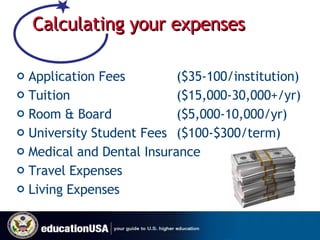
Calculating your expenses Application Fees  ($35-100/institution) Tuition  ($15,000-30,000+/yr) Room & Board  ($5,000-10,000/yr) University Student Fees  ($100-$300/term) Medical and Dental Insurance Travel Expenses Living Expenses
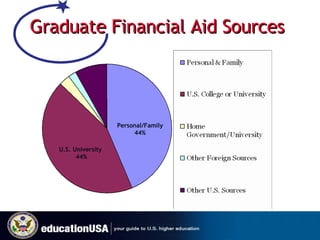
Graduate Financial Aid Sources U.S. University  44% Personal/Family 44%
Patterns and Trends in Funding More funding is available for: PhD programs compared to master’s programs. Research and Doctoral universities compared to master’s institutions Academic programs  compared to professional programs    (law, medicine, dentistry, MBAs, etc.) Many programs don’t offer funding until the second year.
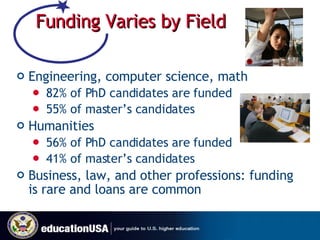
Funding Varies by Field Engineering, computer science, math 82% of PhD candidates are funded 55% of master’s candidates  Humanities 56% of PhD candidates are funded 41% of master’s candidates Business, law, and other professions: funding is rare and loans are common
Financial Aid Programs U.S. Universities Government Private Foundations Loans
Types of Funding: U.S. Universities  Assistantships Teaching  (TA):  Awarded by department. Must demonstrate strong spoken English and teaching experience. Can be in other departments (languages, math). Research  (RA):  Awarded by professors. Contributes to your thesis research.  Graduate  (GA):  Awarded by grad school. Administrative, library.
The Professor Professors manage teaching and research assistantships. You need to communicate with the professors Learn about them and their research from the school’s website and scholar.google.com Write to them about your academic interests and what you can contribute to their research They should know you before they receive your application!
Types of Funding: U.S. Universities  Out-of-State Tuition Waivers Several universities and/or state governments offer out-of-state tuition waivers  (based on country of origin, region or ethnicity) In Texas: PASE & Good Neighbor Scholarship Program Mexican nationals who demonstrate financial need pay in-state tuition at public universities in Texas  For more information visit each university’s website
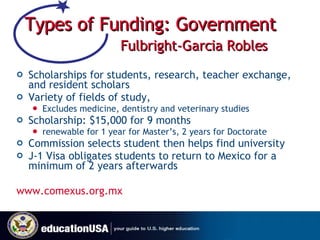
Types of Funding: Government   Fulbright-Garcia Robles Scholarships for students, research, teacher exchange, and resident scholars  Variety of fields of study,  Excludes medicine, dentistry and veterinary studies Scholarship: $15,000 for 9 months renewable for 1 year for Master’s, 2 years for Doctorate Commission selects student then helps find university J-1 Visa obligates students to return to Mexico for a minimum of 2 years afterwards  www.comexus.org.mx
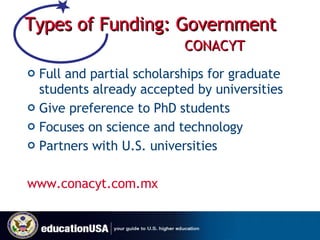
Types of Funding: Government   CONACYT Full and partial scholarships for graduate students already accepted by universities  Give preference to PhD students Focuses on science and technology Partners with U.S. universities  www.conacyt.com.mx
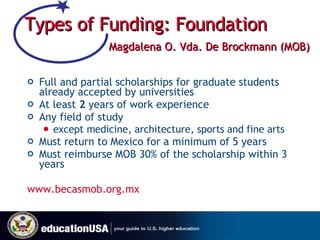
Types of Funding: Foundation       Magdalena O. Vda. De Brockmann (MOB) Full and partial scholarships for graduate students already accepted by universities At least  2  years of work experience Any field of study  except medicine, architecture, sports and fine arts  Must return to Mexico for a minimum of 5 years Must reimburse MOB 30% of the scholarship within 3 years www.becasmob.org.mx
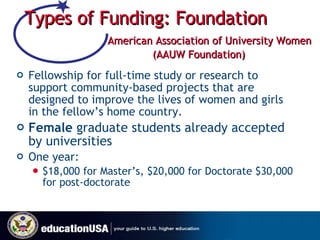
Types of Funding: Foundation     American Association of University Women  (AAUW Foundation) Fellowship for full-time study or research to support community-based projects that are designed to improve the lives of women and girls in the fellow’s home country.  Female  graduate students already accepted by universities One year: $18,000 for Master’s, $20,000 for Doctorate $30,000 for post-doctorate
Types of Funding: Mexico Loans   FIDERH, FUNED & OAS FIDERH (Banco de Mexico): loan for graduate degrees  Funding for up to 3 years  Must repay the loan within 10 years  www.fiderh.org.mx   FUNED: loan for students accepted by a university  Covers most expenses Must repay the loan within 6 years  www.fundacionbeca.net   OAS-PAN: Interest-free loans for Latin American students Must complete studies in 2 years Must repay the loan within 5 years  www.oas.org/rowe
Types of Funding: U.S. Loans Most U.S. banks require U.S. citizens or permanent residents to co-sign the loan Some universities have made arrangements with local banks For more information on loans, look at  International Education Finance Corporation  www.iefc.com Sallie Mae International  www.salliemae.com   CitiAssist  www. studentloan.citibank.com
Tips for Reducing Costs Request an application fee waiver Mail all your applications to one person in the U.S. to send them to separate universities Prepare and study for admissions exams so you only have to take them once Research options for taking summer courses Find a job on campus ($1,000-2,000/semester) Apply to be a Resident Assistant after your first year (save on living expenses)
Homework to get started   Make an advising appointment Visit  www.petersons.com  and create a list of potential schools Find out the  deadlines ,  costs , and  requirements  for each school. Assess how much you (and your family or sponsor) can contribute to your higher education Visit  www.fundingusstudy.org  and create a list of possible scholarship opportunities.
The student visa 3 types of student visas F-1 SEVIS I-20 J-1 DS-2019 M-1 SEVIS I-20 http://www.usembassy-mexico.gov/smxvisitar.html
Thank You! EducationUSA  Liverpool 31, Col. Juárez  06600 México, D.F. Horario: 11:00 – 17:00 de lunes a viernes Tel:  5703-0167, 5080-2801 Email: info@iielatinamerica.org http: // educationusa.state.gov http :// iielatinamerica.org

Financing Your Graduate U S Studies

  • 1.
    Financing Your GraduateStudies in the U.S.
  • 2.
    Choosing the bestprogram for YOU Start Early Identify your long term goals Determine your available time Research diverse institutions and professors Consult with an educational adviser
  • 3.
    Before You Apply…Assess your financial situation Determine your contribution Consider different types of institutions Public vs. Private Remember additional costs: application fees, postage, testing Know that tuition & fees will increase every year (around 5%) Financial Aid options will too
  • 4.
    General Rules toConsider Financial Aid is limited to the most PROMISING applicants with: Demonstrated academic potential Research and teaching experience A polished application Start the application process very early Do your research At an EducationUSA center and on the internet Enhance your application
  • 5.
    Contact the DepartmentTypes of questions to ask: What does it take to be admitted and to receive funding in this department? What are the common types of financial aid that students in the department have received? What other suggestions do you have for reducing costs while studying at your institution? If they can’t answer these questions, don’t apply!
  • 6.
    Exams TOEFL iBTwww.ets.org/toefl Various authorized centers in Mexico City GRE www.ets.org/gre Mexico City, Guadalajara and Monterey GRE Subject Tests (Biochemistry, Cell and Molecular Biology, Biology, Chemistry, Computer Science, Literature in English, Mathematics, Physics, Psychology) GMAT www.mba.com Mexico City, Guadalajara and Monterey
  • 7.
    The Application Dependson the program or university Typical Requirements: School/program’s application form Statement of purpose Letters of recommendation (2-3, translation required) Official undergraduate transcripts (translation required) Exams (TOEFL, GRE, GMAT etc.) Résumé Sometimes a portfolio or sample of past work Financial statement
  • 8.
    Set Your ApplicationApart Enhance your application: Is your statement of purpose the best it can possibly be? Invest time in perfecting it! Cultivate effective letters of recommendation. Select departments/professors interested in supporting your research. Highlight community involvement and community service as they are attractive assets.
  • 9.
    Calculating your expensesApplication Fees ($35-100/institution) Tuition ($15,000-30,000+/yr) Room & Board ($5,000-10,000/yr) University Student Fees ($100-$300/term) Medical and Dental Insurance Travel Expenses Living Expenses
  • 10.
    Graduate Financial AidSources U.S. University 44% Personal/Family 44%
  • 11.
    Patterns and Trendsin Funding More funding is available for: PhD programs compared to master’s programs. Research and Doctoral universities compared to master’s institutions Academic programs compared to professional programs (law, medicine, dentistry, MBAs, etc.) Many programs don’t offer funding until the second year.
  • 12.
    Funding Varies byField Engineering, computer science, math 82% of PhD candidates are funded 55% of master’s candidates Humanities 56% of PhD candidates are funded 41% of master’s candidates Business, law, and other professions: funding is rare and loans are common
  • 13.
    Financial Aid ProgramsU.S. Universities Government Private Foundations Loans
  • 14.
    Types of Funding:U.S. Universities Assistantships Teaching (TA): Awarded by department. Must demonstrate strong spoken English and teaching experience. Can be in other departments (languages, math). Research (RA): Awarded by professors. Contributes to your thesis research. Graduate (GA): Awarded by grad school. Administrative, library.
  • 15.
    The Professor Professorsmanage teaching and research assistantships. You need to communicate with the professors Learn about them and their research from the school’s website and scholar.google.com Write to them about your academic interests and what you can contribute to their research They should know you before they receive your application!
  • 16.
    Types of Funding:U.S. Universities Out-of-State Tuition Waivers Several universities and/or state governments offer out-of-state tuition waivers (based on country of origin, region or ethnicity) In Texas: PASE & Good Neighbor Scholarship Program Mexican nationals who demonstrate financial need pay in-state tuition at public universities in Texas For more information visit each university’s website
  • 17.
    Types of Funding:Government Fulbright-Garcia Robles Scholarships for students, research, teacher exchange, and resident scholars Variety of fields of study, Excludes medicine, dentistry and veterinary studies Scholarship: $15,000 for 9 months renewable for 1 year for Master’s, 2 years for Doctorate Commission selects student then helps find university J-1 Visa obligates students to return to Mexico for a minimum of 2 years afterwards www.comexus.org.mx
  • 18.
    Types of Funding:Government CONACYT Full and partial scholarships for graduate students already accepted by universities Give preference to PhD students Focuses on science and technology Partners with U.S. universities www.conacyt.com.mx
  • 19.
    Types of Funding:Foundation Magdalena O. Vda. De Brockmann (MOB) Full and partial scholarships for graduate students already accepted by universities At least 2 years of work experience Any field of study except medicine, architecture, sports and fine arts Must return to Mexico for a minimum of 5 years Must reimburse MOB 30% of the scholarship within 3 years www.becasmob.org.mx
  • 20.
    Types of Funding:Foundation American Association of University Women (AAUW Foundation) Fellowship for full-time study or research to support community-based projects that are designed to improve the lives of women and girls in the fellow’s home country. Female graduate students already accepted by universities One year: $18,000 for Master’s, $20,000 for Doctorate $30,000 for post-doctorate
  • 21.
    Types of Funding:Mexico Loans FIDERH, FUNED & OAS FIDERH (Banco de Mexico): loan for graduate degrees Funding for up to 3 years Must repay the loan within 10 years www.fiderh.org.mx FUNED: loan for students accepted by a university Covers most expenses Must repay the loan within 6 years www.fundacionbeca.net OAS-PAN: Interest-free loans for Latin American students Must complete studies in 2 years Must repay the loan within 5 years www.oas.org/rowe
  • 22.
    Types of Funding:U.S. Loans Most U.S. banks require U.S. citizens or permanent residents to co-sign the loan Some universities have made arrangements with local banks For more information on loans, look at International Education Finance Corporation www.iefc.com Sallie Mae International www.salliemae.com CitiAssist www. studentloan.citibank.com
  • 23.
    Tips for ReducingCosts Request an application fee waiver Mail all your applications to one person in the U.S. to send them to separate universities Prepare and study for admissions exams so you only have to take them once Research options for taking summer courses Find a job on campus ($1,000-2,000/semester) Apply to be a Resident Assistant after your first year (save on living expenses)
  • 24.
    Homework to getstarted Make an advising appointment Visit www.petersons.com and create a list of potential schools Find out the deadlines , costs , and requirements for each school. Assess how much you (and your family or sponsor) can contribute to your higher education Visit www.fundingusstudy.org and create a list of possible scholarship opportunities.
  • 25.
    The student visa3 types of student visas F-1 SEVIS I-20 J-1 DS-2019 M-1 SEVIS I-20 http://www.usembassy-mexico.gov/smxvisitar.html
  • 26.
    Thank You! EducationUSA Liverpool 31, Col. Juárez 06600 México, D.F. Horario: 11:00 – 17:00 de lunes a viernes Tel: 5703-0167, 5080-2801 Email: info@iielatinamerica.org http: // educationusa.state.gov http :// iielatinamerica.org