FINANCING
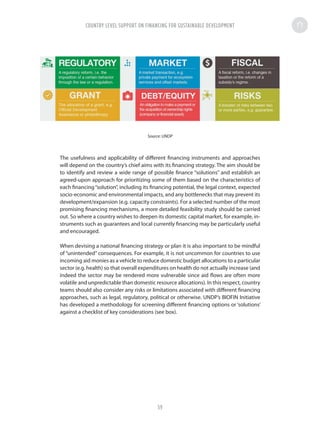
THE 2030
AGENDA
United Nations Development Programme
January2018
An Introductory Guidebook
for UNDP Country Offices
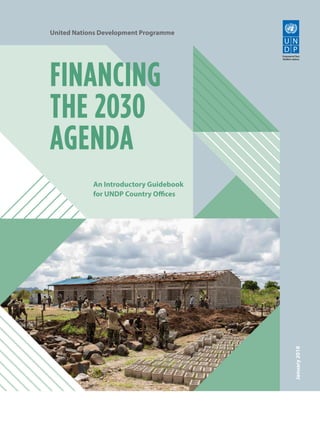
Cover photo: UN Photo Victoria Hazou
RwandBatt is working with the local community on a "Umuganda" ["Shared Work"] project,
constructing a new primary school for the students in Kapuri.
Disclaimer
The views and recommendations made in this guidebook are those of the authors
and do not necessarily represent those of the United Nations Development
Programme or Member States.
FINANCING THE 2030 AGENDA
An Introductory Guidebook for UNDP Country Offices
January 2018
Introduction  6
PART ONE
Financing for Development: the Global Context  8
A Dynamic Development Financing Landscape  9
1.	 The 2030 Agenda: Assessing Financing Needs  10
2A.	 Emerging Patterns of Resources: New Opportunities  12
2B.	 Emerging Patterns of Resources: Challenges and Limitations  16
3.	 An Age of Choice? Diversity and Innovation in Financing Approaches  23
4.	 Financing for What?  29
5.	 Is Money Everything? Financial Versus Non-financial Means of Implementation  31
	 5.1.	 Global Economic Conditions Matter  32
	 5.2.	 Other Non-financial Means of Implementation  33
PART TWO
Country Level Support on Financing for Sustainable Development  40
1.	 Developing a Coherent Financing for Development Strategy: UNDP’s Approach  45
2.	 Implementing UNDP’s Structured Approach  48
	 2.1	 Context Analysis  48
	 2.2.	 Public and Private Expenditure Reviews  49
	 2.3.	 Identifying and Costing National Priorities and Building an Investment Pipeline  52
	 2.4.	 Developing a Financing Strategy  56
	2.5.	 What are Possible Financing‘Solutions’?  58
3.	 Concluding Remarks  61
PART THREE
UNDP Tools, Policy and Programme Support on Financing for Development  63
1. 	 Mapping and Analyzing Financing Flows  64
	 1.1. Development Finance Assessments  64
2. 	 Mobilization and Effective use of Domestic Resources for the SDGs  67
	 2.1.	 Budgeting for Agenda 2030 in Asia-Pacific  67
	2.2.	 Climate Public Expenditure and Institutional Review  69
	2.3.	 Tax Inspectors Without Borders  69
	2.4.	 Capacity Building on Public Financial Management  70
3. 	 Identifying and Costing Priority Interventions  71
	 3.1. 	 The BIOFIN Initiative  71
	3.2.	UNDP’s“Co-financing”Methodology  71
4. 	 Leveraging Finance from the Private Sector for the SDGS,
	 Including Through Innovative Financing  73
	 4.1. 	 UNDP SDG Impact Finance  73
	4.2. 	 SDG Philanthropy Platform  73
	 4.3. 	 Global Islamic Finance and Impact Investing Platform  74
	 4.4. 	 Impact Investment in Africa  75
	 4.5. 	 UNDP Innovation Facility  75
Table of Contents
5.	 Environmental finance  76
	 5.1.	 Biodiversity Finance Initiative (BIOFIN)  76
	5.2.	 Derisking Renewable Energy Investment  76
	 5.3.	 The Climate Aggregation Platform (CAP)  77
6.	 Expanding South-South Cooperation  78
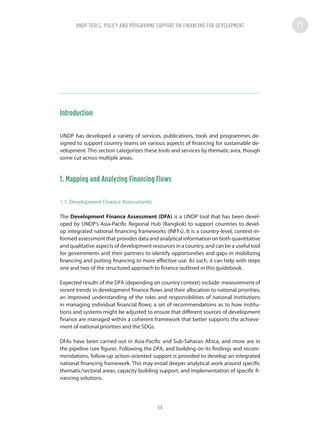
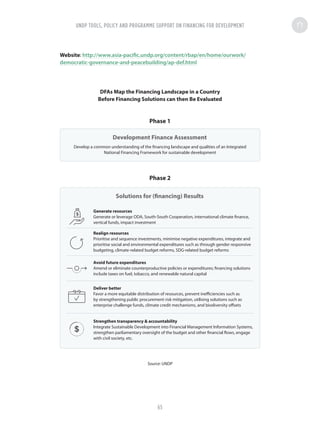
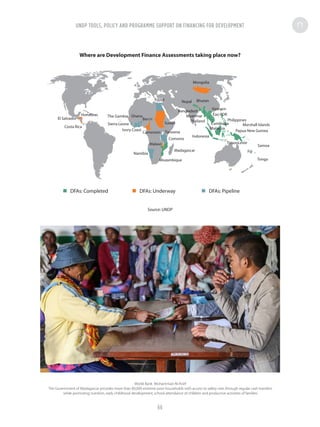
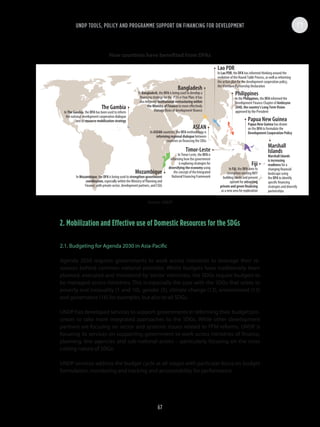
	 6.1.	 SSMart for SDGs  78
	 6.2.	 South-South Global Thinkers: the Global Coalition of Think Tank Networks for SSC  78
7.	 Global Advocacy on Financing the SDGs  80
	 7.1.	 Monitoring Progress Towards the Addis Ababa Action Agenda:
		 the Financing for Development Follow-up Process  80
	 7.2.	 Global Partnership for Effective Development Co-operation (GPEDC)
		 and Monitoring of Effective Development Cooperation  81
PART FOUR
Financing Solutions in Focus  82
1. 	 Blended Finance  83
2. 	 Financing Sustainable Development with Green and Blue Bonds  90
3. 	 Enhancing Access to Credit with Guarantees for Development  92
4. 	 Impact Investing  94
5. 	 Enterprise Challenge Funds  99
6. 	 Islamic Finance  104
7. 	 Social and Development Impact Bonds  109
8.	 Crowdfunding  113
9.	 Debt-for-nature Swaps  118
Introduction
How to finance the 2030 Agenda at the country level has emerged as a key issue since
world leaders adopted the Sustainable Development Goals (SDGs) in September 2015.
Governments’abilities to mobilize, sequence and make effective use of a wide variety
of both financing sources and financing instruments and strategies will be central to
their ability to achieve the ambitious new sustainable development agenda. This is re-
flected in SDG 17, “strengthen the means of implementation and revitalize the global
partnership for sustainable development”which tasks countries to strengthen domes-
tic resource mobilization, meet aid commitments and mobilize additional financial re-
sources for development from multiple sources. 1
As a longstanding and trusted multilateral development partner to over 170 coun-
tries and territories worldwide, and with a robust track record in areas such as support
for public financial management, aid coordination and environmental finance, many
countries want to know how UNDP – and the UN development system as a whole – can
support them to finance the SDGs.
This guidebook responds to increased country-level demand for support on financing
the 2030 Agenda. It is intended to be an “entry point” for advice and information on
financing for sustainable development, and the tools and services that UNDP offers in
this space.
This guidebook is organized as follows:
1.	 Part 1 “The Global Context:” provides an overview of current and recent trends in
financing for development and explores their implications for the financing of the
2030 Agenda;
2.	 Part 2 looks at some of the key ways in which UNDP can provide country level sup-
port on financing for development;
3.	 Part 3 details UNDP’s current portfolio of work on financing for development,
and provides information on the tools and services we provide, and where to
source more information;
4.	 Part 4 “Financing Solutions in Focus” describes some of the most widely-used fi-
nancial instruments as well as innovative finance mechanisms and looks at their
pros and cons.
1	 For further information on SDG 17, see: https://sustainabledevelopment.un.org/sdg17
6
Feedback is welcome on how to improve this guidebook so we can ensure it remains
as relevant and up-to-date as possible.2
The guidebook is complemented by a UNDP website, “Financing Solutions for Sus-
tainable Development”. The on-line platform features instruments such as blended
finance, development impact bonds, green bonds, trust funds, challenge funds, guar-
antees, impact investment, and many more. It describes each instrument’s potential,
feasibility, advantages, disadvantages, risks and characteristics. It also profiles case stud-
ies and refers to multiple external sources, including e-learning and advanced guidance
material, where available. It aims to provide UN country teams and other stakeholders
with detailed and up-to-date information to enable them to review and operationalize
the most appropriate financing solutions and strategies for each country.
Financing Solutions for Sustainable Development: UNDP on-line tool-kit
Accessible at: http://www.undp.org/content/sdfinance/
2	 Guide prepared by Gail Hurley, Policy Specialist on Development Finance, Sustainable Development
Group, Bureau for Policy and Programme Support (BPPS) and Massimiliano Riva, Policy Specialist on
Innovative Finance, Sustainable Development Group, BPPS. Additional research and contributions
provided by Weyinmi Omamuli, independent researcher and consultant on financing for development.
Thank you to the many colleagues who contributed with inputs and suggestions: Shams Banihani, Tom
Beloe, Bernardo Cocco, Emily Davis, Nergis Gulasan, Devika Iyer, Rosemary Kalapurkal, Radha Kulkarni,
Benjamin Kumpf, Tasneem Mirza, Yuko Suzuki Naab, Marcos Neto, Natalya Pyagay, Nik Sekhran, Tim
Strawson, Oliver Waissbein.
7
Financing for
Development:
the Global
Context
PART
ONE
Introduction
Meetingthe2030Agendawillrequireunprecedentedinvestmentsinareassuchashealth
and education, environmental protection, infrastructure and sustainable energy, rural
development, peace and security and actions to tackle climate change. Every dollar will
also need to be used effectively in support of sustainable development, and in particular
reach those communities and peoples furthest behind. While financing needs for the
new agenda are unquestionably high, there are also more opportunities for countries
to mobilize new and additional sources of finance (public and private, domestic and
international) as well as experiment with innovative new financing approaches.
The development financing landscape is dynamic and constantly changing. Many
countries are now able to mobilize more domestic resources for development. Foreign
direct investment (FDI) flows are on the rise combined with increased capacities to
leverage finance from domestic and international capital markets. New development
partners, development finance institutions, public-private ‘single issue’ vertical funds,
philanthropic organizations and private ‘impact’ investors have also emerged or ex-
panded their activities in recent years and now work actively alongside traditional do-
nors, such as United Nations’development agencies. These new sources of finance and
expertise increasingly complement traditional development cooperation and create
opportunities for new partnerships and collaborations which can leverage the finance,
expertise and networks of each partner.
This is combined with increased diversity and sophistication in financial instruments
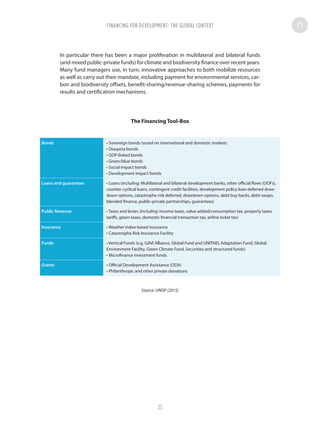
or the “financing tool-box”. Financing is being used in increasingly sophisticated and
creative ways to meet public policy objectives. Examples include: ‘blended’ finance
(where concessional public finance is blended with non-concessional public or private
finance); green and blue bonds (where bonds are issued on domestic and internation-
al capital markets for the financing of environmentally-sound infrastructure); lending
in local currencies and to sub-national authorities; Islamic financing instruments (such
as Islamic bonds or sukuk which are asset-backed instruments); guarantee schemes
(designed to reduce/share risk); diaspora financing schemes (where diaspora commu-
nities are supported and incentivized to invest in projects and businesses‘back home’);
impact investment (investments that aim to create positive social or environmental
returns in addition to a financial return for investors); crowdfunding (the practice of
funding a project or venture by raising monetary contributions from a large number
of people); social impact bonds (a form of payment for results scheme); countercycli-
A Dynamic Development Financing Landscape
9
cal loan contracts (where debt service automatically falls when a major shock occurs);
weather and disaster insurance schemes, and more.
While these developments are undoubtedly positive, important challenges remain.
An unexpected consequence of this increased diversity is also a dramatic increase in
complexity; it can be extraordinarily difficult for a country to understand how it can
maximize new financing opportunities, understand new and innovative financing ap-
proaches, comply with many different application requirements and understand how
to blend and sequence various financing flows to achieve transformational change.
Additionally, while some developing countries are now able to mobilize more domes-
tic resources for development, attract private investment and experiment with inno-
vative finance mechanisms, this is not the case for all. Progress in these areas can be
attributed to mostly (large) middle-income economies, while many Least Developed
Countries (LDCs), some small island states (SIDS) and fragile states have fewer financ-
ing ‘options’ and remain heavily reliant on traditional donor aid. In addition, some re-
source-dependent lower-middle income countries that had made significant headway
in diversifying sources of external finance during the commodity price upswing in the
2000s have seen their fortunes reverse recently as commodity prices have slumped
since mid-2014. For these countries, concessional finance is becoming important
again as many face widening fiscal deficits and risks to debt sustainability. Most donors
meanwhile are far from achieving the longstanding United Nations target of allocating
at least 0.7 percent of GNI to Official Development Assistance (ODA) (donors achieved
just 0.3 percent on average in 2016), and the share of total aid allocated to LDCs and
SIDS has in fact declined in real terms over recent years. Financing gaps in many coun-
tries remain high.
This introductory section of the guidebook summarizes and explains recent and on-
going dynamics in the development financing landscape and considers their implica-
tions for the financing of the SDGs, including for particular country categories.
1. The 2030 Agenda: Assessing Financing Needs
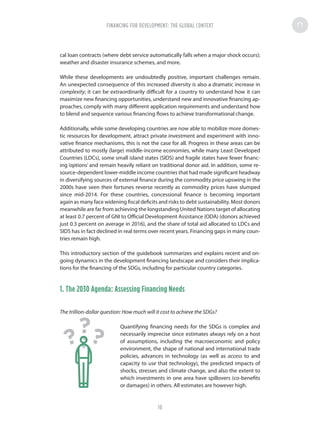
The trillion-dollar question: How much will it cost to achieve the SDGs?
Quantifying financing needs for the SDGs is complex and
necessarily imprecise since estimates always rely on a host
of assumptions, including the macroeconomic and policy
environment, the shape of national and international trade
policies, advances in technology (as well as access to and
capacity to use that technology), the predicted impacts of
shocks, stresses and climate change, and also the extent to
which investments in one area have spillovers (co-benefits
or damages) in others. All estimates are however high.
???
FINANCING FOR DEVELOPMENT: THE GLOBAL CONTEXT
10
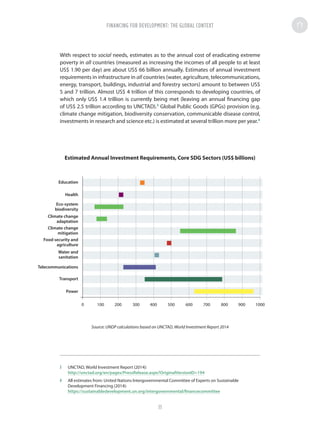
With respect to social needs, estimates as to the annual cost of eradicating extreme
poverty in all countries (measured as increasing the incomes of all people to at least
US$ 1.90 per day) are about US$ 66 billion annually. Estimates of annual investment
requirements in infrastructure in all countries (water, agriculture, telecommunications,
energy, transport, buildings, industrial and forestry sectors) amount to between US$
5 and 7 trillion. Almost US$ 4 trillion of this corresponds to developing countries, of
which only US$ 1.4 trillion is currently being met (leaving an annual financing gap
of US$ 2.5 trillion according to UNCTAD).3
Global Public Goods (GPGs) provision (e.g.
climate change mitigation, biodiversity conservation, communicable disease control,
investments in research and science etc.) is estimated at several trillion more per year.4
3	 UNCTAD, World Investment Report (2014):
http://unctad.org/en/pages/PressRelease.aspx?OriginalVersionID=194
4	 All estimates from: United Nations Intergovernmental Committee of Experts on Sustainable
Development Financing (2014):
https://sustainabledevelopment.un.org/intergovernmental/financecommittee
Estimated Annual Investment Requirements, Core SDG Sectors (US$ billions)
Source: UNDP calculations based on UNCTAD, World Investment Report 2014
Education
Health
Eco-system
biodiversity
Climate change
adaptation
Climate change
mitigation
Food security and
agriculture
Water and
sanitation
Telecommunications
Transport
Power
0 100 200 300 400 500 600 700 800 900 1000
FINANCING FOR DEVELOPMENT: THE GLOBAL CONTEXT
11
In assessing financing needs however, it is also critical to factor in other considerations,
and in particular the potential costs of inaction (or of delaying action). For example, de-
laying climate change mitigation may significantly increase the cost of development
over the longer-term (even though in the short-term some apparent ‘savings’ may be
made because certain investments are not made).
Financing needs also differ substantially across countries and regions. As explained
in the next section, while many large middle-income countries are now able to mo-
bilize more domestic and private resources for development, challenges remain for
many low-income countries, some small island developing states, land-locked devel-
oping countries and those emerging from conflict. Not only do they need substantial
resources to meet the SDGs, they typically have limited capacities to raise domestic
revenues (e.g. because small populations are widely dispersed over large distances
and/or due to large subsistence and informal sectors), and are also considered less
‘attractive’options for private investment (e.g. because risks of project failure are high,
political instability, poor local infrastructure or other factors).
But even in middle-income countries where various sources of financing may be rel-
atively more “abundant”, the costs of this finance can still be prohibitively high due to
perceived or actual higher risk. Moreover, as the recent 2008 financial crisis demonstrat-
ed, emerging economies can be vulnerable to so-called“hot-money”flows (speculative
investors that move their money between countries to profit from higher interest rates
and/or expected changes in exchange rates).These flows can be highly volatile, are typ-
ically short-term in orientation, can contribute to domestic inflation and instability. In
this respect, volumes of finance flowing into (and out of) of an economy tell us very
little about the quality/development impact of those flows. A qualitative analysis of the
composition and how well resources are used at the country level is required.
In summary, financing estimates are often unreliable and financing needs differ enor-
mously across countries. But while financing estimates may be of interest from an aca-
demic point of view, governments are typically more interested in exercises that seek
to identify priority or‘catalytic’SDG interventions,“cost”those interventions at the na-
tional and sectoral levels, and identify the most appropriate financing models for them
– an issue this handbook takes up in section two.
2A. Emerging Patterns of Resources: New Opportunities
Over the last fifteen years, developing countries as a whole have increased considera-
bly their abilities to mobilize finance from a range of public and private, domestic and
international sources.
Globally, domestic public resources are by far the largest and most important source of
finance for development. These resources are also country owned and may be spent
as countries see fit. The World Bank estimates that emerging and developing econ-
FINANCING FOR DEVELOPMENT: THE GLOBAL CONTEXTFINANCING FOR DEVELOPMENT: THE GLOBAL CONTEXT
12
omies mobilized over US$ 7.7 trillion in domestic revenues in 2012, and that domes-
tic resources have increased by, on average, 14 percent a year annually since 2000.
In practice, this means there is over US$ 6 trillion more each year flowing into devel-
oping country treasuries compared with the year 2000.5
Buoyant domestic revenues
have in turn lowered aid dependency and raised country creditworthiness for official
and private non-concessional loans; in 2010, Sub-Saharan African countries collected
nearly US$ 10 in own-source revenue for every dollar of foreign assistance received.6
The IMF moreover predicts further large increases in domestic resources over the next
few years, especially in middle-income countries. Recent increases have arisen chiefly
through the imposition of consumption (VAT-type) taxes combined with income taxes,
natural resource revenues and tourism taxes. Transparency and efficiency in tax col-
lection has also improved. Looking forward, many countries have progressively larger
labourforces who are middle-income earners and able to contribute to the national tax
effort (the so-called demographic dividend).
In parallel, developing countries as a whole have increasingly turned to private sources
of finance to fund sustainable development. FDI in particular is viewed as a tool to fund
economic development and modernization, employment and technology transfer. It is
the largest source of international private finance for developing countries. Many de-
veloping countries have liberalized policies related to FDI over the last fifteen years and
pursued other measures (e.g. tax incentives) to attract investment. In 2016, developing
countries attracted FDI inflows of over US$ 646 billion; this compares to just US$ 140
billion in Official Development Assistance (ODA) in the same year. Asia in particular has
seen major increases in FDI inflows and now receives more than any other world region
at 30 percent of total FDI flows.7
South-South FDI flows have also expanded.
Bond issuance and commercial bank lending also increased four-fold between 2000
and 2012. Over the last five years, several low-income countries have been able to is-
sue bonds on international capital markets, many for the first time, attracted by rela-
tively low interest rates and enabled by renewed creditworthiness.This includes Rwan-
da, Zambia and many others.
Many developing countries have also expanded domestic debt markets and in some
cases developed sub-sovereign debt markets (e.g. municipalities). These develop-
ments have enabled countries to secure resources quickly, condition-free and at-scale
to finance their development. Domestic debt markets have also helped to develop
local financial markets and mobilize domestic savings to fund state expenditure. Do-
mestic debt also reduces exchange rate risk and can help to reduce a reliance on aid.
Both domestic and international bond financing are expected to further expand as key
sources of development finance over the coming years.
5	 World Bank, Financing for development post 2015 (2013): http://documents.worldbank.org/curated/
en/206701468158366611/Financing-for-development-post-2015
6	Ibid.
7	 UNCTAD, World Investment Report (2015).
FINANCING FOR DEVELOPMENT: THE GLOBAL CONTEXTFINANCING FOR DEVELOPMENT: THE GLOBAL CONTEXT
13
Global financial assets are also considered a potential source of financing for sustain-
able development. Stocks, public debt securities, corporate bonds, bank deposits etc.
amounted to US$ 294 trillion in 2014.8
Redirecting even a small percentage of this total
annual investment towards sustainable development objectives could have a major
impact. In particular, institutional investors (i.e. pension and mutual funds, sovereign
wealth funds etc.) which combined hold over US$ 85 trillion in assets have been iden-
tified as a potential source of financing for sustainable development due to their rela-
tively longer-term investment horizons.9
Many valuable “sustainable finance” initiatives have also emerged and expanded over
recent years (“sustainable finance” is defined as those private investments that are sub-
ject to social, environmental, development or other considerations). Impact investment
in particular has increased in prominence over recent years. Impact investments are in-
vestments in companies, organizations or funds which aim to achieve a measurable so-
cial or environmental impact, alongside a financial return.10
The Global Impact Investing
Network (GIIN) estimates a market of approximately US$ 114 billion in impact investing
assets, of which US$ 22.1 billion was committed in 2016. Expected growth in 2017 is over
25 percent. Sixty percent of impact investors (respondents to GIIN surveys) report their in-
vestments are aligned to the SDGs.11
Many large companies have also created or expand-
ed corporate social responsibility programmes with a key focus on international develop-
ment.There is also increasing interest in and use of environmental and social governance
(ESG) indicators by international investors. In some countries (e.g. the South African and
Thai stock exchanges), ESG reporting is being promoted.This has some potential to direct
larger volumes of private finance to sustainable development in the medium to long run.
Philanthropic foundations have also expanded their international development co-
operation activities over recent years, and have become key partners to traditional
bilateral and multilateral development agencies. While the large international philan-
thropists tend dominate the headlines (the Gates Foundation, Ford Foundation, Open
Society Foundation etc.), it is also important not to overlook (nor understate) the role
that small domestic foundations often play in national and local development efforts
(in both industrialized and developing countries). Private aid is estimated at between
US$ 60-70 billion annually (about half that provided by OECD DAC donors).
Diaspora resources represent another key source of financing for development. Private
cross-border transfers from individuals have increased substantially over recent years.
8	 IMF, World Economic Outlook (2015): http://www.imf.org/external/pubs/ft/weo/2015/01/
9	 Boston Consulting Group (2015).
10	 See: Global Impact Investing Network: https://thegiin.org/impact-investing/
11	 See: Global Impact Investing Network, Annual Impact Investor Survey (2016): https://thegiin.org/
assets/2016%20GIIN%20Annual%20Impact%20Investor%20Survey_Web.pdf Impact investments
are made mostly by fund managers and philanthropic foundations in a wide variety of economic
sectors such as housing, microfinance, energy and food and agriculture. Private equity and debt are by
far the most commonly used instruments by impact investors with only a few testing so-called‘pay-
for-performance’schemes.
FINANCING FOR DEVELOPMENT: THE GLOBAL CONTEXTFINANCING FOR DEVELOPMENT: THE GLOBAL CONTEXT
14
An estimated US$ 575 billion was remitted to developing countries from migrants in
2016, and remittance flows are typically more stable than other resource flows. New
(for-profit and not-for-profit) platforms have also emerged to facilitate diaspora invest-
ments“back home”(e.g. We are Movement) in areas such as infrastructure.12
When it comes to public flows, international public finance flows have also increased
in volume terms over the last fifteen years, albeit not as rapidly as private flows. ODA
reached about US$ 140 billion from OECD DAC donors in 2016, up from just US$ 60 bil-
lion in 2000. South-South Cooperation – which encompasses a heterogeneous mix of
concessional and non-concessional finance, technical assistance and trade and invest-
ment flows – has also risen substantially with further increases expected. China’s ‘Belt
and Road’initiative, for example, which involves China underwriting billions of dollars
of infrastructure investment in over 60 countries of Central Asia is undoubtedly the
most ambitious economic development venture funded by a foreign power at the cur-
rent time. The UN estimates South-South Cooperation flows at around US$ 20 billion
annually, but this is probably underestimated since data is unreliable.13
This finance is
being channeled through a variety of intermediaries: from traditional aid-type agen-
cies to bilateral export and development banks (such as Brazil’s Development Bank
– BNDES) to multilateral financial institutions (such as the new Asian Infrastructure In-
vestment Bank and the New Development Bank).
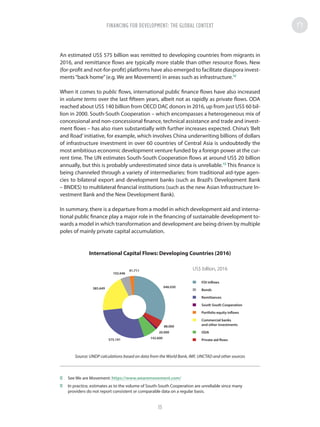
In summary, there is a departure from a model in which development aid and interna-
tional public finance play a major role in the financing of sustainable development to-
wards a model in which transformation and development are being driven by multiple
poles of mainly private capital accumulation.
International Capital Flows: Developing Countries (2016)
Source: UNDP calculations based on data from the World Bank, IMF, UNCTAD and other sources
12	 See We are Movement: https://www.wearemovement.com/
13	 In practice, estimates as to the volume of South-South Cooperation are unreliable since many
providers do not report consistent or comparable data on a regular basis.
US$ billion, 2016
646.030
575.191
385.649
102.646
41.711
88.000
20.000
142.600
FDI inflows
Bonds
Remittances
South South Cooperation
Portfolio equity inflows
ODA
Private aid flows
Commercial banks
and other investments
FINANCING FOR DEVELOPMENT: THE GLOBAL CONTEXT
15
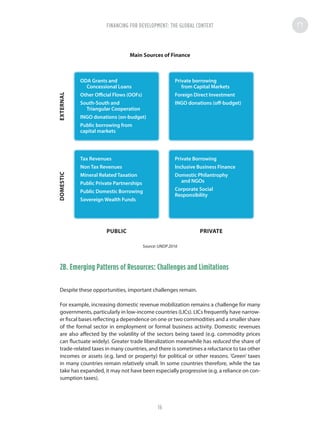
Main Sources of Finance
Source: UNDP 2016
2B. Emerging Patterns of Resources: Challenges and Limitations
Despite these opportunities, important challenges remain.
For example, increasing domestic revenue mobilization remains a challenge for many
governments, particularly in low-income countries (LICs). LICs frequently have narrow-
er fiscal bases reflecting a dependence on one or two commodities and a smaller share
of the formal sector in employment or formal business activity. Domestic revenues
are also affected by the volatility of the sectors being taxed (e.g. commodity prices
can fluctuate widely). Greater trade liberalization meanwhile has reduced the share of
trade-related taxes in many countries, and there is sometimes a reluctance to tax other
incomes or assets (e.g. land or property) for political or other reasons. ‘Green’ taxes
in many countries remain relatively small. In some countries therefore, while the tax
take has expanded, it may not have been especially progressive (e.g. a reliance on con-
sumption taxes).
ODA Grants and
Concessional Loans
Other Official Flows (OOFs)
South-South and
Triangular Cooperation
INGO donations (on-budget)
Public borrowing from
capital markets
Tax Revenues
Non Tax Revenues
Mineral Related Taxation
Public Private Partnerships
Public Domestic Borrowing
Sovereign Wealth Funds
Private borrowing
from Capital Markets
Foreign Direct Investment
INGO donations (off-budget)
Private Borrowing
Inclusive Business Finance
Domestic Philantrophy
and NGOs
Corporate Social
Responsibility
EXTERNALDOMESTIC
PUBLIC PRIVATE
FINANCING FOR DEVELOPMENT: THE GLOBAL CONTEXT
16
Low tax-to-GDP ratios are exacerbated by high levels of capital flight and limited ca-
pacity (or willingness) to collect revenues from multinationals, particularly those en-
gaged in natural resource extraction. Over the last decade, the term “illicit financial
flows” has emerged and represents a “catch-all” term used to describe both legal (e.g.
tax avoidance) and illegal (e.g. tax evasion, theft and other criminal activity) move-
ments of capital across borders. It is increasingly recognized as a major development
problem. UNDP estimates that each year, illicit financial flows (trade mis-invoicing
only) from the LDCs are roughly equivalent in volume terms to the amount of devel-
opment aid received by those same countries (at about US$ 28 billion).14
Globally, illicit
outflows (trade mis-invoicing only) are estimated at almost US$ 1.1 trillion.15
Moreover
these amounts do not capture other illicit outflows of capital associated with the ille-
gal trade in wildlife, fish, arms, narcotics and people etc.
Tax Avoidance Schemes: the Panama and Paradise Papers
A series of high-profile data leaks released by the International Consortium of Inves-
tigative Journalists (ICIJ) in recent years have uncovered the offshore financial deal-
ings of prominent wealthy individuals, multinational corporations and political leaders
worldwide, often used as strategies to avoid paying tax in their home jurisdictions.
In November 2017, the ‘Paradise Papers’ investigation released findings from a cache
of 13.4 million records obtained from the offshore law firm Appleby and corporate
service providers Asiaciti Trust and Estera, involving 19 tax havens.16
The files expose
the secret transactions of more than 120 politicians and 100 multinationals, including
from developing countries. The investigation also revealed unethical financial trans-
actions involving commodities and mining conglomerates operating in some of the
world’s poorest countries.
Similar revelations emerged in 2016 from the ‘Panama Papers’, a similar investigation
of 11.5 million documents leaked from Panamanian law firm Mossack Fonseca.17
The
investigation detailed how law firms and major banks conspire to conceal the some-
times illegal offshore financial dealings of politicians, criminals, wealthy individuals
and celebrities.
14	 UNDP, Illicit Financial Flows from the Least Developed Countries: 1990-2008 (2011):
http://content-ext.undp.org/aplaws_publications/3273649/IFFs_from_LDCs_web.pdf
15	 Global Financial Integrity, Illicit Financial Flows from Developing Countries: 2004-1014 (2015):
http://www.gfintegrity.org/report/illicit-financial-flows-from-developing-countries-2004-2013/
16	 For further information, see: the International Consortium of Investigative Journalists (ICIJ):
https://www.icij.org/investigations/paradise-papers/about/
17	 For further information, see: the International Consortium of Investigative Journalists (ICIJ):
https://panamapapers.icij.org/20160403-panama-papers-global-overview.html
FINANCING FOR DEVELOPMENT: THE GLOBAL CONTEXT
17
“Plugging” these leaks could clearly have a major positive impact on development.
But while there are actions that countries can take at the national level to curb “illicit”
outflows of capital (e.g. improve macroeconomic and political stability; strengthen tax
administrations etc.), there is also a need for coordinated action at the international
level to crack down on tax havens, share tax information more readily between coun-
tries and return stolen assets. Progress in many of these areas remains slow and diffi-
cult. For UNDP, an added challenge is that several of our programme countries are also
important international financial centres and while they are often not the most “sys-
temically”important ones, they nevertheless rely on financial services to support their
economies and it is not immediately obvious what alternative development strategies
may be on offer for them.
Inefficient expenditures further compound the problem of low tax revenues. Govern-
ments often face political or other pressures to use resources in sub-optimal ways,
which can be resistant to public expenditure management reform efforts. This is es-
pecially the case where informal institutions such as systems of patronage, circumvent
attempts to improve budgetary processes and transparency. For instance, in ‘winner-
takes-all’ political systems, fiscal consolidation through expenditure cuts could be di-
rected towards maintaining client and kinship networks to the exclusion of others. This
can explain why some subsidies (e.g. fossil fuel, agricultural and fisheries subsidies)
or tax advantages (e.g. on land ownership) are so difficult to eliminate despite their
obvious adverse impact on government finances and the environment. Institutional
corruption, i.e. where corruption is either seen as necessary to expedite transactions or
even acceptable because it is widely practiced, is an additional constraint on efficient
public expenditure management. However, adoption of anti-corruption reforms can
also be captured by political interests and targeted at government opponents, leading
to further diversion of scare resources and capacity. Given these skewed incentives,
expenditures may not necessarily translate into development results.
Even where corruption is not viewed as a major problem, there are other challenges.
Budgeting processes may not be well aligned to national development priorities or
sensitive to vulnerable groups such as women, indigenous peoples or the disabled
etc. In many rural or isolated areas, education or health outcomes can be low despite
higher levels of per capita spending. There may be little accountability for implemen-
tation, which is often reflected in repeated underexecution of capital expenditures.
Some governments respond to pressures to increase development spending with
overly optimistic budgets, based on unrealistic revenue projections, rather than im-
plement urgent expenditure reforms. The inevitable revenue shortfalls can result in
accumulation of payment arrears, cuts to development spending and an overreliance
on deficit financing, further damaging the credibility of the budget process and sow-
ing the seeds of possible economic crisis further down the line. Others resort to costly
domestic and/or international borrowing to fund public infrastructure with little re-
gard for the quality of the investments. Under these circumstances, helping develop-
ing countries reprioritize and render more effective existing expenditures will also be
an important component of financing Agenda 2030.
FINANCING FOR DEVELOPMENT: THE GLOBAL CONTEXT
18
When it comes to private financial flows there are also constraints and difficulties. FDI’s
sustainable development benefits are not uniform for example. Investments are in-
creasingly being made in real estate versus manufacturing or research and develop-
ment, and FDI may not be environmentally responsible. FDI in the extractive indus-
tries sector for example may have harmful environmental impacts and have limited
linkages with the rest of the economy, despite its contribution to economic growth. It
can be volatile and fluctuate significantly from one year to the next. Additionally, FDI
is heavily concentrated in middle-income countries and in resource-rich low-income
countries with the Least Developed Countries attracting less than 2 percent of total
world FDI flows.18
The quality of FDI is therefore critical for its impact on sustainable
development.
Greater use of bond and commercial bank debt also carries some risks. Private debt
is typically procyclical, carries shorter maturity profiles and is often more expensive
than official sector debt. Governments can often find it difficult to extend maturities
beyond a few years, leaving them vulnerable to refinancing risk (especially in econom-
ic downturns). While in many cases, external debt ratios have declined, this hides the
reality that governments have simply replaced (cheaper) external debt with (more ex-
pensive) domestic debt (see debt box for further elaboration). With the human and
economic costs of debt crises extremely high, debt sustainability considerations must
remain at the fore.
Additionally, despite a keen interest in how institutional investors may contribute to
sustainable development, the reality is that very few currently invest large (or any)
shares of their portfolio in developing nations (citing fiduciary obligations to their cli-
ents). Sustainable finance initiatives meanwhile remain far from mainstream. Directing
more private financial flows to sustainable development therefore remains a consider-
able challenge.19
With respect to international public finance flows, while ODA has increased in volume
terms over recent years, very few donors meet the longstanding commitment to al-
locate at least 0.7% of their GNI to ODA (just 5 countries in 2016), and prospects for
large increases in aid are not bright due to fiscal pressures in some high-income donor
18	 World Bank, Financing for Development Post-2015 (2013): https://www.worldbank.org/content/dam/
Worldbank/document/Poverty%20documents/WB-PREM%20financing-for-development-pub-10-
11-13web.pdf
19	 Limited investment by institutional investors in developing countries is due to a variety of factors,
but in particular perceived higher risk and also a lack of“bankable”projects in which to invest. Even
in industrialized economies, investments by international institutional investors in major‘gap’sectors
such as infrastructure have been insufficient with many exhibiting a preference for perceived low-risk
and short-term assets. Indeed, a recent trend for some institutional investors (and by pension funds
in particular) is an increase in investment in so-called“alternative asset classes”such as private equity,
venture capital and real estate. However, because they often lack the expertise to invest directly in
these areas, they instead channel these investments through intermediaries such as private equity and
hedge funds. Expanding the chain of intermediaries however increases“principal-agent”problems,
with incentives increasingly less aligned with the aims of the initial investor as well as with public
policy goals. These challenges will need to be overcome if the investments made by institutional
investors are to be more effectively leveraged in support of sustainable development.
FINANCING FOR DEVELOPMENT: THE GLOBAL CONTEXT
19
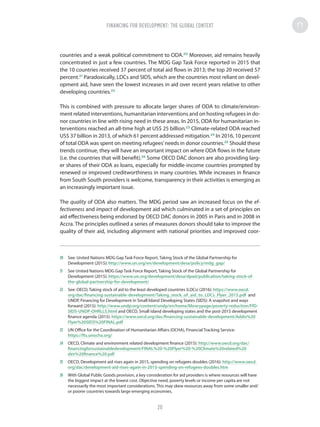
countries and a weak political commitment to ODA.20
Moreover, aid remains heavily
concentrated in just a few countries. The MDG Gap Task Force reported in 2015 that
the 10 countries received 37 percent of total aid flows in 2013; the top 20 received 57
percent.21
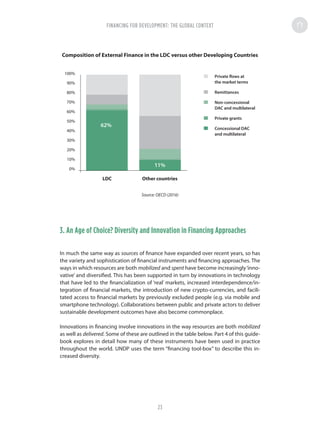
Paradoxically, LDCs and SIDS, which are the countries most reliant on devel-
opment aid, have seen the lowest increases in aid over recent years relative to other
developing countries.22
This is combined with pressure to allocate larger shares of ODA to climate/environ-
ment related interventions, humanitarian interventions and on hosting refugees in do-
nor countries in line with rising need in these areas. In 2015, ODA for humanitarian in-
terventions reached an all-time high at US$ 25 billion.23
Climate-related ODA reached
US$ 37 billion in 2013, of which 61 percent addressed mitigation.24
In 2016, 10 percent
of total ODA was spent on meeting refugees’needs in donor countries.25
Should these
trends continue, they will have an important impact on where ODA flows in the future
(i.e. the countries that will benefit).26
Some OECD DAC donors are also providing larg-
er shares of their ODA as loans, especially for middle-income countries prompted by
renewed or improved creditworthiness in many countries. While increases in finance
from South South providers is welcome, transparency in their activities is emerging as
an increasingly important issue.
The quality of ODA also matters. The MDG period saw an increased focus on the ef-
fectiveness and impact of development aid which culminated in a set of principles on
aid effectiveness being endorsed by OECD DAC donors in 2005 in Paris and in 2008 in
Accra. The principles outlined a series of measures donors should take to improve the
quality of their aid, including alignment with national priorities and improved coor-
20	 See: United Nations MDG Gap Task Force Report, Taking Stock of the Global Partnership for
Development (2015): http://www.un.org/en/development/desa/policy/mdg_gap/
21	 See United Nations MDG Gap Task Force Report, Taking Stock of the Global Partnership for
Development (2015): https://www.un.org/development/desa/dpad/publication/taking-stock-of-
the-global-partnership-for-development/
22	 See: OECD, Taking stock of aid to the least developed countries (LDCs) (2016): https://www.oecd.
org/dac/financing-sustainable-development/Taking_stock_of_aid_to_LDCs_Flyer_2015.pdf and
UNDP, Financing for Development in Small Island Developing States (SIDS): A snapshot and ways
forward (2015): http://www.undp.org/content/undp/en/home/librarypage/poverty-reduction/FfD-
SIDS-UNDP-OHRLLS.html and OECD, Small island developing states and the post-2015 development
finance agenda (2015): https://www.oecd.org/dac/financing-sustainable-development/Addis%20
Flyer%20SIDS%20FINAL.pdf
23	 UN Office for the Coordination of Humanitarian Affairs (OCHA), Financial Tracking Service:
https://fts.unocha.org/
24	 OECD, Climate and environment related development finance (2015): http://www.oecd.org/dac/
financingforsustainabledevelopment/FINAL%20-%20Flyer%20-%20Climate%20related%20
dev%20finance%20.pdf
25	 OECD, Development aid rises again in 2015, spending on refugees doubles (2016): http://www.oecd.
org/dac/development-aid-rises-again-in-2015-spending-on-refugees-doubles.htm
26	 With Global Public Goods provision, a key consideration for aid providers is where resources will have
the biggest impact at the lowest cost. Objective need, poverty levels or income per capita are not
necessarily the most important considerations. This may skew resources away from some smaller and/
or poorer countries towards large emerging economies.
FINANCING FOR DEVELOPMENT: THE GLOBAL CONTEXT
20
dination amongst themselves.27
Other donors and development partners joined this
effort in 2011 on a voluntary basis under the banner of the Global Partnership for Ef-
fective Development Cooperation (GPEDC) which aims to guide efforts to improve the
effectiveness and impact of all forms of cooperation for development.28
Despite this progress, challenges around aid and development effectiveness remain.
Both UNDP and the OECD report that progress remains mixed around many donor
aid effectiveness commitments, such as a promise to use country systems, coordinate
better or fully untie aid. Predictability and transparency are also among the so called
‘unfinished’aid effectiveness agenda. Approaches to improving aid and development
effectiveness also vary among South-South Cooperation providers and private aid pro-
viders (such as philanthropic foundations). Continued efforts to strengthen aid and
development effectiveness will also clearly make an important contribution to sustain-
able development efforts.
In summary, for many countries, large investments in key SDG-related areas such as
sustainable infrastructure cannot be realized without some form of external finance.
The quality of this finance – whether from the public or private sector – is key. For
some countries, such as LDCs and some SIDS, an exit from aid dependence cannot
be expected any time soon. Outflows of capital from developing economies remains
a key challenge. That said, many developing countries – and in particular large mid-
dle-income economies – are now able to leverage a much broader range of domestic
and international private financial flows to fund their development than they were 15
years ago.
27	 See: OECD, Paris Declaration and Accra Agenda for Action (2005 and 2008):
http://www.oecd.org/dac/effectiveness/parisdeclarationandaccraagendaforaction.htm
28	 See: Global Partnership for Effective Development Cooperation:
http://effectivecooperation.org/
UNDP
FINANCING FOR DEVELOPMENT: THE GLOBAL CONTEXT
21
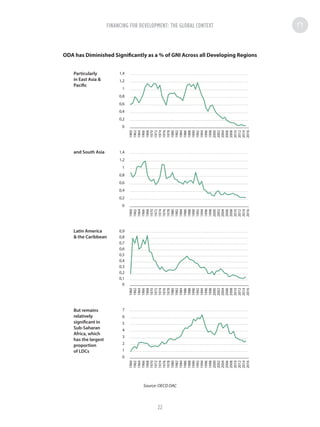
ODA has Diminished Significantly as a % of GNI Across all Developing Regions
Source: OECD DAC
Particularly
in East Asia 
Pacific
0
1960
1962
1964
1966
1968
1970
1972
1974
1976
1978
1980
1982
1984
1986
1988
1990
1992
1994
1996
1998
2000
2002
2004
2006
2008
2010
2012
2014
2016
0,2
0,4
0,6
0,8
1
1,2
1,4
Latin America
 the Caribbean
But remains
relatively
significant in
Sub-Saharan
Africa, which
has the largest
proportion
of LDCs
and South Asia
0
1960
1962
1964
1966
1968
1970
1972
1974
1976
1978
1980
1982
1984
1986
1988
1990
1992
1994
1996
1998
2000
2002
2004
2006
2008
2010
2012
2014
2016
0,2
0,4
0,6
0,8
1
1,2
1,4
0
1960
1962
1964
1966
1968
1970
1972
1974
1976
1978
1980
1982
1984
1986
1988
1990
1992
1994
1996
1998
2000
2002
2004
2006
2008
2010
2012
2014
2016
0,3
0,2
0,1
0,4
0,5
0,6
0,7
0,8
0,9
0
1960
1962
1964
1966
1968
1970
1972
1974
1976
1978
1980
1982
1984
1986
1988
1990
1992
1994
1996
1998
2000
2002
2004
2006
2008
2010
2012
2014
2016
3
2
1
4
5
6
7
FINANCING FOR DEVELOPMENT: THE GLOBAL CONTEXT
22
Composition of External Finance in the LDC versus other Developing Countries
Source: OECD (2016)
3. An Age of Choice? Diversity and Innovation in Financing Approaches
In much the same way as sources of finance have expanded over recent years, so has
the variety and sophistication of financial instruments and financing approaches. The
ways in which resources are both mobilized and spent have become increasingly‘inno-
vative’ and diversified. This has been supported in turn by innovations in technology
that have led to the financialization of ‘real’ markets, increased interdependence/in-
tegration of financial markets, the introduction of new crypto-currencies, and facili-
tated access to financial markets by previously excluded people (e.g. via mobile and
smartphone technology). Collaborations between public and private actors to deliver
sustainable development outcomes have also become commonplace.
Innovations in financing involve innovations in the way resources are both mobilized
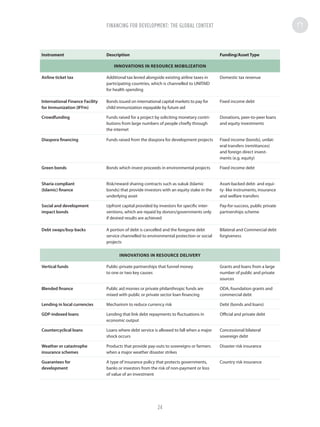
as well as delivered. Some of these are outlined in the table below. Part 4 of this guide-
book explores in detail how many of these instruments have been used in practice
throughout the world. UNDP uses the term “financing tool-box” to describe this in-
creased diversity.
0%
10%
20%
30%
40%
50%
60%
70%
80%
90%
100%
Private flows at
the market terms
Remittances
Non-concessional
DAC and multilateral
Private grants
Concessional DAC
and multilateral
62%
11%
LDC Other countries
FINANCING FOR DEVELOPMENT: THE GLOBAL CONTEXT
23
Instrument Description Funding/Asset Type
INNOVATIONS IN RESOURCE MOBILIZATION
Airline ticket tax Additional tax levied alongside existing airline taxes in
participating countries, which is channelled to UNITAID
for health spending
Domestic tax revenue
International Finance Facility
for Immunization (IFFm)
Bonds issued on international capital markets to pay for
child immunization repayable by future aid
Fixed income debt
Crowdfunding Funds raised for a project by soliciting monetary contri-
butions from large numbers of people chiefly through
the internet
Donations, peer-to-peer loans
and equity investments
Diaspora financing Funds raised from the diaspora for development projects Fixed income (bonds), unilat-
eral transfers (remittances)
and foreign direct invest-
ments (e.g. equity)
Green bonds Bonds which invest proceeds in environmental projects Fixed income debt
Sharia compliant
(Islamic) finance
Risk/reward sharing contracts such as sukuk (Islamic
bonds) that provide investors with an equity stake in the
underlying asset
Asset-backed debt- and equi-
ty- like instruments, insurance
and welfare transfers
Social and development
impact bonds
Upfront capital provided by investors for specific inter-
ventions, which are repaid by donors/governments only
if desired results are achieved
Pay-for-success, public private
partnerships scheme
Debt swaps/buy-backs A portion of debt is cancelled and the foregone debt
service channelled to environmental protection or social
projects
Bilateral and Commercial debt
forgiveness
INNOVATIONS IN RESOURCE DELIVERY
Vertical funds Public-private partnerships that funnel money
to one or two key causes
Grants and loans from a large
number of public and private
sources
Blended finance Public aid monies or private philanthropic funds are
mixed with public or private sector loan financing
ODA, foundation grants and
commercial debt
Lending in local currencies Mechanism to reduce currency risk Debt (bonds and loans)
GDP-indexed loans Lending that link debt repayments to fluctuations in
economic output
Official and private debt
Countercyclical loans Loans where debt service is allowed to fall when a major
shock occurs
Concessional bilateral
sovereign debt
Weather or catastrophe
insurance schemes
Products that provide pay-outs to sovereigns or farmers
when a major weather disaster strikes
Disaster risk insurance
Guarantees for
development
A type of insurance policy that protects governments,
banks or investors from the risk of non-payment or loss
of value of an investment
Country risk insurance
FINANCING FOR DEVELOPMENT: THE GLOBAL CONTEXT
24
In particular there has been a major proliferation in multilateral and bilateral funds
(and mixed public-private funds) for climate and biodiversity finance over recent years.
Many fund managers use, in turn, innovative approaches to both mobilize resources
as well as carry out their mandate, including payment for environmental services, car-
bon and biodiversity offsets, benefit-sharing/revenue-sharing schemes, payments for
results and certification mechanisms.
The Financing Tool-Box
Source: UNDP (2015)
Bonds • Sovereign bonds issued on international and domestic markets
• Diaspora bonds
• GDP-linked bonds
• Green/blue bonds
• Social impact bonds
• Development impact bonds
Loans and guarantees • Loans (Including: Multilateral and bilateral development banks, other official flows (OOFs),
counter-cyclical loans, contingent credit facilities, development policy loan deferred draw-
down options, catastrophe risk deferred, drawdown options, debt buy backs, debt-swaps,
blended finance, public-private partnerships, guarantees)
Public Revenue • Taxes and levies (Including: income taxes, value added/consumption tax, property taxes,
tariffs, green taxes, domestic financial transaction tax, airline ticket tax)
Insurance • Weather index-based insurance
• Catastrophe Risk Insurance Facility
Funds • Vertical Funds (e.g. GAVI Alliance, Global Fund and UNITAID, Adaptation Fund, Global
Environment Facility, Green Climate Fund, Securities and structured funds)
• Microfinance investment funds
Grants • Official Development Assistance (ODA)
• Philanthropic and other private donations
FINANCING FOR DEVELOPMENT: THE GLOBAL CONTEXT
25
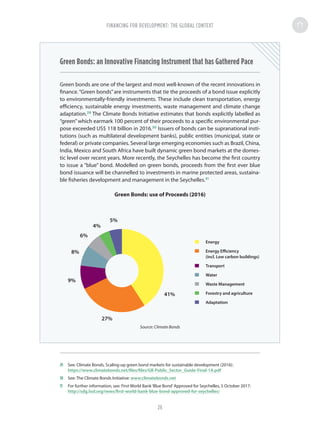
Green Bonds: an Innovative Financing Instrument that has Gathered Pace
Green bonds are one of the largest and most well-known of the recent innovations in
finance.“Green bonds”are instruments that tie the proceeds of a bond issue explicitly
to environmentally-friendly investments. These include clean transportation, energy
efficiency, sustainable energy investments, waste management and climate change
adaptation.29
The Climate Bonds Initiative estimates that bonds explicitly labelled as
“green” which earmark 100 percent of their proceeds to a specific environmental pur-
pose exceeded US$ 118 billion in 2016.30
Issuers of bonds can be supranational insti-
tutions (such as multilateral development banks), public entities (municipal, state or
federal) or private companies. Several large emerging economies such as Brazil, China,
India, Mexico and South Africa have built dynamic green bond markets at the domes-
tic level over recent years. More recently, the Seychelles has become the first country
to issue a “blue” bond. Modelled on green bonds, proceeds from the first ever blue
bond issuance will be channelled to investments in marine protected areas, sustaina-
ble fisheries development and management in the Seychelles.31
Green Bonds: use of Proceeds (2016)
Source: Climate Bonds
29	 See: Climate Bonds, Scaling-up green bond markets for sustainable development (2016):
https://www.climatebonds.net/files/files/GB-Public_Sector_Guide-Final-1A.pdf
30	 See: The Climate Bonds Initiative: www.climatebonds.net
31	 For further information, see: First World Bank‘Blue Bond’Approved for Seychelles, 5 October 2017:
http://sdg.iisd.org/news/first-world-bank-blue-bond-approved-for-seychelles/
41%
27%
6%
4%
5%
9%
8%
Energy
Transport
Water
Forestry and agriculture
Adaptation
Waste Management
Energy Efficiency
(incl. Low carbon buildings)
FINANCING FOR DEVELOPMENT: THE GLOBAL CONTEXT
26
An extensive literature exists which examines both the potential and the limitations
associated with different innovative financing approaches.32
Much of this literature has
explored the extent to which different financing instruments and delivery channels:
•	 leverage additional resources at-scale for sustainable development;
•	 provide opportunities for new collaborations based on the strengths/expertise of
each stakeholder;
•	 deliver resources efficiently in a stable and predictable manner;
•	 are easy to access;
•	 resolve or accentuate fragmentation and coordination challenges;
•	 reduce vulnerability;
•	 are suitable for countries at different income levels;
•	 are suitable for different interventions, and;
•	 have high transaction costs.
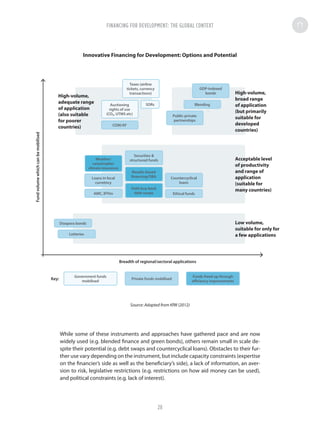
The German Development Bank (KfW) has produced a useful illustration which sum-
marizes the revenue potential of different instruments and their suitability to different
countries. Some have the potential to mobilize resources at-scale and have a broad
range of applications (e.g. blended finance); others remain largely untested/underex-
plored (e.g. diaspora bonds).
32	 See for example: UNDP, Innovative Financing for Development: A New Model for
Development Finance? (2012): http://www.undp.org/content/undp/en/home/
librarypage/poverty-reduction/development_cooperationandfinance/innovative_
financingfordevelopmentanewmodelfordevelopmentfinance.html
FINANCING FOR DEVELOPMENT: THE GLOBAL CONTEXT
27
Innovative Financing for Development: Options and Potential
Source: Adapted from KfW (2012)
While some of these instruments and approaches have gathered pace and are now
widely used (e.g. blended finance and green bonds), others remain small in scale de-
spite their potential (e.g. debt swaps and countercyclical loans). Obstacles to their fur-
ther use vary depending on the instrument, but include capacity constraints (expertise
on the financier’s side as well as the beneficiary’s side), a lack of information, an aver-
sion to risk, legislative restrictions (e.g. restrictions on how aid money can be used),
and political constraints (e.g. lack of interest).
Funds freed up through
efficiency improvements
Private funds mobilised
Government funds
mobilised
Fundvolumewhichcanbemobilised
Breadth of regional/sectoral applications
Key:
v v
Blending
GDP-indexed
bonds
COM/AF
SDRs
Taxes (airline
tickets, currency
transactions)
Auctioning
rights of use
(CO₂, UTMS etc) Public-private
partnerships
High-volume,
broad range
of application
(but primarily
suitable for
developed
countries)
High-volume,
adequate range
of application
(also suitable
for poorer
countries)
v
AMC, IFFIm Ethical funds
Loans in local
curretncy
Securities 
structured funds
Debt buy-back
debt swaps
Results-based
financing/OBA
Weather/
catastrophe/
climate insurance
Countercyclical
loans
Acceptable level
of productivity
and range of
application
(suitable for
many countries)
Diaspora bonds
Lotteries
Low volume,
suitable for only for
a few applications
FINANCING FOR DEVELOPMENT: THE GLOBAL CONTEXT
28
It is also important to note that, while there has been a recent explosion in the number
of new funds for development, especially in the areas of climate change, biodiversity
conservation and health, this apparent abundance masks the under-capitalization of
many of them. Rather than reflecting increasing available resources for sustainable de-
velopment, the development of new financing approaches appears as a sub-optimal
response to a persistent and unresolved financing gap.33
And while many new funds
are public-private partnerships, they nevertheless rely heavily on donor aid flows as a
major source of funds.
Moreover, while this diversity has many positive aspects, a (perhaps unintended) con-
sequence is a dramatic increase in complexity; countries are tasked with the challenge
of identifying which funds are appropriate for them and are currently capitalized,
which they are eligible for, how to access resources, how to blend them to support
transformative change and how to develop cost effective methods to apply for, mon-
itor and evaluate results. This is a particular problem in relation to climate finance and
has meant that many of the countries most vulnerable to climate change (e.g. small
islands and least developed countries) have found it difficult to access this financing
(due to limited capacities). Many rely on the support provided by development part-
ners such as UNDP and others to help them in this effort.
Similarly, only some countries have been able to make effective use of some of these
innovative financing instruments found in the financing“tool-box”. For example, while
several large middle-income countries have used blended finance arrangements to
fund infrastructure investments and/or issued green bonds, these financing modali-
ties are more challenging for many low-income countries. Development impact bonds
have not yet been used to any real scale. Additionally, finance providers are often more
averse to“testing”some of these innovative approaches in low-income perceived riski-
er settings. Capacity building support will be a prerequisite for many countries seeking
to maximize the opportunities presented by a more sophisticated financing“tool-box”.
4. Financing for What?
It is obvious (but sometimes overlooked) that different sources of finance have very
different “characteristics” that make them more (or less) suitable for the financing of
different interventions; not all dollars are the same! Similarly, no two countries are ex-
actly the same – which means the right“financing mix”will differ from one country to
the next.
For example, some flows are procyclical in nature and are cheaper and more abundant
33	 For further elaboration on this topic, see: UN System Task Team on Financing for Sustainable
Development, Chapter 4, Public support to private investment (2014):
https://sustainabledevelopment.un.org/content/documents/2111Chapter%204-public%20
support%20to%20private%20investment.pdf
FINANCING FOR DEVELOPMENT: THE GLOBAL CONTEXT
29
in good times (e.g. many private financial flows), while others perform an important
countercyclical function (e.g. finance from the multilateral financial institutions). Flows
are disbursed in different currencies and at different speeds (project financing from
some multilateral development banks can take considerable time to be approved and
disbursed while tapping international capital markets can be fast). Some financing has
conditionalities attached to it (e.g. tied aid or policy conditions) while some is condi-
tion-free. Loans can have short or longer-term maturities and different interest costs.
Some financing may come with helpful technical assistance or technology transfer,
and in other cases this (mandatory) technical assistance is unwanted. Financing can
be on-budget and channelled through country systems and in other cases, it is chan-
neled through intermediaries (that governments may or may not hold a favourable
view of and/or that have high overhead costs). Some donors can be unpredictable or
unreliable, making aid a volatile source of finance in some instances. Funding may be
offered to support national priorities or it may be “supply” driven. But even in cases
where resources are offered to support “non-priority” development areas, it may still
be expedient for a country to accept them due to a desire/need to foster deeper polit-
ical or strategic ties with a particular funder. When it comes to domestic resources and
proposals to reform domestic taxation systems and/or implement new taxes, powerful
political or business interests may resist these even though there may be a strong ra-
tionale/benefit for the proposed reforms.
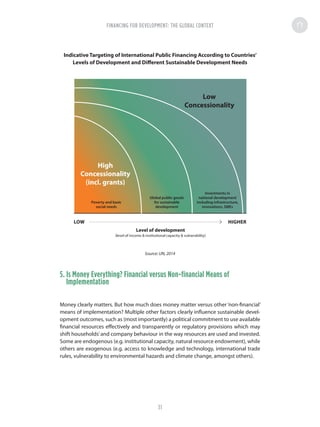
Critically, “what” you are financing matters. As an illustration, many donors take the
view that grants and highly-concessional loans are appropriate for financing poverty
reduction and basic social needs in the poorest countries; conversely loan financing
can be used to fund investments in infrastructure and the development of small and
medium-sized enterprises (SMEs), especially in higher-income developing nations.
In its 2014 report, the UN’s Inter-governmental Committee of Experts on Sustainable
Development Financing (ICESDF) reflected this emerging consensus with the follow-
ing illustration. The challenge however is that sometimes governments and investors
over-estimate the economic return that infrastructure investments are likely to gener-
ate (or the economic return does not happen as quickly as was anticipated).
These considerations illustrate some of the many complexities involved in developing
a national financing strategy. It can often be extremely difficult for governments to de-
termine which financing instruments and approaches to use, in which circumstances
and what debt policies to adopt to ensure debt remains sustainable, while at the same
time balance this with foreign policy or other considerations. These considerations
must all be taken into account when supporting countries to develop and implement
financing strategies that are most suited to their specific circumstances and needs.
FINANCING FOR DEVELOPMENT: THE GLOBAL CONTEXT
30
Indicative Targeting of International Public Financing According to Countries’
Levels of Development and Different Sustainable Development Needs
Source: UN, 2014
5. Is Money Everything? Financial versus Non-financial Means of
Implementation
Money clearly matters. But how much does money matter versus other‘non-financial’
means of implementation? Multiple other factors clearly influence sustainable devel-
opment outcomes, such as (most importantly) a political commitment to use available
financial resources effectively and transparently or regulatory provisions which may
shift households’and company behaviour in the way resources are used and invested.
Some are endogenous (e.g. institutional capacity, natural resource endowment), while
others are exogenous (e.g. access to knowledge and technology, international trade
rules, vulnerability to environmental hazards and climate change, amongst others).
Investments in
national development
including infrastructure,
innovations, SMEs
Global public goods
for sustainable
development
Level of development
(level of income  institutional capacity  vulnerability)
Poverty and basic
social needs
LOW HIGHER
High
Concessionality
(incl. grants)
Low
Concessionality
FINANCING FOR DEVELOPMENT: THE GLOBAL CONTEXT
31
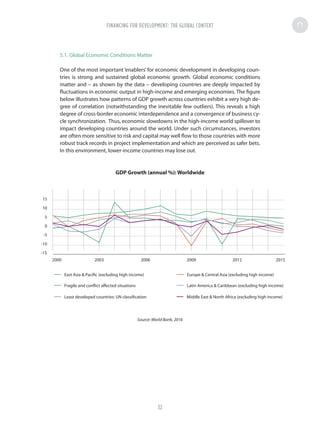
5.1. Global Economic Conditions Matter
One of the most important ‘enablers’ for economic development in developing coun-
tries is strong and sustained global economic growth. Global economic conditions
matter and – as shown by the data – developing countries are deeply impacted by
fluctuations in economic output in high-income and emerging economies. The figure
below illustrates how patterns of GDP growth across countries exhibit a very high de-
gree of correlation (notwithstanding the inevitable few outliers). This reveals a high
degree of cross-border economic interdependence and a convergence of business cy-
cle synchronization. Thus, economic slowdowns in the high-income world spillover to
impact developing countries around the world. Under such circumstances, investors
are often more sensitive to risk and capital may well flow to those countries with more
robust track records in project implementation and which are perceived as safer bets.
In this environment, lower-income countries may lose out.
GDP Growth (annual %): Worldwide
Source: World Bank, 2016
-15
-10
-5
0
5
10
15
2000 2003
East Asia  Pacific (excluding high income) Europe  Central Asia (excluding high income)
Fragile and conflict affected situations Latin America  Caribbean (excluding high income)
Least developed countries: UN classification
2006 2009 2012 2015
Middle East  North Africa (excluding high income)
FINANCING FOR DEVELOPMENT: THE GLOBAL CONTEXT
32
5.2. Other Non-financial Means of Implementation
The Addis Ababa Action Agenda (AAAA) attempts to reflect other “non-financial” di-
mensions of an enabling international environment when it speaks of the need to
enhance, inter alia: international coordination for macroeconomic stability; take meas-
ures to ensure safe and orderly international migration; combat terrorism and transna-
tional crime (that can have deleterious impacts on development); create and diffuse
innovations and new technologies (as well as build the capacities of countries to use
them); improve international cooperation on tax; incentivize research; and take action
to combat climate change.34
Attention has also focused on the potential of regional
integration to accelerate development.
The literature on financing for development also explores the incentives and regula-
tions that governments can put in place at the national level to steer private invest-
ment in different directions and to ensure that more private investment is allocated
to investments that yield sustainable development returns as well as financial returns.
This means going far beyond philanthropy and voluntary corporate social responsibil-
ity (important though they are): it implies active interventions to steer the investment
decisions that private actors make every day. These are made in the real economy, by
companies small and large, as well by a broad range of actors in the financial sector
such as banks, pensions companies and hedge funds to name a few.
It involves a variety of public policy measures, such as: incentive schemes to help re-
align business decisions to the SDGs (e.g. taxes or other restrictions on carbon emis-
sions or other harmful activities); the adoption of mandatory environmental and social
impact reporting; and changes in government procurement policies (as governments
are major purchasers of goods and services from the private sector). This must be ac-
companied by measures to promote and sustain an endogenous shift in households’
behaviours and market preferences to allow for a gradual internalization of the SDGs
in market dynamics, (e.g. consumers voluntarily opt to purchase products that respect
certain environmental or social standards). This approach views consumers, business-
es and investors not only as providers of capital, but as agents of positive change. UN-
DP’s“Growing Inclusive Markets”is one initiative that seeks to understand, enable and
inspire the development of more inclusive business models around the world that will
help to create new opportunities and better lives for many of the world’s poor.35
34	 United Nations, Addis Ababa Action Agenda (2015) (see in particular sections F and G):
http://www.un.org/esa/ffd/wp-content/uploads/2015/08/AAAA_Outcome.pdf
35	 For further information, see: Growing Inclusive Markets: http://www.growinginclusivemarkets.org/
FINANCING FOR DEVELOPMENT: THE GLOBAL CONTEXT
33
UNEP Inquiry into the Design of a Sustainable Financial System
In 2015 UNEP published the first findings from its“Inquiry into the Design of a Sustain-
able Financial System,” initiated to explore options for realigning the global financial
system with sustainable development. The report found that a ‘quiet revolution’ is al-
ready underway to integrate aspects of sustainable development into financial system
reform, development and practice.
The Inquiry surveyed over 100 innovative measures across 15 diverse countries from
China to Switzerland, India and Brazil, led by financial institutions and markets, regula-
tors and policymakers. It showed that green bonds, green ratings and tighter sustaina-
bility reporting requirements on stock exchanges are some of the innovations financial
markets have developed in recent years in response to a number of emerging signals
including client demand for sustainable financial products.
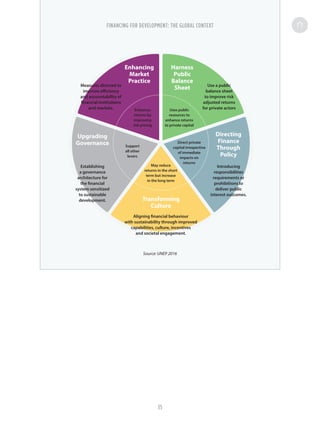
At the national level, policymakers and regulators are helping to drive this process
with measures to incentivize capital reallocation and enhance sustainability report-
ing. China’s Banking Regulatory Commission issued“Green Credit Guidelines”in 2012,
requiring banks to report on environmentally-related credit risk in their lending ac-
tivities. In France, the lead up to the COP21 climate change conference in December
2015, spurred new disclosure requirements obligating investors to include details of
efforts to manage sustainability factors such as climate risks in their annual reports.
In the United States, fiscal incentives, particularly tax benefits, are used to encourage
increased financial flows into investments that deliver public goods. Collectively, these
policy innovations inspired a set of five action points to amplify the revolution towards
a global sustainable financial system summarized below.36
While much more still needs to be done, these examples – and many more – show that
efforts are underway at both national and international levels to put in place finan-
cial innovations, regulatory environments and other incentives to align much more
finance with key public policy aims.
36	 UNEP, The Financial System We Need: Aligning the Financial System with Sustainable Development,
October 2015: http://unepinquiry.org/wp-content/uploads/2015/11/The_Financial_System_We_
Need_EN.pdf
FINANCING FOR DEVELOPMENT: THE GLOBAL CONTEXT
34
Source: UNEP 2016
Introducing
responsibilities
requirements or
prohibitions to
deliver public
interest outcomes.
Establishing
a governance
architecture for
the financial
system sensitized
to sustainable
development.
Measures directed to
improve efficiency
and accountability of
financial institutions
and markets.
Use a public
balance sheet
to improve risk
adjusted returns
for private actorsEnhances
returns by
improving
risk pricing
Support
all other
levers
Direct private
capital irrespective
of immediate
impacts on
returns
May reduce
returns in the short
term but increase
in the long term
Uses public
resources to
enhance returns
to private capital
Aligning financial behaviour
with sustainability through improved
capabilities, culture, incentives
and societal engagement.
Upgrading
Governance
Transforming
Culture
Enhancing
Market
Practice
Harness
Public
Balance
Sheet
Directing
Finance
Through
Policy
FINANCING FOR DEVELOPMENT: THE GLOBAL CONTEXT
35
The 2030 Agenda and the Debt Sustainability Imperative
The 2030 Agenda will not be achieved in countries where debt becomes unsustaina-
ble. Excessively high debt service consumes export and other revenues which could
otherwise fund investments in building productive capacities and reducing poverty.
High debt can, in turn, increase borrowing costs as investors’perceive higher risk, lead-
ing to a vicious cycle of escalating debt and debt service costs.
Debt crises affect countries at all income levels, but can be particularly devastating for
developing countries as the Latin American debt crisis of the 1980s and, more recently,
the debt crisis of the Heavily Indebted Poor Countries (HIPCs) has revealed.37
Much debt was restructured and/or written-down over the MDG period and debt
“relief” is widely considered one of the most important MDG success stories. Under
the Heavily Indebted Poor Countries (HIPC) Initiative, over US$116 billion in debt (in
present value terms) was cancelled for 42 of the world’s poorest and most critically in-
debted countries.38
While the HIPC Initiative had many problem features (e.g. its heavy
conditionality burden), it nevertheless supported beneficiary countries to increase
poverty reduction expenditures by, on average, 3 percentage points of GDP (pre ver-
sus post-relief) and is widely credited with reducing debt to more manageable levels.
Despite these successes, some countries nevertheless slipped under the radar. UNDP
has, for example, documented the debt crisis that continues to face several small is-
land developing states, particularly in the Caribbean.39
Others are accumulating debt
at a rapid pace (e.g. Lebanon and Cabo Verde). Some countries have simply replaced
low-cost long-term external debt with high-cost short-term domestic debt accentuat-
ing debt vulnerabilities. The IMF has classified nine low-income countries as “at high
risk”of debt distress and a further 24 “at moderate risk”. Debt vulnerabilities therefore
remain high across many developing countries.40
It is clear that debt-funded projects must be carefully identified and implemented. The
risks of poor project design and implementation are particularly high in the poorest
countries. Lessons from previous debt crises also underscore how there has been an al-
37	 For more information on the HIPC Initiative, see: World Bank:
http://www.worldbank.org/en/topic/debt/brief/hipc
38	 IMF and World Bank, Heavily Indebted Poor Countries (HIPC) Initiative and Multilateral Debt Relief
Initiative (MDRI) – Statistical Update (2016):
https://www.imf.org/external/np/pp/eng/2016/031516.pdf
39	 See: UNDP, Financing for Development and Small Island Developing States: A Snapshot and Ways
Forward (2015): http://www.undp.org/content/undp/en/home/librarypage/poverty-reduction/FfD-
SIDS-UNDP-OHRLLS.html
40	 See: IMF: https://www.imf.org/external/Pubs/ft/dsa/DSAlist.pdf
FINANCING FOR DEVELOPMENT: THE GLOBAL CONTEXT
36
most universal over-optimism as regards commodity prices and the high-returns that
large-scale costly infrastructure projects are likely to generate. Governments and inter-
national financial institutions have also tended to underestimate the long-term negative
effects of major shocks. Careful debt management combined with improved debt re-
structuring modalities (where crises do occur) will be essential for realization of the SDGs.
It should be noted that while an expanded pool of lenders can undoubtedly be helpful, it
also makes debt restructuring more complex where repayment difficulties arise.41
On the positive side, there are a number of key new positive developments for improved
debt prevention and management. These include the IMF and World Bank’s debt sus-
tainability framework for low- and middle-income countries (which monitors debt ra-
tios and provides regular assessments as to countries’risks of over-indebtedness).This is
combined with a strengthened focus on technical assistance by the BrettonWoods insti-
tutions to help countries develop debt strategies and manage their debt loads effective-
ly. A broader suite of risk management products, such as weather and disaster insurance,
local currency financing and countercyclical loan-type contracts (where debt service is
allowed to fall to zero when a major economic or environmental shock occurs) also now
exists. Where debt crises do strike, innovations such as“collective action clauses”(CACs)
in bond contracts (where all bondholders are bound by law to accept the terms of a debt
restructuring which is agreed by at least 75 percent of creditors) have been used to help
coordinate creditors. Debt-for-climate swaps meanwhile have also been used in a few
cases to raise resources for investments in environmental sectors (e.g. the Seychelles
– see section three for further elaboration). Nevertheless, none of these is perfect and
financing for development strategies must always keep debt sustainability at the fore
and ensure debt is used constructively to fund high-quality productive investments.
41	 Credit from large emerging economies such as China and Brazil is increasingly replacing credit from
so-called‘traditional’Paris Club lenders, such as France, Germany and Japan and this trend is expected
to continue and become more pronounced over the coming period.
FINANCING FOR DEVELOPMENT: THE GLOBAL CONTEXT
37
38
A ‘Risk-informed’ Approach to Financing for Development: UNDP’s Approach
UNDP advocates for ‘risk-informed’ financing strategies and more systematic ap-
proaches to debt management. Various types of shocks and crises, including disas-
ters caused by natural hazards, disease outbreaks, conflicts and economic shocks, can
weaken a country’s debt sustainability. Instead of ad hoc and ex-post responses to
debt distress following major shocks and crises (e.g. the grant assistance from the IMF
to the Ebola-affected countries to pay-off future debt service payments), UNDP pro-
poses increased use of state-contingent debt instruments, such as GDP-linked official
sector lending and counter-cyclical lending contracts. These instruments, which aim
to ex-ante and automatically trigger downward adjustments in debt service during
shocks, have the potential to contribute to improve debt sustainability and help coun-
tries manage risk and cope with shocks more effectively.42
42	 For further resources on this subject, see: UNDP, Risk-Informed Finance for Development Can GDP-
linked official lending to emerging economies and developing countries enhance risk management
and resilience? (2015): http://www.undp.org/content/dam/undp/library/Sustainable%20
Development/Risk-Informed%20Finance%20for%20Development%20-%20July%207.pdf and
UNDP, Next time could be different – Towards risk-informed development finance (2015): http://www.
undp.org/content/dam/undp/library/Sustainable%20Development/FfD-Issue-Brief-RiskResilience.
pdf and UNDP, Financing the SDGs in the Least Developed Countries (LDCs): Diversifying the
Financing Tool-box and Managing Vulnerability (2016): http://www.undp.org/content/undp/
en/home/librarypage/poverty-reduction/afd-undp-financing-sustainable-development-and-
managing-vulnerab.html
UNDP Mauritanie Oumou Sow
Fatimetou Mint Mohammed, 52, President of the Talhaya village cooperative in Assaba, Mauritania, receives seeds
39
Country Level
Support on Financing
for Sustainable
Development
PART
TWO
Introduction
What do these trends mean for UNDP’s policy and programme support in the area of
financing the 2030 Agenda, in particular at the country level?
UNDP’s new Strategic Plan (2018-2021) is clear that countries at all income levels will
need to successfully implement structural transformations to transition to low carbon
economic development models to reduce poverty, protect the planet and sustain de-
velopment progress. It outlines six key‘signature solutions’to orient the organization’s
work at the country level: 1) keeping people out of poverty; 2) strengthening effective,
accountable and inclusive governance; 3) enhancing prevention and recovery for resil-
ient societies; 4) promoting nature-based solutions for a sustainable planet; 5) closing
the energy gap; 6) strengthening gender equality. Depending on each country’s pri-
orities, UNDP will work to help plan, prioritize, sequence and finance integrated policy
and financing solutions to these complex challenges. It will also work to assess trade-
offs, manage risk and uncertainty and strengthen long-term planning. The Strategic
Plan is clear that UNDP should build on its core strengths, including:
•	 UNDP as integrator: UNDP’s breadth of expertise and country presence makes it
unique within the UN development system. UNDP has long-standing partnerships
at the highest levels of government. Given this and UNDP’s reputation as an im-
partial partner, UNDP effectively convenes across line ministries and development
partners to promote ‘whole-of-government’ and ‘whole-of-society’ responses vital
for transformational change;
•	 UNDP as operational backbone. UNDP’s widespread country presence has also
served as an operational platform for other UN agencies;
•	 UNDP as a key partner of choice. UNDP is a key partner to civil society, the private
sector, international financial institutions and vertical funds, amongst other key de-
velopment partners.
To deliver on these‘signature solutions’two platforms will be created:
5.	 Country Support Platforms: to help countries design and deliver integrated solu-
tions to complex development settings. It will consist of a core team trained in com-
plexity and systems analysis, data systems and design thinking, backed by expertise
on design finance, futures thinking and planning;
41
6.	 Global Development Advisory and Implementation Services Platform: to pro-
vide high-quality technical and policy advisory support to Country Platforms and
UNDP’s country programmes and support UNDP’s knowledge, innovation and part-
nership-building efforts.
The Strategic Plan underscores UNDP’s core strengths: as a connector and convener,
policy advisor, service provider and innovator. UNDP’s support on financing for de-
velopment should play to these strengths and help countries to identify, plan and se-
quence various forms of finance, build partnerships between different actors to tap
expertise and networks, make finance more effective and ‘results’ driven, and pilot in-
novations. This is where UNDP’s‘value-added’lies.
UNDP’s Approach: Two Platforms to Support Integrated Solutions
for the 2030 Agenda
Source: UNDP Strategic Plan 2018-2021
Working in Partnership
National
Governments
IFIs, Inter-
Governmental
Bodies
Country Support Platform Global Development Service Platform
Private
Sector
UNDP
UNDS
Civil
Society
COUNTRY LEVEL SUPPORT ON FINANCING FOR SUSTAINABLE DEVELOPMENT
42
UNDP has a track record to build on. For example:
•	 UNDP has supported many countries to carry out public expenditure reviews which
provide guidance as to how budgetary resources may be most effectively deployed
in support of development, especially in the environmental sphere;
•	 UNDP supports aid management and coordination schemes in many countries and
is a key player in international aid and development effectiveness discussions;
•	 Through the Biodiversity Finance (BIOFIN) Initiative, UNDP has supported over 30
countries to develop biodiversity financing strategies;
•	 UNDP provides institutional and capacity development support to fiscal administra-
tions that aim to build capacity to plan, budget, monitor and evaluate expenditures
more effectively;
•	 Through the Tax Inspectors Without Borders (TIWB) initiative, jointly with the OECD,
UNDP helps to build the capacities of tax administrations in the area of tax audits;
•	 UNDPhassupportedthedevelopmentofthemicrofinancesectorinanumberofcoun-
tries, jointly with the UN Capital Development Fund (UNCDF) in LDCs.This includes the
creationandexpansionofmicrofinanceinstitutionsandthedevelopmentofnewfinan-
cial products to address national priorities (e.g. green, medium-size, gender-focused).
•	 UNDP supports countries to access climate finance from major international funds
such as the Green Climate Fund, and to implement those projects;
•	 Through its climate, energy and biodiversity portfolios, UNDP has implemented a
number of projects featuring innovative and more traditional non-grant financial
mechanisms;
•	 UNDP has carried out Development Finance Assessments (DFAs) in 15 countries so
far, which help authorities to analyze financing flows in their country and develop
strategies for mobilizing new resources and making expenditures more effective.
•	 Environmental finance is an area where UNDP has developed a strong service line
through its work with the vertical funds, and it may serve as a model for UNDP’s
approach in other development finance areas. This portfolio is managed by the
UNDP Global Environmental Finance Unit (UNDP–GEF). The total UNDP-GEF portfo-
lio under implementation covers 819 projects in 141 countries with US$2.5 billion in
grants, leveraging co-financing of a further US$11.2 billion from domestic sources,
the private sector and international financial institutions.
•	 UNDP has been successful in convening different investors active in the develop-
ment space, e.g. impact investors, philanthropies etc. by creating spaces and new
“platforms”for discussion and cooperation.
COUNTRY LEVEL SUPPORT ON FINANCING FOR SUSTAINABLE DEVELOPMENT
43
These service areas – and more – are documented in more detail in section three of
this guidebook.
The aim of this section of the guidebook is to help country offices think about the
different ways in which they can support countries to develop integrated financing
for development strategies in support of the 2030 Agenda. While our role will change
according to each country’s circumstances and needs, examples include:
1.	 Support to help countries budget for the SDGs;
2.	 Improvegovernanceandthemanagement/coordinationofdifferentfinancingflows;
3.	 Help countries to responsibly innovate and expand access to the financing “tool-
box”;
4.	 Facilitate access to international public and private finance flows, such as climate
finance, impact investment and philanthropy etc.;
5.	 Support in project identification, costing and preparation, and the building of part-
nerships to support the implementation of priority interventions;
6.	 Help countries to identify and implement policy and regulatory reforms that may
help them to harness particular financial flows;
7.	 Support international advocacy and share lessons learned.
The MAPS (Mainstreaming, Acceleration and Policy Support) Framework43
At the centre of the UN development system’s effort to support countries to imple-
ment the SDGs is the MAPS (Mainstreaming, Acceleration and Policy Support) frame-
work, which outlines a common framework for UN development support at the coun-
try level. The MAPS framework is complemented by UNDP-specific tools such as the
SDG Rapid Integrated Assessment (RIA) tool that aims to aid countries to assess their
readiness to implement the SDGs, and the SDG Accelerator and Bottleneck Assess-
mentTool, which is designed to identify catalytic areas or“accelerators”that can trigger
positive multiplier effects across the SDGs, and solutions to bottlenecks that impede
the optimal performance of the accelerators.
43	 For further elaboration on the MAPS framework, see: UNDG, MAPS –Mainstreaming, Acceleration
and Policy Support (2016): https://undg.org/home/undg-mechanisms/sustainable-development-
working-group/country-support/
COUNTRY LEVEL SUPPORT ON FINANCING FOR SUSTAINABLE DEVELOPMENT
44
Securing technical advice and support on financing for sustainable development has
been one of the core demands articulated by countries in the context of the UN’s re-
cent MAPS missions. The MAPS framework provides initial guidance to UN country
teams around financing for sustainable development.44
SDG implementation “road-
maps”which are an outcome of MAPS missions outline a series of priorities and initia-
tives that governments and their development partners can take in a variety of areas,
such as SDG localization and prioritization, data and monitoring, and financing for sus-
tainable development.
In the Armenia “roadmap” for example, the financing for development chapter looks
at strategies to incentivize diaspora investment in the country, financing schemes to
support local private sector development (SMEs), and projects that could be support-
ed with impact investment. In Jamaica, the “roadmap” looks at the potential of blue
bond and diaspora financing, as well as the importance of building the capacities of
tax administrations.
1. Developing a Coherent Financing for Development Strategy: UNDP’s
Approach
UNDP’s approach to financing for sustainable development is guided by three overar-
ching principles:
1.	 Efficiency: public and private finance must be used catalytically. That is, to plan
wisely, allocate resources for results and leverage multiple sources of finance.
2.	 Effectiveness: finance solutions should not be framed in silos. They should be
combined to deliver multiple economic, social and environmental benefits and be
risk-informed.
3.	 Equity: countries and people need to fairly participate and benefit. The financial
market and the multiplication of financial flows have largely benefitted a fewer
economies, sectors and groups.
These three principles should guide country teams’ support for developing national
financing strategies and plans, and piloting innovative financing approaches.
Secondly, UNDP has developed a‘structured approach’to providing country level sup-
port on financing for sustainable development.This‘structured approach’outlines four
44	 See Section 6B,“Budgeting for the Future”for further elaboration: UNDG, MAPS –Mainstreaming,
Acceleration and Policy Support (2016): https://undg.org/home/undg-mechanisms/sustainable-
development-working-group/country-support/
COUNTRY LEVEL SUPPORT ON FINANCING FOR SUSTAINABLE DEVELOPMENT
45
key steps country offices may wish to consider when providing country level support;
one logically follows on from the other and they are based on the methodology used
in the Biodiversity Finance (BIOFIN) Initiative (see box).The exercise should not be con-
ducted in a vacuum but to be connected to a specific strategy, plan, investment pipe-
line or priority programme.
1.	 Understand the context: undertake a mapping of different financing flows; review
national/sectoral financing policies;
2.	 Public and private expenditure and institutional review: review the effectiveness
of spending, the institutional arrangements and capacities for managing different fi-
nancing flows;
3.	 Identify and cost priority interventions: build a project pipeline and cost key na-
tional/sectoral interventions, especially those that will have a ‘multiplier’ effect across
several SDGs;
4.	 Devise national/sectoral financing strategy: identify and prioritize different financ-
ing ‘solutions’ and models in support of the SDGs.
Countries may request UNDP assistance at any distinct step of a policy cycle, either
with the planning and drafting of a financing strategy or investment pipeline, its exe-
cution, or at different phases of revision and refining; individual country circumstances
and interests will differ. Experience has shown that success in mobilizing large invest-
ment flows require time, efforts and persistence – sometimes spanning several years
or more. While short-cuts in analysis and the fast-tracking of individual financing initi-
atives (quick-wins) will all be extremely important, long term gains require thorough
analysis, prioritization and the building of partnerships.
Financing for Sustainable Development: UNDP’s Structured Approach
Understand the context
Understand where the money goes
Formulate needs as investment proposals
Match opportunities with needs
Devise smart financing strategies
Assessments: policy, institutions, development finance
Public/private expenditure reviews, inv. flow analysis
Identify and cost priority interventions
Financing frameworks, solutions, budgeting etc.
1
2
3
4
COUNTRY LEVEL SUPPORT ON FINANCING FOR SUSTAINABLE DEVELOPMENT
46
BIOFIN: the Biodiversity Finance Initiative
BIOFIN is a global partnership addressing the biodiversity finance challenge in a com-
prehensive manner. It has supported over 30 countries worldwide to measure their
current biodiversity expenditures, assess their financial needs in the medium term and
identify the most suitable finance solutions.
The initiative has developed an innovative methodology enabling countries to meas-
ure their current biodiversity expenditures, assess their financial needs in the medium
term and identify the most suitable finance solutions to bridge their national biodiver-
sity finance gaps.
The BIOFIN methodology comprises the following main steps:
•	 Policy and Institutional Review: Analysis of the policy and institutional architec-
ture for biodiversity finance and existing finance solutions.
•	 Biodiversity Expenditure Review: Analysis of public and private expenditures af-
fecting biodiversity.
•	 Finance Needs Assessment: Estimates the investment required to implement na-
tional biodiversity plans and achieve national biodiversity targets and results.
•	 Biodiversity Finance Plan: Analysis of options to optimize current and expand fu-
ture investments (public, private, national, international, traditional and innovative)
in biodiversity management.
•	 Implementing Finance Solutions: Support the implementation of policy recom-
mendations emerging from BIOFIN, such as the improvement or creation of finance
mechanisms and the integration of finance solutions into national planning cycles.
Source: BIOFIN45
45	 See, BIOFIN: The Biodiversity Finance Initiative: http://www.biodiversityfinance.net/
COUNTRY LEVEL SUPPORT ON FINANCING FOR SUSTAINABLE DEVELOPMENT
47
2. Implementing UNDP’s Structured Approach
2.1. Context Analysis (understand the context)
The first step is to analyze and understand the country context when it comes to cur-
rent domestic and international financial flows and how these are spent vis-à-vis coun-
try development priorities.
This will involve a comprehensive review of: (i) current inflows (and outflows) in volume
terms; (ii) domestic budget processes and allocations (e.g. by sector); (iii) allocations of
international public and private finance flows; and (iv) national (and sectoral) develop-
ment finance policies and plans.
This analysis is an important step in the development of any finance plan and will help
to inform recommendations as to how countries can better align resources with the
2030 Agenda, leverage co-benefits across economic, environmental and social sectors,
and mobilize and effectively manage new sources of funds.
The analysis should focus on the quantitative dimensions (e.g.howmuch is being raised
from different sources and how the picture is changing over time), as well as how these
relate to national development priorities. The following aspects might be considered
(but are not exhaustive):
1.	 Mapping of the current macroeconomic context and financial macro-indica-
tors, and analysis/forward-looking projections as to how different financing flows
are likely to change;
2.	 Review of a country’s fiscal policy environment, to assess fiscal space and the ca-
pacity to issue new debt obligations;
3.	 Amounts allocated to different sectors/issues from both domestic public resources
and external public and private finance;
4.	 A review of national policies and strategies in the development finance arena (in-
cluding sectoral financing plans/strategies, i.e. energy, environment, infrastruc-
ture etc. and also policies to attract private financing flows) and the extent to
which these plans are being effectively realized (or are experiencing difficulties);
5.	 Analysis of how financing flows are changing over time (e.g. how has aid depend-
ence changed over time and/or have the major development partners changed;
how has international private investment evolved; how is this likely to change with
graduation from e.g. LIC to MIC status, etc.);
6.	 Mapping institutions with key responsibilities in the budget cycle (planning, exe-
cution, monitoring, auditing etc.).
COUNTRY LEVEL SUPPORT ON FINANCING FOR SUSTAINABLE DEVELOPMENT
48
2.2. Public and Private Expenditure Reviews (understand where the money flows and
how effective it is)
The second step is to understand a country's current public and private expenditure
patterns and how they translate into sustainable development results, and are con-
sistent with national development priorities. A public and private expenditure review
may focus on government-wide expenditures or may focus on a particular sector (e.g.
health, education, disaster management etc.). It focuses predominantly on qualitative
aspects (e.g. to what extent are expenditures effective and do they translate into de-
velopment results, budget delivery rates, volatility of allocations, distribution/concen-
tration patterns etc.). Expenditure reviews have traditionally targeted public expendi-
tures, but more recently surveys have also been conducted to estimate the expenditure
of households and enterprises in selected areas such as disaster preparedness, climate
changes and biodiversity. The analysis should also look at capacity within a country.
The main objectives are:
1.	 To understand a country's current public expenditure patterns and how they trans-
late into sustainable development results;
2.	 To understand international public and private finance flows, and their effective-
ness/alignment with national development priorities;
3.	 To understand decision-making processes for translating national development
plans into budget allocations and expenditures;
4.	 To analyze institutional arrangements for managing different domestic and inter-
national financial flows;
5.	 Understand a country’s capacity (or capacity constraints) in the effective deploy-
ment of different sources of finance.
UNDP has developed the Development Finance Assessment (DFA) tool which can as-
sist with steps one and two as outlined in this guidebook (see box for further elabora-
tion). The DFA provides a country with an overview of the landscape of development
finance, and the alignment of different finance flows to national development priori-
ties and results. It outlines recommendations as to how different financing flows can
be more effectively managed for development results.
UNDP also has substantial experience in carrying out public expenditure reviews. Most
have been conducted in the area of environment, climate, biodiversity and water, with
a more recent pipeline emerging on health and disaster risk reduction. Expenditure
reviews are often conducted as one-off exercises, but can be easily integrated in the
softwares used by financial authorities to manage and monitor budget allocations.
UNDP has conducted or is in the process of conducting more than 75 public expend-
iture reviews and is exploring carrying out assessments into private sector spending.
COUNTRY LEVEL SUPPORT ON FINANCING FOR SUSTAINABLE DEVELOPMENT
49
Similar to the BIOFIN Initiative, the “Governance of Climate Finance” project has pro-
duced helpful guidance material, including carrying out a Climate Public Expenditure
and Institutional Review (see box), to budget tagging and the development of financ-
ing frameworks for climate.46
With the advent of the SDGs, a few countries have start-
ed to link public expenditure reviews to the SDGs.
UNDP’s Development Finance Assessments (DFAs)
The Development Finance Assessment (DFA) is a tool that has been developed by UN-
DP’s Bangkok Regional Hub, now being rolled out globally, to support countries in
taking more integrated approaches to financing national development priorities.
It is a country-level, context-informed assessment that that analyses financing needs
and trends as well as the policy and institutional structures through which a govern-
ment manages its financing policies.
It helps governments to identify priority challenges and opportunities for financing.
The process is tailored to the country context under the guidance of a national over-
sight team comprising representatives of key government ministries and other institu-
tions. It is designed to produce recommendations that are feasible within the country
context and, through the nationally-led, consultative approach, and build consensus
around these recommendations.
The DFA has been used by UNDP and governments in a number of countries to help
establish roadmaps of reform that will support the development of more integrated
approaches to finance their plans and vision. The DFA establishes these reform road-
maps around six building blocks of an Integrated National Financing Framework (INFF):
•	 Institutional coherence for establishing and managing an INFF: this includes
leadership and political buy-in at highest level of Government, as well as institution-
al arrangements and coordination at various political, technical, and working levels;
•	 A national development vision/plan with well-articulated set of priorities and
results, including costed targets and indicators: the costed results and targets
will need to be articulated in long term, medium term, and annually;
•	 An overall financing strategy that links national development results with
sources of finance, with attention to long, medium and annual results;
46	 For more information, see: https://www.climatefinance-developmenteffectiveness.org/
COUNTRY LEVEL SUPPORT ON FINANCING FOR SUSTAINABLE DEVELOPMENT
50
•	 Financing policies for specific finance flows: domestic public, international pub-
lic, domestic private, international private;
•	 A system for monitoring and evaluation of the effective use of finance for re-
sults, in various time frames;
•	 An enabling environment for accountability and dialogue of the use of finance
for results.
The DFA provides a country with an overview of the landscape of development fi-
nance, and the alignment of different finance flows to national development priorities
and results. In particular, the DFA provides planning, finance and other ministries with
data and analysis on changing trends in development finance. It also provides a set
of recommendations on how policies and institutional arrangements for managing
financing can be strengthened to support more integrated approaches to financing
national priorities and results.
DFAs have been carried out in 26 countries across Asia-Pacific, Africa and Latin Amer-
ica and more are in the pipeline. Following the DFA, and building on its findings and
recommendations, follow-up action-oriented support is provided to support strength-
ening overarching financing or sectoral strategies, policy/institutional reform, and ca-
pacity development or resource mobilization initiatives.
More information: http://www.asia-pacific.undp.org/content/rbap/en/home/
ourwork/democratic-governance-and-peacebuilding/ap-def.html
The Climate Public Expenditures and Institutional Review (CPEIR)
CPEIR is a systematic qualitative and quantitative analysis of a country's public ex-
penditures and how they relate to climate change. It presents evidence on public
expenditures across all spending agencies. The definition of climate change related
expenditures is tailored for each country based on a consultative process that takes
into account its national priorities. In addition to reviewing and accounting for pub-
lic expenditures, the CPEIR links the financial analysis with climate change plans and
policies, institutional framework and public finance architecture in order to formulate
recommendations to strengthen them.
A CPEIR can be a useful tool for national planning and budgeting, especially in terms of
identifying and tracking budget allocations that respond to climate change challeng-
es. Since 2011, CPEIRs have been conducted in many countries in Asia-Pacific, Latin
COUNTRY LEVEL SUPPORT ON FINANCING FOR SUSTAINABLE DEVELOPMENT
51
America and Africa.The analyses have been led by relevant government agencies, with
technical assistance from UNDP and other development partners.
Examples of CPEIR led reform at the country level include:
•	 Budget marking and tagging in Nepal and Indonesia
•	 Climate fiscal framework in Bangladesh
•	 Climate change financing framework at both national and sub-national levels in
Cambodia
•	 Focused sectoral analyses, building on previous CPEIRs in Cambodia and Thailand
•	 CPEIRs and similar studies were also conducted in Africa and Latin America
The Governance for Climate Change project implemented by UNDP Asia-Pacific con-
tains a wealth of guiding material, data sources and best practices. UNDP in Latin
America is planning a regional project to coordinate UNDP efforts in the region. The
CPEIR is one component of the advisory services provided by UNDP on managing and
accessing climate finance and should not be seen in isolation but attached to policy
processes ultimately leading to the establishment of financing frameworks for climate
and Nationally Determined Contributions.
Source: www.climatefinance-developmenteffectiveness.org
2.3. Identifying and Costing National Priorities and Building an Investment Pipeline
Once the broader financial and institutional picture for development finance is ap-
praised, the second component of the assessment seeks to identify priority areas for
intervention (with a particular focus on “acceleration solutions”), as well as cost these
interventions.
Acceleration solutions can include financial interventions (e.g. step up investments in
sustainable energy and/or climate change adaptation) as well as non-financial interven-
tions (for instance strengthen institutional processes for the management of different
kinds of finance). They can also include shorter-term or immediate measures (e.g. im-
plement a new tax/alter an old one) and longer-term measures (e.g. strengthen domes-
tic capital markets; build institutional capacity). Acceleration solutions are also those
that seek to leverage co-benefits across social, environmental and economic domains
(see box for further elaboration).
The assessment should “cost” those interventions as far as possible. Costing is a noto-
riously time-consuming and often technical exercise. It can be extremely difficult for
COUNTRY LEVEL SUPPORT ON FINANCING FOR SUSTAINABLE DEVELOPMENT
52
example to correctly estimate the cost of longer-term interventions. In addition, inter-
ventions that are not clearly described or specified cannot simply be costed. Detailed
costing exercises often require a thorough review of very specific activities and projects
contained in public development strategies.
Planners can also use different “rigour” and methodologies in cost estimations. For ex-
ample, one approach is to cost interventions based on simple estimates derived from
historical budgets, or on costs from similar actions in comparable geographical areas.
More advanced costing models exist, for example in health (see box for further elabo-
ration). High and low range cost estimates are usually needed, as well as assumptions
and projections on macroeconomic variables such as inflation and exchange rates. To
complicate matters, interventions in one area can leverage co-benefits or have harmful
impacts in other areas. These should also be factored into the cost – and cost-effective-
ness – of any intervention or project.
Costing: One Health Tool
The OneHealth Tool is a software designed to inform national strategic health plan-
ning. It links strategic objectives and targets of disease control and prevention pro-
grammes to the required investments. OneHealth provides a single framework for sce-
nario analysis, costing, health impact analysis, budgeting and financing of strategies
for all major diseases and health system components. It is thus primarily intended to
inform sector-wide health plans and policies. Its application helps planners to answer
the following questions:
•	 What are the health system resources needed to implement the strategic health
plan (e.g. number of nurses and doctors required over the next 5-10 years)?
•	 How much would the strategic plan cost, by year and by input?
•	 What is the estimated health impact?
•	 How do costs compare with estimated available financing?
The development of the OneHealth tool is overseen by the UN InterAgency Working
Group on Costing (IAWG-Costing) to which UNDP contributed. Since its release in May
2012, the tool has been applied in over 40 countries, mostly in sub-Saharan Africa.
Source: World Health Organisation: www.who.int/choice/onehealthtool/en/
COUNTRY LEVEL SUPPORT ON FINANCING FOR SUSTAINABLE DEVELOPMENT
53
Sometimes countries will have already attempted to identify and “cost” various prior-
ity projects or interventions, and these may vary in quality and/or be more or less up
to date. These exercises help to make the economic case for increased resources for
specific areas, as well as estimate the financing gap associated with those actions. This
will in turn help planners to identify and prioritize potential financial mechanisms and
strategies to fill those gaps.
UNDP has developed some tools to help identify and cost solutions. These include the
BIOFIN Initiative; and UNDP’s co-financing methodology for health. These are covered
in detail in Part three of this guidebook.
UN Photo Stuart Price
A shopkeeper is seen in a clothing and footwear shop in Hamar Weyne market in the Somali capital Mogadishu, 2013
COUNTRY LEVEL SUPPORT ON FINANCING FOR SUSTAINABLE DEVELOPMENT
54
Acceleration Solutions: Projects that Leverage Co-benefits
Across Multiple Domains
Environmental finance can leverage not only multiple environmental benefits but can
also trigger social and economic benefits. The diagram illustrates a project where car-
bon sequestration is the primary objective. In the example, this is achieved through
the preservation of forests. This action produces immediate environmental benefits,
which include biodiversity conservation and arresting land degradation. But is also
generates social and economic benefits if, for example, communities living close to
the forest are paid to protect their environment and are trained on how to establish
sustainable business ventures (e.g. eco-tourism and sustainable harvesting of medic-
inal plants etc.). It can also foster more resilience to shocks, such as natural disasters
and climate change through income diversification and soil stabilization. Safeguards
connected to the disbursement of environmental finance can also ensure the rights
of minorities or disadvantaged groups, for example indigenous groups are protected.
Accounting for these multiple benefits means capturing both the environment and
non-environment results through the implementation of a single measure or action.
Co-benefits: Environmental Finance and Development Benefits
Source: UNDP
COUNTRY LEVEL SUPPORT ON FINANCING FOR SUSTAINABLE DEVELOPMENT
55
2.4. Developing a Financing Strategy
The final step is to formulate a national financing for development strategy or sectoral
financing frameworks. Equally, financing plans/strategies can be formulated for a spe-
cific financing flow (e.g. a strategy to attract/deepen impact investment in a country).
What are the core elements of a financing for development strategy or plan? UNDP
is encouraging country offices to think about financing for sustainable development,
not just in terms of (new) resource mobilization (important though that is), but across
four inter-linked areas. These are:
1.	 Generate or leverage (new) resources for the SDGs, i.e. any existing or innovative
mechanism (e.g. impact investment vehicles, environmental taxes, etc.) that can
generateand/orleverageadditionalfinancialresourcesforsustainabledevelopment.
2.	 Realign current expenditures towards the SDGs, i.e. any measure that can re-
orient existing financial flows towards the SDGs (e.g. climate sensitive budget
reforms, or eliminating harmful subsidies).
3.	 Avoid the need for future expenditures, thus freeing up resources for investment
in other areas, i.e. any measure that can prevent or reduce future investment needs
by eliminating/amending existing counter-productive policies and expenditures
(e.g. implementing taxes on sugar content or tobacco).
4.	 Deliver financial resources more effectively, i.e. any measure or strategy that can
enhance cost-effectiveness/efficiency, synergies and/or favour a more equitable
distribution of resources (e.g. strengthening public procurement).
This approach is based on our experience in the environmental finance domain and
in particular the biodiversity finance – BIOFIN – programme. It shows that financing
strategies involve both direct financial interventions (e.g. creation of a new tax) and
also indirect financial interventions (e.g. regulatory reforms to attract new investment
or improved coordination between line ministries to deliver resources more efficient-
ly). The starting point is that the crafting of a credible finance plan cannot rely only on
the mobilization of new revenues, but on a set of actions that can reduce future needs.
Think for example about incentives and taxes that can shift consumer behaviours and
reduce illness. Tobacco taxation and regulations can for example reduce the future
health bill, with the same approach now being applied to sugar in some countries.
In sum, if national and international development targets are to be achieved and fi-
nancing gaps closed, only comprehensive strategies that also aim at reducing financial
needs can be effective.
COUNTRY LEVEL SUPPORT ON FINANCING FOR SUSTAINABLE DEVELOPMENT
56
Source: UNDP
The relative importance of each of these four dimensions will however vary according
to country context (e.g. some governments may have already taken important steps
over recent years to improve and make more efficient public service delivery or to en-
sure aid donors better coordinate amongst themselves). The level of political commit-
ment to one dimension versus another may also vary considerably (for instance some
countries remain reluctant to invest in future risk-mitigation since future benefits are
not easily quantifiable). Capacities to effectively execute budgets can be a challenge
in some countries. Countries may also be interested in exploring new and innovative
finance mechanisms such as impact investment or development impact bonds, but
these can take considerable time to structure and put in place. In this context, it is clear
that there are often “quick wins” or “low hanging fruits” when it comes to financing
for development, whereas other measures may be politically more difficult or require
substantial lead time. To be useful, financing support must therefore strike a careful
balance between ambition and realism. It must also be grounded in a forward-looking
analysis of both the trends in financing needs and the availability of different forms of
financing. Debt sustainability must also remain at the forefront where financing op-
tions involve the use of debt-based instruments.
Financing plans should seek to explore, identify, assess and capitalize on a range of
innovative and diverse financing solutions. Plans should explore which financing mod-
els and financing instruments may be most appropriate to meet particular needs, and
should also define a clear roadmap for implementation.This may for instance prioritize
a list of development finance flows to be developed in the next 5-10 years, and/or look
at how specific financing models/approaches can be applied to priority interventions,
and which partners should be involved. The aim is to support partner countries to
identify, access and use diverse sources of finance in more strategic and catalytic ways.
COUNTRY LEVEL SUPPORT ON FINANCING FOR SUSTAINABLE DEVELOPMENT
57
2.5. What are Possible Financing‘Solutions’?
Financing“solutions”can be divided into six broad categories (where there are, in turn,
overlaps between them):
1.	 Grants (transfers made in cash, goods or services for which no repayment is required);
2.	 Debt and equity (loans provided on concessional and non-concessional terms; in-
vestments in an asset);
3.	 Fiscal mechanisms (taxes, subsidies, fees etc.);
4.	 Market mechanisms (e.g. carbon markets);
5.	 Regulatory (policy and regulatory reform to reduce illicit outflows of capital and/or
to attract private investment);
6.	 Risk management (e.g. guarantees, disaster-risk insurance etc.).
Financing Solutions
Source: UNDP
Fiscal
Ecological
fiscal
transfers
Fuel taxes
Tourism-based taxes and fees
Phase out
harmful
subsidies
Market
Payment
for ecosystem
services
New lottery
Attract impact investment
Investment
options for
remittances
and diaspora
Debt/equity
Negotiate
debt swaps
Venture capital
Green/blue bonds
Social or
development
impact bonds
Risks
Regulatory
reforms to
reduce
investors' risks
(de-risking)
Establish
disaster-risk
insurance
schemes
COUNTRY LEVEL SUPPORT ON FINANCING FOR SUSTAINABLE DEVELOPMENT
58
Source: UNDP
The usefulness and applicability of different financing instruments and approaches
will depend on the country’s chief aims with its financing strategy. The aim should be
to identify and review a wide range of possible finance “solutions” and establish an
agreed-upon approach for prioritizing some of them based on the characteristics of
each financing“solution”, including its financing potential, the legal context, expected
socio-economic and environmental impacts, and any bottlenecks that may prevent its
development/expansion (e.g. capacity constraints). For a selected number of the most
promising financing mechanisms, a more detailed feasibility study should be carried
out. So where a country wishes to deepen its domestic capital market, for example, in-
struments such as guarantees and local currently financing may be particularly useful
and encouraged.
When devising a national financing strategy or plan it is also important to be mindful
of “unintended” consequences. For example, it is not uncommon for countries to use
incoming aid monies as a vehicle to reduce domestic budget allocations to a particular
sector (e.g. health) so that overall expenditures on health do not actually increase (and
indeed the sector may be rendered more vulnerable since aid flows are often more
volatile and unpredictable than domestic resource allocations). In this respect, country
teams should also consider any risks or limitations associated with different financing
approaches, such as legal, regulatory, political or otherwise. UNDP’s BIOFIN Initiative
has developed a methodology for screening different financing options or ‘solutions’
against a checklist of key considerations (see box).
COUNTRY LEVEL SUPPORT ON FINANCING FOR SUSTAINABLE DEVELOPMENT
59
UNDP’s BIOFIN Methodology
Screening financial mechanisms for biodiversity
In assessing the feasibility of each finance mechanism, planners can ask a series of
questions to help screen potential finance mechanisms. These include:
Financial Considerations
•	 How much revenue will it generate?
•	 How stable and predictable is the revenue?
•	 What are the initial start-up costs?
•	 What is the return on investment both in terms of investment to revenue, as well as
investment to natural capital increases?
Legal Considerations
•	 Is the mechanism legally feasible within the current system?
•	 Does it require new legislation, administrative rules, procedures or other types of
legal changes?
•	 Is it possible to simply use an executive order to implement the mechanism?
•	 What kinds of legal liability might the mechanism create?
Administrative Considerations
•	 How difficult will it be to administer, enforce, collect and distribute revenue from
the mechanism?
•	 Are there enough trained staff to implement the mechanism?
•	 What kind of training and support is required to implement the mechanism?
•	 What kinds of new technology might be required, and what are the training, invest-
ment and upgrade requirements of this technology?
Social Considerations
•	 What will be the intended and unintended social impacts?
COUNTRY LEVEL SUPPORT ON FINANCING FOR SUSTAINABLE DEVELOPMENT
60
•	 Who will pay for the mechanism?
•	 Who will benefit from the mechanism, including directly and indirectly?
•	 How will the benefits be distributed across key groups?
•	 Will the mechanism be viewed as equitable and will there be fair access to the
mechanism?
Political Considerations
•	 Is there political will to create and implement the finance mechanism?
•	 Will the funds generated be redirected to the correct purpose?
•	 Is monitoring of the mechanisms politically and practically feasible?
•	 Are there any unintended political risks?
Environmental Considerations
•	 What are the intended and unintended environmental impacts involved in imple-
mentation?
•	 Can safeguards easily be put in place to predict and mitigate environmental risks?
UNDP’s new online platform “Financing Solutions for Sustainable Development”
can be consulted for more detailed summary explanations of different financial instru-
ments and the opportunities and risks associated with each of them. It also carries
useful case study examples.
3. Concluding Remarks
Nationally owned sustainable development strategies, supported by well-formulated
integrated national financing frameworks, will be at the heart of the post-2015 agen-
da. The engagement of Finance and Planning Ministries and other line Ministries, as
well as involvement of the private sector, civil society and development partners will
be essential in these efforts. UNDP has a key role to play as a connector and convenor
of different development partners and stakeholders. The SDGs demand that a broader
range of both financing sources and financing instruments be used in more strategic
and catalytic ways. Financing strategies should also encourage innovative approaches
COUNTRY LEVEL SUPPORT ON FINANCING FOR SUSTAINABLE DEVELOPMENT
61
and new partnerships. Ultimately however, implementation will depend on political
will. It will also depend on capacity development and partner countries’ abilities to
understand different financing opportunities and risks. Development partners have
a key role to play in capacity development, especially in low-income or post-conflict
settings. Finally, as emphasized in the introductory section to this guidebook, inclu-
sive, sustained (and sustainable) economic growth will underpin all countries’ efforts
to achieve the SDGs.
UN Photo Sophia Paris
1500 workers in UNDP's Cash for Work program get paid every 15 days at the Sant Triyaj Fatra in the Kafoufey neighborhood of Port-au-Prince
COUNTRY LEVEL SUPPORT ON FINANCING FOR SUSTAINABLE DEVELOPMENT
62
UNDP Tools, Policy
and Programme
Support on Financing
for Development
PART
THREE
Introduction
UNDP has developed a variety of services, publications, tools and programmes de-
signed to support country teams on various aspects of financing for sustainable de-
velopment. This section categorizes these tools and services by thematic area, though
some cut across multiple areas.
1. Mapping and Analyzing Financing Flows
1.1. Development Finance Assessments
The Development Finance Assessment (DFA) is a UNDP tool that has been devel-
oped by UNDP’s Asia-Pacific Regional Hub (Bangkok) to support countries to devel-
op integrated national financing frameworks (INFFs). It is a country-level, context-in-
formed assessment that provides data and analytical information on both quantitative
and qualitative aspects of development resources in a country, and can be a useful tool
for governments and their partners to identify opportunities and gaps in mobilizing
financing and putting financing to more effective use. As such, it can help with steps
one and two of the structured approach to finance outlined in this guidebook.
Expected results of the DFA (depending on country context) include: measurement of
recent trends in development finance flows and their allocation to national priorities;
an improved understanding of the roles and responsibilities of national institutions
in managing individual financial flows; a set of recommendations as to how institu-
tions and systems might be adjusted to ensure that different sources of development
finance are managed within a coherent framework that better supports the achieve-
ment of national priorities and the SDGs.
DFAs have been carried out in Asia-Pacific and Sub-Saharan Africa, and more are in
the pipeline (see figure). Following the DFA, and building on its findings and recom-
mendations, follow-up action-oriented support is provided to develop an integrated
national financing framework. This may entail deeper analytical work around specific
thematic/sectoral areas, capacity building support, and implementation of specific fi-
nancing solutions.
UNDP TOOLS, POLICY AND PROGRAMME SUPPORT ON FINANCING FOR DEVELOPMENT
64
Website: http://www.asia-pacific.undp.org/content/rbap/en/home/ourwork/
democratic-governance-and-peacebuilding/ap-def.html
DFAs Map the Financing Landscape in a Country
Before Financing Solutions can then Be Evaluated
Source: UNDP
Development Finance Assessment
Solutions for (financing) Results
Phase 1
Phase 2
Develop a common understanding of the financing landscape and qualities of an Integrated
National Financing Framework for sustainable development
Generate resources
Generate or leverage ODA, South-South Cooperation, international climate finance,
vertical funds, impact investment
Realign resources
Prioritise and sequence investments, minimise negative expenditures, integrate and
prioritise social and environmental expenditures such as through gender responsive
budgeting, climate-related budget reforms, SDG-related budget reforms
Avoid future expenditures
Amend or eliminate counterproductive policies or expenditures; financing solutions
include taxes on fuel, tobacco, and renewable natural capital
Deliver better
Favor a more equitable distribution of resources, prevent inefficiencies such as
by strengthening public procurement risk mitigation, utilising solutions such as
enterprise challenge funds, climate credit mechanisms, and biodiversity offsets
Strengthen transparency  accountability
Integrate Sustainable Development into Financial Management Information Systems,
strengthen parliamentary oversight of the budget and other financial flows, engage
with civil society, etc.
UNDP TOOLS, POLICY AND PROGRAMME SUPPORT ON FINANCING FOR DEVELOPMENT
65
Where are Development Finance Assessments taking place now?
Source: UNDP
Costa Rica
The Gambia Ghana
Benin
Sierra Leone
Ivory Coast
Sudan
Egypt
Namibia
Malawi
Comoros
Madagascar
Mongolia
Nepal Bhutan
Bangladesh
Myanmar
Thailand
Indonesia
Fiji
Samoa
Tonga
Timor-Leste
Papua New Guinea
Marshall Islands
Vietnam
Philippines
Cambodia
Malaysia
Lao PDR
Mozambique
Honduras
El Salvador
TanzaniaCameroon
DFAs: Completed DFAs: Underway DFAs: Pipeline
World Bank Mohammad Al-Arief
The Government of Madagascar provides more than 80,000 extreme poor households with access to safety nets through regular cash transfers
while promoting nutrition, early childhood development, school attendance of children and productive activities of families
UNDP TOOLS, POLICY AND PROGRAMME SUPPORT ON FINANCING FOR DEVELOPMENT
66
How countries have benefited from DFAs
Source: UNDP
2. Mobilization and Effective use of Domestic Resources for the SDGs
2.1. Budgeting for Agenda 2030 in Asia-Pacific
Agenda 2030 requires governments to work across ministries to leverage their re-
sources behind common national priorities. Whilst budgets have traditionally been
planned, executed and monitored by ‘sector’ ministries, the SDGs require budgets to
be managed across ministries. This is especially the case with the SDGs that relate to
poverty and inequality (1 and 10), gender (5), climate change (13), environment (15)
and governance (16) for examples, but also to all SDGs.
UNDP has developed services to support governments in reforming their budget pro-
cesses to take more integrated approaches to the SDGs. While other development
partners are focusing on sector and systemic issues related to PFM reforms, UNDP is
focusing its services on supporting government to work across ministries of finance,
planning, line agencies and sub-national actors – particularly focusing on the cross
cutting nature of SDGs.
UNDP services address the budget cycle at all stages with particular focus on budget
formulation, monitoring and tracking and accountability for performance.
Development Finance assessment anD integrateD Financing solutions8
Figure 1.7: How countries have benefited from DFAs
Just as important as the DFa (which is phase 1, as illustrated in Figure 1.2) are the actions taken forward as
determined by relevant government actors based on the recommendations. in order to support governments in
devising financing solutions to attract and direct investments to areas where greatest results can be achieved, and
ensuring attendant institutional structures and policy frameworks are in place, the DFa is a starting point.
Developing targeted approaches and tools for ensuring finance links with results, within the framework of an inFF,
will be key. examples of action-oriented tools and support that are included in phase 2 (integrated Financing
solutions):
• UNDP Financing Solutions for Sustainable Development toolkit: this toolkit is a compass to navigate across
financing solutions for investments in the sDgs. it describes their potential advantages, disadvantages, risks
and characteristics and offers solutions according to desired results (avoid future expenditures, deliver better,
generate revenues, or realign expenditures)
• Financing Agenda 2030 – UNDP Handbook: advice and information on financing for development, and the
tools and services that unDp currently offers in this area (forthcoming)
• Impact investment: Blended finance offers the opportunity to scale up commercial financing and channel
such financing toward investments with development impact, such as through the un social impact Fund
• Budgeting for the SDGs: unDp offers services to governments to reform their budget processes to take more
integrated approaches, given the cross-cutting nature of the sDgs
• Management Information Systems (MIS) for the Changing Development Cooperation Landscape: unDp
has developed guidance for governments to strengthen mis to inform policy decisions on the allocation of
diverse public, private, external, and domestic development resources
Philippines
In the Philippines, the DFA informed the
Development Finance Chapter of Ambisyon
2040, the country’s Long Term Vision
approved by the President
Papua New Guinea
Papua New Guinea has drawn
on the DFA to formulate the
Development Cooperation Policy
Timor-Leste
In Timor-Leste, the DFA is
informing how the government
is exploring strategies for
diversifying the economy using
the concept of the Integrated
National Financing Framework
Mozambique
In Mozambique, the DFA is being used to strengthen government
coordination, especially within the Ministry of Planning and
Finance, with private sector, development partners, and CSOs
Fiji
In Fiji, the DFA aims to
strengthen existing INFF
building blocks and present
options for attracting
private and green financing
as a new area for exploration
Marshall
Islands
Marshall Islands
is increasing
readiness for a
changing financial
landscape using
the DFA to identify
specific financing
strategies and diversify
partnerships
ASEAN
In ASEAN countries, the DFA methodology is
informing regional dialogue between
countries on financing the SDGs
Bangladesh
In Bangladesh, the DFA is being used to develop a
financing strategy for the 7th
Five Year Plan; it has
also informed institutional restructuring within
the Ministry of Finance to more effectively
manage flows of development finance
The Gambia
In The Gambia, the DFA has been used to inform
the national development cooperation dialogue
and its resource mobilisation strategy
Lao PDR
In Lao PDR, the DFA has informed thinking around the
evolution of the Round Table Process, as well as informing
the action plan for the development cooperation policy,
the Vientiane Partnership Declaration
UNDP TOOLS, POLICY AND PROGRAMME SUPPORT ON FINANCING FOR DEVELOPMENT
67
i.	 Public Expenditure and Institutional Reviews (PEIRs) and other budget assess-
ments are implemented to accelerate accountability and responsiveness of budg-
ets for sustainable development. PEIRs identify the baseline of current allocations
and expenditures in relation to particular issues of sustainable development and
highlight the how the budget process can better prioritise investments. In imple-
menting PEIRs, UNDP has generated significant experience in relation to issues such
as climate change, disaster risk reduction, biodiversity and ecosystems, as well as
non-communicable diseases. For example UNDP has supported Disaster Risk Re-
duction, Climate Change, Biodiversity, Child Health, Non-Communicable Diseases
and Poverty related PEIRs in over 30 countries. Some countries have taken a more
comprehensive approach to reviewing budget compatibility with the SDGs, such as
in the Philippines.
ii.	 Budget tagging and accountability for the SDGs: With UNDP support, a number
of countries have established systems to tag and track sustainable development
issues in the budget to facilitate greater responsiveness and accountability. Bang-
ladesh, Indonesia, and Nepal have all established climate change, poverty and gen-
der budget tagging systems and in Bangladesh there is work to look across social
protection and climate change expenditures to track equity issues within climate
change response.
iii.	Systems for stronger budget prioritisation on the SDGs: In Cambodia, Nepal,
Pakistan and Thailand, work is underway to establish new budget guidelines that
incorporate sustainable development concerns.
iv.	Costing and financing frameworks for the SDGs as part of the budget process:
Cambodia, Bangladesh and Indonesia have established financing frameworks on
climate change (SDG 13). In Bhutan andThailand, projects have been established to
develop an integrated financing framework for SDG1, 10 and 13 (poverty, climate
and biodiversity).
v.	 New Sustainable Development Finance programmes: UNDP is establishing re-
form programmes which look to mainstream cross cutting social, environment, eco-
nomic and governance dimensions of sustainable development into budget formu-
lation and reporting. One example of this in Indonesia.
2.2. Climate Public Expenditure and Institutional Review
Climate Public Expenditures and Institutional Review (CPEIR) is a systematic quali-
tative and quantitative analysis of a country's public expenditures and how they relate
to climate change. It is an innovative tool that presents evidence on public expendi-
tures across all ministries. The definition of climate change related expenditures is
tailored for each country based on a consultative process that takes into account its
national priorities. The CPEIR is an innovative methodology which in addition to the
public expenditures of a country, also reviews its climate change plans and policies,
UNDP TOOLS, POLICY AND PROGRAMME SUPPORT ON FINANCING FOR DEVELOPMENT
68
institutional framework and public finance architecture in order to make recommen-
dations to strengthen them. A CPEIR can be a useful tool for national planning and
budgeting, especially in terms of identifying and tracking budget allocations that re-
spond to climate change challenges.
Since 2011, CPEIRs have been conducted in many countries in Asia-Pacific, including
Bangladesh, Cambodia, Indonesia, Nepal, Philippines, Samoa, Thailand, and Viet Nam.
The analyses have been led by relevant government agencies, with technical assis-
tance from UNDP as well as other development partners.
UNDP together with the Overseas Development Institute (ODI) have developed a Cli-
mate Public Expenditure and Institutional Review (CPEIR) Methodological Guide-
book which seeks to equip stakeholders (governments, donors, CPEIR practitioners)
with information on a step-by-step process, methodologies and tools to conduct a
CPEIR.
Website: http://climatefinance-developmenteffectiveness.org/about/what-cpeir
2.3. Tax Inspectors Without Borders
Tax Inspectors Without Borders (TIWB) is a joint initiative of the OECD and UNDP de-
signed to support developing countries to build tax audit capacity.Tax administrations
are on the frontline in the battle against tax avoidance. Estimates vary and are contest-
ed but cross-border tax avoidance impacting developing countries is likely to exceed
ODA by a considerable margin. Tackling complex international tax arrangements that
divert profits otherwise liable for corporate tax, calls for skilled tax auditors. A well-
trained tax team can identify high-risk cases and uncover the arrangements that strip
much-needed tax revenue from governments.
TIWB facilitates well-targeted, specialized tax audit assistance in developing countries
around the world. Under TIWB, tax audit experts work alongside local officials of de-
veloping country tax administrations on tax audit and tax audit related issues. TIWB
aims to transfer technical know-how and skills to developing countries’ tax auditors,
as well as share general audit practices.
 TIWB programmes can include: pre-audit risk
assessment and case selection,
investigatory techniques, audit cases involving transfer
pricing issues, anti-avoidance rules, or sector-specific issues, relating for example to
natural resources, e-commerce, financial services or telecommunications.
A dedicated central unit (TIWB Secretariat) jointly managed by the OECD and UNDP
operates as a clearing house to match the demand for auditing assistance with appro-
priate expertise. TIWB assistance is delivered by current or recently retired tax audit
experts who work full-time or periodically with the host administration.
It is currently running 27 programmes in 23 developing countries across regions, from
Ghana to Georgia to Cambodia to Peru. It has already completed 3 programmes in 2
UNDP TOOLS, POLICY AND PROGRAMME SUPPORT ON FINANCING FOR DEVELOPMENT
69
other countries. Two South-South programmes are currently running in Botswana and
Uganda.The initiative complements the broader efforts of the international communi-
ty to strengthen co-operation on tax matters.
TIWB assistance programmes have already resulted in an additional USD 328 million
in tax revenues being mobilized. It is estimated that for every dollar spent on the in-
itiative, developing countries can receive a return in excess of USD 1,000 from taxes
recovered.
Website: www.tiwb.org
2.4. Capacity Building on Public Financial Management
Le Pole de Dakar
UNDP and France cooperate in the“Pole de Dakar”programme, an initiative that sup-
ports governments in French-speaking West and Central African countries to improve
their public financial management capacities. The programme has 4 main objectives:
1) to strengthen countries’ capacities in development planning and macroeconom-
ic policy-making; 2) to strengthen skills in multi-annual budgeting; 3) to strengthen
monitoring and auditing skills; 4) to mobilize more domestic resources for develop-
ment and to strengthen fiscal management. The programme also aims to support
South-South Cooperation through the sharing of knowledge and experiences. It also
offers on-line courses and material (in French) in areas such as budget preparation,
auditing and the economy.
Website: http://le-pole.org/
UNDP TOOLS, POLICY AND PROGRAMME SUPPORT ON FINANCING FOR DEVELOPMENT
70
3. Identifying and Costing Priority Interventions
3.1. The BIOFIN Initiative
Costing Biodiversity Financing Strategies and Actions: the BIOFIN Approach
UNDP’s BIOFIN methodology outlines one approach for calculating the financial needs
of implementing national biodiversity strategies and actions (commonly referred as
NBSAPs) and to, where possible, assess the associated financing gap.
The‘Financial Needs Assessment’(FNA) aims to make a comprehensive estimate of the
financial resources needed to achieve national and sub-national biodiversity targets.
National biodiversity targets are typically articulated in NBSAPs and other key national
strategies such as national development plans, sectoral development plans and cli-
mate change plans. The objectives of the FNA are to:
•	 Integrate needs assessment with the national planning and budgeting process for
optimal impact.
•	 Convert strategies and actions in national biodiversity plans into “costable actions”
that link to expected biodiversity results in a logical framework that lends itself to
costing.
•	 Produce a detailed budget for each costable action by defining unit costs and quan-
tities over the target time frame.
•	 Use these detailed budgets to make a stronger case for biodiversity finance – link-
ing the costs of achieving specific results to national budget processes.
•	 Prioritize biodiversity strategies and actions based on specific biodiversity and cost
criteria.
•	 Calculate where possible the finance gap between business as usual biodiversity
expenditure projections and financial needs identified in the FNA in as detailed a
manner as possible.
See: http://www.biodiversityfinance.net/
3.2. UNDP’s“Co-financing”Methodology
UNDP has developed an innovative “co-financing” methodology that calculates the
costs and benefits of interventions across sectors and weighs the values of the impacts
to those participating sectors. It is a practical method for planners and budget holders
to identify high value interventions that hit multiple targets, across different sectors at
UNDP TOOLS, POLICY AND PROGRAMME SUPPORT ON FINANCING FOR DEVELOPMENT
71
once and to adequately pay for them. UNDP has piloted this co-financing methodol-
ogy in the area of HIV, maternal health and social protection in 4 sub-Saharan African
countries: Ethiopia, Malawi, South Africa and Tanzania.
UNDP’s “Co-financing” Methodology: a Snapshot
Government ministries such as health, social welfare and education tend not to ac-
count for the multiple benefits of interventions when they evaluate programmes for
cost-effectiveness. Successive evaluations of cash transfer programmes, for example,
starting with the Zomba trial in Malawi, provide strong evidence that small monthly
cash transfers not only keep girls in school, thus benefiting the education sector, but
prevent unwanted teen pregnancies (an important health outcome) and reduce HIV
transmission by around two thirds.47
As the values of the impacts (e.g. girls remain in
school, HIV infections averted, unwanted pregnancies averted) accrue across multiple
sectors, the willingness to pay of each benefiting sector is usually less than the cost of
the intervention. Hence the intervention remains undervalued and lacks investment.
The method encourages different sectors to pool their resources together to fund
mutually beneficial structural interventions. Specific contributions are determined by
each sector’s willingness to pay for anticipated results. Splitting the bill for structural
interventions fairly across sectors can save governments money while salvaging im-
pacts from high-value programmes that would otherwise go unfunded. Cross-sectoral
co-financing does not require de novo monetary inputs – rather, it achieves a more
efficient allocation of countries’ existing resources, and a better, more accurate eco-
nomic evaluation of structural interventions. The status quo alternative to cross-sec-
toral co-financing – continuing to spend in siloes without accounting for structural
interventions’full range of costs and benefits across sectors – would miss a major op-
portunity to make progress across the SDGs by investing more efficiently.
UNDP has introduced the co-financing approach to senior-level cross-ministerial dele-
gations from four sub-Saharan African countries: Ethiopia, Malawi,Tanzania and South
Africa. UNDP is now supporting these domestic governments to translate the method-
ology into high impact, cost-effective programming and financing structures.
47	 Taken from: UNDP, Co-financing for health and development – an affordable innovation (2015):
http://www.undp.org/content/undp/en/home/blog/2015/7/13/Co-financing-for-health-and-
development-an-affordable-innovation.html
UNDP TOOLS, POLICY AND PROGRAMME SUPPORT ON FINANCING FOR DEVELOPMENT
72
4. Leveraging Finance from the Private Sector for the SDGs, Including
Through Innovative Financing
4.1. UNDP SDG Impact Finance
UNDP’s SDG Impact Finance Initiative (UNSIF) is a new co-investment platform
where the public sector and private sector can leverage new financing models and
partners to create both economic and social returns. As the development finance envi-
ronment changes, UNDP-UNSIF facilitates the transition from grant-only project-based
development to a more scalable blended financed market-based development that
leverages the capital market and philanthropic funds to finance SDG-aligned invest-
ment projects.
UNSIF leverages institutional investors and private wealth in the following ways:
•	 By facilitating social impact investments to support national development priorities
in key areas such as poverty reduction, job creation, affordable and clean energy,
industry innovation and infrastructure, sustainable cities and communities and cli-
mate change;
•	 Certifying SDG-aligned impact investments to de-risk, quality assure and prepare
social impact projects along rigorous social, economic and environmental stand-
ards, building on UNDP’s work on environmental and social screening standards as
well as its gender seal;
•	 Building on UNDP’s South-South Cooperation strategy and corporate partnership
initiatives, facilitate project pipeline development, research and advocacy for up-
scaling impact investing for the SDGs, resulting in a robust pipeline of SDGs projects
which attract investor funding.
Website: http://undp.socialimpact.fund/
4.2. SDG Philanthropy Platform
The Sustainable Development Goals Philanthropy Platform (SDGPP or the Plat-
form) is a global initiative that connects philanthropy with knowledge and networks
that can deepen collaboration, leverage resources and sustain impact, driving SDG de-
livery within national development agendas.
Establishedasaglobalfacilitatorthatenablesstrongpartnershipsbetweenphilanthrop-
ic organizations, the United Nations, governments, civil society, businesses, and other
stakeholders, SDGPP is led by the United Nations Development Programme (UNDP) and
Rockefeller Philanthropy Advisors (RPA) and supported by the Conrad N. Hilton Founda-
tion, Ford Foundation, Brach Family Charitable Foundation, and UN Foundation.
UNDP TOOLS, POLICY AND PROGRAMME SUPPORT ON FINANCING FOR DEVELOPMENT
73
To date, the Platform has brought together over a thousand philanthropists across var-
ious countries to facilitate effective collaboration so that together, funding and pro-
grammes have a greater and more sustainable impact on people's lives.
Also, SDGPP has established pathways to engage philanthropy in national SDG plan-
ning and implementation in eight pilot countries, namely Brazil, Colombia, Ghana, In-
dia, Indonesia, Kenya, the US and Zambia, and is currently seeking to expand to many
others. The Platform has recently launched a new interactive portal – www.sdgphilan-
thropy.org – which serves as an SDG resource hub and a marketplace to support initia-
tives, and ideas for philanthropists, foundations, governments, the UN, and social inno-
vators. By providing this online space to connect and collaborate with the philanthropic
community under the shared mission of SDGs, the website helps reduce duplication
of efforts and leverage resources, increase transparency, facilitate information-sharing,
and highlight philanthropy’s essential role in global implementation efforts.
Website: http://sdgfunders.org/
4.3. Global Islamic Finance and Impact Investing Platform
The Global Islamic Finance and Impact Investing Platform was established in 2016
by the Islamic Development Bank and UNDP’s Istanbul International Centre for Private
Sector in Development (IICPSD), and aims to position Islamic finance and impact in-
vesting as a leading enabler of SDG implementation. It serves as a knowledge hub for
peer-learning and experience sharing, a forum for policy dialogue and advocacy, and
a marketplace for impact investment.
The platform aims to promote market-based solutions to sustainable development
challenges by creating a collaborative working space among these actors. Core activi-
ties of the platform are based on a three-pillar strategy:
1.	 Conceptualization  Capacity Building: Maintain a network of Islamic finance im-
pact investors to foster an Islamic finance and impact investing ecosystem. Knowl-
edge products, tools and data will aim to equip its members from the impact invest-
ment industry and the Islamic finance industry with the necessary know-how for
the establishment and growth of this new niche industry.
2.	 Advocacy  Inter-industry Collaboration: Engage in advocacy to raise awareness
on the compatibility of Islamic finance and impact investing and their capacity to im-
plement the SDGs, and build bridges between Islamic finance and impact investing.
3.	 Deal Sourcing  Matchmaking: Play a matchmaking role between investors and
other players in the ecosystem such as business incubators, development organiza-
tions and most importantly, inclusive business ventures seeking capital. Such func-
tions significantly reduce the time, effort and costs involved in due diligence and
helps overcome information barriers to investors.
UNDP TOOLS, POLICY AND PROGRAMME SUPPORT ON FINANCING FOR DEVELOPMENT
74
More information: http://www.iicpsd.undp.org/content/dam/istanbul/docs/Islam-
icFinance_BroWEB.pdf
4.4. Impact Investment in Africa
UNDP’s RSCA (Regional Service Centre for Africa) in partnership with African Union has
over the last 2 years carried out research to understand impact investment in Africa
and explore potential opportunities for its mobilization in support of Agenda 2063 and
SDG implementation. Initially, a knowledge product was published entitled ‘Impact
Investment in Africa’ looking at the trends, constraints and opportunities for the sec-
tor on the continent.48
The first ever Public Private Dialogue was held in late 2015 leading to the adoption of
the“Cape Town Africa Impact Investment Declaration”. This document directs UNDP to
work with key regional stakeholders including interested African Governments, Impact
Funds, Social entrepreneurs, institutional investors, Development Finance Institutions
(DFIs), other sector intermediaries, and service providers to operationalize a detailed
action plan for the development of the impact investment sector in Africa.
UNDP’s Addis Ababa Regional Hub is seeking to develop ‘Impact@Africa’, a platform
to coordinate and promote impact investment in Africa by convening key players.
4.5. UNDP Innovation Facility
Through UNDP’s Innovation Facility (established in 2014), a small number of‘alterna-
tive finance’ small-scale experiments have been funded at country level (e.g. a devel-
opment impact bond in Serbia and a diaspora bond feasibility study in Cabo Verde).
The Innovation Facility also supported the establishment of the Alternative Finance
Lab (AltFinLab) (established 2016), an internal start-up to explore and tap into new
financial technologies and mechanisms. They also established the Global Crowdfund-
ing Academy, which has provided advice and guidance to more than a dozen UNDP
crowdfunding campaigns, mobilized several hundred-thousand US$ and is exploring
equity and loan crowd-investments in renewable energy sources.
Website: http://www.undp.org/content/undp/en/home/ourwork/development-
impact/innovation.html
48	 UNDP, Impact Investment in Africa: Trends, Constraints and Opportunities (2016): http://www.undp.
org/content/undp/en/home/partners/private_sector/AFIM/impact-investment-in-africa--trends--
constraints-and-opportuniti.html
UNDP TOOLS, POLICY AND PROGRAMME SUPPORT ON FINANCING FOR DEVELOPMENT
75
5. Environmental Finance
The UNDP Global Environmental Finance (UNDP-GEF) Unit partners with environmen-
tal vertical funds to support countries to reduce poverty and inequalities, by catalyzing
environmental finance for sustainable development. The Unit provides programming
and implementation support services to countries in the sustainable management of
ecosystem goods and services; scaling-up of climate change adaptation and mitiga-
tion; sustainable, affordable and accessible energy services; sustainable management
of chemicals and waste; and improved water and ocean governance. The Unit man-
ages a number of innovative finance schemes from financial aggregation facilities for
renewable projects, to a biodiversity microfinance downscaling mechanism to devel-
opment impact bonds. Some are profiled below.
5.1. Biodiversity Finance Initiative (BIOFIN)
BIOFIN is a global partnership addressing the biodiversity finance challenge in a com-
prehensive manner.The Initiative provides an innovative methodology enabling coun-
tries to measure their current biodiversity expenditures, assess their financial needs in
the medium term and identify the most suitable finance solutions to bridge their na-
tional biodiversity finance gaps. There are currently 31 countries globally participating
in BIOFIN. The project, which began in 2012 and continues through 2018, is coordinat-
ed by the UNDP through a global team supporting country implementation and the
continuous improvement of the BIOFIN methodology. At the regional and global level,
BIOFIN enables participating countries to exchange experiences through a variety of
South-South cooperation mechanisms such as regional and global workshops, the BI-
OFIN website, dedicated webinars and other platforms.
Website: http://www.biodiversityfinance.net/
5.2. Derisking Renewable Energy Investment
Derisking Renewable Energy Investment (DREI) introduces an innovative framework to
assist policymakers in developing countries to cost-effectively promote private sector
investment in renewable energy.The DREI framework systematically identifies the barri-
ers and associated risks which can hold back private sector investment in renewable en-
ergy. It quantifies how risks are priced into higher financing costs. It then assists policy-
makers to put in place packages of targeted public interventions to address these risks.
Each public intervention acts in one of three ways: by reducing, transferring or com-
pensating for risk. The overall aim is to cost-effectively achieve a risk-return profile that
catalyzes private sector investment at scale. The end objective is reliable and afforda-
ble renewable energy solutions in developing countries.
UNDP TOOLS, POLICY AND PROGRAMME SUPPORT ON FINANCING FOR DEVELOPMENT
76
Available at: www.undp.org/DREI
5.3. The Climate Aggregation Platform (CAP)
The Climate Aggregation Platform (CAP) seeks to promote and scale-up financial mar-
ketsforasset-backedsecuritiesinsmall-scale,low-carbonenergyassets.Withinitialseed
financing of US$ 2 million from GEF, UNDP partners with the Climate Bonds Initiative in
its implementation. Development banks are providing co-financing to the project (e.g.
the Inter-American Development Bank (IDB) is providing US$50 million in co-financing).
The project applies an innovative finance approach to energy markets, where countries
are transitioning from centralized to decentralized systems.The project’s value proposi-
tion is on awareness raising, knowledge management and working groups globally and
is centered around a concrete showcase transaction in pilot countries.
Environmental Finance Tools: a Guidebook
UNDP has produced an International Guidebook of Environmental Finance Tools
that provides planners with information on developing and implementing the most
commonly used, widely applicable and potentially high-impact environmental finance
tools. These include finance mechanisms such as: fees (e.g. community forest fees; en-
try or departure fees); environmental-focused loans (from multimillion-dollar World
Bank investments in national energy projects to microfinance programmes that offer
small loans to individuals); payments for eco-system services and market-based mech-
anisms; clean development mechanism and voluntary emissions reductions; subsi-
dies; and environmental taxes. UNDP’s guidebook explores countries’experiences with
these various tools, explores their revenue potential and possibilities for scale as well
as how easy the solution is to implement.49
Available at: http://www.undp.org/content/undp/en/home/librarypage/environ-
ment-energy/environmental_finance/international-guidebook-of-environmen-
tal-finance-tools-.html
49	 UNDP, International Guidebook of Environmental Finance tools (2012): http://www.undp.org/
content/undp/en/home/librarypage/environment-energy/environmental_finance/international-
guidebook-of-environmental-finance-tools-/
UNDP TOOLS, POLICY AND PROGRAMME SUPPORT ON FINANCING FOR DEVELOPMENT
77
6. Expanding South-South Cooperation
6.1. SSMart for SDGs
South-South Cooperation providers will play an increasingly important role in the fi-
nancing of the 2030 Agenda. UNDP’s main role in South-South Cooperation (SSC) is to
act as a knowledge broker and to help in the formation of new partnerships between
countries.
In 2016, UNDP launched ‘SSMart’for Sustainable Development Goals, a global mar-
ketplace that provides an entry point to South-South cooperation, fostering real-time
exchanges of solutions demanded and supplied by developing countries to address
challenges in achieving the SDGs.
How does SSMart for SDGs Work?
•	 It encourages partners to share solutions, post their demands and proactively seek
collaborative opportunities and partnerships in order to create a vibrant market-
place of ideas, expertise, knowledge and technologies.
•	 It helps partners assess demands and facilitates collaboration between partners
seeking a solution and partners sharing a corresponding solution.
•	 It provides advisory services to partners, including resources and expertise for feasi-
bility studies, adaptation of solutions for a specific context, project implementation,
monitoring and impact assessments.
The SSMart is an inclusive, multi-stakeholder platform, for all actors working towards
the achievement of the SDGs: Governments, civil society organizations, the United Na-
tions Development System, international financial institutions and the private sector.
Website: http://global-ssmart.org/
6.2. South-South Global Thinkers: the Global Coalition of Think Tank Networks for SSC
UNDP and the UN Office on South-South Cooperation (UNOSSC) are jointly supporting
the establishment of the South-South Global Thinkers: the Global Coalition of Think
Tank Networks for SSC, in partnership with various Southern-led think tank networks
and private sector entities. The initiative aims to provide an enabling environment
for think tank networks from the South and also from the North to produce and share
relevant knowledge for sustainable development and scale up the impact of SSC and
TrC in the implementation of the SDGs.The research, knowledge and policy generated
from the project will inform global policy dialogues on SSC. The Coalition aims to con-
tribute to the following:
UNDP TOOLS, POLICY AND PROGRAMME SUPPORT ON FINANCING FOR DEVELOPMENT
78
•	 Build partnership with major think tank networks to deepen the understanding of
SSC and TrC, including its concepts, methodologies, policy issues and solutions for
sustainable development;
•	 Facilitate a global support platform that connects and enable various networks of
Think Tanks and centres of excellence, to exchange knowledge, pool multidiscipli-
nary expertise, and collaboratively conduct research and policy dialogues on scal-
ing up SSC and TrC for sustainable development.
•	 Support capacity development of think tank networks to provide data informed
analysis and advisory services to inform policy making and practice in SSC andTrC to
accelerate progress in the implementation of the 2030 Agenda through SSC andTrC.
Website: https://www.ssc-globalthinkers.org/
UNDP Andres Martinez Casares
Women working in the CARMEN House self-repair Project
UNDP TOOLS, POLICY AND PROGRAMME SUPPORT ON FINANCING FOR DEVELOPMENT
79
7. Global Advocacy on Financing the SDGs
7.1 Monitoring Progress Towards the Addis Ababa Action Agenda: the Financing for
Development Follow-up Process
UNDP is one of five institutional stakeholders for the Addis Ababa financing for develop-
ment follow-up process.50
UNDP is mandated to collaborate with the other agencies in
the preparation of an annual report that monitors countries’compliance with the com-
mitments set out in the Addis Ababa Action Agenda (AAAA). This group is called the
Inter-Agency Task Force. UNDP also supports the annual FfD Forum held every year in
NewYork in the spring which is an opportunity for Member States to discuss progress on
financing for development and resolve areas where progress remains difficult.
The annual report covers the different thematic chapters of the AAAA, namely: domes-
tic public resources; private finance; international public finance and ODA; debt sus-
tainability; international trade; systemic issues; cross-cutting issues; technology, and;
data, follow-up and monitoring. UNDP takes the lead in drafting and/or contributes to
several of these chapters. The 2016 report on AAAA outlined a framework for meas-
uring and reporting on countries’ compliance with the AAAA.51
The 2017 report uses
data and case studies to illustrate progress towards key financing for development
commitments.
This process may be of interest to country offices for three reasons. First, the website
contains a comprehensive repository of data and information on development finance
flows and trends; second, it provides an opportunity for UNDP to profile case studies
and examples of where countries and their development partners are having key suc-
cesses in accessing or deploying various forms of development finance; finally, it can
help generate political momentum in areas where progress on development finance
may be weaker, built on empirical evidence.
Website: https://developmentfinance.un.org/
50	 The other five institutional stakeholders are: UNCTAD, the IMF, World Bank and WTO. The overall
process is coordinated by UN DESA’s Financing for Development Office.
51	 The 2016 report of the Inter-Agency Task Force is available at:
http://www.un.org/esa/ffd/ffd-follow-up/inter-agency-task-force.html
UNDP TOOLS, POLICY AND PROGRAMME SUPPORT ON FINANCING FOR DEVELOPMENT
80
7.2. Global Partnership for Effective Development Co-operation (GPEDC) and Monitor-
ing of Effective Development Cooperation
UNDP together with the OECD supports the Global Partnership for Effective Develop-
ment Cooperation (GPEDC) as the OECD/UNDP Joint Support Team. The GPEDC is an
inclusive multi-stakeholder partnership forum focused on improving the effectiveness
of all forms of development cooperation. The GPEDC supports partners to: (1) gener-
ate evidence on progress and challenges in making development cooperation more
effective through the GPEDC monitoring framework: (2) facilitate dialogue and mu-
tual learning among partners on how progress can be made to maximize the impact
of their development cooperation; and: (3) promote political momentum for effective
development cooperation.
The GPEDC monitoring exercise tracks progress in the implementation of effective
development cooperation principles through a set of 10 indicators. These indicators
include: quality and use of country results framework; enabling environment for civ-
il society; public-private dialogue; transparency of information on development co-
operation; predictability; development cooperation reported on-budget; mutual ac-
countability; gender equality and women’s empowerment; quality and use of country
systems; and untying of aid. The monitoring is undertaken at country level under the
government’s leadership through an inclusive multi-stakeholder review and dialogue.
For more information, see: http://effectivecooperation.org/
UNDP TOOLS, POLICY AND PROGRAMME SUPPORT ON FINANCING FOR DEVELOPMENT
81
Financing Solutions
in Focus
PART
FOUR
Financing Solutions in Focus
This section outlines the main features of some of the most widely-known and well-
used financing instruments or‘solutions’, including innovative new financial models. It
describes their core uses and aims, and also summarizes their advantages and limita-
tions. Case studies illustrate how and where different financing instruments have been
used successfully.
For information on other key financing instruments not covered by this guidebook,
see UNDP’s online Financing Solutions website.
1. Blended Finance52
Interest in ‘blended’ finance has mushroomed over recent years and it is one of most
dynamic fields in the financing for development arena. A host of actors are now in-
volved in blended finance, from bilateral development agencies to multilateral devel-
opment finance institutions and philanthropic foundations. Many are also keen to ex-
pand their activities in this arena; they see in blended finance an opportunity to scale
up both public and private financing for developing countries in an overall context
where public resources for development are constrained.
There is no universal definition of‘blended finance’but it is broadly understood as the
strategic combination of public and/or private development finance flows (e.g. aid and
philanthropic funds) with other public or private capital to enhance resources for in-
vestment in key areas such as infrastructure. Blended finance can therefore involve
public-public financial partnerships as well as public-private partnerships.
The rationale behind blended finance is threefold: (i) to increase capital leverage (aid
and philanthropic funds are used to attract/mobilize additional public or private capi-
tal); (ii) to enhance impact (the skillset, knowledge and resources of public and private
investors combined can increase the scope, range, and effectiveness of the project),
and (iii) deliver risk-adjusted returns (manage risks so that returns are in line with mar-
ket expectations).
52	 Extracted and adapted from: UNDP and AFD, Financing the SDGs in the Least Developed Countries
(LDCs): Diversifying the Financing Tool-box and Managing Vulnerability (2016):
http://www.undp.org/content/undp/en/home/librarypage/poverty-reduction/afd-undp-financing-
sustainable-development-and-managing-vulnerab.html
FINANCING SOLUTIONS IN FOCUS
83
The “grant” or “aid” element in blended finance packages can be used in a variety of
ways. This includes: technical assistance (e.g. for project preparation services, and to
provide advice/training to public or private investees to lower transaction costs); risk
underwriting (to fully or partially protect the investor against various forms of risk);
market incentives (to provide guaranteed future payments to investors in exchange
for upfront investment in new or distressed markets, or to stimulate innovation around
new products or services).
For instance, the aid agency-backed Infrastructure Project Preparation Facility (IPPF)
managed by the African Development Bank (AfDB) provides grants for infrastructure
project preparation activities in Africa. By funding project preparation studies and
technical advisory services, IPPF has helped to catalyze public and private financing
for critical infrastructure development in energy, water, transport, and information and
communication technologies (ICT). Public investors can also participate in blended fi-
nance transactions by providing equity or debt financing at market rates and terms,
and in many cases, below-market rates and/or terms to incentivize private finance.
Leading development finance institutions engaged in blending include the European
Investment Bank (EIB), the European Commission, the French Development Agency
(AFD) and the German development bank (KfW).
Much blended finance has been used to support investments in infrastructure devel-
opment. The European Commission has used blending facilities for example to fund
projects in the fields of: energy (35 percent), transport (26 percent), water (20 percent),
support to SMEs (small and medium-sized enterprises) (11 percent), the social sectors
(5 percent), and ICT (3 percent).
Examples of the EU’s blended financing facilities include the EU-Africa Infrastructure
Trust Fund (EU-AITF), the Asia Investment Facility (AIF) and the Investment Facility for
the Pacific (IFP). They aim to increase investment principally in infrastructure by blend-
ing grants with long-term loans from participating public or private financiers. Grants
from these blending facilities can take four different forms: technical assistance to help
with the preparation and management of projects; interest rate subsidies; direct grants
or investment grants to finance a project component (equipment or services); financial
instruments, such as loan guarantees, insurance premiums and equity or quasi-equity
investments or other risk-sharing instruments.
Despite the potential of blended finance to significantly scale-up resources for sustain-
able development (in particular in the infrastructure sector) there are also a number
of challenges and constraints. Finalizing a blended finance package deal takes time
– on average much more time than the disbursement of grant simply because of the
number of financing instruments and institutions/entities involved. Other constraints
include limited knowledge and awareness of such instruments and programmes, as
well as limited technical capacities to structure, manage and execute these types of ar-
rangement in ways that take into consideration the social and environmental impacts
of the projects.These are present on both on the supplier side (i.e. within development
finance institutions) as well as on the recipient side (i.e. within developing countries).
FINANCING SOLUTIONS IN FOCUS
84
The experiences with public-private partnerships in financing infrastructure have so
far been mixed, especially in contexts where transactions were arranged in ways in
which the public financing/risk went beyond initial expectations, resulting in a net
transfer of public resources to subsidize private investors.
Some institutions and analysts have also urged significant caution when it comes to
recommending less-concessional finance for developing countries, and in particular
low-income countries where debt sustainability may be a concern and where capaci-
ties to negotiate and mobilize the best financing, identify and implement high-return
investment projects which target diversification and value-added are weaker.
Blended finance and public-private partnerships offer the potential to use public re-
sources to leverage additional capital and share risk, but are often complex to arrange
in ways that serve the public interest. This happens everywhere, but it is particularly
important to ensure that capacity exists to negotiate and structure these financing
arrangements in developing countries. Information asymmetries between national
authorities in developing countries and international investors, in particular, can lead
to biased outcomes in favour of private investors. Thus, it is important to ensure that
along with the promotion of blended finance, conditions are put in place to support
countries to negotiate appropriate deals, and continuously invest in capacity to enable
them to negotiate, monitor and expand these arrangements.
It is a market that is now maturing, and blended finance is becoming a recognized
best practice to mobilize additional public and commercial capital for development
projects. A considerable body of experience, evidence and expertise now exists. In the
current context of transformation put forward by the 2030 Agenda, blended finance
(when done well) represents an opportunity to mobilize considerable additional re-
sources, especially for“big-ticket”items such as sustainable infrastructure investments.
Links to Further Resources:
•	 Blended Finance Vol. 1: A Primer for Development Finance and Philanthropic Funders
•	 Blended Finance Tool-kit
•	 A How-To Guide for Blended Finance
www3.weforum.org/docs/WEF_Blended_Finance_How_To_Guide.pdf
FINANCING SOLUTIONS IN FOCUS
85
Blended Finance: How it Works
Source: UNDP, AFD and Development Initiatives
Public and/or
philanthropic
inputs
Blend Finance Project
Additional mobilised
resources
(including from private sources)
Scaled-up
development impact
Financing
return
Blendingfacilitiesandotherpartnershi
p
arrangements through which public or philanthropic funds
areusedtoengageadditionalresources
Blended finance instruments
•	 Bonds
•	 Syndicated leans
•	 Collective investments
vehicles
•	 Additional finance
mobilized by cash grants
•	 Leans with publicity
funded interest subsidy
•	 Asset-backed securities
•	 Advance market com-
mitments (AMC)
•	 Technical Cooperation
and other in-kind efforts
to mobilize private
investment
•	 Funds mobilized
by guarantees
•	 Funds mobilized
by insurances
•	 Subordinated
loans
•	 Preferred equity
•	 Convertible debt/
equity
Financenon-mezzanine
Mezzaninefinance
Otherc
ollaborativearrangements
Unfundedliabilities
FINANCING SOLUTIONS IN FOCUS
86
UNDP Experience with Blended Finance: a Green Mortgage Scheme for Rural
Homes in Uzbekistan
This US$ 6million GEF-funded UNDP supported project, approved in 2015, aims to promote
thegreeningofUzbekistan’sruralhousingprogramme.Thisprogrammewillconstruct75,000
standard (non-green) rural homes in the period 2016-2020, at an approximate cost of US$ 5
billion.The project seeks to use limited public resources to shift this housing programme to
a greener trajectory.
Theprojectdesigns,combinesandsequencesmultipleinstrumentsandsourcesoffinancing.
The financial centrepiece of the project is a pilot green mortgage scheme, which will act to
incentivize home-owners to opt for green homes (energy efficient, solar powered) via low-
er-costgreenmortgages.Theinitialpilotisfor3,000greenmortgages.Theschemecombines
a US$ 3 million UNDP grant-instrument (providing a financial incentive for each green mort-
gagesecured),withpublicloansfromtheAsianDevelopmentBank(ADB)andIslamicDevel-
opment Bank (IsDB).These loans, which will be recycled as mortgages, are estimated to total
US$ 89 million for the pilot.
Thepilotwillalsoleveragedomesticclimatefinance,suppliedbytheparticipatingownersof
green homes, who themselves are estimated to provide US$ 49 million in equity down-pay-
ments for the pilot.
A range of sector-wide, policy measures, including support for green building codes and for
the domestic building materials supply chain, will be funded by an additional US$ 3 million
UNDP grant instrument. These measures aim to create an enabled policy environment, lay-
ing the ground-work for a successful pilot, and the subsequent expansion and replication of
the green mortgage scheme nationally, across the entire rural housing programme.
Combining and Sequencing Instruments
Source: UNDP-GEF project document
Grants
– Financial Incentives
Green Mortgage Scheme
Grants – Policy
ADB, IsDB
Public Loans
Homeowners
Mortgage Equity
Down payment
Global Environ
Facility
UNDP
US$ 6m
US$ 3m US$ 3m
Interest rate
subsidy
InstrumentsSources/Channels
Mortgage
principal
US$ 89m US$ 49m
FINANCING SOLUTIONS IN FOCUS
87
UNDP Experience with Blended Finance: Derisking Renewable Energy
Investment in Tunisia
This US$ 4 million GEF-funded UNDP supported project, which began implementation
in 2016, is supportingTunisia to achieve the 2030 investment targets in theTunisia Solar
Plan (TSP). The TSP is Tunisia’s official long-term plan to harness renewable energy and
energy efficiency to advance sustainable development. It is the major component, ac-
counting for 75 percent of emission reductions, in Tunisia’s recently submitted Intended
Nationally Determined Contribution (INDC) to the UNFCCC.
Based on modelling using UNDP’s innovative‘Derisking’methodology, the project iden-
tifies the most cost-effective combination of public measures to address investment
risks for private sector investment in renewable energy. Three categories of instruments
are being designed, combined and sequenced:
•	 'Policy derisking instruments,' for example, power market regulations and streamlined
permitting procedures;
•	 'Financial derisking instruments', for example, loan guarantees and foreign exchange
hedging;
•	 'Direct financial incentives', for example, a premium price for renewable energy gen-
erators.
The modelling is demonstrating how carefully targeted combinations of public instru-
ments can have significant benefits in bringing reliable, more affordable and cleaner
power toTunisia. Initial results have shown how derisking instruments estimated to cost
EUR 145 million to 2030, complemented by financial incentives estimated at EUR 276
million, can catalyze EUR 935 million in private sector investment in solar energy. Such
measures will create savings toTunisia of EUR 359 million over the next 20 years, as com-
pared to Tunisia’s baseline energy costs.
FINANCING SOLUTIONS IN FOCUS
88
Combining and Sequencing Instruments
Source: UNDP-GEF project document
Non-Grant Instruments
Financial Derisking
Grants Instruments
Policy Derisking
Grants Instruments
Financial Incentives
Investment
in Solar Energy
EUR 4m
•	 Energy regulations
•	 Streamlined permitting
Community pilots
•	 Resource assessment
•	 Updated grid code
•	 Strengthened utility
managment
•	 Domestic financial
sector reform
•	 Take-or-pay clause (PPA)
•	 Government guarantee
of PPA
•	 Concessional loans
to IPPs
•	 Partial indexingof
currency in PPAs
•	 Premium price for solar PV
EUR 141m EUR 276m EUR 935m
InstrumentsSources/Channels
AFD, WB, KfW,
others
UNDP, GIZ,
others
Tunisia,
others
Private
Sector
UNDP Adam Rogers
Togo
FINANCING SOLUTIONS IN FOCUS
89
2. Financing Sustainable Development with Green and Blue Bonds53
“Green”finance is an area that has experienced a considerable boom over recent years.
A plethora of funds, programmes and initiatives now exists in this area, such as the
Global Environment Facility, the UN REDD Programme, the Adaptation Fund and most
recently the Green Climate Fund.
One area in the green finance domain that has experienced a particularly rapid rise is
that of so-called“green bonds”.“Green bonds”are a relatively new financial instrument
that ties the proceeds of a bond issue to environmentally-friendly investments.
Issuers of bonds can be private companies, supranational institutions (such as multilat-
eral banks) and public entities (municipal, state or federal).The Climate Bonds Initiative
estimates that bonds explicitly labelled as “green” which earmark 100 percent of their
proceeds to a specific environmental purpose or project amounted to US$ 118 billion
in 2016. A further US$ 531.8 billion of bonds were issued whose proceeds were used
to fund climate/environment solutions but which did not explicitly carry the “green”
label.
Multilateral development banks and corporates have been the largest issuers of la-
belled green bonds to-date. In 2014 and 2015, the European Investment Bank issued
US$ 11.6 billion, the World Bank US$ 8.5 billion and the German Development Bank
(KfW) US$ 4 billion. Other multilateral development banks have also issued labelled
green bonds.
In the industrialized world, green bonds issued by municipalities have become a key
part of the market. Energy, low-carbon buildings and transport-related projects are the
most popular projects to fund with more than 38 percent allocated to the financing of
renewable energy initiatives. Several large emerging economies such as Brazil, China,
India, Mexico and South Africa have also built dynamic green bond markets at the
domestic level over recent years.
The world’s largest issuer is currently the European Investment Bank. Its “Climate
Awareness Bond” supports lending for energy projects in high-income countries, al-
though it has also used this financial instrument to lend to a number of middle and
low-income economies.
The World Bank is also a major player and reports that as at end-2015 it had carried out
over 100 green bond transactions in 18 currencies, supporting about 70 climate ad-
aptation and mitigation projects in the developing world with the proceeds. The vast
53	 Extracted and adapted from: UNDP and AFD, Financing the SDGs in the Least Developed Countries
(LDCs): Diversifying the Financing Tool-box and Managing Vulnerability (2016): http://www.undp.
org/content/undp/en/home/librarypage/poverty-reduction/afd-undp-financing-sustainable-
development-and-managing-vulnerab.html
FINANCING SOLUTIONS IN FOCUS
90
majority of these have supported IBRD-lending to energy and transportation projects
in large middle-income countries.
Other multilateral development banks have also started to use this financing modality
over recent years.The African Development Bank established its“Green Bond Program”
in 2013 to finance or co-finance projects in the areas of renewable energy, energy ef-
ficiency, emissions reductions and waste management, amongst other areas. In 2015,
the Asian Development Bank launched a programme in this area with a US$ 500 mil-
lion inaugural green bond issue that aims to channel more investor funds to Asian
Development Bank projects that promote the transition to low-carbon and climate
resilient growth. Large middle-income countries such as China, Indonesia and the Phil-
ippines have benefited so far with loans from the programme.
Green bond issuers have tapped into a broad spectrum of investors that include pen-
sion funds, insurance companies, asset managers, companies, foundations and reli-
gious organizations. The World Bank reports that as issuances have increased in size,
the types of investors have also become increasingly diverse. Investors’ appetite for
these types of securities can also be expected to increase in the future. Several major
international banks have recently established dedicated funds to invest in socially and
environmentally focused activities such as green bonds. The Climate Bonds initiative
reports that most issuances are heavily oversubscribed as investors with over US$ 45
trillion in assets increasingly make public commitments to climate and responsible in-
vestment.
“Blue” bonds are a variation on this theme with particular relevance to Small Island
Developing States (SIDS) and countries with large coastal areas. Modelled on green
bonds and pioneered by the Seychelles, blue bonds target socially and environmen-
tally responsible investors, with the proceeds used to fund investments in sectors such
as sustainable fisheries development. The Seychelles has recently made an initial sale
of US$ 10 million in 2017. If successful, the Seychelles hopes to expand the project fur-
ther in the future and incorporate other Indian Ocean island states, such as Comoros,
Madagascar and Mauritius.
International and national development banks have been the ones to kick-start and
shape the green bond market. Public issuance has been essential to establish models,
provide initial market liquidity and educate investors about this asset class. They have
also been more easily able to absorb some additional transaction costs associated with
these bonds because issuers must track, monitor and report on the use of the pro-
ceeds during the lifetime of the bond.
While labelled green bonds remain a small proportion of worldwide bond markets
(estimated at over US$ 100 trillion), the amounts are large compared to overall finance
available for environmental protection and climate change adaptation and mitigation.
If recent trends are anything to go by, the market can be expected to develop even
further in the future. Fiji is now preparing its first green bond issuance on international
capital markets.
FINANCING SOLUTIONS IN FOCUS
91
Looking forward, socially and environmentally aware investments such as these offer
promising ways to raise additional large-scale resources for urgent investments in are-
as such as renewable energy, energy efficiency, low-carbon transport and protection of
the oceans. High-quality ‘bankable’ projects are needed that maximize social, environ-
mental and financial returns. In many instance however the risk of poorly-designed or
implemented projects remains high with implications for countries’ debt sustainability
profiles.Weak institutional capacity may also hinder efforts to closely monitor and report
on projects financed in part or in full by these securities. International development part-
ners can in many cases help to develop a green investment project pipeline.
Links to Further Resources:
•	 Climate Bonds Initiative
www.climatebonds.net/
•	 Climate Bonds Standards and Certification
www.climatebonds.net/standards
•	 UNDP Financing Solutions for Sustainable Development: Green Bonds
www.undp.org/content/sdfinance/en/home/solutions/green-bonds.html
•	 World Bank Green Bonds
treasury.worldbank.org/cmd/htm/WorldBankGreenBonds.html
Source: UNDP and AFD
3. Enhancing Access to Credit with Guarantees for Development54
Guarantees – a type of “insurance policy” that protects national or sub-national gov-
ernments, banks and investors from the risks of non-payment or loss of value in case of
an investment – have been a mainstay of financial markets all over the world for many
years. Guarantees for “development” are those extended with the promotion of the
economic welfare and development of developing countries as the principal objective.
Guarantees promise indemnification up to a specified amount in the case of default or
non-performanceofanasset(e.g.afailuretomeetloanrepaymentsortoredeembonds,
or expropriation of an equity stake).There are many private providers of guarantees, but
in many developing countries, and for certain types of risks, only public (national or
multilateral) providers are available. This includes in particular political risks. For com-
mercial risks (e.g. credit, regulatory/contractual) that investors are unwilling or unable
to bear there is usually a broader range of suppliers. All guarantees help the borrower to
obtain financing at better terms than would be possible without the guarantee.
Guarantees for development are a valuable instrument for mobilizing resources from
the private sector – be they from private companies, banks, individuals, non-govern-
54	 Extracted and adapted from: UNDP and AFD, Financing the SDGs in the Least Developed Countries
(LDCs): Diversifying the Financing Tool-box and Managing Vulnerability (2016):
http://www.undp.org/content/undp/en/home/librarypage/poverty-reduction/afd-undp-financing-
sustainable-development-and-managing-vulnerab.html
FINANCING SOLUTIONS IN FOCUS
92
mental organizations (NGOs), investment funds or others. For a fraction of the potential
cost of the risk exposure undertaken, considerable liquid resources can be deployed for
investments to support economic development in developing countries. They can be
used in a myriad of ways, such as: i) backstopping financing for large-scale, multiyear
infrastructure projects; ii) lengthening the maturities of loans to small enterprises; iii)
refinancing municipal utilities; iv) enabling local banks to enter new markets such as
mortgage or microenterprise lending; or v) deepening capital markets by facilitating
local-currency bond issues.
Guarantees are undergoing a rapid evolution which may provide important opportu-
nities for many developing countries. New combinations of donor agencies and phil-
anthropic investors have been emerging over the last decade. Philanthropic investors
for instance have become new partners to the official sector.They often structure their
investments with a “first loss” platform to achieve high social returns in exchange for
assuming substantial downside financial risks. They are often willing to take the risk-
iest part of the capital structure, which is typically equity or quasi-equity. They use
this base to attract others to less risky layers of a fund (and for which they will receive
a more limited return). These investors use “waterfall” financing models where loan
tranches are structured according to risks. Guarantees are thus associated with a wide
range of financing vehicles – bonds, loans, equities, insurance – and are also designed
to mobilize private sources from the entire spectrum of the economy.
According to OECD estimates, 40 percent of guarantees has targeted banking and fi-
nancial services, backstopping lines of credit for small- and micro-enterprises, mort-
gage finance, rural credit co-operatives, small farmers associations and industrial refi-
nancing, amongst other areas. This is followed by energy, infrastructure and industry.
Despite the attractiveness of guarantees for development, there are also several con-
straints-onboththesupplyanddemandsides.Onthesupplyside,mostguaranteeprod-
ucts are more complex instruments than loans and generally require more resources to
structure and execute.This can increase costs. On the demand side, guarantees by them-
selves cannot overcome problems inherent to a poorly-designed project or an un-cred-
itworthy borrower. In this context, guarantees are most effective when they are part of a
broader effort to build the capacity of both banks and SMEs; on the one hand banks need
to be able to better understand and assess risk and on the other hand, SMEs as borrowers
need to better understand how to manage cash flows and assess financing needs.
Links to Further Resources:
•	 UNDP Financing Solutions for Sustainable Development: Public guarantees
http://www.undp.org/content/sdfinance/en/home/solutions/public-guarantees.html
•	 OECD Guarantees for Development
http://www.oecd.org/dac/stats/guarantees-for-development.htm
Source: UNDP and AFD
FINANCING SOLUTIONS IN FOCUS
93
4. Impact Investing
Overview
Impact investing has emerged as an important source of development finance in re-
cent years. While the size of the sector is difficult to quantify, the Global Impact Invest-
ing Network (GIIN) approximates that the sector’s assets under management (AUM)
stood at US$ 114 billion in 2016.55
Roughly 42 percent of these assets are identified as invested in emerging market and
developing economies (EMDEs).56
Sub-Saharan Africa commands the largest share of
global impact investing assets directed towards EMDEs at 10 percent, while the Middle
East and North Africa accounts for the least at 2 percent.57
What is Impact Investing?
Impact investments are investments made into companies, organizations and funds
that aim to generate measurable social and environmental impact alongside a finan-
cial return.58
While considered a distinct asset class, impact investment uses a range
of traditional financial instruments including private equity, debt and fixed income
securities. According to GIIN the most frequently used instruments are private equity
followed by private debt.
55	 GIIN 2017 Annual Impact Investor Survey (May 2017)
https://thegiin.org/assets/GIIN_AnnualImpactInvestorSurvey_2017_Web_Final.pdf
56	 Estimated based on GIIN data. GIIN 2017 Annual Impact Investor Survey (May 2017).
57	Ibid.
58	 GIIN definition.
UN Photo Marco Dormino
Gao, Mali
FINANCING SOLUTIONS IN FOCUS
94
Investors tend to concentrate in basic needs sectors such as housing, energy, health,
agriculture and microfinance. In EMDEs an additional focus is on businesses that meet
the needs of underserved or‘bottom of the pyramid’(BOP) customers that are typically
overlooked by markets.59
The emphasis is also on innovation which can provide new, market-based solutions to
tough development challenges at scale. For instance, Kenya-based Bridge Academies
International (BIA) is one example of an innovative business model that is tackling the
dearth of high-quality affordable primary and pre-primary education in Africa and In-
dia. BIA developed an“academy-in-a-box”franchise solution to providing low-cost edu-
cation that delivers scripted lessons through cheap mobile technology. This allows the
enterprise to provide poor families living on an average of US$ 1.60 a day the means to
educate their children for around US$ 6.50 a month.60
The venture has grown from two
schools and 300 pupils in 2009 to 520 schools and over 100,000 pupils today.61
Investor Profiles
Because, by definition, impact enterprises need to demonstrate financial viability and
not just the intent to create impact, it is helpful to categorize impact investors accord-
ing to the business stages they primarily fund.
Early-Stage
At one end of the spectrum, early-stage or pioneer funds help incipient ventures, typi-
cally those with revenues of less than US$ 500,000 but also those with no revenues, be-
come investment-ready. In addition to providing capital, these investors also provide
business development services to reduce the risk inherent in these unproven start-
ups. Acumen Fund – one of the earliest dedicated pioneer impact funds – leverages
charitable donations to provide‘patient capital’to businesses serving BOP customers.
Social impact incubators and accelerators are also important players in early stage fund-
ing. Impact Hub for example is a global network of incubators that provides training
programmes to vetted social entrepreneurs to help develop their business ideas to the
growth stage. Impact Hub Geneva and UNDP initiated Accelerate2030 in 2016 to deliv-
er a 9-month programme for social ventures that can go on to contribute to the SDGs.62
Entrepreneurs are also sometimes awarded seed capital, and networking opportunities
with potential investors that can fund their companies beyond the initial stages.
For instance, UNDP’s Kolba Innovations Lab in Armenia provides between US$ 3,000
and US$ 10,000 to innovators to develop prototypes of their ideas.63
Successful ideas
59	 Defined as consumers living on less than $2.50 a day.
60	 UNDP Working Paper, Impact Investing in Africa (November 2014); p.25
61	 For further information, see: http://www.bridgeinternationalacademies.com/approach/reach/
62	 For further information, see: http://www.accelerate2030.net
63	 For further information, see: https://medium.com/innovation-in-the-age-of-the-sustainable-
developme/armenia-a-lab-to-experiment-in-9a25e2bfa662
FINANCING SOLUTIONS IN FOCUS
95
can sometimes go on to become UNDP or government-backed projects. Since begin-
ning in 2011, Kolba has received 580 ideas, and incubated 40 start-ups.64
Growth-stage to Mature Operations
Social enterprises further up the capital curve can access larger-scale finance from pri-
vate equity funds, development finance institutions (DFIs), philanthropic foundations
and institutional investors depending on their capital requirements and sector focus.
Privateequityimpactfundstendtofocuson,low-risk,medium-returnSMEswithproven
business models. Available data for Africa shows that investment allocations range be-
tween US$ 5 - US$ 80 million65
and expected returns between 15 – 20 percent depend-
ing on risk perceptions.66
There are many funds to choose from in the space including
Accion, Developing World Markets, LeapFrog Investments and Vital Capital Fund.
Funding from DFIs and institutional investors are more suited to mature operations
or large-scale projects in infrastructure, renewable energy, agriculture, real estate and
financial services. Many DFIs such as the International Finance Corporation and the UK’s
Commonwealth Development Corporation have been making impact investments in
EMDEsforoverhalfacentury,whileotherssuchastheNetherland’sDutchGoodGrowth
Fund are relatively new structures set up specifically in response to growing demand
for public entities to catalyze private impact investments into developing countries.
Capital available through DFIs for individual deals range from US$ 5 - US$ 50 million.67
Traditional Institutional Investors
Institutional investors include traditional asset managers such as JP Morgan, pension
funds such as South Africa’s Public Investment Corporation, and even investment
banks that are capitalizing on their vast experience of underwriting deals in emerging
markets to set up their own dedicated impact funds.
Last year, Credit Suisse Private Banking Asia Pacific and Singapore’s UOB Venture Man-
agement launched a new impact investing venture capital fund for ultra-high-net-
worth individuals to support SMEs in Asia. Its first investment is in a Chinese venture
that produces soy-based nutrition packets for babies in rural areas that suffer dispro-
portionately from stunted growth syndrome. The investment will help the company
expand its reach to over 600,000 additional babies.68
Although institutional investors are relatively new entrants into impact investing, they
could hold the key to growing the sector to maturity in the future. These traditional in-
64	 For further information, see: http://www.am.undp.org/content/armenia/en/home/operations/
projects/democratic_governance/kolba-innovations-lab-.html
65	 UNDP Working Paper, Impact Investing in Africa (November 2014)
66	Ibid.
67	 Ibid; p.43.
68	 For further information, see:
http://www.barrons.com/articles/asias-banks-take-stand-on-impact-investing-1466475400
FINANCING SOLUTIONS IN FOCUS
96
vestors oversee vast sums of private wealth, such as BlackRock (which set up BlackRock
Impact in 2015) with US$ 5.7 trillion under management.69
As such, they can facilitate
deal sizes of up to US$ 200 million per transaction in EMDEs.70
However, their low risk
tolerance could put them out of the reach of a vast majority of impact ventures in
low-income countries.
Despite these distinctions, the reality of impact investing in developing countries is that
all investors support enterprises along the entire financing value chain, particularly in
these early stages when bankable private sector impact projects are still in short supply.
This can be through foundations like the Rockefeller Foundation and the Bill and Melin-
da Gates Foundation investing in funds that make grants and concessionary finance to
early-stage ventures, or DFIs and governments partnering with institutional investors to
‘enable’deals in high risk projects by providing co-financing and guarantees.
Figure 1 below is a simple model of the impact investment process in developing
countries.
Figure 1: The Impact Investment Process
Source: Omamuli (2017)
69	 For further information, see: https://www.blackrock.com/au/individual/about-blackrock
70	 UNDP Working Paper, Impact Investing in Africa (November 2014)
Investment
Capital Support/Investment
Financial
Returns
Intermediaries
Incubators/Accelerators
Early-Stage/Venture
Funds
Social
Enterprise/Project
Social
Enterprise/Project
Impact Investor
Foundations
Institutional Investors
Private Equity Impact Funds
DFIs
•	 Seed Capital
•	 Training
•	 Networks
•	 Development
FINANCING SOLUTIONS IN FOCUS
97
Future Prospects
Looking ahead, impact investing still has a long way to go before it can solve the tril-
lions-of-dollars gap in SDG financing needs. Moreover, its expansion has not kept pace
with earlier optimistic forecasts.71
However, at just 0.2 percent of global wealth,72
there
is considerable room for further growth. Lack of wider familiarity with the style of in-
vesting and limited supply of capital continue to constrain the sector.
Potential Risks
Impact investments are subject to the same investment risks as traditional invest-
ments in developing countries such as political, transfer and economic risks, and the
imperative to ‘do good’ will not override these considerations. Hence, flows of impact
investments can be just as unstable as other private flows, fluctuating according to
business cycles rather than development needs.
The entrance of traditional institutional investors has also raised concerns over‘green-
washing’ 73
and ‘impact dilution’ 74
wherein financial considerations may take prece-
dence over social and environmental considerations. This could lead to unscrupulous
behaviour such as mislabelling to attract the growing number of investors that are
demanding more impact products for their portfolios.
Further Information
Research
•	 GIIN: What You Need to Know About Impact Investing
https://thegiin.org/impact-investing/need-to-know/#s7
•	 Impact Investing in Africa (UNDP)
http://www.undp.org/content/dam/undp/library/corporate/Partnerships/Private%20
Sector/Impact%20Investment%20in%20Africa/Impact%20Investment%20in%20Africa_
Trends,%20Constraints%20and%20Opportunities.pdf
•	 Impact Investment: The Invisible Heart of Markets
http://www.socialimpactinvestment.org/reports/Impact%20Investment%20Report%20
FINAL%5b3%5d.pdf
•	 Measuring Impact – How Business Accelerates the Sustainable
Development Goals
https://www.businesscalltoaction.org/sites/default/files/resources/MeasuringImpact_
web_0.pdf
71	 A 2009 report by the Monitor Institute predicted impact investing assets could reach $500 billion by
2020, which is unlikely at current growth rates. For further information, see:
http://monitorinstitute.com/downloads/what-we-think/impact-investing/Impact_Investing.pdf
72	 For further information, see:
http://www.undp.org/content/sdfinance/en/home/solutions/impact-investment.html
73	 For further information, see:
http://www.undp.org/content/sdfinance/en/home/solutions/impact-investment.html
74	 GIIN 2017 Annual Impact Investor Survey (May 2017)
https://thegiin.org/assets/GIIN_AnnualImpactInvestorSurvey_2017_Web_Final.pdf
FINANCING SOLUTIONS IN FOCUS
98
Links to UNDP Initiatives
•	 UNDP Social Impact Fund
http://undp.socialimpact.fund
•	 AltFinLab
http://altfinlab.org/
•	 Global Islamic Finance and Impact Investing Platform
http://www.iicpsd.undp.org/content/dam/istanbul/docs/IslamicFinance_BroWEB.pdf
•	 Accelerate2030
http://www.accelerate2030.net
•	 Financing Solutions for Sustainable Development: Impact Investing (UNDP)
http://www.undp.org/content/sdfinance/en/home/solutions/impact-investment.html
5. Enterprise Challenge Funds
Overview
Enterprise challenge funds are used by governments, development agencies and phil-
anthropic foundations to channel matching funds to enterprises in developing coun-
tries to spur innovative, private sector solutions to sustainable development. They
award grants or concessional finance to commercially viable businesses or projects to
address a defined developmental problem (challenge) on a competitive basis, and are
used in a variety of sectors including agriculture, health, financial services for the poor
and education.
Initially championed by the UK’s Department for International Development (DFID),
enterprise challenge funds are now used by many other donors including the Swedish
International Development Cooperation Agency (SIDA), the International Labour Or-
ganisation (ILO) and the Bill and Melinda Gates Foundation. Collaborations between
several of these players are also common such as with the Africa Enterprise Challenge
Fund (AECF) and the Business Sector Advocacy Challenge Fund.
Challenge funds differ greatly in size, from the US$400 million global Girl’s Education
Fund (GEC)75
to the single-country US$ 3 million Vietnam Business Challenge Fund76
Mode of Operation
Enterprise challenge funds are set up for a limited duration, usually no less than two
years, and run by contracted fund managers, typically management consulting or pro-
fessional services firms, such as Palladium International or KPMG on behalf of donor
75	 Anne-Marie O’Riordan, James Copestake, Juliette Seibold  David Smith; Triple Line Consulting Ltd.
 University of Bath working paper; December 2013; Challenge Funds in International Development;
p.19.
76	 Claudia Pomper; ODI working paper; October 2013; Understanding Challenge Funds; p.6.
FINANCING SOLUTIONS IN FOCUS
99
agencies.77
The fund managers oversee the screening and selection of applicants for
the fund, perform due diligence on selected companies, disburse funds to grantees,
perform financial and risk management, monitor the investment portfolio, and market
and advertise the fund’s activities.
Competition for challenge funding begins with calls for targeted proposals from the
private sector against prescribed eligibility criteria. At a minimum, prospecting com-
panies must be able to demonstrate: a track record of at least two years of business op-
erations, implementation of corporate social responsibility policies, audited accounts,
and proof of legal and ethical operations.
Eligible proposals are then vetted by an independent investment panel made up of
relevant experts from business and banking, to decide which ones will be invited to
submit detailed business plans. At this stage, applicants are scrutinized to ensure they
satisfy the core requirements for challenge funding i.e. innovation that delivers ben-
efits for the poor, lack of access to alternative finance, commercial sustainability after
funding ends and potential for replicability through demonstration and imitation ef-
fects.
Successful firms receive a one-off, limited duration grant, usually covering up to 50
percent of project costs with the remainder to be matched by the private sector.78
Disbursements of funds are subject to the achievement of performance milestones
stipulated in the contractual agreement between the fund and winning bidders.
Acceptance rates at the proposal stage can be very low, around 2-4 percent, but much
higher at the final selection stage at over 50 percent.79
An illustration of the process
can be seen from the UNDP-funded Malawi Innovation Challenge Fund (MICF) first
round, which attracted proposals from 202 companies, only 29 of which were invited
to develop business plans, and awarded grants to 22 winning bidders.80
Enterprise Challenge Funds in Action
Since DFID pioneered the use of enterprise challenge funds in developing countries
with its Business Sector Challenge Fund in 1997, around 26 (live and concluded) funds
have been set up by various agencies and governments across the world.81
Total in-
vestment in challenge funds is estimated at over US$ 1 billion, while the average grant
77	 Anne-Marie O’Riordan, James Copestake, Juliette Seibold  David Smith; Triple Line Consulting Ltd. 
University of Bath working paper; December 2013; Challenge Funds in International Development; p.23.
78	 For further information, see:
http://www.undp.org/content/sdfinance/en/home/solutions/enterprise-challenge-fund.html
79	 For further information, see:
http://www.undp.org/content/sdfinance/en/home/solutions/enterprise-challenge-fund.html
80	Ibid.
81	 As of 2013: Anne-Marie O’Riordan, James Copestake, Juliette Seibold  David Smith; Triple Line
Consulting Ltd.  University of Bath working paper; December 2013; Challenge Funds in International
Development; p.23. This figure includes both mixed social and enterprise challenge funds.
FINANCING SOLUTIONS IN FOCUS
100
falls within the range of US$ 100,000 to US$ 1.5 million.82
Most funds (50 percent) have a regional focus such as the AECF and the Latin America
Impact Economy Innovations Fund, which is backed by philanthropic foundations in-
cluding Fundación Avina.83
Omidyar Network and the Rockefeller Foundation. About
30 percent84
focus on a single country including MICF, while the rest (23 percent) are
global such as SIDA’s Innovations Against Poverty.85
Individual funds can focus on mul-
tiple sectors, sometimes with multiple funding windows per sector.
For instance, AECF focuses on renewable energy and climate change adaptation tech-
nologies, agribusiness, and financial services that support both sectors. It also operates
eight thematic and country specific windows (South Sudan, Tanzania and Zimbabwe).
All windows accept global applications to optimize the number of quality applications
while ensuring local solutions for the greatest impact. MICF, also operates five funding
windows around its three core sectors, agriculture, manufacturing and logistics.
Evidence of Impact
Despite the significant funding provided and the number of facilities in operation,
there is insufficient evidence to demonstrate whether enterprise challenge funds con-
sistently deliver long-term development impacts. What evidence exists tends to be
based on project narratives, which impede generalizations about the overall effective-
ness of this funding modality. Nevertheless, development results from specific pro-
jects can still make for compelling evidence.
Figure 1 below illustrates the process by which an enterprise challenge fund grant can
bring about systemic change.86
82	 For further information, see:
http://www.undp.org/content/sdfinance/en/home/solutions/enterprise-challenge-fund.html
83	 Anne-Marie O’Riordan, James Copestake, Juliette Seibold  David Smith; Triple Line Consulting Ltd. 
University of Bath working paper; December 2013; Challenge Funds in International Development; p.23.
84	Ibid.
85	Ibid.
86	 Adapted from Adam Brain, Nilima Gulrajani  Jonathan Mitchell; EPS PEAKS; April 2014; Meeting the
Challenge: How Can Enterprise Challenge Funds be Made to Work Better; p.12.
FINANCING SOLUTIONS IN FOCUS
101
Figure 1: How an Enterprise Challenge Fund Grant
can Stimulate Systemic Change
Limitations
Frequently cited limitations of enterprise challenge funds include susceptibility to
adverse selection whereby funds may attract high-risk applicants that are unable to
secure funding from elsewhere. Enterprise challenge funds are also expensive to ad-
minister relative to the size of financing on offer. Although costs are not made public,
some private estimates have placed them between 12-24 percent of a fund’s budget,
but they can be higher.87
In the case of SIDA’s Innovations Against Poverty Fund, PwC
received 50 percent88
of the € 2.6 million budget – a potentially significant diversion
of scare donor resources.89
Finally, funds risk becoming subsidy schemes that benefit
only a few enterprises and (fund managers) if they fail to deliver anticipated develop-
mental impacts.
87	 Claudia Pomper; ODI working paper; October 2013; Understanding Challenge Funds; p.15.
88	Ibid.
89	 For further information, see: http://socialinnovation.se/innovations-against-poverty/
Figure	1:	How	an	Enterprise	Challenge	Fund	Grant	can	Stimulate	Systemic	Change
Pre-ECF	
Grantee:	
Business	
Plan	Stage
ECF	
Grantee		-
Developed	
Business
Model
Grantee’s	
Business	
Model
Successful	
- Firm	
Expands
Model	
Scales	
Firms	in	similar	area	and	
different	sector	adopt	and	
adapt	elements	of	the	
business	model	for	their	
own	products/services	
Firms	in	different	area	but	
connected	value	chain	
develop	partnerships	and	
disseminate	benefits	
Firms	in	similar	area	and	
similar	sector	observe	and	
replicate	(or	improve)	
business	model
Firms	in	different	area	and	
similar	sector	adapt	
elements	of	the	business	
model
Firms	in	similar	area	and	same	value	chain	invest	more	due	to	
success	of	grantee	firm	
Firms	in	different	area	and	similar	sector	aware	of	success	and	
invest	in	improving	business	model	
Donors	and	
investors	
encouraged	to	
support	other	
businesses	
Low	income	
groups	gain	
skills	and	access	
to	new	markets	
Businesses	
leverage	policy	
change	in	
enabling	
environment	
which	
encourage	
further	
investments	
Different	Sector
Similar	Sector
Knowledge	Generation	and	Dissemination
FINANCING SOLUTIONS IN FOCUS
102
Further Information
Guidance
•	 Understanding Challenge Funds (ODI)
https://www.odi.org/sites/odi.org.uk/files/odi-assets/publications-opinion-files/9086.pdf
•	 Guidelines: Challenge Funds (SIDA)
http://www.sida.se/contentassets/3aa2456211934e8dac038ea55fcddccd/guidelines---
challenge-funds_3466.pdf
•	 Measuring Results in Challenge Funds: Practical Guidelines for Implementing the DCED
Standard
https://www.enterprise-development.org/measuring-results-the-dced-standard/
implementing-the-dced-standard/#Sector_Specific_Guidelines
•	 Meeting the Challenges: How Enterprise Challenge Funds Can be Made to Work Better
http://www.geg.ox.ac.uk/sites/geg/files/How%20can%20enterprise%20challenge%20
funds%20be%20made%20to%20work%20better.pdf
•	 Financing Solutions for Sustainable Development: Enterprise Challenge Funds (UNDP)
http://www.undp.org/content/sdfinance/en/home/solutions/enterprise-challenge-fund.html
Challenge Fund Websites
•	 Africa Enterprise Challenge Fund
https://www.aecfafrica.org/
•	 Malawi Innovation Challenge Fund
http://www.micf.mw/
•	 Compete Caribbean
http://competecaribbean.org/program/
•	 Enterprise Challenge Fund for the Pacific and South-East Asia
http://www.enterprisechallengefund.org/
•	 Innovations Against Poverty
http://www.snv.org/project/innovations-against-poverty-iap
FINANCING SOLUTIONS IN FOCUS
103
6. Islamic Finance
Overview
The potential for Islamic finance to contribute towards financing the SDGs is draw-
ing increasing interest from international development organizations. The sector has
grown rapidly over the last decade, from US$ 200 billion in 2003 to US$ 2 trillion in
201590
and its assets are expected to surpass US$ 3 trillion by 2020.91
Moreover, the
core principles of Islamic finance align well with those of the 2030 Agenda for Sustain-
able Development, which seeks to promote inclusiveness, equitable and participatory
growth, social and distributive justice, open and accountable institutions and sustain-
ability.
Islamic finance differs fundamentally from other financial systems because it is gov-
erned by sharia (Islamic law), which prohibits usurious or interest-bearing transactions
– the mainstay of conventional finance. Instead, sharia-compliant transactions must,
among other things, be asset-backed (i.e. linked to real economic activity), ethical, par-
ticipatory and subject to good governance as summarized in the figure below.92
Figure 1: Values-Driven Structure of Islamic Capital Markets
90	 Z.Noor, F.Pickup; BAZNAS, UNDP; The Role of Zakat in Supporting the Sustainable Development Goals;
p.5.
91	 IICPSD, IRTI  UNDP; March 2017; I for Impact: Blending Islamic Finance and Impact Investing for the
Sustainable Development Goals; p.45.
92	 World Bank and Islamic Development Bank Group; 2016; Global Report on Islamic Finance: Islamic
Finance: A Catalyst for Shared Prosperity; Washington, DC: World Bank; doi:10.1596/978-1-4648-0926-
2; License: Creative Commons Attribution CC BY 3.0 IGO; p.76.
Figure	1:	Values-Driven	Structure	of	Islamic	Capital	Markets
Corporations
Infrastructure	
Projects
Governments
Beliefs	and	Core	Values
Economic	and	
social	Justice
Spirit	of	
Solidarity
Intergenerational	
Respect
Islamic	Financial		
Markets
Savers,	
Investors
FundsFunds
Return Return
• Promote	socially	and	ethically	responsible	organizations
• Promote	entrepreneurship	– risk	sharing
• Prohibit	interest
• Avoid	information	asymmetry	
FINANCING SOLUTIONS IN FOCUS
104
The industry is gaining prominence in many developing countries, particularly in re-
gions with large Muslim populations like sub-Saharan Africa where Islamic finance
is now offered in 21 countries.93
Potential also exists for further expansion into Mus-
lim-majority Eurasian countries like Azerbaijan, Kazakhstan and Uzbekistan, and Latin
American and Caribbean markets after Suriname and Guyana launched Islamic finan-
cial activities over the last two years.
The Islamic Development Bank (IDB) is the leading player in the sector, offering shar-
ia-compliant financing with a direct mandate to advance economic development and
social progress within its 57 member countries. Other international organizations in-
cluding the United Nations, World Bank Group and Asian Development Bank are also
becoming increasingly involved in Islamic Finance. Among private investors, Sover-
eignWealth Funds (SWFs), Pension Funds and High-Net-Worth-Individuals (HNWIs) are
key financiers for the sector.
Modes of Financing
Islamic financial instruments are based on three broad contractual structures.
Transactional contracts are debt-like instruments, which share similarities with con-
ventional hire-purchase agreements, except that the financier takes a mark-up or‘prof-
it’over the cost of the asset instead of interest. Murabahah is the most commonly used
transactional contract and can be applied to microfinance as well as funding social and
infrastructure projects.
Equity contracts are profit/loss sharing instruments typically used in joint ventures or
project finance. Examples of equity contracts include mudarabah, which is similar to
a silent partnership between a financier and an entrepreneur and musharakah, where
investors partner and pool resources to fund a venture and share in its profits (or loss-
es) according to each partner’s capital contribution.
Support contracts are fee or commission based arrangements such as kafalah whereby
an investor offers to guarantee a financial obligation on behalf of a client, and mu-
zara’ah, which is a sharecropping arrangement that can be used to support sustainable
agriculture .94
Applications in SDG Financing
In the last few years, many Islamic financiers have joined global efforts to finance the
SDGs through sharia-compliant versions of development financing tools such as green
and social impact bonds, Islamic crowdfunding impact investing and Islamic social
welfare assistance (zakat).
93	 EIU; November 2015; Mapping Africa’s Islamic Economy; p.3.
94	 For detailed information on Islamic finance contracts see: IICPSD, IRTI  UNDP; March 2017; I for Impact:
Blending Islamic Finance and Impact Investing for the Sustainable Development Goals; pp.42-45.
FINANCING SOLUTIONS IN FOCUS
105
Green and Social Impact Bonds
Islamic bonds or sukuk contracts are increasingly being used by governments and in-
ternational development agencies to raise large-scale capital for socially responsible
and clean energy projects. The International Finance Facility for Immunisation (IFFm)
issued its debut three-year US$ 500 million sukuk murabahah in 2014 to fund vaccina-
tion development for children through the Global Alliance for Vaccination and Immu-
nisation. Most of the sukuk’s bidders (85%)95
were new investors from the Middle-East
and Asia, particularly Islamic banks (74 percent)96
underscoring the strong demand
for sharia-compatible SRI products among Muslim financiers. IFFIm followed up with
another successful US$ 200 million sukuk in 2015.97
At the country level, Malaysia’s Khazanah Nasional Berhad – the national SWF –
launched a one-billion-ringgit Sukuk Ihsan Programme in 2015 for the education sec-
tor, of which RM200 million has been issued to date.98
The sukuk’s unique contract
allows for a 3.18 percent reduction in the principal to be repaid, and a lower profit
rate if certain performance targets are met. Investors can also effectively convert their
investments to donations at any time over the life of the sukuk.99
Malaysia is positioning itself not only as a leading Islamic finance marketplace, but also
as a global centre for sustainable finance, and has partnered with the World Bank to
launch the world’s first green sukuk in 2017, as well as to develop innovative Islamic
financial instruments to address global infrastructure development needs.100
Other
Islamic finance hubs such as the United Arab Emirates and Saudi Arabia are also incor-
porating provisions for green and SRI sukuk in their regulatory frameworks to meet an-
ticipated demand for environmentally sustainable infrastructure such as clean energy,
mass transit and water conservation systems.
95	 https://www.sc.com/global/av/IFFm-Press-Release-EN.pdf
96	 World Bank and Islamic Development Bank Group; 2016; Global Report on Islamic Finance: Islamic
Finance: A Catalyst for Shared Prosperity; Washington, DC: World Bank; doi:10.1596/978-1-4648-0926-
2; License: Creative Commons Attribution CC BY 3.0 IGO; p.95.
97	 Malaysia World’s Islamic Finance Marketplace; January 2016; SRI and Green Sukuk: Challenges and
Prospects; p.2.
98	 For more information, see: http://www.khazanah.com.my/Media-Downloads/News-Press-
Releases/2017/Khazanah-raises-RM100-million-from-second-tranche
99	 For more information, see: http://www.khazanah.com.my/About-Khazanah/Our-Case-Studies/
Khazanah-360/Sukuk-Ihsan-Sustainable-and-Responsible-Investment
100	 For more information, see: https://www.sc.com.my/post_archive/malaysias-first-green-sukuk-
under-scs-sustainable-responsible-investment-sukuk-framework/
FINANCING SOLUTIONS IN FOCUS
106
Islamic Crowdfunding
At the lower end of the finance market, small- and medium-sized enterprises (SMEs)
are benefiting from new peer-to-peer crowdfunding modalities, which have emerged
to increase access to finance for the sector. Jordanian-based Liwwa is an online plat-
form that allows investors across the middle-east and north Africa to finance SMEs
using lease-to-own murabahah contracts. Liwwa purchases capital goods on behalf of
SMEs with proceeds from pooled investments on its platform, and distributes profits
from their resale to investors for a fee. Since its inception in 2013, the platform has
underwritten 196 loans worth over US$ 6 million.101
Impact Investing
Despite the similarities in the ideological underpinnings of Islamic finance and impact
investing, only a small number of the Global Impact Investing Network’s members pro-
vide sharia-compliant products. Recognizing Islamic financiers demonstrated strong
interest in development impact instruments, the IDB and UNDP created the Global Is-
lamic Finance and Impact Investing Platform (GIFIIP) in 2017 to help connect more im-
pact investors and enterprises with the sector. GIFIIP expressly aims to position Islamic
finance and impact investing as a leading enabler of SDG implementation through
private sector engagement.102
The platform will address the lack of awareness, capac-
ity, advocacy and deal-sourcing services within both sectors, and is targeting five key
outcomes including increasing access to impact enterprises that are unable to use
conventional finance because of religious beliefs.103
Zakat
As one of the five pillars of Islam, zakat is an ancient institution, but its potential is
still vastly underdeveloped. Zakat is a mandatory obligation for all eligible Muslims to
give at least 2.5 percent of their income to help the poor and needy. In practice, only
a handful of Muslim-majority countries (Libya, Malaysia, Pakistan, Saudi Arabia, Sudan
and Yemen), make paying zakat compulsory. In most other countries zakat is given
informally, making it difficult to estimate its total value. Globally, zakat could mobi-
lize between US$ 200 billion and US$ 1 trillion per year.104
To channel this potential
towards financing the SDGs, UNDP is working with institutions in Indonesia and other
countries to strengthen their ability to collect and distribute zakat, and to help them
achieve greater development impact.
101	 For more information, see: https://www.liwwa.com
102	 IICPSD, IRTI  UNDP; March 2017; I for Impact: Blending Islamic Finance and Impact Investing for the
Sustainable Development Goals; p.72.
103	 Ibid; chapter 6.
104	 Ibid; p.5.
FINANCING SOLUTIONS IN FOCUS
107
Drawbacks
A major drawback of Islamic finance is the divergence between its aspirations of foster-
ing a participatory and equitable financial system, and the reality of the industry’s cur-
rent practices. The industry’s assets are highly concentrated among HNWIs and within
a handful of relatively affluent‘QISMUT’countries (Qatar, Indonesia, Saudi Arabia, Ma-
laysia, United Arab Emirates andTurkey) which account for 80 percent of the market. In
addition, less than 8 percent of Islamic financing is provided on the risk/reward sharing
basis that embodies the core principles of the sector, instead most transactions are
based on the debt-like instruments prevalent in conventional finance.105
This impedes
the development of sectors such as SMEs, which are still largely underserved by for-
mal Islamic financial services. Only 16 percent of banks surveyed by the IFC in 2014
provided product offerings for the sector compared with 47 percent in conventional
banks.106
Other promising instruments like sukuk still suffer from liquidity constraints reflecting
limited issuance and a preference among Islamic financiers to hold the instrument to
maturity, limiting the development of a deep secondary sukuk market. However, it is
important to remember that Islamic finance in still a young industry and many of these
obstacles will likely be resolved as it matures.
Further Information
•	 I for Impact: Blending Islamic Finance and Impact Investing for the Global Goals
http://www.iicpsd.undp.org/content/istanbul/en/home/library/reports/I-for-Impact-
Blending-Islamic-Finance-Impact-Investing.html
•	 Global Report on Islamic Finance
https://openknowledge.worldbank.org/handle/10986/25738
•	 World Islamic Banking Competitiveness Report
http://www.ey.com/Publication/vwLUAssets/ey-world-islamic-banking-competitiveness-
report-2016/$FILE/ey-world-islamic-banking-competitiveness-report-2016.pdf
•	 Islamic Development Bank
https://www.isdb-pilot.org
•	 Liwwa
https://www.liwwa.com/
•	 Islamic Corporation for the Development of the Private Sector
https://www.icd-ps.org
105	 World Bank and Islamic Development Bank Group; 2016; Global Report on Islamic Finance: Islamic
Finance: A Catalyst for Shared Prosperity; Washington, DC: World Bank; doi:10.1596/978-1-4648-0926-
2; License: Creative Commons Attribution CC BY 3.0 IGO; p.69.
106	 Ibid; p.126.
FINANCING SOLUTIONS IN FOCUS
108
7. Social and Development Impact Bonds
Overview
Social impact bonds (SIBs) and development impact bonds (DIBs) are types of pay-
ment-for-results schemes based on a public-private partnership arrangement be-
tween governments (or donors in the case of DIBs), private and nonprofit sectors to
deliver social projects to disadvantaged populations. They are not bonds in the tradi-
tional sense which offer a fixed rate of return and repayment of principal on maturity.
Instead, impact bonds are ‘redeemed’ by an outcome funder only if specified social
outcomes are improved.
Impact bonds are a relatively new financial innovation. The first SIB was issued by So-
cial Finance in 2010, to reduce recidivism among short-sentenced inmates released
from Peterborough prison in the UK. The success of the scheme sparked wider global
interest in SIBs, which have been adopted by 18 countries to date to fund interven-
tions on a range social issues including foster care, unemployment, youth homeless-
ness and, more recently, biodiversity.107
SIBs have mostly been contracted in high-in-
come countries – particularly the UK and US – but developing country governments
are becoming increasingly active in the sector. For instance, in 2017 Colombia became
the first middle-income country to launch a SIB, but others are in the design stages in
South Africa, Brazil and Mexico.
Development impact bonds operate on the same basis as SIBs, but are primarily de-
signed to be used in developing countries where a development agency or philan-
thropic foundation pays for the contracted developmental outcome.
Mode of Operation
Impact bonds can be structured as standalone contracts, or as part of an impact bond
fund that issues multiple contracts under the same or related social issue. Both cases
typically involve three key actors: (i) investors who provide up-front capital for the pro-
ject; (ii) service providers that implement the project; (iii) and outcome funders (also
known as payors) who return the invested capital plus an agreed return in the event
of success. In the case of SIB funds, a rate card is used to specify the rate at which the
outcome funder will pay for each outcome based on the cost savings realized by the
project.
Many outcome funders use intermediaries to raise capital, structure and oversee the
contracts on their behalf. In this case, the payor retains an intermediary managing
organization whose payment is also contingent on successful implementation of the
project. Social Finance is considered the foremost intermediary globally but others in-
clude Harvard Social Impact Bond Technical Assistance Lab, Third Sector Capital Part-
ners and Finance for Good. Finally, an independent evaluator is used to assess whether
107	 Gustafsson-Wright et al; Center for Universal Education at Brookings  Convergence; September 2017;
Impact Bonds in Developing Countries; Early Learnings from the Field; pp.14-15.
FINANCING SOLUTIONS IN FOCUS
109
key outcome metrics have been met. The diagram below depicts the stages involved
in a typical impact bond contract.108
Figure 1: Impact Bond Mechanics
Impact Bonds in Action
Ninety SIBs have been contracted globally to date.109
The majority of SIBs in high-in-
come countries are for employment interventions (38 percent) followed by social
welfare (31 percent), typically for at-risk populations such as ex-offenders, vulnerable
youth and refugees.110
By contrast, health dominates impact bond interventions in de-
veloping countries, accounting for nearly 40 percent of the 28 bonds in operation or
in development, followed by employment (21 percent), agriculture (18 percent) and
education (14 percent).111
As with most development interventions, impact bonds in
developing countries target low-income groups, especially those that are vulnerable
or marginalized. For example, the Colombia Workforce Development SIB targets high
school graduates aged 18 – 40 who are not formally employed, are nationally classified
as extremely poor and have been displaced by armed conflict.
The three DIBs that have been contracted to date also underscore these funding pref-
erences.The Educate Girls DIB in India seeks to boost enrolment for 9000 out-of-school
108	 Adapted from: https://www.forbes.com/sites/jonhartley/2014/09/15/social-impact-bonds-are-
going-mainstream/#5dc988f46306
109	 Ibid; p.14.
110	 Ibid; p.16.
111	Ibid.
Intermediary
Non Profit
Outcome Funder
(Government/donors)
Investors
Provide upfront
capital
Or investors absorb
risk of failure
Fund and oversee less
costly, evidence-based
social/development
intervention
Pay only for
projects that cost
saving generated
Repay principal
+ Return on Investment1
2 4
5
Implement project and produce
improved outcomes3
FINANCING SOLUTIONS IN FOCUS
110
girls112
; the Sustainable Cocoa and Coffee Production DIB in Peru, which ended in De-
cember 2015, helped 133 families in remote villages in the Amazon improve cocoa
harvesting and restore their devastated coffee crop.113
Finally, the International Com-
mittee of the Red Cross Programme for Humanitarian Impact Investment (PHII) has
raised 26 million CHF to fund three physical rehabilitation centres for disabled survi-
vors of conflict in Democratic Republic of Congo, Mali and Nigeria.114
Among DIBs in the pipeline, the UNDP Global Environmental Facility is one of the out-
come funders of the pioneering Rhino Impact Investor Project which aims to combat
illegal wildlife trade. The initiative will test the feasibility of using impact bond struc-
tures to finance conservation projects initially in South Africa, Kenya and Nepal, with
the goal of devising a replicable funding model that can be applied in other countries.
UNDP is also working on the technical outline of a Tobacco Social Impact Bond (TSIB)
that will seek to support farmers to diversify away from tobacco cultivation.
Results to Date
Impact bonds are still a work in progress and it is too early to judge how effective they
will be in raising significant additional financing for development, and in delivering
improved development outcomes. To date the size of the market stands at US$ 322
million;115
it is therefore very small but its growth may accelerate as more, larger-cap-
italized impact bond funds are launched. For instance, in 2016, the US House of Rep-
resentatives passed The Social Impact Partnerships to Pay for Results Act that would
create a US$ 100 million SIB fund within the US Treasury.116
Early evidence of the development effectiveness of impact bond partnerships is mixed,
even within the same type of intervention.The Peterborough case is widely celebrated
as an example of the potential for SIBs to deliver outsized social impact compared with
public sector baseline results. The project exceeded its target outcome by reducing
reoffending rates by 9 percent compared with the contracted 7.5 percent.117
A similar
SIB at Rikers Island prison in New York, failed to deliver the minimum 10 percent re-
duction in recidivism, resulting in loss of the US$ 9.6 million investment underwritten
by Goldman Sachs and Bloomberg Philanthropies.118
Nevertheless, among SIBs with
available performance data 21 (out 22) reported positive results, 12 made outcome
112	 Ibid; p.62.
113	 Ibid; p.64.
114	 For more information, see: https://www.icrc.org/en/document/worlds-first-humanitarian-impact-
bond-launched-transform-financing-aid-conflict-hit
115	 For further information, see: http://www.undp.org/content/sdfinance/en/home/solutions/social-
development-impact-bonds.html
116	 For further information, see:
https://www.enterprisecommunity.org/2016/06/increase-federal-support
117	 For further information, see: http://www.socialfinance.org.uk/wp-content/uploads/2017/07/Final-
press-release-PB-July-2017.pdf
118	 For further information, see: http://www.undp.org/content/sdfinance/en/home/solutions/social-
development-impact-bonds.html
FINANCING SOLUTIONS IN FOCUS
111
payments, and 4 fully repaid investors.119
Social Finance reports that 113,643 lives have
been‘touched’by SIBs so far.120
Limitations
Most impact bond transactions are currently small and bespoke, which could make it
difficult to replicate outcomes in different contexts. Transaction sizes can range from
as low as US$ 110,000 in the Peruvian case, to as high as US$ 30 million in the case
of the South Carolina Nurse-Family Pay-for-Success Project.121
Deal sizes are lower in
developing countries with an average size of US$ 2 million.122
This reflects the high risk
for both investors and outcome funders involved in scaling investments without suffi-
cient evidence that impact bond interventions consistently outperform public/donor
services and deliver worthwhile financial returns.
On the operational side, impact bonds are difficult and time-consuming to structure,
and the frontloaded capital may not reflect the true cost involved after in-kind support
and other contributions are factored in. However, these costs are expected to reduce
gradually as more expertise is built, and improved standards of evaluation are devel-
oped.
Further Information
Research
•	 Understanding Social Impact Bonds
http://www.oecd.org/cfe/leed/UnderstandingSIBsLux-WorkingPaper.pdf
•	 Impact Bonds in Developing Countries; Early Learnings from the Field
https://www.brookings.edu/wp-content/uploads/2017/09/impact-bonds-in-developing-
countries_web.pdf
•	 The Potential and Limitations of Social Impact Bonds
https://www.brookings.edu/wp-content/uploads/2016/07/Impact-Bondsweb.pdf
•	 Financing Solutions for Sustainable Development: Social and Development Impact
Bonds
http://www.undp.org/content/sdfinance/en/home/solutions/social-development-impact-
bonds.html
119	Ibid.
120	 For further information, see: http://www.socialfinance.org.uk/database/
121	 For further information, see: http://www.undp.org/content/sdfinance/en/home/solutions/social-
development-impact-bonds.html
122	 For further information, see: http://www.undp.org/content/sdfinance/en/home/solutions/social-
development-impact-bonds.html
Gustafsson-Wright et al; Center for Universal Education at Brookings  Convergence; September 2017;
Impact Bonds in Developing Countries; Early Learnings from the Field; p.19.
FINANCING SOLUTIONS IN FOCUS
112
Case Studies
•	 Social Impact Bond at HMP Peterborough
https://www.gov.uk/government/uploads/system/uploads/attachment_data/file/217375/
social-impact-bond-hmp-peterborough.pdf
•	 Social Impact Bond Project at Rikers Island
https://www.mdrc.org/project/social-impact-bond-project-rikers-island#overview
•	 Impact Bonds Worldwide
http://www.instiglio.org/en/sibs-worldwide/
•	 Social Finance
http://sibdatabase.socialfinance.org.uk
8. Crowdfunding
Overview
Crowdfunding emerged in the wake of the global financial crisis in 2008 when tighter
lending conditions fueled the search for alternative sources of capital for entrepre-
neurs and early-stage ventures. It is an online method of funding a lump sum invest-
ment through a large pool of smaller contributions from individual investors using
(typically online) crowdfunding platforms.
The sector has experienced explosive growth in recent years. Crowdfunding raised
over US$ 34 billion in 2015, up from US$1 billion in 2011,123
driven mainly by the pro-
liferation of crowdfunding platforms in developed countries such as the United States,
UK and France, which together generated close to 80 percent of crowdfunding re-
ceipts in 2014.124
According to the World Bank, global crowdfunding volumes have the potential to
reach US$ 300 billion by 2025,125
thanks in part to continuing strong growth in Asia,
where crowdfunding investments rose by 320 percent in 2015, albeit from a low
base.126
Developing countries in general are expected to account for around a third
(US$ 96 million)127
of this volume, over half of which is attributed to the industry’s po-
tential in China.128
123	 UNDP: Financing Solutions for Development – Crowdfunding.
124	 A.Winkler et al; FS-UNEP Collaborating Centre for Climate  Sustainable Energy Finance; August 31,
2015; Crowdfunding – A Significant Contribution to Financial System Development in Developing
Countries?; p.4.
125	 UNDP: Financing Solutions for Development – Crowdfunding
126	Ibid.
127	Ibid.
128	 InfoDev, World Bank; 2013; Crowdfunding’s Potential for the Developing World; p.10.
FINANCING SOLUTIONS IN FOCUS
113
Crowdfunding has been used to raise finance for a variety of diverse purposes from
disaster relief to clean energy provision. However, it is most commonly used for busi-
ness and entrepreneurship ventures (40 percent), social causes (20 percent), film and
performing arts (12 percent) and real estate (6 percent).129
It has also become the sec-
ond largest source of finance for small and medium-sized enterprises (SMEs) after ven-
ture capital, and looks set to become the largest by 2025.130
Mode of Operation
There are four mains approaches to crowdfunding (see figure below)131
: dona-
tions-based; rewards-based, lending-based or Peer-to-Peer (P2P) and equity-based.
Donations- and rewards-based crowdfunding are non-financial because funders are
not compensated for providing capital. Donations are mostly used for philanthrop-
ic giving during humanitarian or personal/family emergencies such as for medical or
legal expenses, disaster relief or famine. In contrast, rewards-based crowdfunding is
typically used for creative or technology projects where funders are motivated by the
promise of some form of special benefit such as early access to the next big tech prod-
uct or a memento from a celebrity. By contrast, P2P and equity-based crowdfunding
(collectively known as crowdfund investing) compensate investors by way of repay-
ment of principal plus interest and ownership rights plus share of profits (or losses)
respectively.
Aninvesteeorbeneficiaryinitiatestheprocessbychoosinganappropriatecrowd-fund-
ingplatform(CFP)dependingontheirpurpose,andcreatesacampaignfortheirproject
or cause. The campaign is often also advertised on beneficiaries’social media to invite
potential crowd funders from networks of family and friends. The campaign defines a
target amount to be raised, often within a set timeframe (window). In rewards-based
crowdfunding, the investee can either choose an All-or-Nothing (AON) CFP such as
Kickstarter, where crowd funders’ investments are refunded if the campaign fails to
meet its target, or a Keep-it-All (KIA) CFP like Indiegogo, where any amounts raised are
retained.
CFPs also use third party intermediaries and other service providers to perform credit
screening and due diligence or to recover unpaid debts. In some cases, like Kiva Mi-
crofunds, the third party is an actual financial intermediary such as a microfinance in-
stitution, who, by having ‘skin in the game’, has an incentive to screen and monitor
borrowers.These intermediaries pre-disburse the requested loans and then effectively
refinance them with crowdfunding investments on Kiva.
129	Ibid.
130	Ibid.
131	 Adapted from www.sparkrise.com
FINANCING SOLUTIONS IN FOCUS
114
Figure 1: Four Main Types of Crowdfunding
Applications in SDG Financing
While philanthropically-motivated donations-based crowdfunding initially dominated
the sector’s financing volumes, this has been overtaken by crowdfund investing, par-
ticularly P2P, which accounted for 73 percent of total crowdfunding volumes in 2015,
compared with just 8.4 percent (US$ 2.85 billion) for donations.132
This shift in empha-
sis means that the focus of the industry has also shifted away from social/humanitarian
causes to financial intermediation in mature markets. In developing countries dona-
tions still dominate, accounting for 43 percent of the market, closely followed by P2P
at 38 percent.133
Several CFPs have distinct development or social agendas. For instance, Kiva has a
clear focus on developing countries with Africa, Asia and Latin America (in that or-
der) accounting for the bulk of funded projects in sectors spanning agriculture and
retail at the top of the spectrum to construction and health at the bottom. In addi-
tion, 83 percent of Kiva’s borrowers are women.134
The platform has made 1,155,807
loans amounting to US$ 937 million since it was founded in 2005.135
Renewable energy
CFPs such as TrillionFund, WindCentrale and Greencrowd are also becoming impor-
tant sources of SDG financing, raising 165 million for 300 projects in 2015.136
UNDP’s
Crowdfunding Academy has also supported clean energy crowdfunding campaigns
in several countries including to fund solar panels for schools in Croatia and Tajikistan,
and to provide a solar-powered water pump in Indonesia (see case studies below for
more information).
132	Ibid.
133	Ibid.
134	Ibid.
135	Ibid.
136	 For more information, see: http://www.recrowdfunding.eu/news-updates/2015/9/14/tracking-
renewable-energy-crowdfunding
Donation
Non-FinancialCrowdfunding
CrowdfundInvesting
Rewards
Equity
Lending
Non-Profits/Individuals
Donors
No Compensation
Philantropy
Creative/Tech Projects
Supporters/Custumers
Perks/Early Access
Contributions
Businesses/Custumers
Lenders
Principal+Interest
Loans
Businesses
Investors
Shares/Profits
Capital
FINANCING SOLUTIONS IN FOCUS
115
Finally, Homestrings is one of the few (for-profit) platforms that focuses on raising
funds for infrastructure projects mainly in sub-Saharan Africa.The platform was found-
ed in 2011 and in less than two years of operations, had raised US$ 25 million for pro-
jects in 13 countries.137
It counts high profile borrowers such as Government of Kenya
and First Quantum Minerals among its investment opportunities.
Disadvantages
Crowdfunding may not be suitable for raising large-scale, long-term financing needed
in sectors such as infrastructure or heavy industry. While some campaigns have raised
large sums of money, such as the US$ 23 million raised for victims of the 2015 earth-
quake in Nepal,138
most campaigns are small (under US$ 4000)139
and mainly geared
towards consumer lending for creditworthy borrowers. Moreover, success in accessing
finance is still very low on all types of platforms. Success rates on non-financial plat-
forms can range from low single digits to around 40 percent, while one study of ac-
ceptance rates on LendingClub – the largest P2P platform in the US – found that only
13 percent of loan requests between 2007 and 2012 were approved.140
Consequently,
aggregate funding available through CFPs tends to be lower than available through
formal financial intermediaries. For instance, Kiva’s outstanding loan portfolio stood
at US$ 44.4 million in 2014, which was around half of the loan portfolio of an average
microfinance institution in the same year.141
For borrowers, the cost and accessibility of running online campaigns can be prohib-
itively expensive particularly in developing countries. CPFs fees can range from zero
(Kiva) to between 3 – 8 percent (Kickstarter, Indiegogo)142
of generated funds, and
total marketing costs for large campaigns can be as high as US$ 17,500.143
For CFPs,
because of the volume of investors involved in a single transaction, reputational risks
from fraud, money laundering defaults and cybersecurity breaches could have more
severe consequences, leading to possible spillover and contagion effects for the entire
industry.
137	 InfoDev, World Bank; 2013; Crowdfunding’s Potential for the Developing World; p.32.
138	 UNDP: Financing Solutions for Development – Crowdfunding.
139	 InfoDev, World Bank; 2013; Crowdfunding’s Potential for the Developing World; p.7.
140	 Ibid; p.9.
141	 Ibid; p.14.
142	 UNDP: Financing Solutions for Development – Crowdfunding.
143	 Calculated from data provided in: UNDP: Financing Solutions for Development – Crowdfunding.
FINANCING SOLUTIONS IN FOCUS
116
Further Information
Research
•	 Crowdfunding’s Potential for the Developing World
http://www.infodev.org/infodev-files/wb_crowdfundingreport-v12.pdf
•	 Crowdfunding Academy
http://www.crowdfundingacademy.eu/en/main
•	 Dos and Don’ts of Crowdfunding for Development
https://www.scribd.com/document/225225200/Dos-and-Don-ts-of-crowdfunding-for-
development
•	 Crowdfunding – A Significant Contribution to Financial System Development in
Developing Countries?
http://fs-unep-centre.org/sites/default/files/publications/crowdfundingaugust2015.pdf
Case Studies
•	 Croatia
https://www.indiegogo.com/projects/energy-independent-school#/
•	 Indonesia
http://www.id.undp.org/content/indonesia/en/home/presscenter/articles/2016/11/16/10-
steps-to-successful-crowdfunding.html
•	 Tajikistan
http://www.tj.undp.org/content/tajikistan/en/home/presscenter/pressreleases/2016/05/31/
first-crowdfunding-campaign-of-its-kind-launched-in-tajikistan.html
UNDP Mariana Nissen
Cash-for-work activities to jump start the local economy and facilitate the delivery of urgently needed humanitarian assistance
FINANCING SOLUTIONS IN FOCUS
117
9. Debt-for-nature Swaps
Overview
Debt-for-nature swaps (DNS) leverage funds for use in local conservation efforts, and
are based on the model of debt-equity swaps (in which discounted debt is exchanged
for investments in the assets of an indebted country). In the case of DNS, the proceeds
of the swap are invested in conservation activities within the indebted country.
DNS were first conceived in the 1980s as a means of preserving waning rainforests in
South America while simultaneously solving part of the region’s sovereign debt crises.
Their use has since expanded to other developing countries across Africa, Asia and
Europe, particularly those with endangered natural resources. However Latin America
and the Caribbean still dominate transactions, accounting for half of the 39 countries
where DNS have been implemented.144
On the creditor side, the US government is the largest benefactor, accounting for
around 47 percent of total debt swapped as of 2015. Germany and Switzerland are
also significant players contributing 12 percent and 15 percent respectively.145
Around
US$ 1.2 billion was mobilized through DNS for conservation projects globally between
1985-2015.146
Australia has participated in debt-for-health swaps while Spain has par-
ticipated in debt-for-education swaps.
Types of Swaps
Swap agreements differ depending on the creditor(s) involved.
Commercial DNS
In a commercial or third –party DNS a conservation non-governmental organization
(NGO), buys part of a country’s outstanding debt from a commercial lender on the
secondary market at a sizable discount. The NGO then swaps all or part of the face-val-
ue of the loan with the debtor-government for ‘conservation payments-in-kind’. Or-
ganizations such as Conservation International, The Nature Conservancy (TNC) and
World Wide Fund for Nature (WWF) are very active in third-party swaps. Conservation
International brokered the first ever swap with Bolivia in 1987 when it bought US$
650,000 of the country’s bank loans for almost 85 percent discount at US$ 100,000.The
debt was resold to the government for a US$ 250,000 endowment fund to manage
2.7 million acres of rainforest reserve.147
The figure below is an illustration of the steps
involved in a commercial DNS.148
144	 For further information, see:
http://www.undp.org/content/sdfinance/en/home/solutions/debt-for-nature-swaps.html
145	Ibid.
146	Ibid.
147	 For further information, see:
https://web.stanford.edu/class/e297c/trade_environment/photo/hdebt.html
148	 Adapted from https://www.cbd.int/doc/nbsap/finance/Guide_Debt_Nov2001.pdf; p.5.
FINANCING SOLUTIONS IN FOCUS
118
Figure 1: Steps in a Commercial Debt-for-Nature Swap
This typical commercial DNS structure is considered a triple-win- for all parties in-
volved. Debtor-governments pay off part of their debt at less than face value; conser-
vation organizations achieve greater environmental impact by leveraging additional
funds from governments after reselling the debts; and creditors can recover at least
part of their otherwise delinquent loans. The endowment fund provides additional as-
surance that the proceeds of the DNS will be used as intended.
However, these benefits depend on the creditworthiness of individual debtor-govern-
ments. Paradoxically, commercial lenders are more likely to accept a higher discount
rate on debts if a country’s default risk is also high.
Bilateral DNS
Bilateral DNS have been the most common to date, accounting for 93 percent of the
value of total global transactions.149
They are typically negotiated directly between
governments in the context of a debt restructuring deal which includes provisions for
debt swaps. In 1990, the Paris Club introduced terms that allowed for debt reduction
through conversion mechanisms including debt-for-development swaps.150
However,
strict eligibility criteria apply.
In addition, some countries (Canada, Switzerland and the US), have set up special debt
conversion programs to implement concessional debt DNS. The largest is the now in-
149	 For more information, see:
http://www.undp.org/content/sdfinance/en/home/solutions/debt-for-nature-swaps.html
150	 Juan Carlos Vilanova, Matthew Martin, Debt Relief International; 2001; The Paris Club; p.12.
Commercial
Bank
Donors
Conservation
NGO
Central
Bank
Endowment
Fund
NGO and Central
Bank negotiate
debt swap
agreement
4
Central bank transfers
proceeds to fund5
Bank sells or donates
debt to NGO3
NGO develops conservation
program and seeks government
approval for debt swap
1
NGO secures
hard currency
funding
to secure debt
2
FINANCING SOLUTIONS IN FOCUS
119
active US Tropical Forest Conservation Act (TFCN), which made US$ 223 million of bi-
lateral DNS transactions with 14 countries between 1998 and 2013 that are expected
to yield US$ 339 million in conservation finance.151
Bilateral DNS can also be structured as third-party swaps (also called subsidized debt
swaps). For instance, in 2016 TNC brokered a bilateral DNS between the government
of the Seychelles and Paris Club creditors, which yielded US$ 22 million to invest in
marine conservation.152
The debt was purchased by the Seychelles’ Conservation and
Climate Adaptation Trust which was set up to manage the endowment. Other partici-
pants in the deal included the DiCaprio Foundation, Oak Foundation and Government
of Seychelles-UNDP-Global Environment Facility Programme.153
TNC hopes that the Seychellois experience will help revive wider interest in DNS follow-
ing their relative decline since the 2000s, particularly given the emergence of a strong
climate finance agenda in recent years.The value of transactions fell to US$ 450 million
between 2000 and 2010, compared with around US$ 2 billion in the 1990s.154
However,
the availability of more comprehensive debt relief schemes such as the Heavily Indebt-
ed Country Initiative (HIPC) on the official debt side, and the more attractive discounts
available on the secondary market for debt on the commercial side, continue to limit
the market for future DNS. Many HIPC countries that have recently regained access to
external capital markets may also not want to be seen as needing debt relief so soon
after the bulk of their debts were cancelled.
Drawbacks
DNS are complex to arrange and costly to administer. As with most debt restructur-
ings, they can take years to negotiate often requiring prior implementation of lengthy
IMF stabilization programmes. Transaction costs involved can range between 1.5 per-
cent and 5 percent of the debt’s face value in commercial DNS.155
Domestically, high inflation prevalent in many developing countries could erode the
value of local currency endowment funds unless hedged. Political and economic risks
such as corruption, mismanagement and fiscal constraints could also impact the
ability of the debtor government to make agreed repayments. Finally, incentives for
debtor-governments to enter into DNS is limited by the minimal debt relief typically
achieved.
151	 For more information, see: https://www.usaid.gov/biodiversity/TFCA
152	 For more information, see:
https://www.nature.org/ourinitiatives/regions/africa/wherewework/seychelles.xml
153	 For more information, see:
http://www.undp.org/content/sdfinance/en/home/solutions/debt-for-nature-swaps.html
154	Ibid.
155	 For further information, see:
https://www.cbd.int/doc/nbsap/finance/Guide_Debt_Nov2001.pdf; p.9.
FINANCING SOLUTIONS IN FOCUS
120
Further Information
Research
•	 Mobilizing Funding for Biodiversity Conservation; A User-Friendly Guide
https://www.cbd.int/doc/nbsap/finance/Guide_Debt_Nov2001.pdf
•	 Debt-for-Nature Initiatives and the Tropical Conservation Act:
Status and Implementation
https://www.cbd.int/financial/debtnature/g-inventory2010.pdf
•	 Financing Solutions for Sustainable Development – Debt-for-Nature Swaps (UNDP)
http://www.undp.org/content/sdfinance/en/home/solutions/debt-for-nature-swaps.html
•	 Debt Swaps for Development
http://www.eurodad.org/uploadedfiles/whats_new/reports/debt_%20swaps_%20eng(1).pdf
Case Studies
•	 Indonesia
http://portal.research.lu.se/portal/files/2215489/5218925.pdf
•	 Madagascar
https://www.cbd.int/financial/debtnature/madagascar-debtdev.pdf
•	 Peru
https://www.ecologyandsociety.org/vol16/iss3/art13/
•	 Seychelles
http://www.naturevesttnc.org/business-lines/debt-restructuring/seychelles-debt-
restructuring/
UN Photo Victoria Hazou
Workers fabricate sandals made of recycled tires at Rebuild Globally funded in part by a Quick Impact Project (QIP)
grant form the United Nations Stabilization Mission
FINANCING SOLUTIONS IN FOCUS
121
United Nations Development Programme
New York, NY, 10017 USA
www.undp.org

Financing the 2030_agenda_co_guidebook

  • 1.
    FINANCING THE 2030 AGENDA United NationsDevelopment Programme January2018 An Introductory Guidebook for UNDP Country Offices
  • 2.
    Cover photo: UNPhoto Victoria Hazou RwandBatt is working with the local community on a "Umuganda" ["Shared Work"] project, constructing a new primary school for the students in Kapuri. Disclaimer The views and recommendations made in this guidebook are those of the authors and do not necessarily represent those of the United Nations Development Programme or Member States.
  • 3.
    FINANCING THE 2030AGENDA An Introductory Guidebook for UNDP Country Offices January 2018
  • 4.
    Introduction 6 PARTONE Financing for Development: the Global Context 8 A Dynamic Development Financing Landscape 9 1. The 2030 Agenda: Assessing Financing Needs 10 2A. Emerging Patterns of Resources: New Opportunities 12 2B. Emerging Patterns of Resources: Challenges and Limitations 16 3. An Age of Choice? Diversity and Innovation in Financing Approaches 23 4. Financing for What? 29 5. Is Money Everything? Financial Versus Non-financial Means of Implementation 31 5.1. Global Economic Conditions Matter 32 5.2. Other Non-financial Means of Implementation 33 PART TWO Country Level Support on Financing for Sustainable Development 40 1. Developing a Coherent Financing for Development Strategy: UNDP’s Approach 45 2. Implementing UNDP’s Structured Approach 48 2.1 Context Analysis 48 2.2. Public and Private Expenditure Reviews 49 2.3. Identifying and Costing National Priorities and Building an Investment Pipeline 52 2.4. Developing a Financing Strategy 56 2.5. What are Possible Financing‘Solutions’? 58 3. Concluding Remarks 61 PART THREE UNDP Tools, Policy and Programme Support on Financing for Development 63 1. Mapping and Analyzing Financing Flows 64 1.1. Development Finance Assessments 64 2. Mobilization and Effective use of Domestic Resources for the SDGs 67 2.1. Budgeting for Agenda 2030 in Asia-Pacific 67 2.2. Climate Public Expenditure and Institutional Review 69 2.3. Tax Inspectors Without Borders 69 2.4. Capacity Building on Public Financial Management 70 3. Identifying and Costing Priority Interventions 71 3.1. The BIOFIN Initiative 71 3.2. UNDP’s“Co-financing”Methodology 71 4. Leveraging Finance from the Private Sector for the SDGS, Including Through Innovative Financing 73 4.1. UNDP SDG Impact Finance 73 4.2. SDG Philanthropy Platform 73 4.3. Global Islamic Finance and Impact Investing Platform 74 4.4. Impact Investment in Africa 75 4.5. UNDP Innovation Facility 75 Table of Contents
  • 5.
    5. Environmental finance 76 5.1. Biodiversity Finance Initiative (BIOFIN) 76 5.2. Derisking Renewable Energy Investment 76 5.3. The Climate Aggregation Platform (CAP) 77 6. Expanding South-South Cooperation 78 6.1. SSMart for SDGs 78 6.2. South-South Global Thinkers: the Global Coalition of Think Tank Networks for SSC 78 7. Global Advocacy on Financing the SDGs 80 7.1. Monitoring Progress Towards the Addis Ababa Action Agenda: the Financing for Development Follow-up Process 80 7.2. Global Partnership for Effective Development Co-operation (GPEDC) and Monitoring of Effective Development Cooperation 81 PART FOUR Financing Solutions in Focus 82 1. Blended Finance 83 2. Financing Sustainable Development with Green and Blue Bonds 90 3. Enhancing Access to Credit with Guarantees for Development 92 4. Impact Investing 94 5. Enterprise Challenge Funds 99 6. Islamic Finance 104 7. Social and Development Impact Bonds 109 8. Crowdfunding 113 9. Debt-for-nature Swaps 118
  • 6.
    Introduction How to financethe 2030 Agenda at the country level has emerged as a key issue since world leaders adopted the Sustainable Development Goals (SDGs) in September 2015. Governments’abilities to mobilize, sequence and make effective use of a wide variety of both financing sources and financing instruments and strategies will be central to their ability to achieve the ambitious new sustainable development agenda. This is re- flected in SDG 17, “strengthen the means of implementation and revitalize the global partnership for sustainable development”which tasks countries to strengthen domes- tic resource mobilization, meet aid commitments and mobilize additional financial re- sources for development from multiple sources. 1 As a longstanding and trusted multilateral development partner to over 170 coun- tries and territories worldwide, and with a robust track record in areas such as support for public financial management, aid coordination and environmental finance, many countries want to know how UNDP – and the UN development system as a whole – can support them to finance the SDGs. This guidebook responds to increased country-level demand for support on financing the 2030 Agenda. It is intended to be an “entry point” for advice and information on financing for sustainable development, and the tools and services that UNDP offers in this space. This guidebook is organized as follows: 1. Part 1 “The Global Context:” provides an overview of current and recent trends in financing for development and explores their implications for the financing of the 2030 Agenda; 2. Part 2 looks at some of the key ways in which UNDP can provide country level sup- port on financing for development; 3. Part 3 details UNDP’s current portfolio of work on financing for development, and provides information on the tools and services we provide, and where to source more information; 4. Part 4 “Financing Solutions in Focus” describes some of the most widely-used fi- nancial instruments as well as innovative finance mechanisms and looks at their pros and cons. 1 For further information on SDG 17, see: https://sustainabledevelopment.un.org/sdg17 6
  • 7.
    Feedback is welcomeon how to improve this guidebook so we can ensure it remains as relevant and up-to-date as possible.2 The guidebook is complemented by a UNDP website, “Financing Solutions for Sus- tainable Development”. The on-line platform features instruments such as blended finance, development impact bonds, green bonds, trust funds, challenge funds, guar- antees, impact investment, and many more. It describes each instrument’s potential, feasibility, advantages, disadvantages, risks and characteristics. It also profiles case stud- ies and refers to multiple external sources, including e-learning and advanced guidance material, where available. It aims to provide UN country teams and other stakeholders with detailed and up-to-date information to enable them to review and operationalize the most appropriate financing solutions and strategies for each country. Financing Solutions for Sustainable Development: UNDP on-line tool-kit Accessible at: http://www.undp.org/content/sdfinance/ 2 Guide prepared by Gail Hurley, Policy Specialist on Development Finance, Sustainable Development Group, Bureau for Policy and Programme Support (BPPS) and Massimiliano Riva, Policy Specialist on Innovative Finance, Sustainable Development Group, BPPS. Additional research and contributions provided by Weyinmi Omamuli, independent researcher and consultant on financing for development. Thank you to the many colleagues who contributed with inputs and suggestions: Shams Banihani, Tom Beloe, Bernardo Cocco, Emily Davis, Nergis Gulasan, Devika Iyer, Rosemary Kalapurkal, Radha Kulkarni, Benjamin Kumpf, Tasneem Mirza, Yuko Suzuki Naab, Marcos Neto, Natalya Pyagay, Nik Sekhran, Tim Strawson, Oliver Waissbein. 7
  • 8.
  • 9.
    Introduction Meetingthe2030Agendawillrequireunprecedentedinvestmentsinareassuchashealth and education, environmentalprotection, infrastructure and sustainable energy, rural development, peace and security and actions to tackle climate change. Every dollar will also need to be used effectively in support of sustainable development, and in particular reach those communities and peoples furthest behind. While financing needs for the new agenda are unquestionably high, there are also more opportunities for countries to mobilize new and additional sources of finance (public and private, domestic and international) as well as experiment with innovative new financing approaches. The development financing landscape is dynamic and constantly changing. Many countries are now able to mobilize more domestic resources for development. Foreign direct investment (FDI) flows are on the rise combined with increased capacities to leverage finance from domestic and international capital markets. New development partners, development finance institutions, public-private ‘single issue’ vertical funds, philanthropic organizations and private ‘impact’ investors have also emerged or ex- panded their activities in recent years and now work actively alongside traditional do- nors, such as United Nations’development agencies. These new sources of finance and expertise increasingly complement traditional development cooperation and create opportunities for new partnerships and collaborations which can leverage the finance, expertise and networks of each partner. This is combined with increased diversity and sophistication in financial instruments or the “financing tool-box”. Financing is being used in increasingly sophisticated and creative ways to meet public policy objectives. Examples include: ‘blended’ finance (where concessional public finance is blended with non-concessional public or private finance); green and blue bonds (where bonds are issued on domestic and internation- al capital markets for the financing of environmentally-sound infrastructure); lending in local currencies and to sub-national authorities; Islamic financing instruments (such as Islamic bonds or sukuk which are asset-backed instruments); guarantee schemes (designed to reduce/share risk); diaspora financing schemes (where diaspora commu- nities are supported and incentivized to invest in projects and businesses‘back home’); impact investment (investments that aim to create positive social or environmental returns in addition to a financial return for investors); crowdfunding (the practice of funding a project or venture by raising monetary contributions from a large number of people); social impact bonds (a form of payment for results scheme); countercycli- A Dynamic Development Financing Landscape 9
  • 10.
    cal loan contracts(where debt service automatically falls when a major shock occurs); weather and disaster insurance schemes, and more. While these developments are undoubtedly positive, important challenges remain. An unexpected consequence of this increased diversity is also a dramatic increase in complexity; it can be extraordinarily difficult for a country to understand how it can maximize new financing opportunities, understand new and innovative financing ap- proaches, comply with many different application requirements and understand how to blend and sequence various financing flows to achieve transformational change. Additionally, while some developing countries are now able to mobilize more domes- tic resources for development, attract private investment and experiment with inno- vative finance mechanisms, this is not the case for all. Progress in these areas can be attributed to mostly (large) middle-income economies, while many Least Developed Countries (LDCs), some small island states (SIDS) and fragile states have fewer financ- ing ‘options’ and remain heavily reliant on traditional donor aid. In addition, some re- source-dependent lower-middle income countries that had made significant headway in diversifying sources of external finance during the commodity price upswing in the 2000s have seen their fortunes reverse recently as commodity prices have slumped since mid-2014. For these countries, concessional finance is becoming important again as many face widening fiscal deficits and risks to debt sustainability. Most donors meanwhile are far from achieving the longstanding United Nations target of allocating at least 0.7 percent of GNI to Official Development Assistance (ODA) (donors achieved just 0.3 percent on average in 2016), and the share of total aid allocated to LDCs and SIDS has in fact declined in real terms over recent years. Financing gaps in many coun- tries remain high. This introductory section of the guidebook summarizes and explains recent and on- going dynamics in the development financing landscape and considers their implica- tions for the financing of the SDGs, including for particular country categories. 1. The 2030 Agenda: Assessing Financing Needs The trillion-dollar question: How much will it cost to achieve the SDGs? Quantifying financing needs for the SDGs is complex and necessarily imprecise since estimates always rely on a host of assumptions, including the macroeconomic and policy environment, the shape of national and international trade policies, advances in technology (as well as access to and capacity to use that technology), the predicted impacts of shocks, stresses and climate change, and also the extent to which investments in one area have spillovers (co-benefits or damages) in others. All estimates are however high. ??? FINANCING FOR DEVELOPMENT: THE GLOBAL CONTEXT 10
  • 11.
    With respect tosocial needs, estimates as to the annual cost of eradicating extreme poverty in all countries (measured as increasing the incomes of all people to at least US$ 1.90 per day) are about US$ 66 billion annually. Estimates of annual investment requirements in infrastructure in all countries (water, agriculture, telecommunications, energy, transport, buildings, industrial and forestry sectors) amount to between US$ 5 and 7 trillion. Almost US$ 4 trillion of this corresponds to developing countries, of which only US$ 1.4 trillion is currently being met (leaving an annual financing gap of US$ 2.5 trillion according to UNCTAD).3 Global Public Goods (GPGs) provision (e.g. climate change mitigation, biodiversity conservation, communicable disease control, investments in research and science etc.) is estimated at several trillion more per year.4 3 UNCTAD, World Investment Report (2014): http://unctad.org/en/pages/PressRelease.aspx?OriginalVersionID=194 4 All estimates from: United Nations Intergovernmental Committee of Experts on Sustainable Development Financing (2014): https://sustainabledevelopment.un.org/intergovernmental/financecommittee Estimated Annual Investment Requirements, Core SDG Sectors (US$ billions) Source: UNDP calculations based on UNCTAD, World Investment Report 2014 Education Health Eco-system biodiversity Climate change adaptation Climate change mitigation Food security and agriculture Water and sanitation Telecommunications Transport Power 0 100 200 300 400 500 600 700 800 900 1000 FINANCING FOR DEVELOPMENT: THE GLOBAL CONTEXT 11
  • 12.
    In assessing financingneeds however, it is also critical to factor in other considerations, and in particular the potential costs of inaction (or of delaying action). For example, de- laying climate change mitigation may significantly increase the cost of development over the longer-term (even though in the short-term some apparent ‘savings’ may be made because certain investments are not made). Financing needs also differ substantially across countries and regions. As explained in the next section, while many large middle-income countries are now able to mo- bilize more domestic and private resources for development, challenges remain for many low-income countries, some small island developing states, land-locked devel- oping countries and those emerging from conflict. Not only do they need substantial resources to meet the SDGs, they typically have limited capacities to raise domestic revenues (e.g. because small populations are widely dispersed over large distances and/or due to large subsistence and informal sectors), and are also considered less ‘attractive’options for private investment (e.g. because risks of project failure are high, political instability, poor local infrastructure or other factors). But even in middle-income countries where various sources of financing may be rel- atively more “abundant”, the costs of this finance can still be prohibitively high due to perceived or actual higher risk. Moreover, as the recent 2008 financial crisis demonstrat- ed, emerging economies can be vulnerable to so-called“hot-money”flows (speculative investors that move their money between countries to profit from higher interest rates and/or expected changes in exchange rates).These flows can be highly volatile, are typ- ically short-term in orientation, can contribute to domestic inflation and instability. In this respect, volumes of finance flowing into (and out of) of an economy tell us very little about the quality/development impact of those flows. A qualitative analysis of the composition and how well resources are used at the country level is required. In summary, financing estimates are often unreliable and financing needs differ enor- mously across countries. But while financing estimates may be of interest from an aca- demic point of view, governments are typically more interested in exercises that seek to identify priority or‘catalytic’SDG interventions,“cost”those interventions at the na- tional and sectoral levels, and identify the most appropriate financing models for them – an issue this handbook takes up in section two. 2A. Emerging Patterns of Resources: New Opportunities Over the last fifteen years, developing countries as a whole have increased considera- bly their abilities to mobilize finance from a range of public and private, domestic and international sources. Globally, domestic public resources are by far the largest and most important source of finance for development. These resources are also country owned and may be spent as countries see fit. The World Bank estimates that emerging and developing econ- FINANCING FOR DEVELOPMENT: THE GLOBAL CONTEXTFINANCING FOR DEVELOPMENT: THE GLOBAL CONTEXT 12
  • 13.
    omies mobilized overUS$ 7.7 trillion in domestic revenues in 2012, and that domes- tic resources have increased by, on average, 14 percent a year annually since 2000. In practice, this means there is over US$ 6 trillion more each year flowing into devel- oping country treasuries compared with the year 2000.5 Buoyant domestic revenues have in turn lowered aid dependency and raised country creditworthiness for official and private non-concessional loans; in 2010, Sub-Saharan African countries collected nearly US$ 10 in own-source revenue for every dollar of foreign assistance received.6 The IMF moreover predicts further large increases in domestic resources over the next few years, especially in middle-income countries. Recent increases have arisen chiefly through the imposition of consumption (VAT-type) taxes combined with income taxes, natural resource revenues and tourism taxes. Transparency and efficiency in tax col- lection has also improved. Looking forward, many countries have progressively larger labourforces who are middle-income earners and able to contribute to the national tax effort (the so-called demographic dividend). In parallel, developing countries as a whole have increasingly turned to private sources of finance to fund sustainable development. FDI in particular is viewed as a tool to fund economic development and modernization, employment and technology transfer. It is the largest source of international private finance for developing countries. Many de- veloping countries have liberalized policies related to FDI over the last fifteen years and pursued other measures (e.g. tax incentives) to attract investment. In 2016, developing countries attracted FDI inflows of over US$ 646 billion; this compares to just US$ 140 billion in Official Development Assistance (ODA) in the same year. Asia in particular has seen major increases in FDI inflows and now receives more than any other world region at 30 percent of total FDI flows.7 South-South FDI flows have also expanded. Bond issuance and commercial bank lending also increased four-fold between 2000 and 2012. Over the last five years, several low-income countries have been able to is- sue bonds on international capital markets, many for the first time, attracted by rela- tively low interest rates and enabled by renewed creditworthiness.This includes Rwan- da, Zambia and many others. Many developing countries have also expanded domestic debt markets and in some cases developed sub-sovereign debt markets (e.g. municipalities). These develop- ments have enabled countries to secure resources quickly, condition-free and at-scale to finance their development. Domestic debt markets have also helped to develop local financial markets and mobilize domestic savings to fund state expenditure. Do- mestic debt also reduces exchange rate risk and can help to reduce a reliance on aid. Both domestic and international bond financing are expected to further expand as key sources of development finance over the coming years. 5 World Bank, Financing for development post 2015 (2013): http://documents.worldbank.org/curated/ en/206701468158366611/Financing-for-development-post-2015 6 Ibid. 7 UNCTAD, World Investment Report (2015). FINANCING FOR DEVELOPMENT: THE GLOBAL CONTEXTFINANCING FOR DEVELOPMENT: THE GLOBAL CONTEXT 13
  • 14.
    Global financial assetsare also considered a potential source of financing for sustain- able development. Stocks, public debt securities, corporate bonds, bank deposits etc. amounted to US$ 294 trillion in 2014.8 Redirecting even a small percentage of this total annual investment towards sustainable development objectives could have a major impact. In particular, institutional investors (i.e. pension and mutual funds, sovereign wealth funds etc.) which combined hold over US$ 85 trillion in assets have been iden- tified as a potential source of financing for sustainable development due to their rela- tively longer-term investment horizons.9 Many valuable “sustainable finance” initiatives have also emerged and expanded over recent years (“sustainable finance” is defined as those private investments that are sub- ject to social, environmental, development or other considerations). Impact investment in particular has increased in prominence over recent years. Impact investments are in- vestments in companies, organizations or funds which aim to achieve a measurable so- cial or environmental impact, alongside a financial return.10 The Global Impact Investing Network (GIIN) estimates a market of approximately US$ 114 billion in impact investing assets, of which US$ 22.1 billion was committed in 2016. Expected growth in 2017 is over 25 percent. Sixty percent of impact investors (respondents to GIIN surveys) report their in- vestments are aligned to the SDGs.11 Many large companies have also created or expand- ed corporate social responsibility programmes with a key focus on international develop- ment.There is also increasing interest in and use of environmental and social governance (ESG) indicators by international investors. In some countries (e.g. the South African and Thai stock exchanges), ESG reporting is being promoted.This has some potential to direct larger volumes of private finance to sustainable development in the medium to long run. Philanthropic foundations have also expanded their international development co- operation activities over recent years, and have become key partners to traditional bilateral and multilateral development agencies. While the large international philan- thropists tend dominate the headlines (the Gates Foundation, Ford Foundation, Open Society Foundation etc.), it is also important not to overlook (nor understate) the role that small domestic foundations often play in national and local development efforts (in both industrialized and developing countries). Private aid is estimated at between US$ 60-70 billion annually (about half that provided by OECD DAC donors). Diaspora resources represent another key source of financing for development. Private cross-border transfers from individuals have increased substantially over recent years. 8 IMF, World Economic Outlook (2015): http://www.imf.org/external/pubs/ft/weo/2015/01/ 9 Boston Consulting Group (2015). 10 See: Global Impact Investing Network: https://thegiin.org/impact-investing/ 11 See: Global Impact Investing Network, Annual Impact Investor Survey (2016): https://thegiin.org/ assets/2016%20GIIN%20Annual%20Impact%20Investor%20Survey_Web.pdf Impact investments are made mostly by fund managers and philanthropic foundations in a wide variety of economic sectors such as housing, microfinance, energy and food and agriculture. Private equity and debt are by far the most commonly used instruments by impact investors with only a few testing so-called‘pay- for-performance’schemes. FINANCING FOR DEVELOPMENT: THE GLOBAL CONTEXTFINANCING FOR DEVELOPMENT: THE GLOBAL CONTEXT 14
  • 15.
    An estimated US$575 billion was remitted to developing countries from migrants in 2016, and remittance flows are typically more stable than other resource flows. New (for-profit and not-for-profit) platforms have also emerged to facilitate diaspora invest- ments“back home”(e.g. We are Movement) in areas such as infrastructure.12 When it comes to public flows, international public finance flows have also increased in volume terms over the last fifteen years, albeit not as rapidly as private flows. ODA reached about US$ 140 billion from OECD DAC donors in 2016, up from just US$ 60 bil- lion in 2000. South-South Cooperation – which encompasses a heterogeneous mix of concessional and non-concessional finance, technical assistance and trade and invest- ment flows – has also risen substantially with further increases expected. China’s ‘Belt and Road’initiative, for example, which involves China underwriting billions of dollars of infrastructure investment in over 60 countries of Central Asia is undoubtedly the most ambitious economic development venture funded by a foreign power at the cur- rent time. The UN estimates South-South Cooperation flows at around US$ 20 billion annually, but this is probably underestimated since data is unreliable.13 This finance is being channeled through a variety of intermediaries: from traditional aid-type agen- cies to bilateral export and development banks (such as Brazil’s Development Bank – BNDES) to multilateral financial institutions (such as the new Asian Infrastructure In- vestment Bank and the New Development Bank). In summary, there is a departure from a model in which development aid and interna- tional public finance play a major role in the financing of sustainable development to- wards a model in which transformation and development are being driven by multiple poles of mainly private capital accumulation. International Capital Flows: Developing Countries (2016) Source: UNDP calculations based on data from the World Bank, IMF, UNCTAD and other sources 12 See We are Movement: https://www.wearemovement.com/ 13 In practice, estimates as to the volume of South-South Cooperation are unreliable since many providers do not report consistent or comparable data on a regular basis. US$ billion, 2016 646.030 575.191 385.649 102.646 41.711 88.000 20.000 142.600 FDI inflows Bonds Remittances South South Cooperation Portfolio equity inflows ODA Private aid flows Commercial banks and other investments FINANCING FOR DEVELOPMENT: THE GLOBAL CONTEXT 15
  • 16.
    Main Sources ofFinance Source: UNDP 2016 2B. Emerging Patterns of Resources: Challenges and Limitations Despite these opportunities, important challenges remain. For example, increasing domestic revenue mobilization remains a challenge for many governments, particularly in low-income countries (LICs). LICs frequently have narrow- er fiscal bases reflecting a dependence on one or two commodities and a smaller share of the formal sector in employment or formal business activity. Domestic revenues are also affected by the volatility of the sectors being taxed (e.g. commodity prices can fluctuate widely). Greater trade liberalization meanwhile has reduced the share of trade-related taxes in many countries, and there is sometimes a reluctance to tax other incomes or assets (e.g. land or property) for political or other reasons. ‘Green’ taxes in many countries remain relatively small. In some countries therefore, while the tax take has expanded, it may not have been especially progressive (e.g. a reliance on con- sumption taxes). ODA Grants and Concessional Loans Other Official Flows (OOFs) South-South and Triangular Cooperation INGO donations (on-budget) Public borrowing from capital markets Tax Revenues Non Tax Revenues Mineral Related Taxation Public Private Partnerships Public Domestic Borrowing Sovereign Wealth Funds Private borrowing from Capital Markets Foreign Direct Investment INGO donations (off-budget) Private Borrowing Inclusive Business Finance Domestic Philantrophy and NGOs Corporate Social Responsibility EXTERNALDOMESTIC PUBLIC PRIVATE FINANCING FOR DEVELOPMENT: THE GLOBAL CONTEXT 16
  • 17.
    Low tax-to-GDP ratiosare exacerbated by high levels of capital flight and limited ca- pacity (or willingness) to collect revenues from multinationals, particularly those en- gaged in natural resource extraction. Over the last decade, the term “illicit financial flows” has emerged and represents a “catch-all” term used to describe both legal (e.g. tax avoidance) and illegal (e.g. tax evasion, theft and other criminal activity) move- ments of capital across borders. It is increasingly recognized as a major development problem. UNDP estimates that each year, illicit financial flows (trade mis-invoicing only) from the LDCs are roughly equivalent in volume terms to the amount of devel- opment aid received by those same countries (at about US$ 28 billion).14 Globally, illicit outflows (trade mis-invoicing only) are estimated at almost US$ 1.1 trillion.15 Moreover these amounts do not capture other illicit outflows of capital associated with the ille- gal trade in wildlife, fish, arms, narcotics and people etc. Tax Avoidance Schemes: the Panama and Paradise Papers A series of high-profile data leaks released by the International Consortium of Inves- tigative Journalists (ICIJ) in recent years have uncovered the offshore financial deal- ings of prominent wealthy individuals, multinational corporations and political leaders worldwide, often used as strategies to avoid paying tax in their home jurisdictions. In November 2017, the ‘Paradise Papers’ investigation released findings from a cache of 13.4 million records obtained from the offshore law firm Appleby and corporate service providers Asiaciti Trust and Estera, involving 19 tax havens.16 The files expose the secret transactions of more than 120 politicians and 100 multinationals, including from developing countries. The investigation also revealed unethical financial trans- actions involving commodities and mining conglomerates operating in some of the world’s poorest countries. Similar revelations emerged in 2016 from the ‘Panama Papers’, a similar investigation of 11.5 million documents leaked from Panamanian law firm Mossack Fonseca.17 The investigation detailed how law firms and major banks conspire to conceal the some- times illegal offshore financial dealings of politicians, criminals, wealthy individuals and celebrities. 14 UNDP, Illicit Financial Flows from the Least Developed Countries: 1990-2008 (2011): http://content-ext.undp.org/aplaws_publications/3273649/IFFs_from_LDCs_web.pdf 15 Global Financial Integrity, Illicit Financial Flows from Developing Countries: 2004-1014 (2015): http://www.gfintegrity.org/report/illicit-financial-flows-from-developing-countries-2004-2013/ 16 For further information, see: the International Consortium of Investigative Journalists (ICIJ): https://www.icij.org/investigations/paradise-papers/about/ 17 For further information, see: the International Consortium of Investigative Journalists (ICIJ): https://panamapapers.icij.org/20160403-panama-papers-global-overview.html FINANCING FOR DEVELOPMENT: THE GLOBAL CONTEXT 17
  • 18.
    “Plugging” these leakscould clearly have a major positive impact on development. But while there are actions that countries can take at the national level to curb “illicit” outflows of capital (e.g. improve macroeconomic and political stability; strengthen tax administrations etc.), there is also a need for coordinated action at the international level to crack down on tax havens, share tax information more readily between coun- tries and return stolen assets. Progress in many of these areas remains slow and diffi- cult. For UNDP, an added challenge is that several of our programme countries are also important international financial centres and while they are often not the most “sys- temically”important ones, they nevertheless rely on financial services to support their economies and it is not immediately obvious what alternative development strategies may be on offer for them. Inefficient expenditures further compound the problem of low tax revenues. Govern- ments often face political or other pressures to use resources in sub-optimal ways, which can be resistant to public expenditure management reform efforts. This is es- pecially the case where informal institutions such as systems of patronage, circumvent attempts to improve budgetary processes and transparency. For instance, in ‘winner- takes-all’ political systems, fiscal consolidation through expenditure cuts could be di- rected towards maintaining client and kinship networks to the exclusion of others. This can explain why some subsidies (e.g. fossil fuel, agricultural and fisheries subsidies) or tax advantages (e.g. on land ownership) are so difficult to eliminate despite their obvious adverse impact on government finances and the environment. Institutional corruption, i.e. where corruption is either seen as necessary to expedite transactions or even acceptable because it is widely practiced, is an additional constraint on efficient public expenditure management. However, adoption of anti-corruption reforms can also be captured by political interests and targeted at government opponents, leading to further diversion of scare resources and capacity. Given these skewed incentives, expenditures may not necessarily translate into development results. Even where corruption is not viewed as a major problem, there are other challenges. Budgeting processes may not be well aligned to national development priorities or sensitive to vulnerable groups such as women, indigenous peoples or the disabled etc. In many rural or isolated areas, education or health outcomes can be low despite higher levels of per capita spending. There may be little accountability for implemen- tation, which is often reflected in repeated underexecution of capital expenditures. Some governments respond to pressures to increase development spending with overly optimistic budgets, based on unrealistic revenue projections, rather than im- plement urgent expenditure reforms. The inevitable revenue shortfalls can result in accumulation of payment arrears, cuts to development spending and an overreliance on deficit financing, further damaging the credibility of the budget process and sow- ing the seeds of possible economic crisis further down the line. Others resort to costly domestic and/or international borrowing to fund public infrastructure with little re- gard for the quality of the investments. Under these circumstances, helping develop- ing countries reprioritize and render more effective existing expenditures will also be an important component of financing Agenda 2030. FINANCING FOR DEVELOPMENT: THE GLOBAL CONTEXT 18
  • 19.
    When it comesto private financial flows there are also constraints and difficulties. FDI’s sustainable development benefits are not uniform for example. Investments are in- creasingly being made in real estate versus manufacturing or research and develop- ment, and FDI may not be environmentally responsible. FDI in the extractive indus- tries sector for example may have harmful environmental impacts and have limited linkages with the rest of the economy, despite its contribution to economic growth. It can be volatile and fluctuate significantly from one year to the next. Additionally, FDI is heavily concentrated in middle-income countries and in resource-rich low-income countries with the Least Developed Countries attracting less than 2 percent of total world FDI flows.18 The quality of FDI is therefore critical for its impact on sustainable development. Greater use of bond and commercial bank debt also carries some risks. Private debt is typically procyclical, carries shorter maturity profiles and is often more expensive than official sector debt. Governments can often find it difficult to extend maturities beyond a few years, leaving them vulnerable to refinancing risk (especially in econom- ic downturns). While in many cases, external debt ratios have declined, this hides the reality that governments have simply replaced (cheaper) external debt with (more ex- pensive) domestic debt (see debt box for further elaboration). With the human and economic costs of debt crises extremely high, debt sustainability considerations must remain at the fore. Additionally, despite a keen interest in how institutional investors may contribute to sustainable development, the reality is that very few currently invest large (or any) shares of their portfolio in developing nations (citing fiduciary obligations to their cli- ents). Sustainable finance initiatives meanwhile remain far from mainstream. Directing more private financial flows to sustainable development therefore remains a consider- able challenge.19 With respect to international public finance flows, while ODA has increased in volume terms over recent years, very few donors meet the longstanding commitment to al- locate at least 0.7% of their GNI to ODA (just 5 countries in 2016), and prospects for large increases in aid are not bright due to fiscal pressures in some high-income donor 18 World Bank, Financing for Development Post-2015 (2013): https://www.worldbank.org/content/dam/ Worldbank/document/Poverty%20documents/WB-PREM%20financing-for-development-pub-10- 11-13web.pdf 19 Limited investment by institutional investors in developing countries is due to a variety of factors, but in particular perceived higher risk and also a lack of“bankable”projects in which to invest. Even in industrialized economies, investments by international institutional investors in major‘gap’sectors such as infrastructure have been insufficient with many exhibiting a preference for perceived low-risk and short-term assets. Indeed, a recent trend for some institutional investors (and by pension funds in particular) is an increase in investment in so-called“alternative asset classes”such as private equity, venture capital and real estate. However, because they often lack the expertise to invest directly in these areas, they instead channel these investments through intermediaries such as private equity and hedge funds. Expanding the chain of intermediaries however increases“principal-agent”problems, with incentives increasingly less aligned with the aims of the initial investor as well as with public policy goals. These challenges will need to be overcome if the investments made by institutional investors are to be more effectively leveraged in support of sustainable development. FINANCING FOR DEVELOPMENT: THE GLOBAL CONTEXT 19
  • 20.
    countries and aweak political commitment to ODA.20 Moreover, aid remains heavily concentrated in just a few countries. The MDG Gap Task Force reported in 2015 that the 10 countries received 37 percent of total aid flows in 2013; the top 20 received 57 percent.21 Paradoxically, LDCs and SIDS, which are the countries most reliant on devel- opment aid, have seen the lowest increases in aid over recent years relative to other developing countries.22 This is combined with pressure to allocate larger shares of ODA to climate/environ- ment related interventions, humanitarian interventions and on hosting refugees in do- nor countries in line with rising need in these areas. In 2015, ODA for humanitarian in- terventions reached an all-time high at US$ 25 billion.23 Climate-related ODA reached US$ 37 billion in 2013, of which 61 percent addressed mitigation.24 In 2016, 10 percent of total ODA was spent on meeting refugees’needs in donor countries.25 Should these trends continue, they will have an important impact on where ODA flows in the future (i.e. the countries that will benefit).26 Some OECD DAC donors are also providing larg- er shares of their ODA as loans, especially for middle-income countries prompted by renewed or improved creditworthiness in many countries. While increases in finance from South South providers is welcome, transparency in their activities is emerging as an increasingly important issue. The quality of ODA also matters. The MDG period saw an increased focus on the ef- fectiveness and impact of development aid which culminated in a set of principles on aid effectiveness being endorsed by OECD DAC donors in 2005 in Paris and in 2008 in Accra. The principles outlined a series of measures donors should take to improve the quality of their aid, including alignment with national priorities and improved coor- 20 See: United Nations MDG Gap Task Force Report, Taking Stock of the Global Partnership for Development (2015): http://www.un.org/en/development/desa/policy/mdg_gap/ 21 See United Nations MDG Gap Task Force Report, Taking Stock of the Global Partnership for Development (2015): https://www.un.org/development/desa/dpad/publication/taking-stock-of- the-global-partnership-for-development/ 22 See: OECD, Taking stock of aid to the least developed countries (LDCs) (2016): https://www.oecd. org/dac/financing-sustainable-development/Taking_stock_of_aid_to_LDCs_Flyer_2015.pdf and UNDP, Financing for Development in Small Island Developing States (SIDS): A snapshot and ways forward (2015): http://www.undp.org/content/undp/en/home/librarypage/poverty-reduction/FfD- SIDS-UNDP-OHRLLS.html and OECD, Small island developing states and the post-2015 development finance agenda (2015): https://www.oecd.org/dac/financing-sustainable-development/Addis%20 Flyer%20SIDS%20FINAL.pdf 23 UN Office for the Coordination of Humanitarian Affairs (OCHA), Financial Tracking Service: https://fts.unocha.org/ 24 OECD, Climate and environment related development finance (2015): http://www.oecd.org/dac/ financingforsustainabledevelopment/FINAL%20-%20Flyer%20-%20Climate%20related%20 dev%20finance%20.pdf 25 OECD, Development aid rises again in 2015, spending on refugees doubles (2016): http://www.oecd. org/dac/development-aid-rises-again-in-2015-spending-on-refugees-doubles.htm 26 With Global Public Goods provision, a key consideration for aid providers is where resources will have the biggest impact at the lowest cost. Objective need, poverty levels or income per capita are not necessarily the most important considerations. This may skew resources away from some smaller and/ or poorer countries towards large emerging economies. FINANCING FOR DEVELOPMENT: THE GLOBAL CONTEXT 20
  • 21.
    dination amongst themselves.27 Otherdonors and development partners joined this effort in 2011 on a voluntary basis under the banner of the Global Partnership for Ef- fective Development Cooperation (GPEDC) which aims to guide efforts to improve the effectiveness and impact of all forms of cooperation for development.28 Despite this progress, challenges around aid and development effectiveness remain. Both UNDP and the OECD report that progress remains mixed around many donor aid effectiveness commitments, such as a promise to use country systems, coordinate better or fully untie aid. Predictability and transparency are also among the so called ‘unfinished’aid effectiveness agenda. Approaches to improving aid and development effectiveness also vary among South-South Cooperation providers and private aid pro- viders (such as philanthropic foundations). Continued efforts to strengthen aid and development effectiveness will also clearly make an important contribution to sustain- able development efforts. In summary, for many countries, large investments in key SDG-related areas such as sustainable infrastructure cannot be realized without some form of external finance. The quality of this finance – whether from the public or private sector – is key. For some countries, such as LDCs and some SIDS, an exit from aid dependence cannot be expected any time soon. Outflows of capital from developing economies remains a key challenge. That said, many developing countries – and in particular large mid- dle-income economies – are now able to leverage a much broader range of domestic and international private financial flows to fund their development than they were 15 years ago. 27 See: OECD, Paris Declaration and Accra Agenda for Action (2005 and 2008): http://www.oecd.org/dac/effectiveness/parisdeclarationandaccraagendaforaction.htm 28 See: Global Partnership for Effective Development Cooperation: http://effectivecooperation.org/ UNDP FINANCING FOR DEVELOPMENT: THE GLOBAL CONTEXT 21
  • 22.
    ODA has DiminishedSignificantly as a % of GNI Across all Developing Regions Source: OECD DAC Particularly in East Asia Pacific 0 1960 1962 1964 1966 1968 1970 1972 1974 1976 1978 1980 1982 1984 1986 1988 1990 1992 1994 1996 1998 2000 2002 2004 2006 2008 2010 2012 2014 2016 0,2 0,4 0,6 0,8 1 1,2 1,4 Latin America the Caribbean But remains relatively significant in Sub-Saharan Africa, which has the largest proportion of LDCs and South Asia 0 1960 1962 1964 1966 1968 1970 1972 1974 1976 1978 1980 1982 1984 1986 1988 1990 1992 1994 1996 1998 2000 2002 2004 2006 2008 2010 2012 2014 2016 0,2 0,4 0,6 0,8 1 1,2 1,4 0 1960 1962 1964 1966 1968 1970 1972 1974 1976 1978 1980 1982 1984 1986 1988 1990 1992 1994 1996 1998 2000 2002 2004 2006 2008 2010 2012 2014 2016 0,3 0,2 0,1 0,4 0,5 0,6 0,7 0,8 0,9 0 1960 1962 1964 1966 1968 1970 1972 1974 1976 1978 1980 1982 1984 1986 1988 1990 1992 1994 1996 1998 2000 2002 2004 2006 2008 2010 2012 2014 2016 3 2 1 4 5 6 7 FINANCING FOR DEVELOPMENT: THE GLOBAL CONTEXT 22
  • 23.
    Composition of ExternalFinance in the LDC versus other Developing Countries Source: OECD (2016) 3. An Age of Choice? Diversity and Innovation in Financing Approaches In much the same way as sources of finance have expanded over recent years, so has the variety and sophistication of financial instruments and financing approaches. The ways in which resources are both mobilized and spent have become increasingly‘inno- vative’ and diversified. This has been supported in turn by innovations in technology that have led to the financialization of ‘real’ markets, increased interdependence/in- tegration of financial markets, the introduction of new crypto-currencies, and facili- tated access to financial markets by previously excluded people (e.g. via mobile and smartphone technology). Collaborations between public and private actors to deliver sustainable development outcomes have also become commonplace. Innovations in financing involve innovations in the way resources are both mobilized as well as delivered. Some of these are outlined in the table below. Part 4 of this guide- book explores in detail how many of these instruments have been used in practice throughout the world. UNDP uses the term “financing tool-box” to describe this in- creased diversity. 0% 10% 20% 30% 40% 50% 60% 70% 80% 90% 100% Private flows at the market terms Remittances Non-concessional DAC and multilateral Private grants Concessional DAC and multilateral 62% 11% LDC Other countries FINANCING FOR DEVELOPMENT: THE GLOBAL CONTEXT 23
  • 24.
    Instrument Description Funding/AssetType INNOVATIONS IN RESOURCE MOBILIZATION Airline ticket tax Additional tax levied alongside existing airline taxes in participating countries, which is channelled to UNITAID for health spending Domestic tax revenue International Finance Facility for Immunization (IFFm) Bonds issued on international capital markets to pay for child immunization repayable by future aid Fixed income debt Crowdfunding Funds raised for a project by soliciting monetary contri- butions from large numbers of people chiefly through the internet Donations, peer-to-peer loans and equity investments Diaspora financing Funds raised from the diaspora for development projects Fixed income (bonds), unilat- eral transfers (remittances) and foreign direct invest- ments (e.g. equity) Green bonds Bonds which invest proceeds in environmental projects Fixed income debt Sharia compliant (Islamic) finance Risk/reward sharing contracts such as sukuk (Islamic bonds) that provide investors with an equity stake in the underlying asset Asset-backed debt- and equi- ty- like instruments, insurance and welfare transfers Social and development impact bonds Upfront capital provided by investors for specific inter- ventions, which are repaid by donors/governments only if desired results are achieved Pay-for-success, public private partnerships scheme Debt swaps/buy-backs A portion of debt is cancelled and the foregone debt service channelled to environmental protection or social projects Bilateral and Commercial debt forgiveness INNOVATIONS IN RESOURCE DELIVERY Vertical funds Public-private partnerships that funnel money to one or two key causes Grants and loans from a large number of public and private sources Blended finance Public aid monies or private philanthropic funds are mixed with public or private sector loan financing ODA, foundation grants and commercial debt Lending in local currencies Mechanism to reduce currency risk Debt (bonds and loans) GDP-indexed loans Lending that link debt repayments to fluctuations in economic output Official and private debt Countercyclical loans Loans where debt service is allowed to fall when a major shock occurs Concessional bilateral sovereign debt Weather or catastrophe insurance schemes Products that provide pay-outs to sovereigns or farmers when a major weather disaster strikes Disaster risk insurance Guarantees for development A type of insurance policy that protects governments, banks or investors from the risk of non-payment or loss of value of an investment Country risk insurance FINANCING FOR DEVELOPMENT: THE GLOBAL CONTEXT 24
  • 25.
    In particular therehas been a major proliferation in multilateral and bilateral funds (and mixed public-private funds) for climate and biodiversity finance over recent years. Many fund managers use, in turn, innovative approaches to both mobilize resources as well as carry out their mandate, including payment for environmental services, car- bon and biodiversity offsets, benefit-sharing/revenue-sharing schemes, payments for results and certification mechanisms. The Financing Tool-Box Source: UNDP (2015) Bonds • Sovereign bonds issued on international and domestic markets • Diaspora bonds • GDP-linked bonds • Green/blue bonds • Social impact bonds • Development impact bonds Loans and guarantees • Loans (Including: Multilateral and bilateral development banks, other official flows (OOFs), counter-cyclical loans, contingent credit facilities, development policy loan deferred draw- down options, catastrophe risk deferred, drawdown options, debt buy backs, debt-swaps, blended finance, public-private partnerships, guarantees) Public Revenue • Taxes and levies (Including: income taxes, value added/consumption tax, property taxes, tariffs, green taxes, domestic financial transaction tax, airline ticket tax) Insurance • Weather index-based insurance • Catastrophe Risk Insurance Facility Funds • Vertical Funds (e.g. GAVI Alliance, Global Fund and UNITAID, Adaptation Fund, Global Environment Facility, Green Climate Fund, Securities and structured funds) • Microfinance investment funds Grants • Official Development Assistance (ODA) • Philanthropic and other private donations FINANCING FOR DEVELOPMENT: THE GLOBAL CONTEXT 25
  • 26.
    Green Bonds: anInnovative Financing Instrument that has Gathered Pace Green bonds are one of the largest and most well-known of the recent innovations in finance.“Green bonds”are instruments that tie the proceeds of a bond issue explicitly to environmentally-friendly investments. These include clean transportation, energy efficiency, sustainable energy investments, waste management and climate change adaptation.29 The Climate Bonds Initiative estimates that bonds explicitly labelled as “green” which earmark 100 percent of their proceeds to a specific environmental pur- pose exceeded US$ 118 billion in 2016.30 Issuers of bonds can be supranational insti- tutions (such as multilateral development banks), public entities (municipal, state or federal) or private companies. Several large emerging economies such as Brazil, China, India, Mexico and South Africa have built dynamic green bond markets at the domes- tic level over recent years. More recently, the Seychelles has become the first country to issue a “blue” bond. Modelled on green bonds, proceeds from the first ever blue bond issuance will be channelled to investments in marine protected areas, sustaina- ble fisheries development and management in the Seychelles.31 Green Bonds: use of Proceeds (2016) Source: Climate Bonds 29 See: Climate Bonds, Scaling-up green bond markets for sustainable development (2016): https://www.climatebonds.net/files/files/GB-Public_Sector_Guide-Final-1A.pdf 30 See: The Climate Bonds Initiative: www.climatebonds.net 31 For further information, see: First World Bank‘Blue Bond’Approved for Seychelles, 5 October 2017: http://sdg.iisd.org/news/first-world-bank-blue-bond-approved-for-seychelles/ 41% 27% 6% 4% 5% 9% 8% Energy Transport Water Forestry and agriculture Adaptation Waste Management Energy Efficiency (incl. Low carbon buildings) FINANCING FOR DEVELOPMENT: THE GLOBAL CONTEXT 26
  • 27.
    An extensive literatureexists which examines both the potential and the limitations associated with different innovative financing approaches.32 Much of this literature has explored the extent to which different financing instruments and delivery channels: • leverage additional resources at-scale for sustainable development; • provide opportunities for new collaborations based on the strengths/expertise of each stakeholder; • deliver resources efficiently in a stable and predictable manner; • are easy to access; • resolve or accentuate fragmentation and coordination challenges; • reduce vulnerability; • are suitable for countries at different income levels; • are suitable for different interventions, and; • have high transaction costs. The German Development Bank (KfW) has produced a useful illustration which sum- marizes the revenue potential of different instruments and their suitability to different countries. Some have the potential to mobilize resources at-scale and have a broad range of applications (e.g. blended finance); others remain largely untested/underex- plored (e.g. diaspora bonds). 32 See for example: UNDP, Innovative Financing for Development: A New Model for Development Finance? (2012): http://www.undp.org/content/undp/en/home/ librarypage/poverty-reduction/development_cooperationandfinance/innovative_ financingfordevelopmentanewmodelfordevelopmentfinance.html FINANCING FOR DEVELOPMENT: THE GLOBAL CONTEXT 27
  • 28.
    Innovative Financing forDevelopment: Options and Potential Source: Adapted from KfW (2012) While some of these instruments and approaches have gathered pace and are now widely used (e.g. blended finance and green bonds), others remain small in scale de- spite their potential (e.g. debt swaps and countercyclical loans). Obstacles to their fur- ther use vary depending on the instrument, but include capacity constraints (expertise on the financier’s side as well as the beneficiary’s side), a lack of information, an aver- sion to risk, legislative restrictions (e.g. restrictions on how aid money can be used), and political constraints (e.g. lack of interest). Funds freed up through efficiency improvements Private funds mobilised Government funds mobilised Fundvolumewhichcanbemobilised Breadth of regional/sectoral applications Key: v v Blending GDP-indexed bonds COM/AF SDRs Taxes (airline tickets, currency transactions) Auctioning rights of use (CO₂, UTMS etc) Public-private partnerships High-volume, broad range of application (but primarily suitable for developed countries) High-volume, adequate range of application (also suitable for poorer countries) v AMC, IFFIm Ethical funds Loans in local curretncy Securities structured funds Debt buy-back debt swaps Results-based financing/OBA Weather/ catastrophe/ climate insurance Countercyclical loans Acceptable level of productivity and range of application (suitable for many countries) Diaspora bonds Lotteries Low volume, suitable for only for a few applications FINANCING FOR DEVELOPMENT: THE GLOBAL CONTEXT 28
  • 29.
    It is alsoimportant to note that, while there has been a recent explosion in the number of new funds for development, especially in the areas of climate change, biodiversity conservation and health, this apparent abundance masks the under-capitalization of many of them. Rather than reflecting increasing available resources for sustainable de- velopment, the development of new financing approaches appears as a sub-optimal response to a persistent and unresolved financing gap.33 And while many new funds are public-private partnerships, they nevertheless rely heavily on donor aid flows as a major source of funds. Moreover, while this diversity has many positive aspects, a (perhaps unintended) con- sequence is a dramatic increase in complexity; countries are tasked with the challenge of identifying which funds are appropriate for them and are currently capitalized, which they are eligible for, how to access resources, how to blend them to support transformative change and how to develop cost effective methods to apply for, mon- itor and evaluate results. This is a particular problem in relation to climate finance and has meant that many of the countries most vulnerable to climate change (e.g. small islands and least developed countries) have found it difficult to access this financing (due to limited capacities). Many rely on the support provided by development part- ners such as UNDP and others to help them in this effort. Similarly, only some countries have been able to make effective use of some of these innovative financing instruments found in the financing“tool-box”. For example, while several large middle-income countries have used blended finance arrangements to fund infrastructure investments and/or issued green bonds, these financing modali- ties are more challenging for many low-income countries. Development impact bonds have not yet been used to any real scale. Additionally, finance providers are often more averse to“testing”some of these innovative approaches in low-income perceived riski- er settings. Capacity building support will be a prerequisite for many countries seeking to maximize the opportunities presented by a more sophisticated financing“tool-box”. 4. Financing for What? It is obvious (but sometimes overlooked) that different sources of finance have very different “characteristics” that make them more (or less) suitable for the financing of different interventions; not all dollars are the same! Similarly, no two countries are ex- actly the same – which means the right“financing mix”will differ from one country to the next. For example, some flows are procyclical in nature and are cheaper and more abundant 33 For further elaboration on this topic, see: UN System Task Team on Financing for Sustainable Development, Chapter 4, Public support to private investment (2014): https://sustainabledevelopment.un.org/content/documents/2111Chapter%204-public%20 support%20to%20private%20investment.pdf FINANCING FOR DEVELOPMENT: THE GLOBAL CONTEXT 29
  • 30.
    in good times(e.g. many private financial flows), while others perform an important countercyclical function (e.g. finance from the multilateral financial institutions). Flows are disbursed in different currencies and at different speeds (project financing from some multilateral development banks can take considerable time to be approved and disbursed while tapping international capital markets can be fast). Some financing has conditionalities attached to it (e.g. tied aid or policy conditions) while some is condi- tion-free. Loans can have short or longer-term maturities and different interest costs. Some financing may come with helpful technical assistance or technology transfer, and in other cases this (mandatory) technical assistance is unwanted. Financing can be on-budget and channelled through country systems and in other cases, it is chan- neled through intermediaries (that governments may or may not hold a favourable view of and/or that have high overhead costs). Some donors can be unpredictable or unreliable, making aid a volatile source of finance in some instances. Funding may be offered to support national priorities or it may be “supply” driven. But even in cases where resources are offered to support “non-priority” development areas, it may still be expedient for a country to accept them due to a desire/need to foster deeper polit- ical or strategic ties with a particular funder. When it comes to domestic resources and proposals to reform domestic taxation systems and/or implement new taxes, powerful political or business interests may resist these even though there may be a strong ra- tionale/benefit for the proposed reforms. Critically, “what” you are financing matters. As an illustration, many donors take the view that grants and highly-concessional loans are appropriate for financing poverty reduction and basic social needs in the poorest countries; conversely loan financing can be used to fund investments in infrastructure and the development of small and medium-sized enterprises (SMEs), especially in higher-income developing nations. In its 2014 report, the UN’s Inter-governmental Committee of Experts on Sustainable Development Financing (ICESDF) reflected this emerging consensus with the follow- ing illustration. The challenge however is that sometimes governments and investors over-estimate the economic return that infrastructure investments are likely to gener- ate (or the economic return does not happen as quickly as was anticipated). These considerations illustrate some of the many complexities involved in developing a national financing strategy. It can often be extremely difficult for governments to de- termine which financing instruments and approaches to use, in which circumstances and what debt policies to adopt to ensure debt remains sustainable, while at the same time balance this with foreign policy or other considerations. These considerations must all be taken into account when supporting countries to develop and implement financing strategies that are most suited to their specific circumstances and needs. FINANCING FOR DEVELOPMENT: THE GLOBAL CONTEXT 30
  • 31.
    Indicative Targeting ofInternational Public Financing According to Countries’ Levels of Development and Different Sustainable Development Needs Source: UN, 2014 5. Is Money Everything? Financial versus Non-financial Means of Implementation Money clearly matters. But how much does money matter versus other‘non-financial’ means of implementation? Multiple other factors clearly influence sustainable devel- opment outcomes, such as (most importantly) a political commitment to use available financial resources effectively and transparently or regulatory provisions which may shift households’and company behaviour in the way resources are used and invested. Some are endogenous (e.g. institutional capacity, natural resource endowment), while others are exogenous (e.g. access to knowledge and technology, international trade rules, vulnerability to environmental hazards and climate change, amongst others). Investments in national development including infrastructure, innovations, SMEs Global public goods for sustainable development Level of development (level of income institutional capacity vulnerability) Poverty and basic social needs LOW HIGHER High Concessionality (incl. grants) Low Concessionality FINANCING FOR DEVELOPMENT: THE GLOBAL CONTEXT 31
  • 32.
    5.1. Global EconomicConditions Matter One of the most important ‘enablers’ for economic development in developing coun- tries is strong and sustained global economic growth. Global economic conditions matter and – as shown by the data – developing countries are deeply impacted by fluctuations in economic output in high-income and emerging economies. The figure below illustrates how patterns of GDP growth across countries exhibit a very high de- gree of correlation (notwithstanding the inevitable few outliers). This reveals a high degree of cross-border economic interdependence and a convergence of business cy- cle synchronization. Thus, economic slowdowns in the high-income world spillover to impact developing countries around the world. Under such circumstances, investors are often more sensitive to risk and capital may well flow to those countries with more robust track records in project implementation and which are perceived as safer bets. In this environment, lower-income countries may lose out. GDP Growth (annual %): Worldwide Source: World Bank, 2016 -15 -10 -5 0 5 10 15 2000 2003 East Asia Pacific (excluding high income) Europe Central Asia (excluding high income) Fragile and conflict affected situations Latin America Caribbean (excluding high income) Least developed countries: UN classification 2006 2009 2012 2015 Middle East North Africa (excluding high income) FINANCING FOR DEVELOPMENT: THE GLOBAL CONTEXT 32
  • 33.
    5.2. Other Non-financialMeans of Implementation The Addis Ababa Action Agenda (AAAA) attempts to reflect other “non-financial” di- mensions of an enabling international environment when it speaks of the need to enhance, inter alia: international coordination for macroeconomic stability; take meas- ures to ensure safe and orderly international migration; combat terrorism and transna- tional crime (that can have deleterious impacts on development); create and diffuse innovations and new technologies (as well as build the capacities of countries to use them); improve international cooperation on tax; incentivize research; and take action to combat climate change.34 Attention has also focused on the potential of regional integration to accelerate development. The literature on financing for development also explores the incentives and regula- tions that governments can put in place at the national level to steer private invest- ment in different directions and to ensure that more private investment is allocated to investments that yield sustainable development returns as well as financial returns. This means going far beyond philanthropy and voluntary corporate social responsibil- ity (important though they are): it implies active interventions to steer the investment decisions that private actors make every day. These are made in the real economy, by companies small and large, as well by a broad range of actors in the financial sector such as banks, pensions companies and hedge funds to name a few. It involves a variety of public policy measures, such as: incentive schemes to help re- align business decisions to the SDGs (e.g. taxes or other restrictions on carbon emis- sions or other harmful activities); the adoption of mandatory environmental and social impact reporting; and changes in government procurement policies (as governments are major purchasers of goods and services from the private sector). This must be ac- companied by measures to promote and sustain an endogenous shift in households’ behaviours and market preferences to allow for a gradual internalization of the SDGs in market dynamics, (e.g. consumers voluntarily opt to purchase products that respect certain environmental or social standards). This approach views consumers, business- es and investors not only as providers of capital, but as agents of positive change. UN- DP’s“Growing Inclusive Markets”is one initiative that seeks to understand, enable and inspire the development of more inclusive business models around the world that will help to create new opportunities and better lives for many of the world’s poor.35 34 United Nations, Addis Ababa Action Agenda (2015) (see in particular sections F and G): http://www.un.org/esa/ffd/wp-content/uploads/2015/08/AAAA_Outcome.pdf 35 For further information, see: Growing Inclusive Markets: http://www.growinginclusivemarkets.org/ FINANCING FOR DEVELOPMENT: THE GLOBAL CONTEXT 33
  • 34.
    UNEP Inquiry intothe Design of a Sustainable Financial System In 2015 UNEP published the first findings from its“Inquiry into the Design of a Sustain- able Financial System,” initiated to explore options for realigning the global financial system with sustainable development. The report found that a ‘quiet revolution’ is al- ready underway to integrate aspects of sustainable development into financial system reform, development and practice. The Inquiry surveyed over 100 innovative measures across 15 diverse countries from China to Switzerland, India and Brazil, led by financial institutions and markets, regula- tors and policymakers. It showed that green bonds, green ratings and tighter sustaina- bility reporting requirements on stock exchanges are some of the innovations financial markets have developed in recent years in response to a number of emerging signals including client demand for sustainable financial products. At the national level, policymakers and regulators are helping to drive this process with measures to incentivize capital reallocation and enhance sustainability report- ing. China’s Banking Regulatory Commission issued“Green Credit Guidelines”in 2012, requiring banks to report on environmentally-related credit risk in their lending ac- tivities. In France, the lead up to the COP21 climate change conference in December 2015, spurred new disclosure requirements obligating investors to include details of efforts to manage sustainability factors such as climate risks in their annual reports. In the United States, fiscal incentives, particularly tax benefits, are used to encourage increased financial flows into investments that deliver public goods. Collectively, these policy innovations inspired a set of five action points to amplify the revolution towards a global sustainable financial system summarized below.36 While much more still needs to be done, these examples – and many more – show that efforts are underway at both national and international levels to put in place finan- cial innovations, regulatory environments and other incentives to align much more finance with key public policy aims. 36 UNEP, The Financial System We Need: Aligning the Financial System with Sustainable Development, October 2015: http://unepinquiry.org/wp-content/uploads/2015/11/The_Financial_System_We_ Need_EN.pdf FINANCING FOR DEVELOPMENT: THE GLOBAL CONTEXT 34
  • 35.
    Source: UNEP 2016 Introducing responsibilities requirementsor prohibitions to deliver public interest outcomes. Establishing a governance architecture for the financial system sensitized to sustainable development. Measures directed to improve efficiency and accountability of financial institutions and markets. Use a public balance sheet to improve risk adjusted returns for private actorsEnhances returns by improving risk pricing Support all other levers Direct private capital irrespective of immediate impacts on returns May reduce returns in the short term but increase in the long term Uses public resources to enhance returns to private capital Aligning financial behaviour with sustainability through improved capabilities, culture, incentives and societal engagement. Upgrading Governance Transforming Culture Enhancing Market Practice Harness Public Balance Sheet Directing Finance Through Policy FINANCING FOR DEVELOPMENT: THE GLOBAL CONTEXT 35
  • 36.
    The 2030 Agendaand the Debt Sustainability Imperative The 2030 Agenda will not be achieved in countries where debt becomes unsustaina- ble. Excessively high debt service consumes export and other revenues which could otherwise fund investments in building productive capacities and reducing poverty. High debt can, in turn, increase borrowing costs as investors’perceive higher risk, lead- ing to a vicious cycle of escalating debt and debt service costs. Debt crises affect countries at all income levels, but can be particularly devastating for developing countries as the Latin American debt crisis of the 1980s and, more recently, the debt crisis of the Heavily Indebted Poor Countries (HIPCs) has revealed.37 Much debt was restructured and/or written-down over the MDG period and debt “relief” is widely considered one of the most important MDG success stories. Under the Heavily Indebted Poor Countries (HIPC) Initiative, over US$116 billion in debt (in present value terms) was cancelled for 42 of the world’s poorest and most critically in- debted countries.38 While the HIPC Initiative had many problem features (e.g. its heavy conditionality burden), it nevertheless supported beneficiary countries to increase poverty reduction expenditures by, on average, 3 percentage points of GDP (pre ver- sus post-relief) and is widely credited with reducing debt to more manageable levels. Despite these successes, some countries nevertheless slipped under the radar. UNDP has, for example, documented the debt crisis that continues to face several small is- land developing states, particularly in the Caribbean.39 Others are accumulating debt at a rapid pace (e.g. Lebanon and Cabo Verde). Some countries have simply replaced low-cost long-term external debt with high-cost short-term domestic debt accentuat- ing debt vulnerabilities. The IMF has classified nine low-income countries as “at high risk”of debt distress and a further 24 “at moderate risk”. Debt vulnerabilities therefore remain high across many developing countries.40 It is clear that debt-funded projects must be carefully identified and implemented. The risks of poor project design and implementation are particularly high in the poorest countries. Lessons from previous debt crises also underscore how there has been an al- 37 For more information on the HIPC Initiative, see: World Bank: http://www.worldbank.org/en/topic/debt/brief/hipc 38 IMF and World Bank, Heavily Indebted Poor Countries (HIPC) Initiative and Multilateral Debt Relief Initiative (MDRI) – Statistical Update (2016): https://www.imf.org/external/np/pp/eng/2016/031516.pdf 39 See: UNDP, Financing for Development and Small Island Developing States: A Snapshot and Ways Forward (2015): http://www.undp.org/content/undp/en/home/librarypage/poverty-reduction/FfD- SIDS-UNDP-OHRLLS.html 40 See: IMF: https://www.imf.org/external/Pubs/ft/dsa/DSAlist.pdf FINANCING FOR DEVELOPMENT: THE GLOBAL CONTEXT 36
  • 37.
    most universal over-optimismas regards commodity prices and the high-returns that large-scale costly infrastructure projects are likely to generate. Governments and inter- national financial institutions have also tended to underestimate the long-term negative effects of major shocks. Careful debt management combined with improved debt re- structuring modalities (where crises do occur) will be essential for realization of the SDGs. It should be noted that while an expanded pool of lenders can undoubtedly be helpful, it also makes debt restructuring more complex where repayment difficulties arise.41 On the positive side, there are a number of key new positive developments for improved debt prevention and management. These include the IMF and World Bank’s debt sus- tainability framework for low- and middle-income countries (which monitors debt ra- tios and provides regular assessments as to countries’risks of over-indebtedness).This is combined with a strengthened focus on technical assistance by the BrettonWoods insti- tutions to help countries develop debt strategies and manage their debt loads effective- ly. A broader suite of risk management products, such as weather and disaster insurance, local currency financing and countercyclical loan-type contracts (where debt service is allowed to fall to zero when a major economic or environmental shock occurs) also now exists. Where debt crises do strike, innovations such as“collective action clauses”(CACs) in bond contracts (where all bondholders are bound by law to accept the terms of a debt restructuring which is agreed by at least 75 percent of creditors) have been used to help coordinate creditors. Debt-for-climate swaps meanwhile have also been used in a few cases to raise resources for investments in environmental sectors (e.g. the Seychelles – see section three for further elaboration). Nevertheless, none of these is perfect and financing for development strategies must always keep debt sustainability at the fore and ensure debt is used constructively to fund high-quality productive investments. 41 Credit from large emerging economies such as China and Brazil is increasingly replacing credit from so-called‘traditional’Paris Club lenders, such as France, Germany and Japan and this trend is expected to continue and become more pronounced over the coming period. FINANCING FOR DEVELOPMENT: THE GLOBAL CONTEXT 37
  • 38.
    38 A ‘Risk-informed’ Approachto Financing for Development: UNDP’s Approach UNDP advocates for ‘risk-informed’ financing strategies and more systematic ap- proaches to debt management. Various types of shocks and crises, including disas- ters caused by natural hazards, disease outbreaks, conflicts and economic shocks, can weaken a country’s debt sustainability. Instead of ad hoc and ex-post responses to debt distress following major shocks and crises (e.g. the grant assistance from the IMF to the Ebola-affected countries to pay-off future debt service payments), UNDP pro- poses increased use of state-contingent debt instruments, such as GDP-linked official sector lending and counter-cyclical lending contracts. These instruments, which aim to ex-ante and automatically trigger downward adjustments in debt service during shocks, have the potential to contribute to improve debt sustainability and help coun- tries manage risk and cope with shocks more effectively.42 42 For further resources on this subject, see: UNDP, Risk-Informed Finance for Development Can GDP- linked official lending to emerging economies and developing countries enhance risk management and resilience? (2015): http://www.undp.org/content/dam/undp/library/Sustainable%20 Development/Risk-Informed%20Finance%20for%20Development%20-%20July%207.pdf and UNDP, Next time could be different – Towards risk-informed development finance (2015): http://www. undp.org/content/dam/undp/library/Sustainable%20Development/FfD-Issue-Brief-RiskResilience. pdf and UNDP, Financing the SDGs in the Least Developed Countries (LDCs): Diversifying the Financing Tool-box and Managing Vulnerability (2016): http://www.undp.org/content/undp/ en/home/librarypage/poverty-reduction/afd-undp-financing-sustainable-development-and- managing-vulnerab.html
  • 39.
    UNDP Mauritanie OumouSow Fatimetou Mint Mohammed, 52, President of the Talhaya village cooperative in Assaba, Mauritania, receives seeds 39
  • 40.
    Country Level Support onFinancing for Sustainable Development PART TWO
  • 41.
    Introduction What do thesetrends mean for UNDP’s policy and programme support in the area of financing the 2030 Agenda, in particular at the country level? UNDP’s new Strategic Plan (2018-2021) is clear that countries at all income levels will need to successfully implement structural transformations to transition to low carbon economic development models to reduce poverty, protect the planet and sustain de- velopment progress. It outlines six key‘signature solutions’to orient the organization’s work at the country level: 1) keeping people out of poverty; 2) strengthening effective, accountable and inclusive governance; 3) enhancing prevention and recovery for resil- ient societies; 4) promoting nature-based solutions for a sustainable planet; 5) closing the energy gap; 6) strengthening gender equality. Depending on each country’s pri- orities, UNDP will work to help plan, prioritize, sequence and finance integrated policy and financing solutions to these complex challenges. It will also work to assess trade- offs, manage risk and uncertainty and strengthen long-term planning. The Strategic Plan is clear that UNDP should build on its core strengths, including: • UNDP as integrator: UNDP’s breadth of expertise and country presence makes it unique within the UN development system. UNDP has long-standing partnerships at the highest levels of government. Given this and UNDP’s reputation as an im- partial partner, UNDP effectively convenes across line ministries and development partners to promote ‘whole-of-government’ and ‘whole-of-society’ responses vital for transformational change; • UNDP as operational backbone. UNDP’s widespread country presence has also served as an operational platform for other UN agencies; • UNDP as a key partner of choice. UNDP is a key partner to civil society, the private sector, international financial institutions and vertical funds, amongst other key de- velopment partners. To deliver on these‘signature solutions’two platforms will be created: 5. Country Support Platforms: to help countries design and deliver integrated solu- tions to complex development settings. It will consist of a core team trained in com- plexity and systems analysis, data systems and design thinking, backed by expertise on design finance, futures thinking and planning; 41
  • 42.
    6. Global DevelopmentAdvisory and Implementation Services Platform: to pro- vide high-quality technical and policy advisory support to Country Platforms and UNDP’s country programmes and support UNDP’s knowledge, innovation and part- nership-building efforts. The Strategic Plan underscores UNDP’s core strengths: as a connector and convener, policy advisor, service provider and innovator. UNDP’s support on financing for de- velopment should play to these strengths and help countries to identify, plan and se- quence various forms of finance, build partnerships between different actors to tap expertise and networks, make finance more effective and ‘results’ driven, and pilot in- novations. This is where UNDP’s‘value-added’lies. UNDP’s Approach: Two Platforms to Support Integrated Solutions for the 2030 Agenda Source: UNDP Strategic Plan 2018-2021 Working in Partnership National Governments IFIs, Inter- Governmental Bodies Country Support Platform Global Development Service Platform Private Sector UNDP UNDS Civil Society COUNTRY LEVEL SUPPORT ON FINANCING FOR SUSTAINABLE DEVELOPMENT 42
  • 43.
    UNDP has atrack record to build on. For example: • UNDP has supported many countries to carry out public expenditure reviews which provide guidance as to how budgetary resources may be most effectively deployed in support of development, especially in the environmental sphere; • UNDP supports aid management and coordination schemes in many countries and is a key player in international aid and development effectiveness discussions; • Through the Biodiversity Finance (BIOFIN) Initiative, UNDP has supported over 30 countries to develop biodiversity financing strategies; • UNDP provides institutional and capacity development support to fiscal administra- tions that aim to build capacity to plan, budget, monitor and evaluate expenditures more effectively; • Through the Tax Inspectors Without Borders (TIWB) initiative, jointly with the OECD, UNDP helps to build the capacities of tax administrations in the area of tax audits; • UNDPhassupportedthedevelopmentofthemicrofinancesectorinanumberofcoun- tries, jointly with the UN Capital Development Fund (UNCDF) in LDCs.This includes the creationandexpansionofmicrofinanceinstitutionsandthedevelopmentofnewfinan- cial products to address national priorities (e.g. green, medium-size, gender-focused). • UNDP supports countries to access climate finance from major international funds such as the Green Climate Fund, and to implement those projects; • Through its climate, energy and biodiversity portfolios, UNDP has implemented a number of projects featuring innovative and more traditional non-grant financial mechanisms; • UNDP has carried out Development Finance Assessments (DFAs) in 15 countries so far, which help authorities to analyze financing flows in their country and develop strategies for mobilizing new resources and making expenditures more effective. • Environmental finance is an area where UNDP has developed a strong service line through its work with the vertical funds, and it may serve as a model for UNDP’s approach in other development finance areas. This portfolio is managed by the UNDP Global Environmental Finance Unit (UNDP–GEF). The total UNDP-GEF portfo- lio under implementation covers 819 projects in 141 countries with US$2.5 billion in grants, leveraging co-financing of a further US$11.2 billion from domestic sources, the private sector and international financial institutions. • UNDP has been successful in convening different investors active in the develop- ment space, e.g. impact investors, philanthropies etc. by creating spaces and new “platforms”for discussion and cooperation. COUNTRY LEVEL SUPPORT ON FINANCING FOR SUSTAINABLE DEVELOPMENT 43
  • 44.
    These service areas– and more – are documented in more detail in section three of this guidebook. The aim of this section of the guidebook is to help country offices think about the different ways in which they can support countries to develop integrated financing for development strategies in support of the 2030 Agenda. While our role will change according to each country’s circumstances and needs, examples include: 1. Support to help countries budget for the SDGs; 2. Improvegovernanceandthemanagement/coordinationofdifferentfinancingflows; 3. Help countries to responsibly innovate and expand access to the financing “tool- box”; 4. Facilitate access to international public and private finance flows, such as climate finance, impact investment and philanthropy etc.; 5. Support in project identification, costing and preparation, and the building of part- nerships to support the implementation of priority interventions; 6. Help countries to identify and implement policy and regulatory reforms that may help them to harness particular financial flows; 7. Support international advocacy and share lessons learned. The MAPS (Mainstreaming, Acceleration and Policy Support) Framework43 At the centre of the UN development system’s effort to support countries to imple- ment the SDGs is the MAPS (Mainstreaming, Acceleration and Policy Support) frame- work, which outlines a common framework for UN development support at the coun- try level. The MAPS framework is complemented by UNDP-specific tools such as the SDG Rapid Integrated Assessment (RIA) tool that aims to aid countries to assess their readiness to implement the SDGs, and the SDG Accelerator and Bottleneck Assess- mentTool, which is designed to identify catalytic areas or“accelerators”that can trigger positive multiplier effects across the SDGs, and solutions to bottlenecks that impede the optimal performance of the accelerators. 43 For further elaboration on the MAPS framework, see: UNDG, MAPS –Mainstreaming, Acceleration and Policy Support (2016): https://undg.org/home/undg-mechanisms/sustainable-development- working-group/country-support/ COUNTRY LEVEL SUPPORT ON FINANCING FOR SUSTAINABLE DEVELOPMENT 44
  • 45.
    Securing technical adviceand support on financing for sustainable development has been one of the core demands articulated by countries in the context of the UN’s re- cent MAPS missions. The MAPS framework provides initial guidance to UN country teams around financing for sustainable development.44 SDG implementation “road- maps”which are an outcome of MAPS missions outline a series of priorities and initia- tives that governments and their development partners can take in a variety of areas, such as SDG localization and prioritization, data and monitoring, and financing for sus- tainable development. In the Armenia “roadmap” for example, the financing for development chapter looks at strategies to incentivize diaspora investment in the country, financing schemes to support local private sector development (SMEs), and projects that could be support- ed with impact investment. In Jamaica, the “roadmap” looks at the potential of blue bond and diaspora financing, as well as the importance of building the capacities of tax administrations. 1. Developing a Coherent Financing for Development Strategy: UNDP’s Approach UNDP’s approach to financing for sustainable development is guided by three overar- ching principles: 1. Efficiency: public and private finance must be used catalytically. That is, to plan wisely, allocate resources for results and leverage multiple sources of finance. 2. Effectiveness: finance solutions should not be framed in silos. They should be combined to deliver multiple economic, social and environmental benefits and be risk-informed. 3. Equity: countries and people need to fairly participate and benefit. The financial market and the multiplication of financial flows have largely benefitted a fewer economies, sectors and groups. These three principles should guide country teams’ support for developing national financing strategies and plans, and piloting innovative financing approaches. Secondly, UNDP has developed a‘structured approach’to providing country level sup- port on financing for sustainable development.This‘structured approach’outlines four 44 See Section 6B,“Budgeting for the Future”for further elaboration: UNDG, MAPS –Mainstreaming, Acceleration and Policy Support (2016): https://undg.org/home/undg-mechanisms/sustainable- development-working-group/country-support/ COUNTRY LEVEL SUPPORT ON FINANCING FOR SUSTAINABLE DEVELOPMENT 45
  • 46.
    key steps countryoffices may wish to consider when providing country level support; one logically follows on from the other and they are based on the methodology used in the Biodiversity Finance (BIOFIN) Initiative (see box).The exercise should not be con- ducted in a vacuum but to be connected to a specific strategy, plan, investment pipe- line or priority programme. 1. Understand the context: undertake a mapping of different financing flows; review national/sectoral financing policies; 2. Public and private expenditure and institutional review: review the effectiveness of spending, the institutional arrangements and capacities for managing different fi- nancing flows; 3. Identify and cost priority interventions: build a project pipeline and cost key na- tional/sectoral interventions, especially those that will have a ‘multiplier’ effect across several SDGs; 4. Devise national/sectoral financing strategy: identify and prioritize different financ- ing ‘solutions’ and models in support of the SDGs. Countries may request UNDP assistance at any distinct step of a policy cycle, either with the planning and drafting of a financing strategy or investment pipeline, its exe- cution, or at different phases of revision and refining; individual country circumstances and interests will differ. Experience has shown that success in mobilizing large invest- ment flows require time, efforts and persistence – sometimes spanning several years or more. While short-cuts in analysis and the fast-tracking of individual financing initi- atives (quick-wins) will all be extremely important, long term gains require thorough analysis, prioritization and the building of partnerships. Financing for Sustainable Development: UNDP’s Structured Approach Understand the context Understand where the money goes Formulate needs as investment proposals Match opportunities with needs Devise smart financing strategies Assessments: policy, institutions, development finance Public/private expenditure reviews, inv. flow analysis Identify and cost priority interventions Financing frameworks, solutions, budgeting etc. 1 2 3 4 COUNTRY LEVEL SUPPORT ON FINANCING FOR SUSTAINABLE DEVELOPMENT 46
  • 47.
    BIOFIN: the BiodiversityFinance Initiative BIOFIN is a global partnership addressing the biodiversity finance challenge in a com- prehensive manner. It has supported over 30 countries worldwide to measure their current biodiversity expenditures, assess their financial needs in the medium term and identify the most suitable finance solutions. The initiative has developed an innovative methodology enabling countries to meas- ure their current biodiversity expenditures, assess their financial needs in the medium term and identify the most suitable finance solutions to bridge their national biodiver- sity finance gaps. The BIOFIN methodology comprises the following main steps: • Policy and Institutional Review: Analysis of the policy and institutional architec- ture for biodiversity finance and existing finance solutions. • Biodiversity Expenditure Review: Analysis of public and private expenditures af- fecting biodiversity. • Finance Needs Assessment: Estimates the investment required to implement na- tional biodiversity plans and achieve national biodiversity targets and results. • Biodiversity Finance Plan: Analysis of options to optimize current and expand fu- ture investments (public, private, national, international, traditional and innovative) in biodiversity management. • Implementing Finance Solutions: Support the implementation of policy recom- mendations emerging from BIOFIN, such as the improvement or creation of finance mechanisms and the integration of finance solutions into national planning cycles. Source: BIOFIN45 45 See, BIOFIN: The Biodiversity Finance Initiative: http://www.biodiversityfinance.net/ COUNTRY LEVEL SUPPORT ON FINANCING FOR SUSTAINABLE DEVELOPMENT 47
  • 48.
    2. Implementing UNDP’sStructured Approach 2.1. Context Analysis (understand the context) The first step is to analyze and understand the country context when it comes to cur- rent domestic and international financial flows and how these are spent vis-à-vis coun- try development priorities. This will involve a comprehensive review of: (i) current inflows (and outflows) in volume terms; (ii) domestic budget processes and allocations (e.g. by sector); (iii) allocations of international public and private finance flows; and (iv) national (and sectoral) develop- ment finance policies and plans. This analysis is an important step in the development of any finance plan and will help to inform recommendations as to how countries can better align resources with the 2030 Agenda, leverage co-benefits across economic, environmental and social sectors, and mobilize and effectively manage new sources of funds. The analysis should focus on the quantitative dimensions (e.g.howmuch is being raised from different sources and how the picture is changing over time), as well as how these relate to national development priorities. The following aspects might be considered (but are not exhaustive): 1. Mapping of the current macroeconomic context and financial macro-indica- tors, and analysis/forward-looking projections as to how different financing flows are likely to change; 2. Review of a country’s fiscal policy environment, to assess fiscal space and the ca- pacity to issue new debt obligations; 3. Amounts allocated to different sectors/issues from both domestic public resources and external public and private finance; 4. A review of national policies and strategies in the development finance arena (in- cluding sectoral financing plans/strategies, i.e. energy, environment, infrastruc- ture etc. and also policies to attract private financing flows) and the extent to which these plans are being effectively realized (or are experiencing difficulties); 5. Analysis of how financing flows are changing over time (e.g. how has aid depend- ence changed over time and/or have the major development partners changed; how has international private investment evolved; how is this likely to change with graduation from e.g. LIC to MIC status, etc.); 6. Mapping institutions with key responsibilities in the budget cycle (planning, exe- cution, monitoring, auditing etc.). COUNTRY LEVEL SUPPORT ON FINANCING FOR SUSTAINABLE DEVELOPMENT 48
  • 49.
    2.2. Public andPrivate Expenditure Reviews (understand where the money flows and how effective it is) The second step is to understand a country's current public and private expenditure patterns and how they translate into sustainable development results, and are con- sistent with national development priorities. A public and private expenditure review may focus on government-wide expenditures or may focus on a particular sector (e.g. health, education, disaster management etc.). It focuses predominantly on qualitative aspects (e.g. to what extent are expenditures effective and do they translate into de- velopment results, budget delivery rates, volatility of allocations, distribution/concen- tration patterns etc.). Expenditure reviews have traditionally targeted public expendi- tures, but more recently surveys have also been conducted to estimate the expenditure of households and enterprises in selected areas such as disaster preparedness, climate changes and biodiversity. The analysis should also look at capacity within a country. The main objectives are: 1. To understand a country's current public expenditure patterns and how they trans- late into sustainable development results; 2. To understand international public and private finance flows, and their effective- ness/alignment with national development priorities; 3. To understand decision-making processes for translating national development plans into budget allocations and expenditures; 4. To analyze institutional arrangements for managing different domestic and inter- national financial flows; 5. Understand a country’s capacity (or capacity constraints) in the effective deploy- ment of different sources of finance. UNDP has developed the Development Finance Assessment (DFA) tool which can as- sist with steps one and two as outlined in this guidebook (see box for further elabora- tion). The DFA provides a country with an overview of the landscape of development finance, and the alignment of different finance flows to national development priori- ties and results. It outlines recommendations as to how different financing flows can be more effectively managed for development results. UNDP also has substantial experience in carrying out public expenditure reviews. Most have been conducted in the area of environment, climate, biodiversity and water, with a more recent pipeline emerging on health and disaster risk reduction. Expenditure reviews are often conducted as one-off exercises, but can be easily integrated in the softwares used by financial authorities to manage and monitor budget allocations. UNDP has conducted or is in the process of conducting more than 75 public expend- iture reviews and is exploring carrying out assessments into private sector spending. COUNTRY LEVEL SUPPORT ON FINANCING FOR SUSTAINABLE DEVELOPMENT 49
  • 50.
    Similar to theBIOFIN Initiative, the “Governance of Climate Finance” project has pro- duced helpful guidance material, including carrying out a Climate Public Expenditure and Institutional Review (see box), to budget tagging and the development of financ- ing frameworks for climate.46 With the advent of the SDGs, a few countries have start- ed to link public expenditure reviews to the SDGs. UNDP’s Development Finance Assessments (DFAs) The Development Finance Assessment (DFA) is a tool that has been developed by UN- DP’s Bangkok Regional Hub, now being rolled out globally, to support countries in taking more integrated approaches to financing national development priorities. It is a country-level, context-informed assessment that that analyses financing needs and trends as well as the policy and institutional structures through which a govern- ment manages its financing policies. It helps governments to identify priority challenges and opportunities for financing. The process is tailored to the country context under the guidance of a national over- sight team comprising representatives of key government ministries and other institu- tions. It is designed to produce recommendations that are feasible within the country context and, through the nationally-led, consultative approach, and build consensus around these recommendations. The DFA has been used by UNDP and governments in a number of countries to help establish roadmaps of reform that will support the development of more integrated approaches to finance their plans and vision. The DFA establishes these reform road- maps around six building blocks of an Integrated National Financing Framework (INFF): • Institutional coherence for establishing and managing an INFF: this includes leadership and political buy-in at highest level of Government, as well as institution- al arrangements and coordination at various political, technical, and working levels; • A national development vision/plan with well-articulated set of priorities and results, including costed targets and indicators: the costed results and targets will need to be articulated in long term, medium term, and annually; • An overall financing strategy that links national development results with sources of finance, with attention to long, medium and annual results; 46 For more information, see: https://www.climatefinance-developmenteffectiveness.org/ COUNTRY LEVEL SUPPORT ON FINANCING FOR SUSTAINABLE DEVELOPMENT 50
  • 51.
    • Financing policiesfor specific finance flows: domestic public, international pub- lic, domestic private, international private; • A system for monitoring and evaluation of the effective use of finance for re- sults, in various time frames; • An enabling environment for accountability and dialogue of the use of finance for results. The DFA provides a country with an overview of the landscape of development fi- nance, and the alignment of different finance flows to national development priorities and results. In particular, the DFA provides planning, finance and other ministries with data and analysis on changing trends in development finance. It also provides a set of recommendations on how policies and institutional arrangements for managing financing can be strengthened to support more integrated approaches to financing national priorities and results. DFAs have been carried out in 26 countries across Asia-Pacific, Africa and Latin Amer- ica and more are in the pipeline. Following the DFA, and building on its findings and recommendations, follow-up action-oriented support is provided to support strength- ening overarching financing or sectoral strategies, policy/institutional reform, and ca- pacity development or resource mobilization initiatives. More information: http://www.asia-pacific.undp.org/content/rbap/en/home/ ourwork/democratic-governance-and-peacebuilding/ap-def.html The Climate Public Expenditures and Institutional Review (CPEIR) CPEIR is a systematic qualitative and quantitative analysis of a country's public ex- penditures and how they relate to climate change. It presents evidence on public expenditures across all spending agencies. The definition of climate change related expenditures is tailored for each country based on a consultative process that takes into account its national priorities. In addition to reviewing and accounting for pub- lic expenditures, the CPEIR links the financial analysis with climate change plans and policies, institutional framework and public finance architecture in order to formulate recommendations to strengthen them. A CPEIR can be a useful tool for national planning and budgeting, especially in terms of identifying and tracking budget allocations that respond to climate change challeng- es. Since 2011, CPEIRs have been conducted in many countries in Asia-Pacific, Latin COUNTRY LEVEL SUPPORT ON FINANCING FOR SUSTAINABLE DEVELOPMENT 51
  • 52.
    America and Africa.Theanalyses have been led by relevant government agencies, with technical assistance from UNDP and other development partners. Examples of CPEIR led reform at the country level include: • Budget marking and tagging in Nepal and Indonesia • Climate fiscal framework in Bangladesh • Climate change financing framework at both national and sub-national levels in Cambodia • Focused sectoral analyses, building on previous CPEIRs in Cambodia and Thailand • CPEIRs and similar studies were also conducted in Africa and Latin America The Governance for Climate Change project implemented by UNDP Asia-Pacific con- tains a wealth of guiding material, data sources and best practices. UNDP in Latin America is planning a regional project to coordinate UNDP efforts in the region. The CPEIR is one component of the advisory services provided by UNDP on managing and accessing climate finance and should not be seen in isolation but attached to policy processes ultimately leading to the establishment of financing frameworks for climate and Nationally Determined Contributions. Source: www.climatefinance-developmenteffectiveness.org 2.3. Identifying and Costing National Priorities and Building an Investment Pipeline Once the broader financial and institutional picture for development finance is ap- praised, the second component of the assessment seeks to identify priority areas for intervention (with a particular focus on “acceleration solutions”), as well as cost these interventions. Acceleration solutions can include financial interventions (e.g. step up investments in sustainable energy and/or climate change adaptation) as well as non-financial interven- tions (for instance strengthen institutional processes for the management of different kinds of finance). They can also include shorter-term or immediate measures (e.g. im- plement a new tax/alter an old one) and longer-term measures (e.g. strengthen domes- tic capital markets; build institutional capacity). Acceleration solutions are also those that seek to leverage co-benefits across social, environmental and economic domains (see box for further elaboration). The assessment should “cost” those interventions as far as possible. Costing is a noto- riously time-consuming and often technical exercise. It can be extremely difficult for COUNTRY LEVEL SUPPORT ON FINANCING FOR SUSTAINABLE DEVELOPMENT 52
  • 53.
    example to correctlyestimate the cost of longer-term interventions. In addition, inter- ventions that are not clearly described or specified cannot simply be costed. Detailed costing exercises often require a thorough review of very specific activities and projects contained in public development strategies. Planners can also use different “rigour” and methodologies in cost estimations. For ex- ample, one approach is to cost interventions based on simple estimates derived from historical budgets, or on costs from similar actions in comparable geographical areas. More advanced costing models exist, for example in health (see box for further elabo- ration). High and low range cost estimates are usually needed, as well as assumptions and projections on macroeconomic variables such as inflation and exchange rates. To complicate matters, interventions in one area can leverage co-benefits or have harmful impacts in other areas. These should also be factored into the cost – and cost-effective- ness – of any intervention or project. Costing: One Health Tool The OneHealth Tool is a software designed to inform national strategic health plan- ning. It links strategic objectives and targets of disease control and prevention pro- grammes to the required investments. OneHealth provides a single framework for sce- nario analysis, costing, health impact analysis, budgeting and financing of strategies for all major diseases and health system components. It is thus primarily intended to inform sector-wide health plans and policies. Its application helps planners to answer the following questions: • What are the health system resources needed to implement the strategic health plan (e.g. number of nurses and doctors required over the next 5-10 years)? • How much would the strategic plan cost, by year and by input? • What is the estimated health impact? • How do costs compare with estimated available financing? The development of the OneHealth tool is overseen by the UN InterAgency Working Group on Costing (IAWG-Costing) to which UNDP contributed. Since its release in May 2012, the tool has been applied in over 40 countries, mostly in sub-Saharan Africa. Source: World Health Organisation: www.who.int/choice/onehealthtool/en/ COUNTRY LEVEL SUPPORT ON FINANCING FOR SUSTAINABLE DEVELOPMENT 53
  • 54.
    Sometimes countries willhave already attempted to identify and “cost” various prior- ity projects or interventions, and these may vary in quality and/or be more or less up to date. These exercises help to make the economic case for increased resources for specific areas, as well as estimate the financing gap associated with those actions. This will in turn help planners to identify and prioritize potential financial mechanisms and strategies to fill those gaps. UNDP has developed some tools to help identify and cost solutions. These include the BIOFIN Initiative; and UNDP’s co-financing methodology for health. These are covered in detail in Part three of this guidebook. UN Photo Stuart Price A shopkeeper is seen in a clothing and footwear shop in Hamar Weyne market in the Somali capital Mogadishu, 2013 COUNTRY LEVEL SUPPORT ON FINANCING FOR SUSTAINABLE DEVELOPMENT 54
  • 55.
    Acceleration Solutions: Projectsthat Leverage Co-benefits Across Multiple Domains Environmental finance can leverage not only multiple environmental benefits but can also trigger social and economic benefits. The diagram illustrates a project where car- bon sequestration is the primary objective. In the example, this is achieved through the preservation of forests. This action produces immediate environmental benefits, which include biodiversity conservation and arresting land degradation. But is also generates social and economic benefits if, for example, communities living close to the forest are paid to protect their environment and are trained on how to establish sustainable business ventures (e.g. eco-tourism and sustainable harvesting of medic- inal plants etc.). It can also foster more resilience to shocks, such as natural disasters and climate change through income diversification and soil stabilization. Safeguards connected to the disbursement of environmental finance can also ensure the rights of minorities or disadvantaged groups, for example indigenous groups are protected. Accounting for these multiple benefits means capturing both the environment and non-environment results through the implementation of a single measure or action. Co-benefits: Environmental Finance and Development Benefits Source: UNDP COUNTRY LEVEL SUPPORT ON FINANCING FOR SUSTAINABLE DEVELOPMENT 55
  • 56.
    2.4. Developing aFinancing Strategy The final step is to formulate a national financing for development strategy or sectoral financing frameworks. Equally, financing plans/strategies can be formulated for a spe- cific financing flow (e.g. a strategy to attract/deepen impact investment in a country). What are the core elements of a financing for development strategy or plan? UNDP is encouraging country offices to think about financing for sustainable development, not just in terms of (new) resource mobilization (important though that is), but across four inter-linked areas. These are: 1. Generate or leverage (new) resources for the SDGs, i.e. any existing or innovative mechanism (e.g. impact investment vehicles, environmental taxes, etc.) that can generateand/orleverageadditionalfinancialresourcesforsustainabledevelopment. 2. Realign current expenditures towards the SDGs, i.e. any measure that can re- orient existing financial flows towards the SDGs (e.g. climate sensitive budget reforms, or eliminating harmful subsidies). 3. Avoid the need for future expenditures, thus freeing up resources for investment in other areas, i.e. any measure that can prevent or reduce future investment needs by eliminating/amending existing counter-productive policies and expenditures (e.g. implementing taxes on sugar content or tobacco). 4. Deliver financial resources more effectively, i.e. any measure or strategy that can enhance cost-effectiveness/efficiency, synergies and/or favour a more equitable distribution of resources (e.g. strengthening public procurement). This approach is based on our experience in the environmental finance domain and in particular the biodiversity finance – BIOFIN – programme. It shows that financing strategies involve both direct financial interventions (e.g. creation of a new tax) and also indirect financial interventions (e.g. regulatory reforms to attract new investment or improved coordination between line ministries to deliver resources more efficient- ly). The starting point is that the crafting of a credible finance plan cannot rely only on the mobilization of new revenues, but on a set of actions that can reduce future needs. Think for example about incentives and taxes that can shift consumer behaviours and reduce illness. Tobacco taxation and regulations can for example reduce the future health bill, with the same approach now being applied to sugar in some countries. In sum, if national and international development targets are to be achieved and fi- nancing gaps closed, only comprehensive strategies that also aim at reducing financial needs can be effective. COUNTRY LEVEL SUPPORT ON FINANCING FOR SUSTAINABLE DEVELOPMENT 56
  • 57.
    Source: UNDP The relativeimportance of each of these four dimensions will however vary according to country context (e.g. some governments may have already taken important steps over recent years to improve and make more efficient public service delivery or to en- sure aid donors better coordinate amongst themselves). The level of political commit- ment to one dimension versus another may also vary considerably (for instance some countries remain reluctant to invest in future risk-mitigation since future benefits are not easily quantifiable). Capacities to effectively execute budgets can be a challenge in some countries. Countries may also be interested in exploring new and innovative finance mechanisms such as impact investment or development impact bonds, but these can take considerable time to structure and put in place. In this context, it is clear that there are often “quick wins” or “low hanging fruits” when it comes to financing for development, whereas other measures may be politically more difficult or require substantial lead time. To be useful, financing support must therefore strike a careful balance between ambition and realism. It must also be grounded in a forward-looking analysis of both the trends in financing needs and the availability of different forms of financing. Debt sustainability must also remain at the forefront where financing op- tions involve the use of debt-based instruments. Financing plans should seek to explore, identify, assess and capitalize on a range of innovative and diverse financing solutions. Plans should explore which financing mod- els and financing instruments may be most appropriate to meet particular needs, and should also define a clear roadmap for implementation.This may for instance prioritize a list of development finance flows to be developed in the next 5-10 years, and/or look at how specific financing models/approaches can be applied to priority interventions, and which partners should be involved. The aim is to support partner countries to identify, access and use diverse sources of finance in more strategic and catalytic ways. COUNTRY LEVEL SUPPORT ON FINANCING FOR SUSTAINABLE DEVELOPMENT 57
  • 58.
    2.5. What arePossible Financing‘Solutions’? Financing“solutions”can be divided into six broad categories (where there are, in turn, overlaps between them): 1. Grants (transfers made in cash, goods or services for which no repayment is required); 2. Debt and equity (loans provided on concessional and non-concessional terms; in- vestments in an asset); 3. Fiscal mechanisms (taxes, subsidies, fees etc.); 4. Market mechanisms (e.g. carbon markets); 5. Regulatory (policy and regulatory reform to reduce illicit outflows of capital and/or to attract private investment); 6. Risk management (e.g. guarantees, disaster-risk insurance etc.). Financing Solutions Source: UNDP Fiscal Ecological fiscal transfers Fuel taxes Tourism-based taxes and fees Phase out harmful subsidies Market Payment for ecosystem services New lottery Attract impact investment Investment options for remittances and diaspora Debt/equity Negotiate debt swaps Venture capital Green/blue bonds Social or development impact bonds Risks Regulatory reforms to reduce investors' risks (de-risking) Establish disaster-risk insurance schemes COUNTRY LEVEL SUPPORT ON FINANCING FOR SUSTAINABLE DEVELOPMENT 58
  • 59.
    Source: UNDP The usefulnessand applicability of different financing instruments and approaches will depend on the country’s chief aims with its financing strategy. The aim should be to identify and review a wide range of possible finance “solutions” and establish an agreed-upon approach for prioritizing some of them based on the characteristics of each financing“solution”, including its financing potential, the legal context, expected socio-economic and environmental impacts, and any bottlenecks that may prevent its development/expansion (e.g. capacity constraints). For a selected number of the most promising financing mechanisms, a more detailed feasibility study should be carried out. So where a country wishes to deepen its domestic capital market, for example, in- struments such as guarantees and local currently financing may be particularly useful and encouraged. When devising a national financing strategy or plan it is also important to be mindful of “unintended” consequences. For example, it is not uncommon for countries to use incoming aid monies as a vehicle to reduce domestic budget allocations to a particular sector (e.g. health) so that overall expenditures on health do not actually increase (and indeed the sector may be rendered more vulnerable since aid flows are often more volatile and unpredictable than domestic resource allocations). In this respect, country teams should also consider any risks or limitations associated with different financing approaches, such as legal, regulatory, political or otherwise. UNDP’s BIOFIN Initiative has developed a methodology for screening different financing options or ‘solutions’ against a checklist of key considerations (see box). COUNTRY LEVEL SUPPORT ON FINANCING FOR SUSTAINABLE DEVELOPMENT 59
  • 60.
    UNDP’s BIOFIN Methodology Screeningfinancial mechanisms for biodiversity In assessing the feasibility of each finance mechanism, planners can ask a series of questions to help screen potential finance mechanisms. These include: Financial Considerations • How much revenue will it generate? • How stable and predictable is the revenue? • What are the initial start-up costs? • What is the return on investment both in terms of investment to revenue, as well as investment to natural capital increases? Legal Considerations • Is the mechanism legally feasible within the current system? • Does it require new legislation, administrative rules, procedures or other types of legal changes? • Is it possible to simply use an executive order to implement the mechanism? • What kinds of legal liability might the mechanism create? Administrative Considerations • How difficult will it be to administer, enforce, collect and distribute revenue from the mechanism? • Are there enough trained staff to implement the mechanism? • What kind of training and support is required to implement the mechanism? • What kinds of new technology might be required, and what are the training, invest- ment and upgrade requirements of this technology? Social Considerations • What will be the intended and unintended social impacts? COUNTRY LEVEL SUPPORT ON FINANCING FOR SUSTAINABLE DEVELOPMENT 60
  • 61.
    • Who willpay for the mechanism? • Who will benefit from the mechanism, including directly and indirectly? • How will the benefits be distributed across key groups? • Will the mechanism be viewed as equitable and will there be fair access to the mechanism? Political Considerations • Is there political will to create and implement the finance mechanism? • Will the funds generated be redirected to the correct purpose? • Is monitoring of the mechanisms politically and practically feasible? • Are there any unintended political risks? Environmental Considerations • What are the intended and unintended environmental impacts involved in imple- mentation? • Can safeguards easily be put in place to predict and mitigate environmental risks? UNDP’s new online platform “Financing Solutions for Sustainable Development” can be consulted for more detailed summary explanations of different financial instru- ments and the opportunities and risks associated with each of them. It also carries useful case study examples. 3. Concluding Remarks Nationally owned sustainable development strategies, supported by well-formulated integrated national financing frameworks, will be at the heart of the post-2015 agen- da. The engagement of Finance and Planning Ministries and other line Ministries, as well as involvement of the private sector, civil society and development partners will be essential in these efforts. UNDP has a key role to play as a connector and convenor of different development partners and stakeholders. The SDGs demand that a broader range of both financing sources and financing instruments be used in more strategic and catalytic ways. Financing strategies should also encourage innovative approaches COUNTRY LEVEL SUPPORT ON FINANCING FOR SUSTAINABLE DEVELOPMENT 61
  • 62.
    and new partnerships.Ultimately however, implementation will depend on political will. It will also depend on capacity development and partner countries’ abilities to understand different financing opportunities and risks. Development partners have a key role to play in capacity development, especially in low-income or post-conflict settings. Finally, as emphasized in the introductory section to this guidebook, inclu- sive, sustained (and sustainable) economic growth will underpin all countries’ efforts to achieve the SDGs. UN Photo Sophia Paris 1500 workers in UNDP's Cash for Work program get paid every 15 days at the Sant Triyaj Fatra in the Kafoufey neighborhood of Port-au-Prince COUNTRY LEVEL SUPPORT ON FINANCING FOR SUSTAINABLE DEVELOPMENT 62
  • 63.
    UNDP Tools, Policy andProgramme Support on Financing for Development PART THREE
  • 64.
    Introduction UNDP has developeda variety of services, publications, tools and programmes de- signed to support country teams on various aspects of financing for sustainable de- velopment. This section categorizes these tools and services by thematic area, though some cut across multiple areas. 1. Mapping and Analyzing Financing Flows 1.1. Development Finance Assessments The Development Finance Assessment (DFA) is a UNDP tool that has been devel- oped by UNDP’s Asia-Pacific Regional Hub (Bangkok) to support countries to devel- op integrated national financing frameworks (INFFs). It is a country-level, context-in- formed assessment that provides data and analytical information on both quantitative and qualitative aspects of development resources in a country, and can be a useful tool for governments and their partners to identify opportunities and gaps in mobilizing financing and putting financing to more effective use. As such, it can help with steps one and two of the structured approach to finance outlined in this guidebook. Expected results of the DFA (depending on country context) include: measurement of recent trends in development finance flows and their allocation to national priorities; an improved understanding of the roles and responsibilities of national institutions in managing individual financial flows; a set of recommendations as to how institu- tions and systems might be adjusted to ensure that different sources of development finance are managed within a coherent framework that better supports the achieve- ment of national priorities and the SDGs. DFAs have been carried out in Asia-Pacific and Sub-Saharan Africa, and more are in the pipeline (see figure). Following the DFA, and building on its findings and recom- mendations, follow-up action-oriented support is provided to develop an integrated national financing framework. This may entail deeper analytical work around specific thematic/sectoral areas, capacity building support, and implementation of specific fi- nancing solutions. UNDP TOOLS, POLICY AND PROGRAMME SUPPORT ON FINANCING FOR DEVELOPMENT 64
  • 65.
    Website: http://www.asia-pacific.undp.org/content/rbap/en/home/ourwork/ democratic-governance-and-peacebuilding/ap-def.html DFAs Mapthe Financing Landscape in a Country Before Financing Solutions can then Be Evaluated Source: UNDP Development Finance Assessment Solutions for (financing) Results Phase 1 Phase 2 Develop a common understanding of the financing landscape and qualities of an Integrated National Financing Framework for sustainable development Generate resources Generate or leverage ODA, South-South Cooperation, international climate finance, vertical funds, impact investment Realign resources Prioritise and sequence investments, minimise negative expenditures, integrate and prioritise social and environmental expenditures such as through gender responsive budgeting, climate-related budget reforms, SDG-related budget reforms Avoid future expenditures Amend or eliminate counterproductive policies or expenditures; financing solutions include taxes on fuel, tobacco, and renewable natural capital Deliver better Favor a more equitable distribution of resources, prevent inefficiencies such as by strengthening public procurement risk mitigation, utilising solutions such as enterprise challenge funds, climate credit mechanisms, and biodiversity offsets Strengthen transparency accountability Integrate Sustainable Development into Financial Management Information Systems, strengthen parliamentary oversight of the budget and other financial flows, engage with civil society, etc. UNDP TOOLS, POLICY AND PROGRAMME SUPPORT ON FINANCING FOR DEVELOPMENT 65
  • 66.
    Where are DevelopmentFinance Assessments taking place now? Source: UNDP Costa Rica The Gambia Ghana Benin Sierra Leone Ivory Coast Sudan Egypt Namibia Malawi Comoros Madagascar Mongolia Nepal Bhutan Bangladesh Myanmar Thailand Indonesia Fiji Samoa Tonga Timor-Leste Papua New Guinea Marshall Islands Vietnam Philippines Cambodia Malaysia Lao PDR Mozambique Honduras El Salvador TanzaniaCameroon DFAs: Completed DFAs: Underway DFAs: Pipeline World Bank Mohammad Al-Arief The Government of Madagascar provides more than 80,000 extreme poor households with access to safety nets through regular cash transfers while promoting nutrition, early childhood development, school attendance of children and productive activities of families UNDP TOOLS, POLICY AND PROGRAMME SUPPORT ON FINANCING FOR DEVELOPMENT 66
  • 67.
    How countries havebenefited from DFAs Source: UNDP 2. Mobilization and Effective use of Domestic Resources for the SDGs 2.1. Budgeting for Agenda 2030 in Asia-Pacific Agenda 2030 requires governments to work across ministries to leverage their re- sources behind common national priorities. Whilst budgets have traditionally been planned, executed and monitored by ‘sector’ ministries, the SDGs require budgets to be managed across ministries. This is especially the case with the SDGs that relate to poverty and inequality (1 and 10), gender (5), climate change (13), environment (15) and governance (16) for examples, but also to all SDGs. UNDP has developed services to support governments in reforming their budget pro- cesses to take more integrated approaches to the SDGs. While other development partners are focusing on sector and systemic issues related to PFM reforms, UNDP is focusing its services on supporting government to work across ministries of finance, planning, line agencies and sub-national actors – particularly focusing on the cross cutting nature of SDGs. UNDP services address the budget cycle at all stages with particular focus on budget formulation, monitoring and tracking and accountability for performance. Development Finance assessment anD integrateD Financing solutions8 Figure 1.7: How countries have benefited from DFAs Just as important as the DFa (which is phase 1, as illustrated in Figure 1.2) are the actions taken forward as determined by relevant government actors based on the recommendations. in order to support governments in devising financing solutions to attract and direct investments to areas where greatest results can be achieved, and ensuring attendant institutional structures and policy frameworks are in place, the DFa is a starting point. Developing targeted approaches and tools for ensuring finance links with results, within the framework of an inFF, will be key. examples of action-oriented tools and support that are included in phase 2 (integrated Financing solutions): • UNDP Financing Solutions for Sustainable Development toolkit: this toolkit is a compass to navigate across financing solutions for investments in the sDgs. it describes their potential advantages, disadvantages, risks and characteristics and offers solutions according to desired results (avoid future expenditures, deliver better, generate revenues, or realign expenditures) • Financing Agenda 2030 – UNDP Handbook: advice and information on financing for development, and the tools and services that unDp currently offers in this area (forthcoming) • Impact investment: Blended finance offers the opportunity to scale up commercial financing and channel such financing toward investments with development impact, such as through the un social impact Fund • Budgeting for the SDGs: unDp offers services to governments to reform their budget processes to take more integrated approaches, given the cross-cutting nature of the sDgs • Management Information Systems (MIS) for the Changing Development Cooperation Landscape: unDp has developed guidance for governments to strengthen mis to inform policy decisions on the allocation of diverse public, private, external, and domestic development resources Philippines In the Philippines, the DFA informed the Development Finance Chapter of Ambisyon 2040, the country’s Long Term Vision approved by the President Papua New Guinea Papua New Guinea has drawn on the DFA to formulate the Development Cooperation Policy Timor-Leste In Timor-Leste, the DFA is informing how the government is exploring strategies for diversifying the economy using the concept of the Integrated National Financing Framework Mozambique In Mozambique, the DFA is being used to strengthen government coordination, especially within the Ministry of Planning and Finance, with private sector, development partners, and CSOs Fiji In Fiji, the DFA aims to strengthen existing INFF building blocks and present options for attracting private and green financing as a new area for exploration Marshall Islands Marshall Islands is increasing readiness for a changing financial landscape using the DFA to identify specific financing strategies and diversify partnerships ASEAN In ASEAN countries, the DFA methodology is informing regional dialogue between countries on financing the SDGs Bangladesh In Bangladesh, the DFA is being used to develop a financing strategy for the 7th Five Year Plan; it has also informed institutional restructuring within the Ministry of Finance to more effectively manage flows of development finance The Gambia In The Gambia, the DFA has been used to inform the national development cooperation dialogue and its resource mobilisation strategy Lao PDR In Lao PDR, the DFA has informed thinking around the evolution of the Round Table Process, as well as informing the action plan for the development cooperation policy, the Vientiane Partnership Declaration UNDP TOOLS, POLICY AND PROGRAMME SUPPORT ON FINANCING FOR DEVELOPMENT 67
  • 68.
    i. Public Expenditureand Institutional Reviews (PEIRs) and other budget assess- ments are implemented to accelerate accountability and responsiveness of budg- ets for sustainable development. PEIRs identify the baseline of current allocations and expenditures in relation to particular issues of sustainable development and highlight the how the budget process can better prioritise investments. In imple- menting PEIRs, UNDP has generated significant experience in relation to issues such as climate change, disaster risk reduction, biodiversity and ecosystems, as well as non-communicable diseases. For example UNDP has supported Disaster Risk Re- duction, Climate Change, Biodiversity, Child Health, Non-Communicable Diseases and Poverty related PEIRs in over 30 countries. Some countries have taken a more comprehensive approach to reviewing budget compatibility with the SDGs, such as in the Philippines. ii. Budget tagging and accountability for the SDGs: With UNDP support, a number of countries have established systems to tag and track sustainable development issues in the budget to facilitate greater responsiveness and accountability. Bang- ladesh, Indonesia, and Nepal have all established climate change, poverty and gen- der budget tagging systems and in Bangladesh there is work to look across social protection and climate change expenditures to track equity issues within climate change response. iii. Systems for stronger budget prioritisation on the SDGs: In Cambodia, Nepal, Pakistan and Thailand, work is underway to establish new budget guidelines that incorporate sustainable development concerns. iv. Costing and financing frameworks for the SDGs as part of the budget process: Cambodia, Bangladesh and Indonesia have established financing frameworks on climate change (SDG 13). In Bhutan andThailand, projects have been established to develop an integrated financing framework for SDG1, 10 and 13 (poverty, climate and biodiversity). v. New Sustainable Development Finance programmes: UNDP is establishing re- form programmes which look to mainstream cross cutting social, environment, eco- nomic and governance dimensions of sustainable development into budget formu- lation and reporting. One example of this in Indonesia. 2.2. Climate Public Expenditure and Institutional Review Climate Public Expenditures and Institutional Review (CPEIR) is a systematic quali- tative and quantitative analysis of a country's public expenditures and how they relate to climate change. It is an innovative tool that presents evidence on public expendi- tures across all ministries. The definition of climate change related expenditures is tailored for each country based on a consultative process that takes into account its national priorities. The CPEIR is an innovative methodology which in addition to the public expenditures of a country, also reviews its climate change plans and policies, UNDP TOOLS, POLICY AND PROGRAMME SUPPORT ON FINANCING FOR DEVELOPMENT 68
  • 69.
    institutional framework andpublic finance architecture in order to make recommen- dations to strengthen them. A CPEIR can be a useful tool for national planning and budgeting, especially in terms of identifying and tracking budget allocations that re- spond to climate change challenges. Since 2011, CPEIRs have been conducted in many countries in Asia-Pacific, including Bangladesh, Cambodia, Indonesia, Nepal, Philippines, Samoa, Thailand, and Viet Nam. The analyses have been led by relevant government agencies, with technical assis- tance from UNDP as well as other development partners. UNDP together with the Overseas Development Institute (ODI) have developed a Cli- mate Public Expenditure and Institutional Review (CPEIR) Methodological Guide- book which seeks to equip stakeholders (governments, donors, CPEIR practitioners) with information on a step-by-step process, methodologies and tools to conduct a CPEIR. Website: http://climatefinance-developmenteffectiveness.org/about/what-cpeir 2.3. Tax Inspectors Without Borders Tax Inspectors Without Borders (TIWB) is a joint initiative of the OECD and UNDP de- signed to support developing countries to build tax audit capacity.Tax administrations are on the frontline in the battle against tax avoidance. Estimates vary and are contest- ed but cross-border tax avoidance impacting developing countries is likely to exceed ODA by a considerable margin. Tackling complex international tax arrangements that divert profits otherwise liable for corporate tax, calls for skilled tax auditors. A well- trained tax team can identify high-risk cases and uncover the arrangements that strip much-needed tax revenue from governments. TIWB facilitates well-targeted, specialized tax audit assistance in developing countries around the world. Under TIWB, tax audit experts work alongside local officials of de- veloping country tax administrations on tax audit and tax audit related issues. TIWB aims to transfer technical know-how and skills to developing countries’ tax auditors, as well as share general audit practices.
 TIWB programmes can include: pre-audit risk assessment and case selection,
investigatory techniques, audit cases involving transfer pricing issues, anti-avoidance rules, or sector-specific issues, relating for example to natural resources, e-commerce, financial services or telecommunications. A dedicated central unit (TIWB Secretariat) jointly managed by the OECD and UNDP operates as a clearing house to match the demand for auditing assistance with appro- priate expertise. TIWB assistance is delivered by current or recently retired tax audit experts who work full-time or periodically with the host administration. It is currently running 27 programmes in 23 developing countries across regions, from Ghana to Georgia to Cambodia to Peru. It has already completed 3 programmes in 2 UNDP TOOLS, POLICY AND PROGRAMME SUPPORT ON FINANCING FOR DEVELOPMENT 69
  • 70.
    other countries. TwoSouth-South programmes are currently running in Botswana and Uganda.The initiative complements the broader efforts of the international communi- ty to strengthen co-operation on tax matters. TIWB assistance programmes have already resulted in an additional USD 328 million in tax revenues being mobilized. It is estimated that for every dollar spent on the in- itiative, developing countries can receive a return in excess of USD 1,000 from taxes recovered. Website: www.tiwb.org 2.4. Capacity Building on Public Financial Management Le Pole de Dakar UNDP and France cooperate in the“Pole de Dakar”programme, an initiative that sup- ports governments in French-speaking West and Central African countries to improve their public financial management capacities. The programme has 4 main objectives: 1) to strengthen countries’ capacities in development planning and macroeconom- ic policy-making; 2) to strengthen skills in multi-annual budgeting; 3) to strengthen monitoring and auditing skills; 4) to mobilize more domestic resources for develop- ment and to strengthen fiscal management. The programme also aims to support South-South Cooperation through the sharing of knowledge and experiences. It also offers on-line courses and material (in French) in areas such as budget preparation, auditing and the economy. Website: http://le-pole.org/ UNDP TOOLS, POLICY AND PROGRAMME SUPPORT ON FINANCING FOR DEVELOPMENT 70
  • 71.
    3. Identifying andCosting Priority Interventions 3.1. The BIOFIN Initiative Costing Biodiversity Financing Strategies and Actions: the BIOFIN Approach UNDP’s BIOFIN methodology outlines one approach for calculating the financial needs of implementing national biodiversity strategies and actions (commonly referred as NBSAPs) and to, where possible, assess the associated financing gap. The‘Financial Needs Assessment’(FNA) aims to make a comprehensive estimate of the financial resources needed to achieve national and sub-national biodiversity targets. National biodiversity targets are typically articulated in NBSAPs and other key national strategies such as national development plans, sectoral development plans and cli- mate change plans. The objectives of the FNA are to: • Integrate needs assessment with the national planning and budgeting process for optimal impact. • Convert strategies and actions in national biodiversity plans into “costable actions” that link to expected biodiversity results in a logical framework that lends itself to costing. • Produce a detailed budget for each costable action by defining unit costs and quan- tities over the target time frame. • Use these detailed budgets to make a stronger case for biodiversity finance – link- ing the costs of achieving specific results to national budget processes. • Prioritize biodiversity strategies and actions based on specific biodiversity and cost criteria. • Calculate where possible the finance gap between business as usual biodiversity expenditure projections and financial needs identified in the FNA in as detailed a manner as possible. See: http://www.biodiversityfinance.net/ 3.2. UNDP’s“Co-financing”Methodology UNDP has developed an innovative “co-financing” methodology that calculates the costs and benefits of interventions across sectors and weighs the values of the impacts to those participating sectors. It is a practical method for planners and budget holders to identify high value interventions that hit multiple targets, across different sectors at UNDP TOOLS, POLICY AND PROGRAMME SUPPORT ON FINANCING FOR DEVELOPMENT 71
  • 72.
    once and toadequately pay for them. UNDP has piloted this co-financing methodol- ogy in the area of HIV, maternal health and social protection in 4 sub-Saharan African countries: Ethiopia, Malawi, South Africa and Tanzania. UNDP’s “Co-financing” Methodology: a Snapshot Government ministries such as health, social welfare and education tend not to ac- count for the multiple benefits of interventions when they evaluate programmes for cost-effectiveness. Successive evaluations of cash transfer programmes, for example, starting with the Zomba trial in Malawi, provide strong evidence that small monthly cash transfers not only keep girls in school, thus benefiting the education sector, but prevent unwanted teen pregnancies (an important health outcome) and reduce HIV transmission by around two thirds.47 As the values of the impacts (e.g. girls remain in school, HIV infections averted, unwanted pregnancies averted) accrue across multiple sectors, the willingness to pay of each benefiting sector is usually less than the cost of the intervention. Hence the intervention remains undervalued and lacks investment. The method encourages different sectors to pool their resources together to fund mutually beneficial structural interventions. Specific contributions are determined by each sector’s willingness to pay for anticipated results. Splitting the bill for structural interventions fairly across sectors can save governments money while salvaging im- pacts from high-value programmes that would otherwise go unfunded. Cross-sectoral co-financing does not require de novo monetary inputs – rather, it achieves a more efficient allocation of countries’ existing resources, and a better, more accurate eco- nomic evaluation of structural interventions. The status quo alternative to cross-sec- toral co-financing – continuing to spend in siloes without accounting for structural interventions’full range of costs and benefits across sectors – would miss a major op- portunity to make progress across the SDGs by investing more efficiently. UNDP has introduced the co-financing approach to senior-level cross-ministerial dele- gations from four sub-Saharan African countries: Ethiopia, Malawi,Tanzania and South Africa. UNDP is now supporting these domestic governments to translate the method- ology into high impact, cost-effective programming and financing structures. 47 Taken from: UNDP, Co-financing for health and development – an affordable innovation (2015): http://www.undp.org/content/undp/en/home/blog/2015/7/13/Co-financing-for-health-and- development-an-affordable-innovation.html UNDP TOOLS, POLICY AND PROGRAMME SUPPORT ON FINANCING FOR DEVELOPMENT 72
  • 73.
    4. Leveraging Financefrom the Private Sector for the SDGs, Including Through Innovative Financing 4.1. UNDP SDG Impact Finance UNDP’s SDG Impact Finance Initiative (UNSIF) is a new co-investment platform where the public sector and private sector can leverage new financing models and partners to create both economic and social returns. As the development finance envi- ronment changes, UNDP-UNSIF facilitates the transition from grant-only project-based development to a more scalable blended financed market-based development that leverages the capital market and philanthropic funds to finance SDG-aligned invest- ment projects. UNSIF leverages institutional investors and private wealth in the following ways: • By facilitating social impact investments to support national development priorities in key areas such as poverty reduction, job creation, affordable and clean energy, industry innovation and infrastructure, sustainable cities and communities and cli- mate change; • Certifying SDG-aligned impact investments to de-risk, quality assure and prepare social impact projects along rigorous social, economic and environmental stand- ards, building on UNDP’s work on environmental and social screening standards as well as its gender seal; • Building on UNDP’s South-South Cooperation strategy and corporate partnership initiatives, facilitate project pipeline development, research and advocacy for up- scaling impact investing for the SDGs, resulting in a robust pipeline of SDGs projects which attract investor funding. Website: http://undp.socialimpact.fund/ 4.2. SDG Philanthropy Platform The Sustainable Development Goals Philanthropy Platform (SDGPP or the Plat- form) is a global initiative that connects philanthropy with knowledge and networks that can deepen collaboration, leverage resources and sustain impact, driving SDG de- livery within national development agendas. Establishedasaglobalfacilitatorthatenablesstrongpartnershipsbetweenphilanthrop- ic organizations, the United Nations, governments, civil society, businesses, and other stakeholders, SDGPP is led by the United Nations Development Programme (UNDP) and Rockefeller Philanthropy Advisors (RPA) and supported by the Conrad N. Hilton Founda- tion, Ford Foundation, Brach Family Charitable Foundation, and UN Foundation. UNDP TOOLS, POLICY AND PROGRAMME SUPPORT ON FINANCING FOR DEVELOPMENT 73
  • 74.
    To date, thePlatform has brought together over a thousand philanthropists across var- ious countries to facilitate effective collaboration so that together, funding and pro- grammes have a greater and more sustainable impact on people's lives. Also, SDGPP has established pathways to engage philanthropy in national SDG plan- ning and implementation in eight pilot countries, namely Brazil, Colombia, Ghana, In- dia, Indonesia, Kenya, the US and Zambia, and is currently seeking to expand to many others. The Platform has recently launched a new interactive portal – www.sdgphilan- thropy.org – which serves as an SDG resource hub and a marketplace to support initia- tives, and ideas for philanthropists, foundations, governments, the UN, and social inno- vators. By providing this online space to connect and collaborate with the philanthropic community under the shared mission of SDGs, the website helps reduce duplication of efforts and leverage resources, increase transparency, facilitate information-sharing, and highlight philanthropy’s essential role in global implementation efforts. Website: http://sdgfunders.org/ 4.3. Global Islamic Finance and Impact Investing Platform The Global Islamic Finance and Impact Investing Platform was established in 2016 by the Islamic Development Bank and UNDP’s Istanbul International Centre for Private Sector in Development (IICPSD), and aims to position Islamic finance and impact in- vesting as a leading enabler of SDG implementation. It serves as a knowledge hub for peer-learning and experience sharing, a forum for policy dialogue and advocacy, and a marketplace for impact investment. The platform aims to promote market-based solutions to sustainable development challenges by creating a collaborative working space among these actors. Core activi- ties of the platform are based on a three-pillar strategy: 1. Conceptualization Capacity Building: Maintain a network of Islamic finance im- pact investors to foster an Islamic finance and impact investing ecosystem. Knowl- edge products, tools and data will aim to equip its members from the impact invest- ment industry and the Islamic finance industry with the necessary know-how for the establishment and growth of this new niche industry. 2. Advocacy Inter-industry Collaboration: Engage in advocacy to raise awareness on the compatibility of Islamic finance and impact investing and their capacity to im- plement the SDGs, and build bridges between Islamic finance and impact investing. 3. Deal Sourcing Matchmaking: Play a matchmaking role between investors and other players in the ecosystem such as business incubators, development organiza- tions and most importantly, inclusive business ventures seeking capital. Such func- tions significantly reduce the time, effort and costs involved in due diligence and helps overcome information barriers to investors. UNDP TOOLS, POLICY AND PROGRAMME SUPPORT ON FINANCING FOR DEVELOPMENT 74
  • 75.
    More information: http://www.iicpsd.undp.org/content/dam/istanbul/docs/Islam- icFinance_BroWEB.pdf 4.4.Impact Investment in Africa UNDP’s RSCA (Regional Service Centre for Africa) in partnership with African Union has over the last 2 years carried out research to understand impact investment in Africa and explore potential opportunities for its mobilization in support of Agenda 2063 and SDG implementation. Initially, a knowledge product was published entitled ‘Impact Investment in Africa’ looking at the trends, constraints and opportunities for the sec- tor on the continent.48 The first ever Public Private Dialogue was held in late 2015 leading to the adoption of the“Cape Town Africa Impact Investment Declaration”. This document directs UNDP to work with key regional stakeholders including interested African Governments, Impact Funds, Social entrepreneurs, institutional investors, Development Finance Institutions (DFIs), other sector intermediaries, and service providers to operationalize a detailed action plan for the development of the impact investment sector in Africa. UNDP’s Addis Ababa Regional Hub is seeking to develop ‘Impact@Africa’, a platform to coordinate and promote impact investment in Africa by convening key players. 4.5. UNDP Innovation Facility Through UNDP’s Innovation Facility (established in 2014), a small number of‘alterna- tive finance’ small-scale experiments have been funded at country level (e.g. a devel- opment impact bond in Serbia and a diaspora bond feasibility study in Cabo Verde). The Innovation Facility also supported the establishment of the Alternative Finance Lab (AltFinLab) (established 2016), an internal start-up to explore and tap into new financial technologies and mechanisms. They also established the Global Crowdfund- ing Academy, which has provided advice and guidance to more than a dozen UNDP crowdfunding campaigns, mobilized several hundred-thousand US$ and is exploring equity and loan crowd-investments in renewable energy sources. Website: http://www.undp.org/content/undp/en/home/ourwork/development- impact/innovation.html 48 UNDP, Impact Investment in Africa: Trends, Constraints and Opportunities (2016): http://www.undp. org/content/undp/en/home/partners/private_sector/AFIM/impact-investment-in-africa--trends-- constraints-and-opportuniti.html UNDP TOOLS, POLICY AND PROGRAMME SUPPORT ON FINANCING FOR DEVELOPMENT 75
  • 76.
    5. Environmental Finance TheUNDP Global Environmental Finance (UNDP-GEF) Unit partners with environmen- tal vertical funds to support countries to reduce poverty and inequalities, by catalyzing environmental finance for sustainable development. The Unit provides programming and implementation support services to countries in the sustainable management of ecosystem goods and services; scaling-up of climate change adaptation and mitiga- tion; sustainable, affordable and accessible energy services; sustainable management of chemicals and waste; and improved water and ocean governance. The Unit man- ages a number of innovative finance schemes from financial aggregation facilities for renewable projects, to a biodiversity microfinance downscaling mechanism to devel- opment impact bonds. Some are profiled below. 5.1. Biodiversity Finance Initiative (BIOFIN) BIOFIN is a global partnership addressing the biodiversity finance challenge in a com- prehensive manner.The Initiative provides an innovative methodology enabling coun- tries to measure their current biodiversity expenditures, assess their financial needs in the medium term and identify the most suitable finance solutions to bridge their na- tional biodiversity finance gaps. There are currently 31 countries globally participating in BIOFIN. The project, which began in 2012 and continues through 2018, is coordinat- ed by the UNDP through a global team supporting country implementation and the continuous improvement of the BIOFIN methodology. At the regional and global level, BIOFIN enables participating countries to exchange experiences through a variety of South-South cooperation mechanisms such as regional and global workshops, the BI- OFIN website, dedicated webinars and other platforms. Website: http://www.biodiversityfinance.net/ 5.2. Derisking Renewable Energy Investment Derisking Renewable Energy Investment (DREI) introduces an innovative framework to assist policymakers in developing countries to cost-effectively promote private sector investment in renewable energy.The DREI framework systematically identifies the barri- ers and associated risks which can hold back private sector investment in renewable en- ergy. It quantifies how risks are priced into higher financing costs. It then assists policy- makers to put in place packages of targeted public interventions to address these risks. Each public intervention acts in one of three ways: by reducing, transferring or com- pensating for risk. The overall aim is to cost-effectively achieve a risk-return profile that catalyzes private sector investment at scale. The end objective is reliable and afforda- ble renewable energy solutions in developing countries. UNDP TOOLS, POLICY AND PROGRAMME SUPPORT ON FINANCING FOR DEVELOPMENT 76
  • 77.
    Available at: www.undp.org/DREI 5.3.The Climate Aggregation Platform (CAP) The Climate Aggregation Platform (CAP) seeks to promote and scale-up financial mar- ketsforasset-backedsecuritiesinsmall-scale,low-carbonenergyassets.Withinitialseed financing of US$ 2 million from GEF, UNDP partners with the Climate Bonds Initiative in its implementation. Development banks are providing co-financing to the project (e.g. the Inter-American Development Bank (IDB) is providing US$50 million in co-financing). The project applies an innovative finance approach to energy markets, where countries are transitioning from centralized to decentralized systems.The project’s value proposi- tion is on awareness raising, knowledge management and working groups globally and is centered around a concrete showcase transaction in pilot countries. Environmental Finance Tools: a Guidebook UNDP has produced an International Guidebook of Environmental Finance Tools that provides planners with information on developing and implementing the most commonly used, widely applicable and potentially high-impact environmental finance tools. These include finance mechanisms such as: fees (e.g. community forest fees; en- try or departure fees); environmental-focused loans (from multimillion-dollar World Bank investments in national energy projects to microfinance programmes that offer small loans to individuals); payments for eco-system services and market-based mech- anisms; clean development mechanism and voluntary emissions reductions; subsi- dies; and environmental taxes. UNDP’s guidebook explores countries’experiences with these various tools, explores their revenue potential and possibilities for scale as well as how easy the solution is to implement.49 Available at: http://www.undp.org/content/undp/en/home/librarypage/environ- ment-energy/environmental_finance/international-guidebook-of-environmen- tal-finance-tools-.html 49 UNDP, International Guidebook of Environmental Finance tools (2012): http://www.undp.org/ content/undp/en/home/librarypage/environment-energy/environmental_finance/international- guidebook-of-environmental-finance-tools-/ UNDP TOOLS, POLICY AND PROGRAMME SUPPORT ON FINANCING FOR DEVELOPMENT 77
  • 78.
    6. Expanding South-SouthCooperation 6.1. SSMart for SDGs South-South Cooperation providers will play an increasingly important role in the fi- nancing of the 2030 Agenda. UNDP’s main role in South-South Cooperation (SSC) is to act as a knowledge broker and to help in the formation of new partnerships between countries. In 2016, UNDP launched ‘SSMart’for Sustainable Development Goals, a global mar- ketplace that provides an entry point to South-South cooperation, fostering real-time exchanges of solutions demanded and supplied by developing countries to address challenges in achieving the SDGs. How does SSMart for SDGs Work? • It encourages partners to share solutions, post their demands and proactively seek collaborative opportunities and partnerships in order to create a vibrant market- place of ideas, expertise, knowledge and technologies. • It helps partners assess demands and facilitates collaboration between partners seeking a solution and partners sharing a corresponding solution. • It provides advisory services to partners, including resources and expertise for feasi- bility studies, adaptation of solutions for a specific context, project implementation, monitoring and impact assessments. The SSMart is an inclusive, multi-stakeholder platform, for all actors working towards the achievement of the SDGs: Governments, civil society organizations, the United Na- tions Development System, international financial institutions and the private sector. Website: http://global-ssmart.org/ 6.2. South-South Global Thinkers: the Global Coalition of Think Tank Networks for SSC UNDP and the UN Office on South-South Cooperation (UNOSSC) are jointly supporting the establishment of the South-South Global Thinkers: the Global Coalition of Think Tank Networks for SSC, in partnership with various Southern-led think tank networks and private sector entities. The initiative aims to provide an enabling environment for think tank networks from the South and also from the North to produce and share relevant knowledge for sustainable development and scale up the impact of SSC and TrC in the implementation of the SDGs.The research, knowledge and policy generated from the project will inform global policy dialogues on SSC. The Coalition aims to con- tribute to the following: UNDP TOOLS, POLICY AND PROGRAMME SUPPORT ON FINANCING FOR DEVELOPMENT 78
  • 79.
    • Build partnershipwith major think tank networks to deepen the understanding of SSC and TrC, including its concepts, methodologies, policy issues and solutions for sustainable development; • Facilitate a global support platform that connects and enable various networks of Think Tanks and centres of excellence, to exchange knowledge, pool multidiscipli- nary expertise, and collaboratively conduct research and policy dialogues on scal- ing up SSC and TrC for sustainable development. • Support capacity development of think tank networks to provide data informed analysis and advisory services to inform policy making and practice in SSC andTrC to accelerate progress in the implementation of the 2030 Agenda through SSC andTrC. Website: https://www.ssc-globalthinkers.org/ UNDP Andres Martinez Casares Women working in the CARMEN House self-repair Project UNDP TOOLS, POLICY AND PROGRAMME SUPPORT ON FINANCING FOR DEVELOPMENT 79
  • 80.
    7. Global Advocacyon Financing the SDGs 7.1 Monitoring Progress Towards the Addis Ababa Action Agenda: the Financing for Development Follow-up Process UNDP is one of five institutional stakeholders for the Addis Ababa financing for develop- ment follow-up process.50 UNDP is mandated to collaborate with the other agencies in the preparation of an annual report that monitors countries’compliance with the com- mitments set out in the Addis Ababa Action Agenda (AAAA). This group is called the Inter-Agency Task Force. UNDP also supports the annual FfD Forum held every year in NewYork in the spring which is an opportunity for Member States to discuss progress on financing for development and resolve areas where progress remains difficult. The annual report covers the different thematic chapters of the AAAA, namely: domes- tic public resources; private finance; international public finance and ODA; debt sus- tainability; international trade; systemic issues; cross-cutting issues; technology, and; data, follow-up and monitoring. UNDP takes the lead in drafting and/or contributes to several of these chapters. The 2016 report on AAAA outlined a framework for meas- uring and reporting on countries’ compliance with the AAAA.51 The 2017 report uses data and case studies to illustrate progress towards key financing for development commitments. This process may be of interest to country offices for three reasons. First, the website contains a comprehensive repository of data and information on development finance flows and trends; second, it provides an opportunity for UNDP to profile case studies and examples of where countries and their development partners are having key suc- cesses in accessing or deploying various forms of development finance; finally, it can help generate political momentum in areas where progress on development finance may be weaker, built on empirical evidence. Website: https://developmentfinance.un.org/ 50 The other five institutional stakeholders are: UNCTAD, the IMF, World Bank and WTO. The overall process is coordinated by UN DESA’s Financing for Development Office. 51 The 2016 report of the Inter-Agency Task Force is available at: http://www.un.org/esa/ffd/ffd-follow-up/inter-agency-task-force.html UNDP TOOLS, POLICY AND PROGRAMME SUPPORT ON FINANCING FOR DEVELOPMENT 80
  • 81.
    7.2. Global Partnershipfor Effective Development Co-operation (GPEDC) and Monitor- ing of Effective Development Cooperation UNDP together with the OECD supports the Global Partnership for Effective Develop- ment Cooperation (GPEDC) as the OECD/UNDP Joint Support Team. The GPEDC is an inclusive multi-stakeholder partnership forum focused on improving the effectiveness of all forms of development cooperation. The GPEDC supports partners to: (1) gener- ate evidence on progress and challenges in making development cooperation more effective through the GPEDC monitoring framework: (2) facilitate dialogue and mu- tual learning among partners on how progress can be made to maximize the impact of their development cooperation; and: (3) promote political momentum for effective development cooperation. The GPEDC monitoring exercise tracks progress in the implementation of effective development cooperation principles through a set of 10 indicators. These indicators include: quality and use of country results framework; enabling environment for civ- il society; public-private dialogue; transparency of information on development co- operation; predictability; development cooperation reported on-budget; mutual ac- countability; gender equality and women’s empowerment; quality and use of country systems; and untying of aid. The monitoring is undertaken at country level under the government’s leadership through an inclusive multi-stakeholder review and dialogue. For more information, see: http://effectivecooperation.org/ UNDP TOOLS, POLICY AND PROGRAMME SUPPORT ON FINANCING FOR DEVELOPMENT 81
  • 82.
  • 83.
    Financing Solutions inFocus This section outlines the main features of some of the most widely-known and well- used financing instruments or‘solutions’, including innovative new financial models. It describes their core uses and aims, and also summarizes their advantages and limita- tions. Case studies illustrate how and where different financing instruments have been used successfully. For information on other key financing instruments not covered by this guidebook, see UNDP’s online Financing Solutions website. 1. Blended Finance52 Interest in ‘blended’ finance has mushroomed over recent years and it is one of most dynamic fields in the financing for development arena. A host of actors are now in- volved in blended finance, from bilateral development agencies to multilateral devel- opment finance institutions and philanthropic foundations. Many are also keen to ex- pand their activities in this arena; they see in blended finance an opportunity to scale up both public and private financing for developing countries in an overall context where public resources for development are constrained. There is no universal definition of‘blended finance’but it is broadly understood as the strategic combination of public and/or private development finance flows (e.g. aid and philanthropic funds) with other public or private capital to enhance resources for in- vestment in key areas such as infrastructure. Blended finance can therefore involve public-public financial partnerships as well as public-private partnerships. The rationale behind blended finance is threefold: (i) to increase capital leverage (aid and philanthropic funds are used to attract/mobilize additional public or private capi- tal); (ii) to enhance impact (the skillset, knowledge and resources of public and private investors combined can increase the scope, range, and effectiveness of the project), and (iii) deliver risk-adjusted returns (manage risks so that returns are in line with mar- ket expectations). 52 Extracted and adapted from: UNDP and AFD, Financing the SDGs in the Least Developed Countries (LDCs): Diversifying the Financing Tool-box and Managing Vulnerability (2016): http://www.undp.org/content/undp/en/home/librarypage/poverty-reduction/afd-undp-financing- sustainable-development-and-managing-vulnerab.html FINANCING SOLUTIONS IN FOCUS 83
  • 84.
    The “grant” or“aid” element in blended finance packages can be used in a variety of ways. This includes: technical assistance (e.g. for project preparation services, and to provide advice/training to public or private investees to lower transaction costs); risk underwriting (to fully or partially protect the investor against various forms of risk); market incentives (to provide guaranteed future payments to investors in exchange for upfront investment in new or distressed markets, or to stimulate innovation around new products or services). For instance, the aid agency-backed Infrastructure Project Preparation Facility (IPPF) managed by the African Development Bank (AfDB) provides grants for infrastructure project preparation activities in Africa. By funding project preparation studies and technical advisory services, IPPF has helped to catalyze public and private financing for critical infrastructure development in energy, water, transport, and information and communication technologies (ICT). Public investors can also participate in blended fi- nance transactions by providing equity or debt financing at market rates and terms, and in many cases, below-market rates and/or terms to incentivize private finance. Leading development finance institutions engaged in blending include the European Investment Bank (EIB), the European Commission, the French Development Agency (AFD) and the German development bank (KfW). Much blended finance has been used to support investments in infrastructure devel- opment. The European Commission has used blending facilities for example to fund projects in the fields of: energy (35 percent), transport (26 percent), water (20 percent), support to SMEs (small and medium-sized enterprises) (11 percent), the social sectors (5 percent), and ICT (3 percent). Examples of the EU’s blended financing facilities include the EU-Africa Infrastructure Trust Fund (EU-AITF), the Asia Investment Facility (AIF) and the Investment Facility for the Pacific (IFP). They aim to increase investment principally in infrastructure by blend- ing grants with long-term loans from participating public or private financiers. Grants from these blending facilities can take four different forms: technical assistance to help with the preparation and management of projects; interest rate subsidies; direct grants or investment grants to finance a project component (equipment or services); financial instruments, such as loan guarantees, insurance premiums and equity or quasi-equity investments or other risk-sharing instruments. Despite the potential of blended finance to significantly scale-up resources for sustain- able development (in particular in the infrastructure sector) there are also a number of challenges and constraints. Finalizing a blended finance package deal takes time – on average much more time than the disbursement of grant simply because of the number of financing instruments and institutions/entities involved. Other constraints include limited knowledge and awareness of such instruments and programmes, as well as limited technical capacities to structure, manage and execute these types of ar- rangement in ways that take into consideration the social and environmental impacts of the projects.These are present on both on the supplier side (i.e. within development finance institutions) as well as on the recipient side (i.e. within developing countries). FINANCING SOLUTIONS IN FOCUS 84
  • 85.
    The experiences withpublic-private partnerships in financing infrastructure have so far been mixed, especially in contexts where transactions were arranged in ways in which the public financing/risk went beyond initial expectations, resulting in a net transfer of public resources to subsidize private investors. Some institutions and analysts have also urged significant caution when it comes to recommending less-concessional finance for developing countries, and in particular low-income countries where debt sustainability may be a concern and where capaci- ties to negotiate and mobilize the best financing, identify and implement high-return investment projects which target diversification and value-added are weaker. Blended finance and public-private partnerships offer the potential to use public re- sources to leverage additional capital and share risk, but are often complex to arrange in ways that serve the public interest. This happens everywhere, but it is particularly important to ensure that capacity exists to negotiate and structure these financing arrangements in developing countries. Information asymmetries between national authorities in developing countries and international investors, in particular, can lead to biased outcomes in favour of private investors. Thus, it is important to ensure that along with the promotion of blended finance, conditions are put in place to support countries to negotiate appropriate deals, and continuously invest in capacity to enable them to negotiate, monitor and expand these arrangements. It is a market that is now maturing, and blended finance is becoming a recognized best practice to mobilize additional public and commercial capital for development projects. A considerable body of experience, evidence and expertise now exists. In the current context of transformation put forward by the 2030 Agenda, blended finance (when done well) represents an opportunity to mobilize considerable additional re- sources, especially for“big-ticket”items such as sustainable infrastructure investments. Links to Further Resources: • Blended Finance Vol. 1: A Primer for Development Finance and Philanthropic Funders • Blended Finance Tool-kit • A How-To Guide for Blended Finance www3.weforum.org/docs/WEF_Blended_Finance_How_To_Guide.pdf FINANCING SOLUTIONS IN FOCUS 85
  • 86.
    Blended Finance: Howit Works Source: UNDP, AFD and Development Initiatives Public and/or philanthropic inputs Blend Finance Project Additional mobilised resources (including from private sources) Scaled-up development impact Financing return Blendingfacilitiesandotherpartnershi p arrangements through which public or philanthropic funds areusedtoengageadditionalresources Blended finance instruments • Bonds • Syndicated leans • Collective investments vehicles • Additional finance mobilized by cash grants • Leans with publicity funded interest subsidy • Asset-backed securities • Advance market com- mitments (AMC) • Technical Cooperation and other in-kind efforts to mobilize private investment • Funds mobilized by guarantees • Funds mobilized by insurances • Subordinated loans • Preferred equity • Convertible debt/ equity Financenon-mezzanine Mezzaninefinance Otherc ollaborativearrangements Unfundedliabilities FINANCING SOLUTIONS IN FOCUS 86
  • 87.
    UNDP Experience withBlended Finance: a Green Mortgage Scheme for Rural Homes in Uzbekistan This US$ 6million GEF-funded UNDP supported project, approved in 2015, aims to promote thegreeningofUzbekistan’sruralhousingprogramme.Thisprogrammewillconstruct75,000 standard (non-green) rural homes in the period 2016-2020, at an approximate cost of US$ 5 billion.The project seeks to use limited public resources to shift this housing programme to a greener trajectory. Theprojectdesigns,combinesandsequencesmultipleinstrumentsandsourcesoffinancing. The financial centrepiece of the project is a pilot green mortgage scheme, which will act to incentivize home-owners to opt for green homes (energy efficient, solar powered) via low- er-costgreenmortgages.Theinitialpilotisfor3,000greenmortgages.Theschemecombines a US$ 3 million UNDP grant-instrument (providing a financial incentive for each green mort- gagesecured),withpublicloansfromtheAsianDevelopmentBank(ADB)andIslamicDevel- opment Bank (IsDB).These loans, which will be recycled as mortgages, are estimated to total US$ 89 million for the pilot. Thepilotwillalsoleveragedomesticclimatefinance,suppliedbytheparticipatingownersof green homes, who themselves are estimated to provide US$ 49 million in equity down-pay- ments for the pilot. A range of sector-wide, policy measures, including support for green building codes and for the domestic building materials supply chain, will be funded by an additional US$ 3 million UNDP grant instrument. These measures aim to create an enabled policy environment, lay- ing the ground-work for a successful pilot, and the subsequent expansion and replication of the green mortgage scheme nationally, across the entire rural housing programme. Combining and Sequencing Instruments Source: UNDP-GEF project document Grants – Financial Incentives Green Mortgage Scheme Grants – Policy ADB, IsDB Public Loans Homeowners Mortgage Equity Down payment Global Environ Facility UNDP US$ 6m US$ 3m US$ 3m Interest rate subsidy InstrumentsSources/Channels Mortgage principal US$ 89m US$ 49m FINANCING SOLUTIONS IN FOCUS 87
  • 88.
    UNDP Experience withBlended Finance: Derisking Renewable Energy Investment in Tunisia This US$ 4 million GEF-funded UNDP supported project, which began implementation in 2016, is supportingTunisia to achieve the 2030 investment targets in theTunisia Solar Plan (TSP). The TSP is Tunisia’s official long-term plan to harness renewable energy and energy efficiency to advance sustainable development. It is the major component, ac- counting for 75 percent of emission reductions, in Tunisia’s recently submitted Intended Nationally Determined Contribution (INDC) to the UNFCCC. Based on modelling using UNDP’s innovative‘Derisking’methodology, the project iden- tifies the most cost-effective combination of public measures to address investment risks for private sector investment in renewable energy. Three categories of instruments are being designed, combined and sequenced: • 'Policy derisking instruments,' for example, power market regulations and streamlined permitting procedures; • 'Financial derisking instruments', for example, loan guarantees and foreign exchange hedging; • 'Direct financial incentives', for example, a premium price for renewable energy gen- erators. The modelling is demonstrating how carefully targeted combinations of public instru- ments can have significant benefits in bringing reliable, more affordable and cleaner power toTunisia. Initial results have shown how derisking instruments estimated to cost EUR 145 million to 2030, complemented by financial incentives estimated at EUR 276 million, can catalyze EUR 935 million in private sector investment in solar energy. Such measures will create savings toTunisia of EUR 359 million over the next 20 years, as com- pared to Tunisia’s baseline energy costs. FINANCING SOLUTIONS IN FOCUS 88
  • 89.
    Combining and SequencingInstruments Source: UNDP-GEF project document Non-Grant Instruments Financial Derisking Grants Instruments Policy Derisking Grants Instruments Financial Incentives Investment in Solar Energy EUR 4m • Energy regulations • Streamlined permitting Community pilots • Resource assessment • Updated grid code • Strengthened utility managment • Domestic financial sector reform • Take-or-pay clause (PPA) • Government guarantee of PPA • Concessional loans to IPPs • Partial indexingof currency in PPAs • Premium price for solar PV EUR 141m EUR 276m EUR 935m InstrumentsSources/Channels AFD, WB, KfW, others UNDP, GIZ, others Tunisia, others Private Sector UNDP Adam Rogers Togo FINANCING SOLUTIONS IN FOCUS 89
  • 90.
    2. Financing SustainableDevelopment with Green and Blue Bonds53 “Green”finance is an area that has experienced a considerable boom over recent years. A plethora of funds, programmes and initiatives now exists in this area, such as the Global Environment Facility, the UN REDD Programme, the Adaptation Fund and most recently the Green Climate Fund. One area in the green finance domain that has experienced a particularly rapid rise is that of so-called“green bonds”.“Green bonds”are a relatively new financial instrument that ties the proceeds of a bond issue to environmentally-friendly investments. Issuers of bonds can be private companies, supranational institutions (such as multilat- eral banks) and public entities (municipal, state or federal).The Climate Bonds Initiative estimates that bonds explicitly labelled as “green” which earmark 100 percent of their proceeds to a specific environmental purpose or project amounted to US$ 118 billion in 2016. A further US$ 531.8 billion of bonds were issued whose proceeds were used to fund climate/environment solutions but which did not explicitly carry the “green” label. Multilateral development banks and corporates have been the largest issuers of la- belled green bonds to-date. In 2014 and 2015, the European Investment Bank issued US$ 11.6 billion, the World Bank US$ 8.5 billion and the German Development Bank (KfW) US$ 4 billion. Other multilateral development banks have also issued labelled green bonds. In the industrialized world, green bonds issued by municipalities have become a key part of the market. Energy, low-carbon buildings and transport-related projects are the most popular projects to fund with more than 38 percent allocated to the financing of renewable energy initiatives. Several large emerging economies such as Brazil, China, India, Mexico and South Africa have also built dynamic green bond markets at the domestic level over recent years. The world’s largest issuer is currently the European Investment Bank. Its “Climate Awareness Bond” supports lending for energy projects in high-income countries, al- though it has also used this financial instrument to lend to a number of middle and low-income economies. The World Bank is also a major player and reports that as at end-2015 it had carried out over 100 green bond transactions in 18 currencies, supporting about 70 climate ad- aptation and mitigation projects in the developing world with the proceeds. The vast 53 Extracted and adapted from: UNDP and AFD, Financing the SDGs in the Least Developed Countries (LDCs): Diversifying the Financing Tool-box and Managing Vulnerability (2016): http://www.undp. org/content/undp/en/home/librarypage/poverty-reduction/afd-undp-financing-sustainable- development-and-managing-vulnerab.html FINANCING SOLUTIONS IN FOCUS 90
  • 91.
    majority of thesehave supported IBRD-lending to energy and transportation projects in large middle-income countries. Other multilateral development banks have also started to use this financing modality over recent years.The African Development Bank established its“Green Bond Program” in 2013 to finance or co-finance projects in the areas of renewable energy, energy ef- ficiency, emissions reductions and waste management, amongst other areas. In 2015, the Asian Development Bank launched a programme in this area with a US$ 500 mil- lion inaugural green bond issue that aims to channel more investor funds to Asian Development Bank projects that promote the transition to low-carbon and climate resilient growth. Large middle-income countries such as China, Indonesia and the Phil- ippines have benefited so far with loans from the programme. Green bond issuers have tapped into a broad spectrum of investors that include pen- sion funds, insurance companies, asset managers, companies, foundations and reli- gious organizations. The World Bank reports that as issuances have increased in size, the types of investors have also become increasingly diverse. Investors’ appetite for these types of securities can also be expected to increase in the future. Several major international banks have recently established dedicated funds to invest in socially and environmentally focused activities such as green bonds. The Climate Bonds initiative reports that most issuances are heavily oversubscribed as investors with over US$ 45 trillion in assets increasingly make public commitments to climate and responsible in- vestment. “Blue” bonds are a variation on this theme with particular relevance to Small Island Developing States (SIDS) and countries with large coastal areas. Modelled on green bonds and pioneered by the Seychelles, blue bonds target socially and environmen- tally responsible investors, with the proceeds used to fund investments in sectors such as sustainable fisheries development. The Seychelles has recently made an initial sale of US$ 10 million in 2017. If successful, the Seychelles hopes to expand the project fur- ther in the future and incorporate other Indian Ocean island states, such as Comoros, Madagascar and Mauritius. International and national development banks have been the ones to kick-start and shape the green bond market. Public issuance has been essential to establish models, provide initial market liquidity and educate investors about this asset class. They have also been more easily able to absorb some additional transaction costs associated with these bonds because issuers must track, monitor and report on the use of the pro- ceeds during the lifetime of the bond. While labelled green bonds remain a small proportion of worldwide bond markets (estimated at over US$ 100 trillion), the amounts are large compared to overall finance available for environmental protection and climate change adaptation and mitigation. If recent trends are anything to go by, the market can be expected to develop even further in the future. Fiji is now preparing its first green bond issuance on international capital markets. FINANCING SOLUTIONS IN FOCUS 91
  • 92.
    Looking forward, sociallyand environmentally aware investments such as these offer promising ways to raise additional large-scale resources for urgent investments in are- as such as renewable energy, energy efficiency, low-carbon transport and protection of the oceans. High-quality ‘bankable’ projects are needed that maximize social, environ- mental and financial returns. In many instance however the risk of poorly-designed or implemented projects remains high with implications for countries’ debt sustainability profiles.Weak institutional capacity may also hinder efforts to closely monitor and report on projects financed in part or in full by these securities. International development part- ners can in many cases help to develop a green investment project pipeline. Links to Further Resources: • Climate Bonds Initiative www.climatebonds.net/ • Climate Bonds Standards and Certification www.climatebonds.net/standards • UNDP Financing Solutions for Sustainable Development: Green Bonds www.undp.org/content/sdfinance/en/home/solutions/green-bonds.html • World Bank Green Bonds treasury.worldbank.org/cmd/htm/WorldBankGreenBonds.html Source: UNDP and AFD 3. Enhancing Access to Credit with Guarantees for Development54 Guarantees – a type of “insurance policy” that protects national or sub-national gov- ernments, banks and investors from the risks of non-payment or loss of value in case of an investment – have been a mainstay of financial markets all over the world for many years. Guarantees for “development” are those extended with the promotion of the economic welfare and development of developing countries as the principal objective. Guarantees promise indemnification up to a specified amount in the case of default or non-performanceofanasset(e.g.afailuretomeetloanrepaymentsortoredeembonds, or expropriation of an equity stake).There are many private providers of guarantees, but in many developing countries, and for certain types of risks, only public (national or multilateral) providers are available. This includes in particular political risks. For com- mercial risks (e.g. credit, regulatory/contractual) that investors are unwilling or unable to bear there is usually a broader range of suppliers. All guarantees help the borrower to obtain financing at better terms than would be possible without the guarantee. Guarantees for development are a valuable instrument for mobilizing resources from the private sector – be they from private companies, banks, individuals, non-govern- 54 Extracted and adapted from: UNDP and AFD, Financing the SDGs in the Least Developed Countries (LDCs): Diversifying the Financing Tool-box and Managing Vulnerability (2016): http://www.undp.org/content/undp/en/home/librarypage/poverty-reduction/afd-undp-financing- sustainable-development-and-managing-vulnerab.html FINANCING SOLUTIONS IN FOCUS 92
  • 93.
    mental organizations (NGOs),investment funds or others. For a fraction of the potential cost of the risk exposure undertaken, considerable liquid resources can be deployed for investments to support economic development in developing countries. They can be used in a myriad of ways, such as: i) backstopping financing for large-scale, multiyear infrastructure projects; ii) lengthening the maturities of loans to small enterprises; iii) refinancing municipal utilities; iv) enabling local banks to enter new markets such as mortgage or microenterprise lending; or v) deepening capital markets by facilitating local-currency bond issues. Guarantees are undergoing a rapid evolution which may provide important opportu- nities for many developing countries. New combinations of donor agencies and phil- anthropic investors have been emerging over the last decade. Philanthropic investors for instance have become new partners to the official sector.They often structure their investments with a “first loss” platform to achieve high social returns in exchange for assuming substantial downside financial risks. They are often willing to take the risk- iest part of the capital structure, which is typically equity or quasi-equity. They use this base to attract others to less risky layers of a fund (and for which they will receive a more limited return). These investors use “waterfall” financing models where loan tranches are structured according to risks. Guarantees are thus associated with a wide range of financing vehicles – bonds, loans, equities, insurance – and are also designed to mobilize private sources from the entire spectrum of the economy. According to OECD estimates, 40 percent of guarantees has targeted banking and fi- nancial services, backstopping lines of credit for small- and micro-enterprises, mort- gage finance, rural credit co-operatives, small farmers associations and industrial refi- nancing, amongst other areas. This is followed by energy, infrastructure and industry. Despite the attractiveness of guarantees for development, there are also several con- straints-onboththesupplyanddemandsides.Onthesupplyside,mostguaranteeprod- ucts are more complex instruments than loans and generally require more resources to structure and execute.This can increase costs. On the demand side, guarantees by them- selves cannot overcome problems inherent to a poorly-designed project or an un-cred- itworthy borrower. In this context, guarantees are most effective when they are part of a broader effort to build the capacity of both banks and SMEs; on the one hand banks need to be able to better understand and assess risk and on the other hand, SMEs as borrowers need to better understand how to manage cash flows and assess financing needs. Links to Further Resources: • UNDP Financing Solutions for Sustainable Development: Public guarantees http://www.undp.org/content/sdfinance/en/home/solutions/public-guarantees.html • OECD Guarantees for Development http://www.oecd.org/dac/stats/guarantees-for-development.htm Source: UNDP and AFD FINANCING SOLUTIONS IN FOCUS 93
  • 94.
    4. Impact Investing Overview Impactinvesting has emerged as an important source of development finance in re- cent years. While the size of the sector is difficult to quantify, the Global Impact Invest- ing Network (GIIN) approximates that the sector’s assets under management (AUM) stood at US$ 114 billion in 2016.55 Roughly 42 percent of these assets are identified as invested in emerging market and developing economies (EMDEs).56 Sub-Saharan Africa commands the largest share of global impact investing assets directed towards EMDEs at 10 percent, while the Middle East and North Africa accounts for the least at 2 percent.57 What is Impact Investing? Impact investments are investments made into companies, organizations and funds that aim to generate measurable social and environmental impact alongside a finan- cial return.58 While considered a distinct asset class, impact investment uses a range of traditional financial instruments including private equity, debt and fixed income securities. According to GIIN the most frequently used instruments are private equity followed by private debt. 55 GIIN 2017 Annual Impact Investor Survey (May 2017) https://thegiin.org/assets/GIIN_AnnualImpactInvestorSurvey_2017_Web_Final.pdf 56 Estimated based on GIIN data. GIIN 2017 Annual Impact Investor Survey (May 2017). 57 Ibid. 58 GIIN definition. UN Photo Marco Dormino Gao, Mali FINANCING SOLUTIONS IN FOCUS 94
  • 95.
    Investors tend toconcentrate in basic needs sectors such as housing, energy, health, agriculture and microfinance. In EMDEs an additional focus is on businesses that meet the needs of underserved or‘bottom of the pyramid’(BOP) customers that are typically overlooked by markets.59 The emphasis is also on innovation which can provide new, market-based solutions to tough development challenges at scale. For instance, Kenya-based Bridge Academies International (BIA) is one example of an innovative business model that is tackling the dearth of high-quality affordable primary and pre-primary education in Africa and In- dia. BIA developed an“academy-in-a-box”franchise solution to providing low-cost edu- cation that delivers scripted lessons through cheap mobile technology. This allows the enterprise to provide poor families living on an average of US$ 1.60 a day the means to educate their children for around US$ 6.50 a month.60 The venture has grown from two schools and 300 pupils in 2009 to 520 schools and over 100,000 pupils today.61 Investor Profiles Because, by definition, impact enterprises need to demonstrate financial viability and not just the intent to create impact, it is helpful to categorize impact investors accord- ing to the business stages they primarily fund. Early-Stage At one end of the spectrum, early-stage or pioneer funds help incipient ventures, typi- cally those with revenues of less than US$ 500,000 but also those with no revenues, be- come investment-ready. In addition to providing capital, these investors also provide business development services to reduce the risk inherent in these unproven start- ups. Acumen Fund – one of the earliest dedicated pioneer impact funds – leverages charitable donations to provide‘patient capital’to businesses serving BOP customers. Social impact incubators and accelerators are also important players in early stage fund- ing. Impact Hub for example is a global network of incubators that provides training programmes to vetted social entrepreneurs to help develop their business ideas to the growth stage. Impact Hub Geneva and UNDP initiated Accelerate2030 in 2016 to deliv- er a 9-month programme for social ventures that can go on to contribute to the SDGs.62 Entrepreneurs are also sometimes awarded seed capital, and networking opportunities with potential investors that can fund their companies beyond the initial stages. For instance, UNDP’s Kolba Innovations Lab in Armenia provides between US$ 3,000 and US$ 10,000 to innovators to develop prototypes of their ideas.63 Successful ideas 59 Defined as consumers living on less than $2.50 a day. 60 UNDP Working Paper, Impact Investing in Africa (November 2014); p.25 61 For further information, see: http://www.bridgeinternationalacademies.com/approach/reach/ 62 For further information, see: http://www.accelerate2030.net 63 For further information, see: https://medium.com/innovation-in-the-age-of-the-sustainable- developme/armenia-a-lab-to-experiment-in-9a25e2bfa662 FINANCING SOLUTIONS IN FOCUS 95
  • 96.
    can sometimes goon to become UNDP or government-backed projects. Since begin- ning in 2011, Kolba has received 580 ideas, and incubated 40 start-ups.64 Growth-stage to Mature Operations Social enterprises further up the capital curve can access larger-scale finance from pri- vate equity funds, development finance institutions (DFIs), philanthropic foundations and institutional investors depending on their capital requirements and sector focus. Privateequityimpactfundstendtofocuson,low-risk,medium-returnSMEswithproven business models. Available data for Africa shows that investment allocations range be- tween US$ 5 - US$ 80 million65 and expected returns between 15 – 20 percent depend- ing on risk perceptions.66 There are many funds to choose from in the space including Accion, Developing World Markets, LeapFrog Investments and Vital Capital Fund. Funding from DFIs and institutional investors are more suited to mature operations or large-scale projects in infrastructure, renewable energy, agriculture, real estate and financial services. Many DFIs such as the International Finance Corporation and the UK’s Commonwealth Development Corporation have been making impact investments in EMDEsforoverhalfacentury,whileotherssuchastheNetherland’sDutchGoodGrowth Fund are relatively new structures set up specifically in response to growing demand for public entities to catalyze private impact investments into developing countries. Capital available through DFIs for individual deals range from US$ 5 - US$ 50 million.67 Traditional Institutional Investors Institutional investors include traditional asset managers such as JP Morgan, pension funds such as South Africa’s Public Investment Corporation, and even investment banks that are capitalizing on their vast experience of underwriting deals in emerging markets to set up their own dedicated impact funds. Last year, Credit Suisse Private Banking Asia Pacific and Singapore’s UOB Venture Man- agement launched a new impact investing venture capital fund for ultra-high-net- worth individuals to support SMEs in Asia. Its first investment is in a Chinese venture that produces soy-based nutrition packets for babies in rural areas that suffer dispro- portionately from stunted growth syndrome. The investment will help the company expand its reach to over 600,000 additional babies.68 Although institutional investors are relatively new entrants into impact investing, they could hold the key to growing the sector to maturity in the future. These traditional in- 64 For further information, see: http://www.am.undp.org/content/armenia/en/home/operations/ projects/democratic_governance/kolba-innovations-lab-.html 65 UNDP Working Paper, Impact Investing in Africa (November 2014) 66 Ibid. 67 Ibid; p.43. 68 For further information, see: http://www.barrons.com/articles/asias-banks-take-stand-on-impact-investing-1466475400 FINANCING SOLUTIONS IN FOCUS 96
  • 97.
    vestors oversee vastsums of private wealth, such as BlackRock (which set up BlackRock Impact in 2015) with US$ 5.7 trillion under management.69 As such, they can facilitate deal sizes of up to US$ 200 million per transaction in EMDEs.70 However, their low risk tolerance could put them out of the reach of a vast majority of impact ventures in low-income countries. Despite these distinctions, the reality of impact investing in developing countries is that all investors support enterprises along the entire financing value chain, particularly in these early stages when bankable private sector impact projects are still in short supply. This can be through foundations like the Rockefeller Foundation and the Bill and Melin- da Gates Foundation investing in funds that make grants and concessionary finance to early-stage ventures, or DFIs and governments partnering with institutional investors to ‘enable’deals in high risk projects by providing co-financing and guarantees. Figure 1 below is a simple model of the impact investment process in developing countries. Figure 1: The Impact Investment Process Source: Omamuli (2017) 69 For further information, see: https://www.blackrock.com/au/individual/about-blackrock 70 UNDP Working Paper, Impact Investing in Africa (November 2014) Investment Capital Support/Investment Financial Returns Intermediaries Incubators/Accelerators Early-Stage/Venture Funds Social Enterprise/Project Social Enterprise/Project Impact Investor Foundations Institutional Investors Private Equity Impact Funds DFIs • Seed Capital • Training • Networks • Development FINANCING SOLUTIONS IN FOCUS 97
  • 98.
    Future Prospects Looking ahead,impact investing still has a long way to go before it can solve the tril- lions-of-dollars gap in SDG financing needs. Moreover, its expansion has not kept pace with earlier optimistic forecasts.71 However, at just 0.2 percent of global wealth,72 there is considerable room for further growth. Lack of wider familiarity with the style of in- vesting and limited supply of capital continue to constrain the sector. Potential Risks Impact investments are subject to the same investment risks as traditional invest- ments in developing countries such as political, transfer and economic risks, and the imperative to ‘do good’ will not override these considerations. Hence, flows of impact investments can be just as unstable as other private flows, fluctuating according to business cycles rather than development needs. The entrance of traditional institutional investors has also raised concerns over‘green- washing’ 73 and ‘impact dilution’ 74 wherein financial considerations may take prece- dence over social and environmental considerations. This could lead to unscrupulous behaviour such as mislabelling to attract the growing number of investors that are demanding more impact products for their portfolios. Further Information Research • GIIN: What You Need to Know About Impact Investing https://thegiin.org/impact-investing/need-to-know/#s7 • Impact Investing in Africa (UNDP) http://www.undp.org/content/dam/undp/library/corporate/Partnerships/Private%20 Sector/Impact%20Investment%20in%20Africa/Impact%20Investment%20in%20Africa_ Trends,%20Constraints%20and%20Opportunities.pdf • Impact Investment: The Invisible Heart of Markets http://www.socialimpactinvestment.org/reports/Impact%20Investment%20Report%20 FINAL%5b3%5d.pdf • Measuring Impact – How Business Accelerates the Sustainable Development Goals https://www.businesscalltoaction.org/sites/default/files/resources/MeasuringImpact_ web_0.pdf 71 A 2009 report by the Monitor Institute predicted impact investing assets could reach $500 billion by 2020, which is unlikely at current growth rates. For further information, see: http://monitorinstitute.com/downloads/what-we-think/impact-investing/Impact_Investing.pdf 72 For further information, see: http://www.undp.org/content/sdfinance/en/home/solutions/impact-investment.html 73 For further information, see: http://www.undp.org/content/sdfinance/en/home/solutions/impact-investment.html 74 GIIN 2017 Annual Impact Investor Survey (May 2017) https://thegiin.org/assets/GIIN_AnnualImpactInvestorSurvey_2017_Web_Final.pdf FINANCING SOLUTIONS IN FOCUS 98
  • 99.
    Links to UNDPInitiatives • UNDP Social Impact Fund http://undp.socialimpact.fund • AltFinLab http://altfinlab.org/ • Global Islamic Finance and Impact Investing Platform http://www.iicpsd.undp.org/content/dam/istanbul/docs/IslamicFinance_BroWEB.pdf • Accelerate2030 http://www.accelerate2030.net • Financing Solutions for Sustainable Development: Impact Investing (UNDP) http://www.undp.org/content/sdfinance/en/home/solutions/impact-investment.html 5. Enterprise Challenge Funds Overview Enterprise challenge funds are used by governments, development agencies and phil- anthropic foundations to channel matching funds to enterprises in developing coun- tries to spur innovative, private sector solutions to sustainable development. They award grants or concessional finance to commercially viable businesses or projects to address a defined developmental problem (challenge) on a competitive basis, and are used in a variety of sectors including agriculture, health, financial services for the poor and education. Initially championed by the UK’s Department for International Development (DFID), enterprise challenge funds are now used by many other donors including the Swedish International Development Cooperation Agency (SIDA), the International Labour Or- ganisation (ILO) and the Bill and Melinda Gates Foundation. Collaborations between several of these players are also common such as with the Africa Enterprise Challenge Fund (AECF) and the Business Sector Advocacy Challenge Fund. Challenge funds differ greatly in size, from the US$400 million global Girl’s Education Fund (GEC)75 to the single-country US$ 3 million Vietnam Business Challenge Fund76 Mode of Operation Enterprise challenge funds are set up for a limited duration, usually no less than two years, and run by contracted fund managers, typically management consulting or pro- fessional services firms, such as Palladium International or KPMG on behalf of donor 75 Anne-Marie O’Riordan, James Copestake, Juliette Seibold David Smith; Triple Line Consulting Ltd. University of Bath working paper; December 2013; Challenge Funds in International Development; p.19. 76 Claudia Pomper; ODI working paper; October 2013; Understanding Challenge Funds; p.6. FINANCING SOLUTIONS IN FOCUS 99
  • 100.
    agencies.77 The fund managersoversee the screening and selection of applicants for the fund, perform due diligence on selected companies, disburse funds to grantees, perform financial and risk management, monitor the investment portfolio, and market and advertise the fund’s activities. Competition for challenge funding begins with calls for targeted proposals from the private sector against prescribed eligibility criteria. At a minimum, prospecting com- panies must be able to demonstrate: a track record of at least two years of business op- erations, implementation of corporate social responsibility policies, audited accounts, and proof of legal and ethical operations. Eligible proposals are then vetted by an independent investment panel made up of relevant experts from business and banking, to decide which ones will be invited to submit detailed business plans. At this stage, applicants are scrutinized to ensure they satisfy the core requirements for challenge funding i.e. innovation that delivers ben- efits for the poor, lack of access to alternative finance, commercial sustainability after funding ends and potential for replicability through demonstration and imitation ef- fects. Successful firms receive a one-off, limited duration grant, usually covering up to 50 percent of project costs with the remainder to be matched by the private sector.78 Disbursements of funds are subject to the achievement of performance milestones stipulated in the contractual agreement between the fund and winning bidders. Acceptance rates at the proposal stage can be very low, around 2-4 percent, but much higher at the final selection stage at over 50 percent.79 An illustration of the process can be seen from the UNDP-funded Malawi Innovation Challenge Fund (MICF) first round, which attracted proposals from 202 companies, only 29 of which were invited to develop business plans, and awarded grants to 22 winning bidders.80 Enterprise Challenge Funds in Action Since DFID pioneered the use of enterprise challenge funds in developing countries with its Business Sector Challenge Fund in 1997, around 26 (live and concluded) funds have been set up by various agencies and governments across the world.81 Total in- vestment in challenge funds is estimated at over US$ 1 billion, while the average grant 77 Anne-Marie O’Riordan, James Copestake, Juliette Seibold David Smith; Triple Line Consulting Ltd. University of Bath working paper; December 2013; Challenge Funds in International Development; p.23. 78 For further information, see: http://www.undp.org/content/sdfinance/en/home/solutions/enterprise-challenge-fund.html 79 For further information, see: http://www.undp.org/content/sdfinance/en/home/solutions/enterprise-challenge-fund.html 80 Ibid. 81 As of 2013: Anne-Marie O’Riordan, James Copestake, Juliette Seibold David Smith; Triple Line Consulting Ltd. University of Bath working paper; December 2013; Challenge Funds in International Development; p.23. This figure includes both mixed social and enterprise challenge funds. FINANCING SOLUTIONS IN FOCUS 100
  • 101.
    falls within therange of US$ 100,000 to US$ 1.5 million.82 Most funds (50 percent) have a regional focus such as the AECF and the Latin America Impact Economy Innovations Fund, which is backed by philanthropic foundations in- cluding Fundación Avina.83 Omidyar Network and the Rockefeller Foundation. About 30 percent84 focus on a single country including MICF, while the rest (23 percent) are global such as SIDA’s Innovations Against Poverty.85 Individual funds can focus on mul- tiple sectors, sometimes with multiple funding windows per sector. For instance, AECF focuses on renewable energy and climate change adaptation tech- nologies, agribusiness, and financial services that support both sectors. It also operates eight thematic and country specific windows (South Sudan, Tanzania and Zimbabwe). All windows accept global applications to optimize the number of quality applications while ensuring local solutions for the greatest impact. MICF, also operates five funding windows around its three core sectors, agriculture, manufacturing and logistics. Evidence of Impact Despite the significant funding provided and the number of facilities in operation, there is insufficient evidence to demonstrate whether enterprise challenge funds con- sistently deliver long-term development impacts. What evidence exists tends to be based on project narratives, which impede generalizations about the overall effective- ness of this funding modality. Nevertheless, development results from specific pro- jects can still make for compelling evidence. Figure 1 below illustrates the process by which an enterprise challenge fund grant can bring about systemic change.86 82 For further information, see: http://www.undp.org/content/sdfinance/en/home/solutions/enterprise-challenge-fund.html 83 Anne-Marie O’Riordan, James Copestake, Juliette Seibold David Smith; Triple Line Consulting Ltd. University of Bath working paper; December 2013; Challenge Funds in International Development; p.23. 84 Ibid. 85 Ibid. 86 Adapted from Adam Brain, Nilima Gulrajani Jonathan Mitchell; EPS PEAKS; April 2014; Meeting the Challenge: How Can Enterprise Challenge Funds be Made to Work Better; p.12. FINANCING SOLUTIONS IN FOCUS 101
  • 102.
    Figure 1: Howan Enterprise Challenge Fund Grant can Stimulate Systemic Change Limitations Frequently cited limitations of enterprise challenge funds include susceptibility to adverse selection whereby funds may attract high-risk applicants that are unable to secure funding from elsewhere. Enterprise challenge funds are also expensive to ad- minister relative to the size of financing on offer. Although costs are not made public, some private estimates have placed them between 12-24 percent of a fund’s budget, but they can be higher.87 In the case of SIDA’s Innovations Against Poverty Fund, PwC received 50 percent88 of the € 2.6 million budget – a potentially significant diversion of scare donor resources.89 Finally, funds risk becoming subsidy schemes that benefit only a few enterprises and (fund managers) if they fail to deliver anticipated develop- mental impacts. 87 Claudia Pomper; ODI working paper; October 2013; Understanding Challenge Funds; p.15. 88 Ibid. 89 For further information, see: http://socialinnovation.se/innovations-against-poverty/ Figure 1: How an Enterprise Challenge Fund Grant can Stimulate Systemic Change Pre-ECF Grantee: Business Plan Stage ECF Grantee - Developed Business Model Grantee’s Business Model Successful - Firm Expands Model Scales Firms in similar area and different sector adopt and adapt elements of the business model for their own products/services Firms in different area but connected value chain develop partnerships and disseminate benefits Firms in similar area and similar sector observe and replicate (or improve) business model Firms in different area and similar sector adapt elements of the business model Firms in similar area and same value chain invest more due to success of grantee firm Firms in different area and similar sector aware of success and invest in improving business model Donors and investors encouraged to support other businesses Low income groups gain skills and access to new markets Businesses leverage policy change in enabling environment which encourage further investments Different Sector Similar Sector Knowledge Generation and Dissemination FINANCING SOLUTIONS IN FOCUS 102
  • 103.
    Further Information Guidance • UnderstandingChallenge Funds (ODI) https://www.odi.org/sites/odi.org.uk/files/odi-assets/publications-opinion-files/9086.pdf • Guidelines: Challenge Funds (SIDA) http://www.sida.se/contentassets/3aa2456211934e8dac038ea55fcddccd/guidelines--- challenge-funds_3466.pdf • Measuring Results in Challenge Funds: Practical Guidelines for Implementing the DCED Standard https://www.enterprise-development.org/measuring-results-the-dced-standard/ implementing-the-dced-standard/#Sector_Specific_Guidelines • Meeting the Challenges: How Enterprise Challenge Funds Can be Made to Work Better http://www.geg.ox.ac.uk/sites/geg/files/How%20can%20enterprise%20challenge%20 funds%20be%20made%20to%20work%20better.pdf • Financing Solutions for Sustainable Development: Enterprise Challenge Funds (UNDP) http://www.undp.org/content/sdfinance/en/home/solutions/enterprise-challenge-fund.html Challenge Fund Websites • Africa Enterprise Challenge Fund https://www.aecfafrica.org/ • Malawi Innovation Challenge Fund http://www.micf.mw/ • Compete Caribbean http://competecaribbean.org/program/ • Enterprise Challenge Fund for the Pacific and South-East Asia http://www.enterprisechallengefund.org/ • Innovations Against Poverty http://www.snv.org/project/innovations-against-poverty-iap FINANCING SOLUTIONS IN FOCUS 103
  • 104.
    6. Islamic Finance Overview Thepotential for Islamic finance to contribute towards financing the SDGs is draw- ing increasing interest from international development organizations. The sector has grown rapidly over the last decade, from US$ 200 billion in 2003 to US$ 2 trillion in 201590 and its assets are expected to surpass US$ 3 trillion by 2020.91 Moreover, the core principles of Islamic finance align well with those of the 2030 Agenda for Sustain- able Development, which seeks to promote inclusiveness, equitable and participatory growth, social and distributive justice, open and accountable institutions and sustain- ability. Islamic finance differs fundamentally from other financial systems because it is gov- erned by sharia (Islamic law), which prohibits usurious or interest-bearing transactions – the mainstay of conventional finance. Instead, sharia-compliant transactions must, among other things, be asset-backed (i.e. linked to real economic activity), ethical, par- ticipatory and subject to good governance as summarized in the figure below.92 Figure 1: Values-Driven Structure of Islamic Capital Markets 90 Z.Noor, F.Pickup; BAZNAS, UNDP; The Role of Zakat in Supporting the Sustainable Development Goals; p.5. 91 IICPSD, IRTI UNDP; March 2017; I for Impact: Blending Islamic Finance and Impact Investing for the Sustainable Development Goals; p.45. 92 World Bank and Islamic Development Bank Group; 2016; Global Report on Islamic Finance: Islamic Finance: A Catalyst for Shared Prosperity; Washington, DC: World Bank; doi:10.1596/978-1-4648-0926- 2; License: Creative Commons Attribution CC BY 3.0 IGO; p.76. Figure 1: Values-Driven Structure of Islamic Capital Markets Corporations Infrastructure Projects Governments Beliefs and Core Values Economic and social Justice Spirit of Solidarity Intergenerational Respect Islamic Financial Markets Savers, Investors FundsFunds Return Return • Promote socially and ethically responsible organizations • Promote entrepreneurship – risk sharing • Prohibit interest • Avoid information asymmetry FINANCING SOLUTIONS IN FOCUS 104
  • 105.
    The industry isgaining prominence in many developing countries, particularly in re- gions with large Muslim populations like sub-Saharan Africa where Islamic finance is now offered in 21 countries.93 Potential also exists for further expansion into Mus- lim-majority Eurasian countries like Azerbaijan, Kazakhstan and Uzbekistan, and Latin American and Caribbean markets after Suriname and Guyana launched Islamic finan- cial activities over the last two years. The Islamic Development Bank (IDB) is the leading player in the sector, offering shar- ia-compliant financing with a direct mandate to advance economic development and social progress within its 57 member countries. Other international organizations in- cluding the United Nations, World Bank Group and Asian Development Bank are also becoming increasingly involved in Islamic Finance. Among private investors, Sover- eignWealth Funds (SWFs), Pension Funds and High-Net-Worth-Individuals (HNWIs) are key financiers for the sector. Modes of Financing Islamic financial instruments are based on three broad contractual structures. Transactional contracts are debt-like instruments, which share similarities with con- ventional hire-purchase agreements, except that the financier takes a mark-up or‘prof- it’over the cost of the asset instead of interest. Murabahah is the most commonly used transactional contract and can be applied to microfinance as well as funding social and infrastructure projects. Equity contracts are profit/loss sharing instruments typically used in joint ventures or project finance. Examples of equity contracts include mudarabah, which is similar to a silent partnership between a financier and an entrepreneur and musharakah, where investors partner and pool resources to fund a venture and share in its profits (or loss- es) according to each partner’s capital contribution. Support contracts are fee or commission based arrangements such as kafalah whereby an investor offers to guarantee a financial obligation on behalf of a client, and mu- zara’ah, which is a sharecropping arrangement that can be used to support sustainable agriculture .94 Applications in SDG Financing In the last few years, many Islamic financiers have joined global efforts to finance the SDGs through sharia-compliant versions of development financing tools such as green and social impact bonds, Islamic crowdfunding impact investing and Islamic social welfare assistance (zakat). 93 EIU; November 2015; Mapping Africa’s Islamic Economy; p.3. 94 For detailed information on Islamic finance contracts see: IICPSD, IRTI UNDP; March 2017; I for Impact: Blending Islamic Finance and Impact Investing for the Sustainable Development Goals; pp.42-45. FINANCING SOLUTIONS IN FOCUS 105
  • 106.
    Green and SocialImpact Bonds Islamic bonds or sukuk contracts are increasingly being used by governments and in- ternational development agencies to raise large-scale capital for socially responsible and clean energy projects. The International Finance Facility for Immunisation (IFFm) issued its debut three-year US$ 500 million sukuk murabahah in 2014 to fund vaccina- tion development for children through the Global Alliance for Vaccination and Immu- nisation. Most of the sukuk’s bidders (85%)95 were new investors from the Middle-East and Asia, particularly Islamic banks (74 percent)96 underscoring the strong demand for sharia-compatible SRI products among Muslim financiers. IFFIm followed up with another successful US$ 200 million sukuk in 2015.97 At the country level, Malaysia’s Khazanah Nasional Berhad – the national SWF – launched a one-billion-ringgit Sukuk Ihsan Programme in 2015 for the education sec- tor, of which RM200 million has been issued to date.98 The sukuk’s unique contract allows for a 3.18 percent reduction in the principal to be repaid, and a lower profit rate if certain performance targets are met. Investors can also effectively convert their investments to donations at any time over the life of the sukuk.99 Malaysia is positioning itself not only as a leading Islamic finance marketplace, but also as a global centre for sustainable finance, and has partnered with the World Bank to launch the world’s first green sukuk in 2017, as well as to develop innovative Islamic financial instruments to address global infrastructure development needs.100 Other Islamic finance hubs such as the United Arab Emirates and Saudi Arabia are also incor- porating provisions for green and SRI sukuk in their regulatory frameworks to meet an- ticipated demand for environmentally sustainable infrastructure such as clean energy, mass transit and water conservation systems. 95 https://www.sc.com/global/av/IFFm-Press-Release-EN.pdf 96 World Bank and Islamic Development Bank Group; 2016; Global Report on Islamic Finance: Islamic Finance: A Catalyst for Shared Prosperity; Washington, DC: World Bank; doi:10.1596/978-1-4648-0926- 2; License: Creative Commons Attribution CC BY 3.0 IGO; p.95. 97 Malaysia World’s Islamic Finance Marketplace; January 2016; SRI and Green Sukuk: Challenges and Prospects; p.2. 98 For more information, see: http://www.khazanah.com.my/Media-Downloads/News-Press- Releases/2017/Khazanah-raises-RM100-million-from-second-tranche 99 For more information, see: http://www.khazanah.com.my/About-Khazanah/Our-Case-Studies/ Khazanah-360/Sukuk-Ihsan-Sustainable-and-Responsible-Investment 100 For more information, see: https://www.sc.com.my/post_archive/malaysias-first-green-sukuk- under-scs-sustainable-responsible-investment-sukuk-framework/ FINANCING SOLUTIONS IN FOCUS 106
  • 107.
    Islamic Crowdfunding At thelower end of the finance market, small- and medium-sized enterprises (SMEs) are benefiting from new peer-to-peer crowdfunding modalities, which have emerged to increase access to finance for the sector. Jordanian-based Liwwa is an online plat- form that allows investors across the middle-east and north Africa to finance SMEs using lease-to-own murabahah contracts. Liwwa purchases capital goods on behalf of SMEs with proceeds from pooled investments on its platform, and distributes profits from their resale to investors for a fee. Since its inception in 2013, the platform has underwritten 196 loans worth over US$ 6 million.101 Impact Investing Despite the similarities in the ideological underpinnings of Islamic finance and impact investing, only a small number of the Global Impact Investing Network’s members pro- vide sharia-compliant products. Recognizing Islamic financiers demonstrated strong interest in development impact instruments, the IDB and UNDP created the Global Is- lamic Finance and Impact Investing Platform (GIFIIP) in 2017 to help connect more im- pact investors and enterprises with the sector. GIFIIP expressly aims to position Islamic finance and impact investing as a leading enabler of SDG implementation through private sector engagement.102 The platform will address the lack of awareness, capac- ity, advocacy and deal-sourcing services within both sectors, and is targeting five key outcomes including increasing access to impact enterprises that are unable to use conventional finance because of religious beliefs.103 Zakat As one of the five pillars of Islam, zakat is an ancient institution, but its potential is still vastly underdeveloped. Zakat is a mandatory obligation for all eligible Muslims to give at least 2.5 percent of their income to help the poor and needy. In practice, only a handful of Muslim-majority countries (Libya, Malaysia, Pakistan, Saudi Arabia, Sudan and Yemen), make paying zakat compulsory. In most other countries zakat is given informally, making it difficult to estimate its total value. Globally, zakat could mobi- lize between US$ 200 billion and US$ 1 trillion per year.104 To channel this potential towards financing the SDGs, UNDP is working with institutions in Indonesia and other countries to strengthen their ability to collect and distribute zakat, and to help them achieve greater development impact. 101 For more information, see: https://www.liwwa.com 102 IICPSD, IRTI UNDP; March 2017; I for Impact: Blending Islamic Finance and Impact Investing for the Sustainable Development Goals; p.72. 103 Ibid; chapter 6. 104 Ibid; p.5. FINANCING SOLUTIONS IN FOCUS 107
  • 108.
    Drawbacks A major drawbackof Islamic finance is the divergence between its aspirations of foster- ing a participatory and equitable financial system, and the reality of the industry’s cur- rent practices. The industry’s assets are highly concentrated among HNWIs and within a handful of relatively affluent‘QISMUT’countries (Qatar, Indonesia, Saudi Arabia, Ma- laysia, United Arab Emirates andTurkey) which account for 80 percent of the market. In addition, less than 8 percent of Islamic financing is provided on the risk/reward sharing basis that embodies the core principles of the sector, instead most transactions are based on the debt-like instruments prevalent in conventional finance.105 This impedes the development of sectors such as SMEs, which are still largely underserved by for- mal Islamic financial services. Only 16 percent of banks surveyed by the IFC in 2014 provided product offerings for the sector compared with 47 percent in conventional banks.106 Other promising instruments like sukuk still suffer from liquidity constraints reflecting limited issuance and a preference among Islamic financiers to hold the instrument to maturity, limiting the development of a deep secondary sukuk market. However, it is important to remember that Islamic finance in still a young industry and many of these obstacles will likely be resolved as it matures. Further Information • I for Impact: Blending Islamic Finance and Impact Investing for the Global Goals http://www.iicpsd.undp.org/content/istanbul/en/home/library/reports/I-for-Impact- Blending-Islamic-Finance-Impact-Investing.html • Global Report on Islamic Finance https://openknowledge.worldbank.org/handle/10986/25738 • World Islamic Banking Competitiveness Report http://www.ey.com/Publication/vwLUAssets/ey-world-islamic-banking-competitiveness- report-2016/$FILE/ey-world-islamic-banking-competitiveness-report-2016.pdf • Islamic Development Bank https://www.isdb-pilot.org • Liwwa https://www.liwwa.com/ • Islamic Corporation for the Development of the Private Sector https://www.icd-ps.org 105 World Bank and Islamic Development Bank Group; 2016; Global Report on Islamic Finance: Islamic Finance: A Catalyst for Shared Prosperity; Washington, DC: World Bank; doi:10.1596/978-1-4648-0926- 2; License: Creative Commons Attribution CC BY 3.0 IGO; p.69. 106 Ibid; p.126. FINANCING SOLUTIONS IN FOCUS 108
  • 109.
    7. Social andDevelopment Impact Bonds Overview Social impact bonds (SIBs) and development impact bonds (DIBs) are types of pay- ment-for-results schemes based on a public-private partnership arrangement be- tween governments (or donors in the case of DIBs), private and nonprofit sectors to deliver social projects to disadvantaged populations. They are not bonds in the tradi- tional sense which offer a fixed rate of return and repayment of principal on maturity. Instead, impact bonds are ‘redeemed’ by an outcome funder only if specified social outcomes are improved. Impact bonds are a relatively new financial innovation. The first SIB was issued by So- cial Finance in 2010, to reduce recidivism among short-sentenced inmates released from Peterborough prison in the UK. The success of the scheme sparked wider global interest in SIBs, which have been adopted by 18 countries to date to fund interven- tions on a range social issues including foster care, unemployment, youth homeless- ness and, more recently, biodiversity.107 SIBs have mostly been contracted in high-in- come countries – particularly the UK and US – but developing country governments are becoming increasingly active in the sector. For instance, in 2017 Colombia became the first middle-income country to launch a SIB, but others are in the design stages in South Africa, Brazil and Mexico. Development impact bonds operate on the same basis as SIBs, but are primarily de- signed to be used in developing countries where a development agency or philan- thropic foundation pays for the contracted developmental outcome. Mode of Operation Impact bonds can be structured as standalone contracts, or as part of an impact bond fund that issues multiple contracts under the same or related social issue. Both cases typically involve three key actors: (i) investors who provide up-front capital for the pro- ject; (ii) service providers that implement the project; (iii) and outcome funders (also known as payors) who return the invested capital plus an agreed return in the event of success. In the case of SIB funds, a rate card is used to specify the rate at which the outcome funder will pay for each outcome based on the cost savings realized by the project. Many outcome funders use intermediaries to raise capital, structure and oversee the contracts on their behalf. In this case, the payor retains an intermediary managing organization whose payment is also contingent on successful implementation of the project. Social Finance is considered the foremost intermediary globally but others in- clude Harvard Social Impact Bond Technical Assistance Lab, Third Sector Capital Part- ners and Finance for Good. Finally, an independent evaluator is used to assess whether 107 Gustafsson-Wright et al; Center for Universal Education at Brookings Convergence; September 2017; Impact Bonds in Developing Countries; Early Learnings from the Field; pp.14-15. FINANCING SOLUTIONS IN FOCUS 109
  • 110.
    key outcome metricshave been met. The diagram below depicts the stages involved in a typical impact bond contract.108 Figure 1: Impact Bond Mechanics Impact Bonds in Action Ninety SIBs have been contracted globally to date.109 The majority of SIBs in high-in- come countries are for employment interventions (38 percent) followed by social welfare (31 percent), typically for at-risk populations such as ex-offenders, vulnerable youth and refugees.110 By contrast, health dominates impact bond interventions in de- veloping countries, accounting for nearly 40 percent of the 28 bonds in operation or in development, followed by employment (21 percent), agriculture (18 percent) and education (14 percent).111 As with most development interventions, impact bonds in developing countries target low-income groups, especially those that are vulnerable or marginalized. For example, the Colombia Workforce Development SIB targets high school graduates aged 18 – 40 who are not formally employed, are nationally classified as extremely poor and have been displaced by armed conflict. The three DIBs that have been contracted to date also underscore these funding pref- erences.The Educate Girls DIB in India seeks to boost enrolment for 9000 out-of-school 108 Adapted from: https://www.forbes.com/sites/jonhartley/2014/09/15/social-impact-bonds-are- going-mainstream/#5dc988f46306 109 Ibid; p.14. 110 Ibid; p.16. 111 Ibid. Intermediary Non Profit Outcome Funder (Government/donors) Investors Provide upfront capital Or investors absorb risk of failure Fund and oversee less costly, evidence-based social/development intervention Pay only for projects that cost saving generated Repay principal + Return on Investment1 2 4 5 Implement project and produce improved outcomes3 FINANCING SOLUTIONS IN FOCUS 110
  • 111.
    girls112 ; the SustainableCocoa and Coffee Production DIB in Peru, which ended in De- cember 2015, helped 133 families in remote villages in the Amazon improve cocoa harvesting and restore their devastated coffee crop.113 Finally, the International Com- mittee of the Red Cross Programme for Humanitarian Impact Investment (PHII) has raised 26 million CHF to fund three physical rehabilitation centres for disabled survi- vors of conflict in Democratic Republic of Congo, Mali and Nigeria.114 Among DIBs in the pipeline, the UNDP Global Environmental Facility is one of the out- come funders of the pioneering Rhino Impact Investor Project which aims to combat illegal wildlife trade. The initiative will test the feasibility of using impact bond struc- tures to finance conservation projects initially in South Africa, Kenya and Nepal, with the goal of devising a replicable funding model that can be applied in other countries. UNDP is also working on the technical outline of a Tobacco Social Impact Bond (TSIB) that will seek to support farmers to diversify away from tobacco cultivation. Results to Date Impact bonds are still a work in progress and it is too early to judge how effective they will be in raising significant additional financing for development, and in delivering improved development outcomes. To date the size of the market stands at US$ 322 million;115 it is therefore very small but its growth may accelerate as more, larger-cap- italized impact bond funds are launched. For instance, in 2016, the US House of Rep- resentatives passed The Social Impact Partnerships to Pay for Results Act that would create a US$ 100 million SIB fund within the US Treasury.116 Early evidence of the development effectiveness of impact bond partnerships is mixed, even within the same type of intervention.The Peterborough case is widely celebrated as an example of the potential for SIBs to deliver outsized social impact compared with public sector baseline results. The project exceeded its target outcome by reducing reoffending rates by 9 percent compared with the contracted 7.5 percent.117 A similar SIB at Rikers Island prison in New York, failed to deliver the minimum 10 percent re- duction in recidivism, resulting in loss of the US$ 9.6 million investment underwritten by Goldman Sachs and Bloomberg Philanthropies.118 Nevertheless, among SIBs with available performance data 21 (out 22) reported positive results, 12 made outcome 112 Ibid; p.62. 113 Ibid; p.64. 114 For more information, see: https://www.icrc.org/en/document/worlds-first-humanitarian-impact- bond-launched-transform-financing-aid-conflict-hit 115 For further information, see: http://www.undp.org/content/sdfinance/en/home/solutions/social- development-impact-bonds.html 116 For further information, see: https://www.enterprisecommunity.org/2016/06/increase-federal-support 117 For further information, see: http://www.socialfinance.org.uk/wp-content/uploads/2017/07/Final- press-release-PB-July-2017.pdf 118 For further information, see: http://www.undp.org/content/sdfinance/en/home/solutions/social- development-impact-bonds.html FINANCING SOLUTIONS IN FOCUS 111
  • 112.
    payments, and 4fully repaid investors.119 Social Finance reports that 113,643 lives have been‘touched’by SIBs so far.120 Limitations Most impact bond transactions are currently small and bespoke, which could make it difficult to replicate outcomes in different contexts. Transaction sizes can range from as low as US$ 110,000 in the Peruvian case, to as high as US$ 30 million in the case of the South Carolina Nurse-Family Pay-for-Success Project.121 Deal sizes are lower in developing countries with an average size of US$ 2 million.122 This reflects the high risk for both investors and outcome funders involved in scaling investments without suffi- cient evidence that impact bond interventions consistently outperform public/donor services and deliver worthwhile financial returns. On the operational side, impact bonds are difficult and time-consuming to structure, and the frontloaded capital may not reflect the true cost involved after in-kind support and other contributions are factored in. However, these costs are expected to reduce gradually as more expertise is built, and improved standards of evaluation are devel- oped. Further Information Research • Understanding Social Impact Bonds http://www.oecd.org/cfe/leed/UnderstandingSIBsLux-WorkingPaper.pdf • Impact Bonds in Developing Countries; Early Learnings from the Field https://www.brookings.edu/wp-content/uploads/2017/09/impact-bonds-in-developing- countries_web.pdf • The Potential and Limitations of Social Impact Bonds https://www.brookings.edu/wp-content/uploads/2016/07/Impact-Bondsweb.pdf • Financing Solutions for Sustainable Development: Social and Development Impact Bonds http://www.undp.org/content/sdfinance/en/home/solutions/social-development-impact- bonds.html 119 Ibid. 120 For further information, see: http://www.socialfinance.org.uk/database/ 121 For further information, see: http://www.undp.org/content/sdfinance/en/home/solutions/social- development-impact-bonds.html 122 For further information, see: http://www.undp.org/content/sdfinance/en/home/solutions/social- development-impact-bonds.html Gustafsson-Wright et al; Center for Universal Education at Brookings Convergence; September 2017; Impact Bonds in Developing Countries; Early Learnings from the Field; p.19. FINANCING SOLUTIONS IN FOCUS 112
  • 113.
    Case Studies • SocialImpact Bond at HMP Peterborough https://www.gov.uk/government/uploads/system/uploads/attachment_data/file/217375/ social-impact-bond-hmp-peterborough.pdf • Social Impact Bond Project at Rikers Island https://www.mdrc.org/project/social-impact-bond-project-rikers-island#overview • Impact Bonds Worldwide http://www.instiglio.org/en/sibs-worldwide/ • Social Finance http://sibdatabase.socialfinance.org.uk 8. Crowdfunding Overview Crowdfunding emerged in the wake of the global financial crisis in 2008 when tighter lending conditions fueled the search for alternative sources of capital for entrepre- neurs and early-stage ventures. It is an online method of funding a lump sum invest- ment through a large pool of smaller contributions from individual investors using (typically online) crowdfunding platforms. The sector has experienced explosive growth in recent years. Crowdfunding raised over US$ 34 billion in 2015, up from US$1 billion in 2011,123 driven mainly by the pro- liferation of crowdfunding platforms in developed countries such as the United States, UK and France, which together generated close to 80 percent of crowdfunding re- ceipts in 2014.124 According to the World Bank, global crowdfunding volumes have the potential to reach US$ 300 billion by 2025,125 thanks in part to continuing strong growth in Asia, where crowdfunding investments rose by 320 percent in 2015, albeit from a low base.126 Developing countries in general are expected to account for around a third (US$ 96 million)127 of this volume, over half of which is attributed to the industry’s po- tential in China.128 123 UNDP: Financing Solutions for Development – Crowdfunding. 124 A.Winkler et al; FS-UNEP Collaborating Centre for Climate Sustainable Energy Finance; August 31, 2015; Crowdfunding – A Significant Contribution to Financial System Development in Developing Countries?; p.4. 125 UNDP: Financing Solutions for Development – Crowdfunding 126 Ibid. 127 Ibid. 128 InfoDev, World Bank; 2013; Crowdfunding’s Potential for the Developing World; p.10. FINANCING SOLUTIONS IN FOCUS 113
  • 114.
    Crowdfunding has beenused to raise finance for a variety of diverse purposes from disaster relief to clean energy provision. However, it is most commonly used for busi- ness and entrepreneurship ventures (40 percent), social causes (20 percent), film and performing arts (12 percent) and real estate (6 percent).129 It has also become the sec- ond largest source of finance for small and medium-sized enterprises (SMEs) after ven- ture capital, and looks set to become the largest by 2025.130 Mode of Operation There are four mains approaches to crowdfunding (see figure below)131 : dona- tions-based; rewards-based, lending-based or Peer-to-Peer (P2P) and equity-based. Donations- and rewards-based crowdfunding are non-financial because funders are not compensated for providing capital. Donations are mostly used for philanthrop- ic giving during humanitarian or personal/family emergencies such as for medical or legal expenses, disaster relief or famine. In contrast, rewards-based crowdfunding is typically used for creative or technology projects where funders are motivated by the promise of some form of special benefit such as early access to the next big tech prod- uct or a memento from a celebrity. By contrast, P2P and equity-based crowdfunding (collectively known as crowdfund investing) compensate investors by way of repay- ment of principal plus interest and ownership rights plus share of profits (or losses) respectively. Aninvesteeorbeneficiaryinitiatestheprocessbychoosinganappropriatecrowd-fund- ingplatform(CFP)dependingontheirpurpose,andcreatesacampaignfortheirproject or cause. The campaign is often also advertised on beneficiaries’social media to invite potential crowd funders from networks of family and friends. The campaign defines a target amount to be raised, often within a set timeframe (window). In rewards-based crowdfunding, the investee can either choose an All-or-Nothing (AON) CFP such as Kickstarter, where crowd funders’ investments are refunded if the campaign fails to meet its target, or a Keep-it-All (KIA) CFP like Indiegogo, where any amounts raised are retained. CFPs also use third party intermediaries and other service providers to perform credit screening and due diligence or to recover unpaid debts. In some cases, like Kiva Mi- crofunds, the third party is an actual financial intermediary such as a microfinance in- stitution, who, by having ‘skin in the game’, has an incentive to screen and monitor borrowers.These intermediaries pre-disburse the requested loans and then effectively refinance them with crowdfunding investments on Kiva. 129 Ibid. 130 Ibid. 131 Adapted from www.sparkrise.com FINANCING SOLUTIONS IN FOCUS 114
  • 115.
    Figure 1: FourMain Types of Crowdfunding Applications in SDG Financing While philanthropically-motivated donations-based crowdfunding initially dominated the sector’s financing volumes, this has been overtaken by crowdfund investing, par- ticularly P2P, which accounted for 73 percent of total crowdfunding volumes in 2015, compared with just 8.4 percent (US$ 2.85 billion) for donations.132 This shift in empha- sis means that the focus of the industry has also shifted away from social/humanitarian causes to financial intermediation in mature markets. In developing countries dona- tions still dominate, accounting for 43 percent of the market, closely followed by P2P at 38 percent.133 Several CFPs have distinct development or social agendas. For instance, Kiva has a clear focus on developing countries with Africa, Asia and Latin America (in that or- der) accounting for the bulk of funded projects in sectors spanning agriculture and retail at the top of the spectrum to construction and health at the bottom. In addi- tion, 83 percent of Kiva’s borrowers are women.134 The platform has made 1,155,807 loans amounting to US$ 937 million since it was founded in 2005.135 Renewable energy CFPs such as TrillionFund, WindCentrale and Greencrowd are also becoming impor- tant sources of SDG financing, raising 165 million for 300 projects in 2015.136 UNDP’s Crowdfunding Academy has also supported clean energy crowdfunding campaigns in several countries including to fund solar panels for schools in Croatia and Tajikistan, and to provide a solar-powered water pump in Indonesia (see case studies below for more information). 132 Ibid. 133 Ibid. 134 Ibid. 135 Ibid. 136 For more information, see: http://www.recrowdfunding.eu/news-updates/2015/9/14/tracking- renewable-energy-crowdfunding Donation Non-FinancialCrowdfunding CrowdfundInvesting Rewards Equity Lending Non-Profits/Individuals Donors No Compensation Philantropy Creative/Tech Projects Supporters/Custumers Perks/Early Access Contributions Businesses/Custumers Lenders Principal+Interest Loans Businesses Investors Shares/Profits Capital FINANCING SOLUTIONS IN FOCUS 115
  • 116.
    Finally, Homestrings isone of the few (for-profit) platforms that focuses on raising funds for infrastructure projects mainly in sub-Saharan Africa.The platform was found- ed in 2011 and in less than two years of operations, had raised US$ 25 million for pro- jects in 13 countries.137 It counts high profile borrowers such as Government of Kenya and First Quantum Minerals among its investment opportunities. Disadvantages Crowdfunding may not be suitable for raising large-scale, long-term financing needed in sectors such as infrastructure or heavy industry. While some campaigns have raised large sums of money, such as the US$ 23 million raised for victims of the 2015 earth- quake in Nepal,138 most campaigns are small (under US$ 4000)139 and mainly geared towards consumer lending for creditworthy borrowers. Moreover, success in accessing finance is still very low on all types of platforms. Success rates on non-financial plat- forms can range from low single digits to around 40 percent, while one study of ac- ceptance rates on LendingClub – the largest P2P platform in the US – found that only 13 percent of loan requests between 2007 and 2012 were approved.140 Consequently, aggregate funding available through CFPs tends to be lower than available through formal financial intermediaries. For instance, Kiva’s outstanding loan portfolio stood at US$ 44.4 million in 2014, which was around half of the loan portfolio of an average microfinance institution in the same year.141 For borrowers, the cost and accessibility of running online campaigns can be prohib- itively expensive particularly in developing countries. CPFs fees can range from zero (Kiva) to between 3 – 8 percent (Kickstarter, Indiegogo)142 of generated funds, and total marketing costs for large campaigns can be as high as US$ 17,500.143 For CFPs, because of the volume of investors involved in a single transaction, reputational risks from fraud, money laundering defaults and cybersecurity breaches could have more severe consequences, leading to possible spillover and contagion effects for the entire industry. 137 InfoDev, World Bank; 2013; Crowdfunding’s Potential for the Developing World; p.32. 138 UNDP: Financing Solutions for Development – Crowdfunding. 139 InfoDev, World Bank; 2013; Crowdfunding’s Potential for the Developing World; p.7. 140 Ibid; p.9. 141 Ibid; p.14. 142 UNDP: Financing Solutions for Development – Crowdfunding. 143 Calculated from data provided in: UNDP: Financing Solutions for Development – Crowdfunding. FINANCING SOLUTIONS IN FOCUS 116
  • 117.
    Further Information Research • Crowdfunding’sPotential for the Developing World http://www.infodev.org/infodev-files/wb_crowdfundingreport-v12.pdf • Crowdfunding Academy http://www.crowdfundingacademy.eu/en/main • Dos and Don’ts of Crowdfunding for Development https://www.scribd.com/document/225225200/Dos-and-Don-ts-of-crowdfunding-for- development • Crowdfunding – A Significant Contribution to Financial System Development in Developing Countries? http://fs-unep-centre.org/sites/default/files/publications/crowdfundingaugust2015.pdf Case Studies • Croatia https://www.indiegogo.com/projects/energy-independent-school#/ • Indonesia http://www.id.undp.org/content/indonesia/en/home/presscenter/articles/2016/11/16/10- steps-to-successful-crowdfunding.html • Tajikistan http://www.tj.undp.org/content/tajikistan/en/home/presscenter/pressreleases/2016/05/31/ first-crowdfunding-campaign-of-its-kind-launched-in-tajikistan.html UNDP Mariana Nissen Cash-for-work activities to jump start the local economy and facilitate the delivery of urgently needed humanitarian assistance FINANCING SOLUTIONS IN FOCUS 117
  • 118.
    9. Debt-for-nature Swaps Overview Debt-for-natureswaps (DNS) leverage funds for use in local conservation efforts, and are based on the model of debt-equity swaps (in which discounted debt is exchanged for investments in the assets of an indebted country). In the case of DNS, the proceeds of the swap are invested in conservation activities within the indebted country. DNS were first conceived in the 1980s as a means of preserving waning rainforests in South America while simultaneously solving part of the region’s sovereign debt crises. Their use has since expanded to other developing countries across Africa, Asia and Europe, particularly those with endangered natural resources. However Latin America and the Caribbean still dominate transactions, accounting for half of the 39 countries where DNS have been implemented.144 On the creditor side, the US government is the largest benefactor, accounting for around 47 percent of total debt swapped as of 2015. Germany and Switzerland are also significant players contributing 12 percent and 15 percent respectively.145 Around US$ 1.2 billion was mobilized through DNS for conservation projects globally between 1985-2015.146 Australia has participated in debt-for-health swaps while Spain has par- ticipated in debt-for-education swaps. Types of Swaps Swap agreements differ depending on the creditor(s) involved. Commercial DNS In a commercial or third –party DNS a conservation non-governmental organization (NGO), buys part of a country’s outstanding debt from a commercial lender on the secondary market at a sizable discount. The NGO then swaps all or part of the face-val- ue of the loan with the debtor-government for ‘conservation payments-in-kind’. Or- ganizations such as Conservation International, The Nature Conservancy (TNC) and World Wide Fund for Nature (WWF) are very active in third-party swaps. Conservation International brokered the first ever swap with Bolivia in 1987 when it bought US$ 650,000 of the country’s bank loans for almost 85 percent discount at US$ 100,000.The debt was resold to the government for a US$ 250,000 endowment fund to manage 2.7 million acres of rainforest reserve.147 The figure below is an illustration of the steps involved in a commercial DNS.148 144 For further information, see: http://www.undp.org/content/sdfinance/en/home/solutions/debt-for-nature-swaps.html 145 Ibid. 146 Ibid. 147 For further information, see: https://web.stanford.edu/class/e297c/trade_environment/photo/hdebt.html 148 Adapted from https://www.cbd.int/doc/nbsap/finance/Guide_Debt_Nov2001.pdf; p.5. FINANCING SOLUTIONS IN FOCUS 118
  • 119.
    Figure 1: Stepsin a Commercial Debt-for-Nature Swap This typical commercial DNS structure is considered a triple-win- for all parties in- volved. Debtor-governments pay off part of their debt at less than face value; conser- vation organizations achieve greater environmental impact by leveraging additional funds from governments after reselling the debts; and creditors can recover at least part of their otherwise delinquent loans. The endowment fund provides additional as- surance that the proceeds of the DNS will be used as intended. However, these benefits depend on the creditworthiness of individual debtor-govern- ments. Paradoxically, commercial lenders are more likely to accept a higher discount rate on debts if a country’s default risk is also high. Bilateral DNS Bilateral DNS have been the most common to date, accounting for 93 percent of the value of total global transactions.149 They are typically negotiated directly between governments in the context of a debt restructuring deal which includes provisions for debt swaps. In 1990, the Paris Club introduced terms that allowed for debt reduction through conversion mechanisms including debt-for-development swaps.150 However, strict eligibility criteria apply. In addition, some countries (Canada, Switzerland and the US), have set up special debt conversion programs to implement concessional debt DNS. The largest is the now in- 149 For more information, see: http://www.undp.org/content/sdfinance/en/home/solutions/debt-for-nature-swaps.html 150 Juan Carlos Vilanova, Matthew Martin, Debt Relief International; 2001; The Paris Club; p.12. Commercial Bank Donors Conservation NGO Central Bank Endowment Fund NGO and Central Bank negotiate debt swap agreement 4 Central bank transfers proceeds to fund5 Bank sells or donates debt to NGO3 NGO develops conservation program and seeks government approval for debt swap 1 NGO secures hard currency funding to secure debt 2 FINANCING SOLUTIONS IN FOCUS 119
  • 120.
    active US TropicalForest Conservation Act (TFCN), which made US$ 223 million of bi- lateral DNS transactions with 14 countries between 1998 and 2013 that are expected to yield US$ 339 million in conservation finance.151 Bilateral DNS can also be structured as third-party swaps (also called subsidized debt swaps). For instance, in 2016 TNC brokered a bilateral DNS between the government of the Seychelles and Paris Club creditors, which yielded US$ 22 million to invest in marine conservation.152 The debt was purchased by the Seychelles’ Conservation and Climate Adaptation Trust which was set up to manage the endowment. Other partici- pants in the deal included the DiCaprio Foundation, Oak Foundation and Government of Seychelles-UNDP-Global Environment Facility Programme.153 TNC hopes that the Seychellois experience will help revive wider interest in DNS follow- ing their relative decline since the 2000s, particularly given the emergence of a strong climate finance agenda in recent years.The value of transactions fell to US$ 450 million between 2000 and 2010, compared with around US$ 2 billion in the 1990s.154 However, the availability of more comprehensive debt relief schemes such as the Heavily Indebt- ed Country Initiative (HIPC) on the official debt side, and the more attractive discounts available on the secondary market for debt on the commercial side, continue to limit the market for future DNS. Many HIPC countries that have recently regained access to external capital markets may also not want to be seen as needing debt relief so soon after the bulk of their debts were cancelled. Drawbacks DNS are complex to arrange and costly to administer. As with most debt restructur- ings, they can take years to negotiate often requiring prior implementation of lengthy IMF stabilization programmes. Transaction costs involved can range between 1.5 per- cent and 5 percent of the debt’s face value in commercial DNS.155 Domestically, high inflation prevalent in many developing countries could erode the value of local currency endowment funds unless hedged. Political and economic risks such as corruption, mismanagement and fiscal constraints could also impact the ability of the debtor government to make agreed repayments. Finally, incentives for debtor-governments to enter into DNS is limited by the minimal debt relief typically achieved. 151 For more information, see: https://www.usaid.gov/biodiversity/TFCA 152 For more information, see: https://www.nature.org/ourinitiatives/regions/africa/wherewework/seychelles.xml 153 For more information, see: http://www.undp.org/content/sdfinance/en/home/solutions/debt-for-nature-swaps.html 154 Ibid. 155 For further information, see: https://www.cbd.int/doc/nbsap/finance/Guide_Debt_Nov2001.pdf; p.9. FINANCING SOLUTIONS IN FOCUS 120
  • 121.
    Further Information Research • MobilizingFunding for Biodiversity Conservation; A User-Friendly Guide https://www.cbd.int/doc/nbsap/finance/Guide_Debt_Nov2001.pdf • Debt-for-Nature Initiatives and the Tropical Conservation Act: Status and Implementation https://www.cbd.int/financial/debtnature/g-inventory2010.pdf • Financing Solutions for Sustainable Development – Debt-for-Nature Swaps (UNDP) http://www.undp.org/content/sdfinance/en/home/solutions/debt-for-nature-swaps.html • Debt Swaps for Development http://www.eurodad.org/uploadedfiles/whats_new/reports/debt_%20swaps_%20eng(1).pdf Case Studies • Indonesia http://portal.research.lu.se/portal/files/2215489/5218925.pdf • Madagascar https://www.cbd.int/financial/debtnature/madagascar-debtdev.pdf • Peru https://www.ecologyandsociety.org/vol16/iss3/art13/ • Seychelles http://www.naturevesttnc.org/business-lines/debt-restructuring/seychelles-debt- restructuring/ UN Photo Victoria Hazou Workers fabricate sandals made of recycled tires at Rebuild Globally funded in part by a Quick Impact Project (QIP) grant form the United Nations Stabilization Mission FINANCING SOLUTIONS IN FOCUS 121
  • 124.
    United Nations DevelopmentProgramme New York, NY, 10017 USA www.undp.org