Muhammad Sarim Imran
#Fin4DevMOOC
Financing for Development Impact
Development & Taxation in
Pakistan
Domestic Resource Mobilization
for Development
 .
Problem - Ease of Tax
Administration in Pakistan
.
.
 The national economic crisis has refocused public
and political attention on the importance of
defeating illicit tax abuse and improving bank
transparency. It has ushered in a long-overdue
public and political intolerance of regimes that
flout tax laws and standards and deprive
countries of their rightful earnings and assets.
Properly and transparently organized tax systems
are now accepted as engines of development, not
constraints.
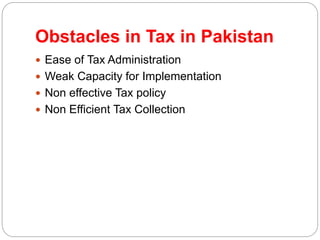
Obstacles in Tax in Pakistan
 Ease of Tax Administration
 Weak Capacity for Implementation
 Non effective Tax policy
 Non Efficient Tax Collection
.
.
.
.
.
.
.
.
.
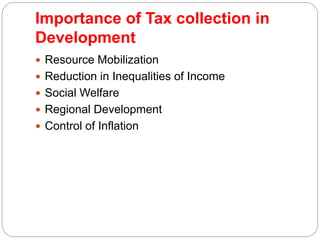
Importance of Tax collection in
Development
 Resource Mobilization
 Reduction in Inequalities of Income
 Social Welfare
 Regional Development
 Control of Inflation
Solutions
 Strong Implementation Policy
 Productive Tax Administration
 Effective & Efficient Tax policy
 Developed Tax Structure
Conclusion
Both direct and indirect taxes are essential to
bring adequate revenue to the state for meeting
the increasing public expenditure. Both taxes are
essential to promote economic growth, fill
employment and economic stability. Direct and
indirect taxes should side by side & balance each
other. However in developing countries, direct
taxation has limited scope and hence indirect
taxation plays a more significant role. A well
oriented system of taxation requires combination
of direct & indirect taxes in different proportions.

Financing for development impact

  • 1.
  • 2.
  • 3.
  • 4.
    Problem - Easeof Tax Administration in Pakistan .
  • 5.
    .  The nationaleconomic crisis has refocused public and political attention on the importance of defeating illicit tax abuse and improving bank transparency. It has ushered in a long-overdue public and political intolerance of regimes that flout tax laws and standards and deprive countries of their rightful earnings and assets. Properly and transparently organized tax systems are now accepted as engines of development, not constraints.
  • 6.
    Obstacles in Taxin Pakistan  Ease of Tax Administration  Weak Capacity for Implementation  Non effective Tax policy  Non Efficient Tax Collection
  • 7.
  • 8.
  • 9.
  • 10.
  • 11.
  • 12.
  • 13.
  • 14.
  • 15.
  • 16.
    Importance of Taxcollection in Development  Resource Mobilization  Reduction in Inequalities of Income  Social Welfare  Regional Development  Control of Inflation
  • 17.
    Solutions  Strong ImplementationPolicy  Productive Tax Administration  Effective & Efficient Tax policy  Developed Tax Structure
  • 18.
    Conclusion Both direct andindirect taxes are essential to bring adequate revenue to the state for meeting the increasing public expenditure. Both taxes are essential to promote economic growth, fill employment and economic stability. Direct and indirect taxes should side by side & balance each other. However in developing countries, direct taxation has limited scope and hence indirect taxation plays a more significant role. A well oriented system of taxation requires combination of direct & indirect taxes in different proportions.