1
Financial Reporting
and Regulations
ACCOUNTING FOR MANAGERS
SESSION 7-8
2
Objective
At the end of this session you should be able to understand
◦ Introduction to US GAAP
◦ Introduction to International Accounting Standards
◦ Indian Accounting Standards
◦ Applicability of Various Standards
◦ Comparison and Harmonisation
◦ IFRS
3
US GAAP
Generally accepted accounting principles, or GAAP, are a set of rules that
encompass the details, complexities, and legalities of business and
corporate accounting.
The Financial Accounting Standards Board (FASB) uses GAAP as the
foundation for its comprehensive set of approved accounting methods
and practices.
U.S. law requires businesses that release financial statements to the
public and companies that are publicly traded on stock exchanges and
indices to follow GAAP guidelines, which incorporate 10 key concepts.

4
US GAAP
•Principle of regularity: GAAP-compliant accountants strictly adhere to
established rules and regulations.
•Principle of consistency: Consistent standards are applied throughout
the financial reporting process.
•Principle of sincerity: GAAP-compliant accountants are committed to
accuracy and impartiality.
•Principle of permanence of methods: Consistent procedures are used
in the preparation of all financial reports.
5
US GAAP
•Principle of non-compensation: All aspects of an organization’s
performance, whether positive or negative, are fully reported with no
prospect of debt compensation.
•Principle of prudence: Speculation does not influence the reporting of
financial data.
•Principle of continuity: Asset valuations assume the organization’s
operations will continue.
•Principle of periodicity: Reporting of revenues is divided by standard
accounting time periods, such as fiscal quarters or fiscal years.
6
US GAAP
•Principle of materiality: Financial reports fully disclose the
organization’s monetary situation.
•Principle of utmost good faith: All involved parties are assumed to be
acting honestly
7
US GAAP
GAAP compliance makes the financial reporting process transparent and
standardizes assumptions, terminology, definitions, and methods.
External parties can easily compare financial statements issued by
GAAP-compliant entities and safely assume consistency, which allows for
quick and accurate cross-company comparisons.
Because GAAP standards deliver transparency and continuity, they
enable investors and stakeholders to make sound, evidence-based
decisions.
The consistency of GAAP compliance also allows companies to more
easily evaluate strategic business options.
8
US GAAP
Beyond the 10 principles, GAAP compliance is built on three rules that
eliminate misleading accounting and financial reporting practices.
These rules create consistent accounting and reporting standards, which
provide prospective and existing investors with reliable methods of
evaluating an organization’s financial standing.
Without these rules, accountants could use misleading methods to paint a
deceptive picture of a company or organization’s financial standing
9
US GAAP
These three rules are:
•Basic accounting principles and guidelines
•Rules and standards issued by the FASB and its predecessor, the
Accounting Principles Board (APB)
•Generally accepted industry practices
10
Illustration 1
Swastik used to prepare its accounts on the accrual basis. But for the
year ended on March 31, 20X5, it has decided to maintain its book of
accounts on cash basis. Accordingly, it discloses in the financial
statements, that the cash basis of accounting is one of its significant
policy.
As an auditor of the company, do you think the disclosure to be
appropriate?
11
Solution 1
The accounting policies to be followed by an organization depend on the size,
nature, constitution and level of activities of the business.
The management is empowered to use its discretion and judgment in deciding
which policies are suitable for the organization under the given circumstances.
While Income Tax Act permits maintenance of books of accounts under either the
cash or accrual basis of accounting, Ind-AS1 requires the books of accounts to be
maintained only on accrual basis.
As an auditor, the fact that the applicable accounting standards were not being
followed by the company, should be clearly mentioned in the report.
12
International Accounting Standards
International Accounting Standards are accounting standards issued by
the International Accounting Standards Board (IASB) and its predecessor,
the International Accounting Standards Committee (IASC).
Listed companies, and sometimes unlisted companies, are required to
use the standards in their financial statements in those countries which
have adopted them.
The EU regulation 1606/2002 on the application of international
accounting standards made this a requirement for listed companies in the
European Union.
13
Applicability of Indian Accounting
Standards
•India originally intended to converge with IFRSs in a phased approach
beginning in 2011, but transition to Ind AS was postponed.
•In January 2015, the Indian Ministry of Corporate Affairs (MCA) released
a revised roadmap that reflects that, in essence, companies with a net
worth of Rs. 500 crore or more will have to mandatorily follow Indian
Accounting Standards (Ind AS), which are largely converged with
International Financial Reporting Standards (IFRSs), from 1 April 2016.
14
Applicability of Indian Accounting
Standards
•Corporates having a net worth of less than Rs. 500 crore but are listed, or
in the process of getting listed, and companies with a net worth of Rs. 250
crore or more will have to follow the new norms from 1 April 2017.
•For banking, insurance and non-banking finance companies, which were
exempt from the general roadmap, a separate one was drawn up in
January 2016 that will see a phased approach with Ind AS adoption
beginning from 1 April 2018.
•This was later deferred to 1 April 2019.
15
IFRS
IFRS Standards constitute a globally recognised set of standards for the
preparation of financial statements by business entities. IFRS Standards
prescribe:
• the items that should be recognised as assets, liabilities, income and
expenses;
• how to measure those items;
• how to present them in a set of financial statements; and
• related disclosures about those items.
16
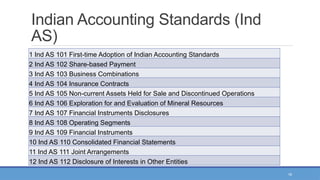
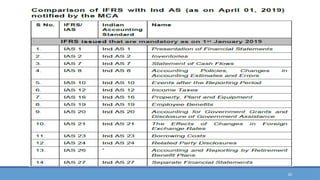
Indian Accounting Standards (Ind
AS)
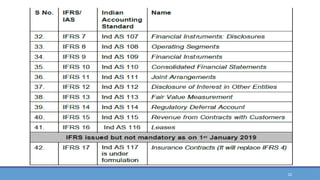
1 Ind AS 101 First-time Adoption of Indian Accounting Standards
2 Ind AS 102 Share-based Payment
3 Ind AS 103 Business Combinations
4 Ind AS 104 Insurance Contracts
5 Ind AS 105 Non-current Assets Held for Sale and Discontinued Operations
6 Ind AS 106 Exploration for and Evaluation of Mineral Resources
7 Ind AS 107 Financial Instruments Disclosures
8 Ind AS 108 Operating Segments
9 Ind AS 109 Financial Instruments
10 Ind AS 110 Consolidated Financial Statements
11 Ind AS 111 Joint Arrangements
12 Ind AS 112 Disclosure of Interests in Other Entities
17
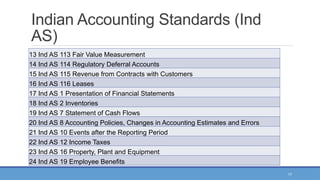
Indian Accounting Standards (Ind
AS)
13 Ind AS 113 Fair Value Measurement
14 Ind AS 114 Regulatory Deferral Accounts
15 Ind AS 115 Revenue from Contracts with Customers
16 Ind AS 116 Leases
17 Ind AS 1 Presentation of Financial Statements
18 Ind AS 2 Inventories
19 Ind AS 7 Statement of Cash Flows
20 Ind AS 8 Accounting Policies, Changes in Accounting Estimates and Errors
21 Ind AS 10 Events after the Reporting Period
22 Ind AS 12 Income Taxes
23 Ind AS 16 Property, Plant and Equipment
24 Ind AS 19 Employee Benefits
18
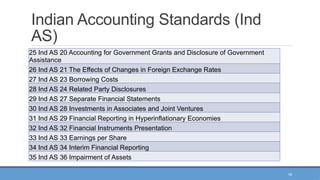
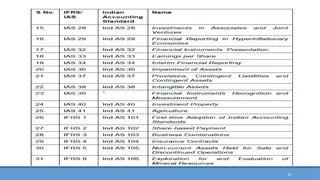
Indian Accounting Standards (Ind
AS)
25 Ind AS 20 Accounting for Government Grants and Disclosure of Government
Assistance
26 Ind AS 21 The Effects of Changes in Foreign Exchange Rates
27 Ind AS 23 Borrowing Costs
28 Ind AS 24 Related Party Disclosures
29 Ind AS 27 Separate Financial Statements
30 Ind AS 28 Investments in Associates and Joint Ventures
31 Ind AS 29 Financial Reporting in Hyperinflationary Economies
32 Ind AS 32 Financial Instruments Presentation
33 Ind AS 33 Earnings per Share
34 Ind AS 34 Interim Financial Reporting
35 Ind AS 36 Impairment of Assets
19
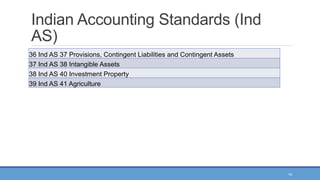
Indian Accounting Standards (Ind
AS)
36 Ind AS 37 Provisions, Contingent Liabilities and Contingent Assets
37 Ind AS 38 Intangible Assets
38 Ind AS 40 Investment Property
39 Ind AS 41 Agriculture
20
21
22
23
Illustration 2
M/s XYZ Ltd. Co. had paid a penalty of Rs. 5,500 to Excise Department.
The said penalty was grouped in the profit and loss account as general
expenses as the amount was not material owing to the sales of the
company which Rs. 13.92 crore.
Is it correct?
24
Solution 2
Ind-AS1 on “Presentation of Financial Statements” states that the material
items owing to the nature and amount must be disclosed separately.
Here the accountant has grouped the penalty paid to the Excise
department under General Expense as it is not material in amount.
But owing to the nature of the expense, i.e. penalty the said amount
should be disclosed separately.
25
Illustration 3
Mohan Pyare purchased raw material at Rs. 100 per kg.
But due to a continuous decline in the prices, the finished goods in which
the raw material was used, are expected to be sold at below cost.
The replacement cost is Rs. 70 per kg.
Mohan has 100 kgs of raw material on March 31, 20X6.
What should be the value of his inventory?
26
Solution 3
Generally, the valuation of inventory should be based on the lower of cost
and net realizable value, but if the finished products, in which the raw
material is used, are sold below cost, then the estimated realizable value
of the raw material is equal to its replacement price.
Accordingly, the stock of 100 kg of the raw material, should be valued at
the replacement price, that is, Rs. 70 per kg and the total amount of
inventory would be worth Rs. 7,000.
27
Illustration 3
Tanisha & Co. closes its books of accounts on 31st
March each year. The
accounts were finalized on 30th
April 2016. Unfortunately, on 5th
April 2016
there was a major fire in the plant and most of the assets of Tanisha and
Co. were destroyed. The auditor wants to prepare the financial
statements ignoring the ‘going concern’ concept. However, the
management states that the fire took place after the balance sheet date,
i.e. after 31st
March 2015. Therefore, there is no need to report the same
or prepare the financial statements on the going concern assumption.
Is the view of management appropriate?
28
Solution 3
As per Ind-AS 10, on “Events after the reporting period” if the events
occurring after the balance sheet date are such that affect the ‘going
concern’ of the entity and the events which are likely to alter the economic
decisions of its stakeholders then those should be reported.
Hence, in the given case of Tanisha and Co., the view of the management
is wrong. The financial statements should be prepared on the basis of
going concern and it should also be mentioned in the notes of accounts.
29
Illustration 4
Gemini Ltd sold its machinery, which had a written down value of Rs.
50,000; for Rs. 20,000, on January 15, 20X7. This machinery was
revalued upwards in the year 20X5-X6 and as a result the revaluation
reserve account was having a balance of Rs. 40,000. The accountant of
Gemini wanted to debit the profit and loss account for the year ending
March 31, 20X7, with a loss amount of Rs. 30,000.
Please give your views on this move.
30
Solution 4
Ind AS suggests that on disposal of a fixed asset, the difference between
the net proceeds and the net book value should be first adjusted with the
revaluation reserve and only then, it should be taken to the P&L account
for the period.
There is a balance of Rs. 40,000 in the revaluation reserve account.
Hence, the loss of Rs. 30,000 (WDV less SP) on the sale of the
machinery should be first adjusted with the revaluation reserve. On
completion of this accounting record, a balance of Rs. 10,000 would be
left in the revaluation reserve account. This balance should be transferred
to the General Reserve.
31
Illustration 5
Anjani Textiles Limited had purchased machinery in the year 20X0-X1, for
Rs. 50 lakh and has followed the straight line method of depreciation. The
management plans to change the method of depreciation.
What shall be effect on the disclosure before profit and loss account for
the period?
32
Solution 5
As per Ind-AS 16, depreciation is charged on the basis of useful life of the
asset. The useful life is determined at the end of each year and may be
changed. Also, Ind-AS states that there can be a change in the method of
accounting for depreciation which is to be treated as change in
accounting estimate as per Ind-AS 8
33
Illustration 6
Lalli Technologies Ltd gives warranties at the time of sale, to purchasers
of its three product lines. Under the terms of the warranty, the
manufacturer undertakes to repair or replace items that fail to perform
satisfactorily for two years from the date of sale. At the balance sheet
date, a provision of Rs. 60,000 has been recognized. Should the firm
disclose any information in its reports? The owner is bothered that it will
hurt the sales of the company.
34
Solution 6
Lalli Technologies Ltd should disclose the following information along with
its financial statements – ‘A provision of Rs. 60,000 has been recognized
for expected warranty claims on software products sold during the last
three financial years.
It is expected that the majority of this expenditure will be incurred in the
next financial year, and all will be incurred within two years of the balance
sheet date.’
35
Illustration 7
For example, on 15th
February 20X5, the service tax authorities have issued a
demand notice for the service tax on few services rendered by M/s Keshav &
Co.
The company contested the case and the lawyers were of the opinion that no
service tax is payable on the selected services rendered by M/s Keshav & Co.
as on 31st
March 20X5. But on 15th
April 20X5, the same lawyers advised that
on account of a notification issued by the Government of India, the liability
would arise. In the given case, there is no obligation as on 31st
March 20X5
and accordingly there is no requirement of creating any provision. But if the
case is not resolved upto 31st
March 20X6, a provision towards the amount,
which can be measured with reliability, should be created in the books of
accounts of M/s Keshav & Co.
36
Illustration 8
Identifying the relevant accounting principle: Curewell Pharmaceutical
Limited is facing a law suit wherein it may be liable to pay a fine of Rs. 10
million. The lawyer of the company has advised that there is a high
probability of the company losing the law suit.
How should the company record this transaction in the books of
accounts? What accounting principle is involved?
37
Solution 8
Curewell Pharmaceutical is advised to make appropriate provision for the
loss as there is a reasonable probability of company losing the case.
It is based upon the principle of conservatism
38
Illustration 9
Identifying the relevant accounting principle: Shivam Limited
borrowed a sum of Rs. 50 million from the State Bank of India on 1st
August 2010 for a period of one year.
The loan matured on 30th
July 2011 and was duly repaid on due date with
interest amounting to Rs. 5 million. The company maintains its books on
financial year basis.
In which accounting year the interest expenses should be recorded?
Why?
39
Solution 9
The interest of Rs. 5 million is for a period of 12 months from 1st
August
2010 to 30th
July 2011.
Interest accrues on a day-to-day basis.
Interest from 1st
August 2010 to 31st
March 2011 should be accounted for
in the year 2010-11, whereas interest for the period 1st
April 2011 to 30th
July will be treated as an expense for the year 2011-12.
Accordingly, interest of Rs. 5 million will be split two-third: one-third
between the two accounting years
40
Illustration 10
Money Measurement: Which of the following transactions are subject matter of
accounting:
(a) Purchase of 200 kg of goods by the firm on credit for Rs. 100,000
(b) Resignation of one of the key salesman of the firm
(c) A pharmaceutical company has filed application for patent of a new drug
(d) A construction company has won a major contract from the government
(e) A telecom company has paid Rs. 200 million as a security deposit to the
government
41
Solution 10
(a) Yes: Rs. 100,000 will be recorded as purchase but not the quantity
(b) No: Cannot be expressed in money terms
(c) No: Filing an application cannot be expressed in terms of money
(d) No: Winning a contract cannot be expressed in terms of money
(e) Yes: Amount of security deposit is an accounting transaction
42
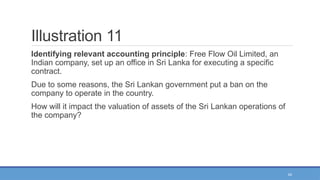
Illustration 11
Identifying relevant accounting principle: Free Flow Oil Limited, an
Indian company, set up an office in Sri Lanka for executing a specific
contract.
Due to some reasons, the Sri Lankan government put a ban on the
company to operate in the country.
How will it impact the valuation of assets of the Sri Lankan operations of
the company?
43
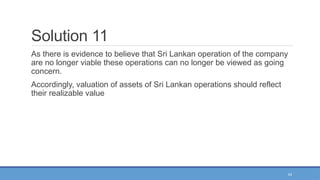
Solution 11
As there is evidence to believe that Sri Lankan operation of the company
are no longer viable these operations can no longer be viewed as going
concern.
Accordingly, valuation of assets of Sri Lankan operations should reflect
their realizable value
44
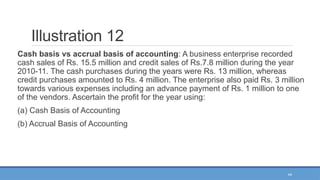
Illustration 12
Cash basis vs accrual basis of accounting: A business enterprise recorded
cash sales of Rs. 15.5 million and credit sales of Rs.7.8 million during the year
2010-11. The cash purchases during the years were Rs. 13 million, whereas
credit purchases amounted to Rs. 4 million. The enterprise also paid Rs. 3 million
towards various expenses including an advance payment of Rs. 1 million to one
of the vendors. Ascertain the profit for the year using:
(a) Cash Basis of Accounting
(b) Accrual Basis of Accounting
45
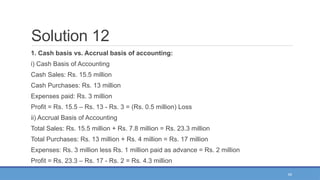
Solution 12
1. Cash basis vs. Accrual basis of accounting:
i) Cash Basis of Accounting
Cash Sales: Rs. 15.5 million
Cash Purchases: Rs. 13 million
Expenses paid: Rs. 3 million
Profit = Rs. 15.5 – Rs. 13 - Rs. 3 = (Rs. 0.5 million) Loss
ii) Accrual Basis of Accounting
Total Sales: Rs. 15.5 million + Rs. 7.8 million = Rs. 23.3 million
Total Purchases: Rs. 13 million + Rs. 4 million = Rs. 17 million
Expenses: Rs. 3 million less Rs. 1 million paid as advance = Rs. 2 million
Profit = Rs. 23.3 – Rs. 17 - Rs. 2 = Rs. 4.3 million
46
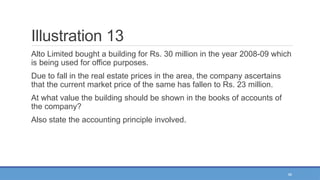
Illustration 13
Alto Limited bought a building for Rs. 30 million in the year 2008-09 which
is being used for office purposes.
Due to fall in the real estate prices in the area, the company ascertains
that the current market price of the same has fallen to Rs. 23 million.
At what value the building should be shown in the books of accounts of
the company?
Also state the accounting principle involved.
47
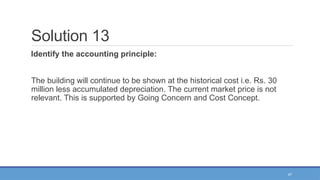
Solution 13
Identify the accounting principle:
The building will continue to be shown at the historical cost i.e. Rs. 30
million less accumulated depreciation. The current market price is not
relevant. This is supported by Going Concern and Cost Concept.
48
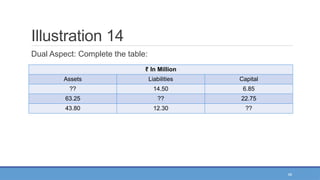
Illustration 14
Dual Aspect: Complete the table:
₹ In Million
Assets Liabilities Capital
?? 14.50 6.85
63.25 ?? 22.75
43.80 12.30 ??
49
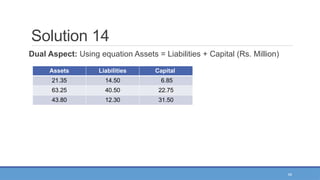
Solution 14
Dual Aspect: Using equation Assets = Liabilities + Capital (Rs. Million)
Assets Liabilities Capital
21.35 14.50 6.85
63.25 40.50 22.75
43.80 12.30 31.50
50
Illustration 15
Identify the accounting principle: PT Jewellers bought 1 kg of gold
during the year at the rate of Rs. 18000 per 10 grams. At the end of the
year, half of the gold is still unsold. The current market price of the gold is
Rs. 21,000 per 10 grams.
At what value the gold inventory should be shown in the financial
statements of PT Jewellers?
What will be your answer if the current market price of gold is Rs. 17000
per 10 grams? State the principle involved.
51
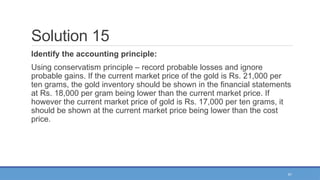
Solution 15
Identify the accounting principle:
Using conservatism principle – record probable losses and ignore
probable gains. If the current market price of the gold is Rs. 21,000 per
ten grams, the gold inventory should be shown in the financial statements
at Rs. 18,000 per gram being lower than the current market price. If
however the current market price of gold is Rs. 17,000 per ten grams, it
should be shown at the current market price being lower than the cost
price.
52
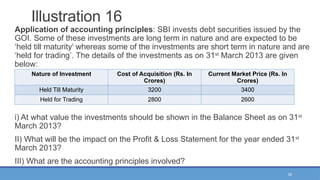
Illustration 16
Application of accounting principles: SBI invests debt securities issued by the
GOI. Some of these investments are long term in nature and are expected to be
‘held till maturity’ whereas some of the investments are short term in nature and are
‘held for trading’. The details of the investments as on 31st
March 2013 are given
below:
i) At what value the investments should be shown in the Balance Sheet as on 31st
March 2013?
II) What will be the impact on the Profit & Loss Statement for the year ended 31st
March 2013?
III) What are the accounting principles involved?
Nature of Investment Cost of Acquisition (Rs. In
Crores)
Current Market Price (Rs. In
Crores)
Held Till Maturity 3200 3400
Held for Trading 2800 2600
53
Solution 16
Investments which are to be ‘held till maturity’ are long term in nature and
will be shown at their cost of acquisition using ‘Cost Principle’. Any
unrealized gain will be ignored.
Investments which are ‘held for trading’ being short term in nature will be
shown at the ‘lower of the cost or market’ using Conservatism Principle.
Probable gains are ignored whereas probable losses are recorded.
Accordingly in the Balance Sheet Investment will appear at Rs. 5800
Crores (Rs. 3,200 + Rs. 2,600). Provision for mark to market loss on short
term investment amounting to Rs. 200 Crores will appear in the Profit &
Loss Statement as an expense.
54
Illustration 17
Application of accounting principle: Pee Tee Limited so far has been
following the Last-In-First-Out (LIFO) method for valuation of inventory.
The management would like to change the method of valuation of
inventory and adopt First-In-First-Out (FIFO) as this better represent the
flow of inventory.
Is it possible to change the method of valuation of inventory? If yes, what
are the requirement?
55
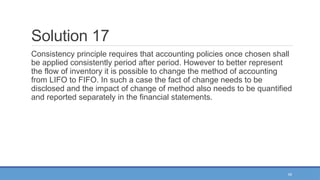
Solution 17
Consistency principle requires that accounting policies once chosen shall
be applied consistently period after period. However to better represent
the flow of inventory it is possible to change the method of accounting
from LIFO to FIFO. In such a case the fact of change needs to be
disclosed and the impact of change of method also needs to be quantified
and reported separately in the financial statements.
56
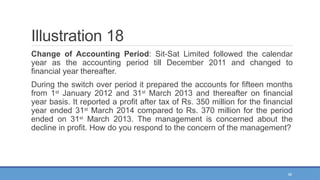
Illustration 18
Change of Accounting Period: Sit-Sat Limited followed the calendar
year as the accounting period till December 2011 and changed to
financial year thereafter.
During the switch over period it prepared the accounts for fifteen months
from 1st
January 2012 and 31st
March 2013 and thereafter on financial
year basis. It reported a profit after tax of Rs. 350 million for the financial
year ended 31st
March 2014 compared to Rs. 370 million for the period
ended on 31st
March 2013. The management is concerned about the
decline in profit. How do you respond to the concern of the management?
57
Solution 18
The accounting period ended on 31st March 2013 is of 15 months
whereas the next accounting year is of 12 month and therefore in not
strictly comparable. In 15 months the profits earned was Rs. 370 million
whereas in 12 months the profit amounted to Rs. 350 million.
On a proportionate basis profit for the year ended 31st March 2013 is Rs.
296 million. Hence there is no decline in profit.
58
Conclusion
In this session we learnt about
◦ Introduction to US GAAP
◦ Introduction to International Accounting Standards
◦ Indian Accounting Standards
◦ Applicability of Various Standards
◦ Comparison and Harmonisation
◦ IFRS

Financial Reporting and Regulations.pptx

  • 1.
  • 2.
    2 Objective At the endof this session you should be able to understand ◦ Introduction to US GAAP ◦ Introduction to International Accounting Standards ◦ Indian Accounting Standards ◦ Applicability of Various Standards ◦ Comparison and Harmonisation ◦ IFRS
  • 3.
    3 US GAAP Generally acceptedaccounting principles, or GAAP, are a set of rules that encompass the details, complexities, and legalities of business and corporate accounting. The Financial Accounting Standards Board (FASB) uses GAAP as the foundation for its comprehensive set of approved accounting methods and practices. U.S. law requires businesses that release financial statements to the public and companies that are publicly traded on stock exchanges and indices to follow GAAP guidelines, which incorporate 10 key concepts.
  • 4.
    4 US GAAP •Principle ofregularity: GAAP-compliant accountants strictly adhere to established rules and regulations. •Principle of consistency: Consistent standards are applied throughout the financial reporting process. •Principle of sincerity: GAAP-compliant accountants are committed to accuracy and impartiality. •Principle of permanence of methods: Consistent procedures are used in the preparation of all financial reports.
  • 5.
    5 US GAAP •Principle ofnon-compensation: All aspects of an organization’s performance, whether positive or negative, are fully reported with no prospect of debt compensation. •Principle of prudence: Speculation does not influence the reporting of financial data. •Principle of continuity: Asset valuations assume the organization’s operations will continue. •Principle of periodicity: Reporting of revenues is divided by standard accounting time periods, such as fiscal quarters or fiscal years.
  • 6.
    6 US GAAP •Principle ofmateriality: Financial reports fully disclose the organization’s monetary situation. •Principle of utmost good faith: All involved parties are assumed to be acting honestly
  • 7.
    7 US GAAP GAAP compliancemakes the financial reporting process transparent and standardizes assumptions, terminology, definitions, and methods. External parties can easily compare financial statements issued by GAAP-compliant entities and safely assume consistency, which allows for quick and accurate cross-company comparisons. Because GAAP standards deliver transparency and continuity, they enable investors and stakeholders to make sound, evidence-based decisions. The consistency of GAAP compliance also allows companies to more easily evaluate strategic business options.
  • 8.
    8 US GAAP Beyond the10 principles, GAAP compliance is built on three rules that eliminate misleading accounting and financial reporting practices. These rules create consistent accounting and reporting standards, which provide prospective and existing investors with reliable methods of evaluating an organization’s financial standing. Without these rules, accountants could use misleading methods to paint a deceptive picture of a company or organization’s financial standing
  • 9.
    9 US GAAP These threerules are: •Basic accounting principles and guidelines •Rules and standards issued by the FASB and its predecessor, the Accounting Principles Board (APB) •Generally accepted industry practices
  • 10.
    10 Illustration 1 Swastik usedto prepare its accounts on the accrual basis. But for the year ended on March 31, 20X5, it has decided to maintain its book of accounts on cash basis. Accordingly, it discloses in the financial statements, that the cash basis of accounting is one of its significant policy. As an auditor of the company, do you think the disclosure to be appropriate?
  • 11.
    11 Solution 1 The accountingpolicies to be followed by an organization depend on the size, nature, constitution and level of activities of the business. The management is empowered to use its discretion and judgment in deciding which policies are suitable for the organization under the given circumstances. While Income Tax Act permits maintenance of books of accounts under either the cash or accrual basis of accounting, Ind-AS1 requires the books of accounts to be maintained only on accrual basis. As an auditor, the fact that the applicable accounting standards were not being followed by the company, should be clearly mentioned in the report.
  • 12.
    12 International Accounting Standards InternationalAccounting Standards are accounting standards issued by the International Accounting Standards Board (IASB) and its predecessor, the International Accounting Standards Committee (IASC). Listed companies, and sometimes unlisted companies, are required to use the standards in their financial statements in those countries which have adopted them. The EU regulation 1606/2002 on the application of international accounting standards made this a requirement for listed companies in the European Union.
  • 13.
    13 Applicability of IndianAccounting Standards •India originally intended to converge with IFRSs in a phased approach beginning in 2011, but transition to Ind AS was postponed. •In January 2015, the Indian Ministry of Corporate Affairs (MCA) released a revised roadmap that reflects that, in essence, companies with a net worth of Rs. 500 crore or more will have to mandatorily follow Indian Accounting Standards (Ind AS), which are largely converged with International Financial Reporting Standards (IFRSs), from 1 April 2016.
  • 14.
    14 Applicability of IndianAccounting Standards •Corporates having a net worth of less than Rs. 500 crore but are listed, or in the process of getting listed, and companies with a net worth of Rs. 250 crore or more will have to follow the new norms from 1 April 2017. •For banking, insurance and non-banking finance companies, which were exempt from the general roadmap, a separate one was drawn up in January 2016 that will see a phased approach with Ind AS adoption beginning from 1 April 2018. •This was later deferred to 1 April 2019.
  • 15.
    15 IFRS IFRS Standards constitutea globally recognised set of standards for the preparation of financial statements by business entities. IFRS Standards prescribe: • the items that should be recognised as assets, liabilities, income and expenses; • how to measure those items; • how to present them in a set of financial statements; and • related disclosures about those items.
  • 16.
    16 Indian Accounting Standards(Ind AS) 1 Ind AS 101 First-time Adoption of Indian Accounting Standards 2 Ind AS 102 Share-based Payment 3 Ind AS 103 Business Combinations 4 Ind AS 104 Insurance Contracts 5 Ind AS 105 Non-current Assets Held for Sale and Discontinued Operations 6 Ind AS 106 Exploration for and Evaluation of Mineral Resources 7 Ind AS 107 Financial Instruments Disclosures 8 Ind AS 108 Operating Segments 9 Ind AS 109 Financial Instruments 10 Ind AS 110 Consolidated Financial Statements 11 Ind AS 111 Joint Arrangements 12 Ind AS 112 Disclosure of Interests in Other Entities
  • 17.
    17 Indian Accounting Standards(Ind AS) 13 Ind AS 113 Fair Value Measurement 14 Ind AS 114 Regulatory Deferral Accounts 15 Ind AS 115 Revenue from Contracts with Customers 16 Ind AS 116 Leases 17 Ind AS 1 Presentation of Financial Statements 18 Ind AS 2 Inventories 19 Ind AS 7 Statement of Cash Flows 20 Ind AS 8 Accounting Policies, Changes in Accounting Estimates and Errors 21 Ind AS 10 Events after the Reporting Period 22 Ind AS 12 Income Taxes 23 Ind AS 16 Property, Plant and Equipment 24 Ind AS 19 Employee Benefits
  • 18.
    18 Indian Accounting Standards(Ind AS) 25 Ind AS 20 Accounting for Government Grants and Disclosure of Government Assistance 26 Ind AS 21 The Effects of Changes in Foreign Exchange Rates 27 Ind AS 23 Borrowing Costs 28 Ind AS 24 Related Party Disclosures 29 Ind AS 27 Separate Financial Statements 30 Ind AS 28 Investments in Associates and Joint Ventures 31 Ind AS 29 Financial Reporting in Hyperinflationary Economies 32 Ind AS 32 Financial Instruments Presentation 33 Ind AS 33 Earnings per Share 34 Ind AS 34 Interim Financial Reporting 35 Ind AS 36 Impairment of Assets
  • 19.
    19 Indian Accounting Standards(Ind AS) 36 Ind AS 37 Provisions, Contingent Liabilities and Contingent Assets 37 Ind AS 38 Intangible Assets 38 Ind AS 40 Investment Property 39 Ind AS 41 Agriculture
  • 20.
  • 21.
  • 22.
  • 23.
    23 Illustration 2 M/s XYZLtd. Co. had paid a penalty of Rs. 5,500 to Excise Department. The said penalty was grouped in the profit and loss account as general expenses as the amount was not material owing to the sales of the company which Rs. 13.92 crore. Is it correct?
  • 24.
    24 Solution 2 Ind-AS1 on“Presentation of Financial Statements” states that the material items owing to the nature and amount must be disclosed separately. Here the accountant has grouped the penalty paid to the Excise department under General Expense as it is not material in amount. But owing to the nature of the expense, i.e. penalty the said amount should be disclosed separately.
  • 25.
    25 Illustration 3 Mohan Pyarepurchased raw material at Rs. 100 per kg. But due to a continuous decline in the prices, the finished goods in which the raw material was used, are expected to be sold at below cost. The replacement cost is Rs. 70 per kg. Mohan has 100 kgs of raw material on March 31, 20X6. What should be the value of his inventory?
  • 26.
    26 Solution 3 Generally, thevaluation of inventory should be based on the lower of cost and net realizable value, but if the finished products, in which the raw material is used, are sold below cost, then the estimated realizable value of the raw material is equal to its replacement price. Accordingly, the stock of 100 kg of the raw material, should be valued at the replacement price, that is, Rs. 70 per kg and the total amount of inventory would be worth Rs. 7,000.
  • 27.
    27 Illustration 3 Tanisha &Co. closes its books of accounts on 31st March each year. The accounts were finalized on 30th April 2016. Unfortunately, on 5th April 2016 there was a major fire in the plant and most of the assets of Tanisha and Co. were destroyed. The auditor wants to prepare the financial statements ignoring the ‘going concern’ concept. However, the management states that the fire took place after the balance sheet date, i.e. after 31st March 2015. Therefore, there is no need to report the same or prepare the financial statements on the going concern assumption. Is the view of management appropriate?
  • 28.
    28 Solution 3 As perInd-AS 10, on “Events after the reporting period” if the events occurring after the balance sheet date are such that affect the ‘going concern’ of the entity and the events which are likely to alter the economic decisions of its stakeholders then those should be reported. Hence, in the given case of Tanisha and Co., the view of the management is wrong. The financial statements should be prepared on the basis of going concern and it should also be mentioned in the notes of accounts.
  • 29.
    29 Illustration 4 Gemini Ltdsold its machinery, which had a written down value of Rs. 50,000; for Rs. 20,000, on January 15, 20X7. This machinery was revalued upwards in the year 20X5-X6 and as a result the revaluation reserve account was having a balance of Rs. 40,000. The accountant of Gemini wanted to debit the profit and loss account for the year ending March 31, 20X7, with a loss amount of Rs. 30,000. Please give your views on this move.
  • 30.
    30 Solution 4 Ind ASsuggests that on disposal of a fixed asset, the difference between the net proceeds and the net book value should be first adjusted with the revaluation reserve and only then, it should be taken to the P&L account for the period. There is a balance of Rs. 40,000 in the revaluation reserve account. Hence, the loss of Rs. 30,000 (WDV less SP) on the sale of the machinery should be first adjusted with the revaluation reserve. On completion of this accounting record, a balance of Rs. 10,000 would be left in the revaluation reserve account. This balance should be transferred to the General Reserve.
  • 31.
    31 Illustration 5 Anjani TextilesLimited had purchased machinery in the year 20X0-X1, for Rs. 50 lakh and has followed the straight line method of depreciation. The management plans to change the method of depreciation. What shall be effect on the disclosure before profit and loss account for the period?
  • 32.
    32 Solution 5 As perInd-AS 16, depreciation is charged on the basis of useful life of the asset. The useful life is determined at the end of each year and may be changed. Also, Ind-AS states that there can be a change in the method of accounting for depreciation which is to be treated as change in accounting estimate as per Ind-AS 8
  • 33.
    33 Illustration 6 Lalli TechnologiesLtd gives warranties at the time of sale, to purchasers of its three product lines. Under the terms of the warranty, the manufacturer undertakes to repair or replace items that fail to perform satisfactorily for two years from the date of sale. At the balance sheet date, a provision of Rs. 60,000 has been recognized. Should the firm disclose any information in its reports? The owner is bothered that it will hurt the sales of the company.
  • 34.
    34 Solution 6 Lalli TechnologiesLtd should disclose the following information along with its financial statements – ‘A provision of Rs. 60,000 has been recognized for expected warranty claims on software products sold during the last three financial years. It is expected that the majority of this expenditure will be incurred in the next financial year, and all will be incurred within two years of the balance sheet date.’
  • 35.
    35 Illustration 7 For example,on 15th February 20X5, the service tax authorities have issued a demand notice for the service tax on few services rendered by M/s Keshav & Co. The company contested the case and the lawyers were of the opinion that no service tax is payable on the selected services rendered by M/s Keshav & Co. as on 31st March 20X5. But on 15th April 20X5, the same lawyers advised that on account of a notification issued by the Government of India, the liability would arise. In the given case, there is no obligation as on 31st March 20X5 and accordingly there is no requirement of creating any provision. But if the case is not resolved upto 31st March 20X6, a provision towards the amount, which can be measured with reliability, should be created in the books of accounts of M/s Keshav & Co.
  • 36.
    36 Illustration 8 Identifying therelevant accounting principle: Curewell Pharmaceutical Limited is facing a law suit wherein it may be liable to pay a fine of Rs. 10 million. The lawyer of the company has advised that there is a high probability of the company losing the law suit. How should the company record this transaction in the books of accounts? What accounting principle is involved?
  • 37.
    37 Solution 8 Curewell Pharmaceuticalis advised to make appropriate provision for the loss as there is a reasonable probability of company losing the case. It is based upon the principle of conservatism
  • 38.
    38 Illustration 9 Identifying therelevant accounting principle: Shivam Limited borrowed a sum of Rs. 50 million from the State Bank of India on 1st August 2010 for a period of one year. The loan matured on 30th July 2011 and was duly repaid on due date with interest amounting to Rs. 5 million. The company maintains its books on financial year basis. In which accounting year the interest expenses should be recorded? Why?
  • 39.
    39 Solution 9 The interestof Rs. 5 million is for a period of 12 months from 1st August 2010 to 30th July 2011. Interest accrues on a day-to-day basis. Interest from 1st August 2010 to 31st March 2011 should be accounted for in the year 2010-11, whereas interest for the period 1st April 2011 to 30th July will be treated as an expense for the year 2011-12. Accordingly, interest of Rs. 5 million will be split two-third: one-third between the two accounting years
  • 40.
    40 Illustration 10 Money Measurement:Which of the following transactions are subject matter of accounting: (a) Purchase of 200 kg of goods by the firm on credit for Rs. 100,000 (b) Resignation of one of the key salesman of the firm (c) A pharmaceutical company has filed application for patent of a new drug (d) A construction company has won a major contract from the government (e) A telecom company has paid Rs. 200 million as a security deposit to the government
  • 41.
    41 Solution 10 (a) Yes:Rs. 100,000 will be recorded as purchase but not the quantity (b) No: Cannot be expressed in money terms (c) No: Filing an application cannot be expressed in terms of money (d) No: Winning a contract cannot be expressed in terms of money (e) Yes: Amount of security deposit is an accounting transaction
  • 42.
    42 Illustration 11 Identifying relevantaccounting principle: Free Flow Oil Limited, an Indian company, set up an office in Sri Lanka for executing a specific contract. Due to some reasons, the Sri Lankan government put a ban on the company to operate in the country. How will it impact the valuation of assets of the Sri Lankan operations of the company?
  • 43.
    43 Solution 11 As thereis evidence to believe that Sri Lankan operation of the company are no longer viable these operations can no longer be viewed as going concern. Accordingly, valuation of assets of Sri Lankan operations should reflect their realizable value
  • 44.
    44 Illustration 12 Cash basisvs accrual basis of accounting: A business enterprise recorded cash sales of Rs. 15.5 million and credit sales of Rs.7.8 million during the year 2010-11. The cash purchases during the years were Rs. 13 million, whereas credit purchases amounted to Rs. 4 million. The enterprise also paid Rs. 3 million towards various expenses including an advance payment of Rs. 1 million to one of the vendors. Ascertain the profit for the year using: (a) Cash Basis of Accounting (b) Accrual Basis of Accounting
  • 45.
    45 Solution 12 1. Cashbasis vs. Accrual basis of accounting: i) Cash Basis of Accounting Cash Sales: Rs. 15.5 million Cash Purchases: Rs. 13 million Expenses paid: Rs. 3 million Profit = Rs. 15.5 – Rs. 13 - Rs. 3 = (Rs. 0.5 million) Loss ii) Accrual Basis of Accounting Total Sales: Rs. 15.5 million + Rs. 7.8 million = Rs. 23.3 million Total Purchases: Rs. 13 million + Rs. 4 million = Rs. 17 million Expenses: Rs. 3 million less Rs. 1 million paid as advance = Rs. 2 million Profit = Rs. 23.3 – Rs. 17 - Rs. 2 = Rs. 4.3 million
  • 46.
    46 Illustration 13 Alto Limitedbought a building for Rs. 30 million in the year 2008-09 which is being used for office purposes. Due to fall in the real estate prices in the area, the company ascertains that the current market price of the same has fallen to Rs. 23 million. At what value the building should be shown in the books of accounts of the company? Also state the accounting principle involved.
  • 47.
    47 Solution 13 Identify theaccounting principle: The building will continue to be shown at the historical cost i.e. Rs. 30 million less accumulated depreciation. The current market price is not relevant. This is supported by Going Concern and Cost Concept.
  • 48.
    48 Illustration 14 Dual Aspect:Complete the table: ₹ In Million Assets Liabilities Capital ?? 14.50 6.85 63.25 ?? 22.75 43.80 12.30 ??
  • 49.
    49 Solution 14 Dual Aspect:Using equation Assets = Liabilities + Capital (Rs. Million) Assets Liabilities Capital 21.35 14.50 6.85 63.25 40.50 22.75 43.80 12.30 31.50
  • 50.
    50 Illustration 15 Identify theaccounting principle: PT Jewellers bought 1 kg of gold during the year at the rate of Rs. 18000 per 10 grams. At the end of the year, half of the gold is still unsold. The current market price of the gold is Rs. 21,000 per 10 grams. At what value the gold inventory should be shown in the financial statements of PT Jewellers? What will be your answer if the current market price of gold is Rs. 17000 per 10 grams? State the principle involved.
  • 51.
    51 Solution 15 Identify theaccounting principle: Using conservatism principle – record probable losses and ignore probable gains. If the current market price of the gold is Rs. 21,000 per ten grams, the gold inventory should be shown in the financial statements at Rs. 18,000 per gram being lower than the current market price. If however the current market price of gold is Rs. 17,000 per ten grams, it should be shown at the current market price being lower than the cost price.
  • 52.
    52 Illustration 16 Application ofaccounting principles: SBI invests debt securities issued by the GOI. Some of these investments are long term in nature and are expected to be ‘held till maturity’ whereas some of the investments are short term in nature and are ‘held for trading’. The details of the investments as on 31st March 2013 are given below: i) At what value the investments should be shown in the Balance Sheet as on 31st March 2013? II) What will be the impact on the Profit & Loss Statement for the year ended 31st March 2013? III) What are the accounting principles involved? Nature of Investment Cost of Acquisition (Rs. In Crores) Current Market Price (Rs. In Crores) Held Till Maturity 3200 3400 Held for Trading 2800 2600
  • 53.
    53 Solution 16 Investments whichare to be ‘held till maturity’ are long term in nature and will be shown at their cost of acquisition using ‘Cost Principle’. Any unrealized gain will be ignored. Investments which are ‘held for trading’ being short term in nature will be shown at the ‘lower of the cost or market’ using Conservatism Principle. Probable gains are ignored whereas probable losses are recorded. Accordingly in the Balance Sheet Investment will appear at Rs. 5800 Crores (Rs. 3,200 + Rs. 2,600). Provision for mark to market loss on short term investment amounting to Rs. 200 Crores will appear in the Profit & Loss Statement as an expense.
  • 54.
    54 Illustration 17 Application ofaccounting principle: Pee Tee Limited so far has been following the Last-In-First-Out (LIFO) method for valuation of inventory. The management would like to change the method of valuation of inventory and adopt First-In-First-Out (FIFO) as this better represent the flow of inventory. Is it possible to change the method of valuation of inventory? If yes, what are the requirement?
  • 55.
    55 Solution 17 Consistency principlerequires that accounting policies once chosen shall be applied consistently period after period. However to better represent the flow of inventory it is possible to change the method of accounting from LIFO to FIFO. In such a case the fact of change needs to be disclosed and the impact of change of method also needs to be quantified and reported separately in the financial statements.
  • 56.
    56 Illustration 18 Change ofAccounting Period: Sit-Sat Limited followed the calendar year as the accounting period till December 2011 and changed to financial year thereafter. During the switch over period it prepared the accounts for fifteen months from 1st January 2012 and 31st March 2013 and thereafter on financial year basis. It reported a profit after tax of Rs. 350 million for the financial year ended 31st March 2014 compared to Rs. 370 million for the period ended on 31st March 2013. The management is concerned about the decline in profit. How do you respond to the concern of the management?
  • 57.
    57 Solution 18 The accountingperiod ended on 31st March 2013 is of 15 months whereas the next accounting year is of 12 month and therefore in not strictly comparable. In 15 months the profits earned was Rs. 370 million whereas in 12 months the profit amounted to Rs. 350 million. On a proportionate basis profit for the year ended 31st March 2013 is Rs. 296 million. Hence there is no decline in profit.
  • 58.
    58 Conclusion In this sessionwe learnt about ◦ Introduction to US GAAP ◦ Introduction to International Accounting Standards ◦ Indian Accounting Standards ◦ Applicability of Various Standards ◦ Comparison and Harmonisation ◦ IFRS