1
FINANCIAL INSTRUMENTS (First Sem DPU)
A financial instrument is a lawful agreement which involves some monetary value. Financial
instruments have unique characteristics and structure. In other words financial instruments are
contracts for monetary assets that can be purchased, traded, created, modified, or settled for. In
terms of contracts, there is a contractual obligation between involved parties during a financial
instrument transaction.
Financial instruments can be classified as
A. Cash Instruments
B. Derivative Instruments
C. Foreign Exchange Instruments
A. Cash Instruments:
Cash instruments are financial instruments with values directly influenced by the condition of
the markets. Within cash instruments, there are two types; securities and deposits, and loans.
i. Securities: A security is a financial instrument that has monetary value and is traded on the
stock market. When purchased or traded, a security represents ownership of a part of a publicly‐
traded company on the stock exchange.
ii. Deposits and Loans: Both deposits and loans are considered cash instruments because they
represent monetary assets that have some sort of contractual agreement between parties.
B. Derivative Instruments
Derivative instruments are financial instruments that have values determined from underlying
assets, such as resources, currency, bonds, stocks, and stock indexes. The five most common
examples of derivatives instruments are synthetic agreements, forwards, futures, options, and
swaps. This is discussed in more detail below.
i. Synthetic Agreement for Foreign Exchange (SAFE): A SAFE occurs in the over‐the‐counter
(OTC) market and is an agreement that guarantees a specified exchange rate during an agreed
period of time.
ii. Forward: A forward is a contract between two parties that involves customizable derivatives
in which the exchange occurs at the end of the contract at a specific price.
2
iii. Future: A future is a derivative transaction that provides the exchange of derivatives on a
determined future date at a predetermined exchange rate.
iv. Options: An option is an agreement between two parties in which the seller grants the buyer
the right to purchase or sell a certain number of derivatives at a predetermined price for a
specific period of time.
v. Interest Rate Swap: An interest rate swap is a derivative agreement between two parties that
involves the swapping of interest rates where each party agrees to pay other interest rates on
their loans in different currencies.
C. Foreign Exchange Instruments
Foreign exchange instruments are financial instruments that are represented on the foreign
market and primarily consist of currency agreements and derivatives. In terms of currency
agreements, they can be broken into three categories‐
i. Spot: A currency agreement in which the actual exchange of currency is no later than the
second working day a er the original date of the agreement. It is termed ―spot‖ because the
currency exchange is done ―on the spot‖.
ii. Outright Forwards: A currency agreement in which the actual exchange of currency is done
―forwardly‖ and before the actual date of the agreed requirement. It is beneficial in cases of
fluctuating exchange rates that change often.
iii. Currency Swap: A currency swap refers to the act of simultaneously buying and selling
currencies with different specified value dates.
Primary Market
The primary market is a segment of the capital market where entities such as companies,
governments and other institutions obtain funds through the sale of debt and equity‐based
securities.
When a company decides to go public for the first time by raising an Initial Public Offering (IPO),
it is done in the primary market. Since the securities are sold for the first time here, a primary
market is also known as the New Issue Market (NIM).
Functions of Primary Market
A. New Issue Offer
3
This is one of the major primary market functions. It is this market that organises offering of a
new issue, which has not been traded on any other exchange before. It‘s because of this reason
that the primary market is also called new issue market.
There‘s a lot that goes into issuing a new offer. It involves a detailed assessment of the viability
of a project and among the financial arrangement for the purpose involves taking into
consideration the promoter‘s debt‐equity ratio, liquidity ratio, and equity ratio, among others.
B. Underwriting Services
One of the most important and vital aspects of offering a new issue offer is underwriting. The
role of an underwriter in the primary marketplace is to buy unsold shares. Often financial
institutions play the role of underwriters, earning a commission in the process. Often investors
depend on underwriters to gauge whether undertaking the risk would be worth the returns. It
may also happen that the underwriter buys the entire IPO issue, subsequently selling it to
investors.
C. Distribution of New Issue
This is another vital function of primary market. The distribution process is initiated with a new
prospectus issue. The public is invited at large to purchase the new issue, and detailed
information is given on the company and the issue along with the underwriters.
Types of Issuances in the Primary Market
Once securities are issued, investors can purchase them in various ways in the primary market.
They are:
Public Issue
It is one of the most common methods of issuing securities to the public at large. Done primarily
through an initial public offering (IPO) whereby companies raise capital for business, the
securities are then listed on the stock exchange for trading. One of the features of the primary
market is that a private limited company can become a publically‐traded entity through IPO. The
capital raised by a company can also be deployed to improve the firm‘s existing infrastructure
and repay debts, among others. It also improves a company‘s liquidity. The Securities and
Exchange Board of India (SEBI) is the watchdog that monitors IPO, and before a firm goes for an
IPO, proper enquiry is done to establish its authenticity.
Private Placement
4
Private placement happens when a company offers securities to a small group of investors.
These primary securities may be stocks, bonds, or any other type of security. In private
placement, investors can be either institutional or individual. It‘s easy to issue private placement
compared to an IPO as the regulatory norms are significantly less. Also, it incurs reduced cost
and time. Private placement is more suitable for companies that have just commenced
operations and are in their formative years.
Preferential Issues
It is one of the quickest methods through which companies can raise capital for their business.
Here, both listed and unlisted companies can issue securities to a particular select group of
investors. It is essential to note that preferential issues are neither public nor rights issue. In this
type of issue, preference shareholders are paid dividends before ordinary shareholders.
Qualified Institutional Placement
It is another type of fundraising tool used by listed companies to raise capital by issuing primary
securities to qualified institutional buyers (QIBs). Capital market regulator SEBI introduced it to
make it easier for companies to raise capital in the domestic market. Note that QIBs are
investors who have the requisite expertise and financial knowledge to invest in the capital
markets. They are generally foreign institutional investors registered with SEBI, public financial
institutions, and scheduled commercial banks, among others.
Rights and Bonus Issues
This is another type of issuance in the primary market. Here the company issues securities to
existing investors by allowing them to buy more securities at a pre‐fixed price (in case of rights
issue) and avail allotment of extra shares in the case of bonus issue. In case of rights issue,
investors have the choice of purchasing stocks at a discounted price within a specific period. On
the other hand, in the case of bonus issue, a firm's stocks are issued to its existing shareholders.
Initial Public Offerings
A corporate may raise capital in the primary market by way of an initial public offer, rights issue
or private placement. An Initial Public Offer (IPO) is the selling of securities to the public in the
primary market. It is the largest source of funds with long or indefinite maturity for the company.
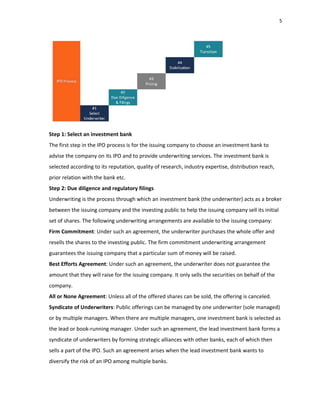
The IPO Process
5
Step 1: Select an investment bank
The first step in the IPO process is for the issuing company to choose an investment bank to
advise the company on its IPO and to provide underwriting services. The investment bank is
selected according to its reputation, quality of research, industry expertise, distribution reach,
prior relation with the bank etc.
Step 2: Due diligence and regulatory filings
Underwriting is the process through which an investment bank (the underwriter) acts as a broker
between the issuing company and the investing public to help the issuing company sell its initial
set of shares. The following underwriting arrangements are available to the issuing company:
Firm Commitment: Under such an agreement, the underwriter purchases the whole offer and
resells the shares to the investing public. The firm commitment underwriting arrangement
guarantees the issuing company that a particular sum of money will be raised.
Best Efforts Agreement: Under such an agreement, the underwriter does not guarantee the
amount that they will raise for the issuing company. It only sells the securities on behalf of the
company.
All or None Agreement: Unless all of the offered shares can be sold, the offering is canceled.
Syndicate of Underwriters: Public offerings can be managed by one underwriter (sole managed)
or by multiple managers. When there are multiple managers, one investment bank is selected as
the lead or book‐running manager. Under such an agreement, the lead investment bank forms a
syndicate of underwriters by forming strategic alliances with other banks, each of which then
sells a part of the IPO. Such an agreement arises when the lead investment bank wants to
diversify the risk of an IPO among multiple banks.
6
The underwriter then drafts an engagement letter, letter of intent, underwriting agreement, the
prospectus and Red Herring Document.
Step 3: Verification by SEBI
Market regulator, SEBI then verifies the disclosure of facts by the company. If the application is
approved, the company can announce a date for its IPO.
Step 4: Making an Application to The Stock Exchange
The company now has to make an application to the stock exchange for floating its initial issue.
Step 5: Pricing
After the IPO is approved by the SEC, the effective date is decided. On the day before the
effective date, the issuing company and the underwriter decide the offer price (i.e., the price at
which the shares will be sold by the issuing company) and the precise number of shares to be
sold. Deciding the offer price is important because it is the price at which the issuing company
raises capital for itself.
The price can be determined by either through Fixed Price IPO or by Book Binding Offering. In
the case of Fixed Price Offering, the price of the company‘s stocks is announced in advance.
Book Building Process
Book Building is a process undertaken by which a demand for the securities proposed to be
issued by a body corporate is elicited and built‐up and the price for such securities is assessed for
the determination of the quantum of such securities to be issued by means of a notice, circular,
advertisement, document or information memoranda or offer document. Book Building is
basically a process used in Initial Public Offer (IPO) for efficient price discovery. It is a mechanism
where, during the period for which the IPO is open, bids are collected from investors at various
prices, which are above or equal to the floor price. The offer price is determined after the bid
closing date.
The book building process comprises these steps:
1. The issuing company hires an investment bank to act as an underwriter who is tasked with
determining the price range the security can be sold for and drafting a prospectus to send out to
the institutional investing community.
2. The investment bank invites investors, normally large‐scale buyers and fund managers, to
submit bids on the number of shares that they are interested in buying and the prices that they
would be willing to pay.
7
3. The book is 'built' by listing and evaluating the aggregated demand for the issue from the
submitted bids. The underwriter analyzes the information and uses a weighted average to arrive
at the final price for the security, which is termed the cutoff price.
4. The underwriter has to, for the sake of transparency, publicize the details of all the bids that
were submitted.
5. Shares are allocated to the accepted bidders.
Step 6: Final Allotment of Shares
Once the IPO price is finalised, the company along with the underwriters will determine the
number of shares to be allotted to each investor. In the case of over‐subscription, partial
allotments will be made. The IPO stocks are usually allotted to the bidders within 10 working
days of the last bidding date.
8
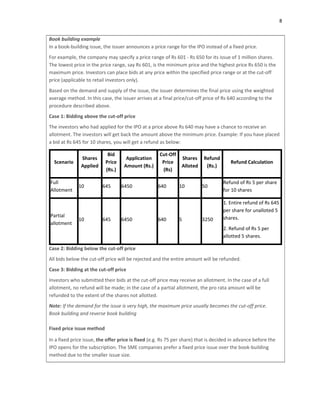
Book building example
In a book‐building issue, the issuer announces a price range for the IPO instead of a fixed price.
For example, the company may specify a price range of Rs 601 ‐ Rs 650 for its issue of 1 million shares.
The lowest price in the price range, say Rs 601, is the minimum price and the highest price Rs 650 is the
maximum price. Investors can place bids at any price within the specified price range or at the cut‐off
price (applicable to retail investors only).
Based on the demand and supply of the issue, the issuer determines the final price using the weighted
average method. In this case, the issuer arrives at a final price/cut‐off price of Rs 640 according to the
procedure described above.
Case 1: Bidding above the cut‐off price
The investors who had applied for the IPO at a price above Rs 640 may have a chance to receive an
allotment. The investors will get back the amount above the minimum price. Example: If you have placed
a bid at Rs 645 for 10 shares, you will get a refund as below:
Scenario
Shares
Applied
Bid
Price
(Rs.)
Application
Amount (Rs.)
Cut‐Off
Price
(Rs)
Shares
Alloted
Refund
(Rs.)
Refund Calculation
Full
Allotment
10 645 6450 640 10 50
Refund of Rs 5 per share
for 10 shares
Partial
allotment
10 645 6450 640 5 3250
1. Entire refund of Rs 645
per share for unalloted 5
shares.
2. Refund of Rs 5 per
allotted 5 shares.
Case 2: Bidding below the cut‐off price
All bids below the cut‐off price will be rejected and the entire amount will be refunded.
Case 3: Bidding at the cut‐off price
Investors who submitted their bids at the cut‐off price may receive an allotment. In the case of a full
allotment, no refund will be made; in the case of a partial allotment, the pro rata amount will be
refunded to the extent of the shares not allotted.
Note: If the demand for the issue is very high, the maximum price usually becomes the cut‐off price.
Book building and reverse book building
Fixed price issue method
In a fixed price issue, the offer price is fixed (e.g. Rs 75 per share) that is decided in advance before the
IPO opens for the subscription. The SME companies prefer a fixed price issue over the book‐building
method due to the smaller issue size.
9
Buy Back of Shares
A buyback of shares is buying back of own shares by a company that was issued earlier. It is a
corporate action event wherein a company makes a public announcement for the buyback offer
to acquire the shares from existing shareholders within a given timeframe. The buyback of
shares is also known as a stock buyback or repurchase of shares. The company announces an
offer price for the buyback that is generally higher than the current market price.
Reasons for Buyback of shares
There are several reasons associated with it that urge a company to announce a buyback:
A. Undervalued stock
This is one of the main reasons why companies opt to buy back their shares. When the
management feels that their stock is undervalued, they adopt the buyback route to rectify the
stock price. The stock buyback reduces the number of shares in the market and thus gives a price
boost to the remaining shares in the market.
B. Excess Cash with not many projects’ opportunities
A company with free reserves in hand but not many project opportunities would prefer to go for
a buyback. The company would use the cash to reward the shareholders rather than keeping it
idle in the bank account over the required amount.
C. Tax‐efficient method of rewarding shareholders
The dividends get taxed at two levels. First, at the company level and a second time in the hands
of the shareholders. However, in the case of a buyback, only the company is liable to pay a
buyback tax. The capital gains tax on the income from the buyback of shares is exempted for the
investor. Thus, buybacks prove to be a more tax‐effective way of distributing rewards to the
shareholder.
D. Strengthen promoter holding in the company
The company promoters can increase its stake in the company by forfeiting the buyback offer.
This strengthens their hold over the company and acts as a defense strategy in the case of
hostile takeovers.
E. To achieve optimum capital structure
The capital structure of a company gets represented by its debt‐equity ratio. Each industry has a
different capital structure requirement. Some industries may not be suitable to rely on more
debts, whereas some other business models may require large debts to run their business. Thus,
10
as per the company requirement, a company may opt for buyback as a tool and repurchase its
equity from the market to achieve an optimum capital structure.
Buyback of shares methods
SEBI Buyback Regulations prescribe three methods of buyback of shares in India. A company can
buy back the securities through any one of the following modes:
Buyback of shares through tender offer
In a tender offer, the company buys back its shares from the existing shareholders at a fixed
price on a proportionate basis within a given time frame. The company issues a letter of offer
and Tender Form to all the eligible shareholders on the company records as on the buyback
record date. All the eligible shareholders who hold the shares either in physical form or Demat
can participate in the buyback offer.
Buyback of shares through open market
In the case of buyback of shares from open market, a company can do so either through the
stock exchange or the book‐building process. In the case of buyback from the open market
through the Stock Exchange mechanism, a company can buy back the shares only on the stock
exchanges having nationwide trading terminals via an order matching mechanism. The
promoters are not allowed to participate in the open market offers through the stock exchange.
All other shareholders holding Equity shares of the company can participate in this offer.
Buyback of shares from Odd‐lot holders
In the case of buyback from the odd‐lot holders, the company buys directly from the odd‐lot
shareholders by approaching them. An odd lot holder is a shareholder with shares lesser than
the marketable lots as specified by the stock exchange. This method of the buyback is less
common in India.
Innovative Financial Instruments
Innovative financial instruments are a range of activities such as:‐
1. participation in equity (risk capital) funds
2. guarantees to local banks lending to a large number of final beneficiaries, for instance small
and medium‐sized enterprises (SMEs)
3. risk‐sharing with financial institutions to boost investment in large infrastructure projects (e.g.
the Europe 2020 project bonds initiative or the connecting Europe facility financial instruments).
11
The aim is to boost the real economy through increasing the access to finance for enterprises
and industry producing goods and services.
Purpose of Innovation
1. Different types of Credit Control and Macro level Liquidity Management
2. Matching Cash flow requirement of the fund raiser
3. Satisfying other objectives like retaining management control
4. More effective catering to the needs of the investors
5. Better treasury management
Some important innovative financial instruments are:‐
1. Triple Option Convertible Debentures (TOCD)
# First Issued by Reliance Power Limited with an issue size of Rs. 2,172 Cr.
# There was no outflow of interest for first five years.
# Equity increase was in phases.
# No put option to investors and no takeover threat.
# Reduced dependence on the financial institutions. The expenses for floating the issue were just
2.62% of the issue size which was very less when compared to the 10‐12% for a general public
issue.
2. Deep Discount Bonds:
# The investor got a tax advantage and could eliminate the re‐investment risk.
# From the issuer‘s point of view also, the issue cost was saved as it involved no immediate
service cost and lower effective cost. The refinancing risk was also eliminated.
3. Floating Rate Notes:
# First issued by Tata Sons with a floor rate of 12.5% and a cap of 15.5% and a reference rate of
364 T‐Bill yield, which was 9.85% at the time of issue.
12
# The investors would get a minimum return of the floor rate and the maximum return was the
cap rate. They would get higher than floor rate depending upon the fluctuations in the reference
rate.
4. Perpetual Bonds
# Perpetual bonds are fund‐raising instruments that do not carry any maturity date as bonds
usually do. Instead, they offer to pay their buyers a coupon or interest at a fixed date for
perpetuity.
# While a variety of entities may issue perpetual bonds, the most common ones in India are
issued by banks to meet their Basel III capital norms and are called Additional Tier 1 or AT‐1
bonds.
5. Bonus Debentures
# A bonus debenture is a free debt instrument issued to a company‘s shareholders as a reward.
When the company declares a bonus debenture, you will receive bonds from the company for a
specific face value.
# Interest will be paid on these debentures every year.
# They will be redeemed after a specific period, when you will receive a lump‐ sum payment.
6. Zero – Coupon Bond
# A zero‐coupon bond is a bond that pays no interest and trades at a discount to its face value. It
is also called a pure discount bond or deep discount bond.
# The maturity dates on zero coupon bonds are usually long‐term—many don‘t mature for ten,
fifteen, or more years.
# Investors can purchase different kinds of zero‐coupon bonds in the secondary markets that
have been issued from a variety of sources.
Crypto Currency
A cryptocurrency is a digital or virtual currency that is secured by cryptography, which makes it
nearly impossible to counterfeit or double‐spend. The word ―cryptocurrency‖ is derived from
the encryption techniques which are used to secure the network. A defining feature of
13
cryptocurrencies is that they are generally not issued by any central authority, rendering them
theoretically immune to government interference or manipulation.
Many companies have issued their own currencies, often called tokens, and these can be traded
specifically for the good or service that the company provides. Cryptocurrencies work using a
technology called blockchain. Blockchain is a decentralized technology spread across many
computers that manages and records transactions. Part of the appeal of this technology is its
security.
Bitcoin
Bitcoin is a digital currency created in January 2009. Bitcoin is a type of cryptocurrency. There is
no physical bitcoin, only balances kept on a public ledger that everyone has transparent access
to. All bitcoin transactions are verified by a massive amount of computing power. Bitcoin is not
issued or backed by any banks or governments, nor is an individual bitcoin valuable as a
commodity. Despite it not being legal tender in most parts of the world, bitcoin is very popular
and has triggered the launch of hundreds of other cryptocurrencies, collectively referred to as
altcoins. Bitcoin is commonly abbreviated as "BTC."
Ethereum
Ethereum is a blockchain platform with its own cryptocurrency, called Ether (ETH) or Ethereum,
and its own programming language, called Solidity. As a blockchain network, Ethereum is a
decentralized public ledger for verifying and recording transactions. The network's users can
create, publish, monetize, and use applications on the platform, and use its Ether cryptocurrency
as payment. Insiders call the decentralized applications on the network "dapps." As a
cryptocurrency, Ethereum is second in market value only to Bitcoin, as of May 2021.
Cardano
Cardano is a third‐generation, decentralized proof‐of‐stake (PoS) blockchain platform designed
to be a more efficient alternative to proof‐of‐work (PoW) networks. Scalability, interoperability,
and sustainability on PoW networks like Ethereum are limited by the infrastructure burden of
growing costs, energy use, and slow transaction times. Charles Hoskinson, the co‐founder of the
proof‐of‐work (PoW) blockchain Ethereum, understood the implications of these challenges to
blockchain networks, and began developing Cardano and its primary cryptocurrency, ada, in
2015, launching the platform and the ada token in 2017.
Dogecoin
14
Dogecoin (DOGE) is a peer‐to‐peer, open‐source cryptocurrency. It is considered an altcoin and
an almost sarcastic meme coin. Launched in Dec. 2013, Dogecoin has the image of a Shiba Inu
dog as its logo. While it was created seemingly as a joke, Dogecoin's blockchain still has merit. Its
underlying technology is derived from Litecoin. Notable features of Dogecoin, which uses a
scrypt algorithm, are its low price and unlimited supply. Dogecoin started as something of a joke,
but after it was created, it gained a following. By late 2017, it was participating in the
cryptocurrency bubble that sent the values of many coins up significantly
ADR vs GDR
Introduction
A bank issues a depository receipt which is a transferable instrument representing the
foreign companies’ publicly traded securities. Investors can hold the shares in other
countries’ equities with the help of a depository receipt. The two most common types of
DRs are the American Depository Receipt (ADR) and Global Depository Receipts (GDR),
which provide the investors, traders, and companies with more investment opportunities.
The listing of ADRs representing the stocks of a foreign company happen on the
American Stock Exchanges. And every transaction denomination happens in U.S. dollars
and allows a US investor to achieve higher returns. A GDR is similar to an ADR, but it is
not traded in the US market. Further, its trade happens outside the issuing company’s
home country. The GDRs denomination can be in US dollars, Euros, and British Sterling.
Let us see more about ADR vs GDR.
Though ADR vs GDR is both depositary receipts, they have differences. We will discuss
those differences in this article based on their features, listing, and functions.
15
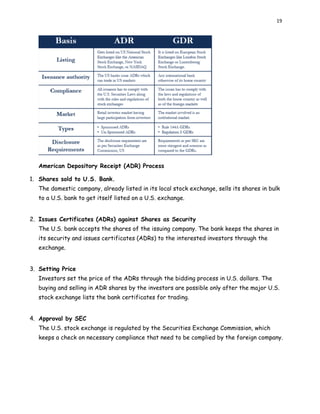
ADR vs GDR – Differences
The following points specify the differences that exist between an ADR and GDR:
Listing
Listing of ADRs happens only on US National Stock Exchanges like the American Stock
Exchange, New York Stock Exchange, or NASDAQ. However, in contrast, GDRs can be
listed on European Stock Exchanges like London Stock Exchange or Luxembourg Stock
Exchange.
Issuance Authority
In the case of ADRs, the US banks issue ADRs which can trade in US markets. Some of
the US banks which sponsor ADRs are – The Bank of New York Mellon (BNY) and State
Street. In the case of GDRs, the issuer can be any international bank, and it allows the
investors to have access to capital markets otherwise of their home country. Several
international banks issue GDRs, such as Deutsche Bank and JP Morgan Chase.
Compliance
All the issuance of ADRs must comply with the U.S. Securities Laws along with the rules
and regulations of Stock Exchanges. In contrast, while issuing GDRs, the issuer has to
comply with the laws and regulations of both the home country as well as of the foreign
markets, respectively.
16
Market
In the case of ADRs, the market is a retail investor market having large participation
from investors. Whereas in the case of GDRs, the market involved is an institutional
market.
Disclosure Requirements
As the issuance of ADRs is governed by the SEC of the US, the disclosure requirements
are as stipulated by SEC. Further, generally, the requirements as per SEC are more
stringent and onerous as compared to the GDRs.
ADR vs GDR – Conclusion
GDR and ADR are depository receipts providing investors with opportunities to raise
funds from markets. Investors can create a diversified portfolio by adding these
depository receipts in their portfolios and can thus have access to global markets. US
investors get the opportunity to invest or deal in foreign companies’ stocks with the help
of ADRs in the US markets. On the contrary, GDR allows foreign companies to deal in
stocks of any market except US markets. GDRs can be negotiated globally. However,
ADRs can be negotiated only in the USA. ADRs and GDRs enlisting can happen only in
American Stock exchanges and European Stock Exchanges, respectively. They can be
differentiated based on their types. Issuance authorities and regulatory authorities are
different for both the DRs. However, both of these DRs do involve risks associated with
the fluctuation in foreign exchange rates.
American Depository Receipt (ADR) Example
Volkswagen, a German company, trades on New York Stock Exchange. Investors in
America can easily invest in German companies through the stock exchange. Volkswagen
is listed on the American stock exchange after complying with the required laws. On the
other hand, if the shares of Volkswagen are listed in stock markets of countries other
than the US, then it is termed as GDR.
Global Depository Receipt Example
A company based in the USA willing to get its stock listed on the German stock exchange
can do so with the help of the GDR. The US-based company shall enter into an
agreement with the German depository bank, which shall issue shares to residents based
17
in Germany after getting instructions from the domestic custodian of the company. The
shares are issued after compliance with the law in both countries.
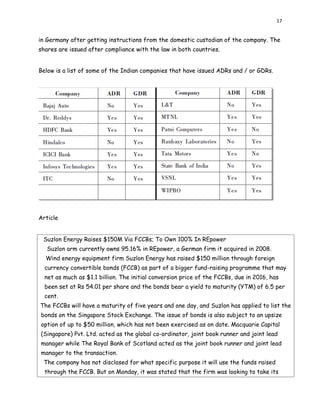
Below is a list of some of the Indian companies that have issued ADRs and / or GDRs.
Article
Suzlon Energy Raises $150M Via FCCBs; To Own 100% In REpower
Suzlon arm currently owns 95.16% in REpower, a German firm it acquired in 2008.
Wind energy equipment firm Suzlon Energy has raised $150 million through foreign
currency convertible bonds (FCCB) as part of a bigger fund-raising programme that may
net as much as $1.1 billion. The initial conversion price of the FCCBs, due in 2016, has
been set at Rs 54.01 per share and the bonds bear a yield to maturity (YTM) of 6.5 per
cent.
The FCCBs will have a maturity of five years and one day, and Suzlon has applied to list the
bonds on the Singapore Stock Exchange. The issue of bonds is also subject to an upsize
option of up to $50 million, which has not been exercised as on date. Macquarie Capital
(Singapore) Pvt. Ltd. acted as the global co-ordinator, joint book runner and joint lead
manager while The Royal Bank of Scotland acted as the joint book runner and joint lead
manager to the transaction.
The company has not disclosed for what specific purpose it will use the funds raised
through the FCCB. But on Monday, it was stated that the firm was looking to take its
18
German subsidiary REpower private. At present, Suzlon’s arm AE-Rotor Holding BV owns
95.16 per cent in REpower and under the German Stock Corporation Act, a shareholding
of 95 per cent and above in a German firm enables the majority shareholder to initiate
the ‘squeeze-out’ proceedings in respect of minority shareholders. Suzlon has initiated
the squeeze-out that will result in REpower becoming a wholly owned subsidiary of the
Indian company. It was in fiscal year 2008 that Suzlon had acquired stake in REpower
Systems AG, Germany, and thereafter increased its holding. Suzlon scrip dropped 1.9 per
cent to Rs 48.7 at mid-trading hours on Tuesday after it announced details of the FCCB
issue. The FCCB issue was opened on Monday with a floor price for the conversion of the
bonds, pegged at Rs 46.05 per share. In October last year, Suzlon’s board had approved
further issue of equity shares, GDRs, ADRs, FCCBs, and/or any other securities
convertible into or linked to equity shares up to Rs 5,000 crore. At the same time, IDFC
Private Equity, an infrastructure-focused PE firm with $1.3 billion under management,
swapped its stake in the components arm of wind turbine maker Suzlon Energy Ltd for an
interest in the listed parent company. As a result, SE Forge Ltd, which makes large
forging and casting products catering primarily to the wind power industry, became a
wholly owned subsidiary of Suzlon Energy. IDFC PE picked up 17.1 per cent stake in SE
Forge for Rs 400 crore in September, 2008.
Suzlon underwent a refinancing of debt which came after its acquisition of companies like
REpower and Hansen. It also sold 35 per cent of Hansen for around $370 million in
November, 2009, to reduce its debts.
Source: http://www.vccircle.com/500/news/suzlon-energy-raises-150mvia-fccbs-to-own-
100-in-repower
April 05, 2011, 06:36 PM IS
19
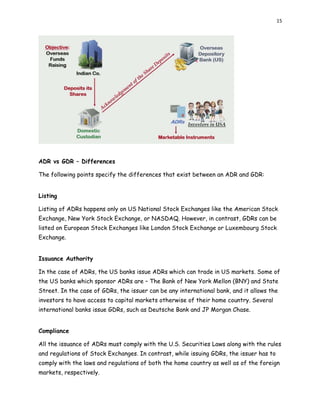
American Depository Receipt (ADR) Process
1. Shares sold to U.S. Bank.
The domestic company, already listed in its local stock exchange, sells its shares in bulk
to a U.S. bank to get itself listed on a U.S. exchange.
2. Issues Certificates (ADRs) against Shares as Security
The U.S. bank accepts the shares of the issuing company. The bank keeps the shares in
its security and issues certificates (ADRs) to the interested investors through the
exchange.
3. Setting Price
Investors set the price of the ADRs through the bidding process in U.S. dollars. The
buying and selling in ADR shares by the investors are possible only after the major U.S.
stock exchange lists the bank certificates for trading.
4. Approval by SEC
The U.S. stock exchange is regulated by the Securities Exchange Commission, which
keeps a check on necessary compliance that need to be complied by the foreign company.
20
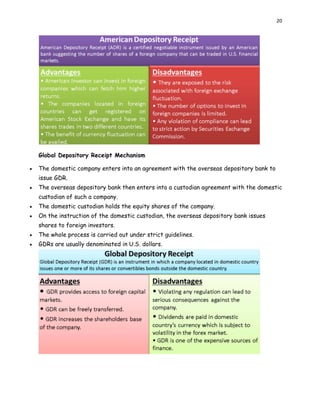
Global Depository Receipt Mechanism
 The domestic company enters into an agreement with the overseas depository bank to
issue GDR.
 The overseas depository bank then enters into a custodian agreement with the domestic
custodian of such a company.
 The domestic custodian holds the equity shares of the company.
 On the instruction of the domestic custodian, the overseas depository bank issues
shares to foreign investors.
 The whole process is carried out under strict guidelines.
 GDRs are usually denominated in U.S. dollars.
21
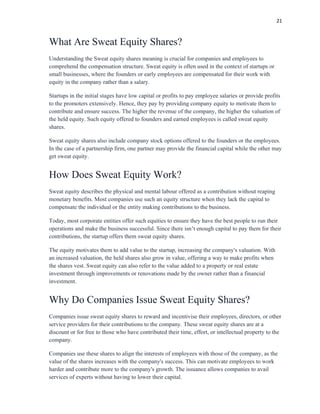
What Are Sweat Equity Shares?
Understanding the Sweat equity shares meaning is crucial for companies and employees to
comprehend the compensation structure. Sweat equity is often used in the context of startups or
small businesses, where the founders or early employees are compensated for their work with
equity in the company rather than a salary.
Startups in the initial stages have low capital or profits to pay employee salaries or provide profits
to the promoters extensively. Hence, they pay by providing company equity to motivate them to
contribute and ensure success. The higher the revenue of the company, the higher the valuation of
the held equity. Such equity offered to founders and earned employees is called sweat equity
shares.
Sweat equity shares also include company stock options offered to the founders or the employees.
In the case of a partnership firm, one partner may provide the financial capital while the other may
get sweat equity.
How Does Sweat Equity Work?
Sweat equity describes the physical and mental labour offered as a contribution without reaping
monetary benefits. Most companies use such an equity structure when they lack the capital to
compensate the individual or the entity making contributions to the business.
Today, most corporate entities offer such equities to ensure they have the best people to run their
operations and make the business successful. Since there isn’t enough capital to pay them for their
contributions, the startup offers them sweat equity shares.
The equity motivates them to add value to the startup, increasing the company's valuation. With
an increased valuation, the held shares also grow in value, offering a way to make profits when
the shares vest. Sweat equity can also refer to the value added to a property or real estate
investment through improvements or renovations made by the owner rather than a financial
investment.
Why Do Companies Issue Sweat Equity Shares?
Companies issue sweat equity shares to reward and incentivise their employees, directors, or other
service providers for their contributions to the company. These sweat equity shares are at a
discount or for free to those who have contributed their time, effort, or intellectual property to the
company.
Companies use these shares to align the interests of employees with those of the company, as the
value of the shares increases with the company's success. This can motivate employees to work
harder and contribute more to the company's growth. The issuance allows companies to avail
services of experts without having to lower their capital.
22
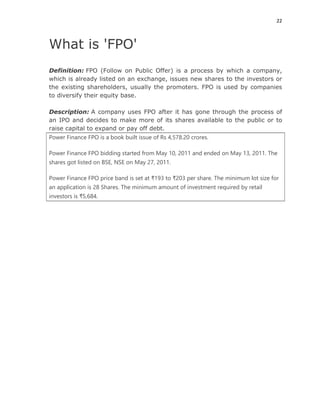
What is 'FPO'
Definition: FPO (Follow on Public Offer) is a process by which a company,
which is already listed on an exchange, issues new shares to the investors or
the existing shareholders, usually the promoters. FPO is used by companies
to diversify their equity base.
Description: A company uses FPO after it has gone through the process of
an IPO and decides to make more of its shares available to the public or to
raise capital to expand or pay off debt.
Power Finance FPO is a book built issue of Rs 4,578.20 crores.
Power Finance FPO bidding started from May 10, 2011 and ended on May 13, 2011. The
shares got listed on BSE, NSE on May 27, 2011.
Power Finance FPO price band is set at ₹193 to ₹203 per share. The minimum lot size for
an application is 28 Shares. The minimum amount of investment required by retail
investors is ₹5,684.

Financial Instruments (Equity, Debentures).pdf

  • 1.
    1 FINANCIAL INSTRUMENTS (FirstSem DPU) A financial instrument is a lawful agreement which involves some monetary value. Financial instruments have unique characteristics and structure. In other words financial instruments are contracts for monetary assets that can be purchased, traded, created, modified, or settled for. In terms of contracts, there is a contractual obligation between involved parties during a financial instrument transaction. Financial instruments can be classified as A. Cash Instruments B. Derivative Instruments C. Foreign Exchange Instruments A. Cash Instruments: Cash instruments are financial instruments with values directly influenced by the condition of the markets. Within cash instruments, there are two types; securities and deposits, and loans. i. Securities: A security is a financial instrument that has monetary value and is traded on the stock market. When purchased or traded, a security represents ownership of a part of a publicly‐ traded company on the stock exchange. ii. Deposits and Loans: Both deposits and loans are considered cash instruments because they represent monetary assets that have some sort of contractual agreement between parties. B. Derivative Instruments Derivative instruments are financial instruments that have values determined from underlying assets, such as resources, currency, bonds, stocks, and stock indexes. The five most common examples of derivatives instruments are synthetic agreements, forwards, futures, options, and swaps. This is discussed in more detail below. i. Synthetic Agreement for Foreign Exchange (SAFE): A SAFE occurs in the over‐the‐counter (OTC) market and is an agreement that guarantees a specified exchange rate during an agreed period of time. ii. Forward: A forward is a contract between two parties that involves customizable derivatives in which the exchange occurs at the end of the contract at a specific price.
  • 2.
    2 iii. Future: Afuture is a derivative transaction that provides the exchange of derivatives on a determined future date at a predetermined exchange rate. iv. Options: An option is an agreement between two parties in which the seller grants the buyer the right to purchase or sell a certain number of derivatives at a predetermined price for a specific period of time. v. Interest Rate Swap: An interest rate swap is a derivative agreement between two parties that involves the swapping of interest rates where each party agrees to pay other interest rates on their loans in different currencies. C. Foreign Exchange Instruments Foreign exchange instruments are financial instruments that are represented on the foreign market and primarily consist of currency agreements and derivatives. In terms of currency agreements, they can be broken into three categories‐ i. Spot: A currency agreement in which the actual exchange of currency is no later than the second working day a er the original date of the agreement. It is termed ―spot‖ because the currency exchange is done ―on the spot‖. ii. Outright Forwards: A currency agreement in which the actual exchange of currency is done ―forwardly‖ and before the actual date of the agreed requirement. It is beneficial in cases of fluctuating exchange rates that change often. iii. Currency Swap: A currency swap refers to the act of simultaneously buying and selling currencies with different specified value dates. Primary Market The primary market is a segment of the capital market where entities such as companies, governments and other institutions obtain funds through the sale of debt and equity‐based securities. When a company decides to go public for the first time by raising an Initial Public Offering (IPO), it is done in the primary market. Since the securities are sold for the first time here, a primary market is also known as the New Issue Market (NIM). Functions of Primary Market A. New Issue Offer
  • 3.
    3 This is oneof the major primary market functions. It is this market that organises offering of a new issue, which has not been traded on any other exchange before. It‘s because of this reason that the primary market is also called new issue market. There‘s a lot that goes into issuing a new offer. It involves a detailed assessment of the viability of a project and among the financial arrangement for the purpose involves taking into consideration the promoter‘s debt‐equity ratio, liquidity ratio, and equity ratio, among others. B. Underwriting Services One of the most important and vital aspects of offering a new issue offer is underwriting. The role of an underwriter in the primary marketplace is to buy unsold shares. Often financial institutions play the role of underwriters, earning a commission in the process. Often investors depend on underwriters to gauge whether undertaking the risk would be worth the returns. It may also happen that the underwriter buys the entire IPO issue, subsequently selling it to investors. C. Distribution of New Issue This is another vital function of primary market. The distribution process is initiated with a new prospectus issue. The public is invited at large to purchase the new issue, and detailed information is given on the company and the issue along with the underwriters. Types of Issuances in the Primary Market Once securities are issued, investors can purchase them in various ways in the primary market. They are: Public Issue It is one of the most common methods of issuing securities to the public at large. Done primarily through an initial public offering (IPO) whereby companies raise capital for business, the securities are then listed on the stock exchange for trading. One of the features of the primary market is that a private limited company can become a publically‐traded entity through IPO. The capital raised by a company can also be deployed to improve the firm‘s existing infrastructure and repay debts, among others. It also improves a company‘s liquidity. The Securities and Exchange Board of India (SEBI) is the watchdog that monitors IPO, and before a firm goes for an IPO, proper enquiry is done to establish its authenticity. Private Placement
  • 4.
    4 Private placement happenswhen a company offers securities to a small group of investors. These primary securities may be stocks, bonds, or any other type of security. In private placement, investors can be either institutional or individual. It‘s easy to issue private placement compared to an IPO as the regulatory norms are significantly less. Also, it incurs reduced cost and time. Private placement is more suitable for companies that have just commenced operations and are in their formative years. Preferential Issues It is one of the quickest methods through which companies can raise capital for their business. Here, both listed and unlisted companies can issue securities to a particular select group of investors. It is essential to note that preferential issues are neither public nor rights issue. In this type of issue, preference shareholders are paid dividends before ordinary shareholders. Qualified Institutional Placement It is another type of fundraising tool used by listed companies to raise capital by issuing primary securities to qualified institutional buyers (QIBs). Capital market regulator SEBI introduced it to make it easier for companies to raise capital in the domestic market. Note that QIBs are investors who have the requisite expertise and financial knowledge to invest in the capital markets. They are generally foreign institutional investors registered with SEBI, public financial institutions, and scheduled commercial banks, among others. Rights and Bonus Issues This is another type of issuance in the primary market. Here the company issues securities to existing investors by allowing them to buy more securities at a pre‐fixed price (in case of rights issue) and avail allotment of extra shares in the case of bonus issue. In case of rights issue, investors have the choice of purchasing stocks at a discounted price within a specific period. On the other hand, in the case of bonus issue, a firm's stocks are issued to its existing shareholders. Initial Public Offerings A corporate may raise capital in the primary market by way of an initial public offer, rights issue or private placement. An Initial Public Offer (IPO) is the selling of securities to the public in the primary market. It is the largest source of funds with long or indefinite maturity for the company. The IPO Process
  • 5.
    5 Step 1: Selectan investment bank The first step in the IPO process is for the issuing company to choose an investment bank to advise the company on its IPO and to provide underwriting services. The investment bank is selected according to its reputation, quality of research, industry expertise, distribution reach, prior relation with the bank etc. Step 2: Due diligence and regulatory filings Underwriting is the process through which an investment bank (the underwriter) acts as a broker between the issuing company and the investing public to help the issuing company sell its initial set of shares. The following underwriting arrangements are available to the issuing company: Firm Commitment: Under such an agreement, the underwriter purchases the whole offer and resells the shares to the investing public. The firm commitment underwriting arrangement guarantees the issuing company that a particular sum of money will be raised. Best Efforts Agreement: Under such an agreement, the underwriter does not guarantee the amount that they will raise for the issuing company. It only sells the securities on behalf of the company. All or None Agreement: Unless all of the offered shares can be sold, the offering is canceled. Syndicate of Underwriters: Public offerings can be managed by one underwriter (sole managed) or by multiple managers. When there are multiple managers, one investment bank is selected as the lead or book‐running manager. Under such an agreement, the lead investment bank forms a syndicate of underwriters by forming strategic alliances with other banks, each of which then sells a part of the IPO. Such an agreement arises when the lead investment bank wants to diversify the risk of an IPO among multiple banks.
  • 6.
    6 The underwriter thendrafts an engagement letter, letter of intent, underwriting agreement, the prospectus and Red Herring Document. Step 3: Verification by SEBI Market regulator, SEBI then verifies the disclosure of facts by the company. If the application is approved, the company can announce a date for its IPO. Step 4: Making an Application to The Stock Exchange The company now has to make an application to the stock exchange for floating its initial issue. Step 5: Pricing After the IPO is approved by the SEC, the effective date is decided. On the day before the effective date, the issuing company and the underwriter decide the offer price (i.e., the price at which the shares will be sold by the issuing company) and the precise number of shares to be sold. Deciding the offer price is important because it is the price at which the issuing company raises capital for itself. The price can be determined by either through Fixed Price IPO or by Book Binding Offering. In the case of Fixed Price Offering, the price of the company‘s stocks is announced in advance. Book Building Process Book Building is a process undertaken by which a demand for the securities proposed to be issued by a body corporate is elicited and built‐up and the price for such securities is assessed for the determination of the quantum of such securities to be issued by means of a notice, circular, advertisement, document or information memoranda or offer document. Book Building is basically a process used in Initial Public Offer (IPO) for efficient price discovery. It is a mechanism where, during the period for which the IPO is open, bids are collected from investors at various prices, which are above or equal to the floor price. The offer price is determined after the bid closing date. The book building process comprises these steps: 1. The issuing company hires an investment bank to act as an underwriter who is tasked with determining the price range the security can be sold for and drafting a prospectus to send out to the institutional investing community. 2. The investment bank invites investors, normally large‐scale buyers and fund managers, to submit bids on the number of shares that they are interested in buying and the prices that they would be willing to pay.
  • 7.
    7 3. The bookis 'built' by listing and evaluating the aggregated demand for the issue from the submitted bids. The underwriter analyzes the information and uses a weighted average to arrive at the final price for the security, which is termed the cutoff price. 4. The underwriter has to, for the sake of transparency, publicize the details of all the bids that were submitted. 5. Shares are allocated to the accepted bidders. Step 6: Final Allotment of Shares Once the IPO price is finalised, the company along with the underwriters will determine the number of shares to be allotted to each investor. In the case of over‐subscription, partial allotments will be made. The IPO stocks are usually allotted to the bidders within 10 working days of the last bidding date.
  • 8.
    8 Book building example Ina book‐building issue, the issuer announces a price range for the IPO instead of a fixed price. For example, the company may specify a price range of Rs 601 ‐ Rs 650 for its issue of 1 million shares. The lowest price in the price range, say Rs 601, is the minimum price and the highest price Rs 650 is the maximum price. Investors can place bids at any price within the specified price range or at the cut‐off price (applicable to retail investors only). Based on the demand and supply of the issue, the issuer determines the final price using the weighted average method. In this case, the issuer arrives at a final price/cut‐off price of Rs 640 according to the procedure described above. Case 1: Bidding above the cut‐off price The investors who had applied for the IPO at a price above Rs 640 may have a chance to receive an allotment. The investors will get back the amount above the minimum price. Example: If you have placed a bid at Rs 645 for 10 shares, you will get a refund as below: Scenario Shares Applied Bid Price (Rs.) Application Amount (Rs.) Cut‐Off Price (Rs) Shares Alloted Refund (Rs.) Refund Calculation Full Allotment 10 645 6450 640 10 50 Refund of Rs 5 per share for 10 shares Partial allotment 10 645 6450 640 5 3250 1. Entire refund of Rs 645 per share for unalloted 5 shares. 2. Refund of Rs 5 per allotted 5 shares. Case 2: Bidding below the cut‐off price All bids below the cut‐off price will be rejected and the entire amount will be refunded. Case 3: Bidding at the cut‐off price Investors who submitted their bids at the cut‐off price may receive an allotment. In the case of a full allotment, no refund will be made; in the case of a partial allotment, the pro rata amount will be refunded to the extent of the shares not allotted. Note: If the demand for the issue is very high, the maximum price usually becomes the cut‐off price. Book building and reverse book building Fixed price issue method In a fixed price issue, the offer price is fixed (e.g. Rs 75 per share) that is decided in advance before the IPO opens for the subscription. The SME companies prefer a fixed price issue over the book‐building method due to the smaller issue size.
  • 9.
    9 Buy Back ofShares A buyback of shares is buying back of own shares by a company that was issued earlier. It is a corporate action event wherein a company makes a public announcement for the buyback offer to acquire the shares from existing shareholders within a given timeframe. The buyback of shares is also known as a stock buyback or repurchase of shares. The company announces an offer price for the buyback that is generally higher than the current market price. Reasons for Buyback of shares There are several reasons associated with it that urge a company to announce a buyback: A. Undervalued stock This is one of the main reasons why companies opt to buy back their shares. When the management feels that their stock is undervalued, they adopt the buyback route to rectify the stock price. The stock buyback reduces the number of shares in the market and thus gives a price boost to the remaining shares in the market. B. Excess Cash with not many projects’ opportunities A company with free reserves in hand but not many project opportunities would prefer to go for a buyback. The company would use the cash to reward the shareholders rather than keeping it idle in the bank account over the required amount. C. Tax‐efficient method of rewarding shareholders The dividends get taxed at two levels. First, at the company level and a second time in the hands of the shareholders. However, in the case of a buyback, only the company is liable to pay a buyback tax. The capital gains tax on the income from the buyback of shares is exempted for the investor. Thus, buybacks prove to be a more tax‐effective way of distributing rewards to the shareholder. D. Strengthen promoter holding in the company The company promoters can increase its stake in the company by forfeiting the buyback offer. This strengthens their hold over the company and acts as a defense strategy in the case of hostile takeovers. E. To achieve optimum capital structure The capital structure of a company gets represented by its debt‐equity ratio. Each industry has a different capital structure requirement. Some industries may not be suitable to rely on more debts, whereas some other business models may require large debts to run their business. Thus,
  • 10.
    10 as per thecompany requirement, a company may opt for buyback as a tool and repurchase its equity from the market to achieve an optimum capital structure. Buyback of shares methods SEBI Buyback Regulations prescribe three methods of buyback of shares in India. A company can buy back the securities through any one of the following modes: Buyback of shares through tender offer In a tender offer, the company buys back its shares from the existing shareholders at a fixed price on a proportionate basis within a given time frame. The company issues a letter of offer and Tender Form to all the eligible shareholders on the company records as on the buyback record date. All the eligible shareholders who hold the shares either in physical form or Demat can participate in the buyback offer. Buyback of shares through open market In the case of buyback of shares from open market, a company can do so either through the stock exchange or the book‐building process. In the case of buyback from the open market through the Stock Exchange mechanism, a company can buy back the shares only on the stock exchanges having nationwide trading terminals via an order matching mechanism. The promoters are not allowed to participate in the open market offers through the stock exchange. All other shareholders holding Equity shares of the company can participate in this offer. Buyback of shares from Odd‐lot holders In the case of buyback from the odd‐lot holders, the company buys directly from the odd‐lot shareholders by approaching them. An odd lot holder is a shareholder with shares lesser than the marketable lots as specified by the stock exchange. This method of the buyback is less common in India. Innovative Financial Instruments Innovative financial instruments are a range of activities such as:‐ 1. participation in equity (risk capital) funds 2. guarantees to local banks lending to a large number of final beneficiaries, for instance small and medium‐sized enterprises (SMEs) 3. risk‐sharing with financial institutions to boost investment in large infrastructure projects (e.g. the Europe 2020 project bonds initiative or the connecting Europe facility financial instruments).
  • 11.
    11 The aim isto boost the real economy through increasing the access to finance for enterprises and industry producing goods and services. Purpose of Innovation 1. Different types of Credit Control and Macro level Liquidity Management 2. Matching Cash flow requirement of the fund raiser 3. Satisfying other objectives like retaining management control 4. More effective catering to the needs of the investors 5. Better treasury management Some important innovative financial instruments are:‐ 1. Triple Option Convertible Debentures (TOCD) # First Issued by Reliance Power Limited with an issue size of Rs. 2,172 Cr. # There was no outflow of interest for first five years. # Equity increase was in phases. # No put option to investors and no takeover threat. # Reduced dependence on the financial institutions. The expenses for floating the issue were just 2.62% of the issue size which was very less when compared to the 10‐12% for a general public issue. 2. Deep Discount Bonds: # The investor got a tax advantage and could eliminate the re‐investment risk. # From the issuer‘s point of view also, the issue cost was saved as it involved no immediate service cost and lower effective cost. The refinancing risk was also eliminated. 3. Floating Rate Notes: # First issued by Tata Sons with a floor rate of 12.5% and a cap of 15.5% and a reference rate of 364 T‐Bill yield, which was 9.85% at the time of issue.
  • 12.
    12 # The investorswould get a minimum return of the floor rate and the maximum return was the cap rate. They would get higher than floor rate depending upon the fluctuations in the reference rate. 4. Perpetual Bonds # Perpetual bonds are fund‐raising instruments that do not carry any maturity date as bonds usually do. Instead, they offer to pay their buyers a coupon or interest at a fixed date for perpetuity. # While a variety of entities may issue perpetual bonds, the most common ones in India are issued by banks to meet their Basel III capital norms and are called Additional Tier 1 or AT‐1 bonds. 5. Bonus Debentures # A bonus debenture is a free debt instrument issued to a company‘s shareholders as a reward. When the company declares a bonus debenture, you will receive bonds from the company for a specific face value. # Interest will be paid on these debentures every year. # They will be redeemed after a specific period, when you will receive a lump‐ sum payment. 6. Zero – Coupon Bond # A zero‐coupon bond is a bond that pays no interest and trades at a discount to its face value. It is also called a pure discount bond or deep discount bond. # The maturity dates on zero coupon bonds are usually long‐term—many don‘t mature for ten, fifteen, or more years. # Investors can purchase different kinds of zero‐coupon bonds in the secondary markets that have been issued from a variety of sources. Crypto Currency A cryptocurrency is a digital or virtual currency that is secured by cryptography, which makes it nearly impossible to counterfeit or double‐spend. The word ―cryptocurrency‖ is derived from the encryption techniques which are used to secure the network. A defining feature of
  • 13.
    13 cryptocurrencies is thatthey are generally not issued by any central authority, rendering them theoretically immune to government interference or manipulation. Many companies have issued their own currencies, often called tokens, and these can be traded specifically for the good or service that the company provides. Cryptocurrencies work using a technology called blockchain. Blockchain is a decentralized technology spread across many computers that manages and records transactions. Part of the appeal of this technology is its security. Bitcoin Bitcoin is a digital currency created in January 2009. Bitcoin is a type of cryptocurrency. There is no physical bitcoin, only balances kept on a public ledger that everyone has transparent access to. All bitcoin transactions are verified by a massive amount of computing power. Bitcoin is not issued or backed by any banks or governments, nor is an individual bitcoin valuable as a commodity. Despite it not being legal tender in most parts of the world, bitcoin is very popular and has triggered the launch of hundreds of other cryptocurrencies, collectively referred to as altcoins. Bitcoin is commonly abbreviated as "BTC." Ethereum Ethereum is a blockchain platform with its own cryptocurrency, called Ether (ETH) or Ethereum, and its own programming language, called Solidity. As a blockchain network, Ethereum is a decentralized public ledger for verifying and recording transactions. The network's users can create, publish, monetize, and use applications on the platform, and use its Ether cryptocurrency as payment. Insiders call the decentralized applications on the network "dapps." As a cryptocurrency, Ethereum is second in market value only to Bitcoin, as of May 2021. Cardano Cardano is a third‐generation, decentralized proof‐of‐stake (PoS) blockchain platform designed to be a more efficient alternative to proof‐of‐work (PoW) networks. Scalability, interoperability, and sustainability on PoW networks like Ethereum are limited by the infrastructure burden of growing costs, energy use, and slow transaction times. Charles Hoskinson, the co‐founder of the proof‐of‐work (PoW) blockchain Ethereum, understood the implications of these challenges to blockchain networks, and began developing Cardano and its primary cryptocurrency, ada, in 2015, launching the platform and the ada token in 2017. Dogecoin
  • 14.
    14 Dogecoin (DOGE) isa peer‐to‐peer, open‐source cryptocurrency. It is considered an altcoin and an almost sarcastic meme coin. Launched in Dec. 2013, Dogecoin has the image of a Shiba Inu dog as its logo. While it was created seemingly as a joke, Dogecoin's blockchain still has merit. Its underlying technology is derived from Litecoin. Notable features of Dogecoin, which uses a scrypt algorithm, are its low price and unlimited supply. Dogecoin started as something of a joke, but after it was created, it gained a following. By late 2017, it was participating in the cryptocurrency bubble that sent the values of many coins up significantly ADR vs GDR Introduction A bank issues a depository receipt which is a transferable instrument representing the foreign companies’ publicly traded securities. Investors can hold the shares in other countries’ equities with the help of a depository receipt. The two most common types of DRs are the American Depository Receipt (ADR) and Global Depository Receipts (GDR), which provide the investors, traders, and companies with more investment opportunities. The listing of ADRs representing the stocks of a foreign company happen on the American Stock Exchanges. And every transaction denomination happens in U.S. dollars and allows a US investor to achieve higher returns. A GDR is similar to an ADR, but it is not traded in the US market. Further, its trade happens outside the issuing company’s home country. The GDRs denomination can be in US dollars, Euros, and British Sterling. Let us see more about ADR vs GDR. Though ADR vs GDR is both depositary receipts, they have differences. We will discuss those differences in this article based on their features, listing, and functions.
  • 15.
    15 ADR vs GDR– Differences The following points specify the differences that exist between an ADR and GDR: Listing Listing of ADRs happens only on US National Stock Exchanges like the American Stock Exchange, New York Stock Exchange, or NASDAQ. However, in contrast, GDRs can be listed on European Stock Exchanges like London Stock Exchange or Luxembourg Stock Exchange. Issuance Authority In the case of ADRs, the US banks issue ADRs which can trade in US markets. Some of the US banks which sponsor ADRs are – The Bank of New York Mellon (BNY) and State Street. In the case of GDRs, the issuer can be any international bank, and it allows the investors to have access to capital markets otherwise of their home country. Several international banks issue GDRs, such as Deutsche Bank and JP Morgan Chase. Compliance All the issuance of ADRs must comply with the U.S. Securities Laws along with the rules and regulations of Stock Exchanges. In contrast, while issuing GDRs, the issuer has to comply with the laws and regulations of both the home country as well as of the foreign markets, respectively.
  • 16.
    16 Market In the caseof ADRs, the market is a retail investor market having large participation from investors. Whereas in the case of GDRs, the market involved is an institutional market. Disclosure Requirements As the issuance of ADRs is governed by the SEC of the US, the disclosure requirements are as stipulated by SEC. Further, generally, the requirements as per SEC are more stringent and onerous as compared to the GDRs. ADR vs GDR – Conclusion GDR and ADR are depository receipts providing investors with opportunities to raise funds from markets. Investors can create a diversified portfolio by adding these depository receipts in their portfolios and can thus have access to global markets. US investors get the opportunity to invest or deal in foreign companies’ stocks with the help of ADRs in the US markets. On the contrary, GDR allows foreign companies to deal in stocks of any market except US markets. GDRs can be negotiated globally. However, ADRs can be negotiated only in the USA. ADRs and GDRs enlisting can happen only in American Stock exchanges and European Stock Exchanges, respectively. They can be differentiated based on their types. Issuance authorities and regulatory authorities are different for both the DRs. However, both of these DRs do involve risks associated with the fluctuation in foreign exchange rates. American Depository Receipt (ADR) Example Volkswagen, a German company, trades on New York Stock Exchange. Investors in America can easily invest in German companies through the stock exchange. Volkswagen is listed on the American stock exchange after complying with the required laws. On the other hand, if the shares of Volkswagen are listed in stock markets of countries other than the US, then it is termed as GDR. Global Depository Receipt Example A company based in the USA willing to get its stock listed on the German stock exchange can do so with the help of the GDR. The US-based company shall enter into an agreement with the German depository bank, which shall issue shares to residents based
  • 17.
    17 in Germany aftergetting instructions from the domestic custodian of the company. The shares are issued after compliance with the law in both countries. Below is a list of some of the Indian companies that have issued ADRs and / or GDRs. Article Suzlon Energy Raises $150M Via FCCBs; To Own 100% In REpower Suzlon arm currently owns 95.16% in REpower, a German firm it acquired in 2008. Wind energy equipment firm Suzlon Energy has raised $150 million through foreign currency convertible bonds (FCCB) as part of a bigger fund-raising programme that may net as much as $1.1 billion. The initial conversion price of the FCCBs, due in 2016, has been set at Rs 54.01 per share and the bonds bear a yield to maturity (YTM) of 6.5 per cent. The FCCBs will have a maturity of five years and one day, and Suzlon has applied to list the bonds on the Singapore Stock Exchange. The issue of bonds is also subject to an upsize option of up to $50 million, which has not been exercised as on date. Macquarie Capital (Singapore) Pvt. Ltd. acted as the global co-ordinator, joint book runner and joint lead manager while The Royal Bank of Scotland acted as the joint book runner and joint lead manager to the transaction. The company has not disclosed for what specific purpose it will use the funds raised through the FCCB. But on Monday, it was stated that the firm was looking to take its
  • 18.
    18 German subsidiary REpowerprivate. At present, Suzlon’s arm AE-Rotor Holding BV owns 95.16 per cent in REpower and under the German Stock Corporation Act, a shareholding of 95 per cent and above in a German firm enables the majority shareholder to initiate the ‘squeeze-out’ proceedings in respect of minority shareholders. Suzlon has initiated the squeeze-out that will result in REpower becoming a wholly owned subsidiary of the Indian company. It was in fiscal year 2008 that Suzlon had acquired stake in REpower Systems AG, Germany, and thereafter increased its holding. Suzlon scrip dropped 1.9 per cent to Rs 48.7 at mid-trading hours on Tuesday after it announced details of the FCCB issue. The FCCB issue was opened on Monday with a floor price for the conversion of the bonds, pegged at Rs 46.05 per share. In October last year, Suzlon’s board had approved further issue of equity shares, GDRs, ADRs, FCCBs, and/or any other securities convertible into or linked to equity shares up to Rs 5,000 crore. At the same time, IDFC Private Equity, an infrastructure-focused PE firm with $1.3 billion under management, swapped its stake in the components arm of wind turbine maker Suzlon Energy Ltd for an interest in the listed parent company. As a result, SE Forge Ltd, which makes large forging and casting products catering primarily to the wind power industry, became a wholly owned subsidiary of Suzlon Energy. IDFC PE picked up 17.1 per cent stake in SE Forge for Rs 400 crore in September, 2008. Suzlon underwent a refinancing of debt which came after its acquisition of companies like REpower and Hansen. It also sold 35 per cent of Hansen for around $370 million in November, 2009, to reduce its debts. Source: http://www.vccircle.com/500/news/suzlon-energy-raises-150mvia-fccbs-to-own- 100-in-repower April 05, 2011, 06:36 PM IS
  • 19.
    19 American Depository Receipt(ADR) Process 1. Shares sold to U.S. Bank. The domestic company, already listed in its local stock exchange, sells its shares in bulk to a U.S. bank to get itself listed on a U.S. exchange. 2. Issues Certificates (ADRs) against Shares as Security The U.S. bank accepts the shares of the issuing company. The bank keeps the shares in its security and issues certificates (ADRs) to the interested investors through the exchange. 3. Setting Price Investors set the price of the ADRs through the bidding process in U.S. dollars. The buying and selling in ADR shares by the investors are possible only after the major U.S. stock exchange lists the bank certificates for trading. 4. Approval by SEC The U.S. stock exchange is regulated by the Securities Exchange Commission, which keeps a check on necessary compliance that need to be complied by the foreign company.
  • 20.
    20 Global Depository ReceiptMechanism  The domestic company enters into an agreement with the overseas depository bank to issue GDR.  The overseas depository bank then enters into a custodian agreement with the domestic custodian of such a company.  The domestic custodian holds the equity shares of the company.  On the instruction of the domestic custodian, the overseas depository bank issues shares to foreign investors.  The whole process is carried out under strict guidelines.  GDRs are usually denominated in U.S. dollars.
  • 21.
    21 What Are SweatEquity Shares? Understanding the Sweat equity shares meaning is crucial for companies and employees to comprehend the compensation structure. Sweat equity is often used in the context of startups or small businesses, where the founders or early employees are compensated for their work with equity in the company rather than a salary. Startups in the initial stages have low capital or profits to pay employee salaries or provide profits to the promoters extensively. Hence, they pay by providing company equity to motivate them to contribute and ensure success. The higher the revenue of the company, the higher the valuation of the held equity. Such equity offered to founders and earned employees is called sweat equity shares. Sweat equity shares also include company stock options offered to the founders or the employees. In the case of a partnership firm, one partner may provide the financial capital while the other may get sweat equity. How Does Sweat Equity Work? Sweat equity describes the physical and mental labour offered as a contribution without reaping monetary benefits. Most companies use such an equity structure when they lack the capital to compensate the individual or the entity making contributions to the business. Today, most corporate entities offer such equities to ensure they have the best people to run their operations and make the business successful. Since there isn’t enough capital to pay them for their contributions, the startup offers them sweat equity shares. The equity motivates them to add value to the startup, increasing the company's valuation. With an increased valuation, the held shares also grow in value, offering a way to make profits when the shares vest. Sweat equity can also refer to the value added to a property or real estate investment through improvements or renovations made by the owner rather than a financial investment. Why Do Companies Issue Sweat Equity Shares? Companies issue sweat equity shares to reward and incentivise their employees, directors, or other service providers for their contributions to the company. These sweat equity shares are at a discount or for free to those who have contributed their time, effort, or intellectual property to the company. Companies use these shares to align the interests of employees with those of the company, as the value of the shares increases with the company's success. This can motivate employees to work harder and contribute more to the company's growth. The issuance allows companies to avail services of experts without having to lower their capital.
  • 22.
    22 What is 'FPO' Definition:FPO (Follow on Public Offer) is a process by which a company, which is already listed on an exchange, issues new shares to the investors or the existing shareholders, usually the promoters. FPO is used by companies to diversify their equity base. Description: A company uses FPO after it has gone through the process of an IPO and decides to make more of its shares available to the public or to raise capital to expand or pay off debt. Power Finance FPO is a book built issue of Rs 4,578.20 crores. Power Finance FPO bidding started from May 10, 2011 and ended on May 13, 2011. The shares got listed on BSE, NSE on May 27, 2011. Power Finance FPO price band is set at ₹193 to ₹203 per share. The minimum lot size for an application is 28 Shares. The minimum amount of investment required by retail investors is ₹5,684.