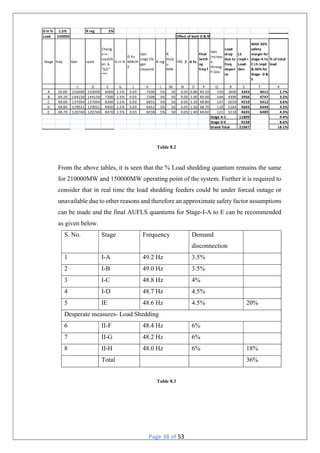
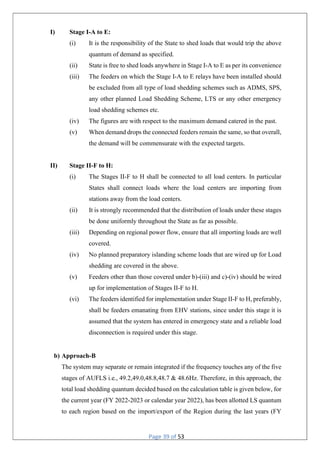
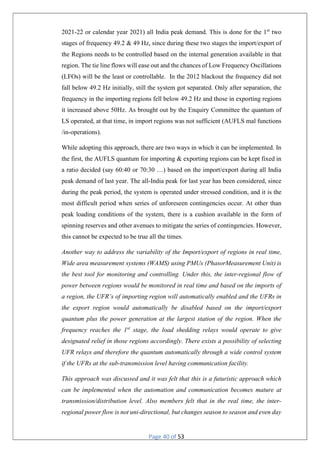
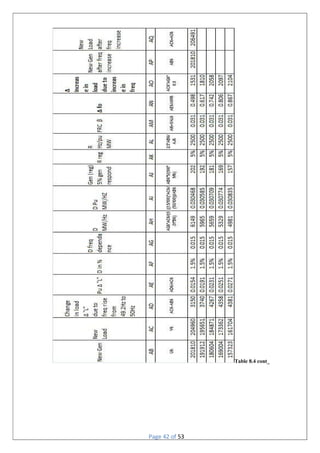
Minutes of 12th Meeting of National Power Committee (NPC) held on 17.10.2022 though
Video Conference (VC)
1. Introduction
1.1. The 12th
Meeting of the National Power Committee (NPC) was held on 17.10.2022
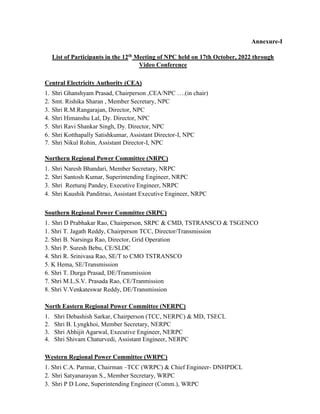
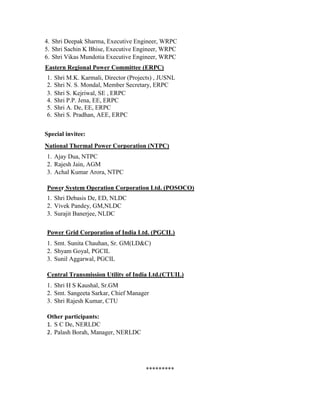
(Monday) at 11:00 AM through VC. The List of Participants is at Annexure-I.
1.2. Shri Ghanshyam Prasad, Chairperson, Central Electricity Authority & National Power
Committee welcomed the participants. He appreciated the fruitful decisions taken by NPC
in its previous meetings. He stated that in this meeting also, many important agenda would
be discussed, and among them one agenda item is about National level Optimization of
Surplus Generation Capacity. He opined that the proposed scheme may be very helpful
during power crisis as happened last year due to increase in coal and gas prices. He further
informed that this issue was also deliberated during Conference of Power Ministers, held on
14th
and 15th
October 2022, chaired by Hon’ble Minister of Power at Udaipur, Rajasthan.
He also emphasized on the need of development of Resource Adequacy Plan of DISCOMs
and visibility of these resources for their proper utilization. Thereafter, he requested Member
Secretary, NPC to take up the agenda of the meeting.
2. Confirmation of Minutes of 11th Meeting of NPC
2.1. The Minutes of 11th Meeting of NPC held on 28.02.2022 through video conference was
circulated vide letter No. 4/MTGS/NPC/CEA/2021/199-218 dated 19.04.2022. The Minutes
of Special meeting of NPC held on 24.06.2022 through video conference was circulated
vide letter No. CEA-GO-15-14/1/2021-NPC Division dated 19.07.2022.
2.2. No comments received on Minutes of both the meetings from the members.
2.3. MS, NPC requested the members and the participants to confirm the minutes of the two
meetings.
2.4. The Minutes of the meetings was confirmed.
3. Action Taken Report of previous meeting of NPC
3.1. Chairperson, CEA had desired to get the Action Taken Report (ATR) on decisions of the
11th meeting and special meeting of NPC.
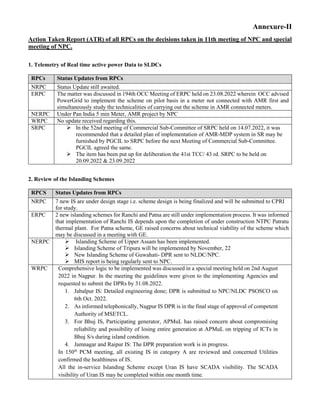
3.2 ATR received from RPCs as on date attached at Annexure-II.
4. National Level Optimization of Surplus Generation Capacity
4.1. Central Electricity Authority vide letter dated 13.09.2022 circulated the draft proposal of
National Level Optimization of Surplus Generation Capacity to the concerned stakeholders,
states, UTs, DISCOMs, SLDCs, RPCs, POSOCO, state sector and central sector Generator
companies for their comments. The last date for comments to be received on the proposal
was 30.09.2022.
4.2. A meeting was also taken by Chairperson, CEA to discuss the same with all stakeholders at
national level on 22.09.2022.
4.3. As per the proposal, the scheme is to utilize the generating capacities in an optimal way so
that during crisis period it may not happen that some generating units are under RSD/ and
on the other hand some states do power cuts.
Deliberations and decisions in the meeting
4.4. MS, NPC briefed the agenda to the Committee.
4.5. Chairperson, CEA/NPC requested members of the committee for their comments on the
proposal.
4.6. Chairperson, SRPC welcomed the proposal and stated SRPC views on the proposal may be
communicated to NPC after discussing the proposal at SRPC level.
4.7. MS, NRPC, informed that various stakeholders like Dhariwal Infrastructure limited,
MSEDCL, NTPC, POSOCO, PTC India, PXIL, PSPCL, Tata Power and HPPC have
already sent their comments on the circulated proposal. The comments are being scrutinized
and would be incorporated in the proposal suitably. He further stated that under this scheme
a National portal would be created where temporary allocation of power from surplus
(Seller) entity to deficit (buyer) entity would be made online amongst constituents in the
country. In the scheme none of existing arrangements shall be disturbed, rather an additional
avenue shall be provided to stakeholders for optimal use of surplus power. The scheme
envisages paperless working for maturing transaction; and shall be subject to willingness of
seller and buyer, confirmation of transmission corridor by NLDC and payment security by
the seller before scheduling of such power. He further added that generating stations would
be permitted to revise its schedule for surplus power from its original beneficiary to any
other beneficiary. The new beneficiary shall be liable to pay both variable charge (VC) and
fixed cost (FC) for full requisition and original beneficiary shall have no right to recall as
entire FC liability is shifted to the new beneficiary because power being temporarily
reallocated to him. Further, the temporary allocation will be based on regulatory tariff of
appropriate commission.
4.8. MS, NPC requested RPCs and all stakeholders to submit their comments within 10 days, so
that the scheme may be finalized much before the next crisis period being envisaged in
April- May 2023.
5. Telemetry of real time active power (MW) data to SLDCs
5.1. MS, NPC informed that NPC Secretariat vide letter no. CEA-GO-15-24/6/2020-NPC
Division/297-309 dated 06.07.2022 circulated the final Technical Specifications (TS) and
the same was also uploaded on the CEA website.
5.2. RPCs were requested to take further necessary action at their end.
6. Review of Status of Islanding schemes
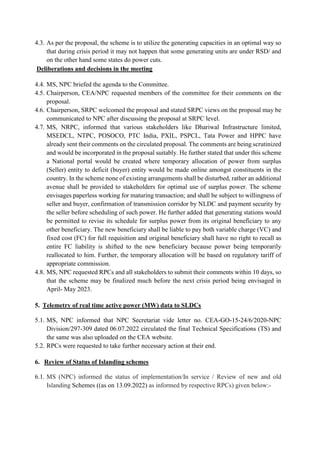
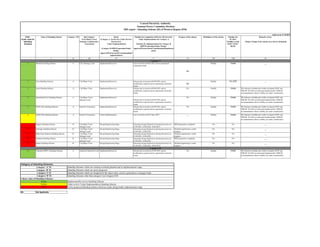
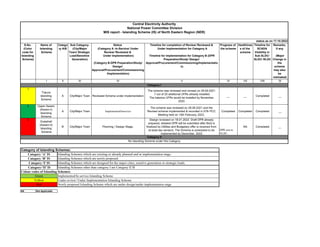
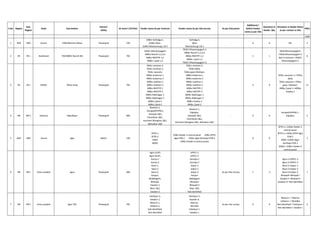
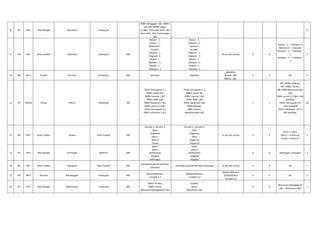
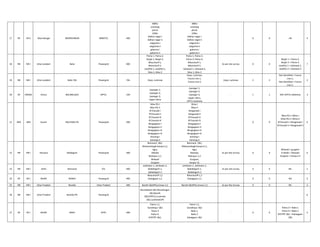
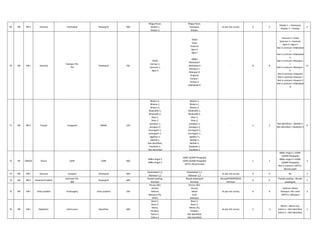
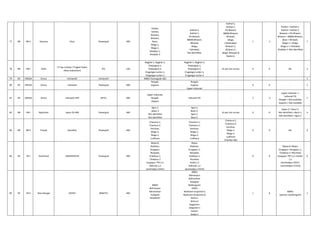
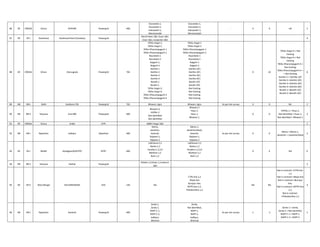
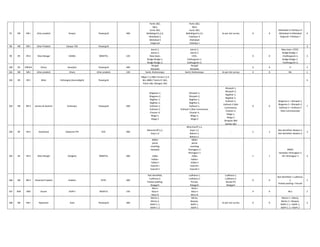
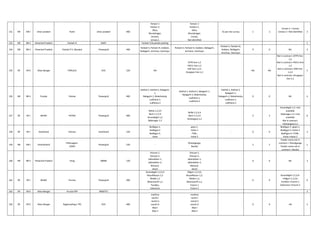
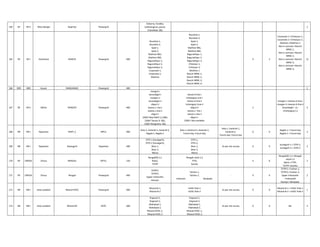
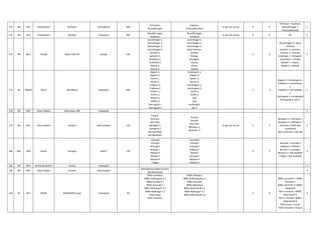
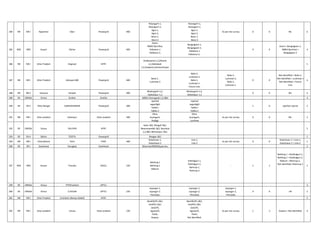
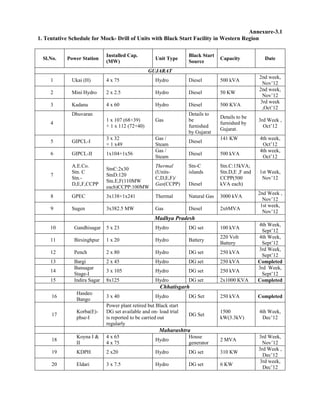
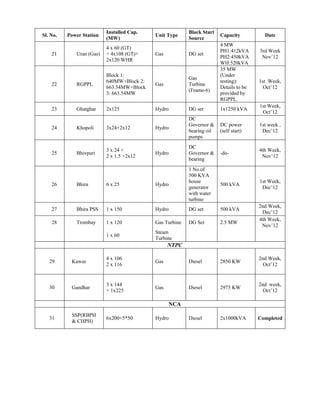
6.1. MS (NPC) informed the status of implementation/In service / Review of new and old
Islanding Schemes ((as on 13.09.2022) as informed by respective RPCs) given below:-
Overview of the status of Islanding Scheme in all Regions
Regio
ns
Number of
Islanding Schemes
Impleme
nted/
Inservi
ce IS
Existing IS
(Cat-A) which
are Under Im
plementation/
under review
Newly propo
sed IS (Cat-
B) which are
under desig
n/Under Im
plementaion
stage)
Newly
proposed IS
(Cat-B) whic
h are
Implemente
d/
Inservice
IS
having
SCADA
visibility
Remarks
Cat-A
(Old
IS)
Cat-B
(New I
S)
Total
SR 4 3 7 7 0 0 3 7 -
ER 7 2 9 4 4 2 0 5*
*1-under
Implementation I
S
KBUNL IS discont
inued.
NR 4 7 11 2 2 7 0 4*
*2-under imple
mentationIS /IS
in design stage
WR 7 5 12 6 1 5 0 6
All In service
IS are made avail
able at SLDC/W
RLDC except Ur
an Islanding Sche
me
NER 2 1 3 1 1 1 0 3*
*2-under impleme
ntationIS /IS in des
ign stage
Total
24 18 42 20 8 15 3 25*
5-under implement
ationIS /IS
in design stage
Deliberation in the meeting
6.2. MS, SRPC informed that all the IS of SR have been implemented and are In Service.
SCADA visibility of all the 7 IS have also been made.
6.3. MS, ERPC informed that 2 number of new IS for Ranchi and Patna are still under
implementation stage. It was informed to the committee that implementation of Ranchi IS
depends upon the completion of under construction NTPC Patratu thermal plant. For Patna
scheme, GE raised concerns about technical viability of the scheme which would be
discussed with GE. ERPC was requested to expedite the process of finalizing the IS in
consultation with entities involved.
6.4. MS, NRPC informed that, initially, 7 number of new islanding schemes were proposed for
NR region. However, in due course of time, some of the States were not showing willingness
and raising concerns on technical feasibility of the newly proposed IS. As in case of
Dehradun islanding scheme, it was informed by Uttrakhand that there was non-availability
of generation in proportion to the load. He further informed that feasibility of such scheme
is still under the discussion. He added that NRPC has set a timeline for Dec 2022 for
finalising the Islanding Schemes of NR. NRPC was requested to expedite the process of
finalizing the IS in consultation with constituent states.
6.5. MS, WRPC informed that 5 number of new islanding schemes were proposed for WR
region. DPR for newly proposed Islanding Schemes of Jabalpur is completed and sent to
NLDC for PSDF funding. Nagpur IS DPR is in the final stage of approval of competent
Authority of MSETCL .WRPC is to follow TATA model of load management used for
Mumbai IS. DPRs from state of Gujarat is awaited. He informed that review meeting for
these newly proposed IS would be taken by WRPC for completion of DPRs by the end of
October. He further informed that for Uran IS, SCADA visibility may be completed within
one month time.
6.6. MS, NERPC informed that DPR old Islanding Scheme of Guwahati would be completed by
October 2022. . He also informed that the Tripura Islanding Scheme is old IS which was
reviewed on 29.09.2021 and the reviewed scheme will be implemented by November, 22.
6.7. NERPC was also requested to expedite the process.
Decisions in the meeting
6.8. Chairperson, NPC/CEA suggested that in case of Mumbai IS, local generation of Mumbai
shall be made available for ensuring sustainability of Mumbai Island since in case of non-
availability of local generation, the Mumbai load will be heavily dependent on import
generation. He suggested WRPC to periodically review the situation.
[Action: WRPC]
6.9. RPCs were again requested to expedite the implementation of new islanding schemes and
review of old Islanding schemes, as per SOP. Islanding Schemes which are under
implementation shall be reviewed and discussed in next NPC meeting
[Action-All RPCs]
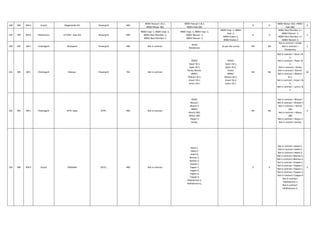
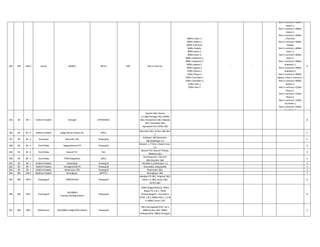
6.10. RPCs were requested to send the updated MIS report on monthly basis to NPC. The updated
MIS is attached at Annexure III.
[Action-All RPCs]
7. National Energy Account (NEA)
7.1. MS (NPC) informed followings in regard to National Energy Account (NEA) to the
committee:
a) MoP vide letter No.A-60016/24/2012-Adm-I dated 30.11.2016 observed that
considering the changing scenarios, the functions of NPC may also be broadened
including the functions to maintain the National Energy Account (NEA) involving the
trans-national and inter-regional transmission transactions.
b) NLDC vide letter dated 09th November
2018 furnished the Agenda Note on National
Energy Account & National Deviation Pool Account. NLDC was of the view that there
is a need for implementing a National Deviation Pool Account based on the National
Energy Account, for streamlining the accounting and settlement at national level.
Further, suitable changes/modifications were required to be effected in the Indian
Electricity Grid Code (IEGC) and Deviation Settlement Mechanism (DSM)
Regulations apart from recognizing the functions of NPC in the regulatory framework.
c) The issue of National Energy Account was deliberated in various meetings (8th
, 9th
, 10th
and 11th
) of NPC and in the 11th
meeting of NPC held on 28.02.2022, NPC and RPCs
agreed that in future, if NEA would be mandated by CERC, the directions may be
followed accordingly. It was also decided that, the mock accounting of the proposed
National Energy Accounting (NEA) may be carried out by NLDC for RPCs and
NPC in order to have a clear understanding of NEA.
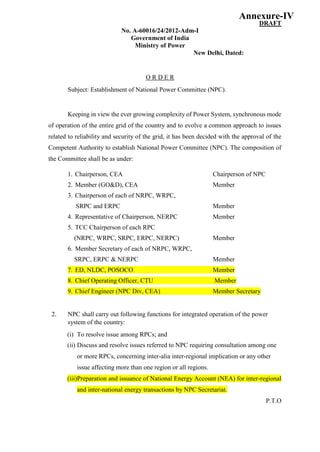
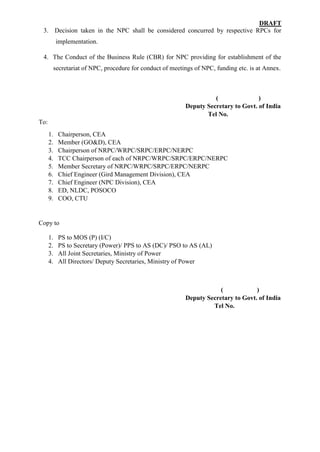
d) In this regard, the amendment in the functions of National Power Committee in its
Conduct of Business Rule (CBR) will be required. The amended CBR of NPC is
attached as Annexure-IV and the same is required to be forwarded to the MoP for
issuance of necessary orders.
Deliberations in the meeting
7.2. ED, NLDC highlighted the importance of NEA for smooth settlement of accounts in case
of inter-regional transactions by avoiding circular fund flow between the regions. It was also
suggested that NEA can be functioned in parallel with the Regional Energy Account (REA)
mentioning inter-regional and cross border transactions, and if there seems no concerns in
NEA, it can be adopted fully at national level and inter-regional & cross border transaction
may be removed from REA.
7.3. MS, NRPC endorsed the view of ED, NLDC. He further added that RPCs have concerns on
NEA since there is no directions from CERC on NEA.
7.4. MS, SRPC informed that presently NLDC issued the mock accounts based on REA accounts
issued by RPCs by merely adding and subtracting the inter-regional and cross border
transaction of DSM account only. He opined there is no value addition in the mock accounts
issued by NLDC since it considers DSM account only. He suggested that NLDC may
include accounts like RRAS and AGC in the mock NEA accounts.
7.5. ED, NLDC informed that currently the mock exercise include DSM accounts and gradually
the other accounts like RRAS, AGC etc. as suggested by SRPC may be included.
7.6. Chairperson, CEA opined that keeping in mind the future requirements, priority has to be
given for seamless inter-regional transactions and NEA is one of such mechanism. He
advised NLDC to analyse the modifications required in the CERC regulations for NEA
and send it to NPC, which can be taken up further with CERC. RPCs can also give
comments on mock accounting of NEA and send them to NPC within two month and
accordingly, the mock accounting can be modified.
7.7. It was also suggested that amendments in the functions of National Power Committee (NPC)
in its Conduct of Business Rule (CBR) can be taken up with MoP simultaneously.
Decisions in the meeting
7.8. POSOCO shall analyse the modifications required in the CERC regulations for NEA and
send it to NPC, which can be taken up further with CERC.
[Action-POSOCO/NPC Secretariat]
7.9. RPCs may give comments on mock accounting of NEA and send them to NPC within two
month and accordingly, the mock accounting can be modified.
[Action-All RPCs]
7.10. NEA requires amendments in the functions of National Power Committee (NPC) in its
Conduct of Business Rule (CBR) which can be taken up with MoP simultaneously.
[Action-NPC Secretariat]
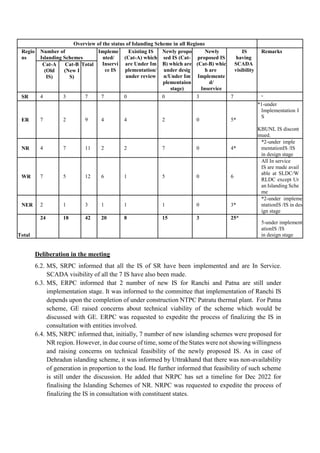
8. Guidelines for locating PMU for URTDSM Phase II project
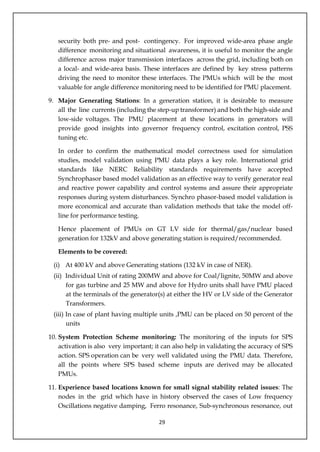
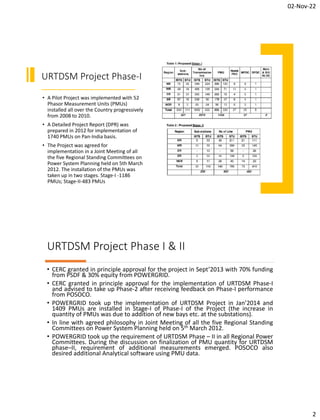
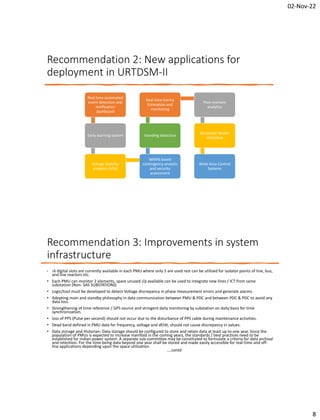
8.1. MS (NPC) informed that Unified Real Time Dynamic State Measurement (URTDSM)
project was agreed for implementation in a Joint Meeting of all the five Regional Standing
Committees on Power System Planning held on 5th
March, 2012. During the meeting,
following PMU placement philosophy was decided:
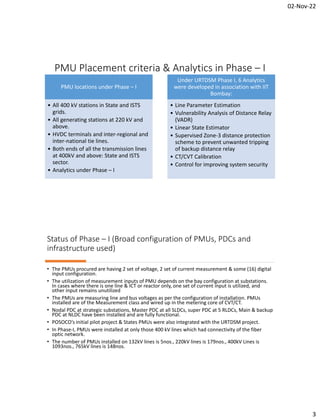
a) All 400 kV stations in State and ISTS grids.
b) All generating stations at 220 kV and above.
c) HVDC terminals and inter-regional and inter-national tie lines.
d) Both ends of all the transmission lines at 400kV and above: State and ISTS
sector.
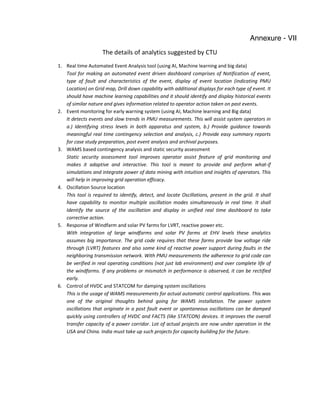
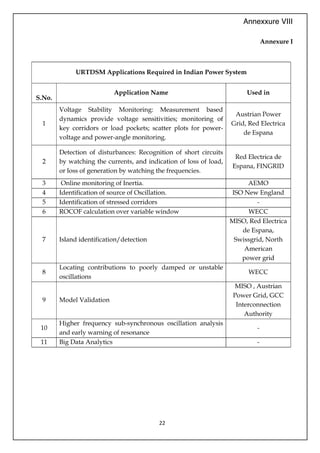
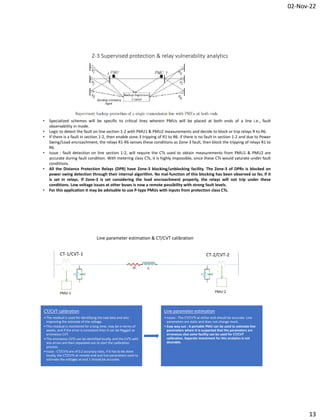
8.2. In addition to the PMU deployment, six (6) analytical software such as Line Parameter
Estimation, Online Vulnerability Analysis, Linear State Estimation, CT/CVT Calibration,
Supervised Zone-3 Distance Protection and Control Schemes for Improving System
Security were also proposed to be developed by IIT Bombay.
8.3. A Detailed Project Report (DPR) was prepared in 2012 for implementation of URTDSM on
Pan -India basis. Based on communication availability, URTDSM Project has been taken
up in two phases as follows:
 Phase-I: 1186 PMUs at 351 substations (communication existing) - Rs. 278.89 crore.
 Phase-II: 554 PMUs at 301 substations (with installation of 11,000 Kms OPGW) -
Rs.377 crore.
 Phasor Data Concentrators with 6 Analytical Software at 32 Control centres
considering requirement of both i.e. Phase-I & Phase-II.
8.4. CERC granted in-principle approval for the project in Sept’2013 with 70% funding from
PSDF & 30% equity from POWERGRID.
8.5. POWERGRID has taken up the implementation of URTDSM Project in Jan’2014 and 1409
PMUs were installed under the Project. The increase in quantity of PMUs is due to addition
of new bays etc.at the substations.
8.6. The feedback on URTDSM Phase-I performance is received from POSOCO.
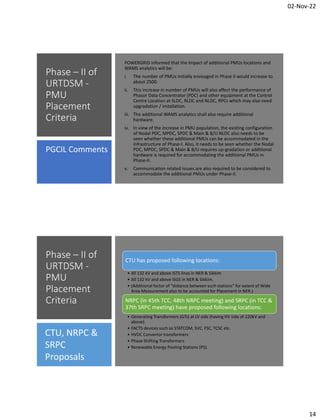
8.7. During the discussion on finalization of PMU quantity for URTDSM phase–II, requirement
of additional locations for PMU installation was raised by NRLDC (in 45th
TCC, 48th
NRPC
meeting) and SRLDC (in TCC & 37th
SRPC meeting)
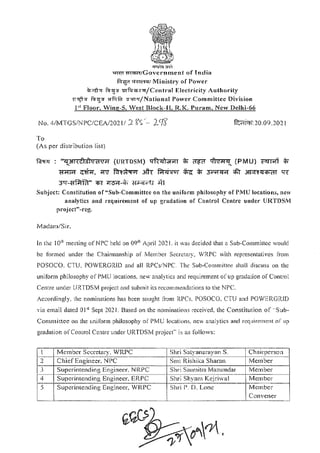
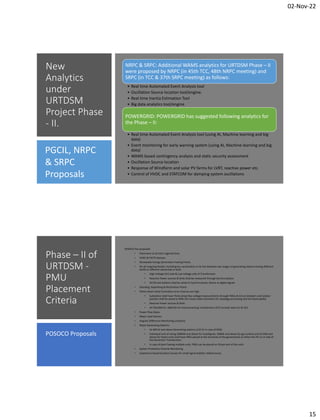
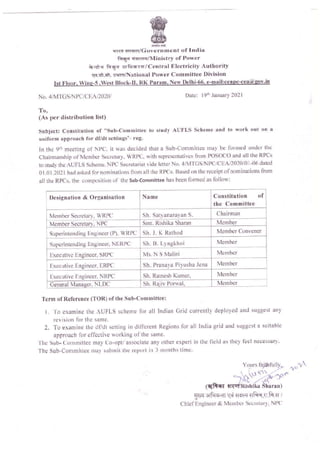
8.8. In the 10th
meeting of NPC, it was decided that a Sub-Committee would be formed under
the chairmanship of Member Secretary, WRPC with representatives from POSOCO, CTU,
POWERGRID, and all RPCs/NPC to discuss on the uniform philosophy of PMU locations,
new analytics and requirement of up gradation of Control Centre under URTDSM project
and submit its recommendations to the NPC.
Deliberations & Decisions in the meeting:
8.9. MS, NPC briefed the members about the agenda item. She requested MS, WRPC to update
the committee regarding the progress of the report.
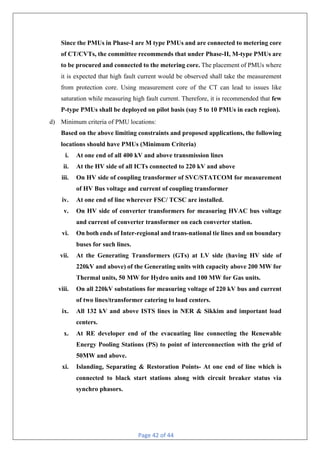
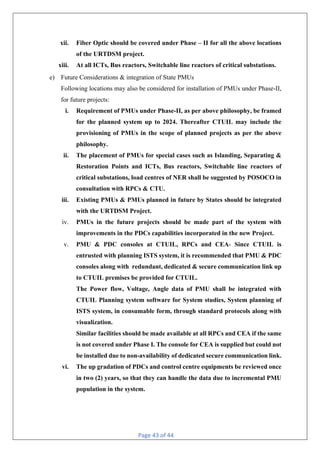
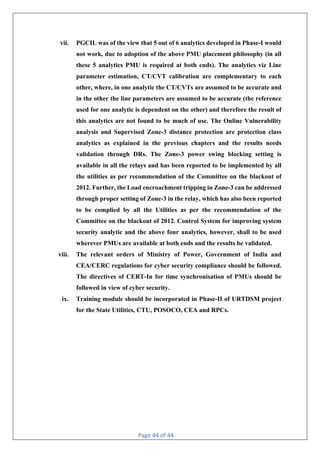
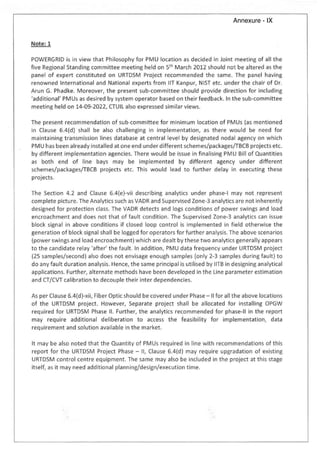
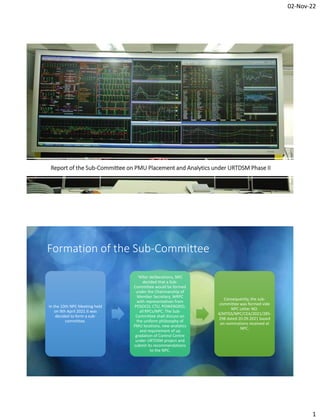
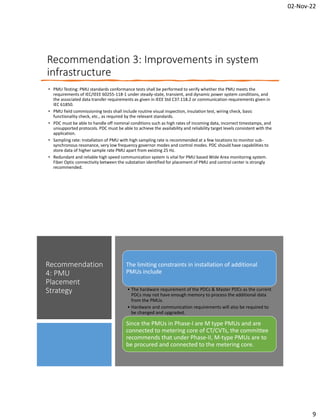
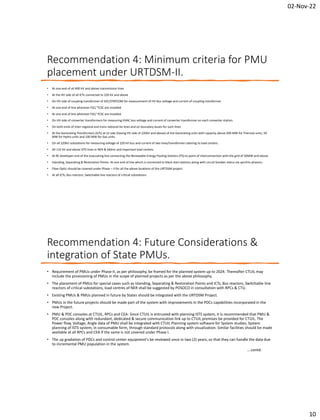
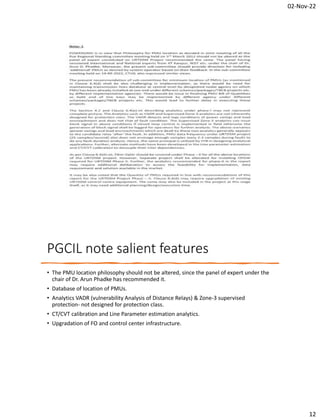
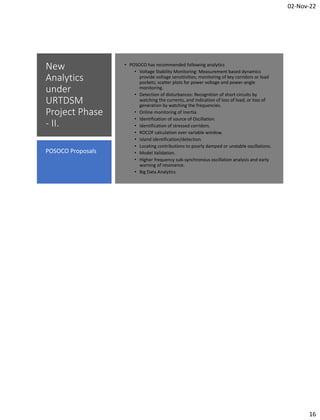
8.10. MS, WRPC informed that the sub-committee has finalised its report. He presented a
presentation highlighting the salient features of the report on philosophy of PMU Placement
and Analytics under URTDSM Phase II. The report and presentation is attached at
Annexure-V.
8.11. Chairperson, CEA/NPC appreciated the sincere efforts of the subcommittee and advised
that the report of sub-committee may be examined at RPCs level. RPCs may give their
suggestions/recommendations within one month time and subsequently based on the
suggestions/recommendations of RPCs, the report would be accepted by NPC. MS WRPC
may take a lead and coordinate for the same and revise the report if required.
[Action-All RPCs/WRPC]
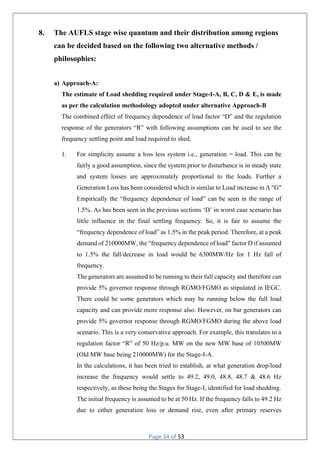
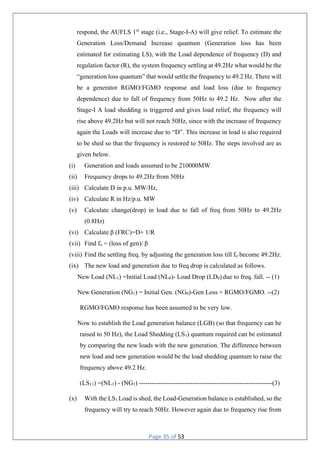
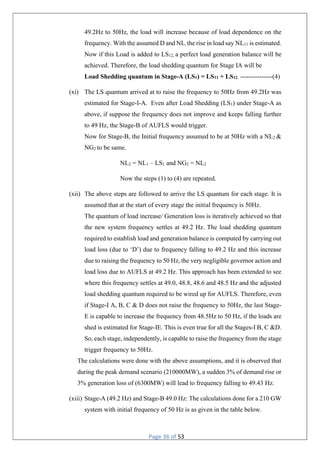
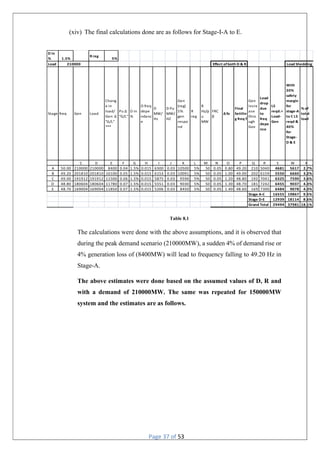
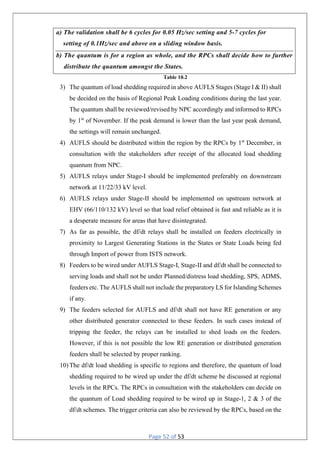
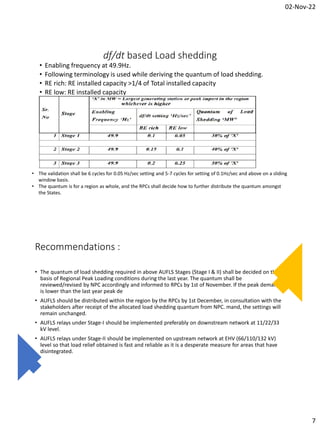
9. Automatic Under Frequency Load Shedding (AUFLS) Scheme and Mapping of Feeders
(A) Review of AUFLS Settings
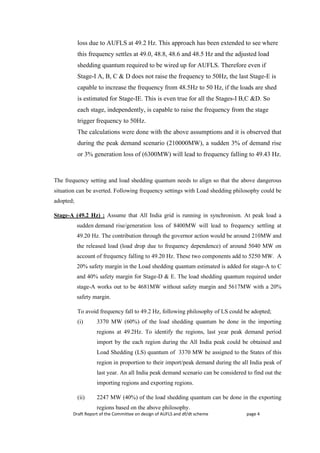
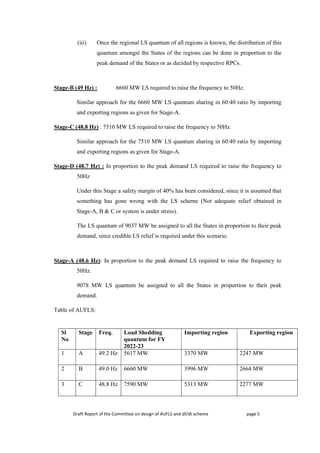
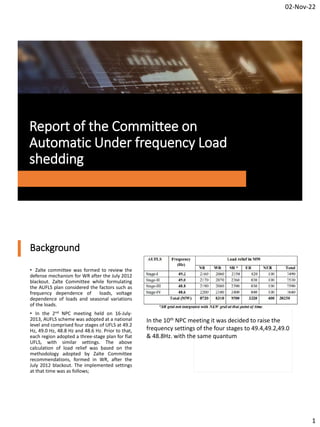
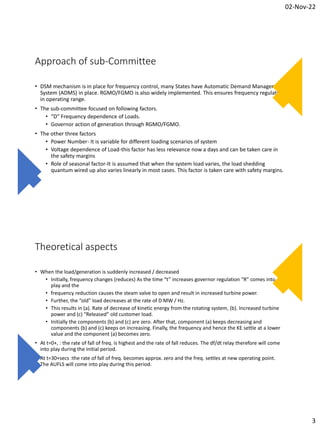
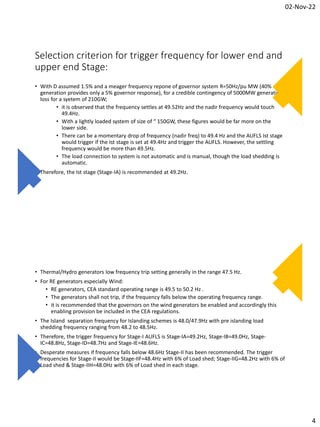
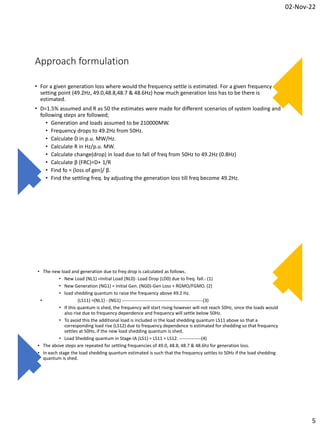
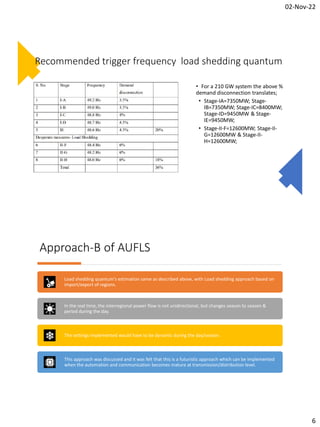
9.1. As per the decision in the 2nd
meeting of NPC held on 16th
July 2013, the following AUFLS
scheme at four (4) stages of frequency viz. 49.2 Hz, 49.0 Hz, 48.8 Hz & 48.6 Hz had been
implemented in all the regions
AUFLS Frequency
(Hz)
Load relief in MW
NR WR SR * ER NER Total
Stage-I 49.2 2160 2060 2350 820 100 7490
Stage-II 49.0 2170 2070 2360 830 100 7530
Stage-III 48.8 2190 2080 2390 830 100 7590
Stage-IV 48.6 2200 2100 2400 840 100 7640
Total
(MW)
8720 8310 9500 3320 400 30250
*SR grid not integrated with NEW grid at that point of time
9.2. In the 10th
meeting of NPC it was decided that the AUFLS scheme (with 4 stages) viz. 49.4,
49.2, 49.0 & 48.8 Hz with existing quantum of load shedding shall be implemented in all
the Regions. A subcommittee was also constituted with members from CEA, RPC,
POSOCO to review of AUFLS scheme and the quantum of load shedding.
9.3. In the 11th
meeting of NPC, it was informed that SR, WR and ER constituents have already
raised the settings of UFR of AUFLS scheme by 0.2 Hz.
Deliberations/Decisions in the meeting:
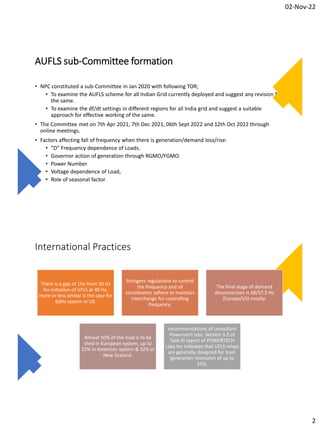
9.4. MS, NPC briefed the agenda item and requested MS, WRPC to update the progress of report
of sub-committee on AUFLS.
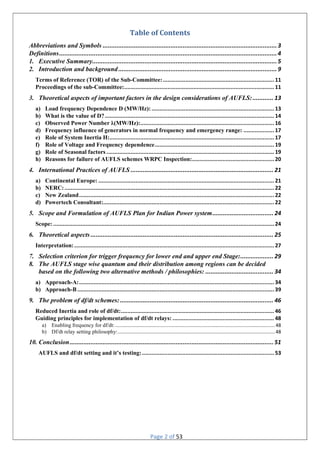
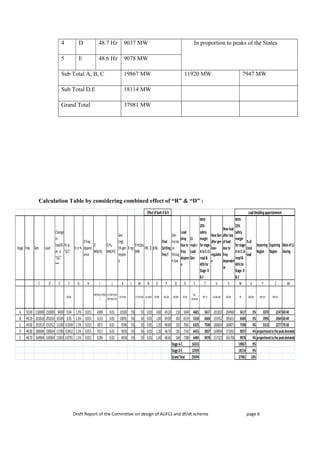
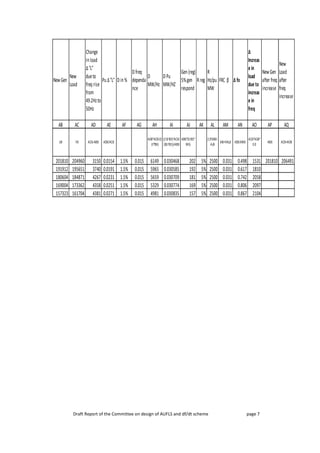
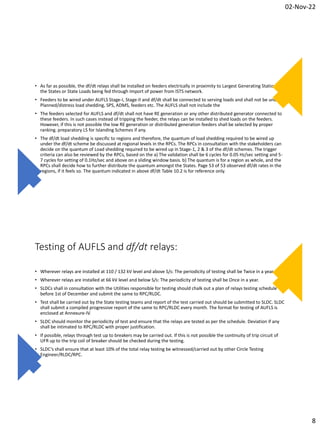
9.5. MS WRPC informed the Committee that report on AUFLS and df/dt has been finalised by
the sub-committee. He gave a presentation (PPT) briefing the highlights of reports. The
report and presentation is attached at Annexure-VI.
9.6. MS, SRPC raised the concern on the quantum of load shedding in the reports and suggested
that it needs to be reviewed considering the Islanding Schemes of SR.
9.7. Chairperson, CEA/NPC appreciated the efforts of the members of the subcommittee for
bringing out a very good technical report. He requested that Member Secretaries of all
RPCs may have a meeting to discuss the report and shall strive to reach at a working
consensus especially for SR. MS WRPC may take a lead and coordinate for the
meeting. NPC may be appraised in the next meeting.
[Action-WRPC/All RPCs]
(B) Mapping of Feeders under AUFLS schemes:
9.8. MS, NPC reiterated that each RPC would submit the details/progress of feeder mapping
under AUFLS scheme on SCADA to NPC Secretariat regularly on a quarterly basis. It was
again suggested that for improving the mapping of feeders following similar procedure as
adopted by SRPC may be followed by all RPCs.
“Generally the 66 kV and 33 kV lines are connected at 132 kV level or 220 kV level,
therefore, the communication system available at 132 kV level and 220 kV level can be
utilized for these lines. For 11 kV and 33 kV level, the DISCOMs data may be integrated
with their control centers. From the control centre it could be picked up to SLDC.”
9.9. The status of mapping of feeder under AUFLS as intimated by RPCs are as below:
RPCs Status Updates from RPCs as on 17.10.2022
NRPC UP-89 %, Punjab-38%,Haryana-85%, Delhi-73%,HP-63%, Rajasthan, UK, J&K
& Chandigarh-0%.
ERPC 95% mapping of feeders achieved.
The matter is being regularly taken up with the state utilities in Test meeting of
ERPC for 100 % mapping of the feeders under AUFLS scheme.
NERPC Assam-100 %, Meghalaya-100%, Nagaland-80%, Arunachal Pradesh, Manipur,
Mizoram & Tripura – 0%.
The issue is being reviewed/discussed in monthly OCC meeting of NERPC and
50% will be mapped by October, 2022.
WRPC The recommendation of NPC regarding the mapping of feeders was taken in 560th
OCC and the utilities were advised to expedite the mapping of feeders. Regular
status of mapping would be taken up in upcoming OCC meetings.
SRPC SCADA mapping status is being updated/reviewed in monthly OCC Meetings.
The status update was taken in the 194th Meeting of OCC held on 12.09.2022 As
on 31.08.2022 mapping was 93% in SR.
9.10. Chairperson, CEA/NPC emphasized that mapping of the feeders is very much required for
smooth operation of the grid. He requested WRPC, NRPC and NERPC to conduct meetings
with their DISCOMs to find solutions for feeder mapping and expedite it in their regions.
The method suggested by SRPC may be explored.
[Action-NRPC/WRPC/NERPC]
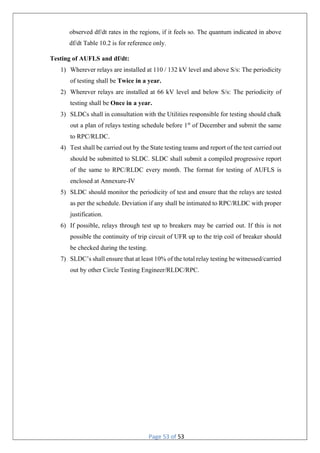
10. Ensuring Proper Functioning of Under Frequency Relays (UFR) & df/dt Relays.
10.1. The updated status of ensuring Proper Functioning of Under Frequency Relays (UFR) &
df/dt Relays as submitted by RPCs are as follows:
RPCs Status Updates from RPCs
NRPC Utilities submit report of mock exercises for healthiness of UFRs on quarterly basis
to NRPC Secretariat. The compliance is monitored in monthly OCC meetings.
Further, NRPC has also conducted UFR inspection of 220 kV Park Street S/s of
DTL on 10.08.2022.
ERPC Certificate of healthiness of UFR relay is being submitted by respective
STU/SLDC in given format in every month and the same is monitored in monthly
OCC meeting of ERPC.
 UFR audit of 3 substations in Bihar was carried out in April-22.
 Further UFR audit of 7 no of substations in West Bengal would be carried out in
November’2022
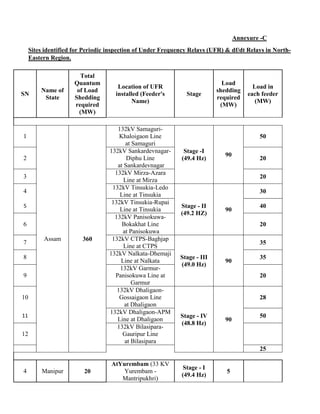
NERPC 8 Substations and 16 feeders for UFR inspection have been identified for
inspection.
 The inspection/test would be completed by 31st December 2022.
WRPC
 In the 560th OCC States confirmed that they are ensuring healthiness of AUFLS
and df/dt relays and detailed report will be submitted shortly.
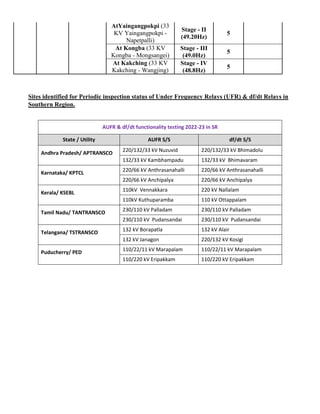
SRPC 12 Substations each for UFR & df/dt inspection have been identified for
inspection.
 The inspection/test would be completed by 31st
December 2022.
10.2. Chairperson CEA suggested that RPCs shall periodically conduct the periodic inspection of
UFR and df/dt relays to ensure proper functioning of UFR and df/dt relays. He also advised
NPC Secretariat to regularly follow-up the status update from RPCs on the agenda item.
Decision in the meeting:
10.3. RPCs shall periodically conduct the inspection of UFR and df/dt relays to ensure proper
functioning of UFR and df/dt relays.
10.4. NPC Secretariat shall regularly follow-up the status update from RPCs on the agenda item.
[Action-All RPCs and NPC Secretariat]
11. Power System Stabilizers (PSS) tuning
11.1. The Enquiry Committee constituted by Govt. of India to enquire into the grid disturbances
of July, 2012, had inter-alia recommended proper tuning of electronic devices and PSS of
generators.
11.2. In the 9th
meeting of NPC, it was decided that a Sub-group may be constituted comprising
of representatives of Protection Sub-Committee of respective RPCs, NPC, NLDC, CTU,
NTPC and NHPC, to finalize a common procedure for Power System Stabilizers (PSS)
Tuning. Accordingly, NPC Secretariat vide letter dated 08.02.2021 has formed the Sub-
Committee under the chairmanship of MS, WRPC to finalize a common procedure for
Power System Stabilizers (PSS) Tuning.
11.3. MS WRPC briefed the ongoing works of the committee. He informed that within a month
time the report will be finalised.
11.4. Chairperson, CEA advised that before finalizing the reports, it must be ensured that
views and comments of RPCs and other stakeholders may be incorporated suitably in
the final report.
[Action-All RPC]
12. Issuance of Regional Energy Account (REA)
12.1. The status update received to NPC regarding the issuance of Regional Energy Account from
RPCs, NLDC and NTPC are as follows:
RPCs Status Updates from RPCs
NRPC REA Issued till 4th
day of the month.
ERPC ERPC Secretariat issues REA on the same day or by next day of receiving the
input data from ERLDC.
NERPC NERPC Secretariat issues REA (Provisional) on 1st
or 2nd
working day of the
month.
WRPC REA Issued till 2nd
of the month.
SRPC SRPC Secretariat issues REA (Provisional) on 1st
or 2nd
of the month.
NTPC From last six months REAs are being generally issued on 2nd
day of the month
from NERPC, ERPC, SRPC, and WRPC. NRPC also issued it timely but
sometimes till 4th
day of the month. He informed that overall the situation has
been improved in the past six months
NLDC The works related to preparation of data for REA is always dealt on priority,
however, sometimes it may be delayed due to generation of errors in data which
requires cross checking of data
12.2. Chairperson CEA stated that as informed by NTPC it appears that the issue has been
resolved and REA is being issued by RPCs in a timely manner. He suggested that this agenda
may be dropped from next meeting until any issue arises further in issuance of REA.
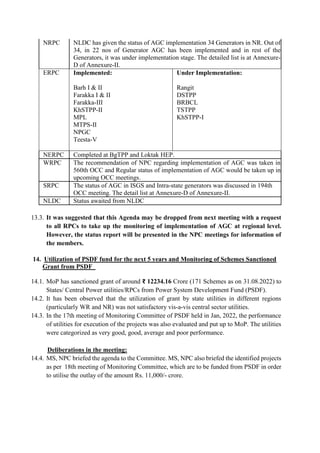
13. Implementation of Automatic Generation Control (AGC) in India (at Inter-State level)
13.1. In the 11th
meeting of NPC, it was observed that progress of implementation of AGC is slow
especially in intra-state AGC implementation. RPCs were requested to monitor the status
of intra-state AGC implementation regularly and to suggest states to approach SERC for the
financial implication of AGC implementation.
13.2. The status update received from RPCs are at as below:
RPCs Status Updates from RPCs
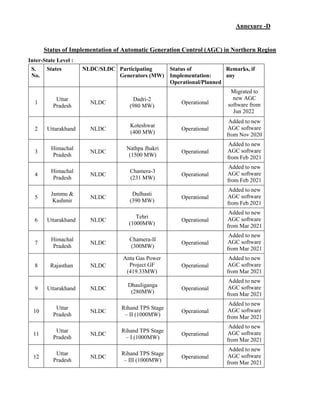
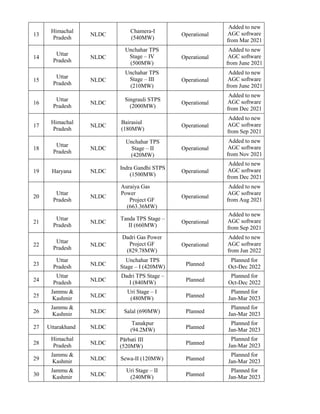
NRPC NLDC has given the status of AGC implementation 34 Generators in NR. Out of
34, in 22 nos of Generator AGC has been implemented and in rest of the
Generators, it was under implementation stage. The detailed list is at Annexure-
D of Annexure-II.
ERPC Implemented:
 Barh I & II
 Farakka I & II
 Farakka-III
 KhSTPP-II
 MPL
 MTPS-II
 NPGC
 Teesta-V
Under Implementation:
 Rangit
 DSTPP
 BRBCL
 TSTPP
 KhSTPP-I
NERPC Completed at BgTPP and Loktak HEP.
WRPC The recommendation of NPC regarding implementation of AGC was taken in
560th OCC and Regular status of implementation of AGC would be taken up in
upcoming OCC meetings.
SRPC The status of AGC in ISGS and Intra-state generators was discussed in 194th
OCC meeting. The detail list at Annexure-D of Annexure-II.
NLDC Status awaited from NLDC
13.3. It was suggested that this Agenda may be dropped from next meeting with a request
to all RPCs to take up the monitoring of implementation of AGC at regional level.
However, the status report will be presented in the NPC meetings for information of
the members.
14. Utilization of PSDF fund for the next 5 years and Monitoring of Schemes Sanctioned
Grant from PSDF
14.1. MoP has sanctioned grant of around ₹ 12234.16 Crore (171 Schemes as on 31.08.2022) to
States/ Central Power utilities/RPCs from Power System Development Fund (PSDF).
14.2. It has been observed that the utilization of grant by state utilities in different regions
(particularly WR and NR) was not satisfactory vis-a-vis central sector utilities.
14.3. In the 17th meeting of Monitoring Committee of PSDF held in Jan, 2022, the performance
of utilities for execution of the projects was also evaluated and put up to MoP. The utilities
were categorized as very good, good, average and poor performance.
Deliberations in the meeting:
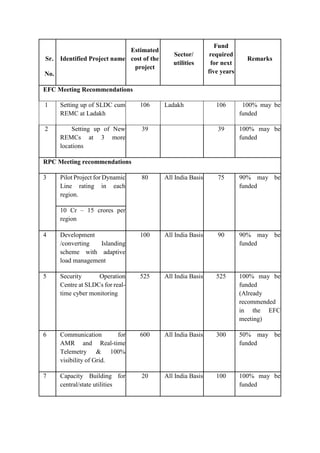
14.4. MS, NPC briefed the agenda to the Committee. MS, NPC also briefed the identified projects
as per 18th meeting of Monitoring Committee, which are to be funded from PSDF in order
to utilise the outlay of the amount Rs. 11,000/- crore.
Sr.
No.
Identified Project name
Estimated
cost of the
project
Sector/
utilities
Fund
required
for next
five years
Remarks
EFC Meeting Recommendations
1 Setting up of SLDC cum
REMC at Ladakh
106 Ladakh 106 100% may be
funded
2 Setting up of New
REMCs at 3 more
locations
39 39 100% may be
funded
RPC Meeting recommendations
3 Pilot Project for Dynamic
Line rating in each
region.
80 All India Basis 75 90% may be
funded
10 Cr – 15 crores per
region
4 Development
/converting Islanding
scheme with adaptive
load management
100 All India Basis 90 90% may be
funded
5 Security Operation
Centre at SLDCs for real-
time cyber monitoring
525 All India Basis 525 100% may be
funded
(Already
recommended
in the EFC
meeting)
6 Communication for
AMR and Real-time
Telemetry & 100%
visibility of Grid.
600 All India Basis 300 50% may be
funded
7 Capacity Building for
central/state utilities
20 All India Basis 100 100% may be
funded
14.5. Chairperson, NPC/CEA was of the view that RPCs are not directly assigned for monitoring
of PSDF projects and suggested that monitoring of PSDF sanctioned projects may be done
through the Project Monitoring Group of PSDF which has been created for the same. All
RPCs endorsed the view of Chairperson, CEA.
14.6. MS NPC was of the view that the Project Monitoring Group of PSDF conducts various
meetings at regional levels for monitoring the implementation of sanctioned scheme and
these meetings were impactful in terms of reduction in delay in completion of projects and
also improves the disbursement of fund to project entities. The purpose of bringing this
agenda in NPC meetings was to sensitise the states for timely completion of projects through
RPCs
14.7. Chairperson, NPC/CEA raised concern on delay in sanctioning of the projects under PSDF.
On this MS, NRPC suggested for a dedicated online portal for PSDF for uploading of DPR,
comments of TESG, and inputs of project entities so that the project may be sanctioned in
limited time period.
14.8. ED, NLDC informed the committee that the portal was already developed one year back but
it has not been utilised by the entities. NLDC stated that they would again request
the utilities /states to utilise the portal.
14.9. Chairperson, NPC/CEA advised NLDC that the portal to be revived and to be made fully
operational. NLDC shall also informed states/utilities regarding the portal and suggest them
to utilise it for early sanctioning of projects in limited time period.
Decisions in the meeting:
14.10. NLDC shall revived the portal again and made it functional completely. POSOCO shall also
disseminate the information to states/utilities regarding the portal and suggest them to utilise
it for early sanctioning of projects through PSDF.
[Action-POSOCO/NLDC]
14.11. It was decided that the agenda item may be dropped as the monitoring of PSDF sanctioned
projects is done through Project Monitoring Group (PMG) of PSDF.
15. Membership of RPC forum (ERPC- Agenda)
15.1. Government of India has a vision of achieving Renewable Energy installation target of 150
GW and 450 GW by 2022 and 2030 respectively. The major challenge before the
government is the RE integration to the Indian Electricity Grid and smooth running of the
Grid in the Real Time operation. For resolving the issues of RE generators, smooth
integration and proper real time dispatch of RE generation, ERPC proposed a suitable
provision for inclusion of RE generators with threshold of 200 MW and above as a
membership of RPC forum.
15.2. In the 11th meeting of NPC, it was observed that the issue needs deliberation at the RPC
level first and afterward may be discussed at NPC level.
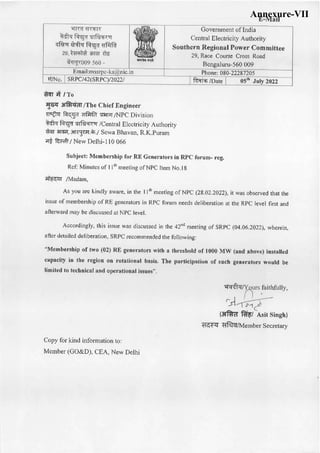
15.3. SRPC vide letter dated 05.07.2022(Annexure-VII) informed that the issue was discussed
in the 42nd meeting of SRPC. SRPC recommended that membership of two RE generators
with threshold of 1000 MW (and above) installed capacity in the region on rotational basis.
The participation of such generators would be limited to technical and operational issues.
Deliberations & decisions in the meeting
15.4. ERPC briefed the agenda to the Committee.
15.5. MS, NPC informed that SRPC had sent their recommendation to consider membership of
two RE generators with threshold of 1000 MW (and above) installed capacity in the region
on the rotational basis. The participation of such generator would be limited to technical and
operational issues.
15.6. Chairperson, CEA/NPC suggested that all RPCs may share their views to NPC Secretariat.
The views of all RPCs may be analysed and a holistic recommendation may be prepared by
NPC Secretariat for approval.
[Action-All RPCs and NPC Secretariat]
16. The meeting ended with Vote of thanks to the Chair.
*****
Annexure-I
List of Participants in the 12th Meeting of NPC held on 17th October, 2022 through
Video Conference
Central Electricity Authority (CEA)
1. Shri Ghanshyam Prasad, Chairperson ,CEA/NPC ….(in chair)
2. Smt. Rishika Sharan , Member Secretary, NPC
3. Shri R.M.Rangarajan, Director, NPC
4. Shri Himanshu Lal, Dy. Director, NPC
5. Shri Ravi Shankar Singh, Dy. Director, NPC
6. Shri Kotthapally Satishkumar, Assistant Director-I, NPC
7. Shri Nikul Rohin, Assistant Director-I, NPC
Northern Regional Power Committee (NRPC)
1. Shri Naresh Bhandari, Member Secretary, NRPC
2. Shri Santosh Kumar, Superintending Engineer, NRPC
3. Shri Reeturaj Pandey, Executive Engineer, NRPC
4. Shri Kaushik Panditrao, Assistant Executive Engineer, NRPC
Southern Regional Power Committee (SRPC)
1. Shri D Prabhakar Rao, Chairperson, SRPC & CMD, TSTRANSCO & TSGENCO
1. Shri T. Jagath Reddy, Chairperson TCC, Director/Transmission
2. Shri B. Narsinga Rao, Director, Grid Operation
3. Shri P. Suresh Bebu, CE/SLDC
4. Shri R. Srinivasa Rao, SE/T to CMO TSTRANSCO
5. K Hema, SE/Transmission
6. Shri T. Durga Prasad, DE/Transmission
7. Shri M.L.S.V. Prasada Rao, CE/Tranmission
8. Shri V.Venkateswar Reddy, DE/Transmission
North Eastern Regional Power Committee (NERPC)
1. Shri Debashish Sarkar, Chairperson (TCC, NERPC) & MD, TSECL
2. Shri B. Lyngkhoi, Member Secretary, NERPC
3. Shri Abhijit Agarwal, Executive Engineer, NERPC
4. Shri Shivam Chaturvedi, Assistant Engineer, NERPC
Western Regional Power Committee (WRPC)
1. Shri C.A. Parmar, Chairman –TCC (WRPC) & Chief Engineer- DNHPDCL
2. Shri Satyanarayan S., Member Secretary, WRPC
3. Shri P D Lone, Superintending Engineer (Comm.), WRPC
4. Shri Deepak Sharma, Executive Engineer, WRPC
5. Shri Sachin K Bhise, Executive Engineer, WRPC
6. Shri Vikas Mundotia Executive Engineer, WRPC
Eastern Regional Power Committee (ERPC)
1. Shri M.K. Karmali, Director (Projects) , JUSNL
2. Shri N. S. Mondal, Member Secretary, ERPC
3. Shri S. Kejriwal, SE , ERPC
4. Shri P.P. Jena, EE, ERPC
5. Shri A. De, EE, ERPC
6. Shri S. Pradhan, AEE, ERPC
Special invitee:
National Thermal Power Corporation (NTPC)
1. Ajay Dua, NTPC
2. Rajesh Jain, AGM
3. Achal Kumar Arora, NTPC
Power System Operation Corporation Ltd. (POSOCO)
1. Shri Debasis De, ED, NLDC
2. Vivek Pandey, GM,NLDC
3. Surajit Banerjee, NLDC
Power Grid Corporation of India Ltd. (PGCIL)
1. Smt. Sunita Chauhan, Sr. GM(LD&C)
2. Shyam Goyal, PGCIL
3. Sunil Aggarwal, PGCIL
Central Transmission Utility of India Ltd.(CTUIL)
1. Shri H S Kaushal, Sr.GM
2. Smt. Sangeeta Sarkar, Chief Manager
3. Shri Rajesh Kumar, CTU
Other participants:
1. S C De, NERLDC
2. Palash Borah, Manager, NERLDC
*********
Annexure-II
Action Taken Report (ATR) of all RPCs on the decisions taken in 11th meeting of NPC and special
meeting of NPC.
1. Telemetry of Real time active power Data to SLDCs
RPCs Status Updates from RPCs
NRPC Status Update still awaited.
ERPC The matter was discussed in 194th OCC Meeting of ERPC held on 23.08.2022 wherein OCC advised
PowerGrid to implement the scheme on pilot basis in a meter not connected with AMR first and
simultaneously study the technicalities of carrying out the scheme in AMR connected meters.
NERPC Under Pan India 5 min Meter, AMR project by NPC
WRPC No update received regarding this.
SRPC  In the 52nd meeting of Commercial Sub-Committee of SRPC held on 14.07.2022, it was
recommended that a detailed plan of implementation of AMR-MDP system in SR may be
furnished by PGCIL to SRPC before the next Meeting of Commercial Sub-Committee.
PGCIL agreed the same.
 The item has been put up for deliberation the 41st TCC/ 43 rd. SRPC to be held on
20.09.2022 & 23.09.2022
2. Review of the Islanding Schemes
RPCS Status Updates from RPCs
NRPC 7 new IS are under design stage i.e. scheme design is being finalized and will be submitted to CPRI
for study.
ERPC 2 new islanding schemes for Ranchi and Patna are still under implementation process. It was informed
that implementation of Ranchi IS depends upon the completion of under construction NTPC Patratu
thermal plant. For Patna scheme, GE raised concerns about technical viability of the scheme which
may be discussed in a meeting with GE.
NERPC  Islanding Scheme of Upper Assam has been implemented.
 Islanding Scheme of Tripura will be implemented by November, 22
 New Islanding Scheme of Guwahati- DPR sent to NLDC/NPC.
 MIS report is being regularly sent to NPC.
WRPC Comprehensive logic to be implemented was discussed in a special meeting held on 2nd August
2022 in Nagpur. In the meeting the guidelines were given to the implementing Agencies and
requested to submit the DPRs by 31.08.2022.
1. Jabalpur IS: Detailed engineering done; DPR is submitted to NPC/NLDC PSOSCO on
6th Oct. 2022.
2. As informed telephonically, Nagpur IS DPR is in the final stage of approval of competent
Authority of MSETCL.
3. For Bhuj IS, Participating generator, APMuL has raised concern about compromising
reliability and possibility of losing entire generation at APMuL on tripping of ICTs in
Bhuj S/s during island condition.
4. Jamnagar and Raipur IS: The DPR preparation work is in progress.
In 150th
PCM meeting, all existing IS in category A are reviewed and concerned Utilities
confirmed the healthiness of IS.
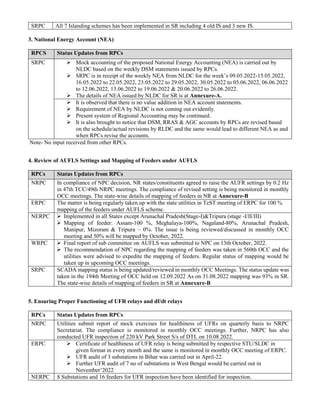
All the in-service Islanding Scheme except Uran IS have SCADA visibility. The SCADA
visibility of Uran IS may be completed within one month time.
SRPC All 7 Islanding schemes has been implemented in SR including 4 old IS and 3 new IS.
3. National Energy Account (NEA)
RPCS Status Updates from RPCs
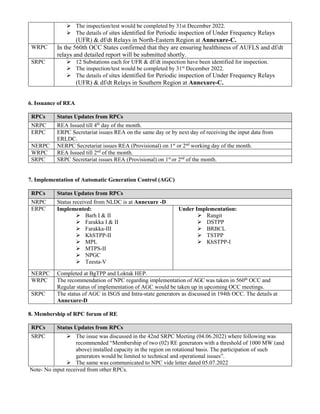
SRPC  Mock accounting of the proposed National Energy Accounting (NEA) is carried out by
NLDC based on the weekly DSM statements issued by RPCs.
 SRPC is in receipt of the weekly NEA from NLDC for the week’s 09.05.2022-15.05.2022,
16.05.2022 to 22.05.2022, 23.05.2022 to 29.05.2022, 30.05.2022 to 05.06.2022, 06.06.2022
to 12.06.2022, 13.06.2022 to 19.06.2022 & 20.06.2022 to 26.06.2022.
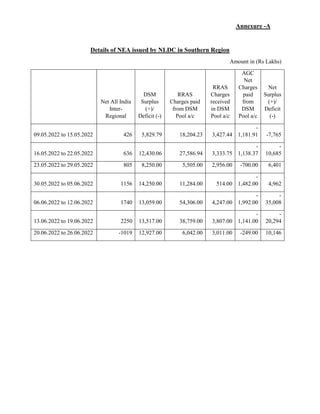
 The details of NEA issued by NLDC for SR is at Annexure-A.
 It is observed that there is no value addition in NEA account statements.
 Requirement of NEA by NLDC is not coming out evidently.
 Present system of Regional Accounting may be continued.
 It is also brought to notice that DSM, RRAS & AGC accounts by RPCs are revised based
on the schedule/actual revisions by RLDC and the same would lead to different NEA as and
when RPCs revise the accounts.
Note- No input received from other RPCs.
4. Review of AUFLS Settings and Mapping of Feeders under AUFLS
RPCs Status Updates from RPCs
NRPC In compliance of NPC decision, NR states/constituents agreed to raise the AUFR settings by 0.2 Hz
in 47th TCC/49th NRPC meetings. The compliance of revised setting is being monitored in monthly
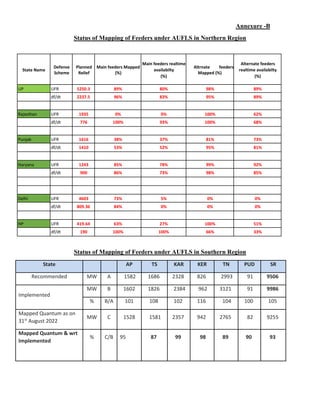
OCC meetings. The state-wise details of mapping of feeders in NR at Annexure-B
ERPC The matter is being regularly taken up with the state utilities in TeST meeting of ERPC for 100 %
mapping of the feeders under AUFLS scheme.
NERPC  Implemented in all States except Arunachal Pradesh(Stage-I)&Tripura (stage -I/II/III)
 Mapping of feeder: Assam-100 %, Meghalaya-100%, Nagaland-80%, Arunachal Pradesh,
Manipur, Mizoram & Tripura – 0%. The issue is being reviewed/discussed in monthly OCC
meeting and 50% will be mapped by October, 2022.
WRPC  Final report of sub committee on AUFLS was submitted to NPC on 13th October, 2022.
 The recommendation of NPC regarding the mapping of feeders was taken in 560th OCC and the
utilities were advised to expedite the mapping of feeders. Regular status of mapping would be
taken up in upcoming OCC meetings.
SRPC SCADA mapping status is being updated/reviewed in monthly OCC Meetings. The status update was
taken in the 194th Meeting of OCC held on 12.09.2022 As on 31.08.2022 mapping was 93% in SR.
The state-wise details of mapping of feeders in SR at Annexure-B
5. Ensuring Proper Functioning of UFR relays and df/dt relays
RPCs Status Updates from RPCs
NRPC Utilities submit report of mock exercises for healthiness of UFRs on quarterly basis to NRPC
Secretariat. The compliance is monitored in monthly OCC meetings. Further, NRPC has also
conducted UFR inspection of 220 kV Park Street S/s of DTL on 10.08.2022.
ERPC  Certificate of healthiness of UFR relay is being submitted by respective STU/SLDC in
given format in every month and the same is monitored in monthly OCC meeting of ERPC.
 UFR audit of 3 substations in Bihar was carried out in April-22.
 Further UFR audit of 7 no of substations in West Bengal would be carried out in
November’2022
NERPC 8 Substations and 16 feeders for UFR inspection have been identified for inspection.
 The inspection/test would be completed by 31st December 2022.
 The details of sites identified for Periodic inspection of Under Frequency Relays
(UFR) & df/dt Relays in North-Eastern Region at Annexure-C.
WRPC In the 560th OCC States confirmed that they are ensuring healthiness of AUFLS and df/dt
relays and detailed report will be submitted shortly.
SRPC  12 Substations each for UFR & df/dt inspection have been identified for inspection.
 The inspection/test would be completed by 31st
December 2022.
 The details of sites identified for Periodic inspection of Under Frequency Relays
(UFR) & df/dt Relays in Southern Region at Annexure-C.
6. Issuance of REA
RPCs Status Updates from RPCs
NRPC REA Issued till 4th
day of the month.
ERPC ERPC Secretariat issues REA on the same day or by next day of receiving the input data from
ERLDC.
NERPC NERPC Secretariat issues REA (Provisional) on 1st
or 2nd
working day of the month.
WRPC REA Issued till 2nd
of the month.
SRPC SRPC Secretariat issues REA (Provisional) on 1st
or 2nd
of the month.
7. Implementation of Automatic Generation Control (AGC)
RPCs Status Updates from RPCs
NRPC Status received from NLDC is at Annexure -D
ERPC Implemented:
 Barh I & II
 Farakka I & II
 Farakka-III
 KhSTPP-II
 MPL
 MTPS-II
 NPGC
 Teesta-V
Under Implementation:
 Rangit
 DSTPP
 BRBCL
 TSTPP
 KhSTPP-I
NERPC Completed at BgTPP and Loktak HEP.
WRPC The recommendation of NPC regarding implementation of AGC was taken in 560th
OCC and
Regular status of implementation of AGC would be taken up in upcoming OCC meetings.
SRPC The status of AGC in ISGS and Intra-state generators as discussed in 194th OCC. The details at
Annexure-D
8. Membership of RPC forum of RE
RPCs Status Updates from RPCs
SRPC  The issue was discussed in the 42nd SRPC Meeting (04.06.2022) where following was
recommended “Membership of two (02) RE generators with a threshold of 1000 MW (and
above) installed capacity in the region on rotational basis. The participation of such
generators would be limited to technical and operational issues”.
 The same was communicated to NPC vide letter dated 05.07.2022
Note- No input received from other RPCs.
Annexure -A
Details of NEA issued by NLDC in Southern Region
Amount in (Rs Lakhs)
Net All India
Inter-
Regional
DSM
Surplus
(+)/
Deficit (-)
RRAS
Charges paid
from DSM
Pool a/c
RRAS
Charges
received
in DSM
Pool a/c
AGC
Net
Charges
paid
from
DSM
Pool a/c
Net
Surplus
(+)/
Deficit
(-)
09.05.2022 to 15.05.2022 426 5,829.79 18,204.23 3,427.44
-
1,181.91 -7,765
16.05.2022 to 22.05.2022 636 12,430.06 27,586.94 3,333.75
-
1,138.37
-
10,685
23.05.2022 to 29.05.2022 805 8,250.00 5,505.00 2,956.00 -700.00 6,401
30.05.2022 to 05.06.2022 1156 14,250.00 11,284.00 514.00
-
1,482.00 4,962
06.06.2022 to 12.06.2022 1740 13,059.00 54,306.00 4,247.00
-
1,992.00
-
35,008
13.06.2022 to 19.06.2022 2250 13,517.00 38,759.00 3,807.00
-
1,141.00
-
20,294
20.06.2022 to 26.06.2022 -1019 12,927.00 6,042.00 3,011.00 -249.00 10,146
Annexure -B
Status of Mapping of Feeders under AUFLS in Northern Region
State Name
Defense
Scheme
Planned
Relief
Main feeders Mapped
(%)
Main feeders realtime
availabilty
(%)
Altrnate feeders
Mapped (%)
Alternate feeders
realtime availabilty
(%)
UP UFR 5250.3 89% 80% 98% 89%
df/dt 2237.5 96% 83% 95% 89%
Rajasthan UFR 1935 0% 0% 100% 62%
df/dt 776 100% 93% 100% 68%
Punjab UFR 1616 38% 37% 81% 73%
df/dt 1410 53% 52% 95% 81%
Haryana UFR 1243 85% 78% 99% 92%
df/dt 900 86% 73% 98% 85%
Delhi UFR 4603 73% 5% 0% 0%
df/dt 809.36 84% 0% 0% 0%
HP UFR 419.64 63% 27% 100% 51%
df/dt 190 100% 100% 66% 33%
Status of Mapping of Feeders under AUFLS in Southern Region
State AP TS KAR KER TN PUD SR
Recommended MW A 1582 1686 2328 826 2993 91 9506
Implemented
MW B 1602 1826 2384 962 3121 91 9986
% B/A 101 108 102 116 104 100 105
Mapped Quantum as on
31st
August 2022
MW C 1528 1581 2357 942 2765 82 9255
Mapped Quantum & wrt
Implemented
% C/B 95 87 99 98 89 90 93
Annexure -C
Sites identified for Periodic inspection of Under Frequency Relays (UFR) & df/dt Relays in North-
Eastern Region.
SN
Name of
State
Total
Quantum
of Load
Shedding
required
(MW)
Location of UFR
installed (Feeder's
Name)
Stage
Load
shedding
required
(MW)
Load in
each feeder
(MW)
1
Assam 360
132kV Samaguri-
Khaloigaon Line
at Samaguri
Stage -I
(49.4 Hz)
90
50
2
132kV Sankardevnagar-
Diphu Line
at Sankardevnagar
20
3
132kV Mirza-Azara
Line at Mirza
20
4
132kV Tinsukia-Ledo
Line at Tinsukia
Stage - II
(49.2 HZ)
90
30
5
132kV Tinsukia-Rupai
Line at Tinsukia
40
6
132kV Panisokuwa-
Bokakhat Line
at Panisokuwa
20
7
132kV CTPS-Baghjap
Line at CTPS
Stage - III
(49.0 Hz)
90
35
8
132kV Nalkata-Dhemaji
Line at Nalkata
35
9
132kV Garmur-
Panisokuwa Line at
Garmur
20
10
132kV Dhaligaon-
Gossaigaon Line
at Dhaligaon
Stage - IV
(48.8 Hz)
90
28
11
132kV Dhaligaon-APM
Line at Dhaligaon
50
12
132kV Bilasipara-
Gauripur Line
at Bilasipara
25
4 Manipur 20
AtYurembam (33 KV
Yurembam -
Mantripukhri)
Stage - I
(49.4 Hz)
5
AtYaingangpokpi (33
KV Yaingangpokpi -
Napetpalli)
Stage - II
(49.20Hz)
5
At Kongba (33 KV
Kongba - Mongsangei)
Stage - III
(49.0Hz)
5
At Kakching (33 KV
Kakching - Wangjing)
Stage - IV
(48.8Hz)
5
Sites identified for Periodic inspection status of Under Frequency Relays (UFR) & df/dt Relays in
Southern Region.
AUFR & df/dt functionality testing 2022-23 in SR
State / Utility AUFR S/S df/dt S/S
Andhra Pradesh/ APTRANSCO 220/132/33 kV Nuzuvid 220/132/33 kV Bhimadolu
132/33 kV Kambhampadu 132/33 kV Bhimavaram
Karnataka/ KPTCL 220/66 kV Anthrasanahalli 220/66 kV Anthrasanahalli
220/66 kV Anchipalya 220/66 kV Anchipalya
Kerala/ KSEBL 110kV Vennakkara 220 kV Nallalam
110kV Kuthuparamba 110 kV Ottappalam
Tamil Nadu/ TANTRANSCO 230/110 kV Palladam 230/110 kV Palladam
230/110 kV Pudansandai 230/110 kV Pudansandai
Telangana/ TSTRANSCO 132 kV Borapatla 132 kV Alair
132 kV Janagon 220/132 kV Kosigi
Puducherry/ PED 110/22/11 kV Marapalam 110/22/11 kV Marapalam
110/220 kV Eripakkam 110/220 kV Eripakkam
Annexure -D
Status of Implementation of Automatic Generation Control (AGC) in Northern Region
Inter-State Level :
S.
No.
States NLDC/SLDC Participating
Generators (MW)
Status of
Implementation:
Operational/Planned
Remarks, if
any
1
Uttar
Pradesh
NLDC
Dadri-2
(980 MW)
Operational
Migrated to
new AGC
software from
Jun 2022
2 Uttarakhand NLDC
Koteshwar
(400 MW)
Operational
Added to new
AGC software
from Nov 2020
3
Himachal
Pradesh
NLDC
Nathpa Jhakri
(1500 MW)
Operational
Added to new
AGC software
from Feb 2021
4
Himachal
Pradesh
NLDC
Chamera-3
(231 MW)
Operational
Added to new
AGC software
from Feb 2021
5
Jammu &
Kashmir
NLDC
Dulhasti
(390 MW)
Operational
Added to new
AGC software
from Feb 2021
6 Uttarakhand NLDC
Tehri
(1000MW)
Operational
Added to new
AGC software
from Mar 2021
7
Himachal
Pradesh
NLDC
Chamera-II
(300MW)
Operational
Added to new
AGC software
from Mar 2021
8 Rajasthan NLDC
Anta Gas Power
Project GF
(419.33MW)
Operational
Added to new
AGC software
from Mar 2021
9 Uttarakhand NLDC
Dhauliganga
(280MW)
Operational
Added to new
AGC software
from Mar 2021
10
Uttar
Pradesh
NLDC
Rihand TPS Stage
– II (1000MW)
Operational
Added to new
AGC software
from Mar 2021
11
Uttar
Pradesh
NLDC
Rihand TPS Stage
– I (1000MW)
Operational
Added to new
AGC software
from Mar 2021
12
Uttar
Pradesh
NLDC
Rihand TPS Stage
– III (1000MW)
Operational
Added to new
AGC software
from Mar 2021
13
Himachal
Pradesh
NLDC
Chamera-I
(540MW)
Operational
Added to new
AGC software
from Mar 2021
14
Uttar
Pradesh
NLDC
Unchahar TPS
Stage – IV
(500MW)
Operational
Added to new
AGC software
from June 2021
15
Uttar
Pradesh
NLDC
Unchahar TPS
Stage – III
(210MW)
Operational
Added to new
AGC software
from June 2021
16
Uttar
Pradesh
NLDC
Singrauli STPS
(2000MW)
Operational
Added to new
AGC software
from Dec 2021
17
Himachal
Pradesh
NLDC
Bairasiul
(180MW)
Operational
Added to new
AGC software
from Sep 2021
18
Uttar
Pradesh
NLDC
Unchahar TPS
Stage – II
(420MW)
Operational
Added to new
AGC software
from Nov 2021
19 Haryana NLDC
Indra Gandhi STPS
(1500MW)
Operational
Added to new
AGC software
from Dec 2021
20
Uttar
Pradesh
NLDC
Auraiya Gas
Power
Project GF
(663.36MW)
Operational
Added to new
AGC software
from Aug 2021
21
Uttar
Pradesh
NLDC
Tanda TPS Stage –
II (660MW)
Operational
Added to new
AGC software
from Sep 2021
22
Uttar
Pradesh
NLDC
Dadri Gas Power
Project GF
(829.78MW)
Operational
Added to new
AGC software
from Jun 2022
23
Uttar
Pradesh NLDC
Unchahar TPS
Stage – I (420MW) Planned
Planned for
Oct-Dec 2022
24
Uttar
Pradesh NLDC
Dadri TPS Stage –
I (840MW) Planned
Planned for
Oct-Dec 2022
25
Jammu &
Kashmir NLDC
Uri Stage – I
(480MW) Planned
Planned for
Jan-Mar 2023
26
Jammu &
Kashmir NLDC Salal (690MW) Planned
Planned for
Jan-Mar 2023
27 Uttarakhand NLDC
Tanakpur
(94.2MW) Planned
Planned for
Jan-Mar 2023
28
Himachal
Pradesh NLDC
Pārbati III
(520MW)
Planned
Planned for
Jan-Mar 2023
29
Jammu &
Kashmir NLDC Sewa-II (120MW) Planned
Planned for
Jan-Mar 2023
30
Jammu &
Kashmir NLDC
Uri Stage – II
(240MW) Planned
Planned for
Jan-Mar 2023
31 Uttarakhand NLDC Koldam (800MW) Planned
Planned for
Jan-Mar 2023
32
Himachal
Pradesh NLDC Pong (396MW) Planned
Planned for
Jan-Mar 2023
33
Himachal
Pradesh NLDC Dehar (990MW) Planned
Planned for
Jan-Mar 2023
34
Himachal
Pradesh NLDC
Bhakra complex
(1379MW) Planned
Planned for
Jan-Mar 2023
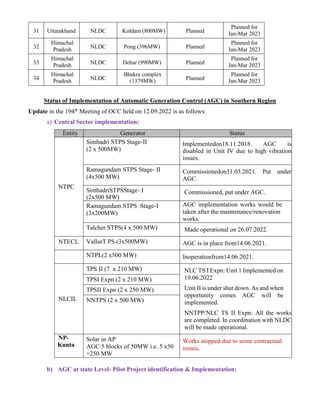
Status of Implementation of Automatic Generation Control (AGC) in Southern Region
Update in the 194th Meeting of OCC held on 12.09.2022 is as follows:
a) Central Sector implementation:
Entity Generator Status
NTPC
Simhadri STPS Stage-II
(2 x 500MW)
Implementedon18.11.2018. AGC is
disabled in Unit IV due to high vibration
issues.
Ramagundam STPS Stage- II
(4x500 MW)
Commissionedon31.03.2021. Put under
AGC.
SimhadriSTPSStage- I
(2x500 MW)
Commissioned, put under AGC.
Ramagundam STPS Stage-I
(3x200MW)
AGC implementation works would be
taken after the maintenance/renovation
works.
Talcher STPS(4 x 500 MW) Made operational on 26.07.2022.
NTECL VallurT PS (3x500MW) AGC is in place from14.06.2021.
NTPL NTPL(2 x500 MW) Inoperationfrom14.06.2021.
NLCIL
TPS II (7 x 210 MW) NLC TS I Expn: Unit 1 Implemented on
19.06.2022
Unit II is under shut down. As and when
opportunity comes AGC will be
implemented.
NNTPP/NLC TS II Expn: All the works
are completed. In coordination with NLDC
will be made operational.
TPSI Expn (2 x 210 MW)
TPSII Expn (2 x 250 MW)
NNTPS (2 x 500 MW)
NP-
Kunta
Solar in AP
AGC:5 blocks of 50MW i.e. 5 x50
=250 MW
Works stopped due to some contractual
issues.
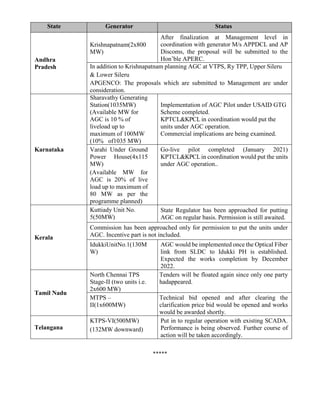
b) AGC at state Level- Pilot Project identification & Implementation:
State Generator Status
Andhra
Pradesh
Krishnapatnam(2x800
MW)
After finalization at Management level in
coordination with generator M/s APPDCL and AP
Discoms, the proposal will be submitted to the
Hon’ble APERC.
In addition to Krishnapatnam planning AGC at VTPS, Ry TPP, Upper Sileru
& Lower Sileru
APGENCO: The proposals which are submitted to Management are under
consideration.
Karnataka
Sharavathy Generating
Station(1035MW)
(Available MW for
AGC is 10 % of
liveload up to
maximum of 100MW
(10% of1035 MW)
Implementation of AGC Pilot under USAID GTG
Scheme completed.
KPTCL&KPCL in coordination would put the
units under AGC operation.
Commercial implications are being examined.
Varahi Under Ground
Power House(4x115
MW)
(Available MW for
AGC is 20% of live
load up to maximum of
80 MW as per the
programme planned)
Go-live pilot completed (January 2021)
KPTCL&KPCLin coordination would put the units
under AGC operation..
Kerala
Kuttiady Unit No.
5(50MW)
State Regulator has been approached for putting
AGC on regular basis. Permission is still awaited.
Commission has been approached only for permission to put the units under
AGC. Incentive part is not included.
IdukkiUnitNo.1(130M
W)
AGC would be implemented once the Optical Fiber
link from SLDC to Idukki PH is established.
Expected the works completion by December
2022.
Tamil Nadu
North Chennai TPS
Stage-II (two units i.e.
2x600 MW)
Tenders will be floated again since only one party
hadappeared.
MTPS –
II(1x600MW)
Technical bid opened and after clearing the
clarification price bid would be opened and works
would be awarded shortly.
Telangana
KTPS-VI(500MW)
(132MW downward)
Put in to regular operation with existing SCADA.
Performance is being observed. Further course of
action will be taken accordingly.
*****
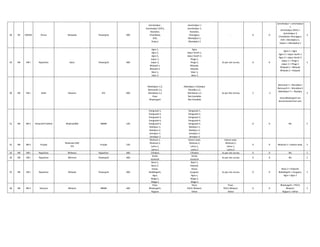
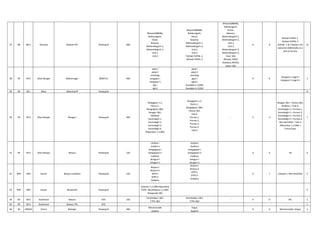
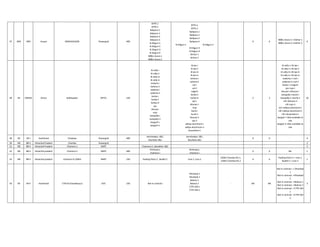
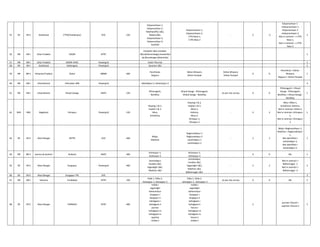
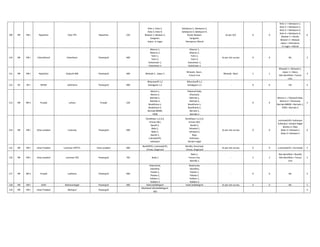
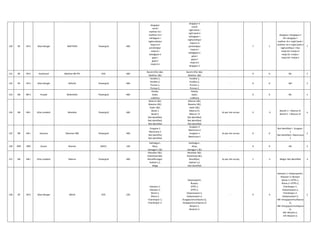
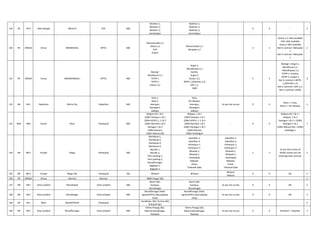
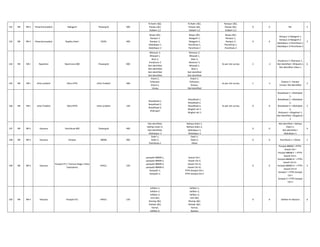
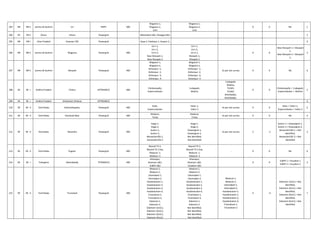
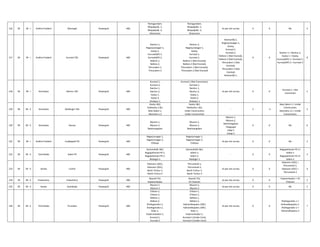
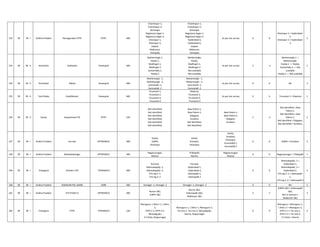
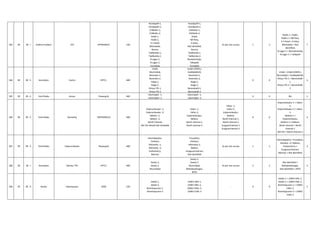
Cat-A Cat-B Total
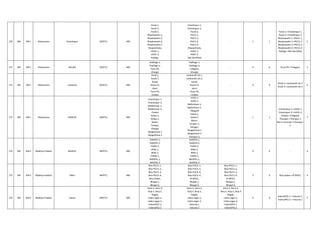
SR 4 3 7 7 0 0 3 7 -
ER 7 2 9 4 3 2 0 5*
*1-under implementation IS
KBUNL IS is discontinued.
NR 4 7 11 2 2 7 0 4*
*2-under implementationIS
/IS in design stage
WR 7 5 12 6 1 5 0 6*
*All In service IS are made
available at SLDC/WRLDC
except Uran Islanding
Scheme
NER 2 1 3 1 1 1 0 3*
*2-under implementationIS
/IS in design stage
Total
24 18 42 20 7 15 3 25*
5-under implementationIS
/IS in design stage
Remarks
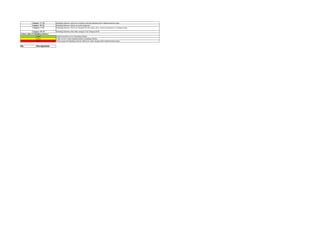
Green Implemented/In service Islanding Scheme
Yellow Under review/ Under Implementation Islanding Scheme
Red Newly proposed Islanding Scheme which are under design/under implementaion stage
Category-'I' IS Islanding Schemes which are designed for the major cities, senstive generation or strategic loads.
Category-'II' IS Islanding Schemes other than category I are Category II IS
Colour codes of Islanding Schemes:
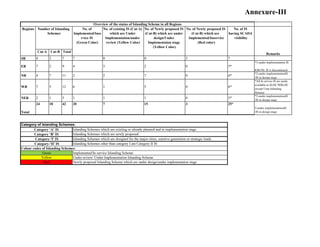
Overview of the status of Islanding Scheme in all Regions
Category of Islanding Schemes:
Category ‘A’ IS Islanding Schemes which are existing or already planned and in implementation stage.
Category ‘B’ IS Islanding Schemes which are newly proposed.
Number of Islanding
Schemes
Regions No. of
Implemented/Inse
rvice IS
(Green Color)
No. of existing IS (Cat-A)
which are Under
Implementation/under
review (Yellow Color)
No. of Newly proposed IS
(Cat-B) which are under
design/Under
Implementaion stage
(Yellow Color)
No. of Newly proposed IS
(Cat-B) which are
Implemented/Inservice
(Red color)
No. of IS
having SCADA
visibility
Annexure-III
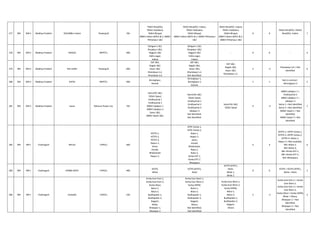
SN
(Color Coding for
Island
Implementation)
Name of Islanding
Scheme
Catego
ry A/B
Sub
Category-
(City/Major
Town/
Strategic
Load/Sensiti
ve
Generation)
Status
(Category A -In-Service/
Under Review/ Reviewed
&
Under Implementation)
(Category B-DPR
Preparation/Study/
Design/
Approval/Procurement/Co
mmissioning/Implementati
on)
Timeline for completion of Review/ Reviewed &
Under Implementation for Category A
Timeline for implementation for Category B (DPR
Preparation/Study/ Design/
Approval/Procurement/Commissioning/Implementation)
Progress of the scheme during the
last month
Healthiness
of the
Scheme
Timeline for SCADA
Visibility in Sub SLDC/
SLDC/ RLDC
Remarks, if
any
(Major
Change in
the scheme
may also be
intimated)
Color Coding for
SCADA Display
Creation
I II III IV V VI VII VIII IX
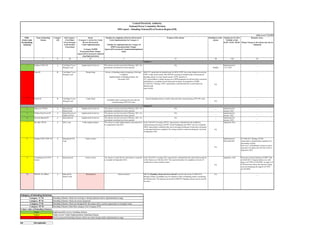
1 Hyderabad IS A City/Major
Town/
Strategic
Load
Reviewed scheme
implemented w.e.f.
31.07.2021/ In service
Review completed on 05.03.2021.
Reviewed scheme put into service w.e.f. 31.07.2021.
In line with SOP, the scheme was last discussed in PCSC-101
held on 13.04.2022, and it was noted that in view of no change
in boundary & LGB, the scheme in operation is found to be in
order.
NA Healthy November, 2021/
Completed on 30.11.2021
__
2 Chennai IS A City/Major
Town/
Strategic
Load
Reviewed scheme
implemented
Review completed on 18.05.2021.
Reviewed scheme put into service w.e.f. 31.05.2022.
In line with SOP, the scheme was last discussed in PCSC-101
held on 13.04.2022, and it was noted that in view of no change
in boundary & LGB, the scheme in operation is found to be in
order.
NA Healthy November, 2021/
Completed on 28.02.2022
__
3 Kudankulam IS A City/Major
Town/
Strategic
Load/
Sensitive
Generation
Reviewed scheme
implemented w.e.f.
31.12.2021/ In Service
Review completed on 18.08.2021.
Reviewed scheme put into service w.e.f. 31.12.2021.
In line with SOP, the scheme was last discussed in PCSC-101
held on 13.04.2022, and it was noted that in view of no change
in boundary & LGB, the scheme in operation is found to be in
order.
NA Healthy December, 2021/
Completed on 31.03.2022
4 Bengaluru IS B City/Major
Town/
Strategic
Load
Implemented w.e.f.
31.05.2022/ In-Service
The Scheme was identified in December 2020. Design
completed in July, 2021, and the scheme was put into service
w.e.f. 31.05.2022.
NA NA December, 2021/
Completed on 31.05.2022
__
5 Neyveli IS A City/Major
Town/
Strategic
Load
Reviewed Scheme
implemented w.e.f.
01.11.2021/ In-Service
Review completed on 04.06.2021;
Reviewed scheme put into service w.e.f. 01.11.2021.
In line with SOP, the scheme was last discussed in PCSC-101
held on 13.04.2022, and it was noted that in view of no change
in boundary & LGB, the scheme in operation is found to be in
order.
NA Healthy November, 2021/
Completed on 28.02.2022
__
6 Visakhapatnam IS B City/Major
Town/
Strategic
Load
Implemented w.e.f.
31.07.2021/ In-Service
The Scheme was identified in Jan 2020, but owing to Covid-19
pandemic, the scheme was taken up for implementation in
January, 2021. The scheme was put into service w.e.f.
31.07.2021.
NA Healthy Novemeber, 2021/
Completed on 30.11.2021
__
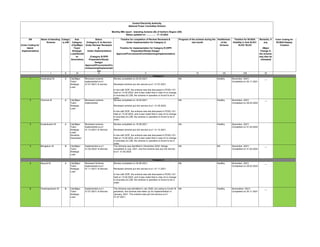
Central Electricity Authority
National Power Committee Division
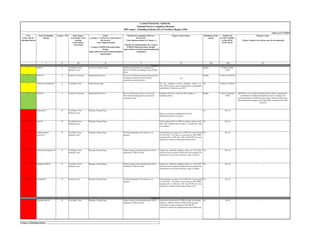
Monthly MIS report - Islanding Scheme (IS) of Sothern Region (SR)
Status updated on ………….. 17.10.2022
Category I
Category II
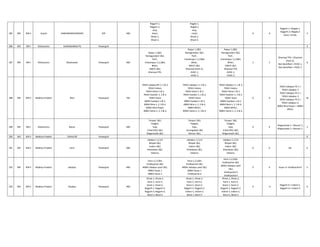
7 Vijayawada IS B City/Major
Town
Implemented w.e.f.
30.11.2021/ In-Service
The Scheme was identified in April 2021. Design completed in
July, 2021, and the scheme was put into service w.e.f.
30.11.2021.
In line with SOP, the scheme was last discussed in PCSC-101
held on 13.04.2022, and it was noted that in view of no change
in boundary & LGB, the scheme in operation is found to be in
order.
NA Healthy Novemeber, 2021/
Completed on 30.11.2021
__
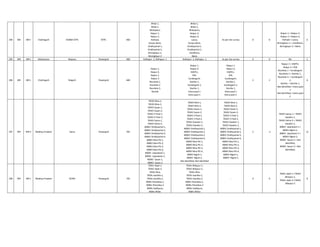
S.No.
(Color code
for Islanding
Scheme)
Name of Islanding
Scheme
Category
A/B
Sub Category-
(City/Major
Town/ Strategic
Load/Sensitive
Generation)
Status
(Category A -In-Service/ Under
Review/ Reviewed &
Under Implementation)
(Category B-DPR
Preparation/Study/ Design/
Approval/Procurement/Commissio
ning/Implementation)
Timeline for completion of Review/ Reviewed &
Under Implementation for Category A
Timeline for implementation for Category B
(DPR Preparation/Study/ Design/
Approval/Procurement/Commissioning/Implement
ation)
Progress of the scheme Healthiness of the
scheme
Timeline for SCADA
Visibility in Sub
SLDC/ SLDC/ RLDC
Remarks, if any
(Major Change in the scheme may also be
intimated)
I II III IV V VI VII VIII IX
1 Kolkata (CESC) IS A City/Major Town/
Strategic Load
Implemented/ In-Service. The scheme was last reviewed in February, 2021. No
operational constraints have been reported.
NA
Healthy
Implemented on
13.11.2021
__
2 Patna IS B City/Major Town/
Strategic Load
Design Stage Review of islanding study & designing of the logic:
Completed
Implementation of Islanding Scheme: By
December’2022
46th TCC opined that for detailed study by OEM, NTPC has to take initiatives & advised
NTPC to take up the matter with OEM for carrying out detailed study of the proposed
islanding scheme in a time bound manner. NTPC agreed to it.
TCC advised Bihar to initiate the process of DPR preparation & advised all the concerned
stakeholders to coordinate for providing relevant inputs for preparation of DPR.
In 195th OCC Meeting, NTPC representative submitted that they would submit the
detailed study
report shortly.
NA
- __
3 Ranchi IS B City/Major Town/
Strategic Load
Under Study
Feasibility study would again be done after the
commissioning of PVUNL units.
Ranchi Islanding Scheme would be discussed after commissioning of PVUNL units.
NA
- __
4 Bakreswar TPS IS A Industrial and
Railway load
Implemented/ In-Service. The scheme was last reviewed in February, 2021. No
operational constraints have been reported.
NA __ Implemented in
January, 2022
__
5 Haldia (Tata Power) IS A Industrial areas of
Haldia and Port
Implemented/ In-Service. The scheme was last reviewed in February, 2021. No
operational constraints have been reported.
NA __ Implemented in
January, 2022
__
6 Howrah (Bandel) IS A Industrial load Implemented/ In-Service. The scheme was last reviewed in February, 2021. No
operational constraints have been reported.
NA __ Implemented in
January, 2022
__
7 IB valley TPS IS A MCL Load Under-implementation. The scheme is under implementation and expected to
be completed by Sept 2022
In the 193rd OCC meeting, OPTCL representative submitted that the installation,
commissioning and testing of DTPC at both Budhipadar and OPGC end was completed.
OPGC representative submitted that end to end signal testing and wiring from switchyard
to relay panel had been completed. The testing would be carried out during the 2nd week
of September 2022.
NA
Septemebr 2022 __
8 Farakka STPS, NTPC IS A Industrial & ECL
Load
Under revision __ __
NA
Implemented in
December'2021
In 194th OCC Meeting, JUSNL
representative submitted that requisition for
sanctioning of funds
from Govt. of Jharkhand is in process and is
expected to be approved in the first week of
September 2022.
9 Chandrapura IS of DVC
System
A Industrial load Under revision The scheme is under Review and scheme is expected
to complete by September 2022.
In the 193rd OCC meeting, DVC representative submitted that the order had been placed
to M/s Siemens on 14th July 2022. The expected timeline for completion of work is 9
months due to semi-conductor issues.
NA
September, 2022 Discussed in Special Meeting of ERPC held
on 06.08.2021. Original scheme was with
stage A of CTPS (3x120 MW). As stage A of
CTPS has been retired, this scheme is being
evolved considering the stage B of CTPS
(2x250 MW).
10 KBUNL IS of Bihar A Industrial &
Station Load
Discontinued Scheme aborted KBUNL Islanding scheme has been aborted as per the discussion of 188th OCC
Meeting. Further, possibilities may be explored to study of Islanding scheme considering
the Barauni units. The hardware procured for KBUNL Islanding scheme may be used for
the same.
NA - __
NA Not Applicable
Red Newly proposed Islanding Scheme which are under design/under implementaion stage
Category-'II' IS Islanding Schemes other than category I are Category II IS
Colour codes of Islanding Schemes:
Green Implemented/In service Islanding Scheme
Yellow Under review/ Under Implementation Islanding Scheme
Category ‘A’ IS Islanding Schemes which are existing or already planned and in implementation stage.
Category ‘B’ IS Islanding Schemes which are newly proposed.
Category-'I' IS Islanding Schemes which are designed for the major cities, senstive generation or strategic loads.
Category of Islanding Schemes:
Central Electricity Authority
National Power Committee Division
MIS report - Islanding Scheme(IS) of Eastern Region (ER)
status as on 17.10.2022
Category I
Category II
S.No.
(Color code for
Islanding Scheme)
Name of Islanding
Scheme
Category A/B Sub Category-
(City/Major Town/
Strategic
Load/Sensitive
Generation)
Status
(Category A -In-Service/ Under Review/
Reviewed &
Under Implementation)
(Category B-DPR Preparation/Study/
Design/
Approval/Procurement/Commissioning/Im
plementation)
Timeline for completion of Review/
Reviewed &
Under Implementation for Category A
Timeline for implementation for Category
B (DPR Preparation/Study/ Design/
Approval/Procurement/Commissioning/Impl
ementation)
Progress of the scheme Healthiness of the
scheme
Timeline for
SCADA Visibility
in Sub SLDC/
SLDC/ RLDC
Remarks, if any
(Major Change in the scheme may also be intimated)
I II III IV V VI VII VIII IX
1 Delhi IS A City/Major Town/
Strategic Load
In service/ Under revision Submission of timeline for completion of
Review of Scheme is pending on part of Delhi
SLDC.
__
Healthy Visible in Delhi
SLDC
__
2 NAPS IS A Sensitive Generation Implemented/Inservice The review of IS has been done with peak load
of Summer and Winter 2019-20 and no
operational constraints found.
NA
Healthy Visible in UP SLDC __
3 Lucknow (Unchahar) IS A City/Major Town Under Design Stage
__
UP has submitted revised islanding scheme on
20.07.2022 which is under examination in consulatation
with NRLDC, UPSLDC and NTPC.
NA Visible in UP SLDC
4 RAPS IS A Sensitive Generation Implemented/Inservice Review of IS has been done in view of last
Peak/off-peak loading and no operational
constraints found.
Rajasthan SLDC has created SCADA display of
Islanding scheme.
Healthy Visible in Rajasthan
SLDC
RRVPN has reviewed the Islanding Scheme and has suggested the
consideration of additional transmission lines to manage load
generation balance at different load scenario. Proposed scheme has
been deliberated and approved in 56th NRPC meeting held on 29th
July,2022.
5 Dehradun IS B City/Major Town/
Strategic Load
Planning / Design Stage
__
Matter is pending at Uttarakhand SLDC for
finalization/rejection of scheme.
NA Dec-22
6 Agra IS B City/Major Town/
Strategic Load
Planning / Design Stage
__
UP has placed offer to CPRI for dynamic study in July,
2022. The estimated time of study is 5 months from date
of acceptance.
NA Dec-22
7 Jodhpur-Barmer-
Rajwest IS
B City/Major Town/
Strategic Load
Planning / Design Stage The Planning/design of the scheme is in
progress.
Scheme/Study was approved in 195th OCC meeting held
on 24.05.2022. The same was discussed in 56th NRPC
meeting held on 29th july, 2022 and RVPN has been
requested to submit revised proposal before OCC.
NA Dec-22
8 Nabha Power Rajpura IS B City/Major Town/
Strategic Load
Planning / Design Stage Scheme design is being finalized and will be
submitted to CPRI for study
Punjab has submitted islanding scheme on 12.07.2022
which has been examined. Punjab has been requested for
clarification on few points. However, reply is awaited.
NA Dec-22 __
9 Pathankot-RSD IS B City/Major Town/
Strategic Load
Planning / Design Stage Scheme design is being finalized and will be
submitted to CPRI for study
Punjab has submitted islanding scheme on 12.07.2022
which has been examined. Punjab has been requested for
clarification on few points. However, reply is awaited.
NA Dec-22 __
10 Suratgarh IS B Strategic Load Planning / Design Stage The Planning/design of the scheme is in
progress.
Scheme/Study was approved in 195th OCC meeting held
on 24.05.2022. The same was discussed in 56th NRPC
meeting held on 29th july, 2022 and RVPN has been
requested to submit revised proposal before OCC.
NA Dec-22
11 Talwandi Sabo IS B City/Major Town Planning / Design Stage Scheme design is being finalized and will be
submitted to CPRI for study
Punjab has sent the offer to CPRI for study of Islanding
Schemes. CPRI has asked for PSSE file for dynamic
study which is being coordinated with NRLDC.
Timeline: 6 months for implementation after CPRI study.
NA Jul-24 __
Central Electricity Authority
National Power Committee Division
MIS report - Islanding Scheme (IS) of Northern Region (NR)
status as on 17.10.2022
Category I
Category II
Category of Islanding Schemes:
NA Not Applicable
Yellow Under review/ Under Implementation Islanding Scheme
Red Newly proposed Islanding Scheme which are under design/under implementaion stage
Category-'II' IS Islanding Schemes other than category I are Category II IS
Colour codes of Islanding Schemes:
Green Implemented/In service Islanding Scheme
Category ‘A’ IS Islanding Schemes which are existing or already planned and in implementation stage.
Category ‘B’ IS Islanding Schemes which are newly proposed.
Category-'I' IS Islanding Schemes which are designed for the major cities, senstive generation or strategic loads.
S.No.
(Color code for
Islanding
Scheme)
Name of Islanding Scheme Category A/B Sub Category-
(City/Major Town/
Strategic Load/Sensitive
Generation)
Status
(Category A -In-Service/ Under Review/
Reviewed &
Under Implementation)
(Category B-DPR Preparation/Study/
Design/
Approval/Procurement/Commissioning/I
mplementation)
Timeline for completion of Review/ Reviewed &
Under Implementation for Category A
Timeline for implementation for Category B
(DPR Preparation/Study/ Design/
Approval/Procurement/Commissioning/Implement
ation)
Progress of the scheme Healthiness of the scheme Timeline for
SCADA
Visibility in Sub
SLDC/ SLDC/
RLDC
Remarks, if any
(Major Change in the scheme may also be intimated)
I II III IV V VI VII VIII IX
1 Mumbai Islanding Scheme A City/ Strategic Load Implemented/Inservice Last reviewed on 04.04.2021 and no operational
constraints found.
NA
Healthy Visible __
2 Uran Islanding Scheme A City/Major Town Implemented/Inservice Scheme last reviewed on 04.04.2021 and no
modification required and no operational constraint
found.
NA
Healthy Oct 2022 __
3 Surat Islanding Scheme A City/Major Town Implemented/Inservice Scheme last reviewed on 04.04.2021 and no
modification required and no operational constraint
found.
NA Healthy Visible The Scheme is healthy and visible on Gujarat SLDC and
WRLDC SCADA (as informed telephonically). WRLDC
recommendations about visibility are under consideration.
4 Ahmedabad City Islanding Scheme A City/Major Town/
Strategic Load
Implemented/Inservice
Scheme last reviewed on 04.04.2021 and no
modification required and no operational constraint
found.
NA Healthy Visible The Scheme is healthy and visible on Gujarat SLDC and
WRLDC SCADA (as informed telephonically). WRLDC
recommendations about visibility are under consideration.
5 KAPS 1&2 Islanding Scheme. A Sensitive Generation Implemented/Inservice Scheme last reviewed on 04.04.2021 and no
modification required and no operational constraint
found.
NA Healthy Visible The Scheme is healthy and visible on Gujarat SLDC and
WRLDC SCADA (as informed telephonically). WRLDC
recommendations about visibility are under consideration.
6 KAPS 3&4 Islanding Scheme. A Sensitive Generation Under Implementation Last reviewed on 04-07 June, 2021. __ Healthy Visible The Scheme is healthy and visible on Gujarat SLDC and
WRLDC SCADA (as informed telephonically). WRLDC
recommendations about visibility are under consideration.
7 Nagpur Islanding Scheme B City/Major Town/
Strategic Load
Design/Engineering Stage. Schematic design finalised on during discussion on
01.04.2021, 24.06.2021, 26.06.2021
DPR preparation completed. NA NA __
8 Jamnagar Islanding Scheme B City/Major Town/
Strategic Load
Design/Engineering Stage. Schematic design finalised on during discussion on
01.04.2021, 24.06.2021.
Detailed engineering is under
progress.
NA NA __
9 Bhuj(Anjar-Kukma) Islanding Scheme. B City/Major Town/
Strategic Load
Design/Engineering Stage. Schematic design finalised on during discussion on
01.04.2021, 24.06.2021.
Detailed engineering is under
progress.
NA NA __
10 Jabalpur Islanding Scheme B City/Major Town/
Strategic Load
Design/Engineering Stage. Schematic design finalised on during discussion on
01.04.2021, 24.06.2021.
DPR preparation completed. NA NA __
11 Raipur Islanding Scheme B City/Major Town Design/Engineering Stage. Schematic design finalised on during discussion on
01.04.2021, 24.06.2021, 28.06.2021.
Detailed engineering is under
progress.
NA NA __
12 Vadodara/GIPCL Islanding Scheme. A Nandesari Industrial Load Implemented/Inservice Scheme last reviewed on 04.04.2021 and no
modification required and no operational constraint
found.
NA Healthy Visible The Scheme is healthy and visible on Gujarat SLDC and
WRLDC SCADA (as informed telephonically). WRLDC
recommendations about visibility are under consideration.
NA Not Applicable
Red Newly proposed Islanding Scheme which are under design/under implementaion stage
Category ‘B’ IS Islanding Schemes which are newly proposed.
Category-'I' IS Islanding Schemes which are designed for the major cities, senstive generation or strategic loads.
Category-'II' IS Islanding Schemes other than category I are Category II IS
Colour codes of Islanding Schemes:
Green Implemented/In service Islanding Scheme
Yellow Under review/ Under Implementation Islanding Scheme
Category ‘A’ IS Islanding Schemes which are existing or already planned and in implementation stage.
Central Electricity Authority
National Power Committee Division
MIS report - Islanding Scheme (IS) of Western Region (WR)
status as on 17.10.2022
Category I
Category II
Category of Islanding Schemes:
S.No.
(Color
code for
Islanding
Scheme)
Name of
Islanding
Scheme
Catego
ry A/B
Sub Category-
(City/Major
Town/ Strategic
Load/Sensitive
Generation)
Status
(Category A -In-Service/ Under
Review/ Reviewed &
Under Implementation)
(Category B-DPR Preparation/Study/
Design/
Approval/Procurement/Commissioning
/Implementation)
Timeline for completion of Review/ Reviewed &
Under Implementation for Category A
Timeline for implementation for Category B (DPR
Preparation/Study/ Design/
Approval/Procurement/Commissioning/Implementatio
n)
Progress of
the scheme
Healthines
s of the
scheme
Timeline for
SCADA
Visibility in
Sub SLDC/
SLDC/ RLDC
Remarks,
if any
(Major
Change in
the
scheme
may also
be
intimated)
I II III IV V VI VII VIII IX
1
Tripura
Islanding
Scheme.
A City/Major Town Reviewed Scheme under implementation
The scheme was reviewed and revised on 29.09.2021.
7 out of 20 additional UFRs already installed.
The balance UFRs would be installed by November,
2022.
__ __ Completed __
2 Upper Assam
(Assam-I)
Islanding
Scheme.
A City/Major Town Implemented/Inservice
The scheme was reviewed on 29.09.2021 and the
Revised scheme implemented & recorded in 57th PCC
Meeting held on 15th February, 2022.
Completed Completed Completed __
3
Guwahati
(Assam-II)
Islanding
Scheme
B City/Major Town Planning / Design Stage.
Design reviewed on 18.01.2022. Draft DPR already
prepared, detailed DPR will be submitted after BoQ is
finalized by Utilities and Budgetary offer is received from
at least two vendors. The Scheme is scheduled to be
implemented by December, 2022.
DPR sent to
NLDC.
NA Completed __
NA Not Applicable
Category of Islanding Schemes:
Central Electricity Authority
National Power Committee Division
MIS report - Islanding Scheme (IS) of North Eastern Region (NER)
status as on 17.10.2022
Category I
Category II
No Islanding Scheme under this Category
Category ‘A’ IS Islanding Schemes which are existing or already planned and in implementation stage.
Category ‘B’ IS Islanding Schemes which are newly proposed.
Category-'I' IS Islanding Schemes which are designed for the major cities, senstive generation or strategic loads.
Red Newly proposed Islanding Scheme which are under design/under implementaion stage
Category-'II' IS Islanding Schemes other than category I are Category II IS
Colour codes of Islanding Schemes:
Green Implemented/In service Islanding Scheme
Yellow Under review/ Under Implementation Islanding Scheme
DRAFT
No. A-60016/24/2012-Adm-I
Government of India
Ministry of Power
New Delhi, Dated:
O R D E R
Subject: Establishment of National Power Committee (NPC).
Keeping in view the ever growing complexity of Power System, synchronous mode
of operation of the entire grid of the country and to evolve a common approach to issues
related to reliability and security of the grid, it has been decided with the approval of the
Competent Authority to establish National Power Committee (NPC). The composition of
the Committee shall be as under:
1. Chairperson, CEA Chairperson of NPC
2. Member (GO&D), CEA Member
3. Chairperson of each of NRPC, WRPC,
SRPC and ERPC Member
4. Representative of Chairperson, NERPC Member
5. TCC Chairperson of each RPC
(NRPC, WRPC, SRPC, ERPC, NERPC) Member
6. Member Secretary of each of NRPC, WRPC,
SRPC, ERPC & NERPC Member
7. ED, NLDC, POSOCO Member
8. Chief Operating Officer, CTU Member
9. Chief Engineer (NPC Div, CEA) Member Secretary
2. NPC shall carry out following functions for integrated operation of the power
system of the country:
(i) To resolve issue among RPCs; and
(ii) Discuss and resolve issues referred to NPC requiring consultation among one
or more RPCs, concerning inter-alia inter-regional implication or any other
issue affecting more than one region or all regions.
(iii)Preparation and issuance of National Energy Account (NEA) for inter-regional
and inter-national energy transactions by NPC Secretariat.
P.T.O
Annexure-IV
DRAFT
3. Decision taken in the NPC shall be considered concurred by respective RPCs for
implementation.
4. The Conduct of the Business Rule (CBR) for NPC providing for establishment of the
secretariat of NPC, procedure for conduct of meetings of NPC, funding etc. is at Annex.
( )
Deputy Secretary to Govt. of India
Tel No.
To:
1. Chairperson, CEA
2. Member (GO&D), CEA
3. Chairperson of NRPC/WRPC/SRPC/ERPC/NERPC
4. TCC Chairperson of each of NRPC/WRPC/SRPC/ERPC/NERPC
5. Member Secretary of NRPC/WRPC/SRPC/ERPC/NERPC
6. Chief Engineer (Gird Management Division), CEA
7. Chief Engineer (NPC Division), CEA
8. ED, NLDC, POSOCO
9. COO, CTU
Copy to
1. PS to MOS (P) (I/C)
2. PS to Secretary (Power)/ PPS to AS (DC)/ PSO to AS (AL)
3. All Joint Secretaries, Ministry of Power
4. All Directors/ Deputy Secretaries, Ministry of Power
( )
Deputy Secretary to Govt. of India
Tel No.
DRAFT
Annex to Order No. No. A-60016/24/2012-Adm-I dated ------------------
National Power Committee
Conduct of Business Rules
CHAPTER I
GENERAL
1. Short title and commencement:
These rules shall come into force from the date of its formation i.e. 26-09-2011 and shall remain
in force unless otherwise modified.
2. Definitions:
2.1 In these Rules unless the context otherwise requires: -
(a) ‘Agenda’ means the list of business proposed to be transacted at a meeting of the
Committee.
(b) ‘Committee’ means the National Power Committee
(c) ‘Meeting’ means a meeting of the Committee convened by Member Secretary after
consultation with Chairperson, NPC.
(d) ‘Member’ means the member of the NPC
(e) ‘Rule’ means National Power Committee (Conduct of Business) Rules, 2011.
3. Composition of NPC:
1. Chairperson, CEA – Chairperson, NPC
2. Chairperson, NRPC
3. Chairperson, WRPC
4. Chairperson, SRPC
5. Chairperson, ERPC
6. Representative of Chairperson, NERPC
7. Chairperson, TCC of NRPC
8. Chairperson, TCC of WRPC
9. Chairperson, TCC of SRPC
10. Chairperson, TCC of ERPC
11. Chairperson, TCC of NERPC
12. Member (GO&D), CEA
13. Member Secretary, NRPC
14. Member Secretary, WRPC
15. Member Secretary, SRPC
16. Member Secretary, ERPC
17. Member Secretary, NERPC
18. ED, NLDC, POSOCO
19. Chief Operating Officer, CTU
20. Chief Engineer, NPC Div., CEA – Member Secretary, NPC
DRAFT
4. Functions of NPC
NPC shall carry out following functions for integrated operation of the power system of the country:
(i) To resolve issue among RPCs
(ii) Discuss and resolve issues referred to NPC requiring consultation among one or more
RPCs, concerning inter-alia inter-regional implication or any other issue affecting more
than one region or all regions
(iii) Preparation and issuance of National Energy Account (NEA) for inter-regional and inter-
national energy transactions by NPC Secretariat.
Decisions taken in the NPC shall be considered concurred by the respective RPCs for
implementation.
5. Secretariat of NPC
Secretariat of NPC will be provided by CEA and Chief Engineer (NPC Division), CEA will be Member
Secretary. Secretariat shall perform the following duties namely:
a) Keep custody of records of proceedings of the Committee meetings.
b) Prepare agenda for the Committee meetings.
c) Prepare minutes of Committee meetings.
d) Take follow-up action on the decision taken in the Committee meetings.
e) Collect from constituent members or other offices or any other party as may be directed by
Committee, such information as may be considered useful for the efficient discharge of
functions of the Committee and place the information before the Committee.
f) Collection of data from NLDC on weekly basis (Interregional and International scheduled
energy and actual energy data)
g) Preparation of Weekly NDSM and Reactive Energy Account (if required)
f) Preparation of monthly NEA
6. Sub-Committees of NPC
To deal with matters pertaining to the energy accounting and related issues there shall be a
commercial sub-committee with the members drawn from representatives of each RPC
Secretariat, RLDCs and NLDC. The commercial sub-committee shall be headed by the Chief
Engineer (NPC Division), CEA. NPC can create other Sub-Committees to deal with matters
pertaining to operation and protection issues on national basis.
CHAPTER II
PROCEDURE FOR CONDUCTING NPC MEETINGS
7. Place and date of NPC Meeting
The place and date of the meeting shall be decided by Chairperson, NPC
DRAFT
8. Notice for the Committee Meetings and Agenda
8.1 Notice for the Committee meetings shall be issued by Member Secretary, NPC at least 25 days in
advance in consultation with Chairperson, NPC. In case of emergency meetings required to be
conducted to carry out urgent business, notice of one week is to be given.
8.2 The Agenda points for the meeting shall be sent to the Member Secretary by the members at least
20 days in advance of the meeting. The Member Secretary, NPC shall finalize the agenda and
circulate the same to all its members at least 10 days in advance before the meeting.
8.3 Agenda for Committee meeting shall generally be put up after discussions in RPC.
8.4 Member Secretary, NPC may also put any agenda involving urgent matters/policy issue directly in
consultation with Chairperson, NPC.
8.5 Member Secretary, NPC may convene a meeting at short notice on any urgent matter in
consultation with Chairperson of the NPC.
9. Effect of Non-receipt of Notice of Meeting by a Member
The non-receipt of notice by any member of NPC shall not invalidate the proceeding of the meeting
or any decision taken in the meeting.
10. Cancellation / Re-scheduling of Meeting
If a meeting is required to be cancelled or rescheduled the same shall be intimated to the members
at the earliest by telephone / fax/ email.
11. Periodicity of Meetings
The Committee members shall meet at least once in six months. However, the Committee may
meet any time to discuss any issue as and when required in consultation with Chairperson, NPC.
12. Quorum of NPC Meeting
11.1 The quorum of the meeting shall be 50% of its members.
11.2 NPC would take decisions based on majority/ general consensus of the strength present.
11.3 Members of NPC and NPC Secretariat shall participate in Committee Meetings. The Special
invitees by the Committee may also attend the meeting.
13. Presiding Authority
13.1 The Chairperson, NPC shall preside over the meeting of NPC and conduct the meeting. The
Member Secretary, NPC shall assist the Chairperson of NPC in conducting the meeting. If the
Chairperson is unable to be present at the meeting for any reason, Member (GO&D) would
preside over the meeting.
13.2 In the absence of Member Secretary, NPC, Director (NPC Div.), CEA shall function as Member
Secretary to assist Chairperson, NPC.
DRAFT
14. Recording of the Minutes
The minutes of the meeting shall be finalized and circulated to all its members by the Member
Secretary, NPC normally within 15 working days from the date of the Committee Meeting.
15. Confirmation of the Minutes
Minutes of the NPC meeting shall be placed in the next meeting for confirmation. However, in
case of urgency the minutes may be confirmed by circulation.
16. Funding
Requirement of funds for hosting the meetings of NPC would be met through CEA’s budgetary
provisions. However, NPC may decide to create a fund for NPC in future for establishment
expenses of its Secretariat.
CHAPTER III
MISCELLANEOUS
17. Savings of inherent Power of the NPC
17.1 Nothing in these Rules shall bar the NPC from adopting a procedure that is at variance with
provisions of these Rules, if the NPC in view of the special circumstances of a matter or class
of matters deem it necessary or expedient to deal with such a matter or class of matters.
17.2 Nothing in these Rules shall expressly or by implication, bar the NPC to deal with any matter or
exercise any power for which no Rules have been framed and NPC may deal with such matters,
and functions in a manner it thinks fit.
( )
Deputy Secretary
To,
The Member Secretary, NPC
Central Electricity Authority
New Delhi – 110066
!वषय: "यूआरट,डीएसएम प3रयोजना क
े तहत पीएमयू <थान> क
े समान दशAन, नए !वCलेषण और
GनयंIण क
J K क
े उMनयन कN आवCयकताओं पर उप-सQमGत" कN 3रपोटA - क
े संबंध मJ|
Subject: Report of the “Sub-committee on the uniform philosophy of PMU locations, new analytics
and requirements of up gradation of Control Centre under URTDSM project” - reg.
Ref: NPC Division letter no. 4/MTGS/NPC/CEA/2021/285-298 dated 20.09.2021
Please find enclosed herewith the final report of the sub-Committee on “The uniform
philosophy of PMU locations, new analytics and requirements of up gradation of Control Centre
under URTDSM project”, constituted by NPC vide letter under reference.
Submitted for needful please.
भवद,य /Yours faithfully
Enclosed: As above.
(P. D. Lone)
(सद<य संयोजक/Member Convener)
Copy to: All members as per list.
भारतसरकार
Government of India
क
J K,य !वaयुत् dाeधकरण
Central Electricity Authority
पि#चम 'े)ीय ,व.युत ् स3म4त
Western Regional Power Committee
एफ-3,एमआईडीसीक्षेत्र, अंधेरी (पूवर्), मुंबई- 400 093
F-3, MIDC Area, Andheri (East), Mumbai -
400 093
आईएसओ:
9001-2015
IS/ISO:9001-2015
दूरभाष/Phone: 022-28221681, 2820 0194, 95, 96
Website: www.wrpc.gov.in
फ
ै hस/Fax: 022–2837193
Mail: comml-wrpc@nic.in
qदनांकः 14.10.2022
Date:
सं
याः
प
kे
व
स
/
वा
ण
.
-
I
/
2
0
2
2
/
i
!
l
No.:WRPC/Comml-I/NPC/2022/ 10706
Annexure-V
October 2022
Report of the Sub-
Committee on PMU
Placement and
Analytics under
URTDSM Phase II.
National Power Committee
CEA
Acknowledgement
The Committee acknowledges the cooperation extended by RPCs, POSOCO, PGCIL and
CTU for giving their valuable inputs to finalize the recommendations for the URTDSM Project
Phase - II.
The Committee also acknowledges and extends gratitude to the sincere efforts of Shri
Deepak Sharma EE WRPC and Shri Sachin Bhise EE WRPC, for their inputs and suggestions and
putting all the inputs in proper perspective & giving shape to this report.
The committee would also like to thank Sh. Rahul Shukla, Chief Manager, NLDC and Sh.
Aman Gautam, Manager, NLDC for the painstaking efforts taken to provide comments and help
in the drafting of the report.
The committee puts on record the efforts of Dr Rajeev Gajbhiye, Sh. Prashant Navalkar
and Sh. Gopal Gajjar from IIT Bombay who provided valuable inputs and feedback on the
URTDSM Phase I and futuristic applications that can be developed.
The committee also acknowledges the efforts of M/s PRDC for arranging presentation of
EPG USA and giving perspective of applications developed and used worldwide.
(Rishika Sharan)
Chief Engineer (NPC), CEA
(Vivek Pandey)
G. M., NLDC
(Nutan Mishra)
Sr. G. M., CTUIL
(Shyam Kejriwal)
S. E., ERPC
(P Suresh Babu)
S. E., TS SLDC
(Len J B)
E. E., SRPC
(Srijit Mukherjee)
Deputy Director, NERPC
(Himanshu Lal)
Deputy Director, NPC
(P. D. Lone)
S. E., WRPC & Member
Convener
(Satyanarayan S.)
Member Secretary, WRPC &
Chairperson
(Abdullah Siddique)
Chief Manager, SRLDC
T. Sivakumar
S.E., TANTRANSCO
(Sunita Chohan)
CGM (GA&C), PGCIL
Director (IT & CS), CEA
Page 1 of 44
Page 2 of 44
Summary of the Report
Ø Initially a Pilot Project was implemented by POSOCO with 52 Phasor Measurement Units
(PMUs) installed all over the Country progressively from 2008 to 2010. Based on the
experience gained in Pilot Projects, a Feasibility Report was prepared for Nation-wide
development of WAMS namely Unified Real Time Dynamic State Measurement
(URTDSM) Project. A Detailed Project Report (DPR) was prepared in 2012 for
implementation of 1740 PMUs on Pan-India basis. The Project was agreed for
implementation in a Joint Meeting of all the five Regional Standing Committees on Power
System Planning held on 5th March 2012. Also, it was decided that the project of
installation of the PMUs will be taken up in two stages.
Ø CERC granted in principle approval for the project in Sept’2013 with 70% funding from
PSDF & 30% equity from POWERGRID. CERC granted in principle approval for the
implementation of URTDSM Phase-I and advised to take up Phase-2 after receiving
feedback on Phase-I performance from POSOCO. POWERGRID took up the
implementation of URTDSM Project in Jan’2014 and 1409 PMUs are installed in Phase-I
of the Project (the increase in quantity of PMUs was due to addition of new bays etc. at the
substations). Nodal PDC at strategic substations, Master PDC at all SLDCs, super PDC at
5 RLDCs, Main & backup PDC at NLDC have been installed and are fully functional.
PMUs are installed at only those 400 kV lines which had connectivity of the fibre optic
network.
Ø Data of these PMUs is being utilized by power system operators as an analytical tool for
better system operation in real time as well as for off-line analysis. Operators are also
utilizing various facilities provided under the project which includes the GUI application
supplied by GE and 6 analytics have been deployed by IIT-B.
Ø In the 10th
NPC Meeting held on 9th
April 2021 it was decided to form a sub-committee,
under the Chairmanship of Member Secretary, WRPC with representatives from POSOCO,
CTU, POWERGRID, all RPCs/NPC. The Sub-Committee was entrusted to recommend
uniform philosophy of PMU locations, new analytics and requirement of up gradation of
Control Centre under URTDSM project and submit its recommendations to the NPC.
Ø The sub-committee held 3 meetings. The first meeting was held on 10.12.2021 and the
second meeting was held on 31.05.2022. In both the meetings IIT Bombay gave
presentation on the analytics developed in URTDSM Phase-I, improvements in these
analytics and futuristic analytics that can be undertaken under URTDSM Phase-II.
Page 3 of 44
Ø The EPG group presentation was arranged by PRDC in the second meeting held on
31.05.2022 and the EPG LLC, USA highlighted various application analytics which are
deployed by power Utilities worldwide and are being used.
Ø The third meeting of the sub-committee was held on 14.09.2022 to discuss the finalised
draft report of the sub-committee.
Ø PGCIL has expressed some reservations on the recommendations of the sub-committee.
The same are attached at Annexure – 9.
Ø Based on the above discussions, the report has been broadly divided into 6 Sections
• Section-1 briefly explains the background discussions that took place in various meeting
for implementation of the PMU/WAMS project on pan India basis and the progress and
hardware implementation of the Phase-I of the URTDSM project.
• Section-2 briefly explains the OEM online and offline applications and its use.
• Section-3 deals with the PMU placement criteria and status of Phase-I analytics.
• Section-4 outlays various issues regarding hardware, application & analytics faced in
the Phase-I of the URTDSM project and feedback of stakeholders.
• Section-5 describes in brief discussions took place on requirement of PMUs that took
place in regional levels, various new applications/analytics that can be taken up in
Phase-II of the project.
• Section-6, the recommendations of the sub-Group on improvement of Phase-I
applications/analytics/hardware optimisation required to be taken up Phase-II,
placement/requirement of PMUs in phase-II and new applications/analytics required to
be implemented in Phase-II of the URTDSM project.
Page 4 of 44
Table of Contents
Acknowledgement .............................................................................................................. - 1 -
Summary of the Report ...................................................................................................... - 2 -
List of Annexure ................................................................................................................ - 6 -
1. Background of the URTDSM Project.......................................................................... - 7 -
1.1 Background ................................................................................................................... - 7 -
1.2 URTDSM Project Phase-I ............................................................................................. - 7 -
2. Applications under URTDSM Phase-I...................................................................... - 10 -
2.1 PMU based real time monitoring applications:............................................................- 10 -
2.2 Off-line Applications/usages:........................................................................................- 11 -
3. PMU Placement criteria & Analytics in Phase – I and its status................................ - 13 -
3.1 PMU locations under Phase – I ....................................................................................- 13 -
3.2 Status of Phase – I (Broad configuration of PMUs, PDCs and.....................................- 13 -
infrastructure used) ..................................................................................................................- 13 -
3.3 Present functionalities under URTDSM: .....................................................................- 14 -
3.4 Existing features of URTDSM......................................................................................- 14 -
3.5 Analytics under Phase – I.............................................................................................- 15 -
3.6 Utilization of PMU data for taking real time decisions and offline Analysis at RLDCs and
NLDC:- 15 -
4. Feedback on applications/Analytics under Phase – I ................................................ - 17 -
4.1 Improvements required in the Existing PMUs data Streaming/GUI ...........................- 17 -
a) Improvement required in the visualization /GUI........................................................................... - 17 -
b) OSM related issues: .......................................................................................................................... - 19 -
c) System Utilisation related issues...................................................................................................... - 19 -
d) Infrastructure related issues ............................................................................................................ - 19 -
e) Historian............................................................................................................................................ - 20 -
4.2 Analytical Application Software’s developed by IIT Bombay .....................................- 20 -
4.3 Issues in Phase – I analytics and observations: ............................................................- 24 -
4.4 Improvements needed to address above issues:............................................................- 25 -
5. Phase – II of URTDSM ............................................................................................ - 26 -
5.1 PMU Placement Criteria ..............................................................................................- 26 -
5.2 New Analytics under URTDSM Project Phase - II.......................................................- 28 -
6. Recommendations .................................................................................................... - 31 -
6.1 Following improvements are recommended in applications available in URTDSM-I:- 31 -
a) Graphical User Interface for visualization of system dynamics.......................................................... - 31 -
b) Oscillation Detection, monitoring and analytics................................................................................. - 33 -
c) Linear State Estimator......................................................................................................................... - 34 -
6.2 Following new applications are recommended for deployment in URTDSM-II..........- 35 -
a) Real time automated event detection and notification dashboard....................................................... - 35 -
Page 5 of 44
b) Early warning system.......................................................................................................................... - 36 -
c) Voltage Stability analytics (VSA)....................................................................................................... - 36 -
d) WAMS based contingency analysis and security assessment............................................................. - 36 -
e) Islanding detection.............................................................................................................................. - 37 -
f) Real time Inertia Estimation and monitoring...................................................................................... - 37 -
g) Post-mortem analytics......................................................................................................................... - 37 -
h) Generator Model Validation ............................................................................................................... - 38 -
i) Wide Area Control Systems................................................................................................................ - 38 -
6.3 Following improvements in system infrastructure are recommended .........................- 39 -
Recommended improvement in the system utilization and its performance ................................................ - 39 -
6.4 PMU placement strategy:.............................................................................................- 41 -
a) Placement of PMUs Criterion:............................................................................................................ - 41 -
b) Limiting constraints for Placement of PMUs...................................................................................... - 41 -
c) Type of PMUs..................................................................................................................................... - 41 -
d) Minimum criteria of PMU locations:.................................................................................................. - 42 -
e) Future Considerations & integration of State PMUs........................................................................... - 43 -
Page 6 of 44
List of Annexure
Name Description Page Number
Annexure I Sub-Committee Constitution Order
Annexure II List of PMUs Installed in Phase - I
Annexure III Region wise map of the existing placement of PMUs
Annexure IV Details for PMU placements in NER
Annexure V Details for PMU placements in Sikkim
Annexure VI Details of PMU placement as suggested by POSOCO
Annexure VII Details of Analytics suggested by CTU
Annexure VIII Details of Analytics suggested by POSOCO
Annexure IX Comments of PGCIL on recommendations
47
49
97
98
99
86
88
91
92
Page 7 of 44
1. Background of the URTDSM Project
1.1 Background
In the 10th
NPC Meeting held on 9th
April 2021 it was decided to form a sub-committee,
the relevant extract of the minutes of the above meeting is reproduced below.
“After deliberations, NPC decided that a Sub-Committee would be formed under the
Chairmanship of Member Secretary, WRPC with representatives from POSOCO, CTU,
POWERGRID, all RPCs/NPC. The Sub-Committee shall discuss on the uniform
philosophy of PMU locations, new analytics and requirement of up gradation of Control
Centre under URTDSM project and submit its recommendations to the NPC.
Consequently, the sub-committee was formed vide NPC Letter NO.
4/MTGS/NPC/CEA/2021/285-298 dated 20.09.2021 (letter enclosed at Annexure – I)
based on nominations received at NPC.
1.2 URTDSM Project Phase-I
a) A Pilot Project was implemented with 52 Phasor Measurement Units (PMUs)
installed all over the Country progressively from 2008 to 2010. Based on the
experience gained in Pilot Projects, a Feasibility Report was prepared for Nation-
wide development of WAMS namely Unified Real Time Dynamic State
Measurement (URTDSM) Project. A Detailed Project Report (DPR) was prepared
in 2012 for implementation of 1740 PMUs on Pan-India basis.
b) The Project was agreed for implementation in a Joint Meeting of all the five
Regional Standing Committees on Power System Planning held on 5th March
2012.
c) Also, it was decided that the project of installation of the PMUs will be taken up in
two stages.
Page 8 of 44
Stage-I: Installation of PMUs at the locations where Fibre Optic communication is
available or would be made available under microwave frequency vacating program
and regional strengthening program by 2014-15 along with installation of PDCs at all
SLDCs, RLDCs, NLDC, NTAMC, strategic locations in State, remote consoles at
RPCs, CEA, CTU and other locations.
Stage-II: Installation of PMUs at balance locations along with communications links.
d) The stage wise deployment of PMUs and PDCs is given as under
i. The project was approved with the above tabulated infrastructure in stage – I &
II.
ii. Phase-I: 1186 PMUs at 351 substations (communication existing) - Rs. 278.89
Crs.
Page 9 of 44
iii. Phase-II: 554 PMUs at 301 substations (with installation of 11,000 Kms OPGW)
- Rs.377 Crs.
iv. Phasor Data Concentrators with 6 Analytical Software at 32 Control centres
considering requirement of both i.e., Phase-I & Phase-II.
e) CERC granted in principle approval for the project in Sept’2013 with 70% funding
from PSDF & 30% equity from POWERGRID. CERC granted in principle approval
for the implementation of URTDSM Phase-I and advised to take up Phase-2 after
receiving feedback on Phase-I performance from POSOCO.
f) POWERGRID took up the implementation of URTDSM Project in Jan’2014 and
1409 PMUs are installed in Phase-I of the Project (the increase in quantity of PMUs
was due to addition of new bays etc. at the substations). The list of PMUs installed
is given at Annexure – II.
g) In line with agreed philosophy in Joint Meeting of all the five Regional Standing
Committees on Power System Planning, POWERGRID took up the requirement of
URTDSM Phase – II in all Regional Power Committees. During the discussion on
finalization of PMU quantity for URTDSM phase–II, requirement of additional
measurements emerged. POSOCO also desired additional Analytical software using
PMU data.
Page 10 of 44
2. Applications under URTDSM Phase-I
2.1 PMU based real time monitoring applications:
PMU based visualization helps not only operators of affected control areas, but also in
alerting neighbouring operators of a stressed grid. In the real time grid operation, PMUs
data are being utilized for following purposes:
a) Real time event and alarm processing: WAMS System provides spatio-temporal
aggregation of the events, magnitude related violations in frequency, Positive
Sequence Voltage Magnitude, Rate of Change Frequency (ROCOF) and Angular
Difference. These are processed in real time at each second in batch processing to
alert the operator.
b) Visualization of frequency, Rate of change of frequency, Voltage, Power flows and
Angle difference monitoring through trending at high resolution, helps in taking
early actions by control room.
c) Visualization of angular difference data, real-time angular separations, Real time
monitoring and analysis, obtaining angular differences.
d) Geographical network diagram provides information about the system through
visual objects representing network elements, contours, rubber band zooming,
panning, flyouts and pods through sub second resolution measurements and its
variation in real time.
e) Contour display allows overview of the voltage/frequency profile for the entire
grid, Voltage Contour visualization, Voltage contour variation before and after
generator trip allows real time monitoring of voltages across all the nodes.
Frequency contour identifies the coherent group of generators during incidents of
low frequency oscillations in the grid.
f) Oscillatory Stability Management (OSM): Oscillation Stability Management
(OSM) helps in monitoring the low frequency oscillations or small signal stability
issues in the system, the oscillation frequency related information like, dominant
mode frequency, energy and damping helps the operator in taking real time
necessary actions by identifying root cause of oscillation. The OSM provides the
information pertaining to negatively damped modes. OSM module extracts
oscillatory stability parameters from small, random movements of the power
system that are continuously occurring, mainly due to load changes in configured
frequency, angle difference and active Power signals. Low frequency oscillations
Page 11 of 44
and damping ratios are obtained using Auto Regressive Moving Average (ARMA)
analysis of the measured signal. The dominant modes of oscillation are extracted,
and key parameters identified – mode frequency, amplitude, and decay time. It also
shows the mode shape (Right Eigen Vector) and mode chart for better Analysis of
Oscillation in the system.
2.2 Off-line Applications/usages:
Some of the off-line usages are given as follows:
a) Primary frequency Response assessment requires high resolution data of frequency
for any event. The monitoring of pattern of frequency posts any incident involving
load/generation imbalance helps in identifying the percentage of ideal response
achieved in event.
b) The oscillation detection, using UTRDSM system is used to provide necessary
feedback to generators for taking corrective actions. The poorly damped
oscillations indicate the review of controller settings in power system stabilizers of
units.
c) The high sampling rate of PMU data helps in validations of responses and fine
tuning of various power system elements.
d) The high-resolution data helps in validating the actions of system protection
schemes and also parameter variations across the grid.
e) The high-resolution data helps in monitoring the operation of various transmission
line protection schemes which operate in sub-second time horizon with the lines
having high fault clearing times can be reported to entity along with RPC for early
resolution.
f) Synchro phasor has helped to find the issues in time synchronization in event
loggers, disturbance recorders details submitted by utilities also for checking of
sequence of operation of the events etc.
g) PMU also helped RLDCs in validating the Power system stabilizer tuning process
with high sampled data. It has provided feedback in form of oscillation/power
swing where PSS tuning is required to be carried out and based on these generators
had been informed.
h) PMU data was utilized in monitoring of power system during site testing of power
transformers at National High Power Testing Laboratory (NHPTL) at Bina station.
Page 12 of 44
The transient stability was monitored for the period of test shot. The PMU based
data provided inputs on fault clearing time, faulty phases and short circuit MVA
during tests.
i) Post-Disturbance Analysis: It is required to assemble and study the signals from
various PMUs that are dispersed throughout the grid for the analysis. The time-
synchronized PMU data from different locations of grid, helps in understanding
and reconstructing the event.
Page 13 of 44
3. PMU Placement criteria & Analytics in Phase – I and its status
3.1 PMU locations under Phase – I
During the Joint Meeting of all the five Regional Standing Committees on Power System
Planning held on 5th March 2012, following PMU placement philosophy was decided:
a) All 400 kV stations in State and ISTS grids.
b) All generating stations at 220 kV and above.
c) HVDC terminals and inter-regional and inter-national tie lines.
d) Both ends of all the transmission lines at 400kV and above: State and ISTS sector.
3.2 Status of Phase – I (Broad configuration of PMUs, PDCs and
infrastructure used)
a) The PMUs procured are having 2 set of voltage, 2 set of current measurement &
some (16) digital input configuration.
b) The utilization of measurement inputs of PMU depends on the bay configuration at
substations. In cases where there is one line & ICT or reactor only, one set of current
input is utilized, and other input remains unutilised.
c) The PMUs are measuring line and bus voltages as per the configuration of
installation. PMUs installed are of the Measurement class and wired up in the
metering core of CVT/CT.
d) Nodal PDC at strategic substations, Master PDC at all SLDCs, super PDC at 5
RLDCs, Main & backup PDC at NLDC have been installed and are fully functional.
e) POSOCO’s initial pilot project & States PMUs were also integrated with the
URTDSM project.
f) POSOCO has informed that the PMUs were installed at only those 400 kV lines
which had connectivity of the fibre optic network.
g) The List of PMUs installed in phase – I of the projects is attached at Annexure – II.
A region wise map of the existing placement of PMUs (pictorial representation of
PMUs installed is attached at Annexure III.
h) The number of PMUs installed on 132kV lines is 5nos., 220kV lines is 179nos.,
400kV Lines is 1093nos., 765kV lines is 148nos.
Page 14 of 44
3.3 Present functionalities under URTDSM:
Data of these PMUs is being utilized by power system operators as an analytical tool for
better system operation in real time as well as for off-line analysis. Operators are also
utilizing various facilities provided under the project.
The PMU data can be used for real time monitoring of the system and taking decisions.
Under para 3.4, below the potential of the WAMS project in real time system monitoring
and taking decisions is highlighted.
3.4 Existing features of URTDSM
a) Time Series Derivation Framework (TDF) TDF is the user interface of the Historian
Application provided by OEM M/s GE and is being used in Control room to plot the
events which occurred during last one year (at NLDC, six months at RLDCs level) to
analyse details of events and its characterization. Data Storage limitations are
constraints in storing historian data for longer duration.
b) Spectral Analysis (using E-Tera Phasor Analytics) Spectral analysis of PMU data
enables revealing which frequencies occur in system and how they change as a
function of time. Spectral analysis provides an intuitive and visual way of representing
changes in power system parameters at 8 different frequency and time instances.
Mainly three types of spectral trends are provided in e-terra Phasor Analytics:
i. Power Spectral Density (PSD): Power Spectral Density (PSD) is very useful tool
to identify oscillatory signals in time series data and their amplitude. It also tells
at which frequency ranges variations are strong that might be quite useful for
further analysis.
ii. Coherency: Coherency, is a measure of frequency domain correlation between
two signals. Coherency is always greater than zero and less than one, if two
signals are loosely correlated in the frequency domain, the coherency tends to
be close to zero. If there is strong correlation, the coherency tends to be close to
unity.
iii. Cross Spectral Density (CSD): Cross spectral Density as a measure of frequency
domain covariance between two signals and is related to transfer function
between two signals.
Page 15 of 44
3.5 Analytics under Phase – I
a) Under URTDSM phase I, following 6 Analytics were developed in association with
IIT Bombay:
i. Line Parameter Estimation
ii. Vulnerability Analysis of Distance Relay (VADR)
iii. Linear State Estimator
iv. Supervised Zone-3 distance protection scheme to prevent unwanted tripping of
backup distance relay
v. CT/CVT Calibration
vi. Control for improving system security
b) Presently, first 6(six) Analytics have been deployed at control centres under URTDSM
with regular updates being installed based on feedback received from constituents.
Training for WR and SR constituents for all analytics has been completed.
3.6 Utilization of PMU data for taking real time decisions and offline
Analysis at RLDCs and NLDC:
a) PMU helped in synchronization of NEW-SR grid by helping control room operator
in taking appropriate decisions in time through the access of high-resolution data
in real time.
b) The availability of PMU visualization helped in taking informed decisions in real
time when any abnormality was observed in PMU placed on AC side of HVDC
converter station
c) The availability of PMU data at LV side of pooling station of RE based generation
sources helped in monitoring the operation in real time. The various power
electronic based controls in RE generation plant for low voltage ride through
(LVRT), reactive support at pooling station and power park control are closely
monitored using PMU data.
d) The transmission system has also observed integration of state of art power
electronic devices, these devices act in time span of milliseconds. The response can
be observed at control centres with availability of PMU data. The response of
FACTS devices is observed well with PMU placed at coupling transformer of
STATCOM/SVC.
Page 16 of 44
e) Power-system restoration: The PMUs are well-suited for online monitoring of
angles, and thus are helpful for the operator during a power restoration by
monitoring of standing phase angle (SPA) difference across a breaker, which
connects two adjacent stations whose excessive difference can damage equipment.
Page 17 of 44
4. Feedback on applications/Analytics under Phase – I
4.1Improvements required in the Existing PMUs data Streaming/GUI
Improvements in the various applications/functionalities available in present system, if
carried out can enhance its utilization. List of such improvements are given below, which
are purely based on operational experience of existing system:
a) Improvement required in the visualization /GUI
i. Adding trends of phase voltage and current: It is only possible to plot trend of
positive sequence voltage, frequency, df/dt, angle difference, MW and MVAr in
real-time. It shall be possible to plot trend of phase voltages and currents also in
real-time. Need to display phase voltage instead of positive sequence voltage.
The phase voltages are required to identify the faulty phase and helps in real
time in understanding the issue.
ii. Capability to visualize data for larger time window: Real-time trend given to
operator has the capability of plotting real-time values up to the interval of 15
minutes only at its native resolution (25 samples/sec). For the data beyond 15 10
minutes duration operator needs go to TDF application to fetch data and see the
details. TDF application is not very user friendly which leads to inconvenience
to Real-time operator. There should be a single user interface, through which
user can visualize real-time as-well-as historical data as per their interest and
interval/duration.
iii. Trending system is having a capability to show only 8 signals and if additional
signal is added in same trend window, then it results in freezing or display crash
causing limited overview of the system.
iv. PMU with high sampling rate required a few locations: General data
storage/display rate of PMU is 25 samples/sec, so as per Nyquist criteria
oscillation of 12.5Hz can be detected. However, the PSD display in Phasor
Analytics detects modes up to 4Hz only. OSM should be able to captures
oscillation up to 12.5 Hz. It is needed to extend the monitored frequencies, to
also cover sub-synchronous resonance, very low frequency governor modes and
control modes. Higher sampling rate is needed for these applications. In
addition, PDC should have capabilities to store data of higher sample rate PMU
apart from existing 25 Hz. Present system allow only storage of 25 Hz data only.
Page 18 of 44
v. Option to select reference angle: There should be an option to the selection of
reference angle by the user (real-time as-well-as historical) and visualization of
other data w.r.t same. Data stored in historian must be RAW data, so that
visualization can be done as per the user requirement w.r.t any station. The
angular difference values are in reference to a particular node and when the data
is dumped in excel for analysing any past event, it is important that reference
node is known However in many cases it is not available so make it difficult to
find the reference node.
vi. Font and axis size: Formatting of PMU snapshots arrangements should be user
friendly so that it could efficiently utilized for daily reporting control room shift.
The auto-scaling and adequate font size need to be ensured in PMU
vii. Portability of display: Visualization is an essential part for URTDSM system
which requires better interface and flexibility for real time operation. This needs
advanced development platforms for retrieval and visualisation of phasor data
based on the requirement of the operator in real time. Portability of display to be
used in different applications may be ensured for easy reporting
viii. Non-generation of alarms: The real time applications sometimes fail to detect
the oscillations. The Modes Applet and Analyst chart show normal state and
Alarm/ Alert states are not observed even though Oscillations were present in
the system. E-terra vision is having an issue of alarm processing as per user
requirement, as and when alarm detects in a group of signals and returns to
normal values in few sets of signals in group, then this alarm processing engine
is clueless, what to report to operator.
ix. Freezing of display: Visualization screen gets sluggish on certain occasion when
trending feature and replay feature is heavily used by operators.
x. Integration with different make of PMU: Interoperability of different PMU
manufacturers has been a concern and is progressively taken up post
commissioning through firmware upgrades etc. This interoperability aspect may
be addressed.
xi. Logic based analytical tools: Logic based analytical tools may be implemented
for enhanced situational awareness. Further improvement in alarm-based
features with the different mathematical and logical conditions can be carried
out.
xii. Modal analysis issues in URTDSM Analytics:
Page 19 of 44
• Baselining of modes from OSM engine is a separate engineering activity and
is must to set limits for mode amplitude, damping and selecting mode bands
for alerting operators. However, this activity was not part of the current
system.
• High noise in PMU: It has been observed that higher order frequency (near to
4 Hz) shows low damping and lower order frequency (near 0.1 Hz) shows
high damping. High Noise in some of the PMU’s data is another issue and
the same has been flagged to GE also. The severity of noise in data is quite
high in some cases. Such noisy data will result in bad Analytics and poor
performance and utilization and confidence in the system. Some automated
tool to be developed for such type of error detection.
b) OSM related issues:
i. Right Eigen Vector plot of modes not observed though it is seen that during
that time Inter, Intra, Local and Intra Plant modes were present in the system
as reported by existing pilot PMUs. Move upwards in oscillation section.
ii. Availability of statistical functions like a) Mean b) Median c) Standard
Deviation d) Maximum e) Minimum and f) Average Values against each of the
available parameters in PMUs. Also, the user should be able to generate Box
& Whisker plots against each of the available parameters in PMU.
c) System Utilisation related issues
i. Data storage is currently configured to store 1 YEAR data irrespective of the
space utilization – Storage only utilized up to ~20% only. Needs review for
utilization up to 70% irrespective of time.
ii. 16 Digital slots are currently available in each PMU where only 5 are used rest
can be utilized for isolator points of line, BUS, and line reactors etc., helps to
improve LSE RESULTS.
iii. Each PMU can monitor 2 elements, spare slot available can be used to integrate
new lines / ICT from same substation (Non- SAS SUBSTATIONS)
d) Infrastructure related issues
i. Voltage discrepancy in voltage measurement is observed in some PMU’s, it’s
almost 5 to 10 kV difference in consecutive phases due to that positive
sequence voltage is not accurate to take the decision by operator in real time.
Some 12 logic/tool must be developed to detect such measurement errors and
Page 20 of 44
generate alarms as well. Utilities need to be sensitized for managing issues
related to measurement devices.
ii. Standby communication links have not been implemented in URTDSM
project. In case of any issue with communication channel, data loss has been
observed on several occasions. Considering the importance of PMUs data in
real time grid operation and post facto grid event analysis, it is recommended
to implement main and standby philosophy in data communication between
PMU & PDC and between PDC & PDC to avoid any data loss.
iii. Frequent time synchronization issues arise in PMU’s data due to the GPS issue.
In few Stations GPS time synchronization source was shared among the PMUs
with some intermediate converters/extenders, which use to have record of
going faulty, so there is need for strengthening of GPS source and stringent
daily monitoring by substation on daily basis.
iv. Loss of PPS (Pulse per second) is a common cause in case of URTDSM PMUs,
mainly due to the disturbance of PPS cable during maintenance activities. Infra
issue
v. Dead band defined in PMU data for frequency, voltage and df/dt, it sometimes
led to discrepancy in values.
e) Historian
Access to historian data through autonomous software interface is a must
requirement for any new WAMS infrastructure. An important API requirement is
to get a snapshot of complete PMU measurements at a given timestamp. This is not
supported by the present URTDSM historian. In Phase-II, it should be ensured that
this kind of feature is available in new historian. The interface should follow well
established industry open standards that support both Windows and Linux
operating systems to avoid any shortcomings in applications due to lack of inter-
connectivity between applications of different vendors.
4.2Analytical Application Software’s developed by IIT Bombay
IIT Bombay (IITB) and POWERGRID have initiated a joint project “Synchro phasors
Analytics for Electrical Transmission Systems”. Under the project, development of
following six analytics by IITB was envisaged. All six analytics have been installed at
control centres under URTDSM with regular updates being installed based on feedback
Page 21 of 44
received from constituents. Further, Linear State Estimator (LSE) and Line Parameter
Estimation are installed but the performance is not satisfactory. The summary and
limitations of the envisaged/installed applications is given below:
a) Line Parameter Estimation Application of total least squares (TLS) method is used to
estimate line parameters moving window technique to use voltage, current, active, and
reactive power measurements from PMUs and other measuring devices to estimate the
positive sequence parameters of an equivalent pi(π) model.
b) Online vulnerability analysis PMU measurements can be used to identify relays that
are vulnerable to insecure tripping. In this application, each PMU on Transmission
line measurements shall create a virtual relay mimic and relays are termed as
vulnerable relays if the margin between their operating characteristics and the distance
protection zone boundary is very low, a vulnerability index is presented where the
vulnerable relays are ranked based on their risk. The errors get introduced when input
relay settings are not validated.
Comment : The Zone-3 power swing blocking setting is available in all the relays and
has been reported as implemented by all the utilities as per recommendation of the
Committee on the blackout of 2012. Further, the Load encroachment tripping in Zone-
3 can be addressed through proper setting of Zone-3 in the relay, which has also been
reported to be complied by all the Utilities as per the recommendation of the
Committee on the blackout of 2012. This application does not have relevance if
metering cores are used.
c) Linear State Estimation PMU has the capability to directly measure the magnitude and
angle of bus voltage and current. If enough voltage and current phasors are measured
to make the network observable, state estimation could become linear. The
measurements are voltage phasor and current phasor, and states are voltage phasor. A
state estimator, essentially, removes the errors from the measurements and converts
them into states. The control centre can make use of it, to make decisions on system
economy, quality, and security. So far, the application is working with some errors
and further testing is under progress to identify the bugs.
Comments:
Linear State Estimator Application is not having sub second measurements from ICTs,
GTs, bus couplers and bus sectionalizes, due to which most of the time LSE is creating
many electrical islands, and the voltage estimates at each bus are not matching the
Page 22 of 44
measurements from the same bus. Due to deviation in estimates and less user-friendly
application, acceptability in real time operation is very low.
The network database is not updated constantly and the state estimation with
incomplete data becomes difficult. Data base should be taken from existing EMS
system. Sub seconds measurements need to be taken.
IIT-B: The issues are focused particularly on LSE, but the changes suggested will also
help in improving the results of other analytics like Line Parameter Estimation and
instrument transformer calibration (LPE-RMC) and vulnerability assessment of
distance relays (VADR). Feedback provided by IIT Bombay based on the WRLDC
WAMS Project is as follows.
i. The network editor is used to enter static power system data that is used in
LSE. The existing database was found to have missing / wrong data. kV lines.
Lines have wrong values for R & X Values of 400 kV as well.
ii. PMU Mapping Errors: Some PMUS has both voltage and current channels
mapped wrongly. One current channel is mapped to line voltage
iii. Wrong Polarity in PMU data There are lines where it is suspected that either
one end PMU polarity is wrong or there is some other more serious gross
error. These errors can be verified by comparing the P and Q measurements
of these PMU measurements with corresponding SCADA measurements. Here
it must be noted that we can identify such errors only in the transmission lines
that have PMUs connected to both ends.
iv. Apart from these, there are following lines that give unrealistic results when
state estimation is performed using their measurements. The error could be in
entering their transmission line data, or their PMU measurements or even the
PMU channel mapping. Transmission lines that can be checked in this way,
some have wrong polarity and other have some other serious measurement
issue that make overall state estimation results poor.
v. Some of the lines are parallel lines originating and terminating to the same
substations. Hence it is possible that topology or transmission line data of such
lines may be wrong. Many of these lines could have been tapped at some place,
resulting in LILO but the database has not been modified. Hence special care
must be taken on such lines to verify their data.
vi. Reduced observability: As a result of elimination of all the bad current
measurements, many substations that have PMUs installed, all current
Page 23 of 44
measurements associated with that substation cannot be used. The bad
measurement has a significant impact on degrading the LSE observability.
vii. Almost 50 percent of the PMU data comes under list of bad data. This is a very
high proposition for any state estimation analytics. Hence it is suggested that
each of the suspected measurements is systematically checked and eliminated
in step-by-step manner. It is possible that many of the above-mentioned
measurements are in fact correct, but the nature of LSE analytics which impact
neighbouring measurements also, make them suspect. So, after clearing some
of the obvious bad data that could be identified, the same exercise as this one
must be repeated to see if some of the measurements that were identified as
bad data get reclassified as valid. The errors identified in database and PMU
channel mapping must be eliminated first.
Expanded observability concept : It is required to estimate the state of the buses
where PMUs have not been installed through one or more PMUs installed at remote
ends of the substation. This will avoid islands formation in the system due to
measurements not available at those locations. The voltage and angle measured
through the PMUs at remote locations (one or more locations) can be used to
estimate the voltage and angles of these buses, if the line parameters are known.
This feature should be developed and deployed in the LSE enhancement.
d) CT/CVT Calibration It is difficult to ascertain accuracy of any instrument transformer
at site, once it is installed. State estimation techniques can perform “soft calibration”
of these instruments to reduce errors in state estimation and identify any gross error if
present in instrument transformer.
Comments: The performance of this analytic is required to be ascertained with actual
on-site testing of CT/CVTs.
e) Supervised Zone-3 Distance Protection:
Distance relays are widely used for transmission line protection. These relays also
provide remote backup protection for transmission lines. However, there are a few
issues with backup protection as provided by distance relays
• Zone-3 based remote backup protection schemes are dependable but not
secure.
• A relay mal-operation can act as a catalyst or even trigger a system collapse
situation.
Page 24 of 44
• Incorrect Zone 3 relay operation may be a consequence of either
Ø quasi-stationary events like load encroachment, overload, undervoltage
etc., or
Ø electromechanical oscillations like power swings.
To overcome the problems mentioned above, an adaptive remote backup protection
scheme using output of the linear least square state estimator was envisaged under
analytics of phase I.
At present metering core of CT, CVT is used as inputs to the PMUs. In the event of
faults, the metering class CTs generally get saturated, therefore the measurements
obtained from these CTs are erroneous. Since these inputs are provided to the PMUs,
any application using the transient data during the un-cleared fault period may not
give desired results. The results of these analytic needs to be corroborated with the
DRs obtained from the field. If protection class CT cores would have been wired up to
the PMUs, this analytic would have provided reliable results. The comments at b)
above are valid for this analytic also.
f) Control Schemes for Improving System Security: This analytic has been installed.
4.3Issues in Phase – I analytics and observations:
The problems faced in the analytics have been detailed above. Analytics at 4.2 Sr. No.
1), 2), 4) & 5) needs further investigation and decision as to whether continue the
development. If the results of these analytics are found to be consistent with the
observations made through the DR analysis and PMU data of the local PMUs installed
near the disturbance points of a sufficient number of disturbances, then these analytics
could be put to use. Analytics at 4.2 Sr, No. 1) Line Parameter Estimation & 4)
CT/CVT CALIBRATION are least useful from system point of view and therefore it
is recommended that wherever opportunity exists, these analytics can be used for
estimation of line parameters and CT/CVT calibrations. Additional PMUs required
exclusively for these two analytics are not required to be included for future scope.
Similarly, analytic at Sr.No. 2) Online vulnerability Analysis and analytic at Sr. No.
5) Supervised Zone-3 Distance Protection are of protection class analytics, however
the PMUs and CT/CVTs used are of metering class and therefore these analytics are
prone to give erroneous results as described above. Hence additional PMUs required
exclusively for these two analytics are not required to be included for future scope and
Page 25 of 44
the facility developed so far can be used, wherever possible. LSE, which is partly
functioning, needs to be developed further, so that the same can be put to use and other
deliverable analytics could further be taken up. For this, following needs to be taken
care in the phase II.
4.4Improvements needed to address above issues:
a) PMUs should not only be limited to post event analysis and should be employed
for state of analytics such as Dynamic State Estimation, threats forecasting and
alarming systems in real time, if possible, control systems for real time control of
active/reactive power etc.
b) Several equipment’s such as ICTs, Bus Couplers were not configured in the LSE.
Also, PMUs were not provided on ICTs, Bus reactors, Switchable line reactors and
some important substations where Fibre Optic connectivity is not available. Lack
of observability & lack of communication link also led to problems in PMUs LSE.
c) Logic based analytical tools for enhanced situational awareness, Advance
development platforms for retrieval and visualization of phasor data, etc. may be
added in the existing system, so that system operators’ visualization can be
enhanced to take appropriate decisions.
d) POSOCO informed that the POSOCO pilot project & States PMUs were also
integrated with the URTDSM project. However, the data was not complete, and it
led to formation of Islands and therefore State estimation of complete system is not
available with the existing installed PMUs. There are network modifications
happening and the data was not regularly updated/made available in the system
since the same is required to be updated in SCADA network database & PMU LSE
database. The network and the network topology database need to be updated by
putting extra effort and therefore the network database of PMU based LSE can be
exactly aligned with the actual system
e) Additional PMUs should be installed at substations which are critical from system
point of view, by laying of the Fibre Optic under Phase – II of the URTDSM
project.
f) An engine can be developed which will enable the SCADA topology and network
database to be imported in the PMU based LSE. The database should be common
for both the systems (SCADA & PMU LSE).
Page 26 of 44
5. Phase – II of URTDSM
5.1PMU Placement Criteria
Inputs and views of POSOCO, IIT-B, RPCs and recommendations in various meetings on
placement of PMUs under phase-II, are briefly outlined below.
a) CTU: During the Standing Committee on Communication System Planning in Power
Sector (SCCSPPS) held on 09.03.2021, CTU in its agenda item suggested that the above
criteria need to be reviewed in respect of NER & Sikkim as most of the transmission lines
in NER & Sikkim are at 132kV/ 220 kV level. The CTU proposed that following locations
may also be included for PMU placement:
i. All 132 kV and above ISTS lines in NER & Sikkim
ii. All 132 kV and above ISGS in NER & Sikkim.
iii. (Additional factor of “distance between such stations” for extent of Wide Area
Measurement also to be accounted for Placement in NER.)
Tentative additional quantity of PMUs required in NER - 120 nos. and in Sikkim- 22
nos. Details of links for PMU placements in NER & Sikkim are attached at Annexure
IV and Annexure V respectively. This requirement of PMUs in NER and Sikkim may
be included in the upcoming URTDSM Phase-II project.
Matter was discussed with IIT Mumbai & POWERGRID and it being mentioned that
NERLDC may validate the list enclosed as Annexure IV & V for NER Lines/ Links
w.r.t. the significance of Transmission Lines for NER network in view of expected
Voltage Upgrade of Lines/ Generating Station Connectivity, Ownership / Tie Lines/
etc.
b) NRPC: NRPC (in 45th TCC, 48th NRPC meeting) and SRPC (in TCC & 37th SRPC
meeting) proposed following additional PMU locations beyond the already agreed
philosophy in standing committee:
i. Generating Transformers (GTs) at LV side (having HV side of 220kV and above).
ii. FACTS devices such as STATCOM, SVC, FSC, TCSC etc.
iii. HVDC Convertor transformers
iv. Phase Shifting Transformers
v. Renewable Energy Pooling Stations (PS).
c) POSOCO: POSOCO in its feedback report on the URTDSM Project dated March 2021
has suggested following:
Page 27 of 44
i. Placement at all Inter-regional lines.
ii. HVDC & FACTS Devices - At both ends of Interconnecting lines between
HVDC side AC switchyard with connecting AC Sub Station, all convertor
Transformer (HV Side), at STATCOM/SVC/ station Coupling Transformer
(LV&HV Side) including STATCOM/SVC.
iii. Renewable Energy Generation Pooling Points.
iv. On all outgoing feeders including bus sectionalize or tie line between two stages
of generating stations having different tariffs or different ownership or both
• High Voltage (HV) side & Low Voltage side of Transformers
• Reactive Power sources & Sinks shall be measured through Synchro
phasor
• All CB and isolators shall be wired to Synchro phasor device as digital
signals
v. Islanding, Separating & Restoration Points- At both ends of line connected black
start stations or 28 restoration path lines (both ends including CB and isolators).
vi. Points where State Estimation error chances are high
• Substation shall have Three phase Bus voltage measurements through
PMUs & Circuit breakers and isolator position shall be wired to PMU (for
Linear State Estimator) for topology processing and full observability
• Reactive Power sources & Sinks shall be measured through Synchro
phasor to avoid MVAR mismatch in Linear State Estimation.
• All 765/400 kV, 400/220 kV Interconnecting Transformers (ICT) should
have PMU on both sides (LV & HV).
vii. Power Flow Gates – High power corridors need to have PMU Placements.
viii. Major Load Centres - PMUs should be installed at appropriate radial load
feeding substations so that the load sensitivities to system frequency and voltage
changes can be monitored.
ix. Angular Difference Monitoring Locations.
x. Major Generating Stations-
• At 400 kV and above Generating stations (132 kV in case of NER).
• Individual Unit of rating 200MW and above for Coal/lignite, 50MW and
above for gas turbine and 25 MW and above for Hydro units shall have
Page 28 of 44
PMU placed at the terminals of the generator(s) at either the HV or LV
side of the Generator Transformers.
• In case of plant having multiple units, PMU can be placed on 50 percent
of the units
xi. System Protection Scheme Monitoring
xii. Experience based locations known for small signal stability related issues.
The details of above are given at Annexure – VI.
d) POWERGRID: POWERGRID informed that the impact of additional PMUs locations
and WAMS analytics, as proposed above, will be as follows:
i. The number of PMUs initially envisaged in Phase II would increase to about 2500.
ii. This increase in number of PMUs will also affect the performance of Phasor Data
Concentrator (PDC) and other equipment at the Control Centre Location at SLDC,
RLDC and NLDC, RPCs which may also need upgradation / installation.
iii. The additional WAMS analytics shall also require additional hardware.
iv. In view of the increase in PMU population, the existing configuration of Nodal
PDC, MPDC, SPDC & Main & B/U NLDC also needs to be seen whether these
additional PMUs can be accommodated in the infrastructure of Phase-I. Also, it
needs to be seen whether the Nodal PDC, MPDC, SPDC & Main & B/U requires
up-gradation or additional hardware is required for accommodating the additional
PMUs in Phase-II.
v. Communication related issues are also required to be considered to accommodate
the additional PMUs under Phase-II.
e) Observations: The number of PMUs initially envisaged in Phase II would increase, if the
above philosophy is taken into consideration. This increase in number of PMUs will also
affect the performance of Phasor Data Concentrator (PDC) and other equipment such as
Historian etc. at the Control Centre Location at SLDC, RLDC and NLDC, RPCs/NPC
which may also need up gradation / installation. The additional WAMS analytics shall also
require additional hardware.
5.2 New Analytics under URTDSM Project Phase - II.
The proposed analytics under Phase-II of URTDSM is outlined below.
Page 29 of 44
a) NRPC & SRPC: Additional WAMS analytics for URTDSM Phase – II were proposed
by NRPC (in 45th TCC, 48th NRPC meeting) and SRPC (in TCC & 37th SRPC
meeting) as follows:
i. Real time Automated Event Analysis tool
ii. Oscillation Source location tool/engine.
iii. Real time Inertia Estimation Tool
iv. big data analytics tool/engine
b) POWERGRID: POWERGRID has suggested following analytics for the Phase – II:
i. Real time Automated Event Analysis tool (using AI, Machine learning and big
data)
ii. Event monitoring for early warning system (using AI, Machine learning and big
data)
iii. WAMS based contingency analysis and static security assessment
iv. Oscillation Source location
v. Response of Windfarm and solar PV farms for LVRT, reactive power etc.
vi. Control of HVDC and STATCOM for damping system oscillations
The details are given in Annexure – VII.
c) POSOCO: POSOCO in its feedback report on the URTDSM Project dated March
2021 has suggested following analytics based on analytics being used in foreign power
grids:
i. Voltage Stability Monitoring: Measurement based dynamics provide voltage
sensitivities; monitoring of key corridors or load pockets; scatter plots for power
voltage and power-angle monitoring.
ii. Detection of disturbances: Recognition of short circuits by watching the currents,
and indication of loss of load, or loss of generation by watching the frequencies.
iii. Online monitoring of Inertia.
iv. Identification of source of Oscillation.
v. Identification of stressed corridors.
vi. ROCOF calculation over variable window.
vii. Island identification/detection.
viii. Locating contributions to poorly damped or unstable oscillations.
ix. Model Validation.
Page 30 of 44
x. Higher frequency sub-synchronous oscillation analysis and early warning of
resonance.
xi. Big Data Analytics
The details are given in Annexure – VIII.
Page 31 of 44
6. Recommendations
The recommendations of the sub-group have been grouped under following categories:
6.1 Improvements in applications available in URTDSM-I
6.2 New applications for deployment in URTDSM-II.
6.3 Improvements in system infrastructure
6.4 Minimum criteria for PMU placement under URTDSM-II.
6.1 Following improvements are recommended in applications available in
URTDSM-I:
a) Graphical User Interface for visualization of system dynamics
URTDSM Phase-I has a graphical user interface for visualization of power system
dynamic parameters. Following improvements are recommended in PMUs data
Streaming/GUI in future applications:
i. Trending of phase voltage and current: Based on the selection made by the
operator in real time it shall be possible to trend phase voltages or positive
sequence voltage and currents in real-time.
ii. Trending of all dynamic power system parameters
iii. Option to select reference angle: There should be an option to the selection of
reference angle of any node by the user (real-time as-well-as historical) and
visualization of other data w.r.t same.
iv. Capability to visualize data for larger time window: There should be a single
user interface, through which user can visualize real-time as-well-as historical
data as per their interest and interval/duration.
v. Trending window: Trending system should have a capability to show more than
8 signals without freezing of results or display crash causing limited overview
of the system.
vi. Font and axis size: Formatting of PMU snapshots arrangements should be user
friendly. The auto-scaling and adequate font size need to be ensured in PMU
vii. Portability of display: Advanced development platforms for retrieval and
visualisation of phasor data based on the requirement of the operator in real time.
Portability of display to be used in different applications may be ensured for
easy reporting
viii. Non-generation of alarms: Alarm processing as per user requirement.
Page 32 of 44
ix. Freezing of display: Visualization screen should not get sluggish when trending
feature and replay feature is heavily used by operators.
x. Integration with different make of PMU: The interoperability of different
PMU manufacturers needs to be addressed.
xi. Logic based analytical tools: Logic based analytical tools may be implemented
for enhanced situational awareness. Further improvement in alarm-based
features with the different mathematical and logical conditions needs to be
implemented.
xii. Modal analysis issues in URTDSM Analytics:
Baselining of modes to set limits for mode amplitude, damping and selecting
mode bands for alerting operators needs to be implemented.
xiii. Automated tool for detection of bad Analytics and poor performance due to
errors because of High Noise in some of the PMU’s data.
xiv. Display of data for a larger time horizon (more than 5 minutes at present) shall
be possible. There shall be a feature to permit the operator to select the sampling
rate to display the data.
xv. User shall have facility to update charts with primary & secondary axis
assignment before viewing/downloading images.
xvi. User shall have the facility to make customize displays for monitoring & data
retrieval. Further in one screen multiple display facility shall be provided.
xvii. Downloading of historical data should be made more user friendly
At present in Time derivation framework for downloading a signal data many
other signals are getting downloaded. For example, one signal of MW is selected
for one transmission line for desired period, then it is downloading time, type of
signal, status, type of data, feeder name and MW values for desired period,
whereas only required information was time & MW for desired duration. Time
Series Derivation Framework (TDF) shall have feature to download only desired
information. If multiple signals are selected, then they are being downloaded in
series which is consuming a lot of the time to just re-arrange the data during
analysis. For example, if MW value is selected for two feeders for desired
duration, then when data is downloaded, it is coming in series one below to
other. Then we need to first filter for feeder-1, copy it and again filter for feeder-
2 and then plot. However, downloaded data should have been downloaded in
three columns one time, feeder-1_MW, feeder-2_MW only for desired period.
Page 33 of 44
TDF shall have facility to provide only required multiple feeder data for same
time period in columns instead of in rows for desired period.
b) Oscillation Detection, monitoring and analytics
The application shall have following capabilities:
i. Capability to detect power system oscillations from dynamic measurements - active
power, reactive power, system frequency, voltage phase angle difference and others
ii. Capability to monitor, classify oscillation modes in real time – Intra Plant modes
(0.01 to 0.15 Hz), Inter area (0.15 to 1.0 Hz), Local (1 to 5 Hz) and HVDC/FACTS
Controller (5 Hz and higher)
iii. Real-time display for oscillation monitoring: Capability to provide simultaneous
visualization of the multiple modes (mode frequency, mode damping, mode phase,
energy, amplitude etc.) to the operator on a dashboard.
iv. Detecting the dominant and poorly damped modes from the selected power system
signals
v. Alarms – Provide a tool to generator alarm if pre-defined mode amplitude and
damping limits, set for the safe operation of the power system, are exceeded.
vi. Alarm Settings – Ability for user to define alarm persistence settings (seconds) for
mode alarm thresholds
vii. Map Displays – Location and Severity of Oscillation Modes
viii. Oscillation Severity- Show energy of oscillations by locations contributing to a
specific oscillatory mode
ix. Oscillation location –Identify the source of the oscillation and display root causes
such as: Generator PSS, AVR, controller issues Wind/ Solar controller issues
System resonant conditions HVDC/FACTS device controller issues.
§ Pinpoint the oscillation source to a generating plant/unit
§ Area-wise identification of source location
§ Help in identifying event root cause
§ Event severity in terms of oscillation energy and affected areas
§ Provide oscillation frequency
§ List of locations with highest oscillation energies
§ Plots of key metrics relevant to the event
x. Statistical functions- Mean, Median, Standard Deviation, Maximum, Minimum and
Average Values against each of the available parameters in PMUs. The user should
Page 34 of 44
be able to generate Box & Whisker plots against each of the available parameters
in PMU.
xi. Logic based analytical tools for enhanced situational awareness, Advance
development platforms for retrieval and visualization of phasor data, etc. needs to
be added in the existing system.
c) Linear State Estimator
The Linear State Estimation analytics is the most important application which forms
base for all the analytics like Contingency analysis, Vulnerability analysis, System
Security analysis, Control Schemes for Improving System Security etc. The LSE
analytics provided in the URTDSM Phase-I requires significant improvement in the
following aspects for gainful utilization by the operators in real-time.
i. Database Integration: An engine shall be provided to enable the SCADA
topology and network database to be imported in the PMU based Linear State
Estimation. The database should be common for both the systems (SCADA &
PMU LSE) so ease database management.
ii. Bad data detection and conditioning: Substation Level State Estimation could
be considered for conditioning bad measurement within substation. A multi-layer
system that is both model-less and model-based to deal with bad data detection
and conditioning. In the model, raw PMU Measurements should be compared to
LSE’s model-based estimations in real-time for determination of the quality and
usability. The LSE should also include the ability to condition bad data with
estimated results. The application should be capable of bad data detection through
plausibility checks, validation and conditioning. It should provide features to
checking and correcting PMU channel mapping. Polarity of PMUs connected to
both ends should be corrected by utilities.
iii. Observability analysis: It should include the capability to quantify the full extent
of the observable nodes in the system based on PMU placement and measurement
availability relative to the power system network model. This analysis, which
occurs in near real-time, can include “islanded” or disconnected portions of the
system. It should be capable of providing real-time estimations for multiple
islands or disconnected systems.As the topology of the system changes in real-
time, a real-time observability analysis is required to correlate the PMU
measurements with the topology, so that the LSE can identify observable areas of
Page 35 of 44
the system. It is suggested that each of the suspected measurements is
systematically checked and eliminated in step-by-step manner.
iv. Topology detection: Topology processor should be capable of operating
independently across multiple islands in the system. Changes to topology are
detected in real-time for each observable island, and new connectivity matrices
are constructed to correctly estimate the new state of the system. The network
topology processor determines the present topology of the network from the
telemetered status of circuit breakers.
v. Sampling rate: Three-phase linear state estimation at sampling rate (25 or 50 s/s
for 50 Hz system): It should operate at the PMU sampling rate. Visualization of
higher frequency sub-synchronous oscillation and resonance
vi. Single-Line diagrams: It should include a robust real-time visualization with the
capability of displaying one-line diagrams with PMU and LSE data overlaid and
updated in real-time. The visualization tools should the capability to create new
one-line diagrams and import existing ones.
vii. Scalability: It should be highly scalable to accommodate the increase of PMUs
and end users to the system.
viii. Expanded observability: The PMUs are not required to be placed at all the ends
of the elements in the system, since it will result in large data handling by PDCs
and super PDCs. Also, it will introduce the large latencies. The concept of
expanded observability where the locations at which PMUs are not installed can
be made observable through the PMU measurements at other ends. Through this
the Islands formed in the system can be bridged and the complete system becomes
observable.
6.2 Following new applications are recommended for deployment in
URTDSM-II
a) Real time automated event detection and notification dashboard
The application should use high resolution and time synchronized data for:
i. Event Detection - line trips, generation trips, load trips, load loss, islanding,
complete loss of supply at a station and other events
ii. Event characteristics - LG fault, LL fault, auto-reclosure and others
iii. Automated report generation and email
Page 36 of 44
The application should be capable of indicating probably event location. The
dashboard should provide link to geographical display to reach to reach the nearest
PMU location on the grid map. A library of events shall be maintained. The application
should have the capability of automated event mining to scan through large amounts
of data (weeks, months, years) to assess grid performance by identifying and
classifying events. Data and event mining include identification of the type of event,
location, severity and duration. and it should provide prompt the operator with quick
information about similar event (s) in the past. (The application may use AI, machine
learning, big data analytics to deliver such a solution).
b) Early warning system
The application should detect contingencies and slow trends in PMU measurements
(such as angular separation, voltage, power flows etc).and generate alarms to draw the
attention of the operator. The application should assist system operators in
i. Identifying stress levels in both apparatus and system by detecting dynamic events
linked to phase angle separations and other dynamic metrics
ii. By providing guidance towards meaningful real time contingency selection and
analysis
iii. Early indicators of potential equipment failure (CTs, PTs, CCVTs etc.,) and
device malfunctions
iv. Provide easy summary reports for case study preparation, post event analysis and
archival purposes.
(The application may use AI, machine learning, big data analytics to deliver such a
solution).
c) Voltage Stability analytics (VSA)
Synchro phasor data enables high-resolution monitoring of actual system voltages,
which can be used for advanced real-time visualization of current operating conditions
and voltage stability limits to assess the power system’s proximity to system collapse.
The application shall use LSE based power flow case to perform VSA and identify
active and reactive power margins and limiting contingencies in real time operation.
d) WAMS based contingency analysis and security assessment
Static security assessment tool improves operator assist feature of grid monitoring and
makes it adaptive and interactive. This tool is meant to provide and perform what-if
simulations and integrate power of data mining with intuition and insights of
Page 37 of 44
operators. Application shall This will help in improving grid operation efficacy. The
output of the LSE should be available for static and dynamic security assessment
applications.
e) Islanding detection
The application should be capable of automatically detect islanding events in the grid
and identify locations (PMUs) that are in the islanded region. The islanding detection
algorithm could use a combination of frequency and phase angle difference signals to
detect islands and shows key metrics to the operators. The heatmap/contouring feature
should allow users to visualize the islanding event on the geographic map. Islanding
Detection Methods should include:
i. Frequency based island detection: If the difference in frequencies is getting larger
than a certain limit, then an island state is detected.
ii. ROCOF based island detection: If the rate of change of frequency (ROCOF)
between at least two neighbouring values is getting larger than a certain limit, then
an island state is possibly present or is in the process of arising.
iii. Phase angle-based island detection: Phase Angle differences between voltage
phasors from different PMU locations are used to detect out-of-step/islanding
conditions.
f) Real time Inertia Estimation and monitoring
This application should be capable of providing an estimate of system inertia. The
application shall provide features for monitoring and trending system MVA/MW
capacity on bar/off-bar and the real-time kinetic energy of the system.
g) Post-mortem analytics
This application should provide offline data meta tools to facilitate post-mortem
event/disturbance analysis to answer commonly asked questions related to event –
When, Where, What and Why?. The application shall have following facilities
i. Disturbance analysis and root cause assessment - Quick and detailed analysis of
power system events like generation trips, line trips, generation-load imbalances,
and other dynamic events.
ii. Baseline daily performance and establish safe operating ranges - Examine Daily
System Performance and establish reliable ranges for voltage, frequency, and
other system metrics for real time monitoring systems.
Page 38 of 44
iii. Establish alarm limits for use in operations - Calculate key alarm event detection
parameter for different real-time applications and establish after investigating
multiple events of same type
iv. Rate of Change of Frequency calculation over variable window.
v. Generator Frequency Response Analysis – Calculation of Primary/Inertial
Frequency Response, frequency response characteristics of a system following a
generation loss.
vi. Measurement Validation - Verify & Validate SCADA & State Estimation results
with phasor data to identify differences & deviations.
vii. Stability Assessment - Identify & Locate substations approaching instability
issues and quantify sensitivity limits for real time monitoring
h) Generator Model Validation
The application should have the capability to validate generator models and provide
validation reports in real-time to provide the most relevant event information:
i. Automated system to perform model validation after significant events
ii. Validates multiple events
iii. Validates multiple generators
iv. Identifies good vs questionable model parameters (programmatically not visually)
i) Wide Area Control Systems
i. WAMS based automatic load shedding (AUFLS and df/dt): The AUFLS and
df/dt based automatic load shedding schemes could be effective, if the
measurements and control is based on the logic at a central location. This would
identify the area/locations where load shedding, if carried out, could be effective in
relieving the stress in the system and taking a calibrated decision. e.g. Load
shedding will be effective in the States/regions who are importing power if the
trigger frequency of the Stages in AUFLS is reached and disabling the Load
shedding relays of the States/regions who are exporting power to other
States/regions in real time.
ii. Control of HVDC, PSS and STATCOM for damping system oscillations: This
is the usage of WAMS measurements for actual automatic control applications.
This was one of the original thoughts behind going for WAMS installation. The
power system oscillations that originate in a post fault event or spontaneous
oscillations can be damped quickly using controllers of HVDC and FACTS (like
Page 39 of 44
STATCON) devices. It improves the overall transfer capacity of a power corridor.
Lot of actual projects are now under operation in the USA and China. India must
take up such projects for capacity building for the future.
The above applications may have to be developed in consultation with the utilities
and other stakeholders. Pilots may be taken up for gaining experience on these
applications before deployment.
6.3 Following improvements in system infrastructure are recommended
Recommended improvement in the system utilization and its performance
i. 16 digital slots are currently available in each PMU where only 5 are used rest
can be utilized for isolator points of line, bus, and line reactors etc.
ii. Each PMU can monitor 2 elements, spare slot available can be used to integrate
new lines / ICT from same substation (Non- SAS SUBSTATIONS)
iii. Logic/tool must be developed to detect Voltage discrepancy in phase
measurement errors and generate alarms. Utilities need to test/check PMUs during
the routine calibration of VTs/SEMs.
iv. Adopting main and standby philosophy in data communication between PMU &
PDC and between PDC & PDC to avoid any data loss.
v. Strengthening of time reference / GPS source and stringent daily monitoring by
substation on daily basis for time synchronization.
vi. It needs to be ensured that loss of PPS (Pulse per second) should not occur due to
the disturbance of PPS cable during maintenance activities.
vii. Dead band defined in PMU data for frequency, voltage and df/dt, should not cause
discrepancy in values.
viii. Data storage and Historian: Data storage should be configured to store and retain
data at least up to one year. Since the population of PMUs is expected to increase
manifold in the coming years, the standards / best practices need to be established
for Indian power system. A separate sub-committee may be constituted to
formulate a criteria for data archival and retention. For the time being data beyond
one year shall be stored and made easily accessible for real-time and off-line
applications depending upon the space utilization. Access to historian data
through a separate software interface is required to be included. The interface
should follow well established industry open standards that support both
Windows and Linux operating systems to avoid any shortcomings in applications
Page 40 of 44
due to lack of inter-connectivity between applications of different vendors. API
shall be provided to enable development of user defined applications.
ix. PMU Testing: PMU standards conformance tests shall be performed to verify
whether the PMU meets the requirements of IEC/IEEE 60255-118-1 under
steady-state, transient, and dynamic power system conditions, and the associated
data transfer requirements as given in IEEE Std C37.118.2 or communication
requirements given in IEC 61850. PMU field commissioning tests shall include
routine visual inspection, insulation test, wiring check, basic functionality check,
etc., as required by the relevant standards. In addition, a PMU field
commissioning test shall verify correct phase sequence verification. Correct
phasor magnitude measurement verification, Correct CT polarity, Correct
indication of time, Data and control frames sending/receiving verification. System
integration tests shall verify the following: expected phase angles relative to the
phase angles from other locations, proper sending/receiving data/control frames
to/from PDCs, Proper logging of PMU activities, such as on-line/off-line time,
setting changes, etc., PMU status monitoring and trouble reporting,
communications channel speed (packets per second)
x. PDC Latency in multiple streams: A PDC can thus create a time-aligned,
system-wide measurement set. In the hierarchy mode of operation, a local PDC
aggregates, time-aligns data from multiple PMUs and feeds it to local
applications, and to a control center PDC. The control center PDC collects data
from multiple local PDCs, may conduct data quality checks, and feed the data to
a regional PDC. A regional PDC may operate in a similar manner, exchanging
data with several control center PDCs. PDC latency can be affected by the number
of phasors and number of input data streams. If a PDC belongs to a system with
multiple PDCs then the latency of the entire network must be considered. PDC
must be able to handle off nominal conditions such as high rates of incoming data,
incorrect timestamps, and unsupported protocols. PDC must be able to achieve
the availability and reliability target levels consistent with the application.
xi. Sampling rate: Installation of PMU with high sampling rate is recommended at
a few locations to monitor sub-synchronous resonance, very low frequency
governor modes and control modes. PDC should have capabilities to store data of
higher sample rate PMU apart from existing 25 Hz.
Page 41 of 44
xii. Redundant and reliable high speed communication system is vital for PMU based
Wide Area monitoring system. Fiber Optic connectivity between the substation
identified for placement of PMU and control center is strongly recommended.
6.4 PMU placement strategy:
a) Placement of PMUs Criterion:
The PMU placement should be based on the analytics/application being developed and
put into use.
b) Limiting constraints for Placement of PMUs.
The limiting constraints in installation of additional PMUs include
i. The hardware requirement of the PDCs & Master PDCs as the current PDCs
may not have enough memory to process the additional data from the PMUs.
ii. Hardware and communication requirements will also be required to be changed
and upgraded.
Communication link issues cannot be entirely eliminated, but suitable measures may
be taken for mitigating them. The failure modes are often related to the quality of
equipment and installation. Effective measures like planning to reduce failures by
employing redundancy techniques shall be taken. As more PMUs are connected to a
PDC, the possibility for more latency become more frequent. PDC requirements shall
be matching with PMU data requirements and appropriate matching capabilities shall
be ensured in advance.
c) Type of PMUs
There are two different type of PMUs defined in IEEE standard C37.118-1. M type
(Measurements) PMU is slower i.e., have higher PMU reporting and measurement
latency and it is immune to errors caused by out of band frequency oscillations. P type
(Protection) PMU is comparatively faster, but it does not filter out out-of-band
frequency component, hence it is slightly inaccurate (only when such oscillations are
present which is the case when saturation of the core.
Further, the connection of CT and CVTs to PMU input channels is a permanent choice
that cannot be changed, or it takes lots of effort and time and money to change. Hence
it is important to decide in the beginning of the project whether to connect PMUs to
metering cores of CT and CVTs or to protection cores.
Page 42 of 44
Since the PMUs in Phase-I are M type PMUs and are connected to metering core
of CT/CVTs, the committee recommends that under Phase-II, M-type PMUs are
to be procured and connected to the metering core. The placement of PMUs where
it is expected that high fault current would be observed shall take the measurement
from protection core. Using measurement core of the CT can lead to issues like
saturation while measuring high fault current. Therefore, it is recommended that few
P-type PMUs shall be deployed on pilot basis (say 5 to 10 PMUs in each region).
d) Minimum criteria of PMU locations:
Based on the above limiting constraints and proposed applications, the following
locations should have PMUs (Minimum Criteria)
i. At one end of all 400 kV and above transmission lines
ii. At the HV side of all ICTs connected to 220 kV and above
iii. On HV side of coupling transformer of SVC/STATCOM for measurement
of HV Bus voltage and current of coupling transformer
iv. At one end of line wherever FSC/ TCSC are installed.
v. On HV side of converter transformers for measuring HVAC bus voltage
and current of converter transformer on each converter station.
vi. On both ends of Inter-regional and trans-national tie lines and on boundary
buses for such lines.
vii. At the Generating Transformers (GTs) at LV side (having HV side of
220kV and above) of the Generating units with capacity above 200 MW for
Thermal units, 50 MW for Hydro units and 100 MW for Gas units.
viii. On all 220kV substations for measuring voltage of 220 kV bus and current
of two lines/transformer catering to load centers.
ix. All 132 kV and above ISTS lines in NER & Sikkim and important load
centers.
x. At RE developer end of the evacuating line connecting the Renewable
Energy Pooling Stations (PS) to point of interconnection with the grid of
50MW and above.
xi. Islanding, Separating & Restoration Points- At one end of line which is
connected to black start stations along with circuit breaker status via
synchro phasors.
Page 43 of 44
xii. Fiber Optic should be covered under Phase – II for all the above locations
of the URTDSM project.
xiii. At all ICTs, Bus reactors, Switchable line reactors of critical substations.
e) Future Considerations & integration of State PMUs
Following locations may also be considered for installation of PMUs under Phase-II,
for future projects:
i. Requirement of PMUs under Phase-II, as per above philosophy, be framed
for the planned system up to 2024. Thereafter CTUIL may include the
provisioning of PMUs in the scope of planned projects as per the above
philosophy.
ii. The placement of PMUs for special cases such as Islanding, Separating &
Restoration Points and ICTs, Bus reactors, Switchable line reactors of
critical substations, load centres of NER shall be suggested by POSOCO in
consultation with RPCs & CTU.
iii. Existing PMUs & PMUs planned in future by States should be integrated
with the URTDSM Project.
iv. PMUs in the future projects should be made part of the system with
improvements in the PDCs capabilities incorporated in the new Project.
v. PMU & PDC consoles at CTUIL, RPCs and CEA- Since CTUIL is
entrusted with planning ISTS system, it is recommended that PMU & PDC
consoles along with redundant, dedicated & secure communication link up
to CTUIL premises be provided for CTUIL.
The Power flow, Voltage, Angle data of PMU shall be integrated with
CTUIL Planning system software for System studies, System planning of
ISTS system, in consumable form, through standard protocols along with
visualization.
Similar facilities should be made available at all RPCs and CEA if the same
is not covered under Phase I. The console for CEA is supplied but could not
be installed due to non-availability of dedicated secure communication link.
vi. The up gradation of PDCs and control centre equipments be reviewed once
in two (2) years, so that they can handle the data due to incremental PMU
population in the system.
Page 44 of 44
vii. PGCIL was of the view that 5 out of 6 analytics developed in Phase-I would
not work, due to adoption of the above PMU placement philosophy (in all
these 5 analytics PMU is required at both ends). The analytics viz Line
parameter estimation, CT/CVT calibration are complementary to each
other, where, in one analytic the CT/CVTs are assumed to be accurate and
in the other the line parameters are assumed to be accurate (the reference
used for one analytic is dependent on the other) and therefore the result of
this analytics are not found to be much of use. The Online Vulnerability
analysis and Supervised Zone-3 distance protection are protection class
analytics as explained in the previous chapters and the results needs
validation through DRs. The Zone-3 power swing blocking setting is
available in all the relays and has been reported to be implemented by all
the utilities as per recommendation of the Committee on the blackout of
2012. Further, the Load encroachment tripping in Zone-3 can be addressed
through proper setting of Zone-3 in the relay, which has also been reported
to be complied by all the Utilities as per the recommendation of the
Committee on the blackout of 2012. Control System for improving system
security analytic and the above four analytics, however, shall to be used
wherever PMUs are available at both ends and the results be validated.
viii. The relevant orders of Ministry of Power, Government of India and
CEA/CERC regulations for cyber security compliance should be followed.
The directives of CERT-In for time synchronisation of PMUs should be
followed in view of cyber security.
ix. Training module should be incorporated in Phase-II of URTDSM project
for the State Utilities, CTU, POSOCO, CEA and RPCs.
Annexure - I
S.No Region
Sub-
Region
State Sub-Station
Owner/
Utility
kV level-1 DETAILS Feeder name As per Contract Feeder name As per Site Survey As per Discussion
Additional /
Deficit Feeder
name as per Site
Deviation in
feeder Qty.
Deviation in feeder Name
as per contact vs Site
PMU
1409
1 NER NER Assam 220kVMariani (New) Powergrid 220
200kV Kathalguri ,
220KV Misa ,
220kV Mockochung 1 & 2
Kathalguri,
Misa
Mockochung 1 & 2
- 0 0 NA 3
2 ER ER-I Jharkhand 765/400kV Ranchi (N) Powergrid 765
765KV Dharamjaygarh
400kv Ranchi-1,2,3,4
400kv NKSTPP-1,2
400kv J pool-1,2
765KV Dharamjaygarh-1
400kv Ranchi-1,2,3,4
400kv NKSTPP-1,2
400kv J pool-1,2
765KV Dharamjaygarh-2
1 1
765kvDharamjaygarh-
>765kvDharamjaygarh-1
Not in contract->765KV
Dharamjaygarh-2
8
3 ER ER-I BIHAR 765kv Gaya Powergrid 765
765kv varanasi-2,
765kv varanasi-1,
765kv sasaram,
400kv kodarma-1
400kv kodarma-2
400kv maithon-1
400kv maithon-2
400kv NKSTPP-1
400kv NKSTPP-2
400kv Nabinagar-1
400kv Nabinagar-2
400kv j'pool-1
400kv j'pool-2
765kv varanasi-2,
765kv Balia,
765kv gaya-fatehpur,
400kv koderma-1
400kv koderma-2
400kv maithon-1
400kv maithon-2
400kv NKSTPP-1
400kv NKSTPP-2
400kv Nabinagar-1
400kv Nabinagar-2
400kv chadna 2
400kv j'pool-2
3 0
765kv varanasi-1->765kv
Balia
765kv sasaram->765kv
gaya- fatehpur,
400kv j'pool-1->400kv
chadna 2
11
4 NR NR-II Haryana Abdullapur Powergrid 400
Bawana-1,
Sonapat(HVPNL),
Sonepat-1&2,
Panchkula-1&2,
Karcham Wangtoo-1&2,
dehradun-1&2
Bawana-1,
Dipalpur,
Sonepat-1&2,
Panchkula-1&2,
Karcham Wangtoo-1&2, dehradun-1&2
- 0 0
Sonapat(HVPNL) >
Dipalpur 5
5 NER NER Assam Agia AEGCL 220
BTPS-1
BTPS-2
AZRA
BOKO
220kv feeder 3 control panel 220kv BTPS-
Agia FDR-2 220kv Agia-SoniSajai FDR-2
220kv Feeder 4 control panel
0 0
BTPS-1->220kv feeder 3
control panel
BTPS-2->220kv BTPS-Agia
FDR-2
AZRA->220kv Agia-
SoniSajai FDR-2
BOKO->220kv Feeder 4
control panel
2
6 NR NR-I Uttar pradesh Agra Powergrid 400
Agra-1(UP)
Agra-2(UP),
Auriya-1
Auriya-2
bassi-1,
bassi-2
bassi-3,
Kanpur,
Ballabhgarh,
Bhiwadi,
Gwaliar-1
Sikar-1&2,
Gwaliar-2
UPPCL-1
UPPCL-2
Auraiya-1
Auraiya-2
Jaipur-1
Jaipur-2
Jaipur-3
Kanpur
Ballabgarh
Bhiwadi-I
Bhiwadi-II
Sikar-1&2,
Not identified
As per Site Survey 1 -1
Agra-1>UPPCL-1
Agra-2>UPPCL-2
Bassi-1>Jaipur-1
Bassi-2>Jaipur-2
Bassi-3>Jaipur-3
Bhiwadi> Bhiwadi-I
Gwaliar-I> Bhiwadi-II
Gwaliar-II> Not identified
7
7 NR NR-I Uttar pradesh Agra 765 Powergrid 765
Fatehpur-2,
Gwalior-2,
Meerut-1,
Jatikara-1,
Not identified,
Not identified
Fatehpur-II,
Gwalior-II,
Meerut,
Mundka
Fatehpur-I,
Gwalior-I,
As per site survey 0 0
Meerut-I > Meerut
Jatikara-I > Mundka
Not identified > Fatehpur-I
Not identified > Gwalior-I
6
Annexure II
8 ER ER-II West Bengal Alipurduar Powergrid
400kV Bongigaon 1&2, 400kV
Tala 1&2, 400kV Siliguri
1,2,3&4, B'Charyali HVDC 1&2,
Agra HVDC 1&2, Punatsanghu
1&2
6
9 NR NR-I Uttar pradesh Allahabad Powergrid 400
Kanpur - 2 ,
Kanpur - 1 ,
Biharsharif ,
Sarnath ,
Singrauli - 1 ,
Singrauli - 2 ,
Rihand - 1 ,
Mainpuri - 2 ,
Rihand - 2 ,
Mainpuri - 1
Kanpur - 2 ,
Fatehpur -3 ,
Sasaram ,
Sarnath ,
Singrauli - 1 ,
Singrauli - 2 ,
Rihand - 1 ,
Fatehpur -2 ,
Rihand - 2 ,
Fatehpur -1
As per Site Survey 0 0
Kanpur - 1 > Fatehpur -3
Biharsharif > Sasaram
Mainpuri - 2 > Fatehpur -
2
Mainpuri - 1 > Fatehpur -
1
5
10 NR NR-II Punjab Amritsar Powergrid 400 Jalandhar Jalandhar
Jalandhar
Banala- 1&2
Makhu- 1&2.
0 0 NIL 3
11 ER ORISSA Orissa ANGUL Powergrid 765
765kV Jharsuguda 1 ,2
400kV jindal1 &2,
400kV mannet 1 &2,
400kv GMR-1,&2
400kv Navbarath-1&2
400kv Lanco-1,2,3&4,
765kV Jharsuguda 3,4
765kV srikakulam 1 & 2,
.
765kV Jharsuguda 1 ,2,
400kV jindal1 &2,
400kV mannet 1 &2,
400kv GMR-1,&2
400kv Navbarath-1&2
400kv Balangir,
400kv Talcher,
Meramaundali-1&2
.
1 1
Nill->400kv Balangir,
Nill->400kv Talcher,
Nill->400kvMeramaundali-
1&2
400kv Lanco-1,2,3&4-> Not
available
765kV Jharsuguda 3,4-
>Not available
765kV srikakulam 1 & 2->
Not available.
10
12 NR NR-I Uttar Pradesh Anpara Uttar Pradesh 400
Sarnath-1, Sarnath-2,
Mau,
Singarauli,
Obra-1,
Obra-2,
Unnao
Sarnath-1, Sarnath-2,
Mau,
Singarauli,
Obra,
Anpara-D,
Anpara-D
As per site survey 0 0
Obra-1 > Obra,
Obra-2 > Anpara-D,
Unnao > Anpara-D
4
13 ER ER-II West Bengal Arambagh WBSETCL 400
ppsp-i
ppsp-ii
baekeshwar
kolaghat
bidhinagar
ppsp-i
ppsp-ii
baekeshwar
kolaghat
durgapur
0 0 bidhinagar->durgapur 3
14 NR NR-I Uttar Pradesh Azamgarh Uttar Pradesh 400
Gorakhpur(up),Sarnath,Mau,
Sultanpur
Gorakhpur(up),Sarnath,Mau,Sultanpur As per Site Survey 0 0 NIL 2
15 NR NR-II Haryana Bahadurgarh Powergrid 400
Bawana,Bhiwani,
sonepat-1,2
Bawana,Bhiwani,
sonepat-1,2
Bawana,Bhiwani
(POWERGRID)
sonepat-1,2
0 0 NIL 2
16 ER ER-II West Bengal Baharampur Powergrid 400
400kV Farakka,
400kV Jeerat,
Bheramara (Bangladesh) 1&2
Farakka,
Jeerat,
Bheramara 1&2
- 0 0
Bheramara (Bangladesh)
1&2-> Bheramara 1&2
2
17 ER ER-II West Bengal BAKRESHWAR WBSETCL 400
400kv
arambag
jeerat
220kv
bidhan nagar-i
bidhan nagar-ii
satgachia-i
satgachia-ii
gokarna-i
gokarna-ii
400kv
arambag
jeerat
220kv
bidhan nagar-i
bidhan nagar-ii
satgachia-i
satgachia-ii
gokarna-i
gokarna-ii
0 0 nill 4
18 NR NR-I Uttar pradesh Balia Powergrid 400
Patna-1, Patna-2,
Bargh-1, Bargh-2,
Biharsharif-1,
Biharsharif-2,
Lko(PG)-1, Lko(PG)-2,
Mau-1, Mau-2
Patna-1, Patna-2,
Patna-3, Patna-4,
Biharsharif-1,
Biharsharif-2,
Sohowal-1, Sohowal-2,
Mau-1, Mau-2
As per site survey 0 0
Bargh-1 > Patna-3,
Bargh-2 > Patna-4,
Lko(PG)-1 > Sohowal-1,
Lko(PG)-2 > Sohowal-2
7
19 NR NR-I Uttar pradesh Balia-765 Powergrid 765 Gaya, Lucknow
Gaya, Lucknow,
Future Line-1,
Future Line-2
Gaya, Lucknow 2 2
Not identified > Future
Line-1,
Not identified > Future
Line-2.
2
20 ER ORISSA Orissa BALIMELA(H) OPTCL 220
Jayangar-1,
Jayangar-2,
Jayangar-3,
Upper-sileru
Jayangar-1,
Jayangar-2,
Jayangar-3,
Upper-sileru,
OPTCL-balimela
- 1 1 Nill->OPTCL-Balimela 3
21 NER NER Assam BALIPARA PG Powergrid 400
Misa PG-I
Misa PG-II
B'Charyali-I
B'Charyali-II
B'Charyali-III
B'Charyali-IV
Bongaigaon-I
Bongaigaon-II
Bongaigaon-III
Bongaigaon-IV
Kameng-I
Kameng-II
Misa-I
Misa-II
Ranganadi-I
Ranganadi-II
B'Charyali-III
B'Charyali-IV
Bongaigaon-I
Bongaigaon-II
Bongaigaon-III
Bongaigaon-IV
Kameng-I
Kameng-II
0 0
Misa PG-I->Misa-I
Misa PG-II->Misa-II
B'Charyali-I->Ranganadi-I
B'Charyali-II->Ranganadi-II
6
22 NR NR-I Haryana Ballabgarh Powergrid 400
Bamnauli -1&2,
Maharanibagh,Kanpur1,2,
Agra,
GNoida
Mainpuri-1,2
Bhiwadi
Gurgaon
Bamnauli -1&2,
Maharanibagh,Kanpur1,2,
Agra
Nawada,
Mainpuri-1,2
Gurgaon,
Kanpur-III,
As per Site Survey 0 0
Bhiwadi > gurgaon
G.Noida > Nawada
Gurgaon > Kanpur-III
6
23 NR NR-I Delhi Bamnauli DTL 400
Jattikalan-1, Jattikalan-2,
Ballabhgarh-1,
Ballabhgarh-2
Jattikalan-1, Jattikalan-2,
Ballabhgarh-1,
Ballabhgarh-2
As per site survey 0 0 NIL 2
24 ER ER-I BIHAR BANKA Powergrid 400
Biharshariff-1,2
Kahalgaon-1,2
Biharshariff-1,2
Kahalgaon-1,2 0 0 NA 4
25 NR NR-I Uttar Pradesh Bareilly Uttar Pradesh 400 Barelli-1&2(PG),Unnao-1,2 Barelli-1&2(PG),Unnao-1,2 As per Site Survey 0 0 NIL 2
26 NR NR-I Uttar Pradesh Bareilly-PG Powergrid
Muradabad-1&2,Muradnagar-
1&2,Barelli-
1&2(UPPCL),Lucknow-
1&2,Lucknow(UP)
6
27 ER ER-I BIHAR BARH NTPC 400
Patna 1,2,
Gorakhpur 1&2
Patna 3
Patna 4,
KHSTPP 1&2,
Patna 1,2,
Gorakhpur 1&2
Balia 1,
Balia-2
Kahalgaon 1&2
- 0 0
Patna 3-> Balia-1
Patna 4-> Balia-2
KHSTPP 1&2 ->Kahalgaon
1&2
4
28 ER ORISSA Orissa Baripada Powergrid 400
Jamshedpur ,
Jamshedpur (DVC),
Keonjhar,
Chanditala,
KVK,
Duburi,
Jamshedpur 1
Jamshedpur 2,
Keonjhar,
Khoragpur,
Mendajhul 1,
Mendajhul 2
- 0 0
Jamshedpur > Jamshedpur
1
Jamshedpur (DVC) >
Jamshedpur 2,
Chanditala> Khoragpur,
KVK > Mendajhul 1,
Duburi > Mendajhul 2
3
29 NR NR-I Rajasthan Bassi Powergrid 400
Agra-1,
Agra-2,
Agra-3,
Jaipur-1,
Jaipur-2,
Bhiwadi-1,
Bhiwadi-2,
Sikar-1,
Sikar-2
Agra,
Jaipur South-1,
Jaipur South-2,
Phagi-1,
Phagi-2,
Bhiwadi,
Kotputli,
Sikar-1,
Sikar-2
As per site survey 0 0
Agra-1 > Agra
Agra-2 > Jaipur South-1
Agra-3 > Jaipur South-2
Jaipur-1 > Phagi-1
Jaipur-2 > Phagi-2
Bhiwadi-1 > Bhiwadi
Bhiwadi-2 > Kotputli
5
30 NR NR-I Delhi Bawana DTL 400
Abdullapur-1,2,
Bamnaulli-1,2,
Mandaula-1,2
Hisar,
Bhadurgarh
Abdullapur-1,Dipalpur
Mundka-1,2,
Mandaula-1,2
Not Available
Not Available
As per Site Survey 2 -2
Bamnauli-I > Munduka-I
Bamnauli-II > Munduka-II
Abdullapur-II > Dipalpur
Hisar,Bhadurgarh are
disconnected from site.
3
31 NR NR-II Himachal Pradesh Bhakra(L&R) BBMB 220
Ganguwal-1,
Ganguwal-2,
Ganguwal-3,
Ganguwal-4,
Ganguwal-5,
Mahilpur-1,
Mahilpur-2,
Jamalpur-1,
Jamalpur-2
Ganguwal-1,
Ganguwal-2,
Ganguwal-3,
Ganguwal-4,
Ganguwal-5,
Mahilpur-1,
Mahilpur-2,
Jamalpur-1,
Jamalpur-2
0 0 NIL 5
32 NR NR-II Punjab
Bhatinda GND
TPS
Punjab 220
Muktsat-1,
Muktsat-2,
Lehra-1,
Lehra-2
Katore wala,
Muktsat-2,
Lehra-1,
Lehra-2
Katore wala,
Muktsat-2,
Lehra-1,
Lehra-2
0 0 Muktsat-1 > Katore wala, 2
33 NR NR-I Rajasthan Bhilwara Rajasthan 400 Chhabra Chhabra As per site survey 0 0 NIL 1
34 NR NR-I Rajasthan Bhinmal Powergrid 400
Zerda,
Kankorili
Zerda,
Kankorili
As per site survey 0 0 NIL 2
35 NR NR-I Rajasthan Bhiwadi Powergrid 400
Bassi-1,
Bassi-2,
Hissar,
Ballabhgarh,
Agra,
Moga-1,
Moga-2
Bassi-1,
Kotputli,
Hissar,
Gurgaon,
Agra-1,
Moga-1,
Moga-2
As per site survey 0 0
Bassi-2 > Kotputli,
Ballabhgarh > Gurgaon,
Agra > Agra-1
5
36 NR NR-II Haryana Bhiwani BBMB 400
Hisar,
Bhadurgarh,
Rajpura
Hisar,
PGCIL Bhiwani,
Dehar
Hisar,
PGCIL Bhiwani,
Dehar
0 0
Bhadurgarh > PGCIL
Bhiwani,
Rajpura > Dehar
2
37 NR NR-II Haryana Bhiwani-PG Powergrid 400
Bhiwani(BBMB),
Bahduragarh,
Hissar,
Bawana,
Mahendergarh-1,
Mahendergarh-2,
Jind-1,
Jind-2
Bhiwani(BBMB),
Bahduragarh,
Hissar,
Bawana,
Mahendergarh-1,
Mahendergarh-2,
Jind-1,
Jind-2,
Rothak HVPNL-1,
Rothak HVPNL-2
Bhiwani(BBMB),
Bahduragarh,
Hissar,
Bawana,
Mahendergarh-1,
Mahendergarh-2,
Jind-1,
Jind-2,
Mahendergarh-3,
Mahendergarh-4,
Hisar 1&2
Bhiwani 765kV
Jhatikara, MOGA,
Jaipur 1&2
0 0
Rothak HVPNL-1,
Rothak HVPNL-2
Rothak -1 & 2 feeders are
captured additionally as a
part of Survey
15
38 ER ER-II West Bengal Bidhannagar WBSETCL 400
ppsp-i
ppsp-ii
arambag
durgapur-i
durgapur-ii
dpl-i
dpl-ii
ppsp-i
ppsp-ii
arambag
pgcil-I
pgcil-ii
Available in 220kV
Available in 220kV
0 0
durgapur-i->pgcil-i
durgapur-ii->pgcil-ii
3
39 ER ER-I Bihar Biharshariff Powergrid 9
40 ER ER-II West Bengal Binaguri Powergrid 400
Bongigaon 1,2,
TALA1,2 ,
Bongaigaon 3&4,
Rangpo 1&2,
Malbase
Karandeghi 1,
Karandeghi 2,
Karandeghi 3,
Karandeghi 4.
Allipurduar 1,2,3&4,
Bongigaon 1,2,
TALA1,2 ,
Bongaigaon 3&4,
Teesta 1&2,
Tala-3,
Purnea 1,
Purnea 2,
Purnea 3,
Purnea 4.
Tala-4
- 3 -3
Rangpo 1&2 > Teesta 1&2,
Malbase > Tala-3,
Karandeghi 1 > Purnea 1,
Karandeghi 2 > Purnea 2,
Karandeghi 3 > Purnea 3,
Karandeghi 4 > Purnea 4,
Not Identified > Tala-4
Allipurduar 1,2,3&4->
Future bays
7
41 ER ER-II West Bengal Birpara Powergrid 220
chukha-i
chukha-ii
bongaigaon-i
bongaigaon-ii
malbase
binaguri-i
binaguri-ii
chukha-i
chukha-ii
bongaigaon-i
bongaigaon-ii
malbase
binaguri-i
binaguri-ii
0 0 nill 4
42 NER NER Assam Birpara (salakati) Powergrid 220
Birpara-I
Birpara-II
BTPS-I
BTPS-II
Gelaphu
Birpara-I
Birpara-II
BTPS-I
BTPS-II
Gelaphu
0 1 Gelaphu-> Not identified 3
43 NER NER Assam Biswanath Powergrid
Subansiri 1,2,3&4,Alipurdwar
HVDC 1&2,Balipara 1,2,3&4,
Ranganadi 1&2
4
44 ER ER-II Jharkhand Bokaro DVC 220
Jamshedpur-1&2,
CTPS-1&2
Jamshedpur-1&2,
CTPS-1&2
- 0 0 NIL 2
45 ER ER-II Jharkhand Bokaro TPS DVC 1
46 ER ORISSA Orissa Bolangir Powergrid 400
Meramundali
Jeypore
Angul,
Jeypore
0 0 Meramundali->Angul 2
47 NER NER Assam BONGAIGAON Powergrid 400
BTPS-1
BTPS-2
Balipara-1
Balipara-2
Balipara-3
Balipara-4
N.Siliguri-1
N.Siliguri-2
N.Siliguri-3
N.Siliguri-4
400kv Azara-1
400kv Azara-2
BTPS-1
BTPS-2
Balipara-1
Balipara-2
Balipara-3
Balipara-4
N.Siliguri-1 N.Siliguri-2
N.Siliguri-3
N.Siliguri-4
Silchar-1
Silchar-2
0 0
400kv Azara-1->Silchar-1
400kv Azara-2->Silchar-2
6
48 ER ORISSA Orissa Budhipadar OPTCL 220
ib vally-i
ib vally-ii
ib vally-iii
ib vally-iv
tarkera-i
tarkera-ii
vedenta-i
vedenta-ii
korba-i
korba-ii
korba-iii
sps
bhusan
msp
katapally-i
katapally-ii
bargarh-i
bargarh-ii
ib tps-i
ib tps-ii
ib tps-iii
ib tps-iv
tarkera-i
tarkera-ii
val-i
val-ii
raigarh
korba-ii
korba-iii
sps-i
bhusan-I
msp
burla-i
burla-ii
bhusan-ii
sps-ii
aditya aluminium-i
aditya aluminium-ii
busandara-ii
2 2
ib vally-i->ib tps-i
ib vally-ii->ib tps-ii
ib vally-iii->ib tps-iii
ib vally-iv->ib tps-iv
vedenta-i->val-i
vedenta-ii->val-ii
korba-i->raigarh
sps->sps-i
bhusan->bhusan-i
katapally-i>burla-i
katapally-ii->burla-ii
nill->bhusan-ii
nill->sps-ii
nill->aditya aluminium-i
nill->aditya aluminium-ii
nill->busandara-ii
bargah-i->Not available at
site
bargah-ii->Not available at
site
10
49 ER ER-I Jharkhand Chaibasa Powergrid 400
Jamshedpur 1&2,
Rourkela 1&2
Jamshedpur 1&2,
Rourkela 1&2
- 0 0 - 4
50 NR NR-II Himachal Pradesh Chamba Powergrid 2
51 NR NR-II Himachal Pradesh Chamera 1 NHPC Chamera-II ,Jalandhar-1&2 2
52 NR NR-II Himachal pradesh Chamera 2 NHPC 400
Kishenpur,
chamera-I
Kishenpur,
chamera-I
0 0 NIL 1
53 NR NR-II Himachal pradesh Chamera III 220kV NHPC 220 Pooling Point-2, Budhil-1 Line-1, Line-2
220kV Chamba PG-1,
220kV Chamba PG-2
0 0
Pooling Point-2 > Line-1,
Budhil-1 > Line-2
1
54 ER ER-II Jharkhand CTPS B (Chanderpur) DVC 220 Not in contract
Dhanbad 1
Dhanbad 2
Bokaro 1
Bokaro 2
CTPS Old 1
CTPS Old 2
- NA NA
Not in contract -> Dhanbad
1
Not in contract ->Dhanbad
2
Not in contract ->Bokaro 1
Not in contract ->Bokaro 2
Not in contract ->CTPS Old
1
Not in contract ->CTPS Old
2
3
55 ER ER-II Jharkhand CTPS(Chanderpur) DVC 220
Kalyaneshwar 1,
Kalyaneshwar 2,
Maithan(PG)-1&2,
Bokaro1&2,
Kalyaneshwar 3,
Kalyaneshwar 4,
Santhldi
Kalyaneshwari 1,
Kalyaneshwari 2,
CTPS New-1,
CTPS New-2
- 5 -5
Kalyaneshwar 1-
>Kalyaneshwari 1,
'Kalyaneshwar 2-
>Kalyaneshwari 2,
Not in contract -> CTPS
New-1,
Not in contract -> CTPS
New-2
2
56 NR NR-I Uttar Pradesh DADRI NTPC
Panipath-1&2,mandola-
1&2,Maharanibagh,GreaterNoi
da,Muradnagar,Malerkotla
5
57 NR NR-I Uttar Pradesh DADRI HVDC Powergrid Dadri-Thermal 1
58 ER ER-I Jharkhand Daltonganj Powergrid Sasaram 1&2 2
59 NR NR-II Himachal Pradesh Dehar BBMB 400
Panchkula,
Rajpura
Dehar-Bhiwani,
Dehar-Panipat
Dehar-Bhiwani,
Dehar-Panipat
0 0
Panchkula > Dehar-
Bhiwani,
Rajpura > Dehar-Panipat
1
60 NR NR-I Uttarakhand Dehradun-400 Powergrid Abdullapur-2, Saharanpur-2 4
61 NR NR-I Uttarakhand Dhauli Ganga NHPC 220
Pithoragarh,
Barelliey
Dhauli Ganga - Pithoragarh,
Dhauli Ganga - Barelliey
As per site survey 0 0
Pithoragarh > Dhauli
Ganga - Pithoragarh,
Barelliey > Dhauli Ganga -
Barelliey
1
62 NER NER Nagaland Dimapur Powergrid 220
Doyang 1 & 2,
Imphal 1 & 2.
Misa,
N.Kohima,
Doyang 1 & 2,
Imphal 1 & 2,
Misa-1,
Kohima,
Misa-2,
Dimapur-1,
Dimapur-2
- 3 3
Misa >Misa-1,
N.Kohima> Kohima,
Not in contract->Misa-2,
Not in contract->Dimapur-
1,
Not in contract->Dimapur-
2
5
63 ER ER-II West Bengal DSTPS DVC 400
Mejia,
Maithon
Raghunathpur-1
Raghunathpur-2
Jamshedpur-1
Jamshedpur-2
- 2 2
Mejia >Raghunathpur-1,
Maithon > Raghunathpur-
1,
Not identified >
Jamshedpur-1,
Not identified >
Jamshedpur-2.
2
64 NR NR-II Jammu & Kashmir Dulhasti NHPC 400
Kishenpur-1,
Kishenpur-2
Kishenpur-1,
Kishenpur-2
0 0 NIL 1
65 ER ER-II West Bengal Durgapur Powergrid 400
Jamshedpur,
Farakka 1&2,
Sagardighi 1&2,
Maithon 1&2
Jamshedpur,
Farakka 1&2,
Sagardighi 1&2,
Maithon 1&2,
Bidhannagar 1&2.
- 2 2
Not in contract >
Bidhannagar -1
Not in contract >
Bidhannagar -2
5
66 ER ER-II West Bengal Durgapur TPS DVC 3
67 NR NR-I Haryana Faridabad NTPC 220
Palla-1, Palla-2,
Samaypur-1, Samaypur-2
Palla-1, Palla-2,
Samaypur-1, Samaypur-2
As per site survey 0 0 NIL 2
68 ER ER-II West Bengal FARRAKA NTPC 400
malda-i
sagardighi
baharampur
durgapur-i
durgapur-ii
kahalgaon-i
kahalgaon-ii
purnea
kahalgaon-iii
kahalgaon-iv
rajarhat
malda-ii
malda-i
sagardighi
baharampur
durgapur-i
durgapur-ii
kahalgaon-i
kahalgaon-ii
future-i
kahalgaon-iii
kahalgaon-iv
future-ii
malda-ii
2
purnea->future-i
rajarhat->future-ii
5
69 NR NR-II Haryana Fatehabad Powergrid 400
Moga,Hissar,
Khedar-1
Khedar-2
Moga,Hissar,
Nuhawali,
Khedar.
As per site survey 0 0
Khedar-1 > Nuhawavi
Khedar-2 > Khedar
4
70 NR NR-I Haryana
Fatehpur PG-
765
Powergrid 765
765kV
Varnasi-1,
Sasaram-1
Agra-2
765kV
Gaya
Sasaram
Agra-II
Agra-I
400kV
Allahabad-I
Allahabad-II
Mainpuri-I
Mainpuri-II
Singrauli
Kanpur-I
Kanpur-II
Allahabad-III
- 8 8
Varanasi-1->Gaya
Sasaram-1-> Sasaram
Agra-2->Agra-II
Not in contract->Allahabad-
I
Not in contract->Allahabad-
II
Not in contract->Mainpuri-
I
Not in contract->Mainpuri-
II
Not in contract->Singrauli
Not in contract->Kanpur-I
Not in contract->Kanpur-II
Not in contract->Allahabad-
III
11
71 NR NR-II Punjab Ganguwal BBMB 220
Bhakra-1,
Bhakra-2,
Bhakra-3,
Bhakra(R)-1,
Bhakra(R)-2,
Dhar-1,
Dhar-2,
Jamalpur-1,
Jamalpur-2,
Govingarh-1,
Govingarh-2,
Jagdhari-1,
Mohali-1,
Not Identified,
Daulkote-1,
Not Identified
Bhakra-1,
Bhakra-2,
Bhakra-3,
Bhakra(R)-1,
Bhakra(R)-2,
Dhar-1,
Dhar-2,
Jamalpur-1,
Jamalpur-2,
Govingarh-1,
Govingarh-2,
Jagdhari-1,
Mohali-1,
Mohali-2,
Daulkote-1,
Daulkote-2
- 2 2
Not identified > Mohali-2,
Not identified > Daulkote-2
8
72 ER ORISSA Orissa GMR GMR 400
400kv Angul-1
400kv Angul-2
GMR-1(GMR-Phulpada)
GMR-2(GMR-Phulpada)
OPTCL-Miramundali
1 1
400kv Angul-1->GMR-
1(GMR-Phulpada)
400kv Angul-2->GMR-
2(GMR-Phulpada)
Not in contract->OPTCL-
Miramundali
3
73 NR NR-I Haryana Gurgaon Powergrid 400
Daulatabad-1,2,
Maneser-1,2
Daulatabad-1,2,
Maneser-1,2
As per site survey 0 0 NIL 3
74 NR NR-II Himachal Pradesh
Hamirpur PG-
400
Powergrid 400
Parbati pooling,
Amritsar
Banala powergrid
Amritsar
Banala(POWERGRID)
Amritsar
0 0
Parbati pooling > Banala
powergrid,
1
75 NR NR-I Uttar pradesh Harduaganj Uttar pradesh 220
Khurja-1&2,
Atrauli,
Hathras,
Mainpuri-PG,
UPPCL
Khurja-1&2,
Atrauli,
Metai
Etah
Mainpuri
As per site survey 0 0
Hathras> Metai
Mainpuri- PG> Etah
UPPTCL> Mainpuri
3
76 NR NR-I Rajasthan Heera pura Rajasthan 400
Bassi-1,
Bassi-2,
Merta,
Hindaun,
Dahra-1,
Dahra-2
Bassi-1,
Bassi-2,
Merta city,
Hindaun,
Not identified,
Not identified
As per site survey 2 -2
Merta > Merta city,
Dahra-1 > Not identified,
Dahra-2 > Not identified,
2
77 NR NR-II Haryana Hisar Powergrid 400
Patiala,
Kaithal,
Bawana,
Bhiwani,
Bassi,
Moga-1,
Moga-2,
Kheddar-1,
Kheddar-2
Kaithal-2,
Kaithal-1,
PG Bhwani,
BBMB Bhiwani,
Bhiwadi,
Moga,
Fathabad,
Not Identified.
Kaithal-2,
Kaithal-1,
PG Bhwani,
BBMB Bhiwani,
Bhiwadi,
Moga,
Fathehabad.
Bhiwani-1,
Bhiwani-2,
Moga- Bhiwadi (4
feeders).
1 -1
Patiala > Kaithal-2,
Kaithal > Kaithal-1,
Bawana > PG Bhwani,
Bhiwani > BBMB Bhiwani,
Bassi > Bhiwadi,
Moga-1 > Moga,
Moga-2 > Fathabad
Kheddar-I> Not identified
7
78 NR NR-I Delhi
I.P.Gas turbine / Pragati Power
(New Substation)
DTL 220
Rajghat-1, Rajghat-2,
Patparganj-1,
Patparganj-2,
Pragatigas turbin-1,
Pragatigas turbin-2
Rajghat-1, Rajghat-2,
Patparganj-1,
Patparganj-2,
Pragatigas turbin-1,
Pragatigas turbin-2
As per site survey 0 0 NIL 3
79 ER ORISSA Orissa Ind barath Ind barath 400kV Jharsuguda 1&2 1
80 ER ORISSA Orissa Indrawati Powergrid 400
Rengali,
Jeypore,
Rengali,
Jeypore,
Upper Indravati
0 0 - 2
81 ER ORISSA Orissa Indrawati HPS OPTCL 400
Upper Indravati,
Rengali,
Jeypore
Indravati PG - 2 -2
Upper Indravati ->
Indravati PG
Rengali-> Not available
Jeypore-> Not available
1
82 NR NR-I Rajasthan Jaipur (S)-400 Powergrid 400
Agra-2,
Jaipur-2
Not identified
Not identified
Agra-2,
Bassi-2,
Agra-1,
Bassi-1
As per site survey 0 0
Jaipur-2 > Bassi-2,
Not identified > Bassi-1,
Not identified > Agra-1
4
83 NR NR-II Punjab Jalandhar Powergrid 400
Chamera-1,
Chamera-2,
Amritsar,
Moga-1,
Moga-2,
Ludhiana
Chamera-1,
Chamera-2,
Amritsar,
Moga-1,
Moga-2,
Ludhiana
Chamera-1,
Chamera-2,
Amritsar,
Moga-1,
Moga-2,
Ludhiana
Chamba-1&2
0 0 NIL 4
84 ER ER-I Jharkhand JAMSHEDPUR Powergrid 400
Mejia-B,
Maithon,
Durgapur,
Baripada,
Chaibasa-1,
Chiabasa-2
Durgapur TPS-1,2
Adhunik-1,2
Jamshedpur-(DVC)
Mejia,
Maithon,
Durgapur-1,
Baripada,
Chaibasa-1,
Rourkela
Andal-1,2
Adhunik-1,2
Jamshedpur-(TATA)
0 0
Mejia-B->Mejia,
Durgapur->Durgapur-1,
Chaibasa-2->Rourkela
Durgapur TPS-1,2->Andal-
1,2
Jamshedpur-(DVC)-
>Jamshedpur-(TATA)
6
85 ER ER-II West Bengal JEERAT WBSETCL 400
400kV
Bahrampur
Bakreshwar
Kolaghat
RAJARHAT
400kV
Bahrampur
Bakreshwar
Kolaghat
Bubhasgram
220kV
Newtown-i(rajarhat-i)
Newtown-ii(rajarhat-ii)
Rishra-i
Rishra-ii
Satgachia-i
Satgachia-ii
Kasba-i
Kasba-ii
1 8
400kV
rajarhat->bubhasgram
2
86 ER ORISSA Orissa JEYPORE Powergrid 400
Gazuwaka-1,
Gazuwaka-2,
Indrawathi-1,
Meramandali
Gazuwaka-1,
Gazuwaka-2,
Indrawathi-1,
Meramandali
- 0 0 nill 2
87 ER ER-I Jharkhand Jharkhand Pool (Chandwa) Powergrid
Ranchi New 1&2, Gaya 1&2,
Essar 1&2, Corporate 1&2
4
88 ER ORISSA Orissa Jharsuguda Powergrid 765
765kv Angul-1,
765kv Angul-2,
765kv Dharamjaygarh-1
765kv Dharamjaygarh-2
Rourekela-1
Rourekela-2
Raigarh-1,
Raigarh-2
Sterlite-1
Sterlite-2
Sterlite-3
Sterlite-4
Barath-1
Barath-2.
765kv Angul-3,
765kv Angul-4,
765kv Dharamjaygarh-3
765kv Dharamjaygarh-4
765kv Angul-1
765kv Angul-2
765kv Dharamjaygarh-1
765kv Dharamjaygarh-2
Rourekela-1
Rourekela-2
Raigarh-1
Raigarh-2
Sterlite-1(F)
Sterlite-2(F)
Sterlite-3(F)
Sterlite-4(F)
Barath-1(F)
Barath-2(F)
Not Existing
Not Existing
Not Existing
Not Existing
0 10
765kv Angul-3-> Not
Existing
765kv Angul-4-> Not
Existing
765kv Dharamjaygarh-3->
Not Existing
765kv Dharamjaygarh-4->-
> Not Existing
Sterlite-1-> Sterlite-1(F)
Sterlite-2->Sterlite-2(F)
Sterlite-3->Sterlite-3(F)
Sterlite-4->Sterlite-4(F)
Barath-1->Barath-1(F)
Barath-2->Barath-2(F)
8
89 NR NR-I Delhi Jhatikara-765 Powergrid 765 Bhiwani, Agra Bhiwani, Agra As per site survey 0 0 NIL 2
90 NR NR-II Haryana Jind-400 Powergrid 400
Bhiwani-2,
HVPNL-2
Not identified
Not identified
Bhiwani-2
Hisar-2,
Hisar-1,
Bhiwani-1,
0 0
HVPNL-2 > Hisar-2,
Not identified > Hisar-1,
Not identified > Bhiwani-1
4
91 ER ORISSA Orissa Jindal JITPL 400kV Angul 1&2 2
92 NR NR-I Rajasthan Jodhpur Rajasthan 400
Merta,
Jaiselmer,
Kankroli,
Rajwest-1,
Rajwest-2
Merta-1,
Jaiselmer(Akal),
Kankroli,
Rajwest-1,
Rajwest-2
As per site survey 0 0
Merta > Merta-1,
Jaiselmer > Jaiselmer(Akal)
3
93 ER ER-I BIHAR Kahalgaon(KHSTPP) NTPC 400
Lakhisarai-1,2
Banka-1,2
Farakka-1,2,3,4
Maithon-1,2
Barh-1,2
Lakhisarai-1,2
Banka-1,2
Farakka-1,2,3,4
Maithon-1,2
Barh-1,2
0 0 NA 6
94 NR NR-II Haryana Kaithal Powergrid
Patiala 1,2,hissar 1,2,meerut-
1&2
3
95 ER ER-II West Bengal KALYANESWARI DVC 220 NA
CTPS line-1,2
Mejia line
Burnpur line,
MTPS line-1,2,
Pithakiariline-1,2
NA NA
Not in contract->CTPS line-
1,2
Not in contract->Mejia line
Not in contract->Burnpur
line,
Not in contract->MTPS line-
1,2,
Not in contract-
>Pithakiariline-1,2
4
96 NR NR-I Rajasthan Kankroli Powergrid 400
Zerda-1,
Zerda-2,
RAPP-C-1,
RAPP-C-2,
Jodhpur,
Bhinmal
Zerda,
Not identified,
RAPP-1,
RAPP-2,
Jodhpur,
Bhinmal
As per site survey 1 -1
Zerda-1 > Zerda,
Zerda-2 > Not identifed,
RAPP-C-1 > RAPP-1,
RAPP-C-2 > RAPP-2
5
97 NR NR-I Uttar pradesh Kanpur Powergrid 400
Panki-1&2,
Agra,
Auria-1&2,
Ballabhgarh1,2,3,
Allahabad-1,
Allahabad-2
Singarauli
Panki-1&2,
Agra,
Auria-1&2,
Ballabhgarh1,2,3,
Fatehpur-II
Allahabad
Fatehpur-I
As per site survey 0 0
Allahabad-1>Fatehpur-II
Allahabad-2>Allahabad
Singrauli> Fatehpur-I
6
98 NR NR-I Uttar Pradesh Kanpur-765 Powergrid 3
99 ER ER-II West Bengal KASBA WBSETCL 220
Jeerat-1,
Jeerat-2,
New town,
Budge-Budge-1,
Budge-Budge-2,
Jeerat-1,
Jeerat-2,
CESC,
Subhasgram-1,
Subhasgram-2,
- 0 0
New town->CESC,
Budge-Budge-1-
>Subhasgram-1,
Budge-Budge-1-
>Subhasgram-2,
3
100 ER ORISSA Orissa Keonjhar Powergrid 400
Rengali
Baripada
Rengali
Baripada
- 0 0 0 2
101 NR NR-I Uttar pradesh Khara Uttar pradesh 220 Samli, Shaharanpur Samli, Shaharanpur As per site survey 0 0 NIL 1
102 ER ER-I Bihar Kishanganj (karandeghi) Powergrid
Siliguri 1,2,3&4, Purnea 1,2,3
&4, 400kV Teesta III 1&2,
Patna 1&2, Mangan 1&2
4
103 NR NR-II Jammu & Kashmir Kishenpur Powergrid 400
Wagoora-1,
Wagoora-2,
Baglihar-1,
Baglihar-2,
Dulhasti-1,
Dulhasti-2,
Chamer-II,
Moga-1,
Moga-2
Wanpoh-1,
Wanpoh-2,
Baglihar-1,
Baglihar-2,
Dulhasti-1,
Dulhasti-2 (Not Commision),
Chamer-II,
Moga-1,
Moga-2
Wanpoh-1,
Wanpoh-2,
Baglihar-1,
Baglihar-2,
Dulhasti-1,
Dulhasti-2 (Not
Commision),
Chamer-II,
Moga-1,
Moga-2
Wnapoh 3&4
Samba 1&2
0 0
Wagoora-1 > Wanpoh-1,
Wagoora-2 > Wanpoh-2,
Dulhasti-2 > Dulhasti-2
(Not Commisioned)
7
104 ER ER-II Jharkhand Kodarma TPS DVC 400
Biharshariff-1,2,
Gaya 1,2
Biharshariff-1,2,
Gaya 1,2,
Bokaro-1,
Bokaro-2.
- 2 2
Not identified >Bokaro-1
Not identified >Bokaro-2
3
105 ER ER-II West Bengal Kolaghat WBSETCL 400
400kV
jeerat
arambag
baripada
220kv
haldia-i
haldia-ii
howrah-i
howrah-ii
400kV
jeerat
arambag
Kharagpur-2
Kharagpur-1
220kv
haldia-i
haldia-ii
howrah-i
howrah-ii
1 1
400kV
baripada->kharagpur-2
nill->kharagpur-1 4
106 NR NR-II Himachal Pradesh Koldam NTPC 400
Not Identified,
Ludhiana-2,
Parbati pooling,
Nalagarh
Ludhiana-1,
Ludhiana-2,
Parvati,
Nalagarh
Ludhiana-1,
Ludhiana-2,
Banala PG
Nalagarh
0 0
Not Identified > Ludhiana-
1,
Parbati pooling > Parvati
2
107 NER NER Assam KOPILI NEEPCO 220
Misa-I
Misa-II
Misa-III
Misa-I
Misa-II
Misa-III
0 0 NILL 2
108 NR NR-I Rajasthan Kota Powergrid 400
Merta-1,
Merta-2,
RAPP-C-1,
RAPP-C-2
Merta,
Beawar,
RAPP-1,
RAPP-2
As per site survey 0 0
Merta-1 > Merta,
Merta-2 > Beawar,
RAPP-C-1 > RAPP-1,
RAPP-C-2 > RAPP-2
4
109 NR NR-I Rajasthan Kota TPS Rajasthan 220
Kota-1, Kota-2,
Kota-3, Kota-4,
Beawar-1, Beawar-2,
Sanganer,
Jaipur, m nagar
Sakatpura-1, Sakatpura-2,
Sakatpura-3, Sakatpura-4,
Bundi, Beawar,
Sanganer,
Heerapura, Morak
As per SLD 0 0
Kota-1 > Sakatpura-1,
Kota-2 > Sakatpura-2,
Kota-3 > Sakatpura-3,
Kota-4 > Sakatpura-4,
Beawar-1 > Bundi,
Beawar-2 > Beawar,
Jaipur > Heerapura,
m nagar > Morak
6
110 NR NR-I Uttarakhand Koteshwar Powergrid 400
Meerut-1,
Meerut-2,
Tehri-1,
Tehri-2,
Koteshwar-1,
Koteshwar-2
Meerut-1,
Meerut-2,
Tehri-1,
Tehri-2,
Koteshwar-1,
Koteshwar-2
As per site survey 0 0 NIL 3
111 NR NR-I Rajasthan Kotputli-400 Powergrid 400 Bhiwadi-1, Jaipur-1
Bhiwadi, Bassi ,
Future Line
Bhiwadi, Bassi 1 1
Bhiwadi-1 > Bhiwadi-1,
Jaipur-1 > Bassi,
Not identified > Future
Line.
3
112 ER ER-I BIHAR LakhiSarai Powergrid 400
Biharshariff-1,2
Kahalgaon-1,2
Biharshariff-1,2
Kahalgaon-1,2 - 0 0 NA 4
113 NR NR-II Punjab Lehara Punjab 220
Mansa-1,
Mansa-2,
Batinda-1,
Batinda-2,
Bazakhana-1,
Bazakhana-2,
Barnala-BBMB,
PSEB
Talwandi Sabo,
Dhanaula,
Batinda-1,
Batinda-2,
Bazakhana-1,
Bazakhana-2,
Barnala-1,
Barnala-2
0 0
Mansa-1 > Talwandi Sabo,
Mansa-2 > Dhanaula,
Barnala-BBMB > Barnala-1,
PSEB > Barnala-2
5
114 NR NR-I Uttar pradesh Lucknow Powergrid 400
Gorakhpur-1,2,3,4,
Unnao-1&2,
Barelli-2,
Balia-1,
Balia-2,
Barelli-1,
Luknow(UP),
Sultanpur
Gorakhpur-1,2,3,4,
Unnao-1&2,
Barelli-2,
Sohawal-1,
Sohawal-2,
Roja,
Sultanpur,
Sarojini nagar
As per site survey 0 0
Lucknow(UP)> Sultanpur
Sultanpur> Sarojini Nagar
Bareily-1> Roja
Balia-1> Sohawal-1
Balia-2> Sohawal-2
6
115 NR NR-I Uttar Pradesh Lucknow UPPTCL Uttar pradesh 400
Barelli(PG), Lucknow(UP),
Unnao, Singarauli
Barelliy, Kursiroad,
Unnao, Singarauli
As per site survey 0 0 Lucknow(UP) > Kursiroad 2
116 NR NR-I Uttar pradesh Lucknow-765 Powergrid 765 Balia-1
Balia-1,
Future Line,
Bareilly-1
- 2 2
Not identified > Bareilly
Not identified > Future
Line
3
117 NR NR-II Punjab Ludhiana Powergrid 400
Malerkotla,
Jalandhar,
Patiala-1,
Patiala-2,
Koldam-1,
Koldam-2
Malerkotla,
Jalandhar,
Patiala-1,
Patiala-2,
Koldam-1,
Koldam-2
- 0 0 NIL 5
118 NR NR-I Delhi Maharanibagh Powergrid 400 Dadri,ballabhgarh Dadri,ballabhgarh As per site survey 0 0 NIL 1
119 NR NR-I Uttar Pradesh Mainpuri Powergrid
Allahabad-1&2,Ballabhgarh-
1&2
3
120 ER ER-II West Bengal MAITHON Powergrid 400
durgapur
ranchi
maithon rb-i
maithon rb-ii
kahalgaon-i
raghunathpur
mejia b-iii
jamshedpur
mejia b-i
kahalgaon-ii
gaya-i
gaya-ii
mejia b-ii
durgapur-2
ranchi
right bank-i
right bank-ii
kahalgaon-i
raghunathpur
mejia b-iii
jamshedpur
mejia b-i
kahalgaon-ii
gaya-i
gaya-ii
mejia b-ii
durgapur-1
7 1
durgapur->durgapur-ii
nill->durgapur-i
maithon rb-i->right bank-i
maithon rb-ii->right bank-ii
raghunathpur->rtps
mejia b3->mejia-iii
mejia b1->mejia-i
mejia b2->mejia-ii
7
121 ER ER-II Jharkhand Maithon RB TPS DVC 400
Ranchi (PG) 1&2,
Maithon 1&2
Ranchi (PG) 1&2,
Maithon 1&2
- 0 0 NIL 2
122 ER ER-II West Bengal MALDA Powergrid 400
Farakka-1,
Farakka-2,
Purnea-1,
Purnea-2,
Farakka-1,
Farakka-2,
Purnea-1,
Purnea-2,
- 0 0 Nill 2
123 NR NR-II Punjab Malerkotla Powergrid 400
Patiala,
Dadri,
Ludhiana
Patiala,
Dadri,
Ludhiana
- 0 0 NIL 2
124 NR NR-I Uttar pradesh Mandola Powergrid 400
Meerut-1&2,
Bawana-1&2,
Dadri-1&2,
Bareli-1
Bareli-2
Not identified,
Not identified,
Not identified
Meerut-1&2,
Bawana-1&2,
Dadri-1&2,
Meerut-III,
Meerut- IV
Not identified,
Not identified,
Not identified
As per site survey 3 -3
Barelli-1 > Meerut-III
Barelli-2 > Meerut-IV
4
125 NR NR-I Haryana Manesar-400 Powergrid 400
Gurgaon-2
Neemrana-2
Not identifird
Not identified
Gurgaon-2
Neemrana-2
Gurgaon-1
Neemrana-1
As per site survey 0 0
Not identified > Gurgaon-
1
Not identified > Neemrana-
1
2
126 NER NER Assam Mariani AEGCL 220
Kaithalguri ,
Misa,
Samaguri 1 &2
Kaithalguri ,
Misa,
Samaguri 1 &2
- 0 0 NA 2
127 NR NR-I Uttar pradesh Meerut Powergrid 400
Mandola-1&2,
Koteshwar1&2,
Muzaffarnagar,
Kaithal-1,2,
Moga
Mandola-1&2,
Koteshwar1&2,
Muzaffpur,
Kaithal-1,2,
Not identified
As per site survey 1 -1 Moga> Not identified 4
128 ER ER-II West Bengal MEJIA DVC 220
Kalswari-1,
Klaswari-2,
Waria-1,
Waria-2,
Chandrapur-1,
Chandrapur-2.
Kalyanawshri,
Bunpur,
DTPS-1,
DTPS-2,
Kalyanaswari-1,
Kalyanaswari-2,
Durgapur(muchipuna-1),
Durgapur(muchipuna-2)
Borjora-1,
Borjorar-2,
- 4 4
Kalswari-1->Kalyanawshri,
Klaswari-2->Bunpur
Waria-1->DTPS-1,
Waria-2->DTPS-2,
Chandrapur-1-
>Kalyanaswari-1,
Chandrapur-2-
>Kalyanaswari-2,
Nill->Durgapur(muchipuna-
1),
Nill->Durgapur(muchipuna-
1),
Nill->Borjora-1,
nill->Borjora-2,
5
129 ER ER-II West Bengal MEJIA-B DVC 400
Maithon-1,
Maithon-2,
Maithon-3,
Jamshedpur
Maithon-1,
Maithon-2,
Maithon-3,
Jamshedpur
0 0 - 2
130 ER ORISSA Orissa MENDHASAL OPTCL 400
Meramundali-1,2
Uttara-1,2
KVK
Duburi
Meramundali-1,2
Baripada-1,2
2 2
Uttara-1,2->Not available
KVK->Not available
Duburi->Not available
Not in contract->Baripada-
1
Not in contract->Baripada-
2
2
131 ER ORISSA Orissa MERAMANDALI OPTCL 400
Bolangir
Mendhasal-1,2
TSTPP-1
TSTPP-2
Duburi-1,2
Angul-1,
Mendhasala-1,2
Kaniha,
Angul-2,
Duburi-1,2,
IBTPS-1,2(Sterlite-1,2)
JSPL-1,2,
GMR
5 5
Bolangir->Angul-1,
Mendhasal-1,2-
>Mendhasala-1,2
TSTPP-1->Kaniha,
TSTPP-2->Angul-2,
Not in contract->IBTPS-
1,2(Sterlite-1,2)
Not in contract->JSPL-1,2,
Not in contract->GMR,
6
132 NR NR-I Rajasthan Merta City Rajasthan 400
Kota-1,
Kota-2,
Heerapur,
Ratangarh,
Jodhpur
Kota,
SCL-Beawar,
Heerapur,
Ratangarh,
Jodhpur
As per site survey 0 0
Kota-1 > Kota,
Kota-2 > SCL-Beawar
3
133 NER NER Assam Misa Powergrid 400
Balipara PG 1 & 2
220kV Dimapur 1 & 2
220kV KOPILI 1, 2, & 3
220kV Byrnihat 1 & 2
Samaguri 1 & 2
220kV Mariani,
220kV Mariani (N)
Balipara 1 & 2
220kV Dimapur 1 & 2
220kV KOPILI 1, 2, & 3
220kV Byrnihat 1 & 2
220KV Samaguri 1 & 2
220kV Mariani,
220kV Kaithalguri
- 0 0
Balipara PG 1 & 2 >
Balipara 1 & 2
Samaguri 1 & 2 > 220KV
Samaguri 1 & 2
220kV Mariani (N) > 220kV
Kaithalguri,
7
134 NR NR-II Punjab Moga Powergrid 400
Mandaula-1,,
Mandaula-2,
Mandaula-3,
Mandaula-4,
Bareilly-1,
Bareilly-2,
Tehri pooling-1,
Tehri pooling-2,
Muzaffarnagar,
Baghpat-1,
Baghpat-2
Jalandhar-1,
Jalandhar-2,
Kishenpur-1,
Kishenpur-2,
Bhiwadi-1,
Bhiwadi-2,
Fatehabad,
Nakedar,
Hissar,
Talwandi Sabo
Jalandhar-1,
Jalandhar-2,
Kishenpur-1,
Kishenpur-2,
Bhiwadi-1,
Bhiwadi-2,
Fatehabad,
Nakedar,
Hissar,
Talwandi Sabo
1 -1
As per Site survey all
feeder names are not
matching with contract.
5
135 NR NR-II Punjab Moga 765 Powergrid 765 Bhiwani Bhiwani
Bhiwani
Meerut
0 0 NIL 2
136 ER ORISSA Orissa Monnet Monnet 400kV Angul 1&2 1
137 NR NR-I Uttar pradesh Moradabad Uttar pradesh 400
Bareli-1&2,
Kashipur,
Muradnagar
Bareli-1&2,
Kashipur,
Muradnagar
As per site survey 0 0 NIL 2
138 NR NR-I Uttar pradesh Muradnagar Uttar pradesh 400
Muzaffarnagar,Dadri,
Agra(UPPPCL),Muradabad,
Panki
Muzaffarnagar,Dadri,
Agra(UPPPCL),Muradabad,
Panki
As per site survey 0 0 NIL 3
139 ER ER-I Bihar MUZAFFAPUR Powergrid
Gorakhpur 1&2, Purnea 1&2,
B'Shariff 1&2
5
140 NR NR-I Uttar pradesh Muzaffarnagar Uttar pradesh 400
Vishnu Prayag-1&2,
Meerut,Muradnagar,
Rishkesh
Vishnu Prayag-1&2,
Meerut,Muradnagar,
Roorkee
As per site survey 0 0 Rishkesh--> Roorkee 3
141 NR NR-II Himachal pradesh Nallagarh Powergrid 400
N Jhakri-1&2,
Patiala-1&2,
Koldam-1,2
N Jhakri-1&2,
Patiala-1&2,
Koldam-1,2
Rampur-1&2,
Patiala-1&2,
Koldam-1,2
0 0 NIL 3
142 NR NR-II Himachal pradesh Naptha Jhakri SJVNL 400
Baspa-1&2,
Rampur-1
Rampur-2,
Abdullapur-1
Abdullapur-2
Baspa-1&2,
Nalagarh-1,
Nalagarh-2,
Panchkula-1,
Panchkula-2
Baspa-1&2,
Rampur-1,
Rampur-2,
Panchkula-1,
Panchkula-2
0 0
Rampur-1>Nalagarh-1
Rampur-2>Nalagarh-2
Abdullapur-1>Panchkula-1
Abdullapur-2>Panchkula-2
3
143 NR NR-I Rajasthan Neemrana-400 Powergrid 400
Manesar-2,
Bhiwadi-1,
Sikar-2,
Jhunjhunu-2
Not Identified
Not Identified
Not Identified
Not Identified
Manesar-2,
Bhiwadi-1,
Sikar-2,
Manesar-1,
Bhiwadi-2,
Sikar-1
Not Identified
Not Identified
As per site survey 2 -2
Jhunjhunu-2 >Manesar-1,
Not identified > Bhiwadi-2,
Not identified >Sikar-1
6
145 NR NR-I Uttar pradesh Obra-ATPS Uttar Pradesh 400
Anpra-1,
Sultanpur,
Anpra-2,
Unnao
Anpra-1,
Sultanpur,
Kanpur,
Not identified
As per site survey 1 -1
Anpara-2 > Kanpur
Unnao> Not identified
3
146 NR NR-I Uttar Pradesh Obra-BTPS Uttar pradesh 220
RewaRoad-1,
RewaRoad-2,
RewaRoad-3,
Shahupuri
RewaRoad-1,
RewaRoad-2,
RewaRoad-3,
Mughal sari 1
Mughal sari 2
As per site survey 0 0
RewaRoad-1 > Allahabad-
1,
RewaRoad-2 > Allahabad-
2,
RewaRoad-3 > Allahabad-
3,
Shahupuri > Mugalsari-1,
Not Identified > Mugalsari-
2
2
147 NR NR-II Haryana Panchkula-400 Powergrid 400
Not Identified,
Nathpa Jhakri-2,
Not Identified,
Abdullapur-2
Nathpa Jhakri-1,
Nathpa Jhakri-2,
Abdullapur-1,
Abdullapur-2
0 0
Not Identified > Nathpa
Jhakri-1,
Not Identified >
Abdullapur-1
4
148 NR NR-II Haryana Panipat BBMB 400
Dadri-1,
Dadri-2,
Panchkula-1
Dadri-1,
Dadri-2,
Dehar
- 0 0 Panchkula-1 > Dehar 2
149 NR NR-II Haryana
Panipat-ST1 / Yamuna Nagar ( New
Substation)
HPGCL 220
panipath-BBMB-1,
panipath-BBMB-2,
panipath-BBMB-3,
panipath-BBMB-4,
Sonipath-1,
Sonipath-2.
Sewah Ckt-I,
Sewah Ckt-II,
Sewah Ckt-III,
Sewah Ckt-IV,
PTPS-Sonipat Ckt-I,
PTPS-Sonipat Ckt-II
0 0
Panipat-BBMB-I >PTPS-
Sewah Ckt-I
Panipat-BBMB-II > PTPS-
Sewah Ckt-II.
Panipat-BBMB-III > PTPS-
Sewah Ckt-III .
Panipat-BBMB-IV > PTPS-
Sewah Ckt-IV
Sonipat-I > PTPS-Sonipat
Ckt-I
Sonipat-II > PTPS Sonipat
Ckt-II
3
150 NR NR-II Haryana Panipat-ST2 HPGCL 220
Safidon-1,
Safidon-2,
Safidon-3,
Jind-1&2,
Nissing-1&2,
Rohtak-1&2,
Kernal,
Safidon-4.
Safidon-1,
Safidon-2,
Safidon-3,
Jind-1&2,
Nissing-1&2,
Rohtak-1&2,
Kernal,
Bastara
0 0 Safidon-4> Bastara 6
151 NR NR-I Uttar pradesh Panki Uttar pradesh 400
Kanpur-1
Kanpur-2,
Obra,
Muradnagar,
Unnao1,
Unnao 2.
Kanpur-1
Kanpur-2,
Obra,
Muradnagar,
Unnao,
Not identified
As per site survey 1 -1
Unnao-1 > Unnao
Unnao-2 > Not identified 3
153 NR NR-II Himachal Pradesh Parbati III NHPC Parbati-II & parbati pooling 1
154 NR NR-II Himachal Pradesh Parbati P.S. (Banala) Powergrid 400
Parbati-II, Parbati-III, Koldam,
Nallagarh, Amritsar, Hamirpur
Parbati-II, Parbati-III, Koldam, Nallagarh,
Amritsar, Hamirpur
Parbati-II, Parbati-III,
Koldam, Nallagarh,
Amritsar, Hamirpur
0 0 NIL 3
155 ER ER-II West Bengal PARULIA DVC 220 NA
DTPS line-1,2
PGCIL line-1,2
DSP line-1,2,3
Durgapur line-1,2
NA NA
Not in contract->DTPS line-
1,2
Not in contract->PGCIL line-
1,2
Not in contract->DSP line-
1,2,3
Not in contract->Durgapur
line-1,2
5
156 NR NR-II Punjab Patiala Powergrid 400
Kaithal-1, Kaithal-2, Nalagarh-
1,
Nalagarh-2, Malerkotala,
Ludhiana-1,
Ludhiana-2
Kaithal-1, Kaithal-2, Nalagarh-1,
Nalagarh-2, Malerkotala,
Ludhiana-1,
Ludhiana-2
Kaithal-1, Kaithal-2,
Nalagarh-1,
Nalagarh-2, Malerkotala,
Ludhiana-1,
Ludhiana-2
0 0 NIL 4
157 ER ER-I BIHAR PATNA Powergrid 400
Ballia-1,2,3,4
Barh-1.2.3.4
Karandeghi-1,2
Nabinagar-1,2
Ballia-1,2,3,4
Barh-1.2.3.4
Kishanganj-1,2
2 2
Karandeghi-1,2->not
available
Nabinagar-1,2->not
available
Not in contract-
>Kishanganj-1,2
6
158 ER ER-I Jharkhand Patratu Jharkhand 220
Bodhgya-1,
Bodhgya-2
Bodhgya-3,
Hatia
gaya-1,
Hatia-1
TVNL,
Hatia-2
- 0 0
Bodhgya-1->gaya-1,
Bodhgya-2->Hatia-1
Bodhgya-3->TVNL,
Hatia->Hatia-2
3
159 NR NR-I Uttarakhand
Pithoragarh-
220kV
Powergrid 220 -
Dhauliganga,
Barelly
2 2
Feeder name not in
contract-> Dhauliganga
Feeder name not in
contract-> Bareily
1
160 NR NR-II Himachal Pradesh Pong BBMB 220
Dasuya-1,
Dasuya-2,
Jallandaher-1,
Jallandaher-2,
Bairasul,
Jassor
Dasuya-1,
Dasuya-2,
Jallandaher-1,
Jallandaher-2,
Bairasul,
Jassor
0 0 NIL 3
161 ER ER-I BIHAR Purnea Powergrid 400
Karandeghi-1,2,3,4
Muzaffarpur-1,2
Malda-1,2
Biharshariff-1,2
Farakka,
Gokarana
Siliguri-1,2,3,4,
Muzaffarpur-1,2,
Malda-1,2,
Biharshariff-1,2,
Future-1
Future-2
6 0
Karandeghi-1,2,3,4-
>Siliguri-1,2,3,4,
Farakka->Future-1
Gokarana->Future-2
6
162 ER ER-II West Bengal Purulia PSP WBSETCL 2
163 ER ER-II West Bengal Raghunathpur TPS DVC 400
maithon
ranchi-i
ranchi-ii
ranchi-iii
dtps-i
dtps-ii
maithon
ranchi-i
ranchi-ii
ranchi-iii
dtps-i
dtps-ii
0 0 nill 3
164 ER ER-II West Bengal Rajarhat Powergrid
Gokarna, Farakka,
Subhashgram, jeerat,
Chanditala 1&2
2
165 ER ER-I Jharkhand RANCHI Powergrid 400
Rourkela-1,
Rourkela-2,
Sipat-1,
Sipat-2,
Maithon RB1,
Maithon RB2,
Ragunathpur 1,
Ragunathpur 2,
Ragunathpur 3,
Corporate-1,
Corporate-2,
Maithon
Rourkela-1,
Rourkela-2,
Sipat-1,
Sipat-2,
Maithon RB1,
Maithon RB2,
Ragunathpur 1,
Ragunathpur 2,
Ragunathpur 3,
Chitarpur-1,
Chitarpur-2,
Maithon-1
Ranchi NRNC-1,
Ranchi NRNC-2,
Ranchi NRNC-3,
Ranchi NRNC-4,
3 5
Corporate-1->Chitarpur-1,
Corporate-2->Chitarpur-2,
Maithon->Maithon-1
Not in contract->Ranchi
NRNC-1,
Not in contract->Ranchi
NRNC-2,
Not in contract->Ranchi
NRNC-3,
Not in contract->Ranchi
NRNC-4,
12
166 NER NER Assam RANGANADI Powergrid 400 1
167 ER ER-II Sikkim RANGPO Powergrid 400
mangan-i
karandeghi-i
mangan-ii
karandeghi-ii
siliguri-ii
teesta-v- line-i
teesta-v-line-ii
siliguri-I
220kV New Melli 1,2,3&4,
220kV Teesta VI 1&2,
220kV Rongnichu 1&2
teesta-iii-line-i
kishanganj Line-i
teesta-iii-line-ii
kishanganj Linei-ii
siliguri-ii
teesta-v- line-i
teesta-v-line-ii
siliguri-i.
220kV- Not available.
2
mangan-i->teesta-iii-line-i
mangan-ii->teesta-iii-line-ii
Karandeghi - i,ii-
>Kishanganj-I,ii
4
168 NR NR-I Rajasthan RAPP_C NPCIL 400
Kota-1, Kankroli-1, Kankroli-2,
Nagda-1, Nagda-2
Kota-1, Kankroli-1, Kankroli-2,
Future bay, Future bay
Kota-1, Kankroli-1,
Kankroli-2,
Future bay, Future bay
0 0
Nagda-1 > Future bay
Nagda-2 > Future bay
3
169 NR NR-I Rajasthan Ratangarh Rajasthan 400
STPS-1 (Suratgarh),
STPS-2 (Suratgarh),
Sikar-1,
Sikar-2,
Merta
STPS-1,
STPS-2,
Sikar-1,
Sikar-2,
Merta
As per site survey 0 0
Suratgarh-1 > STPS-1,
Suratgarh-2 > STPS-2
3
170 ER ORISSA Orissa RENGALI OPTCL 220
Rengali(0)-1,2
Nalco,
TSTPP
Rengali swyd-1,2
TTPS,
Kaniha
4 0
Rengali(0)-1,2->Rengali
swyd-1,2
Nalco->TTPS,
TSTPP->Kaniha
2
171 ER ORISSA Orissa Rengali Powergrid 400
TSTPP1,
TSTPP2,
Upper Indravathi,
Keonjor
Talcher-1,
Talcher-2,
Indravati, Baripada.
- 0 0
TSTPP1->Talcher-1,
TSTPP2->Talcher-2,
Upper Indravathi-
>Indravathi
Keonjor->Baripada.
2
172 NR NR-I Uttar pradesh Rihand HVDC Powergrid 400
Rihand-N-1,
Rihand-N-2
HVDC Pole-1
HVDC Pole-2
As per site survey 0 0
Rihand-N-1 > HVDC Pole-1
Rihand-N-2 > HVDC Pole-2
1
173 NR NR-I Uttar pradesh Rihand-NT NTPC 400
Singrauli-1,
Singrauli-2,
Allahabad-1,
Allahabad-2,
Rihand-HVDC-1,
Rihand-HVDC-2
Singrauli-1,
Singrauli-2,
Allahabad-1,
Allahabad-2,
Rihand-HVDC-1,
Rihand-HVDC-2
As per site survey 0 0 NIL 3
174 NR NR-I Uttarakhand Rishikesh Uttarakhand 400
Kishenpur,
Muzaffarnagar
Kashipur,
Puhana(Roorkee)
As per site survey 0 0
Kishenpur > Kashipur,
Muzaffarnagar >
Puhana(Roorkee)
1
175 NR NR-I Uttarakhand Roorkee Powergrid 400
Muzaffarnagar,
Rishikesh
Muzaffarnagar,
Rishikesh
As per site survey 0 0 NIL 2
176 NR NR-II Punjab Ropar GGS TPS Punjab 220
Govindnagar-1,
Govindnagar-2,
Govindnagar-3,
Govindnagar-4,
Jamsher-1,
Jamsher-2,
Sanehwal-1,
Sanehwal-2,
Mohali-1,
Mohali-2
Govindnagar-1,
Govindnagar-2,
Govindnagar-3,
Bassi Pathana,
Jamsher,
Goraya,
Gonsgarh,
Ghulal,
Kharar,
Mohali
0 0
Govindnagar-4 > Bassi
Pathana,
Jamsher-1 > Jamsher,
Jamsher-2 > Goraya,
Sanehwal-1 > Gonsgarh,
Sanehwal-2 > Ghulal,
Mohali-1 > Kharar,
Mohali-2 > Mohali
5
177 ER ORISSA Orissa ROURKELA Powergrid 400
Raigarh-1,
Raigarh-2,
Ranchi-1,
Ranchi-2,
Chaibasa-1,
Chaibasa-2,
TSTPP1-1,
TSTPP1-2,
TSTPP1-3,
TSTPP1-4,
Jharsuguda-1
Jharsuguda-2
Sundergarh-1,
Raigarh-2
Ranchi-1,
Ranchi-2,
Jamshedpur-1,
Jamshedpur-2,
TSTPP-1,
TSTPP-2
N/A
N/A
Sundergarh
SEL-2
2 -2
Raigarh-1->Sundergarh-1,
Chaibasa-1->Jamshedpur-
1,
Chaibasa-2->Jamshedpur-
2,
Jharsuguda-1->sundergarh
Jharsuguda-2->SEL-2
5
178 NR NR-I Uttar Pradesh Saharanpur-400 Powergrid 2
179 NR NR-I Uttar pradesh Sahupuri Uttar pradesh 220
Pusauli,
Karmasa,
obra-1&2,
Ajamgarh-1,
Ajamgarh-2
Not identified,
Not identified.
Pusauli,
Sarnath
obra-1&2,
Bhelupur-1,
Bhelupur--2
As per site survey 2 2
Ajamgarh-1-> Bhelupur-1
Ajamgarh-2-> Bhelupur-2
Karmasa->132kV Not
considered
Not in contract-> Sarnath
3
180 NER NER Assam Samaguri AEGCL 220
sarusajai
misa pg-I
misa pg-II
Balipara-I
Balipara-II
Mariani-I
Mariani-II
J.Nagar
sarusajai-I
misa pg-I
misa pg-II
Balipara-I
Mariani
sarusajai-I
Balipara-II
Mariani-II
0 2
sarusajai-> sarusajai-I
Balipara-II->Mariani
Mariani-I->sarusajai-I
Mariani-II-> Not available
J.Nagar > Not available
4
181 NR NR-II Jammu & Kashmir Samba Powergrid 3
182 NR NR-I Uttar Pradesh Sarnath Uttar pradesh
Allahabad,Azamgarh,Anpara-
1&2,Biharsharif
3
183 ER ER-I BIHAR SASARAM(Pusauli) Powergrid 765
765Kv Fatehpur,
400kv Daltongung-1,2
400kv Saranath-1
400kv Saranath-2
400kv Biharshariff-1,2
400kv Nabinagar-1,2
765kv Gaya,
765kv Varanasi,
765Kv Fatehpur,
400kv Dalthongung-1,2
400kv Saranath
400kv Allahabad
400kv Biharshariff-1,2
400kv Nabinagar-1,2
400Kv Biharshariff-3,4
2 0
400kv Saranath-1->400kv
Saranath-1
400kv Saranath-2->400kv
Allahabad
Not in contract->400kv
Biharshariff-3
Not in contract->400kv
Biharshariff-4
765kv Gaya-> Future
765kV Varanasi-> Future
9
184 NR NR-I Rajasthan Sikar Powergrid 400
Ratangarh-1,
Ratangarh-2,
Agra-1,
Agra-2,
Bassi-1,
Bassi-2
Ratangarh-1,
Ratangarh-2,
Agra-1,
Agra-2,
Bassi-1,
Bassi-2
As per site survey 0 0 NIL 6
185 NER NER Assam Silchar Powergrid 400
Azara,
400kV Byrnihat,
Pallatana 1
Pallatana 2,
Bongaigaon-1,
Bongaigaon-2,
Pallatana 1
Pallatana 2,.
0 0
Azara > Bongaigaon-1,
400kV Byrnihat >
Bongaigaon-2
4
186 NR NR-I Uttar Pradesh Singrauli NTPC
Vindhyachal-1,2,Rihand-
1,2,Alahabad-
1,2,Anapara,Luknow,Kanpur
5
187 NR NR-I Uttar Pradesh Sohowal-400 Powergrid 400
Balia-2 ,
Lucknow-2
Balia-2,
Lucknow-2,
Balia-1,
Lucknow-1.
Future Line,
Balia-2,
Lucknow-2,
Balia-1,
Lucknow-1.
0 0
Not identified > Balia-1,
Not identified > Lucknow-1
Not identified > Future
Line
4
188 NR NR-II Haryana Sonipat Powergrid 400
Bhadurgarh-1,2,
Abdullapur-1,2
Bhadurgarh-1,2,
Abdullapur-1,2
- 0 0 NIL 4
189 ER ORISSA Orissa Strelite Strelite 400kV Jharsuguda 1,2,3&4 3
190 ER ER-II West Bengal SUBHASHGRAM Powergrid 400
rajarhat
sagardighi
haldia-i
haldia-2
rajarhat
sagardighi
haldia-i
haldia-2
1 0 rajarhat->jeerat 2
191 NR NR-I Uttar pradesh Sultanpur Uttar pradesh 400
Obra,
Azamgarh,
lko(pg)
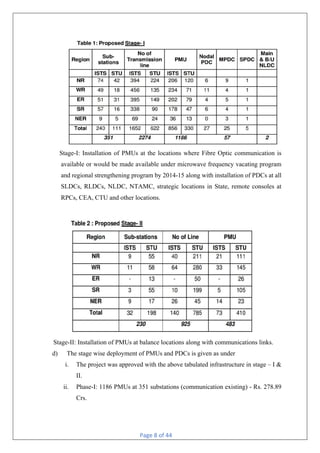
Obra,
Azamgarh,
Lucknow
As per site survey 0 0 NIL 2
192 ER ORISSA Orissa TALCHER NTPC
Kolar 1&2, Rengali 1&2,
Meeramandali 1&2, Rourkela
1,2,3&4, Behrampur 1&2,
5
193 ER ER-II Sikkim TEESTA Powergrid Rangpo 1&2 1
194 NR NR-I Uttarakhand Tehri THDC 400
Koteshwar-1,
Koteshwar-2
Line-1,
Line-2
As per site survey 0 0
Koteshwar-1 > Line-1,
Koteshwar-2 > Line-2
1
196 ER ER-I Jharkhand Tenughat Jharkhand Biharshariff(BSEB),parratu 2
197 NER NER Assam Tinsukia AEGCL 220
Behiting 1
Behiting 2
Makum
Kaithalguri-1,
Kaithalguri-2,
Namrup-1,
Namrup-2
- 1 1
Behiting 1 ->Kaithalguri-1,
Behiting 2 ->Kaithalguri-2,
Makum ->Namrup-1,
Not identified->Namrup-2
2
199 ER ORISSA Orissa TTPS(Talcher) OPTCL 3
200 ER ORISSA Orissa U.KOLAB OPTCL 220
Jayangar-1,
Jayangar-2,
Therubali,
Jayangar-1,
Jayangar-2,
Therubali,
Jayangar-1,
Jayangar-2,
Therubali,
0 0 nill 2
201 NR NR-I Uttar Pradesh Unchahar (Newly Added) NTPC 5
202 NR NR-I Uttar pradesh Unnao Uttar pradesh 220
Barelli(UP)-1&2,
Lko(PG)-1&2,
Lko(UP),
Agra(UP),
Panki,
Anpara.
Barelli(UP)-1&2,
Lko(PG)-1&2,
Lko(UP),
Agra(UP),
Panki,
Not identified.
As per site survey 1 -1 Anpara > Not identified 4
203 NR NR-II Jammu & Kashmir Uri NHPC 400
Wagoora-1,
Wagoora-2,
UriII
Wagoora-1,
Wagoora-2,
UriII
0 0 NIL 2
204 ER ER-II Orissa Uttara Powergrid Mehandsal 1&2, Khargpur1&2 2
205 NR NR-I Uttar Pradesh Varanasi-765 Powergrid Gaya-2, Fatehpur-1, Kanpur-2, 6
206 NR NR-II Jammu & Kashmir Wagoora Powergrid 400
Uri-I-1,
Uri-I-2,
Uri-II-1,
New Wanpoh-1,
New Wanpoh-2
Uri-I-1,
Uri-I-2,
Uri-II-1,
Wanpoh-1,
Wanpoh-2
0 0
New Wanpoh-1 > Wanpoh-
1,
New Wanpoh-2 > Wanpoh-
2,
3
207 NR NR-II Jammu & Kashmir Wanpoh Powergrid 400
Wagoora-1,
Wagoora-2,
Kishenpur -1,
Kishenpur -2,
Kishenpur -3,
Kishenpur -4
Wagoora-1,
Wagoora-2,
Kishenpur -1,
Kishenpur -2,
Kishenpur -3,
Kishenpur -4
As per site survey 0 0 NIL 6
208 SR SR - I Andhra Pradesh Chittur APTRANSCO 400
Chinkampally,
Sriperumbudur
Cudappah,
Madras
Cudappah,
Madras,
TVLM1,
TVLM2,
KPATNAM1,
KPATNAM2.
0 0
Chinkampally > Cudappah,
Sriperambadur > Madras
5
209 SR SR - I Andhra Pradesh Srikakulam (Palasa) APTRANSCO 4
210 SR SR - II Tamil Nadu Kalivanthapattu Powergrid 400
Kolar,
Sriperumbudur
Vallur-1,
Vallur-2
As per site survey 0 0
Kolar > Vallur-1,
Sriperumbudur > Vallur-2
6
211 SR SR - II Tamil Nadu Karaikudi New Powergrid 400
Madurai,
Trichy
Madurai,
Trichy
As per site survey 0 0 NIL 4
212 SR SR - II Karnataka Narendra Powergrid 400
Kaiga-1,
Kaiga-2,
Guttur-1,
Guttur-2,
Nareandra765-1,
Nareandra765-2
Kaiga-1,
Kaiga-2,
Dawangree-1,
Dawangree-2,
Not identified,
Not identified
As per site survey 2 -2
Guttur-1 > Dawangree-1,
Guttur-2 > Dawangree-2,
Nareandra765-1 > Not
identified,
Nareandra765-2 > Not
identified
3
213 SR SR - II Tamil Nadu Pugalur Powergrid 400
Neyveli TS-2,
Neyveli TS-2 Exp,
Madurai -1,
Madurai -2
Neyveli TS-2,
Neyveli TS-2 Exp,
Madurai -1,
Madurai -2
- 0 0 NIL 6
214 SR SR - I Telangana Mamidipally TSTRANSCO 400
Ghanapur,
Khamam 1&2,
SLBPH 1&2
Ghanapur,
Khamam 1&2,
Srisailem 1&2
0 0
SLBPH 1 > Srisailem 1
SLBPH 2 > Srisailem 2
3
215 SR SR - II Tamil Nadu Tirunelveli Powergrid 400
Madurai-1,
Madurai-2,
Udumalpet-1,
Udumalpet-2,
Koodankulam-1,
Koodankulam-2,
Koodankulam-3,
Koodankulam-4,
Trivendram-1,
Trivendram-2,
Edamom-1,
Edamom-2,
Edamom-1(m/c),
Edamom-2(m/c),
Edamom-3(m/c),
Edamom-4(m/c)
Madurai-1,
Madurai-2,
Udumalpet-1,
Udumalpet-2,
Koodankulam-1,
Koodankulam-2,
Koodankulam-3,
Koodankulam-4,
Trivendram-1,
Trivendram-2,
Edamom-1,
Edamom-2,
Not identified,
Not identified,
Not identified,
Not identified
Madurai-1,
Madurai-2,
Udumalpet-1,
Udumalpet-2,
Koodankulam-1,
Koodankulam-2,
Koodankulam-3,
Koodankulam-4,
Trivendram-1,
Trivendram-2
4 -4
Edamom-1(m/c) > Not
identified,
Edamom-2(m/c) > Not
identified,
Edamom-3(m/c) > Not
identified,
Edamom-4(m/c) > Not
identified
7
216 SR SR - I Andhra Pradesh Warangal Powergrid 400
Ramagundam,
Bhopalpally -1,
Bhopalpally -2,
Khammam
Ramagundam,
Bhopalpally -1,
Bhopalpally -2,
Khammam
As per site survey 0 0 NIL 4
217 SR SR - I Andhra Pradesh Kurnool 765 Powergrid 400
Raichur-1,
Nagarjunasagar-1,
Gooty-1,
Kurnool(AP)-1,
Kurnool(AP)-2,
Nellore-1,
Nellore-2,
Thiruvalem-1,
Thiruvalem-2
Raichur-2,
Nagarjunasagar-1,
Gooty,
Kurnool-1,
Kurnool-2,
Nellore-1 (Not Erected),
Nellore-2 (Not Erected),
Thiruvalem-1 (Not Erected),
Thiruvalem-2 (Not Erected)
Raichur(N)-2,
Nagarjunasagar-1,
Gooty,
Kurnool-1,
Kurnool-2,
Nellore-1 (Not Erected),
Nellore-2 (Not Erected),
Thiruvalem-1 (Not
Erected),
Thiruvalem-2 (Not
Erected)
Raichur(N)-1,
0 0
Raichur-1 > Raichur-2,
Gooty-1 > Gooty,
Kurnool(AP)-1 > Kurnool-1,
Kurnool(AP)-2 > Kurnool-2
8
218 SR SR - I Karnataka Raichur 765 Powergrid 400
Kurnool-1,
Kurnool-2,
Raichur-1,
Raichur-2,
Gooty-1,
Gooty-2,
Sholapur-1
Kurnool-1 (Not Commision),
Kurnool-2,
Raichur-1,
Raichur-2,
Gooty-1,
Gooty-2,
Sholapur-1
As per site survey 0 0
Kurnool-1 > Not
Commision
5
219 SR SR - II Karnataka Madhugiri 765 Powergrid 400
Gooty-1&2,
Yelahanka 1 &2,
New Salem-1,
Narendra-1,2
Gooty-1&2,
Yelahanka 1 &2,
Under Construction,
Under Construction
- 3 -3
New Salem-1 > Under
Construction,
Narendra-1,2 > Under
Construction,
5
220 SR SR - II Karnataka Hassan Powergrid 400
Mysore-1,
Mysore-2,
Neelmangalam
Mysore-1,
Mysore-2,
Neelmangalam
Mysore-1,
Mysore-2,
Neelmangalam
Talaguppa
Udipi-1
Udupi-2
0 0 NIL 6
221 SR SR - I Andhra Pradesh Cuddappah PG Powergrid 400
Nagarjunsagar-1,
Nagarjunsagar-2,
Chittoor
Nagarjunsagar-1,
Nagarjunsagar-2,
Chittoor
As per site survey 0 0 NIL 2
222 SR SR - II Tamil Nadu Salem PS Powergrid 400
Somanahalli-1&2,
Nagapattanam PS-1,
Nagapattanam PS-2,
Madugiri-1
Somanahalli-1&2,
Salem-1,
Salem-2,
Madugiri-1
- 0 0
Nagapattanam PS-1>
Salem-1
Nagapattanam PS-2>
Salem-2
3
223 SR SR - II Kerala Cochin Powergrid 400
Edamom-1(DC),
Edamom-2(DC),
North Trichur-1,
North Trichur-2
Thirunelveli-1,
Thirunelveli-2,
North Trichur-1,
North Trichur-2
As per site survey 0 0
Edamom-1(DC) >
Thirunelveli-1,
Edamom-2(DC) >
Thirunelveli-2
4
224 SR SR - II Puducherry Puducherry Powergrid 400
Neyveli TS2,
Sriparembadur
Neyveli TS2,
SV Chatram
As per site survey 0 0
Sriparembadur > SV
Chatram
2
225 SR SR - II Kerala Kozhikode Powergrid 400
Mysore-1,
Mysore-2
Mysore-1,
Mysore-2
As per site survey 0 0 NIL 2
226 SR SR - II Tamil Nadu Tiruvalam Powergrid 400
Chitoor-1,
Chitoor-2,
Nellore-1,
Nellore-2,
Sholinganallur-1,
Sholinganallur-2,
Kolar-1,
Sriperumbudur-1,
Kurnool-1,
Kurnool-2
Chitoor-1,
Chitoor-2,
Nellore-1,
Nellore-2,
Kalivandhapattu-1(NC)
Kalivandhapattu-2(NC)
Kolar-1,
Sriperumbudur-1,
Kurnool-1 (Under Cont),
Kurnool-2 (Under Cont)
As per site survey 0 0
Sholinganallur-1 >
Kalivandhapattu-1,
Sholinganallur-2 >
Kalivandhapattu-2
7
227 SR SR - I Andhra Pradesh 765 kV Nellore Powergrid 765
Simhapuri-1,
Simhapuri-2,
Nellore-1,
Nellore-2,
Kurnool-1,
Kurnool-2,
Gooty-1,
Gooty-2
Simhapuri (MEPL)-1,
Simhapuri,
Nellore-1,
Nellore-2,
Kurnool-1,
Kurnool-2,
Gooty-1,
Gooty-2
MEPL,
SEPL,
Nellore-1,
Nellore-2,
Kurnool(N)-1,
Kurnool(N)-2,
Gooty-1,
Gooty-2
0 0
Simhapuri-1 > Simhapuri
(MEPL)-1,
Simhapuri-2 > Simhapuri,
6
228 SR SR - I Andhra Pradesh Gajuwaka Powergrid 400
Kalpaka-1,
Kalpaka-2,
Nunna,
Vemagiri-1,
Vemagiri-2
Jeypore-1,
Jeypore-2,
Kalpaka-1,
Kalpaka-2,
Vijayawada,
Simhadri-2,
Simhadri-1,
Jeypore-1,
Jeypore-2,
As per site survey 0 0
Nunna > Vijayawada,
Vemagiri-1 > Simhadri-2,
Vemagiri-2 > Simhadri-1
4
229 SR SR - I Andhra Pradesh Ghanapur Powergrid 400
Ramagundam-1,
Ramagundam-2,
Gajwel,
Malkaram,
Mamidapally,
N'sagar,
Kurnool,
Hyderabad-1,
Hyderabad-2
Ramagundam-3,
Ramagundam-4,
Gajwel,
Malkaram,
Mamidapally,
N'sagar,
Kurnool,
Not identified,
Not identified
Ramagundam-3,
Ramagundam-4,
Gajwel,
Malkaram,
Mamidapally,
N'sagar,
Kurnool
2 -2
Ramagundam-1 >
Ramagundam-3,
Ramagundam-2 >
Ramagundam-4,
Hyderabad-1 > Not
identified,
Hyderabad-2 > Not
identified
4
230 SR SR - I Andhra Pradesh Gooty Powergrid 400
Raichur -1,
Raichur -2,
Kurnool,
N'Sagar,
Hoody,
Nelamangala,
Madhugiri-1,
Madhugiri-2,
Nellore PS-1,
Nellore PS-2
Raichur -1,
Raichur -2,
Kurnool,
Kurnool PG,
Bangalore,
Nelamangala,
Madhugiri-1,
Madhugiri-2,
Nellore PS-1,
Nellore PS-2
Raichur(N) -1,
Raichur(N) -2,
Kurnool,
Kurnool PG,
Somanahalli,
Nelamangala,
Madhugiri-1,
Madhugiri-2,
Nellore PS-1,
Nellore PS-2
0 0
N'sagar > Kurnool PG,
Hoody > Bangalore
5
231 SR SR - I Andhra Pradesh Khammam Powergrid 400
Maimadapally-1,
Maimadapally-2,
Warangal,
Kalpaka-1,
Kalpaka-2,
Nunna,
N'sagar,
Khammam-1,
Khammam-2
Maimadapally-1,
Maimadapally-2,
Warangal,
Kalpaka-1,
Kalpaka-2,
Vijayawada,
N'sagar,
Kothagundem-1,
Kothagundem-2
As per site survey 0 0
Nunna > Vijayawada,
Khammam-1 >
Kothagundem-1,
Khammam-2 >
Kothagundem-2
5
232 SR SR - I Andhra Pradesh Nagarjunsagar Powergrid 400
Ramagundam -1,
Ramagundam -2,
Khammam,
Mehaboobnagar,
Cuddapah -1,
Cuddapah -2.
Gooty,
Ramagundam -1,
Ramagundam -2,
Khammam,
Mehaboobnagar,
Cuddapah -1,
Cuddapah -2,
Kurnool,
Hyderabad
As per site survey 1 1
Gooty > Kurnool,
Hyderabad feeder is
captured additionally as a
part of site survey.
4
233 SR SR - II Karnataka Hiriyur Powergrid 400
Guttur -1,
Guttur -2,
Nelamangla -1,
Nelamangla -2
Guttur -1,
Guttur -2,
Nelamangla -1,
Nelamangla -2
As per site survey 0 0 NIL 2
234 SR SR - II Tamil Nadu Hosur Powergrid 400
Kolar-1,
Kolar-2,
Salem-1,
Salem-2,
Bangalore,
Electronic City-1,
Electronic City-2
Kolar-1,
Kolar-2,
Salem-1,
Salem-2,
Somanahalli,
Not identified,
Not identified
As per site survey 2 -2
Bangalore > Somanahalli,
Electronic City-1 > Not
identified,
Electronic City-2 > Not
identified
3
235 SR SR - II Karnataka Kolar Powergrid 400
Hoody -1, Hoody -2,
Somanhally, Hosur -1,
Hosur -2,
Kalvindapattu,
Chinkampally,
Talchar HVDC -1,
Talchar HVDC -2
Hoody -1, Hoody -2,
Somanhally, Hosur -1,
Hosur -2,
Tiruvallam,
Cudappah,
HVDC Pole-1,
HVDC Pole-2
As per site survey 0 0
Kalivandhapattu >
Tiruvallam,
Chinkampally > Cudappah,
Talchar HVDC-1 > HVDC
Pole-1,
Talchar HVDC-1 > HVDC
Pole-2
4
236 SR SR - II Tamil Nadu Madurai Powergrid 400
Pugalur-1,
Pugalur-2,
Trichy,
Karaikudi New,
Udumalpet,
Thirunelveli-1,
Thirunelveli-2,
Tuticorin-1,
Tuticorin-2
Pugalur-1,
Pugalur-2,
Trichy,
Karaikudi,
Udumalpet,
Thirunelveli,
Kudankulam,
Tuticorin-1,
Tuticorin-2
As per site survey 0 0
Karaikudi New > Karaikudi,
Thirunelveli-1 >
Thirunelveli,
Thirunelveli-2 >
Kudankulam
5
237 SR SR - I Karnataka Munirabad Powergrid 400
Raichur,
Guttur
Raichur,
Davangere
As per site survey 0 0 Guttur > Davangere 1
238 SR SR - II Karnataka Mysore Powergrid 400
Neelamangla-1,
Neelamangla-2,
Kozhikode -1,
Kozhikode -2,
Hassan -1, Hassan -2
Neelamangla-1,
Neelamangla-2,
Kozhikode -1,
Kozhikode -2,
Hassan -1, Hassan -2
As per site survey 0 0 NIL 3
239 SR SR - II Karnataka Neelamangala KPTCL 400
Talaguppa, Hassan,
Hiriyur PG -1,
Hiriyur PG -2, Gooty,
Mysore -1,
Mysore -2,
Hoody,
Somanhally -1,
Somanhally -2,
Yelehanka
Talaguppa, Hassan,
Hiriyur PG -1,
Hiriyur PG -2, Gooty,
Mysore -1,
Mysore -2,
Hoody-1,
Bidadi -1,
Bidadi -2,
Hoody-2
As per site survey 0 0
Hoody > Hoody-1,
Somanhally -1 > Bidadi-1,
Somanhally -2 > Bidadi-2,
Yelehanka > Hoody-2
6
240 SR SR - I Andhra Pradesh Nunna/Vijaywada Powergrid 400
Vemagiri-1,
Vemagiri-2,
Vemagiri-3,
Vemagiri-4,
Gazuwaka,
Lanco-1,
Lanco-2,
VTS stg 4-1,
VTS stg 4-2,
Nellore-1,
Nellore-2,
Khammam
Vemagiri-1,
Vemagiri-2,
Vemagiri-3,
Vemagiri-4,
Gazuwaka,
Lanco-1,
Lanco-2,
VTPS-1,
VTPS-2,
Nellore-1,
Nellore-2,
Khammam
Vemagiri-1,
Vemagiri-2,
Vemagiri-3,
Vemagiri-4,
Gazuwaka,
Lanco-1,
Lanco-2,
VTPS-1,
VTPS-2,
Nellore-1,
Nellore-2,
Khammam
Nellore(AP)-3,
Nellore(AP)-4
0 0
VTS stg 4-1 > VTPS-1,
VTS stg 4-2 > VTPS-2
7
241 SR SR - II Tamil Nadu Salem Powergrid 400
Hosur,
Somanhally,
Udumalpet-1,
Udumalpet-2,
Neyveli TS2-1,
Neyveli TS2-2
Hosur-1,
Hosur-2,
Udumalpet-1,
Udumalpet-2,
Neyveli TS2-1,
Neyveli TS2-2
As per site survey 0 0
Hosur > Hosur-1,
Somanhally > Hosur-2
4
242 SR SR - II Karnataka Somanhalli Powergrid 400
Kolar,
Salem,
Nelamangala -1,
Nelamangala -2,
Salem new-1,
Salem new-2
Nelamangala -3
Kolar,
Hosur,
Bidadi -1,
Bidadi -2,
Gooty
As per site survey 0 0
Salem > Hosur,
Nelamangala -1 > Bidadi -
1,
Nelamangala - 2 > Bidadi -
2,
Salem new-1 > Gooty,
4
243 SR SR - II Tamil Nadu Udumalpet Powergrid 400
Arasur-1,
Arasur-2,
Madurai,
Thirunelveli-1,
Thirunelveli-2,
Trichur-1,
Trichur-2,
Not Identiified,
Not Identiified
Arasur-1,
Arasur-2,
Madurai,
Thirunelveli-1,
Thirunelveli-2,
Palakad-1,
Palakad-2,
Salem-1,
Salem-2
- 0 0
Trichur-1 > Palakad-1,
Trichur-2 > Palakad-2,
Not identified >Salem-1,
Not identified >Salem-2
5
244 SR SR - II Kerala N.Trichur Powergrid 400
Udumalpet-1,
Udumalpet-2,
Cochin-1,
Cochin-2,
Kozhikode-1,
Kozhikode-2
Palakad-1,
Palakad-2,
Cochin-1,
Cochin-2,
Not Identiified,
Not Identiified
As per site survey 2 -2
Udumalpet-1 > Palakad-1,
Udumalpet-2 > Palakad-2,
Kozhikode-1 > Not
Identiified,
Kozhikode-2 > Not
Identiified
2
245 SR SR - II Tamil Nadu Trichy Powergrid 400
Karaikudi, Madurai,
Neyveli TS-1 Exp,
Neyveli TS-2
Karaikudi, Madurai,
Neyveli TS-1 Exp,
Neyveli TS-2
As per site survey 0 0 NIL 2
246 SR SR - II Kerala Trivendrum Powergrid 400
Thirunelveli -1,
Thirunelveli -2
Thirunelveli -1,
Thirunelveli -2
As per site survey 0 0 NIL 1
247 SR SR - I Andhra Pradesh Simhadri Power NTPC 400
Kalpaka -1,
Kalpaka -2,
Kalpaka -3,
Kalpaka -4
Kalpaka -1,
Kalpaka -2,
Kalpaka -3,
Kalpaka -4
Kalpaka -1,
Kalpaka -2,
Kalpaka -3,
Kalpaka -4
Vemagiri-1
Vemagiri-2
Gajuwaka-1
Gajuwaka-2
0 0 NIL 4
248 SR SR - I Andhra Pradesh Nellore Powergrid 400
Sriperumubudur-1,
Sriperumubudur-2,
Vijayawada-1,
Vijayawada-2,
Krishnapatnam UMPP-1,
Krishnapatnam UMPP-2,
Thiruvalem-1,
Thiruvalem-2
Sriperumubudur-1,
Alamathy,
Vijayawada-1,
Vijayawada-2,
NPS-1,
NPS-2,
Thiruvalem-1,
Thiruvalem-2
As per site survey 0 0
Sriperumubudur-2 >
Alamathy,
Krishnapatnam UMPP-1 >
NPS-1,
Krishnapatnam UMPP-1 >
NPS-2
4
249 SR SR - II Tamil Nadu Neyveli TS1 Ext. NLC 400 Neyveli TS-2, Trichy Neyveli TS-2, Trichy As per site survey 0 0 NIL 1
250 SR SR - II Tamil Nadu Neyveli TS2 NLC 400
Salem -1, Salem -2,
Trichy, Neyveli TS-1 Exp,
Neyveli TS-2 Exp,
Puducherry,
Bahror
Salem -1, Salem -2,
Trichy, Neyveli TS-1 Exp,
Neyveli TS-2 Exp,
Puducherry,
Pugalur
As per site survey 0 0 Bahror > Pugalur 4
251 SR SR - II Tamil Nadu Neyveli TS2 Exp NLC 400
Pugalur,
Neyveli TS-1
Pugalur-2,
Neyveli TS-2
As per site survey 0 0
Pugalur > Pugalur-2,
Neyveli TS-1 > Neyveli TS-2
1
252 SR SR - I Andhra Pradesh Ramagundam STPS NTPC 400
Chandrapur-1,
Chandrapur-2,
Warangal,
Nagarjuna Sagar-1,
Nagarjuna Sagar-2,
Ghanapur-1,
Ghanapur-2,
Gajwel,
Malkaram,
Dichipally
Chandrapur-1,
Chandrapur-2,
Warangal,
Nagarjuna Sagar-1,
Nagarjuna Sagar-2,
Hyderabad-3,
Hyderabad-4,
Gajwel,
Malkaram,
Dichipally
As per site survey 0 0
Ghanapur-1 > Hyderabad-
3,
Ghanapur-2 > Hyderabad-
4
5
253 SR SR - II Karnataka Yelahanka Powergrid 400
Neelamangla-1,
Hoody-1,
Madhugiri-1,
Madhugiri-2
Somanhally-1,
Hoody-2
Neelamangla,
Hoody,
Madhugiri-1,
Madhugiri-2
Not available
Not available
As per site survey 2 -2
Neelamangla-1 >
Neelamangla,
Hoody-1 > Hoody,
Somanhally-1 > Not
available
Hoody-2 > Not available
2
254 SR SR - II Karnataka Bidadi Powergrid 400
Neelamangla -1,
Neelamangla -2,
Somnahalli -1,
Somnahalli -2
Neelamangla -1,
Neelamangla -2,
Somnahalli -1,
Somnahalli -2
As per site survey 0 0 NIL 2
255 SR SR - II Tamil Nadu KudaNkulam Powergrid 400
Tiruneveli-1,
Tiruneveli-2,
Tiruneveli-3,
Tiruneveli-4
Madurai,
Tiruneveli-2,
Tiruneveli-3,
Tiruneveli-4
As per site survey 0 0 Tiruneveli-1 > Madurai 2
256 SR SR - II Kerala Kayamkulam PG NTPC 220
Not Identified,
Not Identified,
Not Identified,
Not Identified,
Not Identified,
Not Identified,
New Palom-1,
New Palom-2,
Edappon,
Kundara,
Not Identified,
Not Identified,
New Palom-1,
New Palom-2,
Edappon,
Kundara,
2 -2
Not Identified > New
Palom-1,
Not Identified > New
Palom-2,
Not Identified > Edappon,
Not Identified > Kundara,
2
257 SR SR - I Andhra Pradesh Kurnool APTRANSCO 400
Gooty,
SLBPH,
Ghanapur
Gooty,
Srisailam,
Ghanapur
Gooty,
Srisailam,
Ghanapur,
Kurnool(N) 1,
Kurnool(N) 2
0 0 SLBPH > Srisailam 3
258 SR SR - I Andhra Pradesh Mahaboobnagar APTRANSCO 400
Nagarjunsagar,
Raichur
Thallapalli,
Raichur
Nagarjunsagar,
Raichur
0 0 Nagarjunsagar > Thallapalli 1
259 SR SR - I Telangana Srisillem LPH TSTRANSCO 400
Kurnool,
Maimadapally -1,
Maimadapally -2,
VTS stg 4 -1,
VTS stg 4 -2
Kurnool,
Hyderabad-1,
Hyderabad-2,
Satenapalli-1,
Satenapalli-2
- 0 0
Maimadapally -1 >
Hyderabad-1,
Maimadapally -2 >
Hyderabad-2,
VTS stg 4 -1 > Satenapalli-
1,
VTS stg 4 -2 > Satenapalli-2
3
260 SR SR - I Andhra Pradesh VEMAGIRI PGL (GMR) GMR 400 Vemagiri -1, Vemagiri -2 Vemagiri -1, Vemagiri -2 - 0 0 NIL 1
261 SR SR - I Andhra Pradesh VTS STAGE IV APTRANSCO 400
Nunna 1&2,
SLBPH 1&2
Nunna 1&2,
Sattenapalli 1&2,
Malkaram 1&2
- 2 2
SLBPH 1&2 > Sattenapalli
1&2,
Not in contract >
Malkaram 1&2
3
262 SR SR - I Telangana KTPS TSTRANSCO 220
Manuguru, L Sileru-1, L Sileru-
2,
KTPS V-1, KTPS V-2,
Mirayalguda,
K V Kota, Shapurnagar
Manuguru-1, L Sileru-1, Manuguru-2,
Tie Line-1, Tie LIne-2, Mirayalguda,
Nunna, Shapurnagar
- 0 0
Manuguru > Manuguru-1,
L Sileru-2 > Manuguru-2,
KTPS V-1 > Tie Line-1,
KTPS V-2 > Tie Line-2,
K V Kota > Nunna
4
263 SR SR - I Andhra Pradesh VTS APTRANSCO 220
Kondapalli-1,
Kondapalli-2,
Chillkallu-1,
Chillkallu-2,
Podili-1,
Podili-2,
K V Kotal,
Bhimadole,
Nunna,
Tadikonda-1,
Tadikonda-2,
N sagar-1,
N sagar-2,
Gunadala
Kondapalli-1,
Kondapalli-2,
Chillkallu-1,
Chillkallu-2,
Podili,
NR Peta,
K-Kota,
Not Identifed,
Nunna,
Tadikonda-1,
Tadikonda-2,
Rentachintala,
Tallapalli,
Gunadala
As per site survey 1 -1
Podili-1 > Podili,
Podili-2 > NR Peta,
K V Kotal > K-Kota,
Bhimadole > Not
identified,
N sagar-1 > Rentachintala,
N sagar-2 > Tallapalli
7
264 SR SR - II Karnataka Guttur KPTCL 400
Jindal,
Munirabad,
Narendra-1,
Narendra-2,
Kaiga-1,
Kaiga-2,
Hiriyur PG-1,
Hiriyur PG-2
Jindal (JSWEL),
Guddadahalli,
Narendra-1,
Narendra-2,
Kaiga-1,
Kaiga-2,
Berenahalli-1,
Berenahalli-2
0 0
Jindal > Jindal (JSWEL),
Munirabad > Guddadahalli,
Hiriyur PG-1 > Berenahalli-
1,
Hiriyur PG-2 > Berenahalli-
2
4
265 SR SR - II Tamil Nadu Arasur Powergrid 400
Udumalpet -1,
Udumalpet -2
Udumalpet -1,
Udumalpet -2
0 0 NIL 2
266 SR SR - II Tamil Nadu Alamathy TANTRANSCO 400
Sriperumbudur -1,
Sriperumbudur -2,
Nellore -1,
Nellore -2,
North Chennai
6th Fdr Details Not Available
Vallur- 1,
Vallur-2,
Sriperambudur,
Nellore,
North chennai-1,
North chennai-2
Vallur- 1,
Vallur-2,
Sriperambudur,
Nellore,
North chennai-1,
North chennai-2
Sunguarchatram-1
Sunguarchatram-2
0 0
Sriperambudur-1 > Vallur-
1,
Sriperambudur-2 > Vallur-
2,
Nellore-1 >
Sriperambudur,
Nellore-2 > Nellore,
North chennai > North
chennai-1
6th Fdr > North chennai-2
4
267 SR SR - II Tamil Nadu Sriperumbudur Powergrid 400
Kalvindapattu,
Chittoor,
AlAmathy -1,
AlAmathy -2,
PudUcherry,
Bahroor
Tiruvallam,
Chittoor,
AlAmathy-1,
Nellore,
Sunguvarchatram
Not identified
As per site survey 1 -1
Kalvindapattu> Tiruvallam,
Almathy -2> Nellore,
Pudyucherry >
Sunguvarchatram,
Bahroor > Not identified
3
268 SR SR - I Karnataka Raichur TPS KPTCL 400
Gooty-1,
Gooty-2,
Munirabad
Gooty-1,
Gooty-2,
Munirabad,
Mahaboobnagar,
BTPS
As per site survey 2 2
Not identified >
Mahaboobnagar,
Not identified > BTPS
3
269 SR SR - II Kerala Kalamassery KSEB 220
Idukki-1,
Idukki-2,
Bramhapuram-1,
Bramhapuram-2
220KV IDKL-1,
220KV IDKL-2,
220KV COKL-1,
220KV COKL-2
- 0 0
Idukki-1 > 220KV IDKL-1,
Idukki-2 > 220KV IDKL-2,
Bramhapuram-1 > 220KV
COKL-1,
Bramhapuram-2 > 220KV
COKL-2
2
270 WR WR-I Maharastra Chandrapur MSETCL 400
Parali-1,
Parali-2,
Parali-3,
Bhadrawathi-1,
Bhadrawathi-3,
Bhadrawathi-4,
Bhadrawathi-2,
Khaparkheda,
HVDC-1,
HVDC-2,
Padhge.
Chandrapur-1,
Chandrapur-2,
Parali-3,
PGCIL-1,
PGCIL-2,
PGCIL-3,
PGCIL-4,
Khaparkheda,
HVDC-1,
HVDC-2.
Not identified
- 1 1
Parali-1->Chandrapur-1
Parali-2->Chandrapur-2
Bhadrawathi-1->PGCIL-1,
Bhadrawathi-2->PGCIL-2
Bhadrawathi-3->PGCIL-3
Bhadrawathi-4->PGCIL-4
Padhge->Not identified
5
271 WR WR-I Maharastra KALWA MSETCL 400
Padhage-1,
Padhage-2,
Pune PG,
Khargar
Padhage-1,
Padhage-2,
Talegaon,
Khargar
- 0 0 Pune PG->Talegaon 2
272 WR WR-I Maharastra Lonikand MSETCL 400
Pardi-1,
Parali-2,
Karad,
Koyna IV,
Jejuri,
Pune PG,
Chakan
LonikandII ckt-1,
LonikandII ckt-2,
Karad,
Koyna IV,
Jejuri,
Pune PG,
Chakan
- 0 0
Parali-1->LonikandII ckt-1
Parali-2->LonikandII ckt-2
4
273 WR WR-I Maharastra PADGHE MSETCL 400
Chandrapur-1,
Chandrapur-2,
Bableshwar-1,
Bableshwar-2,
Chakan
Kalwa-1,
Kalwa-2,
Boiser,
Tarapur,
Khargar
Neagothane-1
Neagothane-2
HVDC-1
HVDC-2
Bableshwar-1,
Bableshwar-2,
Talegaoh
Kalwa-1,
Kalwa-2
Boiser,
Tarapur-1,
Khargar,
Neagothane-1
Neagothane-2
Tharapur-2,
1 1
Chandrapur-1->HVDC-1
Chandrapur-2->HVDC-2
Chakan->Talegaoh
Tharapur->Tharapur-1
Not in Contract->Tharapur-
2
7
274 WR WR-II Madhya Pradesh BHOPAL MPPTCL 400
DAMOH-1,
DAMOH-2,
ITARSI-2,
BINA-2,
BINA-1,
ITARSI-1,
BHOPAL-1,
BHOPAL-2
DAMOH-1,
DAMOH-2,
ITARSI-2,
BINA-2,
BINA-1,
ITARSI-1,
BHOPAL-1,
BHOPAL-2
0 0 - 4
275 WR WR-II Madhya Pradesh BINA MPPTCL 400
Bina PGCIL-1,
Bina PGCIL-2,
Bina PGCIL-3,
Bina PGCIL-4,
Bina Power,
Bhopal-1,
Bhopal-2,
Bina PGCIL-1,
Bina PGCIL-2,
Bina PGCIL-3,
Bina PGCIL-4,
JP BPSCL,
Bhopal-1,
Bhopal-2,
Bina PGCIL-1,
Bina PGCIL-2,
Bina PGCIL-3,
Bina PGCIL-4,
JP BPSCL,
Bhopal-1,
Bhopal-2,
0 0 Bina power->JP BPSCL 4
276 WR WR-II Madhya Pradesh Indore MPPTCL 400
Itarsi-1, Itarsi-2,
Asoj-1, Asoj-2,
Nagda,
Indira sagar-1,
Indira sagar-2,
Indore(PG)-1,
Indore(PG)-2
Itarsi-1, Itarsi-2,
Asoj-1, Asoj-2,
Nagda,
Indira sagar-1,
Indira sagar-2,
Hatunia-1,
Hatunia-2
Itarsi-1, Itarsi-2,
Asoj-1, Asoj-2, Asoj-3
Nagda,
Indira sagar-1,
Indira sagar-2,
Indore(PG)-1,
Indore(PG)-2
0 0
Indore(PG)-1 > Hatunia-1,
Indore(PG)-2 > Hatunia-2
5
277 WR WR-II Madhya Pradesh 765/400kv Indore Powergrid 765
765kV Bina(PG),
765kV Vadodara,
765kV Bhopal,
400kV Indore (MP)1 & 2, 400kV
Pithampur 1&2
765kV Bina(PG)- Indore,
765kV Vadodara,
765kV Bhopal,
400kV Indore (MP)1 & 2, 400kV Pithampur
1&2
765kV Bina(PG)- Indore,
765kV Vadodara,
765kV Bhopal,
400kV Indore (MP)1 & 2,
400kV Pithampur 1&2
0 0
765kV Bina(PG) >765kV
Bina(PG)- Indore 7
278 WR WR-II Madhya Pradesh NAGDA MPPTCL 400
Dehgam-1 &2,
Shujalpur-1&2,
Rajgarh-1&2
Indira sagar,
Indore
Dehgam-1 &2,
Shujalpur-1&2,
Rajgarh-1&2
Indira sagar,
Indore
- 0 0 - 4
279 WR WR-II Madhya Pradesh RAJ GARH Powergrid 400
SSP 1&2,
Nagda 1&2,
Kasor 1&2,
Khandawa 1,2,
Khandawa 3,4
SSP 1&2,
Nagda 1&2,
Kasor 1&2,
Khandawa 1,2,
Not identified.
SSP 1&2,
Nagda 1&2,
Kasor 1&2,
Khandawa 1,2.
2 -2
Khandawa 3,4 > Not
identified
6
280 WR WR-II Madhya Pradesh KATNI MPPTCL 400
Birsinghpur,
Damoh
Birsinghpur-1,
Birsinghpur-2
Damoh
- 1 1
Not in contract -
>Birsinghpur-2
2
281 WR WR-II Madhya Pradesh Sasan Reliance Power Ltd. 765
Satna765 1&2,
765kV Vpool,
Vindhyachal 1
Vindhyachal 2
400kV Jabalpur 1
400kV Jabalpur 2
Satna 1&2,
400kV Vpool 1&2,
Satna765 1&2,
765kV Vpool,
Vindhyachal 1
Vindhyachal 2
Vindhyachal 3
Jabalpur 3
Not identified.
Not identified.
Satna765 1&2,
765kV Vpool
4 -4
400kV Jabalpur 1 >
Vindhyachal 3
400kV Jabalpur 2 >
Jabalpur 3
Satna 1 > Not identified
Satna 2 > Not identified
400kV Vpool 1 > Not
identified
400kV Vpool 2 > Not
identified
2
282 WR WR-I Chattisgarh BHILAI CSPGCL 400
KSTPS-1,
KSTPS-2,
KSTPS-3,
Raipur-1,
Seoni,
Koradi,
Bhadrawati
Raipur-2,
NTPC Korba-1,
NTPC Korba-2,
Raita-1,
Raipur-1,
seoni,
Koradi,
Bhadrawati,
Raita-2,
Raita-3,
Korba EXT-1,
Korba EXT-2,
Bhatapara
4 4
KSTPS-1->NTPC Korba-1,
KSTPS-2->NTPC Korba-2,
KSTPS-3->Raita-1,
Raipur-2->Not available.
Nill->Raita-2,
Nill->Raita-3,
Nill->Korba EXT-1,
Nill->Korba EXT-2,
Nill->Bhatapara
6
283 WR WR-I Chattisgarh KORBA WEST CSPGCL 400
KSTPS,
Bhilai
KSTPS (NTPC),
Raita
KSTPS (NTPC),
Raita.
Bhilai 1,
Bhilai 2.
0 0
KSTPS > KSTPS (NTPC),
Bhilai > Raita
2
284 WR WR-I Chattisgarh Korba(E) CSPGCL 220
Korba East Extn-1,
Korba East Extn-2,
Korba West,
Balco-1,
Balco-2,
Budhipadar-1,
Budhipadar-2,
Raigarh,
Bhilai,
Bhatapar-1,
Bhatapar-2
Korba East West-1,
Korba East West-2,
Korba DSPM,
Balco-1,
Balco-2,
Budhipadar-1,
Budhipadar-2,
Raigarh,
Siltara,
Not Identified,
Not Identified
Korba East West-1,
Korba East West-2,
Korba DSPM,
Balco-1,
Balco-2,
Budhipadar-1,
Budhipadar-2,
Raigarh,
Siltara
2 -2
Korba East Extn-1 > Korba
East West-1,
Korba East Extn-2 > Korba
East West-2,
Korba West > Korba DSPM,
Bhilai > Siltara,
Bhatapar-1 > Not
Identified,
Bhatapar-2 > Not
Identified
5
285 WR WR-II Gujrat SARDARSAROVAR(SSP) SSP 400
Rajgarh-1,
Rajgarh-2,
Asoj,
Kasor,
Dhule-1,
Dhule-2,
Nagda-1,
Nagda-2
Asoj,
Limdi,
Dhule-1,
Dhule-2,
0 0
Rajgarh-1->Nagda-1,
Rajgarh-2->Nagda-2
Kasor->Limdi,
3
286 WR WR-I Maharastra AURANGABAD PG Powergrid 4
287 WR WR-I Maharastra Bhadrawati Powergrid 400
Raipur 1,2&3,
Ramagundam 1&2,
Parli ,
Chandrapur 1,2,3&4,
Bhilai ,
EMCO 1&2,
Dhariwal TPS.
Raipur 1,2&3,
Ramagundam 1&2,
Parli ,
Chandrapur 1,2,3&4,
Bhilai ,
EMCO 1&2,
Dhariwal (Parli-2),
HVDC-1,
HVDC-2
Raipur 1,2&3,
Ramagundam 1&2,
Parli ,
Chandrapur 1,2,3&4,
Bhilai ,
EMCO 1&2,
Dhariwal TPS,
HVDC-1,
HVDC-2
2 2
Dhariwal TPS > Dhariwal
(Parli-2),
Not identified > HVDC-1,
Not identified > HVDC-2
8
288 WR WR-II Madhya Pradesh Bina Powergrid 765
765kV JabalpurPS-1, 2 & 3,
765kV Indore,
765kV Satna-1 & 2,
765kV Gwalior-1, 2 & 3,
765KV Seoni
400kV Sujalpur-1 & 2,
400kV Bina-1, 2, 3 & 4,
400kV Bina Power,
400kV Satna-1, 2, 3 & 4,
765kV Jabalpur-1, 2 & 3,
765kV Indore,
765kV Satna-1 & 2,
765kV Gwalior-1, 2 & 3,
765KV Seoni
400kV Sujalpur-1 & 2,
400kV Bina-1, 2, 3 & 4,
400kV BPSCL,
400kV Satna-1, 2, 3 & 4,
765kV Jabalpur-1, 2 & 3,
765kV Indore,
765kV Satna-1 & 2,
765kV Gwalior-1, 2 & 3,
765KV Seoni
400kV Sujalpur-1 & 2,
400kV Bina-1, 2, 3 & 4,
400kV BPSCL,
400kV Satna-1, 2, 3 & 4,
0 0
765kV Jabalpur PS-1 >
765kV Jabalpur-1
765kV Jabalpur PS-2 >
765kV Jabalpur-2
765kV Jabalpur PS-3 >
765kV Jabalpur-3,
400kV Bina Power > 400kV
BPSCL
16
289 WR WR-I Maharastra Boisar Powergrid 400
Tarapur 1&2,
Padghe,
Vapi,
A'bad (PG) 1&2,
Magarwada 1&2,
Tarapur 1&2,
Padghe,
Vapi,
Aurangabad 1&2
Navsari 1&2,
Tarapur 1&2,
Padghe,
Vapi,
A'bad (PG) 1&2,
Magarwada 1&2,
0 0
Magarwada 1 > Navsari 1,
Magarwada 2 > Navsari 2.
5
290 WR WR-II Madhya Pradesh GWALIOR Powergrid 0
291 WR WR-II Madhya Pradesh Itarsi Powergrid 400
Jabalpur 1,2,3,4
Bhopal 1&2,
Indore 1&2,
Khandawa 1&2,
Satpura,
Jabalpur 1,2,3,4
Bhopal 1&2,
Indore 1&2,
Khandawa 1&2,
Satpura,
Jabalpur 1,2,3,4
Bhopal 1&2,
Indore 1&2,
Khandawa 1&2,
Satpura,
0 0 NIL 6
292 WR WR-II Madhya Pradesh Jabalpur Powergrid 400
Itarsi 1,2,3,&4,
Vindhyachal 1&2,
400kV Jabalpur pool 1&2,
400kV Sasan 1
400kV Sasan 2
Itarsi 1,2,3,&4,
Vindhyachal 1&2,
400kV Jabalpur pool 1&2,
400kV Sasan 1
Vindhyachal 4
Itarsi 1,2,3,&4,
Vindhyachal 1&2,
400kV Jabalpur pool
1&2,
Vindhyachal 3
Vindhyachal 4
0 0 Sasan 2> Vindhyachal 4 5
293 WR WR-II Madhya Pradesh Khadwa Powergrid 400
Dhule-1, Dhule-2,
Itarsi-1, Itarsi-2,
Seoni-1, Seoni-2,
Rajgarh-1, Rajgarh-2,
Rajgarh-3, Rajgarh-4,
Betul-1, Betul-2
Dhule-1, Dhule-2,
Itarsi-1, Itarsi-2,
Seoni-1, Seoni-2,
Rajgarh-1, Rajgarh-2,
Indore-1, Indore-2,
Betul-1, Betul-2
Dhule-1, Dhule-2,
Itarsi-1, Itarsi-2,
Seoni-1, Seoni-2,
Rajgarh-1, Rajgarh-2,
Indore-1, Indore-2,
Betul-1, Betul-2
4 -4
Rajgarh-3 > Indore-1,
Rajgarh-4 > Indore-2
6
294 WR WR-I Chattisgarh KORBA STPS NTPC 400
Bhilai-1,
Bhilai-2,
Bhatapara,
Raipur-1,
Raipur-2,
Pathadi,
Korwa West,
Vindhyachal-1,
Vindhyachal-2,
Birsinghpur-1,
Birsinghpur-2
Bhilai-1,
Bhilai-2,
Bhatapara,
Raipur-3,
Raipur-4,
Lanco,
Korwa West,
Vindhyachal-1,
Vindhyachal-2,
Vandhana,
Balco
As per site survey 0 0
Raipur-1 > Raipur-3,
Raipur-2 > Raipur-4,
Pathadi > Lanco,
Birsinghpur-1 > Vandhana,
Birsinghpur-2 > Balco
6
295 WR WR-I Maharastra Mapusa Powergrid 400 Kolhapur -1, Kolhapur -1 Kolhapur -1, Kolhapur -1 As per site survey 0 0 NIL 1
296 WR WR-I Chattisgarh Raigarh Powergrid 400
Raipur 1,
Raipur 4,
Raipur 2,
Raipur 3
Rourkela 1,
Rourkela 2
Rourkela 3,
Sterlite
Raipur 1,
Raipur 4,
KWPCL,
KSK,
Sundergarh,
Sterlite 1,
Sundergarh 2,
Sterlite 1,
Kotra pool 1
Kotra pool 2.
Raipur 1,
Raipur 4,
KWPCL,
KSK,
Sundergarh,
Sterlite 1,
Sundergarh 2,
Sterlite 1,
Kotra pool 1
Kotra pool 2.
2 2
Raipur 2 > KWPCL
Raipur 3 > KSK
Rourkela 1 > Sundergarh,
Rourkela 2 > Sterlite 1,
Rourkela 3, > Sundergarh
2,
Sterlite > Sterlite 1,
Not identified > Kotra pool
1
Not identified > Kotra pool
2.
8
297 WR WR-II Madhya Pradesh Satna Powergrid 765
765KV Bina-1,
765KV Bina-2,
765KV Sasan-1,
765KV Sasan-2,
765KV V Pool-1,
765KV V Pool-2,
765KV Satna-1,
765KV Satna-2,
400KV Vindhyachal-1,
400KV Vindhyachal-2,
400KV Vindhyachal-3,
400KV Vindhyachal-4,
400KV Bina PG-1,
400KV Bina PG-2,
400KV Bina PG-3,
400KV Bina PG-4,
400KV Jaiprakash-1,
400KV Jaiprakash-2,
400KV Sasan-1,
400KV Sasan-2
765KV Bina-1,
765KV Bina-2,
765KV Sasan-1,
765KV Sasan-2,
765KV V Pool-1,
765KV V Pool-2,
765KV Gwalior-1,
765KV Gwalior-2,
400KV Vindhyachal-1,
400KV Vindhyachal-2,
400KV Vindhyachal-3,
400KV Vindhyachal-4,
400KV Bina PG-1,
400KV Bina PG-2,
400KV Bina PG-3,
400KV Bina PG-4,
400KV Nigrie-1,
400KV Nigrie-2,
Not identified, Not Identified
765KV Bina-1,
765KV Bina-2,
765KV Sasan-1,
765KV Sasan-2,
765KV V Pool-1,
765KV V Pool-2,
765KV Gwalior-1,
765KV Gwalior-2,
400KV Vindhyachal-1,
400KV Vindhyachal-2,
400KV Vindhyachal-3,
400KV Vindhyachal-4,
400KV Bina PG-1,
400KV Bina PG-2,
400KV Bina PG-3,
400KV Bina PG-4,
400KV Nigrie-1,
400KV Nigrie-2,
2 -2
765KV Satna-1 > 765KV
Gwalior-1,
765KV Satna-2 > 765KV
Gwalior-2,
400KV Jaiprakash-1 >
400KV Nigrie-1,
400KV Jaiprakash-2 >
400KV Nigrie-2,
400KV Sasan-1 > Not
identified,
400KV Sasan-2 > Not
identified,
12
298 WR WR-I Madhya Pradesh SEONI Powergrid 765
765Kv Sipat-1,
765Kv Sipat-2,
765Kv Bina,
765Kv wardha-1,
765Kv wardha-2,
400Kv Khandwa-1,
400Kv Khandwa-2
400Kv Sadhpura,
400Kv Bhilai.
765Kv Bilaspur-1,
765Kv Bilaspur-2,
765Kv Bina,
765Kv wardha-1,
765Kv wardha-2,
400Kv Khandwa-1,
400Kv Khandwa-2
400Kv Sadhpura,
400Kv Bhilai.
- 0 0
765Kv sipat-1->765Kv
Bilaspur-1,
765Kv sipat-2->765Kv
Bilaspur-2
8
299 WR WR-II Gujrat Vapi Powergrid 400
Boiser,
Kala-1,
Suzen,
Kala-2,
KAPP-1,
KAPP-2,
Kawas-1,
Kawas-2
Boiser,
Kala Line,
Suzen Line,
Not Identified,
Not Identified,
Not Identified,
Not Identified,
Not Identified,
Navsari
Boiser,
Kala 1,
Suzen Line,
Kala 2,
KAPP-1,
KAPP-2
4 -4
Kala-1 > Kala Line,
Kala-2 > Not Identified,
KAPP-1 > Not Identified,
KAPP-2 > Not Identified,
Suzen > Suzen Line,
Kawas-1 > Not Identified,
Kawas-2 > Not Identified,
Not Identified > Navsari
3
300 WR WR-I Maharastra Wardha Powergrid 765
Mauda 1&2,
Parli PG 1&2,
Akola 1&2,
Aurangabad 1&2,
Seoni765 1&2,
765kV Raipur PS 1,2
Raipur 1&2,
765kV Aurangabad 1,2,
765kV Aurangabad 3,&4
765kV Raipur PS 3&4,
Mauda 1&2,
Parli PG 1&2,
Akola 1&2,
Aurangabad 1&2,
Seoni765 1&2,
765kV Raipur PS 1,2
Raipur 1&2
Warora 1&2.
- 6 -6
Not in contract->Warora
1&2
765kV Aurangabad 1,2->
Not identified at site.
765kV Aurangabad 3,&4->
Not identified at site.
765kV Raipur PS 3&4-> Not
identified at site.
17
301 WR WR-II Gujrat Dehgam Powergrid 400
Sami-1, Sami-2,
Ranchodpura-1, Ranchodpura-
2,
Nagda-1, Nagda-2,
Pirana-1,Pirana-2,
Wanakbori-1,
Wanakbori-2,
Soja-1, Soja-2,
Pirana-3, Pirana-4,
Jhanor-1, Jhanor-2
Sami-1, Sami-2,
Ranchodpura-1, Ranchodpura-2,
Nagda-1, Nagda-2,
Pirana-1,Pirana-2,
Wanakbori, Wanakbori(Future),
Soja, Soja(Future),
Gandhar-1, Gandhar-2,
ICT Bays.
Sami-1, Sami-2,
Ranchodpura-1,
Ranchodpura-2,
Nagda-1, Nagda-2,
Pirana-1,Pirana-2,
Wanakbori,
Wanakbori(Future),
Soja, Soja(Future),
Gandhar-1, Gandhar-2,
2 -2
Wanakbori-2 >
Wanakbori(Future)
Soja-2 > Soja(Future)
Pirana-3 > Gandhar-1,
Pirana-4 > Gandhar-2,
Wanakbori-1 > Wanakbori
Soja-1 > Soja
7
302 WR WR-I Chattisgarh Raipur Powergrid 400
Bhadrawadi-1
Bhadrawadi-2
Bhadrawadi-3
NSPCL-1
NSPCL-2
Wardha-1
Wardha-2
Raigarh-1
Raigarh-2
Raigarh-3
Raigarh-4
JPL-1
JPL-2
Sipat-1
Sipat-2
Sipat-3
Pathadi,
KSTPS-1,
KSTPS-2,
Bhatapara,
Bhilai-1,
Bhilai-2.
Chandrapur-1,
Not available,
Not available,
BESCL-1,
BESCL-2,
Wardha-1,
Wardha-2,
Raigarh-1,
KWPCL,
KSK-3,
KSK-4,
Tamnar-1
Tamnar-2
Sipat-1,
Sipat-2,
Sipat-3,
Not available
Korba-3,
korba-4,
Bhatapara
Bhilai-1,
Bhadravati-3,
Raipur Pooling-1,
Raipur Pooling-2.
2 -2
Bhadrawadi-1-
>Chandrapur-1,
Bhadrawadi-2->Not
Identified
Bhadrawadi-3->Not
Identified
NSPCL-1->BESCL-1
NSPCL-2->BESCL-2
Raigarh-3->KSK-3
Raigarh-4->KSK-4
JPL-1->Tamnar-2
JPL-2->Not Identified
Pathadi->Not Identified,
KSTPS-1->Korba-3
KSTPS-2->korba-4,
Bhilai-2->Bhadravati-3
Not in contract->Raipur
Pooling-1,
Not in contract->Raipur
Pooling-2.
12
303 WR WR-II Madhya Pradesh Damoh Powergrid 400
Birsinghpur 1,
Birsinghpur 2,
Bhopal 1,
Bhopal 2,
Katni
Birsinghpur 1,
Birsinghpur 2,
Bhopal 1,
Bhopal 2,
Katni 2
Katni 1
Birsinghpur 1,
Birsinghpur 2,
Bhopal 1,
Bhopal 2,
Katni 2
Katni 1
1 1
Katni > Katni 2
Not identified > katni 1
6
304 WR WR-II Gujrat Bachhau Powergrid 400
Mundra-1, Mundra-2,
Ranchodpura-1, Ranchodpura-
2,
Essar TPS-1, Essar TPS-2,
Versana-1, Versana-2
Mundra-1, Mundra-2,
Ranchodpura-1, Ranchodpura-2
Mundra-1, Mundra-2,
Ranchodpura-1,
Ranchodpura-2,
Essar TPS-1, Essar TPS-2,
Versana-1, Versana-2
0 0
Essar TPS-1 > Under
Construction,
Essar TPS-2 > Under
Construction,
Versana-1 > Under
Construction,
Versana-2 > Under
Construction
8
305 WR WR-I Maharastra Parli Powergrid 400
Parli 1&2,
Solapur pG 1&2,
Wardha 1&2,
Bhadrawati,
Pune New 1&2,
Dhariwal TPS
MSETCL Parli 1&2,
Solapur pG 1&2,
Wardha 1&2,
Bhadrawati-1,
Pune 1&2,
Bhadrawati-2.
Parli 1&2,
Solapur pG 1&2,
Wardha 1&2,
Bhadrawati,
Pune GIS 1&2,
Dhariwal TPS
0 0
Parli 1>MSETCL Parli 1
Parli 2>MSETCL Parli 2
Bhadrawati>Bhadrawati-1,
Pune New 1> Pune 1
Pune New 2> Pune 2
Dhariwal TPS>Bhadrawati-
2
6
306 WR WR-I Maharastra Pune Powergrid 400
Lonikhand,
Kalwa,
Pune New 1,
Pune New 2,
Pune New 3,
Pune New 4.
Lonikhand,
Kalwa,
Parli 1,
Parli 2,
Aurangabad 1,
Aurangabad 2,
As per SLD 0 0
Pune New 1>Parli 1
Pune New 2>Parli 2
Pune New 3>Aurangabad
1
Pune New 4>Aurangabad
2
6
307 WR WR-I Maharastra Navi Mumbai Powergrid 400
Kalwa, Pune PG,
Kala-1, Kala-2
Kalwa,LoniKhand,
Vapi-1, Vapi-2
Kalwa,Lonikand. 0 0
Pune PG > LoniKhand,
Kala-1 > Vapi-1,
Kala-2 > Vapi-2
1
308 WR WR-II Gujrat Navsari Powergrid 400
Jhanor-1, Jhanor-2,
KAPP-1, KAPP-2,
Magarwada-1, Magarwada-2
Gandhar-1, Gandhar-2,
Kala, Vapi,
DGEN-1,
DGEN-2
Jhanor-1, Jhanor-2,
Magarwada-1,
Magarwada-2,
DGEN-1, DGEN-2
0 0
Jhanor-1 > Gandhar-1,
Jhanor-2 > Gandhar-2,
KAPP-1 > Kala,
KAPP-2 > Vapi,
Magarwada-1 > DGEN-1,
Magarwada-2 > DGEN-2
3
309 WR WR-II Gujrat Pirana Powergrid 400
Vadodara-1, Vadodara-2,
Dehgam-1, Dehgam-2,
Dehgam-3, Dehgam-4
Vadodara-1, Vadodara-2,
Dehgam-1, Dehgam-2,
TPGL-1, TPGL-2
Vadodara-1, Vadodara-
2,
Dehgam-1, Dehgam-2,
TPGL-1, TPGL-2
0 0
Dehgam-3 > TPGL-1,
Dehgam-4 > TPGL-2
6
310 WR WR-II Gujrat Gandhar(Jhanor) NTPC 400
GPEC, Suzen,
Dehgam 1&2,
Navsari 1&2
GPEC, Suzen,
Dehgam 1&2,
Navsari 1&2
GPEC, Suzen,
Dehgam 1&2,
Navsari 1&2
0 0 NIL 0
311 WR WR-I Maharastra Sholapur Powergrid 765
Kolhapur-1, Kolhapur-2,
Karad,
Parli PG-1, Parli PG-2,
Sholapur NTPC-1, Sholapur
NTPC-2
Kolhapur-1, Kolhapur-2,
Karad,
Parli PG-1, Parli PG-2,
Sholapur NTPC-1, Sholapur NTPC-2
Lamboti
765KV
Raichur-1, Raichur-2,
Aurangabad-1, Aurangabad-2,
Pune
Kolhapur-1, Kolhapur-2,
Karad,
Parli PG-1, Parli PG-2,
Sholapur NTPC-1,
Sholapur NTPC-2
Lamboti
765KV
Raichur-1, Raichur-2,
Aurangabad-1,
Aurangabad-2,
Pune
6 6
Not identified > Lamboti
Not identified > Raichur-1,
Not identified > Raichur-2,
Not identified >
Aurangabad-1,
Not identified >
Aurangabad-2,
Not identified > Pune
10
312 WR WR-II Madhya Pradesh Shujalpur Powergrid 400
Bina-1, Bina-2,
Nagda -1, Nagda -2
Bina-1, Bina-2,
Nagda -1, Nagda -2
Bina-1, Bina-2,
Nagda -1, Nagda -2
0 0 NIL 4
313 WR WR-II Gujrat Kakrapar NPCIL 220
Vav 1&2,
Vapi 1&2,
Haldarwa 1&2
Vav 1&2,
Vapi 1&2,
Haldarwa 1&2
UKAI
- 1 1 Not in contract-> Ukai 4
314 WR WR-II Gujrat Kawas NTPC 220
Haldarwa 1&2,
Vav 1&2,
Navsari 1&2
Haldarwa 1&2,
Vav 1&2,
Dastan 1&2
Haldarwa 1&2,
Vav 1&2,
Navsari( GIS) 1&2
0 0
Navsari 1 > Dastan 1
Navsari 2 > Dastan 2
3
315 WR WR-II Gujrat Gandhar NTPC 220 Haldarwa 1&2 Haldarwa 1&2 Haldarwa 1&2 0 0 NIL 4
316 WR WR-I Chattisgarh
765/400kV
Raigarh(Kotra) Pooling Station
Powergrid 765
765kV Raigarh (Tamnar) PS-1,
765kV Raigarh (Tamnar) PS-2,
765kV Raipur PS-1,
765kV Raipur PS-2,
765kV Champa PS,
400kV Raigarh-1,
400kV Raigarh-2,
400kV RKM-1,
400kV RKM-2,
400kV Athena-1,
400kV Athena-2,
400kV SKS-1,
400kV SKS-2,
400kV Korba-1,
400kV Korba-2,
400kV DB-1,
400kV DB-2,
400kV Visa-1,
400kV Visa-2
765kV Raigarh (Tamnar) PS-1,
765kV Raigarh (Tamnar) PS-2,
765kV Raipur PS-1,
765kV Raipur PS-2,
765kV Champa PS,
400kV Raigarh-1,
400kV Raigarh-2,
400kV RKM-1,
400kV RKM-2,
400kV Athena-1,
400kV Athena-2,
400kV SKS-1,
400kV SKS-2,
400kV Korba-1,
400kV Korba-2,
400kV DB-1,
400kV DB-2,
400kV Visa-1,
400kV Visa-2,
400kV Visa Steel-1,
400kV Visa Steel-2,
400kV NTPC-1 (COSMOS),
400kV NTPC-2 (COSMOS)
765kV Raigarh (Tamnar)
PS-1,
765kV Raigarh (Tamnar)
PS-2,
765kV Raipur PS-1,
765kV Raipur PS-2,
765kV Champa PS,
400kV Raigarh-1,
400kV Raigarh-2,
400kV RKM-1,
400kV RKM-2,
400kV Athena-1,
400kV Athena-2,
400kV SKS-1,
400kV SKS-2,
400kV Korba-1,
400kV Korba-2,
400kV DB-1,
400kV DB-2,
400kV Visa-1,
400kV Visa-2,
400kV Visa Steel-1,
400kV Visa Steel-2,
400kV NTPC-1
(COSMOS),
400kV NTPC-2
(COSMOS)
4 4
400kV SKS-1 > 400kV
SPGCIL-1,
400kV SKS-2 > 400kV
SPGCIL-2,
400kV Korba-1 > 400kV
KWPCL-1,
400kV Korba-2 > 400kV
KWPCL-2,
400kV Visa-1 > 400kV Visa
Power-1,
400kV Visa-2 > 400kV Visa
Power-2,
Not applicable->400kV
Visa Steel-1
Not applicable->400kV
Visa Steel-2
Not applicable->400kV
NTPC-1 (COSMOS
not applicable->400kV
NTPC-2 (COSMOS)
15
317 WR WR-I Chattisgarh 765/400kv Raipur Pooling Station Powergrid 765
765kV Raigarh (Kotra) PS-1,
765kV Raigarh (Kotra) PS-2,
765kV Champa-1,
765kV Champa-2,
765kV Wardha-1,
765kV Wardha-2,
765kV Wardha-3,
765kV Wardha-4,
400kV Raipur-1,
400kV Raipur-2,
400kV GMR-1,
400kV GMR-2
765kV Raigarh (Kotra) PS-1,
765kV Raigarh (Kotra) PS-2, 765kV Champa-1,
765kV Champa-2,
765kV Wardha-1,
765kV Wardha-2,
Future Extension,
Future Extension,
400kV Raipur-1,
400kV Raipur-2,
400kV GMR-1,
400kV GMR-2
765kV Raigarh (Kotra) PS-
1,
765kV Raigarh (Kotra) PS-
2, 765kV Champa-1,
765kV Champa-2,
765kV Wardha-1,
765kV Wardha-2,
765kV Wardha-3,
765kV Wardha-4,
400kV Raipur-1,
400kV Raipur-2,
400kV GMR-1,
400kV GMR-2
0 0 NIL 9
318 WR WR-I Chattisgarh
765/400kV
Raigarh(Tamnar) Pooling Station
Powergrid 765
765kV Raigarh (Kotra) PS 1&2,
400kV Jindal Power 1,2,3,& 4,
400kV TRN 1 & 2,
400kV Jayaswal Nico 1&2,
400kV Sarda 1&2
765kV Raigarh (Kotra) PS 1&2,
400kV Jindal Power 1,2,3,& 4.
765kV Raigarh (Kotra) PS
1&2,
400kV Jindal Power
1,2,3,& 4,
400kV TRN 1 & 2.
6 -6
400kV TRN 1 & 2 > Not
identified
400kV Jayaswal Nico 1&2 >
Not identified
400kV Sarda 1&2 > Not
identified.
8
319 WR WR-I Maharastra 765/400kv Aurangabad Station Powergrid 765
765kV Wardha 1,
765kV Wardha 2,
765kV Wardha 3,
765kV Wardha 4,
76kV Padghe (PG) 1
76kV Padghe (PG) 2,
765kV Dhule ,
400kV Boisar 1
400kV Boisar 2
400kV Wardha 1
400kV Wardha 2
400kV Aurangabad 1
400kV Aurangabad 2
765kV Wardha 1,
765kV Wardha 2,
765kV Wardha 3,
765kV Wardha 4,
76kV Padghe (PG) 1
76kV Padghe (PG) 2,
765kV Dhule ,
400kV Boisar 1
400kV Boisar 2
400kV Wardha 1
400kV Wardha 2
400kV Aurangabad 1
400kV Aurangabad 2
400kV Ankola 1
400kV Ankola 2
765kV Wardha 1,
765kV Wardha 2,
765kV Wardha 3,
765kV Wardha 4,
76kV Padghe (PG) 1
76kV Padghe (PG) 2,
765kV Dhule ,
400kV Boisar 1
400kV Boisar 2
400kV Wardha 1
400kV Wardha 2
400kV Aurangabad 1
400kV Aurangabad 2
400kV Ankola 1
400kV Ankola 2
6 6
Not identified > 400kV
Wardha 1,
Not identified > 400kV
Wardha 2,
Not identified > 400kV
Aurangabad 1,
Not identified > 400kV
Aurangabad 2,
Not identified > 400kV
Ankola 1,
Not identified > 400kV
Ankola 2.
8
320 WR WR-II Gujrat Vadodara GIS Powergrid 765
765kV Indore,
765kV Dhule,
400kV Pirana 1 & 2,
Asoj 1 & 2,
DGEN 1&2
765kV Indore,
765kV Dhule,
400kV Pirana 1 & 2,
400kV Asoj 1 & 2,
- 2 2 DGEN 1&2-> Not available. 3
321 WR WR-I Chattisgarh
765/400kV
Dharamjaygarh
Powergrid 765
765kV Jharsuguda 1 ,2,3 & 4,
765kV Ranchi 1 & 2,
765kV Champa,
765kV Jabalpur Pool 1 , 2,3 & 4,
400kV BALCO 1 &2,
400kV Vandana 1 &2,
765kV WR Pool.
765kV Jharsuguda 1 ,2,3 & 4,
765kV Ranchi 1 & 2,
765kV Champa,
765kV Jabalpur Pool 1 , 2,3 & 4,
400kV BALCO 1 &2,
400kV Vandana 1 &2,
765kV Bilaspur,
- 0 0
765kV WR Pool >765kV
Bilaspur
12
322 WR WR-II Madhya Pradesh
765/400kV
Jabalpur Pooling station
Powergrid 765
765kV Dharamjaygarh-1, 2, 3 &
4,
765kV Bina-1, 2 & 3,
765kV Bhopal,
400kV Jabalpur-1 & 2,
400kV MB Power-1 & 2,
400kV Jhabua-1, 2
765kV Dharamjaygarh-1, 2, 3 & 4,
765kV Bina-1, 2 & 3,
765kV Bhopal,
400kV Jabalpur-1 & 2,
400kV MB Power-1 & 2,
400kV Jhabua-1, 2
765kV Dharamjaygarh-1,
2, 3 & 4,
765kV Bina-1, 2 & 3,
765kV Bhopal,
400kV Jabalpur-1 & 2,
400kV MB Power-1 & 2,
400kV Jhabua-1, 2
0 0 NIL 10
323 WR WR-II Madhya Pradesh 765/400kV Gwalior Powergrid 765
765kV Bina 1,2 & 3,
765kV Jaipur 1 & 2,
765kV Agra 1 & 2,
765kV Satna 1 & 2
765kV Bina 1,2 & 3,
765kV Jaipur 1 & 2,
765kV Agra 1 & 2,
765kV Satna 1 & 2
765kV Bina 1,2 & 3,
765kV Jaipur 1 & 2,
765kV Agra 1 & 2,
765kV Satna 1 & 2
0 0 NIL 6
324 WR WR-II Chattisgarh Vin IV Switchyard NTPC 400
400kV V'Pool 1
400kV V'Pool 2
Vindhyachal Pooling -1
Vindhyachal Pooling -2
Vindhyachal Pooling -1
Vindhyachal Pooling -2
0 0
400kV V'Pool 1 >
Vindhyachal Pooling -1
400kV V'Pool 2 >
Vindhyachal Pooling -2
2
325 WR WR-II Chattisgarh Vindhychal Pool Powergrid 765
765kV Rihand III 1 & 2,
765kV Satna 1 & 2,
765kV Sasan,
400kV Sasan 1& 2,
400kV Vin IV 1 & 2,
DB(MP) 1&2
765kV Rihand III 1 & 2,
765kV Satna 1 & 2,
765kV Sasan,
400kV Sasan 1& 2,
400kV Vin IV 1 & 2,
400kV Rihand III 1&2
400kV Future-1,2,3,4
- 4 4
DB(MP) 1&2-> Not
available
Not in contract->400kV
Rihand III 1&2
Not in contract->400kV
Future-1,2,3,4
11
326 WR WR-I Maharastra Dhule (PVT)
Bhopal dhule company
transmission LTD
765
765kV Aurangabad,
765kV Vadodara,
400kV Dhule(MSETCL) 1 & 2
765kV Aurangabad,
765kV Vadodara,
400kV Dhule(MSETCL) 1 & 2
HVDC-1,2,3,4
-
Not in contract->HVDC-
1,2,3,4
5
327 WR WR-I Maharastra 400KV Kolapur (PG) Powergrid 400
Karad-1,
Karad-2,
Mapusa-1,
Mapusa-2,
Solapur-1,
Solapur-2,
Karad-1,
Karad-2,
Mapusa-1,
Mapusa-2,
Solapur-1,
Solapur-2,
- 0 0 - 3
328 WR WR-II Gujrat Magarwada GIS Powergrid 400
400kV Navsari 1 & 2,
400kV Boisar 1&2
400kV Navsari 1 & 2,
400kV Kala 1&2
- 0 0
400kV Boisar 1&2->400kV
Kala 1&2
2
329 WR WR-II Maharastra UT DNH - Kala GIS Powergrid 400
400kV Vapi -1, 400kV Vapi -2,
400kV Navi Mumbai -1,
400kV Navi Mumbai -2
400kV Vapi -1, 400kV Vapi -2,
400kV Navsari -1,
400kV Navsari -2
400kV Vapi -1, 400kV
Vapi -2,
400kV Kudus-1,
400kV Kudus-2
0 0
400kV Navi Mumbai -1 >
400kV Navsari -1,
400kV Navi Mumbai -2 >
400kV Navsari -2
2
330 WR WR-I Chattisgarh Bhatapara Powergrid 400 Not in contract
Korba
Khedamara
As per site survey NA NA
Not in contract > Korba
Not in contract >
Khedamara
2
331 WR WR-I Chattisgarh Bilaspur Powergrid 765 Not in contract
765KV-
Seoni I & II,
Sipat I & II,
Korba, Ranchi.
400KV-
Mahan I & II,
Aryan I & II,
Lanco I & II.
765KV-
Seoni I & II,
Sipat I & II,
Korba.
400KV-
Mahan I & II,
Aryan I & II,
Lanco I & II.
NA NA
Not in contract > Seoni I &
II,
Not in contract > Sipat I &
II,
Not in contract > Korba,
Not in contract > Ranchi.
Not in contract > Mahan I
& II,
Not in contract > Aryan I &
II,
Not in contract > Lanco I &
II
10
332 WR WR-I Chattisgarh NTPC Sipat NTPC 400 Not in contract
765KV-
Bharari I
Bharari II
400KV-
Ranchi 1&2,
Raipur 1&2
Raipur 3
Korba.
- NA NA
Not in contract > Bharari I
Not in contract > Bharari II
Not in contract > Ranchi
1&2
Not in contract > Raipur
1&2
Not in contract > Raipur 3
Not in contract >Korba.
4
333 WR WR-II Gujrat VARSANA GETCL 400 Not in contract
Adani-1.
Adani-2
Adani-3,
Bachau-1,
Bachau-2,
Hadala-1,
Tappar-1,
Tappar-2,
Tappar-3,
Tappar-4
Nakhatrana-1,
Nakhatrana-2,,
0 0
Not in contract->Adani-1.
Not in contract->Adani-2
Not in contract->Adani-3,
Not in contract->Bachau-1,
Not in contract->Bachau-2,
Not in contract->Hadala-1,
Not in contract->Tappar-1,
Not in contract->Tappar-2,
Not in contract->Tappar-3,
Not in contract->Tappar-4
Not in contract-
>Nakhatrana-1,
Not in contract-
>Nakhatrana-2,,
3
334 WR WR-II Gujrat AMRELI GETCL 400 Not in contract
400KvJ etpur-1,
400Kv Jetpur-2,
400Kv Chorania,
400Kv Hadala,
400Kv kasor-1,
400kv kasor-2,
400Kv shapoorji-1,
400Kv shapoorji-2,
400Kv pipava-1,
400Kv pipava-2,
220kv Dhasa-1,
220kv Dhasa-2,
220kv s'kundala-1,
220kv s'kundala-2,
220kv Inox-1,
220kv Inox-2.
- - -
Not in contract->400Kv
Jetpur-1,
Not in contract->400Kv
Jetpur-2,
Not in contract->400Kv
Chorania,
Not in contract->400Kv
Hadala,
Not in contract->400Kv
kasor-1,
Not in contract->400kv
kasor-2,
Not in contract->400Kv
shapoorji-1,
Not in contract->400Kv
shapoorji-2,
Not in contract->400Kv
pipava-1,Not in contract->
Not in contract->400Kv
pipava-2,
Not in contract->220kv
Dhasa-1,
Not in contract->220kv
Dhasa-2,
Not in contract->220kv
s'kundala-1,
Not in contract->220kv
s'kundala-2,
6
335 SR SR - I Andhra Pradesh Vemagiri APTRANSCO
Gautmi 1&2, Nunna
1,2,3&4,Vemagiri PGL (GMR)
1&2, Konaseema 1&2, Kalpaka
1&2, Gazuwaka 1&2,
Jegrupadu Extn (GVK) 1&2
8
336 SR SR - II Andhra Pradesh Kaiga Atomic Power Stn NPCIL
Narendra 1&2, Guttur 1&2,Sirsi-
2
2
337 SR SR - II Karnataka Narendra 765 Powergrid
Kolhapur-1&2,Narendra-
1&2,Madhugri-1,2
5
338 SR SR - II Tamil Nadu Nagapattanam PS Powergrid
Neyveli -1, Trichy-1,Salem new-
1,2
4
339 SR SR - II Tamil Nadu Neyveli TS I NLC
Neyveli TS2, Neyveli TS2exp,
Madurai 1&2
3
340 SR SR - II Tamil Nadu PFBR Kalpakkam NPCIL
Kanchepuram 1 &2,Arni
1&2,Sirucheri 1&2
3
341 SR SR - I Andhra Pradesh Hyderabad Powergrid Wardha-1,2,Ghanapur-1,2 2
342 SR SR - I Andhra Pradesh Vemagiri(765)-PS Powergrid Gazuwaka ,Vijayawada 1
343 SR SR - I Andhra Pradesh Khammam-765 Powergrid Khammam 1&2, 2
344 WR WR-II Madhya Pradesh Birsinghpur MPPTCL Birsinghpur-1&2 7
345 WR WR-II Chattisgarh VINDYACHAL Powergrid
Jabalpur PG 1&2, Singrauli 1&2,
Satna 1,2.3&4, Sasan 1&2,
KSTPS 1&2
6
346 WR WR-I Chattisgarh
765/400kV
Champa Pooling Station
Powergrid
765kV Raigarh(Kotra), 765kV
Raipur PS 1 & 2, 765kV
Dharamjaygarh , Kurushetra
HVDC 1 & 2, 400kV KSK 1 ,2,3 &
4, 400kV Lanco 1 &2
11
347 WR WR-I Maharastra 765/400kV Padghe(PG) Station Powergrid
76kV Aurangabad (PG) 1 & 2,
400kV Kudus 1&2, 400kV
Kolhapur(PG), 400kV Pune(gis)
2
348 WR WR-I Maharastra 765/400kv Pune GIS Powergrid
765kV Solapur 1&2, 400kV
Solapur STPP 1&2, 400kV
Kolhapur, 400kV
Aurbd(existing) 1&2, 400kV
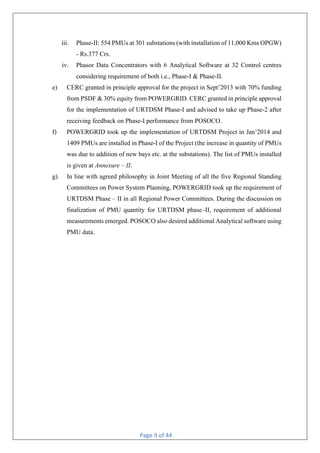
Parli(exs) 1&2, 400kV
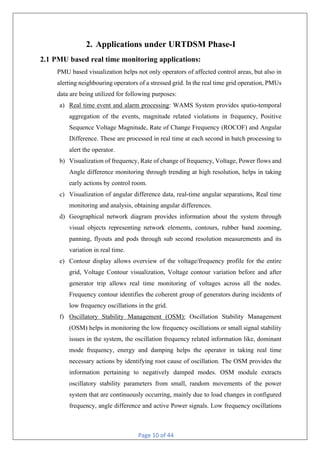
Padghe(GIS), 400kV HEGL 1,2
5
349 WR WR-II Madhya Pradesh BINA 1200kV Powergrid 1
350 SR SR - I Andhra Pradesh NP Kunta Powergrid
351 NR NR-II Haryana Kurukshetra As per site survey 0 0 NIL 6
Annexure III
List of lines for PMU installation in NER
Sl. No. Region Name of the Line
Length in ckt
km
Charged at
Voltage
Level in kV
1 NER Tezu -Namsai S/c 95 132 132
2 NER Pasighat - Roing 108 132 132
3 NER Roing - Tezu 72 132 132
4 NER
Bongaigaon - salkati-II D/C line (Lenth is for
Bongaigaon - salkati-II only)
1 220 220
5 NER Balipara - Tezpur 9 220 220
6 NER Misa - Kopili-III 76 220 220
7 NER Salakati - BTPS-I 3 220 220
8 NER Salakati - BTPS-II 3 220 220
9 NER Misa - Kopili-I 73 220 220
10 NER Misa - Kopili-II 73 220 220
11 NER Misa - Dimapur-I 124 220 220
12 NER Misa - Dimapur-II 124 220 220
13 NER Misa - Samaguri-I 34 220 220
14 NER Misa - Samaguri-II 34 220 220
15 NER Mariani - Mokokchung I 49 220 220
16 NER Mariani - Mokokchung II 49 220 220
17 NER Aizwal - Kolasib 66 132 132
18 NER Kolasib - Badarpur 107 132 132
19 NER Agartala - Agartala-I 8 132 132
20 NER Agartala - Agartala-II 8 132 132
21 NER Aizwal - Kumarghat 133 132 132
Annexure-III Part-1
File No.CEA-PS-17-13/5/2020-PCD Division
ANNEXURE IV
List of lines for PMU installation in NER
Sl. No. Region Name of the Line
Length in ckt
km
Charged at
Voltage
Level in kV
Annexure-III Part-1
22 NER Aizwal -Melriat- Zemabawk(LILO 10 132 132
23 NER Aizwal -Melriat- Zemabawk 7 132 132
24 NER Badarpur - Badarpur 1 132 132
25 NER Badarpur - Jiribam 67 132 132
26 NER Badarpur - Khliehriat 77 132 132
27 NER Badarpur - Kumarghat 119 132 132
28 NER Dimapur - Imphal 169 132 132
29 NER Doyang - Dimapur-I 93 132 132
30 NER Doyang - Dimapur-II 93 132 132
31 NER Gohpur - Nirjuli (Itanagar) 43 132 132
32 NER Imphal - Imphal 2 132 132
33 NER Jiribam - Aizwal 172 132 132
34 NER Jiribam - Haflong 101 132 132
35 NER Jiribam - Loktak-II 82 132 132
36 NER Salakati - Gaylemphug 49 132 132
37 NER Khandong - Haflong 63 132 132
38 NER Khandong - Khliehriat-I 42 132 132
39 NER Khandong - Khliehriat-II 41 132 132
40 NER Khandong - Kopili I 11 132 132
41 NER Khliehriat - Khliehriat 8 132 132
42 NER Kumarghat - R.C.Nagar (Agarthala) 104 132 132
File No.CEA-PS-17-13/5/2020-PCD Division
List of lines for PMU installation in NER
Sl. No. Region Name of the Line
Length in ckt
km
Charged at
Voltage
Level in kV
Annexure-III Part-1
43 NER Loktak - Imphal-II 35 132 132
44 NER Nirjuli - Ranganadi 22 132 132
45 NER Kopili - Khandong II 12 132 132
46 NER Dimapur - Dimapur (PG) (LILO portion) 0 132 132
47 NER Dimapur (PG) - Kohima (LILO portion) 0 132 132
48 NER Silchar - Srikona I 1 132 132
49 NER Silchar - Srikona II 1 132 132
50 NER Silchar - Badarpur I 19 132 132
51 NER Silchar - Badarpur II 19 132 132
52 NER Part of Silchar - Hailakandi I 30 132 132
53 NER Part of Silchar - Hailakandi II 30 132 132
54 NER Imphal (state) - Ningthoukong 0 132 132
55 NER Imphal (state) - Imphal 0 132 132
56 NER Ranganadi - Ziro 45 132 132
57 NER
Bishwanath Chariali - Bishwanath Chariali
(Pavoi) I
13 132 132
58 NER
Bishwanath Chariali - Bishwanath Chariali
(Pavoi) II
13 132 132
59 NER Mokokchung - Mokokchung I 1 132 132
60 NER Mokokchung - Mokokchung II 1 132 132
File No.CEA-PS-17-13/5/2020-PCD Division
List of lines for PMU installation in Sikkim
Sl. No. Region Name of the Line
Length in ckt
km
Charged at
Voltage
Level in kV
1 ER-II Rangpo - New Melli I 26 220 220
2 ER-II Rangpo - New Melli II 26 220 220
3 ER-II Rangit - Karseong (upto LILO point) 61 132 132
4 ER-II Karseong - Siliguri (upto LILO point) 31 132 132
5 ER-II Siliguri - Meli 92 132 132
6 ER-II Meli - Chuzachen 21 132 132
7 ER-II Rangpo - Chuzacheng I (upto LILO) 1 132 132
8 ER-II Rangpo - Gangtok 17 132 132
9 ER-II Gangtok - Rangpo 73 132 132
10 ER-II Rangpo - Rangit 3 132 132
11 ER-II Rangit - Rammam 27 132 132
Annexure-III Part-2
File No.CEA-PS-17-13/5/2020-PCD Division
ANNEXURE V
26
1. Inter-Regional and Tie Lines Lines: It is very important to monitor the power
flow on inter regional lines, though the SCADA provides this data but high
sampling rate data furnished by PMUs would help in getting accurate
frequency response of regions as well as proper functioning of automatic
generation control. Therefore, PMU need to be placed on all inter-regional lines so
that power flow can be assessed.
2. HVDC and FACTS devices: With the large integration of HVDC and FACTS
devices in the system, it is very important that their interaction with existing
system is monitored. The high sampling rate data provided by PMU would help
in understanding the controller interactions and getting insights into their
features. The PMUs need to be placed at AC-DC boundary and converter
transformer or coupling transformer. With more numbers of power electronic
devices in grid, it is possible that sub-synchronous resonance may be observed at
various locations.. The reporting rates of samples need to be higher to capture the
SSR phenomenon. Hence PMUs having ability to measure SSR frequencies can be
installed at strategically locations.
Elements to be covered:
(i) At Both ends of Inter connecting lines between HVDC side AC switchyard with
connecting AC Sub Station.
(ii) All Converter Transformer ( HV side)
(iii) At STATCOM/SVC station Coupling Transformer (LV & HV sides) including the
individual STATCOM/SVC.
3. Renewable Energy Generation Pooling points: The RE generation is coming
across all Indian power system at very fast pace, the monitoring of RE generation
is very important considering must-run status of this generation. RE based
generation are required, by CEA Technical Standards of Connectivity to the
Grid, to perform various dynamic performances such as LVRT, HVRT etc. The
performance can be assessed better if high resolution data will be available and
PMU placement at low voltage side of transformer at pooling station would help
in providing that.
With Upcoming Ultra Mega Green Solar Power Project integrations in EHV grid,
change in angle variations are expected on existing transmission system and the
consequences in respect to operating constraints in evacuations especially in
pockets where concentrated Renewable Generation. Moreover, these changes
occur very fast due to the inherent intermittency of RE sources, particularly wind
and solar, as well as other associated weather influences. As a sample case, in
Western Region, Rewa Solar Park has an Installed Capacity of 750 MW, and the
Annexure - VI
27
angular separation pattern is closely following the Solar Generation pattern as
shown
below:
Figure: REWA Solar UMPP Angular Difference Correlation with Solar
Generation
There is a variation of about 8 degrees is observed in the between Rewa and
Vindyachal nodes in the span of three hours. This emphasises the importance of
PMU data at solar stations. Currently PMUs are installed at 400 kV side only
however PMUs are equally important at 220 kV level as well.
Elements to be Covered:
(i) On all outgoing feeders including bus sectionalizer or tie line between two stages
of generating stations having different tariffs or different ownership or both
(ii) High Voltage (HV) side & Low Voltage side of Transformers
(iii) Reactive Power sources & Sinks shall be measured through Synchrophasor
(iv) All CB and isolators shall be wired to Synchrophasor device as digital signals.
4. Islanding, Separation & Restoration: The expected benefits from PMU
installations at strategic locations include early detection of islanding conditions
and remedial action by SPS (special protection scheme). Key placements can
assistance with the restoration process, and resynchronization back into the main
grid. Black-start investigations of alternative system configurations, including
operation of transmission lines at reduced voltages with bypassing of
transformers are enabled with detailed phasor measurements of potential
overvoltage locations. Similarly, the PMU data can be utilized for
resynchronization with data for bus and line voltage magnitude and angle
along-with frequency.
Elements to be Covered: At both ends of line connected black start stations or
28
restoration path lines (both ends including CB and isolators).
5. State Estimation errors: The observability of the complete system is very important
therefore, the locations where the state estimation errors are high and
continuously show such behavior may be the candidate locations.
Further, during URTDSM Phase-I, PMUs are envisaged only on 400 kV and 765
kV lines only. Linear State Estimator (LSE) application developed by IITB and
installed under URTDSM Phase-I at various control centre i.e.
RLDCs/NLDC/SLDC. After the configuration and setting up of linear state
estimator, it is observed that two islands are being formed for each voltage level
(400 kV & 765 kV). To avoid multiple network islands, PMU should also be
placed on Interconnecting Transformers (ICT) at EHV level
Elements to be Covered:
a) Substation shall have Three phase Bus voltage measurements through PMUs
& Circuit breakers and isolator position shall be wired to PMU for Linear
State Estimator for topology processing and full observability.
b) Reactive Power sources & Sinks shall be measured through Synchrophasor to
avoid MVAR mismatch in Linear State Estimation.
c) All 765/400 kV, 400/220 kV Inter Connecting Transformers (ICT) should have
PMU on both sides (LV & HV).
6. Power Flow Gates: The high-power corridors after large generating complexes
like Sikkim hydro, Mundra UMPP, Vindhyachal-Sasan-Rihand complex etc. The
power flow on these gates need to be monitored therefore the lines emanating
from these complexes can have PMU placement.
7. Major load centers: Load models are important for off-line stability studies as well
as real time monitoring. It is difficult from simulation programs models to select a
proportion of load to be of induction motor type. In addition, electronic load is
growing whereas incandescent lighting (resistive load) is decreasing. However,
load simulation programs do not often reflect the changing nature of power loads
with respect to changes in the electrical behavior and penetration of power
electronic devices. While PMUs placed at load centers will not reveal changes in
the makeup of loads, they can reveal changes in the electrical characteristics and
behavior of aggregated loads. PMUs should be installed at appropriate radial
load feeding substations so that the load sensitivities to system frequency and
voltage changes can be monitored. FIDVR (Fault Induced Delayed Voltage
Recovery) based events can be better analysed.
8. Angular Difference monitoring locations: Phase angle difference is directly
correlated with system stress, and can be used as a strategic measurement of grid
29
security both pre- and post- contingency. For improved wide-area phase angle
difference monitoring and situational awareness, it is useful to monitor the angle
difference across major transmission interfaces across the grid, including both on
a local- and wide-area basis. These interfaces are defined by key stress patterns
driving the need to monitor these interfaces. The PMUs which will be the most
valuable for angle difference monitoring need to be identified for PMU placement.
9. Major Generating Stations: In a generation station, it is desirable to measure
all the line currents (including the step-up transformer) and both the high-side and
low-side voltages. The PMU placement at these locations in generators will
provide good insights into governor frequency control, excitation control, PSS
tuning etc.
In order to confirm the mathematical model correctness used for simulation
studies, model validation using PMU data plays a key role. International grid
standards like NERC Reliability standards requirements have accepted
Synchrophasor based model validation as an effective way to verify generator real
and reactive power capability and control systems and assure their appropriate
responses during system disturbances. Synchro phasor-based model validation is
more economical and accurate than validation methods that take the model off-
line for performance testing.
Hence placement of PMUs on GT LV side for thermal/gas/nuclear based
generation for 132kV and above generating station is required/recommended.
Elements to be covered:
(i) At 400 kV and above Generating stations (132 kV in case of NER).
(ii) Individual Unit of rating 200MW and above for Coal/lignite, 50MW and above
for gas turbine and 25 MW and above for Hydro units shall have PMU placed
at the terminals of the generator(s) at either the HV or LV side of the Generator
Transformers.
(iii) In case of plant having multiple units ,PMU can be placed on 50 percent of the
units
10. System Protection Scheme monitoring: The monitoring of the inputs for SPS
activation is also very important; it can also help in validating the accuracy of SPS
action. SPS operation can be very well validated using the PMU data. Therefore,
all the points where SPS based scheme inputs are derived may be allocated
PMUs.
11. Experience based locations known for small signal stability related issues: The
nodes in the grid which have in history observed the cases of Low frequency
Oscillations negative damping, Ferro resonance, Sub-synchronous resonance, out
30
of step protection etc. shall be considered for PMU placement. A high-resolution
data capturing may be recommended for such PMUs.
The details of analytics suggested by CTU
1. Real time Automated Event Analysis tool (using AI, Machine learning and big data)
Tool for making an automated event driven dashboard comprises of Notification of event,
type of fault and characteristics of the event, display of event location (indicating PMU
Location) on Grid map, Drill down capability with additional displays for each type of event. It
should have machine learning capabilities and it should identify and display historical events
of similar nature and gives information related to operator action taken on past events.
2. Event monitoring for early warning system (using AI, Machine learning and Big data)
It detects events and slow trends in PMU measurements. This will assist system operators in
a.) Identifying stress levels in both apparatus and system, b.) Provide guidance towards
meaningful real time contingency selection and analysis, c.) Provide easy summary reports
for case study preparation, post event analysis and archival purposes.
3. WAMS based contingency analysis and static security assessment
Static security assessment tool improves operator assist feature of grid monitoring and
makes it adaptive and interactive. This tool is meant to provide and perform what-if
simulations and integrate power of data mining with intuition and insights of operators. This
will help in improving grid operation efficacy.
4. Oscillation Source location
This tool is required to identify, detect, and locate Oscillations, present in the grid. It shall
have capability to monitor multiple oscillation modes simultaneously in real time. It shall
Identify the source of the oscillation and display in unified real time dashboard to take
corrective action.
5. Response of Windfarm and solar PV farms for LVRT, reactive power etc.
With integration of large windfarms and solar PV farms at EHV levels these analytics
assumes big importance. The grid code requires that these farms provide low voltage ride
through (LVRT) features and also some kind of reactive power support during faults in the
neighboring transmission network. With PMU measurements the adherence to grid code can
be verified in real operating conditions (not just lab environment) and over complete life of
the windfarms. If any problems or mismatch in performance is observed, it can be rectified
early.
6. Control of HVDC and STATCOM for damping system oscillations
This is the usage of WAMS measurements for actual automatic control applications. This was
one of the original thoughts behind going for WAMS installation. The power system
oscillations that originate in a post fault event or spontaneous oscillations can be damped
quickly using controllers of HVDC and FACTS (like STATCON) devices. It improves the overall
transfer capacity of a power corridor. Lot of actual projects are now under operation in the
USA and China. India must take up such projects for capacity building for the future.
Annexure - VII
Annexxure VIII
Annexure - IX
Distribution List
1. Shri. Saumitra Mazumdar, SE, NRPC.
2. Shri Shyam Kejriwal, SE, ERPC.
3. Shri T Sivakumar, SE, (Transmission - V), TANTRANSCO,
Chennai, TN
4. Shri. P Suresh Babu, SE, TS SLDC,Vidyut Soudha, Khairathabad
Hyderabad Telangana 500082
5. Shri Len J.B., Executive Engineer, SRPC, 29, Racecourse Cross
Road, Bengaluru,
6. Shri Srijit Mukherjee, Deputy Director, NERPC
7. Shri Vivek Pandey, General Manager, NLDC. B-9 (1st
Floor,
Qutab Institutional Area, Katwaria Sarai, New Delhi. -110016
8. Dr. Sunita Chohan, CGM(GA&C), PGCIL, Plot No.2 Near IFFCO
Chowk, Sector -29, Saudamini, Haryana 122001
9. Ms. Nutan Mishra, Sr. General Manager, CTUIL, PGCIL, Plot
No.2 Near IFFCO Chowk, Sector -29, Saudamini, Haryana
122001.
10. Shri Abdulla Siddique, Chief Manager, SRLDC
02-Nov-22
1
Report of the Sub-Committee on PMU Placement and Analytics under URTDSM Phase II
Formation of the Sub-Committee
In the 10th NPC Meeting held
on 9th April 2021 it was
decided to form a sub-
committee.
“After deliberations, NPC
decided that a Sub-
Committee would be formed
under the Chairmanship of
Member Secretary, WRPC
with representatives from
POSOCO, CTU, POWERGRID,
all RPCs/NPC. The Sub-
Committee shall discuss on
the uniform philosophy of
PMU locations, new analytics
and requirement of up
gradation of Control Centre
under URTDSM project and
submit its recommendations
to the NPC.
Consequently, the sub-
committee was formed vide
NPC Letter NO.
4/MTGS/NPC/CEA/2021/285-
298 dated 20.09.2021 based
on nominations received at
NPC.
02-Nov-22
2
URTDSM Project Phase-I
• A Pilot Project was implemented with 52
Phasor Measurement Units (PMUs)
installed all over the Country progressively
from 2008 to 2010.
• A Detailed Project Report (DPR) was
prepared in 2012 for implementation of
1740 PMUs on Pan-India basis.
• The Project was agreed for
implementation in a Joint Meeting of all
the five Regional Standing Committees on
Power System Planning held on 5th March
2012. The installation of the PMUs was
taken up in two stages. Stage-I -1186
PMUs; Stage-II-483 PMUs
URTDSM Project Phase I & II
• CERC granted in principle approval for the project in Sept’2013 with 70% funding
from PSDF & 30% equity from POWERGRID.
• CERC granted in principle approval for the implementation of URTDSM Phase-I
and advised to take up Phase-2 after receiving feedback on Phase-I performance
from POSOCO.
• POWERGRID took up the implementation of URTDSM Project in Jan’2014 and
1409 PMUs are installed in Stage-I of Phase-I of the Project (the increase in
quantity of PMUs was due to addition of new bays etc. at the substations).
• In line with agreed philosophy in Joint Meeting of all the five Regional Standing
Committees on Power System Planning held on 5th March 2012.
• POWERGRID took up the requirement of URTDSM Phase – II in all Regional Power
Committees. During the discussion on finalization of PMU quantity for URTDSM
phase–II, requirement of additional measurements emerged. POSOCO also
desired additional Analytical software using PMU data.
02-Nov-22
3
PMU Placement criteria & Analytics in Phase – I
PMU locations under Phase – I
• All 400 kV stations in State and ISTS
grids.
• All generating stations at 220 kV and
above.
• HVDC terminals and inter-regional and
inter-national tie lines.
• Both ends of all the transmission lines
at 400kV and above: State and ISTS
sector.
• Analytics under Phase – I
Under URTDSM Phase I, 6 Analytics
were developed in association with IIT
Bombay:
• Line Parameter Estimation
• Vulnerability Analysis of Distance Relay
(VADR)
• Linear State Estimator
• Supervised Zone-3 distance protection
scheme to prevent unwanted tripping
of backup distance relay
• CT/CVT Calibration
• Control for improving system security
Status of Phase – I (Broad configuration of PMUs, PDCs and
infrastructure used)
• The PMUs procured are having 2 set of voltage, 2 set of current measurement & some (16) digital
input configuration.
• The utilization of measurement inputs of PMU depends on the bay configuration at substations.
In cases where there is one line & ICT or reactor only, one set of current input is utilized, and
other input remains unutilized
• The PMUs are measuring line and bus voltages as per the configuration of installation. PMUs
installed are of the Measurement class and wired up in the metering core of CVT/CT.
• Nodal PDC at strategic substations, Master PDC at all SLDCs, super PDC at 5 RLDCs, Main & backup
PDC at NLDC have been installed and are fully functional.
• POSOCO’s initial pilot project & States PMUs were also integrated with the URTDSM project.
• In Phase-I, PMUs were installed at only those 400 kV lines which had connectivity of the fiber
optic network.
• The number of PMUs installed on 132kV lines is 5nos., 220kV lines is 179nos., 400kV Lines is
1093nos., 765kV lines is 148nos.
02-Nov-22
4
Applications
under
URTDSM
Phase – I.
• PMU based real time monitoring applications
• Real time event and alarm processing
• Visualization of frequency, Rate of change of
frequency, Voltage, Power flows and Angle difference
• Visualization of angular difference data, real-time
angular separations, Real time monitoring and
analysis, obtaining angular differences.
• Geographical network diagram provides information
about the system through visual objects representing
network element
• Contour display allows overview of the
voltage/frequency profile for the entire grid, Voltage
Contour visualization
• Oscillatory Stability Management (OSM)- helps in
monitoring the low frequency oscillations or small
signal stability issues in the system
Off-line
usages under
URTDSM
Phase – I.
• Off-line Applications/usages:
• Primary frequency Response assessment requires
high resolution data of frequency for any event.
• Oscillation Detection - The poorly damped
oscillations indicate the review of controller
settings in power system stabilizers of units.
• The high-resolution data helps in monitoring the
operation of various transmission line protection
schemes
• Synchro phasor has helped to find the issues in
time synchronization in event loggers
• PMU also helped RLDCs in validating the Power
system stabilizer tuning process with high
sampled data
• Post-Disturbance Analysis
02-Nov-22
5
Existing
features of
URTDSM
Time Series Derivation Framework (TDF) TDF is the user
interface of the Historian Application provided by OEM
M/s GE and is being used in Control room to plot the
events which occurred
Spectral Analysis (using E-Tera Phasor Analytics)
• Power Spectral Density (PSD) is very useful tool to identify oscillatory
signals in time series data and their amplitude
• Coherency, is a measure of frequency domain correlation between
two signals.
• Cross Spectral Density (CSD): Cross spectral Density as a measure of
frequency domain covariance between two signals
Utilization of
PMU data for
taking real time
decisions and
offline Analysis
at RLDCs and
NLDC:
• PMU helped in synchronization of NEW-SR grid by helping control
room operator in taking appropriate decisions in real time through the
access of high-resolution data in real time.
• The availability of PMU visualization helped in taking informed
decisions in real time when any abnormality was observed in PMU
placed on AC side of HVDC converter station
• The availability of PMU data at LV side of pooling station of RE based
generation sources helped in monitoring the operation in real time.
The various power electronic based controls in RE generation plant for
low voltage ride through (LVRT), reactive support at pooling station
and power park control are closely monitored using PMU data.
• The transmission system has also observed integration of state of art
power electronic devices, these devices act in time span of
milliseconds. The response can be observed at control centers with
availability of PMU data. The response of FACTS devices is observed
well with PMU placed at coupling transformer of STATCOM/SVC.
• Power-system restoration: The PMUs are well-suited for online
monitoring of angles, and thus are helpful for the operator during a
power restoration by monitoring of standing phase angle (SPA)
difference across a breaker, which connects two adjacent stations
whose excessive difference can damage equipment.
02-Nov-22
6
Feedback on applications under Phase – I - Improvements required in the
Existing PMUs data Streaming/GUI
• Improvement required in the visualization /GUI
• Adding trends of phase voltage and current, Trending system is having a capability to show only 8 signals
• Capability to visualize data for larger time window, PMU with high sampling rate required at few locations,
Option to select reference angle
• Font and axis size, Integration with different make of PMU, Portability of display, Non-generation of alarms
• OSM related issues
• Right Eigen Vector plot of modes not observed
• Availability of statistical functions is not there
• System Utilization related issues
• Data storage is currently configured to store 1 YEAR
• 16 Digital slots are currently available in each PMU where only 5 are used, Each PMU can monitor 2 elements,
spare slot available can be used to integrate new lines
• Infrastructure related issues
• Voltage discrepancy in voltage measurement is observed in some PMU
• Standby communication links have not been implemented in URTDSM project
• Frequent time synchronization issues arise in PMU’s data due to the GPS issue
• Loss of PPS (Pulse per second) is a common cause in case of URTDSM PMUs
• Historian
• Access to historian data through autonomous software interface is a must requirement for any new WAMS
infrastructure
Feedback on applications/Analytics under Phase
– I - Software’s developed by IIT Bombay
• Line Parameter Estimation:- Application of total least squares (TLS) method is used to estimate
line parameters.
• Online vulnerability analysis - PMU measurements to identify relays that are vulnerable to
insecure tripping.
• Linear State Estimation:- PMU has the capability to directly measure the magnitude and angle of
bus voltage and current, hence, LSE is possible.
• CT/CVT Calibration:- It is difficult to ascertain accuracy of any instrument transformer at site, once
it is installed.
• Supervised Zone-3 Distance Protection:- Distance relays are widely used for transmission line
protection. These relays also provide remote backup protection for transmission lines.
• Control Schemes for Improving System Security
02-Nov-22
7
Analytics under Phase – I & way forward
• PMUs should not only be limited to post event analysis and should be employed for Dynamic State
Estimation, threats forecasting and alarming systems in real time.
• Several equipment’s such as ICTs, Bus Couplers were not configured in the LSE. Lack of observability &
lack of communication link also led to problems in PMUs LSE.
• Logic based analytical tools for enhanced situational awareness, Advance development platforms for
retrieval and visualization of phasor data, etc. may be added in the existing system.
• POSOCO informed that the POSOCO pilot project & States PMUs were also integrated with the
URTDSM project. However, the data was not complete, and it led to formation of Islands and
therefore State estimation of complete system is not available with the existing installed PMUs.
• The network and the network topology database need to be updated by putting extra effort and
therefore the network database of PMU based LSE can be exactly aligned with the actual system
• Additional PMUs should be installed at substations which are critical from system point of view, by
laying of the Fiber Optic under Phase – II of the URTDSM project.
• An engine can be developed which will enable the SCADA topology and network database to be
imported in the PMU based LSE. The database should be common for both the systems (SCADA &
PMU LSE).
Recommendation 1 : Improvements in applications
available in URTDSM-I
Graphical User Interface for
visualization of system dynamics :
• Trending of phase voltage and
current, Trending of all dynamic
power system parameters
• Option to select reference angle,
Downloading of historical data
should be made more user friendly
• Capability to visualize data for larger
time window, Portability of display
• Non-generation of alarms,
Integration with different make of
PMU
• Modal analysis issues in URTDSM
Analytics
Oscillation Detection, monitoring and
analytics:
• Capability to detect power system
oscillations from dynamic
measurements, Capability to
monitor, classify oscillation modes in
real time, Real-time display for
oscillation monitoring , Oscillation
location, Map Displays, Oscillation
Severity, Alarms, Logic based
analytical tools for enhanced
situational awareness
Linear State Estimator :
• Database Integration, Bad data
detection and conditioning,
Observability analysis, Topology
detection, Sampling rate, Single-Line
diagrams, Scalability, Expanded
observability
02-Nov-22
8
Recommendation 2: New applications for
deployment in URTDSM-II
Real time automated
event detection and
notification
dashboard
Early warning system
Voltage Stability
analytics (VSA)
WAMS based
contingency analysis
and security
assessment
Islanding detection
Real time Inertia
Estimation and
monitoring
Post-mortem
analytics
Generator Model
Validation
Wide Area Control
Systems
Recommendation 3: Improvements in system
infrastructure
• 16 digital slots are currently available in each PMU where only 5 are used rest can be utilized for isolator points of line, bus,
and line reactors etc.
• Each PMU can monitor 2 elements, spare unused i/p available can be used to integrate new lines / ICT from same
substation (Non- SAS SUBSTATIONS)
• Logic/tool must be developed to detect Voltage discrepancy in phase measurement errors and generate alarms.
• Adopting main and standby philosophy in data communication between PMU & PDC and between PDC & PDC to avoid any
data loss.
• Strengthening of time reference / GPS source and stringent daily monitoring by substation on daily basis for time
synchronization.
• loss of PPS (Pulse per second) should not occur due to the disturbance of PPS cable during maintenance activities.
• Dead band defined in PMU data for frequency, voltage and df/dt, should not cause discrepancy in values.
• Data storage and Historian: Data storage should be configured to store and retain data at least up to one year. Since the
population of PMUs is expected to increase manifold in the coming years, the standards / best practices need to be
established for Indian power system. A separate sub-committee may be constituted to formulate a criteria for data archival
and retention. For the time being data beyond one year shall be stored and made easily accessible for real-time and off-
line applications depending upon the space utilization.
….contd
02-Nov-22
9
Recommendation 3: Improvements in system
infrastructure
• PMU Testing: PMU standards conformance tests shall be performed to verify whether the PMU meets the
requirements of IEC/IEEE 60255-118-1 under steady-state, transient, and dynamic power system conditions, and
the associated data transfer requirements as given in IEEE Std C37.118.2 or communication requirements given in
IEC 61850.
• PMU field commissioning tests shall include routine visual inspection, insulation test, wiring check, basic
functionality check, etc., as required by the relevant standards.
• PDC must be able to handle off nominal conditions such as high rates of incoming data, incorrect timestamps, and
unsupported protocols. PDC must be able to achieve the availability and reliability target levels consistent with the
application.
• Sampling rate: Installation of PMU with high sampling rate is recommended at a few locations to monitor sub-
synchronous resonance, very low frequency governor modes and control modes. PDC should have capabilities to
store data of higher sample rate PMU apart from existing 25 Hz.
• Redundant and reliable high speed communication system is vital for PMU based Wide Area monitoring system.
Fiber Optic connectivity between the substation identified for placement of PMU and control center is strongly
recommended.
Recommendation
4: PMU
Placement
Strategy
The limiting constraints in installation of additional
PMUs include
• The hardware requirement of the PDCs & Master PDCs as the current
PDCs may not have enough memory to process the additional data
from the PMUs.
• Hardware and communication requirements will also be required to
be changed and upgraded.
Since the PMUs in Phase-I are M type PMUs and are
connected to metering core of CT/CVTs, the committee
recommends that under Phase-II, M-type PMUs are to
be procured and connected to the metering core.
02-Nov-22
10
Recommendation 4: Minimum criteria for PMU
placement under URTDSM-II.
• At one end of all 400 kV and above transmission lines
• At the HV side of all ICTs connected to 220 kV and above
• On HV side of coupling transformer of SVC/STATCOM for measurement of HV Bus voltage and current of coupling transformer
• At one end of line wherever FSC/ TCSC are installed
• On HV side of converter transformers for measuring HVAC bus voltage and current of converter transformer on each converter station.
• On both ends of Inter-regional and trans-national tie lines and on boundary buses for such lines
• At the Generating Transformers (GTs) at LV side (having HV side of 220kV and above) of the Generating units with capacity above 200 MW for Thermal units, 50
MW for Hydro units and 100 MW for Gas units.
• On all 220kV substations for measuring voltage of 220 kV bus and current of two lines/transformer catering to load centers.
• All 132 kV and above ISTS lines in NER & Sikkim and important load centers.
• At RE developer end of the evacuating line connecting the Renewable Energy Pooling Stations (PS) to point of interconnection with the grid of 50MW and above.
• Islanding, Separating & Restoration Points- At one end of line which is connected to black start stations along with circuit breaker status via synchro phasors.
• Fiber Optic should be covered under Phase – II for all the above locations of the URTDSM project
• At all ICTs, Bus reactors, Switchable line reactors of critical substations
Recommendation 4: Future Considerations &
integration of State PMUs.
• Requirement of PMUs under Phase-II, as per philosophy, be framed for the planned system up to 2024. Thereafter CTUIL may
include the provisioning of PMUs in the scope of planned projects as per the above philosophy.
• The placement of PMUs for special cases such as Islanding, Separating & Restoration Points and ICTs, Bus reactors, Switchable line
reactors of critical substations, load centres of NER shall be suggested by POSOCO in consultation with RPCs & CTU.
• Existing PMUs & PMUs planned in future by States should be integrated with the URTDSM Project.
• PMUs in the future projects should be made part of the system with improvements in the PDCs capabilities incorporated in the
new Project.
• PMU & PDC consoles at CTUIL, RPCs and CEA- Since CTUIL is entrusted with planning ISTS system, it is recommended that PMU &
PDC consoles along with redundant, dedicated & secure communication link up to CTUIL premises be provided for CTUIL. The
Power flow, Voltage, Angle data of PMU shall be integrated with CTUIL Planning system software for System studies, System
planning of ISTS system, in consumable form, through standard protocols along with visualization. Similar facilities should be made
available at all RPCs and CEA if the same is not covered under Phase I.
• The up gradation of PDCs and control center equipment's be reviewed once in two (2) years, so that they can handle the data due
to incremental PMU population in the system.
….contd.
02-Nov-22
11
Recommendation 4: Future Considerations &
integration of State PMUs.
• PGCIL was of the view that 5 out of 6 analytics developed in Phase-I would not work, due to adoption of the
above PMU placement philosophy (in all these 5 analytics PMU is required at both ends). The analytics viz Line
parameter estimation, CT/CVT calibration are complementary to each other, where, in one analytic the CT/CVTs
are assumed to be accurate and in the other the line parameters are assumed to be accurate (the reference used
for one analytic is dependent on the other) and therefore the result of this analytics are not found to be much of
use. The Online Vulnerability analysis and Supervised Zone-3 distance protection are protection class analytics and
the results needs validation through DRs. The Zone-3 power swing blocking setting is available in all the relays and
has been reported to be implemented by all the utilities as per recommendation of the Committee on the
blackout of 2012. Further, the Load encroachment tripping in Zone-3 can be addressed through proper setting of
Zone-3 in the relay, which has also been reported to be complied by all the Utilities as per the recommendation of
the Committee on the blackout of 2012. Control System for improving system security analytic and the above four
analytics, however, shall to be used wherever PMUs are available at both ends and the results be validated.
• The relevant orders of Ministry of Power, Government of India and CEA/CERC regulations for cyber security
compliance should be followed. The directives of CERT-In for time synchronization of PMUs should be followed in
view of cyber security.
• Training module should be incorporated in Phase-II of URTDSM project for the State Utilities, CTU, POSOCO, CEA
and RPCs.
Thank You
02-Nov-22
12
PGCIL note salient features
• The PMU location philosophy should not be altered, since the panel of expert under the
chair of Dr. Arun Phadke has recommended it.
• Database of location of PMUs.
• Analytics VADR (vulnerability Analysis of Distance Relays) & Zone-3 supervised
protection- not designed for protection class.
• CT/CVT calibration and Line Parameter estimation analytics.
• Upgradation of FO and control center infrastructure.
02-Nov-22
13
Z-3 Supervised protection & relay vulnerability analytics
• Specialized schemes will be specific to critical lines wherein PMUs will be placed at both ends of a line i.e., fault
observability in mode.
• Logic to detect the fault on line section 1-2 with PMU1 & PMU2 measurements and decide to block or trip relays R to R6.
• If there is a fault in section 1-2, then enable zone-3 tripping of R1 to R6. if there is no fault in section 1-2 and due to Power
Swing/Load encroachment, the relays R1-R6 senses these conditions as Zone-3 fault, then block the tripping of relays R1 to
R6.
• Issue : fault detection on line section 1-2, will require the CTs used to obtain measurements from PMU1 & PMU2 are
accurate during fault condition. With metering class CTs, it is highly impossible, since these CTs would saturate under fault
conditions.
• All the Distance Protection Relays (DPR) have Zone-3 blocking/unblocking facility. The Zone-3 of DPRs is blocked on
power swing detection through their internal algorithm. No mal-function of this blocking has been observed so far, if it
is set in relays. If Zone-3 is set considering the load encroachment properly, the relays will not trip under these
conditions. Low voltage issues at other buses is now a remote possibility with strong fault levels.
• For this application it may be advisable to use P-type PMUs with inputs from protection class CTs.
PMU-1 PMU-2
CT-1/CVT-1 CT-2/CVT-2
Line parameter estimation & CT/CVT calibration
CT/CVT calibration
• The residual is used for identifying the bad data and also
improving the estimate of the voltage.
• This residual is monitored for a long time, may be in terms of
weeks, and if the error is consistent then it can be flagged as
erroneous CVT.
• The erroneous CVTs can be identified locally, and the CVTs with
less errors are then separated out to start the calibration
process.
• Issue : CT/CVTs are of 0.2 accuracy class, if it has to be done
locally, the CT/CVTs at remote end and line parameters used to
estimate the voltages at end 1 should be accurate.
Line parameter estimation
• Issues : The CT/CVTs at either end should be accurate. Line
parameters are static and does not change much.
• Easy way out : A portable PMU can be used to estimate line
parameters where it is suspected that the parameters are
erroneous also same facility can be used for CT/CVT
calibration. Separate investment for this analytics is not
desirable.
02-Nov-22
14
Phase – II of
URTDSM -
PMU
Placement
Criteria
POWERGRID informed that the impact of additional PMUs locations and
WAMS analytics will be:
i. The number of PMUs initially envisaged in Phase II would increase to
about 2500.
ii. This increase in number of PMUs will also affect the performance of
Phasor Data Concentrator (PDC) and other equipment at the Control
Centre Location at SLDC, RLDC and NLDC, RPCs which may also need
upgradation / installation.
iii. The additional WAMS analytics shall also require additional
hardware.
iv. In view of the increase in PMU population, the existing configuration
of Nodal PDC, MPDC, SPDC & Main & B/U NLDC also needs to be
seen whether these additional PMUs can be accommodated in the
infrastructure of Phase-I. Also, it needs to be seen whether the Nodal
PDC, MPDC, SPDC & Main & B/U requires up-gradation or additional
hardware is required for accommodating the additional PMUs in
Phase-II.
v. Communication related issues are also required to be considered to
accommodate the additional PMUs under Phase-II.
PGCIL Comments
Phase – II of
URTDSM -
PMU
Placement
Criteria
CTU has proposed following locations:
• All 132 kV and above ISTS lines in NER & Sikkim
• All 132 kV and above ISGS in NER & Sikkim.
• (Additional factor of “distance between such stations” for extent of Wide
Area Measurement also to be accounted for Placement in NER.)
NRPC (in 45th TCC, 48th NRPC meeting) and SRPC (in TCC &
37th SRPC meeting) have proposed following locations:
• Generating Transformers (GTs) at LV side (having HV side of 220kV and
above).
• FACTS devices such as STATCOM, SVC, FSC, TCSC etc.
• HVDC Convertor transformers
• Phase Shifting Transformers
• Renewable Energy Pooling Stations (PS).
CTU, NRPC &
SRPC
Proposals
02-Nov-22
15
New
Analytics
under
URTDSM
Project Phase
- II.
NRPC & SRPC: Additional WAMS analytics for URTDSM Phase – II
were proposed by NRPC (in 45th TCC, 48th NRPC meeting) and
SRPC (in TCC & 37th SRPC meeting) as follows:
• Real time Automated Event Analysis tool
• Oscillation Source location tool/engine.
• Real time Inertia Estimation Tool
• Big data analytics tool/engine
POWERGRID: POWERGRID has suggested following analytics for
the Phase – II:
• Real time Automated Event Analysis tool (using AI, Machine learning and big
data)
• Event monitoring for early warning system (using AI, Machine learning and big
data)
• WAMS based contingency analysis and static security assessment
• Oscillation Source location
• Response of Windfarm and solar PV farms for LVRT, reactive power etc.
• Control of HVDC and STATCOM for damping system oscillations
PGCIL, NRPC
& SRPC
Proposals
Phase – II of
URTDSM -
PMU
Placement
Criteria
POSOCO has proposed
• Placement at all Inter-regional lines.
• HVDC & FACTS Devices
• Renewable Energy Generation Pooling Points.
• On all outgoing feeders including bus sectionalize or tie line between two stages of generating stations having different
tariffs or different ownership or both
• High Voltage (HV) side & Low Voltage side of Transformers
• Reactive Power sources & Sinks shall be measured through Synchro phasor
• All CB and isolators shall be wired to Synchro phasor device as digital signals
• Islanding, Separating & Restoration Points
• Points where State Estimation error chances are high
• Substation shall have Three phase Bus voltage measurements through PMUs & Circuit breakers and isolator
position shall be wired to PMU (for Linear State Estimator) for topology processing and full observability
• Reactive Power sources & Sinks
• All 765/400 kV, 400/220 kV Interconnecting Transformers (ICT) on both sides (LV & HV).
• Power Flow Gates
• Major Load Centres
• Angular Difference Monitoring Locations.
• Major Generating Stations-
• At 400 kV and above Generating stations (132 kV in case of NER).
• Individual Unit of rating 200MW and above for Coal/lignite, 50MW and above for gas turbine and 25 MW and
above for Hydro units shall have PMU placed at the terminals of the generator(s) at either the HV or LV side of
the Generator Transformers.
• In case of plant having multiple units, PMU can be placed on 50 percent of the units
• System Protection Scheme Monitoring
• Experience based locations known for small signal stability related issues.
POSOCO Proposals
02-Nov-22
16
New
Analytics
under
URTDSM
Project Phase
- II.
• POSOCO has recommended following analytics
• Voltage Stability Monitoring: Measurement based dynamics
provide voltage sensitivities; monitoring of key corridors or load
pockets; scatter plots for power voltage and power-angle
monitoring.
• Detection of disturbances: Recognition of short circuits by
watching the currents, and indication of loss of load, or loss of
generation by watching the frequencies.
• Online monitoring of Inertia.
• Identification of source of Oscillation.
• Identification of stressed corridors.
• ROCOF calculation over variable window.
• Island identification/detection.
• Locating contributions to poorly damped or unstable oscillations.
• Model Validation.
• Higher frequency sub-synchronous oscillation analysis and early
warning of resonance.
• Big Data Analytics
POSOCO Proposals
Annexure-VI
Acknowledgement
The Committee acknowledges the cooperation extended by NPC, RPCs, POSOCO
and CTU for giving their valuable inputs to finalize the recommendations for
finalizing AUFLS stages.
The Committee also acknowledges and extends gratitude to the sincere efforts of
Shri Sachin K. Bhise EE, and Shri Deepak Sharma EE, WRPC, whose inputs and
suggestions has helped in putting all the inputs in proper perspective and giving
shape to this report.
The committee would also like to thank Shri Rahul Shukla, CM & Shri Aman
Gautam, Manager, NLDC POSOCO for arranging presentation and painstaking
efforts taken to provide comments and helping in the drafting of the report.
(Rishika Sharan) (B. Lyngkhoi) (Rajiv Porwal)
Chief Engineer (NPC), CEA
Member Secretary,
NERPC
CGM, NRLDC
(Ratnesh Kumar) (Ms. N.S. Malini) (P.P. Jena)
EE, NRPC EE, SRPC EE, ERPC
(Transferred)
(P. D. Lone) (Satyanarayan S.)
Superintending Engineer,
WRPC & Member
Convener
Member Secretary,
WRPC & Chairperson
of the Committee
Report of the
Committee on
Automatic Under
frequency
Load shedding
October 2022
National Power Committee
CEA
October 2022
Page 2 of 53
Table of Contents
Abbreviations and Symbols ....................................................................................................3
Definitions.............................................................................................................................4
1. Executive Summary..........................................................................................................5
2. Introduction and background...........................................................................................9
Terms of Reference (TOR) of the Sub-Committee:..................................................................... 11
Proceedings of the sub-Committee:............................................................................................. 11
3. Theoretical aspects of important factors in the design considerations of AUFLS:............ 13
a) Load frequency Dependence D (MW/Hz): ............................................................................ 13
b) What is the value of D?......................................................................................................... 14
c) Observed Power Number ƛ(MW/Hz):................................................................................... 16
d) Frequency influence of generators in normal frequency and emergency range: ................... 17
e) Role of System Inertia H:...................................................................................................... 17
f) Role of Voltage and Frequency dependence.......................................................................... 19
g) Role of Seasonal factors ........................................................................................................ 19
h) Reasons for failure of AUFLS schemes WRPC Inspection:................................................... 20
4. International Practices of AUFLS .................................................................................. 21
a) Continental Europe: ............................................................................................................. 21
b) NERC:.................................................................................................................................. 22
c) New Zealand......................................................................................................................... 22
d) Powertech Consultant:.......................................................................................................... 22
5. Scope and Formulation of AUFLS Plan for Indian Power system................................... 24
Scope: ......................................................................................................................................... 24
6. Theoretical aspects......................................................................................................... 25
Interpretation:............................................................................................................................ 27
7. Selection criterion for trigger frequency for lower end and upper end Stage:................... 29
8. The AUFLS stage wise quantum and their distribution among regions can be decided
based on the following two alternative methods / philosophies: ....................................... 34
a) Approach-A:......................................................................................................................... 34
b) Approach-B .......................................................................................................................... 39
9. The problem of df/dt schemes:........................................................................................ 46
Reduced Inertia and role of df/dt:............................................................................................... 46
Guiding principles for implementation of df/dt relays: ............................................................... 48
a) Enabling frequency for df/dt:......................................................................................................................48
b) Df/dt relay setting philosophy:....................................................................................................................48
10. Conclusion..................................................................................................................... 51
AUFLS and df/dt setting and it’s testing:.................................................................................. 53
Page 3 of 53
Abbreviations and Symbols
AC Alternating Current
D Load Frequency Dependence MW/Hz
DC Direct Current
COI Centre of Inertia
F Frequency
FFR Fast Frequency Response
GW Gigawatt
GWh Gigawatt-hour
GW•s Gigawatt-second
H Inertia
IBR Inverter-Based Resource
kW Kilowatt
kWh Kilowatt-hour
LR Load Response
MW Megawatt
MWh Megawatt-hour
MW•s Megawatt-second
NLDC National Load Dispatch Centre
PMU Phasor Measurement Unit
PV Photovoltaics
RLDC Regional Load Dispatch Centre
RE Renewable Energy
RoCoF Rate of change of frequency also known as df/dt
SCADA Supervisory Control and Data Acquisition
UFLS Under-frequency Load Shedding
Page 4 of 53
Definitions
‘Area Control Error’
or ‘ACE’
means the instantaneous difference between a control area’s net actual and
scheduled interchange, taking into account the effects of Frequency Bias and
correction of meter error. Mathematically, it is equivalent to:
ACE = Deviation (∆P) + (Frequency Bias) (K) * (Deviation from nominal
frequency) (∆f) + meter error;
‘Automatic
Generation
Control’ or ‘AGC’
means a mechanism that automatically adjusts the generation of a control area
to maintain its Interchange Schedule Plus its share of frequency response;
‘Demand’ means the demand of active power in MW;
‘Demand Response’ means variation in electricity usage by end customers/control area manually or
automatically, as per system requirement identified by concerned load despatch
centre;
‘Frequency
Response
Characteristics’ or
‘FRC’
means automatic, sustained change in the power consumption by load or output
of the generators that occurs immediately after a change in the control area’s
load-generation balance, and which is in a direction to oppose a change in
interconnection’s frequency. Mathematically it is equivalent to
FRC = Change in Power (∆P) / Change in Frequency (∆f)
‘Governor Droop’ in relation to the operation of the governor of a generating unit means the
percentage drop in system frequency which would cause the generating unit
under governor action to change its output from zero to full load;
‘Inertia’ means the contribution to the capability of the power system to resist changes
in frequency by means of an inertial response from a generating unit, network
element or other equipment that is coupled with the power system and
synchronized to the frequency of the power system;
‘Nadir Frequency’ means minimum frequency after a contingency in case of generation loss and
maximum frequency after a contingency in case of load loss;
‘Reference
contingency’
means the maximum positive power deviation occurring instantaneously
between generation and demand and considered for dimensioning of reserves;
‘Tertiary Reserve’ means the quantum of power which can be activated, in order to restore an
adequate secondary reserve. Fast Tertiary Reserve Response shall come into
service starting from five (5) minutes and shall sustain up to thirty (30) minutes.
Slow Tertiary Reserve Response shall come into service starting from fifteen
(15) minutes and shall sustain up to sixty (60) minutes;
Page 5 of 53
1. Executive Summary
1. In the 2nd
NPC meeting dated 16-July-2013, AUFLS scheme was adopted at a
national level and comprised four stages of UFLS at 49.2 Hz, 49.0 Hz, 48.8 Hz
and 48.6 Hz. Prior to that, each region adopted a three-stage plan for flat UFLS,
with similar settings.
2. The above calculation of load relief was based on the methodology adopted by
Zalte Committee recommendations, formed in WR, after the July 2012 blackout.
Zalte committee was formed to review the defense mechanism for WR after the
July 2012 blackout. Zalte Committee while formulating the AUFLS plan
considered the factors such as frequency dependence of loads, voltage dependence
of loads and seasonal variations of the loads.
3. NPC regularly reviewed the quantum of load to be shed in each region, based on
the increasing demand. In the 9th
NPC meeting, it was informed that the loads
expected to be shed were on the much higher side. Accordingly, it was decided to
form a group to examine the same.
4. In Jan 2021, a committee under Member Secretary, WRPC was formed to examine
the AUFLS scheme for All India Grid and give recommendations. Also, the
Committee was to examine the df/dt setting for different regions and suggest a
suitable approach for effective working of the same.
5. Although governors were enabled before 2012, the response observed was not
satisfactory. After the 2012 blackout, the Indian Power system implemented many
reforms and Regulations, notably the DSM from 2014. Many efforts to bring
transient response of governors as an aid to intercept the runaway frequency were
taken by the Hon’ble CERC. Today RGMO/FGMO is widely implemented also
many States have Automatic Demand Management System (ADMS) in place.
6. In a conventional large grid, due to sufficient number of synchronous machines
and hence rotating mass, lack of adequate system inertia has largely not been of a
concern. Global experience suggests that RE integration driven displacement of
conventional synchronous generators has an impact on the rotating mass (inertia)
in the system, particularly during higher penetration of renewable. Considering a
significant growth in RE, and ambitious RE integration targets for Indian power
system, the AUFLS and df/dt schemes may require periodic reviews.
7. Though the system is now integrated and strong, however it is desired that various
frequency control actions are able to restore the frequency to its target value. These
Page 6 of 53
frequency controls (primary, secondary, and tertiary) operating in continuum shall
act in respective time domains to maintain frequency at or nearby its target value
i.e., 50 Hz.
8. The safe, secure, and reliable operation of grid requires that the nadir frequency
should be at least 0.2 Hz above the first stage of under frequency load shedding
scheme under different system loading conditions. This implies that the nadir
frequency shall be above or 49.4Hz, if the first stage trigger frequency adopted is
49.2Hz. System Operator, accordingly, may estimate and maintain the reserves
9. The nadir frequency is a function of the system inertia & primary response and in
real time the system inertia varies and depends on the rotating masses running in
the system. Therefore AFLS scheme would be the appropriate choice to address
the inertia response and the first stage of the AUFLS is required to be set by
considering, where the final system frequency would settle, which depends on the
primary response.
10. Many important capital city islanding schemes are being designed as per the
direction of ministry. Islanding should occur below the last stage of AUFLS
scheme with sufficient margin of 0.3-0.4 Hz below the last stage, as there is no
further defense mechanism. At present last stage is at 48.8Hz. The present
Committee recommended last stage is 48.6Hz which is above the Island trigger
frequency of 48.0/47.9Hz generally adopted by more than 0.6Hz. The last Stage-
II trigger frequency setting recommended is 48.0Hz. Though it overlaps with the
pre-Islanding Load Shedding plan, it will not affect the performance of formation
of Island, since it is certain that at these system frequencies, the system has
disintegrated into two or more parts/Islands.
11. Under presence of governor action in normal frequency range, and more so with
the hysteresis controller characteristic of the RGMO, care should be taken to not
over-shed and raise the frequency to alarming levels in the initial stages of load
relief. All the generators are expected to operate in FGMO for frequency going
above 50 Hz, therefore any increase in frequency above 50 Hz is expected to be
counter acted by FGMO.
12. As long as the system is integrated, the benefits of the large inertia and governor
are definitely seen. However, parts of a system can isolate, suddenly bringing
down the inertia and heavy falls in frequency can be seen. Inertia falls have been
seen recently in cases of Mumbai blackout in Oct 2020 and Feb 2022. The only
way to implement this using additional load shedding below 48.6 Hz.
Page 7 of 53
13. The Committee, assuming a very conservative response of RGMO/FGMO,
adopted the estimation methodology of Load Shedding quantum, based on the
regulation of generators and the frequency dependence of load.
14. The Committee also reviewed various international practices being followed and
tried to arrive suitable plan for the Indian Power Grid.
15. Two Approaches towards the design of AUFLS was discussed and it was decided
to stick with Approach A, which is a traditional AUFLS plan with load shedding
quantum as a percentage of the peak demand. The Approach B was also discussed,
and it was decided that this can be adopted in future, when the communication
system up to the load centers and the Wide Area monitoring becomes mature.
16. Approach A
The committee proposed the following two tier AUFLS scheme:
a. When system is integrated – Stage I-A to I-E.
A demand disconnection of 20% is envisaged in this stage with trigger
frequency for disconnection starting from 49.2 Hz to 48.6 Hz for I-A and I-
E respectively.
The feeders on which the Stage I-A to E relays have been installed should
be excluded from all type of load shedding schemes such as ADMS, SPS,
any other planned Load Shedding Scheme, LTS, Island Loads, preparatory
Island loads identified for shedding or any other emergency load shedding
schemes etc.
b. When system has split into more sub-systems – Stage II-F to II-H.
A demand disconnection of 18% is envisaged in this stage with trigger
frequency for disconnection starting from 48.4 Hz to 48.0 Hz for Stage II-
F & Stage II-H respectively.
The loads wired under this scheme shall not include any loads as given
under (a) above. No planned preparatory islanding scheme loads that are
wired up for Load shedding shall be covered in this stage. The feeders
identified for implementation under Stage II-F to H, preferably, shall be
feeders emanating from EHV stations.
17. The Stage-IE recommended by this committee is on 48.6Hz and the Stage-II-H is
recommended at 48Hz. A desperate measure load shedding under Stages-II F to H
in three stages will come into play when the system has separated, and unplanned
Islands have been formed. Islanding schemes are proposed to be done at 48.1 /48.0
Page 8 of 53
Hz (which is in general implemented for all the Islanding scheme design). So,
Islanding schemes philosophy requires to be suitably accommodative to this.
18. The last part of the report is with respect to ROCOF relays also known as df/dt
relays. With the integration of the grid, the earlier severe contingencies like loss
of the largest station in the grid, generally does not trigger the df/dt relays on a
system wide scale during the high and moderate system loading conditions. The
df/dt rates for credible and less severe contingencies (3-5% of loss of generation)
during the off-peak period and high RE generation may touch 0.1Hz/sec. Now a
days, the settings available in numerical relays is 0.01Hz/sec. However, during
light loading conditions and high RE generation (wind & Solar), the df/dt rates of
0.1Hz/sec and higher could be seen in the system for severe contingencies. A
philosophy as to how this could be addressed and the df/dt could be implemented
is discussed under this part. Introduction of wide area controls would make df/dt
based load shedding a comprehensive tool to tackle the severe contingencies
during operation of grid with low system inertia.
Page 9 of 53
2. Introduction and background
1. Synchronous generators in India operate around a nominal 50 Hz frequency, and
frequency reflects the balance of generation and load. The change in frequency
allows a continuous balance of generation and load at all times. UFLS is a critical
safety net designed to stabilize the balance between generation and load when an
imbalance between generation and load causes frequency to fall rapidly (e.g.,
during large generation loss or an islanded operation). Automatic disconnection of
loads, typically through tripping of pre-designated load feeders, is intended to help
recover frequency back to acceptable levels so that generation can rebalance, and
frequency can stabilize to within reasonable levels.
2. UFLS operations serve to prevent large-scale outages from occurring, however,
the system is planned, designed, and operated in such a way that these types of
safety nets only occur as a last resort for extreme or unexpected disturbances. The
concept of UFLS and other safety nets is that controlled tripping of portions of the
system loads may mitigate the potential for a larger and more widespread blackout.
UFLS schemes are designed to disconnect pre-determined loads automatically if
frequency falls below specified thresholds. All UFLS frequency thresholds are set
below the expected largest contingency event in each Interconnection to avoid
spurious load disconnection, and they are set to coordinate with generator under
frequency protection to avoid the tripping of generators when they are required the
most.
3. The Indian Power system, initially comprised of four independent synchronous
grids (North, West, South and East with North-East grids), had deployed AUFLS
comprising of flat under frequency load shedding scheme (UFLS) as well as df/dt
(ROCOF) load shedding scheme to disconnect the loads in the event of
contingencies of generation loss. The integration of the regional grids took place
in a planned manner. A major twin blackout happened on 30th
and 31st
July 2012
when the NEW grid (North+East+North-East+West grids) were already
synchronized and at that time Southern grid was an independent synchronous
system. With the integration of the Southern grid in Dec 2013. the All-India Power
system has since then been one synchronous grid.
4. In the 30th
and 31st
July 2012 blackout, the Western and Southern grids survived
on both occasions. East and Northeast survived on the first day only. The Northern
region collapsed in both the blackouts.
Page 10 of 53
5. Subsequent to the blackout of July 2012, the Zalte Committee was appointed in
the Western region. The committee revised the loads that should be tripped in the
WR, in the AUFLS plans.
6. In the second meeting of NPC held on 16th July 2013, NPC decided to adopt
recommendations in Zalte committee report for determination of quantum of load
for AUFLS in all the regions. NPC decided to implement AUFLS scheme with 4
stages of frequency viz. 49.2, 49.0, 48.8 & 48.6 Hz in all the regions and upgrade
the tripping frequency setting. (Zalte Committee had 3 stages 48.8 Hz, 48.6 Hz
and 48.2 Hz).
7. In the 8th
meeting of NPC held on 30th
Nov 2018, it was decided to modify the
existing AUFLS scheme by raising the frequency by 0.2 Hz for four stages of
AUFLS i.e., 49.4, 49.2, 49 and 48.8 Hz.
8. In the 9th
meeting of NPC held on 22nd
Nov 2020, it was pointed out that the
quantum of loads to be shed were much higher than the Zalte Committee
calculations. It was decided to constitute a Sub-committee under the chairmanship
of Member-Secretary-WRPC with representatives from POSOCO and RPCs to
study the AUFLS scheme and submit its report to NPC. NPC Secretariat vide letter
No. 4/MTGS/NPC/CEA/2020/01-06 dated 1st
Jan 2021 had asked for nomination
from all the RPCs. Based on the receipt of nominations from all the RPCs, the
Sub-Committee was formed vide CE, NPC letter dated 19th Jan 2021. The copy
of letter is enclosed as Annexe-1.
Designation & Organization Name of Member Constitution of
the Committee
Member Secretary, WRPC Sh. Satyanarayan S. Chairman
Member Secretary, NPC Smt. Rishika Sharan Member
Sr. General Manager, NLDC Sh. Rajiv Porwal Member
Superintending Engineer(P), WRPC Sh. P.D. Lone (Shri J.K.
Rathod is transferred on
deputation)
Member
Convener
Superintending Engineer, NERPC Sh. B. Lyngkhoi Member
Executive Engineer, SRPC Ms. N.S. Malini Member
Executive Engineer, ERPC Sh. P.P. Jena Member
Page 11 of 53
Executive Engineer, NRPC Sh. Reetu Raj Pandey
EE (Sh. Ratnesh Kumar
EE transferred)
Member
Terms of Reference (TOR) of the Sub-Committee:
a) To examine the AUFLS scheme for all Indian Grid currently deployed and suggest
any revision for the same
b) To examine the df/dt settings in different regions for all India grid and suggest a
suitable approach for effective working of the same
Proceedings of the sub-Committee:
a) The Committee met on 7th
Apr 2021, 7th
Dec 2021, 06th
Sept 2022 and 12th
Oct
2022 through online meetings. The Committee took time to formulate the design
steps. Several changes had taken place in the grid after the Zalte Committee report
was first published in 2012. Notably the DSM regulations were introduced since
2014 and are in place with amendments. Also, regulations on governor action also
bore fruit and the RGMO/FGMO response is being monitored rigorously, since
then. The earlier settings, as discussed in the Zalte Committee report, did not have
a large number of generators providing governor response in 2012 in the normal
frequency range. Also, the first load relief settings were lower starting at 48.8 Hz,
which got progressively increased, yet keeping the same one Hz load relief. So,
there was a need to study the impact on each setting carefully, on the frequency
correction post load shedding, due to RGMO/FGMO. Another problem was the
df/dt relays as a scheme would not operate as earlier desired due to non
achievement of triggering criteria, because of the increase of inertia due to
integrated operation of the entire grid; newer challenges of wind and solar
generation and their loss would still give the df/dt relays a role to provide local
relief.
b) The power number observed for the recent events using PMU data is around 10000
MW/Hz. It is considered that a contingency involving tripping of largest
generation plant (reference contingency) of around 5000 MW may cause
frequency fall to 49.50 Hz from 50 Hz. Frequency response characteristics indicate
that frequency in this case would recover to 49.70 Hz (considering FRC of around
15000 MW/Hz).
Page 12 of 53
c) The last challenge was seen from isolated incidents at Mumbai in 12th
Oct 2020
and 27th
Feb 2022 blackouts, where a small part would separate due to loss of
synchronism or contingencies driven causes respectively. Now the designer has to
plan on saving the grid from losing integrity and at the same time has to make
provisions in case the integrated operation is lost, and the grid breaks up in two or
more parts due to voltage collapse or rotor angle instability. To put all these aspects
together takes time.
d) The major reason of the increase in load shedding targets was the adoption of load
shed quantum on the basis of observed power number (MW/Hz), at some point of
time in NPC meetings, instead of the load frequency dependency number D
(confusingly has same units of MW/Hz). As already mentioned above at the time
of the Zalte Committee the RGMO/FGMO was not significant. So, there is a need
to revisit the Zalte Committee design considerations and adopt the same to the
newer challenges mentioned. The Zalte Committee report is included in Annex-2.
e) International practices also indicates that Indian Power System should go for more
stages and shed more load. Earlier the individual grids were isolated in India, like
WR, NR, SR, ER + NER. With integration, no doubt the advantages in terms of
increased observed power number have come. But the designer has to be aware
that in case of disintegration, the inertia would suddenly reduce, and this
disturbance of generation loss can become a higher disturbance (percentage wise)
in the deficit system. Hence more stages are required. These stages would not at
all operate in integrated case, but in separation may be a lifesaver.
We now proceed to mention the AUFLS scheme design considerations.
Page 13 of 53
3. Theoretical aspects of important factors in the design considerations of
AUFLS:
Following factors must be understood before proceeding to design of AUFLS.
1. Load frequency Dependence D (MW/Hz):
Observed Power Number ƛ(MW/Hz):
Frequency influence of generators in normal frequency and emergency range:
System Inertia H:
Because there is some confusion in the minds of working engineers, we now proceed
to discuss each factor in detail, giving examples and finally proceed to form the design
specifications and the scope of the problem.
a) Load frequency Dependence D (MW/Hz):
Let us assume that all generators in an ac system are operating at constant MW load on
the machines. Also assume that the frequency is steady at rated frequency of 50.0 Hz.
Now when a generator trips, the frequency drops sharply and continues to do so for
time. After some time, the frequency has steadied down and settled to a steady state
value. Why did the frequency reach and stayed at the steady state value?
Let us assume that the generation loss has caused a one Hz drop in the frequency.
(Remember: No governors actions so far is assumed)
The answer to the above can be found in load frequency dependence D. D signifies that
when the system frequency drops, the net load value comes down.
Load frequency dependency D = 1.5 % means that if frequency falls by 1% the load
demand falls by 1.5 %. For a 50 Hz system, as in India, if frequency falls by 2%, then
the load demand has fallen by 3%. But 2% frequency drop means 1 Hz frequency drop.
(50 Hz= 1 p.u.= 100%).
So, in this example, after generation was lost, the frequency steadied at 49 Hz. That is
2% change in frequency. It implies that D=1.5%. In other words, the demand drop is
3% of the load.
So, all the following statements are identical:
2. D=1.5%
Demand drop = 3%
A demand drop of 3% in AUFLS will bring the frequency up by 1Hz. (The load
shedding problem)
Page 14 of 53
All the above is true assuming no generation rise due to drop in frequency. That is
governor action in this frequency range is not there.
The Zalte Committee, by assuming D=1.5%, essentially designed a 3% demand
relief per stage, to raise the frequency up by one Hz. But due to various reasons
(of voltage, frequency, and seasonal variations) it multiplied the demand
requirement of 3% by a factor of 1.7, the reasons being demand itself changes
(due to voltage and frequency change), so that by shedding (3%*1.7 ≈5%) of
demand, you end up raising the frequency by one Hz. The number 1.7 used is
purely heuristic.
The assessment of value of D at the time of tripping is discussed in subsequent
sections.
b) What is the value of D?
Since D is very important, it is also of interest to know, what should be the value of D,
to be assumed while solving the AUFLS problem?
It is clear that loads are frequency dependent. Each load, like air conditioner, induction
motors, etc., is frequency dependent. It is very easy to take such loads in the laboratory
and measure the frequency dependence D. Such a work done by EPRI, is given in
reference book of Prabha Kundur (1).
But nobody can tell what the exact amount of frequency dependent loads like air
conditioners or induction motors, for example, are on, in the grid at any point of time.
Efforts to estimate them are largely in the research area as that would require wide-
scale measurements.
In other words, the value of D is not constant and estimate of D has to be made in
advance, so that the AUFLS quantum and stages can be decided. That will require a
huge number of measurements. Therefore, while designing the AUFLS scheme, the
estimate of different loading scenarios and the impact of D on the Nadir frequency and
final settling frequency is required to be assessed based on past events and experiences.
Unfortunately, since D is a variable, each 500 MW trip of generation does not give the
same drop in frequency.
No doubt, historically and empirically, value of D has been assumed as 1.5%. This was
even before the days of the Zalte Committee when the Regional Protection
Committees assumed the value as 1.5%. Frequency dependency of loads has reduced
significantly with the introduction of power electronics-based drive load, VFD drives,
Page 15 of 53
etc. hence value of D needs to be revisited once. With integration of inverter-based
resources in the grid this load frequency dependence needs to be revisited in future.
The expected reduction in inertia value due to integration of RE based resources may
require periodic revision of this aspect.
Suppose that the average D was 3%, instead of the assumed 1.5%, at the time a
generator trips. This would result in higher settling in frequency. Hence by
conservatively designing the UFLS scheme D=1.5%, we can still have favorable
results, if D is higher at the moment of the trip. However, if D was only 1% average,
the frequency rise would be there, but resulting settling frequency would be less than
the target value one Hz. But it is okay, as now the load dispatcher can manually control.
The main idea of flat UFLS is to ensure that the system survives, first
automatically and then manually the load dispatcher would correct.
Unfortunately, under the control actions of RGMO (which does not allow
generation drop as frequency is rising up to 50.0 Hz) and/or if D is higher than
assumed, there is a strong danger of over-correcting. Hence initial stage targets
are kept lower than lower stage targets. A pure linear FGMO does not suffer from
this problem. Draft IEGC and IEGC 2010 mandate the linear FGMO operation
above 50 Hz. However, the same has not been implemented completely. Even in
case of a low frequency prevailing before a credible or severe contingency, the
frequency should not be ideally below 49.7Hz on a continual basis and these low
frequency operations have been seen to be for a shorter period. Also, low
frequency operation of the grid is unviable to the States who are overdrawing from
the grid. In addition to DSM penalties, ADMS shall come into play to address this.
This makes the problem of stage wise load relief design a little complex. To
appreciate this problem let us first discuss other related issues beginning with the
observed power number.
Page 16 of 53
Figure 3.1
c) Observed Power Number ƛ(MW/Hz):
Power Number or power system stiffness ƛ(MW/Hz) means the MW needed to be
lost/(gained) to raise/(lower) frequency by one Hz. Measurement of the power number
is done by power system engineers worldwide. Upon loss of a generation or load throw
off, the ratio of Generation Lost/Frequency difference is the power stiffness.
This number, no doubt, gives some idea of the average frequency drop to be anticipated
when the generation is lost.
When governor action in the normal frequency range was not enabled, the observed
power number essentially is the same as the load frequency damping D. This figure
formed the basis of AUFLS load quantum determination in the earlier days.
However, when generators start changing the generation (by enabling governors or
RGMO), the situation is different. Suppose a 2000 MW generation trip results in 0.2
Hz frequency change, the observed power number is 10,000 MW/Hz as per above
definition. However, all the governors if they gave support of 500 MW transiently, the
above formula would give (1500/0.2) 7500 MW/Hz. Since we have factored out change
in generation, if system size is 200000 MW, 7500 MW is 3.75% of demand and D
therefore is 1.875% in this case. That way D can be estimated. Using observed power
number, the same system has 10000 MW loss and D appears to be 2.5%, while it is
only 1.875%.
Unfortunately, the rise in generation pickup due to governor pick up is not readily
available, but in principle one could co-relate if one has the required data.
Page 17 of 53
The more important point in this example is we should shed 7500 MW per stage to raise
the frequency up by one Hz and not 10,000 MW. Therefore, while revisiting the stage
wise anticipated load relief, this point has to be kept at the back of the calculations.
d) Frequency influence of generators in normal frequency and emergency range:
Turbo Generators are equipped with a non-by passable mechanical governor that saves
it during over speed conditions or emergency control area. It is a mechanical governor
with a frequency droop of about 5%. It is also equipped with electronic governors to a
CMC. Frequency influence characteristics can also be introduced in the CMC and can
be used to. RGMO is an example of the frequency influence that can be used to increase
the generation by a maximum amount of 5% of MCR. In RGMO when the frequency
starts rising, the generation raised by RGMO is not reduced till frequency crosses a
higher value. This means that when load is shed, frequency rises. But the generation of
RGMO that had picked up would remain till frequency goes higher and the frequency
reaches 50Hz. In the present problem, it means that earlier stages should not over shed,
and raise the frequency to the extent of correcting the frequency to the fringe ranges of
emergency control (usually 51.8 to 55 Hz), which is a remote possibility.
Figure 3.2
e) Role of System Inertia H:
Page 18 of 53
System inertia H has increased, due to interconnections of the grid. This has two
noticeable impacts.
a) The initial rate of change of frequency, df/dt, reduces.
b) It makes the disturbance appear smaller, as compared to independent regional
operations of earlier days. A 5000 MW generation loss, in earlier days of an
average regional size 50000 MW is a 10% disturbance. In a 200000 MW grid, it is
only 2.5%
It may also be cleared that the settling frequency is in NO way related to H. It depends
only on D. However, when governor action is there, the regulation through governor
improves the settling frequency.
From our perspective, as long as the Indian Power System is integrated, the first five
stages can handle generation losses and maintain integrated system. A few examples
of generation loss are given by POSOCO and are given in Annexure I. It is seen that
the grid is able to manage with RGMO and D such that the first stage frequency is not
reached.
It would be a nightmare if opposite of (b) above happens and triggers any of the
Stage I-A to E and system disintegrates immediately after the triggering of the
AUFLS stages. Under such conditions, the importing regions (just before the
separation) will experience it as a large disturbance resulting in rapid drop in
frequency, whereas the exporting region will experience a different kind of
disturbance with loads already shed under AUFLS and an over rich generation
region, resulting in rapid rise in frequency. This rapid rise of frequency in the
exporting region can only be addressed through the FGMO action of generators.
At present the generators have not switched over completely from RGMO to
FGMO. However high frequency droop governor correction, as a mechanical
back, is always there in every generator.
Also, in earlier days, when regional grids were isolated. So even in the extreme
case of total regional blackout, other regions could always assist in start-up
power. But with integration of grids to an All-India grid, this situation is dreadful
to imagine. The Black start alone may not be sufficient considering a worst dark
blackout.
Restoration could take up much longer times. The good part is in a system split,
there would be an over and a under generated island. But a relay engineer now is
Page 19 of 53
forced and needs to add additional stages as followed by international
community.
It cannot be over emphasized that All-India targets must be met. If one is reaping
the rewards of integration of the grids. The AUFLS now must be very strictly
implemented by all stake holders, and when the relays operate the requisite
quantum of load MUST be shed.
f) Role of Voltage and Frequency dependence
The Zalte Committee also discussed voltage dependence factors. It may be noted that
when it was designed, the first stage was already at 48.8 Hz. Further drop in frequency
can also cause voltage problems and so more load was required to be shed. Currently
the first stage is at 49.4 Hz and voltages overall are on the higher side, so this calculation
can be dropped for the initial stages. Frequency dependence is D and is already
elaborated above.
g) Role of Seasonal factors
In Zalte Committee seasonal factors is mentioned. Broadly seasonal load variations in
demand are known. The Zalte Committee added an ad-hoc factor, so that if you want
to disconnect 2% load plan for at least 4% or so of connected loads, so that one
eventually ends up at 2% actually, handling for various other factors like Planned load
shedding, emergency load shedding, reduced load on feeder etc.
In WR, for where the Zalte report was primarily written, Gujarat has almost all feeders
connected to UFLS. They always met the regional target, as they had wired a huge
quantum of loads in UFLS. They reaped huge benefits in 1990s to 2000s as they more
or less survived the regional blackouts in WR in spite of the fact of being physically
located as tail ends of the grid.
While the above approach was a regional adjustment for WR, as an All-India approach,
there is a need to state clearly that all regions have to contribute their targets. If a region
plans to connect 4% of connected demand internally, so that it can meet the agreed or
specified target of 2%, it is okay. States and regions, have to finalize the internal
workings. At an All-India level, the specified targets MUST be met. India being a
diversified entity in its underlying unity, the targets must be met by each State/Region.
How to achieve this is no doubt left for regional RPCs to decide/plan, but All-India
targets in this report must be met.
Page 20 of 53
h) Reasons for failure of AUFLS schemes WRPC Inspection:
Inspection of AUFLS done by RPC Secretariats, in the past have revealed following
abnormalities.
a) UFLS feeder is already in planned or emergency load shedding.
b) Substation authorities do not have power to change feeder in case the feeder is
already under planned or unplanned load shedding.
c) Feeders are coming in the area of high frequency during split. Load shedding is
not distributed amongst the grid and in particular to load importing areas,
d) Very few load shedding is done in primarily importing areas of the state.
The above are just a few observations. Hence in this revision, there is demarcation
of AUFLS at national level, up to 48.6Hz. socializing cannot be acceptable for
system frequency below 48.6Hz.
Before discussing our recommendations, there is a need to look at international
experience, in particular the Continent of Europe.
Page 21 of 53
4. International Practices of AUFLS
POSOCO representative shared the various international practices to give the quantum
of load shedding at each stage of under-frequency in terms of percentage of total load.
This makes interesting reading. Annexure II gives details.
a) Continental Europe:
Important points from Continental Europe experience are:
Cumulative demand disconnected is 45 % of total load at Continental Europe level. In
Great Britain system, the value is 50% of national load.
It is important to note that there is a gap of 1Hz from 50 Hz for initiation of UFLS at
49 Hz. However, there are stringent regulations to control the frequency and all
constituents adhere to maintain interchange for controlling frequency. The final stage
of demand disconnection is 48 Hz mostly. Almost 50% of the load is to be shed.
Table 4.1
Page 22 of 53
Table 4.2
b) NERC:
North American Electric Reliability Corporation (NERC) standard PRC-006-2
stipulates that Automatic Underfrequency Load Shedding shall handle an imbalance of
up to 25%.
c) New Zealand
AUFLS technical requirements report incorporated by reference into the Electricity
Industry Participation Code 2010 on 21 December 2021 by the Electricity Industry
Participation Code Amendment (Automatic Under-Frequency Load Shedding Systems)
2021, mentions a net demand disconnection of 32% in various stages.
d) Powertech Consultant:
In line with recommendation of consultant appointed by “Taskforce on Power System
Analysis under Contingencies” in December 2012 as a follow up of the
recommendations of Enquiry Committee under Chairperson, Central Electricity
Authority (CEA) on Grid Disturbances of 2012 in Indian Grid. The number of steps and
quantum of load shedding at each step is in line with recommendations of consultant
Powertech labs. Section 3.2 of Task-III report of POWERTECH Labs Inc indicates that
UFLS relays are generally designed for load-generation mismatch of up to 25%. The
Page 23 of 53
same has been recommended for Indian grid based on summation of regional variations
of demand.
Page 24 of 53
5. Scope and Formulation of AUFLS Plan for Indian Power system
Scope:
While formulating the AUFLS it is required to try and predict whether the system is
integrated or a part of the system has separated, from the past experiences. It is likely that
the system remains integrated, if the frequency is well above 49.4 Hz, for most of the
times. It can be safely assumed that in today’s integrated Indian grid (200 GW), if the
frequency drops below 48.8 6 Hz, then there is a high probability that a part of the system
is disintegrated. (Example Mumbai Blackout dated 12-10-2020)
There are always two parts in a split grid problem, an over-generated island and an under-
generated island. Usually, as backed by numerous experiences, over-generated islands
have a greater probability of survival. The under-generated islands must do urgent and
quick load shedding. In WR, Gujarat state had always wired maximum loads for UFLS,
and not surprisingly they have always survived as a state power system. Hence sticking
to a load shedding plan always pays in the long run.
In this design proposal, we may assume any frequency drop below 48.8 Hz as a case of
system separation. So that gives the designer two windows.
(i) Above 48.6Hz, and (ii) Below 48.6 Hz.
Once a part of the system is below 48.6Hz, we expect a maximum seriousness and a
desired to shed loads, almost mercilessly. This is much better than losing the entire
part-system and starting from black-start. Hence Socializing is not allowed in this
part. In the first part requisite quantum is to be shed. For below 48.6Hz, it is clear
that if we do not shed the loads, this system is going to go dark, in all probability and
eventually, so better to shed the loads and survive. Maybe the probability of such
occurrences is very rare, once in ten or twenty years. Still a load shed at this stage, is the
best option available.
Not only that, this is our only insurance in an under-generated island.
Page 25 of 53
6. Theoretical aspects
It is necessary to understand the concept of dynamic frequency response during normal
and severe contingency, so that an approach towards formulation of the AUFLS and df/dt
based Load Shedding schemes can be decided. The simplified/elementary mathematical
model and interpretation of these mathematical equations is described below for better
understanding and deciding the approach.
Let us try to understand as to how the system behaves initially when a generation loss or
demand increase takes place, step by step:
(i) A simple linear model of primary Automatic Load Frequency Control (ALFC) is
considered for understanding the dynamics of the system.
(ii) The system is originally running in its normal state with complete power balance,
that is, PG
0
= PD
0
+ losses. The frequency is at normal value f0
. Where PG
0
& PD
0
is
the steady state generation and load of the system before any disturbance
(disturbance is increase in load/loss of generation). All rotating equipment represents
a total kinetic energy of “W0
kin” MW sec.
(iii) By connecting additional step load, load demand increases by ∆PD which we shall
refer to as “new” load which is also synchronous to generation loss. (If load demand
is decreased then new load is negative). The generation immediately increases by
∆PG to match the new load, that is ∆PG = ∆PD.
(iv) It will take some time for the control valve in the speed governing system to act and
increase the turbine power. Until the next steady state is reached, the increase in
turbine power will not be equal to ∆PG. Thus, there will be power imbalance in the
area that equals ∆PT - ∆PG i.e., ∆PT – ∆PD. As a result, the speed and frequency
change. This change will be assumed uniform throughout the area. The above said
power imbalance gets absorbed in two ways. 1) By the change in the total kinetic
K.E. 2) By the change in the load, due to change in frequency. Since the K.E. is
proportional to the square of the speed, the area K.E. is
𝑊 = 𝑊 MW sec
The “old” load is a function of voltage magnitude and frequency. Frequency
dependency of load can be written as
𝐷 = MW/Hz
Thus, Δ𝑃 − Δ𝑃 = (𝑊 ) + 𝐷∆f
Since f = 𝑓 + ∆f
Page 26 of 53
𝑊 = 𝑊
𝑓 + Δ𝑓
𝑓
= 𝑊 1 + 2
Δ𝑓
𝑓
+
Δ𝑓
𝑓
≈ 𝑊 1 + 2
Δ𝑓
𝑓
𝑑
𝑑𝑡
(𝑊 ) = 2
𝑊
𝑓
∗
𝑑
𝑑𝑡
(Δ𝑓)
Substituting the above in eq. (1)
Δ𝑃 − Δ𝑃 = 2 ∗ (Δ𝑓) + 𝐷∆f MW
dividing this equation by the generator rating Pr and by introducing per unit inertia
constant
𝐻 = MW sec/MW (or sec)
∴ Δ𝑃 − Δ𝑃 = ∗ (Δ𝑓) + 𝐷∆f pu MW
The ∆P’ s are now measured in per unit (on base Pr) and D in p.u. MW per Hz.
Typical H values lie in the range 2 – 8 sec. Laplace transformation of the above
equation yields
Δ𝑃 (𝑠) − Δ𝑃 (𝑠) = 𝑠 Δ𝑓(𝑠) + 𝐷∆f (𝑠)
= 𝑠 + 𝐷 Δ𝑓(𝑠)
i.e., Δ𝑓(𝑠) = ∗ Δ𝑃 (𝑠) − Δ𝑃 (𝑠)
Δ𝑓(𝑠) = 𝐺 (𝑠)[Δ𝑃 (𝑠) − Δ𝑃 (𝑠)]
Where 𝐺 (𝑠) = =
( ∗
∗
)
=
Where 𝐾 = & 𝑇 = ∗
The dynamic response, by making a reasonable assumption that the action of speed
governor plus turbine generator is instantaneous compared with rest of the power
system and the effect of the same is introduced in the following equation.
Δ𝑓(𝑠) = −(Δ 𝐿𝑜𝑎𝑑 𝑖𝑛𝑐𝑟𝑒𝑎𝑠𝑒 𝑜𝑟 Δ𝐺𝑒𝑛 𝑙𝑜𝑠𝑠) ∗ ∗ − … (2)
Where “R” is the regulation of the governor.
Δ𝑓(𝑡) = −(Δ 𝐿𝑜𝑎𝑑 𝑖𝑛𝑐𝑟𝑒𝑎𝑠𝑒 𝑜𝑟 ∆𝐺𝑒𝑛 𝑙𝑜𝑠𝑠) ∗ ∗ 1 − 𝑒
Page 27 of 53
Δ𝑓(𝑡) = −(Δ 𝐿𝑜𝑎𝑑 𝑖𝑛𝑐𝑟𝑒𝑎𝑠𝑒 𝑜𝑟 ∆𝐺𝑒𝑛 𝑙𝑜𝑠𝑠) ∗ 𝛼 ∗ 1 − 𝑒 ……….. (3)
Where 𝛼 = & 𝛽 =
Interpretation:
When the load/generation is suddenly increased / decreased by say 2%, certainly it must
have come from somewhere as the load increase of 2% (step load if considered) has
been met instantaneously.
In the milliseconds following the closure of the switch (of a step load), the frequency has
not changed a measurable amount, speed governor would not have acted and hence
turbine power would not have increased. In those first instants the total additional load
demand of 2% is obtained from the stored kinetic energy, which therefore will decrease
at an initial rate of 2% MW. Release of KE will result in speed and frequency reduction.
As seen in eq. (3) above,
Initially, frequency changes (reduces) at the rate of (Δ Load increase or ΔGen. loss) * α
* β Hz / sec. As the time “t” increases governor regulation “R” comes into play and the
frequency reduction causes the steam valve to open and result in increased turbine power.
Further, the “old” load decreases at the rate of D MW / Hz.
In conclusion, the contribution to the load increase of 2% is made up of three
components: (a). Rate of decrease of kinetic energy from the rotating system, (b).
Increased turbine power and (c) “Released” old customer load.
Initially the components (b) and (c) are zero. After that, component (a) keeps decreasing
and components (b) and (c) keeps on increasing. Finally, the frequency and hence the KE
settle at a lower value and the component (a) becomes zero.
As t->0, the rate of fall of freq is highest and the rate of fall reduces. The df/dt relay
therefore will come into play during the initial period. The higher the severity of
contingency and lower the inertia, the rate of fall would be high. This factor will decide
the development of the plan of df/dt. After the frequency reaches the frequency Nadir,
the governor will respond and pull back the frequency and subsequently the frequency
would settle at a higher value than the frequency Nadir and frequency will settle at that
point. This settling of frequency would be useful in deciding the design plan for the flat
frequency load shedding scheme (AUFLS). Keeping this background in mind, the plan
Page 28 of 53
for selection of frequency for stages, df/dt rates and quantum of load shedding of the
AUFLS and df/dt has been described in the following sections.
Page 29 of 53
7. Selection criterion for trigger frequency for lower end and upper end
Stage:
The selection of trigger frequency for the lowest Stage and the highest stage depends on
number of factors as has been discussed above in the previous sections. The factors
affecting the trigger frequency is required to be analysed in depth and the same is given
in this section.
There was a disagreement amongst the members regarding the frequency setting for the
Stage-A of AUFLS. POSOCO was of the view that the Stage-A frequency setting can be
kept at 49.4Hz and subsequent stage frequencies could be 0.2Hz lower for a five stage
AUFLS, for following reasons;
(i) Under the credible contingency of loss of largest generating station, the frequency
falls to around 49.5 Hz, therefore the trigger frequency for Stage-A should be 0.1Hz
below the Nadir frequency which comes out to be 49.40 Hz and subsequent stages
can be triggered with a 0.2Hz difference.
(ii) The Thermal/Hydro/Gas and specially the RE generator low frequency trip setting
needs to be obtained and frequency setting for the last stage should be above the
trip setting of these generators, so that the generators should not trip before the last
stage AUFLS trigger frequency. In the recent past when the frequency dipped
below 49.5Hz, RE generators (wind units) tripping was reported in SR.
(iii) The inertia of the system would come down due to huge RE penetration and
convertor/inverter applications in the drive loads, this aspect also requires to be
considered while deciding the Stage-A AUFLS, trigger frequency.
The above observations of POSOCO were deliberated at length and the following views
were expressed as counter argument to above.
(i) Thermal/Hydro generators low frequency trip setting generally in the range 47.5
Hz
(ii) For RE generators especially Wind:
 For RE generators, CEA standard operating range is 49.5 to 50.2 Hz
This was discussed thoroughly in view of the penetration of wind generation of
@ 22000 MW and any tripping of these units before frequency reaching the 1st
stage is not desirable.
 CEA standards have defined the normal operating frequency range of 49.5 to
50.2 Hz for rated output. However, it remained silent on the performance of
Wind generators at frequencies other than the operating range of 49.5-50.2Hz.
Page 30 of 53
It should be ensured that the generators shall not trip, if the frequency falls below
the operating frequency range. However, it is possible that at lower frequencies,
the output of the generating unit may fall, if governors are not enabled.
Therefore it is also recommended that the governors on the wind generators be
enabled and accordingly this enabling provision be included in the CEA
regulations.
(iii) The effect of variable “D” under various operating points is discussed under this
para and the following table gives the final settling frequency for a system of
210GW having only 5% capacity under RGMO/FGMO (this being very
conservative approach) with a droop of 5% for different values of D. In all
probabilities the value of D would be 1-3.5% for various real time scenarios. The
settling frequency for D=1% is 49.4Hz, where the load dependence on frequency
is linear. Therefore, the variable D in worst case could settle the frequency to
49.4Hz, for a credible contingency of 5000MW. The estimation of final settling
frequency has been done as per the approach given under “B)-a)” section below. D
therefore in worst case will have an effect of 0.1 to 0.15Hz on the final settling
frequency (compared with assumed value of 1.5%). Therefore, even if it is
assumed to be around 1.5%, it can turn out to be a good assumption for all
practical purposes.
Effect of variation of D on the final settling frequency for a contingency of 5000MW
Sta
ge
freq
(a)
Gen
(b)
Load
(c) =(b)
Gen
Loss
(d)
D in
%
(e)
D Pu
MW/HZ
(f)=((e*c/
(a/100))/c
Gen
(reg
) 5%
gen
resp
ond
(g)=
b*5/
100
R
reg
(h)
R
Hz/p
.u.
MW
(i)=2
.5*b
/g
FRC
β
(j)=f
+1/i
Δ fo
(k)=
(d/b
)/j
Final
Settli
ng
freq f
(l)=a-
k
Gen
increa
se
throug
h Gov
(m)=g
/i
Load
drop due
to freq
depende
nce
(n)=(e*b)
/(0.01*a)
*k
LS
reqd.=
Load-
Gen
(o)
A 50.00 210000 210000 5000 0.5% 0.01
105
00 5% 50 0.03 0.79 49.21 210 1667 4642
A 50.00 210000 210000 5000
0.75
% 0.015
105
00 5% 50 0.04 0.68 49.32 210 2143 3937
A 50.00 210000 210000 5000
1.00
% 0.02
105
00 5% 50 0.04 0.60 49.40 210 2500 3408
A 50.00 210000 210000 5000
1.25
% 0.025
105
00 5% 50 0.05 0.53 49.47 210 2778 2996
A 50.00 210000 210000 5000
1.50
% 0.03
105
00 5% 50 0.05 0.48 49.52 210 3000 2666
A 50.00 210000 210000 5000
1.75
% 0.035
105
00 5% 50 0.06 0.43 49.57 210 3182 2396
Page 31 of 53
A 50.00 210000 210000 5000
2.00
% 0.04
105
00 5% 50 0.06 0.40 49.60 210 3333 2170
A 50.00 210000 210000 5000
2.25
% 0.045
105
00 5% 50 0.07 0.37 49.63 210 3462 1980
A 50.00 210000 210000 5000
2.50
% 0.05
105
00 5% 50 0.07 0.34 49.66 210 3571 1816
A 50.00 210000 210000 5000
3.00
% 0.06
105
00 5% 50 0.08 0.30 49.70 210 3750 1551
A 50.00 210000 210000 5000
3.50
% 0.07
105
00 5% 50 0.09 0.26 49.74 210 3889 1344
A 50.00 210000 210000 5000
4.00
% 0.08
105
00 5% 50 0.1 0.24 49.76 210 4000 1178
Table 7.1
(iv) A credible contingency of 5000 MW (for a 210000MW system , 2.4% of total
generation) in the grid due to loss of generation or rise of load is considered in the
estimation sheet with Frequency dependence load factor ‘D’ of 1.5% and governor
droop of 5% (with only 5% of generation capacity expected to respond under
RGMO/FGMO). With this contingency, new operating frequency would settle at
49.52 Hz from the initial frequency of 50 Hz. However, there is a considerable
reduction in D due to introduction of VFDs, power electronic based drive loads,
RE generation etc. in the system. The fall of frequency could be steep, and the
Nadir frequency would be around 49.4 Hz, but the frequency, finally, would settle
to 49.52Hz. In conclusion, for a credible contingency of loss of highest
generating station in the system of @5000MW, would settle the system
frequency at 49.52, with Nadir frequency would certainly touch 49.4Hz, even
during the system inertia is high. It appears from the estimates that at off peak
load conditions and when RE generation (wind & solar) is high the Nadir
frequency could easily fall below 49.4Hz. The calculations based on the approach
explained in B) below for a system of 210GW, having regulation capability of 5%
of total capacity on bar, D of 1.5%, the settling frequency for a credible
contingency of 5000MW would be 49.52Hz.
Page 32 of 53
Table 7.2
(v) It requires to note that all the regions in their OCC meetings, are reviewing the
primary response of the generators in their regions. The primary response of the
generators have increased and therefore the kind of steep fall in the frequency
which was being experienced in the past have now been flattened.
(vi) The primary function of AUFLS is to respond as a defense protection
mechanism, if the settling frequency is equal to or lowers than the trigger
frequency of the respective Stages and not to respond to the rate of change of
frequency. df/dt is the primary defense protection mechanism which shall
respond for the rate of change of frequency.
(vii) If the Stage-IA frequency of 49.4Hz, is adopted, the Stage-A AUFLS may get
triggered, when the system inertia is low, even for credible contingency &
contingencies of less severity, resulting in unnecessary load shedding even though
the final settling frequency would be higher than the trigger frequency of 1st
Stage.
It is also pertinent to note that the load connection to system is not automatic
and is manual, though the load shedding is automatic. Once the load is shed
through AUFLS, it is difficult to bring back the load into system immediately
and it takes hours to bring back the load, since the loads that have been shed
are remote loads (in case of WR load shedding feeders are at 33kV and below
level feeders which are at remote locations and it is required to communicate
with the switching S/Stns for restoration of loads).
Therefore, the first stage (Stage-IA) trigger frequency can safely be adopted
at 49.2Hz. The last stage (Stage-IE) trigger frequency can safely be adopted
at 48.6Hz, in view of the above observations. The Stage I is further divided
into 5 substages and the trigger frequencies for these Stages can be Stage-
IA=49.2Hz, Stage-IB=49.0Hz, Stage-IC=48.8Hz, Stage-ID=48.7Hz and Stage-
IE=48.6Hz. The trigger frequency difference for the last 3 stages is 0.1Hz,
Credible contigencyof5000MWon the final settlingfrequency
Stage freq Gen Load
Chang
e in
load/
Gen Δ
"G/L"
***
Pu Δ
"G/L"
D in
%
D freq
depe
ndanc
e
D
MW/
Hz
D Pu
MW/
HZ
Gen
(reg)
5%
gen
respo
nd
R
reg
R
Hz/p
u
MW
FRC
β
Δfo
Final
Settlin
gfreqf
Gen
incre
ase
thro
ugh
Gov
Load
drop
due
to
freq
depe
nce
LS
reqd.=
Load-
Gen
With
20%
safety
margin
for
stage-A
to C LS
reqd &
40%
for
Stage-
D& E
%of
total
load
A 50.00 210000 210000 5000 0.02 1.5% 0.015 5000 0.03 10500 5% 50 0.05 0.48 49.52 210 2381 3584 4301 2.05%
Page 33 of 53
since it is very likely that the system would be under severe stress below
48.8Hz and quick action is required to restore the frequency back to around
50Hz. Even after this, if the frequency falls further it is fair to assume that the
system has disintegrated, and Islands have already been formed. Under such
system conditions desperate measures are required to be taken and therefore
Stage-II is being proposed. The trigger frequencies for Stage-II would be
Stage-IIF=48.4Hz with 6% of Load shed; Stage-IIG=48.2Hz with 6% of Load
shed & Stage-IIH=48.0Hz with 6% of Load shed.
Page 34 of 53
8. The AUFLS stage wise quantum and their distribution among regions
can be decided based on the following two alternative methods /
philosophies:
a) Approach-A:
The estimate of Load shedding required under Stage-I-A, B, C, D & E, is made
as per the calculation methodology adopted under alternative Approach-B
The combined effect of frequency dependence of load factor “D” and the regulation
response of the generators “R” with following assumptions can be used to see the
frequency settling point and load required to shed.
1. For simplicity assume a loss less system i.e., generation = load. This can be
fairly a good assumption, since the system prior to disturbance is in steady state
and system losses are approximately proportional to the loads. Further a
Generation Loss has been considered which is similar to Load increase in Δ "G"
Empirically the “frequency dependence of load” can be seen in the range of
1.5%. As has been seen in the previous sections ‘D’ in worst case scenario has
little influence in the final settling frequency. So, it is fair to assume the
“frequency dependence of load” as 1.5% in the peak period. Therefore, at a peak
demand of 210000MW, the “frequency dependence of load” factor D if assumed
to 1.5% the fall/decrease in load would be 6300MW/Hz for 1 Hz fall of
frequency.
The generators are assumed to be running to their full capacity and therefore can
provide 5% governor response through RGMO/FGMO as stipulated in IEGC.
There could be some generators which may be running below the full load
capacity and can provide more response also. However, on bar generators can
provide 5% governor response through RGMO/FGMO during the above load
scenario. This is a very conservative approach. For example, this translates to a
regulation factor “R” of 50 Hz/p.u. MW on the new MW base of 10500MW
(Old MW base being 210000MW) for the Stage-I-A.
In the calculations, it has been tried to establish, at what generation drop/load
increase the frequency would settle to 49.2, 49.0, 48.8, 48.7 & 48.6 Hz
respectively, as these being the Stages for Stage-I, identified for load shedding.
The initial frequency is assumed to be at 50 Hz. If the frequency falls to 49.2 Hz
due to either generation loss or demand rise, even after primary reserves
Page 35 of 53
respond, the AUFLS 1st
stage (i.e., Stage-I-A) will give relief. To estimate the
Generation Loss/Demand Increase quantum (Generation loss has been
estimated for estimating LS), with the Load dependence of frequency (D) and
regulation factor (R), the system frequency settling at 49.2Hz what would be the
“generation loss quantum” that would settle the frequency to 49.2 Hz. There will
be a generator RGMO/FGMO response and load loss (due to frequency
dependence) due to fall of frequency from 50Hz to 49.2 Hz. Now after the
Stage-I A load shedding is triggered and gives load relief, the frequency will
rise above 49.2Hz but will not reach 50Hz, since with the increase of frequency
again the Loads will increase due to “D”. This increase in load is also required
to be shed so that the frequency is restored to 50Hz. The steps involved are as
given below.
(i) Generation and loads assumed to be 210000MW
(ii) Frequency drops to 49.2Hz from 50Hz
(iii) Calculate D in p.u. MW/Hz,
(iv) Calculate R in Hz/p.u. MW
(v) Calculate change(drop) in load due to fall of freq from 50Hz to 49.2Hz
(0.8Hz)
(vi) Calculate β (FRC)=D+ 1/R
(vii) Find fo = (loss of gen)/ β
(viii) Find the settling freq. by adjusting the generation loss till fo become 49.2Hz.
(ix) The new load and generation due to freq drop is calculated as follows.
New Load (NL1) =Initial Load (NL0)- Load Drop (LD0) due to freq. fall. -- (1)
New Generation (NG1) = Initial Gen. (NG0)-Gen Loss + RGMO/FGMO. --(2)
RGMO/FGMO response has been assumed to be very low.
Now to establish the Load generation balance (LGB) (so that frequency can be
raised to 50 Hz), the Load Shedding (LS1) quantum required can be estimated
by comparing the new loads with the new generation. The difference between
new load and new generation would be the load shedding quantum to raise the
frequency above 49.2 Hz.
(LS11) =(NL1) - (NG1) --------------------------------------------------------------(3)
(x) With the LS1 Load is shed, the Load-Generation balance is established, so the
frequency will try to reach 50Hz. However again due to frequency rise from
Page 36 of 53
49.2Hz to 50Hz, the load will increase because of load dependence on the
frequency. With the assumed D and NL, the rise in load say NL11 is estimated.
Now if this Load is added to LS12, a perfect load generation balance will be
achieved. Therefore, the load shedding quantum for Stage IA will be
Load Shedding quantum in Stage-A (LS1) = LS11 + LS12. ---------------(4)
(xi) The LS quantum arrived at to raise the frequency to 50Hz from 49.2Hz was
estimated for Stage-I-A. Even after Load Shedding (LS1) under Stage-A as
above, if suppose the frequency does not improve and keeps falling further
to 49 Hz, the Stage-B of AUFLS would trigger.
Now for Stage-B, the Initial frequency assumed to be at 50Hz with a NL2 &
NG2 to be same.
NL2 = NL1 – LS1 and NG2 = NL2
Now the steps (1) to (4) are repeated.
(xii) The above steps are followed to arrive the LS quantum for each stage. It is
assumed that at the start of every stage the initial frequency is 50Hz.
The quantum of load increase/ Generation loss is iteratively achieved so that
the new system frequency settles at 49.2 Hz. The load shedding quantum
required to establish load and generation balance is computed by carrying out
load loss (due to ‘D’) due to frequency falling to 49.2 Hz and this increase
due to raising the frequency to 50 Hz, the very negligible governor action and
load loss due to AUFLS at 49.2 Hz. This approach has been extended to see
where this frequency settles at 49.0, 48.8, 48.6 and 48.5 Hz and the adjusted
load shedding quantum required to be wired up for AUFLS. Therefore, even
if Stage-I A, B, C & D does not raise the frequency to 50Hz, the last Stage-
E is capable to increase the frequency from 48.5Hz to 50 Hz, if the loads are
shed is estimated for Stage-IE. This is even true for all the Stages-I B, C &D.
So, each stage, independently, is capable to raise the frequency from the stage
trigger frequency to 50Hz.
The calculations were done with the above assumptions, and it is observed that
during the peak demand scenario (210000MW), a sudden 3% of demand rise or
3% generation loss of (6300MW) will lead to frequency falling to 49.43 Hz.
(xiii) Stage-A (49.2 Hz) and Stage-B 49.0 Hz: The calculations done for a 210 GW
system with initial frequency of 50 Hz is as given in the table below.
Page 37 of 53
(xiv) The final calculations done are as follows for Stage-I-A to E.
Table 8.1
The calculations were done with the above assumptions, and it is observed that
during the peak demand scenario (210000MW), a sudden 4% of demand rise or
4% generation loss of (8400MW) will lead to frequency falling to 49.20 Hz in
Stage-A.
The above estimates were done based on the assumed values of D, R and
with a demand of 210000MW. The same was repeated for 150000MW
system and the estimates are as follows.
D in
% 1.5%
R reg
5%
Load
Stage freq Gen Load
Chang
e in
load/
Gen Δ
"G/L"
***
Pu Δ
"G/L"
D in
%
D freq
depe
ndanc
e
D
MW/
Hz
D Pu
MW/
HZ
Gen
(reg)
5%
gen
respo
nd
R
reg
R
Hz/p
u
MW
FRC
β
Δ fo
Final
Settlin
g freq f
Gen
incre
ase
thro
ugh
Gov
Load
drop
due
to
freq
depe
nce
LS
reqd.=
Load-
Gen
With
20%
safety
margin
for
stage-A
to C LS
reqd &
40%
for
Stage-
D & E
% of
total
load
C D E F G H I J K L M N O P Q R S W X
A 50.00 210000 210000 8400 0.04 1.5% 0.015 6300 0.03 10500 5% 50 0.05 0.80 49.20 210 5040 4681 5617 2.7%
B 49.20 201810 201810 10100 0.05 1.5% 0.015 6153 0.03 10091 5% 50 0.05 1.00 49.00 202 6159 5550 6660 3.2%
C 49.00 191912 191912 11500 0.06 1.5% 0.015 5875 0.03 9596 5% 50 0.05 1.20 48.80 192 7041 6325 7590 3.6%
D 48.80 180604 180604 11780 0.07 1.5% 0.015 5551 0.03 9030 5% 50 0.05 1.30 48.70 181 7242 6455 9037 4.3%
E 48.70 169004 169004 11850 0.07 1.5% 0.015 5206 0.03 8450 5% 50 0.05 1.40 48.60 169 7300 6484 9078 4.3%
16555 19867 9.5%
12939 18114 8.6%
29494 37981 18.1%
210000
Grand Total
Effect ofboth D & R Load Shedding
Stage A-C
Stage D-E
Page 38 of 53
Table 8.2
From the above tables, it is seen that the % Load shedding quantum remains the same
for 210000MW and 150000MW operating point of the system. Further it is required to
consider that in real time the load shedding feeders could be under forced outage or
unavailable due to other reasons and therefore an approximate safety factor assumptions
can be made and the final AUFLS quantums for Stage-I-A to E can be recommended
as given below.
S. No. Stage Frequency Demand
disconnection
1 I-A 49.2 Hz 3.5%
2 I-B 49.0 Hz 3.5%
3 I-C 48.8 Hz 4%
4 I-D 48.7 Hz 4.5%
5 IE 48.6 Hz 4.5% 20%
Desperate measures- Load Shedding
6 II-F 48.4 Hz 6%
7 II-G 48.2 Hz 6%
8 II-H 48.0 Hz 6% 18%
Total 36%
Table 8.3
D in % 1.5% R reg 5%
Load 150000
Stage freq Gen Load
Chang
e in
load/G
en Δ
"G/L"
***
D in %
D Pu
MW/H
Z
Gen
(reg) 5%
gen
respond
R reg
R
Hz/p
u
MW
FRC β Δ fo
Final
Settli
ng
freq f
Gen
increas
e
throug
h Gov
Load
drop
due to
freq
depen
ce
LS
reqd.=
Load-
Gen
With 20%
safety
margin for
stage-A to
C LS reqd
& 40% for
Stage- D &
E
% of total
load
C D E G J K L M N O P Q R S T X
A 50.00 150000 150000 6000 1.5% 0.03 7500 5% 50 0.05 0.80 49.20 150 3600 3343 4012 2.7%
B 49.20 144150 144150 7200 1.5% 0.03 7208 5% 50 0.05 1.00 49.00 144 4390 3956 4747 3.2%
C 49.00 137094 137094 8200 1.5% 0.03 6855 5% 50 0.05 1.20 48.80 137 5020 4510 5412 3.6%
D 48.80 129031 129031 8400 1.5% 0.03 6452 5% 50 0.05 1.30 48.70 129 5164 4603 6444 4.3%
E 48.70 120760 120760 8470 1.5% 0.03 6038 5% 50 0.05 1.40 48.60 121 5218 4635 6489 4.3%
11809 9.4%
9238 8.6%
21047 18.1%
Effect of both D & R
Stage A-C
Stage D-E
Grand Total
Page 39 of 53
I) Stage I-A to E:
(i) It is the responsibility of the State to shed loads that would trip the above
quantum of demand as specified.
(ii) State is free to shed loads anywhere in Stage I-A to E as per its convenience
(iii) The feeders on which the Stage I-A to E relays have been installed should
be excluded from all type of load shedding schemes such as ADMS, SPS,
any other planned Load Shedding Scheme, LTS or any other emergency
load shedding schemes etc.
(iv) The figures are with respect to the maximum demand catered in the past.
(v) When demand drops the connected feeders remain the same, so that overall,
the demand will be commensurate with the expected targets.
II) Stage II-F to H:
(i) The Stages II-F to H shall be connected to all load centers. In particular
States shall connect loads where the load centers are importing from
stations away from the load centers.
(ii) It is strongly recommended that the distribution of loads under these stages
be done uniformly throughout the State as far as possible.
(iii) Depending on regional power flow, ensure that all importing loads are well
covered.
(iv) No planned preparatory islanding scheme loads that are wired up for Load
shedding are covered in the above.
(v) Feeders other than those covered under b)-(iii) and c)-(iv) should be wired
up for implementation of Stages II-F to H.
(vi) The feeders identified for implementation under Stage II-F to H, preferably,
shall be feeders emanating from EHV stations, since under this stage it is
assumed that the system has entered in emergency state and a reliable load
disconnection is required under this stage.
b) Approach-B
The system may separate or remain integrated if the frequency touches any of the five
stages of AUFLS i.e., 49.2,49.0,48.8,48.7 & 48.6Hz. Therefore, in this approach, the
total load shedding quantum decided based on the calculation table is given below, for
the current year (FY 2022-2023 or calendar year 2022), has been allotted LS quantum
to each region based on the import/export of the Region during the last years (FY
Page 40 of 53
2021-22 or calendar year 2021) all India peak demand. This is done for the 1st
two
stages of frequency 49.2 & 49 Hz, since during these two stages the import/export of
the Regions needs to be controlled based on the internal generation available in that
region. The tie line flows will ease out and the chances of Low Frequency Oscillations
(LFOs) will be the least or controllable. In the 2012 blackout the frequency did not
fall below 49.2 Hz initially, still the system got separated. Only after separation, the
frequency in the importing regions fell below 49.2 Hz and those in exporting regions
it increased above 50Hz. As brought out by the Enquiry Committee the quantum of
LS operated, at that time, in import regions was not sufficient (AUFLS mal functions
/in-operations).
While adopting this approach, there are two ways in which it can be implemented. In
the first, the AUFLS quantum for importing & exporting regions can be kept fixed in
a ratio decided (say 60:40 or 70:30 …) based on the import/export during all India
peak demand of last year. The all-India peak for last year has been considered, since
during the peak period, the system is operated under stressed condition, and it is the
most difficult period when series of unforeseen contingencies occur. At other than
peak loading conditions of the system, there is a cushion available in the form of
spinning reserves and other avenues to mitigate the series of contingencies. However,
this cannot be expected to be true all the times.
Another way to address the variability of the Import/export of regions in real time,
Wide area measurement systems (WAMS) using PMUs (PhasorMeasurement Unit) is
the best tool for monitoring and controlling. Under this, the inter-regional flow of
power between regions would be monitored in real time and based on the imports of
a region, the UFR’s of importing region will automatically enabled and the UFRs in
the export region would automatically be disabled based on the import/export
quantum plus the power generation at the largest station of the region. When the
frequency reaches the 1st
stage, the load shedding relays would operate to give
designated relief in those regions accordingly. There exists a possibility of selecting
UFR relays and therefore the quantum automatically through a wide control system
if the UFRs at the sub-transmission level having communication facility.
This approach was discussed and it was felt that this is a futuristic approach which
can be implemented when the automation and communication becomes mature at
transmission/distribution level. Also members felt that in the real time, the inter-
regional power flow is not uni-directional, but changes season to season and even day
Page 41 of 53
to day. The bidirectional exchange between regions has been observed and in case of
some regions like SR, there are diurnal variations in exchange of power. The settings
implemented would have to be dynamic during the day/season. When an integrated
power system splits into sub-systems following cascaded outages, the sub-systems or
islands are created in an unplanned way. The frequency, at which such splitting would
occur, cannot be predicted. Therefore, it's not possible to design any post splitting
UFLS to ensure survival of the islands. However, UFRs once installed, would operate
whenever the threshold frequency is reached.
Therefore, the group felt that this approach may be thought of in future for
implementation after ascertaining the fulfilment of communication requirements. But
establishing proper communication to AUFLS feeders in far remote areas is also the
most difficult and challenging task.
The detail of this approach B is given at Annexure-III
Comprehensive study on stage wise load shedding under AUFLS quantum with system
load of 210 GW and 150 GW with D=1.5% and R=5% is given below:
For 210000 MW System load: The calculation table given in Table 8.4 below.
Page 42 of 53
Table 8.4 cont_
Page 43 of 53
Table 8.4 210 GW system
For 150 GW system load: The calculation Table 8.5 given below.
Page 44 of 53
Table 8.5 cont-
Page 45 of 53
Table 8.5 150GW system
Page 46 of 53
9. The problem of df/dt schemes:
Due to integration, df/dt schemes have following known issues:
1) The smallest df/dt rate measurable/settable by a relay is usually 0.05 Hz/sec and such
relays are available.
2) As per an earlier study on df/dt in 2007, when ER and WR were integrated, is the
reduction in df/dt below measurable levels. See Annexure.
3) The df/dt at the point of the separation is the highest. Relays must have a minimum of
6 cycles to detect this to prevent a mal-operation. Now a day a 3cycle sliding window
validation of df/dt is available. Lower the number of cycles, the faster is the response,
however the low cycle sliding window have an issue of mal-operations.
4) Hence reliability of df/dt as a regional scheme is not so good, though it can provide
reliefs under certain scenario.
5) However, df/dt in region where a generation loss has takes place, tends to operate as
the df/dt is relatively higher at loads which are electrically in proximity to such
generators than those loads which are electrically far from the disturbance centre.
It is because of the above disadvantages, that this Committee emphasizes on flat
AUFLS.
Reduced Inertia and role of df/dt:
The Indian Electricity Grid Code mandates operation of power system within a
narrow frequency band of 49.90 to 50.05 Hz, which is expected to be narrowed
down further to 49.95-50.05 Hz, in the future. A frequency excursion is restricted
by the combined response of system inertia, load response, primary frequency
response of generators, initially. The wind and solar penetration is variable
therefore during high penetration, the synchronous rotating inertia of the system
reduces and during low penetration, it increases. Therefore, it is difficult to
analyze and estimate the correct value of rotating inertia. This diminishing
inertia has high impact on df/dt during credible/severe contingency.
Out of total installed capacity of 404.4 GW, RE amounts to 114.4 GW (as per CEA
data July 2022). With the target of integrating 175 GW of RE installed capacity
by 2022, the Indian grid is likely to experience relatively low inertia scenarios in
the future. Reduced inertia will result in steep fall of frequency during severe
contingency in the system.
Typical impact of decreasing inertia is shown below.
Page 47 of 53
1) The system frequency response to a severe contingency shown below.
Within short time of contingency, the rate of fall of frequency is high, if the
system inertia is not sufficiently large. Therefore, Kinetic energy stored in the
rotating masses is unable to provide adequate damping to the change in
frequency and the frequency is likely to fall sharply with high df/dt.
2) The rate of fall of frequency is also tightly coupled with electrical proximity of
the loads where the contingency happens.
Page 48 of 53
3) These two factors namely inertia of the system and proximity of loads to the
contingency decides the rate of fall of frequency electrically nearby area where
generation loss occurs.
Keeping in view the above theoretical aspect and the operation of the system at
present and in near future, the following setting philosophy is proposed for
df/dt.
Guiding principles for implementation of df/dt relays:
a) Enabling frequency for df/dt:
 The df/dt relays have 2 set of settings to be set, 1st
is the enabling frequency,
and the 2nd
is the rate of fall of frequency. Once the enabling frequency is
reached the relay is ready to operate and operates once the 2nd
set i.e., rate of
fall is detected.
 Assuming that a contingency may happen at any frequency. Therefore,
enabling frequency of df/dt can be set below 50 Hz but should not be below
49.9 Hz as stipulated in IEGC. Enabling frequency should be set at 49.9 Hz.
i.e., the relay should always be enabled when the system frequency is below
49.9Hz.
 Now a days with numerical protections relays commercially available are
having a minimum settable rate of fall of frequency of 0.01Hz/sec. Further
the validation cycle of the rate sensing available is from 1 cycle minimum
with sliding window validation.
 For a large integrated system having high inertia, the rates of 0.05Hz/sec
with a validation of 6 cycles is a better choice (relays may mal operate if they
are set below 0.05Hz/sec. in a high inertia system and becomes too sensitive,
since these relays are sensitive to the electrical proximity of disturbance from
the relay location). The sliding window validation of 5-8 cycles will also
tend to increase the reliability of these relays, rather than going for validation
cycle below 6 cycles.
b) Df/dt relay setting philosophy:
Considering the theoretical aspects and the system inertia, the df/dt relay settings
can be decided on the following principles.
Severe contingency of largest station generation loss, major corridor loss RE
(wind and solar) generation penetration at that point of time in the region will
have an impact on deciding initial and subsequent stages of df/dt.
Page 49 of 53
 1st
Stage:
 Quantum: Largest generating station in the region or peak imports by the
Region whichever is higher. The quantum shall be 30 % of the higher.
 Rate for RE rich region: Setting of df/dt shall be 0.1 Hz/sec for high RE
generation system region when RE installed capacity > ¼ of total installed
capacity.
 Rate for low RE region: Setting of df/dt shall be 0.05 Hz/sec when RE
installed capacity < ¼ of total installed capacity.
 2nd
Stage:
 Quantum: Largest generating station in the region or peak import by the
system whichever is higher. The quantum shall be 40 % of the higher.
 Rate for RE rich region: Setting of df/dt shall be 0.15 Hz/sec
For high RE generation region, when RE installed capacity > ¼ of total
installed capacity.
 Rate for low RE region: Setting of df/dt shall be 0.1Hz/sec, when RE
installed capacity < ¼ of total installed capacity
 3rd
Stage:
a. Quantum: Largest generating stations in the region or peak import by the
system whichever is higher. The quantum shall be 50 % of the higher.
b. Rate for RE rich region: Setting of df/dt shall be 0.2 Hz/sec
For high RE generation region, when RE installed capacity > ¼ of total
installed capacity.
c. Rate for low RE region: Setting of df/dt shall be 0.25 Hz/sec, when RE
installed capacity < ¼ of total installed capacity
Suppose if grid splits into several small areas, then df/dt at the point of separation
is the highest and therefore provision of additional stages of df/dt based load
shedding at the initial stage of credible contingency is required to be introduced in
future to countermeasure diminishing inertia due to RE penetration. A system
study to evaluate the value of diminishing inertia due to RE penetration is required
to be estimated accurately at National level.
Page 50 of 53
As brought out above the df/dt trigger frequencies given above would be
experienced in the split grid operations. Therefore, the above df/dt scheme of
arrangement can further be discussed at the regional level and RPCs in
consultation with stake holders can decide the quantum of Load shedding
required to be wired up.
Adaptive load shedding with df /dt is the most viable solution to arrest steep fall
in frequency at initial stage of disturbance and a PMU based WAMS supervised
system can be considered for implementation of df/dt, in future.
Page 51 of 53
10. Conclusion
1) AUFLS setting: The AUFLS is divided in two groups i.e., Stage-I and Stage -II
with %age of quantum of load shedding is given below:
Sr. No. Stage Frequency
Demand
Disconnection
Total
Quantum of LS
Stage-I Defense plan- Load Shedding
1 I-A 49.2 Hz 3.50%
2 I-B 49.0 Hz 3.50%
3 I-C 48.8 Hz 4.00%
4 I-D 48.7 Hz 4.50%
5 I-E 48.6 Hz 4.50% 20%
Stage-II Desperate plan- Load Shedding
6 II-F 48.4 Hz 6.00%
7 II-G 48.2 Hz 6.00%
8 II-H 48.0 Hz 6.00% 18%
Grand Total (Stage-I + II) 36%
Table 10.1
2) df/dt setting: The Stage-II feeders of AUFLS can be wired up for the df/dt
relays also.
df/dt setting for high penetration RE region and low penetration RE region
philosophy recommended is as follows.
Following terminology is used while deriving the quantum of load shedding.
RE rich: RE installed capacity >1/4 of Total installed capacity
RE low: RE installed capacity <1/4 of Total installed capacity
Sr.
No
Stage
‘X’ in MW = Largest generating station or peak import in the region
whichever is higher
Enabling
Frequency ‘Hz’
df/dt setting ‘Hz/sec’
Quantum of Load
Shedding ‘MW’
RE rich RE low
1 Stage 1 49.9 0.1 0.05 30% of 'X'
2 Stage 2 49.9 0.15 0.1 40% of 'X'
3 Stage 3 49.9 0.2 0.25 50% of 'X'
Page 52 of 53
Table 10.2
3) The quantum of load shedding required in above AUFLS Stages (Stage I & II) shall
be decided on the basis of Regional Peak Loading conditions during the last year.
The quantum shall be reviewed/revised by NPC accordingly and informed to RPCs
by 1st
of November. If the peak demand is lower than the last year peak demand,
the settings will remain unchanged.
4) AUFLS should be distributed within the region by the RPCs by 1st
December, in
consultation with the stakeholders after receipt of the allocated load shedding
quantum from NPC.
5) AUFLS relays under Stage-I should be implemented preferably on downstream
network at 11/22/33 kV level.
6) AUFLS relays under Stage-II should be implemented on upstream network at
EHV (66/110/132 kV) level so that load relief obtained is fast and reliable as it is
a desperate measure for areas that have disintegrated.
7) As far as possible, the df/dt relays shall be installed on feeders electrically in
proximity to Largest Generating Stations in the States or State Loads being fed
through Import of power from ISTS network.
8) Feeders to be wired under AUFLS Stage-I, Stage-II and df/dt shall be connected to
serving loads and shall not be under Planned/distress load shedding, SPS, ADMS,
feeders etc. The AUFLS shall not include the preparatory LS for Islanding Schemes
if any.
9) The feeders selected for AUFLS and df/dt shall not have RE generation or any
other distributed generator connected to these feeders. In such cases instead of
tripping the feeder, the relays can be installed to shed loads on the feeders.
However, if this is not possible the low RE generation or distributed generation
feeders shall be selected by proper ranking.
10) The df/dt load shedding is specific to regions and therefore, the quantum of load
shedding required to be wired up under the df/dt scheme be discussed at regional
levels in the RPCs. The RPCs in consultation with the stakeholders can decide on
the quantum of Load shedding required to be wired up in Stage-1, 2 & 3 of the
df/dt schemes. The trigger criteria can also be reviewed by the RPCs, based on the
a) The validation shall be 6 cycles for 0.05 Hz/sec setting and 5-7 cycles for
setting of 0.1Hz/sec and above on a sliding window basis.
b) The quantum is for a region as whole, and the RPCs shall decide how to further
distribute the quantum amongst the States.
Page 53 of 53
observed df/dt rates in the regions, if it feels so. The quantum indicated in above
df/dt Table 10.2 is for reference only.
Testing of AUFLS and df/dt:
1) Wherever relays are installed at 110 / 132 kV level and above S/s: The periodicity
of testing shall be Twice in a year.
2) Wherever relays are installed at 66 kV level and below S/s: The periodicity of
testing shall be Once in a year.
3) SLDCs shall in consultation with the Utilities responsible for testing should chalk
out a plan of relays testing schedule before 1st
of December and submit the same
to RPC/RLDC.
4) Test shall be carried out by the State testing teams and report of the test carried out
should be submitted to SLDC. SLDC shall submit a compiled progressive report
of the same to RPC/RLDC every month. The format for testing of AUFLS is
enclosed at Annexure-IV
5) SLDC should monitor the periodicity of test and ensure that the relays are tested
as per the schedule. Deviation if any shall be intimated to RPC/RLDC with proper
justification.
6) If possible, relays through test up to breakers may be carried out. If this is not
possible the continuity of trip circuit of UFR up to the trip coil of breaker should
be checked during the testing.
7) SLDC’s shall ensure that at least 10% of the total relay testing be witnessed/carried
out by other Circle Testing Engineer/RLDC/RPC.
Annexure 1A
S.No. Date Description
Prior
Frequency(A
)
Time (A)
Stabilised
Frequency
Point (B)
Time (B) A-B (HZ)
Nadir
Frequency
Point ( c)
Time (C)
A-C
(HZ)
Load
Generation
Loss (MW)
FRC
Power
Number(
MW/HZ)
Time(B-A) Time(C-A) Time (B-C)
1 10-Jan-18
Due to Loss of Evacuation path 1050 MW Generation loss occurred
at Teesta-III, Dikchu,Tashding.
50.02 17:34:03.000 49.96 17:34:42.760 0.06 49.92 17:34:15.720 0.11 1050 16935 10000 00:00:39.760 00:00:12.720 00:00:27.040
2 30-Jan-18
Due to Fault at Korderma S/s , Generation loss of 1250 Mw & Load
Loss of 350 Mw occurred at Koderma & Bokaro S/S.
49.90 10:46:11.120 49.84 10:46:54.640 0.06 49.81 10:46:29.840 0.09 1250 19231 13298 00:00:43.520 00:00:18.720 00:00:24.800
3 07-Mar-18
HVDC Talchar Kolar Pole-1 Tripped due to external trip command at
Talchar end , consequently SR Demand of Reduced by 1043MW.
49.97 09:38:24.600 50.05 09:39:02.640 -0.08 50.08 09:38:38.680 0.11 -1043 13545 9657 00:00:38.040 00:00:14.080 00:00:23.960
4 23-Apr-18
Multiple tripping from Kotra PG due to DC earth fault reported in
765kV Kotra S/S, consequently Gereration loss of 3090MW
occurred.
50.02 10:42:10.640 49.73 10:42:49.720 0.29 49.71 10:42:29.120 0.30 3090 10767 10198 00:00:39.080 00:00:18.480 00:00:20.600
5 06-May-18
There was generation loss of 1100 MW on account of tripping of
Lalitpur Unit-I ,II& III due to loss of evacuation path.
49.89 16:50:04.000 49.84 16:50:35.080 0.05 49.81 16:50:17.520 0.08 1100 22449 13415 00:00:31.080 00:00:13.520 00:00:17.560
6 10-May-18
There was generation loss of 900 MW on account of tripping of
DSTPS unit I & II due to loss of evacuation path
49.93 06:11:36.000 49.88 06:12:10.280 0.05 49.84 06:11:46.120 0.09 900 16756 10500 00:00:34.280 00:00:10.120 00:00:24.160
7 10-Jul-18
400 KV Rangpo – Binaguri I tripped on R-B phase fault and SPS –I &
SPS -II operated, due to loss of evacuation path Total generation
loss of 1025 MW took place at Teesta generation complex.
50.03 08:14:34.400 49.97 08:14:57.560 0.06 49.95 08:14:45.360 0.09 1025 16532 11648 00:00:23.160 00:00:10.960 00:00:12.200
8 30-Jul-18
400 KV Binaguri-Rangpo-2 tripped due to Y-B phase fault and SPS
–I & SPS -II operated, due to loss of evacuation path Total
generation loss of 1024 MW took place at Teesta generation
complex.
49.92 20:48:33.880 49.85 20:49:12.600 0.07 49.82 20:48:48.600 0.11 1024 14423 9660 00:00:38.720 00:00:14.720 00:00:24.000
9 06-Aug-18
400kV Chakan & 400kV Lonikhand S/S tripped due to operation of
busbar protection,Load loss of around 1000 MW
50.08 13:06:27.280 50.14 13:07:05.000 -0.05 50.21 13:06:39.200 0.13 -1000 18618 7752 00:00:37.720 00:00:11.920 00:00:25.800
10 07-Aug-18
On 07th August 2018 at 14:17Hrs,KSK unit #2 & unit #4 tripped on
operation of reverse power relay as reported by WRLDC. Total
Generation loss is around 890 MW.
49.88 14:17:05.680 49.85 14:17:33.000 0.04 49.79 14:17:15.320 0.09 890 25429 9468 00:00:27.320 00:00:09.640 00:00:17.680
11 12-Aug-18
400 KV Rangpo – Binaguri II tripped on B-N phase fault and SPS –I
& SPS -II operated, due to loss of evacuation path Total generation
loss of 852 MW took place at Teesta generation complex.
50.04 05:30:58.120 50.01 05:31:32.640 0.02 49.96 05:31:10.200 0.08 852 34080 10265 00:00:34.520 00:00:12.080 00:00:22.440
12 29-Aug-18
400kV Rampur-Nalagarh Ckt-1 Auto Reclosed Sucessfully and
400kV Rampur-Nalagarh Ckt-2 tripped on B-N fault, consequently
SPS operated at NJPC and Rampur Hydro stations and resulted in
Generation Loss of around 1200 MW.
50.02 04:02:15.000 49.96 04:02:58.000 0.06 49.92 04:02:26.000 0.10 1200 21429 11650 00:00:43.000 00:00:11.000 00:00:32.000
FRC and Power number Calculations
ANNEXURE- I
S.No. Date Description
Prior
Frequency(A
)
Time (A)
Stabilised
Frequency
Point (B)
Time (B) A-B (HZ)
Nadir
Frequency
Point ( c)
Time (C)
A-C
(HZ)
Load
Generation
Loss (MW)
FRC
Power
Number(
MW/HZ)
Time(B-A) Time(C-A) Time (B-C)
13 30-Oct-18
Unit # 30,40 and 50 (830 MW each) of CGPL Mundra UMPP tripped
due to generator Class-A2 Protection operation. Total generation loss
as per SCADA data was 2240 MW.
49.94 19:22:30.720 49.79 19:23:28.600 0.15 49.73 19:22:43.480 0.21 2240 14737 10516 00:00:57.880 00:00:12.760 00:00:45.120
14 16-Jan-19
There was a dropper flashover at 220kV GIS Bhadla substation.
There was also tripping of 400kV Jodhpur-Bhadla,400kV Merta-
Bhadla,400kV Bhadla-Bikaner 1&2. Solar Generation loss around
1400MW as reported by NRLDC.
49.97 12:26:04.680 49.92 12:26:53.000 0.047 49.86 12:26:13.360 0.11 1400 29787 12963 00:00:48.320 00:00:08.680 00:00:39.640
15 23-Jan-19
On 23rd Januray 2019, at 06:37 Hrs 400KV Jhakri-Panchakula 1,
400KV Jhakri-Rampur 1 tripped due to bus bar protection operated
at NJPC during charging of 400KV Jhakri-Karcham 1. Consequently,
961 MW generation loss occured at both Jhakri and Rampur.
49.96 06:37:26.400 49.92 06:38:00.520 0.04 49.876 06:37:36.040 0.08 961 24641 11440 00:00:34.120 00:00:09.640 00:00:24.480
16 05-Feb-19
On 05th Feb 2019, at 11:57 Hrs load loss of aprrox. 869 MW
occurred in Northern Region as per SCADA data(Delhi-226 MW,
Haryana 152 MW, Rajasthan 400 MW, UP 91 MW) . Only Delhi
SLDC has reported that load loss occurred due to outage of 220 kV
Sarita Vihar-Badarpur D/C and 220 kV Sarita Vihar-Maharanibagh.
Report is still pending from other SLDC's.After 8 seconds of incident,
all Northern region PMU's data was not available and data came
back after almost 3 minutes.
50.119 11:57:28.000 50.146 11:58:27.480 -0.03 50.20 11:57:38.000 0.083 -869 32185 10432 00:00:59.480 00:00:10.000 00:00:49.480
17 12-Mar-19
On 12-March-2019 at 13:03 Hrs, HVDC talcher-Kolar pole 2 tripped
due to DC earth fault . Prior to incident, power flow on bipole was
2000 MW and after tripping of pole-II, power flow on pole-I jumped to
1250 MW. Then after 1.5 minutes flow on pole-I came down to 150
MW. The SPS associated with HVDC Talcher-kolar pole tripping
operated at 13:03 Hrs and led to load relief of approx 1219 MW( as
per SCADA data) in southern region. The SPS operation in ER
region at 13:04:30, led to generation relief of aprox 734 MW (Talcher
stg 2 - 641 MW, GMR-147 MW & JITPL-100 MW). The FRC has
been calculated for the incident at 13:03 Hrs as frequemcy change is
more than 0.10 Hz.
50.159 13:02:37.240 50.21 13:03:08.800 -0.05 50.2746 13:02:46.000 0.116 -1219 22574 10545 00:00:31.560 00:00:08.760 00:00:22.800
18 12-Mar-19
On 12-March-2019 at 17:03 Hrs, two running units at Singareni
generating 1170 MW tripped due to Bus-Bar protection operation at
400kV Ramadugu substation.
50.049 17:02:57.640 49.98 17:03:36.720 0.07 49.9580 17:03:12.080 0.091 1170 16957 12857 00:00:39.080 00:00:14.440 00:00:24.640
19 11-Apr-19
On 11 April 2019, at 13:00 hrs HVDC Talcher-Kolar pole-I got
blocked due to emergency switch off signal from Kolar end. Prior to
incident flow on bipole was 2000 MW and in post incident flow on
Pole-2 was 1000 MW. The net change in flow on bipole satisfied the
SPS criteria and due to SPS operation, load loss of 1123 MW took
place in southrn region and generation loss of 225 MW in eastern
region as per SCADA data.The generation relief in aforesaid units
was on account of ramp down which took place in span of minutes,
so delta P considered in FRC calculation is of load relief quantum in
southern region.
50.068 13:00:57.720 50.12 13:01:35.440 -0.05 50.1610 13:01:10.080 -0.093 1123 22238 12101 00:00:37.720 00:00:12.360 00:00:25.360
S.No. Date Description
Prior
Frequency(A
)
Time (A)
Stabilised
Frequency
Point (B)
Time (B) A-B (HZ)
Nadir
Frequency
Point ( c)
Time (C)
A-C
(HZ)
Load
Generation
Loss (MW)
FRC
Power
Number(
MW/HZ)
Time(B-A) Time(C-A) Time (B-C)
20 12-Apr-19
At 23:55 hrs, 12/04/19 400 KV Teesta III-Kishanganj tripped on R-Y-
N Fault. As a result around 1865 MW generation of the entire
complex started to flow through 400 KV Rangpo-Kishenganj S/C
which tripped on overload (Back –up overcurrent with each phase
current of 4000 amps) and resulted in loss of generation of around
1865 MW.
50.029 23:55:11.720 49.93 23:55:48.520 0.10 49.8590 23:55:23.360 0.170 1865 18502 10990 00:00:36.800 00:00:11.640 00:00:25.160
21 16-Apr-19
400 KV Rangpoh – Kishanganj line tripped at 23:37 Hrs and five out
of six units at Teesta – 3 tripped following SPS operation. Generation
Loss of around 1000 MW reported by ERLDC.
50.023 23:37:27.960 49.98 23:38:04.200 0.04 49.9400 23:37:38.640 0.083 1000 25000 12048 00:00:36.240 00:00:10.680 00:00:25.560
22 16-May-19
On 16th May 2019, at 19:10 hrs smelter load of Vedanta plant that is
coming through Sterlite sub-station became nil as reported. The
reason of the incident is still not being intimated by SLDC. Also in the
incident, SCADA data of Sterlite station was suspected. The net
change in power is calculated from remote end data of 400 kV lines
connected to Sterilte station and that change is 1337 MW.
49.976 19:10:26.160 50.04 19:10:59.680 -0.06 50.1000 19:10:37.680 -0.124 1337 22283 10782 00:00:33.520 00:00:11.520 00:00:22.000
23 19-May-19
On dated 19-May-2019 at 10:35 hrs ,all units in operation i.e. unit 1- 4
& 6 of 210 MW each (Unit -5 was already under planned shutdown
for annual Maintenance) and Unit 7-10 of 500MW each at
Vindhyachal STPS Stage-1, Stage-2 and Stage-3 tripped along with
all 400kV Buses and emanating lines connected to VSTPS Stage-1,
Stage-2 and Stage-3. As reported by NTPC, incident started due to
R-phase bushing failure of generator transformer of Unit-7 and
subsequent tripping of other units on impedance protection and
turbine over speed. Around 2975 MW of generation loss occurred as
per NLDC SCADA Data.
50.012 10:35:32.440 49.80 10:36:02.400 0.21 49.7400 10:35:45.360 0.272 2975 14234 10978 00:00:29.960 00:00:12.920 00:00:17.040
S.No. Date Description
Prior
Frequency(A
)
Time (A)
Stabilised
Frequency
Point (B)
Time (B) A-B (HZ)
Nadir
Frequency
Point ( c)
Time (C)
A-C
(HZ)
Load
Generation
Loss (MW)
FRC
Power
Number(
MW/HZ)
Time(B-A) Time(C-A) Time (B-C)
24 05-Jul-19
On 05th June 2019, at 03:56:20 hrs C phase jumper of 220 KV Akal-
Bhu Line-I snapped and fallen on 220 KV Bus-I at Akal station as
reported by Rajasthan SLDC. It led to the tripping of 220 KV Akal-
Bhu Line-I & II, 220 KV Akal- Dangri-I and 400/220 KV ICT-I & II at
Akal station. The fault clearing time as per PMU was 680 ms and
Wind generation loss in Akal station as per SCADA data is 1500
MW. After 2 minutes of incident, 400 KV Akal-Kankani-I & Akal -
Ramgarh-II tripped on over voltage as reported and Wind generation
loss at Akal station at this second incident was 300 MW as per
SCADA data. The FRC has been calculated for the first incident
when generation loss was 1500 MW.
49.896 03:56:18.360 49.82 03:56:48.400 0.08 49.7650 03:56:28.040 0.131 1500 18987 11450 00:00:30.040 00:00:09.680 00:00:20.360
25 21-Aug-19
At 00:02 hrs on 21-Aug-2019, 400 KV Dikchu -Rangpo tripped from
Rangpo end only. consequently 400 KV Teesta III- Dikchu also
tripped resulting in total black out at 400 KV Dikchu and 400 KV
Teesta III, generation loss of 1364 MW of Teesta III-1260MW and
Dikchu-104 MW.
49.923 00:02:43.120 49.83 00:03:09.880 0.09 49.8050 00:02:54.560 0.118 1364 14667 11559 00:00:26.760 00:00:11.440 00:00:15.320
26 01-Nov-19
at 11:16hrs R-phase jumper of 220kv Giral line at Akal station
snapped & dropped at 220kv structure leading to tripping of all 220
kV lines emanating from Akal S/S. Due to this tripping, approx.1644
MW generation loss was observed as per SCADA data. This value is
calculated by summing the net delta P on all the lines emaniting from
Akal-Ramgarh generation complex. In this complex only Akal station
have reported a Wind outage of 1200MW. Mada Suz and Ramgarh
SCADA data was suspected in the entire incident..400KV Akal-
Ramgarh ckt-2 has also got tripped in the incident. The outage of
elements have not been captured in the SOE available at NLDC. The
fault clearing time as per Jodhpur PMU was almost 1 second.
50.034 11:16:46.720 49.91 11:17:33.160 0.12 49.8430 11:16:58.160 0.191 1644 13700 8886 00:00:46.440 00:00:11.440 00:00:35.000
27 18-Jan-20
On 20th january 2020, at 12:36hrs all the elements at Chandrapur
station tripped due to operation of Bus bar protection as reported. In
the event, the four running units of chandrapur station also have
tripped. The total generation loss as per SCADA is 1085 MW.
49.969 12:36:46.280 49.94 12:37:15.000 0.03 49.8810 12:36:54.920 0.088 1085 32485 12386 00:00:28.720 00:00:08.640 00:00:20.080
S.No. Date Description
Prior
Frequency(A
)
Time (A)
Stabilised
Frequency
Point (B)
Time (B) A-B (HZ)
Nadir
Frequency
Point ( c)
Time (C)
A-C
(HZ)
Load
Generation
Loss (MW)
FRC
Power
Number(
MW/HZ)
Time(B-A) Time(C-A) Time (B-C)
28 17-Feb-20
HVDC Talcher - Kolar pole-II got tripped due to persistent DC line
fault. At this time TS1 and TS2 signal generated at Kolar end and
load relief of 1415 MW obtained in southern region as per SCADA
data. It led to the frequency rise to 50.099 Hz from 49.930 Hz. Due to
primary response, the frequency gone down to 50.025 Hz. Then at
17:39:58.400 hrs, Pole-I went into ground return mode and at Talcher
end, signal 3 is generated. On this signal, instantaneous backdown of
666 MW occured in Talcher stg II. Consequently the frequency
dipped to 49.96 Hz from 50.07 Hz and finally settled to a higher value
of 50.04 Hz. The FRC has been calculated for the load relief of 1415
MW obtained in southern region.
49.930 17:38:32.880 50.03 17:39:31.840 -0.09 50.10 17:38:46.320 -0.169 -1415 19700 8373 00:00:58.960 00:00:13.440 00:00:45.520
29 22-Feb-20
Unit-II and Unit III at Bara station tripped. The reason of unit outage
was differential protection as reported . As per Kanpur 3 phase
voltage PMU, there was only single voltage dip and maximum dip is
in Y-Phase. The total generation loss in the event was 1134 MW. In
the event, Unit-I at Bara station remained connected and no
generation was affected in it.
49.968 18:23:18.600 49.91 18:24:06.160 0.06 49.87 18:23:29.840 0.099 1134 18000 11455 00:00:47.560 00:00:11.240 00:00:36.320
30 01-Mar-20
400 kV Bus Bar protection operated at 400KV Naptha Jhakri Sub-
Station.400kV buses 1,2,3&4 tripped along with 6 nos. 400kV lines at
Naptha Jhakri Substation. Total Generation loss was around 1340
MW at NJPC (810MW), Rampur (230MW) & Karcham (300MW).
50.012 06:09:25.680 49.97 06:10:03.000 0.04 49.89 06:09:37.320 0.124 1340 31163 10806 00:00:37.320 00:00:11.640 00:00:25.680
31 19-Mar-20
At the time of fault in 400 kV Tamanar - JPL stg-II ckt II, unit 3 and 4
at JPL stage -II station(capacity 4x600 MW) got tripped (other units
were off bar) due to operation of class A & B protection as reported.
As per Tamnar PMU, the fault seems to be in B phase and the fault
clearing time was 280 ms.The generation loss in the event was 1139
MW as per SCADA data. The CB opening status of the JPL stg II
station is not captured in SOE available at NLDC. Also SCADA data
of JPL-stg-II became suspected in post incident.
50.051 14:36:52.440 49.98 14:37:22.080 0.08 49.94 14:37:03.880 0.110 1139 15126 10326 00:00:29.640 00:00:11.440 00:00:18.200
32 28-May-20
On 28th May 2020, at 17:27 Hrs Complete outage in 765 kV level at
Vindhyachal PS, Sasan and black out at 400 kV Vindhyachal IV, 400
kV Vindhyachal V and 400 kV Rihand stg III generating stations
occurred due to inclement weather reported in western
region.Consequently generation loss of 5346 MW observed (Sasan-
3103 MW, VSTPS-V- 459 MW, VSTPS-IV-744 MW, VSTPS NTPC
100 MW and Rihand Stg-3-940 MW).SLDC MP reported load loss of
around 950 MW in Madhya Pradesh due to tripping of 220/132kV
lines during the inclement weather,at 17:27 hrs as per NLDC SCADA
data 150 MW load loss is observed and the same figure has been
considered in the FRC calculation
50.021 17:26:50.760 49.65 17:27:28.360 0.37 49.55 17:27:04.360 0.472 5196 13968 11008 00:00:37.600 00:00:13.600 00:00:24.000
33 11-Jun-20
On 11th June 2020, at 11:59 Hrs R-phase jumper connecting CT to
wavetrap broken at Saurya urja (Rajasthan end). Fault was in 220kV
Bhadla(Raj) – 220kV Saurya Urja ckt-2,220 KV Bhadla(PG)-Saurya
Urja(SU) (UNDEF) Ckt-1 & 2 also got tripped. As per PMU,Y-N fault
is observed in the system.Generation loss of around 1126MW &
1000MW (as per NLDC SCADA data) observed in solar connected
to Bhadla(PG) & Bhadla(Raj) respectively and the same figure has
been considered in the FRC calculation
50.060 11:59:28.840 49.93 12:00:21.800 0.13 49.80 11:59:45.880 0.260 2126 16354 8133 00:00:52.960 00:00:17.040 00:00:35.920
34 14-Jul-20
On 14th July 2020, at 14:11 Hrs Units 1,2,3 and 4 tripped at Koyna
Hydro power plant due to DC supply fail resulting Generation loss of
around 975MW (as per NLDC SCADA data)
50.000 14:10:51.560 49.96 14:11:30.680 0.04 49.90 14:11:09.920 0.100 975 23214 9750 00:00:39.120 00:00:18.360 00:00:20.760
S.No. Date Description
Prior
Frequency(A
)
Time (A)
Stabilised
Frequency
Point (B)
Time (B) A-B (HZ)
Nadir
Frequency
Point ( c)
Time (C)
A-C
(HZ)
Load
Generation
Loss (MW)
FRC
Power
Number(
MW/HZ)
Time(B-A) Time(C-A) Time (B-C)
35 20-Jul-20
On 20th July 2020,As reported 220kV Amarsagar-Dechu, 220kV
Amarsagar-Mada and 220kV Amarsagar-Akal tripped at 20:50 Hrs
due to snapping of Main bus jumper at 220kV Amarsagar.Wind
generation loss of around 1213 MW occurred ( as observed from
NLDC SCADA data).
50.100 20:50:21.800 50.02 20:51:03.160 0.08 49.97 20:50:34.040 0.130 1213 15163 9331 00:00:41.360 00:00:12.240 00:00:29.120
36 22-Jul-20
On 22nd of July 2020 at 12:49 hrs, As reported 400/220 KV 500MVA
ICT-1 & ICT-3 at Bhadla Rajasthan tripped due on overcurrent.
400/220 KV 500MVA ICT-2 was already under outage due to PRD
operation. During the event Solar generation loss at Bhadla
Rajasthan 1402 MW ( as observed from NLDC SCADA data).
50.030 12:49:18.800 49.95 12:50:01.640 0.08 49.86 12:49:34.160 0.170 1402 17525 8247 00:00:42.840 00:00:15.360 00:00:27.480
37 16-Jul-20
On 16th July 2020, 400 KV Teesta III-Kishanganj was under
emergency outage availed at 15:49 Hrs, to replace gas density
monitor. At 16:27 Hrs 400 KV Rangpo-Kishanganj tripped on
directional earth fault in B phase at Rangpo end and DT receipt at
Kishanganj.At the same time, 400kV Rangpo-Dikchu and 400 kV
Dikchu-Teesta III also tripped. As per NLDC SCADA data generation
loss during the event comes out to be 1394 MW (1285 MW and 109
MW at Teesta III and Dikchu respectively).
49.990 16:27:21.480 49.91 16:27:57.560 0.08 49.86 16:27:37.370 0.130 1394 16400 10029 00:00:36.080 00:00:15.890 00:00:20.190
38 06-Aug-20
On 06th August 2020,As reported at 13:50 Hrs 400 KV Akal-Jodhpur
(RS) Ckt-1 tripped due to DT received at Jodhpur end. At the same
time, 400/220 kV 315 MVA ICT 1 & 315 MVA ICT 2 at Barmer(RS)
also tripped.Wind generation loss of around 1348 MW occurred ( as
observed from NLDC SCADA data).
50.070 13:50:17.640 50.03 13:50:46.360 0.04 49.96 13:50:27.680 0.110 1348 33700 12255 00:00:28.720 00:00:10.040 00:00:18.680
S.No. Date Description
Prior
Frequency(A
)
Time (A)
Stabilised
Frequency
Point (B)
Time (B) A-B (HZ)
Nadir
Frequency
Point ( c)
Time (C)
A-C
(HZ)
Load
Generation
Loss (MW)
FRC
Power
Number(
MW/HZ)
Time(B-A) Time(C-A) Time (B-C)
39 13-Aug-20
On 13th of August 2020 at 07:03 hrs, As reported, 400kV Jhakri-
Panchakula ckt- 1 and 2 tripped due to sparking of Y-Ph Isolator for
ckt1 at Panchakula end and the second ckt tripped at Jhakri end. In
this connection, SPS operated at Jhakri, Karcham and Rampur.
Consequently, 02 Nos Units of Karcham (Unit-2 &4), 02 Nos units of
Jhakri (Unit-3 & 5) and 02 Nos Units of Rampur (Unit – 3 & 4)
tripped.As per NLDC SCADA data generation loss 1200 MW
occured during the event. 1210 MW generation loss has been
considered in the calculation as per the reported region
49.93 07:03:05.480 49.88 07:03:43.120 0.05 49.82 07:03:17.560 0.11 1210 24200 11000 00:00:37.640 00:00:12.080 00:00:25.560
40 12-Oct-20
On 12th of October 2020, As reported, At 09:58hrs, 400kV Kalwa-
Padghe line-2 tripped on R-ph fault. At 10:05hrs, 400kV Pune-
Khargar line emergency hand tripped (due to heavy sparking on
isolator) and 400 KV Kalwa – Kharghar line also hand tripped due to
CT jumper hot spot leading to Mumbai system blackout . Trombay
Unit-5(500MW), Trombay Unit-7(A) & 7(B), Uran-5(108MW) and
Uran-6(108MW)
Uran(A0) tripped at 10:05hrs during Mumbai blackout. Adani system
got islanded and survived with a total load of 400MW (feeding
through Dahanu Unit-1 and Unit2). It is reported that loads at
Bhiwandi area feeding from Padghe also tripped. Total load loss was
observed to be 2600MW (2200MW of Mumbai, 400MW of Khargar,
Navi Mumbai, Bhiwandi and Thane). Total Generation loss was
around 840MW at TATA) and 220MW at Uran.FRC has been
calculated for load relief of 1540 MW.
50.054 10:05:04.280 50.155 10:05:50.680 -0.101 50.277 10:05:16.520 -0.223 -1540 15248 6906 00:00:46.400 00:00:12.240 00:00:34.160
41 26-Dec-20
As reported On 26th December 2020, At 10:18hrs B-Phase CT of
Unit-5 main bay in Wanakbori substation bursted which resulted in
tripping of Bus-2 at Wanakbori S/S . Unit-8 at Wanakbori(GIS)
station tripped due to operation of Surge Protection Relay at the
same time. Generation loss of 1000MW observed(Unit-8:802MW
and Unit 5-210MW).In PMU Frequency, It is observed that maximum
change in the frequency was around 0.078 Hz and Generation of Unit-
5 & 8 was 208 MW & 803 MW respectively.Accordingly FRC has
been calculated for total generation loss of 1011 MW at Wanakbori
generating station.
50.042 10:18:09.560 50.019 10:18:39.760 0.023 49.962 10:18:19.120 0.08 1011 43957 12797 00:00:30.200 00:00:09.560 00:00:20.640
S.No. Date Description
Prior
Frequency(A
)
Time (A)
Stabilised
Frequency
Point (B)
Time (B) A-B (HZ)
Nadir
Frequency
Point ( c)
Time (C)
A-C
(HZ)
Load
Generation
Loss (MW)
FRC
Power
Number(
MW/HZ)
Time(B-A) Time(C-A) Time (B-C)
42 19-Feb-21
On 19th Feburaury 2021, at 15:26 hrs multiple trippings occurred at
Bhadla(PG) station. It has been reported that while availing planned
shutdown of 220kV Bus-II at Bhadla(PG), multiple 220kV solar
generation evacuation lines also tripped. As per SCADA data the
total generation loss in the event was 1300MW
49.985 15:26:52.160 49.938 15:27:37.320 0.047 49.854 15:27:02.720 0.131 1300 27660 9924 00:00:45.160 00:00:10.560 00:00:34.600
43 10-Mar-21
As reported, on dated 10th-March-2021 at 19:35 400kV Rango-
Kishanganj & 400kV Teesta III - Kishenganj tripped due to R-B-N
Fault and resulted in Complete outages of Stations at 400kV(
Rangpo, Teesta III, Dikchu) ,220kV (Jorethang,Tashiding,New Melli)
and 132kV (Chuzachen,Gangtok) level. Consequently Generation
loss of 1561 MW due to loss of evacuation path and Load loss of 54
MW occured in Sikkim . Accordingly FRC has been calculated for
total generation loss of 1507 MW in Teesta Generation Complex.
50.01 19:35:34.200 49.94 19:36:10.000 0.07 49.87 19:35:45.600 0.14 1507 20365 10764 00:00:35.800 00:00:11.400 00:00:24.400
44 24-Mar-21
As reported,On 24th March 2021 at 12:16 hrs,Due to Multiple tripping
at 400kV Bikaner (RS) station & 220kV side at Bhadla(PG),Solar
generation loss of around 2000 MW and Load loss of around 450
MW observed during the event.As per NLDC SCADA Solar
Generation loss of 2036 MW is observed, accordingly 1586 MW
figure has been considerd for FRC calculation.
50.022 12:16:19.360 49.907 12:17:00.680 0.115 49.856 12:16:32.400 0.166 1586 13791 9554 00:00:41.320 00:00:13.040 00:00:28.280
FRC plots of events
occurred during
April 2020 to March 2021
Total Generation loss of 5196 MW
Total Generation loss of 2126 MW
On 19th Feburaury 2021, at 15:26 hrs multiple trippings occurred at Bhadla(PG) station. It has been reported that while availing
planned shutdown of 220kV Bus-II at Bhadla(PG), multiple 220kV solar generation evacuationlines also tripped.
Generation loss
of 1300MW
As reported, on dated 10th-March-2021 at 19:35 400kV Rango-Kishanganj & 400kV Teesta III - Kishenganj tripped due to R-B-N Fault
and resulted in Complete outages of Stations at 400kV( Rangpo, Teesta III, Dikchu) ,220kV (Jorethang,Tashiding,New Melli) and
132kV (Chuzachen,Gangtok) level.
Total Generation Loss of 1507 MW
As reported, At 12:16 hrs,Due to Multiple tripping at 400kV Bikaner (RS) station & 220kV side at
Bhadla(PG).
Total Generation loss of 1586 MW
Annexure-II
Best Practices in Major power systems -AUFLS
1. Continental Europe: The quantum of load shedding at each stage of under frequency
may be designed in terms of percentage of total load at national level. The similar
practice is being followed in Continental Europe as brought out in “Commission
Regulation on establishing a network code on emergency and restoration.” The table
used as reference for automatic low frequency demand disconnection scheme is given
below. It can be observed that cumulative demand disconnected is 45 % of total load
at Continental Europe level. In Great Britain system, the value is 50% of national load.
The regulation available at https://eur-lex.europa.eu/legal-
content/EN/TXT/PDF/?uri=CELEX:32017R2196&rid=5 mentions that “Each TSO shall
design the scheme for the automatic low frequency demand disconnection in
accordance with the parameters for shedding load in real-time laid down in the Annex.
The scheme shall include the disconnection of demand at different frequencies, from a
‘starting mandatory level’ to a ‘final mandatory level’, within an implementation range
whilst respecting a minimum number and maximum size of steps. The implementation
range shall define the maximum admissible deviation of netted demand to be
disconnected from the target netted demand to be disconnected at a given frequency,
calculated through a linear interpolation between starting and final mandatory levels.
The implementation range shall not allow the disconnection of less netted demand
than the amount of netted demand to be disconnected at the starting mandatory level.
A step cannot be considered as such if no netted demand is disconnected when this
step is reached.”
2. North America: North American Electric Reliability Corporation (NERC) standard PRC-006-
2 — Automatic Underfrequency Load Shedding mentions that “Each Planning
Coordinator shall develop a UFLS program, including notification of and a schedule for
implementation by UFLS entities within its area, that meets the following performance
characteristics in simulations of underfrequency conditions resulting from an imbalance
scenario, where an imbalance = [(load — actual generation output) / (load)], of up to 25
percent within the identified island(s).”
3. Australian Energy Market Operator
The Network Operator must ensure that its UFLS scheme: (a) in aggregate, targets 75% of
the system load available at any time for interruption, where system load is the sum of
generation injection into the SWIS, measured at the generator terminals; (b) has five
stages, each targeting 15% of the system load; and (c) has a relay time delay setting of 0.4
second for each stage with the maximum clearance time minimised. Load allocated to the
UFLS scheme for shedding may also include large individual load connections, where it is
possible to do so, provided that the Network Operator has considered the associated
impacts of losing that individual load.
The Network Operator must ensure that each stage of the UFLS scheme initiates
shedding at the frequencies listed in Table 1, where the frequency is measured by the
UFLS scheme at a point on the Network Operator’s Network that is electrically close
to where the scheme initiates the load shedding.
The UFLS scheme must be designed such that, where possible, the Network Operator
is able to monitor when critical elements of the scheme are unavailable (e.g. a
particular relay in a particular substation). The Network Operator must be able to
reasonably establish whether the scheme operated correctly, including where
possible, measuring or estimating: (a) the frequency that initiated the scheme at each
applicable location; (b) the timing of actual load shedding at each applicable location,
including measurements as applicable:
 activation of the scheme;
 relay pickup times;
 communication times; and
 circuit breaker operation times;
4. National Grid –UK
Low Frequency Demand Disconnection (LFDD) is triggered if frequency on the transmission
system drops below 48.8 Hz. It aims to preserve the integrity of the system by holding the
frequency above 47.5 Hz.
When prompted, DNOs open circuit breakers on portions of the distribution network to
disconnect demand in a controlled fashion by as much as 5-60% of total national demand.The
volume of demand cut off is staged in nine blocks (5%, 7.5% and 10%) so that the amount
increases if frequency continues to drop. In stage one there’s a 5% reduction in demand
across England and Wales. This is divided between the DNOs as evenly as possible.
LFDD schemes are fitted at 132kV substations and are designed to trip the lower voltage side
of the incoming 132kV transformers or some or all of the outgoing feeders. The operating
time of an LFDD scheme is as far as reasonably practicable be less than 200 mS.
5. New Zealand
AUFLS technical requirements report on Automatic Under-Frequency Load Shedding
Systems 2021 ( available at https://www.transpower.co.nz/sites/default/files/bulk-
upload/documents/AUFLS-Technical-Requirements-Report.pdf ) mentions that “The
AUFLS system must electrically disconnect demand: (a) for the primary under-
frequency settings: (i) within 0.3 seconds of the instantaneous frequency falling below
the frequency set point; or (ii) with the rate of change of frequency reaching the set
point whilst below the guard frequency, as shown in A to E in figure 1; (b) for the
secondary under-frequency settings within 15 seconds of the instantaneous frequency
reaching the set point as shown in A to E in figure 1; and (c) in accordance with the
relay setting requirements set out in clause 2.5, and using logic set out in figure 2, of
this report.”
---x---
ANNEXURE III
Approach-B:
Automatic under frequency load shedding scheme is designed considering the adverse
condition in the grid i.e. when the grid is operating at its peak load and largest generation
complex is lost.
The peak demand observed in the year 2021-22 was of the order of 2,10,000 MW. The largest
sudden generation complex loss could be a loss of UMPP station of CGPL capacity or
generation complex of Vindhyachal. The capacity loss can fairly be assumed to be around 5000
MW. This can be treated as a credible contingency and to mitigate the situation, the system
operator has to maintain adequate reserves. The reserves are generally maintained to address
the credible contingencies. It is therefore necessary to ascertain that the defense mechanism
should not come into play when there is a credible contingency of loss of generation. The loss
of generation of @5000MW will result in frequency settling to 49.52Hz, without any response
from the reserves. However the situation can worsen if there is a further sudden loss of other
smaller complex of around 1000-2000MW. Therefore, under this situation, the total sudden
generation loss of around 8000-10000MW can be assumed as a stressed scenario and under
these scenario; the defense mechanism should come into action. The sample estimation shows
that for a system size of 210000MW, a generation loss of 8400MW will result the frequency
settling to 49.2Hz, without any response of the reserves. In the worst case scenario a generation
loss/load increase of 11850 MW, the frequency would settle around 48.7Hz without any
response of the reserves.
The estimation of the above quantum’s have been done by considering the combined effect of
frequency dependence of load factor “D” and the regulation response of the generators “R”
(only 40% of generation is assumed to provide only 5% regulation), to see the frequency
settling point and load required to shed;
a) For simplicity assume a loss less system i.e. generation = load. This can be fairly a good
assumption, since the system prior to disturbance is in steady state and system losses are
approximately proportional to the loads. Further a Generation Loss has been considered
which is similar to Load increase in Δ "G"
b) Empirically the “frequency dependence of load” can be seen in the range of 1.5%. As has
been seen in the previous sections ‘D’ in worst case scenario has little influence in the final
settling frequency. So it is fair to assume the “frequency dependence of load” as 1.5% in the
peak period. Therefore, at a peak demand of 210000MW, the “frequency dependence of
load” factor D if assumed to 1.5% the fall/decrease in load would be 6300MW/Hz for 1 Hz
fall of frequency.
Draft Report of the Committee on design of AUFLS and df/dt scheme page 2
The generators are assumed to be running to their full capacity and therefore can provide
5% governor response through RGMO/FGMO as stipulated in IEGC. There could be some
generators which may be running below the full load capacity and can provide more
response also. However, on bar generators can provide 5% governor response through
RGMO/FGMO during the above load scenario. This is a very conservative approach. For
example, this translates to a regulation factor “R” of 50 Hz/pu MW on the new MW base of
10500MW (Old MW base being 210000MW) for the Stage-I-A.
c) In the calculations, it has been tried to establish, at what generation drop/load increase the
frequency would settle to 49.2, 49.0, 48.8, 48.7 & 48.6 Hz respectively, as these being the
Stages for Stage-I, identified for load shedding.
d) The initial frequency is assumed to be at 50 Hz. If the frequency falls to 49.2 Hz due
to either generation loss or demand rise, even after primary reserves respond, the
AUFLS 1st stage (i.e Stage-I-A) will give relief. To estimate the Generation
Loss/Demand Increase quantum (Generation loss has been estimated for
estimating LS ), with the Load dependence of frequency (D) and regulation factor
(R), the system frequency settling at 49.2Hz what would be the “generation loss
quantum” that would settle the frequency to 49.2 Hz. There will be a generator
RGMO/FGMO response and load loss (due to frequency dependence) due to fall of
frequency from 50Hz to 49.2 Hz. Now after the Stage-I A load shedding is triggered
and gives load relief, the frequency will rise above 49.2Hz but will not reach 50Hz,
since with the increase of frequency again the Loads will increase due to “D”. This
increase in load is also required to be shed so that the frequency is restored to
50Hz. The steps involved are as given below;
(i) Generation and loads assumed to be 210000MW
(ii) Frequency drops to 49.2Hz from 50Hz
(iii) Calculate D in puMW/Hz,
(iv) Calculate R in Hz/pu MW
(v) Calculate change(drop) in load due to fall of freq from 50Hz to 49.2Hz
(0.8Hz)
(vi) Calculate β (FRC)=D+ 1/R
(vii) Find fo = (loss of gen)/ β
(viii) Find the settling freq. by adjusting the generation loss till fo become 49.2Hz.
(ix) The new load and generation due to freq drop is calculated as follows;
Draft Report of the Committee on design of AUFLS and df/dt scheme page 3
New Load (NL1)=Initial Load (NL0)- Load Drop (LD0) due to freq. fall. ------ (1)
New Generation (NG1) = Initial Gen. (NG0)-Gen Loss+RGMO/FGMO.-------(2)
RGMO/FGMO response has been assumed to be very low.
Now to establish the Load generation balance (LGB) (so that frequency can be raised
to 50 Hz), the Load Shedding (LS1) quantum required can be estimated by
comparing the new loads with the new generation. The difference between New load
and New generation would be the load shedding quantum to raise the frequency
above 49.2 Hz.
(LS11) =(NL1) - (NG1)----------------------------------------------------------------(3)
(x) With the LS1 Load is shed, the Load-Generation balance is established, so the
frequency will try to reach 50Hz. However again due to frequency rise from 49.2Hz
to 50Hz, the load will increase because of load dependence on the frequency. With
the assumed D and NL, the rise in load say NL11 is estimated. Now if this Load is
added to LS12, a perfect load generation balance will be achieved. Therefore the load
shedding quantum for Stage IA will be
Load Shedding quantum in Stage-A (LS1) = LS11 + LS12.---------------------------(4)
(xi) The LS quantum arrived at to raise the frequency to 50Hz from 49.2Hz was
estimated for Stage-I-A. Even after Load Shedding (LS1) under Stage-A as
above, if suppose the frequency does not improve and keeps falling further to
49 Hz, the Stage-B of AUFLS would triggered.
Now for Stage-B, the Initial frequency assumed to be at 50Hz with a NL2 &
NG2 to be same.
NL2 = NL1 – LS1 and NG2 = NL2
Now the steps (1) to (4) are repeated.
(xii) The above steps are followed to arrive the LS quantum for each stage. It is
assumed that at the start of every stage the initial frequency is 50Hz.
The quantum of load increase/ Generation loss is iteratively achieved so that
the new system frequency settles at 49.2 Hz. The load shedding quantum
required to establish load and generation balance is computed by carrying out
load loss (due to ‘D’) due to frequency falling to 49.2 Hz and this increase due
to raising the frequency to 50 Hz, the very negligible governor action and load
Draft Report of the Committee on design of AUFLS and df/dt scheme page 4
loss due to AUFLS at 49.2 Hz. This approach has been extended to see where
this frequency settles at 49.0, 48.8, 48.6 and 48.5 Hz and the adjusted load
shedding quantum required to be wired up for AUFLS. Therefore even if
Stage-I A, B, C & D does not raise the frequency to 50Hz, the last Stage-E is
capable to increase the frequency from 48.5Hz to 50 Hz, if the loads are shed
is estimated for Stage-IE. This is even true for all the Stages-I B,C &D. So
each stage, independently, is capable to raise the frequency from the stage
trigger frequency to 50Hz.
The calculations were done with the above assumptions and it is observed that
during the peak demand scenario (210000MW), a sudden 3% of demand rise
or 3% generation loss of (6300MW) will lead to frequency falling to 49.43 Hz.
The frequency setting and load shedding quantum needs to align so that the above dangerous
situation can be averted. Following frequency settings with Load shedding philosophy could be
adopted;
Stage-A (49.2 Hz) : Assume that All India grid is running in synchronism. At peak load a
sudden demand rise/generation loss of 8400MW will lead to frequency settling at
49.20 Hz. The contribution through the governor action would be around 210MW and
the released load (load drop due to frequency dependence) of around 5040 MW on
account of frequency falling to 49.20 Hz. These two components add to 5250 MW. A
20% safety margin in the Load shedding quantum estimated is added for stage-A to C
and 40% safety margin for Stage-D & E. The load shedding quantum required under
stage-A works out to be 4681MW without safety margin and 5617MW with a 20%
safety margin.
To avoid frequency fall to 49.2 Hz, following philosophy of LS could be adopted;
(i) 3370 MW (60%) of the load shedding quantum be done in the importing
regions at 49.2Hz. To identify the regions, last year peak demand period
import by the each region during the All India peak could be obtained and
Load Shedding (LS) quantum of 3370 MW be assigned to the States of this
region in proportion to their import/peak demand during the all India peak of
last year. An all India peak demand scenario can be considered to find out the
importing regions and exporting regions.
(ii) 2247 MW (40%) of the load shedding quantum can be done in the exporting
regions based on the above philosophy.
Draft Report of the Committee on design of AUFLS and df/dt scheme page 5
(iii) Once the regional LS quantum of all regions is known, the distribution of this
quantum amongst the States of the regions can be done in proportion to the
peak demand of the States or as decided by respective RPCs.
Stage-B (49 Hz) : 6660 MW LS required to raise the frequency to 50Hz.
Similar approach for the 6660 MW LS quantum sharing in 60:40 ratio by importing
and exporting regions as given for Stage-A.
Stage-C (48.8 Hz) : 7510 MW LS required to raise the frequency to 50Hz.
Similar approach for the 7510 MW LS quantum sharing in 60:40 ratio by importing
and exporting regions as given for Stage-A.
Stage-D (48.7 Hz) : In proportion to the peak demand LS required to raise the frequency to
50Hz
Under this Stage a safety margin of 40% has been considered, since it is assumed that
something has gone wrong with the LS scheme (Not adequate relief obtained in
Stage-A, B & C or system is under stress).
The LS quantum of 9037 MW be assigned to all the States in proportion to their peak
demand, since credible LS relief is required under this scenario.
Stage-A (48.6 Hz): In proportion to the peak demand LS required to raise the frequency to
50Hz.
9078 MW LS quantum be assigned to all the States in proportion to their peak
demand.
Table of AUFLS:
Sl
No
Stage Freq. Load Shedding
quantum for FY
2022-23
Importing region Exporting region
1 A 49.2 Hz 5617 MW 3370 MW 2247 MW
2 B 49.0 Hz 6660 MW 3996 MW 2664 MW
3 C 48.8 Hz 7590 MW 5313 MW 2277 MW
Draft Report of the Committee on design of AUFLS and df/dt scheme page 6
4 D 48.7 Hz 9037 MW In proportion to peaks of the States
5 E 48.6 Hz 9078 MW
Sub Total A, B, C 19867 MW 11920 MW 7947 MW
Sub Total D.E 18114 MW
Grand Total 37981 MW
Calculation Table by considering combined effect of “R” & “D” :
Stage freq Gen Load
Change
in
load/G
en Δ
"G/L"
***
PuΔ
"G/L"
Din%
Dfreq
depend
ance
D
MW/Hz
DPu
MW/HZ
Gen
(reg)
5%gen
respon
d
Rreg
RHz/pu
MW
FRC β Δfo
Final
Settling
freqf
Gen
increa
se
throug
hGov
Load
drop
dueto
freq
depenc
e
LS
reqd.=
Load-
Gen
With
20%
safety
margin
forstage-
AtoCLS
reqd&
40%for
Stage-D
&E
NewGen
aftergen
loss+
regulatio
n
Newload
afterloss
ofload
dueto
freq
dependen
ce
With
20%
safety
margin
forstage-
AtoCLS
reqd&
40%for
Stage-D
&E
%of
total
load
Importing
Region
Exporting
Region
RatioofLS
sharing
C D E F G H I J K L M N O P Q R S T U V W X Y Z AA
E6/D6
H6*D6/(0.01*B6
)
((1.5/100)*D6/
(50/100))/C6
C6*5/100 2.5*C6/K6 J6+1/M6 F6/N6 B6-O6 K6/M6 I6*O6
V6-
U6+AO6
S6*1.2 C6-E6+Q6 D6-R6 T6 W6/D6 W6*0.6 W6*0.4
A 50.00 210000 210000 8400 0.04 1.5% 0.015 6300 0.03 10500 5% 50 0.05 0.80 49.20 210 5040 4681 5617 201810 204960 5617 3% 3370 2247 60:40
B 49.20 201810 201810 10100 0.05 1.5% 0.015 6153 0.03 10091 5% 50 0.05 1.00 49.00 202 6159 5550 6660 191912 195651 6660 3% 3996 2664 60:40
C 49.00 191912 191912 11500 0.0599 1.5% 0.015 5875 0.03 9596 5% 50 0.05 1.20 48.80 192 7041 6325 7590 180604 184871 7590 4% 5313 2277 70:30
D 48.80 180604 180604 11780 0.0652 1.5% 0.015 5551 0.03 9030 5% 50 0.05 1.30 48.70 181 7242 6455 9037 169004 173362 9037 4% proportionaltothepeakdemandsofstates
E 48.70 169004 169004 11850 0.0701 1.5% 0.015 5206 0.03 8450 5% 50 0.05 1.40 48.60 169 7300 6484 9078 157323 161704 9078 4% proportionaltothepeakdemandsofstates
16555 19867 9%
12939 18114 9%
29494 37981 18%
LoadSheddingapportionment
StageA-C
StageD-E
GrandTotal
EffectofbothD&R
Draft Report of the Committee on design of AUFLS and df/dt scheme page 7
NewGen
New
Load
Change
inload
Δ"L"
dueto
freq rise
from
49.2Hzto
50Hz
Pu Δ"L" Din%
Dfreq
dependa
nce
D
MW/Hz
DPu
MW/HZ
Gen(reg)
5%gen
respond
Rreg
R
Hz/pu
MW
FRC β Δ fo
Δ
Increas
e in
load
due to
increas
e in
freq
NewGen
after freq
increase
New
Load
after
freq
increase
AB AC AD AE AF AG AH AI AJ AK AL AM AN AO AP AQ
U6 V6 AC6-AB6 AD6/AC6
AG6*AC6/(0
.01*B6)
((1.5/100)*AC6/
(50/100))/AB6
AB6*5/(100*
M6)
2.5*AB6/
AJ6
AI6+1/AL6 AE6/AM6
AC6*AG6*
0.8
AB6 AC6+AO6
201810 204960 3150 0.0154 1.5% 0.015 6149 0.030468 202 5% 2500 0.031 0.498 1531 201810 206491
191912 195651 3740 0.0191 1.5% 0.015 5965 0.030585 192 5% 2500 0.031 0.617 1810
180604 184871 4267 0.0231 1.5% 0.015 5659 0.030709 181 5% 2500 0.031 0.742 2058
169004 173362 4358 0.0251 1.5% 0.015 5329 0.030774 169 5% 2500 0.031 0.806 2097
157323 161704 4381 0.0271 1.5% 0.015 4981 0.030835 157 5% 2500 0.031 0.867 2104
Annexure IV
REGION:
Inspection of AUFLS Relays at Site: Date & Time:
Details of Relay: System frequency:
State/Name of Power Utilities:
Name of Sub-station:
Make of
Relay
Serial no. Stage Date of
Inspection
Sr.
No.
Nameof feeder Normal
load
relief
envisaged
inMW
UFR
setting
49.2/49.0/
48.8/48.7/
48.6/48.4/
48.2/48.0
Hz
Actualloadatthetimeof inspection Whetherthe
feeder
includedin
anyotherload
shedding(such
asSPS,
Islanding,
manual
/ADMSetc)
Relaypickup
frequency,
Hz
Pickup
time,sec
Relaydrop
off
frequency,
Hz
Relay
dropoff
time,sec
Relay
through
triptest
carried
out
Breaker
Tripped
ornot
If Realytriptestis
notcarriedoutthen
continuityof Trip
circuitupto Breaker
tripcoilchecked
Make Sr. No.
FrequencyTestingequipment
used
Name & designation & sign of 3rd
party inspecting officer
Note: 1. The functional testing has to be carried out by readjusting the relay setting to the present
grid frequency.
2. Details of UFR operational & load relief obtained may be furnished in separate annexures.
Annexure V
MAILING LIST
01 CMD,MSEDCL& Chairman, WRPC 28 Director(Operation),MSETCL & Chairman, TCC
02 Member (GO&D), CEA, New Delhi 29 Chief Engineer (GM), CEA, New Delhi
03 Managing Director, CSPTCL,Raipur 30 Managing Director,CSPTCL,Raipur
04 Managing Director, CSPDCL, Raipur 31 Executive Director (O & M), CSPDCL, Raipur
05 Managing Director, CSPGCL, Raipur. 32 Chief Engineer(O&M:Gen), CSPGCL, Raipur
06 Chairman, GSECL, Vadodara 33 Executive Director(Gen.), GSECL, Vadodara
07 Managin Director, GSECL, Vadodara 34 Executive Director (O&M-Gen), MPPGCL, Jabalpur
08 Managing Director, GETCO, Vadodara. 35 Director (Operation), MSEGCL, Mumbai
09 Managing Director UGVCL, Mehsana
(Gujarat)
36 Director (Operation), MSEDCL, Mumbai
10 Managing Director, MPPTCL, Jabalpur 37 Executive Engineer, DD, Nani Daman
11 Chairman & Managing Director,
MPPGCL,Jabalpur.
38 Executive Engineer, DNH, Silvassa
12 Chairman & Managing Director, MSETCL,
Mumbai.
39 Regional ED, NTPC Ltd., WRHQ-I, Mumbai.
13 Chairman & Managing Director, MSEGCL,
Mumbai.
40 Regional ED, NTPC Ltd., WRHQ-II, Raipur
14 Chairman & Managing Director, MSEDCL,
Mumbai.
41 Executive Director, WRTS-I, PGCIL, Nagpur.
15 Chief Electrical Engineer, Electricity Dept.,
Goa
42 Executive Director, WRTS-II, PGCIL, Vadodara.
16 Secretary(P), UT of Daman & Diu, Moti
Daman.
43 Vice President, Tata Power Company, Mumbai
17 Director (Comml.), NTPC Ltd., New Delhi. 44 General Manager (Power), RGPPL, Ratnagiri
18 Director (Operation), NPCIL, Mumbai. 45 Executive Director (O&M), Torrent Power, Surat
19 Director (Operation), PGCIL, Gurgaon. 46 Vice President, Torrent Power Ltd., Sola Rd.,
Ahmedabad
20 Chief Executive Officer, NLDC, New Delhi. 47 AVP, GMR Energy Trading Ltd., Bangluru
21 General Manager, POSOCO, WRLDC,
Mumbai
48 Director(Technical&Projects),JSW Energy
Ltd.,Delhi
22 Executive Director (O), Tata Power Company,
Mumbai.
49 Managing Director, GUVNL, Vadodara
23 Managing Director, RGPPL, Noida 50 Member (Power), NCA, Indore
24 Chief Executive Director, NHDC Ltd, Bhopal.
25 Executive Director, Torrent Power
Generation, Surat
26 Vice President(BD), APL, Ahmedabad
27 Executive Director (Gen.),Jindal Power
Ltd,Raigarh
piScama xao~Iya ivaVut saimait
Western Regional Power Committee
Defence mechanisms of AULFS
Gneration control through RGMO
Black start/Restoration Facilities
Communication Facilities
in Western Region
mauMba[-
SEPTEMBER-2012
REPORT OF THE COMMITTEE TO REVIEW
ANNEXURE-I
1 Shri S.A.Patel Ex. Engineer (Testing)
2 Shri. P. S. Kulkarni Superintending Engineer, Nagpur
3 Shri. Ajit Pachori Executive Engineer, Mumbai
4 Shri Arvind Singh CMD
5 Shri S. G. Kelkar ED (O)
6 Shri Zalte U.G. Dir (O)
7 Shri Shinde Chief Engineer , SLDC, Kalwa
8 Shri Shashank Jewalikar Superintending Engineer (T &C), Auragabad.
9 Shri A M Kondawar Superintending Engineer (TCC), Nagpur
10 Shri Vasant Pandey EE, SLDC, Kalwa
11 Shri B L Pasarate SE(TCC), Vashi
12 Shri P M Deshpande EE(Testing), Yavatmal
13 Shri P S sale SE(TCC), Karad
14 Shri P R Deore CE(Trans.), Pune
15 Shri R S Parulkar EE(T&T), Chandrapur
16 Shri Bende P R Chief Engineer, SLDC, Jabalpur
17 Shri R S Shrivastava Superintending Engineer, 400kV S/S, Bhopal
18 Shri Sunil Yadav Superintending Engineer(T&C) , Indore.
19 Shri Prakash C. Soni Superintending Engineer (Engg.), MPPGCL,Jabalpur
20 Shri M Z Rehman Superintending Engineer (T&C), Bhilai
21 Shri S K Mehta Superintending Engineer(O&M), Raipur
22 Shri P Kolay Superintending Engineer(Opn.), Korba west
23 Shri Ruchir Oza SO/E , TAPS-3&4, Tarapur
24 Shri Ashwin Yadav SO/E , TAPS-3&4, Tarapur
25 Shri V M Daptardar SME(E), TAPS 1&2 , Tarapur
CSPGCL (Chattisgarh State Power Generation Co. Ltd.)
MPPGCL (Madhya Pradesh State Power Generation Co. Ltd.)
CSPTCL (Chattisgarh State Power Transmission Co. Ltd.)
NPCIL (Nuclear Power Corporation of India Limited)
LIST OF PARTICIPANTS
(1)115th Protection Committee Meeting held on 6th & 7th September 2012 at Pune(Mah.).
GETCO (Gujarat Energy Transmission Corporation Limited)
MAHAGENCO (Maharashtra State Power Generation Company Limited)
MSETCL (Maharashtra State Electricity Transmission Company Limited)
MPPTCL (Madhya Pradesh Power Transmission Corporation Limited)
(2) Group Meeting held on 7th September 2012 at Pune(Mah.).
26 Shri Jitendra Tewari AGM (EMD-I/c) Vindhyachal STPS
27 Shri R K Aash AGM(Elect.), NTPC, Kawas.
28 Shri Prasun Chakraborty AGM(EMD-I), NTPC, Sipat.
29 Shri D Roychowdhary AGM WR-II, Raipur
30 Shri Oswald Menezes DGM(OS)., NTPC,WR-I,Mumbai
31 Shri Kundan Rathod Sr. Manager( E M), RGPPL.
32 Shri M A K P Singh Member (Power), NCA
33 Shri Rajesh Sharma Assist. Director, NCA
34 Shri Ravi A. Wadyalkar Manager , WRTS-I, Nagpur
35 Shri Brahananda Doppani Manager (O&M), WRTS-II, Vadodara.
36 Shri Murlikrishnan Asst. Gen. Manager
37 Shri A Uppal Chief Manager
38 Shri Girish Jawale Manager, Mumbai
39 Shri K N Athavale GM(Electrical)
40 Shri Uday Trivedi Manager, Ahmedabad.
41 Shri Pravin Chitral Assistant Gen. Manager (O&M), Ahmedabad.
42 Shri Milind Modi Manager (Trans.), Ahmedabad.
43 Shri M. R. Waigankar Sr. Manager (T&P), R-Infra, Mumbai
44 Shri P Pentayya GM, POSOCO, Mumbai
45 Shri V A Murty DGM, POSOCO, Mumbai
46 Smt. Pushpa Seshadri Chief Manager (OS), POSOCO,Mumbai
47 Shri S D Taksande Member Secretary I/C
48 Shri Satyanarayan S. Superintending Engineer (O&S)
49 Shri M M Dhakate Superintending Engineer (P)
50 Shri P D Lone Executive Engineer (Comml)
WRPC (Western Regional Power Committee)
TPC (Tata Power Company)
Coastal Gujrat Power Ltd.,Mundra
REL (Reliance Infra Ltd.)
POSOCO WRLDC (Western Regional Load Dispatch Centre)
Adani Power Ltd, Ahmedabad
Torrent Power Ahmedabad
NTPC Ltd.
PGCIL (Power Grid Corporation of India Limited)
NARMADA CONTROL AUTHORITY
RGPPL,Ratnagiri
ACKNOWLEDGEMENT
The task entrusted by Shri Ajoy Mehta, Chairpman WRPC and Chairman,
MSETCL to review the defense mechanism, generation control through
governor, black start & recovery facilities and communication facilities in
Western Region was highly demanding one. This job would not have been
accomplished without the up-front views and data furnished by experts from
generation, distribution and transmission utilities. Committee also places on
record the analysis and technical inputs provided by Shri V. A. Murty,
D.G.M. (OS), WRLDC and Shri S. Satyanarayan, Superintending Engineer
(O & S), WRPC. Committee also, acknowledges the pains-taking efforts of
Shri M. M. Dhakate, Superintending Engineer (Prot.) and Shri P. D. Lone,
Executive Engineer (Comml.) in giving proper shape to this report.
(U.G. ZALTE)
Dir. (Opn.), MSETCL
& TCC Chairperson, WRPC
(S.D. TAKSANDE)
M.S., WRPC
(P. PENTAYYA)
G.M., WRLDC
Contents
Particulars Page
Introduction 1-1
Chapter-1 Review and implementations
aspects Automatic Under
Frequency Load Shedding
(AUFLS) scheme and rate of
change of frequency (df/dt)
scheme
2-9
Chapter-2 Review of Governor action 10-11
Chapter-3 Review of Black Start Facilities 12-12
Chapter-4 Review of Communication 13-13
Chapter-5 Conclusion and
Recommendations
14-16
Annexures
Annexure-1 Details of month-wise day-wise operations
of AUFLS
Annexure-2.1(a) Eligible Units under RGMO
Annexure-2.1(b) Frequency trend on 30.07.12
Annexure-2.1(c) RGMO response on 30.07.12 at 02:33 Hrs
Annexure-2.1(d) RGMO-Individual Unit response on
30.07.12
Annexure-2.1(e) RGMO response on 30.07.12 at 03:39 Hrs
Annexure-2.1(f) Frequency trend on 31.07.12
Annexure-2.1(g) RGMO response on 31.07.12
Annexure-2.1(h) RGMO-Individual Unit response on
31.07.12
Annexure-3.1 Schedule for black start mock drill of
generating Units
Annexure-I List of participants
1
Introduction
1. On 30th
and 31st
July 2012 there were grid disturbances in NR. During the first
incident on 30th
July 2012, NR system separated from the WR-ER-NER Grid
and NR grid collapsed. WR-ER-NER combined grid survived. On 31st
July
2012, the WR system separated from NR-ER-NER combined grid. NR-ER-
NER systems collapsed, however WR System survived. MOP constituted a
three member Committee headed by Chairperson, CEA to inquire into these
incidents. The Committee submitted its report alongwith recommendations
and is available in public domain.
2. On 7th
August 2012 a special meeting was held under the chairmanship of
Shri Ajoy Mehta, Chairman, WRPC. He pointed out that on both the days
Western Region survived but not due to any designed defense mechanism
action but by chance. Therefore Chairman stated that it is very pertinent to
discuss issues such as what saved WR, what went wrong in NR and what if it
happens in WR. The meeting deliberated various issues in detail. Chairman,
WRPC concluded the following :
(a) Though this occurrence reflects national problems, we should not
assume our house is healthy and we must endeavor to keep our
system ready for eventualities.
(b) He formulated a group comprising of Shri U. G. Zalte,
Director(Operation), MSETCL and Chairman, TCC, Shri S. D.
Taksande, Member Secretary (I/c), WRPC and Shri P. Pentayya,
GM, WRLDC, POSOCO to look into the following aspects :
(i) Review of AUFLS and its performance
(ii) Review of Generation control though governor mode of
operation
(iii) Review of Black start facilities preparedness of stations
(iv) Review of communication facilities
3. Accordingly, the group discussed the above issues in a special session of the
PCM forum of WRPC which was Chaired by Shri Arvind Singh, CMD,
MSETCL at Pune on 7th
Sep. 2012.
4. Based on the above discussions the report of the Group along with its
recommendations is discussed in the ensuing chapters of the report.
2
Chapter-1
Review of Automatic Under Frequency Load Shedding scheme
(AUFLS) and rate of change of frequency (df/dt) scheme
The report examines the defense mechanisms of AUFLS and df/dt relays against
under-frequency situations experienced in WR. It reviews the existing scheme, under
normal and grid disturbance conditions, and suggests suitable modifications.
The report is structured as follows :
i) Existing Plan of AUFLS and df/dt
ii) Performance of the above under Normal Load-Generation mismatch and
Grid disturbance circumstances
iii) Review of AUFLS and df/dt plans and suggest a new quantum
iv) Recommendations to make the above scheme more effective.
(i) Existing Plan : The existing plan of AUFLS and df/dt for WR is as given in Table
1.1 and Table 1.2
Freq
Setting
Time
Delay
Recommended
Load Relief
WR
Recommended Load relief /
(Implemented Load relief) in MW
Hz Seconds MW GETCO MPPTCL MSETCL CSEB
48.8 NIL 960 220
(506)
152
(247)
550
(567)
38
(38)
48.6 NIL 960 220
(564)
152
(167)
550
(617)
38
(38)
48.2 NIL 1280 295
(525)
205
(187)
730
(936)
50
(51)
Total 3200 735
(1595)
509
(601)
1830
(2118)
126
(127)
Table 1.1 AUFLS Plan and Implemented quantum
Settings Recommended
Load relief
MW
Implemented Load Relief
MW
Hz and rate
in Hz / sec
WR GETCO MPPTCL MSETCL CSPTCL TPC
49.9 Hz/
0.1( Stg I)
2000 1006 361 546 27 60
49.9 Hz/
0.1( Stg I)
2000 905 355 621 37 82
49.9 Hz/
0.1( Stg I)
2472 1001 392 686 120 273
TOTAL 6472 2912 1108 1853 184 415
Table 1.2 df/dt Plan and Implemented quantum
(ii) Performance of the above schemes:
3
A. Under Normal Integrated Operation of NEW Grid:
1. The details of month-wise day-wise operations of AUFLS is enclosed at
Annexure-1. However the summary of their operation for three years of
normal integrated operation (April 2010-July 2012) is as follows: (Refer
Tables 1.3-1.5)
Constituent Total
Days
Days when
AUFLS
Called to
operate*
Days when
it did not
operate
Load
Relief
MW
(Range)
Planned
MW
Relief
Gujarat 365 65 5 3-346 220
Maharashtra 365 65 5 1-280 550
MP 365 65 14 1-268 152
Chhatisgarh 365 65 29 2-78 38
Table 1.3 Period April 2010-March 2011
Constituent Total
Days
Days when
AUFLS
Called to
operate*
Days when
it did not
operate
Load
Relief
MW
(Range)
Planned
MW
Relief
Gujarat 366 32 5 2-84 220
Maharashtra 366 32 9 13-149 550
MP 366 32 23 58-186 152
Chhatisgarh 366 32 26 1-37 38
* In Sept 11 and Oct 11 had 30 days out of 32 calls for AUFLS operation
** In Oct 11 also touched second stage of 48.6 Hz discussed later
Table 1.4 Period April 2011-March 2012
Constituent Total
Days
Days when
AUFLS
Called to
operate
Days when
it did not
operate
Load
Relief
MW
(Range)
Planned
MW
Relief
Gujarat 122 19 2 6-243 220
Maharashtra 122 19 7 29-354 550
MP 122 19 8 21-118 152
Chhatisgarh 122 19 8 8-65 38
Table 1.5 Period April 2012-July 2012
2. The number of days the frequency touching AUFLS touching first stage at
48.8 Hz is around 13% days in the period. On some days frequency touched
48.8 Hz more than once.
3. The frequency could touch 48.8 Hz in either a ‘Touch and Go up’ manner or
‘Stay there and go below’. Most of the times this is ‘touch and go up’ in
nature. Unless the frequency dips below 48.8 Hz, complete relief from that
stage cannot be fully anticipated.
4. In ‘Touch and Go up’ case, full load relief may or may not be obtained. This is
because of following possibilities.
4
(a) There are a large number of relays. So statistically there would be a
little error in exact pick up. Relays have a pick up sensitivity of the
order (+/-) 0.05 Hz. In a ‘Touch and Go up’ case some load relief may
lift the frequency and so other relays may not take pick up as the
conditions have changed.
(b) In addition Load Dispatcher may after sensing the conditions ensure
generation to pick up or trip load manually.
(c) The load relief in such cases would be partial. As long as the frequency
rises upward, it is presumed that in such ‘Touch and Go up’ cases
some of the AUFLS have operated and given load relief.
5. Out of a total number of days of 116 in the above period, Gujarat operated for
104 occasions, Maharashtra operated for 95 occasions, MP operated for 71
occasions and Chhattisgarh operated for 51 occasions. The load relief varies
due to the probable above mentioned reasons. These belong to the ‘Touch and
Go up’ type.
6. When the frequency reaches 48.8 Hz and stays there or goes down, full relief
from that stage is expected. During this period the full relief from WR stage-I
of 960 MW and 800 MW of NR, totaling 1760 MW is anticipated. In ER the
Stage-1 is set to operate at 48.5 Hz. So contribution from ER is not
anticipated. The frequency relief stages in ER should be in line with NEW
grid.
7. On 12th
Oct 2011, second stage 48.6 Hz also touched. Hence full relief of 1760
MW from Stage I at 48.8 Hz should have been obtained. Considering the fact
that the power number is of the order of 2000 MW for the NEW grid, the
frequency should have risen by 0.88 Hz ( 1760/2000) and touch 49.68 Hz.
This however did not happen and frequency went down and touched 48.6 Hz
and was lifted up by manual distress load shedding. The reasons for not
obtaining required load relief could be as under:
(a) Due to multiple times frequency touching 48.8 Hz ( hovering about
48.8 Hz), relays that operated and tripped feeders, when frequency
touched 48.8 Hz for the first time, remained out and so were not
available when the frequency touched 48.8 Hz on subsequent
occasions.
(b) Another factor is that some feeders could have been already on
Distress Load shedding.
(c) During WRPC inspections carried out at some of substations in the
past for AUFLS performance, it was observed that some of the feeders
identified for load relief were already under distress load shedding. In
such a case, equivalent load from an ‘In service’ feeder is to be
connected, so that the grid can get relief when situation demands so.
(d) Another factor is the load relief plan of 1760 MW corresponds to peak
conditions and loads fed were much less at that time due to seasonal
variations/ average load being less. As detailed in the next section, if
the proposed correction factor of 1.73 is applied, this would mean that
on 12.10.2012 the effective load was 1073 MW instead of 1760 MW (
1760/1.73). Accounting for the effects of (a) and (b), given above, the
load MW would be still smaller. Even with all these calculations, it is
5
clear that frequency should have lifted if there was a net load shedding
through AUFLS. Since frequency has gone down, it can be concluded
that on this continued low frequency day, the new loads that were
added exceeded the tripped loads, causing the frequency to go down.
8. On 12.10.2012 the frequency touched 48.8 Hz multiple times. But only once it
went below 48.8 Hz to 48.6 Hz. The relief obtained from Gujarat was 188
MW at 48.8 Hz and nil at 48.6 Hz, MP 176MW and 26 MW, Chhattisgarh 8
and Nil, and Maharashtra 155 MW and Nil respectively. So about 545 MW
was obtained from Stage 1 in WR. The WR data is for the whole day which
includes many times frequency touching 48.8 Hz. How much relief was
obtained from NR and WR for this occurrence at that time needs to be studied
as the WR data is for the whole day and NR data is not available. Relief was
not adequate from other regions.
9. It may be mentioned that on these days frequency was low and relief from WR
was 56-278 MW for second stage 48.6 Hz. Frequency was lifted up by manual
distress load shedding. Relief from other regions was also inadequate.
10. The 429th
OCC that discussed the above incident, required data of AUFLS
relief from other regions to analyse the incident. However it is clear that the
AUFLS response in this month was not in line with the plan.
11. During the grid disturbance of 30th
and 31st
July 2012, frequency did not touch
48.8 Hz in WR and so no relief is expected from WR.
12. Summarizing the above, there is a need to have a good plan, that works
considering many of the above aspects, and feeders connected to AUFLS
remain in service if one expects results from the AUFLS plans.
13. Further the AUFLS and df/dt being ‘protective’ in nature should be followed
religiously and not used as a load management tool or restricted depending on
steady state load management like over drawl / under drawl, since no one
knows when a disturbance can strike. As such it should be religiously adopted
by the constituents of NEW grid.
B. Operation of AUFLS and df/dt under Grid Disturbances ( abnormal
conditions)
1. For the period from year 2003- 2012 six major grid disturbances ( excluding
30/31st
July 2012) were observed. In some cases the WR system further split
into multiple parts. The summary of load relief under AUFLS and df/dt for
these disturbances is given in the table below.
6
Grid Disturbance
Date
Observations of performance of defense mechanism
25/02/07 Gujarat and Western Maharashtra separated from
WR/NEW grid. Gujarat survived and Western
Maharashtra collapsed and rest of WR grid survived. In
Gujarat 2450MW loads was shed by defense mechanism
(AUFLS and df/dt) and in Western Maharashtra 769
MW loads was shed by defense mechanism.
28/02/07 Gujarat and Western Maharashtra separated from
WR/NEW grid. Both, Gujarat and Western Maharashtra
survived. In Gujarat and Maharashtra 2450 MW and
1160 MW loads were shed under defense mechanism.
Rest of WR grid survived.
27/02/2005 Gujarat and Maharashtra along with some parts of MP
separated and survived as one system and rest of WR
grid with ER survived.In Gujarat (2026 MW),
Maharashtra (996 MW) and MP (557 MW) loads were
shed under defense mechanism.*
5/11/2003 and
7/11/2003
Gujarat and Western Maharashtra separated from
WR/NEW grid. Gujarat survived and Western
Maharashtra collapsed and rest of WR grid survived. In
Gujarat loads shed by defense mechanism was adequate
and in Western Maharashtra loads shed by defense
mechanism was inadequate.
6/12/2003 Gujarat and Western Maharashtra separated from
WR/NEW grid. Gujarat survived and Western
Maharashtra collapsed and rest of WR grid survived. In
Gujarat 2300 MW loads shed by defense mechanism
was adequate and in Western Maharashtra 524 MW
loads shed by defense mechanism was inadequate.
Table 1.6 Performance during Disturbances
*Generally MP/Chhattisgarh and east Maharashtra become part of an island
or system with over-generation (high frequency) and hence the situation for
AUFLS and df/dt to operate did not arise.
2. It may be seen that for the east-west split of WR West Maharashtra should
shed more loads on df/dt to survive.
iii) Review of the AUFLS plan and calculation of expected load relief:
1. This section calculates quantum of AUFLS relief based on a methodology that
takes into aspect above shortcomings.
2. In the past the AUFLS schemes of WR were devised region wise based on the
typical power number (MW/Hz) observed and co-related to the percentage of
demand and was of the order of 3-3.5% of the demand catered. While this rule
still gives similar results, a systematic way to anticipate the load relief is
presented.
3. The power number of NEW grid is around 1800-2000 MW as observed by
WRLDC. A higher power number points to a requirement of larger load
shedding for improvement in frequency and being ‘worst case’ it is selected.
7
4. Since the stages of AUFLS operates at 48.8 Hz, 48.6 Hz and 48.2 Hz, the plan
is to ensure that with each full stage operation of AUFLS, the loads should be
disconnected such that the frequency goes up by one Hz.
5. Correction factor for Frequency Dependence of Loads: It is well known that
loads are frequency dependent. The damping is assumed to be of the order of
1.5% ( as experienced in past). That is a 1% change in frequency gives 1.5%
reduction in Load MW ( FD 1.5%) . So by the time the first stage operates,
the frequency would be 48.8 Hz and loads would be lesser than their nominal
value and so requires appropriate correction as explained below.
( FD = 1.5%)
Frequency
(A)
Deviation
from 50 Hz
(B)
% Change
in freq
(C) =
(B/50)*100
% Change
in MW
(D) =
FD*C
Freq Factor
correction
E
=100/(100-
D)
48.8 1.2 2.4 3.6 1.037
48.6 1.4 2.8 4.2 1.044
48.2 1.8 3.6 5.4 1.057
Table 1.7 Frequency corrections
6. It is intended to give a load relief of 2000 MW for NEW Grid, but by the time
the frequency touches 48.8 Hz, loads have reduced and by giving 2000*1.037
MW (corresponding to old frequency) we get the effect of 2000 MW.
7. Correction for Voltage Dependence of loads: It is also known that loads are
voltage dependent. In normal situation this may not be dominant but for larger
disturbances this could also play a role in not giving enough load relief. While
exact voltage dependencies are generally unknown, it is assumed that 50%
loads are sensitive to voltage and 50% sensitive to (voltage)
2
as a reasonably
worst load. That is P L new = P L old ( 0.5* V + 0.5*V*V)
= P L old *0.85
assuming voltage falls to say 0.9 pu with system assumed to be integrated
8. Thus the above loads are further corrected by a voltage factor of 1/0.85. For
system splits, the voltages fall further, but in such case the more effective
protection is df/dt.
9. Seasonal /Daily Load variation factor: Further the ‘load’ on feeder of 100
MW may give ‘average load relief’ of the order of 60-70MW due to daily and
seasonal variations, to correct for the combined effects a correction of
(100/70) is added.
10. Combining all the above factors, the net AUFLS plan for NEW Grid to raise
the frequency by 1 Hz for each AUFLS stage operation is as given in table
below :
8
Assume
d power
number
(P)
MW/Hz
Frequenc
y
(A)
Freq
Factor
correction
E
=100/(100
-D)
(ref prev
table)
Voltage
Factor
Correctio
n
F =
(1/0.855)
Daily Load
Fluctuatio
n
Factor
G=
(1/0.7)
Overall
Correctio
n factor
H =
E*F*G
NEW
Require
d Load
relief
I=
P*H
(MW)
2000 48.8 1.037 1.17 1.43 1.73 3460
2000 48.6 1.044 1.17 1.43 1.75 3500
2000 48.2 1.057 1.17 1.43 1.77 3540
Table 1.8 Combined Corrections
11. The NEW Grid comprises of NR, ER, NER and WR regions. The above
responsibility is to be shared by all in the ratio of their demands. As per recent
data for a NEW Grid demand of 75,000 MW, the ratio of demands of WR is
38%, NR is 44%, ER is 16% and NER is 1% approximately. So pro-rata
distribution gives a revised AUFLS scheme as below:
Assumed
power
number
(P)
MW/Hz
Frequency
(A)
WR
(MW)
NR
(MW)
ER
(MW)
NER
(MW)
NEW
Required
Load
relief
I=
P*H
(MW)
2000 48.8 1315 1522 554 35 3460
2000 48.6 1330 1540 560 35 3500
2000 48.2 1345 1558 567 36 3540
Table 1.9 Load relief from AUFLS
12. The distribution of above responsibility of WR between WR constituents is
worked out as follows. For July 2012 the WR demands were met by Gujarat
(28.8%), MP (17%), Chhattisgarh(7.3%), Maharashtra (43.5%), DD(0.67%),
Goa(1.1%) and DNH (1.5%). Accordingly the scheme as per revised AUFLS
becomes as shown in table below,(after rounding off decimals)
Constituent At 48.8
Hz
(MW)
At 48.6
Hz
(MW)
At 48.2
Hz
(MW)
Total
(MW)
Gujarat 380 384 389 1153
MP 224 226 229 679
Chhattisgarh 96 97 98 292
Maharashtra 572 579 585 1737
Goa 14 15 15 44
DD 9 9 9 27
DNH 20 20 20 60
WR 1315 1330 1345 3990
Table 1.10 WR Portion of Load relief from AUFLS-Proposed
9
13. Analysis of df/dt relays and quantum
a) Earlier a study was done by a sub-group of OCC of NRPC to arrive at
df/dt settings for NEW Grid. The group had suggested that df/dt be
raised to 49.9 Hz and proposed three rates of 0.1 Hz/s, 0.2 Hz/s and 0.4
Hz/s and the same was adopted.
b) As seen from other studies done in WR, past disturbances analysis, it is
clear that even for contingencies like loss of largest generating station of
NEW grid, df/dt rates will be much smaller than the above and will not
pick up, provided system remains in integrated operation. Hence for all
such cases AUFLS is the real defense available.
c) When system splits like on 30th
and 31st
July 2012, the regions become
isolated ( like “old WR”) and the df/dt rates would be higher and relays
would pick up.
d) As such the df/dt is expected to occur only in such rare cases and the
existing scheme had proven in the past for WR and can be kept same.
14. During the discussions in the PCM, Shri U.G. Zalte, Director(Opn), MSETCL
suggested that seasonal variations should be accounted for in more rigorous
manner. Shri P. Pentayya, GM, WRLDC suggested that df/dt rates may be
kept longer to even 200 ms measurement time as per PMU data.
Representative from APL stated that newer relays with Discrete FFT principle
may be used for df/dt to minimize the errors.
15. These points were discussed and it was agreed that the AUFLS scheme may
be implemented as suggested in this chapter. Further review may be done after
getting more information about practices being followed in other regions and
also any national level policy decisions emerged in the wake of disturbance in
NR.
iv) Recommendations to make the above scheme more effective
• AULFS relay setting should be similar across all Regions and shall be
periodically checked
• Feeders identified for planned/distress load shedding should be different than
those identified for AULFS. Also, feeders identified for different stages of
AULFS should be different.
• Feeder for emergency services viz. Railways, Hospitals, Important Buildings,
Mines etc. should be separate from rural, agricultural, urban feeders so as to
ensure availability of emergency services even under disturbance conditions.
• Quantum of load shedding planned should be around 1.5 times that of load
relief required to take care of loading factor across all seasonal variations.
• Load shedding actual relief obtained from other regions should also be
discussed in the Monthly OCC meetings.
• Existing df/dt scheme has proven to be working satisfactorily in past and
hence no changes is required to be made in the scheme.
10
Chapter-2
Generation control through Governer mode
2.1 The Committee has reviewed the RGMO performance in WR as presented by
WRLDC. WRLDC in their presentation has given the following details:
a) It was informed that as per eligibility of hydro & thermal units, prescribed
in IEGC about 191 No. of units are eligible for participation in RGMO.
Out of which 73 No. of units have confirmed their participation. 13 No.
of units have been taken up for exemption with CERC by various utilities.
About 109 No. of units in various utilities are yet to be made to participate
in the RGMO. The details are enclosed at Annexure-2.1(a).
b) Performance of these units which confirmed their participation has also
been presented by WRLDC. On 30-07-12 frequency shot up to 50.96 Hz
(frequency trend enclosed at Annexure-2.1(b) when the occurrence took
place at 0232 hrs, units in WR have responded in the order of about 1200
MW including manual response (trend enclosed at Annexure-2.1(c).
Details of individual units responded is also enclosed at Annexure-2.1(d).
c) On 30-07-12 at 0339 hrs when start up power was extended to NR from
Vindhyachal bypass link, due to fault in the line, 6 no. of units at
Vindhyachal tripped (about 2000 MW). Units in WR have only responded
with a pick up of generation of 550 MW including manual response. (trend
enclosed at Annexure-2.1(e).
d) On 31-07-12 at 1258 hrs when the system collapse took place in NR, ER
& NER, system frequency in WR shot up to 51.46 Hz (trend enclosed at
Annexure-2.1(f).
e) The units in WR responded by lowering their generation to the tune of
about 1500 MW (trend enclosed at Annexure-2.1(g).
f) Response of individual units in RGMO on 31-7-12 is enclosed at
Annexure-2.1(h).
2.2 The Committee while noting the above has observed that although the units have
responded in the RGMO mode as well as manual response on all the three
occasions, it would be essential to bring in complete eligible capacity under
RGMO for effectively acting as the safety net in the event of system
disturbances.
Accordingly the Committee recommends full Implementation of RGMO in WR
expeditiously.
11
2.3 Committee also reviewed the tripping settings of the generating units under high
frequency in view of acute high frequency experienced by WR grid on 31/07/12.
It was noted that some of the units did not have high frequency tripping. Few
units have alarm at 51.5 Hz and certain units have alarm and tripping at 51.5
Hz. Looking into the disturbances on 30th
& 31st
July 2012 and on review of
RGMO performance, the Committee felt that in the event of WR grid getting
separated from neighboring regions, WR grid is likely to experience very high
frequency along with a high rate of rise in frequency. After deliberations in
the Committee, Members suggested that automatic tripping of few Units would
help in arresting the rate of rise of frequency and save the system from total
collapse. Accordingly, the Committee recommends few units for tripping at 51.5
Hz and directed the same may be identified by WRLDC for approval in OCC
forum. Accordingly WRLDC identified the following units for tripping at 51.5
Hz:
1. KSTPS-7 (500 MW)
2. VSTPS-7 ( 500 MW)
3. CGPL-10 (830 MW) in the OCC forum.
It was decided that NTPC & CGPL will study the various technical aspect of
implementing the High frequency trip settings on their Units and would revert to
WRPC for taking final decision.
12
Chapter-3
Review of Black Start/restoration facilities
3.1 The Committee reviewed the black start facilities available in WR as presented
by WRLDC. The Committee noted that about 30 No. of generating stations in WR
are having black start facilities. Further 8 nos. of units have successfully black
started during disturbances in the last 10 years. 4 Nos. of stations have under
gone black start mock exercise in the last two years.
The Committee also noted that in the recent disturbances of 30 & 31-07-2012,
number of units in ER & NR even though tested for mock drill, failed to black
start. The list of generating units having black start facilities in WR is enclosed at
Annexure-3.1.
3.2 The Committee recommends that mock drill exercise of all Units is essential from
the point of view of preparedness for black start and to improve the confidence of
system operators. Accordingly schedules have been drawn up by the Committee
which is enclosed as per Annexure-3.1 and recommends carrying out the black
start exercise in all units as per schedules indicated.
3.3 The Committee also reviewed the status of present islanding schemes in the
constituent States. The Committee felt that the islanding schemes which were
earlier functional are presently non functional could be restored back. Islanding
schemes for State capitals viz. Bhopal & Raipur need to be developed
expeditiously. WRLDC made a basic scheme and in the process of finalisation by
interacting with SLDCs and RPC. The constituents can seek the support of
RLDC/RPC for any other scheme envisaged by them.
3.4 Committee also recommends identification of certain thermal units for extension
of start up power for restoration. Schemes for power station islanding have also
been prepared by WRLDC and are being circulated to SLDCs/concerned utilities.
These would be finalised by SLDC/RLDC/RPC. While focusing on the islanding
schemes for captive power plants, the Committee recommends that all the
constituents need to identify the captive power plants(more than 100 MW
capacity) which can extend start up supply in the respective States. These CPP
islanding scheme shall be collected by SLDCs and furnished to WRLDC/RPC.
3.5 Issue of identification of synchronizing locations and provision of numerical
relays along black start path was also discussed by the Committee. The
Committee recommends that it is essential to have synchronizing facilities at some
identified stations in each State at 220 kV/132 kV black start paths where part
systems can be integrated, speeding up the restoration process. The issue of
provision of numerical relays along black start path would enable measurement of
voltage magnitudes and angular separation at multiple locations needs to be
further deliberated with the constituents and would be taken in PCM.
13
Chapter-4
Review of Communication facilities
4.1 Committee reviewed various communication issues in the light of the two major
disturbances. It was noted that WRLDC brought out a telephone directory
containing contacts of all executives in WR and at National level. Committee
while appreciating the efforts of WRLDC has recommended giving wide publicity
of the directory and periodical updation of the same.
4.2 WRLDC suggested issuance of messages under two additional categories from
their control room to communicate about the ALERT and SOS under emergency
conditions of the grid. Appreciating the need for such a communication, the
Committee recommends introduction of the above messages.
4.3 Committee also reviewed the efforts for enhancement of speech and data
communication in WR in the recent past. The Committee noted the following
enhancements:
a) Changing of overhead fibre from underground fibre at Jambuva-Asoj link in
Gujarat.
b) Extension of fibre at Bhilai-Raipur city for SLDC operation shifting from
Bhilai to Raipur.
c) Terminal equipment capacity enhancement at Jabalpur & Itarsi for more
channels.
d) Leased circuit for
(i) Jabalpur SLDC-WRLDC
(ii) Gotri SLDC-WRLDC
(iii) Raipur SLDC-WRLDC(under commissioning)
e) Leased circuit from Kalwa SLDC-WRLDC ( under process)
f) Protection path from Asoj to WRLDC through other circuit. ( under process)
4.4 The Committee also noted that Video Conferencing equipment was envisaged in
the Regional SCADA/EMS upgradation. Committee recommends expeditious
placement of award and supply of Video Conferencing equipment at all Load
Despatch Centres in the region.
4.5 Committee noted that letters of award have been issued for the master
communication plan in WR with implementation plan of 24 months. Committee
felt that master communication plan finalized in the 14th
WRPC meeting was
catering to the needs of Western Region. However, Committee recommends
that any further suggestions from the constituents could also be intimated for
inclusion in the plan.
4.6 Committee also recommended to use the internet based audio/video facilities viz.
Skype, facebook etc. which are free of cost and readily available to everybody
for communicating during normal course and during disturbance.
14
Chapter-5
Conclusion and recommendations
Review and implementations aspects Automatic Under Frequency
Load Shedding (AUFLS) scheme and (df/dt) scheme
5.1 Following revised AULFS scheme for load shedding has been recommended by
the Committee which takes care of seasonal location variations on feeders,
frequency/voltage dependence of load and non-availability of certain feeders due
to outages/planning/distress load shedding:
Constituent At 48.8
Hz
(MW)
At 48.6
Hz
(MW)
At 48.2
Hz
(MW)
Total
(MW)
Gujarat 380 384 389 1153
MP 224 226 229 679
Chhattisgarh 96 97 98 292
Maharashtra 572 579 585 1737
Goa 14 15 15 44
DD 9 9 9 27
DNH 20 20 20 60
WR 1315 1330 1345 3990
5.2 Following df/dt scheme for load shedding has been recommended by the
Committee. The scheme/settings are considered to be appropriate eve after NEW
grid formation and no revision was envisaged:
Settings Recommended
Load relief
MW
Implemented Load Relief
MW
Hz and rate
in Hz / sec
WR GETCO MPPTCL MSETCL CSPTCL TPC
49.9 Hz/
0.1( Stg I)
2000 1006 361 546 27 60
49.9 Hz/
0.1( Stg I)
2000 905 355 621 37 82
49.9 Hz/
0.1( Stg I)
2472 1001 392 686 120 273
TOTAL 6472 2912 1108 1853 184 415
5.3 Following additional recommendations have been made to make above schemes
more effective :
• AULFS relay setting should be similar across all Regions and shall be
periodically checked
• Feeders identified for planned/distress load shedding should be different than
those identified for AULFS. Also, feeders identified for different stages of
AULFS should be different.
• Feeder for emergency services viz. Airports, Railways, Hospitals, Important
Buildings, Mines etc. should be separate from rural, agricultural, urban feeders
15
so as to ensure availability of emergency services even under disturbance
conditions.
• Load shedding actual relief obtained from other regions should also be
discussed in the Monthly OCC meetings after sharing of load shedding data
inter-RPCs.
• Existing df/dt scheme has proven to be working satisfactorily in past and
hence no changes is required to be made in the scheme.
Generation control through Governer mode
5.4 Committee recommended to bring in complete eligible capacity under RGMO for
effectively acting as the safety net in the event of system disturbances.
Review of Black Start/restoration facilities
5.5 Committee recommended that as per the clause no 5.2(f) of the IEGC all thermal
generating units of 200 MW and above and all hydro units of 10 MW and above,
which are synchronized with the grid, irrespective of their ownership, shall have
their governors in operation at all times. Committee recommended carrying out
the black start exercise in all units as per schedules finalised.
5.6 Committee felt that the islanding schemes which were earlier functional are
presently non functional could be restored back. Islanding schemes for State
capitals viz. Bhopal & Raipur need to be developed expeditiously.
5.7 Committee recommended for identification of certain thermal units and captive
power plant (more than 100 MW) for extension of start up power for
restoration. Committee recommended for expeditious completion of schemes for
power station including CPP islanding to be finalised by SLDC/RLDC/RPC.
5.8 The Committee recommended to provide synchronizing facilities at some
identified stations in each State at 220 kV/132 kV black start paths where part
systems can be integrated, speeding up the restoration process. Also, provision of
numerical relays along black start path for enabling measurement of voltage
magnitudes and angular separation at multiple locations needs need to be
ascertained.
Review of Communication facilities
5.9 Committee appreciated the suggestion of WRLDC for issuance of messages under
two additional categories namely ALERT and SOS from their control room
under emergency conditions of the grid.
5.10The Committee noted the following enhancements of speech and data
communication:
a) Changing of overhead fibre from underground fibre at Jambuva-Asoj link in
Gujarat.
b) Extension of optic fibre at Bhilai-Raipur city for SLDC operation shifting
from Bhilai to Raipur.
c) Terminal equipment capacity enhancement at Jabalpur & Itarsi for more
channels.
d) Leased circuit for
(i) Jabalpur SLDC-WRLDC
(ii) Gotri SLDC-WRLDC
(iii) Raipur SLDC-WRLDC(under commissioning)
e) Leased circuit from Kalwa SLDC-WRLDC ( under process)
f) Protection path from Asoj to WRLDC through other circuit (under process)
16
5.11 Committee recommended expeditious placement of award and supply of Video
Conferencing equipment at all Load Despatch Centres in the region.
5.12 Committee recommended that any further suggestions from the constituents
could also be intimated for inclusion in the master communication plan.
5.13 Committee also recommended to use the internet based audio/video facilities viz.
Skype, facebook etc. which are free of cost and readily available to everybody
for communicating during normal course and during disturbance.
5.14 Committee also recommended the operator conversation has be to clear and
mutually understandable termininology.
5.15 The system visualisation should be able to detect the system splitting/islanding
etc.
5.16 Other Recommendations
A. Defense Mechanism for high frequency
Following units were identified for automatic tripping at high frequency (51.5 Hz) to
help arresting the rise of frequency :
1. KSTPS-7 (500 MW) 2.VSTPS-7 ( 500 MW) 3. CGPL-10 (830 MW)
B. SPS for Agra -Gwalior
Committee recommended following Units in WR were to be considered for backing
down to the tune of 500 MW in the event of tripping of Agra-Gwalior lines and
Bina-Gwalior lines :
i) Korba, Sipat, Vindhyachal STPS to control power flow towards ER
ii) CGPL & SSP* to control power flow in Zerda-Bhinmal-Kankroli lines
iii) JP Bina to control power flow in Bina-Mehgaon-Gwalior lines &
iv) ISP* to control power flow in Badod-Kota-modak lines
*Since SSP and ISP are hydro units and may not be always available, Committee
recommended backing down at Korba, Sipat, Vindhyachal, CGPL and JP Bina.
Annexure-2.1(a)
Eligible Units under RGMO
Sr No
Utility/Gener
ator
Power Station
Hydro(H)/
Thermal(T)
Unit No
Unit
Capacity in
MW
GOVERNOR
TYPE
MHG/EHG
Status of the
unit as
informed by
Gen.
Telemetry
status.
1 NTPC CS_KSTPS THERMAL 1 200 EHG IN YES
2 NTPC CS_KSTPS THERMAL 2 200 EHG IN YES
3 NTPC CS_KSTPS THERMAL 3 200 EHG IN YES
4 NTPC CS_KSTPS THERMAL 4 500 EHG IN YES
5 NTPC CS_KSTPS THERMAL 5 500 EHG IN YES
6 NTPC CS_KSTPS THERMAL 6 500 EHG IN YES
7 NTPC CS_KSTPS THERMAL 7 500 EHG OUT YES
8 NTPC CS_VSTPS THERMAL 7 500 EHG IN YES
9 NTPC CS_VSTPS THERMAL 8 500 EHG IN YES
10 NTPC CS_VSTPS THERMAL 9 500 EHG IN YES
11 NTPC CS_VSTPS THERMAL 10 500 EHG IN YES
12 NTPC CS_SIPAT-I THERMAL 4 500 EHG OUT YES
13 NTPC CS_SIPAT-I THERMAL 5 500 EHG IN YES
14 NTPC CS_SIPAT-II THERMAL 1 660 MHG/EHG OUT YES
15 NCA CS_RBPH HYDRO 1 200 EHG IN YES
16 NCA CS_RBPH HYDRO 2 200 EHG IN YES
17 NCA CS_RBPH HYDRO 3 200 EHG IN YES
18 NCA CS_RBPH HYDRO 4 200 EHG IN YES
19 NCA CS_RBPH HYDRO 5 200 EHG IN YES
20 NCA CS_RBPH HYDRO 6 200 EHG IN YES
21 GUJRAT GJ_UKAIHYD HYDRO 1 75 EHG EX APPLIED YES
22 GUJRAT GJ_UKAIHYD HYDRO 2 75 EHG EX APPLIED YES
23 GUJRAT GJ_UKAIHYD HYDRO 3 75 EHG EX APPLIED YES
24 GUJRAT GJ_UKAIHYD HYDRO 4 75 EHG EX APPLIED YES
25 GUJRAT GJ_KADANAHYD HYDRO 1 60 EHG EX APPLIED YES
26 GUJRAT GJ_KADANAHYD HYDRO 2 60 EHG EX APPLIED YES
27 GUJRAT GJ_KADANAHYD HYDRO 3 60 EHG EX APPLIED YES
28 GUJRAT GJ_KADANAHYD HYDRO 4 60 EHG EX APPLIED YES
29 GUJRAT GJ_GANDHINGR THERMAL 3 210 EHG IN YES
30 GUJRAT GJ_GANDHINGR THERMAL 4 210 EHG IN YES
31 GUJRAT GJ_GANDHINGR THERMAL 5 210 EHG IN YES
32 GUJRAT GJ_WANAKBORI THERMAL 4 210 EHG IN YES
33 GUJRAT GJ_WANAKBORI THERMAL 5 210 EHG IN YES
34 GUJRAT GJ_WANAKBORI THERMAL 6 210 EHG IN YES
35 GUJRAT GJ_WANAKBORI THERMAL 7 210 EHG IN YES
36 M.P. MP_PENCH HYDRO 1 80 EHG OUT YES
37 M.P. MP_PENCH HYDRO 2 80 EHG OUT YES
38 M.P. MP_BARGI HYDRO 1 45 EHG OUT YES
39 M.P. MP_BARGI HYDRO 2 45 EHG OUT YES
40 M.P. MP_BIRSINGPUR HYDRO 1 20 EHG OUT YES
41 M.P. MP_INDIRASGR HYDRO 1 125 EHG IN YES
42 M.P. MP_INDIRASGR HYDRO 2 125 EHG IN YES
43 M.P. MP_INDIRASGR HYDRO 3 125 EHG IN YES
44 M.P. MP_INDIRASGR HYDRO 4 125 EHG IN YES
45 M.P. MP_INDIRASGR HYDRO 5 125 EHG IN YES
46 M.P. MP_INDIRASGR HYDRO 6 125 EHG IN YES
47 M.P. MP_INDIRASGR HYDRO 7 125 EHG IN YES
48 M.P. MP_INDIRASGR HYDRO 8 125 EHG IN YES
49 M.P. MP_BANSAGAR-III HYDRO 1 15 EHG IN YES
50 M.P. MP_BANSAGAR-III HYDRO 2 15 EHG IN YES
51 M.P. MP_BANSAGAR-III HYDRO 3 15 EHG IN YES
52 M.P. MP_MADHIKHEDA HYDRO 1 20 EHG OUT YES
53 M.P. MP_MADHIKHEDA HYDRO 2 20 EHG OUT YES
54 M.P. MP_MADHIKHEDA HYDRO 3 20 EHG OUT YES
55 M.P. MP_GANDHISAGAR HYDRO 1 23 MHG OUT YES
56 M.P. MP_GANDHISAGAR HYDRO 2 23 MHG OUT YES
57 M.P. MP_GANDHISAGAR HYDRO 3 23 MHG OUT YES
58 M.P. MP_GANDHISAGAR HYDRO 4 23 MHG OUT YES
59 M.P. MP_GANDHISAGAR HYDRO 5 23 MHG OUT YES
60 M.P. MP_OMKSHWR HYDRO 1 65 OUT YES
61 M.P. MP_OMKSHWR HYDRO 2 65 OUT YES
62 M.P. MP_OMKSHWR HYDRO 3 65 OUT YES
63 M.P. MP_OMKSHWR HYDRO 4 65 OUT YES
Sr No
Utility/Gener
ator
Power Station
Hydro(H)/
Thermal(T)
Unit No
Unit
Capacity in
MW
GOVERNOR
TYPE
MHG/EHG
Status of the
unit as
informed by
Gen.
Telemetry
status.
64 M.P. MP_OMKSHWR HYDRO 5 65 OUT YES
65 M.P. MP_OMKSHWR HYDRO 6 65 OUT YES
66 M.P. MP_OMKSHWR HYDRO 7 65 OUT YES
67 M.P. MP_OMKSHWR HYDRO 8 65 OUT YES
68 M.P. MP_AMARKANTAK THERMAL 5 210 EHG OUT YES
69 M.P. MP_SGTPS THERMAL 1 210 EHG OUT YES
70 M.P. MP_SGTPS THERMAL 2 210 EHG OUT YES
71 M.P. MP_SGTPS THERMAL 3 210 EHG OUT YES
72 M.P. MP_SGTPS THERMAL 4 210 EHG OUT YES
73 M.P. MP_SGTPS THERMAL 5 500 EHG IN YES
74 Chhattisgarh CH_HAS_BANGO HYDRO 1 40 EHG EX Applied YES
75 Chhattisgarh CH_HAS_BANGO HYDRO 2 40 EHG EX Applied YES
76 Chhattisgarh CH_HAS_BANGO HYDRO 3 40 EHG EX Applied YES
77 Chhattisgarh CH_KORBAWEST THERMAL 1 210 EHG EX Applied YES
78 Chhattisgarh CH_KORBAWEST THERMAL 2 210 EHG EX Applied YES
79 Chhattisgarh CH_KORBAWEST THERMAL 3 210 EHG EX Applied YES
80 Chhattisgarh CH_KORBAWEST THERMAL 4 210 EHG EX Applied YES
81 Chhattisgarh CH_KORBAEASTEXT THERMAL 1 250 EHG IN YES
82 Chhattisgarh CH_KORBAEASTEXT THERMAL 2 250 EHG IN YES
83 Maharashtra MS_KOYNA1_2 HYDRO 1 70 IN YES
84 Maharashtra MS_KOYNA1_2 HYDRO 2 70 IN YES
85 Maharashtra MS_KOYNA1_2 HYDRO 3 70 IN YES
86 Maharashtra MS_KOYNA1_2 HYDRO 4 70 IN YES
87 Maharashtra MS_KOYNA1_2 HYDRO 5 80 IN YES
88 Maharashtra MS_KOYNA1_2 HYDRO 6 80 IN YES
89 Maharashtra MS_KOYNA1_2 HYDRO 7 80 IN YES
90 Maharashtra MS_KOYNA1_2 HYDRO 8 80 IN YES
91 Maharashtra MS_KOYNA3-9 HYDRO 9 80 OUT YES
92 Maharashtra MS_KOYNA3-10 HYDRO 10 80 OUT YES
93 Maharashtra MS_KOYNA3-11 HYDRO 11 80 OUT YES
94 Maharashtra MS_KOYNA3-12 HYDRO 12 80 OUT YES
95 Maharashtra MS_KOYNA4-1 HYDRO 1 250 OUT YES
96 Maharashtra MS_KOYNA4-2 HYDRO 2 250 OUT YES
97 Maharashtra MS_KOYNA4-3 HYDRO 3 250 OUT YES
98 Maharashtra MS_KOYNA4-4 HYDRO 4 250 OUT YES
99 Maharashtra MS_KOYNA DPH-1 HYDRO 1 20 OUT YES
100 Maharashtra MS_KOYNA DPH-2 HYDRO 2 20 OUT YES
101 Maharashtra MS_BHIRA TR HYDRO 1 40 OUT YES
102 Maharashtra MS_BHIRA TR HYDRO 2 40 OUT YES
103 Maharashtra MS_VAITERNA HYDRO 1 60 EHG OUT YES
104 Maharashtra MS_TILLARY HYDRO 1 60 EHG OUT YES
105 Maharashtra MS_CHANDRAPUR THERMAL 5 500 EHG OUT YES
106 Maharashtra MS_CHANDRAPUR THERMAL 6 500 EHG OUT YES
107 Maharashtra MS_CHANDRAPUR THERMAL 7 500 EHG IN YES
108 Maharashtra MS_KORADI THERMAL 5 200 IN YES
109 Maharashtra MS_KORADI THERMAL 6 210 OUT YES
110 Maharashtra MS_KORADI THERMAL 7 210 OUT YES
111 Maharashtra MS_NASIK THERMAL 3 210 OUT YES
112 Maharashtra MS_NASIK THERMAL 4 210 IN YES
113 Maharashtra MS_NASIK THERMAL 5 210 OUT YES
114 Maharashtra MS_KAPERKHEDA THERMAL 1 210 EHG OUT YES
115 Maharashtra MS_KAPERKHEDA THERMAL 2 210 EHG OUT YES
116 Maharashtra MS_KAPERKHEDA THERMAL 3 210 EHG OUT YES
117 Maharashtra MS_KAPERKHEDA THERMAL 4 210 EHG OUT YES
118 Maharashtra MS_PARLI THERMAL 3 210 OUT YES
119 Maharashtra MS_PARLI THERMAL 4 210 OUT YES
120 Maharashtra MS_PARLI THERMAL 5 210 OUT YES
121 Maharashtra MS_PARLI-EX THERMAL 1 250 OUT YES
122 Maharashtra MS_PARLI-EX THERMAL 2 250 OUT YES
123 Maharashtra MS_BHUSAWAL THERMAL 2 210 OUT YES
124 Maharashtra MS_BHUSAWAL THERMAL 3 210 OUT YES
125 Maharashtra MS_PARAS-EX THERMAL 1 250 EHG OUT YES
126 Maharashtra MS_PARAS-EX THERMAL 2 250 EHG OUT YES
127 Mah_Tata MS_TATA_BHIRA PSS HYDRO 1 150 EHG OUT YES
128 Mah_Tata MS_TROMBAY THERMAL 5 500 EHG IN YES
129 Mah_Tata MS_TROMBAY THERMAL 6 500 EHG IN YES
130 Mah_Tata MS_TROMBAY THERMAL 8 250 EHG OUT YES
Sr No
Utility/Gener
ator
Power Station
Hydro(H)/
Thermal(T)
Unit No
Unit
Capacity in
MW
GOVERNOR
TYPE
MHG/EHG
Status of the
unit as
informed by
Gen.
Telemetry
status.
133 Mah_JSW MS_JAIGAD THERMAL 1 300 EHG IN YES
134 Mah_JSW MS_JAIGAD THERMAL 2 300 EHG IN YES
135 Mah_JSW MS_JAIGAD THERMAL 3 300 EHG IN YES
136 Mah_JSW MS_JAIGAD THERMAL 4 300 EHG IN YES
137 IPP IP_JINDAL THERMAL 1 250 EHG IN YES
138 IPP IP_JINDAL THERMAL 2 250 EHG IN YES
139 IPP IP_JINDAL THERMAL 3 250 EHG IN YES
140 IPP IP_JINDAL THERMAL 4 250 EHG IN YES
141 IPP IP_NSPCL THERMAL 1 250 EHG IN YES
142 IPP IP_NSPCL THERMAL 2 250 EHG IN YES
143 IPP IP_LANCO THERMAL 1 300 EHG IN YES
144 IPP IP_LANCO THERMAL 2 300 EHG IN YES
145 IPP IP_APL THERMAL 1 330 EHG IN YES
146 IPP IP_APL THERMAL 2 330 EHG IN YES
147 IPP IP_APL THERMAL 3 330 EHG IN YES
148 IPP IP_APL THERMAL 4 330 EHG IN YES
149 IPP IP_APL THERMAL 5 660 EHG IN YES
150 IPP IP_APL THERMAL 6 660 EHG IN YES
151 IPP IP_APL THERMAL 7 660 EHG IN YES
152 IPP IP_APL THERMAL 8 660 EHG IN YES
153 IPP IP_APL THERMAL 9 660 EHG IN YES
154 UMPP TATA-Mundra THERMAL 1 830 EHG OUT YES
155 NCA CHPH HYDRO 1 50 EHG EX Applied NO
156 NCA CHPH HYDRO 2 50 EHG EX Applied NO
157 NCA CHPH HYDRO 3 50 EHG EX Applied NO
158 NCA CHPH HYDRO 4 50 EHG EX Applied NO
159 NCA CHPH HYDRO 5 50 EHG EX Applied NO
160 M.P. Birsingpur-IV HYDRO 1 10 OUT NO
161 M.P. Rajghat HYDRO 1 15 OUT NO
162 M.P. Rajghat HYDRO 2 15 OUT NO
163 M.P. Rajghat HYDRO 3 15 OUT NO
164 Maharashtra Ghatghar HYDRO 1 125 No info NO
165 Maharashtra Ghatghar HYDRO 2 125 No info NO
166 Maharashtra Bhatghar HYDRO 1 16 OUT NO
167 Maharashtra Paithan HYDRO 1 12 OUT NO
168 Maharashtra BHANDARDARA HYDRO 1 12 EHG OUT NO
169 Maharashtra BHANDARDARA HYDRO 2 34 EHG OUT NO
170 Maharashtra DUDHGANGA HYDRO 1 12 OUT NO
171 Maharashtra DUDHGANGA HYDRO 2 12 OUT NO
172 Maharashtra PAWANA HYDRO 1 10 OUT NO
173 Maharashtra BHATSA HYDRO 1 15 OUT NO
174 Maharashtra UJJANI HYDRO 1 12 OUT NO
175 Mah_Tata Bhivpuri HYDRO 1 24 IN NO
176 Mah_Tata Bhivpuri HYDRO 2 24 IN NO
177 Mah_Tata Bhivpuri HYDRO 3 24 IN NO
178 Mah_Tata Bhivpuri HYDRO 4 12 IN NO
179 Mah_Tata Bhivpuri HYDRO 5 12 IN NO
180 Mah_Tata Bhira HYDRO 1 25 IN NO
181 Mah_Tata Bhira HYDRO 2 25 IN NO
182 Mah_Tata Bhira HYDRO 3 25 IN NO
183 Mah_Tata Bhira HYDRO 4 25 IN NO
184 Mah_Tata Bhira HYDRO 5 25 IN NO
185 Mah_Tata Bhira HYDRO 6 25 IN NO
186 Guj-IPP ESAAR Vadinar THERMAL 1 600 No info Yes
187 Guj-IPP ESAAR Vadinar THERMAL 2 600 No info Yes
188 M.P-JBTPP JB TPP THERMAL 1 250 No info Yes
189 NTPC CS_SIPAT-II THERMAL 2 660 No info Yes
190 NTPC CS_SIPAT-II THERMAL 3 660 No info Yes
191 UMPP TATA-Mundra THERMAL 2 830 No info Yes
Annexue‐2.1(b)
Annexue‐2.1(b)
51 2
23500
Annexure‐2.1(c)
30.07.2012
50.8
51
51.2
22500
23000
23500
50.2
50.4
50.6
21500
22000
49 6
49.8
50
20000
20500
21000
49.2
49.4
49.6
19000
19500
49
18500
Generation FREQ
Annexure‐2.1(d)
Annexure‐2.1(d)
Annexure‐2.1(e)
51.5
Frequency Plots for 31.07.12
Annexure‐2.1(f)
50.5
51
50
Frequency raised up to
51.46 Hz by
13:00:25:880hrs
Frequency raised up to
51.46 Hz by
13:00:25:880hrs
49
49.5
Hz 13:00:12:920hrs
13:00:12:920hrs
48.5
49
48
47.5
13:00:00.000 13:00:06.000 13:00:12.000 13:00:18.000 13:00:24.000 13:00:30.000 13:00:36.000 13:00:42.000 13:00:48.000 13:00:54.000
Time
KARCHAM WANGTOO BASSI HISSAR MOGA DADRI KANPUR Bhadravati Jabalpur Raipur
31.07.2012
Annexure‐2.1(g)
Annexure‐2.1(h)
Annexure‐2.1(h)
Annexure-3.1
1. Tentative Schedule for Mock- Drill of Units with Black Start Facility in Western Region
Sl.No. Power Station
Installed Cap.
(MW)
Unit Type
Black Start
Source
Capacity Date
GUJARAT
1 Ukai (H) 4 x 75 Hydro Diesel 500 kVA
2nd week,
Nov’12
2 Mini Hydro 2 x 2.5 Hydro Diesel 50 KW
2nd week,
Nov’12
3 Kadana 4 x 60 Hydro Diesel 500 KVA
3rd week
,Oct’12
4
Dhuvaran
1 x 10⁷ (68+39)
+ 1 x 112 (72+40)
Gas
Details to
be
furnished
by Gujarat
Details to be
furnished by
Gujarat.
3rd Week ,
Oct’12
5 GIPCL-I
3 x 32
+ 1 x49
Gas /
Steam
Diesel
141 KW 4th week,
Oct’12
6 GIPCL-II 1x10⁴+1x56
Gas /
Steam
Diesel 500 kVA
4th week,
Oct’12
7
A.E.Co.
Stn. C
Stn.-
D,E,F,CCPP
StnC:2x30
StnD:120
Stn.E,F(110MW
each)CCPP:100MW
Thermal
(Units-
C,D,E,F)/
Gas(CCPP)
Stn-C
islands
Diesel
Stn.C:15kVA;
Stn.D,E ,F and
CCPP(500
kVA each)
1st Week,
Nov’12
8 GPEC 3x138+1x241 Thermal Natural Gas 3000 kVA
2nd Week ,
Nov’12
9 Sugen 3x382.5 MW Gas Diesel 2x6MVA
1st week,
Nov’12
Madhya Pradesh
10 Gandhisagar 5 x 23 Hydro DG set 100 kVA
4th Week,
Sept’12
11 Birsinghpur 1 x 20 Hydro Battery
220 Volt
Battery
4th Week,
Sept’12
12 Pench 2 x 80 Hydro DG set 250 kVA
3rd Week,
Sept’12
13 Bargi 2 x 45 Hydro DG set 250 kVA Completed
14
Bansagar
Stage-I
3 x 10⁵ Hydro DG set 250 kVA
3rd Week,
Sept’12
15 Indira Sagar 8x125 Hydro DG set 2x1000 KVA Completed
Chhatisgarh
16
Hasdeo
Bango
3 x 40 Hydro DG Set 250 kVA Completed
17
Korba(E)-
phse-I
Power plant retired but Black start
DG set available and on- load trial
is reported to be carried out
regularly
DG Set
1500
kW(3.3kV)
4th Week,
Dec’12
Maharashtra
18
Koyna I &
II
4 x 65
4 x 75
Hydro
House
generator
2 MVA
3rd Week,
Nov’12
19 KDPH 2 x20 Hydro DG set 310 KW
3rd Week ,
Dec’12
20 Eldari 3 x 7.5 Hydro DG set 6 KW
3rd week,
Dec’12
Sl. No. Power Station
Installed Cap.
(MW)
Unit Type
Black Start
Source
Capacity Date
21 Uran (Gas)
4 x 60 (GT)
+ 4x10⁸ (GT)+
2x120 WHR
Gas DG set
4 MW
PH1:412kVA
PH2:450kVA
WH:520kVA
3rd Week
Nov’12
22 RGPPL
Block 1:
640MW+Block 2:
663.54MW+Block
3: 663.54MW
Gas
Gas
Turbine
(Frame-6)
35 MW
(Under
testing):
Details to be
provided by
RGPPL.
1st Week,
Oct’12
23 Ghatghar 2x125 Hydro DG set 1x1250 kVA
1st Week,
Oct’12
24 Khopoli 3x24+2x12 Hydro
DC
Governor &
bearing oil
pumps
DC power
(self start)
1st week ,
Dec’12
25 Bhivpuri
3 x 24 +
2 x 1.5 +2x12
Hydro
DC
Governor &
bearing
-do-
4th Week,
Nov’12
26 Bhira 6 x 25 Hydro
1 No.of
500 KVA
house
generator
with water
turbine
500 kVA
1st Week,
Dec’12
27 Bhira PSS 1 x 150 Hydro DG set 500 kVA
2nd Week,
Dec’12
28 Trombay 1 x 120 Gas Turbine DG Set 2.5 MW
4th Week,
Nov’12
1 x 60
Steam
Turbine
NTPC
29 Kawas
4 x 10⁶
2 x 116
Gas Diesel 2850 KW
2nd Week,
Oct’12
30 Gandhar
3 x 144
+ 1x225
Gas Diesel 2975 KW
2nd week,
Oct’12
NCA
31
SSP(RBPH
& CHPH)
6x200+5*50 Hydro Diesel 2x1000kVA Completed
02-Nov-22
1
Report of the Committee on
Automatic Under frequency Load
shedding
Background
• Zalte committee was formed to review the
defense mechanism for WR after the July 2012
blackout. Zalte Committee while formulating
the AUFLS plan considered the factors such as
frequency dependence of loads, voltage
dependence of loads and seasonal variations
of the loads.
• In the 2nd NPC meeting held on 16-July-
2013, AUFLS scheme was adopted at a national
level and comprised four stages of UFLS at 49.2
Hz, 49.0 Hz, 48.8 Hz and 48.6 Hz. Prior to that,
each region adopted a three-stage plan for flat
UFLS, with similar settings. The above
calculation of load relief was based on the
methodology adopted by Zalte Committee
recommendations, formed in WR, after the
July 2012 blackout. The implemented settings
at that time was as follows;
In the 10th NPC meeting it was decided to raise the
frequency settings of the four stages to 49.4,49.2,49.0
& 48.8Hz. with the same quantum
02-Nov-22
2
AUFLS sub-Committee formation
• NPC constituted a sub-Committee in Jan 2020 with following TOR;
• To examine the AUFLS scheme for all Indian Grid currently deployed and suggest any revision for
the same.
• To examine the df/dt settings in different regions for all India grid and suggest a suitable
approach for effective working of the same.
• The Committee met on 7th Apr 2021, 7th Dec 2021, 06th Sept 2022 and 12th Oct 2022 through
online meetings.
• Factors affecting fall of frequency when there is generation/demand loss/rise:
• “D” Frequency dependence of Loads.
• Governor action of generation through RGMO/FGMO.
• Power Number
• Voltage dependence of Load,
• Role of seasonal factor
International Practices
There is a gap of 1Hz from 50 Hz
for initiation of UFLS at 49 Hz,
more or less similar is the case for
60Hz system in US.
Stringent regulations to control
the frequency and all
constituents adhere to maintain
interchange for controlling
frequency.
The final stage of demand
disconnection is 48/57.5 Hz
(Europe/US) mostly.
Almost 50% of the load is to be
shed in European system, up to
25% in American system & 32% in
New Zealand.
recommendations of consultant
Powertech labs. Section 3.2 of
Task-III report of POWERTECH
Labs Inc indicates that UFLS relays
are generally designed for load-
generation mismatch of up to
25%.
02-Nov-22
3
Approach of sub-Committee
• DSM mechanism is in place for frequency control, many States have Automatic Demand Management
System (ADMS) in place. RGMO/FGMO is also widely implemented. This ensures frequency regulation
in operating range.
• The sub-committee focused on following factors.
• “D” Frequency dependence of Loads.
• Governor action of generation through RGMO/FGMO.
• The other three factors
• Power Number- It is variable for different loading scenarios of system
• Voltage dependence of Load-this factor has less relevance now a days and can be taken care in
the safety margins
• Role of seasonal factor-It is assumed that when the system load varies, the load shedding
quantum wired up also varies linearly in most cases. This factor is taken care with safety margins.
Theoretical aspects
• When the load/generation is suddenly increased / decreased
• Initially, frequency changes (reduces) As the time “t” increases governor regulation “R” comes into
play and the
• frequency reduction causes the steam valve to open and result in increased turbine power.
• Further, the “old” load decreases at the rate of D MW / Hz.
• This results in (a). Rate of decrease of kinetic energy from the rotating system, (b). Increased turbine
power and (c) “Released” old customer load.
• Initially the components (b) and (c) are zero. After that, component (a) keeps decreasing and
components (b) and (c) keeps on increasing. Finally, the frequency and hence the KE settle at a lower
value and the component (a) becomes zero.
• At t=0+, : the rate of fall of freq. is highest and the rate of fall reduces. The df/dt relay therefore will come
into play during the initial period.
• At t=30+secs :the rate of fall of freq. becomes approx. zero and the freq. settles at new operating point.
The AUFLS will come into play during this period.
02-Nov-22
4
Selection criterion for trigger frequency for lower end and
upper end Stage:
• With D assumed 1.5% and a meager frequency repone of governor system R=50Hz/pu MW (40%
generation provides only a 5% governor response), for a credible contingency of 5000MW generation
loss for a syetem of 210GW;
• it is observed that the frequency settles at 49.52Hz and the nadir frequency would touch
49.4Hz.
• With a lightly loaded system of size of “ 150GW, these figures would be far more on the
lower side.
• There can be a momentary drop of frequency (nadir freq) to 49.4 Hz and the AUFLS Ist stage
would trigger if the Ist stage is set at 49.4Hz and trigger the AUFLS. However, the settling
frequency would be more than 49.5Hz.
• The load connection to system is not automatic and is manual, though the load shedding is
automatic.
• Therefore, the Ist stage (Stage-IA) is recommended at 49.2Hz.
• Thermal/Hydro generators low frequency trip setting generally in the range 47.5 Hz.
• For RE generators especially Wind:
• RE generators, CEA standard operating range is 49.5 to 50.2 Hz .
• The generators shall not trip, if the frequency falls below the operating frequency range.
• it is recommended that the governors on the wind generators be enabled and accordingly this
enabling provision be included in the CEA regulations.
• The Island separation frequency for Islanding schemes is 48.0/47.9Hz with pre islanding load
shedding frequency ranging from 48.2 to 48.5Hz.
• Therefore, the trigger frequency for Stage-I AUFLS is Stage-IA=49.2Hz, Stage-IB=49.0Hz, Stage-
IC=48.8Hz, Stage-ID=48.7Hz and Stage-IE=48.6Hz.
• Desperate measures if frequency falls below 48.6Hz Stage-II has been recommended. The trigger
frequencies for Stage-II would be Stage-IIF=48.4Hz with 6% of Load shed; Stage-IIG=48.2Hz with 6% of
Load shed & Stage-IIH=48.0Hz with 6% of Load shed in each stage.
02-Nov-22
5
Approach formulation
• For a given generation loss where would the frequency settle is estimated. For a given frequency
setting point (49.2Hz, 49.0,48.8,48.7 & 48.6Hz) how much generation loss has to be there is
estimated.
• D=1.5% assumed and R as 50 the estimates were made for different scenarios of system loading and
following steps are followed;
• Generation and loads assumed to be 210000MW.
• Frequency drops to 49.2Hz from 50Hz.
• Calculate D in p.u. MW/Hz.
• Calculate R in Hz/p.u. MW.
• Calculate change(drop) in load due to fall of freq from 50Hz to 49.2Hz (0.8Hz)
• Calculate β (FRC)=D+ 1/R
• Find fo = (loss of gen)/ β.
• Find the settling freq. by adjusting the generation loss till freq become 49.2Hz.
• The new load and generation due to freq drop is calculated as follows.
• New Load (NL1) =Initial Load (NL0)- Load Drop (LD0) due to freq. fall.- (1)
• New Generation (NG1) = Initial Gen. (NG0)-Gen Loss + RGMO/FGMO. (2)
• load shedding quantum to raise the frequency above 49.2 Hz.
• (LS11) =(NL1) - (NG1) ----------------------------------------------------(3)
• If this quantum is shed, the frequency will start rising however will not reach 50Hz, since the loads would
also rise due to frequency dependence and frequency will settle below 50Hz.
• To avoid this the additional load is included in the load shedding quantum LS11 above so that a
corresponding load rise (LS12) due to frequency dependence is estimated for shedding so that frequency
settles at 50Hz, if the new load shedding quantum is shed.
• Load Shedding quantum in Stage-IA (LS1) = LS11 + LS12. --------------(4)
• The above steps are repeated for settling frequencies of 49.0, 48.8, 48.7 & 48.6hz for generation loss.
• In each stage the load shedding quantum estimated is such that the frequency settles to 50Hz if the load shedding
quantum is shed.
02-Nov-22
6
Recommended trigger frequency load shedding quantum
• For a 210 GW system the above %
demand disconnection translates;
• Stage-IA=7350MW; Stage-
IB=7350MW; Stage-IC=8400MW;
Stage-ID=9450MW & Stage-
IE=9450MW;
• Stage-II-F=12600MW; Stage-II-
G=12600MW & Stage-II-
H=12600MW;
Approach-B of AUFLS
Load shedding quantum's estimation same as described above, with Load shedding approach based on
import/export of regions.
In the real time, the interregional power flow is not unidirectional, but changes season to season &
period during the day.
The settings implemented would have to be dynamic during the day/season.
This approach was discussed and it was felt that this is a futuristic approach which can be implemented
when the automation and communication becomes mature at transmission/distribution level.
02-Nov-22
7
df/dt based Load shedding
• Enabling frequency at 49.9Hz.
• Following terminology is used while deriving the quantum of load shedding.
• RE rich: RE installed capacity >1/4 of Total installed capacity
• RE low: RE installed capacity
• The validation shall be 6 cycles for 0.05 Hz/sec setting and 5-7 cycles for setting of 0.1Hz/sec and above on a sliding
window basis.
• The quantum is for a region as whole, and the RPCs shall decide how to further distribute the quantum amongst
the States.
Recommendations :
• The quantum of load shedding required in above AUFLS Stages (Stage I & II) shall be decided on the
basis of Regional Peak Loading conditions during the last year. The quantum shall be
reviewed/revised by NPC accordingly and informed to RPCs by 1st of November. If the peak demand
is lower than the last year peak de
• AUFLS should be distributed within the region by the RPCs by 1st December, in consultation with the
stakeholders after receipt of the allocated load shedding quantum from NPC. mand, the settings will
remain unchanged.
• AUFLS relays under Stage-I should be implemented preferably on downstream network at 11/22/33
kV level.
• AUFLS relays under Stage-II should be implemented on upstream network at EHV (66/110/132 kV)
level so that load relief obtained is fast and reliable as it is a desperate measure for areas that have
disintegrated.
02-Nov-22
8
• As far as possible, the df/dt relays shall be installed on feeders electrically in proximity to Largest Generating Stations in
the States or State Loads being fed through Import of power from ISTS network.
• Feeders to be wired under AUFLS Stage-I, Stage-II and df/dt shall be connected to serving loads and shall not be under
Planned/distress load shedding, SPS, ADMS, feeders etc. The AUFLS shall not include the
• The feeders selected for AUFLS and df/dt shall not have RE generation or any other distributed generator connected to
these feeders. In such cases instead of tripping the feeder, the relays can be installed to shed loads on the feeders.
However, if this is not possible the low RE generation or distributed generation feeders shall be selected by proper
ranking. preparatory LS for Islanding Schemes if any.
• The df/dt load shedding is specific to regions and therefore, the quantum of load shedding required to be wired up
under the df/dt scheme be discussed at regional levels in the RPCs. The RPCs in consultation with the stakeholders can
decide on the quantum of Load shedding required to be wired up in Stage-1, 2 & 3 of the df/dt schemes. The trigger
criteria can also be reviewed by the RPCs, based on the a) The validation shall be 6 cycles for 0.05 Hz/sec setting and 5-
7 cycles for setting of 0.1Hz/sec and above on a sliding window basis. b) The quantum is for a region as whole, and the
RPCs shall decide how to further distribute the quantum amongst the States. Page 53 of 53 observed df/dt rates in the
regions, if it feels so. The quantum indicated in above df/dt Table 10.2 is for reference only.
Testing of AUFLS and df/dt relays:
• Wherever relays are installed at 110 / 132 kV level and above S/s: The periodicity of testing shall be Twice in a year.
• Wherever relays are installed at 66 kV level and below S/s: The periodicity of testing shall be Once in a year.
• SLDCs shall in consultation with the Utilities responsible for testing should chalk out a plan of relays testing schedule
before 1st of December and submit the same to RPC/RLDC.
• Test shall be carried out by the State testing teams and report of the test carried out should be submitted to SLDC. SLDC
shall submit a compiled progressive report of the same to RPC/RLDC every month. The format for testing of AUFLS is
enclosed at Annexure-IV.
• SLDC should monitor the periodicity of test and ensure that the relays are tested as per the schedule. Deviation if any
shall be intimated to RPC/RLDC with proper justification.
• If possible, relays through test up to breakers may be carried out. If this is not possible the continuity of trip circuit of
UFR up to the trip coil of breaker should be checked during the testing.
• SLDC’s shall ensure that at least 10% of the total relay testing be witnessed/carried out by other Circle Testing
Engineer/RLDC/RPC.
02-Nov-22
9
Annexure-VII

Final_12th_NPC_Minutes_of_the_Meeting.pdf

  • 4.
    Minutes of 12thMeeting of National Power Committee (NPC) held on 17.10.2022 though Video Conference (VC) 1. Introduction 1.1. The 12th Meeting of the National Power Committee (NPC) was held on 17.10.2022 (Monday) at 11:00 AM through VC. The List of Participants is at Annexure-I. 1.2. Shri Ghanshyam Prasad, Chairperson, Central Electricity Authority & National Power Committee welcomed the participants. He appreciated the fruitful decisions taken by NPC in its previous meetings. He stated that in this meeting also, many important agenda would be discussed, and among them one agenda item is about National level Optimization of Surplus Generation Capacity. He opined that the proposed scheme may be very helpful during power crisis as happened last year due to increase in coal and gas prices. He further informed that this issue was also deliberated during Conference of Power Ministers, held on 14th and 15th October 2022, chaired by Hon’ble Minister of Power at Udaipur, Rajasthan. He also emphasized on the need of development of Resource Adequacy Plan of DISCOMs and visibility of these resources for their proper utilization. Thereafter, he requested Member Secretary, NPC to take up the agenda of the meeting. 2. Confirmation of Minutes of 11th Meeting of NPC 2.1. The Minutes of 11th Meeting of NPC held on 28.02.2022 through video conference was circulated vide letter No. 4/MTGS/NPC/CEA/2021/199-218 dated 19.04.2022. The Minutes of Special meeting of NPC held on 24.06.2022 through video conference was circulated vide letter No. CEA-GO-15-14/1/2021-NPC Division dated 19.07.2022. 2.2. No comments received on Minutes of both the meetings from the members. 2.3. MS, NPC requested the members and the participants to confirm the minutes of the two meetings. 2.4. The Minutes of the meetings was confirmed. 3. Action Taken Report of previous meeting of NPC 3.1. Chairperson, CEA had desired to get the Action Taken Report (ATR) on decisions of the 11th meeting and special meeting of NPC. 3.2 ATR received from RPCs as on date attached at Annexure-II. 4. National Level Optimization of Surplus Generation Capacity 4.1. Central Electricity Authority vide letter dated 13.09.2022 circulated the draft proposal of National Level Optimization of Surplus Generation Capacity to the concerned stakeholders, states, UTs, DISCOMs, SLDCs, RPCs, POSOCO, state sector and central sector Generator companies for their comments. The last date for comments to be received on the proposal was 30.09.2022. 4.2. A meeting was also taken by Chairperson, CEA to discuss the same with all stakeholders at national level on 22.09.2022.
  • 5.
    4.3. As perthe proposal, the scheme is to utilize the generating capacities in an optimal way so that during crisis period it may not happen that some generating units are under RSD/ and on the other hand some states do power cuts. Deliberations and decisions in the meeting 4.4. MS, NPC briefed the agenda to the Committee. 4.5. Chairperson, CEA/NPC requested members of the committee for their comments on the proposal. 4.6. Chairperson, SRPC welcomed the proposal and stated SRPC views on the proposal may be communicated to NPC after discussing the proposal at SRPC level. 4.7. MS, NRPC, informed that various stakeholders like Dhariwal Infrastructure limited, MSEDCL, NTPC, POSOCO, PTC India, PXIL, PSPCL, Tata Power and HPPC have already sent their comments on the circulated proposal. The comments are being scrutinized and would be incorporated in the proposal suitably. He further stated that under this scheme a National portal would be created where temporary allocation of power from surplus (Seller) entity to deficit (buyer) entity would be made online amongst constituents in the country. In the scheme none of existing arrangements shall be disturbed, rather an additional avenue shall be provided to stakeholders for optimal use of surplus power. The scheme envisages paperless working for maturing transaction; and shall be subject to willingness of seller and buyer, confirmation of transmission corridor by NLDC and payment security by the seller before scheduling of such power. He further added that generating stations would be permitted to revise its schedule for surplus power from its original beneficiary to any other beneficiary. The new beneficiary shall be liable to pay both variable charge (VC) and fixed cost (FC) for full requisition and original beneficiary shall have no right to recall as entire FC liability is shifted to the new beneficiary because power being temporarily reallocated to him. Further, the temporary allocation will be based on regulatory tariff of appropriate commission. 4.8. MS, NPC requested RPCs and all stakeholders to submit their comments within 10 days, so that the scheme may be finalized much before the next crisis period being envisaged in April- May 2023. 5. Telemetry of real time active power (MW) data to SLDCs 5.1. MS, NPC informed that NPC Secretariat vide letter no. CEA-GO-15-24/6/2020-NPC Division/297-309 dated 06.07.2022 circulated the final Technical Specifications (TS) and the same was also uploaded on the CEA website. 5.2. RPCs were requested to take further necessary action at their end. 6. Review of Status of Islanding schemes 6.1. MS (NPC) informed the status of implementation/In service / Review of new and old Islanding Schemes ((as on 13.09.2022) as informed by respective RPCs) given below:-
  • 6.
    Overview of thestatus of Islanding Scheme in all Regions Regio ns Number of Islanding Schemes Impleme nted/ Inservi ce IS Existing IS (Cat-A) which are Under Im plementation/ under review Newly propo sed IS (Cat- B) which are under desig n/Under Im plementaion stage) Newly proposed IS (Cat-B) whic h are Implemente d/ Inservice IS having SCADA visibility Remarks Cat-A (Old IS) Cat-B (New I S) Total SR 4 3 7 7 0 0 3 7 - ER 7 2 9 4 4 2 0 5* *1-under Implementation I S KBUNL IS discont inued. NR 4 7 11 2 2 7 0 4* *2-under imple mentationIS /IS in design stage WR 7 5 12 6 1 5 0 6 All In service IS are made avail able at SLDC/W RLDC except Ur an Islanding Sche me NER 2 1 3 1 1 1 0 3* *2-under impleme ntationIS /IS in des ign stage Total 24 18 42 20 8 15 3 25* 5-under implement ationIS /IS in design stage Deliberation in the meeting 6.2. MS, SRPC informed that all the IS of SR have been implemented and are In Service. SCADA visibility of all the 7 IS have also been made. 6.3. MS, ERPC informed that 2 number of new IS for Ranchi and Patna are still under implementation stage. It was informed to the committee that implementation of Ranchi IS depends upon the completion of under construction NTPC Patratu thermal plant. For Patna scheme, GE raised concerns about technical viability of the scheme which would be discussed with GE. ERPC was requested to expedite the process of finalizing the IS in consultation with entities involved. 6.4. MS, NRPC informed that, initially, 7 number of new islanding schemes were proposed for NR region. However, in due course of time, some of the States were not showing willingness and raising concerns on technical feasibility of the newly proposed IS. As in case of Dehradun islanding scheme, it was informed by Uttrakhand that there was non-availability of generation in proportion to the load. He further informed that feasibility of such scheme is still under the discussion. He added that NRPC has set a timeline for Dec 2022 for finalising the Islanding Schemes of NR. NRPC was requested to expedite the process of finalizing the IS in consultation with constituent states.
  • 7.
    6.5. MS, WRPCinformed that 5 number of new islanding schemes were proposed for WR region. DPR for newly proposed Islanding Schemes of Jabalpur is completed and sent to NLDC for PSDF funding. Nagpur IS DPR is in the final stage of approval of competent Authority of MSETCL .WRPC is to follow TATA model of load management used for Mumbai IS. DPRs from state of Gujarat is awaited. He informed that review meeting for these newly proposed IS would be taken by WRPC for completion of DPRs by the end of October. He further informed that for Uran IS, SCADA visibility may be completed within one month time. 6.6. MS, NERPC informed that DPR old Islanding Scheme of Guwahati would be completed by October 2022. . He also informed that the Tripura Islanding Scheme is old IS which was reviewed on 29.09.2021 and the reviewed scheme will be implemented by November, 22. 6.7. NERPC was also requested to expedite the process. Decisions in the meeting 6.8. Chairperson, NPC/CEA suggested that in case of Mumbai IS, local generation of Mumbai shall be made available for ensuring sustainability of Mumbai Island since in case of non- availability of local generation, the Mumbai load will be heavily dependent on import generation. He suggested WRPC to periodically review the situation. [Action: WRPC] 6.9. RPCs were again requested to expedite the implementation of new islanding schemes and review of old Islanding schemes, as per SOP. Islanding Schemes which are under implementation shall be reviewed and discussed in next NPC meeting [Action-All RPCs] 6.10. RPCs were requested to send the updated MIS report on monthly basis to NPC. The updated MIS is attached at Annexure III. [Action-All RPCs] 7. National Energy Account (NEA) 7.1. MS (NPC) informed followings in regard to National Energy Account (NEA) to the committee: a) MoP vide letter No.A-60016/24/2012-Adm-I dated 30.11.2016 observed that considering the changing scenarios, the functions of NPC may also be broadened including the functions to maintain the National Energy Account (NEA) involving the trans-national and inter-regional transmission transactions. b) NLDC vide letter dated 09th November 2018 furnished the Agenda Note on National Energy Account & National Deviation Pool Account. NLDC was of the view that there is a need for implementing a National Deviation Pool Account based on the National Energy Account, for streamlining the accounting and settlement at national level. Further, suitable changes/modifications were required to be effected in the Indian Electricity Grid Code (IEGC) and Deviation Settlement Mechanism (DSM) Regulations apart from recognizing the functions of NPC in the regulatory framework. c) The issue of National Energy Account was deliberated in various meetings (8th , 9th , 10th and 11th ) of NPC and in the 11th meeting of NPC held on 28.02.2022, NPC and RPCs
  • 8.
    agreed that infuture, if NEA would be mandated by CERC, the directions may be followed accordingly. It was also decided that, the mock accounting of the proposed National Energy Accounting (NEA) may be carried out by NLDC for RPCs and NPC in order to have a clear understanding of NEA. d) In this regard, the amendment in the functions of National Power Committee in its Conduct of Business Rule (CBR) will be required. The amended CBR of NPC is attached as Annexure-IV and the same is required to be forwarded to the MoP for issuance of necessary orders. Deliberations in the meeting 7.2. ED, NLDC highlighted the importance of NEA for smooth settlement of accounts in case of inter-regional transactions by avoiding circular fund flow between the regions. It was also suggested that NEA can be functioned in parallel with the Regional Energy Account (REA) mentioning inter-regional and cross border transactions, and if there seems no concerns in NEA, it can be adopted fully at national level and inter-regional & cross border transaction may be removed from REA. 7.3. MS, NRPC endorsed the view of ED, NLDC. He further added that RPCs have concerns on NEA since there is no directions from CERC on NEA. 7.4. MS, SRPC informed that presently NLDC issued the mock accounts based on REA accounts issued by RPCs by merely adding and subtracting the inter-regional and cross border transaction of DSM account only. He opined there is no value addition in the mock accounts issued by NLDC since it considers DSM account only. He suggested that NLDC may include accounts like RRAS and AGC in the mock NEA accounts. 7.5. ED, NLDC informed that currently the mock exercise include DSM accounts and gradually the other accounts like RRAS, AGC etc. as suggested by SRPC may be included. 7.6. Chairperson, CEA opined that keeping in mind the future requirements, priority has to be given for seamless inter-regional transactions and NEA is one of such mechanism. He advised NLDC to analyse the modifications required in the CERC regulations for NEA and send it to NPC, which can be taken up further with CERC. RPCs can also give comments on mock accounting of NEA and send them to NPC within two month and accordingly, the mock accounting can be modified. 7.7. It was also suggested that amendments in the functions of National Power Committee (NPC) in its Conduct of Business Rule (CBR) can be taken up with MoP simultaneously. Decisions in the meeting 7.8. POSOCO shall analyse the modifications required in the CERC regulations for NEA and send it to NPC, which can be taken up further with CERC. [Action-POSOCO/NPC Secretariat] 7.9. RPCs may give comments on mock accounting of NEA and send them to NPC within two month and accordingly, the mock accounting can be modified. [Action-All RPCs] 7.10. NEA requires amendments in the functions of National Power Committee (NPC) in its Conduct of Business Rule (CBR) which can be taken up with MoP simultaneously. [Action-NPC Secretariat]
  • 9.
    8. Guidelines forlocating PMU for URTDSM Phase II project 8.1. MS (NPC) informed that Unified Real Time Dynamic State Measurement (URTDSM) project was agreed for implementation in a Joint Meeting of all the five Regional Standing Committees on Power System Planning held on 5th March, 2012. During the meeting, following PMU placement philosophy was decided: a) All 400 kV stations in State and ISTS grids. b) All generating stations at 220 kV and above. c) HVDC terminals and inter-regional and inter-national tie lines. d) Both ends of all the transmission lines at 400kV and above: State and ISTS sector. 8.2. In addition to the PMU deployment, six (6) analytical software such as Line Parameter Estimation, Online Vulnerability Analysis, Linear State Estimation, CT/CVT Calibration, Supervised Zone-3 Distance Protection and Control Schemes for Improving System Security were also proposed to be developed by IIT Bombay. 8.3. A Detailed Project Report (DPR) was prepared in 2012 for implementation of URTDSM on Pan -India basis. Based on communication availability, URTDSM Project has been taken up in two phases as follows:  Phase-I: 1186 PMUs at 351 substations (communication existing) - Rs. 278.89 crore.  Phase-II: 554 PMUs at 301 substations (with installation of 11,000 Kms OPGW) - Rs.377 crore.  Phasor Data Concentrators with 6 Analytical Software at 32 Control centres considering requirement of both i.e. Phase-I & Phase-II. 8.4. CERC granted in-principle approval for the project in Sept’2013 with 70% funding from PSDF & 30% equity from POWERGRID. 8.5. POWERGRID has taken up the implementation of URTDSM Project in Jan’2014 and 1409 PMUs were installed under the Project. The increase in quantity of PMUs is due to addition of new bays etc.at the substations. 8.6. The feedback on URTDSM Phase-I performance is received from POSOCO. 8.7. During the discussion on finalization of PMU quantity for URTDSM phase–II, requirement of additional locations for PMU installation was raised by NRLDC (in 45th TCC, 48th NRPC meeting) and SRLDC (in TCC & 37th SRPC meeting) 8.8. In the 10th meeting of NPC, it was decided that a Sub-Committee would be formed under the chairmanship of Member Secretary, WRPC with representatives from POSOCO, CTU, POWERGRID, and all RPCs/NPC to discuss on the uniform philosophy of PMU locations, new analytics and requirement of up gradation of Control Centre under URTDSM project and submit its recommendations to the NPC. Deliberations & Decisions in the meeting: 8.9. MS, NPC briefed the members about the agenda item. She requested MS, WRPC to update the committee regarding the progress of the report.
  • 10.
    8.10. MS, WRPCinformed that the sub-committee has finalised its report. He presented a presentation highlighting the salient features of the report on philosophy of PMU Placement and Analytics under URTDSM Phase II. The report and presentation is attached at Annexure-V. 8.11. Chairperson, CEA/NPC appreciated the sincere efforts of the subcommittee and advised that the report of sub-committee may be examined at RPCs level. RPCs may give their suggestions/recommendations within one month time and subsequently based on the suggestions/recommendations of RPCs, the report would be accepted by NPC. MS WRPC may take a lead and coordinate for the same and revise the report if required. [Action-All RPCs/WRPC] 9. Automatic Under Frequency Load Shedding (AUFLS) Scheme and Mapping of Feeders (A) Review of AUFLS Settings 9.1. As per the decision in the 2nd meeting of NPC held on 16th July 2013, the following AUFLS scheme at four (4) stages of frequency viz. 49.2 Hz, 49.0 Hz, 48.8 Hz & 48.6 Hz had been implemented in all the regions AUFLS Frequency (Hz) Load relief in MW NR WR SR * ER NER Total Stage-I 49.2 2160 2060 2350 820 100 7490 Stage-II 49.0 2170 2070 2360 830 100 7530 Stage-III 48.8 2190 2080 2390 830 100 7590 Stage-IV 48.6 2200 2100 2400 840 100 7640 Total (MW) 8720 8310 9500 3320 400 30250 *SR grid not integrated with NEW grid at that point of time 9.2. In the 10th meeting of NPC it was decided that the AUFLS scheme (with 4 stages) viz. 49.4, 49.2, 49.0 & 48.8 Hz with existing quantum of load shedding shall be implemented in all the Regions. A subcommittee was also constituted with members from CEA, RPC, POSOCO to review of AUFLS scheme and the quantum of load shedding. 9.3. In the 11th meeting of NPC, it was informed that SR, WR and ER constituents have already raised the settings of UFR of AUFLS scheme by 0.2 Hz. Deliberations/Decisions in the meeting: 9.4. MS, NPC briefed the agenda item and requested MS, WRPC to update the progress of report of sub-committee on AUFLS. 9.5. MS WRPC informed the Committee that report on AUFLS and df/dt has been finalised by the sub-committee. He gave a presentation (PPT) briefing the highlights of reports. The report and presentation is attached at Annexure-VI. 9.6. MS, SRPC raised the concern on the quantum of load shedding in the reports and suggested that it needs to be reviewed considering the Islanding Schemes of SR.
  • 11.
    9.7. Chairperson, CEA/NPCappreciated the efforts of the members of the subcommittee for bringing out a very good technical report. He requested that Member Secretaries of all RPCs may have a meeting to discuss the report and shall strive to reach at a working consensus especially for SR. MS WRPC may take a lead and coordinate for the meeting. NPC may be appraised in the next meeting. [Action-WRPC/All RPCs] (B) Mapping of Feeders under AUFLS schemes: 9.8. MS, NPC reiterated that each RPC would submit the details/progress of feeder mapping under AUFLS scheme on SCADA to NPC Secretariat regularly on a quarterly basis. It was again suggested that for improving the mapping of feeders following similar procedure as adopted by SRPC may be followed by all RPCs. “Generally the 66 kV and 33 kV lines are connected at 132 kV level or 220 kV level, therefore, the communication system available at 132 kV level and 220 kV level can be utilized for these lines. For 11 kV and 33 kV level, the DISCOMs data may be integrated with their control centers. From the control centre it could be picked up to SLDC.” 9.9. The status of mapping of feeder under AUFLS as intimated by RPCs are as below: RPCs Status Updates from RPCs as on 17.10.2022 NRPC UP-89 %, Punjab-38%,Haryana-85%, Delhi-73%,HP-63%, Rajasthan, UK, J&K & Chandigarh-0%. ERPC 95% mapping of feeders achieved. The matter is being regularly taken up with the state utilities in Test meeting of ERPC for 100 % mapping of the feeders under AUFLS scheme. NERPC Assam-100 %, Meghalaya-100%, Nagaland-80%, Arunachal Pradesh, Manipur, Mizoram & Tripura – 0%. The issue is being reviewed/discussed in monthly OCC meeting of NERPC and 50% will be mapped by October, 2022. WRPC The recommendation of NPC regarding the mapping of feeders was taken in 560th OCC and the utilities were advised to expedite the mapping of feeders. Regular status of mapping would be taken up in upcoming OCC meetings. SRPC SCADA mapping status is being updated/reviewed in monthly OCC Meetings. The status update was taken in the 194th Meeting of OCC held on 12.09.2022 As on 31.08.2022 mapping was 93% in SR. 9.10. Chairperson, CEA/NPC emphasized that mapping of the feeders is very much required for smooth operation of the grid. He requested WRPC, NRPC and NERPC to conduct meetings with their DISCOMs to find solutions for feeder mapping and expedite it in their regions. The method suggested by SRPC may be explored. [Action-NRPC/WRPC/NERPC] 10. Ensuring Proper Functioning of Under Frequency Relays (UFR) & df/dt Relays. 10.1. The updated status of ensuring Proper Functioning of Under Frequency Relays (UFR) & df/dt Relays as submitted by RPCs are as follows:
  • 12.
    RPCs Status Updatesfrom RPCs NRPC Utilities submit report of mock exercises for healthiness of UFRs on quarterly basis to NRPC Secretariat. The compliance is monitored in monthly OCC meetings. Further, NRPC has also conducted UFR inspection of 220 kV Park Street S/s of DTL on 10.08.2022. ERPC Certificate of healthiness of UFR relay is being submitted by respective STU/SLDC in given format in every month and the same is monitored in monthly OCC meeting of ERPC.  UFR audit of 3 substations in Bihar was carried out in April-22.  Further UFR audit of 7 no of substations in West Bengal would be carried out in November’2022 NERPC 8 Substations and 16 feeders for UFR inspection have been identified for inspection.  The inspection/test would be completed by 31st December 2022. WRPC  In the 560th OCC States confirmed that they are ensuring healthiness of AUFLS and df/dt relays and detailed report will be submitted shortly. SRPC 12 Substations each for UFR & df/dt inspection have been identified for inspection.  The inspection/test would be completed by 31st December 2022. 10.2. Chairperson CEA suggested that RPCs shall periodically conduct the periodic inspection of UFR and df/dt relays to ensure proper functioning of UFR and df/dt relays. He also advised NPC Secretariat to regularly follow-up the status update from RPCs on the agenda item. Decision in the meeting: 10.3. RPCs shall periodically conduct the inspection of UFR and df/dt relays to ensure proper functioning of UFR and df/dt relays. 10.4. NPC Secretariat shall regularly follow-up the status update from RPCs on the agenda item. [Action-All RPCs and NPC Secretariat] 11. Power System Stabilizers (PSS) tuning 11.1. The Enquiry Committee constituted by Govt. of India to enquire into the grid disturbances of July, 2012, had inter-alia recommended proper tuning of electronic devices and PSS of generators. 11.2. In the 9th meeting of NPC, it was decided that a Sub-group may be constituted comprising of representatives of Protection Sub-Committee of respective RPCs, NPC, NLDC, CTU, NTPC and NHPC, to finalize a common procedure for Power System Stabilizers (PSS)
  • 13.
    Tuning. Accordingly, NPCSecretariat vide letter dated 08.02.2021 has formed the Sub- Committee under the chairmanship of MS, WRPC to finalize a common procedure for Power System Stabilizers (PSS) Tuning. 11.3. MS WRPC briefed the ongoing works of the committee. He informed that within a month time the report will be finalised. 11.4. Chairperson, CEA advised that before finalizing the reports, it must be ensured that views and comments of RPCs and other stakeholders may be incorporated suitably in the final report. [Action-All RPC] 12. Issuance of Regional Energy Account (REA) 12.1. The status update received to NPC regarding the issuance of Regional Energy Account from RPCs, NLDC and NTPC are as follows: RPCs Status Updates from RPCs NRPC REA Issued till 4th day of the month. ERPC ERPC Secretariat issues REA on the same day or by next day of receiving the input data from ERLDC. NERPC NERPC Secretariat issues REA (Provisional) on 1st or 2nd working day of the month. WRPC REA Issued till 2nd of the month. SRPC SRPC Secretariat issues REA (Provisional) on 1st or 2nd of the month. NTPC From last six months REAs are being generally issued on 2nd day of the month from NERPC, ERPC, SRPC, and WRPC. NRPC also issued it timely but sometimes till 4th day of the month. He informed that overall the situation has been improved in the past six months NLDC The works related to preparation of data for REA is always dealt on priority, however, sometimes it may be delayed due to generation of errors in data which requires cross checking of data 12.2. Chairperson CEA stated that as informed by NTPC it appears that the issue has been resolved and REA is being issued by RPCs in a timely manner. He suggested that this agenda may be dropped from next meeting until any issue arises further in issuance of REA. 13. Implementation of Automatic Generation Control (AGC) in India (at Inter-State level) 13.1. In the 11th meeting of NPC, it was observed that progress of implementation of AGC is slow especially in intra-state AGC implementation. RPCs were requested to monitor the status of intra-state AGC implementation regularly and to suggest states to approach SERC for the financial implication of AGC implementation. 13.2. The status update received from RPCs are at as below: RPCs Status Updates from RPCs
  • 14.
    NRPC NLDC hasgiven the status of AGC implementation 34 Generators in NR. Out of 34, in 22 nos of Generator AGC has been implemented and in rest of the Generators, it was under implementation stage. The detailed list is at Annexure- D of Annexure-II. ERPC Implemented:  Barh I & II  Farakka I & II  Farakka-III  KhSTPP-II  MPL  MTPS-II  NPGC  Teesta-V Under Implementation:  Rangit  DSTPP  BRBCL  TSTPP  KhSTPP-I NERPC Completed at BgTPP and Loktak HEP. WRPC The recommendation of NPC regarding implementation of AGC was taken in 560th OCC and Regular status of implementation of AGC would be taken up in upcoming OCC meetings. SRPC The status of AGC in ISGS and Intra-state generators was discussed in 194th OCC meeting. The detail list at Annexure-D of Annexure-II. NLDC Status awaited from NLDC 13.3. It was suggested that this Agenda may be dropped from next meeting with a request to all RPCs to take up the monitoring of implementation of AGC at regional level. However, the status report will be presented in the NPC meetings for information of the members. 14. Utilization of PSDF fund for the next 5 years and Monitoring of Schemes Sanctioned Grant from PSDF 14.1. MoP has sanctioned grant of around ₹ 12234.16 Crore (171 Schemes as on 31.08.2022) to States/ Central Power utilities/RPCs from Power System Development Fund (PSDF). 14.2. It has been observed that the utilization of grant by state utilities in different regions (particularly WR and NR) was not satisfactory vis-a-vis central sector utilities. 14.3. In the 17th meeting of Monitoring Committee of PSDF held in Jan, 2022, the performance of utilities for execution of the projects was also evaluated and put up to MoP. The utilities were categorized as very good, good, average and poor performance. Deliberations in the meeting: 14.4. MS, NPC briefed the agenda to the Committee. MS, NPC also briefed the identified projects as per 18th meeting of Monitoring Committee, which are to be funded from PSDF in order to utilise the outlay of the amount Rs. 11,000/- crore.
  • 15.
    Sr. No. Identified Project name Estimated costof the project Sector/ utilities Fund required for next five years Remarks EFC Meeting Recommendations 1 Setting up of SLDC cum REMC at Ladakh 106 Ladakh 106 100% may be funded 2 Setting up of New REMCs at 3 more locations 39 39 100% may be funded RPC Meeting recommendations 3 Pilot Project for Dynamic Line rating in each region. 80 All India Basis 75 90% may be funded 10 Cr – 15 crores per region 4 Development /converting Islanding scheme with adaptive load management 100 All India Basis 90 90% may be funded 5 Security Operation Centre at SLDCs for real- time cyber monitoring 525 All India Basis 525 100% may be funded (Already recommended in the EFC meeting) 6 Communication for AMR and Real-time Telemetry & 100% visibility of Grid. 600 All India Basis 300 50% may be funded 7 Capacity Building for central/state utilities 20 All India Basis 100 100% may be funded
  • 16.
    14.5. Chairperson, NPC/CEAwas of the view that RPCs are not directly assigned for monitoring of PSDF projects and suggested that monitoring of PSDF sanctioned projects may be done through the Project Monitoring Group of PSDF which has been created for the same. All RPCs endorsed the view of Chairperson, CEA. 14.6. MS NPC was of the view that the Project Monitoring Group of PSDF conducts various meetings at regional levels for monitoring the implementation of sanctioned scheme and these meetings were impactful in terms of reduction in delay in completion of projects and also improves the disbursement of fund to project entities. The purpose of bringing this agenda in NPC meetings was to sensitise the states for timely completion of projects through RPCs 14.7. Chairperson, NPC/CEA raised concern on delay in sanctioning of the projects under PSDF. On this MS, NRPC suggested for a dedicated online portal for PSDF for uploading of DPR, comments of TESG, and inputs of project entities so that the project may be sanctioned in limited time period. 14.8. ED, NLDC informed the committee that the portal was already developed one year back but it has not been utilised by the entities. NLDC stated that they would again request the utilities /states to utilise the portal. 14.9. Chairperson, NPC/CEA advised NLDC that the portal to be revived and to be made fully operational. NLDC shall also informed states/utilities regarding the portal and suggest them to utilise it for early sanctioning of projects in limited time period. Decisions in the meeting: 14.10. NLDC shall revived the portal again and made it functional completely. POSOCO shall also disseminate the information to states/utilities regarding the portal and suggest them to utilise it for early sanctioning of projects through PSDF. [Action-POSOCO/NLDC] 14.11. It was decided that the agenda item may be dropped as the monitoring of PSDF sanctioned projects is done through Project Monitoring Group (PMG) of PSDF. 15. Membership of RPC forum (ERPC- Agenda) 15.1. Government of India has a vision of achieving Renewable Energy installation target of 150 GW and 450 GW by 2022 and 2030 respectively. The major challenge before the government is the RE integration to the Indian Electricity Grid and smooth running of the Grid in the Real Time operation. For resolving the issues of RE generators, smooth integration and proper real time dispatch of RE generation, ERPC proposed a suitable provision for inclusion of RE generators with threshold of 200 MW and above as a membership of RPC forum. 15.2. In the 11th meeting of NPC, it was observed that the issue needs deliberation at the RPC level first and afterward may be discussed at NPC level. 15.3. SRPC vide letter dated 05.07.2022(Annexure-VII) informed that the issue was discussed in the 42nd meeting of SRPC. SRPC recommended that membership of two RE generators
  • 17.
    with threshold of1000 MW (and above) installed capacity in the region on rotational basis. The participation of such generators would be limited to technical and operational issues. Deliberations & decisions in the meeting 15.4. ERPC briefed the agenda to the Committee. 15.5. MS, NPC informed that SRPC had sent their recommendation to consider membership of two RE generators with threshold of 1000 MW (and above) installed capacity in the region on the rotational basis. The participation of such generator would be limited to technical and operational issues. 15.6. Chairperson, CEA/NPC suggested that all RPCs may share their views to NPC Secretariat. The views of all RPCs may be analysed and a holistic recommendation may be prepared by NPC Secretariat for approval. [Action-All RPCs and NPC Secretariat] 16. The meeting ended with Vote of thanks to the Chair. *****
  • 18.
    Annexure-I List of Participantsin the 12th Meeting of NPC held on 17th October, 2022 through Video Conference Central Electricity Authority (CEA) 1. Shri Ghanshyam Prasad, Chairperson ,CEA/NPC ….(in chair) 2. Smt. Rishika Sharan , Member Secretary, NPC 3. Shri R.M.Rangarajan, Director, NPC 4. Shri Himanshu Lal, Dy. Director, NPC 5. Shri Ravi Shankar Singh, Dy. Director, NPC 6. Shri Kotthapally Satishkumar, Assistant Director-I, NPC 7. Shri Nikul Rohin, Assistant Director-I, NPC Northern Regional Power Committee (NRPC) 1. Shri Naresh Bhandari, Member Secretary, NRPC 2. Shri Santosh Kumar, Superintending Engineer, NRPC 3. Shri Reeturaj Pandey, Executive Engineer, NRPC 4. Shri Kaushik Panditrao, Assistant Executive Engineer, NRPC Southern Regional Power Committee (SRPC) 1. Shri D Prabhakar Rao, Chairperson, SRPC & CMD, TSTRANSCO & TSGENCO 1. Shri T. Jagath Reddy, Chairperson TCC, Director/Transmission 2. Shri B. Narsinga Rao, Director, Grid Operation 3. Shri P. Suresh Bebu, CE/SLDC 4. Shri R. Srinivasa Rao, SE/T to CMO TSTRANSCO 5. K Hema, SE/Transmission 6. Shri T. Durga Prasad, DE/Transmission 7. Shri M.L.S.V. Prasada Rao, CE/Tranmission 8. Shri V.Venkateswar Reddy, DE/Transmission North Eastern Regional Power Committee (NERPC) 1. Shri Debashish Sarkar, Chairperson (TCC, NERPC) & MD, TSECL 2. Shri B. Lyngkhoi, Member Secretary, NERPC 3. Shri Abhijit Agarwal, Executive Engineer, NERPC 4. Shri Shivam Chaturvedi, Assistant Engineer, NERPC Western Regional Power Committee (WRPC) 1. Shri C.A. Parmar, Chairman –TCC (WRPC) & Chief Engineer- DNHPDCL 2. Shri Satyanarayan S., Member Secretary, WRPC 3. Shri P D Lone, Superintending Engineer (Comm.), WRPC
  • 19.
    4. Shri DeepakSharma, Executive Engineer, WRPC 5. Shri Sachin K Bhise, Executive Engineer, WRPC 6. Shri Vikas Mundotia Executive Engineer, WRPC Eastern Regional Power Committee (ERPC) 1. Shri M.K. Karmali, Director (Projects) , JUSNL 2. Shri N. S. Mondal, Member Secretary, ERPC 3. Shri S. Kejriwal, SE , ERPC 4. Shri P.P. Jena, EE, ERPC 5. Shri A. De, EE, ERPC 6. Shri S. Pradhan, AEE, ERPC Special invitee: National Thermal Power Corporation (NTPC) 1. Ajay Dua, NTPC 2. Rajesh Jain, AGM 3. Achal Kumar Arora, NTPC Power System Operation Corporation Ltd. (POSOCO) 1. Shri Debasis De, ED, NLDC 2. Vivek Pandey, GM,NLDC 3. Surajit Banerjee, NLDC Power Grid Corporation of India Ltd. (PGCIL) 1. Smt. Sunita Chauhan, Sr. GM(LD&C) 2. Shyam Goyal, PGCIL 3. Sunil Aggarwal, PGCIL Central Transmission Utility of India Ltd.(CTUIL) 1. Shri H S Kaushal, Sr.GM 2. Smt. Sangeeta Sarkar, Chief Manager 3. Shri Rajesh Kumar, CTU Other participants: 1. S C De, NERLDC 2. Palash Borah, Manager, NERLDC *********
  • 20.
    Annexure-II Action Taken Report(ATR) of all RPCs on the decisions taken in 11th meeting of NPC and special meeting of NPC. 1. Telemetry of Real time active power Data to SLDCs RPCs Status Updates from RPCs NRPC Status Update still awaited. ERPC The matter was discussed in 194th OCC Meeting of ERPC held on 23.08.2022 wherein OCC advised PowerGrid to implement the scheme on pilot basis in a meter not connected with AMR first and simultaneously study the technicalities of carrying out the scheme in AMR connected meters. NERPC Under Pan India 5 min Meter, AMR project by NPC WRPC No update received regarding this. SRPC  In the 52nd meeting of Commercial Sub-Committee of SRPC held on 14.07.2022, it was recommended that a detailed plan of implementation of AMR-MDP system in SR may be furnished by PGCIL to SRPC before the next Meeting of Commercial Sub-Committee. PGCIL agreed the same.  The item has been put up for deliberation the 41st TCC/ 43 rd. SRPC to be held on 20.09.2022 & 23.09.2022 2. Review of the Islanding Schemes RPCS Status Updates from RPCs NRPC 7 new IS are under design stage i.e. scheme design is being finalized and will be submitted to CPRI for study. ERPC 2 new islanding schemes for Ranchi and Patna are still under implementation process. It was informed that implementation of Ranchi IS depends upon the completion of under construction NTPC Patratu thermal plant. For Patna scheme, GE raised concerns about technical viability of the scheme which may be discussed in a meeting with GE. NERPC  Islanding Scheme of Upper Assam has been implemented.  Islanding Scheme of Tripura will be implemented by November, 22  New Islanding Scheme of Guwahati- DPR sent to NLDC/NPC.  MIS report is being regularly sent to NPC. WRPC Comprehensive logic to be implemented was discussed in a special meeting held on 2nd August 2022 in Nagpur. In the meeting the guidelines were given to the implementing Agencies and requested to submit the DPRs by 31.08.2022. 1. Jabalpur IS: Detailed engineering done; DPR is submitted to NPC/NLDC PSOSCO on 6th Oct. 2022. 2. As informed telephonically, Nagpur IS DPR is in the final stage of approval of competent Authority of MSETCL. 3. For Bhuj IS, Participating generator, APMuL has raised concern about compromising reliability and possibility of losing entire generation at APMuL on tripping of ICTs in Bhuj S/s during island condition. 4. Jamnagar and Raipur IS: The DPR preparation work is in progress. In 150th PCM meeting, all existing IS in category A are reviewed and concerned Utilities confirmed the healthiness of IS. All the in-service Islanding Scheme except Uran IS have SCADA visibility. The SCADA visibility of Uran IS may be completed within one month time.
  • 21.
    SRPC All 7Islanding schemes has been implemented in SR including 4 old IS and 3 new IS. 3. National Energy Account (NEA) RPCS Status Updates from RPCs SRPC  Mock accounting of the proposed National Energy Accounting (NEA) is carried out by NLDC based on the weekly DSM statements issued by RPCs.  SRPC is in receipt of the weekly NEA from NLDC for the week’s 09.05.2022-15.05.2022, 16.05.2022 to 22.05.2022, 23.05.2022 to 29.05.2022, 30.05.2022 to 05.06.2022, 06.06.2022 to 12.06.2022, 13.06.2022 to 19.06.2022 & 20.06.2022 to 26.06.2022.  The details of NEA issued by NLDC for SR is at Annexure-A.  It is observed that there is no value addition in NEA account statements.  Requirement of NEA by NLDC is not coming out evidently.  Present system of Regional Accounting may be continued.  It is also brought to notice that DSM, RRAS & AGC accounts by RPCs are revised based on the schedule/actual revisions by RLDC and the same would lead to different NEA as and when RPCs revise the accounts. Note- No input received from other RPCs. 4. Review of AUFLS Settings and Mapping of Feeders under AUFLS RPCs Status Updates from RPCs NRPC In compliance of NPC decision, NR states/constituents agreed to raise the AUFR settings by 0.2 Hz in 47th TCC/49th NRPC meetings. The compliance of revised setting is being monitored in monthly OCC meetings. The state-wise details of mapping of feeders in NR at Annexure-B ERPC The matter is being regularly taken up with the state utilities in TeST meeting of ERPC for 100 % mapping of the feeders under AUFLS scheme. NERPC  Implemented in all States except Arunachal Pradesh(Stage-I)&Tripura (stage -I/II/III)  Mapping of feeder: Assam-100 %, Meghalaya-100%, Nagaland-80%, Arunachal Pradesh, Manipur, Mizoram & Tripura – 0%. The issue is being reviewed/discussed in monthly OCC meeting and 50% will be mapped by October, 2022. WRPC  Final report of sub committee on AUFLS was submitted to NPC on 13th October, 2022.  The recommendation of NPC regarding the mapping of feeders was taken in 560th OCC and the utilities were advised to expedite the mapping of feeders. Regular status of mapping would be taken up in upcoming OCC meetings. SRPC SCADA mapping status is being updated/reviewed in monthly OCC Meetings. The status update was taken in the 194th Meeting of OCC held on 12.09.2022 As on 31.08.2022 mapping was 93% in SR. The state-wise details of mapping of feeders in SR at Annexure-B 5. Ensuring Proper Functioning of UFR relays and df/dt relays RPCs Status Updates from RPCs NRPC Utilities submit report of mock exercises for healthiness of UFRs on quarterly basis to NRPC Secretariat. The compliance is monitored in monthly OCC meetings. Further, NRPC has also conducted UFR inspection of 220 kV Park Street S/s of DTL on 10.08.2022. ERPC  Certificate of healthiness of UFR relay is being submitted by respective STU/SLDC in given format in every month and the same is monitored in monthly OCC meeting of ERPC.  UFR audit of 3 substations in Bihar was carried out in April-22.  Further UFR audit of 7 no of substations in West Bengal would be carried out in November’2022 NERPC 8 Substations and 16 feeders for UFR inspection have been identified for inspection.
  • 22.
     The inspection/testwould be completed by 31st December 2022.  The details of sites identified for Periodic inspection of Under Frequency Relays (UFR) & df/dt Relays in North-Eastern Region at Annexure-C. WRPC In the 560th OCC States confirmed that they are ensuring healthiness of AUFLS and df/dt relays and detailed report will be submitted shortly. SRPC  12 Substations each for UFR & df/dt inspection have been identified for inspection.  The inspection/test would be completed by 31st December 2022.  The details of sites identified for Periodic inspection of Under Frequency Relays (UFR) & df/dt Relays in Southern Region at Annexure-C. 6. Issuance of REA RPCs Status Updates from RPCs NRPC REA Issued till 4th day of the month. ERPC ERPC Secretariat issues REA on the same day or by next day of receiving the input data from ERLDC. NERPC NERPC Secretariat issues REA (Provisional) on 1st or 2nd working day of the month. WRPC REA Issued till 2nd of the month. SRPC SRPC Secretariat issues REA (Provisional) on 1st or 2nd of the month. 7. Implementation of Automatic Generation Control (AGC) RPCs Status Updates from RPCs NRPC Status received from NLDC is at Annexure -D ERPC Implemented:  Barh I & II  Farakka I & II  Farakka-III  KhSTPP-II  MPL  MTPS-II  NPGC  Teesta-V Under Implementation:  Rangit  DSTPP  BRBCL  TSTPP  KhSTPP-I NERPC Completed at BgTPP and Loktak HEP. WRPC The recommendation of NPC regarding implementation of AGC was taken in 560th OCC and Regular status of implementation of AGC would be taken up in upcoming OCC meetings. SRPC The status of AGC in ISGS and Intra-state generators as discussed in 194th OCC. The details at Annexure-D 8. Membership of RPC forum of RE RPCs Status Updates from RPCs SRPC  The issue was discussed in the 42nd SRPC Meeting (04.06.2022) where following was recommended “Membership of two (02) RE generators with a threshold of 1000 MW (and above) installed capacity in the region on rotational basis. The participation of such generators would be limited to technical and operational issues”.  The same was communicated to NPC vide letter dated 05.07.2022 Note- No input received from other RPCs.
  • 23.
    Annexure -A Details ofNEA issued by NLDC in Southern Region Amount in (Rs Lakhs) Net All India Inter- Regional DSM Surplus (+)/ Deficit (-) RRAS Charges paid from DSM Pool a/c RRAS Charges received in DSM Pool a/c AGC Net Charges paid from DSM Pool a/c Net Surplus (+)/ Deficit (-) 09.05.2022 to 15.05.2022 426 5,829.79 18,204.23 3,427.44 - 1,181.91 -7,765 16.05.2022 to 22.05.2022 636 12,430.06 27,586.94 3,333.75 - 1,138.37 - 10,685 23.05.2022 to 29.05.2022 805 8,250.00 5,505.00 2,956.00 -700.00 6,401 30.05.2022 to 05.06.2022 1156 14,250.00 11,284.00 514.00 - 1,482.00 4,962 06.06.2022 to 12.06.2022 1740 13,059.00 54,306.00 4,247.00 - 1,992.00 - 35,008 13.06.2022 to 19.06.2022 2250 13,517.00 38,759.00 3,807.00 - 1,141.00 - 20,294 20.06.2022 to 26.06.2022 -1019 12,927.00 6,042.00 3,011.00 -249.00 10,146
  • 24.
    Annexure -B Status ofMapping of Feeders under AUFLS in Northern Region State Name Defense Scheme Planned Relief Main feeders Mapped (%) Main feeders realtime availabilty (%) Altrnate feeders Mapped (%) Alternate feeders realtime availabilty (%) UP UFR 5250.3 89% 80% 98% 89% df/dt 2237.5 96% 83% 95% 89% Rajasthan UFR 1935 0% 0% 100% 62% df/dt 776 100% 93% 100% 68% Punjab UFR 1616 38% 37% 81% 73% df/dt 1410 53% 52% 95% 81% Haryana UFR 1243 85% 78% 99% 92% df/dt 900 86% 73% 98% 85% Delhi UFR 4603 73% 5% 0% 0% df/dt 809.36 84% 0% 0% 0% HP UFR 419.64 63% 27% 100% 51% df/dt 190 100% 100% 66% 33% Status of Mapping of Feeders under AUFLS in Southern Region State AP TS KAR KER TN PUD SR Recommended MW A 1582 1686 2328 826 2993 91 9506 Implemented MW B 1602 1826 2384 962 3121 91 9986 % B/A 101 108 102 116 104 100 105 Mapped Quantum as on 31st August 2022 MW C 1528 1581 2357 942 2765 82 9255 Mapped Quantum & wrt Implemented % C/B 95 87 99 98 89 90 93
  • 25.
    Annexure -C Sites identifiedfor Periodic inspection of Under Frequency Relays (UFR) & df/dt Relays in North- Eastern Region. SN Name of State Total Quantum of Load Shedding required (MW) Location of UFR installed (Feeder's Name) Stage Load shedding required (MW) Load in each feeder (MW) 1 Assam 360 132kV Samaguri- Khaloigaon Line at Samaguri Stage -I (49.4 Hz) 90 50 2 132kV Sankardevnagar- Diphu Line at Sankardevnagar 20 3 132kV Mirza-Azara Line at Mirza 20 4 132kV Tinsukia-Ledo Line at Tinsukia Stage - II (49.2 HZ) 90 30 5 132kV Tinsukia-Rupai Line at Tinsukia 40 6 132kV Panisokuwa- Bokakhat Line at Panisokuwa 20 7 132kV CTPS-Baghjap Line at CTPS Stage - III (49.0 Hz) 90 35 8 132kV Nalkata-Dhemaji Line at Nalkata 35 9 132kV Garmur- Panisokuwa Line at Garmur 20 10 132kV Dhaligaon- Gossaigaon Line at Dhaligaon Stage - IV (48.8 Hz) 90 28 11 132kV Dhaligaon-APM Line at Dhaligaon 50 12 132kV Bilasipara- Gauripur Line at Bilasipara 25 4 Manipur 20 AtYurembam (33 KV Yurembam - Mantripukhri) Stage - I (49.4 Hz) 5
  • 26.
    AtYaingangpokpi (33 KV Yaingangpokpi- Napetpalli) Stage - II (49.20Hz) 5 At Kongba (33 KV Kongba - Mongsangei) Stage - III (49.0Hz) 5 At Kakching (33 KV Kakching - Wangjing) Stage - IV (48.8Hz) 5 Sites identified for Periodic inspection status of Under Frequency Relays (UFR) & df/dt Relays in Southern Region. AUFR & df/dt functionality testing 2022-23 in SR State / Utility AUFR S/S df/dt S/S Andhra Pradesh/ APTRANSCO 220/132/33 kV Nuzuvid 220/132/33 kV Bhimadolu 132/33 kV Kambhampadu 132/33 kV Bhimavaram Karnataka/ KPTCL 220/66 kV Anthrasanahalli 220/66 kV Anthrasanahalli 220/66 kV Anchipalya 220/66 kV Anchipalya Kerala/ KSEBL 110kV Vennakkara 220 kV Nallalam 110kV Kuthuparamba 110 kV Ottappalam Tamil Nadu/ TANTRANSCO 230/110 kV Palladam 230/110 kV Palladam 230/110 kV Pudansandai 230/110 kV Pudansandai Telangana/ TSTRANSCO 132 kV Borapatla 132 kV Alair 132 kV Janagon 220/132 kV Kosigi Puducherry/ PED 110/22/11 kV Marapalam 110/22/11 kV Marapalam 110/220 kV Eripakkam 110/220 kV Eripakkam
  • 27.
    Annexure -D Status ofImplementation of Automatic Generation Control (AGC) in Northern Region Inter-State Level : S. No. States NLDC/SLDC Participating Generators (MW) Status of Implementation: Operational/Planned Remarks, if any 1 Uttar Pradesh NLDC Dadri-2 (980 MW) Operational Migrated to new AGC software from Jun 2022 2 Uttarakhand NLDC Koteshwar (400 MW) Operational Added to new AGC software from Nov 2020 3 Himachal Pradesh NLDC Nathpa Jhakri (1500 MW) Operational Added to new AGC software from Feb 2021 4 Himachal Pradesh NLDC Chamera-3 (231 MW) Operational Added to new AGC software from Feb 2021 5 Jammu & Kashmir NLDC Dulhasti (390 MW) Operational Added to new AGC software from Feb 2021 6 Uttarakhand NLDC Tehri (1000MW) Operational Added to new AGC software from Mar 2021 7 Himachal Pradesh NLDC Chamera-II (300MW) Operational Added to new AGC software from Mar 2021 8 Rajasthan NLDC Anta Gas Power Project GF (419.33MW) Operational Added to new AGC software from Mar 2021 9 Uttarakhand NLDC Dhauliganga (280MW) Operational Added to new AGC software from Mar 2021 10 Uttar Pradesh NLDC Rihand TPS Stage – II (1000MW) Operational Added to new AGC software from Mar 2021 11 Uttar Pradesh NLDC Rihand TPS Stage – I (1000MW) Operational Added to new AGC software from Mar 2021 12 Uttar Pradesh NLDC Rihand TPS Stage – III (1000MW) Operational Added to new AGC software from Mar 2021
  • 28.
    13 Himachal Pradesh NLDC Chamera-I (540MW) Operational Added to new AGCsoftware from Mar 2021 14 Uttar Pradesh NLDC Unchahar TPS Stage – IV (500MW) Operational Added to new AGC software from June 2021 15 Uttar Pradesh NLDC Unchahar TPS Stage – III (210MW) Operational Added to new AGC software from June 2021 16 Uttar Pradesh NLDC Singrauli STPS (2000MW) Operational Added to new AGC software from Dec 2021 17 Himachal Pradesh NLDC Bairasiul (180MW) Operational Added to new AGC software from Sep 2021 18 Uttar Pradesh NLDC Unchahar TPS Stage – II (420MW) Operational Added to new AGC software from Nov 2021 19 Haryana NLDC Indra Gandhi STPS (1500MW) Operational Added to new AGC software from Dec 2021 20 Uttar Pradesh NLDC Auraiya Gas Power Project GF (663.36MW) Operational Added to new AGC software from Aug 2021 21 Uttar Pradesh NLDC Tanda TPS Stage – II (660MW) Operational Added to new AGC software from Sep 2021 22 Uttar Pradesh NLDC Dadri Gas Power Project GF (829.78MW) Operational Added to new AGC software from Jun 2022 23 Uttar Pradesh NLDC Unchahar TPS Stage – I (420MW) Planned Planned for Oct-Dec 2022 24 Uttar Pradesh NLDC Dadri TPS Stage – I (840MW) Planned Planned for Oct-Dec 2022 25 Jammu & Kashmir NLDC Uri Stage – I (480MW) Planned Planned for Jan-Mar 2023 26 Jammu & Kashmir NLDC Salal (690MW) Planned Planned for Jan-Mar 2023 27 Uttarakhand NLDC Tanakpur (94.2MW) Planned Planned for Jan-Mar 2023 28 Himachal Pradesh NLDC Pārbati III (520MW) Planned Planned for Jan-Mar 2023 29 Jammu & Kashmir NLDC Sewa-II (120MW) Planned Planned for Jan-Mar 2023 30 Jammu & Kashmir NLDC Uri Stage – II (240MW) Planned Planned for Jan-Mar 2023
  • 29.
    31 Uttarakhand NLDCKoldam (800MW) Planned Planned for Jan-Mar 2023 32 Himachal Pradesh NLDC Pong (396MW) Planned Planned for Jan-Mar 2023 33 Himachal Pradesh NLDC Dehar (990MW) Planned Planned for Jan-Mar 2023 34 Himachal Pradesh NLDC Bhakra complex (1379MW) Planned Planned for Jan-Mar 2023 Status of Implementation of Automatic Generation Control (AGC) in Southern Region Update in the 194th Meeting of OCC held on 12.09.2022 is as follows: a) Central Sector implementation: Entity Generator Status NTPC Simhadri STPS Stage-II (2 x 500MW) Implementedon18.11.2018. AGC is disabled in Unit IV due to high vibration issues. Ramagundam STPS Stage- II (4x500 MW) Commissionedon31.03.2021. Put under AGC. SimhadriSTPSStage- I (2x500 MW) Commissioned, put under AGC. Ramagundam STPS Stage-I (3x200MW) AGC implementation works would be taken after the maintenance/renovation works. Talcher STPS(4 x 500 MW) Made operational on 26.07.2022. NTECL VallurT PS (3x500MW) AGC is in place from14.06.2021. NTPL NTPL(2 x500 MW) Inoperationfrom14.06.2021. NLCIL TPS II (7 x 210 MW) NLC TS I Expn: Unit 1 Implemented on 19.06.2022 Unit II is under shut down. As and when opportunity comes AGC will be implemented. NNTPP/NLC TS II Expn: All the works are completed. In coordination with NLDC will be made operational. TPSI Expn (2 x 210 MW) TPSII Expn (2 x 250 MW) NNTPS (2 x 500 MW) NP- Kunta Solar in AP AGC:5 blocks of 50MW i.e. 5 x50 =250 MW Works stopped due to some contractual issues. b) AGC at state Level- Pilot Project identification & Implementation:
  • 30.
    State Generator Status Andhra Pradesh Krishnapatnam(2x800 MW) Afterfinalization at Management level in coordination with generator M/s APPDCL and AP Discoms, the proposal will be submitted to the Hon’ble APERC. In addition to Krishnapatnam planning AGC at VTPS, Ry TPP, Upper Sileru & Lower Sileru APGENCO: The proposals which are submitted to Management are under consideration. Karnataka Sharavathy Generating Station(1035MW) (Available MW for AGC is 10 % of liveload up to maximum of 100MW (10% of1035 MW) Implementation of AGC Pilot under USAID GTG Scheme completed. KPTCL&KPCL in coordination would put the units under AGC operation. Commercial implications are being examined. Varahi Under Ground Power House(4x115 MW) (Available MW for AGC is 20% of live load up to maximum of 80 MW as per the programme planned) Go-live pilot completed (January 2021) KPTCL&KPCLin coordination would put the units under AGC operation.. Kerala Kuttiady Unit No. 5(50MW) State Regulator has been approached for putting AGC on regular basis. Permission is still awaited. Commission has been approached only for permission to put the units under AGC. Incentive part is not included. IdukkiUnitNo.1(130M W) AGC would be implemented once the Optical Fiber link from SLDC to Idukki PH is established. Expected the works completion by December 2022. Tamil Nadu North Chennai TPS Stage-II (two units i.e. 2x600 MW) Tenders will be floated again since only one party hadappeared. MTPS – II(1x600MW) Technical bid opened and after clearing the clarification price bid would be opened and works would be awarded shortly. Telangana KTPS-VI(500MW) (132MW downward) Put in to regular operation with existing SCADA. Performance is being observed. Further course of action will be taken accordingly. *****
  • 31.
    Cat-A Cat-B Total SR4 3 7 7 0 0 3 7 - ER 7 2 9 4 3 2 0 5* *1-under implementation IS KBUNL IS is discontinued. NR 4 7 11 2 2 7 0 4* *2-under implementationIS /IS in design stage WR 7 5 12 6 1 5 0 6* *All In service IS are made available at SLDC/WRLDC except Uran Islanding Scheme NER 2 1 3 1 1 1 0 3* *2-under implementationIS /IS in design stage Total 24 18 42 20 7 15 3 25* 5-under implementationIS /IS in design stage Remarks Green Implemented/In service Islanding Scheme Yellow Under review/ Under Implementation Islanding Scheme Red Newly proposed Islanding Scheme which are under design/under implementaion stage Category-'I' IS Islanding Schemes which are designed for the major cities, senstive generation or strategic loads. Category-'II' IS Islanding Schemes other than category I are Category II IS Colour codes of Islanding Schemes: Overview of the status of Islanding Scheme in all Regions Category of Islanding Schemes: Category ‘A’ IS Islanding Schemes which are existing or already planned and in implementation stage. Category ‘B’ IS Islanding Schemes which are newly proposed. Number of Islanding Schemes Regions No. of Implemented/Inse rvice IS (Green Color) No. of existing IS (Cat-A) which are Under Implementation/under review (Yellow Color) No. of Newly proposed IS (Cat-B) which are under design/Under Implementaion stage (Yellow Color) No. of Newly proposed IS (Cat-B) which are Implemented/Inservice (Red color) No. of IS having SCADA visibility Annexure-III
  • 32.
    SN (Color Coding for Island Implementation) Nameof Islanding Scheme Catego ry A/B Sub Category- (City/Major Town/ Strategic Load/Sensiti ve Generation) Status (Category A -In-Service/ Under Review/ Reviewed & Under Implementation) (Category B-DPR Preparation/Study/ Design/ Approval/Procurement/Co mmissioning/Implementati on) Timeline for completion of Review/ Reviewed & Under Implementation for Category A Timeline for implementation for Category B (DPR Preparation/Study/ Design/ Approval/Procurement/Commissioning/Implementation) Progress of the scheme during the last month Healthiness of the Scheme Timeline for SCADA Visibility in Sub SLDC/ SLDC/ RLDC Remarks, if any (Major Change in the scheme may also be intimated) Color Coding for SCADA Display Creation I II III IV V VI VII VIII IX 1 Hyderabad IS A City/Major Town/ Strategic Load Reviewed scheme implemented w.e.f. 31.07.2021/ In service Review completed on 05.03.2021. Reviewed scheme put into service w.e.f. 31.07.2021. In line with SOP, the scheme was last discussed in PCSC-101 held on 13.04.2022, and it was noted that in view of no change in boundary & LGB, the scheme in operation is found to be in order. NA Healthy November, 2021/ Completed on 30.11.2021 __ 2 Chennai IS A City/Major Town/ Strategic Load Reviewed scheme implemented Review completed on 18.05.2021. Reviewed scheme put into service w.e.f. 31.05.2022. In line with SOP, the scheme was last discussed in PCSC-101 held on 13.04.2022, and it was noted that in view of no change in boundary & LGB, the scheme in operation is found to be in order. NA Healthy November, 2021/ Completed on 28.02.2022 __ 3 Kudankulam IS A City/Major Town/ Strategic Load/ Sensitive Generation Reviewed scheme implemented w.e.f. 31.12.2021/ In Service Review completed on 18.08.2021. Reviewed scheme put into service w.e.f. 31.12.2021. In line with SOP, the scheme was last discussed in PCSC-101 held on 13.04.2022, and it was noted that in view of no change in boundary & LGB, the scheme in operation is found to be in order. NA Healthy December, 2021/ Completed on 31.03.2022 4 Bengaluru IS B City/Major Town/ Strategic Load Implemented w.e.f. 31.05.2022/ In-Service The Scheme was identified in December 2020. Design completed in July, 2021, and the scheme was put into service w.e.f. 31.05.2022. NA NA December, 2021/ Completed on 31.05.2022 __ 5 Neyveli IS A City/Major Town/ Strategic Load Reviewed Scheme implemented w.e.f. 01.11.2021/ In-Service Review completed on 04.06.2021; Reviewed scheme put into service w.e.f. 01.11.2021. In line with SOP, the scheme was last discussed in PCSC-101 held on 13.04.2022, and it was noted that in view of no change in boundary & LGB, the scheme in operation is found to be in order. NA Healthy November, 2021/ Completed on 28.02.2022 __ 6 Visakhapatnam IS B City/Major Town/ Strategic Load Implemented w.e.f. 31.07.2021/ In-Service The Scheme was identified in Jan 2020, but owing to Covid-19 pandemic, the scheme was taken up for implementation in January, 2021. The scheme was put into service w.e.f. 31.07.2021. NA Healthy Novemeber, 2021/ Completed on 30.11.2021 __ Central Electricity Authority National Power Committee Division Monthly MIS report - Islanding Scheme (IS) of Sothern Region (SR) Status updated on ………….. 17.10.2022 Category I Category II
  • 33.
    7 Vijayawada ISB City/Major Town Implemented w.e.f. 30.11.2021/ In-Service The Scheme was identified in April 2021. Design completed in July, 2021, and the scheme was put into service w.e.f. 30.11.2021. In line with SOP, the scheme was last discussed in PCSC-101 held on 13.04.2022, and it was noted that in view of no change in boundary & LGB, the scheme in operation is found to be in order. NA Healthy Novemeber, 2021/ Completed on 30.11.2021 __
  • 34.
    S.No. (Color code for Islanding Scheme) Nameof Islanding Scheme Category A/B Sub Category- (City/Major Town/ Strategic Load/Sensitive Generation) Status (Category A -In-Service/ Under Review/ Reviewed & Under Implementation) (Category B-DPR Preparation/Study/ Design/ Approval/Procurement/Commissio ning/Implementation) Timeline for completion of Review/ Reviewed & Under Implementation for Category A Timeline for implementation for Category B (DPR Preparation/Study/ Design/ Approval/Procurement/Commissioning/Implement ation) Progress of the scheme Healthiness of the scheme Timeline for SCADA Visibility in Sub SLDC/ SLDC/ RLDC Remarks, if any (Major Change in the scheme may also be intimated) I II III IV V VI VII VIII IX 1 Kolkata (CESC) IS A City/Major Town/ Strategic Load Implemented/ In-Service. The scheme was last reviewed in February, 2021. No operational constraints have been reported. NA Healthy Implemented on 13.11.2021 __ 2 Patna IS B City/Major Town/ Strategic Load Design Stage Review of islanding study & designing of the logic: Completed Implementation of Islanding Scheme: By December’2022 46th TCC opined that for detailed study by OEM, NTPC has to take initiatives & advised NTPC to take up the matter with OEM for carrying out detailed study of the proposed islanding scheme in a time bound manner. NTPC agreed to it. TCC advised Bihar to initiate the process of DPR preparation & advised all the concerned stakeholders to coordinate for providing relevant inputs for preparation of DPR. In 195th OCC Meeting, NTPC representative submitted that they would submit the detailed study report shortly. NA - __ 3 Ranchi IS B City/Major Town/ Strategic Load Under Study Feasibility study would again be done after the commissioning of PVUNL units. Ranchi Islanding Scheme would be discussed after commissioning of PVUNL units. NA - __ 4 Bakreswar TPS IS A Industrial and Railway load Implemented/ In-Service. The scheme was last reviewed in February, 2021. No operational constraints have been reported. NA __ Implemented in January, 2022 __ 5 Haldia (Tata Power) IS A Industrial areas of Haldia and Port Implemented/ In-Service. The scheme was last reviewed in February, 2021. No operational constraints have been reported. NA __ Implemented in January, 2022 __ 6 Howrah (Bandel) IS A Industrial load Implemented/ In-Service. The scheme was last reviewed in February, 2021. No operational constraints have been reported. NA __ Implemented in January, 2022 __ 7 IB valley TPS IS A MCL Load Under-implementation. The scheme is under implementation and expected to be completed by Sept 2022 In the 193rd OCC meeting, OPTCL representative submitted that the installation, commissioning and testing of DTPC at both Budhipadar and OPGC end was completed. OPGC representative submitted that end to end signal testing and wiring from switchyard to relay panel had been completed. The testing would be carried out during the 2nd week of September 2022. NA Septemebr 2022 __ 8 Farakka STPS, NTPC IS A Industrial & ECL Load Under revision __ __ NA Implemented in December'2021 In 194th OCC Meeting, JUSNL representative submitted that requisition for sanctioning of funds from Govt. of Jharkhand is in process and is expected to be approved in the first week of September 2022. 9 Chandrapura IS of DVC System A Industrial load Under revision The scheme is under Review and scheme is expected to complete by September 2022. In the 193rd OCC meeting, DVC representative submitted that the order had been placed to M/s Siemens on 14th July 2022. The expected timeline for completion of work is 9 months due to semi-conductor issues. NA September, 2022 Discussed in Special Meeting of ERPC held on 06.08.2021. Original scheme was with stage A of CTPS (3x120 MW). As stage A of CTPS has been retired, this scheme is being evolved considering the stage B of CTPS (2x250 MW). 10 KBUNL IS of Bihar A Industrial & Station Load Discontinued Scheme aborted KBUNL Islanding scheme has been aborted as per the discussion of 188th OCC Meeting. Further, possibilities may be explored to study of Islanding scheme considering the Barauni units. The hardware procured for KBUNL Islanding scheme may be used for the same. NA - __ NA Not Applicable Red Newly proposed Islanding Scheme which are under design/under implementaion stage Category-'II' IS Islanding Schemes other than category I are Category II IS Colour codes of Islanding Schemes: Green Implemented/In service Islanding Scheme Yellow Under review/ Under Implementation Islanding Scheme Category ‘A’ IS Islanding Schemes which are existing or already planned and in implementation stage. Category ‘B’ IS Islanding Schemes which are newly proposed. Category-'I' IS Islanding Schemes which are designed for the major cities, senstive generation or strategic loads. Category of Islanding Schemes: Central Electricity Authority National Power Committee Division MIS report - Islanding Scheme(IS) of Eastern Region (ER) status as on 17.10.2022 Category I Category II
  • 35.
    S.No. (Color code for IslandingScheme) Name of Islanding Scheme Category A/B Sub Category- (City/Major Town/ Strategic Load/Sensitive Generation) Status (Category A -In-Service/ Under Review/ Reviewed & Under Implementation) (Category B-DPR Preparation/Study/ Design/ Approval/Procurement/Commissioning/Im plementation) Timeline for completion of Review/ Reviewed & Under Implementation for Category A Timeline for implementation for Category B (DPR Preparation/Study/ Design/ Approval/Procurement/Commissioning/Impl ementation) Progress of the scheme Healthiness of the scheme Timeline for SCADA Visibility in Sub SLDC/ SLDC/ RLDC Remarks, if any (Major Change in the scheme may also be intimated) I II III IV V VI VII VIII IX 1 Delhi IS A City/Major Town/ Strategic Load In service/ Under revision Submission of timeline for completion of Review of Scheme is pending on part of Delhi SLDC. __ Healthy Visible in Delhi SLDC __ 2 NAPS IS A Sensitive Generation Implemented/Inservice The review of IS has been done with peak load of Summer and Winter 2019-20 and no operational constraints found. NA Healthy Visible in UP SLDC __ 3 Lucknow (Unchahar) IS A City/Major Town Under Design Stage __ UP has submitted revised islanding scheme on 20.07.2022 which is under examination in consulatation with NRLDC, UPSLDC and NTPC. NA Visible in UP SLDC 4 RAPS IS A Sensitive Generation Implemented/Inservice Review of IS has been done in view of last Peak/off-peak loading and no operational constraints found. Rajasthan SLDC has created SCADA display of Islanding scheme. Healthy Visible in Rajasthan SLDC RRVPN has reviewed the Islanding Scheme and has suggested the consideration of additional transmission lines to manage load generation balance at different load scenario. Proposed scheme has been deliberated and approved in 56th NRPC meeting held on 29th July,2022. 5 Dehradun IS B City/Major Town/ Strategic Load Planning / Design Stage __ Matter is pending at Uttarakhand SLDC for finalization/rejection of scheme. NA Dec-22 6 Agra IS B City/Major Town/ Strategic Load Planning / Design Stage __ UP has placed offer to CPRI for dynamic study in July, 2022. The estimated time of study is 5 months from date of acceptance. NA Dec-22 7 Jodhpur-Barmer- Rajwest IS B City/Major Town/ Strategic Load Planning / Design Stage The Planning/design of the scheme is in progress. Scheme/Study was approved in 195th OCC meeting held on 24.05.2022. The same was discussed in 56th NRPC meeting held on 29th july, 2022 and RVPN has been requested to submit revised proposal before OCC. NA Dec-22 8 Nabha Power Rajpura IS B City/Major Town/ Strategic Load Planning / Design Stage Scheme design is being finalized and will be submitted to CPRI for study Punjab has submitted islanding scheme on 12.07.2022 which has been examined. Punjab has been requested for clarification on few points. However, reply is awaited. NA Dec-22 __ 9 Pathankot-RSD IS B City/Major Town/ Strategic Load Planning / Design Stage Scheme design is being finalized and will be submitted to CPRI for study Punjab has submitted islanding scheme on 12.07.2022 which has been examined. Punjab has been requested for clarification on few points. However, reply is awaited. NA Dec-22 __ 10 Suratgarh IS B Strategic Load Planning / Design Stage The Planning/design of the scheme is in progress. Scheme/Study was approved in 195th OCC meeting held on 24.05.2022. The same was discussed in 56th NRPC meeting held on 29th july, 2022 and RVPN has been requested to submit revised proposal before OCC. NA Dec-22 11 Talwandi Sabo IS B City/Major Town Planning / Design Stage Scheme design is being finalized and will be submitted to CPRI for study Punjab has sent the offer to CPRI for study of Islanding Schemes. CPRI has asked for PSSE file for dynamic study which is being coordinated with NRLDC. Timeline: 6 months for implementation after CPRI study. NA Jul-24 __ Central Electricity Authority National Power Committee Division MIS report - Islanding Scheme (IS) of Northern Region (NR) status as on 17.10.2022 Category I Category II Category of Islanding Schemes:
  • 36.
    NA Not Applicable YellowUnder review/ Under Implementation Islanding Scheme Red Newly proposed Islanding Scheme which are under design/under implementaion stage Category-'II' IS Islanding Schemes other than category I are Category II IS Colour codes of Islanding Schemes: Green Implemented/In service Islanding Scheme Category ‘A’ IS Islanding Schemes which are existing or already planned and in implementation stage. Category ‘B’ IS Islanding Schemes which are newly proposed. Category-'I' IS Islanding Schemes which are designed for the major cities, senstive generation or strategic loads.
  • 37.
    S.No. (Color code for Islanding Scheme) Nameof Islanding Scheme Category A/B Sub Category- (City/Major Town/ Strategic Load/Sensitive Generation) Status (Category A -In-Service/ Under Review/ Reviewed & Under Implementation) (Category B-DPR Preparation/Study/ Design/ Approval/Procurement/Commissioning/I mplementation) Timeline for completion of Review/ Reviewed & Under Implementation for Category A Timeline for implementation for Category B (DPR Preparation/Study/ Design/ Approval/Procurement/Commissioning/Implement ation) Progress of the scheme Healthiness of the scheme Timeline for SCADA Visibility in Sub SLDC/ SLDC/ RLDC Remarks, if any (Major Change in the scheme may also be intimated) I II III IV V VI VII VIII IX 1 Mumbai Islanding Scheme A City/ Strategic Load Implemented/Inservice Last reviewed on 04.04.2021 and no operational constraints found. NA Healthy Visible __ 2 Uran Islanding Scheme A City/Major Town Implemented/Inservice Scheme last reviewed on 04.04.2021 and no modification required and no operational constraint found. NA Healthy Oct 2022 __ 3 Surat Islanding Scheme A City/Major Town Implemented/Inservice Scheme last reviewed on 04.04.2021 and no modification required and no operational constraint found. NA Healthy Visible The Scheme is healthy and visible on Gujarat SLDC and WRLDC SCADA (as informed telephonically). WRLDC recommendations about visibility are under consideration. 4 Ahmedabad City Islanding Scheme A City/Major Town/ Strategic Load Implemented/Inservice Scheme last reviewed on 04.04.2021 and no modification required and no operational constraint found. NA Healthy Visible The Scheme is healthy and visible on Gujarat SLDC and WRLDC SCADA (as informed telephonically). WRLDC recommendations about visibility are under consideration. 5 KAPS 1&2 Islanding Scheme. A Sensitive Generation Implemented/Inservice Scheme last reviewed on 04.04.2021 and no modification required and no operational constraint found. NA Healthy Visible The Scheme is healthy and visible on Gujarat SLDC and WRLDC SCADA (as informed telephonically). WRLDC recommendations about visibility are under consideration. 6 KAPS 3&4 Islanding Scheme. A Sensitive Generation Under Implementation Last reviewed on 04-07 June, 2021. __ Healthy Visible The Scheme is healthy and visible on Gujarat SLDC and WRLDC SCADA (as informed telephonically). WRLDC recommendations about visibility are under consideration. 7 Nagpur Islanding Scheme B City/Major Town/ Strategic Load Design/Engineering Stage. Schematic design finalised on during discussion on 01.04.2021, 24.06.2021, 26.06.2021 DPR preparation completed. NA NA __ 8 Jamnagar Islanding Scheme B City/Major Town/ Strategic Load Design/Engineering Stage. Schematic design finalised on during discussion on 01.04.2021, 24.06.2021. Detailed engineering is under progress. NA NA __ 9 Bhuj(Anjar-Kukma) Islanding Scheme. B City/Major Town/ Strategic Load Design/Engineering Stage. Schematic design finalised on during discussion on 01.04.2021, 24.06.2021. Detailed engineering is under progress. NA NA __ 10 Jabalpur Islanding Scheme B City/Major Town/ Strategic Load Design/Engineering Stage. Schematic design finalised on during discussion on 01.04.2021, 24.06.2021. DPR preparation completed. NA NA __ 11 Raipur Islanding Scheme B City/Major Town Design/Engineering Stage. Schematic design finalised on during discussion on 01.04.2021, 24.06.2021, 28.06.2021. Detailed engineering is under progress. NA NA __ 12 Vadodara/GIPCL Islanding Scheme. A Nandesari Industrial Load Implemented/Inservice Scheme last reviewed on 04.04.2021 and no modification required and no operational constraint found. NA Healthy Visible The Scheme is healthy and visible on Gujarat SLDC and WRLDC SCADA (as informed telephonically). WRLDC recommendations about visibility are under consideration. NA Not Applicable Red Newly proposed Islanding Scheme which are under design/under implementaion stage Category ‘B’ IS Islanding Schemes which are newly proposed. Category-'I' IS Islanding Schemes which are designed for the major cities, senstive generation or strategic loads. Category-'II' IS Islanding Schemes other than category I are Category II IS Colour codes of Islanding Schemes: Green Implemented/In service Islanding Scheme Yellow Under review/ Under Implementation Islanding Scheme Category ‘A’ IS Islanding Schemes which are existing or already planned and in implementation stage. Central Electricity Authority National Power Committee Division MIS report - Islanding Scheme (IS) of Western Region (WR) status as on 17.10.2022 Category I Category II Category of Islanding Schemes:
  • 38.
    S.No. (Color code for Islanding Scheme) Name of Islanding Scheme Catego ryA/B Sub Category- (City/Major Town/ Strategic Load/Sensitive Generation) Status (Category A -In-Service/ Under Review/ Reviewed & Under Implementation) (Category B-DPR Preparation/Study/ Design/ Approval/Procurement/Commissioning /Implementation) Timeline for completion of Review/ Reviewed & Under Implementation for Category A Timeline for implementation for Category B (DPR Preparation/Study/ Design/ Approval/Procurement/Commissioning/Implementatio n) Progress of the scheme Healthines s of the scheme Timeline for SCADA Visibility in Sub SLDC/ SLDC/ RLDC Remarks, if any (Major Change in the scheme may also be intimated) I II III IV V VI VII VIII IX 1 Tripura Islanding Scheme. A City/Major Town Reviewed Scheme under implementation The scheme was reviewed and revised on 29.09.2021. 7 out of 20 additional UFRs already installed. The balance UFRs would be installed by November, 2022. __ __ Completed __ 2 Upper Assam (Assam-I) Islanding Scheme. A City/Major Town Implemented/Inservice The scheme was reviewed on 29.09.2021 and the Revised scheme implemented & recorded in 57th PCC Meeting held on 15th February, 2022. Completed Completed Completed __ 3 Guwahati (Assam-II) Islanding Scheme B City/Major Town Planning / Design Stage. Design reviewed on 18.01.2022. Draft DPR already prepared, detailed DPR will be submitted after BoQ is finalized by Utilities and Budgetary offer is received from at least two vendors. The Scheme is scheduled to be implemented by December, 2022. DPR sent to NLDC. NA Completed __ NA Not Applicable Category of Islanding Schemes: Central Electricity Authority National Power Committee Division MIS report - Islanding Scheme (IS) of North Eastern Region (NER) status as on 17.10.2022 Category I Category II No Islanding Scheme under this Category Category ‘A’ IS Islanding Schemes which are existing or already planned and in implementation stage. Category ‘B’ IS Islanding Schemes which are newly proposed. Category-'I' IS Islanding Schemes which are designed for the major cities, senstive generation or strategic loads. Red Newly proposed Islanding Scheme which are under design/under implementaion stage Category-'II' IS Islanding Schemes other than category I are Category II IS Colour codes of Islanding Schemes: Green Implemented/In service Islanding Scheme Yellow Under review/ Under Implementation Islanding Scheme
  • 39.
    DRAFT No. A-60016/24/2012-Adm-I Government ofIndia Ministry of Power New Delhi, Dated: O R D E R Subject: Establishment of National Power Committee (NPC). Keeping in view the ever growing complexity of Power System, synchronous mode of operation of the entire grid of the country and to evolve a common approach to issues related to reliability and security of the grid, it has been decided with the approval of the Competent Authority to establish National Power Committee (NPC). The composition of the Committee shall be as under: 1. Chairperson, CEA Chairperson of NPC 2. Member (GO&D), CEA Member 3. Chairperson of each of NRPC, WRPC, SRPC and ERPC Member 4. Representative of Chairperson, NERPC Member 5. TCC Chairperson of each RPC (NRPC, WRPC, SRPC, ERPC, NERPC) Member 6. Member Secretary of each of NRPC, WRPC, SRPC, ERPC & NERPC Member 7. ED, NLDC, POSOCO Member 8. Chief Operating Officer, CTU Member 9. Chief Engineer (NPC Div, CEA) Member Secretary 2. NPC shall carry out following functions for integrated operation of the power system of the country: (i) To resolve issue among RPCs; and (ii) Discuss and resolve issues referred to NPC requiring consultation among one or more RPCs, concerning inter-alia inter-regional implication or any other issue affecting more than one region or all regions. (iii)Preparation and issuance of National Energy Account (NEA) for inter-regional and inter-national energy transactions by NPC Secretariat. P.T.O Annexure-IV
  • 40.
    DRAFT 3. Decision takenin the NPC shall be considered concurred by respective RPCs for implementation. 4. The Conduct of the Business Rule (CBR) for NPC providing for establishment of the secretariat of NPC, procedure for conduct of meetings of NPC, funding etc. is at Annex. ( ) Deputy Secretary to Govt. of India Tel No. To: 1. Chairperson, CEA 2. Member (GO&D), CEA 3. Chairperson of NRPC/WRPC/SRPC/ERPC/NERPC 4. TCC Chairperson of each of NRPC/WRPC/SRPC/ERPC/NERPC 5. Member Secretary of NRPC/WRPC/SRPC/ERPC/NERPC 6. Chief Engineer (Gird Management Division), CEA 7. Chief Engineer (NPC Division), CEA 8. ED, NLDC, POSOCO 9. COO, CTU Copy to 1. PS to MOS (P) (I/C) 2. PS to Secretary (Power)/ PPS to AS (DC)/ PSO to AS (AL) 3. All Joint Secretaries, Ministry of Power 4. All Directors/ Deputy Secretaries, Ministry of Power ( ) Deputy Secretary to Govt. of India Tel No.
  • 41.
    DRAFT Annex to OrderNo. No. A-60016/24/2012-Adm-I dated ------------------ National Power Committee Conduct of Business Rules CHAPTER I GENERAL 1. Short title and commencement: These rules shall come into force from the date of its formation i.e. 26-09-2011 and shall remain in force unless otherwise modified. 2. Definitions: 2.1 In these Rules unless the context otherwise requires: - (a) ‘Agenda’ means the list of business proposed to be transacted at a meeting of the Committee. (b) ‘Committee’ means the National Power Committee (c) ‘Meeting’ means a meeting of the Committee convened by Member Secretary after consultation with Chairperson, NPC. (d) ‘Member’ means the member of the NPC (e) ‘Rule’ means National Power Committee (Conduct of Business) Rules, 2011. 3. Composition of NPC: 1. Chairperson, CEA – Chairperson, NPC 2. Chairperson, NRPC 3. Chairperson, WRPC 4. Chairperson, SRPC 5. Chairperson, ERPC 6. Representative of Chairperson, NERPC 7. Chairperson, TCC of NRPC 8. Chairperson, TCC of WRPC 9. Chairperson, TCC of SRPC 10. Chairperson, TCC of ERPC 11. Chairperson, TCC of NERPC 12. Member (GO&D), CEA 13. Member Secretary, NRPC 14. Member Secretary, WRPC 15. Member Secretary, SRPC 16. Member Secretary, ERPC 17. Member Secretary, NERPC 18. ED, NLDC, POSOCO 19. Chief Operating Officer, CTU 20. Chief Engineer, NPC Div., CEA – Member Secretary, NPC
  • 42.
    DRAFT 4. Functions ofNPC NPC shall carry out following functions for integrated operation of the power system of the country: (i) To resolve issue among RPCs (ii) Discuss and resolve issues referred to NPC requiring consultation among one or more RPCs, concerning inter-alia inter-regional implication or any other issue affecting more than one region or all regions (iii) Preparation and issuance of National Energy Account (NEA) for inter-regional and inter- national energy transactions by NPC Secretariat. Decisions taken in the NPC shall be considered concurred by the respective RPCs for implementation. 5. Secretariat of NPC Secretariat of NPC will be provided by CEA and Chief Engineer (NPC Division), CEA will be Member Secretary. Secretariat shall perform the following duties namely: a) Keep custody of records of proceedings of the Committee meetings. b) Prepare agenda for the Committee meetings. c) Prepare minutes of Committee meetings. d) Take follow-up action on the decision taken in the Committee meetings. e) Collect from constituent members or other offices or any other party as may be directed by Committee, such information as may be considered useful for the efficient discharge of functions of the Committee and place the information before the Committee. f) Collection of data from NLDC on weekly basis (Interregional and International scheduled energy and actual energy data) g) Preparation of Weekly NDSM and Reactive Energy Account (if required) f) Preparation of monthly NEA 6. Sub-Committees of NPC To deal with matters pertaining to the energy accounting and related issues there shall be a commercial sub-committee with the members drawn from representatives of each RPC Secretariat, RLDCs and NLDC. The commercial sub-committee shall be headed by the Chief Engineer (NPC Division), CEA. NPC can create other Sub-Committees to deal with matters pertaining to operation and protection issues on national basis. CHAPTER II PROCEDURE FOR CONDUCTING NPC MEETINGS 7. Place and date of NPC Meeting The place and date of the meeting shall be decided by Chairperson, NPC
  • 43.
    DRAFT 8. Notice forthe Committee Meetings and Agenda 8.1 Notice for the Committee meetings shall be issued by Member Secretary, NPC at least 25 days in advance in consultation with Chairperson, NPC. In case of emergency meetings required to be conducted to carry out urgent business, notice of one week is to be given. 8.2 The Agenda points for the meeting shall be sent to the Member Secretary by the members at least 20 days in advance of the meeting. The Member Secretary, NPC shall finalize the agenda and circulate the same to all its members at least 10 days in advance before the meeting. 8.3 Agenda for Committee meeting shall generally be put up after discussions in RPC. 8.4 Member Secretary, NPC may also put any agenda involving urgent matters/policy issue directly in consultation with Chairperson, NPC. 8.5 Member Secretary, NPC may convene a meeting at short notice on any urgent matter in consultation with Chairperson of the NPC. 9. Effect of Non-receipt of Notice of Meeting by a Member The non-receipt of notice by any member of NPC shall not invalidate the proceeding of the meeting or any decision taken in the meeting. 10. Cancellation / Re-scheduling of Meeting If a meeting is required to be cancelled or rescheduled the same shall be intimated to the members at the earliest by telephone / fax/ email. 11. Periodicity of Meetings The Committee members shall meet at least once in six months. However, the Committee may meet any time to discuss any issue as and when required in consultation with Chairperson, NPC. 12. Quorum of NPC Meeting 11.1 The quorum of the meeting shall be 50% of its members. 11.2 NPC would take decisions based on majority/ general consensus of the strength present. 11.3 Members of NPC and NPC Secretariat shall participate in Committee Meetings. The Special invitees by the Committee may also attend the meeting. 13. Presiding Authority 13.1 The Chairperson, NPC shall preside over the meeting of NPC and conduct the meeting. The Member Secretary, NPC shall assist the Chairperson of NPC in conducting the meeting. If the Chairperson is unable to be present at the meeting for any reason, Member (GO&D) would preside over the meeting. 13.2 In the absence of Member Secretary, NPC, Director (NPC Div.), CEA shall function as Member Secretary to assist Chairperson, NPC.
  • 44.
    DRAFT 14. Recording ofthe Minutes The minutes of the meeting shall be finalized and circulated to all its members by the Member Secretary, NPC normally within 15 working days from the date of the Committee Meeting. 15. Confirmation of the Minutes Minutes of the NPC meeting shall be placed in the next meeting for confirmation. However, in case of urgency the minutes may be confirmed by circulation. 16. Funding Requirement of funds for hosting the meetings of NPC would be met through CEA’s budgetary provisions. However, NPC may decide to create a fund for NPC in future for establishment expenses of its Secretariat. CHAPTER III MISCELLANEOUS 17. Savings of inherent Power of the NPC 17.1 Nothing in these Rules shall bar the NPC from adopting a procedure that is at variance with provisions of these Rules, if the NPC in view of the special circumstances of a matter or class of matters deem it necessary or expedient to deal with such a matter or class of matters. 17.2 Nothing in these Rules shall expressly or by implication, bar the NPC to deal with any matter or exercise any power for which no Rules have been framed and NPC may deal with such matters, and functions in a manner it thinks fit. ( ) Deputy Secretary
  • 45.
    To, The Member Secretary,NPC Central Electricity Authority New Delhi – 110066 !वषय: "यूआरट,डीएसएम प3रयोजना क े तहत पीएमयू <थान> क े समान दशAन, नए !वCलेषण और GनयंIण क J K क े उMनयन कN आवCयकताओं पर उप-सQमGत" कN 3रपोटA - क े संबंध मJ| Subject: Report of the “Sub-committee on the uniform philosophy of PMU locations, new analytics and requirements of up gradation of Control Centre under URTDSM project” - reg. Ref: NPC Division letter no. 4/MTGS/NPC/CEA/2021/285-298 dated 20.09.2021 Please find enclosed herewith the final report of the sub-Committee on “The uniform philosophy of PMU locations, new analytics and requirements of up gradation of Control Centre under URTDSM project”, constituted by NPC vide letter under reference. Submitted for needful please. भवद,य /Yours faithfully Enclosed: As above. (P. D. Lone) (सद<य संयोजक/Member Convener) Copy to: All members as per list. भारतसरकार Government of India क J K,य !वaयुत् dाeधकरण Central Electricity Authority पि#चम 'े)ीय ,व.युत ् स3म4त Western Regional Power Committee एफ-3,एमआईडीसीक्षेत्र, अंधेरी (पूवर्), मुंबई- 400 093 F-3, MIDC Area, Andheri (East), Mumbai - 400 093 आईएसओ: 9001-2015 IS/ISO:9001-2015 दूरभाष/Phone: 022-28221681, 2820 0194, 95, 96 Website: www.wrpc.gov.in फ ै hस/Fax: 022–2837193 Mail: comml-wrpc@nic.in qदनांकः 14.10.2022 Date: सं याः प kे व स / वा ण . - I / 2 0 2 2 / i ! l No.:WRPC/Comml-I/NPC/2022/ 10706 Annexure-V
  • 46.
    October 2022 Report ofthe Sub- Committee on PMU Placement and Analytics under URTDSM Phase II. National Power Committee CEA
  • 47.
    Acknowledgement The Committee acknowledgesthe cooperation extended by RPCs, POSOCO, PGCIL and CTU for giving their valuable inputs to finalize the recommendations for the URTDSM Project Phase - II. The Committee also acknowledges and extends gratitude to the sincere efforts of Shri Deepak Sharma EE WRPC and Shri Sachin Bhise EE WRPC, for their inputs and suggestions and putting all the inputs in proper perspective & giving shape to this report. The committee would also like to thank Sh. Rahul Shukla, Chief Manager, NLDC and Sh. Aman Gautam, Manager, NLDC for the painstaking efforts taken to provide comments and help in the drafting of the report. The committee puts on record the efforts of Dr Rajeev Gajbhiye, Sh. Prashant Navalkar and Sh. Gopal Gajjar from IIT Bombay who provided valuable inputs and feedback on the URTDSM Phase I and futuristic applications that can be developed. The committee also acknowledges the efforts of M/s PRDC for arranging presentation of EPG USA and giving perspective of applications developed and used worldwide. (Rishika Sharan) Chief Engineer (NPC), CEA (Vivek Pandey) G. M., NLDC (Nutan Mishra) Sr. G. M., CTUIL (Shyam Kejriwal) S. E., ERPC (P Suresh Babu) S. E., TS SLDC (Len J B) E. E., SRPC (Srijit Mukherjee) Deputy Director, NERPC (Himanshu Lal) Deputy Director, NPC (P. D. Lone) S. E., WRPC & Member Convener (Satyanarayan S.) Member Secretary, WRPC & Chairperson (Abdullah Siddique) Chief Manager, SRLDC T. Sivakumar S.E., TANTRANSCO (Sunita Chohan) CGM (GA&C), PGCIL Director (IT & CS), CEA Page 1 of 44
  • 48.
    Page 2 of44 Summary of the Report Ø Initially a Pilot Project was implemented by POSOCO with 52 Phasor Measurement Units (PMUs) installed all over the Country progressively from 2008 to 2010. Based on the experience gained in Pilot Projects, a Feasibility Report was prepared for Nation-wide development of WAMS namely Unified Real Time Dynamic State Measurement (URTDSM) Project. A Detailed Project Report (DPR) was prepared in 2012 for implementation of 1740 PMUs on Pan-India basis. The Project was agreed for implementation in a Joint Meeting of all the five Regional Standing Committees on Power System Planning held on 5th March 2012. Also, it was decided that the project of installation of the PMUs will be taken up in two stages. Ø CERC granted in principle approval for the project in Sept’2013 with 70% funding from PSDF & 30% equity from POWERGRID. CERC granted in principle approval for the implementation of URTDSM Phase-I and advised to take up Phase-2 after receiving feedback on Phase-I performance from POSOCO. POWERGRID took up the implementation of URTDSM Project in Jan’2014 and 1409 PMUs are installed in Phase-I of the Project (the increase in quantity of PMUs was due to addition of new bays etc. at the substations). Nodal PDC at strategic substations, Master PDC at all SLDCs, super PDC at 5 RLDCs, Main & backup PDC at NLDC have been installed and are fully functional. PMUs are installed at only those 400 kV lines which had connectivity of the fibre optic network. Ø Data of these PMUs is being utilized by power system operators as an analytical tool for better system operation in real time as well as for off-line analysis. Operators are also utilizing various facilities provided under the project which includes the GUI application supplied by GE and 6 analytics have been deployed by IIT-B. Ø In the 10th NPC Meeting held on 9th April 2021 it was decided to form a sub-committee, under the Chairmanship of Member Secretary, WRPC with representatives from POSOCO, CTU, POWERGRID, all RPCs/NPC. The Sub-Committee was entrusted to recommend uniform philosophy of PMU locations, new analytics and requirement of up gradation of Control Centre under URTDSM project and submit its recommendations to the NPC. Ø The sub-committee held 3 meetings. The first meeting was held on 10.12.2021 and the second meeting was held on 31.05.2022. In both the meetings IIT Bombay gave presentation on the analytics developed in URTDSM Phase-I, improvements in these analytics and futuristic analytics that can be undertaken under URTDSM Phase-II.
  • 49.
    Page 3 of44 Ø The EPG group presentation was arranged by PRDC in the second meeting held on 31.05.2022 and the EPG LLC, USA highlighted various application analytics which are deployed by power Utilities worldwide and are being used. Ø The third meeting of the sub-committee was held on 14.09.2022 to discuss the finalised draft report of the sub-committee. Ø PGCIL has expressed some reservations on the recommendations of the sub-committee. The same are attached at Annexure – 9. Ø Based on the above discussions, the report has been broadly divided into 6 Sections • Section-1 briefly explains the background discussions that took place in various meeting for implementation of the PMU/WAMS project on pan India basis and the progress and hardware implementation of the Phase-I of the URTDSM project. • Section-2 briefly explains the OEM online and offline applications and its use. • Section-3 deals with the PMU placement criteria and status of Phase-I analytics. • Section-4 outlays various issues regarding hardware, application & analytics faced in the Phase-I of the URTDSM project and feedback of stakeholders. • Section-5 describes in brief discussions took place on requirement of PMUs that took place in regional levels, various new applications/analytics that can be taken up in Phase-II of the project. • Section-6, the recommendations of the sub-Group on improvement of Phase-I applications/analytics/hardware optimisation required to be taken up Phase-II, placement/requirement of PMUs in phase-II and new applications/analytics required to be implemented in Phase-II of the URTDSM project.
  • 50.
    Page 4 of44 Table of Contents Acknowledgement .............................................................................................................. - 1 - Summary of the Report ...................................................................................................... - 2 - List of Annexure ................................................................................................................ - 6 - 1. Background of the URTDSM Project.......................................................................... - 7 - 1.1 Background ................................................................................................................... - 7 - 1.2 URTDSM Project Phase-I ............................................................................................. - 7 - 2. Applications under URTDSM Phase-I...................................................................... - 10 - 2.1 PMU based real time monitoring applications:............................................................- 10 - 2.2 Off-line Applications/usages:........................................................................................- 11 - 3. PMU Placement criteria & Analytics in Phase – I and its status................................ - 13 - 3.1 PMU locations under Phase – I ....................................................................................- 13 - 3.2 Status of Phase – I (Broad configuration of PMUs, PDCs and.....................................- 13 - infrastructure used) ..................................................................................................................- 13 - 3.3 Present functionalities under URTDSM: .....................................................................- 14 - 3.4 Existing features of URTDSM......................................................................................- 14 - 3.5 Analytics under Phase – I.............................................................................................- 15 - 3.6 Utilization of PMU data for taking real time decisions and offline Analysis at RLDCs and NLDC:- 15 - 4. Feedback on applications/Analytics under Phase – I ................................................ - 17 - 4.1 Improvements required in the Existing PMUs data Streaming/GUI ...........................- 17 - a) Improvement required in the visualization /GUI........................................................................... - 17 - b) OSM related issues: .......................................................................................................................... - 19 - c) System Utilisation related issues...................................................................................................... - 19 - d) Infrastructure related issues ............................................................................................................ - 19 - e) Historian............................................................................................................................................ - 20 - 4.2 Analytical Application Software’s developed by IIT Bombay .....................................- 20 - 4.3 Issues in Phase – I analytics and observations: ............................................................- 24 - 4.4 Improvements needed to address above issues:............................................................- 25 - 5. Phase – II of URTDSM ............................................................................................ - 26 - 5.1 PMU Placement Criteria ..............................................................................................- 26 - 5.2 New Analytics under URTDSM Project Phase - II.......................................................- 28 - 6. Recommendations .................................................................................................... - 31 - 6.1 Following improvements are recommended in applications available in URTDSM-I:- 31 - a) Graphical User Interface for visualization of system dynamics.......................................................... - 31 - b) Oscillation Detection, monitoring and analytics................................................................................. - 33 - c) Linear State Estimator......................................................................................................................... - 34 - 6.2 Following new applications are recommended for deployment in URTDSM-II..........- 35 - a) Real time automated event detection and notification dashboard....................................................... - 35 -
  • 51.
    Page 5 of44 b) Early warning system.......................................................................................................................... - 36 - c) Voltage Stability analytics (VSA)....................................................................................................... - 36 - d) WAMS based contingency analysis and security assessment............................................................. - 36 - e) Islanding detection.............................................................................................................................. - 37 - f) Real time Inertia Estimation and monitoring...................................................................................... - 37 - g) Post-mortem analytics......................................................................................................................... - 37 - h) Generator Model Validation ............................................................................................................... - 38 - i) Wide Area Control Systems................................................................................................................ - 38 - 6.3 Following improvements in system infrastructure are recommended .........................- 39 - Recommended improvement in the system utilization and its performance ................................................ - 39 - 6.4 PMU placement strategy:.............................................................................................- 41 - a) Placement of PMUs Criterion:............................................................................................................ - 41 - b) Limiting constraints for Placement of PMUs...................................................................................... - 41 - c) Type of PMUs..................................................................................................................................... - 41 - d) Minimum criteria of PMU locations:.................................................................................................. - 42 - e) Future Considerations & integration of State PMUs........................................................................... - 43 -
  • 52.
    Page 6 of44 List of Annexure Name Description Page Number Annexure I Sub-Committee Constitution Order Annexure II List of PMUs Installed in Phase - I Annexure III Region wise map of the existing placement of PMUs Annexure IV Details for PMU placements in NER Annexure V Details for PMU placements in Sikkim Annexure VI Details of PMU placement as suggested by POSOCO Annexure VII Details of Analytics suggested by CTU Annexure VIII Details of Analytics suggested by POSOCO Annexure IX Comments of PGCIL on recommendations 47 49 97 98 99 86 88 91 92
  • 53.
    Page 7 of44 1. Background of the URTDSM Project 1.1 Background In the 10th NPC Meeting held on 9th April 2021 it was decided to form a sub-committee, the relevant extract of the minutes of the above meeting is reproduced below. “After deliberations, NPC decided that a Sub-Committee would be formed under the Chairmanship of Member Secretary, WRPC with representatives from POSOCO, CTU, POWERGRID, all RPCs/NPC. The Sub-Committee shall discuss on the uniform philosophy of PMU locations, new analytics and requirement of up gradation of Control Centre under URTDSM project and submit its recommendations to the NPC. Consequently, the sub-committee was formed vide NPC Letter NO. 4/MTGS/NPC/CEA/2021/285-298 dated 20.09.2021 (letter enclosed at Annexure – I) based on nominations received at NPC. 1.2 URTDSM Project Phase-I a) A Pilot Project was implemented with 52 Phasor Measurement Units (PMUs) installed all over the Country progressively from 2008 to 2010. Based on the experience gained in Pilot Projects, a Feasibility Report was prepared for Nation- wide development of WAMS namely Unified Real Time Dynamic State Measurement (URTDSM) Project. A Detailed Project Report (DPR) was prepared in 2012 for implementation of 1740 PMUs on Pan-India basis. b) The Project was agreed for implementation in a Joint Meeting of all the five Regional Standing Committees on Power System Planning held on 5th March 2012. c) Also, it was decided that the project of installation of the PMUs will be taken up in two stages.
  • 54.
    Page 8 of44 Stage-I: Installation of PMUs at the locations where Fibre Optic communication is available or would be made available under microwave frequency vacating program and regional strengthening program by 2014-15 along with installation of PDCs at all SLDCs, RLDCs, NLDC, NTAMC, strategic locations in State, remote consoles at RPCs, CEA, CTU and other locations. Stage-II: Installation of PMUs at balance locations along with communications links. d) The stage wise deployment of PMUs and PDCs is given as under i. The project was approved with the above tabulated infrastructure in stage – I & II. ii. Phase-I: 1186 PMUs at 351 substations (communication existing) - Rs. 278.89 Crs.
  • 55.
    Page 9 of44 iii. Phase-II: 554 PMUs at 301 substations (with installation of 11,000 Kms OPGW) - Rs.377 Crs. iv. Phasor Data Concentrators with 6 Analytical Software at 32 Control centres considering requirement of both i.e., Phase-I & Phase-II. e) CERC granted in principle approval for the project in Sept’2013 with 70% funding from PSDF & 30% equity from POWERGRID. CERC granted in principle approval for the implementation of URTDSM Phase-I and advised to take up Phase-2 after receiving feedback on Phase-I performance from POSOCO. f) POWERGRID took up the implementation of URTDSM Project in Jan’2014 and 1409 PMUs are installed in Phase-I of the Project (the increase in quantity of PMUs was due to addition of new bays etc. at the substations). The list of PMUs installed is given at Annexure – II. g) In line with agreed philosophy in Joint Meeting of all the five Regional Standing Committees on Power System Planning, POWERGRID took up the requirement of URTDSM Phase – II in all Regional Power Committees. During the discussion on finalization of PMU quantity for URTDSM phase–II, requirement of additional measurements emerged. POSOCO also desired additional Analytical software using PMU data.
  • 56.
    Page 10 of44 2. Applications under URTDSM Phase-I 2.1 PMU based real time monitoring applications: PMU based visualization helps not only operators of affected control areas, but also in alerting neighbouring operators of a stressed grid. In the real time grid operation, PMUs data are being utilized for following purposes: a) Real time event and alarm processing: WAMS System provides spatio-temporal aggregation of the events, magnitude related violations in frequency, Positive Sequence Voltage Magnitude, Rate of Change Frequency (ROCOF) and Angular Difference. These are processed in real time at each second in batch processing to alert the operator. b) Visualization of frequency, Rate of change of frequency, Voltage, Power flows and Angle difference monitoring through trending at high resolution, helps in taking early actions by control room. c) Visualization of angular difference data, real-time angular separations, Real time monitoring and analysis, obtaining angular differences. d) Geographical network diagram provides information about the system through visual objects representing network elements, contours, rubber band zooming, panning, flyouts and pods through sub second resolution measurements and its variation in real time. e) Contour display allows overview of the voltage/frequency profile for the entire grid, Voltage Contour visualization, Voltage contour variation before and after generator trip allows real time monitoring of voltages across all the nodes. Frequency contour identifies the coherent group of generators during incidents of low frequency oscillations in the grid. f) Oscillatory Stability Management (OSM): Oscillation Stability Management (OSM) helps in monitoring the low frequency oscillations or small signal stability issues in the system, the oscillation frequency related information like, dominant mode frequency, energy and damping helps the operator in taking real time necessary actions by identifying root cause of oscillation. The OSM provides the information pertaining to negatively damped modes. OSM module extracts oscillatory stability parameters from small, random movements of the power system that are continuously occurring, mainly due to load changes in configured frequency, angle difference and active Power signals. Low frequency oscillations
  • 57.
    Page 11 of44 and damping ratios are obtained using Auto Regressive Moving Average (ARMA) analysis of the measured signal. The dominant modes of oscillation are extracted, and key parameters identified – mode frequency, amplitude, and decay time. It also shows the mode shape (Right Eigen Vector) and mode chart for better Analysis of Oscillation in the system. 2.2 Off-line Applications/usages: Some of the off-line usages are given as follows: a) Primary frequency Response assessment requires high resolution data of frequency for any event. The monitoring of pattern of frequency posts any incident involving load/generation imbalance helps in identifying the percentage of ideal response achieved in event. b) The oscillation detection, using UTRDSM system is used to provide necessary feedback to generators for taking corrective actions. The poorly damped oscillations indicate the review of controller settings in power system stabilizers of units. c) The high sampling rate of PMU data helps in validations of responses and fine tuning of various power system elements. d) The high-resolution data helps in validating the actions of system protection schemes and also parameter variations across the grid. e) The high-resolution data helps in monitoring the operation of various transmission line protection schemes which operate in sub-second time horizon with the lines having high fault clearing times can be reported to entity along with RPC for early resolution. f) Synchro phasor has helped to find the issues in time synchronization in event loggers, disturbance recorders details submitted by utilities also for checking of sequence of operation of the events etc. g) PMU also helped RLDCs in validating the Power system stabilizer tuning process with high sampled data. It has provided feedback in form of oscillation/power swing where PSS tuning is required to be carried out and based on these generators had been informed. h) PMU data was utilized in monitoring of power system during site testing of power transformers at National High Power Testing Laboratory (NHPTL) at Bina station.
  • 58.
    Page 12 of44 The transient stability was monitored for the period of test shot. The PMU based data provided inputs on fault clearing time, faulty phases and short circuit MVA during tests. i) Post-Disturbance Analysis: It is required to assemble and study the signals from various PMUs that are dispersed throughout the grid for the analysis. The time- synchronized PMU data from different locations of grid, helps in understanding and reconstructing the event.
  • 59.
    Page 13 of44 3. PMU Placement criteria & Analytics in Phase – I and its status 3.1 PMU locations under Phase – I During the Joint Meeting of all the five Regional Standing Committees on Power System Planning held on 5th March 2012, following PMU placement philosophy was decided: a) All 400 kV stations in State and ISTS grids. b) All generating stations at 220 kV and above. c) HVDC terminals and inter-regional and inter-national tie lines. d) Both ends of all the transmission lines at 400kV and above: State and ISTS sector. 3.2 Status of Phase – I (Broad configuration of PMUs, PDCs and infrastructure used) a) The PMUs procured are having 2 set of voltage, 2 set of current measurement & some (16) digital input configuration. b) The utilization of measurement inputs of PMU depends on the bay configuration at substations. In cases where there is one line & ICT or reactor only, one set of current input is utilized, and other input remains unutilised. c) The PMUs are measuring line and bus voltages as per the configuration of installation. PMUs installed are of the Measurement class and wired up in the metering core of CVT/CT. d) Nodal PDC at strategic substations, Master PDC at all SLDCs, super PDC at 5 RLDCs, Main & backup PDC at NLDC have been installed and are fully functional. e) POSOCO’s initial pilot project & States PMUs were also integrated with the URTDSM project. f) POSOCO has informed that the PMUs were installed at only those 400 kV lines which had connectivity of the fibre optic network. g) The List of PMUs installed in phase – I of the projects is attached at Annexure – II. A region wise map of the existing placement of PMUs (pictorial representation of PMUs installed is attached at Annexure III. h) The number of PMUs installed on 132kV lines is 5nos., 220kV lines is 179nos., 400kV Lines is 1093nos., 765kV lines is 148nos.
  • 60.
    Page 14 of44 3.3 Present functionalities under URTDSM: Data of these PMUs is being utilized by power system operators as an analytical tool for better system operation in real time as well as for off-line analysis. Operators are also utilizing various facilities provided under the project. The PMU data can be used for real time monitoring of the system and taking decisions. Under para 3.4, below the potential of the WAMS project in real time system monitoring and taking decisions is highlighted. 3.4 Existing features of URTDSM a) Time Series Derivation Framework (TDF) TDF is the user interface of the Historian Application provided by OEM M/s GE and is being used in Control room to plot the events which occurred during last one year (at NLDC, six months at RLDCs level) to analyse details of events and its characterization. Data Storage limitations are constraints in storing historian data for longer duration. b) Spectral Analysis (using E-Tera Phasor Analytics) Spectral analysis of PMU data enables revealing which frequencies occur in system and how they change as a function of time. Spectral analysis provides an intuitive and visual way of representing changes in power system parameters at 8 different frequency and time instances. Mainly three types of spectral trends are provided in e-terra Phasor Analytics: i. Power Spectral Density (PSD): Power Spectral Density (PSD) is very useful tool to identify oscillatory signals in time series data and their amplitude. It also tells at which frequency ranges variations are strong that might be quite useful for further analysis. ii. Coherency: Coherency, is a measure of frequency domain correlation between two signals. Coherency is always greater than zero and less than one, if two signals are loosely correlated in the frequency domain, the coherency tends to be close to zero. If there is strong correlation, the coherency tends to be close to unity. iii. Cross Spectral Density (CSD): Cross spectral Density as a measure of frequency domain covariance between two signals and is related to transfer function between two signals.
  • 61.
    Page 15 of44 3.5 Analytics under Phase – I a) Under URTDSM phase I, following 6 Analytics were developed in association with IIT Bombay: i. Line Parameter Estimation ii. Vulnerability Analysis of Distance Relay (VADR) iii. Linear State Estimator iv. Supervised Zone-3 distance protection scheme to prevent unwanted tripping of backup distance relay v. CT/CVT Calibration vi. Control for improving system security b) Presently, first 6(six) Analytics have been deployed at control centres under URTDSM with regular updates being installed based on feedback received from constituents. Training for WR and SR constituents for all analytics has been completed. 3.6 Utilization of PMU data for taking real time decisions and offline Analysis at RLDCs and NLDC: a) PMU helped in synchronization of NEW-SR grid by helping control room operator in taking appropriate decisions in time through the access of high-resolution data in real time. b) The availability of PMU visualization helped in taking informed decisions in real time when any abnormality was observed in PMU placed on AC side of HVDC converter station c) The availability of PMU data at LV side of pooling station of RE based generation sources helped in monitoring the operation in real time. The various power electronic based controls in RE generation plant for low voltage ride through (LVRT), reactive support at pooling station and power park control are closely monitored using PMU data. d) The transmission system has also observed integration of state of art power electronic devices, these devices act in time span of milliseconds. The response can be observed at control centres with availability of PMU data. The response of FACTS devices is observed well with PMU placed at coupling transformer of STATCOM/SVC.
  • 62.
    Page 16 of44 e) Power-system restoration: The PMUs are well-suited for online monitoring of angles, and thus are helpful for the operator during a power restoration by monitoring of standing phase angle (SPA) difference across a breaker, which connects two adjacent stations whose excessive difference can damage equipment.
  • 63.
    Page 17 of44 4. Feedback on applications/Analytics under Phase – I 4.1Improvements required in the Existing PMUs data Streaming/GUI Improvements in the various applications/functionalities available in present system, if carried out can enhance its utilization. List of such improvements are given below, which are purely based on operational experience of existing system: a) Improvement required in the visualization /GUI i. Adding trends of phase voltage and current: It is only possible to plot trend of positive sequence voltage, frequency, df/dt, angle difference, MW and MVAr in real-time. It shall be possible to plot trend of phase voltages and currents also in real-time. Need to display phase voltage instead of positive sequence voltage. The phase voltages are required to identify the faulty phase and helps in real time in understanding the issue. ii. Capability to visualize data for larger time window: Real-time trend given to operator has the capability of plotting real-time values up to the interval of 15 minutes only at its native resolution (25 samples/sec). For the data beyond 15 10 minutes duration operator needs go to TDF application to fetch data and see the details. TDF application is not very user friendly which leads to inconvenience to Real-time operator. There should be a single user interface, through which user can visualize real-time as-well-as historical data as per their interest and interval/duration. iii. Trending system is having a capability to show only 8 signals and if additional signal is added in same trend window, then it results in freezing or display crash causing limited overview of the system. iv. PMU with high sampling rate required a few locations: General data storage/display rate of PMU is 25 samples/sec, so as per Nyquist criteria oscillation of 12.5Hz can be detected. However, the PSD display in Phasor Analytics detects modes up to 4Hz only. OSM should be able to captures oscillation up to 12.5 Hz. It is needed to extend the monitored frequencies, to also cover sub-synchronous resonance, very low frequency governor modes and control modes. Higher sampling rate is needed for these applications. In addition, PDC should have capabilities to store data of higher sample rate PMU apart from existing 25 Hz. Present system allow only storage of 25 Hz data only.
  • 64.
    Page 18 of44 v. Option to select reference angle: There should be an option to the selection of reference angle by the user (real-time as-well-as historical) and visualization of other data w.r.t same. Data stored in historian must be RAW data, so that visualization can be done as per the user requirement w.r.t any station. The angular difference values are in reference to a particular node and when the data is dumped in excel for analysing any past event, it is important that reference node is known However in many cases it is not available so make it difficult to find the reference node. vi. Font and axis size: Formatting of PMU snapshots arrangements should be user friendly so that it could efficiently utilized for daily reporting control room shift. The auto-scaling and adequate font size need to be ensured in PMU vii. Portability of display: Visualization is an essential part for URTDSM system which requires better interface and flexibility for real time operation. This needs advanced development platforms for retrieval and visualisation of phasor data based on the requirement of the operator in real time. Portability of display to be used in different applications may be ensured for easy reporting viii. Non-generation of alarms: The real time applications sometimes fail to detect the oscillations. The Modes Applet and Analyst chart show normal state and Alarm/ Alert states are not observed even though Oscillations were present in the system. E-terra vision is having an issue of alarm processing as per user requirement, as and when alarm detects in a group of signals and returns to normal values in few sets of signals in group, then this alarm processing engine is clueless, what to report to operator. ix. Freezing of display: Visualization screen gets sluggish on certain occasion when trending feature and replay feature is heavily used by operators. x. Integration with different make of PMU: Interoperability of different PMU manufacturers has been a concern and is progressively taken up post commissioning through firmware upgrades etc. This interoperability aspect may be addressed. xi. Logic based analytical tools: Logic based analytical tools may be implemented for enhanced situational awareness. Further improvement in alarm-based features with the different mathematical and logical conditions can be carried out. xii. Modal analysis issues in URTDSM Analytics:
  • 65.
    Page 19 of44 • Baselining of modes from OSM engine is a separate engineering activity and is must to set limits for mode amplitude, damping and selecting mode bands for alerting operators. However, this activity was not part of the current system. • High noise in PMU: It has been observed that higher order frequency (near to 4 Hz) shows low damping and lower order frequency (near 0.1 Hz) shows high damping. High Noise in some of the PMU’s data is another issue and the same has been flagged to GE also. The severity of noise in data is quite high in some cases. Such noisy data will result in bad Analytics and poor performance and utilization and confidence in the system. Some automated tool to be developed for such type of error detection. b) OSM related issues: i. Right Eigen Vector plot of modes not observed though it is seen that during that time Inter, Intra, Local and Intra Plant modes were present in the system as reported by existing pilot PMUs. Move upwards in oscillation section. ii. Availability of statistical functions like a) Mean b) Median c) Standard Deviation d) Maximum e) Minimum and f) Average Values against each of the available parameters in PMUs. Also, the user should be able to generate Box & Whisker plots against each of the available parameters in PMU. c) System Utilisation related issues i. Data storage is currently configured to store 1 YEAR data irrespective of the space utilization – Storage only utilized up to ~20% only. Needs review for utilization up to 70% irrespective of time. ii. 16 Digital slots are currently available in each PMU where only 5 are used rest can be utilized for isolator points of line, BUS, and line reactors etc., helps to improve LSE RESULTS. iii. Each PMU can monitor 2 elements, spare slot available can be used to integrate new lines / ICT from same substation (Non- SAS SUBSTATIONS) d) Infrastructure related issues i. Voltage discrepancy in voltage measurement is observed in some PMU’s, it’s almost 5 to 10 kV difference in consecutive phases due to that positive sequence voltage is not accurate to take the decision by operator in real time. Some 12 logic/tool must be developed to detect such measurement errors and
  • 66.
    Page 20 of44 generate alarms as well. Utilities need to be sensitized for managing issues related to measurement devices. ii. Standby communication links have not been implemented in URTDSM project. In case of any issue with communication channel, data loss has been observed on several occasions. Considering the importance of PMUs data in real time grid operation and post facto grid event analysis, it is recommended to implement main and standby philosophy in data communication between PMU & PDC and between PDC & PDC to avoid any data loss. iii. Frequent time synchronization issues arise in PMU’s data due to the GPS issue. In few Stations GPS time synchronization source was shared among the PMUs with some intermediate converters/extenders, which use to have record of going faulty, so there is need for strengthening of GPS source and stringent daily monitoring by substation on daily basis. iv. Loss of PPS (Pulse per second) is a common cause in case of URTDSM PMUs, mainly due to the disturbance of PPS cable during maintenance activities. Infra issue v. Dead band defined in PMU data for frequency, voltage and df/dt, it sometimes led to discrepancy in values. e) Historian Access to historian data through autonomous software interface is a must requirement for any new WAMS infrastructure. An important API requirement is to get a snapshot of complete PMU measurements at a given timestamp. This is not supported by the present URTDSM historian. In Phase-II, it should be ensured that this kind of feature is available in new historian. The interface should follow well established industry open standards that support both Windows and Linux operating systems to avoid any shortcomings in applications due to lack of inter- connectivity between applications of different vendors. 4.2Analytical Application Software’s developed by IIT Bombay IIT Bombay (IITB) and POWERGRID have initiated a joint project “Synchro phasors Analytics for Electrical Transmission Systems”. Under the project, development of following six analytics by IITB was envisaged. All six analytics have been installed at control centres under URTDSM with regular updates being installed based on feedback
  • 67.
    Page 21 of44 received from constituents. Further, Linear State Estimator (LSE) and Line Parameter Estimation are installed but the performance is not satisfactory. The summary and limitations of the envisaged/installed applications is given below: a) Line Parameter Estimation Application of total least squares (TLS) method is used to estimate line parameters moving window technique to use voltage, current, active, and reactive power measurements from PMUs and other measuring devices to estimate the positive sequence parameters of an equivalent pi(π) model. b) Online vulnerability analysis PMU measurements can be used to identify relays that are vulnerable to insecure tripping. In this application, each PMU on Transmission line measurements shall create a virtual relay mimic and relays are termed as vulnerable relays if the margin between their operating characteristics and the distance protection zone boundary is very low, a vulnerability index is presented where the vulnerable relays are ranked based on their risk. The errors get introduced when input relay settings are not validated. Comment : The Zone-3 power swing blocking setting is available in all the relays and has been reported as implemented by all the utilities as per recommendation of the Committee on the blackout of 2012. Further, the Load encroachment tripping in Zone- 3 can be addressed through proper setting of Zone-3 in the relay, which has also been reported to be complied by all the Utilities as per the recommendation of the Committee on the blackout of 2012. This application does not have relevance if metering cores are used. c) Linear State Estimation PMU has the capability to directly measure the magnitude and angle of bus voltage and current. If enough voltage and current phasors are measured to make the network observable, state estimation could become linear. The measurements are voltage phasor and current phasor, and states are voltage phasor. A state estimator, essentially, removes the errors from the measurements and converts them into states. The control centre can make use of it, to make decisions on system economy, quality, and security. So far, the application is working with some errors and further testing is under progress to identify the bugs. Comments: Linear State Estimator Application is not having sub second measurements from ICTs, GTs, bus couplers and bus sectionalizes, due to which most of the time LSE is creating many electrical islands, and the voltage estimates at each bus are not matching the
  • 68.
    Page 22 of44 measurements from the same bus. Due to deviation in estimates and less user-friendly application, acceptability in real time operation is very low. The network database is not updated constantly and the state estimation with incomplete data becomes difficult. Data base should be taken from existing EMS system. Sub seconds measurements need to be taken. IIT-B: The issues are focused particularly on LSE, but the changes suggested will also help in improving the results of other analytics like Line Parameter Estimation and instrument transformer calibration (LPE-RMC) and vulnerability assessment of distance relays (VADR). Feedback provided by IIT Bombay based on the WRLDC WAMS Project is as follows. i. The network editor is used to enter static power system data that is used in LSE. The existing database was found to have missing / wrong data. kV lines. Lines have wrong values for R & X Values of 400 kV as well. ii. PMU Mapping Errors: Some PMUS has both voltage and current channels mapped wrongly. One current channel is mapped to line voltage iii. Wrong Polarity in PMU data There are lines where it is suspected that either one end PMU polarity is wrong or there is some other more serious gross error. These errors can be verified by comparing the P and Q measurements of these PMU measurements with corresponding SCADA measurements. Here it must be noted that we can identify such errors only in the transmission lines that have PMUs connected to both ends. iv. Apart from these, there are following lines that give unrealistic results when state estimation is performed using their measurements. The error could be in entering their transmission line data, or their PMU measurements or even the PMU channel mapping. Transmission lines that can be checked in this way, some have wrong polarity and other have some other serious measurement issue that make overall state estimation results poor. v. Some of the lines are parallel lines originating and terminating to the same substations. Hence it is possible that topology or transmission line data of such lines may be wrong. Many of these lines could have been tapped at some place, resulting in LILO but the database has not been modified. Hence special care must be taken on such lines to verify their data. vi. Reduced observability: As a result of elimination of all the bad current measurements, many substations that have PMUs installed, all current
  • 69.
    Page 23 of44 measurements associated with that substation cannot be used. The bad measurement has a significant impact on degrading the LSE observability. vii. Almost 50 percent of the PMU data comes under list of bad data. This is a very high proposition for any state estimation analytics. Hence it is suggested that each of the suspected measurements is systematically checked and eliminated in step-by-step manner. It is possible that many of the above-mentioned measurements are in fact correct, but the nature of LSE analytics which impact neighbouring measurements also, make them suspect. So, after clearing some of the obvious bad data that could be identified, the same exercise as this one must be repeated to see if some of the measurements that were identified as bad data get reclassified as valid. The errors identified in database and PMU channel mapping must be eliminated first. Expanded observability concept : It is required to estimate the state of the buses where PMUs have not been installed through one or more PMUs installed at remote ends of the substation. This will avoid islands formation in the system due to measurements not available at those locations. The voltage and angle measured through the PMUs at remote locations (one or more locations) can be used to estimate the voltage and angles of these buses, if the line parameters are known. This feature should be developed and deployed in the LSE enhancement. d) CT/CVT Calibration It is difficult to ascertain accuracy of any instrument transformer at site, once it is installed. State estimation techniques can perform “soft calibration” of these instruments to reduce errors in state estimation and identify any gross error if present in instrument transformer. Comments: The performance of this analytic is required to be ascertained with actual on-site testing of CT/CVTs. e) Supervised Zone-3 Distance Protection: Distance relays are widely used for transmission line protection. These relays also provide remote backup protection for transmission lines. However, there are a few issues with backup protection as provided by distance relays • Zone-3 based remote backup protection schemes are dependable but not secure. • A relay mal-operation can act as a catalyst or even trigger a system collapse situation.
  • 70.
    Page 24 of44 • Incorrect Zone 3 relay operation may be a consequence of either Ø quasi-stationary events like load encroachment, overload, undervoltage etc., or Ø electromechanical oscillations like power swings. To overcome the problems mentioned above, an adaptive remote backup protection scheme using output of the linear least square state estimator was envisaged under analytics of phase I. At present metering core of CT, CVT is used as inputs to the PMUs. In the event of faults, the metering class CTs generally get saturated, therefore the measurements obtained from these CTs are erroneous. Since these inputs are provided to the PMUs, any application using the transient data during the un-cleared fault period may not give desired results. The results of these analytic needs to be corroborated with the DRs obtained from the field. If protection class CT cores would have been wired up to the PMUs, this analytic would have provided reliable results. The comments at b) above are valid for this analytic also. f) Control Schemes for Improving System Security: This analytic has been installed. 4.3Issues in Phase – I analytics and observations: The problems faced in the analytics have been detailed above. Analytics at 4.2 Sr. No. 1), 2), 4) & 5) needs further investigation and decision as to whether continue the development. If the results of these analytics are found to be consistent with the observations made through the DR analysis and PMU data of the local PMUs installed near the disturbance points of a sufficient number of disturbances, then these analytics could be put to use. Analytics at 4.2 Sr, No. 1) Line Parameter Estimation & 4) CT/CVT CALIBRATION are least useful from system point of view and therefore it is recommended that wherever opportunity exists, these analytics can be used for estimation of line parameters and CT/CVT calibrations. Additional PMUs required exclusively for these two analytics are not required to be included for future scope. Similarly, analytic at Sr.No. 2) Online vulnerability Analysis and analytic at Sr. No. 5) Supervised Zone-3 Distance Protection are of protection class analytics, however the PMUs and CT/CVTs used are of metering class and therefore these analytics are prone to give erroneous results as described above. Hence additional PMUs required exclusively for these two analytics are not required to be included for future scope and
  • 71.
    Page 25 of44 the facility developed so far can be used, wherever possible. LSE, which is partly functioning, needs to be developed further, so that the same can be put to use and other deliverable analytics could further be taken up. For this, following needs to be taken care in the phase II. 4.4Improvements needed to address above issues: a) PMUs should not only be limited to post event analysis and should be employed for state of analytics such as Dynamic State Estimation, threats forecasting and alarming systems in real time, if possible, control systems for real time control of active/reactive power etc. b) Several equipment’s such as ICTs, Bus Couplers were not configured in the LSE. Also, PMUs were not provided on ICTs, Bus reactors, Switchable line reactors and some important substations where Fibre Optic connectivity is not available. Lack of observability & lack of communication link also led to problems in PMUs LSE. c) Logic based analytical tools for enhanced situational awareness, Advance development platforms for retrieval and visualization of phasor data, etc. may be added in the existing system, so that system operators’ visualization can be enhanced to take appropriate decisions. d) POSOCO informed that the POSOCO pilot project & States PMUs were also integrated with the URTDSM project. However, the data was not complete, and it led to formation of Islands and therefore State estimation of complete system is not available with the existing installed PMUs. There are network modifications happening and the data was not regularly updated/made available in the system since the same is required to be updated in SCADA network database & PMU LSE database. The network and the network topology database need to be updated by putting extra effort and therefore the network database of PMU based LSE can be exactly aligned with the actual system e) Additional PMUs should be installed at substations which are critical from system point of view, by laying of the Fibre Optic under Phase – II of the URTDSM project. f) An engine can be developed which will enable the SCADA topology and network database to be imported in the PMU based LSE. The database should be common for both the systems (SCADA & PMU LSE).
  • 72.
    Page 26 of44 5. Phase – II of URTDSM 5.1PMU Placement Criteria Inputs and views of POSOCO, IIT-B, RPCs and recommendations in various meetings on placement of PMUs under phase-II, are briefly outlined below. a) CTU: During the Standing Committee on Communication System Planning in Power Sector (SCCSPPS) held on 09.03.2021, CTU in its agenda item suggested that the above criteria need to be reviewed in respect of NER & Sikkim as most of the transmission lines in NER & Sikkim are at 132kV/ 220 kV level. The CTU proposed that following locations may also be included for PMU placement: i. All 132 kV and above ISTS lines in NER & Sikkim ii. All 132 kV and above ISGS in NER & Sikkim. iii. (Additional factor of “distance between such stations” for extent of Wide Area Measurement also to be accounted for Placement in NER.) Tentative additional quantity of PMUs required in NER - 120 nos. and in Sikkim- 22 nos. Details of links for PMU placements in NER & Sikkim are attached at Annexure IV and Annexure V respectively. This requirement of PMUs in NER and Sikkim may be included in the upcoming URTDSM Phase-II project. Matter was discussed with IIT Mumbai & POWERGRID and it being mentioned that NERLDC may validate the list enclosed as Annexure IV & V for NER Lines/ Links w.r.t. the significance of Transmission Lines for NER network in view of expected Voltage Upgrade of Lines/ Generating Station Connectivity, Ownership / Tie Lines/ etc. b) NRPC: NRPC (in 45th TCC, 48th NRPC meeting) and SRPC (in TCC & 37th SRPC meeting) proposed following additional PMU locations beyond the already agreed philosophy in standing committee: i. Generating Transformers (GTs) at LV side (having HV side of 220kV and above). ii. FACTS devices such as STATCOM, SVC, FSC, TCSC etc. iii. HVDC Convertor transformers iv. Phase Shifting Transformers v. Renewable Energy Pooling Stations (PS). c) POSOCO: POSOCO in its feedback report on the URTDSM Project dated March 2021 has suggested following:
  • 73.
    Page 27 of44 i. Placement at all Inter-regional lines. ii. HVDC & FACTS Devices - At both ends of Interconnecting lines between HVDC side AC switchyard with connecting AC Sub Station, all convertor Transformer (HV Side), at STATCOM/SVC/ station Coupling Transformer (LV&HV Side) including STATCOM/SVC. iii. Renewable Energy Generation Pooling Points. iv. On all outgoing feeders including bus sectionalize or tie line between two stages of generating stations having different tariffs or different ownership or both • High Voltage (HV) side & Low Voltage side of Transformers • Reactive Power sources & Sinks shall be measured through Synchro phasor • All CB and isolators shall be wired to Synchro phasor device as digital signals v. Islanding, Separating & Restoration Points- At both ends of line connected black start stations or 28 restoration path lines (both ends including CB and isolators). vi. Points where State Estimation error chances are high • Substation shall have Three phase Bus voltage measurements through PMUs & Circuit breakers and isolator position shall be wired to PMU (for Linear State Estimator) for topology processing and full observability • Reactive Power sources & Sinks shall be measured through Synchro phasor to avoid MVAR mismatch in Linear State Estimation. • All 765/400 kV, 400/220 kV Interconnecting Transformers (ICT) should have PMU on both sides (LV & HV). vii. Power Flow Gates – High power corridors need to have PMU Placements. viii. Major Load Centres - PMUs should be installed at appropriate radial load feeding substations so that the load sensitivities to system frequency and voltage changes can be monitored. ix. Angular Difference Monitoring Locations. x. Major Generating Stations- • At 400 kV and above Generating stations (132 kV in case of NER). • Individual Unit of rating 200MW and above for Coal/lignite, 50MW and above for gas turbine and 25 MW and above for Hydro units shall have
  • 74.
    Page 28 of44 PMU placed at the terminals of the generator(s) at either the HV or LV side of the Generator Transformers. • In case of plant having multiple units, PMU can be placed on 50 percent of the units xi. System Protection Scheme Monitoring xii. Experience based locations known for small signal stability related issues. The details of above are given at Annexure – VI. d) POWERGRID: POWERGRID informed that the impact of additional PMUs locations and WAMS analytics, as proposed above, will be as follows: i. The number of PMUs initially envisaged in Phase II would increase to about 2500. ii. This increase in number of PMUs will also affect the performance of Phasor Data Concentrator (PDC) and other equipment at the Control Centre Location at SLDC, RLDC and NLDC, RPCs which may also need upgradation / installation. iii. The additional WAMS analytics shall also require additional hardware. iv. In view of the increase in PMU population, the existing configuration of Nodal PDC, MPDC, SPDC & Main & B/U NLDC also needs to be seen whether these additional PMUs can be accommodated in the infrastructure of Phase-I. Also, it needs to be seen whether the Nodal PDC, MPDC, SPDC & Main & B/U requires up-gradation or additional hardware is required for accommodating the additional PMUs in Phase-II. v. Communication related issues are also required to be considered to accommodate the additional PMUs under Phase-II. e) Observations: The number of PMUs initially envisaged in Phase II would increase, if the above philosophy is taken into consideration. This increase in number of PMUs will also affect the performance of Phasor Data Concentrator (PDC) and other equipment such as Historian etc. at the Control Centre Location at SLDC, RLDC and NLDC, RPCs/NPC which may also need up gradation / installation. The additional WAMS analytics shall also require additional hardware. 5.2 New Analytics under URTDSM Project Phase - II. The proposed analytics under Phase-II of URTDSM is outlined below.
  • 75.
    Page 29 of44 a) NRPC & SRPC: Additional WAMS analytics for URTDSM Phase – II were proposed by NRPC (in 45th TCC, 48th NRPC meeting) and SRPC (in TCC & 37th SRPC meeting) as follows: i. Real time Automated Event Analysis tool ii. Oscillation Source location tool/engine. iii. Real time Inertia Estimation Tool iv. big data analytics tool/engine b) POWERGRID: POWERGRID has suggested following analytics for the Phase – II: i. Real time Automated Event Analysis tool (using AI, Machine learning and big data) ii. Event monitoring for early warning system (using AI, Machine learning and big data) iii. WAMS based contingency analysis and static security assessment iv. Oscillation Source location v. Response of Windfarm and solar PV farms for LVRT, reactive power etc. vi. Control of HVDC and STATCOM for damping system oscillations The details are given in Annexure – VII. c) POSOCO: POSOCO in its feedback report on the URTDSM Project dated March 2021 has suggested following analytics based on analytics being used in foreign power grids: i. Voltage Stability Monitoring: Measurement based dynamics provide voltage sensitivities; monitoring of key corridors or load pockets; scatter plots for power voltage and power-angle monitoring. ii. Detection of disturbances: Recognition of short circuits by watching the currents, and indication of loss of load, or loss of generation by watching the frequencies. iii. Online monitoring of Inertia. iv. Identification of source of Oscillation. v. Identification of stressed corridors. vi. ROCOF calculation over variable window. vii. Island identification/detection. viii. Locating contributions to poorly damped or unstable oscillations. ix. Model Validation.
  • 76.
    Page 30 of44 x. Higher frequency sub-synchronous oscillation analysis and early warning of resonance. xi. Big Data Analytics The details are given in Annexure – VIII.
  • 77.
    Page 31 of44 6. Recommendations The recommendations of the sub-group have been grouped under following categories: 6.1 Improvements in applications available in URTDSM-I 6.2 New applications for deployment in URTDSM-II. 6.3 Improvements in system infrastructure 6.4 Minimum criteria for PMU placement under URTDSM-II. 6.1 Following improvements are recommended in applications available in URTDSM-I: a) Graphical User Interface for visualization of system dynamics URTDSM Phase-I has a graphical user interface for visualization of power system dynamic parameters. Following improvements are recommended in PMUs data Streaming/GUI in future applications: i. Trending of phase voltage and current: Based on the selection made by the operator in real time it shall be possible to trend phase voltages or positive sequence voltage and currents in real-time. ii. Trending of all dynamic power system parameters iii. Option to select reference angle: There should be an option to the selection of reference angle of any node by the user (real-time as-well-as historical) and visualization of other data w.r.t same. iv. Capability to visualize data for larger time window: There should be a single user interface, through which user can visualize real-time as-well-as historical data as per their interest and interval/duration. v. Trending window: Trending system should have a capability to show more than 8 signals without freezing of results or display crash causing limited overview of the system. vi. Font and axis size: Formatting of PMU snapshots arrangements should be user friendly. The auto-scaling and adequate font size need to be ensured in PMU vii. Portability of display: Advanced development platforms for retrieval and visualisation of phasor data based on the requirement of the operator in real time. Portability of display to be used in different applications may be ensured for easy reporting viii. Non-generation of alarms: Alarm processing as per user requirement.
  • 78.
    Page 32 of44 ix. Freezing of display: Visualization screen should not get sluggish when trending feature and replay feature is heavily used by operators. x. Integration with different make of PMU: The interoperability of different PMU manufacturers needs to be addressed. xi. Logic based analytical tools: Logic based analytical tools may be implemented for enhanced situational awareness. Further improvement in alarm-based features with the different mathematical and logical conditions needs to be implemented. xii. Modal analysis issues in URTDSM Analytics: Baselining of modes to set limits for mode amplitude, damping and selecting mode bands for alerting operators needs to be implemented. xiii. Automated tool for detection of bad Analytics and poor performance due to errors because of High Noise in some of the PMU’s data. xiv. Display of data for a larger time horizon (more than 5 minutes at present) shall be possible. There shall be a feature to permit the operator to select the sampling rate to display the data. xv. User shall have facility to update charts with primary & secondary axis assignment before viewing/downloading images. xvi. User shall have the facility to make customize displays for monitoring & data retrieval. Further in one screen multiple display facility shall be provided. xvii. Downloading of historical data should be made more user friendly At present in Time derivation framework for downloading a signal data many other signals are getting downloaded. For example, one signal of MW is selected for one transmission line for desired period, then it is downloading time, type of signal, status, type of data, feeder name and MW values for desired period, whereas only required information was time & MW for desired duration. Time Series Derivation Framework (TDF) shall have feature to download only desired information. If multiple signals are selected, then they are being downloaded in series which is consuming a lot of the time to just re-arrange the data during analysis. For example, if MW value is selected for two feeders for desired duration, then when data is downloaded, it is coming in series one below to other. Then we need to first filter for feeder-1, copy it and again filter for feeder- 2 and then plot. However, downloaded data should have been downloaded in three columns one time, feeder-1_MW, feeder-2_MW only for desired period.
  • 79.
    Page 33 of44 TDF shall have facility to provide only required multiple feeder data for same time period in columns instead of in rows for desired period. b) Oscillation Detection, monitoring and analytics The application shall have following capabilities: i. Capability to detect power system oscillations from dynamic measurements - active power, reactive power, system frequency, voltage phase angle difference and others ii. Capability to monitor, classify oscillation modes in real time – Intra Plant modes (0.01 to 0.15 Hz), Inter area (0.15 to 1.0 Hz), Local (1 to 5 Hz) and HVDC/FACTS Controller (5 Hz and higher) iii. Real-time display for oscillation monitoring: Capability to provide simultaneous visualization of the multiple modes (mode frequency, mode damping, mode phase, energy, amplitude etc.) to the operator on a dashboard. iv. Detecting the dominant and poorly damped modes from the selected power system signals v. Alarms – Provide a tool to generator alarm if pre-defined mode amplitude and damping limits, set for the safe operation of the power system, are exceeded. vi. Alarm Settings – Ability for user to define alarm persistence settings (seconds) for mode alarm thresholds vii. Map Displays – Location and Severity of Oscillation Modes viii. Oscillation Severity- Show energy of oscillations by locations contributing to a specific oscillatory mode ix. Oscillation location –Identify the source of the oscillation and display root causes such as: Generator PSS, AVR, controller issues Wind/ Solar controller issues System resonant conditions HVDC/FACTS device controller issues. § Pinpoint the oscillation source to a generating plant/unit § Area-wise identification of source location § Help in identifying event root cause § Event severity in terms of oscillation energy and affected areas § Provide oscillation frequency § List of locations with highest oscillation energies § Plots of key metrics relevant to the event x. Statistical functions- Mean, Median, Standard Deviation, Maximum, Minimum and Average Values against each of the available parameters in PMUs. The user should
  • 80.
    Page 34 of44 be able to generate Box & Whisker plots against each of the available parameters in PMU. xi. Logic based analytical tools for enhanced situational awareness, Advance development platforms for retrieval and visualization of phasor data, etc. needs to be added in the existing system. c) Linear State Estimator The Linear State Estimation analytics is the most important application which forms base for all the analytics like Contingency analysis, Vulnerability analysis, System Security analysis, Control Schemes for Improving System Security etc. The LSE analytics provided in the URTDSM Phase-I requires significant improvement in the following aspects for gainful utilization by the operators in real-time. i. Database Integration: An engine shall be provided to enable the SCADA topology and network database to be imported in the PMU based Linear State Estimation. The database should be common for both the systems (SCADA & PMU LSE) so ease database management. ii. Bad data detection and conditioning: Substation Level State Estimation could be considered for conditioning bad measurement within substation. A multi-layer system that is both model-less and model-based to deal with bad data detection and conditioning. In the model, raw PMU Measurements should be compared to LSE’s model-based estimations in real-time for determination of the quality and usability. The LSE should also include the ability to condition bad data with estimated results. The application should be capable of bad data detection through plausibility checks, validation and conditioning. It should provide features to checking and correcting PMU channel mapping. Polarity of PMUs connected to both ends should be corrected by utilities. iii. Observability analysis: It should include the capability to quantify the full extent of the observable nodes in the system based on PMU placement and measurement availability relative to the power system network model. This analysis, which occurs in near real-time, can include “islanded” or disconnected portions of the system. It should be capable of providing real-time estimations for multiple islands or disconnected systems.As the topology of the system changes in real- time, a real-time observability analysis is required to correlate the PMU measurements with the topology, so that the LSE can identify observable areas of
  • 81.
    Page 35 of44 the system. It is suggested that each of the suspected measurements is systematically checked and eliminated in step-by-step manner. iv. Topology detection: Topology processor should be capable of operating independently across multiple islands in the system. Changes to topology are detected in real-time for each observable island, and new connectivity matrices are constructed to correctly estimate the new state of the system. The network topology processor determines the present topology of the network from the telemetered status of circuit breakers. v. Sampling rate: Three-phase linear state estimation at sampling rate (25 or 50 s/s for 50 Hz system): It should operate at the PMU sampling rate. Visualization of higher frequency sub-synchronous oscillation and resonance vi. Single-Line diagrams: It should include a robust real-time visualization with the capability of displaying one-line diagrams with PMU and LSE data overlaid and updated in real-time. The visualization tools should the capability to create new one-line diagrams and import existing ones. vii. Scalability: It should be highly scalable to accommodate the increase of PMUs and end users to the system. viii. Expanded observability: The PMUs are not required to be placed at all the ends of the elements in the system, since it will result in large data handling by PDCs and super PDCs. Also, it will introduce the large latencies. The concept of expanded observability where the locations at which PMUs are not installed can be made observable through the PMU measurements at other ends. Through this the Islands formed in the system can be bridged and the complete system becomes observable. 6.2 Following new applications are recommended for deployment in URTDSM-II a) Real time automated event detection and notification dashboard The application should use high resolution and time synchronized data for: i. Event Detection - line trips, generation trips, load trips, load loss, islanding, complete loss of supply at a station and other events ii. Event characteristics - LG fault, LL fault, auto-reclosure and others iii. Automated report generation and email
  • 82.
    Page 36 of44 The application should be capable of indicating probably event location. The dashboard should provide link to geographical display to reach to reach the nearest PMU location on the grid map. A library of events shall be maintained. The application should have the capability of automated event mining to scan through large amounts of data (weeks, months, years) to assess grid performance by identifying and classifying events. Data and event mining include identification of the type of event, location, severity and duration. and it should provide prompt the operator with quick information about similar event (s) in the past. (The application may use AI, machine learning, big data analytics to deliver such a solution). b) Early warning system The application should detect contingencies and slow trends in PMU measurements (such as angular separation, voltage, power flows etc).and generate alarms to draw the attention of the operator. The application should assist system operators in i. Identifying stress levels in both apparatus and system by detecting dynamic events linked to phase angle separations and other dynamic metrics ii. By providing guidance towards meaningful real time contingency selection and analysis iii. Early indicators of potential equipment failure (CTs, PTs, CCVTs etc.,) and device malfunctions iv. Provide easy summary reports for case study preparation, post event analysis and archival purposes. (The application may use AI, machine learning, big data analytics to deliver such a solution). c) Voltage Stability analytics (VSA) Synchro phasor data enables high-resolution monitoring of actual system voltages, which can be used for advanced real-time visualization of current operating conditions and voltage stability limits to assess the power system’s proximity to system collapse. The application shall use LSE based power flow case to perform VSA and identify active and reactive power margins and limiting contingencies in real time operation. d) WAMS based contingency analysis and security assessment Static security assessment tool improves operator assist feature of grid monitoring and makes it adaptive and interactive. This tool is meant to provide and perform what-if simulations and integrate power of data mining with intuition and insights of
  • 83.
    Page 37 of44 operators. Application shall This will help in improving grid operation efficacy. The output of the LSE should be available for static and dynamic security assessment applications. e) Islanding detection The application should be capable of automatically detect islanding events in the grid and identify locations (PMUs) that are in the islanded region. The islanding detection algorithm could use a combination of frequency and phase angle difference signals to detect islands and shows key metrics to the operators. The heatmap/contouring feature should allow users to visualize the islanding event on the geographic map. Islanding Detection Methods should include: i. Frequency based island detection: If the difference in frequencies is getting larger than a certain limit, then an island state is detected. ii. ROCOF based island detection: If the rate of change of frequency (ROCOF) between at least two neighbouring values is getting larger than a certain limit, then an island state is possibly present or is in the process of arising. iii. Phase angle-based island detection: Phase Angle differences between voltage phasors from different PMU locations are used to detect out-of-step/islanding conditions. f) Real time Inertia Estimation and monitoring This application should be capable of providing an estimate of system inertia. The application shall provide features for monitoring and trending system MVA/MW capacity on bar/off-bar and the real-time kinetic energy of the system. g) Post-mortem analytics This application should provide offline data meta tools to facilitate post-mortem event/disturbance analysis to answer commonly asked questions related to event – When, Where, What and Why?. The application shall have following facilities i. Disturbance analysis and root cause assessment - Quick and detailed analysis of power system events like generation trips, line trips, generation-load imbalances, and other dynamic events. ii. Baseline daily performance and establish safe operating ranges - Examine Daily System Performance and establish reliable ranges for voltage, frequency, and other system metrics for real time monitoring systems.
  • 84.
    Page 38 of44 iii. Establish alarm limits for use in operations - Calculate key alarm event detection parameter for different real-time applications and establish after investigating multiple events of same type iv. Rate of Change of Frequency calculation over variable window. v. Generator Frequency Response Analysis – Calculation of Primary/Inertial Frequency Response, frequency response characteristics of a system following a generation loss. vi. Measurement Validation - Verify & Validate SCADA & State Estimation results with phasor data to identify differences & deviations. vii. Stability Assessment - Identify & Locate substations approaching instability issues and quantify sensitivity limits for real time monitoring h) Generator Model Validation The application should have the capability to validate generator models and provide validation reports in real-time to provide the most relevant event information: i. Automated system to perform model validation after significant events ii. Validates multiple events iii. Validates multiple generators iv. Identifies good vs questionable model parameters (programmatically not visually) i) Wide Area Control Systems i. WAMS based automatic load shedding (AUFLS and df/dt): The AUFLS and df/dt based automatic load shedding schemes could be effective, if the measurements and control is based on the logic at a central location. This would identify the area/locations where load shedding, if carried out, could be effective in relieving the stress in the system and taking a calibrated decision. e.g. Load shedding will be effective in the States/regions who are importing power if the trigger frequency of the Stages in AUFLS is reached and disabling the Load shedding relays of the States/regions who are exporting power to other States/regions in real time. ii. Control of HVDC, PSS and STATCOM for damping system oscillations: This is the usage of WAMS measurements for actual automatic control applications. This was one of the original thoughts behind going for WAMS installation. The power system oscillations that originate in a post fault event or spontaneous oscillations can be damped quickly using controllers of HVDC and FACTS (like
  • 85.
    Page 39 of44 STATCON) devices. It improves the overall transfer capacity of a power corridor. Lot of actual projects are now under operation in the USA and China. India must take up such projects for capacity building for the future. The above applications may have to be developed in consultation with the utilities and other stakeholders. Pilots may be taken up for gaining experience on these applications before deployment. 6.3 Following improvements in system infrastructure are recommended Recommended improvement in the system utilization and its performance i. 16 digital slots are currently available in each PMU where only 5 are used rest can be utilized for isolator points of line, bus, and line reactors etc. ii. Each PMU can monitor 2 elements, spare slot available can be used to integrate new lines / ICT from same substation (Non- SAS SUBSTATIONS) iii. Logic/tool must be developed to detect Voltage discrepancy in phase measurement errors and generate alarms. Utilities need to test/check PMUs during the routine calibration of VTs/SEMs. iv. Adopting main and standby philosophy in data communication between PMU & PDC and between PDC & PDC to avoid any data loss. v. Strengthening of time reference / GPS source and stringent daily monitoring by substation on daily basis for time synchronization. vi. It needs to be ensured that loss of PPS (Pulse per second) should not occur due to the disturbance of PPS cable during maintenance activities. vii. Dead band defined in PMU data for frequency, voltage and df/dt, should not cause discrepancy in values. viii. Data storage and Historian: Data storage should be configured to store and retain data at least up to one year. Since the population of PMUs is expected to increase manifold in the coming years, the standards / best practices need to be established for Indian power system. A separate sub-committee may be constituted to formulate a criteria for data archival and retention. For the time being data beyond one year shall be stored and made easily accessible for real-time and off-line applications depending upon the space utilization. Access to historian data through a separate software interface is required to be included. The interface should follow well established industry open standards that support both Windows and Linux operating systems to avoid any shortcomings in applications
  • 86.
    Page 40 of44 due to lack of inter-connectivity between applications of different vendors. API shall be provided to enable development of user defined applications. ix. PMU Testing: PMU standards conformance tests shall be performed to verify whether the PMU meets the requirements of IEC/IEEE 60255-118-1 under steady-state, transient, and dynamic power system conditions, and the associated data transfer requirements as given in IEEE Std C37.118.2 or communication requirements given in IEC 61850. PMU field commissioning tests shall include routine visual inspection, insulation test, wiring check, basic functionality check, etc., as required by the relevant standards. In addition, a PMU field commissioning test shall verify correct phase sequence verification. Correct phasor magnitude measurement verification, Correct CT polarity, Correct indication of time, Data and control frames sending/receiving verification. System integration tests shall verify the following: expected phase angles relative to the phase angles from other locations, proper sending/receiving data/control frames to/from PDCs, Proper logging of PMU activities, such as on-line/off-line time, setting changes, etc., PMU status monitoring and trouble reporting, communications channel speed (packets per second) x. PDC Latency in multiple streams: A PDC can thus create a time-aligned, system-wide measurement set. In the hierarchy mode of operation, a local PDC aggregates, time-aligns data from multiple PMUs and feeds it to local applications, and to a control center PDC. The control center PDC collects data from multiple local PDCs, may conduct data quality checks, and feed the data to a regional PDC. A regional PDC may operate in a similar manner, exchanging data with several control center PDCs. PDC latency can be affected by the number of phasors and number of input data streams. If a PDC belongs to a system with multiple PDCs then the latency of the entire network must be considered. PDC must be able to handle off nominal conditions such as high rates of incoming data, incorrect timestamps, and unsupported protocols. PDC must be able to achieve the availability and reliability target levels consistent with the application. xi. Sampling rate: Installation of PMU with high sampling rate is recommended at a few locations to monitor sub-synchronous resonance, very low frequency governor modes and control modes. PDC should have capabilities to store data of higher sample rate PMU apart from existing 25 Hz.
  • 87.
    Page 41 of44 xii. Redundant and reliable high speed communication system is vital for PMU based Wide Area monitoring system. Fiber Optic connectivity between the substation identified for placement of PMU and control center is strongly recommended. 6.4 PMU placement strategy: a) Placement of PMUs Criterion: The PMU placement should be based on the analytics/application being developed and put into use. b) Limiting constraints for Placement of PMUs. The limiting constraints in installation of additional PMUs include i. The hardware requirement of the PDCs & Master PDCs as the current PDCs may not have enough memory to process the additional data from the PMUs. ii. Hardware and communication requirements will also be required to be changed and upgraded. Communication link issues cannot be entirely eliminated, but suitable measures may be taken for mitigating them. The failure modes are often related to the quality of equipment and installation. Effective measures like planning to reduce failures by employing redundancy techniques shall be taken. As more PMUs are connected to a PDC, the possibility for more latency become more frequent. PDC requirements shall be matching with PMU data requirements and appropriate matching capabilities shall be ensured in advance. c) Type of PMUs There are two different type of PMUs defined in IEEE standard C37.118-1. M type (Measurements) PMU is slower i.e., have higher PMU reporting and measurement latency and it is immune to errors caused by out of band frequency oscillations. P type (Protection) PMU is comparatively faster, but it does not filter out out-of-band frequency component, hence it is slightly inaccurate (only when such oscillations are present which is the case when saturation of the core. Further, the connection of CT and CVTs to PMU input channels is a permanent choice that cannot be changed, or it takes lots of effort and time and money to change. Hence it is important to decide in the beginning of the project whether to connect PMUs to metering cores of CT and CVTs or to protection cores.
  • 88.
    Page 42 of44 Since the PMUs in Phase-I are M type PMUs and are connected to metering core of CT/CVTs, the committee recommends that under Phase-II, M-type PMUs are to be procured and connected to the metering core. The placement of PMUs where it is expected that high fault current would be observed shall take the measurement from protection core. Using measurement core of the CT can lead to issues like saturation while measuring high fault current. Therefore, it is recommended that few P-type PMUs shall be deployed on pilot basis (say 5 to 10 PMUs in each region). d) Minimum criteria of PMU locations: Based on the above limiting constraints and proposed applications, the following locations should have PMUs (Minimum Criteria) i. At one end of all 400 kV and above transmission lines ii. At the HV side of all ICTs connected to 220 kV and above iii. On HV side of coupling transformer of SVC/STATCOM for measurement of HV Bus voltage and current of coupling transformer iv. At one end of line wherever FSC/ TCSC are installed. v. On HV side of converter transformers for measuring HVAC bus voltage and current of converter transformer on each converter station. vi. On both ends of Inter-regional and trans-national tie lines and on boundary buses for such lines. vii. At the Generating Transformers (GTs) at LV side (having HV side of 220kV and above) of the Generating units with capacity above 200 MW for Thermal units, 50 MW for Hydro units and 100 MW for Gas units. viii. On all 220kV substations for measuring voltage of 220 kV bus and current of two lines/transformer catering to load centers. ix. All 132 kV and above ISTS lines in NER & Sikkim and important load centers. x. At RE developer end of the evacuating line connecting the Renewable Energy Pooling Stations (PS) to point of interconnection with the grid of 50MW and above. xi. Islanding, Separating & Restoration Points- At one end of line which is connected to black start stations along with circuit breaker status via synchro phasors.
  • 89.
    Page 43 of44 xii. Fiber Optic should be covered under Phase – II for all the above locations of the URTDSM project. xiii. At all ICTs, Bus reactors, Switchable line reactors of critical substations. e) Future Considerations & integration of State PMUs Following locations may also be considered for installation of PMUs under Phase-II, for future projects: i. Requirement of PMUs under Phase-II, as per above philosophy, be framed for the planned system up to 2024. Thereafter CTUIL may include the provisioning of PMUs in the scope of planned projects as per the above philosophy. ii. The placement of PMUs for special cases such as Islanding, Separating & Restoration Points and ICTs, Bus reactors, Switchable line reactors of critical substations, load centres of NER shall be suggested by POSOCO in consultation with RPCs & CTU. iii. Existing PMUs & PMUs planned in future by States should be integrated with the URTDSM Project. iv. PMUs in the future projects should be made part of the system with improvements in the PDCs capabilities incorporated in the new Project. v. PMU & PDC consoles at CTUIL, RPCs and CEA- Since CTUIL is entrusted with planning ISTS system, it is recommended that PMU & PDC consoles along with redundant, dedicated & secure communication link up to CTUIL premises be provided for CTUIL. The Power flow, Voltage, Angle data of PMU shall be integrated with CTUIL Planning system software for System studies, System planning of ISTS system, in consumable form, through standard protocols along with visualization. Similar facilities should be made available at all RPCs and CEA if the same is not covered under Phase I. The console for CEA is supplied but could not be installed due to non-availability of dedicated secure communication link. vi. The up gradation of PDCs and control centre equipments be reviewed once in two (2) years, so that they can handle the data due to incremental PMU population in the system.
  • 90.
    Page 44 of44 vii. PGCIL was of the view that 5 out of 6 analytics developed in Phase-I would not work, due to adoption of the above PMU placement philosophy (in all these 5 analytics PMU is required at both ends). The analytics viz Line parameter estimation, CT/CVT calibration are complementary to each other, where, in one analytic the CT/CVTs are assumed to be accurate and in the other the line parameters are assumed to be accurate (the reference used for one analytic is dependent on the other) and therefore the result of this analytics are not found to be much of use. The Online Vulnerability analysis and Supervised Zone-3 distance protection are protection class analytics as explained in the previous chapters and the results needs validation through DRs. The Zone-3 power swing blocking setting is available in all the relays and has been reported to be implemented by all the utilities as per recommendation of the Committee on the blackout of 2012. Further, the Load encroachment tripping in Zone-3 can be addressed through proper setting of Zone-3 in the relay, which has also been reported to be complied by all the Utilities as per the recommendation of the Committee on the blackout of 2012. Control System for improving system security analytic and the above four analytics, however, shall to be used wherever PMUs are available at both ends and the results be validated. viii. The relevant orders of Ministry of Power, Government of India and CEA/CERC regulations for cyber security compliance should be followed. The directives of CERT-In for time synchronisation of PMUs should be followed in view of cyber security. ix. Training module should be incorporated in Phase-II of URTDSM project for the State Utilities, CTU, POSOCO, CEA and RPCs.
  • 91.
  • 93.
    S.No Region Sub- Region State Sub-Station Owner/ Utility kVlevel-1 DETAILS Feeder name As per Contract Feeder name As per Site Survey As per Discussion Additional / Deficit Feeder name as per Site Deviation in feeder Qty. Deviation in feeder Name as per contact vs Site PMU 1409 1 NER NER Assam 220kVMariani (New) Powergrid 220 200kV Kathalguri , 220KV Misa , 220kV Mockochung 1 & 2 Kathalguri, Misa Mockochung 1 & 2 - 0 0 NA 3 2 ER ER-I Jharkhand 765/400kV Ranchi (N) Powergrid 765 765KV Dharamjaygarh 400kv Ranchi-1,2,3,4 400kv NKSTPP-1,2 400kv J pool-1,2 765KV Dharamjaygarh-1 400kv Ranchi-1,2,3,4 400kv NKSTPP-1,2 400kv J pool-1,2 765KV Dharamjaygarh-2 1 1 765kvDharamjaygarh- >765kvDharamjaygarh-1 Not in contract->765KV Dharamjaygarh-2 8 3 ER ER-I BIHAR 765kv Gaya Powergrid 765 765kv varanasi-2, 765kv varanasi-1, 765kv sasaram, 400kv kodarma-1 400kv kodarma-2 400kv maithon-1 400kv maithon-2 400kv NKSTPP-1 400kv NKSTPP-2 400kv Nabinagar-1 400kv Nabinagar-2 400kv j'pool-1 400kv j'pool-2 765kv varanasi-2, 765kv Balia, 765kv gaya-fatehpur, 400kv koderma-1 400kv koderma-2 400kv maithon-1 400kv maithon-2 400kv NKSTPP-1 400kv NKSTPP-2 400kv Nabinagar-1 400kv Nabinagar-2 400kv chadna 2 400kv j'pool-2 3 0 765kv varanasi-1->765kv Balia 765kv sasaram->765kv gaya- fatehpur, 400kv j'pool-1->400kv chadna 2 11 4 NR NR-II Haryana Abdullapur Powergrid 400 Bawana-1, Sonapat(HVPNL), Sonepat-1&2, Panchkula-1&2, Karcham Wangtoo-1&2, dehradun-1&2 Bawana-1, Dipalpur, Sonepat-1&2, Panchkula-1&2, Karcham Wangtoo-1&2, dehradun-1&2 - 0 0 Sonapat(HVPNL) > Dipalpur 5 5 NER NER Assam Agia AEGCL 220 BTPS-1 BTPS-2 AZRA BOKO 220kv feeder 3 control panel 220kv BTPS- Agia FDR-2 220kv Agia-SoniSajai FDR-2 220kv Feeder 4 control panel 0 0 BTPS-1->220kv feeder 3 control panel BTPS-2->220kv BTPS-Agia FDR-2 AZRA->220kv Agia- SoniSajai FDR-2 BOKO->220kv Feeder 4 control panel 2 6 NR NR-I Uttar pradesh Agra Powergrid 400 Agra-1(UP) Agra-2(UP), Auriya-1 Auriya-2 bassi-1, bassi-2 bassi-3, Kanpur, Ballabhgarh, Bhiwadi, Gwaliar-1 Sikar-1&2, Gwaliar-2 UPPCL-1 UPPCL-2 Auraiya-1 Auraiya-2 Jaipur-1 Jaipur-2 Jaipur-3 Kanpur Ballabgarh Bhiwadi-I Bhiwadi-II Sikar-1&2, Not identified As per Site Survey 1 -1 Agra-1>UPPCL-1 Agra-2>UPPCL-2 Bassi-1>Jaipur-1 Bassi-2>Jaipur-2 Bassi-3>Jaipur-3 Bhiwadi> Bhiwadi-I Gwaliar-I> Bhiwadi-II Gwaliar-II> Not identified 7 7 NR NR-I Uttar pradesh Agra 765 Powergrid 765 Fatehpur-2, Gwalior-2, Meerut-1, Jatikara-1, Not identified, Not identified Fatehpur-II, Gwalior-II, Meerut, Mundka Fatehpur-I, Gwalior-I, As per site survey 0 0 Meerut-I > Meerut Jatikara-I > Mundka Not identified > Fatehpur-I Not identified > Gwalior-I 6 Annexure II
  • 94.
    8 ER ER-IIWest Bengal Alipurduar Powergrid 400kV Bongigaon 1&2, 400kV Tala 1&2, 400kV Siliguri 1,2,3&4, B'Charyali HVDC 1&2, Agra HVDC 1&2, Punatsanghu 1&2 6 9 NR NR-I Uttar pradesh Allahabad Powergrid 400 Kanpur - 2 , Kanpur - 1 , Biharsharif , Sarnath , Singrauli - 1 , Singrauli - 2 , Rihand - 1 , Mainpuri - 2 , Rihand - 2 , Mainpuri - 1 Kanpur - 2 , Fatehpur -3 , Sasaram , Sarnath , Singrauli - 1 , Singrauli - 2 , Rihand - 1 , Fatehpur -2 , Rihand - 2 , Fatehpur -1 As per Site Survey 0 0 Kanpur - 1 > Fatehpur -3 Biharsharif > Sasaram Mainpuri - 2 > Fatehpur - 2 Mainpuri - 1 > Fatehpur - 1 5 10 NR NR-II Punjab Amritsar Powergrid 400 Jalandhar Jalandhar Jalandhar Banala- 1&2 Makhu- 1&2. 0 0 NIL 3 11 ER ORISSA Orissa ANGUL Powergrid 765 765kV Jharsuguda 1 ,2 400kV jindal1 &2, 400kV mannet 1 &2, 400kv GMR-1,&2 400kv Navbarath-1&2 400kv Lanco-1,2,3&4, 765kV Jharsuguda 3,4 765kV srikakulam 1 & 2, . 765kV Jharsuguda 1 ,2, 400kV jindal1 &2, 400kV mannet 1 &2, 400kv GMR-1,&2 400kv Navbarath-1&2 400kv Balangir, 400kv Talcher, Meramaundali-1&2 . 1 1 Nill->400kv Balangir, Nill->400kv Talcher, Nill->400kvMeramaundali- 1&2 400kv Lanco-1,2,3&4-> Not available 765kV Jharsuguda 3,4- >Not available 765kV srikakulam 1 & 2-> Not available. 10 12 NR NR-I Uttar Pradesh Anpara Uttar Pradesh 400 Sarnath-1, Sarnath-2, Mau, Singarauli, Obra-1, Obra-2, Unnao Sarnath-1, Sarnath-2, Mau, Singarauli, Obra, Anpara-D, Anpara-D As per site survey 0 0 Obra-1 > Obra, Obra-2 > Anpara-D, Unnao > Anpara-D 4 13 ER ER-II West Bengal Arambagh WBSETCL 400 ppsp-i ppsp-ii baekeshwar kolaghat bidhinagar ppsp-i ppsp-ii baekeshwar kolaghat durgapur 0 0 bidhinagar->durgapur 3 14 NR NR-I Uttar Pradesh Azamgarh Uttar Pradesh 400 Gorakhpur(up),Sarnath,Mau, Sultanpur Gorakhpur(up),Sarnath,Mau,Sultanpur As per Site Survey 0 0 NIL 2 15 NR NR-II Haryana Bahadurgarh Powergrid 400 Bawana,Bhiwani, sonepat-1,2 Bawana,Bhiwani, sonepat-1,2 Bawana,Bhiwani (POWERGRID) sonepat-1,2 0 0 NIL 2 16 ER ER-II West Bengal Baharampur Powergrid 400 400kV Farakka, 400kV Jeerat, Bheramara (Bangladesh) 1&2 Farakka, Jeerat, Bheramara 1&2 - 0 0 Bheramara (Bangladesh) 1&2-> Bheramara 1&2 2
  • 95.
    17 ER ER-IIWest Bengal BAKRESHWAR WBSETCL 400 400kv arambag jeerat 220kv bidhan nagar-i bidhan nagar-ii satgachia-i satgachia-ii gokarna-i gokarna-ii 400kv arambag jeerat 220kv bidhan nagar-i bidhan nagar-ii satgachia-i satgachia-ii gokarna-i gokarna-ii 0 0 nill 4 18 NR NR-I Uttar pradesh Balia Powergrid 400 Patna-1, Patna-2, Bargh-1, Bargh-2, Biharsharif-1, Biharsharif-2, Lko(PG)-1, Lko(PG)-2, Mau-1, Mau-2 Patna-1, Patna-2, Patna-3, Patna-4, Biharsharif-1, Biharsharif-2, Sohowal-1, Sohowal-2, Mau-1, Mau-2 As per site survey 0 0 Bargh-1 > Patna-3, Bargh-2 > Patna-4, Lko(PG)-1 > Sohowal-1, Lko(PG)-2 > Sohowal-2 7 19 NR NR-I Uttar pradesh Balia-765 Powergrid 765 Gaya, Lucknow Gaya, Lucknow, Future Line-1, Future Line-2 Gaya, Lucknow 2 2 Not identified > Future Line-1, Not identified > Future Line-2. 2 20 ER ORISSA Orissa BALIMELA(H) OPTCL 220 Jayangar-1, Jayangar-2, Jayangar-3, Upper-sileru Jayangar-1, Jayangar-2, Jayangar-3, Upper-sileru, OPTCL-balimela - 1 1 Nill->OPTCL-Balimela 3 21 NER NER Assam BALIPARA PG Powergrid 400 Misa PG-I Misa PG-II B'Charyali-I B'Charyali-II B'Charyali-III B'Charyali-IV Bongaigaon-I Bongaigaon-II Bongaigaon-III Bongaigaon-IV Kameng-I Kameng-II Misa-I Misa-II Ranganadi-I Ranganadi-II B'Charyali-III B'Charyali-IV Bongaigaon-I Bongaigaon-II Bongaigaon-III Bongaigaon-IV Kameng-I Kameng-II 0 0 Misa PG-I->Misa-I Misa PG-II->Misa-II B'Charyali-I->Ranganadi-I B'Charyali-II->Ranganadi-II 6 22 NR NR-I Haryana Ballabgarh Powergrid 400 Bamnauli -1&2, Maharanibagh,Kanpur1,2, Agra, GNoida Mainpuri-1,2 Bhiwadi Gurgaon Bamnauli -1&2, Maharanibagh,Kanpur1,2, Agra Nawada, Mainpuri-1,2 Gurgaon, Kanpur-III, As per Site Survey 0 0 Bhiwadi > gurgaon G.Noida > Nawada Gurgaon > Kanpur-III 6 23 NR NR-I Delhi Bamnauli DTL 400 Jattikalan-1, Jattikalan-2, Ballabhgarh-1, Ballabhgarh-2 Jattikalan-1, Jattikalan-2, Ballabhgarh-1, Ballabhgarh-2 As per site survey 0 0 NIL 2 24 ER ER-I BIHAR BANKA Powergrid 400 Biharshariff-1,2 Kahalgaon-1,2 Biharshariff-1,2 Kahalgaon-1,2 0 0 NA 4 25 NR NR-I Uttar Pradesh Bareilly Uttar Pradesh 400 Barelli-1&2(PG),Unnao-1,2 Barelli-1&2(PG),Unnao-1,2 As per Site Survey 0 0 NIL 2 26 NR NR-I Uttar Pradesh Bareilly-PG Powergrid Muradabad-1&2,Muradnagar- 1&2,Barelli- 1&2(UPPCL),Lucknow- 1&2,Lucknow(UP) 6 27 ER ER-I BIHAR BARH NTPC 400 Patna 1,2, Gorakhpur 1&2 Patna 3 Patna 4, KHSTPP 1&2, Patna 1,2, Gorakhpur 1&2 Balia 1, Balia-2 Kahalgaon 1&2 - 0 0 Patna 3-> Balia-1 Patna 4-> Balia-2 KHSTPP 1&2 ->Kahalgaon 1&2 4
  • 96.
    28 ER ORISSAOrissa Baripada Powergrid 400 Jamshedpur , Jamshedpur (DVC), Keonjhar, Chanditala, KVK, Duburi, Jamshedpur 1 Jamshedpur 2, Keonjhar, Khoragpur, Mendajhul 1, Mendajhul 2 - 0 0 Jamshedpur > Jamshedpur 1 Jamshedpur (DVC) > Jamshedpur 2, Chanditala> Khoragpur, KVK > Mendajhul 1, Duburi > Mendajhul 2 3 29 NR NR-I Rajasthan Bassi Powergrid 400 Agra-1, Agra-2, Agra-3, Jaipur-1, Jaipur-2, Bhiwadi-1, Bhiwadi-2, Sikar-1, Sikar-2 Agra, Jaipur South-1, Jaipur South-2, Phagi-1, Phagi-2, Bhiwadi, Kotputli, Sikar-1, Sikar-2 As per site survey 0 0 Agra-1 > Agra Agra-2 > Jaipur South-1 Agra-3 > Jaipur South-2 Jaipur-1 > Phagi-1 Jaipur-2 > Phagi-2 Bhiwadi-1 > Bhiwadi Bhiwadi-2 > Kotputli 5 30 NR NR-I Delhi Bawana DTL 400 Abdullapur-1,2, Bamnaulli-1,2, Mandaula-1,2 Hisar, Bhadurgarh Abdullapur-1,Dipalpur Mundka-1,2, Mandaula-1,2 Not Available Not Available As per Site Survey 2 -2 Bamnauli-I > Munduka-I Bamnauli-II > Munduka-II Abdullapur-II > Dipalpur Hisar,Bhadurgarh are disconnected from site. 3 31 NR NR-II Himachal Pradesh Bhakra(L&R) BBMB 220 Ganguwal-1, Ganguwal-2, Ganguwal-3, Ganguwal-4, Ganguwal-5, Mahilpur-1, Mahilpur-2, Jamalpur-1, Jamalpur-2 Ganguwal-1, Ganguwal-2, Ganguwal-3, Ganguwal-4, Ganguwal-5, Mahilpur-1, Mahilpur-2, Jamalpur-1, Jamalpur-2 0 0 NIL 5 32 NR NR-II Punjab Bhatinda GND TPS Punjab 220 Muktsat-1, Muktsat-2, Lehra-1, Lehra-2 Katore wala, Muktsat-2, Lehra-1, Lehra-2 Katore wala, Muktsat-2, Lehra-1, Lehra-2 0 0 Muktsat-1 > Katore wala, 2 33 NR NR-I Rajasthan Bhilwara Rajasthan 400 Chhabra Chhabra As per site survey 0 0 NIL 1 34 NR NR-I Rajasthan Bhinmal Powergrid 400 Zerda, Kankorili Zerda, Kankorili As per site survey 0 0 NIL 2 35 NR NR-I Rajasthan Bhiwadi Powergrid 400 Bassi-1, Bassi-2, Hissar, Ballabhgarh, Agra, Moga-1, Moga-2 Bassi-1, Kotputli, Hissar, Gurgaon, Agra-1, Moga-1, Moga-2 As per site survey 0 0 Bassi-2 > Kotputli, Ballabhgarh > Gurgaon, Agra > Agra-1 5 36 NR NR-II Haryana Bhiwani BBMB 400 Hisar, Bhadurgarh, Rajpura Hisar, PGCIL Bhiwani, Dehar Hisar, PGCIL Bhiwani, Dehar 0 0 Bhadurgarh > PGCIL Bhiwani, Rajpura > Dehar 2
  • 97.
    37 NR NR-IIHaryana Bhiwani-PG Powergrid 400 Bhiwani(BBMB), Bahduragarh, Hissar, Bawana, Mahendergarh-1, Mahendergarh-2, Jind-1, Jind-2 Bhiwani(BBMB), Bahduragarh, Hissar, Bawana, Mahendergarh-1, Mahendergarh-2, Jind-1, Jind-2, Rothak HVPNL-1, Rothak HVPNL-2 Bhiwani(BBMB), Bahduragarh, Hissar, Bawana, Mahendergarh-1, Mahendergarh-2, Jind-1, Jind-2, Mahendergarh-3, Mahendergarh-4, Hisar 1&2 Bhiwani 765kV Jhatikara, MOGA, Jaipur 1&2 0 0 Rothak HVPNL-1, Rothak HVPNL-2 Rothak -1 & 2 feeders are captured additionally as a part of Survey 15 38 ER ER-II West Bengal Bidhannagar WBSETCL 400 ppsp-i ppsp-ii arambag durgapur-i durgapur-ii dpl-i dpl-ii ppsp-i ppsp-ii arambag pgcil-I pgcil-ii Available in 220kV Available in 220kV 0 0 durgapur-i->pgcil-i durgapur-ii->pgcil-ii 3 39 ER ER-I Bihar Biharshariff Powergrid 9 40 ER ER-II West Bengal Binaguri Powergrid 400 Bongigaon 1,2, TALA1,2 , Bongaigaon 3&4, Rangpo 1&2, Malbase Karandeghi 1, Karandeghi 2, Karandeghi 3, Karandeghi 4. Allipurduar 1,2,3&4, Bongigaon 1,2, TALA1,2 , Bongaigaon 3&4, Teesta 1&2, Tala-3, Purnea 1, Purnea 2, Purnea 3, Purnea 4. Tala-4 - 3 -3 Rangpo 1&2 > Teesta 1&2, Malbase > Tala-3, Karandeghi 1 > Purnea 1, Karandeghi 2 > Purnea 2, Karandeghi 3 > Purnea 3, Karandeghi 4 > Purnea 4, Not Identified > Tala-4 Allipurduar 1,2,3&4-> Future bays 7 41 ER ER-II West Bengal Birpara Powergrid 220 chukha-i chukha-ii bongaigaon-i bongaigaon-ii malbase binaguri-i binaguri-ii chukha-i chukha-ii bongaigaon-i bongaigaon-ii malbase binaguri-i binaguri-ii 0 0 nill 4 42 NER NER Assam Birpara (salakati) Powergrid 220 Birpara-I Birpara-II BTPS-I BTPS-II Gelaphu Birpara-I Birpara-II BTPS-I BTPS-II Gelaphu 0 1 Gelaphu-> Not identified 3 43 NER NER Assam Biswanath Powergrid Subansiri 1,2,3&4,Alipurdwar HVDC 1&2,Balipara 1,2,3&4, Ranganadi 1&2 4 44 ER ER-II Jharkhand Bokaro DVC 220 Jamshedpur-1&2, CTPS-1&2 Jamshedpur-1&2, CTPS-1&2 - 0 0 NIL 2 45 ER ER-II Jharkhand Bokaro TPS DVC 1 46 ER ORISSA Orissa Bolangir Powergrid 400 Meramundali Jeypore Angul, Jeypore 0 0 Meramundali->Angul 2
  • 98.
    47 NER NERAssam BONGAIGAON Powergrid 400 BTPS-1 BTPS-2 Balipara-1 Balipara-2 Balipara-3 Balipara-4 N.Siliguri-1 N.Siliguri-2 N.Siliguri-3 N.Siliguri-4 400kv Azara-1 400kv Azara-2 BTPS-1 BTPS-2 Balipara-1 Balipara-2 Balipara-3 Balipara-4 N.Siliguri-1 N.Siliguri-2 N.Siliguri-3 N.Siliguri-4 Silchar-1 Silchar-2 0 0 400kv Azara-1->Silchar-1 400kv Azara-2->Silchar-2 6 48 ER ORISSA Orissa Budhipadar OPTCL 220 ib vally-i ib vally-ii ib vally-iii ib vally-iv tarkera-i tarkera-ii vedenta-i vedenta-ii korba-i korba-ii korba-iii sps bhusan msp katapally-i katapally-ii bargarh-i bargarh-ii ib tps-i ib tps-ii ib tps-iii ib tps-iv tarkera-i tarkera-ii val-i val-ii raigarh korba-ii korba-iii sps-i bhusan-I msp burla-i burla-ii bhusan-ii sps-ii aditya aluminium-i aditya aluminium-ii busandara-ii 2 2 ib vally-i->ib tps-i ib vally-ii->ib tps-ii ib vally-iii->ib tps-iii ib vally-iv->ib tps-iv vedenta-i->val-i vedenta-ii->val-ii korba-i->raigarh sps->sps-i bhusan->bhusan-i katapally-i>burla-i katapally-ii->burla-ii nill->bhusan-ii nill->sps-ii nill->aditya aluminium-i nill->aditya aluminium-ii nill->busandara-ii bargah-i->Not available at site bargah-ii->Not available at site 10 49 ER ER-I Jharkhand Chaibasa Powergrid 400 Jamshedpur 1&2, Rourkela 1&2 Jamshedpur 1&2, Rourkela 1&2 - 0 0 - 4 50 NR NR-II Himachal Pradesh Chamba Powergrid 2 51 NR NR-II Himachal Pradesh Chamera 1 NHPC Chamera-II ,Jalandhar-1&2 2 52 NR NR-II Himachal pradesh Chamera 2 NHPC 400 Kishenpur, chamera-I Kishenpur, chamera-I 0 0 NIL 1 53 NR NR-II Himachal pradesh Chamera III 220kV NHPC 220 Pooling Point-2, Budhil-1 Line-1, Line-2 220kV Chamba PG-1, 220kV Chamba PG-2 0 0 Pooling Point-2 > Line-1, Budhil-1 > Line-2 1 54 ER ER-II Jharkhand CTPS B (Chanderpur) DVC 220 Not in contract Dhanbad 1 Dhanbad 2 Bokaro 1 Bokaro 2 CTPS Old 1 CTPS Old 2 - NA NA Not in contract -> Dhanbad 1 Not in contract ->Dhanbad 2 Not in contract ->Bokaro 1 Not in contract ->Bokaro 2 Not in contract ->CTPS Old 1 Not in contract ->CTPS Old 2 3
  • 99.
    55 ER ER-IIJharkhand CTPS(Chanderpur) DVC 220 Kalyaneshwar 1, Kalyaneshwar 2, Maithan(PG)-1&2, Bokaro1&2, Kalyaneshwar 3, Kalyaneshwar 4, Santhldi Kalyaneshwari 1, Kalyaneshwari 2, CTPS New-1, CTPS New-2 - 5 -5 Kalyaneshwar 1- >Kalyaneshwari 1, 'Kalyaneshwar 2- >Kalyaneshwari 2, Not in contract -> CTPS New-1, Not in contract -> CTPS New-2 2 56 NR NR-I Uttar Pradesh DADRI NTPC Panipath-1&2,mandola- 1&2,Maharanibagh,GreaterNoi da,Muradnagar,Malerkotla 5 57 NR NR-I Uttar Pradesh DADRI HVDC Powergrid Dadri-Thermal 1 58 ER ER-I Jharkhand Daltonganj Powergrid Sasaram 1&2 2 59 NR NR-II Himachal Pradesh Dehar BBMB 400 Panchkula, Rajpura Dehar-Bhiwani, Dehar-Panipat Dehar-Bhiwani, Dehar-Panipat 0 0 Panchkula > Dehar- Bhiwani, Rajpura > Dehar-Panipat 1 60 NR NR-I Uttarakhand Dehradun-400 Powergrid Abdullapur-2, Saharanpur-2 4 61 NR NR-I Uttarakhand Dhauli Ganga NHPC 220 Pithoragarh, Barelliey Dhauli Ganga - Pithoragarh, Dhauli Ganga - Barelliey As per site survey 0 0 Pithoragarh > Dhauli Ganga - Pithoragarh, Barelliey > Dhauli Ganga - Barelliey 1 62 NER NER Nagaland Dimapur Powergrid 220 Doyang 1 & 2, Imphal 1 & 2. Misa, N.Kohima, Doyang 1 & 2, Imphal 1 & 2, Misa-1, Kohima, Misa-2, Dimapur-1, Dimapur-2 - 3 3 Misa >Misa-1, N.Kohima> Kohima, Not in contract->Misa-2, Not in contract->Dimapur- 1, Not in contract->Dimapur- 2 5 63 ER ER-II West Bengal DSTPS DVC 400 Mejia, Maithon Raghunathpur-1 Raghunathpur-2 Jamshedpur-1 Jamshedpur-2 - 2 2 Mejia >Raghunathpur-1, Maithon > Raghunathpur- 1, Not identified > Jamshedpur-1, Not identified > Jamshedpur-2. 2 64 NR NR-II Jammu & Kashmir Dulhasti NHPC 400 Kishenpur-1, Kishenpur-2 Kishenpur-1, Kishenpur-2 0 0 NIL 1 65 ER ER-II West Bengal Durgapur Powergrid 400 Jamshedpur, Farakka 1&2, Sagardighi 1&2, Maithon 1&2 Jamshedpur, Farakka 1&2, Sagardighi 1&2, Maithon 1&2, Bidhannagar 1&2. - 2 2 Not in contract > Bidhannagar -1 Not in contract > Bidhannagar -2 5 66 ER ER-II West Bengal Durgapur TPS DVC 3 67 NR NR-I Haryana Faridabad NTPC 220 Palla-1, Palla-2, Samaypur-1, Samaypur-2 Palla-1, Palla-2, Samaypur-1, Samaypur-2 As per site survey 0 0 NIL 2 68 ER ER-II West Bengal FARRAKA NTPC 400 malda-i sagardighi baharampur durgapur-i durgapur-ii kahalgaon-i kahalgaon-ii purnea kahalgaon-iii kahalgaon-iv rajarhat malda-ii malda-i sagardighi baharampur durgapur-i durgapur-ii kahalgaon-i kahalgaon-ii future-i kahalgaon-iii kahalgaon-iv future-ii malda-ii 2 purnea->future-i rajarhat->future-ii 5
  • 100.
    69 NR NR-IIHaryana Fatehabad Powergrid 400 Moga,Hissar, Khedar-1 Khedar-2 Moga,Hissar, Nuhawali, Khedar. As per site survey 0 0 Khedar-1 > Nuhawavi Khedar-2 > Khedar 4 70 NR NR-I Haryana Fatehpur PG- 765 Powergrid 765 765kV Varnasi-1, Sasaram-1 Agra-2 765kV Gaya Sasaram Agra-II Agra-I 400kV Allahabad-I Allahabad-II Mainpuri-I Mainpuri-II Singrauli Kanpur-I Kanpur-II Allahabad-III - 8 8 Varanasi-1->Gaya Sasaram-1-> Sasaram Agra-2->Agra-II Not in contract->Allahabad- I Not in contract->Allahabad- II Not in contract->Mainpuri- I Not in contract->Mainpuri- II Not in contract->Singrauli Not in contract->Kanpur-I Not in contract->Kanpur-II Not in contract->Allahabad- III 11 71 NR NR-II Punjab Ganguwal BBMB 220 Bhakra-1, Bhakra-2, Bhakra-3, Bhakra(R)-1, Bhakra(R)-2, Dhar-1, Dhar-2, Jamalpur-1, Jamalpur-2, Govingarh-1, Govingarh-2, Jagdhari-1, Mohali-1, Not Identified, Daulkote-1, Not Identified Bhakra-1, Bhakra-2, Bhakra-3, Bhakra(R)-1, Bhakra(R)-2, Dhar-1, Dhar-2, Jamalpur-1, Jamalpur-2, Govingarh-1, Govingarh-2, Jagdhari-1, Mohali-1, Mohali-2, Daulkote-1, Daulkote-2 - 2 2 Not identified > Mohali-2, Not identified > Daulkote-2 8 72 ER ORISSA Orissa GMR GMR 400 400kv Angul-1 400kv Angul-2 GMR-1(GMR-Phulpada) GMR-2(GMR-Phulpada) OPTCL-Miramundali 1 1 400kv Angul-1->GMR- 1(GMR-Phulpada) 400kv Angul-2->GMR- 2(GMR-Phulpada) Not in contract->OPTCL- Miramundali 3 73 NR NR-I Haryana Gurgaon Powergrid 400 Daulatabad-1,2, Maneser-1,2 Daulatabad-1,2, Maneser-1,2 As per site survey 0 0 NIL 3 74 NR NR-II Himachal Pradesh Hamirpur PG- 400 Powergrid 400 Parbati pooling, Amritsar Banala powergrid Amritsar Banala(POWERGRID) Amritsar 0 0 Parbati pooling > Banala powergrid, 1 75 NR NR-I Uttar pradesh Harduaganj Uttar pradesh 220 Khurja-1&2, Atrauli, Hathras, Mainpuri-PG, UPPCL Khurja-1&2, Atrauli, Metai Etah Mainpuri As per site survey 0 0 Hathras> Metai Mainpuri- PG> Etah UPPTCL> Mainpuri 3 76 NR NR-I Rajasthan Heera pura Rajasthan 400 Bassi-1, Bassi-2, Merta, Hindaun, Dahra-1, Dahra-2 Bassi-1, Bassi-2, Merta city, Hindaun, Not identified, Not identified As per site survey 2 -2 Merta > Merta city, Dahra-1 > Not identified, Dahra-2 > Not identified, 2
  • 101.
    77 NR NR-IIHaryana Hisar Powergrid 400 Patiala, Kaithal, Bawana, Bhiwani, Bassi, Moga-1, Moga-2, Kheddar-1, Kheddar-2 Kaithal-2, Kaithal-1, PG Bhwani, BBMB Bhiwani, Bhiwadi, Moga, Fathabad, Not Identified. Kaithal-2, Kaithal-1, PG Bhwani, BBMB Bhiwani, Bhiwadi, Moga, Fathehabad. Bhiwani-1, Bhiwani-2, Moga- Bhiwadi (4 feeders). 1 -1 Patiala > Kaithal-2, Kaithal > Kaithal-1, Bawana > PG Bhwani, Bhiwani > BBMB Bhiwani, Bassi > Bhiwadi, Moga-1 > Moga, Moga-2 > Fathabad Kheddar-I> Not identified 7 78 NR NR-I Delhi I.P.Gas turbine / Pragati Power (New Substation) DTL 220 Rajghat-1, Rajghat-2, Patparganj-1, Patparganj-2, Pragatigas turbin-1, Pragatigas turbin-2 Rajghat-1, Rajghat-2, Patparganj-1, Patparganj-2, Pragatigas turbin-1, Pragatigas turbin-2 As per site survey 0 0 NIL 3 79 ER ORISSA Orissa Ind barath Ind barath 400kV Jharsuguda 1&2 1 80 ER ORISSA Orissa Indrawati Powergrid 400 Rengali, Jeypore, Rengali, Jeypore, Upper Indravati 0 0 - 2 81 ER ORISSA Orissa Indrawati HPS OPTCL 400 Upper Indravati, Rengali, Jeypore Indravati PG - 2 -2 Upper Indravati -> Indravati PG Rengali-> Not available Jeypore-> Not available 1 82 NR NR-I Rajasthan Jaipur (S)-400 Powergrid 400 Agra-2, Jaipur-2 Not identified Not identified Agra-2, Bassi-2, Agra-1, Bassi-1 As per site survey 0 0 Jaipur-2 > Bassi-2, Not identified > Bassi-1, Not identified > Agra-1 4 83 NR NR-II Punjab Jalandhar Powergrid 400 Chamera-1, Chamera-2, Amritsar, Moga-1, Moga-2, Ludhiana Chamera-1, Chamera-2, Amritsar, Moga-1, Moga-2, Ludhiana Chamera-1, Chamera-2, Amritsar, Moga-1, Moga-2, Ludhiana Chamba-1&2 0 0 NIL 4 84 ER ER-I Jharkhand JAMSHEDPUR Powergrid 400 Mejia-B, Maithon, Durgapur, Baripada, Chaibasa-1, Chiabasa-2 Durgapur TPS-1,2 Adhunik-1,2 Jamshedpur-(DVC) Mejia, Maithon, Durgapur-1, Baripada, Chaibasa-1, Rourkela Andal-1,2 Adhunik-1,2 Jamshedpur-(TATA) 0 0 Mejia-B->Mejia, Durgapur->Durgapur-1, Chaibasa-2->Rourkela Durgapur TPS-1,2->Andal- 1,2 Jamshedpur-(DVC)- >Jamshedpur-(TATA) 6 85 ER ER-II West Bengal JEERAT WBSETCL 400 400kV Bahrampur Bakreshwar Kolaghat RAJARHAT 400kV Bahrampur Bakreshwar Kolaghat Bubhasgram 220kV Newtown-i(rajarhat-i) Newtown-ii(rajarhat-ii) Rishra-i Rishra-ii Satgachia-i Satgachia-ii Kasba-i Kasba-ii 1 8 400kV rajarhat->bubhasgram 2
  • 102.
    86 ER ORISSAOrissa JEYPORE Powergrid 400 Gazuwaka-1, Gazuwaka-2, Indrawathi-1, Meramandali Gazuwaka-1, Gazuwaka-2, Indrawathi-1, Meramandali - 0 0 nill 2 87 ER ER-I Jharkhand Jharkhand Pool (Chandwa) Powergrid Ranchi New 1&2, Gaya 1&2, Essar 1&2, Corporate 1&2 4 88 ER ORISSA Orissa Jharsuguda Powergrid 765 765kv Angul-1, 765kv Angul-2, 765kv Dharamjaygarh-1 765kv Dharamjaygarh-2 Rourekela-1 Rourekela-2 Raigarh-1, Raigarh-2 Sterlite-1 Sterlite-2 Sterlite-3 Sterlite-4 Barath-1 Barath-2. 765kv Angul-3, 765kv Angul-4, 765kv Dharamjaygarh-3 765kv Dharamjaygarh-4 765kv Angul-1 765kv Angul-2 765kv Dharamjaygarh-1 765kv Dharamjaygarh-2 Rourekela-1 Rourekela-2 Raigarh-1 Raigarh-2 Sterlite-1(F) Sterlite-2(F) Sterlite-3(F) Sterlite-4(F) Barath-1(F) Barath-2(F) Not Existing Not Existing Not Existing Not Existing 0 10 765kv Angul-3-> Not Existing 765kv Angul-4-> Not Existing 765kv Dharamjaygarh-3-> Not Existing 765kv Dharamjaygarh-4->- > Not Existing Sterlite-1-> Sterlite-1(F) Sterlite-2->Sterlite-2(F) Sterlite-3->Sterlite-3(F) Sterlite-4->Sterlite-4(F) Barath-1->Barath-1(F) Barath-2->Barath-2(F) 8 89 NR NR-I Delhi Jhatikara-765 Powergrid 765 Bhiwani, Agra Bhiwani, Agra As per site survey 0 0 NIL 2 90 NR NR-II Haryana Jind-400 Powergrid 400 Bhiwani-2, HVPNL-2 Not identified Not identified Bhiwani-2 Hisar-2, Hisar-1, Bhiwani-1, 0 0 HVPNL-2 > Hisar-2, Not identified > Hisar-1, Not identified > Bhiwani-1 4 91 ER ORISSA Orissa Jindal JITPL 400kV Angul 1&2 2 92 NR NR-I Rajasthan Jodhpur Rajasthan 400 Merta, Jaiselmer, Kankroli, Rajwest-1, Rajwest-2 Merta-1, Jaiselmer(Akal), Kankroli, Rajwest-1, Rajwest-2 As per site survey 0 0 Merta > Merta-1, Jaiselmer > Jaiselmer(Akal) 3 93 ER ER-I BIHAR Kahalgaon(KHSTPP) NTPC 400 Lakhisarai-1,2 Banka-1,2 Farakka-1,2,3,4 Maithon-1,2 Barh-1,2 Lakhisarai-1,2 Banka-1,2 Farakka-1,2,3,4 Maithon-1,2 Barh-1,2 0 0 NA 6 94 NR NR-II Haryana Kaithal Powergrid Patiala 1,2,hissar 1,2,meerut- 1&2 3 95 ER ER-II West Bengal KALYANESWARI DVC 220 NA CTPS line-1,2 Mejia line Burnpur line, MTPS line-1,2, Pithakiariline-1,2 NA NA Not in contract->CTPS line- 1,2 Not in contract->Mejia line Not in contract->Burnpur line, Not in contract->MTPS line- 1,2, Not in contract- >Pithakiariline-1,2 4 96 NR NR-I Rajasthan Kankroli Powergrid 400 Zerda-1, Zerda-2, RAPP-C-1, RAPP-C-2, Jodhpur, Bhinmal Zerda, Not identified, RAPP-1, RAPP-2, Jodhpur, Bhinmal As per site survey 1 -1 Zerda-1 > Zerda, Zerda-2 > Not identifed, RAPP-C-1 > RAPP-1, RAPP-C-2 > RAPP-2 5
  • 103.
    97 NR NR-IUttar pradesh Kanpur Powergrid 400 Panki-1&2, Agra, Auria-1&2, Ballabhgarh1,2,3, Allahabad-1, Allahabad-2 Singarauli Panki-1&2, Agra, Auria-1&2, Ballabhgarh1,2,3, Fatehpur-II Allahabad Fatehpur-I As per site survey 0 0 Allahabad-1>Fatehpur-II Allahabad-2>Allahabad Singrauli> Fatehpur-I 6 98 NR NR-I Uttar Pradesh Kanpur-765 Powergrid 3 99 ER ER-II West Bengal KASBA WBSETCL 220 Jeerat-1, Jeerat-2, New town, Budge-Budge-1, Budge-Budge-2, Jeerat-1, Jeerat-2, CESC, Subhasgram-1, Subhasgram-2, - 0 0 New town->CESC, Budge-Budge-1- >Subhasgram-1, Budge-Budge-1- >Subhasgram-2, 3 100 ER ORISSA Orissa Keonjhar Powergrid 400 Rengali Baripada Rengali Baripada - 0 0 0 2 101 NR NR-I Uttar pradesh Khara Uttar pradesh 220 Samli, Shaharanpur Samli, Shaharanpur As per site survey 0 0 NIL 1 102 ER ER-I Bihar Kishanganj (karandeghi) Powergrid Siliguri 1,2,3&4, Purnea 1,2,3 &4, 400kV Teesta III 1&2, Patna 1&2, Mangan 1&2 4 103 NR NR-II Jammu & Kashmir Kishenpur Powergrid 400 Wagoora-1, Wagoora-2, Baglihar-1, Baglihar-2, Dulhasti-1, Dulhasti-2, Chamer-II, Moga-1, Moga-2 Wanpoh-1, Wanpoh-2, Baglihar-1, Baglihar-2, Dulhasti-1, Dulhasti-2 (Not Commision), Chamer-II, Moga-1, Moga-2 Wanpoh-1, Wanpoh-2, Baglihar-1, Baglihar-2, Dulhasti-1, Dulhasti-2 (Not Commision), Chamer-II, Moga-1, Moga-2 Wnapoh 3&4 Samba 1&2 0 0 Wagoora-1 > Wanpoh-1, Wagoora-2 > Wanpoh-2, Dulhasti-2 > Dulhasti-2 (Not Commisioned) 7 104 ER ER-II Jharkhand Kodarma TPS DVC 400 Biharshariff-1,2, Gaya 1,2 Biharshariff-1,2, Gaya 1,2, Bokaro-1, Bokaro-2. - 2 2 Not identified >Bokaro-1 Not identified >Bokaro-2 3 105 ER ER-II West Bengal Kolaghat WBSETCL 400 400kV jeerat arambag baripada 220kv haldia-i haldia-ii howrah-i howrah-ii 400kV jeerat arambag Kharagpur-2 Kharagpur-1 220kv haldia-i haldia-ii howrah-i howrah-ii 1 1 400kV baripada->kharagpur-2 nill->kharagpur-1 4 106 NR NR-II Himachal Pradesh Koldam NTPC 400 Not Identified, Ludhiana-2, Parbati pooling, Nalagarh Ludhiana-1, Ludhiana-2, Parvati, Nalagarh Ludhiana-1, Ludhiana-2, Banala PG Nalagarh 0 0 Not Identified > Ludhiana- 1, Parbati pooling > Parvati 2 107 NER NER Assam KOPILI NEEPCO 220 Misa-I Misa-II Misa-III Misa-I Misa-II Misa-III 0 0 NILL 2 108 NR NR-I Rajasthan Kota Powergrid 400 Merta-1, Merta-2, RAPP-C-1, RAPP-C-2 Merta, Beawar, RAPP-1, RAPP-2 As per site survey 0 0 Merta-1 > Merta, Merta-2 > Beawar, RAPP-C-1 > RAPP-1, RAPP-C-2 > RAPP-2 4
  • 104.
    109 NR NR-IRajasthan Kota TPS Rajasthan 220 Kota-1, Kota-2, Kota-3, Kota-4, Beawar-1, Beawar-2, Sanganer, Jaipur, m nagar Sakatpura-1, Sakatpura-2, Sakatpura-3, Sakatpura-4, Bundi, Beawar, Sanganer, Heerapura, Morak As per SLD 0 0 Kota-1 > Sakatpura-1, Kota-2 > Sakatpura-2, Kota-3 > Sakatpura-3, Kota-4 > Sakatpura-4, Beawar-1 > Bundi, Beawar-2 > Beawar, Jaipur > Heerapura, m nagar > Morak 6 110 NR NR-I Uttarakhand Koteshwar Powergrid 400 Meerut-1, Meerut-2, Tehri-1, Tehri-2, Koteshwar-1, Koteshwar-2 Meerut-1, Meerut-2, Tehri-1, Tehri-2, Koteshwar-1, Koteshwar-2 As per site survey 0 0 NIL 3 111 NR NR-I Rajasthan Kotputli-400 Powergrid 400 Bhiwadi-1, Jaipur-1 Bhiwadi, Bassi , Future Line Bhiwadi, Bassi 1 1 Bhiwadi-1 > Bhiwadi-1, Jaipur-1 > Bassi, Not identified > Future Line. 3 112 ER ER-I BIHAR LakhiSarai Powergrid 400 Biharshariff-1,2 Kahalgaon-1,2 Biharshariff-1,2 Kahalgaon-1,2 - 0 0 NA 4 113 NR NR-II Punjab Lehara Punjab 220 Mansa-1, Mansa-2, Batinda-1, Batinda-2, Bazakhana-1, Bazakhana-2, Barnala-BBMB, PSEB Talwandi Sabo, Dhanaula, Batinda-1, Batinda-2, Bazakhana-1, Bazakhana-2, Barnala-1, Barnala-2 0 0 Mansa-1 > Talwandi Sabo, Mansa-2 > Dhanaula, Barnala-BBMB > Barnala-1, PSEB > Barnala-2 5 114 NR NR-I Uttar pradesh Lucknow Powergrid 400 Gorakhpur-1,2,3,4, Unnao-1&2, Barelli-2, Balia-1, Balia-2, Barelli-1, Luknow(UP), Sultanpur Gorakhpur-1,2,3,4, Unnao-1&2, Barelli-2, Sohawal-1, Sohawal-2, Roja, Sultanpur, Sarojini nagar As per site survey 0 0 Lucknow(UP)> Sultanpur Sultanpur> Sarojini Nagar Bareily-1> Roja Balia-1> Sohawal-1 Balia-2> Sohawal-2 6 115 NR NR-I Uttar Pradesh Lucknow UPPTCL Uttar pradesh 400 Barelli(PG), Lucknow(UP), Unnao, Singarauli Barelliy, Kursiroad, Unnao, Singarauli As per site survey 0 0 Lucknow(UP) > Kursiroad 2 116 NR NR-I Uttar pradesh Lucknow-765 Powergrid 765 Balia-1 Balia-1, Future Line, Bareilly-1 - 2 2 Not identified > Bareilly Not identified > Future Line 3 117 NR NR-II Punjab Ludhiana Powergrid 400 Malerkotla, Jalandhar, Patiala-1, Patiala-2, Koldam-1, Koldam-2 Malerkotla, Jalandhar, Patiala-1, Patiala-2, Koldam-1, Koldam-2 - 0 0 NIL 5 118 NR NR-I Delhi Maharanibagh Powergrid 400 Dadri,ballabhgarh Dadri,ballabhgarh As per site survey 0 0 NIL 1 119 NR NR-I Uttar Pradesh Mainpuri Powergrid Allahabad-1&2,Ballabhgarh- 1&2 3
  • 105.
    120 ER ER-IIWest Bengal MAITHON Powergrid 400 durgapur ranchi maithon rb-i maithon rb-ii kahalgaon-i raghunathpur mejia b-iii jamshedpur mejia b-i kahalgaon-ii gaya-i gaya-ii mejia b-ii durgapur-2 ranchi right bank-i right bank-ii kahalgaon-i raghunathpur mejia b-iii jamshedpur mejia b-i kahalgaon-ii gaya-i gaya-ii mejia b-ii durgapur-1 7 1 durgapur->durgapur-ii nill->durgapur-i maithon rb-i->right bank-i maithon rb-ii->right bank-ii raghunathpur->rtps mejia b3->mejia-iii mejia b1->mejia-i mejia b2->mejia-ii 7 121 ER ER-II Jharkhand Maithon RB TPS DVC 400 Ranchi (PG) 1&2, Maithon 1&2 Ranchi (PG) 1&2, Maithon 1&2 - 0 0 NIL 2 122 ER ER-II West Bengal MALDA Powergrid 400 Farakka-1, Farakka-2, Purnea-1, Purnea-2, Farakka-1, Farakka-2, Purnea-1, Purnea-2, - 0 0 Nill 2 123 NR NR-II Punjab Malerkotla Powergrid 400 Patiala, Dadri, Ludhiana Patiala, Dadri, Ludhiana - 0 0 NIL 2 124 NR NR-I Uttar pradesh Mandola Powergrid 400 Meerut-1&2, Bawana-1&2, Dadri-1&2, Bareli-1 Bareli-2 Not identified, Not identified, Not identified Meerut-1&2, Bawana-1&2, Dadri-1&2, Meerut-III, Meerut- IV Not identified, Not identified, Not identified As per site survey 3 -3 Barelli-1 > Meerut-III Barelli-2 > Meerut-IV 4 125 NR NR-I Haryana Manesar-400 Powergrid 400 Gurgaon-2 Neemrana-2 Not identifird Not identified Gurgaon-2 Neemrana-2 Gurgaon-1 Neemrana-1 As per site survey 0 0 Not identified > Gurgaon- 1 Not identified > Neemrana- 1 2 126 NER NER Assam Mariani AEGCL 220 Kaithalguri , Misa, Samaguri 1 &2 Kaithalguri , Misa, Samaguri 1 &2 - 0 0 NA 2 127 NR NR-I Uttar pradesh Meerut Powergrid 400 Mandola-1&2, Koteshwar1&2, Muzaffarnagar, Kaithal-1,2, Moga Mandola-1&2, Koteshwar1&2, Muzaffpur, Kaithal-1,2, Not identified As per site survey 1 -1 Moga> Not identified 4 128 ER ER-II West Bengal MEJIA DVC 220 Kalswari-1, Klaswari-2, Waria-1, Waria-2, Chandrapur-1, Chandrapur-2. Kalyanawshri, Bunpur, DTPS-1, DTPS-2, Kalyanaswari-1, Kalyanaswari-2, Durgapur(muchipuna-1), Durgapur(muchipuna-2) Borjora-1, Borjorar-2, - 4 4 Kalswari-1->Kalyanawshri, Klaswari-2->Bunpur Waria-1->DTPS-1, Waria-2->DTPS-2, Chandrapur-1- >Kalyanaswari-1, Chandrapur-2- >Kalyanaswari-2, Nill->Durgapur(muchipuna- 1), Nill->Durgapur(muchipuna- 1), Nill->Borjora-1, nill->Borjora-2, 5
  • 106.
    129 ER ER-IIWest Bengal MEJIA-B DVC 400 Maithon-1, Maithon-2, Maithon-3, Jamshedpur Maithon-1, Maithon-2, Maithon-3, Jamshedpur 0 0 - 2 130 ER ORISSA Orissa MENDHASAL OPTCL 400 Meramundali-1,2 Uttara-1,2 KVK Duburi Meramundali-1,2 Baripada-1,2 2 2 Uttara-1,2->Not available KVK->Not available Duburi->Not available Not in contract->Baripada- 1 Not in contract->Baripada- 2 2 131 ER ORISSA Orissa MERAMANDALI OPTCL 400 Bolangir Mendhasal-1,2 TSTPP-1 TSTPP-2 Duburi-1,2 Angul-1, Mendhasala-1,2 Kaniha, Angul-2, Duburi-1,2, IBTPS-1,2(Sterlite-1,2) JSPL-1,2, GMR 5 5 Bolangir->Angul-1, Mendhasal-1,2- >Mendhasala-1,2 TSTPP-1->Kaniha, TSTPP-2->Angul-2, Not in contract->IBTPS- 1,2(Sterlite-1,2) Not in contract->JSPL-1,2, Not in contract->GMR, 6 132 NR NR-I Rajasthan Merta City Rajasthan 400 Kota-1, Kota-2, Heerapur, Ratangarh, Jodhpur Kota, SCL-Beawar, Heerapur, Ratangarh, Jodhpur As per site survey 0 0 Kota-1 > Kota, Kota-2 > SCL-Beawar 3 133 NER NER Assam Misa Powergrid 400 Balipara PG 1 & 2 220kV Dimapur 1 & 2 220kV KOPILI 1, 2, & 3 220kV Byrnihat 1 & 2 Samaguri 1 & 2 220kV Mariani, 220kV Mariani (N) Balipara 1 & 2 220kV Dimapur 1 & 2 220kV KOPILI 1, 2, & 3 220kV Byrnihat 1 & 2 220KV Samaguri 1 & 2 220kV Mariani, 220kV Kaithalguri - 0 0 Balipara PG 1 & 2 > Balipara 1 & 2 Samaguri 1 & 2 > 220KV Samaguri 1 & 2 220kV Mariani (N) > 220kV Kaithalguri, 7 134 NR NR-II Punjab Moga Powergrid 400 Mandaula-1,, Mandaula-2, Mandaula-3, Mandaula-4, Bareilly-1, Bareilly-2, Tehri pooling-1, Tehri pooling-2, Muzaffarnagar, Baghpat-1, Baghpat-2 Jalandhar-1, Jalandhar-2, Kishenpur-1, Kishenpur-2, Bhiwadi-1, Bhiwadi-2, Fatehabad, Nakedar, Hissar, Talwandi Sabo Jalandhar-1, Jalandhar-2, Kishenpur-1, Kishenpur-2, Bhiwadi-1, Bhiwadi-2, Fatehabad, Nakedar, Hissar, Talwandi Sabo 1 -1 As per Site survey all feeder names are not matching with contract. 5 135 NR NR-II Punjab Moga 765 Powergrid 765 Bhiwani Bhiwani Bhiwani Meerut 0 0 NIL 2 136 ER ORISSA Orissa Monnet Monnet 400kV Angul 1&2 1 137 NR NR-I Uttar pradesh Moradabad Uttar pradesh 400 Bareli-1&2, Kashipur, Muradnagar Bareli-1&2, Kashipur, Muradnagar As per site survey 0 0 NIL 2 138 NR NR-I Uttar pradesh Muradnagar Uttar pradesh 400 Muzaffarnagar,Dadri, Agra(UPPPCL),Muradabad, Panki Muzaffarnagar,Dadri, Agra(UPPPCL),Muradabad, Panki As per site survey 0 0 NIL 3 139 ER ER-I Bihar MUZAFFAPUR Powergrid Gorakhpur 1&2, Purnea 1&2, B'Shariff 1&2 5 140 NR NR-I Uttar pradesh Muzaffarnagar Uttar pradesh 400 Vishnu Prayag-1&2, Meerut,Muradnagar, Rishkesh Vishnu Prayag-1&2, Meerut,Muradnagar, Roorkee As per site survey 0 0 Rishkesh--> Roorkee 3
  • 107.
    141 NR NR-IIHimachal pradesh Nallagarh Powergrid 400 N Jhakri-1&2, Patiala-1&2, Koldam-1,2 N Jhakri-1&2, Patiala-1&2, Koldam-1,2 Rampur-1&2, Patiala-1&2, Koldam-1,2 0 0 NIL 3 142 NR NR-II Himachal pradesh Naptha Jhakri SJVNL 400 Baspa-1&2, Rampur-1 Rampur-2, Abdullapur-1 Abdullapur-2 Baspa-1&2, Nalagarh-1, Nalagarh-2, Panchkula-1, Panchkula-2 Baspa-1&2, Rampur-1, Rampur-2, Panchkula-1, Panchkula-2 0 0 Rampur-1>Nalagarh-1 Rampur-2>Nalagarh-2 Abdullapur-1>Panchkula-1 Abdullapur-2>Panchkula-2 3 143 NR NR-I Rajasthan Neemrana-400 Powergrid 400 Manesar-2, Bhiwadi-1, Sikar-2, Jhunjhunu-2 Not Identified Not Identified Not Identified Not Identified Manesar-2, Bhiwadi-1, Sikar-2, Manesar-1, Bhiwadi-2, Sikar-1 Not Identified Not Identified As per site survey 2 -2 Jhunjhunu-2 >Manesar-1, Not identified > Bhiwadi-2, Not identified >Sikar-1 6 145 NR NR-I Uttar pradesh Obra-ATPS Uttar Pradesh 400 Anpra-1, Sultanpur, Anpra-2, Unnao Anpra-1, Sultanpur, Kanpur, Not identified As per site survey 1 -1 Anpara-2 > Kanpur Unnao> Not identified 3 146 NR NR-I Uttar Pradesh Obra-BTPS Uttar pradesh 220 RewaRoad-1, RewaRoad-2, RewaRoad-3, Shahupuri RewaRoad-1, RewaRoad-2, RewaRoad-3, Mughal sari 1 Mughal sari 2 As per site survey 0 0 RewaRoad-1 > Allahabad- 1, RewaRoad-2 > Allahabad- 2, RewaRoad-3 > Allahabad- 3, Shahupuri > Mugalsari-1, Not Identified > Mugalsari- 2 2 147 NR NR-II Haryana Panchkula-400 Powergrid 400 Not Identified, Nathpa Jhakri-2, Not Identified, Abdullapur-2 Nathpa Jhakri-1, Nathpa Jhakri-2, Abdullapur-1, Abdullapur-2 0 0 Not Identified > Nathpa Jhakri-1, Not Identified > Abdullapur-1 4 148 NR NR-II Haryana Panipat BBMB 400 Dadri-1, Dadri-2, Panchkula-1 Dadri-1, Dadri-2, Dehar - 0 0 Panchkula-1 > Dehar 2 149 NR NR-II Haryana Panipat-ST1 / Yamuna Nagar ( New Substation) HPGCL 220 panipath-BBMB-1, panipath-BBMB-2, panipath-BBMB-3, panipath-BBMB-4, Sonipath-1, Sonipath-2. Sewah Ckt-I, Sewah Ckt-II, Sewah Ckt-III, Sewah Ckt-IV, PTPS-Sonipat Ckt-I, PTPS-Sonipat Ckt-II 0 0 Panipat-BBMB-I >PTPS- Sewah Ckt-I Panipat-BBMB-II > PTPS- Sewah Ckt-II. Panipat-BBMB-III > PTPS- Sewah Ckt-III . Panipat-BBMB-IV > PTPS- Sewah Ckt-IV Sonipat-I > PTPS-Sonipat Ckt-I Sonipat-II > PTPS Sonipat Ckt-II 3 150 NR NR-II Haryana Panipat-ST2 HPGCL 220 Safidon-1, Safidon-2, Safidon-3, Jind-1&2, Nissing-1&2, Rohtak-1&2, Kernal, Safidon-4. Safidon-1, Safidon-2, Safidon-3, Jind-1&2, Nissing-1&2, Rohtak-1&2, Kernal, Bastara 0 0 Safidon-4> Bastara 6
  • 108.
    151 NR NR-IUttar pradesh Panki Uttar pradesh 400 Kanpur-1 Kanpur-2, Obra, Muradnagar, Unnao1, Unnao 2. Kanpur-1 Kanpur-2, Obra, Muradnagar, Unnao, Not identified As per site survey 1 -1 Unnao-1 > Unnao Unnao-2 > Not identified 3 153 NR NR-II Himachal Pradesh Parbati III NHPC Parbati-II & parbati pooling 1 154 NR NR-II Himachal Pradesh Parbati P.S. (Banala) Powergrid 400 Parbati-II, Parbati-III, Koldam, Nallagarh, Amritsar, Hamirpur Parbati-II, Parbati-III, Koldam, Nallagarh, Amritsar, Hamirpur Parbati-II, Parbati-III, Koldam, Nallagarh, Amritsar, Hamirpur 0 0 NIL 3 155 ER ER-II West Bengal PARULIA DVC 220 NA DTPS line-1,2 PGCIL line-1,2 DSP line-1,2,3 Durgapur line-1,2 NA NA Not in contract->DTPS line- 1,2 Not in contract->PGCIL line- 1,2 Not in contract->DSP line- 1,2,3 Not in contract->Durgapur line-1,2 5 156 NR NR-II Punjab Patiala Powergrid 400 Kaithal-1, Kaithal-2, Nalagarh- 1, Nalagarh-2, Malerkotala, Ludhiana-1, Ludhiana-2 Kaithal-1, Kaithal-2, Nalagarh-1, Nalagarh-2, Malerkotala, Ludhiana-1, Ludhiana-2 Kaithal-1, Kaithal-2, Nalagarh-1, Nalagarh-2, Malerkotala, Ludhiana-1, Ludhiana-2 0 0 NIL 4 157 ER ER-I BIHAR PATNA Powergrid 400 Ballia-1,2,3,4 Barh-1.2.3.4 Karandeghi-1,2 Nabinagar-1,2 Ballia-1,2,3,4 Barh-1.2.3.4 Kishanganj-1,2 2 2 Karandeghi-1,2->not available Nabinagar-1,2->not available Not in contract- >Kishanganj-1,2 6 158 ER ER-I Jharkhand Patratu Jharkhand 220 Bodhgya-1, Bodhgya-2 Bodhgya-3, Hatia gaya-1, Hatia-1 TVNL, Hatia-2 - 0 0 Bodhgya-1->gaya-1, Bodhgya-2->Hatia-1 Bodhgya-3->TVNL, Hatia->Hatia-2 3 159 NR NR-I Uttarakhand Pithoragarh- 220kV Powergrid 220 - Dhauliganga, Barelly 2 2 Feeder name not in contract-> Dhauliganga Feeder name not in contract-> Bareily 1 160 NR NR-II Himachal Pradesh Pong BBMB 220 Dasuya-1, Dasuya-2, Jallandaher-1, Jallandaher-2, Bairasul, Jassor Dasuya-1, Dasuya-2, Jallandaher-1, Jallandaher-2, Bairasul, Jassor 0 0 NIL 3 161 ER ER-I BIHAR Purnea Powergrid 400 Karandeghi-1,2,3,4 Muzaffarpur-1,2 Malda-1,2 Biharshariff-1,2 Farakka, Gokarana Siliguri-1,2,3,4, Muzaffarpur-1,2, Malda-1,2, Biharshariff-1,2, Future-1 Future-2 6 0 Karandeghi-1,2,3,4- >Siliguri-1,2,3,4, Farakka->Future-1 Gokarana->Future-2 6 162 ER ER-II West Bengal Purulia PSP WBSETCL 2 163 ER ER-II West Bengal Raghunathpur TPS DVC 400 maithon ranchi-i ranchi-ii ranchi-iii dtps-i dtps-ii maithon ranchi-i ranchi-ii ranchi-iii dtps-i dtps-ii 0 0 nill 3
  • 109.
    164 ER ER-IIWest Bengal Rajarhat Powergrid Gokarna, Farakka, Subhashgram, jeerat, Chanditala 1&2 2 165 ER ER-I Jharkhand RANCHI Powergrid 400 Rourkela-1, Rourkela-2, Sipat-1, Sipat-2, Maithon RB1, Maithon RB2, Ragunathpur 1, Ragunathpur 2, Ragunathpur 3, Corporate-1, Corporate-2, Maithon Rourkela-1, Rourkela-2, Sipat-1, Sipat-2, Maithon RB1, Maithon RB2, Ragunathpur 1, Ragunathpur 2, Ragunathpur 3, Chitarpur-1, Chitarpur-2, Maithon-1 Ranchi NRNC-1, Ranchi NRNC-2, Ranchi NRNC-3, Ranchi NRNC-4, 3 5 Corporate-1->Chitarpur-1, Corporate-2->Chitarpur-2, Maithon->Maithon-1 Not in contract->Ranchi NRNC-1, Not in contract->Ranchi NRNC-2, Not in contract->Ranchi NRNC-3, Not in contract->Ranchi NRNC-4, 12 166 NER NER Assam RANGANADI Powergrid 400 1 167 ER ER-II Sikkim RANGPO Powergrid 400 mangan-i karandeghi-i mangan-ii karandeghi-ii siliguri-ii teesta-v- line-i teesta-v-line-ii siliguri-I 220kV New Melli 1,2,3&4, 220kV Teesta VI 1&2, 220kV Rongnichu 1&2 teesta-iii-line-i kishanganj Line-i teesta-iii-line-ii kishanganj Linei-ii siliguri-ii teesta-v- line-i teesta-v-line-ii siliguri-i. 220kV- Not available. 2 mangan-i->teesta-iii-line-i mangan-ii->teesta-iii-line-ii Karandeghi - i,ii- >Kishanganj-I,ii 4 168 NR NR-I Rajasthan RAPP_C NPCIL 400 Kota-1, Kankroli-1, Kankroli-2, Nagda-1, Nagda-2 Kota-1, Kankroli-1, Kankroli-2, Future bay, Future bay Kota-1, Kankroli-1, Kankroli-2, Future bay, Future bay 0 0 Nagda-1 > Future bay Nagda-2 > Future bay 3 169 NR NR-I Rajasthan Ratangarh Rajasthan 400 STPS-1 (Suratgarh), STPS-2 (Suratgarh), Sikar-1, Sikar-2, Merta STPS-1, STPS-2, Sikar-1, Sikar-2, Merta As per site survey 0 0 Suratgarh-1 > STPS-1, Suratgarh-2 > STPS-2 3 170 ER ORISSA Orissa RENGALI OPTCL 220 Rengali(0)-1,2 Nalco, TSTPP Rengali swyd-1,2 TTPS, Kaniha 4 0 Rengali(0)-1,2->Rengali swyd-1,2 Nalco->TTPS, TSTPP->Kaniha 2 171 ER ORISSA Orissa Rengali Powergrid 400 TSTPP1, TSTPP2, Upper Indravathi, Keonjor Talcher-1, Talcher-2, Indravati, Baripada. - 0 0 TSTPP1->Talcher-1, TSTPP2->Talcher-2, Upper Indravathi- >Indravathi Keonjor->Baripada. 2 172 NR NR-I Uttar pradesh Rihand HVDC Powergrid 400 Rihand-N-1, Rihand-N-2 HVDC Pole-1 HVDC Pole-2 As per site survey 0 0 Rihand-N-1 > HVDC Pole-1 Rihand-N-2 > HVDC Pole-2 1 173 NR NR-I Uttar pradesh Rihand-NT NTPC 400 Singrauli-1, Singrauli-2, Allahabad-1, Allahabad-2, Rihand-HVDC-1, Rihand-HVDC-2 Singrauli-1, Singrauli-2, Allahabad-1, Allahabad-2, Rihand-HVDC-1, Rihand-HVDC-2 As per site survey 0 0 NIL 3
  • 110.
    174 NR NR-IUttarakhand Rishikesh Uttarakhand 400 Kishenpur, Muzaffarnagar Kashipur, Puhana(Roorkee) As per site survey 0 0 Kishenpur > Kashipur, Muzaffarnagar > Puhana(Roorkee) 1 175 NR NR-I Uttarakhand Roorkee Powergrid 400 Muzaffarnagar, Rishikesh Muzaffarnagar, Rishikesh As per site survey 0 0 NIL 2 176 NR NR-II Punjab Ropar GGS TPS Punjab 220 Govindnagar-1, Govindnagar-2, Govindnagar-3, Govindnagar-4, Jamsher-1, Jamsher-2, Sanehwal-1, Sanehwal-2, Mohali-1, Mohali-2 Govindnagar-1, Govindnagar-2, Govindnagar-3, Bassi Pathana, Jamsher, Goraya, Gonsgarh, Ghulal, Kharar, Mohali 0 0 Govindnagar-4 > Bassi Pathana, Jamsher-1 > Jamsher, Jamsher-2 > Goraya, Sanehwal-1 > Gonsgarh, Sanehwal-2 > Ghulal, Mohali-1 > Kharar, Mohali-2 > Mohali 5 177 ER ORISSA Orissa ROURKELA Powergrid 400 Raigarh-1, Raigarh-2, Ranchi-1, Ranchi-2, Chaibasa-1, Chaibasa-2, TSTPP1-1, TSTPP1-2, TSTPP1-3, TSTPP1-4, Jharsuguda-1 Jharsuguda-2 Sundergarh-1, Raigarh-2 Ranchi-1, Ranchi-2, Jamshedpur-1, Jamshedpur-2, TSTPP-1, TSTPP-2 N/A N/A Sundergarh SEL-2 2 -2 Raigarh-1->Sundergarh-1, Chaibasa-1->Jamshedpur- 1, Chaibasa-2->Jamshedpur- 2, Jharsuguda-1->sundergarh Jharsuguda-2->SEL-2 5 178 NR NR-I Uttar Pradesh Saharanpur-400 Powergrid 2 179 NR NR-I Uttar pradesh Sahupuri Uttar pradesh 220 Pusauli, Karmasa, obra-1&2, Ajamgarh-1, Ajamgarh-2 Not identified, Not identified. Pusauli, Sarnath obra-1&2, Bhelupur-1, Bhelupur--2 As per site survey 2 2 Ajamgarh-1-> Bhelupur-1 Ajamgarh-2-> Bhelupur-2 Karmasa->132kV Not considered Not in contract-> Sarnath 3 180 NER NER Assam Samaguri AEGCL 220 sarusajai misa pg-I misa pg-II Balipara-I Balipara-II Mariani-I Mariani-II J.Nagar sarusajai-I misa pg-I misa pg-II Balipara-I Mariani sarusajai-I Balipara-II Mariani-II 0 2 sarusajai-> sarusajai-I Balipara-II->Mariani Mariani-I->sarusajai-I Mariani-II-> Not available J.Nagar > Not available 4 181 NR NR-II Jammu & Kashmir Samba Powergrid 3 182 NR NR-I Uttar Pradesh Sarnath Uttar pradesh Allahabad,Azamgarh,Anpara- 1&2,Biharsharif 3 183 ER ER-I BIHAR SASARAM(Pusauli) Powergrid 765 765Kv Fatehpur, 400kv Daltongung-1,2 400kv Saranath-1 400kv Saranath-2 400kv Biharshariff-1,2 400kv Nabinagar-1,2 765kv Gaya, 765kv Varanasi, 765Kv Fatehpur, 400kv Dalthongung-1,2 400kv Saranath 400kv Allahabad 400kv Biharshariff-1,2 400kv Nabinagar-1,2 400Kv Biharshariff-3,4 2 0 400kv Saranath-1->400kv Saranath-1 400kv Saranath-2->400kv Allahabad Not in contract->400kv Biharshariff-3 Not in contract->400kv Biharshariff-4 765kv Gaya-> Future 765kV Varanasi-> Future 9
  • 111.
    184 NR NR-IRajasthan Sikar Powergrid 400 Ratangarh-1, Ratangarh-2, Agra-1, Agra-2, Bassi-1, Bassi-2 Ratangarh-1, Ratangarh-2, Agra-1, Agra-2, Bassi-1, Bassi-2 As per site survey 0 0 NIL 6 185 NER NER Assam Silchar Powergrid 400 Azara, 400kV Byrnihat, Pallatana 1 Pallatana 2, Bongaigaon-1, Bongaigaon-2, Pallatana 1 Pallatana 2,. 0 0 Azara > Bongaigaon-1, 400kV Byrnihat > Bongaigaon-2 4 186 NR NR-I Uttar Pradesh Singrauli NTPC Vindhyachal-1,2,Rihand- 1,2,Alahabad- 1,2,Anapara,Luknow,Kanpur 5 187 NR NR-I Uttar Pradesh Sohowal-400 Powergrid 400 Balia-2 , Lucknow-2 Balia-2, Lucknow-2, Balia-1, Lucknow-1. Future Line, Balia-2, Lucknow-2, Balia-1, Lucknow-1. 0 0 Not identified > Balia-1, Not identified > Lucknow-1 Not identified > Future Line 4 188 NR NR-II Haryana Sonipat Powergrid 400 Bhadurgarh-1,2, Abdullapur-1,2 Bhadurgarh-1,2, Abdullapur-1,2 - 0 0 NIL 4 189 ER ORISSA Orissa Strelite Strelite 400kV Jharsuguda 1,2,3&4 3 190 ER ER-II West Bengal SUBHASHGRAM Powergrid 400 rajarhat sagardighi haldia-i haldia-2 rajarhat sagardighi haldia-i haldia-2 1 0 rajarhat->jeerat 2 191 NR NR-I Uttar pradesh Sultanpur Uttar pradesh 400 Obra, Azamgarh, lko(pg) Obra, Azamgarh, Lucknow As per site survey 0 0 NIL 2 192 ER ORISSA Orissa TALCHER NTPC Kolar 1&2, Rengali 1&2, Meeramandali 1&2, Rourkela 1,2,3&4, Behrampur 1&2, 5 193 ER ER-II Sikkim TEESTA Powergrid Rangpo 1&2 1 194 NR NR-I Uttarakhand Tehri THDC 400 Koteshwar-1, Koteshwar-2 Line-1, Line-2 As per site survey 0 0 Koteshwar-1 > Line-1, Koteshwar-2 > Line-2 1 196 ER ER-I Jharkhand Tenughat Jharkhand Biharshariff(BSEB),parratu 2 197 NER NER Assam Tinsukia AEGCL 220 Behiting 1 Behiting 2 Makum Kaithalguri-1, Kaithalguri-2, Namrup-1, Namrup-2 - 1 1 Behiting 1 ->Kaithalguri-1, Behiting 2 ->Kaithalguri-2, Makum ->Namrup-1, Not identified->Namrup-2 2 199 ER ORISSA Orissa TTPS(Talcher) OPTCL 3 200 ER ORISSA Orissa U.KOLAB OPTCL 220 Jayangar-1, Jayangar-2, Therubali, Jayangar-1, Jayangar-2, Therubali, Jayangar-1, Jayangar-2, Therubali, 0 0 nill 2 201 NR NR-I Uttar Pradesh Unchahar (Newly Added) NTPC 5 202 NR NR-I Uttar pradesh Unnao Uttar pradesh 220 Barelli(UP)-1&2, Lko(PG)-1&2, Lko(UP), Agra(UP), Panki, Anpara. Barelli(UP)-1&2, Lko(PG)-1&2, Lko(UP), Agra(UP), Panki, Not identified. As per site survey 1 -1 Anpara > Not identified 4
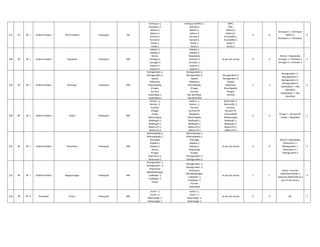
  • 112.
    203 NR NR-IIJammu & Kashmir Uri NHPC 400 Wagoora-1, Wagoora-2, UriII Wagoora-1, Wagoora-2, UriII 0 0 NIL 2 204 ER ER-II Orissa Uttara Powergrid Mehandsal 1&2, Khargpur1&2 2 205 NR NR-I Uttar Pradesh Varanasi-765 Powergrid Gaya-2, Fatehpur-1, Kanpur-2, 6 206 NR NR-II Jammu & Kashmir Wagoora Powergrid 400 Uri-I-1, Uri-I-2, Uri-II-1, New Wanpoh-1, New Wanpoh-2 Uri-I-1, Uri-I-2, Uri-II-1, Wanpoh-1, Wanpoh-2 0 0 New Wanpoh-1 > Wanpoh- 1, New Wanpoh-2 > Wanpoh- 2, 3 207 NR NR-II Jammu & Kashmir Wanpoh Powergrid 400 Wagoora-1, Wagoora-2, Kishenpur -1, Kishenpur -2, Kishenpur -3, Kishenpur -4 Wagoora-1, Wagoora-2, Kishenpur -1, Kishenpur -2, Kishenpur -3, Kishenpur -4 As per site survey 0 0 NIL 6 208 SR SR - I Andhra Pradesh Chittur APTRANSCO 400 Chinkampally, Sriperumbudur Cudappah, Madras Cudappah, Madras, TVLM1, TVLM2, KPATNAM1, KPATNAM2. 0 0 Chinkampally > Cudappah, Sriperambadur > Madras 5 209 SR SR - I Andhra Pradesh Srikakulam (Palasa) APTRANSCO 4 210 SR SR - II Tamil Nadu Kalivanthapattu Powergrid 400 Kolar, Sriperumbudur Vallur-1, Vallur-2 As per site survey 0 0 Kolar > Vallur-1, Sriperumbudur > Vallur-2 6 211 SR SR - II Tamil Nadu Karaikudi New Powergrid 400 Madurai, Trichy Madurai, Trichy As per site survey 0 0 NIL 4 212 SR SR - II Karnataka Narendra Powergrid 400 Kaiga-1, Kaiga-2, Guttur-1, Guttur-2, Nareandra765-1, Nareandra765-2 Kaiga-1, Kaiga-2, Dawangree-1, Dawangree-2, Not identified, Not identified As per site survey 2 -2 Guttur-1 > Dawangree-1, Guttur-2 > Dawangree-2, Nareandra765-1 > Not identified, Nareandra765-2 > Not identified 3 213 SR SR - II Tamil Nadu Pugalur Powergrid 400 Neyveli TS-2, Neyveli TS-2 Exp, Madurai -1, Madurai -2 Neyveli TS-2, Neyveli TS-2 Exp, Madurai -1, Madurai -2 - 0 0 NIL 6 214 SR SR - I Telangana Mamidipally TSTRANSCO 400 Ghanapur, Khamam 1&2, SLBPH 1&2 Ghanapur, Khamam 1&2, Srisailem 1&2 0 0 SLBPH 1 > Srisailem 1 SLBPH 2 > Srisailem 2 3 215 SR SR - II Tamil Nadu Tirunelveli Powergrid 400 Madurai-1, Madurai-2, Udumalpet-1, Udumalpet-2, Koodankulam-1, Koodankulam-2, Koodankulam-3, Koodankulam-4, Trivendram-1, Trivendram-2, Edamom-1, Edamom-2, Edamom-1(m/c), Edamom-2(m/c), Edamom-3(m/c), Edamom-4(m/c) Madurai-1, Madurai-2, Udumalpet-1, Udumalpet-2, Koodankulam-1, Koodankulam-2, Koodankulam-3, Koodankulam-4, Trivendram-1, Trivendram-2, Edamom-1, Edamom-2, Not identified, Not identified, Not identified, Not identified Madurai-1, Madurai-2, Udumalpet-1, Udumalpet-2, Koodankulam-1, Koodankulam-2, Koodankulam-3, Koodankulam-4, Trivendram-1, Trivendram-2 4 -4 Edamom-1(m/c) > Not identified, Edamom-2(m/c) > Not identified, Edamom-3(m/c) > Not identified, Edamom-4(m/c) > Not identified 7
  • 113.
    216 SR SR- I Andhra Pradesh Warangal Powergrid 400 Ramagundam, Bhopalpally -1, Bhopalpally -2, Khammam Ramagundam, Bhopalpally -1, Bhopalpally -2, Khammam As per site survey 0 0 NIL 4 217 SR SR - I Andhra Pradesh Kurnool 765 Powergrid 400 Raichur-1, Nagarjunasagar-1, Gooty-1, Kurnool(AP)-1, Kurnool(AP)-2, Nellore-1, Nellore-2, Thiruvalem-1, Thiruvalem-2 Raichur-2, Nagarjunasagar-1, Gooty, Kurnool-1, Kurnool-2, Nellore-1 (Not Erected), Nellore-2 (Not Erected), Thiruvalem-1 (Not Erected), Thiruvalem-2 (Not Erected) Raichur(N)-2, Nagarjunasagar-1, Gooty, Kurnool-1, Kurnool-2, Nellore-1 (Not Erected), Nellore-2 (Not Erected), Thiruvalem-1 (Not Erected), Thiruvalem-2 (Not Erected) Raichur(N)-1, 0 0 Raichur-1 > Raichur-2, Gooty-1 > Gooty, Kurnool(AP)-1 > Kurnool-1, Kurnool(AP)-2 > Kurnool-2 8 218 SR SR - I Karnataka Raichur 765 Powergrid 400 Kurnool-1, Kurnool-2, Raichur-1, Raichur-2, Gooty-1, Gooty-2, Sholapur-1 Kurnool-1 (Not Commision), Kurnool-2, Raichur-1, Raichur-2, Gooty-1, Gooty-2, Sholapur-1 As per site survey 0 0 Kurnool-1 > Not Commision 5 219 SR SR - II Karnataka Madhugiri 765 Powergrid 400 Gooty-1&2, Yelahanka 1 &2, New Salem-1, Narendra-1,2 Gooty-1&2, Yelahanka 1 &2, Under Construction, Under Construction - 3 -3 New Salem-1 > Under Construction, Narendra-1,2 > Under Construction, 5 220 SR SR - II Karnataka Hassan Powergrid 400 Mysore-1, Mysore-2, Neelmangalam Mysore-1, Mysore-2, Neelmangalam Mysore-1, Mysore-2, Neelmangalam Talaguppa Udipi-1 Udupi-2 0 0 NIL 6 221 SR SR - I Andhra Pradesh Cuddappah PG Powergrid 400 Nagarjunsagar-1, Nagarjunsagar-2, Chittoor Nagarjunsagar-1, Nagarjunsagar-2, Chittoor As per site survey 0 0 NIL 2 222 SR SR - II Tamil Nadu Salem PS Powergrid 400 Somanahalli-1&2, Nagapattanam PS-1, Nagapattanam PS-2, Madugiri-1 Somanahalli-1&2, Salem-1, Salem-2, Madugiri-1 - 0 0 Nagapattanam PS-1> Salem-1 Nagapattanam PS-2> Salem-2 3 223 SR SR - II Kerala Cochin Powergrid 400 Edamom-1(DC), Edamom-2(DC), North Trichur-1, North Trichur-2 Thirunelveli-1, Thirunelveli-2, North Trichur-1, North Trichur-2 As per site survey 0 0 Edamom-1(DC) > Thirunelveli-1, Edamom-2(DC) > Thirunelveli-2 4 224 SR SR - II Puducherry Puducherry Powergrid 400 Neyveli TS2, Sriparembadur Neyveli TS2, SV Chatram As per site survey 0 0 Sriparembadur > SV Chatram 2 225 SR SR - II Kerala Kozhikode Powergrid 400 Mysore-1, Mysore-2 Mysore-1, Mysore-2 As per site survey 0 0 NIL 2 226 SR SR - II Tamil Nadu Tiruvalam Powergrid 400 Chitoor-1, Chitoor-2, Nellore-1, Nellore-2, Sholinganallur-1, Sholinganallur-2, Kolar-1, Sriperumbudur-1, Kurnool-1, Kurnool-2 Chitoor-1, Chitoor-2, Nellore-1, Nellore-2, Kalivandhapattu-1(NC) Kalivandhapattu-2(NC) Kolar-1, Sriperumbudur-1, Kurnool-1 (Under Cont), Kurnool-2 (Under Cont) As per site survey 0 0 Sholinganallur-1 > Kalivandhapattu-1, Sholinganallur-2 > Kalivandhapattu-2 7
  • 114.
    227 SR SR- I Andhra Pradesh 765 kV Nellore Powergrid 765 Simhapuri-1, Simhapuri-2, Nellore-1, Nellore-2, Kurnool-1, Kurnool-2, Gooty-1, Gooty-2 Simhapuri (MEPL)-1, Simhapuri, Nellore-1, Nellore-2, Kurnool-1, Kurnool-2, Gooty-1, Gooty-2 MEPL, SEPL, Nellore-1, Nellore-2, Kurnool(N)-1, Kurnool(N)-2, Gooty-1, Gooty-2 0 0 Simhapuri-1 > Simhapuri (MEPL)-1, Simhapuri-2 > Simhapuri, 6 228 SR SR - I Andhra Pradesh Gajuwaka Powergrid 400 Kalpaka-1, Kalpaka-2, Nunna, Vemagiri-1, Vemagiri-2 Jeypore-1, Jeypore-2, Kalpaka-1, Kalpaka-2, Vijayawada, Simhadri-2, Simhadri-1, Jeypore-1, Jeypore-2, As per site survey 0 0 Nunna > Vijayawada, Vemagiri-1 > Simhadri-2, Vemagiri-2 > Simhadri-1 4 229 SR SR - I Andhra Pradesh Ghanapur Powergrid 400 Ramagundam-1, Ramagundam-2, Gajwel, Malkaram, Mamidapally, N'sagar, Kurnool, Hyderabad-1, Hyderabad-2 Ramagundam-3, Ramagundam-4, Gajwel, Malkaram, Mamidapally, N'sagar, Kurnool, Not identified, Not identified Ramagundam-3, Ramagundam-4, Gajwel, Malkaram, Mamidapally, N'sagar, Kurnool 2 -2 Ramagundam-1 > Ramagundam-3, Ramagundam-2 > Ramagundam-4, Hyderabad-1 > Not identified, Hyderabad-2 > Not identified 4 230 SR SR - I Andhra Pradesh Gooty Powergrid 400 Raichur -1, Raichur -2, Kurnool, N'Sagar, Hoody, Nelamangala, Madhugiri-1, Madhugiri-2, Nellore PS-1, Nellore PS-2 Raichur -1, Raichur -2, Kurnool, Kurnool PG, Bangalore, Nelamangala, Madhugiri-1, Madhugiri-2, Nellore PS-1, Nellore PS-2 Raichur(N) -1, Raichur(N) -2, Kurnool, Kurnool PG, Somanahalli, Nelamangala, Madhugiri-1, Madhugiri-2, Nellore PS-1, Nellore PS-2 0 0 N'sagar > Kurnool PG, Hoody > Bangalore 5 231 SR SR - I Andhra Pradesh Khammam Powergrid 400 Maimadapally-1, Maimadapally-2, Warangal, Kalpaka-1, Kalpaka-2, Nunna, N'sagar, Khammam-1, Khammam-2 Maimadapally-1, Maimadapally-2, Warangal, Kalpaka-1, Kalpaka-2, Vijayawada, N'sagar, Kothagundem-1, Kothagundem-2 As per site survey 0 0 Nunna > Vijayawada, Khammam-1 > Kothagundem-1, Khammam-2 > Kothagundem-2 5 232 SR SR - I Andhra Pradesh Nagarjunsagar Powergrid 400 Ramagundam -1, Ramagundam -2, Khammam, Mehaboobnagar, Cuddapah -1, Cuddapah -2. Gooty, Ramagundam -1, Ramagundam -2, Khammam, Mehaboobnagar, Cuddapah -1, Cuddapah -2, Kurnool, Hyderabad As per site survey 1 1 Gooty > Kurnool, Hyderabad feeder is captured additionally as a part of site survey. 4 233 SR SR - II Karnataka Hiriyur Powergrid 400 Guttur -1, Guttur -2, Nelamangla -1, Nelamangla -2 Guttur -1, Guttur -2, Nelamangla -1, Nelamangla -2 As per site survey 0 0 NIL 2
  • 115.
    234 SR SR- II Tamil Nadu Hosur Powergrid 400 Kolar-1, Kolar-2, Salem-1, Salem-2, Bangalore, Electronic City-1, Electronic City-2 Kolar-1, Kolar-2, Salem-1, Salem-2, Somanahalli, Not identified, Not identified As per site survey 2 -2 Bangalore > Somanahalli, Electronic City-1 > Not identified, Electronic City-2 > Not identified 3 235 SR SR - II Karnataka Kolar Powergrid 400 Hoody -1, Hoody -2, Somanhally, Hosur -1, Hosur -2, Kalvindapattu, Chinkampally, Talchar HVDC -1, Talchar HVDC -2 Hoody -1, Hoody -2, Somanhally, Hosur -1, Hosur -2, Tiruvallam, Cudappah, HVDC Pole-1, HVDC Pole-2 As per site survey 0 0 Kalivandhapattu > Tiruvallam, Chinkampally > Cudappah, Talchar HVDC-1 > HVDC Pole-1, Talchar HVDC-1 > HVDC Pole-2 4 236 SR SR - II Tamil Nadu Madurai Powergrid 400 Pugalur-1, Pugalur-2, Trichy, Karaikudi New, Udumalpet, Thirunelveli-1, Thirunelveli-2, Tuticorin-1, Tuticorin-2 Pugalur-1, Pugalur-2, Trichy, Karaikudi, Udumalpet, Thirunelveli, Kudankulam, Tuticorin-1, Tuticorin-2 As per site survey 0 0 Karaikudi New > Karaikudi, Thirunelveli-1 > Thirunelveli, Thirunelveli-2 > Kudankulam 5 237 SR SR - I Karnataka Munirabad Powergrid 400 Raichur, Guttur Raichur, Davangere As per site survey 0 0 Guttur > Davangere 1 238 SR SR - II Karnataka Mysore Powergrid 400 Neelamangla-1, Neelamangla-2, Kozhikode -1, Kozhikode -2, Hassan -1, Hassan -2 Neelamangla-1, Neelamangla-2, Kozhikode -1, Kozhikode -2, Hassan -1, Hassan -2 As per site survey 0 0 NIL 3 239 SR SR - II Karnataka Neelamangala KPTCL 400 Talaguppa, Hassan, Hiriyur PG -1, Hiriyur PG -2, Gooty, Mysore -1, Mysore -2, Hoody, Somanhally -1, Somanhally -2, Yelehanka Talaguppa, Hassan, Hiriyur PG -1, Hiriyur PG -2, Gooty, Mysore -1, Mysore -2, Hoody-1, Bidadi -1, Bidadi -2, Hoody-2 As per site survey 0 0 Hoody > Hoody-1, Somanhally -1 > Bidadi-1, Somanhally -2 > Bidadi-2, Yelehanka > Hoody-2 6 240 SR SR - I Andhra Pradesh Nunna/Vijaywada Powergrid 400 Vemagiri-1, Vemagiri-2, Vemagiri-3, Vemagiri-4, Gazuwaka, Lanco-1, Lanco-2, VTS stg 4-1, VTS stg 4-2, Nellore-1, Nellore-2, Khammam Vemagiri-1, Vemagiri-2, Vemagiri-3, Vemagiri-4, Gazuwaka, Lanco-1, Lanco-2, VTPS-1, VTPS-2, Nellore-1, Nellore-2, Khammam Vemagiri-1, Vemagiri-2, Vemagiri-3, Vemagiri-4, Gazuwaka, Lanco-1, Lanco-2, VTPS-1, VTPS-2, Nellore-1, Nellore-2, Khammam Nellore(AP)-3, Nellore(AP)-4 0 0 VTS stg 4-1 > VTPS-1, VTS stg 4-2 > VTPS-2 7 241 SR SR - II Tamil Nadu Salem Powergrid 400 Hosur, Somanhally, Udumalpet-1, Udumalpet-2, Neyveli TS2-1, Neyveli TS2-2 Hosur-1, Hosur-2, Udumalpet-1, Udumalpet-2, Neyveli TS2-1, Neyveli TS2-2 As per site survey 0 0 Hosur > Hosur-1, Somanhally > Hosur-2 4
  • 116.
    242 SR SR- II Karnataka Somanhalli Powergrid 400 Kolar, Salem, Nelamangala -1, Nelamangala -2, Salem new-1, Salem new-2 Nelamangala -3 Kolar, Hosur, Bidadi -1, Bidadi -2, Gooty As per site survey 0 0 Salem > Hosur, Nelamangala -1 > Bidadi - 1, Nelamangala - 2 > Bidadi - 2, Salem new-1 > Gooty, 4 243 SR SR - II Tamil Nadu Udumalpet Powergrid 400 Arasur-1, Arasur-2, Madurai, Thirunelveli-1, Thirunelveli-2, Trichur-1, Trichur-2, Not Identiified, Not Identiified Arasur-1, Arasur-2, Madurai, Thirunelveli-1, Thirunelveli-2, Palakad-1, Palakad-2, Salem-1, Salem-2 - 0 0 Trichur-1 > Palakad-1, Trichur-2 > Palakad-2, Not identified >Salem-1, Not identified >Salem-2 5 244 SR SR - II Kerala N.Trichur Powergrid 400 Udumalpet-1, Udumalpet-2, Cochin-1, Cochin-2, Kozhikode-1, Kozhikode-2 Palakad-1, Palakad-2, Cochin-1, Cochin-2, Not Identiified, Not Identiified As per site survey 2 -2 Udumalpet-1 > Palakad-1, Udumalpet-2 > Palakad-2, Kozhikode-1 > Not Identiified, Kozhikode-2 > Not Identiified 2 245 SR SR - II Tamil Nadu Trichy Powergrid 400 Karaikudi, Madurai, Neyveli TS-1 Exp, Neyveli TS-2 Karaikudi, Madurai, Neyveli TS-1 Exp, Neyveli TS-2 As per site survey 0 0 NIL 2 246 SR SR - II Kerala Trivendrum Powergrid 400 Thirunelveli -1, Thirunelveli -2 Thirunelveli -1, Thirunelveli -2 As per site survey 0 0 NIL 1 247 SR SR - I Andhra Pradesh Simhadri Power NTPC 400 Kalpaka -1, Kalpaka -2, Kalpaka -3, Kalpaka -4 Kalpaka -1, Kalpaka -2, Kalpaka -3, Kalpaka -4 Kalpaka -1, Kalpaka -2, Kalpaka -3, Kalpaka -4 Vemagiri-1 Vemagiri-2 Gajuwaka-1 Gajuwaka-2 0 0 NIL 4 248 SR SR - I Andhra Pradesh Nellore Powergrid 400 Sriperumubudur-1, Sriperumubudur-2, Vijayawada-1, Vijayawada-2, Krishnapatnam UMPP-1, Krishnapatnam UMPP-2, Thiruvalem-1, Thiruvalem-2 Sriperumubudur-1, Alamathy, Vijayawada-1, Vijayawada-2, NPS-1, NPS-2, Thiruvalem-1, Thiruvalem-2 As per site survey 0 0 Sriperumubudur-2 > Alamathy, Krishnapatnam UMPP-1 > NPS-1, Krishnapatnam UMPP-1 > NPS-2 4 249 SR SR - II Tamil Nadu Neyveli TS1 Ext. NLC 400 Neyveli TS-2, Trichy Neyveli TS-2, Trichy As per site survey 0 0 NIL 1 250 SR SR - II Tamil Nadu Neyveli TS2 NLC 400 Salem -1, Salem -2, Trichy, Neyveli TS-1 Exp, Neyveli TS-2 Exp, Puducherry, Bahror Salem -1, Salem -2, Trichy, Neyveli TS-1 Exp, Neyveli TS-2 Exp, Puducherry, Pugalur As per site survey 0 0 Bahror > Pugalur 4 251 SR SR - II Tamil Nadu Neyveli TS2 Exp NLC 400 Pugalur, Neyveli TS-1 Pugalur-2, Neyveli TS-2 As per site survey 0 0 Pugalur > Pugalur-2, Neyveli TS-1 > Neyveli TS-2 1
  • 117.
    252 SR SR- I Andhra Pradesh Ramagundam STPS NTPC 400 Chandrapur-1, Chandrapur-2, Warangal, Nagarjuna Sagar-1, Nagarjuna Sagar-2, Ghanapur-1, Ghanapur-2, Gajwel, Malkaram, Dichipally Chandrapur-1, Chandrapur-2, Warangal, Nagarjuna Sagar-1, Nagarjuna Sagar-2, Hyderabad-3, Hyderabad-4, Gajwel, Malkaram, Dichipally As per site survey 0 0 Ghanapur-1 > Hyderabad- 3, Ghanapur-2 > Hyderabad- 4 5 253 SR SR - II Karnataka Yelahanka Powergrid 400 Neelamangla-1, Hoody-1, Madhugiri-1, Madhugiri-2 Somanhally-1, Hoody-2 Neelamangla, Hoody, Madhugiri-1, Madhugiri-2 Not available Not available As per site survey 2 -2 Neelamangla-1 > Neelamangla, Hoody-1 > Hoody, Somanhally-1 > Not available Hoody-2 > Not available 2 254 SR SR - II Karnataka Bidadi Powergrid 400 Neelamangla -1, Neelamangla -2, Somnahalli -1, Somnahalli -2 Neelamangla -1, Neelamangla -2, Somnahalli -1, Somnahalli -2 As per site survey 0 0 NIL 2 255 SR SR - II Tamil Nadu KudaNkulam Powergrid 400 Tiruneveli-1, Tiruneveli-2, Tiruneveli-3, Tiruneveli-4 Madurai, Tiruneveli-2, Tiruneveli-3, Tiruneveli-4 As per site survey 0 0 Tiruneveli-1 > Madurai 2 256 SR SR - II Kerala Kayamkulam PG NTPC 220 Not Identified, Not Identified, Not Identified, Not Identified, Not Identified, Not Identified, New Palom-1, New Palom-2, Edappon, Kundara, Not Identified, Not Identified, New Palom-1, New Palom-2, Edappon, Kundara, 2 -2 Not Identified > New Palom-1, Not Identified > New Palom-2, Not Identified > Edappon, Not Identified > Kundara, 2 257 SR SR - I Andhra Pradesh Kurnool APTRANSCO 400 Gooty, SLBPH, Ghanapur Gooty, Srisailam, Ghanapur Gooty, Srisailam, Ghanapur, Kurnool(N) 1, Kurnool(N) 2 0 0 SLBPH > Srisailam 3 258 SR SR - I Andhra Pradesh Mahaboobnagar APTRANSCO 400 Nagarjunsagar, Raichur Thallapalli, Raichur Nagarjunsagar, Raichur 0 0 Nagarjunsagar > Thallapalli 1 259 SR SR - I Telangana Srisillem LPH TSTRANSCO 400 Kurnool, Maimadapally -1, Maimadapally -2, VTS stg 4 -1, VTS stg 4 -2 Kurnool, Hyderabad-1, Hyderabad-2, Satenapalli-1, Satenapalli-2 - 0 0 Maimadapally -1 > Hyderabad-1, Maimadapally -2 > Hyderabad-2, VTS stg 4 -1 > Satenapalli- 1, VTS stg 4 -2 > Satenapalli-2 3 260 SR SR - I Andhra Pradesh VEMAGIRI PGL (GMR) GMR 400 Vemagiri -1, Vemagiri -2 Vemagiri -1, Vemagiri -2 - 0 0 NIL 1 261 SR SR - I Andhra Pradesh VTS STAGE IV APTRANSCO 400 Nunna 1&2, SLBPH 1&2 Nunna 1&2, Sattenapalli 1&2, Malkaram 1&2 - 2 2 SLBPH 1&2 > Sattenapalli 1&2, Not in contract > Malkaram 1&2 3 262 SR SR - I Telangana KTPS TSTRANSCO 220 Manuguru, L Sileru-1, L Sileru- 2, KTPS V-1, KTPS V-2, Mirayalguda, K V Kota, Shapurnagar Manuguru-1, L Sileru-1, Manuguru-2, Tie Line-1, Tie LIne-2, Mirayalguda, Nunna, Shapurnagar - 0 0 Manuguru > Manuguru-1, L Sileru-2 > Manuguru-2, KTPS V-1 > Tie Line-1, KTPS V-2 > Tie Line-2, K V Kota > Nunna 4
  • 118.
    263 SR SR- I Andhra Pradesh VTS APTRANSCO 220 Kondapalli-1, Kondapalli-2, Chillkallu-1, Chillkallu-2, Podili-1, Podili-2, K V Kotal, Bhimadole, Nunna, Tadikonda-1, Tadikonda-2, N sagar-1, N sagar-2, Gunadala Kondapalli-1, Kondapalli-2, Chillkallu-1, Chillkallu-2, Podili, NR Peta, K-Kota, Not Identifed, Nunna, Tadikonda-1, Tadikonda-2, Rentachintala, Tallapalli, Gunadala As per site survey 1 -1 Podili-1 > Podili, Podili-2 > NR Peta, K V Kotal > K-Kota, Bhimadole > Not identified, N sagar-1 > Rentachintala, N sagar-2 > Tallapalli 7 264 SR SR - II Karnataka Guttur KPTCL 400 Jindal, Munirabad, Narendra-1, Narendra-2, Kaiga-1, Kaiga-2, Hiriyur PG-1, Hiriyur PG-2 Jindal (JSWEL), Guddadahalli, Narendra-1, Narendra-2, Kaiga-1, Kaiga-2, Berenahalli-1, Berenahalli-2 0 0 Jindal > Jindal (JSWEL), Munirabad > Guddadahalli, Hiriyur PG-1 > Berenahalli- 1, Hiriyur PG-2 > Berenahalli- 2 4 265 SR SR - II Tamil Nadu Arasur Powergrid 400 Udumalpet -1, Udumalpet -2 Udumalpet -1, Udumalpet -2 0 0 NIL 2 266 SR SR - II Tamil Nadu Alamathy TANTRANSCO 400 Sriperumbudur -1, Sriperumbudur -2, Nellore -1, Nellore -2, North Chennai 6th Fdr Details Not Available Vallur- 1, Vallur-2, Sriperambudur, Nellore, North chennai-1, North chennai-2 Vallur- 1, Vallur-2, Sriperambudur, Nellore, North chennai-1, North chennai-2 Sunguarchatram-1 Sunguarchatram-2 0 0 Sriperambudur-1 > Vallur- 1, Sriperambudur-2 > Vallur- 2, Nellore-1 > Sriperambudur, Nellore-2 > Nellore, North chennai > North chennai-1 6th Fdr > North chennai-2 4 267 SR SR - II Tamil Nadu Sriperumbudur Powergrid 400 Kalvindapattu, Chittoor, AlAmathy -1, AlAmathy -2, PudUcherry, Bahroor Tiruvallam, Chittoor, AlAmathy-1, Nellore, Sunguvarchatram Not identified As per site survey 1 -1 Kalvindapattu> Tiruvallam, Almathy -2> Nellore, Pudyucherry > Sunguvarchatram, Bahroor > Not identified 3 268 SR SR - I Karnataka Raichur TPS KPTCL 400 Gooty-1, Gooty-2, Munirabad Gooty-1, Gooty-2, Munirabad, Mahaboobnagar, BTPS As per site survey 2 2 Not identified > Mahaboobnagar, Not identified > BTPS 3 269 SR SR - II Kerala Kalamassery KSEB 220 Idukki-1, Idukki-2, Bramhapuram-1, Bramhapuram-2 220KV IDKL-1, 220KV IDKL-2, 220KV COKL-1, 220KV COKL-2 - 0 0 Idukki-1 > 220KV IDKL-1, Idukki-2 > 220KV IDKL-2, Bramhapuram-1 > 220KV COKL-1, Bramhapuram-2 > 220KV COKL-2 2
  • 119.
    270 WR WR-IMaharastra Chandrapur MSETCL 400 Parali-1, Parali-2, Parali-3, Bhadrawathi-1, Bhadrawathi-3, Bhadrawathi-4, Bhadrawathi-2, Khaparkheda, HVDC-1, HVDC-2, Padhge. Chandrapur-1, Chandrapur-2, Parali-3, PGCIL-1, PGCIL-2, PGCIL-3, PGCIL-4, Khaparkheda, HVDC-1, HVDC-2. Not identified - 1 1 Parali-1->Chandrapur-1 Parali-2->Chandrapur-2 Bhadrawathi-1->PGCIL-1, Bhadrawathi-2->PGCIL-2 Bhadrawathi-3->PGCIL-3 Bhadrawathi-4->PGCIL-4 Padhge->Not identified 5 271 WR WR-I Maharastra KALWA MSETCL 400 Padhage-1, Padhage-2, Pune PG, Khargar Padhage-1, Padhage-2, Talegaon, Khargar - 0 0 Pune PG->Talegaon 2 272 WR WR-I Maharastra Lonikand MSETCL 400 Pardi-1, Parali-2, Karad, Koyna IV, Jejuri, Pune PG, Chakan LonikandII ckt-1, LonikandII ckt-2, Karad, Koyna IV, Jejuri, Pune PG, Chakan - 0 0 Parali-1->LonikandII ckt-1 Parali-2->LonikandII ckt-2 4 273 WR WR-I Maharastra PADGHE MSETCL 400 Chandrapur-1, Chandrapur-2, Bableshwar-1, Bableshwar-2, Chakan Kalwa-1, Kalwa-2, Boiser, Tarapur, Khargar Neagothane-1 Neagothane-2 HVDC-1 HVDC-2 Bableshwar-1, Bableshwar-2, Talegaoh Kalwa-1, Kalwa-2 Boiser, Tarapur-1, Khargar, Neagothane-1 Neagothane-2 Tharapur-2, 1 1 Chandrapur-1->HVDC-1 Chandrapur-2->HVDC-2 Chakan->Talegaoh Tharapur->Tharapur-1 Not in Contract->Tharapur- 2 7 274 WR WR-II Madhya Pradesh BHOPAL MPPTCL 400 DAMOH-1, DAMOH-2, ITARSI-2, BINA-2, BINA-1, ITARSI-1, BHOPAL-1, BHOPAL-2 DAMOH-1, DAMOH-2, ITARSI-2, BINA-2, BINA-1, ITARSI-1, BHOPAL-1, BHOPAL-2 0 0 - 4 275 WR WR-II Madhya Pradesh BINA MPPTCL 400 Bina PGCIL-1, Bina PGCIL-2, Bina PGCIL-3, Bina PGCIL-4, Bina Power, Bhopal-1, Bhopal-2, Bina PGCIL-1, Bina PGCIL-2, Bina PGCIL-3, Bina PGCIL-4, JP BPSCL, Bhopal-1, Bhopal-2, Bina PGCIL-1, Bina PGCIL-2, Bina PGCIL-3, Bina PGCIL-4, JP BPSCL, Bhopal-1, Bhopal-2, 0 0 Bina power->JP BPSCL 4 276 WR WR-II Madhya Pradesh Indore MPPTCL 400 Itarsi-1, Itarsi-2, Asoj-1, Asoj-2, Nagda, Indira sagar-1, Indira sagar-2, Indore(PG)-1, Indore(PG)-2 Itarsi-1, Itarsi-2, Asoj-1, Asoj-2, Nagda, Indira sagar-1, Indira sagar-2, Hatunia-1, Hatunia-2 Itarsi-1, Itarsi-2, Asoj-1, Asoj-2, Asoj-3 Nagda, Indira sagar-1, Indira sagar-2, Indore(PG)-1, Indore(PG)-2 0 0 Indore(PG)-1 > Hatunia-1, Indore(PG)-2 > Hatunia-2 5
  • 120.
    277 WR WR-IIMadhya Pradesh 765/400kv Indore Powergrid 765 765kV Bina(PG), 765kV Vadodara, 765kV Bhopal, 400kV Indore (MP)1 & 2, 400kV Pithampur 1&2 765kV Bina(PG)- Indore, 765kV Vadodara, 765kV Bhopal, 400kV Indore (MP)1 & 2, 400kV Pithampur 1&2 765kV Bina(PG)- Indore, 765kV Vadodara, 765kV Bhopal, 400kV Indore (MP)1 & 2, 400kV Pithampur 1&2 0 0 765kV Bina(PG) >765kV Bina(PG)- Indore 7 278 WR WR-II Madhya Pradesh NAGDA MPPTCL 400 Dehgam-1 &2, Shujalpur-1&2, Rajgarh-1&2 Indira sagar, Indore Dehgam-1 &2, Shujalpur-1&2, Rajgarh-1&2 Indira sagar, Indore - 0 0 - 4 279 WR WR-II Madhya Pradesh RAJ GARH Powergrid 400 SSP 1&2, Nagda 1&2, Kasor 1&2, Khandawa 1,2, Khandawa 3,4 SSP 1&2, Nagda 1&2, Kasor 1&2, Khandawa 1,2, Not identified. SSP 1&2, Nagda 1&2, Kasor 1&2, Khandawa 1,2. 2 -2 Khandawa 3,4 > Not identified 6 280 WR WR-II Madhya Pradesh KATNI MPPTCL 400 Birsinghpur, Damoh Birsinghpur-1, Birsinghpur-2 Damoh - 1 1 Not in contract - >Birsinghpur-2 2 281 WR WR-II Madhya Pradesh Sasan Reliance Power Ltd. 765 Satna765 1&2, 765kV Vpool, Vindhyachal 1 Vindhyachal 2 400kV Jabalpur 1 400kV Jabalpur 2 Satna 1&2, 400kV Vpool 1&2, Satna765 1&2, 765kV Vpool, Vindhyachal 1 Vindhyachal 2 Vindhyachal 3 Jabalpur 3 Not identified. Not identified. Satna765 1&2, 765kV Vpool 4 -4 400kV Jabalpur 1 > Vindhyachal 3 400kV Jabalpur 2 > Jabalpur 3 Satna 1 > Not identified Satna 2 > Not identified 400kV Vpool 1 > Not identified 400kV Vpool 2 > Not identified 2 282 WR WR-I Chattisgarh BHILAI CSPGCL 400 KSTPS-1, KSTPS-2, KSTPS-3, Raipur-1, Seoni, Koradi, Bhadrawati Raipur-2, NTPC Korba-1, NTPC Korba-2, Raita-1, Raipur-1, seoni, Koradi, Bhadrawati, Raita-2, Raita-3, Korba EXT-1, Korba EXT-2, Bhatapara 4 4 KSTPS-1->NTPC Korba-1, KSTPS-2->NTPC Korba-2, KSTPS-3->Raita-1, Raipur-2->Not available. Nill->Raita-2, Nill->Raita-3, Nill->Korba EXT-1, Nill->Korba EXT-2, Nill->Bhatapara 6 283 WR WR-I Chattisgarh KORBA WEST CSPGCL 400 KSTPS, Bhilai KSTPS (NTPC), Raita KSTPS (NTPC), Raita. Bhilai 1, Bhilai 2. 0 0 KSTPS > KSTPS (NTPC), Bhilai > Raita 2 284 WR WR-I Chattisgarh Korba(E) CSPGCL 220 Korba East Extn-1, Korba East Extn-2, Korba West, Balco-1, Balco-2, Budhipadar-1, Budhipadar-2, Raigarh, Bhilai, Bhatapar-1, Bhatapar-2 Korba East West-1, Korba East West-2, Korba DSPM, Balco-1, Balco-2, Budhipadar-1, Budhipadar-2, Raigarh, Siltara, Not Identified, Not Identified Korba East West-1, Korba East West-2, Korba DSPM, Balco-1, Balco-2, Budhipadar-1, Budhipadar-2, Raigarh, Siltara 2 -2 Korba East Extn-1 > Korba East West-1, Korba East Extn-2 > Korba East West-2, Korba West > Korba DSPM, Bhilai > Siltara, Bhatapar-1 > Not Identified, Bhatapar-2 > Not Identified 5
  • 121.
    285 WR WR-IIGujrat SARDARSAROVAR(SSP) SSP 400 Rajgarh-1, Rajgarh-2, Asoj, Kasor, Dhule-1, Dhule-2, Nagda-1, Nagda-2 Asoj, Limdi, Dhule-1, Dhule-2, 0 0 Rajgarh-1->Nagda-1, Rajgarh-2->Nagda-2 Kasor->Limdi, 3 286 WR WR-I Maharastra AURANGABAD PG Powergrid 4 287 WR WR-I Maharastra Bhadrawati Powergrid 400 Raipur 1,2&3, Ramagundam 1&2, Parli , Chandrapur 1,2,3&4, Bhilai , EMCO 1&2, Dhariwal TPS. Raipur 1,2&3, Ramagundam 1&2, Parli , Chandrapur 1,2,3&4, Bhilai , EMCO 1&2, Dhariwal (Parli-2), HVDC-1, HVDC-2 Raipur 1,2&3, Ramagundam 1&2, Parli , Chandrapur 1,2,3&4, Bhilai , EMCO 1&2, Dhariwal TPS, HVDC-1, HVDC-2 2 2 Dhariwal TPS > Dhariwal (Parli-2), Not identified > HVDC-1, Not identified > HVDC-2 8 288 WR WR-II Madhya Pradesh Bina Powergrid 765 765kV JabalpurPS-1, 2 & 3, 765kV Indore, 765kV Satna-1 & 2, 765kV Gwalior-1, 2 & 3, 765KV Seoni 400kV Sujalpur-1 & 2, 400kV Bina-1, 2, 3 & 4, 400kV Bina Power, 400kV Satna-1, 2, 3 & 4, 765kV Jabalpur-1, 2 & 3, 765kV Indore, 765kV Satna-1 & 2, 765kV Gwalior-1, 2 & 3, 765KV Seoni 400kV Sujalpur-1 & 2, 400kV Bina-1, 2, 3 & 4, 400kV BPSCL, 400kV Satna-1, 2, 3 & 4, 765kV Jabalpur-1, 2 & 3, 765kV Indore, 765kV Satna-1 & 2, 765kV Gwalior-1, 2 & 3, 765KV Seoni 400kV Sujalpur-1 & 2, 400kV Bina-1, 2, 3 & 4, 400kV BPSCL, 400kV Satna-1, 2, 3 & 4, 0 0 765kV Jabalpur PS-1 > 765kV Jabalpur-1 765kV Jabalpur PS-2 > 765kV Jabalpur-2 765kV Jabalpur PS-3 > 765kV Jabalpur-3, 400kV Bina Power > 400kV BPSCL 16 289 WR WR-I Maharastra Boisar Powergrid 400 Tarapur 1&2, Padghe, Vapi, A'bad (PG) 1&2, Magarwada 1&2, Tarapur 1&2, Padghe, Vapi, Aurangabad 1&2 Navsari 1&2, Tarapur 1&2, Padghe, Vapi, A'bad (PG) 1&2, Magarwada 1&2, 0 0 Magarwada 1 > Navsari 1, Magarwada 2 > Navsari 2. 5 290 WR WR-II Madhya Pradesh GWALIOR Powergrid 0 291 WR WR-II Madhya Pradesh Itarsi Powergrid 400 Jabalpur 1,2,3,4 Bhopal 1&2, Indore 1&2, Khandawa 1&2, Satpura, Jabalpur 1,2,3,4 Bhopal 1&2, Indore 1&2, Khandawa 1&2, Satpura, Jabalpur 1,2,3,4 Bhopal 1&2, Indore 1&2, Khandawa 1&2, Satpura, 0 0 NIL 6 292 WR WR-II Madhya Pradesh Jabalpur Powergrid 400 Itarsi 1,2,3,&4, Vindhyachal 1&2, 400kV Jabalpur pool 1&2, 400kV Sasan 1 400kV Sasan 2 Itarsi 1,2,3,&4, Vindhyachal 1&2, 400kV Jabalpur pool 1&2, 400kV Sasan 1 Vindhyachal 4 Itarsi 1,2,3,&4, Vindhyachal 1&2, 400kV Jabalpur pool 1&2, Vindhyachal 3 Vindhyachal 4 0 0 Sasan 2> Vindhyachal 4 5 293 WR WR-II Madhya Pradesh Khadwa Powergrid 400 Dhule-1, Dhule-2, Itarsi-1, Itarsi-2, Seoni-1, Seoni-2, Rajgarh-1, Rajgarh-2, Rajgarh-3, Rajgarh-4, Betul-1, Betul-2 Dhule-1, Dhule-2, Itarsi-1, Itarsi-2, Seoni-1, Seoni-2, Rajgarh-1, Rajgarh-2, Indore-1, Indore-2, Betul-1, Betul-2 Dhule-1, Dhule-2, Itarsi-1, Itarsi-2, Seoni-1, Seoni-2, Rajgarh-1, Rajgarh-2, Indore-1, Indore-2, Betul-1, Betul-2 4 -4 Rajgarh-3 > Indore-1, Rajgarh-4 > Indore-2 6
  • 122.
    294 WR WR-IChattisgarh KORBA STPS NTPC 400 Bhilai-1, Bhilai-2, Bhatapara, Raipur-1, Raipur-2, Pathadi, Korwa West, Vindhyachal-1, Vindhyachal-2, Birsinghpur-1, Birsinghpur-2 Bhilai-1, Bhilai-2, Bhatapara, Raipur-3, Raipur-4, Lanco, Korwa West, Vindhyachal-1, Vindhyachal-2, Vandhana, Balco As per site survey 0 0 Raipur-1 > Raipur-3, Raipur-2 > Raipur-4, Pathadi > Lanco, Birsinghpur-1 > Vandhana, Birsinghpur-2 > Balco 6 295 WR WR-I Maharastra Mapusa Powergrid 400 Kolhapur -1, Kolhapur -1 Kolhapur -1, Kolhapur -1 As per site survey 0 0 NIL 1 296 WR WR-I Chattisgarh Raigarh Powergrid 400 Raipur 1, Raipur 4, Raipur 2, Raipur 3 Rourkela 1, Rourkela 2 Rourkela 3, Sterlite Raipur 1, Raipur 4, KWPCL, KSK, Sundergarh, Sterlite 1, Sundergarh 2, Sterlite 1, Kotra pool 1 Kotra pool 2. Raipur 1, Raipur 4, KWPCL, KSK, Sundergarh, Sterlite 1, Sundergarh 2, Sterlite 1, Kotra pool 1 Kotra pool 2. 2 2 Raipur 2 > KWPCL Raipur 3 > KSK Rourkela 1 > Sundergarh, Rourkela 2 > Sterlite 1, Rourkela 3, > Sundergarh 2, Sterlite > Sterlite 1, Not identified > Kotra pool 1 Not identified > Kotra pool 2. 8 297 WR WR-II Madhya Pradesh Satna Powergrid 765 765KV Bina-1, 765KV Bina-2, 765KV Sasan-1, 765KV Sasan-2, 765KV V Pool-1, 765KV V Pool-2, 765KV Satna-1, 765KV Satna-2, 400KV Vindhyachal-1, 400KV Vindhyachal-2, 400KV Vindhyachal-3, 400KV Vindhyachal-4, 400KV Bina PG-1, 400KV Bina PG-2, 400KV Bina PG-3, 400KV Bina PG-4, 400KV Jaiprakash-1, 400KV Jaiprakash-2, 400KV Sasan-1, 400KV Sasan-2 765KV Bina-1, 765KV Bina-2, 765KV Sasan-1, 765KV Sasan-2, 765KV V Pool-1, 765KV V Pool-2, 765KV Gwalior-1, 765KV Gwalior-2, 400KV Vindhyachal-1, 400KV Vindhyachal-2, 400KV Vindhyachal-3, 400KV Vindhyachal-4, 400KV Bina PG-1, 400KV Bina PG-2, 400KV Bina PG-3, 400KV Bina PG-4, 400KV Nigrie-1, 400KV Nigrie-2, Not identified, Not Identified 765KV Bina-1, 765KV Bina-2, 765KV Sasan-1, 765KV Sasan-2, 765KV V Pool-1, 765KV V Pool-2, 765KV Gwalior-1, 765KV Gwalior-2, 400KV Vindhyachal-1, 400KV Vindhyachal-2, 400KV Vindhyachal-3, 400KV Vindhyachal-4, 400KV Bina PG-1, 400KV Bina PG-2, 400KV Bina PG-3, 400KV Bina PG-4, 400KV Nigrie-1, 400KV Nigrie-2, 2 -2 765KV Satna-1 > 765KV Gwalior-1, 765KV Satna-2 > 765KV Gwalior-2, 400KV Jaiprakash-1 > 400KV Nigrie-1, 400KV Jaiprakash-2 > 400KV Nigrie-2, 400KV Sasan-1 > Not identified, 400KV Sasan-2 > Not identified, 12 298 WR WR-I Madhya Pradesh SEONI Powergrid 765 765Kv Sipat-1, 765Kv Sipat-2, 765Kv Bina, 765Kv wardha-1, 765Kv wardha-2, 400Kv Khandwa-1, 400Kv Khandwa-2 400Kv Sadhpura, 400Kv Bhilai. 765Kv Bilaspur-1, 765Kv Bilaspur-2, 765Kv Bina, 765Kv wardha-1, 765Kv wardha-2, 400Kv Khandwa-1, 400Kv Khandwa-2 400Kv Sadhpura, 400Kv Bhilai. - 0 0 765Kv sipat-1->765Kv Bilaspur-1, 765Kv sipat-2->765Kv Bilaspur-2 8
  • 123.
    299 WR WR-IIGujrat Vapi Powergrid 400 Boiser, Kala-1, Suzen, Kala-2, KAPP-1, KAPP-2, Kawas-1, Kawas-2 Boiser, Kala Line, Suzen Line, Not Identified, Not Identified, Not Identified, Not Identified, Not Identified, Navsari Boiser, Kala 1, Suzen Line, Kala 2, KAPP-1, KAPP-2 4 -4 Kala-1 > Kala Line, Kala-2 > Not Identified, KAPP-1 > Not Identified, KAPP-2 > Not Identified, Suzen > Suzen Line, Kawas-1 > Not Identified, Kawas-2 > Not Identified, Not Identified > Navsari 3 300 WR WR-I Maharastra Wardha Powergrid 765 Mauda 1&2, Parli PG 1&2, Akola 1&2, Aurangabad 1&2, Seoni765 1&2, 765kV Raipur PS 1,2 Raipur 1&2, 765kV Aurangabad 1,2, 765kV Aurangabad 3,&4 765kV Raipur PS 3&4, Mauda 1&2, Parli PG 1&2, Akola 1&2, Aurangabad 1&2, Seoni765 1&2, 765kV Raipur PS 1,2 Raipur 1&2 Warora 1&2. - 6 -6 Not in contract->Warora 1&2 765kV Aurangabad 1,2-> Not identified at site. 765kV Aurangabad 3,&4-> Not identified at site. 765kV Raipur PS 3&4-> Not identified at site. 17 301 WR WR-II Gujrat Dehgam Powergrid 400 Sami-1, Sami-2, Ranchodpura-1, Ranchodpura- 2, Nagda-1, Nagda-2, Pirana-1,Pirana-2, Wanakbori-1, Wanakbori-2, Soja-1, Soja-2, Pirana-3, Pirana-4, Jhanor-1, Jhanor-2 Sami-1, Sami-2, Ranchodpura-1, Ranchodpura-2, Nagda-1, Nagda-2, Pirana-1,Pirana-2, Wanakbori, Wanakbori(Future), Soja, Soja(Future), Gandhar-1, Gandhar-2, ICT Bays. Sami-1, Sami-2, Ranchodpura-1, Ranchodpura-2, Nagda-1, Nagda-2, Pirana-1,Pirana-2, Wanakbori, Wanakbori(Future), Soja, Soja(Future), Gandhar-1, Gandhar-2, 2 -2 Wanakbori-2 > Wanakbori(Future) Soja-2 > Soja(Future) Pirana-3 > Gandhar-1, Pirana-4 > Gandhar-2, Wanakbori-1 > Wanakbori Soja-1 > Soja 7 302 WR WR-I Chattisgarh Raipur Powergrid 400 Bhadrawadi-1 Bhadrawadi-2 Bhadrawadi-3 NSPCL-1 NSPCL-2 Wardha-1 Wardha-2 Raigarh-1 Raigarh-2 Raigarh-3 Raigarh-4 JPL-1 JPL-2 Sipat-1 Sipat-2 Sipat-3 Pathadi, KSTPS-1, KSTPS-2, Bhatapara, Bhilai-1, Bhilai-2. Chandrapur-1, Not available, Not available, BESCL-1, BESCL-2, Wardha-1, Wardha-2, Raigarh-1, KWPCL, KSK-3, KSK-4, Tamnar-1 Tamnar-2 Sipat-1, Sipat-2, Sipat-3, Not available Korba-3, korba-4, Bhatapara Bhilai-1, Bhadravati-3, Raipur Pooling-1, Raipur Pooling-2. 2 -2 Bhadrawadi-1- >Chandrapur-1, Bhadrawadi-2->Not Identified Bhadrawadi-3->Not Identified NSPCL-1->BESCL-1 NSPCL-2->BESCL-2 Raigarh-3->KSK-3 Raigarh-4->KSK-4 JPL-1->Tamnar-2 JPL-2->Not Identified Pathadi->Not Identified, KSTPS-1->Korba-3 KSTPS-2->korba-4, Bhilai-2->Bhadravati-3 Not in contract->Raipur Pooling-1, Not in contract->Raipur Pooling-2. 12
  • 124.
    303 WR WR-IIMadhya Pradesh Damoh Powergrid 400 Birsinghpur 1, Birsinghpur 2, Bhopal 1, Bhopal 2, Katni Birsinghpur 1, Birsinghpur 2, Bhopal 1, Bhopal 2, Katni 2 Katni 1 Birsinghpur 1, Birsinghpur 2, Bhopal 1, Bhopal 2, Katni 2 Katni 1 1 1 Katni > Katni 2 Not identified > katni 1 6 304 WR WR-II Gujrat Bachhau Powergrid 400 Mundra-1, Mundra-2, Ranchodpura-1, Ranchodpura- 2, Essar TPS-1, Essar TPS-2, Versana-1, Versana-2 Mundra-1, Mundra-2, Ranchodpura-1, Ranchodpura-2 Mundra-1, Mundra-2, Ranchodpura-1, Ranchodpura-2, Essar TPS-1, Essar TPS-2, Versana-1, Versana-2 0 0 Essar TPS-1 > Under Construction, Essar TPS-2 > Under Construction, Versana-1 > Under Construction, Versana-2 > Under Construction 8 305 WR WR-I Maharastra Parli Powergrid 400 Parli 1&2, Solapur pG 1&2, Wardha 1&2, Bhadrawati, Pune New 1&2, Dhariwal TPS MSETCL Parli 1&2, Solapur pG 1&2, Wardha 1&2, Bhadrawati-1, Pune 1&2, Bhadrawati-2. Parli 1&2, Solapur pG 1&2, Wardha 1&2, Bhadrawati, Pune GIS 1&2, Dhariwal TPS 0 0 Parli 1>MSETCL Parli 1 Parli 2>MSETCL Parli 2 Bhadrawati>Bhadrawati-1, Pune New 1> Pune 1 Pune New 2> Pune 2 Dhariwal TPS>Bhadrawati- 2 6 306 WR WR-I Maharastra Pune Powergrid 400 Lonikhand, Kalwa, Pune New 1, Pune New 2, Pune New 3, Pune New 4. Lonikhand, Kalwa, Parli 1, Parli 2, Aurangabad 1, Aurangabad 2, As per SLD 0 0 Pune New 1>Parli 1 Pune New 2>Parli 2 Pune New 3>Aurangabad 1 Pune New 4>Aurangabad 2 6 307 WR WR-I Maharastra Navi Mumbai Powergrid 400 Kalwa, Pune PG, Kala-1, Kala-2 Kalwa,LoniKhand, Vapi-1, Vapi-2 Kalwa,Lonikand. 0 0 Pune PG > LoniKhand, Kala-1 > Vapi-1, Kala-2 > Vapi-2 1 308 WR WR-II Gujrat Navsari Powergrid 400 Jhanor-1, Jhanor-2, KAPP-1, KAPP-2, Magarwada-1, Magarwada-2 Gandhar-1, Gandhar-2, Kala, Vapi, DGEN-1, DGEN-2 Jhanor-1, Jhanor-2, Magarwada-1, Magarwada-2, DGEN-1, DGEN-2 0 0 Jhanor-1 > Gandhar-1, Jhanor-2 > Gandhar-2, KAPP-1 > Kala, KAPP-2 > Vapi, Magarwada-1 > DGEN-1, Magarwada-2 > DGEN-2 3 309 WR WR-II Gujrat Pirana Powergrid 400 Vadodara-1, Vadodara-2, Dehgam-1, Dehgam-2, Dehgam-3, Dehgam-4 Vadodara-1, Vadodara-2, Dehgam-1, Dehgam-2, TPGL-1, TPGL-2 Vadodara-1, Vadodara- 2, Dehgam-1, Dehgam-2, TPGL-1, TPGL-2 0 0 Dehgam-3 > TPGL-1, Dehgam-4 > TPGL-2 6 310 WR WR-II Gujrat Gandhar(Jhanor) NTPC 400 GPEC, Suzen, Dehgam 1&2, Navsari 1&2 GPEC, Suzen, Dehgam 1&2, Navsari 1&2 GPEC, Suzen, Dehgam 1&2, Navsari 1&2 0 0 NIL 0 311 WR WR-I Maharastra Sholapur Powergrid 765 Kolhapur-1, Kolhapur-2, Karad, Parli PG-1, Parli PG-2, Sholapur NTPC-1, Sholapur NTPC-2 Kolhapur-1, Kolhapur-2, Karad, Parli PG-1, Parli PG-2, Sholapur NTPC-1, Sholapur NTPC-2 Lamboti 765KV Raichur-1, Raichur-2, Aurangabad-1, Aurangabad-2, Pune Kolhapur-1, Kolhapur-2, Karad, Parli PG-1, Parli PG-2, Sholapur NTPC-1, Sholapur NTPC-2 Lamboti 765KV Raichur-1, Raichur-2, Aurangabad-1, Aurangabad-2, Pune 6 6 Not identified > Lamboti Not identified > Raichur-1, Not identified > Raichur-2, Not identified > Aurangabad-1, Not identified > Aurangabad-2, Not identified > Pune 10 312 WR WR-II Madhya Pradesh Shujalpur Powergrid 400 Bina-1, Bina-2, Nagda -1, Nagda -2 Bina-1, Bina-2, Nagda -1, Nagda -2 Bina-1, Bina-2, Nagda -1, Nagda -2 0 0 NIL 4
  • 125.
    313 WR WR-IIGujrat Kakrapar NPCIL 220 Vav 1&2, Vapi 1&2, Haldarwa 1&2 Vav 1&2, Vapi 1&2, Haldarwa 1&2 UKAI - 1 1 Not in contract-> Ukai 4 314 WR WR-II Gujrat Kawas NTPC 220 Haldarwa 1&2, Vav 1&2, Navsari 1&2 Haldarwa 1&2, Vav 1&2, Dastan 1&2 Haldarwa 1&2, Vav 1&2, Navsari( GIS) 1&2 0 0 Navsari 1 > Dastan 1 Navsari 2 > Dastan 2 3 315 WR WR-II Gujrat Gandhar NTPC 220 Haldarwa 1&2 Haldarwa 1&2 Haldarwa 1&2 0 0 NIL 4 316 WR WR-I Chattisgarh 765/400kV Raigarh(Kotra) Pooling Station Powergrid 765 765kV Raigarh (Tamnar) PS-1, 765kV Raigarh (Tamnar) PS-2, 765kV Raipur PS-1, 765kV Raipur PS-2, 765kV Champa PS, 400kV Raigarh-1, 400kV Raigarh-2, 400kV RKM-1, 400kV RKM-2, 400kV Athena-1, 400kV Athena-2, 400kV SKS-1, 400kV SKS-2, 400kV Korba-1, 400kV Korba-2, 400kV DB-1, 400kV DB-2, 400kV Visa-1, 400kV Visa-2 765kV Raigarh (Tamnar) PS-1, 765kV Raigarh (Tamnar) PS-2, 765kV Raipur PS-1, 765kV Raipur PS-2, 765kV Champa PS, 400kV Raigarh-1, 400kV Raigarh-2, 400kV RKM-1, 400kV RKM-2, 400kV Athena-1, 400kV Athena-2, 400kV SKS-1, 400kV SKS-2, 400kV Korba-1, 400kV Korba-2, 400kV DB-1, 400kV DB-2, 400kV Visa-1, 400kV Visa-2, 400kV Visa Steel-1, 400kV Visa Steel-2, 400kV NTPC-1 (COSMOS), 400kV NTPC-2 (COSMOS) 765kV Raigarh (Tamnar) PS-1, 765kV Raigarh (Tamnar) PS-2, 765kV Raipur PS-1, 765kV Raipur PS-2, 765kV Champa PS, 400kV Raigarh-1, 400kV Raigarh-2, 400kV RKM-1, 400kV RKM-2, 400kV Athena-1, 400kV Athena-2, 400kV SKS-1, 400kV SKS-2, 400kV Korba-1, 400kV Korba-2, 400kV DB-1, 400kV DB-2, 400kV Visa-1, 400kV Visa-2, 400kV Visa Steel-1, 400kV Visa Steel-2, 400kV NTPC-1 (COSMOS), 400kV NTPC-2 (COSMOS) 4 4 400kV SKS-1 > 400kV SPGCIL-1, 400kV SKS-2 > 400kV SPGCIL-2, 400kV Korba-1 > 400kV KWPCL-1, 400kV Korba-2 > 400kV KWPCL-2, 400kV Visa-1 > 400kV Visa Power-1, 400kV Visa-2 > 400kV Visa Power-2, Not applicable->400kV Visa Steel-1 Not applicable->400kV Visa Steel-2 Not applicable->400kV NTPC-1 (COSMOS not applicable->400kV NTPC-2 (COSMOS) 15 317 WR WR-I Chattisgarh 765/400kv Raipur Pooling Station Powergrid 765 765kV Raigarh (Kotra) PS-1, 765kV Raigarh (Kotra) PS-2, 765kV Champa-1, 765kV Champa-2, 765kV Wardha-1, 765kV Wardha-2, 765kV Wardha-3, 765kV Wardha-4, 400kV Raipur-1, 400kV Raipur-2, 400kV GMR-1, 400kV GMR-2 765kV Raigarh (Kotra) PS-1, 765kV Raigarh (Kotra) PS-2, 765kV Champa-1, 765kV Champa-2, 765kV Wardha-1, 765kV Wardha-2, Future Extension, Future Extension, 400kV Raipur-1, 400kV Raipur-2, 400kV GMR-1, 400kV GMR-2 765kV Raigarh (Kotra) PS- 1, 765kV Raigarh (Kotra) PS- 2, 765kV Champa-1, 765kV Champa-2, 765kV Wardha-1, 765kV Wardha-2, 765kV Wardha-3, 765kV Wardha-4, 400kV Raipur-1, 400kV Raipur-2, 400kV GMR-1, 400kV GMR-2 0 0 NIL 9 318 WR WR-I Chattisgarh 765/400kV Raigarh(Tamnar) Pooling Station Powergrid 765 765kV Raigarh (Kotra) PS 1&2, 400kV Jindal Power 1,2,3,& 4, 400kV TRN 1 & 2, 400kV Jayaswal Nico 1&2, 400kV Sarda 1&2 765kV Raigarh (Kotra) PS 1&2, 400kV Jindal Power 1,2,3,& 4. 765kV Raigarh (Kotra) PS 1&2, 400kV Jindal Power 1,2,3,& 4, 400kV TRN 1 & 2. 6 -6 400kV TRN 1 & 2 > Not identified 400kV Jayaswal Nico 1&2 > Not identified 400kV Sarda 1&2 > Not identified. 8
  • 126.
    319 WR WR-IMaharastra 765/400kv Aurangabad Station Powergrid 765 765kV Wardha 1, 765kV Wardha 2, 765kV Wardha 3, 765kV Wardha 4, 76kV Padghe (PG) 1 76kV Padghe (PG) 2, 765kV Dhule , 400kV Boisar 1 400kV Boisar 2 400kV Wardha 1 400kV Wardha 2 400kV Aurangabad 1 400kV Aurangabad 2 765kV Wardha 1, 765kV Wardha 2, 765kV Wardha 3, 765kV Wardha 4, 76kV Padghe (PG) 1 76kV Padghe (PG) 2, 765kV Dhule , 400kV Boisar 1 400kV Boisar 2 400kV Wardha 1 400kV Wardha 2 400kV Aurangabad 1 400kV Aurangabad 2 400kV Ankola 1 400kV Ankola 2 765kV Wardha 1, 765kV Wardha 2, 765kV Wardha 3, 765kV Wardha 4, 76kV Padghe (PG) 1 76kV Padghe (PG) 2, 765kV Dhule , 400kV Boisar 1 400kV Boisar 2 400kV Wardha 1 400kV Wardha 2 400kV Aurangabad 1 400kV Aurangabad 2 400kV Ankola 1 400kV Ankola 2 6 6 Not identified > 400kV Wardha 1, Not identified > 400kV Wardha 2, Not identified > 400kV Aurangabad 1, Not identified > 400kV Aurangabad 2, Not identified > 400kV Ankola 1, Not identified > 400kV Ankola 2. 8 320 WR WR-II Gujrat Vadodara GIS Powergrid 765 765kV Indore, 765kV Dhule, 400kV Pirana 1 & 2, Asoj 1 & 2, DGEN 1&2 765kV Indore, 765kV Dhule, 400kV Pirana 1 & 2, 400kV Asoj 1 & 2, - 2 2 DGEN 1&2-> Not available. 3 321 WR WR-I Chattisgarh 765/400kV Dharamjaygarh Powergrid 765 765kV Jharsuguda 1 ,2,3 & 4, 765kV Ranchi 1 & 2, 765kV Champa, 765kV Jabalpur Pool 1 , 2,3 & 4, 400kV BALCO 1 &2, 400kV Vandana 1 &2, 765kV WR Pool. 765kV Jharsuguda 1 ,2,3 & 4, 765kV Ranchi 1 & 2, 765kV Champa, 765kV Jabalpur Pool 1 , 2,3 & 4, 400kV BALCO 1 &2, 400kV Vandana 1 &2, 765kV Bilaspur, - 0 0 765kV WR Pool >765kV Bilaspur 12 322 WR WR-II Madhya Pradesh 765/400kV Jabalpur Pooling station Powergrid 765 765kV Dharamjaygarh-1, 2, 3 & 4, 765kV Bina-1, 2 & 3, 765kV Bhopal, 400kV Jabalpur-1 & 2, 400kV MB Power-1 & 2, 400kV Jhabua-1, 2 765kV Dharamjaygarh-1, 2, 3 & 4, 765kV Bina-1, 2 & 3, 765kV Bhopal, 400kV Jabalpur-1 & 2, 400kV MB Power-1 & 2, 400kV Jhabua-1, 2 765kV Dharamjaygarh-1, 2, 3 & 4, 765kV Bina-1, 2 & 3, 765kV Bhopal, 400kV Jabalpur-1 & 2, 400kV MB Power-1 & 2, 400kV Jhabua-1, 2 0 0 NIL 10 323 WR WR-II Madhya Pradesh 765/400kV Gwalior Powergrid 765 765kV Bina 1,2 & 3, 765kV Jaipur 1 & 2, 765kV Agra 1 & 2, 765kV Satna 1 & 2 765kV Bina 1,2 & 3, 765kV Jaipur 1 & 2, 765kV Agra 1 & 2, 765kV Satna 1 & 2 765kV Bina 1,2 & 3, 765kV Jaipur 1 & 2, 765kV Agra 1 & 2, 765kV Satna 1 & 2 0 0 NIL 6 324 WR WR-II Chattisgarh Vin IV Switchyard NTPC 400 400kV V'Pool 1 400kV V'Pool 2 Vindhyachal Pooling -1 Vindhyachal Pooling -2 Vindhyachal Pooling -1 Vindhyachal Pooling -2 0 0 400kV V'Pool 1 > Vindhyachal Pooling -1 400kV V'Pool 2 > Vindhyachal Pooling -2 2 325 WR WR-II Chattisgarh Vindhychal Pool Powergrid 765 765kV Rihand III 1 & 2, 765kV Satna 1 & 2, 765kV Sasan, 400kV Sasan 1& 2, 400kV Vin IV 1 & 2, DB(MP) 1&2 765kV Rihand III 1 & 2, 765kV Satna 1 & 2, 765kV Sasan, 400kV Sasan 1& 2, 400kV Vin IV 1 & 2, 400kV Rihand III 1&2 400kV Future-1,2,3,4 - 4 4 DB(MP) 1&2-> Not available Not in contract->400kV Rihand III 1&2 Not in contract->400kV Future-1,2,3,4 11 326 WR WR-I Maharastra Dhule (PVT) Bhopal dhule company transmission LTD 765 765kV Aurangabad, 765kV Vadodara, 400kV Dhule(MSETCL) 1 & 2 765kV Aurangabad, 765kV Vadodara, 400kV Dhule(MSETCL) 1 & 2 HVDC-1,2,3,4 - Not in contract->HVDC- 1,2,3,4 5 327 WR WR-I Maharastra 400KV Kolapur (PG) Powergrid 400 Karad-1, Karad-2, Mapusa-1, Mapusa-2, Solapur-1, Solapur-2, Karad-1, Karad-2, Mapusa-1, Mapusa-2, Solapur-1, Solapur-2, - 0 0 - 3
  • 127.
    328 WR WR-IIGujrat Magarwada GIS Powergrid 400 400kV Navsari 1 & 2, 400kV Boisar 1&2 400kV Navsari 1 & 2, 400kV Kala 1&2 - 0 0 400kV Boisar 1&2->400kV Kala 1&2 2 329 WR WR-II Maharastra UT DNH - Kala GIS Powergrid 400 400kV Vapi -1, 400kV Vapi -2, 400kV Navi Mumbai -1, 400kV Navi Mumbai -2 400kV Vapi -1, 400kV Vapi -2, 400kV Navsari -1, 400kV Navsari -2 400kV Vapi -1, 400kV Vapi -2, 400kV Kudus-1, 400kV Kudus-2 0 0 400kV Navi Mumbai -1 > 400kV Navsari -1, 400kV Navi Mumbai -2 > 400kV Navsari -2 2 330 WR WR-I Chattisgarh Bhatapara Powergrid 400 Not in contract Korba Khedamara As per site survey NA NA Not in contract > Korba Not in contract > Khedamara 2 331 WR WR-I Chattisgarh Bilaspur Powergrid 765 Not in contract 765KV- Seoni I & II, Sipat I & II, Korba, Ranchi. 400KV- Mahan I & II, Aryan I & II, Lanco I & II. 765KV- Seoni I & II, Sipat I & II, Korba. 400KV- Mahan I & II, Aryan I & II, Lanco I & II. NA NA Not in contract > Seoni I & II, Not in contract > Sipat I & II, Not in contract > Korba, Not in contract > Ranchi. Not in contract > Mahan I & II, Not in contract > Aryan I & II, Not in contract > Lanco I & II 10 332 WR WR-I Chattisgarh NTPC Sipat NTPC 400 Not in contract 765KV- Bharari I Bharari II 400KV- Ranchi 1&2, Raipur 1&2 Raipur 3 Korba. - NA NA Not in contract > Bharari I Not in contract > Bharari II Not in contract > Ranchi 1&2 Not in contract > Raipur 1&2 Not in contract > Raipur 3 Not in contract >Korba. 4 333 WR WR-II Gujrat VARSANA GETCL 400 Not in contract Adani-1. Adani-2 Adani-3, Bachau-1, Bachau-2, Hadala-1, Tappar-1, Tappar-2, Tappar-3, Tappar-4 Nakhatrana-1, Nakhatrana-2,, 0 0 Not in contract->Adani-1. Not in contract->Adani-2 Not in contract->Adani-3, Not in contract->Bachau-1, Not in contract->Bachau-2, Not in contract->Hadala-1, Not in contract->Tappar-1, Not in contract->Tappar-2, Not in contract->Tappar-3, Not in contract->Tappar-4 Not in contract- >Nakhatrana-1, Not in contract- >Nakhatrana-2,, 3
  • 128.
    334 WR WR-IIGujrat AMRELI GETCL 400 Not in contract 400KvJ etpur-1, 400Kv Jetpur-2, 400Kv Chorania, 400Kv Hadala, 400Kv kasor-1, 400kv kasor-2, 400Kv shapoorji-1, 400Kv shapoorji-2, 400Kv pipava-1, 400Kv pipava-2, 220kv Dhasa-1, 220kv Dhasa-2, 220kv s'kundala-1, 220kv s'kundala-2, 220kv Inox-1, 220kv Inox-2. - - - Not in contract->400Kv Jetpur-1, Not in contract->400Kv Jetpur-2, Not in contract->400Kv Chorania, Not in contract->400Kv Hadala, Not in contract->400Kv kasor-1, Not in contract->400kv kasor-2, Not in contract->400Kv shapoorji-1, Not in contract->400Kv shapoorji-2, Not in contract->400Kv pipava-1,Not in contract-> Not in contract->400Kv pipava-2, Not in contract->220kv Dhasa-1, Not in contract->220kv Dhasa-2, Not in contract->220kv s'kundala-1, Not in contract->220kv s'kundala-2, 6 335 SR SR - I Andhra Pradesh Vemagiri APTRANSCO Gautmi 1&2, Nunna 1,2,3&4,Vemagiri PGL (GMR) 1&2, Konaseema 1&2, Kalpaka 1&2, Gazuwaka 1&2, Jegrupadu Extn (GVK) 1&2 8 336 SR SR - II Andhra Pradesh Kaiga Atomic Power Stn NPCIL Narendra 1&2, Guttur 1&2,Sirsi- 2 2 337 SR SR - II Karnataka Narendra 765 Powergrid Kolhapur-1&2,Narendra- 1&2,Madhugri-1,2 5 338 SR SR - II Tamil Nadu Nagapattanam PS Powergrid Neyveli -1, Trichy-1,Salem new- 1,2 4 339 SR SR - II Tamil Nadu Neyveli TS I NLC Neyveli TS2, Neyveli TS2exp, Madurai 1&2 3 340 SR SR - II Tamil Nadu PFBR Kalpakkam NPCIL Kanchepuram 1 &2,Arni 1&2,Sirucheri 1&2 3 341 SR SR - I Andhra Pradesh Hyderabad Powergrid Wardha-1,2,Ghanapur-1,2 2 342 SR SR - I Andhra Pradesh Vemagiri(765)-PS Powergrid Gazuwaka ,Vijayawada 1 343 SR SR - I Andhra Pradesh Khammam-765 Powergrid Khammam 1&2, 2 344 WR WR-II Madhya Pradesh Birsinghpur MPPTCL Birsinghpur-1&2 7 345 WR WR-II Chattisgarh VINDYACHAL Powergrid Jabalpur PG 1&2, Singrauli 1&2, Satna 1,2.3&4, Sasan 1&2, KSTPS 1&2 6 346 WR WR-I Chattisgarh 765/400kV Champa Pooling Station Powergrid 765kV Raigarh(Kotra), 765kV Raipur PS 1 & 2, 765kV Dharamjaygarh , Kurushetra HVDC 1 & 2, 400kV KSK 1 ,2,3 & 4, 400kV Lanco 1 &2 11 347 WR WR-I Maharastra 765/400kV Padghe(PG) Station Powergrid 76kV Aurangabad (PG) 1 & 2, 400kV Kudus 1&2, 400kV Kolhapur(PG), 400kV Pune(gis) 2
  • 129.
    348 WR WR-IMaharastra 765/400kv Pune GIS Powergrid 765kV Solapur 1&2, 400kV Solapur STPP 1&2, 400kV Kolhapur, 400kV Aurbd(existing) 1&2, 400kV Parli(exs) 1&2, 400kV Padghe(GIS), 400kV HEGL 1,2 5 349 WR WR-II Madhya Pradesh BINA 1200kV Powergrid 1 350 SR SR - I Andhra Pradesh NP Kunta Powergrid 351 NR NR-II Haryana Kurukshetra As per site survey 0 0 NIL 6
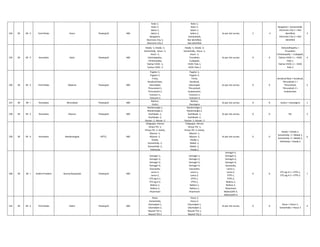
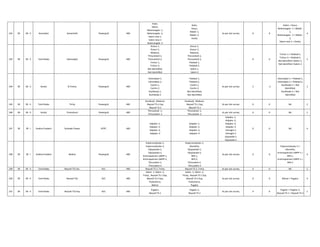
  • 130.
  • 132.
    List of linesfor PMU installation in NER Sl. No. Region Name of the Line Length in ckt km Charged at Voltage Level in kV 1 NER Tezu -Namsai S/c 95 132 132 2 NER Pasighat - Roing 108 132 132 3 NER Roing - Tezu 72 132 132 4 NER Bongaigaon - salkati-II D/C line (Lenth is for Bongaigaon - salkati-II only) 1 220 220 5 NER Balipara - Tezpur 9 220 220 6 NER Misa - Kopili-III 76 220 220 7 NER Salakati - BTPS-I 3 220 220 8 NER Salakati - BTPS-II 3 220 220 9 NER Misa - Kopili-I 73 220 220 10 NER Misa - Kopili-II 73 220 220 11 NER Misa - Dimapur-I 124 220 220 12 NER Misa - Dimapur-II 124 220 220 13 NER Misa - Samaguri-I 34 220 220 14 NER Misa - Samaguri-II 34 220 220 15 NER Mariani - Mokokchung I 49 220 220 16 NER Mariani - Mokokchung II 49 220 220 17 NER Aizwal - Kolasib 66 132 132 18 NER Kolasib - Badarpur 107 132 132 19 NER Agartala - Agartala-I 8 132 132 20 NER Agartala - Agartala-II 8 132 132 21 NER Aizwal - Kumarghat 133 132 132 Annexure-III Part-1 File No.CEA-PS-17-13/5/2020-PCD Division ANNEXURE IV
  • 133.
    List of linesfor PMU installation in NER Sl. No. Region Name of the Line Length in ckt km Charged at Voltage Level in kV Annexure-III Part-1 22 NER Aizwal -Melriat- Zemabawk(LILO 10 132 132 23 NER Aizwal -Melriat- Zemabawk 7 132 132 24 NER Badarpur - Badarpur 1 132 132 25 NER Badarpur - Jiribam 67 132 132 26 NER Badarpur - Khliehriat 77 132 132 27 NER Badarpur - Kumarghat 119 132 132 28 NER Dimapur - Imphal 169 132 132 29 NER Doyang - Dimapur-I 93 132 132 30 NER Doyang - Dimapur-II 93 132 132 31 NER Gohpur - Nirjuli (Itanagar) 43 132 132 32 NER Imphal - Imphal 2 132 132 33 NER Jiribam - Aizwal 172 132 132 34 NER Jiribam - Haflong 101 132 132 35 NER Jiribam - Loktak-II 82 132 132 36 NER Salakati - Gaylemphug 49 132 132 37 NER Khandong - Haflong 63 132 132 38 NER Khandong - Khliehriat-I 42 132 132 39 NER Khandong - Khliehriat-II 41 132 132 40 NER Khandong - Kopili I 11 132 132 41 NER Khliehriat - Khliehriat 8 132 132 42 NER Kumarghat - R.C.Nagar (Agarthala) 104 132 132 File No.CEA-PS-17-13/5/2020-PCD Division
  • 134.
    List of linesfor PMU installation in NER Sl. No. Region Name of the Line Length in ckt km Charged at Voltage Level in kV Annexure-III Part-1 43 NER Loktak - Imphal-II 35 132 132 44 NER Nirjuli - Ranganadi 22 132 132 45 NER Kopili - Khandong II 12 132 132 46 NER Dimapur - Dimapur (PG) (LILO portion) 0 132 132 47 NER Dimapur (PG) - Kohima (LILO portion) 0 132 132 48 NER Silchar - Srikona I 1 132 132 49 NER Silchar - Srikona II 1 132 132 50 NER Silchar - Badarpur I 19 132 132 51 NER Silchar - Badarpur II 19 132 132 52 NER Part of Silchar - Hailakandi I 30 132 132 53 NER Part of Silchar - Hailakandi II 30 132 132 54 NER Imphal (state) - Ningthoukong 0 132 132 55 NER Imphal (state) - Imphal 0 132 132 56 NER Ranganadi - Ziro 45 132 132 57 NER Bishwanath Chariali - Bishwanath Chariali (Pavoi) I 13 132 132 58 NER Bishwanath Chariali - Bishwanath Chariali (Pavoi) II 13 132 132 59 NER Mokokchung - Mokokchung I 1 132 132 60 NER Mokokchung - Mokokchung II 1 132 132 File No.CEA-PS-17-13/5/2020-PCD Division
  • 135.
    List of linesfor PMU installation in Sikkim Sl. No. Region Name of the Line Length in ckt km Charged at Voltage Level in kV 1 ER-II Rangpo - New Melli I 26 220 220 2 ER-II Rangpo - New Melli II 26 220 220 3 ER-II Rangit - Karseong (upto LILO point) 61 132 132 4 ER-II Karseong - Siliguri (upto LILO point) 31 132 132 5 ER-II Siliguri - Meli 92 132 132 6 ER-II Meli - Chuzachen 21 132 132 7 ER-II Rangpo - Chuzacheng I (upto LILO) 1 132 132 8 ER-II Rangpo - Gangtok 17 132 132 9 ER-II Gangtok - Rangpo 73 132 132 10 ER-II Rangpo - Rangit 3 132 132 11 ER-II Rangit - Rammam 27 132 132 Annexure-III Part-2 File No.CEA-PS-17-13/5/2020-PCD Division ANNEXURE V
  • 136.
    26 1. Inter-Regional andTie Lines Lines: It is very important to monitor the power flow on inter regional lines, though the SCADA provides this data but high sampling rate data furnished by PMUs would help in getting accurate frequency response of regions as well as proper functioning of automatic generation control. Therefore, PMU need to be placed on all inter-regional lines so that power flow can be assessed. 2. HVDC and FACTS devices: With the large integration of HVDC and FACTS devices in the system, it is very important that their interaction with existing system is monitored. The high sampling rate data provided by PMU would help in understanding the controller interactions and getting insights into their features. The PMUs need to be placed at AC-DC boundary and converter transformer or coupling transformer. With more numbers of power electronic devices in grid, it is possible that sub-synchronous resonance may be observed at various locations.. The reporting rates of samples need to be higher to capture the SSR phenomenon. Hence PMUs having ability to measure SSR frequencies can be installed at strategically locations. Elements to be covered: (i) At Both ends of Inter connecting lines between HVDC side AC switchyard with connecting AC Sub Station. (ii) All Converter Transformer ( HV side) (iii) At STATCOM/SVC station Coupling Transformer (LV & HV sides) including the individual STATCOM/SVC. 3. Renewable Energy Generation Pooling points: The RE generation is coming across all Indian power system at very fast pace, the monitoring of RE generation is very important considering must-run status of this generation. RE based generation are required, by CEA Technical Standards of Connectivity to the Grid, to perform various dynamic performances such as LVRT, HVRT etc. The performance can be assessed better if high resolution data will be available and PMU placement at low voltage side of transformer at pooling station would help in providing that. With Upcoming Ultra Mega Green Solar Power Project integrations in EHV grid, change in angle variations are expected on existing transmission system and the consequences in respect to operating constraints in evacuations especially in pockets where concentrated Renewable Generation. Moreover, these changes occur very fast due to the inherent intermittency of RE sources, particularly wind and solar, as well as other associated weather influences. As a sample case, in Western Region, Rewa Solar Park has an Installed Capacity of 750 MW, and the Annexure - VI
  • 137.
    27 angular separation patternis closely following the Solar Generation pattern as shown below: Figure: REWA Solar UMPP Angular Difference Correlation with Solar Generation There is a variation of about 8 degrees is observed in the between Rewa and Vindyachal nodes in the span of three hours. This emphasises the importance of PMU data at solar stations. Currently PMUs are installed at 400 kV side only however PMUs are equally important at 220 kV level as well. Elements to be Covered: (i) On all outgoing feeders including bus sectionalizer or tie line between two stages of generating stations having different tariffs or different ownership or both (ii) High Voltage (HV) side & Low Voltage side of Transformers (iii) Reactive Power sources & Sinks shall be measured through Synchrophasor (iv) All CB and isolators shall be wired to Synchrophasor device as digital signals. 4. Islanding, Separation & Restoration: The expected benefits from PMU installations at strategic locations include early detection of islanding conditions and remedial action by SPS (special protection scheme). Key placements can assistance with the restoration process, and resynchronization back into the main grid. Black-start investigations of alternative system configurations, including operation of transmission lines at reduced voltages with bypassing of transformers are enabled with detailed phasor measurements of potential overvoltage locations. Similarly, the PMU data can be utilized for resynchronization with data for bus and line voltage magnitude and angle along-with frequency. Elements to be Covered: At both ends of line connected black start stations or
  • 138.
    28 restoration path lines(both ends including CB and isolators). 5. State Estimation errors: The observability of the complete system is very important therefore, the locations where the state estimation errors are high and continuously show such behavior may be the candidate locations. Further, during URTDSM Phase-I, PMUs are envisaged only on 400 kV and 765 kV lines only. Linear State Estimator (LSE) application developed by IITB and installed under URTDSM Phase-I at various control centre i.e. RLDCs/NLDC/SLDC. After the configuration and setting up of linear state estimator, it is observed that two islands are being formed for each voltage level (400 kV & 765 kV). To avoid multiple network islands, PMU should also be placed on Interconnecting Transformers (ICT) at EHV level Elements to be Covered: a) Substation shall have Three phase Bus voltage measurements through PMUs & Circuit breakers and isolator position shall be wired to PMU for Linear State Estimator for topology processing and full observability. b) Reactive Power sources & Sinks shall be measured through Synchrophasor to avoid MVAR mismatch in Linear State Estimation. c) All 765/400 kV, 400/220 kV Inter Connecting Transformers (ICT) should have PMU on both sides (LV & HV). 6. Power Flow Gates: The high-power corridors after large generating complexes like Sikkim hydro, Mundra UMPP, Vindhyachal-Sasan-Rihand complex etc. The power flow on these gates need to be monitored therefore the lines emanating from these complexes can have PMU placement. 7. Major load centers: Load models are important for off-line stability studies as well as real time monitoring. It is difficult from simulation programs models to select a proportion of load to be of induction motor type. In addition, electronic load is growing whereas incandescent lighting (resistive load) is decreasing. However, load simulation programs do not often reflect the changing nature of power loads with respect to changes in the electrical behavior and penetration of power electronic devices. While PMUs placed at load centers will not reveal changes in the makeup of loads, they can reveal changes in the electrical characteristics and behavior of aggregated loads. PMUs should be installed at appropriate radial load feeding substations so that the load sensitivities to system frequency and voltage changes can be monitored. FIDVR (Fault Induced Delayed Voltage Recovery) based events can be better analysed. 8. Angular Difference monitoring locations: Phase angle difference is directly correlated with system stress, and can be used as a strategic measurement of grid
  • 139.
    29 security both pre-and post- contingency. For improved wide-area phase angle difference monitoring and situational awareness, it is useful to monitor the angle difference across major transmission interfaces across the grid, including both on a local- and wide-area basis. These interfaces are defined by key stress patterns driving the need to monitor these interfaces. The PMUs which will be the most valuable for angle difference monitoring need to be identified for PMU placement. 9. Major Generating Stations: In a generation station, it is desirable to measure all the line currents (including the step-up transformer) and both the high-side and low-side voltages. The PMU placement at these locations in generators will provide good insights into governor frequency control, excitation control, PSS tuning etc. In order to confirm the mathematical model correctness used for simulation studies, model validation using PMU data plays a key role. International grid standards like NERC Reliability standards requirements have accepted Synchrophasor based model validation as an effective way to verify generator real and reactive power capability and control systems and assure their appropriate responses during system disturbances. Synchro phasor-based model validation is more economical and accurate than validation methods that take the model off- line for performance testing. Hence placement of PMUs on GT LV side for thermal/gas/nuclear based generation for 132kV and above generating station is required/recommended. Elements to be covered: (i) At 400 kV and above Generating stations (132 kV in case of NER). (ii) Individual Unit of rating 200MW and above for Coal/lignite, 50MW and above for gas turbine and 25 MW and above for Hydro units shall have PMU placed at the terminals of the generator(s) at either the HV or LV side of the Generator Transformers. (iii) In case of plant having multiple units ,PMU can be placed on 50 percent of the units 10. System Protection Scheme monitoring: The monitoring of the inputs for SPS activation is also very important; it can also help in validating the accuracy of SPS action. SPS operation can be very well validated using the PMU data. Therefore, all the points where SPS based scheme inputs are derived may be allocated PMUs. 11. Experience based locations known for small signal stability related issues: The nodes in the grid which have in history observed the cases of Low frequency Oscillations negative damping, Ferro resonance, Sub-synchronous resonance, out
  • 140.
    30 of step protectionetc. shall be considered for PMU placement. A high-resolution data capturing may be recommended for such PMUs.
  • 141.
    The details ofanalytics suggested by CTU 1. Real time Automated Event Analysis tool (using AI, Machine learning and big data) Tool for making an automated event driven dashboard comprises of Notification of event, type of fault and characteristics of the event, display of event location (indicating PMU Location) on Grid map, Drill down capability with additional displays for each type of event. It should have machine learning capabilities and it should identify and display historical events of similar nature and gives information related to operator action taken on past events. 2. Event monitoring for early warning system (using AI, Machine learning and Big data) It detects events and slow trends in PMU measurements. This will assist system operators in a.) Identifying stress levels in both apparatus and system, b.) Provide guidance towards meaningful real time contingency selection and analysis, c.) Provide easy summary reports for case study preparation, post event analysis and archival purposes. 3. WAMS based contingency analysis and static security assessment Static security assessment tool improves operator assist feature of grid monitoring and makes it adaptive and interactive. This tool is meant to provide and perform what-if simulations and integrate power of data mining with intuition and insights of operators. This will help in improving grid operation efficacy. 4. Oscillation Source location This tool is required to identify, detect, and locate Oscillations, present in the grid. It shall have capability to monitor multiple oscillation modes simultaneously in real time. It shall Identify the source of the oscillation and display in unified real time dashboard to take corrective action. 5. Response of Windfarm and solar PV farms for LVRT, reactive power etc. With integration of large windfarms and solar PV farms at EHV levels these analytics assumes big importance. The grid code requires that these farms provide low voltage ride through (LVRT) features and also some kind of reactive power support during faults in the neighboring transmission network. With PMU measurements the adherence to grid code can be verified in real operating conditions (not just lab environment) and over complete life of the windfarms. If any problems or mismatch in performance is observed, it can be rectified early. 6. Control of HVDC and STATCOM for damping system oscillations This is the usage of WAMS measurements for actual automatic control applications. This was one of the original thoughts behind going for WAMS installation. The power system oscillations that originate in a post fault event or spontaneous oscillations can be damped quickly using controllers of HVDC and FACTS (like STATCON) devices. It improves the overall transfer capacity of a power corridor. Lot of actual projects are now under operation in the USA and China. India must take up such projects for capacity building for the future. Annexure - VII
  • 142.
  • 143.
  • 144.
    Distribution List 1. Shri.Saumitra Mazumdar, SE, NRPC. 2. Shri Shyam Kejriwal, SE, ERPC. 3. Shri T Sivakumar, SE, (Transmission - V), TANTRANSCO, Chennai, TN 4. Shri. P Suresh Babu, SE, TS SLDC,Vidyut Soudha, Khairathabad Hyderabad Telangana 500082 5. Shri Len J.B., Executive Engineer, SRPC, 29, Racecourse Cross Road, Bengaluru, 6. Shri Srijit Mukherjee, Deputy Director, NERPC 7. Shri Vivek Pandey, General Manager, NLDC. B-9 (1st Floor, Qutab Institutional Area, Katwaria Sarai, New Delhi. -110016 8. Dr. Sunita Chohan, CGM(GA&C), PGCIL, Plot No.2 Near IFFCO Chowk, Sector -29, Saudamini, Haryana 122001 9. Ms. Nutan Mishra, Sr. General Manager, CTUIL, PGCIL, Plot No.2 Near IFFCO Chowk, Sector -29, Saudamini, Haryana 122001. 10. Shri Abdulla Siddique, Chief Manager, SRLDC
  • 145.
    02-Nov-22 1 Report of theSub-Committee on PMU Placement and Analytics under URTDSM Phase II Formation of the Sub-Committee In the 10th NPC Meeting held on 9th April 2021 it was decided to form a sub- committee. “After deliberations, NPC decided that a Sub- Committee would be formed under the Chairmanship of Member Secretary, WRPC with representatives from POSOCO, CTU, POWERGRID, all RPCs/NPC. The Sub- Committee shall discuss on the uniform philosophy of PMU locations, new analytics and requirement of up gradation of Control Centre under URTDSM project and submit its recommendations to the NPC. Consequently, the sub- committee was formed vide NPC Letter NO. 4/MTGS/NPC/CEA/2021/285- 298 dated 20.09.2021 based on nominations received at NPC.
  • 146.
    02-Nov-22 2 URTDSM Project Phase-I •A Pilot Project was implemented with 52 Phasor Measurement Units (PMUs) installed all over the Country progressively from 2008 to 2010. • A Detailed Project Report (DPR) was prepared in 2012 for implementation of 1740 PMUs on Pan-India basis. • The Project was agreed for implementation in a Joint Meeting of all the five Regional Standing Committees on Power System Planning held on 5th March 2012. The installation of the PMUs was taken up in two stages. Stage-I -1186 PMUs; Stage-II-483 PMUs URTDSM Project Phase I & II • CERC granted in principle approval for the project in Sept’2013 with 70% funding from PSDF & 30% equity from POWERGRID. • CERC granted in principle approval for the implementation of URTDSM Phase-I and advised to take up Phase-2 after receiving feedback on Phase-I performance from POSOCO. • POWERGRID took up the implementation of URTDSM Project in Jan’2014 and 1409 PMUs are installed in Stage-I of Phase-I of the Project (the increase in quantity of PMUs was due to addition of new bays etc. at the substations). • In line with agreed philosophy in Joint Meeting of all the five Regional Standing Committees on Power System Planning held on 5th March 2012. • POWERGRID took up the requirement of URTDSM Phase – II in all Regional Power Committees. During the discussion on finalization of PMU quantity for URTDSM phase–II, requirement of additional measurements emerged. POSOCO also desired additional Analytical software using PMU data.
  • 147.
    02-Nov-22 3 PMU Placement criteria& Analytics in Phase – I PMU locations under Phase – I • All 400 kV stations in State and ISTS grids. • All generating stations at 220 kV and above. • HVDC terminals and inter-regional and inter-national tie lines. • Both ends of all the transmission lines at 400kV and above: State and ISTS sector. • Analytics under Phase – I Under URTDSM Phase I, 6 Analytics were developed in association with IIT Bombay: • Line Parameter Estimation • Vulnerability Analysis of Distance Relay (VADR) • Linear State Estimator • Supervised Zone-3 distance protection scheme to prevent unwanted tripping of backup distance relay • CT/CVT Calibration • Control for improving system security Status of Phase – I (Broad configuration of PMUs, PDCs and infrastructure used) • The PMUs procured are having 2 set of voltage, 2 set of current measurement & some (16) digital input configuration. • The utilization of measurement inputs of PMU depends on the bay configuration at substations. In cases where there is one line & ICT or reactor only, one set of current input is utilized, and other input remains unutilized • The PMUs are measuring line and bus voltages as per the configuration of installation. PMUs installed are of the Measurement class and wired up in the metering core of CVT/CT. • Nodal PDC at strategic substations, Master PDC at all SLDCs, super PDC at 5 RLDCs, Main & backup PDC at NLDC have been installed and are fully functional. • POSOCO’s initial pilot project & States PMUs were also integrated with the URTDSM project. • In Phase-I, PMUs were installed at only those 400 kV lines which had connectivity of the fiber optic network. • The number of PMUs installed on 132kV lines is 5nos., 220kV lines is 179nos., 400kV Lines is 1093nos., 765kV lines is 148nos.
  • 148.
    02-Nov-22 4 Applications under URTDSM Phase – I. •PMU based real time monitoring applications • Real time event and alarm processing • Visualization of frequency, Rate of change of frequency, Voltage, Power flows and Angle difference • Visualization of angular difference data, real-time angular separations, Real time monitoring and analysis, obtaining angular differences. • Geographical network diagram provides information about the system through visual objects representing network element • Contour display allows overview of the voltage/frequency profile for the entire grid, Voltage Contour visualization • Oscillatory Stability Management (OSM)- helps in monitoring the low frequency oscillations or small signal stability issues in the system Off-line usages under URTDSM Phase – I. • Off-line Applications/usages: • Primary frequency Response assessment requires high resolution data of frequency for any event. • Oscillation Detection - The poorly damped oscillations indicate the review of controller settings in power system stabilizers of units. • The high-resolution data helps in monitoring the operation of various transmission line protection schemes • Synchro phasor has helped to find the issues in time synchronization in event loggers • PMU also helped RLDCs in validating the Power system stabilizer tuning process with high sampled data • Post-Disturbance Analysis
  • 149.
    02-Nov-22 5 Existing features of URTDSM Time SeriesDerivation Framework (TDF) TDF is the user interface of the Historian Application provided by OEM M/s GE and is being used in Control room to plot the events which occurred Spectral Analysis (using E-Tera Phasor Analytics) • Power Spectral Density (PSD) is very useful tool to identify oscillatory signals in time series data and their amplitude • Coherency, is a measure of frequency domain correlation between two signals. • Cross Spectral Density (CSD): Cross spectral Density as a measure of frequency domain covariance between two signals Utilization of PMU data for taking real time decisions and offline Analysis at RLDCs and NLDC: • PMU helped in synchronization of NEW-SR grid by helping control room operator in taking appropriate decisions in real time through the access of high-resolution data in real time. • The availability of PMU visualization helped in taking informed decisions in real time when any abnormality was observed in PMU placed on AC side of HVDC converter station • The availability of PMU data at LV side of pooling station of RE based generation sources helped in monitoring the operation in real time. The various power electronic based controls in RE generation plant for low voltage ride through (LVRT), reactive support at pooling station and power park control are closely monitored using PMU data. • The transmission system has also observed integration of state of art power electronic devices, these devices act in time span of milliseconds. The response can be observed at control centers with availability of PMU data. The response of FACTS devices is observed well with PMU placed at coupling transformer of STATCOM/SVC. • Power-system restoration: The PMUs are well-suited for online monitoring of angles, and thus are helpful for the operator during a power restoration by monitoring of standing phase angle (SPA) difference across a breaker, which connects two adjacent stations whose excessive difference can damage equipment.
  • 150.
    02-Nov-22 6 Feedback on applicationsunder Phase – I - Improvements required in the Existing PMUs data Streaming/GUI • Improvement required in the visualization /GUI • Adding trends of phase voltage and current, Trending system is having a capability to show only 8 signals • Capability to visualize data for larger time window, PMU with high sampling rate required at few locations, Option to select reference angle • Font and axis size, Integration with different make of PMU, Portability of display, Non-generation of alarms • OSM related issues • Right Eigen Vector plot of modes not observed • Availability of statistical functions is not there • System Utilization related issues • Data storage is currently configured to store 1 YEAR • 16 Digital slots are currently available in each PMU where only 5 are used, Each PMU can monitor 2 elements, spare slot available can be used to integrate new lines • Infrastructure related issues • Voltage discrepancy in voltage measurement is observed in some PMU • Standby communication links have not been implemented in URTDSM project • Frequent time synchronization issues arise in PMU’s data due to the GPS issue • Loss of PPS (Pulse per second) is a common cause in case of URTDSM PMUs • Historian • Access to historian data through autonomous software interface is a must requirement for any new WAMS infrastructure Feedback on applications/Analytics under Phase – I - Software’s developed by IIT Bombay • Line Parameter Estimation:- Application of total least squares (TLS) method is used to estimate line parameters. • Online vulnerability analysis - PMU measurements to identify relays that are vulnerable to insecure tripping. • Linear State Estimation:- PMU has the capability to directly measure the magnitude and angle of bus voltage and current, hence, LSE is possible. • CT/CVT Calibration:- It is difficult to ascertain accuracy of any instrument transformer at site, once it is installed. • Supervised Zone-3 Distance Protection:- Distance relays are widely used for transmission line protection. These relays also provide remote backup protection for transmission lines. • Control Schemes for Improving System Security
  • 151.
    02-Nov-22 7 Analytics under Phase– I & way forward • PMUs should not only be limited to post event analysis and should be employed for Dynamic State Estimation, threats forecasting and alarming systems in real time. • Several equipment’s such as ICTs, Bus Couplers were not configured in the LSE. Lack of observability & lack of communication link also led to problems in PMUs LSE. • Logic based analytical tools for enhanced situational awareness, Advance development platforms for retrieval and visualization of phasor data, etc. may be added in the existing system. • POSOCO informed that the POSOCO pilot project & States PMUs were also integrated with the URTDSM project. However, the data was not complete, and it led to formation of Islands and therefore State estimation of complete system is not available with the existing installed PMUs. • The network and the network topology database need to be updated by putting extra effort and therefore the network database of PMU based LSE can be exactly aligned with the actual system • Additional PMUs should be installed at substations which are critical from system point of view, by laying of the Fiber Optic under Phase – II of the URTDSM project. • An engine can be developed which will enable the SCADA topology and network database to be imported in the PMU based LSE. The database should be common for both the systems (SCADA & PMU LSE). Recommendation 1 : Improvements in applications available in URTDSM-I Graphical User Interface for visualization of system dynamics : • Trending of phase voltage and current, Trending of all dynamic power system parameters • Option to select reference angle, Downloading of historical data should be made more user friendly • Capability to visualize data for larger time window, Portability of display • Non-generation of alarms, Integration with different make of PMU • Modal analysis issues in URTDSM Analytics Oscillation Detection, monitoring and analytics: • Capability to detect power system oscillations from dynamic measurements, Capability to monitor, classify oscillation modes in real time, Real-time display for oscillation monitoring , Oscillation location, Map Displays, Oscillation Severity, Alarms, Logic based analytical tools for enhanced situational awareness Linear State Estimator : • Database Integration, Bad data detection and conditioning, Observability analysis, Topology detection, Sampling rate, Single-Line diagrams, Scalability, Expanded observability
  • 152.
    02-Nov-22 8 Recommendation 2: Newapplications for deployment in URTDSM-II Real time automated event detection and notification dashboard Early warning system Voltage Stability analytics (VSA) WAMS based contingency analysis and security assessment Islanding detection Real time Inertia Estimation and monitoring Post-mortem analytics Generator Model Validation Wide Area Control Systems Recommendation 3: Improvements in system infrastructure • 16 digital slots are currently available in each PMU where only 5 are used rest can be utilized for isolator points of line, bus, and line reactors etc. • Each PMU can monitor 2 elements, spare unused i/p available can be used to integrate new lines / ICT from same substation (Non- SAS SUBSTATIONS) • Logic/tool must be developed to detect Voltage discrepancy in phase measurement errors and generate alarms. • Adopting main and standby philosophy in data communication between PMU & PDC and between PDC & PDC to avoid any data loss. • Strengthening of time reference / GPS source and stringent daily monitoring by substation on daily basis for time synchronization. • loss of PPS (Pulse per second) should not occur due to the disturbance of PPS cable during maintenance activities. • Dead band defined in PMU data for frequency, voltage and df/dt, should not cause discrepancy in values. • Data storage and Historian: Data storage should be configured to store and retain data at least up to one year. Since the population of PMUs is expected to increase manifold in the coming years, the standards / best practices need to be established for Indian power system. A separate sub-committee may be constituted to formulate a criteria for data archival and retention. For the time being data beyond one year shall be stored and made easily accessible for real-time and off- line applications depending upon the space utilization. ….contd
  • 153.
    02-Nov-22 9 Recommendation 3: Improvementsin system infrastructure • PMU Testing: PMU standards conformance tests shall be performed to verify whether the PMU meets the requirements of IEC/IEEE 60255-118-1 under steady-state, transient, and dynamic power system conditions, and the associated data transfer requirements as given in IEEE Std C37.118.2 or communication requirements given in IEC 61850. • PMU field commissioning tests shall include routine visual inspection, insulation test, wiring check, basic functionality check, etc., as required by the relevant standards. • PDC must be able to handle off nominal conditions such as high rates of incoming data, incorrect timestamps, and unsupported protocols. PDC must be able to achieve the availability and reliability target levels consistent with the application. • Sampling rate: Installation of PMU with high sampling rate is recommended at a few locations to monitor sub- synchronous resonance, very low frequency governor modes and control modes. PDC should have capabilities to store data of higher sample rate PMU apart from existing 25 Hz. • Redundant and reliable high speed communication system is vital for PMU based Wide Area monitoring system. Fiber Optic connectivity between the substation identified for placement of PMU and control center is strongly recommended. Recommendation 4: PMU Placement Strategy The limiting constraints in installation of additional PMUs include • The hardware requirement of the PDCs & Master PDCs as the current PDCs may not have enough memory to process the additional data from the PMUs. • Hardware and communication requirements will also be required to be changed and upgraded. Since the PMUs in Phase-I are M type PMUs and are connected to metering core of CT/CVTs, the committee recommends that under Phase-II, M-type PMUs are to be procured and connected to the metering core.
  • 154.
    02-Nov-22 10 Recommendation 4: Minimumcriteria for PMU placement under URTDSM-II. • At one end of all 400 kV and above transmission lines • At the HV side of all ICTs connected to 220 kV and above • On HV side of coupling transformer of SVC/STATCOM for measurement of HV Bus voltage and current of coupling transformer • At one end of line wherever FSC/ TCSC are installed • At one end of line wherever FSC/ TCSC are installed • On HV side of converter transformers for measuring HVAC bus voltage and current of converter transformer on each converter station. • On both ends of Inter-regional and trans-national tie lines and on boundary buses for such lines • At the Generating Transformers (GTs) at LV side (having HV side of 220kV and above) of the Generating units with capacity above 200 MW for Thermal units, 50 MW for Hydro units and 100 MW for Gas units. • On all 220kV substations for measuring voltage of 220 kV bus and current of two lines/transformer catering to load centers. • All 132 kV and above ISTS lines in NER & Sikkim and important load centers. • At RE developer end of the evacuating line connecting the Renewable Energy Pooling Stations (PS) to point of interconnection with the grid of 50MW and above. • Islanding, Separating & Restoration Points- At one end of line which is connected to black start stations along with circuit breaker status via synchro phasors. • Fiber Optic should be covered under Phase – II for all the above locations of the URTDSM project • At all ICTs, Bus reactors, Switchable line reactors of critical substations Recommendation 4: Future Considerations & integration of State PMUs. • Requirement of PMUs under Phase-II, as per philosophy, be framed for the planned system up to 2024. Thereafter CTUIL may include the provisioning of PMUs in the scope of planned projects as per the above philosophy. • The placement of PMUs for special cases such as Islanding, Separating & Restoration Points and ICTs, Bus reactors, Switchable line reactors of critical substations, load centres of NER shall be suggested by POSOCO in consultation with RPCs & CTU. • Existing PMUs & PMUs planned in future by States should be integrated with the URTDSM Project. • PMUs in the future projects should be made part of the system with improvements in the PDCs capabilities incorporated in the new Project. • PMU & PDC consoles at CTUIL, RPCs and CEA- Since CTUIL is entrusted with planning ISTS system, it is recommended that PMU & PDC consoles along with redundant, dedicated & secure communication link up to CTUIL premises be provided for CTUIL. The Power flow, Voltage, Angle data of PMU shall be integrated with CTUIL Planning system software for System studies, System planning of ISTS system, in consumable form, through standard protocols along with visualization. Similar facilities should be made available at all RPCs and CEA if the same is not covered under Phase I. • The up gradation of PDCs and control center equipment's be reviewed once in two (2) years, so that they can handle the data due to incremental PMU population in the system. ….contd.
  • 155.
    02-Nov-22 11 Recommendation 4: FutureConsiderations & integration of State PMUs. • PGCIL was of the view that 5 out of 6 analytics developed in Phase-I would not work, due to adoption of the above PMU placement philosophy (in all these 5 analytics PMU is required at both ends). The analytics viz Line parameter estimation, CT/CVT calibration are complementary to each other, where, in one analytic the CT/CVTs are assumed to be accurate and in the other the line parameters are assumed to be accurate (the reference used for one analytic is dependent on the other) and therefore the result of this analytics are not found to be much of use. The Online Vulnerability analysis and Supervised Zone-3 distance protection are protection class analytics and the results needs validation through DRs. The Zone-3 power swing blocking setting is available in all the relays and has been reported to be implemented by all the utilities as per recommendation of the Committee on the blackout of 2012. Further, the Load encroachment tripping in Zone-3 can be addressed through proper setting of Zone-3 in the relay, which has also been reported to be complied by all the Utilities as per the recommendation of the Committee on the blackout of 2012. Control System for improving system security analytic and the above four analytics, however, shall to be used wherever PMUs are available at both ends and the results be validated. • The relevant orders of Ministry of Power, Government of India and CEA/CERC regulations for cyber security compliance should be followed. The directives of CERT-In for time synchronization of PMUs should be followed in view of cyber security. • Training module should be incorporated in Phase-II of URTDSM project for the State Utilities, CTU, POSOCO, CEA and RPCs. Thank You
  • 156.
    02-Nov-22 12 PGCIL note salientfeatures • The PMU location philosophy should not be altered, since the panel of expert under the chair of Dr. Arun Phadke has recommended it. • Database of location of PMUs. • Analytics VADR (vulnerability Analysis of Distance Relays) & Zone-3 supervised protection- not designed for protection class. • CT/CVT calibration and Line Parameter estimation analytics. • Upgradation of FO and control center infrastructure.
  • 157.
    02-Nov-22 13 Z-3 Supervised protection& relay vulnerability analytics • Specialized schemes will be specific to critical lines wherein PMUs will be placed at both ends of a line i.e., fault observability in mode. • Logic to detect the fault on line section 1-2 with PMU1 & PMU2 measurements and decide to block or trip relays R to R6. • If there is a fault in section 1-2, then enable zone-3 tripping of R1 to R6. if there is no fault in section 1-2 and due to Power Swing/Load encroachment, the relays R1-R6 senses these conditions as Zone-3 fault, then block the tripping of relays R1 to R6. • Issue : fault detection on line section 1-2, will require the CTs used to obtain measurements from PMU1 & PMU2 are accurate during fault condition. With metering class CTs, it is highly impossible, since these CTs would saturate under fault conditions. • All the Distance Protection Relays (DPR) have Zone-3 blocking/unblocking facility. The Zone-3 of DPRs is blocked on power swing detection through their internal algorithm. No mal-function of this blocking has been observed so far, if it is set in relays. If Zone-3 is set considering the load encroachment properly, the relays will not trip under these conditions. Low voltage issues at other buses is now a remote possibility with strong fault levels. • For this application it may be advisable to use P-type PMUs with inputs from protection class CTs. PMU-1 PMU-2 CT-1/CVT-1 CT-2/CVT-2 Line parameter estimation & CT/CVT calibration CT/CVT calibration • The residual is used for identifying the bad data and also improving the estimate of the voltage. • This residual is monitored for a long time, may be in terms of weeks, and if the error is consistent then it can be flagged as erroneous CVT. • The erroneous CVTs can be identified locally, and the CVTs with less errors are then separated out to start the calibration process. • Issue : CT/CVTs are of 0.2 accuracy class, if it has to be done locally, the CT/CVTs at remote end and line parameters used to estimate the voltages at end 1 should be accurate. Line parameter estimation • Issues : The CT/CVTs at either end should be accurate. Line parameters are static and does not change much. • Easy way out : A portable PMU can be used to estimate line parameters where it is suspected that the parameters are erroneous also same facility can be used for CT/CVT calibration. Separate investment for this analytics is not desirable.
  • 158.
    02-Nov-22 14 Phase – IIof URTDSM - PMU Placement Criteria POWERGRID informed that the impact of additional PMUs locations and WAMS analytics will be: i. The number of PMUs initially envisaged in Phase II would increase to about 2500. ii. This increase in number of PMUs will also affect the performance of Phasor Data Concentrator (PDC) and other equipment at the Control Centre Location at SLDC, RLDC and NLDC, RPCs which may also need upgradation / installation. iii. The additional WAMS analytics shall also require additional hardware. iv. In view of the increase in PMU population, the existing configuration of Nodal PDC, MPDC, SPDC & Main & B/U NLDC also needs to be seen whether these additional PMUs can be accommodated in the infrastructure of Phase-I. Also, it needs to be seen whether the Nodal PDC, MPDC, SPDC & Main & B/U requires up-gradation or additional hardware is required for accommodating the additional PMUs in Phase-II. v. Communication related issues are also required to be considered to accommodate the additional PMUs under Phase-II. PGCIL Comments Phase – II of URTDSM - PMU Placement Criteria CTU has proposed following locations: • All 132 kV and above ISTS lines in NER & Sikkim • All 132 kV and above ISGS in NER & Sikkim. • (Additional factor of “distance between such stations” for extent of Wide Area Measurement also to be accounted for Placement in NER.) NRPC (in 45th TCC, 48th NRPC meeting) and SRPC (in TCC & 37th SRPC meeting) have proposed following locations: • Generating Transformers (GTs) at LV side (having HV side of 220kV and above). • FACTS devices such as STATCOM, SVC, FSC, TCSC etc. • HVDC Convertor transformers • Phase Shifting Transformers • Renewable Energy Pooling Stations (PS). CTU, NRPC & SRPC Proposals
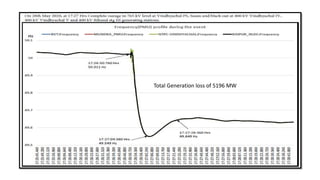
  • 159.
    02-Nov-22 15 New Analytics under URTDSM Project Phase - II. NRPC& SRPC: Additional WAMS analytics for URTDSM Phase – II were proposed by NRPC (in 45th TCC, 48th NRPC meeting) and SRPC (in TCC & 37th SRPC meeting) as follows: • Real time Automated Event Analysis tool • Oscillation Source location tool/engine. • Real time Inertia Estimation Tool • Big data analytics tool/engine POWERGRID: POWERGRID has suggested following analytics for the Phase – II: • Real time Automated Event Analysis tool (using AI, Machine learning and big data) • Event monitoring for early warning system (using AI, Machine learning and big data) • WAMS based contingency analysis and static security assessment • Oscillation Source location • Response of Windfarm and solar PV farms for LVRT, reactive power etc. • Control of HVDC and STATCOM for damping system oscillations PGCIL, NRPC & SRPC Proposals Phase – II of URTDSM - PMU Placement Criteria POSOCO has proposed • Placement at all Inter-regional lines. • HVDC & FACTS Devices • Renewable Energy Generation Pooling Points. • On all outgoing feeders including bus sectionalize or tie line between two stages of generating stations having different tariffs or different ownership or both • High Voltage (HV) side & Low Voltage side of Transformers • Reactive Power sources & Sinks shall be measured through Synchro phasor • All CB and isolators shall be wired to Synchro phasor device as digital signals • Islanding, Separating & Restoration Points • Points where State Estimation error chances are high • Substation shall have Three phase Bus voltage measurements through PMUs & Circuit breakers and isolator position shall be wired to PMU (for Linear State Estimator) for topology processing and full observability • Reactive Power sources & Sinks • All 765/400 kV, 400/220 kV Interconnecting Transformers (ICT) on both sides (LV & HV). • Power Flow Gates • Major Load Centres • Angular Difference Monitoring Locations. • Major Generating Stations- • At 400 kV and above Generating stations (132 kV in case of NER). • Individual Unit of rating 200MW and above for Coal/lignite, 50MW and above for gas turbine and 25 MW and above for Hydro units shall have PMU placed at the terminals of the generator(s) at either the HV or LV side of the Generator Transformers. • In case of plant having multiple units, PMU can be placed on 50 percent of the units • System Protection Scheme Monitoring • Experience based locations known for small signal stability related issues. POSOCO Proposals
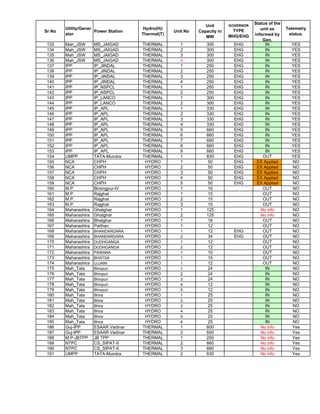
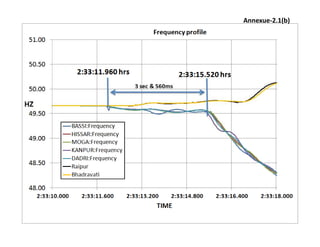
  • 160.
    02-Nov-22 16 New Analytics under URTDSM Project Phase - II. •POSOCO has recommended following analytics • Voltage Stability Monitoring: Measurement based dynamics provide voltage sensitivities; monitoring of key corridors or load pockets; scatter plots for power voltage and power-angle monitoring. • Detection of disturbances: Recognition of short circuits by watching the currents, and indication of loss of load, or loss of generation by watching the frequencies. • Online monitoring of Inertia. • Identification of source of Oscillation. • Identification of stressed corridors. • ROCOF calculation over variable window. • Island identification/detection. • Locating contributions to poorly damped or unstable oscillations. • Model Validation. • Higher frequency sub-synchronous oscillation analysis and early warning of resonance. • Big Data Analytics POSOCO Proposals
  • 161.
  • 162.
    Acknowledgement The Committee acknowledgesthe cooperation extended by NPC, RPCs, POSOCO and CTU for giving their valuable inputs to finalize the recommendations for finalizing AUFLS stages. The Committee also acknowledges and extends gratitude to the sincere efforts of Shri Sachin K. Bhise EE, and Shri Deepak Sharma EE, WRPC, whose inputs and suggestions has helped in putting all the inputs in proper perspective and giving shape to this report. The committee would also like to thank Shri Rahul Shukla, CM & Shri Aman Gautam, Manager, NLDC POSOCO for arranging presentation and painstaking efforts taken to provide comments and helping in the drafting of the report. (Rishika Sharan) (B. Lyngkhoi) (Rajiv Porwal) Chief Engineer (NPC), CEA Member Secretary, NERPC CGM, NRLDC (Ratnesh Kumar) (Ms. N.S. Malini) (P.P. Jena) EE, NRPC EE, SRPC EE, ERPC (Transferred) (P. D. Lone) (Satyanarayan S.) Superintending Engineer, WRPC & Member Convener Member Secretary, WRPC & Chairperson of the Committee
  • 163.
    Report of the Committeeon Automatic Under frequency Load shedding October 2022 National Power Committee CEA October 2022
  • 164.
    Page 2 of53 Table of Contents Abbreviations and Symbols ....................................................................................................3 Definitions.............................................................................................................................4 1. Executive Summary..........................................................................................................5 2. Introduction and background...........................................................................................9 Terms of Reference (TOR) of the Sub-Committee:..................................................................... 11 Proceedings of the sub-Committee:............................................................................................. 11 3. Theoretical aspects of important factors in the design considerations of AUFLS:............ 13 a) Load frequency Dependence D (MW/Hz): ............................................................................ 13 b) What is the value of D?......................................................................................................... 14 c) Observed Power Number ƛ(MW/Hz):................................................................................... 16 d) Frequency influence of generators in normal frequency and emergency range: ................... 17 e) Role of System Inertia H:...................................................................................................... 17 f) Role of Voltage and Frequency dependence.......................................................................... 19 g) Role of Seasonal factors ........................................................................................................ 19 h) Reasons for failure of AUFLS schemes WRPC Inspection:................................................... 20 4. International Practices of AUFLS .................................................................................. 21 a) Continental Europe: ............................................................................................................. 21 b) NERC:.................................................................................................................................. 22 c) New Zealand......................................................................................................................... 22 d) Powertech Consultant:.......................................................................................................... 22 5. Scope and Formulation of AUFLS Plan for Indian Power system................................... 24 Scope: ......................................................................................................................................... 24 6. Theoretical aspects......................................................................................................... 25 Interpretation:............................................................................................................................ 27 7. Selection criterion for trigger frequency for lower end and upper end Stage:................... 29 8. The AUFLS stage wise quantum and their distribution among regions can be decided based on the following two alternative methods / philosophies: ....................................... 34 a) Approach-A:......................................................................................................................... 34 b) Approach-B .......................................................................................................................... 39 9. The problem of df/dt schemes:........................................................................................ 46 Reduced Inertia and role of df/dt:............................................................................................... 46 Guiding principles for implementation of df/dt relays: ............................................................... 48 a) Enabling frequency for df/dt:......................................................................................................................48 b) Df/dt relay setting philosophy:....................................................................................................................48 10. Conclusion..................................................................................................................... 51 AUFLS and df/dt setting and it’s testing:.................................................................................. 53
  • 165.
    Page 3 of53 Abbreviations and Symbols AC Alternating Current D Load Frequency Dependence MW/Hz DC Direct Current COI Centre of Inertia F Frequency FFR Fast Frequency Response GW Gigawatt GWh Gigawatt-hour GW•s Gigawatt-second H Inertia IBR Inverter-Based Resource kW Kilowatt kWh Kilowatt-hour LR Load Response MW Megawatt MWh Megawatt-hour MW•s Megawatt-second NLDC National Load Dispatch Centre PMU Phasor Measurement Unit PV Photovoltaics RLDC Regional Load Dispatch Centre RE Renewable Energy RoCoF Rate of change of frequency also known as df/dt SCADA Supervisory Control and Data Acquisition UFLS Under-frequency Load Shedding
  • 166.
    Page 4 of53 Definitions ‘Area Control Error’ or ‘ACE’ means the instantaneous difference between a control area’s net actual and scheduled interchange, taking into account the effects of Frequency Bias and correction of meter error. Mathematically, it is equivalent to: ACE = Deviation (∆P) + (Frequency Bias) (K) * (Deviation from nominal frequency) (∆f) + meter error; ‘Automatic Generation Control’ or ‘AGC’ means a mechanism that automatically adjusts the generation of a control area to maintain its Interchange Schedule Plus its share of frequency response; ‘Demand’ means the demand of active power in MW; ‘Demand Response’ means variation in electricity usage by end customers/control area manually or automatically, as per system requirement identified by concerned load despatch centre; ‘Frequency Response Characteristics’ or ‘FRC’ means automatic, sustained change in the power consumption by load or output of the generators that occurs immediately after a change in the control area’s load-generation balance, and which is in a direction to oppose a change in interconnection’s frequency. Mathematically it is equivalent to FRC = Change in Power (∆P) / Change in Frequency (∆f) ‘Governor Droop’ in relation to the operation of the governor of a generating unit means the percentage drop in system frequency which would cause the generating unit under governor action to change its output from zero to full load; ‘Inertia’ means the contribution to the capability of the power system to resist changes in frequency by means of an inertial response from a generating unit, network element or other equipment that is coupled with the power system and synchronized to the frequency of the power system; ‘Nadir Frequency’ means minimum frequency after a contingency in case of generation loss and maximum frequency after a contingency in case of load loss; ‘Reference contingency’ means the maximum positive power deviation occurring instantaneously between generation and demand and considered for dimensioning of reserves; ‘Tertiary Reserve’ means the quantum of power which can be activated, in order to restore an adequate secondary reserve. Fast Tertiary Reserve Response shall come into service starting from five (5) minutes and shall sustain up to thirty (30) minutes. Slow Tertiary Reserve Response shall come into service starting from fifteen (15) minutes and shall sustain up to sixty (60) minutes;
  • 167.
    Page 5 of53 1. Executive Summary 1. In the 2nd NPC meeting dated 16-July-2013, AUFLS scheme was adopted at a national level and comprised four stages of UFLS at 49.2 Hz, 49.0 Hz, 48.8 Hz and 48.6 Hz. Prior to that, each region adopted a three-stage plan for flat UFLS, with similar settings. 2. The above calculation of load relief was based on the methodology adopted by Zalte Committee recommendations, formed in WR, after the July 2012 blackout. Zalte committee was formed to review the defense mechanism for WR after the July 2012 blackout. Zalte Committee while formulating the AUFLS plan considered the factors such as frequency dependence of loads, voltage dependence of loads and seasonal variations of the loads. 3. NPC regularly reviewed the quantum of load to be shed in each region, based on the increasing demand. In the 9th NPC meeting, it was informed that the loads expected to be shed were on the much higher side. Accordingly, it was decided to form a group to examine the same. 4. In Jan 2021, a committee under Member Secretary, WRPC was formed to examine the AUFLS scheme for All India Grid and give recommendations. Also, the Committee was to examine the df/dt setting for different regions and suggest a suitable approach for effective working of the same. 5. Although governors were enabled before 2012, the response observed was not satisfactory. After the 2012 blackout, the Indian Power system implemented many reforms and Regulations, notably the DSM from 2014. Many efforts to bring transient response of governors as an aid to intercept the runaway frequency were taken by the Hon’ble CERC. Today RGMO/FGMO is widely implemented also many States have Automatic Demand Management System (ADMS) in place. 6. In a conventional large grid, due to sufficient number of synchronous machines and hence rotating mass, lack of adequate system inertia has largely not been of a concern. Global experience suggests that RE integration driven displacement of conventional synchronous generators has an impact on the rotating mass (inertia) in the system, particularly during higher penetration of renewable. Considering a significant growth in RE, and ambitious RE integration targets for Indian power system, the AUFLS and df/dt schemes may require periodic reviews. 7. Though the system is now integrated and strong, however it is desired that various frequency control actions are able to restore the frequency to its target value. These
  • 168.
    Page 6 of53 frequency controls (primary, secondary, and tertiary) operating in continuum shall act in respective time domains to maintain frequency at or nearby its target value i.e., 50 Hz. 8. The safe, secure, and reliable operation of grid requires that the nadir frequency should be at least 0.2 Hz above the first stage of under frequency load shedding scheme under different system loading conditions. This implies that the nadir frequency shall be above or 49.4Hz, if the first stage trigger frequency adopted is 49.2Hz. System Operator, accordingly, may estimate and maintain the reserves 9. The nadir frequency is a function of the system inertia & primary response and in real time the system inertia varies and depends on the rotating masses running in the system. Therefore AFLS scheme would be the appropriate choice to address the inertia response and the first stage of the AUFLS is required to be set by considering, where the final system frequency would settle, which depends on the primary response. 10. Many important capital city islanding schemes are being designed as per the direction of ministry. Islanding should occur below the last stage of AUFLS scheme with sufficient margin of 0.3-0.4 Hz below the last stage, as there is no further defense mechanism. At present last stage is at 48.8Hz. The present Committee recommended last stage is 48.6Hz which is above the Island trigger frequency of 48.0/47.9Hz generally adopted by more than 0.6Hz. The last Stage- II trigger frequency setting recommended is 48.0Hz. Though it overlaps with the pre-Islanding Load Shedding plan, it will not affect the performance of formation of Island, since it is certain that at these system frequencies, the system has disintegrated into two or more parts/Islands. 11. Under presence of governor action in normal frequency range, and more so with the hysteresis controller characteristic of the RGMO, care should be taken to not over-shed and raise the frequency to alarming levels in the initial stages of load relief. All the generators are expected to operate in FGMO for frequency going above 50 Hz, therefore any increase in frequency above 50 Hz is expected to be counter acted by FGMO. 12. As long as the system is integrated, the benefits of the large inertia and governor are definitely seen. However, parts of a system can isolate, suddenly bringing down the inertia and heavy falls in frequency can be seen. Inertia falls have been seen recently in cases of Mumbai blackout in Oct 2020 and Feb 2022. The only way to implement this using additional load shedding below 48.6 Hz.
  • 169.
    Page 7 of53 13. The Committee, assuming a very conservative response of RGMO/FGMO, adopted the estimation methodology of Load Shedding quantum, based on the regulation of generators and the frequency dependence of load. 14. The Committee also reviewed various international practices being followed and tried to arrive suitable plan for the Indian Power Grid. 15. Two Approaches towards the design of AUFLS was discussed and it was decided to stick with Approach A, which is a traditional AUFLS plan with load shedding quantum as a percentage of the peak demand. The Approach B was also discussed, and it was decided that this can be adopted in future, when the communication system up to the load centers and the Wide Area monitoring becomes mature. 16. Approach A The committee proposed the following two tier AUFLS scheme: a. When system is integrated – Stage I-A to I-E. A demand disconnection of 20% is envisaged in this stage with trigger frequency for disconnection starting from 49.2 Hz to 48.6 Hz for I-A and I- E respectively. The feeders on which the Stage I-A to E relays have been installed should be excluded from all type of load shedding schemes such as ADMS, SPS, any other planned Load Shedding Scheme, LTS, Island Loads, preparatory Island loads identified for shedding or any other emergency load shedding schemes etc. b. When system has split into more sub-systems – Stage II-F to II-H. A demand disconnection of 18% is envisaged in this stage with trigger frequency for disconnection starting from 48.4 Hz to 48.0 Hz for Stage II- F & Stage II-H respectively. The loads wired under this scheme shall not include any loads as given under (a) above. No planned preparatory islanding scheme loads that are wired up for Load shedding shall be covered in this stage. The feeders identified for implementation under Stage II-F to H, preferably, shall be feeders emanating from EHV stations. 17. The Stage-IE recommended by this committee is on 48.6Hz and the Stage-II-H is recommended at 48Hz. A desperate measure load shedding under Stages-II F to H in three stages will come into play when the system has separated, and unplanned Islands have been formed. Islanding schemes are proposed to be done at 48.1 /48.0
  • 170.
    Page 8 of53 Hz (which is in general implemented for all the Islanding scheme design). So, Islanding schemes philosophy requires to be suitably accommodative to this. 18. The last part of the report is with respect to ROCOF relays also known as df/dt relays. With the integration of the grid, the earlier severe contingencies like loss of the largest station in the grid, generally does not trigger the df/dt relays on a system wide scale during the high and moderate system loading conditions. The df/dt rates for credible and less severe contingencies (3-5% of loss of generation) during the off-peak period and high RE generation may touch 0.1Hz/sec. Now a days, the settings available in numerical relays is 0.01Hz/sec. However, during light loading conditions and high RE generation (wind & Solar), the df/dt rates of 0.1Hz/sec and higher could be seen in the system for severe contingencies. A philosophy as to how this could be addressed and the df/dt could be implemented is discussed under this part. Introduction of wide area controls would make df/dt based load shedding a comprehensive tool to tackle the severe contingencies during operation of grid with low system inertia.
  • 171.
    Page 9 of53 2. Introduction and background 1. Synchronous generators in India operate around a nominal 50 Hz frequency, and frequency reflects the balance of generation and load. The change in frequency allows a continuous balance of generation and load at all times. UFLS is a critical safety net designed to stabilize the balance between generation and load when an imbalance between generation and load causes frequency to fall rapidly (e.g., during large generation loss or an islanded operation). Automatic disconnection of loads, typically through tripping of pre-designated load feeders, is intended to help recover frequency back to acceptable levels so that generation can rebalance, and frequency can stabilize to within reasonable levels. 2. UFLS operations serve to prevent large-scale outages from occurring, however, the system is planned, designed, and operated in such a way that these types of safety nets only occur as a last resort for extreme or unexpected disturbances. The concept of UFLS and other safety nets is that controlled tripping of portions of the system loads may mitigate the potential for a larger and more widespread blackout. UFLS schemes are designed to disconnect pre-determined loads automatically if frequency falls below specified thresholds. All UFLS frequency thresholds are set below the expected largest contingency event in each Interconnection to avoid spurious load disconnection, and they are set to coordinate with generator under frequency protection to avoid the tripping of generators when they are required the most. 3. The Indian Power system, initially comprised of four independent synchronous grids (North, West, South and East with North-East grids), had deployed AUFLS comprising of flat under frequency load shedding scheme (UFLS) as well as df/dt (ROCOF) load shedding scheme to disconnect the loads in the event of contingencies of generation loss. The integration of the regional grids took place in a planned manner. A major twin blackout happened on 30th and 31st July 2012 when the NEW grid (North+East+North-East+West grids) were already synchronized and at that time Southern grid was an independent synchronous system. With the integration of the Southern grid in Dec 2013. the All-India Power system has since then been one synchronous grid. 4. In the 30th and 31st July 2012 blackout, the Western and Southern grids survived on both occasions. East and Northeast survived on the first day only. The Northern region collapsed in both the blackouts.
  • 172.
    Page 10 of53 5. Subsequent to the blackout of July 2012, the Zalte Committee was appointed in the Western region. The committee revised the loads that should be tripped in the WR, in the AUFLS plans. 6. In the second meeting of NPC held on 16th July 2013, NPC decided to adopt recommendations in Zalte committee report for determination of quantum of load for AUFLS in all the regions. NPC decided to implement AUFLS scheme with 4 stages of frequency viz. 49.2, 49.0, 48.8 & 48.6 Hz in all the regions and upgrade the tripping frequency setting. (Zalte Committee had 3 stages 48.8 Hz, 48.6 Hz and 48.2 Hz). 7. In the 8th meeting of NPC held on 30th Nov 2018, it was decided to modify the existing AUFLS scheme by raising the frequency by 0.2 Hz for four stages of AUFLS i.e., 49.4, 49.2, 49 and 48.8 Hz. 8. In the 9th meeting of NPC held on 22nd Nov 2020, it was pointed out that the quantum of loads to be shed were much higher than the Zalte Committee calculations. It was decided to constitute a Sub-committee under the chairmanship of Member-Secretary-WRPC with representatives from POSOCO and RPCs to study the AUFLS scheme and submit its report to NPC. NPC Secretariat vide letter No. 4/MTGS/NPC/CEA/2020/01-06 dated 1st Jan 2021 had asked for nomination from all the RPCs. Based on the receipt of nominations from all the RPCs, the Sub-Committee was formed vide CE, NPC letter dated 19th Jan 2021. The copy of letter is enclosed as Annexe-1. Designation & Organization Name of Member Constitution of the Committee Member Secretary, WRPC Sh. Satyanarayan S. Chairman Member Secretary, NPC Smt. Rishika Sharan Member Sr. General Manager, NLDC Sh. Rajiv Porwal Member Superintending Engineer(P), WRPC Sh. P.D. Lone (Shri J.K. Rathod is transferred on deputation) Member Convener Superintending Engineer, NERPC Sh. B. Lyngkhoi Member Executive Engineer, SRPC Ms. N.S. Malini Member Executive Engineer, ERPC Sh. P.P. Jena Member
  • 173.
    Page 11 of53 Executive Engineer, NRPC Sh. Reetu Raj Pandey EE (Sh. Ratnesh Kumar EE transferred) Member Terms of Reference (TOR) of the Sub-Committee: a) To examine the AUFLS scheme for all Indian Grid currently deployed and suggest any revision for the same b) To examine the df/dt settings in different regions for all India grid and suggest a suitable approach for effective working of the same Proceedings of the sub-Committee: a) The Committee met on 7th Apr 2021, 7th Dec 2021, 06th Sept 2022 and 12th Oct 2022 through online meetings. The Committee took time to formulate the design steps. Several changes had taken place in the grid after the Zalte Committee report was first published in 2012. Notably the DSM regulations were introduced since 2014 and are in place with amendments. Also, regulations on governor action also bore fruit and the RGMO/FGMO response is being monitored rigorously, since then. The earlier settings, as discussed in the Zalte Committee report, did not have a large number of generators providing governor response in 2012 in the normal frequency range. Also, the first load relief settings were lower starting at 48.8 Hz, which got progressively increased, yet keeping the same one Hz load relief. So, there was a need to study the impact on each setting carefully, on the frequency correction post load shedding, due to RGMO/FGMO. Another problem was the df/dt relays as a scheme would not operate as earlier desired due to non achievement of triggering criteria, because of the increase of inertia due to integrated operation of the entire grid; newer challenges of wind and solar generation and their loss would still give the df/dt relays a role to provide local relief. b) The power number observed for the recent events using PMU data is around 10000 MW/Hz. It is considered that a contingency involving tripping of largest generation plant (reference contingency) of around 5000 MW may cause frequency fall to 49.50 Hz from 50 Hz. Frequency response characteristics indicate that frequency in this case would recover to 49.70 Hz (considering FRC of around 15000 MW/Hz).
  • 174.
    Page 12 of53 c) The last challenge was seen from isolated incidents at Mumbai in 12th Oct 2020 and 27th Feb 2022 blackouts, where a small part would separate due to loss of synchronism or contingencies driven causes respectively. Now the designer has to plan on saving the grid from losing integrity and at the same time has to make provisions in case the integrated operation is lost, and the grid breaks up in two or more parts due to voltage collapse or rotor angle instability. To put all these aspects together takes time. d) The major reason of the increase in load shedding targets was the adoption of load shed quantum on the basis of observed power number (MW/Hz), at some point of time in NPC meetings, instead of the load frequency dependency number D (confusingly has same units of MW/Hz). As already mentioned above at the time of the Zalte Committee the RGMO/FGMO was not significant. So, there is a need to revisit the Zalte Committee design considerations and adopt the same to the newer challenges mentioned. The Zalte Committee report is included in Annex-2. e) International practices also indicates that Indian Power System should go for more stages and shed more load. Earlier the individual grids were isolated in India, like WR, NR, SR, ER + NER. With integration, no doubt the advantages in terms of increased observed power number have come. But the designer has to be aware that in case of disintegration, the inertia would suddenly reduce, and this disturbance of generation loss can become a higher disturbance (percentage wise) in the deficit system. Hence more stages are required. These stages would not at all operate in integrated case, but in separation may be a lifesaver. We now proceed to mention the AUFLS scheme design considerations.
  • 175.
    Page 13 of53 3. Theoretical aspects of important factors in the design considerations of AUFLS: Following factors must be understood before proceeding to design of AUFLS. 1. Load frequency Dependence D (MW/Hz): Observed Power Number ƛ(MW/Hz): Frequency influence of generators in normal frequency and emergency range: System Inertia H: Because there is some confusion in the minds of working engineers, we now proceed to discuss each factor in detail, giving examples and finally proceed to form the design specifications and the scope of the problem. a) Load frequency Dependence D (MW/Hz): Let us assume that all generators in an ac system are operating at constant MW load on the machines. Also assume that the frequency is steady at rated frequency of 50.0 Hz. Now when a generator trips, the frequency drops sharply and continues to do so for time. After some time, the frequency has steadied down and settled to a steady state value. Why did the frequency reach and stayed at the steady state value? Let us assume that the generation loss has caused a one Hz drop in the frequency. (Remember: No governors actions so far is assumed) The answer to the above can be found in load frequency dependence D. D signifies that when the system frequency drops, the net load value comes down. Load frequency dependency D = 1.5 % means that if frequency falls by 1% the load demand falls by 1.5 %. For a 50 Hz system, as in India, if frequency falls by 2%, then the load demand has fallen by 3%. But 2% frequency drop means 1 Hz frequency drop. (50 Hz= 1 p.u.= 100%). So, in this example, after generation was lost, the frequency steadied at 49 Hz. That is 2% change in frequency. It implies that D=1.5%. In other words, the demand drop is 3% of the load. So, all the following statements are identical: 2. D=1.5% Demand drop = 3% A demand drop of 3% in AUFLS will bring the frequency up by 1Hz. (The load shedding problem)
  • 176.
    Page 14 of53 All the above is true assuming no generation rise due to drop in frequency. That is governor action in this frequency range is not there. The Zalte Committee, by assuming D=1.5%, essentially designed a 3% demand relief per stage, to raise the frequency up by one Hz. But due to various reasons (of voltage, frequency, and seasonal variations) it multiplied the demand requirement of 3% by a factor of 1.7, the reasons being demand itself changes (due to voltage and frequency change), so that by shedding (3%*1.7 ≈5%) of demand, you end up raising the frequency by one Hz. The number 1.7 used is purely heuristic. The assessment of value of D at the time of tripping is discussed in subsequent sections. b) What is the value of D? Since D is very important, it is also of interest to know, what should be the value of D, to be assumed while solving the AUFLS problem? It is clear that loads are frequency dependent. Each load, like air conditioner, induction motors, etc., is frequency dependent. It is very easy to take such loads in the laboratory and measure the frequency dependence D. Such a work done by EPRI, is given in reference book of Prabha Kundur (1). But nobody can tell what the exact amount of frequency dependent loads like air conditioners or induction motors, for example, are on, in the grid at any point of time. Efforts to estimate them are largely in the research area as that would require wide- scale measurements. In other words, the value of D is not constant and estimate of D has to be made in advance, so that the AUFLS quantum and stages can be decided. That will require a huge number of measurements. Therefore, while designing the AUFLS scheme, the estimate of different loading scenarios and the impact of D on the Nadir frequency and final settling frequency is required to be assessed based on past events and experiences. Unfortunately, since D is a variable, each 500 MW trip of generation does not give the same drop in frequency. No doubt, historically and empirically, value of D has been assumed as 1.5%. This was even before the days of the Zalte Committee when the Regional Protection Committees assumed the value as 1.5%. Frequency dependency of loads has reduced significantly with the introduction of power electronics-based drive load, VFD drives,
  • 177.
    Page 15 of53 etc. hence value of D needs to be revisited once. With integration of inverter-based resources in the grid this load frequency dependence needs to be revisited in future. The expected reduction in inertia value due to integration of RE based resources may require periodic revision of this aspect. Suppose that the average D was 3%, instead of the assumed 1.5%, at the time a generator trips. This would result in higher settling in frequency. Hence by conservatively designing the UFLS scheme D=1.5%, we can still have favorable results, if D is higher at the moment of the trip. However, if D was only 1% average, the frequency rise would be there, but resulting settling frequency would be less than the target value one Hz. But it is okay, as now the load dispatcher can manually control. The main idea of flat UFLS is to ensure that the system survives, first automatically and then manually the load dispatcher would correct. Unfortunately, under the control actions of RGMO (which does not allow generation drop as frequency is rising up to 50.0 Hz) and/or if D is higher than assumed, there is a strong danger of over-correcting. Hence initial stage targets are kept lower than lower stage targets. A pure linear FGMO does not suffer from this problem. Draft IEGC and IEGC 2010 mandate the linear FGMO operation above 50 Hz. However, the same has not been implemented completely. Even in case of a low frequency prevailing before a credible or severe contingency, the frequency should not be ideally below 49.7Hz on a continual basis and these low frequency operations have been seen to be for a shorter period. Also, low frequency operation of the grid is unviable to the States who are overdrawing from the grid. In addition to DSM penalties, ADMS shall come into play to address this. This makes the problem of stage wise load relief design a little complex. To appreciate this problem let us first discuss other related issues beginning with the observed power number.
  • 178.
    Page 16 of53 Figure 3.1 c) Observed Power Number ƛ(MW/Hz): Power Number or power system stiffness ƛ(MW/Hz) means the MW needed to be lost/(gained) to raise/(lower) frequency by one Hz. Measurement of the power number is done by power system engineers worldwide. Upon loss of a generation or load throw off, the ratio of Generation Lost/Frequency difference is the power stiffness. This number, no doubt, gives some idea of the average frequency drop to be anticipated when the generation is lost. When governor action in the normal frequency range was not enabled, the observed power number essentially is the same as the load frequency damping D. This figure formed the basis of AUFLS load quantum determination in the earlier days. However, when generators start changing the generation (by enabling governors or RGMO), the situation is different. Suppose a 2000 MW generation trip results in 0.2 Hz frequency change, the observed power number is 10,000 MW/Hz as per above definition. However, all the governors if they gave support of 500 MW transiently, the above formula would give (1500/0.2) 7500 MW/Hz. Since we have factored out change in generation, if system size is 200000 MW, 7500 MW is 3.75% of demand and D therefore is 1.875% in this case. That way D can be estimated. Using observed power number, the same system has 10000 MW loss and D appears to be 2.5%, while it is only 1.875%. Unfortunately, the rise in generation pickup due to governor pick up is not readily available, but in principle one could co-relate if one has the required data.
  • 179.
    Page 17 of53 The more important point in this example is we should shed 7500 MW per stage to raise the frequency up by one Hz and not 10,000 MW. Therefore, while revisiting the stage wise anticipated load relief, this point has to be kept at the back of the calculations. d) Frequency influence of generators in normal frequency and emergency range: Turbo Generators are equipped with a non-by passable mechanical governor that saves it during over speed conditions or emergency control area. It is a mechanical governor with a frequency droop of about 5%. It is also equipped with electronic governors to a CMC. Frequency influence characteristics can also be introduced in the CMC and can be used to. RGMO is an example of the frequency influence that can be used to increase the generation by a maximum amount of 5% of MCR. In RGMO when the frequency starts rising, the generation raised by RGMO is not reduced till frequency crosses a higher value. This means that when load is shed, frequency rises. But the generation of RGMO that had picked up would remain till frequency goes higher and the frequency reaches 50Hz. In the present problem, it means that earlier stages should not over shed, and raise the frequency to the extent of correcting the frequency to the fringe ranges of emergency control (usually 51.8 to 55 Hz), which is a remote possibility. Figure 3.2 e) Role of System Inertia H:
  • 180.
    Page 18 of53 System inertia H has increased, due to interconnections of the grid. This has two noticeable impacts. a) The initial rate of change of frequency, df/dt, reduces. b) It makes the disturbance appear smaller, as compared to independent regional operations of earlier days. A 5000 MW generation loss, in earlier days of an average regional size 50000 MW is a 10% disturbance. In a 200000 MW grid, it is only 2.5% It may also be cleared that the settling frequency is in NO way related to H. It depends only on D. However, when governor action is there, the regulation through governor improves the settling frequency. From our perspective, as long as the Indian Power System is integrated, the first five stages can handle generation losses and maintain integrated system. A few examples of generation loss are given by POSOCO and are given in Annexure I. It is seen that the grid is able to manage with RGMO and D such that the first stage frequency is not reached. It would be a nightmare if opposite of (b) above happens and triggers any of the Stage I-A to E and system disintegrates immediately after the triggering of the AUFLS stages. Under such conditions, the importing regions (just before the separation) will experience it as a large disturbance resulting in rapid drop in frequency, whereas the exporting region will experience a different kind of disturbance with loads already shed under AUFLS and an over rich generation region, resulting in rapid rise in frequency. This rapid rise of frequency in the exporting region can only be addressed through the FGMO action of generators. At present the generators have not switched over completely from RGMO to FGMO. However high frequency droop governor correction, as a mechanical back, is always there in every generator. Also, in earlier days, when regional grids were isolated. So even in the extreme case of total regional blackout, other regions could always assist in start-up power. But with integration of grids to an All-India grid, this situation is dreadful to imagine. The Black start alone may not be sufficient considering a worst dark blackout. Restoration could take up much longer times. The good part is in a system split, there would be an over and a under generated island. But a relay engineer now is
  • 181.
    Page 19 of53 forced and needs to add additional stages as followed by international community. It cannot be over emphasized that All-India targets must be met. If one is reaping the rewards of integration of the grids. The AUFLS now must be very strictly implemented by all stake holders, and when the relays operate the requisite quantum of load MUST be shed. f) Role of Voltage and Frequency dependence The Zalte Committee also discussed voltage dependence factors. It may be noted that when it was designed, the first stage was already at 48.8 Hz. Further drop in frequency can also cause voltage problems and so more load was required to be shed. Currently the first stage is at 49.4 Hz and voltages overall are on the higher side, so this calculation can be dropped for the initial stages. Frequency dependence is D and is already elaborated above. g) Role of Seasonal factors In Zalte Committee seasonal factors is mentioned. Broadly seasonal load variations in demand are known. The Zalte Committee added an ad-hoc factor, so that if you want to disconnect 2% load plan for at least 4% or so of connected loads, so that one eventually ends up at 2% actually, handling for various other factors like Planned load shedding, emergency load shedding, reduced load on feeder etc. In WR, for where the Zalte report was primarily written, Gujarat has almost all feeders connected to UFLS. They always met the regional target, as they had wired a huge quantum of loads in UFLS. They reaped huge benefits in 1990s to 2000s as they more or less survived the regional blackouts in WR in spite of the fact of being physically located as tail ends of the grid. While the above approach was a regional adjustment for WR, as an All-India approach, there is a need to state clearly that all regions have to contribute their targets. If a region plans to connect 4% of connected demand internally, so that it can meet the agreed or specified target of 2%, it is okay. States and regions, have to finalize the internal workings. At an All-India level, the specified targets MUST be met. India being a diversified entity in its underlying unity, the targets must be met by each State/Region. How to achieve this is no doubt left for regional RPCs to decide/plan, but All-India targets in this report must be met.
  • 182.
    Page 20 of53 h) Reasons for failure of AUFLS schemes WRPC Inspection: Inspection of AUFLS done by RPC Secretariats, in the past have revealed following abnormalities. a) UFLS feeder is already in planned or emergency load shedding. b) Substation authorities do not have power to change feeder in case the feeder is already under planned or unplanned load shedding. c) Feeders are coming in the area of high frequency during split. Load shedding is not distributed amongst the grid and in particular to load importing areas, d) Very few load shedding is done in primarily importing areas of the state. The above are just a few observations. Hence in this revision, there is demarcation of AUFLS at national level, up to 48.6Hz. socializing cannot be acceptable for system frequency below 48.6Hz. Before discussing our recommendations, there is a need to look at international experience, in particular the Continent of Europe.
  • 183.
    Page 21 of53 4. International Practices of AUFLS POSOCO representative shared the various international practices to give the quantum of load shedding at each stage of under-frequency in terms of percentage of total load. This makes interesting reading. Annexure II gives details. a) Continental Europe: Important points from Continental Europe experience are: Cumulative demand disconnected is 45 % of total load at Continental Europe level. In Great Britain system, the value is 50% of national load. It is important to note that there is a gap of 1Hz from 50 Hz for initiation of UFLS at 49 Hz. However, there are stringent regulations to control the frequency and all constituents adhere to maintain interchange for controlling frequency. The final stage of demand disconnection is 48 Hz mostly. Almost 50% of the load is to be shed. Table 4.1
  • 184.
    Page 22 of53 Table 4.2 b) NERC: North American Electric Reliability Corporation (NERC) standard PRC-006-2 stipulates that Automatic Underfrequency Load Shedding shall handle an imbalance of up to 25%. c) New Zealand AUFLS technical requirements report incorporated by reference into the Electricity Industry Participation Code 2010 on 21 December 2021 by the Electricity Industry Participation Code Amendment (Automatic Under-Frequency Load Shedding Systems) 2021, mentions a net demand disconnection of 32% in various stages. d) Powertech Consultant: In line with recommendation of consultant appointed by “Taskforce on Power System Analysis under Contingencies” in December 2012 as a follow up of the recommendations of Enquiry Committee under Chairperson, Central Electricity Authority (CEA) on Grid Disturbances of 2012 in Indian Grid. The number of steps and quantum of load shedding at each step is in line with recommendations of consultant Powertech labs. Section 3.2 of Task-III report of POWERTECH Labs Inc indicates that UFLS relays are generally designed for load-generation mismatch of up to 25%. The
  • 185.
    Page 23 of53 same has been recommended for Indian grid based on summation of regional variations of demand.
  • 186.
    Page 24 of53 5. Scope and Formulation of AUFLS Plan for Indian Power system Scope: While formulating the AUFLS it is required to try and predict whether the system is integrated or a part of the system has separated, from the past experiences. It is likely that the system remains integrated, if the frequency is well above 49.4 Hz, for most of the times. It can be safely assumed that in today’s integrated Indian grid (200 GW), if the frequency drops below 48.8 6 Hz, then there is a high probability that a part of the system is disintegrated. (Example Mumbai Blackout dated 12-10-2020) There are always two parts in a split grid problem, an over-generated island and an under- generated island. Usually, as backed by numerous experiences, over-generated islands have a greater probability of survival. The under-generated islands must do urgent and quick load shedding. In WR, Gujarat state had always wired maximum loads for UFLS, and not surprisingly they have always survived as a state power system. Hence sticking to a load shedding plan always pays in the long run. In this design proposal, we may assume any frequency drop below 48.8 Hz as a case of system separation. So that gives the designer two windows. (i) Above 48.6Hz, and (ii) Below 48.6 Hz. Once a part of the system is below 48.6Hz, we expect a maximum seriousness and a desired to shed loads, almost mercilessly. This is much better than losing the entire part-system and starting from black-start. Hence Socializing is not allowed in this part. In the first part requisite quantum is to be shed. For below 48.6Hz, it is clear that if we do not shed the loads, this system is going to go dark, in all probability and eventually, so better to shed the loads and survive. Maybe the probability of such occurrences is very rare, once in ten or twenty years. Still a load shed at this stage, is the best option available. Not only that, this is our only insurance in an under-generated island.
  • 187.
    Page 25 of53 6. Theoretical aspects It is necessary to understand the concept of dynamic frequency response during normal and severe contingency, so that an approach towards formulation of the AUFLS and df/dt based Load Shedding schemes can be decided. The simplified/elementary mathematical model and interpretation of these mathematical equations is described below for better understanding and deciding the approach. Let us try to understand as to how the system behaves initially when a generation loss or demand increase takes place, step by step: (i) A simple linear model of primary Automatic Load Frequency Control (ALFC) is considered for understanding the dynamics of the system. (ii) The system is originally running in its normal state with complete power balance, that is, PG 0 = PD 0 + losses. The frequency is at normal value f0 . Where PG 0 & PD 0 is the steady state generation and load of the system before any disturbance (disturbance is increase in load/loss of generation). All rotating equipment represents a total kinetic energy of “W0 kin” MW sec. (iii) By connecting additional step load, load demand increases by ∆PD which we shall refer to as “new” load which is also synchronous to generation loss. (If load demand is decreased then new load is negative). The generation immediately increases by ∆PG to match the new load, that is ∆PG = ∆PD. (iv) It will take some time for the control valve in the speed governing system to act and increase the turbine power. Until the next steady state is reached, the increase in turbine power will not be equal to ∆PG. Thus, there will be power imbalance in the area that equals ∆PT - ∆PG i.e., ∆PT – ∆PD. As a result, the speed and frequency change. This change will be assumed uniform throughout the area. The above said power imbalance gets absorbed in two ways. 1) By the change in the total kinetic K.E. 2) By the change in the load, due to change in frequency. Since the K.E. is proportional to the square of the speed, the area K.E. is 𝑊 = 𝑊 MW sec The “old” load is a function of voltage magnitude and frequency. Frequency dependency of load can be written as 𝐷 = MW/Hz Thus, Δ𝑃 − Δ𝑃 = (𝑊 ) + 𝐷∆f Since f = 𝑓 + ∆f
  • 188.
    Page 26 of53 𝑊 = 𝑊 𝑓 + Δ𝑓 𝑓 = 𝑊 1 + 2 Δ𝑓 𝑓 + Δ𝑓 𝑓 ≈ 𝑊 1 + 2 Δ𝑓 𝑓 𝑑 𝑑𝑡 (𝑊 ) = 2 𝑊 𝑓 ∗ 𝑑 𝑑𝑡 (Δ𝑓) Substituting the above in eq. (1) Δ𝑃 − Δ𝑃 = 2 ∗ (Δ𝑓) + 𝐷∆f MW dividing this equation by the generator rating Pr and by introducing per unit inertia constant 𝐻 = MW sec/MW (or sec) ∴ Δ𝑃 − Δ𝑃 = ∗ (Δ𝑓) + 𝐷∆f pu MW The ∆P’ s are now measured in per unit (on base Pr) and D in p.u. MW per Hz. Typical H values lie in the range 2 – 8 sec. Laplace transformation of the above equation yields Δ𝑃 (𝑠) − Δ𝑃 (𝑠) = 𝑠 Δ𝑓(𝑠) + 𝐷∆f (𝑠) = 𝑠 + 𝐷 Δ𝑓(𝑠) i.e., Δ𝑓(𝑠) = ∗ Δ𝑃 (𝑠) − Δ𝑃 (𝑠) Δ𝑓(𝑠) = 𝐺 (𝑠)[Δ𝑃 (𝑠) − Δ𝑃 (𝑠)] Where 𝐺 (𝑠) = = ( ∗ ∗ ) = Where 𝐾 = & 𝑇 = ∗ The dynamic response, by making a reasonable assumption that the action of speed governor plus turbine generator is instantaneous compared with rest of the power system and the effect of the same is introduced in the following equation. Δ𝑓(𝑠) = −(Δ 𝐿𝑜𝑎𝑑 𝑖𝑛𝑐𝑟𝑒𝑎𝑠𝑒 𝑜𝑟 Δ𝐺𝑒𝑛 𝑙𝑜𝑠𝑠) ∗ ∗ − … (2) Where “R” is the regulation of the governor. Δ𝑓(𝑡) = −(Δ 𝐿𝑜𝑎𝑑 𝑖𝑛𝑐𝑟𝑒𝑎𝑠𝑒 𝑜𝑟 ∆𝐺𝑒𝑛 𝑙𝑜𝑠𝑠) ∗ ∗ 1 − 𝑒
  • 189.
    Page 27 of53 Δ𝑓(𝑡) = −(Δ 𝐿𝑜𝑎𝑑 𝑖𝑛𝑐𝑟𝑒𝑎𝑠𝑒 𝑜𝑟 ∆𝐺𝑒𝑛 𝑙𝑜𝑠𝑠) ∗ 𝛼 ∗ 1 − 𝑒 ……….. (3) Where 𝛼 = & 𝛽 = Interpretation: When the load/generation is suddenly increased / decreased by say 2%, certainly it must have come from somewhere as the load increase of 2% (step load if considered) has been met instantaneously. In the milliseconds following the closure of the switch (of a step load), the frequency has not changed a measurable amount, speed governor would not have acted and hence turbine power would not have increased. In those first instants the total additional load demand of 2% is obtained from the stored kinetic energy, which therefore will decrease at an initial rate of 2% MW. Release of KE will result in speed and frequency reduction. As seen in eq. (3) above, Initially, frequency changes (reduces) at the rate of (Δ Load increase or ΔGen. loss) * α * β Hz / sec. As the time “t” increases governor regulation “R” comes into play and the frequency reduction causes the steam valve to open and result in increased turbine power. Further, the “old” load decreases at the rate of D MW / Hz. In conclusion, the contribution to the load increase of 2% is made up of three components: (a). Rate of decrease of kinetic energy from the rotating system, (b). Increased turbine power and (c) “Released” old customer load. Initially the components (b) and (c) are zero. After that, component (a) keeps decreasing and components (b) and (c) keeps on increasing. Finally, the frequency and hence the KE settle at a lower value and the component (a) becomes zero. As t->0, the rate of fall of freq is highest and the rate of fall reduces. The df/dt relay therefore will come into play during the initial period. The higher the severity of contingency and lower the inertia, the rate of fall would be high. This factor will decide the development of the plan of df/dt. After the frequency reaches the frequency Nadir, the governor will respond and pull back the frequency and subsequently the frequency would settle at a higher value than the frequency Nadir and frequency will settle at that point. This settling of frequency would be useful in deciding the design plan for the flat frequency load shedding scheme (AUFLS). Keeping this background in mind, the plan
  • 190.
    Page 28 of53 for selection of frequency for stages, df/dt rates and quantum of load shedding of the AUFLS and df/dt has been described in the following sections.
  • 191.
    Page 29 of53 7. Selection criterion for trigger frequency for lower end and upper end Stage: The selection of trigger frequency for the lowest Stage and the highest stage depends on number of factors as has been discussed above in the previous sections. The factors affecting the trigger frequency is required to be analysed in depth and the same is given in this section. There was a disagreement amongst the members regarding the frequency setting for the Stage-A of AUFLS. POSOCO was of the view that the Stage-A frequency setting can be kept at 49.4Hz and subsequent stage frequencies could be 0.2Hz lower for a five stage AUFLS, for following reasons; (i) Under the credible contingency of loss of largest generating station, the frequency falls to around 49.5 Hz, therefore the trigger frequency for Stage-A should be 0.1Hz below the Nadir frequency which comes out to be 49.40 Hz and subsequent stages can be triggered with a 0.2Hz difference. (ii) The Thermal/Hydro/Gas and specially the RE generator low frequency trip setting needs to be obtained and frequency setting for the last stage should be above the trip setting of these generators, so that the generators should not trip before the last stage AUFLS trigger frequency. In the recent past when the frequency dipped below 49.5Hz, RE generators (wind units) tripping was reported in SR. (iii) The inertia of the system would come down due to huge RE penetration and convertor/inverter applications in the drive loads, this aspect also requires to be considered while deciding the Stage-A AUFLS, trigger frequency. The above observations of POSOCO were deliberated at length and the following views were expressed as counter argument to above. (i) Thermal/Hydro generators low frequency trip setting generally in the range 47.5 Hz (ii) For RE generators especially Wind:  For RE generators, CEA standard operating range is 49.5 to 50.2 Hz This was discussed thoroughly in view of the penetration of wind generation of @ 22000 MW and any tripping of these units before frequency reaching the 1st stage is not desirable.  CEA standards have defined the normal operating frequency range of 49.5 to 50.2 Hz for rated output. However, it remained silent on the performance of Wind generators at frequencies other than the operating range of 49.5-50.2Hz.
  • 192.
    Page 30 of53 It should be ensured that the generators shall not trip, if the frequency falls below the operating frequency range. However, it is possible that at lower frequencies, the output of the generating unit may fall, if governors are not enabled. Therefore it is also recommended that the governors on the wind generators be enabled and accordingly this enabling provision be included in the CEA regulations. (iii) The effect of variable “D” under various operating points is discussed under this para and the following table gives the final settling frequency for a system of 210GW having only 5% capacity under RGMO/FGMO (this being very conservative approach) with a droop of 5% for different values of D. In all probabilities the value of D would be 1-3.5% for various real time scenarios. The settling frequency for D=1% is 49.4Hz, where the load dependence on frequency is linear. Therefore, the variable D in worst case could settle the frequency to 49.4Hz, for a credible contingency of 5000MW. The estimation of final settling frequency has been done as per the approach given under “B)-a)” section below. D therefore in worst case will have an effect of 0.1 to 0.15Hz on the final settling frequency (compared with assumed value of 1.5%). Therefore, even if it is assumed to be around 1.5%, it can turn out to be a good assumption for all practical purposes. Effect of variation of D on the final settling frequency for a contingency of 5000MW Sta ge freq (a) Gen (b) Load (c) =(b) Gen Loss (d) D in % (e) D Pu MW/HZ (f)=((e*c/ (a/100))/c Gen (reg ) 5% gen resp ond (g)= b*5/ 100 R reg (h) R Hz/p .u. MW (i)=2 .5*b /g FRC β (j)=f +1/i Δ fo (k)= (d/b )/j Final Settli ng freq f (l)=a- k Gen increa se throug h Gov (m)=g /i Load drop due to freq depende nce (n)=(e*b) /(0.01*a) *k LS reqd.= Load- Gen (o) A 50.00 210000 210000 5000 0.5% 0.01 105 00 5% 50 0.03 0.79 49.21 210 1667 4642 A 50.00 210000 210000 5000 0.75 % 0.015 105 00 5% 50 0.04 0.68 49.32 210 2143 3937 A 50.00 210000 210000 5000 1.00 % 0.02 105 00 5% 50 0.04 0.60 49.40 210 2500 3408 A 50.00 210000 210000 5000 1.25 % 0.025 105 00 5% 50 0.05 0.53 49.47 210 2778 2996 A 50.00 210000 210000 5000 1.50 % 0.03 105 00 5% 50 0.05 0.48 49.52 210 3000 2666 A 50.00 210000 210000 5000 1.75 % 0.035 105 00 5% 50 0.06 0.43 49.57 210 3182 2396
  • 193.
    Page 31 of53 A 50.00 210000 210000 5000 2.00 % 0.04 105 00 5% 50 0.06 0.40 49.60 210 3333 2170 A 50.00 210000 210000 5000 2.25 % 0.045 105 00 5% 50 0.07 0.37 49.63 210 3462 1980 A 50.00 210000 210000 5000 2.50 % 0.05 105 00 5% 50 0.07 0.34 49.66 210 3571 1816 A 50.00 210000 210000 5000 3.00 % 0.06 105 00 5% 50 0.08 0.30 49.70 210 3750 1551 A 50.00 210000 210000 5000 3.50 % 0.07 105 00 5% 50 0.09 0.26 49.74 210 3889 1344 A 50.00 210000 210000 5000 4.00 % 0.08 105 00 5% 50 0.1 0.24 49.76 210 4000 1178 Table 7.1 (iv) A credible contingency of 5000 MW (for a 210000MW system , 2.4% of total generation) in the grid due to loss of generation or rise of load is considered in the estimation sheet with Frequency dependence load factor ‘D’ of 1.5% and governor droop of 5% (with only 5% of generation capacity expected to respond under RGMO/FGMO). With this contingency, new operating frequency would settle at 49.52 Hz from the initial frequency of 50 Hz. However, there is a considerable reduction in D due to introduction of VFDs, power electronic based drive loads, RE generation etc. in the system. The fall of frequency could be steep, and the Nadir frequency would be around 49.4 Hz, but the frequency, finally, would settle to 49.52Hz. In conclusion, for a credible contingency of loss of highest generating station in the system of @5000MW, would settle the system frequency at 49.52, with Nadir frequency would certainly touch 49.4Hz, even during the system inertia is high. It appears from the estimates that at off peak load conditions and when RE generation (wind & solar) is high the Nadir frequency could easily fall below 49.4Hz. The calculations based on the approach explained in B) below for a system of 210GW, having regulation capability of 5% of total capacity on bar, D of 1.5%, the settling frequency for a credible contingency of 5000MW would be 49.52Hz.
  • 194.
    Page 32 of53 Table 7.2 (v) It requires to note that all the regions in their OCC meetings, are reviewing the primary response of the generators in their regions. The primary response of the generators have increased and therefore the kind of steep fall in the frequency which was being experienced in the past have now been flattened. (vi) The primary function of AUFLS is to respond as a defense protection mechanism, if the settling frequency is equal to or lowers than the trigger frequency of the respective Stages and not to respond to the rate of change of frequency. df/dt is the primary defense protection mechanism which shall respond for the rate of change of frequency. (vii) If the Stage-IA frequency of 49.4Hz, is adopted, the Stage-A AUFLS may get triggered, when the system inertia is low, even for credible contingency & contingencies of less severity, resulting in unnecessary load shedding even though the final settling frequency would be higher than the trigger frequency of 1st Stage. It is also pertinent to note that the load connection to system is not automatic and is manual, though the load shedding is automatic. Once the load is shed through AUFLS, it is difficult to bring back the load into system immediately and it takes hours to bring back the load, since the loads that have been shed are remote loads (in case of WR load shedding feeders are at 33kV and below level feeders which are at remote locations and it is required to communicate with the switching S/Stns for restoration of loads). Therefore, the first stage (Stage-IA) trigger frequency can safely be adopted at 49.2Hz. The last stage (Stage-IE) trigger frequency can safely be adopted at 48.6Hz, in view of the above observations. The Stage I is further divided into 5 substages and the trigger frequencies for these Stages can be Stage- IA=49.2Hz, Stage-IB=49.0Hz, Stage-IC=48.8Hz, Stage-ID=48.7Hz and Stage- IE=48.6Hz. The trigger frequency difference for the last 3 stages is 0.1Hz, Credible contigencyof5000MWon the final settlingfrequency Stage freq Gen Load Chang e in load/ Gen Δ "G/L" *** Pu Δ "G/L" D in % D freq depe ndanc e D MW/ Hz D Pu MW/ HZ Gen (reg) 5% gen respo nd R reg R Hz/p u MW FRC β Δfo Final Settlin gfreqf Gen incre ase thro ugh Gov Load drop due to freq depe nce LS reqd.= Load- Gen With 20% safety margin for stage-A to C LS reqd & 40% for Stage- D& E %of total load A 50.00 210000 210000 5000 0.02 1.5% 0.015 5000 0.03 10500 5% 50 0.05 0.48 49.52 210 2381 3584 4301 2.05%
  • 195.
    Page 33 of53 since it is very likely that the system would be under severe stress below 48.8Hz and quick action is required to restore the frequency back to around 50Hz. Even after this, if the frequency falls further it is fair to assume that the system has disintegrated, and Islands have already been formed. Under such system conditions desperate measures are required to be taken and therefore Stage-II is being proposed. The trigger frequencies for Stage-II would be Stage-IIF=48.4Hz with 6% of Load shed; Stage-IIG=48.2Hz with 6% of Load shed & Stage-IIH=48.0Hz with 6% of Load shed.
  • 196.
    Page 34 of53 8. The AUFLS stage wise quantum and their distribution among regions can be decided based on the following two alternative methods / philosophies: a) Approach-A: The estimate of Load shedding required under Stage-I-A, B, C, D & E, is made as per the calculation methodology adopted under alternative Approach-B The combined effect of frequency dependence of load factor “D” and the regulation response of the generators “R” with following assumptions can be used to see the frequency settling point and load required to shed. 1. For simplicity assume a loss less system i.e., generation = load. This can be fairly a good assumption, since the system prior to disturbance is in steady state and system losses are approximately proportional to the loads. Further a Generation Loss has been considered which is similar to Load increase in Δ "G" Empirically the “frequency dependence of load” can be seen in the range of 1.5%. As has been seen in the previous sections ‘D’ in worst case scenario has little influence in the final settling frequency. So, it is fair to assume the “frequency dependence of load” as 1.5% in the peak period. Therefore, at a peak demand of 210000MW, the “frequency dependence of load” factor D if assumed to 1.5% the fall/decrease in load would be 6300MW/Hz for 1 Hz fall of frequency. The generators are assumed to be running to their full capacity and therefore can provide 5% governor response through RGMO/FGMO as stipulated in IEGC. There could be some generators which may be running below the full load capacity and can provide more response also. However, on bar generators can provide 5% governor response through RGMO/FGMO during the above load scenario. This is a very conservative approach. For example, this translates to a regulation factor “R” of 50 Hz/p.u. MW on the new MW base of 10500MW (Old MW base being 210000MW) for the Stage-I-A. In the calculations, it has been tried to establish, at what generation drop/load increase the frequency would settle to 49.2, 49.0, 48.8, 48.7 & 48.6 Hz respectively, as these being the Stages for Stage-I, identified for load shedding. The initial frequency is assumed to be at 50 Hz. If the frequency falls to 49.2 Hz due to either generation loss or demand rise, even after primary reserves
  • 197.
    Page 35 of53 respond, the AUFLS 1st stage (i.e., Stage-I-A) will give relief. To estimate the Generation Loss/Demand Increase quantum (Generation loss has been estimated for estimating LS), with the Load dependence of frequency (D) and regulation factor (R), the system frequency settling at 49.2Hz what would be the “generation loss quantum” that would settle the frequency to 49.2 Hz. There will be a generator RGMO/FGMO response and load loss (due to frequency dependence) due to fall of frequency from 50Hz to 49.2 Hz. Now after the Stage-I A load shedding is triggered and gives load relief, the frequency will rise above 49.2Hz but will not reach 50Hz, since with the increase of frequency again the Loads will increase due to “D”. This increase in load is also required to be shed so that the frequency is restored to 50Hz. The steps involved are as given below. (i) Generation and loads assumed to be 210000MW (ii) Frequency drops to 49.2Hz from 50Hz (iii) Calculate D in p.u. MW/Hz, (iv) Calculate R in Hz/p.u. MW (v) Calculate change(drop) in load due to fall of freq from 50Hz to 49.2Hz (0.8Hz) (vi) Calculate β (FRC)=D+ 1/R (vii) Find fo = (loss of gen)/ β (viii) Find the settling freq. by adjusting the generation loss till fo become 49.2Hz. (ix) The new load and generation due to freq drop is calculated as follows. New Load (NL1) =Initial Load (NL0)- Load Drop (LD0) due to freq. fall. -- (1) New Generation (NG1) = Initial Gen. (NG0)-Gen Loss + RGMO/FGMO. --(2) RGMO/FGMO response has been assumed to be very low. Now to establish the Load generation balance (LGB) (so that frequency can be raised to 50 Hz), the Load Shedding (LS1) quantum required can be estimated by comparing the new loads with the new generation. The difference between new load and new generation would be the load shedding quantum to raise the frequency above 49.2 Hz. (LS11) =(NL1) - (NG1) --------------------------------------------------------------(3) (x) With the LS1 Load is shed, the Load-Generation balance is established, so the frequency will try to reach 50Hz. However again due to frequency rise from
  • 198.
    Page 36 of53 49.2Hz to 50Hz, the load will increase because of load dependence on the frequency. With the assumed D and NL, the rise in load say NL11 is estimated. Now if this Load is added to LS12, a perfect load generation balance will be achieved. Therefore, the load shedding quantum for Stage IA will be Load Shedding quantum in Stage-A (LS1) = LS11 + LS12. ---------------(4) (xi) The LS quantum arrived at to raise the frequency to 50Hz from 49.2Hz was estimated for Stage-I-A. Even after Load Shedding (LS1) under Stage-A as above, if suppose the frequency does not improve and keeps falling further to 49 Hz, the Stage-B of AUFLS would trigger. Now for Stage-B, the Initial frequency assumed to be at 50Hz with a NL2 & NG2 to be same. NL2 = NL1 – LS1 and NG2 = NL2 Now the steps (1) to (4) are repeated. (xii) The above steps are followed to arrive the LS quantum for each stage. It is assumed that at the start of every stage the initial frequency is 50Hz. The quantum of load increase/ Generation loss is iteratively achieved so that the new system frequency settles at 49.2 Hz. The load shedding quantum required to establish load and generation balance is computed by carrying out load loss (due to ‘D’) due to frequency falling to 49.2 Hz and this increase due to raising the frequency to 50 Hz, the very negligible governor action and load loss due to AUFLS at 49.2 Hz. This approach has been extended to see where this frequency settles at 49.0, 48.8, 48.6 and 48.5 Hz and the adjusted load shedding quantum required to be wired up for AUFLS. Therefore, even if Stage-I A, B, C & D does not raise the frequency to 50Hz, the last Stage- E is capable to increase the frequency from 48.5Hz to 50 Hz, if the loads are shed is estimated for Stage-IE. This is even true for all the Stages-I B, C &D. So, each stage, independently, is capable to raise the frequency from the stage trigger frequency to 50Hz. The calculations were done with the above assumptions, and it is observed that during the peak demand scenario (210000MW), a sudden 3% of demand rise or 3% generation loss of (6300MW) will lead to frequency falling to 49.43 Hz. (xiii) Stage-A (49.2 Hz) and Stage-B 49.0 Hz: The calculations done for a 210 GW system with initial frequency of 50 Hz is as given in the table below.
  • 199.
    Page 37 of53 (xiv) The final calculations done are as follows for Stage-I-A to E. Table 8.1 The calculations were done with the above assumptions, and it is observed that during the peak demand scenario (210000MW), a sudden 4% of demand rise or 4% generation loss of (8400MW) will lead to frequency falling to 49.20 Hz in Stage-A. The above estimates were done based on the assumed values of D, R and with a demand of 210000MW. The same was repeated for 150000MW system and the estimates are as follows. D in % 1.5% R reg 5% Load Stage freq Gen Load Chang e in load/ Gen Δ "G/L" *** Pu Δ "G/L" D in % D freq depe ndanc e D MW/ Hz D Pu MW/ HZ Gen (reg) 5% gen respo nd R reg R Hz/p u MW FRC β Δ fo Final Settlin g freq f Gen incre ase thro ugh Gov Load drop due to freq depe nce LS reqd.= Load- Gen With 20% safety margin for stage-A to C LS reqd & 40% for Stage- D & E % of total load C D E F G H I J K L M N O P Q R S W X A 50.00 210000 210000 8400 0.04 1.5% 0.015 6300 0.03 10500 5% 50 0.05 0.80 49.20 210 5040 4681 5617 2.7% B 49.20 201810 201810 10100 0.05 1.5% 0.015 6153 0.03 10091 5% 50 0.05 1.00 49.00 202 6159 5550 6660 3.2% C 49.00 191912 191912 11500 0.06 1.5% 0.015 5875 0.03 9596 5% 50 0.05 1.20 48.80 192 7041 6325 7590 3.6% D 48.80 180604 180604 11780 0.07 1.5% 0.015 5551 0.03 9030 5% 50 0.05 1.30 48.70 181 7242 6455 9037 4.3% E 48.70 169004 169004 11850 0.07 1.5% 0.015 5206 0.03 8450 5% 50 0.05 1.40 48.60 169 7300 6484 9078 4.3% 16555 19867 9.5% 12939 18114 8.6% 29494 37981 18.1% 210000 Grand Total Effect ofboth D & R Load Shedding Stage A-C Stage D-E
  • 200.
    Page 38 of53 Table 8.2 From the above tables, it is seen that the % Load shedding quantum remains the same for 210000MW and 150000MW operating point of the system. Further it is required to consider that in real time the load shedding feeders could be under forced outage or unavailable due to other reasons and therefore an approximate safety factor assumptions can be made and the final AUFLS quantums for Stage-I-A to E can be recommended as given below. S. No. Stage Frequency Demand disconnection 1 I-A 49.2 Hz 3.5% 2 I-B 49.0 Hz 3.5% 3 I-C 48.8 Hz 4% 4 I-D 48.7 Hz 4.5% 5 IE 48.6 Hz 4.5% 20% Desperate measures- Load Shedding 6 II-F 48.4 Hz 6% 7 II-G 48.2 Hz 6% 8 II-H 48.0 Hz 6% 18% Total 36% Table 8.3 D in % 1.5% R reg 5% Load 150000 Stage freq Gen Load Chang e in load/G en Δ "G/L" *** D in % D Pu MW/H Z Gen (reg) 5% gen respond R reg R Hz/p u MW FRC β Δ fo Final Settli ng freq f Gen increas e throug h Gov Load drop due to freq depen ce LS reqd.= Load- Gen With 20% safety margin for stage-A to C LS reqd & 40% for Stage- D & E % of total load C D E G J K L M N O P Q R S T X A 50.00 150000 150000 6000 1.5% 0.03 7500 5% 50 0.05 0.80 49.20 150 3600 3343 4012 2.7% B 49.20 144150 144150 7200 1.5% 0.03 7208 5% 50 0.05 1.00 49.00 144 4390 3956 4747 3.2% C 49.00 137094 137094 8200 1.5% 0.03 6855 5% 50 0.05 1.20 48.80 137 5020 4510 5412 3.6% D 48.80 129031 129031 8400 1.5% 0.03 6452 5% 50 0.05 1.30 48.70 129 5164 4603 6444 4.3% E 48.70 120760 120760 8470 1.5% 0.03 6038 5% 50 0.05 1.40 48.60 121 5218 4635 6489 4.3% 11809 9.4% 9238 8.6% 21047 18.1% Effect of both D & R Stage A-C Stage D-E Grand Total
  • 201.
    Page 39 of53 I) Stage I-A to E: (i) It is the responsibility of the State to shed loads that would trip the above quantum of demand as specified. (ii) State is free to shed loads anywhere in Stage I-A to E as per its convenience (iii) The feeders on which the Stage I-A to E relays have been installed should be excluded from all type of load shedding schemes such as ADMS, SPS, any other planned Load Shedding Scheme, LTS or any other emergency load shedding schemes etc. (iv) The figures are with respect to the maximum demand catered in the past. (v) When demand drops the connected feeders remain the same, so that overall, the demand will be commensurate with the expected targets. II) Stage II-F to H: (i) The Stages II-F to H shall be connected to all load centers. In particular States shall connect loads where the load centers are importing from stations away from the load centers. (ii) It is strongly recommended that the distribution of loads under these stages be done uniformly throughout the State as far as possible. (iii) Depending on regional power flow, ensure that all importing loads are well covered. (iv) No planned preparatory islanding scheme loads that are wired up for Load shedding are covered in the above. (v) Feeders other than those covered under b)-(iii) and c)-(iv) should be wired up for implementation of Stages II-F to H. (vi) The feeders identified for implementation under Stage II-F to H, preferably, shall be feeders emanating from EHV stations, since under this stage it is assumed that the system has entered in emergency state and a reliable load disconnection is required under this stage. b) Approach-B The system may separate or remain integrated if the frequency touches any of the five stages of AUFLS i.e., 49.2,49.0,48.8,48.7 & 48.6Hz. Therefore, in this approach, the total load shedding quantum decided based on the calculation table is given below, for the current year (FY 2022-2023 or calendar year 2022), has been allotted LS quantum to each region based on the import/export of the Region during the last years (FY
  • 202.
    Page 40 of53 2021-22 or calendar year 2021) all India peak demand. This is done for the 1st two stages of frequency 49.2 & 49 Hz, since during these two stages the import/export of the Regions needs to be controlled based on the internal generation available in that region. The tie line flows will ease out and the chances of Low Frequency Oscillations (LFOs) will be the least or controllable. In the 2012 blackout the frequency did not fall below 49.2 Hz initially, still the system got separated. Only after separation, the frequency in the importing regions fell below 49.2 Hz and those in exporting regions it increased above 50Hz. As brought out by the Enquiry Committee the quantum of LS operated, at that time, in import regions was not sufficient (AUFLS mal functions /in-operations). While adopting this approach, there are two ways in which it can be implemented. In the first, the AUFLS quantum for importing & exporting regions can be kept fixed in a ratio decided (say 60:40 or 70:30 …) based on the import/export during all India peak demand of last year. The all-India peak for last year has been considered, since during the peak period, the system is operated under stressed condition, and it is the most difficult period when series of unforeseen contingencies occur. At other than peak loading conditions of the system, there is a cushion available in the form of spinning reserves and other avenues to mitigate the series of contingencies. However, this cannot be expected to be true all the times. Another way to address the variability of the Import/export of regions in real time, Wide area measurement systems (WAMS) using PMUs (PhasorMeasurement Unit) is the best tool for monitoring and controlling. Under this, the inter-regional flow of power between regions would be monitored in real time and based on the imports of a region, the UFR’s of importing region will automatically enabled and the UFRs in the export region would automatically be disabled based on the import/export quantum plus the power generation at the largest station of the region. When the frequency reaches the 1st stage, the load shedding relays would operate to give designated relief in those regions accordingly. There exists a possibility of selecting UFR relays and therefore the quantum automatically through a wide control system if the UFRs at the sub-transmission level having communication facility. This approach was discussed and it was felt that this is a futuristic approach which can be implemented when the automation and communication becomes mature at transmission/distribution level. Also members felt that in the real time, the inter- regional power flow is not uni-directional, but changes season to season and even day
  • 203.
    Page 41 of53 to day. The bidirectional exchange between regions has been observed and in case of some regions like SR, there are diurnal variations in exchange of power. The settings implemented would have to be dynamic during the day/season. When an integrated power system splits into sub-systems following cascaded outages, the sub-systems or islands are created in an unplanned way. The frequency, at which such splitting would occur, cannot be predicted. Therefore, it's not possible to design any post splitting UFLS to ensure survival of the islands. However, UFRs once installed, would operate whenever the threshold frequency is reached. Therefore, the group felt that this approach may be thought of in future for implementation after ascertaining the fulfilment of communication requirements. But establishing proper communication to AUFLS feeders in far remote areas is also the most difficult and challenging task. The detail of this approach B is given at Annexure-III Comprehensive study on stage wise load shedding under AUFLS quantum with system load of 210 GW and 150 GW with D=1.5% and R=5% is given below: For 210000 MW System load: The calculation table given in Table 8.4 below.
  • 204.
    Page 42 of53 Table 8.4 cont_
  • 205.
    Page 43 of53 Table 8.4 210 GW system For 150 GW system load: The calculation Table 8.5 given below.
  • 206.
    Page 44 of53 Table 8.5 cont-
  • 207.
    Page 45 of53 Table 8.5 150GW system
  • 208.
    Page 46 of53 9. The problem of df/dt schemes: Due to integration, df/dt schemes have following known issues: 1) The smallest df/dt rate measurable/settable by a relay is usually 0.05 Hz/sec and such relays are available. 2) As per an earlier study on df/dt in 2007, when ER and WR were integrated, is the reduction in df/dt below measurable levels. See Annexure. 3) The df/dt at the point of the separation is the highest. Relays must have a minimum of 6 cycles to detect this to prevent a mal-operation. Now a day a 3cycle sliding window validation of df/dt is available. Lower the number of cycles, the faster is the response, however the low cycle sliding window have an issue of mal-operations. 4) Hence reliability of df/dt as a regional scheme is not so good, though it can provide reliefs under certain scenario. 5) However, df/dt in region where a generation loss has takes place, tends to operate as the df/dt is relatively higher at loads which are electrically in proximity to such generators than those loads which are electrically far from the disturbance centre. It is because of the above disadvantages, that this Committee emphasizes on flat AUFLS. Reduced Inertia and role of df/dt: The Indian Electricity Grid Code mandates operation of power system within a narrow frequency band of 49.90 to 50.05 Hz, which is expected to be narrowed down further to 49.95-50.05 Hz, in the future. A frequency excursion is restricted by the combined response of system inertia, load response, primary frequency response of generators, initially. The wind and solar penetration is variable therefore during high penetration, the synchronous rotating inertia of the system reduces and during low penetration, it increases. Therefore, it is difficult to analyze and estimate the correct value of rotating inertia. This diminishing inertia has high impact on df/dt during credible/severe contingency. Out of total installed capacity of 404.4 GW, RE amounts to 114.4 GW (as per CEA data July 2022). With the target of integrating 175 GW of RE installed capacity by 2022, the Indian grid is likely to experience relatively low inertia scenarios in the future. Reduced inertia will result in steep fall of frequency during severe contingency in the system. Typical impact of decreasing inertia is shown below.
  • 209.
    Page 47 of53 1) The system frequency response to a severe contingency shown below. Within short time of contingency, the rate of fall of frequency is high, if the system inertia is not sufficiently large. Therefore, Kinetic energy stored in the rotating masses is unable to provide adequate damping to the change in frequency and the frequency is likely to fall sharply with high df/dt. 2) The rate of fall of frequency is also tightly coupled with electrical proximity of the loads where the contingency happens.
  • 210.
    Page 48 of53 3) These two factors namely inertia of the system and proximity of loads to the contingency decides the rate of fall of frequency electrically nearby area where generation loss occurs. Keeping in view the above theoretical aspect and the operation of the system at present and in near future, the following setting philosophy is proposed for df/dt. Guiding principles for implementation of df/dt relays: a) Enabling frequency for df/dt:  The df/dt relays have 2 set of settings to be set, 1st is the enabling frequency, and the 2nd is the rate of fall of frequency. Once the enabling frequency is reached the relay is ready to operate and operates once the 2nd set i.e., rate of fall is detected.  Assuming that a contingency may happen at any frequency. Therefore, enabling frequency of df/dt can be set below 50 Hz but should not be below 49.9 Hz as stipulated in IEGC. Enabling frequency should be set at 49.9 Hz. i.e., the relay should always be enabled when the system frequency is below 49.9Hz.  Now a days with numerical protections relays commercially available are having a minimum settable rate of fall of frequency of 0.01Hz/sec. Further the validation cycle of the rate sensing available is from 1 cycle minimum with sliding window validation.  For a large integrated system having high inertia, the rates of 0.05Hz/sec with a validation of 6 cycles is a better choice (relays may mal operate if they are set below 0.05Hz/sec. in a high inertia system and becomes too sensitive, since these relays are sensitive to the electrical proximity of disturbance from the relay location). The sliding window validation of 5-8 cycles will also tend to increase the reliability of these relays, rather than going for validation cycle below 6 cycles. b) Df/dt relay setting philosophy: Considering the theoretical aspects and the system inertia, the df/dt relay settings can be decided on the following principles. Severe contingency of largest station generation loss, major corridor loss RE (wind and solar) generation penetration at that point of time in the region will have an impact on deciding initial and subsequent stages of df/dt.
  • 211.
    Page 49 of53  1st Stage:  Quantum: Largest generating station in the region or peak imports by the Region whichever is higher. The quantum shall be 30 % of the higher.  Rate for RE rich region: Setting of df/dt shall be 0.1 Hz/sec for high RE generation system region when RE installed capacity > ¼ of total installed capacity.  Rate for low RE region: Setting of df/dt shall be 0.05 Hz/sec when RE installed capacity < ¼ of total installed capacity.  2nd Stage:  Quantum: Largest generating station in the region or peak import by the system whichever is higher. The quantum shall be 40 % of the higher.  Rate for RE rich region: Setting of df/dt shall be 0.15 Hz/sec For high RE generation region, when RE installed capacity > ¼ of total installed capacity.  Rate for low RE region: Setting of df/dt shall be 0.1Hz/sec, when RE installed capacity < ¼ of total installed capacity  3rd Stage: a. Quantum: Largest generating stations in the region or peak import by the system whichever is higher. The quantum shall be 50 % of the higher. b. Rate for RE rich region: Setting of df/dt shall be 0.2 Hz/sec For high RE generation region, when RE installed capacity > ¼ of total installed capacity. c. Rate for low RE region: Setting of df/dt shall be 0.25 Hz/sec, when RE installed capacity < ¼ of total installed capacity Suppose if grid splits into several small areas, then df/dt at the point of separation is the highest and therefore provision of additional stages of df/dt based load shedding at the initial stage of credible contingency is required to be introduced in future to countermeasure diminishing inertia due to RE penetration. A system study to evaluate the value of diminishing inertia due to RE penetration is required to be estimated accurately at National level.
  • 212.
    Page 50 of53 As brought out above the df/dt trigger frequencies given above would be experienced in the split grid operations. Therefore, the above df/dt scheme of arrangement can further be discussed at the regional level and RPCs in consultation with stake holders can decide the quantum of Load shedding required to be wired up. Adaptive load shedding with df /dt is the most viable solution to arrest steep fall in frequency at initial stage of disturbance and a PMU based WAMS supervised system can be considered for implementation of df/dt, in future.
  • 213.
    Page 51 of53 10. Conclusion 1) AUFLS setting: The AUFLS is divided in two groups i.e., Stage-I and Stage -II with %age of quantum of load shedding is given below: Sr. No. Stage Frequency Demand Disconnection Total Quantum of LS Stage-I Defense plan- Load Shedding 1 I-A 49.2 Hz 3.50% 2 I-B 49.0 Hz 3.50% 3 I-C 48.8 Hz 4.00% 4 I-D 48.7 Hz 4.50% 5 I-E 48.6 Hz 4.50% 20% Stage-II Desperate plan- Load Shedding 6 II-F 48.4 Hz 6.00% 7 II-G 48.2 Hz 6.00% 8 II-H 48.0 Hz 6.00% 18% Grand Total (Stage-I + II) 36% Table 10.1 2) df/dt setting: The Stage-II feeders of AUFLS can be wired up for the df/dt relays also. df/dt setting for high penetration RE region and low penetration RE region philosophy recommended is as follows. Following terminology is used while deriving the quantum of load shedding. RE rich: RE installed capacity >1/4 of Total installed capacity RE low: RE installed capacity <1/4 of Total installed capacity Sr. No Stage ‘X’ in MW = Largest generating station or peak import in the region whichever is higher Enabling Frequency ‘Hz’ df/dt setting ‘Hz/sec’ Quantum of Load Shedding ‘MW’ RE rich RE low 1 Stage 1 49.9 0.1 0.05 30% of 'X' 2 Stage 2 49.9 0.15 0.1 40% of 'X' 3 Stage 3 49.9 0.2 0.25 50% of 'X'
  • 214.
    Page 52 of53 Table 10.2 3) The quantum of load shedding required in above AUFLS Stages (Stage I & II) shall be decided on the basis of Regional Peak Loading conditions during the last year. The quantum shall be reviewed/revised by NPC accordingly and informed to RPCs by 1st of November. If the peak demand is lower than the last year peak demand, the settings will remain unchanged. 4) AUFLS should be distributed within the region by the RPCs by 1st December, in consultation with the stakeholders after receipt of the allocated load shedding quantum from NPC. 5) AUFLS relays under Stage-I should be implemented preferably on downstream network at 11/22/33 kV level. 6) AUFLS relays under Stage-II should be implemented on upstream network at EHV (66/110/132 kV) level so that load relief obtained is fast and reliable as it is a desperate measure for areas that have disintegrated. 7) As far as possible, the df/dt relays shall be installed on feeders electrically in proximity to Largest Generating Stations in the States or State Loads being fed through Import of power from ISTS network. 8) Feeders to be wired under AUFLS Stage-I, Stage-II and df/dt shall be connected to serving loads and shall not be under Planned/distress load shedding, SPS, ADMS, feeders etc. The AUFLS shall not include the preparatory LS for Islanding Schemes if any. 9) The feeders selected for AUFLS and df/dt shall not have RE generation or any other distributed generator connected to these feeders. In such cases instead of tripping the feeder, the relays can be installed to shed loads on the feeders. However, if this is not possible the low RE generation or distributed generation feeders shall be selected by proper ranking. 10) The df/dt load shedding is specific to regions and therefore, the quantum of load shedding required to be wired up under the df/dt scheme be discussed at regional levels in the RPCs. The RPCs in consultation with the stakeholders can decide on the quantum of Load shedding required to be wired up in Stage-1, 2 & 3 of the df/dt schemes. The trigger criteria can also be reviewed by the RPCs, based on the a) The validation shall be 6 cycles for 0.05 Hz/sec setting and 5-7 cycles for setting of 0.1Hz/sec and above on a sliding window basis. b) The quantum is for a region as whole, and the RPCs shall decide how to further distribute the quantum amongst the States.
  • 215.
    Page 53 of53 observed df/dt rates in the regions, if it feels so. The quantum indicated in above df/dt Table 10.2 is for reference only. Testing of AUFLS and df/dt: 1) Wherever relays are installed at 110 / 132 kV level and above S/s: The periodicity of testing shall be Twice in a year. 2) Wherever relays are installed at 66 kV level and below S/s: The periodicity of testing shall be Once in a year. 3) SLDCs shall in consultation with the Utilities responsible for testing should chalk out a plan of relays testing schedule before 1st of December and submit the same to RPC/RLDC. 4) Test shall be carried out by the State testing teams and report of the test carried out should be submitted to SLDC. SLDC shall submit a compiled progressive report of the same to RPC/RLDC every month. The format for testing of AUFLS is enclosed at Annexure-IV 5) SLDC should monitor the periodicity of test and ensure that the relays are tested as per the schedule. Deviation if any shall be intimated to RPC/RLDC with proper justification. 6) If possible, relays through test up to breakers may be carried out. If this is not possible the continuity of trip circuit of UFR up to the trip coil of breaker should be checked during the testing. 7) SLDC’s shall ensure that at least 10% of the total relay testing be witnessed/carried out by other Circle Testing Engineer/RLDC/RPC.
  • 216.
  • 218.
    S.No. Date Description Prior Frequency(A ) Time(A) Stabilised Frequency Point (B) Time (B) A-B (HZ) Nadir Frequency Point ( c) Time (C) A-C (HZ) Load Generation Loss (MW) FRC Power Number( MW/HZ) Time(B-A) Time(C-A) Time (B-C) 1 10-Jan-18 Due to Loss of Evacuation path 1050 MW Generation loss occurred at Teesta-III, Dikchu,Tashding. 50.02 17:34:03.000 49.96 17:34:42.760 0.06 49.92 17:34:15.720 0.11 1050 16935 10000 00:00:39.760 00:00:12.720 00:00:27.040 2 30-Jan-18 Due to Fault at Korderma S/s , Generation loss of 1250 Mw & Load Loss of 350 Mw occurred at Koderma & Bokaro S/S. 49.90 10:46:11.120 49.84 10:46:54.640 0.06 49.81 10:46:29.840 0.09 1250 19231 13298 00:00:43.520 00:00:18.720 00:00:24.800 3 07-Mar-18 HVDC Talchar Kolar Pole-1 Tripped due to external trip command at Talchar end , consequently SR Demand of Reduced by 1043MW. 49.97 09:38:24.600 50.05 09:39:02.640 -0.08 50.08 09:38:38.680 0.11 -1043 13545 9657 00:00:38.040 00:00:14.080 00:00:23.960 4 23-Apr-18 Multiple tripping from Kotra PG due to DC earth fault reported in 765kV Kotra S/S, consequently Gereration loss of 3090MW occurred. 50.02 10:42:10.640 49.73 10:42:49.720 0.29 49.71 10:42:29.120 0.30 3090 10767 10198 00:00:39.080 00:00:18.480 00:00:20.600 5 06-May-18 There was generation loss of 1100 MW on account of tripping of Lalitpur Unit-I ,II& III due to loss of evacuation path. 49.89 16:50:04.000 49.84 16:50:35.080 0.05 49.81 16:50:17.520 0.08 1100 22449 13415 00:00:31.080 00:00:13.520 00:00:17.560 6 10-May-18 There was generation loss of 900 MW on account of tripping of DSTPS unit I & II due to loss of evacuation path 49.93 06:11:36.000 49.88 06:12:10.280 0.05 49.84 06:11:46.120 0.09 900 16756 10500 00:00:34.280 00:00:10.120 00:00:24.160 7 10-Jul-18 400 KV Rangpo – Binaguri I tripped on R-B phase fault and SPS –I & SPS -II operated, due to loss of evacuation path Total generation loss of 1025 MW took place at Teesta generation complex. 50.03 08:14:34.400 49.97 08:14:57.560 0.06 49.95 08:14:45.360 0.09 1025 16532 11648 00:00:23.160 00:00:10.960 00:00:12.200 8 30-Jul-18 400 KV Binaguri-Rangpo-2 tripped due to Y-B phase fault and SPS –I & SPS -II operated, due to loss of evacuation path Total generation loss of 1024 MW took place at Teesta generation complex. 49.92 20:48:33.880 49.85 20:49:12.600 0.07 49.82 20:48:48.600 0.11 1024 14423 9660 00:00:38.720 00:00:14.720 00:00:24.000 9 06-Aug-18 400kV Chakan & 400kV Lonikhand S/S tripped due to operation of busbar protection,Load loss of around 1000 MW 50.08 13:06:27.280 50.14 13:07:05.000 -0.05 50.21 13:06:39.200 0.13 -1000 18618 7752 00:00:37.720 00:00:11.920 00:00:25.800 10 07-Aug-18 On 07th August 2018 at 14:17Hrs,KSK unit #2 & unit #4 tripped on operation of reverse power relay as reported by WRLDC. Total Generation loss is around 890 MW. 49.88 14:17:05.680 49.85 14:17:33.000 0.04 49.79 14:17:15.320 0.09 890 25429 9468 00:00:27.320 00:00:09.640 00:00:17.680 11 12-Aug-18 400 KV Rangpo – Binaguri II tripped on B-N phase fault and SPS –I & SPS -II operated, due to loss of evacuation path Total generation loss of 852 MW took place at Teesta generation complex. 50.04 05:30:58.120 50.01 05:31:32.640 0.02 49.96 05:31:10.200 0.08 852 34080 10265 00:00:34.520 00:00:12.080 00:00:22.440 12 29-Aug-18 400kV Rampur-Nalagarh Ckt-1 Auto Reclosed Sucessfully and 400kV Rampur-Nalagarh Ckt-2 tripped on B-N fault, consequently SPS operated at NJPC and Rampur Hydro stations and resulted in Generation Loss of around 1200 MW. 50.02 04:02:15.000 49.96 04:02:58.000 0.06 49.92 04:02:26.000 0.10 1200 21429 11650 00:00:43.000 00:00:11.000 00:00:32.000 FRC and Power number Calculations ANNEXURE- I
  • 219.
    S.No. Date Description Prior Frequency(A ) Time(A) Stabilised Frequency Point (B) Time (B) A-B (HZ) Nadir Frequency Point ( c) Time (C) A-C (HZ) Load Generation Loss (MW) FRC Power Number( MW/HZ) Time(B-A) Time(C-A) Time (B-C) 13 30-Oct-18 Unit # 30,40 and 50 (830 MW each) of CGPL Mundra UMPP tripped due to generator Class-A2 Protection operation. Total generation loss as per SCADA data was 2240 MW. 49.94 19:22:30.720 49.79 19:23:28.600 0.15 49.73 19:22:43.480 0.21 2240 14737 10516 00:00:57.880 00:00:12.760 00:00:45.120 14 16-Jan-19 There was a dropper flashover at 220kV GIS Bhadla substation. There was also tripping of 400kV Jodhpur-Bhadla,400kV Merta- Bhadla,400kV Bhadla-Bikaner 1&2. Solar Generation loss around 1400MW as reported by NRLDC. 49.97 12:26:04.680 49.92 12:26:53.000 0.047 49.86 12:26:13.360 0.11 1400 29787 12963 00:00:48.320 00:00:08.680 00:00:39.640 15 23-Jan-19 On 23rd Januray 2019, at 06:37 Hrs 400KV Jhakri-Panchakula 1, 400KV Jhakri-Rampur 1 tripped due to bus bar protection operated at NJPC during charging of 400KV Jhakri-Karcham 1. Consequently, 961 MW generation loss occured at both Jhakri and Rampur. 49.96 06:37:26.400 49.92 06:38:00.520 0.04 49.876 06:37:36.040 0.08 961 24641 11440 00:00:34.120 00:00:09.640 00:00:24.480 16 05-Feb-19 On 05th Feb 2019, at 11:57 Hrs load loss of aprrox. 869 MW occurred in Northern Region as per SCADA data(Delhi-226 MW, Haryana 152 MW, Rajasthan 400 MW, UP 91 MW) . Only Delhi SLDC has reported that load loss occurred due to outage of 220 kV Sarita Vihar-Badarpur D/C and 220 kV Sarita Vihar-Maharanibagh. Report is still pending from other SLDC's.After 8 seconds of incident, all Northern region PMU's data was not available and data came back after almost 3 minutes. 50.119 11:57:28.000 50.146 11:58:27.480 -0.03 50.20 11:57:38.000 0.083 -869 32185 10432 00:00:59.480 00:00:10.000 00:00:49.480 17 12-Mar-19 On 12-March-2019 at 13:03 Hrs, HVDC talcher-Kolar pole 2 tripped due to DC earth fault . Prior to incident, power flow on bipole was 2000 MW and after tripping of pole-II, power flow on pole-I jumped to 1250 MW. Then after 1.5 minutes flow on pole-I came down to 150 MW. The SPS associated with HVDC Talcher-kolar pole tripping operated at 13:03 Hrs and led to load relief of approx 1219 MW( as per SCADA data) in southern region. The SPS operation in ER region at 13:04:30, led to generation relief of aprox 734 MW (Talcher stg 2 - 641 MW, GMR-147 MW & JITPL-100 MW). The FRC has been calculated for the incident at 13:03 Hrs as frequemcy change is more than 0.10 Hz. 50.159 13:02:37.240 50.21 13:03:08.800 -0.05 50.2746 13:02:46.000 0.116 -1219 22574 10545 00:00:31.560 00:00:08.760 00:00:22.800 18 12-Mar-19 On 12-March-2019 at 17:03 Hrs, two running units at Singareni generating 1170 MW tripped due to Bus-Bar protection operation at 400kV Ramadugu substation. 50.049 17:02:57.640 49.98 17:03:36.720 0.07 49.9580 17:03:12.080 0.091 1170 16957 12857 00:00:39.080 00:00:14.440 00:00:24.640 19 11-Apr-19 On 11 April 2019, at 13:00 hrs HVDC Talcher-Kolar pole-I got blocked due to emergency switch off signal from Kolar end. Prior to incident flow on bipole was 2000 MW and in post incident flow on Pole-2 was 1000 MW. The net change in flow on bipole satisfied the SPS criteria and due to SPS operation, load loss of 1123 MW took place in southrn region and generation loss of 225 MW in eastern region as per SCADA data.The generation relief in aforesaid units was on account of ramp down which took place in span of minutes, so delta P considered in FRC calculation is of load relief quantum in southern region. 50.068 13:00:57.720 50.12 13:01:35.440 -0.05 50.1610 13:01:10.080 -0.093 1123 22238 12101 00:00:37.720 00:00:12.360 00:00:25.360
  • 220.
    S.No. Date Description Prior Frequency(A ) Time(A) Stabilised Frequency Point (B) Time (B) A-B (HZ) Nadir Frequency Point ( c) Time (C) A-C (HZ) Load Generation Loss (MW) FRC Power Number( MW/HZ) Time(B-A) Time(C-A) Time (B-C) 20 12-Apr-19 At 23:55 hrs, 12/04/19 400 KV Teesta III-Kishanganj tripped on R-Y- N Fault. As a result around 1865 MW generation of the entire complex started to flow through 400 KV Rangpo-Kishenganj S/C which tripped on overload (Back –up overcurrent with each phase current of 4000 amps) and resulted in loss of generation of around 1865 MW. 50.029 23:55:11.720 49.93 23:55:48.520 0.10 49.8590 23:55:23.360 0.170 1865 18502 10990 00:00:36.800 00:00:11.640 00:00:25.160 21 16-Apr-19 400 KV Rangpoh – Kishanganj line tripped at 23:37 Hrs and five out of six units at Teesta – 3 tripped following SPS operation. Generation Loss of around 1000 MW reported by ERLDC. 50.023 23:37:27.960 49.98 23:38:04.200 0.04 49.9400 23:37:38.640 0.083 1000 25000 12048 00:00:36.240 00:00:10.680 00:00:25.560 22 16-May-19 On 16th May 2019, at 19:10 hrs smelter load of Vedanta plant that is coming through Sterlite sub-station became nil as reported. The reason of the incident is still not being intimated by SLDC. Also in the incident, SCADA data of Sterlite station was suspected. The net change in power is calculated from remote end data of 400 kV lines connected to Sterilte station and that change is 1337 MW. 49.976 19:10:26.160 50.04 19:10:59.680 -0.06 50.1000 19:10:37.680 -0.124 1337 22283 10782 00:00:33.520 00:00:11.520 00:00:22.000 23 19-May-19 On dated 19-May-2019 at 10:35 hrs ,all units in operation i.e. unit 1- 4 & 6 of 210 MW each (Unit -5 was already under planned shutdown for annual Maintenance) and Unit 7-10 of 500MW each at Vindhyachal STPS Stage-1, Stage-2 and Stage-3 tripped along with all 400kV Buses and emanating lines connected to VSTPS Stage-1, Stage-2 and Stage-3. As reported by NTPC, incident started due to R-phase bushing failure of generator transformer of Unit-7 and subsequent tripping of other units on impedance protection and turbine over speed. Around 2975 MW of generation loss occurred as per NLDC SCADA Data. 50.012 10:35:32.440 49.80 10:36:02.400 0.21 49.7400 10:35:45.360 0.272 2975 14234 10978 00:00:29.960 00:00:12.920 00:00:17.040
  • 221.
    S.No. Date Description Prior Frequency(A ) Time(A) Stabilised Frequency Point (B) Time (B) A-B (HZ) Nadir Frequency Point ( c) Time (C) A-C (HZ) Load Generation Loss (MW) FRC Power Number( MW/HZ) Time(B-A) Time(C-A) Time (B-C) 24 05-Jul-19 On 05th June 2019, at 03:56:20 hrs C phase jumper of 220 KV Akal- Bhu Line-I snapped and fallen on 220 KV Bus-I at Akal station as reported by Rajasthan SLDC. It led to the tripping of 220 KV Akal- Bhu Line-I & II, 220 KV Akal- Dangri-I and 400/220 KV ICT-I & II at Akal station. The fault clearing time as per PMU was 680 ms and Wind generation loss in Akal station as per SCADA data is 1500 MW. After 2 minutes of incident, 400 KV Akal-Kankani-I & Akal - Ramgarh-II tripped on over voltage as reported and Wind generation loss at Akal station at this second incident was 300 MW as per SCADA data. The FRC has been calculated for the first incident when generation loss was 1500 MW. 49.896 03:56:18.360 49.82 03:56:48.400 0.08 49.7650 03:56:28.040 0.131 1500 18987 11450 00:00:30.040 00:00:09.680 00:00:20.360 25 21-Aug-19 At 00:02 hrs on 21-Aug-2019, 400 KV Dikchu -Rangpo tripped from Rangpo end only. consequently 400 KV Teesta III- Dikchu also tripped resulting in total black out at 400 KV Dikchu and 400 KV Teesta III, generation loss of 1364 MW of Teesta III-1260MW and Dikchu-104 MW. 49.923 00:02:43.120 49.83 00:03:09.880 0.09 49.8050 00:02:54.560 0.118 1364 14667 11559 00:00:26.760 00:00:11.440 00:00:15.320 26 01-Nov-19 at 11:16hrs R-phase jumper of 220kv Giral line at Akal station snapped & dropped at 220kv structure leading to tripping of all 220 kV lines emanating from Akal S/S. Due to this tripping, approx.1644 MW generation loss was observed as per SCADA data. This value is calculated by summing the net delta P on all the lines emaniting from Akal-Ramgarh generation complex. In this complex only Akal station have reported a Wind outage of 1200MW. Mada Suz and Ramgarh SCADA data was suspected in the entire incident..400KV Akal- Ramgarh ckt-2 has also got tripped in the incident. The outage of elements have not been captured in the SOE available at NLDC. The fault clearing time as per Jodhpur PMU was almost 1 second. 50.034 11:16:46.720 49.91 11:17:33.160 0.12 49.8430 11:16:58.160 0.191 1644 13700 8886 00:00:46.440 00:00:11.440 00:00:35.000 27 18-Jan-20 On 20th january 2020, at 12:36hrs all the elements at Chandrapur station tripped due to operation of Bus bar protection as reported. In the event, the four running units of chandrapur station also have tripped. The total generation loss as per SCADA is 1085 MW. 49.969 12:36:46.280 49.94 12:37:15.000 0.03 49.8810 12:36:54.920 0.088 1085 32485 12386 00:00:28.720 00:00:08.640 00:00:20.080
  • 222.
    S.No. Date Description Prior Frequency(A ) Time(A) Stabilised Frequency Point (B) Time (B) A-B (HZ) Nadir Frequency Point ( c) Time (C) A-C (HZ) Load Generation Loss (MW) FRC Power Number( MW/HZ) Time(B-A) Time(C-A) Time (B-C) 28 17-Feb-20 HVDC Talcher - Kolar pole-II got tripped due to persistent DC line fault. At this time TS1 and TS2 signal generated at Kolar end and load relief of 1415 MW obtained in southern region as per SCADA data. It led to the frequency rise to 50.099 Hz from 49.930 Hz. Due to primary response, the frequency gone down to 50.025 Hz. Then at 17:39:58.400 hrs, Pole-I went into ground return mode and at Talcher end, signal 3 is generated. On this signal, instantaneous backdown of 666 MW occured in Talcher stg II. Consequently the frequency dipped to 49.96 Hz from 50.07 Hz and finally settled to a higher value of 50.04 Hz. The FRC has been calculated for the load relief of 1415 MW obtained in southern region. 49.930 17:38:32.880 50.03 17:39:31.840 -0.09 50.10 17:38:46.320 -0.169 -1415 19700 8373 00:00:58.960 00:00:13.440 00:00:45.520 29 22-Feb-20 Unit-II and Unit III at Bara station tripped. The reason of unit outage was differential protection as reported . As per Kanpur 3 phase voltage PMU, there was only single voltage dip and maximum dip is in Y-Phase. The total generation loss in the event was 1134 MW. In the event, Unit-I at Bara station remained connected and no generation was affected in it. 49.968 18:23:18.600 49.91 18:24:06.160 0.06 49.87 18:23:29.840 0.099 1134 18000 11455 00:00:47.560 00:00:11.240 00:00:36.320 30 01-Mar-20 400 kV Bus Bar protection operated at 400KV Naptha Jhakri Sub- Station.400kV buses 1,2,3&4 tripped along with 6 nos. 400kV lines at Naptha Jhakri Substation. Total Generation loss was around 1340 MW at NJPC (810MW), Rampur (230MW) & Karcham (300MW). 50.012 06:09:25.680 49.97 06:10:03.000 0.04 49.89 06:09:37.320 0.124 1340 31163 10806 00:00:37.320 00:00:11.640 00:00:25.680 31 19-Mar-20 At the time of fault in 400 kV Tamanar - JPL stg-II ckt II, unit 3 and 4 at JPL stage -II station(capacity 4x600 MW) got tripped (other units were off bar) due to operation of class A & B protection as reported. As per Tamnar PMU, the fault seems to be in B phase and the fault clearing time was 280 ms.The generation loss in the event was 1139 MW as per SCADA data. The CB opening status of the JPL stg II station is not captured in SOE available at NLDC. Also SCADA data of JPL-stg-II became suspected in post incident. 50.051 14:36:52.440 49.98 14:37:22.080 0.08 49.94 14:37:03.880 0.110 1139 15126 10326 00:00:29.640 00:00:11.440 00:00:18.200 32 28-May-20 On 28th May 2020, at 17:27 Hrs Complete outage in 765 kV level at Vindhyachal PS, Sasan and black out at 400 kV Vindhyachal IV, 400 kV Vindhyachal V and 400 kV Rihand stg III generating stations occurred due to inclement weather reported in western region.Consequently generation loss of 5346 MW observed (Sasan- 3103 MW, VSTPS-V- 459 MW, VSTPS-IV-744 MW, VSTPS NTPC 100 MW and Rihand Stg-3-940 MW).SLDC MP reported load loss of around 950 MW in Madhya Pradesh due to tripping of 220/132kV lines during the inclement weather,at 17:27 hrs as per NLDC SCADA data 150 MW load loss is observed and the same figure has been considered in the FRC calculation 50.021 17:26:50.760 49.65 17:27:28.360 0.37 49.55 17:27:04.360 0.472 5196 13968 11008 00:00:37.600 00:00:13.600 00:00:24.000 33 11-Jun-20 On 11th June 2020, at 11:59 Hrs R-phase jumper connecting CT to wavetrap broken at Saurya urja (Rajasthan end). Fault was in 220kV Bhadla(Raj) – 220kV Saurya Urja ckt-2,220 KV Bhadla(PG)-Saurya Urja(SU) (UNDEF) Ckt-1 & 2 also got tripped. As per PMU,Y-N fault is observed in the system.Generation loss of around 1126MW & 1000MW (as per NLDC SCADA data) observed in solar connected to Bhadla(PG) & Bhadla(Raj) respectively and the same figure has been considered in the FRC calculation 50.060 11:59:28.840 49.93 12:00:21.800 0.13 49.80 11:59:45.880 0.260 2126 16354 8133 00:00:52.960 00:00:17.040 00:00:35.920 34 14-Jul-20 On 14th July 2020, at 14:11 Hrs Units 1,2,3 and 4 tripped at Koyna Hydro power plant due to DC supply fail resulting Generation loss of around 975MW (as per NLDC SCADA data) 50.000 14:10:51.560 49.96 14:11:30.680 0.04 49.90 14:11:09.920 0.100 975 23214 9750 00:00:39.120 00:00:18.360 00:00:20.760
  • 223.
    S.No. Date Description Prior Frequency(A ) Time(A) Stabilised Frequency Point (B) Time (B) A-B (HZ) Nadir Frequency Point ( c) Time (C) A-C (HZ) Load Generation Loss (MW) FRC Power Number( MW/HZ) Time(B-A) Time(C-A) Time (B-C) 35 20-Jul-20 On 20th July 2020,As reported 220kV Amarsagar-Dechu, 220kV Amarsagar-Mada and 220kV Amarsagar-Akal tripped at 20:50 Hrs due to snapping of Main bus jumper at 220kV Amarsagar.Wind generation loss of around 1213 MW occurred ( as observed from NLDC SCADA data). 50.100 20:50:21.800 50.02 20:51:03.160 0.08 49.97 20:50:34.040 0.130 1213 15163 9331 00:00:41.360 00:00:12.240 00:00:29.120 36 22-Jul-20 On 22nd of July 2020 at 12:49 hrs, As reported 400/220 KV 500MVA ICT-1 & ICT-3 at Bhadla Rajasthan tripped due on overcurrent. 400/220 KV 500MVA ICT-2 was already under outage due to PRD operation. During the event Solar generation loss at Bhadla Rajasthan 1402 MW ( as observed from NLDC SCADA data). 50.030 12:49:18.800 49.95 12:50:01.640 0.08 49.86 12:49:34.160 0.170 1402 17525 8247 00:00:42.840 00:00:15.360 00:00:27.480 37 16-Jul-20 On 16th July 2020, 400 KV Teesta III-Kishanganj was under emergency outage availed at 15:49 Hrs, to replace gas density monitor. At 16:27 Hrs 400 KV Rangpo-Kishanganj tripped on directional earth fault in B phase at Rangpo end and DT receipt at Kishanganj.At the same time, 400kV Rangpo-Dikchu and 400 kV Dikchu-Teesta III also tripped. As per NLDC SCADA data generation loss during the event comes out to be 1394 MW (1285 MW and 109 MW at Teesta III and Dikchu respectively). 49.990 16:27:21.480 49.91 16:27:57.560 0.08 49.86 16:27:37.370 0.130 1394 16400 10029 00:00:36.080 00:00:15.890 00:00:20.190 38 06-Aug-20 On 06th August 2020,As reported at 13:50 Hrs 400 KV Akal-Jodhpur (RS) Ckt-1 tripped due to DT received at Jodhpur end. At the same time, 400/220 kV 315 MVA ICT 1 & 315 MVA ICT 2 at Barmer(RS) also tripped.Wind generation loss of around 1348 MW occurred ( as observed from NLDC SCADA data). 50.070 13:50:17.640 50.03 13:50:46.360 0.04 49.96 13:50:27.680 0.110 1348 33700 12255 00:00:28.720 00:00:10.040 00:00:18.680
  • 224.
    S.No. Date Description Prior Frequency(A ) Time(A) Stabilised Frequency Point (B) Time (B) A-B (HZ) Nadir Frequency Point ( c) Time (C) A-C (HZ) Load Generation Loss (MW) FRC Power Number( MW/HZ) Time(B-A) Time(C-A) Time (B-C) 39 13-Aug-20 On 13th of August 2020 at 07:03 hrs, As reported, 400kV Jhakri- Panchakula ckt- 1 and 2 tripped due to sparking of Y-Ph Isolator for ckt1 at Panchakula end and the second ckt tripped at Jhakri end. In this connection, SPS operated at Jhakri, Karcham and Rampur. Consequently, 02 Nos Units of Karcham (Unit-2 &4), 02 Nos units of Jhakri (Unit-3 & 5) and 02 Nos Units of Rampur (Unit – 3 & 4) tripped.As per NLDC SCADA data generation loss 1200 MW occured during the event. 1210 MW generation loss has been considered in the calculation as per the reported region 49.93 07:03:05.480 49.88 07:03:43.120 0.05 49.82 07:03:17.560 0.11 1210 24200 11000 00:00:37.640 00:00:12.080 00:00:25.560 40 12-Oct-20 On 12th of October 2020, As reported, At 09:58hrs, 400kV Kalwa- Padghe line-2 tripped on R-ph fault. At 10:05hrs, 400kV Pune- Khargar line emergency hand tripped (due to heavy sparking on isolator) and 400 KV Kalwa – Kharghar line also hand tripped due to CT jumper hot spot leading to Mumbai system blackout . Trombay Unit-5(500MW), Trombay Unit-7(A) & 7(B), Uran-5(108MW) and Uran-6(108MW) Uran(A0) tripped at 10:05hrs during Mumbai blackout. Adani system got islanded and survived with a total load of 400MW (feeding through Dahanu Unit-1 and Unit2). It is reported that loads at Bhiwandi area feeding from Padghe also tripped. Total load loss was observed to be 2600MW (2200MW of Mumbai, 400MW of Khargar, Navi Mumbai, Bhiwandi and Thane). Total Generation loss was around 840MW at TATA) and 220MW at Uran.FRC has been calculated for load relief of 1540 MW. 50.054 10:05:04.280 50.155 10:05:50.680 -0.101 50.277 10:05:16.520 -0.223 -1540 15248 6906 00:00:46.400 00:00:12.240 00:00:34.160 41 26-Dec-20 As reported On 26th December 2020, At 10:18hrs B-Phase CT of Unit-5 main bay in Wanakbori substation bursted which resulted in tripping of Bus-2 at Wanakbori S/S . Unit-8 at Wanakbori(GIS) station tripped due to operation of Surge Protection Relay at the same time. Generation loss of 1000MW observed(Unit-8:802MW and Unit 5-210MW).In PMU Frequency, It is observed that maximum change in the frequency was around 0.078 Hz and Generation of Unit- 5 & 8 was 208 MW & 803 MW respectively.Accordingly FRC has been calculated for total generation loss of 1011 MW at Wanakbori generating station. 50.042 10:18:09.560 50.019 10:18:39.760 0.023 49.962 10:18:19.120 0.08 1011 43957 12797 00:00:30.200 00:00:09.560 00:00:20.640
  • 225.
    S.No. Date Description Prior Frequency(A ) Time(A) Stabilised Frequency Point (B) Time (B) A-B (HZ) Nadir Frequency Point ( c) Time (C) A-C (HZ) Load Generation Loss (MW) FRC Power Number( MW/HZ) Time(B-A) Time(C-A) Time (B-C) 42 19-Feb-21 On 19th Feburaury 2021, at 15:26 hrs multiple trippings occurred at Bhadla(PG) station. It has been reported that while availing planned shutdown of 220kV Bus-II at Bhadla(PG), multiple 220kV solar generation evacuation lines also tripped. As per SCADA data the total generation loss in the event was 1300MW 49.985 15:26:52.160 49.938 15:27:37.320 0.047 49.854 15:27:02.720 0.131 1300 27660 9924 00:00:45.160 00:00:10.560 00:00:34.600 43 10-Mar-21 As reported, on dated 10th-March-2021 at 19:35 400kV Rango- Kishanganj & 400kV Teesta III - Kishenganj tripped due to R-B-N Fault and resulted in Complete outages of Stations at 400kV( Rangpo, Teesta III, Dikchu) ,220kV (Jorethang,Tashiding,New Melli) and 132kV (Chuzachen,Gangtok) level. Consequently Generation loss of 1561 MW due to loss of evacuation path and Load loss of 54 MW occured in Sikkim . Accordingly FRC has been calculated for total generation loss of 1507 MW in Teesta Generation Complex. 50.01 19:35:34.200 49.94 19:36:10.000 0.07 49.87 19:35:45.600 0.14 1507 20365 10764 00:00:35.800 00:00:11.400 00:00:24.400 44 24-Mar-21 As reported,On 24th March 2021 at 12:16 hrs,Due to Multiple tripping at 400kV Bikaner (RS) station & 220kV side at Bhadla(PG),Solar generation loss of around 2000 MW and Load loss of around 450 MW observed during the event.As per NLDC SCADA Solar Generation loss of 2036 MW is observed, accordingly 1586 MW figure has been considerd for FRC calculation. 50.022 12:16:19.360 49.907 12:17:00.680 0.115 49.856 12:16:32.400 0.166 1586 13791 9554 00:00:41.320 00:00:13.040 00:00:28.280
  • 226.
    FRC plots ofevents occurred during April 2020 to March 2021
  • 227.
  • 228.
  • 237.
    On 19th Feburaury2021, at 15:26 hrs multiple trippings occurred at Bhadla(PG) station. It has been reported that while availing planned shutdown of 220kV Bus-II at Bhadla(PG), multiple 220kV solar generation evacuationlines also tripped. Generation loss of 1300MW
  • 238.
    As reported, ondated 10th-March-2021 at 19:35 400kV Rango-Kishanganj & 400kV Teesta III - Kishenganj tripped due to R-B-N Fault and resulted in Complete outages of Stations at 400kV( Rangpo, Teesta III, Dikchu) ,220kV (Jorethang,Tashiding,New Melli) and 132kV (Chuzachen,Gangtok) level. Total Generation Loss of 1507 MW
  • 239.
    As reported, At12:16 hrs,Due to Multiple tripping at 400kV Bikaner (RS) station & 220kV side at Bhadla(PG). Total Generation loss of 1586 MW
  • 241.
    Annexure-II Best Practices inMajor power systems -AUFLS 1. Continental Europe: The quantum of load shedding at each stage of under frequency may be designed in terms of percentage of total load at national level. The similar practice is being followed in Continental Europe as brought out in “Commission Regulation on establishing a network code on emergency and restoration.” The table used as reference for automatic low frequency demand disconnection scheme is given below. It can be observed that cumulative demand disconnected is 45 % of total load at Continental Europe level. In Great Britain system, the value is 50% of national load. The regulation available at https://eur-lex.europa.eu/legal- content/EN/TXT/PDF/?uri=CELEX:32017R2196&rid=5 mentions that “Each TSO shall design the scheme for the automatic low frequency demand disconnection in accordance with the parameters for shedding load in real-time laid down in the Annex. The scheme shall include the disconnection of demand at different frequencies, from a ‘starting mandatory level’ to a ‘final mandatory level’, within an implementation range whilst respecting a minimum number and maximum size of steps. The implementation range shall define the maximum admissible deviation of netted demand to be disconnected from the target netted demand to be disconnected at a given frequency, calculated through a linear interpolation between starting and final mandatory levels. The implementation range shall not allow the disconnection of less netted demand than the amount of netted demand to be disconnected at the starting mandatory level. A step cannot be considered as such if no netted demand is disconnected when this step is reached.”
  • 242.
    2. North America:North American Electric Reliability Corporation (NERC) standard PRC-006- 2 — Automatic Underfrequency Load Shedding mentions that “Each Planning Coordinator shall develop a UFLS program, including notification of and a schedule for implementation by UFLS entities within its area, that meets the following performance characteristics in simulations of underfrequency conditions resulting from an imbalance scenario, where an imbalance = [(load — actual generation output) / (load)], of up to 25 percent within the identified island(s).” 3. Australian Energy Market Operator The Network Operator must ensure that its UFLS scheme: (a) in aggregate, targets 75% of the system load available at any time for interruption, where system load is the sum of generation injection into the SWIS, measured at the generator terminals; (b) has five stages, each targeting 15% of the system load; and (c) has a relay time delay setting of 0.4 second for each stage with the maximum clearance time minimised. Load allocated to the UFLS scheme for shedding may also include large individual load connections, where it is possible to do so, provided that the Network Operator has considered the associated impacts of losing that individual load. The Network Operator must ensure that each stage of the UFLS scheme initiates shedding at the frequencies listed in Table 1, where the frequency is measured by the
  • 243.
    UFLS scheme ata point on the Network Operator’s Network that is electrically close to where the scheme initiates the load shedding. The UFLS scheme must be designed such that, where possible, the Network Operator is able to monitor when critical elements of the scheme are unavailable (e.g. a particular relay in a particular substation). The Network Operator must be able to reasonably establish whether the scheme operated correctly, including where possible, measuring or estimating: (a) the frequency that initiated the scheme at each applicable location; (b) the timing of actual load shedding at each applicable location, including measurements as applicable:  activation of the scheme;  relay pickup times;  communication times; and  circuit breaker operation times; 4. National Grid –UK Low Frequency Demand Disconnection (LFDD) is triggered if frequency on the transmission system drops below 48.8 Hz. It aims to preserve the integrity of the system by holding the frequency above 47.5 Hz. When prompted, DNOs open circuit breakers on portions of the distribution network to disconnect demand in a controlled fashion by as much as 5-60% of total national demand.The volume of demand cut off is staged in nine blocks (5%, 7.5% and 10%) so that the amount increases if frequency continues to drop. In stage one there’s a 5% reduction in demand across England and Wales. This is divided between the DNOs as evenly as possible.
  • 244.
    LFDD schemes arefitted at 132kV substations and are designed to trip the lower voltage side of the incoming 132kV transformers or some or all of the outgoing feeders. The operating time of an LFDD scheme is as far as reasonably practicable be less than 200 mS. 5. New Zealand AUFLS technical requirements report on Automatic Under-Frequency Load Shedding Systems 2021 ( available at https://www.transpower.co.nz/sites/default/files/bulk- upload/documents/AUFLS-Technical-Requirements-Report.pdf ) mentions that “The AUFLS system must electrically disconnect demand: (a) for the primary under- frequency settings: (i) within 0.3 seconds of the instantaneous frequency falling below the frequency set point; or (ii) with the rate of change of frequency reaching the set point whilst below the guard frequency, as shown in A to E in figure 1; (b) for the secondary under-frequency settings within 15 seconds of the instantaneous frequency reaching the set point as shown in A to E in figure 1; and (c) in accordance with the relay setting requirements set out in clause 2.5, and using logic set out in figure 2, of this report.”
  • 245.
  • 246.
    ANNEXURE III Approach-B: Automatic underfrequency load shedding scheme is designed considering the adverse condition in the grid i.e. when the grid is operating at its peak load and largest generation complex is lost. The peak demand observed in the year 2021-22 was of the order of 2,10,000 MW. The largest sudden generation complex loss could be a loss of UMPP station of CGPL capacity or generation complex of Vindhyachal. The capacity loss can fairly be assumed to be around 5000 MW. This can be treated as a credible contingency and to mitigate the situation, the system operator has to maintain adequate reserves. The reserves are generally maintained to address the credible contingencies. It is therefore necessary to ascertain that the defense mechanism should not come into play when there is a credible contingency of loss of generation. The loss of generation of @5000MW will result in frequency settling to 49.52Hz, without any response from the reserves. However the situation can worsen if there is a further sudden loss of other smaller complex of around 1000-2000MW. Therefore, under this situation, the total sudden generation loss of around 8000-10000MW can be assumed as a stressed scenario and under these scenario; the defense mechanism should come into action. The sample estimation shows that for a system size of 210000MW, a generation loss of 8400MW will result the frequency settling to 49.2Hz, without any response of the reserves. In the worst case scenario a generation loss/load increase of 11850 MW, the frequency would settle around 48.7Hz without any response of the reserves. The estimation of the above quantum’s have been done by considering the combined effect of frequency dependence of load factor “D” and the regulation response of the generators “R” (only 40% of generation is assumed to provide only 5% regulation), to see the frequency settling point and load required to shed; a) For simplicity assume a loss less system i.e. generation = load. This can be fairly a good assumption, since the system prior to disturbance is in steady state and system losses are approximately proportional to the loads. Further a Generation Loss has been considered which is similar to Load increase in Δ "G" b) Empirically the “frequency dependence of load” can be seen in the range of 1.5%. As has been seen in the previous sections ‘D’ in worst case scenario has little influence in the final settling frequency. So it is fair to assume the “frequency dependence of load” as 1.5% in the peak period. Therefore, at a peak demand of 210000MW, the “frequency dependence of load” factor D if assumed to 1.5% the fall/decrease in load would be 6300MW/Hz for 1 Hz fall of frequency.
  • 247.
    Draft Report ofthe Committee on design of AUFLS and df/dt scheme page 2 The generators are assumed to be running to their full capacity and therefore can provide 5% governor response through RGMO/FGMO as stipulated in IEGC. There could be some generators which may be running below the full load capacity and can provide more response also. However, on bar generators can provide 5% governor response through RGMO/FGMO during the above load scenario. This is a very conservative approach. For example, this translates to a regulation factor “R” of 50 Hz/pu MW on the new MW base of 10500MW (Old MW base being 210000MW) for the Stage-I-A. c) In the calculations, it has been tried to establish, at what generation drop/load increase the frequency would settle to 49.2, 49.0, 48.8, 48.7 & 48.6 Hz respectively, as these being the Stages for Stage-I, identified for load shedding. d) The initial frequency is assumed to be at 50 Hz. If the frequency falls to 49.2 Hz due to either generation loss or demand rise, even after primary reserves respond, the AUFLS 1st stage (i.e Stage-I-A) will give relief. To estimate the Generation Loss/Demand Increase quantum (Generation loss has been estimated for estimating LS ), with the Load dependence of frequency (D) and regulation factor (R), the system frequency settling at 49.2Hz what would be the “generation loss quantum” that would settle the frequency to 49.2 Hz. There will be a generator RGMO/FGMO response and load loss (due to frequency dependence) due to fall of frequency from 50Hz to 49.2 Hz. Now after the Stage-I A load shedding is triggered and gives load relief, the frequency will rise above 49.2Hz but will not reach 50Hz, since with the increase of frequency again the Loads will increase due to “D”. This increase in load is also required to be shed so that the frequency is restored to 50Hz. The steps involved are as given below; (i) Generation and loads assumed to be 210000MW (ii) Frequency drops to 49.2Hz from 50Hz (iii) Calculate D in puMW/Hz, (iv) Calculate R in Hz/pu MW (v) Calculate change(drop) in load due to fall of freq from 50Hz to 49.2Hz (0.8Hz) (vi) Calculate β (FRC)=D+ 1/R (vii) Find fo = (loss of gen)/ β (viii) Find the settling freq. by adjusting the generation loss till fo become 49.2Hz. (ix) The new load and generation due to freq drop is calculated as follows;
  • 248.
    Draft Report ofthe Committee on design of AUFLS and df/dt scheme page 3 New Load (NL1)=Initial Load (NL0)- Load Drop (LD0) due to freq. fall. ------ (1) New Generation (NG1) = Initial Gen. (NG0)-Gen Loss+RGMO/FGMO.-------(2) RGMO/FGMO response has been assumed to be very low. Now to establish the Load generation balance (LGB) (so that frequency can be raised to 50 Hz), the Load Shedding (LS1) quantum required can be estimated by comparing the new loads with the new generation. The difference between New load and New generation would be the load shedding quantum to raise the frequency above 49.2 Hz. (LS11) =(NL1) - (NG1)----------------------------------------------------------------(3) (x) With the LS1 Load is shed, the Load-Generation balance is established, so the frequency will try to reach 50Hz. However again due to frequency rise from 49.2Hz to 50Hz, the load will increase because of load dependence on the frequency. With the assumed D and NL, the rise in load say NL11 is estimated. Now if this Load is added to LS12, a perfect load generation balance will be achieved. Therefore the load shedding quantum for Stage IA will be Load Shedding quantum in Stage-A (LS1) = LS11 + LS12.---------------------------(4) (xi) The LS quantum arrived at to raise the frequency to 50Hz from 49.2Hz was estimated for Stage-I-A. Even after Load Shedding (LS1) under Stage-A as above, if suppose the frequency does not improve and keeps falling further to 49 Hz, the Stage-B of AUFLS would triggered. Now for Stage-B, the Initial frequency assumed to be at 50Hz with a NL2 & NG2 to be same. NL2 = NL1 – LS1 and NG2 = NL2 Now the steps (1) to (4) are repeated. (xii) The above steps are followed to arrive the LS quantum for each stage. It is assumed that at the start of every stage the initial frequency is 50Hz. The quantum of load increase/ Generation loss is iteratively achieved so that the new system frequency settles at 49.2 Hz. The load shedding quantum required to establish load and generation balance is computed by carrying out load loss (due to ‘D’) due to frequency falling to 49.2 Hz and this increase due to raising the frequency to 50 Hz, the very negligible governor action and load
  • 249.
    Draft Report ofthe Committee on design of AUFLS and df/dt scheme page 4 loss due to AUFLS at 49.2 Hz. This approach has been extended to see where this frequency settles at 49.0, 48.8, 48.6 and 48.5 Hz and the adjusted load shedding quantum required to be wired up for AUFLS. Therefore even if Stage-I A, B, C & D does not raise the frequency to 50Hz, the last Stage-E is capable to increase the frequency from 48.5Hz to 50 Hz, if the loads are shed is estimated for Stage-IE. This is even true for all the Stages-I B,C &D. So each stage, independently, is capable to raise the frequency from the stage trigger frequency to 50Hz. The calculations were done with the above assumptions and it is observed that during the peak demand scenario (210000MW), a sudden 3% of demand rise or 3% generation loss of (6300MW) will lead to frequency falling to 49.43 Hz. The frequency setting and load shedding quantum needs to align so that the above dangerous situation can be averted. Following frequency settings with Load shedding philosophy could be adopted; Stage-A (49.2 Hz) : Assume that All India grid is running in synchronism. At peak load a sudden demand rise/generation loss of 8400MW will lead to frequency settling at 49.20 Hz. The contribution through the governor action would be around 210MW and the released load (load drop due to frequency dependence) of around 5040 MW on account of frequency falling to 49.20 Hz. These two components add to 5250 MW. A 20% safety margin in the Load shedding quantum estimated is added for stage-A to C and 40% safety margin for Stage-D & E. The load shedding quantum required under stage-A works out to be 4681MW without safety margin and 5617MW with a 20% safety margin. To avoid frequency fall to 49.2 Hz, following philosophy of LS could be adopted; (i) 3370 MW (60%) of the load shedding quantum be done in the importing regions at 49.2Hz. To identify the regions, last year peak demand period import by the each region during the All India peak could be obtained and Load Shedding (LS) quantum of 3370 MW be assigned to the States of this region in proportion to their import/peak demand during the all India peak of last year. An all India peak demand scenario can be considered to find out the importing regions and exporting regions. (ii) 2247 MW (40%) of the load shedding quantum can be done in the exporting regions based on the above philosophy.
  • 250.
    Draft Report ofthe Committee on design of AUFLS and df/dt scheme page 5 (iii) Once the regional LS quantum of all regions is known, the distribution of this quantum amongst the States of the regions can be done in proportion to the peak demand of the States or as decided by respective RPCs. Stage-B (49 Hz) : 6660 MW LS required to raise the frequency to 50Hz. Similar approach for the 6660 MW LS quantum sharing in 60:40 ratio by importing and exporting regions as given for Stage-A. Stage-C (48.8 Hz) : 7510 MW LS required to raise the frequency to 50Hz. Similar approach for the 7510 MW LS quantum sharing in 60:40 ratio by importing and exporting regions as given for Stage-A. Stage-D (48.7 Hz) : In proportion to the peak demand LS required to raise the frequency to 50Hz Under this Stage a safety margin of 40% has been considered, since it is assumed that something has gone wrong with the LS scheme (Not adequate relief obtained in Stage-A, B & C or system is under stress). The LS quantum of 9037 MW be assigned to all the States in proportion to their peak demand, since credible LS relief is required under this scenario. Stage-A (48.6 Hz): In proportion to the peak demand LS required to raise the frequency to 50Hz. 9078 MW LS quantum be assigned to all the States in proportion to their peak demand. Table of AUFLS: Sl No Stage Freq. Load Shedding quantum for FY 2022-23 Importing region Exporting region 1 A 49.2 Hz 5617 MW 3370 MW 2247 MW 2 B 49.0 Hz 6660 MW 3996 MW 2664 MW 3 C 48.8 Hz 7590 MW 5313 MW 2277 MW
  • 251.
    Draft Report ofthe Committee on design of AUFLS and df/dt scheme page 6 4 D 48.7 Hz 9037 MW In proportion to peaks of the States 5 E 48.6 Hz 9078 MW Sub Total A, B, C 19867 MW 11920 MW 7947 MW Sub Total D.E 18114 MW Grand Total 37981 MW Calculation Table by considering combined effect of “R” & “D” : Stage freq Gen Load Change in load/G en Δ "G/L" *** PuΔ "G/L" Din% Dfreq depend ance D MW/Hz DPu MW/HZ Gen (reg) 5%gen respon d Rreg RHz/pu MW FRC β Δfo Final Settling freqf Gen increa se throug hGov Load drop dueto freq depenc e LS reqd.= Load- Gen With 20% safety margin forstage- AtoCLS reqd& 40%for Stage-D &E NewGen aftergen loss+ regulatio n Newload afterloss ofload dueto freq dependen ce With 20% safety margin forstage- AtoCLS reqd& 40%for Stage-D &E %of total load Importing Region Exporting Region RatioofLS sharing C D E F G H I J K L M N O P Q R S T U V W X Y Z AA E6/D6 H6*D6/(0.01*B6 ) ((1.5/100)*D6/ (50/100))/C6 C6*5/100 2.5*C6/K6 J6+1/M6 F6/N6 B6-O6 K6/M6 I6*O6 V6- U6+AO6 S6*1.2 C6-E6+Q6 D6-R6 T6 W6/D6 W6*0.6 W6*0.4 A 50.00 210000 210000 8400 0.04 1.5% 0.015 6300 0.03 10500 5% 50 0.05 0.80 49.20 210 5040 4681 5617 201810 204960 5617 3% 3370 2247 60:40 B 49.20 201810 201810 10100 0.05 1.5% 0.015 6153 0.03 10091 5% 50 0.05 1.00 49.00 202 6159 5550 6660 191912 195651 6660 3% 3996 2664 60:40 C 49.00 191912 191912 11500 0.0599 1.5% 0.015 5875 0.03 9596 5% 50 0.05 1.20 48.80 192 7041 6325 7590 180604 184871 7590 4% 5313 2277 70:30 D 48.80 180604 180604 11780 0.0652 1.5% 0.015 5551 0.03 9030 5% 50 0.05 1.30 48.70 181 7242 6455 9037 169004 173362 9037 4% proportionaltothepeakdemandsofstates E 48.70 169004 169004 11850 0.0701 1.5% 0.015 5206 0.03 8450 5% 50 0.05 1.40 48.60 169 7300 6484 9078 157323 161704 9078 4% proportionaltothepeakdemandsofstates 16555 19867 9% 12939 18114 9% 29494 37981 18% LoadSheddingapportionment StageA-C StageD-E GrandTotal EffectofbothD&R
  • 252.
    Draft Report ofthe Committee on design of AUFLS and df/dt scheme page 7 NewGen New Load Change inload Δ"L" dueto freq rise from 49.2Hzto 50Hz Pu Δ"L" Din% Dfreq dependa nce D MW/Hz DPu MW/HZ Gen(reg) 5%gen respond Rreg R Hz/pu MW FRC β Δ fo Δ Increas e in load due to increas e in freq NewGen after freq increase New Load after freq increase AB AC AD AE AF AG AH AI AJ AK AL AM AN AO AP AQ U6 V6 AC6-AB6 AD6/AC6 AG6*AC6/(0 .01*B6) ((1.5/100)*AC6/ (50/100))/AB6 AB6*5/(100* M6) 2.5*AB6/ AJ6 AI6+1/AL6 AE6/AM6 AC6*AG6* 0.8 AB6 AC6+AO6 201810 204960 3150 0.0154 1.5% 0.015 6149 0.030468 202 5% 2500 0.031 0.498 1531 201810 206491 191912 195651 3740 0.0191 1.5% 0.015 5965 0.030585 192 5% 2500 0.031 0.617 1810 180604 184871 4267 0.0231 1.5% 0.015 5659 0.030709 181 5% 2500 0.031 0.742 2058 169004 173362 4358 0.0251 1.5% 0.015 5329 0.030774 169 5% 2500 0.031 0.806 2097 157323 161704 4381 0.0271 1.5% 0.015 4981 0.030835 157 5% 2500 0.031 0.867 2104
  • 253.
    Annexure IV REGION: Inspection ofAUFLS Relays at Site: Date & Time: Details of Relay: System frequency: State/Name of Power Utilities: Name of Sub-station: Make of Relay Serial no. Stage Date of Inspection Sr. No. Nameof feeder Normal load relief envisaged inMW UFR setting 49.2/49.0/ 48.8/48.7/ 48.6/48.4/ 48.2/48.0 Hz Actualloadatthetimeof inspection Whetherthe feeder includedin anyotherload shedding(such asSPS, Islanding, manual /ADMSetc) Relaypickup frequency, Hz Pickup time,sec Relaydrop off frequency, Hz Relay dropoff time,sec Relay through triptest carried out Breaker Tripped ornot If Realytriptestis notcarriedoutthen continuityof Trip circuitupto Breaker tripcoilchecked Make Sr. No. FrequencyTestingequipment used
  • 254.
    Name & designation& sign of 3rd party inspecting officer Note: 1. The functional testing has to be carried out by readjusting the relay setting to the present grid frequency. 2. Details of UFR operational & load relief obtained may be furnished in separate annexures.
  • 255.
  • 256.
    MAILING LIST 01 CMD,MSEDCL&Chairman, WRPC 28 Director(Operation),MSETCL & Chairman, TCC 02 Member (GO&D), CEA, New Delhi 29 Chief Engineer (GM), CEA, New Delhi 03 Managing Director, CSPTCL,Raipur 30 Managing Director,CSPTCL,Raipur 04 Managing Director, CSPDCL, Raipur 31 Executive Director (O & M), CSPDCL, Raipur 05 Managing Director, CSPGCL, Raipur. 32 Chief Engineer(O&M:Gen), CSPGCL, Raipur 06 Chairman, GSECL, Vadodara 33 Executive Director(Gen.), GSECL, Vadodara 07 Managin Director, GSECL, Vadodara 34 Executive Director (O&M-Gen), MPPGCL, Jabalpur 08 Managing Director, GETCO, Vadodara. 35 Director (Operation), MSEGCL, Mumbai 09 Managing Director UGVCL, Mehsana (Gujarat) 36 Director (Operation), MSEDCL, Mumbai 10 Managing Director, MPPTCL, Jabalpur 37 Executive Engineer, DD, Nani Daman 11 Chairman & Managing Director, MPPGCL,Jabalpur. 38 Executive Engineer, DNH, Silvassa 12 Chairman & Managing Director, MSETCL, Mumbai. 39 Regional ED, NTPC Ltd., WRHQ-I, Mumbai. 13 Chairman & Managing Director, MSEGCL, Mumbai. 40 Regional ED, NTPC Ltd., WRHQ-II, Raipur 14 Chairman & Managing Director, MSEDCL, Mumbai. 41 Executive Director, WRTS-I, PGCIL, Nagpur. 15 Chief Electrical Engineer, Electricity Dept., Goa 42 Executive Director, WRTS-II, PGCIL, Vadodara. 16 Secretary(P), UT of Daman & Diu, Moti Daman. 43 Vice President, Tata Power Company, Mumbai 17 Director (Comml.), NTPC Ltd., New Delhi. 44 General Manager (Power), RGPPL, Ratnagiri 18 Director (Operation), NPCIL, Mumbai. 45 Executive Director (O&M), Torrent Power, Surat 19 Director (Operation), PGCIL, Gurgaon. 46 Vice President, Torrent Power Ltd., Sola Rd., Ahmedabad 20 Chief Executive Officer, NLDC, New Delhi. 47 AVP, GMR Energy Trading Ltd., Bangluru 21 General Manager, POSOCO, WRLDC, Mumbai 48 Director(Technical&Projects),JSW Energy Ltd.,Delhi 22 Executive Director (O), Tata Power Company, Mumbai. 49 Managing Director, GUVNL, Vadodara 23 Managing Director, RGPPL, Noida 50 Member (Power), NCA, Indore 24 Chief Executive Director, NHDC Ltd, Bhopal. 25 Executive Director, Torrent Power Generation, Surat 26 Vice President(BD), APL, Ahmedabad 27 Executive Director (Gen.),Jindal Power Ltd,Raigarh
  • 257.
    piScama xao~Iya ivaVutsaimait Western Regional Power Committee Defence mechanisms of AULFS Gneration control through RGMO Black start/Restoration Facilities Communication Facilities in Western Region mauMba[- SEPTEMBER-2012 REPORT OF THE COMMITTEE TO REVIEW
  • 258.
    ANNEXURE-I 1 Shri S.A.PatelEx. Engineer (Testing) 2 Shri. P. S. Kulkarni Superintending Engineer, Nagpur 3 Shri. Ajit Pachori Executive Engineer, Mumbai 4 Shri Arvind Singh CMD 5 Shri S. G. Kelkar ED (O) 6 Shri Zalte U.G. Dir (O) 7 Shri Shinde Chief Engineer , SLDC, Kalwa 8 Shri Shashank Jewalikar Superintending Engineer (T &C), Auragabad. 9 Shri A M Kondawar Superintending Engineer (TCC), Nagpur 10 Shri Vasant Pandey EE, SLDC, Kalwa 11 Shri B L Pasarate SE(TCC), Vashi 12 Shri P M Deshpande EE(Testing), Yavatmal 13 Shri P S sale SE(TCC), Karad 14 Shri P R Deore CE(Trans.), Pune 15 Shri R S Parulkar EE(T&T), Chandrapur 16 Shri Bende P R Chief Engineer, SLDC, Jabalpur 17 Shri R S Shrivastava Superintending Engineer, 400kV S/S, Bhopal 18 Shri Sunil Yadav Superintending Engineer(T&C) , Indore. 19 Shri Prakash C. Soni Superintending Engineer (Engg.), MPPGCL,Jabalpur 20 Shri M Z Rehman Superintending Engineer (T&C), Bhilai 21 Shri S K Mehta Superintending Engineer(O&M), Raipur 22 Shri P Kolay Superintending Engineer(Opn.), Korba west 23 Shri Ruchir Oza SO/E , TAPS-3&4, Tarapur 24 Shri Ashwin Yadav SO/E , TAPS-3&4, Tarapur 25 Shri V M Daptardar SME(E), TAPS 1&2 , Tarapur CSPGCL (Chattisgarh State Power Generation Co. Ltd.) MPPGCL (Madhya Pradesh State Power Generation Co. Ltd.) CSPTCL (Chattisgarh State Power Transmission Co. Ltd.) NPCIL (Nuclear Power Corporation of India Limited) LIST OF PARTICIPANTS (1)115th Protection Committee Meeting held on 6th & 7th September 2012 at Pune(Mah.). GETCO (Gujarat Energy Transmission Corporation Limited) MAHAGENCO (Maharashtra State Power Generation Company Limited) MSETCL (Maharashtra State Electricity Transmission Company Limited) MPPTCL (Madhya Pradesh Power Transmission Corporation Limited) (2) Group Meeting held on 7th September 2012 at Pune(Mah.).
  • 259.
    26 Shri JitendraTewari AGM (EMD-I/c) Vindhyachal STPS 27 Shri R K Aash AGM(Elect.), NTPC, Kawas. 28 Shri Prasun Chakraborty AGM(EMD-I), NTPC, Sipat. 29 Shri D Roychowdhary AGM WR-II, Raipur 30 Shri Oswald Menezes DGM(OS)., NTPC,WR-I,Mumbai 31 Shri Kundan Rathod Sr. Manager( E M), RGPPL. 32 Shri M A K P Singh Member (Power), NCA 33 Shri Rajesh Sharma Assist. Director, NCA 34 Shri Ravi A. Wadyalkar Manager , WRTS-I, Nagpur 35 Shri Brahananda Doppani Manager (O&M), WRTS-II, Vadodara. 36 Shri Murlikrishnan Asst. Gen. Manager 37 Shri A Uppal Chief Manager 38 Shri Girish Jawale Manager, Mumbai 39 Shri K N Athavale GM(Electrical) 40 Shri Uday Trivedi Manager, Ahmedabad. 41 Shri Pravin Chitral Assistant Gen. Manager (O&M), Ahmedabad. 42 Shri Milind Modi Manager (Trans.), Ahmedabad. 43 Shri M. R. Waigankar Sr. Manager (T&P), R-Infra, Mumbai 44 Shri P Pentayya GM, POSOCO, Mumbai 45 Shri V A Murty DGM, POSOCO, Mumbai 46 Smt. Pushpa Seshadri Chief Manager (OS), POSOCO,Mumbai 47 Shri S D Taksande Member Secretary I/C 48 Shri Satyanarayan S. Superintending Engineer (O&S) 49 Shri M M Dhakate Superintending Engineer (P) 50 Shri P D Lone Executive Engineer (Comml) WRPC (Western Regional Power Committee) TPC (Tata Power Company) Coastal Gujrat Power Ltd.,Mundra REL (Reliance Infra Ltd.) POSOCO WRLDC (Western Regional Load Dispatch Centre) Adani Power Ltd, Ahmedabad Torrent Power Ahmedabad NTPC Ltd. PGCIL (Power Grid Corporation of India Limited) NARMADA CONTROL AUTHORITY RGPPL,Ratnagiri
  • 260.
    ACKNOWLEDGEMENT The task entrustedby Shri Ajoy Mehta, Chairpman WRPC and Chairman, MSETCL to review the defense mechanism, generation control through governor, black start & recovery facilities and communication facilities in Western Region was highly demanding one. This job would not have been accomplished without the up-front views and data furnished by experts from generation, distribution and transmission utilities. Committee also places on record the analysis and technical inputs provided by Shri V. A. Murty, D.G.M. (OS), WRLDC and Shri S. Satyanarayan, Superintending Engineer (O & S), WRPC. Committee also, acknowledges the pains-taking efforts of Shri M. M. Dhakate, Superintending Engineer (Prot.) and Shri P. D. Lone, Executive Engineer (Comml.) in giving proper shape to this report. (U.G. ZALTE) Dir. (Opn.), MSETCL & TCC Chairperson, WRPC (S.D. TAKSANDE) M.S., WRPC (P. PENTAYYA) G.M., WRLDC
  • 261.
    Contents Particulars Page Introduction 1-1 Chapter-1Review and implementations aspects Automatic Under Frequency Load Shedding (AUFLS) scheme and rate of change of frequency (df/dt) scheme 2-9 Chapter-2 Review of Governor action 10-11 Chapter-3 Review of Black Start Facilities 12-12 Chapter-4 Review of Communication 13-13 Chapter-5 Conclusion and Recommendations 14-16 Annexures Annexure-1 Details of month-wise day-wise operations of AUFLS Annexure-2.1(a) Eligible Units under RGMO Annexure-2.1(b) Frequency trend on 30.07.12 Annexure-2.1(c) RGMO response on 30.07.12 at 02:33 Hrs Annexure-2.1(d) RGMO-Individual Unit response on 30.07.12 Annexure-2.1(e) RGMO response on 30.07.12 at 03:39 Hrs Annexure-2.1(f) Frequency trend on 31.07.12 Annexure-2.1(g) RGMO response on 31.07.12 Annexure-2.1(h) RGMO-Individual Unit response on 31.07.12 Annexure-3.1 Schedule for black start mock drill of generating Units Annexure-I List of participants
  • 262.
    1 Introduction 1. On 30th and31st July 2012 there were grid disturbances in NR. During the first incident on 30th July 2012, NR system separated from the WR-ER-NER Grid and NR grid collapsed. WR-ER-NER combined grid survived. On 31st July 2012, the WR system separated from NR-ER-NER combined grid. NR-ER- NER systems collapsed, however WR System survived. MOP constituted a three member Committee headed by Chairperson, CEA to inquire into these incidents. The Committee submitted its report alongwith recommendations and is available in public domain. 2. On 7th August 2012 a special meeting was held under the chairmanship of Shri Ajoy Mehta, Chairman, WRPC. He pointed out that on both the days Western Region survived but not due to any designed defense mechanism action but by chance. Therefore Chairman stated that it is very pertinent to discuss issues such as what saved WR, what went wrong in NR and what if it happens in WR. The meeting deliberated various issues in detail. Chairman, WRPC concluded the following : (a) Though this occurrence reflects national problems, we should not assume our house is healthy and we must endeavor to keep our system ready for eventualities. (b) He formulated a group comprising of Shri U. G. Zalte, Director(Operation), MSETCL and Chairman, TCC, Shri S. D. Taksande, Member Secretary (I/c), WRPC and Shri P. Pentayya, GM, WRLDC, POSOCO to look into the following aspects : (i) Review of AUFLS and its performance (ii) Review of Generation control though governor mode of operation (iii) Review of Black start facilities preparedness of stations (iv) Review of communication facilities 3. Accordingly, the group discussed the above issues in a special session of the PCM forum of WRPC which was Chaired by Shri Arvind Singh, CMD, MSETCL at Pune on 7th Sep. 2012. 4. Based on the above discussions the report of the Group along with its recommendations is discussed in the ensuing chapters of the report.
  • 263.
    2 Chapter-1 Review of AutomaticUnder Frequency Load Shedding scheme (AUFLS) and rate of change of frequency (df/dt) scheme The report examines the defense mechanisms of AUFLS and df/dt relays against under-frequency situations experienced in WR. It reviews the existing scheme, under normal and grid disturbance conditions, and suggests suitable modifications. The report is structured as follows : i) Existing Plan of AUFLS and df/dt ii) Performance of the above under Normal Load-Generation mismatch and Grid disturbance circumstances iii) Review of AUFLS and df/dt plans and suggest a new quantum iv) Recommendations to make the above scheme more effective. (i) Existing Plan : The existing plan of AUFLS and df/dt for WR is as given in Table 1.1 and Table 1.2 Freq Setting Time Delay Recommended Load Relief WR Recommended Load relief / (Implemented Load relief) in MW Hz Seconds MW GETCO MPPTCL MSETCL CSEB 48.8 NIL 960 220 (506) 152 (247) 550 (567) 38 (38) 48.6 NIL 960 220 (564) 152 (167) 550 (617) 38 (38) 48.2 NIL 1280 295 (525) 205 (187) 730 (936) 50 (51) Total 3200 735 (1595) 509 (601) 1830 (2118) 126 (127) Table 1.1 AUFLS Plan and Implemented quantum Settings Recommended Load relief MW Implemented Load Relief MW Hz and rate in Hz / sec WR GETCO MPPTCL MSETCL CSPTCL TPC 49.9 Hz/ 0.1( Stg I) 2000 1006 361 546 27 60 49.9 Hz/ 0.1( Stg I) 2000 905 355 621 37 82 49.9 Hz/ 0.1( Stg I) 2472 1001 392 686 120 273 TOTAL 6472 2912 1108 1853 184 415 Table 1.2 df/dt Plan and Implemented quantum (ii) Performance of the above schemes:
  • 264.
    3 A. Under NormalIntegrated Operation of NEW Grid: 1. The details of month-wise day-wise operations of AUFLS is enclosed at Annexure-1. However the summary of their operation for three years of normal integrated operation (April 2010-July 2012) is as follows: (Refer Tables 1.3-1.5) Constituent Total Days Days when AUFLS Called to operate* Days when it did not operate Load Relief MW (Range) Planned MW Relief Gujarat 365 65 5 3-346 220 Maharashtra 365 65 5 1-280 550 MP 365 65 14 1-268 152 Chhatisgarh 365 65 29 2-78 38 Table 1.3 Period April 2010-March 2011 Constituent Total Days Days when AUFLS Called to operate* Days when it did not operate Load Relief MW (Range) Planned MW Relief Gujarat 366 32 5 2-84 220 Maharashtra 366 32 9 13-149 550 MP 366 32 23 58-186 152 Chhatisgarh 366 32 26 1-37 38 * In Sept 11 and Oct 11 had 30 days out of 32 calls for AUFLS operation ** In Oct 11 also touched second stage of 48.6 Hz discussed later Table 1.4 Period April 2011-March 2012 Constituent Total Days Days when AUFLS Called to operate Days when it did not operate Load Relief MW (Range) Planned MW Relief Gujarat 122 19 2 6-243 220 Maharashtra 122 19 7 29-354 550 MP 122 19 8 21-118 152 Chhatisgarh 122 19 8 8-65 38 Table 1.5 Period April 2012-July 2012 2. The number of days the frequency touching AUFLS touching first stage at 48.8 Hz is around 13% days in the period. On some days frequency touched 48.8 Hz more than once. 3. The frequency could touch 48.8 Hz in either a ‘Touch and Go up’ manner or ‘Stay there and go below’. Most of the times this is ‘touch and go up’ in nature. Unless the frequency dips below 48.8 Hz, complete relief from that stage cannot be fully anticipated. 4. In ‘Touch and Go up’ case, full load relief may or may not be obtained. This is because of following possibilities.
  • 265.
    4 (a) There area large number of relays. So statistically there would be a little error in exact pick up. Relays have a pick up sensitivity of the order (+/-) 0.05 Hz. In a ‘Touch and Go up’ case some load relief may lift the frequency and so other relays may not take pick up as the conditions have changed. (b) In addition Load Dispatcher may after sensing the conditions ensure generation to pick up or trip load manually. (c) The load relief in such cases would be partial. As long as the frequency rises upward, it is presumed that in such ‘Touch and Go up’ cases some of the AUFLS have operated and given load relief. 5. Out of a total number of days of 116 in the above period, Gujarat operated for 104 occasions, Maharashtra operated for 95 occasions, MP operated for 71 occasions and Chhattisgarh operated for 51 occasions. The load relief varies due to the probable above mentioned reasons. These belong to the ‘Touch and Go up’ type. 6. When the frequency reaches 48.8 Hz and stays there or goes down, full relief from that stage is expected. During this period the full relief from WR stage-I of 960 MW and 800 MW of NR, totaling 1760 MW is anticipated. In ER the Stage-1 is set to operate at 48.5 Hz. So contribution from ER is not anticipated. The frequency relief stages in ER should be in line with NEW grid. 7. On 12th Oct 2011, second stage 48.6 Hz also touched. Hence full relief of 1760 MW from Stage I at 48.8 Hz should have been obtained. Considering the fact that the power number is of the order of 2000 MW for the NEW grid, the frequency should have risen by 0.88 Hz ( 1760/2000) and touch 49.68 Hz. This however did not happen and frequency went down and touched 48.6 Hz and was lifted up by manual distress load shedding. The reasons for not obtaining required load relief could be as under: (a) Due to multiple times frequency touching 48.8 Hz ( hovering about 48.8 Hz), relays that operated and tripped feeders, when frequency touched 48.8 Hz for the first time, remained out and so were not available when the frequency touched 48.8 Hz on subsequent occasions. (b) Another factor is that some feeders could have been already on Distress Load shedding. (c) During WRPC inspections carried out at some of substations in the past for AUFLS performance, it was observed that some of the feeders identified for load relief were already under distress load shedding. In such a case, equivalent load from an ‘In service’ feeder is to be connected, so that the grid can get relief when situation demands so. (d) Another factor is the load relief plan of 1760 MW corresponds to peak conditions and loads fed were much less at that time due to seasonal variations/ average load being less. As detailed in the next section, if the proposed correction factor of 1.73 is applied, this would mean that on 12.10.2012 the effective load was 1073 MW instead of 1760 MW ( 1760/1.73). Accounting for the effects of (a) and (b), given above, the load MW would be still smaller. Even with all these calculations, it is
  • 266.
    5 clear that frequencyshould have lifted if there was a net load shedding through AUFLS. Since frequency has gone down, it can be concluded that on this continued low frequency day, the new loads that were added exceeded the tripped loads, causing the frequency to go down. 8. On 12.10.2012 the frequency touched 48.8 Hz multiple times. But only once it went below 48.8 Hz to 48.6 Hz. The relief obtained from Gujarat was 188 MW at 48.8 Hz and nil at 48.6 Hz, MP 176MW and 26 MW, Chhattisgarh 8 and Nil, and Maharashtra 155 MW and Nil respectively. So about 545 MW was obtained from Stage 1 in WR. The WR data is for the whole day which includes many times frequency touching 48.8 Hz. How much relief was obtained from NR and WR for this occurrence at that time needs to be studied as the WR data is for the whole day and NR data is not available. Relief was not adequate from other regions. 9. It may be mentioned that on these days frequency was low and relief from WR was 56-278 MW for second stage 48.6 Hz. Frequency was lifted up by manual distress load shedding. Relief from other regions was also inadequate. 10. The 429th OCC that discussed the above incident, required data of AUFLS relief from other regions to analyse the incident. However it is clear that the AUFLS response in this month was not in line with the plan. 11. During the grid disturbance of 30th and 31st July 2012, frequency did not touch 48.8 Hz in WR and so no relief is expected from WR. 12. Summarizing the above, there is a need to have a good plan, that works considering many of the above aspects, and feeders connected to AUFLS remain in service if one expects results from the AUFLS plans. 13. Further the AUFLS and df/dt being ‘protective’ in nature should be followed religiously and not used as a load management tool or restricted depending on steady state load management like over drawl / under drawl, since no one knows when a disturbance can strike. As such it should be religiously adopted by the constituents of NEW grid. B. Operation of AUFLS and df/dt under Grid Disturbances ( abnormal conditions) 1. For the period from year 2003- 2012 six major grid disturbances ( excluding 30/31st July 2012) were observed. In some cases the WR system further split into multiple parts. The summary of load relief under AUFLS and df/dt for these disturbances is given in the table below.
  • 267.
    6 Grid Disturbance Date Observations ofperformance of defense mechanism 25/02/07 Gujarat and Western Maharashtra separated from WR/NEW grid. Gujarat survived and Western Maharashtra collapsed and rest of WR grid survived. In Gujarat 2450MW loads was shed by defense mechanism (AUFLS and df/dt) and in Western Maharashtra 769 MW loads was shed by defense mechanism. 28/02/07 Gujarat and Western Maharashtra separated from WR/NEW grid. Both, Gujarat and Western Maharashtra survived. In Gujarat and Maharashtra 2450 MW and 1160 MW loads were shed under defense mechanism. Rest of WR grid survived. 27/02/2005 Gujarat and Maharashtra along with some parts of MP separated and survived as one system and rest of WR grid with ER survived.In Gujarat (2026 MW), Maharashtra (996 MW) and MP (557 MW) loads were shed under defense mechanism.* 5/11/2003 and 7/11/2003 Gujarat and Western Maharashtra separated from WR/NEW grid. Gujarat survived and Western Maharashtra collapsed and rest of WR grid survived. In Gujarat loads shed by defense mechanism was adequate and in Western Maharashtra loads shed by defense mechanism was inadequate. 6/12/2003 Gujarat and Western Maharashtra separated from WR/NEW grid. Gujarat survived and Western Maharashtra collapsed and rest of WR grid survived. In Gujarat 2300 MW loads shed by defense mechanism was adequate and in Western Maharashtra 524 MW loads shed by defense mechanism was inadequate. Table 1.6 Performance during Disturbances *Generally MP/Chhattisgarh and east Maharashtra become part of an island or system with over-generation (high frequency) and hence the situation for AUFLS and df/dt to operate did not arise. 2. It may be seen that for the east-west split of WR West Maharashtra should shed more loads on df/dt to survive. iii) Review of the AUFLS plan and calculation of expected load relief: 1. This section calculates quantum of AUFLS relief based on a methodology that takes into aspect above shortcomings. 2. In the past the AUFLS schemes of WR were devised region wise based on the typical power number (MW/Hz) observed and co-related to the percentage of demand and was of the order of 3-3.5% of the demand catered. While this rule still gives similar results, a systematic way to anticipate the load relief is presented. 3. The power number of NEW grid is around 1800-2000 MW as observed by WRLDC. A higher power number points to a requirement of larger load shedding for improvement in frequency and being ‘worst case’ it is selected.
  • 268.
    7 4. Since thestages of AUFLS operates at 48.8 Hz, 48.6 Hz and 48.2 Hz, the plan is to ensure that with each full stage operation of AUFLS, the loads should be disconnected such that the frequency goes up by one Hz. 5. Correction factor for Frequency Dependence of Loads: It is well known that loads are frequency dependent. The damping is assumed to be of the order of 1.5% ( as experienced in past). That is a 1% change in frequency gives 1.5% reduction in Load MW ( FD 1.5%) . So by the time the first stage operates, the frequency would be 48.8 Hz and loads would be lesser than their nominal value and so requires appropriate correction as explained below. ( FD = 1.5%) Frequency (A) Deviation from 50 Hz (B) % Change in freq (C) = (B/50)*100 % Change in MW (D) = FD*C Freq Factor correction E =100/(100- D) 48.8 1.2 2.4 3.6 1.037 48.6 1.4 2.8 4.2 1.044 48.2 1.8 3.6 5.4 1.057 Table 1.7 Frequency corrections 6. It is intended to give a load relief of 2000 MW for NEW Grid, but by the time the frequency touches 48.8 Hz, loads have reduced and by giving 2000*1.037 MW (corresponding to old frequency) we get the effect of 2000 MW. 7. Correction for Voltage Dependence of loads: It is also known that loads are voltage dependent. In normal situation this may not be dominant but for larger disturbances this could also play a role in not giving enough load relief. While exact voltage dependencies are generally unknown, it is assumed that 50% loads are sensitive to voltage and 50% sensitive to (voltage) 2 as a reasonably worst load. That is P L new = P L old ( 0.5* V + 0.5*V*V) = P L old *0.85 assuming voltage falls to say 0.9 pu with system assumed to be integrated 8. Thus the above loads are further corrected by a voltage factor of 1/0.85. For system splits, the voltages fall further, but in such case the more effective protection is df/dt. 9. Seasonal /Daily Load variation factor: Further the ‘load’ on feeder of 100 MW may give ‘average load relief’ of the order of 60-70MW due to daily and seasonal variations, to correct for the combined effects a correction of (100/70) is added. 10. Combining all the above factors, the net AUFLS plan for NEW Grid to raise the frequency by 1 Hz for each AUFLS stage operation is as given in table below :
  • 269.
    8 Assume d power number (P) MW/Hz Frequenc y (A) Freq Factor correction E =100/(100 -D) (ref prev table) Voltage Factor Correctio n F= (1/0.855) Daily Load Fluctuatio n Factor G= (1/0.7) Overall Correctio n factor H = E*F*G NEW Require d Load relief I= P*H (MW) 2000 48.8 1.037 1.17 1.43 1.73 3460 2000 48.6 1.044 1.17 1.43 1.75 3500 2000 48.2 1.057 1.17 1.43 1.77 3540 Table 1.8 Combined Corrections 11. The NEW Grid comprises of NR, ER, NER and WR regions. The above responsibility is to be shared by all in the ratio of their demands. As per recent data for a NEW Grid demand of 75,000 MW, the ratio of demands of WR is 38%, NR is 44%, ER is 16% and NER is 1% approximately. So pro-rata distribution gives a revised AUFLS scheme as below: Assumed power number (P) MW/Hz Frequency (A) WR (MW) NR (MW) ER (MW) NER (MW) NEW Required Load relief I= P*H (MW) 2000 48.8 1315 1522 554 35 3460 2000 48.6 1330 1540 560 35 3500 2000 48.2 1345 1558 567 36 3540 Table 1.9 Load relief from AUFLS 12. The distribution of above responsibility of WR between WR constituents is worked out as follows. For July 2012 the WR demands were met by Gujarat (28.8%), MP (17%), Chhattisgarh(7.3%), Maharashtra (43.5%), DD(0.67%), Goa(1.1%) and DNH (1.5%). Accordingly the scheme as per revised AUFLS becomes as shown in table below,(after rounding off decimals) Constituent At 48.8 Hz (MW) At 48.6 Hz (MW) At 48.2 Hz (MW) Total (MW) Gujarat 380 384 389 1153 MP 224 226 229 679 Chhattisgarh 96 97 98 292 Maharashtra 572 579 585 1737 Goa 14 15 15 44 DD 9 9 9 27 DNH 20 20 20 60 WR 1315 1330 1345 3990 Table 1.10 WR Portion of Load relief from AUFLS-Proposed
  • 270.
    9 13. Analysis ofdf/dt relays and quantum a) Earlier a study was done by a sub-group of OCC of NRPC to arrive at df/dt settings for NEW Grid. The group had suggested that df/dt be raised to 49.9 Hz and proposed three rates of 0.1 Hz/s, 0.2 Hz/s and 0.4 Hz/s and the same was adopted. b) As seen from other studies done in WR, past disturbances analysis, it is clear that even for contingencies like loss of largest generating station of NEW grid, df/dt rates will be much smaller than the above and will not pick up, provided system remains in integrated operation. Hence for all such cases AUFLS is the real defense available. c) When system splits like on 30th and 31st July 2012, the regions become isolated ( like “old WR”) and the df/dt rates would be higher and relays would pick up. d) As such the df/dt is expected to occur only in such rare cases and the existing scheme had proven in the past for WR and can be kept same. 14. During the discussions in the PCM, Shri U.G. Zalte, Director(Opn), MSETCL suggested that seasonal variations should be accounted for in more rigorous manner. Shri P. Pentayya, GM, WRLDC suggested that df/dt rates may be kept longer to even 200 ms measurement time as per PMU data. Representative from APL stated that newer relays with Discrete FFT principle may be used for df/dt to minimize the errors. 15. These points were discussed and it was agreed that the AUFLS scheme may be implemented as suggested in this chapter. Further review may be done after getting more information about practices being followed in other regions and also any national level policy decisions emerged in the wake of disturbance in NR. iv) Recommendations to make the above scheme more effective • AULFS relay setting should be similar across all Regions and shall be periodically checked • Feeders identified for planned/distress load shedding should be different than those identified for AULFS. Also, feeders identified for different stages of AULFS should be different. • Feeder for emergency services viz. Railways, Hospitals, Important Buildings, Mines etc. should be separate from rural, agricultural, urban feeders so as to ensure availability of emergency services even under disturbance conditions. • Quantum of load shedding planned should be around 1.5 times that of load relief required to take care of loading factor across all seasonal variations. • Load shedding actual relief obtained from other regions should also be discussed in the Monthly OCC meetings. • Existing df/dt scheme has proven to be working satisfactorily in past and hence no changes is required to be made in the scheme.
  • 271.
    10 Chapter-2 Generation control throughGoverner mode 2.1 The Committee has reviewed the RGMO performance in WR as presented by WRLDC. WRLDC in their presentation has given the following details: a) It was informed that as per eligibility of hydro & thermal units, prescribed in IEGC about 191 No. of units are eligible for participation in RGMO. Out of which 73 No. of units have confirmed their participation. 13 No. of units have been taken up for exemption with CERC by various utilities. About 109 No. of units in various utilities are yet to be made to participate in the RGMO. The details are enclosed at Annexure-2.1(a). b) Performance of these units which confirmed their participation has also been presented by WRLDC. On 30-07-12 frequency shot up to 50.96 Hz (frequency trend enclosed at Annexure-2.1(b) when the occurrence took place at 0232 hrs, units in WR have responded in the order of about 1200 MW including manual response (trend enclosed at Annexure-2.1(c). Details of individual units responded is also enclosed at Annexure-2.1(d). c) On 30-07-12 at 0339 hrs when start up power was extended to NR from Vindhyachal bypass link, due to fault in the line, 6 no. of units at Vindhyachal tripped (about 2000 MW). Units in WR have only responded with a pick up of generation of 550 MW including manual response. (trend enclosed at Annexure-2.1(e). d) On 31-07-12 at 1258 hrs when the system collapse took place in NR, ER & NER, system frequency in WR shot up to 51.46 Hz (trend enclosed at Annexure-2.1(f). e) The units in WR responded by lowering their generation to the tune of about 1500 MW (trend enclosed at Annexure-2.1(g). f) Response of individual units in RGMO on 31-7-12 is enclosed at Annexure-2.1(h). 2.2 The Committee while noting the above has observed that although the units have responded in the RGMO mode as well as manual response on all the three occasions, it would be essential to bring in complete eligible capacity under RGMO for effectively acting as the safety net in the event of system disturbances. Accordingly the Committee recommends full Implementation of RGMO in WR expeditiously.
  • 272.
    11 2.3 Committee alsoreviewed the tripping settings of the generating units under high frequency in view of acute high frequency experienced by WR grid on 31/07/12. It was noted that some of the units did not have high frequency tripping. Few units have alarm at 51.5 Hz and certain units have alarm and tripping at 51.5 Hz. Looking into the disturbances on 30th & 31st July 2012 and on review of RGMO performance, the Committee felt that in the event of WR grid getting separated from neighboring regions, WR grid is likely to experience very high frequency along with a high rate of rise in frequency. After deliberations in the Committee, Members suggested that automatic tripping of few Units would help in arresting the rate of rise of frequency and save the system from total collapse. Accordingly, the Committee recommends few units for tripping at 51.5 Hz and directed the same may be identified by WRLDC for approval in OCC forum. Accordingly WRLDC identified the following units for tripping at 51.5 Hz: 1. KSTPS-7 (500 MW) 2. VSTPS-7 ( 500 MW) 3. CGPL-10 (830 MW) in the OCC forum. It was decided that NTPC & CGPL will study the various technical aspect of implementing the High frequency trip settings on their Units and would revert to WRPC for taking final decision.
  • 273.
    12 Chapter-3 Review of BlackStart/restoration facilities 3.1 The Committee reviewed the black start facilities available in WR as presented by WRLDC. The Committee noted that about 30 No. of generating stations in WR are having black start facilities. Further 8 nos. of units have successfully black started during disturbances in the last 10 years. 4 Nos. of stations have under gone black start mock exercise in the last two years. The Committee also noted that in the recent disturbances of 30 & 31-07-2012, number of units in ER & NR even though tested for mock drill, failed to black start. The list of generating units having black start facilities in WR is enclosed at Annexure-3.1. 3.2 The Committee recommends that mock drill exercise of all Units is essential from the point of view of preparedness for black start and to improve the confidence of system operators. Accordingly schedules have been drawn up by the Committee which is enclosed as per Annexure-3.1 and recommends carrying out the black start exercise in all units as per schedules indicated. 3.3 The Committee also reviewed the status of present islanding schemes in the constituent States. The Committee felt that the islanding schemes which were earlier functional are presently non functional could be restored back. Islanding schemes for State capitals viz. Bhopal & Raipur need to be developed expeditiously. WRLDC made a basic scheme and in the process of finalisation by interacting with SLDCs and RPC. The constituents can seek the support of RLDC/RPC for any other scheme envisaged by them. 3.4 Committee also recommends identification of certain thermal units for extension of start up power for restoration. Schemes for power station islanding have also been prepared by WRLDC and are being circulated to SLDCs/concerned utilities. These would be finalised by SLDC/RLDC/RPC. While focusing on the islanding schemes for captive power plants, the Committee recommends that all the constituents need to identify the captive power plants(more than 100 MW capacity) which can extend start up supply in the respective States. These CPP islanding scheme shall be collected by SLDCs and furnished to WRLDC/RPC. 3.5 Issue of identification of synchronizing locations and provision of numerical relays along black start path was also discussed by the Committee. The Committee recommends that it is essential to have synchronizing facilities at some identified stations in each State at 220 kV/132 kV black start paths where part systems can be integrated, speeding up the restoration process. The issue of provision of numerical relays along black start path would enable measurement of voltage magnitudes and angular separation at multiple locations needs to be further deliberated with the constituents and would be taken in PCM.
  • 274.
    13 Chapter-4 Review of Communicationfacilities 4.1 Committee reviewed various communication issues in the light of the two major disturbances. It was noted that WRLDC brought out a telephone directory containing contacts of all executives in WR and at National level. Committee while appreciating the efforts of WRLDC has recommended giving wide publicity of the directory and periodical updation of the same. 4.2 WRLDC suggested issuance of messages under two additional categories from their control room to communicate about the ALERT and SOS under emergency conditions of the grid. Appreciating the need for such a communication, the Committee recommends introduction of the above messages. 4.3 Committee also reviewed the efforts for enhancement of speech and data communication in WR in the recent past. The Committee noted the following enhancements: a) Changing of overhead fibre from underground fibre at Jambuva-Asoj link in Gujarat. b) Extension of fibre at Bhilai-Raipur city for SLDC operation shifting from Bhilai to Raipur. c) Terminal equipment capacity enhancement at Jabalpur & Itarsi for more channels. d) Leased circuit for (i) Jabalpur SLDC-WRLDC (ii) Gotri SLDC-WRLDC (iii) Raipur SLDC-WRLDC(under commissioning) e) Leased circuit from Kalwa SLDC-WRLDC ( under process) f) Protection path from Asoj to WRLDC through other circuit. ( under process) 4.4 The Committee also noted that Video Conferencing equipment was envisaged in the Regional SCADA/EMS upgradation. Committee recommends expeditious placement of award and supply of Video Conferencing equipment at all Load Despatch Centres in the region. 4.5 Committee noted that letters of award have been issued for the master communication plan in WR with implementation plan of 24 months. Committee felt that master communication plan finalized in the 14th WRPC meeting was catering to the needs of Western Region. However, Committee recommends that any further suggestions from the constituents could also be intimated for inclusion in the plan. 4.6 Committee also recommended to use the internet based audio/video facilities viz. Skype, facebook etc. which are free of cost and readily available to everybody for communicating during normal course and during disturbance.
  • 275.
    14 Chapter-5 Conclusion and recommendations Reviewand implementations aspects Automatic Under Frequency Load Shedding (AUFLS) scheme and (df/dt) scheme 5.1 Following revised AULFS scheme for load shedding has been recommended by the Committee which takes care of seasonal location variations on feeders, frequency/voltage dependence of load and non-availability of certain feeders due to outages/planning/distress load shedding: Constituent At 48.8 Hz (MW) At 48.6 Hz (MW) At 48.2 Hz (MW) Total (MW) Gujarat 380 384 389 1153 MP 224 226 229 679 Chhattisgarh 96 97 98 292 Maharashtra 572 579 585 1737 Goa 14 15 15 44 DD 9 9 9 27 DNH 20 20 20 60 WR 1315 1330 1345 3990 5.2 Following df/dt scheme for load shedding has been recommended by the Committee. The scheme/settings are considered to be appropriate eve after NEW grid formation and no revision was envisaged: Settings Recommended Load relief MW Implemented Load Relief MW Hz and rate in Hz / sec WR GETCO MPPTCL MSETCL CSPTCL TPC 49.9 Hz/ 0.1( Stg I) 2000 1006 361 546 27 60 49.9 Hz/ 0.1( Stg I) 2000 905 355 621 37 82 49.9 Hz/ 0.1( Stg I) 2472 1001 392 686 120 273 TOTAL 6472 2912 1108 1853 184 415 5.3 Following additional recommendations have been made to make above schemes more effective : • AULFS relay setting should be similar across all Regions and shall be periodically checked • Feeders identified for planned/distress load shedding should be different than those identified for AULFS. Also, feeders identified for different stages of AULFS should be different. • Feeder for emergency services viz. Airports, Railways, Hospitals, Important Buildings, Mines etc. should be separate from rural, agricultural, urban feeders
  • 276.
    15 so as toensure availability of emergency services even under disturbance conditions. • Load shedding actual relief obtained from other regions should also be discussed in the Monthly OCC meetings after sharing of load shedding data inter-RPCs. • Existing df/dt scheme has proven to be working satisfactorily in past and hence no changes is required to be made in the scheme. Generation control through Governer mode 5.4 Committee recommended to bring in complete eligible capacity under RGMO for effectively acting as the safety net in the event of system disturbances. Review of Black Start/restoration facilities 5.5 Committee recommended that as per the clause no 5.2(f) of the IEGC all thermal generating units of 200 MW and above and all hydro units of 10 MW and above, which are synchronized with the grid, irrespective of their ownership, shall have their governors in operation at all times. Committee recommended carrying out the black start exercise in all units as per schedules finalised. 5.6 Committee felt that the islanding schemes which were earlier functional are presently non functional could be restored back. Islanding schemes for State capitals viz. Bhopal & Raipur need to be developed expeditiously. 5.7 Committee recommended for identification of certain thermal units and captive power plant (more than 100 MW) for extension of start up power for restoration. Committee recommended for expeditious completion of schemes for power station including CPP islanding to be finalised by SLDC/RLDC/RPC. 5.8 The Committee recommended to provide synchronizing facilities at some identified stations in each State at 220 kV/132 kV black start paths where part systems can be integrated, speeding up the restoration process. Also, provision of numerical relays along black start path for enabling measurement of voltage magnitudes and angular separation at multiple locations needs need to be ascertained. Review of Communication facilities 5.9 Committee appreciated the suggestion of WRLDC for issuance of messages under two additional categories namely ALERT and SOS from their control room under emergency conditions of the grid. 5.10The Committee noted the following enhancements of speech and data communication: a) Changing of overhead fibre from underground fibre at Jambuva-Asoj link in Gujarat. b) Extension of optic fibre at Bhilai-Raipur city for SLDC operation shifting from Bhilai to Raipur. c) Terminal equipment capacity enhancement at Jabalpur & Itarsi for more channels. d) Leased circuit for (i) Jabalpur SLDC-WRLDC (ii) Gotri SLDC-WRLDC (iii) Raipur SLDC-WRLDC(under commissioning) e) Leased circuit from Kalwa SLDC-WRLDC ( under process) f) Protection path from Asoj to WRLDC through other circuit (under process)
  • 277.
    16 5.11 Committee recommendedexpeditious placement of award and supply of Video Conferencing equipment at all Load Despatch Centres in the region. 5.12 Committee recommended that any further suggestions from the constituents could also be intimated for inclusion in the master communication plan. 5.13 Committee also recommended to use the internet based audio/video facilities viz. Skype, facebook etc. which are free of cost and readily available to everybody for communicating during normal course and during disturbance. 5.14 Committee also recommended the operator conversation has be to clear and mutually understandable termininology. 5.15 The system visualisation should be able to detect the system splitting/islanding etc. 5.16 Other Recommendations A. Defense Mechanism for high frequency Following units were identified for automatic tripping at high frequency (51.5 Hz) to help arresting the rise of frequency : 1. KSTPS-7 (500 MW) 2.VSTPS-7 ( 500 MW) 3. CGPL-10 (830 MW) B. SPS for Agra -Gwalior Committee recommended following Units in WR were to be considered for backing down to the tune of 500 MW in the event of tripping of Agra-Gwalior lines and Bina-Gwalior lines : i) Korba, Sipat, Vindhyachal STPS to control power flow towards ER ii) CGPL & SSP* to control power flow in Zerda-Bhinmal-Kankroli lines iii) JP Bina to control power flow in Bina-Mehgaon-Gwalior lines & iv) ISP* to control power flow in Badod-Kota-modak lines *Since SSP and ISP are hydro units and may not be always available, Committee recommended backing down at Korba, Sipat, Vindhyachal, CGPL and JP Bina.
  • 278.
    Annexure-2.1(a) Eligible Units underRGMO Sr No Utility/Gener ator Power Station Hydro(H)/ Thermal(T) Unit No Unit Capacity in MW GOVERNOR TYPE MHG/EHG Status of the unit as informed by Gen. Telemetry status. 1 NTPC CS_KSTPS THERMAL 1 200 EHG IN YES 2 NTPC CS_KSTPS THERMAL 2 200 EHG IN YES 3 NTPC CS_KSTPS THERMAL 3 200 EHG IN YES 4 NTPC CS_KSTPS THERMAL 4 500 EHG IN YES 5 NTPC CS_KSTPS THERMAL 5 500 EHG IN YES 6 NTPC CS_KSTPS THERMAL 6 500 EHG IN YES 7 NTPC CS_KSTPS THERMAL 7 500 EHG OUT YES 8 NTPC CS_VSTPS THERMAL 7 500 EHG IN YES 9 NTPC CS_VSTPS THERMAL 8 500 EHG IN YES 10 NTPC CS_VSTPS THERMAL 9 500 EHG IN YES 11 NTPC CS_VSTPS THERMAL 10 500 EHG IN YES 12 NTPC CS_SIPAT-I THERMAL 4 500 EHG OUT YES 13 NTPC CS_SIPAT-I THERMAL 5 500 EHG IN YES 14 NTPC CS_SIPAT-II THERMAL 1 660 MHG/EHG OUT YES 15 NCA CS_RBPH HYDRO 1 200 EHG IN YES 16 NCA CS_RBPH HYDRO 2 200 EHG IN YES 17 NCA CS_RBPH HYDRO 3 200 EHG IN YES 18 NCA CS_RBPH HYDRO 4 200 EHG IN YES 19 NCA CS_RBPH HYDRO 5 200 EHG IN YES 20 NCA CS_RBPH HYDRO 6 200 EHG IN YES 21 GUJRAT GJ_UKAIHYD HYDRO 1 75 EHG EX APPLIED YES 22 GUJRAT GJ_UKAIHYD HYDRO 2 75 EHG EX APPLIED YES 23 GUJRAT GJ_UKAIHYD HYDRO 3 75 EHG EX APPLIED YES 24 GUJRAT GJ_UKAIHYD HYDRO 4 75 EHG EX APPLIED YES 25 GUJRAT GJ_KADANAHYD HYDRO 1 60 EHG EX APPLIED YES 26 GUJRAT GJ_KADANAHYD HYDRO 2 60 EHG EX APPLIED YES 27 GUJRAT GJ_KADANAHYD HYDRO 3 60 EHG EX APPLIED YES 28 GUJRAT GJ_KADANAHYD HYDRO 4 60 EHG EX APPLIED YES 29 GUJRAT GJ_GANDHINGR THERMAL 3 210 EHG IN YES 30 GUJRAT GJ_GANDHINGR THERMAL 4 210 EHG IN YES 31 GUJRAT GJ_GANDHINGR THERMAL 5 210 EHG IN YES 32 GUJRAT GJ_WANAKBORI THERMAL 4 210 EHG IN YES 33 GUJRAT GJ_WANAKBORI THERMAL 5 210 EHG IN YES 34 GUJRAT GJ_WANAKBORI THERMAL 6 210 EHG IN YES 35 GUJRAT GJ_WANAKBORI THERMAL 7 210 EHG IN YES 36 M.P. MP_PENCH HYDRO 1 80 EHG OUT YES 37 M.P. MP_PENCH HYDRO 2 80 EHG OUT YES 38 M.P. MP_BARGI HYDRO 1 45 EHG OUT YES 39 M.P. MP_BARGI HYDRO 2 45 EHG OUT YES 40 M.P. MP_BIRSINGPUR HYDRO 1 20 EHG OUT YES 41 M.P. MP_INDIRASGR HYDRO 1 125 EHG IN YES 42 M.P. MP_INDIRASGR HYDRO 2 125 EHG IN YES 43 M.P. MP_INDIRASGR HYDRO 3 125 EHG IN YES 44 M.P. MP_INDIRASGR HYDRO 4 125 EHG IN YES 45 M.P. MP_INDIRASGR HYDRO 5 125 EHG IN YES 46 M.P. MP_INDIRASGR HYDRO 6 125 EHG IN YES 47 M.P. MP_INDIRASGR HYDRO 7 125 EHG IN YES 48 M.P. MP_INDIRASGR HYDRO 8 125 EHG IN YES 49 M.P. MP_BANSAGAR-III HYDRO 1 15 EHG IN YES 50 M.P. MP_BANSAGAR-III HYDRO 2 15 EHG IN YES 51 M.P. MP_BANSAGAR-III HYDRO 3 15 EHG IN YES 52 M.P. MP_MADHIKHEDA HYDRO 1 20 EHG OUT YES 53 M.P. MP_MADHIKHEDA HYDRO 2 20 EHG OUT YES 54 M.P. MP_MADHIKHEDA HYDRO 3 20 EHG OUT YES 55 M.P. MP_GANDHISAGAR HYDRO 1 23 MHG OUT YES 56 M.P. MP_GANDHISAGAR HYDRO 2 23 MHG OUT YES 57 M.P. MP_GANDHISAGAR HYDRO 3 23 MHG OUT YES 58 M.P. MP_GANDHISAGAR HYDRO 4 23 MHG OUT YES 59 M.P. MP_GANDHISAGAR HYDRO 5 23 MHG OUT YES 60 M.P. MP_OMKSHWR HYDRO 1 65 OUT YES 61 M.P. MP_OMKSHWR HYDRO 2 65 OUT YES 62 M.P. MP_OMKSHWR HYDRO 3 65 OUT YES 63 M.P. MP_OMKSHWR HYDRO 4 65 OUT YES
  • 279.
    Sr No Utility/Gener ator Power Station Hydro(H)/ Thermal(T) UnitNo Unit Capacity in MW GOVERNOR TYPE MHG/EHG Status of the unit as informed by Gen. Telemetry status. 64 M.P. MP_OMKSHWR HYDRO 5 65 OUT YES 65 M.P. MP_OMKSHWR HYDRO 6 65 OUT YES 66 M.P. MP_OMKSHWR HYDRO 7 65 OUT YES 67 M.P. MP_OMKSHWR HYDRO 8 65 OUT YES 68 M.P. MP_AMARKANTAK THERMAL 5 210 EHG OUT YES 69 M.P. MP_SGTPS THERMAL 1 210 EHG OUT YES 70 M.P. MP_SGTPS THERMAL 2 210 EHG OUT YES 71 M.P. MP_SGTPS THERMAL 3 210 EHG OUT YES 72 M.P. MP_SGTPS THERMAL 4 210 EHG OUT YES 73 M.P. MP_SGTPS THERMAL 5 500 EHG IN YES 74 Chhattisgarh CH_HAS_BANGO HYDRO 1 40 EHG EX Applied YES 75 Chhattisgarh CH_HAS_BANGO HYDRO 2 40 EHG EX Applied YES 76 Chhattisgarh CH_HAS_BANGO HYDRO 3 40 EHG EX Applied YES 77 Chhattisgarh CH_KORBAWEST THERMAL 1 210 EHG EX Applied YES 78 Chhattisgarh CH_KORBAWEST THERMAL 2 210 EHG EX Applied YES 79 Chhattisgarh CH_KORBAWEST THERMAL 3 210 EHG EX Applied YES 80 Chhattisgarh CH_KORBAWEST THERMAL 4 210 EHG EX Applied YES 81 Chhattisgarh CH_KORBAEASTEXT THERMAL 1 250 EHG IN YES 82 Chhattisgarh CH_KORBAEASTEXT THERMAL 2 250 EHG IN YES 83 Maharashtra MS_KOYNA1_2 HYDRO 1 70 IN YES 84 Maharashtra MS_KOYNA1_2 HYDRO 2 70 IN YES 85 Maharashtra MS_KOYNA1_2 HYDRO 3 70 IN YES 86 Maharashtra MS_KOYNA1_2 HYDRO 4 70 IN YES 87 Maharashtra MS_KOYNA1_2 HYDRO 5 80 IN YES 88 Maharashtra MS_KOYNA1_2 HYDRO 6 80 IN YES 89 Maharashtra MS_KOYNA1_2 HYDRO 7 80 IN YES 90 Maharashtra MS_KOYNA1_2 HYDRO 8 80 IN YES 91 Maharashtra MS_KOYNA3-9 HYDRO 9 80 OUT YES 92 Maharashtra MS_KOYNA3-10 HYDRO 10 80 OUT YES 93 Maharashtra MS_KOYNA3-11 HYDRO 11 80 OUT YES 94 Maharashtra MS_KOYNA3-12 HYDRO 12 80 OUT YES 95 Maharashtra MS_KOYNA4-1 HYDRO 1 250 OUT YES 96 Maharashtra MS_KOYNA4-2 HYDRO 2 250 OUT YES 97 Maharashtra MS_KOYNA4-3 HYDRO 3 250 OUT YES 98 Maharashtra MS_KOYNA4-4 HYDRO 4 250 OUT YES 99 Maharashtra MS_KOYNA DPH-1 HYDRO 1 20 OUT YES 100 Maharashtra MS_KOYNA DPH-2 HYDRO 2 20 OUT YES 101 Maharashtra MS_BHIRA TR HYDRO 1 40 OUT YES 102 Maharashtra MS_BHIRA TR HYDRO 2 40 OUT YES 103 Maharashtra MS_VAITERNA HYDRO 1 60 EHG OUT YES 104 Maharashtra MS_TILLARY HYDRO 1 60 EHG OUT YES 105 Maharashtra MS_CHANDRAPUR THERMAL 5 500 EHG OUT YES 106 Maharashtra MS_CHANDRAPUR THERMAL 6 500 EHG OUT YES 107 Maharashtra MS_CHANDRAPUR THERMAL 7 500 EHG IN YES 108 Maharashtra MS_KORADI THERMAL 5 200 IN YES 109 Maharashtra MS_KORADI THERMAL 6 210 OUT YES 110 Maharashtra MS_KORADI THERMAL 7 210 OUT YES 111 Maharashtra MS_NASIK THERMAL 3 210 OUT YES 112 Maharashtra MS_NASIK THERMAL 4 210 IN YES 113 Maharashtra MS_NASIK THERMAL 5 210 OUT YES 114 Maharashtra MS_KAPERKHEDA THERMAL 1 210 EHG OUT YES 115 Maharashtra MS_KAPERKHEDA THERMAL 2 210 EHG OUT YES 116 Maharashtra MS_KAPERKHEDA THERMAL 3 210 EHG OUT YES 117 Maharashtra MS_KAPERKHEDA THERMAL 4 210 EHG OUT YES 118 Maharashtra MS_PARLI THERMAL 3 210 OUT YES 119 Maharashtra MS_PARLI THERMAL 4 210 OUT YES 120 Maharashtra MS_PARLI THERMAL 5 210 OUT YES 121 Maharashtra MS_PARLI-EX THERMAL 1 250 OUT YES 122 Maharashtra MS_PARLI-EX THERMAL 2 250 OUT YES 123 Maharashtra MS_BHUSAWAL THERMAL 2 210 OUT YES 124 Maharashtra MS_BHUSAWAL THERMAL 3 210 OUT YES 125 Maharashtra MS_PARAS-EX THERMAL 1 250 EHG OUT YES 126 Maharashtra MS_PARAS-EX THERMAL 2 250 EHG OUT YES 127 Mah_Tata MS_TATA_BHIRA PSS HYDRO 1 150 EHG OUT YES 128 Mah_Tata MS_TROMBAY THERMAL 5 500 EHG IN YES 129 Mah_Tata MS_TROMBAY THERMAL 6 500 EHG IN YES 130 Mah_Tata MS_TROMBAY THERMAL 8 250 EHG OUT YES
  • 280.
    Sr No Utility/Gener ator Power Station Hydro(H)/ Thermal(T) UnitNo Unit Capacity in MW GOVERNOR TYPE MHG/EHG Status of the unit as informed by Gen. Telemetry status. 133 Mah_JSW MS_JAIGAD THERMAL 1 300 EHG IN YES 134 Mah_JSW MS_JAIGAD THERMAL 2 300 EHG IN YES 135 Mah_JSW MS_JAIGAD THERMAL 3 300 EHG IN YES 136 Mah_JSW MS_JAIGAD THERMAL 4 300 EHG IN YES 137 IPP IP_JINDAL THERMAL 1 250 EHG IN YES 138 IPP IP_JINDAL THERMAL 2 250 EHG IN YES 139 IPP IP_JINDAL THERMAL 3 250 EHG IN YES 140 IPP IP_JINDAL THERMAL 4 250 EHG IN YES 141 IPP IP_NSPCL THERMAL 1 250 EHG IN YES 142 IPP IP_NSPCL THERMAL 2 250 EHG IN YES 143 IPP IP_LANCO THERMAL 1 300 EHG IN YES 144 IPP IP_LANCO THERMAL 2 300 EHG IN YES 145 IPP IP_APL THERMAL 1 330 EHG IN YES 146 IPP IP_APL THERMAL 2 330 EHG IN YES 147 IPP IP_APL THERMAL 3 330 EHG IN YES 148 IPP IP_APL THERMAL 4 330 EHG IN YES 149 IPP IP_APL THERMAL 5 660 EHG IN YES 150 IPP IP_APL THERMAL 6 660 EHG IN YES 151 IPP IP_APL THERMAL 7 660 EHG IN YES 152 IPP IP_APL THERMAL 8 660 EHG IN YES 153 IPP IP_APL THERMAL 9 660 EHG IN YES 154 UMPP TATA-Mundra THERMAL 1 830 EHG OUT YES 155 NCA CHPH HYDRO 1 50 EHG EX Applied NO 156 NCA CHPH HYDRO 2 50 EHG EX Applied NO 157 NCA CHPH HYDRO 3 50 EHG EX Applied NO 158 NCA CHPH HYDRO 4 50 EHG EX Applied NO 159 NCA CHPH HYDRO 5 50 EHG EX Applied NO 160 M.P. Birsingpur-IV HYDRO 1 10 OUT NO 161 M.P. Rajghat HYDRO 1 15 OUT NO 162 M.P. Rajghat HYDRO 2 15 OUT NO 163 M.P. Rajghat HYDRO 3 15 OUT NO 164 Maharashtra Ghatghar HYDRO 1 125 No info NO 165 Maharashtra Ghatghar HYDRO 2 125 No info NO 166 Maharashtra Bhatghar HYDRO 1 16 OUT NO 167 Maharashtra Paithan HYDRO 1 12 OUT NO 168 Maharashtra BHANDARDARA HYDRO 1 12 EHG OUT NO 169 Maharashtra BHANDARDARA HYDRO 2 34 EHG OUT NO 170 Maharashtra DUDHGANGA HYDRO 1 12 OUT NO 171 Maharashtra DUDHGANGA HYDRO 2 12 OUT NO 172 Maharashtra PAWANA HYDRO 1 10 OUT NO 173 Maharashtra BHATSA HYDRO 1 15 OUT NO 174 Maharashtra UJJANI HYDRO 1 12 OUT NO 175 Mah_Tata Bhivpuri HYDRO 1 24 IN NO 176 Mah_Tata Bhivpuri HYDRO 2 24 IN NO 177 Mah_Tata Bhivpuri HYDRO 3 24 IN NO 178 Mah_Tata Bhivpuri HYDRO 4 12 IN NO 179 Mah_Tata Bhivpuri HYDRO 5 12 IN NO 180 Mah_Tata Bhira HYDRO 1 25 IN NO 181 Mah_Tata Bhira HYDRO 2 25 IN NO 182 Mah_Tata Bhira HYDRO 3 25 IN NO 183 Mah_Tata Bhira HYDRO 4 25 IN NO 184 Mah_Tata Bhira HYDRO 5 25 IN NO 185 Mah_Tata Bhira HYDRO 6 25 IN NO 186 Guj-IPP ESAAR Vadinar THERMAL 1 600 No info Yes 187 Guj-IPP ESAAR Vadinar THERMAL 2 600 No info Yes 188 M.P-JBTPP JB TPP THERMAL 1 250 No info Yes 189 NTPC CS_SIPAT-II THERMAL 2 660 No info Yes 190 NTPC CS_SIPAT-II THERMAL 3 660 No info Yes 191 UMPP TATA-Mundra THERMAL 2 830 No info Yes
  • 281.
  • 282.
  • 283.
  • 284.
  • 285.
  • 286.
  • 287.
    51.5 Frequency Plots for31.07.12 Annexure‐2.1(f) 50.5 51 50 Frequency raised up to 51.46 Hz by 13:00:25:880hrs Frequency raised up to 51.46 Hz by 13:00:25:880hrs 49 49.5 Hz 13:00:12:920hrs 13:00:12:920hrs 48.5 49 48 47.5 13:00:00.000 13:00:06.000 13:00:12.000 13:00:18.000 13:00:24.000 13:00:30.000 13:00:36.000 13:00:42.000 13:00:48.000 13:00:54.000 Time KARCHAM WANGTOO BASSI HISSAR MOGA DADRI KANPUR Bhadravati Jabalpur Raipur
  • 288.
  • 289.
  • 290.
  • 292.
    Annexure-3.1 1. Tentative Schedulefor Mock- Drill of Units with Black Start Facility in Western Region Sl.No. Power Station Installed Cap. (MW) Unit Type Black Start Source Capacity Date GUJARAT 1 Ukai (H) 4 x 75 Hydro Diesel 500 kVA 2nd week, Nov’12 2 Mini Hydro 2 x 2.5 Hydro Diesel 50 KW 2nd week, Nov’12 3 Kadana 4 x 60 Hydro Diesel 500 KVA 3rd week ,Oct’12 4 Dhuvaran 1 x 10⁷ (68+39) + 1 x 112 (72+40) Gas Details to be furnished by Gujarat Details to be furnished by Gujarat. 3rd Week , Oct’12 5 GIPCL-I 3 x 32 + 1 x49 Gas / Steam Diesel 141 KW 4th week, Oct’12 6 GIPCL-II 1x10⁴+1x56 Gas / Steam Diesel 500 kVA 4th week, Oct’12 7 A.E.Co. Stn. C Stn.- D,E,F,CCPP StnC:2x30 StnD:120 Stn.E,F(110MW each)CCPP:100MW Thermal (Units- C,D,E,F)/ Gas(CCPP) Stn-C islands Diesel Stn.C:15kVA; Stn.D,E ,F and CCPP(500 kVA each) 1st Week, Nov’12 8 GPEC 3x138+1x241 Thermal Natural Gas 3000 kVA 2nd Week , Nov’12 9 Sugen 3x382.5 MW Gas Diesel 2x6MVA 1st week, Nov’12 Madhya Pradesh 10 Gandhisagar 5 x 23 Hydro DG set 100 kVA 4th Week, Sept’12 11 Birsinghpur 1 x 20 Hydro Battery 220 Volt Battery 4th Week, Sept’12 12 Pench 2 x 80 Hydro DG set 250 kVA 3rd Week, Sept’12 13 Bargi 2 x 45 Hydro DG set 250 kVA Completed 14 Bansagar Stage-I 3 x 10⁵ Hydro DG set 250 kVA 3rd Week, Sept’12 15 Indira Sagar 8x125 Hydro DG set 2x1000 KVA Completed Chhatisgarh 16 Hasdeo Bango 3 x 40 Hydro DG Set 250 kVA Completed 17 Korba(E)- phse-I Power plant retired but Black start DG set available and on- load trial is reported to be carried out regularly DG Set 1500 kW(3.3kV) 4th Week, Dec’12 Maharashtra 18 Koyna I & II 4 x 65 4 x 75 Hydro House generator 2 MVA 3rd Week, Nov’12 19 KDPH 2 x20 Hydro DG set 310 KW 3rd Week , Dec’12 20 Eldari 3 x 7.5 Hydro DG set 6 KW 3rd week, Dec’12
  • 293.
    Sl. No. PowerStation Installed Cap. (MW) Unit Type Black Start Source Capacity Date 21 Uran (Gas) 4 x 60 (GT) + 4x10⁸ (GT)+ 2x120 WHR Gas DG set 4 MW PH1:412kVA PH2:450kVA WH:520kVA 3rd Week Nov’12 22 RGPPL Block 1: 640MW+Block 2: 663.54MW+Block 3: 663.54MW Gas Gas Turbine (Frame-6) 35 MW (Under testing): Details to be provided by RGPPL. 1st Week, Oct’12 23 Ghatghar 2x125 Hydro DG set 1x1250 kVA 1st Week, Oct’12 24 Khopoli 3x24+2x12 Hydro DC Governor & bearing oil pumps DC power (self start) 1st week , Dec’12 25 Bhivpuri 3 x 24 + 2 x 1.5 +2x12 Hydro DC Governor & bearing -do- 4th Week, Nov’12 26 Bhira 6 x 25 Hydro 1 No.of 500 KVA house generator with water turbine 500 kVA 1st Week, Dec’12 27 Bhira PSS 1 x 150 Hydro DG set 500 kVA 2nd Week, Dec’12 28 Trombay 1 x 120 Gas Turbine DG Set 2.5 MW 4th Week, Nov’12 1 x 60 Steam Turbine NTPC 29 Kawas 4 x 10⁶ 2 x 116 Gas Diesel 2850 KW 2nd Week, Oct’12 30 Gandhar 3 x 144 + 1x225 Gas Diesel 2975 KW 2nd week, Oct’12 NCA 31 SSP(RBPH & CHPH) 6x200+5*50 Hydro Diesel 2x1000kVA Completed
  • 294.
    02-Nov-22 1 Report of theCommittee on Automatic Under frequency Load shedding Background • Zalte committee was formed to review the defense mechanism for WR after the July 2012 blackout. Zalte Committee while formulating the AUFLS plan considered the factors such as frequency dependence of loads, voltage dependence of loads and seasonal variations of the loads. • In the 2nd NPC meeting held on 16-July- 2013, AUFLS scheme was adopted at a national level and comprised four stages of UFLS at 49.2 Hz, 49.0 Hz, 48.8 Hz and 48.6 Hz. Prior to that, each region adopted a three-stage plan for flat UFLS, with similar settings. The above calculation of load relief was based on the methodology adopted by Zalte Committee recommendations, formed in WR, after the July 2012 blackout. The implemented settings at that time was as follows; In the 10th NPC meeting it was decided to raise the frequency settings of the four stages to 49.4,49.2,49.0 & 48.8Hz. with the same quantum
  • 295.
    02-Nov-22 2 AUFLS sub-Committee formation •NPC constituted a sub-Committee in Jan 2020 with following TOR; • To examine the AUFLS scheme for all Indian Grid currently deployed and suggest any revision for the same. • To examine the df/dt settings in different regions for all India grid and suggest a suitable approach for effective working of the same. • The Committee met on 7th Apr 2021, 7th Dec 2021, 06th Sept 2022 and 12th Oct 2022 through online meetings. • Factors affecting fall of frequency when there is generation/demand loss/rise: • “D” Frequency dependence of Loads. • Governor action of generation through RGMO/FGMO. • Power Number • Voltage dependence of Load, • Role of seasonal factor International Practices There is a gap of 1Hz from 50 Hz for initiation of UFLS at 49 Hz, more or less similar is the case for 60Hz system in US. Stringent regulations to control the frequency and all constituents adhere to maintain interchange for controlling frequency. The final stage of demand disconnection is 48/57.5 Hz (Europe/US) mostly. Almost 50% of the load is to be shed in European system, up to 25% in American system & 32% in New Zealand. recommendations of consultant Powertech labs. Section 3.2 of Task-III report of POWERTECH Labs Inc indicates that UFLS relays are generally designed for load- generation mismatch of up to 25%.
  • 296.
    02-Nov-22 3 Approach of sub-Committee •DSM mechanism is in place for frequency control, many States have Automatic Demand Management System (ADMS) in place. RGMO/FGMO is also widely implemented. This ensures frequency regulation in operating range. • The sub-committee focused on following factors. • “D” Frequency dependence of Loads. • Governor action of generation through RGMO/FGMO. • The other three factors • Power Number- It is variable for different loading scenarios of system • Voltage dependence of Load-this factor has less relevance now a days and can be taken care in the safety margins • Role of seasonal factor-It is assumed that when the system load varies, the load shedding quantum wired up also varies linearly in most cases. This factor is taken care with safety margins. Theoretical aspects • When the load/generation is suddenly increased / decreased • Initially, frequency changes (reduces) As the time “t” increases governor regulation “R” comes into play and the • frequency reduction causes the steam valve to open and result in increased turbine power. • Further, the “old” load decreases at the rate of D MW / Hz. • This results in (a). Rate of decrease of kinetic energy from the rotating system, (b). Increased turbine power and (c) “Released” old customer load. • Initially the components (b) and (c) are zero. After that, component (a) keeps decreasing and components (b) and (c) keeps on increasing. Finally, the frequency and hence the KE settle at a lower value and the component (a) becomes zero. • At t=0+, : the rate of fall of freq. is highest and the rate of fall reduces. The df/dt relay therefore will come into play during the initial period. • At t=30+secs :the rate of fall of freq. becomes approx. zero and the freq. settles at new operating point. The AUFLS will come into play during this period.
  • 297.
    02-Nov-22 4 Selection criterion fortrigger frequency for lower end and upper end Stage: • With D assumed 1.5% and a meager frequency repone of governor system R=50Hz/pu MW (40% generation provides only a 5% governor response), for a credible contingency of 5000MW generation loss for a syetem of 210GW; • it is observed that the frequency settles at 49.52Hz and the nadir frequency would touch 49.4Hz. • With a lightly loaded system of size of “ 150GW, these figures would be far more on the lower side. • There can be a momentary drop of frequency (nadir freq) to 49.4 Hz and the AUFLS Ist stage would trigger if the Ist stage is set at 49.4Hz and trigger the AUFLS. However, the settling frequency would be more than 49.5Hz. • The load connection to system is not automatic and is manual, though the load shedding is automatic. • Therefore, the Ist stage (Stage-IA) is recommended at 49.2Hz. • Thermal/Hydro generators low frequency trip setting generally in the range 47.5 Hz. • For RE generators especially Wind: • RE generators, CEA standard operating range is 49.5 to 50.2 Hz . • The generators shall not trip, if the frequency falls below the operating frequency range. • it is recommended that the governors on the wind generators be enabled and accordingly this enabling provision be included in the CEA regulations. • The Island separation frequency for Islanding schemes is 48.0/47.9Hz with pre islanding load shedding frequency ranging from 48.2 to 48.5Hz. • Therefore, the trigger frequency for Stage-I AUFLS is Stage-IA=49.2Hz, Stage-IB=49.0Hz, Stage- IC=48.8Hz, Stage-ID=48.7Hz and Stage-IE=48.6Hz. • Desperate measures if frequency falls below 48.6Hz Stage-II has been recommended. The trigger frequencies for Stage-II would be Stage-IIF=48.4Hz with 6% of Load shed; Stage-IIG=48.2Hz with 6% of Load shed & Stage-IIH=48.0Hz with 6% of Load shed in each stage.
  • 298.
    02-Nov-22 5 Approach formulation • Fora given generation loss where would the frequency settle is estimated. For a given frequency setting point (49.2Hz, 49.0,48.8,48.7 & 48.6Hz) how much generation loss has to be there is estimated. • D=1.5% assumed and R as 50 the estimates were made for different scenarios of system loading and following steps are followed; • Generation and loads assumed to be 210000MW. • Frequency drops to 49.2Hz from 50Hz. • Calculate D in p.u. MW/Hz. • Calculate R in Hz/p.u. MW. • Calculate change(drop) in load due to fall of freq from 50Hz to 49.2Hz (0.8Hz) • Calculate β (FRC)=D+ 1/R • Find fo = (loss of gen)/ β. • Find the settling freq. by adjusting the generation loss till freq become 49.2Hz. • The new load and generation due to freq drop is calculated as follows. • New Load (NL1) =Initial Load (NL0)- Load Drop (LD0) due to freq. fall.- (1) • New Generation (NG1) = Initial Gen. (NG0)-Gen Loss + RGMO/FGMO. (2) • load shedding quantum to raise the frequency above 49.2 Hz. • (LS11) =(NL1) - (NG1) ----------------------------------------------------(3) • If this quantum is shed, the frequency will start rising however will not reach 50Hz, since the loads would also rise due to frequency dependence and frequency will settle below 50Hz. • To avoid this the additional load is included in the load shedding quantum LS11 above so that a corresponding load rise (LS12) due to frequency dependence is estimated for shedding so that frequency settles at 50Hz, if the new load shedding quantum is shed. • Load Shedding quantum in Stage-IA (LS1) = LS11 + LS12. --------------(4) • The above steps are repeated for settling frequencies of 49.0, 48.8, 48.7 & 48.6hz for generation loss. • In each stage the load shedding quantum estimated is such that the frequency settles to 50Hz if the load shedding quantum is shed.
  • 299.
    02-Nov-22 6 Recommended trigger frequencyload shedding quantum • For a 210 GW system the above % demand disconnection translates; • Stage-IA=7350MW; Stage- IB=7350MW; Stage-IC=8400MW; Stage-ID=9450MW & Stage- IE=9450MW; • Stage-II-F=12600MW; Stage-II- G=12600MW & Stage-II- H=12600MW; Approach-B of AUFLS Load shedding quantum's estimation same as described above, with Load shedding approach based on import/export of regions. In the real time, the interregional power flow is not unidirectional, but changes season to season & period during the day. The settings implemented would have to be dynamic during the day/season. This approach was discussed and it was felt that this is a futuristic approach which can be implemented when the automation and communication becomes mature at transmission/distribution level.
  • 300.
    02-Nov-22 7 df/dt based Loadshedding • Enabling frequency at 49.9Hz. • Following terminology is used while deriving the quantum of load shedding. • RE rich: RE installed capacity >1/4 of Total installed capacity • RE low: RE installed capacity • The validation shall be 6 cycles for 0.05 Hz/sec setting and 5-7 cycles for setting of 0.1Hz/sec and above on a sliding window basis. • The quantum is for a region as whole, and the RPCs shall decide how to further distribute the quantum amongst the States. Recommendations : • The quantum of load shedding required in above AUFLS Stages (Stage I & II) shall be decided on the basis of Regional Peak Loading conditions during the last year. The quantum shall be reviewed/revised by NPC accordingly and informed to RPCs by 1st of November. If the peak demand is lower than the last year peak de • AUFLS should be distributed within the region by the RPCs by 1st December, in consultation with the stakeholders after receipt of the allocated load shedding quantum from NPC. mand, the settings will remain unchanged. • AUFLS relays under Stage-I should be implemented preferably on downstream network at 11/22/33 kV level. • AUFLS relays under Stage-II should be implemented on upstream network at EHV (66/110/132 kV) level so that load relief obtained is fast and reliable as it is a desperate measure for areas that have disintegrated.
  • 301.
    02-Nov-22 8 • As faras possible, the df/dt relays shall be installed on feeders electrically in proximity to Largest Generating Stations in the States or State Loads being fed through Import of power from ISTS network. • Feeders to be wired under AUFLS Stage-I, Stage-II and df/dt shall be connected to serving loads and shall not be under Planned/distress load shedding, SPS, ADMS, feeders etc. The AUFLS shall not include the • The feeders selected for AUFLS and df/dt shall not have RE generation or any other distributed generator connected to these feeders. In such cases instead of tripping the feeder, the relays can be installed to shed loads on the feeders. However, if this is not possible the low RE generation or distributed generation feeders shall be selected by proper ranking. preparatory LS for Islanding Schemes if any. • The df/dt load shedding is specific to regions and therefore, the quantum of load shedding required to be wired up under the df/dt scheme be discussed at regional levels in the RPCs. The RPCs in consultation with the stakeholders can decide on the quantum of Load shedding required to be wired up in Stage-1, 2 & 3 of the df/dt schemes. The trigger criteria can also be reviewed by the RPCs, based on the a) The validation shall be 6 cycles for 0.05 Hz/sec setting and 5- 7 cycles for setting of 0.1Hz/sec and above on a sliding window basis. b) The quantum is for a region as whole, and the RPCs shall decide how to further distribute the quantum amongst the States. Page 53 of 53 observed df/dt rates in the regions, if it feels so. The quantum indicated in above df/dt Table 10.2 is for reference only. Testing of AUFLS and df/dt relays: • Wherever relays are installed at 110 / 132 kV level and above S/s: The periodicity of testing shall be Twice in a year. • Wherever relays are installed at 66 kV level and below S/s: The periodicity of testing shall be Once in a year. • SLDCs shall in consultation with the Utilities responsible for testing should chalk out a plan of relays testing schedule before 1st of December and submit the same to RPC/RLDC. • Test shall be carried out by the State testing teams and report of the test carried out should be submitted to SLDC. SLDC shall submit a compiled progressive report of the same to RPC/RLDC every month. The format for testing of AUFLS is enclosed at Annexure-IV. • SLDC should monitor the periodicity of test and ensure that the relays are tested as per the schedule. Deviation if any shall be intimated to RPC/RLDC with proper justification. • If possible, relays through test up to breakers may be carried out. If this is not possible the continuity of trip circuit of UFR up to the trip coil of breaker should be checked during the testing. • SLDC’s shall ensure that at least 10% of the total relay testing be witnessed/carried out by other Circle Testing Engineer/RLDC/RPC.
  • 302.
  • 303.