The Social Aspects in Chile
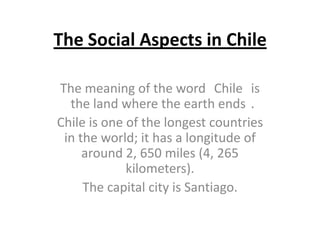
The meaning of the word Chile is
the land where the earth ends .
Chile is one of the longest countries
in the world; it has a longitude of
around 2, 650 miles (4, 265
kilometers).
The capital city is Santiago.
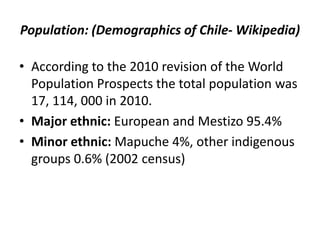
Population: (Demographics of Chile- Wikipedia)
• According to the 2010 revision of the World
Population Prospects the total population was
17, 114, 000 in 2010.
• Major ethnic: European and Mestizo 95.4%
• Minor ethnic: Mapuche 4%, other indigenous
groups 0.6% (2002 census)
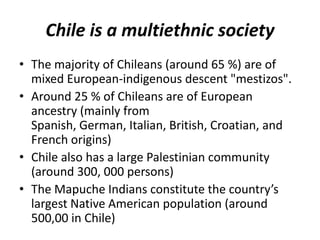
Chile is a multiethnic society
• The majority of Chileans (around 65 %) are of
mixed European-indigenous descent "mestizos".
• Around 25 % of Chileans are of European
ancestry (mainly from
Spanish, German, Italian, British, Croatian, and
French origins)
• Chile also has a large Palestinian community
(around 300, 000 persons)
• The Mapuche Indians constitute the country’s
largest Native American population (around
500,00 in Chile)
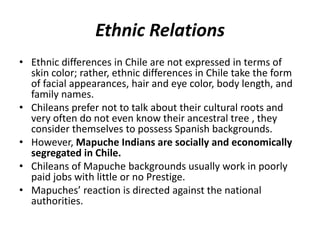
Ethnic Relations
• Ethnic differences in Chile are not expressed in terms of
skin color; rather, ethnic differences in Chile take the form
of facial appearances, hair and eye color, body length, and
family names.
• Chileans prefer not to talk about their cultural roots and
very often do not even know their ancestral tree , they
consider themselves to possess Spanish backgrounds.
• However, Mapuche Indians are socially and economically
segregated in Chile.
• Chileans of Mapuche backgrounds usually work in poorly
paid jobs with little or no Prestige.
• Mapuches’ reaction is directed against the national
authorities.
Culture
• The official language is Spanish.
• There are no recognizable regional accents
and this reflects the existing cultural
homogeneity.
Social Stratification: Classes and Castes
• Class and not color.
• Most Chileans constantly think and act in
terms of traditional class divisions (largely
expressed as lower, middle, and upper).
• The Chilean educational system is primarily
meritocractic-oriented. For instance, entrance
to university is based on the points obtained
at a single national academic test.
Social Stratification: Classes and Castes
• Getting an academic degree or even a good job does
not automatically guarantee social acceptance among
the middle and upper classes.
• People from lower-class origins who have made money
and live in middle- or upper-class neighborhoods. They
are often disdainfully called rotos con plata ("vulgar
people with money").
• Generally, most Chileans of European = upper and
middle classes, while most Chileans of mestizo and
indigenous backgrounds = the lower classes.
Symbols of Social Stratification
• The strong spatial segregation existing in
large Chilean cities.
• Upper, middle, and lower classes live largely
isolated from each other in quite distinctive
neighborhoods and city sectors
Symbols of Social Stratification
• Primary and secondary schools express social
stratification.
• Chileans automatically categorize a person
socially based only on the comuna (municipal
division within the city) where the person lives
and the name of the school he or she has
attended.
Symbols of Social Stratification
• Speech and accent are other important
markers of social stratification.
• Upper-class Chileans exaggerate their
particular way of speaking to indicate their
social predominance.
• Lower-class Chileans speak in a very
idiosyncratic way.

Final social aspects in chile

  • 1.
    The Social Aspectsin Chile The meaning of the word Chile is the land where the earth ends . Chile is one of the longest countries in the world; it has a longitude of around 2, 650 miles (4, 265 kilometers). The capital city is Santiago.
  • 2.
    Population: (Demographics ofChile- Wikipedia) • According to the 2010 revision of the World Population Prospects the total population was 17, 114, 000 in 2010. • Major ethnic: European and Mestizo 95.4% • Minor ethnic: Mapuche 4%, other indigenous groups 0.6% (2002 census)
  • 3.
    Chile is amultiethnic society • The majority of Chileans (around 65 %) are of mixed European-indigenous descent "mestizos". • Around 25 % of Chileans are of European ancestry (mainly from Spanish, German, Italian, British, Croatian, and French origins) • Chile also has a large Palestinian community (around 300, 000 persons) • The Mapuche Indians constitute the country’s largest Native American population (around 500,00 in Chile)
  • 4.
    Ethnic Relations • Ethnicdifferences in Chile are not expressed in terms of skin color; rather, ethnic differences in Chile take the form of facial appearances, hair and eye color, body length, and family names. • Chileans prefer not to talk about their cultural roots and very often do not even know their ancestral tree , they consider themselves to possess Spanish backgrounds. • However, Mapuche Indians are socially and economically segregated in Chile. • Chileans of Mapuche backgrounds usually work in poorly paid jobs with little or no Prestige. • Mapuches’ reaction is directed against the national authorities.
  • 5.
    Culture • The officiallanguage is Spanish. • There are no recognizable regional accents and this reflects the existing cultural homogeneity.
  • 6.
    Social Stratification: Classesand Castes • Class and not color. • Most Chileans constantly think and act in terms of traditional class divisions (largely expressed as lower, middle, and upper). • The Chilean educational system is primarily meritocractic-oriented. For instance, entrance to university is based on the points obtained at a single national academic test.
  • 7.
    Social Stratification: Classesand Castes • Getting an academic degree or even a good job does not automatically guarantee social acceptance among the middle and upper classes. • People from lower-class origins who have made money and live in middle- or upper-class neighborhoods. They are often disdainfully called rotos con plata ("vulgar people with money"). • Generally, most Chileans of European = upper and middle classes, while most Chileans of mestizo and indigenous backgrounds = the lower classes.
  • 8.
    Symbols of SocialStratification • The strong spatial segregation existing in large Chilean cities. • Upper, middle, and lower classes live largely isolated from each other in quite distinctive neighborhoods and city sectors
  • 9.
    Symbols of SocialStratification • Primary and secondary schools express social stratification. • Chileans automatically categorize a person socially based only on the comuna (municipal division within the city) where the person lives and the name of the school he or she has attended.
  • 10.
    Symbols of SocialStratification • Speech and accent are other important markers of social stratification. • Upper-class Chileans exaggerate their particular way of speaking to indicate their social predominance. • Lower-class Chileans speak in a very idiosyncratic way.