Mystery Song #6 Analysis: An Artistic Trip Into the Subconscious
For my final paper, I chose to analyze the Mystery Song #6, a song that I eventually came
to recognize as “Deadcrush” by Alt-J. The group, which has grown in popularity over the last
couple of years, consistently features odd synthesized music with in-depth and irregular
recordings and side melodies. The song I analyzed was no different; “Deadcrush” brings a dark
turn and intense beat to the audience, and relies on a twisted and meddling melody with unclear
lyrics that add more to the overall sound of the song rather than contribute to an overall meaning.
The title of the song actually is in reference to loves that have already passed – a crush that has
already died; the obscure and creepy nature of the theme of the song preludes the coming
foreboding noise that follows, and Alt-J takes the audience on a journey throughout their song.
Within the song, from the first beats that take hold of the listener, drum, sampler and
recorded vocals are very evident. Throughout the coming sections of the song, the instrumentals
get more intense, along with wily vocal recordings, and harmonized sections that become more
layered as the refrains repeat. It is clear that a lot of the vocals have also been enhanced and
altered by recording. The most evident instruments throughout the entire song however lie in the
deep beat provided by the drums, synthesizer, and keyboard, which carry the song to the end.
Different additions throughout the song such as wolf howling, breathy gasps, and whispers of
“extra” only add to the suspense of the song. This tune follows a dark grungy type of electronic
music. It uses a lot of synthesized additions, and keyboard, making it follow an electronic genre,
however the drum beat and guitar, along with upbeat melodic sequences of the refrain indicate a
more alternative rock vibe. With a majorly electronically acoustic section as well, that relies
solely on vocals and slight recording in the background, along with snapping fingers (2:23), the
song yet again glides toward a more alternative vibe. This is an interesting condition of Alt-J that
follows much of their music; they do not fit easily into one genre. Their music, and the song
“Deadcrush” combines pleasurable aspects of many different genres into an amalgamation of
noise that fits together, despite the oddities of the pieces separately.
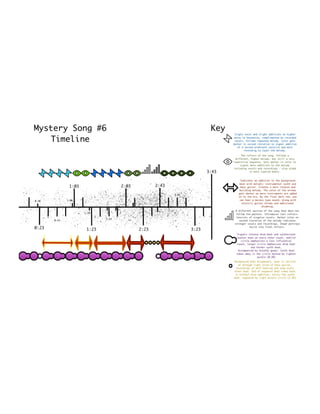
The timeline I made for this song consists of different shapes and colors that signal how I
feel the song builds and layers as time goes on. As I listened to the song multiple times, I
realized that the sections of the lyrics actually began to repeat in periods of ten seconds, starting
at 0:23 and repeating after multiple iterations of ten seconds. For example, in the first 23
seconds, as portrayed by the purple symbol, composed of two circles, the song is only made up
of a backdrop beat. At 0:20, the beat, which consists mainly of a hard drum beat on the third
count, and a strong and soft synth beat, accompanied by gasping recordings, softens, and the
synth beat is taken away to only leave the drum beat for three seconds. Following this transition,
the vocalist begins to enter and initiate a melody, with the beat from the first 23 seconds in the
backdrop. The first section of melody is indicated by the blue symbol, which I chose because I
feel that the melody is sporadic and flashy, like a lightning bolt. As the melody begins with
vocals, additional percussion is added through instrumental keyboard and bass guitar, which
thickens the vocalist contribution. Additional recorded sounds, like at 0:40 with the high pitched
ringing, help make a more intricate section. The arrow symbol, which indicates the additions to
the percussion in instrumentals and guitar, along with other percussion instruments like maracas,
likewise changes in color to show a condensing of the background noise.
At 1:03, approximately four sections of 10 seconds after the vocals come in, the refrain
begins, indicated by the eye symbol. I chose the eye symbol, because the refrain is the most
complex part of the song, and reveals a lot of the meaning to the listener; furthermore, a
recording of “watch me now” repeats throughout the refrains. The refrain consists of a new
melody, but still a very repetitive structure, showing a pattern of symmetry throughout the song
as a whole. The eye symbol gets darker for the other two iterations of the refrain, with the last
iteration being doubly long, because the vocals get more intense and more recordings are added
to the sequences (look at 3:03 with the vague recordings in the background, along with 3:23).
After the second refrain, around 2:23, a new section is introduced to the song, which
leads into the final refrain and draws away from the melody and beat backdrop that the listener
has gotten used to. The section is symbolized by the bars that I use in the key, with a gray color
to indicate the lack of noise in the section. After minutes of intense conflicting noises, this
section dissipates into a section of 20 seconds (two sections of ten seconds, not surprisingly) that
is sparse of an intense melody. The segment has a single vocalist, which differentiates from the
layered vocals of the refrains, and consists of a singular snap beat and guitar strum, with a wolf
howling to add an ominous feel. The second iteration of the section, which is emphasized by a
darker gray in the symbol, includes more recorded vocals and reintroduces the synth beat, which
adds suspense for the final rendition of the refrain, that begins at 2:43 and goes doubly long, not
only 20 seconds, but 40 seconds, to 3:23. This section is also set off in my timeline by an
absence of the purple symbol underneath the line, and an addition of the small yellow circular
symbol, which gives reference to the new percussion that is brought in (the snapping of the
fingers, guitar strum, and wolf howling).
Besides the main sections that are set off by symbols, I added other aspects to the
timeline to indicate specific instances and symmetries. The larger black lines, set off by time
stamps, such as at 0:23 of 2:03, are indicators of large section shifts, like refrain to verse. The
smaller lines that are in place between the larger, indicate repetitions of subsections. For
example, in the first verse, between 0:23 and 1:03, the stanza works four times, in groups of ten
seconds. These are set off the mid length lines. The shortest lines on the timeline, set before
some of the larger lines, such as the line at 1:00, portray slight introductory changes in the
melody that set off the larger melody shifts. Using the example at 1:00, the melody goes from the
repeated version to add new recordings of “oh” and a “swim low” which directly leads into the
refrain, beginning with the words “swim low” again, but as part of the melody. This type of
characteristic repeats throughout the song, with little inserts prior to big shifts in melody or beat
to offset the change. Another aspect I added to my timeline was separation of the symbols from
the top and bottom of the line. I did this to portray how, to the average listener, the noises in the
song separate from a forefront perspective to a background perspective. The bottom line of
symbols are more backdrop noises that necessitate a more in-depth listening to hear. The top line
of symbols are majorly vocals, which is often more interpreted and emphasized by the everyday
listener. The black cluster of stars throughout the entire song shows how I interpret the tune to
build from start to finish, and become more climactic and heavy as time goes on. The entire song
is very mystical and ominous; thus, I used an imaginative symbol like a star. The overall
timeline, especially enunciated by the percussion section with the purple symbol, portrays the
symmetry of the song as a whole. It begins with a singular percussion line, and ends the same
way, with a constant build in the middle, with exception to a short section for anticipation to the
climax.
After analyzing the structure of the song, along with the instruments and different
components of the melody, I feel as though the band was trying to bring the listener on a dark
journey. The song includes aspects of death, and thus works with a menacing and forbidding
aura. However, the upbeat and minor chord harmony’s create that anxious anticipation
throughout the tune, which causes the listener to be on-edge and feel excited for the finish.
Whether the song has a direct meaning or not, it feels as if it belongs in a ritualistic atmosphere
and should be sung in a group, like a chant. It has a rhythmic and hypnotic feel, that greatly
resembles hymns of supernatural means. Specific additions, like the wolf howling, hone in on
this impression, alongside the whiny and chant-like nature of the vocals. The repetition of the
beat and the drumming supports the same hypnotic feel to the music. If anything, the band
portrays through this song, how music can bring an audience deep within the subconscious
through a combination of different noises and beats.
Music like this song makes me excited to be living in the generation I am for music
exploration. Similar to the 60’s and 80’s, this generation is frequently using new techniques to
explore alternative modes of music. This song is a great example of how different genres come
together to form a song that brings new meaning to electronic and downtempo music. With the
introduction of techno and electronic music in the 90’s, which has grown significantly in
popularity since then, this song combines the modern feel and use of technology with aspects of
nature, old recordings, traditional guitar and drum beats, and alternative vocals. The artist also
utilizes vocals to not only express meaning, but to contribute to the overall feel of the song. As is
true with many other songs by Alt-J, the lyrics are almost incomprehensible, and therefore give
the listener very little incentive to enjoy the song for the lyrical value. Instead, the slurring of the
words, and muddled nature of one refrain into the next, adds substance to the melody and the
flow of the song. A song like this could only be created after many years of exploring the
electronic genre. With electronic stemming into many different subgroups, defined by several
moods and speeds, additions of different vocals and recordings, and other characteristics, this
song utilizes many different attributes, that when alone, do not amount to much, however when
combined in the right way, lead the listener to feel a certain way and become moved by the
music. The overall vibe of this song is very relaxing and leads into a subconscious mode of
existence, fitting perfectly with the album, titled Relaxer. In my opinion, this song gives great
respect to music being an art, and exhibits how artists use their creativity and intellect, along
with technology, to facilitate music that impacts others.

Final Project: Mystery Song Analysis

  • 2.
    Mystery Song #6Analysis: An Artistic Trip Into the Subconscious For my final paper, I chose to analyze the Mystery Song #6, a song that I eventually came to recognize as “Deadcrush” by Alt-J. The group, which has grown in popularity over the last couple of years, consistently features odd synthesized music with in-depth and irregular recordings and side melodies. The song I analyzed was no different; “Deadcrush” brings a dark turn and intense beat to the audience, and relies on a twisted and meddling melody with unclear lyrics that add more to the overall sound of the song rather than contribute to an overall meaning. The title of the song actually is in reference to loves that have already passed – a crush that has already died; the obscure and creepy nature of the theme of the song preludes the coming foreboding noise that follows, and Alt-J takes the audience on a journey throughout their song. Within the song, from the first beats that take hold of the listener, drum, sampler and recorded vocals are very evident. Throughout the coming sections of the song, the instrumentals get more intense, along with wily vocal recordings, and harmonized sections that become more layered as the refrains repeat. It is clear that a lot of the vocals have also been enhanced and altered by recording. The most evident instruments throughout the entire song however lie in the deep beat provided by the drums, synthesizer, and keyboard, which carry the song to the end. Different additions throughout the song such as wolf howling, breathy gasps, and whispers of “extra” only add to the suspense of the song. This tune follows a dark grungy type of electronic music. It uses a lot of synthesized additions, and keyboard, making it follow an electronic genre, however the drum beat and guitar, along with upbeat melodic sequences of the refrain indicate a more alternative rock vibe. With a majorly electronically acoustic section as well, that relies solely on vocals and slight recording in the background, along with snapping fingers (2:23), the song yet again glides toward a more alternative vibe. This is an interesting condition of Alt-J that
  • 3.
    follows much oftheir music; they do not fit easily into one genre. Their music, and the song “Deadcrush” combines pleasurable aspects of many different genres into an amalgamation of noise that fits together, despite the oddities of the pieces separately. The timeline I made for this song consists of different shapes and colors that signal how I feel the song builds and layers as time goes on. As I listened to the song multiple times, I realized that the sections of the lyrics actually began to repeat in periods of ten seconds, starting at 0:23 and repeating after multiple iterations of ten seconds. For example, in the first 23 seconds, as portrayed by the purple symbol, composed of two circles, the song is only made up of a backdrop beat. At 0:20, the beat, which consists mainly of a hard drum beat on the third count, and a strong and soft synth beat, accompanied by gasping recordings, softens, and the synth beat is taken away to only leave the drum beat for three seconds. Following this transition, the vocalist begins to enter and initiate a melody, with the beat from the first 23 seconds in the backdrop. The first section of melody is indicated by the blue symbol, which I chose because I feel that the melody is sporadic and flashy, like a lightning bolt. As the melody begins with vocals, additional percussion is added through instrumental keyboard and bass guitar, which thickens the vocalist contribution. Additional recorded sounds, like at 0:40 with the high pitched ringing, help make a more intricate section. The arrow symbol, which indicates the additions to the percussion in instrumentals and guitar, along with other percussion instruments like maracas, likewise changes in color to show a condensing of the background noise. At 1:03, approximately four sections of 10 seconds after the vocals come in, the refrain begins, indicated by the eye symbol. I chose the eye symbol, because the refrain is the most complex part of the song, and reveals a lot of the meaning to the listener; furthermore, a recording of “watch me now” repeats throughout the refrains. The refrain consists of a new
  • 4.
    melody, but stilla very repetitive structure, showing a pattern of symmetry throughout the song as a whole. The eye symbol gets darker for the other two iterations of the refrain, with the last iteration being doubly long, because the vocals get more intense and more recordings are added to the sequences (look at 3:03 with the vague recordings in the background, along with 3:23). After the second refrain, around 2:23, a new section is introduced to the song, which leads into the final refrain and draws away from the melody and beat backdrop that the listener has gotten used to. The section is symbolized by the bars that I use in the key, with a gray color to indicate the lack of noise in the section. After minutes of intense conflicting noises, this section dissipates into a section of 20 seconds (two sections of ten seconds, not surprisingly) that is sparse of an intense melody. The segment has a single vocalist, which differentiates from the layered vocals of the refrains, and consists of a singular snap beat and guitar strum, with a wolf howling to add an ominous feel. The second iteration of the section, which is emphasized by a darker gray in the symbol, includes more recorded vocals and reintroduces the synth beat, which adds suspense for the final rendition of the refrain, that begins at 2:43 and goes doubly long, not only 20 seconds, but 40 seconds, to 3:23. This section is also set off in my timeline by an absence of the purple symbol underneath the line, and an addition of the small yellow circular symbol, which gives reference to the new percussion that is brought in (the snapping of the fingers, guitar strum, and wolf howling). Besides the main sections that are set off by symbols, I added other aspects to the timeline to indicate specific instances and symmetries. The larger black lines, set off by time stamps, such as at 0:23 of 2:03, are indicators of large section shifts, like refrain to verse. The smaller lines that are in place between the larger, indicate repetitions of subsections. For example, in the first verse, between 0:23 and 1:03, the stanza works four times, in groups of ten
  • 5.
    seconds. These areset off the mid length lines. The shortest lines on the timeline, set before some of the larger lines, such as the line at 1:00, portray slight introductory changes in the melody that set off the larger melody shifts. Using the example at 1:00, the melody goes from the repeated version to add new recordings of “oh” and a “swim low” which directly leads into the refrain, beginning with the words “swim low” again, but as part of the melody. This type of characteristic repeats throughout the song, with little inserts prior to big shifts in melody or beat to offset the change. Another aspect I added to my timeline was separation of the symbols from the top and bottom of the line. I did this to portray how, to the average listener, the noises in the song separate from a forefront perspective to a background perspective. The bottom line of symbols are more backdrop noises that necessitate a more in-depth listening to hear. The top line of symbols are majorly vocals, which is often more interpreted and emphasized by the everyday listener. The black cluster of stars throughout the entire song shows how I interpret the tune to build from start to finish, and become more climactic and heavy as time goes on. The entire song is very mystical and ominous; thus, I used an imaginative symbol like a star. The overall timeline, especially enunciated by the percussion section with the purple symbol, portrays the symmetry of the song as a whole. It begins with a singular percussion line, and ends the same way, with a constant build in the middle, with exception to a short section for anticipation to the climax. After analyzing the structure of the song, along with the instruments and different components of the melody, I feel as though the band was trying to bring the listener on a dark journey. The song includes aspects of death, and thus works with a menacing and forbidding aura. However, the upbeat and minor chord harmony’s create that anxious anticipation throughout the tune, which causes the listener to be on-edge and feel excited for the finish.
  • 6.
    Whether the songhas a direct meaning or not, it feels as if it belongs in a ritualistic atmosphere and should be sung in a group, like a chant. It has a rhythmic and hypnotic feel, that greatly resembles hymns of supernatural means. Specific additions, like the wolf howling, hone in on this impression, alongside the whiny and chant-like nature of the vocals. The repetition of the beat and the drumming supports the same hypnotic feel to the music. If anything, the band portrays through this song, how music can bring an audience deep within the subconscious through a combination of different noises and beats. Music like this song makes me excited to be living in the generation I am for music exploration. Similar to the 60’s and 80’s, this generation is frequently using new techniques to explore alternative modes of music. This song is a great example of how different genres come together to form a song that brings new meaning to electronic and downtempo music. With the introduction of techno and electronic music in the 90’s, which has grown significantly in popularity since then, this song combines the modern feel and use of technology with aspects of nature, old recordings, traditional guitar and drum beats, and alternative vocals. The artist also utilizes vocals to not only express meaning, but to contribute to the overall feel of the song. As is true with many other songs by Alt-J, the lyrics are almost incomprehensible, and therefore give the listener very little incentive to enjoy the song for the lyrical value. Instead, the slurring of the words, and muddled nature of one refrain into the next, adds substance to the melody and the flow of the song. A song like this could only be created after many years of exploring the electronic genre. With electronic stemming into many different subgroups, defined by several moods and speeds, additions of different vocals and recordings, and other characteristics, this song utilizes many different attributes, that when alone, do not amount to much, however when combined in the right way, lead the listener to feel a certain way and become moved by the
  • 7.
    music. The overallvibe of this song is very relaxing and leads into a subconscious mode of existence, fitting perfectly with the album, titled Relaxer. In my opinion, this song gives great respect to music being an art, and exhibits how artists use their creativity and intellect, along with technology, to facilitate music that impacts others.