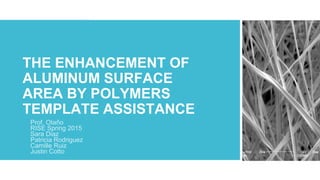
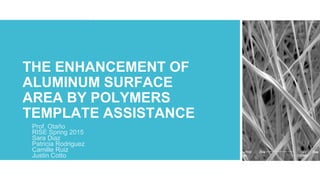
THE ENHANCEMENT OF
ALUMINUM SURFACE
AREA BY POLYMERS
TEMPLATE ASSISTANCE
Prof. Otaño
RISE Spring 2015
Sara Diaz
Patricia Rodriguez
Camille Ruiz
Justin Cotto
PROBLEM
✓Which polymer is easier to detach from the deposited
Aluminum, in order to acquire an Aluminum nano-shell?
✓Hypothesis
✓ Cellulose acetate detaches easily.
✓ Poly(vinyl alcohol) –Poly(acrylic acid) will only detach when
soaked in water.
✓ Regenerated cellulose will not detach.
SIGNIFICANCE
Cancer therapy and bio imaging enhancement:
Theranostic probes
AuNP’s are biocompatible, have vivid optical properties, and the
flexibility to have different molecules and materials attached to their shell
Scattering: AuNP’s become visible to imaging processes
Absorption: Phototermal ablation
Minimal damage to body cells
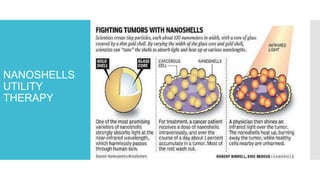
Gold nanoshells are shuttled into tumors by phagocytosis
A macrophage is formed
Alternative:
Placing drugs inside nanoparticle and using it as a vehicle
Accomplished by coating outside of a nanoparticle with iron oxide
Once the tumor area is coated with drug filled nanoparticles, they are activated
(Loo 2005)
NANOSHELLS
UTILITY
THERAPY
TECHNIQUES
UTILIZED
✓ Electrospinning
Cellulose Acetate
✓ Poly(vinyl alcohol) –Poly(acrylic acid)
✓ Regenerated Cellulose
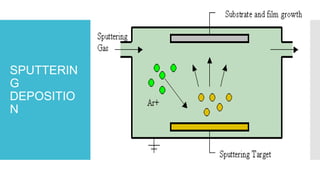
✓Sputtering Deposition
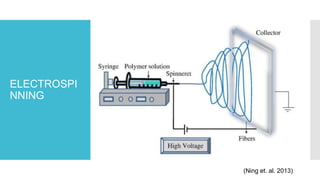
ELECTROSPI
NNING
(Ning et. al. 2013)
SPUTTERING
UTILITIES
AND
ADVANTAGES
Utility:
Semiconductor industries
Optical applications: glasses and telescopes
Thin film transistors
Low emissivity coatings on glass
Fabrication of CD’s and DVD’s
-Efficient Photovoltaic solar cells
Advantages:
Materials with very high melting points are easily sputtered.
Sputtered films typically have stronger adhesion on the substrate
Target contains large amount of material and is maintenance free
Sputtering sources contain no hot parts and are compatible with reactive gases
Size and relative thickness of the nanoshell can be controlled by changing reaction
time and plating concentration
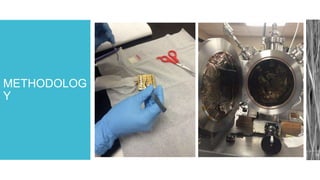
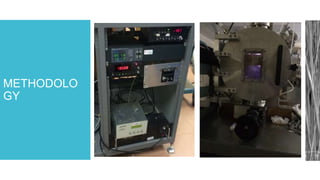
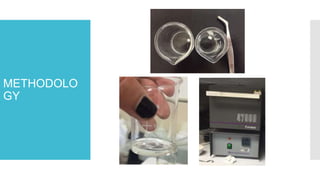
METHODOLOG
Y
SPUTTERIN
G
DEPOSITIO
N
METHODOLO
GY
DETAILED
METHODOL
OGY
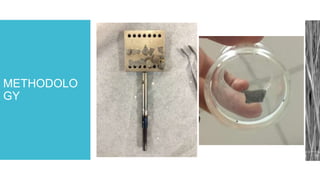
METHODOLO
GY
METHODOLO
GY
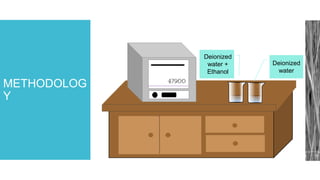
METHODOLOG
Y
Deionized
water
Deionized
water +
Ethanol
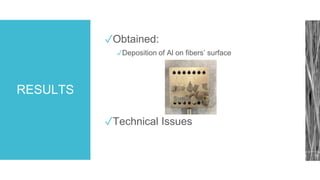
RESULTS
✓Obtained:
✓Deposition of Al on fibers’ surface
✓Technical Issues
CONCLUSI
ON
✓Hypothesis was unable to be proven
✓Future projects:
✓Evaluation of fibers through electron
microscope
✓Characterization of fiber morphology
✓Comparison of optimal templates
CITED
LITERATURE
Loo C, Lowery A, Halas N, West J, Dezek R. 2005.
Immunotargeted Nanoshells for Integrated Cancer Imaging and
Therapy. Nano Lett. [Internet; cited May 14]. Doi:
10.1021/nl050127s. Recovered at:
http://faculty.washington.edu/markeh/MSE599/Loo_Nanolett_2005.
pdf
Ning Z, Xiongbiao C. 2013. Biofabrication of Tissue Scaffolds in
book entitled. Advances in Biomaterials Science and Biomedical
Applications. Recovered at: http://ppl.ippt.gov.pl/18-few-words-
about/17-electrospinning
ACKNOWLEDGMENT
S
RISE PROGRAM
✓Dr. Eneida Diaz
✓Dr. Elena Gonzalez
✓Mr. Giovanni Cruz
✓Professor Ota-o and his students:
✓Normarieli Passalacqua
✓Alejandra De Jesus
✓Xavier Ortiz
THE ENHANCEMENT OF
ALUMINUM SURFACE
AREA BY POLYMERS
TEMPLATE ASSISTANCE
Prof. Otaño
RISE Spring 2015
Sara Diaz
Patricia Rodriguez
Camille Ruiz
Justin Cotto

Final presentation

  • 1.
    THE ENHANCEMENT OF ALUMINUMSURFACE AREA BY POLYMERS TEMPLATE ASSISTANCE Prof. Otaño RISE Spring 2015 Sara Diaz Patricia Rodriguez Camille Ruiz Justin Cotto
  • 2.
    PROBLEM ✓Which polymer iseasier to detach from the deposited Aluminum, in order to acquire an Aluminum nano-shell? ✓Hypothesis ✓ Cellulose acetate detaches easily. ✓ Poly(vinyl alcohol) –Poly(acrylic acid) will only detach when soaked in water. ✓ Regenerated cellulose will not detach.
  • 3.
    SIGNIFICANCE Cancer therapy andbio imaging enhancement: Theranostic probes AuNP’s are biocompatible, have vivid optical properties, and the flexibility to have different molecules and materials attached to their shell Scattering: AuNP’s become visible to imaging processes Absorption: Phototermal ablation Minimal damage to body cells Gold nanoshells are shuttled into tumors by phagocytosis A macrophage is formed Alternative: Placing drugs inside nanoparticle and using it as a vehicle Accomplished by coating outside of a nanoparticle with iron oxide Once the tumor area is coated with drug filled nanoparticles, they are activated (Loo 2005)
  • 4.
  • 5.
    TECHNIQUES UTILIZED ✓ Electrospinning Cellulose Acetate ✓Poly(vinyl alcohol) –Poly(acrylic acid) ✓ Regenerated Cellulose ✓Sputtering Deposition
  • 6.
  • 7.
    SPUTTERING UTILITIES AND ADVANTAGES Utility: Semiconductor industries Optical applications:glasses and telescopes Thin film transistors Low emissivity coatings on glass Fabrication of CD’s and DVD’s -Efficient Photovoltaic solar cells Advantages: Materials with very high melting points are easily sputtered. Sputtered films typically have stronger adhesion on the substrate Target contains large amount of material and is maintenance free Sputtering sources contain no hot parts and are compatible with reactive gases Size and relative thickness of the nanoshell can be controlled by changing reaction time and plating concentration
  • 8.
  • 9.
  • 10.
  • 11.
  • 12.
  • 13.
  • 14.
  • 15.
    RESULTS ✓Obtained: ✓Deposition of Alon fibers’ surface ✓Technical Issues
  • 16.
    CONCLUSI ON ✓Hypothesis was unableto be proven ✓Future projects: ✓Evaluation of fibers through electron microscope ✓Characterization of fiber morphology ✓Comparison of optimal templates
  • 17.
    CITED LITERATURE Loo C, LoweryA, Halas N, West J, Dezek R. 2005. Immunotargeted Nanoshells for Integrated Cancer Imaging and Therapy. Nano Lett. [Internet; cited May 14]. Doi: 10.1021/nl050127s. Recovered at: http://faculty.washington.edu/markeh/MSE599/Loo_Nanolett_2005. pdf Ning Z, Xiongbiao C. 2013. Biofabrication of Tissue Scaffolds in book entitled. Advances in Biomaterials Science and Biomedical Applications. Recovered at: http://ppl.ippt.gov.pl/18-few-words- about/17-electrospinning
  • 18.
    ACKNOWLEDGMENT S RISE PROGRAM ✓Dr. EneidaDiaz ✓Dr. Elena Gonzalez ✓Mr. Giovanni Cruz ✓Professor Ota-o and his students: ✓Normarieli Passalacqua ✓Alejandra De Jesus ✓Xavier Ortiz
  • 19.
    THE ENHANCEMENT OF ALUMINUMSURFACE AREA BY POLYMERS TEMPLATE ASSISTANCE Prof. Otaño RISE Spring 2015 Sara Diaz Patricia Rodriguez Camille Ruiz Justin Cotto