DECREASING INTENTIONAL POISONING ADMISSIONS ON A
PEDIATRIC TRANSITIONAL CARE UNIT
Ashley Kendall AMSN| St. Louis University School of Nursing
BACKGROUND
• In 2020, the transitional care unit
(TCU) at Cardinal Glennon’s Children’s
Hospital spent over 2300 hours caring
for intentional poisoning patients
• The vast majority of these patients
would have been more appropriate
candidates for lower levels of care or
outpatient facilities
• These hours, resources, and bed
availability could have been directed
towards caring for patients more
suitable for the TCU
METHODS
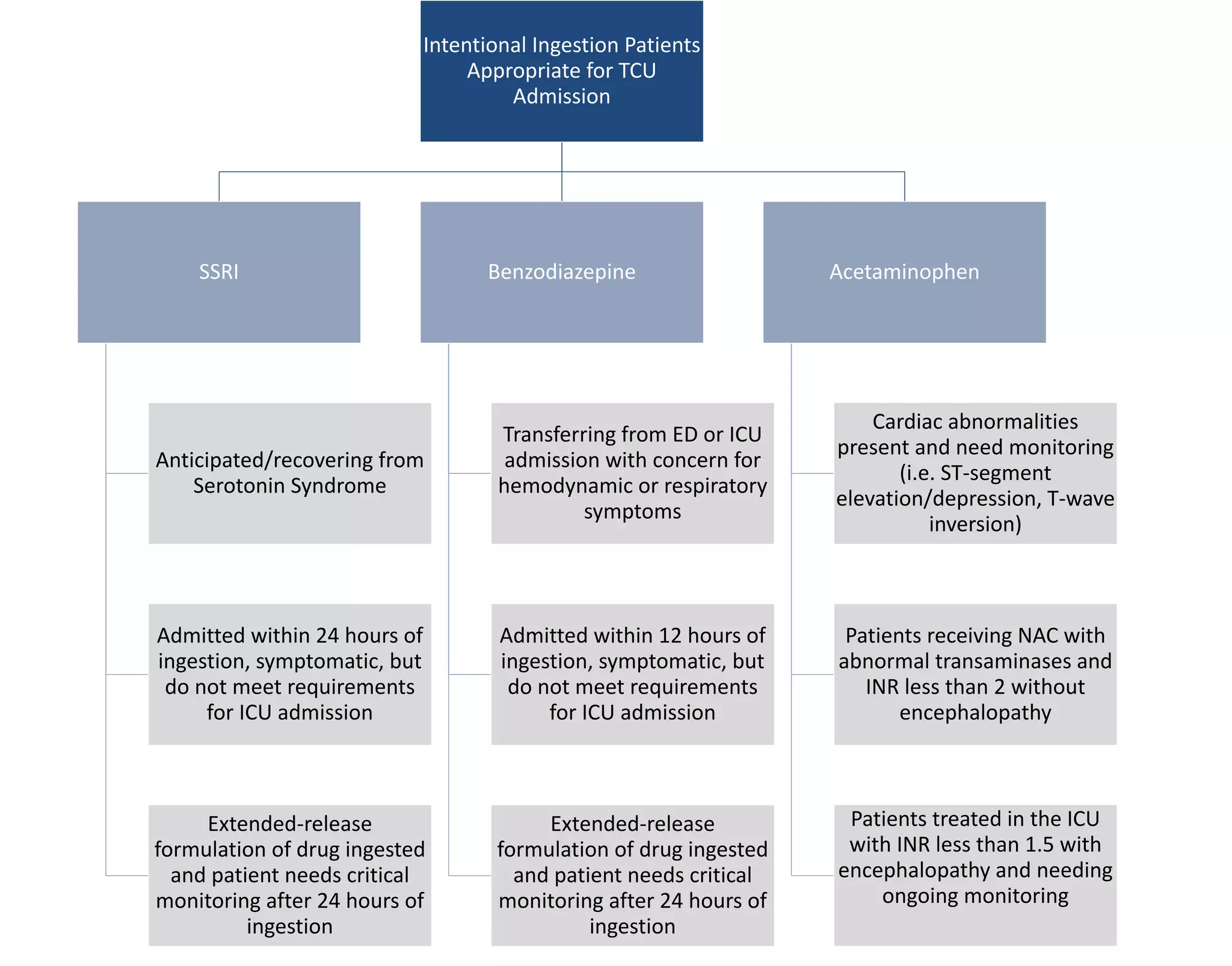
• Create an evidence-based clinical
pathway flowsheet with a focus on the
three most commonly ingested drugs
• Gather control data on weekly number
of hours spent caring for intentional
poisoning patients between January 3,
2021 – February 27, 2021
• Have charge nurses and nurse managers
utilize flowsheet when accepting
admissions and coordinating care for
intentional poisoning patients
• Implement from February 28, 2021 -
April 17, 2021 and compare outcomes to
control data
Intentional Ingestion Patients
Appropriate for TCU
Admission
SSRI
Anticipated/recovering from
Serotonin Syndrome
Admitted within 24 hours of
ingestion, symptomatic, but
do not meet requirements for
ICU admission
Extended-release formulation
of drug ingested and patient
needs critical monitoring after
24 hours of ingestion
Benzodiazepine
Transferring from ED or ICU
admission with concern for
hemodynamic or respiratory
symptoms
Admitted within 12 hours of
ingestion, symptomatic, but
do not meet requirements for
ICU admission
Extended-release formulation
of drug ingested and patient
needs critical monitoring after
24 hours of ingestion
Acetaminophen
Cardiac abnormalities present
and need monitoring (i.e. ST-
segment
elevation/depression, T-wave
inversion)
Patients receiving NAC with
abnormal transaminases and
INR less than 2 without
encephalopathy
Patients treated in the ICU
with INR less than 1.5 with
encephalopathy and needing
ongoing monitoring
OUTCOME
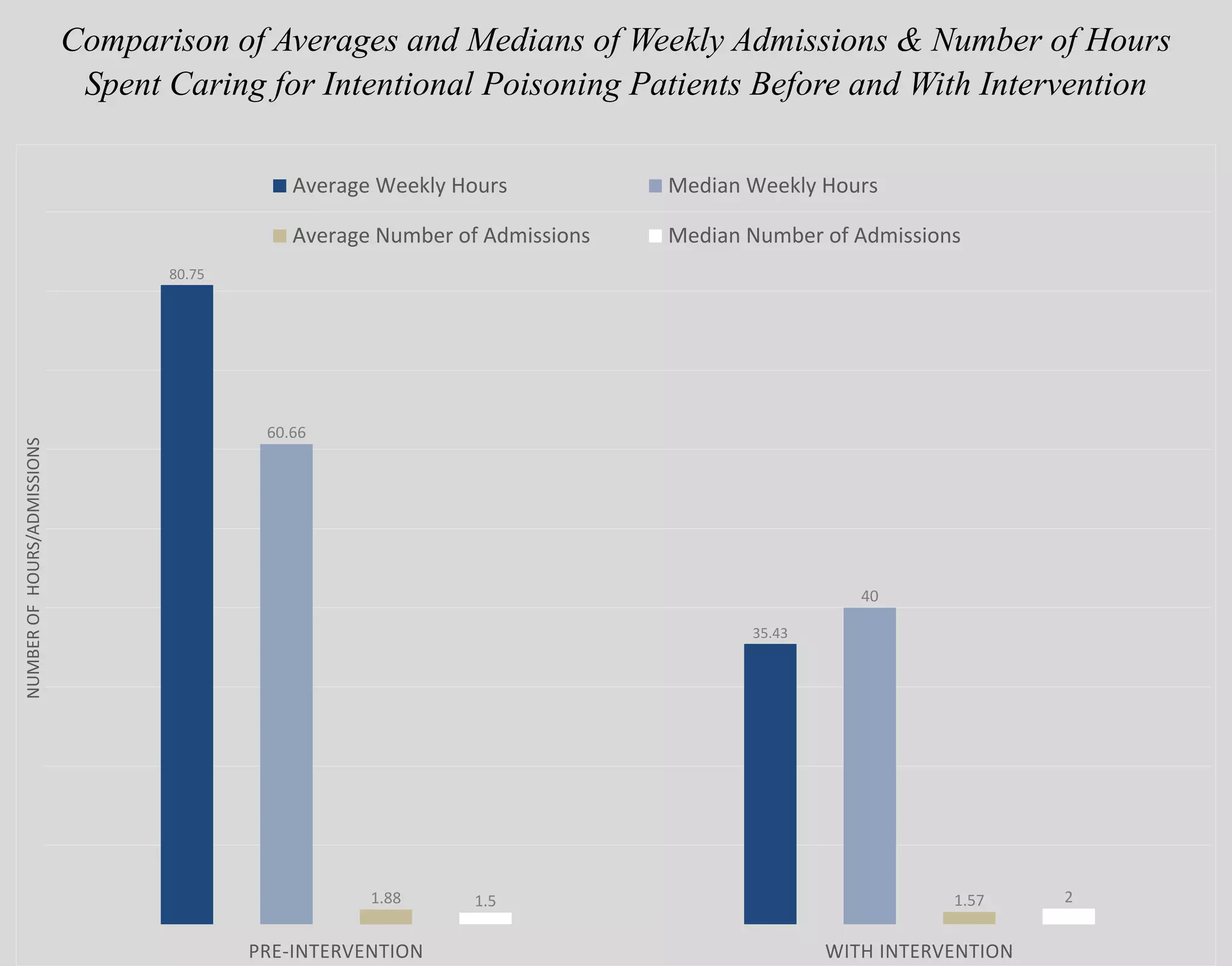
When compared to the 7 weeks prior to
implementation:
• 56% decrease in the average number
of weekly hours spent caring for
intentional poisoning patients
• 21% decrease in the median number of
hours
• 8% decrease in average weekly
admissions
80.75
35.43
60.66
40
1.88 1.57
1.5 2
PRE-INTERVENTION WITH INTERVENTION
NUMBER
OF
HOURS/ADMISSIONS
Average Weekly Hours Median Weekly Hours
Average Number of Admissions Median Number of Admissions
CONCLUSION
• Intervention had greater effect on
discharging patients rather than reducing
admissions
• Promotes further research & application
of clinical pathway flowsheets
• Cardinal Glennon has adopted this
intervention as a starting point for a
hospital-wide policy
AIM
The purpose of this project was to
decrease the number of intentional
poisoning admissions on the Cardinal
Glennon Children’s Hospital TCU by 15%
by April 17, 2021 using an evidence-based
clinical pathway flowsheet.
Comparison of Averages and Medians of Weekly Admissions & Number of Hours
Spent Caring for Intentional Poisoning Patients Before and With Intervention
Intervention: Clinical Pathway Flowsheet
Intentional Ingestion Patients
Appropriate for TCU
Admission
SSRI
Anticipated/recovering from
Serotonin Syndrome
Admitted within 24 hours of
ingestion, symptomatic, but
do not meet requirements
for ICU admission
Extended-release
formulation of drug ingested
and patient needs critical
monitoring after 24 hours of
ingestion
Benzodiazepine
Transferring from ED or ICU
admission with concern for
hemodynamic or respiratory
symptoms
Admitted within 12 hours of
ingestion, symptomatic, but
do not meet requirements
for ICU admission
Extended-release
formulation of drug ingested
and patient needs critical
monitoring after 24 hours of
ingestion
Acetaminophen
Cardiac abnormalities
present and need monitoring
(i.e. ST-segment
elevation/depression, T-wave
inversion)
Patients receiving NAC with
abnormal transaminases and
INR less than 2 without
encephalopathy
Patients treated in the ICU
with INR less than 1.5 with
encephalopathy and needing
ongoing monitoring
80.75
35.43
60.66
40
1.88 1.57
1.5 2
PRE-INTERVENTION WITH INTERVENTION
NUMBER
OF
HOURS/ADMISSIONS
Average Weekly Hours Median Weekly Hours
Average Number of Admissions Median Number of Admissions
Comparison of Averages and Medians of Weekly Admissions & Number of Hours
Spent Caring for Intentional Poisoning Patients Before and With Intervention

Final MSN-CNL Capstone Poster Presentation

  • 1.
    DECREASING INTENTIONAL POISONINGADMISSIONS ON A PEDIATRIC TRANSITIONAL CARE UNIT Ashley Kendall AMSN| St. Louis University School of Nursing BACKGROUND • In 2020, the transitional care unit (TCU) at Cardinal Glennon’s Children’s Hospital spent over 2300 hours caring for intentional poisoning patients • The vast majority of these patients would have been more appropriate candidates for lower levels of care or outpatient facilities • These hours, resources, and bed availability could have been directed towards caring for patients more suitable for the TCU METHODS • Create an evidence-based clinical pathway flowsheet with a focus on the three most commonly ingested drugs • Gather control data on weekly number of hours spent caring for intentional poisoning patients between January 3, 2021 – February 27, 2021 • Have charge nurses and nurse managers utilize flowsheet when accepting admissions and coordinating care for intentional poisoning patients • Implement from February 28, 2021 - April 17, 2021 and compare outcomes to control data Intentional Ingestion Patients Appropriate for TCU Admission SSRI Anticipated/recovering from Serotonin Syndrome Admitted within 24 hours of ingestion, symptomatic, but do not meet requirements for ICU admission Extended-release formulation of drug ingested and patient needs critical monitoring after 24 hours of ingestion Benzodiazepine Transferring from ED or ICU admission with concern for hemodynamic or respiratory symptoms Admitted within 12 hours of ingestion, symptomatic, but do not meet requirements for ICU admission Extended-release formulation of drug ingested and patient needs critical monitoring after 24 hours of ingestion Acetaminophen Cardiac abnormalities present and need monitoring (i.e. ST- segment elevation/depression, T-wave inversion) Patients receiving NAC with abnormal transaminases and INR less than 2 without encephalopathy Patients treated in the ICU with INR less than 1.5 with encephalopathy and needing ongoing monitoring OUTCOME When compared to the 7 weeks prior to implementation: • 56% decrease in the average number of weekly hours spent caring for intentional poisoning patients • 21% decrease in the median number of hours • 8% decrease in average weekly admissions 80.75 35.43 60.66 40 1.88 1.57 1.5 2 PRE-INTERVENTION WITH INTERVENTION NUMBER OF HOURS/ADMISSIONS Average Weekly Hours Median Weekly Hours Average Number of Admissions Median Number of Admissions CONCLUSION • Intervention had greater effect on discharging patients rather than reducing admissions • Promotes further research & application of clinical pathway flowsheets • Cardinal Glennon has adopted this intervention as a starting point for a hospital-wide policy AIM The purpose of this project was to decrease the number of intentional poisoning admissions on the Cardinal Glennon Children’s Hospital TCU by 15% by April 17, 2021 using an evidence-based clinical pathway flowsheet. Comparison of Averages and Medians of Weekly Admissions & Number of Hours Spent Caring for Intentional Poisoning Patients Before and With Intervention Intervention: Clinical Pathway Flowsheet
  • 2.
    Intentional Ingestion Patients Appropriatefor TCU Admission SSRI Anticipated/recovering from Serotonin Syndrome Admitted within 24 hours of ingestion, symptomatic, but do not meet requirements for ICU admission Extended-release formulation of drug ingested and patient needs critical monitoring after 24 hours of ingestion Benzodiazepine Transferring from ED or ICU admission with concern for hemodynamic or respiratory symptoms Admitted within 12 hours of ingestion, symptomatic, but do not meet requirements for ICU admission Extended-release formulation of drug ingested and patient needs critical monitoring after 24 hours of ingestion Acetaminophen Cardiac abnormalities present and need monitoring (i.e. ST-segment elevation/depression, T-wave inversion) Patients receiving NAC with abnormal transaminases and INR less than 2 without encephalopathy Patients treated in the ICU with INR less than 1.5 with encephalopathy and needing ongoing monitoring
  • 3.
    80.75 35.43 60.66 40 1.88 1.57 1.5 2 PRE-INTERVENTIONWITH INTERVENTION NUMBER OF HOURS/ADMISSIONS Average Weekly Hours Median Weekly Hours Average Number of Admissions Median Number of Admissions Comparison of Averages and Medians of Weekly Admissions & Number of Hours Spent Caring for Intentional Poisoning Patients Before and With Intervention

Editor's Notes

  • #3 Generally, the research trends illustrate some of the most common drugs used as intentional overdoses as drugs effecting the central nervous systems and over-the-counter analgesics such as aspirin, ibuprofen, and acetaminophen “Most cases [of SSRI overdose] resolve without sequelae within 24-36 hours with adequate supportive measures. The patient who remains asymptomatic for several hours following a selective serotonin reuptake inhibitor (SSRI) overdose is unlikely to need further medical evaluation and treatment.” Ultimately, this evidence backs the idea that pediatric patients that ingest a toxic dose of an SSRI medication should not be admitted to the TCU unless severe complications, such as serotonin syndrome, develop. Another consideration, however, is the circumstance in which a patient ingests an extended release formulation of a SSRI, in which case the patient may need extended monitoring due to the longer half-life of the drug. “Pure benzodiazepine overdoses usually induce a mild to moderate central nervous system depression; deep coma requiring assisted ventilation is rare and should prompt a search for other toxic substances” Chip Gresham et al. (2020) outlined the following approach considerations when caring for patients with benzodiazepine overdose: Patients may be discharged if they remain asymptomatic at least 6 hours post ingestion. Patients with mild toxicity may be observed in the emergency department until they recover. Patients with intentional overdoses require psychiatric evaluation before discharge. Admit patients with hemodynamic instability, coma, or respiratory depression to the intensive care unit (ICU). Respiratory depression may be treated with assisted ventilation (Approach Considerations, p.5). evidence for direct cardiac tissue injury from APAP poisoning was weak, dysrhythmias, heart failure, and other cardiac effects could occur when hepatic failure was present. This review found that the most common cardiac abnormalities presented on electrocardiograms as ST-segment elevations or depressions and inverted T-waves (KhabazianZadeh et al., 2019). Therefore, patients with these symptoms are appropriate for monitoring on the TCU. APAP is primarily metabolized hepatically; therefore, overdoses present a heinous threat to liver function and providers should focus on preventing and treating acute liver injury and/or failure. With acute ingestions, the risk of hepatotoxicity should be assessed using the Rumack-Matthews nomogram (Appendix E). N-acetylcysteine (NAC), the antidote to acetaminophen poisoning.