Retardation of Yeast Autolysis 1
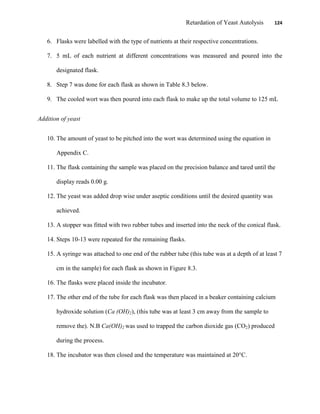
University of Technology, Jamaica
School of Engineering
The retardation of yeast autolysis in the fermentation of beer
in partial fulfillment of the requirement for the
Bachelor of Engineering Degree
Kesha K. Hemmings
Lori-Ann S. Vincent
Retardation of Yeast Autolysis 2
University of Technology, Jamaica
School of Engineering
The retardation of yeast autolysis in the fermentation of beer
in partial fulfillment of the requirement for the
Bachelor of Engineering Degree
July 16, 2011
Kesha K. Hemmings
Lori-Ann S. Vincent
Project Supervisor
Faculty Projects Coordinator
Date
Retardation of Yeast Autolysis 3
Acknowledgment
First and foremost we want to take this opportunity to express our most sincere gratitude to all
individuals who provided assistance in the completion of this research.
During this project we have received invaluable assistance from most of our colleagues
for whom we have great regard, and we wish to extend our warmest thanks to Mr. McAnuff and
Mr. Baker of the Chemical Engineering Department for their help in the acquisition of the
necessary literature and layout of results which formed the base of this study.
The researchers extend appreciation to Ms. Scarlett and Ms. Muir from the Health and
Applied Science Department for conducting the cell viability analysis, which was a crucial part
of the project.
Gratitude must also be extended on the Ministry of Energy and Mining, Mines and
Geology Division for accurate analysis to determine the initial concentration of Zn2+
and Cr3+
present in the wort sample in order to conduct our experiment.
Special thanks to Mr. Dawkins of the Molecular Biology Department at the University of
the West Indies, Mona Campus for providing the necessary guidance to better understand certain
aspects of the project.
Last but not least, Mr. Stewart, the Fermentation Operator from Red Stripe who provided
us with starting materials (wort and yeast) for our experiment and additional data that played a
vital role in this project.
Retardation of Yeast Autolysis 4
Table of Contents
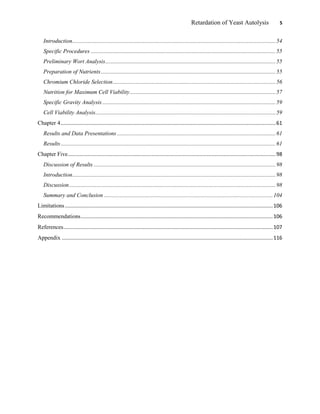
List of Tables ................................................................................................................................................6
List of Figures...............................................................................................................................................7
Abstract.........................................................................................................................................................9
Executive Summary....................................................................................................................................10
El Resumen Ejecutivo.................................................................................................................................12
Chapter One ................................................................................................................................................14
Introduction.............................................................................................................................................14
Background.............................................................................................................................................14
Problem Statement..................................................................................................................................16
Purpose of the Study ...............................................................................................................................16
Objectives................................................................................................................................................16
Research Questions.................................................................................................................................17
Significance of the Study.........................................................................................................................17
A Feasibility Study on the Retardation of Yeast Autolysis during the fermentation of beer......................19
Chapter Two................................................................................................................................................21
Review of literature.................................................................................................................................21
Introduction.............................................................................................................................................21
Types of Yeast .........................................................................................................................................22
Fermentation Phases ..............................................................................................................................22
Factors Affecting the Rate of Fermentation............................................................................................25
Yeast Metabolism....................................................................................................................................33
Basic Nutritional Requirements for Yeast...............................................................................................35
Various Minerals in Grains ....................................................................................................................45
Presence of Anti-nutrients.......................................................................................................................46
Formation of By-Products ......................................................................................................................47
Yeast Management..................................................................................................................................47
Assessment of Fermentation Parameters................................................................................................48
Summary of literature review..................................................................................................................53
Chapter Three..............................................................................................................................................54
Methodology ...........................................................................................................................................54
Retardation of Yeast Autolysis 5
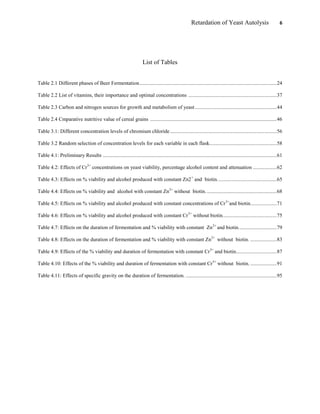
Introduction.............................................................................................................................................54
Specific Procedures ................................................................................................................................55
Preliminary Wort Analysis......................................................................................................................55
Preparation of Nutrients.........................................................................................................................55
Chromium Chloride Selection.................................................................................................................56
Nutrition for Maximum Cell Viability.....................................................................................................57
Specific Gravity Analysis ........................................................................................................................59
Cell Viability Analysis.............................................................................................................................59
Chapter 4.....................................................................................................................................................61
Results and Data Presentations..............................................................................................................61
Results.....................................................................................................................................................61
Chapter Five................................................................................................................................................98
Discussion of Results ..............................................................................................................................98
Introduction.............................................................................................................................................98
Discussion...............................................................................................................................................98
Summary and Conclusion .....................................................................................................................104
Limitations................................................................................................................................................106
Recommendations.....................................................................................................................................106
References.................................................................................................................................................107
Appendix ..................................................................................................................................................116
Retardation of Yeast Autolysis 6
List of Tables
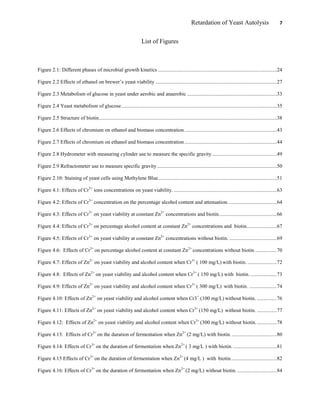
Table 2.1 Different phases of Beer Fermentation........................................................................................................24
Table 2.2 List of vitamins, their importance and optimal concentrations ...................................................................37
Table 2.3 Carbon and nitrogen sources for growth and metabolism of yeast..............................................................44
Table 2.4 Cmparative nutritive value of cereal grains ................................................................................................46
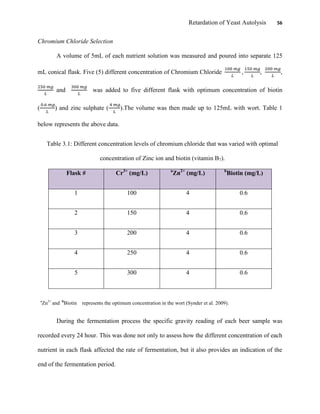
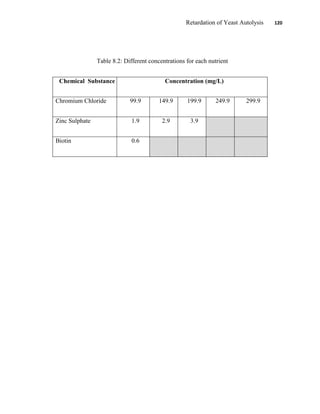
Table 3.1: Different concentration levels of chromium chloride.................................................................................56
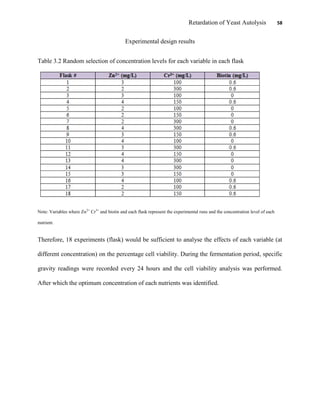
Table 3.2 Random selection of concentration levels for each variable in each flask...................................................58
Table 4.1: Preliminary Results ....................................................................................................................................61
Table 4.2: Effects of Cr3+
concentrations on yeast viability, percentage alcohol content and attenuation ..................62
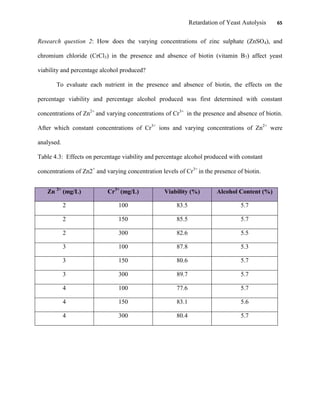
Table 4.3: Effects on % viability and alcohol produced with constant Zn2+
and biotin.............................................65
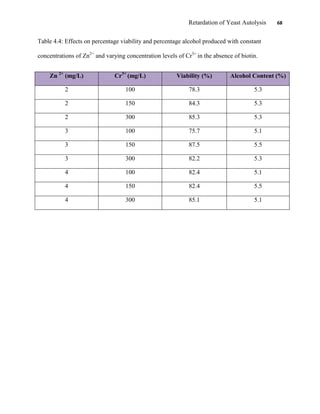
Table 4.4: Effects on % viability and alcohol with constant Zn2+
without biotin......................................................68
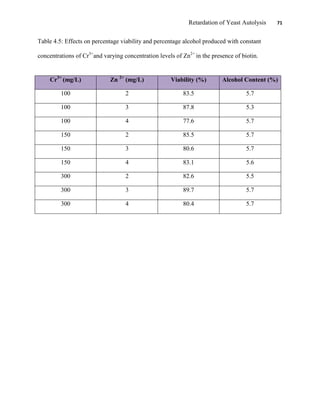
Table 4.5: Effects on % viability and alcohol produced with constant concentrations of Cr3+
and biotin....................71
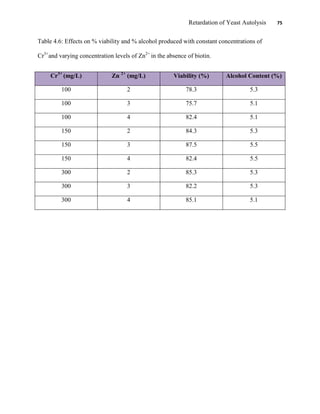
Table 4.6: Effects on % viability and alcohol produced with constant Cr3+
without biotin.........................................75
Table 4.7: Effects on the duration of fermentation and % viability with constant Zn2+
and biotin.............................79
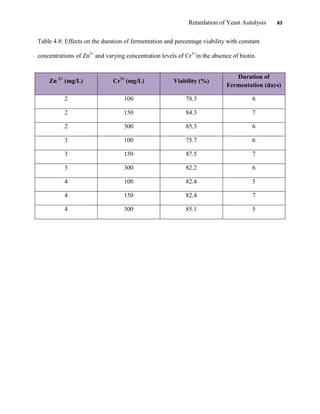
Table 4.8: Effects on the duration of fermentation and % viability with constant Zn2+
without biotin. ....................83
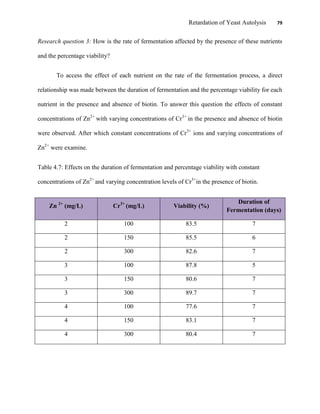
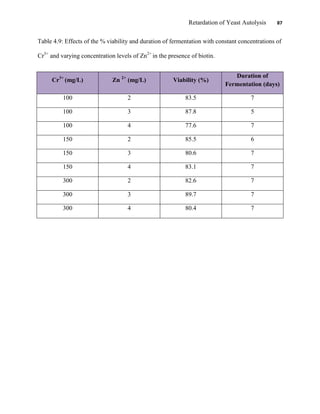
Table 4.9: Effects of the % viability and duration of fermentation with constant Cr3+
and biotin...............................87
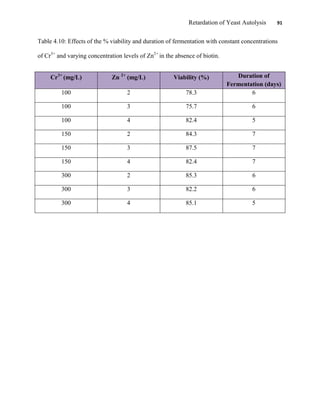
Table 4.10: Effects of the % viability and duration of fermentation with constant Cr3+
without biotin. ....................91
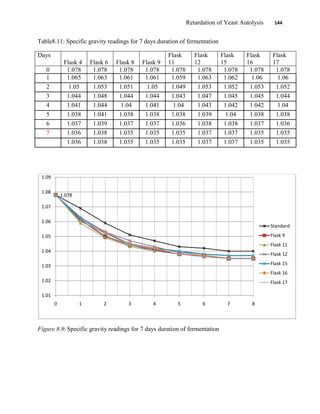
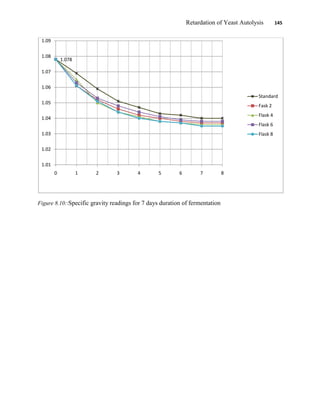
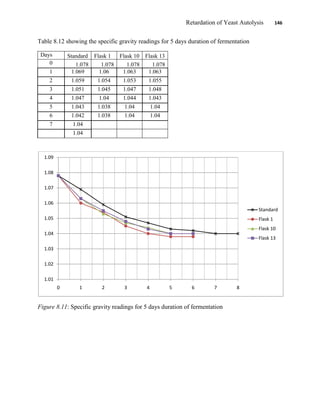
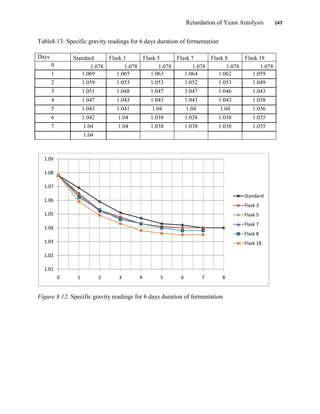
Table 4.11: Effects of specific gravity on the duration of fermentation. .....................................................................95
Retardation of Yeast Autolysis 7
List of Figures
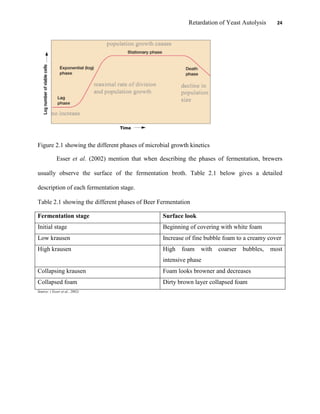
Figure 2.1: Different phases of microbial growth kinetics ..........................................................................................24
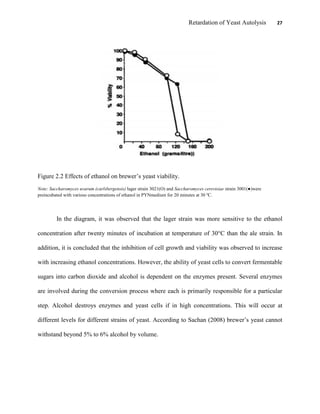
Figure 2.2 Effects of ethanol on brewer‟s yeast viability ............................................................................................27
Figure 2.3 Metabolism of glucose in yeast under aerobic and anaerobic ....................................................................33
Figure 2.4 Yeast metabolism of glucose......................................................................................................................35
Figure 2.5 Structure of biotin.......................................................................................................................................38
Figure 2.6 Effects of chromium on ethanol and biomass concentration......................................................................43
Figure 2.7 Effects of chromium on ethanol and biomass concentration......................................................................44
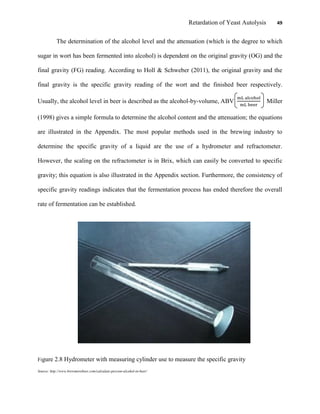
Figure 2.8 Hydrometer with measuring cylinder use to measure the specific gravity.................................................49
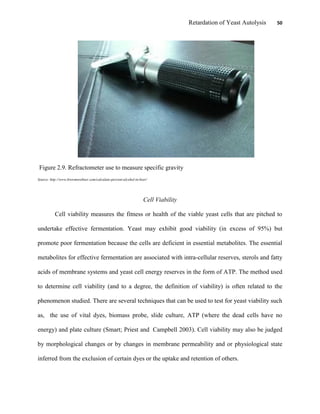
Figure 2.9 Refractometer use to measure specific gravity...........................................................................................50
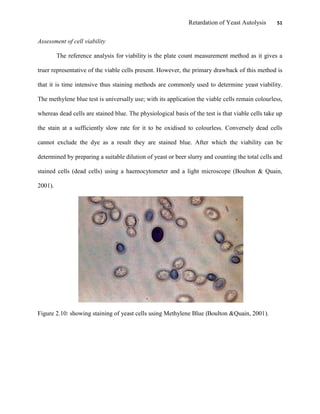
Figure 2.10: Staining of yeast cells using Methylene Blue..........................................................................................51
Figure 4.1: Effects of Cr3+
ions concentrations on yeast viability. ..............................................................................63
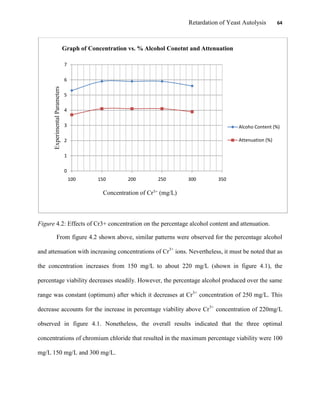
Figure 4.2: Effects of Cr3+
concentration on the percentage alcohol content and attenuation. ....................................64
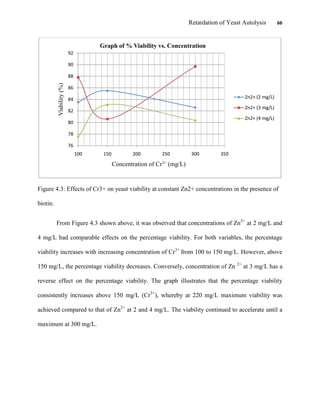
Figure 4.3: Effects of Cr3+
on yeast viability at constant Zn2+
concentrations and biotin............................................66
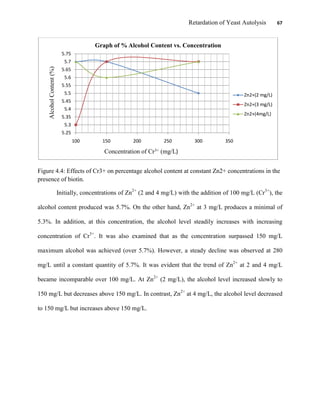
Figure 4.4: Effects of Cr3+
on percentage alcohol content at constant Zn2+
concentrations and biotin.......................67
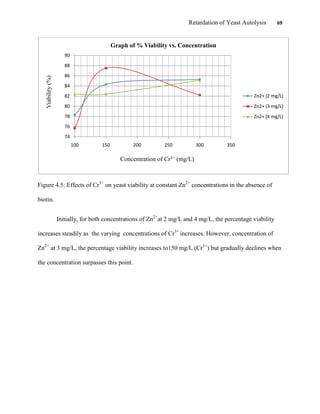
Figure 4.5: Effects of Cr3+
on yeast viability at constant Zn2+
concentrations without biotin. ....................................69
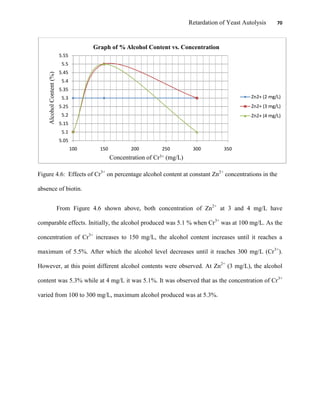
Figure 4.6: Effects of Cr3+
on percentage alcohol content at constant Zn2+
concentrations without biotin.................70
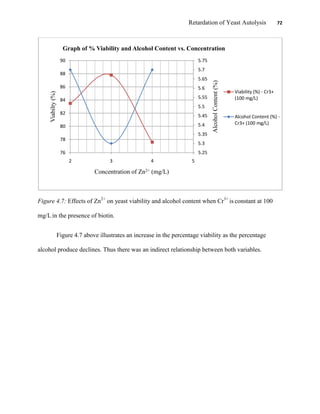
Figure 4.7: Effects of Zn2+
on yeast viability and alcohol content when Cr3+
( 100 mg/L) with biotin. ......................72
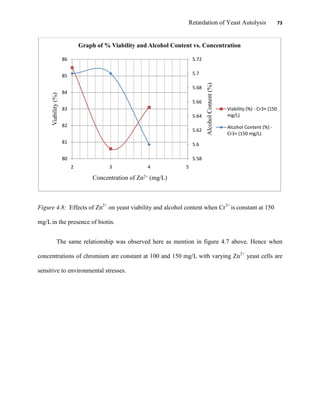
Figure 4.8: Effects of Zn2+
on yeast viability and alcohol content when Cr3+
( 150 mg/L) with biotin. ....................73
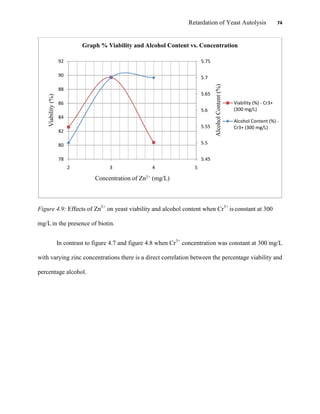
Figure 4.9: Effects of Zn2+
on yeast viability and alcohol content when Cr3+
( 300 mg/L) with biotin. .....................74
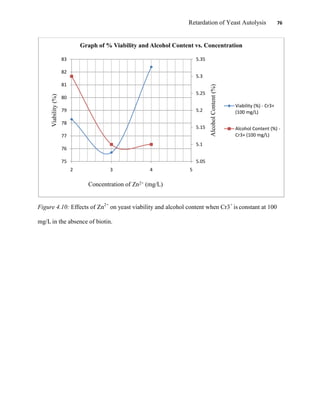
Figure 4.10: Effects of Zn2+
on yeast viability and alcohol content when Cr3+
(100 mg/L) without biotin. ...............76
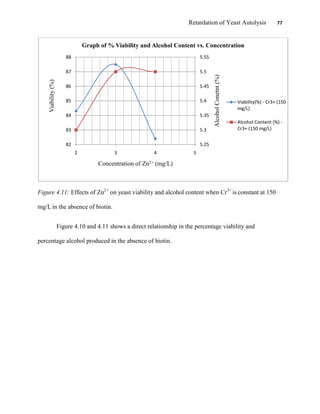
Figure 4.11: Effects of Zn2+
on yeast viability and alcohol content when Cr3+
(150 mg/L) without biotin. ...............77
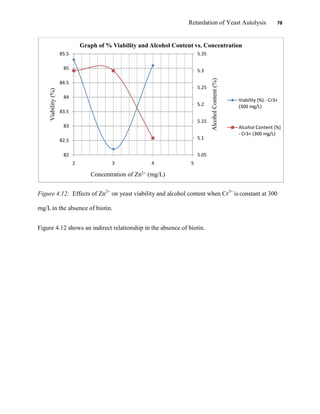
Figure 4.12: Effects of Zn2+
on yeast viability and alcohol content when Cr3+
(300 mg/L) without biotin................78
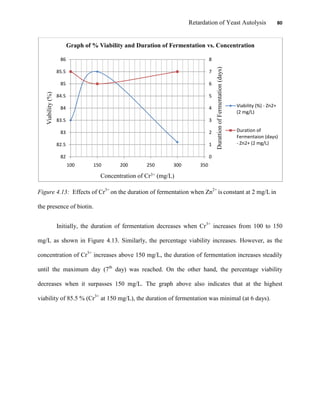
Figure 4.13: Effects of Cr3+
on the duration of fermentation when Zn2+
(2 mg/L) with biotin. ..................................80
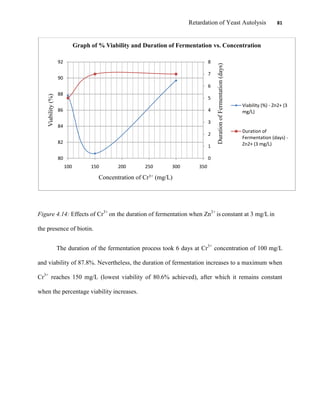
Figure 4.14: Effects of Cr3+
on the duration of fermentation when Zn2+
( 3 mg/L ) with biotin. .................................81
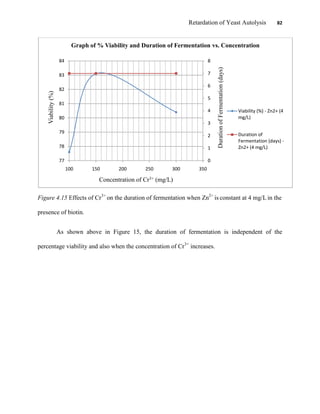
Figure 4.15 Effects of Cr3+
on the duration of fermentation when Zn2+
(4 mg/L ) with biotin...................................82
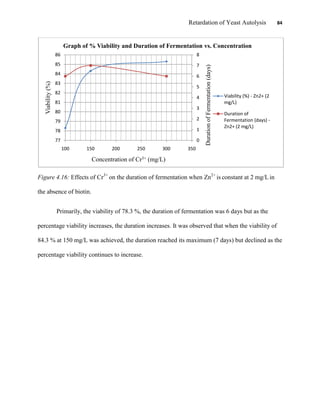
Figure 4.16: Effects of Cr3+
on the duration of fermentation when Zn2+
(2 mg/L) without biotin. ..............................84
Retardation of Yeast Autolysis 8
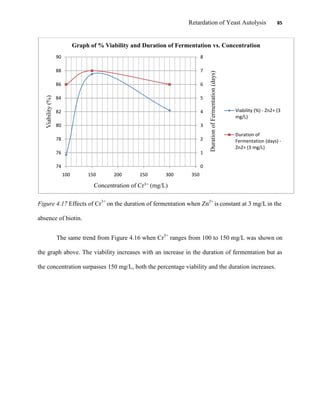
Figure 4.17 Effects of Cr3+
on the duration of fermentation when Zn2+
(3 mg/L) without biotin................................85
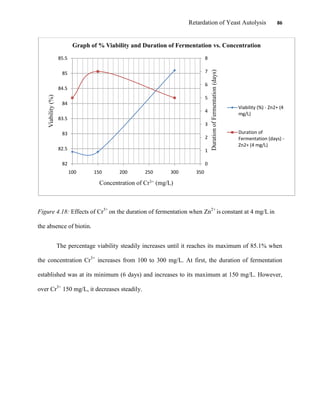
Figure 4.18: Effects of Cr3+
on the duration of fermentation when Zn2+
(4 mg/L ) without biotin. ............................86
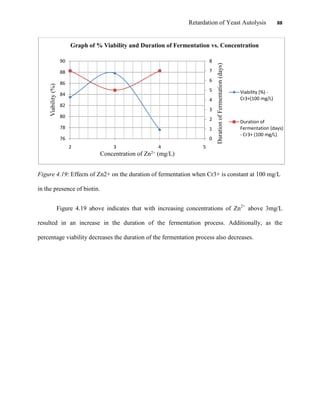
Figure 4.19: Effects of Zn2+ on the duration of fermentation when Cr3+ (100 mg/L) with biotin.............................88
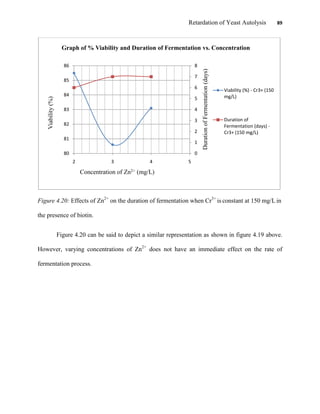
Figure 4.20: Effects of Zn2+
on the duration of fermentation when Cr3+
(150 mg/L ) with biotin..............................89
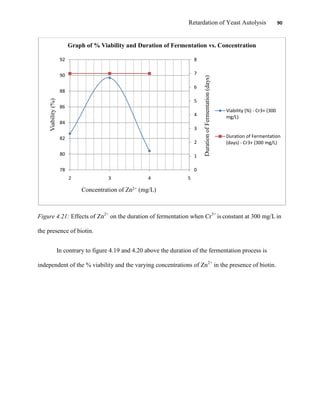
Figure 4.21: Effects of Zn2+
on the duration of fermentation when Cr3+
( 300 mg/L) with biotin..............................90
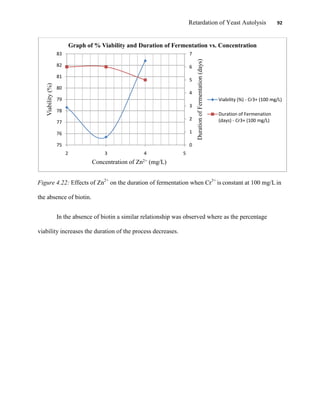
Figure 4.22: Effects of Zn2+
on the duration of fermentation when Cr3+
(100 mg/L) without biotin. ..........................92
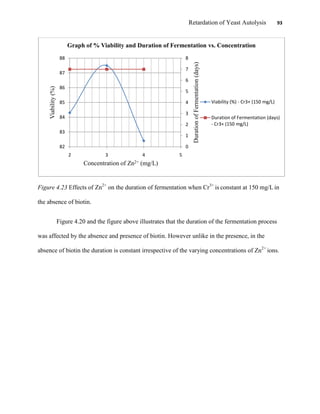
Figure 4.23: Effects of Zn2+
on the duration of fermentation when Cr3+
(150 mg/L) without biotin...........................93
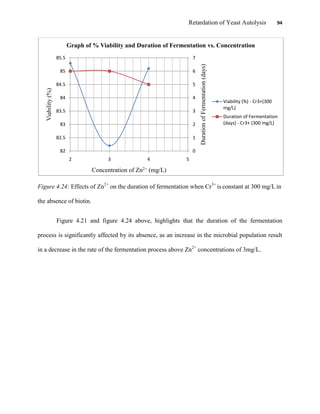
Figure 4.24: Effects of Zn2+
on the duration of fermentation when Cr3+
(300 mg/L) without biotin. .........................94
Figure 4.25 Specific Gravity trends for each percentge attenuation............................................................................96
Figure 4.26 Overall representation of the percentage viability in each flask...............................................................97
Retardation of Yeast Autolysis 9
Abstract
Autolysis of yeasts is of great concern in many fermentation processes, as it not only
decreases the percentage viability, but also reduces the quantity of alcohol and the quality of beer
produced. Thus, this study seeks to retard the self digestion of cells that occurs during the
process.
The effects of varying concentrations levels of chromium chloride (CrCl3) and zinc
sulphate (ZnSO4) in the presence and absence of biotin on yeast viability were assessed. This
assessment was conducted by determining the viability of the organism at the end of the
fermentation process.
Concentrations of chromium chloride ranging from 100 to 300 mg/L (at increments of 50
mg/L) with constant concentration of Zn2+
(4 mg/L) and biotin (0.6 mg/L) were carried out in
different flasks (containing wort), to determine the optimum concentrations of CrCl3. The
optimum concentrations were then varied with Zn2+
ranging from 2 to 4 mg/L (at an increment of
1 mg/L) in the presence and absence of biotin. Lager yeast with an initial viability of 92% was
used and the process was carried out under anaerobic conditions at a constant temperature of
20 ºC.
It was evident from the obtained results that Cr3+
concentration at 300 mg/L and Zn2+
concentration at 3mg/L resulted in maximum improvement of the fermentation process,
production of biomass (89.7%) and alcohol content (5.7%).
Retardation of Yeast Autolysis 10
Executive Summary
Saccharomyces cerevisae is a molecular genetic organism which is categorized as a
species of budding yeast and is commonly used in the fermentation of beer. During beer making,
the microorganism facilitates the conversion of carbohydrates (sugars) into alcohol. However,
yeast is sensitive to physical and chemical stresses and its degree of sensitivity influences
autolysis, which is the destruction of cells by its own enzymes. The essence of this project is to
retard the occurrence of autolysis during the beer making process by supplying the yeast with
additional nutrients to improve yeast performance and its longevity.
This assessment was conducted by determining the viability of the organism at the end of
fermentation. As a result, three main objectives were undertaken: to quantify the viable yeast
cells by determining the optimum concentration of chromium chloride in the presence of zinc
sulphate and biotin at their optimum concentration, to achieve the highest viability by varying
concentrations of zinc sulphate and chromium chloride in the presence and absence of biotin and
finally to examine the effects of these concentrations on the duration of fermentation, apparent
attenuation and alcohol content.
Initially, a pre-analysis on the wort (unfermented beer) was conducted before the
investigation could be carried out. The aim was to determine the initial concentration of Zn2+
and
Cr3+
(which was < 0.1 mg/L). The importance of this analysis was to estimate the quantity of
each nutrient that must be added to achieve the experimental concentrations.
Concentrations of chromium chloride ranging from 100 to 300 mg/L (at increments of 50
mg/L) were carried out in different flasks (containing wort) with optimum concentration of Zn2+
(4 mg/L) and biotin (0.6 mg/L) to determine the optima concentrations of CrCl3. After
Retardation of Yeast Autolysis 11
fermentation, cell viability analysis was carried out to obtain the three optimum percentage
viabilities that should be used for further investigation.
The optimum concentrations of chromium chloride (77.8,78 and 82.9%) were then varied
with Zn2+
ranging from 2 to 4 mg/L (at an increment of 1 mg/L) in the presence and absence of
biotin. This was carried out in eighteen flasks (containing wort) with a standard (no additional
nutrients). Prior to fermentation, the specific gravity of the wort was recorded with the use of a
Brix refractometer. This analysis was done once a day (24 hour time interval) until the end of
fermentation (this is where constant specific gravity readings were observed). Other parameters,
such as the alcohol content and percentage attenuation were determined.
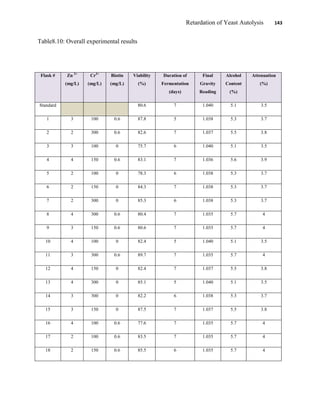
These results depicted which flask (containing the specified nutrient concentrations) as
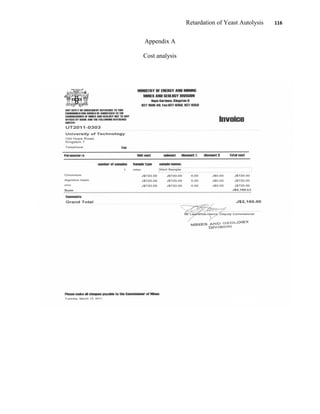
shown in Appendix D, is capable of producing the highest (%) alcohol content and attenuation.
Additionally, a cell viability analysis was carried out, to further conclude which flask contained
the optimum concentrations that improved yeast performance.
Optimum concentrations were achieved when Zn2+
was at 3 mg/L, Cr3+
at 300 mg/L in
the presence of biotin at 0.6 mg/L. This was a clear indication that at these concentrations,
brewers will be able to maximize the quantity of alcohol produced with minimal input thus,
decreasing the overall cost of production.
Retardation of Yeast Autolysis 12
El Resumen Ejecutivo
Saccharomyces cerevisiae es un organismo de genética molecular que se clasifica como
una especie de levadura en ciernes y se utiliza comúnmente en fermentación de cerveza. Durante
la fabricación de cerveza, el microorganismo facilita la conversión de los hidratos de carbono
(azúcares) en alcohol. Sin embargo, la levadura es sensible a las tensiones físicas y químicas y
su grado de sensibilidad, influencias autolisis, que es la destrucción de las células por sus propias
enzimas. La esencia de este proyecto es para retardar la ocurrencia de autolisis durante el proceso
de elaboración de la cerveza mediante el suministro de la levadura con nutrientes adicionales
para mejorar el rendimiento de la levadura y su longevidad.
Esta evaluación se llevó a cabo mediante la determinación de la viabilidad de organismo
en la final de la fermentación. Por lo tanto, tres objetivos principales se llevaron a cabo: para
cuantificar las células de levadura viable, al determinar la concentración optima de cloruro de
cromo, mientras que presencia de sulfato de zinc y biotina en su concentración optima, para
lograr la máxima rentabilidad mediante la variación de las concentraciones de sulfato de zinc u
cloruro de cromo en la presencia y la ausencia de biotina y para examinar los efectos de estas
concentraciones sobre la duración de fermentación, la atenuación aparente y contenido de
alcohol.
Inicialmente, un pre-análisis sobre la hierba (cerveza sin fermentar) se llevó a cabo antes
de la investigación podría llevarse a cabo. El objetivo fue determinar la concentración inicial de
Zn2+
y Cr3+
(que era < 0.1 mg/L). La importancia de este análisis fue estimar la cantidad de cada
nutriente que se debe agregar para alcanzar las concentraciones experimentales.
Retardation of Yeast Autolysis 13
Las concentraciones de cloruro de cromo que van desde 100 a 300 mg/L (en incrementos
de 50 mg/L) se llevaron a cabo en diferentes recipientes (que contengan hierba) con una
constante de Zn2+
(4 mg/L) y biotina (0.6 mg/L) para determinar concentraciones optimas de
CrCl3. Después de la fermentación, el análisis de la viabilidad celular se llevó a cabo para
obtener los tres viabilidades optimo porcentaje (77.8, 78 y 82.9% respectivamente). Esto indica
que las concentraciones experimentales deben ser utiliza dos para análisis adicionales.
Las concentraciones óptimas de cloruro de cromo fueron variadas con Zn2+
de 2 a 4 mg/L
(con un incremento de 1 mg/L) en presencia y en ausencia de biotina. Esto se llevó en dieciocho
frascos (que contengan hierba) en la adición den una norma (sin nutrientes adicionales). Antes de
la fermentación, la gravedad específica del mosto se registró mediante un refractómetro Brix.
Este análisis se realizo una vez al día (24 horas de intervalo) hasta el final de la fermentación
(gravedad específica constante). Otros parámetros, como el contenido de alcohol y la atenuación
se determinan con estas gravedades específicas.
Estos resultados se muestra que frasco (que contiene las concentraciones especificadas en
nutrientes) como se muestra en el Apéndice D, es capaz de producir el mayor o el menor
porcentaje (%) de contenido de alcohol u la atención. Además un análisis de la viabilidad celular
se llevó a cabo, para concluir más que el frasco contenía concentraciones optimas para mejorar el
rendimiento de la levadura.
La concentración optima se logra cuando Zn2+
fue de 3 mg/L, Cr3+
a 300 mg/L y en la
presencia de biotina en 0.6 mg/L. Esta es una clara indicación en estas concentraciones, los
cerveceros podrán aprovechar al máximo la cantidad de alcohol que se produce con una mínima
aportación por lo tanto, disminuir el coste total de producción.
Retardation of Yeast Autolysis 14
Chapter One
Introduction
Background
Over the years alcoholic industries have become of increasing importance to the world‟s
economy, due to annual rise in the consumption of beer. According to Heath (1995), beer is
considered to be the world's most widely consumed alcoholic beverage that undergoes three
main processes: malting, brewing and fermentation. It is principally made from four ingredients
each of which imparts its own flavour and characteristics to the finished product. These include a
starch source, yeast, hops and water. The most common source of carbohydrate used is malted
barley; this provides fermentable sugars that are utilised by the yeast via fermentation thus,
producing alcohol. Hops add to the aroma and flavour of the beer and water provides a medium
for the fermentation process. There are different types of beer that can be produced depending on
the starting ingredients and the duration of the fermentation process (maturation). However, it
can be categorized as either lager or ale beer since the main distinction is determined by the type
of yeast used.
Yeast is biologically classified as a fungus in which there are different strains for
different purposes. The first eukaryote whose genome was fully sequenced is Saccharomyces
Cerevisiae and is commonly used in the fermentation of beer (Goffeau et al., 1996).
Robert (2003) explains that there are two main classification of the Saccharomyces specie that
are exploited by brewers, those that are top fermenting yeast (ale yeast) and bottom fermenting
yeast (lager yeast). The difference in the strain of yeast used is what defines the unique beer
characteristics and is said to be a critical component to many brewers.
Retardation of Yeast Autolysis 15
In addition to yeast contribution to the style of beer produced, it has been established that
it is the key factor in the fermentation process (Boulton & Quain, 2001). However, yeast is
sensitive to instantaneous changes in physical and chemical parameters, and its degree of
sensitivity influences autolysis. Autolysis is said to occur when endogenous enzymes which
consist of mainly proteases and ribonucleases digest the intracellular components in the yeast
cell. Thus, not only result in hydrolyzes of macromolecules, but also the degradation of light
weight molecules which mainly consist of nucleotides, amino acids and peptides. It is also
characterized by the loss of cell permeability, alteration of cell wall porosity and the subsequent
leakage of intracellular products into the environment (Fleet & Hernawan, 1995).
The rate of fermentation and the amount of alcohol produced from a precise quantity of
raw materials are of vast importance. As a result, emphasis on plant economics, unit operations
and quality control mechanisms has heightened to increase yield, efficiency and profitability.
Hence, methods to maintain healthy and viable yeast cells are of extreme importance in the
industry (Ingledew & Synder, 2009).
Retardation of Yeast Autolysis 16
Problem Statement
Monitoring and controlling yeast viability is of utmost importance in order to achieve a
high-quality finished product at a low economic cost. However, industrial fermentations that
exploit yeast cells are confronted with a multitude of chemical, physical and biological stresses.
These may impair cell functions further leading to the occurrence of autolysis, thus hindering the
progression of fermentation. As a result, this project seeks to determine the optimum
concentration of nutrients necessary to prolong the life span of yeast.
Purpose of the Study
To optimise yeast performance during the fermentation of beer to retard the occurrence of
yeast autolysis.
Objectives
This project aims to:
1. Quantify the viable yeast cells to determine the optimum concentration levels of
chromium chloride (CrCl3), in the presence of biotin (vitamin B7) and zinc sulphate
(ZnSO4) at their optimum concentration.
2. Compute and evaluate the percentage cell viability, at varying concentrations of
chromium chloride (CrCl3) and zinc sulphate (ZnSO4), in the presence and absence of
biotin (vitamin B7).
3. Examine the effects of zinc sulphate (ZnSO4), chromium chloride (CrC3) and biotin on
the rate of fermentation, apparent attenuation and percentage alcohol produced.
Retardation of Yeast Autolysis 17
Research Questions
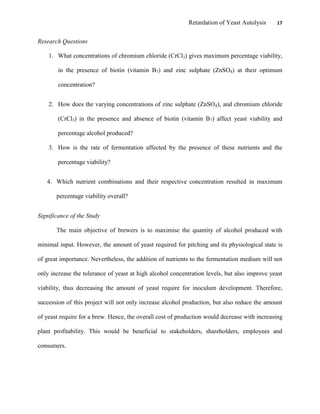
1. What concentrations of chromium chloride (CrCl3) gives maximum percentage viability,
in the presence of biotin (vitamin B7) and zinc sulphate (ZnSO4) at their optimum
concentration?
2. How does the varying concentrations of zinc sulphate (ZnSO4), and chromium chloride
(CrCl3) in the presence and absence of biotin (vitamin B7) affect yeast viability and
percentage alcohol produced?
3. How is the rate of fermentation affected by the presence of these nutrients and the
percentage viability?
4. Which nutrient combinations and their respective concentration resulted in maximum
percentage viability overall?
Significance of the Study
The main objective of brewers is to maximise the quantity of alcohol produced with
minimal input. However, the amount of yeast required for pitching and its physiological state is
of great importance. Nevertheless, the addition of nutrients to the fermentation medium will not
only increase the tolerance of yeast at high alcohol concentration levels, but also improve yeast
viability, thus decreasing the amount of yeast require for inoculum development. Therefore,
succession of this project will not only increase alcohol production, but also reduce the amount
of yeast require for a brew. Hence, the overall cost of production would decrease with increasing
plant profitability. This would be beneficial to stakeholders, shareholders, employees and
consumers.
Retardation of Yeast Autolysis 18
Key Definitions
Autolysis: The destruction of tissues or cells of an organism by the action of substances, such as
enzymes, that are produced within the organism.
Brewing: The production of beer through the steeping a starch source in water followed by the
addition of yeast to initiate the fermentation process.
Enzymes: Proteins that participate in cellular metabolic processes with the ability to enhance the
rate of reaction between biomolecules.
Fermentation: A biological process in which sugars are converted into cellular energy and
thereby produce alcohol and carbon dioxide as metabolic waste products in the presence of yeast.
Fermentable sugars: Carbohydrates that are easily utilised by yeast during fermentation.
Malting: A process which involves the germination of grains by soaking in water. The grains are
quickly halted from germinating by further drying with hot air.
Maturation: The holding stage (post fermentation) where the beer is conditioned (i.e. removal of
diacetyl) prior to filtration and packaging.
Metabolism: The chemical processes that occur within a living organism in order to sustain life.
Metabolize: To undergo the chemical changes of metabolism.
Saccharomyces cerevisiae: Molecular genetic organism that is categorized as a species of
budding yeast.
Wort: The sweet liquid that comes from the mashing of grains, it is referred to as unfermented
beer.
Yeast: Unicellular micro-organism classified in the fungi group which is used as an agent to
ferment sugars.
Retardation of Yeast Autolysis 19
A FEASIBILITY STUDY ON THE RETARDATION OF YEAST AUTOLYSIS DURING THE
FERMENTATION OF BEER
Scientists disproved that living organisms were responsible for the fermentation process;
they claimed that it was merely a chemical and physical reaction. As a result, no connection was
drawn between the existence of yeast and the phenomenon of fermentation. Briggs et al. (2004)
states that three scientists Cagniard-Latour, Kützing, and Schwann discovered independently that
yeasts are living organisms and they play a major role in the fermentation process. The
investigation also shows the proliferation of the organism, thus refuting the theory of
“spontaneous generation of life” which was introduced by Anaximander and Anaximenes.
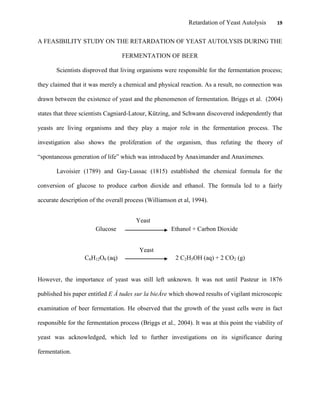
Lavoisier (1789) and Gay-Lussac (1815) established the chemical formula for the
conversion of glucose to produce carbon dioxide and ethanol. The formula led to a fairly
accurate description of the overall process (Williamson et al, 1994).
Glucose Ethanol + Carbon Dioxide
C6H12O6 (aq) 2 C2H5OH (aq) + 2 CO2 (g)
However, the importance of yeast was still left unknown. It was not until Pasteur in 1876
published his paper entitled E Â tudes sur la bieÁre which showed results of vigilant microscopic
examination of beer fermentation. He observed that the growth of the yeast cells were in fact
responsible for the fermentation process (Briggs et al., 2004). It was at this point the viability of
yeast was acknowledged, which led to further investigations on its significance during
fermentation.
Yeast
Yeast
Retardation of Yeast Autolysis 20
A direct relationship was drawn between yeast viability and the rate of fermentation. As a
result, many studies seek to indentify conditions that are optimal for the yeast growth and
metabolism. However, there are several factors that affect the rate of fermentation namely:
 Temperature
 pH
 Amount of yeast that is pitched
 Concentration of by-product formed
 Nutrients used for medium formulation
 Initial oxygen requirements
 Substrate concentration
 Yeast viability and vitality
 Accumulation of toxic substances
 Stress factors such as alcohol level and osmotic pressure
Although yeast is capable to ferment naturally, the requirements for its optimal performance
must be met to give maximum product yield. Thus, it is important that these conditions along
with others are monitor and control. However, appropriate media formulation is usually
challenging for many brewers.
Retardation of Yeast Autolysis 21
Chapter Two
Review of literature
Introduction
In this section of the research paper, a brief overview of the life cycle of yeast was
discussed. It focuses on four phases that the micro-organism undergoes when it is introduced into
the medium. However, the kinetics of microbial growth is affected by several factors which
should be considered to bring forth a successive process. With regards to the different
fermentation phases, yeast performance is significantly influence by wort composition, as each
nutrient plays a vital role in the maintenance and metabolism of the cell. As a result the
formulation of the media must be proportionally balanced in order for the yeast to function at its
optimum during the fermentation process. However, in some cases the presence of anti-nutrients
reduces the assimilation of these nutrients. Additionally the formation of by products in many
instances can also have a negative effect on yeast metabolic activities as well as the characteristic
taste and flavour of the beer. Nevertheless, refinement of the process can minimize the presence
of these inhibitors thus, increasing not only the rate of fermentation but also improving yeast
viability.
Retardation of Yeast Autolysis 22
Types of Yeast
As previously mention the different types of beer can be categorized as either lager or ale.
Ale beers are produced from top fermenting yeast known as Saccharomyces cerevisiae, where as
lager beer are produced from bottom fermenting yeast Saccharomyces pastorianus (formerly
referred to as Saccharomyces carlsbergensis or Saccharomyces uvarum). However, there are
many different strains of brewer‟s yeasts from the two groups, each of which defines the specific
type of beer and its flavor that is produce (Palmer, 2001). From a brewers perspective there are
several phenotypic differences between lager and ale yeast. The main distinction between the
two species is their fermentation temperature. Lager yeasts can ferment at a temperature range of
7-34 ºC with an optimum growth temperature of below 30 ºC while ale yeasts ranges from 15ºC-
39.8 ºC with an optimum temperature of above 30 ºC (Boekhout & Robert, 2003). The
temperature that is utilized is dependent on the specific characteristic taste that the brewer desire.
Nevertheless, ale and lager yeasts are said to follow identical fermentation phases even though
they produced different styles of beer.
Fermentation Phases
Generally yeast growth follows four phases, the lag period, growth, fermentation, and
sedimentation phase when they are inoculated into a growth medium. The lag phase reflects
the time required for inoculated yeast cells to adapt to their physical and chemical growth
environment (pH, temperature and sugar content of the wort). The duration of this phase is
not only dependent on the growth conditions, but also the type of inoculum, and the
components used in media formulation (Walker, 1998). After the adaptation phase and
sufficient reserves are built up within the cells the growth phase or respiration phase begins.
In this phase, the yeast cells utilises the oxygen in the wort to oxidize a variety of acid
Retardation of Yeast Autolysis 23
compounds, resulting in a significant drop in pH and sugar content (as much as 50% of the
initial) and an exponential rise in the microbial population This phase is also evident from the
covering of foam on the wort surface and air bubbles due to the liberation of carbon dioxide
gases. During this phase metabolism becomes anaerobic as the level oxygen decreases and the
production of carbon dioxide increase (Jacobson, 2006).
After the oxygen has been depleted the fermentation phase then follows. Fermentation
of beer is an anaerobic process as a result; any remaining oxygen in the wort is removed out
of solution via carbon dioxide bubbles produced by the yeast. In this phase the yeast is
actively consuming the sugar in the wort and is distinguished by reduction of wort specific
gravity and the rapid production of carbon dioxide, ethanol, beer flavours and aroma. Most
beer yeasts remain in suspension for 3 to 7 days, after which flocculation and sedimentation
will commence (Goldammer, 2008). The final phase of the population history is death phase,
this is period in which the microbial population begins to decrease significantly and autolysis
of the cells occur due to build up of toxic substances and depletion of nutrients (Jacobson,
2006; Stanbury et al., 2003). It is also important to note that the physiological condition of the
yeast cells is a contributing factor for the duration and outcome of the fermentation phases
(Walker 1998).
Retardation of Yeast Autolysis 24
Figure 2.1 showing the different phases of microbial growth kinetics
Esser et al. (2002) mention that when describing the phases of fermentation, brewers
usually observe the surface of the fermentation broth. Table 2.1 below gives a detailed
description of each fermentation stage.
Table 2.1 showing the different phases of Beer Fermentation
Fermentation stage Surface look
Initial stage Beginning of covering with white foam
Low krausen Increase of fine bubble foam to a creamy cover
High krausen High foam with coarser bubbles, most
intensive phase
Collapsing krausen Foam looks browner and decreases
Collapsed foam Dirty brown layer collapsed foam
Source: ( Esser et al., 2002)
Retardation of Yeast Autolysis 25
Factors Affecting the Rate of Fermentation
According to Waites et al. (2001), the main factors affecting the rate of fermentation are
the quantity of yeast pitched, yeast cell viability and yeast quality, the dissolved oxygen level in
wort prior to pitching, concentration of assimilable nitrogen, concentration of fermentable sugars
and the fermentation temperature. Additionally, Briggs et al. (1999) also stated that the choice of
yeast strain, the size and geometry of the fermentation vessel, pH and the tolerance of yeast cells
to stress factors such as osmotic pressure and ethanol concentration must be considered.
Moreover, based on research conducted by Stoicescu & Bonciu (2006) wort properties such as
the wort gravity, lipid content and concentration level of nutrients such as minerals and vitamins
are contributing factors to the fermentation process. Furthermore, sterilisation of apparatus,
medium and maintaining aseptic conditions during the process will influences not only the rate
of the fermentation but also the purity of the product produced (Stanbury et al., 2003).
Concentration of Fermentable Sugar, Osmotic Pressure and Wort Specific Gravity
Mac William (as cited in Hui et al., 2006) stated that carbohydrates make up 90-92% of
wort solids, in which the fermentable sugars is 70-80% of the total carbohydrate. The three major
fermentable sugars are glucose, α-glucosides maltose and maltotriose. It was declared that, the
rate of fermentation will increase proportionally as the concentration of these simple sugars
increases. On the other hand, as the yeast metabolises these sugars, the rate will decrease.
According to Guidici & Solieri (2009), if sugar concentration is above 50%, the osmotic pressure
becomes excessively high and inhibits yeast growth. The increase in osmotic pressure causes the
water inside the yeast cell to diffuse out in order to equalise the concentration. This will cause
the cell to become dehydrated thus resulting in yeast autolysis.
Retardation of Yeast Autolysis 26
Lager and ale beers are mostly produced by high-gravity brewing because the
fermentation of high specific gravity leads to the relative overproduction of acetate esters which
is vital for the complex flavour of beer (Saerens et al., 2008). In addition, Lea & Piggott (2003)
mention that fermentation of low-density wort results not only in low alcohol content but also in
low flavour content. The density of the wort is proportional to the concentration of fermentable
sugars present in the wort. Therefore, the specific gravity declines over the course of
fermentation due to a decrease in fermentable carbohydrates and an increase in ethanol
concentration.
Ethanol Concentration
Ethanol is the major product resulting from the action of yeast on sugars present in the
wort during fermentation. Beaven et al. (as cited in D‟Amore, 1992) stated that ethanol
concentration can have separable effects on the specific rate of yeast growth, cell viability and
also the rate of fermentation. He investigated the effect of ethanol concentration on brewer‟s
yeast viability which is summarized in Fig. 2.2 shown below.
Retardation of Yeast Autolysis 27
Figure 2.2 Effects of ethanol on brewer‟s yeast viability.
Note: Saccharomyces uvarum (carlsbergensis) lager strain 3021(O) and Saccharomyces cerevisiae strain 3001(●)were
preincubated with various concentrations of ethanol in PYNmedium for 20 minutes at 30 ºC.
In the diagram, it was observed that the lager strain was more sensitive to the ethanol
concentration after twenty minutes of incubation at temperature of 30°C than the ale strain. In
addition, it is concluded that the inhibition of cell growth and viability was observed to increase
with increasing ethanol concentrations. However, the ability of yeast cells to convert fermentable
sugars into carbon dioxide and alcohol is dependent on the enzymes present. Several enzymes
are involved during the conversion process where each is primarily responsible for a particular
step. Alcohol destroys enzymes and yeast cells if in high concentrations. This will occur at
different levels for different strains of yeast. According to Sachan (2008) brewer‟s yeast cannot
withstand beyond 5% to 6% alcohol by volume.
Retardation of Yeast Autolysis 28
Amount of Yeast used to pitch the Fermentation
The inoculation rate or pitching rate is usually described as the amount of yeast per unit
volume. According to N‟Guesssan et al. (2008), at the beginning of fermentation, the sugar
consumption rate increased with inoculation rate. Monk et al. (as cited in Lea & Piggott, 2003)
expound that sufficient yeast culture is needed to complete the fermentation under adverse
conditions. However, too much yeast can result in the rapid fermentation and or yield of
alcoholic beverage with disproportionate aroma of fresh yeast. Additionally, if insufficient yeast
is used the fermentation rate will be slow and may result in “stuck fermentation”. In general, the
amount of yeast needed is highly dependent on the original gravity of the beer, the volume of
wort, the yeast viability and the fermentation temperature. Nachel (2009) mentions that high
gravity worts (gravity reading of 1.056 or higher) have a greater need for more yeast to be added.
The writer further explained that for every gravity increase of 0.008 above 1.048, the yeast
volume should double.
The Level of Oxygen Dissolved in Wort and Lipid Content
Oxygen is required for the synthesis of essential yeast plasma membrane lipids, these are
synthesized at the start of the fermentation process and their amount is usually determined by the
level of dissolved oxygen in the wort (Boekhout & Robert, 2003). Compounds such as sterols
and unsaturated acids play a key role in maintaining the structure of the cell membranes. Lipid
content and composition in the brewing process enables quality control of the final product.
According to Bravi et al. (2009), lipids have a beneficial effect on yeast growth during
fermentation as well as deleterious effects on end-product quality. Haukeli et al. (as cited in Hui
et al., 2006) explain that lipids in the form of unsaturated fatty acids and ergosterol tend to
Retardation of Yeast Autolysis 29
increase in concentration as long as oxygen is present. However, not all worts contain sufficient
unsaturated fatty acids to support yeast growth therefore, adding lipids to wort might be an
alternative. Boekhout & Robert (2003) mentioned that the synthesized sterols will determine the
biomass yield and as a direct consequence, the rate of fermentation. They also mention that the
more initial dissolved oxygen is present in the wort, the better the growth of the yeast and faster
the fermentation rate. Waites et al. (2001) further elaborated that a minimum of 10 (ppm) is
usually aimed for in wort prior to fermentation and if the oxygen level is inadequate, yeast
growth and ethanol production are usually impaired.
Concentration of Assimilable Nitrogen
Nitrogen deficiency is the most prevalent cause of sluggish fermentations and can reduce
fermentation rates significantly. Lack of nitrogen diminishes yeast metabolic activity, as well as
the biomass yield (Varela et al., 2004). It is evident that nitrogen content plays a vital role in the
fermentation process. According to Fumi et al. (2009), nitrogen compounds in worts are
fundamental for brewing processes and beer quality. These compounds affect the rate of
fermentation and the formation of active flavour compounds. In wort, the main nitrogen sources
for yeast metabolism are individual amino acids, small peptides, and ammonium ions. The
nitrogen sources formed from the proteolysis of barley malt proteins during malting and mashing
are collectively known and measured as Free Amino Nitrogen (FAN). Ingledew and O‟Connor-
Cox (as cited in Lekkas et al., 2007) expound that adequate levels of FAN in wort ensure
efficient yeast cell growth thus increasing the rate of fermentation. Furthermore, Ingledew &
Synder (2009) mention that usable nitrogen available helps the yeast cell to maintain the integrity
of its genetic make-up produce structural proteins and produce functional enzymes to enable the
Retardation of Yeast Autolysis 30
cell to undergo metabolism. This nitrogen is sourced from the medium either from the grain or
via external addition.
Yeast cell viability and yeast quality
Bouix & Leveau (2001) explain that yeast performance in alcoholic fermentation depends
directly on yeast activity which can be seen as function of cell viability and the physiological
state of viable cells. To optimize the quality of fermentation, it is essential to predict yeast
vitality rapidly so that corrective actions may be taken before the yeast is pitched in the brewery
or during fermentation. In general, temperature, alcohol concentration and other factors that were
discussed can affect cell viability thus resulting in autolysis of yeast cells. According to Sanchez
(2009), cell viability significantly decreases when exposed to high temperatures and the yeast
cell numbers decreased an average of 90% with each month of storage at 40°C. Furthermore, the
activity of the yeast should be under optimal conditions in order to achieved viable yeast cells.
Yeast Strain
Pratt et al. (2003) emphasized that the selection of a yeast strain with the required
fermentation and recycling characteristics is critical. They also explain that the yeast strain will
influence the rate and extent of fermentation, the flavour characteristics and the overall quality
and stability of the finished beer. It is imperative that the strain selected be suitable under certain
conditions during fermentation, this includes a capacity to withstand high osmotic pressures and
elevated ethanol levels. Evans & Hamet (2005) defines fermentability as the ability to turn sweet
wort into alcohol and therefore different yeast strains attenuate wort differently thus affecting the
outcome of the rate of fermentation.
Retardation of Yeast Autolysis 31
Size and geometry of fermenting vessel
The geometry of the fermenting vessel must not only facilitate the operations that have to
be performed inside the equipment, but also be suitable for the fermentation characteristics of the
chosen yeast strain and appropriate for the quality of the beer that is to be produced.
Furthermore, it plays an important role in fermentation as it has been observed that as the height
to-diameter ratio of the vessel increases, the rate increases (Boulton & Quain, 2001).
Fermentation Temperature and pH
Temperature is a major factor that primarily affects yeast growth (viability) and the
metabolic rate causing an overall effect on the rate of fermentation (Boulton & Quain, 2001). If
the temperature at which the yeast is added to the wort is too low the initial fermentation rate will
be slow. On the other hand if the temperature is too high, the yeast will experience a heat shock
which can result in autolysis. Yeasts will grow over a temperature range of 10°C-37°C in a
neutral or slightly acidic environment and tend to grow best between pH 4 to pH 6. However,
different yeast strains have an optimal temperature range that aids in its growth (Featherstone &
Tucker, 2011). According to Boulton & Quain (2001), most brewing yeast strains have a
maximum growth temperature within the range of 30 to 35°C, suggesting that very rapid
fermentations could be achieved.
Retardation of Yeast Autolysis 32
Sterilization of materials and apparatus
Almost all fermentation processes have a contaminant-free environment to obtain
maximum and high purity product. As a result, fermentation vessel, medium, air supply, all
materials and apparatus must be sterilized and an aseptic environment should be maintained
throughout the fermentation process.
Viable foreign organisms can be removed whether by using saturated steams (autoclave),
dry heating (using an oven), radiation, chemicals or by some physical procedure such as filtration
before the media is introduce to the fermenter (Stanbury et al., 2003). It is also essential to
sterilize all the equipments and materials that maybe used for storage and culture or medium
formulation (Beakers, Conical Flasks, Bottles, Petri Dish). These can be sterilized with sodium
or potassium metabisulphite solution and then rinse with boiled water to remove any residual
sulphite (Azam-Ali, 2008). Acid wash are also used this is where 10% of acidic solution (HCl or
H2SO4) is used to rinse apparatus and materials after they have been washed with warm soap
water.
Sterilization of the medium
A culture medium is one that is design to support the growth of microorganisms or cells.
Formulation of the medium involves the incorporation of various nutrients such as vitamins,
minerals (metallic ions). In other words, these media are complex to facilitate the growth and
reproduction of microbes to obtain maximum product yield of high purity. As a result it is
important that the sterilization process employed does not degrade its quality and quantity. On
the other hand, the technique should eliminate or reduce foreign microbes (contaminants) as
much as possible. The recommended holding temperature for batch sterilization of a
fermentation medium ranges from 101 ºC - 130 ºC for 20-30 minutes (Stanbury et al., 2003).
Retardation of Yeast Autolysis 33
Additionally during the fermentation process it is important that aseptic conditions are
maintained and the entre of contaminant are prevented. Calcium hydroxide solution can be used
to prevent the entre of contaminant into the fermentation media thereby creating an anaerobic
sterile environment (Ebbing & Gammon, 2010).
Yeast Metabolism
Metabolism is the biochemical assimilation (also known as anabolic pathways) and
dissimilation (refer to as catabolic pathways) of nutrients by a cell. Anabolic pathways involves
reductive processes leading to the production of new cellular materials while catabolic pathways
are oxidative processes that remove electrons from substrates or intermediates that are used to
generate energy. The energy created supplies the cell with energy for transport, movement and
synthesis of reactions (Jacobson, 2006). The different types and pathways of yeast metabolism
that can occur are dependent on whether the process is aerobic or anaerobic and also the type of
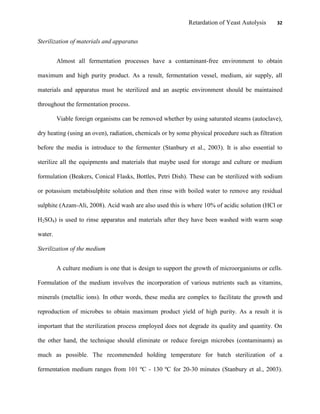
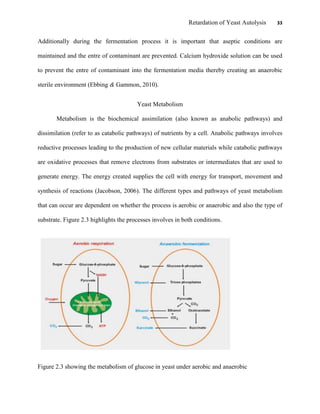
substrate. Figure 2.3 highlights the processes involves in both conditions.
Figure 2.3 showing the metabolism of glucose in yeast under aerobic and anaerobic
Retardation of Yeast Autolysis 34
According to Pommerville (2011), glycolysis involves the metabolic pathway that
converts an initial 6-carbon substrate (glucose) into two (3-carbon) molecules of pyruvate.
During conversion, there are eight intermediates formed, each of which are catalyzed by a
specific enzyme. In addition, glycolysis yields a net release of 2 molecules of ATP through
substrate-level phosphorylation and 2 molecules of NADH (Konhauser, 2007). Bhagavan & Ha
(2011) states that, the conversion of pyruvate to alcohol occurs in two steps. In the first step, the
pyruvate is decarboxylated to acetaldehyde by pyruvate decarboxylase, which utilises thiamine
pyrophosphate (TPP) as a coenzyme. Solomon et.al (2004) expound that in the second step,
NADH produced during glycolysis transfers hydrogen atoms to acetaldehyde, reducing it to
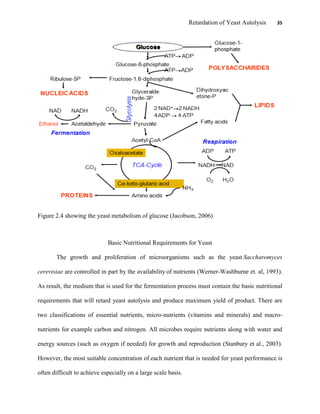
alcohol by alcohol dehydrogenase. The figure below illustrates this complex process followed by
the reactions that take place during alcoholic fermentation.
Retardation of Yeast Autolysis 35
Figure 2.4 showing the yeast metabolism of glucose (Jacobson, 2006)
Basic Nutritional Requirements for Yeast
The growth and proliferation of microorganisms such as the yeast Saccharomyces
cerevisiae are controlled in part by the availability of nutrients (Werner-Washburne et. al, 1993).
As result, the medium that is used for the fermentation process must contain the basic nutritional
requirements that will retard yeast autolysis and produce maximum yield of product. There are
two classifications of essential nutrients, micro-nutrients (vitamins and minerals) and macro-
nutrients for example carbon and nitrogen. All microbes require nutrients along with water and
energy sources (such as oxygen if needed) for growth and reproduction (Stanbury et al., 2003).
However, the most suitable concentration of each nutrient that is needed for yeast performance is
often difficult to achieve especially on a large scale basis.
Retardation of Yeast Autolysis 36
One of the major concerns of yeast in the alcoholic industries is its tolerance to increasing
concentration of ethanol and by-products (built up of toxic substances) which is considered
detrimental to the yeast cell. However, with the addition of nutrients such as metallic ions and
vitamins, the life of the yeast can be extended thus, increasing the rate of fermentation and the
quality of beer produced. Despite the several factors that affect the fermentation process,
Ingledew & Snyder (2009) states that, the most important factor during fermentation is
maintaining adequate yeast viability by the implementation of proper nutritional requirements.
However, the form and concentration of nutrients require for maximum product yield, is highly
dependent on the type (Ale and Lager) and strain of yeast used to carry out the process (White,
2001).
Nutrients used in Fermentation Processes
According to Stanbury et al. (2003) the source of nutrients used to create the medium should
meet as many criteria as possible these include:
1. Maximum yield of product or biomass per gram of substrate used.
2. Maximum concentration of biomass or product.
3. Permit the maximum rate of product formation.
4. Minimum yield of undesired product.
5. Consistent in quality and be readily available throughout the year.
6. Is should cause minimal problems during media making and sterilisation.
7. Minimum problems in other aspects of the production process especially aeration and
agitation, extraction, purification and effluent treatment.
Retardation of Yeast Autolysis 37
There are various types of nutrients that are used for different purposes dependent on the type of
products (metabolites) that is to be produced. Additionally the Mode of Operation (batch or
continuous) and the stage on the Microbial Growth Curve (exponential or stationary) that result
in the production of the desire by-product, is influence greatly by the nutrients that are used to
formulate the media.
Vitamins
A vitamin is an organic compound required as a nutrient in minute amounts by an
organism (Lieberman & Bruning, 1990). They are said to be essential nutrients as they facilitates
in the synthesis of adaptive enzymes that are necessary for fermentation of carbohydrates.
Ingledew & Snyder (2009) highlights few vitamins that are commonly used in the fermentation
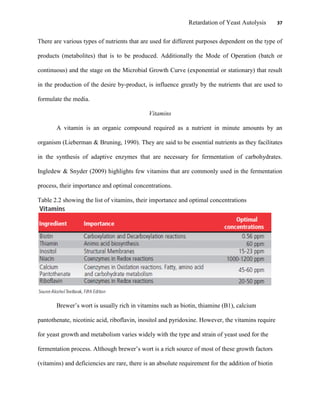
process, their importance and optimal concentrations.
Table 2.2 showing the list of vitamins, their importance and optimal concentrations
Brewer‟s wort is usually rich in vitamins such as biotin, thiamine (B1), calcium
pantothenate, nicotinic acid, riboflavin, inositol and pyridoxine. However, the vitamins require
for yeast growth and metabolism varies widely with the type and strain of yeast used for the
fermentation process. Although brewer‟s wort is a rich source of most of these growth factors
(vitamins) and deficiencies are rare, there is an absolute requirement for the addition of biotin
Retardation of Yeast Autolysis 38
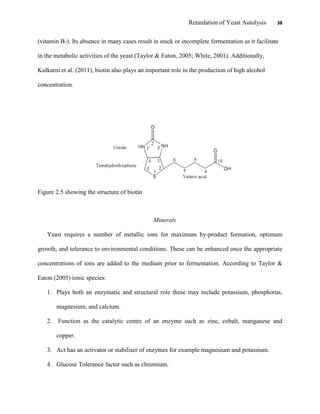
(vitamin B7). Its absence in many cases result in stuck or incomplete fermentation as it facilitate
in the metabolic activities of the yeast (Taylor & Eaton, 2005; White, 2001). Additionally,
Kulkarni et al. (2011), biotin also plays an important role in the production of high alcohol
concentration.
Figure 2.5 showing the structure of biotin
Minerals
Yeast requires a number of metallic ions for maximum by-product formation, optimum
growth, and tolerance to environmental conditions. These can be enhanced once the appropriate
concentrations of ions are added to the medium prior to fermentation. According to Taylor &
Eaton (2005) ionic species:
1. Plays both an enzymatic and structural role these may include potassium, phosphorus,
magnesium, and calcium.
2. Function as the catalytic centre of an enzyme such as zinc, cobalt, manganese and
copper.
3. Act has an activator or stabiliser of enzymes for example magnesium and potassium.
4. Glucose Tolerance factor such as chromium.
Retardation of Yeast Autolysis 39
This project will highlight the major anion (such as phosphorus) and cations (including
magnesium, calcium, zinc, copper and iron and chromium) that play a significant role in yeast
viability during the fermentation process.
Effects of Phosphorous
The concentration of phosphorus compounds, both inorganic and organic, appears to be
independent of the physiological state of aerobic cultures, and does not reflect changes in
metabolic activity such as decreased rate of growth and multiplication (Katchman & Fetty,
1954). However, Taylor & Eaton (2005) noted that, phosphorus is vital to yeast cells as it is
important in its structural formation such as:
 Phosphomannan and phospholipids
 Nucleic acids (DNA and RNA).
 Phosphorylated metabolites (for example, ATP and glusose-6-phosphate)
Effects of Magnesium Ions
Walker & Maynard (1996) dictates that, magnesium not only plays a major role in both
the growth and metabolism of the yeast cell, but also exerts a protective effect on yeast cultures
subjected environmental stresses during the fermentation process. Additionally, magnesium is
the most abundant intracellular divalent cation in yeast cells and acts primarily as an enzyme
cofactor.
Moreover, experimental results showed that ethanol production is directly dependent on the
availability of magnesium ions at various concentrations. Birch & Walker (2000) investigations
Retardation of Yeast Autolysis 40
illustrates that, elevation of magnesium levels in the growth medium results in an increase in the
growth and metabolism of the yeast cells thus increase the concentration of alcohol produced.
Effects of Calcium Ions
Calcium ions is important for yeast flocculation, but is not thought to be required for
yeast growth and fermentation (White, 2001). It is involve in the membrane structure and
function but is usually in small concentration. The physiological and biotechnological
importance for the assimilation of calcium is due to its role as both a modulator of growth (cell
cycle) and metabolic response (Taylor & Eaton, 2005). On the other hand Nabais et al. (1988)
made a correlation with ethanol production and the concentration levels of calcium in a
fermentation medium using Saccharomyces cerevisiae. The investigation illustrates that, the
production of ethanol increases rapidly in optimal concentrations ranging from 0.75mM to 2.0
mM of calcium to a fermentation medium with a trace contaminating concentration of 0.025
mM. The experiment also highlighted that for lethal concentrations of ethanol, the specific death
rates were minimal for cells that were grown and incubated with ethanol in medium with an
optimal concentration of Ca2+
. It was maximal for cells grown and incubated with ethanol in
unsupplemented medium, and intermediate for cells grown in unsupplemented medium and
incubated with ethanol in calcium-supplemented medium. However, high concentration of
calcium may be inhibitory to yeast (*Walker, 1994). In addition, Chotineeranat et al., (2010)
states that the concentration ranging from 0.18% w/v Ca2+
to 0.72% w/v Ca2+
resulted in a
significant decrease in the rate of fermentation and ethanol yield.
Effects of Zinc Ions
Hornsey (1999) mentions that brewer‟s worts can vary in zinc content from 0.1-5 ppm
(mg/L) according to how they are prepared and usually the element is rapidly taken up by the
Retardation of Yeast Autolysis 41
yeast. Deprivation of the mineral can prevent budding cells thus, trace levels are essential for
yeast growth and function of many enzymes activities. Zinc also contributes to various protective
functions such as proteinase attack, and promotes agglutination of yeast cells. Taylor & Eaton
(2005) affirmed that “zinc requirement for the growth of yeast cannot be met by other metal
ions.”
Vecseri-Hegyes et al., (2006) experiment noted that, addition of zinc increases the rate of
fermentation and that a concentration of 0.4 gave best results. Satyanarayana and Kuze (2009)
also investigated the influence of zinc on alcohol production during fermentation where
concentrations of 0.9, 1.5, 2.5, 14 and 26.5 ppm (mg/L) were tested. They observed that high
alcohol production was determined at 2.5 ppm (mg/L) of Zn2+
. Studies highlights that zinc not
only enhanced the ethanol tolerance of the yeast but also increases the ethanol production (Zhao
et al, 2009). Moreover, Vecseri-Hegyes et al. (2006) dictated that the presence of zinc ions
enhanced the uptake maltose and maltotriose while the sedimentation ability and heat sensitivity
of the yeast reduced, thus increasing production.
Zinc contributes to the structure of the cell, stabilization of enzymes, and stimulates
metabolic processes (Hegyes et al, 2006). Jacobsen et al. (as cited in Satyanarayana & Kunze,
2009) noted that when zinc levels are below 0.1 ppm it may result in slow and incomplete
fermentation which is termed “sluggish”. On the other hand, it cannot be in excess as this will
hinder the fermentation process. However, Magonet et al. (as cited in Satyanarayana & Kunze,
2009) stated that zinc is essential for alcohol dehydrogenase (ADH). It facilities the conversion
of acetaldehyde into alcohol at the end of fermentation which is important for maximum product
yield. Reilly (2004), also noted that zinc ions are usually located at the active centre of the
enzyme (ADH) and participates directly in the catalytic mechanism, by interacting with the
Retardation of Yeast Autolysis 42
substrate molecule in a bond making or breaking step. Likewise Havkin-Frenkel & Belanger
(2008) dictates that high concentrations of acetaldehyde in wort usually depict a steady decline in
yeast viability. In the same light Jones (as cited in Boulton & Quain, 2001) explains that
acetaldehyde is highly toxic to yeast cells which can lead to the inactivation of enzymes.
Therefore, lack of zinc ions inhibits the function of the enzyme. Based on this observation,
Havkin -Frenkel & Belanger (2008) concluded that a shortage of zinc ions in the wort can lead to
excess acetaldehyde production resulting in stuck fermentation.
Effects of Copper and Iron Ions
Copper and Iron are essential nutrients for yeast growth they acts as cofactors of many
metabolic enzymes. However, the concentration of both minerals must be low as high levels can
be detrimental to the yeast viability due to their ability to transfer electrons (Freitas et al., 2003).
Iron and copper are particularly important because they participate in electron transfer reactions
which are critical for enzymatic activities.
Effects of Chromium Ions
Chromium can occur in various oxidation states from –2 to +6. However, the most
commonly found are 0, +3, and +6. Raspor et al. (2000) noted that “trivalent state of chromium
is thermodynamically the most stable and is commonly found in the living systems”. They also
highlight that (Mertz 1984; Ducros 1992; Hunt 1983) emphasized on +3 ions and their existence
in the biological system. As a result many investigations seek to examine the effect of Cr3+
specifically chromium chloride (CrCl3). Recent studies have concluded that Cr3+
may serves has
a glucose tolerance factor in yeast and that its biological role is primarily connected with
carbohydrate metabolisms (Vincent, 2007).
Retardation of Yeast Autolysis 43
There are two types of brewer‟s yeast those that are used for the fermentation of beer and
those that are known as nutritional brewer yeast. However nutritional yeast was originally a by-
product of brewing beer which was term as just brewer‟s yeast, but has being modified for daily
intake of minerals and vitamin (Anderson, 2000). Hence, it is denoted as nutritional yeast. Yeasts
are often high in concentration of chromium chloride (glucose tolerance factor) which enhances
and control carbohydrate metabolism in mammals (Vinson & Bose, 1984; Vincent, 2007). Zetic
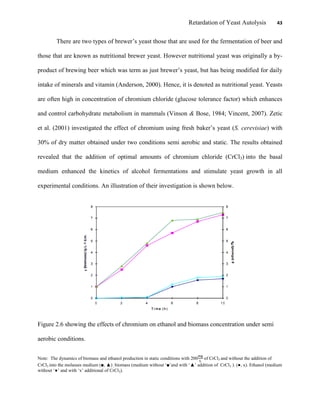
et al. (2001) investigated the effect of chromium using fresh baker‟s yeast (S. cerevisiae) with
30% of dry matter obtained under two conditions semi aerobic and static. The results obtained
revealed that the addition of optimal amounts of chromium chloride (CrCl3) into the basal
medium enhanced the kinetics of alcohol fermentations and stimulate yeast growth in all
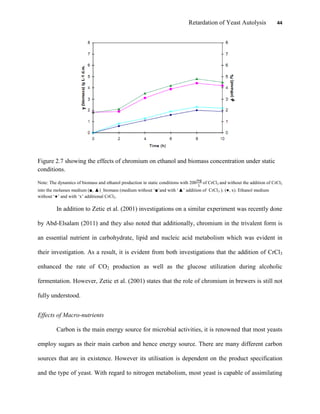
experimental conditions. An illustration of their investigation is shown below.
Figure 2.6 showing the effects of chromium on ethanol and biomass concentration under semi
aerobic conditions.
Note: The dynamics of biomass and ethanol production in static conditions with 200 of CrCl3 and without the addition of
CrCl3 into the molasses medium (■, ▲) , biomass (medium without „■‟and with „▲‟ addition of CrCl3 ). (●, x). Ethanol (medium
without „●‟ and with „x‟ additional of CrCl3).
Retardation of Yeast Autolysis 44
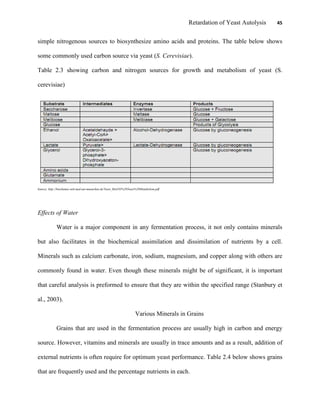
Figure 2.7 showing the effects of chromium on ethanol and biomass concentration under static
conditions.
Note: The dynamics of biomass and ethanol production in static conditions with 200 of CrCl3 and without the addition of CrCl3
into the molasses medium (■, ▲) , biomass (medium without „■‟and with „▲‟ addition of CrCl3 ). (●, x). Ethanol medium
without „●‟ and with „x‟ additional CrCl3.
In addition to Zetic et al. (2001) investigations on a similar experiment was recently done
by Abd-Elsalam (2011) and they also noted that additionally, chromium in the trivalent form is
an essential nutrient in carbohydrate, lipid and nucleic acid metabolism which was evident in
their investigation. As a result, it is evident from both investigations that the addition of CrCl3
enhanced the rate of CO2 production as well as the glucose utilization during alcoholic
fermentation. However, Zetic et al. (2001) states that the role of chromium in brewers is still not
fully understood.
Effects of Macro-nutrients
Carbon is the main energy source for microbial activities, it is renowned that most yeasts
employ sugars as their main carbon and hence energy source. There are many different carbon
sources that are in existence. However its utilisation is dependent on the product specification
and the type of yeast. With regard to nitrogen metabolism, most yeast is capable of assimilating
Retardation of Yeast Autolysis 45
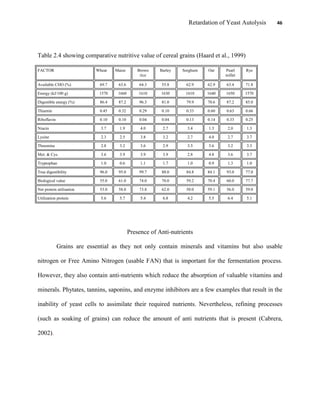
simple nitrogenous sources to biosynthesize amino acids and proteins. The table below shows
some commonly used carbon source via yeast (S. Cerevisiae).
Table 2.3 showing carbon and nitrogen sources for growth and metabolism of yeast (S.
cerevisiae)
Source: http://biochemie.web.med.uni-muenchen.de/Yeast_Biol/03%20Yeast%20Metabolism.pdf
Effects of Water
Water is a major component in any fermentation process, it not only contains minerals
but also facilitates in the biochemical assimilation and dissimilation of nutrients by a cell.
Minerals such as calcium carbonate, iron, sodium, magnesium, and copper along with others are
commonly found in water. Even though these minerals might be of significant, it is important
that careful analysis is preformed to ensure that they are within the specified range (Stanbury et
al., 2003).
Various Minerals in Grains
Grains that are used in the fermentation process are usually high in carbon and energy
source. However, vitamins and minerals are usually in trace amounts and as a result, addition of
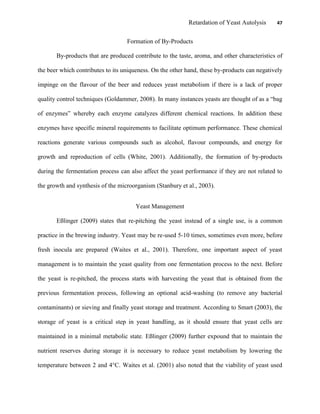
external nutrients is often require for optimum yeast performance. Table 2.4 below shows grains
that are frequently used and the percentage nutrients in each.
Retardation of Yeast Autolysis 46
Table 2.4 showing comparative nutritive value of cereal grains (Haard et al., 1999)
FACTOR Wheat Maize Brown
rice
Barley Sorghum Oat Pearl
millet
Rye
Available CHO (%) 69.7 63.6 64.3 55.8 62.9 62.9 63.4 71.8
Energy (kJ/100 g) 1570 1660 1610 1630 1610 1640 1650 1570
Digestible energy (%) 86.4 87.2 96.3 81.0 79.9 70.6 87.2 85.0
Thiamin 0.45 0.32 0.29 0.10 0.33 0.60 0.63 0.66
Riboflavin 0.10 0.10 0.04 0.04 0.13 0.14 0.33 0.25
Niacin 3.7 1.9 4.0 2.7 3.4 1.3 2.0 1.3
Lysine 2.3 2.5 3.8 3.2 2.7 4.0 2.7 3.7
Threonine 2.8 3.2 3.6 2.9 3.3 3.6 3.2 3.3
Met. & Cys. 3.6 3.9 3.9 3.9 2.8 4.8 3.6 3.7
Tryptophan 1.0 0.6 1.1 1.7 1.0 0.9 1.3 1.0
True digestibility 96.0 95.0 99.7 88.0 84.8 84.1 93.0 77.0
Biological value 55.0 61.0 74.0 70.0 59.2 70.4 60.0 77.7
Net protein utilisation 53.0 58.0 73.8 62.0 50.0 59.1 56.0 59.0
Utilization protein 5.6 5.7 5.4 6.8 4.2 5.5 6.4 5.1
Presence of Anti-nutrients
Grains are essential as they not only contain minerals and vitamins but also usable
nitrogen or Free Amino Nitrogen (usable FAN) that is important for the fermentation process.
However, they also contain anti-nutrients which reduce the absorption of valuable vitamins and
minerals. Phytates, tannins, saponins, and enzyme inhibitors are a few examples that result in the
inability of yeast cells to assimilate their required nutrients. Nevertheless, refining processes
(such as soaking of grains) can reduce the amount of anti nutrients that is present (Cabrera,
2002).
Retardation of Yeast Autolysis 47
Formation of By-Products
By-products that are produced contribute to the taste, aroma, and other characteristics of
the beer which contributes to its uniqueness. On the other hand, these by-products can negatively
impinge on the flavour of the beer and reduces yeast metabolism if there is a lack of proper
quality control techniques (Goldammer, 2008). In many instances yeasts are thought of as a “bag
of enzymes” whereby each enzyme catalyzes different chemical reactions. In addition these
enzymes have specific mineral requirements to facilitate optimum performance. These chemical
reactions generate various compounds such as alcohol, flavour compounds, and energy for
growth and reproduction of cells (White, 2001). Additionally, the formation of by-products
during the fermentation process can also affect the yeast performance if they are not related to
the growth and synthesis of the microorganism (Stanbury et al., 2003).
Yeast Management
Eßlinger (2009) states that re-pitching the yeast instead of a single use, is a common
practice in the brewing industry. Yeast may be re-used 5-10 times, sometimes even more, before
fresh inocula are prepared (Waites et al., 2001). Therefore, one important aspect of yeast
management is to maintain the yeast quality from one fermentation process to the next. Before
the yeast is re-pitched, the process starts with harvesting the yeast that is obtained from the
previous fermentation process, following an optional acid-washing (to remove any bacterial
contaminants) or sieving and finally yeast storage and treatment. According to Smart (2003), the
storage of yeast is a critical step in yeast handling, as it should ensure that yeast cells are
maintained in a minimal metabolic state. Eßlinger (2009) further expound that to maintain the
nutrient reserves during storage it is necessary to reduce yeast metabolism by lowering the
temperature between 2 and 4°C. Waites et al. (2001) also noted that the viability of yeast used
Retardation of Yeast Autolysis 48
for re-pitching should be at least 90-95%, otherwise subsequent fermentation rates are will be
sluggish.
Assessment of Fermentation Parameters
The fundamental understanding on yeast behaviour in a particular medium can be
assessed by different analytical methods depending on the parameter that is being investigated.
The results obtained should illustrate the effectiveness of the fermentation process in various
media. The progress of fermentation is usually monitored at 24 hr intervals and the cessation of
fermentation is affiliated by the specific gravity readings. The readings can also depict the
possible outcome of the amount of substrates consumed and the products being formed. The total
yeast cell counts and viable counts at the end of fermentation can be determined by the direct
microscopic methylene blue method.
Specific Gravity
Specific gravity is the measure of the density of a liquid relative to water (Williams,
2003). In general, the liquid that aids in the formation of beer is called wort. Its specific gravity
is always higher than that of water because it contains significant amount of dissolved sugars.
Furthermore, it can be observed that upon the completion of the fermentation process, the
specific gravity of beer is always less than when it started, due to the conversion of sugar into
alcohol. Boulton & Quain (2001) stated that the measurement of the reduction in wort specific
gravity is the most commonly used method of gauging fermentation progress. The specific
gravity measurements are used to determine the alcoholic strength and the amount of sugar
utilised by the yeast.
Retardation of Yeast Autolysis 49
The determination of the alcohol level and the attenuation (which is the degree to which
sugar in wort has been fermented into alcohol) is dependent on the original gravity (OG) and the
final gravity (FG) reading. According to Holl & Schweber (2011), the original gravity and the
final gravity is the specific gravity reading of the wort and the finished beer respectively.
Usually, the alcohol level in beer is described as the alcohol-by-volume, ABV Miller
(1998) gives a simple formula to determine the alcohol content and the attenuation; the equations
are illustrated in the Appendix. The most popular methods used in the brewing industry to
determine the specific gravity of a liquid are the use of a hydrometer and refractometer.
However, the scaling on the refractometer is in Brix, which can easily be converted to specific
gravity; this equation is also illustrated in the Appendix section. Furthermore, the consistency of
specific gravity readings indicates that the fermentation process has ended therefore the overall
rate of fermentation can be established.
Figure 2.8 Hydrometer with measuring cylinder use to measure the specific gravity
Source: http://www.brewmorebeer.com/calculate-percent-alcohol-in-beer/
Retardation of Yeast Autolysis 50
Figure 2.9. Refractometer use to measure specific gravity
Source: http://www.brewmorebeer.com/calculate-percent-alcohol-in-beer/
Cell Viability
Cell viability measures the fitness or health of the viable yeast cells that are pitched to
undertake effective fermentation. Yeast may exhibit good viability (in excess of 95%) but
promote poor fermentation because the cells are deficient in essential metabolites. The essential
metabolites for effective fermentation are associated with intra-cellular reserves, sterols and fatty
acids of membrane systems and yeast cell energy reserves in the form of ATP. The method used
to determine cell viability (and to a degree, the definition of viability) is often related to the
phenomenon studied. There are several techniques that can be used to test for yeast viability such
as, the use of vital dyes, biomass probe, slide culture, ATP (where the dead cells have no
energy) and plate culture (Smart; Priest and Campbell 2003). Cell viability may also be judged
by morphological changes or by changes in membrane permeability and or physiological state
inferred from the exclusion of certain dyes or the uptake and retention of others.
Retardation of Yeast Autolysis 51
Assessment of cell viability
The reference analysis for viability is the plate count measurement method as it gives a
truer representative of the viable cells present. However, the primary drawback of this method is
that it is time intensive thus staining methods are commonly used to determine yeast viability.
The methylene blue test is universally use; with its application the viable cells remain colourless,
whereas dead cells are stained blue. The physiological basis of the test is that viable cells take up
the stain at a sufficiently slow rate for it to be oxidised to colourless. Conversely dead cells
cannot exclude the dye as a result they are stained blue. After which the viability can be
determined by preparing a suitable dilution of yeast or beer slurry and counting the total cells and
stained cells (dead cells) using a haemocytometer and a light microscope (Boulton & Quain,
2001).
Figure 2.10: showing staining of yeast cells using Methylene Blue (Boulton &Quain, 2001).
Retardation of Yeast Autolysis 52
Once there is a distinction between live cells and dead cells the viability can be calculated
using the equation below:
However, this method has recently been questioned to give poor reproducibility and inaccuracy
in results with apparent viability below 90% (Lewis & Young, 2003). Additionally even though
it might not stain cells that are said to be viable it does not necessarily means that the cells is
healthy. As a result, it was investigated that this can be overcome by the addition of an alkaline
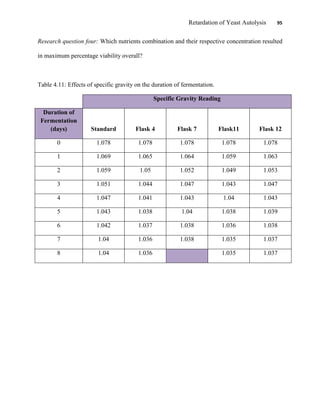
solution to the slurry (which would heighten the pH) for about 15 minutes at a temperature of
25°C (Sami et al., 1994). He noted that since entry of the dye is influenced by membrane
potential, the lowering of the external H +
concentration would favour the entry of the dye into
stressed cells, which normally give a false positive viability. Nevertheless, other dyes such as
methylene violet and trypan blue have recently been introduced as an improved staining
procedure that would provide more accurate results.
Retardation of Yeast Autolysis 53
Summary of literature review
It is evident that the introduction of nutrients into the fermentation medium not only
increases the fermentation process but also improves yeasts metabolic activities there by yield
maximum alcohol production. It is especially seen that the importance of Zn2+
ions and biotin
further enhances the progression of such process.
Although many studies have investigated the effects of commonly listed nutrients that is
necessary for yeast viability. Its viability and mortality in the presence of chromium chloride is
still not fully understood. As a result this research seeks to investigate varying concentrations of
CrCl3 and evaluate its effects with different concentrations of zinc sulphate in the presence and
absence of biotin.
Retardation of Yeast Autolysis 54
Chapter Three
Methodology
Introduction
In an effort to retard the level of yeast (lager) autolysis that occurs during the
fermentation process, additional nutrients was introduced into the medium (wort). The technique
selected was batch, and each vessel (flask) containing different concentration of nutrients were
monitored and controlled throughout the fermentation period. The process occurred under
anaerobic conditions and the temperature was maintained at 20ºC. During the fermentation
process, the specific gravity readings were recorded at set time intervals. This was to evaluate the
effectiveness of varying concentration levels of zinc sulphate (ZnSO4) and chromium chloride
(CrCl3), with and without the addition of biotin (vitamin B7). At the end of the process,
percentage cell viability, apparent attenuations and percentage alcohol produced were computed
to determine the optimum concentration of each nutrient.
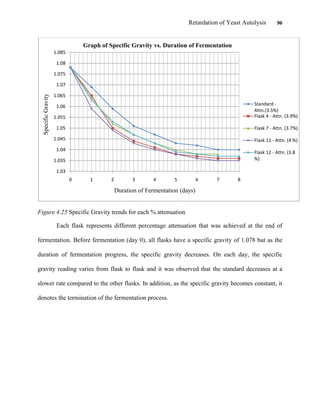
Retardation of Yeast Autolysis 55
Specific Procedures
Preliminary Wort Analysis
Prior to the addition of nutrients into the fermentation medium, preliminary investigations
were carried out on the wort to determine the initial concentration of Zn2+
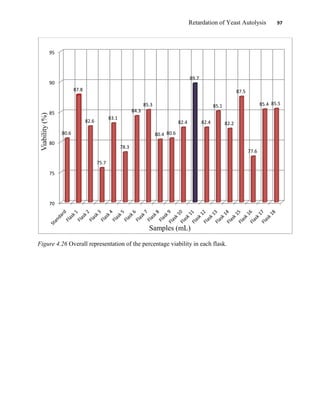
and Cr3+
present. This
was important, as it gave an estimation of the quantity of each nutrient that must be added to
achieve the desire experimental concentrations. The analysis was carryout at Mines and Geology
Division using an Atomic Mass Spectroscopy (AAS) where a concentration of was
detected for each metallic ion. The specific gravity analysis was then performed and the pH was
noted. This was to ensure that the medium met the requirements for satisfactory yeast growth and
product formation.
Preparation of Nutrients
The concentration of nutrients that must be added to the wort was computed by
subtracting the amount that was detected via preliminary analysis from the total (experimental
concentration). Concentrations were in units of milligrams of sample per litre of water ( ). The
experimental masses for the investigation were 100mg, 150mg, 200mg, 250 mg, and 300mg of
chromium chloride while that of zinc sulphate includes 2mg, 3mg, 4mg and biotin (vitamin B7)
was 0.6mg. Masses were measured using an analytical balance each of which was then dissolved
in 1000mL of distilled water. The solutions not only allow for homogeneity (uniform
composition and properties) but also facilitate the ease of utilization of nutrients by the yeast.
Retardation of Yeast Autolysis 56
Chromium Chloride Selection
A volume of 5mL of each nutrient solution was measured and poured into separate 125
mL conical flask. Five (5) different concentration of Chromium Chloride ,
and was added to five different flask with optimum concentration of biotin
( ) and zinc sulphate ( ).The volume was then made up to 125mL with wort. Table 1
below represents the above data.
Table 3.1: Different concentration levels of chromium chloride that was varied with optimal
concentration of Zinc ion and biotin (vitamin B7).
Flask # Cr3+
(mg/L) a
Zn2+
(mg/L) b
Biotin (mg/L)
1 100 4 0.6
2 150 4 0.6
3 200 4 0.6
4 250 4 0.6
5 300 4 0.6
a
Zn2+
and b
Biotin represents the optimum concentration in the wort (Synder et al. 2009).
During the fermentation process the specific gravity reading of each beer sample was
recorded every 24 hour. This was done not only to assess how the different concentration of each
nutrient in each flask affected the rate of fermentation, but it also provides an indication of the
end of the fermentation period.
Retardation of Yeast Autolysis 57
At the end of the fermentation process a cell viability analysis was conducted and the percentage
viability for each flask was calculated. This was done to determine the three optimum
concentrations of chromium chloride that gave the highest viability percentage. These were then
used for further investigations.
Nutrition for Maximum Cell Viability
Once the three optimum concentrations of chromium chloride were determined, the
concentration levels of each variable (Zn2+
and Cr3+
) were randomly selected for each trial, some
were in the presence or absence of biotin. This was to evaluate which combination of nutrients
resulted in the highest viability count. Given the experimental variables and the concentration
levels, it was clear that a general factorial design is suitable for the arrangement of each
experimental run. The table below represents a full description of the experimental variables and
their levels.
Retardation of Yeast Autolysis 58
Experimental design results
Table 3.2 Random selection of concentration levels for each variable in each flask
Note: Variables where Zn2+
Cr3+
and biotin and each flask represent the experimental runs and the concentration level of each
nutrient.
Therefore, 18 experiments (flask) would be sufficient to analyse the effects of each variable (at
different concentration) on the percentage cell viability. During the fermentation period, specific
gravity readings were recorded every 24 hours and the cell viability analysis was performed.
After which the optimum concentration of each nutrients was identified.
Retardation of Yeast Autolysis 59
Specific Gravity Analysis
Prior to the determination of the specific gravity, samples must be at a temperature of
20 ºC. Readings were taken three times per flask and for each analysis the sanitizing solution
(5% H2SO4) was changed. This was to prevent any cross contamination of concentrations from
flask to flask.
The density of the wort sample was recorded before, during and after the fermentation process
using a 0-32% Brix Refractometer. Readings were obtained in Brix and was converted to
specific gravity. This was done not only to assess the effects of the varying concentration levels
of nutrients on the rate of fermentation, but also to compute and evaluate the apparent attenuation
and percentage alcohol produced. Additionally, it is used to indicate the end of the fermentation
process which is important for further analysis (percentage cell viability) of the beer sample.
Cell Viability Analysis
At the end of the fermentation process, each flask was continuously swirled to break up
the yeast flocs. After homogeneity was achieved, 15 mL of each sample was pipette and
transferred into sample tubes. Prior to analysis a dilution was done to allow for easy counting
of the yeast cells (counting will be difficult if the sample is too concentrated). 1000 µL of 1%
methylene blue solution was then added to the test tube. The importance of the methylene
solution was to distinguish the dead (which will absorb the stain blue) and viable cells (does not
absorbed the stain).
A cover slip was used to cover the counting areas of the hemocytometer, after which a
small amount of the sample was extracted and carefully loaded into the counting chamber. This
was done via capillary tubes. The use of capillary tubes and hemocytometer cover slips was to
Retardation of Yeast Autolysis 60
prevent flooding and under loading of chambers. The hemocytometer was then placed under a
light microscope and the number of dead, living and total cells were counted and tabulated. The
percentage cell viability can then be determined which was used to assess the extent to which
yeast autolysis did occurred during the fermentation process. A detailed experimental procedure
for all method of analysis can be seen in appendix B.
Note: Time Line see appendix D
Retardation of Yeast Autolysis 61
Chapter 4
Results and Data Presentations
Results
This chapter presents the results generated by the various instruments used to address the
research questions highlighted in chapter one. In order to answer the research questions the data
collected using the instruments described in chapter three were analyzed and presented using
tables, graphs and charts. The method of analysis and presentation of the results were informed
by the specific research question being addressed. However, before the four research questions
are considered, data collected concerning preliminary analysis of the wort sample were
conducted to evaluate some initial properties of the wort. The results from these analyses are
presented in Table 4.1.
Table 4.1: Preliminary Results
As shown above, the initial concentration of Zn2+
and Cr3+
ions in the wort were lower
than the experimental concentrations. As result, additional nutrients were necessary to assess and
evaluate the effects of these nutrients (in the presence and absence of biotin) on the fermentation
process and yeast performance. On the other hand, the initial pH and specific gravity readings
were within the specified range to sustain yeast growth. Hence, no adjustments were made.
Concentration of Zn2+
< 0.1 mg/L
Concentration of Cr3+
< 0.1 mg/L
pH 4.8 – 5.2
Specific Gravity 1.078 – 1.080
Retardation of Yeast Autolysis 62
Research question one: What concentrations of chromium chloride (CrCl3) gives maximum
percentage viability, in the presence of biotin (vitamin B7) and zinc sulphate (ZnSO4) at their
optimum concentration?
To answer this question, five different concentrations of chromium chloride (100, 150
200 250 and 300 mg/L) were used, after which three concentrations that resulted in high
percentage viability counts were used for further investigations. Table 4.2 below presents the
experimental results.
Table 4.2: Effects of Cr3+
concentrations on yeast viability, percentage alcohol content and
attenuation at optimal concentration of Zn2+
(4mg/L) and biotin (0.6 mg/L).
Cr3+
(mg/L) Viability (%) Alcohol Content (%) Attenuation (%)
100 77.8 5.3 3.7
150 82.9 5.9 4.1
200 75 5.9 4.1
250 75.7 5.9 4.1
300 78 5.6 3.9
Retardation of Yeast Autolysis 63
Figure 4.1: Effects of Cr3+
ions concentrations on yeast viability.
As illustrated in figure 4.1 above, the results indicate that the percentage viability
increases steadily as the Cr3+
concentration increases. After which it decreases above
concentration levels of 150 mg/L. However, at concentrations greater than 230 mg/L the
percentage viability increases. This observation led to an analysis of the percentage alcohol
produce and percentage attenuation shown in figure 4.2 below.
74
75
76
77
78
79
80
81
82
83
84
100 150 200 250 300 350
Viability(%)
Concentration (mg/L)
Graph of % Viability vs. Concentration
Viability
Retardation of Yeast Autolysis 64
Figure 4.2: Effects of Cr3+ concentration on the percentage alcohol content and attenuation.
From figure 4.2 shown above, similar patterns were observed for the percentage alcohol
and attenuation with increasing concentrations of Cr3+
ions. Nevertheless, it must be noted that as
the concentration increases from 150 mg/L to about 220 mg/L (shown in figure 4.1), the
percentage viability decreases steadily. However, the percentage alcohol produced over the same
range was constant (optimum) after which it decreases at Cr3+
concentration of 250 mg/L. This
decrease accounts for the increase in percentage viability above Cr3+
concentration of 220mg/L
observed in figure 4.1. Nonetheless, the overall results indicated that the three optimal
concentrations of chromium chloride that resulted in the maximum percentage viability were 100
mg/L 150 mg/L and 300 mg/L.
0
1
2
3
4
5
6
7
100 150 200 250 300 350
ExperimentalParameters
Concentration of Cr3+ (mg/L)
Graph of Concentration vs. % Alcohol Conetnt and Attenuation
Alcoho Content (%)
Attenuation (%)
Retardation of Yeast Autolysis 65
Research question 2: How does the varying concentrations of zinc sulphate (ZnSO4), and
chromium chloride (CrCl3) in the presence and absence of biotin (vitamin B7) affect yeast
viability and percentage alcohol produced?
To evaluate each nutrient in the presence and absence of biotin, the effects on the
percentage viability and percentage alcohol produced was first determined with constant
concentrations of Zn2+
and varying concentrations of Cr3+
in the presence and absence of biotin.
After which constant concentrations of Cr3+
ions and varying concentrations of Zn2+
were
analysed.
Table 4.3: Effects on percentage viability and percentage alcohol produced with constant
concentrations of Zn2+
and varying concentration levels of Cr3+
in the presence of biotin.
Zn 2+
(mg/L) Cr3+
(mg/L) Viability (%) Alcohol Content (%)
2 100 83.5 5.7
2 150 85.5 5.7
2 300 82.6 5.5
3 100 87.8 5.3
3 150 80.6 5.7
3 300 89.7 5.7
4 100 77.6 5.7
4 150 83.1 5.6
4 300 80.4 5.7
Retardation of Yeast Autolysis 66
Figure 4.3: Effects of Cr3+ on yeast viability at constant Zn2+ concentrations in the presence of
biotin.
From Figure 4.3 shown above, it was observed that concentrations of Zn2+
at 2 mg/L and
4 mg/L had comparable effects on the percentage viability. For both variables, the percentage
viability increases with increasing concentration of Cr3+
from 100 to 150 mg/L. However, above
150 mg/L, the percentage viability decreases. Conversely, concentration of Zn 2+
at 3 mg/L has a
reverse effect on the percentage viability. The graph illustrates that the percentage viability
consistently increases above 150 mg/L (Cr3+
), whereby at 220 mg/L maximum viability was
achieved compared to that of Zn2+
at 2 and 4 mg/L. The viability continued to accelerate until a
maximum at 300 mg/L.
76
78
80
82
84
86
88
90
92
100 150 200 250 300 350
Viability(%)
Concentration of Cr3+ (mg/L)
Graph of % Viability vs. Concentration
Zn2+ (2 mg/L)
Zn2+ (3 mg/L)
Zn2+ (4 mg/L)
Retardation of Yeast Autolysis 67
Figure 4.4: Effects of Cr3+ on percentage alcohol content at constant Zn2+ concentrations in the
presence of biotin.
Initially, concentrations of Zn2+
(2 and 4 mg/L) with the addition of 100 mg/L (Cr3+
), the
alcohol content produced was 5.7%. On the other hand, Zn2+
at 3 mg/L produces a minimal of
5.3%. In addition, at this concentration, the alcohol level steadily increases with increasing
concentration of Cr3+
. It was also examined that as the concentration surpassed 150 mg/L
maximum alcohol was achieved (over 5.7%). However, a steady decline was observed at 280
mg/L until a constant quantity of 5.7%. It was evident that the trend of Zn2+
at 2 and 4 mg/L
became incomparable over 100 mg/L. At Zn2+
(2 mg/L), the alcohol level increased slowly to
150 mg/L but decreases above 150 mg/L. In contrast, Zn2+
at 4 mg/L, the alcohol level decreased
to 150 mg/L but increases above 150 mg/L.
5.25
5.3
5.35
5.4
5.45
5.5
5.55
5.6
5.65
5.7
5.75
100 150 200 250 300 350
AlcoholContent(%)
Concentration of Cr3+ (mg/L)
Graph of % Alcohol Content vs. Concentration
Zn2+(2 mg/L)
Zn2+(3 mg/L)
Zn2+(4mg/L)
Retardation of Yeast Autolysis 68
Table 4.4: Effects on percentage viability and percentage alcohol produced with constant
concentrations of Zn2+
and varying concentration levels of Cr3+
in the absence of biotin.
Zn 2+
(mg/L) Cr3+
(mg/L) Viability (%) Alcohol Content (%)
2 100 78.3 5.3
2 150 84.3 5.3
2 300 85.3 5.3
3 100 75.7 5.1
3 150 87.5 5.5
3 300 82.2 5.3
4 100 82.4 5.1
4 150 82.4 5.5
4 300 85.1 5.1
Retardation of Yeast Autolysis 69
Figure 4.5: Effects of Cr3+
on yeast viability at constant Zn2+
concentrations in the absence of
biotin.
Initially, for both concentrations of Zn2+
at 2 mg/L and 4 mg/L, the percentage viability
increases steadily as the varying concentrations of Cr3+
increases. However, concentration of
Zn2+
at 3 mg/L, the percentage viability increases to150 mg/L (Cr3+
) but gradually declines when
the concentration surpasses this point.
74
76
78
80
82
84
86
88
90
100 150 200 250 300 350
Viability(%)
Concentration of Cr3+ (mg/L)
Graph of % Viability vs. Concentration
Zn2+ (2 mg/L)
Zn2+ (3 mg/L)
Zn2+ (4 mg/L)
Retardation of Yeast Autolysis 70
Figure 4.6: Effects of Cr3+
on percentage alcohol content at constant Zn2+
concentrations in the
absence of biotin.
From Figure 4.6 shown above, both concentration of Zn2+
at 3 and 4 mg/L have
comparable effects. Initially, the alcohol produced was 5.1 % when Cr3+
was at 100 mg/L. As the
concentration of Cr3+
increases to 150 mg/L, the alcohol content increases until it reaches a
maximum of 5.5%. After which the alcohol level decreases until it reaches 300 mg/L (Cr3+
).
However, at this point different alcohol contents were observed. At Zn2+
(3 mg/L), the alcohol
content was 5.3% while at 4 mg/L it was 5.1%. It was observed that as the concentration of Cr3+
varied from 100 to 300 mg/L, maximum alcohol produced was at 5.3%.
5.05
5.1
5.15
5.2
5.25
5.3
5.35
5.4
5.45
5.5
5.55
100 150 200 250 300 350
AlcoholContent(%)
Concentration of Cr3+ (mg/L)
Graph of % Alcohol Content vs. Concentration
Zn2+ (2 mg/L)
Zn2+ (3 mg/L)
Zn2+ (4 mg/L)
Retardation of Yeast Autolysis 71
Table 4.5: Effects on percentage viability and percentage alcohol produced with constant
concentrations of Cr3+
and varying concentration levels of Zn2+
in the presence of biotin.
Cr3+
(mg/L) Zn 2+
(mg/L) Viability (%) Alcohol Content (%)
100 2 83.5 5.7
100 3 87.8 5.3
100 4 77.6 5.7
150 2 85.5 5.7
150 3 80.6 5.7
150 4 83.1 5.6
300 2 82.6 5.5
300 3 89.7 5.7
300 4 80.4 5.7
Retardation of Yeast Autolysis 72
Figure 4.7: Effects of Zn2+
on yeast viability and alcohol content when Cr3+
is constant at 100
mg/L in the presence of biotin.
Figure 4.7 above illustrates an increase in the percentage viability as the percentage
alcohol produce declines. Thus there was an indirect relationship between both variables.
5.25
5.3
5.35
5.4
5.45
5.5
5.55
5.6
5.65
5.7
5.75
76
78
80
82
84
86
88
90
2 3 4 5
AlcoholContent(%)
Viabilty(%)
Concentration of Zn2+ (mg/L)
Graph of % Viability and Alcohol Content vs. Concentration
Viability (%) - Cr3+
(100 mg/L)
Alcohol Content (%) -
Cr3+ (100 mg/L)
Retardation of Yeast Autolysis 73
Figure 4.8: Effects of Zn2+
on yeast viability and alcohol content when Cr3+
is constant at 150
mg/L in the presence of biotin.
The same relationship was observed here as mention in figure 4.7 above. Hence when
concentrations of chromium are constant at 100 and 150 mg/L with varying Zn2+
yeast cells are
sensitive to environmental stresses.
5.58
5.6
5.62
5.64
5.66
5.68
5.7
5.72
80
81
82
83
84
85
86
2 3 4 5
AlcoholContent(%)
Viability(%)
Concentration of Zn2+ (mg/L)
Graph of % Viability and Alcohol Content vs. Concentration
Viability (%) - Cr3+ (150
mg/L)
Alcohol Content (%) -
Cr3+ (150 mg/L)
Retardation of Yeast Autolysis 74
Figure 4.9: Effects of Zn2+
on yeast viability and alcohol content when Cr3+
is constant at 300
mg/L in the presence of biotin.
In contrast to figure 4.7 and figure 4.8 when Cr3+
concentration was constant at 300 mg/L
with varying zinc concentrations there is a direct correlation between the percentage viability and
percentage alcohol.
5.45
5.5
5.55
5.6
5.65
5.7
5.75
78
80
82
84
86
88
90
92
2 3 4 5
AlcoholContent(%)
Viability(%)
Concentration of Zn2+ (mg/L)
Graph % Viability and Alcohol Content vs. Concentration
Viability (%) - Cr3+
(300 mg/L)
Alcohol Content (%) -
Cr3+ (300 mg/L)
Retardation of Yeast Autolysis 75
Table 4.6: Effects on % viability and % alcohol produced with constant concentrations of
Cr3+
and varying concentration levels of Zn2+
in the absence of biotin.
Cr3+
(mg/L) Zn 2+
(mg/L) Viability (%) Alcohol Content (%)
100 2 78.3 5.3
100 3 75.7 5.1
100 4 82.4 5.1
150 2 84.3 5.3
150 3 87.5 5.5
150 4 82.4 5.5
300 2 85.3 5.3
300 3 82.2 5.3
300 4 85.1 5.1
Retardation of Yeast Autolysis 76
Figure 4.10: Effects of Zn2+
on yeast viability and alcohol content when Cr3+
is constant at 100
mg/L in the absence of biotin.
5.05
5.1
5.15
5.2
5.25
5.3
5.35
75
76
77
78
79
80
81
82
83
2 3 4 5
AlcoholContent(%)
Viability(%)
Concentration of Zn2+ (mg/L)
Graph of % Viability and Alcohol Content vs. Concentration
Viability (%) - Cr3+
(100 mg/L)
Alcohol Content (%) -
Cr3+ (100 mg/L)
Retardation of Yeast Autolysis 77
Figure 4.11: Effects of Zn2+
on yeast viability and alcohol content when Cr3+
is constant at 150
mg/L in the absence of biotin.
Figure 4.10 and 4.11 shows a direct relationship in the percentage viability and
percentage alcohol produced in the absence of biotin.
5.25
5.3
5.35
5.4
5.45
5.5
5.55
82
83
84
85
86
87
88
2 3 4 5
AlcoholConetnt(%)
Viability(%)
Concentration of Zn2+ (mg/L)
Graph of % Viability and Alcohol Content vs. Concentration
Viability(%) - Cr3+ (150
mg/L)
Alcohol Content (%) -
Cr3+ (150 mg/L)
Retardation of Yeast Autolysis 78
Figure 4.12: Effects of Zn2+
on yeast viability and alcohol content when Cr3+
is constant at 300
mg/L in the absence of biotin.
Figure 4.12 shows an indirect relationship in the absence of biotin.
5.05
5.1
5.15
5.2
5.25
5.3
5.35
82
82.5
83
83.5
84
84.5
85
85.5
2 3 4 5
AlcoholContent(%)
Viability(%)
Concentration of Zn2+ (mg/L)
Graph of % Viability and Alcohol Content vs. Concentration
Viability (%) - Cr3+
(300 mg/L)
Alcohol Content (%)
- Cr3+ (300 mg/L)
Retardation of Yeast Autolysis 79
Research question 3: How is the rate of fermentation affected by the presence of these nutrients
and the percentage viability?
To access the effect of each nutrient on the rate of the fermentation process, a direct
relationship was made between the duration of fermentation and the percentage viability for each
nutrient in the presence and absence of biotin. To answer this question the effects of constant
concentrations of Zn2+
with varying concentrations of Cr3+
in the presence and absence of biotin
were observed. After which constant concentrations of Cr3+
ions and varying concentrations of
Zn2+
were examine.
Table 4.7: Effects on the duration of fermentation and percentage viability with constant
concentrations of Zn2+
and varying concentration levels of Cr3+
in the presence of biotin.
Zn 2+
(mg/L) Cr3+
(mg/L) Viability (%)
Duration of
Fermentation (days)
2 100 83.5 7
2 150 85.5 6
2 300 82.6 7
3 100 87.8 5
3 150 80.6 7
3 300 89.7 7
4 100 77.6 7
4 150 83.1 7
4 300 80.4 7
Retardation of Yeast Autolysis 80
Figure 4.13: Effects of Cr3+
on the duration of fermentation when Zn2+
is constant at 2 mg/L in
the presence of biotin.
Initially, the duration of fermentation decreases when Cr3+
increases from 100 to 150
mg/L as shown in Figure 4.13. Similarly, the percentage viability increases. However, as the
concentration of Cr3+
increases above 150 mg/L, the duration of fermentation increases steadily
until the maximum day (7th
day) was reached. On the other hand, the percentage viability
decreases when it surpasses 150 mg/L. The graph above also indicates that at the highest
viability of 85.5 % (Cr3+
at 150 mg/L), the duration of fermentation was minimal (at 6 days).
0
1
2
3
4
5
6
7
8
82
82.5
83
83.5
84
84.5
85
85.5
86
100 150 200 250 300 350
DurattionofFermentation(days)
Viability(%)
Concentration of Cr3+ (mg/L)
Graph of % Viability and Duration of Fermentation vs. Concentration
Viability (%) - Zn2+
(2 mg/L)
Duration of
Fermentaion (days)
- Zn2+ (2 mg/L)
Retardation of Yeast Autolysis 81
Figure 4.14: Effects of Cr3+
on the duration of fermentation when Zn2+
is constant at 3 mg/L in
the presence of biotin.
The duration of the fermentation process took 6 days at Cr3+
concentration of 100 mg/L
and viability of 87.8%. Nevertheless, the duration of fermentation increases to a maximum when
Cr3+
reaches 150 mg/L (lowest viability of 80.6% achieved), after which it remains constant
when the percentage viability increases.
0
1
2
3
4
5
6
7
8
80
82
84
86
88
90
92
100 150 200 250 300 350
DurationofFermentation(days)
Viability(%)
Concentration of Cr3+ (mg/L)
Graph of % Viability and Duration of Fermentation vs. Concentration
Viability (%) - Zn2+ (3
mg/L)
Duration of
Fermentation (days) -
Zn2+ (3 mg/L)
Retardation of Yeast Autolysis 82
Figure 4.15 Effects of Cr3+
on the duration of fermentation when Zn2+
is constant at 4 mg/L in the
presence of biotin.
As shown above in Figure 15, the duration of fermentation is independent of the
percentage viability and also when the concentration of Cr3+
increases.
0
1
2
3
4
5
6
7
8
77
78
79
80
81
82
83
84
100 150 200 250 300 350
DurationofFermentation(days)
Viability(%)
Concentration of Cr3+ (mg/L)
Graph of % Viability and Duration of Fermentation vs. Concentration
Viability (%) - Zn2+ (4
mg/L)
Duration of
Fermentation (days) -
Zn2+ (4 mg/L)
Retardation of Yeast Autolysis 83
Table 4.8: Effects on the duration of fermentation and percentage viability with constant
concentrations of Zn2+
and varying concentration levels of Cr3+
in the absence of biotin.
Zn 2+
(mg/L) Cr3+
(mg/L) Viability (%)
Duration of
Fermentation (days)
2 100 78.3 6
2 150 84.3 7
2 300 85.3 6
3 100 75.7 6
3 150 87.5 7
3 300 82.2 6
4 100 82.4 5
4 150 82.4 7
4 300 85.1 5
Retardation of Yeast Autolysis 84
Figure 4.16: Effects of Cr3+
on the duration of fermentation when Zn2+
is constant at 2 mg/L in
the absence of biotin.
Primarily, the viability of 78.3 %, the duration of fermentation was 6 days but as the
percentage viability increases, the duration increases. It was observed that when the viability of
84.3 % at 150 mg/L was achieved, the duration reached its maximum (7 days) but declined as the
percentage viability continues to increase.
0
1
2
3
4
5
6
7
8
77
78
79
80
81
82
83
84
85
86
100 150 200 250 300 350
DurationofFermentation(days)
Viability(%)
Concentration of Cr3+ (mg/L)
Graph of % Viability and Duration of Fermentation vs. Concentration
Viability (%) - Zn2+ (2
mg/L)
Duration of
Fermentation (days) -
Zn2+ (2 mg/L)
Retardation of Yeast Autolysis 85
Figure 4.17 Effects of Cr3+
on the duration of fermentation when Zn2+
is constant at 3 mg/L in the
absence of biotin.
The same trend from Figure 4.16 when Cr3+
ranges from 100 to 150 mg/L was shown on
the graph above. The viability increases with an increase in the duration of fermentation but as
the concentration surpasses 150 mg/L, both the percentage viability and the duration increases.
0
1
2
3
4
5
6
7
8
74
76
78
80
82
84
86
88
90
100 150 200 250 300 350
DurationofFermentation(days)
Viability(%)
Concentration of Cr3+ (mg/L)
Graph of % Viability and Duration of Fermentation vs. Concentration
Viability (%) - Zn2+ (3
mg/L)
Duration of
Fermentation (days) -
Zn2+ (3 mg/L)
Retardation of Yeast Autolysis 86
Figure 4.18: Effects of Cr3+
on the duration of fermentation when Zn2+
is constant at 4 mg/L in
the absence of biotin.
The percentage viability steadily increases until it reaches its maximum of 85.1% when
the concentration Cr3+
increases from 100 to 300 mg/L. At first, the duration of fermentation
established was at its minimum (6 days) and increases to its maximum at 150 mg/L. However,
over Cr3+
150 mg/L, it decreases steadily.
0
1
2
3
4
5
6
7
8
82
82.5
83
83.5
84
84.5
85
85.5
100 150 200 250 300 350
DurationofFermentation(days)
Viability(%)
Concentration of Cr3+ (mg/L)
Graph of % Viability and Duration of Fermentation vs. Concentration
Viability (%) - Zn2+ (4
mg/L)
Duration of
Fermentation (days) -
Zn2+ (4 mg/L)
Retardation of Yeast Autolysis 87
Table 4.9: Effects of the % viability and duration of fermentation with constant concentrations of
Cr3+
and varying concentration levels of Zn2+
in the presence of biotin.
Cr3+
(mg/L) Zn 2+
(mg/L) Viability (%)
Duration of
Fermentation (days)
100 2 83.5 7
100 3 87.8 5
100 4 77.6 7
150 2 85.5 6
150 3 80.6 7
150 4 83.1 7
300 2 82.6 7
300 3 89.7 7
300 4 80.4 7
Retardation of Yeast Autolysis 88
Figure 4.19: Effects of Zn2+ on the duration of fermentation when Cr3+ is constant at 100 mg/L
in the presence of biotin.
Figure 4.19 above indicates that with increasing concentrations of Zn2+
above 3mg/L
resulted in an increase in the duration of the fermentation process. Additionally, as the
percentage viability decreases the duration of the fermentation process also decreases.
0
1
2
3
4
5
6
7
8
76
78
80
82
84
86
88
90
2 3 4 5
DurationofFermentation(days)
Viability(%)
Concentration of Zn2+ (mg/L)
Graph of % Viability and Duration of Fermentation vs. Concentration
Viability (%) -
Cr3+(100 mg/L)
Duration of
Fermentation (days)
- Cr3+ (100 mg/L)
Retardation of Yeast Autolysis 89
Figure 4.20: Effects of Zn2+
on the duration of fermentation when Cr3+
is constant at 150 mg/L in
the presence of biotin.
Figure 4.20 can be said to depict a similar representation as shown in figure 4.19 above.
However, varying concentrations of Zn2+
does not have an immediate effect on the rate of
fermentation process.
0
1
2
3
4
5
6
7
8
80
81
82
83
84
85
86
2 3 4 5
DurationofFermentation(days)
Viability(%)
Concentration of Zn2+ (mg/L)
Graph of % Viability and Duration of Fermentation vs. Concentration
Viability (%) - Cr3+ (150
mg/L)
Duration of
Fermentation (days) -
Cr3+ (150 mg/L)
Retardation of Yeast Autolysis 90
Figure 4.21: Effects of Zn2+
on the duration of fermentation when Cr3+
is constant at 300 mg/L in
the presence of biotin.
In contrary to figure 4.19 and 4.20 above the duration of the fermentation process is
independent of the % viability and the varying concentrations of Zn2+
in the presence of biotin.
0
1
2
3
4
5
6
7
8
78
80
82
84
86
88
90
92
2 3 4 5
DurationofFermentation(days)
Viability(%)
Concentration of Zn2+ (mg/L)
Graph of % Viability and Duration of Fermentation vs. Concentration
Viability (%) - Cr3+ (300
mg/L)
Duration of Fermentation
(days) - Cr3+ (300 mg/L)
Retardation of Yeast Autolysis 91
Table 4.10: Effects of the % viability and duration of fermentation with constant concentrations
of Cr3+
and varying concentration levels of Zn2+
in the absence of biotin.
Cr3+
(mg/L) Zn 2+
(mg/L) Viability (%) Duration of
Fermentation (days)
100 2 78.3 6
100 3 75.7 6
100 4 82.4 5
150 2 84.3 7
150 3 87.5 7
150 4 82.4 7
300 2 85.3 6
300 3 82.2 6
300 4 85.1 5
Retardation of Yeast Autolysis 92
Figure 4.22: Effects of Zn2+
on the duration of fermentation when Cr3+
is constant at 100 mg/L in
the absence of biotin.
In the absence of biotin a similar relationship was observed where as the percentage
viability increases the duration of the process decreases.
0
1
2
3
4
5
6
7
75
76
77
78
79
80
81
82
83
2 3 4 5
DurationofFermentation(days)
Viability(%)
Concentration of Zn2+ (mg/L)
Graph of % Viability and Duration of Fermentation vs. Concentration
Viability (%) - Cr3+ (100 mg/L)
Duration of Fermenation
(days) - Cr3+ (100 mg/L)
Retardation of Yeast Autolysis 93
Figure 4.23 Effects of Zn2+
on the duration of fermentation when Cr3+
is constant at 150 mg/L in
the absence of biotin.
Figure 4.20 and the figure above illustrates that the duration of the fermentation process
was affected by the absence and presence of biotin. However unlike in the presence, in the
absence of biotin the duration is constant irrespective of the varying concentrations of Zn2+
ions.
0
1
2
3
4
5
6
7
8
82
83
84
85
86
87
88
2 3 4 5
DurationofFermentation(days)
Viability(%)
Concentration of Zn2+ (mg/L)
Graph of % Viability and Duration of Fermentation vs. Concentration
Viability (%) - Cr3+ (150 mg/L)
Duration of Fermentation (days)
- Cr3+ (150 mg/L)
Retardation of Yeast Autolysis 94
Figure 4.24: Effects of Zn2+
on the duration of fermentation when Cr3+
is constant at 300 mg/L in
the absence of biotin.
Figure 4.21 and figure 4.24 above, highlights that the duration of the fermentation
process is significantly affected by its absence, as an increase in the microbial population result
in a decrease in the rate of the fermentation process above Zn2+
concentrations of 3mg/L.
0
1
2
3
4
5
6
7
82
82.5
83
83.5
84
84.5
85
85.5
2 3 4 5
DurationofFermentation(days)
Viability(%)
Concentration of Zn2+ (mg/L)
Graph of % Viability and Duration of Fermentation vs. Concentration
Viability (%) - Cr3+(300
mg/L)
Duration of Fermentation
(days) - Cr3+ (300 mg/L)
Retardation of Yeast Autolysis 95
Research question four: Which nutrients combination and their respective concentration resulted
in maximum percentage viability overall?
Table 4.11: Effects of specific gravity on the duration of fermentation.
Specific Gravity Reading
Duration of
Fermentation
(days) Standard Flask 4 Flask 7 Flask11 Flask 12
0 1.078 1.078 1.078 1.078 1.078
1 1.069 1.065 1.064 1.059 1.063
2 1.059 1.05 1.052 1.049 1.053
3 1.051 1.044 1.047 1.043 1.047
4 1.047 1.041 1.043 1.04 1.043
5 1.043 1.038 1.04 1.038 1.039
6 1.042 1.037 1.038 1.036 1.038
7 1.04 1.036 1.038 1.035 1.037
8 1.04 1.036 1.035 1.037
Retardation of Yeast Autolysis 96
Figure 4.25 Specific Gravity trends for each % attenuation
Each flask represents different percentage attenuation that was achieved at the end of
fermentation. Before fermentation (day 0), all flasks have a specific gravity of 1.078 but as the
duration of fermentation progress, the specific gravity decreases. On each day, the specific
gravity reading varies from flask to flask and it was observed that the standard decreases at a
slower rate compared to the other flasks. In addition, as the specific gravity becomes constant, it
denotes the termination of the fermentation process.
1.03
1.035
1.04
1.045
1.05
1.055
1.06
1.065
1.07
1.075
1.08
1.085
0 1 2 3 4 5 6 7 8
SpecificGravity
Duration of Fermentation (days)
Graph of Specific Gravity vs. Duration of Fermentation
Standard -
Attn.(3.5%)
Flask 4 - Attn. (3.9%)
Flask 7 - Attn. (3.7%)
Flask 11 - Attn. (4 %)
Flask 12 - Attn. (3.8
%)
Retardation of Yeast Autolysis 97
Figure 4.26 Overall representation of the percentage viability in each flask.
70
75
80
85
90
95
80.6
87.8
82.6
75.7
83.1
78.3
84.3
85.3
80.4 80.6
82.4
89.7
82.4
85.1
82.2
87.5
77.6
85.4 85.5
Viability(%)
Samples (mL)
Retardation of Yeast Autolysis 98
Chapter Five
Discussion of Results
Introduction
This chapter presents the researcher‟s interpretation of the research findings through an
objective discussion highlighting the major findings of the study and indicating areas of
similarities with past studies cited in the review of literature. Limitations that were encounter in
this investigation were noted in addition to conclusions and recommendations to researchers
desirous of conducting further studies.
Discussion
A decrease in the percentage viability from 82.9% to 74.5% above Cr3+
concentration
levels of 150 mg/L, after which it increases to 78% beyond 230 mg/L, was illustrated in figure
4.1. This decrease in the viable cells could be a result of either the high concentration of Cr3+
ions or the alcohol being produced was lethal to the yeast cells. In figure 4.2 similar patterns
were observed for the percentage alcohol and attenuation with increasing concentrations of
Cr3+
ions. Nevertheless, it must be noted that as the concentration increases from 150 to about
220 mg/L the viability decreases steadily. However, the percentage alcohol produced over the
same range was constant (optimum). This means that even though the alcohol being produced
was constant with the varying concentration of Cr3+
the viable yeast cells were severely affected
by its presence. This agrees with Stanbury (2003) who dictated that, the microbial population
will be affected if there is a buildup of toxic substances. On the other hand, with concentrations
above 150 mg/L the percentage alcohol and percentage attenuation was constant until a
concentration of 250mg/L after which the percentage alcohol produced decreases. Hence, if there
is a decrease in the percentage alcohol produce then it simple means that the toxicity of the
Retardation of Yeast Autolysis 99
environment decreases, which means that more cells would be able to survive. Thus, the
percentage viability would be more, which accounts for the increase in the percentage viability
observed in Figure 4.1 (above Cr3+
230mg/L). Nonetheless the overall results indicated that the
three optimal concentrations of Cr3+
that resulted in the maximum percentage viability were 100
mg/L 150 mg/L and 300 mg/L.
In many fermentation processes, Zn2+
ions are said to be essential for alcohol
dehydrogenase (ADH) which is an enzyme that facilitates the reduction of acetaldehyde to
alcohol at the end of fermentation (Satyanarayana & Kunze, 2009). As a result, this led the
investigation of the effectiveness of Zn2+
on the percentage alcohol content produced illustrated
in figure 4.4 and 4.6.
According to Havkin-Frenkel & Belanger (2008), the presence of high acetaldehyde
concentration in the wort usually depicts a steady decline in yeast viability and the production of
alcohol. In Figure 4.3 and 4.4, this trend was shown with Zn2+
at 2 mg/L and varying
concentrations of Cr3+
above 150 mg/L in the presence of biotin. Jones (as cited in Boulton &
Quain, 2001) explains that acetaldehyde is highly toxic to yeast cells and can lead to the
inactivation of enzymes (for example alcohol dehydrogenase). However, in some instances, high
concentration of acetaldehyde may not affect the viability due to the fact that its level of toxicity
is low. A representation was shown in Figure 4.5 in the absence of biotin. In addition, the alcohol
content produced was very low, and as shown in Figure 4.6 the alcohol level produced reached
its maximum of 5.3% as the concentration of Cr3+
increases.
It was also observed that the percentage viability decreases when the concentration of
Zn2+
was constant at 4 mg/L (presence of biotin) as shown in Figure 4.3. However, it has a
reverse effect on the percentage alcohol content. According to D‟Amore (1992), the inhibition of
Retardation of Yeast Autolysis 100
cell growth and viability were observed to increase with increasing alcohol concentration. Thus,
it was evident that the varying concentration of Cr3+
(above 150 mg/L) did not promote yeast
tolerance to high alcohol concentration levels. In contrast to the high percentage viability with
increasing concentration of Cr3+
(above 150 mg/L), the enzyme was unable to produce sufficient
volume of alcohol in the absence of biotin as shown in Figure 4.5 and 4.6.
Alcohol dehydrogenase was very responsive to Zn2+
at 3 mg/L with varying
concentrations of Cr3+
(above 150 mg/L) as shown in Figure 4.3 and 4.4. Overall, the highest
percentage viability observed was at 300 mg/L with this Zn2+
concentration. Kulkarni et al.
(2011) stated that biotin plays an important role in the production of high alcohol concentration,
as it assists in yeast growth and metabolic activities, thus it was considered to be a contributing
factor on the maximum percentage viability and alcohol achieved.
Moreover, Satyanarayana and Kuze (2009) investigated the influence of zinc on alcohol
production during fermentation. The concentrations of zinc were tested at 0.9, 1.5, 2.5, 14 and
26.5 ppm (mg/L). They observed that high alcohol production was achieved at 2.5 ppm (mg/L)
of Zn2+
. The same pattern was observed with 3 mg/L of Zn2+
when Cr3+
over 150 mg/L (in
presence of biotin). With the combination of these concentrations of each nutrient, it has proven
that high percentage viability and maximum alcohol level were achieved. This confirms that the
enzyme was more receptive to concentrations of Zn2+
that ranges from 2.5-3 ppm. On the other
hand, insufficient quantity of biotin deleteriously affected the medium that contains Zn2+
at 3
mg/L (with Cr3+
over 150 mg/L) which further resulted in low percentage viability and alcohol
level (Figure 4.5 and 4.6).
The importance of biotin and Zn2+
has proven to facilitate in the production of alcohol.
However, varying concentrations of Cr3+
are contributing factors on the percentage viability
Retardation of Yeast Autolysis 101
which was very effective at 100 mg/L and 300 mg/L. Conclusively, constant concentration of
Zn2+
at 3 mg/L (with Cr3+
greater than 150 mg/L) not only increases the percentage viability but
also produces maximum percentage alcohol, which indicates high alcohol tolerance level of the
yeast.
In the same light as Stanbury (2003) Figure 4.7 in chapter four illustrates an increase in
the percentage viability as alcohol concentration declines. Two contributing factors to this could
be the concentration of Zn2+
ions or the toxicity of by-products formed. Additionally as
discussed earlier, concentrations of Zn2+
above 3mg/L tends to lead to an increase in the alcohol
concentration. However this could be detrimental to the microbial population at specific Cr3+
concentration, as increase alcohol content has an inhibitory effect on the yeast (by disruption of
the membranes) and would cause slow growth, no growth and then death. Figure 4.8 depicts a
similar representation. Thus, it is evident that at Cr3+
100 mg/L and 150mg/L the yeast is
sensitive to increasing alcohol concentration.
In contrast to figure 4.7 and figure 4.8, constant Cr3+
concentration at 300mg/L with
varying Zn2+
concentrations had a direct correlation between the percentage viability and
percentage alcohol. This relationship was also observed with varying concentrations of Cr3+
and
constant Zn2+
concentration at 3 mg/L where maximum percentage viability and percentage
alcohol were achieved. As a result Zn2+
concentration at 3 mg/L with Cr3+
at 300 mg/L in the
presence of biotin can be said to improve the alcohol tolerance level of yeast cells which makes
it ideal not only for alcohol production but also high percentage viability.
It was observed that for both constant concentrations of Cr3+
at 100 and 300 mg/L (figure
4.10 and 4.12) resulted in an increase in the percentage viability when Zn2+
concentration was 3
mg/L and above in the absence of biotin, but the sensitivity of the yeast was evident in figure
Retardation of Yeast Autolysis 102
4.12. Its absence negatively impacts the percentage viability and percentage alcohol produced at
constant Cr3+
(300 mg/L) while it gave an ideal relationship for constant Cr3+
(100mg/L) and
Cr3+
(150 mg/L). However, it must be noted that even though this was the case the percentage
viability was low (yeast is sensitive to high concentrations of alcohol) in comparison to in the
presence of biotin where not only maximum percentage alcohol was evident but also maximum
percentage viability which was achieved at constant Cr3+
(300mg/L) with Zn2+
concentration of
about 3mg/L. Thus, it can be concluded from these results that constant Cr3+
at 300 mg/L with
varying Zn2+
or constant Zn2+
at 3mg/L with varying Cr3+
yield maximum results overall in the
presence of biotin.
According to Bouix & Leveau (2001), the yeast performance in alcoholic fermentation
depends directly on yeast activity which can be seen as function of cell viability and the
physiological state of viable cells. This depicts the outcome of the fermentation process as well
as the duration. Usually, a relatively high viability with the correct proportion of nutrients
concentrations in the medium may reduce the duration of the fermentation process .However,
there are instances where an increase in concentration, (in this case Cr3+
) can extend the
fermentation process as shown in Figure 4.13 - 4.15. It was observed that at specific
concentrations the percentage viability was independent of the duration. In Figure 4.16 - 4.18,
concentrations of Cr3+
above 150 mg/L in the absence of biotin, the duration of fermentation
decreases. Buglass (2011) explains that nutritional shortages can give rise to incomplete
fermentation, naturally depending on the degree of limitation. To confirm that the decrease in the
duration was a result of stuck fermentation, in Figure 4.6, it was observed that for all Zn2+
concentration with Cr3+
above 150 mg/L had relatively low alcohol content (thereby high
Retardation of Yeast Autolysis 103
acetaldehyde concentration). Additionally, Havkin -Frenkel and Belanger (2008) explained that
excess acetaldehyde production can be as a results of stuck fermentation.
The lack of nutrients in the fermentation medium, will affect the duration as well as other
parameters. It was also evident that duration of fermentation was affected by several factors such
as the level of alcohol produced and to some extent the viability of the yeast. Conclusively, the
increases in Cr3+
concentration affected the duration in the presence of biotin. It was confirmed
that Zn2+
at 3 mg/L with the highest Cr3+
concentration (300 mg/L), gave high percentage
viability and alcohol content but the duration of fermentation was excessive.
Figure 4.19 indicates that with increasing concentrations of Zn2+
above 3mg/L resulted in
an increase in the duration of the fermentation process. Additionally, as the percentage viability
decreases the duration of the fermentation process also decreases. Which means that at constant
concentrations of Cr3+
(100mg/L) with varying Zn2+
concentration not only affects the viability
but also the duration of the fermentation process in the presence of biotin. Likewise, figure 4.20
depicts a similar representation. However, varying concentrations of Zn2+
does not have an
immediate effect on the rate of fermentation process. In contrary to figure 4.19 and 4.20 the
duration of the fermentation process is independent of the percentage viability and the varying
concentrations of Zn2+
in the presence of biotin. This signifies that even though maximum
percentage alcohol and percentage viability can be achieved the duration will be unaffected
(7 days) at constant concentrations of Cr3+
at 300 mg/L.
In the absence of biotin a similar relationship was observed where as the percentage
viability increases the duration of the process decreases in figure 4.22. Thus, the presence and
absence of biotin does not severely affect the duration at constant concentrations of Cr3+
(100
mg/L). Figure 4.20 and the figure 4.23 illustrates that the duration of the fermentation process
Retardation of Yeast Autolysis 104
was affected by the absence and presence of biotin. However in its absence the duration was
constant irrespective of the varying concentrations of Zn2+.
Figure 4.21 and figure 4.24 highlights that the duration of the fermentation process is
significantly affected by its absence, as an increase in the microbial population result in a
decrease in the rate of the fermentation process above Zn2+
concentrations of 3mg/L.
Nevertheless, even though the duration of the fermentation process decreases with increasing
percentage viability in the absence of biotin at constant concentrations of Cr3+
300mg/L, neither
maximum percentage viability (89.7%) nor optimum percentage alcohol (5.7%) would be
achieved. Moreover, despite the fact that constant Cr3+
100mg/L and 150mg/L in the presence
and Cr3+
100mg/L in the absence of biotin resulted in a decrease in the rate of fermentation,
maximum percentage viability and percentage alcohol was not obtained.
Summary and Conclusion
In general, the specific gravity usually depicts how well the yeast respond to the different
concentrations of nutrients contained in a medium and its capability of utilising the sugar to
produce alcohol during fermentation. As the fermentation proceeds, as shown in Figure 4.25, the
specific gravity decreases due to the utilization of the carbohydrates (sugars) present in the wort
by the yeast. In each flask, the yeast metabolises at different rates and with the addition of
nutrients, the specific gravity decreases at a faster rate when compared to the standard. In
addition, varied concentrations of each nutrient affect the response level of the microorganism to
utilize the sugar. Low specific gravity indicates fast metabolic activity and also high percentage
attenuation at the end of fermentation. This was evident in flask 11 containing concentration of
Zn2+
(at 3 mg/L) and Cr3+
(at 300 mg/L) with an attenuation of 4%. The percentage attenuation is
directly related to the alcohol content. As a result, flask 11 also produces high alcohol
Retardation of Yeast Autolysis 105
concentration and as shown in Figure 4.26, high percentage viability. As a result this was a clear
indication that optimum concentration of Zn2+
and Cr3+
in the presence of biotin was observed in
this flask.
Retardation of Yeast Autolysis 106
Limitations
The most significant hindrance to this study was the difficulty to obtain standards of
biotin to determine the initial concentration present in the wort. Additionally, the use of
methylene blue dye tends to give inaccuracy in results when viable cells in the sample are below
90 percent. Moreover, even though aseptic techniques were practice there is still the possibility
of contaminants being introduced into the fermentation medium during the transferral of yeast
into each flask. The present of contaminants would deprive yeast of available substrate, resulting
in a reduction of alcohol production and microbial growth. These could cause errors in data
analysis as those were the investigated variables.
Recommendations
Chromium chloride (Cr3+
) concentration of 100 mg/L and Zn2+
at 3mg/L resulted in the
second highest viability in the presence of biotin. However, it must be noted that an increase in
the percentage viability resulted in a decrease in the duration of the fermentation process. This is
ideal (in comparison to that of Cr3+
(300) and Zn2+
at 3 mg/L) even though it did not gave
maximum results overall. As a result, the researcher‟s sought it necessary that further
investigations can be done around Cr3+
concentration of 100mg/L with Zn2+
at 3 mg/L in the
presence of biotin. Additionally, Trypan Blue dye is recommended for viability analysis as the
used of Methylene Blue may give inaccuracy in the results if the amount of viable cells in the
sample are below 90 percent.
Retardation of Yeast Autolysis 107
References
Abd-Elsalam, I. S. (2011). Factorial Design for some parameters affecting Chromium III uptake
by Saccharomyces Cerevisiae. International Journal of Applied Biology and Pharmaceutical
Technology , 2 (1), 33-40.
Anderson, R. A. (2000). Quick Access: Consumer Guide to Conditions, Herbs & Supplements
(1st ed.). Massachusetts: Integravtive Medicine Communications.
Azam-Ali, S. (2008). About Us: Appropedia. Retrieved May 21, 2011, from Appropedia
Website: http://www.appropedia.org/Grape_wine_(Practical_Action_Brief)
Bhagavan, N. V., & Ha, C. (2011). Essentials of Medical Biochemistry: With Clinical Cases.
London: Academic Press.
Birch, R. M., & Walker, G. M. (2000). Influence of magnesium ions on heat shock and ethanol
stress responses of Saccharomyces Cerevisiae. Enzyme and Microbial Technology , 26 (9-10),
678-687.
Boekhout, T., & Robert, V. (2003). Yeasts in Food: Beneficial and Detrimental Aspects.
Hamburg: Behr's Verlag.
Bouix, M., & Leveau, J. (2001). Rapid Assessment of Yeast Viability and Yeast Vitality during
Alcoholic Fermentation. Journal of the Institute of Brewing , 107 (4), 217-225.
Boulton, C., & Quain, D. (2001). Brewing Yeast and Fermentation. London: Blackwell Science
Ltd.
Retardation of Yeast Autolysis 108
Bravi, E., Perretti, G., Buzzini, P., Della, S. R., & Fantozzi, P. (2009). Technological steps and
yeast biomass as factors affecting the lipid content of beer during the brewing process. Journal of
Agricultural and Food Chemistry , 57 (14), 6279-84.
Briggs, D. E., Boulton, C. A., Brookes, P. A., & Stevens, R. (2004). Brewing: Science and
Practice. Cambridge: Woodhead Publishing Ltd.
Briggs, D. E., Hough, J. S., Stevens, R., & Young, T. W. (1999). Malting and Brewing Science
(2nd ed., Vol. 2). New York: Aspen Publisher.
Buglass, A. J. (2011). Handbook of Alcoholic Beverages: Technical, Analytical and Nutritional
Aspects. New Jersey: Wiley.
Cabrera, C. (2002). Fibromyalgia: A Journey Toward Healing. New York: McGraw- Hill.
Chotineeranat, S., Wansuksri, R., Piyachomkwan, K., Chatakanonda, P., Weerathaworn, P., &
Sriroth, K. (2010). Effect of Calcium Ions on Ethanol Production from Molasses by
Saccharomyces cerevisiae. Sugar Technology , 2, 120-124(5).
D'Amore, T. (1992). Improving yeast fermentation performance. Journal of the Institute of
Brewing , 98, 375-382.
Ebbing, D., & Gammon, S. D. (2010). General Chemistry (9th ed.). California: Cengage
Learning.
Esser, K., Bennett, J. W., & Osiewacz, H. D. (2002). The Mycota: A Comprehensive Treatise on
Fungi as Experimental Systems for Basic and Applied Research. New York: Springer.
Retardation of Yeast Autolysis 109
Eßlinger, H. M. (2009). Handbook of Brewing: Proceses, Technology, Markets. Germany:
Wiley-VCH.
Evans, D. E., & Hamet, M. A. (2005). The Selection of a Dried Yeast Strain for use in the
Apparent Attenuation Limit Malt Analysis (AAL) Procedure. Journal of the Institute of Brewing
, 111 (2), 209-214.
Featherstone, S., & G, T. (2011). Essentials of Thermal Processing. Oxford: Blackwell
Publishing Ltd.
Fleet, G., & Hernawan, T. (1995). Chemical and cytological changes during the autolysis of
yeasts. Journal of Industrial Microbiology , 14, 440-450.
Freitas, J., Wintz, H., Kim, J. H., Poynton, H., Fox, T., & Vulpe, C. (2003). Yeast, a model
organism for Iron and Copper Metabolism Studies. BioMetals , 16, 185-197.
Fumi, M. D., Galli, R., Lambri, M., Donadini, G., & Marco de Faveri, D. (2009). Impact of full-
scale brewing processes on lager beer nitrogen compounds. European Food Research and
Technology , 230 (2), 209-216.
Goffeau, A., Barrell, B. G., Bussey, H., Davis, R. W., Dujon, B., Feldmann, H., et al. (1996).
Life with 6000 genes. Science , 274 (5287), 546-567.
Goldammer, T. (2008). The Brewer's Handbook: The Complete Book to Brewing Beer (2nd ed.).
United Kingdom: Apex Publishers.
Guidici, P., & Solieri, L. (2009). Vinegars of the World. New York: Springer.
Retardation of Yeast Autolysis 110
Haard, N. F., Odunfa, S. A., Lee, C., Quintero Ramirez, R., Lorence-Quinones, A., & Wacher-
Radarte, C. (1999). Fermented cereals: a global perspective (Vols. 137-138). Italy: Food and
Agriculture Organization.
Havkin-Frenkel, D., & Belanger, F. C. (2008). Biotechnology in Flavour Production. Oxford:
Blackwell Publishing Limited.
Heath, D. B. (1995). International Handbook on Alcohol and Culture. Connecticut: Greenwood
Publishing Group.
Holl, J., & Schweber, N. (2011). Indiana Breweries. Pennsylvania: Stackpole Books.
Hornsey, I. S. (1999). Brewing. Cambridge: Royal Society of Chemistry.
Hui, Y. H., Nip, W.-K., Nollet, L. M., Paliyath, G., & Simpson, B. K. (2006). Food Biochemistry
and Food Processing. New Jersey: Blackwell Publishing.
Ingledew, M., & Synder, C. (2009). Nutrition in Fermentation. Biofuels Business , 54-56.
Jacobson, J. L. (2006). Introduction to Wine Laboratory Practices and Procedures. New York:
Springer.
Katchman, B. J., & Fetty, W. O. (1954). Phosphorus Metabolism in Growing Cultures of
Saccharomyces Cerevisiae. 69, 607-615.
Konhauser, K. (2007). Introduction to Geomicrobiology (Vol. 10). Oxford: Blackwell
Publishing.
Retardation of Yeast Autolysis 111
Kulkarni, M. K., Kininge, P. T., Ghasghase, N. V., Mathapati, P. R., & Joshi, S. S. (2011). Effect
of additives on alcohol production and kinetic studies of S.Cerevisiae for sugar wine production.
International Journal of Advanced Biotechnologyand Research , 2 (1), 154-158.
Lea, A. G., & Piggott, J. R. (2003). Fermented Beverage Production (2nd ed.). New York:
Kluwer Academic/Plenum Publishers.
Lekkas, C., Stewart, G. G., Hill, A. E., Taidi, B., & Hodgson, J. (2007). Elucidation of the Role
of Nitrogenous Wort Components in Yeast Fermentation. Journal of the Institute of Brewing ,
113 (1), 3-8.
Lewis, M., & Young, T. W. (2002). Brewing (2nd ed.). New York: Springer.
Lieberman, S., & Bruning, N. (1990). The Real Vitamin and Mineral Book: The Definitive Guide
to Designing Your Personal Supplement Program (1st ed.). New York: Avery-Penguin
Publishing.
Miller, D. G. (1988). The Complete Handbook of Home Brewing . Austrailia: Storey
Communications.
Nabais, R. C., Sa-Correia, I., Viegas, C. A., & Novias, J. M. (1988). Influence of Calcium Ion on
Ethanol Tolerance of Saccharomyces bayanus and Alcoholic Fermentation by Yeasts. Applied
and Enviromental Microbiology , 2439-2446.
Nachel, M. (2009). About Us: Suite101. Retrieved March 21, 2011, from Suite101 Website:
http://www.suite101.com/content/propagating-yeast-for-homebrew-a96880
N'Guessan, K. F., Aka, S., Djeni, N. T., & M, D. K. (2008). Effect of Traditional Starter
Inoculation Rate on Sorghum Beer Quality. Journal of Food and Technology , 6 (6), 271-272.
Retardation of Yeast Autolysis 112
Palmer, J. J. (2001). How to Brew: Ingredients, Methods, Recipes, and Equipment for Brewing at
Home . California: Defenestrative Publishing Co.
Pommerville, J. C. (2011). Alcamo's Fundamentals of Microbiology (9th ed.). Massachusetts:
Jones and Bartlett Publishers.
Pratt, P. L., Bryce, J. H., & Stewart, G. G. (2003). The Effects of Osmotic Pressure and Ethanol
on Yeast Viability and Morphology. Journal of the Institute of Brewing , 109 (3), 218-228.
Priest, F. G., & Campbell, I. (2003). Brewing Microbiology (3rd ed.). New York: Springer.
Raspor, P., Batič, M., Jamnik, P., Josić, D., Milačič, R., Paš, M., et al. (2000). The influence of
chromium compounds on yeast physiology. Acta Microbiologica et Immunologica Hungarica ,
47 (2-3), 143-173.
Reilly, C. (2004). The Nutritional Trace Metals . Oxford: Blackwell Publishing Limited.
Sachan, R. (2008). About Us: Scribd Publishing Company. Retrieved March 15, 2011, from
Scribd Website: http://www.scribd.com/doc/31102623/Fermentation-Distillation
Saerens, S. M., Verbelen, P. J., Vanbeneden, N., Thevelein, J. M., & Delvaux, F. R. (2008).
Monitoring the influence of high-gravity brewing and fermentation temperature on flavour
formation by analysis of gene expression levels in brewing yeast. Applied Genetics and
Molecular Biotechnology , 80, 1039-1051.
Sami, M., Ikeda, M., & Yabuchi, S. (1994). Evaluation of the alkaline methylene blue staining
method for yeast activity determination. Journal of Fermentation and Bioengineering , 16, 212-
216.
Retardation of Yeast Autolysis 113
Sanchez, B. (2009). KSU studies variability,viability of yeast. Feedstuffs , 81 (4), 1-2.
Satyanarayana, T., & Kuze, G. (2009). Yeast Biotechnology: Diversity and Applications. India :
Springer.
Smart, K. (2003). Brewing Yeast Fermentation Performance (2nd ed.). Oxford: Blackwell
Science Limited.
Solomon, E. P., Berg, L. R., & Martin, D. W. (2004). Biology. Massachusetts: Brooks/Cole-
Thomson Learning.
Stanbury, P. F., Whitaker, A., & Hall, S. J. (2003). Principles of Fermentation Technology (2nd
ed.). Oxford: Butterworth-Heinemann.
Stoicescu, A. G., & Boncui, C. (2006). Researches concerning the effecct of fermentation vessel
feeding technique on the aroma substances content of fermented wort. Food Technology , 33-38.
Taylor, D. G., & Eaton, J. B. (2005). An Introduction to Brewing Science & Technology.
London: The Institute of Brewing and Distilling.
Varela, C., Pizarro, F., & Agosin, E. (2004). Biomass content governs fermentation rate in
nitrogen-deficient wine musts. Applied and Enviromental Microbiology , 70 (4), 3392-400.
Vecseri-Hegyes, B., Fodor, P., & Hoschke, Á. (2006). The role of zinc in beer production. Acta
Alimentaria , 35 (1), 17-24.
Vincent, J. B. (2007). The Nutritional Biochemistry of Chromium (III) (1st ed.). Oxford:
Elsevier.
Retardation of Yeast Autolysis 114
Vinson, J. A., & Bose, P. (1984). The Effect of High Chromium Yeast on the Blood Glucose
Control and Blood Lipids of Normal and Diabetic Human Subjects. Nutritional Reports
International , 30 (4), 1-7.
Waites, M. J., Morgan, N. L., Rockey, J. S., & Higton, G. (2001). Industrial Microbiology: An
Introduction. London: Blackwell Science Ltd.
Walker, G. M. (1998). Yeast physiology and biotechnology . New York: Wiley.
Walker, G. M., & Maynard, A. I. (1996). Magnesium-limited growth of Saccharomyces
Cerevisiae. Enzyme and Microbial Technology , 18 (6), 455-459.
Werner-Washburne, M., Braun, E., Johnston, G. C., & Singer, R. A. (1993). Stationary phase in
the yeast Saccharomyces Cerevisiae. Microbiology and Molecular Biology Reviews , 57 (2), 383-
401.
White, C. (2001). About us: Silverado Homebrew Club. Retrieved March 15, 2011, from
Silverado Homebrew Website:
http://www.silveradohomebrew.com/pdfs/Yeast_nutrition_article.pdf
Williams, L. D. (2003). Chemistry demystified: A Self-Teaching Guide. Ohio: McGraw-Hill.
Williamson, K. L. (1994). Macroscale and Microscale Organic Experiments (2nd ed.). United
States: Houghton Mifflin Harcourt.
Zetic, V. G., Stehlik-Tomas, V., Grba, S., Lutilsky, L., & Kozlek, D. (2001). Chromium uptake
by Saccharomyces cerevisiae and isolation of glucose tolerance factor from yeast biomass.
Journal of Biosciences , 26 (2), 217-223.
Retardation of Yeast Autolysis 115
Zhao, X. Q., Bai, F. W., & Xue, C. (2009). Effect of the Size of Yeast Flocs and Zinc
Supplementation on Continuous Ethanol Fermentation Performance andMetabolic Flux
Distribution Under VeryHigh Concentration Conditions. Biotechnology and Bioengineering ,
105 (5), 935-944.
Retardation of Yeast Autolysis 116
Appendix A
Cost analysis
Retardation of Yeast Autolysis 117
Appendix B
Experimental Procedures
Experiment #1
Title: Preliminary Wort Analysis
Aim: To determined the initial concentration of zinc and chromium ions present in the wort.
Apparatus: Atomic Absorption Spectrophotometer (AAS), beakers, test tubes, wort sample,
acid solution, and distilled water.
Procedure:
1. Blanks were prepared
2. 1 mL of sample was digested with acid.
3. It was then made up to 100 mL.
4. Samples were poured into a cuvettes and placed into the AAS
5. Spike readings were recorded.
Note: Analysis was done at Mines and Geology Division (Ministry of Energy and Mining). As a
result a detail procedure was not provided to us.
Retardation of Yeast Autolysis 118
Experiment # 2
Title: Preparation of Nutrients
Aim: To determine the required quantities of nutrients and to prepare their solution at the desired
concentration.
Apparatus: Biotin, zinc sulphate, chromium chloride, analytical balance (gram scale), petri
dishes, spatulas, beakers (1000 mL), 4 Ounce sample cups, measuring cylinders, plastic bottles
(one gallon), distilled water and 10% sulphuric acid solution.
Procedure:
Obtaining the specified quantity of each nutrient
1. All plastic bottles, caps, spatulas, sample cups, beakers and petri dishes were washed
with warm soapy water, rinsed and sterilised thoroughly using 10 % sulphuric acid
solution.
2. Biotin, zinc sulphate and chromium chloride were collected and stored (at room
temperature) in separate petri dish.
3. The glass lid of the analytical balance was opened and a clean sample cup was placed
inside.
4. The lid was closed and the balance was tared until the display reads 0.0000 g.
5. The balance was allowed to stabilise, after which the lid was open and a spatula was used
to transfer the substance from the petri dish to the sample cup.
6. The substance being weighed was carefully added until the display shows the desired
quantity.
Retardation of Yeast Autolysis 119
7. After the desired quantity was obtained, the sample cup was removed, closed and
properly labelled (with the amount and nutrient type).
8. Steps 1-7 were repeated for each nutrient to obtain the desired quantities shown in
Table8. Below.
Preparation of nutrients solution
1. An estimated volume of 50 mL of distilled water was poured into the sample cup to
dissolve the nutrients and was transfer into a 1000 mL beaker. This was repeated 3-4
times to completely remove all residues from the container.
2. Distilled water was then used to make up the total volume to1000 mL
3. The solution was poured into a one gallon plastic bottle and stored at room temperature.
4. Steps 1-3 were repeated for each nutrient to obtain the desired concentration shown in
Table 8.2. N.B. For each preparation a sterilised plastic bottle, beaker and spatula was
used.
Table 8.1: The quantity of nutrients in grams
Chemical Substance Amount weighed (g)
Chromium Chloride 0.0999 0.1499 0.1999 0.2499 0.2999
Zinc Sulphate 0.0019 0.0029 0.0039
Biotin 0.0006
Retardation of Yeast Autolysis 120
Table 8.2: Different concentrations for each nutrient
Chemical Substance Concentration (mg/L)
Chromium Chloride 99.9 149.9 199.9 249.9 299.9
Zinc Sulphate 1.9 2.9 3.9
Biotin 0.6
Retardation of Yeast Autolysis 121
Experiment #3
Title: Specific Gravity Analysis
Aim: To determine the specific gravity reading of the wort sample
Apparatus: 0-32% 20°C Brix Refractometer, syringes, 200 mL beakers, hand towel, wort
sample, 10% sulphuric acid solution (sanitising solution) and distilled water.
Procedure:
1. The syringe was removed from the sample collection tube.
2. This tube was immediately placed in the sanitising solution.
3. The syringe was rinsed three times with 10% sulphuric acid solution (H2SO4).
4. The tube was then removed from the sanitizing solution and a small amount of the sample
was extracted from the flask using the syringe.
5. Tube was continuously placed in a sanitising solution (10% sulphuric acid solution
(H2SO4) after each extraction.
6. A few drops of the sample were carefully placed onto the prism surface of the Brix
Refractometer and covered with the daylight plate as indicated in Figure 8.1.
7. It was ensured that the sample was evenly distributed and the presence of air bubbles
eliminated if any.
8. The syringe was placed in a sterilised 200 mL beaker, containing 10% sulphuric acid
solution.
9. The Brix Refractometer was allowed to sit for 5 seconds to ensure that the refractometer
become thermally stable.
Retardation of Yeast Autolysis 122
10. The refractometer was held in the direction of a light source and the reading was observed
through the eyepiece.
11. The boundary line was read where the blue and the white colour intersect as shown in
Figure 8.2.
12. The Brix reading was recorded and then converted to specific gravity using the equation
shown in Appendix C.
13. The prism surface was rinsed with distilled water and dry to be re-used.
14. Steps 1-13 were repeated to obtain the specific gravity readings for each sample.
Figure 8.1 showing the different sections of the Brix Refractometer
Figure 8.2 showing Brix Refractometer readings
Retardation of Yeast Autolysis 123
Experiment # 4
Title: Chromium Chloride Selection
Aim: To determine the optimum concentrations of chromium chloride (CrCl3).
Apparatus and Materials: Incubator, precision balance, heating device (hot plate), Bunsen
burner, brewpot, pH meter, 0-32% 20°C Brix refractometer, brewing spoon, thermometer
(degree Celsius), 125 mL conical flasks, beakers (200 mL and 1000 mL), 10 mL measuring
cylinders, 15 mL sample tubes, 5 mL syringes, dropper, stoppers (sizes 5 and 5 ½ ), rubber tubes
(18 cm in length, internal diameter of 0.2 cm and external diameter of 0.5 cm), masking tape,
permanent marker, hand towel, nutrient solutions, wort, liquid lager yeast, ice, 10% sulphuric
acid solution, 95% ethyl alcohol, aqueous calcium hydroxide and distilled water.
Procedure:
Before Fermentation
Wort Preparation
1. All laboratory glasswares, stoppers, rubber tubes, brewing spoon and brew pot were
washed with warm soapy water, rinsed and sterilised with 10 % sulphuric acid solution.
2. Bench surfaces were cleaned with 95% ethyl alcohol.
3. The brew pot was filled with wort and placed on the heating device at a temperature of
110°C
4. The wort was allowed to boil for 30 minutes.
5. After boiling, the brew pot was placed in an ice bath until a temperature of 20°C was
achieved after which the specific gravity and pH were noted.
Retardation of Yeast Autolysis 124
6. Flasks were labelled with the type of nutrients at their respective concentrations.
7. 5 mL of each nutrient at different concentrations was measured and poured into the
designated flask.
8. Step 7 was done for each flask as shown in Table 8.3 below.
9. The cooled wort was then poured into each flask to make up the total volume to 125 mL
Addition of yeast
10. The amount of yeast to be pitched into the wort was determined using the equation in
Appendix C.
11. The flask containing the sample was placed on the precision balance and tared until the
display reads 0.00 g.
12. The yeast was added drop wise under aseptic conditions until the desired quantity was
achieved.
13. A stopper was fitted with two rubber tubes and inserted into the neck of the conical flask.
14. Steps 10-13 were repeated for the remaining flasks.
15. A syringe was attached to one end of the rubber tube (this tube was at a depth of at least 7
cm in the sample) for each flask as shown in Figure 8.3.
16. The flasks were placed inside the incubator.
17. The other end of the tube for each flask was then placed in a beaker containing calcium
hydroxide solution (Ca (OH)2), (this tube was at least 3 cm away from the sample to
remove the). N.B Ca(OH)2 was used to trapped the carbon dioxide gas (CO2) produced
during the process.
18. The incubator was then closed and the temperature was maintained at 20°C.
Retardation of Yeast Autolysis 125
During Fermentation
1. Each flask was removed from the incubator and placed on a clean surface.
2. Sanitizing solutions were prepared.
3. The specific gravity analysis was then conducted.
4. After analysis, the syringes were sanitized and attached to its designated tube.
5. Flasks were replaced inside the incubator.
6. This was done every 24 hours until consistency in the specific gravity reading was
observed (End of the fermentation process).
7. Ca(OH)2 solution was changed every 48 hours.
After Fermentation
1. Stoppers, tubes and syringes were removed from each flask.
2. Each flask was continually swirled until homogeneity was achieved.
3. The beer sample was extracted from the flask via pipette and transferred to a 15 mL
sample tube.
4. Cell viability analysis was conducted for each sample tube.
Retardation of Yeast Autolysis 126
Table 8.3 showing the different concentration of nutrients in each flask
Flask # Cr3+
(mg/L) Zn2+
(mg/L) Biotin (mg/L)
1 100 4 0.6
2 150 4 0.6
3 200 4 0.6
4 250 4 0.6
5 300 4 0.6
Fig 8.3 showing the setup for the fermentation process
Sample Collection Tube
Co2 Collection Tube
Stopper
Conical Flask Neck
Conical Flask
Beer Sample
Calcium Hydroxide Solution
Yeast
Syringe
Retardation of Yeast Autolysis 127
Experiment # 5
Title: Nutrition for maximum cell viability
Aim: To determine the best nutrient combination that gives maximum percentage cell viability.
Apparatus and Materials: Incubator, precision balance, heating device (hot plate), Bunsen
burner, brewpot, pH meter, 0-32% 20°C Brix refractometer, brewing spoon, thermometer
(degree Celsius), 125 mL conical flasks, beakers (200 mL and 1000 mL), 10 mL measuring
cylinders, 15 mL sample tubes, 5 mL syringes, dropper, stoppers (sizes 5 and 5 ½ ), rubber tubes
(18 cm in length, internal diameter of 0.2 cm and external diameter of 0.5 cm), masking tape,
permanent marker, hand towel, nutrient solutions, wort, liquid lager yeast, ice, 10% sulphuric
acid solution, 95% ethyl alcohol, aqueous calcium hydroxide and distilled water.
Procedure:
Before Fermentation
Wort Preparation
1. All laboratory glasswares, stoppers, rubber tubes, brewing spoon and brewpot were
washed with warm soapy water, rinsed and sterilised with 10 % sulphuric acid solution.
2. Bench surfaces were cleaned with 95% ethyl alcohol.
3. The brewpot was filled with wort and was placed on the heating device at a temperature
of 110°C
4. The wort was allowed to boil for 30 minutes.
5. After boiling, the brew pot was placed in an ice bath until a temperature of 20°C was
achieved after which the specific gravity and pH were noted.
Retardation of Yeast Autolysis 128
6. Flasks were labelled with the type of nutrients at their respective concentrations.
7. 5 mL of each nutrient at different concentrations was measured and poured into the
designated flask.
8. Step 7 was done for each flask as shown in Table 8.4 below.
9. The cooled wort was then poured into each flask to make up the total volume to 125 mL
Addition of yeast
10. The amount of yeast to be pitched into the wort was determined using the equation in
Appendix C.
11. The flask containing the sample was placed on the precision balance and tared until the
display reads 0.00 g.
12. The yeast was added drop wise under aseptic conditions until the desired quantity was
achieved.
13. A stopper was fitted with two rubber tubes and inserted into the neck of the conical flask.
14. Steps 10-13 were repeated for the remaining flasks.
15. A syringe was attached to one end of the rubber tube (this tube should be at a depth of at
least 7 cm in the sample) for each flask as shown in Figure 8.4.
16. The flasks were placed inside the incubator.
17. The other end of the tube for each flask was then placed in a beaker containing calcium
hydroxide solution (this tube should be at least 3 cm away from the sample).
18. The incubator was then closed and the temperature was maintained at 20°C.
Retardation of Yeast Autolysis 129
During Fermentation
1. Each flask was removed from the incubator and placed on a clean surface.
2. Sanitizing solutions were prepared.
3. The specific gravity analysis was then conducted.
4. After analysis, the syringes were sanitized and attached to its designated tube.
5. Flasks were replaced inside the incubator.
6. This was done every 24 hours until a consistency in the specific gravity reading was
observed (End of the fermentation process).
7. Ca (OH) 2 solution was changed every 48 hours.
After Fermentation
5. Stoppers, tubes and syringes were removed from each flask.
6. Each flask was continually swirled until homogeneity was achieved.
7. The beer sample was extracted from the flask via pipette and transferred to a 15 mL
sample tube.
8. Cell viability analysis was conducted for each sample tube.
Retardation of Yeast Autolysis 130
Table 8.4: showing the different concentration of nutrients in each flask
Fig 8.4: showing the setup for the fermentation process
Sample Collection Tube
Co2 Collection Tube
Stopper
Conical Flask Neck
Conical Flask
Beer Sample
Calcium Hydroxide Solution
Yeast
Syringe
Retardation of Yeast Autolysis 131
Experiment # 5
Title: Cell Viability Analysis
Aim: To compute the percentage cell viability using methylene blue solution
Apparatus: Light microscope, hemocytometer and hemocytometer cover slips, test tubes, test
tube racks,15mL sample tubes, capillary tubes, two micropipettes (100 µL and 1000 µL) and a
hand-held tally counter, cottons, hand towel, distilled water, methylene blue tablets, 95% ethyl-
alcohol, and 10% sulphuric acid solution (H2SO4).
Procedure:
1. A methylene blue tablet was dissolved in 100 mL of distilled water to achieve 1%
methylene blue solution.
2. The sample tube was shaked and swirled to homogenise the beer sample.
3. 100 µL of the beer sample was pipette and diluted with 900 µL of distilled water (
dilution) in a small test tube.
4. 1000 µL of the 1% methylene blue solution was then added.
5. The solution was shook for 1 minute and a capillary tube was placed inside the test tube.
6. A cover slip was placed over the counting areas of the hemocytometer.
7. The filled capillary tube (containing the solution) was carefully placed on the V-shaped
groove at one end of the hemocytometer as shown in figure 8.5 below.
8. The sample was loaded into the counting chamber. N.B under load and flooding was
prevented.
9. Step 7-8 was done for both chambers.
Retardation of Yeast Autolysis 132
10. The hemocytometer was carefully placed on the light microscope stage and the 10X
objective lens was used to frame up the counting area.
Figure8.5: showing the loading areas of the Hemocytometer
Counting of yeast cells
1. The grid was located using the 10X objective lens.
2. A grid with 25 squares each of which contains 16 smaller squares was observed under the
microscope (see Figure 2).
3. The lens was then switch to a 40X objective lens.
4. The number of cells within five areas was counted.
5. The counting areas were the four corner squares and the centre square as shown in Figure
8.6 below.
6. A hand-tally counter was used to note the number cells.
V-shaped groove
Upper counting chamber
witsample
Thin Cover Slip
Beer Sample
Retardation of Yeast Autolysis 133
7. The total number of cells, dead cells and live cells were recorded from the 5 regions and
tabulated. N.B. dead cells were stained with the methylene blue solution as shown in
Figure 8.7 below.
8. The percentage cell viability was then calculated using the equation in Appendix C.
Results was tabulated.
9. A standardized counting procedure was employed to eliminate the chance of counting a
square twice or a cell twice. N.B. Counting was done in one direction (left to right, and
top to bottom).
10. Steps 1-9 was done for both chambers on the counting area
Fig 8.6: showing the counting areas on the grid of the Hemocytometer.
Note: 1,2,3,4 and 5 represent the counting areas for yeast cells
Grids
Yeast cells
Counting Areas
Retardation of Yeast Autolysis 134
Figure 8.7 showing the microscopic view of the yeast cells
Live Yeast Cells
Dead Yeast Cells
Retardation of Yeast Autolysis 135
Appendix C
Calculations
Amount of nutrients to be added
After the initial concentration s of Zn 2+
and Cr3+
were determined via AAS, the concentrations of
the nutrients that must be added to the wort were computed by subtracting the amount that was
detected via preliminary analysis from the total (experimental concentration).
Sample Calculation:
Initial Concentration of Zn2+
≈ 0.1 mg/L
Initial Concentration of Cr3+
≈ 0.1 mg/L
Table 8.5: showing the experimental concentrations of the nutrients
Nutrient Experimental Concentration (mg/L)
Cr3+
100 150 200 250 300
Zn2+
2 3 4
Retardation of Yeast Autolysis 136
Table 8.6 showing the concentrations of nutrients added to wort
Nutrient Concentration of nutrient added to wort (mg/L)
Cr3+
99.9 149.9 199.9 249.9 299.9
Zn2+
1.9 2.9 3.9
Amount of yeast to be pitched
The yeast was collected at Red Stripe and additional data such as the pitching rate, viability and
the consistency (% dry weight of yeast/liquid) were obtained from the Fermentation Operator.
The volume of the medium (wort and the nutrients) was maintained at 125 mL (0.00125 hL).
Sample Calculation:
Specie: Red Stripe Liquid Lager Yeast
Yeast Viability: 92%
Consistency: 40%
Pitching rate: 450g/hL
Table 8.7: showing the conversion from millilitre (mL) to hectolitre (hL)
125 mL 1 L 1 hL
1000 mL 100 L
Retardation of Yeast Autolysis 137
Conversion of Brix to Specific Gravity
After the density of the liquid in Brix was achieved, the Brix reading was converted to Specific
Gravity.
Sample Calculation:
Density of the liquid = 18.9 °Brix
Alcohol Content
At the end of the fermentation process, the percentage alcohol content was calculated using the
Specific Gravity of the wort and the Specific Gravity of the finished product (beer).
Sample Calculation:
Original Gravity (OG) - Specific Gravity of the wort
Final Gravity (FG) - Specific Gravity of the finished product
Retardation of Yeast Autolysis 138
Apparent Attenuation
At the end of the fermentation process, the apparent attenuation was calculated using the Specific
Gravity of the wort and the Specific Gravity of the finished product.
Sample Calculation:
Original Gravity (OG) - Specific Gravity of the wort
Final Gravity (FG) - Specific Gravity of the finished product
Retardation of Yeast Autolysis 139
Determination of viable yeast cells
Using methylene blue, the viable and non-viable cells can be identified within a sample. The
non-viable cells were stained blue. The percentage cell viability was then calculated as follows:
Sample Calculation:
Table 8.8: Amount of viable dead and total number of cells
Flask # 1 comprises of Zn2+
(3 mg/L), Cr3+
(100 mg/L) and biotin (0.6 mg/L)
Chamber 1
Region/Square no. Total number of cells Number of dead cells Number of live cells
1 17 1 16
2 9 1 8
3 12 1 11
4 15 0 15
5 11 3 8
TOTAL 64 6 58
Chamber 2
Region/Square no. Total number of cells Number of dead cells Number of live cells
1 13 1 12
2 6 0 6
3 15 4 11
4 17 2 15
5 8 2 6
TOTAL 59 9 50
OVERALL AMOUNT 123 15 108
Retardation of Yeast Autolysis 140
Retardation of Yeast Autolysis 141
Appendix D
Timeline
Table 8.9: Gantt Chart of the Project
Retardation of Yeast Autolysis 142
Figure 8.8: Ganhatt Chart of the Project
Retardation of Yeast Autolysis 143
Table8.10: Overall experimental results
Flask # Zn 2+
(mg/L)
Cr3+
(mg/L)
Biotin
(mg/L)
Viability
(%)
Duration of
Fermentation
(days)
Final
Gravity
Reading
Alcohol
Content
(%)
Attenuation
(%)
Standard 80.6 7 1.040 5.1 3.5
1 3 100 0.6 87.8 5 1.038 5.3 3.7
2 2 300 0.6 82.6 7 1.037 5.5 3.8
3 3 100 0 75.7 6 1.040 5.1 3.5
4 4 150 0.6 83.1 7 1.036 5.6 3.9
5 2 100 0 78.3 6 1.038 5.3 3.7
6 2 150 0 84.3 7 1.038 5.3 3.7
7 2 300 0 85.3 6 1.038 5.3 3.7
8 4 300 0.6 80.4 7 1.035 5.7 4
9 3 150 0.6 80.6 7 1.035 5.7 4
10 4 100 0 82.4 5 1.040 5.1 3.5
11 3 300 0.6 89.7 7 1.035 5.7 4
12 4 150 0 82.4 7 1.037 5.5 3.8
13 4 300 0 85.1 5 1.040 5.1 3.5
14 3 300 0 82.2 6 1.038 5.3 3.7
15 3 150 0 87.5 7 1.037 5.5 3.8
16 4 100 0.6 77.6 7 1.035 5.7 4
17 2 100 0.6 83.5 7 1.035 5.7 4
18 2 150 0.6 85.5 6 1.035 5.7 4
Retardation of Yeast Autolysis 144
Table8.11: Specific gravity readings for 7 days duration of fermentation
Days
Flask 4 Flask 6 Flask 8 Flask 9
Flask
11
Flask
12
Flask
15
Flask
16
Flask
17
0 1.078 1.078 1.078 1.078 1.078 1.078 1.078 1.078 1.078
1 1.065 1.063 1.061 1.061 1.059 1.063 1.062 1.06 1.06
2 1.05 1.053 1.051 1.05 1.049 1.053 1.052 1.053 1.052
3 1.044 1.048 1.044 1.044 1.043 1.047 1.045 1.045 1.044
4 1.041 1.044 1.04 1.041 1.04 1.043 1.042 1.042 1.04
5 1.038 1.041 1.038 1.038 1.038 1.039 1.04 1.038 1.038
6 1.037 1.039 1.037 1.037 1.036 1.038 1.038 1.037 1.036
7 1.036 1.038 1.035 1.035 1.035 1.037 1.037 1.035 1.035
1.036 1.038 1.035 1.035 1.035 1.037 1.037 1.035 1.035
Figure 8.9: Specific gravity readings for 7 days duration of fermentation
1.078
1.01
1.02
1.03
1.04
1.05
1.06
1.07
1.08
1.09
0 1 2 3 4 5 6 7 8
Standard
Flask 9
Flask 11
Flask 12
Flask 15
Flask 16
Flask 17
Retardation of Yeast Autolysis 145
Figure 8.10::Specific gravity readings for 7 days duration of fermentation
1.078
1.01
1.02
1.03
1.04
1.05
1.06
1.07
1.08
1.09
0 1 2 3 4 5 6 7 8
Standard
Fask 2
Flask 4
Flask 6
Flask 8
Retardation of Yeast Autolysis 146
Table 8.12 showing the specific gravity readings for 5 days duration of fermentation
Days Standard Flask 1 Flask 10 Flask 13
0 1.078 1.078 1.078 1.078
1 1.069 1.06 1.063 1.063
2 1.059 1.054 1.053 1.055
3 1.051 1.045 1.047 1.048
4 1.047 1.04 1.044 1.043
5 1.043 1.038 1.04 1.04
6 1.042 1.038 1.04 1.04
7 1.04
1.04
Figure 8.11: Specific gravity readings for 5 days duration of fermentation
1.01
1.02
1.03
1.04
1.05
1.06
1.07
1.08
1.09
0 1 2 3 4 5 6 7 8
Standard
Flask 1
Flask 10
Flask 13
Retardation of Yeast Autolysis 147
Table8.13: Specific gravity readings for 6 days duration of fermentation
Figure 8.12: Specific gravity readings for 6 days duration of fermentation
1.01
1.02
1.03
1.04
1.05
1.06
1.07
1.08
1.09
0 1 2 3 4 5 6 7 8
Standard
Flask 3
Flask 5
Flask 7
Flask 8
Flask 18
Days Standard Flask 3 Flask 5 Flask 7 Flask 8 Flask 18
0 1.078 1.078 1.078 1.078 1.078 1.078
1 1.069 1.065 1.063 1.064 1.062 1.059
2 1.059 1.053 1.053 1.052 1.053 1.049
3 1.051 1.048 1.047 1.047 1.046 1.043
4 1.047 1.043 1.043 1.043 1.043 1.038
5 1.043 1.041 1.04 1.04 1.04 1.036
6 1.042 1.04 1.038 1.038 1.038 1.035
7 1.04 1.04 1.038 1.038 1.038 1.035
1.04
Retardation of Yeast Autolysis 148
Preparation for experiment
Figure 8.13: Stoppers and tubes
Retardation of Yeast Autolysis 149
Figure 8.14: Sterilisation of stoppers, tubes and sample tubes.
Figure 8.16: Sterilisation of wort
Retardation of Yeast Autolysis 150
Figure 8.17: Preparation of fermentation vessels
Retardation of Yeast Autolysis 151
Pitching of Yeast
Figure 8.18: Addition of yeast into the fermentation vessel containing wort sample
Retardation of Yeast Autolysis 152
Fermentation Process
Day 1 of fermentation
Figure 8.19: Sample extraction for brix analysis
Retardation of Yeast Autolysis 153
Day 3 of fermentation
Figure 8.20: Sedimentation of lager yeast and the formation of beer
Retardation of Yeast Autolysis 154
End of fermentation
Figure 8.21: Beer and yeast sediment
Retardation of Yeast Autolysis 155
Preparation for sample analysis
Figure 8.22: Beer sample for each flask
Figure 8.23: Viability analysis for each beer sample
Retardation of Yeast Autolysis 156

Final Major Project Report 2011

  • 1.
    Retardation of YeastAutolysis 1 University of Technology, Jamaica School of Engineering The retardation of yeast autolysis in the fermentation of beer in partial fulfillment of the requirement for the Bachelor of Engineering Degree Kesha K. Hemmings Lori-Ann S. Vincent
  • 2.
    Retardation of YeastAutolysis 2 University of Technology, Jamaica School of Engineering The retardation of yeast autolysis in the fermentation of beer in partial fulfillment of the requirement for the Bachelor of Engineering Degree July 16, 2011 Kesha K. Hemmings Lori-Ann S. Vincent Project Supervisor Faculty Projects Coordinator Date
  • 3.
    Retardation of YeastAutolysis 3 Acknowledgment First and foremost we want to take this opportunity to express our most sincere gratitude to all individuals who provided assistance in the completion of this research. During this project we have received invaluable assistance from most of our colleagues for whom we have great regard, and we wish to extend our warmest thanks to Mr. McAnuff and Mr. Baker of the Chemical Engineering Department for their help in the acquisition of the necessary literature and layout of results which formed the base of this study. The researchers extend appreciation to Ms. Scarlett and Ms. Muir from the Health and Applied Science Department for conducting the cell viability analysis, which was a crucial part of the project. Gratitude must also be extended on the Ministry of Energy and Mining, Mines and Geology Division for accurate analysis to determine the initial concentration of Zn2+ and Cr3+ present in the wort sample in order to conduct our experiment. Special thanks to Mr. Dawkins of the Molecular Biology Department at the University of the West Indies, Mona Campus for providing the necessary guidance to better understand certain aspects of the project. Last but not least, Mr. Stewart, the Fermentation Operator from Red Stripe who provided us with starting materials (wort and yeast) for our experiment and additional data that played a vital role in this project.
  • 4.
    Retardation of YeastAutolysis 4 Table of Contents List of Tables ................................................................................................................................................6 List of Figures...............................................................................................................................................7 Abstract.........................................................................................................................................................9 Executive Summary....................................................................................................................................10 El Resumen Ejecutivo.................................................................................................................................12 Chapter One ................................................................................................................................................14 Introduction.............................................................................................................................................14 Background.............................................................................................................................................14 Problem Statement..................................................................................................................................16 Purpose of the Study ...............................................................................................................................16 Objectives................................................................................................................................................16 Research Questions.................................................................................................................................17 Significance of the Study.........................................................................................................................17 A Feasibility Study on the Retardation of Yeast Autolysis during the fermentation of beer......................19 Chapter Two................................................................................................................................................21 Review of literature.................................................................................................................................21 Introduction.............................................................................................................................................21 Types of Yeast .........................................................................................................................................22 Fermentation Phases ..............................................................................................................................22 Factors Affecting the Rate of Fermentation............................................................................................25 Yeast Metabolism....................................................................................................................................33 Basic Nutritional Requirements for Yeast...............................................................................................35 Various Minerals in Grains ....................................................................................................................45 Presence of Anti-nutrients.......................................................................................................................46 Formation of By-Products ......................................................................................................................47 Yeast Management..................................................................................................................................47 Assessment of Fermentation Parameters................................................................................................48 Summary of literature review..................................................................................................................53 Chapter Three..............................................................................................................................................54 Methodology ...........................................................................................................................................54
  • 5.
    Retardation of YeastAutolysis 5 Introduction.............................................................................................................................................54 Specific Procedures ................................................................................................................................55 Preliminary Wort Analysis......................................................................................................................55 Preparation of Nutrients.........................................................................................................................55 Chromium Chloride Selection.................................................................................................................56 Nutrition for Maximum Cell Viability.....................................................................................................57 Specific Gravity Analysis ........................................................................................................................59 Cell Viability Analysis.............................................................................................................................59 Chapter 4.....................................................................................................................................................61 Results and Data Presentations..............................................................................................................61 Results.....................................................................................................................................................61 Chapter Five................................................................................................................................................98 Discussion of Results ..............................................................................................................................98 Introduction.............................................................................................................................................98 Discussion...............................................................................................................................................98 Summary and Conclusion .....................................................................................................................104 Limitations................................................................................................................................................106 Recommendations.....................................................................................................................................106 References.................................................................................................................................................107 Appendix ..................................................................................................................................................116
  • 6.
    Retardation of YeastAutolysis 6 List of Tables Table 2.1 Different phases of Beer Fermentation........................................................................................................24 Table 2.2 List of vitamins, their importance and optimal concentrations ...................................................................37 Table 2.3 Carbon and nitrogen sources for growth and metabolism of yeast..............................................................44 Table 2.4 Cmparative nutritive value of cereal grains ................................................................................................46 Table 3.1: Different concentration levels of chromium chloride.................................................................................56 Table 3.2 Random selection of concentration levels for each variable in each flask...................................................58 Table 4.1: Preliminary Results ....................................................................................................................................61 Table 4.2: Effects of Cr3+ concentrations on yeast viability, percentage alcohol content and attenuation ..................62 Table 4.3: Effects on % viability and alcohol produced with constant Zn2+ and biotin.............................................65 Table 4.4: Effects on % viability and alcohol with constant Zn2+ without biotin......................................................68 Table 4.5: Effects on % viability and alcohol produced with constant concentrations of Cr3+ and biotin....................71 Table 4.6: Effects on % viability and alcohol produced with constant Cr3+ without biotin.........................................75 Table 4.7: Effects on the duration of fermentation and % viability with constant Zn2+ and biotin.............................79 Table 4.8: Effects on the duration of fermentation and % viability with constant Zn2+ without biotin. ....................83 Table 4.9: Effects of the % viability and duration of fermentation with constant Cr3+ and biotin...............................87 Table 4.10: Effects of the % viability and duration of fermentation with constant Cr3+ without biotin. ....................91 Table 4.11: Effects of specific gravity on the duration of fermentation. .....................................................................95
  • 7.
    Retardation of YeastAutolysis 7 List of Figures Figure 2.1: Different phases of microbial growth kinetics ..........................................................................................24 Figure 2.2 Effects of ethanol on brewer‟s yeast viability ............................................................................................27 Figure 2.3 Metabolism of glucose in yeast under aerobic and anaerobic ....................................................................33 Figure 2.4 Yeast metabolism of glucose......................................................................................................................35 Figure 2.5 Structure of biotin.......................................................................................................................................38 Figure 2.6 Effects of chromium on ethanol and biomass concentration......................................................................43 Figure 2.7 Effects of chromium on ethanol and biomass concentration......................................................................44 Figure 2.8 Hydrometer with measuring cylinder use to measure the specific gravity.................................................49 Figure 2.9 Refractometer use to measure specific gravity...........................................................................................50 Figure 2.10: Staining of yeast cells using Methylene Blue..........................................................................................51 Figure 4.1: Effects of Cr3+ ions concentrations on yeast viability. ..............................................................................63 Figure 4.2: Effects of Cr3+ concentration on the percentage alcohol content and attenuation. ....................................64 Figure 4.3: Effects of Cr3+ on yeast viability at constant Zn2+ concentrations and biotin............................................66 Figure 4.4: Effects of Cr3+ on percentage alcohol content at constant Zn2+ concentrations and biotin.......................67 Figure 4.5: Effects of Cr3+ on yeast viability at constant Zn2+ concentrations without biotin. ....................................69 Figure 4.6: Effects of Cr3+ on percentage alcohol content at constant Zn2+ concentrations without biotin.................70 Figure 4.7: Effects of Zn2+ on yeast viability and alcohol content when Cr3+ ( 100 mg/L) with biotin. ......................72 Figure 4.8: Effects of Zn2+ on yeast viability and alcohol content when Cr3+ ( 150 mg/L) with biotin. ....................73 Figure 4.9: Effects of Zn2+ on yeast viability and alcohol content when Cr3+ ( 300 mg/L) with biotin. .....................74 Figure 4.10: Effects of Zn2+ on yeast viability and alcohol content when Cr3+ (100 mg/L) without biotin. ...............76 Figure 4.11: Effects of Zn2+ on yeast viability and alcohol content when Cr3+ (150 mg/L) without biotin. ...............77 Figure 4.12: Effects of Zn2+ on yeast viability and alcohol content when Cr3+ (300 mg/L) without biotin................78 Figure 4.13: Effects of Cr3+ on the duration of fermentation when Zn2+ (2 mg/L) with biotin. ..................................80 Figure 4.14: Effects of Cr3+ on the duration of fermentation when Zn2+ ( 3 mg/L ) with biotin. .................................81 Figure 4.15 Effects of Cr3+ on the duration of fermentation when Zn2+ (4 mg/L ) with biotin...................................82 Figure 4.16: Effects of Cr3+ on the duration of fermentation when Zn2+ (2 mg/L) without biotin. ..............................84
  • 8.
    Retardation of YeastAutolysis 8 Figure 4.17 Effects of Cr3+ on the duration of fermentation when Zn2+ (3 mg/L) without biotin................................85 Figure 4.18: Effects of Cr3+ on the duration of fermentation when Zn2+ (4 mg/L ) without biotin. ............................86 Figure 4.19: Effects of Zn2+ on the duration of fermentation when Cr3+ (100 mg/L) with biotin.............................88 Figure 4.20: Effects of Zn2+ on the duration of fermentation when Cr3+ (150 mg/L ) with biotin..............................89 Figure 4.21: Effects of Zn2+ on the duration of fermentation when Cr3+ ( 300 mg/L) with biotin..............................90 Figure 4.22: Effects of Zn2+ on the duration of fermentation when Cr3+ (100 mg/L) without biotin. ..........................92 Figure 4.23: Effects of Zn2+ on the duration of fermentation when Cr3+ (150 mg/L) without biotin...........................93 Figure 4.24: Effects of Zn2+ on the duration of fermentation when Cr3+ (300 mg/L) without biotin. .........................94 Figure 4.25 Specific Gravity trends for each percentge attenuation............................................................................96 Figure 4.26 Overall representation of the percentage viability in each flask...............................................................97
  • 9.
    Retardation of YeastAutolysis 9 Abstract Autolysis of yeasts is of great concern in many fermentation processes, as it not only decreases the percentage viability, but also reduces the quantity of alcohol and the quality of beer produced. Thus, this study seeks to retard the self digestion of cells that occurs during the process. The effects of varying concentrations levels of chromium chloride (CrCl3) and zinc sulphate (ZnSO4) in the presence and absence of biotin on yeast viability were assessed. This assessment was conducted by determining the viability of the organism at the end of the fermentation process. Concentrations of chromium chloride ranging from 100 to 300 mg/L (at increments of 50 mg/L) with constant concentration of Zn2+ (4 mg/L) and biotin (0.6 mg/L) were carried out in different flasks (containing wort), to determine the optimum concentrations of CrCl3. The optimum concentrations were then varied with Zn2+ ranging from 2 to 4 mg/L (at an increment of 1 mg/L) in the presence and absence of biotin. Lager yeast with an initial viability of 92% was used and the process was carried out under anaerobic conditions at a constant temperature of 20 ºC. It was evident from the obtained results that Cr3+ concentration at 300 mg/L and Zn2+ concentration at 3mg/L resulted in maximum improvement of the fermentation process, production of biomass (89.7%) and alcohol content (5.7%).
  • 10.
    Retardation of YeastAutolysis 10 Executive Summary Saccharomyces cerevisae is a molecular genetic organism which is categorized as a species of budding yeast and is commonly used in the fermentation of beer. During beer making, the microorganism facilitates the conversion of carbohydrates (sugars) into alcohol. However, yeast is sensitive to physical and chemical stresses and its degree of sensitivity influences autolysis, which is the destruction of cells by its own enzymes. The essence of this project is to retard the occurrence of autolysis during the beer making process by supplying the yeast with additional nutrients to improve yeast performance and its longevity. This assessment was conducted by determining the viability of the organism at the end of fermentation. As a result, three main objectives were undertaken: to quantify the viable yeast cells by determining the optimum concentration of chromium chloride in the presence of zinc sulphate and biotin at their optimum concentration, to achieve the highest viability by varying concentrations of zinc sulphate and chromium chloride in the presence and absence of biotin and finally to examine the effects of these concentrations on the duration of fermentation, apparent attenuation and alcohol content. Initially, a pre-analysis on the wort (unfermented beer) was conducted before the investigation could be carried out. The aim was to determine the initial concentration of Zn2+ and Cr3+ (which was < 0.1 mg/L). The importance of this analysis was to estimate the quantity of each nutrient that must be added to achieve the experimental concentrations. Concentrations of chromium chloride ranging from 100 to 300 mg/L (at increments of 50 mg/L) were carried out in different flasks (containing wort) with optimum concentration of Zn2+ (4 mg/L) and biotin (0.6 mg/L) to determine the optima concentrations of CrCl3. After
  • 11.
    Retardation of YeastAutolysis 11 fermentation, cell viability analysis was carried out to obtain the three optimum percentage viabilities that should be used for further investigation. The optimum concentrations of chromium chloride (77.8,78 and 82.9%) were then varied with Zn2+ ranging from 2 to 4 mg/L (at an increment of 1 mg/L) in the presence and absence of biotin. This was carried out in eighteen flasks (containing wort) with a standard (no additional nutrients). Prior to fermentation, the specific gravity of the wort was recorded with the use of a Brix refractometer. This analysis was done once a day (24 hour time interval) until the end of fermentation (this is where constant specific gravity readings were observed). Other parameters, such as the alcohol content and percentage attenuation were determined. These results depicted which flask (containing the specified nutrient concentrations) as shown in Appendix D, is capable of producing the highest (%) alcohol content and attenuation. Additionally, a cell viability analysis was carried out, to further conclude which flask contained the optimum concentrations that improved yeast performance. Optimum concentrations were achieved when Zn2+ was at 3 mg/L, Cr3+ at 300 mg/L in the presence of biotin at 0.6 mg/L. This was a clear indication that at these concentrations, brewers will be able to maximize the quantity of alcohol produced with minimal input thus, decreasing the overall cost of production.
  • 12.
    Retardation of YeastAutolysis 12 El Resumen Ejecutivo Saccharomyces cerevisiae es un organismo de genética molecular que se clasifica como una especie de levadura en ciernes y se utiliza comúnmente en fermentación de cerveza. Durante la fabricación de cerveza, el microorganismo facilita la conversión de los hidratos de carbono (azúcares) en alcohol. Sin embargo, la levadura es sensible a las tensiones físicas y químicas y su grado de sensibilidad, influencias autolisis, que es la destrucción de las células por sus propias enzimas. La esencia de este proyecto es para retardar la ocurrencia de autolisis durante el proceso de elaboración de la cerveza mediante el suministro de la levadura con nutrientes adicionales para mejorar el rendimiento de la levadura y su longevidad. Esta evaluación se llevó a cabo mediante la determinación de la viabilidad de organismo en la final de la fermentación. Por lo tanto, tres objetivos principales se llevaron a cabo: para cuantificar las células de levadura viable, al determinar la concentración optima de cloruro de cromo, mientras que presencia de sulfato de zinc y biotina en su concentración optima, para lograr la máxima rentabilidad mediante la variación de las concentraciones de sulfato de zinc u cloruro de cromo en la presencia y la ausencia de biotina y para examinar los efectos de estas concentraciones sobre la duración de fermentación, la atenuación aparente y contenido de alcohol. Inicialmente, un pre-análisis sobre la hierba (cerveza sin fermentar) se llevó a cabo antes de la investigación podría llevarse a cabo. El objetivo fue determinar la concentración inicial de Zn2+ y Cr3+ (que era < 0.1 mg/L). La importancia de este análisis fue estimar la cantidad de cada nutriente que se debe agregar para alcanzar las concentraciones experimentales.
  • 13.
    Retardation of YeastAutolysis 13 Las concentraciones de cloruro de cromo que van desde 100 a 300 mg/L (en incrementos de 50 mg/L) se llevaron a cabo en diferentes recipientes (que contengan hierba) con una constante de Zn2+ (4 mg/L) y biotina (0.6 mg/L) para determinar concentraciones optimas de CrCl3. Después de la fermentación, el análisis de la viabilidad celular se llevó a cabo para obtener los tres viabilidades optimo porcentaje (77.8, 78 y 82.9% respectivamente). Esto indica que las concentraciones experimentales deben ser utiliza dos para análisis adicionales. Las concentraciones óptimas de cloruro de cromo fueron variadas con Zn2+ de 2 a 4 mg/L (con un incremento de 1 mg/L) en presencia y en ausencia de biotina. Esto se llevó en dieciocho frascos (que contengan hierba) en la adición den una norma (sin nutrientes adicionales). Antes de la fermentación, la gravedad específica del mosto se registró mediante un refractómetro Brix. Este análisis se realizo una vez al día (24 horas de intervalo) hasta el final de la fermentación (gravedad específica constante). Otros parámetros, como el contenido de alcohol y la atenuación se determinan con estas gravedades específicas. Estos resultados se muestra que frasco (que contiene las concentraciones especificadas en nutrientes) como se muestra en el Apéndice D, es capaz de producir el mayor o el menor porcentaje (%) de contenido de alcohol u la atención. Además un análisis de la viabilidad celular se llevó a cabo, para concluir más que el frasco contenía concentraciones optimas para mejorar el rendimiento de la levadura. La concentración optima se logra cuando Zn2+ fue de 3 mg/L, Cr3+ a 300 mg/L y en la presencia de biotina en 0.6 mg/L. Esta es una clara indicación en estas concentraciones, los cerveceros podrán aprovechar al máximo la cantidad de alcohol que se produce con una mínima aportación por lo tanto, disminuir el coste total de producción.
  • 14.
    Retardation of YeastAutolysis 14 Chapter One Introduction Background Over the years alcoholic industries have become of increasing importance to the world‟s economy, due to annual rise in the consumption of beer. According to Heath (1995), beer is considered to be the world's most widely consumed alcoholic beverage that undergoes three main processes: malting, brewing and fermentation. It is principally made from four ingredients each of which imparts its own flavour and characteristics to the finished product. These include a starch source, yeast, hops and water. The most common source of carbohydrate used is malted barley; this provides fermentable sugars that are utilised by the yeast via fermentation thus, producing alcohol. Hops add to the aroma and flavour of the beer and water provides a medium for the fermentation process. There are different types of beer that can be produced depending on the starting ingredients and the duration of the fermentation process (maturation). However, it can be categorized as either lager or ale beer since the main distinction is determined by the type of yeast used. Yeast is biologically classified as a fungus in which there are different strains for different purposes. The first eukaryote whose genome was fully sequenced is Saccharomyces Cerevisiae and is commonly used in the fermentation of beer (Goffeau et al., 1996). Robert (2003) explains that there are two main classification of the Saccharomyces specie that are exploited by brewers, those that are top fermenting yeast (ale yeast) and bottom fermenting yeast (lager yeast). The difference in the strain of yeast used is what defines the unique beer characteristics and is said to be a critical component to many brewers.
  • 15.
    Retardation of YeastAutolysis 15 In addition to yeast contribution to the style of beer produced, it has been established that it is the key factor in the fermentation process (Boulton & Quain, 2001). However, yeast is sensitive to instantaneous changes in physical and chemical parameters, and its degree of sensitivity influences autolysis. Autolysis is said to occur when endogenous enzymes which consist of mainly proteases and ribonucleases digest the intracellular components in the yeast cell. Thus, not only result in hydrolyzes of macromolecules, but also the degradation of light weight molecules which mainly consist of nucleotides, amino acids and peptides. It is also characterized by the loss of cell permeability, alteration of cell wall porosity and the subsequent leakage of intracellular products into the environment (Fleet & Hernawan, 1995). The rate of fermentation and the amount of alcohol produced from a precise quantity of raw materials are of vast importance. As a result, emphasis on plant economics, unit operations and quality control mechanisms has heightened to increase yield, efficiency and profitability. Hence, methods to maintain healthy and viable yeast cells are of extreme importance in the industry (Ingledew & Synder, 2009).
  • 16.
    Retardation of YeastAutolysis 16 Problem Statement Monitoring and controlling yeast viability is of utmost importance in order to achieve a high-quality finished product at a low economic cost. However, industrial fermentations that exploit yeast cells are confronted with a multitude of chemical, physical and biological stresses. These may impair cell functions further leading to the occurrence of autolysis, thus hindering the progression of fermentation. As a result, this project seeks to determine the optimum concentration of nutrients necessary to prolong the life span of yeast. Purpose of the Study To optimise yeast performance during the fermentation of beer to retard the occurrence of yeast autolysis. Objectives This project aims to: 1. Quantify the viable yeast cells to determine the optimum concentration levels of chromium chloride (CrCl3), in the presence of biotin (vitamin B7) and zinc sulphate (ZnSO4) at their optimum concentration. 2. Compute and evaluate the percentage cell viability, at varying concentrations of chromium chloride (CrCl3) and zinc sulphate (ZnSO4), in the presence and absence of biotin (vitamin B7). 3. Examine the effects of zinc sulphate (ZnSO4), chromium chloride (CrC3) and biotin on the rate of fermentation, apparent attenuation and percentage alcohol produced.
  • 17.
    Retardation of YeastAutolysis 17 Research Questions 1. What concentrations of chromium chloride (CrCl3) gives maximum percentage viability, in the presence of biotin (vitamin B7) and zinc sulphate (ZnSO4) at their optimum concentration? 2. How does the varying concentrations of zinc sulphate (ZnSO4), and chromium chloride (CrCl3) in the presence and absence of biotin (vitamin B7) affect yeast viability and percentage alcohol produced? 3. How is the rate of fermentation affected by the presence of these nutrients and the percentage viability? 4. Which nutrient combinations and their respective concentration resulted in maximum percentage viability overall? Significance of the Study The main objective of brewers is to maximise the quantity of alcohol produced with minimal input. However, the amount of yeast required for pitching and its physiological state is of great importance. Nevertheless, the addition of nutrients to the fermentation medium will not only increase the tolerance of yeast at high alcohol concentration levels, but also improve yeast viability, thus decreasing the amount of yeast require for inoculum development. Therefore, succession of this project will not only increase alcohol production, but also reduce the amount of yeast require for a brew. Hence, the overall cost of production would decrease with increasing plant profitability. This would be beneficial to stakeholders, shareholders, employees and consumers.
  • 18.
    Retardation of YeastAutolysis 18 Key Definitions Autolysis: The destruction of tissues or cells of an organism by the action of substances, such as enzymes, that are produced within the organism. Brewing: The production of beer through the steeping a starch source in water followed by the addition of yeast to initiate the fermentation process. Enzymes: Proteins that participate in cellular metabolic processes with the ability to enhance the rate of reaction between biomolecules. Fermentation: A biological process in which sugars are converted into cellular energy and thereby produce alcohol and carbon dioxide as metabolic waste products in the presence of yeast. Fermentable sugars: Carbohydrates that are easily utilised by yeast during fermentation. Malting: A process which involves the germination of grains by soaking in water. The grains are quickly halted from germinating by further drying with hot air. Maturation: The holding stage (post fermentation) where the beer is conditioned (i.e. removal of diacetyl) prior to filtration and packaging. Metabolism: The chemical processes that occur within a living organism in order to sustain life. Metabolize: To undergo the chemical changes of metabolism. Saccharomyces cerevisiae: Molecular genetic organism that is categorized as a species of budding yeast. Wort: The sweet liquid that comes from the mashing of grains, it is referred to as unfermented beer. Yeast: Unicellular micro-organism classified in the fungi group which is used as an agent to ferment sugars.
  • 19.
    Retardation of YeastAutolysis 19 A FEASIBILITY STUDY ON THE RETARDATION OF YEAST AUTOLYSIS DURING THE FERMENTATION OF BEER Scientists disproved that living organisms were responsible for the fermentation process; they claimed that it was merely a chemical and physical reaction. As a result, no connection was drawn between the existence of yeast and the phenomenon of fermentation. Briggs et al. (2004) states that three scientists Cagniard-Latour, Kützing, and Schwann discovered independently that yeasts are living organisms and they play a major role in the fermentation process. The investigation also shows the proliferation of the organism, thus refuting the theory of “spontaneous generation of life” which was introduced by Anaximander and Anaximenes. Lavoisier (1789) and Gay-Lussac (1815) established the chemical formula for the conversion of glucose to produce carbon dioxide and ethanol. The formula led to a fairly accurate description of the overall process (Williamson et al, 1994). Glucose Ethanol + Carbon Dioxide C6H12O6 (aq) 2 C2H5OH (aq) + 2 CO2 (g) However, the importance of yeast was still left unknown. It was not until Pasteur in 1876 published his paper entitled E Â tudes sur la bieÁre which showed results of vigilant microscopic examination of beer fermentation. He observed that the growth of the yeast cells were in fact responsible for the fermentation process (Briggs et al., 2004). It was at this point the viability of yeast was acknowledged, which led to further investigations on its significance during fermentation. Yeast Yeast
  • 20.
    Retardation of YeastAutolysis 20 A direct relationship was drawn between yeast viability and the rate of fermentation. As a result, many studies seek to indentify conditions that are optimal for the yeast growth and metabolism. However, there are several factors that affect the rate of fermentation namely:  Temperature  pH  Amount of yeast that is pitched  Concentration of by-product formed  Nutrients used for medium formulation  Initial oxygen requirements  Substrate concentration  Yeast viability and vitality  Accumulation of toxic substances  Stress factors such as alcohol level and osmotic pressure Although yeast is capable to ferment naturally, the requirements for its optimal performance must be met to give maximum product yield. Thus, it is important that these conditions along with others are monitor and control. However, appropriate media formulation is usually challenging for many brewers.
  • 21.
    Retardation of YeastAutolysis 21 Chapter Two Review of literature Introduction In this section of the research paper, a brief overview of the life cycle of yeast was discussed. It focuses on four phases that the micro-organism undergoes when it is introduced into the medium. However, the kinetics of microbial growth is affected by several factors which should be considered to bring forth a successive process. With regards to the different fermentation phases, yeast performance is significantly influence by wort composition, as each nutrient plays a vital role in the maintenance and metabolism of the cell. As a result the formulation of the media must be proportionally balanced in order for the yeast to function at its optimum during the fermentation process. However, in some cases the presence of anti-nutrients reduces the assimilation of these nutrients. Additionally the formation of by products in many instances can also have a negative effect on yeast metabolic activities as well as the characteristic taste and flavour of the beer. Nevertheless, refinement of the process can minimize the presence of these inhibitors thus, increasing not only the rate of fermentation but also improving yeast viability.
  • 22.
    Retardation of YeastAutolysis 22 Types of Yeast As previously mention the different types of beer can be categorized as either lager or ale. Ale beers are produced from top fermenting yeast known as Saccharomyces cerevisiae, where as lager beer are produced from bottom fermenting yeast Saccharomyces pastorianus (formerly referred to as Saccharomyces carlsbergensis or Saccharomyces uvarum). However, there are many different strains of brewer‟s yeasts from the two groups, each of which defines the specific type of beer and its flavor that is produce (Palmer, 2001). From a brewers perspective there are several phenotypic differences between lager and ale yeast. The main distinction between the two species is their fermentation temperature. Lager yeasts can ferment at a temperature range of 7-34 ºC with an optimum growth temperature of below 30 ºC while ale yeasts ranges from 15ºC- 39.8 ºC with an optimum temperature of above 30 ºC (Boekhout & Robert, 2003). The temperature that is utilized is dependent on the specific characteristic taste that the brewer desire. Nevertheless, ale and lager yeasts are said to follow identical fermentation phases even though they produced different styles of beer. Fermentation Phases Generally yeast growth follows four phases, the lag period, growth, fermentation, and sedimentation phase when they are inoculated into a growth medium. The lag phase reflects the time required for inoculated yeast cells to adapt to their physical and chemical growth environment (pH, temperature and sugar content of the wort). The duration of this phase is not only dependent on the growth conditions, but also the type of inoculum, and the components used in media formulation (Walker, 1998). After the adaptation phase and sufficient reserves are built up within the cells the growth phase or respiration phase begins. In this phase, the yeast cells utilises the oxygen in the wort to oxidize a variety of acid
  • 23.
    Retardation of YeastAutolysis 23 compounds, resulting in a significant drop in pH and sugar content (as much as 50% of the initial) and an exponential rise in the microbial population This phase is also evident from the covering of foam on the wort surface and air bubbles due to the liberation of carbon dioxide gases. During this phase metabolism becomes anaerobic as the level oxygen decreases and the production of carbon dioxide increase (Jacobson, 2006). After the oxygen has been depleted the fermentation phase then follows. Fermentation of beer is an anaerobic process as a result; any remaining oxygen in the wort is removed out of solution via carbon dioxide bubbles produced by the yeast. In this phase the yeast is actively consuming the sugar in the wort and is distinguished by reduction of wort specific gravity and the rapid production of carbon dioxide, ethanol, beer flavours and aroma. Most beer yeasts remain in suspension for 3 to 7 days, after which flocculation and sedimentation will commence (Goldammer, 2008). The final phase of the population history is death phase, this is period in which the microbial population begins to decrease significantly and autolysis of the cells occur due to build up of toxic substances and depletion of nutrients (Jacobson, 2006; Stanbury et al., 2003). It is also important to note that the physiological condition of the yeast cells is a contributing factor for the duration and outcome of the fermentation phases (Walker 1998).
  • 24.
    Retardation of YeastAutolysis 24 Figure 2.1 showing the different phases of microbial growth kinetics Esser et al. (2002) mention that when describing the phases of fermentation, brewers usually observe the surface of the fermentation broth. Table 2.1 below gives a detailed description of each fermentation stage. Table 2.1 showing the different phases of Beer Fermentation Fermentation stage Surface look Initial stage Beginning of covering with white foam Low krausen Increase of fine bubble foam to a creamy cover High krausen High foam with coarser bubbles, most intensive phase Collapsing krausen Foam looks browner and decreases Collapsed foam Dirty brown layer collapsed foam Source: ( Esser et al., 2002)
  • 25.
    Retardation of YeastAutolysis 25 Factors Affecting the Rate of Fermentation According to Waites et al. (2001), the main factors affecting the rate of fermentation are the quantity of yeast pitched, yeast cell viability and yeast quality, the dissolved oxygen level in wort prior to pitching, concentration of assimilable nitrogen, concentration of fermentable sugars and the fermentation temperature. Additionally, Briggs et al. (1999) also stated that the choice of yeast strain, the size and geometry of the fermentation vessel, pH and the tolerance of yeast cells to stress factors such as osmotic pressure and ethanol concentration must be considered. Moreover, based on research conducted by Stoicescu & Bonciu (2006) wort properties such as the wort gravity, lipid content and concentration level of nutrients such as minerals and vitamins are contributing factors to the fermentation process. Furthermore, sterilisation of apparatus, medium and maintaining aseptic conditions during the process will influences not only the rate of the fermentation but also the purity of the product produced (Stanbury et al., 2003). Concentration of Fermentable Sugar, Osmotic Pressure and Wort Specific Gravity Mac William (as cited in Hui et al., 2006) stated that carbohydrates make up 90-92% of wort solids, in which the fermentable sugars is 70-80% of the total carbohydrate. The three major fermentable sugars are glucose, α-glucosides maltose and maltotriose. It was declared that, the rate of fermentation will increase proportionally as the concentration of these simple sugars increases. On the other hand, as the yeast metabolises these sugars, the rate will decrease. According to Guidici & Solieri (2009), if sugar concentration is above 50%, the osmotic pressure becomes excessively high and inhibits yeast growth. The increase in osmotic pressure causes the water inside the yeast cell to diffuse out in order to equalise the concentration. This will cause the cell to become dehydrated thus resulting in yeast autolysis.
  • 26.
    Retardation of YeastAutolysis 26 Lager and ale beers are mostly produced by high-gravity brewing because the fermentation of high specific gravity leads to the relative overproduction of acetate esters which is vital for the complex flavour of beer (Saerens et al., 2008). In addition, Lea & Piggott (2003) mention that fermentation of low-density wort results not only in low alcohol content but also in low flavour content. The density of the wort is proportional to the concentration of fermentable sugars present in the wort. Therefore, the specific gravity declines over the course of fermentation due to a decrease in fermentable carbohydrates and an increase in ethanol concentration. Ethanol Concentration Ethanol is the major product resulting from the action of yeast on sugars present in the wort during fermentation. Beaven et al. (as cited in D‟Amore, 1992) stated that ethanol concentration can have separable effects on the specific rate of yeast growth, cell viability and also the rate of fermentation. He investigated the effect of ethanol concentration on brewer‟s yeast viability which is summarized in Fig. 2.2 shown below.
  • 27.
    Retardation of YeastAutolysis 27 Figure 2.2 Effects of ethanol on brewer‟s yeast viability. Note: Saccharomyces uvarum (carlsbergensis) lager strain 3021(O) and Saccharomyces cerevisiae strain 3001(●)were preincubated with various concentrations of ethanol in PYNmedium for 20 minutes at 30 ºC. In the diagram, it was observed that the lager strain was more sensitive to the ethanol concentration after twenty minutes of incubation at temperature of 30°C than the ale strain. In addition, it is concluded that the inhibition of cell growth and viability was observed to increase with increasing ethanol concentrations. However, the ability of yeast cells to convert fermentable sugars into carbon dioxide and alcohol is dependent on the enzymes present. Several enzymes are involved during the conversion process where each is primarily responsible for a particular step. Alcohol destroys enzymes and yeast cells if in high concentrations. This will occur at different levels for different strains of yeast. According to Sachan (2008) brewer‟s yeast cannot withstand beyond 5% to 6% alcohol by volume.
  • 28.
    Retardation of YeastAutolysis 28 Amount of Yeast used to pitch the Fermentation The inoculation rate or pitching rate is usually described as the amount of yeast per unit volume. According to N‟Guesssan et al. (2008), at the beginning of fermentation, the sugar consumption rate increased with inoculation rate. Monk et al. (as cited in Lea & Piggott, 2003) expound that sufficient yeast culture is needed to complete the fermentation under adverse conditions. However, too much yeast can result in the rapid fermentation and or yield of alcoholic beverage with disproportionate aroma of fresh yeast. Additionally, if insufficient yeast is used the fermentation rate will be slow and may result in “stuck fermentation”. In general, the amount of yeast needed is highly dependent on the original gravity of the beer, the volume of wort, the yeast viability and the fermentation temperature. Nachel (2009) mentions that high gravity worts (gravity reading of 1.056 or higher) have a greater need for more yeast to be added. The writer further explained that for every gravity increase of 0.008 above 1.048, the yeast volume should double. The Level of Oxygen Dissolved in Wort and Lipid Content Oxygen is required for the synthesis of essential yeast plasma membrane lipids, these are synthesized at the start of the fermentation process and their amount is usually determined by the level of dissolved oxygen in the wort (Boekhout & Robert, 2003). Compounds such as sterols and unsaturated acids play a key role in maintaining the structure of the cell membranes. Lipid content and composition in the brewing process enables quality control of the final product. According to Bravi et al. (2009), lipids have a beneficial effect on yeast growth during fermentation as well as deleterious effects on end-product quality. Haukeli et al. (as cited in Hui et al., 2006) explain that lipids in the form of unsaturated fatty acids and ergosterol tend to
  • 29.
    Retardation of YeastAutolysis 29 increase in concentration as long as oxygen is present. However, not all worts contain sufficient unsaturated fatty acids to support yeast growth therefore, adding lipids to wort might be an alternative. Boekhout & Robert (2003) mentioned that the synthesized sterols will determine the biomass yield and as a direct consequence, the rate of fermentation. They also mention that the more initial dissolved oxygen is present in the wort, the better the growth of the yeast and faster the fermentation rate. Waites et al. (2001) further elaborated that a minimum of 10 (ppm) is usually aimed for in wort prior to fermentation and if the oxygen level is inadequate, yeast growth and ethanol production are usually impaired. Concentration of Assimilable Nitrogen Nitrogen deficiency is the most prevalent cause of sluggish fermentations and can reduce fermentation rates significantly. Lack of nitrogen diminishes yeast metabolic activity, as well as the biomass yield (Varela et al., 2004). It is evident that nitrogen content plays a vital role in the fermentation process. According to Fumi et al. (2009), nitrogen compounds in worts are fundamental for brewing processes and beer quality. These compounds affect the rate of fermentation and the formation of active flavour compounds. In wort, the main nitrogen sources for yeast metabolism are individual amino acids, small peptides, and ammonium ions. The nitrogen sources formed from the proteolysis of barley malt proteins during malting and mashing are collectively known and measured as Free Amino Nitrogen (FAN). Ingledew and O‟Connor- Cox (as cited in Lekkas et al., 2007) expound that adequate levels of FAN in wort ensure efficient yeast cell growth thus increasing the rate of fermentation. Furthermore, Ingledew & Synder (2009) mention that usable nitrogen available helps the yeast cell to maintain the integrity of its genetic make-up produce structural proteins and produce functional enzymes to enable the
  • 30.
    Retardation of YeastAutolysis 30 cell to undergo metabolism. This nitrogen is sourced from the medium either from the grain or via external addition. Yeast cell viability and yeast quality Bouix & Leveau (2001) explain that yeast performance in alcoholic fermentation depends directly on yeast activity which can be seen as function of cell viability and the physiological state of viable cells. To optimize the quality of fermentation, it is essential to predict yeast vitality rapidly so that corrective actions may be taken before the yeast is pitched in the brewery or during fermentation. In general, temperature, alcohol concentration and other factors that were discussed can affect cell viability thus resulting in autolysis of yeast cells. According to Sanchez (2009), cell viability significantly decreases when exposed to high temperatures and the yeast cell numbers decreased an average of 90% with each month of storage at 40°C. Furthermore, the activity of the yeast should be under optimal conditions in order to achieved viable yeast cells. Yeast Strain Pratt et al. (2003) emphasized that the selection of a yeast strain with the required fermentation and recycling characteristics is critical. They also explain that the yeast strain will influence the rate and extent of fermentation, the flavour characteristics and the overall quality and stability of the finished beer. It is imperative that the strain selected be suitable under certain conditions during fermentation, this includes a capacity to withstand high osmotic pressures and elevated ethanol levels. Evans & Hamet (2005) defines fermentability as the ability to turn sweet wort into alcohol and therefore different yeast strains attenuate wort differently thus affecting the outcome of the rate of fermentation.
  • 31.
    Retardation of YeastAutolysis 31 Size and geometry of fermenting vessel The geometry of the fermenting vessel must not only facilitate the operations that have to be performed inside the equipment, but also be suitable for the fermentation characteristics of the chosen yeast strain and appropriate for the quality of the beer that is to be produced. Furthermore, it plays an important role in fermentation as it has been observed that as the height to-diameter ratio of the vessel increases, the rate increases (Boulton & Quain, 2001). Fermentation Temperature and pH Temperature is a major factor that primarily affects yeast growth (viability) and the metabolic rate causing an overall effect on the rate of fermentation (Boulton & Quain, 2001). If the temperature at which the yeast is added to the wort is too low the initial fermentation rate will be slow. On the other hand if the temperature is too high, the yeast will experience a heat shock which can result in autolysis. Yeasts will grow over a temperature range of 10°C-37°C in a neutral or slightly acidic environment and tend to grow best between pH 4 to pH 6. However, different yeast strains have an optimal temperature range that aids in its growth (Featherstone & Tucker, 2011). According to Boulton & Quain (2001), most brewing yeast strains have a maximum growth temperature within the range of 30 to 35°C, suggesting that very rapid fermentations could be achieved.
  • 32.
    Retardation of YeastAutolysis 32 Sterilization of materials and apparatus Almost all fermentation processes have a contaminant-free environment to obtain maximum and high purity product. As a result, fermentation vessel, medium, air supply, all materials and apparatus must be sterilized and an aseptic environment should be maintained throughout the fermentation process. Viable foreign organisms can be removed whether by using saturated steams (autoclave), dry heating (using an oven), radiation, chemicals or by some physical procedure such as filtration before the media is introduce to the fermenter (Stanbury et al., 2003). It is also essential to sterilize all the equipments and materials that maybe used for storage and culture or medium formulation (Beakers, Conical Flasks, Bottles, Petri Dish). These can be sterilized with sodium or potassium metabisulphite solution and then rinse with boiled water to remove any residual sulphite (Azam-Ali, 2008). Acid wash are also used this is where 10% of acidic solution (HCl or H2SO4) is used to rinse apparatus and materials after they have been washed with warm soap water. Sterilization of the medium A culture medium is one that is design to support the growth of microorganisms or cells. Formulation of the medium involves the incorporation of various nutrients such as vitamins, minerals (metallic ions). In other words, these media are complex to facilitate the growth and reproduction of microbes to obtain maximum product yield of high purity. As a result it is important that the sterilization process employed does not degrade its quality and quantity. On the other hand, the technique should eliminate or reduce foreign microbes (contaminants) as much as possible. The recommended holding temperature for batch sterilization of a fermentation medium ranges from 101 ºC - 130 ºC for 20-30 minutes (Stanbury et al., 2003).
  • 33.
    Retardation of YeastAutolysis 33 Additionally during the fermentation process it is important that aseptic conditions are maintained and the entre of contaminant are prevented. Calcium hydroxide solution can be used to prevent the entre of contaminant into the fermentation media thereby creating an anaerobic sterile environment (Ebbing & Gammon, 2010). Yeast Metabolism Metabolism is the biochemical assimilation (also known as anabolic pathways) and dissimilation (refer to as catabolic pathways) of nutrients by a cell. Anabolic pathways involves reductive processes leading to the production of new cellular materials while catabolic pathways are oxidative processes that remove electrons from substrates or intermediates that are used to generate energy. The energy created supplies the cell with energy for transport, movement and synthesis of reactions (Jacobson, 2006). The different types and pathways of yeast metabolism that can occur are dependent on whether the process is aerobic or anaerobic and also the type of substrate. Figure 2.3 highlights the processes involves in both conditions. Figure 2.3 showing the metabolism of glucose in yeast under aerobic and anaerobic
  • 34.
    Retardation of YeastAutolysis 34 According to Pommerville (2011), glycolysis involves the metabolic pathway that converts an initial 6-carbon substrate (glucose) into two (3-carbon) molecules of pyruvate. During conversion, there are eight intermediates formed, each of which are catalyzed by a specific enzyme. In addition, glycolysis yields a net release of 2 molecules of ATP through substrate-level phosphorylation and 2 molecules of NADH (Konhauser, 2007). Bhagavan & Ha (2011) states that, the conversion of pyruvate to alcohol occurs in two steps. In the first step, the pyruvate is decarboxylated to acetaldehyde by pyruvate decarboxylase, which utilises thiamine pyrophosphate (TPP) as a coenzyme. Solomon et.al (2004) expound that in the second step, NADH produced during glycolysis transfers hydrogen atoms to acetaldehyde, reducing it to alcohol by alcohol dehydrogenase. The figure below illustrates this complex process followed by the reactions that take place during alcoholic fermentation.
  • 35.
    Retardation of YeastAutolysis 35 Figure 2.4 showing the yeast metabolism of glucose (Jacobson, 2006) Basic Nutritional Requirements for Yeast The growth and proliferation of microorganisms such as the yeast Saccharomyces cerevisiae are controlled in part by the availability of nutrients (Werner-Washburne et. al, 1993). As result, the medium that is used for the fermentation process must contain the basic nutritional requirements that will retard yeast autolysis and produce maximum yield of product. There are two classifications of essential nutrients, micro-nutrients (vitamins and minerals) and macro- nutrients for example carbon and nitrogen. All microbes require nutrients along with water and energy sources (such as oxygen if needed) for growth and reproduction (Stanbury et al., 2003). However, the most suitable concentration of each nutrient that is needed for yeast performance is often difficult to achieve especially on a large scale basis.
  • 36.
    Retardation of YeastAutolysis 36 One of the major concerns of yeast in the alcoholic industries is its tolerance to increasing concentration of ethanol and by-products (built up of toxic substances) which is considered detrimental to the yeast cell. However, with the addition of nutrients such as metallic ions and vitamins, the life of the yeast can be extended thus, increasing the rate of fermentation and the quality of beer produced. Despite the several factors that affect the fermentation process, Ingledew & Snyder (2009) states that, the most important factor during fermentation is maintaining adequate yeast viability by the implementation of proper nutritional requirements. However, the form and concentration of nutrients require for maximum product yield, is highly dependent on the type (Ale and Lager) and strain of yeast used to carry out the process (White, 2001). Nutrients used in Fermentation Processes According to Stanbury et al. (2003) the source of nutrients used to create the medium should meet as many criteria as possible these include: 1. Maximum yield of product or biomass per gram of substrate used. 2. Maximum concentration of biomass or product. 3. Permit the maximum rate of product formation. 4. Minimum yield of undesired product. 5. Consistent in quality and be readily available throughout the year. 6. Is should cause minimal problems during media making and sterilisation. 7. Minimum problems in other aspects of the production process especially aeration and agitation, extraction, purification and effluent treatment.
  • 37.
    Retardation of YeastAutolysis 37 There are various types of nutrients that are used for different purposes dependent on the type of products (metabolites) that is to be produced. Additionally the Mode of Operation (batch or continuous) and the stage on the Microbial Growth Curve (exponential or stationary) that result in the production of the desire by-product, is influence greatly by the nutrients that are used to formulate the media. Vitamins A vitamin is an organic compound required as a nutrient in minute amounts by an organism (Lieberman & Bruning, 1990). They are said to be essential nutrients as they facilitates in the synthesis of adaptive enzymes that are necessary for fermentation of carbohydrates. Ingledew & Snyder (2009) highlights few vitamins that are commonly used in the fermentation process, their importance and optimal concentrations. Table 2.2 showing the list of vitamins, their importance and optimal concentrations Brewer‟s wort is usually rich in vitamins such as biotin, thiamine (B1), calcium pantothenate, nicotinic acid, riboflavin, inositol and pyridoxine. However, the vitamins require for yeast growth and metabolism varies widely with the type and strain of yeast used for the fermentation process. Although brewer‟s wort is a rich source of most of these growth factors (vitamins) and deficiencies are rare, there is an absolute requirement for the addition of biotin
  • 38.
    Retardation of YeastAutolysis 38 (vitamin B7). Its absence in many cases result in stuck or incomplete fermentation as it facilitate in the metabolic activities of the yeast (Taylor & Eaton, 2005; White, 2001). Additionally, Kulkarni et al. (2011), biotin also plays an important role in the production of high alcohol concentration. Figure 2.5 showing the structure of biotin Minerals Yeast requires a number of metallic ions for maximum by-product formation, optimum growth, and tolerance to environmental conditions. These can be enhanced once the appropriate concentrations of ions are added to the medium prior to fermentation. According to Taylor & Eaton (2005) ionic species: 1. Plays both an enzymatic and structural role these may include potassium, phosphorus, magnesium, and calcium. 2. Function as the catalytic centre of an enzyme such as zinc, cobalt, manganese and copper. 3. Act has an activator or stabiliser of enzymes for example magnesium and potassium. 4. Glucose Tolerance factor such as chromium.
  • 39.
    Retardation of YeastAutolysis 39 This project will highlight the major anion (such as phosphorus) and cations (including magnesium, calcium, zinc, copper and iron and chromium) that play a significant role in yeast viability during the fermentation process. Effects of Phosphorous The concentration of phosphorus compounds, both inorganic and organic, appears to be independent of the physiological state of aerobic cultures, and does not reflect changes in metabolic activity such as decreased rate of growth and multiplication (Katchman & Fetty, 1954). However, Taylor & Eaton (2005) noted that, phosphorus is vital to yeast cells as it is important in its structural formation such as:  Phosphomannan and phospholipids  Nucleic acids (DNA and RNA).  Phosphorylated metabolites (for example, ATP and glusose-6-phosphate) Effects of Magnesium Ions Walker & Maynard (1996) dictates that, magnesium not only plays a major role in both the growth and metabolism of the yeast cell, but also exerts a protective effect on yeast cultures subjected environmental stresses during the fermentation process. Additionally, magnesium is the most abundant intracellular divalent cation in yeast cells and acts primarily as an enzyme cofactor. Moreover, experimental results showed that ethanol production is directly dependent on the availability of magnesium ions at various concentrations. Birch & Walker (2000) investigations
  • 40.
    Retardation of YeastAutolysis 40 illustrates that, elevation of magnesium levels in the growth medium results in an increase in the growth and metabolism of the yeast cells thus increase the concentration of alcohol produced. Effects of Calcium Ions Calcium ions is important for yeast flocculation, but is not thought to be required for yeast growth and fermentation (White, 2001). It is involve in the membrane structure and function but is usually in small concentration. The physiological and biotechnological importance for the assimilation of calcium is due to its role as both a modulator of growth (cell cycle) and metabolic response (Taylor & Eaton, 2005). On the other hand Nabais et al. (1988) made a correlation with ethanol production and the concentration levels of calcium in a fermentation medium using Saccharomyces cerevisiae. The investigation illustrates that, the production of ethanol increases rapidly in optimal concentrations ranging from 0.75mM to 2.0 mM of calcium to a fermentation medium with a trace contaminating concentration of 0.025 mM. The experiment also highlighted that for lethal concentrations of ethanol, the specific death rates were minimal for cells that were grown and incubated with ethanol in medium with an optimal concentration of Ca2+ . It was maximal for cells grown and incubated with ethanol in unsupplemented medium, and intermediate for cells grown in unsupplemented medium and incubated with ethanol in calcium-supplemented medium. However, high concentration of calcium may be inhibitory to yeast (*Walker, 1994). In addition, Chotineeranat et al., (2010) states that the concentration ranging from 0.18% w/v Ca2+ to 0.72% w/v Ca2+ resulted in a significant decrease in the rate of fermentation and ethanol yield. Effects of Zinc Ions Hornsey (1999) mentions that brewer‟s worts can vary in zinc content from 0.1-5 ppm (mg/L) according to how they are prepared and usually the element is rapidly taken up by the
  • 41.
    Retardation of YeastAutolysis 41 yeast. Deprivation of the mineral can prevent budding cells thus, trace levels are essential for yeast growth and function of many enzymes activities. Zinc also contributes to various protective functions such as proteinase attack, and promotes agglutination of yeast cells. Taylor & Eaton (2005) affirmed that “zinc requirement for the growth of yeast cannot be met by other metal ions.” Vecseri-Hegyes et al., (2006) experiment noted that, addition of zinc increases the rate of fermentation and that a concentration of 0.4 gave best results. Satyanarayana and Kuze (2009) also investigated the influence of zinc on alcohol production during fermentation where concentrations of 0.9, 1.5, 2.5, 14 and 26.5 ppm (mg/L) were tested. They observed that high alcohol production was determined at 2.5 ppm (mg/L) of Zn2+ . Studies highlights that zinc not only enhanced the ethanol tolerance of the yeast but also increases the ethanol production (Zhao et al, 2009). Moreover, Vecseri-Hegyes et al. (2006) dictated that the presence of zinc ions enhanced the uptake maltose and maltotriose while the sedimentation ability and heat sensitivity of the yeast reduced, thus increasing production. Zinc contributes to the structure of the cell, stabilization of enzymes, and stimulates metabolic processes (Hegyes et al, 2006). Jacobsen et al. (as cited in Satyanarayana & Kunze, 2009) noted that when zinc levels are below 0.1 ppm it may result in slow and incomplete fermentation which is termed “sluggish”. On the other hand, it cannot be in excess as this will hinder the fermentation process. However, Magonet et al. (as cited in Satyanarayana & Kunze, 2009) stated that zinc is essential for alcohol dehydrogenase (ADH). It facilities the conversion of acetaldehyde into alcohol at the end of fermentation which is important for maximum product yield. Reilly (2004), also noted that zinc ions are usually located at the active centre of the enzyme (ADH) and participates directly in the catalytic mechanism, by interacting with the
  • 42.
    Retardation of YeastAutolysis 42 substrate molecule in a bond making or breaking step. Likewise Havkin-Frenkel & Belanger (2008) dictates that high concentrations of acetaldehyde in wort usually depict a steady decline in yeast viability. In the same light Jones (as cited in Boulton & Quain, 2001) explains that acetaldehyde is highly toxic to yeast cells which can lead to the inactivation of enzymes. Therefore, lack of zinc ions inhibits the function of the enzyme. Based on this observation, Havkin -Frenkel & Belanger (2008) concluded that a shortage of zinc ions in the wort can lead to excess acetaldehyde production resulting in stuck fermentation. Effects of Copper and Iron Ions Copper and Iron are essential nutrients for yeast growth they acts as cofactors of many metabolic enzymes. However, the concentration of both minerals must be low as high levels can be detrimental to the yeast viability due to their ability to transfer electrons (Freitas et al., 2003). Iron and copper are particularly important because they participate in electron transfer reactions which are critical for enzymatic activities. Effects of Chromium Ions Chromium can occur in various oxidation states from –2 to +6. However, the most commonly found are 0, +3, and +6. Raspor et al. (2000) noted that “trivalent state of chromium is thermodynamically the most stable and is commonly found in the living systems”. They also highlight that (Mertz 1984; Ducros 1992; Hunt 1983) emphasized on +3 ions and their existence in the biological system. As a result many investigations seek to examine the effect of Cr3+ specifically chromium chloride (CrCl3). Recent studies have concluded that Cr3+ may serves has a glucose tolerance factor in yeast and that its biological role is primarily connected with carbohydrate metabolisms (Vincent, 2007).
  • 43.
    Retardation of YeastAutolysis 43 There are two types of brewer‟s yeast those that are used for the fermentation of beer and those that are known as nutritional brewer yeast. However nutritional yeast was originally a by- product of brewing beer which was term as just brewer‟s yeast, but has being modified for daily intake of minerals and vitamin (Anderson, 2000). Hence, it is denoted as nutritional yeast. Yeasts are often high in concentration of chromium chloride (glucose tolerance factor) which enhances and control carbohydrate metabolism in mammals (Vinson & Bose, 1984; Vincent, 2007). Zetic et al. (2001) investigated the effect of chromium using fresh baker‟s yeast (S. cerevisiae) with 30% of dry matter obtained under two conditions semi aerobic and static. The results obtained revealed that the addition of optimal amounts of chromium chloride (CrCl3) into the basal medium enhanced the kinetics of alcohol fermentations and stimulate yeast growth in all experimental conditions. An illustration of their investigation is shown below. Figure 2.6 showing the effects of chromium on ethanol and biomass concentration under semi aerobic conditions. Note: The dynamics of biomass and ethanol production in static conditions with 200 of CrCl3 and without the addition of CrCl3 into the molasses medium (■, ▲) , biomass (medium without „■‟and with „▲‟ addition of CrCl3 ). (●, x). Ethanol (medium without „●‟ and with „x‟ additional of CrCl3).
  • 44.
    Retardation of YeastAutolysis 44 Figure 2.7 showing the effects of chromium on ethanol and biomass concentration under static conditions. Note: The dynamics of biomass and ethanol production in static conditions with 200 of CrCl3 and without the addition of CrCl3 into the molasses medium (■, ▲) , biomass (medium without „■‟and with „▲‟ addition of CrCl3 ). (●, x). Ethanol medium without „●‟ and with „x‟ additional CrCl3. In addition to Zetic et al. (2001) investigations on a similar experiment was recently done by Abd-Elsalam (2011) and they also noted that additionally, chromium in the trivalent form is an essential nutrient in carbohydrate, lipid and nucleic acid metabolism which was evident in their investigation. As a result, it is evident from both investigations that the addition of CrCl3 enhanced the rate of CO2 production as well as the glucose utilization during alcoholic fermentation. However, Zetic et al. (2001) states that the role of chromium in brewers is still not fully understood. Effects of Macro-nutrients Carbon is the main energy source for microbial activities, it is renowned that most yeasts employ sugars as their main carbon and hence energy source. There are many different carbon sources that are in existence. However its utilisation is dependent on the product specification and the type of yeast. With regard to nitrogen metabolism, most yeast is capable of assimilating
  • 45.
    Retardation of YeastAutolysis 45 simple nitrogenous sources to biosynthesize amino acids and proteins. The table below shows some commonly used carbon source via yeast (S. Cerevisiae). Table 2.3 showing carbon and nitrogen sources for growth and metabolism of yeast (S. cerevisiae) Source: http://biochemie.web.med.uni-muenchen.de/Yeast_Biol/03%20Yeast%20Metabolism.pdf Effects of Water Water is a major component in any fermentation process, it not only contains minerals but also facilitates in the biochemical assimilation and dissimilation of nutrients by a cell. Minerals such as calcium carbonate, iron, sodium, magnesium, and copper along with others are commonly found in water. Even though these minerals might be of significant, it is important that careful analysis is preformed to ensure that they are within the specified range (Stanbury et al., 2003). Various Minerals in Grains Grains that are used in the fermentation process are usually high in carbon and energy source. However, vitamins and minerals are usually in trace amounts and as a result, addition of external nutrients is often require for optimum yeast performance. Table 2.4 below shows grains that are frequently used and the percentage nutrients in each.
  • 46.
    Retardation of YeastAutolysis 46 Table 2.4 showing comparative nutritive value of cereal grains (Haard et al., 1999) FACTOR Wheat Maize Brown rice Barley Sorghum Oat Pearl millet Rye Available CHO (%) 69.7 63.6 64.3 55.8 62.9 62.9 63.4 71.8 Energy (kJ/100 g) 1570 1660 1610 1630 1610 1640 1650 1570 Digestible energy (%) 86.4 87.2 96.3 81.0 79.9 70.6 87.2 85.0 Thiamin 0.45 0.32 0.29 0.10 0.33 0.60 0.63 0.66 Riboflavin 0.10 0.10 0.04 0.04 0.13 0.14 0.33 0.25 Niacin 3.7 1.9 4.0 2.7 3.4 1.3 2.0 1.3 Lysine 2.3 2.5 3.8 3.2 2.7 4.0 2.7 3.7 Threonine 2.8 3.2 3.6 2.9 3.3 3.6 3.2 3.3 Met. & Cys. 3.6 3.9 3.9 3.9 2.8 4.8 3.6 3.7 Tryptophan 1.0 0.6 1.1 1.7 1.0 0.9 1.3 1.0 True digestibility 96.0 95.0 99.7 88.0 84.8 84.1 93.0 77.0 Biological value 55.0 61.0 74.0 70.0 59.2 70.4 60.0 77.7 Net protein utilisation 53.0 58.0 73.8 62.0 50.0 59.1 56.0 59.0 Utilization protein 5.6 5.7 5.4 6.8 4.2 5.5 6.4 5.1 Presence of Anti-nutrients Grains are essential as they not only contain minerals and vitamins but also usable nitrogen or Free Amino Nitrogen (usable FAN) that is important for the fermentation process. However, they also contain anti-nutrients which reduce the absorption of valuable vitamins and minerals. Phytates, tannins, saponins, and enzyme inhibitors are a few examples that result in the inability of yeast cells to assimilate their required nutrients. Nevertheless, refining processes (such as soaking of grains) can reduce the amount of anti nutrients that is present (Cabrera, 2002).
  • 47.
    Retardation of YeastAutolysis 47 Formation of By-Products By-products that are produced contribute to the taste, aroma, and other characteristics of the beer which contributes to its uniqueness. On the other hand, these by-products can negatively impinge on the flavour of the beer and reduces yeast metabolism if there is a lack of proper quality control techniques (Goldammer, 2008). In many instances yeasts are thought of as a “bag of enzymes” whereby each enzyme catalyzes different chemical reactions. In addition these enzymes have specific mineral requirements to facilitate optimum performance. These chemical reactions generate various compounds such as alcohol, flavour compounds, and energy for growth and reproduction of cells (White, 2001). Additionally, the formation of by-products during the fermentation process can also affect the yeast performance if they are not related to the growth and synthesis of the microorganism (Stanbury et al., 2003). Yeast Management Eßlinger (2009) states that re-pitching the yeast instead of a single use, is a common practice in the brewing industry. Yeast may be re-used 5-10 times, sometimes even more, before fresh inocula are prepared (Waites et al., 2001). Therefore, one important aspect of yeast management is to maintain the yeast quality from one fermentation process to the next. Before the yeast is re-pitched, the process starts with harvesting the yeast that is obtained from the previous fermentation process, following an optional acid-washing (to remove any bacterial contaminants) or sieving and finally yeast storage and treatment. According to Smart (2003), the storage of yeast is a critical step in yeast handling, as it should ensure that yeast cells are maintained in a minimal metabolic state. Eßlinger (2009) further expound that to maintain the nutrient reserves during storage it is necessary to reduce yeast metabolism by lowering the temperature between 2 and 4°C. Waites et al. (2001) also noted that the viability of yeast used
  • 48.
    Retardation of YeastAutolysis 48 for re-pitching should be at least 90-95%, otherwise subsequent fermentation rates are will be sluggish. Assessment of Fermentation Parameters The fundamental understanding on yeast behaviour in a particular medium can be assessed by different analytical methods depending on the parameter that is being investigated. The results obtained should illustrate the effectiveness of the fermentation process in various media. The progress of fermentation is usually monitored at 24 hr intervals and the cessation of fermentation is affiliated by the specific gravity readings. The readings can also depict the possible outcome of the amount of substrates consumed and the products being formed. The total yeast cell counts and viable counts at the end of fermentation can be determined by the direct microscopic methylene blue method. Specific Gravity Specific gravity is the measure of the density of a liquid relative to water (Williams, 2003). In general, the liquid that aids in the formation of beer is called wort. Its specific gravity is always higher than that of water because it contains significant amount of dissolved sugars. Furthermore, it can be observed that upon the completion of the fermentation process, the specific gravity of beer is always less than when it started, due to the conversion of sugar into alcohol. Boulton & Quain (2001) stated that the measurement of the reduction in wort specific gravity is the most commonly used method of gauging fermentation progress. The specific gravity measurements are used to determine the alcoholic strength and the amount of sugar utilised by the yeast.
  • 49.
    Retardation of YeastAutolysis 49 The determination of the alcohol level and the attenuation (which is the degree to which sugar in wort has been fermented into alcohol) is dependent on the original gravity (OG) and the final gravity (FG) reading. According to Holl & Schweber (2011), the original gravity and the final gravity is the specific gravity reading of the wort and the finished beer respectively. Usually, the alcohol level in beer is described as the alcohol-by-volume, ABV Miller (1998) gives a simple formula to determine the alcohol content and the attenuation; the equations are illustrated in the Appendix. The most popular methods used in the brewing industry to determine the specific gravity of a liquid are the use of a hydrometer and refractometer. However, the scaling on the refractometer is in Brix, which can easily be converted to specific gravity; this equation is also illustrated in the Appendix section. Furthermore, the consistency of specific gravity readings indicates that the fermentation process has ended therefore the overall rate of fermentation can be established. Figure 2.8 Hydrometer with measuring cylinder use to measure the specific gravity Source: http://www.brewmorebeer.com/calculate-percent-alcohol-in-beer/
  • 50.
    Retardation of YeastAutolysis 50 Figure 2.9. Refractometer use to measure specific gravity Source: http://www.brewmorebeer.com/calculate-percent-alcohol-in-beer/ Cell Viability Cell viability measures the fitness or health of the viable yeast cells that are pitched to undertake effective fermentation. Yeast may exhibit good viability (in excess of 95%) but promote poor fermentation because the cells are deficient in essential metabolites. The essential metabolites for effective fermentation are associated with intra-cellular reserves, sterols and fatty acids of membrane systems and yeast cell energy reserves in the form of ATP. The method used to determine cell viability (and to a degree, the definition of viability) is often related to the phenomenon studied. There are several techniques that can be used to test for yeast viability such as, the use of vital dyes, biomass probe, slide culture, ATP (where the dead cells have no energy) and plate culture (Smart; Priest and Campbell 2003). Cell viability may also be judged by morphological changes or by changes in membrane permeability and or physiological state inferred from the exclusion of certain dyes or the uptake and retention of others.
  • 51.
    Retardation of YeastAutolysis 51 Assessment of cell viability The reference analysis for viability is the plate count measurement method as it gives a truer representative of the viable cells present. However, the primary drawback of this method is that it is time intensive thus staining methods are commonly used to determine yeast viability. The methylene blue test is universally use; with its application the viable cells remain colourless, whereas dead cells are stained blue. The physiological basis of the test is that viable cells take up the stain at a sufficiently slow rate for it to be oxidised to colourless. Conversely dead cells cannot exclude the dye as a result they are stained blue. After which the viability can be determined by preparing a suitable dilution of yeast or beer slurry and counting the total cells and stained cells (dead cells) using a haemocytometer and a light microscope (Boulton & Quain, 2001). Figure 2.10: showing staining of yeast cells using Methylene Blue (Boulton &Quain, 2001).
  • 52.
    Retardation of YeastAutolysis 52 Once there is a distinction between live cells and dead cells the viability can be calculated using the equation below: However, this method has recently been questioned to give poor reproducibility and inaccuracy in results with apparent viability below 90% (Lewis & Young, 2003). Additionally even though it might not stain cells that are said to be viable it does not necessarily means that the cells is healthy. As a result, it was investigated that this can be overcome by the addition of an alkaline solution to the slurry (which would heighten the pH) for about 15 minutes at a temperature of 25°C (Sami et al., 1994). He noted that since entry of the dye is influenced by membrane potential, the lowering of the external H + concentration would favour the entry of the dye into stressed cells, which normally give a false positive viability. Nevertheless, other dyes such as methylene violet and trypan blue have recently been introduced as an improved staining procedure that would provide more accurate results.
  • 53.
    Retardation of YeastAutolysis 53 Summary of literature review It is evident that the introduction of nutrients into the fermentation medium not only increases the fermentation process but also improves yeasts metabolic activities there by yield maximum alcohol production. It is especially seen that the importance of Zn2+ ions and biotin further enhances the progression of such process. Although many studies have investigated the effects of commonly listed nutrients that is necessary for yeast viability. Its viability and mortality in the presence of chromium chloride is still not fully understood. As a result this research seeks to investigate varying concentrations of CrCl3 and evaluate its effects with different concentrations of zinc sulphate in the presence and absence of biotin.
  • 54.
    Retardation of YeastAutolysis 54 Chapter Three Methodology Introduction In an effort to retard the level of yeast (lager) autolysis that occurs during the fermentation process, additional nutrients was introduced into the medium (wort). The technique selected was batch, and each vessel (flask) containing different concentration of nutrients were monitored and controlled throughout the fermentation period. The process occurred under anaerobic conditions and the temperature was maintained at 20ºC. During the fermentation process, the specific gravity readings were recorded at set time intervals. This was to evaluate the effectiveness of varying concentration levels of zinc sulphate (ZnSO4) and chromium chloride (CrCl3), with and without the addition of biotin (vitamin B7). At the end of the process, percentage cell viability, apparent attenuations and percentage alcohol produced were computed to determine the optimum concentration of each nutrient.
  • 55.
    Retardation of YeastAutolysis 55 Specific Procedures Preliminary Wort Analysis Prior to the addition of nutrients into the fermentation medium, preliminary investigations were carried out on the wort to determine the initial concentration of Zn2+ and Cr3+ present. This was important, as it gave an estimation of the quantity of each nutrient that must be added to achieve the desire experimental concentrations. The analysis was carryout at Mines and Geology Division using an Atomic Mass Spectroscopy (AAS) where a concentration of was detected for each metallic ion. The specific gravity analysis was then performed and the pH was noted. This was to ensure that the medium met the requirements for satisfactory yeast growth and product formation. Preparation of Nutrients The concentration of nutrients that must be added to the wort was computed by subtracting the amount that was detected via preliminary analysis from the total (experimental concentration). Concentrations were in units of milligrams of sample per litre of water ( ). The experimental masses for the investigation were 100mg, 150mg, 200mg, 250 mg, and 300mg of chromium chloride while that of zinc sulphate includes 2mg, 3mg, 4mg and biotin (vitamin B7) was 0.6mg. Masses were measured using an analytical balance each of which was then dissolved in 1000mL of distilled water. The solutions not only allow for homogeneity (uniform composition and properties) but also facilitate the ease of utilization of nutrients by the yeast.
  • 56.
    Retardation of YeastAutolysis 56 Chromium Chloride Selection A volume of 5mL of each nutrient solution was measured and poured into separate 125 mL conical flask. Five (5) different concentration of Chromium Chloride , and was added to five different flask with optimum concentration of biotin ( ) and zinc sulphate ( ).The volume was then made up to 125mL with wort. Table 1 below represents the above data. Table 3.1: Different concentration levels of chromium chloride that was varied with optimal concentration of Zinc ion and biotin (vitamin B7). Flask # Cr3+ (mg/L) a Zn2+ (mg/L) b Biotin (mg/L) 1 100 4 0.6 2 150 4 0.6 3 200 4 0.6 4 250 4 0.6 5 300 4 0.6 a Zn2+ and b Biotin represents the optimum concentration in the wort (Synder et al. 2009). During the fermentation process the specific gravity reading of each beer sample was recorded every 24 hour. This was done not only to assess how the different concentration of each nutrient in each flask affected the rate of fermentation, but it also provides an indication of the end of the fermentation period.
  • 57.
    Retardation of YeastAutolysis 57 At the end of the fermentation process a cell viability analysis was conducted and the percentage viability for each flask was calculated. This was done to determine the three optimum concentrations of chromium chloride that gave the highest viability percentage. These were then used for further investigations. Nutrition for Maximum Cell Viability Once the three optimum concentrations of chromium chloride were determined, the concentration levels of each variable (Zn2+ and Cr3+ ) were randomly selected for each trial, some were in the presence or absence of biotin. This was to evaluate which combination of nutrients resulted in the highest viability count. Given the experimental variables and the concentration levels, it was clear that a general factorial design is suitable for the arrangement of each experimental run. The table below represents a full description of the experimental variables and their levels.
  • 58.
    Retardation of YeastAutolysis 58 Experimental design results Table 3.2 Random selection of concentration levels for each variable in each flask Note: Variables where Zn2+ Cr3+ and biotin and each flask represent the experimental runs and the concentration level of each nutrient. Therefore, 18 experiments (flask) would be sufficient to analyse the effects of each variable (at different concentration) on the percentage cell viability. During the fermentation period, specific gravity readings were recorded every 24 hours and the cell viability analysis was performed. After which the optimum concentration of each nutrients was identified.
  • 59.
    Retardation of YeastAutolysis 59 Specific Gravity Analysis Prior to the determination of the specific gravity, samples must be at a temperature of 20 ºC. Readings were taken three times per flask and for each analysis the sanitizing solution (5% H2SO4) was changed. This was to prevent any cross contamination of concentrations from flask to flask. The density of the wort sample was recorded before, during and after the fermentation process using a 0-32% Brix Refractometer. Readings were obtained in Brix and was converted to specific gravity. This was done not only to assess the effects of the varying concentration levels of nutrients on the rate of fermentation, but also to compute and evaluate the apparent attenuation and percentage alcohol produced. Additionally, it is used to indicate the end of the fermentation process which is important for further analysis (percentage cell viability) of the beer sample. Cell Viability Analysis At the end of the fermentation process, each flask was continuously swirled to break up the yeast flocs. After homogeneity was achieved, 15 mL of each sample was pipette and transferred into sample tubes. Prior to analysis a dilution was done to allow for easy counting of the yeast cells (counting will be difficult if the sample is too concentrated). 1000 µL of 1% methylene blue solution was then added to the test tube. The importance of the methylene solution was to distinguish the dead (which will absorb the stain blue) and viable cells (does not absorbed the stain). A cover slip was used to cover the counting areas of the hemocytometer, after which a small amount of the sample was extracted and carefully loaded into the counting chamber. This was done via capillary tubes. The use of capillary tubes and hemocytometer cover slips was to
  • 60.
    Retardation of YeastAutolysis 60 prevent flooding and under loading of chambers. The hemocytometer was then placed under a light microscope and the number of dead, living and total cells were counted and tabulated. The percentage cell viability can then be determined which was used to assess the extent to which yeast autolysis did occurred during the fermentation process. A detailed experimental procedure for all method of analysis can be seen in appendix B. Note: Time Line see appendix D
  • 61.
    Retardation of YeastAutolysis 61 Chapter 4 Results and Data Presentations Results This chapter presents the results generated by the various instruments used to address the research questions highlighted in chapter one. In order to answer the research questions the data collected using the instruments described in chapter three were analyzed and presented using tables, graphs and charts. The method of analysis and presentation of the results were informed by the specific research question being addressed. However, before the four research questions are considered, data collected concerning preliminary analysis of the wort sample were conducted to evaluate some initial properties of the wort. The results from these analyses are presented in Table 4.1. Table 4.1: Preliminary Results As shown above, the initial concentration of Zn2+ and Cr3+ ions in the wort were lower than the experimental concentrations. As result, additional nutrients were necessary to assess and evaluate the effects of these nutrients (in the presence and absence of biotin) on the fermentation process and yeast performance. On the other hand, the initial pH and specific gravity readings were within the specified range to sustain yeast growth. Hence, no adjustments were made. Concentration of Zn2+ < 0.1 mg/L Concentration of Cr3+ < 0.1 mg/L pH 4.8 – 5.2 Specific Gravity 1.078 – 1.080
  • 62.
    Retardation of YeastAutolysis 62 Research question one: What concentrations of chromium chloride (CrCl3) gives maximum percentage viability, in the presence of biotin (vitamin B7) and zinc sulphate (ZnSO4) at their optimum concentration? To answer this question, five different concentrations of chromium chloride (100, 150 200 250 and 300 mg/L) were used, after which three concentrations that resulted in high percentage viability counts were used for further investigations. Table 4.2 below presents the experimental results. Table 4.2: Effects of Cr3+ concentrations on yeast viability, percentage alcohol content and attenuation at optimal concentration of Zn2+ (4mg/L) and biotin (0.6 mg/L). Cr3+ (mg/L) Viability (%) Alcohol Content (%) Attenuation (%) 100 77.8 5.3 3.7 150 82.9 5.9 4.1 200 75 5.9 4.1 250 75.7 5.9 4.1 300 78 5.6 3.9
  • 63.
    Retardation of YeastAutolysis 63 Figure 4.1: Effects of Cr3+ ions concentrations on yeast viability. As illustrated in figure 4.1 above, the results indicate that the percentage viability increases steadily as the Cr3+ concentration increases. After which it decreases above concentration levels of 150 mg/L. However, at concentrations greater than 230 mg/L the percentage viability increases. This observation led to an analysis of the percentage alcohol produce and percentage attenuation shown in figure 4.2 below. 74 75 76 77 78 79 80 81 82 83 84 100 150 200 250 300 350 Viability(%) Concentration (mg/L) Graph of % Viability vs. Concentration Viability
  • 64.
    Retardation of YeastAutolysis 64 Figure 4.2: Effects of Cr3+ concentration on the percentage alcohol content and attenuation. From figure 4.2 shown above, similar patterns were observed for the percentage alcohol and attenuation with increasing concentrations of Cr3+ ions. Nevertheless, it must be noted that as the concentration increases from 150 mg/L to about 220 mg/L (shown in figure 4.1), the percentage viability decreases steadily. However, the percentage alcohol produced over the same range was constant (optimum) after which it decreases at Cr3+ concentration of 250 mg/L. This decrease accounts for the increase in percentage viability above Cr3+ concentration of 220mg/L observed in figure 4.1. Nonetheless, the overall results indicated that the three optimal concentrations of chromium chloride that resulted in the maximum percentage viability were 100 mg/L 150 mg/L and 300 mg/L. 0 1 2 3 4 5 6 7 100 150 200 250 300 350 ExperimentalParameters Concentration of Cr3+ (mg/L) Graph of Concentration vs. % Alcohol Conetnt and Attenuation Alcoho Content (%) Attenuation (%)
  • 65.
    Retardation of YeastAutolysis 65 Research question 2: How does the varying concentrations of zinc sulphate (ZnSO4), and chromium chloride (CrCl3) in the presence and absence of biotin (vitamin B7) affect yeast viability and percentage alcohol produced? To evaluate each nutrient in the presence and absence of biotin, the effects on the percentage viability and percentage alcohol produced was first determined with constant concentrations of Zn2+ and varying concentrations of Cr3+ in the presence and absence of biotin. After which constant concentrations of Cr3+ ions and varying concentrations of Zn2+ were analysed. Table 4.3: Effects on percentage viability and percentage alcohol produced with constant concentrations of Zn2+ and varying concentration levels of Cr3+ in the presence of biotin. Zn 2+ (mg/L) Cr3+ (mg/L) Viability (%) Alcohol Content (%) 2 100 83.5 5.7 2 150 85.5 5.7 2 300 82.6 5.5 3 100 87.8 5.3 3 150 80.6 5.7 3 300 89.7 5.7 4 100 77.6 5.7 4 150 83.1 5.6 4 300 80.4 5.7
  • 66.
    Retardation of YeastAutolysis 66 Figure 4.3: Effects of Cr3+ on yeast viability at constant Zn2+ concentrations in the presence of biotin. From Figure 4.3 shown above, it was observed that concentrations of Zn2+ at 2 mg/L and 4 mg/L had comparable effects on the percentage viability. For both variables, the percentage viability increases with increasing concentration of Cr3+ from 100 to 150 mg/L. However, above 150 mg/L, the percentage viability decreases. Conversely, concentration of Zn 2+ at 3 mg/L has a reverse effect on the percentage viability. The graph illustrates that the percentage viability consistently increases above 150 mg/L (Cr3+ ), whereby at 220 mg/L maximum viability was achieved compared to that of Zn2+ at 2 and 4 mg/L. The viability continued to accelerate until a maximum at 300 mg/L. 76 78 80 82 84 86 88 90 92 100 150 200 250 300 350 Viability(%) Concentration of Cr3+ (mg/L) Graph of % Viability vs. Concentration Zn2+ (2 mg/L) Zn2+ (3 mg/L) Zn2+ (4 mg/L)
  • 67.
    Retardation of YeastAutolysis 67 Figure 4.4: Effects of Cr3+ on percentage alcohol content at constant Zn2+ concentrations in the presence of biotin. Initially, concentrations of Zn2+ (2 and 4 mg/L) with the addition of 100 mg/L (Cr3+ ), the alcohol content produced was 5.7%. On the other hand, Zn2+ at 3 mg/L produces a minimal of 5.3%. In addition, at this concentration, the alcohol level steadily increases with increasing concentration of Cr3+ . It was also examined that as the concentration surpassed 150 mg/L maximum alcohol was achieved (over 5.7%). However, a steady decline was observed at 280 mg/L until a constant quantity of 5.7%. It was evident that the trend of Zn2+ at 2 and 4 mg/L became incomparable over 100 mg/L. At Zn2+ (2 mg/L), the alcohol level increased slowly to 150 mg/L but decreases above 150 mg/L. In contrast, Zn2+ at 4 mg/L, the alcohol level decreased to 150 mg/L but increases above 150 mg/L. 5.25 5.3 5.35 5.4 5.45 5.5 5.55 5.6 5.65 5.7 5.75 100 150 200 250 300 350 AlcoholContent(%) Concentration of Cr3+ (mg/L) Graph of % Alcohol Content vs. Concentration Zn2+(2 mg/L) Zn2+(3 mg/L) Zn2+(4mg/L)
  • 68.
    Retardation of YeastAutolysis 68 Table 4.4: Effects on percentage viability and percentage alcohol produced with constant concentrations of Zn2+ and varying concentration levels of Cr3+ in the absence of biotin. Zn 2+ (mg/L) Cr3+ (mg/L) Viability (%) Alcohol Content (%) 2 100 78.3 5.3 2 150 84.3 5.3 2 300 85.3 5.3 3 100 75.7 5.1 3 150 87.5 5.5 3 300 82.2 5.3 4 100 82.4 5.1 4 150 82.4 5.5 4 300 85.1 5.1
  • 69.
    Retardation of YeastAutolysis 69 Figure 4.5: Effects of Cr3+ on yeast viability at constant Zn2+ concentrations in the absence of biotin. Initially, for both concentrations of Zn2+ at 2 mg/L and 4 mg/L, the percentage viability increases steadily as the varying concentrations of Cr3+ increases. However, concentration of Zn2+ at 3 mg/L, the percentage viability increases to150 mg/L (Cr3+ ) but gradually declines when the concentration surpasses this point. 74 76 78 80 82 84 86 88 90 100 150 200 250 300 350 Viability(%) Concentration of Cr3+ (mg/L) Graph of % Viability vs. Concentration Zn2+ (2 mg/L) Zn2+ (3 mg/L) Zn2+ (4 mg/L)
  • 70.
    Retardation of YeastAutolysis 70 Figure 4.6: Effects of Cr3+ on percentage alcohol content at constant Zn2+ concentrations in the absence of biotin. From Figure 4.6 shown above, both concentration of Zn2+ at 3 and 4 mg/L have comparable effects. Initially, the alcohol produced was 5.1 % when Cr3+ was at 100 mg/L. As the concentration of Cr3+ increases to 150 mg/L, the alcohol content increases until it reaches a maximum of 5.5%. After which the alcohol level decreases until it reaches 300 mg/L (Cr3+ ). However, at this point different alcohol contents were observed. At Zn2+ (3 mg/L), the alcohol content was 5.3% while at 4 mg/L it was 5.1%. It was observed that as the concentration of Cr3+ varied from 100 to 300 mg/L, maximum alcohol produced was at 5.3%. 5.05 5.1 5.15 5.2 5.25 5.3 5.35 5.4 5.45 5.5 5.55 100 150 200 250 300 350 AlcoholContent(%) Concentration of Cr3+ (mg/L) Graph of % Alcohol Content vs. Concentration Zn2+ (2 mg/L) Zn2+ (3 mg/L) Zn2+ (4 mg/L)
  • 71.
    Retardation of YeastAutolysis 71 Table 4.5: Effects on percentage viability and percentage alcohol produced with constant concentrations of Cr3+ and varying concentration levels of Zn2+ in the presence of biotin. Cr3+ (mg/L) Zn 2+ (mg/L) Viability (%) Alcohol Content (%) 100 2 83.5 5.7 100 3 87.8 5.3 100 4 77.6 5.7 150 2 85.5 5.7 150 3 80.6 5.7 150 4 83.1 5.6 300 2 82.6 5.5 300 3 89.7 5.7 300 4 80.4 5.7
  • 72.
    Retardation of YeastAutolysis 72 Figure 4.7: Effects of Zn2+ on yeast viability and alcohol content when Cr3+ is constant at 100 mg/L in the presence of biotin. Figure 4.7 above illustrates an increase in the percentage viability as the percentage alcohol produce declines. Thus there was an indirect relationship between both variables. 5.25 5.3 5.35 5.4 5.45 5.5 5.55 5.6 5.65 5.7 5.75 76 78 80 82 84 86 88 90 2 3 4 5 AlcoholContent(%) Viabilty(%) Concentration of Zn2+ (mg/L) Graph of % Viability and Alcohol Content vs. Concentration Viability (%) - Cr3+ (100 mg/L) Alcohol Content (%) - Cr3+ (100 mg/L)
  • 73.
    Retardation of YeastAutolysis 73 Figure 4.8: Effects of Zn2+ on yeast viability and alcohol content when Cr3+ is constant at 150 mg/L in the presence of biotin. The same relationship was observed here as mention in figure 4.7 above. Hence when concentrations of chromium are constant at 100 and 150 mg/L with varying Zn2+ yeast cells are sensitive to environmental stresses. 5.58 5.6 5.62 5.64 5.66 5.68 5.7 5.72 80 81 82 83 84 85 86 2 3 4 5 AlcoholContent(%) Viability(%) Concentration of Zn2+ (mg/L) Graph of % Viability and Alcohol Content vs. Concentration Viability (%) - Cr3+ (150 mg/L) Alcohol Content (%) - Cr3+ (150 mg/L)
  • 74.
    Retardation of YeastAutolysis 74 Figure 4.9: Effects of Zn2+ on yeast viability and alcohol content when Cr3+ is constant at 300 mg/L in the presence of biotin. In contrast to figure 4.7 and figure 4.8 when Cr3+ concentration was constant at 300 mg/L with varying zinc concentrations there is a direct correlation between the percentage viability and percentage alcohol. 5.45 5.5 5.55 5.6 5.65 5.7 5.75 78 80 82 84 86 88 90 92 2 3 4 5 AlcoholContent(%) Viability(%) Concentration of Zn2+ (mg/L) Graph % Viability and Alcohol Content vs. Concentration Viability (%) - Cr3+ (300 mg/L) Alcohol Content (%) - Cr3+ (300 mg/L)
  • 75.
    Retardation of YeastAutolysis 75 Table 4.6: Effects on % viability and % alcohol produced with constant concentrations of Cr3+ and varying concentration levels of Zn2+ in the absence of biotin. Cr3+ (mg/L) Zn 2+ (mg/L) Viability (%) Alcohol Content (%) 100 2 78.3 5.3 100 3 75.7 5.1 100 4 82.4 5.1 150 2 84.3 5.3 150 3 87.5 5.5 150 4 82.4 5.5 300 2 85.3 5.3 300 3 82.2 5.3 300 4 85.1 5.1
  • 76.
    Retardation of YeastAutolysis 76 Figure 4.10: Effects of Zn2+ on yeast viability and alcohol content when Cr3+ is constant at 100 mg/L in the absence of biotin. 5.05 5.1 5.15 5.2 5.25 5.3 5.35 75 76 77 78 79 80 81 82 83 2 3 4 5 AlcoholContent(%) Viability(%) Concentration of Zn2+ (mg/L) Graph of % Viability and Alcohol Content vs. Concentration Viability (%) - Cr3+ (100 mg/L) Alcohol Content (%) - Cr3+ (100 mg/L)
  • 77.
    Retardation of YeastAutolysis 77 Figure 4.11: Effects of Zn2+ on yeast viability and alcohol content when Cr3+ is constant at 150 mg/L in the absence of biotin. Figure 4.10 and 4.11 shows a direct relationship in the percentage viability and percentage alcohol produced in the absence of biotin. 5.25 5.3 5.35 5.4 5.45 5.5 5.55 82 83 84 85 86 87 88 2 3 4 5 AlcoholConetnt(%) Viability(%) Concentration of Zn2+ (mg/L) Graph of % Viability and Alcohol Content vs. Concentration Viability(%) - Cr3+ (150 mg/L) Alcohol Content (%) - Cr3+ (150 mg/L)
  • 78.
    Retardation of YeastAutolysis 78 Figure 4.12: Effects of Zn2+ on yeast viability and alcohol content when Cr3+ is constant at 300 mg/L in the absence of biotin. Figure 4.12 shows an indirect relationship in the absence of biotin. 5.05 5.1 5.15 5.2 5.25 5.3 5.35 82 82.5 83 83.5 84 84.5 85 85.5 2 3 4 5 AlcoholContent(%) Viability(%) Concentration of Zn2+ (mg/L) Graph of % Viability and Alcohol Content vs. Concentration Viability (%) - Cr3+ (300 mg/L) Alcohol Content (%) - Cr3+ (300 mg/L)
  • 79.
    Retardation of YeastAutolysis 79 Research question 3: How is the rate of fermentation affected by the presence of these nutrients and the percentage viability? To access the effect of each nutrient on the rate of the fermentation process, a direct relationship was made between the duration of fermentation and the percentage viability for each nutrient in the presence and absence of biotin. To answer this question the effects of constant concentrations of Zn2+ with varying concentrations of Cr3+ in the presence and absence of biotin were observed. After which constant concentrations of Cr3+ ions and varying concentrations of Zn2+ were examine. Table 4.7: Effects on the duration of fermentation and percentage viability with constant concentrations of Zn2+ and varying concentration levels of Cr3+ in the presence of biotin. Zn 2+ (mg/L) Cr3+ (mg/L) Viability (%) Duration of Fermentation (days) 2 100 83.5 7 2 150 85.5 6 2 300 82.6 7 3 100 87.8 5 3 150 80.6 7 3 300 89.7 7 4 100 77.6 7 4 150 83.1 7 4 300 80.4 7
  • 80.
    Retardation of YeastAutolysis 80 Figure 4.13: Effects of Cr3+ on the duration of fermentation when Zn2+ is constant at 2 mg/L in the presence of biotin. Initially, the duration of fermentation decreases when Cr3+ increases from 100 to 150 mg/L as shown in Figure 4.13. Similarly, the percentage viability increases. However, as the concentration of Cr3+ increases above 150 mg/L, the duration of fermentation increases steadily until the maximum day (7th day) was reached. On the other hand, the percentage viability decreases when it surpasses 150 mg/L. The graph above also indicates that at the highest viability of 85.5 % (Cr3+ at 150 mg/L), the duration of fermentation was minimal (at 6 days). 0 1 2 3 4 5 6 7 8 82 82.5 83 83.5 84 84.5 85 85.5 86 100 150 200 250 300 350 DurattionofFermentation(days) Viability(%) Concentration of Cr3+ (mg/L) Graph of % Viability and Duration of Fermentation vs. Concentration Viability (%) - Zn2+ (2 mg/L) Duration of Fermentaion (days) - Zn2+ (2 mg/L)
  • 81.
    Retardation of YeastAutolysis 81 Figure 4.14: Effects of Cr3+ on the duration of fermentation when Zn2+ is constant at 3 mg/L in the presence of biotin. The duration of the fermentation process took 6 days at Cr3+ concentration of 100 mg/L and viability of 87.8%. Nevertheless, the duration of fermentation increases to a maximum when Cr3+ reaches 150 mg/L (lowest viability of 80.6% achieved), after which it remains constant when the percentage viability increases. 0 1 2 3 4 5 6 7 8 80 82 84 86 88 90 92 100 150 200 250 300 350 DurationofFermentation(days) Viability(%) Concentration of Cr3+ (mg/L) Graph of % Viability and Duration of Fermentation vs. Concentration Viability (%) - Zn2+ (3 mg/L) Duration of Fermentation (days) - Zn2+ (3 mg/L)
  • 82.
    Retardation of YeastAutolysis 82 Figure 4.15 Effects of Cr3+ on the duration of fermentation when Zn2+ is constant at 4 mg/L in the presence of biotin. As shown above in Figure 15, the duration of fermentation is independent of the percentage viability and also when the concentration of Cr3+ increases. 0 1 2 3 4 5 6 7 8 77 78 79 80 81 82 83 84 100 150 200 250 300 350 DurationofFermentation(days) Viability(%) Concentration of Cr3+ (mg/L) Graph of % Viability and Duration of Fermentation vs. Concentration Viability (%) - Zn2+ (4 mg/L) Duration of Fermentation (days) - Zn2+ (4 mg/L)
  • 83.
    Retardation of YeastAutolysis 83 Table 4.8: Effects on the duration of fermentation and percentage viability with constant concentrations of Zn2+ and varying concentration levels of Cr3+ in the absence of biotin. Zn 2+ (mg/L) Cr3+ (mg/L) Viability (%) Duration of Fermentation (days) 2 100 78.3 6 2 150 84.3 7 2 300 85.3 6 3 100 75.7 6 3 150 87.5 7 3 300 82.2 6 4 100 82.4 5 4 150 82.4 7 4 300 85.1 5
  • 84.
    Retardation of YeastAutolysis 84 Figure 4.16: Effects of Cr3+ on the duration of fermentation when Zn2+ is constant at 2 mg/L in the absence of biotin. Primarily, the viability of 78.3 %, the duration of fermentation was 6 days but as the percentage viability increases, the duration increases. It was observed that when the viability of 84.3 % at 150 mg/L was achieved, the duration reached its maximum (7 days) but declined as the percentage viability continues to increase. 0 1 2 3 4 5 6 7 8 77 78 79 80 81 82 83 84 85 86 100 150 200 250 300 350 DurationofFermentation(days) Viability(%) Concentration of Cr3+ (mg/L) Graph of % Viability and Duration of Fermentation vs. Concentration Viability (%) - Zn2+ (2 mg/L) Duration of Fermentation (days) - Zn2+ (2 mg/L)
  • 85.
    Retardation of YeastAutolysis 85 Figure 4.17 Effects of Cr3+ on the duration of fermentation when Zn2+ is constant at 3 mg/L in the absence of biotin. The same trend from Figure 4.16 when Cr3+ ranges from 100 to 150 mg/L was shown on the graph above. The viability increases with an increase in the duration of fermentation but as the concentration surpasses 150 mg/L, both the percentage viability and the duration increases. 0 1 2 3 4 5 6 7 8 74 76 78 80 82 84 86 88 90 100 150 200 250 300 350 DurationofFermentation(days) Viability(%) Concentration of Cr3+ (mg/L) Graph of % Viability and Duration of Fermentation vs. Concentration Viability (%) - Zn2+ (3 mg/L) Duration of Fermentation (days) - Zn2+ (3 mg/L)
  • 86.
    Retardation of YeastAutolysis 86 Figure 4.18: Effects of Cr3+ on the duration of fermentation when Zn2+ is constant at 4 mg/L in the absence of biotin. The percentage viability steadily increases until it reaches its maximum of 85.1% when the concentration Cr3+ increases from 100 to 300 mg/L. At first, the duration of fermentation established was at its minimum (6 days) and increases to its maximum at 150 mg/L. However, over Cr3+ 150 mg/L, it decreases steadily. 0 1 2 3 4 5 6 7 8 82 82.5 83 83.5 84 84.5 85 85.5 100 150 200 250 300 350 DurationofFermentation(days) Viability(%) Concentration of Cr3+ (mg/L) Graph of % Viability and Duration of Fermentation vs. Concentration Viability (%) - Zn2+ (4 mg/L) Duration of Fermentation (days) - Zn2+ (4 mg/L)
  • 87.
    Retardation of YeastAutolysis 87 Table 4.9: Effects of the % viability and duration of fermentation with constant concentrations of Cr3+ and varying concentration levels of Zn2+ in the presence of biotin. Cr3+ (mg/L) Zn 2+ (mg/L) Viability (%) Duration of Fermentation (days) 100 2 83.5 7 100 3 87.8 5 100 4 77.6 7 150 2 85.5 6 150 3 80.6 7 150 4 83.1 7 300 2 82.6 7 300 3 89.7 7 300 4 80.4 7
  • 88.
    Retardation of YeastAutolysis 88 Figure 4.19: Effects of Zn2+ on the duration of fermentation when Cr3+ is constant at 100 mg/L in the presence of biotin. Figure 4.19 above indicates that with increasing concentrations of Zn2+ above 3mg/L resulted in an increase in the duration of the fermentation process. Additionally, as the percentage viability decreases the duration of the fermentation process also decreases. 0 1 2 3 4 5 6 7 8 76 78 80 82 84 86 88 90 2 3 4 5 DurationofFermentation(days) Viability(%) Concentration of Zn2+ (mg/L) Graph of % Viability and Duration of Fermentation vs. Concentration Viability (%) - Cr3+(100 mg/L) Duration of Fermentation (days) - Cr3+ (100 mg/L)
  • 89.
    Retardation of YeastAutolysis 89 Figure 4.20: Effects of Zn2+ on the duration of fermentation when Cr3+ is constant at 150 mg/L in the presence of biotin. Figure 4.20 can be said to depict a similar representation as shown in figure 4.19 above. However, varying concentrations of Zn2+ does not have an immediate effect on the rate of fermentation process. 0 1 2 3 4 5 6 7 8 80 81 82 83 84 85 86 2 3 4 5 DurationofFermentation(days) Viability(%) Concentration of Zn2+ (mg/L) Graph of % Viability and Duration of Fermentation vs. Concentration Viability (%) - Cr3+ (150 mg/L) Duration of Fermentation (days) - Cr3+ (150 mg/L)
  • 90.
    Retardation of YeastAutolysis 90 Figure 4.21: Effects of Zn2+ on the duration of fermentation when Cr3+ is constant at 300 mg/L in the presence of biotin. In contrary to figure 4.19 and 4.20 above the duration of the fermentation process is independent of the % viability and the varying concentrations of Zn2+ in the presence of biotin. 0 1 2 3 4 5 6 7 8 78 80 82 84 86 88 90 92 2 3 4 5 DurationofFermentation(days) Viability(%) Concentration of Zn2+ (mg/L) Graph of % Viability and Duration of Fermentation vs. Concentration Viability (%) - Cr3+ (300 mg/L) Duration of Fermentation (days) - Cr3+ (300 mg/L)
  • 91.
    Retardation of YeastAutolysis 91 Table 4.10: Effects of the % viability and duration of fermentation with constant concentrations of Cr3+ and varying concentration levels of Zn2+ in the absence of biotin. Cr3+ (mg/L) Zn 2+ (mg/L) Viability (%) Duration of Fermentation (days) 100 2 78.3 6 100 3 75.7 6 100 4 82.4 5 150 2 84.3 7 150 3 87.5 7 150 4 82.4 7 300 2 85.3 6 300 3 82.2 6 300 4 85.1 5
  • 92.
    Retardation of YeastAutolysis 92 Figure 4.22: Effects of Zn2+ on the duration of fermentation when Cr3+ is constant at 100 mg/L in the absence of biotin. In the absence of biotin a similar relationship was observed where as the percentage viability increases the duration of the process decreases. 0 1 2 3 4 5 6 7 75 76 77 78 79 80 81 82 83 2 3 4 5 DurationofFermentation(days) Viability(%) Concentration of Zn2+ (mg/L) Graph of % Viability and Duration of Fermentation vs. Concentration Viability (%) - Cr3+ (100 mg/L) Duration of Fermenation (days) - Cr3+ (100 mg/L)
  • 93.
    Retardation of YeastAutolysis 93 Figure 4.23 Effects of Zn2+ on the duration of fermentation when Cr3+ is constant at 150 mg/L in the absence of biotin. Figure 4.20 and the figure above illustrates that the duration of the fermentation process was affected by the absence and presence of biotin. However unlike in the presence, in the absence of biotin the duration is constant irrespective of the varying concentrations of Zn2+ ions. 0 1 2 3 4 5 6 7 8 82 83 84 85 86 87 88 2 3 4 5 DurationofFermentation(days) Viability(%) Concentration of Zn2+ (mg/L) Graph of % Viability and Duration of Fermentation vs. Concentration Viability (%) - Cr3+ (150 mg/L) Duration of Fermentation (days) - Cr3+ (150 mg/L)
  • 94.
    Retardation of YeastAutolysis 94 Figure 4.24: Effects of Zn2+ on the duration of fermentation when Cr3+ is constant at 300 mg/L in the absence of biotin. Figure 4.21 and figure 4.24 above, highlights that the duration of the fermentation process is significantly affected by its absence, as an increase in the microbial population result in a decrease in the rate of the fermentation process above Zn2+ concentrations of 3mg/L. 0 1 2 3 4 5 6 7 82 82.5 83 83.5 84 84.5 85 85.5 2 3 4 5 DurationofFermentation(days) Viability(%) Concentration of Zn2+ (mg/L) Graph of % Viability and Duration of Fermentation vs. Concentration Viability (%) - Cr3+(300 mg/L) Duration of Fermentation (days) - Cr3+ (300 mg/L)
  • 95.
    Retardation of YeastAutolysis 95 Research question four: Which nutrients combination and their respective concentration resulted in maximum percentage viability overall? Table 4.11: Effects of specific gravity on the duration of fermentation. Specific Gravity Reading Duration of Fermentation (days) Standard Flask 4 Flask 7 Flask11 Flask 12 0 1.078 1.078 1.078 1.078 1.078 1 1.069 1.065 1.064 1.059 1.063 2 1.059 1.05 1.052 1.049 1.053 3 1.051 1.044 1.047 1.043 1.047 4 1.047 1.041 1.043 1.04 1.043 5 1.043 1.038 1.04 1.038 1.039 6 1.042 1.037 1.038 1.036 1.038 7 1.04 1.036 1.038 1.035 1.037 8 1.04 1.036 1.035 1.037
  • 96.
    Retardation of YeastAutolysis 96 Figure 4.25 Specific Gravity trends for each % attenuation Each flask represents different percentage attenuation that was achieved at the end of fermentation. Before fermentation (day 0), all flasks have a specific gravity of 1.078 but as the duration of fermentation progress, the specific gravity decreases. On each day, the specific gravity reading varies from flask to flask and it was observed that the standard decreases at a slower rate compared to the other flasks. In addition, as the specific gravity becomes constant, it denotes the termination of the fermentation process. 1.03 1.035 1.04 1.045 1.05 1.055 1.06 1.065 1.07 1.075 1.08 1.085 0 1 2 3 4 5 6 7 8 SpecificGravity Duration of Fermentation (days) Graph of Specific Gravity vs. Duration of Fermentation Standard - Attn.(3.5%) Flask 4 - Attn. (3.9%) Flask 7 - Attn. (3.7%) Flask 11 - Attn. (4 %) Flask 12 - Attn. (3.8 %)
  • 97.
    Retardation of YeastAutolysis 97 Figure 4.26 Overall representation of the percentage viability in each flask. 70 75 80 85 90 95 80.6 87.8 82.6 75.7 83.1 78.3 84.3 85.3 80.4 80.6 82.4 89.7 82.4 85.1 82.2 87.5 77.6 85.4 85.5 Viability(%) Samples (mL)
  • 98.
    Retardation of YeastAutolysis 98 Chapter Five Discussion of Results Introduction This chapter presents the researcher‟s interpretation of the research findings through an objective discussion highlighting the major findings of the study and indicating areas of similarities with past studies cited in the review of literature. Limitations that were encounter in this investigation were noted in addition to conclusions and recommendations to researchers desirous of conducting further studies. Discussion A decrease in the percentage viability from 82.9% to 74.5% above Cr3+ concentration levels of 150 mg/L, after which it increases to 78% beyond 230 mg/L, was illustrated in figure 4.1. This decrease in the viable cells could be a result of either the high concentration of Cr3+ ions or the alcohol being produced was lethal to the yeast cells. In figure 4.2 similar patterns were observed for the percentage alcohol and attenuation with increasing concentrations of Cr3+ ions. Nevertheless, it must be noted that as the concentration increases from 150 to about 220 mg/L the viability decreases steadily. However, the percentage alcohol produced over the same range was constant (optimum). This means that even though the alcohol being produced was constant with the varying concentration of Cr3+ the viable yeast cells were severely affected by its presence. This agrees with Stanbury (2003) who dictated that, the microbial population will be affected if there is a buildup of toxic substances. On the other hand, with concentrations above 150 mg/L the percentage alcohol and percentage attenuation was constant until a concentration of 250mg/L after which the percentage alcohol produced decreases. Hence, if there is a decrease in the percentage alcohol produce then it simple means that the toxicity of the
  • 99.
    Retardation of YeastAutolysis 99 environment decreases, which means that more cells would be able to survive. Thus, the percentage viability would be more, which accounts for the increase in the percentage viability observed in Figure 4.1 (above Cr3+ 230mg/L). Nonetheless the overall results indicated that the three optimal concentrations of Cr3+ that resulted in the maximum percentage viability were 100 mg/L 150 mg/L and 300 mg/L. In many fermentation processes, Zn2+ ions are said to be essential for alcohol dehydrogenase (ADH) which is an enzyme that facilitates the reduction of acetaldehyde to alcohol at the end of fermentation (Satyanarayana & Kunze, 2009). As a result, this led the investigation of the effectiveness of Zn2+ on the percentage alcohol content produced illustrated in figure 4.4 and 4.6. According to Havkin-Frenkel & Belanger (2008), the presence of high acetaldehyde concentration in the wort usually depicts a steady decline in yeast viability and the production of alcohol. In Figure 4.3 and 4.4, this trend was shown with Zn2+ at 2 mg/L and varying concentrations of Cr3+ above 150 mg/L in the presence of biotin. Jones (as cited in Boulton & Quain, 2001) explains that acetaldehyde is highly toxic to yeast cells and can lead to the inactivation of enzymes (for example alcohol dehydrogenase). However, in some instances, high concentration of acetaldehyde may not affect the viability due to the fact that its level of toxicity is low. A representation was shown in Figure 4.5 in the absence of biotin. In addition, the alcohol content produced was very low, and as shown in Figure 4.6 the alcohol level produced reached its maximum of 5.3% as the concentration of Cr3+ increases. It was also observed that the percentage viability decreases when the concentration of Zn2+ was constant at 4 mg/L (presence of biotin) as shown in Figure 4.3. However, it has a reverse effect on the percentage alcohol content. According to D‟Amore (1992), the inhibition of
  • 100.
    Retardation of YeastAutolysis 100 cell growth and viability were observed to increase with increasing alcohol concentration. Thus, it was evident that the varying concentration of Cr3+ (above 150 mg/L) did not promote yeast tolerance to high alcohol concentration levels. In contrast to the high percentage viability with increasing concentration of Cr3+ (above 150 mg/L), the enzyme was unable to produce sufficient volume of alcohol in the absence of biotin as shown in Figure 4.5 and 4.6. Alcohol dehydrogenase was very responsive to Zn2+ at 3 mg/L with varying concentrations of Cr3+ (above 150 mg/L) as shown in Figure 4.3 and 4.4. Overall, the highest percentage viability observed was at 300 mg/L with this Zn2+ concentration. Kulkarni et al. (2011) stated that biotin plays an important role in the production of high alcohol concentration, as it assists in yeast growth and metabolic activities, thus it was considered to be a contributing factor on the maximum percentage viability and alcohol achieved. Moreover, Satyanarayana and Kuze (2009) investigated the influence of zinc on alcohol production during fermentation. The concentrations of zinc were tested at 0.9, 1.5, 2.5, 14 and 26.5 ppm (mg/L). They observed that high alcohol production was achieved at 2.5 ppm (mg/L) of Zn2+ . The same pattern was observed with 3 mg/L of Zn2+ when Cr3+ over 150 mg/L (in presence of biotin). With the combination of these concentrations of each nutrient, it has proven that high percentage viability and maximum alcohol level were achieved. This confirms that the enzyme was more receptive to concentrations of Zn2+ that ranges from 2.5-3 ppm. On the other hand, insufficient quantity of biotin deleteriously affected the medium that contains Zn2+ at 3 mg/L (with Cr3+ over 150 mg/L) which further resulted in low percentage viability and alcohol level (Figure 4.5 and 4.6). The importance of biotin and Zn2+ has proven to facilitate in the production of alcohol. However, varying concentrations of Cr3+ are contributing factors on the percentage viability
  • 101.
    Retardation of YeastAutolysis 101 which was very effective at 100 mg/L and 300 mg/L. Conclusively, constant concentration of Zn2+ at 3 mg/L (with Cr3+ greater than 150 mg/L) not only increases the percentage viability but also produces maximum percentage alcohol, which indicates high alcohol tolerance level of the yeast. In the same light as Stanbury (2003) Figure 4.7 in chapter four illustrates an increase in the percentage viability as alcohol concentration declines. Two contributing factors to this could be the concentration of Zn2+ ions or the toxicity of by-products formed. Additionally as discussed earlier, concentrations of Zn2+ above 3mg/L tends to lead to an increase in the alcohol concentration. However this could be detrimental to the microbial population at specific Cr3+ concentration, as increase alcohol content has an inhibitory effect on the yeast (by disruption of the membranes) and would cause slow growth, no growth and then death. Figure 4.8 depicts a similar representation. Thus, it is evident that at Cr3+ 100 mg/L and 150mg/L the yeast is sensitive to increasing alcohol concentration. In contrast to figure 4.7 and figure 4.8, constant Cr3+ concentration at 300mg/L with varying Zn2+ concentrations had a direct correlation between the percentage viability and percentage alcohol. This relationship was also observed with varying concentrations of Cr3+ and constant Zn2+ concentration at 3 mg/L where maximum percentage viability and percentage alcohol were achieved. As a result Zn2+ concentration at 3 mg/L with Cr3+ at 300 mg/L in the presence of biotin can be said to improve the alcohol tolerance level of yeast cells which makes it ideal not only for alcohol production but also high percentage viability. It was observed that for both constant concentrations of Cr3+ at 100 and 300 mg/L (figure 4.10 and 4.12) resulted in an increase in the percentage viability when Zn2+ concentration was 3 mg/L and above in the absence of biotin, but the sensitivity of the yeast was evident in figure
  • 102.
    Retardation of YeastAutolysis 102 4.12. Its absence negatively impacts the percentage viability and percentage alcohol produced at constant Cr3+ (300 mg/L) while it gave an ideal relationship for constant Cr3+ (100mg/L) and Cr3+ (150 mg/L). However, it must be noted that even though this was the case the percentage viability was low (yeast is sensitive to high concentrations of alcohol) in comparison to in the presence of biotin where not only maximum percentage alcohol was evident but also maximum percentage viability which was achieved at constant Cr3+ (300mg/L) with Zn2+ concentration of about 3mg/L. Thus, it can be concluded from these results that constant Cr3+ at 300 mg/L with varying Zn2+ or constant Zn2+ at 3mg/L with varying Cr3+ yield maximum results overall in the presence of biotin. According to Bouix & Leveau (2001), the yeast performance in alcoholic fermentation depends directly on yeast activity which can be seen as function of cell viability and the physiological state of viable cells. This depicts the outcome of the fermentation process as well as the duration. Usually, a relatively high viability with the correct proportion of nutrients concentrations in the medium may reduce the duration of the fermentation process .However, there are instances where an increase in concentration, (in this case Cr3+ ) can extend the fermentation process as shown in Figure 4.13 - 4.15. It was observed that at specific concentrations the percentage viability was independent of the duration. In Figure 4.16 - 4.18, concentrations of Cr3+ above 150 mg/L in the absence of biotin, the duration of fermentation decreases. Buglass (2011) explains that nutritional shortages can give rise to incomplete fermentation, naturally depending on the degree of limitation. To confirm that the decrease in the duration was a result of stuck fermentation, in Figure 4.6, it was observed that for all Zn2+ concentration with Cr3+ above 150 mg/L had relatively low alcohol content (thereby high
  • 103.
    Retardation of YeastAutolysis 103 acetaldehyde concentration). Additionally, Havkin -Frenkel and Belanger (2008) explained that excess acetaldehyde production can be as a results of stuck fermentation. The lack of nutrients in the fermentation medium, will affect the duration as well as other parameters. It was also evident that duration of fermentation was affected by several factors such as the level of alcohol produced and to some extent the viability of the yeast. Conclusively, the increases in Cr3+ concentration affected the duration in the presence of biotin. It was confirmed that Zn2+ at 3 mg/L with the highest Cr3+ concentration (300 mg/L), gave high percentage viability and alcohol content but the duration of fermentation was excessive. Figure 4.19 indicates that with increasing concentrations of Zn2+ above 3mg/L resulted in an increase in the duration of the fermentation process. Additionally, as the percentage viability decreases the duration of the fermentation process also decreases. Which means that at constant concentrations of Cr3+ (100mg/L) with varying Zn2+ concentration not only affects the viability but also the duration of the fermentation process in the presence of biotin. Likewise, figure 4.20 depicts a similar representation. However, varying concentrations of Zn2+ does not have an immediate effect on the rate of fermentation process. In contrary to figure 4.19 and 4.20 the duration of the fermentation process is independent of the percentage viability and the varying concentrations of Zn2+ in the presence of biotin. This signifies that even though maximum percentage alcohol and percentage viability can be achieved the duration will be unaffected (7 days) at constant concentrations of Cr3+ at 300 mg/L. In the absence of biotin a similar relationship was observed where as the percentage viability increases the duration of the process decreases in figure 4.22. Thus, the presence and absence of biotin does not severely affect the duration at constant concentrations of Cr3+ (100 mg/L). Figure 4.20 and the figure 4.23 illustrates that the duration of the fermentation process
  • 104.
    Retardation of YeastAutolysis 104 was affected by the absence and presence of biotin. However in its absence the duration was constant irrespective of the varying concentrations of Zn2+. Figure 4.21 and figure 4.24 highlights that the duration of the fermentation process is significantly affected by its absence, as an increase in the microbial population result in a decrease in the rate of the fermentation process above Zn2+ concentrations of 3mg/L. Nevertheless, even though the duration of the fermentation process decreases with increasing percentage viability in the absence of biotin at constant concentrations of Cr3+ 300mg/L, neither maximum percentage viability (89.7%) nor optimum percentage alcohol (5.7%) would be achieved. Moreover, despite the fact that constant Cr3+ 100mg/L and 150mg/L in the presence and Cr3+ 100mg/L in the absence of biotin resulted in a decrease in the rate of fermentation, maximum percentage viability and percentage alcohol was not obtained. Summary and Conclusion In general, the specific gravity usually depicts how well the yeast respond to the different concentrations of nutrients contained in a medium and its capability of utilising the sugar to produce alcohol during fermentation. As the fermentation proceeds, as shown in Figure 4.25, the specific gravity decreases due to the utilization of the carbohydrates (sugars) present in the wort by the yeast. In each flask, the yeast metabolises at different rates and with the addition of nutrients, the specific gravity decreases at a faster rate when compared to the standard. In addition, varied concentrations of each nutrient affect the response level of the microorganism to utilize the sugar. Low specific gravity indicates fast metabolic activity and also high percentage attenuation at the end of fermentation. This was evident in flask 11 containing concentration of Zn2+ (at 3 mg/L) and Cr3+ (at 300 mg/L) with an attenuation of 4%. The percentage attenuation is directly related to the alcohol content. As a result, flask 11 also produces high alcohol
  • 105.
    Retardation of YeastAutolysis 105 concentration and as shown in Figure 4.26, high percentage viability. As a result this was a clear indication that optimum concentration of Zn2+ and Cr3+ in the presence of biotin was observed in this flask.
  • 106.
    Retardation of YeastAutolysis 106 Limitations The most significant hindrance to this study was the difficulty to obtain standards of biotin to determine the initial concentration present in the wort. Additionally, the use of methylene blue dye tends to give inaccuracy in results when viable cells in the sample are below 90 percent. Moreover, even though aseptic techniques were practice there is still the possibility of contaminants being introduced into the fermentation medium during the transferral of yeast into each flask. The present of contaminants would deprive yeast of available substrate, resulting in a reduction of alcohol production and microbial growth. These could cause errors in data analysis as those were the investigated variables. Recommendations Chromium chloride (Cr3+ ) concentration of 100 mg/L and Zn2+ at 3mg/L resulted in the second highest viability in the presence of biotin. However, it must be noted that an increase in the percentage viability resulted in a decrease in the duration of the fermentation process. This is ideal (in comparison to that of Cr3+ (300) and Zn2+ at 3 mg/L) even though it did not gave maximum results overall. As a result, the researcher‟s sought it necessary that further investigations can be done around Cr3+ concentration of 100mg/L with Zn2+ at 3 mg/L in the presence of biotin. Additionally, Trypan Blue dye is recommended for viability analysis as the used of Methylene Blue may give inaccuracy in the results if the amount of viable cells in the sample are below 90 percent.
  • 107.
    Retardation of YeastAutolysis 107 References Abd-Elsalam, I. S. (2011). Factorial Design for some parameters affecting Chromium III uptake by Saccharomyces Cerevisiae. International Journal of Applied Biology and Pharmaceutical Technology , 2 (1), 33-40. Anderson, R. A. (2000). Quick Access: Consumer Guide to Conditions, Herbs & Supplements (1st ed.). Massachusetts: Integravtive Medicine Communications. Azam-Ali, S. (2008). About Us: Appropedia. Retrieved May 21, 2011, from Appropedia Website: http://www.appropedia.org/Grape_wine_(Practical_Action_Brief) Bhagavan, N. V., & Ha, C. (2011). Essentials of Medical Biochemistry: With Clinical Cases. London: Academic Press. Birch, R. M., & Walker, G. M. (2000). Influence of magnesium ions on heat shock and ethanol stress responses of Saccharomyces Cerevisiae. Enzyme and Microbial Technology , 26 (9-10), 678-687. Boekhout, T., & Robert, V. (2003). Yeasts in Food: Beneficial and Detrimental Aspects. Hamburg: Behr's Verlag. Bouix, M., & Leveau, J. (2001). Rapid Assessment of Yeast Viability and Yeast Vitality during Alcoholic Fermentation. Journal of the Institute of Brewing , 107 (4), 217-225. Boulton, C., & Quain, D. (2001). Brewing Yeast and Fermentation. London: Blackwell Science Ltd.
  • 108.
    Retardation of YeastAutolysis 108 Bravi, E., Perretti, G., Buzzini, P., Della, S. R., & Fantozzi, P. (2009). Technological steps and yeast biomass as factors affecting the lipid content of beer during the brewing process. Journal of Agricultural and Food Chemistry , 57 (14), 6279-84. Briggs, D. E., Boulton, C. A., Brookes, P. A., & Stevens, R. (2004). Brewing: Science and Practice. Cambridge: Woodhead Publishing Ltd. Briggs, D. E., Hough, J. S., Stevens, R., & Young, T. W. (1999). Malting and Brewing Science (2nd ed., Vol. 2). New York: Aspen Publisher. Buglass, A. J. (2011). Handbook of Alcoholic Beverages: Technical, Analytical and Nutritional Aspects. New Jersey: Wiley. Cabrera, C. (2002). Fibromyalgia: A Journey Toward Healing. New York: McGraw- Hill. Chotineeranat, S., Wansuksri, R., Piyachomkwan, K., Chatakanonda, P., Weerathaworn, P., & Sriroth, K. (2010). Effect of Calcium Ions on Ethanol Production from Molasses by Saccharomyces cerevisiae. Sugar Technology , 2, 120-124(5). D'Amore, T. (1992). Improving yeast fermentation performance. Journal of the Institute of Brewing , 98, 375-382. Ebbing, D., & Gammon, S. D. (2010). General Chemistry (9th ed.). California: Cengage Learning. Esser, K., Bennett, J. W., & Osiewacz, H. D. (2002). The Mycota: A Comprehensive Treatise on Fungi as Experimental Systems for Basic and Applied Research. New York: Springer.
  • 109.
    Retardation of YeastAutolysis 109 Eßlinger, H. M. (2009). Handbook of Brewing: Proceses, Technology, Markets. Germany: Wiley-VCH. Evans, D. E., & Hamet, M. A. (2005). The Selection of a Dried Yeast Strain for use in the Apparent Attenuation Limit Malt Analysis (AAL) Procedure. Journal of the Institute of Brewing , 111 (2), 209-214. Featherstone, S., & G, T. (2011). Essentials of Thermal Processing. Oxford: Blackwell Publishing Ltd. Fleet, G., & Hernawan, T. (1995). Chemical and cytological changes during the autolysis of yeasts. Journal of Industrial Microbiology , 14, 440-450. Freitas, J., Wintz, H., Kim, J. H., Poynton, H., Fox, T., & Vulpe, C. (2003). Yeast, a model organism for Iron and Copper Metabolism Studies. BioMetals , 16, 185-197. Fumi, M. D., Galli, R., Lambri, M., Donadini, G., & Marco de Faveri, D. (2009). Impact of full- scale brewing processes on lager beer nitrogen compounds. European Food Research and Technology , 230 (2), 209-216. Goffeau, A., Barrell, B. G., Bussey, H., Davis, R. W., Dujon, B., Feldmann, H., et al. (1996). Life with 6000 genes. Science , 274 (5287), 546-567. Goldammer, T. (2008). The Brewer's Handbook: The Complete Book to Brewing Beer (2nd ed.). United Kingdom: Apex Publishers. Guidici, P., & Solieri, L. (2009). Vinegars of the World. New York: Springer.
  • 110.
    Retardation of YeastAutolysis 110 Haard, N. F., Odunfa, S. A., Lee, C., Quintero Ramirez, R., Lorence-Quinones, A., & Wacher- Radarte, C. (1999). Fermented cereals: a global perspective (Vols. 137-138). Italy: Food and Agriculture Organization. Havkin-Frenkel, D., & Belanger, F. C. (2008). Biotechnology in Flavour Production. Oxford: Blackwell Publishing Limited. Heath, D. B. (1995). International Handbook on Alcohol and Culture. Connecticut: Greenwood Publishing Group. Holl, J., & Schweber, N. (2011). Indiana Breweries. Pennsylvania: Stackpole Books. Hornsey, I. S. (1999). Brewing. Cambridge: Royal Society of Chemistry. Hui, Y. H., Nip, W.-K., Nollet, L. M., Paliyath, G., & Simpson, B. K. (2006). Food Biochemistry and Food Processing. New Jersey: Blackwell Publishing. Ingledew, M., & Synder, C. (2009). Nutrition in Fermentation. Biofuels Business , 54-56. Jacobson, J. L. (2006). Introduction to Wine Laboratory Practices and Procedures. New York: Springer. Katchman, B. J., & Fetty, W. O. (1954). Phosphorus Metabolism in Growing Cultures of Saccharomyces Cerevisiae. 69, 607-615. Konhauser, K. (2007). Introduction to Geomicrobiology (Vol. 10). Oxford: Blackwell Publishing.
  • 111.
    Retardation of YeastAutolysis 111 Kulkarni, M. K., Kininge, P. T., Ghasghase, N. V., Mathapati, P. R., & Joshi, S. S. (2011). Effect of additives on alcohol production and kinetic studies of S.Cerevisiae for sugar wine production. International Journal of Advanced Biotechnologyand Research , 2 (1), 154-158. Lea, A. G., & Piggott, J. R. (2003). Fermented Beverage Production (2nd ed.). New York: Kluwer Academic/Plenum Publishers. Lekkas, C., Stewart, G. G., Hill, A. E., Taidi, B., & Hodgson, J. (2007). Elucidation of the Role of Nitrogenous Wort Components in Yeast Fermentation. Journal of the Institute of Brewing , 113 (1), 3-8. Lewis, M., & Young, T. W. (2002). Brewing (2nd ed.). New York: Springer. Lieberman, S., & Bruning, N. (1990). The Real Vitamin and Mineral Book: The Definitive Guide to Designing Your Personal Supplement Program (1st ed.). New York: Avery-Penguin Publishing. Miller, D. G. (1988). The Complete Handbook of Home Brewing . Austrailia: Storey Communications. Nabais, R. C., Sa-Correia, I., Viegas, C. A., & Novias, J. M. (1988). Influence of Calcium Ion on Ethanol Tolerance of Saccharomyces bayanus and Alcoholic Fermentation by Yeasts. Applied and Enviromental Microbiology , 2439-2446. Nachel, M. (2009). About Us: Suite101. Retrieved March 21, 2011, from Suite101 Website: http://www.suite101.com/content/propagating-yeast-for-homebrew-a96880 N'Guessan, K. F., Aka, S., Djeni, N. T., & M, D. K. (2008). Effect of Traditional Starter Inoculation Rate on Sorghum Beer Quality. Journal of Food and Technology , 6 (6), 271-272.
  • 112.
    Retardation of YeastAutolysis 112 Palmer, J. J. (2001). How to Brew: Ingredients, Methods, Recipes, and Equipment for Brewing at Home . California: Defenestrative Publishing Co. Pommerville, J. C. (2011). Alcamo's Fundamentals of Microbiology (9th ed.). Massachusetts: Jones and Bartlett Publishers. Pratt, P. L., Bryce, J. H., & Stewart, G. G. (2003). The Effects of Osmotic Pressure and Ethanol on Yeast Viability and Morphology. Journal of the Institute of Brewing , 109 (3), 218-228. Priest, F. G., & Campbell, I. (2003). Brewing Microbiology (3rd ed.). New York: Springer. Raspor, P., Batič, M., Jamnik, P., Josić, D., Milačič, R., Paš, M., et al. (2000). The influence of chromium compounds on yeast physiology. Acta Microbiologica et Immunologica Hungarica , 47 (2-3), 143-173. Reilly, C. (2004). The Nutritional Trace Metals . Oxford: Blackwell Publishing Limited. Sachan, R. (2008). About Us: Scribd Publishing Company. Retrieved March 15, 2011, from Scribd Website: http://www.scribd.com/doc/31102623/Fermentation-Distillation Saerens, S. M., Verbelen, P. J., Vanbeneden, N., Thevelein, J. M., & Delvaux, F. R. (2008). Monitoring the influence of high-gravity brewing and fermentation temperature on flavour formation by analysis of gene expression levels in brewing yeast. Applied Genetics and Molecular Biotechnology , 80, 1039-1051. Sami, M., Ikeda, M., & Yabuchi, S. (1994). Evaluation of the alkaline methylene blue staining method for yeast activity determination. Journal of Fermentation and Bioengineering , 16, 212- 216.
  • 113.
    Retardation of YeastAutolysis 113 Sanchez, B. (2009). KSU studies variability,viability of yeast. Feedstuffs , 81 (4), 1-2. Satyanarayana, T., & Kuze, G. (2009). Yeast Biotechnology: Diversity and Applications. India : Springer. Smart, K. (2003). Brewing Yeast Fermentation Performance (2nd ed.). Oxford: Blackwell Science Limited. Solomon, E. P., Berg, L. R., & Martin, D. W. (2004). Biology. Massachusetts: Brooks/Cole- Thomson Learning. Stanbury, P. F., Whitaker, A., & Hall, S. J. (2003). Principles of Fermentation Technology (2nd ed.). Oxford: Butterworth-Heinemann. Stoicescu, A. G., & Boncui, C. (2006). Researches concerning the effecct of fermentation vessel feeding technique on the aroma substances content of fermented wort. Food Technology , 33-38. Taylor, D. G., & Eaton, J. B. (2005). An Introduction to Brewing Science & Technology. London: The Institute of Brewing and Distilling. Varela, C., Pizarro, F., & Agosin, E. (2004). Biomass content governs fermentation rate in nitrogen-deficient wine musts. Applied and Enviromental Microbiology , 70 (4), 3392-400. Vecseri-Hegyes, B., Fodor, P., & Hoschke, Á. (2006). The role of zinc in beer production. Acta Alimentaria , 35 (1), 17-24. Vincent, J. B. (2007). The Nutritional Biochemistry of Chromium (III) (1st ed.). Oxford: Elsevier.
  • 114.
    Retardation of YeastAutolysis 114 Vinson, J. A., & Bose, P. (1984). The Effect of High Chromium Yeast on the Blood Glucose Control and Blood Lipids of Normal and Diabetic Human Subjects. Nutritional Reports International , 30 (4), 1-7. Waites, M. J., Morgan, N. L., Rockey, J. S., & Higton, G. (2001). Industrial Microbiology: An Introduction. London: Blackwell Science Ltd. Walker, G. M. (1998). Yeast physiology and biotechnology . New York: Wiley. Walker, G. M., & Maynard, A. I. (1996). Magnesium-limited growth of Saccharomyces Cerevisiae. Enzyme and Microbial Technology , 18 (6), 455-459. Werner-Washburne, M., Braun, E., Johnston, G. C., & Singer, R. A. (1993). Stationary phase in the yeast Saccharomyces Cerevisiae. Microbiology and Molecular Biology Reviews , 57 (2), 383- 401. White, C. (2001). About us: Silverado Homebrew Club. Retrieved March 15, 2011, from Silverado Homebrew Website: http://www.silveradohomebrew.com/pdfs/Yeast_nutrition_article.pdf Williams, L. D. (2003). Chemistry demystified: A Self-Teaching Guide. Ohio: McGraw-Hill. Williamson, K. L. (1994). Macroscale and Microscale Organic Experiments (2nd ed.). United States: Houghton Mifflin Harcourt. Zetic, V. G., Stehlik-Tomas, V., Grba, S., Lutilsky, L., & Kozlek, D. (2001). Chromium uptake by Saccharomyces cerevisiae and isolation of glucose tolerance factor from yeast biomass. Journal of Biosciences , 26 (2), 217-223.
  • 115.
    Retardation of YeastAutolysis 115 Zhao, X. Q., Bai, F. W., & Xue, C. (2009). Effect of the Size of Yeast Flocs and Zinc Supplementation on Continuous Ethanol Fermentation Performance andMetabolic Flux Distribution Under VeryHigh Concentration Conditions. Biotechnology and Bioengineering , 105 (5), 935-944.
  • 116.
    Retardation of YeastAutolysis 116 Appendix A Cost analysis
  • 117.
    Retardation of YeastAutolysis 117 Appendix B Experimental Procedures Experiment #1 Title: Preliminary Wort Analysis Aim: To determined the initial concentration of zinc and chromium ions present in the wort. Apparatus: Atomic Absorption Spectrophotometer (AAS), beakers, test tubes, wort sample, acid solution, and distilled water. Procedure: 1. Blanks were prepared 2. 1 mL of sample was digested with acid. 3. It was then made up to 100 mL. 4. Samples were poured into a cuvettes and placed into the AAS 5. Spike readings were recorded. Note: Analysis was done at Mines and Geology Division (Ministry of Energy and Mining). As a result a detail procedure was not provided to us.
  • 118.
    Retardation of YeastAutolysis 118 Experiment # 2 Title: Preparation of Nutrients Aim: To determine the required quantities of nutrients and to prepare their solution at the desired concentration. Apparatus: Biotin, zinc sulphate, chromium chloride, analytical balance (gram scale), petri dishes, spatulas, beakers (1000 mL), 4 Ounce sample cups, measuring cylinders, plastic bottles (one gallon), distilled water and 10% sulphuric acid solution. Procedure: Obtaining the specified quantity of each nutrient 1. All plastic bottles, caps, spatulas, sample cups, beakers and petri dishes were washed with warm soapy water, rinsed and sterilised thoroughly using 10 % sulphuric acid solution. 2. Biotin, zinc sulphate and chromium chloride were collected and stored (at room temperature) in separate petri dish. 3. The glass lid of the analytical balance was opened and a clean sample cup was placed inside. 4. The lid was closed and the balance was tared until the display reads 0.0000 g. 5. The balance was allowed to stabilise, after which the lid was open and a spatula was used to transfer the substance from the petri dish to the sample cup. 6. The substance being weighed was carefully added until the display shows the desired quantity.
  • 119.
    Retardation of YeastAutolysis 119 7. After the desired quantity was obtained, the sample cup was removed, closed and properly labelled (with the amount and nutrient type). 8. Steps 1-7 were repeated for each nutrient to obtain the desired quantities shown in Table8. Below. Preparation of nutrients solution 1. An estimated volume of 50 mL of distilled water was poured into the sample cup to dissolve the nutrients and was transfer into a 1000 mL beaker. This was repeated 3-4 times to completely remove all residues from the container. 2. Distilled water was then used to make up the total volume to1000 mL 3. The solution was poured into a one gallon plastic bottle and stored at room temperature. 4. Steps 1-3 were repeated for each nutrient to obtain the desired concentration shown in Table 8.2. N.B. For each preparation a sterilised plastic bottle, beaker and spatula was used. Table 8.1: The quantity of nutrients in grams Chemical Substance Amount weighed (g) Chromium Chloride 0.0999 0.1499 0.1999 0.2499 0.2999 Zinc Sulphate 0.0019 0.0029 0.0039 Biotin 0.0006
  • 120.
    Retardation of YeastAutolysis 120 Table 8.2: Different concentrations for each nutrient Chemical Substance Concentration (mg/L) Chromium Chloride 99.9 149.9 199.9 249.9 299.9 Zinc Sulphate 1.9 2.9 3.9 Biotin 0.6
  • 121.
    Retardation of YeastAutolysis 121 Experiment #3 Title: Specific Gravity Analysis Aim: To determine the specific gravity reading of the wort sample Apparatus: 0-32% 20°C Brix Refractometer, syringes, 200 mL beakers, hand towel, wort sample, 10% sulphuric acid solution (sanitising solution) and distilled water. Procedure: 1. The syringe was removed from the sample collection tube. 2. This tube was immediately placed in the sanitising solution. 3. The syringe was rinsed three times with 10% sulphuric acid solution (H2SO4). 4. The tube was then removed from the sanitizing solution and a small amount of the sample was extracted from the flask using the syringe. 5. Tube was continuously placed in a sanitising solution (10% sulphuric acid solution (H2SO4) after each extraction. 6. A few drops of the sample were carefully placed onto the prism surface of the Brix Refractometer and covered with the daylight plate as indicated in Figure 8.1. 7. It was ensured that the sample was evenly distributed and the presence of air bubbles eliminated if any. 8. The syringe was placed in a sterilised 200 mL beaker, containing 10% sulphuric acid solution. 9. The Brix Refractometer was allowed to sit for 5 seconds to ensure that the refractometer become thermally stable.
  • 122.
    Retardation of YeastAutolysis 122 10. The refractometer was held in the direction of a light source and the reading was observed through the eyepiece. 11. The boundary line was read where the blue and the white colour intersect as shown in Figure 8.2. 12. The Brix reading was recorded and then converted to specific gravity using the equation shown in Appendix C. 13. The prism surface was rinsed with distilled water and dry to be re-used. 14. Steps 1-13 were repeated to obtain the specific gravity readings for each sample. Figure 8.1 showing the different sections of the Brix Refractometer Figure 8.2 showing Brix Refractometer readings
  • 123.
    Retardation of YeastAutolysis 123 Experiment # 4 Title: Chromium Chloride Selection Aim: To determine the optimum concentrations of chromium chloride (CrCl3). Apparatus and Materials: Incubator, precision balance, heating device (hot plate), Bunsen burner, brewpot, pH meter, 0-32% 20°C Brix refractometer, brewing spoon, thermometer (degree Celsius), 125 mL conical flasks, beakers (200 mL and 1000 mL), 10 mL measuring cylinders, 15 mL sample tubes, 5 mL syringes, dropper, stoppers (sizes 5 and 5 ½ ), rubber tubes (18 cm in length, internal diameter of 0.2 cm and external diameter of 0.5 cm), masking tape, permanent marker, hand towel, nutrient solutions, wort, liquid lager yeast, ice, 10% sulphuric acid solution, 95% ethyl alcohol, aqueous calcium hydroxide and distilled water. Procedure: Before Fermentation Wort Preparation 1. All laboratory glasswares, stoppers, rubber tubes, brewing spoon and brew pot were washed with warm soapy water, rinsed and sterilised with 10 % sulphuric acid solution. 2. Bench surfaces were cleaned with 95% ethyl alcohol. 3. The brew pot was filled with wort and placed on the heating device at a temperature of 110°C 4. The wort was allowed to boil for 30 minutes. 5. After boiling, the brew pot was placed in an ice bath until a temperature of 20°C was achieved after which the specific gravity and pH were noted.
  • 124.
    Retardation of YeastAutolysis 124 6. Flasks were labelled with the type of nutrients at their respective concentrations. 7. 5 mL of each nutrient at different concentrations was measured and poured into the designated flask. 8. Step 7 was done for each flask as shown in Table 8.3 below. 9. The cooled wort was then poured into each flask to make up the total volume to 125 mL Addition of yeast 10. The amount of yeast to be pitched into the wort was determined using the equation in Appendix C. 11. The flask containing the sample was placed on the precision balance and tared until the display reads 0.00 g. 12. The yeast was added drop wise under aseptic conditions until the desired quantity was achieved. 13. A stopper was fitted with two rubber tubes and inserted into the neck of the conical flask. 14. Steps 10-13 were repeated for the remaining flasks. 15. A syringe was attached to one end of the rubber tube (this tube was at a depth of at least 7 cm in the sample) for each flask as shown in Figure 8.3. 16. The flasks were placed inside the incubator. 17. The other end of the tube for each flask was then placed in a beaker containing calcium hydroxide solution (Ca (OH)2), (this tube was at least 3 cm away from the sample to remove the). N.B Ca(OH)2 was used to trapped the carbon dioxide gas (CO2) produced during the process. 18. The incubator was then closed and the temperature was maintained at 20°C.
  • 125.
    Retardation of YeastAutolysis 125 During Fermentation 1. Each flask was removed from the incubator and placed on a clean surface. 2. Sanitizing solutions were prepared. 3. The specific gravity analysis was then conducted. 4. After analysis, the syringes were sanitized and attached to its designated tube. 5. Flasks were replaced inside the incubator. 6. This was done every 24 hours until consistency in the specific gravity reading was observed (End of the fermentation process). 7. Ca(OH)2 solution was changed every 48 hours. After Fermentation 1. Stoppers, tubes and syringes were removed from each flask. 2. Each flask was continually swirled until homogeneity was achieved. 3. The beer sample was extracted from the flask via pipette and transferred to a 15 mL sample tube. 4. Cell viability analysis was conducted for each sample tube.
  • 126.
    Retardation of YeastAutolysis 126 Table 8.3 showing the different concentration of nutrients in each flask Flask # Cr3+ (mg/L) Zn2+ (mg/L) Biotin (mg/L) 1 100 4 0.6 2 150 4 0.6 3 200 4 0.6 4 250 4 0.6 5 300 4 0.6 Fig 8.3 showing the setup for the fermentation process Sample Collection Tube Co2 Collection Tube Stopper Conical Flask Neck Conical Flask Beer Sample Calcium Hydroxide Solution Yeast Syringe
  • 127.
    Retardation of YeastAutolysis 127 Experiment # 5 Title: Nutrition for maximum cell viability Aim: To determine the best nutrient combination that gives maximum percentage cell viability. Apparatus and Materials: Incubator, precision balance, heating device (hot plate), Bunsen burner, brewpot, pH meter, 0-32% 20°C Brix refractometer, brewing spoon, thermometer (degree Celsius), 125 mL conical flasks, beakers (200 mL and 1000 mL), 10 mL measuring cylinders, 15 mL sample tubes, 5 mL syringes, dropper, stoppers (sizes 5 and 5 ½ ), rubber tubes (18 cm in length, internal diameter of 0.2 cm and external diameter of 0.5 cm), masking tape, permanent marker, hand towel, nutrient solutions, wort, liquid lager yeast, ice, 10% sulphuric acid solution, 95% ethyl alcohol, aqueous calcium hydroxide and distilled water. Procedure: Before Fermentation Wort Preparation 1. All laboratory glasswares, stoppers, rubber tubes, brewing spoon and brewpot were washed with warm soapy water, rinsed and sterilised with 10 % sulphuric acid solution. 2. Bench surfaces were cleaned with 95% ethyl alcohol. 3. The brewpot was filled with wort and was placed on the heating device at a temperature of 110°C 4. The wort was allowed to boil for 30 minutes. 5. After boiling, the brew pot was placed in an ice bath until a temperature of 20°C was achieved after which the specific gravity and pH were noted.
  • 128.
    Retardation of YeastAutolysis 128 6. Flasks were labelled with the type of nutrients at their respective concentrations. 7. 5 mL of each nutrient at different concentrations was measured and poured into the designated flask. 8. Step 7 was done for each flask as shown in Table 8.4 below. 9. The cooled wort was then poured into each flask to make up the total volume to 125 mL Addition of yeast 10. The amount of yeast to be pitched into the wort was determined using the equation in Appendix C. 11. The flask containing the sample was placed on the precision balance and tared until the display reads 0.00 g. 12. The yeast was added drop wise under aseptic conditions until the desired quantity was achieved. 13. A stopper was fitted with two rubber tubes and inserted into the neck of the conical flask. 14. Steps 10-13 were repeated for the remaining flasks. 15. A syringe was attached to one end of the rubber tube (this tube should be at a depth of at least 7 cm in the sample) for each flask as shown in Figure 8.4. 16. The flasks were placed inside the incubator. 17. The other end of the tube for each flask was then placed in a beaker containing calcium hydroxide solution (this tube should be at least 3 cm away from the sample). 18. The incubator was then closed and the temperature was maintained at 20°C.
  • 129.
    Retardation of YeastAutolysis 129 During Fermentation 1. Each flask was removed from the incubator and placed on a clean surface. 2. Sanitizing solutions were prepared. 3. The specific gravity analysis was then conducted. 4. After analysis, the syringes were sanitized and attached to its designated tube. 5. Flasks were replaced inside the incubator. 6. This was done every 24 hours until a consistency in the specific gravity reading was observed (End of the fermentation process). 7. Ca (OH) 2 solution was changed every 48 hours. After Fermentation 5. Stoppers, tubes and syringes were removed from each flask. 6. Each flask was continually swirled until homogeneity was achieved. 7. The beer sample was extracted from the flask via pipette and transferred to a 15 mL sample tube. 8. Cell viability analysis was conducted for each sample tube.
  • 130.
    Retardation of YeastAutolysis 130 Table 8.4: showing the different concentration of nutrients in each flask Fig 8.4: showing the setup for the fermentation process Sample Collection Tube Co2 Collection Tube Stopper Conical Flask Neck Conical Flask Beer Sample Calcium Hydroxide Solution Yeast Syringe
  • 131.
    Retardation of YeastAutolysis 131 Experiment # 5 Title: Cell Viability Analysis Aim: To compute the percentage cell viability using methylene blue solution Apparatus: Light microscope, hemocytometer and hemocytometer cover slips, test tubes, test tube racks,15mL sample tubes, capillary tubes, two micropipettes (100 µL and 1000 µL) and a hand-held tally counter, cottons, hand towel, distilled water, methylene blue tablets, 95% ethyl- alcohol, and 10% sulphuric acid solution (H2SO4). Procedure: 1. A methylene blue tablet was dissolved in 100 mL of distilled water to achieve 1% methylene blue solution. 2. The sample tube was shaked and swirled to homogenise the beer sample. 3. 100 µL of the beer sample was pipette and diluted with 900 µL of distilled water ( dilution) in a small test tube. 4. 1000 µL of the 1% methylene blue solution was then added. 5. The solution was shook for 1 minute and a capillary tube was placed inside the test tube. 6. A cover slip was placed over the counting areas of the hemocytometer. 7. The filled capillary tube (containing the solution) was carefully placed on the V-shaped groove at one end of the hemocytometer as shown in figure 8.5 below. 8. The sample was loaded into the counting chamber. N.B under load and flooding was prevented. 9. Step 7-8 was done for both chambers.
  • 132.
    Retardation of YeastAutolysis 132 10. The hemocytometer was carefully placed on the light microscope stage and the 10X objective lens was used to frame up the counting area. Figure8.5: showing the loading areas of the Hemocytometer Counting of yeast cells 1. The grid was located using the 10X objective lens. 2. A grid with 25 squares each of which contains 16 smaller squares was observed under the microscope (see Figure 2). 3. The lens was then switch to a 40X objective lens. 4. The number of cells within five areas was counted. 5. The counting areas were the four corner squares and the centre square as shown in Figure 8.6 below. 6. A hand-tally counter was used to note the number cells. V-shaped groove Upper counting chamber witsample Thin Cover Slip Beer Sample
  • 133.
    Retardation of YeastAutolysis 133 7. The total number of cells, dead cells and live cells were recorded from the 5 regions and tabulated. N.B. dead cells were stained with the methylene blue solution as shown in Figure 8.7 below. 8. The percentage cell viability was then calculated using the equation in Appendix C. Results was tabulated. 9. A standardized counting procedure was employed to eliminate the chance of counting a square twice or a cell twice. N.B. Counting was done in one direction (left to right, and top to bottom). 10. Steps 1-9 was done for both chambers on the counting area Fig 8.6: showing the counting areas on the grid of the Hemocytometer. Note: 1,2,3,4 and 5 represent the counting areas for yeast cells Grids Yeast cells Counting Areas
  • 134.
    Retardation of YeastAutolysis 134 Figure 8.7 showing the microscopic view of the yeast cells Live Yeast Cells Dead Yeast Cells
  • 135.
    Retardation of YeastAutolysis 135 Appendix C Calculations Amount of nutrients to be added After the initial concentration s of Zn 2+ and Cr3+ were determined via AAS, the concentrations of the nutrients that must be added to the wort were computed by subtracting the amount that was detected via preliminary analysis from the total (experimental concentration). Sample Calculation: Initial Concentration of Zn2+ ≈ 0.1 mg/L Initial Concentration of Cr3+ ≈ 0.1 mg/L Table 8.5: showing the experimental concentrations of the nutrients Nutrient Experimental Concentration (mg/L) Cr3+ 100 150 200 250 300 Zn2+ 2 3 4
  • 136.
    Retardation of YeastAutolysis 136 Table 8.6 showing the concentrations of nutrients added to wort Nutrient Concentration of nutrient added to wort (mg/L) Cr3+ 99.9 149.9 199.9 249.9 299.9 Zn2+ 1.9 2.9 3.9 Amount of yeast to be pitched The yeast was collected at Red Stripe and additional data such as the pitching rate, viability and the consistency (% dry weight of yeast/liquid) were obtained from the Fermentation Operator. The volume of the medium (wort and the nutrients) was maintained at 125 mL (0.00125 hL). Sample Calculation: Specie: Red Stripe Liquid Lager Yeast Yeast Viability: 92% Consistency: 40% Pitching rate: 450g/hL Table 8.7: showing the conversion from millilitre (mL) to hectolitre (hL) 125 mL 1 L 1 hL 1000 mL 100 L
  • 137.
    Retardation of YeastAutolysis 137 Conversion of Brix to Specific Gravity After the density of the liquid in Brix was achieved, the Brix reading was converted to Specific Gravity. Sample Calculation: Density of the liquid = 18.9 °Brix Alcohol Content At the end of the fermentation process, the percentage alcohol content was calculated using the Specific Gravity of the wort and the Specific Gravity of the finished product (beer). Sample Calculation: Original Gravity (OG) - Specific Gravity of the wort Final Gravity (FG) - Specific Gravity of the finished product
  • 138.
    Retardation of YeastAutolysis 138 Apparent Attenuation At the end of the fermentation process, the apparent attenuation was calculated using the Specific Gravity of the wort and the Specific Gravity of the finished product. Sample Calculation: Original Gravity (OG) - Specific Gravity of the wort Final Gravity (FG) - Specific Gravity of the finished product
  • 139.
    Retardation of YeastAutolysis 139 Determination of viable yeast cells Using methylene blue, the viable and non-viable cells can be identified within a sample. The non-viable cells were stained blue. The percentage cell viability was then calculated as follows: Sample Calculation: Table 8.8: Amount of viable dead and total number of cells Flask # 1 comprises of Zn2+ (3 mg/L), Cr3+ (100 mg/L) and biotin (0.6 mg/L) Chamber 1 Region/Square no. Total number of cells Number of dead cells Number of live cells 1 17 1 16 2 9 1 8 3 12 1 11 4 15 0 15 5 11 3 8 TOTAL 64 6 58 Chamber 2 Region/Square no. Total number of cells Number of dead cells Number of live cells 1 13 1 12 2 6 0 6 3 15 4 11 4 17 2 15 5 8 2 6 TOTAL 59 9 50 OVERALL AMOUNT 123 15 108
  • 140.
    Retardation of YeastAutolysis 140
  • 141.
    Retardation of YeastAutolysis 141 Appendix D Timeline Table 8.9: Gantt Chart of the Project
  • 142.
    Retardation of YeastAutolysis 142 Figure 8.8: Ganhatt Chart of the Project
  • 143.
    Retardation of YeastAutolysis 143 Table8.10: Overall experimental results Flask # Zn 2+ (mg/L) Cr3+ (mg/L) Biotin (mg/L) Viability (%) Duration of Fermentation (days) Final Gravity Reading Alcohol Content (%) Attenuation (%) Standard 80.6 7 1.040 5.1 3.5 1 3 100 0.6 87.8 5 1.038 5.3 3.7 2 2 300 0.6 82.6 7 1.037 5.5 3.8 3 3 100 0 75.7 6 1.040 5.1 3.5 4 4 150 0.6 83.1 7 1.036 5.6 3.9 5 2 100 0 78.3 6 1.038 5.3 3.7 6 2 150 0 84.3 7 1.038 5.3 3.7 7 2 300 0 85.3 6 1.038 5.3 3.7 8 4 300 0.6 80.4 7 1.035 5.7 4 9 3 150 0.6 80.6 7 1.035 5.7 4 10 4 100 0 82.4 5 1.040 5.1 3.5 11 3 300 0.6 89.7 7 1.035 5.7 4 12 4 150 0 82.4 7 1.037 5.5 3.8 13 4 300 0 85.1 5 1.040 5.1 3.5 14 3 300 0 82.2 6 1.038 5.3 3.7 15 3 150 0 87.5 7 1.037 5.5 3.8 16 4 100 0.6 77.6 7 1.035 5.7 4 17 2 100 0.6 83.5 7 1.035 5.7 4 18 2 150 0.6 85.5 6 1.035 5.7 4
  • 144.
    Retardation of YeastAutolysis 144 Table8.11: Specific gravity readings for 7 days duration of fermentation Days Flask 4 Flask 6 Flask 8 Flask 9 Flask 11 Flask 12 Flask 15 Flask 16 Flask 17 0 1.078 1.078 1.078 1.078 1.078 1.078 1.078 1.078 1.078 1 1.065 1.063 1.061 1.061 1.059 1.063 1.062 1.06 1.06 2 1.05 1.053 1.051 1.05 1.049 1.053 1.052 1.053 1.052 3 1.044 1.048 1.044 1.044 1.043 1.047 1.045 1.045 1.044 4 1.041 1.044 1.04 1.041 1.04 1.043 1.042 1.042 1.04 5 1.038 1.041 1.038 1.038 1.038 1.039 1.04 1.038 1.038 6 1.037 1.039 1.037 1.037 1.036 1.038 1.038 1.037 1.036 7 1.036 1.038 1.035 1.035 1.035 1.037 1.037 1.035 1.035 1.036 1.038 1.035 1.035 1.035 1.037 1.037 1.035 1.035 Figure 8.9: Specific gravity readings for 7 days duration of fermentation 1.078 1.01 1.02 1.03 1.04 1.05 1.06 1.07 1.08 1.09 0 1 2 3 4 5 6 7 8 Standard Flask 9 Flask 11 Flask 12 Flask 15 Flask 16 Flask 17
  • 145.
    Retardation of YeastAutolysis 145 Figure 8.10::Specific gravity readings for 7 days duration of fermentation 1.078 1.01 1.02 1.03 1.04 1.05 1.06 1.07 1.08 1.09 0 1 2 3 4 5 6 7 8 Standard Fask 2 Flask 4 Flask 6 Flask 8
  • 146.
    Retardation of YeastAutolysis 146 Table 8.12 showing the specific gravity readings for 5 days duration of fermentation Days Standard Flask 1 Flask 10 Flask 13 0 1.078 1.078 1.078 1.078 1 1.069 1.06 1.063 1.063 2 1.059 1.054 1.053 1.055 3 1.051 1.045 1.047 1.048 4 1.047 1.04 1.044 1.043 5 1.043 1.038 1.04 1.04 6 1.042 1.038 1.04 1.04 7 1.04 1.04 Figure 8.11: Specific gravity readings for 5 days duration of fermentation 1.01 1.02 1.03 1.04 1.05 1.06 1.07 1.08 1.09 0 1 2 3 4 5 6 7 8 Standard Flask 1 Flask 10 Flask 13
  • 147.
    Retardation of YeastAutolysis 147 Table8.13: Specific gravity readings for 6 days duration of fermentation Figure 8.12: Specific gravity readings for 6 days duration of fermentation 1.01 1.02 1.03 1.04 1.05 1.06 1.07 1.08 1.09 0 1 2 3 4 5 6 7 8 Standard Flask 3 Flask 5 Flask 7 Flask 8 Flask 18 Days Standard Flask 3 Flask 5 Flask 7 Flask 8 Flask 18 0 1.078 1.078 1.078 1.078 1.078 1.078 1 1.069 1.065 1.063 1.064 1.062 1.059 2 1.059 1.053 1.053 1.052 1.053 1.049 3 1.051 1.048 1.047 1.047 1.046 1.043 4 1.047 1.043 1.043 1.043 1.043 1.038 5 1.043 1.041 1.04 1.04 1.04 1.036 6 1.042 1.04 1.038 1.038 1.038 1.035 7 1.04 1.04 1.038 1.038 1.038 1.035 1.04
  • 148.
    Retardation of YeastAutolysis 148 Preparation for experiment Figure 8.13: Stoppers and tubes
  • 149.
    Retardation of YeastAutolysis 149 Figure 8.14: Sterilisation of stoppers, tubes and sample tubes. Figure 8.16: Sterilisation of wort
  • 150.
    Retardation of YeastAutolysis 150 Figure 8.17: Preparation of fermentation vessels
  • 151.
    Retardation of YeastAutolysis 151 Pitching of Yeast Figure 8.18: Addition of yeast into the fermentation vessel containing wort sample
  • 152.
    Retardation of YeastAutolysis 152 Fermentation Process Day 1 of fermentation Figure 8.19: Sample extraction for brix analysis
  • 153.
    Retardation of YeastAutolysis 153 Day 3 of fermentation Figure 8.20: Sedimentation of lager yeast and the formation of beer
  • 154.
    Retardation of YeastAutolysis 154 End of fermentation Figure 8.21: Beer and yeast sediment
  • 155.
    Retardation of YeastAutolysis 155 Preparation for sample analysis Figure 8.22: Beer sample for each flask Figure 8.23: Viability analysis for each beer sample
  • 156.
    Retardation of YeastAutolysis 156