Alyssa Thomas, Victoria University of Wellington
Supervisors: Taciano Milfont (VUW) and Michael Gavin (Colorado State)
1
Presentation Outline
 Literature background
 Study aims
 Site information
 Methods
 Results & Discussion
 Management Implications
2
Background
 Growing recognition that social and ecological aspects of
fisheries management are linked (Berkes, 2010)
 Fisher participation in the management process can
positively influence awareness and compliance (Jentoft &
McCay, 1995)
 Fisher attitudes towards and awareness of regulations also
shown to influence compliance (Page et al. 2004; Pierce &
Tomcko, 1998)
 But attitude and knowledge further influenced by
demographic variables (Page & Radomski, 2006; Schill &
Kline, 1995)
3
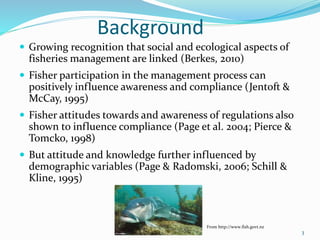
From http://www.fish.govt.nz
Study Aims
 As part of a larger research project:
1) Assess fisher knowledge of the new blue cod
regulations
2) Evaluate fishers’ views on the new blue cod
regulations
3) Explore the influence of demographic factors such
as region of residence, age and local fishing experience on the
main variables considered
 Lack of research on social dimensions of current
management strategy
4
5
Marlborough Sounds Blue Cod
Fishery
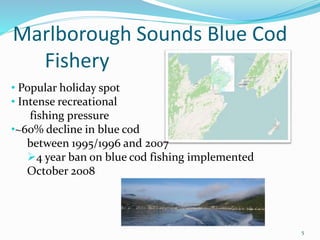
• Popular holiday spot
• Intense recreational
fishing pressure
•~60% decline in blue cod
between 1995/1996 and 2007
4 year ban on blue cod fishing implemented
October 2008
Current Management Strategy
 Reopened in April 2011
1. Slot limit: 30-35cm
2. Daily bag limit: 2/person
3. Closed 4 months a year (September-20 December)
4. Fish cannot be filleted at sea (filleting rule)
5. Size and daily limits apply regardless of where caught
(transit rule)
 Initial proposal by Blue Cod Management Group
(BCMG), finalized by Ministry of Primary Industries
 Frustration as fishers believe feedback is being ignored
6
Methods
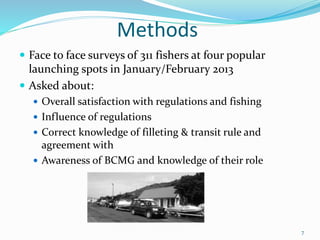
 Face to face surveys of 311 fishers at four popular
launching spots in January/February 2013
 Asked about:
 Overall satisfaction with regulations and fishing
 Influence of regulations
 Correct knowledge of filleting & transit rule and
agreement with
 Awareness of BCMG and knowledge of their role
7
Results: Satisfaction
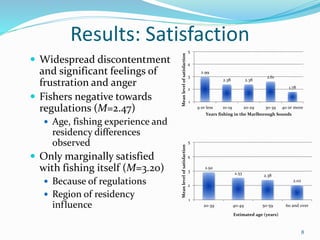
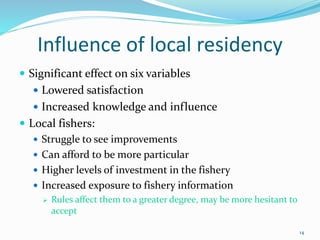
 Widespread discontentment
and significant feelings of
frustration and anger
 Fishers negative towards
regulations (M=2.47)
 Age, fishing experience and
residency differences
observed
 Only marginally satisfied
with fishing itself (M=3.20)
 Because of regulations
 Region of residency
influence
2.99
2.38 2.38
2.61
1.78
1
2
3
4
5
9 or less 10-19 20-29 30-39 40 or more
Meanlevelofsatisfaction
Years fishing in the Marlborough Sounds
8
2.92
2.53 2.38
2.02
1
2
3
4
5
20-39 40-49 50-59 60 and over
Meanlevelofsatisfaction
Estimated age (years)
Regulation Satisfaction
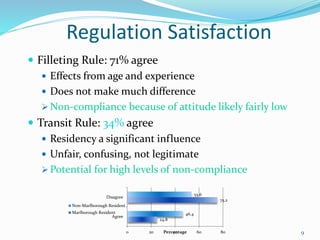
 Filleting Rule: 71% agree
 Effects from age and experience
 Does n0t make much difference
 Non-compliance because of attitude likely fairly low
 Transit Rule: 34% agree
 Residency a significant influence
 Unfair, confusing, not legitimate
 Potential for high levels of non-compliance
9
24.8
75.2
46.4
53.6
0 20 40 60 80
Agree
Disagree
Percentage
Non-Marlborough Resident
Marlborough Resident
Regulation Knowledge
 Knowledge of size and bag limits quite high
 92% correctly knew filleting rule
 Increases with experience and residency
 Applies to all fishers
 Not likely to be a driver of non-compliance
 60% correctly knew the transit rule
 Increases with local fishing experience
 Does not apply to all fishers
 Good possibility this is a driver of non-compliance
10
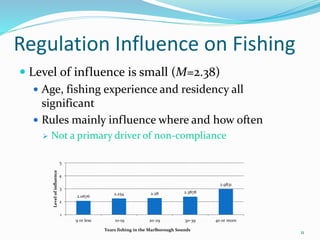
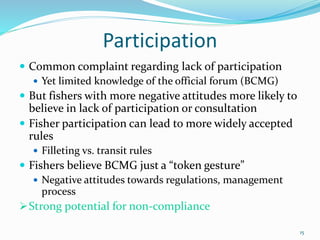
Regulation Influence on Fishing
 Level of influence is small (M=2.38)
 Age, fishing experience and residency all
significant
 Rules mainly influence where and how often
 Not a primary driver of non-compliance
11
2.0676
2.254 2.28 2.3878
2.9831
1
2
3
4
5
9 or less 10-19 20-29 30-39 40 or more
Levelofinfluence
Years fishing in the Marlborough Sounds
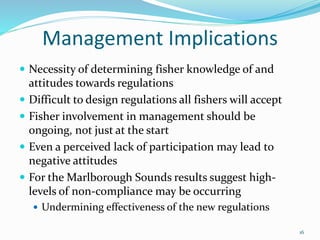
Blue Cod Management Group
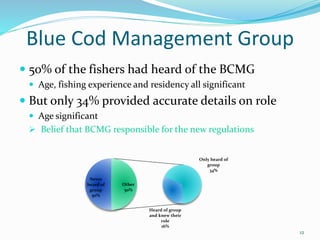
 50% of the fishers had heard of the BCMG
 Age, fishing experience and residency all significant
 But only 34% provided accurate details on role
 Age significant
 Belief that BCMG responsible for the new regulations
12
Never
heard of
group
50%
Heard of group
and knew their
role
16%
Only heard of
group
34%
Other
50%
Influence of age and experience
 Significant for five (age) and six (experience) variables
 Lowered satisfaction, increased knowledge and influence
 Least experienced/youngest fishers
 Only known a depleted fishery
 Some similar regulations
 Less distinct preferences
 Quicker to accept changes
 Most experienced/oldest fishers
 “the good old days”
 Less restrictive regulations
 More set in their habits
 Tougher to gain support from this group
13
Influence of local residency
 Significant effect on six variables
 Lowered satisfaction
 Increased knowledge and influence
 Local fishers:
 Struggle to see improvements
 Can afford to be more particular
 Higher levels of investment in the fishery
 Increased exposure to fishery information
 Rules affect them to a greater degree, may be more hesitant to
accept
14
Participation
 Common complaint regarding lack of participation
 Yet limited knowledge of the official forum (BCMG)
 But fishers with more negative attitudes more likely to
believe in lack of participation or consultation
 Fisher participation can lead to more widely accepted
rules
 Filleting vs. transit rules
 Fishers believe BCMG just a “token gesture”
 Negative attitudes towards regulations, management
process
Strong potential for non-compliance
15
Management Implications
 Necessity of determining fisher knowledge of and
attitudes towards regulations
 Difficult to design regulations all fishers will accept
 Fisher involvement in management should be
ongoing, not just at the start
 Even a perceived lack of participation may lead to
negative attitudes
 For the Marlborough Sounds results suggest high-
levels of non-compliance may be occurring
 Undermining effectiveness of the new regulations
16
Thanks to:
 Taciano Milfont and Michael Gavin
 School of Geography, Environment & Earth Sciences;
Victoria University
 Participating fishers
Alyssa Thomas
 alyssa.thomas@vuw.ac.nz
17
References
Berkes, F. (2010). Shifting perspectives on resource management: Resilience and the
Reconceptualization of 'Natural Resources' and 'Management'. Maritime Studies, 9(1), 13-40.
Jentoft, S., & McCay, B. (1995). User participation in fisheries management: Lessons drawn from
international experiences. Marine Policy, 19(3), 227-246.
Page, K. S., Grant, G. C., Radomski, P., Jones, T. S., & Bruesewitz, R. E. (2004). Fish total length
measurement error from recreational anglers: causes and contribution to noncompliance for the
Mille Lacs walleye fishery. North American Journal of Fisheries Management, 24(3), 939-951.
Page, K. S., & Radomski, P. (2006). Compliance with sport fishery regulations in Minnesota as
related to regulation awareness. Fisheries, 31(4), 166-178.
Pierce, R. B., & Tomcko, C. M. (1998). Angler Noncompliance with Slot Length Limits for Northern
Pike in Five Small Minnesota Lakes. North American Journal of Fisheries Management, 18(3), 720-
724.
Schill, D. J., & Kline, P. A. (1995). Use of random response to estimate angler non compliance with
fishing regulations. North American Journal of Fisheries Management, 15(4), 721-731.
18

Final iceland presentation

  • 1.
    Alyssa Thomas, VictoriaUniversity of Wellington Supervisors: Taciano Milfont (VUW) and Michael Gavin (Colorado State) 1
  • 2.
    Presentation Outline  Literaturebackground  Study aims  Site information  Methods  Results & Discussion  Management Implications 2
  • 3.
    Background  Growing recognitionthat social and ecological aspects of fisheries management are linked (Berkes, 2010)  Fisher participation in the management process can positively influence awareness and compliance (Jentoft & McCay, 1995)  Fisher attitudes towards and awareness of regulations also shown to influence compliance (Page et al. 2004; Pierce & Tomcko, 1998)  But attitude and knowledge further influenced by demographic variables (Page & Radomski, 2006; Schill & Kline, 1995) 3 From http://www.fish.govt.nz
  • 4.
    Study Aims  Aspart of a larger research project: 1) Assess fisher knowledge of the new blue cod regulations 2) Evaluate fishers’ views on the new blue cod regulations 3) Explore the influence of demographic factors such as region of residence, age and local fishing experience on the main variables considered  Lack of research on social dimensions of current management strategy 4
  • 5.
    5 Marlborough Sounds BlueCod Fishery • Popular holiday spot • Intense recreational fishing pressure •~60% decline in blue cod between 1995/1996 and 2007 4 year ban on blue cod fishing implemented October 2008
  • 6.
    Current Management Strategy Reopened in April 2011 1. Slot limit: 30-35cm 2. Daily bag limit: 2/person 3. Closed 4 months a year (September-20 December) 4. Fish cannot be filleted at sea (filleting rule) 5. Size and daily limits apply regardless of where caught (transit rule)  Initial proposal by Blue Cod Management Group (BCMG), finalized by Ministry of Primary Industries  Frustration as fishers believe feedback is being ignored 6
  • 7.
    Methods  Face toface surveys of 311 fishers at four popular launching spots in January/February 2013  Asked about:  Overall satisfaction with regulations and fishing  Influence of regulations  Correct knowledge of filleting & transit rule and agreement with  Awareness of BCMG and knowledge of their role 7
  • 8.
    Results: Satisfaction  Widespreaddiscontentment and significant feelings of frustration and anger  Fishers negative towards regulations (M=2.47)  Age, fishing experience and residency differences observed  Only marginally satisfied with fishing itself (M=3.20)  Because of regulations  Region of residency influence 2.99 2.38 2.38 2.61 1.78 1 2 3 4 5 9 or less 10-19 20-29 30-39 40 or more Meanlevelofsatisfaction Years fishing in the Marlborough Sounds 8 2.92 2.53 2.38 2.02 1 2 3 4 5 20-39 40-49 50-59 60 and over Meanlevelofsatisfaction Estimated age (years)
  • 9.
    Regulation Satisfaction  FilletingRule: 71% agree  Effects from age and experience  Does n0t make much difference  Non-compliance because of attitude likely fairly low  Transit Rule: 34% agree  Residency a significant influence  Unfair, confusing, not legitimate  Potential for high levels of non-compliance 9 24.8 75.2 46.4 53.6 0 20 40 60 80 Agree Disagree Percentage Non-Marlborough Resident Marlborough Resident
  • 10.
    Regulation Knowledge  Knowledgeof size and bag limits quite high  92% correctly knew filleting rule  Increases with experience and residency  Applies to all fishers  Not likely to be a driver of non-compliance  60% correctly knew the transit rule  Increases with local fishing experience  Does not apply to all fishers  Good possibility this is a driver of non-compliance 10
  • 11.
    Regulation Influence onFishing  Level of influence is small (M=2.38)  Age, fishing experience and residency all significant  Rules mainly influence where and how often  Not a primary driver of non-compliance 11 2.0676 2.254 2.28 2.3878 2.9831 1 2 3 4 5 9 or less 10-19 20-29 30-39 40 or more Levelofinfluence Years fishing in the Marlborough Sounds
  • 12.
    Blue Cod ManagementGroup  50% of the fishers had heard of the BCMG  Age, fishing experience and residency all significant  But only 34% provided accurate details on role  Age significant  Belief that BCMG responsible for the new regulations 12 Never heard of group 50% Heard of group and knew their role 16% Only heard of group 34% Other 50%
  • 13.
    Influence of ageand experience  Significant for five (age) and six (experience) variables  Lowered satisfaction, increased knowledge and influence  Least experienced/youngest fishers  Only known a depleted fishery  Some similar regulations  Less distinct preferences  Quicker to accept changes  Most experienced/oldest fishers  “the good old days”  Less restrictive regulations  More set in their habits  Tougher to gain support from this group 13
  • 14.
    Influence of localresidency  Significant effect on six variables  Lowered satisfaction  Increased knowledge and influence  Local fishers:  Struggle to see improvements  Can afford to be more particular  Higher levels of investment in the fishery  Increased exposure to fishery information  Rules affect them to a greater degree, may be more hesitant to accept 14
  • 15.
    Participation  Common complaintregarding lack of participation  Yet limited knowledge of the official forum (BCMG)  But fishers with more negative attitudes more likely to believe in lack of participation or consultation  Fisher participation can lead to more widely accepted rules  Filleting vs. transit rules  Fishers believe BCMG just a “token gesture”  Negative attitudes towards regulations, management process Strong potential for non-compliance 15
  • 16.
    Management Implications  Necessityof determining fisher knowledge of and attitudes towards regulations  Difficult to design regulations all fishers will accept  Fisher involvement in management should be ongoing, not just at the start  Even a perceived lack of participation may lead to negative attitudes  For the Marlborough Sounds results suggest high- levels of non-compliance may be occurring  Undermining effectiveness of the new regulations 16
  • 17.
    Thanks to:  TacianoMilfont and Michael Gavin  School of Geography, Environment & Earth Sciences; Victoria University  Participating fishers Alyssa Thomas  alyssa.thomas@vuw.ac.nz 17
  • 18.
    References Berkes, F. (2010).Shifting perspectives on resource management: Resilience and the Reconceptualization of 'Natural Resources' and 'Management'. Maritime Studies, 9(1), 13-40. Jentoft, S., & McCay, B. (1995). User participation in fisheries management: Lessons drawn from international experiences. Marine Policy, 19(3), 227-246. Page, K. S., Grant, G. C., Radomski, P., Jones, T. S., & Bruesewitz, R. E. (2004). Fish total length measurement error from recreational anglers: causes and contribution to noncompliance for the Mille Lacs walleye fishery. North American Journal of Fisheries Management, 24(3), 939-951. Page, K. S., & Radomski, P. (2006). Compliance with sport fishery regulations in Minnesota as related to regulation awareness. Fisheries, 31(4), 166-178. Pierce, R. B., & Tomcko, C. M. (1998). Angler Noncompliance with Slot Length Limits for Northern Pike in Five Small Minnesota Lakes. North American Journal of Fisheries Management, 18(3), 720- 724. Schill, D. J., & Kline, P. A. (1995). Use of random response to estimate angler non compliance with fishing regulations. North American Journal of Fisheries Management, 15(4), 721-731. 18

Editor's Notes

  • #4 understand perspective of who conserving Fisher behaviour can determine success of fishery management Age, local fishing experience and residency
  • #6 Over 9,000 fishers in 2008/2009
  • #7 Why slot limit? All but daily bag limit unique to fishery BCMG-six fisher members of local community Fisher frustration because MFish will not listen to feedback
  • #8 Part of larger project examining non-compliance in the Marlborough Sounds blue cod fishery and focus on the lesser-known transit and filleting rules Interviewer estimated age in ranges to minimise bias Any additional information offered recorded
  • #9 “Poorly conceived”, “completely stupid”, “shocking and ridiculous” Slot rule discards
  • #10 Post hoc fillet: nothing for knowledge, typical age & exp Transit: youngest fishers “don’t know”
  • #12 Post hoc: no sig differences for BCMG Influence:all typical
  • #14 Most studies on attitude focused on commercial fisheries Race to catch 100 blue cod, 20 cod per person over 30cm Disagree with filleting rule because “done for years”
  • #15 Least affected fishers are also the most positive (Pita et al 2013) Non-Marlborough residents go for the whole experience, fishing just one part Also non-residents can go somewhere else if fishing not to liking-as ban forced many to do
  • #16 Believe new regulations were pre-determined ‪Yes you are right..My understanding is this :  The transit rule was initially set up to stop  "Vessels that did not originate from our ports" taking our fish... Not us landing fish in our area....And it can still be used that way but compliance as Eric said is difficult.‬Unfortunately it has been turned around to bite the locals...this would not have happened (to such an extent) if the whole of the Marlborough sounds was treated as one fishery..and with the right boundaries.When did it happen ?...from memory this was dropped on us by Phil Heatley...possibly from advice given him. It is a pain but it does provide a slight relief to the sounds "closed " season in that it is relaxed for that period and allows the catching of blue cod to continue.,
  • #17 Help predict compliance behaviour Age, experience and region of residence can all influence a fisher’s attitude