Final Assignment: Informational Interview
For this assignment you will be graded on a report you write
discussing your experience with an informational interview.
This assignment will be introduced mid-semester in order to
give you time to find someone to interview and complete the
assignment. The assignment is due to DROPBOX on FRIDAY
DECEMBER 3rd.
To complete this assignment, you need to find at least 1 person
in your field of interest to interview. You need to conduct an
interview of at least an hour in which you gain insight into your
field of interest. After conducting the interview, you will write
a 3-4 page paper in APA format (title page and references not
included in page count). In the paper you need to address:
· Introduction/conclusion
· Your chosen career field and information on that field
· Who you interviewed (include information on their
background etc)
· What you learned in the interview about them, the field, and
anything else you may have discussed
· You thoughts and opinions on this career field now that you
have done the informational interview
Your paper should include at least 1 citation for information on
your career interest and one citation for the conversation with
the person you had. I suggest utilizing Purdue Owl if you do not
know how to utilize APA format and citations.
Your grade will be based on:
Information on your field 5 points
Information on your discussion 5 points
Thoughts/reflections on your discussion/field of interest5 points
Appropriate APA format, citations, grammar, spelling, page
count etc5 points
Rev. Confirming Pages
Introduction to
Management
Science
A Modeling and Case Studies Approach with Spreadsheets
hil24064_fm_i-xx.indd ihil24064_fm_i-xx.indd i 05/12/12
2:18 PM05/12/12 2:18 PM
Rev. Confirming Pages
The McGraw-Hill/Irwin Series
Operations and Decision Sciences
OPERATIONS MANAGEMENT
Beckman and Rosenfield,
Operations, Strategy: Competing in the
21st Century,
First Edition
Benton,
Purchasing and Supply Chain
Management,
Second Edition
Bowersox, Closs, Cooper, and Bowersox
Supply Chain Logistics Management,
Fourth Edition
Brown and Hyer,
Managing Projects: A Team-Based
Approach,
First Edition
Burt, Petcavage, and Pinkerton,
Supply Management,
Eighth Edition
Cachon and Terwiesch,
Matching Supply with Demand: An Intro-
duction to Operations Management,
Third Edition
Cooper and Schindler,
Business Research Methods,
Eleventh Edition
Finch,
Interactive Models for Operations and
Supply Chain Management,
First Edition
Fitzsimmons and Fitzsimmons,
Service Management: Operations,
Strategy, Information Technology,
Seventh Edition
Gehrlein,
Operations Management Cases,
First Edition
Harrison and Samson,
Technology Management,
First Edition
Hayen,
SAP R/3 Enterprise Software: An
Introduction,
First Edition
Hill,
Manufacturing Strategy: Text & Cases,
Third Edition
Hopp,
Supply Chain Science,
First Edition
Hopp and Spearman,
Factory Physics,
Third Edition
Jacobs, Berry, Whybark, and Vollmann,
Manufacturing Planning & Control for
Supply Chain Management,
Sixth Edition
Jacobs and Chase,
Operations and Supply Management:
The Core,
Third Edition
Jacobs and Chase,
Operations and Supply Management,
Fourteenth Edition
Jacobs and Whybark,
Why ERP?,
First Edition
Larson and Gray,
Project Management: The Managerial
Process,
Fifth Edition
Leenders, Johnson, Flynn, and Fearon,
Purchasing and Supply Management,
Thirteenth Edition
Nahmias,
Production and Operations Analysis,
Sixth Edition
Olson,
Introduction to Information Systems Proj-
ect Management,
Second Edition
Schroeder, Goldstein, and Rungtusanatham,
Operations Management: Contemporary
Concepts and Cases,
Sixth Edition
Seppanen, Kumar, and Chandra,
Process Analysis and Improvement,
First Edition
Simchi-Levi, Kaminsky, and Simchi-Levi,
Designing and Managing the Supply
Chain: Concepts, Strategies, Case Studies,
Third Edition
Sterman,
Business Dynamics: Systems Thinking
and Modeling for Complex World,
First Edition
Stevenson,
Operations Management,
Eleventh Edition
Swink, Melnyk, Cooper, and Hartley,
Managing Operations Across
the Supply Chain,
Second Edition
Thomke,
Managing Product and Service
Development: Text and Cases,
First Edition
Ulrich and Eppinger,
Product Design and Development,
Fourth Edition
Zipkin,
Foundations of Inventory Management,
First Edition
QUANTITATIVE METHODS AND
MANAGEMENT SCIENCE
Hillier and Hillier,
Introduction to Management Science: A
Modeling and Case Studies Approach with
Spreadsheets,
Fifth Edition
Stevenson and Ozgur,
Introduction to Management Science with
Spreadsheets,
First Edition
hil24064_fm_i-xx.indd iihil24064_fm_i-xx.indd ii 05/12/12
2:18 PM05/12/12 2:18 PM
Rev. Confirming Pages
Introduction to
Management
Science
A Modeling and Case Studies Approach
with Spreadsheets
Fifth Edition
Frederick S. Hillier
Stanford University
Mark S. Hillier
University of Washington
Cases developed by
Karl Schmedders
University of Zurich
Molly Stephens
Quinn, Emanuel, Urquhart & Sullivan, LLP
hil24064_fm_i-xx.indd iiihil24064_fm_i-xx.indd iii 05/12/12
2:18 PM05/12/12 2:18 PM
Rev. Confirming Pages
INTRODUCTION TO MANAGEMENT SCIENCE: A
MODELING AND CASE STUDIES
APPROACH WITH SPREADSHEETS, FIFTH EDITION
Published by McGraw-Hill/Irwin, a business unit of The
McGraw-Hill Companies, Inc., 1221 Avenue
of the Americas, New York, NY, 10020. Copyright © 2014 by
The McGraw-Hill Companies, Inc. All
rights reserved. Printed in the United States of America.
Previous editions © 2011, 2008, 2003. No part
of this publication may be reproduced or distributed in any form
or by any means, or stored in a database
or retrieval system, without the prior written consent of The
McGraw-Hill Companies, Inc., including,
but not limited to, in any network or other electronic storage or
transmission, or broadcast for distance
learning.
Some ancillaries, including electronic and print components,
may not be available to customers outside
the United States.
This book is printed on acid-free paper.
1 2 3 4 5 6 7 8 9 0 QVR/QVR 0 9 8 7 6 5 4 3
ISBN 978-0-07-802406-1
MHID 0-07-802406-4
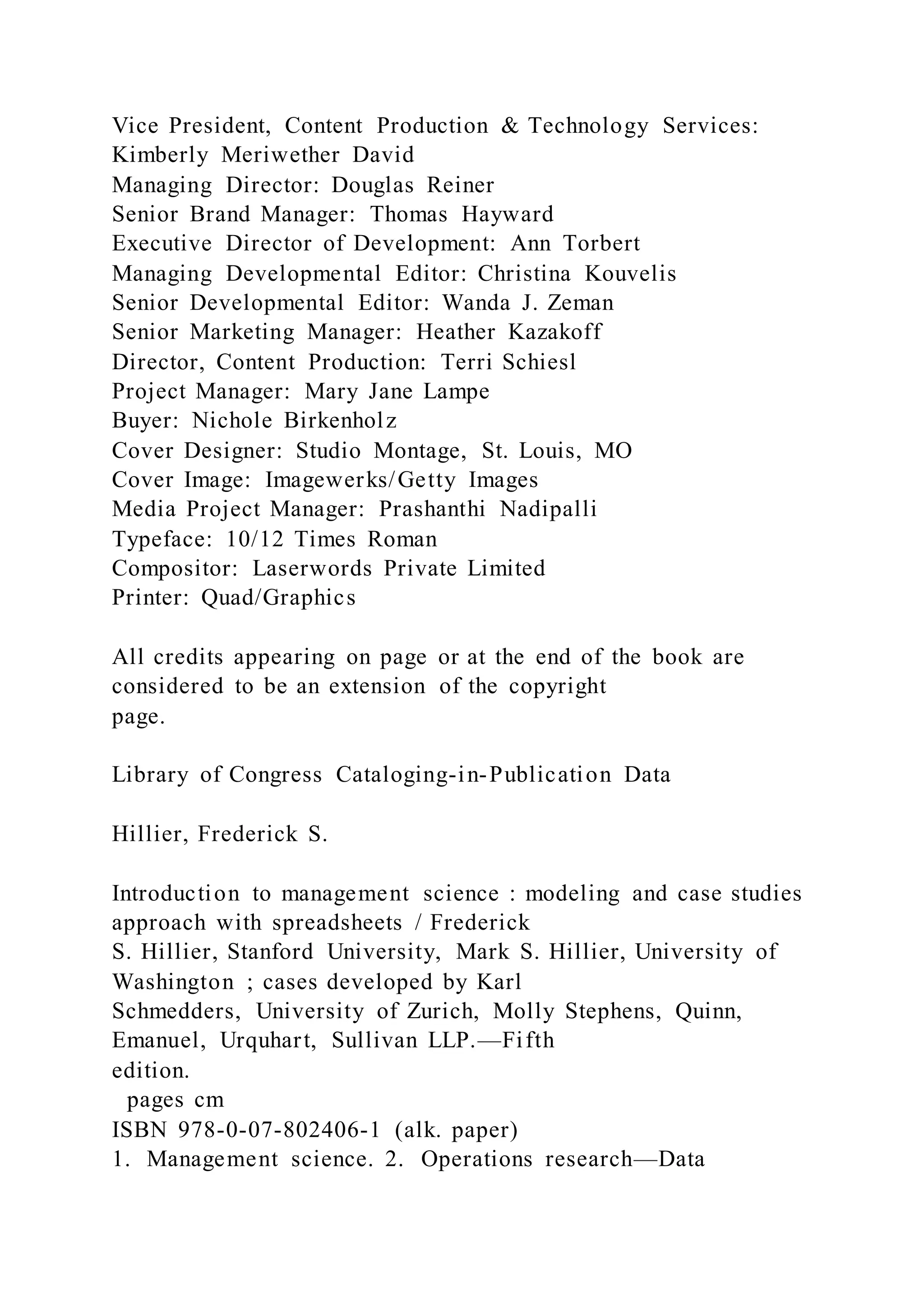
Senior Vice President, Products & Markets: Kurt L. Strand
Vice President, Content Production & Technology Services:
Kimberly Meriwether David
Managing Director: Douglas Reiner
Senior Brand Manager: Thomas Hayward
Executive Director of Development: Ann Torbert
Managing Developmental Editor: Christina Kouvelis
Senior Developmental Editor: Wanda J. Zeman
Senior Marketing Manager: Heather Kazakoff
Director, Content Production: Terri Schiesl
Project Manager: Mary Jane Lampe
Buyer: Nichole Birkenholz
Cover Designer: Studio Montage, St. Louis, MO
Cover Image: Imagewerks/Getty Images
Media Project Manager: Prashanthi Nadipalli
Typeface: 10/12 Times Roman
Compositor: Laserwords Private Limited
Printer: Quad/Graphics
All credits appearing on page or at the end of the book are
considered to be an extension of the copyright
page.
Library of Congress Cataloging-in-Publication Data
Hillier, Frederick S.
Introduction to management science : modeling and case studies
approach with spreadsheets / Frederick
S. Hillier, Stanford University, Mark S. Hillier, University of
Washington ; cases developed by Karl
Schmedders, University of Zurich, Molly Stephens, Quinn,
Emanuel, Urquhart, Sullivan LLP.—Fifth
edition.
pages cm
ISBN 978-0-07-802406-1 (alk. paper)
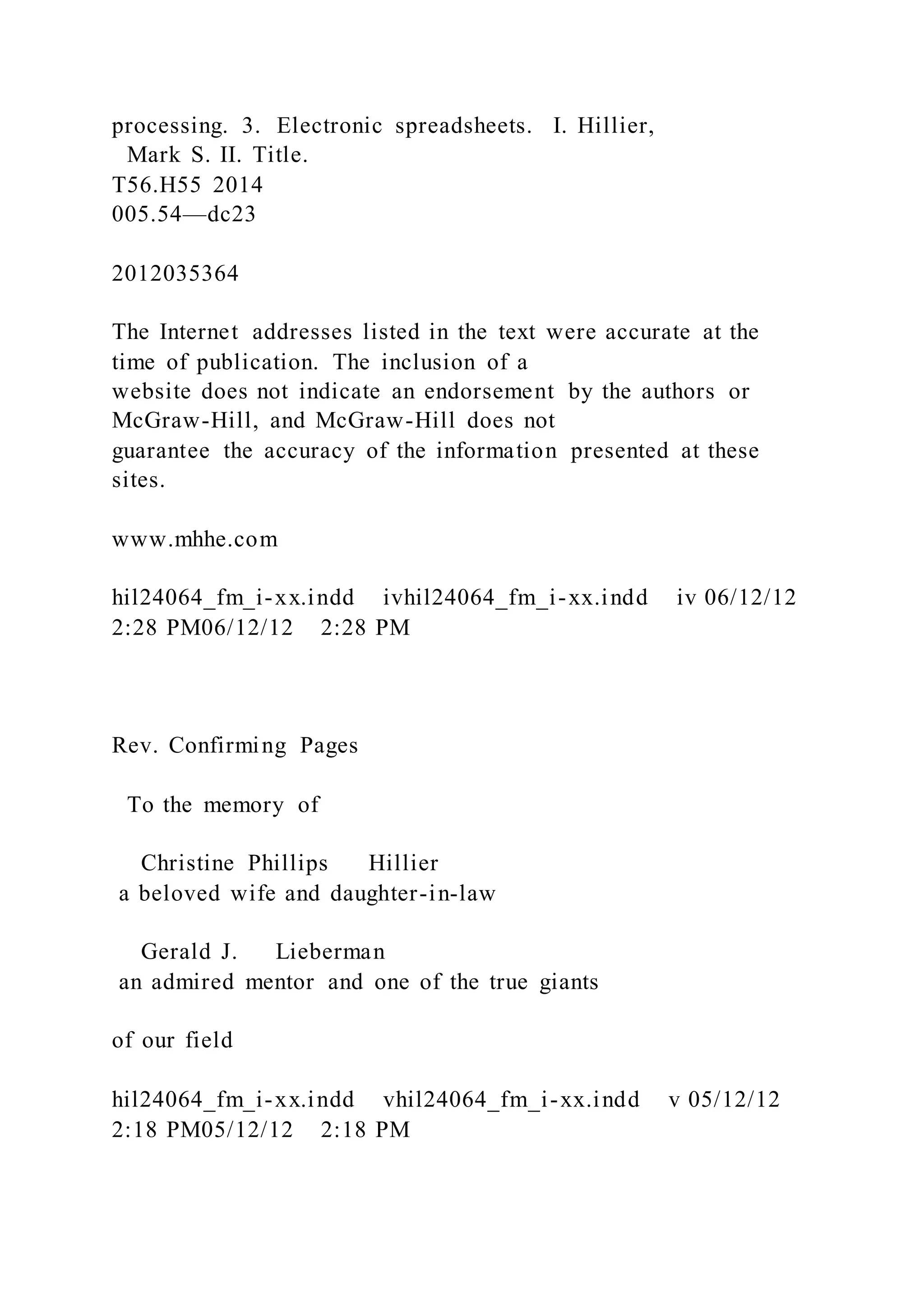
1. Management science. 2. Operations research—Data
processing. 3. Electronic spreadsheets. I. Hillier,
Mark S. II. Title.
T56.H55 2014
005.54—dc23
2012035364
The Internet addresses listed in the text were accurate at the
time of publication. The inclusion of a
website does not indicate an endorsement by the authors or
McGraw-Hill, and McGraw-Hill does not
guarantee the accuracy of the information presented at these
sites.
www.mhhe.com
hil24064_fm_i-xx.indd ivhil24064_fm_i-xx.indd iv 06/12/12
2:28 PM06/12/12 2:28 PM
Rev. Confirming Pages
To the memory of
Christine Phillips Hillier
a beloved wife and daughter-in-law
Gerald J. Lieberman
an admired mentor and one of the true giants
of our field
hil24064_fm_i-xx.indd vhil24064_fm_i-xx.indd v 05/12/12
2:18 PM05/12/12 2:18 PM
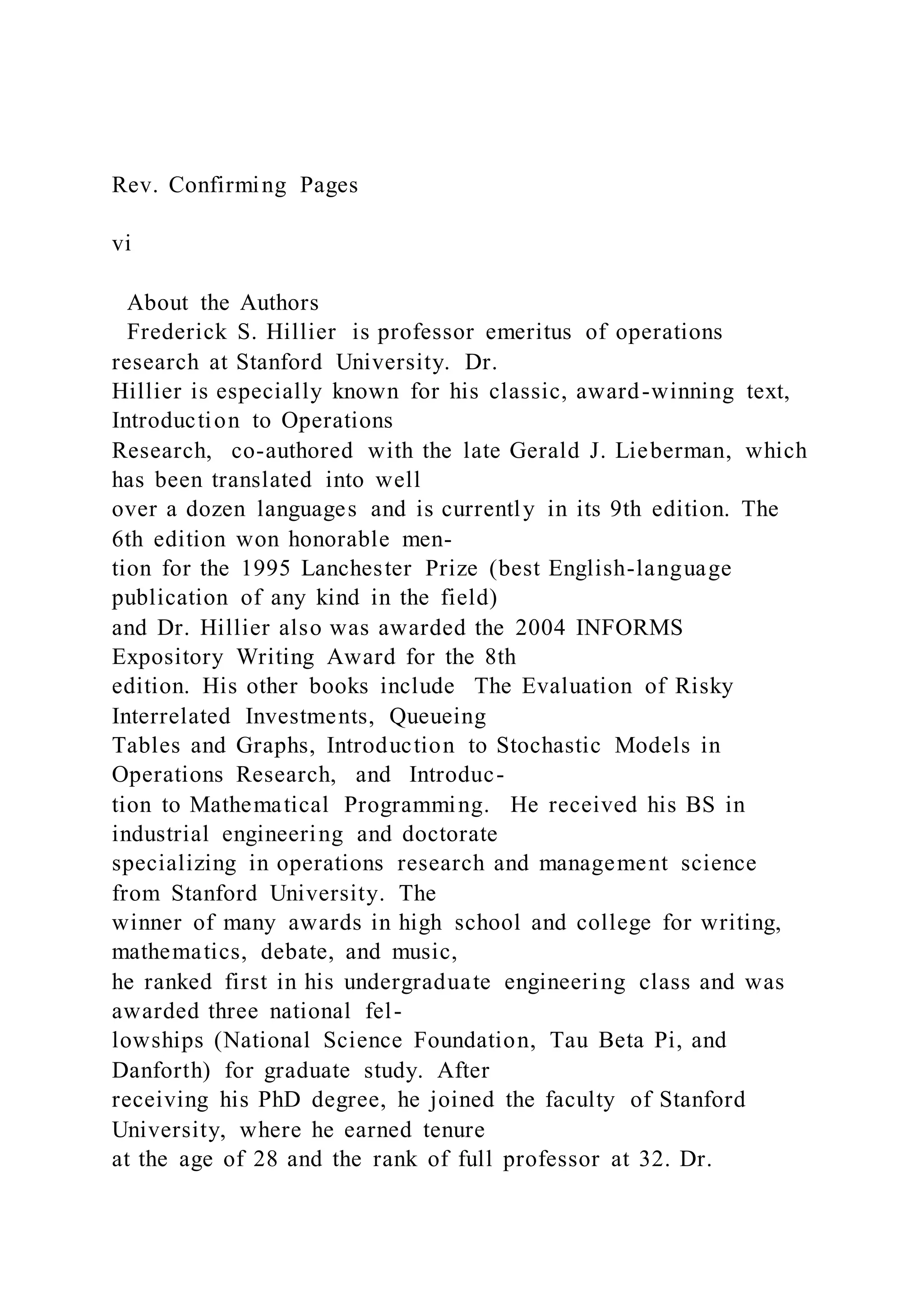
Rev. Confirming Pages
vi
About the Authors
Frederick S. Hillier is professor emeritus of operations
research at Stanford University. Dr.
Hillier is especially known for his classic, award-winning text,
Introduction to Operations
Research, co-authored with the late Gerald J. Lieberman, which
has been translated into well
over a dozen languages and is currently in its 9th edition. The
6th edition won honorable men-
tion for the 1995 Lanchester Prize (best English-language
publication of any kind in the field)
and Dr. Hillier also was awarded the 2004 INFORMS
Expository Writing Award for the 8th
edition. His other books include The Evaluation of Risky
Interrelated Investments, Queueing
Tables and Graphs, Introduction to Stochastic Models in
Operations Research, and Introduc-
tion to Mathematical Programming. He received his BS in
industrial engineering and doctorate
specializing in operations research and management science
from Stanford University. The
winner of many awards in high school and college for writing,
mathematics, debate, and music,
he ranked first in his undergraduate engineering class and was
awarded three national fel-
lowships (National Science Foundation, Tau Beta Pi, and
Danforth) for graduate study. After
receiving his PhD degree, he joined the faculty of Stanford
University, where he earned tenure
at the age of 28 and the rank of full professor at 32. Dr.
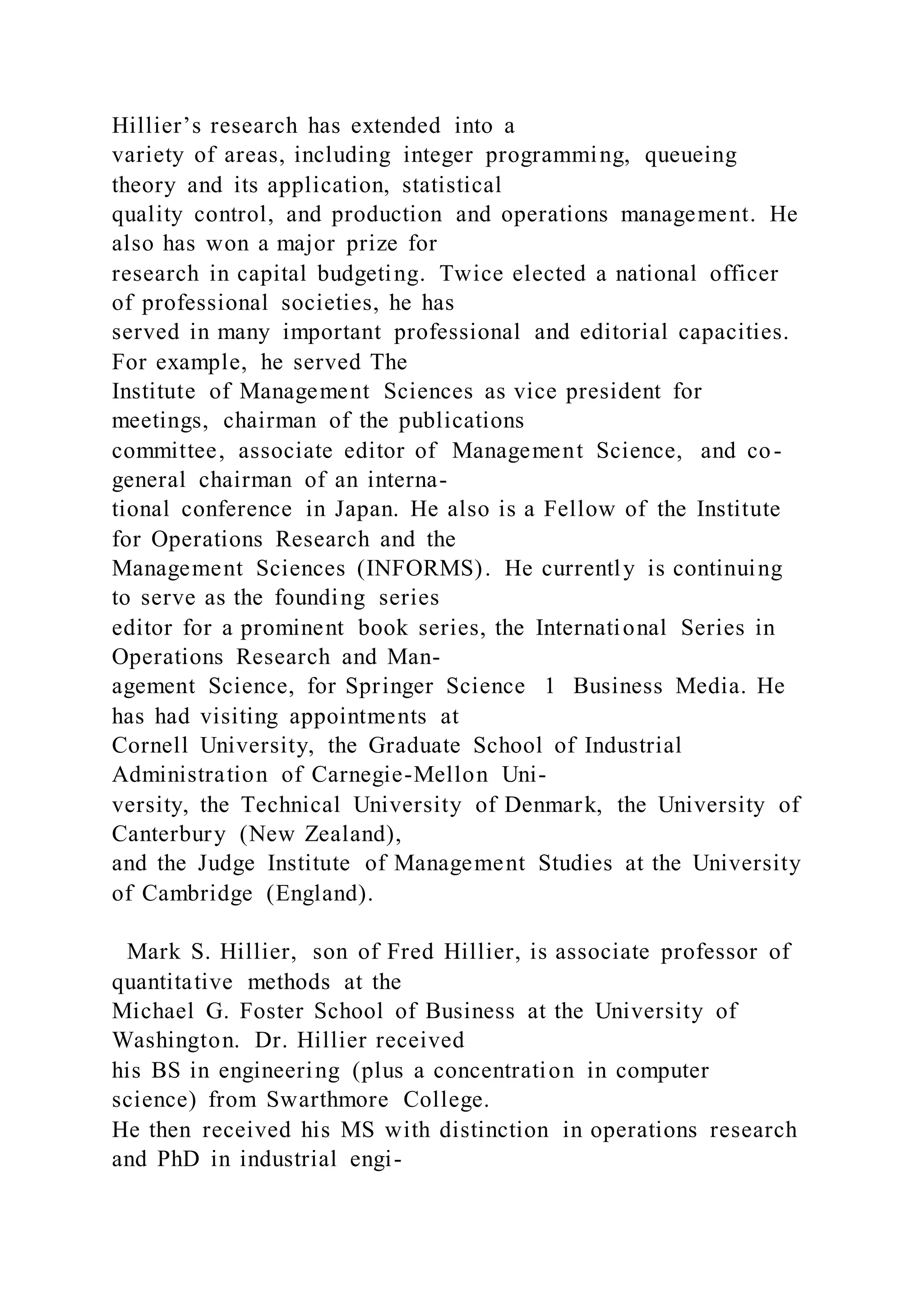
Hillier’s research has extended into a
variety of areas, including integer programming, queueing
theory and its application, statistical
quality control, and production and operations management. He
also has won a major prize for
research in capital budgeting. Twice elected a national officer
of professional societies, he has
served in many important professional and editorial capacities.
For example, he served The
Institute of Management Sciences as vice president for
meetings, chairman of the publications
committee, associate editor of Management Science, and co-
general chairman of an interna-
tional conference in Japan. He also is a Fellow of the Institute
for Operations Research and the
Management Sciences (INFORMS). He currently is continuing
to serve as the founding series
editor for a prominent book series, the International Series in
Operations Research and Man-
agement Science, for Springer Science 1 Business Media. He
has had visiting appointments at
Cornell University, the Graduate School of Industrial
Administration of Carnegie-Mellon Uni-
versity, the Technical University of Denmark, the University of
Canterbury (New Zealand),
and the Judge Institute of Management Studies at the University
of Cambridge (England).
Mark S. Hillier, son of Fred Hillier, is associate professor of
quantitative methods at the
Michael G. Foster School of Business at the University of
Washington. Dr. Hillier received
his BS in engineering (plus a concentration in computer
science) from Swarthmore College.
He then received his MS with distinction in operations research
and PhD in industrial engi-
neering and engineering management from Stanford University.
As an undergraduate, he won
the McCabe Award for ranking first in his engineering class,
won election to Phi Beta Kappa
based on his work in mathematics, set school records on the
men’s swim team, and was
awarded two national fellowships (National Science Foundation
and Tau Beta Pi) for gradu-
ate study. During that time, he also developed a comprehensive
software tutorial package,
OR Courseware, for the Hillier–Lieberman textbook,
Introduction to Operations Research.
As a graduate student, he taught a PhD-level seminar in
operations management at Stanford
and won a national prize for work based on his PhD
dissertation. At the University of Wash-
ington, he currently teaches courses in management science and
spreadsheet modeling. He
has won several MBA teaching awards for the core course in
management science and his
elective course in spreadsheet modeling, as well as a
universitywide teaching award for his
work in teaching undergraduate classes in operations
management. He was chosen by MBA
students in 2007 as the winner of the prestigious PACCAR
award for Teacher of the Year
(reputed to provide the largest monetary award for MBA
teaching in the nation). He also
has been awarded an appointment to the Evert McCabe Endowed
Faculty Fellowship. His
research interests include issues in component commonality,
inventory, manufacturing, and
the design of production systems. A paper by Dr. Hillier on
component commonality won an
award for best paper of 2000–2001 in IIE Transactions. He
currently is principal investigator
on a grant from the Bill and Melinda Gates Foundation to lead
student research projects that
apply spreadsheet modeling to various issues in global health
being studied by the foundation.
hil24064_fm_i-xx.indd vihil24064_fm_i-xx.indd vi 05/12/12
2:18 PM05/12/12 2:18 PM
Rev. Confirming Pages
vii
About the Case Writers
Karl Schmedders is professor of quantitative business
administration at the University
of Zurich in Switzerland and a visiting associate professor at
the Kellogg School of Man-
agement of Northwestern University. His research interests
include management science,
financial economics, and computational economics and finance.
In 2003, a paper by Dr.
Schmedders received a nomination for the Smith-Breeden Prize
for the best paper in the Jour-
nal of Finance. He received his PhD in operations research
from Stanford University, where
he taught both undergraduate and graduate classes in
management science, including a case
studies course. He received several teaching awards at Stanford,
including the university-
wide Walter J. Gores Teaching Award. After a post-doc at the
Hoover Institution, a think tank
on the Stanford campus, he became assistant professor of
managerial economics and decision
sciences at the Kellogg School. He was promoted to associate
professor in 2001 and received
tenure in 2005. In 2008 he joined the University of Zurich,
where he currently teaches courses
in management science, spreadsheet modeling, and
computational economics and finance. At
Kellogg he received several teaching awards, including the L.
G. Lavengood Professor of the
Year Award. Most recently he won the best professor award of
the Kellogg School’s Euro-
pean EMBA program (2008, 2009, and 2011) and its Miami
EMBA program (2011).
Molly Stephens is a partner in the Los Angeles office of
Quinn, Emanuel, Urquhart &
Sullivan, LLP. She graduated from Stanford with a BS in
industrial engineering and an MS in
operations research. Ms. Stephens taught public speaking in
Stanford’s School of Engineer-
ing and served as a teaching assistant for a case studies course
in management science. As a
teaching assistant, she analyzed management science problems
encountered in the real world
and transformed these into classroom case studies. Her research
was rewarded when she won
an undergraduate research grant from Stanford to continue her
work and was invited to speak
at INFORMS to present her conclusions regarding successful
classroom case studies. Follow-
ing graduation, Ms. Stephens worked at Andersen Consulting as
a systems integrator, expe-
riencing real cases from the inside, before resuming her
graduate studies to earn a JD degree
with honors from the University of Texas School of Law at
Austin. She is a partner in the
largest law firm in the United States devoted solely to business
litigation, where her practice
focuses on complex financial and securities litigation.
hil24064_fm_i-xx.indd viihil24064_fm_i-xx.indd vii
05/12/12 2:18 PM05/12/12 2:18 PM
Rev. Confirming Pages
viii
Preface
We have long been concerned that traditional management
science textbooks have not taken
the best approach in introducing business students to this
exciting field. Our goal when ini-
tially developing this book during the late 1990s was to break
out of the old mold and present
new and innovative ways of teaching management science more
effectively. We have been
gratified by the favorable response to our efforts. Many
reviewers and other users of the first
four editions of the book have expressed appreciation for its
various distinctive features, as
well as for its clear presentation at just the right level for their
business students.
Our goal for this fifth edition has been to build on the strengths
of the first four editions.
Co-author Mark Hillier has won several schoolwide teaching
awards for his spreadsheet mod-
eling and management science courses at the University of
Washington while using the first
four editions, and this experience has led to many improvements
in the current edition. We
also incorporated many user comments and suggestions.
Throughout this process, we took
painstaking care to enhance the quality of the preceding edition
while maintaining the distinc-
tive orientation of the book.
This distinctive orientation is one that closely follows the
recommendations in the 1996
report of the operating subcommittee of the INFORMS Business
School Education Task
Force, including the following extract.
There is clear evidence that there must be a major change in
the character of the (introductory
management science) course in this environment. There is little
patience with courses centered
on algorithms. Instead, the demand is for courses that focus on
business situations, include
prominent non-mathematical issues, use spreadsheets, and
involve model formulation and
assessment more than model structuring. Such a course requires
new teaching materials.
This book is designed to provide the teaching materials for
such a course.
In line with the recommendations of this task force, we believe
that a modern introductory
management science textbook should have three key elements.
As summarized in the subtitle
of this book, these elements are a modeling and case studies
approach with spreadsheets.
SPREADSHEETS
The modern approach to the teaching of management science
clearly is to use spreadsheets
as a primary medium of instruction. Both business students and
managers now live with
spreadsheets, so they provide a comfortable and enjoyable
learning environment. Modern
spreadsheet software, including Microsoft Excel used in this
book, now can be used to do
real management science. For student-scale models (which
include many practical real-world
models), spreadsheets are a much better way of implementing
management science models
than traditional algebraic solvers. This means that the algebraic
curtain that was so prevalent
in traditional management science courses and textbooks now
can be lifted.
However, with the new enthusiasm for spreadsheets, there is a
danger of going over-
board. Spreadsheets are not the only useful tool for performing
management science analy-
ses. Occasional modest use of algebraic and graphical analyses
still have their place and
we would be doing a disservice to the students by not
developing their skills in these areas
when appropriate. Furthermore, the book should not be mainly a
spreadsheet cookbook that
focuses largely on spreadsheet mechanics. Spreadsheets are a
means to an end, not an end
in themselves.
A MODELING APPROACH
This brings us to the second key feature of the book, a
modeling approach. Model formula-
tion lies at the heart of management science methodology.
Therefore, we heavily emphasize
the art of model formulation, the role of a model, and the
analysis of model results. We pri-
marily (but not exclusively) use a spreadsheet format rather
than algebra for formulating and
presenting a model.
hil24064_fm_i-xx.indd viiihil24064_fm_i-xx.indd viii
05/12/12 2:18 PM05/12/12 2:18 PM
Rev. Confirming Pages
Preface ix
Some instructors have many years of experience in teaching
modeling in terms of for-
mulating algebraic models (or what the INFORMS Task Force
called “model structuring”).
Some of these instructors feel that students should do their
modeling in this way and then
transfer the model to a spreadsheet simply to use the Excel
Solver to solve the model. We dis-
agree with this approach. Our experience (and the experience
reported by many others) is that
most business students find it more natural and comfortable to
do their modeling directly in
a spreadsheet. Furthermore, by using the best spreadsheet
modeling techniques (as presented
in this edition), formulating a spreadsheet model tends to be
considerably more efficient
and transparent than formulating an algebraic model. Another
benefit is that the spreadsheet
model includes all the relationships that can be expressed in an
algebraic form and we often
will summarize the model in this format as well.
Another break from tradition in this book (and several
contemporary textbooks) is to virtually
ignore the algorithms that are used to solve the models. We feel
that there is no good reason why
typical business students should learn the details of algorithms
executed by computers. Within
the time constraints of a one-term management science course,
there are far more important
lessons to be learned. Therefore, the focus in this book is on
what we believe are these far more
important lessons. High on this list is the art of modeling
managerial problems on a spreadsheet.
Formulating a spreadsheet model of a real problem typically
involves much more than
designing the spreadsheet and entering the data. Therefore, we
work through the process
step by step: understand the unstructured problem, verbally
develop some structure for the
problem, gather the data, express the relationships in
quantitative terms, and then lay out the
spreadsheet model. The structured approach highlights the
typical components of the model
(the data, the decisions to be made, the constraints, and the
measure of performance) and the
different types of spreadsheet cells used for each. Consequently,
the emphasis is on the mod-
eling rather than spreadsheet mechanics.
A CASE STUDIES APPROACH
However, all this still would be quite sterile if we simply
presented a long series of brief
examples with their spreadsheet formulations. This leads to the
third key feature of this
book—a case studies approach. In addition to examples, nearly
every chapter includes one or
two case studies patterned after actual applications to convey
the whole process of applying
management science. In a few instances, the entire chapter
revolves around a case study. By
drawing the student into the story, we have designed each case
study to bring that chapter’s
technique to life in a context that vividly illustrates the
relevance of the technique for aiding
managerial decision making. This storytelling, case-centered
approach should make the mate-
rial more enjoyable and stimulating while also conveying the
practical considerations that are
key factors in applying management science.
We have been pleased to have several reviewers of the first
four editions express particular
appreciation for our case study approach. Even though this
approach has received little use
in other management science textbooks, we feel that it is a real
key to preparing students for
the practical application of management science in all its
aspects. Some of the reviewers have
highlighted the effectiveness of the dialogue/scenario enactment
approach used in some of
the case studies. Although unconventional, this approach
provides a way of demonstrating the
process of managerial decision making with the help of
management science. It also enables
previewing some key concepts in the language of management.
Every chapter also contains full-fledged cases following the
problems at the end of the
chapter. These cases usually continue to employ a stimulating
storytelling approach, so they
can be assigned as interesting and challenging projects. Most of
these cases were developed
jointly by two talented case writers, Karl Schmedders (a faculty
member at the University
of Zurich in Switzerland) and Molly Stephens (formerly a
management science consultant
with Andersen Consulting). The authors also have added some
cases, including several
shorter ones. In addition, the University of Western Ontario
Ivey School of Business (the
second-largest producer of teaching cases in the world) has
specially selected cases from
their case collection that match the chapters in this textbook.
These cases are available on
hil24064_fm_i-xx.indd ixhil24064_fm_i-xx.indd ix 05/12/12
2:18 PM05/12/12 2:18 PM
Rev. Confirming Pages
x Preface
the Ivey website, cases.ivey.uwo.ca/cases , in the segment of
the CaseMate area designated
for this book. This website address is provided at the end of
each chapter as well.
We are, of course, not the first to incorporate any of these key
features into a management
science textbook. However, we believe that the book currently
is unique in the way that it
fully incorporates all three key features together.
OTHER SPECIAL FEATURES
We also should mention some additional special features of the
book that are continued from
the fourth edition.
• Diverse examples, problems, and cases convey the pervasive
relevance of management
science.
• A strong managerial perspective.
• Learning objectives at the beginning of each chapter.
• Numerous margin notes that clarify and highlight key points.
• Excel tips interspersed among the margin notes.
• Review questions at the end of each section.
• A glossary at the end of each chapter.
• Partial answers to selected problems in the back of the book.
• Supplementary text material on the CD-ROM (as identified
in the table of contents).
• An Excel-based software package (MS Courseware) on the
CD-ROM and website that
includes many add-ins, templates, and files (described below).
• Other helpful supplements on the CD-ROM and website
(described later).
A NEW SOFTWARE PACKAGE
This edition continues to integrate Excel 2010 and its Solver
(a product of Frontline Systems)
throughout the book. However, we are excited to also add to
this edition an impressive more
recent product of Frontline Systems called Risk Solver
Platform for Education (or RSPE
for short). RSPE also is an Excel add-in and its Solver shares
some of the features of the Excel
Solver. However, in addition to providing all the key
capabilities of the Excel Solver, RSPE
adds some major new functionalities as outlined below:
• A more interactive user interface, with the model parameters
always visible alongside the
main spreadsheet, rather than only in the Solver dialog box.
• Parameter analysis reports that provide an easy way to see
the effect of varying data in a
model in a systematic way.
• A model analysis tool that reveals the characteristics of a
model (e.g., whether it is linear
or nonlinear, smooth or nonsmooth).
• Tools to build and solve decision trees within a spreadsheet.
• The ability to build and run sophisticated Monte Carlo
simulation models.
• An interactive simulation mode that allows simulation results
to be shown instantly when-
ever a change is made to a simulation model.
• The RSPE Solver can be used in combination with computer
simulation to perform simu-
lation optimization.
A CONTINUING FOCUS ON EXCEL AND ITS SOLVER
As with all the preceding editions, this edition continues to
focus on spreadsheet modeling
in an Excel format. Although it lacks some of the functionalities
of RSPE, the Excel Solver
continues to provide a completely satisfactory way of solving
most of the spreadsheet models
encountered in this book. This edition continues to feature this
use of the Excel Solver when-
ever either it or the RSPE Solver could be used.
Many instructors prefer this focus because it avoids introducing
other complications that
might confuse their students. We agree.
hil24064_fm_i-xx.indd xhil24064_fm_i-xx.indd x 05/12/12
2:18 PM05/12/12 2:18 PM
Rev. Confirming Pages
Preface xi
However, the key advantage of introducing RSPE in this
edition is that it provides an all-in-
one complement to the Excel Solver. There are some important
topics in the book (including
decision analysis and computer simulation) where the Excel
Solver lacks the functionalities
needed to deal with these kinds of problems. Multiple Excel
add-ins—Solver Table, Tree-
Plan, SensIt, RiskSim, Crystal Ball, and OptQuest (a module of
Crystal Ball)—were intro-
duced in previous editions to provide the needed functionalities.
RSPE alone now replaces all
of these add-ins.
OTHER SOFTWARE
Each edition of this book has provided a comprehensive Excel -
based software package called
MS Courseware on the CD-ROM and website. RSPE replaces
various Excel add-ins in this
package. Otherwise, the remainder of this package is being
provided again with the current
edition.
This package includes Excel files that provide the live
spreadsheets for all the various
examples and case studies throughout the book. In addition to
further investigating the exam-
ples and case studies, these spreadsheets can be used by either
the student or instructor as tem-
plates to formulate and solve similar problems. The package
also includes dozens of Excel
templates for solving various models in the book.
MS Courseware includes additional software as well.
• Interactive Management Science Modules for interactively
exploring certain manage-
ment science techniques in depth (including techniques
presented in Chapters 1, 2, 5, 10,
11, 12, and 18).
• Queueing Simulator for performing computer simulations of
queueing systems (used in
Chapter 12).
NEW FEATURES IN THIS EDITION
We have made some important enhancements to the fifth
edition.
• A Substantial Revision of Chapter 1. In addition to some
updates and a new end-of-
chapter case, the example at the heart of the chapter has been
modernized to better attract
the interest of the students. The example now deals with
iWatches instead of grandfather
clocks.
• A New Section Introduces Risk Solver Platform for
Education (RSPE). Section 2.6
presents the basics of how to use RSPE. It is placed near the
end of Chapter 2 to avoid
disrupting the flow of the chapter, including the introduction of
the Excel Solver.
• Parameter Analysis Reports Are Introduced and Widely
Used. Parameter analysis
reports are introduced in Chapter 5 for performing sensitivity
analysis systematically. This
key tool of RSPE also receives important use in Chapters 7, 8,
and 13.
• Chapter 8 Is Revised to Better Identify the Available
Solving Methods for Nonlinear
Programming. The Excel Solver and the RSPE Solver share
some solving methods for
nonlinear programming and then the RSPE Solver adds another
one. These solving meth-
ods and when each one should be used are better identified now.
• A New Section on Using RSPE to Analyze a Model and
Choose a Solving Method. A
new Section 8.6 describes a key tool of RSPE for analyzing a
model and choosing the best
solving method.
• A Substantial Revision of Chapter 9 (Decision Analysis).
RSPE has outstanding func-
tionality for constructing and analyzing decision trees. This
functionality is thoroughly
exploited in the revised Chapter 9.
• A Key Revision of the First Computer Simulation Chapter.
Computer simulation
commonly is used to analyze complicated queueing systems, so
it is natural for Chapter
12 (Computer Simulation: Basic Concepts) to refer back to
Chapter 11 (Queueing Mod-
els) occasionally. However, some instructors cover Chapter 12
but skip over Chapter 11.
Therefore, we have revised Chapter 12 to make it as
independent of Chapter 11 as possible
while still covering this important kind of application of
computer simulation.
hil24064_fm_i-xx.indd xihil24064_fm_i-xx.indd xi 05/12/12
2:18 PM05/12/12 2:18 PM
Rev. Confirming Pages
xii Preface
• A Major Revision of the Second Computer Simulation
Chapter. Although the exam-
ples remain the same, the old Chapter 13 (Computer Simulation
with Crystal Ball) has been
thoroughly revised to replace Crystal Ball by Risk Solver
Platform for Education (RSPE).
Most students already will be familiar with RSPE from
preceding chapters, which should
provide a gentler entry into this chapter. More importantly, this
impressive, relatively new
software package has some significant advantages over Crystal
Ball for performing and
analyzing computer simulations. However, an updated version
of the old Chapter 13 still
will be available on the CD-ROM (now Chapter 20) for
instructors who wish to stick with
Crystal Ball for the time being.
• A New Section on Decision Making with Computer
Simulations. A key tool of RSPE is
its use of multiple simulation runs to generate parameter
analysis reports and trend charts
that can provide an important guide to managerial decision
making. Section 13.8 describes
this approach to decision making.
• A New Section on Optimizing with Computer Simulations.
Another key tool of RSPE
is that its Solver can use multiple simulation runs to
automatically search for an opti-
mal solution for simulation models with any number of decision
variables. Section 13.9
describes this approach.
• Additional Links to Articles that Describe Dramatic Real
Applications. The fourth
edition includes 23 application vignettes that describe in a few
paragraphs how an actual
application of management science had a powerful effect on a
company or organization by
using techniques like those being studied in that portion of the
book. The current edition
adds seven more vignettes based on recent applications (while
deleting two old ones). We
also continue the practice of adding a link to the journal articles
that fully describe these
applications, through a special arrangement with the Institute
for Operations Research and
the Management Sciences (INFORMS ® ). Thus, the instructor
now can motivate his or her
lectures by having the students delve into real applications that
dramatically demonstrate
the relevance of the material being covered in the lectures. The
end-of-chapter problems
also include an assignment after reading each of these articles.
We continue to be excited about this partnership with
INFORMS, our field’s preeminent
professional society, to provide a link to these 28 articles
describing spectacular applica-
tions of management science. INFORMS is a learned
professional society for students, aca-
demics, and practitioners in quantitative and analytical fields.
Information about INFORMS
journals, meetings, job bank, scholarships, awards, and teaching
materials is available at
www.informs.org .
• Refinements in Each Chapter. Each chapter in the fourth
edition has been carefully
examined and revised as needed to update and clarify the
material after also taking into
account the input provided by reviewers and others.
hil24064_fm_i-xx.indd xiihil24064_fm_i-xx.indd xii
05/12/12 2:18 PM05/12/12 2:18 PM
Rev. Confirming Pages
Preface xiii
OTHER SUPPLEMENTS
The Instructor’s Edition of this book’s Online Learning
Center, www.mhhe.com/hillier5e ,
is password-protected and a convenient place for instructors to
access course supplements.
Resources for professors include the complete solutions to all
problems and cases, a test bank
with hundreds of multiple-choice and true-false questions, and
PowerPoint Presentation. The
PowerPoint slides include both lecture materials for nearly
every chapter and nearly all the
figures (including all the spreadsheets) in the book.
The student’s CD-ROM bundled with the book provides most
of the MS Courseware
package. It also includes a tutorial with sample test questions
(different from those in the
instructor’s test bank) for self-testing quizzes on the various
chapters.
The materials on the student CD-ROM can also be accessed on
the Student’s Edition of the
Online Learning Center, www.mhhe.com/hillier5e . The
website also provides the remain-
der of the MS Courseware package, as well as access to the
INFORMS articles cited in the
application vignettes and updates about the book, including
errata. In addition, the publisher’s
operations management supersite at www.mhhe.com/pom/
links to many resources on the
Internet that you might find pertinent to this book.
We invite your comments, suggestions, and errata. You can
contact either one of us at the
e-mail addresses given below. While giving these addresses, let
us also assure instructors that
we will continue our policy of not providing solutions to
problems and cases in the book to
anyone (including your students) who contacts us. We hope
that you enjoy the book.
Frederick S. Hillier
Stanford University ( [email protected] )
Mark S. Hillier
University of Washington ( [email protected] )
June 2012
hil24064_fm_i-xx.indd xiiihil24064_fm_i-xx.indd xiii
05/12/12 2:18 PM05/12/12 2:18 PM
Rev. Confirming Pages
xiv
Acknowledgments
This new edition has benefited greatly from the sage advice of
many individuals. To begin,
we would like to express our deep appreciation to the following
individuals who provided
formal reviews of the fourth edition:
Michael Cervetti
University of Memphis
Jose Dula
Virginia Commonwealth University
Harvey Iglarsh
Georgetown University
Michael (Tony) Ratcliffe
James Madison University
John Wang
Montclair State University
Jinfeng Yue
Middle Tennessee State University
We also are grateful for the valuable input provided by many of
our students as well as
various other students and instructors who contacted us via e-
mail.
This book has continued to be a team effort involving far more
than the two coauthors. As
a third coauthor for the first edition, the late Gerald J.
Lieberman provided important initial
impetus for this project. We also are indebted to our case
writers, Karl Schmedders and Molly
Stephens, for their invaluable contributions. Ann Hillier again
devoted numerous hours to
sitting with a Macintosh, doing word processing and
constructing figures and tables. They all
were vital members of the team.
McGraw-Hill/Irwin’s editorial and production staff provided
the other key members of the
team, including Douglas Reiner (Publisher), Beth Baugh
(Freelance Developmental Editor),
and Mary Jane Lampe (Project Manager). This book is a much
better product because of their
guidance and hard work. It has been a real pleasure working
with such a thoroughly profes-
sional staff.
hil24064_fm_i-xx.indd xivhil24064_fm_i-xx.indd xiv
05/12/12 2:18 PM05/12/12 2:18 PM
Rev. Confirming Pages
xv
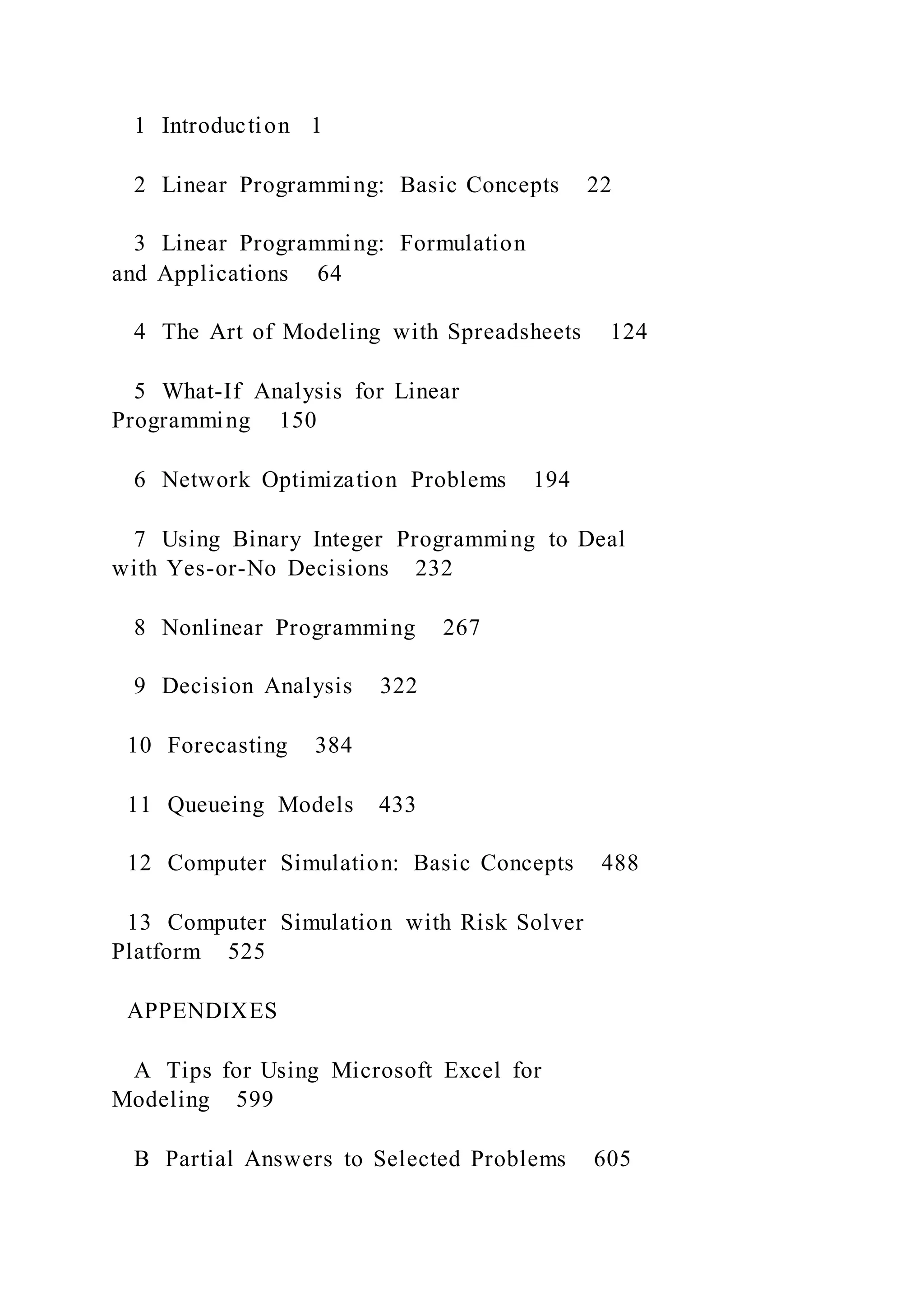
1 Introduction 1
2 Linear Programming: Basic Concepts 22
3 Linear Programming: Formulation
and Applications 64
4 The Art of Modeling with Spreadsheets 124
5 What-If Analysis for Linear
Programming 150
6 Network Optimization Problems 194
7 Using Binary Integer Programming to Deal
with Yes-or-No Decisions 232
8 Nonlinear Programming 267
9 Decision Analysis 322
10 Forecasting 384
11 Queueing Models 433
12 Computer Simulation: Basic Concepts 488
13 Computer Simulation with Risk Solver
Platform 525
APPENDIXES
A Tips for Using Microsoft Excel for
Modeling 599
B Partial Answers to Selected Problems 605
INDEX 609
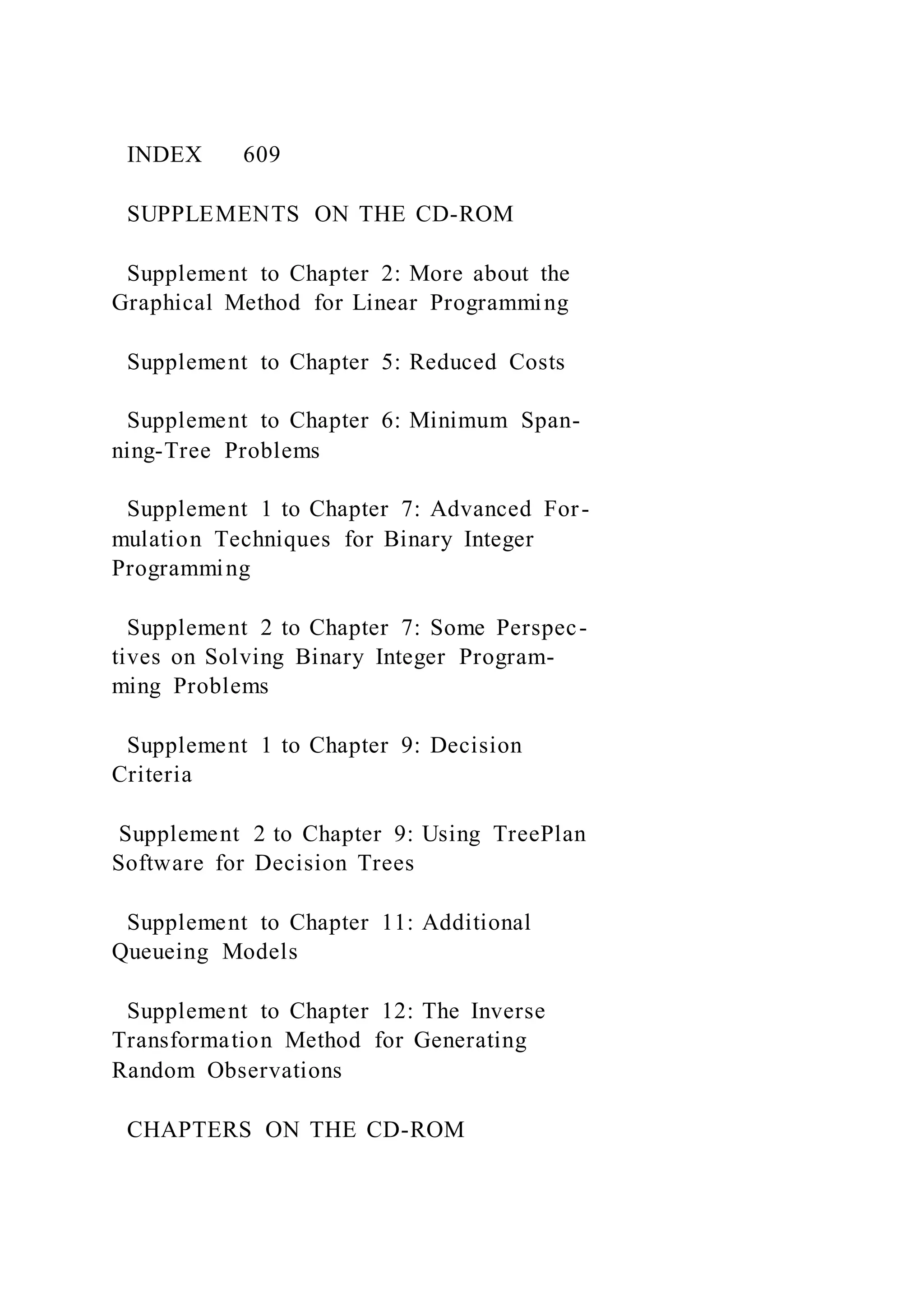
SUPPLEMENTS ON THE CD-ROM
Supplement to Chapter 2: More about the
Graphical Method for Linear Programming
Supplement to Chapter 5: Reduced Costs
Supplement to Chapter 6: Minimum Span-
ning-Tree Problems
Supplement 1 to Chapter 7: Advanced For-
mulation Techniques for Binary Integer
Programming
Supplement 2 to Chapter 7: Some Perspec-
tives on Solving Binary Integer Program-
ming Problems
Supplement 1 to Chapter 9: Decision
Criteria
Supplement 2 to Chapter 9: Using TreePlan
Software for Decision Trees
Supplement to Chapter 11: Additional
Queueing Models
Supplement to Chapter 12: The Inverse
Transformation Method for Generating
Random Observations
CHAPTERS ON THE CD-ROM
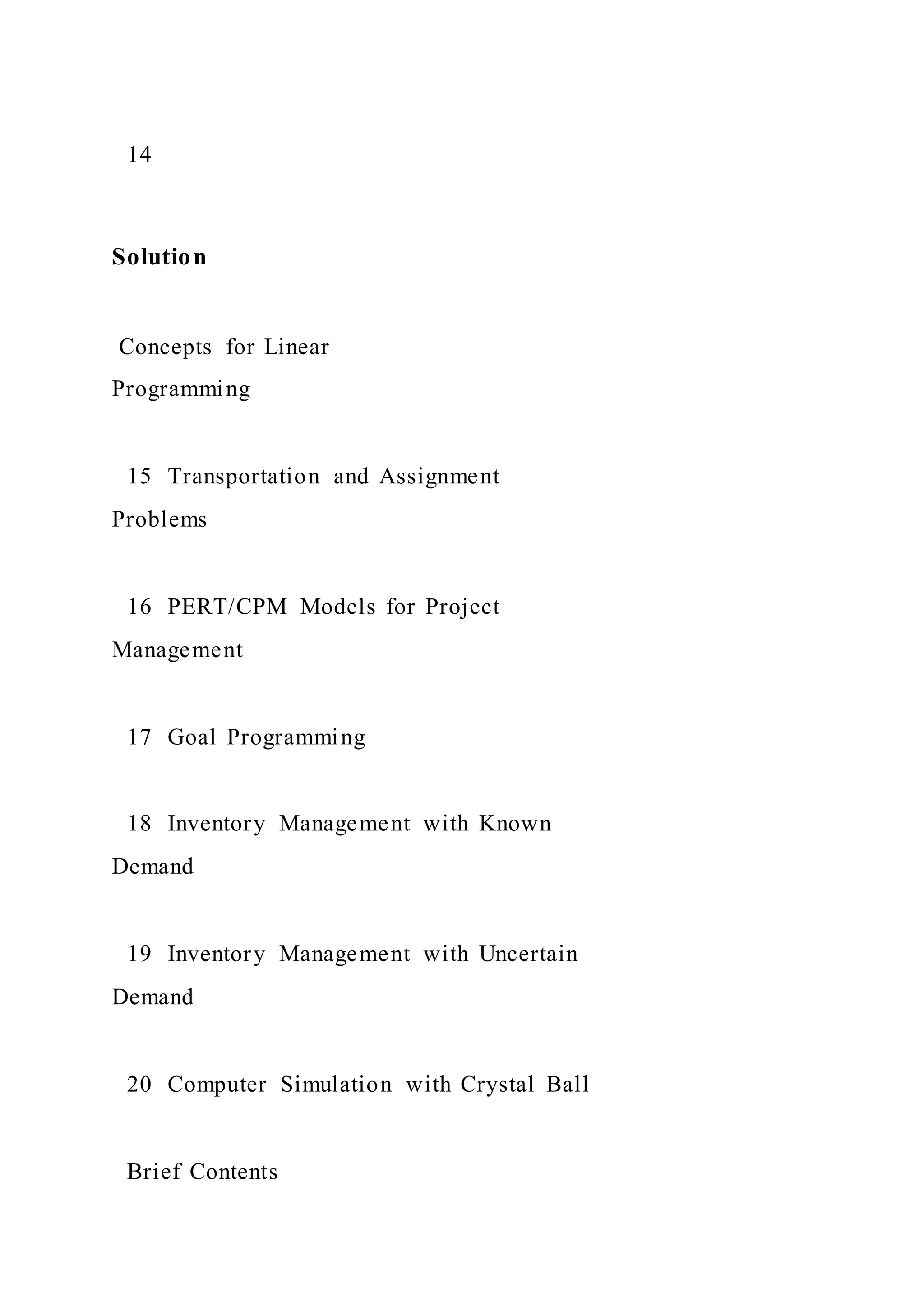
14
Solution
Concepts for Linear
Programming
15 Transportation and Assignment
Problems
16 PERT/CPM Models for Project
Management
17 Goal Programming
18 Inventory Management with Known
Demand
19 Inventory Management with Uncertain
Demand
20 Computer Simulation with Crystal Ball
Brief Contents
hil24064_fm_i-xx.indd xvhil24064_fm_i-xx.indd xv 05/12/12
2:18 PM05/12/12 2:18 PM
Rev. Confirming Pages
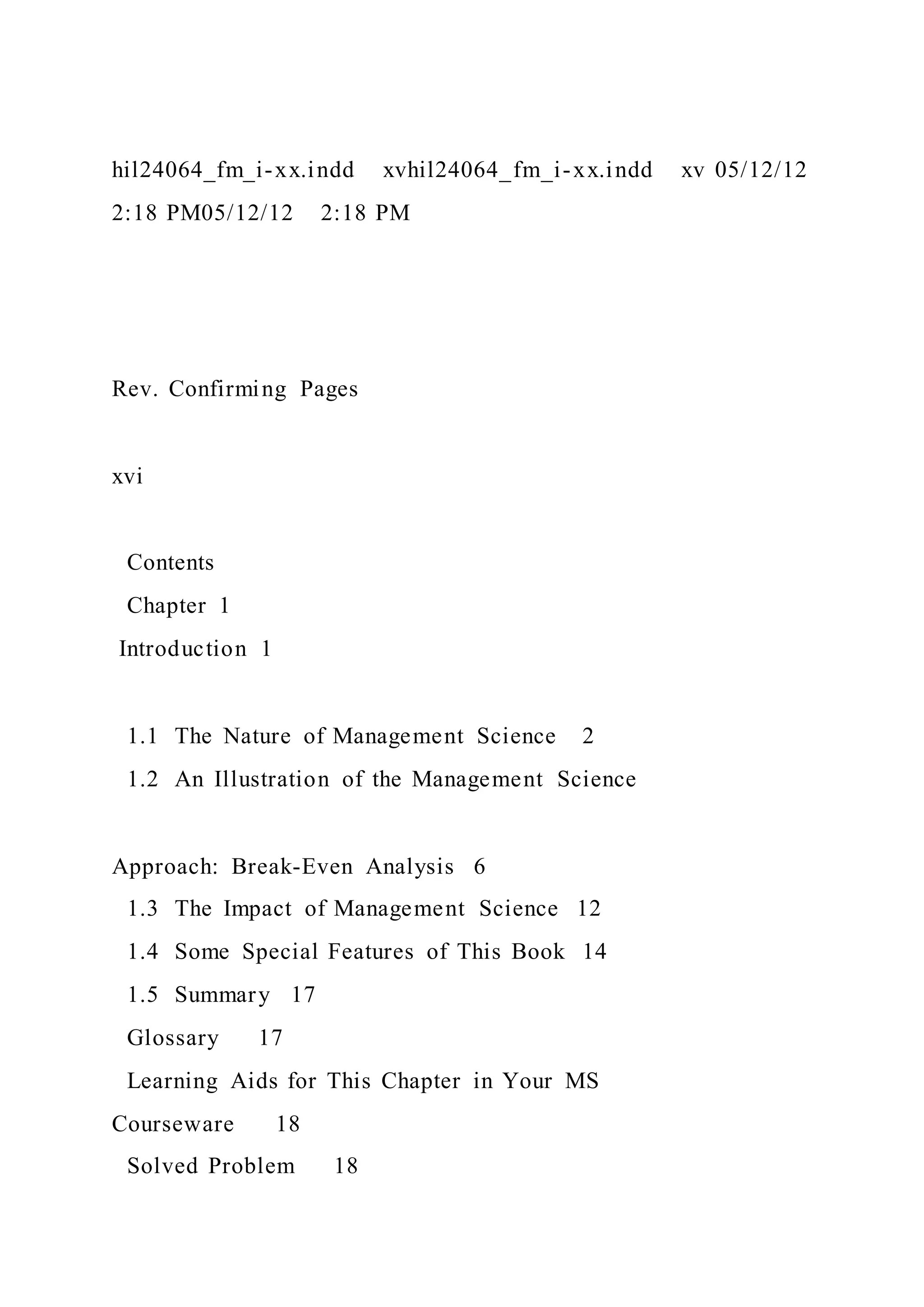
xvi
Contents
Chapter 1
Introduction 1
1.1 The Nature of Management Science 2
1.2 An Illustration of the Management Science
Approach: Break-Even Analysis 6
1.3 The Impact of Management Science 12
1.4 Some Special Features of This Book 14
1.5 Summary 17
Glossary 17
Learning Aids for This Chapter in Your MS
Courseware 18
Solved Problem 18
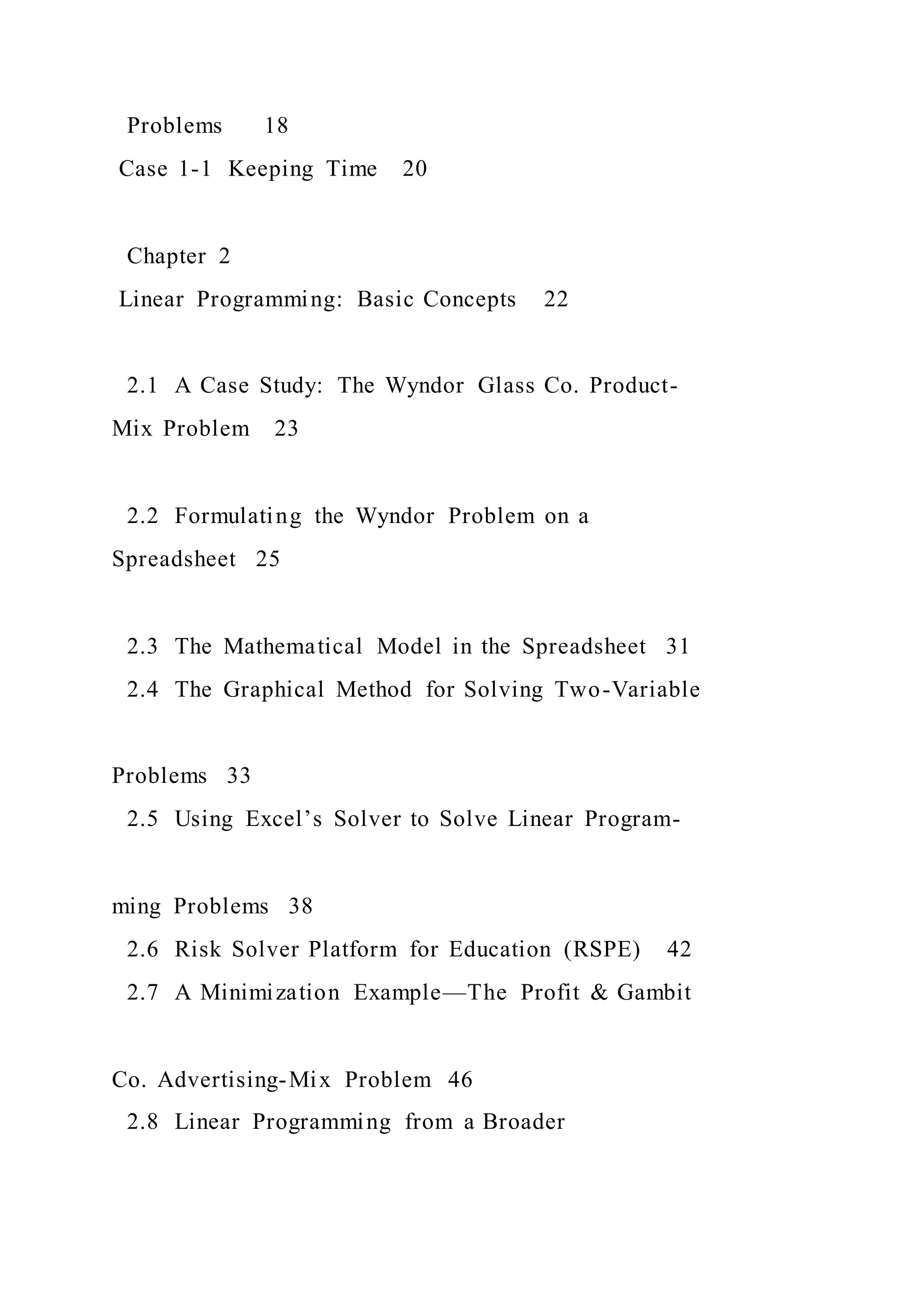
Problems 18
Case 1-1 Keeping Time 20
Chapter 2
Linear Programming: Basic Concepts 22
2.1 A Case Study: The Wyndor Glass Co. Product-
Mix Problem 23
2.2 Formulating the Wyndor Problem on a
Spreadsheet 25
2.3 The Mathematical Model in the Spreadsheet 31
2.4 The Graphical Method for Solving Two-Variable
Problems 33
2.5 Using Excel’s Solver to Solve Linear Program-
ming Problems 38
2.6 Risk Solver Platform for Education (RSPE) 42
2.7 A Minimization Example—The Profit & Gambit
Co. Advertising-Mix Problem 46
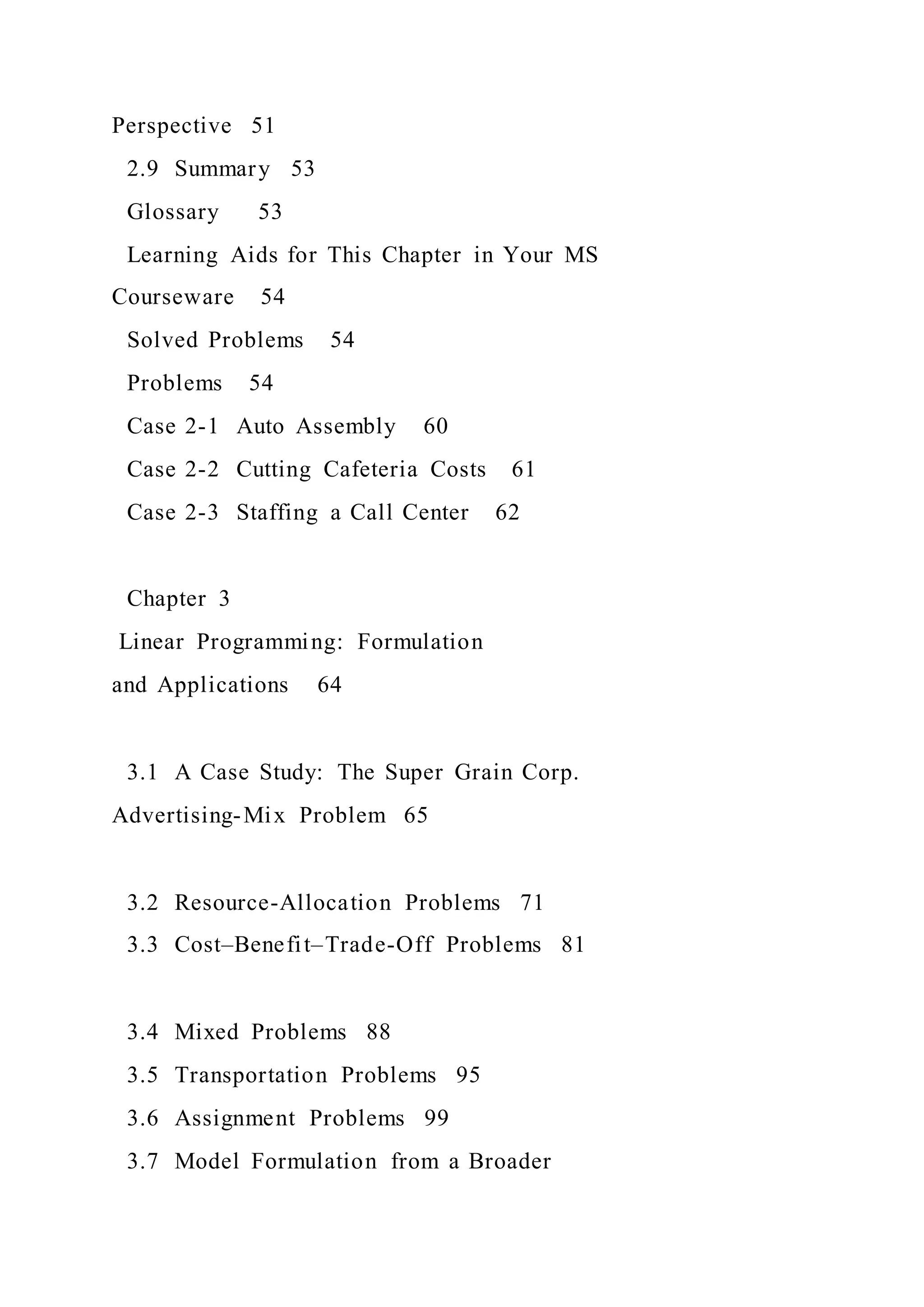
2.8 Linear Programming from a Broader
Perspective 51
2.9 Summary 53
Glossary 53
Learning Aids for This Chapter in Your MS
Courseware 54
Solved Problems 54
Problems 54
Case 2-1 Auto Assembly 60
Case 2-2 Cutting Cafeteria Costs 61
Case 2-3 Staffing a Call Center 62
Chapter 3
Linear Programming: Formulation
and Applications 64
3.1 A Case Study: The Super Grain Corp.
Advertising-Mix Problem 65
3.2 Resource-Allocation Problems 71
3.3 Cost–Benefit–Trade-Off Problems 81
3.4 Mixed Problems 88
3.5 Transportation Problems 95
3.6 Assignment Problems 99
3.7 Model Formulation from a Broader
Perspective 102
3.8 Summary 103
Glossary 104
Learning Aids for This Chapter in Your MS
Courseware 104
Solved Problems 104
Problems 105
Case 3-1 Shipping Wood to Market 114
Case 3-2 Capacity Concerns 115
Case 3-3 Fabrics and Fall Fashions 116
Case 3-4 New Frontiers 118
Case 3-5 Assigning Students to Schools 119
Case 3-6 Reclaiming Solid Wastes 120
Case 3-7 Project Pickings 121
Chapter 4
The Art of Modeling with Spreadsheets 124
4.1 A Case Study: The Everglade Golden Years
Company Cash Flow Problem 125
4.2 Overview of the Process of Modeling with
Spreadsheets 126
4.3 Some Guidelines for Building “Good” Spread-
sheet Models 135
4.4 Debugging a Spreadsheet Model 141
4.5 Summary 144
Glossary 145
Learning Aids for This Chapter in Your MS
Courseware 145
Solved Problems 145
Problems 146
Case 4-1 Prudent Provisions for Pensions 148
Chapter 5
What-If Analysis for Linear
Programming 150
5.1 The Importance of What-If Analysis to
Managers 151
5.2 Continuing the Wyndor Case Study 153
5.3 The Effect of Changes in One Objective Function
Coefficient 155
5.4 The Effect of Simultaneous Changes in Objective
Function Coefficients 161
5.5 The Effect of Single Changes in a
Constraint 169
hil24064_fm_i-xx.indd xvihil24064_fm_i-xx.indd xvi
05/12/12 2:18 PM05/12/12 2:18 PM
Rev. Confirming Pages
Contents xvii
5.6 The Effect of Simultaneous Changes in the
Constraints 175
5.7 Summary 179
Glossary 179
Learning Aids for This Chapter in Your MS
Courseware 180
Solved Problem 180
Problems 181
Case 5-1 Selling Soap 188
Case 5-2 Controlling Air Pollution 189
Case 5-3 Farm Management 191
Case 5-4 Assigning Students to
Schools (Revisited) 193
Chapter 6
Network Optimization Problems 194
6.1 Minimum-Cost Flow Problems 195
6.2 A Case Study: The BMZ Co. Maximum Flow
Problem 202
6.3 Maximum Flow Problems 205
6.4 Shortest Path Problems 209
6.5 Summary 218
Glossary 219
Learning Aids for This Chapter in Your MS
Courseware 219
Solved Problems 219
Problems 220
Case 6-1 Aiding Allies 224
Case 6-2 Money in Motion 227
Case 6-3 Airline Scheduling 229
Case 6-4 Broadcasting the Olympic
Games 230
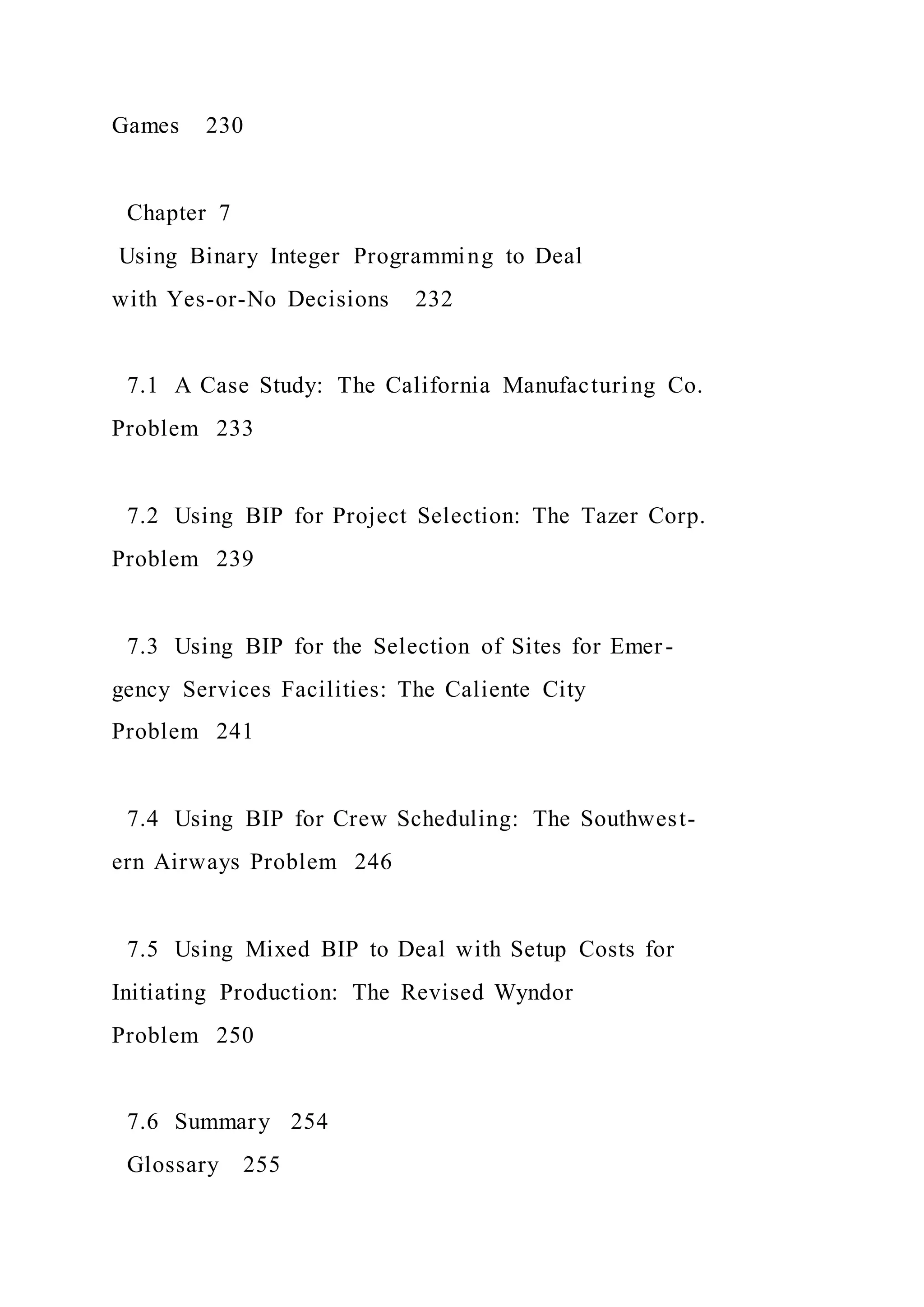
Chapter 7
Using Binary Integer Programming to Deal
with Yes-or-No Decisions 232
7.1 A Case Study: The California Manufacturing Co.
Problem 233
7.2 Using BIP for Project Selection: The Tazer Corp.
Problem 239
7.3 Using BIP for the Selection of Sites for Emer-
gency Services Facilities: The Caliente City
Problem 241
7.4 Using BIP for Crew Scheduling: The Southwest-
ern Airways Problem 246
7.5 Using Mixed BIP to Deal with Setup Costs for
Initiating Production: The Revised Wyndor
Problem 250
7.6 Summary 254
Glossary 255
Learning Aids for This Chapter in Your MS
Courseware 255
Solved Problems 255
Problems 257
Case 7-1 Assigning Art 261
Case 7-2 Stocking Sets 263
Case 7-3 Assigning Students to
Schools (Revisited) 266
Case 7-4 Broadcasting the Olympic Games
(Revisited) 266
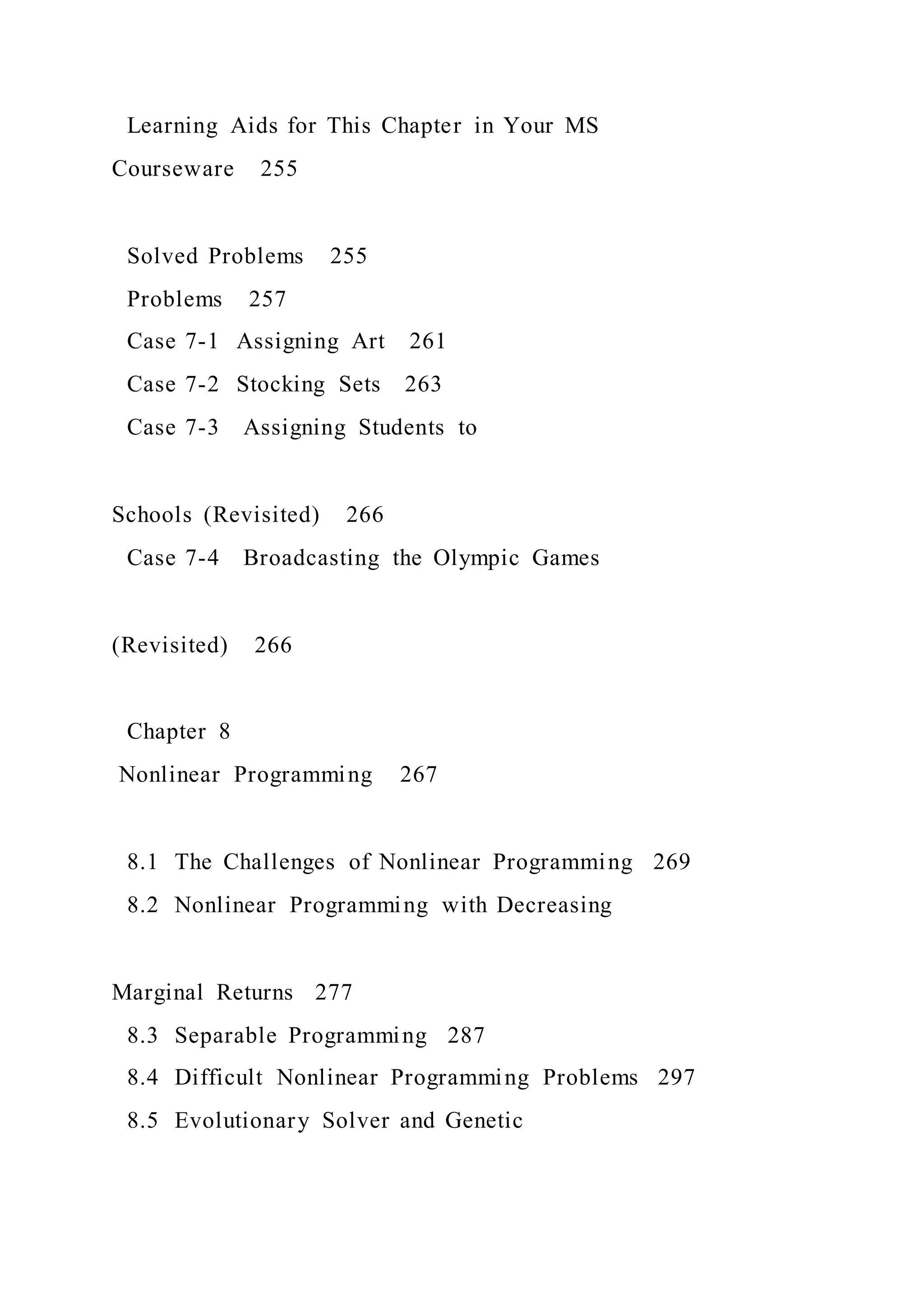
Chapter 8
Nonlinear Programming 267
8.1 The Challenges of Nonlinear Programming 269
8.2 Nonlinear Programming with Decreasing
Marginal Returns 277
8.3 Separable Programming 287
8.4 Difficult Nonlinear Programming Problems 297
8.5 Evolutionary Solver and Genetic
Algorithms 299
8.6 Using RSPE to Analyze a Model and Choose a
Solving Method 306
8.7 Summary 310
Glossary 311
Learning Aids for This Chapter in Your MS
Courseware 312
Solved Problem 312
Problems 312
Case 8-1 Continuation of the Super Grain Case
Study 317
Case 8-2 Savvy Stock Selection 318
Case 8-3 International Investments 319
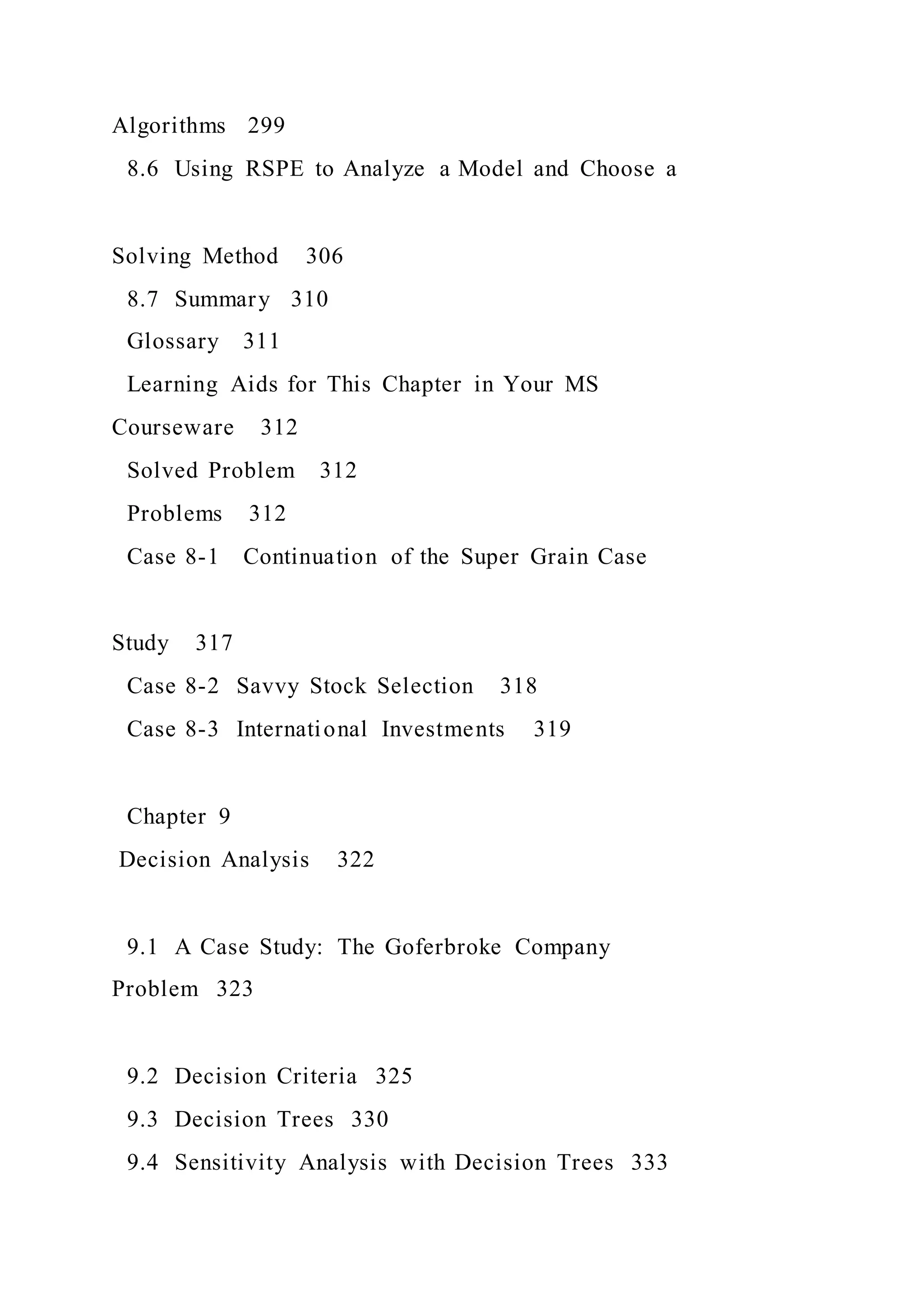
Chapter 9
Decision Analysis 322
9.1 A Case Study: The Goferbroke Company
Problem 323
9.2 Decision Criteria 325
9.3 Decision Trees 330
9.4 Sensitivity Analysis with Decision Trees 333
9.5 Checking Whether to Obtain More
Information 338
9.6 Using New Information to Update the
Probabilities 340
9.7 Using a Decision Tree to Analyze the Problem
with a Sequence of Decisions 344
9.8 Performing Sensitivity Analysis on the Problem
with a Sequence of Decisions 351
9.9 Using Utilities to Better Reflect the Values of
Payoffs 354
9.10 The Practical Application of Decision
Analysis 365
9.11 Summary 366
Glossary 367
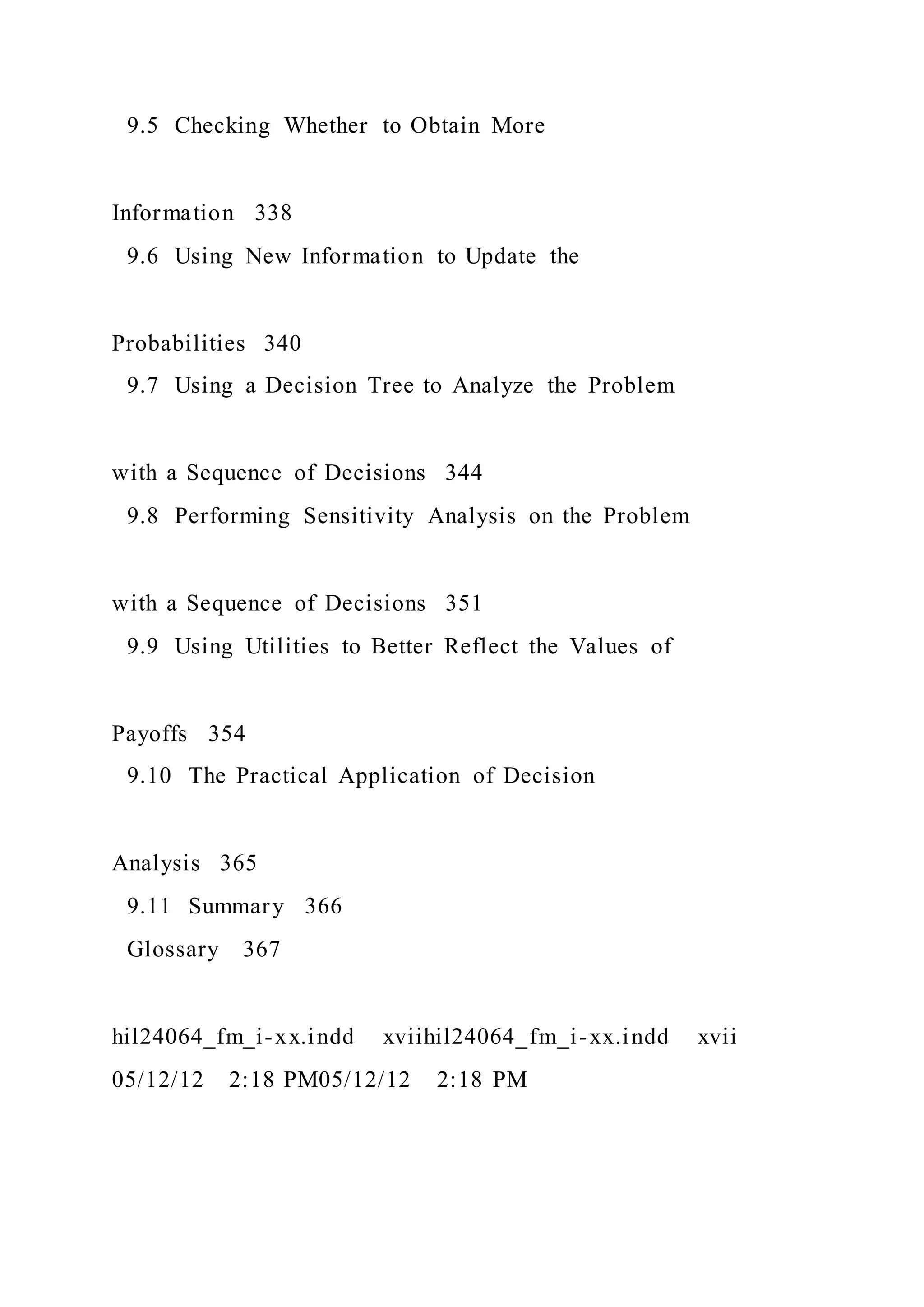
hil24064_fm_i-xx.indd xviihil24064_fm_i-xx.indd xvii
05/12/12 2:18 PM05/12/12 2:18 PM
Rev. Confirming Pages
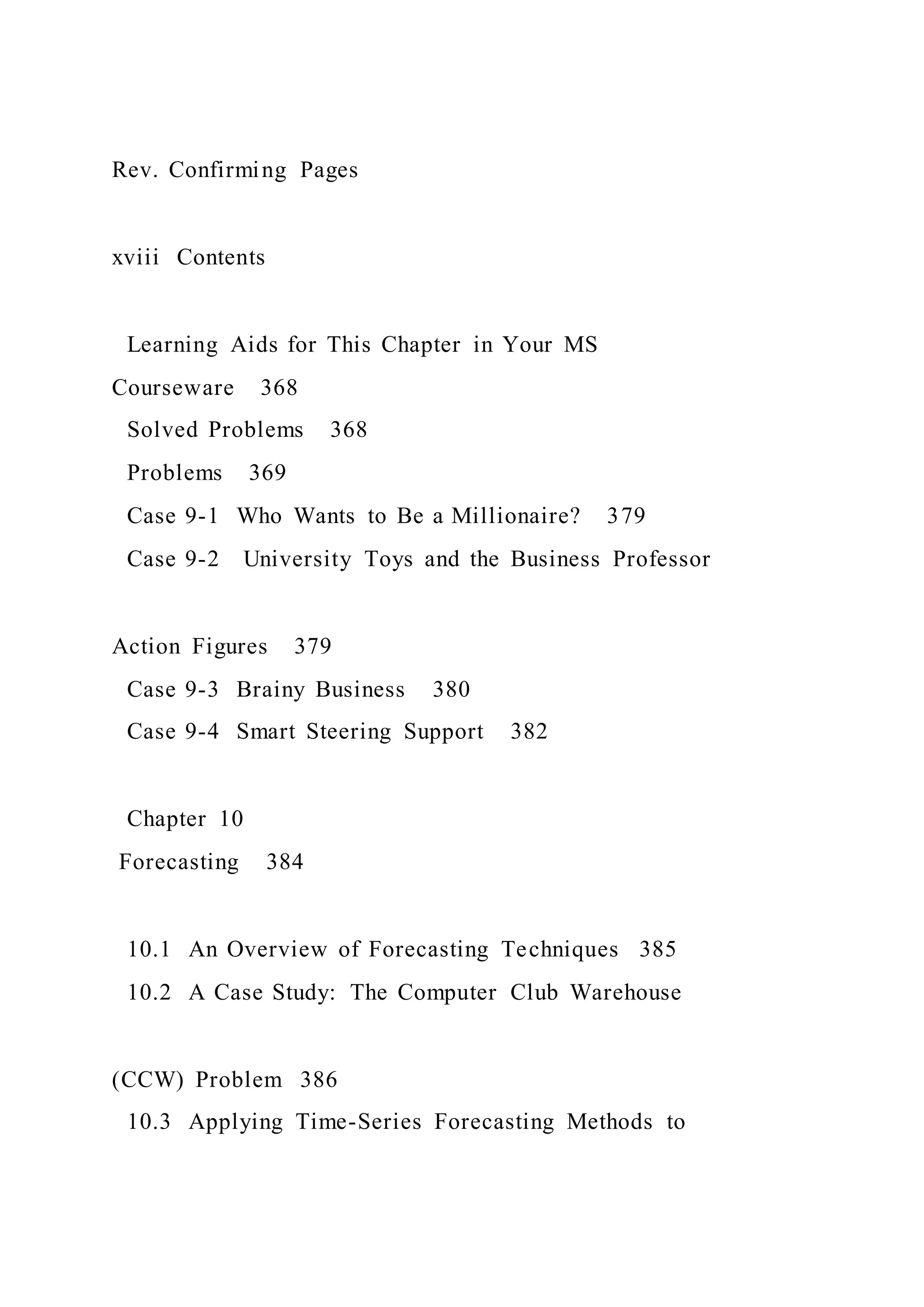
xviii Contents
Learning Aids for This Chapter in Your MS
Courseware 368
Solved Problems 368
Problems 369
Case 9-1 Who Wants to Be a Millionaire? 379
Case 9-2 University Toys and the Business Professor
Action Figures 379
Case 9-3 Brainy Business 380
Case 9-4 Smart Steering Support 382
Chapter 10
Forecasting 384
10.1 An Overview of Forecasting Techniques 385
10.2 A Case Study: The Computer Club Warehouse
(CCW) Problem 386
10.3 Applying Time-Series Forecasting Methods to
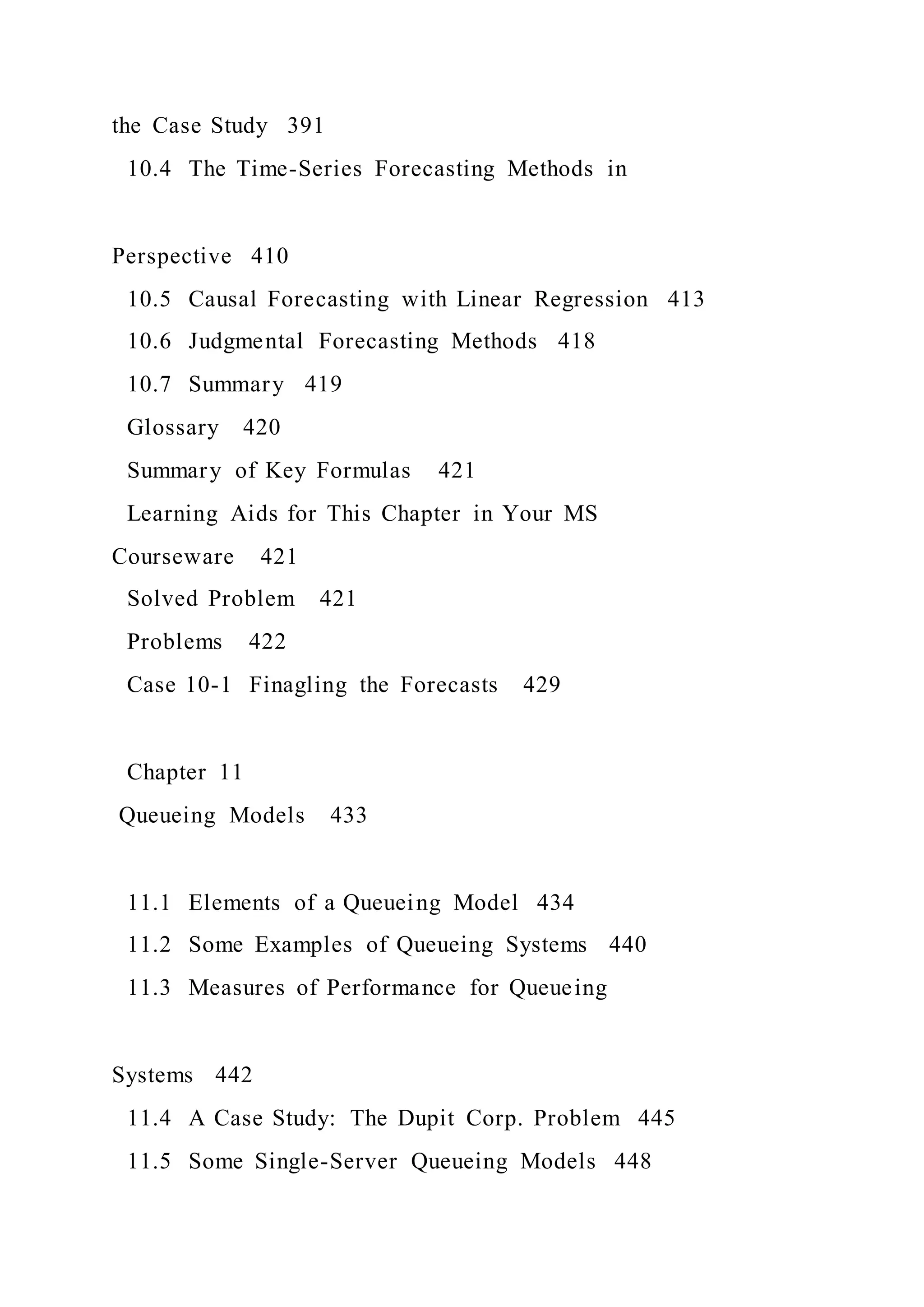
the Case Study 391
10.4 The Time-Series Forecasting Methods in
Perspective 410
10.5 Causal Forecasting with Linear Regression 413
10.6 Judgmental Forecasting Methods 418
10.7 Summary 419
Glossary 420
Summary of Key Formulas 421
Learning Aids for This Chapter in Your MS
Courseware 421
Solved Problem 421
Problems 422
Case 10-1 Finagling the Forecasts 429
Chapter 11
Queueing Models 433
11.1 Elements of a Queueing Model 434
11.2 Some Examples of Queueing Systems 440
11.3 Measures of Performance for Queueing
Systems 442
11.4 A Case Study: The Dupit Corp. Problem 445
11.5 Some Single-Server Queueing Models 448
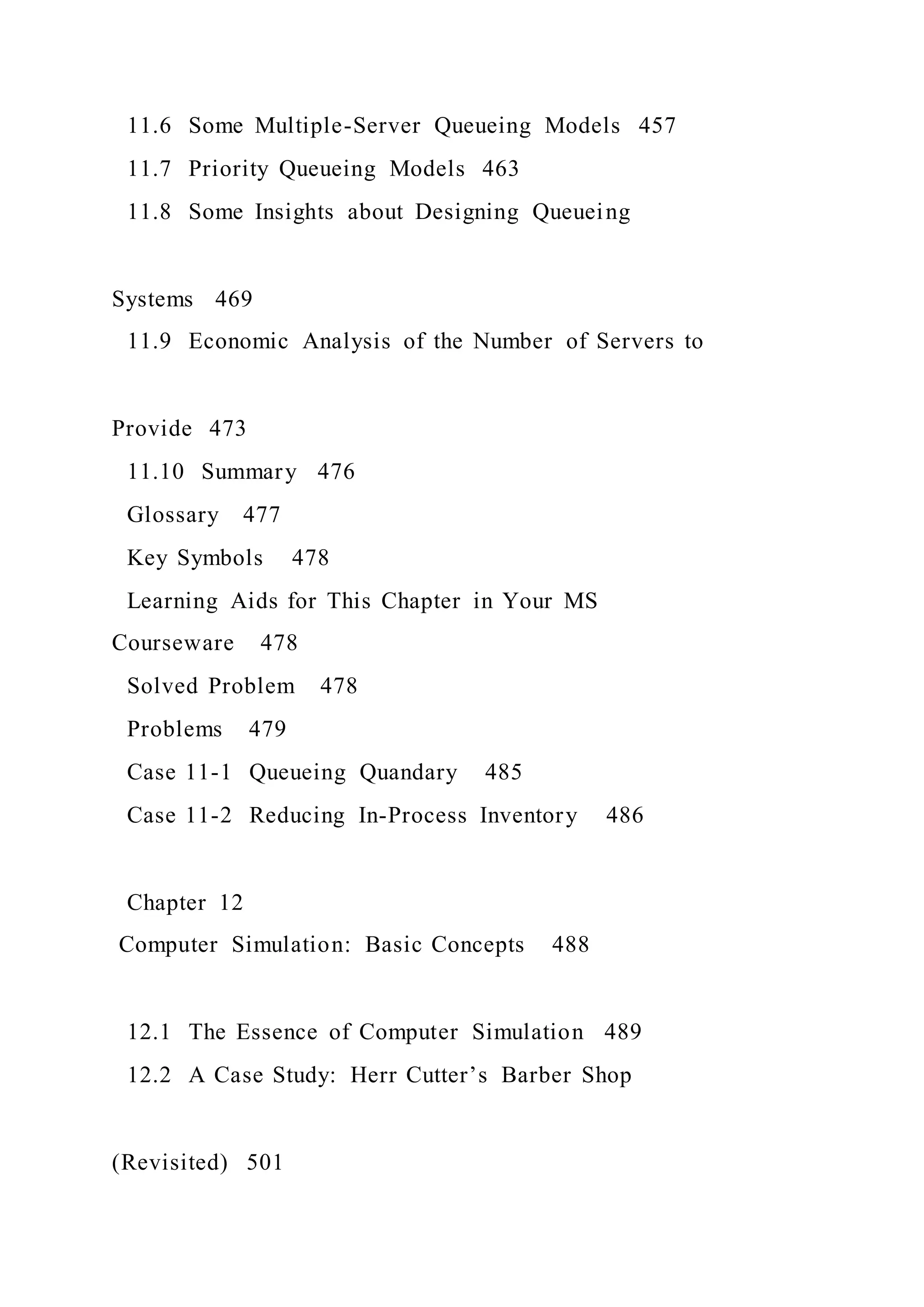
11.6 Some Multiple-Server Queueing Models 457
11.7 Priority Queueing Models 463
11.8 Some Insights about Designing Queueing
Systems 469
11.9 Economic Analysis of the Number of Servers to
Provide 473
11.10 Summary 476
Glossary 477
Key Symbols 478
Learning Aids for This Chapter in Your MS
Courseware 478
Solved Problem 478
Problems 479
Case 11-1 Queueing Quandary 485
Case 11-2 Reducing In-Process Inventory 486
Chapter 12
Computer Simulation: Basic Concepts 488
12.1 The Essence of Computer Simulation 489
12.2 A Case Study: Herr Cutter’s Barber Shop
(Revisited) 501
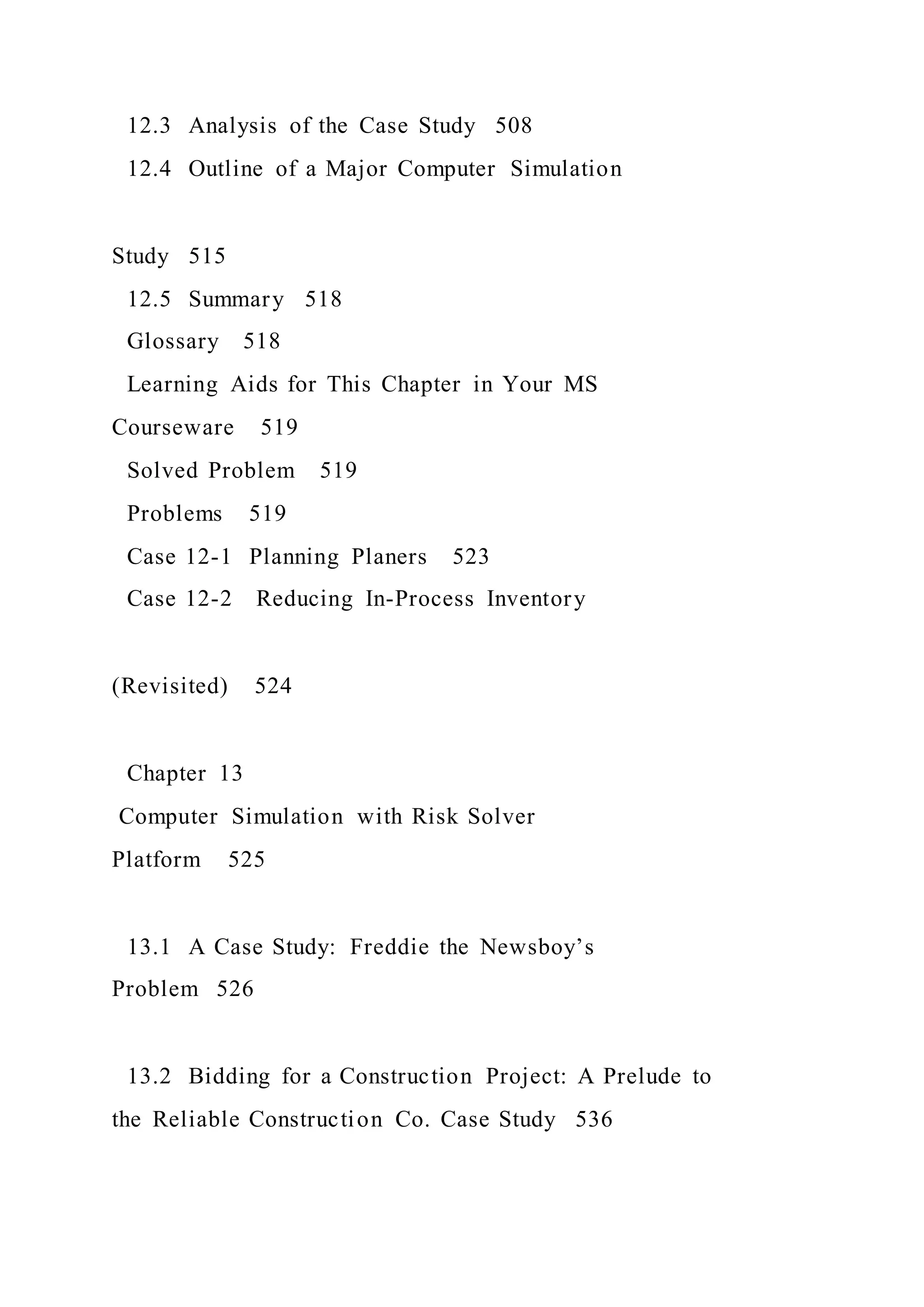
12.3 Analysis of the Case Study 508
12.4 Outline of a Major Computer Simulation
Study 515
12.5 Summary 518
Glossary 518
Learning Aids for This Chapter in Your MS
Courseware 519
Solved Problem 519
Problems 519
Case 12-1 Planning Planers 523
Case 12-2 Reducing In-Process Inventory
(Revisited) 524
Chapter 13
Computer Simulation with Risk Solver
Platform 525
13.1 A Case Study: Freddie the Newsboy’s
Problem 526
13.2 Bidding for a Construction Project: A Prelude to
the Reliable Construction Co. Case Study 536
13.3 Project Management: Revisiting the Reliable
Construction Co. Case Study 540
13.4 Cash Flow Management: Revisiting the Ever-
glade Golden Years Company Case Study 546
13.5 Financial Risk Analysis: Revisiting the Think-
Big Development Co. Problem 552
13.6 Revenue Management in the Travel
Industry 557
13.7 Choosing the Right Distribution 562
13.8 Decision Making with Parameter Analysis
Reports and Trend Charts 575
13.9 Optimizing with Computer Simulation Using
RSPE’s Solver 583
13.10 Summary 590
Glossary 591
Learning Aids for This Chapter in Your MS
Courseware 591
Solved Problem 591
Problems 592
Case 13-1 Action Adventures 596
Case 13-2 Pricing under Pressure 597
Appendix A
Tips for Using Microsoft Excel for
Modeling 599
Appendix B
Partial Answers to Selected Problems 605
hil24064_fm_i-xx.indd xviiihil24064_fm_i-xx.indd xviii
05/12/12 2:18 PM05/12/12 2:18 PM
Rev. Confirming Pages
Contents xix
Index 609
Supplements on the CD-ROM
Supplement to Chapter 2: More about the
Graphical Method for Linear Programming
Supplement to Chapter 5: Reduced Costs
Supplement to Chapter 6: Minimum Spanning-
Tree Problems
Supplement 1 to Chapter 7: Advanced Formula-
tion Techniques for Binary Integer Programming
Supplement 2 to Chapter 7: Some Perspectives on
Solving Binary Integer Programming Problems
Supplement 1 to Chapter 9: Decision Criteria
Supplement 2 to Chapter 9: Using TreePlan
Software for Decision Trees
Supplement to Chapter 11: Additional Queueing
Models
Supplement to Chapter 12: The Inverse Trans-
formation Method for Generating Random
Observations
Chapters on the CD-ROM
Chapter 14

Final Assignment Informational InterviewFor this assignment y

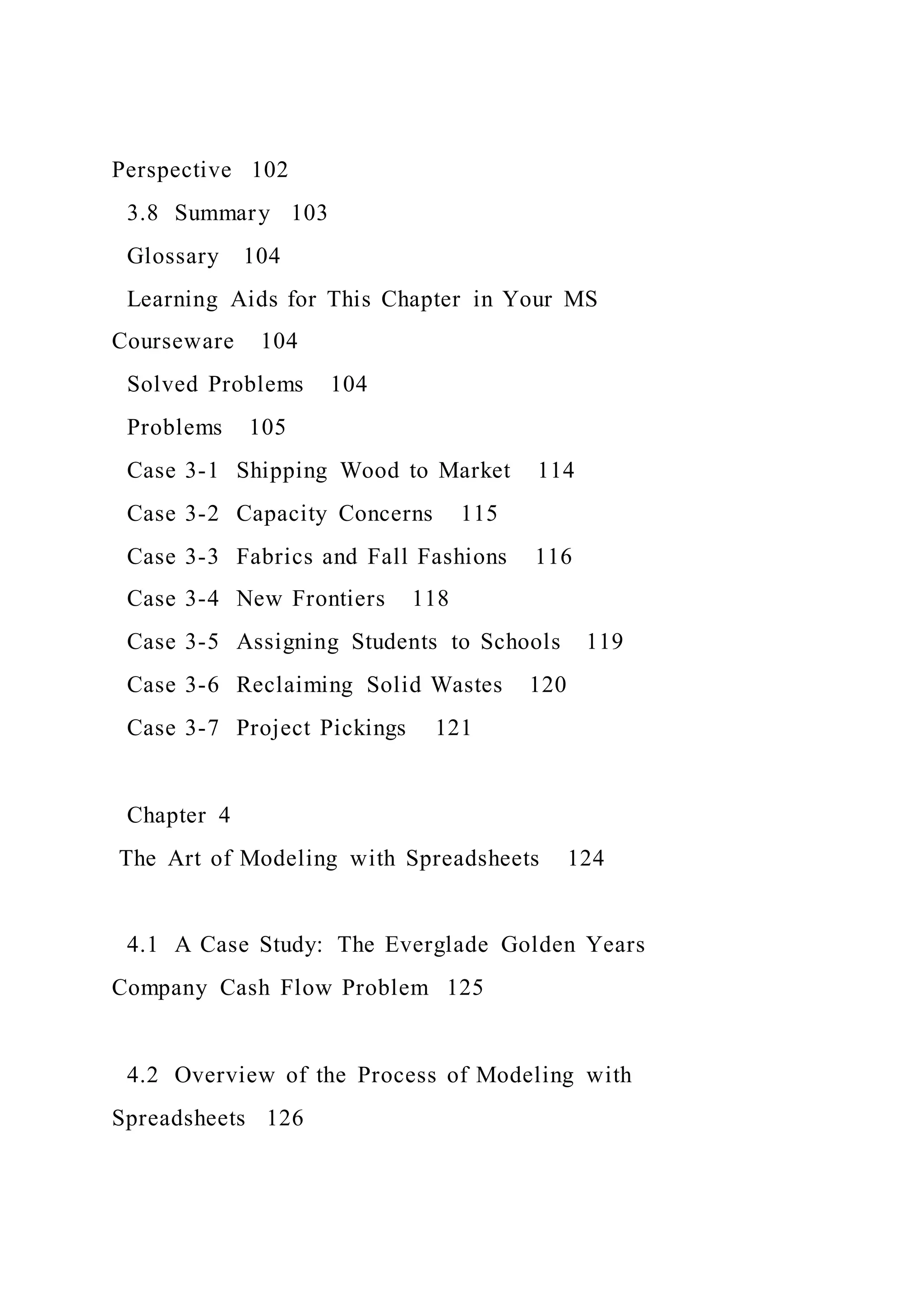
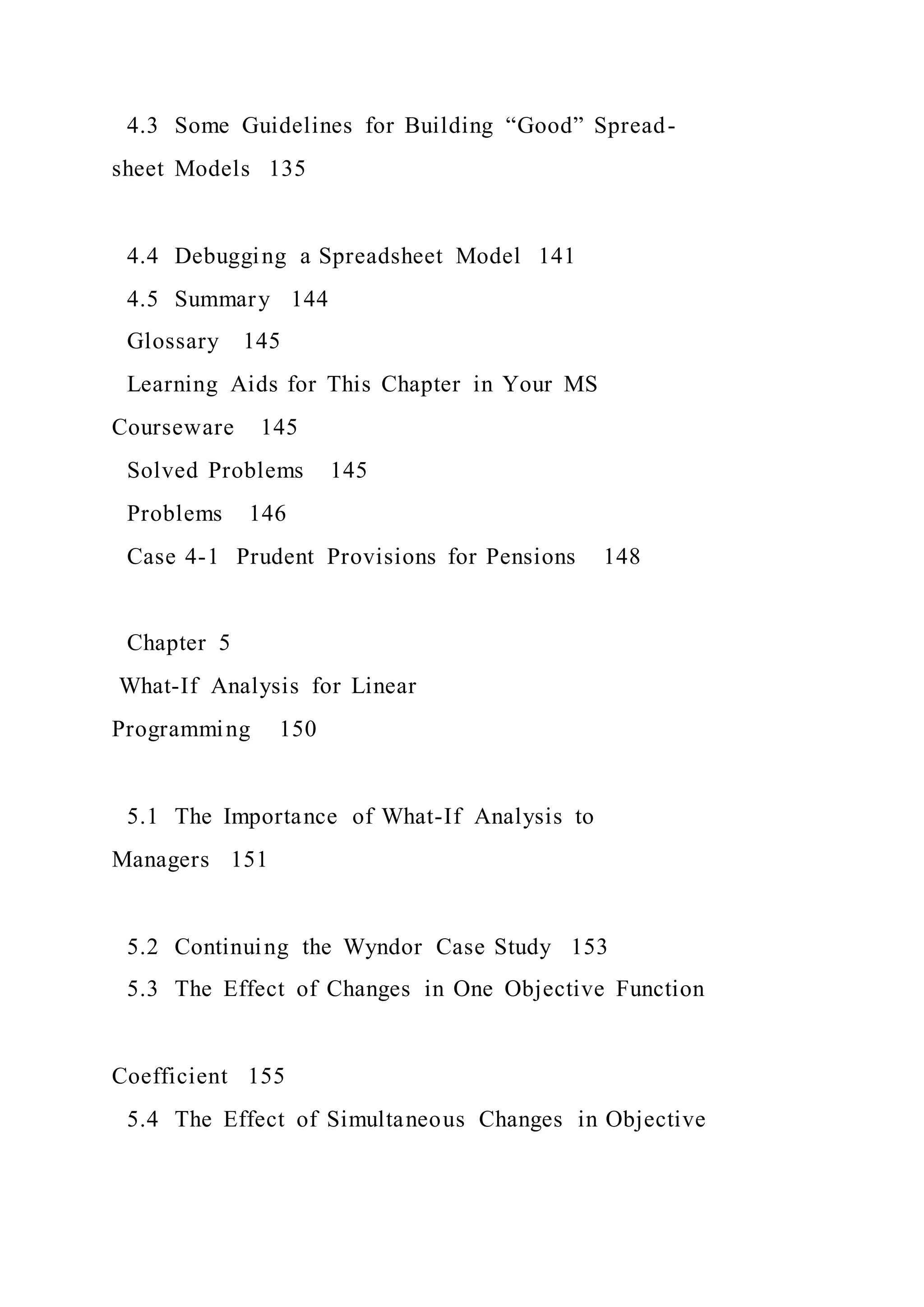
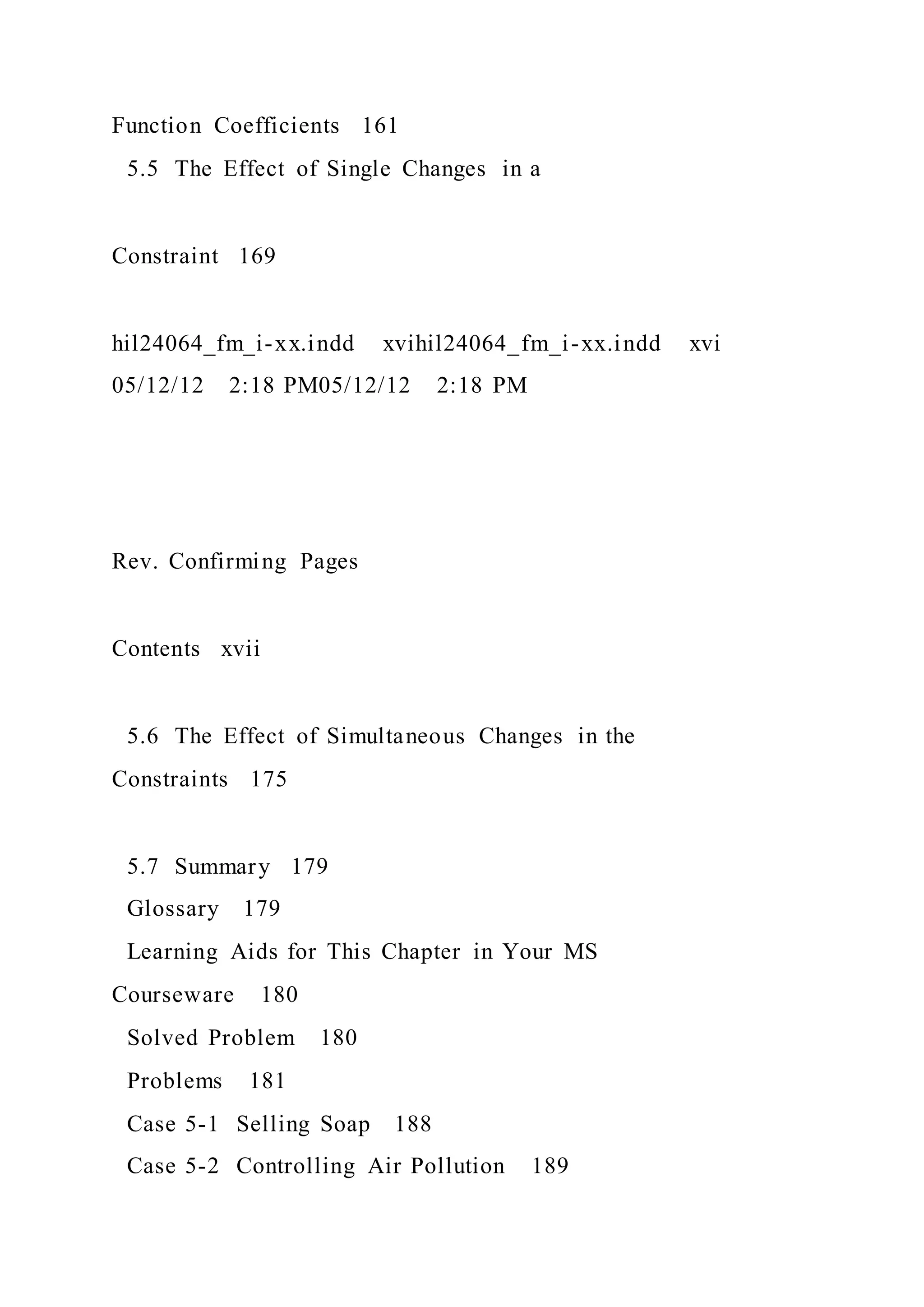
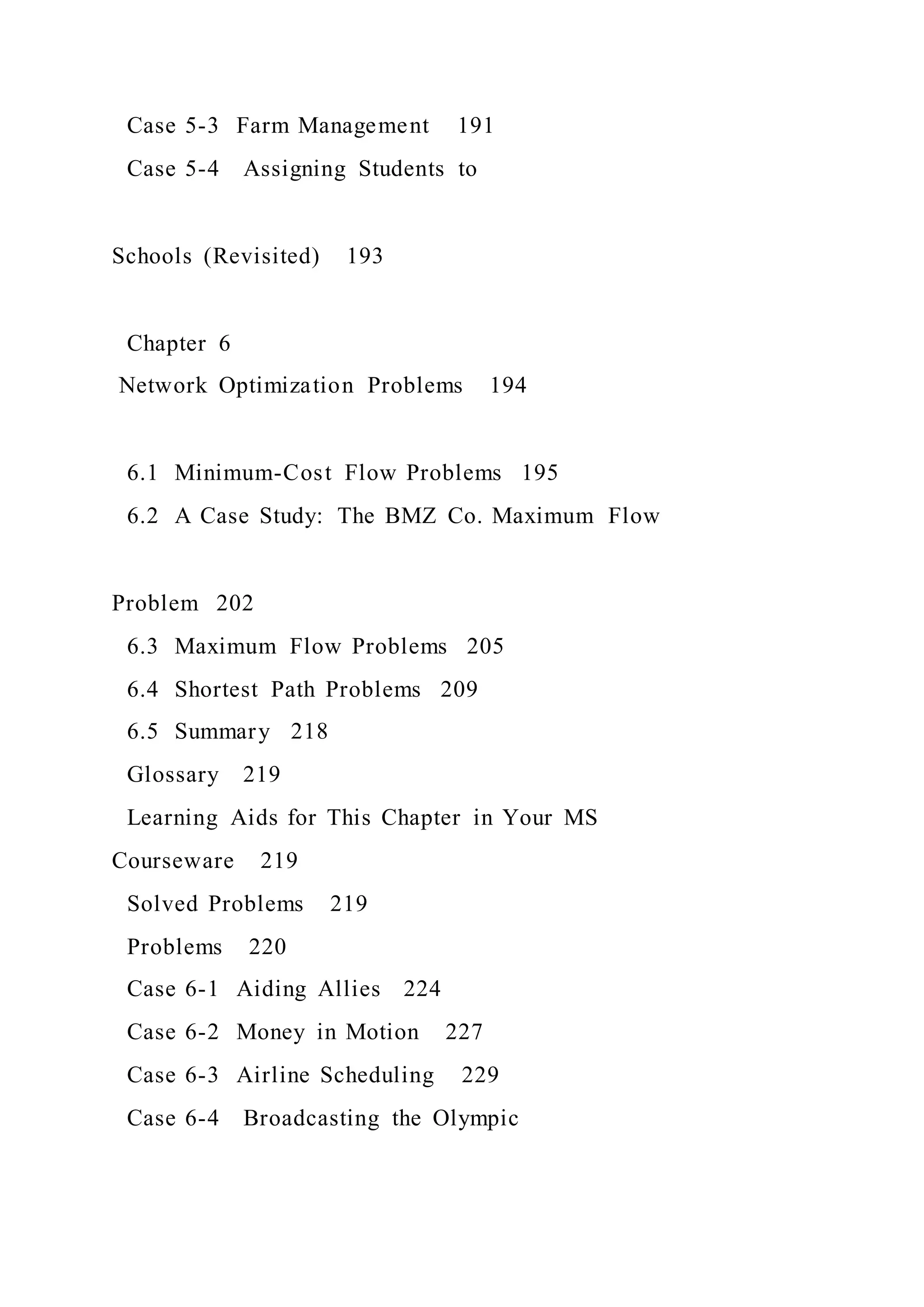
  • 1.
    Final Assignment: InformationalInterview For this assignment you will be graded on a report you write discussing your experience with an informational interview. This assignment will be introduced mid-semester in order to give you time to find someone to interview and complete the assignment. The assignment is due to DROPBOX on FRIDAY DECEMBER 3rd. To complete this assignment, you need to find at least 1 person in your field of interest to interview. You need to conduct an interview of at least an hour in which you gain insight into your field of interest. After conducting the interview, you will write a 3-4 page paper in APA format (title page and references not included in page count). In the paper you need to address: · Introduction/conclusion · Your chosen career field and information on that field · Who you interviewed (include information on their background etc) · What you learned in the interview about them, the field, and anything else you may have discussed · You thoughts and opinions on this career field now that you have done the informational interview Your paper should include at least 1 citation for information on your career interest and one citation for the conversation with the person you had. I suggest utilizing Purdue Owl if you do not know how to utilize APA format and citations. Your grade will be based on: Information on your field 5 points Information on your discussion 5 points Thoughts/reflections on your discussion/field of interest5 points
  • 2.
    Appropriate APA format,citations, grammar, spelling, page count etc5 points Rev. Confirming Pages Introduction to Management Science A Modeling and Case Studies Approach with Spreadsheets hil24064_fm_i-xx.indd ihil24064_fm_i-xx.indd i 05/12/12 2:18 PM05/12/12 2:18 PM Rev. Confirming Pages The McGraw-Hill/Irwin Series Operations and Decision Sciences OPERATIONS MANAGEMENT Beckman and Rosenfield, Operations, Strategy: Competing in the 21st Century, First Edition Benton, Purchasing and Supply Chain Management, Second Edition
  • 3.
    Bowersox, Closs, Cooper,and Bowersox Supply Chain Logistics Management, Fourth Edition Brown and Hyer, Managing Projects: A Team-Based Approach, First Edition Burt, Petcavage, and Pinkerton, Supply Management, Eighth Edition Cachon and Terwiesch, Matching Supply with Demand: An Intro- duction to Operations Management, Third Edition Cooper and Schindler, Business Research Methods, Eleventh Edition Finch, Interactive Models for Operations and Supply Chain Management, First Edition Fitzsimmons and Fitzsimmons, Service Management: Operations, Strategy, Information Technology, Seventh Edition Gehrlein, Operations Management Cases, First Edition
  • 4.
    Harrison and Samson, TechnologyManagement, First Edition Hayen, SAP R/3 Enterprise Software: An Introduction, First Edition Hill, Manufacturing Strategy: Text & Cases, Third Edition Hopp, Supply Chain Science, First Edition Hopp and Spearman, Factory Physics, Third Edition Jacobs, Berry, Whybark, and Vollmann, Manufacturing Planning & Control for Supply Chain Management, Sixth Edition Jacobs and Chase, Operations and Supply Management: The Core, Third Edition Jacobs and Chase, Operations and Supply Management, Fourteenth Edition
  • 5.
    Jacobs and Whybark, WhyERP?, First Edition Larson and Gray, Project Management: The Managerial Process, Fifth Edition Leenders, Johnson, Flynn, and Fearon, Purchasing and Supply Management, Thirteenth Edition Nahmias, Production and Operations Analysis, Sixth Edition Olson, Introduction to Information Systems Proj- ect Management, Second Edition Schroeder, Goldstein, and Rungtusanatham, Operations Management: Contemporary Concepts and Cases, Sixth Edition Seppanen, Kumar, and Chandra, Process Analysis and Improvement, First Edition Simchi-Levi, Kaminsky, and Simchi-Levi, Designing and Managing the Supply Chain: Concepts, Strategies, Case Studies, Third Edition
  • 6.
    Sterman, Business Dynamics: SystemsThinking and Modeling for Complex World, First Edition Stevenson, Operations Management, Eleventh Edition Swink, Melnyk, Cooper, and Hartley, Managing Operations Across the Supply Chain, Second Edition Thomke, Managing Product and Service Development: Text and Cases, First Edition Ulrich and Eppinger, Product Design and Development, Fourth Edition Zipkin, Foundations of Inventory Management, First Edition QUANTITATIVE METHODS AND MANAGEMENT SCIENCE Hillier and Hillier, Introduction to Management Science: A Modeling and Case Studies Approach with Spreadsheets, Fifth Edition
  • 7.
    Stevenson and Ozgur, Introductionto Management Science with Spreadsheets, First Edition hil24064_fm_i-xx.indd iihil24064_fm_i-xx.indd ii 05/12/12 2:18 PM05/12/12 2:18 PM Rev. Confirming Pages Introduction to Management Science A Modeling and Case Studies Approach with Spreadsheets Fifth Edition Frederick S. Hillier Stanford University Mark S. Hillier University of Washington Cases developed by Karl Schmedders University of Zurich Molly Stephens Quinn, Emanuel, Urquhart & Sullivan, LLP hil24064_fm_i-xx.indd iiihil24064_fm_i-xx.indd iii 05/12/12
  • 8.
    2:18 PM05/12/12 2:18PM Rev. Confirming Pages INTRODUCTION TO MANAGEMENT SCIENCE: A MODELING AND CASE STUDIES APPROACH WITH SPREADSHEETS, FIFTH EDITION Published by McGraw-Hill/Irwin, a business unit of The McGraw-Hill Companies, Inc., 1221 Avenue of the Americas, New York, NY, 10020. Copyright © 2014 by The McGraw-Hill Companies, Inc. All rights reserved. Printed in the United States of America. Previous editions © 2011, 2008, 2003. No part of this publication may be reproduced or distributed in any form or by any means, or stored in a database or retrieval system, without the prior written consent of The McGraw-Hill Companies, Inc., including, but not limited to, in any network or other electronic storage or transmission, or broadcast for distance learning. Some ancillaries, including electronic and print components, may not be available to customers outside the United States. This book is printed on acid-free paper. 1 2 3 4 5 6 7 8 9 0 QVR/QVR 0 9 8 7 6 5 4 3 ISBN 978-0-07-802406-1 MHID 0-07-802406-4 Senior Vice President, Products & Markets: Kurt L. Strand
  • 9.
    Vice President, ContentProduction & Technology Services: Kimberly Meriwether David Managing Director: Douglas Reiner Senior Brand Manager: Thomas Hayward Executive Director of Development: Ann Torbert Managing Developmental Editor: Christina Kouvelis Senior Developmental Editor: Wanda J. Zeman Senior Marketing Manager: Heather Kazakoff Director, Content Production: Terri Schiesl Project Manager: Mary Jane Lampe Buyer: Nichole Birkenholz Cover Designer: Studio Montage, St. Louis, MO Cover Image: Imagewerks/Getty Images Media Project Manager: Prashanthi Nadipalli Typeface: 10/12 Times Roman Compositor: Laserwords Private Limited Printer: Quad/Graphics All credits appearing on page or at the end of the book are considered to be an extension of the copyright page. Library of Congress Cataloging-in-Publication Data Hillier, Frederick S. Introduction to management science : modeling and case studies approach with spreadsheets / Frederick S. Hillier, Stanford University, Mark S. Hillier, University of Washington ; cases developed by Karl Schmedders, University of Zurich, Molly Stephens, Quinn, Emanuel, Urquhart, Sullivan LLP.—Fifth edition. pages cm ISBN 978-0-07-802406-1 (alk. paper) 1. Management science. 2. Operations research—Data
  • 10.
    processing. 3. Electronicspreadsheets. I. Hillier, Mark S. II. Title. T56.H55 2014 005.54—dc23 2012035364 The Internet addresses listed in the text were accurate at the time of publication. The inclusion of a website does not indicate an endorsement by the authors or McGraw-Hill, and McGraw-Hill does not guarantee the accuracy of the information presented at these sites. www.mhhe.com hil24064_fm_i-xx.indd ivhil24064_fm_i-xx.indd iv 06/12/12 2:28 PM06/12/12 2:28 PM Rev. Confirming Pages To the memory of Christine Phillips Hillier a beloved wife and daughter-in-law Gerald J. Lieberman an admired mentor and one of the true giants of our field hil24064_fm_i-xx.indd vhil24064_fm_i-xx.indd v 05/12/12 2:18 PM05/12/12 2:18 PM
  • 11.
    Rev. Confirming Pages vi Aboutthe Authors Frederick S. Hillier is professor emeritus of operations research at Stanford University. Dr. Hillier is especially known for his classic, award-winning text, Introduction to Operations Research, co-authored with the late Gerald J. Lieberman, which has been translated into well over a dozen languages and is currently in its 9th edition. The 6th edition won honorable men- tion for the 1995 Lanchester Prize (best English-language publication of any kind in the field) and Dr. Hillier also was awarded the 2004 INFORMS Expository Writing Award for the 8th edition. His other books include The Evaluation of Risky Interrelated Investments, Queueing Tables and Graphs, Introduction to Stochastic Models in Operations Research, and Introduc- tion to Mathematical Programming. He received his BS in industrial engineering and doctorate specializing in operations research and management science from Stanford University. The winner of many awards in high school and college for writing, mathematics, debate, and music, he ranked first in his undergraduate engineering class and was awarded three national fel- lowships (National Science Foundation, Tau Beta Pi, and Danforth) for graduate study. After receiving his PhD degree, he joined the faculty of Stanford University, where he earned tenure at the age of 28 and the rank of full professor at 32. Dr.
  • 12.
    Hillier’s research hasextended into a variety of areas, including integer programming, queueing theory and its application, statistical quality control, and production and operations management. He also has won a major prize for research in capital budgeting. Twice elected a national officer of professional societies, he has served in many important professional and editorial capacities. For example, he served The Institute of Management Sciences as vice president for meetings, chairman of the publications committee, associate editor of Management Science, and co- general chairman of an interna- tional conference in Japan. He also is a Fellow of the Institute for Operations Research and the Management Sciences (INFORMS). He currently is continuing to serve as the founding series editor for a prominent book series, the International Series in Operations Research and Man- agement Science, for Springer Science 1 Business Media. He has had visiting appointments at Cornell University, the Graduate School of Industrial Administration of Carnegie-Mellon Uni- versity, the Technical University of Denmark, the University of Canterbury (New Zealand), and the Judge Institute of Management Studies at the University of Cambridge (England). Mark S. Hillier, son of Fred Hillier, is associate professor of quantitative methods at the Michael G. Foster School of Business at the University of Washington. Dr. Hillier received his BS in engineering (plus a concentration in computer science) from Swarthmore College. He then received his MS with distinction in operations research and PhD in industrial engi-
  • 13.
    neering and engineeringmanagement from Stanford University. As an undergraduate, he won the McCabe Award for ranking first in his engineering class, won election to Phi Beta Kappa based on his work in mathematics, set school records on the men’s swim team, and was awarded two national fellowships (National Science Foundation and Tau Beta Pi) for gradu- ate study. During that time, he also developed a comprehensive software tutorial package, OR Courseware, for the Hillier–Lieberman textbook, Introduction to Operations Research. As a graduate student, he taught a PhD-level seminar in operations management at Stanford and won a national prize for work based on his PhD dissertation. At the University of Wash- ington, he currently teaches courses in management science and spreadsheet modeling. He has won several MBA teaching awards for the core course in management science and his elective course in spreadsheet modeling, as well as a universitywide teaching award for his work in teaching undergraduate classes in operations management. He was chosen by MBA students in 2007 as the winner of the prestigious PACCAR award for Teacher of the Year (reputed to provide the largest monetary award for MBA teaching in the nation). He also has been awarded an appointment to the Evert McCabe Endowed Faculty Fellowship. His research interests include issues in component commonality, inventory, manufacturing, and the design of production systems. A paper by Dr. Hillier on component commonality won an award for best paper of 2000–2001 in IIE Transactions. He currently is principal investigator
  • 14.
    on a grantfrom the Bill and Melinda Gates Foundation to lead student research projects that apply spreadsheet modeling to various issues in global health being studied by the foundation. hil24064_fm_i-xx.indd vihil24064_fm_i-xx.indd vi 05/12/12 2:18 PM05/12/12 2:18 PM Rev. Confirming Pages vii About the Case Writers Karl Schmedders is professor of quantitative business administration at the University of Zurich in Switzerland and a visiting associate professor at the Kellogg School of Man- agement of Northwestern University. His research interests include management science, financial economics, and computational economics and finance. In 2003, a paper by Dr. Schmedders received a nomination for the Smith-Breeden Prize for the best paper in the Jour- nal of Finance. He received his PhD in operations research from Stanford University, where he taught both undergraduate and graduate classes in management science, including a case studies course. He received several teaching awards at Stanford, including the university- wide Walter J. Gores Teaching Award. After a post-doc at the Hoover Institution, a think tank on the Stanford campus, he became assistant professor of managerial economics and decision sciences at the Kellogg School. He was promoted to associate
  • 15.
    professor in 2001and received tenure in 2005. In 2008 he joined the University of Zurich, where he currently teaches courses in management science, spreadsheet modeling, and computational economics and finance. At Kellogg he received several teaching awards, including the L. G. Lavengood Professor of the Year Award. Most recently he won the best professor award of the Kellogg School’s Euro- pean EMBA program (2008, 2009, and 2011) and its Miami EMBA program (2011). Molly Stephens is a partner in the Los Angeles office of Quinn, Emanuel, Urquhart & Sullivan, LLP. She graduated from Stanford with a BS in industrial engineering and an MS in operations research. Ms. Stephens taught public speaking in Stanford’s School of Engineer- ing and served as a teaching assistant for a case studies course in management science. As a teaching assistant, she analyzed management science problems encountered in the real world and transformed these into classroom case studies. Her research was rewarded when she won an undergraduate research grant from Stanford to continue her work and was invited to speak at INFORMS to present her conclusions regarding successful classroom case studies. Follow- ing graduation, Ms. Stephens worked at Andersen Consulting as a systems integrator, expe- riencing real cases from the inside, before resuming her graduate studies to earn a JD degree with honors from the University of Texas School of Law at Austin. She is a partner in the largest law firm in the United States devoted solely to business litigation, where her practice
  • 16.
    focuses on complexfinancial and securities litigation. hil24064_fm_i-xx.indd viihil24064_fm_i-xx.indd vii 05/12/12 2:18 PM05/12/12 2:18 PM Rev. Confirming Pages viii Preface We have long been concerned that traditional management science textbooks have not taken the best approach in introducing business students to this exciting field. Our goal when ini- tially developing this book during the late 1990s was to break out of the old mold and present new and innovative ways of teaching management science more effectively. We have been gratified by the favorable response to our efforts. Many reviewers and other users of the first four editions of the book have expressed appreciation for its various distinctive features, as well as for its clear presentation at just the right level for their business students. Our goal for this fifth edition has been to build on the strengths of the first four editions. Co-author Mark Hillier has won several schoolwide teaching awards for his spreadsheet mod- eling and management science courses at the University of Washington while using the first four editions, and this experience has led to many improvements in the current edition. We also incorporated many user comments and suggestions.
  • 17.
    Throughout this process,we took painstaking care to enhance the quality of the preceding edition while maintaining the distinc- tive orientation of the book. This distinctive orientation is one that closely follows the recommendations in the 1996 report of the operating subcommittee of the INFORMS Business School Education Task Force, including the following extract. There is clear evidence that there must be a major change in the character of the (introductory management science) course in this environment. There is little patience with courses centered on algorithms. Instead, the demand is for courses that focus on business situations, include prominent non-mathematical issues, use spreadsheets, and involve model formulation and assessment more than model structuring. Such a course requires new teaching materials. This book is designed to provide the teaching materials for such a course. In line with the recommendations of this task force, we believe that a modern introductory management science textbook should have three key elements. As summarized in the subtitle of this book, these elements are a modeling and case studies approach with spreadsheets. SPREADSHEETS The modern approach to the teaching of management science clearly is to use spreadsheets as a primary medium of instruction. Both business students and
  • 18.
    managers now livewith spreadsheets, so they provide a comfortable and enjoyable learning environment. Modern spreadsheet software, including Microsoft Excel used in this book, now can be used to do real management science. For student-scale models (which include many practical real-world models), spreadsheets are a much better way of implementing management science models than traditional algebraic solvers. This means that the algebraic curtain that was so prevalent in traditional management science courses and textbooks now can be lifted. However, with the new enthusiasm for spreadsheets, there is a danger of going over- board. Spreadsheets are not the only useful tool for performing management science analy- ses. Occasional modest use of algebraic and graphical analyses still have their place and we would be doing a disservice to the students by not developing their skills in these areas when appropriate. Furthermore, the book should not be mainly a spreadsheet cookbook that focuses largely on spreadsheet mechanics. Spreadsheets are a means to an end, not an end in themselves. A MODELING APPROACH This brings us to the second key feature of the book, a modeling approach. Model formula- tion lies at the heart of management science methodology. Therefore, we heavily emphasize the art of model formulation, the role of a model, and the analysis of model results. We pri- marily (but not exclusively) use a spreadsheet format rather
  • 19.
    than algebra forformulating and presenting a model. hil24064_fm_i-xx.indd viiihil24064_fm_i-xx.indd viii 05/12/12 2:18 PM05/12/12 2:18 PM Rev. Confirming Pages Preface ix Some instructors have many years of experience in teaching modeling in terms of for- mulating algebraic models (or what the INFORMS Task Force called “model structuring”). Some of these instructors feel that students should do their modeling in this way and then transfer the model to a spreadsheet simply to use the Excel Solver to solve the model. We dis- agree with this approach. Our experience (and the experience reported by many others) is that most business students find it more natural and comfortable to do their modeling directly in a spreadsheet. Furthermore, by using the best spreadsheet modeling techniques (as presented in this edition), formulating a spreadsheet model tends to be considerably more efficient and transparent than formulating an algebraic model. Another benefit is that the spreadsheet model includes all the relationships that can be expressed in an algebraic form and we often will summarize the model in this format as well. Another break from tradition in this book (and several contemporary textbooks) is to virtually
  • 20.
    ignore the algorithmsthat are used to solve the models. We feel that there is no good reason why typical business students should learn the details of algorithms executed by computers. Within the time constraints of a one-term management science course, there are far more important lessons to be learned. Therefore, the focus in this book is on what we believe are these far more important lessons. High on this list is the art of modeling managerial problems on a spreadsheet. Formulating a spreadsheet model of a real problem typically involves much more than designing the spreadsheet and entering the data. Therefore, we work through the process step by step: understand the unstructured problem, verbally develop some structure for the problem, gather the data, express the relationships in quantitative terms, and then lay out the spreadsheet model. The structured approach highlights the typical components of the model (the data, the decisions to be made, the constraints, and the measure of performance) and the different types of spreadsheet cells used for each. Consequently, the emphasis is on the mod- eling rather than spreadsheet mechanics. A CASE STUDIES APPROACH However, all this still would be quite sterile if we simply presented a long series of brief examples with their spreadsheet formulations. This leads to the third key feature of this book—a case studies approach. In addition to examples, nearly every chapter includes one or two case studies patterned after actual applications to convey the whole process of applying
  • 21.
    management science. Ina few instances, the entire chapter revolves around a case study. By drawing the student into the story, we have designed each case study to bring that chapter’s technique to life in a context that vividly illustrates the relevance of the technique for aiding managerial decision making. This storytelling, case-centered approach should make the mate- rial more enjoyable and stimulating while also conveying the practical considerations that are key factors in applying management science. We have been pleased to have several reviewers of the first four editions express particular appreciation for our case study approach. Even though this approach has received little use in other management science textbooks, we feel that it is a real key to preparing students for the practical application of management science in all its aspects. Some of the reviewers have highlighted the effectiveness of the dialogue/scenario enactment approach used in some of the case studies. Although unconventional, this approach provides a way of demonstrating the process of managerial decision making with the help of management science. It also enables previewing some key concepts in the language of management. Every chapter also contains full-fledged cases following the problems at the end of the chapter. These cases usually continue to employ a stimulating storytelling approach, so they can be assigned as interesting and challenging projects. Most of these cases were developed jointly by two talented case writers, Karl Schmedders (a faculty member at the University
  • 22.
    of Zurich inSwitzerland) and Molly Stephens (formerly a management science consultant with Andersen Consulting). The authors also have added some cases, including several shorter ones. In addition, the University of Western Ontario Ivey School of Business (the second-largest producer of teaching cases in the world) has specially selected cases from their case collection that match the chapters in this textbook. These cases are available on hil24064_fm_i-xx.indd ixhil24064_fm_i-xx.indd ix 05/12/12 2:18 PM05/12/12 2:18 PM Rev. Confirming Pages x Preface the Ivey website, cases.ivey.uwo.ca/cases , in the segment of the CaseMate area designated for this book. This website address is provided at the end of each chapter as well. We are, of course, not the first to incorporate any of these key features into a management science textbook. However, we believe that the book currently is unique in the way that it fully incorporates all three key features together. OTHER SPECIAL FEATURES We also should mention some additional special features of the book that are continued from the fourth edition.
  • 23.
    • Diverse examples,problems, and cases convey the pervasive relevance of management science. • A strong managerial perspective. • Learning objectives at the beginning of each chapter. • Numerous margin notes that clarify and highlight key points. • Excel tips interspersed among the margin notes. • Review questions at the end of each section. • A glossary at the end of each chapter. • Partial answers to selected problems in the back of the book. • Supplementary text material on the CD-ROM (as identified in the table of contents). • An Excel-based software package (MS Courseware) on the CD-ROM and website that includes many add-ins, templates, and files (described below). • Other helpful supplements on the CD-ROM and website (described later). A NEW SOFTWARE PACKAGE This edition continues to integrate Excel 2010 and its Solver (a product of Frontline Systems) throughout the book. However, we are excited to also add to this edition an impressive more recent product of Frontline Systems called Risk Solver Platform for Education (or RSPE for short). RSPE also is an Excel add-in and its Solver shares some of the features of the Excel Solver. However, in addition to providing all the key capabilities of the Excel Solver, RSPE adds some major new functionalities as outlined below: • A more interactive user interface, with the model parameters always visible alongside the main spreadsheet, rather than only in the Solver dialog box.
  • 24.
    • Parameter analysisreports that provide an easy way to see the effect of varying data in a model in a systematic way. • A model analysis tool that reveals the characteristics of a model (e.g., whether it is linear or nonlinear, smooth or nonsmooth). • Tools to build and solve decision trees within a spreadsheet. • The ability to build and run sophisticated Monte Carlo simulation models. • An interactive simulation mode that allows simulation results to be shown instantly when- ever a change is made to a simulation model. • The RSPE Solver can be used in combination with computer simulation to perform simu- lation optimization. A CONTINUING FOCUS ON EXCEL AND ITS SOLVER As with all the preceding editions, this edition continues to focus on spreadsheet modeling in an Excel format. Although it lacks some of the functionalities of RSPE, the Excel Solver continues to provide a completely satisfactory way of solving most of the spreadsheet models encountered in this book. This edition continues to feature this use of the Excel Solver when- ever either it or the RSPE Solver could be used. Many instructors prefer this focus because it avoids introducing other complications that might confuse their students. We agree.
  • 25.
    hil24064_fm_i-xx.indd xhil24064_fm_i-xx.indd x05/12/12 2:18 PM05/12/12 2:18 PM Rev. Confirming Pages Preface xi However, the key advantage of introducing RSPE in this edition is that it provides an all-in- one complement to the Excel Solver. There are some important topics in the book (including decision analysis and computer simulation) where the Excel Solver lacks the functionalities needed to deal with these kinds of problems. Multiple Excel add-ins—Solver Table, Tree- Plan, SensIt, RiskSim, Crystal Ball, and OptQuest (a module of Crystal Ball)—were intro- duced in previous editions to provide the needed functionalities. RSPE alone now replaces all of these add-ins. OTHER SOFTWARE Each edition of this book has provided a comprehensive Excel - based software package called MS Courseware on the CD-ROM and website. RSPE replaces various Excel add-ins in this package. Otherwise, the remainder of this package is being provided again with the current edition. This package includes Excel files that provide the live spreadsheets for all the various examples and case studies throughout the book. In addition to further investigating the exam-
  • 26.
    ples and casestudies, these spreadsheets can be used by either the student or instructor as tem- plates to formulate and solve similar problems. The package also includes dozens of Excel templates for solving various models in the book. MS Courseware includes additional software as well. • Interactive Management Science Modules for interactively exploring certain manage- ment science techniques in depth (including techniques presented in Chapters 1, 2, 5, 10, 11, 12, and 18). • Queueing Simulator for performing computer simulations of queueing systems (used in Chapter 12). NEW FEATURES IN THIS EDITION We have made some important enhancements to the fifth edition. • A Substantial Revision of Chapter 1. In addition to some updates and a new end-of- chapter case, the example at the heart of the chapter has been modernized to better attract the interest of the students. The example now deals with iWatches instead of grandfather clocks. • A New Section Introduces Risk Solver Platform for Education (RSPE). Section 2.6 presents the basics of how to use RSPE. It is placed near the end of Chapter 2 to avoid disrupting the flow of the chapter, including the introduction of the Excel Solver.
  • 27.
    • Parameter AnalysisReports Are Introduced and Widely Used. Parameter analysis reports are introduced in Chapter 5 for performing sensitivity analysis systematically. This key tool of RSPE also receives important use in Chapters 7, 8, and 13. • Chapter 8 Is Revised to Better Identify the Available Solving Methods for Nonlinear Programming. The Excel Solver and the RSPE Solver share some solving methods for nonlinear programming and then the RSPE Solver adds another one. These solving meth- ods and when each one should be used are better identified now. • A New Section on Using RSPE to Analyze a Model and Choose a Solving Method. A new Section 8.6 describes a key tool of RSPE for analyzing a model and choosing the best solving method. • A Substantial Revision of Chapter 9 (Decision Analysis). RSPE has outstanding func- tionality for constructing and analyzing decision trees. This functionality is thoroughly exploited in the revised Chapter 9. • A Key Revision of the First Computer Simulation Chapter. Computer simulation commonly is used to analyze complicated queueing systems, so it is natural for Chapter 12 (Computer Simulation: Basic Concepts) to refer back to Chapter 11 (Queueing Mod- els) occasionally. However, some instructors cover Chapter 12 but skip over Chapter 11.
  • 28.
    Therefore, we haverevised Chapter 12 to make it as independent of Chapter 11 as possible while still covering this important kind of application of computer simulation. hil24064_fm_i-xx.indd xihil24064_fm_i-xx.indd xi 05/12/12 2:18 PM05/12/12 2:18 PM Rev. Confirming Pages xii Preface • A Major Revision of the Second Computer Simulation Chapter. Although the exam- ples remain the same, the old Chapter 13 (Computer Simulation with Crystal Ball) has been thoroughly revised to replace Crystal Ball by Risk Solver Platform for Education (RSPE). Most students already will be familiar with RSPE from preceding chapters, which should provide a gentler entry into this chapter. More importantly, this impressive, relatively new software package has some significant advantages over Crystal Ball for performing and analyzing computer simulations. However, an updated version of the old Chapter 13 still will be available on the CD-ROM (now Chapter 20) for instructors who wish to stick with Crystal Ball for the time being. • A New Section on Decision Making with Computer Simulations. A key tool of RSPE is its use of multiple simulation runs to generate parameter analysis reports and trend charts
  • 29.
    that can providean important guide to managerial decision making. Section 13.8 describes this approach to decision making. • A New Section on Optimizing with Computer Simulations. Another key tool of RSPE is that its Solver can use multiple simulation runs to automatically search for an opti- mal solution for simulation models with any number of decision variables. Section 13.9 describes this approach. • Additional Links to Articles that Describe Dramatic Real Applications. The fourth edition includes 23 application vignettes that describe in a few paragraphs how an actual application of management science had a powerful effect on a company or organization by using techniques like those being studied in that portion of the book. The current edition adds seven more vignettes based on recent applications (while deleting two old ones). We also continue the practice of adding a link to the journal articles that fully describe these applications, through a special arrangement with the Institute for Operations Research and the Management Sciences (INFORMS ® ). Thus, the instructor now can motivate his or her lectures by having the students delve into real applications that dramatically demonstrate the relevance of the material being covered in the lectures. The end-of-chapter problems also include an assignment after reading each of these articles. We continue to be excited about this partnership with INFORMS, our field’s preeminent
  • 30.
    professional society, toprovide a link to these 28 articles describing spectacular applica- tions of management science. INFORMS is a learned professional society for students, aca- demics, and practitioners in quantitative and analytical fields. Information about INFORMS journals, meetings, job bank, scholarships, awards, and teaching materials is available at www.informs.org . • Refinements in Each Chapter. Each chapter in the fourth edition has been carefully examined and revised as needed to update and clarify the material after also taking into account the input provided by reviewers and others. hil24064_fm_i-xx.indd xiihil24064_fm_i-xx.indd xii 05/12/12 2:18 PM05/12/12 2:18 PM Rev. Confirming Pages Preface xiii OTHER SUPPLEMENTS The Instructor’s Edition of this book’s Online Learning Center, www.mhhe.com/hillier5e , is password-protected and a convenient place for instructors to access course supplements. Resources for professors include the complete solutions to all problems and cases, a test bank with hundreds of multiple-choice and true-false questions, and PowerPoint Presentation. The PowerPoint slides include both lecture materials for nearly every chapter and nearly all the
  • 31.
    figures (including allthe spreadsheets) in the book. The student’s CD-ROM bundled with the book provides most of the MS Courseware package. It also includes a tutorial with sample test questions (different from those in the instructor’s test bank) for self-testing quizzes on the various chapters. The materials on the student CD-ROM can also be accessed on the Student’s Edition of the Online Learning Center, www.mhhe.com/hillier5e . The website also provides the remain- der of the MS Courseware package, as well as access to the INFORMS articles cited in the application vignettes and updates about the book, including errata. In addition, the publisher’s operations management supersite at www.mhhe.com/pom/ links to many resources on the Internet that you might find pertinent to this book. We invite your comments, suggestions, and errata. You can contact either one of us at the e-mail addresses given below. While giving these addresses, let us also assure instructors that we will continue our policy of not providing solutions to problems and cases in the book to anyone (including your students) who contacts us. We hope that you enjoy the book. Frederick S. Hillier Stanford University ( [email protected] ) Mark S. Hillier University of Washington ( [email protected] )
  • 32.
    June 2012 hil24064_fm_i-xx.indd xiiihil24064_fm_i-xx.inddxiii 05/12/12 2:18 PM05/12/12 2:18 PM Rev. Confirming Pages xiv Acknowledgments This new edition has benefited greatly from the sage advice of many individuals. To begin, we would like to express our deep appreciation to the following individuals who provided formal reviews of the fourth edition: Michael Cervetti University of Memphis Jose Dula Virginia Commonwealth University Harvey Iglarsh Georgetown University Michael (Tony) Ratcliffe James Madison University John Wang Montclair State University Jinfeng Yue Middle Tennessee State University
  • 33.
    We also aregrateful for the valuable input provided by many of our students as well as various other students and instructors who contacted us via e- mail. This book has continued to be a team effort involving far more than the two coauthors. As a third coauthor for the first edition, the late Gerald J. Lieberman provided important initial impetus for this project. We also are indebted to our case writers, Karl Schmedders and Molly Stephens, for their invaluable contributions. Ann Hillier again devoted numerous hours to sitting with a Macintosh, doing word processing and constructing figures and tables. They all were vital members of the team. McGraw-Hill/Irwin’s editorial and production staff provided the other key members of the team, including Douglas Reiner (Publisher), Beth Baugh (Freelance Developmental Editor), and Mary Jane Lampe (Project Manager). This book is a much better product because of their guidance and hard work. It has been a real pleasure working with such a thoroughly profes- sional staff. hil24064_fm_i-xx.indd xivhil24064_fm_i-xx.indd xiv 05/12/12 2:18 PM05/12/12 2:18 PM Rev. Confirming Pages xv
  • 34.
    1 Introduction 1 2Linear Programming: Basic Concepts 22 3 Linear Programming: Formulation and Applications 64 4 The Art of Modeling with Spreadsheets 124 5 What-If Analysis for Linear Programming 150 6 Network Optimization Problems 194 7 Using Binary Integer Programming to Deal with Yes-or-No Decisions 232 8 Nonlinear Programming 267 9 Decision Analysis 322 10 Forecasting 384 11 Queueing Models 433 12 Computer Simulation: Basic Concepts 488 13 Computer Simulation with Risk Solver Platform 525 APPENDIXES A Tips for Using Microsoft Excel for Modeling 599 B Partial Answers to Selected Problems 605
  • 35.
    INDEX 609 SUPPLEMENTS ONTHE CD-ROM Supplement to Chapter 2: More about the Graphical Method for Linear Programming Supplement to Chapter 5: Reduced Costs Supplement to Chapter 6: Minimum Span- ning-Tree Problems Supplement 1 to Chapter 7: Advanced For- mulation Techniques for Binary Integer Programming Supplement 2 to Chapter 7: Some Perspec- tives on Solving Binary Integer Program- ming Problems Supplement 1 to Chapter 9: Decision Criteria Supplement 2 to Chapter 9: Using TreePlan Software for Decision Trees Supplement to Chapter 11: Additional Queueing Models Supplement to Chapter 12: The Inverse Transformation Method for Generating Random Observations CHAPTERS ON THE CD-ROM
  • 36.
    14 Solution Concepts for Linear Programming 15Transportation and Assignment Problems 16 PERT/CPM Models for Project Management 17 Goal Programming 18 Inventory Management with Known Demand 19 Inventory Management with Uncertain Demand 20 Computer Simulation with Crystal Ball Brief Contents
  • 37.
    hil24064_fm_i-xx.indd xvhil24064_fm_i-xx.indd xv05/12/12 2:18 PM05/12/12 2:18 PM Rev. Confirming Pages xvi Contents Chapter 1 Introduction 1 1.1 The Nature of Management Science 2 1.2 An Illustration of the Management Science Approach: Break-Even Analysis 6 1.3 The Impact of Management Science 12 1.4 Some Special Features of This Book 14 1.5 Summary 17 Glossary 17 Learning Aids for This Chapter in Your MS Courseware 18 Solved Problem 18
  • 38.
    Problems 18 Case 1-1Keeping Time 20 Chapter 2 Linear Programming: Basic Concepts 22 2.1 A Case Study: The Wyndor Glass Co. Product- Mix Problem 23 2.2 Formulating the Wyndor Problem on a Spreadsheet 25 2.3 The Mathematical Model in the Spreadsheet 31 2.4 The Graphical Method for Solving Two-Variable Problems 33 2.5 Using Excel’s Solver to Solve Linear Program- ming Problems 38 2.6 Risk Solver Platform for Education (RSPE) 42 2.7 A Minimization Example—The Profit & Gambit Co. Advertising-Mix Problem 46 2.8 Linear Programming from a Broader
  • 39.
    Perspective 51 2.9 Summary53 Glossary 53 Learning Aids for This Chapter in Your MS Courseware 54 Solved Problems 54 Problems 54 Case 2-1 Auto Assembly 60 Case 2-2 Cutting Cafeteria Costs 61 Case 2-3 Staffing a Call Center 62 Chapter 3 Linear Programming: Formulation and Applications 64 3.1 A Case Study: The Super Grain Corp. Advertising-Mix Problem 65 3.2 Resource-Allocation Problems 71 3.3 Cost–Benefit–Trade-Off Problems 81 3.4 Mixed Problems 88 3.5 Transportation Problems 95 3.6 Assignment Problems 99 3.7 Model Formulation from a Broader
  • 40.
    Perspective 102 3.8 Summary103 Glossary 104 Learning Aids for This Chapter in Your MS Courseware 104 Solved Problems 104 Problems 105 Case 3-1 Shipping Wood to Market 114 Case 3-2 Capacity Concerns 115 Case 3-3 Fabrics and Fall Fashions 116 Case 3-4 New Frontiers 118 Case 3-5 Assigning Students to Schools 119 Case 3-6 Reclaiming Solid Wastes 120 Case 3-7 Project Pickings 121 Chapter 4 The Art of Modeling with Spreadsheets 124 4.1 A Case Study: The Everglade Golden Years Company Cash Flow Problem 125 4.2 Overview of the Process of Modeling with Spreadsheets 126
  • 41.
    4.3 Some Guidelinesfor Building “Good” Spread- sheet Models 135 4.4 Debugging a Spreadsheet Model 141 4.5 Summary 144 Glossary 145 Learning Aids for This Chapter in Your MS Courseware 145 Solved Problems 145 Problems 146 Case 4-1 Prudent Provisions for Pensions 148 Chapter 5 What-If Analysis for Linear Programming 150 5.1 The Importance of What-If Analysis to Managers 151 5.2 Continuing the Wyndor Case Study 153 5.3 The Effect of Changes in One Objective Function Coefficient 155 5.4 The Effect of Simultaneous Changes in Objective
  • 42.
    Function Coefficients 161 5.5The Effect of Single Changes in a Constraint 169 hil24064_fm_i-xx.indd xvihil24064_fm_i-xx.indd xvi 05/12/12 2:18 PM05/12/12 2:18 PM Rev. Confirming Pages Contents xvii 5.6 The Effect of Simultaneous Changes in the Constraints 175 5.7 Summary 179 Glossary 179 Learning Aids for This Chapter in Your MS Courseware 180 Solved Problem 180 Problems 181 Case 5-1 Selling Soap 188 Case 5-2 Controlling Air Pollution 189
  • 43.
    Case 5-3 FarmManagement 191 Case 5-4 Assigning Students to Schools (Revisited) 193 Chapter 6 Network Optimization Problems 194 6.1 Minimum-Cost Flow Problems 195 6.2 A Case Study: The BMZ Co. Maximum Flow Problem 202 6.3 Maximum Flow Problems 205 6.4 Shortest Path Problems 209 6.5 Summary 218 Glossary 219 Learning Aids for This Chapter in Your MS Courseware 219 Solved Problems 219 Problems 220 Case 6-1 Aiding Allies 224 Case 6-2 Money in Motion 227 Case 6-3 Airline Scheduling 229 Case 6-4 Broadcasting the Olympic
  • 44.
    Games 230 Chapter 7 UsingBinary Integer Programming to Deal with Yes-or-No Decisions 232 7.1 A Case Study: The California Manufacturing Co. Problem 233 7.2 Using BIP for Project Selection: The Tazer Corp. Problem 239 7.3 Using BIP for the Selection of Sites for Emer- gency Services Facilities: The Caliente City Problem 241 7.4 Using BIP for Crew Scheduling: The Southwest- ern Airways Problem 246 7.5 Using Mixed BIP to Deal with Setup Costs for Initiating Production: The Revised Wyndor Problem 250 7.6 Summary 254 Glossary 255
  • 45.
    Learning Aids forThis Chapter in Your MS Courseware 255 Solved Problems 255 Problems 257 Case 7-1 Assigning Art 261 Case 7-2 Stocking Sets 263 Case 7-3 Assigning Students to Schools (Revisited) 266 Case 7-4 Broadcasting the Olympic Games (Revisited) 266 Chapter 8 Nonlinear Programming 267 8.1 The Challenges of Nonlinear Programming 269 8.2 Nonlinear Programming with Decreasing Marginal Returns 277 8.3 Separable Programming 287 8.4 Difficult Nonlinear Programming Problems 297 8.5 Evolutionary Solver and Genetic
  • 46.
    Algorithms 299 8.6 UsingRSPE to Analyze a Model and Choose a Solving Method 306 8.7 Summary 310 Glossary 311 Learning Aids for This Chapter in Your MS Courseware 312 Solved Problem 312 Problems 312 Case 8-1 Continuation of the Super Grain Case Study 317 Case 8-2 Savvy Stock Selection 318 Case 8-3 International Investments 319 Chapter 9 Decision Analysis 322 9.1 A Case Study: The Goferbroke Company Problem 323 9.2 Decision Criteria 325 9.3 Decision Trees 330 9.4 Sensitivity Analysis with Decision Trees 333
  • 47.
    9.5 Checking Whetherto Obtain More Information 338 9.6 Using New Information to Update the Probabilities 340 9.7 Using a Decision Tree to Analyze the Problem with a Sequence of Decisions 344 9.8 Performing Sensitivity Analysis on the Problem with a Sequence of Decisions 351 9.9 Using Utilities to Better Reflect the Values of Payoffs 354 9.10 The Practical Application of Decision Analysis 365 9.11 Summary 366 Glossary 367 hil24064_fm_i-xx.indd xviihil24064_fm_i-xx.indd xvii 05/12/12 2:18 PM05/12/12 2:18 PM
  • 48.
    Rev. Confirming Pages xviiiContents Learning Aids for This Chapter in Your MS Courseware 368 Solved Problems 368 Problems 369 Case 9-1 Who Wants to Be a Millionaire? 379 Case 9-2 University Toys and the Business Professor Action Figures 379 Case 9-3 Brainy Business 380 Case 9-4 Smart Steering Support 382 Chapter 10 Forecasting 384 10.1 An Overview of Forecasting Techniques 385 10.2 A Case Study: The Computer Club Warehouse (CCW) Problem 386 10.3 Applying Time-Series Forecasting Methods to
  • 49.
    the Case Study391 10.4 The Time-Series Forecasting Methods in Perspective 410 10.5 Causal Forecasting with Linear Regression 413 10.6 Judgmental Forecasting Methods 418 10.7 Summary 419 Glossary 420 Summary of Key Formulas 421 Learning Aids for This Chapter in Your MS Courseware 421 Solved Problem 421 Problems 422 Case 10-1 Finagling the Forecasts 429 Chapter 11 Queueing Models 433 11.1 Elements of a Queueing Model 434 11.2 Some Examples of Queueing Systems 440 11.3 Measures of Performance for Queueing Systems 442 11.4 A Case Study: The Dupit Corp. Problem 445 11.5 Some Single-Server Queueing Models 448
  • 50.
    11.6 Some Multiple-ServerQueueing Models 457 11.7 Priority Queueing Models 463 11.8 Some Insights about Designing Queueing Systems 469 11.9 Economic Analysis of the Number of Servers to Provide 473 11.10 Summary 476 Glossary 477 Key Symbols 478 Learning Aids for This Chapter in Your MS Courseware 478 Solved Problem 478 Problems 479 Case 11-1 Queueing Quandary 485 Case 11-2 Reducing In-Process Inventory 486 Chapter 12 Computer Simulation: Basic Concepts 488 12.1 The Essence of Computer Simulation 489 12.2 A Case Study: Herr Cutter’s Barber Shop (Revisited) 501
  • 51.
    12.3 Analysis ofthe Case Study 508 12.4 Outline of a Major Computer Simulation Study 515 12.5 Summary 518 Glossary 518 Learning Aids for This Chapter in Your MS Courseware 519 Solved Problem 519 Problems 519 Case 12-1 Planning Planers 523 Case 12-2 Reducing In-Process Inventory (Revisited) 524 Chapter 13 Computer Simulation with Risk Solver Platform 525 13.1 A Case Study: Freddie the Newsboy’s Problem 526 13.2 Bidding for a Construction Project: A Prelude to the Reliable Construction Co. Case Study 536
  • 52.
    13.3 Project Management:Revisiting the Reliable Construction Co. Case Study 540 13.4 Cash Flow Management: Revisiting the Ever- glade Golden Years Company Case Study 546 13.5 Financial Risk Analysis: Revisiting the Think- Big Development Co. Problem 552 13.6 Revenue Management in the Travel Industry 557 13.7 Choosing the Right Distribution 562 13.8 Decision Making with Parameter Analysis Reports and Trend Charts 575 13.9 Optimizing with Computer Simulation Using RSPE’s Solver 583 13.10 Summary 590 Glossary 591 Learning Aids for This Chapter in Your MS Courseware 591 Solved Problem 591 Problems 592
  • 53.
    Case 13-1 ActionAdventures 596 Case 13-2 Pricing under Pressure 597 Appendix A Tips for Using Microsoft Excel for Modeling 599 Appendix B Partial Answers to Selected Problems 605 hil24064_fm_i-xx.indd xviiihil24064_fm_i-xx.indd xviii 05/12/12 2:18 PM05/12/12 2:18 PM Rev. Confirming Pages Contents xix Index 609 Supplements on the CD-ROM Supplement to Chapter 2: More about the Graphical Method for Linear Programming
  • 54.
    Supplement to Chapter5: Reduced Costs Supplement to Chapter 6: Minimum Spanning- Tree Problems Supplement 1 to Chapter 7: Advanced Formula- tion Techniques for Binary Integer Programming Supplement 2 to Chapter 7: Some Perspectives on Solving Binary Integer Programming Problems Supplement 1 to Chapter 9: Decision Criteria Supplement 2 to Chapter 9: Using TreePlan Software for Decision Trees Supplement to Chapter 11: Additional Queueing Models Supplement to Chapter 12: The Inverse Trans- formation Method for Generating Random Observations Chapters on the CD-ROM
  • 55.