Filosofia limbajului – ultimul curs Traducere si interpretare Natura limbajului Consideratii finale
Traducere si interpretare Quine:  Indeterminarea traducerii Inscrutabilitatea referintei  Relativitatea ontologica [v. exemplul cu 'Gavagai'] Davidson:  Interpretare radicala Principle of Charity
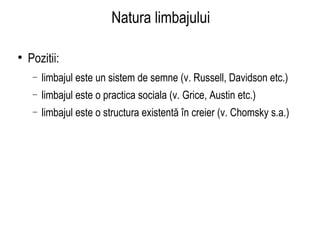
Natura limbajului Pozitii:  limbajul este un sistem de semne (v. Russell, Davidson etc.) limbajul este o practica sociala (v. Grice, Austin etc.) limbajul este o structura existentă în creier (v. Chomsky s.a.)
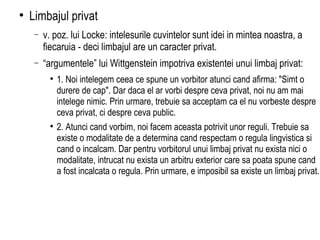
Limbajul privat  v. poz. lui Locke: intelesurile cuvintelor sunt idei in mintea noastra, a fiecaruia - deci limbajul are un caracter privat.  “ argumentele” lui Wittgenstein impotriva existentei unui limbaj privat: 1. Noi intelegem ceea ce spune un vorbitor atunci cand afirma: "Simt o durere de cap". Dar daca el ar vorbi despre ceva privat, noi nu am mai intelege nimic. Prin urmare, trebuie sa acceptam ca el nu vorbeste despre ceva privat, ci despre ceva public. 2. Atunci cand vorbim, noi facem aceasta potrivit unor reguli. Trebuie sa existe o modalitate de a determina cand respectam o regula lingvistica si cand o incalcam. Dar pentru vorbitorul unui limbaj privat nu exista nici o modalitate, intrucat nu exista un arbitru exterior care sa poata spune cand a fost incalcata o regula. Prin urmare, e imposibil sa existe un limbaj privat.
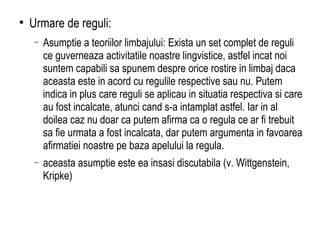
Urmare de reguli: Asumptie a teoriilor limbajului: Exista un set complet de reguli ce guverneaza activitatile noastre lingvistice, astfel incat noi suntem capabili sa spunem despre orice rostire in limbaj daca aceasta este in acord cu regulile respective sau nu. Putem indica in plus care reguli se aplicau in situatia respectiva si care au fost incalcate, atunci cand s-a intamplat astfel. Iar in al doilea caz nu doar ca putem afirma ca o regula ce ar fi trebuit sa fie urmata a fost incalcata, dar putem argumenta in favoarea afirmatiei noastre pe baza apelului la regula. aceasta asumptie este ea insasi discutabila (v. Wittgenstein, Kripke)
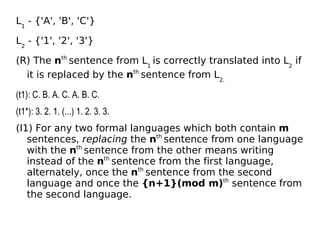
L 1  - {'A', 'B', 'C'} L 2  - {'1', '2', '3'} (R) The  n th  sentence from L 1  is correctly translated into L 2  if it is replaced by the  n th  sentence from L 2. (t1): C. B. A. C. A. B. C. (t1*): 3. 2. 1. (...) 1. 2. 3. 3. (I1) For any two formal languages which both contain  m  sentences,  replacing  the  n th  sentence from one language with the  n th  sentence from the other means writing instead of the  n th  sentence from the first language, alternately, once the  n th  sentence from the second language and once the  {n+1}(mod m) th  sentence from the second language.
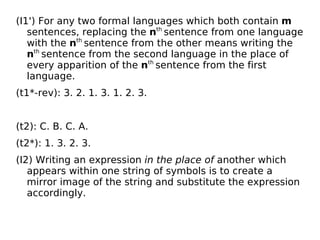
(I1') For any two formal languages which both contain  m  sentences, replacing the  n th  sentence from one language with the  n th  sentence from the other means writing the  n th  sentence from the second language in the place of every apparition of the  n th  sentence from the first language. (t1*-rev): 3. 2. 1. 3. 1. 2. 3. (t2): C. B. C. A. (t2*): 1. 3. 2. 3. (I2) Writing an expression  in the place of  another which appears within one string of symbols is to create a mirror image of the string and substitute the expression accordingly.
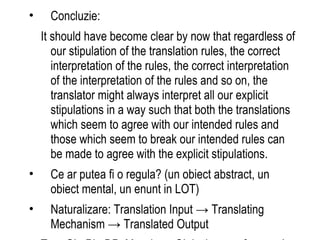
Concluzie: It should have become clear by now that regardless of our stipulation of the translation rules, the correct interpretation of the rules, the correct interpretation of the interpretation of the rules and so on, the translator might always interpret all our explicit stipulations in a way such that both the translations which seem to agree with our intended rules and those which seem to break our intended rules can be made to agree with the explicit stipulations. Ce ar putea fi o regula? (un obiect abstract, un obiect mental, un enunt in LOT) Naturalizare: Translation Input -> Translating Mechanism -> Translated Output T = <GL, PL, DP, M> where GL is the set of general laws of the theory, PL is the set of its particular laws, DP is the set of derivation principles and M is the meta-theoretical assertion that the theory offers an explanation for what is to perform a correct translation from L1 to L2. What would count as an empirical infirmation of T? Is M empirical? The naturalist: M states the relation between our theory and the ideal model of a perfect translator. Dar vezi:  progresul stiintific  modele alternative (traducatori devianti perfecti)
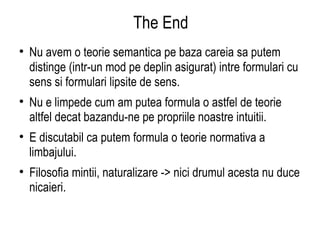
The End Nu avem o teorie semantica pe baza careia sa putem distinge (intr-un mod pe deplin asigurat) intre formulari cu sens si formulari lipsite de sens. Nu e limpede cum am putea formula o astfel de teorie altfel decat bazandu-ne pe propriile noastre intuitii. E discutabil ca putem formula o teorie normativa a limbajului. Filosofia mintii, naturalizare -> nici drumul acesta nu duce nicaieri.

Filosofia limbajului - curs 13

  • 1.
    Filosofia limbajului –ultimul curs Traducere si interpretare Natura limbajului Consideratii finale
  • 2.
    Traducere si interpretareQuine: Indeterminarea traducerii Inscrutabilitatea referintei Relativitatea ontologica [v. exemplul cu 'Gavagai'] Davidson: Interpretare radicala Principle of Charity
  • 3.
    Natura limbajului Pozitii: limbajul este un sistem de semne (v. Russell, Davidson etc.) limbajul este o practica sociala (v. Grice, Austin etc.) limbajul este o structura existentă în creier (v. Chomsky s.a.)
  • 4.
    Limbajul privat v. poz. lui Locke: intelesurile cuvintelor sunt idei in mintea noastra, a fiecaruia - deci limbajul are un caracter privat. “ argumentele” lui Wittgenstein impotriva existentei unui limbaj privat: 1. Noi intelegem ceea ce spune un vorbitor atunci cand afirma: &quot;Simt o durere de cap&quot;. Dar daca el ar vorbi despre ceva privat, noi nu am mai intelege nimic. Prin urmare, trebuie sa acceptam ca el nu vorbeste despre ceva privat, ci despre ceva public. 2. Atunci cand vorbim, noi facem aceasta potrivit unor reguli. Trebuie sa existe o modalitate de a determina cand respectam o regula lingvistica si cand o incalcam. Dar pentru vorbitorul unui limbaj privat nu exista nici o modalitate, intrucat nu exista un arbitru exterior care sa poata spune cand a fost incalcata o regula. Prin urmare, e imposibil sa existe un limbaj privat.
  • 5.
    Urmare de reguli:Asumptie a teoriilor limbajului: Exista un set complet de reguli ce guverneaza activitatile noastre lingvistice, astfel incat noi suntem capabili sa spunem despre orice rostire in limbaj daca aceasta este in acord cu regulile respective sau nu. Putem indica in plus care reguli se aplicau in situatia respectiva si care au fost incalcate, atunci cand s-a intamplat astfel. Iar in al doilea caz nu doar ca putem afirma ca o regula ce ar fi trebuit sa fie urmata a fost incalcata, dar putem argumenta in favoarea afirmatiei noastre pe baza apelului la regula. aceasta asumptie este ea insasi discutabila (v. Wittgenstein, Kripke)
  • 6.
    L 1 - {'A', 'B', 'C'} L 2 - {'1', '2', '3'} (R) The n th sentence from L 1 is correctly translated into L 2 if it is replaced by the n th sentence from L 2. (t1): C. B. A. C. A. B. C. (t1*): 3. 2. 1. (...) 1. 2. 3. 3. (I1) For any two formal languages which both contain m sentences, replacing the n th sentence from one language with the n th sentence from the other means writing instead of the n th sentence from the first language, alternately, once the n th sentence from the second language and once the {n+1}(mod m) th sentence from the second language.
  • 7.
    (I1') For anytwo formal languages which both contain m sentences, replacing the n th sentence from one language with the n th sentence from the other means writing the n th sentence from the second language in the place of every apparition of the n th sentence from the first language. (t1*-rev): 3. 2. 1. 3. 1. 2. 3. (t2): C. B. C. A. (t2*): 1. 3. 2. 3. (I2) Writing an expression in the place of another which appears within one string of symbols is to create a mirror image of the string and substitute the expression accordingly.
  • 8.
    Concluzie: It shouldhave become clear by now that regardless of our stipulation of the translation rules, the correct interpretation of the rules, the correct interpretation of the interpretation of the rules and so on, the translator might always interpret all our explicit stipulations in a way such that both the translations which seem to agree with our intended rules and those which seem to break our intended rules can be made to agree with the explicit stipulations. Ce ar putea fi o regula? (un obiect abstract, un obiect mental, un enunt in LOT) Naturalizare: Translation Input -> Translating Mechanism -> Translated Output T = <GL, PL, DP, M> where GL is the set of general laws of the theory, PL is the set of its particular laws, DP is the set of derivation principles and M is the meta-theoretical assertion that the theory offers an explanation for what is to perform a correct translation from L1 to L2. What would count as an empirical infirmation of T? Is M empirical? The naturalist: M states the relation between our theory and the ideal model of a perfect translator. Dar vezi: progresul stiintific modele alternative (traducatori devianti perfecti)
  • 9.
    The End Nuavem o teorie semantica pe baza careia sa putem distinge (intr-un mod pe deplin asigurat) intre formulari cu sens si formulari lipsite de sens. Nu e limpede cum am putea formula o astfel de teorie altfel decat bazandu-ne pe propriile noastre intuitii. E discutabil ca putem formula o teorie normativa a limbajului. Filosofia mintii, naturalizare -> nici drumul acesta nu duce nicaieri.