FIELD STUDY 1 LEARNING EPISODE
FS 1 1
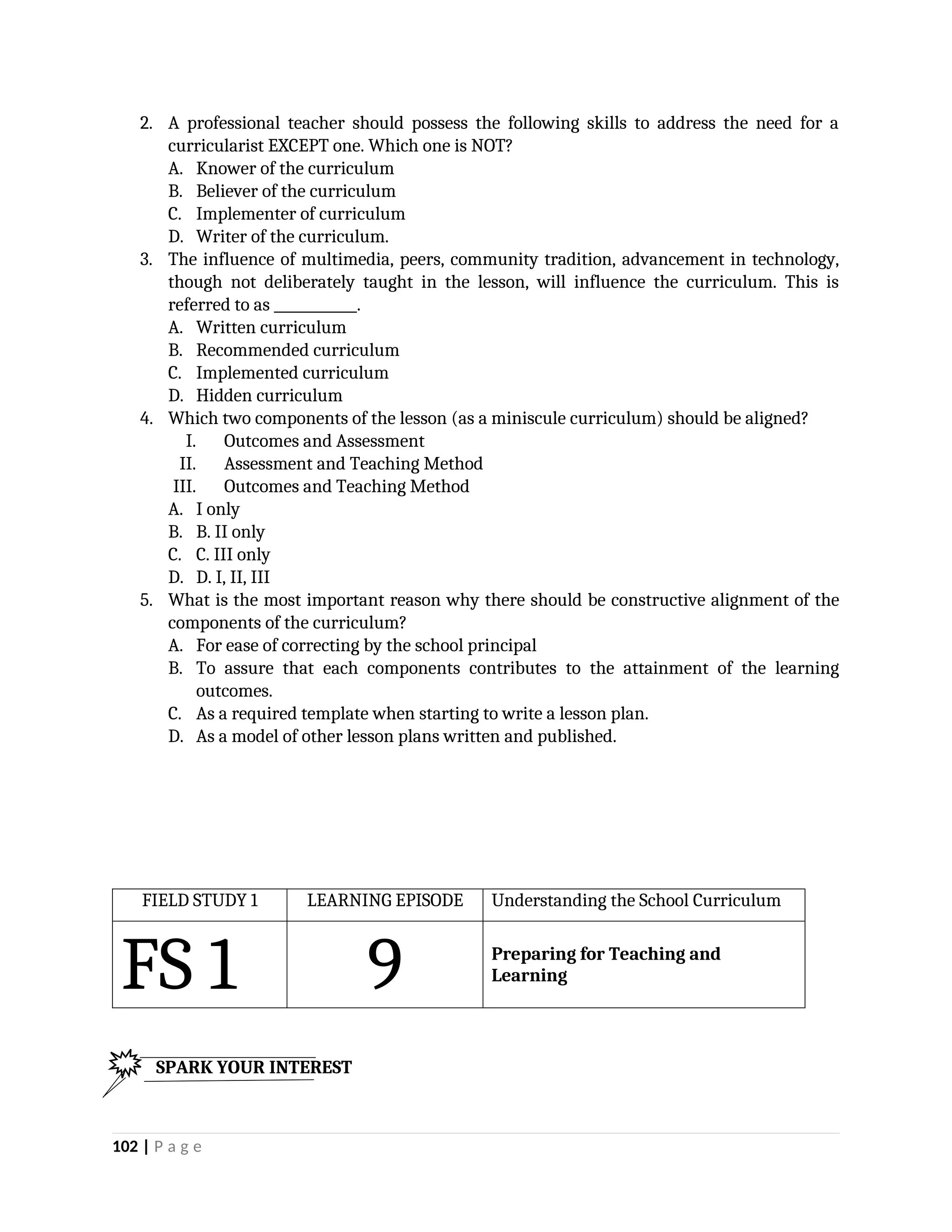
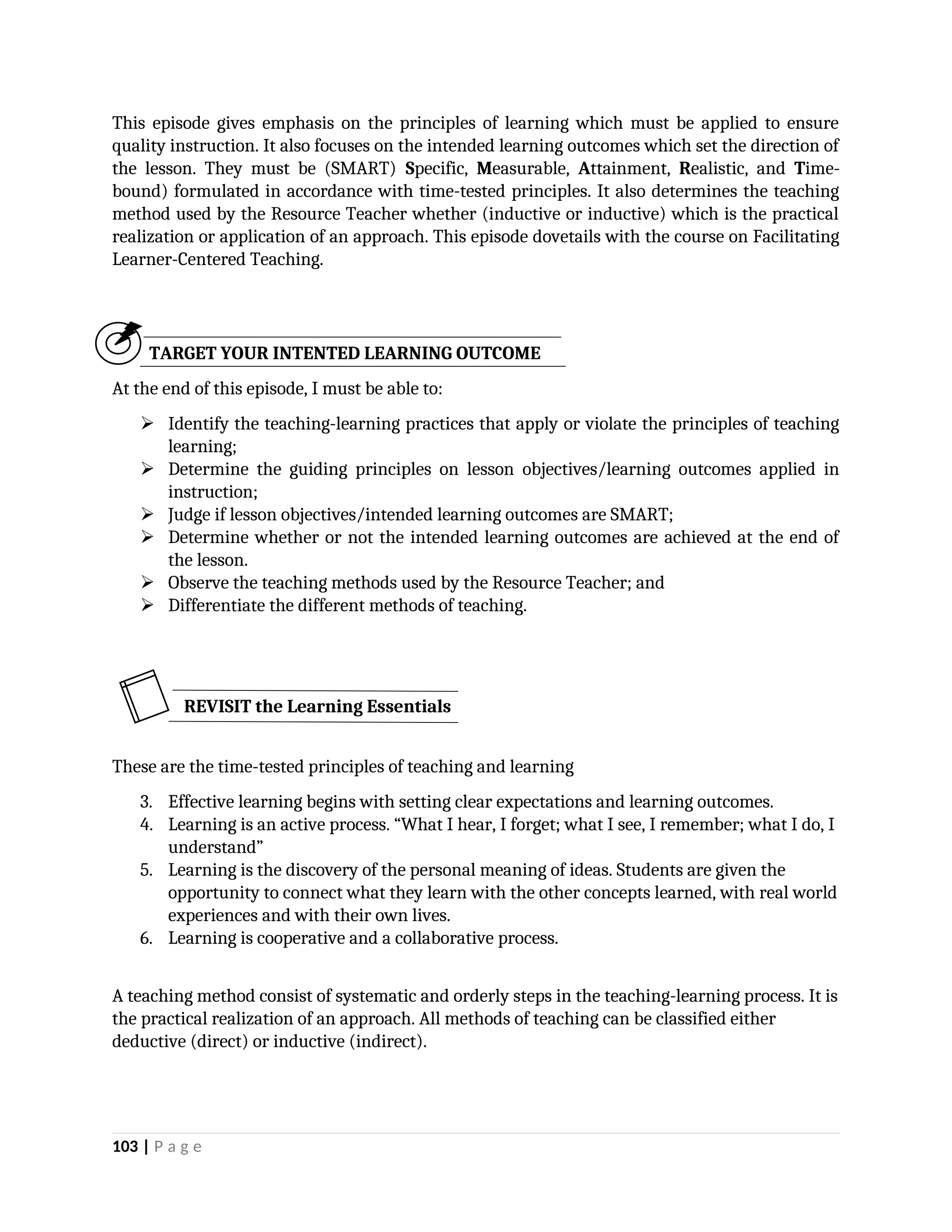
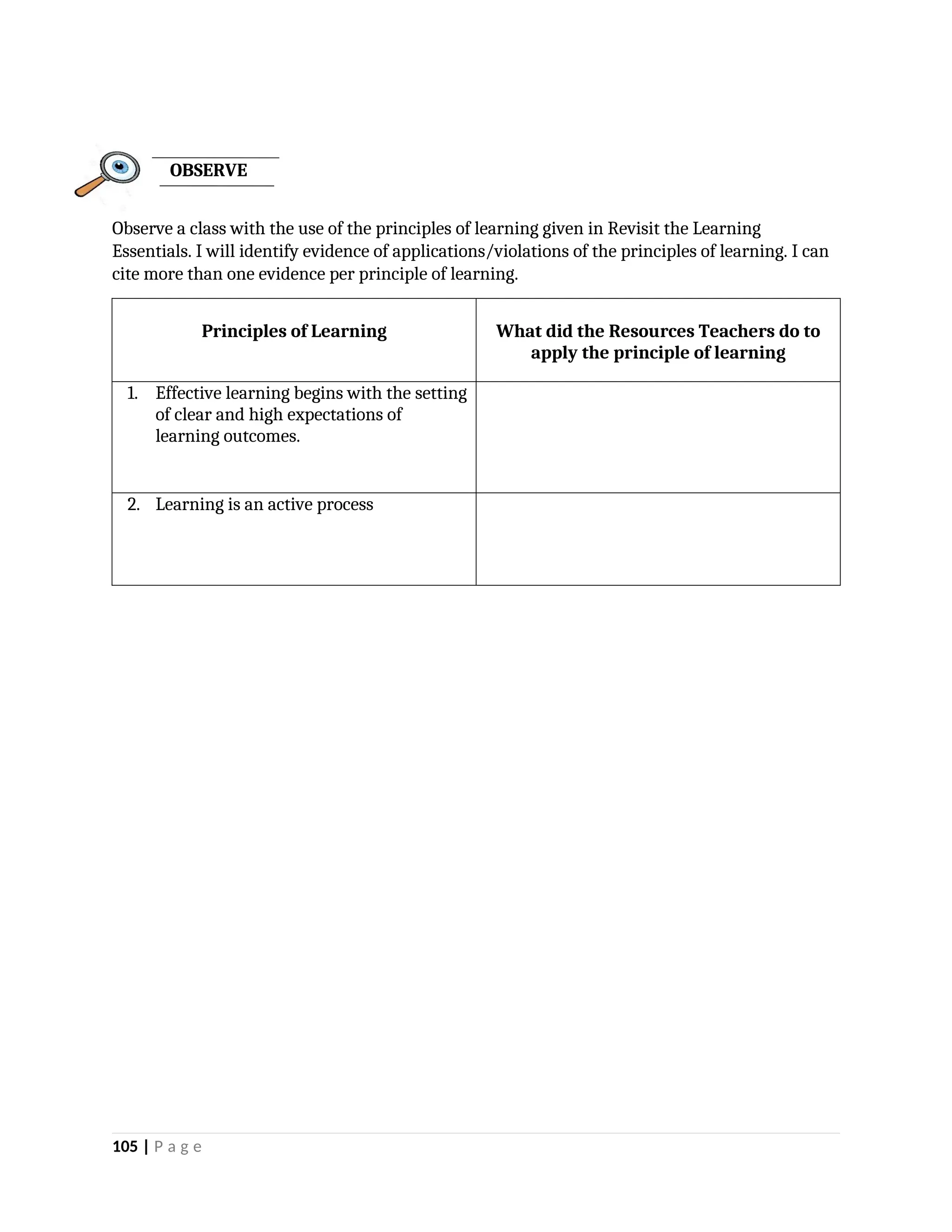
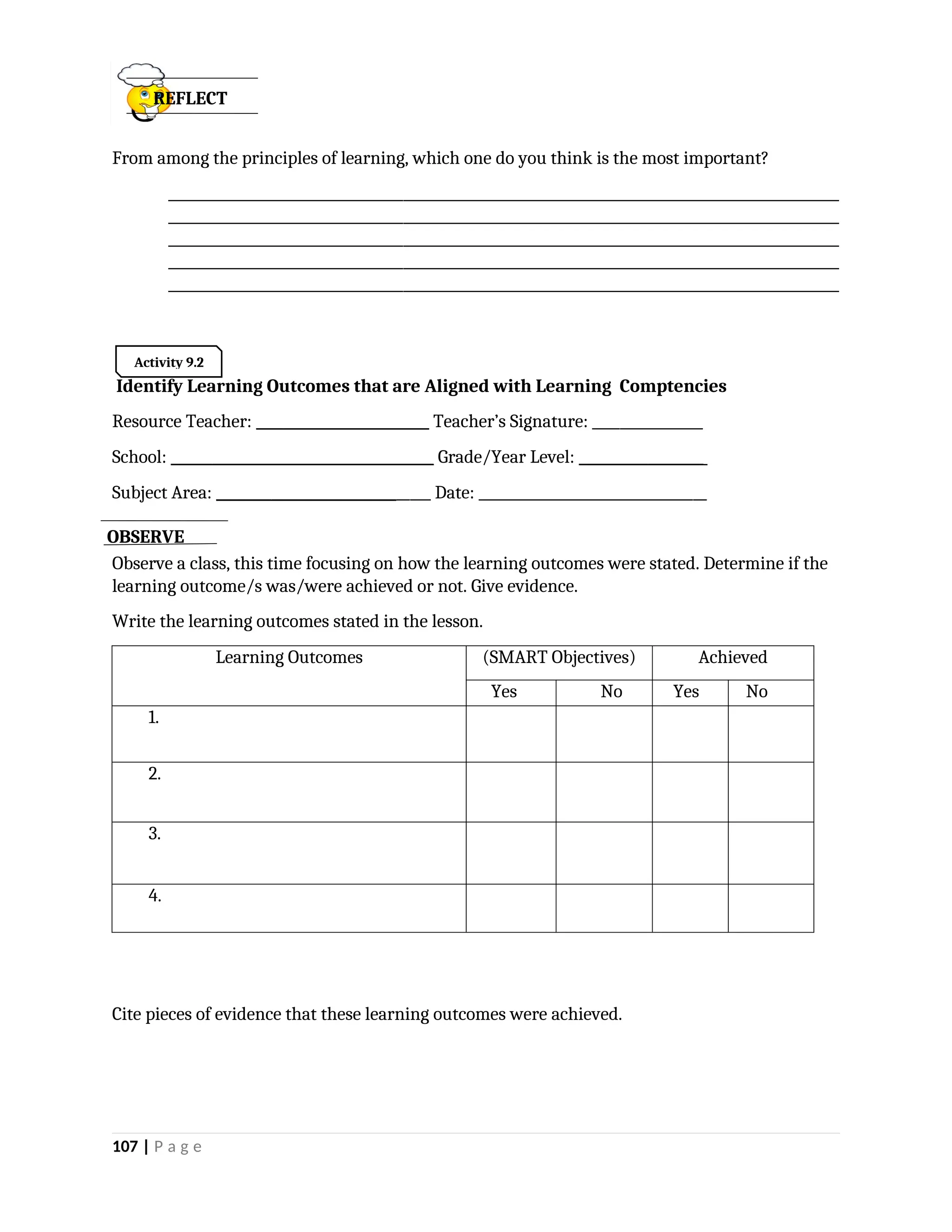
The School as a Learning
Environment
This Episode 1 provides an opportunity for students to examine and reflect on a school
environment that promotes learning and development.
TARGET YOUR INTENTED LEARNING OUTCOME
At the end of this Episode, I must be able to determine the characteristics of a school
environment that is safe, secure, and is supportive of learning (PPST 2.1.1).
1. A physical environment conductive for learning is one that has consistent practices
that:
 Keep the school safe, clean, orderly and free from distraction;
 Maintain facilities that provide challenging activities; and
 Address the physical, social and psychological needs of the students.
2. Display boards can be powerful in communicating information about the learning
environment. They help in building and establishing the school culture. These boards
become one way for everyone to learn about the vision- mission, goals and values that
the school uploads.
3. As a basic part of the school’s visual environment, display boards have four general
purposes:
 Decorative- They offer visual stimulation and appeal to aesthetics. They set the
social and psychological atmosphere of the school.
 Motivational- They encourage students to perform better and have greater
confidence. An example would be the display of students’ outputs that show that
each output is recognized and valued. The bulletin board help celebrate the
learners’ growth and progress.
 Informational- They are used as a strategy to readily disseminate information.
 Instructional- They move students to respond and participate through
interactive displays. They get students to think about and communicate their
learnings.
0 | P a g e
REVISIT the Learning
Essentials
SPARK YOUR INTEREST
4. The set of criteria for evaluating bulletin board displays includes effective
communication, attractiveness, balance, unity, interactivity, legibility, correctness, and
durability.
Resource Teacher: _________________________ Teacher’s Signature: ________________
School: ______________________________________ Grade/Year Level: __________________
Subject Area: _______________________________ Date: __________________________________
To realize the Intended Learning Outcome, work my way through these steps:
1. Visit a school. Look around into facilities and support learning areas in the campus,
then in the classroom.
2. Observe and use the checklist as you move around the school premises.
3. Analyze your gathered data about the school environment.
4. Reflect on the characteristics of a school environment that promotes learning.
5. Present your idea of a good environment through and of these:
a) Descriptive paragraph b) Photo essay
b) Sketch or drawing c) Poem, song or rap
As you move around, observation form is provided for you to document your
observation. It is advised that you read entire worksheet before proceeding to the social site. A
good understanding of the activities and tasks to be accomplished in the activity sheets will
yield better learning results
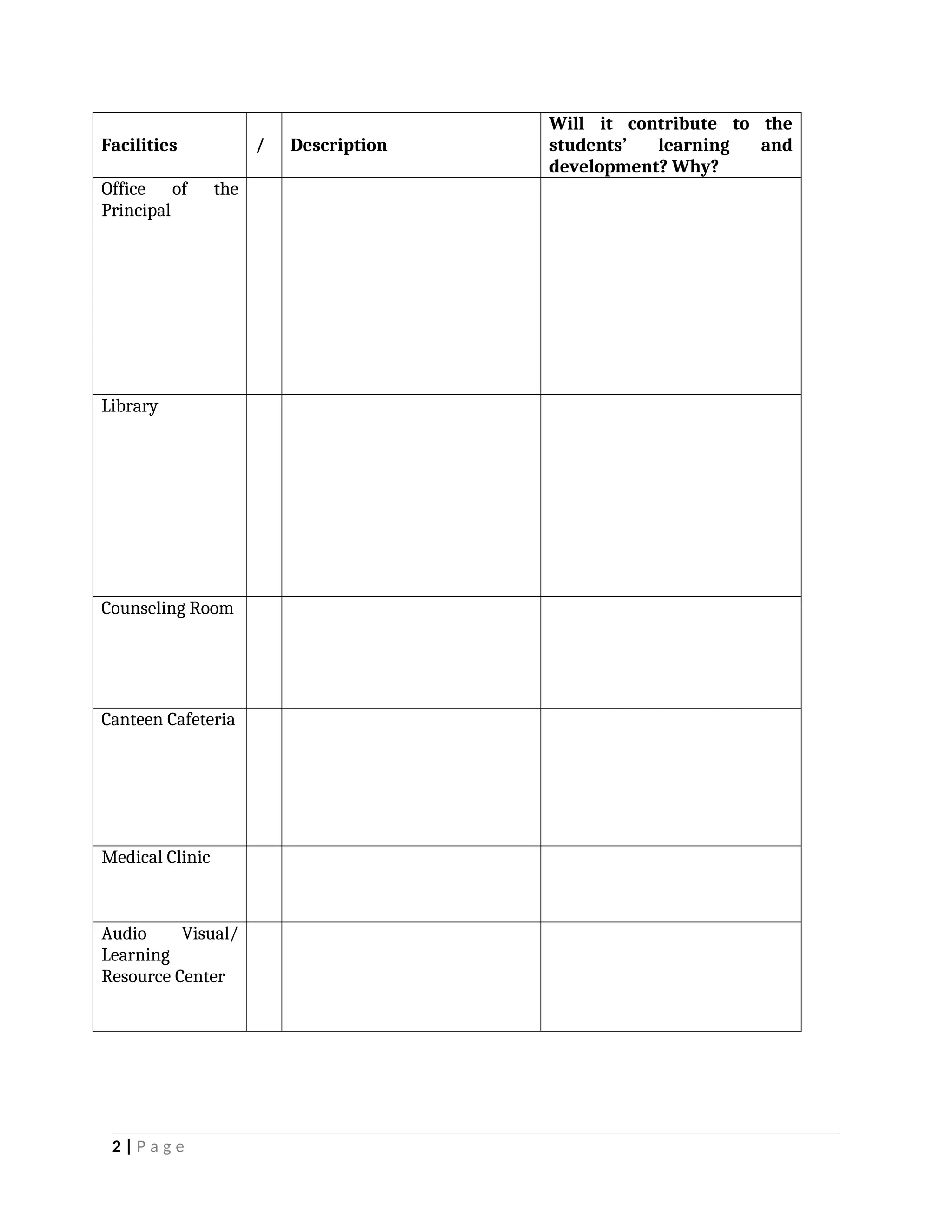
SCHOOL FACILITIES OBSERVATION CHECKLIST
Familiarize yourself with the different areas and facilities of the school. Check the column to
indicate their availability. Give a brief description of those that are available, and say how each
will contribute to the students’ learning and development.
1 | P a g e
OBSERVE, ANALYZE, REFLECT
Activity 1.1 Exploring the School
OBSERVE
Facilities / Description
Will it contribute to the
students’ learning and
development? Why?
Office of the
Principal
Library
Counseling Room
Canteen Cafeteria
Medical Clinic
Audio Visual/
Learning
Resource Center
2 | P a g e
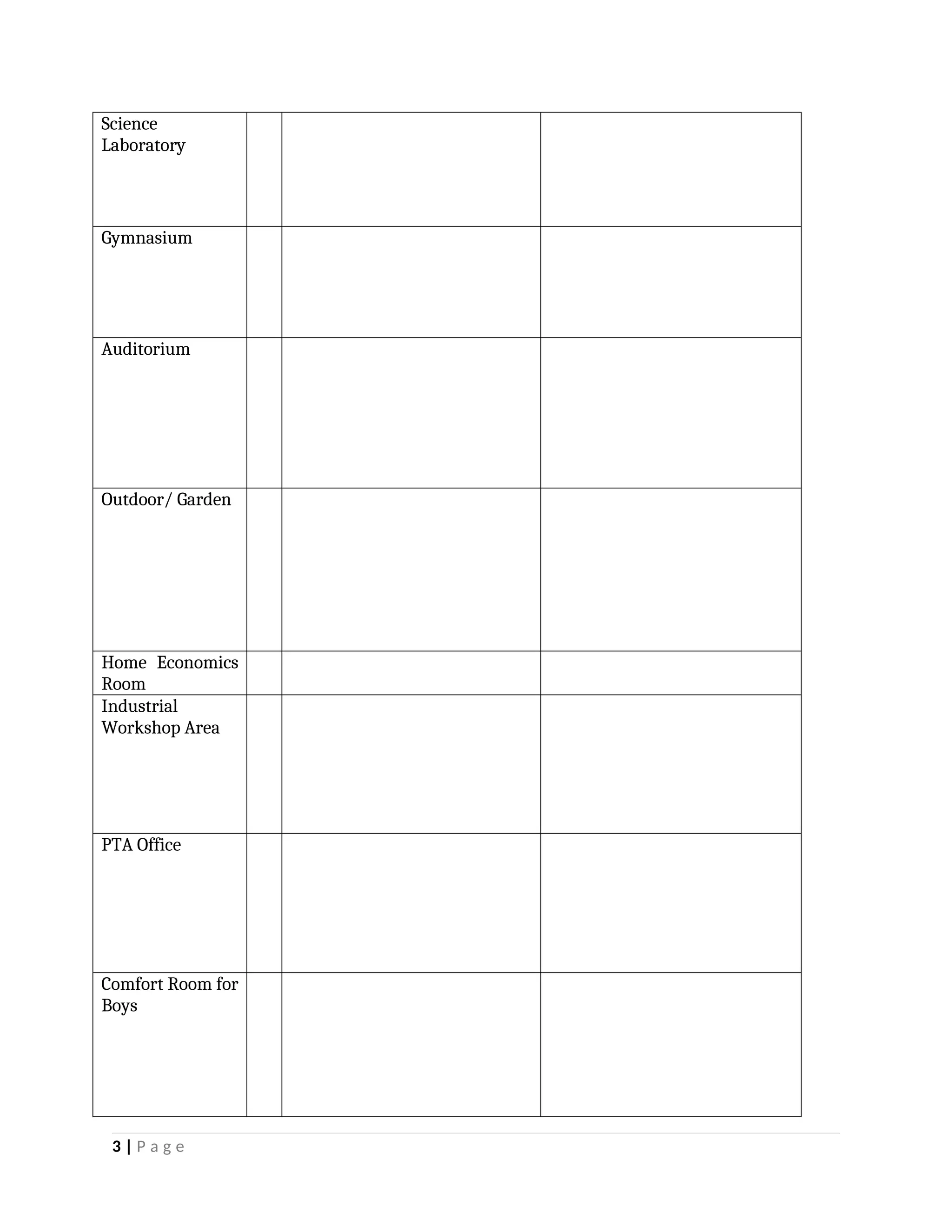
Science
Laboratory
Gymnasium
Auditorium
Outdoor/ Garden
Home Economics
Room
Industrial
Workshop Area
PTA Office
Comfort Room for
Boys
3 | P a g e
Comfort Room for
Girls
An Observation Guide for the CLASSROOM VISIT
Read the following statement carefully. Then write your observation report on the space
provided.
Guide Question Classroom Observation Report
1. Describe the community or
neighborhood where the school is
found.
2. Describe the school campus.
What colors do you see? What is
the condition of the buildings?
3. Pass the offices.
What impression do you have of
these offices?
4 | P a g e
4. Walk through the school’s
halls, the library. The cafeteria.
Look around and find out the
other facilities that the school
has.
Resource Teacher: _________________________ Teacher’s Signature: ________________
School: ______________________________________ Grade/Year Level: __________________
Subject Area: _______________________________ Date: __________________________________
An Observation Guide for the CLASSROOM VISIT
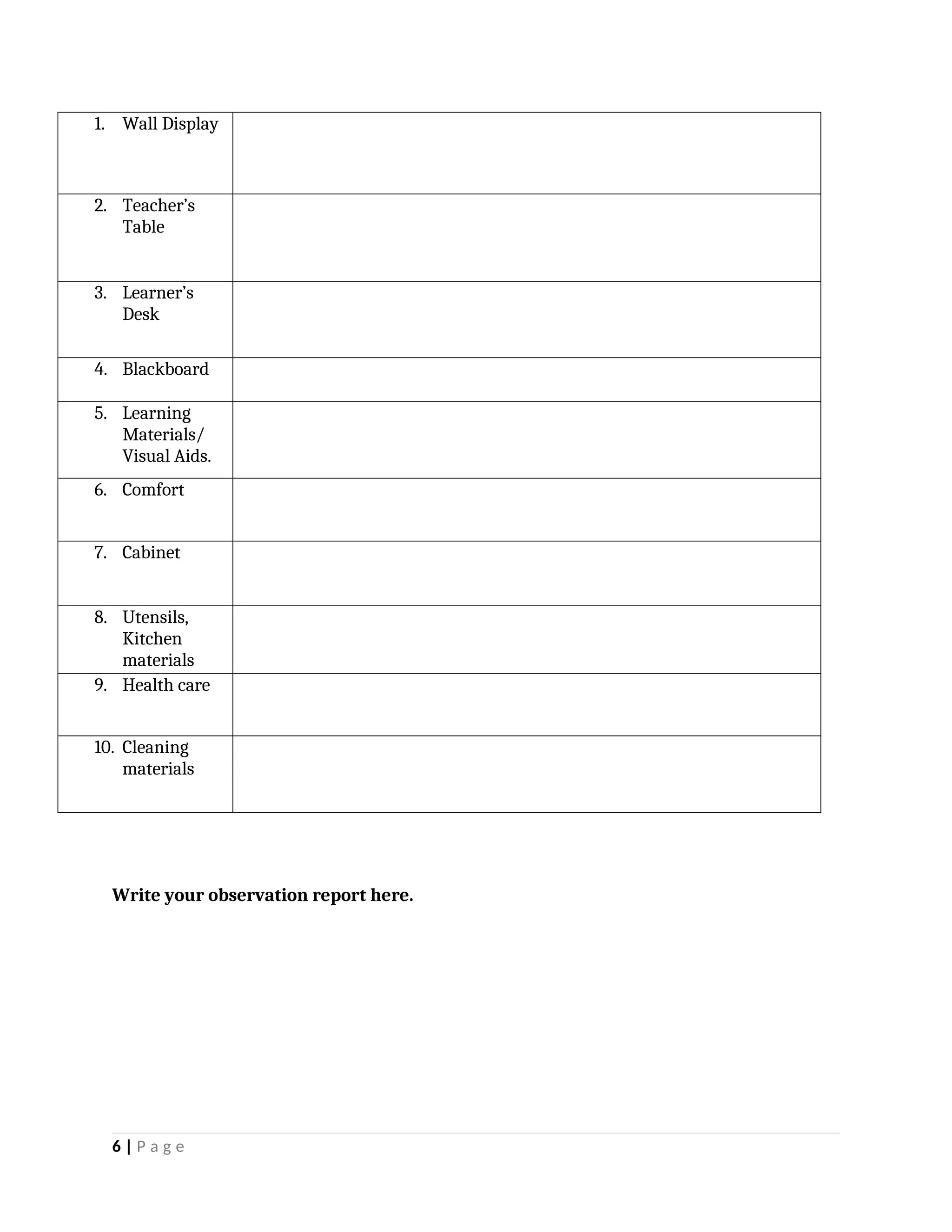
Be guided by these tasks as you do your observation. Then accomplish the matrix to record
your data.
CLASSROOM FACILITIES MATRIX
Classroom
Facilities
Description
(location, number, arrangement, condition)
5 | P a g e
1. Wall Display
2. Teacher’s
Table
3. Learner’s
Desk
4. Blackboard
5. Learning
Materials/
Visual Aids.
6. Comfort
7. Cabinet
8. Utensils,
Kitchen
materials
9. Health care
10. Cleaning
materials
Write your observation report here.
6 | P a g e
Name of the School Observed: ____________________________________________________________________
Location of the School:____________________________________________________________________________
Date to Visit: ______________________________________________________________________________________
How do the school campus and the classroom in particular impact the learning of the students
going to school? What are your conclusions?
7 | P a g e
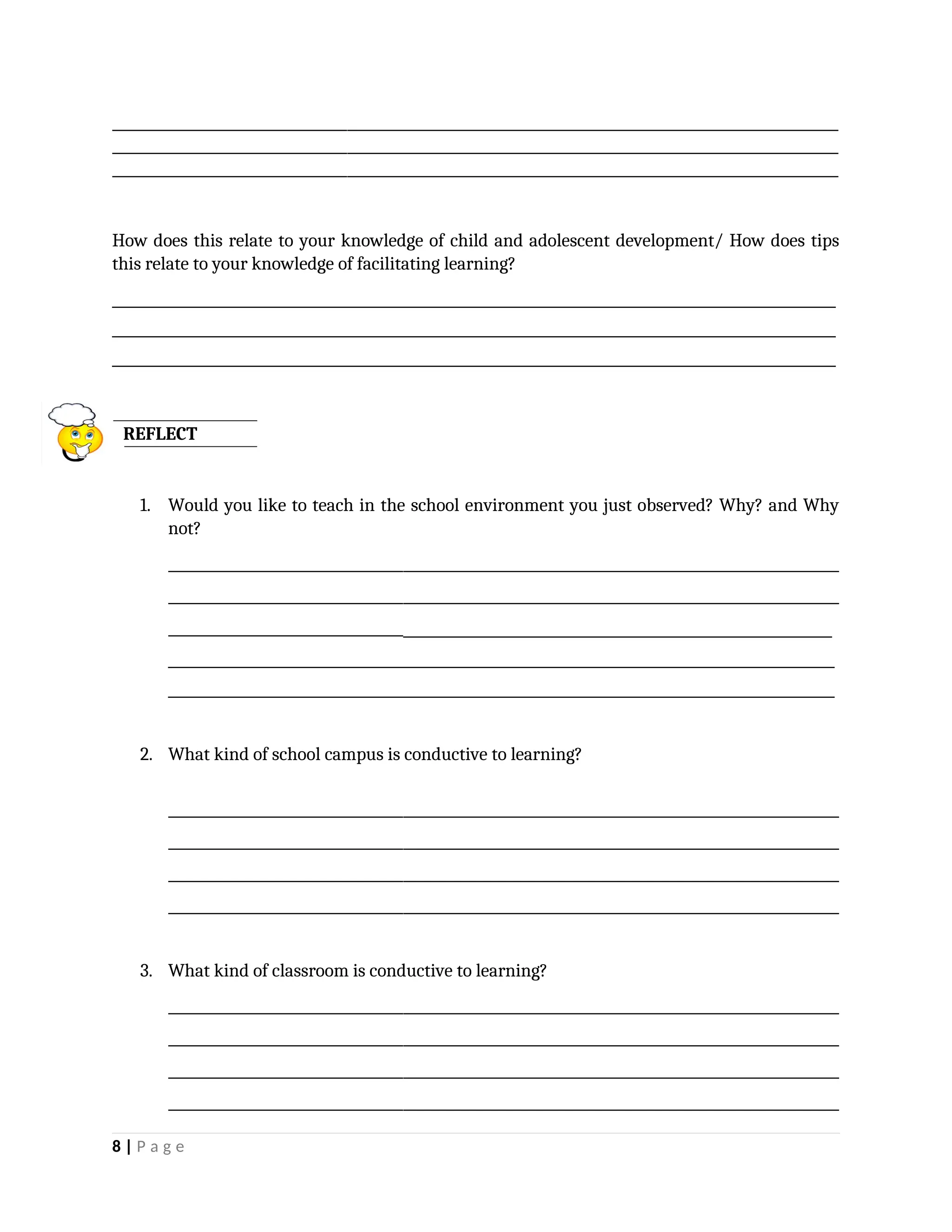
ANALYZE
_________________________________________________________________________________________________________
_________________________________________________________________________________________________________
_________________________________________________________________________________________________________
How does this relate to your knowledge of child and adolescent development/ How does tips
this relate to your knowledge of facilitating learning?
____________________________________________________________________________
____________________________________________________________________________
____________________________________________________________________________
REFLECT
1. Would you like to teach in the school environment you just observed? Why? and Why
not?
_________________________________________________________________________________________________
_________________________________________________________________________________________________
_______________________________________________________________________________
______________________________________________________________________
______________________________________________________________________
2. What kind of school campus is conductive to learning?
_________________________________________________________________________________________________
_________________________________________________________________________________________________
_________________________________________________________________________________________________
_________________________________________________________________________________________________
3. What kind of classroom is conductive to learning?
_________________________________________________________________________________________________
_________________________________________________________________________________________________
_________________________________________________________________________________________________
_________________________________________________________________________________________________
8 | P a g e
4. In the future, how can you accomplish your answer in number 3?
_________________________________________________________________________________________________
_________________________________________________________________________________________________
_________________________________________________________________________________________________
_________________________________________________________________________________________________
5. Write your additional learnings and insights here.
_________________________________________________________________________________________________
_________________________________________________________________________________________________
_________________________________________________________________________________________________
_________________________________________________________________________________________________
Resource Teacher: _________________________ Teacher’s Signature: ________________
School: ______________________________________ Grade/Year Level: __________________
Subject Area: _______________________________ Date: __________________________________
The display board, or what we more commonly refer to as bulletin board, is one of the
most readily available learning resources
To achieve the Intended Learning Outcomes, work your way through these steps;
1. Examine for bulletin board display. Includes the samples of those found at the
entrance, lobby, hallway and classroom
2. Pick one and evaluate the display
3. Propose enhancements to make the display more effective.
9 | P a g e
OBSERVE, ANALYZE, REFLECT
Activity 1.2 Observing bulletin board
displays
As you look around and examine board display, use the observation guide and forms provided
for you to document your observation.
An Observation Guide for BOARD DISPLAYS
Read the following carefully before you observe.
1. Go around the school and examine the board display. How many board displays do you
see?
2. Where are the display boards found? Are they in places where target viewers can see
them?
3. What are the displays about? What key messages do they convey? What images and
colors do you see? How are the pieces of information and images arranged?
4. What materials were used in making the displays? Are borders used?
5. Do you notice some errors? (misspelled words, grammar inconsistencies and the like)
6. Are the messages clear and easily understood?
7. Think about what got your attention. Why did I get your attention?
8. Take a photo of the display boards (if allowed)
Based on the questions on the observation guide, write your observation report :
10 | P a g e
OBSERVE
Observation REPORT
(You may paste picture of the board here)
From among the board display that you saw, pick one that you got most interested in. Evaluate
it using the evaluation from below.
BOARD DISPLAYS EVALUATION FORM1
Topic of the Board Display COVID 19 PROTOCOL INSIDE SCHOOL
Location of the Board Display in School Center of the classroom hall way
Check the column that indicates your rating. Write comments to back up
your ratings.
4- Outstanding 3- Very Satisfactory 2- Satisfactory 1- Needs
Improvement
Criteria
N
I
1
S
2
VS
3
0
4 Comments
Effective Communication
It conveys the message quickly
and clearly.
Attractiveness
Colors and arrangement catch
and hold interest
Balance
Objects are arranged so
stability is perceived.
Unity
Repeated shapes or colors or
use of boarders hold display
together.
Interactivity
The style and approach entice
learners to be involved and
engage.
Legibility
Letters and illustrations can be
seen from a good distance
Correctness
It is free from grammar errors,
misspelled words, and
ambiguity.
Durability
It is well- constructed; items
are secretly attached.
11 | P a g e
Bulletin Board Evaluated by:
Location:
Brief Description of the Bulletin Board:
Evaluation
Strengths Weaknesses
Description of the Bulletin
Board layout
Evaluation of educational
content and other aspects
Recommendations or Suggestions for improvement
Signature of Evaluator over Printed Name:
Based on your suggestions, make your board display lay- out. You may present your outputs
through any of these:
 A hand- made drawing or layout
 And electronic (computer) drawing/ illustration or layout
 A collage
12 | P a g e
My Board Display Lay- out
What do you think was the purpose of the board display?
_________________________________________________________________________________________________________
_________________________________________________________________________________________________________
_________________________________________________________________________________________________________
13 | P a g e
ANALYZE
_________________________________________________________________________________________________________
_________________________________________________________________________________________________________
________________________________________________________________________________________________________
Did the board display design reflect the likes/ interest of its target audience? Why? Why not?
_________________________________________________________________________________________________________
_________________________________________________________________________________________________________
_________________________________________________________________________________________________________
_________________________________________________________________________________________________________
_________________________________________________________________________________________________________
Was the language used clear and simple for the target audience to understand? Why? Why not?
_________________________________________________________________________________________________________
_________________________________________________________________________________________________________
_________________________________________________________________________________________________________
_________________________________________________________________________________________________________
_________________________________________________________________________________________________________
Was the board display effective? Why? Why not?
_________________________________________________________________________________________________________
_________________________________________________________________________________________________________
_________________________________________________________________________________________________________
_________________________________________________________________________________________________________
_________________________________________________________________________________________________________
What suggestions can you make?
_________________________________________________________________________________________________________
_________________________________________________________________________________________________________
14 | P a g e
_________________________________________________________________________________________________________
_________________________________________________________________________________________________________
_________________________________________________________________________________________________________
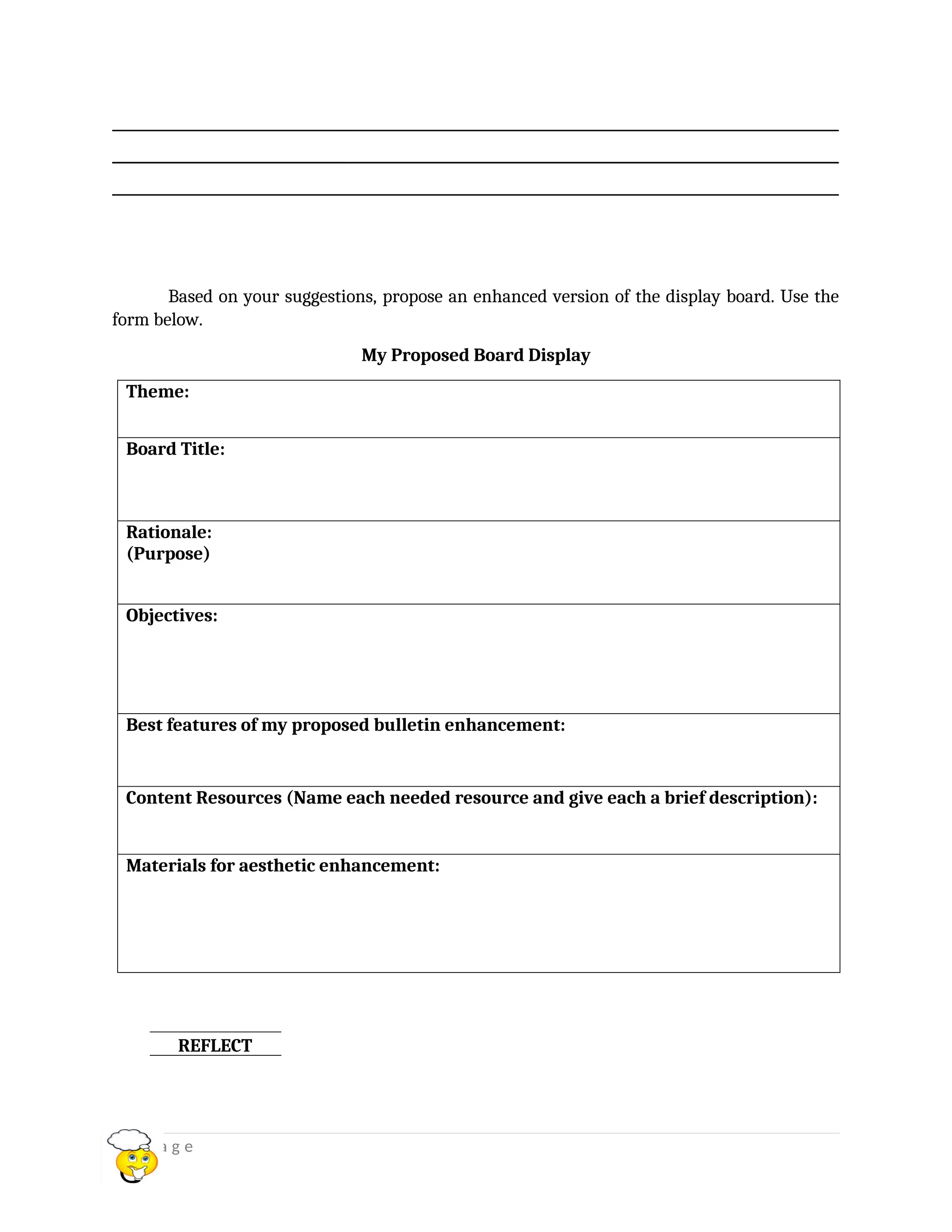
Based on your suggestions, propose an enhanced version of the display board. Use the
form below.
My Proposed Board Display
Theme:
Board Title:
Rationale:
(Purpose)
Objectives:
Best features of my proposed bulletin enhancement:
Content Resources (Name each needed resource and give each a brief description):
Materials for aesthetic enhancement:
15 | P a g e
REFLECT
1) Name at least five skills that a teacher should have to be able to come up with effective
board displays. Elaborate on why each skill is needed.
_________________________________________________________________________________________________
_________________________________________________________________________________________________
_________________________________________________________________________________________________
_________________________________________________________________________________________________
_________________________________________________________________________________________________
_________________________________________________________________________________________________
2) Which of the skills you named in #1 do you already have? Recall your past experience
in making board displays. How do you practice these skills?
_________________________________________________________________________________________________
_________________________________________________________________________________________________
_________________________________________________________________________________________________
_________________________________________________________________________________________________
_________________________________________________________________________________________________
_________________________________________________________________________________________________
3) Which skills do you still need to develop? What concrete steps will you take on how you
can improve on or acquire these skills?
_______________________________________________________________________________________________
________________________________________________________________________________________________
________________________________________________________________________________________________
________________________________________________________________________________________________
________________________________________________________________________________________________
________________________________________________________________________________________________
_
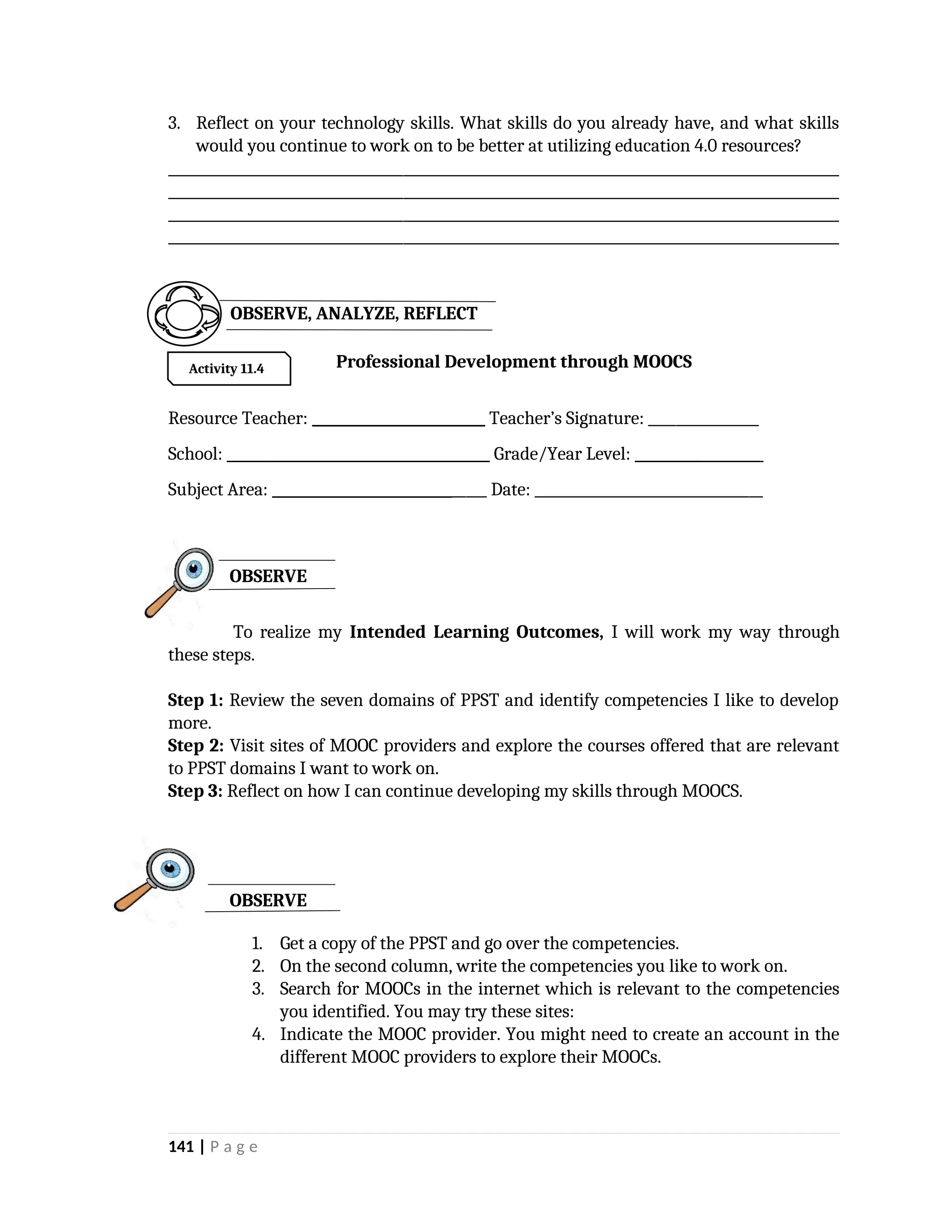
Directions: Read the items given and encircle the correct answer.
1. With the PPST as guide, an ideal learning environment should have the following
characteristics, EXCEPT ______________________.
A. The learning environment promotes fairness.
B. Is safe and conductive for learning
C. Builds many professional linkages
D. Establishes and maintains consistent standard of learner’s behavior
2. Which facilities are present in a health- promoting school environment?
I. Canteen that sells all kind of food including junk food
II. Comfort rooms common for boy and girls
16 | P a g e
LINK THEORY TO PRACTICE
III. Sanitary drinking fountains
IV. Safe playground
A. II, III and IV
B. I, II, III, and IV
C. I and II
D. III and IV
3. Which physical school environment supports learning?
A. Availability of flexible classroom furniture
B. Presence of spacious classrooms
C. Prominence of bulletin boards in every building
D. Tall school buildings
4. Examine the bulletin board display. This bulletin board fulfills which primary
purpose?
A. Instructional- interactive
B. Informational
C. Motivational
D. Decorative
5. Examine the bulletin board display. This bulletin board fulfils which primary
purpose?
A. Instructional- interactive
B. Informational
C. Motivational
D. Decorative
6. Examine the bulletin board display. This bulletin board fulfils which primary
purpose?
A. Instructional- interactive
B. Informational
C. Motivational
D. Decorative
17 | P a g e
My Personal Illustration of an Effective
School Environment
Evaluate Your Work Field Study 1.
Episode 1 The School as a learning Environment.
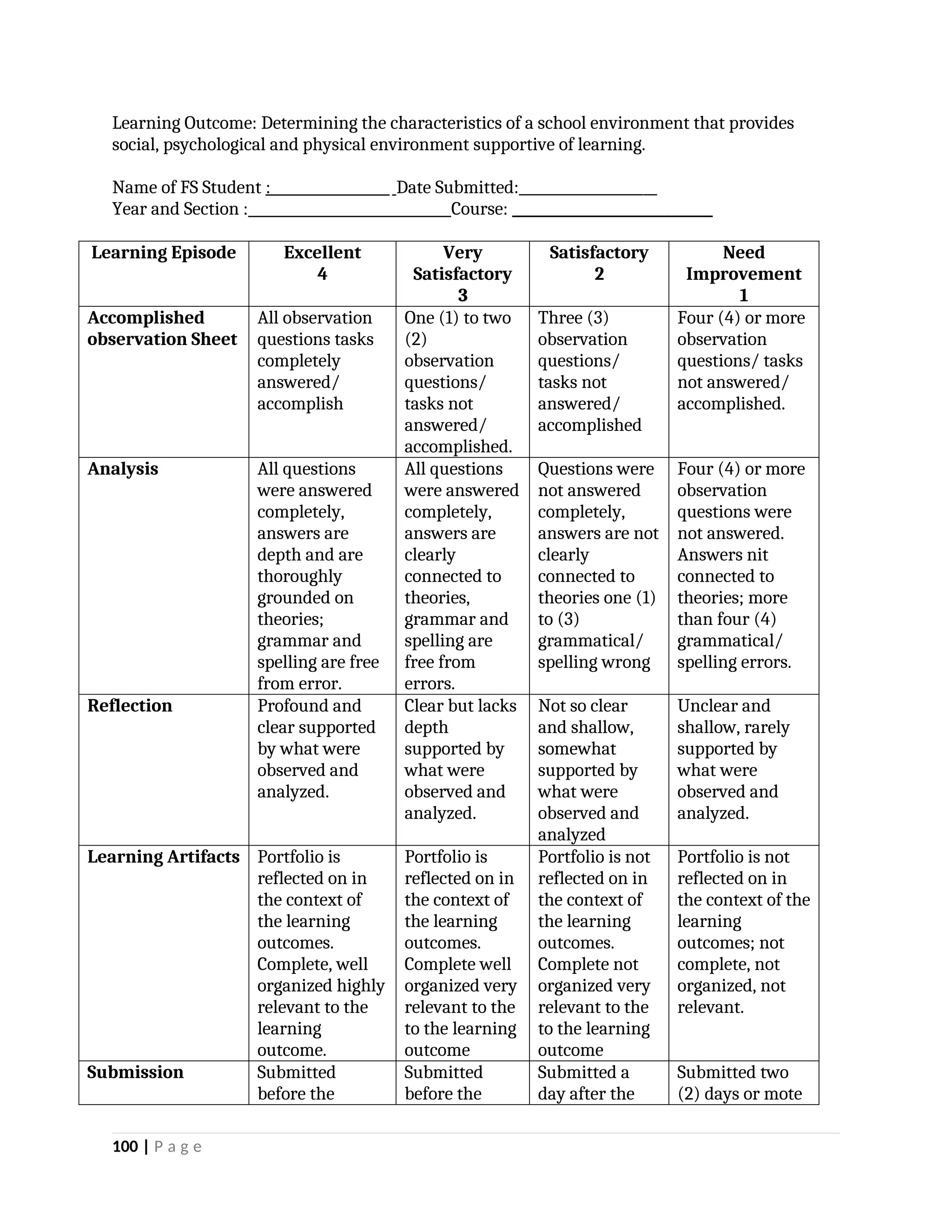
Learning Outcome: Determining the characteristics of a school environment that provides
social, psychological and physical environment supportive of
learning.
18 | P a g e
SHOW Your Learning Artifacts
EVALUATE Performance Task
Name of FS Student : Date Submitted:____________________
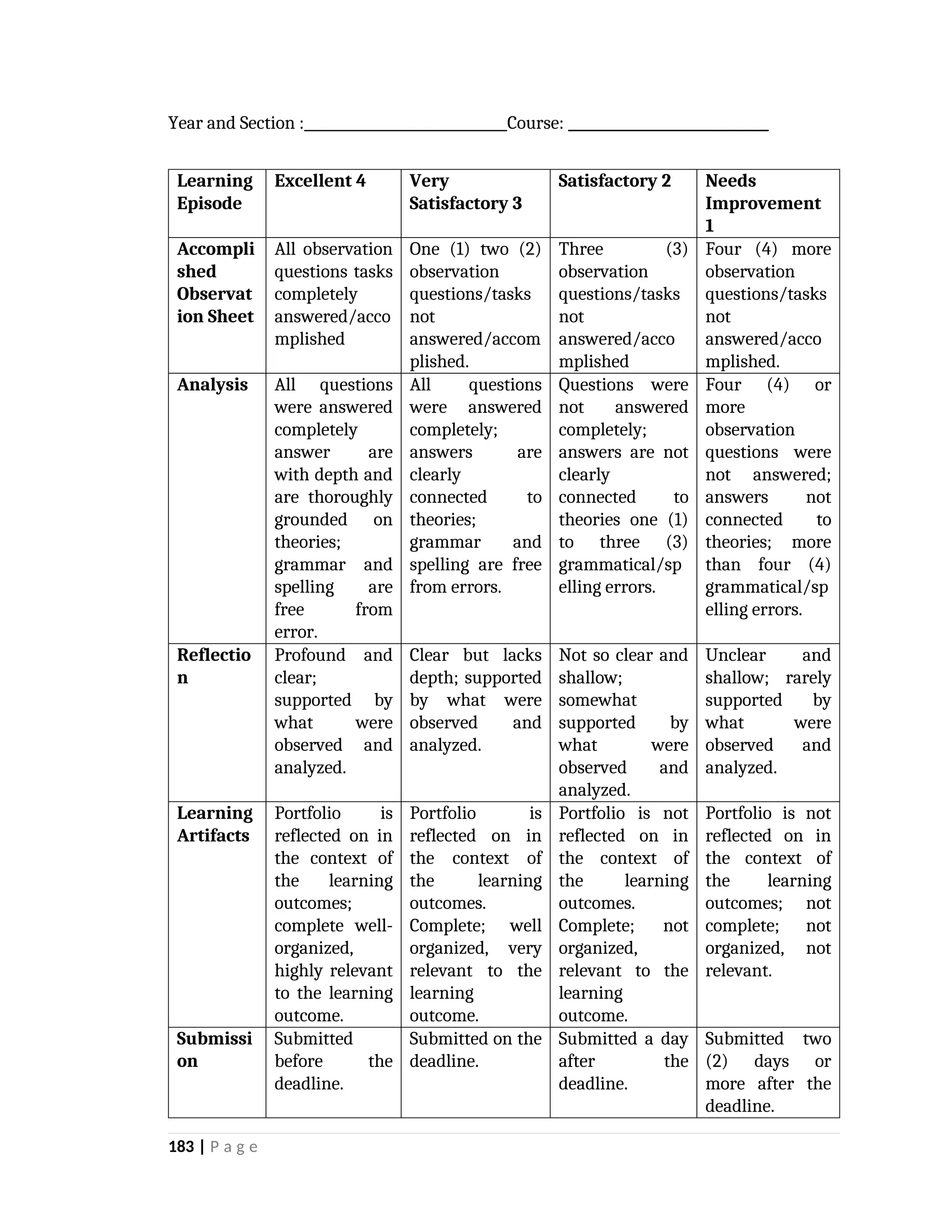
Year and Section : Course: ______________________________
Learning
Episode
Excellent
4
Very
Satisfactory
3
Satisfactory
2
Need
Improvement
1
Accomplished
observation
Sheet
All observation
questions tasks
completely
answered/
accomplish
One (1) to two
(2) observation
questions/ tasks
not answered/
accomplished.
Three (3)
observation
questions/
tasks not
answered/
accomplished
Four (4) or more
observation
questions/ tasks
not answered/
accomplished.
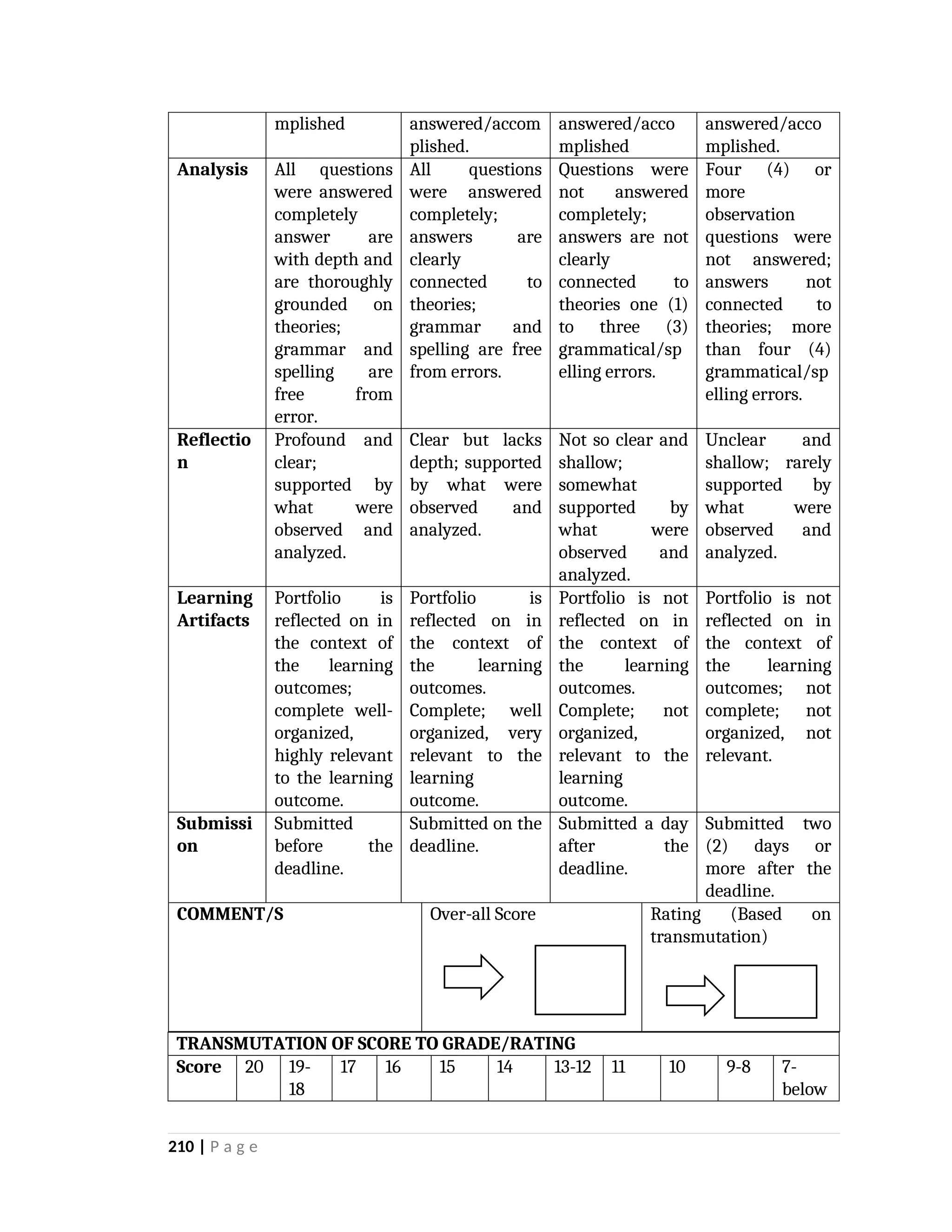
Analysis All questions
were answered
completely,
answers are
depth and are
thoroughly
grounded on
theories;
grammar and
spelling are free
from error.
All questions
were answered
completely,
answers are
clearly
connected to
theories,
grammar and
spelling are free
from errors.
Questions were
not answered
completely,
answers are
not clearly
connected to
theories one
(1) to (3)
grammatical/
spelling wrong
Four (4) or more
observation
questions were not
answered.
Answers nit
connected to
theories; more
than four (4)
grammatical/
spelling errors.
Reflection Profound and
clear supported
by what were
observed and
analyzed.
Clear but lacks
depth supported
by what were
observed and
analyzed.
Not so clear
and shallow,
somewhat
supported by
what were
observed and
analyzed
Unclear and
shallow, rarely
supported by what
were observed and
analyzed.
Learning
Artifacts
Portfolio is
reflected on in
the context of the
learning
outcomes.
Complete, well
organized highly
relevant to the
learning
outcome.
Portfolio is
reflected on in
the context of
the learning
outcomes.
Complete well
organized very
relevant to the
to the learning
outcome
Portfolio is not
reflected on in
the context of
the learning
outcomes.
Complete not
organized very
relevant to the
to the learning
outcome
Portfolio is not
reflected on in the
context of the
learning outcomes;
not complete, not
organized, not
relevant.
Submission Submitted before
the deadline
Submitted
before the
deadline
Submitted a
day after the
deadline
Submitted two (2)
days or mote after
the deadline
19 | P a g e
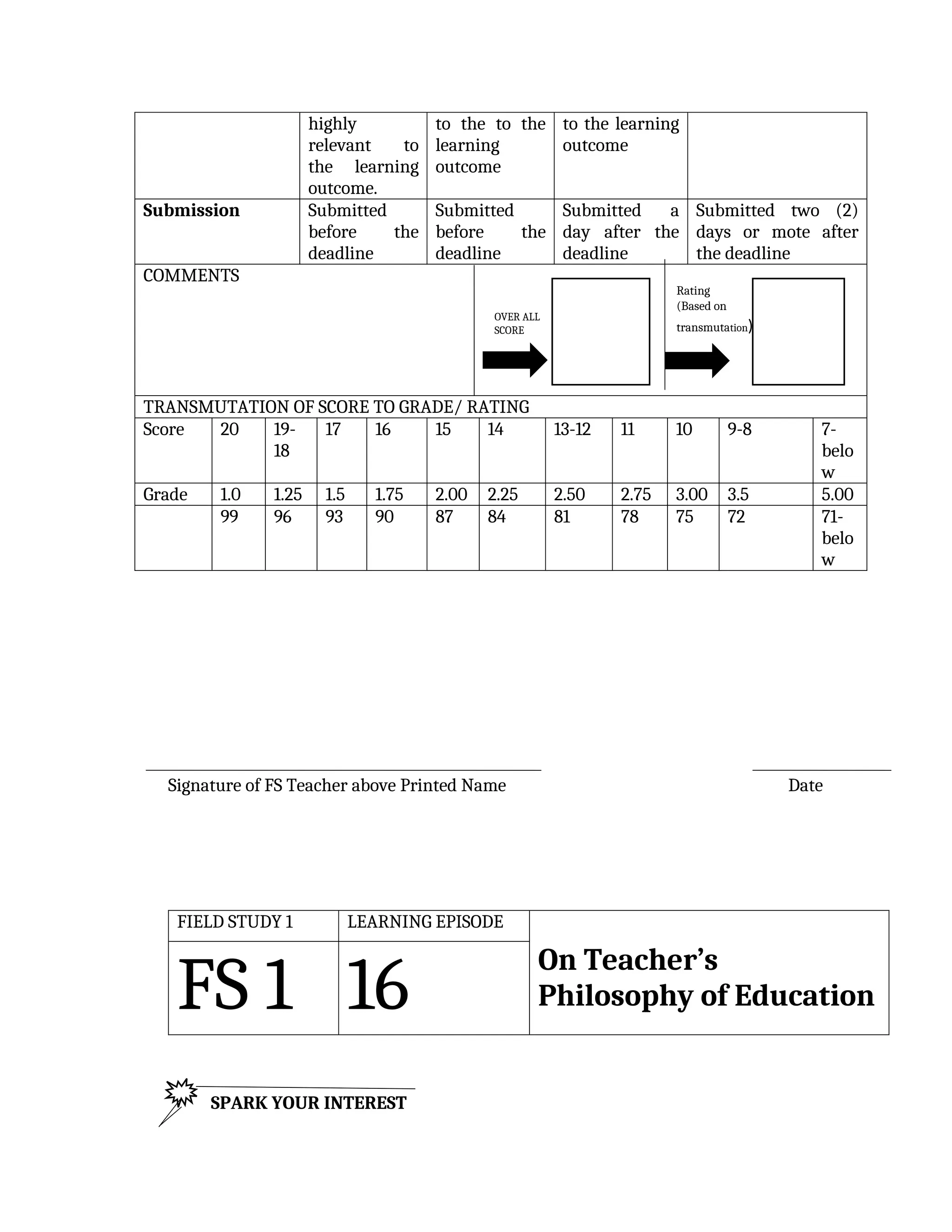
COMMENTS
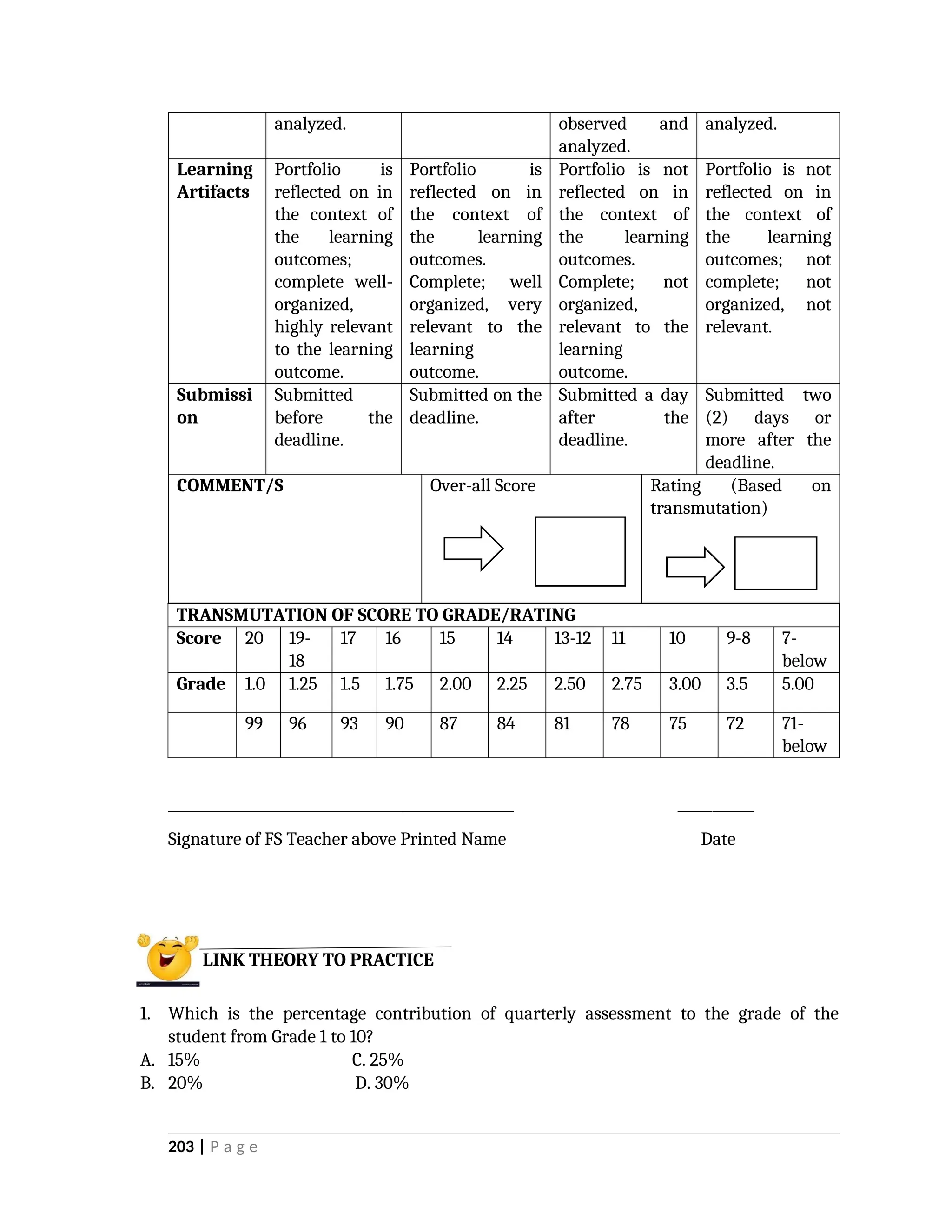
TRANSMUTATION OF SCORE TO GRADE/ RATING
Score 20 19-
18
17 16 15 14 13-12 11 10 9-8 7-
below
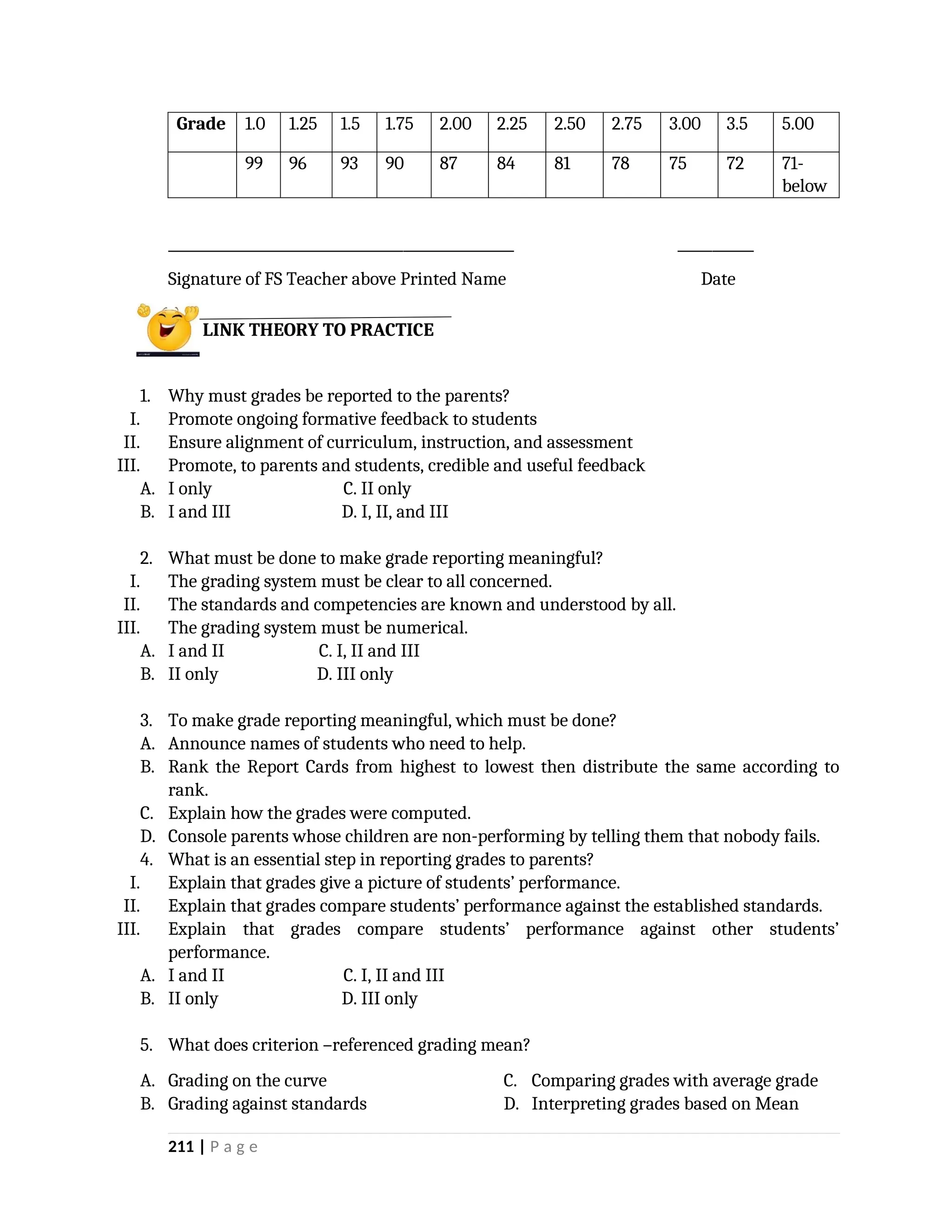
Grade 1.0 1.25 1.5 1.75 2.00 2.25 2.50 2.75 3.00 3.5 5.00
99 96 93 90 87 84 81 78 75 72 71-
below
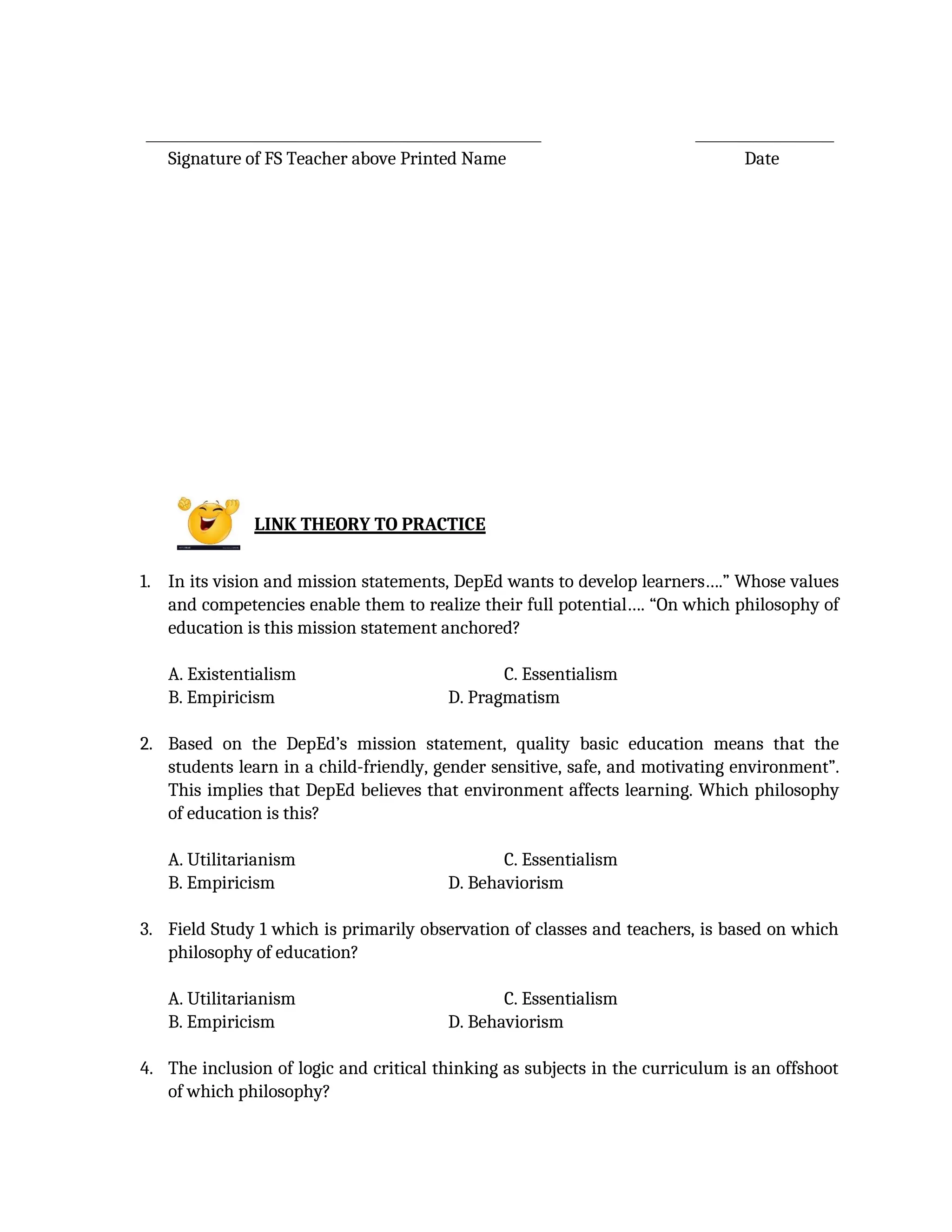
Signature of FS Teacher above Printed Name Date
FIELD STUDY 1 LEARNING EPISODE
FS 1 2
Learner Diversity:
Developmental
Characteristic, Needs and
Interests
20 | P a g e
OVER ALL
SCORE
Rating
(Based on
transmutation)
SPARK YOUR INTEREST
Episode 2 provides me with an opportunity to observe learners of different ages and
grade levels. It highlights the differences in their characteristics and needs. As a future teacher,
it is important for me to determine my learners’ characteristics and needs so that I will be able
to plan and implement learning activities and assessment that are all developmentally
appropriate.
TARGET YOUR INTENTED LEARNING OUTCOME
At the end of this Episode, I must be able to determine the characteristics, need and
interests of learners from different developmental levels. (3.1.1).
Here are major principles of development relevant to this Episode:
1. Development is relatively orderly. Development follows directional patterns such as,
from the head to the toe (cephalocaudal), and from the center of the body then
outwards (proximodistal)
2. Development takes place gradually.
3. All domains of developmental and learning physical, social and emotional, and
cognitive- are important, and they are closely interrelated. (NAEYC, 2009)
4. Developmental proceeds toward greater complexity, self-regulation, symbolic or
representational capabilities. (NAEYC, 2009)
Observation learner characteristics at different stages
Resource Teacher: _________________________ Teacher’s Signature: ________________
School: ______________________________________ Grade/Year Level: __________________
Subject Area: _______________________________ Date: __________________________________
21 | P a g e
REVISIT the Learning
Essentials
OBSERVE, ANALYZE, REFLECT
Activity 2.1
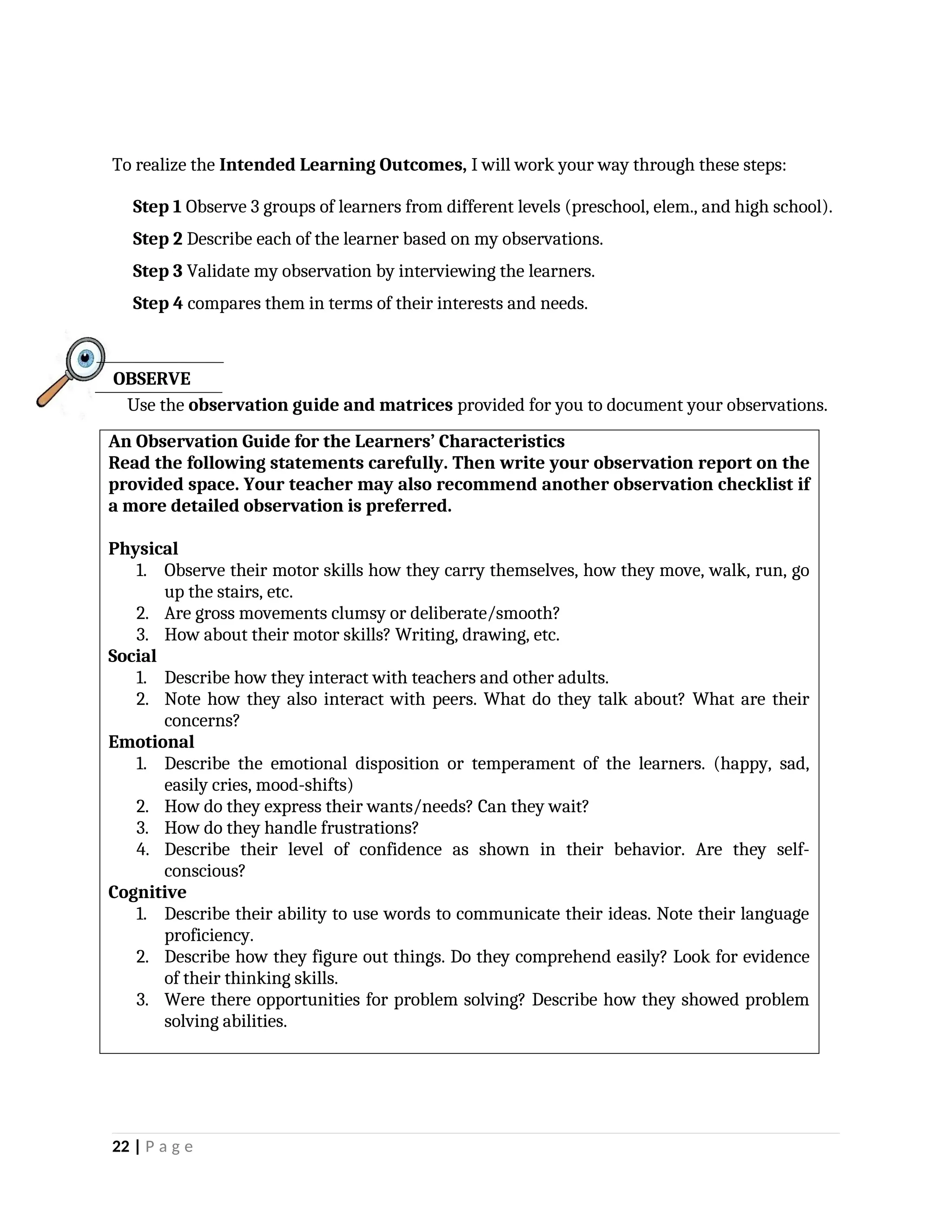
To realize the Intended Learning Outcomes, I will work your way through these steps:
Step 1 Observe 3 groups of learners from different levels (preschool, elem., and high school).
Step 2 Describe each of the learner based on my observations.
Step 3 Validate my observation by interviewing the learners.
Step 4 compares them in terms of their interests and needs.
Use the observation guide and matrices provided for you to document your observations.
An Observation Guide for the Learners’ Characteristics
Read the following statements carefully. Then write your observation report on the
provided space. Your teacher may also recommend another observation checklist if
a more detailed observation is preferred.
Physical
1. Observe their motor skills how they carry themselves, how they move, walk, run, go
up the stairs, etc.
2. Are gross movements clumsy or deliberate/smooth?
3. How about their motor skills? Writing, drawing, etc.
Social
1. Describe how they interact with teachers and other adults.
2. Note how they also interact with peers. What do they talk about? What are their
concerns?
Emotional
1. Describe the emotional disposition or temperament of the learners. (happy, sad,
easily cries, mood-shifts)
2. How do they express their wants/needs? Can they wait?
3. How do they handle frustrations?
4. Describe their level of confidence as shown in their behavior. Are they self-
conscious?
Cognitive
1. Describe their ability to use words to communicate their ideas. Note their language
proficiency.
2. Describe how they figure out things. Do they comprehend easily? Look for evidence
of their thinking skills.
3. Were there opportunities for problem solving? Describe how they showed problem
solving abilities.
22 | P a g e
OBSERVE
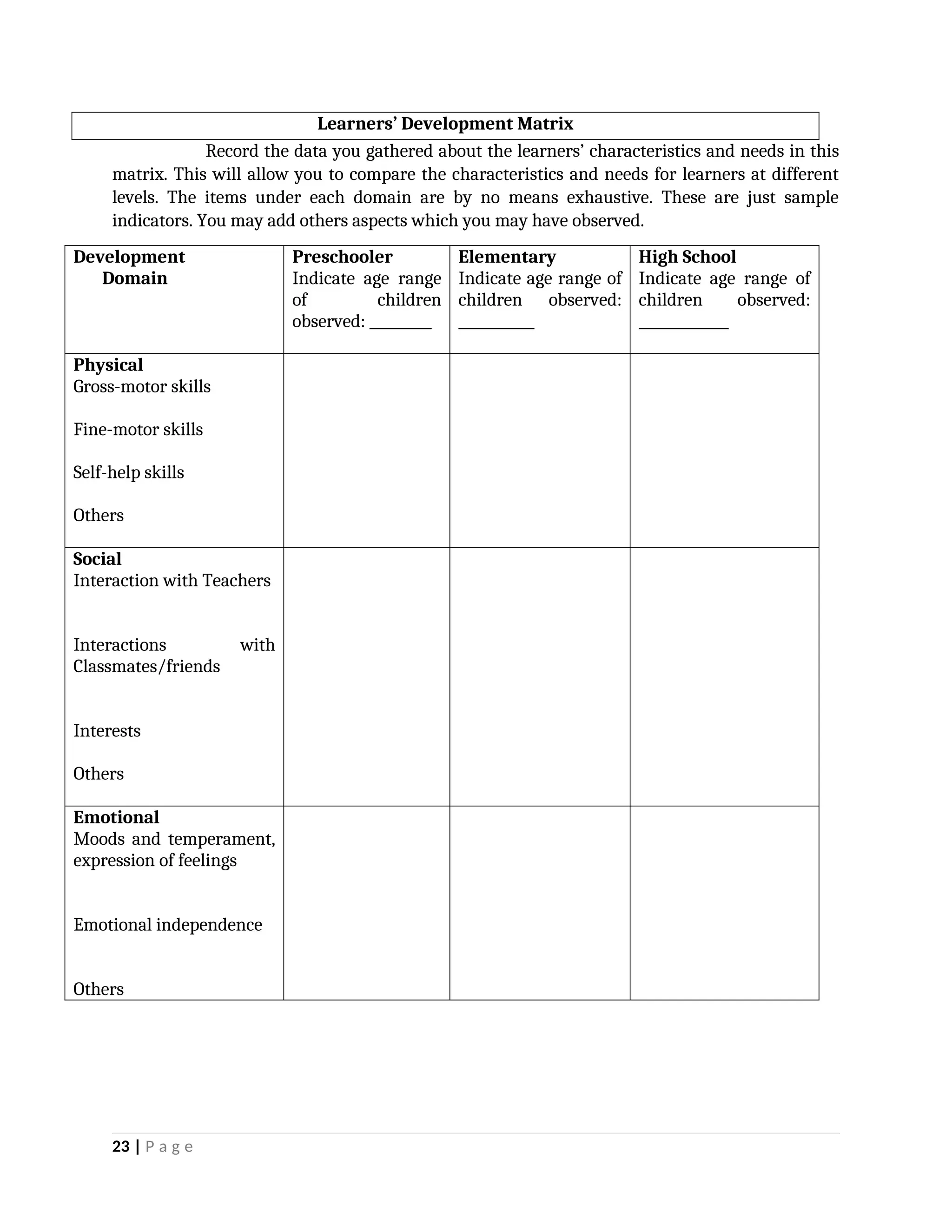
Learners’ Development Matrix
Record the data you gathered about the learners’ characteristics and needs in this
matrix. This will allow you to compare the characteristics and needs for learners at different
levels. The items under each domain are by no means exhaustive. These are just sample
indicators. You may add others aspects which you may have observed.
Development
Domain
Preschooler
Indicate age range
of children
observed: _________
Elementary
Indicate age range of
children observed:
___________
High School
Indicate age range of
children observed:
_____________
Physical
Gross-motor skills
Fine-motor skills
Self-help skills
Others
Social
Interaction with Teachers
Interactions with
Classmates/friends
Interests
Others
Emotional
Moods and temperament,
expression of feelings
Emotional independence
Others
23 | P a g e
Cognitive
Communication skills
Thinking skills
Problem-solving
Others
Write the most salient developmental characteristics of the learners you observed. Based on
these characteristics think of implications for the teacher.
Example:
Level Salient Characteristics
Observed
Implications to the Teaching-
Learning Process
Preschool
Age range of learners
observed 3-4
 Preschoolers like to
move around a lot.
 Therefore, the teacher
should remember to use
music and movement
activities not just in PE but
in all subject areas.
 Therefore, teachers should
not expect preschoolers to
stay seated for a long
period of time.
Level Salient Characteristics
Observed
Implications to the Teaching-
Learning Process
24 | P a g e
ANALYZE
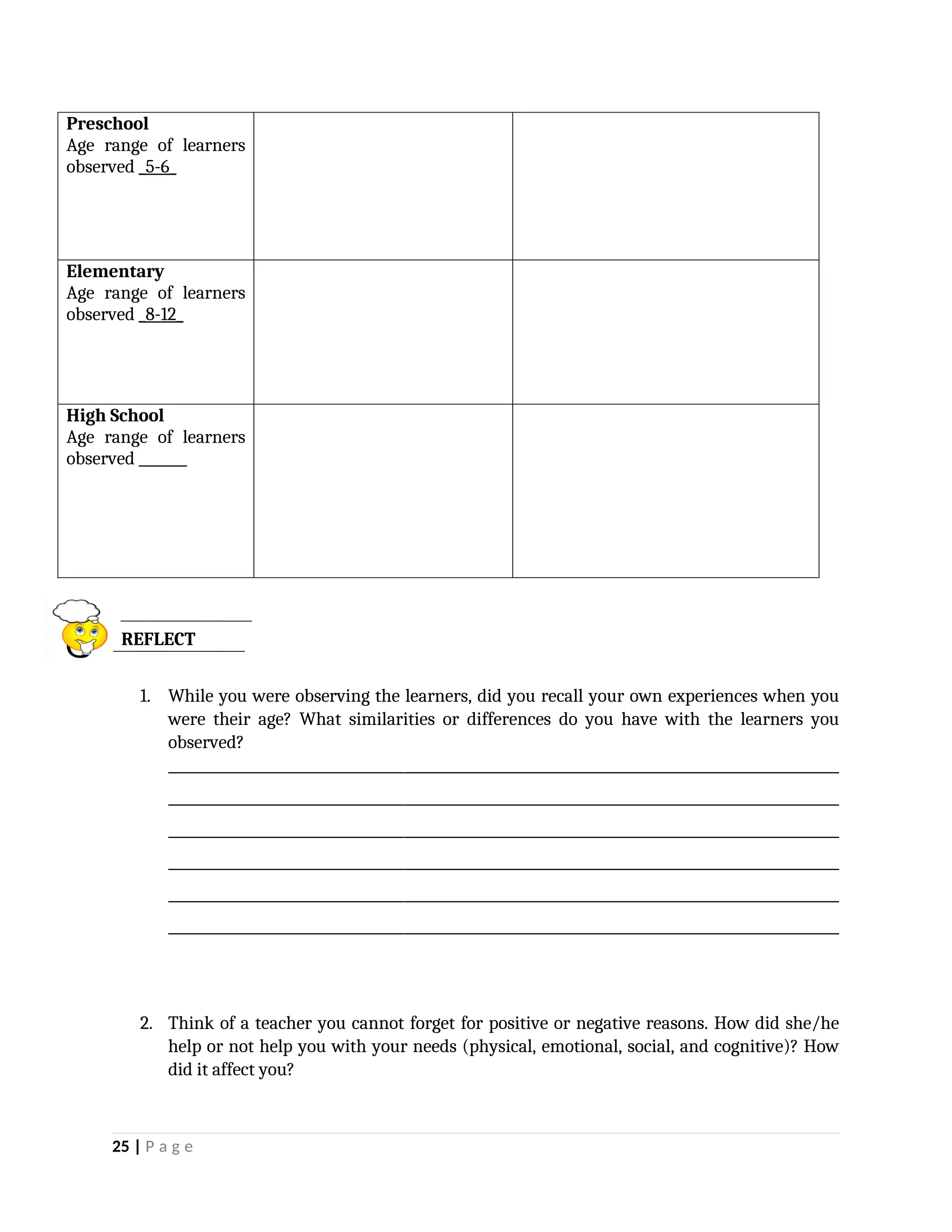
Preschool
Age range of learners
observed _5-6_
Elementary
Age range of learners
observed _8-12_
High School
Age range of learners
observed _______
1. While you were observing the learners, did you recall your own experiences when you
were their age? What similarities or differences do you have with the learners you
observed?
_________________________________________________________________________________________________
_________________________________________________________________________________________________
_________________________________________________________________________________________________
_________________________________________________________________________________________________
_________________________________________________________________________________________________
_________________________________________________________________________________________________
2. Think of a teacher you cannot forget for positive or negative reasons. How did she/he
help or not help you with your needs (physical, emotional, social, and cognitive)? How
did it affect you?
25 | P a g e
REFLECT
_________________________________________________________________________________________________
_________________________________________________________________________________________________
_________________________________________________________________________________________________
_________________________________________________________________________________________________
_________________________________________________________________________________________________
_________________________________________________________________________________________________
3. Share your other insights here.
_________________________________________________________________________________________________
_________________________________________________________________________________________________
_________________________________________________________________________________________________
_________________________________________________________________________________________________
_________________________________________________________________________________________________
_________________________________________________________________________________________________
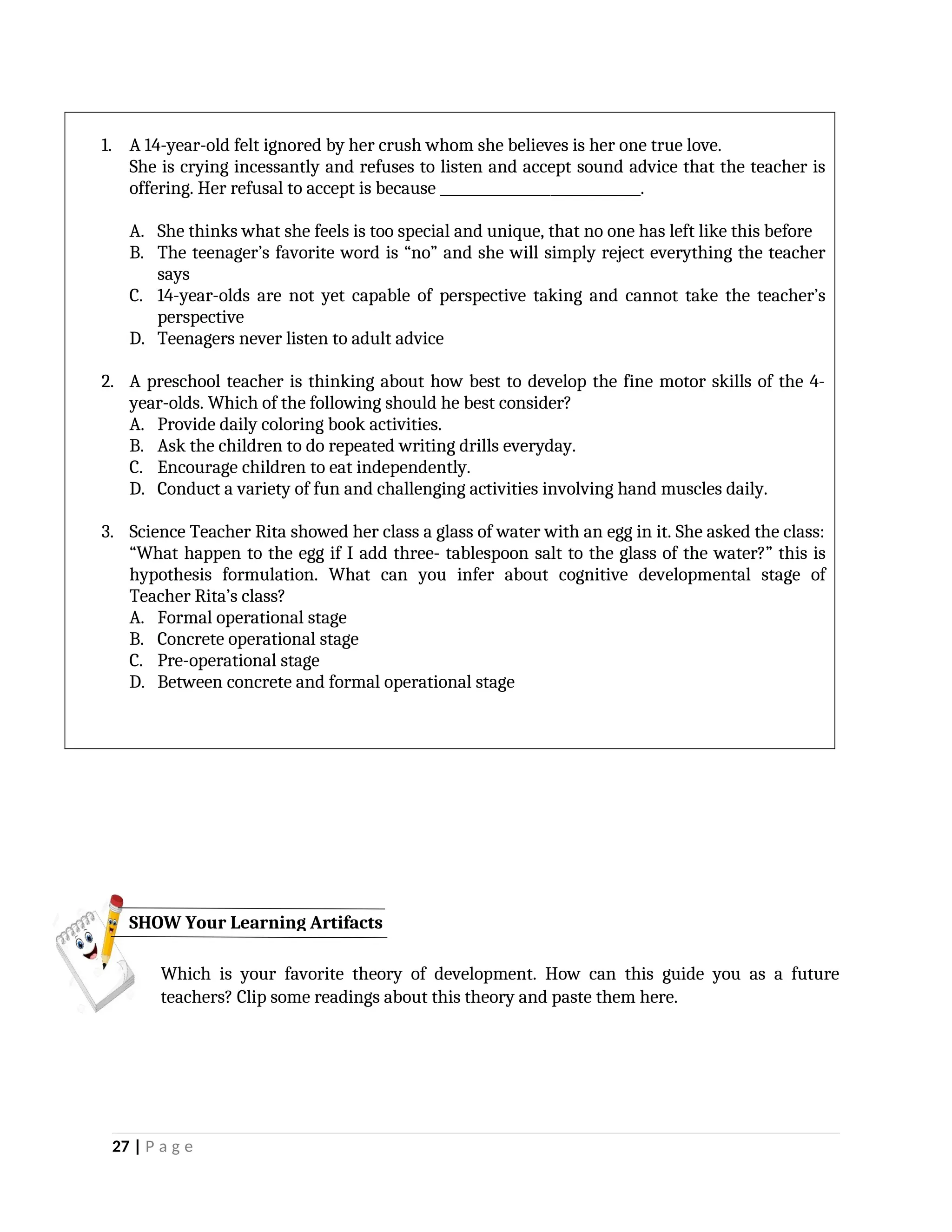
Directions: Read the items given below and encircle the correct answer.
26 | P a g e
LINK THEORY TO PRACTICE
1. A 14-year-old felt ignored by her crush whom she believes is her one true love.
She is crying incessantly and refuses to listen and accept sound advice that the teacher is
offering. Her refusal to accept is because _____________________________.
A. She thinks what she feels is too special and unique, that no one has left like this before
B. The teenager’s favorite word is “no” and she will simply reject everything the teacher
says
C. 14-year-olds are not yet capable of perspective taking and cannot take the teacher’s
perspective
D. Teenagers never listen to adult advice
2. A preschool teacher is thinking about how best to develop the fine motor skills of the 4-
year-olds. Which of the following should he best consider?
A. Provide daily coloring book activities.
B. Ask the children to do repeated writing drills everyday.
C. Encourage children to eat independently.
D. Conduct a variety of fun and challenging activities involving hand muscles daily.
3. Science Teacher Rita showed her class a glass of water with an egg in it. She asked the class:
“What happen to the egg if I add three- tablespoon salt to the glass of the water?” this is
hypothesis formulation. What can you infer about cognitive developmental stage of
Teacher Rita’s class?
A. Formal operational stage
B. Concrete operational stage
C. Pre-operational stage
D. Between concrete and formal operational stage
Which is your favorite theory of development. How can this guide you as a future
teachers? Clip some readings about this theory and paste them here.
27 | P a g e
SHOW Your Learning Artifacts
Evaluate Your Work Field Study 1. Episode 2. Learner Diversity: Development
Characteristics, Needs, and Interest
Learning Outcome: Determining the characteristics of a school environment that
provides social, psychological and physical environment supportive of learning.
Name of FS Student : Date Submitted:____________________
Year and Section : Course: ______________________________
Learning Episode Excellent
4
Very
Satisfactory
Satisfactory
2
Need
Improvement
28 | P a g e
EVALUATE Performance Task
3 1
Accomplished
observation
Sheet
All observation
questions tasks
completely
answered/
accomplish
One (1) to two
(2) observation
questions/
tasks not
answered/
accomplished.
Three (3)
observation
questions/ tasks
not answered/
accomplished
Four (4) or more
observation
questions/ tasks
not answered/
accomplished.
Analysis All questions were
answered
completely,
answers are depth
and are
thoroughly
grounded on
theories; grammar
and spelling are
free from error.
All questions
were answered
completely,
answers are
clearly
connected to
theories,
grammar and
spelling are
free from
errors.
Questions were
not answered
completely,
answers are not
clearly connected
to theories one
(1) to (3)
grammatical/
spelling wrong
Four (4) or more
observation
questions were
not answered.
Answers nit
connected to
theories; more
than four (4)
grammatical/
spelling errors.
Reflection Profound and
clear supported by
what were
observed and
analyzed.
Clear but lacks
depth
supported by
what were
observed and
analyzed.
Not so clear and
shallow,
somewhat
supported by
what were
observed and
analyzed
Unclear and
shallow, rarely
supported by
what were
observed and
analyzed.
Learning
Artifacts
Portfolio is
reflected on in the
context of the
learning
outcomes.
Complete, well
organized highly
relevant to the
learning outcome.
Portfolio is
reflected on in
the context of
the learning
outcomes.
Complete well
organized very
relevant to the
to the learning
outcome
Portfolio is not
reflected on in
the context of the
learning
outcomes.
Complete not
organized very
relevant to the to
the learning
outcome
Portfolio is not
reflected on in the
context of the
learning
outcomes; not
complete, not
organized, not
relevant.
Submission Submitted before
the deadline
Submitted
before the
deadline
Submitted a day
after the
deadline
Submitted two (2)
days or mote after
the deadline
COMMENTS
TRANSMUTATION OF SCORE TO GRADE/ RATING
Score 20 19-18 17 16 15 14 13-12 11 10 9-8 7-
29 | P a g e
OVER ALL
SCORE
Rating
(Based on
transmutation)
below
Grade 1.0 1.25 1.5 1.75 2.00 2.25 2.50 2.75 3.00 3.5 5.00
99 96 93 90 87 84 81 78 75 72 71-
below
Signature of FS Teacher above Printed Name Date
FIELD STUDY 1 LEARNING EPISODE
FS 1 3
Focus on Gender, Needs, Strengths,
Interests Experiences Language,
Race, Status, Difficult
Circumstances, and Indigenous
Peoples
Episode 3 provides an opportunity to observe how differences in gender, racial, cultural,
and religious backgrounds, including coming from indigenous groups influence learner
behavior, interaction, and performance in school. One will also analyze and reflect on practices
that teachers use in leveraging diversity in the classroom. It also provides an opportunity to
observe how differences in abilities affect interaction in school and learn about strategies that
teachers use in addressing the learners’ needs toward effective teaching and learning.
30 | P a g e
SPARK YOUR INTEREST
TARGET YOUR INTENTED LEARNING OUTCOME
At the end of this Episode, I must be able to:
 Describe the characteristics and needs of learners from diverse backgrounds;
 Identify the needs of students with different levels of abilities in the classroom;
 Identify best practices in differentiated teaching to suit the varying learner needs
in a diverse class (PPST 3.1.1); and
 Demonstrate openness, understanding, and acceptance of the learners’ diverse
needs and backgrounds.
Here are principles of concepts relevant to this Episode:
1. Principles of Development
a. Development and learning proceed at varying rate from child to child, as well
as at uneven rates across different areas of the child’s functioning. (NAEYC
2019)
b. Development and learning are maximized when learners are challenged to
achieve at a level just above their current level of mastery, and also when they
have many opportunities to practice newly acquired skills.
c. Differentiated instruction is a student-centered approach that aims to match
the learning content, activities and assessment to different characteristics,
abilities, interests, and needs of the learners.
2. The PPST highlighted the following factors that bring about the diversity of learners:
a. Differences in learners’ gender, needs, strengths, interests, and experiences
b. Learners’ linguistic, cultural, socio-economic and religious backgrounds
c. Learners with disabilities, giftedness, and talents
d. Learners under challenging circumstances which include geographic
isolation, chronic illness, displacement due to armed conflict, urban
resettlement or disaster, child abuse and child labor.
Effective teachers are knowledgeable about how issues related to the factors mentioned
affect learners. The teachers develop in them sensitivity and empathy. They remember that
the learners respond and perform at different levels. The teachers assure the students that their
gender identity, culture and religion are respected, their strengths are recognized, and
their needs will be met. These teachers declare to all that everyone has the chance to learn
and succeed. They create a learning community where everyone can work together and
contribute regardless of their abilities, capacities and circumstances.
Teachers who celebrate and leverage student diversity in the classroom:
31 | P a g e
REVISIT the Learning Essentials
 Use strategies to build a caring community in the classroom
 Model respect and acceptance of different cultures and religions
 Bring each of the student’s home culture and language into the shared culture of
the school
 Provide more opportunities for cooperation than competition
3. Focus on Indigenous Peoples
A young teacher’s approach to indigenous peoples starts with a keen awareness
of one’s own identity, including one’s beliefs and cultural practices. Through serious
reflection one may realize that the self is a product of all influences of key people in
one’s life and the community, real and virtual. Similarly, learners from indigenous
groups carry with them their beliefs, views and cultural practices. One’s attitude needs
to be that of openness and respect. Come in not with the view that one’s own culture is
superior, we approach with the sincere willingness and deep interest to know and
understand the indigenous peoples’ culture. We aim to make teaching-learning
facilitative rather than imposing.
a. From your professional education subjects/courses, most likely you have discussed
indigenous peoples in the Philippines. You learned that our country has about 110
ethno-linguistic groups, majority of which is in Mindanao, some in Northern
Luzon and fewer in the visayas. (UNDP Philippines, 2010). They represent about 10-
20% of our total population. There are two big indigenous peoples groups which
have several smaller ethics groups within them, the non-muslim groups called the
Lumads in Mindanao, and the Igorots in Northern Luzon. Among others, we have
the Badjaos, Ati and Tumandok, Mangtans and Aetas.
b. Republic Act 8371 (1997), the Indigenous Peoples’ Rights Act, recognizes and
protects the rights of indigenous cultural communities (ICC) and indigenous peoples
(IP). Our country was admired by other nations for enacting this law, however,
years later, so much still has to be done to improve the lives of millions of people
from indigenous groups. (Reyes, Mina and Asis, 2017)
c. Guided by RA 8371, in 2016 DepEd issued DO 32, s.2015, Adopting the Indigenous
Peoples Education (IPED) Curriculum Framework. Most useful for you as a
future teacher to remember are the 5 Key Elements of Indigenous Peoples
Education Curriculum (DO 32, s.2015 enclosure, pp. 15-18):
1. Curriculum Design, Competencies and Content. Interfacing the national
curriculum with indigenous knowledge systems and practices (IKSPs) and
Indigenous Learning system (ILS) the design of a culturally appropriate and
responsive curriculum has the following features:
a. Anchors the learning context on the ancestral domain, the community’s
world view, and its indigenous cultural institutions.
b. Includes and respects the community’s expression of spirituality as part of
the curriculum context.
c. Affirms and strengthens indigenous cultural identity.
32 | P a g e
d. Revitalizes, regenerates, strengthens, and enriches IKSPs, ILS, and
indigenous languages.
e. Emphasize competencies that are needed to support the development and
protection of the ancestral domain, vitality their culture, and the
advancement of indigenous peoples’ right and welfare.
f. Supports the community’s cultural integrity while enabling meaningful
relations with the broader society.
2. Teaching Methodologies and Strategies. A culturally appropriate and
responsive curriculum employs teaching methodologies and strategies that
strengthen, enrich, and complement the community’s indigenous teaching-
learning process.
3. Learning Space and Environment. A culturally appropriate and responsive
curriculum recognizes that the ancestral domain where IKSPs are experienced,
lived, and learned is the primary learning environment and learning space of
indigenous learners.
4. Learning Resources. Instructional materials, and other learning resources
shall be developed and utilized in line with the described curriculum content
and teaching-learning processes.
5. Classroom Assessment. Assessment shall be done utilizing tools appropriate to
the standards, competencies, skills, and concepts being covered. Their design and
use shall address the needs and concerns of the community and shall be
developed with their participation.
5.
Observation differences among learners’ gender, needs, strengths,
interests, and experiences; and differences among learners’ linguistic,
cultural, socio-economic, religious backgrounds and difficult
circumstances.
Resource Teacher: _________________________ Teacher’s Signature: ________________
School: ______________________________________ Grade/Year Level: __________________
Subject Area: _______________________________ Date: __________________________________
The learners’ differences and the type of interaction they bring surely affect the quality of
teaching and learning. This activity is about observing and gathering data to find out how
student diversity affects learning.
To realize the Intended Learning Outcomes, work your way through these steps:
33 | P a g e
OBSERVE, ANALYZE, REFLECT
Activity 3.1
Step 1. Observe a class in different parts of a school day. (Beginning of the day, class time,
recess, etc.)
Step 2. Described the characteristics of the learners in terms of age, gender, and social and
cultural diversity.
Step 3. Describe the interaction that transpires inside and outside the classroom.
Step 4. Interview your Resource Teacher about the principles and practices that she uses in
dealing with diversity in the classroom.
Step 5. Analyze the impact of individual differences on learners’ interactions.
The observation form is provided for me to document my observation.
An observation Guide for the Learners’ Characteristics
Read the following carefully before you begin to observe. Then write your observation
report on the space provided on the next page.
1. Find out the number of students. Gender data as their ages, gender, racial groups,
religious, and ethnic backgrounds.
During class:
1. How much interaction is there in the classroom? Describe how the students interact
with one another and with the teachers. Are there groups that interact more with the
teacher than others.
2. Observe the learners seated at the back and the front part of the room. Do they behave
and interact differently?
3. Describe the relationship among the learners. Do the learners cooperative with or
compete against each other?
4. Who among the students participate actively? Who among them ask for most help?
5. When a student is called and cannot answer the teacher’s question, do the classmates
try to help him? Or do they raise their hands, so that the teacher will call them
instead?
34 | P a g e
OBSERVE
Outside class:
1. How do the students group themselves outside class? Homogeneously, by age? By
gender? By racial or ethnic groups? By their interests? Or are the students in mixed
social groupings? If so, describe the groupings.
2. Notice students who are alone and those who are not interacting. Describe their
behavior.
Interview the teachers and ask about their experience about learners in difficult
circumstances. Request them to describe these circumstances and how it has affected the
learners. Ask about the strategies they use to help these learners cope.
Ask the teachers about strategies they apply to address the needs of diverse students due to
following factors:
 Gender, including LGBT
 Language and cultural differences
 Differences in religion
 Socio-economic status
OBSERVATION REPORT
35 | P a g e
Name of the School Observed: ___________________________________________________________________________
School Address: ___________________________________________________________________________________________
Date of Visit: _______________________________________________________________________________________________
1. Identify the person who plays key roles in the relationships and interactions in the
classrooms. What roles do they play? Is there somebody who appears to be the leader, a
mascot/joker, an attention seeker, a little teacher, a doubter/pessimist?
36 | P a g e
ANALYZE
_________________________________________________________________________________________________
_________________________________________________________________________________________________
_________________________________________________________________________________________________
_________________________________________________________________________________________________
_________________________________________________________________________________________________
_________________________________________________________________________________________________
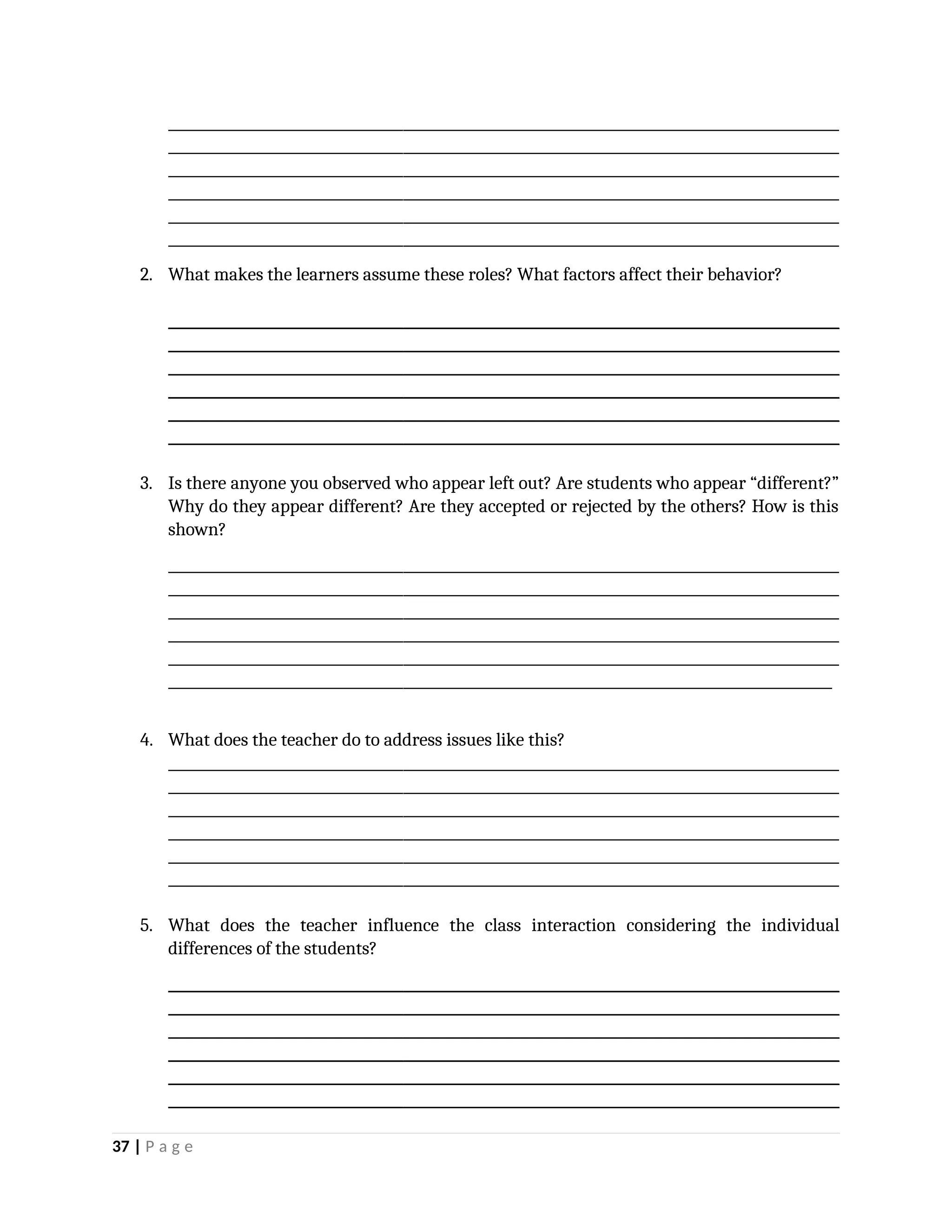
2. What makes the learners assume these roles? What factors affect their behavior?
_________________________________________________________________________________________________
_________________________________________________________________________________________________
_________________________________________________________________________________________________
_________________________________________________________________________________________________
_________________________________________________________________________________________________
_________________________________________________________________________________________________
3. Is there anyone you observed who appear left out? Are students who appear “different?”
Why do they appear different? Are they accepted or rejected by the others? How is this
shown?
_________________________________________________________________________________________________
_________________________________________________________________________________________________
_________________________________________________________________________________________________
_________________________________________________________________________________________________
_________________________________________________________________________________________________
________________________________________________________________________________________________
4. What does the teacher do to address issues like this?
_________________________________________________________________________________________________
_________________________________________________________________________________________________
_________________________________________________________________________________________________
_________________________________________________________________________________________________
_________________________________________________________________________________________________
_________________________________________________________________________________________________
5. What does the teacher influence the class interaction considering the individual
differences of the students?
_________________________________________________________________________________________________
_________________________________________________________________________________________________
_________________________________________________________________________________________________
_________________________________________________________________________________________________
_________________________________________________________________________________________________
_________________________________________________________________________________________________
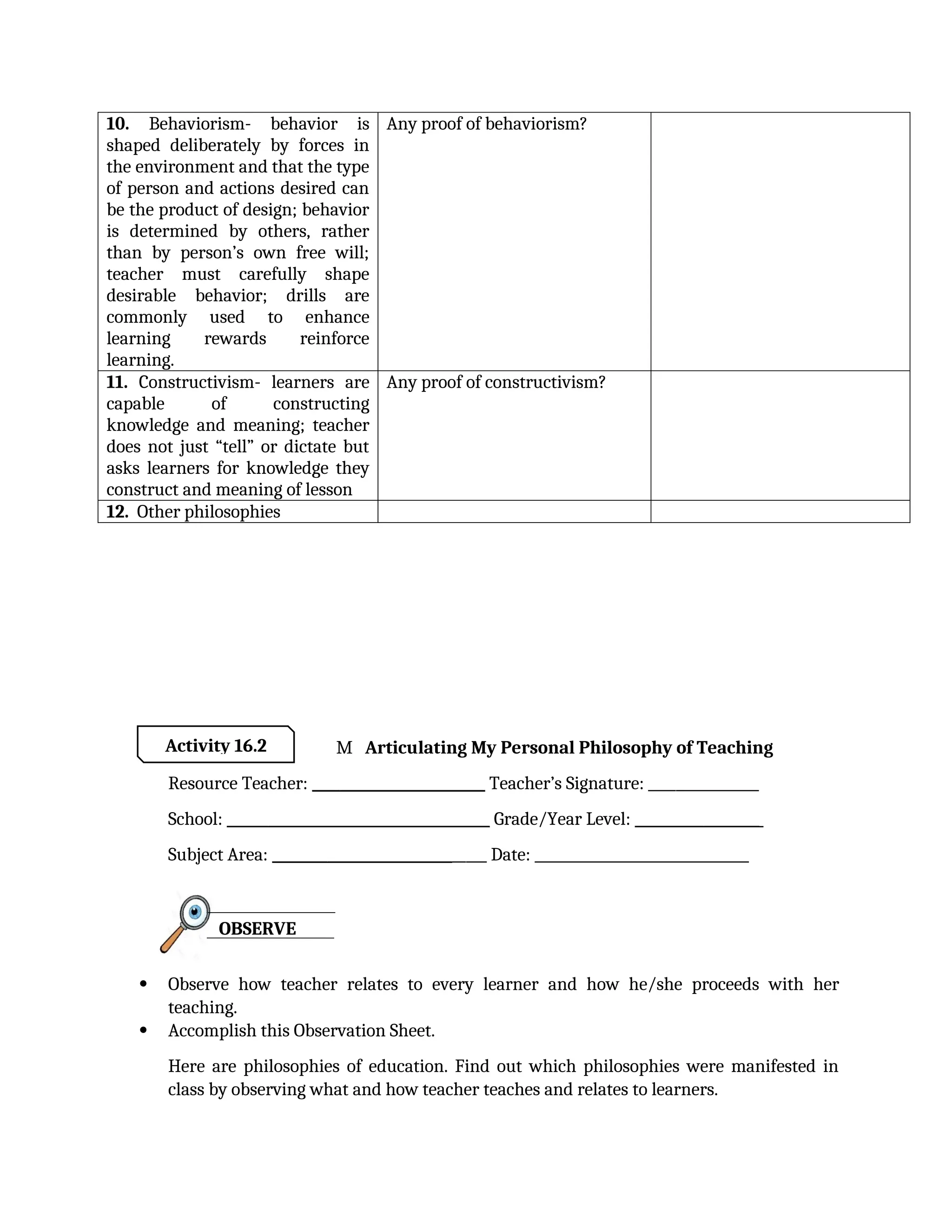
37 | P a g e
6. What strategies does the teacher use to maximize the benefits of diversity in the
classroom? How does the teacher leverage diversity?
_________________________________________________________________________________________________
_________________________________________________________________________________________________
_________________________________________________________________________________________________
_________________________________________________________________________________________________
_________________________________________________________________________________________________
________________________________________________________________________________________________
1. How did you feel being in the classroom? Did you feel a sense of oneness or unity
among the learners and between the teacher and the learner?
Observing differences among learners with disabilities, giftedness, and
talents
Resource Teacher: _________________________ Teacher’s Signature: ________________
School: ______________________________________ Grade/Year Level: __________________
Subject Area: _______________________________ Date: __________________________________
To realize the Intended Learning Outcomes, I will work your way through these steps.
1. Observe at least two of these classes.
38 | P a g e
REFLECT
Activity 3.2
a. SPED class with learners with intellectual disabilities
b. SPED class with learners with physical disabilities
c. SPED class for the gifted and talented
d. A regular class with inclusion of learners with disabilities
2. Note the needs of the learners that the teachers should address.
3. Interview the teachers to find out more about the learners.
4. Write your observation report
5. Analyze your observation data
6. Reflect on your experience.
An observation Guide for the Learners’ Characteristics
Read the following carefully before you begin to observe. Then write your
observation report on the space provided.
1. Observe the class to see the differences in abilities of the learners.
2. Try to identify the students who seem to be performing well and those that seem to
be behind.
3. Validate your observations by asking the teacher about the background and needs
of the learners.
4. Observe the behavior of the both regular students and those with special needs.
Note their dispositions, pace in accomplishing tasks, interaction with teacher, and
interaction with others.
5. Observe the teacher’s method in addressing the individual learning needs of the
students in his/her class.
39 | P a g e
OBSERVE
OBSERVATION REPORT
Name of the School Observed: __________________________________________________________________
School Address: __________________________________________________________________________________
Date of Visit: ______________________________________________________________________________________
1. Did your observation match the information given by the teacher?
_________________________________________________________________________________________________
_________________________________________________________________________________________________
_________________________________________________________________________________________________
_________________________________________________________________________________________________
_________________________________________________________________________________________________
_________________________________________________________________________________________________
2. Describe the differences in ability levels of the students in the class? What practices or
strategies are done or should be done to differentiate instruction to meet the needs of
the learners.
_________________________________________________________________________________________________
_________________________________________________________________________________________________
_________________________________________________________________________________________________
_________________________________________________________________________________________________
_________________________________________________________________________________________________
_________________________________________________________________________________________________
40 | P a g e
ANALYZE
3. Describe the methods used by the teacher in handling the students’ differences in
abilities. How did the student respond to the teacher? Did the teacher use differentiated
instruction? If yes, describe how.
_________________________________________________________________________________________________
_________________________________________________________________________________________________
_________________________________________________________________________________________________
_________________________________________________________________________________________________
_________________________________________________________________________________________________
_________________________________________________________________________________________________
1. Recall the time when you were in elementary or high school. Recall the high and low
achievers in your class. How did your teacher deal with differences in abilities? Was
your teacher effective?
_________________________________________________________________________________________________
_________________________________________________________________________________________________
_________________________________________________________________________________________________
_________________________________________________________________________________________________
_________________________________________________________________________________________________
_________________________________________________________________________________________________
2. What dispositions and traits will you need as a future teacher to meet the needs of the
learners?
_________________________________________________________________________________________________
_________________________________________________________________________________________________
_________________________________________________________________________________________________
_________________________________________________________________________________________________
_________________________________________________________________________________________________
_________________________________________________________________________________________________
41 | P a g e
REFLECT
OBSERVE, ANALYZE, REFLECT
Observing the school experiences of learners who belong to indigenous
groups.
Resource Teacher: _________________________ Teacher’s Signature: ________________
School: ______________________________________ Grade/Year Level: __________________
Subject Area: _______________________________ Date: __________________________________
To realize the Intended Learning Outcomes, I will work your way through these steps.
1. Ensure that you have reviewed the no. 3 focused on Indigenous Peoples in the Learning
essentials of Episode 3.
2. Observe in a school with a program for IP learners. Below are some suggested schools:
a. Ujah School of Living Traditions, Hungduan, Ifugao
b. Sentrong Paaralan ng mga agta, General Narak, Quezon
c. Sitio Tarukan Primary School, Capas Tarlac
d. Mangyan Center for Learning and Development, Naujan, Oriental Mindoro
e. Paaralang Mangyan na Angkop sa Kulturang Aalagaan (PAMANAKA), San Jose
Occidental Mindoro
f. Tubuanan Ati Learning Center, Balabag, Boracay Island
g. Balay Turu-an Schools of Living Traditions, Brfy Garangan and Brgy. Agcalaga,
Calinog, Iloilo
h. T’boli School of Living Traditions, Lake Sebu, South Cotabato
i. Daraghuyan-Bukidnon Tribal Community School,Dalwagan, Malaybalay, Bukidnon
j. Talaandig School of Living Traditions, Lantapan, Bukidnon
k. Bayanihan Elementary School, Marilog, Davao
l. Lumad Bakwit School, UP Diliman, Quezon City
Please note: Ensure proper coordination of your college/university to obtain permission from
these schools before you visit.
If an actual visit is not feasible, consider a “Virtual Visit” through social media. And if still not
feasible consider a “virtual” field study through watching Indigenous Peoples in the Philippines
videos. There are several available at Youtube. You can start with this video by Dep Ed:
3. Write your observation report.
4. Analyze your observation data using the Indigenous Peoples Education Framework.
5. Reflect on your experience.
42 | P a g e
Activity 3.3
OBSERVE
An observation Guide for the Learners’ Characteristics
Read the following carefully before you begin to observe. Then write your
observation report on the space provided.
If you are observe, read watching videos you searched, instead of actually visiting a
school, have these question in mind as you are watching the videos. You can try to
get in touch with the creator of the videos and interview them too.
1. Before you observe, read about the specific IP group in the school you will visit.
Know their norms and customary greetings. This will help you help blend in the
school community and interact with respect.
2. Observe and note the different parts areas of the school environment. How are
learning spaces arranged?
3. What activities do they do in these different areas of the school?
4. Who are the people who manage the school? Who are involved in teaching the
learners?
5. Observe how the teaching-learning process happen. Describe the learning activities
they have and the teaching strategies that the teachers uses.
6. Describe the interaction that is taking place between the teacher and learners,
among the teachers, and in the school in general.
7. What instructional materials and learning resources are they using?
8. Interview the teacher and principal about the curriculum. Find out the curriculum
goals. You can use the questions found on the Analysis part of this activity.
43 | P a g e
OBSERVATION REPORT
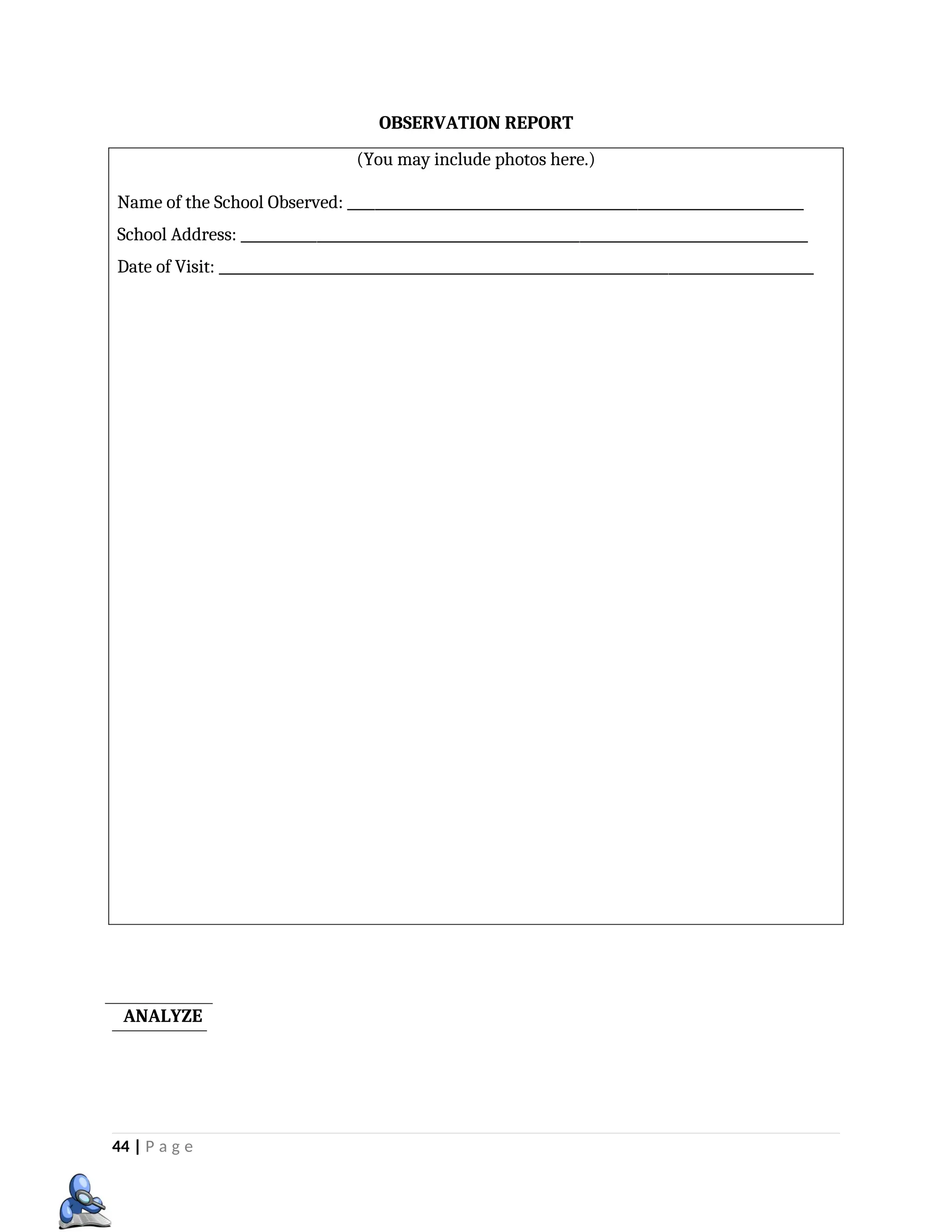
(You may include photos here.)
Name of the School Observed: __________________________________________________________________
School Address: __________________________________________________________________________________
Date of Visit: ______________________________________________________________________________________
44 | P a g e
ANALYZE
45 | P a g e
Curriculum Design, Competencies, and
Content
Answer each question based on your
observation and interview data.
1. Does the school foster a sense of
belonging to one’s ancestral
domain, a deep understanding of
the community’s beliefs and
practices? Cite examples
2. Does the school show respect of
the community’s expression of
spirituality? How?
3. Does the school foster in the
indigenous learners a deep
appreciation of their identity?
How?
4. Does the curriculum teach skills
and competencies in the
indigenous learners that will help
them develop and protect their
ancestral domain and culture?
5. Does the curriculum link new
concepts and competencies to the
life experience of the
community?
6. Do the teaching strategies help
strengthen, enrich, and
complement the community’s
indigenous teaching-process?
7. Does the curriculum maximize
the use of the ancestral domain
and activities of the community
as relevant settings for learning
in combination with classroom-
based sessions? Cite examples.
8. Is cultural sensitivity to uphold
culture, beliefs and practices,
observed and applied in the
development and use of
instructional materials and
learning resources? How? (For
example, culture bearers of the
indigenous peoples are
consulted)
9. Do assessment practices consider
community values and culture?
How?
10. Do assessment practices consider
community values and culture?
How?
What do you think can still be done to promote and uphold the indigenous people knowledge
systems and practices and rights in school?
_________________________________________________________________________________________________________
_________________________________________________________________________________________________________
_________________________________________________________________________________________________________
_________________________________________________________________________________________________________
_________________________________________________________________________________________________________
_________________________________________________________________________________________________________
_________________________________________________________________________________________________________
_________________________________________________________________________________________________________
_________________________________________________________________________________________________________
_________________________________________________________________________________________________________
_________________________________________________________________________________________________________
_________________________________________________________________________________________________________
Reflect based on your actual visit or videos that you watched.
1. What new things did you learn about indigenous peoples?
_________________________________________________________________________________________________
_________________________________________________________________________________________________
_________________________________________________________________________________________________
_________________________________________________________________________________________________
_________________________________________________________________________________________________
2. What did you appreciate most from your experiences in visiting the school with
indigenous learners? Why?
_________________________________________________________________________________________________
_________________________________________________________________________________________________
_________________________________________________________________________________________________
_________________________________________________________________________________________________
_________________________________________________________________________________________________
3. For indigenous learners, as future teacher, I promised these three things:
46 | P a g e
REFLECT
3.1 Be open and respect indigenous peoples by__________________________________________
___________________________________________________________________________________________
___________________________________________________________________________________________
___________________________________________________________________
3.2 Uphold and celebrate their culture, beliefs and practices by showing respect with
their culture, beliefs and practices. ____________________________________________
___________________________________________________________________________________________
___________________________________________________________________________________________
___________________________________________________________________
3.3 Advocate for indigenous peoples education by promoting and supporting all the IP
in our country.
___________________________________________________________________________________________
___________________________________________________________________________________________
___________________________________________________________________
With the principles of individual differences in mid, what methods and strategies
will you remember in the future to ensure that you will be able to meet the need of both
the high and low achievers in your class? Make a collection of strategies in how to address the
student’s different ability levels.
47 | P a g e
SHOW Your Learning Artifacts
LINK THEORY TO PRACTICE
Directions: Read the items given below and encircle the correct answer
1. Which statement on student diversity is CORRECT?
A. The teacher must do his/her best to reduce student diversity in class.
B. The less the diversity of students in class, the better for the teacher and students.
C. The teacher should accept and value diversity.
D. Student diversity is purely due to student’s varied cultures.
2. Which student thinking/ behavior indicates that he/she values diversity?
A. He/She regards his culture as superior to other’s cultures.
B. He/She regards his culture as inferior to other’s cultures.
C. He/She accepts the fact that all people are unique in their own way.
D. He/She emphasizes he differences among people and disregards their
commonalities.
3. What is teaching-learning implications of student diversity?
A. Compare students.
B. Make use of a variety of teaching and assessment methods and activities.
C. Do homogenous grouping for group activities.
D. Develop different standards for different students groups.
48 | P a g e
4. All are features of the Indigenous People Education Curriculum, EXCEPT
A. Affirms and strengthen indigenous cultural identity
B. Makes education exclusive to the indigenous culture
C. Revitalizes, generates and enriches IKSPS and indigenous languages
D. Anchor the learning context on the ancestral domain, the community’s world
view, and its indigenous cultural institutions.
5. All are best practices in using learning resources for indigenous learners, EXCEPT ______
A. Culturally generated learning resources only include indigenous group’s
artifacts, stories, dances, songs, and musical instruments.
B. The language used in instructional materials, especially in primary years, which
highlight mother tongue, is consulted with the indigenous community.
C. Cultural sensitivity and protocols are observed in development and use of
instructional materials.
D. The indigenous community’s property rights are upheld in publishing
learning resources
6. All are best practices for assessment in the Indigenous Peoples Education Framework
EXCEPT. ___________
A. Including the practice of competencies in actual community and family
situations
B. Applying higher-order thinking skills and integrative understanding across
subject areas.
C. Using international context in the assessment standards and content faithfully
without modification.
D. Including community-generated assessment processes that are part of
indigenous learning system.
7. Read the following comments by the teacher. Which of these comments will most likely
make a child try harder, rather than give up?
A. Sinuwerte ka ngayon ditto sa test, ha?
B. Hindi ka talaga mgaling dito sa paksang ito,’no?
C. Nakikita ko na kailangan momg maglaan ng mas mahabang panahon sa
paksang ito para lubos mong maunawaan ito.
D. Nahihirapan ka sa paksang ito. Maari kitang tulungan.
8. Which of the following demonstrate differentiated instruction?
A. The teacher groups the learners by their ability level and makes the groups work
with the same topic but assign a different task appropriate for each group
accomplish.
B. The teacher divides the class inti three heterogeneous groups and assigns the
same activity for each group to work on
49 | P a g e
C. The teacher groups the learners by the ability levels and assigns different
contents topics for the groups to work on.
D. The teacher groups the learners by the ability levels and assigns each group a
different tasks on the same topic, and then request three different teacher, each
to assess one of the groups.
9. Which teaching practices gives primary consideration to individual differences?
A. Allowing children to show that they learned the stages of mitosis in a way where
they feel most comfortable.
B. Allowing children to show that they learned the stages of mitosis in a way where
they feel most comfortable except by lecturing.
C. Preparing two different sets of examination, one for the learners and another for
the slow learners.
D. Applying two sets of different standards.
Evaluate Your Work Field Study 1. Episode 3. Focus on Gender, Needs, Strengths,
Interests
Learning Outcome: Determining the characteristics of a school environment that provides
social, psychological and physical environment supportive of
learning.
Name of FS Student : Date Submitted:____________________
Year and Section : Course: ______________________________
Learning
Episode
Excellent
4
Very
Satisfactory
3
Satisfactory
2
Need
Improvement
1
Accomplished
observation
Sheet
All observation
questions tasks
completely
answered/
accomplish
One (1) to two
(2) observation
questions/ tasks
not answered/
accomplished.
Three (3)
observation
questions/
tasks not
answered/
accomplished
Four (4) or more
observation
questions/ tasks
not answered/
accomplished.
Analysis All questions were
answered
completely,
answers are depth
and are thoroughly
grounded on
theories; grammar
and spelling are
All questions
were answered
completely,
answers are
clearly connected
to theories,
grammar and
spelling are free
Questions
were not
answered
completely,
answers are
not clearly
connected to
theories one
Four (4) or more
observation
questions were not
answered. Answers
nit connected to
theories; more than
four (4)
grammatical/
50 | P a g e
EVALUATE Performance Task
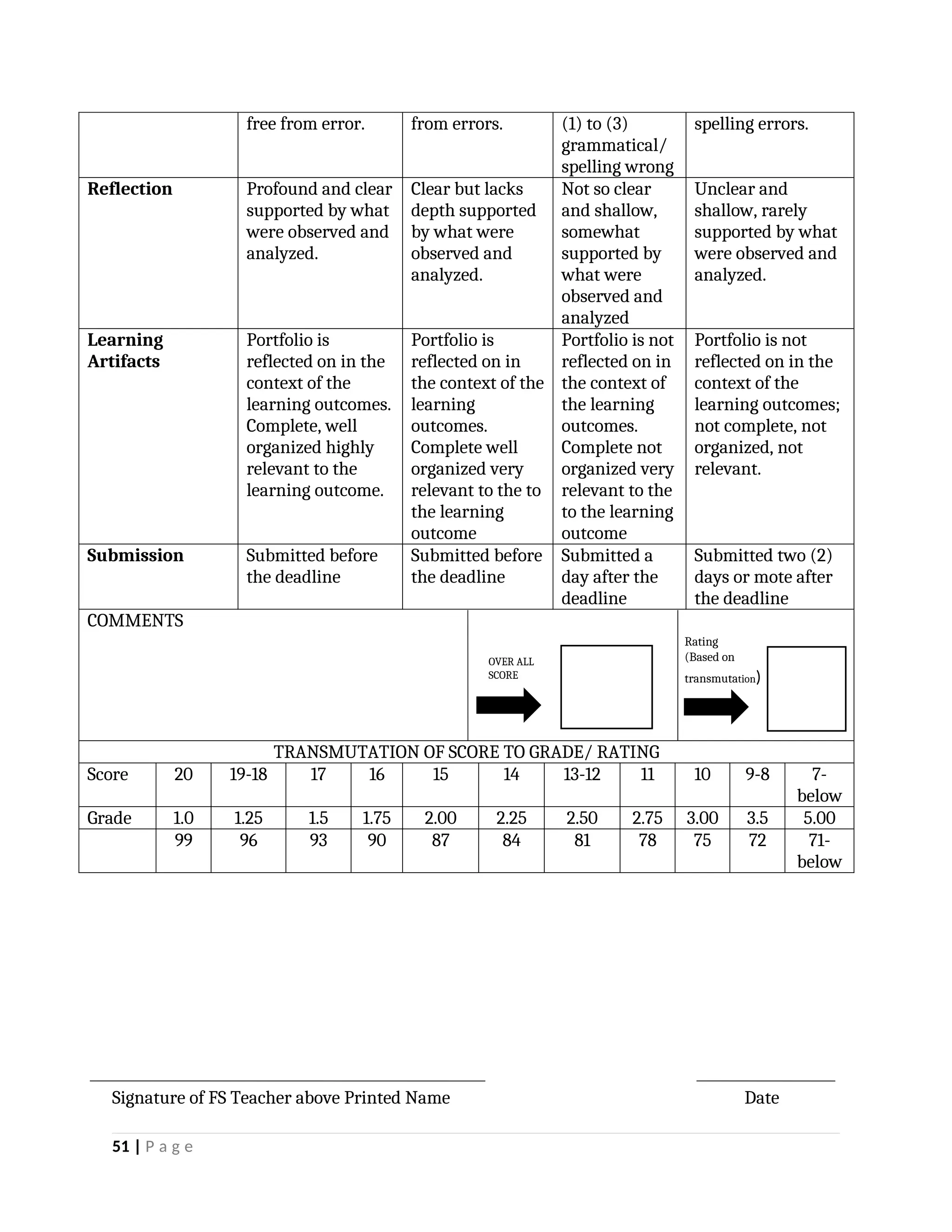
free from error. from errors. (1) to (3)
grammatical/
spelling wrong
spelling errors.
Reflection Profound and clear
supported by what
were observed and
analyzed.
Clear but lacks
depth supported
by what were
observed and
analyzed.
Not so clear
and shallow,
somewhat
supported by
what were
observed and
analyzed
Unclear and
shallow, rarely
supported by what
were observed and
analyzed.
Learning
Artifacts
Portfolio is
reflected on in the
context of the
learning outcomes.
Complete, well
organized highly
relevant to the
learning outcome.
Portfolio is
reflected on in
the context of the
learning
outcomes.
Complete well
organized very
relevant to the to
the learning
outcome
Portfolio is not
reflected on in
the context of
the learning
outcomes.
Complete not
organized very
relevant to the
to the learning
outcome
Portfolio is not
reflected on in the
context of the
learning outcomes;
not complete, not
organized, not
relevant.
Submission Submitted before
the deadline
Submitted before
the deadline
Submitted a
day after the
deadline
Submitted two (2)
days or mote after
the deadline
COMMENTS
TRANSMUTATION OF SCORE TO GRADE/ RATING
Score 20 19-18 17 16 15 14 13-12 11 10 9-8 7-
below
Grade 1.0 1.25 1.5 1.75 2.00 2.25 2.50 2.75 3.00 3.5 5.00
99 96 93 90 87 84 81 78 75 72 71-
below
Signature of FS Teacher above Printed Name Date
51 | P a g e
OVER ALL
SCORE
Rating
(Based on
transmutation)
FIELD STUDY 1 LEARNING EPISODE
FS 1 4
Learner Diversity: The
Community and Home
Environment
Episode 4 provides opportunities for you to have a more in-depth look into the factors
that affect the development of a learner. Focus will be on the early experiences and
characteristics of the learner as described by the family and other significant others. You will
also focus how the teacher links with the community to maximize the learning and
development of students.
TARGET YOUR INTENTED LEARNING OUTCOME
At the end of this Episode, I must be able to:
 Describe the influencing factors in the home environment that affect the student’s
learning;
 Seek advice concerning strategies that build relationships with parent’s/ guardian and
the wider community (6.2.1); and
 Identify effective strategies on how teachers can work together with the family.
52 | P a g e
SPARK YOUR INTEREST
REVISIT the Learning Essentials
1. Urie Bronfenbrenner’s bio-ecological model presents the learner within the context of
layers of relationship systems that make up the learner’s environment. The layers are:
Microsystem-
Includes the
structure such
as one’s family,
school and
neighborhood
Mesosystem-
The connection
between the
structures in
the microsytem
Exosystem-
The bigger social
system which
includes the city
government, the
wokplace and the
mass media
Macrosystem-
Outermost
layer which
includes
cultural values,
customs and
laws
Chronosystem-
The element of
time, patterns of
stability and
pacing of the
child’s everyday
life.
The model helps the teacher look into every aspects in the learner’s environment to
understand his behavior. The teacher’s important role is not to replace what is missing at home
(if any), but to work so that the school becomes an environment that welcomes and nurtures
families. The teacher works to create a partnership with the family and the community to bring
out the best in every learner.
2. Baumrind’s Parenting Styles
Authoritarian. Parents are very firm with their children and except unwavering
and unquestioning obedience. Rules are set by parents and misbehavior is met with
withdrawal of affection, physical punishment or threats.
Permisive. Parents are not firm or controlling. They have few expectations.
Maybe warm and caring but appear to be involved and uninterested.
Rejecting-Neglecting. Parents are disengaged from children. Neither demanding
nor responsive to children. Provide no structure, supervision, support or guidance.
Authoritative. Parents achieve a good blend. They are firm yet loving. Have clear
and reasonable expectations and limits for their children. Treat children with respect
and warmth. Make children understand consequence of their behavior.
Children of:
Authoritarian Parents: are often unhappy, fearful, withdrawn, inhibited, hostile,
and aggressive. They have low self-esteem and difficulty with peers.
Permisive Parents: believe that their parents do not care for them. They are often
impulsive, aggressive and lack self-control; may they have low levels of independence
and responsibility.
Rejecting-Neglecting Parents: are found to be least competent in their over-all
functioning and adjustment.
Authoritative Parents: are socially competent, self-reliant, and have greater
ability to show self-control. They have higher self-esteem and are better adjusted.
-Bases on Child Development by Santrock, 2004.
53 | P a g e
Observing the learner’s community and home environment
Resource Teacher: _________________________ Teacher’s Signature: ________________
School: ______________________________________ Grade/Year Level: __________________
Subject Area: _______________________________ Date: __________________________________
To realize my Intended Learning Outcomes, I will work your way through these steps.
1. Select a learner from the class which you have previously observed.
2. Interview the teacher about the learner’s characteristics and the community.
3. Conduct a home visit to your selected learner’s residence.
4. Interview the parents about
a. the rules they implement at home concerning their child’s schooling
b. the learner’s activities and behavior while at home.
5. Write the Learner’s Profile.
6. Analyze your observation and interview data.
7. Reflect on your observation experiences.
An observation Guide for the Learners’ Characteristics
54 | P a g e
OBSERVE, ANALYZE, REFLECT
Activity 4.1
OBSERVE
Read the following carefully before you begin to observe/interview. Then
write your observation report on the space provided.
The learner
1. Make the general observation of the learner. Describe him/her in each of the
domains of development:
 Physical-body built and height (thin, chubby, underweight, overweight),
level of physical activity (fast, slow, lethargic, active etc.)
 Social-interaction with teachers and classmates (loner, shy, sociable,
friendly, gets into fights, liked by others etc.)
 Emotional moods temperament, cries easily, loses temper, happy, shows
enthusiasm, excited, indifferent, etc.)
 Cognitive (appears to understand lessons, copes with the lesson, excels, lags
behind, shows reasoning skills, turns in assignments and requirements, etc)
Interview the teacher
1. What are the most noticeable characteristics of the learner? (emotional disposition,
behavior and discipline, sense of responsibility, study habits, academic
performance, relationship with peers, relationship with adults, social adjustment)
2. How does the teacher communicate with parents? How often? What do they
discuss? How do they decide of the best course of action to resolve issues or
problems?
3. How does the teacher utilize resources in the community to support the teaching-
learning process? How does the teacher work with the community to meet the
needs pf the learners?
Interview with Parents
1. Conduct a home visit. Once there, observe the home set-up. (Home is orderly, family
pictures in the living room etc.
2. Use the Interview Question on the next page. Just ask the question with witch your
feel comfortable.
Suggested Parents Interview Guide
Your teacher may ask you to use a more detailed interview guide. Be free to translate the
questions, if necessary.
55 | P a g e
Name of Learner:
Date of Birth: __________ Age: __ _
Grade/Year Level:______________ Gender:________
Number of Siblings:___________
Birth Order:__________________
Parents:___________________________________________________________________________
Mother:___________
Age:______ Occupation:_______ Educational Attainment:__________
Father:____________
Age: Occupation__________________ Educational attainment:______
Learner’s Physical aspect:
Health
1. Mother’s health during pregnancy with the learner;
2. Ailments or health problems of the learner as a child;
3. Age of the learner when he started to walk/talk;
4. Food preferences of the learner as a child and at present;
5. Who took care of him/her as a child?
Learner’s Social Aspect:
1. Describe your child’s sociability (friendly, outgoing or shy, loner)
2. Who were the learner’s playmates?
3. As a child then, was he/she allowed to play outside?
4. Is he/she allowed to go out with friends?
5. Do you have rules for him/her to follow regarding going out?
6. What are these rules?
Emotional-Moral
1. What are your expectations of your child?
2. How do you provide a nurturing environment for your child?
56 | P a g e
3. Does your child go to you when she/he feels down or has a problem?
4. What do you do to meet his/her emotional needs?
5. What do you do when he/she is not successful in something?
How do you discipline your child?
1. Do you have rules in the house? What are they?
2. How do you impose the rules?
3. What are the consequences of breaking the rules?
Learner’s Cognitive Aspect:
1. What are the child’s interests?
2. What is he/she good at in school?
3. In what subject/s does he/she have difficulty?
4. How do you monitor his/her performance in school? How do you
motivate him/her?
5. Do you have rules at home to help him develop good study habits?
6. What are these rules? How are they implemented?
After you have gathered all necessary data. Write the learner’s development profile using the
outline below. Type the profile on a separate sheet and attached it to this learning Episode.
THE LEARNER’S DEVELOPMENT PROFILE (outline)
57 | P a g e
The Learner’s Development Profile
Name of the Learner:________ ___________________
School:_____________ ______________________
Date of Home Visit:____________________________________________________________________
Date of Birth:______________________________ Age:_____________________
Grade/Year Level:________________________ Gender: _________________
Family Profile
Number of Siblings:___________
Birth Order:_____________
Parent
Mother:_________________________
Age:______ Occupation:_____________________ Educational Attainment:___________
Father:__ _______________________
Age: Occupation_______________________ Educational attainment:___________
Physical Development
In paragraph form, describe the physical development of the learner. Combine the teacher’s,
parents’ responses and your own observation.
Social Development
In paragraph form, describe the social development of the learner. Combine the teacher’s,
parents’ responses and your own observation.
Emotional-Moral Development
In paragraph form, describe the emotional-moral development of the learner. Combine the
teacher’s, parents’ responses and your own observation.
Cognitive Development
In paragraph form, describe the cognitive development of the learner. Combine the teacher’s,
parents’ responses and your own observation.
Findings
Write here your salient findings about the learner.
Conclusions
Write your conclusions after you have analyzed the impact of the school and the home on the
58 | P a g e
learner’s development. The questions in the Your Analysis portion of this learning episode can help
you.
Recommendations
Write your recommendation.
ANALYZE
Your findings and recommendations in the Learner Development Profile will help you
answer the questions here.
1. From your home visit and interview, what do you think is the style of parenting
experienced by the learner? Explain your answer.
_________________________________________________________________________________________
_________________________________________________________________________________________
_________________________________________________________________________________________
_________________________________________________________________________________________
_________________________________________________________________________________________
2. Relating your data with what you learned from child development, what family
factors do you think contribute to the development and over-all adjustment of
the learner in school?
_________________________________________________________________________________________
_________________________________________________________________________________________
_________________________________________________________________________________________
_________________________________________________________________________________________
_________________________________________________________________________________________
3. Does the communication between the home-school have an effect on the learner?
If yes, what are these effects?
_________________________________________________________________________________________
_________________________________________________________________________________________
_________________________________________________________________________________________
_________________________________________________________________________________________
_________________________________________________________________________________________
59 | P a g e
4. How can the teacher partner with the community to contribute to the
development and learning of the student? Who are the people or which
institutions can the teacher tap to seek advice regarding the development and
learning of students.
_________________________________________________________________________________________
_________________________________________________________________________________________
_________________________________________________________________________________________
_________________________________________________________________________________________
_________________________________________________________________________________________
REFLECT
1. Reflect on your own development as a child. What type of parenting did you
experience? How did it affect you?
_________________________________________________________________________________________
_________________________________________________________________________________________
_________________________________________________________________________________________
_________________________________________________________________________________________
_________________________________________________________________________________________
2. As a future teacher, how would you establish good home-school collaboration?
How can you work well with the parents? How can you help them? How can they
help you?
_________________________________________________________________________________________
_________________________________________________________________________________________
_________________________________________________________________________________________
_________________________________________________________________________________________
_________________________________________________________________________________________
LINK THEORY TO PRACTICE
Directions: Read the items given below and encircle the correct answer.
1. Which are most likely the kind of children raised by authoritarian parents?
I. fearful
II. inhibited
III. hostile
IV. withdrawn
60 | P a g e
A. I and II C. II and III
B. I, II and III D. I, II, III and IV
2. If a child was raised by authoritative parents, how will most likely will he/she
behave in class?
A. Relates well to classmates
B. Is suspicious of others
C. Quarrels often with classmates
D. Has low level of independence
3. Which parenting style/s contribute/s to the development of children who have
low level of responsibility?
A. Authoritarian
B. Authoritative
C. Permissive
D. Neglecting and Permissive
SHOW YOUR LEARNING ARTIFACTS
61 | P a g e
Color Your
World…
1. Make an artistic,
colorful, and
creative visual
expression of
your insights or
feelings about
the home and
school and
community to the
learner.
Then, write a few
statements on
the space below
school your
visual art.
Stick
With
Acrostic…
2. Make a reflection
acrostic about
the home, school
and community
link.
1.
2.
H –
0 –
M –
E –
S –
C –
H –
O –
O –
L -
C —
O— L–
M– I–
M– N–
U– K–
N–
I–
T–
Y–
EVALUATE PERFORMANCE TASK
Evaluate Your Work Field Study 1. Episode 4. Learner Diversity: The
Community and Home Environment
Learning Outcome: Describe the influencing factors in the home environment that affect the
students’ learning; seek advice concerning strategies that build relationship with
parents/guardian and the wider community (6.2.1); and identify effective strategies on how
teachers can work together with the family.
Name of FS Student : Date Submitted:____________________
Year and Section : Course: ______________________________
Learning Episode Excellent 4 Very
Satisfactory
Satisfactory 2 Need Improvement
Accomplished
observation Sheet
All observation
questions
tasks
completely
answered/
accomplished
One (1) to
two (2)
observation
questions/
tasks not
answered/
accomplishe
d
Three (3)
observation
questions/
tasks not
answered/
accomplished
Four (4) or more
observation questions/
tasks not answered/
accomplished.
Analysis All questions
were answered
completely,
answers are
depth and are
thoroughly
grounded on
theories;
grammar and
spelling are
free from
error.
All questions
were
answered
completely,
answers are
clearly
connected to
theories,
grammar
and spelling
are free from
errors.
Questions
were not
answered
completely,
answers are
not clearly
connected to
theories one
(1) to (3)
grammatical/
spelling wrong
Four (4) or more
observation questions
were not answered.
Answers nit connected to
theories; more than four
(4) grammatical/
spelling errors.
Reflection Profound and
clear
supported by
what were
observed and
analyzed.
Clear but
lacks depth
supported by
what were
observed and
analyzed.
Not so clear
and shallow,
somewhat
supported by
what were
observed and
analyzed
Unclear and shallow,
rarely supported by what
were observed and
analyzed.
62 | P a g e
Learning
Artifacts
Portfolio is
reflected on in
the context of
the learning
outcomes.
Complete, well
organized
highly relevant
to the learning
outcome.
Portfolio is
reflected on
in the
context of
the learning
outcomes.
Complete
well
organized
very relevant
to the to the
learning
outcome
Portfolio is not
reflected on in
the context of
the learning
outcomes.
Complete not
organized very
relevant to the
to the learning
outcome
Portfolio is not reflected
on in the context of the
learning outcomes; not
complete, not organized,
not relevant.
Submission Submitted
before the
deadline
Submitted
before the
deadline
Submitted a
day after the
deadline
Submitted two (2) days
or mote after the
deadline
COMMENTS
TRANSMUTATION OF SCORE TO GRADE/ RATING
Score 20 19-
18
17 16 15 14 13-12 11 10 9-8 7- below
Grade 1.0 1.25 1.5 1.75 2.00 2.25 2.50 2.75 3.00 3.5 5.00
99 96 93 90 87 84 81 78 75 72 71- below
Signature of FS Teacher above Printed Name Date
FIELD STUDY 1 LEARNING EPISODE
63 | P a g e
OVER ALL
SCORE
Rating
(Based on
transmutation)
FS 1 5 Creating an Appropriate Learning
Environment
This learning Episode provides an opportunity to examine how classrooms are
structured or designed to allow everyone’s maximum participation for effective learning. You
should be able to examine how classroom management practices affect learning. This Episode
enhances the application of the theories learned in the following professional subject such as
Facilitating Learner-Centered Teaching and The Child and Adolescent Learners and Learning
Principles.
TARGET YOUR INTENTED LEARNING OUTCOME
At the end of this Episode, I must be able to:
 Plan how to manage time, space, and resources; and
 Provide a learning environment appropriate to the learners and conducive to learning.
These are the time-tested principles of teaching and learning
1. Effective learning begins with setting clear expectations and learning outcomes.
2. Learning is an active process. “What I hear, I forget; what I see, I remember; what I do, I
understand”
REVISIT THE LEARNING ESSENTIALS
The classroom climate that is conducive for learning is one that is non-threatening yet
business-like. It is a classroom where, when creating audio-visual presentations, the following
are observed:
 Specific classroom rules and procedures are clear.
 Classroom rules and procedures are discussed within the first few days of the school.
 Students are involved in the design of rules and procedures.
 Techniques to acknowledge and reinforce acceptable behavior are established and
negative consequences for such are communicated.
 Classroom practices are democratic.
64 | P a g e
OBSERVE, ANALYZE, REFLECT
SPARK YOUR INTEREST
REVISIT the Learning Essentials
Managing Time, Space and Learning Resources
Resource Teacher: _________________________ Teacher’s Signature: ________________
School: ______________________________________ Grade/Year Level: __________________
Subject Area: _______________________________ Date: __________________________________
Observe and use the observation sheet provided for you to document tour observations.
Analyze the answer these questions on observed classroom management practices. It is also
good to ask the teacher for additional information, so you can validate your observation. Write
your notes below; then organize your data in the Table that follows.
65 | P a g e
1. As you observe the class, look into the characteristics of the learners. Note their
ages.
2. How many boys are there? How many girls?
3. Focus on their behavior. Are they able to manage their own behavior?
4. Can the learners already work independently?
5. Describe their span of attention.
Activity 5.1
OBSERVE
ANALYZE
1. Are the areas in the classroom for specific purposes (storage of teaching aids, books, students’
belongings, supplies, etc.) describe the areas. Will it make a difference if these areas for specific
purposes are not present?
2. Are there rules and procedures posted in the room? List them down. Do these rules reinforce
positive behavior?
Reflection as a future Teacher.
1. Why do you need to enforce positive discipline?
66 | P a g e
REFLECT
_____________________________________________________________________________________________________
_____________________________________________________________________________________________________
_____________________________________________________________________________________________________
_____________________________________________________________________________________________________
_________________________________________
Identifying the Different Aspects of Classroom Management
Resource Teacher: _________________________ Teacher’s Signature: ________________
School: ______________________________________ Grade/Year Level: __________________
Subject Area: _______________________________ Date: __________________________________
CLASSROOM MANAGEMENT MATRIX
Observe a class and accomplish the given matrix.
Aspects of Classroom
Management
Description
Effect on the Learners
(to be filled out after you
answered the analysis questions)
1. Specific Areas in the
Classroom
2. Classroom Rules
3. Classroom Procedures
4. Daily Routines
5. Seating Arrangements
6. Handling misbehavior/off-
task behavior
7. Reinforcement of Positive
Behavior
67 | P a g e
Activity 5.2
OBSERVE
ANALYZE
1. How did the classroom organization and routines affect the learner’s behavior?
_________________________________________________________________________________________________
_________________________________________________________________________________________________
_________________________________________________________________________________________________
_________________________________________________________________________________________________
_________________________________________________________________________________________________
2. What should the teacher have in mind when she/he designs the classroom organization
and routines? What theories and principles should you have in mind?
_________________________________________________________________________________________________
_________________________________________________________________________________________________
_________________________________________________________________________________________________
_________________________________________________________________________________________________
_________________________________________________________________________________________________
3. Which behavior strategies were effective in managing the behavior of the learners? In
motivating students? Why were they effective?
_________________________________________________________________________________________________
_________________________________________________________________________________________________
_________________________________________________________________________________________________
_________________________________________________________________________________________________
_________________________________________________________________________________________________
Reflect on the following and write your insights.
1. Imagine yourself organizing your classroom in the future. In what grade level do you
see yourself? What routines and procedures would you consider for this level why?
_________________________________________________________________________________________________
_________________________________________________________________________________________________
_________________________________________________________________________________________________
_________________________________________________________________________________________________
_________________________________________________________________________________________________
2. Make a list of the rules you are likely to implement in this level. Why would you choose
these rules?
68 | P a g e
REFLECT
_________________________________________________________________________________________________
_________________________________________________________________________________________________
_________________________________________________________________________________________________
_________________________________________________________________________________________________
_________________________________________________________________________________________________
3. Should learners be involved in making the class rules? Why?
_________________________________________________________________________________________________
_________________________________________________________________________________________________
_________________________________________________________________________________________________
_________________________________________________________________________________________________
_________________________________________________________________________________________________
Direction: Read the items given below and encircle the correct answer.
1. Focusing on natural consequences of students’ behavior develops more self-regulation
in the students. Which of the following teacher statements demonstrates focusing on
natural consequences?
A. “Those who were noisy today during seatwork will not be allowed to play
games in the computer later”
B. “If it takes you longer to finish the seatwork because time is wasted with
chatting, then we won’t have time to go to the playground anymore”
C. Those who are well-behaved in class will be given plus 5 points in the quiz”
D. If you get grade of 95mor higher in the first two assignment, you will be
exempted from the third assignment.
2. Learners are more likely to internalize and follow classroom rules when______.
A. The teacher clearly explains the rules she prepared
B. The learners know the punishments for not following the rules
C. The learners participate in the rule-making process
D. The teacher gives additional points for those who follow the rules
3. For a teacher to establish and maintain consistent standards of learners’ behavior, they
should do all EXCEPT ____________________________.
A. Give immediate feedback to reinforce appropriate behavior of learners
B. Be open to exceptions each time a learner misbehaves in class
69 | P a g e
LINK THEORY TO PRACTICE
C. Communicate and enforce school policies and procedures clearly and
consistently
D. Handle behavior problems promptly and with due respect to learners’ rights
Paste pieces of evidences of classroom rules that work in class. You may also put
pictures of the physical space and learning stations which contribute to the effective
implementation of classroom management.
Evaluate your work task Field Study 1, Episode 5 – Creating an Appropriate Learning
Environment
Learning Outcomes: Plan on how to manage time, space, and resources • Provide a learning
environment appropriate to the learners and conducive to learning.
70 | P a g e
SHOW Your Learning Artifacts
EVALUATE Performance Task
TRANMUTATION OF SCORE TO GRADE/RATING
Score 20 19-18 17 16 15 14 13-12 11 10 9-8 7-below
Grade 1.0 1.25 1.5 1.75 2.00 2.25 2.50 2.75 3.00 3.5 5.00
99 96 93 90 87 84 81 78 75 72 71-
below
__________________________________________________________________________ _____________________________________
Signature of FS Teacher above Printed Name Date
Name of FS Student : Date Submitted:____________________
Year and Section : Course: ______________________________
Learning Episode Excellent
4
Very Satisfactory
3
Satisfactory
2
Needs Improvement
1
Accomplished
Observation Sheet
All observation
questions/tasks
completely
answered/accomplished.
One (1) to two
observation
questions/tasks not
answered/accomplished
.
Three (3) observation
questions/tasks not
answered/accomplish
ed.
Four (4) or more observation
questions/tasks not
answered/accomplished.
Analysis All questions were
answered completely;
answers are with depth
and are thoroughly
grounded on theories;
grammar and spelling are
free from error.
All questions were
answered completely;
answers are clearly
connected to theories;
grammar and spelling
are free from error.
Questions were not
answered completely;
answers are not
clearly connected to
theories; one (1) to
three (3)
grammatical/spelling
errors.
For (4) or more observation
questions were not answered
completely; answers are
clearly connected to theories;
more than four (4)
grammatical errors.
Reflection Profound and clear;
supported by what were
observed and analyzed.
Clear but lacks depth;
supported by what were
observed and analyzed.
Not so clear and
shallow; somewhat
supported by what
were observed and
analyzed.
Unclear and shallow; rarely
supported by what were
observed and analyzed.
Learning Artifacts Portfolio is reflected on in
the context of the learning
outcomes; Complete; well-
organized, highly relevant
to the learning outcome.
Portfolio is reflected on
in the context of the
learning outcomes;
Complete; well-
organized, very relevant
to the learning outcome.
Portfolio is not
reflected on in the
context of the
learning outcomes;
Complete; not
organized, relevant to
the learning outcome.
Portfolio is not reflected on
in the context of the learning
outcomes; not complete; not
organized, and not relevant
to the learning outcome.
Submission Submitted before the
deadline.
Submitted on the
deadline.
Submitted a day after
the deadline.
Submitted two (2) days or
more after the deadline.
Comments: Over-all
Scores
Rating:
(Based on
Transmutation)
FIELD STUDY 1 LEARNING EPISODE
FS 1 6 Classroom Management and
Classroom Routines
This Episode focuses on the classroom structure and routines performed by teachers in
class to provide a safe, friendly non-threatening and caring environment. Effective classroom
71 | P a g e
SPARK YOUR INTEREST
routines ensure order and discipline to help the students to stay calm and focused on their
daily tasks.
TARGET YOUR INTENTED LEARNING OUTCOME
At the end of this Episode, I must be able to:
 Identify the classroom routines set by the teacher; and
 Observe how the students execute the various classroom routines.
Routines are the backbone of daily classroom life. They facilitate teaching and learning
Routines don’t just make the life of the teacher easier. They save valuable classroom time.
Efficient routines make it easier for students to learn and achieve more.
Establishing routines early in the school year:
 Enable you to run your daily activities run smoothly;
 Ensure you to manage time effectively;
 Helps you maintain order in the classroom;
 Makes you more focused in the teaching because you spend less time in giving
directions/instructions; and
 Enables you to explain to the learners what are expected of them.
Observing Classroom Management and Routines
Resource Teacher: _________________________ Teacher’s Signature: ________________
School: ______________________________________ Grade/Year Level: __________________
Subject Area: _______________________________ Date: __________________________________
72 | P a g e
REVISIT the Learning Essentials
OBSERVE, ANALYZE, REFLECT
Activity 6.1
Observe the classroom routines of the Resource Teacher by accomplishing the given checklist.
CHECKLIST ON CLASSROOM ROUTINES
Check Yes (√) if observed and (x) if not observed.
Classroom Routines Observed
(√)
Not Observed
(x)
1. Movement into the classroom
2. Transition in classroom activities
3. Movement out of the classroom
4. Use of lavatories / comfort room / washrooms
5. Passing of papers
6. Passing of books
7. Working with pairs/groups
8. Tardy students
9. Absent students
10. Submission/Collection of Materials
11. Submission of Projects
12. Asking questions during lessons
13. Asking for assistance
14. Joining classroom activities
15. Lining up
16. Walking in line
17. Fire drill / emergencies
18. Movement between classroom activities
19. Use of classroom supplies
20. Checking of assignments
73 | P a g e
OBSERVE
ANALYZE
Analyze the routines set by the Resource Teacher by answering the following questions.
1. Were the routines effective in ensuring discipline and order in the class? Why? Why
not?
_____________________________________________________________________________________________
_____________________________________________________________________________________________
_____________________________________________________________________________________________
2. Which of those routines were systematic and consistently implemented? Explain
your answer.
_____________________________________________________________________________________________
_____________________________________________________________________________________________
_____________________________________________________________________________________________
Reflect on the various routines observed.
1. Which of the routines will you most likely apply in your class? Why? Why not?
_____________________________________________________________________________________________
_____________________________________________________________________________________________
_____________________________________________________________________________________________
Listing Down Classroom Rules
Resource Teacher: _________________________ Teacher’s Signature: ________________
School: ______________________________________ Grade/Year Level: __________________
Subject Area: _______________________________ Date: __________________________________
Observe a class and list down rules formulated by the Resource Teacher. Cite the
importance of these rules.
74 | P a g e
REFLECT
Activity 6.2
OBSERVE
Classroom rules are imperative and must be reinforced for learners’ safety and security.
Rules also teach discipline and self-control. Rules eliminate stress and will provide a more
pleasant, secured and non-threatening environment. Rules ensure the students’ engagement
and focus on their classroom activities.
Classroom Rules Importance
1.
2.
3.
4.
5.
6.
7.
1. Analyze each given rule. What circumstances led to the formulation of the rule?
_________________________________________________________________________________________________
_________________________________________________________________________________________________
_________________________________________________________________________________________________
_________________________________________________________________________________________________
_________________________________________________________________________________________________
2. Are classroom rules really important?
_________________________________________________________________________________________________
_________________________________________________________________________________________________
_________________________________________________________________________________________________
_________________________________________________________________________________________________
_________________________________________________________________________________________________
Reflect on the various classroom rules set by the Resource Teacher. Will you have the
same rules? If not, what rules are you going to employ? Explain your answer.
_________________________________________________________________________________________________
_________________________________________________________________________________________________
75 | P a g e
ANALYZE
REFLECT
_________________________________________________________________________________________________
_________________________________________________________________________________________________
_________________________________________________________________________________________________
Take some snapshots of the classroom routines employed by the Resource Teacher
which are worth emulating. Tell something about the pictures.
1. What term applies to the established ways of managing a classroom into a more
organized and systematic structure?
A. Classroom routine
B. Positive discipline
C. Classroom discipline
D. Classroom management
2. When is the best time to establish classroom routines?
A. At the start of the year
B. At the end of the classroom
C. At the start of the activity
D. At the start of class discussion
76 | P a g e
SHOW Your Learning Artifacts
LINK THEORY TO PRACTICE
3. What is the primary reason for the establishment of classroom routine?
A. To ensure order
B. To eliminate stress
C. To be fair all times
D. To control the class
4. To ensure order in the transition activities, what must be done?
A. Assign a leader.
B. Post the rules.
C. Let students work in groups.
D. Set the rules before the activity.
5. What routine must be set to guarantee the safety of the students?
A. Assign a leader.
B. Let them work in pairs.
C. Let them work individually
D. Set the do’s and don’ts in every activity
Evaluate your work task Field Study 1, Episode 6 –Classroom Management and Classroom
Routines
Learning Outcomes: Identify the classroom routines set by the teacher; and Observe how the
students execute the various classroom routines.
Name of FS Student : Date Submitted:____________________
Year and Section : Course: ______________________________
Learning Episode Excellent
4
Very Satisfactory
3
Satisfactory
2
Needs Improvement
1
Accomplished
Observation Sheet
All observation
questions/tasks
completely
answered/accomplished.
One (1) to two
observation
questions/tasks not
answered/accomplished
.
Three (3) observation
questions/tasks not
answered/accomplish
ed.
Four (4) or more observation
questions/tasks not
answered/accomplished.
77 | P a g e
EVALUATE Performance Task
TRANMUTATION OF SCORE TO GRADE/RATING
Score 20 19-18 17 16 15 14 13-12 11 10 9-8 7-below
Grade 1.0 1.25 1.5 1.75 2.00 2.25 2.50 2.75 3.00 3.5 5.00
99 96 93 90 87 84 81 78 75 72 71-
below
__________________________________________________________________________ _____________________________________
Signature of FS Teacher above Printed Name Date
Analysis All questions were
answered completely;
answers are with depth
and are thoroughly
grounded on theories;
grammar and spelling are
free from error.
All questions were
answered completely;
answers are clearly
connected to theories;
grammar and spelling
are free from error.
Questions were not
answered completely;
answers are not
clearly connected to
theories; one (1) to
three (3)
grammatical/spelling
errors.
For (4) or more observation
questions were not answered
completely; answers are
clearly connected to theories;
more than four (4)
grammatical errors.
Reflection Profound and clear;
supported by what were
observed and analyzed.
Clear but lacks depth;
supported by what were
observed and analyzed.
Not so clear and
shallow; somewhat
supported by what
were observed and
analyzed.
Unclear and shallow; rarely
supported by what were
observed and analyzed.
Learning Artifacts Portfolio is reflected on in
the context of the learning
outcomes; Complete; well-
organized, highly relevant
to the learning outcome.
Portfolio is reflected on
in the context of the
learning outcomes;
Complete; well-
organized, very relevant
to the learning outcome.
Portfolio is not
reflected on in the
context of the
learning outcomes;
Complete; not
organized, relevant to
the learning outcome.
Portfolio is not reflected on
in the context of the learning
outcomes; not complete; not
organized, and not relevant
to the learning outcome.
Submission Submitted before the
deadline.
Submitted on the
deadline.
Submitted a day after
the deadline.
Submitted two (2) days or
more after the deadline.
Comments: Over-all
Scores
Rating:
(Based on
Transmutation)
LEARNING EPISODE
FS 1 7
Physical and Personal Aspects of
Classroom Management
78 | P a g e
SPARK YOUR INTEREST
This Episode tackles classroom management and discipline. It focuses on the personal
and physical aspects of classroom management which are central to teaching and therefore
must be consistently implemented.
TARGET YOUR INTENTED LEARNING OUTCOME
At the end of this Episode, I must be able to:
 Identify the two (2) aspects of classroom management; and
 Determine the classroom management strategies that the Resources Teacher employed
in his/her class.
Classroom management refers to the wide variety of skills and techniques that teachers use to
keep students organized, orderly, focused, attentive on tasks and academically productive in
class.
Ref: edglossary.org
Importance of Effective Classroom Management
 Increases chance of student success
 Paves the way for teacher to engage students in learning
 Helps create an organized classroom environment
 Increases instructional time
 Creates consistency in the employment of rules and regulations
 Aligns management strategies with school wide standards
 Decrease3 misbehavior in the classroom
 Gives student boundaries as well as consequences
Ref. http://www.ehow.com
Two aspects of Classroom Management.
1. Personal Classroom Management consist of managing your own self to ensure order and
discipline in your class. Includes:
1.1 Voice
1.2 Personal grooming
1.3 Attendance
1.4 Punctuality
1.5 Personal graciousness
Managing yourself as a teacher contributes to the order and well-being of your class.
79 | P a g e
REVISIT the Learning Essentials
2. Physical Classroom Management consists of managing the learning environment.
Attending to these physical elements of the learning environment ensures the safety, security
and order in the class. It includes:
3.1 Ventilation
3.2 Lighting
3.3 Acoustics
3.4 Seating arrangement
3.5 Structure/ design of the classroom
3.6 Physical space/ learning stations
Some Effective Classroom Management Strategies
1. Model to the students how to act in different situations.
2. Establish classroom guidelines.
3. Documents the rules.
4. Refrain from punishing the entire class.
5. Encourage initiative from class.
6. Offer praise and rewards.
7. Use non-verbal communication.
8. Take time to celebrate group effort.
9. Let students work in groups.
10. Interview students to assess their needs.
11. Address bad behavior quickly.
12. Consider peer teaching.
13. Continuously engage the students.
14. Assign open-ended project.
15. Write group contracts.
Ref. prodigygame.com
Identifying Personal and Physical Aspects of Classroom Management
Resource Teacher: _________________________ Teacher’s Signature: ________________
School: ______________________________________ Grade/Year Level: __________________
Subject Area: _______________________________ Date: __________________________________
80 | P a g e
OBSERVE, ANALYZE, REFLECT
Activity 7.1
Analyze the impact of individual differences on learners’ interactions.
The observation form is provided for me to document my observation.
Observe a class and interview the Resource Teacher. Ask how the personal and physical aspects
of classroom management ensur4e proper classroom management and discipline.
Check if these aspects were observed in the classroom.
Aspects of Classroom Management YES NO
1. Personal Classroom Management
1.1 Is the teacher well-groomed that he/she demands respect from the
learners?
1.2 Is the teacher’s voice modulated and can be heard by the entire class?
1.3 Was the teacher present in class?
1.4 Did the teacher arrive on time in class?
1.5 Does the teacher exude a positive attitude towards teaching?
2. Physical Classroom Management
2.1 Is the classroom well-ventilated?
2.2 Is the lighting good enough?
2.3 Is the classroom free from noise?
2.4 Does the seating arrangement provide better interaction?
2.5 Is the design/structure of the room inviting to classroom activities?
2.6 Is the physical space / learning station clear from obstruction?
Analyze the different elements of personal/physical classroom management and answer the
following questions.
1. How does the voice of the teacher affect classroom instruction?
_________________________________________________________________________________________________
_________________________________________________________________________________________________
_________________________________________________________________________________________________
_________________________________________________________________________________________________
_________________________________________________________________________________________________
81 | P a g e
OBSERVE
ANALYZE
2. How does the punctuality of the teacher affect classroom discipline?
_________________________________________________________________________________________________
_________________________________________________________________________________________________
_________________________________________________________________________________________________
_________________________________________________________________________________________________
_________________________________________________________________________________________________
3. Why do we need to check on the physical aspects of classroom management?
_________________________________________________________________________________________________
_________________________________________________________________________________________________
_________________________________________________________________________________________________
_________________________________________________________________________________________________
_________________________________________________________________________________________________
Reflect on the aspects of personal and classroom management.
1. What does this statement mean to you as a future teacher? Explain. “No amount of good
instruction will come out without effective classroom management.”
_________________________________________________________________________________________________
_________________________________________________________________________________________________
_________________________________________________________________________________________________
_________________________________________________________________________________________________
_________________________________________________________________________________________________
2. What are your plans in ensuring effective classroom management?
_________________________________________________________________________________________________
_________________________________________________________________________________________________
_________________________________________________________________________________________________
_________________________________________________________________________________________________
_________________________________________________________________________________________________
Identifying Personal and Physical Aspects of Classroom Management
Resource Teacher: _________________________ Teacher’s Signature: ________________
82 | P a g e
REFLECT
Activity 7.2
School: ______________________________________ Grade/Year Level: __________________
Subject Area: _______________________________ Date: __________________________________
Observe the classroom management strategies that your Resources Teacher employs
in the classroom. You may also conduct an interview to substantiate your observation.
Check the management strategies employed by the Resources Teacher.
Check (√) observed, put an (×) if not observed and о for no opportunity to observe.
Effective Classroom Management Strategies Observed Not
Observed
No
opportunity
to observe
1. Model to the students how to act in different
situations.
2. Establish classroom guidelines.
3. Documents the rules.
4. Refrain from punishing the entire class.
5. Encourage initiative from class.
6. Offer praise and rewards.
7. Use non-verbal communication.
8. Take time to celebrate group effort.
9. Let students work in groups.
10. Interview students to assess their needs.
11. Address bad behavior quickly.
12. Consider peer teaching.
13. Continuously engage the students.
14. Assign open-ended project.
15. Write group contracts.
Other (please specify)
Analyze the checklist you have accomplished and answer the given questions:
1. How many strategies were employed by the Resource Teacher? Did these contribute to
better classroom management? Explain your answer.
83 | P a g e
OBSERVE
ANALYZE
_________________________________________________________________________________________________
_________________________________________________________________________________________________
_________________________________________________________________________________________________
_________________________________________________________________________________________________
_________________________________________________________________________________________________
2. What were not used by the Resource Teacher? Were these important? What should have
been used instead? Explain.
_________________________________________________________________________________________________
_________________________________________________________________________________________________
_________________________________________________________________________________________________
_________________________________________________________________________________________________
_________________________________________________________________________________________________
As a future teacher, reflect on the observations then answer the given question.
1. What classroom management strategies do I need to employ to respond to diverse types
of learners?
_________________________________________________________________________________________________
_________________________________________________________________________________________________
_________________________________________________________________________________________________
_________________________________________________________________________________________________
_________________________________________________________________________________________________
Show piece(s) of evidence of learning to capture the classroom management strategies
used by your Resource Teacher.
84 | P a g e
REFLECT
SHOW Your Learning Artifacts
Evaluate Your Work Field Study 1. Episode 7. Physical and Personal Aspects of
Classroom Management
Learning Outcome: Determining the characteristics of a school environment that provides
social, psychological and physical environment supportive of learning.
Name of FS Student : Date Submitted:____________________
Year and Section : Course: ______________________________
Learning Episode Excellent
4
Very
Satisfactory
3
Satisfactory
2
Need Improvement
1
Accomplished
observation Sheet
All observation
questions tasks
completely
answered/
accomplish
One (1) to two
(2) observation
questions/
tasks not
answered/
Three (3)
observation
questions/
tasks not
answered/
Four (4) or more
observation
questions/ tasks not
answered/
accomplished.
85 | P a g e
EVALUATE Performance Task
accomplished. accomplished
Analysis All questions were
answered
completely,
answers are depth
and are thoroughly
grounded on
theories; grammar
and spelling are
free from error.
All questions
were answered
completely,
answers are
clearly
connected to
theories,
grammar and
spelling are
free from
errors.
Questions were
not answered
completely,
answers are not
clearly
connected to
theories one (1)
to (3)
grammatical/
spelling wrong
Four (4) or more
observation questions
were not answered.
Answers nit
connected to theories;
more than four (4)
grammatical/
spelling errors.
Reflection Profound and clear
supported by what
were observed and
analyzed.
Clear but lacks
depth
supported by
what were
observed and
analyzed.
Not so clear and
shallow,
somewhat
supported by
what were
observed and
analyzed
Unclear and shallow,
rarely supported by
what were observed
and analyzed.
Learning Artifacts Portfolio is
reflected on in the
context of the
learning outcomes.
Complete, well
organized highly
relevant to the
learning outcome.
Portfolio is
reflected on in
the context of
the learning
outcomes.
Complete well
organized very
relevant to the
to the learning
outcome
Portfolio is not
reflected on in
the context of
the learning
outcomes.
Complete not
organized very
relevant to the
to the learning
outcome
Portfolio is not
reflected on in the
context of the
learning outcomes;
not complete, not
organized, not
relevant.
Submission Submitted before
the deadline
Submitted
before the
deadline
Submitted a day
after the
deadline
Submitted two (2)
days or mote after the
deadline
COMMENTS
TRANSMUTATION OF SCORE TO GRADE/ RATING
Score 20 19-18 17 16 15 14 13-12 11 10 9-8 7- below
Grade 1.0 1.25 1.5 1.75 2.00 2.25 2.50 2.75 3.00 3.5 5.00
99 96 93 90 87 84 81 78 75 72 71- below
86 | P a g e
OVER ALL
SCORE
Rating
(Based on
transmutation)
Signature of FS Teacher above Printed Name Date
1. How will you prevent truancy among students?
A. Check attendance regularly.
B. Allocate budget for each student.
C. Improve sanctions on absentees.
D. Prepare and teach your lessons effectively at all times.
2. What will be the most effective way of dealing with non-participative students?
A. Let them do what pleases them.
B. Refer the matter to the guidance counselor.
C. Employ engaging and enjoyable activities.
D. Give them the grades they deserve based on their performance.
3. How will you help the shy and timid students in your class?
A. Treat them naturally.
B. Let them be as they are.
C. Refer them to the Guidance Office
D. Encourage them to join as many activities in class.
4. How will you put to optimum use the leadership skills of your students?
87 | P a g e
LINK THEORY TO PRACTICE
A. Recognize their leadership skills.
B. Let them just do what they please.
C. Refrain from calling them all the time.
D. Empower them to initiate activities in class.
5. To discipline unruly students, teacher Helen always tells her students “Remember I am
the person in authority here. I have the power to pass or fail you.” Do you agree with
Teacher Helen’s reference to power?
A. We need more data to give a categorical answer.
B. Yes, passing and failing are in the hands of a teacher.
C. Yes, one may use the power given you to blackmail students.
D. No, teacher authority is not meant to be used to pass or fail students.
FIELD STUDY 1 LEARNING EPISODE Understanding the School Curriculum
FS 1 8 Close Encounter with the School
Curriculum
Formal education begins in school. Schools are institutions established to resign total
learning activities appropriate for each learner in each grade level. Thus schools have
recommended curriculum which is the enhanced K to 12 curriculum. The recommended
curriculum was translated into written curriculum like books, modules, teachers’ guides and
lesson places which are the basis of the taught curriculum. A teacher who implements the
curricula needs support materials (support curriculum) to enhance teaching and learning so
that the written and the taught curricula can be assessed (assessed curriculum) in order to
determine if learning took place (learned curriculum). However, there are so many activities
that happen in school but are not deliberately planned. This refers to the hidden curriculum.
A classroom teacher plans, implements and evaluates school learning activities by
preparing a miniscule curriculum called a lesson plan or a learning plan. The teacher then puts
life to a lesson plan by using it as a guide in the teaching-learning process where
88 | P a g e
SPARK YOUR INTEREST
TARGET YOUR INTENTED LEARNING OUTCOME
At the end of this episode. I must be able to:
 Identify the different curricula that prevail in the school setting;
 Describe how the teacher manages the school curriculum by planning, implementing
lesson through different strategies and assessment of learning outcomes; and
 Analyze if the teacher aligns the objectives to subject matter, to teaching strategies and
assessment.
School Curriculum: What is this about?
From a broad perspective, curriculum is defined as the total learning process and
outcomes as in lifelong learning. However, school curriculum in this course limits such
definition of total learning outcomes to com fine to a specific learning space called school.
School are formal institutions of learning where the two major stakeholders are the learners
and the teachers.
Basic education in the Philippines is under the Department of Education or DepEd and
the recommended curriculum in the K-12 or Enhanced Basic Education Curricula of 2013. All
basic education schools offering kindergarten (K) elementary (Grades 1 to 6) and secondary
(Grades 7-10, Junior High School and Grades 11to 12, Senior High School) adhere to this national
curriculum as a guide in the implementation of the formal education for K to 12.
What are the salient features of the K to 12 Curriculum? Here are the features. It is a
curriculum that:
1. Strengthen the early childhood education with the use of the mother tongue.
2. Makes the curriculum relevant to the leaners. The use of contextualized lessons and
addition of issue like disaster preparedness, climate change and information and
communication technology (ICT) are included in the curriculum. Thus, in-depth
knowledge, skills and values, attitude through continuity and consistency across every
level and subject.
3. Builds skills in literacy. With the use of mother tongue as the main language in studying
and learning tools from K to 1Grade 3, learners will become ready for higher level skills.
89 | P a g e
REVISIT the Learning Essentials
4. Ensures unified and seamless learning. The curriculum is designed in a spiral progression
where the students learn first the basic concepts, while they study the complex ones in the
next grade level. The progression of topics matches with the development and cognitive
skills. This process strengthens the mastery and retention.
5. Gears up for the future. It is expected that those who finished education in Grade 12 will be
ready for college or tech voc careers. Their choice of careers will be defined when they go
to Grade 11 to 12.
6. Nurtures a fully developed youth. Beyond the K to 12 graduate the learner will be ready to
embark on different career paths for a lifetime.
You will recall that a school curriculum is of many types for the Kindergarten to Grade 12 in the
country.
 The enhanced curriculum K to 12 curriculum is the Recommended
Curriculum. It is to be used nationwide as mandated by Republic Act 10533.
 When the curriculum writers began to write the content and competency
standards of the K to 12 Curriculum it became a Written Curriculum. It reflects
the substance of RA 10533 or enhanced Basic Education Act of 2013. In the
teacher’s class it is the lesson plan. A lesson plan is a written curriculum in
miniscule.
 What has been written in a lesson plan has to be implemented. It is putting life
to the written curriculum, which is referred to as the Taught Curriculum. The
guidance of the teachers is very crucial.
 A curriculum that has been planned, and taught needs materials, objects,
gadgets, laboratory and many more that will help the teacher implement the
curriculum. This is referred to as the Supported Curriculum.
 In order to find out if the teacher has been succeeded in implementing the lesson
plan, an assessment shall be made. It can be done in the middle or end of the
lesson. The curriculum is now called the Assessed Curriculum.
 The result of the assessment when successful is termed as Learned
Curriculum. Learned curriculum whether small or big indicates
accomplishment of learning outcomes.
 However, these are unplanned curriculum in schools. These are not written, nor
deliberately taught but they influence learning. These includes peer influence,
the media, school environment, the culture and tradition, natural calamities and
may more. This curriculum is called Hidden Curriculum or Implicit
Curriculum.
So what will be the roles and responsibilities of the teacher in the relations with the school
curriculum, especially in the K to 12 or enhanced curriculum for the basic education?
Teachers then should be multi-talented professionals who:
 Know and understand the curriculum as enumerated above;
 Write the curriculum to be taught;
 Plan the curriculum to be implemented;
90 | P a g e
 Initiate the curriculum which is being introduced;
 Innovate the curriculum to make it current and updated;
 Implement the curriculum that has been written and planned; and
 Evaluate the written, planned and learned curriculum.
Curricula in the School Setting
It’s time to look around. Discover what curriculum is operating in the school
setting. Recall the types of curriculum mentioned earlier. Can you spot where these are found?
Lets do a hunting game!
Resource Teacher: _________________________ Teacher’s Signature: ________________
School: ______________________________________ Grade/Year Level: __________________
Subject Area: _______________________________ Date: __________________________________
1. Locate where you can find the following curriculum in the school setting. Secure a copy
make observation of the process and record your information in the matrix below.
Describe your observations.
Type of curriculum Where Found Description
91 | P a g e
OBSERVE, ANALYZE, REFLECT
Activity 8.1
OBSERVE
1. Recommended Curriculum
(K to 12 Guidelines)
2. Written curriculum
(Teacher’s Lesson Plan)
3. Taught Curriculum
(Teaching Learning
Process)
4. Supported Curriculum
(Subject Textbook)
5. Assessed Curriculum
(Assessment Process)
6. Learned Curriculum
(Achieved Learning
Outcomes)
7. Hidden Curriculum
(Media)
Which of the seven types of curriculum in the school setting is easy to find? Why?
92 | P a g e
ANALYZE
Which is difficult to observe? Why?
Are these all found in the school setting? How do curricula relate to one another?
Draw a diagram to show the relationship of one curriculum to the other.
Make a reflection on the diagram that you have drawn.
93 | P a g e
REFLECT
The Miniscule School Curriculum: The Lesson, A Closer Look
Resource Teacher: _________________________ Teacher’s Signature: ________________
School: ______________________________________ Grade/Year Level: __________________
Subject Area: _______________________________ Date: __________________________________
This activity requires a full lesson observation from Motivation to Assessment.
Procedure:
1. Secure permit to observe one complete lesson in a particular subject, in a particular
grade/year level.
2. Keep a close watch on the differenr components of the miniscule curriculum: the lesson
3. Follow the three major components of a curriculum (Planning, Implementing and
Evaluating/Assessing). Observe and record your observation.
Observe and Record Observation on the following Aspects
Major Curriculum
Components
Key Guide for Observation (Carefully look for the
indicators/behavior of the teacher along the key points. Write
your observation and description in your notebook.)
94 | P a g e
Activity 8.2
OBSERVE
A. Planning 1. Borrow the teacher’s lesson plan for the day. What major
parts do you see? Request a copy for your use.
Answer the following questions:
a. What are the lesson objectives/learning outcomes?
b. What are included in the subject matter?
c. What procedure or method will the teacher use to
implement the plan?
d. Will the teacher assess or evaluate the lesson? How will
this be done?
B. Implementing Now it’s time to observe how the teacher implemented the
prepared lesson plan. Observe closely the procedure.
a. How did the teacher begin the lessson?
b. What procedure or steps were followed?
c. How did the teacher enaged the learners?
d. Was the teacher a guide at the side?
e. Were the learners on task?/ or were they participating
in the class activity?
f. Was the lesson finished within the th class preriod?
C. Evaluating/
Assessing
Did learning occur in the lesson taught? Here you make
observations to find evidence of learning.
a. Were the objectives as learned outcomes achieved?
b. How did the teacher assess/ evaluate it?
c. What evidence was shown? Get pieces of evidence.
Write a paragraph based on the date you gathered using these key questions?
1. How does the teacher whom you observe compare to the ideal characteristics or
competencies of global quality teachers?
_________________________________________________________________________________________________
_________________________________________________________________________________________________
_________________________________________________________________________________________________
_________________________________________________________________________________________________
2. Was the lesson implemented as planned? Describe.
_________________________________________________________________________________________________
_________________________________________________________________________________________________
95 | P a g e
ANALYZE
_________________________________________________________________________________________________
_________________________________________________________________________________________________
3. Can you describe the disposition of the teacher after the lesson was taught? Happy and
eager? Satisfied and contented? Disappointed and exhausted?
_________________________________________________________________________________________________
_________________________________________________________________________________________________
_________________________________________________________________________________________________
_________________________________________________________________________________________________
4. Can you describe the majority of student’s reactions after the lesson was taught?
Confused? Happy and eager? Contented? No reactions at all.
_________________________________________________________________________________________________
_________________________________________________________________________________________________
_________________________________________________________________________________________________
_________________________________________________________________________________________________
Based on your observation and tasks in activity 2 how will you prepare your lesson plan? Make
a short paragraph on the topic.
96 | P a g e
REFLECT
Comctructive Alignment of the Components of a Lesson Plan
Resource Teacher: _________________________ Teacher’s Signature: ________________
School: ______________________________________ Grade/Year Level: __________________
Subject Area: _______________________________ Date: _________________________________
Using the diagram below fill up the components parts of a lesson
I. Title of the Lesson:________________________________________________________________________
II. Subject area: :______________________________________________________________________________
III. Grade Level: :______________________________________________________________________________
97 | P a g e
Activity 8.3
OBSERVE
Outcomes Teaching Methods Assessment
ANALYZE
Fill this up
Fill this up Fill this up
Answer the following questions based on the diagram.
1. Are three components constructively aligned? Explain.
_________________________________________________________________________________________________
_________________________________________________________________________________________________
_________________________________________________________________________________________________
_________________________________________________________________________________________________
_________________________________________________________________________________________________
2. Will the outcomes be achieved with the teaching methods used? Why?
_________________________________________________________________________________________________
_________________________________________________________________________________________________
_________________________________________________________________________________________________
_________________________________________________________________________________________________
_________________________________________________________________________________________________
3. What component would tell if the outcomes have been achieved?
_________________________________________________________________________________________________
_________________________________________________________________________________________________
_________________________________________________________________________________________________
_________________________________________________________________________________________________
_________________________________________________________________________________________________
What lesson have you learned in developing or writing a lesson plan?
What value will it give to the teacher if the three components are aligned?
98 | P a g e
REFLECT
SHOW Your Learning Artifacts
Learning Artifacts for Activity 1-3
Present an artifact for Activity 1, 2, 3.
Activity 1 Artifact
1. Present an evidence for each kind of curriculum operating in the school setting. This
can be in pictures, realia, documents or others.
Activity 2 Artifact
1. Present a sample curriculum in a form of a Lesson Plan.
Activity 3: Artifact
1. Present a matrix to show the constructive alignment of the three components of a lesson
plan.
a. Example:
Lesson Title: ___________________________________________________________________________________
Subject Area: ___________________________________________________________________________________
Grade Level: ___________________________________________________________________________________
Lesson Outcomes Teaching Methods Evaluation
Evaluate Your Work Field Study 1. Episode 8. Close Encounter with the School Curriculum
99 | P a g e
EVALUATE Performance Task
Learning Outcome: Determining the characteristics of a school environment that provides
social, psychological and physical environment supportive of learning.
Name of FS Student : Date Submitted:____________________
Year and Section : Course: _____________________________
Learning Episode Excellent
4
Very
Satisfactory
3
Satisfactory
2
Need
Improvement
1
Accomplished
observation Sheet
All observation
questions tasks
completely
answered/
accomplish
One (1) to two
(2)
observation
questions/
tasks not
answered/
accomplished.
Three (3)
observation
questions/
tasks not
answered/
accomplished
Four (4) or more
observation
questions/ tasks
not answered/
accomplished.
Analysis All questions
were answered
completely,
answers are
depth and are
thoroughly
grounded on
theories;
grammar and
spelling are free
from error.
All questions
were answered
completely,
answers are
clearly
connected to
theories,
grammar and
spelling are
free from
errors.
Questions were
not answered
completely,
answers are not
clearly
connected to
theories one (1)
to (3)
grammatical/
spelling wrong
Four (4) or more
observation
questions were
not answered.
Answers nit
connected to
theories; more
than four (4)
grammatical/
spelling errors.
Reflection Profound and
clear supported
by what were
observed and
analyzed.
Clear but lacks
depth
supported by
what were
observed and
analyzed.
Not so clear
and shallow,
somewhat
supported by
what were
observed and
analyzed
Unclear and
shallow, rarely
supported by
what were
observed and
analyzed.
Learning Artifacts Portfolio is
reflected on in
the context of
the learning
outcomes.
Complete, well
organized highly
relevant to the
learning
outcome.
Portfolio is
reflected on in
the context of
the learning
outcomes.
Complete well
organized very
relevant to the
to the learning
outcome
Portfolio is not
reflected on in
the context of
the learning
outcomes.
Complete not
organized very
relevant to the
to the learning
outcome
Portfolio is not
reflected on in
the context of the
learning
outcomes; not
complete, not
organized, not
relevant.
Submission Submitted
before the
Submitted
before the
Submitted a
day after the
Submitted two
(2) days or mote
100 | P a g e
deadline deadline deadline after the
deadline
COMMENTS
TRANSMUTATION OF SCORE TO GRADE/ RATING
Score 20 19-18 17 16 15 14 13-12 11 10 9-8 7-
below
Grade 1.0 1.25 1.5 1.75 2.00 2.25 2.50 2.75 3.00 3.5 5.00
99 96 93 90 87 84 81 78 75 72 71-
below
Signature of FS Teacher above Printed Name Date
Choose the correct answer from the options given.
1. When we say school curriculum it refers only to the K to 12 curriculum.
A. This statement is true.
B. This statement is not true.
C. This statement is half true.
D. This statement is silly.
101 | P a g e
OVER ALL
SCORE
Rating
(Based on
transmutation)
LINK THEORY TO PRACTICE
2. A professional teacher should possess the following skills to address the need for a
curricularist EXCEPT one. Which one is NOT?
A. Knower of the curriculum
B. Believer of the curriculum
C. Implementer of curriculum
D. Writer of the curriculum.
3. The influence of multimedia, peers, community tradition, advancement in technology,
though not deliberately taught in the lesson, will influence the curriculum. This is
referred to as ____________.
A. Written curriculum
B. Recommended curriculum
C. Implemented curriculum
D. Hidden curriculum
4. Which two components of the lesson (as a miniscule curriculum) should be aligned?
I. Outcomes and Assessment
II. Assessment and Teaching Method
III. Outcomes and Teaching Method
A. I only
B. B. II only
C. C. III only
D. D. I, II, III
5. What is the most important reason why there should be constructive alignment of the
components of the curriculum?
A. For ease of correcting by the school principal
B. To assure that each components contributes to the attainment of the learning
outcomes.
C. As a required template when starting to write a lesson plan.
D. As a model of other lesson plans written and published.
FIELD STUDY 1 LEARNING EPISODE Understanding the School Curriculum
FS 1 9 Preparing for Teaching and
Learning
102 | P a g e
SPARK YOUR INTEREST
This episode gives emphasis on the principles of learning which must be applied to ensure
quality instruction. It also focuses on the intended learning outcomes which set the direction of
the lesson. They must be (SMART) Specific, Measurable, Attainment, Realistic, and Time-
bound) formulated in accordance with time-tested principles. It also determines the teaching
method used by the Resource Teacher whether (inductive or inductive) which is the practical
realization or application of an approach. This episode dovetails with the course on Facilitating
Learner-Centered Teaching.
TARGET YOUR INTENTED LEARNING OUTCOME
At the end of this episode, I must be able to:
 Identify the teaching-learning practices that apply or violate the principles of teaching
learning;
 Determine the guiding principles on lesson objectives/learning outcomes applied in
instruction;
 Judge if lesson objectives/intended learning outcomes are SMART;
 Determine whether or not the intended learning outcomes are achieved at the end of
the lesson.
 Observe the teaching methods used by the Resource Teacher; and
 Differentiate the different methods of teaching.
These are the time-tested principles of teaching and learning
3. Effective learning begins with setting clear expectations and learning outcomes.
4. Learning is an active process. “What I hear, I forget; what I see, I remember; what I do, I
understand”
5. Learning is the discovery of the personal meaning of ideas. Students are given the
opportunity to connect what they learn with the other concepts learned, with real world
experiences and with their own lives.
6. Learning is cooperative and a collaborative process.
A teaching method consist of systematic and orderly steps in the teaching-learning process. It is
the practical realization of an approach. All methods of teaching can be classified either
deductive (direct) or inductive (indirect).
103 | P a g e
REVISIT the Learning Essentials
Demonstrating an Understanding of Research-Based Knowledge
Principles of Teaching and Learning
Resource Teacher: _________________________ Teacher’s Signature: ________________
School: ______________________________________ Grade/Year Level: __________________
Subject Area: _______________________________ Date: _________________________________
104 | P a g e
OBSERVE, ANALYZE, REFLECT
Activity 9.1
DEDUCTIVE
Begins with a rule,
generalization,
abstraction and
ends with concrete,
experience, details,
examples
INDUCTIVE
Begins with the
concrete,
experience,
details, examples
and ends with a
rule,
generalization,
abstraction.
Methods
of
Teaching
Observe a class with the use of the principles of learning given in Revisit the Learning
Essentials. I will identify evidence of applications/violations of the principles of learning. I can
cite more than one evidence per principle of learning.
Principles of Learning What did the Resources Teachers do to
apply the principle of learning
1. Effective learning begins with the setting
of clear and high expectations of
learning outcomes.
2. Learning is an active process
105 | P a g e
OBSERVE
3. Learning is the discovery of personal
meaning and relevance of ideas.
4. Learning is cooperative and
collaborative process. Learning is
enhanced in an atmosphere of
cooperation and collaboration.
1. What principles of learning were most applied? Least applied?
_________________________________________________________________________________________________
_________________________________________________________________________________________________
_________________________________________________________________________________________________
_________________________________________________________________________________________________
_________________________________________________________________________________________________
_________________________________________________________________________________________________
_________________________________________________________________________________________________
_________________________________________________________________________________________________
_________________________________________________________________________________________________
_________________________________________________________________________________________________
Give instances where this/these principle/s could have been applied?
_________________________________________________________________________________________________
_________________________________________________________________________________________________
_________________________________________________________________________________________________
_________________________________________________________________________________________________
_________________________________________________________________________________________________
106 | P a g e
ANALYZE
Most Applied
Least Applied
From among the principles of learning, which one do you think is the most important?
_________________________________________________________________________________________________
_________________________________________________________________________________________________
_________________________________________________________________________________________________
_________________________________________________________________________________________________
_________________________________________________________________________________________________
Identify Learning Outcomes that are Aligned with Learning Comptencies
Resource Teacher: _________________________ Teacher’s Signature: ________________
School: ______________________________________ Grade/Year Level: __________________
Subject Area: _______________________________ Date: _________________________________
Observe a class, this time focusing on how the learning outcomes were stated. Determine if the
learning outcome/s was/were achieved or not. Give evidence.
Write the learning outcomes stated in the lesson.
Learning Outcomes (SMART Objectives) Achieved
Yes No Yes No
1.
2.
3.
4.
Cite pieces of evidence that these learning outcomes were achieved.
107 | P a g e
REFLECT
Activity 9.2
OBSERVE
1.
2.
3.
4.
Do SMART objectives make the lesson more focused?
_________________________________________________________________________________________________________
_________________________________________________________________________________________________________
_________________________________________________________________________________________________________
_________________________________________________________________________________________________________
_________________________________________________________________________________________________________
Reflect on the
_________________________________________________________________________________________________________
_________________________________________________________________________________________________________
_________________________________________________________________________________________________________
_________________________________________________________________________________________________________
_________________________________________________________________________________________________________
108 | P a g e
ANALYZE
REFLECT
Lesson learned in determining SMART learning outcomes.
Distinguishing Between Inductive and Deductive
Methods of Teaching
Resource Teacher: _________________________ Teacher’s Signature: ________________
School: ______________________________________ Grade/Year Level: __________________
Subject Area: _______________________________ Date: _________________________________
I will observe one Resource Teacher with the use of this observation sheet. Using the
guide questions, I shall reflect on my observations and analysis.
Teacher-centered Student-centered
Did teacher lecture all the time? Were students involved in the teaching-
learning process? How? Or were they mere
passive recipients of instruction?
Was the emphasis on the mastery of the
lesson or on the test? Prove.
Was the emphasis on the students’ application
of the lesson in real life? Give Proofs.
109 | P a g e
Activity 9.3
OBSERVE
Was class atmosphere competitive?
Why?
Was class atmosphere collaborative? Why?
Did teacher focus only on one
discipline/subject?
Did teacher connect lesson to other discipline
subjects?
What teaching-learning practice shows that teaching approach was:
a) Constructivist – connected to past experiences of learners; learners constructed new
lesson meanings.
b) Inquiry-based
c) Developmentally appropriate – learning activities fit the developmental stage of
children
d) Reflective
e) Inclusive – No learner was excluded; teacher taught everybody.
f) Collaborative – Students work together.
g) Integrative – Lesson was multidisciplinary – e.g. In Science, Math concepts were
taught.
110 | P a g e
1. What are possible consequences of teaching purely subject matter for mastery and for
the test?
__________________________________________________________________________________________________
__________________________________________________________________________________________________
__________________________________________________________________________________________________
__________________________________________________________________________________________________
2. If you were to reteach the classes you observed, would you be teacher-centered or
student-centered? Why?
__________________________________________________________________________________________________
__________________________________________________________________________________________________
__________________________________________________________________________________________________
__________________________________________________________________________________________________
Reflect on
__________________________________________________________________________________________________
__________________________________________________________________________________________________
__________________________________________________________________________________________________
__________________________________________________________________________________________________
Direction: Encircle the letter of the correct answer.
111 | P a g e
ANALYZE
REFLECT
LINK THEORY TO PRACTICE
Principles of teaching worth applying
1. Teacher Rose believes that students need not know the intended learning outcome of her
lesson. She proceeds to her learning activities at once without letting them know what
they are supposed to learn for the day. Principle of learning does Teacher Rose negate?
A. Effective learning begins with setting clear expectations and learning outcomes.
B. Learning is an active process.
C. Learning is the discovery of the personal meaning of ideas.
D. Learning is a cooperative and a collaborative process.
2. Teacher Lil avoids drill out of context. She gives-world Math problems for students to drill
on. Teacher Lil is very much convinced of which principle of learning?
A. Learning is an active process.
B. Learning is the discovery of the personal meaning of ideas.
C. Learning is a cooperative and a collaborative process.
D. Effective learning begins with setting clear expectations and learning outcomes.
3. For Meaningful teaching and learning, it is best to connect the lesson to the life of
students by integrating a relevant value in the lesson. Which principle is applied?
A. Lesson objectives/intended learning outcomes must integrate 2 or 3 domains –
cognitive, skill and affective or cognitive and affective or skills and affective.
B. Begin with the end in mind.
C. Share lesson objectives/intended learning outcomes with students.
D. Write SMART lesson objectives/intended learning outcomes.
4. Teacher Ruben wanted his students to rate their own work using the scoring rubric which
he explained to the class before the students began with their task. Based on revised
Bloom’s taxonomy, in which level of cognitive processing are the students?
A. Evaluating
B. Synthesizing
C. Applying
D. Analyzing
5. You are required to formulate your own philosophy of education in the course, The
Teaching Profession. Based on bloom’s revised taxonomy, in which level of cognitive
processing are you?
A. Analyzing
B. Applying
C. Creating
D. Evaluating
112 | P a g e
Post proofs of learning that you were able to gain in this Episode. You may attach
the lesson plan(s) used by your Resources Teacher to show the intended learning
outcomes and the method used in class.
113 | P a g e
SHOW Your Learning Artifacts
EVALUATE Performance Task
TRANMUTATION OF SCORE TO GRADE/RATING
Score 20 19-18 17 16 15 14 13-12 11 10 9-8 7-below
Grade 1.0 1.25 1.5 1.75 2.00 2.25 2.50 2.75 3.00 3.5 5.00
99 96 93 90 87 84 81 78 75 72 71-
below
__________________________________________________________________________ _____________________________________
Signature of FS Teacher above Printed Name Date
Evaluate your work task Field Study 1, Episode 9 – Preparing for Teaching and
Learning
Learning Outcomes: Plan on how to manage time, space, and resources • Provide a
learning environment appropriate to the learners and conducive to learning.
Name of FS Student : Date Submitted:____________________
Year and Section : Course: _____________________________
Learning Episode Excellent
4
Very Satisfactory
3
Satisfactory
2
Needs Improvement
1
Accomplished
Observation Sheet
All observation
questions/tasks
completely
answered/accomplished.
One (1) to two
observation
questions/tasks not
answered/accomplished
.
Three (3) observation
questions/tasks not
answered/accomplish
ed.
Four (4) or more observation
questions/tasks not
answered/accomplished.
Analysis All questions were
answered completely;
answers are with depth
and are thoroughly
grounded on theories;
grammar and spelling are
free from error.
All questions were
answered completely;
answers are clearly
connected to theories;
grammar and spelling
are free from error.
Questions were not
answered completely;
answers are not
clearly connected to
theories; one (1) to
three (3)
grammatical/spelling
errors.
For (4) or more observation
questions were not answered
completely; answers are
clearly connected to theories;
more than four (4)
grammatical errors.
Reflection Profound and clear;
supported by what were
observed and analyzed.
Clear but lacks depth;
supported by what were
observed and analyzed.
Not so clear and
shallow; somewhat
supported by what
were observed and
analyzed.
Unclear and shallow; rarely
supported by what were
observed and analyzed.
Learning Artifacts Portfolio is reflected on in
the context of the learning
outcomes; Complete; well-
organized, highly relevant
to the learning outcome.
Portfolio is reflected on
in the context of the
learning outcomes;
Complete; well-
organized, very relevant
to the learning outcome.
Portfolio is not
reflected on in the
context of the
learning outcomes;
Complete; not
organized, relevant to
the learning outcome.
Portfolio is not reflected on
in the context of the learning
outcomes; not complete; not
organized, and not relevant
to the learning outcome.
Submission Submitted before the
deadline.
Submitted on the
deadline.
Submitted a day after
the deadline.
Submitted two (2) days or
more after the deadline.
Comments: Over-all
Scores
Rating:
(Based on
Transmutation)
114 | P a g e
SPARK YOUR INTEREST
FIELD STUDY 1 LEARNING EPISODE
FS 1 10
The Instructional Cycle
V
This Episode centers on the guiding principles in the selection and use of teaching
methods. It will also tackle lesson development in the OBTL way. The K to 12 curriculum
and teacher education curriculum are focused on outcomes. Likewise, this Episode
dwells on types of questions, questioning and reacting techniques that teachers make
use of. The type of questions that teachers ask and their manner of questioning and
reacting to student responses have a bearing on class interaction. This Episode
strengthens the theories learned in the course, Teaching Methods and Strength and in
other professional subjects in Education.
TARGET YOUR INTENTED LEARNING OUTCOME
At the end of this Episode, I must be able to:
 identify the application of some guiding principles in the selection and use of
teaching strategies.
 Determine whether or not the lesson development was in accordance with
outcomes based teaching and learning.
 Identify the Resource Teacher’s questioning and reacting techniques.
 Outline a lesson in accordance with outcome teaching-learning.
These are the guiding principles in the selection and use of teaching methods:
1. Learning is an active process.
2. The more sense that are involved, the more and the better the learning.
3. A non-threatening atmosphere enhance learning.
4. Emotion has the power to increase retention and learning.
5. Good teaching goes beyond recall of information.
6. Learning is meaningful when it is connected to students’ everyday life.
7. An integrated teaching approach is far more effective than teaching isolated bits
of information.
Realizing the importance of these guiding principles in teaching and learning, the
Department of Education promotes Standards-and Competency-Based teaching with its
K to 12 Curriculum Guide. The Technical Education Skills Development Authority
(TESDA) has been ahead of DepED and the Commisssion on Higher Education (CHED)
in the practice of Competency Standards-Based teaching and Assessment. CHED
requires all higher education institution in the country to go outcome-based education
(OBE) in its Memo 46, s. 2012. Outcome-based teaching and learning (OBTL) is OBE
applied in the teaching-learning process. It is equivalent to competency-based and
standards-based teaching and learning in the Kto12 Curriculum.
115 | P a g e
REVISIT THE LEARNING ESSENTIALS
When you apply OBTL you see to it that the teaching-learning activities (TLAs)
and in turn the Assessment Tasks (ATs) are aligned with the intended learning
outcomes. In other words, in OBTL you first establish your intended learning outcomes
(lesson objectives). Then you determine which teaching-learning activities (TLAs) and
also the assessment tasks (ATs) you will have to use to find out if you attained your
ILOs.
OBE and OBTL are not entirely new. They are importantly new. With mastery
learning of teach and the AT’s are the evaluation part.
Likewise, it is also important that teachers must be able to have a mastery of the
art of questioning and reacting techniques to ensure the effective delivery of
instructions.
These are the types of questions that teachers ask.
Types of Questions that Teachers Ask
1. Factual/Convergent/Low-level Who, What, Where, When questions
With one acceptable answer
2. Divergent/Open-ended/High-level/
Higher-order/Conceptual
Open-ended; has more that one
acceptable answer
a) Evaluation
b) Inference e.g. When the phone rang and Liz picked
it up, she was all smiles. What can you
infer about Liz.
c) Comparison
d) Application
e) Problem-solving
3. Affective e.g. How do you feel?
These are also some of the reading techniques that teachers use:
1. Providing acceptance feedback
2. Providing corrective feedback
3. Giving appropriate and sincere praise
4. Repeating the answer
5. Explaining the answer/expanding the answer
6. Rephrasing the question
7. Asking follow-up questions
8. Redirecting questions to other pupils
9. Soliciting student questions
10. Encouraging through non-verbal behavior
116 | P a g e
11. Criticizing respondent for his/her answer
12. Scolding for misbehavior or for not listening
13. Overusing expressions such as “okay”, “right”

Applying the Guiding Principles in the Selection and Use of
Strategies
Resource Teacher: _________________________ Teacher’s Signature: ________________
School: ______________________________________ Grade/Year Level: __________________
Subject Area: _______________________________ Date: _________________________________
Observe one class with the use of the observation sheet for greater focus then
analyze my observations with the help of the guide questions.
1. The more senses that are involved, the
more and the better the learning.
e.g Teacher used a video on how
digestion takes place and a model of the
human digestive system.
2. Learning is an active process.
3. A non-threatening atmosphere
enhances learning.
4. Emotion has the power to increase
retention and learning.
5. Good teaching goes beyond recall of
information.
6. Learning is meaningful when it is
connected to students’ everyday life.
117 | P a g e
OBSERVE
Activity 10.1
OBSERVE, ANALYZE, REFLECT
7. An integrated teaching approach is far
more effective that teaching isolated
bits of information.
What is the best method of teaching? Is there such a thing?
_________________________________________________________________________________________________
_________________________________________________________________________________________________
_________________________________________________________________________________________________
_________________________________________________________________________________________________
Reflect on this question.
How do we select the appropriate strategy for our lesson?
_________________________________________________________________________________________________
_________________________________________________________________________________________________
_________________________________________________________________________________________________
_________________________________________________________________________________________________
Determining Outcome-Based Teaching and Learning
Resource Teacher: _________________________ Teacher’s Signature: ________________
118 | P a g e
Activity 10.2
REFLECT
ANALYZE
School: ______________________________________ Grade/Year Level: __________________
Subject Area: _______________________________ Date: _________________________________
Observe a class and answer the following questions.
1. Did the teacher state the learning objectives/intended learning outcomes (ILOs)
at the beginning of the class? Did he/she share them with the class? How?
________________________________________________________________________________________
________________________________________________________________________________________
__
2. What teaching-learning activities (TLAs) did he/she use? Did these TLAs help
him/her attain his/her lesson objectives/ILOs? Explain your answer.
________________________________________________________________________________________
________________________________________________________________________________________
__
3. What assessment task/s did teacher employ? Is/her these aligned to the
Lesson objectives/ILOs?
________________________________________________________________________________________
________________________________________________________________________________________
__
1. What are your thoughts about Outcomes-Based Teaching and Learning (OBTL)?
________________________________________________________________________________________
________________________________________________________________________________________
________________________________________________________________________________________
___
119 | P a g e
REFLECT
ANALYZE
OBSERVE
Reflect on the use of OBTL.
_____________________________________________________________________________________________
_____________________________________________________________________________________________
_____________________________________________________________________________________________
Applying Effective Questioning Techniques
Resource Teacher: _________________________ Teacher’s Signature: ________________
School: ______________________________________ Grade/Year Level: __________________
Subject Area: _______________________________ Date: _________________________________
Observe a class activity. You shall focus on the questions that the
Resource Teacher asks during the classroom discussion. Write the questions raised and
identify the level of questions.
Types of Question Examples of Questions that the Resource Teacher
Asked
1. Factual/convergent
Closed/low level
2. Divergent/ higher-
order/open-ended/c
onceptual
a. Evaluation
b. Inference
c. Comparison
d. Application
e. Problem solving
120 | P a g e
OBSERVE
Activity 10.3
3. Effective
1. Neil Postman once said: “Children go to school as question marks and leave
school as periods!” Does this have something to do with the type of questions
that teachers ask and the questioning and reacting techniques that they employ?
________________________________________________________________________________________
________________________________________________________________________________________
________________________________________________________________________________________
________________________________________________________________________________________
____
Reflect on
The importance of using various reacting techniques
________________________________________________________________________________________
________________________________________________________________________________________
________________________________________________________________________________________
________________________________________________________________________________________
____
________________________________________________________________________________________
________________________________________________________________________________________
________________________________________________________________________________________
________________________________________________________________________________________
____
Show proofs of learning that you were able to gain in this Episode by interviewing
at least two teachers on their thoughts on OBTL.
121 | P a g e
SHOW Your Learning Artifacts
REFLECT
ANALYZE
Evaluate Your Work Task Field Study 1, Episode 10- The instructional cycle
Evaluate Outcomes: identify the application of some guiding principles in the selection
and use of teaching strategies. Determine whether or not the lesson development was in
accordance with outcome-based teaching and learning. Identify the Resource Teacher’s
122 | P a g e
EVALUATE Performance Task
TRANMUTATION OF SCORE TO GRADE/RATING
Score 20 19-18 17 16 15 14 13-12 11 10 9-8 7-below
Grade 1.0 1.25 1.5 1.75 2.00 2.25 2.50 2.75 3.00 3.5 5.00
99 96 93 90 87 84 81 78 75 72 71-
below
__________________________________________________________________________ _____________________________________
Signature of FS Teacher above Printed Name Date
questioning and reacting techniques. Outline a lesson in accordance with outcome-
based teaching-learning.
Name of FS Student : Date Submitted:____________________
Year and Section : Course: _____________________________
Learning
Episode
Excellent
4
Very
Satisfactory
3
Satisfactory
2
Needs
Improvement
1
Accomplished
Observation
Sheet
All observation
questions/tasks
completely
answered/accomplished.
One (1) to two observation
questions/tasks not
answered/accomplished.
Three (3) observation
questions/tasks not
answered/accomplished.
Four (4) or more
observation
questions/tasks not
answered/accomplished.
Analysis All questions were
answered completely;
answers are with depth
and are thoroughly
grounded on theories;
grammar and spelling are
free from error.
All questions were
answered completely;
answers are clearly
connected to theories;
grammar and spelling are
free from error.
Questions were not
answered completely;
answers are not clearly
connected to theories; one
(1) to three (3)
grammatical/spelling
errors.
For (4) or more
observation questions were
not answered completely;
answers are clearly
connected to theories;
more than four (4)
grammatical errors.
Reflection Profound and clear;
supported by what were
observed and analyzed.
Clear but lacks depth;
supported by what were
observed and analyzed.
Not so clear and shallow;
somewhat supported by
what were observed and
analyzed.
Unclear and shallow;
rarely supported by what
were observed and
analyzed.
Learning
Artifacts
Portfolio is reflected on in
the context of the learning
outcomes; Complete; well-
organized, highly relevant
to the learning outcome.
Portfolio is reflected on in
the context of the
learning outcomes;
Complete; well-organized,
very relevant to the
learning outcome.
Portfolio is not reflected
on in the context of the
learning outcomes;
Complete; not organized,
relevant to the learning
outcome.
Portfolio is not reflected on
in the context of the
learning outcomes; not
complete; not organized,
and not relevant to the
learning outcome.
Submission Submitted before the
deadline.
Submitted on the
deadline.
Submitted a day after the
deadline.
Submitted two (2) days or
more after the deadline.
Comments: Over-all
Scores
Rating:
(Based on
Transmutation)
LINK THEORY TO PRACTICE
Direction: Encircle the letter of the correct answer. Episode 1
1. Learning is an active process. Which one is an application of this principle?
A. Avoid drills which are out of context
B. Teach your content from a multidisciplinary perspective
123 | P a g e
C. Group students for work or project, that way project becomes less
expensive
D. Let students learn the steps in opening a computer by making them
follow the steps.
2. The more senses that are involved, the more and the better the learning. Which
practice is aligned with this principles?
A. Employ cooperative learning
B. Teach using mostly verbal symbols
C. Invite parents as resource speakers in class
D. Bring students to field trips with consent of the school and parents
3. In OBTL, upon which school my assessment be based?
A. Content
B. Intended learning
C. Scope of subject matter
D. Teaching and learning activity
4. Which type of question will least promote interaction among student?
A. Divergent
B. Conceptual
C. Convergent
D. Inference
5. To obtain well-thought out answers, which questioning behavior helps?
A. Allowing sufficient time
B. Asking open-minded questions
C. Asking non-directed questions
D. Involving as many as possible
FIELD STUDY 1 LEARNING EPISODE
FS 1 11 Utilizing Teaching-Learning
Resource and ICT
124 | P a g e
V
With the lightning speed by which technology is involving, and now with 4.0,
technology continues to be an ever significant part of the learning environment. This
episode provides an opportunity for students to examine a Learning Resources Center or
Multi-Media Center and learn about its collection, service, equipment, observe how a
teacher utilizes technology for instruction, and explore resources in the virtual learning
environment. Students will analyze and reflect on how technology, including artificial
intelligence, supports the teaching-learning process.
TARGET YOUR INTENTED LEARNING OUTCOME
At the end of this Episode, I must be able to:
 Identify and classify learning resource materials in the multi-media center;
 Show skills in the positive use of ICT to facilitate the teaching-learning process
(PPST 1.3.1);
 Show skills in the evaluation, selection, development, and use of a variety
learning resources, including ICT to address learning goals (PPST 4.5.1);
 Analyze the level of technology integration in the classroom; and
 Demonstrate motivation to utilize ICT for professional development goals based
on the PPST (PPST 7.5.1)
The Information and Communication Technology Competency Framework for
Teachers (ICTCFT) version 3 is a comprehensive framework guide teachers’
development on the effective and appropriate use of ICT in education. It highlights what
teachers should know and do clustered in six aspects, namely: 1. Understanding ICT in
Education, 2. Curriculum and Assessment, 3. Pedagogy, 4. Application of Digital Skills, 5.
Organization and Administration, 6. Teacher Professional Learning.
Similar to the PPST, the ICT CFT also articulated competencies in levels which
guide teachers as they develop their ICT skills from Level 1, Knowledge Acquisition, to
Level 2, Knowledge Deepening, and Level 3, Knowledge Creation. The Communication on
Higher Education Teacher Education Curricula (2017) includes the UNESCO ICT CFT so
most likely you have tackled this in your Technology for Teaching and Learning classes.
It will be good to review the UNESCO ICT CFT v3 framework as you work in this
episode. The activities here are meant for you to observe, analyze and reflect about the
competencies discussed in the framework.
The Learning Resource Center
125 | P a g e
REVISIT the Learning Essentials
SPARK YOUR INTEREST
1. A school usually sets up a center that will provide valuable support to the
teaching-learning process. Over the years the name of this center has evolved.
Some of the names are Audiovisual Center, Media and Technology Resource
Center, Teaching-Learning Technology Department, Or Simply Learning
Resource Center.
2. With the swift development of ICT, the natural outcomes was the ever-
expanding interface between the traditional library and ICT both in term of
hardware and software system and application.
3. School may have different set-up when it comes to a Learning Resource Center
(LRC). Some have replaced the term library with LRC. Some have a separate
library, LRC, and Audio Visual or Media Center. Some only have the LRC both for
teachers and students. Still some have combined their learning resource center
with maker space.
4. The common purpose among these centers is to provide print, audio visual and
ICT resources to support the teaching-learning process.
5. The goals of the Center may include orienting and training teachers in the use of
audiovisual and ICT resources, working with teachers and administrators in
producing instructional materials, making available useful resources to the
students, teachers, and the school community.
6. In order to support the philosophy and aims of the school, the Center must fulfill
the following function: center of resources, laboratory of learning, and agent of
teaching, service agency, coordinating agency, recreational reading center, and a
link to other community resources.
Technology Integration
The Technology Integration Matrix provides a comprehensive framework for
you to define and evaluate technology integration. It will provide you direction and
guide you in the process of achieving effective teaching with technology. The teacher’s
integration of technology in instruction can be described as progressing in 5 levels:
entry, adoption, adaptation, infusion and finally transformation.
The teacher also works at creating a learning environment that encourages and
enables quality technology integration. The interdependent characteristics of the
learning environment are being active, collaborate, constructive, authentic, and goal-
directed.
The technology integration matrix connects the levels of technology integration
and the characteristics of the learning environment. Examine the matrix below. To
make you understand how integration is done in each of the levels and environment,
explore the TIM website and learn from the many interesting videos showing
technology integration.
Observing technology integration in the classroom
126 | P a g e
Technology Integration
Matrix
Levels Of Technology Integration Into The Curriculum
Entry: the teacher uses technology to
deliver curriculum content to
students.
Adoption: the teacher directs
students in the conventional
use of tool-based software. If
such software is available, this
level is the recommended entry
point.
Adoption: the teacher
encourages adaptation of
tool-based software by
allowing students to
select a tool and modify
its use to accomplish that
task at hand.
Infusion: the teacher
creates a learning
environment that
infuses the power of
technology tools
throughout the day and
across subject areas.
Transformation: the
teacher creates a rich
learning environment in
which students regularly
engage in activities that
would have been
impossible to achieve
without technology.
Active: students are
actively engaged in using
technology as a tool rather
than passively receiving
information from the
technology.
Students use technology for drill and
practice and computer-based
training.
Students begin to utilize
technology tools to create
products, for example using a
word processor to create a
report.
Students have
opportunities to select
and modify technology
tools to accomplish
specific purposes, for
example using colored
cells on a spreadsheet to
plan a garden.
Throughout the school
day, students are
empowered to select
appropriate technology
tools and actively apply
them to the task at hand.
Given ongoing access to
online resources,
students actively select
and pursue topics beyond
the limitations of even
the best school library.
Collaborative: students use
technology tools to
collaborate with others
rather than working
individually at all times.
Students primarily work alone when
using technology.
Students have opportunities to
utilize collaborative tools, such
as email, in conventional ways.
Students have
opportunities to select
and modify technology
tools to facilitate
collaborative work.
Throughout the day and
across subject areas,
students utilize
technology tools to
facilitate collaborative
learning.
Technology enables
students to collaborate
with peers and experts
irrespective of time zone
or physically distances.
Constructive: students use
technology tools to build
understanding rather than
simply receive
information.
Technology is used to deliver
information to students.
Students begin to utilize
constructive tools such as
graphic organizers to build
upon prior knowledge and
construct meaning.
Students have
opportunities to select
and modify technology
tools to assist them in
the construction of
understanding.
Students utilize
technology to make
connections and
construct understanding
across disciplines and
throughout the day.
Students use technology
to construct, share, and
publish knowledge to a
worldwide audience.
Authentic: students use
technology tools to solve
real-world problems
meaningful to them rather
than working on artificial
assignments.
Students used technology to complete
assigned activities that are generally
unrelated to real-world problems.
Without the support of technology
tool
Students have opportunities to
apply technology tool to some
content-specific activities that
are based on real-world
problems.
Students have
opportunities to select
and modify technology
tools to solve problems
based on real-world
issues.
Students select
appropriate technology
tools to complete
authentic tasks across
disciplines.
By means of technology
tools, students
participate in outside-of-
school projects and
problem-solving
activities that have
meaning for the students
and the community.
Goal Directed: Students
use technology tools to set
goals, plan activities,
monitor progress, and
evaluate results rather
than simply completing
assignments without
reflection.
Students receive directions, guidance,
and feedback from technology, rather
than using technology tools to set
goals, plan activities, monitor
progress or self-evaluate.
From time to time, students
have the opportunity to use
technology to either plan,
monitor, or evaluate an
activity.
Students have
opportunities to select
and modify the use of
technology tools to
facilitate goal-setting,
planning, monitoring,
and evaluating specific
activities.
Students use technology
tools to set goals, plan
activities, monitor
progress, and evaluate
results throughout the
curriculum.
Students engage in
ongoing metacognitive
activities at a level that
would be unattainable
without the support of
technology tools.
(Reproduced with permission of the Florida Center for Instructional Technology, College
of education, University of South Florida, fcit.usf.edu)
Evaluation of ICT Resources
The World Wide Web is like an endless network of information, ever-expanding
and almost limitless. Electronic resources come in different forms like websites, web
quests, blogs, social network sites, on-line courses, a wide range of tools, and so many
forms of apps.
As a future teacher, one of the skills that will be most useful for you is the ability
not only to search for information but to make decisions, as to which ones you will take
internet resources. You will be able to choose the best resources that will help you attain
you teaching-learning objectives.
Below is a set of criteria which you can use to evaluate:
1. Accuracy- the resource material comes from a reliable source and is
accurate, free from error and is up-to-date.
2. Appropriateness- the resource is grade/level-appropriate. The content
matches what is needed by the teacher.
3. Clarity- the resource clearly addresses the instructional goals in mind.
4. Completeness- the content is complete. It has all the information needed to
be able to use them.
127 | P a g e
5. Motivation- the resource is engaging the rewarding to learners. It will
encourage the active participation of the learners.
6. Organization- the resource is logically sequenced. It clearly indicates which
steps should be taken. The procedures or processes flow smoothly.
(Based on the work of Fitzgerald, Mary Ann, Lovin, Vicki, and Branch, Robert Maribe
(2003). A gateway to Educational Materials: An Evolution of an Online Resource for
Teachers and an Exploration of User Behaviors. Journal of Technology and Teacher
Education. 11 (1), 21-51).
Education 4.0
Shwab described the 4th
wave of the industrial revolution. The unprecedented
speed at which technology is involving has disrupted many vital processes that involve
how we run production, businesses and consequently how we teach and learn. The
following Technology trends have huge potential to transform the ways teach
and learn (UNESCO, 2018):
1. Open Educational Resource (OER). OERs are materials that can be used for
teaching and learning that do not require payment of royalties nor license fees.
There is an abundance of OERs in the form of textbooks course materials,
curriculum maps, streaming videos, multimedia apps, and many others. They
can have a significant impact on education as they are made available and easily
accessible in the internet. Be sure to explore them to help you work on this
episode.
2. Social Networks. Social networks have revolutionized the way we interact,
learn about things and share information. Sites and apps such us facebook ,
twitter, Instagram provide a virtual venue for teacher and learners to work
together interact among themselves and with other classrooms locally and
globally.
3. Mobile Technologies. Filipinos are one of the most active on the internet, and
also one who send the most number of text message per day. This indicates the
high number of mobile device users. These devices can also be used as a learning
tool by allowing teachers and students more opportunities to learn inside and
even outside the classroom.
4. The Internet of Things. Lot is a system of computing mechanism that built-in
into many everyday things, that allow sending and receiving data through the
internet. A lot of things have turned “smart”. We have smart cars that can
navigate on its own. Smart houses that monitor temperature and light. Smart
TVs that interface with the internet. Watches that send our vital signs to our
doctor. All of these development can influence the way we teach and learn.
5. Artificial Intelligence. Commonly, artificial intelligence is associated when
computers or machine simulate thinking and behavior of humans such as
talking, learning and solving problems. Virtual assistants such as Siri, Alexa,
Bixby and Google assistant are near samples of AI. Among others, uses of AI in
128 | P a g e
Education can be in the areas of gamification and adaptive instruction for
learners with special needs.
6. Virtual Reality and Augmented Reality. VR is a simulation of an
environment by a computer program that allows a person to visit and experience
the environment virtually. In AR, images form computer programs interlay with
the actual views of the real-word, resulting in an extended, expanded, or altered
view of a real-world environment. In education, among others, VR and AR
programs and apps allow more exciting ways of seeing and experiencing things
that add to the motivation and engagement of learners.
7. Big Data. Through the billions of interaction and transaction are done
electronically, and through the internet, an enormous amount of data is
generated and sorted. The challenge is how sense of this data, through analytics
and research pertinent questions about how to make teaching and learning most
effective.
8. Coding. Coding is a skill necessary to create computer software, apps, and
websites. Today, there are learning programs that introduce coding activities as
early as kindergarten. Robotics programs in the elementary and secondary
programs introduce and hone the skills of young learners. Coding helps learners
develop novel ways of exploring and trying out ideas, especially when done with
the problem or project-based learning approaches.
9. Ethics and privacy protection. We have repeatedly heard about how quickly
technology is changing and impacting our lives. Through all this, It is crucial to
ensure that human values and principles govern or guide our use of technology.
Ethical practices that protect the rights of every person need to be upheld.
129 | P a g e
130 | P a g e
Massive Open On-line Courses
Massive Open On-line Courses (MOOCs) are online courses open to a big group of
people. Below are the basic information about MOOCS. Let us focus on each word:
Massive
 MOOCs are on-line courses designed for large number of participants, usually
larger than the number of students that can fit a regular classroom. There can be
hundreds or even be a thousand or more.
Open
 There is mostly freedom of place, pace and time.
 Courses can be accessed by anyone anywhere as long as they have internet
connection.
 Courses are open to everyone without entry qualifications.
 Some courses are for free.
Online
All aspects of the courses are delivered online.
Course
The MOOC of offers a full course experience including:
 Educational content. May include video, audio, text, games, simulations, social
media and animation
 Facilitation interaction among peers. Builds a learning community through
opportunities to internet
 Some interaction with the teacher or academic stuff
 Activities/tasks, tests, including feedback. Participants are provided with some
feedback mechanism. Can be automatically generated like quizzes, feedback
from peers or the teacher
 Some kind of (non-formal) recognition options. It includes some kind of
recognition like badges or certificate of completion. A formal certificate is
optional and the most likely has to be paid for.
 A study guide/syllabus. This includes instructions as to how you may learn from
the materials and interactions presented.
- Based on Definition Massive Open Online Courses v1.1 licensed under Creative
Commons Attribution 4.0
There are many MOOC providers like Edx, Coursera, Udacity, Udemy, Ivercity.
You will have a chance to explore them as you go through this Episode.

131 | P a g e
OBSERVE, ANALYZE, REFLECT
Visiting the Learning Resource Center
Resource Teacher: _________________________ Teacher’s Signature: ________________
School: ______________________________________ Grade/Year Level: __________________
Subject Area: _______________________________ Date: _________________________________
To realize the Intended Learning Outcomes, work through these steps:
1. Visit a school’s Learning Resource Center. Look around and see what
resources and facilities are available inside.
2. Ask the Learning Resource Center in-charge about how some equipment or
facilities are used
3. Make an inventory of its available resources and classify them according to
their characteristics and function.
As you visit and observe the Learning Resource Center, use the observation
guide provided. Ask the assistance of the Center Staff courteously.
An Observation Guide for a
LEARNING RESOURCE CENTER
Read the following statements carefully before you observe.
1. Go around the Learning Resource Center
2. Find out what learning resources are present
3. Examine and describe how the materials are arranged and how they are
classified. Are they free from dust and moisture? Are they arranged for easy
access?
4. Read the guidelines for the users to refer to?
5. Familiarize yourself with guidelines and procedures. Take photos of the center
(if allowed).
After you are through with your observation, classify the resources available that you
believe are most useful. Use the activity form provided for you.
Name of Center Observed:
Date of Observation:
Name of Observer:
132 | P a g e
OBSERVE
Activity 11.1
Course/Year/School:
List of Available Learning Resources
Available Learning Resources
(Enumerate in bullet form)
Characteristics and Unique
Capabilities
Teaching
Approaches where
the Resource is Most
Useful
1. Print Resources
2. Audio Resources
3. Non-electronic Visual
Resources
4. ICT Resources
Impression about the LRC:
Name and Signature of Observer:
Name and Signature of the Learning Resource Center in-charge:
ICT Competency Standards for Teachers (CHED Teacher Education Programs (2017)):
133 | P a g e
ANALYZE
Are the learning resource/materials arranged properly according to their functions and
characteristics?
_________________________________________________________________________________________________
_________________________________________________________________________________________________
_________________________________________________________________________________________________
_________________________________________________________________________________________________
Do the guidelines and procedures facilitate easy access to the materials by the teachers?
Why? Why not?
_________________________________________________________________________________________________
_________________________________________________________________________________________________
_________________________________________________________________________________________________
_________________________________________________________________________________________________
What are the strengths of this Learning Resource Center?
_________________________________________________________________________________________________
_________________________________________________________________________________________________
_________________________________________________________________________________________________
_________________________________________________________________________________________________
What are its weaknesses?
_________________________________________________________________________________________________
_________________________________________________________________________________________________
_________________________________________________________________________________________________
_________________________________________________________________________________________________
What suggestion can you make?
_________________________________________________________________________________________________
_________________________________________________________________________________________________
_________________________________________________________________________________________________
_________________________________________________________________________________________________
1. Which of the materials in the Learning Resource Center caught you interest the
most? Why?
________________________________________________________________________________________
________________________________________________________________________________________
134 | P a g e
REFLECT
________________________________________________________________________________________
________________________________________________________________________________________
____
2. Which gadgets/materials are you already confident to use/operate?
________________________________________________________________________________________
________________________________________________________________________________________
________________________________________________________________________________________
________________________________________________________________________________________
____
3. Which ones do you feel you need to learn more about?
________________________________________________________________________________________
________________________________________________________________________________________
________________________________________________________________________________________
________________________________________________________________________________________
____
135 | P a g e
Activity 11.2
OBSERVE, ANALYZE, REFLECT
Observing Technology Integration in the Classroom
Resource Teacher: _________________________ Teacher’s Signature: ________________
School: ______________________________________ Grade/Year Level: __________________
Subject Area: _______________________________ Date: _________________________________
To realize my Intended Learning Outcomes, I will work my way through these steps:
Observe a class for three meetings. Video-tape, if allowed. Step 2. Describe how
technology was integrated in the lesson and how the students were involved. Step 3.
Reflect on what you have learned.
OBSERVE
As you observe the class, use the observation sheets provided for you to document your
observation.
Class Observation Guide
Read the following questions and instructions carefully before you observe.
1. What is the lesson about?
2. What visual aids/learning resource is the teacher using?
3. Observe and take notes on how the teacher presents/uses the learning
resources.
4. Closely observe the learner’s response to the teacher’s use of learning resources.
Listen to their verbal responses. What do their responses indicate? Do their
response attentiveness, eagerness, and understanding?
5. Focus on their non-verbal responses. Are they learning and are they interest in
the in the lesson and in the materials? Are they looking towards the direction
of the teacher and the materials? Do their action show attentiveness, eagerness,
and understanding?
136 | P a g e
OBSERVATION SHEET NO. _____
REPORT
Date of Observation: _____________________________________________________________________
School: _____________________________________________________________________________________
Subject: _______________________________ Topic: _______________________________________
Grade/Year Level: _________________________________________________________________________
UTILIZATION OF TEACHING AIDS FORM
Grade or Year Level of Class Observed:
Date of Observation:
Subject Matter:
Brief Description of Teaching Approach used by the Teacher:
Teaching Aids used
(Enumerate in bullet
form)
Strengths Weaknesses Appropriateness
of the Teaching
Aids used
The teacher uses the
following:
Use the Technology Integration Form to analyze the class you observed. Refer to the
Technology Integration Matrix on p. 123, in which level of technology integration do you
think the teacher you observed operated? Why?
_________________________________________________________________________________________________
_________________________________________________________________________________________________
_________________________________________________________________________________________________
_________________________________________________________________________________________________
Based on the Technology Integration Matrix, what is the characteristic of the learning
environment in the class that you observed? Point your observations that justify you
answer.
137 | P a g e
ANALYZE
_________________________________________________________________________________________________
_________________________________________________________________________________________________
_________________________________________________________________________________________________
_________________________________________________________________________________________________
Over-all, were the learning resources used effectively? Why? Why not? Give your
suggestions.
_________________________________________________________________________________________________
_________________________________________________________________________________________________
_________________________________________________________________________________________________
_________________________________________________________________________________________________
REFLECT
1. Put yourself in the place of the teacher. What would you do similarly and what
would you do differently if you would teach the same lesson to the same group of
students? Why?
_____________________________________________________________________________________________
_____________________________________________________________________________________________
_____________________________________________________________________________________________
_____________________________________________________________________________________________
Exploring Education 4.0
Resource Teacher: _________________________ Teacher’s Signature: ________________
School: ______________________________________ Grade/Year Level: __________________
Subject Area: _______________________________ Date: _________________________________
Explore Education 4.0 through these steps:
1. Observe a class and take note of the topic being presented.
2. Surf the net to find sites that provide support materials and/or interactive
programs (web quests/games) on the topic. Try to ask Siri/Alexa;
3. List and describe at least 5 open-source sites/interactive programs; from ope-
source
4. Evaluate the materials or programs;
138 | P a g e
Activity 11.3
OBSERVE, ANALYZE, REFLECT
5. Reflect on your FS experience
Class Observation Guide
Read the following statements carefully before you observe.
1. What is the lesson? What are the teacher’s objective?
__________________________________________________________________________________________
__________________________________________________________________________________________
__________________________________________________________________________________________
__________________________________________________________________________________________
2. Note the important concepts that teacher is emphasizing.
__________________________________________________________________________________________
__________________________________________________________________________________________
__________________________________________________________________________________________
__________________________________________________________________________________________
3. Note the skills that the teacher is developing in the learners.
__________________________________________________________________________________________
__________________________________________________________________________________________
__________________________________________________________________________________________
__________________________________________________________________________________________
Analyzing the information you got from observing the class, surf the internet to select
electronic resources, including OERs, social networking sites, and apps with virtual or
augmented reality that will be useful in teaching the same lesson. Evaluate part of this
Episode. Use the form below to note your analysis and evaluation.
Electronic Resources Evaluation Form
139 | P a g e
ANALYZE
OBSERVE
Grade/Year Level
Subject Matter/Topic
(Based on the class you observed)
Lesson Objectives/Learning Outcome
Name and Type of
Electronic Resource
Describe the
electronic
resource
(include
author/publi
sher/source)
Put a check if the resource satisfies the criterion Describe
how you
can use it if
you were to
teach in the
class you
observed
Accurate Appropriate Clear Complete Motivating Organized
REFLECT
1. Describe your experience in surfing the internet for appropriate electronic for the
class? What made it easy? Difficult?
_________________________________________________________________________________________________
_________________________________________________________________________________________________
_________________________________________________________________________________________________
_________________________________________________________________________________________________
2. How did you choose which electronic resources to include here? What did you
consider? Explain. Which of the new trends in Education 4.0 would you like to
explore more for your work as a teacher? Why?
_________________________________________________________________________________________________
_________________________________________________________________________________________________
_________________________________________________________________________________________________
_________________________________________________________________________________________________
140 | P a g e
3. Reflect on your technology skills. What skills do you already have, and what skills
would you continue to work on to be better at utilizing education 4.0 resources?
_________________________________________________________________________________________________
_________________________________________________________________________________________________
_________________________________________________________________________________________________
_________________________________________________________________________________________________
Professional Development through MOOCS
Resource Teacher: _________________________ Teacher’s Signature: ________________
School: ______________________________________ Grade/Year Level: __________________
Subject Area: _______________________________ Date: _________________________________
To realize my Intended Learning Outcomes, I will work my way through
these steps.
Step 1: Review the seven domains of PPST and identify competencies I like to develop
more.
Step 2: Visit sites of MOOC providers and explore the courses offered that are relevant
to PPST domains I want to work on.
Step 3: Reflect on how I can continue developing my skills through MOOCS.
1. Get a copy of the PPST and go over the competencies.
2. On the second column, write the competencies you like to work on.
3. Search for MOOCs in the internet which is relevant to the competencies
you identified. You may try these sites:
4. Indicate the MOOC provider. You might need to create an account in the
different MOOC providers to explore their MOOCs.
141 | P a g e
OBSERVE
OBSERVE
Activity 11.4
OBSERVE, ANALYZE, REFLECT
PPST Domain Competencies I want
to work on
MOOCs related to the
competency/ies
(include a short
description)
MOOC
Providers
1. Content
knowledge and
Pedagogy
2. The learning
Environment
3. Diversity of
Learners
4. Curriculum
and Planning
5. Assessing and
Reporting
6. Community
Linkage and
Professional
Engagement
7. Personal
Growth and
Professional
Development
From among the MOOCs you explored, pick at least three which you believe are the most
appropriate for you. Describe the MOOCs below.
1. MOOC Title:
Provider:
Objectives of the MOOC:
Content Outline:
Why did you pick this MOOC?
142 | P a g e
ANALYZE
2. MOOC Title:
Provider:
Objectives of the MOOC:
Content Outline:
Why did you pick this MOOC?
3. MOOC Title:
Provider:
Objectives of the MOOC:
Content Outline:
Why did you pick this MOOC?
REFLECT
1. How can MOOCs help you in your future career as a professional teacher and as a
lifelong learner?
_________________________________________________________________________________________________
143 | P a g e
_________________________________________________________________________________________________
_________________________________________________________________________________________________
_________________________________________________________________________________________________
2. What did you learn from the way the providers use technology to teach in the
MOOCs?
_________________________________________________________________________________________________
_________________________________________________________________________________________________
_________________________________________________________________________________________________
_________________________________________________________________________________________________
3. How will you prepare yourself for MOOCs, as a learner, and as a teacher who may
someday teach MOOCs?
_________________________________________________________________________________________________
_________________________________________________________________________________________________
_________________________________________________________________________________________________
_________________________________________________________________________________________________
Directions: Read the items given below and encircle the correct answer.
1. Mrs. Inton is evaluating a website for her Literature class. She is making sure that
factual pieces of information found on the site are well-documented, and pictures
and diagrams are properly labeled. She is also checking that there are no misspelled
words nor grammar errors. Which criterion is she focusing on?
A. Appropriateness
B. Clarity
C. Motivation
D. Accuracy
2. Miss Castro is evaluating an early literacy app for her kindergarteners. She is
making sure the app is uncluttered in appearance, is arranged in some order of
difficulty, and that icons represent what they were intended to represent. Which
criterion is she focusing on?
A. Organization
B. Accuracy
C. Motivation
D. Appropriateness
3. Miss Tanada is evaluating an app for her Grade 8 Science class. She is finding out
whether the app taps the skills found in the Grade 8 standards to ensure that this
144 | P a g e
LINK THEORY TO PRACTICE
app will help meet her objectives. She wants to make sure it is not too easy nor too
difficult for her students. Which criterion is she focusing on?
A. Organization
B. Accuracy
C. Currency
D. Appropriateness
4. A Science teacher uses a PowerPoint presentation to show the classification in
kingdom Animalia. The teacher then teaches them how to use a software in making
graphic organizer. Students then use this to create their own graphic organizers to
classify animals. This shows technology integration which is _____________.
A. Entry-constructive
B. Adoption-constructive
C. Infusion-constructive
D. Transformation-constructive
5. Teacher A demonstrates how to work with a math app that provides practice in
adding mixed fractions. The students then work independently with the app to
provide them sufficient practice in adding mixed fructions. This shows technology
integration which is ____________.
A. Entry-active
B. Adoption-active
C. Infusion-active
D. Transformation-active
6. A Grade 7 Social teacher gave a project where her class in Manila will work together
with other Grade 7 classes in their school campus in Visayas and Mindanao. They
will create posters and a video clip to communicate a message about peace. They will
use social media to spread their peace campaign. This project involves technology
integration which is___________.
A. Entry-active
B. Adoption-constructive
C. Transformation-constructive
D. Adaptation-collaborative
7. All are responsibilities of the Learning Resource/ Audio-Visual/ Educational
Technology Center of a school EXCEPT___________.
A. Make available technology equipment for the use of teachers and
students
B. Conduct training for teachers in instructional materials
C. Work with teachers in producing instructional materials
D. Accomplish the students technology project for them
8. The Learning Resource/ Audio-visual/ Educational Technology Center regularly
provides the teachers a list of websites, apps and instructional materials available in
the city which are relevant to the different subjects they teach. This fulfills which
function?
A. Recreational reading center
145 | P a g e
B. A link to other community resources
C. Laboratory of Learning
D. Center of resources
9. The learning Resource/ Audio-visual/ Educational Technology Center sponsors a
seminar-workshop for teachers and administrators on the use of the latest presenter
applications. This fulfills which function?
A. Center of resources
B. Agent of teaching
C. Coordinating agency
D. Recreational reading center
10. MOOCs are considered massive because______________.
A. They need a big amount of computer storage to be able to avail of a
course
B. They can accommodate a big number of learners
C. They can only be provided by big universities
D. They were designed and created by a big group of experts
11. MOOCs are open because____________
A. All courses are offered for free
B. Courses can be accessed by anyone anywhere as long as they are
connected to the internet
C. Openness to ideas is a strict requirement
D. One can avail of them only during the opening of a semester
12. MOOCs are considered as a course because_________________.
A. They have a guide or a syllabus that indicates content, objectives,
activities, and assessment
B. They are always given by a fully-recognized university in the world
C. They are a requirement for a Bachelor’s degree
D. They are graded
1. Include here pictures/illustration of the materials used by the teacher. Put your
comment annotations about what you observed
2. Visit www.technology.com or other teacher resource websites. Print useful
instructional materials (worksheet, visual aids, flashcards, rubrics, etc) and include
them here. Indicates how they might be useful considering your major or area of
specialization.
146 | P a g e
SHOW Your Learning Artifacts
3. Visit www.education.com/50-educationtechnology-tools-every-teacher-shuold-
know-about/
Explore and enjoy the fantastic education tools. Try them out. Describe what you
discovered and share how these tools can be helpful to you, as a teacher
4. Visit edtechteacher.org. This a treasure box for you. Explore and share what you
learned
5. Paste an article about an example of technology gadget/material that you want to
learn more about. How can this gadget/material be useful in
instructional/teaching?
Evaluate Your Work Task Field Study 1, Episode 11- Utilizing Teaching-
Learning Resources and ICT
Learning Outcomes: • Identify and classify learning resource materials in the multi-
media center; • Show skills in the positive use of ICT to facilitate the teaching-learning
process (PPST 1.3.1); • Show skills in the evaluation, selection, development, and use of a
variety learning resources, including ICT to address learning goals (PPST 4.5.1); •
Analyze the level of technology integration in the classroom; • Demonstrate motivation
to utilize ICT for professional development goals based on the PPST (PPST 7.5.1).
Name of FS Student : Date Submitted:____________________
Year and Section : Course: _____________________________
Learning Episode Excellent
4
Very Satisfactory
3
Satisfactory
2
Needs Improvement
1
Accomplished
Observation
Sheet
All observation
questions/tasks
completely
answered/accomplished.
One (1) to two observation
questions/tasks not
answered/accomplished.
Three (3) observation
questions/tasks not
answered/accomplished.
Four (4) or more
observation
questions/tasks not
answered/accomplished.
Analysis All questions were
answered completely;
answers are with depth
and are thoroughly
grounded on theories;
grammar and spelling are
free from error.
All questions were
answered completely;
answers are clearly
connected to theories;
grammar and spelling are
free from error.
Questions were not
answered completely;
answers are not clearly
connected to theories; one
(1) to three (3)
grammatical/spelling
errors.
For (4) or more observation
questions were not
answered completely;
answers are clearly
connected to theories; more
than four (4) grammatical
errors.
Reflection Profound and clear;
supported by what were
observed and analyzed.
Clear but lacks depth;
supported by what were
observed and analyzed.
Not so clear and shallow;
somewhat supported by
what were observed and
analyzed.
Unclear and shallow; rarely
supported by what were
observed and analyzed.
147 | P a g e
EVALUATE Performance Task
TRANMUTATION OF SCORE TO GRADE/RATING
Score 20 19-18 17 16 15 14 13-12 11 10 9-8 7-below
Grade 1.0 1.25 1.5 1.75 2.00 2.25 2.50 2.75 3.00 3.5 5.00
99 96 93 90 87 84 81 78 75 72 71-
below
__________________________________________________________________________ _____________________________________
Signature of FS Teacher above Printed Name Date
Learning
Artifacts
Portfolio is reflected on in
the context of the learning
outcomes; Complete; well-
organized, highly relevant
to the learning outcome.
Portfolio is reflected on in
the context of the
learning outcomes;
Complete; well-organized,
very relevant to the
learning outcome.
Portfolio is not reflected
on in the context of the
learning outcomes;
Complete; not organized,
relevant to the learning
outcome.
Portfolio is not reflected on
in the context of the
learning outcomes; not
complete; not organized,
and not relevant to the
learning outcome.
Submission Submitted before the
deadline.
Submitted on the
deadline.
Submitted a day after the
deadline.
Submitted two (2) days or
more after the deadline.
Comments: Over-all
Scores
Rating:
(Based on
Transmutation)
Assessment in an essential part of the instructional cycle. The instruction cycle
consists of: 1. setting the intendent learning outcome/s, 2. Selecting a teaching
methodology, strategy and activity that are aligned to the learning outcome and topic
which are developmentally appropriate to the learners and 3. Assessment itself.
Assessment is the part of the instructional cycle that determines whether or not the
intended learning outcome has been attained and so necessarily, the assessment task
must be aligned to the intended learning outcome.
In a lesson on assessment, we can speak of assessment for learning, assessment
of learning and assessment as learning.
This episode will dwell on assessment for learning and assessment as learning.
Assessment for learning is referred to as formative assessment while assessment as
learning is referred to as self-assessment.
148 | P a g e
SPARK YOUR INTEREST
FIELD STUDY 1 LEARNING EPISODE
FS 1 12
Assessment FOR Learning and
Assessment AS Learning
(Formative Assessment)
TARGET YOUR INTENTED LEARNING OUTCOME
At the end of this episode. I must be able to:
 Demonstrate knowledge of the design and use of formative assessment; and
 Explain the importance of formative assessment.
 In Outcome-based Teaching-Learning/Competency-based Teaching/Teaching by
Objective, we ensure that the intended outcome/competency/objective is attained
at the end of the lesson and so while we are still in the process of teaching, we do
check learners’ understanding and progress.
 If we found out that the learners failed to understand prerequisite knowledge and
skills we reteach until learners’ master them. This is called FORMATIVE
assessment, assessment while the learners are being formed or taught. It is
assessment in the midst of instruction.
 Formative assessment is also referred to as assessment for learning. Assessment for
learning simply means we do assessment to ensure learning.
 We do not wait for the end of the lesson to find out if learners understood the
lesson or not because if it is only at the end of the lesson that we discover that the
learners did not understand the lesson, we have wasted so much time and energy
teaching presuming that everything was clear, only to find out that end of the
lesson that the learners did not understand the lesson at all. This means that we
have to reteach from the very beginning something that we could have saved
ourselves from doing had we given time to find out if the lesson was understood
while still teaching.
 Assessment for learning encourages peer assessment.

Observing Assessment FOR Learning Practices (Formative
Assessment)
Resource Teacher: _________________________ Teacher’s Signature: ________________
School: ______________________________________ Grade/Year Level: __________________
Subject Area: _______________________________ Date: _________________________________
149 | P a g e
DISCOVER THE LEARNING
ESSENTIALS
OBSERVE, ANALYZE,
Activity 12.1
OBSERVE
1. Observe what Teacher does or listen to what Teacher says to find out if the
students understood the lesson while teaching-learning is in progress.
What Teacher Said Tally Total
What Teacher Did Tally Total
2. Did the teacher ask the class “Did you understand”? If she did, what was the
class’ response?
________________________________________________________________________________________
________________________________________________________________________________________
________________________________________________________________________________________
___
3. Did the students make the teacher feel or sense they did not understand the
lesson or a part of the lesson? How?
________________________________________________________________________________________
________________________________________________________________________________________
150 | P a g e
________________________________________________________________________________________
___
4. If they did, how did the teacher respond?
________________________________________________________________________________________
________________________________________________________________________________________
________________________________________________________________________________________
___
5. Were the students given the opportunity to ask questions for clarification? How
was this done?
________________________________________________________________________________________
________________________________________________________________________________________
________________________________________________________________________________________
___
6. If she found out that her/his lesson was not clearly understood, what did teacher
do? Did you observe any of these activities? Please check.
______ Peer tutoring (Tutor were assigned by teacher to teach one or two classmates
______ Each-one-teach-one (Students paired with one another)
______ Teacher gave a Module for more exercises for lesson mastery
______ Teacher did re-teaching
Others, please specify _____________________________________________________________________
7. If she engaged himself/herself in re-teaching, how did she do it? Did he/she use
the same teaching strategy? Describe.
________________________________________________________________________________________
________________________________________________________________________________________
________________________________________________________________________________________
________________________________________________________________________________________
____
8. While re-teaching by himself/herself and / or with other students-turned tutors,
did teacher check on students’ progress? If yes, how?
151 | P a g e
________________________________________________________________________________________
________________________________________________________________________________________
________________________________________________________________________________________
________________________________________________________________________________________
____
1. Why should a teacher find out if students understand the lesson while teaching is in
progress? It is not better to do a once-and-for-all assessment at the completion of the
entire lesson?
_____________________________________________________________________________________________
_____________________________________________________________________________________________
_____________________________________________________________________________________________
_____________________________________________________________________________________________
2. Why is not enough for a teacher to ask “Did you understand, class? “When he/she
intends to check on learners’ progress?
_____________________________________________________________________________________________
_____________________________________________________________________________________________
_____________________________________________________________________________________________
_____________________________________________________________________________________________
3. Should teacher record results for formative assessment for grading purposes? Why
or Why not?
_____________________________________________________________________________________________
_____________________________________________________________________________________________
_____________________________________________________________________________________________
152 | P a g e
ANALYZE
_____________________________________________________________________________________________
4. Based on your observations, what formative assessment practice worked?
_____________________________________________________________________________________________
_____________________________________________________________________________________________
_____________________________________________________________________________________________
_____________________________________________________________________________________________
5. For formative assessment, why is peer tutoring in class sometimes seen to be more
effective than teacher himself/herself doing the re-teaching or tutoring?
_____________________________________________________________________________________________
_____________________________________________________________________________________________
_____________________________________________________________________________________________
_____________________________________________________________________________________________
6. Could an unreasonable number of failures at the end of the term/grading period be
attributed to the non-application of formative assessment? Why or why not?
_____________________________________________________________________________________________
_____________________________________________________________________________________________
_____________________________________________________________________________________________
_____________________________________________________________________________________________
 Formative assessment is tasting the soup while cooking. Reflect on this and write
your reflections.
 Should you record results of formative assessment? Why or why not?
153 | P a g e
REFLECT
1. My Accomplished Observation Sheet
2. My Analysis
3. My Reflection
4. Snapshots of peer tutoring or other activities that show formative assessment in
practice.
Observing Assessment AS Learning Practices (Self-Assessment)
Resource Teacher: _________________________ Teacher’s Signature: ________________
School: ______________________________________ Grade/Year Level: __________________
Subject Area: _______________________________ Date: _________________________________
At the end of this Episode, 1 must be able to:
 Demonstrate knowledge of the design and use of self-assessment; and
 Explain the importance of self-assessment.
154 | P a g e
SHOW Your Learning Artifacts
Activity 12.2
TARGET Your Intended Learning Outcomes
REVISIT the Learning Essentials
 Assessment as learning means assessment is a way of learning
 It is the use of an ongoing self-assessment by the learners in order to monitor their
own learning.
 This is manifested when learners reflect on their own learning and make necessary
adjustment so that they achieve deeper understanding.
 Assessment as learning encourages students to take responsibility for their own
learning.
 It requires students to ask question about their learning.
 It provides ways for students to use formal and informal feedback and self-
assessment to help them understand the next steps in learning.
 It encourages self-assessment and reflection.
Observe a class and find out practices that reflect assessment as learning. Record your
observations.
Teacher My Observation
1. Did teacher provide opportunities
for the learners to monitor and
reflect on their own learning?
2. What are proofs that students
were engaged in self-reflection,
self-monitoring and self-
adjustment?
3. Did students record and report
their own learning?
155 | P a g e
OBSERVE
4. Did teacher create criteria with the
students for tasks to be completed
or skill to learned?
1. If the student is at the heart of all assessment, then all assessment should
support students learning. Do you agree? Why or why not?
________________________________________________________________________________________
________________________________________________________________________________________
________________________________________________________________________________________
________________________________________________________________________________________
____
2. Does assessment as learning have the same ultimate purpose as assessment for
learning?
________________________________________________________________________________________
________________________________________________________________________________________
________________________________________________________________________________________
________________________________________________________________________________________
____
REFLECT
The primary purpose of assessment is not to measure but to further learning.
Reflect on your personal experiences of assessment in school. Were you given
opportunities for self-assessment? If yes, what was its impact on your learning?
156 | P a g e
ANALYZE
SHOW Your Learning Artifacts
1. My Accomplished Observation Sheet
2. My Analysis
3. My Reflection
Evaluate Your Work Task Field Study 1 Episode 12- Assessment FOR Learning and
Assessment AS Learning (Formative Assessment) Learning Outcome
Demonstrate knowledge of the design and use of formative assessment. Explain the
importance of formative assessment.
Name of FS Student : Date Submitted:____________________
Year and Section : Course: _____________________________
Learning
Episode
Excellent 4 Very
Satisfactory 3
Satisfactory 2 Needs
Improvement
1
Accompli
shed
Observat
ion Sheet
All observation
questions tasks
completely
answered/acco
mplished
One (1) two (2)
observation
questions/tasks
not
answered/accom
plished.
Three (3)
observation
questions/tasks
not
answered/acco
mplished
Four (4) more
observation
questions/tasks
not
answered/acco
mplished.
Analysis All questions
were answered
All questions
were answered
Questions were
not answered
Four (4) or
more
157 | P a g e
EVALUATE Performance Task
completely
answer are
with depth and
are thoroughly
grounded on
theories;
grammar and
spelling are
free from
error.
completely;
answers are
clearly
connected to
theories;
grammar and
spelling are free
from errors.
completely;
answers are not
clearly
connected to
theories one (1)
to three (3)
grammatical/sp
elling errors.
observation
questions were
not answered;
answers not
connected to
theories; more
than four (4)
grammatical/sp
elling errors.
Reflectio
n
Profound and
clear;
supported by
what were
observed and
analyzed.
Clear but lacks
depth; supported
by what were
observed and
analyzed.
Not so clear and
shallow;
somewhat
supported by
what were
observed and
analyzed.
Unclear and
shallow; rarely
supported by
what were
observed and
analyzed.
Learning
Artifacts
Portfolio is
reflected on in
the context of
the learning
outcomes;
complete well-
organized,
highly relevant
to the learning
outcome.
Portfolio is
reflected on in
the context of
the learning
outcomes.
Complete; well
organized, very
relevant to the
learning
outcome.
Portfolio is not
reflected on in
the context of
the learning
outcomes.
Complete; not
organized,
relevant to the
learning
outcome.
Portfolio is not
reflected on in
the context of
the learning
outcomes; not
complete; not
organized, not
relevant.
Submissi
on
Submitted
before the
deadline.
Submitted on the
deadline.
Submitted a day
after the
deadline.
Submitted two
(2) days or
more after the
deadline.
COMMENT/S Over-all Score Rating (Based on
transmutation)
TRANSMUTATION OF SCORE TO GRADE/RATING
Score 20 19-
18
17 16 15 14 13-12 11 10 9-8 7-
below
Grade 1.0 1.25 1.5 1.75 2.00 2.25 2.50 2.75 3.00 3.5 5.00
99 96 93 90 87 84 81 78 75 72 71-
158 | P a g e
__________________________________________________ ___________
Signature of FS Teacher above Printed Name Date
1. The primary purpose of assessment is to ensure learning. Which assessments are
referred to?
I. Assessment as learning
II. Assessment for learning
III. Assessment of learning
A. I, II and III
B. I and III
C. I and II
D. II and III
2. Research shows that when students help develop questions for an assessment, and
have a deeper understanding of what they are expected to learn before they take the
assessment, they take a greater responsibility of their own learning. Which
assessment is referred to?
A. Assessment as learning
B. Assessment of learning
C. Assessment for learning
D. Assessment in learning
3. DepEd Order No. 8, s. 2015 states, “Assessment is a process that is used to keep track
of learners’ progress in relation to learning standards…., to promote self-reflection
and personal accountability among students about their own learning. Which
assessments are referred to by the DepEd memo?
I. Assessment as learning
II. Assessment for learning
III. Assessment of learning
A. I only
B. II and III
C. I and II
D. I, II and III
4. You check for understanding in the midst of your lesson. In which form/s of
assessment are you engaged?
159 | P a g e
LINK THEORY TO PRACTICE
A. Assessment as learning for learning
B. Assessment of learning
C. Assessment of and for learning
5. Assessment FOR learning is ongoing assessment that allows teachers to monitor
students on a day-to-day basis and modify their teaching based on what the
students need to be successful. Is this statement TRUE?
A. Yes
B. No
C. Somewhat
D. TRUE except the clause after and
6. It develops and supports students’ metacognitive skills. Which is referred to?
A. Assessment of learning
B. Assessment for learning
C. Assessment of learning
D. Assessment in learning
7. Which form of assessment is crucial in helping students become lifelong learners?
A. Assessment of learning
B. Assessment for learning
C. Assessment as learning
D. Assessment in learning
8. Which is characterized by students reflecting on their own learning and making
adjustment so that they achieve deeper understanding?
A. Assessment of learning
B. Assessment for learning
C. Assessment as learning
D. Assessment in learning
9. Which practices are required for assessment as learning to be effective?
I. Discuss the learning outcomes with the students.
II. Create criteria with the students for the various tasks that need to be
completed and/or skills that need to be learned or mastered.
III. Provide feedback to students as they learn and ask them guiding
questions to help them monitor their own learning.
IV. Help them set goals to extend or support their learning as needed in
order to meet or fully meet the expectations.
V. Provide reference points and examples for the learning outcomes.
A. I, II and III
B. I, III, IV and V
C. III, IV and V
D. I, II, III, IV, and V
10. In which type of assessment are students expected to go beyond completing the
tasks assigned to them by their teacher and so students move from the passive
learners to active owners of their own learning?
A. Assessment as learning
B. Assessment for learning
160 | P a g e
C. Assessment of learning
D. Assessment in learning
11. Which assessment is likened to tasting the soup while in the process of cooking the
soup?
A. Assessment of learning
B. Assessment for learning
C. Assessment of learning
D. Assessment in learning
FIELD STUDY 1 LEARNING EPISODE
FS 1 13
Assessment Of Learning
(summative assessment)
Episode # 12 dwelt on Assessment for Learning (formative assessment) and
Assessment as Learning (self-assessment). These refer to assessment that teachers do
while still teaching and student’s assessing their own learning. Episode # 13 will be
focused on Assessment of Learning. When teachers have done everything they can to
help learners attain the intended learning outcome/s, teachers subject their students to
assessment for grading purposes. This is referred to as assessment of learning which is
also known as summative assessment.
Episode # 13 will be focused on 1) assessment of learning in the cognitive,
psychomotor and affective domains with the use of traditional and non-traditional
assessment tasks and tools, 2) assessment of learning outcomes in the different levels of
cognitive taxonomy; 3) construction of assessment items with content validity; 4) Table
of Specifications; 5) Portfolio, 6) Scoring Rubrics, 6) The K to 12 Grading System and 7
Reporting Students’ Performance.
TARGET YOUR INTENTED LEARNING OUTCOME
At the end of this Episode, I must be able to demonstrate understanding of the design,
selection, organization and use of summative assessment strategies consistent with
curriculum requirements by being able to:
 determine the alignment of assessment tools and tasks with intended learning
outcomes;
161 | P a g e
SPARK YOUR INTEREST
 critique traditional and authentic assessment tools and tasks for learning in the context
of established guidelines on test construction;
 evaluate non-traditional assessment tools including scoring rubrics;
 examine different types of rubrics used and relate them to assessment of student
learning;
 distinguish among the 3 types of learner’s portfolio;
 evaluate a sample portfolio;
 construct assessment questions for HOTS following Bloom’s Taxonomy as revised by
Anderson and Krathwohl and Kendall’s and Marzano’s taxonomy;
 explain the function of a Table Specifications;
 distinguish among types of learners’ portfolios and their functions;
 compute students’ grade based on DepEd’s grading policy;
 state the reason(s) why grades must be reported to parents; and
 Describe what must be done to make grade reporting meaningful.
.
Aligning Assessment Task with the Learning Outcome
Resource Teacher: _________________________ Teacher’s Signature: ________________
School: ______________________________________ Grade/Year Level: __________________
Subject Area: _______________________________ Date: _________________________________
TARGET YOUR INTENTED LEARNING OUTCOME
 Determine alignment of assessment task with learning outcome
 Formulate assessment task aligned with the learning outcome
 In accordance with Outcome-Based Teaching-Learning, the learning outcome
determines assessment task.
 Therefore, the assessment tsk must necessarily be aligned to the learning outcome.
162 | P a g e
OBSERVE
REVISIT THE LEARNING ESSENTIALS
Activity 13.1
OBSERVE, ANALYZE, REFLECT
 Observe at 3 classes – 1 Physical or Biological Science or Math, English, Filipino; 1 Social
Science or Literature, Panitikan, EsP and 1 P.E/ Computer/EPP/
Subjects Learning
Outcomes
Assessment
Task (How did
Teacher assess
the learning
outcome/s?
Specify.
Is the
assessment
tool/task
aligned to the
learning
outcome/s
If not aligned,
improve on it.
P.E/EPP/TLE To dance tango Written quiz-
Enumerate the
steps of tango in
order
No Performance test
– Let students
dance tango
Subjects Learning
Outcome/s
Assessment
Task (How did
Teacher assess
the learning
outcome/s?
Specify.
Is the
assessment
tool/task
aligned to
the learning
outcome/s?
If not
aligned,
improve on
it.
Social Science,
Literature/Panitikan. EsP
163 | P a g e
Physical/Biological
Science/Math/English/Filipino
1. Are all the assessment tasks aligned to the learning outcome?
_________________________________________________________________________________________________
_________________________________________________________________________________________________
_________________________________________________________________________________________________
_________________________________________________________________________________________________
2. What are possible consequences if teacher’s assessment tasks are not aligned to learning
outcome/s Does this affect assessment results? How?
_________________________________________________________________________________________________
_________________________________________________________________________________________________
_________________________________________________________________________________________________
_________________________________________________________________________________________________
3. Why should assessment tasks be aligned to the learning outcomes?
_________________________________________________________________________________________________
_________________________________________________________________________________________________
_________________________________________________________________________________________________
_________________________________________________________________________________________________
164 | P a g e
REFLECT
ANALYZE
 Besides on past assessments you have been through. Were they aligned with what your
teacher taught (with learning outcomes?
 How did this affect your performance? As a future teacher, what lesson do you learn
from this past experience and from this observation?
LINK THEORY TO PRACTICE
1. Here is a learning outcome: Describe a person by the use of a metaphor
Is the test item aligned to the learning outcome?
A. No C. Yes
B. Somewhat D. Yes, if teacher is not included
2. Learning outcome: Conduct an investigation to prove that plants can manufacture their
own food.
Is the test item aligned to the learning outcome?
A. No C. Yes
B. Somewhat D. Yes, if explain your answer is dropped
3. Learning outcome: Demonstrate the inductive method of teaching
Is the test item aligned to the learning outcome?
A. No C. Yes
B. Somewhat D. Yes, if teacher is not included
4. Which assessment task is aligned to this learning outcome: Compute the mean if the
scores are 50, 50, 50, 48, 47, 46, 45, 44, 43, 42, 41, 40.
A. What is a mean?
B. Is mean a measure of variability?
C. What is the mean of 50, 50, 50, 48, 47, 46, 45, 44, 43, 42, 41, 40
D. Is the mean the same as average?
165 | P a g e
Here is the test item: Describe a classmate or teacher by way of a metaphor.
Test item: Can plants manufacture their own food? Explain your answer.
Test: Outline the steps of the inductive method of teaching.
5. Learning Outcome: To observe subject-verb agreement as one speaks.
1. Dogs (howl)
2. A cat (meow)
3. Birds (fly)
Is the test aligned to the learning outcome?
A. No C. Yes
B. Somewhat D. Yes, there are 3 items on subject-verb agreement
6. Here is a lesson objective/s intended learning outcome. “illustrate the law of supply and
demand with your original concrete examples”. For concrete validity, which test item is
aligned?
A. Define the law of supply and demand and illustrate it with an example.
B. Illustrate the law of supply and demand with a drawing
C. Illustrate the law of supply and demand with a concrete, original example.
D. Explain the law of supply and demand and illustrate it with a diagram.
7. Teacher B wrote this learning outcome: “To interpret a given quotation.” For content
validity which should she ask?
A. Interpret Nietzsche’s statement: “He who has a why to live for can bear with almost any
how.”
B. Do you believe in Nietzsche’s statement “He who has a why to live for can bear with
almost any how”?
C. What is true in Nietzsche’s statement “He who has a why to live for can bear with
almost any how”?
D. Nietzsche’s was an atheist. Do you believe that he can give this statement “He who has a
why to live for can bear with almost any how”?
8. After teaching them the process of experimenting, Teacher J wanted to be able set up an
experiment to find an answer to a scientific problem. Which will he ask his students to
do?
A. Set up and experiment to find out if aerial plants can also live on land
B. Can aerial plants also live on land? Research on experiments already conducted. Present
your finding in class.
C. Observe if aerial plants can survive when planted in soil. Note your observation and
present them in class.
D. Research on the answers to this scientific problem: Can aerial plans survive when
transferred in soil?
166 | P a g e
Test: Give the correct form of the verb
9. Here is an intended learning outcome of a Health teacher. “Identify skill-related fitness
and activities suitable for the individual”. Does her test item measure this particular
outcome and therefore has content validity?
Question
1. Identify the components of Physical Fitness under the skill-related ativities.
A. body composition C. flexibility
B. agility D. organic vigor
A. Yes, very much.
B. Yes because it asks something about skill-related activities
C. No
D. No, the options have nothing to do with skill-related activities.
Observing the Use of Traditional Assessment Tools
Resource Teacher: _________________________ Teacher’s Signature: ________________
School: ______________________________________ Grade/Year Level: __________________
Subject Area: _______________________________ Date: _________________________________
TARGET YOUR INTENTED LEARNING OUTCOME
 Critique traditional assessment tools and tasks for learning in the context of established
guidelines on test construction
 Traditional assessment tools are also called paper-and-pencil tests.
 Traditional assessment tools usually measure learning in the cognitive domain
 Traditional or paper-and-pencil tests can be classified either as selected-
response test or constructed-response/supply type of tests.
 Common examples of selected – response type of tests are alternate response test
(True-False, yes-no), multiple choice and matching type of test.
 Common examples of constructed-response type of test are short answer,
problem solving and essay.
167 | P a g e
REVISIT THE LEARNING ESSENTIALS
OBSERVE, ANALYZE, REFLECT
Activity 13.2
 Observe classes and pay particular attention to the assessment tool used by the
teacher.
 With teacher’s permission, secure a copy of the assessment tool.
Direction: Put a check (/) on the test which teacher used. From your teacher’s test
items, give an example.
Type of Traditional
Assessment Tool/
Paper-and Pencil
Test
Put a
Check
(/)
Here
Learning
Outcome
Assessed
Sample Test
item of
Resource
Teacher
Comments to the
assessment tool
constructed in
accordance with
established
guidelines?
Explain your
answer.
Selected Response
Type
1. Alternate response
2. Matching type
3. Multiple choice
4. Others
168 | P a g e
OBSERVE
Type of
Traditional
Assessment
Tool/Paper and
Pencil Test
Put a
check (/)
if
Research
Teacher
used it
Learning
Outcome
Assessed
Sample Test
Item of
Resource
Teacher
Comments (if the
assessment tool
constructed in
accordance with
established
guidelines?)Explain
you answer.
Constructed
Response Type
1. Completion
2. Short answer
type
3. Problem Solving
4. Essay – restricted
5. Essay non-
restricted
6. Others
169 | P a g e
1. Which assessment tools/tasks were most commonly used by teacher? Which one were
rarely used? Why were they rarely used?
_________________________________________________________________________________________________
_________________________________________________________________________________________________
_________________________________________________________________________________________________
_________________________________________________________________________________________________
2. Based on your answers found in the Tables above in which type of assessment tools and
tasks were the Resource Teachers most skilled in test construction? least skilled?
_________________________________________________________________________________________________
_________________________________________________________________________________________________
_________________________________________________________________________________________________
_________________________________________________________________________________________________
3. Can an essay or other written requirements, even if it is a written paper-and-pencil test,
be considered an authentic form of assessment? Explain your answer.
_________________________________________________________________________________________________
_________________________________________________________________________________________________
_________________________________________________________________________________________________
_________________________________________________________________________________________________
How good are you at constructing traditional assessment tools? Which do you find most
difficult to construct? Any lesson/s learned?
170 | P a g e
REFLECT
ANALYZE
LINK THEORY TO PRACTICE
Here is the learning outcome of this Activity: Critique traditional tools and tasks for
learning in the context of established guidelines on test construction.
1. Which assessment task is aligned to the learning outcome given above?
A. True-False test – An assessment task must be aligned to the learning outcome.
B. Column 1 present the learning outcomes. Column 2 has the assessment tasks. Determine
alignment with learning outcome.
C. Here are 5 items. Evaluate them on the basis of established guidelines in test
construction.
D. In an essay more reliable than a multiple choice test.
2. What’s WRONG with this TRUE-FALSE test item?
Filipinos are sociable but lazy.
A. Opinionated C. Very Smart
B. Not fit for T-F test D. Sweeping
3. In this test item in accordance with rules on test construction?
Write everything you learned from this course.
A. No C. Somewhat
B. Yes D. No, opinionated
4. In a matching type of test, which should be found in the first column?
A. Options C. Distracters
B. Premises D. Unattractive
5. In a multiple choice type of test, one option among 4 was not chosen by any examinee.
What is TRUE of that option?
A. Implausible C. Plausible
B. Realistic D. Unattractive
6. The students were at a loss as to what answer to give in a completion type of test since
there were so many blanks. Which is TRUE of the test item?
A. Too complex C. Over mutilated
B. Unattractive D. Implausible
171 | P a g e
Observing the Use of Non-Traditional Assessment Tools and
Scoring Rubrics
Resource Teacher: _________________________ Teacher’s Signature: ________________
School: ______________________________________ Grade/Year Level: __________________
Subject Area: _______________________________ Date: _________________________________
TARGET YOUR INTENTED LEARNING OUTCOME
 Evaluate non-traditional assessment tools including scoring rubrics
 There are learning outcomes that cannot be assessed by traditional assessment tools.
 Authentic/ non-traditional /alternative assessment tools measure learning outcome
like performance and product.
 These performance task and product are assessed by the use of scoring rubric.
 A rubric is a coherent set of criteria for student’s work that includes descriptions of
levels of performance quality on the criteria. (Brookhart, 2013)
 The main purpose of rubrics is to assess performances and products.
 There are two types of rubrics – analytic and holistic. Analytic rubrics describe work on
each criterion separately while a holistic rubric assesses a student work as a whole.
 For diagnostic purposes, the analytic rubric is more appropriate.
 For a holistic view of a product or performance, the holistic rubric will do.
 A good scoring rubric contains the criteria against which the product or performance is
rated, the rating scale and a description of the levels of performance.
 Observe classes in at least 3 different subjects and pay particular attention to the
assessment tool used by the teacher.
 With teacher’s permission, secure a copy of the assessment tool.
 Study the assessment tool then accomplish Observation Sheet.
 Did your Resource Teacher explain the rubric to the students?
 What type of rubric did the Resource Teacher use – analytic or holistic?
172 | P a g e
OBSERVE
REVISIT THE LEARNING ESSENTIALS
Activity 13. 3
Authentic-
Assessment/ Non-
traditional/Alternat
ive
Learning
Outcome
Assessed
Sample of
Product/
performance
Assessed
One
example of a
product
assessed.
(Put a photo
of the
product/
documented
performanc
e in My
Teaching
Artifacts.
INCLUDE
THE RUBRIC
IN MY
TEACHING
ARTIFACTS
How a
product/
performance
was assessed
Describe
how the
product/
performanc
e was
assessed.
Which was
used
analytic
rubric or
holistic
rubric?
INCLUDE
THE RUBRIC
IN MY
TEACHING
ARTIFACTS
Comments
(is the
scoring
rubric
constructed
according
to
standards?
1. Product
2. 2. Performance
173 | P a g e
ANALYZE
1. Between analytic and holistic rubrics which one was more used? Why do you think that
type pf rubric was used more?
_________________________________________________________________________________________________
_________________________________________________________________________________________________
_________________________________________________________________________________________________
_________________________________________________________________________________________________
2. Based on your answers in # 1, what can you say about the scoring rubrics made and
used by the Resource Teachers?
_________________________________________________________________________________________________
_________________________________________________________________________________________________
_________________________________________________________________________________________________
_________________________________________________________________________________________________
3. Will it make a difference in assessment of student work if teacher would rate the
product or performance without scoring rubrics? Explain.
_________________________________________________________________________________________________
_________________________________________________________________________________________________
_________________________________________________________________________________________________
_________________________________________________________________________________________________
4. If you were to improve on one scoring rubric used, which one and how?
_________________________________________________________________________________________________
_________________________________________________________________________________________________
_________________________________________________________________________________________________
_________________________________________________________________________________________________
5. Can you essay or other written requirements, even if it is paper-and-pencil test, be
considered an authentic form of assessment? Explain your answer.
_________________________________________________________________________________________________
_________________________________________________________________________________________________
_________________________________________________________________________________________________
_________________________________________________________________________________________________
174 | P a g e
6. Can rubrics help make students to become self-directed or independent learners? Do
rubrics contribute to assessment? AS learning (self-assessment) What if there were no
rubrics in assessment?
_________________________________________________________________________________________________
_________________________________________________________________________________________________
_________________________________________________________________________________________________
_________________________________________________________________________________________________
7. Does the Scoring Rubric in this FS Book I help you come up with better output?
_________________________________________________________________________________________________
_________________________________________________________________________________________________
_________________________________________________________________________________________________
_________________________________________________________________________________________________
Are authentic assessment tools and task new? Reflect on your experiences of tests for all
the years as a student.
175 | P a g e
SHOW Your Learning Artifacts
REFLECT
 Accomplished Observation Sheet
 Observation
 Reflection
 A photo of a product assessed and a documented performance test
 Samples of scoring rubrics used by Resource Teachers – one rubric to assess a particular
product and another rubric to assess a particular performance together with your
comment/s and improved version/s, if necessary.
1. To pinpoint which part of the lesson needs more explanation, which scoring rubric can
help?
I. Analytic
II. Holistic
176 | P a g e
LINK THEORY TO PRACTICE
A. I only C. II only
B. I and II D. No need for rubric
2. I want to know how skilled the students have become in research report. Which
assessment task will be valid?
A. Make students defend research report before a panel.
B. Make students write the research report
C. Group the students for research report writing
D. Make students conduct an action research.
3. I want to get a global view of a student’s performance. Which rubric is most fit?
A. Analytic C. Holistic
B. Itemized D. Analytic and holistic
4. Which can prove that students are now capable of sewing after a 200-hour course?
A. Presentation of a product they have sewn
B. Operation of the sewing machine
C. Drawing a pattern for a set of pajamas
D. Labelling the parts of a sewing machine
5. Which is the most reliable way of determining whether or not the student can now
dance tango?
A. Performance test
B. Oral test
C. Written test on steps of tango
D. Written test illustrating the steps
Scrutinizing the Type and Parts of a Portfolio
Resource Teacher: _________________________ Teacher’s Signature: ________________
School: ______________________________________ Grade/Year Level: __________________
Subject Area: _______________________________ Date: _________________________________
177 | P a g e
Activity 13.4
TARGET YOUR INTENTED LEARNING OUTCOME
 Evaluate a sample portfolio
 Distinguish among the 3 types of portfolio
 A portfolio is a purposeful collection of selective significant samples of student work
accompanied by clear criteria for performance with prove student effort, progress or
achievement in a given area or course.
 A portfolio of student’s work is a direct evidence of learning. But is not a mere collection
of student’s work. The student’s reflection must accompany each output or work
 A portfolio is different from a work folder, which is simply a receptacle for all work,
with no purpose to the collection. A portfolio is an international collection of work
guided by learning objectives.
 Effective portfolio systems are characterized by clear picture of the student skills to be
addressed, student’s involvement in selecting what goes into the portfolio, use of criteria
to define quality performance as basis for communication, and self-reflection through
which students share they think and feel about their work, their learning and about
themselves.
 There are several types of portfolio depending on purpose. They are: 1) development or
growth portfolio, 2) best work or showcase or display portfolio, and 3)
assessment/evaluation portfolio.
1. Ask your Resource Teacher for samples of portfolio, if any, if there are, select one best
portfolio from what you examined.
2. If none, research for a sample portfolio and include them in My Learning Artifacts.
3. Based on the sample portfolio given by your Resource Teacher/ researched by you,
accomplish Observation Sheet #
4. Put a check in the right column.
What a Portfolio Includes
Elements of a Portfolio Present? Missing?
178 | P a g e
OBSERVE
DISCOVER THE LEARNING
ESSENTIALS
1. Clear objectives – The objectives
of the lesson/unit/course are
clear which serve as a bases for
selection
2. Explicit guidelines for selection
– what, when, where, how are
products/documented
performances selected?
3. Comprehensible criteria – the
criteria against which the
portfolio is graded must be
understood by the learners.
4. Selective significant pieces – The
portfolio includes only the
selected significant materials.
5. Student’s reflection – There is
evidence that students reflected
on their learning.
6. Evidence of student
participation in selection of
content of portfolio – There is
proof that students took apart in
the selection of the content of
the portfolio.
179 | P a g e
ANALYZE
1. With OBE in mind, which should be the basis for the selection of pieces of evidence to
show that what the student was supposed to learn was learned?
_________________________________________________________________________________________________
_________________________________________________________________________________________________
2. Scrutinize the elements of this portfolio, based on the parts, under which type of
portfolio does this fall?
3. Where and when does the teacher make use of each of the 3 types of portfolio?
_________________________________________________________________________________________________
_________________________________________________________________________________________________
_________________________________________________________________________________________________
_________________________________________________________________________________________________
Have portfolios made the learning assessment process more inconvenient? Is the
effort exerted on portfolio assessment commensurate to the improvement of learning
180 | P a g e
REFLECT
Elements of a ______________________________ Portfolio (Which type of portfolio?)
1. Cover Letter- “About the Author” and “What My Portfolio Shows About My Progress as
a Learner”
2. Table of Contents with numbered pages
3. Entries-both core (required items) and optional items (chosen by students).
4. Dates on all entries to facilitate proof of growth over time.
5. Drafts of aural/oral and written products and revised revisions, i.e. (first drafts and
corrected/revised versions.)
6. Student’s Reflections
and development of learner’s metacognitive process that result from the use of
portfolio?
 Sample/s of Improved Written Tests, both selected-response type and supply type.
 Sample/s of product and performance and performance assessed
 Sample/s of a rubric
 Sample/s of students’ reflection on his/her portfolio
181 | P a g e
SHOW Your Learning Artifacts
Evaluate Your Work Task Field Study 1, Episode 13 – Assessment OF
Learning (Summative Assessment)
Learning Outcomes determine the alignment of assessment tools and tasks with
intended learning outcomes; critique traditional and authentic assessment tools and
tasks for learning in the context and established guidelines on test construction;
evaluate non-traditional assessment tools including scoring rubrics; evaluate a sample
portfolio; distinguish among 3 types of portfolio; construct assessment questions for
HOTS blowing Bloom’s Taxonomy as revised by Anderson and Krathwohl and Kendall’s
and Marzano’s taxonomy; explain the function of a Table of Specifications; distinguish
among types of learners’ portfolios and their functions, examine different types of
rubrics used and relate them to assessment of student learning ; compute students’
grade based on DepEd’s grading policy ; state the reason(s) why grades must be reports
to parts and describe what must be done to make grade reporting meaningful.
Name of FS Student : Date Submitted:____________________
182 | P a g e
EVALUATE Performance Task
Year and Section : Course: _____________________________
Learning
Episode
Excellent 4 Very
Satisfactory 3
Satisfactory 2 Needs
Improvement
1
Accompli
shed
Observat
ion Sheet
All observation
questions tasks
completely
answered/acco
mplished
One (1) two (2)
observation
questions/tasks
not
answered/accom
plished.
Three (3)
observation
questions/tasks
not
answered/acco
mplished
Four (4) more
observation
questions/tasks
not
answered/acco
mplished.
Analysis All questions
were answered
completely
answer are
with depth and
are thoroughly
grounded on
theories;
grammar and
spelling are
free from
error.
All questions
were answered
completely;
answers are
clearly
connected to
theories;
grammar and
spelling are free
from errors.
Questions were
not answered
completely;
answers are not
clearly
connected to
theories one (1)
to three (3)
grammatical/sp
elling errors.
Four (4) or
more
observation
questions were
not answered;
answers not
connected to
theories; more
than four (4)
grammatical/sp
elling errors.
Reflectio
n
Profound and
clear;
supported by
what were
observed and
analyzed.
Clear but lacks
depth; supported
by what were
observed and
analyzed.
Not so clear and
shallow;
somewhat
supported by
what were
observed and
analyzed.
Unclear and
shallow; rarely
supported by
what were
observed and
analyzed.
Learning
Artifacts
Portfolio is
reflected on in
the context of
the learning
outcomes;
complete well-
organized,
highly relevant
to the learning
outcome.
Portfolio is
reflected on in
the context of
the learning
outcomes.
Complete; well
organized, very
relevant to the
learning
outcome.
Portfolio is not
reflected on in
the context of
the learning
outcomes.
Complete; not
organized,
relevant to the
learning
outcome.
Portfolio is not
reflected on in
the context of
the learning
outcomes; not
complete; not
organized, not
relevant.
Submissi
on
Submitted
before the
deadline.
Submitted on the
deadline.
Submitted a day
after the
deadline.
Submitted two
(2) days or
more after the
deadline.
183 | P a g e
COMMENT/S Over-all Score Rating (Based on
transmutation)
TRANSMUTATION OF SCORE TO GRADE/RATING
Score 20 19-
18
17 16 15 14 13-12 11 10 9-8 7-
below
Grade 1.0 1.25 1.5 1.75 2.00 2.25 2.50 2.75 3.00 3.5 5.00
99 96 93 90 87 84 81 78 75 72 71-
below
__________________________________________________ ___________
Signature of FS Teacher above Printed Name Date
1. A portfolio is synonymous to a folder of files. Is this CORRECT?
A. No C. Yes
B. Somewhat D. Sometimes
2. Which is an essential part of portfolio?
A. Student’s reflection on his portfolio
B. Display portfolio for everyone to see student development
C. Artistic design to show student’s artistic talent
D. Student’s self-rating
3. I need to prove that I have fully developed the skill at writing a research report. Which
type of portfolio is MOST APPROPRIATE?
A. Showcase Portfolio C. Development Portfolio
B. Development Portfolio D. Process Portfolio
4. Which portfolio can prove that an improvement has taken place in the way students
pronounce words?
A. Showcase Portfolio C. Assessment Portfolio
B. Development Portfolio D. Process Portfolio
5. I want to know if my students can now focus the microscope properly. With which
portfolio am I concerns?
A. Showcase portfolio C. Assessment Portfolio
184 | P a g e
LINK THEORY TO PRACTICE
B. Development portfolio D. Process Portfolio
Determining the Level of Teacher’s Questions
Resource Teacher: _________________________ Teacher’s Signature: ________________
School: ______________________________________ Grade/Year Level: __________________
Subject Area: _______________________________ Date: _________________________________
TARGET YOUR INTENTED LEARNING OUTCOME
 Construct assessment questions to measure HOTS following Bloom’s and Anderson’s
revised taxonomy and Kendall’s and Marzano’s taxonomy.
Table: 1.4 Example of Cognitive Activities
Cognitive Processes Examples
Remembering – Produce the right information from memory
Recognizing
Recalling Name three 19th
– century women English
185 | P a g e
REVISIT THE LEARNING ESSENTIALS
Activity 13.5
authors
Write the multiplication facts
Reproduce the chemical formula for carbon
tetrachloride.
Understanding – Make meaning from educational materials or
experiences
Interpreting Translate a story problem into an algebraic
equation.
Draw a diagram of the digestive system.
Paraphrase Jawaharlal Nehru’s tryst with destiny
speech
Exemplifying Draw a parallelogram
Find an example of stream-of-consciousness style
of writing.
Name a mammal that lives in our area.
Classifying Label numbers odd or even
List the events of the Sepoy Mutiny of 1857.
Group native animals into their proper species
Inferring
Comparing Explain how the heart is like a pump.
Compare Mahatma Gandhi to a present day
leader
Use a Venn diagram to demonstrate how two
books by Charles Dickens are similar and
different.
Explaining Draw a diagram explaining how air pressure
affects the weather
Provide details that justify why the French
Revolution happened when and how it did.
Describe how interest rates affect the economy.
Applying – Use a procedure
Executing Add a column of two-digit numbers.
Orally read a passage in a foreign language.
Have a student open house discussion.
The New Taxonomy (Marzano and Kendall, 2007)
Level of
Difficulty
Process Useful Verbs, Phrases Definitions
6
Self-System
Thinking
Examining
Importance
The student can analyze how important
specific knowledge is to them.
Examining
Efficacy
The student can examine how much they
believe they can improve their
understanding of specific knowledge.
186 | P a g e
Examining
Emotional
Response
The student can identify emotional
responses associated with a piece of
knowledge and determine why those
associations exist.
Examining
Motivation
The students can examine their own
motivation to improve their
understanding or competence in specific
knowledge.
5
Metacognition
Specifying
Goals
The student can set specific goals relative
to knowledge and develop plan for
accomplishing the goal.
Process
Monitoring
The student can self-monitor the process
of achieving a goal.
Monitoring
Clarity
The student can determine how well they
understand knowledge.
Monitoring
Accuracy
The student can determine how accurate
their understanding of knowledge
4
Knowledge
Utilization
Investigating investigate; research; find
out about; take a position
on; what are the differing
features of; how & why
did this happen; what
would happened if the
student generates a
hypothesis and uses the
assertions and opinions
of others to test the
hypothesis.
Experimentin
g
experiment; generate and
test; test the idea that;
what would you
determine if; how can
this be explained; based
on the experiment, what
can be predicted. The
student generates and
tests a hypothesis by
conducting an
experiment and collecting
data.
187 | P a g e
Co
gnitive
S
ys
Problem-
Solving
solve; how would you
overcome; adapt: develop
a strategy to; figure out a
way to; will you reach
your goal under these
conditions. The student
can accomplish a goal for
which obstacle exist.
Decision
Making
decide; select the best
among the following
alternatives; which
among the following
would be the best; what is
the best way; which of
these is most suitable.
The student can select
among alternatives that
initially appear to be
equal and defend their
choice.
3
Analysis
Specifying make and defend;
predict; judge; deduce;
what would have to
happen; develop an
argument for; under what
conditions
The student can make
and defend predictions
about what might
happen.
188 | P a g e
Generalizing What conclusions can be
drawn; what inferences
can be made; create a
principle, generalization
or rule; trace the
development of; form
conclusions. The student
can infer new
generalizations from
known knowledge.
Analyzing
Errors
Identify errors or
problems; identify issues
or misunderstanding;
assess; critique; diagnose;
evaluate; edit; revise. The
student can identify and
explain logical or factual
errors in knowledge.
Classifying Classify; organize; sort;
identify a broader
category; identify
different types/
categories.
The student can identify
super ordinate and
subordinate categories to
which information
belongs.
189 | P a g e
Matching Categorize; compare &
contrast; differentiate;
discriminate; distinguish;
sort; create an analogy or
metaphor. The student
can identify similarities
and differences in
knowledge.
2
Comprehe
nsion
Symbolizing Symbolize; depict;
represent; illustrate;
draw; show; use models;
diagram chart.
The student can depict
critical aspects of
knowledge in a pictorial
of symbolic form.
Integrating Describe how or why;
describe the key parts of;
describe the effects;
describe the relationship
between; explain ways in
which; paraphrase;
summarize. The student
can identify the critical or
essential elements of
knowledge.
1
Retrieval
Executing Use; demonstrate; show;
make; complete; draft.
The student can perform
procedures without
significant errors.
190 | P a g e
Recalling Exemplify; name; list;
label; state; describe;
who; what; where; when.
The students can produce
information on demand.
Recognizing Recognize (from a list);
select from (a list);
identify (from a list);
determine if the following
statements are true
The students can
determine whether
provided information is
accurate, inaccurate or
unknown.
Resource Teacher: _________________________ Teacher’s Signature: ________________
School: ______________________________________ Grade/Year Level: __________________
Subject Area: _______________________________ Date: _________________________________
1. Observe a teacher in the classroom.
2. Note his/her questions both oral and written.
3. Score him/her according to the level of questions that he/she asks from remembering to
creating and metacognition and self-system thinking. You may also refer to written tests
for samples of questions in the various levels.
4. Make tally, then get the total. Use Table 1 and Table 2 separately.
191 | P a g e
OBSERVE
Table 1. Number of Questions per Level
Cognitive
Processes
(Bloom as
revised by
Anderson and
Krathwohl)
Rank
Cognitive
Processes (and
Kendall and
Marzano)
Rank
Tally of
Assessment
Tasks/Questions Total
Self-system
Thinking
6
Metacognition 5
Creating 6-
Highest
Evaluating 5
Analyzing/An 4 Analysis 3 /
Applying 3 Knowledge
Utilization
4
Understanding/ 2 Comprehension 2 /
Remembering/ 1-
Lowest
Retrieval 1 ////-Example
Table 2. Examples of Assessment Questions/Assessment Tasks
Tally and Total
Score of
Cognitive
Processes
(Bloom as
revised by
Anderson and
Krathwohl)
Rank
Tally and Total
Score of
Cognitive
Processes (and
Kendall and
Marzano)
Rank
Example of
Assessment
Tasks/
Questions
Given by
Resource
Teacher
Rank
Based
on
Use
Self-system
Thinking
6-
Highest
e.g. Teacher
asked
students.
Why is the
lesson
important to
you?
192 | P a g e
Metacognition 5
Example:
Creating = I
6-
Highest
Evaluating = I 5
Analyzing / An
= II
4 Analysis 3
Applying = III 3
Knowledge
Utilization
4
Understanding
= II
2 Comprehension 2
Remembering =
IIII
1 Retrieval = III 1-
Lowest
1
Rank Rank
1. Which cognitive skill had the highest number of assessment questions? lowest number?
_________________________________________________________________________________________________
_________________________________________________________________________________________________
_________________________________________________________________________________________________
_________________________________________________________________________________________________
193 | P a g e
ANALYZE
2. What do these (lowest and highest number of assessment questions) reveal about
Resource Teacher’s level of questions?
_________________________________________________________________________________________________
_________________________________________________________________________________________________
_________________________________________________________________________________________________
_________________________________________________________________________________________________
3. Based on Kendall’s and Marzano’s taxonomy, which are the highest cognitive skills?
Give an example of an assessment question for each of the two highest cognitive skills-
metacognitive skills and self-system thinking.
_________________________________________________________________________________________________
_________________________________________________________________________________________________
_________________________________________________________________________________________________
_________________________________________________________________________________________________
If you were to rate yourself on HOTS – where will you be from a scale of 1 to 5 (5
as highest) where will you be?
As a future teacher, reflect on how will you contribute to the development of learners’
HOTS?
194 | P a g e
REFLECT
EVALUATE Performance Task
Evaluate Your Work Task Field Study 1, Episode 13 – Assessment OF Learning
(Summative Assessment)
Learning Outcomes determine the alignment of assessment tools and tasks with intended learning
outcomes; critique traditional and authentic assessment tools and tasks for learning in the context
and established guidelines on test construction; evaluate non-traditional assessment tools
including scoring rubrics; evaluate a sample portfolio; distinguish among 3 types of portfolio;
construct assessment questions for HOTS blowing Bloom’s Taxonomy as revised by Anderson
and Krathwohl and Kendall’s and Marzano’s taxonomy; explain the function of a Table of
Specifications; distinguish among types of learners’ portfolios and their functions, examine
different types of rubrics used and relate them to assessment of student learning ; compute
students’ grade based on DepEd’s grading policy ; state the reason(s) why grades must be reports
to parts and describe what must be done to make grade reporting meaningful.
Name of FS Student:______________________ Date Submitted :________________________
Year and Section :_________________________________Course BSED
Learning
Episode
Excellent 4 Very Satisfactory
3
Satisfactory 2 Needs
Improvement 1
Accomplis
hed
Observati
on Sheet
All observation
questions tasks
completely
answered/accom
plished
One (1) two (2)
observation
questions/tasks not
answered/accompli
shed.
Three (3)
observation
questions/tasks not
answered/accompl
ished
Four (4) more
observation
questions/tasks
not
answered/accomp
lished.
Analysis All questions
were answered
completely
answer are with
depth and are
thoroughly
grounded on
theories;
grammar and
spelling are free
from error.
All questions were
answered
completely;
answers are clearly
connected to
theories; grammar
and spelling are
free from errors.
Questions were
not answered
completely;
answers are not
clearly connected
to theories one (1)
to three (3)
grammatical/spelli
ng errors.
Four (4) or more
observation
questions were
not answered;
answers not
connected to
theories; more
than four (4)
grammatical/spell
ing errors.
Reflection Profound and
clear; supported
by what were
observed and
analyzed.
Clear but lacks
depth; supported
by what were
observed and
analyzed.
Not so clear and
shallow;
somewhat
supported by what
were observed and
analyzed.
Unclear and
shallow; rarely
supported by
what were
observed and
analyzed.
Learning
Artifacts
Portfolio is
reflected on in
the context of
the learning
Portfolio is
reflected on in the
context of the
learning outcomes.
Portfolio is not
reflected on in the
context of the
learning
Portfolio is not
reflected on in the
context of the
learning
195 | P a g e
outcomes;
complete well-
organized,
highly relevant
to the learning
outcome.
Complete; well
organized, very
relevant to the
learning outcome.
outcomes.
Complete; not
organized,
relevant to the
learning outcome.
outcomes; not
complete; not
organized, not
relevant.
Submissio
n
Submitted before
the deadline.
Submitted on the
deadline.
Submitted a day
after the deadline.
Submitted two (2)
days or more after
the deadline.
COMMENT/S Over-all Score Rating (Based on
transmutation)
TRANSMUTATION OF SCORE TO GRADE/RATING
Score 20 19-
18
17 16 15 14 13-12 11 10 9-8 7-
below
Grade 1.0 1.25 1.5 1.75 2.00 2.25 2.50 2.75 3.00 3.5 5.00
99 96 93 90 87 84 81 78 75 72 71-
below
__________________________________________________ ___________
Signature of FS Teacher above Printed Name Date
LINK THEORY TO PRACTICE
1. “Is my thinking CORRECT?” asks a student to himself.
In which level of cognitive process is he?
A. Self-sytem C. Metacognition
B. Analysis D. Application
2. Formulate a 5-item imperfect matching type of test, is a test item in the level of which
cognitive process?
A. Creating C. Self-system thinking
B. Analyzing D. Evaluating
3. Which one demonstrates self-system thinking?
A. Ask the question “What has this lesson to do with me?
B. Critic your thinking process.
C. Come up with a solution to the given problem.
196 | P a g e
D. Relate your present lesson to past lessons.
4. Paraphrase the first stanza of Rizal’s “My Last Farewell” calls for ________________.
A. analysing
B. understanding
C. evaluating
D. applying
5. How would you rate students’ ability to reason out logically is a question to test
students’ ability to ________________________.
A. engage in metacognition
B. analyse
C. do-self-system thinking
D. evaluate
ACTIVITY 13. 6 : Analyzing a Table of Specifications
Resource Teacher: _________________________ Teacher’s Signature: ________________
School: ______________________________________ Grade/Year Level: __________________
Subject Area: _______________________________ Date: _______________________________
TARGET Your Intended Learning Outcomes
 Explain the function of a Table of Specifications
REVISIT THE LEARNING ESSENTIALS
 A Table of Specification (TOS) is a two-way chart which describes the topic to be
covered by a test and the number of items or points which will be associated with
each topic.
 Sometimes the types of items are described in terms o cognitive level as well.
1. Study the sample of Table of Specification on Assessment.
Cognitive Level
Total
Learning Outcomes No.
of
197 | P a g e
Class
Hours
Re
m
Un Ap An Ev Cr
1.
2.
3.
4.
5.
6.
Total
ANALYZE
1. What parts must a TOS contain to ensure test content validity?
______________________________________________________________________________
______________________________________________________________________________
______________
2. Why is there a need for number of items per cognitive level?
______________________________________________________________________________
______________________________________________________________________________
______________
3. With OBE in mind, is it correct to put learning outcome not topic in the first column? Why or
why not?
4. Can a teacher have a test with content validity even without making TOS?
______________________________________________________________________________
______________________________________________________________________________
______________
5. Complete the given TOS.
REFLECT
Read this conversation and reflect on teachers’ assessment practices. Write your reflections
here.
Student A. : Saan naman pinulot ni Teacher ang kaniyang tanong? Ni-isang tanong sa
tinuro, wala! ( Where did teacher get her test? Not one of what she taught came out!)
Student B. Oo nga! Nakakaiinis! (You are right! How annoying!”)
Did you have a similar experience? Reflect on it. Will the required use of Table of
Specifications as guide in test construction solve the problem of misaligned tests?
198 | P a g e
SHOW Your Learning Artifacts
 Accomplished Observation Sheet
 Analysis
 Reflection
 Completed Sample TOS
LINK THE THEORY TO PRACTICE
1. In Teacher R’s Table of Specification (TOS), 60 percent of the 1st
grading test items are
applying
questions based on Bloom’s taxonomy. A review of her test shows that 50% are remembering
items,
20% are analysing questions and 30% are applying questions.
Is Teacher’s test aligned with her TOS?
A. No.
B. No, her analysing questions is supposed to be 60%.
C. Yes.
D. Yes, her applying questions are also analysing questions, too.
2. What is a function of a TOS?
To ensure the _____________________.
A. content validity
B. predictive validity of a test
C. reasonable length of a test
D. predictive validity of a test
199 | P a g e
3. A TOS ensures alignment of test with learning outcomes. Is the statement TRUE?
A. very true
B. Sometimes true
C. False
D. Sometimes true, sometimes false.
4. In a TOS, the number of hours spent on a learning outcome determines the number of test
items to be asked. Is this CORRECT?
A. No
B. Yes
C. Not always
D. Depends on the level of the questions asked
5. The following are found in a TOS EXCEPT ______________________.
A. Teaching-learning process
B. Number of hours devoted to a topic
C. Cognitive level of test item
D. Number of test items
6.
What does the conversation imply about the kind of test they took?
A. Lacks content validity
B. Has content validity
C. Lacks reliability
D. Lacks construct validity
ACTIVITY 13.7: Computing Student’s Grade based on DepED Grading System
Resource Teacher : ___________________________ Teacher’s Signature___________________
School: ____________________________________ Grade/Year Level:
____________________
Subject Area: _______________________________ Date:
_______________________________
TARGET YOUR INTENDED LEARNING OUTCOMES
 Compare student’s grade based on DepEd’s grading policy.
 State the new features of the latest grading system in basic education
200 | P a g e
“ It’s just not fair. I studied everything we discussed in class about the Philippines and the
things she made a big deal about, like comparing the Philippines
And to think all she asked was “What’s the capital of Singapore?
Revisit the learning Essentials
 With the implementation of the Enhanced Basic Education Program of 2013, more
popularly known as the K to 12 Curriculum, came a new grading system of the
Department of Education. Refer to Appendix A for more details.
 The latest grading system in basic education includes student’ performance in written
test and performance tasks, with emphasis on the latter. The quarterly exam may be a
combination of written test and performance task.
OBSERVE
A. Sample Students’ Report Card
1. Secure a sample of students’ Report Card form your Resource Teacher
2. Study a sample of an unused Student’s Report Card. Observe its contents
3. Ask permission from your Resource Teacher for an interview with him/her and with a
group students regarding the new grading system.
B. Interview of Resource Teacher
1. What are the new features of the latest grading system? What things are required to do
with this new grading system which you were not asked before?
2. Which do you prefer- the old or the new grading system ? Why?
C. Interview of 5 students
1. What do you like in the new grading system?
2. Do you have problems with the new grading system. If there is, what?
3. Does the ne grading system give you a better picture of your performance? Why or why
not?
4. Which do you prefer- the old or the new grading system? Why?
201 | P a g e
EVALUATE Performance Task
Evaluate Your Work Task Field Study 1, Episode 13 – Assessment OF Learning
(Summative Assessment)
Learning Outcomes determine the alignment of assessment tools and tasks with
intended learning outcomes; critique traditional and authentic assessment tools and
tasks for learning in the context and established guidelines on test construction;
evaluate non-traditional assessment tools including scoring rubrics; evaluate a sample
portfolio; distinguish among 3 types of portfolio; construct assessment questions for
HOTS blowing Bloom’s Taxonomy as revised by Anderson and Krathwohl and Kendall’s
and Marzano’s taxonomy; explain the function of a Table of Specifications; distinguish
among types of learners’ portfolios and their functions, examine different types of
rubrics used and relate them to assessment of student learning ; compute students’
grade based on DepEd’s grading policy ; state the reason(s) why grades must be reports
to parts and describe what must be done to make grade reporting meaningful.
Name of FS Student : Date Submitted:____________________
Year and Section : Course: _____________________________
Learning
Episode
Excellent 4 Very
Satisfactory 3
Satisfactory 2 Needs
Improvement
1
Accompli
shed
Observat
ion Sheet
All observation
questions tasks
completely
answered/acco
mplished
One (1) two (2)
observation
questions/tasks
not
answered/accom
plished.
Three (3)
observation
questions/tasks
not
answered/acco
mplished
Four (4) more
observation
questions/tasks
not
answered/acco
mplished.
Analysis All questions
were answered
completely
answer are
with depth and
are thoroughly
grounded on
theories;
grammar and
spelling are
free from
error.
All questions
were answered
completely;
answers are
clearly
connected to
theories;
grammar and
spelling are free
from errors.
Questions were
not answered
completely;
answers are not
clearly
connected to
theories one (1)
to three (3)
grammatical/sp
elling errors.
Four (4) or
more
observation
questions were
not answered;
answers not
connected to
theories; more
than four (4)
grammatical/sp
elling errors.
Reflectio
n
Profound and
clear;
supported by
what were
observed and
Clear but lacks
depth; supported
by what were
observed and
analyzed.
Not so clear and
shallow;
somewhat
supported by
what were
Unclear and
shallow; rarely
supported by
what were
observed and
202 | P a g e
analyzed. observed and
analyzed.
analyzed.
Learning
Artifacts
Portfolio is
reflected on in
the context of
the learning
outcomes;
complete well-
organized,
highly relevant
to the learning
outcome.
Portfolio is
reflected on in
the context of
the learning
outcomes.
Complete; well
organized, very
relevant to the
learning
outcome.
Portfolio is not
reflected on in
the context of
the learning
outcomes.
Complete; not
organized,
relevant to the
learning
outcome.
Portfolio is not
reflected on in
the context of
the learning
outcomes; not
complete; not
organized, not
relevant.
Submissi
on
Submitted
before the
deadline.
Submitted on the
deadline.
Submitted a day
after the
deadline.
Submitted two
(2) days or
more after the
deadline.
COMMENT/S Over-all Score Rating (Based on
transmutation)
TRANSMUTATION OF SCORE TO GRADE/RATING
Score 20 19-
18
17 16 15 14 13-12 11 10 9-8 7-
below
Grade 1.0 1.25 1.5 1.75 2.00 2.25 2.50 2.75 3.00 3.5 5.00
99 96 93 90 87 84 81 78 75 72 71-
below
__________________________________________________ ___________
Signature of FS Teacher above Printed Name Date
1. Which is the percentage contribution of quarterly assessment to the grade of the
student from Grade 1 to 10?
A. 15% C. 25%
B. 20% D. 30%
203 | P a g e
LINK THEORY TO PRACTICE
2. Does quarterly assessment have the same percentage weights for all the subjects; for all
the tracks in Grade 11-12?
A. Yes C. Yes, only for the academic track
B. No D. It depends on schools.
3. Which is the percentage contribution of written work to the grade of the Grade 1-10
student in Science and Math?
A. 50% C. 40%
B. 20% D. 30%
4. In MAPEH and TLE, which contribute/s heaviest to the student grade?
A. Performance Task C. Quarterly Assessment
B. Written Work D. Quarterly assessment and performance tasks
5. Based om percentage contribution to the grade, what can be inferred from the DepEd’s
emphasis on learning and assessment?
A. The emphasis depends on the grade level of the subjects
B. All components are being emphasized
C. The emphasis for all Grade 1-10 subjects is on performance tasks.
6. A student’s gets a numerical grade of 80. What is his descriptor for his level of
proficiency?
A. Satisfactory C. Very Satisfactory
B. Beginning D. Outstanding
7. I get a grade of 90. What is its descriptor?
A. Very Satisfactory C. Advanced
B. Beginning D. Outstanding
8. Which is described as “did not meet expectations”?
A. Below 75% C. Below 74%
B. Below 76% D. Below 72%
9. If a student failed to meet standards, which descriptor applies?
A. Developing C. Poor
B. Beginning D. Did not meet expectations
10. How is the final grade per subject for Grade 11 and 12 obtained?
A. Get the average of the grades for the 2 Quarters
B. Get the average of the grades for the 4 Quarters
C. Get the average of the grades of all the subjects for the semesters
D. Get the average of the grades of all the subjects for the 4 semesters
204 | P a g e
11. Which is/are TRUE of MAPEH when it comes to grade computation?
I. The quarterly grade is the average of the quarterly grades in the four areas – Music,
Arts, Physical Education and Health (MAPEH)
II. Individual grades are given to each area (MAPEH)
III. There is one grade for Music and Arts, PE and Health because they are related.
A. I only C. I and III
B. I and II D. II only
12. Which is TRUE of Kindergarten grades?
A. Grades are computed like the grades in Grade 1
B. There are numerical grades with descriptions.
C. There are no numerical grades.
D. Remarks like Passed and Failed are used.
13. At the end of the school year, which is/are TRUE of grades?
I. The General Average is computed by dividing the sum of all final grades by the total
number of learning areas.
II. Each learning area has equal weight in computing for the General Average.
III. The Final Grade per learning area and the General Average are reported as whole
numbers.
A. I and II C. I and III
B. II and III D. I, II and III
14. Who is retained in the same grade level for Grade 1 to 10? Any students who did not
meet expectations ________________________________________.
A. in three or more learning areas
B. in 2 learning areas
C. in four learning areas
D. as shown in the general average
15. What happens when a student in Grade 1 to 10? Any students who did not meet
expectations in two learning areas?
A. Retained in the same grade level
B. Promoted to the next grade level after passing remedial classes for learning areas with
failing mark
C. Promoted in the next grade level but has back subjects in the lower grade level
D. Is not accepted for enrollment in the school
Reporting Student’s Information
205 | P a g e
Activity 13.8
Resource Teacher: _________________________ Teacher’s Signature: ________________
School: ______________________________________ Grade/Year Level: __________________
Subject Area: _______________________________ Date: _________________________________
TARGET YOUR INTENTED LEARNING OUTCOME
 State the reason(s) why grades must be reported to parents
 Describe what must be done to make grade reporting meaningful
 Grades fulfill their function if reported meaningfully to students and most of all to
parents, our partners in the education of the children.
 Grades are a measure of achievement, not necessarily IQ. A student may have high IQ
but not necessarily achieving or performing because of lack of motivation or other
factors.
Proceedings in a Card Distribution Day
1. Observe how cards are distinguished on Card Distribution Day. Describe how cards are
distributed.
2. Describe how the Resource Teachers communicated learners’ assessment results and
grades to parents.
206 | P a g e
REVISIT THE LEARNING ESSENTIALS
OBSERVE
3. Did parents raise questions or concerns? If yes, what were their questions/concerns?
4. How did the Resource Teacher handle their questions and concerns? What answers did
he/she give?
Interview with Resource Teacher
1. How did you give feedback to your students regarding their performance? When do you
give feedback?
2. How do you report students’ performance to parents? Does the school have a regular
way of reporting grades to parents?
3. What problem on grade reporting did you encounter with parents? How did you address
it/them?
Interview with Students
1. Do you see the meaning of your grades in the School Report Card?
2. Does knowing your grade motivate you to work harder?
Interview with Parents
1. Does your child’s Report Card give you a clear picture of how your child is performing?
207 | P a g e
2. If you were asked what else should be found in the Report Card, which one? Why?
3. Do you find the Card Distribution Day important? Why or why not?
4. Any suggestion on how to make Card Distribution more meaningful?
1. What were the most common issues raised on students’ performance?
2. Based on your observations and findings, what practices must be
a) maintaining and
b) improved to make grades and reporting meaningful?
1. Grades are often source of misunderstanding. How should I do reporting so that it will
result to effective learning?
208 | P a g e
ANALYZE
REFLECT
Evaluate Your Work Task Field Study 1, Episode 13 – Assessment OF
Learning (Summative Assessment)
Learning Outcomes determine the alignment of assessment tools and tasks with
intended learning outcomes; critique traditional and authentic assessment tools and
tasks for learning in the context and established guidelines on test construction;
evaluate non-traditional assessment tools including scoring rubrics; evaluate a sample
portfolio; distinguish among 3 types of portfolio; construct assessment questions for
HOTS blowing Bloom’s Taxonomy as revised by Anderson and Krathwohl and Kendall’s
and Marzano’s taxonomy; explain the function of a Table of Specifications; distinguish
among types of learners’ portfolios and their functions, examine different types of
rubrics used and relate them to assessment of student learning ; compute students’
grade based on DepEd’s grading policy ; state the reason(s) why grades must be reports
to parts and describe what must be done to make grade reporting meaningful.
Name of FS Student : Date Submitted:____________________
Year and Section : Course: _____________________________
Learning
Episode
Excellent 4 Very
Satisfactory 3
Satisfactory 2 Needs
Improvement
1
Accompli
shed
Observat
ion Sheet
All observation
questions tasks
completely
answered/acco
One (1) two (2)
observation
questions/tasks
not
Three (3)
observation
questions/tasks
not
Four (4) more
observation
questions/tasks
not
209 | P a g e
EVALUATE Performance Task
mplished answered/accom
plished.
answered/acco
mplished
answered/acco
mplished.
Analysis All questions
were answered
completely
answer are
with depth and
are thoroughly
grounded on
theories;
grammar and
spelling are
free from
error.
All questions
were answered
completely;
answers are
clearly
connected to
theories;
grammar and
spelling are free
from errors.
Questions were
not answered
completely;
answers are not
clearly
connected to
theories one (1)
to three (3)
grammatical/sp
elling errors.
Four (4) or
more
observation
questions were
not answered;
answers not
connected to
theories; more
than four (4)
grammatical/sp
elling errors.
Reflectio
n
Profound and
clear;
supported by
what were
observed and
analyzed.
Clear but lacks
depth; supported
by what were
observed and
analyzed.
Not so clear and
shallow;
somewhat
supported by
what were
observed and
analyzed.
Unclear and
shallow; rarely
supported by
what were
observed and
analyzed.
Learning
Artifacts
Portfolio is
reflected on in
the context of
the learning
outcomes;
complete well-
organized,
highly relevant
to the learning
outcome.
Portfolio is
reflected on in
the context of
the learning
outcomes.
Complete; well
organized, very
relevant to the
learning
outcome.
Portfolio is not
reflected on in
the context of
the learning
outcomes.
Complete; not
organized,
relevant to the
learning
outcome.
Portfolio is not
reflected on in
the context of
the learning
outcomes; not
complete; not
organized, not
relevant.
Submissi
on
Submitted
before the
deadline.
Submitted on the
deadline.
Submitted a day
after the
deadline.
Submitted two
(2) days or
more after the
deadline.
COMMENT/S Over-all Score Rating (Based on
transmutation)
TRANSMUTATION OF SCORE TO GRADE/RATING
Score 20 19-
18
17 16 15 14 13-12 11 10 9-8 7-
below
210 | P a g e
Grade 1.0 1.25 1.5 1.75 2.00 2.25 2.50 2.75 3.00 3.5 5.00
99 96 93 90 87 84 81 78 75 72 71-
below
__________________________________________________ ___________
Signature of FS Teacher above Printed Name Date
1. Why must grades be reported to the parents?
I. Promote ongoing formative feedback to students
II. Ensure alignment of curriculum, instruction, and assessment
III. Promote, to parents and students, credible and useful feedback
A. I only C. II only
B. I and III D. I, II, and III
2. What must be done to make grade reporting meaningful?
I. The grading system must be clear to all concerned.
II. The standards and competencies are known and understood by all.
III. The grading system must be numerical.
A. I and II C. I, II and III
B. II only D. III only
3. To make grade reporting meaningful, which must be done?
A. Announce names of students who need to help.
B. Rank the Report Cards from highest to lowest then distribute the same according to
rank.
C. Explain how the grades were computed.
D. Console parents whose children are non-performing by telling them that nobody fails.
4. What is an essential step in reporting grades to parents?
I. Explain that grades give a picture of students’ performance.
II. Explain that grades compare students’ performance against the established standards.
III. Explain that grades compare students’ performance against other students’
performance.
A. I and II C. I, II and III
B. II only D. III only
5. What does criterion –referenced grading mean?
A. Grading on the curve
B. Grading against standards
C. Comparing grades with average grade
D. Interpreting grades based on Mean
211 | P a g e
LINK THEORY TO PRACTICE
6. What must be done to make grades meaningful?
A. Interpret grades against standards.
B. Compute grades accurately.
C. Compare individual grades against mean
D. Compare grades of boys and girls
212 | P a g e
FIELD STUDY 1 LEARNING EPISODE Knowing the Quality teacher
FS 1 14
The Teacher as a
PERSON and as a
PROFESSIONAL
What is really like to be a TEACHER? Why is being a TEACHER
considered as one of the most respected professionals in the Philippines? What
makes a teacher differently better than any other profession? What characterize
a teacher a teacher as a person and as a professional?
This Episode will provide you a chance to observe teachers in their own
workplace at school in order to answer the questions asked.
TARGET YOUR INTENTED LEARNING OUTCOME
At the end of this Episode, I must be able to:
 Describe the personal qualities and competences of effective classroom teachers; and
 Enumerate the professional characteristics of practicing teachers observed as based on
the professional standards and code of ethics for the profession.
“My Teacher, My Hero” was a banner during the World Teacher’s Day
celebration in the Philippines in the years past. Are Filipino teachers, real
heroes? What do you think? Why?
My answer is YES! Here are my reasons.
Personal Qualities of Filipino Teachers
To be a teacher in the Philippines is a challenging profession. Teachers serve the
country just like any other hero. To be a teacher requires a lot of personal and
professional qualities. These qualities make an excellent Filipino teacher an exceptional
professional.
First, the teacher must have innate qualities or attributes that are exemplary and
are fitted to be teachers. These are natural tendencies of a person. Here are some of the
qualities and attributes that distinctly characterized a teacher.
REVISIT THE LEARNING ESSENTIALS
SPARK YOUR INTEREST
Personal Qualities of Teachers and the Descriptors
Personal Qualities What the teacher IS and DOES
Lives with dignity that
exemplifies self-respect,
integrity and self-
discipline
 This teacher is honest, has integrity, self-respect and self-
discipline. Likewise, respected by students, peers and the
community.
Takes care of one’s
physical, emotional and
mental well-being
 This teacher is physically, emotionally and mentally
healthy. Clean and neat, dresses appropriately and pleasant
in words and in action.
Lives a life inspired by
spiritual principles and
beliefs
 This teacher behaves according to the personal spiritual
beliefs that are not contrary to the norms, mores and
tradition of the community.
Exhibits deep
knowledge and
understanding across
disciplines
 This teacher is mentally alert, makes correct decision,
intelligent to be able to acquire new knowledge, skills and
values needed in order to teach. She/he has the ability to
learn new things, re-learn old knowledge in new ways, and
un-learn knowledge, skills and values that are no longer
applicable to the current times.
Recognizes own
strength with humility
 This teacher sets high goals for himself/herself, but
remains humble and willing to share success. He/she is
confident of doing task but does not consider self to be
better than others all the time.
Perseveres in
challenging situation
 This teacher is calm in the midst of chaos, remains
steadfast under pressure, does not easily give up and adjust
to different situations.
Demonstrates a natural
action to work together
with others
 This teacher volunteers tasks for others, always willing to
share, extends help willingly, accepts responsibility,
tolerant of other people, and gives up time for the group.
Not everyone has these qualities, hence not everyone can be a good teacher. As the old
saying goes; “Teachers are born but good teachers are both born and made.”
Professional competence of Filipino Teachers
Going to teacher training institutions and earning a teaching degree mean
developing a professional teacher like you. You can only become a professional teacher
if you earn a degree to teach in either elementary level or high school level. You should
also earn license to teach by passing a licensure examination for teachers. While
studying in college you are learning the ropes of becoming a professional teacher. You
learn the content courses including the major or specialization and the professional
courses including the pedagogy courses. Your professional courses include experimental
learning courses that include Field Study 1, Field Study 2 and Teaching Internship.
These are Important in your preparation to become professional teachers.
So what are the professional competencies that every teacher should have? You
will find these in the matrix that follow.
Professional Competencies of Filipino Teachers
Professional Competencies What the Teacher DOES
Abides by the code of ethics for the
profession
 This teacher practices the rules and
conduct of professional teachers.
Masters the subject matter to be taught  This teacher masters and updates
himself/ herself with subject matter
content to be taught.
Updates oneself on educational trends,
policies and curricula
 This teacher keeps abreast with
educational trends, policies and curricula
by taking up graduate students, attending
seminars and workshops.
Uses teaching methods to facilitate
students learning
 This teacher practices different ways of
teaching appropriate to the learners and
the subject matter.
Builds a support network with parents
and community
 This teacher engages the cooperation of
parents and stake holders in educating
the learners.
Demonstrates knowledge, understanding
of the characteristics and needs of diverse
learners.
 This teacher has substantial knowledge
of the characteristics and needs of the
learners.
Plans, prepares and implements school
curriculum responsibly.
 This teacher plans. Prepares, implements
and innovates the day-to-day curriculum
with the view in mind that learners will
learn.
Designs, selects and utilize appropriate
assessment strategies and tools.
 This teacher designs, selects and uses
appropriate assessment tools for, as and
of learning.
Provides safe, secure, fair physical and
psychological learning environment that
supports learning.
 This teacher arranges the classroom to
provide safe, secure psychological
environment that supports and
encourages learning.
Serves beyond the call of duty  This teacher does task and works even
beyond the official time when needed.
So, it is not easy to become a professional teacher. The demand is great. A
qualified professional teacher then is like a HERO.
Now you are ready to identify if the enumerated characteristics are found
among the teachers you are going to observe.
There are two observation activities in this Episode. Activity 1 will identify the
Personal Characteristics of the Teacher and Activity 2 will identify the Professional
Competencies of the Teacher.

Teacher Personal Qualities: A View from My Lenses
Resource Teacher: _________________________ Teacher’s Signature: ________________
School: ______________________________________ Grade/Year Level: __________________
Subject Area: _______________________________ Date: _______________________________
Procedure:
1. Secure a permit to observe a teacher.
2. Review the list of the Personal Qualities given above.
3. Follow the code given whether you will observe by seeing only you will observe and
interview the teacher to gather information.
4. Write down in the column of data results the description of the personal qualities that
you have found out. If the personal quality is not observed by you or is not revealed in
your interview, write not observed or not manifested.
Personal Qualities Observe(o)
Interview (i)
Data Results
I have found out that…
a. Dignified Observe
b. Healthy Observe
c. Spiritual Observe
Interview
d. Knowledgeable Observe
e. Humble Observe
Interview
f. Determined Observe
Interview
OBSERVE
Activity 14.1
OBSERVE, ANALYZE, REFLECT
g. Cooperative Observe
Interview
Activity 2 will focus on the Professional Competencies of the Teacher. You may
change your sample Teacher in Activity 1 with another teacher or you can still observe
the same teacher. In case you will not change your teacher to be observed the same
teacher will be your sample for both Activity 1 and Activity 2. Aside from direct
observation, you will also do a survey in Activity 2.
Did you learn from your observation of the teacher? Now let us analyze
the information that you have gathered.
Answer the following questions.
1. In Activity 1, what do you consider as the 3 most outstanding significant personal
qualities of the teacher you chose as your case? Why do you consider these as
outstanding?
a)
b)
c)
2. Which of these qualities do you have? Do you think you can fit as a good teacher
someday? Why? Describe yourself.
_________________________________________________________________________________________________
_________________________________________________________________________________________________
_________________________________________________________________________________________________
_________________________________________________________________________________________________
Good teachers are role models, whether in school, at home or in the community. From
the teachers that you had from elementary to college, did the personal qualities that
they possess help you learn better as a student?
REFLECT
ANALYZE
Identify one personal characteristics of your model teacher that has made a
great impact in your life as a learner. Reflect and describe how this quality
influenced you.
_________________________________________________________________________________________________
_________________________________________________________________________________________________
_________________________________________________________________________________________________
_________________________________________________________________________________________________
_________________________________________________________________________________________________
_________________________________________________________________________________________________
_________________________________________________________________________________________________
_________________________________________________________________________________________________
Is the Teacher a Professional Teacher?
Resource Teacher: _________________________ Teacher’s Signature: ________________
School: ______________________________________ Grade/Year Level: __________________
Activity 14.2
Subject Area: _______________________________ Date: _______________________________
Procedure:
1. Secure a permit to observe and conduct a survey.
2. Request the following information from the teacher.
a. Name
b. LET License No.
c. Evidence of Professional Growth (Masters or Doctorate, Seminars attended, etc.)
3. Request a co teacher or the head (only one of the 2) to answer the checklist/ rating scale
about your sample teacher.
4. Answer the same survey instrument yourself.
5. Compare the answer of the co teacher or that of the head with your answer on the
survey. In what items do you have the same answer?
6. Show the results in a summary table.
Name of the teacher: _________________
PRC License No. _______________________________ Grade Level Taught: ______________________
Answer the following statements based on your OBSERVATION of the teacher. Check
Yes or No or Doubtful.
OBSERVE
Competencies of the Professional Teacher A Special Case
Dear Ma’am/Sir,
I am a future teacher and I would like to know the characteristics of a professional
teacher. I will be very glad if you could answer the survey from about your co- teacher
____________________________________________________________________________
I will keep in confidence your identity, however, please allow me to use the data in my
lesson. This is a requirement in our course, Field Study 1.
Thank you very much.
___________________________
BEED/BSED Students
Professional Competencies Does the Teacher exhibit the
competence of a professional
teacher? Check your answer
below.
YES NO DOUBTFUL
1. Practice the Code of Ethics for Professional Teachers
2. Teachers the subject matter very well with mastery.
3. Keep yourself updated with educational trends,
policies and curricula.
4. Uses varied teaching methods that facilitate learning
with skill and ease
5. Engage the parents and other stake holders to
cooperate as partners in educating the children.
6. Teachers with compassion based on the knowledge
and understanding of the characteristics and needs of
diverse learners.
7. Prepares curriculum plans, implements these with
innovation in every lesson.
8. Designs or selects and utilizes appropriate assessment
strategies and tools for lessons taught.
9. Makes classroom atmosphere physically
(arrangement) and psychologically (friendly,
inclusive) safe and secure for learning.
10. Serves willingly beyond teaching work by
participating in other extra-curricular
activities when needed.
ANALYZE
Name and Signature of the Teacher Informant (Peer)
OR:
Name and Signature of the Supervisor Informant (Head)
Your Name and Signature (Pre-Service Student)
Did you learn from your observation and interview on teacher’s professional
competences? Now let us analyze the data.
Answer the following questions.
1. In activity 2, do you consider the Teacher as a Professional Teacher? In what
competencies is the teacher Strong? ___________Doubtful? __________ Why?
2. Did your answers to the survey form coincide with the answers of the co-teacher or
head of the teacher you observed?
Why?
_________________________________________________________________________________________________
_________________________________________________________________________________________________
_________________________________________________________________________________________________
_________________________________________________________________________________________________
Now, it is time to reflect on Activity 2.
Complete the following sentences as your reflections from the results of Activity 2.
1. As a future teacher, the results imply that I should
_________________________________________________________________________________________________
_________________________________________________________________________________________________
_________________________________________________________________________________________________
_________________________________________________________________________________________________
2. If all the teachers teaching today possess the professional characteristics and
competencies as the teacher/teachers observed, then learners will be
_________________________________________________________________________________________________
_________________________________________________________________________________________________
_________________________________________________________________________________________________
_________________________________________________________________________________________________
SHOW Your Learning Artifacts
REFLECT
Show here the artifacts of this Episode
Evaluate Your Work Task Field Study 1, Episode 14- The Teacher as a Person and as a
PROFESSIONAL.
Learning Outcomes: describe the personal qualities and competencies of effective
classroom teachers enumerate the professional characteristics of practicing teachers
⋅
observed as based on the professional standards and code of ethics for the profession.
Name of FS Student : Date Submitted:____________________
Year and Section : Course: _____________________________
Learning
Episode
Excellent
4
Very
Satisfactory
3
Satisfactory
2
Needs
Improvement
1
Accomplished
Observation
Sheet
All observation
questions/task
completely
One (1) to two
(2) observation
questions/task
Three (3)
observation
questions/
Four (4) or
more
observation
EVALUATE Performance Task
(picture of the teacher observed)
Narrative (about the personal and professional characteristics of the teacher)
answered/
accomplished
not answered/
accomplished
task not
answered/
accomplished
questions/
tasks not
answered/
accomplished
Analysis All questions
were answered
completely,
answers are
with depth and
are thoroughly
grounded on
theories;
grammar and
spelling are free
from errors
All questions
were answered
completely;
answers are
clearly
connected to
theories;
grammar and
spelling are free
from errors
Questions
were not
answered
completely;
answers are
not clearly
connected to
theories; one
(1) to three
(3)
grammatical
/ spelling
errors
Four (4) or
more
observation
questions were
not answered;
answers not
connected to
theories; more
than four (4)
grammatical
spelling errors
Reflection Profound and
clear, supported
by what were
observed and
analyzed
Clear but lacks
depth;
supported by
what were
observed and
analyzed
Not so clear
and shallow
somewhat
supported by
what were
observed and
analyzed
Unclear and
shallow; rarely
supported by
what were
observed and
analyzed
Learning
Artifacts
Portfolio is
reflected on in
the context of
the learning
outcomes;
Complete , well-
organized
highly relevant
to the learning
outcome
Portfolio is
reflected on in
the context of
the learning
outcomes;
Complete, well-
organized, very
relevant to the
learning
outcome
Portfolio is
not reflected
on in the
context of
the learning
outcomes;
Complete,
not
organized,
relevant to
the learning
outcome
Portfolio is not
reflected on in
the context of
the learning
outcomes; not
complete; not
organized, not
relevant
Submission Submitted
before the
deadline
Submitted on
the deadline
Submitted a
day after the
deadline
Submitted two
(2) days or
more after the
deadline
COMMENTS
Over-all
Score
Rating:
(based on
transmutation)
TRANSMUTATION OF SCORE TO GRADE/RATING
Score 20 19-
18
17 16 15 14 13-
12
11 10 9-8 7-
below
Grade 1.0 1.25 1.5 1.75 2.00 2.25 2.50 2.75 3.00 3.5 5.00
99 96 93 90 87 84 81 78 75 72 71-
below
Signature of FS Teacher above Printed Name Date
LINK THEORY TO PRACTICE
Based on Episode 1, choose the correct answer for each item.
1. Any teacher currently teaching is called a professional because he or she _____
I. Is a licensed teacher
II. Has personal qualities appropriate to be a teacher
III. Possesses the characteristics given in A, B, C.
A. I only B. II only C. III only D. I, II and III
2. Which of the following is a quality that is unbecoming of teacher?
A. Patience and understanding
B. Humble and open minded
C. Aggressive and dominating
D. Dignified and accommodating
3. Which statement is TRUE about the spirituality of the teacher?
I. Goes to church everyday
II. Gives contribution to church activities
III. Behaves according to the beliefs, more and tradition of the community
A. I only B. II only C. III only D. I, II and III
4. What could be the best practice of a professional teacher?
A. Burns midnight candle every night writing a lesson plan
B. Utilizes knowledge of the learners’ characteristics while teaching
C. Expects equal performance of learners in lesson taught
D. Masters one teaching method and uses it all time
5. The saying goes, “many are called, nut few are chosen.” How is this directly related to
teachers?
A. There are many teachers but few are qualified.
B. There are many professionals who shift to teaching.
C. Teaching is a very lucrative job.
D. The teachers assigned in the senior high school are the chosen teachers.
FIELD STUDY 1 LEARNING EPISODE Towards Teacher Quality:
Developing a Global Teacher
of the 21ST
Century
FS1 15
SPARK Your Interest
Moving towards teacher quality? Wanted! A global teacher of the 21st
century!
In 2013, a Global Status Index was determined by Varkey GEMS Foundation and
revealed significant findings. There were 21 countries surveyed which represented the
major continents of the world. In most countries that participated, it was found out that
like the Philippines, teaching is the most sought profession. It was comparable to being
a social worker, librarians, nursing and even doctors. Majority of the parents asked,
answered that they encourage their children to become teachers. To them, teaching is
one of the most respected and trusted profession.
However, with the change in global landscape, the 21st
century teachers must
have the competence to address the new learning environment, the new learning
contents, the processes of learning and how these are facilitated and the new types of
learners.
Hence, we need the type of teachers, a glocal 21st
century Filipino teacher.
(Global Teacher Status Index p. 123 Teaching Profession)
TARGET Your Intended Learning Outcome
At the end of this Episode, I must be able to:
 Describe the personal qualities and competencies of a glocal classroom teachers of the
21st
century; and
 Design a learner-centered classroom for the 21st
century learners with learning spaces
that are safe, that allows creativity and use of ICT.
REVISIT the Learning Essentials
FILIPINO GLOCAL TEACHER
A survey of ASEAN countries and beyond tends to show that there are three
major responsibilities of teachers. These are (1) Actual Teaching. (2) Management of
Learning and (3) Administrative Work.
While the number of actual teaching hours per day varies all over the world, in
our country, teaching in the public schools requires six hours of actual teaching, that
includes administrative work such as management of learning per da. The two hours of
the working day is allotted to administrative work such as scoring and recording
learners’ outputs, making reports, filling forms, preparing for the next day’s activity and
performing other administrative tasks. The previous episode on the teacher, reminded
us of the qualities and competencies mentioned earlier. Teachers should be multi-
literate, multi-cultural, multi-talented, innovative and creative. The future Filipino
teacher like you shall act locally but think globally.
“Teach local, reach global” means that the teacher brings diverse experiences in
the classroom with the various skills to live and work as citizens of a global society.
What teachers do in the local communities impacts the larger community. As global
citizens, the work begins, where the teachers are, thus a “global” teacher.
Towards Quality Glocal teachers
Quality teachers are characterized by different attributes and skills needed in
the 21st
century education. Partnership 21 identified (1) Global awareness, (2) Financial,
economic, business and entrepreneurial literacy, and (4) Civic and Health Literacy
which require:
1. Learning and Innovative Skills
2. Information, Media and Technology Skills
3. Life and Career Skills
More specifically, quality teachers are competent teachers who can
demonstrate exemplary mastery of knowledge, skills, values and dispositions
relative to the following characteristics:
1. Understand one’s own cultural identity and rootedness
2. Knows and integrates global dimensions in the subject area
3. Engages learners in the learning processes
4. Uses real life local and global examples
5. Values the inputs of culturally and linguistically diverse learners
6. Models social responsibilities in local and global content
7. Encourage learners to find appropriate actions to improve local and global the
conditions, and
8. Creates a learning environment that encourages creativity and innovations.
The Challenges of the Quality Glocal Teachers for the 21st
Century
One of the major challenges of quality teachers is to “create a learning
environment that encourages creativity and innovations among learners.” With it,
comes the management of learning in such environment. These are required skills for a
global teacher.
Majority of the current classrooms provides learning spaces that can hardly
prepare the 21st
century learners for the development of the 21st
century skills.
Since the 21st
century classroom is learner-centered, the teacher acts as a
facilitator of learning. Students no longer study each subject in isolation, but they work
on interdisciplinary projects that cover several subject areas. Learning is no longer for
memorizing and recalling of information but on learning how to learn. Thus classroom
designs should respond to the 21st
century learning. More so, quality teachers should be
changing their roles from teaching in isolation to co-teaching, team teaching and
collaboration with students and peers.
A new and creative design of classrooms by the teachers is needed as well as the
management of learning. These are the two teacher qualities needed to address the new
roles of teachers.
How should a new classroom be? Here are some suggestions on the sex elements
of a new classroom:
1. Flexibility of furniture and space
2. Collaborative learning
3. Facilitation of movement
4. Foster creativity
5. Use of technology
6. Provision of light and bright colors
7.
With the classroom structure, a quality teacher should be able to manage
learner under a very conducive learning environment. Teacher should use
effective classroom management strategies that will ensure productive learning.
Quality teacher should manage learning in an enhanced classroom by
seeing it to it that learners are:
- Organized,
- Orderly,
- Focused,
- Attentive,
- On task, and
- Are learning.
This will take much of your skills, experience and patience. The two
important factors that may affects learning management are the use of
technology and the diversity of learners.

ACTIVITY 15 .1 A Day in the School Life of a Quality Teacher
Resource Teacher: _________________________ Teacher’s Signature: ________________
School: ______________________________________ Grade/Year Level: __________________
Subject Area: _______________________________ Date: _______________________________
Observation 1: This activity will require you to stay in school for one school day.
Special arrangement by your faculty should be made for this purpose.
Procedure:
1. Secure permit to observe a quality teacher in the school for one whole class day.
2. Shadow the teacher in the three major responsibilities.
 Actual teaching
 Management of Learning
 Administrative Work
3. Use the key guide found in the matrix below.
4. Record data observed in your notebook. This will be your artifacts.
5. If you missed seeing the evidence to the key guide, you may interview the teacher.
6. Make a narrative or essay of your entitled: “A Day in the School Life of a Quality
Teacher”.
7. If permitted, you may include the teacher’s picture in action to you essay.
OBSERVE, ANALYZE, REFLECT
OBSERVE
Note: observe and record observations on the following aspects as key guide to
observations.
Teacher’s Major
Responsibility
Key guide for Observation (carefully look for the
indicators/behaviors of the teacher along the key
points. Write your observations and description in
your notebook. This will be one of your artifacts)
A. Actual Teaching This teacher
1. Is learner-centered
2. Acts as a facilitator of learning
3. Has mastery of subject matter
4. Sees to it that learning outcomes are achieved
5. Is pleasant and fair in dealing with the learners
B. Management of
Learning
This teacher
1. Allows all learners to participate in the lesson
2. Considers the needs of the learners in the seating
arrangement
3. Uses instructional support materials to help learners
understand the lesson
4. Sees to it that learning is achieved within the period of time
5. Dismisses the class on time
C. Administrative
Work
This Teacher
1. Keeps records of the learners’ attendance everyday
2. Keeps record of formative and summative test
3. Submits reports and other documents on time
4. Does other tasks as requested by superior
5. Cooperates with peers and staff in the cleanliness and safety
of the school
ANALYZE
Refer to the result of your observation to answer the questions that follows.
1. Which of the three responsibilities shows majority of the indicators being practiced?
A. Actual Teaching?
B. Management of Learning?
C. Administrative Work?
2. Which demonstrated behavior, do you find in the teacher that is worthy of emulation
when you become a teacher? Describe.
3. Which of the major responsibilities does this teacher find difficult to comply with?
What are the reasons?
4. From your perspective, would you consider this teacher as quality teacher? Why?
REFLECT
Now, that you have spent one school day to observe this teacher, it would be
good for you to reflect on all your observations by answering reflective question below.
1. Are you inspired to become a teacher after your observation? If yes, why? If no, why
not?
2. When you become a teacher in the future, how else would you do better as a
professional teacher?
3. What are some of the concerns that you foresee in the future as a quality teacher?
Do you think you will be ready to address these? Give at least 2 concerns.
4. In what aspects of the teacher’s day, would you like to congratulate the teacher you
observed? Can you show your appreciation to this teacher by sending a Thank you card?
(include this in your artifact)
ACTIVITY 15 .2 The Creation and Management of the New Learning
Environment as a Skill of the 21st
Century Quality Teacher
Resource Teacher: _________________________ Teacher’s Signature: ________________
School: ______________________________________ Grade/Year Level: __________________
Subject Area: _______________________________ Date: _______________________________
This activity will allow you to develop your sense of creativity and imagination
in designing a classroom for the 21st
century and determining how to manage learning
in this classroom.
OBSERVE
Procedure:
1. Draw or sketch the current classroom where you are observing.
2. Indicate and label all significant parts and furniture that you find inside including
these but not limited to:
a. Doors, windows
b. Teachers table, Demonstration table
c. Cabinets, chalkboard, bulletin boards/display boards, etc.
d. Gadgets, equipment
e. Plant boxes, etc.
f. Others not included in the list
3. Draw your vision of a classroom for the 21st
century.
A. Current Classroom I am Observing
Grade Level__kindergarten__
A. My Classroom for the 21st
Century
ANALYZE
Make a comparison of your drawing A and B. Describe the similarities and
differences. Explain why.
Features of the Present
Classroom Components
My Vision of the Future
Classroom
Why the similarities? Why
the differences
REFLECT
Based on the task that you made, what challenges await you as a future
teacher? How will you manage learning in the future classroom? How will you prepare
yourself to respond to 21st
teaching-learning and become a glocal teacher?
Make a short paragraph on how will you manage teaching-learning in the 21st
century classroom.
SHOW YOUR LEARNING ARTIFACTS
These are the artifacts that you need to file in this Episode.
1. Activity 15.1 Report on the Observations including evidence that go with it.
Activity 15.1 Narrative on the Day in the School Life of the Quality Teacher
2. Activity 15.2 drawing of the present classroom and a drawing of your Vision of the
Classroom for the 21st
Century.
3. Activity 15.2 Narrative on how you will manage teaching-learning in the 21st
Century
classroom.
LINK THEORY TO PRACTICE
Based on the Episodes you went through on Glocal Teacher of the 21st
century, answer the question that follows.
1. Anywhere in the world, when you embrace teaching as a profession, you should be
prepared to do_____________.
I. Actual teaching
II. Manage learners and learning
III. Do administrative work
A. I only B. II only C. III only D. I, II and III
2. Quality teacher is equipped with personal qualities and attributes that go beyond
ordinary that is why in the Philippines he/she is described as _______.
A. Teacher of the World
B. Global Teacher
C. My Teacher, My Hero
D. CNN Heroes
3. Which is one of these descriptors exemplifies a glocal teacher?
A. Teacher who has taught successfully abroad or overseas.
B. Teacher who remains to teach in the community until retirement.
C. Teacher who teaches in the community but quality of teaching meets global standards.
D. On-line teacher teaching learners all over the world.
4. One of the fundamental requirements of a 21st
century classroom that will address
globalization is the provision of conditions that allows ________.
A. Collaboration, seamless use of technology, flexible student groupings
B. Use of technology, teacher-led activities, isolated subjects
C. Teacher-centeredness and use of textbooks to the maximum
D. Use of technology, purely lecture, need to memorize and recall
5. The new type of teachers in the 21st
century are those who are ____________.
I. Well-travelled, global citizens, unmindful of their roots
II. Multi-literate, innovative and creative, multi-cultural
III. Master of the discipline, excellent in English, multi-talented
A. I only B. II only C. III only D. I, II and III
EVALUATE PERFORMANCE TASK
Evaluate Your Work Task Field Study 1, Episode 15- Towards Teacher Quality:
Developing a Glocal Teacher of the 21st
Century
Learning Outcomes: describe the personal qualities and competencies of glocal
classroom teachers of the 21st
century; and design a learner-centered classroom for the
21st
century learners with learning spaces that are safe, that allows creativity and use of
ICT.
Name of FS Student : Date Submitted:____________________
Year and Section : Course: _____________________________
Learning Episode Excellent 4 Very
Satisfactory
Satisfactory 2 Need
Improvement
Accomplished
observation
Sheet
All
observation
questions
tasks
completely
answered/
accomplished
One (1) to two
(2)
observation
questions/
tasks not
answered/
accomplished
Three (3)
observation
questions/
tasks not
answered/
accomplished
Four (4) or more
observation
questions/ tasks not
answered/
accomplished.
Analysis All questions
were
answered
completely,
answers are
depth and are
thoroughly
grounded on
theories;
grammar and
spelling are
free from
error.
All questions
were
answered
completely,
answers are
clearly
connected to
theories,
grammar and
spelling are
free from
errors.
Questions were
not answered
completely,
answers are
not clearly
connected to
theories one
(1) to (3)
grammatical/
spelling wrong
Four (4) or more
observation
questions were not
answered. Answers
nit connected to
theories; more than
four (4)
grammatical/
spelling errors.
Reflection Profound and
clear
supported by
what were
observed and
analyzed.
Clear but
lacks depth
supported by
what were
observed and
analyzed.
Not so clear
and shallow,
somewhat
supported by
what were
observed and
analyzed
Unclear and shallow,
rarely supported by
what were observed
and analyzed.
Learning
Artifacts
Portfolio is
reflected on in
the context of
the learning
outcomes.
Complete,
well
organized
Portfolio is
reflected on in
the context of
the learning
outcomes.
Complete well
organized
very relevant
Portfolio is not
reflected on in
the context of
the learning
outcomes.
Complete not
organized very
relevant to the
Portfolio is not
reflected on in the
context of the
learning outcomes;
not complete, not
organized, not
relevant.
highly
relevant to
the learning
outcome.
to the to the
learning
outcome
to the learning
outcome
Submission Submitted
before the
deadline
Submitted
before the
deadline
Submitted a
day after the
deadline
Submitted two (2)
days or mote after
the deadline
COMMENTS
TRANSMUTATION OF SCORE TO GRADE/ RATING
Score 20 19-
18
17 16 15 14 13-12 11 10 9-8 7-
belo
w
Grade 1.0 1.25 1.5 1.75 2.00 2.25 2.50 2.75 3.00 3.5 5.00
99 96 93 90 87 84 81 78 75 72 71-
belo
w
Signature of FS Teacher above Printed Name Date
FIELD STUDY 1 LEARNING EPISODE
FS 1 16
On Teacher’s
Philosophy of Education
OVER ALL
SCORE
Rating
(Based on
transmutation)
SPARK YOUR INTEREST
One thing asked of teacher applicants in the Department of Education is to write
their philosophy of education. This means that they have to write their concept of the
nature of the learner, how that learner learns and how that learner ought to live life
meaningfully. Based on these philosophical concepts, the teacher applicants describe
how they ought to relate to the learner, what to teach and how to teach so that the
learner learns and lives life happily and meaningfully.
TARGET YOUR INTENTED LEARNING OUTCOMES
At the end of these Episode, I must be able to:
 Determine prevailing philosophies of education based on DepEd Vision and Mission
statements, core values and mandate, K to 12 Curriculum Framework and Guide and RA
10533;
 Cite teacher’s teaching behaviors and the philosophies of education on which these
behaviors are founded; and
 Articulate my philosophy of teaching.
We’ are beneficiaries of a rich philosophical heritage passed on to us by
great thinkers of the past and of the present. The way teachers relate to learners
and the way they teach are anchored on philosophies of education.
Basic documents such as the vision and mission statements, core values and mandate of
the Department of Education and the features of the K to 12 Curriculum as contained in
Section 3 of RA 1053 and the K to 12 Curriculum Guide are manifestations or expressions
of the philosophies of education of the country. They state the standards and the
outcomes of education towards which all curricular activities and teaching-learning
should be directed
Analyzing DepEd’s Philosophy of Education
Resource Teacher: _________________________ Teacher’s Signature: ________________
School: ______________________________________ Grade/Year Level: __________________
REVISIT the Learning Essentials
OBSERVE, ANALYZE, REFLECT
Activity 16.1
Subject Area: _______________________________ Date: _______________________________
 Determine prevailing philosophies of education based on DepEd Vision and Mission
statements, core values and mandate on the K to 12 Curriculum Framework and guide
 Study the DepEd Vision and Mission statements, Core Values and Mandate.
 Read the features of the K to 12 Curriculum based on the K to 12 Curriculum framework
and guide and Sec 5 of RA 10533.
 Accomplish the Table below by answering this question: Which philosophies are
expressed?
 Cite relevant statements to back up an identified philosophy of education. You are given
an example.
Philosophies of Education Which Philosophies are
expressed in the DepEd
Vision, Mission Statements,
Core Values, Mandate? Give
proof.
Which Philosophies are
expressed in the K to 12
Curriculum and Guide and
Sec 5 of RA 10533?
Give proof.
1. Essentialism-teach mastery of
the basics; curriculum is
prescribed; subject matter-
centered there are universal,
Essentialism- The core values of
maka-Diyos, maka-tao, maka-
kalikasan and mak-bansa show
that DepEd is essentialist. DepEd
Essentialism- List of standard
that learners are expected to
attain is the subject matter that
students are expected to learn.
OBSERVE
objective values; inculcate values
in subject matter
believes in uncaging values that
need to inculcated.
-Essentialist
2. Perennialism- teach those that
last, the classics; there are
universal, objective values
Any proof of Perennialism?
3. Progressivism- very child-
centered; teach those that interest
the child; one learners by
experience; learners learn by
doing so teacher’s teaching is
experiential; values are subjective;
no inculcation of values since they
are subjective; instead teachers
help students clarify their values
Any proof of progressivism?
4. Reconstructionism- school is
agent of change; schooling is
preparing students in discussion
of moral dilemmas
Any proof of reconstructionism?
5. Existentialism- Teachers teach
learners to make a choice, to make
decisions and not merely to follow
the crowd; one who does not
make a choice and so simply
follow others do not leave
meaningful life
Any proof of existentialism?
6. Pragmatism- That which is
useful, that which is practical and
that which works is what is good;
that which is efficient and
effective is that which is good. E.g.
showing a video clip on mitosis is
more efficient and more effective
and therefore more practical than
teacher coming up with a visual
aid by drawing mitosis on a
cartolina or illustration board.
Any proof of pragmatism?
7. Rationalism- emphasizes the
development of the learner’s
reasoning powers; knowledge
comes though reason; teacher
must develop the reasoning power
of the learner
Any proof of rationalism?
8. Utilitarianism- what is good is
that which is most useful (that
which brings happiness) to the
greatest number of peoples;
Any proof of utilitarianism?
10. Behaviorism- behavior is
shaped deliberately by forces in
the environment and that the type
of person and actions desired can
be the product of design; behavior
is determined by others, rather
than by person’s own free will;
teacher must carefully shape
desirable behavior; drills are
commonly used to enhance
learning rewards reinforce
learning.
Any proof of behaviorism?
11. Constructivism- learners are
capable of constructing
knowledge and meaning; teacher
does not just “tell” or dictate but
asks learners for knowledge they
construct and meaning of lesson
Any proof of constructivism?
12. Other philosophies
M Articulating My Personal Philosophy of Teaching
Resource Teacher: _________________________ Teacher’s Signature: ________________
School: ______________________________________ Grade/Year Level: __________________
Subject Area: _______________________________ Date: _______________________________
 Observe how teacher relates to every learner and how he/she proceeds with her
teaching.
 Accomplish this Observation Sheet.
Here are philosophies of education. Find out which philosophies were manifested in
class by observing what and how teacher teaches and relates to learners.
Activity 16.2
OBSERVE
Philosophies of Education Teaching Behavior (State what
the teacher said, taught or did).
1. Essentialism- tech mastery of the basics;
curriculum is prescribed; subject matter
centered there are universal, objective values;
inculcate values; subject
In what way was teacher essentialist?
e.g. He/she saw to it that the students
mastered basic concepts and skills.
He/she inculcated values
2. Perennialism- teach those that last, the
classics; there are universal values; inculcate
these universal, objective values
3. Progressivism- very child-centered; teach
those that interest the child; one learns by
experience; learners learn by doing so teacher
teacher’s teaching is experiential; values are
subjective; instead teachers help students clarify
their values.
4. Reconstructionism- school is agent of change;
schooling is preparing students for the social
changes; teaching is involving the students’ in
discussions of moral dilemmas
5. Existentialism- Teachers teach learners to
make a choice, to make decisions and not merely
to follow the crowd; one who does not make a
choice and so simply follow others do not leave
meaningful life
6. Pragmatism- That which is useful, that which
is practical and that which works is what is good;
that which is efficient and effective is that which
is good. e.g. showing a video clip on mitosis is
more efficient and more effective and therefore
more practical than teacher coming up with a
visual aid by drawing mitosis on a cartolina or
illustration board
7. Rationalism- Emphasizes the development of
the learners’ reasoning powers; knowledge
comes though reason; teacher must develop the
reasoning power of the learner
8. Utilitarianism- what is good is that which is
most useful (that which brings happiness) to the
greatest number of peoples;
9. Empiricism- source of knowledge is through
the senses;; teacher must involve the senses in
teaching- learning
10. Behaviorism- behavior is shaped deliberately
by forces in the environment and that the type of
person and actions desired can be the product of
design; behavior is determined by others, rather
than by person’s own free will; teacher must
carefully shape desirable behavior; drills are
commonly used to enhance learning, rewards
reinforce learning.
11. Constructivism- Learners are capable of
constructing knowledge and meaning; teaching –
learning therefore is constructing knowledge
and meaning; teacher does not just “tell” or
dictate but asks learners for knowledge they
construct and meaning of lesson
12. Other Philosophies
1. Based on your findings and observations in Activity 16.1 and Activity 16.2, which
philosophies of education are dominant in Philippine basic schools? Why do you say so?
2. If there is one philosophy that schools and teachers should give more attention to,
what should that be and why?
REFLECT
What is your philosophy of teaching? This describes what you believed you should
teach, how you should teach and how you should relate to others in school- with the
learners, your colleagues, your superiors and all other stakeholders. Write them down.
This is your title, “My Philosophy of Teaching”
My Philosophy of Teaching
These may be of help:
I believe that the learner………..(concept of the learner)
ANALYZE
I believe that I should teach the learners…..(what)
by ………(how)
Accomplished my Observation Sheets
My Philosophy of Teaching
Evaluate Your Work Field Study 1. Episode 16 On Teacher’s Philosophy of Education
Learning Outcome: Determine prevailing philosophies of education based on DepEd
Vision and Mission statements core values and mandate the K to 12 Curriculum
Framework and Guide and RA 10533. Cite teacher’s teaching behavior and the
philosophies of education on which these behaviors are founded. Articulate my
philosophy of teaching
Name of FS Student : Date Submitted:____________________
Year and Section : Course: _____________________________
Learning
Episode
Excellent
4
Very
Satisfactory
3
Satisfactory
2
Need
Improvement
1
Accomplished
observation
Sheet
All observation
questions tasks
completely
answered/
accomplish
One (1) to two
(2) observation
questions/ tasks
not answered/
accomplished.
Three (3)
observation
questions/
tasks not
answered/
Four (4) or more
observation
questions/ tasks
not answered/
accomplished.
SHOW Your Learning Artifacts
EVALUATE Performance Task
accomplished
Analysis All questions
were answered
completely,
answers are
depth and are
thoroughly
grounded on
theories;
grammar and
spelling are free
from error.
All questions
were answered
completely,
answers are
clearly
connected to
theories,
grammar and
spelling are free
from errors.
Questions were
not answered
completely,
answers are
not clearly
connected to
theories one
(1) to (3)
grammatical/
spelling wrong
Four (4) or more
observation
questions were not
answered.
Answers nit
connected to
theories; more
than four (4)
grammatical/
spelling errors.
Reflection Profound and
clear supported
by what were
observed and
analyzed.
Clear but lacks
depth supported
by what were
observed and
analyzed.
Not so clear
and shallow,
somewhat
supported by
what were
observed and
analyzed
Unclear and
shallow, rarely
supported by what
were observed and
analyzed.
Learning
Artifacts
Portfolio is
reflected on in
the context of the
learning
outcomes.
Complete, well
organized highly
relevant to the
learning
outcome.
Portfolio is
reflected on in
the context of
the learning
outcomes.
Complete well
organized very
relevant to the
to the learning
outcome
Portfolio is not
reflected on in
the context of
the learning
outcomes.
Complete not
organized very
relevant to the
to the learning
outcome
Portfolio is not
reflected on in the
context of the
learning outcomes;
not complete, not
organized, not
relevant.
Submission Submitted before
the deadline
Submitted
before the
deadline
Submitted a
day after the
deadline
Submitted two (2)
days or mote after
the deadline
COMMENTS
TRANSMUTATION OF SCORE TO GRADE/ RATING
Score 20 19-
18
17 16 15 14 13-12 11 10 9-8 7-
below
Grade 1.0 1.25 1.5 1.75 2.00 2.25 2.50 2.75 3.00 3.5 5.00
99 96 93 90 87 84 81 78 75 72 71-
below
OVER ALL
SCORE
Rating
(Based on
transmutation)
Signature of FS Teacher above Printed Name Date
LINK THEORY TO PRACTICE
1. In its vision and mission statements, DepEd wants to develop learners….” Whose values
and competencies enable them to realize their full potential…. “On which philosophy of
education is this mission statement anchored?
A. Existentialism C. Essentialism
B. Empiricism D. Pragmatism
2. Based on the DepEd’s mission statement, quality basic education means that the
students learn in a child-friendly, gender sensitive, safe, and motivating environment”.
This implies that DepEd believes that environment affects learning. Which philosophy
of education is this?
A. Utilitarianism C. Essentialism
B. Empiricism D. Behaviorism
3. Field Study 1 which is primarily observation of classes and teachers, is based on which
philosophy of education?
A. Utilitarianism C. Essentialism
B. Empiricism D. Behaviorism
4. The inclusion of logic and critical thinking as subjects in the curriculum is an offshoot
of which philosophy?
A. Rationalism C. Essentialism
B. Utilitarianism D. Progressivism
5. It’s Valentines’ Day. The lesson is a part of human digestive system- the stomach.
Students bargain with teacher and so ask if they can discuss the heart in place of the
stomach. Teacher responds “Let talk about the stomach which is the lesson for today
then go to the heart when we are done with stomach. Based on philosophies of
education, which is TRUE of teacher?
A. Is essentialist in the sense that she stickled to the subject matter for the day and
progressivist since she also considered students’ interest.
B. Is pragmatic because it was practical to give way to students’ request even she
prepared for the day’s lesson.
C. Is utilitarianist because she considered both lessons useful
D. Is empiricist, she used visual aids for her lesson.
6. What do the DepEd vision and mission statements and core values imply about
Philippine educational system?
I. It is highly essentialist and perennialist.
II. It believes in universal, objective, unchanging values.
III. It is reconstructionist
A. I only C. II and III
B. I and III D. I, II and III
7. For a lesson on developing classifying skills, instead of making students’ body parts like
kind of ear lobes, kinds of hair line or a lesson on classifying. On which philosophy is
teacher’s practice anchored?
A. Pragmatism C. Utilitarianism
B. Progressivism D. Empricism
8. The history of curriculum development in the Philippines shows reduction of units in
the humanities but an increase in the natural and physical sciences. On which thought
is this action based?
A. Perennialism C. Utilitarianism
B. Progressivism D. Empricism
9. There are a number of laws in the Philippines requiring the teaching of subject matter
such taxation and agrarian reform, etc. This proves that schools must bring about
reform in society. On which philosophy of education is this based?
A. Perennialism C. Empricism
B. Progressivism D. Reconstructionism
10. Teacher make used of moral dilemmas to enable students to make a stand in moral
issues. Which word CORRECTLY applies to teacher’s teaching practice?
A. Behaviorist C. Rationalist
B. Existentialist D. Pragmatist

FIELD-STUDY-1-FULL-EPISODEeeeee (2).docx

  • 1.
    FIELD STUDY 1LEARNING EPISODE FS 1 1 The School as a Learning Environment This Episode 1 provides an opportunity for students to examine and reflect on a school environment that promotes learning and development. TARGET YOUR INTENTED LEARNING OUTCOME At the end of this Episode, I must be able to determine the characteristics of a school environment that is safe, secure, and is supportive of learning (PPST 2.1.1). 1. A physical environment conductive for learning is one that has consistent practices that:  Keep the school safe, clean, orderly and free from distraction;  Maintain facilities that provide challenging activities; and  Address the physical, social and psychological needs of the students. 2. Display boards can be powerful in communicating information about the learning environment. They help in building and establishing the school culture. These boards become one way for everyone to learn about the vision- mission, goals and values that the school uploads. 3. As a basic part of the school’s visual environment, display boards have four general purposes:  Decorative- They offer visual stimulation and appeal to aesthetics. They set the social and psychological atmosphere of the school.  Motivational- They encourage students to perform better and have greater confidence. An example would be the display of students’ outputs that show that each output is recognized and valued. The bulletin board help celebrate the learners’ growth and progress.  Informational- They are used as a strategy to readily disseminate information.  Instructional- They move students to respond and participate through interactive displays. They get students to think about and communicate their learnings. 0 | P a g e REVISIT the Learning Essentials SPARK YOUR INTEREST
  • 2.
    4. The setof criteria for evaluating bulletin board displays includes effective communication, attractiveness, balance, unity, interactivity, legibility, correctness, and durability. Resource Teacher: _________________________ Teacher’s Signature: ________________ School: ______________________________________ Grade/Year Level: __________________ Subject Area: _______________________________ Date: __________________________________ To realize the Intended Learning Outcome, work my way through these steps: 1. Visit a school. Look around into facilities and support learning areas in the campus, then in the classroom. 2. Observe and use the checklist as you move around the school premises. 3. Analyze your gathered data about the school environment. 4. Reflect on the characteristics of a school environment that promotes learning. 5. Present your idea of a good environment through and of these: a) Descriptive paragraph b) Photo essay b) Sketch or drawing c) Poem, song or rap As you move around, observation form is provided for you to document your observation. It is advised that you read entire worksheet before proceeding to the social site. A good understanding of the activities and tasks to be accomplished in the activity sheets will yield better learning results SCHOOL FACILITIES OBSERVATION CHECKLIST Familiarize yourself with the different areas and facilities of the school. Check the column to indicate their availability. Give a brief description of those that are available, and say how each will contribute to the students’ learning and development. 1 | P a g e OBSERVE, ANALYZE, REFLECT Activity 1.1 Exploring the School OBSERVE
  • 3.
    Facilities / Description Willit contribute to the students’ learning and development? Why? Office of the Principal Library Counseling Room Canteen Cafeteria Medical Clinic Audio Visual/ Learning Resource Center 2 | P a g e
  • 4.
  • 5.
    Comfort Room for Girls AnObservation Guide for the CLASSROOM VISIT Read the following statement carefully. Then write your observation report on the space provided. Guide Question Classroom Observation Report 1. Describe the community or neighborhood where the school is found. 2. Describe the school campus. What colors do you see? What is the condition of the buildings? 3. Pass the offices. What impression do you have of these offices? 4 | P a g e
  • 6.
    4. Walk throughthe school’s halls, the library. The cafeteria. Look around and find out the other facilities that the school has. Resource Teacher: _________________________ Teacher’s Signature: ________________ School: ______________________________________ Grade/Year Level: __________________ Subject Area: _______________________________ Date: __________________________________ An Observation Guide for the CLASSROOM VISIT Be guided by these tasks as you do your observation. Then accomplish the matrix to record your data. CLASSROOM FACILITIES MATRIX Classroom Facilities Description (location, number, arrangement, condition) 5 | P a g e
  • 7.
    1. Wall Display 2.Teacher’s Table 3. Learner’s Desk 4. Blackboard 5. Learning Materials/ Visual Aids. 6. Comfort 7. Cabinet 8. Utensils, Kitchen materials 9. Health care 10. Cleaning materials Write your observation report here. 6 | P a g e
  • 8.
    Name of theSchool Observed: ____________________________________________________________________ Location of the School:____________________________________________________________________________ Date to Visit: ______________________________________________________________________________________ How do the school campus and the classroom in particular impact the learning of the students going to school? What are your conclusions? 7 | P a g e ANALYZE
  • 9.
    _________________________________________________________________________________________________________ _________________________________________________________________________________________________________ _________________________________________________________________________________________________________ How does thisrelate to your knowledge of child and adolescent development/ How does tips this relate to your knowledge of facilitating learning? ____________________________________________________________________________ ____________________________________________________________________________ ____________________________________________________________________________ REFLECT 1. Would you like to teach in the school environment you just observed? Why? and Why not? _________________________________________________________________________________________________ _________________________________________________________________________________________________ _______________________________________________________________________________ ______________________________________________________________________ ______________________________________________________________________ 2. What kind of school campus is conductive to learning? _________________________________________________________________________________________________ _________________________________________________________________________________________________ _________________________________________________________________________________________________ _________________________________________________________________________________________________ 3. What kind of classroom is conductive to learning? _________________________________________________________________________________________________ _________________________________________________________________________________________________ _________________________________________________________________________________________________ _________________________________________________________________________________________________ 8 | P a g e
  • 10.
    4. In thefuture, how can you accomplish your answer in number 3? _________________________________________________________________________________________________ _________________________________________________________________________________________________ _________________________________________________________________________________________________ _________________________________________________________________________________________________ 5. Write your additional learnings and insights here. _________________________________________________________________________________________________ _________________________________________________________________________________________________ _________________________________________________________________________________________________ _________________________________________________________________________________________________ Resource Teacher: _________________________ Teacher’s Signature: ________________ School: ______________________________________ Grade/Year Level: __________________ Subject Area: _______________________________ Date: __________________________________ The display board, or what we more commonly refer to as bulletin board, is one of the most readily available learning resources To achieve the Intended Learning Outcomes, work your way through these steps; 1. Examine for bulletin board display. Includes the samples of those found at the entrance, lobby, hallway and classroom 2. Pick one and evaluate the display 3. Propose enhancements to make the display more effective. 9 | P a g e OBSERVE, ANALYZE, REFLECT Activity 1.2 Observing bulletin board displays
  • 11.
    As you lookaround and examine board display, use the observation guide and forms provided for you to document your observation. An Observation Guide for BOARD DISPLAYS Read the following carefully before you observe. 1. Go around the school and examine the board display. How many board displays do you see? 2. Where are the display boards found? Are they in places where target viewers can see them? 3. What are the displays about? What key messages do they convey? What images and colors do you see? How are the pieces of information and images arranged? 4. What materials were used in making the displays? Are borders used? 5. Do you notice some errors? (misspelled words, grammar inconsistencies and the like) 6. Are the messages clear and easily understood? 7. Think about what got your attention. Why did I get your attention? 8. Take a photo of the display boards (if allowed) Based on the questions on the observation guide, write your observation report : 10 | P a g e OBSERVE Observation REPORT (You may paste picture of the board here)
  • 12.
    From among theboard display that you saw, pick one that you got most interested in. Evaluate it using the evaluation from below. BOARD DISPLAYS EVALUATION FORM1 Topic of the Board Display COVID 19 PROTOCOL INSIDE SCHOOL Location of the Board Display in School Center of the classroom hall way Check the column that indicates your rating. Write comments to back up your ratings. 4- Outstanding 3- Very Satisfactory 2- Satisfactory 1- Needs Improvement Criteria N I 1 S 2 VS 3 0 4 Comments Effective Communication It conveys the message quickly and clearly. Attractiveness Colors and arrangement catch and hold interest Balance Objects are arranged so stability is perceived. Unity Repeated shapes or colors or use of boarders hold display together. Interactivity The style and approach entice learners to be involved and engage. Legibility Letters and illustrations can be seen from a good distance Correctness It is free from grammar errors, misspelled words, and ambiguity. Durability It is well- constructed; items are secretly attached. 11 | P a g e
  • 13.
    Bulletin Board Evaluatedby: Location: Brief Description of the Bulletin Board: Evaluation Strengths Weaknesses Description of the Bulletin Board layout Evaluation of educational content and other aspects Recommendations or Suggestions for improvement Signature of Evaluator over Printed Name: Based on your suggestions, make your board display lay- out. You may present your outputs through any of these:  A hand- made drawing or layout  And electronic (computer) drawing/ illustration or layout  A collage 12 | P a g e
  • 14.
    My Board DisplayLay- out What do you think was the purpose of the board display? _________________________________________________________________________________________________________ _________________________________________________________________________________________________________ _________________________________________________________________________________________________________ 13 | P a g e ANALYZE
  • 15.
    _________________________________________________________________________________________________________ _________________________________________________________________________________________________________ ________________________________________________________________________________________________________ Did the boarddisplay design reflect the likes/ interest of its target audience? Why? Why not? _________________________________________________________________________________________________________ _________________________________________________________________________________________________________ _________________________________________________________________________________________________________ _________________________________________________________________________________________________________ _________________________________________________________________________________________________________ Was the language used clear and simple for the target audience to understand? Why? Why not? _________________________________________________________________________________________________________ _________________________________________________________________________________________________________ _________________________________________________________________________________________________________ _________________________________________________________________________________________________________ _________________________________________________________________________________________________________ Was the board display effective? Why? Why not? _________________________________________________________________________________________________________ _________________________________________________________________________________________________________ _________________________________________________________________________________________________________ _________________________________________________________________________________________________________ _________________________________________________________________________________________________________ What suggestions can you make? _________________________________________________________________________________________________________ _________________________________________________________________________________________________________ 14 | P a g e
  • 16.
    _________________________________________________________________________________________________________ _________________________________________________________________________________________________________ _________________________________________________________________________________________________________ Based on yoursuggestions, propose an enhanced version of the display board. Use the form below. My Proposed Board Display Theme: Board Title: Rationale: (Purpose) Objectives: Best features of my proposed bulletin enhancement: Content Resources (Name each needed resource and give each a brief description): Materials for aesthetic enhancement: 15 | P a g e REFLECT
  • 17.
    1) Name atleast five skills that a teacher should have to be able to come up with effective board displays. Elaborate on why each skill is needed. _________________________________________________________________________________________________ _________________________________________________________________________________________________ _________________________________________________________________________________________________ _________________________________________________________________________________________________ _________________________________________________________________________________________________ _________________________________________________________________________________________________ 2) Which of the skills you named in #1 do you already have? Recall your past experience in making board displays. How do you practice these skills? _________________________________________________________________________________________________ _________________________________________________________________________________________________ _________________________________________________________________________________________________ _________________________________________________________________________________________________ _________________________________________________________________________________________________ _________________________________________________________________________________________________ 3) Which skills do you still need to develop? What concrete steps will you take on how you can improve on or acquire these skills? _______________________________________________________________________________________________ ________________________________________________________________________________________________ ________________________________________________________________________________________________ ________________________________________________________________________________________________ ________________________________________________________________________________________________ ________________________________________________________________________________________________ _ Directions: Read the items given and encircle the correct answer. 1. With the PPST as guide, an ideal learning environment should have the following characteristics, EXCEPT ______________________. A. The learning environment promotes fairness. B. Is safe and conductive for learning C. Builds many professional linkages D. Establishes and maintains consistent standard of learner’s behavior 2. Which facilities are present in a health- promoting school environment? I. Canteen that sells all kind of food including junk food II. Comfort rooms common for boy and girls 16 | P a g e LINK THEORY TO PRACTICE
  • 18.
    III. Sanitary drinkingfountains IV. Safe playground A. II, III and IV B. I, II, III, and IV C. I and II D. III and IV 3. Which physical school environment supports learning? A. Availability of flexible classroom furniture B. Presence of spacious classrooms C. Prominence of bulletin boards in every building D. Tall school buildings 4. Examine the bulletin board display. This bulletin board fulfills which primary purpose? A. Instructional- interactive B. Informational C. Motivational D. Decorative 5. Examine the bulletin board display. This bulletin board fulfils which primary purpose? A. Instructional- interactive B. Informational C. Motivational D. Decorative 6. Examine the bulletin board display. This bulletin board fulfils which primary purpose? A. Instructional- interactive B. Informational C. Motivational D. Decorative 17 | P a g e
  • 19.
    My Personal Illustrationof an Effective School Environment Evaluate Your Work Field Study 1. Episode 1 The School as a learning Environment. Learning Outcome: Determining the characteristics of a school environment that provides social, psychological and physical environment supportive of learning. 18 | P a g e SHOW Your Learning Artifacts EVALUATE Performance Task
  • 20.
    Name of FSStudent : Date Submitted:____________________ Year and Section : Course: ______________________________ Learning Episode Excellent 4 Very Satisfactory 3 Satisfactory 2 Need Improvement 1 Accomplished observation Sheet All observation questions tasks completely answered/ accomplish One (1) to two (2) observation questions/ tasks not answered/ accomplished. Three (3) observation questions/ tasks not answered/ accomplished Four (4) or more observation questions/ tasks not answered/ accomplished. Analysis All questions were answered completely, answers are depth and are thoroughly grounded on theories; grammar and spelling are free from error. All questions were answered completely, answers are clearly connected to theories, grammar and spelling are free from errors. Questions were not answered completely, answers are not clearly connected to theories one (1) to (3) grammatical/ spelling wrong Four (4) or more observation questions were not answered. Answers nit connected to theories; more than four (4) grammatical/ spelling errors. Reflection Profound and clear supported by what were observed and analyzed. Clear but lacks depth supported by what were observed and analyzed. Not so clear and shallow, somewhat supported by what were observed and analyzed Unclear and shallow, rarely supported by what were observed and analyzed. Learning Artifacts Portfolio is reflected on in the context of the learning outcomes. Complete, well organized highly relevant to the learning outcome. Portfolio is reflected on in the context of the learning outcomes. Complete well organized very relevant to the to the learning outcome Portfolio is not reflected on in the context of the learning outcomes. Complete not organized very relevant to the to the learning outcome Portfolio is not reflected on in the context of the learning outcomes; not complete, not organized, not relevant. Submission Submitted before the deadline Submitted before the deadline Submitted a day after the deadline Submitted two (2) days or mote after the deadline 19 | P a g e
  • 21.
    COMMENTS TRANSMUTATION OF SCORETO GRADE/ RATING Score 20 19- 18 17 16 15 14 13-12 11 10 9-8 7- below Grade 1.0 1.25 1.5 1.75 2.00 2.25 2.50 2.75 3.00 3.5 5.00 99 96 93 90 87 84 81 78 75 72 71- below Signature of FS Teacher above Printed Name Date FIELD STUDY 1 LEARNING EPISODE FS 1 2 Learner Diversity: Developmental Characteristic, Needs and Interests 20 | P a g e OVER ALL SCORE Rating (Based on transmutation) SPARK YOUR INTEREST
  • 22.
    Episode 2 providesme with an opportunity to observe learners of different ages and grade levels. It highlights the differences in their characteristics and needs. As a future teacher, it is important for me to determine my learners’ characteristics and needs so that I will be able to plan and implement learning activities and assessment that are all developmentally appropriate. TARGET YOUR INTENTED LEARNING OUTCOME At the end of this Episode, I must be able to determine the characteristics, need and interests of learners from different developmental levels. (3.1.1). Here are major principles of development relevant to this Episode: 1. Development is relatively orderly. Development follows directional patterns such as, from the head to the toe (cephalocaudal), and from the center of the body then outwards (proximodistal) 2. Development takes place gradually. 3. All domains of developmental and learning physical, social and emotional, and cognitive- are important, and they are closely interrelated. (NAEYC, 2009) 4. Developmental proceeds toward greater complexity, self-regulation, symbolic or representational capabilities. (NAEYC, 2009) Observation learner characteristics at different stages Resource Teacher: _________________________ Teacher’s Signature: ________________ School: ______________________________________ Grade/Year Level: __________________ Subject Area: _______________________________ Date: __________________________________ 21 | P a g e REVISIT the Learning Essentials OBSERVE, ANALYZE, REFLECT Activity 2.1
  • 23.
    To realize theIntended Learning Outcomes, I will work your way through these steps: Step 1 Observe 3 groups of learners from different levels (preschool, elem., and high school). Step 2 Describe each of the learner based on my observations. Step 3 Validate my observation by interviewing the learners. Step 4 compares them in terms of their interests and needs. Use the observation guide and matrices provided for you to document your observations. An Observation Guide for the Learners’ Characteristics Read the following statements carefully. Then write your observation report on the provided space. Your teacher may also recommend another observation checklist if a more detailed observation is preferred. Physical 1. Observe their motor skills how they carry themselves, how they move, walk, run, go up the stairs, etc. 2. Are gross movements clumsy or deliberate/smooth? 3. How about their motor skills? Writing, drawing, etc. Social 1. Describe how they interact with teachers and other adults. 2. Note how they also interact with peers. What do they talk about? What are their concerns? Emotional 1. Describe the emotional disposition or temperament of the learners. (happy, sad, easily cries, mood-shifts) 2. How do they express their wants/needs? Can they wait? 3. How do they handle frustrations? 4. Describe their level of confidence as shown in their behavior. Are they self- conscious? Cognitive 1. Describe their ability to use words to communicate their ideas. Note their language proficiency. 2. Describe how they figure out things. Do they comprehend easily? Look for evidence of their thinking skills. 3. Were there opportunities for problem solving? Describe how they showed problem solving abilities. 22 | P a g e OBSERVE
  • 24.
    Learners’ Development Matrix Recordthe data you gathered about the learners’ characteristics and needs in this matrix. This will allow you to compare the characteristics and needs for learners at different levels. The items under each domain are by no means exhaustive. These are just sample indicators. You may add others aspects which you may have observed. Development Domain Preschooler Indicate age range of children observed: _________ Elementary Indicate age range of children observed: ___________ High School Indicate age range of children observed: _____________ Physical Gross-motor skills Fine-motor skills Self-help skills Others Social Interaction with Teachers Interactions with Classmates/friends Interests Others Emotional Moods and temperament, expression of feelings Emotional independence Others 23 | P a g e
  • 25.
    Cognitive Communication skills Thinking skills Problem-solving Others Writethe most salient developmental characteristics of the learners you observed. Based on these characteristics think of implications for the teacher. Example: Level Salient Characteristics Observed Implications to the Teaching- Learning Process Preschool Age range of learners observed 3-4  Preschoolers like to move around a lot.  Therefore, the teacher should remember to use music and movement activities not just in PE but in all subject areas.  Therefore, teachers should not expect preschoolers to stay seated for a long period of time. Level Salient Characteristics Observed Implications to the Teaching- Learning Process 24 | P a g e ANALYZE
  • 26.
    Preschool Age range oflearners observed _5-6_ Elementary Age range of learners observed _8-12_ High School Age range of learners observed _______ 1. While you were observing the learners, did you recall your own experiences when you were their age? What similarities or differences do you have with the learners you observed? _________________________________________________________________________________________________ _________________________________________________________________________________________________ _________________________________________________________________________________________________ _________________________________________________________________________________________________ _________________________________________________________________________________________________ _________________________________________________________________________________________________ 2. Think of a teacher you cannot forget for positive or negative reasons. How did she/he help or not help you with your needs (physical, emotional, social, and cognitive)? How did it affect you? 25 | P a g e REFLECT
  • 27.
    _________________________________________________________________________________________________ _________________________________________________________________________________________________ _________________________________________________________________________________________________ _________________________________________________________________________________________________ _________________________________________________________________________________________________ _________________________________________________________________________________________________ 3. Share yourother insights here. _________________________________________________________________________________________________ _________________________________________________________________________________________________ _________________________________________________________________________________________________ _________________________________________________________________________________________________ _________________________________________________________________________________________________ _________________________________________________________________________________________________ Directions: Read the items given below and encircle the correct answer. 26 | P a g e LINK THEORY TO PRACTICE
  • 28.
    1. A 14-year-oldfelt ignored by her crush whom she believes is her one true love. She is crying incessantly and refuses to listen and accept sound advice that the teacher is offering. Her refusal to accept is because _____________________________. A. She thinks what she feels is too special and unique, that no one has left like this before B. The teenager’s favorite word is “no” and she will simply reject everything the teacher says C. 14-year-olds are not yet capable of perspective taking and cannot take the teacher’s perspective D. Teenagers never listen to adult advice 2. A preschool teacher is thinking about how best to develop the fine motor skills of the 4- year-olds. Which of the following should he best consider? A. Provide daily coloring book activities. B. Ask the children to do repeated writing drills everyday. C. Encourage children to eat independently. D. Conduct a variety of fun and challenging activities involving hand muscles daily. 3. Science Teacher Rita showed her class a glass of water with an egg in it. She asked the class: “What happen to the egg if I add three- tablespoon salt to the glass of the water?” this is hypothesis formulation. What can you infer about cognitive developmental stage of Teacher Rita’s class? A. Formal operational stage B. Concrete operational stage C. Pre-operational stage D. Between concrete and formal operational stage Which is your favorite theory of development. How can this guide you as a future teachers? Clip some readings about this theory and paste them here. 27 | P a g e SHOW Your Learning Artifacts
  • 29.
    Evaluate Your WorkField Study 1. Episode 2. Learner Diversity: Development Characteristics, Needs, and Interest Learning Outcome: Determining the characteristics of a school environment that provides social, psychological and physical environment supportive of learning. Name of FS Student : Date Submitted:____________________ Year and Section : Course: ______________________________ Learning Episode Excellent 4 Very Satisfactory Satisfactory 2 Need Improvement 28 | P a g e EVALUATE Performance Task
  • 30.
    3 1 Accomplished observation Sheet All observation questionstasks completely answered/ accomplish One (1) to two (2) observation questions/ tasks not answered/ accomplished. Three (3) observation questions/ tasks not answered/ accomplished Four (4) or more observation questions/ tasks not answered/ accomplished. Analysis All questions were answered completely, answers are depth and are thoroughly grounded on theories; grammar and spelling are free from error. All questions were answered completely, answers are clearly connected to theories, grammar and spelling are free from errors. Questions were not answered completely, answers are not clearly connected to theories one (1) to (3) grammatical/ spelling wrong Four (4) or more observation questions were not answered. Answers nit connected to theories; more than four (4) grammatical/ spelling errors. Reflection Profound and clear supported by what were observed and analyzed. Clear but lacks depth supported by what were observed and analyzed. Not so clear and shallow, somewhat supported by what were observed and analyzed Unclear and shallow, rarely supported by what were observed and analyzed. Learning Artifacts Portfolio is reflected on in the context of the learning outcomes. Complete, well organized highly relevant to the learning outcome. Portfolio is reflected on in the context of the learning outcomes. Complete well organized very relevant to the to the learning outcome Portfolio is not reflected on in the context of the learning outcomes. Complete not organized very relevant to the to the learning outcome Portfolio is not reflected on in the context of the learning outcomes; not complete, not organized, not relevant. Submission Submitted before the deadline Submitted before the deadline Submitted a day after the deadline Submitted two (2) days or mote after the deadline COMMENTS TRANSMUTATION OF SCORE TO GRADE/ RATING Score 20 19-18 17 16 15 14 13-12 11 10 9-8 7- 29 | P a g e OVER ALL SCORE Rating (Based on transmutation)
  • 31.
    below Grade 1.0 1.251.5 1.75 2.00 2.25 2.50 2.75 3.00 3.5 5.00 99 96 93 90 87 84 81 78 75 72 71- below Signature of FS Teacher above Printed Name Date FIELD STUDY 1 LEARNING EPISODE FS 1 3 Focus on Gender, Needs, Strengths, Interests Experiences Language, Race, Status, Difficult Circumstances, and Indigenous Peoples Episode 3 provides an opportunity to observe how differences in gender, racial, cultural, and religious backgrounds, including coming from indigenous groups influence learner behavior, interaction, and performance in school. One will also analyze and reflect on practices that teachers use in leveraging diversity in the classroom. It also provides an opportunity to observe how differences in abilities affect interaction in school and learn about strategies that teachers use in addressing the learners’ needs toward effective teaching and learning. 30 | P a g e SPARK YOUR INTEREST
  • 32.
    TARGET YOUR INTENTEDLEARNING OUTCOME At the end of this Episode, I must be able to:  Describe the characteristics and needs of learners from diverse backgrounds;  Identify the needs of students with different levels of abilities in the classroom;  Identify best practices in differentiated teaching to suit the varying learner needs in a diverse class (PPST 3.1.1); and  Demonstrate openness, understanding, and acceptance of the learners’ diverse needs and backgrounds. Here are principles of concepts relevant to this Episode: 1. Principles of Development a. Development and learning proceed at varying rate from child to child, as well as at uneven rates across different areas of the child’s functioning. (NAEYC 2019) b. Development and learning are maximized when learners are challenged to achieve at a level just above their current level of mastery, and also when they have many opportunities to practice newly acquired skills. c. Differentiated instruction is a student-centered approach that aims to match the learning content, activities and assessment to different characteristics, abilities, interests, and needs of the learners. 2. The PPST highlighted the following factors that bring about the diversity of learners: a. Differences in learners’ gender, needs, strengths, interests, and experiences b. Learners’ linguistic, cultural, socio-economic and religious backgrounds c. Learners with disabilities, giftedness, and talents d. Learners under challenging circumstances which include geographic isolation, chronic illness, displacement due to armed conflict, urban resettlement or disaster, child abuse and child labor. Effective teachers are knowledgeable about how issues related to the factors mentioned affect learners. The teachers develop in them sensitivity and empathy. They remember that the learners respond and perform at different levels. The teachers assure the students that their gender identity, culture and religion are respected, their strengths are recognized, and their needs will be met. These teachers declare to all that everyone has the chance to learn and succeed. They create a learning community where everyone can work together and contribute regardless of their abilities, capacities and circumstances. Teachers who celebrate and leverage student diversity in the classroom: 31 | P a g e REVISIT the Learning Essentials
  • 33.
     Use strategiesto build a caring community in the classroom  Model respect and acceptance of different cultures and religions  Bring each of the student’s home culture and language into the shared culture of the school  Provide more opportunities for cooperation than competition 3. Focus on Indigenous Peoples A young teacher’s approach to indigenous peoples starts with a keen awareness of one’s own identity, including one’s beliefs and cultural practices. Through serious reflection one may realize that the self is a product of all influences of key people in one’s life and the community, real and virtual. Similarly, learners from indigenous groups carry with them their beliefs, views and cultural practices. One’s attitude needs to be that of openness and respect. Come in not with the view that one’s own culture is superior, we approach with the sincere willingness and deep interest to know and understand the indigenous peoples’ culture. We aim to make teaching-learning facilitative rather than imposing. a. From your professional education subjects/courses, most likely you have discussed indigenous peoples in the Philippines. You learned that our country has about 110 ethno-linguistic groups, majority of which is in Mindanao, some in Northern Luzon and fewer in the visayas. (UNDP Philippines, 2010). They represent about 10- 20% of our total population. There are two big indigenous peoples groups which have several smaller ethics groups within them, the non-muslim groups called the Lumads in Mindanao, and the Igorots in Northern Luzon. Among others, we have the Badjaos, Ati and Tumandok, Mangtans and Aetas. b. Republic Act 8371 (1997), the Indigenous Peoples’ Rights Act, recognizes and protects the rights of indigenous cultural communities (ICC) and indigenous peoples (IP). Our country was admired by other nations for enacting this law, however, years later, so much still has to be done to improve the lives of millions of people from indigenous groups. (Reyes, Mina and Asis, 2017) c. Guided by RA 8371, in 2016 DepEd issued DO 32, s.2015, Adopting the Indigenous Peoples Education (IPED) Curriculum Framework. Most useful for you as a future teacher to remember are the 5 Key Elements of Indigenous Peoples Education Curriculum (DO 32, s.2015 enclosure, pp. 15-18): 1. Curriculum Design, Competencies and Content. Interfacing the national curriculum with indigenous knowledge systems and practices (IKSPs) and Indigenous Learning system (ILS) the design of a culturally appropriate and responsive curriculum has the following features: a. Anchors the learning context on the ancestral domain, the community’s world view, and its indigenous cultural institutions. b. Includes and respects the community’s expression of spirituality as part of the curriculum context. c. Affirms and strengthens indigenous cultural identity. 32 | P a g e
  • 34.
    d. Revitalizes, regenerates,strengthens, and enriches IKSPs, ILS, and indigenous languages. e. Emphasize competencies that are needed to support the development and protection of the ancestral domain, vitality their culture, and the advancement of indigenous peoples’ right and welfare. f. Supports the community’s cultural integrity while enabling meaningful relations with the broader society. 2. Teaching Methodologies and Strategies. A culturally appropriate and responsive curriculum employs teaching methodologies and strategies that strengthen, enrich, and complement the community’s indigenous teaching- learning process. 3. Learning Space and Environment. A culturally appropriate and responsive curriculum recognizes that the ancestral domain where IKSPs are experienced, lived, and learned is the primary learning environment and learning space of indigenous learners. 4. Learning Resources. Instructional materials, and other learning resources shall be developed and utilized in line with the described curriculum content and teaching-learning processes. 5. Classroom Assessment. Assessment shall be done utilizing tools appropriate to the standards, competencies, skills, and concepts being covered. Their design and use shall address the needs and concerns of the community and shall be developed with their participation. 5. Observation differences among learners’ gender, needs, strengths, interests, and experiences; and differences among learners’ linguistic, cultural, socio-economic, religious backgrounds and difficult circumstances. Resource Teacher: _________________________ Teacher’s Signature: ________________ School: ______________________________________ Grade/Year Level: __________________ Subject Area: _______________________________ Date: __________________________________ The learners’ differences and the type of interaction they bring surely affect the quality of teaching and learning. This activity is about observing and gathering data to find out how student diversity affects learning. To realize the Intended Learning Outcomes, work your way through these steps: 33 | P a g e OBSERVE, ANALYZE, REFLECT Activity 3.1
  • 35.
    Step 1. Observea class in different parts of a school day. (Beginning of the day, class time, recess, etc.) Step 2. Described the characteristics of the learners in terms of age, gender, and social and cultural diversity. Step 3. Describe the interaction that transpires inside and outside the classroom. Step 4. Interview your Resource Teacher about the principles and practices that she uses in dealing with diversity in the classroom. Step 5. Analyze the impact of individual differences on learners’ interactions. The observation form is provided for me to document my observation. An observation Guide for the Learners’ Characteristics Read the following carefully before you begin to observe. Then write your observation report on the space provided on the next page. 1. Find out the number of students. Gender data as their ages, gender, racial groups, religious, and ethnic backgrounds. During class: 1. How much interaction is there in the classroom? Describe how the students interact with one another and with the teachers. Are there groups that interact more with the teacher than others. 2. Observe the learners seated at the back and the front part of the room. Do they behave and interact differently? 3. Describe the relationship among the learners. Do the learners cooperative with or compete against each other? 4. Who among the students participate actively? Who among them ask for most help? 5. When a student is called and cannot answer the teacher’s question, do the classmates try to help him? Or do they raise their hands, so that the teacher will call them instead? 34 | P a g e OBSERVE
  • 36.
    Outside class: 1. Howdo the students group themselves outside class? Homogeneously, by age? By gender? By racial or ethnic groups? By their interests? Or are the students in mixed social groupings? If so, describe the groupings. 2. Notice students who are alone and those who are not interacting. Describe their behavior. Interview the teachers and ask about their experience about learners in difficult circumstances. Request them to describe these circumstances and how it has affected the learners. Ask about the strategies they use to help these learners cope. Ask the teachers about strategies they apply to address the needs of diverse students due to following factors:  Gender, including LGBT  Language and cultural differences  Differences in religion  Socio-economic status OBSERVATION REPORT 35 | P a g e
  • 37.
    Name of theSchool Observed: ___________________________________________________________________________ School Address: ___________________________________________________________________________________________ Date of Visit: _______________________________________________________________________________________________ 1. Identify the person who plays key roles in the relationships and interactions in the classrooms. What roles do they play? Is there somebody who appears to be the leader, a mascot/joker, an attention seeker, a little teacher, a doubter/pessimist? 36 | P a g e ANALYZE
  • 38.
    _________________________________________________________________________________________________ _________________________________________________________________________________________________ _________________________________________________________________________________________________ _________________________________________________________________________________________________ _________________________________________________________________________________________________ _________________________________________________________________________________________________ 2. What makesthe learners assume these roles? What factors affect their behavior? _________________________________________________________________________________________________ _________________________________________________________________________________________________ _________________________________________________________________________________________________ _________________________________________________________________________________________________ _________________________________________________________________________________________________ _________________________________________________________________________________________________ 3. Is there anyone you observed who appear left out? Are students who appear “different?” Why do they appear different? Are they accepted or rejected by the others? How is this shown? _________________________________________________________________________________________________ _________________________________________________________________________________________________ _________________________________________________________________________________________________ _________________________________________________________________________________________________ _________________________________________________________________________________________________ ________________________________________________________________________________________________ 4. What does the teacher do to address issues like this? _________________________________________________________________________________________________ _________________________________________________________________________________________________ _________________________________________________________________________________________________ _________________________________________________________________________________________________ _________________________________________________________________________________________________ _________________________________________________________________________________________________ 5. What does the teacher influence the class interaction considering the individual differences of the students? _________________________________________________________________________________________________ _________________________________________________________________________________________________ _________________________________________________________________________________________________ _________________________________________________________________________________________________ _________________________________________________________________________________________________ _________________________________________________________________________________________________ 37 | P a g e
  • 39.
    6. What strategiesdoes the teacher use to maximize the benefits of diversity in the classroom? How does the teacher leverage diversity? _________________________________________________________________________________________________ _________________________________________________________________________________________________ _________________________________________________________________________________________________ _________________________________________________________________________________________________ _________________________________________________________________________________________________ ________________________________________________________________________________________________ 1. How did you feel being in the classroom? Did you feel a sense of oneness or unity among the learners and between the teacher and the learner? Observing differences among learners with disabilities, giftedness, and talents Resource Teacher: _________________________ Teacher’s Signature: ________________ School: ______________________________________ Grade/Year Level: __________________ Subject Area: _______________________________ Date: __________________________________ To realize the Intended Learning Outcomes, I will work your way through these steps. 1. Observe at least two of these classes. 38 | P a g e REFLECT Activity 3.2
  • 40.
    a. SPED classwith learners with intellectual disabilities b. SPED class with learners with physical disabilities c. SPED class for the gifted and talented d. A regular class with inclusion of learners with disabilities 2. Note the needs of the learners that the teachers should address. 3. Interview the teachers to find out more about the learners. 4. Write your observation report 5. Analyze your observation data 6. Reflect on your experience. An observation Guide for the Learners’ Characteristics Read the following carefully before you begin to observe. Then write your observation report on the space provided. 1. Observe the class to see the differences in abilities of the learners. 2. Try to identify the students who seem to be performing well and those that seem to be behind. 3. Validate your observations by asking the teacher about the background and needs of the learners. 4. Observe the behavior of the both regular students and those with special needs. Note their dispositions, pace in accomplishing tasks, interaction with teacher, and interaction with others. 5. Observe the teacher’s method in addressing the individual learning needs of the students in his/her class. 39 | P a g e OBSERVE OBSERVATION REPORT
  • 41.
    Name of theSchool Observed: __________________________________________________________________ School Address: __________________________________________________________________________________ Date of Visit: ______________________________________________________________________________________ 1. Did your observation match the information given by the teacher? _________________________________________________________________________________________________ _________________________________________________________________________________________________ _________________________________________________________________________________________________ _________________________________________________________________________________________________ _________________________________________________________________________________________________ _________________________________________________________________________________________________ 2. Describe the differences in ability levels of the students in the class? What practices or strategies are done or should be done to differentiate instruction to meet the needs of the learners. _________________________________________________________________________________________________ _________________________________________________________________________________________________ _________________________________________________________________________________________________ _________________________________________________________________________________________________ _________________________________________________________________________________________________ _________________________________________________________________________________________________ 40 | P a g e ANALYZE
  • 42.
    3. Describe themethods used by the teacher in handling the students’ differences in abilities. How did the student respond to the teacher? Did the teacher use differentiated instruction? If yes, describe how. _________________________________________________________________________________________________ _________________________________________________________________________________________________ _________________________________________________________________________________________________ _________________________________________________________________________________________________ _________________________________________________________________________________________________ _________________________________________________________________________________________________ 1. Recall the time when you were in elementary or high school. Recall the high and low achievers in your class. How did your teacher deal with differences in abilities? Was your teacher effective? _________________________________________________________________________________________________ _________________________________________________________________________________________________ _________________________________________________________________________________________________ _________________________________________________________________________________________________ _________________________________________________________________________________________________ _________________________________________________________________________________________________ 2. What dispositions and traits will you need as a future teacher to meet the needs of the learners? _________________________________________________________________________________________________ _________________________________________________________________________________________________ _________________________________________________________________________________________________ _________________________________________________________________________________________________ _________________________________________________________________________________________________ _________________________________________________________________________________________________ 41 | P a g e REFLECT OBSERVE, ANALYZE, REFLECT
  • 43.
    Observing the schoolexperiences of learners who belong to indigenous groups. Resource Teacher: _________________________ Teacher’s Signature: ________________ School: ______________________________________ Grade/Year Level: __________________ Subject Area: _______________________________ Date: __________________________________ To realize the Intended Learning Outcomes, I will work your way through these steps. 1. Ensure that you have reviewed the no. 3 focused on Indigenous Peoples in the Learning essentials of Episode 3. 2. Observe in a school with a program for IP learners. Below are some suggested schools: a. Ujah School of Living Traditions, Hungduan, Ifugao b. Sentrong Paaralan ng mga agta, General Narak, Quezon c. Sitio Tarukan Primary School, Capas Tarlac d. Mangyan Center for Learning and Development, Naujan, Oriental Mindoro e. Paaralang Mangyan na Angkop sa Kulturang Aalagaan (PAMANAKA), San Jose Occidental Mindoro f. Tubuanan Ati Learning Center, Balabag, Boracay Island g. Balay Turu-an Schools of Living Traditions, Brfy Garangan and Brgy. Agcalaga, Calinog, Iloilo h. T’boli School of Living Traditions, Lake Sebu, South Cotabato i. Daraghuyan-Bukidnon Tribal Community School,Dalwagan, Malaybalay, Bukidnon j. Talaandig School of Living Traditions, Lantapan, Bukidnon k. Bayanihan Elementary School, Marilog, Davao l. Lumad Bakwit School, UP Diliman, Quezon City Please note: Ensure proper coordination of your college/university to obtain permission from these schools before you visit. If an actual visit is not feasible, consider a “Virtual Visit” through social media. And if still not feasible consider a “virtual” field study through watching Indigenous Peoples in the Philippines videos. There are several available at Youtube. You can start with this video by Dep Ed: 3. Write your observation report. 4. Analyze your observation data using the Indigenous Peoples Education Framework. 5. Reflect on your experience. 42 | P a g e Activity 3.3 OBSERVE
  • 44.
    An observation Guidefor the Learners’ Characteristics Read the following carefully before you begin to observe. Then write your observation report on the space provided. If you are observe, read watching videos you searched, instead of actually visiting a school, have these question in mind as you are watching the videos. You can try to get in touch with the creator of the videos and interview them too. 1. Before you observe, read about the specific IP group in the school you will visit. Know their norms and customary greetings. This will help you help blend in the school community and interact with respect. 2. Observe and note the different parts areas of the school environment. How are learning spaces arranged? 3. What activities do they do in these different areas of the school? 4. Who are the people who manage the school? Who are involved in teaching the learners? 5. Observe how the teaching-learning process happen. Describe the learning activities they have and the teaching strategies that the teachers uses. 6. Describe the interaction that is taking place between the teacher and learners, among the teachers, and in the school in general. 7. What instructional materials and learning resources are they using? 8. Interview the teacher and principal about the curriculum. Find out the curriculum goals. You can use the questions found on the Analysis part of this activity. 43 | P a g e
  • 45.
    OBSERVATION REPORT (You mayinclude photos here.) Name of the School Observed: __________________________________________________________________ School Address: __________________________________________________________________________________ Date of Visit: ______________________________________________________________________________________ 44 | P a g e ANALYZE
  • 46.
    45 | Pa g e Curriculum Design, Competencies, and Content Answer each question based on your observation and interview data. 1. Does the school foster a sense of belonging to one’s ancestral domain, a deep understanding of the community’s beliefs and practices? Cite examples 2. Does the school show respect of the community’s expression of spirituality? How? 3. Does the school foster in the indigenous learners a deep appreciation of their identity? How? 4. Does the curriculum teach skills and competencies in the indigenous learners that will help them develop and protect their ancestral domain and culture? 5. Does the curriculum link new concepts and competencies to the life experience of the community? 6. Do the teaching strategies help strengthen, enrich, and complement the community’s indigenous teaching-process? 7. Does the curriculum maximize the use of the ancestral domain and activities of the community as relevant settings for learning in combination with classroom- based sessions? Cite examples. 8. Is cultural sensitivity to uphold culture, beliefs and practices, observed and applied in the development and use of instructional materials and learning resources? How? (For example, culture bearers of the indigenous peoples are consulted) 9. Do assessment practices consider community values and culture? How? 10. Do assessment practices consider community values and culture? How?
  • 47.
    What do youthink can still be done to promote and uphold the indigenous people knowledge systems and practices and rights in school? _________________________________________________________________________________________________________ _________________________________________________________________________________________________________ _________________________________________________________________________________________________________ _________________________________________________________________________________________________________ _________________________________________________________________________________________________________ _________________________________________________________________________________________________________ _________________________________________________________________________________________________________ _________________________________________________________________________________________________________ _________________________________________________________________________________________________________ _________________________________________________________________________________________________________ _________________________________________________________________________________________________________ _________________________________________________________________________________________________________ Reflect based on your actual visit or videos that you watched. 1. What new things did you learn about indigenous peoples? _________________________________________________________________________________________________ _________________________________________________________________________________________________ _________________________________________________________________________________________________ _________________________________________________________________________________________________ _________________________________________________________________________________________________ 2. What did you appreciate most from your experiences in visiting the school with indigenous learners? Why? _________________________________________________________________________________________________ _________________________________________________________________________________________________ _________________________________________________________________________________________________ _________________________________________________________________________________________________ _________________________________________________________________________________________________ 3. For indigenous learners, as future teacher, I promised these three things: 46 | P a g e REFLECT
  • 48.
    3.1 Be openand respect indigenous peoples by__________________________________________ ___________________________________________________________________________________________ ___________________________________________________________________________________________ ___________________________________________________________________ 3.2 Uphold and celebrate their culture, beliefs and practices by showing respect with their culture, beliefs and practices. ____________________________________________ ___________________________________________________________________________________________ ___________________________________________________________________________________________ ___________________________________________________________________ 3.3 Advocate for indigenous peoples education by promoting and supporting all the IP in our country. ___________________________________________________________________________________________ ___________________________________________________________________________________________ ___________________________________________________________________ With the principles of individual differences in mid, what methods and strategies will you remember in the future to ensure that you will be able to meet the need of both the high and low achievers in your class? Make a collection of strategies in how to address the student’s different ability levels. 47 | P a g e SHOW Your Learning Artifacts
  • 49.
    LINK THEORY TOPRACTICE Directions: Read the items given below and encircle the correct answer 1. Which statement on student diversity is CORRECT? A. The teacher must do his/her best to reduce student diversity in class. B. The less the diversity of students in class, the better for the teacher and students. C. The teacher should accept and value diversity. D. Student diversity is purely due to student’s varied cultures. 2. Which student thinking/ behavior indicates that he/she values diversity? A. He/She regards his culture as superior to other’s cultures. B. He/She regards his culture as inferior to other’s cultures. C. He/She accepts the fact that all people are unique in their own way. D. He/She emphasizes he differences among people and disregards their commonalities. 3. What is teaching-learning implications of student diversity? A. Compare students. B. Make use of a variety of teaching and assessment methods and activities. C. Do homogenous grouping for group activities. D. Develop different standards for different students groups. 48 | P a g e
  • 50.
    4. All arefeatures of the Indigenous People Education Curriculum, EXCEPT A. Affirms and strengthen indigenous cultural identity B. Makes education exclusive to the indigenous culture C. Revitalizes, generates and enriches IKSPS and indigenous languages D. Anchor the learning context on the ancestral domain, the community’s world view, and its indigenous cultural institutions. 5. All are best practices in using learning resources for indigenous learners, EXCEPT ______ A. Culturally generated learning resources only include indigenous group’s artifacts, stories, dances, songs, and musical instruments. B. The language used in instructional materials, especially in primary years, which highlight mother tongue, is consulted with the indigenous community. C. Cultural sensitivity and protocols are observed in development and use of instructional materials. D. The indigenous community’s property rights are upheld in publishing learning resources 6. All are best practices for assessment in the Indigenous Peoples Education Framework EXCEPT. ___________ A. Including the practice of competencies in actual community and family situations B. Applying higher-order thinking skills and integrative understanding across subject areas. C. Using international context in the assessment standards and content faithfully without modification. D. Including community-generated assessment processes that are part of indigenous learning system. 7. Read the following comments by the teacher. Which of these comments will most likely make a child try harder, rather than give up? A. Sinuwerte ka ngayon ditto sa test, ha? B. Hindi ka talaga mgaling dito sa paksang ito,’no? C. Nakikita ko na kailangan momg maglaan ng mas mahabang panahon sa paksang ito para lubos mong maunawaan ito. D. Nahihirapan ka sa paksang ito. Maari kitang tulungan. 8. Which of the following demonstrate differentiated instruction? A. The teacher groups the learners by their ability level and makes the groups work with the same topic but assign a different task appropriate for each group accomplish. B. The teacher divides the class inti three heterogeneous groups and assigns the same activity for each group to work on 49 | P a g e
  • 51.
    C. The teachergroups the learners by the ability levels and assigns different contents topics for the groups to work on. D. The teacher groups the learners by the ability levels and assigns each group a different tasks on the same topic, and then request three different teacher, each to assess one of the groups. 9. Which teaching practices gives primary consideration to individual differences? A. Allowing children to show that they learned the stages of mitosis in a way where they feel most comfortable. B. Allowing children to show that they learned the stages of mitosis in a way where they feel most comfortable except by lecturing. C. Preparing two different sets of examination, one for the learners and another for the slow learners. D. Applying two sets of different standards. Evaluate Your Work Field Study 1. Episode 3. Focus on Gender, Needs, Strengths, Interests Learning Outcome: Determining the characteristics of a school environment that provides social, psychological and physical environment supportive of learning. Name of FS Student : Date Submitted:____________________ Year and Section : Course: ______________________________ Learning Episode Excellent 4 Very Satisfactory 3 Satisfactory 2 Need Improvement 1 Accomplished observation Sheet All observation questions tasks completely answered/ accomplish One (1) to two (2) observation questions/ tasks not answered/ accomplished. Three (3) observation questions/ tasks not answered/ accomplished Four (4) or more observation questions/ tasks not answered/ accomplished. Analysis All questions were answered completely, answers are depth and are thoroughly grounded on theories; grammar and spelling are All questions were answered completely, answers are clearly connected to theories, grammar and spelling are free Questions were not answered completely, answers are not clearly connected to theories one Four (4) or more observation questions were not answered. Answers nit connected to theories; more than four (4) grammatical/ 50 | P a g e EVALUATE Performance Task
  • 52.
    free from error.from errors. (1) to (3) grammatical/ spelling wrong spelling errors. Reflection Profound and clear supported by what were observed and analyzed. Clear but lacks depth supported by what were observed and analyzed. Not so clear and shallow, somewhat supported by what were observed and analyzed Unclear and shallow, rarely supported by what were observed and analyzed. Learning Artifacts Portfolio is reflected on in the context of the learning outcomes. Complete, well organized highly relevant to the learning outcome. Portfolio is reflected on in the context of the learning outcomes. Complete well organized very relevant to the to the learning outcome Portfolio is not reflected on in the context of the learning outcomes. Complete not organized very relevant to the to the learning outcome Portfolio is not reflected on in the context of the learning outcomes; not complete, not organized, not relevant. Submission Submitted before the deadline Submitted before the deadline Submitted a day after the deadline Submitted two (2) days or mote after the deadline COMMENTS TRANSMUTATION OF SCORE TO GRADE/ RATING Score 20 19-18 17 16 15 14 13-12 11 10 9-8 7- below Grade 1.0 1.25 1.5 1.75 2.00 2.25 2.50 2.75 3.00 3.5 5.00 99 96 93 90 87 84 81 78 75 72 71- below Signature of FS Teacher above Printed Name Date 51 | P a g e OVER ALL SCORE Rating (Based on transmutation)
  • 53.
    FIELD STUDY 1LEARNING EPISODE FS 1 4 Learner Diversity: The Community and Home Environment Episode 4 provides opportunities for you to have a more in-depth look into the factors that affect the development of a learner. Focus will be on the early experiences and characteristics of the learner as described by the family and other significant others. You will also focus how the teacher links with the community to maximize the learning and development of students. TARGET YOUR INTENTED LEARNING OUTCOME At the end of this Episode, I must be able to:  Describe the influencing factors in the home environment that affect the student’s learning;  Seek advice concerning strategies that build relationships with parent’s/ guardian and the wider community (6.2.1); and  Identify effective strategies on how teachers can work together with the family. 52 | P a g e SPARK YOUR INTEREST REVISIT the Learning Essentials
  • 54.
    1. Urie Bronfenbrenner’sbio-ecological model presents the learner within the context of layers of relationship systems that make up the learner’s environment. The layers are: Microsystem- Includes the structure such as one’s family, school and neighborhood Mesosystem- The connection between the structures in the microsytem Exosystem- The bigger social system which includes the city government, the wokplace and the mass media Macrosystem- Outermost layer which includes cultural values, customs and laws Chronosystem- The element of time, patterns of stability and pacing of the child’s everyday life. The model helps the teacher look into every aspects in the learner’s environment to understand his behavior. The teacher’s important role is not to replace what is missing at home (if any), but to work so that the school becomes an environment that welcomes and nurtures families. The teacher works to create a partnership with the family and the community to bring out the best in every learner. 2. Baumrind’s Parenting Styles Authoritarian. Parents are very firm with their children and except unwavering and unquestioning obedience. Rules are set by parents and misbehavior is met with withdrawal of affection, physical punishment or threats. Permisive. Parents are not firm or controlling. They have few expectations. Maybe warm and caring but appear to be involved and uninterested. Rejecting-Neglecting. Parents are disengaged from children. Neither demanding nor responsive to children. Provide no structure, supervision, support or guidance. Authoritative. Parents achieve a good blend. They are firm yet loving. Have clear and reasonable expectations and limits for their children. Treat children with respect and warmth. Make children understand consequence of their behavior. Children of: Authoritarian Parents: are often unhappy, fearful, withdrawn, inhibited, hostile, and aggressive. They have low self-esteem and difficulty with peers. Permisive Parents: believe that their parents do not care for them. They are often impulsive, aggressive and lack self-control; may they have low levels of independence and responsibility. Rejecting-Neglecting Parents: are found to be least competent in their over-all functioning and adjustment. Authoritative Parents: are socially competent, self-reliant, and have greater ability to show self-control. They have higher self-esteem and are better adjusted. -Bases on Child Development by Santrock, 2004. 53 | P a g e
  • 55.
    Observing the learner’scommunity and home environment Resource Teacher: _________________________ Teacher’s Signature: ________________ School: ______________________________________ Grade/Year Level: __________________ Subject Area: _______________________________ Date: __________________________________ To realize my Intended Learning Outcomes, I will work your way through these steps. 1. Select a learner from the class which you have previously observed. 2. Interview the teacher about the learner’s characteristics and the community. 3. Conduct a home visit to your selected learner’s residence. 4. Interview the parents about a. the rules they implement at home concerning their child’s schooling b. the learner’s activities and behavior while at home. 5. Write the Learner’s Profile. 6. Analyze your observation and interview data. 7. Reflect on your observation experiences. An observation Guide for the Learners’ Characteristics 54 | P a g e OBSERVE, ANALYZE, REFLECT Activity 4.1 OBSERVE
  • 56.
    Read the followingcarefully before you begin to observe/interview. Then write your observation report on the space provided. The learner 1. Make the general observation of the learner. Describe him/her in each of the domains of development:  Physical-body built and height (thin, chubby, underweight, overweight), level of physical activity (fast, slow, lethargic, active etc.)  Social-interaction with teachers and classmates (loner, shy, sociable, friendly, gets into fights, liked by others etc.)  Emotional moods temperament, cries easily, loses temper, happy, shows enthusiasm, excited, indifferent, etc.)  Cognitive (appears to understand lessons, copes with the lesson, excels, lags behind, shows reasoning skills, turns in assignments and requirements, etc) Interview the teacher 1. What are the most noticeable characteristics of the learner? (emotional disposition, behavior and discipline, sense of responsibility, study habits, academic performance, relationship with peers, relationship with adults, social adjustment) 2. How does the teacher communicate with parents? How often? What do they discuss? How do they decide of the best course of action to resolve issues or problems? 3. How does the teacher utilize resources in the community to support the teaching- learning process? How does the teacher work with the community to meet the needs pf the learners? Interview with Parents 1. Conduct a home visit. Once there, observe the home set-up. (Home is orderly, family pictures in the living room etc. 2. Use the Interview Question on the next page. Just ask the question with witch your feel comfortable. Suggested Parents Interview Guide Your teacher may ask you to use a more detailed interview guide. Be free to translate the questions, if necessary. 55 | P a g e
  • 57.
    Name of Learner: Dateof Birth: __________ Age: __ _ Grade/Year Level:______________ Gender:________ Number of Siblings:___________ Birth Order:__________________ Parents:___________________________________________________________________________ Mother:___________ Age:______ Occupation:_______ Educational Attainment:__________ Father:____________ Age: Occupation__________________ Educational attainment:______ Learner’s Physical aspect: Health 1. Mother’s health during pregnancy with the learner; 2. Ailments or health problems of the learner as a child; 3. Age of the learner when he started to walk/talk; 4. Food preferences of the learner as a child and at present; 5. Who took care of him/her as a child? Learner’s Social Aspect: 1. Describe your child’s sociability (friendly, outgoing or shy, loner) 2. Who were the learner’s playmates? 3. As a child then, was he/she allowed to play outside? 4. Is he/she allowed to go out with friends? 5. Do you have rules for him/her to follow regarding going out? 6. What are these rules? Emotional-Moral 1. What are your expectations of your child? 2. How do you provide a nurturing environment for your child? 56 | P a g e
  • 58.
    3. Does yourchild go to you when she/he feels down or has a problem? 4. What do you do to meet his/her emotional needs? 5. What do you do when he/she is not successful in something? How do you discipline your child? 1. Do you have rules in the house? What are they? 2. How do you impose the rules? 3. What are the consequences of breaking the rules? Learner’s Cognitive Aspect: 1. What are the child’s interests? 2. What is he/she good at in school? 3. In what subject/s does he/she have difficulty? 4. How do you monitor his/her performance in school? How do you motivate him/her? 5. Do you have rules at home to help him develop good study habits? 6. What are these rules? How are they implemented? After you have gathered all necessary data. Write the learner’s development profile using the outline below. Type the profile on a separate sheet and attached it to this learning Episode. THE LEARNER’S DEVELOPMENT PROFILE (outline) 57 | P a g e
  • 59.
    The Learner’s DevelopmentProfile Name of the Learner:________ ___________________ School:_____________ ______________________ Date of Home Visit:____________________________________________________________________ Date of Birth:______________________________ Age:_____________________ Grade/Year Level:________________________ Gender: _________________ Family Profile Number of Siblings:___________ Birth Order:_____________ Parent Mother:_________________________ Age:______ Occupation:_____________________ Educational Attainment:___________ Father:__ _______________________ Age: Occupation_______________________ Educational attainment:___________ Physical Development In paragraph form, describe the physical development of the learner. Combine the teacher’s, parents’ responses and your own observation. Social Development In paragraph form, describe the social development of the learner. Combine the teacher’s, parents’ responses and your own observation. Emotional-Moral Development In paragraph form, describe the emotional-moral development of the learner. Combine the teacher’s, parents’ responses and your own observation. Cognitive Development In paragraph form, describe the cognitive development of the learner. Combine the teacher’s, parents’ responses and your own observation. Findings Write here your salient findings about the learner. Conclusions Write your conclusions after you have analyzed the impact of the school and the home on the 58 | P a g e
  • 60.
    learner’s development. Thequestions in the Your Analysis portion of this learning episode can help you. Recommendations Write your recommendation. ANALYZE Your findings and recommendations in the Learner Development Profile will help you answer the questions here. 1. From your home visit and interview, what do you think is the style of parenting experienced by the learner? Explain your answer. _________________________________________________________________________________________ _________________________________________________________________________________________ _________________________________________________________________________________________ _________________________________________________________________________________________ _________________________________________________________________________________________ 2. Relating your data with what you learned from child development, what family factors do you think contribute to the development and over-all adjustment of the learner in school? _________________________________________________________________________________________ _________________________________________________________________________________________ _________________________________________________________________________________________ _________________________________________________________________________________________ _________________________________________________________________________________________ 3. Does the communication between the home-school have an effect on the learner? If yes, what are these effects? _________________________________________________________________________________________ _________________________________________________________________________________________ _________________________________________________________________________________________ _________________________________________________________________________________________ _________________________________________________________________________________________ 59 | P a g e
  • 61.
    4. How canthe teacher partner with the community to contribute to the development and learning of the student? Who are the people or which institutions can the teacher tap to seek advice regarding the development and learning of students. _________________________________________________________________________________________ _________________________________________________________________________________________ _________________________________________________________________________________________ _________________________________________________________________________________________ _________________________________________________________________________________________ REFLECT 1. Reflect on your own development as a child. What type of parenting did you experience? How did it affect you? _________________________________________________________________________________________ _________________________________________________________________________________________ _________________________________________________________________________________________ _________________________________________________________________________________________ _________________________________________________________________________________________ 2. As a future teacher, how would you establish good home-school collaboration? How can you work well with the parents? How can you help them? How can they help you? _________________________________________________________________________________________ _________________________________________________________________________________________ _________________________________________________________________________________________ _________________________________________________________________________________________ _________________________________________________________________________________________ LINK THEORY TO PRACTICE Directions: Read the items given below and encircle the correct answer. 1. Which are most likely the kind of children raised by authoritarian parents? I. fearful II. inhibited III. hostile IV. withdrawn 60 | P a g e
  • 62.
    A. I andII C. II and III B. I, II and III D. I, II, III and IV 2. If a child was raised by authoritative parents, how will most likely will he/she behave in class? A. Relates well to classmates B. Is suspicious of others C. Quarrels often with classmates D. Has low level of independence 3. Which parenting style/s contribute/s to the development of children who have low level of responsibility? A. Authoritarian B. Authoritative C. Permissive D. Neglecting and Permissive SHOW YOUR LEARNING ARTIFACTS 61 | P a g e Color Your World… 1. Make an artistic, colorful, and creative visual expression of your insights or feelings about the home and school and community to the learner. Then, write a few statements on the space below school your visual art. Stick With Acrostic… 2. Make a reflection acrostic about the home, school and community link. 1. 2. H – 0 – M – E – S – C – H – O – O – L - C — O— L– M– I– M– N– U– K– N– I– T– Y–
  • 63.
    EVALUATE PERFORMANCE TASK EvaluateYour Work Field Study 1. Episode 4. Learner Diversity: The Community and Home Environment Learning Outcome: Describe the influencing factors in the home environment that affect the students’ learning; seek advice concerning strategies that build relationship with parents/guardian and the wider community (6.2.1); and identify effective strategies on how teachers can work together with the family. Name of FS Student : Date Submitted:____________________ Year and Section : Course: ______________________________ Learning Episode Excellent 4 Very Satisfactory Satisfactory 2 Need Improvement Accomplished observation Sheet All observation questions tasks completely answered/ accomplished One (1) to two (2) observation questions/ tasks not answered/ accomplishe d Three (3) observation questions/ tasks not answered/ accomplished Four (4) or more observation questions/ tasks not answered/ accomplished. Analysis All questions were answered completely, answers are depth and are thoroughly grounded on theories; grammar and spelling are free from error. All questions were answered completely, answers are clearly connected to theories, grammar and spelling are free from errors. Questions were not answered completely, answers are not clearly connected to theories one (1) to (3) grammatical/ spelling wrong Four (4) or more observation questions were not answered. Answers nit connected to theories; more than four (4) grammatical/ spelling errors. Reflection Profound and clear supported by what were observed and analyzed. Clear but lacks depth supported by what were observed and analyzed. Not so clear and shallow, somewhat supported by what were observed and analyzed Unclear and shallow, rarely supported by what were observed and analyzed. 62 | P a g e
  • 64.
    Learning Artifacts Portfolio is reflected onin the context of the learning outcomes. Complete, well organized highly relevant to the learning outcome. Portfolio is reflected on in the context of the learning outcomes. Complete well organized very relevant to the to the learning outcome Portfolio is not reflected on in the context of the learning outcomes. Complete not organized very relevant to the to the learning outcome Portfolio is not reflected on in the context of the learning outcomes; not complete, not organized, not relevant. Submission Submitted before the deadline Submitted before the deadline Submitted a day after the deadline Submitted two (2) days or mote after the deadline COMMENTS TRANSMUTATION OF SCORE TO GRADE/ RATING Score 20 19- 18 17 16 15 14 13-12 11 10 9-8 7- below Grade 1.0 1.25 1.5 1.75 2.00 2.25 2.50 2.75 3.00 3.5 5.00 99 96 93 90 87 84 81 78 75 72 71- below Signature of FS Teacher above Printed Name Date FIELD STUDY 1 LEARNING EPISODE 63 | P a g e OVER ALL SCORE Rating (Based on transmutation)
  • 65.
    FS 1 5Creating an Appropriate Learning Environment This learning Episode provides an opportunity to examine how classrooms are structured or designed to allow everyone’s maximum participation for effective learning. You should be able to examine how classroom management practices affect learning. This Episode enhances the application of the theories learned in the following professional subject such as Facilitating Learner-Centered Teaching and The Child and Adolescent Learners and Learning Principles. TARGET YOUR INTENTED LEARNING OUTCOME At the end of this Episode, I must be able to:  Plan how to manage time, space, and resources; and  Provide a learning environment appropriate to the learners and conducive to learning. These are the time-tested principles of teaching and learning 1. Effective learning begins with setting clear expectations and learning outcomes. 2. Learning is an active process. “What I hear, I forget; what I see, I remember; what I do, I understand” REVISIT THE LEARNING ESSENTIALS The classroom climate that is conducive for learning is one that is non-threatening yet business-like. It is a classroom where, when creating audio-visual presentations, the following are observed:  Specific classroom rules and procedures are clear.  Classroom rules and procedures are discussed within the first few days of the school.  Students are involved in the design of rules and procedures.  Techniques to acknowledge and reinforce acceptable behavior are established and negative consequences for such are communicated.  Classroom practices are democratic. 64 | P a g e OBSERVE, ANALYZE, REFLECT SPARK YOUR INTEREST REVISIT the Learning Essentials
  • 66.
    Managing Time, Spaceand Learning Resources Resource Teacher: _________________________ Teacher’s Signature: ________________ School: ______________________________________ Grade/Year Level: __________________ Subject Area: _______________________________ Date: __________________________________ Observe and use the observation sheet provided for you to document tour observations. Analyze the answer these questions on observed classroom management practices. It is also good to ask the teacher for additional information, so you can validate your observation. Write your notes below; then organize your data in the Table that follows. 65 | P a g e 1. As you observe the class, look into the characteristics of the learners. Note their ages. 2. How many boys are there? How many girls? 3. Focus on their behavior. Are they able to manage their own behavior? 4. Can the learners already work independently? 5. Describe their span of attention. Activity 5.1 OBSERVE ANALYZE 1. Are the areas in the classroom for specific purposes (storage of teaching aids, books, students’ belongings, supplies, etc.) describe the areas. Will it make a difference if these areas for specific purposes are not present? 2. Are there rules and procedures posted in the room? List them down. Do these rules reinforce positive behavior?
  • 67.
    Reflection as afuture Teacher. 1. Why do you need to enforce positive discipline? 66 | P a g e REFLECT
  • 68.
    _____________________________________________________________________________________________________ _____________________________________________________________________________________________________ _____________________________________________________________________________________________________ _____________________________________________________________________________________________________ _________________________________________ Identifying the DifferentAspects of Classroom Management Resource Teacher: _________________________ Teacher’s Signature: ________________ School: ______________________________________ Grade/Year Level: __________________ Subject Area: _______________________________ Date: __________________________________ CLASSROOM MANAGEMENT MATRIX Observe a class and accomplish the given matrix. Aspects of Classroom Management Description Effect on the Learners (to be filled out after you answered the analysis questions) 1. Specific Areas in the Classroom 2. Classroom Rules 3. Classroom Procedures 4. Daily Routines 5. Seating Arrangements 6. Handling misbehavior/off- task behavior 7. Reinforcement of Positive Behavior 67 | P a g e Activity 5.2 OBSERVE ANALYZE
  • 69.
    1. How didthe classroom organization and routines affect the learner’s behavior? _________________________________________________________________________________________________ _________________________________________________________________________________________________ _________________________________________________________________________________________________ _________________________________________________________________________________________________ _________________________________________________________________________________________________ 2. What should the teacher have in mind when she/he designs the classroom organization and routines? What theories and principles should you have in mind? _________________________________________________________________________________________________ _________________________________________________________________________________________________ _________________________________________________________________________________________________ _________________________________________________________________________________________________ _________________________________________________________________________________________________ 3. Which behavior strategies were effective in managing the behavior of the learners? In motivating students? Why were they effective? _________________________________________________________________________________________________ _________________________________________________________________________________________________ _________________________________________________________________________________________________ _________________________________________________________________________________________________ _________________________________________________________________________________________________ Reflect on the following and write your insights. 1. Imagine yourself organizing your classroom in the future. In what grade level do you see yourself? What routines and procedures would you consider for this level why? _________________________________________________________________________________________________ _________________________________________________________________________________________________ _________________________________________________________________________________________________ _________________________________________________________________________________________________ _________________________________________________________________________________________________ 2. Make a list of the rules you are likely to implement in this level. Why would you choose these rules? 68 | P a g e REFLECT
  • 70.
    _________________________________________________________________________________________________ _________________________________________________________________________________________________ _________________________________________________________________________________________________ _________________________________________________________________________________________________ _________________________________________________________________________________________________ 3. Should learnersbe involved in making the class rules? Why? _________________________________________________________________________________________________ _________________________________________________________________________________________________ _________________________________________________________________________________________________ _________________________________________________________________________________________________ _________________________________________________________________________________________________ Direction: Read the items given below and encircle the correct answer. 1. Focusing on natural consequences of students’ behavior develops more self-regulation in the students. Which of the following teacher statements demonstrates focusing on natural consequences? A. “Those who were noisy today during seatwork will not be allowed to play games in the computer later” B. “If it takes you longer to finish the seatwork because time is wasted with chatting, then we won’t have time to go to the playground anymore” C. Those who are well-behaved in class will be given plus 5 points in the quiz” D. If you get grade of 95mor higher in the first two assignment, you will be exempted from the third assignment. 2. Learners are more likely to internalize and follow classroom rules when______. A. The teacher clearly explains the rules she prepared B. The learners know the punishments for not following the rules C. The learners participate in the rule-making process D. The teacher gives additional points for those who follow the rules 3. For a teacher to establish and maintain consistent standards of learners’ behavior, they should do all EXCEPT ____________________________. A. Give immediate feedback to reinforce appropriate behavior of learners B. Be open to exceptions each time a learner misbehaves in class 69 | P a g e LINK THEORY TO PRACTICE
  • 71.
    C. Communicate andenforce school policies and procedures clearly and consistently D. Handle behavior problems promptly and with due respect to learners’ rights Paste pieces of evidences of classroom rules that work in class. You may also put pictures of the physical space and learning stations which contribute to the effective implementation of classroom management. Evaluate your work task Field Study 1, Episode 5 – Creating an Appropriate Learning Environment Learning Outcomes: Plan on how to manage time, space, and resources • Provide a learning environment appropriate to the learners and conducive to learning. 70 | P a g e SHOW Your Learning Artifacts EVALUATE Performance Task
  • 72.
    TRANMUTATION OF SCORETO GRADE/RATING Score 20 19-18 17 16 15 14 13-12 11 10 9-8 7-below Grade 1.0 1.25 1.5 1.75 2.00 2.25 2.50 2.75 3.00 3.5 5.00 99 96 93 90 87 84 81 78 75 72 71- below __________________________________________________________________________ _____________________________________ Signature of FS Teacher above Printed Name Date Name of FS Student : Date Submitted:____________________ Year and Section : Course: ______________________________ Learning Episode Excellent 4 Very Satisfactory 3 Satisfactory 2 Needs Improvement 1 Accomplished Observation Sheet All observation questions/tasks completely answered/accomplished. One (1) to two observation questions/tasks not answered/accomplished . Three (3) observation questions/tasks not answered/accomplish ed. Four (4) or more observation questions/tasks not answered/accomplished. Analysis All questions were answered completely; answers are with depth and are thoroughly grounded on theories; grammar and spelling are free from error. All questions were answered completely; answers are clearly connected to theories; grammar and spelling are free from error. Questions were not answered completely; answers are not clearly connected to theories; one (1) to three (3) grammatical/spelling errors. For (4) or more observation questions were not answered completely; answers are clearly connected to theories; more than four (4) grammatical errors. Reflection Profound and clear; supported by what were observed and analyzed. Clear but lacks depth; supported by what were observed and analyzed. Not so clear and shallow; somewhat supported by what were observed and analyzed. Unclear and shallow; rarely supported by what were observed and analyzed. Learning Artifacts Portfolio is reflected on in the context of the learning outcomes; Complete; well- organized, highly relevant to the learning outcome. Portfolio is reflected on in the context of the learning outcomes; Complete; well- organized, very relevant to the learning outcome. Portfolio is not reflected on in the context of the learning outcomes; Complete; not organized, relevant to the learning outcome. Portfolio is not reflected on in the context of the learning outcomes; not complete; not organized, and not relevant to the learning outcome. Submission Submitted before the deadline. Submitted on the deadline. Submitted a day after the deadline. Submitted two (2) days or more after the deadline. Comments: Over-all Scores Rating: (Based on Transmutation) FIELD STUDY 1 LEARNING EPISODE FS 1 6 Classroom Management and Classroom Routines This Episode focuses on the classroom structure and routines performed by teachers in class to provide a safe, friendly non-threatening and caring environment. Effective classroom 71 | P a g e SPARK YOUR INTEREST
  • 73.
    routines ensure orderand discipline to help the students to stay calm and focused on their daily tasks. TARGET YOUR INTENTED LEARNING OUTCOME At the end of this Episode, I must be able to:  Identify the classroom routines set by the teacher; and  Observe how the students execute the various classroom routines. Routines are the backbone of daily classroom life. They facilitate teaching and learning Routines don’t just make the life of the teacher easier. They save valuable classroom time. Efficient routines make it easier for students to learn and achieve more. Establishing routines early in the school year:  Enable you to run your daily activities run smoothly;  Ensure you to manage time effectively;  Helps you maintain order in the classroom;  Makes you more focused in the teaching because you spend less time in giving directions/instructions; and  Enables you to explain to the learners what are expected of them. Observing Classroom Management and Routines Resource Teacher: _________________________ Teacher’s Signature: ________________ School: ______________________________________ Grade/Year Level: __________________ Subject Area: _______________________________ Date: __________________________________ 72 | P a g e REVISIT the Learning Essentials OBSERVE, ANALYZE, REFLECT Activity 6.1
  • 74.
    Observe the classroomroutines of the Resource Teacher by accomplishing the given checklist. CHECKLIST ON CLASSROOM ROUTINES Check Yes (√) if observed and (x) if not observed. Classroom Routines Observed (√) Not Observed (x) 1. Movement into the classroom 2. Transition in classroom activities 3. Movement out of the classroom 4. Use of lavatories / comfort room / washrooms 5. Passing of papers 6. Passing of books 7. Working with pairs/groups 8. Tardy students 9. Absent students 10. Submission/Collection of Materials 11. Submission of Projects 12. Asking questions during lessons 13. Asking for assistance 14. Joining classroom activities 15. Lining up 16. Walking in line 17. Fire drill / emergencies 18. Movement between classroom activities 19. Use of classroom supplies 20. Checking of assignments 73 | P a g e OBSERVE ANALYZE
  • 75.
    Analyze the routinesset by the Resource Teacher by answering the following questions. 1. Were the routines effective in ensuring discipline and order in the class? Why? Why not? _____________________________________________________________________________________________ _____________________________________________________________________________________________ _____________________________________________________________________________________________ 2. Which of those routines were systematic and consistently implemented? Explain your answer. _____________________________________________________________________________________________ _____________________________________________________________________________________________ _____________________________________________________________________________________________ Reflect on the various routines observed. 1. Which of the routines will you most likely apply in your class? Why? Why not? _____________________________________________________________________________________________ _____________________________________________________________________________________________ _____________________________________________________________________________________________ Listing Down Classroom Rules Resource Teacher: _________________________ Teacher’s Signature: ________________ School: ______________________________________ Grade/Year Level: __________________ Subject Area: _______________________________ Date: __________________________________ Observe a class and list down rules formulated by the Resource Teacher. Cite the importance of these rules. 74 | P a g e REFLECT Activity 6.2 OBSERVE
  • 76.
    Classroom rules areimperative and must be reinforced for learners’ safety and security. Rules also teach discipline and self-control. Rules eliminate stress and will provide a more pleasant, secured and non-threatening environment. Rules ensure the students’ engagement and focus on their classroom activities. Classroom Rules Importance 1. 2. 3. 4. 5. 6. 7. 1. Analyze each given rule. What circumstances led to the formulation of the rule? _________________________________________________________________________________________________ _________________________________________________________________________________________________ _________________________________________________________________________________________________ _________________________________________________________________________________________________ _________________________________________________________________________________________________ 2. Are classroom rules really important? _________________________________________________________________________________________________ _________________________________________________________________________________________________ _________________________________________________________________________________________________ _________________________________________________________________________________________________ _________________________________________________________________________________________________ Reflect on the various classroom rules set by the Resource Teacher. Will you have the same rules? If not, what rules are you going to employ? Explain your answer. _________________________________________________________________________________________________ _________________________________________________________________________________________________ 75 | P a g e ANALYZE REFLECT
  • 77.
    _________________________________________________________________________________________________ _________________________________________________________________________________________________ _________________________________________________________________________________________________ Take some snapshotsof the classroom routines employed by the Resource Teacher which are worth emulating. Tell something about the pictures. 1. What term applies to the established ways of managing a classroom into a more organized and systematic structure? A. Classroom routine B. Positive discipline C. Classroom discipline D. Classroom management 2. When is the best time to establish classroom routines? A. At the start of the year B. At the end of the classroom C. At the start of the activity D. At the start of class discussion 76 | P a g e SHOW Your Learning Artifacts LINK THEORY TO PRACTICE
  • 78.
    3. What isthe primary reason for the establishment of classroom routine? A. To ensure order B. To eliminate stress C. To be fair all times D. To control the class 4. To ensure order in the transition activities, what must be done? A. Assign a leader. B. Post the rules. C. Let students work in groups. D. Set the rules before the activity. 5. What routine must be set to guarantee the safety of the students? A. Assign a leader. B. Let them work in pairs. C. Let them work individually D. Set the do’s and don’ts in every activity Evaluate your work task Field Study 1, Episode 6 –Classroom Management and Classroom Routines Learning Outcomes: Identify the classroom routines set by the teacher; and Observe how the students execute the various classroom routines. Name of FS Student : Date Submitted:____________________ Year and Section : Course: ______________________________ Learning Episode Excellent 4 Very Satisfactory 3 Satisfactory 2 Needs Improvement 1 Accomplished Observation Sheet All observation questions/tasks completely answered/accomplished. One (1) to two observation questions/tasks not answered/accomplished . Three (3) observation questions/tasks not answered/accomplish ed. Four (4) or more observation questions/tasks not answered/accomplished. 77 | P a g e EVALUATE Performance Task
  • 79.
    TRANMUTATION OF SCORETO GRADE/RATING Score 20 19-18 17 16 15 14 13-12 11 10 9-8 7-below Grade 1.0 1.25 1.5 1.75 2.00 2.25 2.50 2.75 3.00 3.5 5.00 99 96 93 90 87 84 81 78 75 72 71- below __________________________________________________________________________ _____________________________________ Signature of FS Teacher above Printed Name Date Analysis All questions were answered completely; answers are with depth and are thoroughly grounded on theories; grammar and spelling are free from error. All questions were answered completely; answers are clearly connected to theories; grammar and spelling are free from error. Questions were not answered completely; answers are not clearly connected to theories; one (1) to three (3) grammatical/spelling errors. For (4) or more observation questions were not answered completely; answers are clearly connected to theories; more than four (4) grammatical errors. Reflection Profound and clear; supported by what were observed and analyzed. Clear but lacks depth; supported by what were observed and analyzed. Not so clear and shallow; somewhat supported by what were observed and analyzed. Unclear and shallow; rarely supported by what were observed and analyzed. Learning Artifacts Portfolio is reflected on in the context of the learning outcomes; Complete; well- organized, highly relevant to the learning outcome. Portfolio is reflected on in the context of the learning outcomes; Complete; well- organized, very relevant to the learning outcome. Portfolio is not reflected on in the context of the learning outcomes; Complete; not organized, relevant to the learning outcome. Portfolio is not reflected on in the context of the learning outcomes; not complete; not organized, and not relevant to the learning outcome. Submission Submitted before the deadline. Submitted on the deadline. Submitted a day after the deadline. Submitted two (2) days or more after the deadline. Comments: Over-all Scores Rating: (Based on Transmutation) LEARNING EPISODE FS 1 7 Physical and Personal Aspects of Classroom Management 78 | P a g e SPARK YOUR INTEREST
  • 80.
    This Episode tacklesclassroom management and discipline. It focuses on the personal and physical aspects of classroom management which are central to teaching and therefore must be consistently implemented. TARGET YOUR INTENTED LEARNING OUTCOME At the end of this Episode, I must be able to:  Identify the two (2) aspects of classroom management; and  Determine the classroom management strategies that the Resources Teacher employed in his/her class. Classroom management refers to the wide variety of skills and techniques that teachers use to keep students organized, orderly, focused, attentive on tasks and academically productive in class. Ref: edglossary.org Importance of Effective Classroom Management  Increases chance of student success  Paves the way for teacher to engage students in learning  Helps create an organized classroom environment  Increases instructional time  Creates consistency in the employment of rules and regulations  Aligns management strategies with school wide standards  Decrease3 misbehavior in the classroom  Gives student boundaries as well as consequences Ref. http://www.ehow.com Two aspects of Classroom Management. 1. Personal Classroom Management consist of managing your own self to ensure order and discipline in your class. Includes: 1.1 Voice 1.2 Personal grooming 1.3 Attendance 1.4 Punctuality 1.5 Personal graciousness Managing yourself as a teacher contributes to the order and well-being of your class. 79 | P a g e REVISIT the Learning Essentials
  • 81.
    2. Physical ClassroomManagement consists of managing the learning environment. Attending to these physical elements of the learning environment ensures the safety, security and order in the class. It includes: 3.1 Ventilation 3.2 Lighting 3.3 Acoustics 3.4 Seating arrangement 3.5 Structure/ design of the classroom 3.6 Physical space/ learning stations Some Effective Classroom Management Strategies 1. Model to the students how to act in different situations. 2. Establish classroom guidelines. 3. Documents the rules. 4. Refrain from punishing the entire class. 5. Encourage initiative from class. 6. Offer praise and rewards. 7. Use non-verbal communication. 8. Take time to celebrate group effort. 9. Let students work in groups. 10. Interview students to assess their needs. 11. Address bad behavior quickly. 12. Consider peer teaching. 13. Continuously engage the students. 14. Assign open-ended project. 15. Write group contracts. Ref. prodigygame.com Identifying Personal and Physical Aspects of Classroom Management Resource Teacher: _________________________ Teacher’s Signature: ________________ School: ______________________________________ Grade/Year Level: __________________ Subject Area: _______________________________ Date: __________________________________ 80 | P a g e OBSERVE, ANALYZE, REFLECT Activity 7.1
  • 82.
    Analyze the impactof individual differences on learners’ interactions. The observation form is provided for me to document my observation. Observe a class and interview the Resource Teacher. Ask how the personal and physical aspects of classroom management ensur4e proper classroom management and discipline. Check if these aspects were observed in the classroom. Aspects of Classroom Management YES NO 1. Personal Classroom Management 1.1 Is the teacher well-groomed that he/she demands respect from the learners? 1.2 Is the teacher’s voice modulated and can be heard by the entire class? 1.3 Was the teacher present in class? 1.4 Did the teacher arrive on time in class? 1.5 Does the teacher exude a positive attitude towards teaching? 2. Physical Classroom Management 2.1 Is the classroom well-ventilated? 2.2 Is the lighting good enough? 2.3 Is the classroom free from noise? 2.4 Does the seating arrangement provide better interaction? 2.5 Is the design/structure of the room inviting to classroom activities? 2.6 Is the physical space / learning station clear from obstruction? Analyze the different elements of personal/physical classroom management and answer the following questions. 1. How does the voice of the teacher affect classroom instruction? _________________________________________________________________________________________________ _________________________________________________________________________________________________ _________________________________________________________________________________________________ _________________________________________________________________________________________________ _________________________________________________________________________________________________ 81 | P a g e OBSERVE ANALYZE
  • 83.
    2. How doesthe punctuality of the teacher affect classroom discipline? _________________________________________________________________________________________________ _________________________________________________________________________________________________ _________________________________________________________________________________________________ _________________________________________________________________________________________________ _________________________________________________________________________________________________ 3. Why do we need to check on the physical aspects of classroom management? _________________________________________________________________________________________________ _________________________________________________________________________________________________ _________________________________________________________________________________________________ _________________________________________________________________________________________________ _________________________________________________________________________________________________ Reflect on the aspects of personal and classroom management. 1. What does this statement mean to you as a future teacher? Explain. “No amount of good instruction will come out without effective classroom management.” _________________________________________________________________________________________________ _________________________________________________________________________________________________ _________________________________________________________________________________________________ _________________________________________________________________________________________________ _________________________________________________________________________________________________ 2. What are your plans in ensuring effective classroom management? _________________________________________________________________________________________________ _________________________________________________________________________________________________ _________________________________________________________________________________________________ _________________________________________________________________________________________________ _________________________________________________________________________________________________ Identifying Personal and Physical Aspects of Classroom Management Resource Teacher: _________________________ Teacher’s Signature: ________________ 82 | P a g e REFLECT Activity 7.2
  • 84.
    School: ______________________________________ Grade/YearLevel: __________________ Subject Area: _______________________________ Date: __________________________________ Observe the classroom management strategies that your Resources Teacher employs in the classroom. You may also conduct an interview to substantiate your observation. Check the management strategies employed by the Resources Teacher. Check (√) observed, put an (×) if not observed and о for no opportunity to observe. Effective Classroom Management Strategies Observed Not Observed No opportunity to observe 1. Model to the students how to act in different situations. 2. Establish classroom guidelines. 3. Documents the rules. 4. Refrain from punishing the entire class. 5. Encourage initiative from class. 6. Offer praise and rewards. 7. Use non-verbal communication. 8. Take time to celebrate group effort. 9. Let students work in groups. 10. Interview students to assess their needs. 11. Address bad behavior quickly. 12. Consider peer teaching. 13. Continuously engage the students. 14. Assign open-ended project. 15. Write group contracts. Other (please specify) Analyze the checklist you have accomplished and answer the given questions: 1. How many strategies were employed by the Resource Teacher? Did these contribute to better classroom management? Explain your answer. 83 | P a g e OBSERVE ANALYZE
  • 85.
    _________________________________________________________________________________________________ _________________________________________________________________________________________________ _________________________________________________________________________________________________ _________________________________________________________________________________________________ _________________________________________________________________________________________________ 2. What werenot used by the Resource Teacher? Were these important? What should have been used instead? Explain. _________________________________________________________________________________________________ _________________________________________________________________________________________________ _________________________________________________________________________________________________ _________________________________________________________________________________________________ _________________________________________________________________________________________________ As a future teacher, reflect on the observations then answer the given question. 1. What classroom management strategies do I need to employ to respond to diverse types of learners? _________________________________________________________________________________________________ _________________________________________________________________________________________________ _________________________________________________________________________________________________ _________________________________________________________________________________________________ _________________________________________________________________________________________________ Show piece(s) of evidence of learning to capture the classroom management strategies used by your Resource Teacher. 84 | P a g e REFLECT SHOW Your Learning Artifacts
  • 86.
    Evaluate Your WorkField Study 1. Episode 7. Physical and Personal Aspects of Classroom Management Learning Outcome: Determining the characteristics of a school environment that provides social, psychological and physical environment supportive of learning. Name of FS Student : Date Submitted:____________________ Year and Section : Course: ______________________________ Learning Episode Excellent 4 Very Satisfactory 3 Satisfactory 2 Need Improvement 1 Accomplished observation Sheet All observation questions tasks completely answered/ accomplish One (1) to two (2) observation questions/ tasks not answered/ Three (3) observation questions/ tasks not answered/ Four (4) or more observation questions/ tasks not answered/ accomplished. 85 | P a g e EVALUATE Performance Task
  • 87.
    accomplished. accomplished Analysis Allquestions were answered completely, answers are depth and are thoroughly grounded on theories; grammar and spelling are free from error. All questions were answered completely, answers are clearly connected to theories, grammar and spelling are free from errors. Questions were not answered completely, answers are not clearly connected to theories one (1) to (3) grammatical/ spelling wrong Four (4) or more observation questions were not answered. Answers nit connected to theories; more than four (4) grammatical/ spelling errors. Reflection Profound and clear supported by what were observed and analyzed. Clear but lacks depth supported by what were observed and analyzed. Not so clear and shallow, somewhat supported by what were observed and analyzed Unclear and shallow, rarely supported by what were observed and analyzed. Learning Artifacts Portfolio is reflected on in the context of the learning outcomes. Complete, well organized highly relevant to the learning outcome. Portfolio is reflected on in the context of the learning outcomes. Complete well organized very relevant to the to the learning outcome Portfolio is not reflected on in the context of the learning outcomes. Complete not organized very relevant to the to the learning outcome Portfolio is not reflected on in the context of the learning outcomes; not complete, not organized, not relevant. Submission Submitted before the deadline Submitted before the deadline Submitted a day after the deadline Submitted two (2) days or mote after the deadline COMMENTS TRANSMUTATION OF SCORE TO GRADE/ RATING Score 20 19-18 17 16 15 14 13-12 11 10 9-8 7- below Grade 1.0 1.25 1.5 1.75 2.00 2.25 2.50 2.75 3.00 3.5 5.00 99 96 93 90 87 84 81 78 75 72 71- below 86 | P a g e OVER ALL SCORE Rating (Based on transmutation)
  • 88.
    Signature of FSTeacher above Printed Name Date 1. How will you prevent truancy among students? A. Check attendance regularly. B. Allocate budget for each student. C. Improve sanctions on absentees. D. Prepare and teach your lessons effectively at all times. 2. What will be the most effective way of dealing with non-participative students? A. Let them do what pleases them. B. Refer the matter to the guidance counselor. C. Employ engaging and enjoyable activities. D. Give them the grades they deserve based on their performance. 3. How will you help the shy and timid students in your class? A. Treat them naturally. B. Let them be as they are. C. Refer them to the Guidance Office D. Encourage them to join as many activities in class. 4. How will you put to optimum use the leadership skills of your students? 87 | P a g e LINK THEORY TO PRACTICE
  • 89.
    A. Recognize theirleadership skills. B. Let them just do what they please. C. Refrain from calling them all the time. D. Empower them to initiate activities in class. 5. To discipline unruly students, teacher Helen always tells her students “Remember I am the person in authority here. I have the power to pass or fail you.” Do you agree with Teacher Helen’s reference to power? A. We need more data to give a categorical answer. B. Yes, passing and failing are in the hands of a teacher. C. Yes, one may use the power given you to blackmail students. D. No, teacher authority is not meant to be used to pass or fail students. FIELD STUDY 1 LEARNING EPISODE Understanding the School Curriculum FS 1 8 Close Encounter with the School Curriculum Formal education begins in school. Schools are institutions established to resign total learning activities appropriate for each learner in each grade level. Thus schools have recommended curriculum which is the enhanced K to 12 curriculum. The recommended curriculum was translated into written curriculum like books, modules, teachers’ guides and lesson places which are the basis of the taught curriculum. A teacher who implements the curricula needs support materials (support curriculum) to enhance teaching and learning so that the written and the taught curricula can be assessed (assessed curriculum) in order to determine if learning took place (learned curriculum). However, there are so many activities that happen in school but are not deliberately planned. This refers to the hidden curriculum. A classroom teacher plans, implements and evaluates school learning activities by preparing a miniscule curriculum called a lesson plan or a learning plan. The teacher then puts life to a lesson plan by using it as a guide in the teaching-learning process where 88 | P a g e SPARK YOUR INTEREST
  • 90.
    TARGET YOUR INTENTEDLEARNING OUTCOME At the end of this episode. I must be able to:  Identify the different curricula that prevail in the school setting;  Describe how the teacher manages the school curriculum by planning, implementing lesson through different strategies and assessment of learning outcomes; and  Analyze if the teacher aligns the objectives to subject matter, to teaching strategies and assessment. School Curriculum: What is this about? From a broad perspective, curriculum is defined as the total learning process and outcomes as in lifelong learning. However, school curriculum in this course limits such definition of total learning outcomes to com fine to a specific learning space called school. School are formal institutions of learning where the two major stakeholders are the learners and the teachers. Basic education in the Philippines is under the Department of Education or DepEd and the recommended curriculum in the K-12 or Enhanced Basic Education Curricula of 2013. All basic education schools offering kindergarten (K) elementary (Grades 1 to 6) and secondary (Grades 7-10, Junior High School and Grades 11to 12, Senior High School) adhere to this national curriculum as a guide in the implementation of the formal education for K to 12. What are the salient features of the K to 12 Curriculum? Here are the features. It is a curriculum that: 1. Strengthen the early childhood education with the use of the mother tongue. 2. Makes the curriculum relevant to the leaners. The use of contextualized lessons and addition of issue like disaster preparedness, climate change and information and communication technology (ICT) are included in the curriculum. Thus, in-depth knowledge, skills and values, attitude through continuity and consistency across every level and subject. 3. Builds skills in literacy. With the use of mother tongue as the main language in studying and learning tools from K to 1Grade 3, learners will become ready for higher level skills. 89 | P a g e REVISIT the Learning Essentials
  • 91.
    4. Ensures unifiedand seamless learning. The curriculum is designed in a spiral progression where the students learn first the basic concepts, while they study the complex ones in the next grade level. The progression of topics matches with the development and cognitive skills. This process strengthens the mastery and retention. 5. Gears up for the future. It is expected that those who finished education in Grade 12 will be ready for college or tech voc careers. Their choice of careers will be defined when they go to Grade 11 to 12. 6. Nurtures a fully developed youth. Beyond the K to 12 graduate the learner will be ready to embark on different career paths for a lifetime. You will recall that a school curriculum is of many types for the Kindergarten to Grade 12 in the country.  The enhanced curriculum K to 12 curriculum is the Recommended Curriculum. It is to be used nationwide as mandated by Republic Act 10533.  When the curriculum writers began to write the content and competency standards of the K to 12 Curriculum it became a Written Curriculum. It reflects the substance of RA 10533 or enhanced Basic Education Act of 2013. In the teacher’s class it is the lesson plan. A lesson plan is a written curriculum in miniscule.  What has been written in a lesson plan has to be implemented. It is putting life to the written curriculum, which is referred to as the Taught Curriculum. The guidance of the teachers is very crucial.  A curriculum that has been planned, and taught needs materials, objects, gadgets, laboratory and many more that will help the teacher implement the curriculum. This is referred to as the Supported Curriculum.  In order to find out if the teacher has been succeeded in implementing the lesson plan, an assessment shall be made. It can be done in the middle or end of the lesson. The curriculum is now called the Assessed Curriculum.  The result of the assessment when successful is termed as Learned Curriculum. Learned curriculum whether small or big indicates accomplishment of learning outcomes.  However, these are unplanned curriculum in schools. These are not written, nor deliberately taught but they influence learning. These includes peer influence, the media, school environment, the culture and tradition, natural calamities and may more. This curriculum is called Hidden Curriculum or Implicit Curriculum. So what will be the roles and responsibilities of the teacher in the relations with the school curriculum, especially in the K to 12 or enhanced curriculum for the basic education? Teachers then should be multi-talented professionals who:  Know and understand the curriculum as enumerated above;  Write the curriculum to be taught;  Plan the curriculum to be implemented; 90 | P a g e
  • 92.
     Initiate thecurriculum which is being introduced;  Innovate the curriculum to make it current and updated;  Implement the curriculum that has been written and planned; and  Evaluate the written, planned and learned curriculum. Curricula in the School Setting It’s time to look around. Discover what curriculum is operating in the school setting. Recall the types of curriculum mentioned earlier. Can you spot where these are found? Lets do a hunting game! Resource Teacher: _________________________ Teacher’s Signature: ________________ School: ______________________________________ Grade/Year Level: __________________ Subject Area: _______________________________ Date: __________________________________ 1. Locate where you can find the following curriculum in the school setting. Secure a copy make observation of the process and record your information in the matrix below. Describe your observations. Type of curriculum Where Found Description 91 | P a g e OBSERVE, ANALYZE, REFLECT Activity 8.1 OBSERVE
  • 93.
    1. Recommended Curriculum (Kto 12 Guidelines) 2. Written curriculum (Teacher’s Lesson Plan) 3. Taught Curriculum (Teaching Learning Process) 4. Supported Curriculum (Subject Textbook) 5. Assessed Curriculum (Assessment Process) 6. Learned Curriculum (Achieved Learning Outcomes) 7. Hidden Curriculum (Media) Which of the seven types of curriculum in the school setting is easy to find? Why? 92 | P a g e ANALYZE
  • 94.
    Which is difficultto observe? Why? Are these all found in the school setting? How do curricula relate to one another? Draw a diagram to show the relationship of one curriculum to the other. Make a reflection on the diagram that you have drawn. 93 | P a g e REFLECT
  • 95.
    The Miniscule SchoolCurriculum: The Lesson, A Closer Look Resource Teacher: _________________________ Teacher’s Signature: ________________ School: ______________________________________ Grade/Year Level: __________________ Subject Area: _______________________________ Date: __________________________________ This activity requires a full lesson observation from Motivation to Assessment. Procedure: 1. Secure permit to observe one complete lesson in a particular subject, in a particular grade/year level. 2. Keep a close watch on the differenr components of the miniscule curriculum: the lesson 3. Follow the three major components of a curriculum (Planning, Implementing and Evaluating/Assessing). Observe and record your observation. Observe and Record Observation on the following Aspects Major Curriculum Components Key Guide for Observation (Carefully look for the indicators/behavior of the teacher along the key points. Write your observation and description in your notebook.) 94 | P a g e Activity 8.2 OBSERVE
  • 96.
    A. Planning 1.Borrow the teacher’s lesson plan for the day. What major parts do you see? Request a copy for your use. Answer the following questions: a. What are the lesson objectives/learning outcomes? b. What are included in the subject matter? c. What procedure or method will the teacher use to implement the plan? d. Will the teacher assess or evaluate the lesson? How will this be done? B. Implementing Now it’s time to observe how the teacher implemented the prepared lesson plan. Observe closely the procedure. a. How did the teacher begin the lessson? b. What procedure or steps were followed? c. How did the teacher enaged the learners? d. Was the teacher a guide at the side? e. Were the learners on task?/ or were they participating in the class activity? f. Was the lesson finished within the th class preriod? C. Evaluating/ Assessing Did learning occur in the lesson taught? Here you make observations to find evidence of learning. a. Were the objectives as learned outcomes achieved? b. How did the teacher assess/ evaluate it? c. What evidence was shown? Get pieces of evidence. Write a paragraph based on the date you gathered using these key questions? 1. How does the teacher whom you observe compare to the ideal characteristics or competencies of global quality teachers? _________________________________________________________________________________________________ _________________________________________________________________________________________________ _________________________________________________________________________________________________ _________________________________________________________________________________________________ 2. Was the lesson implemented as planned? Describe. _________________________________________________________________________________________________ _________________________________________________________________________________________________ 95 | P a g e ANALYZE
  • 97.
    _________________________________________________________________________________________________ _________________________________________________________________________________________________ 3. Can youdescribe the disposition of the teacher after the lesson was taught? Happy and eager? Satisfied and contented? Disappointed and exhausted? _________________________________________________________________________________________________ _________________________________________________________________________________________________ _________________________________________________________________________________________________ _________________________________________________________________________________________________ 4. Can you describe the majority of student’s reactions after the lesson was taught? Confused? Happy and eager? Contented? No reactions at all. _________________________________________________________________________________________________ _________________________________________________________________________________________________ _________________________________________________________________________________________________ _________________________________________________________________________________________________ Based on your observation and tasks in activity 2 how will you prepare your lesson plan? Make a short paragraph on the topic. 96 | P a g e REFLECT
  • 98.
    Comctructive Alignment ofthe Components of a Lesson Plan Resource Teacher: _________________________ Teacher’s Signature: ________________ School: ______________________________________ Grade/Year Level: __________________ Subject Area: _______________________________ Date: _________________________________ Using the diagram below fill up the components parts of a lesson I. Title of the Lesson:________________________________________________________________________ II. Subject area: :______________________________________________________________________________ III. Grade Level: :______________________________________________________________________________ 97 | P a g e Activity 8.3 OBSERVE Outcomes Teaching Methods Assessment ANALYZE Fill this up Fill this up Fill this up
  • 99.
    Answer the followingquestions based on the diagram. 1. Are three components constructively aligned? Explain. _________________________________________________________________________________________________ _________________________________________________________________________________________________ _________________________________________________________________________________________________ _________________________________________________________________________________________________ _________________________________________________________________________________________________ 2. Will the outcomes be achieved with the teaching methods used? Why? _________________________________________________________________________________________________ _________________________________________________________________________________________________ _________________________________________________________________________________________________ _________________________________________________________________________________________________ _________________________________________________________________________________________________ 3. What component would tell if the outcomes have been achieved? _________________________________________________________________________________________________ _________________________________________________________________________________________________ _________________________________________________________________________________________________ _________________________________________________________________________________________________ _________________________________________________________________________________________________ What lesson have you learned in developing or writing a lesson plan? What value will it give to the teacher if the three components are aligned? 98 | P a g e REFLECT SHOW Your Learning Artifacts
  • 100.
    Learning Artifacts forActivity 1-3 Present an artifact for Activity 1, 2, 3. Activity 1 Artifact 1. Present an evidence for each kind of curriculum operating in the school setting. This can be in pictures, realia, documents or others. Activity 2 Artifact 1. Present a sample curriculum in a form of a Lesson Plan. Activity 3: Artifact 1. Present a matrix to show the constructive alignment of the three components of a lesson plan. a. Example: Lesson Title: ___________________________________________________________________________________ Subject Area: ___________________________________________________________________________________ Grade Level: ___________________________________________________________________________________ Lesson Outcomes Teaching Methods Evaluation Evaluate Your Work Field Study 1. Episode 8. Close Encounter with the School Curriculum 99 | P a g e EVALUATE Performance Task
  • 101.
    Learning Outcome: Determiningthe characteristics of a school environment that provides social, psychological and physical environment supportive of learning. Name of FS Student : Date Submitted:____________________ Year and Section : Course: _____________________________ Learning Episode Excellent 4 Very Satisfactory 3 Satisfactory 2 Need Improvement 1 Accomplished observation Sheet All observation questions tasks completely answered/ accomplish One (1) to two (2) observation questions/ tasks not answered/ accomplished. Three (3) observation questions/ tasks not answered/ accomplished Four (4) or more observation questions/ tasks not answered/ accomplished. Analysis All questions were answered completely, answers are depth and are thoroughly grounded on theories; grammar and spelling are free from error. All questions were answered completely, answers are clearly connected to theories, grammar and spelling are free from errors. Questions were not answered completely, answers are not clearly connected to theories one (1) to (3) grammatical/ spelling wrong Four (4) or more observation questions were not answered. Answers nit connected to theories; more than four (4) grammatical/ spelling errors. Reflection Profound and clear supported by what were observed and analyzed. Clear but lacks depth supported by what were observed and analyzed. Not so clear and shallow, somewhat supported by what were observed and analyzed Unclear and shallow, rarely supported by what were observed and analyzed. Learning Artifacts Portfolio is reflected on in the context of the learning outcomes. Complete, well organized highly relevant to the learning outcome. Portfolio is reflected on in the context of the learning outcomes. Complete well organized very relevant to the to the learning outcome Portfolio is not reflected on in the context of the learning outcomes. Complete not organized very relevant to the to the learning outcome Portfolio is not reflected on in the context of the learning outcomes; not complete, not organized, not relevant. Submission Submitted before the Submitted before the Submitted a day after the Submitted two (2) days or mote 100 | P a g e
  • 102.
    deadline deadline deadlineafter the deadline COMMENTS TRANSMUTATION OF SCORE TO GRADE/ RATING Score 20 19-18 17 16 15 14 13-12 11 10 9-8 7- below Grade 1.0 1.25 1.5 1.75 2.00 2.25 2.50 2.75 3.00 3.5 5.00 99 96 93 90 87 84 81 78 75 72 71- below Signature of FS Teacher above Printed Name Date Choose the correct answer from the options given. 1. When we say school curriculum it refers only to the K to 12 curriculum. A. This statement is true. B. This statement is not true. C. This statement is half true. D. This statement is silly. 101 | P a g e OVER ALL SCORE Rating (Based on transmutation) LINK THEORY TO PRACTICE
  • 103.
    2. A professionalteacher should possess the following skills to address the need for a curricularist EXCEPT one. Which one is NOT? A. Knower of the curriculum B. Believer of the curriculum C. Implementer of curriculum D. Writer of the curriculum. 3. The influence of multimedia, peers, community tradition, advancement in technology, though not deliberately taught in the lesson, will influence the curriculum. This is referred to as ____________. A. Written curriculum B. Recommended curriculum C. Implemented curriculum D. Hidden curriculum 4. Which two components of the lesson (as a miniscule curriculum) should be aligned? I. Outcomes and Assessment II. Assessment and Teaching Method III. Outcomes and Teaching Method A. I only B. B. II only C. C. III only D. D. I, II, III 5. What is the most important reason why there should be constructive alignment of the components of the curriculum? A. For ease of correcting by the school principal B. To assure that each components contributes to the attainment of the learning outcomes. C. As a required template when starting to write a lesson plan. D. As a model of other lesson plans written and published. FIELD STUDY 1 LEARNING EPISODE Understanding the School Curriculum FS 1 9 Preparing for Teaching and Learning 102 | P a g e SPARK YOUR INTEREST
  • 104.
    This episode givesemphasis on the principles of learning which must be applied to ensure quality instruction. It also focuses on the intended learning outcomes which set the direction of the lesson. They must be (SMART) Specific, Measurable, Attainment, Realistic, and Time- bound) formulated in accordance with time-tested principles. It also determines the teaching method used by the Resource Teacher whether (inductive or inductive) which is the practical realization or application of an approach. This episode dovetails with the course on Facilitating Learner-Centered Teaching. TARGET YOUR INTENTED LEARNING OUTCOME At the end of this episode, I must be able to:  Identify the teaching-learning practices that apply or violate the principles of teaching learning;  Determine the guiding principles on lesson objectives/learning outcomes applied in instruction;  Judge if lesson objectives/intended learning outcomes are SMART;  Determine whether or not the intended learning outcomes are achieved at the end of the lesson.  Observe the teaching methods used by the Resource Teacher; and  Differentiate the different methods of teaching. These are the time-tested principles of teaching and learning 3. Effective learning begins with setting clear expectations and learning outcomes. 4. Learning is an active process. “What I hear, I forget; what I see, I remember; what I do, I understand” 5. Learning is the discovery of the personal meaning of ideas. Students are given the opportunity to connect what they learn with the other concepts learned, with real world experiences and with their own lives. 6. Learning is cooperative and a collaborative process. A teaching method consist of systematic and orderly steps in the teaching-learning process. It is the practical realization of an approach. All methods of teaching can be classified either deductive (direct) or inductive (indirect). 103 | P a g e REVISIT the Learning Essentials
  • 105.
    Demonstrating an Understandingof Research-Based Knowledge Principles of Teaching and Learning Resource Teacher: _________________________ Teacher’s Signature: ________________ School: ______________________________________ Grade/Year Level: __________________ Subject Area: _______________________________ Date: _________________________________ 104 | P a g e OBSERVE, ANALYZE, REFLECT Activity 9.1 DEDUCTIVE Begins with a rule, generalization, abstraction and ends with concrete, experience, details, examples INDUCTIVE Begins with the concrete, experience, details, examples and ends with a rule, generalization, abstraction. Methods of Teaching
  • 106.
    Observe a classwith the use of the principles of learning given in Revisit the Learning Essentials. I will identify evidence of applications/violations of the principles of learning. I can cite more than one evidence per principle of learning. Principles of Learning What did the Resources Teachers do to apply the principle of learning 1. Effective learning begins with the setting of clear and high expectations of learning outcomes. 2. Learning is an active process 105 | P a g e OBSERVE
  • 107.
    3. Learning isthe discovery of personal meaning and relevance of ideas. 4. Learning is cooperative and collaborative process. Learning is enhanced in an atmosphere of cooperation and collaboration. 1. What principles of learning were most applied? Least applied? _________________________________________________________________________________________________ _________________________________________________________________________________________________ _________________________________________________________________________________________________ _________________________________________________________________________________________________ _________________________________________________________________________________________________ _________________________________________________________________________________________________ _________________________________________________________________________________________________ _________________________________________________________________________________________________ _________________________________________________________________________________________________ _________________________________________________________________________________________________ Give instances where this/these principle/s could have been applied? _________________________________________________________________________________________________ _________________________________________________________________________________________________ _________________________________________________________________________________________________ _________________________________________________________________________________________________ _________________________________________________________________________________________________ 106 | P a g e ANALYZE Most Applied Least Applied
  • 108.
    From among theprinciples of learning, which one do you think is the most important? _________________________________________________________________________________________________ _________________________________________________________________________________________________ _________________________________________________________________________________________________ _________________________________________________________________________________________________ _________________________________________________________________________________________________ Identify Learning Outcomes that are Aligned with Learning Comptencies Resource Teacher: _________________________ Teacher’s Signature: ________________ School: ______________________________________ Grade/Year Level: __________________ Subject Area: _______________________________ Date: _________________________________ Observe a class, this time focusing on how the learning outcomes were stated. Determine if the learning outcome/s was/were achieved or not. Give evidence. Write the learning outcomes stated in the lesson. Learning Outcomes (SMART Objectives) Achieved Yes No Yes No 1. 2. 3. 4. Cite pieces of evidence that these learning outcomes were achieved. 107 | P a g e REFLECT Activity 9.2 OBSERVE
  • 109.
    1. 2. 3. 4. Do SMART objectivesmake the lesson more focused? _________________________________________________________________________________________________________ _________________________________________________________________________________________________________ _________________________________________________________________________________________________________ _________________________________________________________________________________________________________ _________________________________________________________________________________________________________ Reflect on the _________________________________________________________________________________________________________ _________________________________________________________________________________________________________ _________________________________________________________________________________________________________ _________________________________________________________________________________________________________ _________________________________________________________________________________________________________ 108 | P a g e ANALYZE REFLECT Lesson learned in determining SMART learning outcomes.
  • 110.
    Distinguishing Between Inductiveand Deductive Methods of Teaching Resource Teacher: _________________________ Teacher’s Signature: ________________ School: ______________________________________ Grade/Year Level: __________________ Subject Area: _______________________________ Date: _________________________________ I will observe one Resource Teacher with the use of this observation sheet. Using the guide questions, I shall reflect on my observations and analysis. Teacher-centered Student-centered Did teacher lecture all the time? Were students involved in the teaching- learning process? How? Or were they mere passive recipients of instruction? Was the emphasis on the mastery of the lesson or on the test? Prove. Was the emphasis on the students’ application of the lesson in real life? Give Proofs. 109 | P a g e Activity 9.3 OBSERVE
  • 111.
    Was class atmospherecompetitive? Why? Was class atmosphere collaborative? Why? Did teacher focus only on one discipline/subject? Did teacher connect lesson to other discipline subjects? What teaching-learning practice shows that teaching approach was: a) Constructivist – connected to past experiences of learners; learners constructed new lesson meanings. b) Inquiry-based c) Developmentally appropriate – learning activities fit the developmental stage of children d) Reflective e) Inclusive – No learner was excluded; teacher taught everybody. f) Collaborative – Students work together. g) Integrative – Lesson was multidisciplinary – e.g. In Science, Math concepts were taught. 110 | P a g e
  • 112.
    1. What arepossible consequences of teaching purely subject matter for mastery and for the test? __________________________________________________________________________________________________ __________________________________________________________________________________________________ __________________________________________________________________________________________________ __________________________________________________________________________________________________ 2. If you were to reteach the classes you observed, would you be teacher-centered or student-centered? Why? __________________________________________________________________________________________________ __________________________________________________________________________________________________ __________________________________________________________________________________________________ __________________________________________________________________________________________________ Reflect on __________________________________________________________________________________________________ __________________________________________________________________________________________________ __________________________________________________________________________________________________ __________________________________________________________________________________________________ Direction: Encircle the letter of the correct answer. 111 | P a g e ANALYZE REFLECT LINK THEORY TO PRACTICE Principles of teaching worth applying
  • 113.
    1. Teacher Rosebelieves that students need not know the intended learning outcome of her lesson. She proceeds to her learning activities at once without letting them know what they are supposed to learn for the day. Principle of learning does Teacher Rose negate? A. Effective learning begins with setting clear expectations and learning outcomes. B. Learning is an active process. C. Learning is the discovery of the personal meaning of ideas. D. Learning is a cooperative and a collaborative process. 2. Teacher Lil avoids drill out of context. She gives-world Math problems for students to drill on. Teacher Lil is very much convinced of which principle of learning? A. Learning is an active process. B. Learning is the discovery of the personal meaning of ideas. C. Learning is a cooperative and a collaborative process. D. Effective learning begins with setting clear expectations and learning outcomes. 3. For Meaningful teaching and learning, it is best to connect the lesson to the life of students by integrating a relevant value in the lesson. Which principle is applied? A. Lesson objectives/intended learning outcomes must integrate 2 or 3 domains – cognitive, skill and affective or cognitive and affective or skills and affective. B. Begin with the end in mind. C. Share lesson objectives/intended learning outcomes with students. D. Write SMART lesson objectives/intended learning outcomes. 4. Teacher Ruben wanted his students to rate their own work using the scoring rubric which he explained to the class before the students began with their task. Based on revised Bloom’s taxonomy, in which level of cognitive processing are the students? A. Evaluating B. Synthesizing C. Applying D. Analyzing 5. You are required to formulate your own philosophy of education in the course, The Teaching Profession. Based on bloom’s revised taxonomy, in which level of cognitive processing are you? A. Analyzing B. Applying C. Creating D. Evaluating 112 | P a g e
  • 114.
    Post proofs oflearning that you were able to gain in this Episode. You may attach the lesson plan(s) used by your Resources Teacher to show the intended learning outcomes and the method used in class. 113 | P a g e SHOW Your Learning Artifacts EVALUATE Performance Task
  • 115.
    TRANMUTATION OF SCORETO GRADE/RATING Score 20 19-18 17 16 15 14 13-12 11 10 9-8 7-below Grade 1.0 1.25 1.5 1.75 2.00 2.25 2.50 2.75 3.00 3.5 5.00 99 96 93 90 87 84 81 78 75 72 71- below __________________________________________________________________________ _____________________________________ Signature of FS Teacher above Printed Name Date Evaluate your work task Field Study 1, Episode 9 – Preparing for Teaching and Learning Learning Outcomes: Plan on how to manage time, space, and resources • Provide a learning environment appropriate to the learners and conducive to learning. Name of FS Student : Date Submitted:____________________ Year and Section : Course: _____________________________ Learning Episode Excellent 4 Very Satisfactory 3 Satisfactory 2 Needs Improvement 1 Accomplished Observation Sheet All observation questions/tasks completely answered/accomplished. One (1) to two observation questions/tasks not answered/accomplished . Three (3) observation questions/tasks not answered/accomplish ed. Four (4) or more observation questions/tasks not answered/accomplished. Analysis All questions were answered completely; answers are with depth and are thoroughly grounded on theories; grammar and spelling are free from error. All questions were answered completely; answers are clearly connected to theories; grammar and spelling are free from error. Questions were not answered completely; answers are not clearly connected to theories; one (1) to three (3) grammatical/spelling errors. For (4) or more observation questions were not answered completely; answers are clearly connected to theories; more than four (4) grammatical errors. Reflection Profound and clear; supported by what were observed and analyzed. Clear but lacks depth; supported by what were observed and analyzed. Not so clear and shallow; somewhat supported by what were observed and analyzed. Unclear and shallow; rarely supported by what were observed and analyzed. Learning Artifacts Portfolio is reflected on in the context of the learning outcomes; Complete; well- organized, highly relevant to the learning outcome. Portfolio is reflected on in the context of the learning outcomes; Complete; well- organized, very relevant to the learning outcome. Portfolio is not reflected on in the context of the learning outcomes; Complete; not organized, relevant to the learning outcome. Portfolio is not reflected on in the context of the learning outcomes; not complete; not organized, and not relevant to the learning outcome. Submission Submitted before the deadline. Submitted on the deadline. Submitted a day after the deadline. Submitted two (2) days or more after the deadline. Comments: Over-all Scores Rating: (Based on Transmutation) 114 | P a g e SPARK YOUR INTEREST FIELD STUDY 1 LEARNING EPISODE FS 1 10 The Instructional Cycle
  • 116.
    V This Episode centerson the guiding principles in the selection and use of teaching methods. It will also tackle lesson development in the OBTL way. The K to 12 curriculum and teacher education curriculum are focused on outcomes. Likewise, this Episode dwells on types of questions, questioning and reacting techniques that teachers make use of. The type of questions that teachers ask and their manner of questioning and reacting to student responses have a bearing on class interaction. This Episode strengthens the theories learned in the course, Teaching Methods and Strength and in other professional subjects in Education. TARGET YOUR INTENTED LEARNING OUTCOME At the end of this Episode, I must be able to:  identify the application of some guiding principles in the selection and use of teaching strategies.  Determine whether or not the lesson development was in accordance with outcomes based teaching and learning.  Identify the Resource Teacher’s questioning and reacting techniques.  Outline a lesson in accordance with outcome teaching-learning. These are the guiding principles in the selection and use of teaching methods: 1. Learning is an active process. 2. The more sense that are involved, the more and the better the learning. 3. A non-threatening atmosphere enhance learning. 4. Emotion has the power to increase retention and learning. 5. Good teaching goes beyond recall of information. 6. Learning is meaningful when it is connected to students’ everyday life. 7. An integrated teaching approach is far more effective than teaching isolated bits of information. Realizing the importance of these guiding principles in teaching and learning, the Department of Education promotes Standards-and Competency-Based teaching with its K to 12 Curriculum Guide. The Technical Education Skills Development Authority (TESDA) has been ahead of DepED and the Commisssion on Higher Education (CHED) in the practice of Competency Standards-Based teaching and Assessment. CHED requires all higher education institution in the country to go outcome-based education (OBE) in its Memo 46, s. 2012. Outcome-based teaching and learning (OBTL) is OBE applied in the teaching-learning process. It is equivalent to competency-based and standards-based teaching and learning in the Kto12 Curriculum. 115 | P a g e REVISIT THE LEARNING ESSENTIALS
  • 117.
    When you applyOBTL you see to it that the teaching-learning activities (TLAs) and in turn the Assessment Tasks (ATs) are aligned with the intended learning outcomes. In other words, in OBTL you first establish your intended learning outcomes (lesson objectives). Then you determine which teaching-learning activities (TLAs) and also the assessment tasks (ATs) you will have to use to find out if you attained your ILOs. OBE and OBTL are not entirely new. They are importantly new. With mastery learning of teach and the AT’s are the evaluation part. Likewise, it is also important that teachers must be able to have a mastery of the art of questioning and reacting techniques to ensure the effective delivery of instructions. These are the types of questions that teachers ask. Types of Questions that Teachers Ask 1. Factual/Convergent/Low-level Who, What, Where, When questions With one acceptable answer 2. Divergent/Open-ended/High-level/ Higher-order/Conceptual Open-ended; has more that one acceptable answer a) Evaluation b) Inference e.g. When the phone rang and Liz picked it up, she was all smiles. What can you infer about Liz. c) Comparison d) Application e) Problem-solving 3. Affective e.g. How do you feel? These are also some of the reading techniques that teachers use: 1. Providing acceptance feedback 2. Providing corrective feedback 3. Giving appropriate and sincere praise 4. Repeating the answer 5. Explaining the answer/expanding the answer 6. Rephrasing the question 7. Asking follow-up questions 8. Redirecting questions to other pupils 9. Soliciting student questions 10. Encouraging through non-verbal behavior 116 | P a g e
  • 118.
    11. Criticizing respondentfor his/her answer 12. Scolding for misbehavior or for not listening 13. Overusing expressions such as “okay”, “right” Applying the Guiding Principles in the Selection and Use of Strategies Resource Teacher: _________________________ Teacher’s Signature: ________________ School: ______________________________________ Grade/Year Level: __________________ Subject Area: _______________________________ Date: _________________________________ Observe one class with the use of the observation sheet for greater focus then analyze my observations with the help of the guide questions. 1. The more senses that are involved, the more and the better the learning. e.g Teacher used a video on how digestion takes place and a model of the human digestive system. 2. Learning is an active process. 3. A non-threatening atmosphere enhances learning. 4. Emotion has the power to increase retention and learning. 5. Good teaching goes beyond recall of information. 6. Learning is meaningful when it is connected to students’ everyday life. 117 | P a g e OBSERVE Activity 10.1 OBSERVE, ANALYZE, REFLECT
  • 119.
    7. An integratedteaching approach is far more effective that teaching isolated bits of information. What is the best method of teaching? Is there such a thing? _________________________________________________________________________________________________ _________________________________________________________________________________________________ _________________________________________________________________________________________________ _________________________________________________________________________________________________ Reflect on this question. How do we select the appropriate strategy for our lesson? _________________________________________________________________________________________________ _________________________________________________________________________________________________ _________________________________________________________________________________________________ _________________________________________________________________________________________________ Determining Outcome-Based Teaching and Learning Resource Teacher: _________________________ Teacher’s Signature: ________________ 118 | P a g e Activity 10.2 REFLECT ANALYZE
  • 120.
    School: ______________________________________ Grade/YearLevel: __________________ Subject Area: _______________________________ Date: _________________________________ Observe a class and answer the following questions. 1. Did the teacher state the learning objectives/intended learning outcomes (ILOs) at the beginning of the class? Did he/she share them with the class? How? ________________________________________________________________________________________ ________________________________________________________________________________________ __ 2. What teaching-learning activities (TLAs) did he/she use? Did these TLAs help him/her attain his/her lesson objectives/ILOs? Explain your answer. ________________________________________________________________________________________ ________________________________________________________________________________________ __ 3. What assessment task/s did teacher employ? Is/her these aligned to the Lesson objectives/ILOs? ________________________________________________________________________________________ ________________________________________________________________________________________ __ 1. What are your thoughts about Outcomes-Based Teaching and Learning (OBTL)? ________________________________________________________________________________________ ________________________________________________________________________________________ ________________________________________________________________________________________ ___ 119 | P a g e REFLECT ANALYZE OBSERVE
  • 121.
    Reflect on theuse of OBTL. _____________________________________________________________________________________________ _____________________________________________________________________________________________ _____________________________________________________________________________________________ Applying Effective Questioning Techniques Resource Teacher: _________________________ Teacher’s Signature: ________________ School: ______________________________________ Grade/Year Level: __________________ Subject Area: _______________________________ Date: _________________________________ Observe a class activity. You shall focus on the questions that the Resource Teacher asks during the classroom discussion. Write the questions raised and identify the level of questions. Types of Question Examples of Questions that the Resource Teacher Asked 1. Factual/convergent Closed/low level 2. Divergent/ higher- order/open-ended/c onceptual a. Evaluation b. Inference c. Comparison d. Application e. Problem solving 120 | P a g e OBSERVE Activity 10.3
  • 122.
    3. Effective 1. NeilPostman once said: “Children go to school as question marks and leave school as periods!” Does this have something to do with the type of questions that teachers ask and the questioning and reacting techniques that they employ? ________________________________________________________________________________________ ________________________________________________________________________________________ ________________________________________________________________________________________ ________________________________________________________________________________________ ____ Reflect on The importance of using various reacting techniques ________________________________________________________________________________________ ________________________________________________________________________________________ ________________________________________________________________________________________ ________________________________________________________________________________________ ____ ________________________________________________________________________________________ ________________________________________________________________________________________ ________________________________________________________________________________________ ________________________________________________________________________________________ ____ Show proofs of learning that you were able to gain in this Episode by interviewing at least two teachers on their thoughts on OBTL. 121 | P a g e SHOW Your Learning Artifacts REFLECT ANALYZE
  • 123.
    Evaluate Your WorkTask Field Study 1, Episode 10- The instructional cycle Evaluate Outcomes: identify the application of some guiding principles in the selection and use of teaching strategies. Determine whether or not the lesson development was in accordance with outcome-based teaching and learning. Identify the Resource Teacher’s 122 | P a g e EVALUATE Performance Task
  • 124.
    TRANMUTATION OF SCORETO GRADE/RATING Score 20 19-18 17 16 15 14 13-12 11 10 9-8 7-below Grade 1.0 1.25 1.5 1.75 2.00 2.25 2.50 2.75 3.00 3.5 5.00 99 96 93 90 87 84 81 78 75 72 71- below __________________________________________________________________________ _____________________________________ Signature of FS Teacher above Printed Name Date questioning and reacting techniques. Outline a lesson in accordance with outcome- based teaching-learning. Name of FS Student : Date Submitted:____________________ Year and Section : Course: _____________________________ Learning Episode Excellent 4 Very Satisfactory 3 Satisfactory 2 Needs Improvement 1 Accomplished Observation Sheet All observation questions/tasks completely answered/accomplished. One (1) to two observation questions/tasks not answered/accomplished. Three (3) observation questions/tasks not answered/accomplished. Four (4) or more observation questions/tasks not answered/accomplished. Analysis All questions were answered completely; answers are with depth and are thoroughly grounded on theories; grammar and spelling are free from error. All questions were answered completely; answers are clearly connected to theories; grammar and spelling are free from error. Questions were not answered completely; answers are not clearly connected to theories; one (1) to three (3) grammatical/spelling errors. For (4) or more observation questions were not answered completely; answers are clearly connected to theories; more than four (4) grammatical errors. Reflection Profound and clear; supported by what were observed and analyzed. Clear but lacks depth; supported by what were observed and analyzed. Not so clear and shallow; somewhat supported by what were observed and analyzed. Unclear and shallow; rarely supported by what were observed and analyzed. Learning Artifacts Portfolio is reflected on in the context of the learning outcomes; Complete; well- organized, highly relevant to the learning outcome. Portfolio is reflected on in the context of the learning outcomes; Complete; well-organized, very relevant to the learning outcome. Portfolio is not reflected on in the context of the learning outcomes; Complete; not organized, relevant to the learning outcome. Portfolio is not reflected on in the context of the learning outcomes; not complete; not organized, and not relevant to the learning outcome. Submission Submitted before the deadline. Submitted on the deadline. Submitted a day after the deadline. Submitted two (2) days or more after the deadline. Comments: Over-all Scores Rating: (Based on Transmutation) LINK THEORY TO PRACTICE Direction: Encircle the letter of the correct answer. Episode 1 1. Learning is an active process. Which one is an application of this principle? A. Avoid drills which are out of context B. Teach your content from a multidisciplinary perspective 123 | P a g e
  • 125.
    C. Group studentsfor work or project, that way project becomes less expensive D. Let students learn the steps in opening a computer by making them follow the steps. 2. The more senses that are involved, the more and the better the learning. Which practice is aligned with this principles? A. Employ cooperative learning B. Teach using mostly verbal symbols C. Invite parents as resource speakers in class D. Bring students to field trips with consent of the school and parents 3. In OBTL, upon which school my assessment be based? A. Content B. Intended learning C. Scope of subject matter D. Teaching and learning activity 4. Which type of question will least promote interaction among student? A. Divergent B. Conceptual C. Convergent D. Inference 5. To obtain well-thought out answers, which questioning behavior helps? A. Allowing sufficient time B. Asking open-minded questions C. Asking non-directed questions D. Involving as many as possible FIELD STUDY 1 LEARNING EPISODE FS 1 11 Utilizing Teaching-Learning Resource and ICT 124 | P a g e
  • 126.
    V With the lightningspeed by which technology is involving, and now with 4.0, technology continues to be an ever significant part of the learning environment. This episode provides an opportunity for students to examine a Learning Resources Center or Multi-Media Center and learn about its collection, service, equipment, observe how a teacher utilizes technology for instruction, and explore resources in the virtual learning environment. Students will analyze and reflect on how technology, including artificial intelligence, supports the teaching-learning process. TARGET YOUR INTENTED LEARNING OUTCOME At the end of this Episode, I must be able to:  Identify and classify learning resource materials in the multi-media center;  Show skills in the positive use of ICT to facilitate the teaching-learning process (PPST 1.3.1);  Show skills in the evaluation, selection, development, and use of a variety learning resources, including ICT to address learning goals (PPST 4.5.1);  Analyze the level of technology integration in the classroom; and  Demonstrate motivation to utilize ICT for professional development goals based on the PPST (PPST 7.5.1) The Information and Communication Technology Competency Framework for Teachers (ICTCFT) version 3 is a comprehensive framework guide teachers’ development on the effective and appropriate use of ICT in education. It highlights what teachers should know and do clustered in six aspects, namely: 1. Understanding ICT in Education, 2. Curriculum and Assessment, 3. Pedagogy, 4. Application of Digital Skills, 5. Organization and Administration, 6. Teacher Professional Learning. Similar to the PPST, the ICT CFT also articulated competencies in levels which guide teachers as they develop their ICT skills from Level 1, Knowledge Acquisition, to Level 2, Knowledge Deepening, and Level 3, Knowledge Creation. The Communication on Higher Education Teacher Education Curricula (2017) includes the UNESCO ICT CFT so most likely you have tackled this in your Technology for Teaching and Learning classes. It will be good to review the UNESCO ICT CFT v3 framework as you work in this episode. The activities here are meant for you to observe, analyze and reflect about the competencies discussed in the framework. The Learning Resource Center 125 | P a g e REVISIT the Learning Essentials SPARK YOUR INTEREST
  • 127.
    1. A schoolusually sets up a center that will provide valuable support to the teaching-learning process. Over the years the name of this center has evolved. Some of the names are Audiovisual Center, Media and Technology Resource Center, Teaching-Learning Technology Department, Or Simply Learning Resource Center. 2. With the swift development of ICT, the natural outcomes was the ever- expanding interface between the traditional library and ICT both in term of hardware and software system and application. 3. School may have different set-up when it comes to a Learning Resource Center (LRC). Some have replaced the term library with LRC. Some have a separate library, LRC, and Audio Visual or Media Center. Some only have the LRC both for teachers and students. Still some have combined their learning resource center with maker space. 4. The common purpose among these centers is to provide print, audio visual and ICT resources to support the teaching-learning process. 5. The goals of the Center may include orienting and training teachers in the use of audiovisual and ICT resources, working with teachers and administrators in producing instructional materials, making available useful resources to the students, teachers, and the school community. 6. In order to support the philosophy and aims of the school, the Center must fulfill the following function: center of resources, laboratory of learning, and agent of teaching, service agency, coordinating agency, recreational reading center, and a link to other community resources. Technology Integration The Technology Integration Matrix provides a comprehensive framework for you to define and evaluate technology integration. It will provide you direction and guide you in the process of achieving effective teaching with technology. The teacher’s integration of technology in instruction can be described as progressing in 5 levels: entry, adoption, adaptation, infusion and finally transformation. The teacher also works at creating a learning environment that encourages and enables quality technology integration. The interdependent characteristics of the learning environment are being active, collaborate, constructive, authentic, and goal- directed. The technology integration matrix connects the levels of technology integration and the characteristics of the learning environment. Examine the matrix below. To make you understand how integration is done in each of the levels and environment, explore the TIM website and learn from the many interesting videos showing technology integration. Observing technology integration in the classroom 126 | P a g e
  • 128.
    Technology Integration Matrix Levels OfTechnology Integration Into The Curriculum Entry: the teacher uses technology to deliver curriculum content to students. Adoption: the teacher directs students in the conventional use of tool-based software. If such software is available, this level is the recommended entry point. Adoption: the teacher encourages adaptation of tool-based software by allowing students to select a tool and modify its use to accomplish that task at hand. Infusion: the teacher creates a learning environment that infuses the power of technology tools throughout the day and across subject areas. Transformation: the teacher creates a rich learning environment in which students regularly engage in activities that would have been impossible to achieve without technology. Active: students are actively engaged in using technology as a tool rather than passively receiving information from the technology. Students use technology for drill and practice and computer-based training. Students begin to utilize technology tools to create products, for example using a word processor to create a report. Students have opportunities to select and modify technology tools to accomplish specific purposes, for example using colored cells on a spreadsheet to plan a garden. Throughout the school day, students are empowered to select appropriate technology tools and actively apply them to the task at hand. Given ongoing access to online resources, students actively select and pursue topics beyond the limitations of even the best school library. Collaborative: students use technology tools to collaborate with others rather than working individually at all times. Students primarily work alone when using technology. Students have opportunities to utilize collaborative tools, such as email, in conventional ways. Students have opportunities to select and modify technology tools to facilitate collaborative work. Throughout the day and across subject areas, students utilize technology tools to facilitate collaborative learning. Technology enables students to collaborate with peers and experts irrespective of time zone or physically distances. Constructive: students use technology tools to build understanding rather than simply receive information. Technology is used to deliver information to students. Students begin to utilize constructive tools such as graphic organizers to build upon prior knowledge and construct meaning. Students have opportunities to select and modify technology tools to assist them in the construction of understanding. Students utilize technology to make connections and construct understanding across disciplines and throughout the day. Students use technology to construct, share, and publish knowledge to a worldwide audience. Authentic: students use technology tools to solve real-world problems meaningful to them rather than working on artificial assignments. Students used technology to complete assigned activities that are generally unrelated to real-world problems. Without the support of technology tool Students have opportunities to apply technology tool to some content-specific activities that are based on real-world problems. Students have opportunities to select and modify technology tools to solve problems based on real-world issues. Students select appropriate technology tools to complete authentic tasks across disciplines. By means of technology tools, students participate in outside-of- school projects and problem-solving activities that have meaning for the students and the community. Goal Directed: Students use technology tools to set goals, plan activities, monitor progress, and evaluate results rather than simply completing assignments without reflection. Students receive directions, guidance, and feedback from technology, rather than using technology tools to set goals, plan activities, monitor progress or self-evaluate. From time to time, students have the opportunity to use technology to either plan, monitor, or evaluate an activity. Students have opportunities to select and modify the use of technology tools to facilitate goal-setting, planning, monitoring, and evaluating specific activities. Students use technology tools to set goals, plan activities, monitor progress, and evaluate results throughout the curriculum. Students engage in ongoing metacognitive activities at a level that would be unattainable without the support of technology tools. (Reproduced with permission of the Florida Center for Instructional Technology, College of education, University of South Florida, fcit.usf.edu) Evaluation of ICT Resources The World Wide Web is like an endless network of information, ever-expanding and almost limitless. Electronic resources come in different forms like websites, web quests, blogs, social network sites, on-line courses, a wide range of tools, and so many forms of apps. As a future teacher, one of the skills that will be most useful for you is the ability not only to search for information but to make decisions, as to which ones you will take internet resources. You will be able to choose the best resources that will help you attain you teaching-learning objectives. Below is a set of criteria which you can use to evaluate: 1. Accuracy- the resource material comes from a reliable source and is accurate, free from error and is up-to-date. 2. Appropriateness- the resource is grade/level-appropriate. The content matches what is needed by the teacher. 3. Clarity- the resource clearly addresses the instructional goals in mind. 4. Completeness- the content is complete. It has all the information needed to be able to use them. 127 | P a g e
  • 129.
    5. Motivation- theresource is engaging the rewarding to learners. It will encourage the active participation of the learners. 6. Organization- the resource is logically sequenced. It clearly indicates which steps should be taken. The procedures or processes flow smoothly. (Based on the work of Fitzgerald, Mary Ann, Lovin, Vicki, and Branch, Robert Maribe (2003). A gateway to Educational Materials: An Evolution of an Online Resource for Teachers and an Exploration of User Behaviors. Journal of Technology and Teacher Education. 11 (1), 21-51). Education 4.0 Shwab described the 4th wave of the industrial revolution. The unprecedented speed at which technology is involving has disrupted many vital processes that involve how we run production, businesses and consequently how we teach and learn. The following Technology trends have huge potential to transform the ways teach and learn (UNESCO, 2018): 1. Open Educational Resource (OER). OERs are materials that can be used for teaching and learning that do not require payment of royalties nor license fees. There is an abundance of OERs in the form of textbooks course materials, curriculum maps, streaming videos, multimedia apps, and many others. They can have a significant impact on education as they are made available and easily accessible in the internet. Be sure to explore them to help you work on this episode. 2. Social Networks. Social networks have revolutionized the way we interact, learn about things and share information. Sites and apps such us facebook , twitter, Instagram provide a virtual venue for teacher and learners to work together interact among themselves and with other classrooms locally and globally. 3. Mobile Technologies. Filipinos are one of the most active on the internet, and also one who send the most number of text message per day. This indicates the high number of mobile device users. These devices can also be used as a learning tool by allowing teachers and students more opportunities to learn inside and even outside the classroom. 4. The Internet of Things. Lot is a system of computing mechanism that built-in into many everyday things, that allow sending and receiving data through the internet. A lot of things have turned “smart”. We have smart cars that can navigate on its own. Smart houses that monitor temperature and light. Smart TVs that interface with the internet. Watches that send our vital signs to our doctor. All of these development can influence the way we teach and learn. 5. Artificial Intelligence. Commonly, artificial intelligence is associated when computers or machine simulate thinking and behavior of humans such as talking, learning and solving problems. Virtual assistants such as Siri, Alexa, Bixby and Google assistant are near samples of AI. Among others, uses of AI in 128 | P a g e
  • 130.
    Education can bein the areas of gamification and adaptive instruction for learners with special needs. 6. Virtual Reality and Augmented Reality. VR is a simulation of an environment by a computer program that allows a person to visit and experience the environment virtually. In AR, images form computer programs interlay with the actual views of the real-word, resulting in an extended, expanded, or altered view of a real-world environment. In education, among others, VR and AR programs and apps allow more exciting ways of seeing and experiencing things that add to the motivation and engagement of learners. 7. Big Data. Through the billions of interaction and transaction are done electronically, and through the internet, an enormous amount of data is generated and sorted. The challenge is how sense of this data, through analytics and research pertinent questions about how to make teaching and learning most effective. 8. Coding. Coding is a skill necessary to create computer software, apps, and websites. Today, there are learning programs that introduce coding activities as early as kindergarten. Robotics programs in the elementary and secondary programs introduce and hone the skills of young learners. Coding helps learners develop novel ways of exploring and trying out ideas, especially when done with the problem or project-based learning approaches. 9. Ethics and privacy protection. We have repeatedly heard about how quickly technology is changing and impacting our lives. Through all this, It is crucial to ensure that human values and principles govern or guide our use of technology. Ethical practices that protect the rights of every person need to be upheld. 129 | P a g e
  • 131.
    130 | Pa g e
  • 132.
    Massive Open On-lineCourses Massive Open On-line Courses (MOOCs) are online courses open to a big group of people. Below are the basic information about MOOCS. Let us focus on each word: Massive  MOOCs are on-line courses designed for large number of participants, usually larger than the number of students that can fit a regular classroom. There can be hundreds or even be a thousand or more. Open  There is mostly freedom of place, pace and time.  Courses can be accessed by anyone anywhere as long as they have internet connection.  Courses are open to everyone without entry qualifications.  Some courses are for free. Online All aspects of the courses are delivered online. Course The MOOC of offers a full course experience including:  Educational content. May include video, audio, text, games, simulations, social media and animation  Facilitation interaction among peers. Builds a learning community through opportunities to internet  Some interaction with the teacher or academic stuff  Activities/tasks, tests, including feedback. Participants are provided with some feedback mechanism. Can be automatically generated like quizzes, feedback from peers or the teacher  Some kind of (non-formal) recognition options. It includes some kind of recognition like badges or certificate of completion. A formal certificate is optional and the most likely has to be paid for.  A study guide/syllabus. This includes instructions as to how you may learn from the materials and interactions presented. - Based on Definition Massive Open Online Courses v1.1 licensed under Creative Commons Attribution 4.0 There are many MOOC providers like Edx, Coursera, Udacity, Udemy, Ivercity. You will have a chance to explore them as you go through this Episode. 131 | P a g e OBSERVE, ANALYZE, REFLECT
  • 133.
    Visiting the LearningResource Center Resource Teacher: _________________________ Teacher’s Signature: ________________ School: ______________________________________ Grade/Year Level: __________________ Subject Area: _______________________________ Date: _________________________________ To realize the Intended Learning Outcomes, work through these steps: 1. Visit a school’s Learning Resource Center. Look around and see what resources and facilities are available inside. 2. Ask the Learning Resource Center in-charge about how some equipment or facilities are used 3. Make an inventory of its available resources and classify them according to their characteristics and function. As you visit and observe the Learning Resource Center, use the observation guide provided. Ask the assistance of the Center Staff courteously. An Observation Guide for a LEARNING RESOURCE CENTER Read the following statements carefully before you observe. 1. Go around the Learning Resource Center 2. Find out what learning resources are present 3. Examine and describe how the materials are arranged and how they are classified. Are they free from dust and moisture? Are they arranged for easy access? 4. Read the guidelines for the users to refer to? 5. Familiarize yourself with guidelines and procedures. Take photos of the center (if allowed). After you are through with your observation, classify the resources available that you believe are most useful. Use the activity form provided for you. Name of Center Observed: Date of Observation: Name of Observer: 132 | P a g e OBSERVE Activity 11.1
  • 134.
    Course/Year/School: List of AvailableLearning Resources Available Learning Resources (Enumerate in bullet form) Characteristics and Unique Capabilities Teaching Approaches where the Resource is Most Useful 1. Print Resources 2. Audio Resources 3. Non-electronic Visual Resources 4. ICT Resources Impression about the LRC: Name and Signature of Observer: Name and Signature of the Learning Resource Center in-charge: ICT Competency Standards for Teachers (CHED Teacher Education Programs (2017)): 133 | P a g e ANALYZE
  • 135.
    Are the learningresource/materials arranged properly according to their functions and characteristics? _________________________________________________________________________________________________ _________________________________________________________________________________________________ _________________________________________________________________________________________________ _________________________________________________________________________________________________ Do the guidelines and procedures facilitate easy access to the materials by the teachers? Why? Why not? _________________________________________________________________________________________________ _________________________________________________________________________________________________ _________________________________________________________________________________________________ _________________________________________________________________________________________________ What are the strengths of this Learning Resource Center? _________________________________________________________________________________________________ _________________________________________________________________________________________________ _________________________________________________________________________________________________ _________________________________________________________________________________________________ What are its weaknesses? _________________________________________________________________________________________________ _________________________________________________________________________________________________ _________________________________________________________________________________________________ _________________________________________________________________________________________________ What suggestion can you make? _________________________________________________________________________________________________ _________________________________________________________________________________________________ _________________________________________________________________________________________________ _________________________________________________________________________________________________ 1. Which of the materials in the Learning Resource Center caught you interest the most? Why? ________________________________________________________________________________________ ________________________________________________________________________________________ 134 | P a g e REFLECT
  • 136.
    ________________________________________________________________________________________ ________________________________________________________________________________________ ____ 2. Which gadgets/materialsare you already confident to use/operate? ________________________________________________________________________________________ ________________________________________________________________________________________ ________________________________________________________________________________________ ________________________________________________________________________________________ ____ 3. Which ones do you feel you need to learn more about? ________________________________________________________________________________________ ________________________________________________________________________________________ ________________________________________________________________________________________ ________________________________________________________________________________________ ____ 135 | P a g e Activity 11.2 OBSERVE, ANALYZE, REFLECT
  • 137.
    Observing Technology Integrationin the Classroom Resource Teacher: _________________________ Teacher’s Signature: ________________ School: ______________________________________ Grade/Year Level: __________________ Subject Area: _______________________________ Date: _________________________________ To realize my Intended Learning Outcomes, I will work my way through these steps: Observe a class for three meetings. Video-tape, if allowed. Step 2. Describe how technology was integrated in the lesson and how the students were involved. Step 3. Reflect on what you have learned. OBSERVE As you observe the class, use the observation sheets provided for you to document your observation. Class Observation Guide Read the following questions and instructions carefully before you observe. 1. What is the lesson about? 2. What visual aids/learning resource is the teacher using? 3. Observe and take notes on how the teacher presents/uses the learning resources. 4. Closely observe the learner’s response to the teacher’s use of learning resources. Listen to their verbal responses. What do their responses indicate? Do their response attentiveness, eagerness, and understanding? 5. Focus on their non-verbal responses. Are they learning and are they interest in the in the lesson and in the materials? Are they looking towards the direction of the teacher and the materials? Do their action show attentiveness, eagerness, and understanding? 136 | P a g e
  • 138.
    OBSERVATION SHEET NO._____ REPORT Date of Observation: _____________________________________________________________________ School: _____________________________________________________________________________________ Subject: _______________________________ Topic: _______________________________________ Grade/Year Level: _________________________________________________________________________ UTILIZATION OF TEACHING AIDS FORM Grade or Year Level of Class Observed: Date of Observation: Subject Matter: Brief Description of Teaching Approach used by the Teacher: Teaching Aids used (Enumerate in bullet form) Strengths Weaknesses Appropriateness of the Teaching Aids used The teacher uses the following: Use the Technology Integration Form to analyze the class you observed. Refer to the Technology Integration Matrix on p. 123, in which level of technology integration do you think the teacher you observed operated? Why? _________________________________________________________________________________________________ _________________________________________________________________________________________________ _________________________________________________________________________________________________ _________________________________________________________________________________________________ Based on the Technology Integration Matrix, what is the characteristic of the learning environment in the class that you observed? Point your observations that justify you answer. 137 | P a g e ANALYZE
  • 139.
    _________________________________________________________________________________________________ _________________________________________________________________________________________________ _________________________________________________________________________________________________ _________________________________________________________________________________________________ Over-all, were thelearning resources used effectively? Why? Why not? Give your suggestions. _________________________________________________________________________________________________ _________________________________________________________________________________________________ _________________________________________________________________________________________________ _________________________________________________________________________________________________ REFLECT 1. Put yourself in the place of the teacher. What would you do similarly and what would you do differently if you would teach the same lesson to the same group of students? Why? _____________________________________________________________________________________________ _____________________________________________________________________________________________ _____________________________________________________________________________________________ _____________________________________________________________________________________________ Exploring Education 4.0 Resource Teacher: _________________________ Teacher’s Signature: ________________ School: ______________________________________ Grade/Year Level: __________________ Subject Area: _______________________________ Date: _________________________________ Explore Education 4.0 through these steps: 1. Observe a class and take note of the topic being presented. 2. Surf the net to find sites that provide support materials and/or interactive programs (web quests/games) on the topic. Try to ask Siri/Alexa; 3. List and describe at least 5 open-source sites/interactive programs; from ope- source 4. Evaluate the materials or programs; 138 | P a g e Activity 11.3 OBSERVE, ANALYZE, REFLECT
  • 140.
    5. Reflect onyour FS experience Class Observation Guide Read the following statements carefully before you observe. 1. What is the lesson? What are the teacher’s objective? __________________________________________________________________________________________ __________________________________________________________________________________________ __________________________________________________________________________________________ __________________________________________________________________________________________ 2. Note the important concepts that teacher is emphasizing. __________________________________________________________________________________________ __________________________________________________________________________________________ __________________________________________________________________________________________ __________________________________________________________________________________________ 3. Note the skills that the teacher is developing in the learners. __________________________________________________________________________________________ __________________________________________________________________________________________ __________________________________________________________________________________________ __________________________________________________________________________________________ Analyzing the information you got from observing the class, surf the internet to select electronic resources, including OERs, social networking sites, and apps with virtual or augmented reality that will be useful in teaching the same lesson. Evaluate part of this Episode. Use the form below to note your analysis and evaluation. Electronic Resources Evaluation Form 139 | P a g e ANALYZE OBSERVE
  • 141.
    Grade/Year Level Subject Matter/Topic (Basedon the class you observed) Lesson Objectives/Learning Outcome Name and Type of Electronic Resource Describe the electronic resource (include author/publi sher/source) Put a check if the resource satisfies the criterion Describe how you can use it if you were to teach in the class you observed Accurate Appropriate Clear Complete Motivating Organized REFLECT 1. Describe your experience in surfing the internet for appropriate electronic for the class? What made it easy? Difficult? _________________________________________________________________________________________________ _________________________________________________________________________________________________ _________________________________________________________________________________________________ _________________________________________________________________________________________________ 2. How did you choose which electronic resources to include here? What did you consider? Explain. Which of the new trends in Education 4.0 would you like to explore more for your work as a teacher? Why? _________________________________________________________________________________________________ _________________________________________________________________________________________________ _________________________________________________________________________________________________ _________________________________________________________________________________________________ 140 | P a g e
  • 142.
    3. Reflect onyour technology skills. What skills do you already have, and what skills would you continue to work on to be better at utilizing education 4.0 resources? _________________________________________________________________________________________________ _________________________________________________________________________________________________ _________________________________________________________________________________________________ _________________________________________________________________________________________________ Professional Development through MOOCS Resource Teacher: _________________________ Teacher’s Signature: ________________ School: ______________________________________ Grade/Year Level: __________________ Subject Area: _______________________________ Date: _________________________________ To realize my Intended Learning Outcomes, I will work my way through these steps. Step 1: Review the seven domains of PPST and identify competencies I like to develop more. Step 2: Visit sites of MOOC providers and explore the courses offered that are relevant to PPST domains I want to work on. Step 3: Reflect on how I can continue developing my skills through MOOCS. 1. Get a copy of the PPST and go over the competencies. 2. On the second column, write the competencies you like to work on. 3. Search for MOOCs in the internet which is relevant to the competencies you identified. You may try these sites: 4. Indicate the MOOC provider. You might need to create an account in the different MOOC providers to explore their MOOCs. 141 | P a g e OBSERVE OBSERVE Activity 11.4 OBSERVE, ANALYZE, REFLECT
  • 143.
    PPST Domain CompetenciesI want to work on MOOCs related to the competency/ies (include a short description) MOOC Providers 1. Content knowledge and Pedagogy 2. The learning Environment 3. Diversity of Learners 4. Curriculum and Planning 5. Assessing and Reporting 6. Community Linkage and Professional Engagement 7. Personal Growth and Professional Development From among the MOOCs you explored, pick at least three which you believe are the most appropriate for you. Describe the MOOCs below. 1. MOOC Title: Provider: Objectives of the MOOC: Content Outline: Why did you pick this MOOC? 142 | P a g e ANALYZE
  • 144.
    2. MOOC Title: Provider: Objectivesof the MOOC: Content Outline: Why did you pick this MOOC? 3. MOOC Title: Provider: Objectives of the MOOC: Content Outline: Why did you pick this MOOC? REFLECT 1. How can MOOCs help you in your future career as a professional teacher and as a lifelong learner? _________________________________________________________________________________________________ 143 | P a g e
  • 145.
    _________________________________________________________________________________________________ _________________________________________________________________________________________________ _________________________________________________________________________________________________ 2. What didyou learn from the way the providers use technology to teach in the MOOCs? _________________________________________________________________________________________________ _________________________________________________________________________________________________ _________________________________________________________________________________________________ _________________________________________________________________________________________________ 3. How will you prepare yourself for MOOCs, as a learner, and as a teacher who may someday teach MOOCs? _________________________________________________________________________________________________ _________________________________________________________________________________________________ _________________________________________________________________________________________________ _________________________________________________________________________________________________ Directions: Read the items given below and encircle the correct answer. 1. Mrs. Inton is evaluating a website for her Literature class. She is making sure that factual pieces of information found on the site are well-documented, and pictures and diagrams are properly labeled. She is also checking that there are no misspelled words nor grammar errors. Which criterion is she focusing on? A. Appropriateness B. Clarity C. Motivation D. Accuracy 2. Miss Castro is evaluating an early literacy app for her kindergarteners. She is making sure the app is uncluttered in appearance, is arranged in some order of difficulty, and that icons represent what they were intended to represent. Which criterion is she focusing on? A. Organization B. Accuracy C. Motivation D. Appropriateness 3. Miss Tanada is evaluating an app for her Grade 8 Science class. She is finding out whether the app taps the skills found in the Grade 8 standards to ensure that this 144 | P a g e LINK THEORY TO PRACTICE
  • 146.
    app will helpmeet her objectives. She wants to make sure it is not too easy nor too difficult for her students. Which criterion is she focusing on? A. Organization B. Accuracy C. Currency D. Appropriateness 4. A Science teacher uses a PowerPoint presentation to show the classification in kingdom Animalia. The teacher then teaches them how to use a software in making graphic organizer. Students then use this to create their own graphic organizers to classify animals. This shows technology integration which is _____________. A. Entry-constructive B. Adoption-constructive C. Infusion-constructive D. Transformation-constructive 5. Teacher A demonstrates how to work with a math app that provides practice in adding mixed fractions. The students then work independently with the app to provide them sufficient practice in adding mixed fructions. This shows technology integration which is ____________. A. Entry-active B. Adoption-active C. Infusion-active D. Transformation-active 6. A Grade 7 Social teacher gave a project where her class in Manila will work together with other Grade 7 classes in their school campus in Visayas and Mindanao. They will create posters and a video clip to communicate a message about peace. They will use social media to spread their peace campaign. This project involves technology integration which is___________. A. Entry-active B. Adoption-constructive C. Transformation-constructive D. Adaptation-collaborative 7. All are responsibilities of the Learning Resource/ Audio-Visual/ Educational Technology Center of a school EXCEPT___________. A. Make available technology equipment for the use of teachers and students B. Conduct training for teachers in instructional materials C. Work with teachers in producing instructional materials D. Accomplish the students technology project for them 8. The Learning Resource/ Audio-visual/ Educational Technology Center regularly provides the teachers a list of websites, apps and instructional materials available in the city which are relevant to the different subjects they teach. This fulfills which function? A. Recreational reading center 145 | P a g e
  • 147.
    B. A linkto other community resources C. Laboratory of Learning D. Center of resources 9. The learning Resource/ Audio-visual/ Educational Technology Center sponsors a seminar-workshop for teachers and administrators on the use of the latest presenter applications. This fulfills which function? A. Center of resources B. Agent of teaching C. Coordinating agency D. Recreational reading center 10. MOOCs are considered massive because______________. A. They need a big amount of computer storage to be able to avail of a course B. They can accommodate a big number of learners C. They can only be provided by big universities D. They were designed and created by a big group of experts 11. MOOCs are open because____________ A. All courses are offered for free B. Courses can be accessed by anyone anywhere as long as they are connected to the internet C. Openness to ideas is a strict requirement D. One can avail of them only during the opening of a semester 12. MOOCs are considered as a course because_________________. A. They have a guide or a syllabus that indicates content, objectives, activities, and assessment B. They are always given by a fully-recognized university in the world C. They are a requirement for a Bachelor’s degree D. They are graded 1. Include here pictures/illustration of the materials used by the teacher. Put your comment annotations about what you observed 2. Visit www.technology.com or other teacher resource websites. Print useful instructional materials (worksheet, visual aids, flashcards, rubrics, etc) and include them here. Indicates how they might be useful considering your major or area of specialization. 146 | P a g e SHOW Your Learning Artifacts
  • 148.
    3. Visit www.education.com/50-educationtechnology-tools-every-teacher-shuold- know-about/ Exploreand enjoy the fantastic education tools. Try them out. Describe what you discovered and share how these tools can be helpful to you, as a teacher 4. Visit edtechteacher.org. This a treasure box for you. Explore and share what you learned 5. Paste an article about an example of technology gadget/material that you want to learn more about. How can this gadget/material be useful in instructional/teaching? Evaluate Your Work Task Field Study 1, Episode 11- Utilizing Teaching- Learning Resources and ICT Learning Outcomes: • Identify and classify learning resource materials in the multi- media center; • Show skills in the positive use of ICT to facilitate the teaching-learning process (PPST 1.3.1); • Show skills in the evaluation, selection, development, and use of a variety learning resources, including ICT to address learning goals (PPST 4.5.1); • Analyze the level of technology integration in the classroom; • Demonstrate motivation to utilize ICT for professional development goals based on the PPST (PPST 7.5.1). Name of FS Student : Date Submitted:____________________ Year and Section : Course: _____________________________ Learning Episode Excellent 4 Very Satisfactory 3 Satisfactory 2 Needs Improvement 1 Accomplished Observation Sheet All observation questions/tasks completely answered/accomplished. One (1) to two observation questions/tasks not answered/accomplished. Three (3) observation questions/tasks not answered/accomplished. Four (4) or more observation questions/tasks not answered/accomplished. Analysis All questions were answered completely; answers are with depth and are thoroughly grounded on theories; grammar and spelling are free from error. All questions were answered completely; answers are clearly connected to theories; grammar and spelling are free from error. Questions were not answered completely; answers are not clearly connected to theories; one (1) to three (3) grammatical/spelling errors. For (4) or more observation questions were not answered completely; answers are clearly connected to theories; more than four (4) grammatical errors. Reflection Profound and clear; supported by what were observed and analyzed. Clear but lacks depth; supported by what were observed and analyzed. Not so clear and shallow; somewhat supported by what were observed and analyzed. Unclear and shallow; rarely supported by what were observed and analyzed. 147 | P a g e EVALUATE Performance Task
  • 149.
    TRANMUTATION OF SCORETO GRADE/RATING Score 20 19-18 17 16 15 14 13-12 11 10 9-8 7-below Grade 1.0 1.25 1.5 1.75 2.00 2.25 2.50 2.75 3.00 3.5 5.00 99 96 93 90 87 84 81 78 75 72 71- below __________________________________________________________________________ _____________________________________ Signature of FS Teacher above Printed Name Date Learning Artifacts Portfolio is reflected on in the context of the learning outcomes; Complete; well- organized, highly relevant to the learning outcome. Portfolio is reflected on in the context of the learning outcomes; Complete; well-organized, very relevant to the learning outcome. Portfolio is not reflected on in the context of the learning outcomes; Complete; not organized, relevant to the learning outcome. Portfolio is not reflected on in the context of the learning outcomes; not complete; not organized, and not relevant to the learning outcome. Submission Submitted before the deadline. Submitted on the deadline. Submitted a day after the deadline. Submitted two (2) days or more after the deadline. Comments: Over-all Scores Rating: (Based on Transmutation) Assessment in an essential part of the instructional cycle. The instruction cycle consists of: 1. setting the intendent learning outcome/s, 2. Selecting a teaching methodology, strategy and activity that are aligned to the learning outcome and topic which are developmentally appropriate to the learners and 3. Assessment itself. Assessment is the part of the instructional cycle that determines whether or not the intended learning outcome has been attained and so necessarily, the assessment task must be aligned to the intended learning outcome. In a lesson on assessment, we can speak of assessment for learning, assessment of learning and assessment as learning. This episode will dwell on assessment for learning and assessment as learning. Assessment for learning is referred to as formative assessment while assessment as learning is referred to as self-assessment. 148 | P a g e SPARK YOUR INTEREST FIELD STUDY 1 LEARNING EPISODE FS 1 12 Assessment FOR Learning and Assessment AS Learning (Formative Assessment)
  • 150.
    TARGET YOUR INTENTEDLEARNING OUTCOME At the end of this episode. I must be able to:  Demonstrate knowledge of the design and use of formative assessment; and  Explain the importance of formative assessment.  In Outcome-based Teaching-Learning/Competency-based Teaching/Teaching by Objective, we ensure that the intended outcome/competency/objective is attained at the end of the lesson and so while we are still in the process of teaching, we do check learners’ understanding and progress.  If we found out that the learners failed to understand prerequisite knowledge and skills we reteach until learners’ master them. This is called FORMATIVE assessment, assessment while the learners are being formed or taught. It is assessment in the midst of instruction.  Formative assessment is also referred to as assessment for learning. Assessment for learning simply means we do assessment to ensure learning.  We do not wait for the end of the lesson to find out if learners understood the lesson or not because if it is only at the end of the lesson that we discover that the learners did not understand the lesson, we have wasted so much time and energy teaching presuming that everything was clear, only to find out that end of the lesson that the learners did not understand the lesson at all. This means that we have to reteach from the very beginning something that we could have saved ourselves from doing had we given time to find out if the lesson was understood while still teaching.  Assessment for learning encourages peer assessment. Observing Assessment FOR Learning Practices (Formative Assessment) Resource Teacher: _________________________ Teacher’s Signature: ________________ School: ______________________________________ Grade/Year Level: __________________ Subject Area: _______________________________ Date: _________________________________ 149 | P a g e DISCOVER THE LEARNING ESSENTIALS OBSERVE, ANALYZE, Activity 12.1 OBSERVE
  • 151.
    1. Observe whatTeacher does or listen to what Teacher says to find out if the students understood the lesson while teaching-learning is in progress. What Teacher Said Tally Total What Teacher Did Tally Total 2. Did the teacher ask the class “Did you understand”? If she did, what was the class’ response? ________________________________________________________________________________________ ________________________________________________________________________________________ ________________________________________________________________________________________ ___ 3. Did the students make the teacher feel or sense they did not understand the lesson or a part of the lesson? How? ________________________________________________________________________________________ ________________________________________________________________________________________ 150 | P a g e
  • 152.
    ________________________________________________________________________________________ ___ 4. If theydid, how did the teacher respond? ________________________________________________________________________________________ ________________________________________________________________________________________ ________________________________________________________________________________________ ___ 5. Were the students given the opportunity to ask questions for clarification? How was this done? ________________________________________________________________________________________ ________________________________________________________________________________________ ________________________________________________________________________________________ ___ 6. If she found out that her/his lesson was not clearly understood, what did teacher do? Did you observe any of these activities? Please check. ______ Peer tutoring (Tutor were assigned by teacher to teach one or two classmates ______ Each-one-teach-one (Students paired with one another) ______ Teacher gave a Module for more exercises for lesson mastery ______ Teacher did re-teaching Others, please specify _____________________________________________________________________ 7. If she engaged himself/herself in re-teaching, how did she do it? Did he/she use the same teaching strategy? Describe. ________________________________________________________________________________________ ________________________________________________________________________________________ ________________________________________________________________________________________ ________________________________________________________________________________________ ____ 8. While re-teaching by himself/herself and / or with other students-turned tutors, did teacher check on students’ progress? If yes, how? 151 | P a g e
  • 153.
    ________________________________________________________________________________________ ________________________________________________________________________________________ ________________________________________________________________________________________ ________________________________________________________________________________________ ____ 1. Why shoulda teacher find out if students understand the lesson while teaching is in progress? It is not better to do a once-and-for-all assessment at the completion of the entire lesson? _____________________________________________________________________________________________ _____________________________________________________________________________________________ _____________________________________________________________________________________________ _____________________________________________________________________________________________ 2. Why is not enough for a teacher to ask “Did you understand, class? “When he/she intends to check on learners’ progress? _____________________________________________________________________________________________ _____________________________________________________________________________________________ _____________________________________________________________________________________________ _____________________________________________________________________________________________ 3. Should teacher record results for formative assessment for grading purposes? Why or Why not? _____________________________________________________________________________________________ _____________________________________________________________________________________________ _____________________________________________________________________________________________ 152 | P a g e ANALYZE
  • 154.
    _____________________________________________________________________________________________ 4. Based onyour observations, what formative assessment practice worked? _____________________________________________________________________________________________ _____________________________________________________________________________________________ _____________________________________________________________________________________________ _____________________________________________________________________________________________ 5. For formative assessment, why is peer tutoring in class sometimes seen to be more effective than teacher himself/herself doing the re-teaching or tutoring? _____________________________________________________________________________________________ _____________________________________________________________________________________________ _____________________________________________________________________________________________ _____________________________________________________________________________________________ 6. Could an unreasonable number of failures at the end of the term/grading period be attributed to the non-application of formative assessment? Why or why not? _____________________________________________________________________________________________ _____________________________________________________________________________________________ _____________________________________________________________________________________________ _____________________________________________________________________________________________  Formative assessment is tasting the soup while cooking. Reflect on this and write your reflections.  Should you record results of formative assessment? Why or why not? 153 | P a g e REFLECT
  • 155.
    1. My AccomplishedObservation Sheet 2. My Analysis 3. My Reflection 4. Snapshots of peer tutoring or other activities that show formative assessment in practice. Observing Assessment AS Learning Practices (Self-Assessment) Resource Teacher: _________________________ Teacher’s Signature: ________________ School: ______________________________________ Grade/Year Level: __________________ Subject Area: _______________________________ Date: _________________________________ At the end of this Episode, 1 must be able to:  Demonstrate knowledge of the design and use of self-assessment; and  Explain the importance of self-assessment. 154 | P a g e SHOW Your Learning Artifacts Activity 12.2 TARGET Your Intended Learning Outcomes REVISIT the Learning Essentials
  • 156.
     Assessment aslearning means assessment is a way of learning  It is the use of an ongoing self-assessment by the learners in order to monitor their own learning.  This is manifested when learners reflect on their own learning and make necessary adjustment so that they achieve deeper understanding.  Assessment as learning encourages students to take responsibility for their own learning.  It requires students to ask question about their learning.  It provides ways for students to use formal and informal feedback and self- assessment to help them understand the next steps in learning.  It encourages self-assessment and reflection. Observe a class and find out practices that reflect assessment as learning. Record your observations. Teacher My Observation 1. Did teacher provide opportunities for the learners to monitor and reflect on their own learning? 2. What are proofs that students were engaged in self-reflection, self-monitoring and self- adjustment? 3. Did students record and report their own learning? 155 | P a g e OBSERVE
  • 157.
    4. Did teachercreate criteria with the students for tasks to be completed or skill to learned? 1. If the student is at the heart of all assessment, then all assessment should support students learning. Do you agree? Why or why not? ________________________________________________________________________________________ ________________________________________________________________________________________ ________________________________________________________________________________________ ________________________________________________________________________________________ ____ 2. Does assessment as learning have the same ultimate purpose as assessment for learning? ________________________________________________________________________________________ ________________________________________________________________________________________ ________________________________________________________________________________________ ________________________________________________________________________________________ ____ REFLECT The primary purpose of assessment is not to measure but to further learning. Reflect on your personal experiences of assessment in school. Were you given opportunities for self-assessment? If yes, what was its impact on your learning? 156 | P a g e ANALYZE SHOW Your Learning Artifacts
  • 158.
    1. My AccomplishedObservation Sheet 2. My Analysis 3. My Reflection Evaluate Your Work Task Field Study 1 Episode 12- Assessment FOR Learning and Assessment AS Learning (Formative Assessment) Learning Outcome Demonstrate knowledge of the design and use of formative assessment. Explain the importance of formative assessment. Name of FS Student : Date Submitted:____________________ Year and Section : Course: _____________________________ Learning Episode Excellent 4 Very Satisfactory 3 Satisfactory 2 Needs Improvement 1 Accompli shed Observat ion Sheet All observation questions tasks completely answered/acco mplished One (1) two (2) observation questions/tasks not answered/accom plished. Three (3) observation questions/tasks not answered/acco mplished Four (4) more observation questions/tasks not answered/acco mplished. Analysis All questions were answered All questions were answered Questions were not answered Four (4) or more 157 | P a g e EVALUATE Performance Task
  • 159.
    completely answer are with depthand are thoroughly grounded on theories; grammar and spelling are free from error. completely; answers are clearly connected to theories; grammar and spelling are free from errors. completely; answers are not clearly connected to theories one (1) to three (3) grammatical/sp elling errors. observation questions were not answered; answers not connected to theories; more than four (4) grammatical/sp elling errors. Reflectio n Profound and clear; supported by what were observed and analyzed. Clear but lacks depth; supported by what were observed and analyzed. Not so clear and shallow; somewhat supported by what were observed and analyzed. Unclear and shallow; rarely supported by what were observed and analyzed. Learning Artifacts Portfolio is reflected on in the context of the learning outcomes; complete well- organized, highly relevant to the learning outcome. Portfolio is reflected on in the context of the learning outcomes. Complete; well organized, very relevant to the learning outcome. Portfolio is not reflected on in the context of the learning outcomes. Complete; not organized, relevant to the learning outcome. Portfolio is not reflected on in the context of the learning outcomes; not complete; not organized, not relevant. Submissi on Submitted before the deadline. Submitted on the deadline. Submitted a day after the deadline. Submitted two (2) days or more after the deadline. COMMENT/S Over-all Score Rating (Based on transmutation) TRANSMUTATION OF SCORE TO GRADE/RATING Score 20 19- 18 17 16 15 14 13-12 11 10 9-8 7- below Grade 1.0 1.25 1.5 1.75 2.00 2.25 2.50 2.75 3.00 3.5 5.00 99 96 93 90 87 84 81 78 75 72 71- 158 | P a g e
  • 160.
    __________________________________________________ ___________ Signature ofFS Teacher above Printed Name Date 1. The primary purpose of assessment is to ensure learning. Which assessments are referred to? I. Assessment as learning II. Assessment for learning III. Assessment of learning A. I, II and III B. I and III C. I and II D. II and III 2. Research shows that when students help develop questions for an assessment, and have a deeper understanding of what they are expected to learn before they take the assessment, they take a greater responsibility of their own learning. Which assessment is referred to? A. Assessment as learning B. Assessment of learning C. Assessment for learning D. Assessment in learning 3. DepEd Order No. 8, s. 2015 states, “Assessment is a process that is used to keep track of learners’ progress in relation to learning standards…., to promote self-reflection and personal accountability among students about their own learning. Which assessments are referred to by the DepEd memo? I. Assessment as learning II. Assessment for learning III. Assessment of learning A. I only B. II and III C. I and II D. I, II and III 4. You check for understanding in the midst of your lesson. In which form/s of assessment are you engaged? 159 | P a g e LINK THEORY TO PRACTICE
  • 161.
    A. Assessment aslearning for learning B. Assessment of learning C. Assessment of and for learning 5. Assessment FOR learning is ongoing assessment that allows teachers to monitor students on a day-to-day basis and modify their teaching based on what the students need to be successful. Is this statement TRUE? A. Yes B. No C. Somewhat D. TRUE except the clause after and 6. It develops and supports students’ metacognitive skills. Which is referred to? A. Assessment of learning B. Assessment for learning C. Assessment of learning D. Assessment in learning 7. Which form of assessment is crucial in helping students become lifelong learners? A. Assessment of learning B. Assessment for learning C. Assessment as learning D. Assessment in learning 8. Which is characterized by students reflecting on their own learning and making adjustment so that they achieve deeper understanding? A. Assessment of learning B. Assessment for learning C. Assessment as learning D. Assessment in learning 9. Which practices are required for assessment as learning to be effective? I. Discuss the learning outcomes with the students. II. Create criteria with the students for the various tasks that need to be completed and/or skills that need to be learned or mastered. III. Provide feedback to students as they learn and ask them guiding questions to help them monitor their own learning. IV. Help them set goals to extend or support their learning as needed in order to meet or fully meet the expectations. V. Provide reference points and examples for the learning outcomes. A. I, II and III B. I, III, IV and V C. III, IV and V D. I, II, III, IV, and V 10. In which type of assessment are students expected to go beyond completing the tasks assigned to them by their teacher and so students move from the passive learners to active owners of their own learning? A. Assessment as learning B. Assessment for learning 160 | P a g e
  • 162.
    C. Assessment oflearning D. Assessment in learning 11. Which assessment is likened to tasting the soup while in the process of cooking the soup? A. Assessment of learning B. Assessment for learning C. Assessment of learning D. Assessment in learning FIELD STUDY 1 LEARNING EPISODE FS 1 13 Assessment Of Learning (summative assessment) Episode # 12 dwelt on Assessment for Learning (formative assessment) and Assessment as Learning (self-assessment). These refer to assessment that teachers do while still teaching and student’s assessing their own learning. Episode # 13 will be focused on Assessment of Learning. When teachers have done everything they can to help learners attain the intended learning outcome/s, teachers subject their students to assessment for grading purposes. This is referred to as assessment of learning which is also known as summative assessment. Episode # 13 will be focused on 1) assessment of learning in the cognitive, psychomotor and affective domains with the use of traditional and non-traditional assessment tasks and tools, 2) assessment of learning outcomes in the different levels of cognitive taxonomy; 3) construction of assessment items with content validity; 4) Table of Specifications; 5) Portfolio, 6) Scoring Rubrics, 6) The K to 12 Grading System and 7 Reporting Students’ Performance. TARGET YOUR INTENTED LEARNING OUTCOME At the end of this Episode, I must be able to demonstrate understanding of the design, selection, organization and use of summative assessment strategies consistent with curriculum requirements by being able to:  determine the alignment of assessment tools and tasks with intended learning outcomes; 161 | P a g e SPARK YOUR INTEREST
  • 163.
     critique traditionaland authentic assessment tools and tasks for learning in the context of established guidelines on test construction;  evaluate non-traditional assessment tools including scoring rubrics;  examine different types of rubrics used and relate them to assessment of student learning;  distinguish among the 3 types of learner’s portfolio;  evaluate a sample portfolio;  construct assessment questions for HOTS following Bloom’s Taxonomy as revised by Anderson and Krathwohl and Kendall’s and Marzano’s taxonomy;  explain the function of a Table Specifications;  distinguish among types of learners’ portfolios and their functions;  compute students’ grade based on DepEd’s grading policy;  state the reason(s) why grades must be reported to parents; and  Describe what must be done to make grade reporting meaningful. . Aligning Assessment Task with the Learning Outcome Resource Teacher: _________________________ Teacher’s Signature: ________________ School: ______________________________________ Grade/Year Level: __________________ Subject Area: _______________________________ Date: _________________________________ TARGET YOUR INTENTED LEARNING OUTCOME  Determine alignment of assessment task with learning outcome  Formulate assessment task aligned with the learning outcome  In accordance with Outcome-Based Teaching-Learning, the learning outcome determines assessment task.  Therefore, the assessment tsk must necessarily be aligned to the learning outcome. 162 | P a g e OBSERVE REVISIT THE LEARNING ESSENTIALS Activity 13.1 OBSERVE, ANALYZE, REFLECT
  • 164.
     Observe at3 classes – 1 Physical or Biological Science or Math, English, Filipino; 1 Social Science or Literature, Panitikan, EsP and 1 P.E/ Computer/EPP/ Subjects Learning Outcomes Assessment Task (How did Teacher assess the learning outcome/s? Specify. Is the assessment tool/task aligned to the learning outcome/s If not aligned, improve on it. P.E/EPP/TLE To dance tango Written quiz- Enumerate the steps of tango in order No Performance test – Let students dance tango Subjects Learning Outcome/s Assessment Task (How did Teacher assess the learning outcome/s? Specify. Is the assessment tool/task aligned to the learning outcome/s? If not aligned, improve on it. Social Science, Literature/Panitikan. EsP 163 | P a g e
  • 165.
    Physical/Biological Science/Math/English/Filipino 1. Are allthe assessment tasks aligned to the learning outcome? _________________________________________________________________________________________________ _________________________________________________________________________________________________ _________________________________________________________________________________________________ _________________________________________________________________________________________________ 2. What are possible consequences if teacher’s assessment tasks are not aligned to learning outcome/s Does this affect assessment results? How? _________________________________________________________________________________________________ _________________________________________________________________________________________________ _________________________________________________________________________________________________ _________________________________________________________________________________________________ 3. Why should assessment tasks be aligned to the learning outcomes? _________________________________________________________________________________________________ _________________________________________________________________________________________________ _________________________________________________________________________________________________ _________________________________________________________________________________________________ 164 | P a g e REFLECT ANALYZE
  • 166.
     Besides onpast assessments you have been through. Were they aligned with what your teacher taught (with learning outcomes?  How did this affect your performance? As a future teacher, what lesson do you learn from this past experience and from this observation? LINK THEORY TO PRACTICE 1. Here is a learning outcome: Describe a person by the use of a metaphor Is the test item aligned to the learning outcome? A. No C. Yes B. Somewhat D. Yes, if teacher is not included 2. Learning outcome: Conduct an investigation to prove that plants can manufacture their own food. Is the test item aligned to the learning outcome? A. No C. Yes B. Somewhat D. Yes, if explain your answer is dropped 3. Learning outcome: Demonstrate the inductive method of teaching Is the test item aligned to the learning outcome? A. No C. Yes B. Somewhat D. Yes, if teacher is not included 4. Which assessment task is aligned to this learning outcome: Compute the mean if the scores are 50, 50, 50, 48, 47, 46, 45, 44, 43, 42, 41, 40. A. What is a mean? B. Is mean a measure of variability? C. What is the mean of 50, 50, 50, 48, 47, 46, 45, 44, 43, 42, 41, 40 D. Is the mean the same as average? 165 | P a g e Here is the test item: Describe a classmate or teacher by way of a metaphor. Test item: Can plants manufacture their own food? Explain your answer. Test: Outline the steps of the inductive method of teaching.
  • 167.
    5. Learning Outcome:To observe subject-verb agreement as one speaks. 1. Dogs (howl) 2. A cat (meow) 3. Birds (fly) Is the test aligned to the learning outcome? A. No C. Yes B. Somewhat D. Yes, there are 3 items on subject-verb agreement 6. Here is a lesson objective/s intended learning outcome. “illustrate the law of supply and demand with your original concrete examples”. For concrete validity, which test item is aligned? A. Define the law of supply and demand and illustrate it with an example. B. Illustrate the law of supply and demand with a drawing C. Illustrate the law of supply and demand with a concrete, original example. D. Explain the law of supply and demand and illustrate it with a diagram. 7. Teacher B wrote this learning outcome: “To interpret a given quotation.” For content validity which should she ask? A. Interpret Nietzsche’s statement: “He who has a why to live for can bear with almost any how.” B. Do you believe in Nietzsche’s statement “He who has a why to live for can bear with almost any how”? C. What is true in Nietzsche’s statement “He who has a why to live for can bear with almost any how”? D. Nietzsche’s was an atheist. Do you believe that he can give this statement “He who has a why to live for can bear with almost any how”? 8. After teaching them the process of experimenting, Teacher J wanted to be able set up an experiment to find an answer to a scientific problem. Which will he ask his students to do? A. Set up and experiment to find out if aerial plants can also live on land B. Can aerial plants also live on land? Research on experiments already conducted. Present your finding in class. C. Observe if aerial plants can survive when planted in soil. Note your observation and present them in class. D. Research on the answers to this scientific problem: Can aerial plans survive when transferred in soil? 166 | P a g e Test: Give the correct form of the verb
  • 168.
    9. Here isan intended learning outcome of a Health teacher. “Identify skill-related fitness and activities suitable for the individual”. Does her test item measure this particular outcome and therefore has content validity? Question 1. Identify the components of Physical Fitness under the skill-related ativities. A. body composition C. flexibility B. agility D. organic vigor A. Yes, very much. B. Yes because it asks something about skill-related activities C. No D. No, the options have nothing to do with skill-related activities. Observing the Use of Traditional Assessment Tools Resource Teacher: _________________________ Teacher’s Signature: ________________ School: ______________________________________ Grade/Year Level: __________________ Subject Area: _______________________________ Date: _________________________________ TARGET YOUR INTENTED LEARNING OUTCOME  Critique traditional assessment tools and tasks for learning in the context of established guidelines on test construction  Traditional assessment tools are also called paper-and-pencil tests.  Traditional assessment tools usually measure learning in the cognitive domain  Traditional or paper-and-pencil tests can be classified either as selected- response test or constructed-response/supply type of tests.  Common examples of selected – response type of tests are alternate response test (True-False, yes-no), multiple choice and matching type of test.  Common examples of constructed-response type of test are short answer, problem solving and essay. 167 | P a g e REVISIT THE LEARNING ESSENTIALS OBSERVE, ANALYZE, REFLECT Activity 13.2
  • 169.
     Observe classesand pay particular attention to the assessment tool used by the teacher.  With teacher’s permission, secure a copy of the assessment tool. Direction: Put a check (/) on the test which teacher used. From your teacher’s test items, give an example. Type of Traditional Assessment Tool/ Paper-and Pencil Test Put a Check (/) Here Learning Outcome Assessed Sample Test item of Resource Teacher Comments to the assessment tool constructed in accordance with established guidelines? Explain your answer. Selected Response Type 1. Alternate response 2. Matching type 3. Multiple choice 4. Others 168 | P a g e OBSERVE
  • 170.
    Type of Traditional Assessment Tool/Paper and PencilTest Put a check (/) if Research Teacher used it Learning Outcome Assessed Sample Test Item of Resource Teacher Comments (if the assessment tool constructed in accordance with established guidelines?)Explain you answer. Constructed Response Type 1. Completion 2. Short answer type 3. Problem Solving 4. Essay – restricted 5. Essay non- restricted 6. Others 169 | P a g e
  • 171.
    1. Which assessmenttools/tasks were most commonly used by teacher? Which one were rarely used? Why were they rarely used? _________________________________________________________________________________________________ _________________________________________________________________________________________________ _________________________________________________________________________________________________ _________________________________________________________________________________________________ 2. Based on your answers found in the Tables above in which type of assessment tools and tasks were the Resource Teachers most skilled in test construction? least skilled? _________________________________________________________________________________________________ _________________________________________________________________________________________________ _________________________________________________________________________________________________ _________________________________________________________________________________________________ 3. Can an essay or other written requirements, even if it is a written paper-and-pencil test, be considered an authentic form of assessment? Explain your answer. _________________________________________________________________________________________________ _________________________________________________________________________________________________ _________________________________________________________________________________________________ _________________________________________________________________________________________________ How good are you at constructing traditional assessment tools? Which do you find most difficult to construct? Any lesson/s learned? 170 | P a g e REFLECT ANALYZE
  • 172.
    LINK THEORY TOPRACTICE Here is the learning outcome of this Activity: Critique traditional tools and tasks for learning in the context of established guidelines on test construction. 1. Which assessment task is aligned to the learning outcome given above? A. True-False test – An assessment task must be aligned to the learning outcome. B. Column 1 present the learning outcomes. Column 2 has the assessment tasks. Determine alignment with learning outcome. C. Here are 5 items. Evaluate them on the basis of established guidelines in test construction. D. In an essay more reliable than a multiple choice test. 2. What’s WRONG with this TRUE-FALSE test item? Filipinos are sociable but lazy. A. Opinionated C. Very Smart B. Not fit for T-F test D. Sweeping 3. In this test item in accordance with rules on test construction? Write everything you learned from this course. A. No C. Somewhat B. Yes D. No, opinionated 4. In a matching type of test, which should be found in the first column? A. Options C. Distracters B. Premises D. Unattractive 5. In a multiple choice type of test, one option among 4 was not chosen by any examinee. What is TRUE of that option? A. Implausible C. Plausible B. Realistic D. Unattractive 6. The students were at a loss as to what answer to give in a completion type of test since there were so many blanks. Which is TRUE of the test item? A. Too complex C. Over mutilated B. Unattractive D. Implausible 171 | P a g e
  • 173.
    Observing the Useof Non-Traditional Assessment Tools and Scoring Rubrics Resource Teacher: _________________________ Teacher’s Signature: ________________ School: ______________________________________ Grade/Year Level: __________________ Subject Area: _______________________________ Date: _________________________________ TARGET YOUR INTENTED LEARNING OUTCOME  Evaluate non-traditional assessment tools including scoring rubrics  There are learning outcomes that cannot be assessed by traditional assessment tools.  Authentic/ non-traditional /alternative assessment tools measure learning outcome like performance and product.  These performance task and product are assessed by the use of scoring rubric.  A rubric is a coherent set of criteria for student’s work that includes descriptions of levels of performance quality on the criteria. (Brookhart, 2013)  The main purpose of rubrics is to assess performances and products.  There are two types of rubrics – analytic and holistic. Analytic rubrics describe work on each criterion separately while a holistic rubric assesses a student work as a whole.  For diagnostic purposes, the analytic rubric is more appropriate.  For a holistic view of a product or performance, the holistic rubric will do.  A good scoring rubric contains the criteria against which the product or performance is rated, the rating scale and a description of the levels of performance.  Observe classes in at least 3 different subjects and pay particular attention to the assessment tool used by the teacher.  With teacher’s permission, secure a copy of the assessment tool.  Study the assessment tool then accomplish Observation Sheet.  Did your Resource Teacher explain the rubric to the students?  What type of rubric did the Resource Teacher use – analytic or holistic? 172 | P a g e OBSERVE REVISIT THE LEARNING ESSENTIALS Activity 13. 3
  • 174.
    Authentic- Assessment/ Non- traditional/Alternat ive Learning Outcome Assessed Sample of Product/ performance Assessed One exampleof a product assessed. (Put a photo of the product/ documented performanc e in My Teaching Artifacts. INCLUDE THE RUBRIC IN MY TEACHING ARTIFACTS How a product/ performance was assessed Describe how the product/ performanc e was assessed. Which was used analytic rubric or holistic rubric? INCLUDE THE RUBRIC IN MY TEACHING ARTIFACTS Comments (is the scoring rubric constructed according to standards? 1. Product 2. 2. Performance 173 | P a g e ANALYZE
  • 175.
    1. Between analyticand holistic rubrics which one was more used? Why do you think that type pf rubric was used more? _________________________________________________________________________________________________ _________________________________________________________________________________________________ _________________________________________________________________________________________________ _________________________________________________________________________________________________ 2. Based on your answers in # 1, what can you say about the scoring rubrics made and used by the Resource Teachers? _________________________________________________________________________________________________ _________________________________________________________________________________________________ _________________________________________________________________________________________________ _________________________________________________________________________________________________ 3. Will it make a difference in assessment of student work if teacher would rate the product or performance without scoring rubrics? Explain. _________________________________________________________________________________________________ _________________________________________________________________________________________________ _________________________________________________________________________________________________ _________________________________________________________________________________________________ 4. If you were to improve on one scoring rubric used, which one and how? _________________________________________________________________________________________________ _________________________________________________________________________________________________ _________________________________________________________________________________________________ _________________________________________________________________________________________________ 5. Can you essay or other written requirements, even if it is paper-and-pencil test, be considered an authentic form of assessment? Explain your answer. _________________________________________________________________________________________________ _________________________________________________________________________________________________ _________________________________________________________________________________________________ _________________________________________________________________________________________________ 174 | P a g e
  • 176.
    6. Can rubricshelp make students to become self-directed or independent learners? Do rubrics contribute to assessment? AS learning (self-assessment) What if there were no rubrics in assessment? _________________________________________________________________________________________________ _________________________________________________________________________________________________ _________________________________________________________________________________________________ _________________________________________________________________________________________________ 7. Does the Scoring Rubric in this FS Book I help you come up with better output? _________________________________________________________________________________________________ _________________________________________________________________________________________________ _________________________________________________________________________________________________ _________________________________________________________________________________________________ Are authentic assessment tools and task new? Reflect on your experiences of tests for all the years as a student. 175 | P a g e SHOW Your Learning Artifacts REFLECT
  • 177.
     Accomplished ObservationSheet  Observation  Reflection  A photo of a product assessed and a documented performance test  Samples of scoring rubrics used by Resource Teachers – one rubric to assess a particular product and another rubric to assess a particular performance together with your comment/s and improved version/s, if necessary. 1. To pinpoint which part of the lesson needs more explanation, which scoring rubric can help? I. Analytic II. Holistic 176 | P a g e LINK THEORY TO PRACTICE
  • 178.
    A. I onlyC. II only B. I and II D. No need for rubric 2. I want to know how skilled the students have become in research report. Which assessment task will be valid? A. Make students defend research report before a panel. B. Make students write the research report C. Group the students for research report writing D. Make students conduct an action research. 3. I want to get a global view of a student’s performance. Which rubric is most fit? A. Analytic C. Holistic B. Itemized D. Analytic and holistic 4. Which can prove that students are now capable of sewing after a 200-hour course? A. Presentation of a product they have sewn B. Operation of the sewing machine C. Drawing a pattern for a set of pajamas D. Labelling the parts of a sewing machine 5. Which is the most reliable way of determining whether or not the student can now dance tango? A. Performance test B. Oral test C. Written test on steps of tango D. Written test illustrating the steps Scrutinizing the Type and Parts of a Portfolio Resource Teacher: _________________________ Teacher’s Signature: ________________ School: ______________________________________ Grade/Year Level: __________________ Subject Area: _______________________________ Date: _________________________________ 177 | P a g e Activity 13.4
  • 179.
    TARGET YOUR INTENTEDLEARNING OUTCOME  Evaluate a sample portfolio  Distinguish among the 3 types of portfolio  A portfolio is a purposeful collection of selective significant samples of student work accompanied by clear criteria for performance with prove student effort, progress or achievement in a given area or course.  A portfolio of student’s work is a direct evidence of learning. But is not a mere collection of student’s work. The student’s reflection must accompany each output or work  A portfolio is different from a work folder, which is simply a receptacle for all work, with no purpose to the collection. A portfolio is an international collection of work guided by learning objectives.  Effective portfolio systems are characterized by clear picture of the student skills to be addressed, student’s involvement in selecting what goes into the portfolio, use of criteria to define quality performance as basis for communication, and self-reflection through which students share they think and feel about their work, their learning and about themselves.  There are several types of portfolio depending on purpose. They are: 1) development or growth portfolio, 2) best work or showcase or display portfolio, and 3) assessment/evaluation portfolio. 1. Ask your Resource Teacher for samples of portfolio, if any, if there are, select one best portfolio from what you examined. 2. If none, research for a sample portfolio and include them in My Learning Artifacts. 3. Based on the sample portfolio given by your Resource Teacher/ researched by you, accomplish Observation Sheet # 4. Put a check in the right column. What a Portfolio Includes Elements of a Portfolio Present? Missing? 178 | P a g e OBSERVE DISCOVER THE LEARNING ESSENTIALS
  • 180.
    1. Clear objectives– The objectives of the lesson/unit/course are clear which serve as a bases for selection 2. Explicit guidelines for selection – what, when, where, how are products/documented performances selected? 3. Comprehensible criteria – the criteria against which the portfolio is graded must be understood by the learners. 4. Selective significant pieces – The portfolio includes only the selected significant materials. 5. Student’s reflection – There is evidence that students reflected on their learning. 6. Evidence of student participation in selection of content of portfolio – There is proof that students took apart in the selection of the content of the portfolio. 179 | P a g e ANALYZE
  • 181.
    1. With OBEin mind, which should be the basis for the selection of pieces of evidence to show that what the student was supposed to learn was learned? _________________________________________________________________________________________________ _________________________________________________________________________________________________ 2. Scrutinize the elements of this portfolio, based on the parts, under which type of portfolio does this fall? 3. Where and when does the teacher make use of each of the 3 types of portfolio? _________________________________________________________________________________________________ _________________________________________________________________________________________________ _________________________________________________________________________________________________ _________________________________________________________________________________________________ Have portfolios made the learning assessment process more inconvenient? Is the effort exerted on portfolio assessment commensurate to the improvement of learning 180 | P a g e REFLECT Elements of a ______________________________ Portfolio (Which type of portfolio?) 1. Cover Letter- “About the Author” and “What My Portfolio Shows About My Progress as a Learner” 2. Table of Contents with numbered pages 3. Entries-both core (required items) and optional items (chosen by students). 4. Dates on all entries to facilitate proof of growth over time. 5. Drafts of aural/oral and written products and revised revisions, i.e. (first drafts and corrected/revised versions.) 6. Student’s Reflections
  • 182.
    and development oflearner’s metacognitive process that result from the use of portfolio?  Sample/s of Improved Written Tests, both selected-response type and supply type.  Sample/s of product and performance and performance assessed  Sample/s of a rubric  Sample/s of students’ reflection on his/her portfolio 181 | P a g e SHOW Your Learning Artifacts
  • 183.
    Evaluate Your WorkTask Field Study 1, Episode 13 – Assessment OF Learning (Summative Assessment) Learning Outcomes determine the alignment of assessment tools and tasks with intended learning outcomes; critique traditional and authentic assessment tools and tasks for learning in the context and established guidelines on test construction; evaluate non-traditional assessment tools including scoring rubrics; evaluate a sample portfolio; distinguish among 3 types of portfolio; construct assessment questions for HOTS blowing Bloom’s Taxonomy as revised by Anderson and Krathwohl and Kendall’s and Marzano’s taxonomy; explain the function of a Table of Specifications; distinguish among types of learners’ portfolios and their functions, examine different types of rubrics used and relate them to assessment of student learning ; compute students’ grade based on DepEd’s grading policy ; state the reason(s) why grades must be reports to parts and describe what must be done to make grade reporting meaningful. Name of FS Student : Date Submitted:____________________ 182 | P a g e EVALUATE Performance Task
  • 184.
    Year and Section: Course: _____________________________ Learning Episode Excellent 4 Very Satisfactory 3 Satisfactory 2 Needs Improvement 1 Accompli shed Observat ion Sheet All observation questions tasks completely answered/acco mplished One (1) two (2) observation questions/tasks not answered/accom plished. Three (3) observation questions/tasks not answered/acco mplished Four (4) more observation questions/tasks not answered/acco mplished. Analysis All questions were answered completely answer are with depth and are thoroughly grounded on theories; grammar and spelling are free from error. All questions were answered completely; answers are clearly connected to theories; grammar and spelling are free from errors. Questions were not answered completely; answers are not clearly connected to theories one (1) to three (3) grammatical/sp elling errors. Four (4) or more observation questions were not answered; answers not connected to theories; more than four (4) grammatical/sp elling errors. Reflectio n Profound and clear; supported by what were observed and analyzed. Clear but lacks depth; supported by what were observed and analyzed. Not so clear and shallow; somewhat supported by what were observed and analyzed. Unclear and shallow; rarely supported by what were observed and analyzed. Learning Artifacts Portfolio is reflected on in the context of the learning outcomes; complete well- organized, highly relevant to the learning outcome. Portfolio is reflected on in the context of the learning outcomes. Complete; well organized, very relevant to the learning outcome. Portfolio is not reflected on in the context of the learning outcomes. Complete; not organized, relevant to the learning outcome. Portfolio is not reflected on in the context of the learning outcomes; not complete; not organized, not relevant. Submissi on Submitted before the deadline. Submitted on the deadline. Submitted a day after the deadline. Submitted two (2) days or more after the deadline. 183 | P a g e
  • 185.
    COMMENT/S Over-all ScoreRating (Based on transmutation) TRANSMUTATION OF SCORE TO GRADE/RATING Score 20 19- 18 17 16 15 14 13-12 11 10 9-8 7- below Grade 1.0 1.25 1.5 1.75 2.00 2.25 2.50 2.75 3.00 3.5 5.00 99 96 93 90 87 84 81 78 75 72 71- below __________________________________________________ ___________ Signature of FS Teacher above Printed Name Date 1. A portfolio is synonymous to a folder of files. Is this CORRECT? A. No C. Yes B. Somewhat D. Sometimes 2. Which is an essential part of portfolio? A. Student’s reflection on his portfolio B. Display portfolio for everyone to see student development C. Artistic design to show student’s artistic talent D. Student’s self-rating 3. I need to prove that I have fully developed the skill at writing a research report. Which type of portfolio is MOST APPROPRIATE? A. Showcase Portfolio C. Development Portfolio B. Development Portfolio D. Process Portfolio 4. Which portfolio can prove that an improvement has taken place in the way students pronounce words? A. Showcase Portfolio C. Assessment Portfolio B. Development Portfolio D. Process Portfolio 5. I want to know if my students can now focus the microscope properly. With which portfolio am I concerns? A. Showcase portfolio C. Assessment Portfolio 184 | P a g e LINK THEORY TO PRACTICE
  • 186.
    B. Development portfolioD. Process Portfolio Determining the Level of Teacher’s Questions Resource Teacher: _________________________ Teacher’s Signature: ________________ School: ______________________________________ Grade/Year Level: __________________ Subject Area: _______________________________ Date: _________________________________ TARGET YOUR INTENTED LEARNING OUTCOME  Construct assessment questions to measure HOTS following Bloom’s and Anderson’s revised taxonomy and Kendall’s and Marzano’s taxonomy. Table: 1.4 Example of Cognitive Activities Cognitive Processes Examples Remembering – Produce the right information from memory Recognizing Recalling Name three 19th – century women English 185 | P a g e REVISIT THE LEARNING ESSENTIALS Activity 13.5
  • 187.
    authors Write the multiplicationfacts Reproduce the chemical formula for carbon tetrachloride. Understanding – Make meaning from educational materials or experiences Interpreting Translate a story problem into an algebraic equation. Draw a diagram of the digestive system. Paraphrase Jawaharlal Nehru’s tryst with destiny speech Exemplifying Draw a parallelogram Find an example of stream-of-consciousness style of writing. Name a mammal that lives in our area. Classifying Label numbers odd or even List the events of the Sepoy Mutiny of 1857. Group native animals into their proper species Inferring Comparing Explain how the heart is like a pump. Compare Mahatma Gandhi to a present day leader Use a Venn diagram to demonstrate how two books by Charles Dickens are similar and different. Explaining Draw a diagram explaining how air pressure affects the weather Provide details that justify why the French Revolution happened when and how it did. Describe how interest rates affect the economy. Applying – Use a procedure Executing Add a column of two-digit numbers. Orally read a passage in a foreign language. Have a student open house discussion. The New Taxonomy (Marzano and Kendall, 2007) Level of Difficulty Process Useful Verbs, Phrases Definitions 6 Self-System Thinking Examining Importance The student can analyze how important specific knowledge is to them. Examining Efficacy The student can examine how much they believe they can improve their understanding of specific knowledge. 186 | P a g e
  • 188.
    Examining Emotional Response The student canidentify emotional responses associated with a piece of knowledge and determine why those associations exist. Examining Motivation The students can examine their own motivation to improve their understanding or competence in specific knowledge. 5 Metacognition Specifying Goals The student can set specific goals relative to knowledge and develop plan for accomplishing the goal. Process Monitoring The student can self-monitor the process of achieving a goal. Monitoring Clarity The student can determine how well they understand knowledge. Monitoring Accuracy The student can determine how accurate their understanding of knowledge 4 Knowledge Utilization Investigating investigate; research; find out about; take a position on; what are the differing features of; how & why did this happen; what would happened if the student generates a hypothesis and uses the assertions and opinions of others to test the hypothesis. Experimentin g experiment; generate and test; test the idea that; what would you determine if; how can this be explained; based on the experiment, what can be predicted. The student generates and tests a hypothesis by conducting an experiment and collecting data. 187 | P a g e Co gnitive S ys
  • 189.
    Problem- Solving solve; how wouldyou overcome; adapt: develop a strategy to; figure out a way to; will you reach your goal under these conditions. The student can accomplish a goal for which obstacle exist. Decision Making decide; select the best among the following alternatives; which among the following would be the best; what is the best way; which of these is most suitable. The student can select among alternatives that initially appear to be equal and defend their choice. 3 Analysis Specifying make and defend; predict; judge; deduce; what would have to happen; develop an argument for; under what conditions The student can make and defend predictions about what might happen. 188 | P a g e
  • 190.
    Generalizing What conclusionscan be drawn; what inferences can be made; create a principle, generalization or rule; trace the development of; form conclusions. The student can infer new generalizations from known knowledge. Analyzing Errors Identify errors or problems; identify issues or misunderstanding; assess; critique; diagnose; evaluate; edit; revise. The student can identify and explain logical or factual errors in knowledge. Classifying Classify; organize; sort; identify a broader category; identify different types/ categories. The student can identify super ordinate and subordinate categories to which information belongs. 189 | P a g e
  • 191.
    Matching Categorize; compare& contrast; differentiate; discriminate; distinguish; sort; create an analogy or metaphor. The student can identify similarities and differences in knowledge. 2 Comprehe nsion Symbolizing Symbolize; depict; represent; illustrate; draw; show; use models; diagram chart. The student can depict critical aspects of knowledge in a pictorial of symbolic form. Integrating Describe how or why; describe the key parts of; describe the effects; describe the relationship between; explain ways in which; paraphrase; summarize. The student can identify the critical or essential elements of knowledge. 1 Retrieval Executing Use; demonstrate; show; make; complete; draft. The student can perform procedures without significant errors. 190 | P a g e
  • 192.
    Recalling Exemplify; name;list; label; state; describe; who; what; where; when. The students can produce information on demand. Recognizing Recognize (from a list); select from (a list); identify (from a list); determine if the following statements are true The students can determine whether provided information is accurate, inaccurate or unknown. Resource Teacher: _________________________ Teacher’s Signature: ________________ School: ______________________________________ Grade/Year Level: __________________ Subject Area: _______________________________ Date: _________________________________ 1. Observe a teacher in the classroom. 2. Note his/her questions both oral and written. 3. Score him/her according to the level of questions that he/she asks from remembering to creating and metacognition and self-system thinking. You may also refer to written tests for samples of questions in the various levels. 4. Make tally, then get the total. Use Table 1 and Table 2 separately. 191 | P a g e OBSERVE
  • 193.
    Table 1. Numberof Questions per Level Cognitive Processes (Bloom as revised by Anderson and Krathwohl) Rank Cognitive Processes (and Kendall and Marzano) Rank Tally of Assessment Tasks/Questions Total Self-system Thinking 6 Metacognition 5 Creating 6- Highest Evaluating 5 Analyzing/An 4 Analysis 3 / Applying 3 Knowledge Utilization 4 Understanding/ 2 Comprehension 2 / Remembering/ 1- Lowest Retrieval 1 ////-Example Table 2. Examples of Assessment Questions/Assessment Tasks Tally and Total Score of Cognitive Processes (Bloom as revised by Anderson and Krathwohl) Rank Tally and Total Score of Cognitive Processes (and Kendall and Marzano) Rank Example of Assessment Tasks/ Questions Given by Resource Teacher Rank Based on Use Self-system Thinking 6- Highest e.g. Teacher asked students. Why is the lesson important to you? 192 | P a g e
  • 194.
    Metacognition 5 Example: Creating =I 6- Highest Evaluating = I 5 Analyzing / An = II 4 Analysis 3 Applying = III 3 Knowledge Utilization 4 Understanding = II 2 Comprehension 2 Remembering = IIII 1 Retrieval = III 1- Lowest 1 Rank Rank 1. Which cognitive skill had the highest number of assessment questions? lowest number? _________________________________________________________________________________________________ _________________________________________________________________________________________________ _________________________________________________________________________________________________ _________________________________________________________________________________________________ 193 | P a g e ANALYZE
  • 195.
    2. What dothese (lowest and highest number of assessment questions) reveal about Resource Teacher’s level of questions? _________________________________________________________________________________________________ _________________________________________________________________________________________________ _________________________________________________________________________________________________ _________________________________________________________________________________________________ 3. Based on Kendall’s and Marzano’s taxonomy, which are the highest cognitive skills? Give an example of an assessment question for each of the two highest cognitive skills- metacognitive skills and self-system thinking. _________________________________________________________________________________________________ _________________________________________________________________________________________________ _________________________________________________________________________________________________ _________________________________________________________________________________________________ If you were to rate yourself on HOTS – where will you be from a scale of 1 to 5 (5 as highest) where will you be? As a future teacher, reflect on how will you contribute to the development of learners’ HOTS? 194 | P a g e REFLECT
  • 196.
    EVALUATE Performance Task EvaluateYour Work Task Field Study 1, Episode 13 – Assessment OF Learning (Summative Assessment) Learning Outcomes determine the alignment of assessment tools and tasks with intended learning outcomes; critique traditional and authentic assessment tools and tasks for learning in the context and established guidelines on test construction; evaluate non-traditional assessment tools including scoring rubrics; evaluate a sample portfolio; distinguish among 3 types of portfolio; construct assessment questions for HOTS blowing Bloom’s Taxonomy as revised by Anderson and Krathwohl and Kendall’s and Marzano’s taxonomy; explain the function of a Table of Specifications; distinguish among types of learners’ portfolios and their functions, examine different types of rubrics used and relate them to assessment of student learning ; compute students’ grade based on DepEd’s grading policy ; state the reason(s) why grades must be reports to parts and describe what must be done to make grade reporting meaningful. Name of FS Student:______________________ Date Submitted :________________________ Year and Section :_________________________________Course BSED Learning Episode Excellent 4 Very Satisfactory 3 Satisfactory 2 Needs Improvement 1 Accomplis hed Observati on Sheet All observation questions tasks completely answered/accom plished One (1) two (2) observation questions/tasks not answered/accompli shed. Three (3) observation questions/tasks not answered/accompl ished Four (4) more observation questions/tasks not answered/accomp lished. Analysis All questions were answered completely answer are with depth and are thoroughly grounded on theories; grammar and spelling are free from error. All questions were answered completely; answers are clearly connected to theories; grammar and spelling are free from errors. Questions were not answered completely; answers are not clearly connected to theories one (1) to three (3) grammatical/spelli ng errors. Four (4) or more observation questions were not answered; answers not connected to theories; more than four (4) grammatical/spell ing errors. Reflection Profound and clear; supported by what were observed and analyzed. Clear but lacks depth; supported by what were observed and analyzed. Not so clear and shallow; somewhat supported by what were observed and analyzed. Unclear and shallow; rarely supported by what were observed and analyzed. Learning Artifacts Portfolio is reflected on in the context of the learning Portfolio is reflected on in the context of the learning outcomes. Portfolio is not reflected on in the context of the learning Portfolio is not reflected on in the context of the learning 195 | P a g e
  • 197.
    outcomes; complete well- organized, highly relevant tothe learning outcome. Complete; well organized, very relevant to the learning outcome. outcomes. Complete; not organized, relevant to the learning outcome. outcomes; not complete; not organized, not relevant. Submissio n Submitted before the deadline. Submitted on the deadline. Submitted a day after the deadline. Submitted two (2) days or more after the deadline. COMMENT/S Over-all Score Rating (Based on transmutation) TRANSMUTATION OF SCORE TO GRADE/RATING Score 20 19- 18 17 16 15 14 13-12 11 10 9-8 7- below Grade 1.0 1.25 1.5 1.75 2.00 2.25 2.50 2.75 3.00 3.5 5.00 99 96 93 90 87 84 81 78 75 72 71- below __________________________________________________ ___________ Signature of FS Teacher above Printed Name Date LINK THEORY TO PRACTICE 1. “Is my thinking CORRECT?” asks a student to himself. In which level of cognitive process is he? A. Self-sytem C. Metacognition B. Analysis D. Application 2. Formulate a 5-item imperfect matching type of test, is a test item in the level of which cognitive process? A. Creating C. Self-system thinking B. Analyzing D. Evaluating 3. Which one demonstrates self-system thinking? A. Ask the question “What has this lesson to do with me? B. Critic your thinking process. C. Come up with a solution to the given problem. 196 | P a g e
  • 198.
    D. Relate yourpresent lesson to past lessons. 4. Paraphrase the first stanza of Rizal’s “My Last Farewell” calls for ________________. A. analysing B. understanding C. evaluating D. applying 5. How would you rate students’ ability to reason out logically is a question to test students’ ability to ________________________. A. engage in metacognition B. analyse C. do-self-system thinking D. evaluate ACTIVITY 13. 6 : Analyzing a Table of Specifications Resource Teacher: _________________________ Teacher’s Signature: ________________ School: ______________________________________ Grade/Year Level: __________________ Subject Area: _______________________________ Date: _______________________________ TARGET Your Intended Learning Outcomes  Explain the function of a Table of Specifications REVISIT THE LEARNING ESSENTIALS  A Table of Specification (TOS) is a two-way chart which describes the topic to be covered by a test and the number of items or points which will be associated with each topic.  Sometimes the types of items are described in terms o cognitive level as well. 1. Study the sample of Table of Specification on Assessment. Cognitive Level Total Learning Outcomes No. of 197 | P a g e
  • 199.
    Class Hours Re m Un Ap AnEv Cr 1. 2. 3. 4. 5. 6. Total ANALYZE 1. What parts must a TOS contain to ensure test content validity? ______________________________________________________________________________ ______________________________________________________________________________ ______________ 2. Why is there a need for number of items per cognitive level? ______________________________________________________________________________ ______________________________________________________________________________ ______________ 3. With OBE in mind, is it correct to put learning outcome not topic in the first column? Why or why not? 4. Can a teacher have a test with content validity even without making TOS? ______________________________________________________________________________ ______________________________________________________________________________ ______________ 5. Complete the given TOS. REFLECT Read this conversation and reflect on teachers’ assessment practices. Write your reflections here. Student A. : Saan naman pinulot ni Teacher ang kaniyang tanong? Ni-isang tanong sa tinuro, wala! ( Where did teacher get her test? Not one of what she taught came out!) Student B. Oo nga! Nakakaiinis! (You are right! How annoying!”) Did you have a similar experience? Reflect on it. Will the required use of Table of Specifications as guide in test construction solve the problem of misaligned tests? 198 | P a g e
  • 200.
    SHOW Your LearningArtifacts  Accomplished Observation Sheet  Analysis  Reflection  Completed Sample TOS LINK THE THEORY TO PRACTICE 1. In Teacher R’s Table of Specification (TOS), 60 percent of the 1st grading test items are applying questions based on Bloom’s taxonomy. A review of her test shows that 50% are remembering items, 20% are analysing questions and 30% are applying questions. Is Teacher’s test aligned with her TOS? A. No. B. No, her analysing questions is supposed to be 60%. C. Yes. D. Yes, her applying questions are also analysing questions, too. 2. What is a function of a TOS? To ensure the _____________________. A. content validity B. predictive validity of a test C. reasonable length of a test D. predictive validity of a test 199 | P a g e
  • 201.
    3. A TOSensures alignment of test with learning outcomes. Is the statement TRUE? A. very true B. Sometimes true C. False D. Sometimes true, sometimes false. 4. In a TOS, the number of hours spent on a learning outcome determines the number of test items to be asked. Is this CORRECT? A. No B. Yes C. Not always D. Depends on the level of the questions asked 5. The following are found in a TOS EXCEPT ______________________. A. Teaching-learning process B. Number of hours devoted to a topic C. Cognitive level of test item D. Number of test items 6. What does the conversation imply about the kind of test they took? A. Lacks content validity B. Has content validity C. Lacks reliability D. Lacks construct validity ACTIVITY 13.7: Computing Student’s Grade based on DepED Grading System Resource Teacher : ___________________________ Teacher’s Signature___________________ School: ____________________________________ Grade/Year Level: ____________________ Subject Area: _______________________________ Date: _______________________________ TARGET YOUR INTENDED LEARNING OUTCOMES  Compare student’s grade based on DepEd’s grading policy.  State the new features of the latest grading system in basic education 200 | P a g e “ It’s just not fair. I studied everything we discussed in class about the Philippines and the things she made a big deal about, like comparing the Philippines And to think all she asked was “What’s the capital of Singapore?
  • 202.
    Revisit the learningEssentials  With the implementation of the Enhanced Basic Education Program of 2013, more popularly known as the K to 12 Curriculum, came a new grading system of the Department of Education. Refer to Appendix A for more details.  The latest grading system in basic education includes student’ performance in written test and performance tasks, with emphasis on the latter. The quarterly exam may be a combination of written test and performance task. OBSERVE A. Sample Students’ Report Card 1. Secure a sample of students’ Report Card form your Resource Teacher 2. Study a sample of an unused Student’s Report Card. Observe its contents 3. Ask permission from your Resource Teacher for an interview with him/her and with a group students regarding the new grading system. B. Interview of Resource Teacher 1. What are the new features of the latest grading system? What things are required to do with this new grading system which you were not asked before? 2. Which do you prefer- the old or the new grading system ? Why? C. Interview of 5 students 1. What do you like in the new grading system? 2. Do you have problems with the new grading system. If there is, what? 3. Does the ne grading system give you a better picture of your performance? Why or why not? 4. Which do you prefer- the old or the new grading system? Why? 201 | P a g e EVALUATE Performance Task
  • 203.
    Evaluate Your WorkTask Field Study 1, Episode 13 – Assessment OF Learning (Summative Assessment) Learning Outcomes determine the alignment of assessment tools and tasks with intended learning outcomes; critique traditional and authentic assessment tools and tasks for learning in the context and established guidelines on test construction; evaluate non-traditional assessment tools including scoring rubrics; evaluate a sample portfolio; distinguish among 3 types of portfolio; construct assessment questions for HOTS blowing Bloom’s Taxonomy as revised by Anderson and Krathwohl and Kendall’s and Marzano’s taxonomy; explain the function of a Table of Specifications; distinguish among types of learners’ portfolios and their functions, examine different types of rubrics used and relate them to assessment of student learning ; compute students’ grade based on DepEd’s grading policy ; state the reason(s) why grades must be reports to parts and describe what must be done to make grade reporting meaningful. Name of FS Student : Date Submitted:____________________ Year and Section : Course: _____________________________ Learning Episode Excellent 4 Very Satisfactory 3 Satisfactory 2 Needs Improvement 1 Accompli shed Observat ion Sheet All observation questions tasks completely answered/acco mplished One (1) two (2) observation questions/tasks not answered/accom plished. Three (3) observation questions/tasks not answered/acco mplished Four (4) more observation questions/tasks not answered/acco mplished. Analysis All questions were answered completely answer are with depth and are thoroughly grounded on theories; grammar and spelling are free from error. All questions were answered completely; answers are clearly connected to theories; grammar and spelling are free from errors. Questions were not answered completely; answers are not clearly connected to theories one (1) to three (3) grammatical/sp elling errors. Four (4) or more observation questions were not answered; answers not connected to theories; more than four (4) grammatical/sp elling errors. Reflectio n Profound and clear; supported by what were observed and Clear but lacks depth; supported by what were observed and analyzed. Not so clear and shallow; somewhat supported by what were Unclear and shallow; rarely supported by what were observed and 202 | P a g e
  • 204.
    analyzed. observed and analyzed. analyzed. Learning Artifacts Portfoliois reflected on in the context of the learning outcomes; complete well- organized, highly relevant to the learning outcome. Portfolio is reflected on in the context of the learning outcomes. Complete; well organized, very relevant to the learning outcome. Portfolio is not reflected on in the context of the learning outcomes. Complete; not organized, relevant to the learning outcome. Portfolio is not reflected on in the context of the learning outcomes; not complete; not organized, not relevant. Submissi on Submitted before the deadline. Submitted on the deadline. Submitted a day after the deadline. Submitted two (2) days or more after the deadline. COMMENT/S Over-all Score Rating (Based on transmutation) TRANSMUTATION OF SCORE TO GRADE/RATING Score 20 19- 18 17 16 15 14 13-12 11 10 9-8 7- below Grade 1.0 1.25 1.5 1.75 2.00 2.25 2.50 2.75 3.00 3.5 5.00 99 96 93 90 87 84 81 78 75 72 71- below __________________________________________________ ___________ Signature of FS Teacher above Printed Name Date 1. Which is the percentage contribution of quarterly assessment to the grade of the student from Grade 1 to 10? A. 15% C. 25% B. 20% D. 30% 203 | P a g e LINK THEORY TO PRACTICE
  • 205.
    2. Does quarterlyassessment have the same percentage weights for all the subjects; for all the tracks in Grade 11-12? A. Yes C. Yes, only for the academic track B. No D. It depends on schools. 3. Which is the percentage contribution of written work to the grade of the Grade 1-10 student in Science and Math? A. 50% C. 40% B. 20% D. 30% 4. In MAPEH and TLE, which contribute/s heaviest to the student grade? A. Performance Task C. Quarterly Assessment B. Written Work D. Quarterly assessment and performance tasks 5. Based om percentage contribution to the grade, what can be inferred from the DepEd’s emphasis on learning and assessment? A. The emphasis depends on the grade level of the subjects B. All components are being emphasized C. The emphasis for all Grade 1-10 subjects is on performance tasks. 6. A student’s gets a numerical grade of 80. What is his descriptor for his level of proficiency? A. Satisfactory C. Very Satisfactory B. Beginning D. Outstanding 7. I get a grade of 90. What is its descriptor? A. Very Satisfactory C. Advanced B. Beginning D. Outstanding 8. Which is described as “did not meet expectations”? A. Below 75% C. Below 74% B. Below 76% D. Below 72% 9. If a student failed to meet standards, which descriptor applies? A. Developing C. Poor B. Beginning D. Did not meet expectations 10. How is the final grade per subject for Grade 11 and 12 obtained? A. Get the average of the grades for the 2 Quarters B. Get the average of the grades for the 4 Quarters C. Get the average of the grades of all the subjects for the semesters D. Get the average of the grades of all the subjects for the 4 semesters 204 | P a g e
  • 206.
    11. Which is/areTRUE of MAPEH when it comes to grade computation? I. The quarterly grade is the average of the quarterly grades in the four areas – Music, Arts, Physical Education and Health (MAPEH) II. Individual grades are given to each area (MAPEH) III. There is one grade for Music and Arts, PE and Health because they are related. A. I only C. I and III B. I and II D. II only 12. Which is TRUE of Kindergarten grades? A. Grades are computed like the grades in Grade 1 B. There are numerical grades with descriptions. C. There are no numerical grades. D. Remarks like Passed and Failed are used. 13. At the end of the school year, which is/are TRUE of grades? I. The General Average is computed by dividing the sum of all final grades by the total number of learning areas. II. Each learning area has equal weight in computing for the General Average. III. The Final Grade per learning area and the General Average are reported as whole numbers. A. I and II C. I and III B. II and III D. I, II and III 14. Who is retained in the same grade level for Grade 1 to 10? Any students who did not meet expectations ________________________________________. A. in three or more learning areas B. in 2 learning areas C. in four learning areas D. as shown in the general average 15. What happens when a student in Grade 1 to 10? Any students who did not meet expectations in two learning areas? A. Retained in the same grade level B. Promoted to the next grade level after passing remedial classes for learning areas with failing mark C. Promoted in the next grade level but has back subjects in the lower grade level D. Is not accepted for enrollment in the school Reporting Student’s Information 205 | P a g e Activity 13.8
  • 207.
    Resource Teacher: _________________________Teacher’s Signature: ________________ School: ______________________________________ Grade/Year Level: __________________ Subject Area: _______________________________ Date: _________________________________ TARGET YOUR INTENTED LEARNING OUTCOME  State the reason(s) why grades must be reported to parents  Describe what must be done to make grade reporting meaningful  Grades fulfill their function if reported meaningfully to students and most of all to parents, our partners in the education of the children.  Grades are a measure of achievement, not necessarily IQ. A student may have high IQ but not necessarily achieving or performing because of lack of motivation or other factors. Proceedings in a Card Distribution Day 1. Observe how cards are distinguished on Card Distribution Day. Describe how cards are distributed. 2. Describe how the Resource Teachers communicated learners’ assessment results and grades to parents. 206 | P a g e REVISIT THE LEARNING ESSENTIALS OBSERVE
  • 208.
    3. Did parentsraise questions or concerns? If yes, what were their questions/concerns? 4. How did the Resource Teacher handle their questions and concerns? What answers did he/she give? Interview with Resource Teacher 1. How did you give feedback to your students regarding their performance? When do you give feedback? 2. How do you report students’ performance to parents? Does the school have a regular way of reporting grades to parents? 3. What problem on grade reporting did you encounter with parents? How did you address it/them? Interview with Students 1. Do you see the meaning of your grades in the School Report Card? 2. Does knowing your grade motivate you to work harder? Interview with Parents 1. Does your child’s Report Card give you a clear picture of how your child is performing? 207 | P a g e
  • 209.
    2. If youwere asked what else should be found in the Report Card, which one? Why? 3. Do you find the Card Distribution Day important? Why or why not? 4. Any suggestion on how to make Card Distribution more meaningful? 1. What were the most common issues raised on students’ performance? 2. Based on your observations and findings, what practices must be a) maintaining and b) improved to make grades and reporting meaningful? 1. Grades are often source of misunderstanding. How should I do reporting so that it will result to effective learning? 208 | P a g e ANALYZE REFLECT
  • 210.
    Evaluate Your WorkTask Field Study 1, Episode 13 – Assessment OF Learning (Summative Assessment) Learning Outcomes determine the alignment of assessment tools and tasks with intended learning outcomes; critique traditional and authentic assessment tools and tasks for learning in the context and established guidelines on test construction; evaluate non-traditional assessment tools including scoring rubrics; evaluate a sample portfolio; distinguish among 3 types of portfolio; construct assessment questions for HOTS blowing Bloom’s Taxonomy as revised by Anderson and Krathwohl and Kendall’s and Marzano’s taxonomy; explain the function of a Table of Specifications; distinguish among types of learners’ portfolios and their functions, examine different types of rubrics used and relate them to assessment of student learning ; compute students’ grade based on DepEd’s grading policy ; state the reason(s) why grades must be reports to parts and describe what must be done to make grade reporting meaningful. Name of FS Student : Date Submitted:____________________ Year and Section : Course: _____________________________ Learning Episode Excellent 4 Very Satisfactory 3 Satisfactory 2 Needs Improvement 1 Accompli shed Observat ion Sheet All observation questions tasks completely answered/acco One (1) two (2) observation questions/tasks not Three (3) observation questions/tasks not Four (4) more observation questions/tasks not 209 | P a g e EVALUATE Performance Task
  • 211.
    mplished answered/accom plished. answered/acco mplished answered/acco mplished. Analysis Allquestions were answered completely answer are with depth and are thoroughly grounded on theories; grammar and spelling are free from error. All questions were answered completely; answers are clearly connected to theories; grammar and spelling are free from errors. Questions were not answered completely; answers are not clearly connected to theories one (1) to three (3) grammatical/sp elling errors. Four (4) or more observation questions were not answered; answers not connected to theories; more than four (4) grammatical/sp elling errors. Reflectio n Profound and clear; supported by what were observed and analyzed. Clear but lacks depth; supported by what were observed and analyzed. Not so clear and shallow; somewhat supported by what were observed and analyzed. Unclear and shallow; rarely supported by what were observed and analyzed. Learning Artifacts Portfolio is reflected on in the context of the learning outcomes; complete well- organized, highly relevant to the learning outcome. Portfolio is reflected on in the context of the learning outcomes. Complete; well organized, very relevant to the learning outcome. Portfolio is not reflected on in the context of the learning outcomes. Complete; not organized, relevant to the learning outcome. Portfolio is not reflected on in the context of the learning outcomes; not complete; not organized, not relevant. Submissi on Submitted before the deadline. Submitted on the deadline. Submitted a day after the deadline. Submitted two (2) days or more after the deadline. COMMENT/S Over-all Score Rating (Based on transmutation) TRANSMUTATION OF SCORE TO GRADE/RATING Score 20 19- 18 17 16 15 14 13-12 11 10 9-8 7- below 210 | P a g e
  • 212.
    Grade 1.0 1.251.5 1.75 2.00 2.25 2.50 2.75 3.00 3.5 5.00 99 96 93 90 87 84 81 78 75 72 71- below __________________________________________________ ___________ Signature of FS Teacher above Printed Name Date 1. Why must grades be reported to the parents? I. Promote ongoing formative feedback to students II. Ensure alignment of curriculum, instruction, and assessment III. Promote, to parents and students, credible and useful feedback A. I only C. II only B. I and III D. I, II, and III 2. What must be done to make grade reporting meaningful? I. The grading system must be clear to all concerned. II. The standards and competencies are known and understood by all. III. The grading system must be numerical. A. I and II C. I, II and III B. II only D. III only 3. To make grade reporting meaningful, which must be done? A. Announce names of students who need to help. B. Rank the Report Cards from highest to lowest then distribute the same according to rank. C. Explain how the grades were computed. D. Console parents whose children are non-performing by telling them that nobody fails. 4. What is an essential step in reporting grades to parents? I. Explain that grades give a picture of students’ performance. II. Explain that grades compare students’ performance against the established standards. III. Explain that grades compare students’ performance against other students’ performance. A. I and II C. I, II and III B. II only D. III only 5. What does criterion –referenced grading mean? A. Grading on the curve B. Grading against standards C. Comparing grades with average grade D. Interpreting grades based on Mean 211 | P a g e LINK THEORY TO PRACTICE
  • 213.
    6. What mustbe done to make grades meaningful? A. Interpret grades against standards. B. Compute grades accurately. C. Compare individual grades against mean D. Compare grades of boys and girls 212 | P a g e
  • 214.
    FIELD STUDY 1LEARNING EPISODE Knowing the Quality teacher FS 1 14 The Teacher as a PERSON and as a PROFESSIONAL What is really like to be a TEACHER? Why is being a TEACHER considered as one of the most respected professionals in the Philippines? What makes a teacher differently better than any other profession? What characterize a teacher a teacher as a person and as a professional? This Episode will provide you a chance to observe teachers in their own workplace at school in order to answer the questions asked. TARGET YOUR INTENTED LEARNING OUTCOME At the end of this Episode, I must be able to:  Describe the personal qualities and competences of effective classroom teachers; and  Enumerate the professional characteristics of practicing teachers observed as based on the professional standards and code of ethics for the profession. “My Teacher, My Hero” was a banner during the World Teacher’s Day celebration in the Philippines in the years past. Are Filipino teachers, real heroes? What do you think? Why? My answer is YES! Here are my reasons. Personal Qualities of Filipino Teachers To be a teacher in the Philippines is a challenging profession. Teachers serve the country just like any other hero. To be a teacher requires a lot of personal and professional qualities. These qualities make an excellent Filipino teacher an exceptional professional. First, the teacher must have innate qualities or attributes that are exemplary and are fitted to be teachers. These are natural tendencies of a person. Here are some of the qualities and attributes that distinctly characterized a teacher. REVISIT THE LEARNING ESSENTIALS SPARK YOUR INTEREST
  • 215.
    Personal Qualities ofTeachers and the Descriptors Personal Qualities What the teacher IS and DOES Lives with dignity that exemplifies self-respect, integrity and self- discipline  This teacher is honest, has integrity, self-respect and self- discipline. Likewise, respected by students, peers and the community. Takes care of one’s physical, emotional and mental well-being  This teacher is physically, emotionally and mentally healthy. Clean and neat, dresses appropriately and pleasant in words and in action. Lives a life inspired by spiritual principles and beliefs  This teacher behaves according to the personal spiritual beliefs that are not contrary to the norms, mores and tradition of the community. Exhibits deep knowledge and understanding across disciplines  This teacher is mentally alert, makes correct decision, intelligent to be able to acquire new knowledge, skills and values needed in order to teach. She/he has the ability to learn new things, re-learn old knowledge in new ways, and un-learn knowledge, skills and values that are no longer applicable to the current times. Recognizes own strength with humility  This teacher sets high goals for himself/herself, but remains humble and willing to share success. He/she is confident of doing task but does not consider self to be better than others all the time. Perseveres in challenging situation  This teacher is calm in the midst of chaos, remains steadfast under pressure, does not easily give up and adjust to different situations. Demonstrates a natural action to work together with others  This teacher volunteers tasks for others, always willing to share, extends help willingly, accepts responsibility, tolerant of other people, and gives up time for the group. Not everyone has these qualities, hence not everyone can be a good teacher. As the old saying goes; “Teachers are born but good teachers are both born and made.” Professional competence of Filipino Teachers Going to teacher training institutions and earning a teaching degree mean developing a professional teacher like you. You can only become a professional teacher if you earn a degree to teach in either elementary level or high school level. You should also earn license to teach by passing a licensure examination for teachers. While studying in college you are learning the ropes of becoming a professional teacher. You learn the content courses including the major or specialization and the professional courses including the pedagogy courses. Your professional courses include experimental learning courses that include Field Study 1, Field Study 2 and Teaching Internship. These are Important in your preparation to become professional teachers.
  • 216.
    So what arethe professional competencies that every teacher should have? You will find these in the matrix that follow. Professional Competencies of Filipino Teachers Professional Competencies What the Teacher DOES Abides by the code of ethics for the profession  This teacher practices the rules and conduct of professional teachers. Masters the subject matter to be taught  This teacher masters and updates himself/ herself with subject matter content to be taught. Updates oneself on educational trends, policies and curricula  This teacher keeps abreast with educational trends, policies and curricula by taking up graduate students, attending seminars and workshops. Uses teaching methods to facilitate students learning  This teacher practices different ways of teaching appropriate to the learners and the subject matter. Builds a support network with parents and community  This teacher engages the cooperation of parents and stake holders in educating the learners. Demonstrates knowledge, understanding of the characteristics and needs of diverse learners.  This teacher has substantial knowledge of the characteristics and needs of the learners. Plans, prepares and implements school curriculum responsibly.  This teacher plans. Prepares, implements and innovates the day-to-day curriculum with the view in mind that learners will learn. Designs, selects and utilize appropriate assessment strategies and tools.  This teacher designs, selects and uses appropriate assessment tools for, as and of learning. Provides safe, secure, fair physical and psychological learning environment that supports learning.  This teacher arranges the classroom to provide safe, secure psychological environment that supports and encourages learning. Serves beyond the call of duty  This teacher does task and works even beyond the official time when needed. So, it is not easy to become a professional teacher. The demand is great. A qualified professional teacher then is like a HERO. Now you are ready to identify if the enumerated characteristics are found among the teachers you are going to observe.
  • 217.
    There are twoobservation activities in this Episode. Activity 1 will identify the Personal Characteristics of the Teacher and Activity 2 will identify the Professional Competencies of the Teacher. Teacher Personal Qualities: A View from My Lenses Resource Teacher: _________________________ Teacher’s Signature: ________________ School: ______________________________________ Grade/Year Level: __________________ Subject Area: _______________________________ Date: _______________________________ Procedure: 1. Secure a permit to observe a teacher. 2. Review the list of the Personal Qualities given above. 3. Follow the code given whether you will observe by seeing only you will observe and interview the teacher to gather information. 4. Write down in the column of data results the description of the personal qualities that you have found out. If the personal quality is not observed by you or is not revealed in your interview, write not observed or not manifested. Personal Qualities Observe(o) Interview (i) Data Results I have found out that… a. Dignified Observe b. Healthy Observe c. Spiritual Observe Interview d. Knowledgeable Observe e. Humble Observe Interview f. Determined Observe Interview OBSERVE Activity 14.1 OBSERVE, ANALYZE, REFLECT
  • 218.
    g. Cooperative Observe Interview Activity2 will focus on the Professional Competencies of the Teacher. You may change your sample Teacher in Activity 1 with another teacher or you can still observe the same teacher. In case you will not change your teacher to be observed the same teacher will be your sample for both Activity 1 and Activity 2. Aside from direct observation, you will also do a survey in Activity 2. Did you learn from your observation of the teacher? Now let us analyze the information that you have gathered. Answer the following questions. 1. In Activity 1, what do you consider as the 3 most outstanding significant personal qualities of the teacher you chose as your case? Why do you consider these as outstanding? a) b) c) 2. Which of these qualities do you have? Do you think you can fit as a good teacher someday? Why? Describe yourself. _________________________________________________________________________________________________ _________________________________________________________________________________________________ _________________________________________________________________________________________________ _________________________________________________________________________________________________ Good teachers are role models, whether in school, at home or in the community. From the teachers that you had from elementary to college, did the personal qualities that they possess help you learn better as a student? REFLECT ANALYZE
  • 219.
    Identify one personalcharacteristics of your model teacher that has made a great impact in your life as a learner. Reflect and describe how this quality influenced you. _________________________________________________________________________________________________ _________________________________________________________________________________________________ _________________________________________________________________________________________________ _________________________________________________________________________________________________ _________________________________________________________________________________________________ _________________________________________________________________________________________________ _________________________________________________________________________________________________ _________________________________________________________________________________________________ Is the Teacher a Professional Teacher? Resource Teacher: _________________________ Teacher’s Signature: ________________ School: ______________________________________ Grade/Year Level: __________________ Activity 14.2
  • 220.
    Subject Area: _______________________________Date: _______________________________ Procedure: 1. Secure a permit to observe and conduct a survey. 2. Request the following information from the teacher. a. Name b. LET License No. c. Evidence of Professional Growth (Masters or Doctorate, Seminars attended, etc.) 3. Request a co teacher or the head (only one of the 2) to answer the checklist/ rating scale about your sample teacher. 4. Answer the same survey instrument yourself. 5. Compare the answer of the co teacher or that of the head with your answer on the survey. In what items do you have the same answer? 6. Show the results in a summary table. Name of the teacher: _________________ PRC License No. _______________________________ Grade Level Taught: ______________________ Answer the following statements based on your OBSERVATION of the teacher. Check Yes or No or Doubtful. OBSERVE Competencies of the Professional Teacher A Special Case Dear Ma’am/Sir, I am a future teacher and I would like to know the characteristics of a professional teacher. I will be very glad if you could answer the survey from about your co- teacher ____________________________________________________________________________ I will keep in confidence your identity, however, please allow me to use the data in my lesson. This is a requirement in our course, Field Study 1. Thank you very much. ___________________________ BEED/BSED Students
  • 221.
    Professional Competencies Doesthe Teacher exhibit the competence of a professional teacher? Check your answer below. YES NO DOUBTFUL 1. Practice the Code of Ethics for Professional Teachers 2. Teachers the subject matter very well with mastery. 3. Keep yourself updated with educational trends, policies and curricula. 4. Uses varied teaching methods that facilitate learning with skill and ease 5. Engage the parents and other stake holders to cooperate as partners in educating the children. 6. Teachers with compassion based on the knowledge and understanding of the characteristics and needs of diverse learners. 7. Prepares curriculum plans, implements these with innovation in every lesson. 8. Designs or selects and utilizes appropriate assessment strategies and tools for lessons taught. 9. Makes classroom atmosphere physically (arrangement) and psychologically (friendly, inclusive) safe and secure for learning. 10. Serves willingly beyond teaching work by participating in other extra-curricular activities when needed. ANALYZE Name and Signature of the Teacher Informant (Peer) OR: Name and Signature of the Supervisor Informant (Head) Your Name and Signature (Pre-Service Student)
  • 222.
    Did you learnfrom your observation and interview on teacher’s professional competences? Now let us analyze the data. Answer the following questions. 1. In activity 2, do you consider the Teacher as a Professional Teacher? In what competencies is the teacher Strong? ___________Doubtful? __________ Why? 2. Did your answers to the survey form coincide with the answers of the co-teacher or head of the teacher you observed? Why? _________________________________________________________________________________________________ _________________________________________________________________________________________________ _________________________________________________________________________________________________ _________________________________________________________________________________________________ Now, it is time to reflect on Activity 2. Complete the following sentences as your reflections from the results of Activity 2. 1. As a future teacher, the results imply that I should _________________________________________________________________________________________________ _________________________________________________________________________________________________ _________________________________________________________________________________________________ _________________________________________________________________________________________________ 2. If all the teachers teaching today possess the professional characteristics and competencies as the teacher/teachers observed, then learners will be _________________________________________________________________________________________________ _________________________________________________________________________________________________ _________________________________________________________________________________________________ _________________________________________________________________________________________________ SHOW Your Learning Artifacts REFLECT
  • 223.
    Show here theartifacts of this Episode Evaluate Your Work Task Field Study 1, Episode 14- The Teacher as a Person and as a PROFESSIONAL. Learning Outcomes: describe the personal qualities and competencies of effective classroom teachers enumerate the professional characteristics of practicing teachers ⋅ observed as based on the professional standards and code of ethics for the profession. Name of FS Student : Date Submitted:____________________ Year and Section : Course: _____________________________ Learning Episode Excellent 4 Very Satisfactory 3 Satisfactory 2 Needs Improvement 1 Accomplished Observation Sheet All observation questions/task completely One (1) to two (2) observation questions/task Three (3) observation questions/ Four (4) or more observation EVALUATE Performance Task (picture of the teacher observed) Narrative (about the personal and professional characteristics of the teacher)
  • 224.
    answered/ accomplished not answered/ accomplished task not answered/ accomplished questions/ tasksnot answered/ accomplished Analysis All questions were answered completely, answers are with depth and are thoroughly grounded on theories; grammar and spelling are free from errors All questions were answered completely; answers are clearly connected to theories; grammar and spelling are free from errors Questions were not answered completely; answers are not clearly connected to theories; one (1) to three (3) grammatical / spelling errors Four (4) or more observation questions were not answered; answers not connected to theories; more than four (4) grammatical spelling errors Reflection Profound and clear, supported by what were observed and analyzed Clear but lacks depth; supported by what were observed and analyzed Not so clear and shallow somewhat supported by what were observed and analyzed Unclear and shallow; rarely supported by what were observed and analyzed Learning Artifacts Portfolio is reflected on in the context of the learning outcomes; Complete , well- organized highly relevant to the learning outcome Portfolio is reflected on in the context of the learning outcomes; Complete, well- organized, very relevant to the learning outcome Portfolio is not reflected on in the context of the learning outcomes; Complete, not organized, relevant to the learning outcome Portfolio is not reflected on in the context of the learning outcomes; not complete; not organized, not relevant Submission Submitted before the deadline Submitted on the deadline Submitted a day after the deadline Submitted two (2) days or more after the deadline COMMENTS Over-all Score Rating: (based on transmutation) TRANSMUTATION OF SCORE TO GRADE/RATING
  • 225.
    Score 20 19- 18 1716 15 14 13- 12 11 10 9-8 7- below Grade 1.0 1.25 1.5 1.75 2.00 2.25 2.50 2.75 3.00 3.5 5.00 99 96 93 90 87 84 81 78 75 72 71- below Signature of FS Teacher above Printed Name Date LINK THEORY TO PRACTICE Based on Episode 1, choose the correct answer for each item. 1. Any teacher currently teaching is called a professional because he or she _____ I. Is a licensed teacher II. Has personal qualities appropriate to be a teacher III. Possesses the characteristics given in A, B, C. A. I only B. II only C. III only D. I, II and III 2. Which of the following is a quality that is unbecoming of teacher? A. Patience and understanding B. Humble and open minded C. Aggressive and dominating D. Dignified and accommodating 3. Which statement is TRUE about the spirituality of the teacher? I. Goes to church everyday II. Gives contribution to church activities III. Behaves according to the beliefs, more and tradition of the community A. I only B. II only C. III only D. I, II and III 4. What could be the best practice of a professional teacher? A. Burns midnight candle every night writing a lesson plan B. Utilizes knowledge of the learners’ characteristics while teaching
  • 226.
    C. Expects equalperformance of learners in lesson taught D. Masters one teaching method and uses it all time 5. The saying goes, “many are called, nut few are chosen.” How is this directly related to teachers? A. There are many teachers but few are qualified. B. There are many professionals who shift to teaching. C. Teaching is a very lucrative job. D. The teachers assigned in the senior high school are the chosen teachers. FIELD STUDY 1 LEARNING EPISODE Towards Teacher Quality: Developing a Global Teacher of the 21ST Century FS1 15 SPARK Your Interest Moving towards teacher quality? Wanted! A global teacher of the 21st century! In 2013, a Global Status Index was determined by Varkey GEMS Foundation and revealed significant findings. There were 21 countries surveyed which represented the major continents of the world. In most countries that participated, it was found out that like the Philippines, teaching is the most sought profession. It was comparable to being a social worker, librarians, nursing and even doctors. Majority of the parents asked, answered that they encourage their children to become teachers. To them, teaching is one of the most respected and trusted profession. However, with the change in global landscape, the 21st century teachers must have the competence to address the new learning environment, the new learning contents, the processes of learning and how these are facilitated and the new types of learners. Hence, we need the type of teachers, a glocal 21st century Filipino teacher. (Global Teacher Status Index p. 123 Teaching Profession)
  • 227.
    TARGET Your IntendedLearning Outcome At the end of this Episode, I must be able to:  Describe the personal qualities and competencies of a glocal classroom teachers of the 21st century; and  Design a learner-centered classroom for the 21st century learners with learning spaces that are safe, that allows creativity and use of ICT. REVISIT the Learning Essentials FILIPINO GLOCAL TEACHER A survey of ASEAN countries and beyond tends to show that there are three major responsibilities of teachers. These are (1) Actual Teaching. (2) Management of Learning and (3) Administrative Work. While the number of actual teaching hours per day varies all over the world, in our country, teaching in the public schools requires six hours of actual teaching, that includes administrative work such as management of learning per da. The two hours of the working day is allotted to administrative work such as scoring and recording learners’ outputs, making reports, filling forms, preparing for the next day’s activity and performing other administrative tasks. The previous episode on the teacher, reminded us of the qualities and competencies mentioned earlier. Teachers should be multi- literate, multi-cultural, multi-talented, innovative and creative. The future Filipino teacher like you shall act locally but think globally. “Teach local, reach global” means that the teacher brings diverse experiences in the classroom with the various skills to live and work as citizens of a global society. What teachers do in the local communities impacts the larger community. As global citizens, the work begins, where the teachers are, thus a “global” teacher. Towards Quality Glocal teachers Quality teachers are characterized by different attributes and skills needed in the 21st century education. Partnership 21 identified (1) Global awareness, (2) Financial, economic, business and entrepreneurial literacy, and (4) Civic and Health Literacy which require: 1. Learning and Innovative Skills 2. Information, Media and Technology Skills 3. Life and Career Skills More specifically, quality teachers are competent teachers who can demonstrate exemplary mastery of knowledge, skills, values and dispositions relative to the following characteristics:
  • 228.
    1. Understand one’sown cultural identity and rootedness 2. Knows and integrates global dimensions in the subject area 3. Engages learners in the learning processes 4. Uses real life local and global examples 5. Values the inputs of culturally and linguistically diverse learners 6. Models social responsibilities in local and global content 7. Encourage learners to find appropriate actions to improve local and global the conditions, and 8. Creates a learning environment that encourages creativity and innovations. The Challenges of the Quality Glocal Teachers for the 21st Century One of the major challenges of quality teachers is to “create a learning environment that encourages creativity and innovations among learners.” With it, comes the management of learning in such environment. These are required skills for a global teacher. Majority of the current classrooms provides learning spaces that can hardly prepare the 21st century learners for the development of the 21st century skills. Since the 21st century classroom is learner-centered, the teacher acts as a facilitator of learning. Students no longer study each subject in isolation, but they work on interdisciplinary projects that cover several subject areas. Learning is no longer for memorizing and recalling of information but on learning how to learn. Thus classroom designs should respond to the 21st century learning. More so, quality teachers should be changing their roles from teaching in isolation to co-teaching, team teaching and collaboration with students and peers. A new and creative design of classrooms by the teachers is needed as well as the management of learning. These are the two teacher qualities needed to address the new roles of teachers. How should a new classroom be? Here are some suggestions on the sex elements of a new classroom: 1. Flexibility of furniture and space 2. Collaborative learning 3. Facilitation of movement 4. Foster creativity 5. Use of technology 6. Provision of light and bright colors 7. With the classroom structure, a quality teacher should be able to manage learner under a very conducive learning environment. Teacher should use effective classroom management strategies that will ensure productive learning. Quality teacher should manage learning in an enhanced classroom by seeing it to it that learners are:
  • 229.
    - Organized, - Orderly, -Focused, - Attentive, - On task, and - Are learning. This will take much of your skills, experience and patience. The two important factors that may affects learning management are the use of technology and the diversity of learners. ACTIVITY 15 .1 A Day in the School Life of a Quality Teacher Resource Teacher: _________________________ Teacher’s Signature: ________________ School: ______________________________________ Grade/Year Level: __________________ Subject Area: _______________________________ Date: _______________________________ Observation 1: This activity will require you to stay in school for one school day. Special arrangement by your faculty should be made for this purpose. Procedure: 1. Secure permit to observe a quality teacher in the school for one whole class day. 2. Shadow the teacher in the three major responsibilities.  Actual teaching  Management of Learning  Administrative Work 3. Use the key guide found in the matrix below. 4. Record data observed in your notebook. This will be your artifacts. 5. If you missed seeing the evidence to the key guide, you may interview the teacher. 6. Make a narrative or essay of your entitled: “A Day in the School Life of a Quality Teacher”. 7. If permitted, you may include the teacher’s picture in action to you essay. OBSERVE, ANALYZE, REFLECT
  • 230.
    OBSERVE Note: observe andrecord observations on the following aspects as key guide to observations. Teacher’s Major Responsibility Key guide for Observation (carefully look for the indicators/behaviors of the teacher along the key points. Write your observations and description in your notebook. This will be one of your artifacts) A. Actual Teaching This teacher 1. Is learner-centered 2. Acts as a facilitator of learning 3. Has mastery of subject matter 4. Sees to it that learning outcomes are achieved 5. Is pleasant and fair in dealing with the learners B. Management of Learning This teacher 1. Allows all learners to participate in the lesson 2. Considers the needs of the learners in the seating arrangement 3. Uses instructional support materials to help learners understand the lesson 4. Sees to it that learning is achieved within the period of time 5. Dismisses the class on time C. Administrative Work This Teacher 1. Keeps records of the learners’ attendance everyday 2. Keeps record of formative and summative test 3. Submits reports and other documents on time 4. Does other tasks as requested by superior 5. Cooperates with peers and staff in the cleanliness and safety of the school ANALYZE Refer to the result of your observation to answer the questions that follows. 1. Which of the three responsibilities shows majority of the indicators being practiced? A. Actual Teaching? B. Management of Learning? C. Administrative Work?
  • 231.
    2. Which demonstratedbehavior, do you find in the teacher that is worthy of emulation when you become a teacher? Describe. 3. Which of the major responsibilities does this teacher find difficult to comply with? What are the reasons? 4. From your perspective, would you consider this teacher as quality teacher? Why? REFLECT Now, that you have spent one school day to observe this teacher, it would be good for you to reflect on all your observations by answering reflective question below. 1. Are you inspired to become a teacher after your observation? If yes, why? If no, why not? 2. When you become a teacher in the future, how else would you do better as a professional teacher? 3. What are some of the concerns that you foresee in the future as a quality teacher? Do you think you will be ready to address these? Give at least 2 concerns.
  • 232.
    4. In whataspects of the teacher’s day, would you like to congratulate the teacher you observed? Can you show your appreciation to this teacher by sending a Thank you card? (include this in your artifact) ACTIVITY 15 .2 The Creation and Management of the New Learning Environment as a Skill of the 21st Century Quality Teacher Resource Teacher: _________________________ Teacher’s Signature: ________________ School: ______________________________________ Grade/Year Level: __________________ Subject Area: _______________________________ Date: _______________________________ This activity will allow you to develop your sense of creativity and imagination in designing a classroom for the 21st century and determining how to manage learning in this classroom. OBSERVE Procedure: 1. Draw or sketch the current classroom where you are observing. 2. Indicate and label all significant parts and furniture that you find inside including these but not limited to: a. Doors, windows b. Teachers table, Demonstration table c. Cabinets, chalkboard, bulletin boards/display boards, etc. d. Gadgets, equipment e. Plant boxes, etc. f. Others not included in the list 3. Draw your vision of a classroom for the 21st century.
  • 233.
    A. Current ClassroomI am Observing Grade Level__kindergarten__ A. My Classroom for the 21st Century
  • 234.
    ANALYZE Make a comparisonof your drawing A and B. Describe the similarities and differences. Explain why. Features of the Present Classroom Components My Vision of the Future Classroom Why the similarities? Why the differences REFLECT Based on the task that you made, what challenges await you as a future teacher? How will you manage learning in the future classroom? How will you prepare yourself to respond to 21st teaching-learning and become a glocal teacher? Make a short paragraph on how will you manage teaching-learning in the 21st century classroom. SHOW YOUR LEARNING ARTIFACTS
  • 235.
    These are theartifacts that you need to file in this Episode. 1. Activity 15.1 Report on the Observations including evidence that go with it. Activity 15.1 Narrative on the Day in the School Life of the Quality Teacher 2. Activity 15.2 drawing of the present classroom and a drawing of your Vision of the Classroom for the 21st Century. 3. Activity 15.2 Narrative on how you will manage teaching-learning in the 21st Century classroom. LINK THEORY TO PRACTICE Based on the Episodes you went through on Glocal Teacher of the 21st century, answer the question that follows.
  • 236.
    1. Anywhere inthe world, when you embrace teaching as a profession, you should be prepared to do_____________. I. Actual teaching II. Manage learners and learning III. Do administrative work A. I only B. II only C. III only D. I, II and III 2. Quality teacher is equipped with personal qualities and attributes that go beyond ordinary that is why in the Philippines he/she is described as _______. A. Teacher of the World B. Global Teacher C. My Teacher, My Hero D. CNN Heroes 3. Which is one of these descriptors exemplifies a glocal teacher? A. Teacher who has taught successfully abroad or overseas. B. Teacher who remains to teach in the community until retirement. C. Teacher who teaches in the community but quality of teaching meets global standards. D. On-line teacher teaching learners all over the world. 4. One of the fundamental requirements of a 21st century classroom that will address globalization is the provision of conditions that allows ________. A. Collaboration, seamless use of technology, flexible student groupings B. Use of technology, teacher-led activities, isolated subjects C. Teacher-centeredness and use of textbooks to the maximum D. Use of technology, purely lecture, need to memorize and recall 5. The new type of teachers in the 21st century are those who are ____________. I. Well-travelled, global citizens, unmindful of their roots II. Multi-literate, innovative and creative, multi-cultural III. Master of the discipline, excellent in English, multi-talented A. I only B. II only C. III only D. I, II and III EVALUATE PERFORMANCE TASK Evaluate Your Work Task Field Study 1, Episode 15- Towards Teacher Quality: Developing a Glocal Teacher of the 21st Century
  • 237.
    Learning Outcomes: describethe personal qualities and competencies of glocal classroom teachers of the 21st century; and design a learner-centered classroom for the 21st century learners with learning spaces that are safe, that allows creativity and use of ICT. Name of FS Student : Date Submitted:____________________ Year and Section : Course: _____________________________ Learning Episode Excellent 4 Very Satisfactory Satisfactory 2 Need Improvement Accomplished observation Sheet All observation questions tasks completely answered/ accomplished One (1) to two (2) observation questions/ tasks not answered/ accomplished Three (3) observation questions/ tasks not answered/ accomplished Four (4) or more observation questions/ tasks not answered/ accomplished. Analysis All questions were answered completely, answers are depth and are thoroughly grounded on theories; grammar and spelling are free from error. All questions were answered completely, answers are clearly connected to theories, grammar and spelling are free from errors. Questions were not answered completely, answers are not clearly connected to theories one (1) to (3) grammatical/ spelling wrong Four (4) or more observation questions were not answered. Answers nit connected to theories; more than four (4) grammatical/ spelling errors. Reflection Profound and clear supported by what were observed and analyzed. Clear but lacks depth supported by what were observed and analyzed. Not so clear and shallow, somewhat supported by what were observed and analyzed Unclear and shallow, rarely supported by what were observed and analyzed. Learning Artifacts Portfolio is reflected on in the context of the learning outcomes. Complete, well organized Portfolio is reflected on in the context of the learning outcomes. Complete well organized very relevant Portfolio is not reflected on in the context of the learning outcomes. Complete not organized very relevant to the Portfolio is not reflected on in the context of the learning outcomes; not complete, not organized, not relevant.
  • 238.
    highly relevant to the learning outcome. tothe to the learning outcome to the learning outcome Submission Submitted before the deadline Submitted before the deadline Submitted a day after the deadline Submitted two (2) days or mote after the deadline COMMENTS TRANSMUTATION OF SCORE TO GRADE/ RATING Score 20 19- 18 17 16 15 14 13-12 11 10 9-8 7- belo w Grade 1.0 1.25 1.5 1.75 2.00 2.25 2.50 2.75 3.00 3.5 5.00 99 96 93 90 87 84 81 78 75 72 71- belo w Signature of FS Teacher above Printed Name Date FIELD STUDY 1 LEARNING EPISODE FS 1 16 On Teacher’s Philosophy of Education OVER ALL SCORE Rating (Based on transmutation) SPARK YOUR INTEREST
  • 239.
    One thing askedof teacher applicants in the Department of Education is to write their philosophy of education. This means that they have to write their concept of the nature of the learner, how that learner learns and how that learner ought to live life meaningfully. Based on these philosophical concepts, the teacher applicants describe how they ought to relate to the learner, what to teach and how to teach so that the learner learns and lives life happily and meaningfully. TARGET YOUR INTENTED LEARNING OUTCOMES At the end of these Episode, I must be able to:  Determine prevailing philosophies of education based on DepEd Vision and Mission statements, core values and mandate, K to 12 Curriculum Framework and Guide and RA 10533;  Cite teacher’s teaching behaviors and the philosophies of education on which these behaviors are founded; and  Articulate my philosophy of teaching. We’ are beneficiaries of a rich philosophical heritage passed on to us by great thinkers of the past and of the present. The way teachers relate to learners and the way they teach are anchored on philosophies of education. Basic documents such as the vision and mission statements, core values and mandate of the Department of Education and the features of the K to 12 Curriculum as contained in Section 3 of RA 1053 and the K to 12 Curriculum Guide are manifestations or expressions of the philosophies of education of the country. They state the standards and the outcomes of education towards which all curricular activities and teaching-learning should be directed Analyzing DepEd’s Philosophy of Education Resource Teacher: _________________________ Teacher’s Signature: ________________ School: ______________________________________ Grade/Year Level: __________________ REVISIT the Learning Essentials OBSERVE, ANALYZE, REFLECT Activity 16.1
  • 240.
    Subject Area: _______________________________Date: _______________________________  Determine prevailing philosophies of education based on DepEd Vision and Mission statements, core values and mandate on the K to 12 Curriculum Framework and guide  Study the DepEd Vision and Mission statements, Core Values and Mandate.  Read the features of the K to 12 Curriculum based on the K to 12 Curriculum framework and guide and Sec 5 of RA 10533.  Accomplish the Table below by answering this question: Which philosophies are expressed?  Cite relevant statements to back up an identified philosophy of education. You are given an example. Philosophies of Education Which Philosophies are expressed in the DepEd Vision, Mission Statements, Core Values, Mandate? Give proof. Which Philosophies are expressed in the K to 12 Curriculum and Guide and Sec 5 of RA 10533? Give proof. 1. Essentialism-teach mastery of the basics; curriculum is prescribed; subject matter- centered there are universal, Essentialism- The core values of maka-Diyos, maka-tao, maka- kalikasan and mak-bansa show that DepEd is essentialist. DepEd Essentialism- List of standard that learners are expected to attain is the subject matter that students are expected to learn. OBSERVE
  • 241.
    objective values; inculcatevalues in subject matter believes in uncaging values that need to inculcated. -Essentialist 2. Perennialism- teach those that last, the classics; there are universal, objective values Any proof of Perennialism? 3. Progressivism- very child- centered; teach those that interest the child; one learners by experience; learners learn by doing so teacher’s teaching is experiential; values are subjective; no inculcation of values since they are subjective; instead teachers help students clarify their values Any proof of progressivism? 4. Reconstructionism- school is agent of change; schooling is preparing students in discussion of moral dilemmas Any proof of reconstructionism? 5. Existentialism- Teachers teach learners to make a choice, to make decisions and not merely to follow the crowd; one who does not make a choice and so simply follow others do not leave meaningful life Any proof of existentialism? 6. Pragmatism- That which is useful, that which is practical and that which works is what is good; that which is efficient and effective is that which is good. E.g. showing a video clip on mitosis is more efficient and more effective and therefore more practical than teacher coming up with a visual aid by drawing mitosis on a cartolina or illustration board. Any proof of pragmatism? 7. Rationalism- emphasizes the development of the learner’s reasoning powers; knowledge comes though reason; teacher must develop the reasoning power of the learner Any proof of rationalism? 8. Utilitarianism- what is good is that which is most useful (that which brings happiness) to the greatest number of peoples; Any proof of utilitarianism?
  • 242.
    10. Behaviorism- behavioris shaped deliberately by forces in the environment and that the type of person and actions desired can be the product of design; behavior is determined by others, rather than by person’s own free will; teacher must carefully shape desirable behavior; drills are commonly used to enhance learning rewards reinforce learning. Any proof of behaviorism? 11. Constructivism- learners are capable of constructing knowledge and meaning; teacher does not just “tell” or dictate but asks learners for knowledge they construct and meaning of lesson Any proof of constructivism? 12. Other philosophies M Articulating My Personal Philosophy of Teaching Resource Teacher: _________________________ Teacher’s Signature: ________________ School: ______________________________________ Grade/Year Level: __________________ Subject Area: _______________________________ Date: _______________________________  Observe how teacher relates to every learner and how he/she proceeds with her teaching.  Accomplish this Observation Sheet. Here are philosophies of education. Find out which philosophies were manifested in class by observing what and how teacher teaches and relates to learners. Activity 16.2 OBSERVE
  • 243.
    Philosophies of EducationTeaching Behavior (State what the teacher said, taught or did). 1. Essentialism- tech mastery of the basics; curriculum is prescribed; subject matter centered there are universal, objective values; inculcate values; subject In what way was teacher essentialist? e.g. He/she saw to it that the students mastered basic concepts and skills. He/she inculcated values 2. Perennialism- teach those that last, the classics; there are universal values; inculcate these universal, objective values 3. Progressivism- very child-centered; teach those that interest the child; one learns by experience; learners learn by doing so teacher teacher’s teaching is experiential; values are subjective; instead teachers help students clarify their values. 4. Reconstructionism- school is agent of change; schooling is preparing students for the social changes; teaching is involving the students’ in discussions of moral dilemmas 5. Existentialism- Teachers teach learners to make a choice, to make decisions and not merely to follow the crowd; one who does not make a choice and so simply follow others do not leave meaningful life 6. Pragmatism- That which is useful, that which is practical and that which works is what is good; that which is efficient and effective is that which is good. e.g. showing a video clip on mitosis is more efficient and more effective and therefore more practical than teacher coming up with a visual aid by drawing mitosis on a cartolina or illustration board 7. Rationalism- Emphasizes the development of the learners’ reasoning powers; knowledge comes though reason; teacher must develop the reasoning power of the learner 8. Utilitarianism- what is good is that which is most useful (that which brings happiness) to the greatest number of peoples; 9. Empiricism- source of knowledge is through the senses;; teacher must involve the senses in teaching- learning 10. Behaviorism- behavior is shaped deliberately by forces in the environment and that the type of
  • 244.
    person and actionsdesired can be the product of design; behavior is determined by others, rather than by person’s own free will; teacher must carefully shape desirable behavior; drills are commonly used to enhance learning, rewards reinforce learning. 11. Constructivism- Learners are capable of constructing knowledge and meaning; teaching – learning therefore is constructing knowledge and meaning; teacher does not just “tell” or dictate but asks learners for knowledge they construct and meaning of lesson 12. Other Philosophies 1. Based on your findings and observations in Activity 16.1 and Activity 16.2, which philosophies of education are dominant in Philippine basic schools? Why do you say so? 2. If there is one philosophy that schools and teachers should give more attention to, what should that be and why? REFLECT What is your philosophy of teaching? This describes what you believed you should teach, how you should teach and how you should relate to others in school- with the learners, your colleagues, your superiors and all other stakeholders. Write them down. This is your title, “My Philosophy of Teaching” My Philosophy of Teaching These may be of help: I believe that the learner………..(concept of the learner) ANALYZE
  • 245.
    I believe thatI should teach the learners…..(what) by ………(how) Accomplished my Observation Sheets My Philosophy of Teaching Evaluate Your Work Field Study 1. Episode 16 On Teacher’s Philosophy of Education Learning Outcome: Determine prevailing philosophies of education based on DepEd Vision and Mission statements core values and mandate the K to 12 Curriculum Framework and Guide and RA 10533. Cite teacher’s teaching behavior and the philosophies of education on which these behaviors are founded. Articulate my philosophy of teaching Name of FS Student : Date Submitted:____________________ Year and Section : Course: _____________________________ Learning Episode Excellent 4 Very Satisfactory 3 Satisfactory 2 Need Improvement 1 Accomplished observation Sheet All observation questions tasks completely answered/ accomplish One (1) to two (2) observation questions/ tasks not answered/ accomplished. Three (3) observation questions/ tasks not answered/ Four (4) or more observation questions/ tasks not answered/ accomplished. SHOW Your Learning Artifacts EVALUATE Performance Task
  • 246.
    accomplished Analysis All questions wereanswered completely, answers are depth and are thoroughly grounded on theories; grammar and spelling are free from error. All questions were answered completely, answers are clearly connected to theories, grammar and spelling are free from errors. Questions were not answered completely, answers are not clearly connected to theories one (1) to (3) grammatical/ spelling wrong Four (4) or more observation questions were not answered. Answers nit connected to theories; more than four (4) grammatical/ spelling errors. Reflection Profound and clear supported by what were observed and analyzed. Clear but lacks depth supported by what were observed and analyzed. Not so clear and shallow, somewhat supported by what were observed and analyzed Unclear and shallow, rarely supported by what were observed and analyzed. Learning Artifacts Portfolio is reflected on in the context of the learning outcomes. Complete, well organized highly relevant to the learning outcome. Portfolio is reflected on in the context of the learning outcomes. Complete well organized very relevant to the to the learning outcome Portfolio is not reflected on in the context of the learning outcomes. Complete not organized very relevant to the to the learning outcome Portfolio is not reflected on in the context of the learning outcomes; not complete, not organized, not relevant. Submission Submitted before the deadline Submitted before the deadline Submitted a day after the deadline Submitted two (2) days or mote after the deadline COMMENTS TRANSMUTATION OF SCORE TO GRADE/ RATING Score 20 19- 18 17 16 15 14 13-12 11 10 9-8 7- below Grade 1.0 1.25 1.5 1.75 2.00 2.25 2.50 2.75 3.00 3.5 5.00 99 96 93 90 87 84 81 78 75 72 71- below OVER ALL SCORE Rating (Based on transmutation)
  • 247.
    Signature of FSTeacher above Printed Name Date LINK THEORY TO PRACTICE 1. In its vision and mission statements, DepEd wants to develop learners….” Whose values and competencies enable them to realize their full potential…. “On which philosophy of education is this mission statement anchored? A. Existentialism C. Essentialism B. Empiricism D. Pragmatism 2. Based on the DepEd’s mission statement, quality basic education means that the students learn in a child-friendly, gender sensitive, safe, and motivating environment”. This implies that DepEd believes that environment affects learning. Which philosophy of education is this? A. Utilitarianism C. Essentialism B. Empiricism D. Behaviorism 3. Field Study 1 which is primarily observation of classes and teachers, is based on which philosophy of education? A. Utilitarianism C. Essentialism B. Empiricism D. Behaviorism 4. The inclusion of logic and critical thinking as subjects in the curriculum is an offshoot of which philosophy?
  • 248.
    A. Rationalism C.Essentialism B. Utilitarianism D. Progressivism 5. It’s Valentines’ Day. The lesson is a part of human digestive system- the stomach. Students bargain with teacher and so ask if they can discuss the heart in place of the stomach. Teacher responds “Let talk about the stomach which is the lesson for today then go to the heart when we are done with stomach. Based on philosophies of education, which is TRUE of teacher? A. Is essentialist in the sense that she stickled to the subject matter for the day and progressivist since she also considered students’ interest. B. Is pragmatic because it was practical to give way to students’ request even she prepared for the day’s lesson. C. Is utilitarianist because she considered both lessons useful D. Is empiricist, she used visual aids for her lesson. 6. What do the DepEd vision and mission statements and core values imply about Philippine educational system? I. It is highly essentialist and perennialist. II. It believes in universal, objective, unchanging values. III. It is reconstructionist A. I only C. II and III B. I and III D. I, II and III 7. For a lesson on developing classifying skills, instead of making students’ body parts like kind of ear lobes, kinds of hair line or a lesson on classifying. On which philosophy is teacher’s practice anchored? A. Pragmatism C. Utilitarianism B. Progressivism D. Empricism 8. The history of curriculum development in the Philippines shows reduction of units in the humanities but an increase in the natural and physical sciences. On which thought is this action based? A. Perennialism C. Utilitarianism B. Progressivism D. Empricism
  • 249.
    9. There area number of laws in the Philippines requiring the teaching of subject matter such taxation and agrarian reform, etc. This proves that schools must bring about reform in society. On which philosophy of education is this based? A. Perennialism C. Empricism B. Progressivism D. Reconstructionism 10. Teacher make used of moral dilemmas to enable students to make a stand in moral issues. Which word CORRECTLY applies to teacher’s teaching practice? A. Behaviorist C. Rationalist B. Existentialist D. Pragmatist